EP2407779A1 - Process for producing filler, filler, and column - Google Patents
Process for producing filler, filler, and column Download PDFInfo
- Publication number
- EP2407779A1 EP2407779A1 EP10750904A EP10750904A EP2407779A1 EP 2407779 A1 EP2407779 A1 EP 2407779A1 EP 10750904 A EP10750904 A EP 10750904A EP 10750904 A EP10750904 A EP 10750904A EP 2407779 A1 EP2407779 A1 EP 2407779A1
- Authority
- EP
- European Patent Office
- Prior art keywords
- group
- carbon number
- coupling agent
- silane coupling
- less
- Prior art date
- Legal status (The legal status is an assumption and is not a legal conclusion. Google has not performed a legal analysis and makes no representation as to the accuracy of the status listed.)
- Withdrawn
Links
Images


Classifications
-
- B—PERFORMING OPERATIONS; TRANSPORTING
- B01—PHYSICAL OR CHEMICAL PROCESSES OR APPARATUS IN GENERAL
- B01J—CHEMICAL OR PHYSICAL PROCESSES, e.g. CATALYSIS OR COLLOID CHEMISTRY; THEIR RELEVANT APPARATUS
- B01J20/00—Solid sorbent compositions or filter aid compositions; Sorbents for chromatography; Processes for preparing, regenerating or reactivating thereof
- B01J20/281—Sorbents specially adapted for preparative, analytical or investigative chromatography
- B01J20/286—Phases chemically bonded to a substrate, e.g. to silica or to polymers
- B01J20/287—Non-polar phases; Reversed phases
-
- B—PERFORMING OPERATIONS; TRANSPORTING
- B01—PHYSICAL OR CHEMICAL PROCESSES OR APPARATUS IN GENERAL
- B01J—CHEMICAL OR PHYSICAL PROCESSES, e.g. CATALYSIS OR COLLOID CHEMISTRY; THEIR RELEVANT APPARATUS
- B01J20/00—Solid sorbent compositions or filter aid compositions; Sorbents for chromatography; Processes for preparing, regenerating or reactivating thereof
- B01J20/281—Sorbents specially adapted for preparative, analytical or investigative chromatography
- B01J20/286—Phases chemically bonded to a substrate, e.g. to silica or to polymers
-
- B—PERFORMING OPERATIONS; TRANSPORTING
- B01—PHYSICAL OR CHEMICAL PROCESSES OR APPARATUS IN GENERAL
- B01D—SEPARATION
- B01D15/00—Separating processes involving the treatment of liquids with solid sorbents; Apparatus therefor
- B01D15/08—Selective adsorption, e.g. chromatography
-
- B—PERFORMING OPERATIONS; TRANSPORTING
- B01—PHYSICAL OR CHEMICAL PROCESSES OR APPARATUS IN GENERAL
- B01J—CHEMICAL OR PHYSICAL PROCESSES, e.g. CATALYSIS OR COLLOID CHEMISTRY; THEIR RELEVANT APPARATUS
- B01J20/00—Solid sorbent compositions or filter aid compositions; Sorbents for chromatography; Processes for preparing, regenerating or reactivating thereof
- B01J20/30—Processes for preparing, regenerating, or reactivating
- B01J20/32—Impregnating or coating ; Solid sorbent compositions obtained from processes involving impregnating or coating
- B01J20/3202—Impregnating or coating ; Solid sorbent compositions obtained from processes involving impregnating or coating characterised by the carrier, support or substrate used for impregnation or coating
- B01J20/3204—Inorganic carriers, supports or substrates
-
- B—PERFORMING OPERATIONS; TRANSPORTING
- B01—PHYSICAL OR CHEMICAL PROCESSES OR APPARATUS IN GENERAL
- B01J—CHEMICAL OR PHYSICAL PROCESSES, e.g. CATALYSIS OR COLLOID CHEMISTRY; THEIR RELEVANT APPARATUS
- B01J20/00—Solid sorbent compositions or filter aid compositions; Sorbents for chromatography; Processes for preparing, regenerating or reactivating thereof
- B01J20/30—Processes for preparing, regenerating, or reactivating
- B01J20/32—Impregnating or coating ; Solid sorbent compositions obtained from processes involving impregnating or coating
- B01J20/3214—Impregnating or coating ; Solid sorbent compositions obtained from processes involving impregnating or coating characterised by the method for obtaining this coating or impregnating
- B01J20/3225—Impregnating or coating ; Solid sorbent compositions obtained from processes involving impregnating or coating characterised by the method for obtaining this coating or impregnating involving a post-treatment of the coated or impregnated product
- B01J20/3227—Impregnating or coating ; Solid sorbent compositions obtained from processes involving impregnating or coating characterised by the method for obtaining this coating or impregnating involving a post-treatment of the coated or impregnated product by end-capping, i.e. with or after the introduction of functional or ligand groups
-
- B—PERFORMING OPERATIONS; TRANSPORTING
- B01—PHYSICAL OR CHEMICAL PROCESSES OR APPARATUS IN GENERAL
- B01J—CHEMICAL OR PHYSICAL PROCESSES, e.g. CATALYSIS OR COLLOID CHEMISTRY; THEIR RELEVANT APPARATUS
- B01J20/00—Solid sorbent compositions or filter aid compositions; Sorbents for chromatography; Processes for preparing, regenerating or reactivating thereof
- B01J20/30—Processes for preparing, regenerating, or reactivating
- B01J20/32—Impregnating or coating ; Solid sorbent compositions obtained from processes involving impregnating or coating
- B01J20/3231—Impregnating or coating ; Solid sorbent compositions obtained from processes involving impregnating or coating characterised by the coating or impregnating layer
- B01J20/3242—Layers with a functional group, e.g. an affinity material, a ligand, a reactant or a complexing group
- B01J20/3244—Non-macromolecular compounds
- B01J20/3246—Non-macromolecular compounds having a well defined chemical structure
-
- G—PHYSICS
- G01—MEASURING; TESTING
- G01N—INVESTIGATING OR ANALYSING MATERIALS BY DETERMINING THEIR CHEMICAL OR PHYSICAL PROPERTIES
- G01N30/00—Investigating or analysing materials by separation into components using adsorption, absorption or similar phenomena or using ion-exchange, e.g. chromatography or field flow fractionation
- G01N30/02—Column chromatography
- G01N30/50—Conditioning of the sorbent material or stationary liquid
-
- B—PERFORMING OPERATIONS; TRANSPORTING
- B01—PHYSICAL OR CHEMICAL PROCESSES OR APPARATUS IN GENERAL
- B01J—CHEMICAL OR PHYSICAL PROCESSES, e.g. CATALYSIS OR COLLOID CHEMISTRY; THEIR RELEVANT APPARATUS
- B01J2220/00—Aspects relating to sorbent materials
- B01J2220/50—Aspects relating to the use of sorbent or filter aid materials
- B01J2220/54—Sorbents specially adapted for analytical or investigative chromatography
Definitions
- the present invention relates to a method for manufacturing a packing material, a packing material, and a column.
- a silica gel with a surface on which a silanol group has been chemically modified by silylation with each kind of silane coupling agent has generally been used as a packing material for packing a column used in liquid chromatography.
- silane coupling agent there is provided an octadecylchlorosilane compound, an octylchlorosilane compound, a butylchlorosilane compound, a cyanopropylchlorosilane compound, a phenylchlorosilane compound, or the like, and among these, an octadecylchlorosilane compound has been used most widely.
- such a packing material has a large degree of an interaction with a polar substance, in particular, a basic substance, because a silanol group remains on a surface of a silica gel, and provides a problem of a large degree of peak tailing of a basic substance in a column.
- Patent document 1 discloses a method of reacting an end cap agent with a silanol group remaining on a chemically modified silica gel or a porous glass at a reaction temperature at or above 250 °C in a gas phase.
- Patent document 1 Japanese Patent Application Publication No. 4-212058
- the present invention is intended to provide a method for manufacturing a packing material which is capable of manufacturing a column in which a small degree of peak tailing of a basic substance is provided, a packing material which is manufactured by using the method for manufacturing a packing material, and a column packed with the packing material, while taking a problem possessed by the aforementioned prior art into consideration.
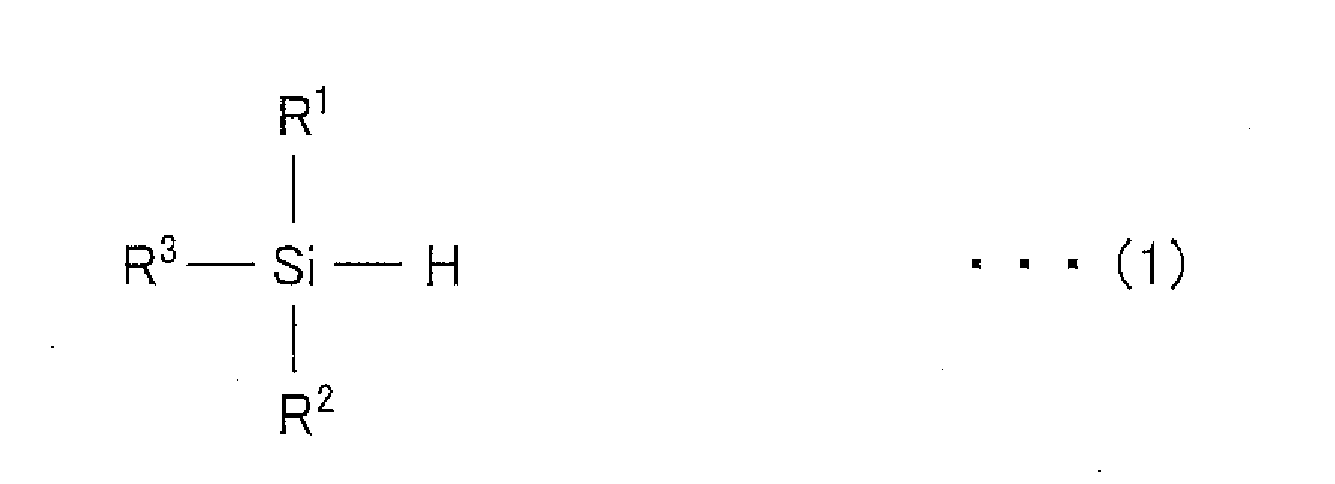
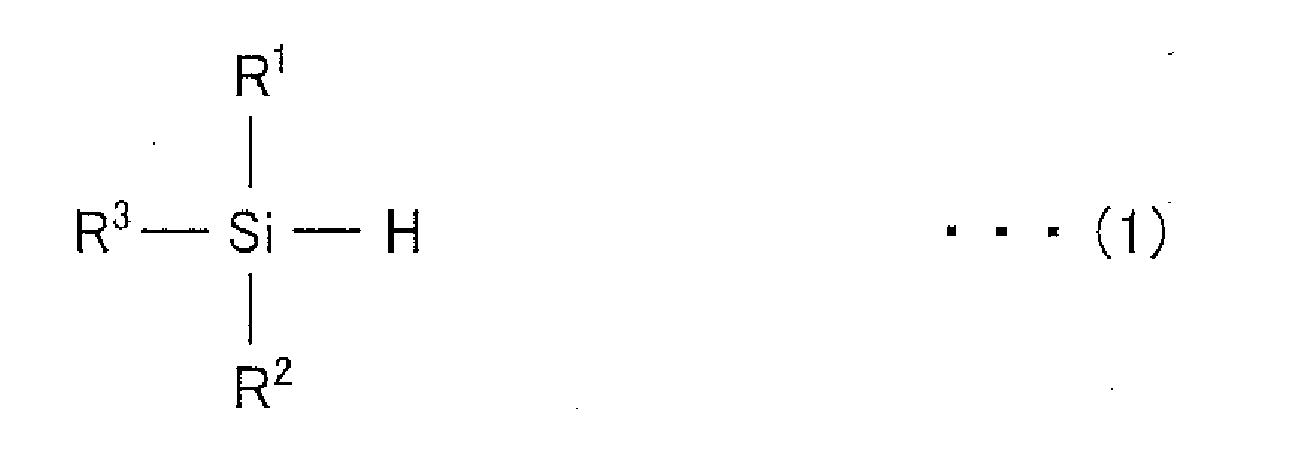
- the invention as recited in claim 1 is a method for manufacturing a packing material characterized by including a first step of reacting an inorganic particle having a hydroxyl group with a silane coupling agent including a silane coupling agent having an alkenyl group with a carbon number of 2 or more and 8 or less and/or an alkynyl group with a carbon number of 2 or more and 7 or less, and a second step of reacting the inorganic particle having reacted with the silane coupling agent, with a compound represented by a general formula of: (in the formula, R 1 is an alkyl group with a carbon number of 4 or more and 50 or less or an aryl group with a carbon number of 6 or more and 30 or less and each of R 2 and R 3 is independently a hydrogen atom, a chloro group, or an alkyl group with a carbon number of 1 or more and 4 or less.).
- the invention as recited in claim 2 is the method for manufacturing a packing material as recited in claim 1, characterized in that the first step includes a step of reacting the inorganic particle with the silane coupling agent having an alkenyl group with a carbon number of 2 or more and 8 or less and/or an alkynyl group with a carbon number of 2 or more and 7 or less and a step of reacting the inorganic particle having reacted with the silane coupling agent, with a silane coupling agent having no alkenyl group or alkynyl group.
- the invention as recited in claim 3 is a packing material characterized by being manufactured by using the method for manufacturing a packing material as recited in claim 1 or 2.
- the invention as recited in claim 4 is a column characterized by being packed with the packing material as recited in claim 3.
- the invention as recited in claim 5 is the column as recited in claim 4 characterized in that a tailing factor of amitriptyline is 0.9 or more and 2.0 or less.
- the present invention it is possible to provide a method for manufacturing a packing material which is capable of manufacturing a column in which a small degree of peak tailing of a basic substance is provided, a packing material which is manufactured by using the method for manufacturing a packing material, and a column packed with the packing material.
- a method for manufacturing a packing material according to the present invention includes a first step of reacting an inorganic particle having a hydroxyl group with a silane coupling agent including a silane coupling agent having an alkenyl group with a carbon number of 2 - 8 and/or an alkynyl group with a carbon number of 2 - 7 (referred to as a first silane coupling agent, below) and a second step of reacting the inorganic particle having reacted with the silane coupling agent with a compound represented by a general formula of: (in the formula, R 1 is an alkyl group with a carbon number of 4 - 50 or an aryl group with a carbon number of 6 - 30 and each of R 2 and R 3 is independently a hydrogen atom, a chloro group, or an alkyl group with a carbon number of 1 - 4).
- a silane coupling agent is thus reacted with an inorganic particle having a hydroxyl group before introducing an alkyl group with a carbon number of 4 - 50 or an aryl group with a carbon number of 6 - 30 onto a surface of the inorganic particle, it is possible to reduce an amount of a remaining hydroxyl group(s) near a surface of the inorganic particle. As a result, it is possible to obtain a packing material with a small degree of peak tailing of a basic substance.
- a first silane coupling agent has an alkenyl group with a carbon number of 9 or more and/or has an alkynyl group with a carbon number of 8 or more, reaction of a silane coupling agent with an inorganic particle having a hydroxyl group does not readily proceed due to steric hindrance.
- R 1 is an alkyl group with a carbon number of 3 or less in a compound represented by general formula (1), it is not possible to obtain a packing material with a small degree of peak tailing of a basic substance. Furthermore, if R 1 is an alkyl group with a carbon number of 51 or more or an aryl group with a carbon number of 31 or more, reaction of a compound represented by general formula (1) with an inorganic particle with an introduced alkenyl group with a carbon number of 2 - 8 and/or alkynyl group with a carbon number of 2 - 7 does not readily proceed due to steric hindrance.
- R 2 or R 3 is an alkyl group with a carbon number of 5 or more, reaction of a compound represented by general formula (1) with an inorganic particle with an introduced alkenyl group with a carbon number of 2 - 8 and/or alkynyl group with a carbon number of 2 - 7 does not readily proceed due to steric hindrance.
- An inorganic particle having a hydroxyl group is not particularly limited and there is provided silica, titanium oxide, zinc oxide, zirconium oxide, aluminum oxide, a zeolite, or the like.
- a porous particle having a hydroxyl group such as that of a silica gel, a porous glass, a monolith silica, or the like is preferable.
- An average particle size of an inorganic particle having a hydroxyl group is preferably 1 - 200 ⁇ m, and more preferably 3 - 50 ⁇ m. Furthermore, a pore size of a porous particle having a hydroxyl group is preferably 1 - 100 nm, and more preferably 4 - 50 nm. Moreover, a specific surface area of a porous particle having a hydroxyl group is preferably 50 - 800 m 2 /g, and more preferably 100 - 600 m 2 /g.
- an inorganic particle having a hydroxyl group includes an organic inorganic hybrid particle having a hydroxyl group such as a particle obtained by reacting a silane coupling agent having a hydroxyl group with an inorganic particle having a hydroxyl group.
- octadecyldimethylsilane or the like for a compound represented by general formula (1), there is provided octadecyldimethylsilane or the like and two or more kinds thereof may be used in combination.
- an inorganic particle having a hydroxyl group may be reacted with only a first silane coupling agent in a first step in the present invention, it is preferable to be reacted with a first silane coupling agent and a silane coupling agent having no alkenyl group or alkynyl group (referred to as a second silane coupling agent, below) because it is possible to control an amount of an introduced alkenyl group.
- a second silane coupling agent silane coupling agent having no alkenyl group or alkynyl group
- an inorganic particle having a hydroxyl group may be reacted with a first silane coupling agent and/or a second silane coupling agent more than once in a first step.
- a first silane coupling agent is not particularly limited, and there is provided a compound represented by a general formula of: (in the formula, at least one of R 1 , R 2 , R 3 , and R 4 is an alkenyl group with a carbon number of 2 - 8 or an alkynyl group with a carbon number of 2 - 7, at least one of R 1 , R 2 , R 3 , and R 4 is a hydrogen atom, a halogen atom, a hydroxyl group, or an alkoxyl group with a carbon number of 1 - 4, and each of R 1 , R 2 , R 3 , and R 4 except the ones above is independently a substituted or non-substituted alkyl group with a carbon number of 1 - 8, a substituted alkenyl group with a carbon number of 2 - 8, a substituted alkynyl group with a carbon number of 2 - 7, or a substituted or non-substituted aryl group with a carbon
- an alkenyl group with a carbon number of 2 - 8 or an alkynyl group with a carbon number of 2 - 7 in general formulas (2) - (5) is not particularly limited as long as hydrosilylation reaction with a compound represented by general formula (1) is allowed, and there is provided a vinyl group, an ethynyl group, or the like.
- a halogen group is not particularly limited as long as a condensation reaction with a hydroxyl group possessed by an inorganic particle is allowed, and there is provided a chloro group, a bromo group, an iodo group, or the like.
- a substituent for an alkyl group, alkenyl group, alkynyl group, or aryl group is not particularly limited as long as the substituent does not inhibit reaction, and there is provided a cyano group, a hydroxyl group, a carboxyl group, an amide group, an imide group, a sulfo group, an amino group, a glyceroyl group, or the like.
- vinyltrichlorosilane vinyltrimethoxysilane, vinyltriethoxysilane, vinyltriisopropoxysilane, vinyltriphenoxysilane, vinylphenylmethylsilane, vinylphenylmethylchlorosilane, vinylphenyldiethoxysilane, vinylphenyldichlorosilane, vinyldiphenylchlorosilane, vinyldiphenylethoxysilane, vinyloctyldichlorosilane, vinyldimethylsilane, vinyldimethylchlorosilane, divinyldichlorosilane, trivinylchlorosilane, trivinylmethoxysilane, trivinylethoxysilane, trivinylsilane, or the like.
- a second silane coupling agent is not particularly limited, and there is provided a compound represented by a general formula of: (in the formula, each of R 1 , R 2 , and R 3 is independently an alkyl group with a carbon number of 1 - 9 and X is a single bond or an imino group.), a compound represented by a general formula of: (in the formula, n is 0 - 50, 1 - 3 of plural R 1 , R 2 , and R 3 is/are a hydrogen atom(s) or an alkoxy group(s) with a carbon number of 1 - 4, and each of R 1 , R 2 , and R 3 except one(s) above is independently an alkyl group with a carbon number of 1 - 9.), a compound represented by a general formula of: (in the formula, n is 1 - 50, and each of R 1 , R 2 , and R 3 is independently an alkyl group with a carbon number of 1 - 9.), a compound represented by a general formula of
- dimethyldimethoxysilane diethylmethylsilane, triethylsilane, trimethylmethoxysilane, 1,1,3,3-tetramethyldisiloxane, 1,1,3,3,5,5-hexamethyltrisiloxane, 1,3-dimethoxytetramethyldisiloxane, or the like.
- reaction is conducted at 0 - 400 °C for 30 minutes - 72 hours under the presence of a solvent such as toluene.
- an inorganic particle having reacted with a silane coupling agent is reacted with a compound represented by general formula (1) in a second step
- a publicly-known method for example, reaction is conducted at 50 - 300 °C for 2 hours or more under the presence of a solvent such as toluene.
- a catalyst it is possible to use a ruthenium, rhodium, palladium, osmium, iridium, or platinum compound, wherein a palladium compound or a platinum compound is preferable.
- a palladium compound is not particularly limited, and there is provided palladium (II) chloride, ammonium tetramminechloropalladate (II), palladium (II) oxide, palladium (II) hydroxide, or the like.
- a platinum compound is not particularly limited, and there is provided platinum (II) chloride, tetrachloroplatinic (II) acid, platinum (IV) chloride, hexachloroplatinic (IV) acid, ammonium hexachloroplatinate (IV), platinum (II) oxide, platinum (II) hydroxide, platinum (IV) dioxide, platinum (IV) oxide, platinum (IV) disulfide, platinum (IV) sulfide, potassium hexachloroplatinate (IV), or the like.
- a silanol group remaining on an inorganic particle and originating from a silane coupling agent may be blocked by using a publicly-known method after a second step.
- a column according to the present invention is packed with a packing material manufactured by using a method for manufacturing a packing material according to the present invention, it is possible to provide a small degree of peak tailing of a basic material, and specifically, it is possible for a tailing factor of amitriptyline to be 0.9 - 2.0. Additionally, it is possible to apply a column according to the present invention to liquid chromatography and it is possible to analyze or fractionate a sample.
- FIG. 1, FIG. 2 , and FIG. 3 illustrate measurement results of the tailing factors for the columns packed with the packing materials in practical example 1, practical example 2, and comparative example 1.
- the tailing factor and number of theoretical plates for the column packed with the packing material in practical example 1 were 1.39 and 6313, respectively
- the tailing factor and number of theoretical plates for the column packed with the packing material in practical example 2 were 1.15 and 7814, respectively.
- the tailing factor and number of theoretical plates for the column packed with the packing material in comparative example 1 were 2.19 and 3292, respectively.
Landscapes
- Chemical & Material Sciences (AREA)
- Analytical Chemistry (AREA)
- Chemical Kinetics & Catalysis (AREA)
- Organic Chemistry (AREA)
- Life Sciences & Earth Sciences (AREA)
- Health & Medical Sciences (AREA)
- Physics & Mathematics (AREA)
- Biochemistry (AREA)
- General Health & Medical Sciences (AREA)
- General Physics & Mathematics (AREA)
- Immunology (AREA)
- Pathology (AREA)
- Inorganic Chemistry (AREA)
- Solid-Sorbent Or Filter-Aiding Compositions (AREA)
Abstract
Description
- The present invention relates to a method for manufacturing a packing material, a packing material, and a column.
- Conventionally, a silica gel with a surface on which a silanol group has been chemically modified by silylation with each kind of silane coupling agent has generally been used as a packing material for packing a column used in liquid chromatography. For a silane coupling agent, there is provided an octadecylchlorosilane compound, an octylchlorosilane compound, a butylchlorosilane compound, a cyanopropylchlorosilane compound, a phenylchlorosilane compound, or the like, and among these, an octadecylchlorosilane compound has been used most widely.
- However, such a packing material has a large degree of an interaction with a polar substance, in particular, a basic substance, because a silanol group remains on a surface of a silica gel, and provides a problem of a large degree of peak tailing of a basic substance in a column.
- Patent document 1 discloses a method of reacting an end cap agent with a silanol group remaining on a chemically modified silica gel or a porous glass at a reaction temperature at or above 250 °C in a gas phase.
- However, even if such a method is used, a silanol group still remains on a surface of a silica gel or porous glass, and accordingly, it is desired that a peak tailing of a basic substance in a column is reduced.
- Patent document 1: Japanese Patent Application Publication No.
4-212058 - The present invention is intended to provide a method for manufacturing a packing material which is capable of manufacturing a column in which a small degree of peak tailing of a basic substance is provided, a packing material which is manufactured by using the method for manufacturing a packing material, and a column packed with the packing material, while taking a problem possessed by the aforementioned prior art into consideration.
- The invention as recited in claim 1 is a method for manufacturing a packing material characterized by including a first step of reacting an inorganic particle having a hydroxyl group with a silane coupling agent including a silane coupling agent having an alkenyl group with a carbon number of 2 or more and 8 or less and/or an alkynyl group with a carbon number of 2 or more and 7 or less, and a second step of reacting the inorganic particle having reacted with the silane coupling agent, with a compound represented by a general formula of:

- The invention as recited in
claim 2 is the method for manufacturing a packing material as recited in claim 1, characterized in that the first step includes a step of reacting the inorganic particle with the silane coupling agent having an alkenyl group with a carbon number of 2 or more and 8 or less and/or an alkynyl group with a carbon number of 2 or more and 7 or less and a step of reacting the inorganic particle having reacted with the silane coupling agent, with a silane coupling agent having no alkenyl group or alkynyl group. - The invention as recited in claim 3 is a packing material characterized by being manufactured by using the method for manufacturing a packing material as recited in
claim 1 or 2. - The invention as recited in
claim 4 is a column characterized by being packed with the packing material as recited in claim 3. - The invention as recited in claim 5 is the column as recited in
claim 4 characterized in that a tailing factor of amitriptyline is 0.9 or more and 2.0 or less. - According to the present invention, it is possible to provide a method for manufacturing a packing material which is capable of manufacturing a column in which a small degree of peak tailing of a basic substance is provided, a packing material which is manufactured by using the method for manufacturing a packing material, and a column packed with the packing material.
-
-
FIG. 1 is a diagram illustrating a measurement result of a tailing factor for a column packed with a packing material in practical example 1. -
FIG. 2 is a diagram illustrating a measurement result of a tailing factor for a column packed with a packing material in practical example 2. -
FIG. 3 is a diagram illustrating a measurement result of a tailing factor for a column packed with a packing material in comparative example 1. - Next, an embodiment(s) for implementing the present invention will be described in conjunction with the drawings.
- A method for manufacturing a packing material according to the present invention includes a first step of reacting an inorganic particle having a hydroxyl group with a silane coupling agent including a silane coupling agent having an alkenyl group with a carbon number of 2 - 8 and/or an alkynyl group with a carbon number of 2 - 7 (referred to as a first silane coupling agent, below) and a second step of reacting the inorganic particle having reacted with the silane coupling agent with a compound represented by a general formula of:
- If a first silane coupling agent has an alkenyl group with a carbon number of 9 or more and/or has an alkynyl group with a carbon number of 8 or more, reaction of a silane coupling agent with an inorganic particle having a hydroxyl group does not readily proceed due to steric hindrance.
- If R1 is an alkyl group with a carbon number of 3 or less in a compound represented by general formula (1), it is not possible to obtain a packing material with a small degree of peak tailing of a basic substance. Furthermore, if R1 is an alkyl group with a carbon number of 51 or more or an aryl group with a carbon number of 31 or more, reaction of a compound represented by general formula (1) with an inorganic particle with an introduced alkenyl group with a carbon number of 2 - 8 and/or alkynyl group with a carbon number of 2 - 7 does not readily proceed due to steric hindrance. Moreover, if R2 or R3 is an alkyl group with a carbon number of 5 or more, reaction of a compound represented by general formula (1) with an inorganic particle with an introduced alkenyl group with a carbon number of 2 - 8 and/or alkynyl group with a carbon number of 2 - 7 does not readily proceed due to steric hindrance.
- An inorganic particle having a hydroxyl group is not particularly limited and there is provided silica, titanium oxide, zinc oxide, zirconium oxide, aluminum oxide, a zeolite, or the like. Among these, a porous particle having a hydroxyl group such as that of a silica gel, a porous glass, a monolith silica, or the like is preferable.
- An average particle size of an inorganic particle having a hydroxyl group is preferably 1 - 200 µm, and more preferably 3 - 50 µm. Furthermore, a pore size of a porous particle having a hydroxyl group is preferably 1 - 100 nm, and more preferably 4 - 50 nm. Moreover, a specific surface area of a porous particle having a hydroxyl group is preferably 50 - 800 m2/g, and more preferably 100 - 600 m2/g.
- In the specification and the claim(s) for the present application, an inorganic particle having a hydroxyl group includes an organic inorganic hybrid particle having a hydroxyl group such as a particle obtained by reacting a silane coupling agent having a hydroxyl group with an inorganic particle having a hydroxyl group.
- For a compound represented by general formula (1), there is provided octadecyldimethylsilane or the like and two or more kinds thereof may be used in combination.
- Although an inorganic particle having a hydroxyl group may be reacted with only a first silane coupling agent in a first step in the present invention, it is preferable to be reacted with a first silane coupling agent and a silane coupling agent having no alkenyl group or alkynyl group (referred to as a second silane coupling agent, below) because it is possible to control an amount of an introduced alkenyl group. Herein, it is more preferable that an inorganic particle having a hydroxyl group is reacted with a predetermined amount of a first silane coupling agent and subsequently reacted with an excessive amount of a second silane coupling agent. Thereby, it is possible to control an amount of an introduced alkenyl group and/or alkynyl group on a surface of an inorganic particle and to reduce an amount of a remaining hydroxyl group(s).
- Additionally, an inorganic particle having a hydroxyl group may be reacted with a first silane coupling agent and/or a second silane coupling agent more than once in a first step.
- A first silane coupling agent is not particularly limited, and there is provided a compound represented by a general formula of:
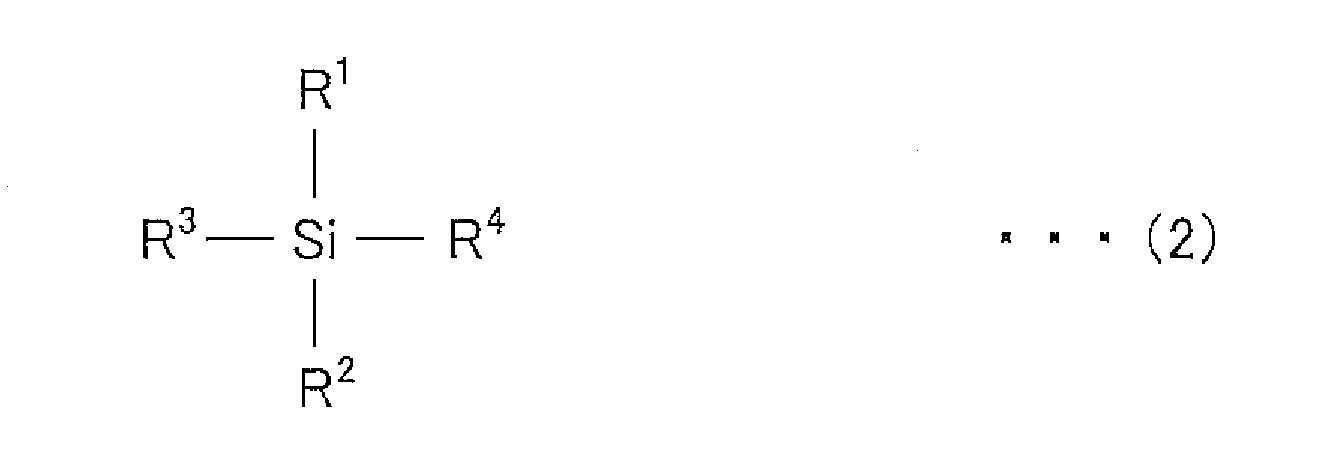


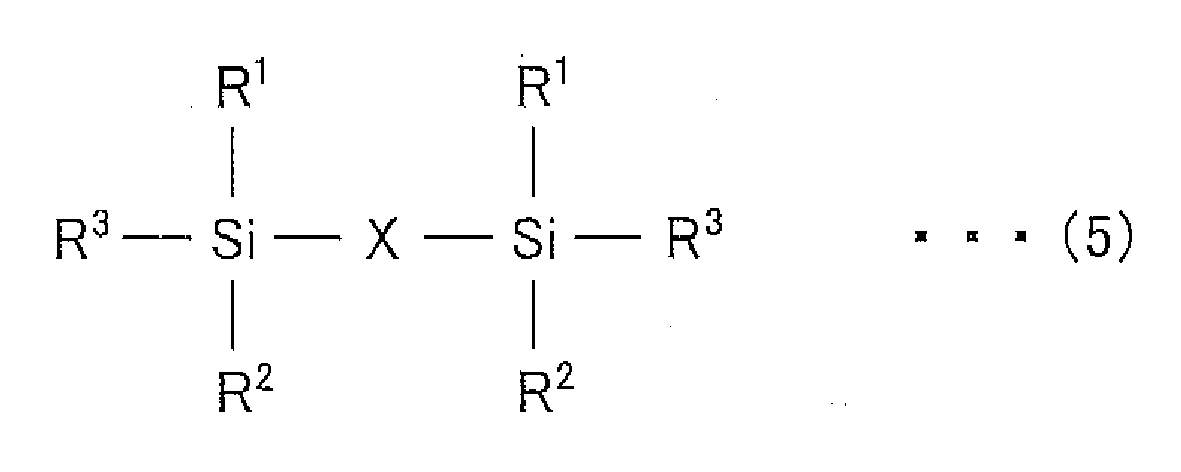

- Additionally, an alkenyl group with a carbon number of 2 - 8 or an alkynyl group with a carbon number of 2 - 7 in general formulas (2) - (5) is not particularly limited as long as hydrosilylation reaction with a compound represented by general formula (1) is allowed, and there is provided a vinyl group, an ethynyl group, or the like. Furthermore, a halogen group is not particularly limited as long as a condensation reaction with a hydroxyl group possessed by an inorganic particle is allowed, and there is provided a chloro group, a bromo group, an iodo group, or the like. Moreover, a substituent for an alkyl group, alkenyl group, alkynyl group, or aryl group is not particularly limited as long as the substituent does not inhibit reaction, and there is provided a cyano group, a hydroxyl group, a carboxyl group, an amide group, an imide group, a sulfo group, an amino group, a glyceroyl group, or the like.
- For a compound represented by general formula (2), there is provided vinyltrichlorosilane, vinyltrimethoxysilane, vinyltriethoxysilane, vinyltriisopropoxysilane, vinyltriphenoxysilane, vinylphenylmethylsilane, vinylphenylmethylchlorosilane, vinylphenyldiethoxysilane, vinylphenyldichlorosilane, vinyldiphenylchlorosilane, vinyldiphenylethoxysilane, vinyloctyldichlorosilane, vinyldimethylsilane, vinyldimethylchlorosilane, divinyldichlorosilane, trivinylchlorosilane, trivinylmethoxysilane, trivinylethoxysilane, trivinylsilane, or the like.
- For a compound represented by general formula (3), there is provided 1,5-divinyl-3,3-diphenyl-1,1,5,5-tetramethyltrisiloxane, or the like.
- For a compound represented by general formula (4), there is provided 1,3,5-trivinyl-1,3,5-trimethylcyclotrisiloxane, 1,3,5-trivinyl-1,3,5-trimethylcyclotrisilazane, or the like.
- For a compound represented by general formula (5), there is provided 1,3-divinyltetramethyldisiloxane, 1,3-divinyltetramethyldisilazane, or the like.
- A second silane coupling agent is not particularly limited, and there is provided a compound represented by a general formula of:


- For a compound represented by general formula (6), there is provided hexamethyldisilane, hexamethyldisilazane, or the like.
- For a compound represented by general formula (7), there is provided dimethyldimethoxysilane, diethylmethylsilane, triethylsilane, trimethylmethoxysilane, 1,1,3,3-tetramethyldisiloxane, 1,1,3,3,5,5-hexamethyltrisiloxane, 1,3-dimethoxytetramethyldisiloxane, or the like.
- For a compound represented by general formula (8), there is provided hexamethyldisiloxane, tetradecamethylhexasiloxane, or the like.
- For a compound represented by general formula (9), there is provided hexamethylcyclotrisiloxane, octamethylcyclotetrasiloxane, decamethylcyclopentasiloxane, dodecamethylcyclohexasiloxane, hexamethylcyclotrisilazane, or the like.
- When an inorganic particle having a hydroxyl group is reacted with a silane coupling agent in the present invention, it is possible to use a publicly-known method, and for example, reaction is conducted at 0 - 400 °C for 30 minutes - 72 hours under the presence of a solvent such as toluene.
- Furthermore, when an inorganic particle having reacted with a silane coupling agent is reacted with a compound represented by general formula (1) in a second step, it is possible to use a publicly-known method, and for example, reaction is conducted at 50 - 300 °C for 2 hours or more under the presence of a solvent such as toluene. For a catalyst, it is possible to use a ruthenium, rhodium, palladium, osmium, iridium, or platinum compound, wherein a palladium compound or a platinum compound is preferable. A palladium compound is not particularly limited, and there is provided palladium (II) chloride, ammonium tetramminechloropalladate (II), palladium (II) oxide, palladium (II) hydroxide, or the like. A platinum compound is not particularly limited, and there is provided platinum (II) chloride, tetrachloroplatinic (II) acid, platinum (IV) chloride, hexachloroplatinic (IV) acid, ammonium hexachloroplatinate (IV), platinum (II) oxide, platinum (II) hydroxide, platinum (IV) dioxide, platinum (IV) oxide, platinum (IV) disulfide, platinum (IV) sulfide, potassium hexachloroplatinate (IV), or the like.
- Additionally, a silanol group remaining on an inorganic particle and originating from a silane coupling agent may be blocked by using a publicly-known method after a second step.
- Because a column according to the present invention is packed with a packing material manufactured by using a method for manufacturing a packing material according to the present invention, it is possible to provide a small degree of peak tailing of a basic material, and specifically, it is possible for a tailing factor of amitriptyline to be 0.9 - 2.0. Additionally, it is possible to apply a column according to the present invention to liquid chromatography and it is possible to analyze or fractionate a sample.
- A practical example(s) for the present invention will be further described in detail below. Additionally, the present invention is not limited thereto.
- 1 g of a silica gel with an average particle size of 5 µm and a specific surface area of 450 mm2/g was charged into an ampoule and dried at 120 °C and a reduced pressure for 10 hours. After the ampoule was cooled, addition of 0.55 mL of vinylmethyldimethoxysilane and sealing thereof were conducted under nitrogen atmosphere and reaction was conducted at 350 °C for 12 hours. Furthermore, after a product was taken out and washed with 10 mL of chloroform and 10 mL of methanol, drying was conducted at 120 °C and a reduced pressure for 10 hours.
- After 0.7 g of obtained particles were dispersed in 3 mL of dehydrated toluene, addition of 3.1 mL of octadecyldimethylsilane and stirring were conducted.
Then, after 14.45 µL of 3 mass % solution of chloroplatinic acid in toluene was added and reaction was conducted at 70 °C for 8 hours, cooling and filtration were conducted. After an obtained residue was washed with 10 mL of chloroform and 10 mL of methanol, drying was conducted at 120 °C and a reduced pressure for 10 hours to obtain a packing material. - 15 g of a silica gel with an average particle size of 5 µm and a specific surface area of 450 mm2/g was dispersed in 60 mL of dehydrated toluene. Then, after addition of 5.79 mL of pyridine and 3.12 mL of vinyltrichlorosilane and heating and reflux for 3 hours were conducted, cooling and filtration were conducted. An obtained residue was washed with 100 mL of toluene, 100 mL of acetonitrile, and 100 mL of 60 mass % aqueous solution of acetonitrile. Furthermore, dispersion in 100 mL of 60 mass % aqueous solution of actonitrile, stirring at room temperature for 1.5 hours, and filtration were conducted. After an obtained residue was washed with 100 mL of 60 mass % of acetonitrile and 100 mL of methanol, drying at 120 °C and a reduced pressure for 10 hours was conducted. The content of carbon in obtained particles was 4.00 mass %.
- 2 g of obtained particles were charged in an ampoule and drying at 120 °C and a reduced pressure for 10 hours was conducted. After the ampoule was cooled, addition of 0.416 mL of dimethyldimethoxysilane and sealing thereof were conducted under nitrogen atmosphere, and reaction was conducted at 350 °C for 6 hours. Furthermore, after a product was taken out and washed with 20 mL of chloroform and 20 mL of methanol, drying at 120 °C and a reduced pressure for 10 hours was conducted.
- After 0.7 g of obtained particles were dispersed in 3 mL of dehydrated toluene, addition of 3.1 mL of octadecyldimethylsilane and stirring were conducted. Then, after addition of 14.45 µL of 3 mass % solution of chloroplatinic acid in toluene and reaction at 70 °C for 8 hours were conducted, cooling and filtration were conducted. After an obtained residue was washed with 10 mL of chloroform and 10 mL of methanol, drying at 120 °C and a reduced pressure for 10 hours was conducted to obtain a packing material.
- After 10 g of a silica gel was dried at 120 °C and a reduced pressure for 10 hours, cooling and dispersion in 40 mL of dehydrated toluene were conducted. Then, after addition of 0.80 mL of pyridine and 3.3 mL of octadecyldimethylchlorosilane and heating and reflux for 3 hours were conducted, cooling and filtration were conducted. After an obtained residue was washed with 100 mL of toluene, 100 mL of chloroform, and 100 mL of methanol, drying at 120 °C and a reduced pressure for 10 hours was conducted.
- 5 g of obtained particles were charged into an ampoule and drying at 120 °C and a reduced pressure for 10 hours was conducted. After an ampoule was cooled, addition of 1.0 mL of hexamethylsilazane and sealing thereof were conducted under nitrogen atmosphere and reaction at 250 °C for 6 hours was conducted.
Furthermore, after a product was taken out and washed with 50 mL of chloroform and 100 mL of methanol, drying at 120 °C and a reduced pressure for 10 hours was conducted to obtain a packing material. - After columns were packed with packing materials in practical example 1, practical example 2, and comparative example 1, a mobile phase with 20 mM phosphate buffer: acetonitrile being 60: 40 (volume ratio) was used to measure tailing factors of amitriptyline as a basic substance.
-
FIG. 1, FIG. 2 , andFIG. 3 illustrate measurement results of the tailing factors for the columns packed with the packing materials in practical example 1, practical example 2, and comparative example 1. Herein, the tailing factor and number of theoretical plates for the column packed with the packing material in practical example 1 were 1.39 and 6313, respectively, and the tailing factor and number of theoretical plates for the column packed with the packing material in practical example 2 were 1.15 and 7814, respectively. On the other hand, the tailing factor and number of theoretical plates for the column packed with the packing material in comparative example 1 were 2.19 and 3292, respectively. - The present international application claims its priority based on Japanese Patent Application No.
2009-059290 filed on March 12, 2009 2009-059290
Claims (5)
- A method for manufacturing a packing material, characterized by comprising:a first step of reacting an inorganic particle having a hydroxyl group with a silane coupling agent including a silane coupling agent having an alkenyl group with a carbon number of 2 or more and 8 or less and/or an alkynyl group with a carbon number of 2 or more and 7 or less, and;a second step of reacting the inorganic particle having reacted with the silane coupling agent, with a compound represented by a general formula of:

- The method for manufacturing a packing material as claimed in claim 1, characterized in that the first step includes a step of reacting the inorganic particle with the silane coupling agent having an alkenyl group with a carbon number of 2 or more and 8 or less and/or an alkynyl group with a carbon number of 2 or more and 7 or less and a step of reacting the inorganic particle having reacted with the silane coupling agent, with a silane coupling agent having no alkenyl group or alkynyl group.
- A packing material characterized by being manufactured by using the method for manufacturing a packing material as claimed in claim 1 or 2.
- A column characterized by being packed with the packing material as claimed in claim 3.
- The column as claimed in claim 4, characterized in that a tailing factor of amitriptyline is 0.9 or more and 2.0 or less.
Applications Claiming Priority (2)
| Application Number | Priority Date | Filing Date | Title |
|---|---|---|---|
| JP2009059290 | 2009-03-12 | ||
| PCT/JP2010/054119 WO2010104151A1 (en) | 2009-03-12 | 2010-03-11 | Process for producing filler, filler, and column |
Publications (2)
| Publication Number | Publication Date |
|---|---|
| EP2407779A1 true EP2407779A1 (en) | 2012-01-18 |
| EP2407779A4 EP2407779A4 (en) | 2014-01-22 |
Family
ID=42728439
Family Applications (1)
| Application Number | Title | Priority Date | Filing Date |
|---|---|---|---|
| EP10750904.4A Withdrawn EP2407779A4 (en) | 2009-03-12 | 2010-03-11 | Process for producing filler, filler, and column |
Country Status (8)
| Country | Link |
|---|---|
| US (1) | US8173022B2 (en) |
| EP (1) | EP2407779A4 (en) |
| JP (1) | JP5620902B2 (en) |
| KR (1) | KR101720359B1 (en) |
| CN (1) | CN102348974B (en) |
| BR (1) | BRPI1009421A2 (en) |
| RU (1) | RU2523484C2 (en) |
| WO (1) | WO2010104151A1 (en) |
Families Citing this family (2)
| Publication number | Priority date | Publication date | Assignee | Title |
|---|---|---|---|---|
| JP5993553B2 (en) * | 2010-09-10 | 2016-09-14 | 株式会社 資生堂 | Method for producing filler |
| US9847302B2 (en) * | 2013-08-23 | 2017-12-19 | Taiwan Semiconductor Manufacturing Co., Ltd. | Wafer surface conditioning for stability in fab environment |
Family Cites Families (25)
| Publication number | Priority date | Publication date | Assignee | Title |
|---|---|---|---|---|
| US3808125A (en) * | 1972-08-25 | 1974-04-30 | Phillips Petroleum Co | Chromatographic apparatus |
| US3878092A (en) * | 1973-03-12 | 1975-04-15 | Phillips Petroleum Co | Chromatographic colums |
| US4029583A (en) * | 1975-02-28 | 1977-06-14 | Purdue Research Foundation | Chromatographic supports and methods and apparatus for preparing the same |
| DE2621974A1 (en) * | 1976-05-18 | 1977-11-24 | Max Planck Gesellschaft | PROCESS FOR PRODUCING A COVALENT BOND WITH BIOLOGICALLY ACTIVE MATERIALS |
| US5318848A (en) * | 1990-01-26 | 1994-06-07 | Shiseido Company Ltd. | Modified silica gel in chromatography packing material |
| JP2611545B2 (en) | 1990-02-22 | 1997-05-21 | 財団法人化学品検査協会 | Method for producing packing material for liquid chromatography |
| EP0443860B1 (en) | 1990-02-22 | 1994-02-09 | Chemicals Inspection & Testing Institute, Japan | Method for preparing liquid chromatograph packing material, and material produced thereby |
| US5316680A (en) * | 1992-10-21 | 1994-05-31 | Cornell Research Foundation, Inc. | Multimodal chromatographic separation media and process for using same |
| US5522994A (en) * | 1995-02-01 | 1996-06-04 | Cornell Research Foundation, Inc. | Single column chromatographic determination of small molecules in mixtures with large molecules |
| US6017458A (en) * | 1997-08-27 | 2000-01-25 | National University Of Singapore | Separating materials for chromatography and electrophoresis applications comprising regiodefined functionalised cyclodextrins chemically bonded to a support via urethane functionalities |
| US6686035B2 (en) * | 1999-02-05 | 2004-02-03 | Waters Investments Limited | Porous inorganic/organic hybrid particles for chromatographic separations and process for their preparation |
| US6802966B2 (en) * | 2001-08-14 | 2004-10-12 | W. R. Grace & Co. Conn. | Solid compositions for selective adsorption from complex mixtures |
| WO2003019177A1 (en) * | 2001-08-31 | 2003-03-06 | Shiseido Co., Ltd. | Column packing and process for production thereof |
| US6994791B2 (en) * | 2002-06-27 | 2006-02-07 | Akzo Nobel N.V. | Adsorbent material and method of preparing an adsorbent material |
| JP3986931B2 (en) | 2002-08-30 | 2007-10-03 | 株式会社資生堂 | Column packing material and method for producing the same |
| CA2500903A1 (en) * | 2002-09-13 | 2004-03-25 | Pall Corporation | Preparation and use of mixed mode solid substrates for chromatography adsorbents and biochip arrays |
| EP1449578A3 (en) * | 2003-02-18 | 2004-10-13 | Daiso Co., Ltd. | Packings for liquid chromatography, process for preparing and usage of the same |
| PL1613420T3 (en) * | 2003-03-25 | 2016-03-31 | Instraction Gmbh | Method for selectively binding a substrate to sorbents by way of at least bivalent bonds |
| JP4615848B2 (en) * | 2003-11-26 | 2011-01-19 | Agcエスアイテック株式会社 | Alkali-resistant chemically modified silica gel and method for producing the same |
| US20060076296A1 (en) * | 2004-10-13 | 2006-04-13 | Wu Chen | Novel stationary phases for use in high-performance liquid chromatography |
| US20050242038A1 (en) * | 2004-04-30 | 2005-11-03 | Wu Chen | Novel stationary phases for use in high-performance liquid chromatography |
| US20070090052A1 (en) * | 2005-10-20 | 2007-04-26 | Broske Alan D | Chromatographic stationary phase |
| US20090206034A1 (en) * | 2006-03-29 | 2009-08-20 | Osakazu Nakajima | Modified silica gel and use thereof |
| JP2008232802A (en) | 2007-03-20 | 2008-10-02 | Kanto Chem Co Inc | Manufacturing method of ods silica gel filler |
| JP2009059290A (en) | 2007-09-03 | 2009-03-19 | Just Syst Corp | Foreign language document creation support apparatus, foreign language document creation support method, and foreign language document creation support program |
-
2010
- 2010-03-11 JP JP2011503861A patent/JP5620902B2/en not_active Expired - Fee Related
- 2010-03-11 US US13/255,277 patent/US8173022B2/en not_active Expired - Fee Related
- 2010-03-11 RU RU2011140848/05A patent/RU2523484C2/en not_active IP Right Cessation
- 2010-03-11 EP EP10750904.4A patent/EP2407779A4/en not_active Withdrawn
- 2010-03-11 KR KR1020117020787A patent/KR101720359B1/en not_active Expired - Fee Related
- 2010-03-11 WO PCT/JP2010/054119 patent/WO2010104151A1/en not_active Ceased
- 2010-03-11 BR BRPI1009421A patent/BRPI1009421A2/en not_active Application Discontinuation
- 2010-03-11 CN CN201080011224.2A patent/CN102348974B/en not_active Expired - Fee Related
Also Published As
| Publication number | Publication date |
|---|---|
| JP5620902B2 (en) | 2014-11-05 |
| US8173022B2 (en) | 2012-05-08 |
| KR101720359B1 (en) | 2017-03-27 |
| CN102348974B (en) | 2015-06-10 |
| EP2407779A4 (en) | 2014-01-22 |
| WO2010104151A1 (en) | 2010-09-16 |
| US20110315618A1 (en) | 2011-12-29 |
| RU2011140848A (en) | 2013-04-20 |
| RU2523484C2 (en) | 2014-07-20 |
| KR20110131202A (en) | 2011-12-06 |
| CN102348974A (en) | 2012-02-08 |
| JPWO2010104151A1 (en) | 2012-09-13 |
| BRPI1009421A2 (en) | 2016-03-01 |
Similar Documents
| Publication | Publication Date | Title |
|---|---|---|
| AU2005215377B2 (en) | Polar-modified bonded phase materials for chromatographic separations | |
| JP4820401B2 (en) | Porous hybrid particles with organic groups removed from the surface | |
| US8404346B2 (en) | Porous inorganic/organic hybrid monolith materials for chromatographic separations and process for their preparation | |
| US20210220753A1 (en) | High purity chromatrographic materials comprising an ionizable modifier | |
| JP7005515B2 (en) | Analytical method for glycans modified with amphipathic strong bases using charged surface reverse phase chromatography material | |
| CN103301822B (en) | A kind of polar liquid chromatogram filler and preparation method thereof | |
| EP0386926A2 (en) | Silica gel supports suitable for chromatographic separations | |
| JP4904161B2 (en) | Polar silanes for substrate bonding and use of bonded substrates in chromatography. | |
| JP2008530209A5 (en) | ||
| EP3687652B1 (en) | High purity chromatographic materials comprising an ionizable modifier for retention of acidic analytes | |
| US9925515B1 (en) | Alkyl functionalized porous silica liquid chromatographic stationary phases and solid phase extraction sorbents | |
| Green et al. | What Is on Your HPLC Particle? Looking at Stationary Phase Chemistry Synthesis | |
| US8173022B2 (en) | Method for manufacturing packing material, packing material, and column | |
| CN1130375A (en) | Optical isomer separating agent | |
| Silva et al. | An overview of the chromatographic properties and stability of C18 titanized phases | |
| JP5993553B2 (en) | Method for producing filler | |
| Bell et al. | Columns-What is on Your HPLC Particle? A Look at Stationary Phase Chemistry Synthesis | |
| Gómez et al. | Novel 3‐hydroxypropyl‐bonded phase by direct hydrosilylation of allyl alcohol on amorphous hydride silica | |
| Marutoiu et al. | Synthesis and characterization of diatomaceous earth chemically modified with n-trichlorooctadecylsilane |
Legal Events
| Date | Code | Title | Description |
|---|---|---|---|
| PUAI | Public reference made under article 153(3) epc to a published international application that has entered the european phase |
Free format text: ORIGINAL CODE: 0009012 |
|
| 17P | Request for examination filed |
Effective date: 20111005 |
|
| AK | Designated contracting states |
Kind code of ref document: A1 Designated state(s): AT BE BG CH CY CZ DE DK EE ES FI FR GB GR HR HU IE IS IT LI LT LU LV MC MK MT NL NO PL PT RO SE SI SK SM TR |
|
| DAX | Request for extension of the european patent (deleted) | ||
| A4 | Supplementary search report drawn up and despatched |
Effective date: 20140103 |
|
| RIC1 | Information provided on ipc code assigned before grant |
Ipc: B01J 20/286 20060101ALI20131218BHEP Ipc: G01N 30/50 20060101ALI20131218BHEP Ipc: B01J 20/32 20060101ALI20131218BHEP Ipc: G01N 30/88 20060101AFI20131218BHEP Ipc: B01J 20/287 20060101ALI20131218BHEP Ipc: B01J 20/281 20060101ALI20131218BHEP |
|
| 17Q | First examination report despatched |
Effective date: 20170202 |
|
| RAP1 | Party data changed (applicant data changed or rights of an application transferred) |
Owner name: SANYO FINE IRICA TECHNOLOGY CO., LTD. |
|
| STAA | Information on the status of an ep patent application or granted ep patent |
Free format text: STATUS: THE APPLICATION IS DEEMED TO BE WITHDRAWN |
|
| 18D | Application deemed to be withdrawn |
Effective date: 20200603 |