EP2407362A2 - Reservoir tank, master cylinder using the reservoir tank, and brake system equipped with this master cylinder - Google Patents
Reservoir tank, master cylinder using the reservoir tank, and brake system equipped with this master cylinder Download PDFInfo
- Publication number
- EP2407362A2 EP2407362A2 EP11167840A EP11167840A EP2407362A2 EP 2407362 A2 EP2407362 A2 EP 2407362A2 EP 11167840 A EP11167840 A EP 11167840A EP 11167840 A EP11167840 A EP 11167840A EP 2407362 A2 EP2407362 A2 EP 2407362A2
- Authority
- EP
- European Patent Office
- Prior art keywords
- hydraulic fluid
- reservoir tank
- brake
- fluid supply
- disposed
- Prior art date
- Legal status (The legal status is an assumption and is not a legal conclusion. Google has not performed a legal analysis and makes no representation as to the accuracy of the status listed.)
- Withdrawn
Links
- 239000012530 fluid Substances 0.000 claims abstract description 266
- 230000002093 peripheral effect Effects 0.000 claims abstract description 18
- 210000002445 nipple Anatomy 0.000 description 8
- 230000009977 dual effect Effects 0.000 description 5
- 230000000903 blocking effect Effects 0.000 description 2
- 230000000052 comparative effect Effects 0.000 description 2
- 238000009434 installation Methods 0.000 description 2
- 238000005452 bending Methods 0.000 description 1
- 238000001514 detection method Methods 0.000 description 1
- 230000000694 effects Effects 0.000 description 1
- 239000007788 liquid Substances 0.000 description 1
- 238000005192 partition Methods 0.000 description 1
Images

Classifications
-
- B—PERFORMING OPERATIONS; TRANSPORTING
- B60—VEHICLES IN GENERAL
- B60T—VEHICLE BRAKE CONTROL SYSTEMS OR PARTS THEREOF; BRAKE CONTROL SYSTEMS OR PARTS THEREOF, IN GENERAL; ARRANGEMENT OF BRAKING ELEMENTS ON VEHICLES IN GENERAL; PORTABLE DEVICES FOR PREVENTING UNWANTED MOVEMENT OF VEHICLES; VEHICLE MODIFICATIONS TO FACILITATE COOLING OF BRAKES
- B60T11/00—Transmitting braking action from initiating means to ultimate brake actuator without power assistance or drive or where such assistance or drive is irrelevant
- B60T11/10—Transmitting braking action from initiating means to ultimate brake actuator without power assistance or drive or where such assistance or drive is irrelevant transmitting by fluid means, e.g. hydraulic
- B60T11/26—Reservoirs
-
- B—PERFORMING OPERATIONS; TRANSPORTING
- B60—VEHICLES IN GENERAL
- B60T—VEHICLE BRAKE CONTROL SYSTEMS OR PARTS THEREOF; BRAKE CONTROL SYSTEMS OR PARTS THEREOF, IN GENERAL; ARRANGEMENT OF BRAKING ELEMENTS ON VEHICLES IN GENERAL; PORTABLE DEVICES FOR PREVENTING UNWANTED MOVEMENT OF VEHICLES; VEHICLE MODIFICATIONS TO FACILITATE COOLING OF BRAKES
- B60T11/00—Transmitting braking action from initiating means to ultimate brake actuator without power assistance or drive or where such assistance or drive is irrelevant
- B60T11/10—Transmitting braking action from initiating means to ultimate brake actuator without power assistance or drive or where such assistance or drive is irrelevant transmitting by fluid means, e.g. hydraulic
- B60T11/16—Master control, e.g. master cylinders
- B60T11/22—Master control, e.g. master cylinders characterised by being integral with reservoir
-
- B—PERFORMING OPERATIONS; TRANSPORTING
- B60—VEHICLES IN GENERAL
- B60T—VEHICLE BRAKE CONTROL SYSTEMS OR PARTS THEREOF; BRAKE CONTROL SYSTEMS OR PARTS THEREOF, IN GENERAL; ARRANGEMENT OF BRAKING ELEMENTS ON VEHICLES IN GENERAL; PORTABLE DEVICES FOR PREVENTING UNWANTED MOVEMENT OF VEHICLES; VEHICLE MODIFICATIONS TO FACILITATE COOLING OF BRAKES
- B60T13/00—Transmitting braking action from initiating means to ultimate brake actuator with power assistance or drive; Brake systems incorporating such transmitting means, e.g. air-pressure brake systems
- B60T13/10—Transmitting braking action from initiating means to ultimate brake actuator with power assistance or drive; Brake systems incorporating such transmitting means, e.g. air-pressure brake systems with fluid assistance, drive, or release
- B60T13/12—Transmitting braking action from initiating means to ultimate brake actuator with power assistance or drive; Brake systems incorporating such transmitting means, e.g. air-pressure brake systems with fluid assistance, drive, or release the fluid being liquid
- B60T13/14—Transmitting braking action from initiating means to ultimate brake actuator with power assistance or drive; Brake systems incorporating such transmitting means, e.g. air-pressure brake systems with fluid assistance, drive, or release the fluid being liquid using accumulators or reservoirs fed by pumps
- B60T13/142—Systems with master cylinder
-
- B—PERFORMING OPERATIONS; TRANSPORTING
- B60—VEHICLES IN GENERAL
- B60T—VEHICLE BRAKE CONTROL SYSTEMS OR PARTS THEREOF; BRAKE CONTROL SYSTEMS OR PARTS THEREOF, IN GENERAL; ARRANGEMENT OF BRAKING ELEMENTS ON VEHICLES IN GENERAL; PORTABLE DEVICES FOR PREVENTING UNWANTED MOVEMENT OF VEHICLES; VEHICLE MODIFICATIONS TO FACILITATE COOLING OF BRAKES
- B60T17/00—Component parts, details, or accessories of power brake systems not covered by groups B60T8/00, B60T13/00 or B60T15/00, or presenting other characteristic features
- B60T17/06—Applications or arrangements of reservoirs
Definitions
- the present invention relates to the technical fields of: a reservoir tank that is used in a hydraulically actuated system such as a hydraulic brake system utilizing hydraulic pressure such as oil pressure, is disposed away from a master cylinder, and stores hydraulic fluid; a master cylinder that uses the reservoir tank to generate hydraulic pressure; and a brake system that is equipped with this master cylinder.
- a hydraulically actuated system such as a hydraulic brake system utilizing hydraulic pressure such as oil pressure
- a hydraulic brake system where a tubular supply and discharge opening is disposed projecting into a main tank that is a reservoir tank disposed away from a master cylinder, a tubular connection opening is disposed projecting into a sub-tank disposed directly above the master cylinder, and the supply and discharge opening and the connection opening are coupled together by a pipe, whereby the main tank is connected to the master cylinder (e.g., see JP-A-2007-283858 ).
- the tubular supply and discharge opening in a reservoir tank disposed away from the master cylinder, it is common for the tubular supply and discharge opening to be projectingly disposed in a lower portion of an outer peripheral wall near a bottom surface of the reservoir tank for the purpose of effectively utilizing the hydraulic fluid inside the reservoir tank.
- the tubular supply and discharge opening is disposed projecting in a substantially orthogonal direction outward from this outer peripheral wall so as to be communicated with a though hole disposed in the outer peripheral wall near the bottom surface of the reservoir tank.
- the tubular supply and discharge opening is simply disposed projecting outward from this outer peripheral wall so as to be communicated with the through hole in the outer peripheral wall of the reservoir tank, in a case where the vehicle has tilted such that the hydraulic fluid moves to the opposite side of the supply and discharge opening in a state where the storage quantity of the hydraulic fluid inside the reservoir tank is relatively small and the fluid level of that hydraulic fluid is near a MIN line that is a requisite minimum line, the fluid level of the hydraulic fluid reaches a position extremely close to the uppermost portion of the supply and discharge opening or a position lower than the uppermost portion of the supply and discharge opening.
- a brake hydraulic pressure control unit such as a vehicle stability control unit when the fluid level of the hydraulic fluid is in this state
- the potential for air to be taken in together with the hydraulic fluid and enter the downstream side (the sub-tank side and the master cylinder side) of the supply and discharge opening with respect to the flow of the hydraulic fluid is conceivable.
- the present invention has been made in view of these circumstances, and it is an object thereof to provide: a reservoir tank that can suppress the intake of air, even in a state where the storage quantity of the hydraulic fluid is small and the vehicle has tilted, and ensure as large a quantity of the hydraulic fluid as possible; a master cylinder using the reservoir tank; and a brake system equipped with this master cylinder.
- a reservoir tank of the present invention comprises at least: a hydraulic fluid storage chamber that stores hydraulic fluid; and a hydraulic fluid supply port that is disposed projecting outward from a lower portion of an outer peripheral wall and supplies the hydraulic fluid by means of an inner hole disposed extending into the hydraulic fluid storage chamber, wherein a hydraulic fluid supply opening that allows the inner hole disposed extending into the hydraulic fluid storage chamber to be communicated with the hydraulic fluid storage chamber is disposed having a predetermined angle with respect to the inner hole.
- the hydraulic fluid supply opening is disposed orthogonal or substantially orthogonal with respect to the inner hole.
- a horizontal cross section of the interior of the reservoir tank is formed in a substantially rectangular shape
- the hydraulic fluid supply port is disposed in an end portion on one side in a long-side direction of the substantially rectangular shape
- the hydraulic fluid supply opening opens into the hydraulic fluid storage chamber toward an end portion on the opposite side of the end portion on the one side in the long-side direction.
- the long sides of the substantially rectangular shape of the horizontal cross section of the interior are set so as to coincide with the vehicle front-rear direction or so as to substantially coincide with the vehicle front-rear direct ion
- the hydraulic fluid supply port is disposed projecting toward either one side of the vehicle right side and the vehicle left side from the lower portion of the outer peripheral wall on the vehicle rear side, and the hydraulic fluid supply opening opens into the hydraulic fluid storage chamber toward the vehicle front side.
- a master cylinder of the present invention comprises at least: a cylinder body; a piston that is inserted inside the cylinder body so as to be air-tight and slidable, forms a hydraulic chamber, and generates hydraulic pressure in the hydraulic chamber at a time of actuation; and a hydraulic fluid supply hole that is disposed in the cylinder body and is always communicated with the hydraulic chamber, wherein the reservoir tank of any one of the present invention described above which is disposed away from the cylinder body is connected to the hydraulic fluid supply.hole.
- a brake system of the present invention comprises at least: a reservoir tank that stores hydraulic fluid; a master cylinder to which the hydraulic fluid inside the reservoir tank is supplied via a pipe and which generates brake hydraulic pressure at a time of actuation; and a brake cylinder that is actuated by the hydraulic pressure from the master cylinder, wherein the master cylinder is the master cylinder of the present invention described above.
- the reservoir tank of the present invention configured in this way, is equipped with the hydraulic fluid support port that is disposed projecting outward from the lower portion of the outer peripheral wall and supplies the hydraulic fluid by means of the inner hole disposed extending into the hydraulic fluid storage chamber, and the hydraulic fluid supply opening that allows the inner hole disposed extending into the hydraulic fluid storage chamber to be communicated with the hydraulic fluid storage chamber is disposed having a predetermined angle with respect to the inner hole.
- an external hydraulic pressure control unit is actuated and the hydraulic fluid in the reservoir tank is taken in the brake hydraulic pressure control unit in a state where the storage quantity of the hydraulic fluid is low and the vehicle has tilted in this way, the entry of air can be even more effectively suppressed.
- the horizontal cross section of the interior of the reservoir tank is formed in a substantially rectangular shape, and the reservoir tank is installed in the vehicle such that the long sides of that substantially rectangular shape coincide with the vehicle front-rear direction or substantially coincide with the vehicle front-rear direction. Because of this, when the vehicle has tilted such that the front side of the vehicle becomes lower, the hydraulic fluid inside the reservoir tank largely moves to the vehicle front side, so the fluid level inside the reservoir tank moves extremely close to the hydraulic fluid supply opening. Consequently, it becomes possible to even more effectively suppress the entry of air to the master cylinder.
- the hydraulic fluid supply opening is disposed in the portion of the hydraulic fluid supply port disposed inside the reservoir tank and forming the inner hole, the structure of the hydraulic fluid supply path can be made simple and the hydraulic fluid supply path can be formed inexpensively.
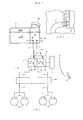
- FIG. 1A is a view schematically showing a brake system equipped with a master cylinder using one example of an embodiment of a reservoir tank pertaining to the present invention
- FIG. 1B is a partially enlarged view as seen from direction IB in FIG. 1A .
- a hydraulic brake system 1 of this example is basically the same as a conventionally publicly-known common dual hydraulic brake system. That is, the hydraulic brake system 1 is equipped with a brake pedal 2, a brake booster 3 comprising a negative pressure booster or the like, a tandem master cylinder 4, a reservoir tank 5, a reservoir tank connection-use connector 6 , hoses 7 and 8 that are dual brake-use hydraulic fluid supply pipes, dual brake cylinders 9 and 10, dual brake hydraulic pipes 11 and 12, and a brake hydraulic pressure control unit 13 such as a vehicle stability control unit.
- the tandem master cylinder 4 has, like a conventionally publicly-known tandem master cylinder, a primary piston 4a that is inserted inside a cylinder body so as to be slidable and air-tight, a primary hydraulic chamber 4b that is sectioned off and formed by this primary piston 4a, a secondary piston 4c that is inserted inside a cylinder body so as to be slidable and air-tight, and a secondary hydraulic chamber 4d that is sectioned off and formed by this secondary piston 4c.
- the reservoir tank 5 is disposed away from the tandem master cylinder 4.
- This reservoir tank 5 has a pair of tubular ports: a brake-use hydraulic fluid supply primary port 5a and a brake-use hydraulic fluid supply secondary port 5b.
- 5c is a clutch-use hydraulic fluid supply port for supplying clutch-use hydraulic fluid to an unillustrated clutch-use master cylinder
- 5d is a hydraulic fluid inlet for pouring hydraulic fluid into the reservoir tank 5. That is, the hydraulic fluid is poured into the reservoir tank 5 as brake-use hydraulic fluid and clutch-use hydraulic fluid from the hydraulic fluid inlet 5d.
- hydraulic fluid inside the reservoir tank 5 will be called simply “hydraulic fluid” in a case where it is used in common for brake-use hydraulic fluid and clutch-use hydraulic fluid and will be called “brake-use hydraulic fluid” or “clutch-use hydraulic fluid” in a case where it is used individually for brake-use hydraulic fluid or clutch-use hydraulic fluid.
- the reservoir tank connection-use connector 6 is mounted on top of the tandem master cylinder 4 in this example.
- This reservoir tank connection-use connector 6 has a pair of reservoir tank connection-use nipples 6a and 6b.
- the one brake-use hydraulic fluid supply primary port 5a of the reservoir tank 5 and the one reservoir tank connection-use nipple 6a of the reservoir tank connection-use connector 6 are connected to each other via the one hose 7 of the two lines, and the other brake-use hydraulic fluid supply secondary port 5b of the reservoir tank 5 and the other reservoir tank connection-use nipple 6b of the reservoir tank connection-use connector 6 are connected to each other via the other hose 8 of the two lines.
- the one reservoir tank connection-use nipple 6a of the reservoir tank connection-use connector 6 is connected to an unillustrated primary hydraulic fluid supply hole disposed in the cylinder body and communicated with the primary hydraulic chamber 4b.
- the other reservoir tank connection-use nipple 6b of the reservoir tank connection-use connector 6 is connected to an unillustrated secondary hydraulic fluid supply hole disposed in the cylinder body and communicated with the secondary hydraulic fluid chamber 4d.
- the brake-use hydraulic fluid inside the reservoir tank 5 is supplied to the primary hydraulic chamber 4b and the secondary hydraulic chamber 4d of the tandem master cylinder 4 via the hoses 7 and 8 and the reservoir tank connection-use connector 6.
- the brake-use hydraulic fluid that has been supplied to the tandem master cylinder 4 is further supplied to the brake cylinders 9 and 10 of each line via the dual brake hydraulic pipes 11 and 12.
- the brake hydraulic pressure control unit 13 is actuated by a predetermined actuation condition, uses an unillustrated pump in the brake hydraulic pressure control unit 13 to take in the brake-use hydraulic fluid inside the reservoir tank 5 via the tandem master cylinder 4, actuates the brakes automatically with the brake-use hydraulic fluid it has taken in, and performs control of the brake hydraulic pressure.
- the brake booster 3 When a driver steps on the brake pedal 2, the brake booster 3 is actuated, boosts the pedal force by a predetermined servo ratio, and outputs the boosted pedal force.
- the primary piston 4a of the tandem master cylinder 4 is actuated by the output of this brake booster 3 to supply the brake-use hydraulic fluid in the primary hydraulic fluid chamber 4b to the brake cylinders 9 of one line via the brake hydraulic pipe 11.
- the secondary piston 4c is actuated to supply the brake-use hydraulic fluid in the secondary hydraulic fluid chamber 4d to the brake cylinders 10 of the other line via the brake hydraulic pipe 12.
- the tandem master cylinder 4 When the loss stroke of each brake line ceases, the tandem master cylinder 4 generates brake hydraulic pressure. This brake hydraulic pressure of the tandem master cylinder 4 is transmitted to each of the brake cylinders 9 and 10, each of the brake cylinders 9 and 10 generates a braking force, and brakes are applied to wheels 14 and 15 of each line.
- the brake hydraulic pressure control unit 13 is actuated and the brake-use hydraulic fluid inside the reservoir tank 5 is taken in by the pump of this brake hydraulic pressure control unit 13 via the brake-use hydraulic fluid supply primary port 5a, the brake-use hydraulic fluid supply secondary port 5b, the hoses 7 and 8, the reservoir tank connection-use nipples 6a and 6b, the tandem master cylinder 4, and the brake hydraulic pipes 11 and 12.
- automatic braking is performed as a result of the brake-use hydraulic fluid that has been taken in being supplied to the brake cylinders 9 and 10 of each line.
- the brake hydraulic pressure is controlled by the brake hydraulic pressure control unit 13 such that the braking force of the automatic braking becomes a desired magnitude.
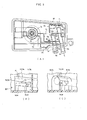
- FIG. 2A is a plan view of the reservoir tank of this example
- FIG. 2B is a right side view of this reservoir tank (a view seen from the right in FIG. 2A )
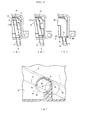
- FIG. 3A is a view showing the reservoir tank in FIG. 2A excluding an upper half body
- FIG. 3B is a partially enlarged cross-sectional view along line IIIB-IIIB in FIG. 3A
- FIG. 3C is a partial perspective view as seen from direction IIIC in FIG. 3B .
- the reservoir tank 5 has a horizontal cross section that is formed in a substantially rectangular shape, and the reservoir tank 5 is installed in the vehicle such that the long sides of the substantially rectangular shape coincide with the vehicle front-rear direction or substantially coincide with the vehicle front-rear direction.
- the pair of the brake-use hydraulic fluid supply primary port 5a and the brake-use hydraulic fluid supply secondary port 5b of the reservoir tank 5 are disposed projecting toward the vehicle left side from a lower portion of an outer peripheral wall 5u on the vehicle rear side of the reservoir tank 5 (the brake-use hydraulic fluid supply primary port 5a and the brake-use hydraulic fluid supply secondary port 5b can also be disposed projecting toward the vehicle right side of the reservoir tank 5).
- a primary fluid storage chamber 5f, a secondary fluid storage chamber 5g, a clutch-use hydraulic fluid storage chamber 5h, and a liquid level detection chamber 5i are sectioned off and formed by partition walls 5e like in a conventionally publicly-known reservoir tank.
- the chambers 5f, 5g, 5h, and 5i are communicated with each other like in a publicly-known reservoir tank.
- An inner hole 5j in the brake-use hydraulic fluid supply primary port 5a is disposed extending linearly as far as the primary fluid storage chamber 5f inside the reservoir tank 5, and an inner hole 5o in the other brake-use hydraulic fluid supply secondary port 5b is disposed extending linearly as far as the secondary fluid storage chamber 5g inside the reservoir tank 5.
- the primary fluid storage chamber side end of the inner hole 5j in the brake-use hydraulic fluid supply primary port 5a is closed off by a blocking wall 5k.
- a substantially rectangular primary fluid supply opening 5n is formed in a peripheral wall of a primary fluid storage chamber side end portion 5m of a portion forming the inner hole 5j in this brake-use hydraulic fluid supply primary port 5a. As shown in FIG. 3B and FIG.
- this primary fluid supply opening 5n is communicated in an orthogonal direction or in a substantially orthogonal direction with the inner hole 5j in the brake-use hydraulic fluid supply primary port 5a and opens in the vehicle front direction. That is, the inner hole 5j opens into the primary fluid storage chamber 5f in the vehicle front direction, and a substantially L-shaped brake-use hydraulic fluid supply path whose primary fluid storage chamber side end portion is bent is formed by the primary fluid supply opening 5n and the inner hole 5j.
- a substantially rectangular secondary fluid supply opening 5r is formed in a peripheral wall of a secondary fluid storage chamber side end portion 5q of a portion forming the inner hole 5o in this brake-use hydraulic supply secondary port 5b. As shown in FIG. 3B and FIG. 3C , this secondary fluid supply opening 5r is also similarly communicated with the inner hole 5o in the brake-use hydraulic fluid supply secondary port 5b and opens in the vehicle front direction.
- the inner hole 5o opens into the secondary fluid storage chamber 5g in the vehicle front direction via the secondary fluid supply opening 5r, and a substantially L-shaped brake-use hydraulic fluid supply path whose secondary fluid storage chamber side end portion is bent is formed by the secondary fluid supply opening 5r and the inner hole 5o. Consequently, the brake-use hydraulic fluid inside the reservoir tank 5 flows along a bent path from the primary fluid supply opening 5n to the inner hole 5j or flows along a bent path from the secondary fluid supply opening 5r to the inner hole 5o.
- the primary fluid storage chamber 5f becomes communicated with the primary hydraulic chamber 4b of the tandem master cylinder 4 via the primary fluid supply opening 5n in the brake-use hydraulic fluid supply primary port 5a, the inner hole 5j in the brake-use hydraulic fluid supply primary port 5a, the hose 7, and the reservoir tank connection-use nipple 6a of the reservoir tank connection-use connector 6.
- the secondary fluid storage chamber 5g becomes communicated with the secondary hydraulic chamber 4d of the tandem master cylinder 4 via the secondary fluid supply opening 5p in the brake-use hydraulic fluid supply secondary port 5b, the inner hole 5o in the brake-use hydraulic fluid supply secondary port 5b, the hose 8, and the reservoir tank connection-use nipple 6b of the reservoir tank connection-use connector 6.
- the reservoir tank 5- in a case where the vehicle-that is, the reservoir tank 5-has tilted such that the hydraulic fluid moves to the vehicle front side on the opposite side of the brake-use hydraulic fluid supply primary port 5a in a state where the storage quantity of the hydraulic fluid inside the reservoir tank 5 is relatively small and the fluid level of that hydraulic fluid is near the MIN line, the hydraulic fluid moves to the vehicle front side of the reservoir tank 5 and the height position of the fluid level of the hydraulic fluid changes.
- the fluid level of the hydraulic fluid becomes a position that is lower than an uppermost portion 5t of the inner hole 5j in the brake-use hydraulic fluid supply primary port 5a and in which the primary fluid supply opening 5n is not exposed to air at a height position of a fluid level ⁇ indicated by the solid line in FIG. 4D which is decided by an upper edge 5s of the primary fluid supply opening 5n.
- the height position of the upper edge 5s of the primary fluid supply opening 5n is set to a position that is lower than the height position of the uppermost portion 5t of the inner hole 5j.
- the height position of the upper edge of the secondary fluid supply opening 5r is also the same as in the case of the upper edge 5s of the primary fluid supply opening 5n.
- the height position of this fluid level ⁇ becomes a position that is relatively high compared to the height position of the straight line ⁇ of the reservoir tank 5 of this example. That is, in the case of the reservoir tank 5 shown in FIG. 4B , the potential for air to be taken in becomes higher when, for example, the brake hydraulic pressure control unit 13 has been actuated even when the storage quantity of the hydraulic fluid is a relatively large quantity compared to the reservoir tank 5 of this example.
- the fluid level of the hydraulic fluid becomes a position where a through hole 5v (that is, the inner hole 5j) is not exposed to air at a height position of a fluid level ⁇ indicated by the single-dashed chain line in FIG.
- the height position of this fluid level ⁇ is a position that is a little higher compared to the height position of the straight lines ⁇ of the reservoir tank 5 shown in FIG. 4B . Consequently, the height position of this fluid level ⁇ is a position that is much higher compared to the height position of the straight line ⁇ of the reservoir tank 5 of this example. That is, in the case of the reservoir tank 5 shown in FIG. 4C , the potential for air to be taken in becomes higher when, for example, the brake hydraulic pressure control unit 13 has been actuated even when the storage quantity of the hydraulic fluid is a much larger quantity compared to the reservoir tank 5 of this example.
- brake-use hydraulic fluid supply secondary port 5b is also the same as the case of the brake-use hydraulic fluid supply primary port 5a as described above.
- making a height position H 1 of the upper edge 5s of the primary fluid supply opening 5n as low as possible is preferable for ensuring that the intake of air can be effectively suppressed even if the storage quantity of the hydraulic fluid becomes low.
- the inner hole 5j in the brake-use hydraulic fluid supply primary port 5a is disposed extending into the primary fluid storage chamber 5f inside the reservoir tank 5, and the primary fluid supply opening 5n that allows this inner hole 5j to be communicated with the primary fluid storage chamber 5f is disposed orthogonal or substantially orthogonal to the inner hole 5j .
- the inner hole 5o in the brake-use hydraulic fluid supply secondary port 5b is disposed extending into the secondary fluid storage chamber 5g inside the reservoir tank 5, and the secondary fluid supply opening 5r that allows this inner hole 5o to be communicated with the secondary fluid storage chamber 5g is disposed orthogonal or substantially orthogonal to the inner hole 5o.
- the horizontal cross section of the reservoir tank 5 is formed in a substantially rectangular shape, and the reservoir tank 5 is disposed such that the long sides of that substantially rectangular shape coincide with the vehicle front-rear direction or substantially coincide with the vehicle front-rear direction. Because of this, when the vehicle has tilted such that the front side of the vehicle becomes lower, the hydraulic fluid inside the reservoir tank 5 largely moves to the vehicle front side, so the fluid level inside the reservoir tank 5 moves extremely close to the primary fluid supply opening 5n and the secondary fluid supply opening 5r. Consequently, it becomes possible to even more effectively suppress the entry of air to the tandem master cylinder 4.
- the primary fluid supply opening 5n and the secondary fluid supply opening 5r are disposed in the portions of the brake-use hydraulic fluid supply primary port 5a and the brake-use hydraulic fluid supply secondary port 5b disposed inside the reservoir tank 5, the structure of the brake-use hydraulic fluid supply paths can be made simple and the brake-use hydraulic fluid supply paths can be formed inexpensively.
- tandem master cylinder 4 using the reservoir tank 5 of this example it becomes possible to efficiently generate brake hydraulic pressure because the entry of air from the reservoir tank 5 is effectively suppressed.
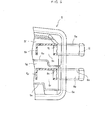
- FIG. 5 is a view partially showing another example of the embodiment of the reservoir tank of the present invention.
- the pair of the brake-use hydraulic fluid supply primary port 5a and the brake-use hydraulic fluid supply secondary port 5b are disposed projecting in the left direction of the vehicle from the outer peripheral wall 5u of the reservoir tank 5, but as shown in FIG. 5 , in the reservoir tank 5 of this example, the pair of the brake-use hydraulic fluid supply primary port 5a and the brake-use hydraulic fluid supply secondary port 5b are disposed projecting in the rear direction of the vehicle from the outer peripheral wall 5u of the reservoir tank 5.
- the primary fluid supply opening 5n and the secondary fluid supply opening 5r are disposed so as to face the left direction of the vehicle-that is, so as to face a direction orthogonal or substantially orthogonal to the inner holes 5j and 5o.
- the primary fluid supply opening 5n and the secondary fluid supply opening 5r can also be disposed so as to face the right direction of the vehicle.
- the other configurations of the reservoir tank 5 of this example are substantially the same, and the reservoir tank 5, the primary fluid storage chamber 5f, the secondary fluid storage chamber 5g, and the clutch-use hydraulic fluid storage chamber 5h and so forth of the example described above are only slightly changed.
- the action and effects of the reservoir tank 5 are also substantially the same as those of the reservoir tank 5 of the example described above.
- the present invention is not limited to the examples described above and is capable of various design changes.
- the primary fluid supply opening 5n, and the secondary fluid supply opening 5r are orthogonal or substantially orthogonal to the inner holes 5j and 5o, respectively, but the primary fluid supply opening 5n and the secondary fluid supply opening 5r can also be disposed so as to have predetermined angles with respect to the inner holes 5j and 5o, respectively.
- the pair of the brake-use hydraulic fluid supply primary port 5a and the brake-use hydraulic fluid supply secondary port 5b are disposed inclined such that their portions disposed inside the reservoir tank 5 become higher than their portions disposed outside the reservoir tank 5, but the brake-use hydraulic fluid supply primary port 5a and the brake-use hydraulic fluid supply secondary port 5b can also be disposed horizontally or substantially horizontally.
- the master cylinder is not limited to a tandem master cylinder and may also be a single master cylinder. In that case, the number of brake-use hydraulic fluid supply ports becomes one. What matters is that the present invention is capable of various design changes within the scope of matters described in the claims.
- the reservoir tank pertaining to the present invention can be suitably used for a reservoir tank that stores hydraulic fluid and is connected by a pipe to a master cylinder.
- the master cylinder using the reservoir tank pertaining to the present invention can be suitably used for a master cylinder that is used in a hydraulically actuated system such as a hydraulic brake system using hydraulic pressure such as oil pressure and is for generating hydraulic pressure.
- the brake system pertaining to the present invention can be suitably used for a hydraulic brake system using a master cylinder.
Landscapes
- Engineering & Computer Science (AREA)
- Transportation (AREA)
- Mechanical Engineering (AREA)
- Transmission Of Braking Force In Braking Systems (AREA)
Abstract
Description
- The present invention relates to the technical fields of: a reservoir tank that is used in a hydraulically actuated system such as a hydraulic brake system utilizing hydraulic pressure such as oil pressure, is disposed away from a master cylinder, and stores hydraulic fluid; a master cylinder that uses the reservoir tank to generate hydraulic pressure; and a brake system that is equipped with this master cylinder.
- Conventionally, among vehicles such as automobiles, there are vehicles that employ hydraulic brake systems as hydraulically actuated systems utilizing hydraulic pressure. A master cylinder that generates hydraulic pressure and a reservoir tank that stores hydraulic fluid supplied to this master cylinder are used in these hydraulic brake systems.
- As a conventional hydraulic brake system using a reservoir tank and a master cylinder, there is known a hydraulic brake system where a tubular supply and discharge opening is disposed projecting into a main tank that is a reservoir tank disposed away from a master cylinder, a tubular connection opening is disposed projecting into a sub-tank disposed directly above the master cylinder, and the supply and discharge opening and the connection opening are coupled together by a pipe, whereby the main tank is connected to the master cylinder (e.g., see
JP-A-2007-283858 - Incidentally, beginning with the main tank described in
JP-A-2007-283858 - However, when the tubular supply and discharge opening is simply disposed projecting outward from this outer peripheral wall so as to be communicated with the through hole in the outer peripheral wall of the reservoir tank, in a case where the vehicle has tilted such that the hydraulic fluid moves to the opposite side of the supply and discharge opening in a state where the storage quantity of the hydraulic fluid inside the reservoir tank is relatively small and the fluid level of that hydraulic fluid is near a MIN line that is a requisite minimum line, the fluid level of the hydraulic fluid reaches a position extremely close to the uppermost portion of the supply and discharge opening or a position lower than the uppermost portion of the supply and discharge opening. When the hydraulic fluid inside the reservoir tank is taken in by the actuation of a brake hydraulic pressure control unit such as a vehicle stability control unit when the fluid level of the hydraulic fluid is in this state, the potential for air to be taken in together with the hydraulic fluid and enter the downstream side (the sub-tank side and the master cylinder side) of the supply and discharge opening with respect to the flow of the hydraulic fluid is conceivable.
- The present invention has been made in view of these circumstances, and it is an object thereof to provide: a reservoir tank that can suppress the intake of air, even in a state where the storage quantity of the hydraulic fluid is small and the vehicle has tilted, and ensure as large a quantity of the hydraulic fluid as possible; a master cylinder using the reservoir tank; and a brake system equipped with this master cylinder.
- In order to solve this problem, a reservoir tank of the present invention comprises at least: a hydraulic fluid storage chamber that stores hydraulic fluid; and a hydraulic fluid supply port that is disposed projecting outward from a lower portion of an outer peripheral wall and supplies the hydraulic fluid by means of an inner hole disposed extending into the hydraulic fluid storage chamber, wherein a hydraulic fluid supply opening that allows the inner hole disposed extending into the hydraulic fluid storage chamber to be communicated with the hydraulic fluid storage chamber is disposed having a predetermined angle with respect to the inner hole.
- Further, in the reservoir tank of the present invention, the hydraulic fluid supply opening is disposed orthogonal or substantially orthogonal with respect to the inner hole.
- Moreover, in the reservoir tank of the present invention, a horizontal cross section of the interior of the reservoir tank is formed in a substantially rectangular shape, the hydraulic fluid supply port is disposed in an end portion on one side in a long-side direction of the substantially rectangular shape, and the hydraulic fluid supply opening opens into the hydraulic fluid storage chamber toward an end portion on the opposite side of the end portion on the one side in the long-side direction.
- Moreover, in the reservoir tank of the present invention, in a state where the reservoir tank is installed in a vehicle, the long sides of the substantially rectangular shape of the horizontal cross section of the interior are set so as to coincide with the vehicle front-rear direction or so as to substantially coincide with the vehicle front-rear direct ion, the hydraulic fluid supply port is disposed projecting toward either one side of the vehicle right side and the vehicle left side from the lower portion of the outer peripheral wall on the vehicle rear side, and the hydraulic fluid supply opening opens into the hydraulic fluid storage chamber toward the vehicle front side.
- Further, a master cylinder of the present invention comprises at least: a cylinder body; a piston that is inserted inside the cylinder body so as to be air-tight and slidable, forms a hydraulic chamber, and generates hydraulic pressure in the hydraulic chamber at a time of actuation; and a hydraulic fluid supply hole that is disposed in the cylinder body and is always communicated with the hydraulic chamber, wherein the reservoir tank of any one of the present invention described above which is disposed away from the cylinder body is connected to the hydraulic fluid supply.hole.
- Moreover, a brake system of the present invention comprises at least: a reservoir tank that stores hydraulic fluid; a master cylinder to which the hydraulic fluid inside the reservoir tank is supplied via a pipe and which generates brake hydraulic pressure at a time of actuation; and a brake cylinder that is actuated by the hydraulic pressure from the master cylinder, wherein the master cylinder is the master cylinder of the present invention described above.
- According to the reservoir tank of the present invention configured in this way, the reservoir tank is equipped with the hydraulic fluid support port that is disposed projecting outward from the lower portion of the outer peripheral wall and supplies the hydraulic fluid by means of the inner hole disposed extending into the hydraulic fluid storage chamber, and the hydraulic fluid supply opening that allows the inner hole disposed extending into the hydraulic fluid storage chamber to be communicated with the hydraulic fluid storage chamber is disposed having a predetermined angle with respect to the inner hole. Because of this, in a case where the vehicle-that is, the reservoir tank-has tilted such that the hydraulic fluid moves to the opposite side of the hydraulic fluid supply port in a state where the storage quantity of the hydraulic fluid inside the reservoir tank is relatively small and the fluid level of that hydraulic fluid is near the MIN line, it becomes possible to effectively suppress the entry of air to the master cylinder connected to the reservoir tank. In particular, in a case where an external hydraulic pressure control unit is actuated and the hydraulic fluid in the reservoir tank is taken in the brake hydraulic pressure control unit in a state where the storage quantity of the hydraulic fluid is low and the vehicle has tilted in this way, the entry of air can be even more effectively suppressed.
- By disposing the hydraulic fluid supply port on the vehicle rear side of the reservoir tank and by disposing the hydraulic fluid supply opening so as face the vehicle front side in the opposite direction of the installation position of the hydraulic fluid supply port, in a case where the hydraulic pressure control unit has been actuated in a state where the storage quantity of the hydraulic fluid is small and the vehicle has tilted as described above, it becomes possible to more effectively suppress the entry of air to the master cylinder.
- On top of that, the horizontal cross section of the interior of the reservoir tank is formed in a substantially rectangular shape, and the reservoir tank is installed in the vehicle such that the long sides of that substantially rectangular shape coincide with the vehicle front-rear direction or substantially coincide with the vehicle front-rear direction. Because of this, when the vehicle has tilted such that the front side of the vehicle becomes lower, the hydraulic fluid inside the reservoir tank largely moves to the vehicle front side, so the fluid level inside the reservoir tank moves extremely close to the hydraulic fluid supply opening. Consequently, it becomes possible to even more effectively suppress the entry of air to the master cylinder.
- Moreover, because the hydraulic fluid supply opening is disposed in the portion of the hydraulic fluid supply port disposed inside the reservoir tank and forming the inner hole, the structure of the hydraulic fluid supply path can be made simple and the hydraulic fluid supply path can be formed inexpensively.
- Further, according to the master cylinder using the reservoir tank of the present invention, it becomes possible to efficiently generate brake hydraulic pressure because the entry of air from the reservoir tank is effectively suppressed.
- According to the brake system equipped with the master cylinder of the present invention, it becomes possible to more reliably perform normal brake actuation resulting from stepping on a brake pedal, let alone automatic brake actuation, because brake hydraulic pressure can be efficiently generated.
-
-
FIG. 1A is a view schematically showing a brake system equipped with a master cylinder using one example of an embodiment of a reservoir tank pertaining to the present invention, andFIG. 1B is a partially enlarged view as seen from direction 1B inFIG. 1A ; -
FIG. 2A is a plan view of the reservoir tank of the example shown inFIG. 1 , andFIG. 2B is a right side view of this reservoir tank; -
FIG. 3A is a view showing the reservoir tank inFIG. 2A excluding an upper half body,FIG. 3B is a partially enlarged cross-sectional view along line IIIB-IIIB inFIG. 3A, and FIG. 3C is a partial perspective view as seen from direction IIIC inFIG. 3B ; -
FIG. 4A is a partial view of the reservoir tank shown inFIG. 3A ,FIG. 4B is the same partial view asFIG. 4A showing a reservoir tank of a comparative example with respect to the present invention,FIG. 4C is the same partial view asFIG. 4A showing a reservoir tank of another comparative example with respect to the present invention, andFIG. 4D is a view describing the action of the reservoir tanks shown inFIG. 4A to FIG. 4C ; and -
FIG. 5 is a view partially showing another example of the embodiment of the reservoir tank of the present invention. - Modes for carrying out the present invention will be described below using the drawings.
-
FIG. 1A is a view schematically showing a brake system equipped with a master cylinder using one example of an embodiment of a reservoir tank pertaining to the present invention, andFIG. 1B is a partially enlarged view as seen from direction IB inFIG. 1A . - As shown in
FIG. 1A , ahydraulic brake system 1 of this example is basically the same as a conventionally publicly-known common dual hydraulic brake system. That is, thehydraulic brake system 1 is equipped with abrake pedal 2, abrake booster 3 comprising a negative pressure booster or the like, atandem master cylinder 4, areservoir tank 5, a reservoir tank connection-use connector 6 ,hoses 7 and 8 that are dual brake-use hydraulic fluid supply pipes,dual brake cylinders 9 and 10, dual brakehydraulic pipes pressure control unit 13 such as a vehicle stability control unit. - The
tandem master cylinder 4 has, like a conventionally publicly-known tandem master cylinder, aprimary piston 4a that is inserted inside a cylinder body so as to be slidable and air-tight, a primaryhydraulic chamber 4b that is sectioned off and formed by thisprimary piston 4a, asecondary piston 4c that is inserted inside a cylinder body so as to be slidable and air-tight, and a secondaryhydraulic chamber 4d that is sectioned off and formed by thissecondary piston 4c. - The
reservoir tank 5 is disposed away from thetandem master cylinder 4. Thisreservoir tank 5 has a pair of tubular ports: a brake-use hydraulic fluid supplyprimary port 5a and a brake-use hydraulic fluid supplysecondary port 5b. InFIG. 1 ,5c is a clutch-use hydraulic fluid supply port for supplying clutch-use hydraulic fluid to an unillustrated clutch-use master cylinder, and 5d is a hydraulic fluid inlet for pouring hydraulic fluid into thereservoir tank 5. That is, the hydraulic fluid is poured into thereservoir tank 5 as brake-use hydraulic fluid and clutch-use hydraulic fluid from thehydraulic fluid inlet 5d. In the present invention, the hydraulic fluid inside thereservoir tank 5 will be called simply "hydraulic fluid" in a case where it is used in common for brake-use hydraulic fluid and clutch-use hydraulic fluid and will be called "brake-use hydraulic fluid" or "clutch-use hydraulic fluid" in a case where it is used individually for brake-use hydraulic fluid or clutch-use hydraulic fluid. - The reservoir tank connection-
use connector 6 is mounted on top of thetandem master cylinder 4 in this example. This reservoir tank connection-use connector 6 has a pair of reservoir tank connection-use nipples primary port 5a of thereservoir tank 5 and the one reservoir tank connection-use nipple 6a of the reservoir tank connection-use connector 6 are connected to each other via the onehose 7 of the two lines, and the other brake-use hydraulic fluid supplysecondary port 5b of thereservoir tank 5 and the other reservoir tank connection-use nipple 6b of the reservoir tank connection-use connector 6 are connected to each other via the other hose 8 of the two lines. - Further, the one reservoir tank connection-
use nipple 6a of the reservoir tank connection-use connector 6 is connected to an unillustrated primary hydraulic fluid supply hole disposed in the cylinder body and communicated with the primaryhydraulic chamber 4b. Moreover, the other reservoir tank connection-use nipple 6b of the reservoir tank connection-use connector 6 is connected to an unillustrated secondary hydraulic fluid supply hole disposed in the cylinder body and communicated with the secondaryhydraulic fluid chamber 4d. - Additionally, the brake-use hydraulic fluid inside the
reservoir tank 5 is supplied to the primaryhydraulic chamber 4b and the secondaryhydraulic chamber 4d of thetandem master cylinder 4 via thehoses 7 and 8 and the reservoir tank connection-use connector 6. The brake-use hydraulic fluid that has been supplied to thetandem master cylinder 4 is further supplied to thebrake cylinders 9 and 10 of each line via the dual brakehydraulic pipes - The brake hydraulic
pressure control unit 13 is actuated by a predetermined actuation condition, uses an unillustrated pump in the brake hydraulicpressure control unit 13 to take in the brake-use hydraulic fluid inside thereservoir tank 5 via thetandem master cylinder 4, actuates the brakes automatically with the brake-use hydraulic fluid it has taken in, and performs control of the brake hydraulic pressure. - When a driver steps on the
brake pedal 2, thebrake booster 3 is actuated, boosts the pedal force by a predetermined servo ratio, and outputs the boosted pedal force. Theprimary piston 4a of thetandem master cylinder 4 is actuated by the output of thisbrake booster 3 to supply the brake-use hydraulic fluid in the primary hydraulicfluid chamber 4b to the brake cylinders 9 of one line via the brakehydraulic pipe 11. Further, thesecondary piston 4c is actuated to supply the brake-use hydraulic fluid in the secondaryhydraulic fluid chamber 4d to thebrake cylinders 10 of the other line via the brakehydraulic pipe 12. When the loss stroke of each brake line ceases, thetandem master cylinder 4 generates brake hydraulic pressure. This brake hydraulic pressure of thetandem master cylinder 4 is transmitted to each of thebrake cylinders 9 and 10, each of thebrake cylinders 9 and 10 generates a braking force, and brakes are applied towheels - Further, when the predetermined actuation condition of the brake hydraulic
pressure control unit 13 is established, the brake hydraulicpressure control unit 13 is actuated and the brake-use hydraulic fluid inside thereservoir tank 5 is taken in by the pump of this brake hydraulicpressure control unit 13 via the brake-use hydraulic fluid supplyprimary port 5a, the brake-use hydraulic fluid supplysecondary port 5b, thehoses 7 and 8, the reservoir tank connection-use nipples tandem master cylinder 4, and the brakehydraulic pipes brake cylinders 9 and 10 of each line. At this time, the brake hydraulic pressure is controlled by the brake hydraulicpressure control unit 13 such that the braking force of the automatic braking becomes a desired magnitude. -
FIG. 2A is a plan view of the reservoir tank of this example,FIG. 2B is a right side view of this reservoir tank (a view seen from the right inFIG. 2A ),FIG. 3A is a view showing the reservoir tank inFIG. 2A excluding an upper half body,FIG. 3B is a partially enlarged cross-sectional view along line IIIB-IIIB inFIG. 3A, and FIG. 3C is a partial perspective view as seen from direction IIIC inFIG. 3B . - As shown in
FIG. 2A, FIG. 2B , andFIG. 3A , thereservoir tank 5 has a horizontal cross section that is formed in a substantially rectangular shape, and thereservoir tank 5 is installed in the vehicle such that the long sides of the substantially rectangular shape coincide with the vehicle front-rear direction or substantially coincide with the vehicle front-rear direction. Further, the pair of the brake-use hydraulic fluid supplyprimary port 5a and the brake-use hydraulic fluid supplysecondary port 5b of thereservoir tank 5 are disposed projecting toward the vehicle left side from a lower portion of an outerperipheral wall 5u on the vehicle rear side of the reservoir tank 5 (the brake-use hydraulic fluid supplyprimary port 5a and the brake-use hydraulic fluid supplysecondary port 5b can also be disposed projecting toward the vehicle right side of the reservoir tank 5). Inside thereservoir tank 5, a primaryfluid storage chamber 5f, a secondaryfluid storage chamber 5g, a clutch-use hydraulicfluid storage chamber 5h, and a liquidlevel detection chamber 5i are sectioned off and formed bypartition walls 5e like in a conventionally publicly-known reservoir tank. Thechambers - An
inner hole 5j in the brake-use hydraulic fluid supplyprimary port 5a is disposed extending linearly as far as the primaryfluid storage chamber 5f inside thereservoir tank 5, and an inner hole 5o in the other brake-use hydraulic fluid supplysecondary port 5b is disposed extending linearly as far as the secondaryfluid storage chamber 5g inside thereservoir tank 5. The primary fluid storage chamber side end of theinner hole 5j in the brake-use hydraulic fluid supplyprimary port 5a is closed off by a blockingwall 5k. A substantially rectangular primaryfluid supply opening 5n is formed in a peripheral wall of a primary fluid storage chamberside end portion 5m of a portion forming theinner hole 5j in this brake-use hydraulic fluid supplyprimary port 5a. As shown inFIG. 3B and FIG. 3C , this primaryfluid supply opening 5n is communicated in an orthogonal direction or in a substantially orthogonal direction with theinner hole 5j in the brake-use hydraulic fluid supplyprimary port 5a and opens in the vehicle front direction. That is, theinner hole 5j opens into the primaryfluid storage chamber 5f in the vehicle front direction, and a substantially L-shaped brake-use hydraulic fluid supply path whose primary fluid storage chamber side end portion is bent is formed by the primaryfluid supply opening 5n and theinner hole 5j. - Further, the secondary fluid storage chamber side end of the inner hole 5o in the brake-use hydraulic fluid supply
secondary port 5b is closed off by a blockingwall 5p. A substantially rectangular secondaryfluid supply opening 5r is formed in a peripheral wall of a secondary fluid storage chamber side end portion 5q of a portion forming the inner hole 5o in this brake-use hydraulic supplysecondary port 5b. As shown inFIG. 3B and FIG. 3C , this secondaryfluid supply opening 5r is also similarly communicated with the inner hole 5o in the brake-use hydraulic fluid supplysecondary port 5b and opens in the vehicle front direction. That is, the inner hole 5o opens into the secondaryfluid storage chamber 5g in the vehicle front direction via the secondaryfluid supply opening 5r, and a substantially L-shaped brake-use hydraulic fluid supply path whose secondary fluid storage chamber side end portion is bent is formed by the secondaryfluid supply opening 5r and the inner hole 5o. Consequently, the brake-use hydraulic fluid inside thereservoir tank 5 flows along a bent path from the primaryfluid supply opening 5n to theinner hole 5j or flows along a bent path from the secondaryfluid supply opening 5r to the inner hole 5o. - In the
reservoir tank 5 of this example configured in this manner, the primaryfluid storage chamber 5f becomes communicated with the primaryhydraulic chamber 4b of thetandem master cylinder 4 via the primaryfluid supply opening 5n in the brake-use hydraulic fluid supplyprimary port 5a, theinner hole 5j in the brake-use hydraulic fluid supplyprimary port 5a, thehose 7, and the reservoir tank connection-use nipple 6a of the reservoir tank connection-use connector 6. Further, the secondaryfluid storage chamber 5g becomes communicated with the secondaryhydraulic chamber 4d of thetandem master cylinder 4 via the secondaryfluid supply opening 5p in the brake-use hydraulic fluid supplysecondary port 5b, the inner hole 5o in the brake-use hydraulic fluid supplysecondary port 5b, the hose 8, and the reservoir tank connection-use nipple 6b of the reservoir tank connection-use connector 6. - Additionally, as shown in
FIG. 4A for example, in the brake-use hydraulic fluid supplyprimary port 5a of this example, in a case where the vehicle-that is, the reservoir tank 5-has tilted such that the hydraulic fluid moves to the vehicle front side on the opposite side of the brake-use hydraulic fluid supplyprimary port 5a in a state where the storage quantity of the hydraulic fluid inside thereservoir tank 5 is relatively small and the fluid level of that hydraulic fluid is near the MIN line, the hydraulic fluid moves to the vehicle front side of thereservoir tank 5 and the height position of the fluid level of the hydraulic fluid changes. At this time, the fluid level of the hydraulic fluid becomes a position that is lower than anuppermost portion 5t of theinner hole 5j in the brake-use hydraulic fluid supplyprimary port 5a and in which the primaryfluid supply opening 5n is not exposed to air at a height position of a fluid level α indicated by the solid line inFIG. 4D which is decided by anupper edge 5s of the primaryfluid supply opening 5n. The height position of theupper edge 5s of the primaryfluid supply opening 5n is set to a position that is lower than the height position of theuppermost portion 5t of theinner hole 5j. The height position of the upper edge of the secondaryfluid supply opening 5r is also the same as in the case of theupper edge 5s of the primaryfluid supply opening 5n. - In contrast, as shown in
FIG. 4B for example, in thereservoir tank 5 where theinner hole 5j in the brake-use hydraulic fluid supplyprimary port 5a extends linearly without bending and opens to the primaryfluid storage chamber 5f, when the vehicle has tilted the same amount as described above, the fluid level of the hydraulic fluid becomes a position in which theinner hole 5j is not exposed to air at a height position of a fluid level β indicated by the dashed line inFIG. 4D which is decided by the substantially uppermost portion (more specifically, a position slightly lower than the uppermost portion) of theinner hole 5j in the brake-use hydraulic fluid supplyprimary port 5a. The height position of this fluid level β becomes a position that is relatively high compared to the height position of the straight line α of thereservoir tank 5 of this example. That is, in the case of thereservoir tank 5 shown inFIG. 4B , the potential for air to be taken in becomes higher when, for example, the brake hydraulicpressure control unit 13 has been actuated even when the storage quantity of the hydraulic fluid is a relatively large quantity compared to thereservoir tank 5 of this example. - Further, in the
reservoir tank 5 where the brake-use hydraulic fluid supplyprimary port 5a is disposed projecting outward from the outerperipheral wall 5u and where theinner hole 5j in the brake-use hydraulic fluid supplyprimary port 5a is not disposed extending into the primaryfluid storage chamber 5f like in the reservoir tank described inJP-A-2007-283858 hole 5v (that is, theinner hole 5j) is not exposed to air at a height position of a fluid level Υ indicated by the single-dashed chain line inFIG. 4D which is decided by the substantially uppermost portion (more specifically, a position slightly lower than the uppermost portion) of theinner hole 5j (that is, the throughhole 5v in the outerperipheral wall 5u; it has the same diameter as theinner hole 5j shown inFIG. 4A ) of the brake-use hydraulic fluid supplyprimary port 5a. The height position of this fluid level Υ is a position that is a little higher compared to the height position of the straight lines β of thereservoir tank 5 shown inFIG. 4B . Consequently, the height position of this fluid level Υ is a position that is much higher compared to the height position of the straight line α of thereservoir tank 5 of this example. That is, in the case of thereservoir tank 5 shown inFIG. 4C , the potential for air to be taken in becomes higher when, for example, the brake hydraulicpressure control unit 13 has been actuated even when the storage quantity of the hydraulic fluid is a much larger quantity compared to thereservoir tank 5 of this example. - The case of the brake-use hydraulic fluid supply
secondary port 5b is also the same as the case of the brake-use hydraulic fluid supplyprimary port 5a as described above. - Additionally, in
FIG. 3B , making a height position H1 of theupper edge 5s of the primaryfluid supply opening 5n as low as possible is preferable for ensuring that the intake of air can be effectively suppressed even if the storage quantity of the hydraulic fluid becomes low. In that case, it is necessary to ensure the desired flow rate of the brake-use hydraulic fluid flowing through the primaryfluid supply opening 5n, but the desired flow rate of the brake-use hydraulic fluid can be ensured by appropriately setting the opening area of the primaryfluid supply opening 5n-that is, a width L and a real height H2 of the primaryfluid supply opening 5n inFIG. 3B . - According to the
reservoir tank 5 of this example, theinner hole 5j in the brake-use hydraulic fluid supplyprimary port 5a is disposed extending into the primaryfluid storage chamber 5f inside thereservoir tank 5, and the primaryfluid supply opening 5n that allows thisinner hole 5j to be communicated with the primaryfluid storage chamber 5f is disposed orthogonal or substantially orthogonal to theinner hole 5j . Further, the inner hole 5o in the brake-use hydraulic fluid supplysecondary port 5b is disposed extending into the secondaryfluid storage chamber 5g inside thereservoir tank 5, and the secondaryfluid supply opening 5r that allows this inner hole 5o to be communicated with the secondaryfluid storage chamber 5g is disposed orthogonal or substantially orthogonal to the inner hole 5o. Because of this, in a case where the vehicle has tilted such that the hydraulic fluid moves to the opposite side of the brake-use hydraulic fluid supplyprimary port 5a in a state where the storage quantity of the hydraulic fluid inside thereservoir tank 5 is relatively small and the fluid level of that hydraulic fluid is near the MIN line, it becomes possible to effectively suppress the entry of air to thetandem master cylinder 4. In particular, in a case where the brake hydraulicpressure control unit 13 is actuated and the hydraulic fluid-that is, the brake-use hydraulic fluid-in thereservoir tank 5 is taken in the brake hydraulic pressure control unit in a state where the storage quantity of the hydraulic fluid is low and the vehicle has tilted in this way, the entry of air can be even more effectively suppressed. - Also, by disposing the brake-use hydraulic fluid supply
primary port 5a and the brake-use hydraulic fluid supplysecondary port 5b on the vehicle rear side of thereservoir tank 5 and by disposing the primaryfluid supply opening 5n and the secondaryfluid supply opening 5r so as to face the vehicle front side in the opposite direction of the installation positions of theports pressure control unit 13 has been actuated in a state where the storage quantity of the hydraulic fluid is small and the vehicle has tilted as described above, it becomes possible to more effectively suppress the entry of air to thetandem master cylinder 4. - On top of that, the horizontal cross section of the
reservoir tank 5 is formed in a substantially rectangular shape, and thereservoir tank 5 is disposed such that the long sides of that substantially rectangular shape coincide with the vehicle front-rear direction or substantially coincide with the vehicle front-rear direction. Because of this, when the vehicle has tilted such that the front side of the vehicle becomes lower, the hydraulic fluid inside thereservoir tank 5 largely moves to the vehicle front side, so the fluid level inside thereservoir tank 5 moves extremely close to the primaryfluid supply opening 5n and the secondaryfluid supply opening 5r. Consequently, it becomes possible to even more effectively suppress the entry of air to thetandem master cylinder 4. - Moreover, because the primary
fluid supply opening 5n and the secondaryfluid supply opening 5r are disposed in the portions of the brake-use hydraulic fluid supplyprimary port 5a and the brake-use hydraulic fluid supplysecondary port 5b disposed inside thereservoir tank 5, the structure of the brake-use hydraulic fluid supply paths can be made simple and the brake-use hydraulic fluid supply paths can be formed inexpensively. - Further, according to the
tandem master cylinder 4 using thereservoir tank 5 of this example, it becomes possible to efficiently generate brake hydraulic pressure because the entry of air from thereservoir tank 5 is effectively suppressed. - According to the
brake system 1 equipped with thetandem master cylinder 4 of this example, it becomes possible to more reliably perform normal brake actuation resulting from stepping on thebrake pedal 2, let alone automatic brake actuation, because brake hydraulic pressure can be efficiently generated. -
FIG. 5 is a view partially showing another example of the embodiment of the reservoir tank of the present invention. - In the
reservoir tank 5 of the example described above, the pair of the brake-use hydraulic fluid supplyprimary port 5a and the brake-use hydraulic fluid supplysecondary port 5b are disposed projecting in the left direction of the vehicle from the outerperipheral wall 5u of thereservoir tank 5, but as shown inFIG. 5 , in thereservoir tank 5 of this example, the pair of the brake-use hydraulic fluid supplyprimary port 5a and the brake-use hydraulic fluid supplysecondary port 5b are disposed projecting in the rear direction of the vehicle from the outerperipheral wall 5u of thereservoir tank 5. Additionally, the primaryfluid supply opening 5n and the secondaryfluid supply opening 5r are disposed so as to face the left direction of the vehicle-that is, so as to face a direction orthogonal or substantially orthogonal to theinner holes 5j and 5o. The primaryfluid supply opening 5n and the secondaryfluid supply opening 5r can also be disposed so as to face the right direction of the vehicle. - The other configurations of the
reservoir tank 5 of this example are substantially the same, and thereservoir tank 5, the primaryfluid storage chamber 5f, the secondaryfluid storage chamber 5g, and the clutch-use hydraulicfluid storage chamber 5h and so forth of the example described above are only slightly changed. The action and effects of thereservoir tank 5 are also substantially the same as those of thereservoir tank 5 of the example described above. - The present invention is not limited to the examples described above and is capable of various design changes. For example, in the examples described above, the primary
fluid supply opening 5n, and the secondaryfluid supply opening 5r are orthogonal or substantially orthogonal to theinner holes 5j and 5o, respectively, but the primaryfluid supply opening 5n and the secondaryfluid supply opening 5r can also be disposed so as to have predetermined angles with respect to theinner holes 5j and 5o, respectively. - Further, in the example shown in
FIG. 3A to FIG. 3C , the pair of the brake-use hydraulic fluid supplyprimary port 5a and the brake-use hydraulic fluid supplysecondary port 5b are disposed inclined such that their portions disposed inside thereservoir tank 5 become higher than their portions disposed outside thereservoir tank 5, but the brake-use hydraulic fluid supplyprimary port 5a and the brake-use hydraulic fluid supplysecondary port 5b can also be disposed horizontally or substantially horizontally. Moreover, the master cylinder is not limited to a tandem master cylinder and may also be a single master cylinder. In that case, the number of brake-use hydraulic fluid supply ports becomes one. What matters is that the present invention is capable of various design changes within the scope of matters described in the claims. - The reservoir tank pertaining to the present invention can be suitably used for a reservoir tank that stores hydraulic fluid and is connected by a pipe to a master cylinder.
- Further, the master cylinder using the reservoir tank pertaining to the present invention can be suitably used for a master cylinder that is used in a hydraulically actuated system such as a hydraulic brake system using hydraulic pressure such as oil pressure and is for generating hydraulic pressure.
- Moreover, the brake system pertaining to the present invention can be suitably used for a hydraulic brake system using a master cylinder.
Claims (6)
- A reservoir tank comprising at least:a hydraulic fluid storage chamber that stores hydraulic fluid; anda hydraulic fluid supply port that is disposed projecting outward from a lower portion of an outer peripheral wall and supplies the hydraulic fluid by means of an inner hole disposed extending into the hydraulic fluid storage chamber,wherein a hydraulic fluid supply opening that allows the inner hole disposed extending into the hydraulic fluid storage chamber to be communicated with the hydraulic fluid storage chamber is disposed having a predetermined angle with respect to the inner hole.
- The reservoir tank according to claim 1, wherein the hydraulic fluid supply opening is disposed orthogonal or substantially orthogonal with respect to the inner hole.
- The reservoir tank according to claim 1 or 2, wherein
a horizontal cross section of the interior of the reservoir tank is formed in a substantially rectangular shape,
the hydraulic fluid supply port is disposed in an end portion on one side in a long-side direction of the substantially rectangular shape, and
the hydraulic fluid supply opening opens into the hydraulic fluid storage chamber toward an end portion on the opposite side of the end portion on the one side in the long- side direction. - The reservoir tank according to claim 3, wherein
in a state where the reservoir tank is installed in a vehicle, the long sides of the substantially rectangular shape of the horizontal cross section of the interior are set so as to coincide with the vehicle front-rear direction or so as to substantially coincide with the vehicle front-rear direction,
the hydraulic fluid supply port is disposed projecting toward either one side of the vehicle right side and the vehicle left side from the lower portion of the outer peripheral wall on the vehicle rear side, and
the hydraulic fluid supply opening opens into the hydraulic fluid storage chamber toward the vehicle front side. - A master cylinder comprising at least:a cylinder body;a piston that is inserted inside the cylinder body so as to be air-tight and slidable, forms a hydraulic chamber, and generates hydraulic pressure in the hydraulic chamber at a time of actuation; anda hydraulic fluid supply hole that is disposed in the cylinder body and is always communicated with the hydraulic chamber,wherein the reservoir tank according to any one of claims 1 to 4 which is disposed away from the cylinder body is connected to the hydraulic fluid supply hole.
- A brake system comprising at least:a reservoir tank that stores hydraulic fluid;a master cylinder to which the hydraulic fluid inside the reservoir tank is supplied via a pipe and which generates brake hydraulic pressure at a time of actuation; anda brake cylinder that is actuated by the hydraulic pressure from the master cylinder,wherein the master cylinder is the master cylinder according to claim 5.
Applications Claiming Priority (1)
| Application Number | Priority Date | Filing Date | Title |
|---|---|---|---|
| JP2010158828A JP5616148B2 (en) | 2010-07-13 | 2010-07-13 | Reservoir tank, master cylinder using the same, and brake device provided with the master cylinder |
Publications (2)
| Publication Number | Publication Date |
|---|---|
| EP2407362A2 true EP2407362A2 (en) | 2012-01-18 |
| EP2407362A3 EP2407362A3 (en) | 2013-05-15 |
Family
ID=44802463
Family Applications (1)
| Application Number | Title | Priority Date | Filing Date |
|---|---|---|---|
| EP11167840.5A Withdrawn EP2407362A3 (en) | 2010-07-13 | 2011-05-27 | Reservoir tank, master cylinder using the reservoir tank, and brake system equipped with this master cylinder |
Country Status (2)
| Country | Link |
|---|---|
| EP (1) | EP2407362A3 (en) |
| JP (1) | JP5616148B2 (en) |
Cited By (2)
| Publication number | Priority date | Publication date | Assignee | Title |
|---|---|---|---|---|
| CN109532801A (en) * | 2017-09-21 | 2019-03-29 | 株式会社爱德克斯 | Container |
| US20230192052A1 (en) * | 2021-12-21 | 2023-06-22 | Hyundai Mobis Co., Ltd. | Reservoir for brake apparatus of vehicle |
Citations (1)
| Publication number | Priority date | Publication date | Assignee | Title |
|---|---|---|---|---|
| JP2007283858A (en) | 2006-04-14 | 2007-11-01 | Hitachi Ltd | Brake reservoir device and sub tank for vehicle |
Family Cites Families (5)
| Publication number | Priority date | Publication date | Assignee | Title |
|---|---|---|---|---|
| JPS59137601A (en) * | 1983-01-28 | 1984-08-07 | Nissan Motor Co Ltd | Tank device for hydraulic device |
| ITFI20030241A1 (en) * | 2003-09-15 | 2005-03-16 | Formula Srl | DEVICE FOR THE CONTROL OF HYDRAULIC BRAKES IN CYCLES, |
| JP2010064680A (en) * | 2008-09-12 | 2010-03-25 | Bosch Corp | Reservoir tank and brake device using the same |
| WO2010035907A1 (en) * | 2008-09-29 | 2010-04-01 | ボッシュ株式会社 | Reservoir and brake device using same |
| DE102010029337A1 (en) * | 2009-07-16 | 2011-02-03 | Continental Teves Ag & Co. Ohg | Assembly consisting of a pressure medium reservoir and a manually operable master cylinder, in particular for a hydraulic motorcycle brake system |
-
2010
- 2010-07-13 JP JP2010158828A patent/JP5616148B2/en active Active
-
2011
- 2011-05-27 EP EP11167840.5A patent/EP2407362A3/en not_active Withdrawn
Patent Citations (1)
| Publication number | Priority date | Publication date | Assignee | Title |
|---|---|---|---|---|
| JP2007283858A (en) | 2006-04-14 | 2007-11-01 | Hitachi Ltd | Brake reservoir device and sub tank for vehicle |
Cited By (4)
| Publication number | Priority date | Publication date | Assignee | Title |
|---|---|---|---|---|
| CN109532801A (en) * | 2017-09-21 | 2019-03-29 | 株式会社爱德克斯 | Container |
| CN109532801B (en) * | 2017-09-21 | 2021-06-11 | 株式会社爱德克斯 | Storage box |
| US20230192052A1 (en) * | 2021-12-21 | 2023-06-22 | Hyundai Mobis Co., Ltd. | Reservoir for brake apparatus of vehicle |
| US11820340B2 (en) * | 2021-12-21 | 2023-11-21 | Hyundai Mobis Co., Ltd. | Reservoir for brake apparatus of vehicle |
Also Published As
| Publication number | Publication date |
|---|---|
| EP2407362A3 (en) | 2013-05-15 |
| JP5616148B2 (en) | 2014-10-29 |
| JP2012020624A (en) | 2012-02-02 |
Similar Documents
| Publication | Publication Date | Title |
|---|---|---|
| CN101205939B (en) | Hydraulic manifold block of hydraulic power source and hydraulic power source with hydraulic manifold block | |
| EP2376303B1 (en) | Tank arrangement and vehicle with a tank arrangement | |
| US9522664B2 (en) | Electric brake actuator, and vehicle brake system | |
| KR102362154B1 (en) | Reservoir assembly for brake system | |
| US8726886B2 (en) | Fuel supply system and anti-siphon jet pump | |
| US20080272646A1 (en) | Hydraulic apparatus for fluid pressure control | |
| JP2004278529A (en) | Fuel supply system and its method | |
| CN117141443A (en) | Front-loading reservoir assembly | |
| CN108698578B (en) | Brake Reservoir with Internal Conduit for Integrated Power Brake Unit | |
| EP2495144A1 (en) | Working fluid flow control valve for master cylinder, master cylinder comprising same, and brake device employing master cylinder | |
| EP2327597B1 (en) | Reservoir and brake device using same | |
| JP2006111245A (en) | Brake hydraulic pressure controlling actuator | |
| JP2007283858A (en) | Brake reservoir device and sub tank for vehicle | |
| CN103129543B (en) | Main cylinder device | |
| CN218616612U (en) | Vehicle braking system and vehicle having same | |
| JP5616148B2 (en) | Reservoir tank, master cylinder using the same, and brake device provided with the master cylinder | |
| JP4062700B2 (en) | Master cylinder reservoir | |
| US10744988B2 (en) | Reservoir tank | |
| CN219969656U (en) | Oil storage assembly for vehicle | |
| JP2010064680A (en) | Reservoir tank and brake device using the same | |
| CN205327047U (en) | Novel hydraulic braking system | |
| JP6461678B2 (en) | Brake hydraulic pressure control device for vehicles | |
| JP2011126322A (en) | Reservoir tank and hydraulic operation device with the same | |
| JP2015160464A (en) | Actuator for brake fluid pressure control | |
| JP2012136145A (en) | Reservoir tank, master cylinder using the same, and brake device including the master cylinder |
Legal Events
| Date | Code | Title | Description |
|---|---|---|---|
| AK | Designated contracting states |
Kind code of ref document: A2 Designated state(s): AL AT BE BG CH CY CZ DE DK EE ES FI FR GB GR HR HU IE IS IT LI LT LU LV MC MK MT NL NO PL PT RO RS SE SI SK SM TR |
|
| AX | Request for extension of the european patent |
Extension state: BA ME |
|
| PUAI | Public reference made under article 153(3) epc to a published international application that has entered the european phase |
Free format text: ORIGINAL CODE: 0009012 |
|
| PUAL | Search report despatched |
Free format text: ORIGINAL CODE: 0009013 |
|
| AK | Designated contracting states |
Kind code of ref document: A3 Designated state(s): AL AT BE BG CH CY CZ DE DK EE ES FI FR GB GR HR HU IE IS IT LI LT LU LV MC MK MT NL NO PL PT RO RS SE SI SK SM TR |
|
| AX | Request for extension of the european patent |
Extension state: BA ME |
|
| RIC1 | Information provided on ipc code assigned before grant |
Ipc: B60T 13/14 20060101ALI20130411BHEP Ipc: B60T 11/26 20060101AFI20130411BHEP Ipc: B60T 17/06 20060101ALI20130411BHEP Ipc: B60T 11/22 20060101ALI20130411BHEP |
|
| 17P | Request for examination filed |
Effective date: 20131115 |
|
| RBV | Designated contracting states (corrected) |
Designated state(s): AL AT BE BG CH CY CZ DE DK EE ES FI FR GB GR HR HU IE IS IT LI LT LU LV MC MK MT NL NO PL PT RO RS SE SI SK SM TR |
|
| GRAP | Despatch of communication of intention to grant a patent |
Free format text: ORIGINAL CODE: EPIDOSNIGR1 |
|
| RIC1 | Information provided on ipc code assigned before grant |
Ipc: B60T 13/14 20060101ALI20190503BHEP Ipc: B60T 11/26 20060101AFI20190503BHEP Ipc: B60T 11/22 20060101ALI20190503BHEP Ipc: B60T 17/06 20060101ALI20190503BHEP |
|
| INTG | Intention to grant announced |
Effective date: 20190529 |
|
| STAA | Information on the status of an ep patent application or granted ep patent |
Free format text: STATUS: THE APPLICATION IS DEEMED TO BE WITHDRAWN |
|
| 18D | Application deemed to be withdrawn |
Effective date: 20191009 |