EP2406258B1 - PYRIMIDINE DERIVATIVES AS mTOR INHIBITORS - Google Patents
PYRIMIDINE DERIVATIVES AS mTOR INHIBITORS Download PDFInfo
- Publication number
- EP2406258B1 EP2406258B1 EP10707924.6A EP10707924A EP2406258B1 EP 2406258 B1 EP2406258 B1 EP 2406258B1 EP 10707924 A EP10707924 A EP 10707924A EP 2406258 B1 EP2406258 B1 EP 2406258B1
- Authority
- EP
- European Patent Office
- Prior art keywords
- phenyl
- methylmorpholino
- pyrrolo
- pyrimidin
- urea
- Prior art date
- Legal status (The legal status is an assumption and is not a legal conclusion. Google has not performed a legal analysis and makes no representation as to the accuracy of the status listed.)
- Active
Links
- 239000003628 mammalian target of rapamycin inhibitor Substances 0.000 title description 17
- 229940124302 mTOR inhibitor Drugs 0.000 title description 15
- CZPWVGJYEJSRLH-UHFFFAOYSA-N Pyrimidine Chemical class C1=CN=CN=C1 CZPWVGJYEJSRLH-UHFFFAOYSA-N 0.000 title description 3
- 229940083082 pyrimidine derivative acting on arteriolar smooth muscle Drugs 0.000 title description 2
- 238000000034 method Methods 0.000 claims description 475
- 150000001875 compounds Chemical class 0.000 claims description 291
- 125000004169 (C1-C6) alkyl group Chemical group 0.000 claims description 76
- 208000037265 diseases, disorders, signs and symptoms Diseases 0.000 claims description 54
- 150000003839 salts Chemical class 0.000 claims description 43
- 229910052736 halogen Inorganic materials 0.000 claims description 40
- 201000010099 disease Diseases 0.000 claims description 37
- 125000005843 halogen group Chemical group 0.000 claims description 34
- RPKFZQPGPLENSO-ZDUSSCGKSA-N 1-cyclopropyl-3-[4-[4-[(3s)-3-methylmorpholin-4-yl]-6,7-dihydro-5h-pyrrolo[3,4-d]pyrimidin-2-yl]phenyl]urea Chemical compound C[C@H]1COCCN1C1=NC(C=2C=CC(NC(=O)NC3CC3)=CC=2)=NC2=C1CNC2 RPKFZQPGPLENSO-ZDUSSCGKSA-N 0.000 claims description 32
- -1 2-(2-fluoro-4-(3-(2-fluoroethyl)ureido)phenyl)-4-(3-methylmorpholino)-5H-pyrrolo[3,4-d]pyrimidine-6(7H)-carboxylate Chemical compound 0.000 claims description 31
- 229910052739 hydrogen Inorganic materials 0.000 claims description 26
- 206010028980 Neoplasm Diseases 0.000 claims description 23
- 125000001997 phenyl group Chemical group [H]C1=C([H])C([H])=C(*)C([H])=C1[H] 0.000 claims description 21
- 239000003814 drug Substances 0.000 claims description 19
- CWGBCFPRZHZJBA-ZDUSSCGKSA-N 1-ethyl-3-[4-[4-[(3s)-3-methylmorpholin-4-yl]-6,7-dihydro-5h-pyrrolo[3,4-d]pyrimidin-2-yl]phenyl]urea Chemical compound C1=CC(NC(=O)NCC)=CC=C1C(N=C1N2[C@H](COCC2)C)=NC2=C1CNC2 CWGBCFPRZHZJBA-ZDUSSCGKSA-N 0.000 claims description 18
- 230000004900 autophagic degradation Effects 0.000 claims description 18
- 239000008194 pharmaceutical composition Substances 0.000 claims description 18
- 208000035475 disorder Diseases 0.000 claims description 17
- PITUAFPHQAKRKP-UHFFFAOYSA-N 1-ethyl-3-[4-(4-morpholin-4-yl-5,6,7,8-tetrahydropyrido[3,4-d]pyrimidin-2-yl)phenyl]urea Chemical compound C1=CC(NC(=O)NCC)=CC=C1C(N=C1N2CCOCC2)=NC2=C1CCNC2 PITUAFPHQAKRKP-UHFFFAOYSA-N 0.000 claims description 16
- 229910052757 nitrogen Inorganic materials 0.000 claims description 16
- ICPFKVCUIBCOAP-UHFFFAOYSA-N 1-ethyl-3-[4-(4-morpholin-4-yl-6,7-dihydro-5h-pyrrolo[3,4-d]pyrimidin-2-yl)phenyl]urea Chemical compound C1=CC(NC(=O)NCC)=CC=C1C(N=C1N2CCOCC2)=NC2=C1CNC2 ICPFKVCUIBCOAP-UHFFFAOYSA-N 0.000 claims description 15
- XSQUKJJJFZCRTK-UHFFFAOYSA-N Urea Chemical compound NC(N)=O XSQUKJJJFZCRTK-UHFFFAOYSA-N 0.000 claims description 15
- 125000000623 heterocyclic group Chemical group 0.000 claims description 15
- KLVXEMDWANCMJZ-AWEZNQCLSA-N 1-cyclopropyl-3-[4-[4-[(3s)-3-methylmorpholin-4-yl]-5,6,7,8-tetrahydropyrido[3,4-d]pyrimidin-2-yl]phenyl]urea Chemical compound C[C@H]1COCCN1C1=NC(C=2C=CC(NC(=O)NC3CC3)=CC=2)=NC2=C1CCNC2 KLVXEMDWANCMJZ-AWEZNQCLSA-N 0.000 claims description 14
- DXVKXAXORGPVCN-AWEZNQCLSA-N 1-ethyl-3-[4-[4-[(3s)-3-methylmorpholin-4-yl]-5,6,7,8-tetrahydropyrido[3,4-d]pyrimidin-2-yl]phenyl]urea Chemical compound C1=CC(NC(=O)NCC)=CC=C1C(N=C1N2[C@H](COCC2)C)=NC2=C1CCNC2 DXVKXAXORGPVCN-AWEZNQCLSA-N 0.000 claims description 14
- 238000002360 preparation method Methods 0.000 claims description 13
- 201000011510 cancer Diseases 0.000 claims description 12
- 230000004770 neurodegeneration Effects 0.000 claims description 10
- 208000015122 neurodegenerative disease Diseases 0.000 claims description 10
- 229920006395 saturated elastomer Polymers 0.000 claims description 10
- RMXILJIWTCNMMH-AWEZNQCLSA-N 1-ethyl-3-[4-[4-[(3s)-3-methylmorpholin-4-yl]-5,6,7,8-tetrahydropyrido[4,3-d]pyrimidin-2-yl]phenyl]urea Chemical compound C1=CC(NC(=O)NCC)=CC=C1C(N=C1N2[C@H](COCC2)C)=NC2=C1CNCC2 RMXILJIWTCNMMH-AWEZNQCLSA-N 0.000 claims description 9
- 238000006069 Suzuki reaction reaction Methods 0.000 claims description 9
- 230000002062 proliferating effect Effects 0.000 claims description 9
- 125000006272 (C3-C7) cycloalkyl group Chemical group 0.000 claims description 8
- ULRZXYKLBSKLFN-ZDUSSCGKSA-N 1-cyclopropyl-3-[3-fluoro-4-[6-methyl-4-[(3s)-3-methylmorpholin-4-yl]-5,7-dihydropyrrolo[3,4-d]pyrimidin-2-yl]phenyl]urea Chemical compound C[C@H]1COCCN1C1=NC(C=2C(=CC(NC(=O)NC3CC3)=CC=2)F)=NC2=C1CN(C)C2 ULRZXYKLBSKLFN-ZDUSSCGKSA-N 0.000 claims description 8
- 206010052779 Transplant rejections Diseases 0.000 claims description 8
- ZPWJOROXEFHIQN-AWEZNQCLSA-N ethyl 2-[2-fluoro-4-(2-hydroxyethylcarbamoylamino)phenyl]-4-[(3s)-3-methylmorpholin-4-yl]-5,7-dihydropyrrolo[3,4-d]pyrimidine-6-carboxylate Chemical compound C=12CN(C(=O)OCC)CC2=NC(C=2C(=CC(NC(=O)NCCO)=CC=2)F)=NC=1N1CCOC[C@@H]1C ZPWJOROXEFHIQN-AWEZNQCLSA-N 0.000 claims description 8
- 230000002757 inflammatory effect Effects 0.000 claims description 8
- 208000030159 metabolic disease Diseases 0.000 claims description 8
- 230000001363 autoimmune Effects 0.000 claims description 7
- 239000004202 carbamide Substances 0.000 claims description 7
- 239000003937 drug carrier Substances 0.000 claims description 7
- ZPLHVRMWZPMUCY-ZDUSSCGKSA-N 1-ethyl-3-[3-fluoro-4-[4-[(3s)-3-methylmorpholin-4-yl]-5,6,7,8-tetrahydropyrido[3,4-d]pyrimidin-2-yl]phenyl]urea Chemical compound FC1=CC(NC(=O)NCC)=CC=C1C(N=C1N2[C@H](COCC2)C)=NC2=C1CCNC2 ZPLHVRMWZPMUCY-ZDUSSCGKSA-N 0.000 claims description 6
- 208000024172 Cardiovascular disease Diseases 0.000 claims description 6
- 208000009329 Graft vs Host Disease Diseases 0.000 claims description 6
- KYQCOXFCLRTKLS-UHFFFAOYSA-N Pyrazine Chemical compound C1=CN=CC=N1 KYQCOXFCLRTKLS-UHFFFAOYSA-N 0.000 claims description 6
- 230000000172 allergic effect Effects 0.000 claims description 6
- 208000010668 atopic eczema Diseases 0.000 claims description 6
- ZADPBFCGQRWHPN-UHFFFAOYSA-N boronic acid Chemical compound OBO ZADPBFCGQRWHPN-UHFFFAOYSA-N 0.000 claims description 6
- 208000024908 graft versus host disease Diseases 0.000 claims description 6
- 150000002367 halogens Chemical class 0.000 claims description 6
- 230000001900 immune effect Effects 0.000 claims description 6
- 125000004433 nitrogen atom Chemical group N* 0.000 claims description 6
- GVJNVAVXEGKCAQ-NRFANRHFSA-N tert-butyl 4-[[2-[4-(cyclopropylcarbamoylamino)phenyl]-4-[(3s)-3-methylmorpholin-4-yl]-5,7-dihydropyrrolo[3,4-d]pyrimidin-6-yl]methyl]piperidine-1-carboxylate Chemical compound C[C@H]1COCCN1C1=NC(C=2C=CC(NC(=O)NC3CC3)=CC=2)=NC2=C1CN(CC1CCN(CC1)C(=O)OC(C)(C)C)C2 GVJNVAVXEGKCAQ-NRFANRHFSA-N 0.000 claims description 6
- JJLIOEPLODGOKV-ZDUSSCGKSA-N 1-cyclopropyl-3-[3-fluoro-4-[4-[(3s)-3-methylmorpholin-4-yl]-5,6,7,8-tetrahydropyrido[3,4-d]pyrimidin-2-yl]phenyl]urea Chemical compound C[C@H]1COCCN1C1=NC(C=2C(=CC(NC(=O)NC3CC3)=CC=2)F)=NC2=C1CCNC2 JJLIOEPLODGOKV-ZDUSSCGKSA-N 0.000 claims description 5
- 208000016097 disease of metabolism Diseases 0.000 claims description 5
- 125000001495 ethyl group Chemical group [H]C([H])([H])C([H])([H])* 0.000 claims description 5
- 125000002496 methyl group Chemical group [H]C([H])([H])* 0.000 claims description 5
- 125000006239 protecting group Chemical group 0.000 claims description 5
- IRHBVADJDOIPPH-UHFFFAOYSA-N tert-butyl 2-[4-(cyclopropylcarbamoylamino)-2-fluorophenyl]-4-morpholin-4-yl-5,7-dihydropyrrolo[3,4-d]pyrimidine-6-carboxylate Chemical compound C=12CN(C(=O)OC(C)(C)C)CC2=NC(C=2C(=CC(NC(=O)NC3CC3)=CC=2)F)=NC=1N1CCOCC1 IRHBVADJDOIPPH-UHFFFAOYSA-N 0.000 claims description 5
- DLJUTOZULGQKET-CYBMUJFWSA-N 1-cyclopropyl-3-[3-fluoro-4-[6-formyl-4-[(3r)-3-methylmorpholin-4-yl]-5,7-dihydropyrrolo[3,4-d]pyrimidin-2-yl]phenyl]urea Chemical compound C[C@@H]1COCCN1C1=NC(C=2C(=CC(NC(=O)NC3CC3)=CC=2)F)=NC2=C1CN(C=O)C2 DLJUTOZULGQKET-CYBMUJFWSA-N 0.000 claims description 4
- FYBBLLFVMCUERB-KRWDZBQOSA-N 1-cyclopropyl-3-[4-[6-(2,2-dimethylpropyl)-4-[(3s)-3-methylmorpholin-4-yl]-5,7-dihydropyrrolo[3,4-d]pyrimidin-2-yl]phenyl]urea Chemical compound C[C@H]1COCCN1C1=NC(C=2C=CC(NC(=O)NC3CC3)=CC=2)=NC2=C1CN(CC(C)(C)C)C2 FYBBLLFVMCUERB-KRWDZBQOSA-N 0.000 claims description 4
- YBYIRNPNPLQARY-UHFFFAOYSA-N 1H-indene Natural products C1=CC=C2CC=CC2=C1 YBYIRNPNPLQARY-UHFFFAOYSA-N 0.000 claims description 4
- 125000005842 heteroatom Chemical group 0.000 claims description 4
- 125000003392 indanyl group Chemical group C1(CCC2=CC=CC=C12)* 0.000 claims description 4
- 125000003454 indenyl group Chemical group C1(C=CC2=CC=CC=C12)* 0.000 claims description 4
- 125000001624 naphthyl group Chemical group 0.000 claims description 4
- PBMFSQRYOILNGV-UHFFFAOYSA-N pyridazine Chemical group C1=CC=NN=C1 PBMFSQRYOILNGV-UHFFFAOYSA-N 0.000 claims description 4
- 125000000246 pyrimidin-2-yl group Chemical group [H]C1=NC(*)=NC([H])=C1[H] 0.000 claims description 4
- ZDXQOGQSTDMVST-OAHLLOKOSA-N tert-butyl 2-[4-(cyclopropylcarbamoylamino)-2-fluorophenyl]-4-[(3r)-3-methylmorpholin-4-yl]-5,7-dihydropyrrolo[3,4-d]pyrimidine-6-carboxylate Chemical compound C[C@@H]1COCCN1C1=NC(C=2C(=CC(NC(=O)NC3CC3)=CC=2)F)=NC2=C1CN(C(=O)OC(C)(C)C)C2 ZDXQOGQSTDMVST-OAHLLOKOSA-N 0.000 claims description 4
- ZDXQOGQSTDMVST-HNNXBMFYSA-N tert-butyl 2-[4-(cyclopropylcarbamoylamino)-2-fluorophenyl]-4-[(3s)-3-methylmorpholin-4-yl]-5,7-dihydropyrrolo[3,4-d]pyrimidine-6-carboxylate Chemical compound C[C@H]1COCCN1C1=NC(C=2C(=CC(NC(=O)NC3CC3)=CC=2)F)=NC2=C1CN(C(=O)OC(C)(C)C)C2 ZDXQOGQSTDMVST-HNNXBMFYSA-N 0.000 claims description 4
- GUUIIJJOGXOPEW-UHFFFAOYSA-N tert-butyl 2-[4-(ethylcarbamoylamino)-2-fluorophenyl]-4-morpholin-4-yl-5,7-dihydropyrrolo[3,4-d]pyrimidine-6-carboxylate Chemical compound FC1=CC(NC(=O)NCC)=CC=C1C(N=C1N2CCOCC2)=NC2=C1CN(C(=O)OC(C)(C)C)C2 GUUIIJJOGXOPEW-UHFFFAOYSA-N 0.000 claims description 4
- KSOLZJYBIDZRSD-HNNXBMFYSA-N 1-(2-fluoroethyl)-3-[3-fluoro-4-[4-[(3s)-3-methylmorpholin-4-yl]-6-propan-2-yl-5,7-dihydropyrrolo[3,4-d]pyrimidin-2-yl]phenyl]urea Chemical compound C=12CN(C(C)C)CC2=NC(C=2C(=CC(NC(=O)NCCF)=CC=2)F)=NC=1N1CCOC[C@@H]1C KSOLZJYBIDZRSD-HNNXBMFYSA-N 0.000 claims description 3
- DWEJEFUHNVHDKU-AWEZNQCLSA-N 1-(2-hydroxyethyl)-3-[4-[6-methyl-4-[(3s)-3-methylmorpholin-4-yl]-5,7-dihydropyrrolo[3,4-d]pyrimidin-2-yl]phenyl]urea Chemical compound C[C@H]1COCCN1C1=NC(C=2C=CC(NC(=O)NCCO)=CC=2)=NC2=C1CN(C)C2 DWEJEFUHNVHDKU-AWEZNQCLSA-N 0.000 claims description 3
- PROMLZSLQDMJCR-HNNXBMFYSA-N 1-(3-hydroxypropyl)-3-[4-[6-methyl-4-[(3s)-3-methylmorpholin-4-yl]-5,7-dihydropyrrolo[3,4-d]pyrimidin-2-yl]phenyl]urea Chemical compound C[C@H]1COCCN1C1=NC(C=2C=CC(NC(=O)NCCCO)=CC=2)=NC2=C1CN(C)C2 PROMLZSLQDMJCR-HNNXBMFYSA-N 0.000 claims description 3
- DEVYZQHOWOKNCP-INIZCTEOSA-N 1-(3-methoxypropyl)-3-[4-[6-methyl-4-[(3s)-3-methylmorpholin-4-yl]-5,7-dihydropyrrolo[3,4-d]pyrimidin-2-yl]phenyl]urea Chemical compound C1=CC(NC(=O)NCCCOC)=CC=C1C(N=C1N2[C@H](COCC2)C)=NC2=C1CN(C)C2 DEVYZQHOWOKNCP-INIZCTEOSA-N 0.000 claims description 3
- IGXPVCLOWNZQEA-INIZCTEOSA-N 1-(4-fluorophenyl)-3-[4-[6-methyl-4-[(3s)-3-methylmorpholin-4-yl]-5,7-dihydropyrrolo[3,4-d]pyrimidin-2-yl]phenyl]urea Chemical compound C[C@H]1COCCN1C1=NC(C=2C=CC(NC(=O)NC=3C=CC(F)=CC=3)=CC=2)=NC2=C1CN(C)C2 IGXPVCLOWNZQEA-INIZCTEOSA-N 0.000 claims description 3
- FJPWQQLIIBGIGH-LBPRGKRZSA-N 1-[2,3-difluoro-4-[6-methyl-4-[(3s)-3-methylmorpholin-4-yl]-5,7-dihydropyrrolo[3,4-d]pyrimidin-2-yl]phenyl]-3-ethylurea Chemical compound FC1=C(F)C(NC(=O)NCC)=CC=C1C(N=C1N2[C@H](COCC2)C)=NC2=C1CN(C)C2 FJPWQQLIIBGIGH-LBPRGKRZSA-N 0.000 claims description 3
- RCZKKTONIFVCPD-ZDUSSCGKSA-N 1-[2,5-difluoro-4-[7-methyl-4-[(3s)-3-methylmorpholin-4-yl]-6,8-dihydro-5h-pyrido[3,4-d]pyrimidin-2-yl]phenyl]-3-ethylurea Chemical compound C1=C(F)C(NC(=O)NCC)=CC(F)=C1C(N=C1N2[C@H](COCC2)C)=NC2=C1CCN(C)C2 RCZKKTONIFVCPD-ZDUSSCGKSA-N 0.000 claims description 3
- AGKOSEPSRFKNBQ-LBPRGKRZSA-N 1-[2,6-difluoro-4-[6-methyl-4-[(3s)-3-methylmorpholin-4-yl]-5,7-dihydropyrrolo[3,4-d]pyrimidin-2-yl]phenyl]-3-ethylurea Chemical compound C1=C(F)C(NC(=O)NCC)=C(F)C=C1C(N=C1N2[C@H](COCC2)C)=NC2=C1CN(C)C2 AGKOSEPSRFKNBQ-LBPRGKRZSA-N 0.000 claims description 3
- INXVKWUWRLRGHS-INIZCTEOSA-N 1-[2-(dimethylamino)ethyl]-3-[4-[6-methyl-4-[(3s)-3-methylmorpholin-4-yl]-5,7-dihydropyrrolo[3,4-d]pyrimidin-2-yl]phenyl]urea Chemical compound C[C@H]1COCCN1C1=NC(C=2C=CC(NC(=O)NCCN(C)C)=CC=2)=NC2=C1CN(C)C2 INXVKWUWRLRGHS-INIZCTEOSA-N 0.000 claims description 3
- UXDYQXXGDOOGQH-HNNXBMFYSA-N 1-[3-fluoro-4-[4-[(3s)-3-methylmorpholin-4-yl]-6-propan-2-yl-5,7-dihydropyrrolo[3,4-d]pyrimidin-2-yl]phenyl]-3-(2-hydroxyethyl)urea Chemical compound C=12CN(C(C)C)CC2=NC(C=2C(=CC(NC(=O)NCCO)=CC=2)F)=NC=1N1CCOC[C@@H]1C UXDYQXXGDOOGQH-HNNXBMFYSA-N 0.000 claims description 3
- UIBMSHYFGHTCLV-KRWDZBQOSA-N 1-[4-[6-(1-acetylpiperidin-4-yl)-4-[(3s)-3-methylmorpholin-4-yl]-5,7-dihydropyrrolo[3,4-d]pyrimidin-2-yl]-2-fluorophenyl]-3-ethylurea Chemical compound C1=C(F)C(NC(=O)NCC)=CC=C1C(N=C1N2[C@H](COCC2)C)=NC2=C1CN(C1CCN(CC1)C(C)=O)C2 UIBMSHYFGHTCLV-KRWDZBQOSA-N 0.000 claims description 3
- IXJJPDRZUMYNIR-KRWDZBQOSA-N 1-[4-[6-(1-acetylpiperidine-4-carbonyl)-4-[(3s)-3-methylmorpholin-4-yl]-5,7-dihydropyrrolo[3,4-d]pyrimidin-2-yl]-2-fluorophenyl]-3-ethylurea Chemical compound C1=C(F)C(NC(=O)NCC)=CC=C1C(N=C1N2[C@H](COCC2)C)=NC2=C1CN(C(=O)C1CCN(CC1)C(C)=O)C2 IXJJPDRZUMYNIR-KRWDZBQOSA-N 0.000 claims description 3
- BAZDQBSPFLVBAU-INIZCTEOSA-N 1-[4-[6-(2,2-dimethylpropanoyl)-4-[(3s)-3-methylmorpholin-4-yl]-5,7-dihydropyrrolo[3,4-d]pyrimidin-2-yl]phenyl]-3-ethylurea Chemical compound C1=CC(NC(=O)NCC)=CC=C1C(N=C1N2[C@H](COCC2)C)=NC2=C1CN(C(=O)C(C)(C)C)C2 BAZDQBSPFLVBAU-INIZCTEOSA-N 0.000 claims description 3
- HFOPZRQTOJFXND-UHFFFAOYSA-N 1-[4-[6-(2,2-dimethylpropanoyl)-4-morpholin-4-yl-5,7-dihydropyrrolo[3,4-d]pyrimidin-2-yl]phenyl]-3-ethylurea Chemical compound C1=CC(NC(=O)NCC)=CC=C1C(N=C1N2CCOCC2)=NC2=C1CN(C(=O)C(C)(C)C)C2 HFOPZRQTOJFXND-UHFFFAOYSA-N 0.000 claims description 3
- XWSWDIBIEMFOKY-CQSZACIVSA-N 1-[4-[6-(cyclopropanecarbonyl)-4-[(3r)-3-methylmorpholin-4-yl]-5,7-dihydropyrrolo[3,4-d]pyrimidin-2-yl]-3-fluorophenyl]-3-cyclopropylurea Chemical compound C[C@@H]1COCCN1C1=NC(C=2C(=CC(NC(=O)NC3CC3)=CC=2)F)=NC2=C1CN(C(=O)C1CC1)C2 XWSWDIBIEMFOKY-CQSZACIVSA-N 0.000 claims description 3
- YWOVRHHRPWOLQF-HNNXBMFYSA-N 1-[4-[6-(cyclopropanecarbonyl)-4-[(3s)-3-methylmorpholin-4-yl]-5,7-dihydropyrrolo[3,4-d]pyrimidin-2-yl]phenyl]-3-cyclopropylurea Chemical compound C[C@H]1COCCN1C1=NC(C=2C=CC(NC(=O)NC3CC3)=CC=2)=NC2=C1CN(C(=O)C1CC1)C2 YWOVRHHRPWOLQF-HNNXBMFYSA-N 0.000 claims description 3
- UZIQKBGBZJDLSH-HNNXBMFYSA-N 1-[4-[6-(cyclopropanecarbonyl)-4-[(3s)-3-methylmorpholin-4-yl]-5,7-dihydropyrrolo[3,4-d]pyrimidin-2-yl]phenyl]-3-ethylurea Chemical compound C1=CC(NC(=O)NCC)=CC=C1C(N=C1N2[C@H](COCC2)C)=NC2=C1CN(C(=O)C1CC1)C2 UZIQKBGBZJDLSH-HNNXBMFYSA-N 0.000 claims description 3
- IZENLFUXAWUQIO-INIZCTEOSA-N 1-[4-[6-(cyclopropylmethyl)-4-[(3s)-3-methylmorpholin-4-yl]-5,7-dihydropyrrolo[3,4-d]pyrimidin-2-yl]phenyl]-3-ethylurea Chemical compound C1=CC(NC(=O)NCC)=CC=C1C(N=C1N2[C@H](COCC2)C)=NC2=C1CN(CC1CC1)C2 IZENLFUXAWUQIO-INIZCTEOSA-N 0.000 claims description 3
- ABNROTGNEDQAKR-HNNXBMFYSA-N 1-[4-[6-(cyclopropylmethyl)-4-[(3s)-3-methylmorpholin-4-yl]-5,7-dihydropyrrolo[3,4-d]pyrimidin-2-yl]phenyl]-3-methylurea Chemical compound C1=CC(NC(=O)NC)=CC=C1C(N=C1N2[C@H](COCC2)C)=NC2=C1CN(CC1CC1)C2 ABNROTGNEDQAKR-HNNXBMFYSA-N 0.000 claims description 3
- BKTGRIDNTFGSIS-KRWDZBQOSA-N 1-[4-[6-(cyclopropylmethyl)-4-[(3s)-3-methylmorpholin-4-yl]-5,7-dihydropyrrolo[3,4-d]pyrimidin-2-yl]phenyl]-3-propan-2-ylurea Chemical compound C1=CC(NC(=O)NC(C)C)=CC=C1C(N=C1N2[C@H](COCC2)C)=NC2=C1CN(CC1CC1)C2 BKTGRIDNTFGSIS-KRWDZBQOSA-N 0.000 claims description 3
- DPXGJFQCPLCPRP-KRWDZBQOSA-N 1-[4-[6-(cyclopropylmethyl)-4-[(3s)-3-methylmorpholin-4-yl]-5,7-dihydropyrrolo[3,4-d]pyrimidin-2-yl]phenyl]-3-propylurea Chemical compound C1=CC(NC(=O)NCCC)=CC=C1C(N=C1N2[C@H](COCC2)C)=NC2=C1CN(CC1CC1)C2 DPXGJFQCPLCPRP-KRWDZBQOSA-N 0.000 claims description 3
- JUDZOOIBNGQSAK-HNNXBMFYSA-N 1-[4-[6-[3-(carbamoylamino)propanoyl]-4-[(3s)-3-methylmorpholin-4-yl]-5,7-dihydropyrrolo[3,4-d]pyrimidin-2-yl]phenyl]-3-cyclopropylurea Chemical compound C[C@H]1COCCN1C1=NC(C=2C=CC(NC(=O)NC3CC3)=CC=2)=NC2=C1CN(C(=O)CCNC(N)=O)C2 JUDZOOIBNGQSAK-HNNXBMFYSA-N 0.000 claims description 3
- NOFDUBQJWOUWCO-SFHVURJKSA-N 1-[4-[6-[3-(dimethylamino)propanoyl]-4-[(3s)-3-methylmorpholin-4-yl]-7,8-dihydro-5h-pyrido[4,3-d]pyrimidin-2-yl]phenyl]-3-ethylurea Chemical compound C1=CC(NC(=O)NCC)=CC=C1C(N=C1N2[C@H](COCC2)C)=NC2=C1CN(C(=O)CCN(C)C)CC2 NOFDUBQJWOUWCO-SFHVURJKSA-N 0.000 claims description 3
- WQUBNYMGAMNFKF-ZDUSSCGKSA-N 1-[4-[6-acetyl-4-[(3s)-3-methylmorpholin-4-yl]-5,7-dihydropyrrolo[3,4-d]pyrimidin-2-yl]-3-fluorophenyl]-3-cyclopropylurea Chemical compound C[C@H]1COCCN1C1=NC(C=2C(=CC(NC(=O)NC3CC3)=CC=2)F)=NC2=C1CN(C(C)=O)C2 WQUBNYMGAMNFKF-ZDUSSCGKSA-N 0.000 claims description 3
- UXFBDBNXKILAMB-ZDUSSCGKSA-N 1-[4-[6-acetyl-4-[(3s)-3-methylmorpholin-4-yl]-5,7-dihydropyrrolo[3,4-d]pyrimidin-2-yl]-3-fluorophenyl]-3-ethylurea Chemical compound FC1=CC(NC(=O)NCC)=CC=C1C(N=C1N2[C@H](COCC2)C)=NC2=C1CN(C(C)=O)C2 UXFBDBNXKILAMB-ZDUSSCGKSA-N 0.000 claims description 3
- WHYYSTLJTNURCG-AWEZNQCLSA-N 1-[4-[6-acetyl-4-[(3s)-3-methylmorpholin-4-yl]-5,7-dihydropyrrolo[3,4-d]pyrimidin-2-yl]phenyl]-3-cyclopropylurea Chemical compound C[C@H]1COCCN1C1=NC(C=2C=CC(NC(=O)NC3CC3)=CC=2)=NC2=C1CN(C(C)=O)C2 WHYYSTLJTNURCG-AWEZNQCLSA-N 0.000 claims description 3
- CHENPZUAEFCXBF-AWEZNQCLSA-N 1-[4-[6-methyl-4-[(3s)-3-methylmorpholin-4-yl]-5,7-dihydropyrrolo[3,4-d]pyrimidin-2-yl]phenyl]-3-(5-methyl-1,2-oxazol-3-yl)urea Chemical compound C[C@H]1COCCN1C1=NC(C=2C=CC(NC(=O)NC3=NOC(C)=C3)=CC=2)=NC2=C1CN(C)C2 CHENPZUAEFCXBF-AWEZNQCLSA-N 0.000 claims description 3
- YDGSWNVXZPEPGK-HNNXBMFYSA-N 1-[4-[6-methyl-4-[(3s)-3-methylmorpholin-4-yl]-5,7-dihydropyrrolo[3,4-d]pyrimidin-2-yl]phenyl]-3-(6-oxo-1h-pyridin-2-yl)urea Chemical compound C[C@H]1COCCN1C1=NC(C=2C=CC(NC(=O)NC=3N=C(O)C=CC=3)=CC=2)=NC2=C1CN(C)C2 YDGSWNVXZPEPGK-HNNXBMFYSA-N 0.000 claims description 3
- NIRCESGARHMWRE-KRWDZBQOSA-N 1-[4-[7-(2,2-dimethylpropanoyl)-4-[(3s)-3-methylmorpholin-4-yl]-6,8-dihydro-5h-pyrido[3,4-d]pyrimidin-2-yl]phenyl]-3-ethylurea Chemical compound C1=CC(NC(=O)NCC)=CC=C1C(N=C1N2[C@H](COCC2)C)=NC2=C1CCN(C(=O)C(C)(C)C)C2 NIRCESGARHMWRE-KRWDZBQOSA-N 0.000 claims description 3
- MLIGTOZJKGBENW-UHFFFAOYSA-N 1-[4-[7-(2,2-dimethylpropanoyl)-4-morpholin-4-yl-6,8-dihydro-5h-pyrido[3,4-d]pyrimidin-2-yl]phenyl]-3-ethylurea Chemical compound C1=CC(NC(=O)NCC)=CC=C1C(N=C1N2CCOCC2)=NC2=C1CCN(C(=O)C(C)(C)C)C2 MLIGTOZJKGBENW-UHFFFAOYSA-N 0.000 claims description 3
- RTVFVNMINWQKNY-INIZCTEOSA-N 1-[4-[7-(cyclopropanecarbonyl)-4-[(3s)-3-methylmorpholin-4-yl]-6,8-dihydro-5h-pyrido[3,4-d]pyrimidin-2-yl]phenyl]-3-cyclopropylurea Chemical compound C[C@H]1COCCN1C1=NC(C=2C=CC(NC(=O)NC3CC3)=CC=2)=NC2=C1CCN(C(=O)C1CC1)C2 RTVFVNMINWQKNY-INIZCTEOSA-N 0.000 claims description 3
- NQQDHDDOKBLZNZ-INIZCTEOSA-N 1-[4-[7-(cyclopropanecarbonyl)-4-[(3s)-3-methylmorpholin-4-yl]-6,8-dihydro-5h-pyrido[3,4-d]pyrimidin-2-yl]phenyl]-3-ethylurea Chemical compound C1=CC(NC(=O)NCC)=CC=C1C(N=C1N2[C@H](COCC2)C)=NC2=C1CCN(C(=O)C1CC1)C2 NQQDHDDOKBLZNZ-INIZCTEOSA-N 0.000 claims description 3
- ZNZVPQLXDGUJGJ-KRWDZBQOSA-N 1-[4-[7-(cyclopropylmethyl)-4-[(3s)-3-methylmorpholin-4-yl]-6,8-dihydro-5h-pyrido[3,4-d]pyrimidin-2-yl]phenyl]-3-ethylurea Chemical compound C1=CC(NC(=O)NCC)=CC=C1C(N=C1N2[C@H](COCC2)C)=NC2=C1CCN(CC1CC1)C2 ZNZVPQLXDGUJGJ-KRWDZBQOSA-N 0.000 claims description 3
- CNQWUPIHYRCFOO-HNNXBMFYSA-N 1-[4-[7-acetyl-4-[(3s)-3-methylmorpholin-4-yl]-6,8-dihydro-5h-pyrido[3,4-d]pyrimidin-2-yl]phenyl]-3-cyclopropylurea Chemical compound C[C@H]1COCCN1C1=NC(C=2C=CC(NC(=O)NC3CC3)=CC=2)=NC2=C1CCN(C(C)=O)C2 CNQWUPIHYRCFOO-HNNXBMFYSA-N 0.000 claims description 3
- ZJEDGGWJFHHDPY-HNNXBMFYSA-N 1-[4-[7-acetyl-4-[(3s)-3-methylmorpholin-4-yl]-6,8-dihydro-5h-pyrido[3,4-d]pyrimidin-2-yl]phenyl]-3-ethylurea Chemical compound C1=CC(NC(=O)NCC)=CC=C1C(N=C1N2[C@H](COCC2)C)=NC2=C1CCN(C(C)=O)C2 ZJEDGGWJFHHDPY-HNNXBMFYSA-N 0.000 claims description 3
- YHGWDNOKSSXJOZ-HNNXBMFYSA-N 1-cyclobutyl-3-[4-[6-methyl-4-[(3s)-3-methylmorpholin-4-yl]-5,7-dihydropyrrolo[3,4-d]pyrimidin-2-yl]phenyl]urea Chemical compound C[C@H]1COCCN1C1=NC(C=2C=CC(NC(=O)NC3CCC3)=CC=2)=NC2=C1CN(C)C2 YHGWDNOKSSXJOZ-HNNXBMFYSA-N 0.000 claims description 3
- HQWQIDMXAZPDDP-UHFFFAOYSA-N 1-cyclopropyl-3-[3-fluoro-4-(6-methyl-4-morpholin-4-yl-5,7-dihydropyrrolo[3,4-d]pyrimidin-2-yl)phenyl]urea Chemical compound C=12CN(C)CC2=NC(C=2C(=CC(NC(=O)NC3CC3)=CC=2)F)=NC=1N1CCOCC1 HQWQIDMXAZPDDP-UHFFFAOYSA-N 0.000 claims description 3
- DWWGJSDBYOCMRH-CYBMUJFWSA-N 1-cyclopropyl-3-[3-fluoro-4-[4-[(3r)-3-methylmorpholin-4-yl]-6-methylsulfonyl-5,7-dihydropyrrolo[3,4-d]pyrimidin-2-yl]phenyl]urea Chemical compound C[C@@H]1COCCN1C1=NC(C=2C(=CC(NC(=O)NC3CC3)=CC=2)F)=NC2=C1CN(S(C)(=O)=O)C2 DWWGJSDBYOCMRH-CYBMUJFWSA-N 0.000 claims description 3
- SACWPHKTGWKXIZ-HNNXBMFYSA-N 1-cyclopropyl-3-[3-fluoro-4-[4-[(3s)-3-methylmorpholin-4-yl]-6-(2-methylpropanoyl)-5,7-dihydropyrrolo[3,4-d]pyrimidin-2-yl]phenyl]urea Chemical compound C=12CN(C(=O)C(C)C)CC2=NC(C=2C(=CC(NC(=O)NC3CC3)=CC=2)F)=NC=1N1CCOC[C@@H]1C SACWPHKTGWKXIZ-HNNXBMFYSA-N 0.000 claims description 3
- DWWGJSDBYOCMRH-ZDUSSCGKSA-N 1-cyclopropyl-3-[3-fluoro-4-[4-[(3s)-3-methylmorpholin-4-yl]-6-methylsulfonyl-5,7-dihydropyrrolo[3,4-d]pyrimidin-2-yl]phenyl]urea Chemical compound C[C@H]1COCCN1C1=NC(C=2C(=CC(NC(=O)NC3CC3)=CC=2)F)=NC2=C1CN(S(C)(=O)=O)C2 DWWGJSDBYOCMRH-ZDUSSCGKSA-N 0.000 claims description 3
- UMHOQCMYOFBAAF-HNNXBMFYSA-N 1-cyclopropyl-3-[3-fluoro-4-[4-[(3s)-3-methylmorpholin-4-yl]-6-propan-2-yl-5,7-dihydropyrrolo[3,4-d]pyrimidin-2-yl]phenyl]urea Chemical compound C=12CN(C(C)C)CC2=NC(C=2C(=CC(NC(=O)NC3CC3)=CC=2)F)=NC=1N1CCOC[C@@H]1C UMHOQCMYOFBAAF-HNNXBMFYSA-N 0.000 claims description 3
- RPKFZQPGPLENSO-CYBMUJFWSA-N 1-cyclopropyl-3-[4-[4-[(3r)-3-methylmorpholin-4-yl]-6,7-dihydro-5h-pyrrolo[3,4-d]pyrimidin-2-yl]phenyl]urea Chemical compound C[C@@H]1COCCN1C1=NC(C=2C=CC(NC(=O)NC3CC3)=CC=2)=NC2=C1CNC2 RPKFZQPGPLENSO-CYBMUJFWSA-N 0.000 claims description 3
- AXFWWSZWZLSYLT-AWEZNQCLSA-N 1-cyclopropyl-3-[4-[4-[(3s)-3-methylmorpholin-4-yl]-5,6,7,8-tetrahydropyrido[4,3-d]pyrimidin-2-yl]phenyl]urea Chemical compound C[C@H]1COCCN1C1=NC(C=2C=CC(NC(=O)NC3CC3)=CC=2)=NC2=C1CNCC2 AXFWWSZWZLSYLT-AWEZNQCLSA-N 0.000 claims description 3
- CGRJMBQXVARYNR-AWEZNQCLSA-N 1-cyclopropyl-3-[4-[4-[(3s)-3-methylmorpholin-4-yl]-6-(2,2,2-trifluoroethyl)-5,7-dihydropyrrolo[3,4-d]pyrimidin-2-yl]phenyl]urea Chemical compound C[C@H]1COCCN1C1=NC(C=2C=CC(NC(=O)NC3CC3)=CC=2)=NC2=C1CN(CC(F)(F)F)C2 CGRJMBQXVARYNR-AWEZNQCLSA-N 0.000 claims description 3
- JLCWYQGKLBRYRZ-INIZCTEOSA-N 1-cyclopropyl-3-[4-[4-[(3s)-3-methylmorpholin-4-yl]-6-(2-methylpropanoyl)-5,7-dihydropyrrolo[3,4-d]pyrimidin-2-yl]phenyl]urea Chemical compound C=12CN(C(=O)C(C)C)CC2=NC(C=2C=CC(NC(=O)NC3CC3)=CC=2)=NC=1N1CCOC[C@@H]1C JLCWYQGKLBRYRZ-INIZCTEOSA-N 0.000 claims description 3
- OUJRHKHTYXGWBQ-KRWDZBQOSA-N 1-cyclopropyl-3-[4-[4-[(3s)-3-methylmorpholin-4-yl]-6-(2-methylpropyl)-5,7-dihydropyrrolo[3,4-d]pyrimidin-2-yl]phenyl]urea Chemical compound C=12CN(CC(C)C)CC2=NC(C=2C=CC(NC(=O)NC3CC3)=CC=2)=NC=1N1CCOC[C@@H]1C OUJRHKHTYXGWBQ-KRWDZBQOSA-N 0.000 claims description 3
- XLVYDVXUVKURDY-KRWDZBQOSA-N 1-cyclopropyl-3-[4-[4-[(3s)-3-methylmorpholin-4-yl]-6-(oxane-4-carbonyl)-5,7-dihydropyrrolo[3,4-d]pyrimidin-2-yl]phenyl]urea Chemical compound C[C@H]1COCCN1C1=NC(C=2C=CC(NC(=O)NC3CC3)=CC=2)=NC2=C1CN(C(=O)C1CCOCC1)C2 XLVYDVXUVKURDY-KRWDZBQOSA-N 0.000 claims description 3
- KEIADYDVZJNTSY-SFHVURJKSA-N 1-cyclopropyl-3-[4-[4-[(3s)-3-methylmorpholin-4-yl]-6-(piperidin-4-ylmethyl)-5,7-dihydropyrrolo[3,4-d]pyrimidin-2-yl]phenyl]urea Chemical compound C[C@H]1COCCN1C1=NC(C=2C=CC(NC(=O)NC3CC3)=CC=2)=NC2=C1CN(CC1CCNCC1)C2 KEIADYDVZJNTSY-SFHVURJKSA-N 0.000 claims description 3
- FGDLIEVMPGEKMX-SFHVURJKSA-N 1-cyclopropyl-3-[4-[4-[(3s)-3-methylmorpholin-4-yl]-6-[3-(2-oxopyrrolidin-1-yl)propanoyl]-5,7-dihydropyrrolo[3,4-d]pyrimidin-2-yl]phenyl]urea Chemical compound C[C@H]1COCCN1C1=NC(C=2C=CC(NC(=O)NC3CC3)=CC=2)=NC2=C1CN(C(=O)CCN1C(CCC1)=O)C2 FGDLIEVMPGEKMX-SFHVURJKSA-N 0.000 claims description 3
- BTQNIGPOAAPZSD-INIZCTEOSA-N 1-cyclopropyl-3-[4-[4-[(3s)-3-methylmorpholin-4-yl]-6-propan-2-yl-5,7-dihydropyrrolo[3,4-d]pyrimidin-2-yl]phenyl]urea Chemical compound C=12CN(C(C)C)CC2=NC(C=2C=CC(NC(=O)NC3CC3)=CC=2)=NC=1N1CCOC[C@@H]1C BTQNIGPOAAPZSD-INIZCTEOSA-N 0.000 claims description 3
- YGRBDGQEGCUYHD-KRWDZBQOSA-N 1-cyclopropyl-3-[4-[4-[(3s)-3-methylmorpholin-4-yl]-7-(2-methylpropanoyl)-6,8-dihydro-5h-pyrido[3,4-d]pyrimidin-2-yl]phenyl]urea Chemical compound C1N(C(=O)C(C)C)CCC2=C1N=C(C=1C=CC(NC(=O)NC3CC3)=CC=1)N=C2N1CCOC[C@@H]1C YGRBDGQEGCUYHD-KRWDZBQOSA-N 0.000 claims description 3
- VPPSBBFADYOBDG-SFHVURJKSA-N 1-cyclopropyl-3-[4-[4-[(3s)-3-methylmorpholin-4-yl]-7-(2-methylpropyl)-6,8-dihydro-5h-pyrido[3,4-d]pyrimidin-2-yl]phenyl]urea Chemical compound C1N(CC(C)C)CCC2=C1N=C(C=1C=CC(NC(=O)NC3CC3)=CC=1)N=C2N1CCOC[C@@H]1C VPPSBBFADYOBDG-SFHVURJKSA-N 0.000 claims description 3
- ILFNZDWEFWAUOE-KRWDZBQOSA-N 1-cyclopropyl-3-[4-[4-[(3s)-3-methylmorpholin-4-yl]-7-propan-2-yl-6,8-dihydro-5h-pyrido[3,4-d]pyrimidin-2-yl]phenyl]urea Chemical compound C1N(C(C)C)CCC2=C1N=C(C=1C=CC(NC(=O)NC3CC3)=CC=1)N=C2N1CCOC[C@@H]1C ILFNZDWEFWAUOE-KRWDZBQOSA-N 0.000 claims description 3
- YUBJJKZGMBYWHP-INIZCTEOSA-N 1-cyclopropyl-3-[4-[6-(2,2-dimethylpropanoyl)-4-[(3s)-3-methylmorpholin-4-yl]-5,7-dihydropyrrolo[3,4-d]pyrimidin-2-yl]phenyl]urea Chemical compound C[C@H]1COCCN1C1=NC(C=2C=CC(NC(=O)NC3CC3)=CC=2)=NC2=C1CN(C(=O)C(C)(C)C)C2 YUBJJKZGMBYWHP-INIZCTEOSA-N 0.000 claims description 3
- BASHIZCIFWXXNO-HNNXBMFYSA-N 1-cyclopropyl-3-[4-[6-ethyl-4-[(3s)-3-methylmorpholin-4-yl]-5,7-dihydropyrrolo[3,4-d]pyrimidin-2-yl]phenyl]urea Chemical compound C=12CN(CC)CC2=NC(C=2C=CC(NC(=O)NC3CC3)=CC=2)=NC=1N1CCOC[C@@H]1C BASHIZCIFWXXNO-HNNXBMFYSA-N 0.000 claims description 3
- WXHDJLXIPRRDBU-AWEZNQCLSA-N 1-cyclopropyl-3-[4-[6-methyl-4-[(3s)-3-methylmorpholin-4-yl]-5,7-dihydropyrrolo[3,4-d]pyrimidin-2-yl]phenyl]urea Chemical compound C[C@H]1COCCN1C1=NC(C=2C=CC(NC(=O)NC3CC3)=CC=2)=NC2=C1CN(C)C2 WXHDJLXIPRRDBU-AWEZNQCLSA-N 0.000 claims description 3
- PJQIBSBKWLMSEY-KRWDZBQOSA-N 1-cyclopropyl-3-[4-[7-(2,2-dimethylpropanoyl)-4-[(3s)-3-methylmorpholin-4-yl]-6,8-dihydro-5h-pyrido[3,4-d]pyrimidin-2-yl]phenyl]urea Chemical compound C[C@H]1COCCN1C1=NC(C=2C=CC(NC(=O)NC3CC3)=CC=2)=NC2=C1CCN(C(=O)C(C)(C)C)C2 PJQIBSBKWLMSEY-KRWDZBQOSA-N 0.000 claims description 3
- UXRUTDCWBWGOSU-SFHVURJKSA-N 1-cyclopropyl-3-[4-[7-(2,2-dimethylpropyl)-4-[(3s)-3-methylmorpholin-4-yl]-6,8-dihydro-5h-pyrido[3,4-d]pyrimidin-2-yl]phenyl]urea Chemical compound C[C@H]1COCCN1C1=NC(C=2C=CC(NC(=O)NC3CC3)=CC=2)=NC2=C1CCN(CC(C)(C)C)C2 UXRUTDCWBWGOSU-SFHVURJKSA-N 0.000 claims description 3
- LIMSXMNZNKTVBP-KRWDZBQOSA-N 1-cyclopropyl-3-[4-[7-(cyclopropylmethyl)-4-[(3s)-3-methylmorpholin-4-yl]-6,8-dihydro-5h-pyrido[3,4-d]pyrimidin-2-yl]phenyl]urea Chemical compound C[C@H]1COCCN1C1=NC(C=2C=CC(NC(=O)NC3CC3)=CC=2)=NC2=C1CCN(CC1CC1)C2 LIMSXMNZNKTVBP-KRWDZBQOSA-N 0.000 claims description 3
- VFDRHSPTIWJYDW-INIZCTEOSA-N 1-ethyl-3-[2-fluoro-4-[4-[(3s)-3-methylmorpholin-4-yl]-6-(piperidine-4-carbonyl)-5,7-dihydropyrrolo[3,4-d]pyrimidin-2-yl]phenyl]urea Chemical compound C1=C(F)C(NC(=O)NCC)=CC=C1C(N=C1N2[C@H](COCC2)C)=NC2=C1CN(C(=O)C1CCNCC1)C2 VFDRHSPTIWJYDW-INIZCTEOSA-N 0.000 claims description 3
- GSJUZPLIBKEQAN-ZDUSSCGKSA-N 1-ethyl-3-[2-fluoro-4-[6-methyl-4-[(3s)-3-methylmorpholin-4-yl]-5,7-dihydropyrrolo[3,4-d]pyrimidin-2-yl]phenyl]urea Chemical compound C1=C(F)C(NC(=O)NCC)=CC=C1C(N=C1N2[C@H](COCC2)C)=NC2=C1CN(C)C2 GSJUZPLIBKEQAN-ZDUSSCGKSA-N 0.000 claims description 3
- QRGLNGKUNDKJLQ-UHFFFAOYSA-N 1-ethyl-3-[3-fluoro-4-(6-methyl-4-morpholin-4-yl-5,7-dihydropyrrolo[3,4-d]pyrimidin-2-yl)phenyl]urea Chemical compound FC1=CC(NC(=O)NCC)=CC=C1C(N=C1N2CCOCC2)=NC2=C1CN(C)C2 QRGLNGKUNDKJLQ-UHFFFAOYSA-N 0.000 claims description 3
- XDQYFMFBHRSWPP-ZDUSSCGKSA-N 1-ethyl-3-[3-fluoro-4-[6-methyl-4-[(3s)-3-methylmorpholin-4-yl]-5,7-dihydropyrrolo[3,4-d]pyrimidin-2-yl]phenyl]urea Chemical compound FC1=CC(NC(=O)NCC)=CC=C1C(N=C1N2[C@H](COCC2)C)=NC2=C1CN(C)C2 XDQYFMFBHRSWPP-ZDUSSCGKSA-N 0.000 claims description 3
- BLHXPAMGPLKBJW-AWEZNQCLSA-N 1-ethyl-3-[3-fluoro-4-[7-methyl-4-[(3s)-3-methylmorpholin-4-yl]-6,8-dihydro-5h-pyrido[3,4-d]pyrimidin-2-yl]phenyl]urea Chemical compound FC1=CC(NC(=O)NCC)=CC=C1C(N=C1N2[C@H](COCC2)C)=NC2=C1CCN(C)C2 BLHXPAMGPLKBJW-AWEZNQCLSA-N 0.000 claims description 3
- IOOYBGZPPCIAQH-INIZCTEOSA-N 1-ethyl-3-[3-methyl-4-[7-methyl-4-[(3s)-3-methylmorpholin-4-yl]-6,8-dihydro-5h-pyrido[3,4-d]pyrimidin-2-yl]phenyl]urea Chemical compound CC1=CC(NC(=O)NCC)=CC=C1C(N=C1N2[C@H](COCC2)C)=NC2=C1CCN(C)C2 IOOYBGZPPCIAQH-INIZCTEOSA-N 0.000 claims description 3
- LTMICBWNOAOJBB-UHFFFAOYSA-N 1-ethyl-3-[4-(6-methyl-4-morpholin-4-yl-5,7-dihydropyrrolo[3,4-d]pyrimidin-2-yl)phenyl]urea Chemical compound C1=CC(NC(=O)NCC)=CC=C1C(N=C1N2CCOCC2)=NC2=C1CN(C)C2 LTMICBWNOAOJBB-UHFFFAOYSA-N 0.000 claims description 3
- USIXNURWNPDQIL-UHFFFAOYSA-N 1-ethyl-3-[4-(7-methyl-4-morpholin-4-yl-6,8-dihydro-5h-pyrido[3,4-d]pyrimidin-2-yl)phenyl]urea Chemical compound C1=CC(NC(=O)NCC)=CC=C1C(N=C1N2CCOCC2)=NC2=C1CCN(C)C2 USIXNURWNPDQIL-UHFFFAOYSA-N 0.000 claims description 3
- SEVFVSGWRLUISH-AWEZNQCLSA-N 1-ethyl-3-[4-[4-[(3s)-3-methylmorpholin-4-yl]-6-(2,2,2-trifluoroethyl)-5,7-dihydropyrrolo[3,4-d]pyrimidin-2-yl]phenyl]urea Chemical compound C1=CC(NC(=O)NCC)=CC=C1C(N=C1N2[C@H](COCC2)C)=NC2=C1CN(CC(F)(F)F)C2 SEVFVSGWRLUISH-AWEZNQCLSA-N 0.000 claims description 3
- DKVWOYHHCDTBGF-INIZCTEOSA-N 1-ethyl-3-[4-[4-[(3s)-3-methylmorpholin-4-yl]-6-(2-methylpropanoyl)-5,7-dihydropyrrolo[3,4-d]pyrimidin-2-yl]phenyl]urea Chemical compound C1=CC(NC(=O)NCC)=CC=C1C(N=C1N2[C@H](COCC2)C)=NC2=C1CN(C(=O)C(C)C)C2 DKVWOYHHCDTBGF-INIZCTEOSA-N 0.000 claims description 3
- HAQLRGXOWMUNSK-KRWDZBQOSA-N 1-ethyl-3-[4-[4-[(3s)-3-methylmorpholin-4-yl]-6-(2-methylpropyl)-5,7-dihydropyrrolo[3,4-d]pyrimidin-2-yl]phenyl]urea Chemical compound C1=CC(NC(=O)NCC)=CC=C1C(N=C1N2[C@H](COCC2)C)=NC2=C1CN(CC(C)C)C2 HAQLRGXOWMUNSK-KRWDZBQOSA-N 0.000 claims description 3
- FTIIAXJKRYXXDV-AWEZNQCLSA-N 1-ethyl-3-[4-[4-[(3s)-3-methylmorpholin-4-yl]-6-methylsulfonyl-5,7-dihydropyrrolo[3,4-d]pyrimidin-2-yl]phenyl]urea Chemical compound C1=CC(NC(=O)NCC)=CC=C1C(N=C1N2[C@H](COCC2)C)=NC2=C1CN(S(C)(=O)=O)C2 FTIIAXJKRYXXDV-AWEZNQCLSA-N 0.000 claims description 3
- ZRNJVCOXVVNYID-KRWDZBQOSA-N 1-ethyl-3-[4-[4-[(3s)-3-methylmorpholin-4-yl]-7-(2-methylpropanoyl)-6,8-dihydro-5h-pyrido[3,4-d]pyrimidin-2-yl]phenyl]urea Chemical compound C1=CC(NC(=O)NCC)=CC=C1C(N=C1N2[C@H](COCC2)C)=NC2=C1CCN(C(=O)C(C)C)C2 ZRNJVCOXVVNYID-KRWDZBQOSA-N 0.000 claims description 3
- AZJJQTBGDSUTAM-IBGZPJMESA-N 1-ethyl-3-[4-[4-[(3s)-3-methylmorpholin-4-yl]-7-(2-pyridin-3-ylacetyl)-6,8-dihydro-5h-pyrido[3,4-d]pyrimidin-2-yl]phenyl]urea Chemical compound C1=CC(NC(=O)NCC)=CC=C1C(N=C1N2[C@H](COCC2)C)=NC2=C1CCN(C(=O)CC=1C=NC=CC=1)C2 AZJJQTBGDSUTAM-IBGZPJMESA-N 0.000 claims description 3
- ZDPGENACSQRUDN-KRWDZBQOSA-N 1-ethyl-3-[4-[6-(4-fluorobenzoyl)-4-[(3s)-3-methylmorpholin-4-yl]-5,7-dihydropyrrolo[3,4-d]pyrimidin-2-yl]phenyl]urea Chemical compound C1=CC(NC(=O)NCC)=CC=C1C(N=C1N2[C@H](COCC2)C)=NC2=C1CN(C(=O)C=1C=CC(F)=CC=1)C2 ZDPGENACSQRUDN-KRWDZBQOSA-N 0.000 claims description 3
- SMXDPGHNRYFRGA-SFHVURJKSA-N 1-ethyl-3-[4-[6-[(4-fluorophenyl)methyl]-4-[(3s)-3-methylmorpholin-4-yl]-5,7-dihydropyrrolo[3,4-d]pyrimidin-2-yl]phenyl]urea Chemical compound C1=CC(NC(=O)NCC)=CC=C1C(N=C1N2[C@H](COCC2)C)=NC2=C1CN(CC=1C=CC(F)=CC=1)C2 SMXDPGHNRYFRGA-SFHVURJKSA-N 0.000 claims description 3
- ZFSGAFPUYWNQOM-HNNXBMFYSA-N 1-ethyl-3-[4-[6-ethyl-4-[(3s)-3-methylmorpholin-4-yl]-5,7-dihydropyrrolo[3,4-d]pyrimidin-2-yl]phenyl]urea Chemical compound C1=CC(NC(=O)NCC)=CC=C1C(N=C1N2[C@H](COCC2)C)=NC2=C1CN(CC)C2 ZFSGAFPUYWNQOM-HNNXBMFYSA-N 0.000 claims description 3
- LTHVUNUTPPHQSV-AWEZNQCLSA-N 1-ethyl-3-[4-[6-formyl-4-[(3s)-3-methylmorpholin-4-yl]-5,7-dihydropyrrolo[3,4-d]pyrimidin-2-yl]phenyl]urea Chemical compound C1=CC(NC(=O)NCC)=CC=C1C(N=C1N2[C@H](COCC2)C)=NC2=C1CN(C=O)C2 LTHVUNUTPPHQSV-AWEZNQCLSA-N 0.000 claims description 3
- UYZJBHQBNFQJGF-AWEZNQCLSA-N 1-ethyl-3-[4-[6-methyl-4-[(3s)-3-methylmorpholin-4-yl]-5,7-dihydropyrrolo[3,4-d]pyrimidin-2-yl]phenyl]urea Chemical compound C1=CC(NC(=O)NCC)=CC=C1C(N=C1N2[C@H](COCC2)C)=NC2=C1CN(C)C2 UYZJBHQBNFQJGF-AWEZNQCLSA-N 0.000 claims description 3
- LFSLOJKAILDTDB-HNNXBMFYSA-N 1-ethyl-3-[4-[7-(2-hydroxyacetyl)-4-[(3s)-3-methylmorpholin-4-yl]-6,8-dihydro-5h-pyrido[3,4-d]pyrimidin-2-yl]phenyl]urea Chemical compound C1=CC(NC(=O)NCC)=CC=C1C(N=C1N2[C@H](COCC2)C)=NC2=C1CCN(C(=O)CO)C2 LFSLOJKAILDTDB-HNNXBMFYSA-N 0.000 claims description 3
- KXJWPJBDWOWWJJ-SFHVURJKSA-N 1-ethyl-3-[4-[7-(4-fluorobenzoyl)-4-[(3s)-3-methylmorpholin-4-yl]-6,8-dihydro-5h-pyrido[3,4-d]pyrimidin-2-yl]phenyl]urea Chemical compound C1=CC(NC(=O)NCC)=CC=C1C(N=C1N2[C@H](COCC2)C)=NC2=C1CCN(C(=O)C=1C=CC(F)=CC=1)C2 KXJWPJBDWOWWJJ-SFHVURJKSA-N 0.000 claims description 3
- YZHIGVBZBXCQEH-IBGZPJMESA-N 1-ethyl-3-[4-[7-[(4-fluorophenyl)methyl]-4-[(3s)-3-methylmorpholin-4-yl]-6,8-dihydro-5h-pyrido[3,4-d]pyrimidin-2-yl]phenyl]urea Chemical compound C1=CC(NC(=O)NCC)=CC=C1C(N=C1N2[C@H](COCC2)C)=NC2=C1CCN(CC=1C=CC(F)=CC=1)C2 YZHIGVBZBXCQEH-IBGZPJMESA-N 0.000 claims description 3
- VTYXHSDRIHEYHT-INIZCTEOSA-N 1-ethyl-3-[4-[7-ethyl-4-[(3s)-3-methylmorpholin-4-yl]-6,8-dihydro-5h-pyrido[3,4-d]pyrimidin-2-yl]phenyl]urea Chemical compound C1=CC(NC(=O)NCC)=CC=C1C(N=C1N2[C@H](COCC2)C)=NC2=C1CCN(CC)C2 VTYXHSDRIHEYHT-INIZCTEOSA-N 0.000 claims description 3
- CSYOHFLGGKLCIQ-HNNXBMFYSA-N 1-ethyl-3-[4-[7-methyl-4-[(3s)-3-methylmorpholin-4-yl]-6,8-dihydro-5h-pyrido[3,4-d]pyrimidin-2-yl]phenyl]urea Chemical compound C1=CC(NC(=O)NCC)=CC=C1C(N=C1N2[C@H](COCC2)C)=NC2=C1CCN(C)C2 CSYOHFLGGKLCIQ-HNNXBMFYSA-N 0.000 claims description 3
- RGQZUOCUXVTOMZ-LBPRGKRZSA-N 1-ethyl-3-[5-[7-methyl-4-[(3s)-3-methylmorpholin-4-yl]-6,8-dihydro-5h-pyrido[3,4-d]pyrimidin-2-yl]-1,3-thiazol-2-yl]urea Chemical compound S1C(NC(=O)NCC)=NC=C1C(N=C1N2[C@H](COCC2)C)=NC2=C1CCN(C)C2 RGQZUOCUXVTOMZ-LBPRGKRZSA-N 0.000 claims description 3
- GBFPDEZCHALHNG-ZDUSSCGKSA-N 1-methyl-3-[4-[4-[(3s)-3-methylmorpholin-4-yl]-5,6,7,8-tetrahydropyrido[3,4-d]pyrimidin-2-yl]phenyl]urea Chemical compound C1=CC(NC(=O)NC)=CC=C1C(N=C1N2[C@H](COCC2)C)=NC2=C1CCNC2 GBFPDEZCHALHNG-ZDUSSCGKSA-N 0.000 claims description 3
- OXZZZIGMEYTISY-ZDUSSCGKSA-N 1-methyl-3-[4-[4-[(3s)-3-methylmorpholin-4-yl]-5,6,7,8-tetrahydropyrido[4,3-d]pyrimidin-2-yl]phenyl]urea Chemical compound C1=CC(NC(=O)NC)=CC=C1C(N=C1N2[C@H](COCC2)C)=NC2=C1CNCC2 OXZZZIGMEYTISY-ZDUSSCGKSA-N 0.000 claims description 3
- QJBQLZSZRCLMDZ-LBPRGKRZSA-N 1-methyl-3-[4-[4-[(3s)-3-methylmorpholin-4-yl]-6,7-dihydro-5h-pyrrolo[3,4-d]pyrimidin-2-yl]phenyl]urea Chemical compound C1=CC(NC(=O)NC)=CC=C1C(N=C1N2[C@H](COCC2)C)=NC2=C1CNC2 QJBQLZSZRCLMDZ-LBPRGKRZSA-N 0.000 claims description 3
- VLOMUOOCPFWXOL-INIZCTEOSA-N 2-[4-(cyclopropylcarbamoylamino)-2-fluorophenyl]-4-[(3s)-3-methylmorpholin-4-yl]-n-propan-2-yl-6,8-dihydro-5h-pyrido[3,4-d]pyrimidine-7-carboxamide Chemical compound C1N(C(=O)NC(C)C)CCC2=C1N=C(C=1C(=CC(NC(=O)NC3CC3)=CC=1)F)N=C2N1CCOC[C@@H]1C VLOMUOOCPFWXOL-INIZCTEOSA-N 0.000 claims description 3
- UUKDZQBLPNDFMJ-AWEZNQCLSA-N 2-[4-(cyclopropylcarbamoylamino)-2-fluorophenyl]-n,n-dimethyl-4-[(3s)-3-methylmorpholin-4-yl]-5,7-dihydropyrrolo[3,4-d]pyrimidine-6-carboxamide Chemical compound C[C@H]1COCCN1C1=NC(C=2C(=CC(NC(=O)NC3CC3)=CC=2)F)=NC2=C1CN(C(=O)N(C)C)C2 UUKDZQBLPNDFMJ-AWEZNQCLSA-N 0.000 claims description 3
- OUWCKQHSESGZAR-HNNXBMFYSA-N 2-[4-(cyclopropylcarbamoylamino)-2-fluorophenyl]-n,n-dimethyl-4-[(3s)-3-methylmorpholin-4-yl]-6,8-dihydro-5h-pyrido[3,4-d]pyrimidine-7-carboxamide Chemical compound C[C@H]1COCCN1C1=NC(C=2C(=CC(NC(=O)NC3CC3)=CC=2)F)=NC2=C1CCN(C(=O)N(C)C)C2 OUWCKQHSESGZAR-HNNXBMFYSA-N 0.000 claims description 3
- FJXFTNUMBWBFJP-HNNXBMFYSA-N 2-[4-(cyclopropylcarbamoylamino)phenyl]-n-ethyl-4-[(3s)-3-methylmorpholin-4-yl]-5,7-dihydropyrrolo[3,4-d]pyrimidine-6-carboxamide Chemical compound C=12CN(C(=O)NCC)CC2=NC(C=2C=CC(NC(=O)NC3CC3)=CC=2)=NC=1N1CCOC[C@@H]1C FJXFTNUMBWBFJP-HNNXBMFYSA-N 0.000 claims description 3
- DZPPUUQLJJUBIK-INIZCTEOSA-N 2-[4-(cyclopropylcarbamoylamino)phenyl]-n-ethyl-4-[(3s)-3-methylmorpholin-4-yl]-6,8-dihydro-5h-pyrido[3,4-d]pyrimidine-7-carboxamide Chemical compound C1N(C(=O)NCC)CCC2=C1N=C(C=1C=CC(NC(=O)NC3CC3)=CC=1)N=C2N1CCOC[C@@H]1C DZPPUUQLJJUBIK-INIZCTEOSA-N 0.000 claims description 3
- KFNILZQXLWUMSW-HNNXBMFYSA-N 2-[4-(ethylcarbamoylamino)-2-fluorophenyl]-n,n-dimethyl-4-[(3s)-3-methylmorpholin-4-yl]-6,8-dihydro-5h-pyrido[3,4-d]pyrimidine-7-carboxamide Chemical compound FC1=CC(NC(=O)NCC)=CC=C1C(N=C1N2[C@H](COCC2)C)=NC2=C1CCN(C(=O)N(C)C)C2 KFNILZQXLWUMSW-HNNXBMFYSA-N 0.000 claims description 3
- KVIFZVXFEISVOD-AWEZNQCLSA-N 2-[[4-[6-ethoxycarbonyl-4-[(3s)-3-methylmorpholin-4-yl]-5,7-dihydropyrrolo[3,4-d]pyrimidin-2-yl]phenyl]carbamoylamino]acetic acid Chemical compound C=12CN(C(=O)OCC)CC2=NC(C=2C=CC(NC(=O)NCC(O)=O)=CC=2)=NC=1N1CCOC[C@@H]1C KVIFZVXFEISVOD-AWEZNQCLSA-N 0.000 claims description 3
- PAXGVZLOZFLARX-HNNXBMFYSA-N 4-[2-[4-(cyclopropylcarbamoylamino)phenyl]-4-[(3s)-3-methylmorpholin-4-yl]-5,7-dihydropyrrolo[3,4-d]pyrimidin-6-yl]-4-oxobutanamide Chemical compound C[C@H]1COCCN1C1=NC(C=2C=CC(NC(=O)NC3CC3)=CC=2)=NC2=C1CN(C(=O)CCC(N)=O)C2 PAXGVZLOZFLARX-HNNXBMFYSA-N 0.000 claims description 3
- GYGXKHSRFITNRW-INIZCTEOSA-N 4-[2-[4-(cyclopropylcarbamoylamino)phenyl]-4-[(3s)-3-methylmorpholin-4-yl]-5,7-dihydropyrrolo[3,4-d]pyrimidin-6-yl]butanoic acid Chemical compound C[C@H]1COCCN1C1=NC(C=2C=CC(NC(=O)NC3CC3)=CC=2)=NC2=C1CN(CCCC(O)=O)C2 GYGXKHSRFITNRW-INIZCTEOSA-N 0.000 claims description 3
- PCNDJXKNXGMECE-UHFFFAOYSA-N Phenazine Natural products C1=CC=CC2=NC3=CC=CC=C3N=C21 PCNDJXKNXGMECE-UHFFFAOYSA-N 0.000 claims description 3
- CVOXVMHWPHECTJ-NSHDSACASA-N [4-[4-[(3s)-3-methylmorpholin-4-yl]-6,7-dihydro-5h-pyrrolo[3,4-d]pyrimidin-2-yl]phenyl]urea Chemical compound C[C@H]1COCCN1C1=NC(C=2C=CC(NC(N)=O)=CC=2)=NC2=C1CNC2 CVOXVMHWPHECTJ-NSHDSACASA-N 0.000 claims description 3
- XRAOEYKCBIEDFR-AWEZNQCLSA-N [4-[6-(cyclopropylmethyl)-4-[(3s)-3-methylmorpholin-4-yl]-5,7-dihydropyrrolo[3,4-d]pyrimidin-2-yl]phenyl]urea Chemical compound C[C@H]1COCCN1C1=NC(C=2C=CC(NC(N)=O)=CC=2)=NC2=C1CN(CC1CC1)C2 XRAOEYKCBIEDFR-AWEZNQCLSA-N 0.000 claims description 3
- OTMDPFJGEXEXBR-LBPRGKRZSA-N [4-[6-formyl-4-[(3s)-3-methylmorpholin-4-yl]-5,7-dihydropyrrolo[3,4-d]pyrimidin-2-yl]phenyl]urea Chemical compound C[C@H]1COCCN1C1=NC(C=2C=CC(NC(N)=O)=CC=2)=NC2=C1CN(C=O)C2 OTMDPFJGEXEXBR-LBPRGKRZSA-N 0.000 claims description 3
- SWYCGSAVJVAYAU-LBPRGKRZSA-N [4-[6-methyl-4-[(3s)-3-methylmorpholin-4-yl]-5,7-dihydropyrrolo[3,4-d]pyrimidin-2-yl]phenyl]urea Chemical compound C[C@H]1COCCN1C1=NC(C=2C=CC(NC(N)=O)=CC=2)=NC2=C1CN(C)C2 SWYCGSAVJVAYAU-LBPRGKRZSA-N 0.000 claims description 3
- XKIACLVVFGXZMS-UHFFFAOYSA-N ethyl 2-[2-fluoro-4-(2-hydroxyethylcarbamoylamino)phenyl]-4-morpholin-4-yl-5,7-dihydropyrrolo[3,4-d]pyrimidine-6-carboxylate Chemical compound C=12CN(C(=O)OCC)CC2=NC(C=2C(=CC(NC(=O)NCCO)=CC=2)F)=NC=1N1CCOCC1 XKIACLVVFGXZMS-UHFFFAOYSA-N 0.000 claims description 3
- IEVJKCMXHSDWHI-AWEZNQCLSA-N ethyl 2-[3-fluoro-4-(2-hydroxyethylcarbamoylamino)phenyl]-4-[(3s)-3-methylmorpholin-4-yl]-5,7-dihydropyrrolo[3,4-d]pyrimidine-6-carboxylate Chemical compound C=12CN(C(=O)OCC)CC2=NC(C=2C=C(F)C(NC(=O)NCCO)=CC=2)=NC=1N1CCOC[C@@H]1C IEVJKCMXHSDWHI-AWEZNQCLSA-N 0.000 claims description 3
- IACXESRHIOJJLM-INIZCTEOSA-N ethyl 2-[4-(2-acetamidoethylcarbamoylamino)phenyl]-4-[(3s)-3-methylmorpholin-4-yl]-5,7-dihydropyrrolo[3,4-d]pyrimidine-6-carboxylate Chemical compound C=12CN(C(=O)OCC)CC2=NC(C=2C=CC(NC(=O)NCCNC(C)=O)=CC=2)=NC=1N1CCOC[C@@H]1C IACXESRHIOJJLM-INIZCTEOSA-N 0.000 claims description 3
- HSTPULWKTFOMPG-HNNXBMFYSA-N ethyl 2-[4-(2-aminoethylcarbamoylamino)phenyl]-4-[(3s)-3-methylmorpholin-4-yl]-5,7-dihydropyrrolo[3,4-d]pyrimidine-6-carboxylate Chemical compound C=12CN(C(=O)OCC)CC2=NC(C=2C=CC(NC(=O)NCCN)=CC=2)=NC=1N1CCOC[C@@H]1C HSTPULWKTFOMPG-HNNXBMFYSA-N 0.000 claims description 3
- KTZNQBXCHYUTEN-HNNXBMFYSA-N ethyl 2-[4-(2-fluoroethylcarbamoylamino)phenyl]-4-[(3s)-3-methylmorpholin-4-yl]-5,7-dihydropyrrolo[3,4-d]pyrimidine-6-carboxylate Chemical compound C=12CN(C(=O)OCC)CC2=NC(C=2C=CC(NC(=O)NCCF)=CC=2)=NC=1N1CCOC[C@@H]1C KTZNQBXCHYUTEN-HNNXBMFYSA-N 0.000 claims description 3
- NJPYJYCBXQQISU-CQSZACIVSA-N ethyl 2-[4-(cyclopropylcarbamoylamino)-2-fluorophenyl]-4-[(3r)-3-methylmorpholin-4-yl]-5,7-dihydropyrrolo[3,4-d]pyrimidine-6-carboxylate Chemical compound C=12CN(C(=O)OCC)CC2=NC(C=2C(=CC(NC(=O)NC3CC3)=CC=2)F)=NC=1N1CCOC[C@H]1C NJPYJYCBXQQISU-CQSZACIVSA-N 0.000 claims description 3
- NJPYJYCBXQQISU-AWEZNQCLSA-N ethyl 2-[4-(cyclopropylcarbamoylamino)-2-fluorophenyl]-4-[(3s)-3-methylmorpholin-4-yl]-5,7-dihydropyrrolo[3,4-d]pyrimidine-6-carboxylate Chemical compound C=12CN(C(=O)OCC)CC2=NC(C=2C(=CC(NC(=O)NC3CC3)=CC=2)F)=NC=1N1CCOC[C@@H]1C NJPYJYCBXQQISU-AWEZNQCLSA-N 0.000 claims description 3
- UKYOZPUVMLPJJG-UHFFFAOYSA-N ethyl 2-[4-(cyclopropylcarbamoylamino)-2-fluorophenyl]-4-morpholin-4-yl-5,7-dihydropyrrolo[3,4-d]pyrimidine-6-carboxylate Chemical compound C=12CN(C(=O)OCC)CC2=NC(C=2C(=CC(NC(=O)NC3CC3)=CC=2)F)=NC=1N1CCOCC1 UKYOZPUVMLPJJG-UHFFFAOYSA-N 0.000 claims description 3
- CGVVHUFFNTYFJH-AWEZNQCLSA-N ethyl 2-[4-(cyclopropylcarbamoylamino)-3-fluorophenyl]-4-[(3s)-3-methylmorpholin-4-yl]-5,7-dihydropyrrolo[3,4-d]pyrimidine-6-carboxylate Chemical compound C=12CN(C(=O)OCC)CC2=NC(C=2C=C(F)C(NC(=O)NC3CC3)=CC=2)=NC=1N1CCOC[C@@H]1C CGVVHUFFNTYFJH-AWEZNQCLSA-N 0.000 claims description 3
- YBENAUBFAHYDHO-HNNXBMFYSA-N ethyl 2-[4-(cyclopropylcarbamoylamino)phenyl]-4-[(3s)-3-methylmorpholin-4-yl]-5,7-dihydropyrrolo[3,4-d]pyrimidine-6-carboxylate Chemical compound C=12CN(C(=O)OCC)CC2=NC(C=2C=CC(NC(=O)NC3CC3)=CC=2)=NC=1N1CCOC[C@@H]1C YBENAUBFAHYDHO-HNNXBMFYSA-N 0.000 claims description 3
- XOCPNZDHJISMHD-INIZCTEOSA-N ethyl 2-[4-(cyclopropylcarbamoylamino)phenyl]-4-[(3s)-3-methylmorpholin-4-yl]-6,8-dihydro-5h-pyrido[3,4-d]pyrimidine-7-carboxylate Chemical compound C1N(C(=O)OCC)CCC2=C1N=C(C=1C=CC(NC(=O)NC3CC3)=CC=1)N=C2N1CCOC[C@@H]1C XOCPNZDHJISMHD-INIZCTEOSA-N 0.000 claims description 3
- JOYLZIAQQVCBKM-ZDUSSCGKSA-N ethyl 2-[4-(ethylcarbamoylamino)-2,5-difluorophenyl]-4-[(3s)-3-methylmorpholin-4-yl]-5,7-dihydropyrrolo[3,4-d]pyrimidine-6-carboxylate Chemical compound C1=C(F)C(NC(=O)NCC)=CC(F)=C1C(N=C1N2[C@H](COCC2)C)=NC2=C1CN(C(=O)OCC)C2 JOYLZIAQQVCBKM-ZDUSSCGKSA-N 0.000 claims description 3
- FOAMHHGLMAWLGM-ZDUSSCGKSA-N ethyl 2-[4-(ethylcarbamoylamino)-2,6-difluorophenyl]-4-[(3s)-3-methylmorpholin-4-yl]-5,7-dihydropyrrolo[3,4-d]pyrimidine-6-carboxylate Chemical compound FC1=CC(NC(=O)NCC)=CC(F)=C1C(N=C1N2[C@H](COCC2)C)=NC2=C1CN(C(=O)OCC)C2 FOAMHHGLMAWLGM-ZDUSSCGKSA-N 0.000 claims description 3
- NOIIIXNBFVQCRI-AWEZNQCLSA-N ethyl 2-[4-(ethylcarbamoylamino)-2-fluorophenyl]-4-[(3s)-3-methylmorpholin-4-yl]-5,7-dihydropyrrolo[3,4-d]pyrimidine-6-carboxylate Chemical compound FC1=CC(NC(=O)NCC)=CC=C1C(N=C1N2[C@H](COCC2)C)=NC2=C1CN(C(=O)OCC)C2 NOIIIXNBFVQCRI-AWEZNQCLSA-N 0.000 claims description 3
- SKNDADUWPOZEMK-UHFFFAOYSA-N ethyl 2-[4-(ethylcarbamoylamino)-2-fluorophenyl]-4-morpholin-4-yl-5,7-dihydropyrrolo[3,4-d]pyrimidine-6-carboxylate Chemical compound FC1=CC(NC(=O)NCC)=CC=C1C(N=C1N2CCOCC2)=NC2=C1CN(C(=O)OCC)C2 SKNDADUWPOZEMK-UHFFFAOYSA-N 0.000 claims description 3
- YPRUTBXCGVXLNC-AWEZNQCLSA-N ethyl 2-[4-(ethylcarbamoylamino)-3-fluorophenyl]-4-[(3s)-3-methylmorpholin-4-yl]-5,7-dihydropyrrolo[3,4-d]pyrimidine-6-carboxylate Chemical compound C1=C(F)C(NC(=O)NCC)=CC=C1C(N=C1N2[C@H](COCC2)C)=NC2=C1CN(C(=O)OCC)C2 YPRUTBXCGVXLNC-AWEZNQCLSA-N 0.000 claims description 3
- FYDOIOLDXYVRLX-HNNXBMFYSA-N ethyl 2-[4-(ethylcarbamoylamino)phenyl]-4-[(3s)-3-methylmorpholin-4-yl]-5,7-dihydropyrrolo[3,4-d]pyrimidine-6-carboxylate Chemical compound C1=CC(NC(=O)NCC)=CC=C1C(N=C1N2[C@H](COCC2)C)=NC2=C1CN(C(=O)OCC)C2 FYDOIOLDXYVRLX-HNNXBMFYSA-N 0.000 claims description 3
- NYPGUSWHIXFWSI-INIZCTEOSA-N ethyl 2-[4-(ethylcarbamoylamino)phenyl]-4-[(3s)-3-methylmorpholin-4-yl]-6,8-dihydro-5h-pyrido[3,4-d]pyrimidine-7-carboxylate Chemical compound C1=CC(NC(=O)NCC)=CC=C1C(N=C1N2[C@H](COCC2)C)=NC2=C1CCN(C(=O)OCC)C2 NYPGUSWHIXFWSI-INIZCTEOSA-N 0.000 claims description 3
- DHJNBGYDIXLDIF-INIZCTEOSA-N ethyl 2-[4-(ethylcarbamoylamino)phenyl]-4-[(3s)-3-methylmorpholin-4-yl]-7,8-dihydro-5h-pyrido[4,3-d]pyrimidine-6-carboxylate Chemical compound C1=CC(NC(=O)NCC)=CC=C1C(N=C1N2[C@H](COCC2)C)=NC2=C1CN(C(=O)OCC)CC2 DHJNBGYDIXLDIF-INIZCTEOSA-N 0.000 claims description 3
- GGKXFBZKRHAWCH-UHFFFAOYSA-N ethyl 2-[4-(ethylcarbamoylamino)phenyl]-4-morpholin-4-yl-6,8-dihydro-5h-pyrido[3,4-d]pyrimidine-7-carboxylate Chemical compound C1=CC(NC(=O)NCC)=CC=C1C(N=C1N2CCOCC2)=NC2=C1CCN(C(=O)OCC)C2 GGKXFBZKRHAWCH-UHFFFAOYSA-N 0.000 claims description 3
- SZUCUASEWPFEPD-AWEZNQCLSA-N ethyl 2-[4-[(2-amino-2-oxoethyl)carbamoylamino]phenyl]-4-[(3s)-3-methylmorpholin-4-yl]-5,7-dihydropyrrolo[3,4-d]pyrimidine-6-carboxylate Chemical compound C=12CN(C(=O)OCC)CC2=NC(C=2C=CC(NC(=O)NCC(N)=O)=CC=2)=NC=1N1CCOC[C@@H]1C SZUCUASEWPFEPD-AWEZNQCLSA-N 0.000 claims description 3
- OFOIUFDTOOLYCI-KRWDZBQOSA-N ethyl 2-[4-[(3-hydroxyphenyl)carbamoylamino]phenyl]-4-[(3s)-3-methylmorpholin-4-yl]-5,7-dihydropyrrolo[3,4-d]pyrimidine-6-carboxylate Chemical compound C=12CN(C(=O)OCC)CC2=NC(C=2C=CC(NC(=O)NC=3C=C(O)C=CC=3)=CC=2)=NC=1N1CCOC[C@@H]1C OFOIUFDTOOLYCI-KRWDZBQOSA-N 0.000 claims description 3
- VRZJGZUOJOWGSE-HNNXBMFYSA-N ethyl 2-[4-[[2-(methylamino)-2-oxoethyl]carbamoylamino]phenyl]-4-[(3s)-3-methylmorpholin-4-yl]-5,7-dihydropyrrolo[3,4-d]pyrimidine-6-carboxylate Chemical compound C=12CN(C(=O)OCC)CC2=NC(C=2C=CC(NC(=O)NCC(=O)NC)=CC=2)=NC=1N1CCOC[C@@H]1C VRZJGZUOJOWGSE-HNNXBMFYSA-N 0.000 claims description 3
- UNWYSMSQVTXUIU-SFHVURJKSA-N ethyl 2-[4-[[4-(hydroxymethyl)phenyl]carbamoylamino]phenyl]-4-[(3s)-3-methylmorpholin-4-yl]-5,7-dihydropyrrolo[3,4-d]pyrimidine-6-carboxylate Chemical compound C=12CN(C(=O)OCC)CC2=NC(C=2C=CC(NC(=O)NC=3C=CC(CO)=CC=3)=CC=2)=NC=1N1CCOC[C@@H]1C UNWYSMSQVTXUIU-SFHVURJKSA-N 0.000 claims description 3
- LSNVXSRJWSJLOS-ZDUSSCGKSA-N ethyl 2-[5-(ethylcarbamoylamino)pyrazin-2-yl]-4-[(3s)-3-methylmorpholin-4-yl]-5,7-dihydropyrrolo[3,4-d]pyrimidine-6-carboxylate Chemical compound C1=NC(NC(=O)NCC)=CN=C1C(N=C1N2[C@H](COCC2)C)=NC2=C1CN(C(=O)OCC)C2 LSNVXSRJWSJLOS-ZDUSSCGKSA-N 0.000 claims description 3
- FGOUWOHRRGMCJZ-KRWDZBQOSA-N ethyl 4-[(3s)-3-methylmorpholin-4-yl]-2-[4-(pyridin-3-ylcarbamoylamino)phenyl]-5,7-dihydropyrrolo[3,4-d]pyrimidine-6-carboxylate Chemical compound C=12CN(C(=O)OCC)CC2=NC(C=2C=CC(NC(=O)NC=3C=NC=CC=3)=CC=2)=NC=1N1CCOC[C@@H]1C FGOUWOHRRGMCJZ-KRWDZBQOSA-N 0.000 claims description 3
- MPICZKRDGYFWER-KRWDZBQOSA-N ethyl 4-[(3s)-3-methylmorpholin-4-yl]-2-[4-(pyridin-4-ylcarbamoylamino)phenyl]-5,7-dihydropyrrolo[3,4-d]pyrimidine-6-carboxylate Chemical compound C=12CN(C(=O)OCC)CC2=NC(C=2C=CC(NC(=O)NC=3C=CN=CC=3)=CC=2)=NC=1N1CCOC[C@@H]1C MPICZKRDGYFWER-KRWDZBQOSA-N 0.000 claims description 3
- VPGUWXYANQRMOL-ZDUSSCGKSA-N methyl 2-[2-fluoro-4-(2-fluoroethylcarbamoylamino)phenyl]-4-[(3s)-3-methylmorpholin-4-yl]-5,7-dihydropyrrolo[3,4-d]pyrimidine-6-carboxylate Chemical compound C=12CN(C(=O)OC)CC2=NC(C=2C(=CC(NC(=O)NCCF)=CC=2)F)=NC=1N1CCOC[C@@H]1C VPGUWXYANQRMOL-ZDUSSCGKSA-N 0.000 claims description 3
- VBCVYYGGPGQZAE-UHFFFAOYSA-N methyl 2-[2-fluoro-4-(2-fluoroethylcarbamoylamino)phenyl]-4-morpholin-4-yl-5,7-dihydropyrrolo[3,4-d]pyrimidine-6-carboxylate Chemical compound C=12CN(C(=O)OC)CC2=NC(C=2C(=CC(NC(=O)NCCF)=CC=2)F)=NC=1N1CCOCC1 VBCVYYGGPGQZAE-UHFFFAOYSA-N 0.000 claims description 3
- DATKJDGCPILWHR-ZDUSSCGKSA-N methyl 2-[2-fluoro-4-(2-hydroxyethylcarbamoylamino)phenyl]-4-[(3s)-3-methylmorpholin-4-yl]-5,7-dihydropyrrolo[3,4-d]pyrimidine-6-carboxylate Chemical compound C=12CN(C(=O)OC)CC2=NC(C=2C(=CC(NC(=O)NCCO)=CC=2)F)=NC=1N1CCOC[C@@H]1C DATKJDGCPILWHR-ZDUSSCGKSA-N 0.000 claims description 3
- BRTARAPLGMTIMQ-UHFFFAOYSA-N methyl 2-[2-fluoro-4-(2-hydroxyethylcarbamoylamino)phenyl]-4-morpholin-4-yl-5,7-dihydropyrrolo[3,4-d]pyrimidine-6-carboxylate Chemical compound C=12CN(C(=O)OC)CC2=NC(C=2C(=CC(NC(=O)NCCO)=CC=2)F)=NC=1N1CCOCC1 BRTARAPLGMTIMQ-UHFFFAOYSA-N 0.000 claims description 3
- HXMAWIPAMJNMRF-CYBMUJFWSA-N methyl 2-[4-(cyclopropylcarbamoylamino)-2-fluorophenyl]-4-[(3r)-3-methylmorpholin-4-yl]-5,7-dihydropyrrolo[3,4-d]pyrimidine-6-carboxylate Chemical compound C=12CN(C(=O)OC)CC2=NC(C=2C(=CC(NC(=O)NC3CC3)=CC=2)F)=NC=1N1CCOC[C@H]1C HXMAWIPAMJNMRF-CYBMUJFWSA-N 0.000 claims description 3
- HXMAWIPAMJNMRF-ZDUSSCGKSA-N methyl 2-[4-(cyclopropylcarbamoylamino)-2-fluorophenyl]-4-[(3s)-3-methylmorpholin-4-yl]-5,7-dihydropyrrolo[3,4-d]pyrimidine-6-carboxylate Chemical compound C=12CN(C(=O)OC)CC2=NC(C=2C(=CC(NC(=O)NC3CC3)=CC=2)F)=NC=1N1CCOC[C@@H]1C HXMAWIPAMJNMRF-ZDUSSCGKSA-N 0.000 claims description 3
- XNHYEASEXFGKCG-UHFFFAOYSA-N methyl 2-[4-(cyclopropylcarbamoylamino)-2-fluorophenyl]-4-morpholin-4-yl-5,7-dihydropyrrolo[3,4-d]pyrimidine-6-carboxylate Chemical compound C=12CN(C(=O)OC)CC2=NC(C=2C(=CC(NC(=O)NC3CC3)=CC=2)F)=NC=1N1CCOCC1 XNHYEASEXFGKCG-UHFFFAOYSA-N 0.000 claims description 3
- LHZAPHDZSARQMB-AWEZNQCLSA-N methyl 2-[4-(cyclopropylcarbamoylamino)phenyl]-4-[(3s)-3-methylmorpholin-4-yl]-5,7-dihydropyrrolo[3,4-d]pyrimidine-6-carboxylate Chemical compound C=12CN(C(=O)OC)CC2=NC(C=2C=CC(NC(=O)NC3CC3)=CC=2)=NC=1N1CCOC[C@@H]1C LHZAPHDZSARQMB-AWEZNQCLSA-N 0.000 claims description 3
- JUKVELMFROEWET-HNNXBMFYSA-N methyl 2-[4-(cyclopropylcarbamoylamino)phenyl]-4-[(3s)-3-methylmorpholin-4-yl]-6,8-dihydro-5h-pyrido[3,4-d]pyrimidine-7-carboxylate Chemical compound C1N(C(=O)OC)CCC2=C1N=C(C=1C=CC(NC(=O)NC3CC3)=CC=1)N=C2N1CCOC[C@@H]1C JUKVELMFROEWET-HNNXBMFYSA-N 0.000 claims description 3
- FYNCIEJBUXFORM-ZDUSSCGKSA-N methyl 2-[4-(ethylcarbamoylamino)-2-fluorophenyl]-4-[(3s)-3-methylmorpholin-4-yl]-5,7-dihydropyrrolo[3,4-d]pyrimidine-6-carboxylate Chemical compound FC1=CC(NC(=O)NCC)=CC=C1C(N=C1N2[C@H](COCC2)C)=NC2=C1CN(C(=O)OC)C2 FYNCIEJBUXFORM-ZDUSSCGKSA-N 0.000 claims description 3
- CGMHMJFITILVFH-UHFFFAOYSA-N methyl 2-[4-(ethylcarbamoylamino)-2-fluorophenyl]-4-morpholin-4-yl-5,7-dihydropyrrolo[3,4-d]pyrimidine-6-carboxylate Chemical compound FC1=CC(NC(=O)NCC)=CC=C1C(N=C1N2CCOCC2)=NC2=C1CN(C(=O)OC)C2 CGMHMJFITILVFH-UHFFFAOYSA-N 0.000 claims description 3
- BYIRSTJRQWEZOK-AWEZNQCLSA-N methyl 2-[4-(ethylcarbamoylamino)phenyl]-4-[(3s)-3-methylmorpholin-4-yl]-5,7-dihydropyrrolo[3,4-d]pyrimidine-6-carboxylate Chemical compound C1=CC(NC(=O)NCC)=CC=C1C(N=C1N2[C@H](COCC2)C)=NC2=C1CN(C(=O)OC)C2 BYIRSTJRQWEZOK-AWEZNQCLSA-N 0.000 claims description 3
- WUPUGZHGSRLBDH-HNNXBMFYSA-N methyl 2-[4-(ethylcarbamoylamino)phenyl]-4-[(3s)-3-methylmorpholin-4-yl]-6,8-dihydro-5h-pyrido[3,4-d]pyrimidine-7-carboxylate Chemical compound C1=CC(NC(=O)NCC)=CC=C1C(N=C1N2[C@H](COCC2)C)=NC2=C1CCN(C(=O)OC)C2 WUPUGZHGSRLBDH-HNNXBMFYSA-N 0.000 claims description 3
- GAIJXTJKNCULPJ-UHFFFAOYSA-N methyl 2-[4-(ethylcarbamoylamino)phenyl]-4-morpholin-4-yl-6,8-dihydro-5h-pyrido[3,4-d]pyrimidine-7-carboxylate Chemical compound C1=CC(NC(=O)NCC)=CC=C1C(N=C1N2CCOCC2)=NC2=C1CCN(C(=O)OC)C2 GAIJXTJKNCULPJ-UHFFFAOYSA-N 0.000 claims description 3
- HPCDGUUAWOZIHE-KRWDZBQOSA-N n-[3-[2-[4-(cyclopropylcarbamoylamino)phenyl]-4-[(3s)-3-methylmorpholin-4-yl]-5,7-dihydropyrrolo[3,4-d]pyrimidin-6-yl]-3-oxopropyl]-n-methylacetamide Chemical compound C[C@H]1COCCN1C1=NC(C=2C=CC(NC(=O)NC3CC3)=CC=2)=NC2=C1CN(C(=O)CCN(C)C(C)=O)C2 HPCDGUUAWOZIHE-KRWDZBQOSA-N 0.000 claims description 3
- SENYCAJOLDJGSR-KRWDZBQOSA-N n-[4-[2-[4-(cyclopropylcarbamoylamino)phenyl]-4-[(3s)-3-methylmorpholin-4-yl]-5,7-dihydropyrrolo[3,4-d]pyrimidin-6-yl]-4-oxobutyl]acetamide Chemical compound C[C@H]1COCCN1C1=NC(C=2C=CC(NC(=O)NC3CC3)=CC=2)=NC2=C1CN(C(=O)CCCNC(C)=O)C2 SENYCAJOLDJGSR-KRWDZBQOSA-N 0.000 claims description 3
- PXRUWNBBVVEQPS-INIZCTEOSA-N n-ethyl-2-[4-(ethylcarbamoylamino)phenyl]-4-[(3s)-3-methylmorpholin-4-yl]-6,8-dihydro-5h-pyrido[3,4-d]pyrimidine-7-carboxamide Chemical compound C1=CC(NC(=O)NCC)=CC=C1C(N=C1N2[C@H](COCC2)C)=NC2=C1CCN(C(=O)NCC)C2 PXRUWNBBVVEQPS-INIZCTEOSA-N 0.000 claims description 3
- DGSJRYABRBQXGS-UHFFFAOYSA-N n-ethyl-2-[4-(ethylcarbamoylamino)phenyl]-4-morpholin-4-yl-5,7-dihydropyrrolo[3,4-d]pyrimidine-6-carboxamide Chemical compound C1=CC(NC(=O)NCC)=CC=C1C(N=C1N2CCOCC2)=NC2=C1CN(C(=O)NCC)C2 DGSJRYABRBQXGS-UHFFFAOYSA-N 0.000 claims description 3
- KZIHSRKBTQHHND-UHFFFAOYSA-N n-ethyl-2-[4-(ethylcarbamoylamino)phenyl]-4-morpholin-4-yl-6,8-dihydro-5h-pyrido[3,4-d]pyrimidine-7-carboxamide Chemical compound C1=CC(NC(=O)NCC)=CC=C1C(N=C1N2CCOCC2)=NC2=C1CCN(C(=O)NCC)C2 KZIHSRKBTQHHND-UHFFFAOYSA-N 0.000 claims description 3
- LOUJILBOOSEINA-HNNXBMFYSA-N tert-butyl 2-[4-(ethylcarbamoylamino)-2-fluorophenyl]-4-[(3s)-3-methylmorpholin-4-yl]-5,7-dihydropyrrolo[3,4-d]pyrimidine-6-carboxylate Chemical compound FC1=CC(NC(=O)NCC)=CC=C1C(N=C1N2[C@H](COCC2)C)=NC2=C1CN(C(=O)OC(C)(C)C)C2 LOUJILBOOSEINA-HNNXBMFYSA-N 0.000 claims description 3
- DUHROVWWCRXUHN-INIZCTEOSA-N tert-butyl 2-[4-(ethylcarbamoylamino)phenyl]-4-[(3s)-3-methylmorpholin-4-yl]-5,7-dihydropyrrolo[3,4-d]pyrimidine-6-carboxylate Chemical compound C1=CC(NC(=O)NCC)=CC=C1C(N=C1N2[C@H](COCC2)C)=NC2=C1CN(C(=O)OC(C)(C)C)C2 DUHROVWWCRXUHN-INIZCTEOSA-N 0.000 claims description 3
- HMKOBOLUIOUHOS-KRWDZBQOSA-N tert-butyl 2-[4-(ethylcarbamoylamino)phenyl]-4-[(3s)-3-methylmorpholin-4-yl]-7,8-dihydro-5h-pyrido[4,3-d]pyrimidine-6-carboxylate Chemical compound C1=CC(NC(=O)NCC)=CC=C1C(N=C1N2[C@H](COCC2)C)=NC2=C1CN(C(=O)OC(C)(C)C)CC2 HMKOBOLUIOUHOS-KRWDZBQOSA-N 0.000 claims description 3
- NGBLEGHCNFJJEQ-UHFFFAOYSA-N tert-butyl 2-[4-(ethylcarbamoylamino)phenyl]-4-morpholin-4-yl-5,7-dihydropyrrolo[3,4-d]pyrimidine-6-carboxylate Chemical compound C1=CC(NC(=O)NCC)=CC=C1C(N=C1N2CCOCC2)=NC2=C1CN(C(=O)OC(C)(C)C)C2 NGBLEGHCNFJJEQ-UHFFFAOYSA-N 0.000 claims description 3
- MESHYRJVEKMNOU-AWEZNQCLSA-N 1-[4-[6-acetyl-4-[(3s)-3-methylmorpholin-4-yl]-5,7-dihydropyrrolo[3,4-d]pyrimidin-2-yl]phenyl]-3-ethylurea Chemical compound C1=CC(NC(=O)NCC)=CC=C1C(N=C1N2[C@H](COCC2)C)=NC2=C1CN(C(C)=O)C2 MESHYRJVEKMNOU-AWEZNQCLSA-N 0.000 claims description 2
- HTCUZEHPJSGUGM-HNNXBMFYSA-N 1-[4-[6-methyl-4-[(3s)-3-methylmorpholin-4-yl]-5,7-dihydropyrrolo[3,4-d]pyrimidin-2-yl]phenyl]-3-(1-methylpyrazol-4-yl)urea Chemical compound C[C@H]1COCCN1C1=NC(C=2C=CC(NC(=O)NC3=CN(C)N=C3)=CC=2)=NC2=C1CN(C)C2 HTCUZEHPJSGUGM-HNNXBMFYSA-N 0.000 claims description 2
- AGNMKSUPDBKKJY-UHFFFAOYSA-N 1-cyclopropyl-3-[3-fluoro-4-(4-morpholin-4-yl-6,7-dihydro-5h-pyrrolo[3,4-d]pyrimidin-2-yl)phenyl]urea Chemical compound C=1C=C(C=2N=C(C=3CNCC=3N=2)N2CCOCC2)C(F)=CC=1NC(=O)NC1CC1 AGNMKSUPDBKKJY-UHFFFAOYSA-N 0.000 claims description 2
- JMODPHLHVAZWHV-INIZCTEOSA-N 1-cyclopropyl-3-[4-[6-(cyclopropylmethyl)-4-[(3s)-3-methylmorpholin-4-yl]-5,7-dihydropyrrolo[3,4-d]pyrimidin-2-yl]phenyl]urea Chemical compound C[C@H]1COCCN1C1=NC(C=2C=CC(NC(=O)NC3CC3)=CC=2)=NC2=C1CN(CC1CC1)C2 JMODPHLHVAZWHV-INIZCTEOSA-N 0.000 claims description 2
- DAXRMUSRSSUKKK-UHFFFAOYSA-N 1-ethyl-3-[3-fluoro-4-(4-morpholin-4-yl-6,7-dihydro-5h-pyrrolo[3,4-d]pyrimidin-2-yl)phenyl]urea Chemical compound FC1=CC(NC(=O)NCC)=CC=C1C(N=C1N2CCOCC2)=NC2=C1CNC2 DAXRMUSRSSUKKK-UHFFFAOYSA-N 0.000 claims description 2
- IIMKGDHFOVUIQC-LBPRGKRZSA-N 1-ethyl-3-[3-fluoro-4-[4-[(3s)-3-methylmorpholin-4-yl]-6,7-dihydro-5h-pyrrolo[3,4-d]pyrimidin-2-yl]phenyl]urea Chemical compound FC1=CC(NC(=O)NCC)=CC=C1C(N=C1N2[C@H](COCC2)C)=NC2=C1CNC2 IIMKGDHFOVUIQC-LBPRGKRZSA-N 0.000 claims description 2
- CQPCFTLRTCPVDY-INIZCTEOSA-N 1-ethyl-3-[4-[4-[(3s)-3-methylmorpholin-4-yl]-6-propan-2-yl-5,7-dihydropyrrolo[3,4-d]pyrimidin-2-yl]phenyl]urea Chemical compound C1=CC(NC(=O)NCC)=CC=C1C(N=C1N2[C@H](COCC2)C)=NC2=C1CN(C(C)C)C2 CQPCFTLRTCPVDY-INIZCTEOSA-N 0.000 claims description 2
- FLHZJOFALAWJAH-SFHVURJKSA-N 1-ethyl-3-[4-[4-[(3s)-3-methylmorpholin-4-yl]-7-(2-methylpropyl)-6,8-dihydro-5h-pyrido[3,4-d]pyrimidin-2-yl]phenyl]urea Chemical compound C1=CC(NC(=O)NCC)=CC=C1C(N=C1N2[C@H](COCC2)C)=NC2=C1CCN(CC(C)C)C2 FLHZJOFALAWJAH-SFHVURJKSA-N 0.000 claims description 2
- RWSCHRBISRWGQQ-KRWDZBQOSA-N 1-ethyl-3-[4-[4-[(3s)-3-methylmorpholin-4-yl]-7-propan-2-yl-6,8-dihydro-5h-pyrido[3,4-d]pyrimidin-2-yl]phenyl]urea Chemical compound C1=CC(NC(=O)NCC)=CC=C1C(N=C1N2[C@H](COCC2)C)=NC2=C1CCN(C(C)C)C2 RWSCHRBISRWGQQ-KRWDZBQOSA-N 0.000 claims description 2
- OIMWEHOYHJJPJD-UHFFFAOYSA-N pyridine;pyrimidine Chemical group C1=CC=NC=C1.C1=CN=CN=C1 OIMWEHOYHJJPJD-UHFFFAOYSA-N 0.000 claims description 2
- KCWZJNZUCNWQSG-UHFFFAOYSA-N 4-[2-[4-(ethylcarbamoylamino)-3-fluorophenyl]-4-(3-methylmorpholin-4-yl)-5,7-dihydropyrrolo[3,4-d]pyrimidin-6-yl]piperidine-1-carboxylic acid Chemical compound CCNC(=O)Nc1ccc(cc1F)-c1nc2CN(Cc2c(n1)N1CCOCC1C)C1CCN(CC1)C(O)=O KCWZJNZUCNWQSG-UHFFFAOYSA-N 0.000 claims 1
- RUZLIIJDZBWWSA-INIZCTEOSA-N methyl 2-[[(1s)-1-(7-methyl-2-morpholin-4-yl-4-oxopyrido[1,2-a]pyrimidin-9-yl)ethyl]amino]benzoate Chemical group COC(=O)C1=CC=CC=C1N[C@@H](C)C1=CC(C)=CN2C(=O)C=C(N3CCOCC3)N=C12 RUZLIIJDZBWWSA-INIZCTEOSA-N 0.000 claims 1
- 238000004895 liquid chromatography mass spectrometry Methods 0.000 description 281
- OKKJLVBELUTLKV-UHFFFAOYSA-N Methanol Chemical compound OC OKKJLVBELUTLKV-UHFFFAOYSA-N 0.000 description 261
- YMWUJEATGCHHMB-UHFFFAOYSA-N Dichloromethane Chemical compound ClCCl YMWUJEATGCHHMB-UHFFFAOYSA-N 0.000 description 230
- 239000000543 intermediate Substances 0.000 description 227
- 238000005160 1H NMR spectroscopy Methods 0.000 description 202
- XEKOWRVHYACXOJ-UHFFFAOYSA-N Ethyl acetate Chemical compound CCOC(C)=O XEKOWRVHYACXOJ-UHFFFAOYSA-N 0.000 description 160
- 239000007858 starting material Substances 0.000 description 149
- IAZDPXIOMUYVGZ-WFGJKAKNSA-N Dimethyl sulfoxide Chemical compound [2H]C([2H])([2H])S(=O)C([2H])([2H])[2H] IAZDPXIOMUYVGZ-WFGJKAKNSA-N 0.000 description 138
- 239000011541 reaction mixture Substances 0.000 description 127
- 239000007787 solid Substances 0.000 description 127
- 239000002904 solvent Substances 0.000 description 113
- OKKJLVBELUTLKV-MZCSYVLQSA-N Deuterated methanol Chemical compound [2H]OC([2H])([2H])[2H] OKKJLVBELUTLKV-MZCSYVLQSA-N 0.000 description 100
- 239000000243 solution Substances 0.000 description 100
- XLYOFNOQVPJJNP-UHFFFAOYSA-N water Substances O XLYOFNOQVPJJNP-UHFFFAOYSA-N 0.000 description 100
- 229910001868 water Inorganic materials 0.000 description 99
- 239000000203 mixture Substances 0.000 description 83
- RTZKZFJDLAIYFH-UHFFFAOYSA-N Diethyl ether Chemical compound CCOCC RTZKZFJDLAIYFH-UHFFFAOYSA-N 0.000 description 73
- ZMANZCXQSJIPKH-UHFFFAOYSA-N Triethylamine Chemical compound CCN(CC)CC ZMANZCXQSJIPKH-UHFFFAOYSA-N 0.000 description 67
- 235000019439 ethyl acetate Nutrition 0.000 description 66
- 238000002953 preparative HPLC Methods 0.000 description 66
- 102000013530 TOR Serine-Threonine Kinases Human genes 0.000 description 63
- 108010065917 TOR Serine-Threonine Kinases Proteins 0.000 description 63
- 238000006243 chemical reaction Methods 0.000 description 60
- 238000004128 high performance liquid chromatography Methods 0.000 description 59
- NXQGGXCHGDYOHB-UHFFFAOYSA-L cyclopenta-1,4-dien-1-yl(diphenyl)phosphane;dichloropalladium;iron(2+) Chemical compound [Fe+2].Cl[Pd]Cl.[CH-]1C=CC(P(C=2C=CC=CC=2)C=2C=CC=CC=2)=C1.[CH-]1C=CC(P(C=2C=CC=CC=2)C=2C=CC=CC=2)=C1 NXQGGXCHGDYOHB-UHFFFAOYSA-L 0.000 description 55
- CSNNHWWHGAXBCP-UHFFFAOYSA-L Magnesium sulfate Chemical compound [Mg+2].[O-][S+2]([O-])([O-])[O-] CSNNHWWHGAXBCP-UHFFFAOYSA-L 0.000 description 52
- LFQSCWFLJHTTHZ-UHFFFAOYSA-N Ethanol Chemical compound CCO LFQSCWFLJHTTHZ-UHFFFAOYSA-N 0.000 description 46
- 239000012044 organic layer Substances 0.000 description 46
- VYPSYNLAJGMNEJ-UHFFFAOYSA-N Silicium dioxide Chemical compound O=[Si]=O VYPSYNLAJGMNEJ-UHFFFAOYSA-N 0.000 description 44
- CDBYLPFSWZWCQE-UHFFFAOYSA-L Sodium Carbonate Chemical compound [Na+].[Na+].[O-]C([O-])=O CDBYLPFSWZWCQE-UHFFFAOYSA-L 0.000 description 44
- UIIMBOGNXHQVGW-UHFFFAOYSA-M Sodium bicarbonate Chemical compound [Na+].OC([O-])=O UIIMBOGNXHQVGW-UHFFFAOYSA-M 0.000 description 40
- HEDRZPFGACZZDS-MICDWDOJSA-N Trichloro(2H)methane Chemical compound [2H]C(Cl)(Cl)Cl HEDRZPFGACZZDS-MICDWDOJSA-N 0.000 description 40
- 108090000623 proteins and genes Proteins 0.000 description 39
- WYURNTSHIVDZCO-UHFFFAOYSA-N Tetrahydrofuran Chemical compound C1CCOC1 WYURNTSHIVDZCO-UHFFFAOYSA-N 0.000 description 38
- 238000003818 flash chromatography Methods 0.000 description 36
- WEVYAHXRMPXWCK-UHFFFAOYSA-N Acetonitrile Chemical group CC#N WEVYAHXRMPXWCK-UHFFFAOYSA-N 0.000 description 35
- QGZKDVFQNNGYKY-UHFFFAOYSA-N Ammonia Chemical compound N QGZKDVFQNNGYKY-UHFFFAOYSA-N 0.000 description 35
- 102000004169 proteins and genes Human genes 0.000 description 34
- 238000003756 stirring Methods 0.000 description 31
- CSCPPACGZOOCGX-UHFFFAOYSA-N Acetone Chemical compound CC(C)=O CSCPPACGZOOCGX-UHFFFAOYSA-N 0.000 description 30
- IAZDPXIOMUYVGZ-UHFFFAOYSA-N Dimethylsulphoxide Chemical compound CS(C)=O IAZDPXIOMUYVGZ-UHFFFAOYSA-N 0.000 description 28
- WSFSSNUMVMOOMR-UHFFFAOYSA-N Formaldehyde Chemical compound O=C WSFSSNUMVMOOMR-UHFFFAOYSA-N 0.000 description 27
- ZMXDDKWLCZADIW-UHFFFAOYSA-N N,N-dimethylformamide Substances CN(C)C=O ZMXDDKWLCZADIW-UHFFFAOYSA-N 0.000 description 26
- 229910052943 magnesium sulfate Inorganic materials 0.000 description 26
- QFJCIRLUMZQUOT-HPLJOQBZSA-N sirolimus Chemical compound C1C[C@@H](O)[C@H](OC)C[C@@H]1C[C@@H](C)[C@H]1OC(=O)[C@@H]2CCCCN2C(=O)C(=O)[C@](O)(O2)[C@H](C)CC[C@H]2C[C@H](OC)/C(C)=C/C=C/C=C/[C@@H](C)C[C@@H](C)C(=O)[C@H](OC)[C@H](O)/C(C)=C/[C@@H](C)C(=O)C1 QFJCIRLUMZQUOT-HPLJOQBZSA-N 0.000 description 26
- 229960002930 sirolimus Drugs 0.000 description 26
- JGFZNNIVVJXRND-UHFFFAOYSA-N N,N-Diisopropylethylamine (DIPEA) Chemical compound CCN(C(C)C)C(C)C JGFZNNIVVJXRND-UHFFFAOYSA-N 0.000 description 24
- BDAGIHXWWSANSR-UHFFFAOYSA-N methanoic acid Natural products OC=O BDAGIHXWWSANSR-UHFFFAOYSA-N 0.000 description 24
- ZAHRKKWIAAJSAO-UHFFFAOYSA-N rapamycin Natural products COCC(O)C(=C/C(C)C(=O)CC(OC(=O)C1CCCCN1C(=O)C(=O)C2(O)OC(CC(OC)C(=CC=CC=CC(C)CC(C)C(=O)C)C)CCC2C)C(C)CC3CCC(O)C(C3)OC)C ZAHRKKWIAAJSAO-UHFFFAOYSA-N 0.000 description 24
- 210000004027 cell Anatomy 0.000 description 22
- 229910000029 sodium carbonate Inorganic materials 0.000 description 22
- IJGRMHOSHXDMSA-UHFFFAOYSA-N Atomic nitrogen Chemical compound N#N IJGRMHOSHXDMSA-UHFFFAOYSA-N 0.000 description 20
- COGZJRFQZNGZSN-VIFPVBQESA-N ethyl 2-chloro-4-[(3s)-3-methylmorpholin-4-yl]-5,7-dihydropyrrolo[3,4-d]pyrimidine-6-carboxylate Chemical compound C=12CN(C(=O)OCC)CC2=NC(Cl)=NC=1N1CCOC[C@@H]1C COGZJRFQZNGZSN-VIFPVBQESA-N 0.000 description 20
- 230000002209 hydrophobic effect Effects 0.000 description 20
- 230000000694 effects Effects 0.000 description 19
- PEDCQBHIVMGVHV-UHFFFAOYSA-N Glycerine Chemical compound OCC(O)CO PEDCQBHIVMGVHV-UHFFFAOYSA-N 0.000 description 18
- 235000019341 magnesium sulphate Nutrition 0.000 description 17
- 229910000030 sodium bicarbonate Inorganic materials 0.000 description 17
- RYHBNJHYFVUHQT-UHFFFAOYSA-N 1,4-Dioxane Chemical compound C1COCCO1 RYHBNJHYFVUHQT-UHFFFAOYSA-N 0.000 description 16
- 239000003112 inhibitor Substances 0.000 description 16
- 239000003921 oil Substances 0.000 description 16
- 235000019198 oils Nutrition 0.000 description 16
- 239000003208 petroleum Substances 0.000 description 16
- 239000000047 product Substances 0.000 description 16
- 238000000746 purification Methods 0.000 description 16
- VEXZGXHMUGYJMC-UHFFFAOYSA-N Hydrochloric acid Chemical compound Cl VEXZGXHMUGYJMC-UHFFFAOYSA-N 0.000 description 15
- HEMHJVSKTPXQMS-UHFFFAOYSA-M Sodium hydroxide Chemical compound [OH-].[Na+] HEMHJVSKTPXQMS-UHFFFAOYSA-M 0.000 description 15
- 238000004458 analytical method Methods 0.000 description 15
- WUDNUHPRLBTKOJ-UHFFFAOYSA-N ethyl isocyanate Chemical compound CCN=C=O WUDNUHPRLBTKOJ-UHFFFAOYSA-N 0.000 description 15
- 238000011282 treatment Methods 0.000 description 15
- 108091000080 Phosphotransferase Proteins 0.000 description 14
- 229910021529 ammonia Inorganic materials 0.000 description 14
- 239000012267 brine Substances 0.000 description 14
- 102000020233 phosphotransferase Human genes 0.000 description 14
- HPALAKNZSZLMCH-UHFFFAOYSA-M sodium;chloride;hydrate Chemical compound O.[Na+].[Cl-] HPALAKNZSZLMCH-UHFFFAOYSA-M 0.000 description 14
- 239000000284 extract Substances 0.000 description 13
- 239000000523 sample Substances 0.000 description 13
- 238000012360 testing method Methods 0.000 description 13
- 229940086542 triethylamine Drugs 0.000 description 13
- OSWFIVFLDKOXQC-UHFFFAOYSA-N 4-(3-methoxyphenyl)aniline Chemical compound COC1=CC=CC(C=2C=CC(N)=CC=2)=C1 OSWFIVFLDKOXQC-UHFFFAOYSA-N 0.000 description 12
- 239000011324 bead Substances 0.000 description 12
- 235000019253 formic acid Nutrition 0.000 description 12
- NOESYZHRGYRDHS-UHFFFAOYSA-N insulin Chemical compound N1C(=O)C(NC(=O)C(CCC(N)=O)NC(=O)C(CCC(O)=O)NC(=O)C(C(C)C)NC(=O)C(NC(=O)CN)C(C)CC)CSSCC(C(NC(CO)C(=O)NC(CC(C)C)C(=O)NC(CC=2C=CC(O)=CC=2)C(=O)NC(CCC(N)=O)C(=O)NC(CC(C)C)C(=O)NC(CCC(O)=O)C(=O)NC(CC(N)=O)C(=O)NC(CC=2C=CC(O)=CC=2)C(=O)NC(CSSCC(NC(=O)C(C(C)C)NC(=O)C(CC(C)C)NC(=O)C(CC=2C=CC(O)=CC=2)NC(=O)C(CC(C)C)NC(=O)C(C)NC(=O)C(CCC(O)=O)NC(=O)C(C(C)C)NC(=O)C(CC(C)C)NC(=O)C(CC=2NC=NC=2)NC(=O)C(CO)NC(=O)CNC2=O)C(=O)NCC(=O)NC(CCC(O)=O)C(=O)NC(CCCNC(N)=N)C(=O)NCC(=O)NC(CC=3C=CC=CC=3)C(=O)NC(CC=3C=CC=CC=3)C(=O)NC(CC=3C=CC(O)=CC=3)C(=O)NC(C(C)O)C(=O)N3C(CCC3)C(=O)NC(CCCCN)C(=O)NC(C)C(O)=O)C(=O)NC(CC(N)=O)C(O)=O)=O)NC(=O)C(C(C)CC)NC(=O)C(CO)NC(=O)C(C(C)O)NC(=O)C1CSSCC2NC(=O)C(CC(C)C)NC(=O)C(NC(=O)C(CCC(N)=O)NC(=O)C(CC(N)=O)NC(=O)C(NC(=O)C(N)CC=1C=CC=CC=1)C(C)C)CC1=CN=CN1 NOESYZHRGYRDHS-UHFFFAOYSA-N 0.000 description 12
- 238000000638 solvent extraction Methods 0.000 description 12
- TUUQMTWRNYYSEE-UHFFFAOYSA-N 1-cyclopropyl-3-[3-fluoro-4-(4,4,5,5-tetramethyl-1,3,2-dioxaborolan-2-yl)phenyl]urea Chemical compound O1C(C)(C)C(C)(C)OB1C(C(=C1)F)=CC=C1NC(=O)NC1CC1 TUUQMTWRNYYSEE-UHFFFAOYSA-N 0.000 description 11
- YNAVUWVOSKDBBP-UHFFFAOYSA-N Morpholine Chemical compound C1COCCN1 YNAVUWVOSKDBBP-UHFFFAOYSA-N 0.000 description 11
- 108090000430 Phosphatidylinositol 3-kinases Proteins 0.000 description 11
- 102000003993 Phosphatidylinositol 3-kinases Human genes 0.000 description 11
- 239000003054 catalyst Substances 0.000 description 11
- IXCSERBJSXMMFS-UHFFFAOYSA-N hydrogen chloride Substances Cl.Cl IXCSERBJSXMMFS-UHFFFAOYSA-N 0.000 description 11
- 229910000041 hydrogen chloride Inorganic materials 0.000 description 11
- UEXQBEVWFZKHNB-UHFFFAOYSA-N intermediate 29 Natural products C1=CC(N)=CC=C1NC1=NC=CC=N1 UEXQBEVWFZKHNB-UHFFFAOYSA-N 0.000 description 11
- 239000007788 liquid Substances 0.000 description 11
- 230000002829 reductive effect Effects 0.000 description 11
- ZLDDPMPXJIVNMB-UHFFFAOYSA-N 1-ethyl-3-[3-fluoro-4-(4,4,5,5-tetramethyl-1,3,2-dioxaborolan-2-yl)phenyl]urea Chemical compound FC1=CC(NC(=O)NCC)=CC=C1B1OC(C)(C)C(C)(C)O1 ZLDDPMPXJIVNMB-UHFFFAOYSA-N 0.000 description 10
- HZAXFHJVJLSVMW-UHFFFAOYSA-N 2-Aminoethan-1-ol Chemical compound NCCO HZAXFHJVJLSVMW-UHFFFAOYSA-N 0.000 description 10
- 108091007960 PI3Ks Proteins 0.000 description 10
- JUJWROOIHBZHMG-UHFFFAOYSA-N Pyridine Chemical compound C1=CC=NC=C1 JUJWROOIHBZHMG-UHFFFAOYSA-N 0.000 description 10
- FAPWRFPIFSIZLT-UHFFFAOYSA-M Sodium chloride Chemical compound [Na+].[Cl-] FAPWRFPIFSIZLT-UHFFFAOYSA-M 0.000 description 10
- 238000013459 approach Methods 0.000 description 10
- 229910052799 carbon Inorganic materials 0.000 description 10
- 229940079593 drug Drugs 0.000 description 10
- 239000003480 eluent Substances 0.000 description 10
- RIFGWPKJUGCATF-UHFFFAOYSA-N ethyl chloroformate Chemical compound CCOC(Cl)=O RIFGWPKJUGCATF-UHFFFAOYSA-N 0.000 description 10
- 238000001914 filtration Methods 0.000 description 10
- 229960005419 nitrogen Drugs 0.000 description 10
- 239000012071 phase Substances 0.000 description 10
- 239000012321 sodium triacetoxyborohydride Substances 0.000 description 10
- JOXIMZWYDAKGHI-UHFFFAOYSA-N toluene-4-sulfonic acid Chemical compound CC1=CC=C(S(O)(=O)=O)C=C1 JOXIMZWYDAKGHI-UHFFFAOYSA-N 0.000 description 10
- GIVUAFGQOLSNCN-QMMMGPOBSA-N (3s)-4-(2-chloro-6-methyl-5,7-dihydropyrrolo[3,4-d]pyrimidin-4-yl)-3-methylmorpholine Chemical compound C[C@H]1COCCN1C1=NC(Cl)=NC2=C1CN(C)C2 GIVUAFGQOLSNCN-QMMMGPOBSA-N 0.000 description 9
- XYFWYAMATUKXJD-UTONKHPSSA-N 1-cyclopropyl-3-[3-fluoro-4-[4-[(3r)-3-methylmorpholin-4-yl]-6,7-dihydro-5h-pyrrolo[3,4-d]pyrimidin-2-yl]phenyl]urea;hydrochloride Chemical compound Cl.C[C@@H]1COCCN1C1=NC(C=2C(=CC(NC(=O)NC3CC3)=CC=2)F)=NC2=C1CNC2 XYFWYAMATUKXJD-UTONKHPSSA-N 0.000 description 9
- XYFWYAMATUKXJD-YDALLXLXSA-N 1-cyclopropyl-3-[3-fluoro-4-[4-[(3s)-3-methylmorpholin-4-yl]-6,7-dihydro-5h-pyrrolo[3,4-d]pyrimidin-2-yl]phenyl]urea;hydrochloride Chemical compound Cl.C[C@H]1COCCN1C1=NC(C=2C(=CC(NC(=O)NC3CC3)=CC=2)F)=NC2=C1CNC2 XYFWYAMATUKXJD-YDALLXLXSA-N 0.000 description 9
- 239000008346 aqueous phase Substances 0.000 description 9
- 238000009472 formulation Methods 0.000 description 9
- 239000012458 free base Substances 0.000 description 9
- 239000000463 material Substances 0.000 description 9
- 206010039073 rheumatoid arthritis Diseases 0.000 description 9
- 125000001424 substituent group Chemical group 0.000 description 9
- AMIMRNSIRUDHCM-UHFFFAOYSA-N Isopropylaldehyde Chemical compound CC(C)C=O AMIMRNSIRUDHCM-UHFFFAOYSA-N 0.000 description 8
- CBHOOMGKXCMKIR-UHFFFAOYSA-N azane;methanol Chemical compound N.OC CBHOOMGKXCMKIR-UHFFFAOYSA-N 0.000 description 8
- 239000000872 buffer Substances 0.000 description 8
- 238000007876 drug discovery Methods 0.000 description 8
- 230000006870 function Effects 0.000 description 8
- 239000003446 ligand Substances 0.000 description 8
- 238000004519 manufacturing process Methods 0.000 description 8
- 239000011159 matrix material Substances 0.000 description 8
- 239000002207 metabolite Substances 0.000 description 8
- XMJHPCRAQCTCFT-UHFFFAOYSA-N methyl chloroformate Chemical compound COC(Cl)=O XMJHPCRAQCTCFT-UHFFFAOYSA-N 0.000 description 8
- QTBSBXVTEAMEQO-UHFFFAOYSA-N Acetic acid Chemical compound CC(O)=O QTBSBXVTEAMEQO-UHFFFAOYSA-N 0.000 description 7
- 208000006029 Cardiomegaly Diseases 0.000 description 7
- PMZURENOXWZQFD-UHFFFAOYSA-L Sodium Sulfate Chemical compound [Na+].[Na+].[O-]S([O-])(=O)=O PMZURENOXWZQFD-UHFFFAOYSA-L 0.000 description 7
- 239000004480 active ingredient Substances 0.000 description 7
- 230000015572 biosynthetic process Effects 0.000 description 7
- 239000013592 cell lysate Substances 0.000 description 7
- 239000003795 chemical substances by application Substances 0.000 description 7
- 238000004587 chromatography analysis Methods 0.000 description 7
- 239000006071 cream Substances 0.000 description 7
- NBASKBDLXKUFNI-AWEZNQCLSA-N ethyl 2-[2-fluoro-4-(2-fluoroethylcarbamoylamino)phenyl]-4-[(3s)-3-methylmorpholin-4-yl]-5,7-dihydropyrrolo[3,4-d]pyrimidine-6-carboxylate Chemical compound C=12CN(C(=O)OCC)CC2=NC(C=2C(=CC(NC(=O)NCCF)=CC=2)F)=NC=1N1CCOC[C@@H]1C NBASKBDLXKUFNI-AWEZNQCLSA-N 0.000 description 7
- SKTCDJAMAYNROS-UHFFFAOYSA-N methoxycyclopentane Chemical compound COC1CCCC1 SKTCDJAMAYNROS-UHFFFAOYSA-N 0.000 description 7
- 229910000069 nitrogen hydride Inorganic materials 0.000 description 7
- 125000006413 ring segment Chemical group 0.000 description 7
- MGNBWFPUVHEXRG-JTQLQIEISA-N tert-butyl 2-chloro-4-[(3s)-3-methylmorpholin-4-yl]-5,7-dihydropyrrolo[3,4-d]pyrimidine-6-carboxylate Chemical compound C[C@H]1COCCN1C1=NC(Cl)=NC2=C1CN(C(=O)OC(C)(C)C)C2 MGNBWFPUVHEXRG-JTQLQIEISA-N 0.000 description 7
- DTQVDTLACAAQTR-UHFFFAOYSA-N trifluoroacetic acid Substances OC(=O)C(F)(F)F DTQVDTLACAAQTR-UHFFFAOYSA-N 0.000 description 7
- JVPXTZQIMTZOIX-UHFFFAOYSA-N 1-(2-fluoroethyl)-3-[3-fluoro-4-(4,4,5,5-tetramethyl-1,3,2-dioxaborolan-2-yl)phenyl]urea Chemical compound O1C(C)(C)C(C)(C)OB1C1=CC=C(NC(=O)NCCF)C=C1F JVPXTZQIMTZOIX-UHFFFAOYSA-N 0.000 description 6
- ZGNMHODMGHFTBY-UHFFFAOYSA-N 2H-chromene 4-phenylmorpholine Chemical compound O1CC=CC2=CC=CC=C12.C1(=CC=CC=C1)N1CCOCC1 ZGNMHODMGHFTBY-UHFFFAOYSA-N 0.000 description 6
- FLMNWVXAEGUVNY-UHFFFAOYSA-N 3-fluoro-4-(4,4,5,5-tetramethyl-1,3,2-dioxaborolan-2-yl)aniline Chemical compound O1C(C)(C)C(C)(C)OB1C1=CC=C(N)C=C1F FLMNWVXAEGUVNY-UHFFFAOYSA-N 0.000 description 6
- KCBWAFJCKVKYHO-UHFFFAOYSA-N 6-(4-cyclopropyl-6-methoxypyrimidin-5-yl)-1-[[4-[1-propan-2-yl-4-(trifluoromethyl)imidazol-2-yl]phenyl]methyl]pyrazolo[3,4-d]pyrimidine Chemical compound C1(CC1)C1=NC=NC(=C1C1=NC=C2C(=N1)N(N=C2)CC1=CC=C(C=C1)C=1N(C=C(N=1)C(F)(F)F)C(C)C)OC KCBWAFJCKVKYHO-UHFFFAOYSA-N 0.000 description 6
- 206010007572 Cardiac hypertrophy Diseases 0.000 description 6
- 102000004127 Cytokines Human genes 0.000 description 6
- 108090000695 Cytokines Proteins 0.000 description 6
- YLQBMQCUIZJEEH-UHFFFAOYSA-N Furan Chemical compound C=1C=COC=1 YLQBMQCUIZJEEH-UHFFFAOYSA-N 0.000 description 6
- 102000004877 Insulin Human genes 0.000 description 6
- 108090001061 Insulin Proteins 0.000 description 6
- 241001465754 Metazoa Species 0.000 description 6
- SJRJJKPEHAURKC-UHFFFAOYSA-N N-Methylmorpholine Chemical compound CN1CCOCC1 SJRJJKPEHAURKC-UHFFFAOYSA-N 0.000 description 6
- WETWJCDKMRHUPV-UHFFFAOYSA-N acetyl chloride Chemical compound CC(Cl)=O WETWJCDKMRHUPV-UHFFFAOYSA-N 0.000 description 6
- 239000012346 acetyl chloride Substances 0.000 description 6
- 230000004913 activation Effects 0.000 description 6
- 238000003556 assay Methods 0.000 description 6
- 230000001413 cellular effect Effects 0.000 description 6
- 239000003102 growth factor Substances 0.000 description 6
- RAXXELZNTBOGNW-UHFFFAOYSA-N imidazole Natural products C1=CNC=N1 RAXXELZNTBOGNW-UHFFFAOYSA-N 0.000 description 6
- 229940125396 insulin Drugs 0.000 description 6
- AFYSELDYKABGSR-UHFFFAOYSA-N methyl 2-chloro-4-morpholin-4-yl-5,7-dihydropyrrolo[3,4-d]pyrimidine-6-carboxylate Chemical compound C=12CN(C(=O)OC)CC2=NC(Cl)=NC=1N1CCOCC1 AFYSELDYKABGSR-UHFFFAOYSA-N 0.000 description 6
- 230000035772 mutation Effects 0.000 description 6
- QJPQVXSHYBGQGM-UHFFFAOYSA-N palladium;triphenylphosphane Chemical compound [Pd].C1=CC=CC=C1P(C=1C=CC=CC=1)C1=CC=CC=C1.C1=CC=CC=C1P(C=1C=CC=CC=1)C1=CC=CC=C1 QJPQVXSHYBGQGM-UHFFFAOYSA-N 0.000 description 6
- 239000000377 silicon dioxide Substances 0.000 description 6
- 239000011780 sodium chloride Substances 0.000 description 6
- 210000001519 tissue Anatomy 0.000 description 6
- HUOHGWNTJYTKRW-FJXQXJEOSA-N (3s)-4-(2-chloro-6,7-dihydro-5h-pyrrolo[3,4-d]pyrimidin-4-yl)-3-methylmorpholine;hydrochloride Chemical compound Cl.C[C@H]1COCCN1C1=NC(Cl)=NC2=C1CNC2 HUOHGWNTJYTKRW-FJXQXJEOSA-N 0.000 description 5
- DQMHERKFXONTRC-VIFPVBQESA-N (3s)-4-(2-chloro-7-methyl-6,8-dihydro-5h-pyrido[3,4-d]pyrimidin-4-yl)-3-methylmorpholine Chemical compound C[C@H]1COCCN1C1=NC(Cl)=NC2=C1CCN(C)C2 DQMHERKFXONTRC-VIFPVBQESA-N 0.000 description 5
- RWHQQXOAMKGDKE-UHFFFAOYSA-N 1-[3-fluoro-4-(4,4,5,5-tetramethyl-1,3,2-dioxaborolan-2-yl)phenyl]-3-(2-hydroxyethyl)urea Chemical compound O1C(C)(C)C(C)(C)OB1C1=CC=C(NC(=O)NCCO)C=C1F RWHQQXOAMKGDKE-UHFFFAOYSA-N 0.000 description 5
- TUHNHHNBHVOYFR-UHFFFAOYSA-N 1-cyclopropyl-3-[4-(4,4,5,5-tetramethyl-1,3,2-dioxaborolan-2-yl)phenyl]urea Chemical compound O1C(C)(C)C(C)(C)OB1C(C=C1)=CC=C1NC(=O)NC1CC1 TUHNHHNBHVOYFR-UHFFFAOYSA-N 0.000 description 5
- BYHDTZHNPIWVOP-UHFFFAOYSA-N 1-ethyl-3-[4-(4,4,5,5-tetramethyl-1,3,2-dioxaborolan-2-yl)phenyl]urea Chemical compound C1=CC(NC(=O)NCC)=CC=C1B1OC(C)(C)C(C)(C)O1 BYHDTZHNPIWVOP-UHFFFAOYSA-N 0.000 description 5
- ZKTCMFYEIZALOZ-UHFFFAOYSA-N 4-(2-chloro-6,7-dihydro-5h-pyrrolo[3,4-d]pyrimidin-4-yl)morpholine;2,2,2-trifluoroacetic acid Chemical compound OC(=O)C(F)(F)F.N=1C(Cl)=NC=2CNCC=2C=1N1CCOCC1 ZKTCMFYEIZALOZ-UHFFFAOYSA-N 0.000 description 5
- UFHFLCQGNIYNRP-UHFFFAOYSA-N Hydrogen Chemical compound [H][H] UFHFLCQGNIYNRP-UHFFFAOYSA-N 0.000 description 5
- 208000022559 Inflammatory bowel disease Diseases 0.000 description 5
- 108010034057 Mechanistic Target of Rapamycin Complex 2 Proteins 0.000 description 5
- 102000009308 Mechanistic Target of Rapamycin Complex 2 Human genes 0.000 description 5
- 208000018737 Parkinson disease Diseases 0.000 description 5
- 102000001253 Protein Kinase Human genes 0.000 description 5
- 239000013543 active substance Substances 0.000 description 5
- 125000000217 alkyl group Chemical group 0.000 description 5
- 230000033115 angiogenesis Effects 0.000 description 5
- 239000002585 base Substances 0.000 description 5
- 239000002775 capsule Substances 0.000 description 5
- 239000000969 carrier Substances 0.000 description 5
- 230000010261 cell growth Effects 0.000 description 5
- 125000001559 cyclopropyl group Chemical group [H]C1([H])C([H])([H])C1([H])* 0.000 description 5
- 208000037765 diseases and disorders Diseases 0.000 description 5
- IJDPKPKBDOBWCB-UHFFFAOYSA-N ethyl 2-chloro-4-morpholin-4-yl-5,7-dihydropyrrolo[3,4-d]pyrimidine-6-carboxylate Chemical compound C=12CN(C(=O)OCC)CC2=NC(Cl)=NC=1N1CCOCC1 IJDPKPKBDOBWCB-UHFFFAOYSA-N 0.000 description 5
- 231100000024 genotoxic Toxicity 0.000 description 5
- 230000001738 genotoxic effect Effects 0.000 description 5
- 239000001257 hydrogen Substances 0.000 description 5
- 238000001990 intravenous administration Methods 0.000 description 5
- 239000006166 lysate Substances 0.000 description 5
- 238000004949 mass spectrometry Methods 0.000 description 5
- 230000007246 mechanism Effects 0.000 description 5
- QKNOOYHGOMMUCE-QMMMGPOBSA-N methyl 2-chloro-4-[(3s)-3-methylmorpholin-4-yl]-5,7-dihydropyrrolo[3,4-d]pyrimidine-6-carboxylate Chemical compound C=12CN(C(=O)OC)CC2=NC(Cl)=NC=1N1CCOC[C@@H]1C QKNOOYHGOMMUCE-QMMMGPOBSA-N 0.000 description 5
- IUGYQRQAERSCNH-UHFFFAOYSA-N pivalic acid Chemical compound CC(C)(C)C(O)=O IUGYQRQAERSCNH-UHFFFAOYSA-N 0.000 description 5
- 108060006633 protein kinase Proteins 0.000 description 5
- UMJSCPRVCHMLSP-UHFFFAOYSA-N pyridine Natural products COC1=CC=CN=C1 UMJSCPRVCHMLSP-UHFFFAOYSA-N 0.000 description 5
- 230000011664 signaling Effects 0.000 description 5
- 229910052938 sodium sulfate Inorganic materials 0.000 description 5
- 239000000725 suspension Substances 0.000 description 5
- 201000000596 systemic lupus erythematosus Diseases 0.000 description 5
- MVCATBQMPZIZHF-NSHDSACASA-N tert-butyl 2-chloro-4-[(3s)-3-methylmorpholin-4-yl]-6,8-dihydro-5h-pyrido[3,4-d]pyrimidine-7-carboxylate Chemical compound C[C@H]1COCCN1C1=NC(Cl)=NC2=C1CCN(C(=O)OC(C)(C)C)C2 MVCATBQMPZIZHF-NSHDSACASA-N 0.000 description 5
- SISQAWRNIMHDNW-UHFFFAOYSA-N 1-(2-chloro-4-morpholin-4-yl-5,7-dihydropyrrolo[3,4-d]pyrimidin-6-yl)ethanone Chemical compound C=12CN(C(=O)C)CC2=NC(Cl)=NC=1N1CCOCC1 SISQAWRNIMHDNW-UHFFFAOYSA-N 0.000 description 4
- MRHQTDZUJNAZGQ-UHFFFAOYSA-N 1-methyl-3-[4-(4,4,5,5-tetramethyl-1,3,2-dioxaborolan-2-yl)phenyl]urea Chemical compound C1=CC(NC(=O)NC)=CC=C1B1OC(C)(C)C(C)(C)O1 MRHQTDZUJNAZGQ-UHFFFAOYSA-N 0.000 description 4
- RHKRIDVZGAXYQE-UHFFFAOYSA-N 2-(4-isocyanatophenyl)-4,4,5,5-tetramethyl-1,3,2-dioxaborolane Chemical compound O1C(C)(C)C(C)(C)OB1C1=CC=C(N=C=O)C=C1 RHKRIDVZGAXYQE-UHFFFAOYSA-N 0.000 description 4
- ZANPJXNYBVVNSD-UHFFFAOYSA-N 4-(4,4,5,5-tetramethyl-1,3,2-dioxaborolan-2-yl)aniline Chemical compound O1C(C)(C)C(C)(C)OB1C1=CC=C(N)C=C1 ZANPJXNYBVVNSD-UHFFFAOYSA-N 0.000 description 4
- HBAQYPYDRFILMT-UHFFFAOYSA-N 8-[3-(1-cyclopropylpyrazol-4-yl)-1H-pyrazolo[4,3-d]pyrimidin-5-yl]-3-methyl-3,8-diazabicyclo[3.2.1]octan-2-one Chemical class C1(CC1)N1N=CC(=C1)C1=NNC2=C1N=C(N=C2)N1C2C(N(CC1CC2)C)=O HBAQYPYDRFILMT-UHFFFAOYSA-N 0.000 description 4
- XRYGPQFOQHGQCH-UHFFFAOYSA-N 8-[4-(aminomethyl)phenyl]-2-morpholin-4-ylchromen-4-one Chemical compound C1=CC(CN)=CC=C1C1=CC=CC2=C1OC(N1CCOCC1)=CC2=O XRYGPQFOQHGQCH-UHFFFAOYSA-N 0.000 description 4
- 208000023275 Autoimmune disease Diseases 0.000 description 4
- 206010009900 Colitis ulcerative Diseases 0.000 description 4
- 208000011231 Crohn disease Diseases 0.000 description 4
- AOJJSUZBOXZQNB-TZSSRYMLSA-N Doxorubicin Chemical compound O([C@H]1C[C@@](O)(CC=2C(O)=C3C(=O)C=4C=CC=C(C=4C(=O)C3=C(O)C=21)OC)C(=O)CO)[C@H]1C[C@H](N)[C@H](O)[C@H](C)O1 AOJJSUZBOXZQNB-TZSSRYMLSA-N 0.000 description 4
- QUSNBJAOOMFDIB-UHFFFAOYSA-N Ethylamine Chemical compound CCN QUSNBJAOOMFDIB-UHFFFAOYSA-N 0.000 description 4
- TWRXJAOTZQYOKJ-UHFFFAOYSA-L Magnesium chloride Chemical compound [Mg+2].[Cl-].[Cl-] TWRXJAOTZQYOKJ-UHFFFAOYSA-L 0.000 description 4
- 102000008135 Mechanistic Target of Rapamycin Complex 1 Human genes 0.000 description 4
- 108010035196 Mechanistic Target of Rapamycin Complex 1 Proteins 0.000 description 4
- 208000008770 Multiple Hamartoma Syndrome Diseases 0.000 description 4
- 108091008611 Protein Kinase B Proteins 0.000 description 4
- KAESVJOAVNADME-UHFFFAOYSA-N Pyrrole Chemical compound C=1C=CNC=1 KAESVJOAVNADME-UHFFFAOYSA-N 0.000 description 4
- SMWDFEZZVXVKRB-UHFFFAOYSA-N Quinoline Chemical compound N1=CC=CC2=CC=CC=C21 SMWDFEZZVXVKRB-UHFFFAOYSA-N 0.000 description 4
- YTPLMLYBLZKORZ-UHFFFAOYSA-N Thiophene Chemical compound C=1C=CSC=1 YTPLMLYBLZKORZ-UHFFFAOYSA-N 0.000 description 4
- 201000006704 Ulcerative Colitis Diseases 0.000 description 4
- 239000002253 acid Substances 0.000 description 4
- 239000000556 agonist Substances 0.000 description 4
- 150000001413 amino acids Chemical class 0.000 description 4
- 150000001448 anilines Chemical class 0.000 description 4
- QVGXLLKOCUKJST-UHFFFAOYSA-N atomic oxygen Chemical compound [O] QVGXLLKOCUKJST-UHFFFAOYSA-N 0.000 description 4
- 230000027455 binding Effects 0.000 description 4
- 239000006227 byproduct Substances 0.000 description 4
- 230000001684 chronic effect Effects 0.000 description 4
- 230000001419 dependent effect Effects 0.000 description 4
- 239000006185 dispersion Substances 0.000 description 4
- 238000001035 drying Methods 0.000 description 4
- RRSAKNMHLDEGNR-LBPRGKRZSA-N ethyl 2-(4-amino-3-fluorophenyl)-4-[(3s)-3-methylmorpholin-4-yl]-5,7-dihydropyrrolo[3,4-d]pyrimidine-6-carboxylate Chemical compound C=12CN(C(=O)OCC)CC2=NC(C=2C=C(F)C(N)=CC=2)=NC=1N1CCOC[C@@H]1C RRSAKNMHLDEGNR-LBPRGKRZSA-N 0.000 description 4
- 238000002474 experimental method Methods 0.000 description 4
- 125000001153 fluoro group Chemical group F* 0.000 description 4
- 230000012010 growth Effects 0.000 description 4
- 238000011534 incubation Methods 0.000 description 4
- 208000027866 inflammatory disease Diseases 0.000 description 4
- KQNPFQTWMSNSAP-UHFFFAOYSA-N isobutyric acid Chemical compound CC(C)C(O)=O KQNPFQTWMSNSAP-UHFFFAOYSA-N 0.000 description 4
- 150000002632 lipids Chemical class 0.000 description 4
- 210000004185 liver Anatomy 0.000 description 4
- HQKMJHAJHXVSDF-UHFFFAOYSA-L magnesium stearate Chemical compound [Mg+2].CCCCCCCCCCCCCCCCCC([O-])=O.CCCCCCCCCCCCCCCCCC([O-])=O HQKMJHAJHXVSDF-UHFFFAOYSA-L 0.000 description 4
- 230000001404 mediated effect Effects 0.000 description 4
- 201000006417 multiple sclerosis Diseases 0.000 description 4
- 239000001301 oxygen Substances 0.000 description 4
- 229910052760 oxygen Inorganic materials 0.000 description 4
- SCVFZCLFOSHCOH-UHFFFAOYSA-M potassium acetate Chemical compound [K+].CC([O-])=O SCVFZCLFOSHCOH-UHFFFAOYSA-M 0.000 description 4
- 230000008569 process Effects 0.000 description 4
- 239000000126 substance Substances 0.000 description 4
- 238000006467 substitution reaction Methods 0.000 description 4
- 238000003786 synthesis reaction Methods 0.000 description 4
- 102000013498 tau Proteins Human genes 0.000 description 4
- 108010026424 tau Proteins Proteins 0.000 description 4
- MGNBWFPUVHEXRG-SNVBAGLBSA-N tert-butyl 2-chloro-4-[(3r)-3-methylmorpholin-4-yl]-5,7-dihydropyrrolo[3,4-d]pyrimidine-6-carboxylate Chemical compound C[C@@H]1COCCN1C1=NC(Cl)=NC2=C1CN(C(=O)OC(C)(C)C)C2 MGNBWFPUVHEXRG-SNVBAGLBSA-N 0.000 description 4
- NTWRPUATNTZHMJ-UHFFFAOYSA-N tert-butyl 2-chloro-4-morpholin-4-yl-5,7-dihydropyrrolo[3,4-d]pyrimidine-6-carboxylate Chemical compound C=12CN(C(=O)OC(C)(C)C)CC2=NC(Cl)=NC=1N1CCOCC1 NTWRPUATNTZHMJ-UHFFFAOYSA-N 0.000 description 4
- 230000001225 therapeutic effect Effects 0.000 description 4
- 238000002560 therapeutic procedure Methods 0.000 description 4
- 238000001665 trituration Methods 0.000 description 4
- 208000009999 tuberous sclerosis Diseases 0.000 description 4
- 208000001072 type 2 diabetes mellitus Diseases 0.000 description 4
- 229940121358 tyrosine kinase inhibitor Drugs 0.000 description 4
- 239000005483 tyrosine kinase inhibitor Substances 0.000 description 4
- 239000003643 water by type Substances 0.000 description 4
- QDSKTWUMVNYPBE-ZETCQYMHSA-N (3s)-4-(2-chloro-6,7-dihydro-5h-pyrrolo[3,4-d]pyrimidin-4-yl)-3-methylmorpholine Chemical compound C[C@H]1COCCN1C1=NC(Cl)=NC2=C1CNC2 QDSKTWUMVNYPBE-ZETCQYMHSA-N 0.000 description 3
- BEUNKZOOZXBIFN-JTQLQIEISA-N (3s)-4-(2-chloro-6-propan-2-yl-5,7-dihydropyrrolo[3,4-d]pyrimidin-4-yl)-3-methylmorpholine Chemical compound C=12CN(C(C)C)CC2=NC(Cl)=NC=1N1CCOC[C@@H]1C BEUNKZOOZXBIFN-JTQLQIEISA-N 0.000 description 3
- DCCDUGOPIXWLKX-QMMMGPOBSA-N 1-[2-chloro-4-[(3s)-3-methylmorpholin-4-yl]-5,7-dihydropyrrolo[3,4-d]pyrimidin-6-yl]ethanone Chemical compound C[C@H]1COCCN1C1=NC(Cl)=NC2=C1CN(C(C)=O)C2 DCCDUGOPIXWLKX-QMMMGPOBSA-N 0.000 description 3
- FVHNKVLKKQHJQC-LBPRGKRZSA-N 1-ethyl-3-[2-fluoro-4-[4-[(3s)-3-methylmorpholin-4-yl]-6,7-dihydro-5h-pyrrolo[3,4-d]pyrimidin-2-yl]phenyl]urea Chemical compound C1=C(F)C(NC(=O)NCC)=CC=C1C(N=C1N2[C@H](COCC2)C)=NC2=C1CNC2 FVHNKVLKKQHJQC-LBPRGKRZSA-N 0.000 description 3
- FJJYHTVHBVXEEQ-UHFFFAOYSA-N 2,2-dimethylpropanal Chemical compound CC(C)(C)C=O FJJYHTVHBVXEEQ-UHFFFAOYSA-N 0.000 description 3
- TUHIBIVYQLRGME-UHFFFAOYSA-N 2-cyclopropylacetaldehyde Chemical compound O=CCC1CC1 TUHIBIVYQLRGME-UHFFFAOYSA-N 0.000 description 3
- AIXGNRNTXUKZLC-UHFFFAOYSA-N 2-fluoro-4-(4,4,5,5-tetramethyl-1,3,2-dioxaborolan-2-yl)aniline Chemical compound O1C(C)(C)C(C)(C)OB1C1=CC=C(N)C(F)=C1 AIXGNRNTXUKZLC-UHFFFAOYSA-N 0.000 description 3
- DGMOBVGABMBZSB-UHFFFAOYSA-N 2-methylpropanoyl chloride Chemical compound CC(C)C(Cl)=O DGMOBVGABMBZSB-UHFFFAOYSA-N 0.000 description 3
- LSYVFYIDGXZYHG-UHFFFAOYSA-N 4-(2-chloro-6-methyl-5,7-dihydropyrrolo[3,4-d]pyrimidin-4-yl)morpholine Chemical compound C=12CN(C)CC2=NC(Cl)=NC=1N1CCOCC1 LSYVFYIDGXZYHG-UHFFFAOYSA-N 0.000 description 3
- WQNROFWCLDAOOL-UHFFFAOYSA-N 4-(2-chloro-6-propan-2-yl-5,7-dihydropyrrolo[3,4-d]pyrimidin-4-yl)morpholine Chemical compound C=12CN(C(C)C)CC2=NC(Cl)=NC=1N1CCOCC1 WQNROFWCLDAOOL-UHFFFAOYSA-N 0.000 description 3
- QCQCHGYLTSGIGX-GHXANHINSA-N 4-[[(3ar,5ar,5br,7ar,9s,11ar,11br,13as)-5a,5b,8,8,11a-pentamethyl-3a-[(5-methylpyridine-3-carbonyl)amino]-2-oxo-1-propan-2-yl-4,5,6,7,7a,9,10,11,11b,12,13,13a-dodecahydro-3h-cyclopenta[a]chrysen-9-yl]oxy]-2,2-dimethyl-4-oxobutanoic acid Chemical compound N([C@@]12CC[C@@]3(C)[C@]4(C)CC[C@H]5C(C)(C)[C@@H](OC(=O)CC(C)(C)C(O)=O)CC[C@]5(C)[C@H]4CC[C@@H]3C1=C(C(C2)=O)C(C)C)C(=O)C1=CN=CC(C)=C1 QCQCHGYLTSGIGX-GHXANHINSA-N 0.000 description 3
- KDCGOANMDULRCW-UHFFFAOYSA-N 7H-purine Chemical class N1=CNC2=NC=NC2=C1 KDCGOANMDULRCW-UHFFFAOYSA-N 0.000 description 3
- GUBGYTABKSRVRQ-XLOQQCSPSA-N Alpha-Lactose Chemical compound O[C@@H]1[C@@H](O)[C@@H](O)[C@@H](CO)O[C@H]1O[C@@H]1[C@@H](CO)O[C@H](O)[C@H](O)[C@H]1O GUBGYTABKSRVRQ-XLOQQCSPSA-N 0.000 description 3
- 231100000039 Ames test Toxicity 0.000 description 3
- UHOVQNZJYSORNB-UHFFFAOYSA-N Benzene Chemical compound C1=CC=CC=C1 UHOVQNZJYSORNB-UHFFFAOYSA-N 0.000 description 3
- OKTJSMMVPCPJKN-UHFFFAOYSA-N Carbon Chemical group [C] OKTJSMMVPCPJKN-UHFFFAOYSA-N 0.000 description 3
- 108010006124 DNA-Activated Protein Kinase Proteins 0.000 description 3
- 102000005768 DNA-Activated Protein Kinase Human genes 0.000 description 3
- WQZGKKKJIJFFOK-GASJEMHNSA-N Glucose Natural products OC[C@H]1OC(O)[C@H](O)[C@@H](O)[C@@H]1O WQZGKKKJIJFFOK-GASJEMHNSA-N 0.000 description 3
- SIKJAQJRHWYJAI-UHFFFAOYSA-N Indole Chemical compound C1=CC=C2NC=CC2=C1 SIKJAQJRHWYJAI-UHFFFAOYSA-N 0.000 description 3
- 206010061218 Inflammation Diseases 0.000 description 3
- GUBGYTABKSRVRQ-QKKXKWKRSA-N Lactose Natural products OC[C@H]1O[C@@H](O[C@H]2[C@H](O)[C@@H](O)C(O)O[C@@H]2CO)[C@H](O)[C@@H](O)[C@H]1O GUBGYTABKSRVRQ-QKKXKWKRSA-N 0.000 description 3
- OFOBLEOULBTSOW-UHFFFAOYSA-N Malonic acid Chemical compound OC(=O)CC(O)=O OFOBLEOULBTSOW-UHFFFAOYSA-N 0.000 description 3
- 241000124008 Mammalia Species 0.000 description 3
- 239000012359 Methanesulfonyl chloride Substances 0.000 description 3
- 239000007832 Na2SO4 Substances 0.000 description 3
- MUBZPKHOEPUJKR-UHFFFAOYSA-N Oxalic acid Chemical compound OC(=O)C(O)=O MUBZPKHOEPUJKR-UHFFFAOYSA-N 0.000 description 3
- 108010011536 PTEN Phosphohydrolase Proteins 0.000 description 3
- 102000014160 PTEN Phosphohydrolase Human genes 0.000 description 3
- DNIAPMSPPWPWGF-UHFFFAOYSA-N Propylene glycol Chemical compound CC(O)CO DNIAPMSPPWPWGF-UHFFFAOYSA-N 0.000 description 3
- RWRDLPDLKQPQOW-UHFFFAOYSA-N Pyrrolidine Chemical compound C1CCNC1 RWRDLPDLKQPQOW-UHFFFAOYSA-N 0.000 description 3
- 208000006265 Renal cell carcinoma Diseases 0.000 description 3
- 241000607142 Salmonella Species 0.000 description 3
- 229920002472 Starch Polymers 0.000 description 3
- CZMRCDWAGMRECN-UGDNZRGBSA-N Sucrose Chemical compound O[C@H]1[C@H](O)[C@@H](CO)O[C@@]1(CO)O[C@@H]1[C@H](O)[C@@H](O)[C@H](O)[C@@H](CO)O1 CZMRCDWAGMRECN-UGDNZRGBSA-N 0.000 description 3
- 229930006000 Sucrose Natural products 0.000 description 3
- NINIDFKCEFEMDL-UHFFFAOYSA-N Sulfur Chemical group [S] NINIDFKCEFEMDL-UHFFFAOYSA-N 0.000 description 3
- QAOWNCQODCNURD-UHFFFAOYSA-N Sulfuric acid Chemical compound OS(O)(=O)=O QAOWNCQODCNURD-UHFFFAOYSA-N 0.000 description 3
- 210000001744 T-lymphocyte Anatomy 0.000 description 3
- CBPNZQVSJQDFBE-FUXHJELOSA-N Temsirolimus Chemical compound C1C[C@@H](OC(=O)C(C)(CO)CO)[C@H](OC)C[C@@H]1C[C@@H](C)[C@H]1OC(=O)[C@@H]2CCCCN2C(=O)C(=O)[C@](O)(O2)[C@H](C)CC[C@H]2C[C@H](OC)/C(C)=C/C=C/C=C/[C@@H](C)C[C@@H](C)C(=O)[C@H](OC)[C@H](O)/C(C)=C/[C@@H](C)C(=O)C1 CBPNZQVSJQDFBE-FUXHJELOSA-N 0.000 description 3
- YXFVVABEGXRONW-UHFFFAOYSA-N Toluene Chemical compound CC1=CC=CC=C1 YXFVVABEGXRONW-UHFFFAOYSA-N 0.000 description 3
- 102000005789 Vascular Endothelial Growth Factors Human genes 0.000 description 3
- 108010019530 Vascular Endothelial Growth Factors Proteins 0.000 description 3
- BVWCMMVUJQHJJE-UHFFFAOYSA-N [4-(4,4,5,5-tetramethyl-1,3,2-dioxaborolan-2-yl)phenyl]urea Chemical compound O1C(C)(C)C(C)(C)OB1C1=CC=C(NC(N)=O)C=C1 BVWCMMVUJQHJJE-UHFFFAOYSA-N 0.000 description 3
- 230000001594 aberrant effect Effects 0.000 description 3
- 230000002159 abnormal effect Effects 0.000 description 3
- 238000009825 accumulation Methods 0.000 description 3
- 229960000583 acetic acid Drugs 0.000 description 3
- 230000002378 acidificating effect Effects 0.000 description 3
- 210000001789 adipocyte Anatomy 0.000 description 3
- 230000002776 aggregation Effects 0.000 description 3
- 238000004220 aggregation Methods 0.000 description 3
- 230000000259 anti-tumor effect Effects 0.000 description 3
- WQZGKKKJIJFFOK-VFUOTHLCSA-N beta-D-glucose Chemical compound OC[C@H]1O[C@@H](O)[C@H](O)[C@@H](O)[C@@H]1O WQZGKKKJIJFFOK-VFUOTHLCSA-N 0.000 description 3
- 239000011230 binding agent Substances 0.000 description 3
- RDHPKYGYEGBMSE-UHFFFAOYSA-N bromoethane Chemical compound CCBr RDHPKYGYEGBMSE-UHFFFAOYSA-N 0.000 description 3
- 125000004432 carbon atom Chemical group C* 0.000 description 3
- 230000015556 catabolic process Effects 0.000 description 3
- 230000004663 cell proliferation Effects 0.000 description 3
- 125000001309 chloro group Chemical group Cl* 0.000 description 3
- KRKNYBCHXYNGOX-UHFFFAOYSA-N citric acid Chemical compound OC(=O)CC(O)(C(O)=O)CC(O)=O KRKNYBCHXYNGOX-UHFFFAOYSA-N 0.000 description 3
- 210000001072 colon Anatomy 0.000 description 3
- 239000013058 crude material Substances 0.000 description 3
- ZOOSILUVXHVRJE-UHFFFAOYSA-N cyclopropanecarbonyl chloride Chemical compound ClC(=O)C1CC1 ZOOSILUVXHVRJE-UHFFFAOYSA-N 0.000 description 3
- 238000006731 degradation reaction Methods 0.000 description 3
- 238000010511 deprotection reaction Methods 0.000 description 3
- 238000011161 development Methods 0.000 description 3
- 230000018109 developmental process Effects 0.000 description 3
- 235000019441 ethanol Nutrition 0.000 description 3
- HFDOEUMMPGNCAC-LBPRGKRZSA-N ethyl 2-(4-amino-2-fluorophenyl)-4-[(3s)-3-methylmorpholin-4-yl]-5,7-dihydropyrrolo[3,4-d]pyrimidine-6-carboxylate Chemical compound C=12CN(C(=O)OCC)CC2=NC(C=2C(=CC(N)=CC=2)F)=NC=1N1CCOC[C@@H]1C HFDOEUMMPGNCAC-LBPRGKRZSA-N 0.000 description 3
- XGALLCVXEZPNRQ-UHFFFAOYSA-N gefitinib Chemical compound C=12C=C(OCCCN3CCOCC3)C(OC)=CC2=NC=NC=1NC1=CC=C(F)C(Cl)=C1 XGALLCVXEZPNRQ-UHFFFAOYSA-N 0.000 description 3
- 230000014509 gene expression Effects 0.000 description 3
- 231100000025 genetic toxicology Toxicity 0.000 description 3
- NPZTUJOABDZTLV-UHFFFAOYSA-N hydroxybenzotriazole Substances O=C1C=CC=C2NNN=C12 NPZTUJOABDZTLV-UHFFFAOYSA-N 0.000 description 3
- 230000001506 immunosuppresive effect Effects 0.000 description 3
- 230000004054 inflammatory process Effects 0.000 description 3
- 239000004615 ingredient Substances 0.000 description 3
- 230000005764 inhibitory process Effects 0.000 description 3
- 230000003834 intracellular effect Effects 0.000 description 3
- 229940043355 kinase inhibitor Drugs 0.000 description 3
- 239000008101 lactose Substances 0.000 description 3
- QARBMVPHQWIHKH-UHFFFAOYSA-N methanesulfonyl chloride Chemical compound CS(Cl)(=O)=O QARBMVPHQWIHKH-UHFFFAOYSA-N 0.000 description 3
- 210000002464 muscle smooth vascular Anatomy 0.000 description 3
- 231100000150 mutagenicity / genotoxicity testing Toxicity 0.000 description 3
- 238000000655 nuclear magnetic resonance spectrum Methods 0.000 description 3
- 235000015097 nutrients Nutrition 0.000 description 3
- 239000000546 pharmaceutical excipient Substances 0.000 description 3
- AHWALFGBDFAJAI-UHFFFAOYSA-N phenyl carbonochloridate Chemical compound ClC(=O)OC1=CC=CC=C1 AHWALFGBDFAJAI-UHFFFAOYSA-N 0.000 description 3
- VNBXNJSVTWQWOR-KRWDZBQOSA-N phenyl n-[4-[6-methyl-4-[(3s)-3-methylmorpholin-4-yl]-5,7-dihydropyrrolo[3,4-d]pyrimidin-2-yl]phenyl]carbamate Chemical compound C[C@H]1COCCN1C1=NC(C=2C=CC(NC(=O)OC=3C=CC=CC=3)=CC=2)=NC2=C1CN(C)C2 VNBXNJSVTWQWOR-KRWDZBQOSA-N 0.000 description 3
- 239000003757 phosphotransferase inhibitor Substances 0.000 description 3
- 229920001343 polytetrafluoroethylene Polymers 0.000 description 3
- 239000000843 powder Substances 0.000 description 3
- 239000003755 preservative agent Substances 0.000 description 3
- 230000035755 proliferation Effects 0.000 description 3
- 238000011160 research Methods 0.000 description 3
- 230000004044 response Effects 0.000 description 3
- 208000037803 restenosis Diseases 0.000 description 3
- XIIOFHFUYBLOLW-UHFFFAOYSA-N selpercatinib Chemical compound OC(COC=1C=C(C=2N(C=1)N=CC=2C#N)C=1C=NC(=CC=1)N1CC2N(C(C1)C2)CC=1C=NC(=CC=1)OC)(C)C XIIOFHFUYBLOLW-UHFFFAOYSA-N 0.000 description 3
- 230000019491 signal transduction Effects 0.000 description 3
- 235000017557 sodium bicarbonate Nutrition 0.000 description 3
- 235000019698 starch Nutrition 0.000 description 3
- 239000000758 substrate Substances 0.000 description 3
- 239000005720 sucrose Substances 0.000 description 3
- 235000000346 sugar Nutrition 0.000 description 3
- 229910052717 sulfur Inorganic materials 0.000 description 3
- 239000011593 sulfur Substances 0.000 description 3
- 230000004083 survival effect Effects 0.000 description 3
- 208000011580 syndromic disease Diseases 0.000 description 3
- 239000003826 tablet Substances 0.000 description 3
- 229960000235 temsirolimus Drugs 0.000 description 3
- NLPOHPJVDDEGHU-KRWDZBQOSA-N tert-butyl 2-[4-(ethylcarbamoylamino)phenyl]-4-[(3s)-3-methylmorpholin-4-yl]-6,8-dihydro-5h-pyrido[3,4-d]pyrimidine-7-carboxylate Chemical compound C1=CC(NC(=O)NCC)=CC=C1C(N=C1N2[C@H](COCC2)C)=NC2=C1CCN(C(=O)OC(C)(C)C)C2 NLPOHPJVDDEGHU-KRWDZBQOSA-N 0.000 description 3
- 125000000999 tert-butyl group Chemical group [H]C([H])([H])C(*)(C([H])([H])[H])C([H])([H])[H] 0.000 description 3
- 230000014616 translation Effects 0.000 description 3
- 239000003981 vehicle Substances 0.000 description 3
- PQTXIVHYFSFWFT-UHFFFAOYSA-N (2-morpholin-4-yl-4-oxochromen-8-yl) trifluoromethanesulfonate Chemical compound FC(F)(F)S(=O)(=O)OC1=CC=CC(C(C=2)=O)=C1OC=2N1CCOCC1 PQTXIVHYFSFWFT-UHFFFAOYSA-N 0.000 description 2
- MTCFGRXMJLQNBG-REOHCLBHSA-N (2S)-2-Amino-3-hydroxypropansäure Chemical compound OC[C@H](N)C(O)=O MTCFGRXMJLQNBG-REOHCLBHSA-N 0.000 description 2
- SFWWGMKXCYLZEG-RXMQYKEDSA-N (3r)-3-methylmorpholine Chemical compound C[C@@H]1COCCN1 SFWWGMKXCYLZEG-RXMQYKEDSA-N 0.000 description 2
- NFVQMINQPZIWBL-NSHDSACASA-N (3s)-4-[2-chloro-6-(2,2-dimethylpropyl)-5,7-dihydropyrrolo[3,4-d]pyrimidin-4-yl]-3-methylmorpholine Chemical compound C[C@H]1COCCN1C1=NC(Cl)=NC2=C1CN(CC(C)(C)C)C2 NFVQMINQPZIWBL-NSHDSACASA-N 0.000 description 2
- INDPXNWRYFMROD-JTQLQIEISA-N (3s)-4-[2-chloro-6-(cyclopropylmethyl)-5,7-dihydropyrrolo[3,4-d]pyrimidin-4-yl]-3-methylmorpholine Chemical compound C[C@H]1COCCN1C1=NC(Cl)=NC2=C1CN(CC1CC1)C2 INDPXNWRYFMROD-JTQLQIEISA-N 0.000 description 2
- HMLGSIZOMSVISS-ONJSNURVSA-N (7r)-7-[[(2z)-2-(2-amino-1,3-thiazol-4-yl)-2-(2,2-dimethylpropanoyloxymethoxyimino)acetyl]amino]-3-ethenyl-8-oxo-5-thia-1-azabicyclo[4.2.0]oct-2-ene-2-carboxylic acid Chemical compound N([C@@H]1C(N2C(=C(C=C)CSC21)C(O)=O)=O)C(=O)\C(=N/OCOC(=O)C(C)(C)C)C1=CSC(N)=N1 HMLGSIZOMSVISS-ONJSNURVSA-N 0.000 description 2
- 125000004178 (C1-C4) alkyl group Chemical group 0.000 description 2
- UWYZHKAOTLEWKK-UHFFFAOYSA-N 1,2,3,4-tetrahydroisoquinoline Chemical compound C1=CC=C2CNCCC2=C1 UWYZHKAOTLEWKK-UHFFFAOYSA-N 0.000 description 2
- LBUJPTNKIBCYBY-UHFFFAOYSA-N 1,2,3,4-tetrahydroquinoline Chemical compound C1=CC=C2CCCNC2=C1 LBUJPTNKIBCYBY-UHFFFAOYSA-N 0.000 description 2
- XPFKZIQKRNYIMW-UHFFFAOYSA-N 1-(5-methyl-1,2-oxazol-3-yl)-3-[4-(4,4,5,5-tetramethyl-1,3,2-dioxaborolan-2-yl)phenyl]urea Chemical compound O1C(C)=CC(NC(=O)NC=2C=CC(=CC=2)B2OC(C)(C)C(C)(C)O2)=N1 XPFKZIQKRNYIMW-UHFFFAOYSA-N 0.000 description 2
- LUBJCRLGQSPQNN-UHFFFAOYSA-N 1-Phenylurea Chemical group NC(=O)NC1=CC=CC=C1 LUBJCRLGQSPQNN-UHFFFAOYSA-N 0.000 description 2
- KWMACFBZEGZZQC-UHFFFAOYSA-N 1-[2,6-difluoro-4-(4,4,5,5-tetramethyl-1,3,2-dioxaborolan-2-yl)phenyl]-3-ethylurea Chemical compound C1=C(F)C(NC(=O)NCC)=C(F)C=C1B1OC(C)(C)C(C)(C)O1 KWMACFBZEGZZQC-UHFFFAOYSA-N 0.000 description 2
- DNDQBMCIEDILBH-KRWDZBQOSA-N 1-[4-[6-(2,2-dimethylpropyl)-4-[(3s)-3-methylmorpholin-4-yl]-5,7-dihydropyrrolo[3,4-d]pyrimidin-2-yl]phenyl]-3-ethylurea Chemical compound C1=CC(NC(=O)NCC)=CC=C1C(N=C1N2[C@H](COCC2)C)=NC2=C1CN(CC(C)(C)C)C2 DNDQBMCIEDILBH-KRWDZBQOSA-N 0.000 description 2
- FCEHBMOGCRZNNI-UHFFFAOYSA-N 1-benzothiophene Chemical compound C1=CC=C2SC=CC2=C1 FCEHBMOGCRZNNI-UHFFFAOYSA-N 0.000 description 2
- VICVPAMDVKIQIT-LBPRGKRZSA-N 1-cyclopropyl-3-[3-fluoro-4-[4-[(3s)-3-methylmorpholin-4-yl]-6,7-dihydro-5h-pyrrolo[3,4-d]pyrimidin-2-yl]phenyl]urea Chemical compound C[C@H]1COCCN1C1=NC(C=2C(=CC(NC(=O)NC3CC3)=CC=2)F)=NC2=C1CNC2 VICVPAMDVKIQIT-LBPRGKRZSA-N 0.000 description 2
- JLEZLCCYVXLVIQ-YDALLXLXSA-N 1-ethyl-3-[2-fluoro-4-[4-[(3s)-3-methylmorpholin-4-yl]-6,7-dihydro-5h-pyrrolo[3,4-d]pyrimidin-2-yl]phenyl]urea;hydrochloride Chemical compound Cl.C1=C(F)C(NC(=O)NCC)=CC=C1C(N=C1N2[C@H](COCC2)C)=NC2=C1CNC2 JLEZLCCYVXLVIQ-YDALLXLXSA-N 0.000 description 2
- ZSXHGVMPWWJCON-UQKRIMTDSA-N 1-ethyl-3-[4-[4-[(3s)-3-methylmorpholin-4-yl]-5,6,7,8-tetrahydropyrido[3,4-d]pyrimidin-2-yl]phenyl]urea;2,2,2-trifluoroacetic acid Chemical compound OC(=O)C(F)(F)F.C1=CC(NC(=O)NCC)=CC=C1C(N=C1N2[C@H](COCC2)C)=NC2=C1CCNC2 ZSXHGVMPWWJCON-UQKRIMTDSA-N 0.000 description 2
- VBICKXHEKHSIBG-UHFFFAOYSA-N 1-monostearoylglycerol Chemical compound CCCCCCCCCCCCCCCCCC(=O)OCC(O)CO VBICKXHEKHSIBG-UHFFFAOYSA-N 0.000 description 2
- JVSFQJZRHXAUGT-UHFFFAOYSA-N 2,2-dimethylpropanoyl chloride Chemical compound CC(C)(C)C(Cl)=O JVSFQJZRHXAUGT-UHFFFAOYSA-N 0.000 description 2
- GLDQAMYCGOIJDV-UHFFFAOYSA-N 2,3-dihydroxybenzoic acid Chemical compound OC(=O)C1=CC=CC(O)=C1O GLDQAMYCGOIJDV-UHFFFAOYSA-N 0.000 description 2
- SOHBHFWRCLJGDV-UHFFFAOYSA-N 2,5-difluoro-4-(4,4,5,5-tetramethyl-1,3,2-dioxaborolan-2-yl)aniline Chemical compound O1C(C)(C)C(C)(C)OB1C1=CC(F)=C(N)C=C1F SOHBHFWRCLJGDV-UHFFFAOYSA-N 0.000 description 2
- DDTNTMVEWHBNCM-UHFFFAOYSA-N 2-[[4-(4,4,5,5-tetramethyl-1,3,2-dioxaborolan-2-yl)phenyl]carbamoylamino]acetamide Chemical compound O1C(C)(C)C(C)(C)OB1C1=CC=C(NC(=O)NCC(N)=O)C=C1 DDTNTMVEWHBNCM-UHFFFAOYSA-N 0.000 description 2
- QKNYBSVHEMOAJP-UHFFFAOYSA-N 2-amino-2-(hydroxymethyl)propane-1,3-diol;hydron;chloride Chemical compound Cl.OCC(N)(CO)CO QKNYBSVHEMOAJP-UHFFFAOYSA-N 0.000 description 2
- WKNMKGVLOWGGOU-UHFFFAOYSA-N 2-aminoacetamide;hydron;chloride Chemical compound Cl.NCC(N)=O WKNMKGVLOWGGOU-UHFFFAOYSA-N 0.000 description 2
- SEUGHTLIQOULLE-NSHDSACASA-N 2-fluoro-4-[6-methyl-4-[(3s)-3-methylmorpholin-4-yl]-5,7-dihydropyrrolo[3,4-d]pyrimidin-2-yl]aniline Chemical compound C[C@H]1COCCN1C1=NC(C=2C=C(F)C(N)=CC=2)=NC2=C1CN(C)C2 SEUGHTLIQOULLE-NSHDSACASA-N 0.000 description 2
- YRRZGBOZBIVMJT-UHFFFAOYSA-N 2-fluoroethanamine;hydron;chloride Chemical compound Cl.NCCF YRRZGBOZBIVMJT-UHFFFAOYSA-N 0.000 description 2
- YEDUAINPPJYDJZ-UHFFFAOYSA-N 2-hydroxybenzothiazole Chemical compound C1=CC=C2SC(O)=NC2=C1 YEDUAINPPJYDJZ-UHFFFAOYSA-N 0.000 description 2
- SDHJVVLKALMDMV-UHFFFAOYSA-N 3,5-difluoro-4-(4,4,5,5-tetramethyl-1,3,2-dioxaborolan-2-yl)aniline Chemical compound O1C(C)(C)C(C)(C)OB1C1=C(F)C=C(N)C=C1F SDHJVVLKALMDMV-UHFFFAOYSA-N 0.000 description 2
- XXJWYDDUDKYVKI-UHFFFAOYSA-N 4-[(4-fluoro-2-methyl-1H-indol-5-yl)oxy]-6-methoxy-7-[3-(1-pyrrolidinyl)propoxy]quinazoline Chemical compound COC1=CC2=C(OC=3C(=C4C=C(C)NC4=CC=3)F)N=CN=C2C=C1OCCCN1CCCC1 XXJWYDDUDKYVKI-UHFFFAOYSA-N 0.000 description 2
- VEQDZBGVTJGSNG-LBPRGKRZSA-N 4-[6-methyl-4-[(3s)-3-methylmorpholin-4-yl]-5,7-dihydropyrrolo[3,4-d]pyrimidin-2-yl]aniline Chemical compound C[C@H]1COCCN1C1=NC(C=2C=CC(N)=CC=2)=NC2=C1CN(C)C2 VEQDZBGVTJGSNG-LBPRGKRZSA-N 0.000 description 2
- BBYDXOIZLAWGSL-UHFFFAOYSA-N 4-fluorobenzoic acid Chemical compound OC(=O)C1=CC=C(F)C=C1 BBYDXOIZLAWGSL-UHFFFAOYSA-N 0.000 description 2
- 208000024827 Alzheimer disease Diseases 0.000 description 2
- 210000002237 B-cell of pancreatic islet Anatomy 0.000 description 2
- 201000007815 Bannayan-Riley-Ruvalcaba syndrome Diseases 0.000 description 2
- JGLMVXWAHNTPRF-CMDGGOBGSA-N CCN1N=C(C)C=C1C(=O)NC1=NC2=CC(=CC(OC)=C2N1C\C=C\CN1C(NC(=O)C2=CC(C)=NN2CC)=NC2=CC(=CC(OCCCN3CCOCC3)=C12)C(N)=O)C(N)=O Chemical compound CCN1N=C(C)C=C1C(=O)NC1=NC2=CC(=CC(OC)=C2N1C\C=C\CN1C(NC(=O)C2=CC(C)=NN2CC)=NC2=CC(=CC(OCCCN3CCOCC3)=C12)C(N)=O)C(N)=O JGLMVXWAHNTPRF-CMDGGOBGSA-N 0.000 description 2
- VEXZGXHMUGYJMC-UHFFFAOYSA-M Chloride anion Chemical compound [Cl-] VEXZGXHMUGYJMC-UHFFFAOYSA-M 0.000 description 2
- 229920002261 Corn starch Polymers 0.000 description 2
- 201000002847 Cowden syndrome Diseases 0.000 description 2
- PMATZTZNYRCHOR-CGLBZJNRSA-N Cyclosporin A Chemical compound CC[C@@H]1NC(=O)[C@H]([C@H](O)[C@H](C)C\C=C\C)N(C)C(=O)[C@H](C(C)C)N(C)C(=O)[C@H](CC(C)C)N(C)C(=O)[C@H](CC(C)C)N(C)C(=O)[C@@H](C)NC(=O)[C@H](C)NC(=O)[C@H](CC(C)C)N(C)C(=O)[C@H](C(C)C)NC(=O)[C@H](CC(C)C)N(C)C(=O)CN(C)C1=O PMATZTZNYRCHOR-CGLBZJNRSA-N 0.000 description 2
- 108010036949 Cyclosporine Proteins 0.000 description 2
- RGHNJXZEOKUKBD-SQOUGZDYSA-N D-gluconic acid Chemical compound OC[C@@H](O)[C@@H](O)[C@H](O)[C@@H](O)C(O)=O RGHNJXZEOKUKBD-SQOUGZDYSA-N 0.000 description 2
- 108020004414 DNA Proteins 0.000 description 2
- ZBNZXTGUTAYRHI-UHFFFAOYSA-N Dasatinib Chemical compound C=1C(N2CCN(CCO)CC2)=NC(C)=NC=1NC(S1)=NC=C1C(=O)NC1=C(C)C=CC=C1Cl ZBNZXTGUTAYRHI-UHFFFAOYSA-N 0.000 description 2
- YIIMEMSDCNDGTB-UHFFFAOYSA-N Dimethylcarbamoyl chloride Chemical compound CN(C)C(Cl)=O YIIMEMSDCNDGTB-UHFFFAOYSA-N 0.000 description 2
- 206010014759 Endometrial neoplasm Diseases 0.000 description 2
- 102000004190 Enzymes Human genes 0.000 description 2
- 108090000790 Enzymes Proteins 0.000 description 2
- LYCAIKOWRPUZTN-UHFFFAOYSA-N Ethylene glycol Chemical compound OCCO LYCAIKOWRPUZTN-UHFFFAOYSA-N 0.000 description 2
- HKVAMNSJSFKALM-GKUWKFKPSA-N Everolimus Chemical compound C1C[C@@H](OCCO)[C@H](OC)C[C@@H]1C[C@@H](C)[C@H]1OC(=O)[C@@H]2CCCCN2C(=O)C(=O)[C@](O)(O2)[C@H](C)CC[C@H]2C[C@H](OC)/C(C)=C/C=C/C=C/[C@@H](C)C[C@@H](C)C(=O)[C@H](OC)[C@H](O)/C(C)=C/[C@@H](C)C(=O)C1 HKVAMNSJSFKALM-GKUWKFKPSA-N 0.000 description 2
- VZCYOOQTPOCHFL-OWOJBTEDSA-N Fumaric acid Chemical compound OC(=O)\C=C\C(O)=O VZCYOOQTPOCHFL-OWOJBTEDSA-N 0.000 description 2
- 206010051066 Gastrointestinal stromal tumour Diseases 0.000 description 2
- 108010010803 Gelatin Proteins 0.000 description 2
- DHMQDGOQFOQNFH-UHFFFAOYSA-N Glycine Chemical compound NCC(O)=O DHMQDGOQFOQNFH-UHFFFAOYSA-N 0.000 description 2
- AEMRFAOFKBGASW-UHFFFAOYSA-N Glycolic acid Chemical compound OCC(O)=O AEMRFAOFKBGASW-UHFFFAOYSA-N 0.000 description 2
- 241000282412 Homo Species 0.000 description 2
- 208000023105 Huntington disease Diseases 0.000 description 2
- CPELXLSAUQHCOX-UHFFFAOYSA-N Hydrogen bromide Chemical compound Br CPELXLSAUQHCOX-UHFFFAOYSA-N 0.000 description 2
- WRYCSMQKUKOKBP-UHFFFAOYSA-N Imidazolidine Chemical compound C1CNCN1 WRYCSMQKUKOKBP-UHFFFAOYSA-N 0.000 description 2
- 102000051628 Interleukin-1 receptor antagonist Human genes 0.000 description 2
- 108700021006 Interleukin-1 receptor antagonist Proteins 0.000 description 2
- KFZMGEQAYNKOFK-UHFFFAOYSA-N Isopropanol Chemical compound CC(C)O KFZMGEQAYNKOFK-UHFFFAOYSA-N 0.000 description 2
- FBOZXECLQNJBKD-ZDUSSCGKSA-N L-methotrexate Chemical compound C=1N=C2N=C(N)N=C(N)C2=NC=1CN(C)C1=CC=C(C(=O)N[C@@H](CCC(O)=O)C(O)=O)C=C1 FBOZXECLQNJBKD-ZDUSSCGKSA-N 0.000 description 2
- 206010025323 Lymphomas Diseases 0.000 description 2
- AFVFQIVMOAPDHO-UHFFFAOYSA-N Methanesulfonic acid Chemical compound CS(O)(=O)=O AFVFQIVMOAPDHO-UHFFFAOYSA-N 0.000 description 2
- 241000699670 Mus sp. Species 0.000 description 2
- NWIBSHFKIJFRCO-WUDYKRTCSA-N Mytomycin Chemical compound C1N2C(C(C(C)=C(N)C3=O)=O)=C3[C@@H](COC(N)=O)[C@@]2(OC)[C@@H]2[C@H]1N2 NWIBSHFKIJFRCO-WUDYKRTCSA-N 0.000 description 2
- AYCPARAPKDAOEN-LJQANCHMSA-N N-[(1S)-2-(dimethylamino)-1-phenylethyl]-6,6-dimethyl-3-[(2-methyl-4-thieno[3,2-d]pyrimidinyl)amino]-1,4-dihydropyrrolo[3,4-c]pyrazole-5-carboxamide Chemical compound C1([C@H](NC(=O)N2C(C=3NN=C(NC=4C=5SC=CC=5N=C(C)N=4)C=3C2)(C)C)CN(C)C)=CC=CC=C1 AYCPARAPKDAOEN-LJQANCHMSA-N 0.000 description 2
- 208000003019 Neurofibromatosis 1 Diseases 0.000 description 2
- 208000024834 Neurofibromatosis type 1 Diseases 0.000 description 2
- IDRGFNPZDVBSSE-UHFFFAOYSA-N OCCN1CCN(CC1)c1ccc(Nc2ncc3cccc(-c4cccc(NC(=O)C=C)c4)c3n2)c(F)c1F Chemical compound OCCN1CCN(CC1)c1ccc(Nc2ncc3cccc(-c4cccc(NC(=O)C=C)c4)c3n2)c(F)c1F IDRGFNPZDVBSSE-UHFFFAOYSA-N 0.000 description 2
- 208000008589 Obesity Diseases 0.000 description 2
- 235000019502 Orange oil Nutrition 0.000 description 2
- 208000012868 Overgrowth Diseases 0.000 description 2
- ZCQWOFVYLHDMMC-UHFFFAOYSA-N Oxazole Chemical compound C1=COC=N1 ZCQWOFVYLHDMMC-UHFFFAOYSA-N 0.000 description 2
- 206010034764 Peutz-Jeghers syndrome Diseases 0.000 description 2
- NBIIXXVUZAFLBC-UHFFFAOYSA-N Phosphoric acid Chemical compound OP(O)(O)=O NBIIXXVUZAFLBC-UHFFFAOYSA-N 0.000 description 2
- GLUUGHFHXGJENI-UHFFFAOYSA-N Piperazine Chemical compound C1CNCCN1 GLUUGHFHXGJENI-UHFFFAOYSA-N 0.000 description 2
- NQRYJNQNLNOLGT-UHFFFAOYSA-N Piperidine Chemical compound C1CCNCC1 NQRYJNQNLNOLGT-UHFFFAOYSA-N 0.000 description 2
- 102000009516 Protein Serine-Threonine Kinases Human genes 0.000 description 2
- 108010009341 Protein Serine-Threonine Kinases Proteins 0.000 description 2
- 201000004681 Psoriasis Diseases 0.000 description 2
- WTKZEGDFNFYCGP-UHFFFAOYSA-N Pyrazole Chemical compound C=1C=NNC=1 WTKZEGDFNFYCGP-UHFFFAOYSA-N 0.000 description 2
- MTCFGRXMJLQNBG-UHFFFAOYSA-N Serine Natural products OCC(N)C(O)=O MTCFGRXMJLQNBG-UHFFFAOYSA-N 0.000 description 2
- 102100023085 Serine/threonine-protein kinase mTOR Human genes 0.000 description 2
- NKANXQFJJICGDU-QPLCGJKRSA-N Tamoxifen Chemical compound C=1C=CC=CC=1C(/CC)=C(C=1C=CC(OCCN(C)C)=CC=1)/C1=CC=CC=C1 NKANXQFJJICGDU-QPLCGJKRSA-N 0.000 description 2
- FZWLAAWBMGSTSO-UHFFFAOYSA-N Thiazole Chemical compound C1=CSC=N1 FZWLAAWBMGSTSO-UHFFFAOYSA-N 0.000 description 2
- 208000026911 Tuberous sclerosis complex Diseases 0.000 description 2
- 206010067584 Type 1 diabetes mellitus Diseases 0.000 description 2
- NLYYBHFMYLPGNO-UHFFFAOYSA-N [2-hydroxy-3-(3-morpholin-4-yl-3-oxopropanoyl)phenyl] trifluoromethanesulfonate Chemical compound OC1=C(OS(=O)(=O)C(F)(F)F)C=CC=C1C(=O)CC(=O)N1CCOCC1 NLYYBHFMYLPGNO-UHFFFAOYSA-N 0.000 description 2
- 150000007513 acids Chemical class 0.000 description 2
- RJURFGZVJUQBHK-UHFFFAOYSA-N actinomycin D Natural products CC1OC(=O)C(C(C)C)N(C)C(=O)CN(C)C(=O)C2CCCN2C(=O)C(C(C)C)NC(=O)C1NC(=O)C1=C(N)C(=O)C(C)=C2OC(C(C)=CC=C3C(=O)NC4C(=O)NC(C(N5CCCC5C(=O)N(C)CC(=O)N(C)C(C(C)C)C(=O)OC4C)=O)C(C)C)=C3N=C21 RJURFGZVJUQBHK-UHFFFAOYSA-N 0.000 description 2
- 230000001154 acute effect Effects 0.000 description 2
- WNLRTRBMVRJNCN-UHFFFAOYSA-N adipic acid Chemical compound OC(=O)CCCCC(O)=O WNLRTRBMVRJNCN-UHFFFAOYSA-N 0.000 description 2
- 125000003277 amino group Chemical group 0.000 description 2
- 229960004238 anakinra Drugs 0.000 description 2
- 238000010171 animal model Methods 0.000 description 2
- 239000005557 antagonist Substances 0.000 description 2
- 230000000692 anti-sense effect Effects 0.000 description 2
- 239000002246 antineoplastic agent Substances 0.000 description 2
- 239000003435 antirheumatic agent Substances 0.000 description 2
- 239000007864 aqueous solution Substances 0.000 description 2
- 150000004982 aromatic amines Chemical class 0.000 description 2
- 125000003118 aryl group Chemical group 0.000 description 2
- 210000004957 autophagosome Anatomy 0.000 description 2
- 230000001580 bacterial effect Effects 0.000 description 2
- WPYMKLBDIGXBTP-UHFFFAOYSA-N benzoic acid Chemical compound OC(=O)C1=CC=CC=C1 WPYMKLBDIGXBTP-UHFFFAOYSA-N 0.000 description 2
- IOJUPLGTWVMSFF-UHFFFAOYSA-N benzothiazole Chemical compound C1=CC=C2SC=NC2=C1 IOJUPLGTWVMSFF-UHFFFAOYSA-N 0.000 description 2
- IPWKHHSGDUIRAH-UHFFFAOYSA-N bis(pinacolato)diboron Chemical compound O1C(C)(C)C(C)(C)OB1B1OC(C)(C)C(C)(C)O1 IPWKHHSGDUIRAH-UHFFFAOYSA-N 0.000 description 2
- 230000037396 body weight Effects 0.000 description 2
- 210000004556 brain Anatomy 0.000 description 2
- FJDQFPXHSGXQBY-UHFFFAOYSA-L caesium carbonate Chemical compound [Cs+].[Cs+].[O-]C([O-])=O FJDQFPXHSGXQBY-UHFFFAOYSA-L 0.000 description 2
- 239000007810 chemical reaction solvent Substances 0.000 description 2
- 238000002512 chemotherapy Methods 0.000 description 2
- 229960001265 ciclosporin Drugs 0.000 description 2
- 239000008120 corn starch Substances 0.000 description 2
- 230000008878 coupling Effects 0.000 description 2
- 238000010168 coupling process Methods 0.000 description 2
- 238000005859 coupling reaction Methods 0.000 description 2
- 239000012043 crude product Substances 0.000 description 2
- JMYVMOUINOAAPA-UHFFFAOYSA-N cyclopropanecarbaldehyde Chemical compound O=CC1CC1 JMYVMOUINOAAPA-UHFFFAOYSA-N 0.000 description 2
- YMGUBTXCNDTFJI-UHFFFAOYSA-N cyclopropanecarboxylic acid Chemical compound OC(=O)C1CC1 YMGUBTXCNDTFJI-UHFFFAOYSA-N 0.000 description 2
- 230000006378 damage Effects 0.000 description 2
- DEZRYPDIMOWBDS-UHFFFAOYSA-N dcm dichloromethane Chemical compound ClCCl.ClCCl DEZRYPDIMOWBDS-UHFFFAOYSA-N 0.000 description 2
- 239000008121 dextrose Substances 0.000 description 2
- 230000004069 differentiation Effects 0.000 description 2
- 239000003085 diluting agent Substances 0.000 description 2
- 238000010790 dilution Methods 0.000 description 2
- 239000012895 dilution Substances 0.000 description 2
- XBDQKXXYIPTUBI-UHFFFAOYSA-N dimethylselenoniopropionate Natural products CCC(O)=O XBDQKXXYIPTUBI-UHFFFAOYSA-N 0.000 description 2
- 239000002988 disease modifying antirheumatic drug Substances 0.000 description 2
- 239000002552 dosage form Substances 0.000 description 2
- 229940000406 drug candidate Drugs 0.000 description 2
- 239000000839 emulsion Substances 0.000 description 2
- 229940088598 enzyme Drugs 0.000 description 2
- 229960001433 erlotinib Drugs 0.000 description 2
- AAKJLRGGTJKAMG-UHFFFAOYSA-N erlotinib Chemical compound C=12C=C(OCCOC)C(OCCOC)=CC2=NC=NC=1NC1=CC=CC(C#C)=C1 AAKJLRGGTJKAMG-UHFFFAOYSA-N 0.000 description 2
- ZHHUKOJIHARMGC-UHFFFAOYSA-N ethyl 2-[2-fluoro-4-(2-fluoroethylcarbamoylamino)phenyl]-4-morpholin-4-yl-5,7-dihydropyrrolo[3,4-d]pyrimidine-6-carboxylate Chemical compound C=12CN(C(=O)OCC)CC2=NC(C=2C(=CC(NC(=O)NCCF)=CC=2)F)=NC=1N1CCOCC1 ZHHUKOJIHARMGC-UHFFFAOYSA-N 0.000 description 2
- ACRITBMRKLYZKC-KRWDZBQOSA-N ethyl 2-[3-fluoro-4-(phenoxycarbonylamino)phenyl]-4-[(3s)-3-methylmorpholin-4-yl]-5,7-dihydropyrrolo[3,4-d]pyrimidine-6-carboxylate Chemical compound C=12CN(C(=O)OCC)CC2=NC(C=2C=C(F)C(NC(=O)OC=3C=CC=CC=3)=CC=2)=NC=1N1CCOC[C@@H]1C ACRITBMRKLYZKC-KRWDZBQOSA-N 0.000 description 2
- YXDXSBLZVORMOH-UHFFFAOYSA-N ethyl 2-[4-(ethylcarbamoylamino)phenyl]-4-morpholin-4-yl-5,7-dihydropyrrolo[3,4-d]pyrimidine-6-carboxylate Chemical compound C1=CC(NC(=O)NCC)=CC=C1C(N=C1N2CCOCC2)=NC2=C1CN(C(=O)OCC)C2 YXDXSBLZVORMOH-UHFFFAOYSA-N 0.000 description 2
- 229960005167 everolimus Drugs 0.000 description 2
- 235000003599 food sweetener Nutrition 0.000 description 2
- 201000011243 gastrointestinal stromal tumor Diseases 0.000 description 2
- 229960002584 gefitinib Drugs 0.000 description 2
- 229920000159 gelatin Polymers 0.000 description 2
- 239000008273 gelatin Substances 0.000 description 2
- 235000019322 gelatine Nutrition 0.000 description 2
- 235000011852 gelatine desserts Nutrition 0.000 description 2
- 238000001415 gene therapy Methods 0.000 description 2
- 238000010914 gene-directed enzyme pro-drug therapy Methods 0.000 description 2
- 239000012362 glacial acetic acid Substances 0.000 description 2
- 208000035474 group of disease Diseases 0.000 description 2
- 238000010438 heat treatment Methods 0.000 description 2
- HNDVDQJCIGZPNO-UHFFFAOYSA-N histidine Natural products OC(=O)C(N)CC1=CN=CN1 HNDVDQJCIGZPNO-UHFFFAOYSA-N 0.000 description 2
- 150000003840 hydrochlorides Chemical class 0.000 description 2
- 230000001969 hypertrophic effect Effects 0.000 description 2
- 210000002865 immune cell Anatomy 0.000 description 2
- 230000001965 increasing effect Effects 0.000 description 2
- 230000006698 induction Effects 0.000 description 2
- 239000007924 injection Substances 0.000 description 2
- 238000002347 injection Methods 0.000 description 2
- 230000003993 interaction Effects 0.000 description 2
- 125000000959 isobutyl group Chemical group [H]C([H])([H])C([H])(C([H])([H])[H])C([H])([H])* 0.000 description 2
- 239000012948 isocyanate Substances 0.000 description 2
- 150000002513 isocyanates Chemical class 0.000 description 2
- DBBRJAWSDTYYBM-UHFFFAOYSA-N isocyanatocyclopropane Chemical compound O=C=NC1CC1 DBBRJAWSDTYYBM-UHFFFAOYSA-N 0.000 description 2
- TWBYWOBDOCUKOW-UHFFFAOYSA-N isonicotinic acid Chemical compound OC(=O)C1=CC=NC=C1 TWBYWOBDOCUKOW-UHFFFAOYSA-N 0.000 description 2
- 125000001449 isopropyl group Chemical group [H]C([H])([H])C([H])(*)C([H])([H])[H] 0.000 description 2
- AWJUIBRHMBBTKR-UHFFFAOYSA-N isoquinoline Chemical compound C1=NC=CC2=CC=CC=C21 AWJUIBRHMBBTKR-UHFFFAOYSA-N 0.000 description 2
- ZLTPDFXIESTBQG-UHFFFAOYSA-N isothiazole Chemical compound C=1C=NSC=1 ZLTPDFXIESTBQG-UHFFFAOYSA-N 0.000 description 2
- CTAPFRYPJLPFDF-UHFFFAOYSA-N isoxazole Chemical compound C=1C=NOC=1 CTAPFRYPJLPFDF-UHFFFAOYSA-N 0.000 description 2
- 108010045069 keyhole-limpet hemocyanin Proteins 0.000 description 2
- JVTAAEKCZFNVCJ-UHFFFAOYSA-N lactic acid Chemical compound CC(O)C(O)=O JVTAAEKCZFNVCJ-UHFFFAOYSA-N 0.000 description 2
- 208000032839 leukemia Diseases 0.000 description 2
- 239000000314 lubricant Substances 0.000 description 2
- 210000004072 lung Anatomy 0.000 description 2
- 239000012139 lysis buffer Substances 0.000 description 2
- 210000003712 lysosome Anatomy 0.000 description 2
- 230000001868 lysosomic effect Effects 0.000 description 2
- 229910001629 magnesium chloride Inorganic materials 0.000 description 2
- 235000019359 magnesium stearate Nutrition 0.000 description 2
- 230000014759 maintenance of location Effects 0.000 description 2
- 210000004962 mammalian cell Anatomy 0.000 description 2
- 239000002609 medium Substances 0.000 description 2
- COTNUBDHGSIOTA-UHFFFAOYSA-N meoh methanol Chemical compound OC.OC COTNUBDHGSIOTA-UHFFFAOYSA-N 0.000 description 2
- 230000002503 metabolic effect Effects 0.000 description 2
- 239000003475 metalloproteinase inhibitor Substances 0.000 description 2
- 229960000485 methotrexate Drugs 0.000 description 2
- DOAJWTSNTNAEIY-UHFFFAOYSA-N methyl 2,3-dihydroxybenzoate Chemical compound COC(=O)C1=CC=CC(O)=C1O DOAJWTSNTNAEIY-UHFFFAOYSA-N 0.000 description 2
- KPESRYHYOAZQTA-UHFFFAOYSA-N methyl 2-hydroxy-3-(trifluoromethylsulfonyloxy)benzoate Chemical compound COC(=O)C1=CC=CC(OS(=O)(=O)C(F)(F)F)=C1O KPESRYHYOAZQTA-UHFFFAOYSA-N 0.000 description 2
- MRIGJKLXTJLEFK-KRWDZBQOSA-N methyl 4-[2-[4-(ethylcarbamoylamino)-3-fluorophenyl]-4-[(3s)-3-methylmorpholin-4-yl]-5,7-dihydropyrrolo[3,4-d]pyrimidin-6-yl]piperidine-1-carboxylate Chemical compound C1=C(F)C(NC(=O)NCC)=CC=C1C(N=C1N2[C@H](COCC2)C)=NC2=C1CN(C1CCN(CC1)C(=O)OC)C2 MRIGJKLXTJLEFK-KRWDZBQOSA-N 0.000 description 2
- 244000005700 microbiome Species 0.000 description 2
- 150000007522 mineralic acids Chemical class 0.000 description 2
- 125000004108 n-butyl group Chemical group [H]C([H])([H])C([H])([H])C([H])([H])C([H])([H])* 0.000 description 2
- 125000004123 n-propyl group Chemical group [H]C([H])([H])C([H])([H])C([H])([H])* 0.000 description 2
- 210000002569 neuron Anatomy 0.000 description 2
- 210000000440 neutrophil Anatomy 0.000 description 2
- 125000006574 non-aromatic ring group Chemical group 0.000 description 2
- 235000020824 obesity Nutrition 0.000 description 2
- 239000010502 orange oil Substances 0.000 description 2
- 210000003463 organelle Anatomy 0.000 description 2
- 150000007524 organic acids Chemical class 0.000 description 2
- 239000003960 organic solvent Substances 0.000 description 2
- 239000008177 pharmaceutical agent Substances 0.000 description 2
- KELNKADYNHJFRO-UHFFFAOYSA-N phenyl n-[3-fluoro-4-(4,4,5,5-tetramethyl-1,3,2-dioxaborolan-2-yl)phenyl]carbamate Chemical compound O1C(C)(C)C(C)(C)OB1C(C(=C1)F)=CC=C1NC(=O)OC1=CC=CC=C1 KELNKADYNHJFRO-UHFFFAOYSA-N 0.000 description 2
- 230000026731 phosphorylation Effects 0.000 description 2
- 238000006366 phosphorylation reaction Methods 0.000 description 2
- 230000035790 physiological processes and functions Effects 0.000 description 2
- 239000006187 pill Substances 0.000 description 2
- WLJVNTCWHIRURA-UHFFFAOYSA-N pimelic acid Chemical compound OC(=O)CCCCCC(O)=O WLJVNTCWHIRURA-UHFFFAOYSA-N 0.000 description 2
- 229920001223 polyethylene glycol Polymers 0.000 description 2
- 239000004810 polytetrafluoroethylene Substances 0.000 description 2
- 235000011056 potassium acetate Nutrition 0.000 description 2
- BWHMMNNQKKPAPP-UHFFFAOYSA-L potassium carbonate Chemical compound [K+].[K+].[O-]C([O-])=O BWHMMNNQKKPAPP-UHFFFAOYSA-L 0.000 description 2
- 230000003389 potentiating effect Effects 0.000 description 2
- 238000000634 powder X-ray diffraction Methods 0.000 description 2
- 239000002244 precipitate Substances 0.000 description 2
- 230000002265 prevention Effects 0.000 description 2
- 229940002612 prodrug Drugs 0.000 description 2
- 239000000651 prodrug Substances 0.000 description 2
- 238000001243 protein synthesis Methods 0.000 description 2
- 230000002685 pulmonary effect Effects 0.000 description 2
- JWVCLYRUEFBMGU-UHFFFAOYSA-N quinazoline Chemical compound N1=CN=CC2=CC=CC=C21 JWVCLYRUEFBMGU-UHFFFAOYSA-N 0.000 description 2
- 238000001959 radiotherapy Methods 0.000 description 2
- 230000001105 regulatory effect Effects 0.000 description 2
- CVHZOJJKTDOEJC-UHFFFAOYSA-N saccharin Chemical compound C1=CC=C2C(=O)NS(=O)(=O)C2=C1 CVHZOJJKTDOEJC-UHFFFAOYSA-N 0.000 description 2
- YGSDEFSMJLZEOE-UHFFFAOYSA-N salicylic acid Chemical compound OC(=O)C1=CC=CC=C1O YGSDEFSMJLZEOE-UHFFFAOYSA-N 0.000 description 2
- OUKYUETWWIPKQR-UHFFFAOYSA-N saracatinib Chemical compound C1CN(C)CCN1CCOC1=CC(OC2CCOCC2)=C(C(NC=2C(=CC=C3OCOC3=2)Cl)=NC=N2)C2=C1 OUKYUETWWIPKQR-UHFFFAOYSA-N 0.000 description 2
- 239000012047 saturated solution Substances 0.000 description 2
- 235000011152 sodium sulphate Nutrition 0.000 description 2
- 239000007921 spray Substances 0.000 description 2
- 239000008107 starch Substances 0.000 description 2
- 239000011550 stock solution Substances 0.000 description 2
- 238000003860 storage Methods 0.000 description 2
- 238000007920 subcutaneous administration Methods 0.000 description 2
- UIUJIQZEACWQSV-UHFFFAOYSA-N succinic semialdehyde Chemical compound OC(=O)CCC=O UIUJIQZEACWQSV-UHFFFAOYSA-N 0.000 description 2
- 150000008163 sugars Chemical class 0.000 description 2
- 239000006228 supernatant Substances 0.000 description 2
- 230000002459 sustained effect Effects 0.000 description 2
- 239000003765 sweetening agent Substances 0.000 description 2
- 238000003419 tautomerization reaction Methods 0.000 description 2
- WUYSMOCOXBLFKK-UHFFFAOYSA-N tert-butyl 2,4-dichloro-5,7-dihydropyrrolo[3,4-d]pyrimidine-6-carboxylate Chemical compound ClC1=NC(Cl)=C2CN(C(=O)OC(C)(C)C)CC2=N1 WUYSMOCOXBLFKK-UHFFFAOYSA-N 0.000 description 2
- SAEOMPAQDWZLHC-UHFFFAOYSA-N tert-butyl 2,4-dichloro-6,8-dihydro-5h-pyrido[3,4-d]pyrimidine-7-carboxylate Chemical compound N1=C(Cl)N=C2CN(C(=O)OC(C)(C)C)CCC2=C1Cl SAEOMPAQDWZLHC-UHFFFAOYSA-N 0.000 description 2
- LXTFVQMVOLPWJJ-ZDUSSCGKSA-N tert-butyl 2-(4-amino-3-fluorophenyl)-4-[(3s)-3-methylmorpholin-4-yl]-5,7-dihydropyrrolo[3,4-d]pyrimidine-6-carboxylate Chemical compound C[C@H]1COCCN1C1=NC(C=2C=C(F)C(N)=CC=2)=NC2=C1CN(C(=O)OC(C)(C)C)C2 LXTFVQMVOLPWJJ-ZDUSSCGKSA-N 0.000 description 2
- CYOISMZVBLSWFY-INIZCTEOSA-N tert-butyl 2-[4-(cyclopropylcarbamoylamino)phenyl]-4-[(3s)-3-methylmorpholin-4-yl]-5,7-dihydropyrrolo[3,4-d]pyrimidine-6-carboxylate Chemical compound C[C@H]1COCCN1C1=NC(C=2C=CC(NC(=O)NC3CC3)=CC=2)=NC2=C1CN(C(=O)OC(C)(C)C)C2 CYOISMZVBLSWFY-INIZCTEOSA-N 0.000 description 2
- LUJBWFJAAVGJSI-UHFFFAOYSA-N tert-butyl n-[[4-(2-morpholin-4-yl-4-oxochromen-8-yl)phenyl]methyl]carbamate Chemical compound C1=CC(CNC(=O)OC(C)(C)C)=CC=C1C1=CC=CC2=C1OC(N1CCOCC1)=CC2=O LUJBWFJAAVGJSI-UHFFFAOYSA-N 0.000 description 2
- WHRNULOCNSKMGB-UHFFFAOYSA-N tetrahydrofuran thf Chemical compound C1CCOC1.C1CCOC1 WHRNULOCNSKMGB-UHFFFAOYSA-N 0.000 description 2
- 150000003536 tetrazoles Chemical class 0.000 description 2
- 238000002411 thermogravimetry Methods 0.000 description 2
- VLLMWSRANPNYQX-UHFFFAOYSA-N thiadiazole Chemical compound C1=CSN=N1.C1=CSN=N1 VLLMWSRANPNYQX-UHFFFAOYSA-N 0.000 description 2
- 229930192474 thiophene Natural products 0.000 description 2
- 230000000699 topical effect Effects 0.000 description 2
- 231100000419 toxicity Toxicity 0.000 description 2
- VZCYOOQTPOCHFL-UHFFFAOYSA-N trans-butenedioic acid Natural products OC(=O)C=CC(O)=O VZCYOOQTPOCHFL-UHFFFAOYSA-N 0.000 description 2
- 150000003852 triazoles Chemical class 0.000 description 2
- WJKHJLXJJJATHN-UHFFFAOYSA-N triflic anhydride Chemical compound FC(F)(F)S(=O)(=O)OS(=O)(=O)C(F)(F)F WJKHJLXJJJATHN-UHFFFAOYSA-N 0.000 description 2
- RIOQSEWOXXDEQQ-UHFFFAOYSA-N triphenylphosphine Chemical compound C1=CC=CC=C1P(C=1C=CC=CC=1)C1=CC=CC=C1 RIOQSEWOXXDEQQ-UHFFFAOYSA-N 0.000 description 2
- IHIXIJGXTJIKRB-UHFFFAOYSA-N trisodium vanadate Chemical compound [Na+].[Na+].[Na+].[O-][V]([O-])([O-])=O IHIXIJGXTJIKRB-UHFFFAOYSA-N 0.000 description 2
- 210000004881 tumor cell Anatomy 0.000 description 2
- 238000004704 ultra performance liquid chromatography Methods 0.000 description 2
- 229950000578 vatalanib Drugs 0.000 description 2
- YCOYDOIWSSHVCK-UHFFFAOYSA-N vatalanib Chemical compound C1=CC(Cl)=CC=C1NC(C1=CC=CC=C11)=NN=C1CC1=CC=NC=C1 YCOYDOIWSSHVCK-UHFFFAOYSA-N 0.000 description 2
- 208000006542 von Hippel-Lindau disease Diseases 0.000 description 2
- VCGRFBXVSFAGGA-UHFFFAOYSA-N (1,1-dioxo-1,4-thiazinan-4-yl)-[6-[[3-(4-fluorophenyl)-5-methyl-1,2-oxazol-4-yl]methoxy]pyridin-3-yl]methanone Chemical compound CC=1ON=C(C=2C=CC(F)=CC=2)C=1COC(N=C1)=CC=C1C(=O)N1CCS(=O)(=O)CC1 VCGRFBXVSFAGGA-UHFFFAOYSA-N 0.000 description 1
- RJNRORZRFGUAKL-ADMBVFOFSA-N (1r)-1-[(3ar,5r,6s,6ar)-6-[3-(dimethylamino)propoxy]-2,2-dimethyl-3a,5,6,6a-tetrahydrofuro[2,3-d][1,3]dioxol-5-yl]ethane-1,2-diol;hydrochloride Chemical compound Cl.O1C(C)(C)O[C@@H]2[C@@H](OCCCN(C)C)[C@@H]([C@H](O)CO)O[C@@H]21 RJNRORZRFGUAKL-ADMBVFOFSA-N 0.000 description 1
- KIUKXJAPPMFGSW-DNGZLQJQSA-N (2S,3S,4S,5R,6R)-6-[(2S,3R,4R,5S,6R)-3-Acetamido-2-[(2S,3S,4R,5R,6R)-6-[(2R,3R,4R,5S,6R)-3-acetamido-2,5-dihydroxy-6-(hydroxymethyl)oxan-4-yl]oxy-2-carboxy-4,5-dihydroxyoxan-3-yl]oxy-5-hydroxy-6-(hydroxymethyl)oxan-4-yl]oxy-3,4,5-trihydroxyoxane-2-carboxylic acid Chemical compound CC(=O)N[C@H]1[C@H](O)O[C@H](CO)[C@@H](O)[C@@H]1O[C@H]1[C@H](O)[C@@H](O)[C@H](O[C@H]2[C@@H]([C@@H](O[C@H]3[C@@H]([C@@H](O)[C@H](O)[C@H](O3)C(O)=O)O)[C@H](O)[C@@H](CO)O2)NC(C)=O)[C@@H](C(O)=O)O1 KIUKXJAPPMFGSW-DNGZLQJQSA-N 0.000 description 1
- LJRDOKAZOAKLDU-UDXJMMFXSA-N (2s,3s,4r,5r,6r)-5-amino-2-(aminomethyl)-6-[(2r,3s,4r,5s)-5-[(1r,2r,3s,5r,6s)-3,5-diamino-2-[(2s,3r,4r,5s,6r)-3-amino-4,5-dihydroxy-6-(hydroxymethyl)oxan-2-yl]oxy-6-hydroxycyclohexyl]oxy-4-hydroxy-2-(hydroxymethyl)oxolan-3-yl]oxyoxane-3,4-diol;sulfuric ac Chemical compound OS(O)(=O)=O.N[C@@H]1[C@@H](O)[C@H](O)[C@H](CN)O[C@@H]1O[C@H]1[C@@H](O)[C@H](O[C@H]2[C@@H]([C@@H](N)C[C@@H](N)[C@@H]2O)O[C@@H]2[C@@H]([C@@H](O)[C@H](O)[C@@H](CO)O2)N)O[C@@H]1CO LJRDOKAZOAKLDU-UDXJMMFXSA-N 0.000 description 1
- OQANPHBRHBJGNZ-FYJGNVAPSA-N (3e)-6-oxo-3-[[4-(pyridin-2-ylsulfamoyl)phenyl]hydrazinylidene]cyclohexa-1,4-diene-1-carboxylic acid Chemical compound C1=CC(=O)C(C(=O)O)=C\C1=N\NC1=CC=C(S(=O)(=O)NC=2N=CC=CC=2)C=C1 OQANPHBRHBJGNZ-FYJGNVAPSA-N 0.000 description 1
- MAYZWDRUFKUGGP-VIFPVBQESA-N (3s)-1-[5-tert-butyl-3-[(1-methyltetrazol-5-yl)methyl]triazolo[4,5-d]pyrimidin-7-yl]pyrrolidin-3-ol Chemical compound CN1N=NN=C1CN1C2=NC(C(C)(C)C)=NC(N3C[C@@H](O)CC3)=C2N=N1 MAYZWDRUFKUGGP-VIFPVBQESA-N 0.000 description 1
- SFWWGMKXCYLZEG-YFKPBYRVSA-N (3s)-3-methylmorpholine Chemical compound C[C@H]1COCCN1 SFWWGMKXCYLZEG-YFKPBYRVSA-N 0.000 description 1
- LNOCSUJIZMJAFE-QRPNPIFTSA-N (3s)-4-(2-chloro-5,6,7,8-tetrahydropyrido[3,4-d]pyrimidin-4-yl)-3-methylmorpholine;hydrochloride Chemical compound Cl.C[C@H]1COCCN1C1=NC(Cl)=NC2=C1CCNC2 LNOCSUJIZMJAFE-QRPNPIFTSA-N 0.000 description 1
- AXKGIPZJYUNAIW-UHFFFAOYSA-N (4-aminophenyl)methanol Chemical compound NC1=CC=C(CO)C=C1 AXKGIPZJYUNAIW-UHFFFAOYSA-N 0.000 description 1
- LKJPYSCBVHEWIU-KRWDZBQOSA-N (R)-bicalutamide Chemical compound C([C@@](O)(C)C(=O)NC=1C=C(C(C#N)=CC=1)C(F)(F)F)S(=O)(=O)C1=CC=C(F)C=C1 LKJPYSCBVHEWIU-KRWDZBQOSA-N 0.000 description 1
- BJEPYKJPYRNKOW-REOHCLBHSA-N (S)-malic acid Chemical compound OC(=O)[C@@H](O)CC(O)=O BJEPYKJPYRNKOW-REOHCLBHSA-N 0.000 description 1
- ZGYIXVSQHOKQRZ-COIATFDQSA-N (e)-n-[4-[3-chloro-4-(pyridin-2-ylmethoxy)anilino]-3-cyano-7-[(3s)-oxolan-3-yl]oxyquinolin-6-yl]-4-(dimethylamino)but-2-enamide Chemical compound N#CC1=CN=C2C=C(O[C@@H]3COCC3)C(NC(=O)/C=C/CN(C)C)=CC2=C1NC(C=C1Cl)=CC=C1OCC1=CC=CC=N1 ZGYIXVSQHOKQRZ-COIATFDQSA-N 0.000 description 1
- MOWXJLUYGFNTAL-DEOSSOPVSA-N (s)-[2-chloro-4-fluoro-5-(7-morpholin-4-ylquinazolin-4-yl)phenyl]-(6-methoxypyridazin-3-yl)methanol Chemical compound N1=NC(OC)=CC=C1[C@@H](O)C1=CC(C=2C3=CC=C(C=C3N=CN=2)N2CCOCC2)=C(F)C=C1Cl MOWXJLUYGFNTAL-DEOSSOPVSA-N 0.000 description 1
- SCYULBFZEHDVBN-UHFFFAOYSA-N 1,1-Dichloroethane Chemical compound CC(Cl)Cl SCYULBFZEHDVBN-UHFFFAOYSA-N 0.000 description 1
- NENLYAQPNATJSU-UHFFFAOYSA-N 1,2,3,4,4a,5,6,7,8,8a-decahydroisoquinoline Chemical compound C1NCCC2CCCCC21 NENLYAQPNATJSU-UHFFFAOYSA-N 0.000 description 1
- POTIYWUALSJREP-UHFFFAOYSA-N 1,2,3,4,4a,5,6,7,8,8a-decahydroquinoline Chemical compound N1CCCC2CCCCC21 POTIYWUALSJREP-UHFFFAOYSA-N 0.000 description 1
- UUZJJNBYJDFQHL-UHFFFAOYSA-N 1,2,3-triazolidine Chemical compound C1CNNN1 UUZJJNBYJDFQHL-UHFFFAOYSA-N 0.000 description 1
- CSNIZNHTOVFARY-UHFFFAOYSA-N 1,2-benzothiazole Chemical compound C1=CC=C2C=NSC2=C1 CSNIZNHTOVFARY-UHFFFAOYSA-N 0.000 description 1
- KTZQTRPPVKQPFO-UHFFFAOYSA-N 1,2-benzoxazole Chemical compound C1=CC=C2C=NOC2=C1 KTZQTRPPVKQPFO-UHFFFAOYSA-N 0.000 description 1
- IOEPOEDBBPRAEI-UHFFFAOYSA-N 1,2-dihydroisoquinoline Chemical compound C1=CC=C2CNC=CC2=C1 IOEPOEDBBPRAEI-UHFFFAOYSA-N 0.000 description 1
- IRFSXVIRXMYULF-UHFFFAOYSA-N 1,2-dihydroquinoline Chemical compound C1=CC=C2C=CCNC2=C1 IRFSXVIRXMYULF-UHFFFAOYSA-N 0.000 description 1
- CIISBYKBBMFLEZ-UHFFFAOYSA-N 1,2-oxazolidine Chemical compound C1CNOC1 CIISBYKBBMFLEZ-UHFFFAOYSA-N 0.000 description 1
- CZSRXHJVZUBEGW-UHFFFAOYSA-N 1,2-thiazolidine Chemical compound C1CNSC1 CZSRXHJVZUBEGW-UHFFFAOYSA-N 0.000 description 1
- BCMCBBGGLRIHSE-UHFFFAOYSA-N 1,3-benzoxazole Chemical compound C1=CC=C2OC=NC2=C1 BCMCBBGGLRIHSE-UHFFFAOYSA-N 0.000 description 1
- OGYGFUAIIOPWQD-UHFFFAOYSA-N 1,3-thiazolidine Chemical compound C1CSCN1 OGYGFUAIIOPWQD-UHFFFAOYSA-N 0.000 description 1
- FQUYSHZXSKYCSY-UHFFFAOYSA-N 1,4-diazepane Chemical compound C1CNCCNC1 FQUYSHZXSKYCSY-UHFFFAOYSA-N 0.000 description 1
- KPKNTUUIEVXMOH-UHFFFAOYSA-N 1,4-dioxa-8-azaspiro[4.5]decane Chemical compound O1CCOC11CCNCC1 KPKNTUUIEVXMOH-UHFFFAOYSA-N 0.000 description 1
- BHPNLTSDNQTDKA-UHFFFAOYSA-N 1-(1-methylpyrazol-4-yl)-3-[4-(4,4,5,5-tetramethyl-1,3,2-dioxaborolan-2-yl)phenyl]urea Chemical compound C1=NN(C)C=C1NC(=O)NC1=CC=C(B2OC(C)(C)C(C)(C)O2)C=C1 BHPNLTSDNQTDKA-UHFFFAOYSA-N 0.000 description 1
- APWRZPQBPCAXFP-UHFFFAOYSA-N 1-(1-oxo-2H-isoquinolin-5-yl)-5-(trifluoromethyl)-N-[2-(trifluoromethyl)pyridin-4-yl]pyrazole-4-carboxamide Chemical compound O=C1NC=CC2=C(C=CC=C12)N1N=CC(=C1C(F)(F)F)C(=O)NC1=CC(=NC=C1)C(F)(F)F APWRZPQBPCAXFP-UHFFFAOYSA-N 0.000 description 1
- QOAANCPPHPQISW-UHFFFAOYSA-N 1-(2-fluoroethyl)-3-[3-fluoro-4-(4-morpholin-4-yl-6-propan-2-yl-5,7-dihydropyrrolo[3,4-d]pyrimidin-2-yl)phenyl]urea Chemical compound C=12CN(C(C)C)CC2=NC(C=2C(=CC(NC(=O)NCCF)=CC=2)F)=NC=1N1CCOCC1 QOAANCPPHPQISW-UHFFFAOYSA-N 0.000 description 1
- UOHQEGJWKQYLQY-UHFFFAOYSA-N 1-(2-fluoroethyl)-3-[4-(4,4,5,5-tetramethyl-1,3,2-dioxaborolan-2-yl)phenyl]urea Chemical compound O1C(C)(C)C(C)(C)OB1C1=CC=C(NC(=O)NCCF)C=C1 UOHQEGJWKQYLQY-UHFFFAOYSA-N 0.000 description 1
- LUPYPWSIAXLZOF-UHFFFAOYSA-N 1-(3-hydroxyphenyl)-3-[4-(4,4,5,5-tetramethyl-1,3,2-dioxaborolan-2-yl)phenyl]urea Chemical compound O1C(C)(C)C(C)(C)OB1C(C=C1)=CC=C1NC(=O)NC1=CC=CC(O)=C1 LUPYPWSIAXLZOF-UHFFFAOYSA-N 0.000 description 1
- PASIUAYWKAIJDQ-UHFFFAOYSA-N 1-(4-bromo-2,3-difluorophenyl)-3-ethylurea Chemical compound CCNC(=O)NC1=CC=C(Br)C(F)=C1F PASIUAYWKAIJDQ-UHFFFAOYSA-N 0.000 description 1
- UQAROFITIFHGGV-UHFFFAOYSA-N 1-(4-bromo-2,6-difluorophenyl)-3-ethylurea Chemical compound CCNC(=O)NC1=C(F)C=C(Br)C=C1F UQAROFITIFHGGV-UHFFFAOYSA-N 0.000 description 1
- JORLWKBXPQYWNW-UHFFFAOYSA-N 1-(6-oxo-1h-pyridin-2-yl)-3-[4-(4,4,5,5-tetramethyl-1,3,2-dioxaborolan-2-yl)phenyl]urea Chemical compound O1C(C)(C)C(C)(C)OB1C(C=C1)=CC=C1NC(=O)NC1=CC=CC(O)=N1 JORLWKBXPQYWNW-UHFFFAOYSA-N 0.000 description 1
- NVNPLEPBDPJYRZ-UHFFFAOYSA-N 1-(bromomethyl)-4-fluorobenzene Chemical compound FC1=CC=C(CBr)C=C1 NVNPLEPBDPJYRZ-UHFFFAOYSA-N 0.000 description 1
- JWOHBPPVVDQMKB-UHFFFAOYSA-N 1-[(2-methylpropan-2-yl)oxycarbonyl]piperidine-4-carboxylic acid Chemical compound CC(C)(C)OC(=O)N1CCC(C(O)=O)CC1 JWOHBPPVVDQMKB-UHFFFAOYSA-N 0.000 description 1
- ABDDQTDRAHXHOC-QMMMGPOBSA-N 1-[(7s)-5,7-dihydro-4h-thieno[2,3-c]pyran-7-yl]-n-methylmethanamine Chemical compound CNC[C@@H]1OCCC2=C1SC=C2 ABDDQTDRAHXHOC-QMMMGPOBSA-N 0.000 description 1
- NKJOGYJEYGZHLS-UHFFFAOYSA-N 1-[2,3-difluoro-4-(4,4,5,5-tetramethyl-1,3,2-dioxaborolan-2-yl)phenyl]-3-ethylurea Chemical compound FC1=C(F)C(NC(=O)NCC)=CC=C1B1OC(C)(C)C(C)(C)O1 NKJOGYJEYGZHLS-UHFFFAOYSA-N 0.000 description 1
- JVDBCJCWSHZTQV-UHFFFAOYSA-N 1-[3-fluoro-4-(4-morpholin-4-yl-6-propan-2-yl-5,7-dihydropyrrolo[3,4-d]pyrimidin-2-yl)phenyl]-3-(2-hydroxyethyl)urea Chemical compound C=12CN(C(C)C)CC2=NC(C=2C(=CC(NC(=O)NCCO)=CC=2)F)=NC=1N1CCOCC1 JVDBCJCWSHZTQV-UHFFFAOYSA-N 0.000 description 1
- SYLHTITYMWGGHB-UHFFFAOYSA-N 1-[4-(6-acetyl-4-morpholin-4-yl-5,7-dihydropyrrolo[3,4-d]pyrimidin-2-yl)-3-fluorophenyl]-3-cyclopropylurea Chemical compound C=12CN(C(=O)C)CC2=NC(C=2C(=CC(NC(=O)NC3CC3)=CC=2)F)=NC=1N1CCOCC1 SYLHTITYMWGGHB-UHFFFAOYSA-N 0.000 description 1
- LTBAQHSHOMJJIO-UHFFFAOYSA-N 1-[4-(6-acetyl-4-morpholin-4-yl-5,7-dihydropyrrolo[3,4-d]pyrimidin-2-yl)-3-fluorophenyl]-3-ethylurea Chemical compound FC1=CC(NC(=O)NCC)=CC=C1C(N=C1N2CCOCC2)=NC2=C1CN(C(C)=O)C2 LTBAQHSHOMJJIO-UHFFFAOYSA-N 0.000 description 1
- JMASKGSLUDIBEA-UHFFFAOYSA-N 1-[4-(6-acetyl-4-morpholin-4-yl-5,7-dihydropyrrolo[3,4-d]pyrimidin-2-yl)phenyl]-3-ethylurea Chemical compound C1=CC(NC(=O)NCC)=CC=C1C(N=C1N2CCOCC2)=NC2=C1CN(C(C)=O)C2 JMASKGSLUDIBEA-UHFFFAOYSA-N 0.000 description 1
- GHJXGELKFMGHBN-UHFFFAOYSA-N 1-[4-(7-acetyl-4-morpholin-4-yl-6,8-dihydro-5h-pyrido[3,4-d]pyrimidin-2-yl)phenyl]-3-ethylurea Chemical compound C1=CC(NC(=O)NCC)=CC=C1C(N=C1N2CCOCC2)=NC2=C1CCN(C(C)=O)C2 GHJXGELKFMGHBN-UHFFFAOYSA-N 0.000 description 1
- FIXSEFLQIQLWNC-UHFFFAOYSA-N 1-[4-(hydroxymethyl)phenyl]-3-[4-(4,4,5,5-tetramethyl-1,3,2-dioxaborolan-2-yl)phenyl]urea Chemical compound O1C(C)(C)C(C)(C)OB1C(C=C1)=CC=C1NC(=O)NC1=CC=C(CO)C=C1 FIXSEFLQIQLWNC-UHFFFAOYSA-N 0.000 description 1
- XKXJEZGRSLRRSI-HNNXBMFYSA-N 1-[4-[6-methyl-4-[(3s)-3-methylmorpholin-4-yl]-5,7-dihydropyrrolo[3,4-d]pyrimidin-2-yl]phenyl]-3-(1-methylpyrazol-3-yl)urea Chemical compound C[C@H]1COCCN1C1=NC(C=2C=CC(NC(=O)NC3=NN(C)C=C3)=CC=2)=NC2=C1CN(C)C2 XKXJEZGRSLRRSI-HNNXBMFYSA-N 0.000 description 1
- NNFOVLFUGLWWCL-UHFFFAOYSA-N 1-acetylpiperidin-4-one Chemical compound CC(=O)N1CCC(=O)CC1 NNFOVLFUGLWWCL-UHFFFAOYSA-N 0.000 description 1
- WFCLWJHOKCQYOQ-UHFFFAOYSA-N 1-acetylpiperidine-4-carboxylic acid Chemical compound CC(=O)N1CCC(C(O)=O)CC1 WFCLWJHOKCQYOQ-UHFFFAOYSA-N 0.000 description 1
- DQFQCHIDRBIESA-UHFFFAOYSA-N 1-benzazepine Chemical compound N1C=CC=CC2=CC=CC=C12 DQFQCHIDRBIESA-UHFFFAOYSA-N 0.000 description 1
- OZGVNGVGYASLHJ-UHFFFAOYSA-N 1-cyclopropyl-3-[3-fluoro-4-(4-morpholin-4-yl-6,7-dihydro-5h-pyrrolo[3,4-d]pyrimidin-2-yl)phenyl]urea;hydrochloride Chemical compound Cl.C=1C=C(C=2N=C(C=3CNCC=3N=2)N2CCOCC2)C(F)=CC=1NC(=O)NC1CC1 OZGVNGVGYASLHJ-UHFFFAOYSA-N 0.000 description 1
- WTTCQOWENOCGGX-UQKRIMTDSA-N 1-cyclopropyl-3-[4-[4-[(3s)-3-methylmorpholin-4-yl]-5,6,7,8-tetrahydropyrido[3,4-d]pyrimidin-2-yl]phenyl]urea;2,2,2-trifluoroacetic acid Chemical compound OC(=O)C(F)(F)F.C[C@H]1COCCN1C1=NC(C=2C=CC(NC(=O)NC3CC3)=CC=2)=NC2=C1CCNC2 WTTCQOWENOCGGX-UQKRIMTDSA-N 0.000 description 1
- RTGMBCTVJQREPF-INIZCTEOSA-N 1-ethyl-3-[2-fluoro-4-[4-[(3s)-3-methylmorpholin-4-yl]-6-piperidin-4-yl-5,7-dihydropyrrolo[3,4-d]pyrimidin-2-yl]phenyl]urea Chemical compound C1=C(F)C(NC(=O)NCC)=CC=C1C(N=C1N2[C@H](COCC2)C)=NC2=C1CN(C1CCNCC1)C2 RTGMBCTVJQREPF-INIZCTEOSA-N 0.000 description 1
- KGJSBFZWCMSGNN-UHFFFAOYSA-N 1-ethyl-3-[3-fluoro-4-(4-morpholin-4-yl-6,7-dihydro-5h-pyrrolo[3,4-d]pyrimidin-2-yl)phenyl]urea;hydrochloride Chemical compound Cl.FC1=CC(NC(=O)NCC)=CC=C1C(N=C1N2CCOCC2)=NC2=C1CNC2 KGJSBFZWCMSGNN-UHFFFAOYSA-N 0.000 description 1
- YEGUIBBGRBKNGN-YDALLXLXSA-N 1-ethyl-3-[3-fluoro-4-[4-[(3s)-3-methylmorpholin-4-yl]-6,7-dihydro-5h-pyrrolo[3,4-d]pyrimidin-2-yl]phenyl]urea;hydrochloride Chemical compound Cl.FC1=CC(NC(=O)NCC)=CC=C1C(N=C1N2[C@H](COCC2)C)=NC2=C1CNC2 YEGUIBBGRBKNGN-YDALLXLXSA-N 0.000 description 1
- XBGOWDJFVNGPHG-UQKRIMTDSA-N 1-ethyl-3-[4-[4-[(3s)-3-methylmorpholin-4-yl]-5,6,7,8-tetrahydropyrido[3,4-d]pyrimidin-2-yl]phenyl]urea;hydrochloride Chemical compound Cl.C1=CC(NC(=O)NCC)=CC=C1C(N=C1N2[C@H](COCC2)C)=NC2=C1CCNC2 XBGOWDJFVNGPHG-UQKRIMTDSA-N 0.000 description 1
- MWMIYBTZNJMRLJ-FERBBOLQSA-N 1-ethyl-3-[4-[4-[(3s)-3-methylmorpholin-4-yl]-7-(2-methylpropyl)-6,8-dihydro-5h-pyrido[3,4-d]pyrimidin-2-yl]phenyl]urea;formic acid Chemical compound OC=O.C1=CC(NC(=O)NCC)=CC=C1C(N=C1N2[C@H](COCC2)C)=NC2=C1CCN(CC(C)C)C2 MWMIYBTZNJMRLJ-FERBBOLQSA-N 0.000 description 1
- WGNXFQSHQSJZDB-LMOVPXPDSA-N 1-ethyl-3-[4-[4-[(3s)-3-methylmorpholin-4-yl]-7-propan-2-yl-6,8-dihydro-5h-pyrido[3,4-d]pyrimidin-2-yl]phenyl]urea;formic acid Chemical compound OC=O.C1=CC(NC(=O)NCC)=CC=C1C(N=C1N2[C@H](COCC2)C)=NC2=C1CCN(C(C)C)C2 WGNXFQSHQSJZDB-LMOVPXPDSA-N 0.000 description 1
- DFPYXQYWILNVAU-UHFFFAOYSA-N 1-hydroxybenzotriazole Chemical compound C1=CC=C2N(O)N=NC2=C1.C1=CC=C2N(O)N=NC2=C1 DFPYXQYWILNVAU-UHFFFAOYSA-N 0.000 description 1
- LBGSWBJURUFGLR-UHFFFAOYSA-N 1-methylpyrazol-4-amine Chemical compound CN1C=C(N)C=N1 LBGSWBJURUFGLR-UHFFFAOYSA-N 0.000 description 1
- KYWXRBNOYGGPIZ-UHFFFAOYSA-N 1-morpholin-4-ylethanone Chemical compound CC(=O)N1CCOCC1 KYWXRBNOYGGPIZ-UHFFFAOYSA-N 0.000 description 1
- GMMSXWMQBQDLFH-UHFFFAOYSA-N 1-propan-2-yl-3-[4-(4,4,5,5-tetramethyl-1,3,2-dioxaborolan-2-yl)phenyl]urea Chemical compound C1=CC(NC(=O)NC(C)C)=CC=C1B1OC(C)(C)C(C)(C)O1 GMMSXWMQBQDLFH-UHFFFAOYSA-N 0.000 description 1
- JSBXBESTMBFPFH-UHFFFAOYSA-N 1-propyl-3-[4-(4,4,5,5-tetramethyl-1,3,2-dioxaborolan-2-yl)phenyl]urea Chemical compound C1=CC(NC(=O)NCCC)=CC=C1B1OC(C)(C)C(C)(C)O1 JSBXBESTMBFPFH-UHFFFAOYSA-N 0.000 description 1
- UAUQNTQWZIESMZ-UHFFFAOYSA-N 1-pyridin-3-yl-3-[4-(4,4,5,5-tetramethyl-1,3,2-dioxaborolan-2-yl)phenyl]urea Chemical compound O1C(C)(C)C(C)(C)OB1C(C=C1)=CC=C1NC(=O)NC1=CC=CN=C1 UAUQNTQWZIESMZ-UHFFFAOYSA-N 0.000 description 1
- SOTRUFULMLVDCN-UHFFFAOYSA-N 1-pyridin-4-yl-3-[4-(4,4,5,5-tetramethyl-1,3,2-dioxaborolan-2-yl)phenyl]urea Chemical compound O1C(C)(C)C(C)(C)OB1C(C=C1)=CC=C1NC(=O)NC1=CC=NC=C1 SOTRUFULMLVDCN-UHFFFAOYSA-N 0.000 description 1
- DGHHQBMTXTWTJV-BQAIUKQQSA-N 119413-54-6 Chemical compound Cl.C1=C(O)C(CN(C)C)=C2C=C(CN3C4=CC5=C(C3=O)COC(=O)[C@]5(O)CC)C4=NC2=C1 DGHHQBMTXTWTJV-BQAIUKQQSA-N 0.000 description 1
- ABEXEQSGABRUHS-UHFFFAOYSA-N 16-methylheptadecyl 16-methylheptadecanoate Chemical compound CC(C)CCCCCCCCCCCCCCCOC(=O)CCCCCCCCCCCCCCC(C)C ABEXEQSGABRUHS-UHFFFAOYSA-N 0.000 description 1
- HYZJCKYKOHLVJF-UHFFFAOYSA-N 1H-benzimidazole Chemical compound C1=CC=C2NC=NC2=C1 HYZJCKYKOHLVJF-UHFFFAOYSA-N 0.000 description 1
- GOIWZZQXWJVDOG-UHFFFAOYSA-N 2,2,2-trifluoroethyl trichloromethanesulfonate Chemical compound FC(F)(F)COS(=O)(=O)C(Cl)(Cl)Cl GOIWZZQXWJVDOG-UHFFFAOYSA-N 0.000 description 1
- 229940082044 2,3-dihydroxybenzoic acid Drugs 0.000 description 1
- JDXHOHYGQZPKNX-NSHDSACASA-N 2,5-difluoro-4-[7-methyl-4-[(3s)-3-methylmorpholin-4-yl]-6,8-dihydro-5h-pyrido[3,4-d]pyrimidin-2-yl]aniline Chemical compound C[C@H]1COCCN1C1=NC(C=2C(=CC(N)=C(F)C=2)F)=NC2=C1CCN(C)C2 JDXHOHYGQZPKNX-NSHDSACASA-N 0.000 description 1
- OXQGTIUCKGYOAA-UHFFFAOYSA-N 2-Ethylbutanoic acid Chemical compound CCC(CC)C(O)=O OXQGTIUCKGYOAA-UHFFFAOYSA-N 0.000 description 1
- IMSODMZESSGVBE-UHFFFAOYSA-N 2-Oxazoline Chemical compound C1CN=CO1 IMSODMZESSGVBE-UHFFFAOYSA-N 0.000 description 1
- IZZJWEHPVBPKJV-UHFFFAOYSA-N 2-[[4-(4,4,5,5-tetramethyl-1,3,2-dioxaborolan-2-yl)phenyl]carbamoylamino]acetic acid Chemical compound O1C(C)(C)C(C)(C)OB1C1=CC=C(NC(=O)NCC(O)=O)C=C1 IZZJWEHPVBPKJV-UHFFFAOYSA-N 0.000 description 1
- UUYDPHCMCYSNAY-UHFFFAOYSA-N 2-amino-n-methylacetamide Chemical compound CNC(=O)CN UUYDPHCMCYSNAY-UHFFFAOYSA-N 0.000 description 1
- GSLTVFIVJMCNBH-UHFFFAOYSA-N 2-isocyanatopropane Chemical compound CC(C)N=C=O GSLTVFIVJMCNBH-UHFFFAOYSA-N 0.000 description 1
- RSEBUVRVKCANEP-UHFFFAOYSA-N 2-pyrroline Chemical compound C1CC=CN1 RSEBUVRVKCANEP-UHFFFAOYSA-N 0.000 description 1
- MGADZUXDNSDTHW-UHFFFAOYSA-N 2H-pyran Chemical compound C1OC=CC=C1 MGADZUXDNSDTHW-UHFFFAOYSA-N 0.000 description 1
- NDMPLJNOPCLANR-UHFFFAOYSA-N 3,4-dihydroxy-15-(4-hydroxy-18-methoxycarbonyl-5,18-seco-ibogamin-18-yl)-16-methoxy-1-methyl-6,7-didehydro-aspidospermidine-3-carboxylic acid methyl ester Natural products C1C(CC)(O)CC(CC2(C(=O)OC)C=3C(=CC4=C(C56C(C(C(O)C7(CC)C=CCN(C67)CC5)(O)C(=O)OC)N4C)C=3)OC)CN1CCC1=C2NC2=CC=CC=C12 NDMPLJNOPCLANR-UHFFFAOYSA-N 0.000 description 1
- HCDMJFOHIXMBOV-UHFFFAOYSA-N 3-(2,6-difluoro-3,5-dimethoxyphenyl)-1-ethyl-8-(morpholin-4-ylmethyl)-4,7-dihydropyrrolo[4,5]pyrido[1,2-d]pyrimidin-2-one Chemical compound C=1C2=C3N(CC)C(=O)N(C=4C(=C(OC)C=C(OC)C=4F)F)CC3=CN=C2NC=1CN1CCOCC1 HCDMJFOHIXMBOV-UHFFFAOYSA-N 0.000 description 1
- XOMYTIUVNSWEAI-UHFFFAOYSA-N 3-(2-oxopyrrolidin-1-yl)propanoic acid Chemical compound OC(=O)CCN1CCCC1=O XOMYTIUVNSWEAI-UHFFFAOYSA-N 0.000 description 1
- BYHQTRFJOGIQAO-GOSISDBHSA-N 3-(4-bromophenyl)-8-[(2R)-2-hydroxypropyl]-1-[(3-methoxyphenyl)methyl]-1,3,8-triazaspiro[4.5]decan-2-one Chemical compound C[C@H](CN1CCC2(CC1)CN(C(=O)N2CC3=CC(=CC=C3)OC)C4=CC=C(C=C4)Br)O BYHQTRFJOGIQAO-GOSISDBHSA-N 0.000 description 1
- JTNKXYWGZCNBCH-UHFFFAOYSA-N 3-(dimethylamino)propanoic acid;hydron;chloride Chemical compound Cl.CN(C)CCC(O)=O JTNKXYWGZCNBCH-UHFFFAOYSA-N 0.000 description 1
- FPQQSJJWHUJYPU-UHFFFAOYSA-N 3-(dimethylamino)propyliminomethylidene-ethylazanium;chloride Chemical compound Cl.CCN=C=NCCCN(C)C FPQQSJJWHUJYPU-UHFFFAOYSA-N 0.000 description 1
- WNEODWDFDXWOLU-QHCPKHFHSA-N 3-[3-(hydroxymethyl)-4-[1-methyl-5-[[5-[(2s)-2-methyl-4-(oxetan-3-yl)piperazin-1-yl]pyridin-2-yl]amino]-6-oxopyridin-3-yl]pyridin-2-yl]-7,7-dimethyl-1,2,6,8-tetrahydrocyclopenta[3,4]pyrrolo[3,5-b]pyrazin-4-one Chemical compound C([C@@H](N(CC1)C=2C=NC(NC=3C(N(C)C=C(C=3)C=3C(=C(N4C(C5=CC=6CC(C)(C)CC=6N5CC4)=O)N=CC=3)CO)=O)=CC=2)C)N1C1COC1 WNEODWDFDXWOLU-QHCPKHFHSA-N 0.000 description 1
- SRVXSISGYBMIHR-UHFFFAOYSA-N 3-[3-[3-(2-amino-2-oxoethyl)phenyl]-5-chlorophenyl]-3-(5-methyl-1,3-thiazol-2-yl)propanoic acid Chemical compound S1C(C)=CN=C1C(CC(O)=O)C1=CC(Cl)=CC(C=2C=C(CC(N)=O)C=CC=2)=C1 SRVXSISGYBMIHR-UHFFFAOYSA-N 0.000 description 1
- CUAUMKXJKVIJHG-UHFFFAOYSA-N 3-[acetyl(methyl)amino]propanoic acid Chemical compound CC(=O)N(C)CCC(O)=O CUAUMKXJKVIJHG-UHFFFAOYSA-N 0.000 description 1
- CWLKGDAVCFYWJK-UHFFFAOYSA-N 3-aminophenol Chemical compound NC1=CC=CC(O)=C1 CWLKGDAVCFYWJK-UHFFFAOYSA-N 0.000 description 1
- 229940018563 3-aminophenol Drugs 0.000 description 1
- CUYKNJBYIJFRCU-UHFFFAOYSA-N 3-aminopyridine Chemical compound NC1=CC=CN=C1 CUYKNJBYIJFRCU-UHFFFAOYSA-N 0.000 description 1
- YWQZHPMIEINNIX-LBPRGKRZSA-N 3-fluoro-4-[7-methyl-4-[(3s)-3-methylmorpholin-4-yl]-6,8-dihydro-5h-pyrido[3,4-d]pyrimidin-2-yl]aniline Chemical compound C[C@H]1COCCN1C1=NC(C=2C(=CC(N)=CC=2)F)=NC2=C1CCN(C)C2 YWQZHPMIEINNIX-LBPRGKRZSA-N 0.000 description 1
- FAXDZWQIWUSWJH-UHFFFAOYSA-N 3-methoxypropan-1-amine Chemical compound COCCCN FAXDZWQIWUSWJH-UHFFFAOYSA-N 0.000 description 1
- ZZMUAVWNSFFTLI-UHFFFAOYSA-N 3-methyl-4-(4,4,5,5-tetramethyl-1,3,2-dioxaborolan-2-yl)aniline Chemical compound CC1=CC(N)=CC=C1B1OC(C)(C)C(C)(C)O1 ZZMUAVWNSFFTLI-UHFFFAOYSA-N 0.000 description 1
- CEFFCHPGJXXIKY-AWEZNQCLSA-N 3-methyl-4-[7-methyl-4-[(3s)-3-methylmorpholin-4-yl]-6,8-dihydro-5h-pyrido[3,4-d]pyrimidin-2-yl]aniline Chemical compound C[C@H]1COCCN1C1=NC(C=2C(=CC(N)=CC=2)C)=NC2=C1CCN(C)C2 CEFFCHPGJXXIKY-AWEZNQCLSA-N 0.000 description 1
- NCGICGYLBXGBGN-UHFFFAOYSA-N 3-morpholin-4-yl-1-oxa-3-azonia-2-azanidacyclopent-3-en-5-imine;hydrochloride Chemical compound Cl.[N-]1OC(=N)C=[N+]1N1CCOCC1 NCGICGYLBXGBGN-UHFFFAOYSA-N 0.000 description 1
- XMIIGOLPHOKFCH-UHFFFAOYSA-N 3-phenylpropionic acid Chemical compound OC(=O)CCC1=CC=CC=C1 XMIIGOLPHOKFCH-UHFFFAOYSA-N 0.000 description 1
- AOJJSUZBOXZQNB-VTZDEGQISA-N 4'-epidoxorubicin Chemical compound O([C@H]1C[C@@](O)(CC=2C(O)=C3C(=O)C=4C=CC=C(C=4C(=O)C3=C(O)C=21)OC)C(=O)CO)[C@H]1C[C@H](N)[C@@H](O)[C@H](C)O1 AOJJSUZBOXZQNB-VTZDEGQISA-N 0.000 description 1
- WEQPBCSPRXFQQS-UHFFFAOYSA-N 4,5-dihydro-1,2-oxazole Chemical compound C1CC=NO1 WEQPBCSPRXFQQS-UHFFFAOYSA-N 0.000 description 1
- GUUULVAMQJLDSY-UHFFFAOYSA-N 4,5-dihydro-1,2-thiazole Chemical compound C1CC=NS1 GUUULVAMQJLDSY-UHFFFAOYSA-N 0.000 description 1
- WEDKTMOIKOKBSH-UHFFFAOYSA-N 4,5-dihydrothiadiazole Chemical compound C1CN=NS1 WEDKTMOIKOKBSH-UHFFFAOYSA-N 0.000 description 1
- DAXAYWXISWLJMK-UHFFFAOYSA-N 4-(2-chloro-6,7-dihydro-5h-pyrrolo[3,4-d]pyrimidin-4-yl)morpholine Chemical compound N=1C(Cl)=NC=2CNCC=2C=1N1CCOCC1 DAXAYWXISWLJMK-UHFFFAOYSA-N 0.000 description 1
- YFCIFWOJYYFDQP-PTWZRHHISA-N 4-[3-amino-6-[(1S,3S,4S)-3-fluoro-4-hydroxycyclohexyl]pyrazin-2-yl]-N-[(1S)-1-(3-bromo-5-fluorophenyl)-2-(methylamino)ethyl]-2-fluorobenzamide Chemical compound CNC[C@@H](NC(=O)c1ccc(cc1F)-c1nc(cnc1N)[C@H]1CC[C@H](O)[C@@H](F)C1)c1cc(F)cc(Br)c1 YFCIFWOJYYFDQP-PTWZRHHISA-N 0.000 description 1
- UZTFMUBKZQVKLK-UHFFFAOYSA-N 4-acetamidobutanoic acid Chemical compound CC(=O)NCCCC(O)=O UZTFMUBKZQVKLK-UHFFFAOYSA-N 0.000 description 1
- KVCQTKNUUQOELD-UHFFFAOYSA-N 4-amino-n-[1-(3-chloro-2-fluoroanilino)-6-methylisoquinolin-5-yl]thieno[3,2-d]pyrimidine-7-carboxamide Chemical compound N=1C=CC2=C(NC(=O)C=3C4=NC=NC(N)=C4SC=3)C(C)=CC=C2C=1NC1=CC=CC(Cl)=C1F KVCQTKNUUQOELD-UHFFFAOYSA-N 0.000 description 1
- NUKYPUAOHBNCPY-UHFFFAOYSA-N 4-aminopyridine Chemical compound NC1=CC=NC=C1 NUKYPUAOHBNCPY-UHFFFAOYSA-N 0.000 description 1
- UEVLRVBHLWKNEN-UHFFFAOYSA-N 4-bromo-2,3-difluoroaniline Chemical compound NC1=CC=C(Br)C(F)=C1F UEVLRVBHLWKNEN-UHFFFAOYSA-N 0.000 description 1
- DKKUSFDAHRASGO-UHFFFAOYSA-N 4-bromo-3,5-difluoroaniline Chemical compound NC1=CC(F)=C(Br)C(F)=C1 DKKUSFDAHRASGO-UHFFFAOYSA-N 0.000 description 1
- JVVRCYWZTJLJSG-UHFFFAOYSA-N 4-dimethylaminophenol Chemical compound CN(C)C1=CC=C(O)C=C1 JVVRCYWZTJLJSG-UHFFFAOYSA-N 0.000 description 1
- 229960000549 4-dimethylaminophenol Drugs 0.000 description 1
- VHYFNPMBLIVWCW-UHFFFAOYSA-N 4-dimethylaminopyridine Substances CN(C)C1=CC=NC=C1 VHYFNPMBLIVWCW-UHFFFAOYSA-N 0.000 description 1
- KRZCOLNOCZKSDF-UHFFFAOYSA-N 4-fluoroaniline Chemical compound NC1=CC=C(F)C=C1 KRZCOLNOCZKSDF-UHFFFAOYSA-N 0.000 description 1
- UOQXIWFBQSVDPP-UHFFFAOYSA-N 4-fluorobenzaldehyde Chemical compound FC1=CC=C(C=O)C=C1 UOQXIWFBQSVDPP-UHFFFAOYSA-N 0.000 description 1
- SGOOQMRIPALTEL-UHFFFAOYSA-N 4-hydroxy-N,1-dimethyl-2-oxo-N-phenyl-3-quinolinecarboxamide Chemical compound OC=1C2=CC=CC=C2N(C)C(=O)C=1C(=O)N(C)C1=CC=CC=C1 SGOOQMRIPALTEL-UHFFFAOYSA-N 0.000 description 1
- CBNIRWXQQRNRJY-UHFFFAOYSA-N 5-(4,4,5,5-tetramethyl-1,3,2-dioxaborolan-2-yl)pyrazin-2-amine Chemical compound O1C(C)(C)C(C)(C)OB1C1=CN=C(N)C=N1 CBNIRWXQQRNRJY-UHFFFAOYSA-N 0.000 description 1
- IRPVABHDSJVBNZ-RTHVDDQRSA-N 5-[1-(cyclopropylmethyl)-5-[(1R,5S)-3-(oxetan-3-yl)-3-azabicyclo[3.1.0]hexan-6-yl]pyrazol-3-yl]-3-(trifluoromethyl)pyridin-2-amine Chemical compound C1=C(C(F)(F)F)C(N)=NC=C1C1=NN(CC2CC2)C(C2[C@@H]3CN(C[C@@H]32)C2COC2)=C1 IRPVABHDSJVBNZ-RTHVDDQRSA-N 0.000 description 1
- PDDRQPPEMPVAED-JTQLQIEISA-N 5-[7-methyl-4-[(3s)-3-methylmorpholin-4-yl]-6,8-dihydro-5h-pyrido[3,4-d]pyrimidin-2-yl]-1,3-thiazol-2-amine Chemical compound C[C@H]1COCCN1C1=NC(C=2SC(N)=NC=2)=NC2=C1CCN(C)C2 PDDRQPPEMPVAED-JTQLQIEISA-N 0.000 description 1
- LSGXEWZVHIBWPQ-UHFFFAOYSA-N 5-bromo-1,3-difluoro-2-isocyanatobenzene Chemical compound FC1=CC(Br)=CC(F)=C1N=C=O LSGXEWZVHIBWPQ-UHFFFAOYSA-N 0.000 description 1
- FKPXGNGUVSHWQQ-UHFFFAOYSA-N 5-methyl-1,2-oxazol-3-amine Chemical compound CC1=CC(N)=NO1 FKPXGNGUVSHWQQ-UHFFFAOYSA-N 0.000 description 1
- DMIHQARPYPNHJD-UHFFFAOYSA-N 6-amino-1h-pyridin-2-one Chemical compound NC1=CC=CC(O)=N1 DMIHQARPYPNHJD-UHFFFAOYSA-N 0.000 description 1
- STQGQHZAVUOBTE-UHFFFAOYSA-N 7-Cyan-hept-2t-en-4,6-diinsaeure Natural products C1=2C(O)=C3C(=O)C=4C(OC)=CC=CC=4C(=O)C3=C(O)C=2CC(O)(C(C)=O)CC1OC1CC(N)C(O)C(C)O1 STQGQHZAVUOBTE-UHFFFAOYSA-N 0.000 description 1
- 108010013238 70-kDa Ribosomal Protein S6 Kinases Proteins 0.000 description 1
- CYJRNFFLTBEQSQ-UHFFFAOYSA-N 8-(3-methyl-1-benzothiophen-5-yl)-N-(4-methylsulfonylpyridin-3-yl)quinoxalin-6-amine Chemical compound CS(=O)(=O)C1=C(C=NC=C1)NC=1C=C2N=CC=NC2=C(C=1)C=1C=CC2=C(C(=CS2)C)C=1 CYJRNFFLTBEQSQ-UHFFFAOYSA-N 0.000 description 1
- DGGKXQQCVPAUEA-UHFFFAOYSA-N 8-azabicyclo[3.2.1]octane Chemical compound C1CCC2CCC1N2 DGGKXQQCVPAUEA-UHFFFAOYSA-N 0.000 description 1
- 230000035495 ADMET Effects 0.000 description 1
- 102000007469 Actins Human genes 0.000 description 1
- 108010085238 Actins Proteins 0.000 description 1
- 238000010953 Ames test Methods 0.000 description 1
- 102000013455 Amyloid beta-Peptides Human genes 0.000 description 1
- 108010090849 Amyloid beta-Peptides Proteins 0.000 description 1
- 102000009075 Angiopoietin-2 Human genes 0.000 description 1
- 108010048036 Angiopoietin-2 Proteins 0.000 description 1
- 102000012936 Angiostatins Human genes 0.000 description 1
- 108010079709 Angiostatins Proteins 0.000 description 1
- BFYIZQONLCFLEV-DAELLWKTSA-N Aromasine Chemical compound O=C1C=C[C@]2(C)[C@H]3CC[C@](C)(C(CC4)=O)[C@@H]4[C@@H]3CC(=C)C2=C1 BFYIZQONLCFLEV-DAELLWKTSA-N 0.000 description 1
- 108010049386 Aryl Hydrocarbon Receptor Nuclear Translocator Proteins 0.000 description 1
- 102100030907 Aryl hydrocarbon receptor nuclear translocator Human genes 0.000 description 1
- CIWBSHSKHKDKBQ-JLAZNSOCSA-N Ascorbic acid Natural products OC[C@H](O)[C@H]1OC(=O)C(O)=C1O CIWBSHSKHKDKBQ-JLAZNSOCSA-N 0.000 description 1
- 241000416162 Astragalus gummifer Species 0.000 description 1
- XHVAWZZCDCWGBK-WYRLRVFGSA-M Aurothioglucose Chemical compound OC[C@H]1O[C@H](S[Au])[C@H](O)[C@@H](O)[C@@H]1O XHVAWZZCDCWGBK-WYRLRVFGSA-M 0.000 description 1
- 230000003844 B-cell-activation Effects 0.000 description 1
- 108700020463 BRCA1 Proteins 0.000 description 1
- 102000036365 BRCA1 Human genes 0.000 description 1
- 101150072950 BRCA1 gene Proteins 0.000 description 1
- 102000052609 BRCA2 Human genes 0.000 description 1
- 108700020462 BRCA2 Proteins 0.000 description 1
- 241000894006 Bacteria Species 0.000 description 1
- 239000005711 Benzoic acid Substances 0.000 description 1
- 108010006654 Bleomycin Proteins 0.000 description 1
- 241000167854 Bourreria succulenta Species 0.000 description 1
- 108091003079 Bovine Serum Albumin Proteins 0.000 description 1
- 238000009010 Bradford assay Methods 0.000 description 1
- 101150008921 Brca2 gene Proteins 0.000 description 1
- 206010006187 Breast cancer Diseases 0.000 description 1
- 208000026310 Breast neoplasm Diseases 0.000 description 1
- 108010037003 Buserelin Proteins 0.000 description 1
- COVZYZSDYWQREU-UHFFFAOYSA-N Busulfan Chemical compound CS(=O)(=O)OCCCCOS(C)(=O)=O COVZYZSDYWQREU-UHFFFAOYSA-N 0.000 description 1
- GAWIXWVDTYZWAW-UHFFFAOYSA-N C[CH]O Chemical group C[CH]O GAWIXWVDTYZWAW-UHFFFAOYSA-N 0.000 description 1
- CURLTUGMZLYLDI-UHFFFAOYSA-N Carbon dioxide Chemical compound O=C=O CURLTUGMZLYLDI-UHFFFAOYSA-N 0.000 description 1
- 206010007269 Carcinogenicity Diseases 0.000 description 1
- 201000009030 Carcinoma Diseases 0.000 description 1
- 102000019034 Chemokines Human genes 0.000 description 1
- 108010012236 Chemokines Proteins 0.000 description 1
- 108010066551 Cholestenone 5 alpha-Reductase Proteins 0.000 description 1
- 208000017667 Chronic Disease Diseases 0.000 description 1
- 206010009944 Colon cancer Diseases 0.000 description 1
- HVXBOLULGPECHP-WAYWQWQTSA-N Combretastatin A4 Chemical compound C1=C(O)C(OC)=CC=C1\C=C/C1=CC(OC)=C(OC)C(OC)=C1 HVXBOLULGPECHP-WAYWQWQTSA-N 0.000 description 1
- 208000012609 Cowden disease Diseases 0.000 description 1
- XDTMQSROBMDMFD-UHFFFAOYSA-N Cyclohexane Chemical compound C1CCCCC1 XDTMQSROBMDMFD-UHFFFAOYSA-N 0.000 description 1
- CMSMOCZEIVJLDB-UHFFFAOYSA-N Cyclophosphamide Chemical compound ClCCN(CCCl)P1(=O)NCCCO1 CMSMOCZEIVJLDB-UHFFFAOYSA-N 0.000 description 1
- HTJDQJBWANPRPF-UHFFFAOYSA-N Cyclopropylamine Chemical compound NC1CC1 HTJDQJBWANPRPF-UHFFFAOYSA-N 0.000 description 1
- 229930105110 Cyclosporin A Natural products 0.000 description 1
- UHDGCWIWMRVCDJ-CCXZUQQUSA-N Cytarabine Chemical compound O=C1N=C(N)C=CN1[C@H]1[C@@H](O)[C@H](O)[C@@H](CO)O1 UHDGCWIWMRVCDJ-CCXZUQQUSA-N 0.000 description 1
- 102000000311 Cytosine Deaminase Human genes 0.000 description 1
- 108010080611 Cytosine Deaminase Proteins 0.000 description 1
- FBPFZTCFMRRESA-KVTDHHQDSA-N D-Mannitol Chemical compound OC[C@@H](O)[C@@H](O)[C@H](O)[C@H](O)CO FBPFZTCFMRRESA-KVTDHHQDSA-N 0.000 description 1
- RGHNJXZEOKUKBD-UHFFFAOYSA-N D-gluconic acid Natural products OCC(O)C(O)C(O)C(O)C(O)=O RGHNJXZEOKUKBD-UHFFFAOYSA-N 0.000 description 1
- 108010092160 Dactinomycin Proteins 0.000 description 1
- WEAHRLBPCANXCN-UHFFFAOYSA-N Daunomycin Natural products CCC1(O)CC(OC2CC(N)C(O)C(C)O2)c3cc4C(=O)c5c(OC)cccc5C(=O)c4c(O)c3C1 WEAHRLBPCANXCN-UHFFFAOYSA-N 0.000 description 1
- 201000004624 Dermatitis Diseases 0.000 description 1
- 206010048768 Dermatosis Diseases 0.000 description 1
- FEWJPZIEWOKRBE-JCYAYHJZSA-N Dextrotartaric acid Chemical compound OC(=O)[C@H](O)[C@@H](O)C(O)=O FEWJPZIEWOKRBE-JCYAYHJZSA-N 0.000 description 1
- 235000019739 Dicalciumphosphate Nutrition 0.000 description 1
- BUDQDWGNQVEFAC-UHFFFAOYSA-N Dihydropyran Chemical compound C1COC=CC1 BUDQDWGNQVEFAC-UHFFFAOYSA-N 0.000 description 1
- NTURVSFTOYPGON-UHFFFAOYSA-N Dihydroquinazoline Chemical compound C1=CC=C2C=NCNC2=C1 NTURVSFTOYPGON-UHFFFAOYSA-N 0.000 description 1
- ZQZFYGIXNQKOAV-OCEACIFDSA-N Droloxifene Chemical compound C=1C=CC=CC=1C(/CC)=C(C=1C=C(O)C=CC=1)\C1=CC=C(OCCN(C)C)C=C1 ZQZFYGIXNQKOAV-OCEACIFDSA-N 0.000 description 1
- 102000013138 Drug Receptors Human genes 0.000 description 1
- 108010065556 Drug Receptors Proteins 0.000 description 1
- 238000012286 ELISA Assay Methods 0.000 description 1
- 206010014733 Endometrial cancer Diseases 0.000 description 1
- 241000305071 Enterobacterales Species 0.000 description 1
- 102400001368 Epidermal growth factor Human genes 0.000 description 1
- 101800003838 Epidermal growth factor Proteins 0.000 description 1
- HTIJFSOGRVMCQR-UHFFFAOYSA-N Epirubicin Natural products COc1cccc2C(=O)c3c(O)c4CC(O)(CC(OC5CC(N)C(=O)C(C)O5)c4c(O)c3C(=O)c12)C(=O)CO HTIJFSOGRVMCQR-UHFFFAOYSA-N 0.000 description 1
- 108010008165 Etanercept Proteins 0.000 description 1
- 102100022466 Eukaryotic translation initiation factor 4E-binding protein 1 Human genes 0.000 description 1
- 108050000946 Eukaryotic translation initiation factor 4E-binding protein 1 Proteins 0.000 description 1
- GISRWBROCYNDME-PELMWDNLSA-N F[C@H]1[C@H]([C@H](NC1=O)COC1=NC=CC2=CC(=C(C=C12)OC)C(=O)N)C Chemical compound F[C@H]1[C@H]([C@H](NC1=O)COC1=NC=CC2=CC(=C(C=C12)OC)C(=O)N)C GISRWBROCYNDME-PELMWDNLSA-N 0.000 description 1
- 108090000386 Fibroblast Growth Factor 1 Proteins 0.000 description 1
- 102100031706 Fibroblast growth factor 1 Human genes 0.000 description 1
- GHASVSINZRGABV-UHFFFAOYSA-N Fluorouracil Chemical compound FC1=CNC(=O)NC1=O GHASVSINZRGABV-UHFFFAOYSA-N 0.000 description 1
- BDAGIHXWWSANSR-UHFFFAOYSA-M Formate Chemical compound [O-]C=O BDAGIHXWWSANSR-UHFFFAOYSA-M 0.000 description 1
- 201000011240 Frontotemporal dementia Diseases 0.000 description 1
- VWUXBMIQPBEWFH-WCCTWKNTSA-N Fulvestrant Chemical compound OC1=CC=C2[C@H]3CC[C@](C)([C@H](CC4)O)[C@@H]4[C@@H]3[C@H](CCCCCCCCCS(=O)CCCC(F)(F)C(F)(F)F)CC2=C1 VWUXBMIQPBEWFH-WCCTWKNTSA-N 0.000 description 1
- 241000233866 Fungi Species 0.000 description 1
- 230000005526 G1 to G0 transition Effects 0.000 description 1
- 206010064571 Gene mutation Diseases 0.000 description 1
- 208000031448 Genomic Instability Diseases 0.000 description 1
- 206010018364 Glomerulonephritis Diseases 0.000 description 1
- BLCLNMBMMGCOAS-URPVMXJPSA-N Goserelin Chemical compound C([C@@H](C(=O)N[C@H](COC(C)(C)C)C(=O)N[C@@H](CC(C)C)C(=O)N[C@@H](CCCN=C(N)N)C(=O)N1[C@@H](CCC1)C(=O)NNC(N)=O)NC(=O)[C@H](CO)NC(=O)[C@H](CC=1C2=CC=CC=C2NC=1)NC(=O)[C@H](CC=1NC=NC=1)NC(=O)[C@H]1NC(=O)CC1)C1=CC=C(O)C=C1 BLCLNMBMMGCOAS-URPVMXJPSA-N 0.000 description 1
- 108010069236 Goserelin Proteins 0.000 description 1
- 108010017213 Granulocyte-Macrophage Colony-Stimulating Factor Proteins 0.000 description 1
- 102100039620 Granulocyte-macrophage colony-stimulating factor Human genes 0.000 description 1
- 102000009465 Growth Factor Receptors Human genes 0.000 description 1
- 108010009202 Growth Factor Receptors Proteins 0.000 description 1
- 102100031561 Hamartin Human genes 0.000 description 1
- 208000002927 Hamartoma Diseases 0.000 description 1
- 206010019280 Heart failures Diseases 0.000 description 1
- 108090000100 Hepatocyte Growth Factor Proteins 0.000 description 1
- 102100021866 Hepatocyte growth factor Human genes 0.000 description 1
- 101000795643 Homo sapiens Hamartin Proteins 0.000 description 1
- 101000904173 Homo sapiens Progonadoliberin-1 Proteins 0.000 description 1
- 101001059454 Homo sapiens Serine/threonine-protein kinase MARK2 Proteins 0.000 description 1
- 101000623857 Homo sapiens Serine/threonine-protein kinase mTOR Proteins 0.000 description 1
- 101000795659 Homo sapiens Tuberin Proteins 0.000 description 1
- 229920002153 Hydroxypropyl cellulose Polymers 0.000 description 1
- VSNHCAURESNICA-UHFFFAOYSA-N Hydroxyurea Chemical compound NC(=O)NO VSNHCAURESNICA-UHFFFAOYSA-N 0.000 description 1
- 206010021143 Hypoxia Diseases 0.000 description 1
- 102100022875 Hypoxia-inducible factor 1-alpha Human genes 0.000 description 1
- 108050009527 Hypoxia-inducible factor-1 alpha Proteins 0.000 description 1
- XDXDZDZNSLXDNA-TZNDIEGXSA-N Idarubicin Chemical compound C1[C@H](N)[C@H](O)[C@H](C)O[C@H]1O[C@@H]1C2=C(O)C(C(=O)C3=CC=CC=C3C3=O)=C3C(O)=C2C[C@@](O)(C(C)=O)C1 XDXDZDZNSLXDNA-TZNDIEGXSA-N 0.000 description 1
- XDXDZDZNSLXDNA-UHFFFAOYSA-N Idarubicin Natural products C1C(N)C(O)C(C)OC1OC1C2=C(O)C(C(=O)C3=CC=CC=C3C3=O)=C3C(O)=C2CC(O)(C(C)=O)C1 XDXDZDZNSLXDNA-UHFFFAOYSA-N 0.000 description 1
- DGAQECJNVWCQMB-PUAWFVPOSA-M Ilexoside XXIX Chemical compound C[C@@H]1CC[C@@]2(CC[C@@]3(C(=CC[C@H]4[C@]3(CC[C@@H]5[C@@]4(CC[C@@H](C5(C)C)OS(=O)(=O)[O-])C)C)[C@@H]2[C@]1(C)O)C)C(=O)O[C@H]6[C@@H]([C@H]([C@@H]([C@H](O6)CO)O)O)O.[Na+] DGAQECJNVWCQMB-PUAWFVPOSA-M 0.000 description 1
- 102000003746 Insulin Receptor Human genes 0.000 description 1
- 108010001127 Insulin Receptor Proteins 0.000 description 1
- 206010022489 Insulin Resistance Diseases 0.000 description 1
- 108010047852 Integrin alphaVbeta3 Proteins 0.000 description 1
- 102000003996 Interferon-beta Human genes 0.000 description 1
- 108090000467 Interferon-beta Proteins 0.000 description 1
- 229940119178 Interleukin 1 receptor antagonist Drugs 0.000 description 1
- 102000003815 Interleukin-11 Human genes 0.000 description 1
- 102100030694 Interleukin-11 Human genes 0.000 description 1
- 108090000177 Interleukin-11 Proteins 0.000 description 1
- 102000000588 Interleukin-2 Human genes 0.000 description 1
- 108010002350 Interleukin-2 Proteins 0.000 description 1
- 102000004388 Interleukin-4 Human genes 0.000 description 1
- 108090000978 Interleukin-4 Proteins 0.000 description 1
- 241000764238 Isis Species 0.000 description 1
- 208000022120 Jeavons syndrome Diseases 0.000 description 1
- 102000001399 Kallikrein Human genes 0.000 description 1
- 108060005987 Kallikrein Proteins 0.000 description 1
- 229930194542 Keto Natural products 0.000 description 1
- 239000005517 L01XE01 - Imatinib Substances 0.000 description 1
- 239000005411 L01XE02 - Gefitinib Substances 0.000 description 1
- 239000005551 L01XE03 - Erlotinib Substances 0.000 description 1
- 239000002147 L01XE04 - Sunitinib Substances 0.000 description 1
- 239000002136 L01XE07 - Lapatinib Substances 0.000 description 1
- 102000046985 LST8 Homolog mTOR Associated Human genes 0.000 description 1
- DAQAKHDKYAWHCG-UHFFFAOYSA-N Lactacystin Natural products CC(=O)NC(C(O)=O)CSC(=O)C1(C(O)C(C)C)NC(=O)C(C)C1O DAQAKHDKYAWHCG-UHFFFAOYSA-N 0.000 description 1
- 235000010643 Leucaena leucocephala Nutrition 0.000 description 1
- 240000007472 Leucaena leucocephala Species 0.000 description 1
- 108010000817 Leuprolide Proteins 0.000 description 1
- 208000022010 Lhermitte-Duclos disease Diseases 0.000 description 1
- 229940124041 Luteinizing hormone releasing hormone (LHRH) antagonist Drugs 0.000 description 1
- 108700041567 MDR Genes Proteins 0.000 description 1
- 108700018351 Major Histocompatibility Complex Proteins 0.000 description 1
- 229930195725 Mannitol Natural products 0.000 description 1
- 208000025205 Mantle-Cell Lymphoma Diseases 0.000 description 1
- 206010027476 Metastases Diseases 0.000 description 1
- 229920000168 Microcrystalline cellulose Polymers 0.000 description 1
- HZQDCMWJEBCWBR-UUOKFMHZSA-N Mizoribine Chemical compound OC1=C(C(=O)N)N=CN1[C@H]1[C@H](O)[C@H](O)[C@@H](CO)O1 HZQDCMWJEBCWBR-UUOKFMHZSA-N 0.000 description 1
- 208000034578 Multiple myelomas Diseases 0.000 description 1
- 241000699666 Mus <mouse, genus> Species 0.000 description 1
- 101100087591 Mus musculus Rictor gene Proteins 0.000 description 1
- 102000008300 Mutant Proteins Human genes 0.000 description 1
- 108010021466 Mutant Proteins Proteins 0.000 description 1
- GXCLVBGFBYZDAG-UHFFFAOYSA-N N-[2-(1H-indol-3-yl)ethyl]-N-methylprop-2-en-1-amine Chemical compound CN(CCC1=CNC2=C1C=CC=C2)CC=C GXCLVBGFBYZDAG-UHFFFAOYSA-N 0.000 description 1
- JSJWCHRYRHKBBW-UHFFFAOYSA-N N-carbamoyl-beta-alanine Chemical compound NC(=O)NCCC(O)=O JSJWCHRYRHKBBW-UHFFFAOYSA-N 0.000 description 1
- ZDZOTLJHXYCWBA-VCVYQWHSSA-N N-debenzoyl-N-(tert-butoxycarbonyl)-10-deacetyltaxol Chemical compound O([C@H]1[C@H]2[C@@](C([C@H](O)C3=C(C)[C@@H](OC(=O)[C@H](O)[C@@H](NC(=O)OC(C)(C)C)C=4C=CC=CC=4)C[C@]1(O)C3(C)C)=O)(C)[C@@H](O)C[C@H]1OC[C@]12OC(=O)C)C(=O)C1=CC=CC=C1 ZDZOTLJHXYCWBA-VCVYQWHSSA-N 0.000 description 1
- 238000005481 NMR spectroscopy Methods 0.000 description 1
- 229910020700 Na3VO4 Inorganic materials 0.000 description 1
- 208000012902 Nervous system disease Diseases 0.000 description 1
- 208000025966 Neurological disease Diseases 0.000 description 1
- GRYLNZFGIOXLOG-UHFFFAOYSA-N Nitric acid Chemical compound O[N+]([O-])=O GRYLNZFGIOXLOG-UHFFFAOYSA-N 0.000 description 1
- 102000004459 Nitroreductase Human genes 0.000 description 1
- 108700020796 Oncogene Proteins 0.000 description 1
- 240000007594 Oryza sativa Species 0.000 description 1
- 235000007164 Oryza sativa Nutrition 0.000 description 1
- 206010033128 Ovarian cancer Diseases 0.000 description 1
- 206010061535 Ovarian neoplasm Diseases 0.000 description 1
- WYNCHZVNFNFDNH-UHFFFAOYSA-N Oxazolidine Chemical compound C1COCN1 WYNCHZVNFNFDNH-UHFFFAOYSA-N 0.000 description 1
- TUVCWJQQGGETHL-UHFFFAOYSA-N PI-103 Chemical compound OC1=CC=CC(C=2N=C3C4=CC=CN=C4OC3=C(N3CCOCC3)N=2)=C1 TUVCWJQQGGETHL-UHFFFAOYSA-N 0.000 description 1
- 229930012538 Paclitaxel Natural products 0.000 description 1
- 206010061902 Pancreatic neoplasm Diseases 0.000 description 1
- 241001111421 Pannus Species 0.000 description 1
- 235000019483 Peanut oil Nutrition 0.000 description 1
- 102100038332 Phosphatidylinositol 4,5-bisphosphate 3-kinase catalytic subunit alpha isoform Human genes 0.000 description 1
- 101710093328 Phosphatidylinositol 4,5-bisphosphate 3-kinase catalytic subunit alpha isoform Proteins 0.000 description 1
- 206010035226 Plasma cell myeloma Diseases 0.000 description 1
- 108010038512 Platelet-Derived Growth Factor Proteins 0.000 description 1
- 102000010780 Platelet-Derived Growth Factor Human genes 0.000 description 1
- 239000002202 Polyethylene glycol Substances 0.000 description 1
- 102100024028 Progonadoliberin-1 Human genes 0.000 description 1
- WUGQZFFCHPXWKQ-UHFFFAOYSA-N Propanolamine Chemical compound NCCCO WUGQZFFCHPXWKQ-UHFFFAOYSA-N 0.000 description 1
- 206010060862 Prostate cancer Diseases 0.000 description 1
- 208000000236 Prostatic Neoplasms Diseases 0.000 description 1
- 229940124158 Protease/peptidase inhibitor Drugs 0.000 description 1
- 229940079156 Proteasome inhibitor Drugs 0.000 description 1
- 208000007531 Proteus syndrome Diseases 0.000 description 1
- 239000012980 RPMI-1640 medium Substances 0.000 description 1
- 238000001237 Raman spectrum Methods 0.000 description 1
- 229940127361 Receptor Tyrosine Kinase Inhibitors Drugs 0.000 description 1
- 208000001647 Renal Insufficiency Diseases 0.000 description 1
- 102000001332 SRC Human genes 0.000 description 1
- 108060006706 SRC Proteins 0.000 description 1
- 206010039491 Sarcoma Diseases 0.000 description 1
- 229920002684 Sepharose Polymers 0.000 description 1
- 102100028904 Serine/threonine-protein kinase MARK2 Human genes 0.000 description 1
- 102100026715 Serine/threonine-protein kinase STK11 Human genes 0.000 description 1
- 101710181599 Serine/threonine-protein kinase STK11 Proteins 0.000 description 1
- 229920001800 Shellac Polymers 0.000 description 1
- UIIMBOGNXHQVGW-DEQYMQKBSA-M Sodium bicarbonate-14C Chemical compound [Na+].O[14C]([O-])=O UIIMBOGNXHQVGW-DEQYMQKBSA-M 0.000 description 1
- 208000005718 Stomach Neoplasms Diseases 0.000 description 1
- KDYFGRWQOYBRFD-UHFFFAOYSA-N Succinic acid Natural products OC(=O)CCC(O)=O KDYFGRWQOYBRFD-UHFFFAOYSA-N 0.000 description 1
- 101000996723 Sus scrofa Gonadotropin-releasing hormone receptor Proteins 0.000 description 1
- 230000017274 T cell anergy Effects 0.000 description 1
- 102000018679 Tacrolimus Binding Proteins Human genes 0.000 description 1
- 108010027179 Tacrolimus Binding Proteins Proteins 0.000 description 1
- 101710115678 Target of rapamycin complex subunit LST8 Proteins 0.000 description 1
- FEWJPZIEWOKRBE-UHFFFAOYSA-N Tartaric acid Natural products [H+].[H+].[O-]C(=O)C(O)C(O)C([O-])=O FEWJPZIEWOKRBE-UHFFFAOYSA-N 0.000 description 1
- 208000034799 Tauopathies Diseases 0.000 description 1
- DHXVGJBLRPWPCS-UHFFFAOYSA-N Tetrahydropyran Chemical compound C1CCOCC1 DHXVGJBLRPWPCS-UHFFFAOYSA-N 0.000 description 1
- AYFVYJQAPQTCCC-UHFFFAOYSA-N Threonine Natural products CC(O)C(N)C(O)=O AYFVYJQAPQTCCC-UHFFFAOYSA-N 0.000 description 1
- 239000004473 Threonine Substances 0.000 description 1
- 102000006601 Thymidine Kinase Human genes 0.000 description 1
- 108020004440 Thymidine kinase Proteins 0.000 description 1
- 208000033781 Thyroid carcinoma Diseases 0.000 description 1
- 208000024770 Thyroid neoplasm Diseases 0.000 description 1
- IVTVGDXNLFLDRM-HNNXBMFYSA-N Tomudex Chemical compound C=1C=C2NC(C)=NC(=O)C2=CC=1CN(C)C1=CC=C(C(=O)N[C@@H](CCC(O)=O)C(O)=O)S1 IVTVGDXNLFLDRM-HNNXBMFYSA-N 0.000 description 1
- 229920001615 Tragacanth Polymers 0.000 description 1
- 108091023040 Transcription factor Proteins 0.000 description 1
- 102000040945 Transcription factor Human genes 0.000 description 1
- GSEJCLTVZPLZKY-UHFFFAOYSA-N Triethanolamine Chemical compound OCCN(CCO)CCO GSEJCLTVZPLZKY-UHFFFAOYSA-N 0.000 description 1
- DTQVDTLACAAQTR-UHFFFAOYSA-M Trifluoroacetate Chemical compound [O-]C(=O)C(F)(F)F DTQVDTLACAAQTR-UHFFFAOYSA-M 0.000 description 1
- 102100031638 Tuberin Human genes 0.000 description 1
- 206010053613 Type IV hypersensitivity reaction Diseases 0.000 description 1
- 102000004504 Urokinase Plasminogen Activator Receptors Human genes 0.000 description 1
- 108010042352 Urokinase Plasminogen Activator Receptors Proteins 0.000 description 1
- 108091008605 VEGF receptors Proteins 0.000 description 1
- 108010073929 Vascular Endothelial Growth Factor A Proteins 0.000 description 1
- 102000009484 Vascular Endothelial Growth Factor Receptors Human genes 0.000 description 1
- JXLYSJRDGCGARV-WWYNWVTFSA-N Vinblastine Natural products O=C(O[C@H]1[C@](O)(C(=O)OC)[C@@H]2N(C)c3c(cc(c(OC)c3)[C@]3(C(=O)OC)c4[nH]c5c(c4CCN4C[C@](O)(CC)C[C@H](C3)C4)cccc5)[C@@]32[C@H]2[C@@]1(CC)C=CCN2CC3)C JXLYSJRDGCGARV-WWYNWVTFSA-N 0.000 description 1
- 229940122803 Vinca alkaloid Drugs 0.000 description 1
- 208000027418 Wounds and injury Diseases 0.000 description 1
- LXRZVMYMQHNYJB-UNXOBOICSA-N [(1R,2S,4R)-4-[[5-[4-[(1R)-7-chloro-1,2,3,4-tetrahydroisoquinolin-1-yl]-5-methylthiophene-2-carbonyl]pyrimidin-4-yl]amino]-2-hydroxycyclopentyl]methyl sulfamate Chemical compound CC1=C(C=C(S1)C(=O)C1=C(N[C@H]2C[C@H](O)[C@@H](COS(N)(=O)=O)C2)N=CN=C1)[C@@H]1NCCC2=C1C=C(Cl)C=C2 LXRZVMYMQHNYJB-UNXOBOICSA-N 0.000 description 1
- MUBGEKQUCSEECZ-UHFFFAOYSA-N [4-[[(2-methylpropan-2-yl)oxycarbonylamino]methyl]phenyl]boronic acid Chemical compound CC(C)(C)OC(=O)NCC1=CC=C(B(O)O)C=C1 MUBGEKQUCSEECZ-UHFFFAOYSA-N 0.000 description 1
- 229960003697 abatacept Drugs 0.000 description 1
- 230000005856 abnormality Effects 0.000 description 1
- 235000011054 acetic acid Nutrition 0.000 description 1
- RJURFGZVJUQBHK-IIXSONLDSA-N actinomycin D Chemical compound C[C@H]1OC(=O)[C@H](C(C)C)N(C)C(=O)CN(C)C(=O)[C@@H]2CCCN2C(=O)[C@@H](C(C)C)NC(=O)[C@H]1NC(=O)C1=C(N)C(=O)C(C)=C2OC(C(C)=CC=C3C(=O)N[C@@H]4C(=O)N[C@@H](C(N5CCC[C@H]5C(=O)N(C)CC(=O)N(C)[C@@H](C(C)C)C(=O)O[C@@H]4C)=O)C(C)C)=C3N=C21 RJURFGZVJUQBHK-IIXSONLDSA-N 0.000 description 1
- 230000009471 action Effects 0.000 description 1
- 230000003213 activating effect Effects 0.000 description 1
- 238000010535 acyclic diene metathesis reaction Methods 0.000 description 1
- 229960002964 adalimumab Drugs 0.000 description 1
- 239000001361 adipic acid Substances 0.000 description 1
- 235000011037 adipic acid Nutrition 0.000 description 1
- 230000011759 adipose tissue development Effects 0.000 description 1
- 239000002671 adjuvant Substances 0.000 description 1
- 229940009456 adriamycin Drugs 0.000 description 1
- 239000000443 aerosol Substances 0.000 description 1
- 150000001298 alcohols Chemical class 0.000 description 1
- 150000001299 aldehydes Chemical class 0.000 description 1
- 239000000783 alginic acid Substances 0.000 description 1
- 235000010443 alginic acid Nutrition 0.000 description 1
- 229920000615 alginic acid Polymers 0.000 description 1
- 229960001126 alginic acid Drugs 0.000 description 1
- 150000004781 alginic acids Chemical class 0.000 description 1
- 229910052783 alkali metal Inorganic materials 0.000 description 1
- 229910052784 alkaline earth metal Inorganic materials 0.000 description 1
- 150000001350 alkyl halides Chemical class 0.000 description 1
- 229940100198 alkylating agent Drugs 0.000 description 1
- 239000002168 alkylating agent Substances 0.000 description 1
- 230000000735 allogeneic effect Effects 0.000 description 1
- BJEPYKJPYRNKOW-UHFFFAOYSA-N alpha-hydroxysuccinic acid Natural products OC(=O)C(O)CC(O)=O BJEPYKJPYRNKOW-UHFFFAOYSA-N 0.000 description 1
- 229910000147 aluminium phosphate Inorganic materials 0.000 description 1
- 150000001412 amines Chemical class 0.000 description 1
- XKMRRTOUMJRJIA-UHFFFAOYSA-N ammonia nh3 Chemical compound N.N XKMRRTOUMJRJIA-UHFFFAOYSA-N 0.000 description 1
- 150000003863 ammonium salts Chemical class 0.000 description 1
- XCPGHVQEEXUHNC-UHFFFAOYSA-N amsacrine Chemical compound COC1=CC(NS(C)(=O)=O)=CC=C1NC1=C(C=CC=C2)C2=NC2=CC=CC=C12 XCPGHVQEEXUHNC-UHFFFAOYSA-N 0.000 description 1
- 229960001220 amsacrine Drugs 0.000 description 1
- CWJNMKKMGIAGDK-UHFFFAOYSA-N amtolmetin guacil Chemical compound COC1=CC=CC=C1OC(=O)CNC(=O)CC(N1C)=CC=C1C(=O)C1=CC=C(C)C=C1 CWJNMKKMGIAGDK-UHFFFAOYSA-N 0.000 description 1
- 229950003227 amtolmetin guacil Drugs 0.000 description 1
- DZHSAHHDTRWUTF-SIQRNXPUSA-N amyloid-beta polypeptide 42 Chemical compound C([C@@H](C(=O)N[C@@H](C)C(=O)N[C@@H](CCC(O)=O)C(=O)N[C@@H](CC(O)=O)C(=O)N[C@H](C(=O)NCC(=O)N[C@@H](CO)C(=O)N[C@@H](CC(N)=O)C(=O)N[C@@H](CCCCN)C(=O)NCC(=O)N[C@@H](C)C(=O)N[C@H](C(=O)N[C@@H]([C@@H](C)CC)C(=O)NCC(=O)N[C@@H](CC(C)C)C(=O)N[C@@H](CCSC)C(=O)N[C@@H](C(C)C)C(=O)NCC(=O)NCC(=O)N[C@@H](C(C)C)C(=O)N[C@@H](C(C)C)C(=O)N[C@@H]([C@@H](C)CC)C(=O)N[C@@H](C)C(O)=O)[C@@H](C)CC)C(C)C)NC(=O)[C@H](CC=1C=CC=CC=1)NC(=O)[C@@H](NC(=O)[C@H](CC(C)C)NC(=O)[C@H](CCCCN)NC(=O)[C@H](CCC(N)=O)NC(=O)[C@H](CC=1N=CNC=1)NC(=O)[C@H](CC=1N=CNC=1)NC(=O)[C@@H](NC(=O)[C@H](CCC(O)=O)NC(=O)[C@H](CC=1C=CC(O)=CC=1)NC(=O)CNC(=O)[C@H](CO)NC(=O)[C@H](CC(O)=O)NC(=O)[C@H](CC=1N=CNC=1)NC(=O)[C@H](CCCNC(N)=N)NC(=O)[C@H](CC=1C=CC=CC=1)NC(=O)[C@H](CCC(O)=O)NC(=O)[C@H](C)NC(=O)[C@@H](N)CC(O)=O)C(C)C)C(C)C)C1=CC=CC=C1 DZHSAHHDTRWUTF-SIQRNXPUSA-N 0.000 description 1
- 238000000540 analysis of variance Methods 0.000 description 1
- 229960002932 anastrozole Drugs 0.000 description 1
- YBBLVLTVTVSKRW-UHFFFAOYSA-N anastrozole Chemical compound N#CC(C)(C)C1=CC(C(C)(C#N)C)=CC(CN2N=CN=C2)=C1 YBBLVLTVTVSKRW-UHFFFAOYSA-N 0.000 description 1
- 239000004037 angiogenesis inhibitor Substances 0.000 description 1
- 238000005349 anion exchange Methods 0.000 description 1
- 229940045799 anthracyclines and related substance Drugs 0.000 description 1
- 239000003242 anti bacterial agent Substances 0.000 description 1
- 230000002280 anti-androgenic effect Effects 0.000 description 1
- 230000003432 anti-folate effect Effects 0.000 description 1
- 230000002942 anti-growth Effects 0.000 description 1
- 230000001740 anti-invasion Effects 0.000 description 1
- 230000000340 anti-metabolite Effects 0.000 description 1
- 230000001028 anti-proliverative effect Effects 0.000 description 1
- 230000002137 anti-vascular effect Effects 0.000 description 1
- 239000000051 antiandrogen Substances 0.000 description 1
- 229940030495 antiandrogen sex hormone and modulator of the genital system Drugs 0.000 description 1
- 229940088710 antibiotic agent Drugs 0.000 description 1
- 229940127074 antifolate Drugs 0.000 description 1
- 229940100197 antimetabolite Drugs 0.000 description 1
- 239000002256 antimetabolite Substances 0.000 description 1
- 239000003080 antimitotic agent Substances 0.000 description 1
- 229940045719 antineoplastic alkylating agent nitrosoureas Drugs 0.000 description 1
- 229940041181 antineoplastic drug Drugs 0.000 description 1
- 230000006907 apoptotic process Effects 0.000 description 1
- 239000003886 aromatase inhibitor Substances 0.000 description 1
- 229940046844 aromatase inhibitors Drugs 0.000 description 1
- 206010003246 arthritis Diseases 0.000 description 1
- 235000010323 ascorbic acid Nutrition 0.000 description 1
- 229960005070 ascorbic acid Drugs 0.000 description 1
- 239000011668 ascorbic acid Substances 0.000 description 1
- FZCSTZYAHCUGEM-UHFFFAOYSA-N aspergillomarasmine B Natural products OC(=O)CNC(C(O)=O)CNC(C(O)=O)CC(O)=O FZCSTZYAHCUGEM-UHFFFAOYSA-N 0.000 description 1
- AUJRCFUBUPVWSZ-XTZHGVARSA-M auranofin Chemical compound CCP(CC)(CC)=[Au]S[C@@H]1O[C@H](COC(C)=O)[C@@H](OC(C)=O)[C@H](OC(C)=O)[C@H]1OC(C)=O AUJRCFUBUPVWSZ-XTZHGVARSA-M 0.000 description 1
- 229960005207 auranofin Drugs 0.000 description 1
- 229960001799 aurothioglucose Drugs 0.000 description 1
- 230000007455 autophagic response Effects 0.000 description 1
- VSRXQHXAPYXROS-UHFFFAOYSA-N azanide;cyclobutane-1,1-dicarboxylic acid;platinum(2+) Chemical compound [NH2-].[NH2-].[Pt+2].OC(=O)C1(C(O)=O)CCC1 VSRXQHXAPYXROS-UHFFFAOYSA-N 0.000 description 1
- XYOVOXDWRFGKEX-UHFFFAOYSA-N azepine Chemical compound N1C=CC=CC=C1 XYOVOXDWRFGKEX-UHFFFAOYSA-N 0.000 description 1
- HONIICLYMWZJFZ-UHFFFAOYSA-N azetidine Chemical compound C1CNC1 HONIICLYMWZJFZ-UHFFFAOYSA-N 0.000 description 1
- 230000009286 beneficial effect Effects 0.000 description 1
- 230000008901 benefit Effects 0.000 description 1
- RFRXIWQYSOIBDI-UHFFFAOYSA-N benzarone Chemical compound CCC=1OC2=CC=CC=C2C=1C(=O)C1=CC=C(O)C=C1 RFRXIWQYSOIBDI-UHFFFAOYSA-N 0.000 description 1
- MXMZCLLIUQEKSN-UHFFFAOYSA-N benzimidazoline Chemical compound C1=CC=C2NCNC2=C1 MXMZCLLIUQEKSN-UHFFFAOYSA-N 0.000 description 1
- 235000010233 benzoic acid Nutrition 0.000 description 1
- 229960000397 bevacizumab Drugs 0.000 description 1
- 229960000997 bicalutamide Drugs 0.000 description 1
- 230000000975 bioactive effect Effects 0.000 description 1
- 238000004166 bioassay Methods 0.000 description 1
- 230000008827 biological function Effects 0.000 description 1
- 229960001561 bleomycin Drugs 0.000 description 1
- OYVAGSVQBOHSSS-UAPAGMARSA-O bleomycin A2 Chemical compound N([C@H](C(=O)N[C@H](C)[C@@H](O)[C@H](C)C(=O)N[C@@H]([C@H](O)C)C(=O)NCCC=1SC=C(N=1)C=1SC=C(N=1)C(=O)NCCC[S+](C)C)[C@@H](O[C@H]1[C@H]([C@@H](O)[C@H](O)[C@H](CO)O1)O[C@@H]1[C@H]([C@@H](OC(N)=O)[C@H](O)[C@@H](CO)O1)O)C=1N=CNC=1)C(=O)C1=NC([C@H](CC(N)=O)NC[C@H](N)C(N)=O)=NC(N)=C1C OYVAGSVQBOHSSS-UAPAGMARSA-O 0.000 description 1
- 230000000903 blocking effect Effects 0.000 description 1
- 210000004204 blood vessel Anatomy 0.000 description 1
- 210000001185 bone marrow Anatomy 0.000 description 1
- 238000010322 bone marrow transplantation Methods 0.000 description 1
- 210000000481 breast Anatomy 0.000 description 1
- 125000001246 bromo group Chemical group Br* 0.000 description 1
- CUWODFFVMXJOKD-UVLQAERKSA-N buserelin Chemical compound CCNC(=O)[C@@H]1CCCN1C(=O)[C@H](CCCN=C(N)N)NC(=O)[C@H](CC(C)C)NC(=O)[C@@H](COC(C)(C)C)NC(=O)[C@@H](NC(=O)[C@H](CO)NC(=O)[C@H](CC=1C2=CC=CC=C2NC=1)NC(=O)[C@H](CC=1NC=NC=1)NC(=O)[C@H]1NC(=O)CC1)CC1=CC=C(O)C=C1 CUWODFFVMXJOKD-UVLQAERKSA-N 0.000 description 1
- 229960002719 buserelin Drugs 0.000 description 1
- 229960002092 busulfan Drugs 0.000 description 1
- KDYFGRWQOYBRFD-NUQCWPJISA-N butanedioic acid Chemical compound O[14C](=O)CC[14C](O)=O KDYFGRWQOYBRFD-NUQCWPJISA-N 0.000 description 1
- 229910000024 caesium carbonate Inorganic materials 0.000 description 1
- 239000001506 calcium phosphate Substances 0.000 description 1
- 159000000007 calcium salts Chemical class 0.000 description 1
- OMZCMEYTWSXEPZ-UHFFFAOYSA-N canertinib Chemical compound C1=C(Cl)C(F)=CC=C1NC1=NC=NC2=CC(OCCCN3CCOCC3)=C(NC(=O)C=C)C=C12 OMZCMEYTWSXEPZ-UHFFFAOYSA-N 0.000 description 1
- 229950002826 canertinib Drugs 0.000 description 1
- 150000001721 carbon Chemical group 0.000 description 1
- 235000011089 carbon dioxide Nutrition 0.000 description 1
- 229960004562 carboplatin Drugs 0.000 description 1
- 150000001735 carboxylic acids Chemical class 0.000 description 1
- 231100000504 carcinogenesis Toxicity 0.000 description 1
- 231100000260 carcinogenicity Toxicity 0.000 description 1
- 230000007670 carcinogenicity Effects 0.000 description 1
- 230000000747 cardiac effect Effects 0.000 description 1
- 230000003197 catalytic effect Effects 0.000 description 1
- 238000005341 cation exchange Methods 0.000 description 1
- 229960002412 cediranib Drugs 0.000 description 1
- 238000004113 cell culture Methods 0.000 description 1
- 230000005779 cell damage Effects 0.000 description 1
- 230000030833 cell death Effects 0.000 description 1
- 230000032823 cell division Effects 0.000 description 1
- 208000037887 cell injury Diseases 0.000 description 1
- 230000009087 cell motility Effects 0.000 description 1
- 230000036978 cell physiology Effects 0.000 description 1
- 230000019522 cellular metabolic process Effects 0.000 description 1
- 230000005754 cellular signaling Effects 0.000 description 1
- 230000007541 cellular toxicity Effects 0.000 description 1
- 229920002678 cellulose Polymers 0.000 description 1
- 239000001913 cellulose Substances 0.000 description 1
- 235000010980 cellulose Nutrition 0.000 description 1
- 238000005119 centrifugation Methods 0.000 description 1
- 229960005395 cetuximab Drugs 0.000 description 1
- OGEBRHQLRGFBNV-RZDIXWSQSA-N chembl2036808 Chemical class C12=NC(NCCCC)=NC=C2C(C=2C=CC(F)=CC=2)=NN1C[C@H]1CC[C@H](N)CC1 OGEBRHQLRGFBNV-RZDIXWSQSA-N 0.000 description 1
- DGLFSNZWRYADFC-UHFFFAOYSA-N chembl2334586 Chemical compound C1CCC2=CN=C(N)N=C2C2=C1NC1=CC=C(C#CC(C)(O)C)C=C12 DGLFSNZWRYADFC-UHFFFAOYSA-N 0.000 description 1
- 230000000973 chemotherapeutic effect Effects 0.000 description 1
- 235000019693 cherries Nutrition 0.000 description 1
- 239000007958 cherry flavor Substances 0.000 description 1
- JCKYGMPEJWAADB-UHFFFAOYSA-N chlorambucil Chemical compound OC(=O)CCCC1=CC=C(N(CCCl)CCCl)C=C1 JCKYGMPEJWAADB-UHFFFAOYSA-N 0.000 description 1
- 229960004630 chlorambucil Drugs 0.000 description 1
- 150000001805 chlorine compounds Chemical class 0.000 description 1
- AOGYCOYQMAVAFD-UHFFFAOYSA-N chlorocarbonic acid Chemical class OC(Cl)=O AOGYCOYQMAVAFD-UHFFFAOYSA-N 0.000 description 1
- 208000037976 chronic inflammation Diseases 0.000 description 1
- 208000037893 chronic inflammatory disorder Diseases 0.000 description 1
- SBDOKVUQABPROR-CVEARBPZSA-N cipemastat Chemical compound O=C1C(C)(C)NC(=O)N1C[C@H](C(=O)NO)[C@H](C(=O)N1CCCCC1)CC1CCCC1 SBDOKVUQABPROR-CVEARBPZSA-N 0.000 description 1
- 229950000157 cipemastat Drugs 0.000 description 1
- DQLATGHUWYMOKM-UHFFFAOYSA-L cisplatin Chemical compound N[Pt](N)(Cl)Cl DQLATGHUWYMOKM-UHFFFAOYSA-L 0.000 description 1
- 229960004316 cisplatin Drugs 0.000 description 1
- 238000003776 cleavage reaction Methods 0.000 description 1
- 238000000576 coating method Methods 0.000 description 1
- 230000000112 colonic effect Effects 0.000 description 1
- 208000029742 colonic neoplasm Diseases 0.000 description 1
- 239000003086 colorant Substances 0.000 description 1
- 238000004440 column chromatography Methods 0.000 description 1
- 238000011284 combination treatment Methods 0.000 description 1
- 229940046044 combinations of antineoplastic agent Drugs 0.000 description 1
- 229960005537 combretastatin A-4 Drugs 0.000 description 1
- HVXBOLULGPECHP-UHFFFAOYSA-N combretastatin A4 Natural products C1=C(O)C(OC)=CC=C1C=CC1=CC(OC)=C(OC)C(OC)=C1 HVXBOLULGPECHP-UHFFFAOYSA-N 0.000 description 1
- 238000012875 competitive assay Methods 0.000 description 1
- 230000002860 competitive effect Effects 0.000 description 1
- 238000010668 complexation reaction Methods 0.000 description 1
- 238000013329 compounding Methods 0.000 description 1
- 210000004087 cornea Anatomy 0.000 description 1
- 238000007887 coronary angioplasty Methods 0.000 description 1
- 125000006165 cyclic alkyl group Chemical group 0.000 description 1
- KZZKOVLJUKWSKX-UHFFFAOYSA-N cyclobutanamine Chemical compound NC1CCC1 KZZKOVLJUKWSKX-UHFFFAOYSA-N 0.000 description 1
- 125000001995 cyclobutyl group Chemical group [H]C1([H])C([H])([H])C([H])(*)C1([H])[H] 0.000 description 1
- 125000000582 cycloheptyl group Chemical group [H]C1([H])C([H])([H])C([H])([H])C([H])([H])C([H])(*)C([H])([H])C1([H])[H] 0.000 description 1
- 125000000596 cyclohexenyl group Chemical group C1(=CCCCC1)* 0.000 description 1
- 125000000113 cyclohexyl group Chemical group [H]C1([H])C([H])([H])C([H])([H])C([H])(*)C([H])([H])C1([H])[H] 0.000 description 1
- 125000000058 cyclopentadienyl group Chemical group C1(=CC=CC1)* 0.000 description 1
- 125000001511 cyclopentyl group Chemical group [H]C1([H])C([H])([H])C([H])([H])C([H])(*)C1([H])[H] 0.000 description 1
- JCWIWBWXCVGEAN-UHFFFAOYSA-L cyclopentyl(diphenyl)phosphane;dichloropalladium;iron Chemical compound [Fe].Cl[Pd]Cl.[CH]1[CH][CH][CH][C]1P(C=1C=CC=CC=1)C1=CC=CC=C1.[CH]1[CH][CH][CH][C]1P(C=1C=CC=CC=1)C1=CC=CC=C1 JCWIWBWXCVGEAN-UHFFFAOYSA-L 0.000 description 1
- 229960004397 cyclophosphamide Drugs 0.000 description 1
- 229930182912 cyclosporin Natural products 0.000 description 1
- 229960000978 cyproterone acetate Drugs 0.000 description 1
- UWFYSQMTEOIJJG-FDTZYFLXSA-N cyproterone acetate Chemical compound C1=C(Cl)C2=CC(=O)[C@@H]3C[C@@H]3[C@]2(C)[C@@H]2[C@@H]1[C@@H]1CC[C@@](C(C)=O)(OC(=O)C)[C@@]1(C)CC2 UWFYSQMTEOIJJG-FDTZYFLXSA-N 0.000 description 1
- 239000000824 cytostatic agent Substances 0.000 description 1
- 229940127089 cytotoxic agent Drugs 0.000 description 1
- 239000002254 cytotoxic agent Substances 0.000 description 1
- 231100000599 cytotoxic agent Toxicity 0.000 description 1
- 229960000640 dactinomycin Drugs 0.000 description 1
- STQGQHZAVUOBTE-VGBVRHCVSA-N daunorubicin Chemical compound O([C@H]1C[C@@](O)(CC=2C(O)=C3C(=O)C=4C=CC=C(C=4C(=O)C3=C(O)C=21)OC)C(C)=O)[C@H]1C[C@H](N)[C@H](O)[C@H](C)O1 STQGQHZAVUOBTE-VGBVRHCVSA-N 0.000 description 1
- 210000004443 dendritic cell Anatomy 0.000 description 1
- CFCUWKMKBJTWLW-UHFFFAOYSA-N deoliosyl-3C-alpha-L-digitoxosyl-MTM Natural products CC=1C(O)=C2C(O)=C3C(=O)C(OC4OC(C)C(O)C(OC5OC(C)C(O)C(OC6OC(C)C(O)C(C)(O)C6)C5)C4)C(C(OC)C(=O)C(O)C(C)O)CC3=CC2=CC=1OC(OC(C)C1O)CC1OC1CC(O)C(O)C(C)O1 CFCUWKMKBJTWLW-UHFFFAOYSA-N 0.000 description 1
- 239000007933 dermal patch Substances 0.000 description 1
- 210000004207 dermis Anatomy 0.000 description 1
- 238000001514 detection method Methods 0.000 description 1
- 206010012601 diabetes mellitus Diseases 0.000 description 1
- QPMLSUSACCOBDK-UHFFFAOYSA-N diazepane Chemical compound C1CCNNCC1 QPMLSUSACCOBDK-UHFFFAOYSA-N 0.000 description 1
- NEFBYIFKOOEVPA-UHFFFAOYSA-K dicalcium phosphate Chemical compound [Ca+2].[Ca+2].[O-]P([O-])([O-])=O NEFBYIFKOOEVPA-UHFFFAOYSA-K 0.000 description 1
- 229940038472 dicalcium phosphate Drugs 0.000 description 1
- 229910000390 dicalcium phosphate Inorganic materials 0.000 description 1
- MTHSVFCYNBDYFN-UHFFFAOYSA-N diethylene glycol Chemical class OCCOCCO MTHSVFCYNBDYFN-UHFFFAOYSA-N 0.000 description 1
- 238000000113 differential scanning calorimetry Methods 0.000 description 1
- JMRYOSQOYJBDOI-UHFFFAOYSA-N dilithium;di(propan-2-yl)azanide Chemical compound [Li+].CC(C)[N-]C(C)C.CC(C)N([Li])C(C)C JMRYOSQOYJBDOI-UHFFFAOYSA-N 0.000 description 1
- 229960001760 dimethyl sulfoxide Drugs 0.000 description 1
- UXGNZZKBCMGWAZ-UHFFFAOYSA-N dimethylformamide dmf Chemical compound CN(C)C=O.CN(C)C=O UXGNZZKBCMGWAZ-UHFFFAOYSA-N 0.000 description 1
- 239000002270 dispersing agent Substances 0.000 description 1
- 239000002612 dispersion medium Substances 0.000 description 1
- 238000010494 dissociation reaction Methods 0.000 description 1
- 230000005593 dissociations Effects 0.000 description 1
- UZZWBUYVTBPQIV-UHFFFAOYSA-N dme dimethoxyethane Chemical compound COCCOC.COCCOC UZZWBUYVTBPQIV-UHFFFAOYSA-N 0.000 description 1
- CETRZFQIITUQQL-UHFFFAOYSA-N dmso dimethylsulfoxide Chemical compound CS(C)=O.CS(C)=O CETRZFQIITUQQL-UHFFFAOYSA-N 0.000 description 1
- 239000003534 dna topoisomerase inhibitor Substances 0.000 description 1
- 230000006739 dopaminergic cell death Effects 0.000 description 1
- 231100000673 dose–response relationship Toxicity 0.000 description 1
- 229960004679 doxorubicin Drugs 0.000 description 1
- 229950004203 droloxifene Drugs 0.000 description 1
- 230000036267 drug metabolism Effects 0.000 description 1
- 239000003596 drug target Substances 0.000 description 1
- 230000008482 dysregulation Effects 0.000 description 1
- 239000012636 effector Substances 0.000 description 1
- 210000001513 elbow Anatomy 0.000 description 1
- 238000000132 electrospray ionisation Methods 0.000 description 1
- 230000008030 elimination Effects 0.000 description 1
- 238000003379 elimination reaction Methods 0.000 description 1
- 239000003995 emulsifying agent Substances 0.000 description 1
- ZSWFCLXCOIISFI-UHFFFAOYSA-N endo-cyclopentadiene Natural products C1C=CC=C1 ZSWFCLXCOIISFI-UHFFFAOYSA-N 0.000 description 1
- 201000003914 endometrial carcinoma Diseases 0.000 description 1
- 150000002085 enols Chemical group 0.000 description 1
- 230000002255 enzymatic effect Effects 0.000 description 1
- 229940116977 epidermal growth factor Drugs 0.000 description 1
- 102000052116 epidermal growth factor receptor activity proteins Human genes 0.000 description 1
- 108700015053 epidermal growth factor receptor activity proteins Proteins 0.000 description 1
- 210000002615 epidermis Anatomy 0.000 description 1
- 229960001904 epirubicin Drugs 0.000 description 1
- 239000000262 estrogen Substances 0.000 description 1
- LHWWETDBWVTKJO-UHFFFAOYSA-N et3n triethylamine Chemical compound CCN(CC)CC.CCN(CC)CC LHWWETDBWVTKJO-UHFFFAOYSA-N 0.000 description 1
- 229960000403 etanercept Drugs 0.000 description 1
- OCLXJTCGWSSVOE-UHFFFAOYSA-N ethanol etoh Chemical compound CCO.CCO OCLXJTCGWSSVOE-UHFFFAOYSA-N 0.000 description 1
- RIRWHAKGULRQQD-NSHDSACASA-N ethyl 2-(4-amino-2,5-difluorophenyl)-4-[(3S)-3-methylmorpholin-4-yl]-5,7-dihydropyrrolo[3,4-d]pyrimidine-6-carboxylate Chemical compound C=12CN(C(=O)OCC)CC2=NC(C=2C(=CC(N)=C(F)C=2)F)=NC=1N1CCOC[C@@H]1C RIRWHAKGULRQQD-NSHDSACASA-N 0.000 description 1
- RYEVMPXWVVMJRX-NSHDSACASA-N ethyl 2-(4-amino-2,6-difluorophenyl)-4-[(3S)-3-methylmorpholin-4-yl]-5,7-dihydropyrrolo[3,4-d]pyrimidine-6-carboxylate Chemical compound C=12CN(C(=O)OCC)CC2=NC(C=2C(=CC(N)=CC=2F)F)=NC=1N1CCOC[C@@H]1C RYEVMPXWVVMJRX-NSHDSACASA-N 0.000 description 1
- JRSFALGWZVAOIL-ZDUSSCGKSA-N ethyl 2-(4-aminophenyl)-4-[(3s)-3-methylmorpholin-4-yl]-5,7-dihydropyrrolo[3,4-d]pyrimidine-6-carboxylate Chemical compound C=12CN(C(=O)OCC)CC2=NC(C=2C=CC(N)=CC=2)=NC=1N1CCOC[C@@H]1C JRSFALGWZVAOIL-ZDUSSCGKSA-N 0.000 description 1
- WETJHTNHSQHMOB-NSHDSACASA-N ethyl 2-(5-aminopyrazin-2-yl)-4-[(3s)-3-methylmorpholin-4-yl]-5,7-dihydropyrrolo[3,4-d]pyrimidine-6-carboxylate Chemical compound C=12CN(C(=O)OCC)CC2=NC(C=2N=CC(N)=NC=2)=NC=1N1CCOC[C@@H]1C WETJHTNHSQHMOB-NSHDSACASA-N 0.000 description 1
- NBHZSEPOKSAVNR-RSAXXLAASA-N ethyl 2-[4-(ethylcarbamoylamino)phenyl]-4-[(3s)-3-methylmorpholin-4-yl]-5,7-dihydropyrrolo[3,4-d]pyrimidine-6-carboxylate;2,2,2-trifluoroacetic acid Chemical compound OC(=O)C(F)(F)F.C1=CC(NC(=O)NCC)=CC=C1C(N=C1N2[C@H](COCC2)C)=NC2=C1CN(C(=O)OCC)C2 NBHZSEPOKSAVNR-RSAXXLAASA-N 0.000 description 1
- IIEWJVIFRVWJOD-UHFFFAOYSA-N ethyl cyclohexane Natural products CCC1CCCCC1 IIEWJVIFRVWJOD-UHFFFAOYSA-N 0.000 description 1
- OJCSPXHYDFONPU-UHFFFAOYSA-N etoac etoac Chemical compound CCOC(C)=O.CCOC(C)=O OJCSPXHYDFONPU-UHFFFAOYSA-N 0.000 description 1
- VJJPUSNTGOMMGY-MRVIYFEKSA-N etoposide Chemical compound COC1=C(O)C(OC)=CC([C@@H]2C3=CC=4OCOC=4C=C3[C@@H](O[C@H]3[C@@H]([C@@H](O)[C@@H]4O[C@H](C)OC[C@H]4O3)O)[C@@H]3[C@@H]2C(OC3)=O)=C1 VJJPUSNTGOMMGY-MRVIYFEKSA-N 0.000 description 1
- 229960005420 etoposide Drugs 0.000 description 1
- 210000003527 eukaryotic cell Anatomy 0.000 description 1
- 229960000255 exemestane Drugs 0.000 description 1
- 229960004979 fampridine Drugs 0.000 description 1
- 239000010685 fatty oil Substances 0.000 description 1
- 239000012091 fetal bovine serum Substances 0.000 description 1
- 239000000706 filtrate Substances 0.000 description 1
- DBEPLOCGEIEOCV-WSBQPABSSA-N finasteride Chemical compound N([C@@H]1CC2)C(=O)C=C[C@]1(C)[C@@H]1[C@@H]2[C@@H]2CC[C@H](C(=O)NC(C)(C)C)[C@@]2(C)CC1 DBEPLOCGEIEOCV-WSBQPABSSA-N 0.000 description 1
- 229960004039 finasteride Drugs 0.000 description 1
- 239000000796 flavoring agent Substances 0.000 description 1
- 235000013312 flour Nutrition 0.000 description 1
- 239000012530 fluid Substances 0.000 description 1
- 238000002376 fluorescence recovery after photobleaching Methods 0.000 description 1
- 125000003784 fluoroethyl group Chemical group [H]C([H])(F)C([H])([H])* 0.000 description 1
- 150000005699 fluoropyrimidines Chemical class 0.000 description 1
- 229960002949 fluorouracil Drugs 0.000 description 1
- 229960002074 flutamide Drugs 0.000 description 1
- MKXKFYHWDHIYRV-UHFFFAOYSA-N flutamide Chemical compound CC(C)C(=O)NC1=CC=C([N+]([O-])=O)C(C(F)(F)F)=C1 MKXKFYHWDHIYRV-UHFFFAOYSA-N 0.000 description 1
- 239000004052 folic acid antagonist Substances 0.000 description 1
- 235000013355 food flavoring agent Nutrition 0.000 description 1
- 229960002258 fulvestrant Drugs 0.000 description 1
- 239000001530 fumaric acid Substances 0.000 description 1
- 125000000524 functional group Chemical group 0.000 description 1
- 206010017758 gastric cancer Diseases 0.000 description 1
- SDUQYLNIPVEERB-QPPQHZFASA-N gemcitabine Chemical compound O=C1N=C(N)C=CN1[C@H]1C(F)(F)[C@H](O)[C@@H](CO)O1 SDUQYLNIPVEERB-QPPQHZFASA-N 0.000 description 1
- 229960005277 gemcitabine Drugs 0.000 description 1
- 231100000722 genetic damage Toxicity 0.000 description 1
- 230000007674 genetic toxicity Effects 0.000 description 1
- 208000005017 glioblastoma Diseases 0.000 description 1
- 239000000174 gluconic acid Substances 0.000 description 1
- 235000012208 gluconic acid Nutrition 0.000 description 1
- 239000008103 glucose Substances 0.000 description 1
- ZDXPYRJPNDTMRX-UHFFFAOYSA-N glutamine Natural products OC(=O)C(N)CCC(N)=O ZDXPYRJPNDTMRX-UHFFFAOYSA-N 0.000 description 1
- 125000000404 glutamine group Chemical group N[C@@H](CCC(N)=O)C(=O)* 0.000 description 1
- YQEMORVAKMFKLG-UHFFFAOYSA-N glycerine monostearate Natural products CCCCCCCCCCCCCCCCCC(=O)OC(CO)CO YQEMORVAKMFKLG-UHFFFAOYSA-N 0.000 description 1
- SVUQHVRAGMNPLW-UHFFFAOYSA-N glycerol monostearate Natural products CCCCCCCCCCCCCCCCC(=O)OCC(O)CO SVUQHVRAGMNPLW-UHFFFAOYSA-N 0.000 description 1
- 229960002449 glycine Drugs 0.000 description 1
- 150000002334 glycols Chemical class 0.000 description 1
- 229940015045 gold sodium thiomalate Drugs 0.000 description 1
- XLXSAKCOAKORKW-UHFFFAOYSA-N gonadorelin Chemical compound C1CCC(C(=O)NCC(N)=O)N1C(=O)C(CCCN=C(N)N)NC(=O)C(CC(C)C)NC(=O)CNC(=O)C(NC(=O)C(CO)NC(=O)C(CC=1C2=CC=CC=C2NC=1)NC(=O)C(CC=1NC=NC=1)NC(=O)C1NC(=O)CC1)CC1=CC=C(O)C=C1 XLXSAKCOAKORKW-UHFFFAOYSA-N 0.000 description 1
- 229960002913 goserelin Drugs 0.000 description 1
- 239000003979 granulating agent Substances 0.000 description 1
- 239000000122 growth hormone Substances 0.000 description 1
- 229940093915 gynecological organic acid Drugs 0.000 description 1
- JEGUKCSWCFPDGT-UHFFFAOYSA-N h2o hydrate Chemical compound O.O JEGUKCSWCFPDGT-UHFFFAOYSA-N 0.000 description 1
- 239000007902 hard capsule Substances 0.000 description 1
- 231100001261 hazardous Toxicity 0.000 description 1
- 201000010536 head and neck cancer Diseases 0.000 description 1
- 208000014829 head and neck neoplasm Diseases 0.000 description 1
- 230000035876 healing Effects 0.000 description 1
- 230000036541 health Effects 0.000 description 1
- 210000002216 heart Anatomy 0.000 description 1
- 210000002443 helper t lymphocyte Anatomy 0.000 description 1
- 230000002489 hematologic effect Effects 0.000 description 1
- 229940088597 hormone Drugs 0.000 description 1
- 230000001697 htt accumulation Effects 0.000 description 1
- 210000003917 human chromosome Anatomy 0.000 description 1
- 229920002674 hyaluronan Polymers 0.000 description 1
- 229960003160 hyaluronic acid Drugs 0.000 description 1
- 229910000042 hydrogen bromide Inorganic materials 0.000 description 1
- WGCNASOHLSPBMP-UHFFFAOYSA-N hydroxyacetaldehyde Natural products OCC=O WGCNASOHLSPBMP-UHFFFAOYSA-N 0.000 description 1
- 229960001330 hydroxycarbamide Drugs 0.000 description 1
- 239000001863 hydroxypropyl cellulose Substances 0.000 description 1
- 235000010977 hydroxypropyl cellulose Nutrition 0.000 description 1
- 229940071676 hydroxypropylcellulose Drugs 0.000 description 1
- 229960000908 idarubicin Drugs 0.000 description 1
- 210000003405 ileum Anatomy 0.000 description 1
- 238000005417 image-selected in vivo spectroscopy Methods 0.000 description 1
- KTUFNOKKBVMGRW-UHFFFAOYSA-N imatinib Chemical compound C1CN(C)CCN1CC1=CC=C(C(=O)NC=2C=C(NC=3N=C(C=CN=3)C=3C=NC=CC=3)C(C)=CC=2)C=C1 KTUFNOKKBVMGRW-UHFFFAOYSA-N 0.000 description 1
- 229960002411 imatinib Drugs 0.000 description 1
- MTNDZQHUAFNZQY-UHFFFAOYSA-N imidazoline Chemical compound C1CN=CN1 MTNDZQHUAFNZQY-UHFFFAOYSA-N 0.000 description 1
- 230000008105 immune reaction Effects 0.000 description 1
- 230000028993 immune response Effects 0.000 description 1
- 230000005847 immunogenicity Effects 0.000 description 1
- 230000001024 immunotherapeutic effect Effects 0.000 description 1
- 230000001976 improved effect Effects 0.000 description 1
- 238000010874 in vitro model Methods 0.000 description 1
- 238000001727 in vivo Methods 0.000 description 1
- 230000002779 inactivation Effects 0.000 description 1
- 208000027138 indeterminate colitis Diseases 0.000 description 1
- PZOUSPYUWWUPPK-UHFFFAOYSA-N indole Natural products CC1=CC=CC2=C1C=CN2 PZOUSPYUWWUPPK-UHFFFAOYSA-N 0.000 description 1
- RKJUIXBNRJVNHR-UHFFFAOYSA-N indolenine Natural products C1=CC=C2CC=NC2=C1 RKJUIXBNRJVNHR-UHFFFAOYSA-N 0.000 description 1
- 230000001939 inductive effect Effects 0.000 description 1
- 229940060367 inert ingredients Drugs 0.000 description 1
- 230000008595 infiltration Effects 0.000 description 1
- 238000001764 infiltration Methods 0.000 description 1
- 210000004969 inflammatory cell Anatomy 0.000 description 1
- 229960000598 infliximab Drugs 0.000 description 1
- 208000014674 injury Diseases 0.000 description 1
- 230000003914 insulin secretion Effects 0.000 description 1
- 238000012739 integrated shape imaging system Methods 0.000 description 1
- 230000002452 interceptive effect Effects 0.000 description 1
- 229940074383 interleukin-11 Drugs 0.000 description 1
- 229940028885 interleukin-4 Drugs 0.000 description 1
- 230000000968 intestinal effect Effects 0.000 description 1
- 238000007918 intramuscular administration Methods 0.000 description 1
- 230000009545 invasion Effects 0.000 description 1
- 125000002346 iodo group Chemical group I* 0.000 description 1
- 210000002510 keratinocyte Anatomy 0.000 description 1
- 125000000468 ketone group Chemical group 0.000 description 1
- 150000002576 ketones Chemical class 0.000 description 1
- 210000003734 kidney Anatomy 0.000 description 1
- 201000006370 kidney failure Diseases 0.000 description 1
- 210000003127 knee Anatomy 0.000 description 1
- TYQCGQRIZGCHNB-JLAZNSOCSA-N l-ascorbic acid Chemical compound OC[C@H](O)[C@H]1OC(O)=C(O)C1=O TYQCGQRIZGCHNB-JLAZNSOCSA-N 0.000 description 1
- DAQAKHDKYAWHCG-RWTHQLGUSA-N lactacystin Chemical compound CC(=O)N[C@H](C(O)=O)CSC(=O)[C@]1([C@@H](O)C(C)C)NC(=O)[C@H](C)[C@@H]1O DAQAKHDKYAWHCG-RWTHQLGUSA-N 0.000 description 1
- 239000004310 lactic acid Substances 0.000 description 1
- 235000014655 lactic acid Nutrition 0.000 description 1
- 229960004891 lapatinib Drugs 0.000 description 1
- BCFGMOOMADDAQU-UHFFFAOYSA-N lapatinib Chemical compound O1C(CNCCS(=O)(=O)C)=CC=C1C1=CC=C(N=CN=C2NC=3C=C(Cl)C(OCC=4C=C(F)C=CC=4)=CC=3)C2=C1 BCFGMOOMADDAQU-UHFFFAOYSA-N 0.000 description 1
- 239000010410 layer Substances 0.000 description 1
- 229960000681 leflunomide Drugs 0.000 description 1
- VHOGYURTWQBHIL-UHFFFAOYSA-N leflunomide Chemical compound O1N=CC(C(=O)NC=2C=CC(=CC=2)C(F)(F)F)=C1C VHOGYURTWQBHIL-UHFFFAOYSA-N 0.000 description 1
- 230000003902 lesion Effects 0.000 description 1
- 229960003881 letrozole Drugs 0.000 description 1
- HPJKCIUCZWXJDR-UHFFFAOYSA-N letrozole Chemical compound C1=CC(C#N)=CC=C1C(N1N=CN=C1)C1=CC=C(C#N)C=C1 HPJKCIUCZWXJDR-UHFFFAOYSA-N 0.000 description 1
- 239000003199 leukotriene receptor blocking agent Substances 0.000 description 1
- GFIJNRVAKGFPGQ-LIJARHBVSA-N leuprolide Chemical compound CCNC(=O)[C@@H]1CCCN1C(=O)[C@H](CCCNC(N)=N)NC(=O)[C@H](CC(C)C)NC(=O)[C@@H](CC(C)C)NC(=O)[C@@H](NC(=O)[C@H](CO)NC(=O)[C@H](CC=1C2=CC=CC=C2NC=1)NC(=O)[C@H](CC=1N=CNC=1)NC(=O)[C@H]1NC(=O)CC1)CC1=CC=C(O)C=C1 GFIJNRVAKGFPGQ-LIJARHBVSA-N 0.000 description 1
- 229960004338 leuprorelin Drugs 0.000 description 1
- XMGQYMWWDOXHJM-UHFFFAOYSA-N limonene Chemical compound CC(=C)C1CCC(C)=CC1 XMGQYMWWDOXHJM-UHFFFAOYSA-N 0.000 description 1
- 230000037356 lipid metabolism Effects 0.000 description 1
- 238000004811 liquid chromatography Methods 0.000 description 1
- ZCSHNCUQKCANBX-UHFFFAOYSA-N lithium diisopropylamide Substances [Li+].CC(C)[N-]C(C)C ZCSHNCUQKCANBX-UHFFFAOYSA-N 0.000 description 1
- 210000005229 liver cell Anatomy 0.000 description 1
- 230000005923 long-lasting effect Effects 0.000 description 1
- 238000011866 long-term treatment Methods 0.000 description 1
- 230000007774 longterm Effects 0.000 description 1
- 229940123729 mTOR kinase inhibitor Drugs 0.000 description 1
- ZLNQQNXFFQJAID-UHFFFAOYSA-L magnesium carbonate Chemical compound [Mg+2].[O-]C([O-])=O ZLNQQNXFFQJAID-UHFFFAOYSA-L 0.000 description 1
- 239000001095 magnesium carbonate Substances 0.000 description 1
- 229910000021 magnesium carbonate Inorganic materials 0.000 description 1
- 159000000003 magnesium salts Chemical class 0.000 description 1
- VZCYOOQTPOCHFL-UPHRSURJSA-N maleic acid Chemical compound OC(=O)\C=C/C(O)=O VZCYOOQTPOCHFL-UPHRSURJSA-N 0.000 description 1
- 239000011976 maleic acid Substances 0.000 description 1
- 239000001630 malic acid Substances 0.000 description 1
- 235000011090 malic acid Nutrition 0.000 description 1
- 208000015486 malignant pancreatic neoplasm Diseases 0.000 description 1
- 239000000594 mannitol Substances 0.000 description 1
- 235000010355 mannitol Nutrition 0.000 description 1
- 229950008959 marimastat Drugs 0.000 description 1
- OCSMOTCMPXTDND-OUAUKWLOSA-N marimastat Chemical compound CNC(=O)[C@H](C(C)(C)C)NC(=O)[C@H](CC(C)C)[C@H](O)C(=O)NO OCSMOTCMPXTDND-OUAUKWLOSA-N 0.000 description 1
- 229960004961 mechlorethamine Drugs 0.000 description 1
- HAWPXGHAZFHHAD-UHFFFAOYSA-N mechlorethamine Chemical class ClCCN(C)CCCl HAWPXGHAZFHHAD-UHFFFAOYSA-N 0.000 description 1
- BCVXHSPFUWZLGQ-UHFFFAOYSA-N mecn acetonitrile Chemical compound CC#N.CC#N BCVXHSPFUWZLGQ-UHFFFAOYSA-N 0.000 description 1
- 229960004296 megestrol acetate Drugs 0.000 description 1
- RQZAXGRLVPAYTJ-GQFGMJRRSA-N megestrol acetate Chemical compound C1=C(C)C2=CC(=O)CC[C@]2(C)[C@@H]2[C@@H]1[C@@H]1CC[C@@](C(C)=O)(OC(=O)C)[C@@]1(C)CC2 RQZAXGRLVPAYTJ-GQFGMJRRSA-N 0.000 description 1
- SGDBTWWWUNNDEQ-LBPRGKRZSA-N melphalan Chemical compound OC(=O)[C@@H](N)CC1=CC=C(N(CCCl)CCCl)C=C1 SGDBTWWWUNNDEQ-LBPRGKRZSA-N 0.000 description 1
- 229960001924 melphalan Drugs 0.000 description 1
- 239000012528 membrane Substances 0.000 description 1
- 108020004999 messenger RNA Proteins 0.000 description 1
- 230000009401 metastasis Effects 0.000 description 1
- 229940098779 methanesulfonic acid Drugs 0.000 description 1
- ZPGRQORYTSWATJ-UQKRIMTDSA-N methyl 2-[4-(ethylcarbamoylamino)phenyl]-4-[(3s)-3-methylmorpholin-4-yl]-5,7-dihydropyrrolo[3,4-d]pyrimidine-6-carboxylate;hydrochloride Chemical compound Cl.C1=CC(NC(=O)NCC)=CC=C1C(N=C1N2[C@H](COCC2)C)=NC2=C1CN(C(=O)OC)C2 ZPGRQORYTSWATJ-UQKRIMTDSA-N 0.000 description 1
- 235000010270 methyl p-hydroxybenzoate Nutrition 0.000 description 1
- 239000008108 microcrystalline cellulose Substances 0.000 description 1
- 229940016286 microcrystalline cellulose Drugs 0.000 description 1
- 235000019813 microcrystalline cellulose Nutrition 0.000 description 1
- 210000001589 microsome Anatomy 0.000 description 1
- 230000005012 migration Effects 0.000 description 1
- 238000013508 migration Methods 0.000 description 1
- 239000002480 mineral oil Substances 0.000 description 1
- 235000010446 mineral oil Nutrition 0.000 description 1
- CFCUWKMKBJTWLW-BKHRDMLASA-N mithramycin Chemical compound O([C@@H]1C[C@@H](O[C@H](C)[C@H]1O)OC=1C=C2C=C3C[C@H]([C@@H](C(=O)C3=C(O)C2=C(O)C=1C)O[C@@H]1O[C@H](C)[C@@H](O)[C@H](O[C@@H]2O[C@H](C)[C@H](O)[C@H](O[C@@H]3O[C@H](C)[C@@H](O)[C@@](C)(O)C3)C2)C1)[C@H](OC)C(=O)[C@@H](O)[C@@H](C)O)[C@H]1C[C@@H](O)[C@H](O)[C@@H](C)O1 CFCUWKMKBJTWLW-BKHRDMLASA-N 0.000 description 1
- 229960004857 mitomycin Drugs 0.000 description 1
- 229950000844 mizoribine Drugs 0.000 description 1
- 230000009456 molecular mechanism Effects 0.000 description 1
- 125000004573 morpholin-4-yl group Chemical group N1(CCOCC1)* 0.000 description 1
- 150000002780 morpholines Chemical class 0.000 description 1
- 231100000219 mutagenic Toxicity 0.000 description 1
- 239000003471 mutagenic agent Substances 0.000 description 1
- 231100000707 mutagenic chemical Toxicity 0.000 description 1
- 230000003505 mutagenic effect Effects 0.000 description 1
- DILRJUIACXKSQE-UHFFFAOYSA-N n',n'-dimethylethane-1,2-diamine Chemical compound CN(C)CCN DILRJUIACXKSQE-UHFFFAOYSA-N 0.000 description 1
- PEECTLLHENGOKU-UHFFFAOYSA-N n,n-dimethylpyridin-4-amine Chemical compound CN(C)C1=CC=NC=C1.CN(C)C1=CC=NC=C1 PEECTLLHENGOKU-UHFFFAOYSA-N 0.000 description 1
- DAKZISABEDGGSV-UHFFFAOYSA-N n-(2-aminoethyl)acetamide Chemical compound CC(=O)NCCN DAKZISABEDGGSV-UHFFFAOYSA-N 0.000 description 1
- GOEUBDMHYUYYHZ-UHFFFAOYSA-N n-[2-[[4-(4,4,5,5-tetramethyl-1,3,2-dioxaborolan-2-yl)phenyl]carbamoylamino]ethyl]acetamide Chemical compound C1=CC(NC(=O)NCCNC(=O)C)=CC=C1B1OC(C)(C)C(C)(C)O1 GOEUBDMHYUYYHZ-UHFFFAOYSA-N 0.000 description 1
- YOHYSYJDKVYCJI-UHFFFAOYSA-N n-[3-[[6-[3-(trifluoromethyl)anilino]pyrimidin-4-yl]amino]phenyl]cyclopropanecarboxamide Chemical compound FC(F)(F)C1=CC=CC(NC=2N=CN=C(NC=3C=C(NC(=O)C4CC4)C=CC=3)C=2)=C1 YOHYSYJDKVYCJI-UHFFFAOYSA-N 0.000 description 1
- JTSLALYXYSRPGW-UHFFFAOYSA-N n-[5-(4-cyanophenyl)-1h-pyrrolo[2,3-b]pyridin-3-yl]pyridine-3-carboxamide Chemical compound C=1C=CN=CC=1C(=O)NC(C1=C2)=CNC1=NC=C2C1=CC=C(C#N)C=C1 JTSLALYXYSRPGW-UHFFFAOYSA-N 0.000 description 1
- WOOWBQQQJXZGIE-UHFFFAOYSA-N n-ethyl-n-propan-2-ylpropan-2-amine Chemical compound CCN(C(C)C)C(C)C.CCN(C(C)C)C(C)C WOOWBQQQJXZGIE-UHFFFAOYSA-N 0.000 description 1
- 125000001280 n-hexyl group Chemical group C(CCCCC)* 0.000 description 1
- FBNXKSHTLDUELL-UHFFFAOYSA-N n-methyl-2-[[4-(4,4,5,5-tetramethyl-1,3,2-dioxaborolan-2-yl)phenyl]carbamoylamino]acetamide Chemical compound C1=CC(NC(=O)NCC(=O)NC)=CC=C1B1OC(C)(C)C(C)(C)O1 FBNXKSHTLDUELL-UHFFFAOYSA-N 0.000 description 1
- 125000000740 n-pentyl group Chemical group [H]C([H])([H])C([H])([H])C([H])([H])C([H])([H])C([H])([H])* 0.000 description 1
- YZMHQCWXYHARLS-UHFFFAOYSA-N naphthalene-1,2-disulfonic acid Chemical class C1=CC=CC2=C(S(O)(=O)=O)C(S(=O)(=O)O)=CC=C21 YZMHQCWXYHARLS-UHFFFAOYSA-N 0.000 description 1
- 210000002682 neurofibrillary tangle Anatomy 0.000 description 1
- 239000000712 neurohormone Substances 0.000 description 1
- 230000004112 neuroprotection Effects 0.000 description 1
- 229960002653 nilutamide Drugs 0.000 description 1
- XWXYUMMDTVBTOU-UHFFFAOYSA-N nilutamide Chemical compound O=C1C(C)(C)NC(=O)N1C1=CC=C([N+]([O-])=O)C(C(F)(F)F)=C1 XWXYUMMDTVBTOU-UHFFFAOYSA-N 0.000 description 1
- 229910017604 nitric acid Inorganic materials 0.000 description 1
- 239000012299 nitrogen atmosphere Substances 0.000 description 1
- 108020001162 nitroreductase Proteins 0.000 description 1
- 239000002777 nucleoside Substances 0.000 description 1
- 125000003835 nucleoside group Chemical group 0.000 description 1
- 239000002674 ointment Substances 0.000 description 1
- 108010046821 oprelvekin Proteins 0.000 description 1
- 229960001840 oprelvekin Drugs 0.000 description 1
- 238000005457 optimization Methods 0.000 description 1
- 239000006186 oral dosage form Substances 0.000 description 1
- 239000007968 orange flavor Substances 0.000 description 1
- 210000000056 organ Anatomy 0.000 description 1
- 235000005985 organic acids Nutrition 0.000 description 1
- 239000012074 organic phase Substances 0.000 description 1
- 230000008520 organization Effects 0.000 description 1
- 210000001672 ovary Anatomy 0.000 description 1
- 230000002018 overexpression Effects 0.000 description 1
- 235000006408 oxalic acid Nutrition 0.000 description 1
- RYGUCYSSMOFTSH-UHFFFAOYSA-N oxane-4-carbonyl chloride Chemical compound ClC(=O)C1CCOCC1 RYGUCYSSMOFTSH-UHFFFAOYSA-N 0.000 description 1
- AHHWIHXENZJRFG-UHFFFAOYSA-N oxetane Chemical compound C1COC1 AHHWIHXENZJRFG-UHFFFAOYSA-N 0.000 description 1
- 239000006179 pH buffering agent Substances 0.000 description 1
- 229960001592 paclitaxel Drugs 0.000 description 1
- KDLHZDBZIXYQEI-UHFFFAOYSA-N palladium Substances [Pd] KDLHZDBZIXYQEI-UHFFFAOYSA-N 0.000 description 1
- NFHFRUOZVGFOOS-UHFFFAOYSA-N palladium;triphenylphosphane Chemical compound [Pd].C1=CC=CC=C1P(C=1C=CC=CC=1)C1=CC=CC=C1.C1=CC=CC=C1P(C=1C=CC=CC=1)C1=CC=CC=C1.C1=CC=CC=C1P(C=1C=CC=CC=1)C1=CC=CC=C1.C1=CC=CC=C1P(C=1C=CC=CC=1)C1=CC=CC=C1 NFHFRUOZVGFOOS-UHFFFAOYSA-N 0.000 description 1
- 210000000496 pancreas Anatomy 0.000 description 1
- 201000002528 pancreatic cancer Diseases 0.000 description 1
- 208000008443 pancreatic carcinoma Diseases 0.000 description 1
- FJKROLUGYXJWQN-UHFFFAOYSA-N papa-hydroxy-benzoic acid Natural products OC(=O)C1=CC=C(O)C=C1 FJKROLUGYXJWQN-UHFFFAOYSA-N 0.000 description 1
- 239000000312 peanut oil Substances 0.000 description 1
- 239000008188 pellet Substances 0.000 description 1
- 229960001639 penicillamine Drugs 0.000 description 1
- 239000000137 peptide hydrolase inhibitor Substances 0.000 description 1
- 230000002093 peripheral effect Effects 0.000 description 1
- 229940124531 pharmaceutical excipient Drugs 0.000 description 1
- JTURKCDVNAXKIF-UHFFFAOYSA-N phenyl n-[4-(4,4,5,5-tetramethyl-1,3,2-dioxaborolan-2-yl)phenyl]carbamate Chemical compound O1C(C)(C)C(C)(C)OB1C(C=C1)=CC=C1NC(=O)OC1=CC=CC=C1 JTURKCDVNAXKIF-UHFFFAOYSA-N 0.000 description 1
- 230000000865 phosphorylative effect Effects 0.000 description 1
- 238000000252 photodiode array detection Methods 0.000 description 1
- 229960003171 plicamycin Drugs 0.000 description 1
- 208000030428 polyarticular arthritis Diseases 0.000 description 1
- 239000004417 polycarbonate Substances 0.000 description 1
- 229920000515 polycarbonate Polymers 0.000 description 1
- 208000030761 polycystic kidney disease Diseases 0.000 description 1
- 229920005862 polyol Polymers 0.000 description 1
- 150000003077 polyols Chemical class 0.000 description 1
- 229920005990 polystyrene resin Polymers 0.000 description 1
- 239000013641 positive control Substances 0.000 description 1
- 229910000027 potassium carbonate Inorganic materials 0.000 description 1
- 159000000001 potassium salts Chemical class 0.000 description 1
- 229920001592 potato starch Polymers 0.000 description 1
- 210000000229 preadipocyte Anatomy 0.000 description 1
- 230000002335 preservative effect Effects 0.000 description 1
- 125000002924 primary amino group Chemical group [H]N([H])* 0.000 description 1
- 108090000765 processed proteins & peptides Proteins 0.000 description 1
- 239000000583 progesterone congener Substances 0.000 description 1
- 229940095055 progestogen systemic hormonal contraceptives Drugs 0.000 description 1
- 230000000750 progressive effect Effects 0.000 description 1
- 230000002035 prolonged effect Effects 0.000 description 1
- 238000011321 prophylaxis Methods 0.000 description 1
- 235000019260 propionic acid Nutrition 0.000 description 1
- 235000010232 propyl p-hydroxybenzoate Nutrition 0.000 description 1
- QQONPFPTGQHPMA-UHFFFAOYSA-N propylene Natural products CC=C QQONPFPTGQHPMA-UHFFFAOYSA-N 0.000 description 1
- 125000004805 propylene group Chemical group [H]C([H])([H])C([H])([*:1])C([H])([H])[*:2] 0.000 description 1
- 210000002307 prostate Anatomy 0.000 description 1
- 239000003207 proteasome inhibitor Substances 0.000 description 1
- 230000004224 protection Effects 0.000 description 1
- 229940076372 protein antagonist Drugs 0.000 description 1
- 239000003528 protein farnesyltransferase inhibitor Substances 0.000 description 1
- 238000001742 protein purification Methods 0.000 description 1
- CPNGPNLZQNNVQM-UHFFFAOYSA-N pteridine Chemical compound N1=CN=CC2=NC=CN=C21 CPNGPNLZQNNVQM-UHFFFAOYSA-N 0.000 description 1
- USPWKWBDZOARPV-UHFFFAOYSA-N pyrazolidine Chemical compound C1CNNC1 USPWKWBDZOARPV-UHFFFAOYSA-N 0.000 description 1
- DNXIASIHZYFFRO-UHFFFAOYSA-N pyrazoline Chemical compound C1CN=NC1 DNXIASIHZYFFRO-UHFFFAOYSA-N 0.000 description 1
- 150000003230 pyrimidines Chemical class 0.000 description 1
- ZVJHJDDKYZXRJI-UHFFFAOYSA-N pyrroline Natural products C1CC=NC1 ZVJHJDDKYZXRJI-UHFFFAOYSA-N 0.000 description 1
- WVIICGIFSIBFOG-UHFFFAOYSA-N pyrylium Chemical compound C1=CC=[O+]C=C1 WVIICGIFSIBFOG-UHFFFAOYSA-N 0.000 description 1
- IUVKMZGDUIUOCP-BTNSXGMBSA-N quinbolone Chemical compound O([C@H]1CC[C@H]2[C@H]3[C@@H]([C@]4(C=CC(=O)C=C4CC3)C)CC[C@@]21C)C1=CCCC1 IUVKMZGDUIUOCP-BTNSXGMBSA-N 0.000 description 1
- 229960004622 raloxifene Drugs 0.000 description 1
- GZUITABIAKMVPG-UHFFFAOYSA-N raloxifene Chemical compound C1=CC(O)=CC=C1C1=C(C(=O)C=2C=CC(OCCN3CCCCC3)=CC=2)C2=CC=C(O)C=C2S1 GZUITABIAKMVPG-UHFFFAOYSA-N 0.000 description 1
- 229960004432 raltitrexed Drugs 0.000 description 1
- 102000005962 receptors Human genes 0.000 description 1
- 108020003175 receptors Proteins 0.000 description 1
- 210000000664 rectum Anatomy 0.000 description 1
- 238000004064 recycling Methods 0.000 description 1
- 238000006268 reductive amination reaction Methods 0.000 description 1
- 238000010992 reflux Methods 0.000 description 1
- 208000015347 renal cell adenocarcinoma Diseases 0.000 description 1
- 230000003362 replicative effect Effects 0.000 description 1
- 230000002441 reversible effect Effects 0.000 description 1
- 235000009566 rice Nutrition 0.000 description 1
- QTTRZHGPGKRAFB-OOKHYKNYSA-N rimexolone Chemical compound C1CC2=CC(=O)C=C[C@]2(C)[C@@H]2[C@@H]1[C@@H]1C[C@@H](C)[C@@](C(=O)CC)(C)[C@@]1(C)C[C@@H]2O QTTRZHGPGKRAFB-OOKHYKNYSA-N 0.000 description 1
- 229960001487 rimexolone Drugs 0.000 description 1
- 229960004641 rituximab Drugs 0.000 description 1
- 229960003522 roquinimex Drugs 0.000 description 1
- 229940081974 saccharin Drugs 0.000 description 1
- 235000019204 saccharin Nutrition 0.000 description 1
- 239000000901 saccharin and its Na,K and Ca salt Substances 0.000 description 1
- 229960004889 salicylic acid Drugs 0.000 description 1
- 229950009919 saracatinib Drugs 0.000 description 1
- 210000004761 scalp Anatomy 0.000 description 1
- 230000007017 scission Effects 0.000 description 1
- 125000002914 sec-butyl group Chemical group [H]C([H])([H])C([H])([H])C([H])(*)C([H])([H])[H] 0.000 description 1
- 230000028327 secretion Effects 0.000 description 1
- 230000035945 sensitivity Effects 0.000 description 1
- 238000000926 separation method Methods 0.000 description 1
- 239000008159 sesame oil Substances 0.000 description 1
- 235000011803 sesame oil Nutrition 0.000 description 1
- 239000004208 shellac Substances 0.000 description 1
- ZLGIYFNHBLSMPS-ATJNOEHPSA-N shellac Chemical compound OCCCCCC(O)C(O)CCCCCCCC(O)=O.C1C23[C@H](C(O)=O)CCC2[C@](C)(CO)[C@@H]1C(C(O)=O)=C[C@@H]3O ZLGIYFNHBLSMPS-ATJNOEHPSA-N 0.000 description 1
- 229940113147 shellac Drugs 0.000 description 1
- 235000013874 shellac Nutrition 0.000 description 1
- 230000007781 signaling event Effects 0.000 description 1
- 239000000741 silica gel Substances 0.000 description 1
- 229910002027 silica gel Inorganic materials 0.000 description 1
- XGVXKJKTISMIOW-ZDUSSCGKSA-N simurosertib Chemical compound N1N=CC(C=2SC=3C(=O)NC(=NC=3C=2)[C@H]2N3CCC(CC3)C2)=C1C XGVXKJKTISMIOW-ZDUSSCGKSA-N 0.000 description 1
- 210000002363 skeletal muscle cell Anatomy 0.000 description 1
- 235000020183 skimmed milk Nutrition 0.000 description 1
- 210000003491 skin Anatomy 0.000 description 1
- 208000017520 skin disease Diseases 0.000 description 1
- 239000002002 slurry Substances 0.000 description 1
- 150000003384 small molecules Chemical class 0.000 description 1
- 239000011734 sodium Substances 0.000 description 1
- 229910052708 sodium Inorganic materials 0.000 description 1
- RYYKJJJTJZKILX-UHFFFAOYSA-M sodium octadecanoate Chemical compound [Na+].CCCCCCCCCCCCCCCCCC([O-])=O RYYKJJJTJZKILX-UHFFFAOYSA-M 0.000 description 1
- 159000000000 sodium salts Chemical class 0.000 description 1
- AGHLUVOCTHWMJV-UHFFFAOYSA-J sodium;gold(3+);2-sulfanylbutanedioate Chemical compound [Na+].[Au+3].[O-]C(=O)CC(S)C([O-])=O.[O-]C(=O)CC(S)C([O-])=O AGHLUVOCTHWMJV-UHFFFAOYSA-J 0.000 description 1
- 239000007901 soft capsule Substances 0.000 description 1
- 239000012453 solvate Substances 0.000 description 1
- IVDHYUQIDRJSTI-UHFFFAOYSA-N sorafenib tosylate Chemical compound [H+].CC1=CC=C(S([O-])(=O)=O)C=C1.C1=NC(C(=O)NC)=CC(OC=2C=CC(NC(=O)NC=3C=C(C(Cl)=CC=3)C(F)(F)F)=CC=2)=C1 IVDHYUQIDRJSTI-UHFFFAOYSA-N 0.000 description 1
- 239000003549 soybean oil Substances 0.000 description 1
- 235000012424 soybean oil Nutrition 0.000 description 1
- 241000894007 species Species 0.000 description 1
- 238000001228 spectrum Methods 0.000 description 1
- 125000003003 spiro group Chemical group 0.000 description 1
- 238000010561 standard procedure Methods 0.000 description 1
- 230000000707 stereoselective effect Effects 0.000 description 1
- 150000003431 steroids Chemical class 0.000 description 1
- 210000002784 stomach Anatomy 0.000 description 1
- 201000011549 stomach cancer Diseases 0.000 description 1
- JDVPQXZIJDEHAN-UHFFFAOYSA-N succinamic acid Chemical compound NC(=O)CCC(O)=O JDVPQXZIJDEHAN-UHFFFAOYSA-N 0.000 description 1
- IIACRCGMVDHOTQ-UHFFFAOYSA-N sulfamic acid Chemical compound NS(O)(=O)=O IIACRCGMVDHOTQ-UHFFFAOYSA-N 0.000 description 1
- 229960001940 sulfasalazine Drugs 0.000 description 1
- HXJUTPCZVOIRIF-UHFFFAOYSA-N sulfolane Chemical compound O=S1(=O)CCCC1 HXJUTPCZVOIRIF-UHFFFAOYSA-N 0.000 description 1
- YBBRCQOCSYXUOC-UHFFFAOYSA-N sulfuryl dichloride Chemical class ClS(Cl)(=O)=O YBBRCQOCSYXUOC-UHFFFAOYSA-N 0.000 description 1
- 239000001117 sulphuric acid Substances 0.000 description 1
- 235000011149 sulphuric acid Nutrition 0.000 description 1
- 229960001796 sunitinib Drugs 0.000 description 1
- WINHZLLDWRZWRT-ATVHPVEESA-N sunitinib Chemical compound CCN(CC)CCNC(=O)C1=C(C)NC(\C=C/2C3=CC(F)=CC=C3NC\2=O)=C1C WINHZLLDWRZWRT-ATVHPVEESA-N 0.000 description 1
- 239000000829 suppository Substances 0.000 description 1
- 239000004094 surface-active agent Substances 0.000 description 1
- 238000001356 surgical procedure Methods 0.000 description 1
- 238000013268 sustained release Methods 0.000 description 1
- 239000012730 sustained-release form Substances 0.000 description 1
- 208000024891 symptom Diseases 0.000 description 1
- 210000001258 synovial membrane Anatomy 0.000 description 1
- 239000006188 syrup Substances 0.000 description 1
- 235000020357 syrup Nutrition 0.000 description 1
- 239000000454 talc Substances 0.000 description 1
- 229910052623 talc Inorganic materials 0.000 description 1
- 229960001603 tamoxifen Drugs 0.000 description 1
- 239000011975 tartaric acid Substances 0.000 description 1
- 235000002906 tartaric acid Nutrition 0.000 description 1
- RCINICONZNJXQF-MZXODVADSA-N taxol Chemical compound O([C@@H]1[C@@]2(C[C@@H](C(C)=C(C2(C)C)[C@H](C([C@]2(C)[C@@H](O)C[C@H]3OC[C@]3([C@H]21)OC(C)=O)=O)OC(=O)C)OC(=O)[C@H](O)[C@@H](NC(=O)C=1C=CC=CC=1)C=1C=CC=CC=1)O)C(=O)C1=CC=CC=C1 RCINICONZNJXQF-MZXODVADSA-N 0.000 description 1
- 229940063683 taxotere Drugs 0.000 description 1
- WFWLQNSHRPWKFK-ZCFIWIBFSA-N tegafur Chemical compound O=C1NC(=O)C(F)=CN1[C@@H]1OCCC1 WFWLQNSHRPWKFK-ZCFIWIBFSA-N 0.000 description 1
- 229960001674 tegafur Drugs 0.000 description 1
- QFJCIRLUMZQUOT-UHFFFAOYSA-N temsirolimus Natural products C1CC(O)C(OC)CC1CC(C)C1OC(=O)C2CCCCN2C(=O)C(=O)C(O)(O2)C(C)CCC2CC(OC)C(C)=CC=CC=CC(C)CC(C)C(=O)C(OC)C(O)C(C)=CC(C)C(=O)C1 QFJCIRLUMZQUOT-UHFFFAOYSA-N 0.000 description 1
- NRUKOCRGYNPUPR-QBPJDGROSA-N teniposide Chemical compound COC1=C(O)C(OC)=CC([C@@H]2C3=CC=4OCOC=4C=C3[C@@H](O[C@H]3[C@@H]([C@@H](O)[C@@H]4O[C@@H](OC[C@H]4O3)C=3SC=CC=3)O)[C@@H]3[C@@H]2C(OC3)=O)=C1 NRUKOCRGYNPUPR-QBPJDGROSA-N 0.000 description 1
- 229960001278 teniposide Drugs 0.000 description 1
- YPTQBCCFRRAECZ-UHFFFAOYSA-N tert-butyl 2,4-dichloro-7,8-dihydro-5h-pyrido[4,3-d]pyrimidine-6-carboxylate Chemical compound ClC1=NC(Cl)=C2CN(C(=O)OC(C)(C)C)CCC2=N1 YPTQBCCFRRAECZ-UHFFFAOYSA-N 0.000 description 1
- XETSPVBCQUMBER-KRWDZBQOSA-N tert-butyl 2-[4-(cyclopropylcarbamoylamino)phenyl]-4-[(3s)-3-methylmorpholin-4-yl]-6,8-dihydro-5h-pyrido[3,4-d]pyrimidine-7-carboxylate Chemical compound C[C@H]1COCCN1C1=NC(C=2C=CC(NC(=O)NC3CC3)=CC=2)=NC2=C1CCN(C(=O)OC(C)(C)C)C2 XETSPVBCQUMBER-KRWDZBQOSA-N 0.000 description 1
- NROGXVMBUUDDMO-HNNXBMFYSA-N tert-butyl 2-[4-(ethylcarbamoylamino)-3-fluorophenyl]-4-[(3s)-3-methylmorpholin-4-yl]-5,7-dihydropyrrolo[3,4-d]pyrimidine-6-carboxylate Chemical compound C1=C(F)C(NC(=O)NCC)=CC=C1C(N=C1N2[C@H](COCC2)C)=NC2=C1CN(C(=O)OC(C)(C)C)C2 NROGXVMBUUDDMO-HNNXBMFYSA-N 0.000 description 1
- DASUJZGVOKSJTC-NSHDSACASA-N tert-butyl 2-chloro-4-[(3s)-3-methylmorpholin-4-yl]-7,8-dihydro-5h-pyrido[4,3-d]pyrimidine-6-carboxylate Chemical compound C[C@H]1COCCN1C1=NC(Cl)=NC2=C1CN(C(=O)OC(C)(C)C)CC2 DASUJZGVOKSJTC-NSHDSACASA-N 0.000 description 1
- MEFNJVJFIIWTRO-UHFFFAOYSA-N tert-butyl 2-chloro-4-morpholin-4-yl-6,8-dihydro-5h-pyrido[3,4-d]pyrimidine-7-carboxylate Chemical compound C1N(C(=O)OC(C)(C)C)CCC2=C1N=C(Cl)N=C2N1CCOCC1 MEFNJVJFIIWTRO-UHFFFAOYSA-N 0.000 description 1
- YGJXBTRLYHCWGD-UHFFFAOYSA-N tert-butyl 4-(bromomethyl)piperidine-1-carboxylate Chemical compound CC(C)(C)OC(=O)N1CCC(CBr)CC1 YGJXBTRLYHCWGD-UHFFFAOYSA-N 0.000 description 1
- KBRWFWPSJGUBJE-IBGZPJMESA-N tert-butyl 4-[2-[4-(ethylcarbamoylamino)-3-fluorophenyl]-4-[(3S)-3-methylmorpholin-4-yl]-5,7-dihydropyrrolo[3,4-d]pyrimidin-6-yl]piperidine-1-carboxylate Chemical compound C1=C(F)C(NC(=O)NCC)=CC=C1C(N=C1N2[C@H](COCC2)C)=NC2=C1CN(C1CCN(CC1)C(=O)OC(C)(C)C)C2 KBRWFWPSJGUBJE-IBGZPJMESA-N 0.000 description 1
- ROUYFJUVMYHXFJ-UHFFFAOYSA-N tert-butyl 4-oxopiperidine-1-carboxylate Chemical compound CC(C)(C)OC(=O)N1CCC(=O)CC1 ROUYFJUVMYHXFJ-UHFFFAOYSA-N 0.000 description 1
- AOCSUUGBCMTKJH-UHFFFAOYSA-N tert-butyl n-(2-aminoethyl)carbamate Chemical compound CC(C)(C)OC(=O)NCCN AOCSUUGBCMTKJH-UHFFFAOYSA-N 0.000 description 1
- IHFRSLZJBKJZHN-UHFFFAOYSA-N tert-butyl n-[2-[[4-(4,4,5,5-tetramethyl-1,3,2-dioxaborolan-2-yl)phenyl]carbamoylamino]ethyl]carbamate Chemical compound C1=CC(NC(=O)NCCNC(=O)OC(C)(C)C)=CC=C1B1OC(C)(C)C(C)(C)O1 IHFRSLZJBKJZHN-UHFFFAOYSA-N 0.000 description 1
- SMHWEXDGXVPRTN-UHFFFAOYSA-N tert-butyl n-[5-(4,4,5,5-tetramethyl-1,3,2-dioxaborolan-2-yl)-1,3-thiazol-2-yl]carbamate Chemical compound S1C(NC(=O)OC(C)(C)C)=NC=C1B1OC(C)(C)C(C)(C)O1 SMHWEXDGXVPRTN-UHFFFAOYSA-N 0.000 description 1
- 150000003512 tertiary amines Chemical class 0.000 description 1
- RAOIDOHSFRTOEL-UHFFFAOYSA-N tetrahydrothiophene Chemical compound C1CCSC1 RAOIDOHSFRTOEL-UHFFFAOYSA-N 0.000 description 1
- PHCBRBWANGJMHS-UHFFFAOYSA-J tetrasodium;disulfate Chemical compound [Na+].[Na+].[Na+].[Na+].[O-]S([O-])(=O)=O.[O-]S([O-])(=O)=O PHCBRBWANGJMHS-UHFFFAOYSA-J 0.000 description 1
- ZYXWYDDFNXBTFO-UHFFFAOYSA-N tetrazolidine Chemical compound C1NNNN1 ZYXWYDDFNXBTFO-UHFFFAOYSA-N 0.000 description 1
- WROMPOXWARCANT-UHFFFAOYSA-N tfa trifluoroacetic acid Chemical compound OC(=O)C(F)(F)F.OC(=O)C(F)(F)F WROMPOXWARCANT-UHFFFAOYSA-N 0.000 description 1
- 229940124597 therapeutic agent Drugs 0.000 description 1
- RLTPJVKHGBFGQA-UHFFFAOYSA-N thiadiazolidine Chemical compound C1CSNN1 RLTPJVKHGBFGQA-UHFFFAOYSA-N 0.000 description 1
- CBDKQYKMCICBOF-UHFFFAOYSA-N thiazoline Chemical compound C1CN=CS1 CBDKQYKMCICBOF-UHFFFAOYSA-N 0.000 description 1
- XSROQCDVUIHRSI-UHFFFAOYSA-N thietane Chemical compound C1CSC1 XSROQCDVUIHRSI-UHFFFAOYSA-N 0.000 description 1
- BRNULMACUQOKMR-UHFFFAOYSA-N thiomorpholine Chemical class C1CSCCN1 BRNULMACUQOKMR-UHFFFAOYSA-N 0.000 description 1
- 150000004886 thiomorpholines Chemical class 0.000 description 1
- 125000005505 thiomorpholino group Chemical group 0.000 description 1
- 125000000341 threoninyl group Chemical group [H]OC([H])(C([H])([H])[H])C([H])(N([H])[H])C(*)=O 0.000 description 1
- 201000002510 thyroid cancer Diseases 0.000 description 1
- 208000013077 thyroid gland carcinoma Diseases 0.000 description 1
- 229940044693 topoisomerase inhibitor Drugs 0.000 description 1
- 229960000303 topotecan Drugs 0.000 description 1
- XFCLJVABOIYOMF-QPLCGJKRSA-N toremifene Chemical compound C1=CC(OCCN(C)C)=CC=C1C(\C=1C=CC=CC=1)=C(\CCCl)C1=CC=CC=C1 XFCLJVABOIYOMF-QPLCGJKRSA-N 0.000 description 1
- 229960005026 toremifene Drugs 0.000 description 1
- AKCRNFFTGXBONI-UHFFFAOYSA-N torin 1 Chemical compound C1CN(C(=O)CC)CCN1C1=CC=C(N2C(C=CC3=C2C2=CC(=CC=C2N=C3)C=2C=C3C=CC=CC3=NC=2)=O)C=C1C(F)(F)F AKCRNFFTGXBONI-UHFFFAOYSA-N 0.000 description 1
- 231100000331 toxic Toxicity 0.000 description 1
- 230000002588 toxic effect Effects 0.000 description 1
- 230000001988 toxicity Effects 0.000 description 1
- 238000001890 transfection Methods 0.000 description 1
- 238000011830 transgenic mouse model Methods 0.000 description 1
- 238000013519 translation Methods 0.000 description 1
- 238000002054 transplantation Methods 0.000 description 1
- 229960000575 trastuzumab Drugs 0.000 description 1
- 150000003626 triacylglycerols Chemical class 0.000 description 1
- UCPYLLCMEDAXFR-UHFFFAOYSA-N triphosgene Chemical compound ClC(Cl)(Cl)OC(=O)OC(Cl)(Cl)Cl UCPYLLCMEDAXFR-UHFFFAOYSA-N 0.000 description 1
- 230000004614 tumor growth Effects 0.000 description 1
- 229940046728 tumor necrosis factor alpha inhibitor Drugs 0.000 description 1
- 239000002452 tumor necrosis factor alpha inhibitor Substances 0.000 description 1
- 230000005951 type IV hypersensitivity Effects 0.000 description 1
- 208000027930 type IV hypersensitivity disease Diseases 0.000 description 1
- 125000001493 tyrosinyl group Chemical group [H]OC1=C([H])C([H])=C(C([H])=C1[H])C([H])([H])C([H])(N([H])[H])C(*)=O 0.000 description 1
- 230000004222 uncontrolled growth Effects 0.000 description 1
- VBEQCZHXXJYVRD-GACYYNSASA-N uroanthelone Chemical compound C([C@@H](C(=O)N[C@H](C(=O)N[C@@H](CS)C(=O)N[C@@H](CC(N)=O)C(=O)N[C@@H](CS)C(=O)N[C@H](C(=O)N[C@@H]([C@@H](C)CC)C(=O)NCC(=O)N[C@@H](CC=1C=CC(O)=CC=1)C(=O)N[C@@H](CO)C(=O)NCC(=O)N[C@@H](CC(O)=O)C(=O)N[C@@H](CCCNC(N)=N)C(=O)N[C@@H](CS)C(=O)N[C@@H](CCC(N)=O)C(=O)N[C@@H]([C@@H](C)O)C(=O)N[C@@H](CCCNC(N)=N)C(=O)N[C@@H](CC(O)=O)C(=O)N[C@@H](CC(C)C)C(=O)N[C@@H](CCCNC(N)=N)C(=O)N[C@@H](CC=1C2=CC=CC=C2NC=1)C(=O)N[C@@H](CC=1C2=CC=CC=C2NC=1)C(=O)N[C@@H](CCC(O)=O)C(=O)N[C@@H](CC(C)C)C(=O)N[C@@H](CCCNC(N)=N)C(O)=O)C(C)C)[C@@H](C)O)NC(=O)[C@H](CO)NC(=O)[C@H](CC(O)=O)NC(=O)[C@H](CC(C)C)NC(=O)[C@H](CO)NC(=O)[C@H](CCC(O)=O)NC(=O)[C@@H](NC(=O)[C@H](CC=1NC=NC=1)NC(=O)[C@H](CCSC)NC(=O)[C@H](CS)NC(=O)[C@@H](NC(=O)CNC(=O)CNC(=O)[C@H](CC(N)=O)NC(=O)[C@H](CC(C)C)NC(=O)[C@H](CS)NC(=O)[C@H](CC=1C=CC(O)=CC=1)NC(=O)CNC(=O)[C@H](CC(O)=O)NC(=O)[C@H](CC=1C=CC(O)=CC=1)NC(=O)[C@H](CO)NC(=O)[C@H](CO)NC(=O)[C@H]1N(CCC1)C(=O)[C@H](CS)NC(=O)CNC(=O)[C@H]1N(CCC1)C(=O)[C@H](CC=1C=CC(O)=CC=1)NC(=O)[C@H](CO)NC(=O)[C@@H](N)CC(N)=O)C(C)C)[C@@H](C)CC)C1=CC=C(O)C=C1 VBEQCZHXXJYVRD-GACYYNSASA-N 0.000 description 1
- 229960000241 vandetanib Drugs 0.000 description 1
- 230000002792 vascular Effects 0.000 description 1
- 230000008728 vascular permeability Effects 0.000 description 1
- 210000004509 vascular smooth muscle cell Anatomy 0.000 description 1
- 235000015112 vegetable and seed oil Nutrition 0.000 description 1
- 239000008158 vegetable oil Substances 0.000 description 1
- 235000013311 vegetables Nutrition 0.000 description 1
- 229960003048 vinblastine Drugs 0.000 description 1
- JXLYSJRDGCGARV-XQKSVPLYSA-N vincaleukoblastine Chemical compound C([C@@H](C[C@]1(C(=O)OC)C=2C(=CC3=C([C@]45[C@H]([C@@]([C@H](OC(C)=O)[C@]6(CC)C=CCN([C@H]56)CC4)(O)C(=O)OC)N3C)C=2)OC)C[C@@](C2)(O)CC)N2CCC2=C1NC1=CC=CC=C21 JXLYSJRDGCGARV-XQKSVPLYSA-N 0.000 description 1
- OGWKCGZFUXNPDA-XQKSVPLYSA-N vincristine Chemical compound C([N@]1C[C@@H](C[C@]2(C(=O)OC)C=3C(=CC4=C([C@]56[C@H]([C@@]([C@H](OC(C)=O)[C@]7(CC)C=CCN([C@H]67)CC5)(O)C(=O)OC)N4C=O)C=3)OC)C[C@@](C1)(O)CC)CC1=C2NC2=CC=CC=C12 OGWKCGZFUXNPDA-XQKSVPLYSA-N 0.000 description 1
- 229960004528 vincristine Drugs 0.000 description 1
- OGWKCGZFUXNPDA-UHFFFAOYSA-N vincristine Natural products C1C(CC)(O)CC(CC2(C(=O)OC)C=3C(=CC4=C(C56C(C(C(OC(C)=O)C7(CC)C=CCN(C67)CC5)(O)C(=O)OC)N4C=O)C=3)OC)CN1CCC1=C2NC2=CC=CC=C12 OGWKCGZFUXNPDA-UHFFFAOYSA-N 0.000 description 1
- HHJUWIANJFBDHT-KOTLKJBCSA-N vindesine Chemical compound C([N@]1C[C@@H](C[C@]2(C(=O)OC)C=3C(=CC4=C([C@]56[C@H]([C@@]([C@H](O)[C@]7(CC)C=CCN([C@H]67)CC5)(O)C(N)=O)N4C)C=3)OC)C[C@@](C1)(O)CC)CC1=C2NC2=CC=CC=C12 HHJUWIANJFBDHT-KOTLKJBCSA-N 0.000 description 1
- 229960004355 vindesine Drugs 0.000 description 1
- GBABOYUKABKIAF-GHYRFKGUSA-N vinorelbine Chemical compound C1N(CC=2C3=CC=CC=C3NC=22)CC(CC)=C[C@H]1C[C@]2(C(=O)OC)C1=CC([C@]23[C@H]([C@]([C@H](OC(C)=O)[C@]4(CC)C=CCN([C@H]34)CC2)(O)C(=O)OC)N2C)=C2C=C1OC GBABOYUKABKIAF-GHYRFKGUSA-N 0.000 description 1
- 229960002066 vinorelbine Drugs 0.000 description 1
- 238000005406 washing Methods 0.000 description 1
- 238000009736 wetting Methods 0.000 description 1
- 239000000080 wetting agent Substances 0.000 description 1
- 229910000166 zirconium phosphate Inorganic materials 0.000 description 1
Images

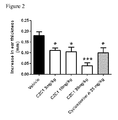
Classifications
-
- C—CHEMISTRY; METALLURGY
- C07—ORGANIC CHEMISTRY
- C07D—HETEROCYCLIC COMPOUNDS
- C07D413/00—Heterocyclic compounds containing two or more hetero rings, at least one ring having nitrogen and oxygen atoms as the only ring hetero atoms
- C07D413/02—Heterocyclic compounds containing two or more hetero rings, at least one ring having nitrogen and oxygen atoms as the only ring hetero atoms containing two hetero rings
- C07D413/04—Heterocyclic compounds containing two or more hetero rings, at least one ring having nitrogen and oxygen atoms as the only ring hetero atoms containing two hetero rings directly linked by a ring-member-to-ring-member bond
-
- A—HUMAN NECESSITIES
- A61—MEDICAL OR VETERINARY SCIENCE; HYGIENE
- A61K—PREPARATIONS FOR MEDICAL, DENTAL OR TOILETRY PURPOSES
- A61K31/00—Medicinal preparations containing organic active ingredients
- A61K31/33—Heterocyclic compounds
- A61K31/395—Heterocyclic compounds having nitrogen as a ring hetero atom, e.g. guanethidine or rifamycins
- A61K31/535—Heterocyclic compounds having nitrogen as a ring hetero atom, e.g. guanethidine or rifamycins having six-membered rings with at least one nitrogen and one oxygen as the ring hetero atoms, e.g. 1,2-oxazines
- A61K31/5375—1,4-Oxazines, e.g. morpholine
- A61K31/5377—1,4-Oxazines, e.g. morpholine not condensed and containing further heterocyclic rings, e.g. timolol
-
- A—HUMAN NECESSITIES
- A61—MEDICAL OR VETERINARY SCIENCE; HYGIENE
- A61P—SPECIFIC THERAPEUTIC ACTIVITY OF CHEMICAL COMPOUNDS OR MEDICINAL PREPARATIONS
- A61P25/00—Drugs for disorders of the nervous system
- A61P25/28—Drugs for disorders of the nervous system for treating neurodegenerative disorders of the central nervous system, e.g. nootropic agents, cognition enhancers, drugs for treating Alzheimer's disease or other forms of dementia
-
- A—HUMAN NECESSITIES
- A61—MEDICAL OR VETERINARY SCIENCE; HYGIENE
- A61P—SPECIFIC THERAPEUTIC ACTIVITY OF CHEMICAL COMPOUNDS OR MEDICINAL PREPARATIONS
- A61P29/00—Non-central analgesic, antipyretic or antiinflammatory agents, e.g. antirheumatic agents; Non-steroidal antiinflammatory drugs [NSAID]
-
- A—HUMAN NECESSITIES
- A61—MEDICAL OR VETERINARY SCIENCE; HYGIENE
- A61P—SPECIFIC THERAPEUTIC ACTIVITY OF CHEMICAL COMPOUNDS OR MEDICINAL PREPARATIONS
- A61P3/00—Drugs for disorders of the metabolism
-
- A—HUMAN NECESSITIES
- A61—MEDICAL OR VETERINARY SCIENCE; HYGIENE
- A61P—SPECIFIC THERAPEUTIC ACTIVITY OF CHEMICAL COMPOUNDS OR MEDICINAL PREPARATIONS
- A61P35/00—Antineoplastic agents
-
- A—HUMAN NECESSITIES
- A61—MEDICAL OR VETERINARY SCIENCE; HYGIENE
- A61P—SPECIFIC THERAPEUTIC ACTIVITY OF CHEMICAL COMPOUNDS OR MEDICINAL PREPARATIONS
- A61P37/00—Drugs for immunological or allergic disorders
-
- A—HUMAN NECESSITIES
- A61—MEDICAL OR VETERINARY SCIENCE; HYGIENE
- A61P—SPECIFIC THERAPEUTIC ACTIVITY OF CHEMICAL COMPOUNDS OR MEDICINAL PREPARATIONS
- A61P37/00—Drugs for immunological or allergic disorders
- A61P37/02—Immunomodulators
- A61P37/06—Immunosuppressants, e.g. drugs for graft rejection
-
- A—HUMAN NECESSITIES
- A61—MEDICAL OR VETERINARY SCIENCE; HYGIENE
- A61P—SPECIFIC THERAPEUTIC ACTIVITY OF CHEMICAL COMPOUNDS OR MEDICINAL PREPARATIONS
- A61P37/00—Drugs for immunological or allergic disorders
- A61P37/08—Antiallergic agents
-
- A—HUMAN NECESSITIES
- A61—MEDICAL OR VETERINARY SCIENCE; HYGIENE
- A61P—SPECIFIC THERAPEUTIC ACTIVITY OF CHEMICAL COMPOUNDS OR MEDICINAL PREPARATIONS
- A61P9/00—Drugs for disorders of the cardiovascular system
-
- C—CHEMISTRY; METALLURGY
- C07—ORGANIC CHEMISTRY
- C07D—HETEROCYCLIC COMPOUNDS
- C07D471/00—Heterocyclic compounds containing nitrogen atoms as the only ring hetero atoms in the condensed system, at least one ring being a six-membered ring with one nitrogen atom, not provided for by groups C07D451/00 - C07D463/00
- C07D471/02—Heterocyclic compounds containing nitrogen atoms as the only ring hetero atoms in the condensed system, at least one ring being a six-membered ring with one nitrogen atom, not provided for by groups C07D451/00 - C07D463/00 in which the condensed system contains two hetero rings
- C07D471/04—Ortho-condensed systems
-
- C—CHEMISTRY; METALLURGY
- C07—ORGANIC CHEMISTRY
- C07D—HETEROCYCLIC COMPOUNDS
- C07D487/00—Heterocyclic compounds containing nitrogen atoms as the only ring hetero atoms in the condensed system, not provided for by groups C07D451/00 - C07D477/00
- C07D487/02—Heterocyclic compounds containing nitrogen atoms as the only ring hetero atoms in the condensed system, not provided for by groups C07D451/00 - C07D477/00 in which the condensed system contains two hetero rings
- C07D487/04—Ortho-condensed systems
Definitions
- the present invention relates to a novel class of kinase inhibitors, including pharmaceutically acceptable salts thereof, which are useful for modulating protein kinase activity for modulating cellular activities such as signal transduction, proliferation, and cytokine secretion. More specifically the invention provides compounds which inhibit, regulate and/or modulate kinase activity, in particular mTOR activity, and signal transduction pathways relating to cellular activities as mentioned above. Furthermore, the present invention relates to pharmaceutical compositions comprising said compounds, e.g. for the treatment of diseases such as immunological, inflammatory, autoimmune, allergic disorders, or proliferative diseases such as cancer and processes for preparing said compounds.
- diseases such as immunological, inflammatory, autoimmune, allergic disorders, or proliferative diseases such as cancer and processes for preparing said compounds.
- Protein kinases catalyze the phosphorylation of proteins, lipids, sugars, nucleosides and other cellular metabolites and play key roles in all aspects of eukaryotic cell physiology. Especially, protein kinases and lipid kinases participate in the signaling events which control the activation, growth, differentiation and survival of cells in response to extracellular mediators or stimuli such as growth factors, cytokines or chemokines. In general, protein kinases are classified in two groups, those that preferentially phosphorylate tyrosine residues and those that preferentially phosphorylate serine and/or threonine residues.
- Inappropriately high protein kinase activity is involved in many diseases including cancer, metabolic diseases and autoimmune/inflammatory disorders. This can be caused either directly or indirectly by the failure of control mechanisms due to mutation, overexpression or inappropriate activation of the enzyme. In all of these instances, selective inhibition of the kinase is expected to have a beneficial effect.
- mTOR mammalian target of rapamycin
- FRAP FRAP
- RAFT1 RAFT1
- the mTOR protein is the drug target for the immunosuppressive effect of rapamycin, a drug that is used to prevent transplant rejection.
- Rapamycin works through a gain-of function mechanism by binding to the intracellular protein "FK-506-binding protein of 12 kDA" (FKBP12) to generate a drug-receptor complex that then binds to and inhibits mTOR.
- FKBP12 intracellular protein
- rapamycin induces the formation of the ternary complex consisting of rapamycin and the two proteins FKBP12 and mTOR.
- the mTOR protein is a large kinase of 289 kDA which occurs in all eukaryotic organisms sequenced so far ( Schmelzle and Hall, 2000, Cell 103, 253-262 ).
- the sequence of the carboxy-terminal "phosphatidylinositol 3-kinase (PI3K)-related kinase” (PIKK) domain is highly conserved between species and exhibits serine and threonine kinase activity but no detectable lipid kinase activity.
- the intact PIKK domain is required for all known functions of mTOR.
- the FKBP12-rapamycin-binding (FRB) domain is located close to the PIKK domain and forms a hydrophobic pocket that binds to the rapamycin bound to FKBP12.
- the FRB domain does not appear to inhibit the enzymatic activity of the kinase domain directly.
- FKBP12-rapamycin prevents the interaction of mTOR with its substrates due to steric hindrance.
- the N-terminus of mTOR consists of approximately 20 tandem repeats of 37 to 43 amino acids termed HEAT repeats.
- the HEAT repeats interact with protein binding partners such as Raptor.
- mTOR can form at least two distinct proteins complexes, mTORC1 and mTORC2.
- mTORC1 protein complex mTOR interacts with the proteins Raptor and mLSTB/G ⁇ L and regulates cell growth by phosphorylating effectors such as p70S6K and 4E-BP1 to promote mRNA translation and protein synthesis.
- the mTORC1 complex is responsible for sensing nutrient signals (for example the availibility of amino acids) in conjunction with insulin signaling.
- the activity of mTOR in mTORC1 can be inhibited by rapamycin.
- the second protein complex mTORC2
- mTORC2 consists of the proteins mTOR, Rictor, mLST8/G ⁇ L and Sin1 and is involved in the organization of actin.
- the mTORC2 was originally described as rapamycin insensitive.
- a recent publication demonstrated that rapamycin affects the function of mTORC2 after prolonged treatment through an indirect mechanism by interfering with the assembly of the mTORC2 protein complex ( Sarbassov et al., 2006, Molecular Cell 22, 159-168 ).
- mTOR The biological function of mTOR is that of a central regulator of various extracellular and intracellular signals, including growth factors, nutrients, energy and stress. Growth factor and hormone (e.g. insulin) induced mTOR activation is mediated by PI3 kinases, Akt, and the tuberous sclerosis protein complex (TSC). For example, mTOR acts as a central regulator of cell proliferation, angiogenesis, and cell metabolism ( Tsang et al., 2007, Drug Discovery Today 12, 112-124 )).
- rapamycin (Sirolimus) is a potent inhibitor of the proliferation of vascular smooth muscle cells and was approved by the FDA as an anti-restenosis drug used in coronary stents. In addition, it was observed that rapamycin displays anti-tumour activity in several in vitro and animal models ( Faivre et al., 2006. Nat. Rev. Drug. Discov. 5(8):671-688 ).
- CCI779 (temsirolimus) represents a more water-soluble ester derivative of rapamycin for intravenous and oral formulation.
- CCI779 has antitumor activity either alone or in combination with cytotoxic agents in cell lines.
- RAD001 (everolimus) is a hydroxyethyl ether derivative of rapamycin that is developed for oral administration.
- AP23573 (deferolimus) is developed for either oral or intravenous administration.
- the rapamycin derivatives act through the same molecular mechanism, the induction of the ternary rapamycin-FKBP12-mTOR complex. It is conceivable that the function of mTOR could be equally or even more effectively inhibited by inhibitors of the kinase function. For example, this could be achieved by identifying compounds that interact with the ATP-binding pocket of the mTOR kinase domain.
- Torin1 is a potent and selective ATP-competitive mTOR inhibitor that directly binds to both mTOR complexes and impairs cell growth and proliferation more efficiently than rapamycin ( Thoreen et al., 2009. J Biol Chem. 2009 Jan 15 . [Epub ahead of print]; PMID: 19150980; Feldman et al., 2009. PLOSBiology 7(2):e38 ).
- mTOR inhibitors have been reported in the literature which may be useful in the medical field, for example as anticancer agents ( Faivre et al., 2006. Nat. Rev. Drug. Discov. 5(8):671-688 ).
- imidazolopyrimidine analogs are described as mixed mTOR and PI3K kinase inhibitors.
- Pyrazolopyrimidine analogs are described as mixed mTOR and PI3K kinase inhibitors in WO-A 2008/115974 .
- pyrimidine derivatives as mTOR kinase and/or PI3K enzyme active compounds are disclosed in WO-A 2008/023159 , WO-A 2009/007748 , WO-A 2009/007749 , WO-A 2009/007750 , WO-A 2009/007751 , WO-A 2010/014939 .
- mTOR inhibitors are known in the art there is a need for providing additional mTOR inhibitors having at least partially more effective pharmaceutically relevant properties, like activity, selectivity, and ADMET properties.
- the present invention provides compounds of formula (I) or a pharmaceutically acceptable salt thereof, wherein
- variable or substituent can be selected from a group of different variants and such variable or substituent occurs more than once the respective variants can be the same or different.
- the compounds of the present invention show in general good pharmaceutically relevant properties. Surprisingly it was found that preferred compounds of formula (I), wherein T is phenyl and having an F-substitution of the phenyl ring in the meta position relative to the urea group are expected not to have genotoxic issues even though it is generally known in the art that compounds containing a phenyl urea group may form genotoxic metabolites.
- Preferred compounds of formula (I) are those compounds in which one or more of the residues contained therein have the meanings given below, with all combinations of preferred substituent definitions being a subject of the present invention.
- the present invention also includes all tautomeric and stereoisomeric forms and mixtures thereof in all ratios, and their pharmaceutically acceptable salts.
- substituents mentioned below independently have the following meaning. Hence, one or more of these substituents can have the preferred or more preferred meanings given below.
- X is O.
- n and n are independently 1 or 2.
- m + n 2 or 3.
- o is 1 or 2. More preferably, o is 1.
- T is phenyl; pyridine; pyrimidine; pyridazine; or pyrazine (more preferably, phenyl; or pyridine; even more preferably, phenyl), wherein T is substituted with N(R 13a )C(O)N(R 13b R 13 ) and optionally further substituted with one or more R 14 , which are the same or different.
- R 13a , R 13b are H.
- T is only substituted with N(R 13a )C(O)N(R 13b R 13 ).
- T is additionally substituted with one or two R 14 , which are the same or different, more preferably one R 14 .
- R 14 it is preferred that at least one R 14 is meta substituted relative to the group N(R 13a )C(O)N(R 13b R 13 ).
- R 14 is a fluoro substituent.
- Preferred compounds of formula (I) are those, where X, m, n, o, T are selected to give formula (Ia), (Ib) or (Ic) wherein p is 0, 1, or 2.
- p is 0. In another preferred embodiment p is 1 or 2, more preferably 1.
- R 1 is H; C(O)R 1 ; S(O) 2 R 3 ; optionally substituted C 1-6 alkyl; C(O)OR 3 ; C(O)NHR 3 ; optionally substituted T 1 ; or optionally substituted CH 2 -T 1 . More preferably, R 1 is H; C(O)R 3 ; S(O) 2 R 3 ; unsubstituted C 1-6 alkyl; C(O)OR 3 ; optionally substituted T 1 ; or optionally substituted CH 2 -T 1 .
- R 3 is preferably H; optionally substituted C 1-6 alkyl; optionally substituted T 1 ; or optionally substituted CH 2 -T 1 .
- T 1 is phenyl; or C 3-7 cycloalkyl and wherein T 1 is optionally substituted with one or more R 6 , which are the same or different.
- R 2 is methyl or hydrogen.
- R 13 is H; optionally substituted C 1-6 alkyl; optionally substituted T 1 ; or optionally substituted CH 2 -T 1 . More preferably, is R 13 H; optionally substituted C 1-6 alkyl; or optionally substituted T 1 . Even more preferably, R 13 is H; unsubstituted C 1-6 alkyl; cyclopropyl; or CH 2 -cyclopropyl. Even more preferably, R 13 is H; unsubstituted C 1-6 alkyl; or cyclopropyl. Even more preferably, R 13 is cyclopropyl; ethyl; fluoroethyl; or hydroxyethyl. Even more preferably, R 13 is cyclopropyl.
- tautomerism like e.g. keto-enol tautomerism
- compounds of general formula (I) may occur
- the individual forms like e.g. the keto and enol form, are comprised separately and together as mixtures in any ratio.
- stereoisomers like e.g. enantiomers, cis/trans isomers, conformers.
- isomers can be separated by methods well known in the art, e.g. by liquid chromatography. The same applies for enantiomers by using e.g. chiral stationary phases. Additionally, enantiomers may be isolated by converting them into diastereomers, i.e. coupling with an enantiomerically pure auxiliary compound, subsequent separation of the resulting diastereomers and cleavage of the auxiliary residue. Alternatively, any enantiomer of a compound of formula (I) may be obtained from stereoselective synthesis using optically pure starting materials.
- the compounds of formula (I) may exist in crystalline or amorphous form. Furthermore, some of the crystalline forms of the compounds of formula (I) may exist as polymorphs, which are included within the scope of the present invention. Polymorphic forms of compounds of formula (I) may be characterized and differentiated using a number of conventional analytical techniques, including, but not limited to, X-ray powder diffraction (XRPD) patterns, infrared (IR) spectra, Raman spectra, differential scanning calorimetry (DSC), thermogravimetric analysis (TGA) and solid state nuclear magnetic resonance (ssNMR).
- XRPD X-ray powder diffraction
- IR infrared
- Raman spectra Raman spectra
- DSC differential scanning calorimetry
- TGA thermogravimetric analysis
- ssNMR solid state nuclear magnetic resonance
- the invention also comprises their corresponding pharmaceutically or toxicologically acceptable salts, in particular their pharmaceutically utilizable salts.
- the compounds of the formula (I) which contain acidic groups can be used according to the invention, for example, as alkali metal salts, alkaline earth metal salts or as ammonium salts. More precise examples of such salts include sodium salts, potassium salts, calcium salts, magnesium salts or salts with ammonia or organic amines such as, for example, ethylamine, ethanolamine, triethanolamine or amino acids.
- Compounds of the formula (I) which contain one or more basic groups i.e.
- acids which can be protonated, can be present and can be used according to the invention in the form of their addition salts with inorganic or organic acids.
- suitable acids include hydrogen chloride, hydrogen bromide, phosphoric acid, sulfuric acid, nitric acid, methanesulfonic acid, p-toluenesulfonic acid, naphthalenedisulfonic acids, oxalic acid, acetic acid, tartaric acid, lactic acid, salicylic acid, benzoic acid, formic acid, propionic acid, pivalic acid, diethylacetic acid, malonic acid, succinic acid, pimelic acid, fumaric acid, maleic acid, malic acid, sulfaminic acid, phenylpropionic acid, gluconic acid, ascorbic acid, isonicotinic acid, citric acid, adipic acid, and other acids known to the person skilled in the art.
- the invention also includes, in addition to the salt forms mentioned, inner salts or betaines (zwitterions).
- the respective salts according to the formula (I) can be obtained by customary methods which are known to the person skilled in the art like, for example by contacting these with an organic or inorganic acid or base in a solvent or dispersant, or by anion exchange or cation exchange with other salts.
- the present invention also includes all salts of the compounds of the formula (I) which, owing to low physiological compatibility, are not directly suitable for use in pharmaceuticals but which can be used, for example, as intermediates for chemical reactions or for the preparation of pharmaceutically acceptable salts.
- the term "pharmaceutically acceptable” means that the corresponding compound, carrier or molecule is suitable for administration to humans.
- this term means approved by a regulatory agency such as the EMEA (Europe) and/or the FDA (US) and/or any other national regulatory agency for use in animals, preferably in humans.
- the present invention furthermore includes all solvates of the compounds according to the invention.
- the effects of the claimed compounds on mTOR activity may e.g. be tested using transiently expressed epitope-tagged mTOR in a mammalian cell line such as HEK293 that is immunoprecipitated with a monoclonal antibody directed against the epitope tag ( Knight et al. 2004, Bioorganic and Medicinal Chemistry 12, 4749-4759 ).
- Another assay employs mTOR protein enriched from cells or tissue lysates using conventional protein purification methods. In this assay a GST-fusion protein of the P70 S6 kinase is used as a substrate. The phosphorylation of P70 S6 is detected using a primary phospho-specific antibody (directed against phophorylated threonine 389) and an enzyme linked secondary anti-body in an ELISA assay ( US-A 2004/0191836 ).
- mTOR or "mTOR kinase” means the mTOR protein ( Tsang et al., 2007, Drug Discovery Today 12, 112-124 ).
- the gene encoding mTOR is located on human chromosome map locus 1p36.2 and it is widely expressed in human tissues.
- the compounds of the invention were tested for their selectivity for mTOR over other kinases. As shown, all tested compounds bind mTOR more selectively than the kinases PI3Kd or DNA-PK (see table 4 below). Consequently, the compounds of the present invention are considered to be useful for the prevention or treatment of diseases and disorders associated with mTOR, e.g. immunological, inflammatory, autoimmune, or allergic disorders, or proliferative diseases, transplant rejection, Graft-versus-Host-Disease, cardiovascular diseases, metabolic diseases or neurodegenerative diseases.
- diseases and disorders associated with mTOR e.g. immunological, inflammatory, autoimmune, or allergic disorders, or proliferative diseases, transplant rejection, Graft-versus-Host-Disease, cardiovascular diseases, metabolic diseases or neurodegenerative diseases.
- preferred compounds of the present invention of formula (I), wherein T is phenyl and having an F-substitution of the phenyl ring in the meta position relative to the urea group are expected not to have genotoxic issues.
- Genetic toxicology data is used as a surrogate for long-term carcinogenicity data during early development.
- the aim of genotoxicity testing is to identify potentially hazardous drug candidates.
- Results from genetic toxicity tests in combination with acute and subchronic data are used as basis to approve clinical trials of drug candidates. With few exceptions, mutagenic compounds are dropped from development. DNA damaging substances cannot be developed as pharmaceutical compounds except for some situations where unmet medical need, life-threatening diagnoses, or short-life expectancy exists. Therefore, genetic toxicology testing, for example in the Ames assay, in drug discovery and optimization serves to identify mutagens and remove them from development ( Custer and Sificat, 2008. Current Drug metabolism 9, 978-985 ).
- the Ames Salmonella/microsome mutagenicity assay (Salmonella test; Ames test) is a standard, short-term bacterial reverse mutation assay specifically designed to detect a wide range of chemical substances that can produce genetic damage leading to gene mutations.
- the test employs several histidine dependent Salmonella strains each carrying different mutations in various genes of the histidine operon ( Mortelmans and Zeiger 2000, Mutation Research 455, 29-60 ).
- the corresponding potential aniline metabolites both of compounds of the present invention with and without meta Fluoro group relative to the urea group have been synthesized and tested in the Ames assay without and with rat liver S9 fraction (see below, example 196).
- the unsubstituted potential aniline metabolite (compound metabolite example 137) is Ames positive when tested with rat liver S9 fraction.
- the substitution with an ortho-Fluoro relative to the amino group results in a metabolite which is Ames positive with S9 metabolic extract.
- an F-substitution of the phenyl ring in the meta position relative to the amino group is Ames negative with S9 metabolic extract.
- meta-Fluoro-substituted aniline metabolite is formed in the body, it is not expected to further convert into a genotoxic molecule, even if administered in a long-term treatment of chronic diseases such as inflammatory diseases.
- the present invention provides pharmaceutical compositions comprising a compound of formula (I) or a pharmaceutically acceptable salt thereof as active ingredient together with a pharmaceutically acceptable carrier, optionally in combination with one or more other pharmaceutical compositions.
- “Pharmaceutical composition” means one or more active ingredients, and one or more inert ingredients that make up the carrier, as well as any product which results, directly or indirectly, from combination, complexation or aggregation of any two or more of the ingredients, or from dissociation of one or more of the ingredients, or from other types of reactions or interactions of one or more of the ingredients. Accordingly, the pharmaceutical compositions of the present invention encompass any composition made by admixing a compound of the present invention and a pharmaceutically acceptable carrier.
- carrier refers to a diluent, adjuvant, excipient, or vehicle with which the therapeutic is administered.
- Such pharmaceutical carriers can be sterile liquids, such as water and oils, including those of petroleum, animal, vegetable or synthetic origin, including but not limited to peanut oil, soybean oil, mineral oil, sesame oil and the like. Water is a preferred carrier when the pharmaceutical composition is administered orally.
- Saline and aqueous dextrose are preferred carriers when the pharmaceutical composition is administered intravenously. Saline solutions and aqueous dextrose and glycerol solutions are preferably employed as liquid carriers for injectable solutions.
- Suitable pharmaceutical excipients include starch, glucose, lactose, sucrose, gelatin, malt, rice, flour, chalk, silica gel, sodium stearate, glycerol monostearate, talc, sodium chloride, dried skim milk, glycerol, propylene, glycol, water, ethanol and the like.
- the composition if desired, can also contain minor amounts of wetting or emulsifying agents, or pH buffering agents. These compositions can take the form of solutions, suspensions, emulsions, tablets, pills, capsules, powders, sustained-release formulations and the like.
- the composition can be formulated as a suppository, with traditional binders and carriers such as triglycerides.
- Oral formulation can include standard carriers such as pharmaceutical grades of mannitol, lactose, starch, magnesium stearate, sodium saccharine, cellulose, magnesium carbonate, etc. Examples of suitable pharmaceutical carriers are described in "Remington's Pharmaceutical Sciences” by E.W. Martin. Such compositions will contain a therapeutically effective amount of the therapeutic, preferably in purified form, together with a suitable amount of carrier so as to provide the form for proper administration to the patient. The formulation should suit the mode of administration.
- a pharmaceutical composition of the present invention may comprise one or more additional compounds as active ingredients like one or more compounds of formula (I) not being the first compound in the composition or mTOR inhibitors.
- Further bioactive compounds for may be steroids, leukotriene antagonists, cyclosporine or rapamycin.
- the compounds of the present invention or pharmaceutically acceptable salt(s) thereof and the other pharmaceutically active agent(s) may be administered together or separately and, when administered separately, this may occur separately or sequentially in any order.
- the two compounds When combined in the same formulation it will be appreciated that the two compounds must be stable and compatible with each other and the other components of the formulation.
- they When formulated separately they may be provided in any convenient formulation, conveniently in such manner as are known for such compounds in the art.
- the compound of formula (I), or a pharmaceutically acceptable salt thereof, or a pharmaceutical composition comprising a compound of formula (I) is administered in combination with another drug or pharmaceutically active agent and/or that the pharmaceutical composition of the invention further comprises such a drug or pharmaceutically active agent.
- drug or pharmaceutically active agent includes a drug or pharmaceutical agent that will elicit the biological or medical response of a tissue, system, animal or human that is being sought, for instance, by a researcher or clinician.
- Combined or “in combination” or “combination” should be understood as a functional coadministration, wherein some or all compounds may be administered separately, in different formulations, different modes of administration (for example subcutaneous, intravenous or oral) and different times of administration.
- the individual compounds of such combinations may be administered either sequentially in separate pharmaceutical compositions as well as simultaneously in combined pharmaceutical compositions.
- Suitable examples of pharmaceutically active agents which may be employed in combination with the compounds of the present invention and their salts for rheumatoid arthritis therapy include: immunosuppresants such as amtolmetin guacil, mizoribine and rimexolone; anti-TNF ⁇ agents such as etanercept, infliximab, Adalimumab, Anakinra, Abatacept, Rituximab; tyrosine kinase inhibitors such as leflunomide; kallikrein antagonists such as subreum; interleukin 11 agonists such as oprelvekin; interferon beta 1 agonists; hyaluronic acid agonists such as NRD-101 (Aventis); interleukin 1 receptor antagonists such as anakinra; CD8 antagonists such as amiprilose hydrochloride; beta amyloid
- the treatment defined herein may be applied as a sole therapy or may involve, in addition to the compounds of the invention, conventional surgery or radiotherapy or chemotherapy.
- the compounds of the invention can also be used in combination with existing therapeutic agents for the treatment proliferative diseases such as cancer. Suitable agents to be used in combination include:
- the individual compounds of such combinations may be administered either sequentially in separate pharmaceutical compositions as well as simultaneously in combined pharmaceutical compositions.
- the compounds of formula (I) can be combined as the active ingredient in intimate admixture with a pharmaceutical carrier according to conventional pharmaceutical compounding techniques.
- the carrier may take a wide variety of forms depending on the form of preparation desired for administration, e.g ., oral or parenteral (including intravenous).
- any of the usual pharmaceutical media may be employed, such as water, glycols, oils, alcohols, flavoring agents, preservatives, coloring agents and the like in the case of oral liquid preparations, such as, for example, suspensions, elixirs and solutions; or carriers such as starches, sugars, microcrystalline cellulose, diluents, granulating agents, lubricants, binders, disintegrating agents and the like in the case of oral solid preparations such as powders, hard and soft capsules and tablets, with the solid oral preparations being preferred over the liquid preparations.
- oral liquid preparations such as, for example, suspensions, elixirs and solutions
- carriers such as starches, sugars, microcrystalline cellulose, diluents, granulating agents, lubricants, binders, disintegrating agents and the like in the case of oral solid preparations such as powders, hard and soft capsules and tablets, with the solid oral preparations being preferred over the liquid preparations.
- tablets and capsules represent the most advantageous oral dosage unit form in which case solid pharmaceutical carriers are obviously employed. If desired, tablets may be coated by standard aqueous or non-aqueous techniques. Such compositions and preparations should contain at least 0.1 percent of active compound. The percentage of active compound in these compositions may, of course, be varied and may conveniently be between about 2 percent to about 60 percent of the weight of the unit. The amount of active compound in such therapeutically useful compositions is such that an effective dosage will be obtained.
- the active compounds can also be administered intranasally, for example, as liquid drops or spray.
- the tablets, pills, capsules, and the like may also contain a binder such as gum tragacanth, acacia, corn starch or gelatin; excipients such as dicalcium phosphate; a disintegrating agent such as corn starch, potato starch, alginic acid; a lubricant such as magnesium stearate; and a sweetening agent such as sucrose, lactose or saccharin.
- a dosage unit form is a capsule, it may contain, in addition to materials of the above type, a liquid carrier such as fatty oil.
- tablets may be coated with shellac, sugar or both.
- a syrup or elixir may contain, in addition to the active ingredient, sucrose as a sweetening agent, methyl and propylparabens as preservatives, a dye and a flavoring such as cherry or orange flavor.
- Compounds of formula (I) may also be administered parenterally. Solutions or suspensions of these active compounds can be prepared in water suitably mixed with a surfactant such as hydroxypropyl-cellulose. Dispersions can also be prepared in glycerol, liquid polyethylene glycols and mixtures thereof in oils. Under ordinary conditions of storage and use, these preparations contain a preservative to prevent the growth of microorganisms.
- the pharmaceutical forms suitable for injectable use include sterile aqueous solutions or dispersions and sterile powders for the extemporaneous preparation of sterile injectable solutions or dispersions.
- the form must be sterile and must be fluid to the extent that easy syringability exists. It must be stable under the conditions of manufacture and storage and must be preserved against the contaminating action of microorganisms such as bacteria and fungi.
- the carrier can be a solvent or dispersion medium containing, for example, water, ethanol, polyol ( e.g., glycerol, propylene glycol and liquid polyethylene glycol), suitable mixtures thereof, and vegetable oils.
- Any suitable route of administration may be employed for providing a mammal, especially a human, with an effective dose of a compound of the present invention.
- oral, rectal, topical, parenteral, ocular, pulmonary, nasal, and the like may be employed.
- Dosage forms include tablets, troches, dispersions, suspensions, solutions, capsules, creams, ointments, aerosols, and the like.
- compounds of formula (I) are administered orally.
- the effective dosage of active ingredient employed may vary depending on the particular compound employed, the mode of administration, the condition being treated and the severity of the condition being treated. Such dosage may be ascertained readily by a person skilled in the art.
- a therapeutically effective amount of a compound of the present invention will normally depend upon a number of factors including, for example, the age and weight of the animal, the precise condition requiring treatment and its severity, the nature of the formulation, and the route of administration.
- an effective amount of a compound of formula (I) for the treatment of an inflammatory disease for example rheumatoid arthritis (RA) will generally be in the range of 0.1 to 100 mg/kg body weight of recipient (mammal) per day and more usually in the range of 1 to 10 mg/kg body weight per day.
- the actual amount per day would usually be from 70 to 700 mg and this amount may be given in a single dose per day or more usually in a number (such as two, three, four, five or six) of sub-doses per day such that the total daily dose is the same.
- An effective amount of a pharmaceutically acceptable salt, prodrug or metabolite thereof may be determined as a proportion of the effective amount of the compound of formula (I) per se. It is envisaged that similar dosages would be appropriate for treatment of the other conditions referred to above.
- the term "effective amount” means that amount of a drug or pharmaceutical agent that will elicit the biological or medical response of a tissue, system, animal or human that is being sought, for instance, by a researcher or clinician.
- terapéuticaally effective amount means any amount which, as compared to a corresponding subject who has not received such amount, results in improved treatment, healing, prevention, or amelioration of a disease, disorder, or side effect, or a decrease in the rate of advancement of a disease or disorder.
- the term also includes within its scope amounts effective to enhance normal physiological function.
- Another aspect of the present invention is a compound of the present invention or a pharmaceutically acceptable salt thereof for use as a medicament.
- Another aspect of the present invention is a compound of the present invention or a pharmaceutically acceptable salt thereof for use in a method of treating or preventing a disease or disorder associated with mTOR.
- a disease or disorder associated with mTOR is defined as a disease or disorder where mTOR is involved.
- the diseases or disorder associated with mTOR is an immunological, inflammatory, autoimmune, or allergic disorder or disease or a transplant rejection or a Graft-versus host disease.
- another aspect of the present invention is a compound or a pharmaceutically acceptable salt thereof of the present invention for use in a method of treating or preventing an immunological, inflammatory, autoimmune, or allergic disorder or disease or a transplant rejection or a Graft-versus host disease.
- an autoimmune disease is a disease which is at least partially provoked by an immune reaction of the body against own components, e.g. proteins, lipids or DNA.
- the autoimmune disease is selected from the group consisting of rheumatoid arthritis (RA), inflammatory bowel disease (IBD; Crohns's disease and ulcerative colitis), psoriasis, systemic lupus erythematosus (SLE), and multiple sclerosis (MS).
- RA rheumatoid arthritis
- IBD inflammatory bowel disease
- SLE systemic lupus erythematosus
- MS multiple sclerosis
- RA Rheumatoid arthritis
- RA is a chronic progressive, debilitating inflammatory disease that affects approximately 1% of the world's population.
- RA is a symmetric polyarticular arthritis that primarily affects the small joints of the hands and feet.
- pannus In addition to inflammation in the synovium, the joint lining, the aggressive front of tissue called pannus invades and destroys local articular structures ( Firestein 2003, Nature 423:356-361 ).
- IBD Inflammatory bowel disease
- Crohn's disease involves most frequently the terminal ileum and colon, is transmural and discontinuous.
- ulcerative colitis the inflammation is continuous and limited to rectal and colonic mucosal layers.
- definitive classification of Crohn disease or ulcerative colitis cannot be made and are designated 'indeterminate colitis.
- Both diseases include extraintestinal inflammation of the skin, eyes, or joints. Neutrophil-induced injuries may be prevented by the use of neutrophils migration inhibitors ( Asakura et al., 2007, World J Gastroenterol. 13(15):2145-9 ).
- Psoriasis is a chronic inflammatory dermatosis that affects approximately 2% of the population. It is characterized by red, scaly skin patches that are usually found on the scalp, elbows, and knees, and may be associated with severe arthritis. The lesions are caused by abnormal keratinocyte proliferation and infiltration of inflammatory cells into the dermis and epidermis ( Schon et al., 2005, New Engl. J. Med. 352:1899-1912 ).
- SLE Systemic lupus erythematosus
- T cell-mediated B-cell activation results in glomerulonephritis and renal failure.
- Human SLE is characterized at early stages by the expansion of long-lasting autoreactive CD4+ memory cells ( D'Cruz et al., 2007, Lancet 369(9561):587-596 ).
- MS Multiple sclerosis
- GVDH graft-versus-host disease
- Transplant rejection includes, without limitation, acute and chronic allograft rejection following for example transplantation of kidney, heart, liver, lung, bone marrow, skin and cornea. It is known that T cells play a central role in the specific immune response of allograft rejection.
- the disease or disorder associated with mTOR is a proliferative disease, especially cancer.
- Diseases and disorders associated especially with mTOR are proliferative disorders or diseases, especially cancer.
- another aspect of the present invention is a compound or a pharmaceutically acceptable salt thereof of the present invention for use in a method of treating or preventing a proliferative disease, especially cancer.
- Cancer comprises a group of diseases characterized by uncontrolled growth and spread of abnormal cells. All types of cancers generally involve some abnormality in the control of cell growth, division and survival, resulting in the malignant growth of cells. Key factors contributing to said malignant growth of cells are independence from growth signals, insensitivity to anti-growth signals, evasion of apoptosis, limitless replicative potential, sustained angiogenesis, tissue invasion and metastasis, and genome instability ( Hanahan and Weinberg, 2000. The Hallmarks of Cancer. Cell 100, 57-70 ).
- cancers are classified as hematological cancers (for example leukemias and lymphomas) and solid cancers such as sarcomas and carcinomas (for example cancers of the brain, breast, lung, colon, stomach, liver, pancreas, prostate, ovary).
- hematological cancers for example leukemias and lymphomas
- solid cancers such as sarcomas and carcinomas (for example cancers of the brain, breast, lung, colon, stomach, liver, pancreas, prostate, ovary).
- the gene encoding the catalytic phosphoinositide-3 kinase subunit p110a are expected to respond to treatment with mTOR inhibitors ( Garcia-Echeverria and Sellers, 2008, Oncogene 27, 5511-5526 ).
- Examples of cancers with a high incidence of PTEN mutations and/or activation of PI3K/Akt are endometrial carcinoma, glioblastoma, head and neck cancer, colon cancer, pancreatic cancer, gastric cancer, hepatocarcinoma, ovarian cancer, thyroid carcinoma, renal cell cancer, breast cancer, prostate cancer and gastrointestinal stromal tumours (GIST).
- GIST gastrointestinal stromal tumours
- the most promising results with mTOR inhibitors have been obtained in renal cell carcinoma (RCC), mantle cell lymphoma and endometrial cancers ( Faivre et al., 2006. Nat. Rev. Drug. Discov. 5(8):671-688 ).
- mTOR inhibitors may be useful for the treatment of leukemias Including ALL and CML), multiple myeloma and lymphomas.
- HIF1- ⁇ and HIF1- ⁇ proteins which are subunits of hypoxia-inducible factor (HIF), a transcription factor that controls the expression of genes whose products play a role in angiogenesis, cell proliferation, motility and survival.
- HIF hypoxia-inducible factor
- VEGFs vascular endothelial growth factors
- angiopoietin-2 angiopoietin-2.
- tumour suppressor proteins such as TSC1, TSC2, PTEN and LKB1 tightly control mTOR signalling. Loss of these tumour suppressor proteins leads to a range of hamartoma conditions as a result of elevated mTOR signalling ( Rosner et al., 2008. Mutation Research 659(3):284-292 ).
- Syndromes with an established molecular link to dysregulation of mTOR include Koz_Jeghers syndrome (PJS), Cowden disease, Bannayan-Riley-Ruvalcaba syndrome (BRRS), Proteus syndrome, Lhermitte-Duclos disease and Tuberous sclerosis (TSC).
- tumour suppressor proteins having an influence on mTOR activity are VHL, NF1 and PKD whose loss can trigger von Hippel-Lindau disease, Neurofibromatosis type 1, and Polycystic kidney disease respectively.
- Proliferative diseases or disorders comprise a group of diseases characterized by increased cell multiplication.
- One example is restenosis caused by the overgrowth of vascular smooth muscle (VSM) cells after coronary angioplasty with stents.
- VSM vascular smooth muscle
- Rapamycin-coated stents effectively reduce restenosis and have been approved by the FDA ( Serruys et al., 2006. N. Engl. J. Med. 354(5):483-95 ).
- the disease or disorder associated with mTOR is a cardiovascular disease, a metabolic disease or a neurodegenerative disease.
- another aspect of the present invention is a compound or a pharmaceutically acceptable salt thereof of any of the present invention for use in a method of treating or preventing a cardiovascular disease, a metabolic disease or a neurodegenerative disease.
- Metabolic diseases that may be treated with mTOR inhibitors comprise type 1 diabetes, type 2 diabetes, and obesity ( Tsang et al., 2007, Drug Discovery Today 12, 112-124 ).
- Type 1 diabetes is caused by loss of insulin production due to destruction of pancreatic ⁇ -cells.
- Clinical studies using immunosuppressive regimen that contain rapamycin to prevent rejection of islet transplants have shown significant efficacy in type 1 diabetic patients.
- Type 2 diabetes arises when insulin secretion from pancreatic ⁇ -cells fails to compensate for the peripheral insulin resistance (or insensitivity to insulin) in skeletal muscle, liver and fat cells.
- Recent data indicate that sustained activation of mTOR signalling is a crucial event that renders insulin-receptors substrate (IRS) irresponsive to insulin.
- rapamycin restores the sensitivity of IRS to insulin ( Shah et al., 2004. Curr. Biol. 14(18):1650-1656 ). Therefore, mTOR inhibitors are potentially useful in the management of type 2 diabetes. Obesity is a metabolic disease with a steadily increasing health risk worldwide. Recent evidence suggests that mTOR plays a role in lipid metabolism. During adipogenesis the expression of mTOR increases dramatically from barely detectable in preadipocytes to highly expressed in fully differentiated adipocytes, and rapamycin inhibits adipocyte differentiation ( Yeh et al., 1995. Proc. Natl. Acad. Sci. USA. 92(24):11086-90 ).
- Huntingtons's disease is a neurodegenerative disorder caused by a mutant form of the protein huntingtin with abnormally long glutamine repeats at the amino-terminus. The mutant protein aggregates in neuronal cells and can cause nerve cell damage and toxicity. Rapamycin attenuates the accumulation of huntingtin and cell death, and protects against neurodegeneration in animal models of Huntington's disease ( Ravikumar et al., 2004. Nat Genet. 36(6):585-95 ). In addition, rapamycin induces an autophagy response that has been suggested to play a role in the clearance of huntingtin aggregates.
- Intracellular protein aggregates also occur in other neurodegenerative diseases, for example Alzheimer's disease.
- the Tau protein is frequently found in brains of Alzheimer's patients and is thought to contribute to the formation of neurofibrillary tangles (for example in tauopathies such as fronto-temporal dementia).
- tauopathies such as fronto-temporal dementia.
- rapamycin reduces the concentration of tau protein and lowers the toxicity caused by tau accumulation ( Berger et al., 2006. Hum Mol Genet. 2006 Feb 1;15(3):433-42 ). Therefore, mTOR inhibitors may be useful in preventing the accumulation of toxic tau protein in Alzheimer's patients.
- Parkinson's disease is a neurodegenerative disease associated with the accumulation and aggregation of misfolded proteins. Preventing aggregation or disaggregating misfolded proteins may provide a therapeutic benefit by slowing or preventing the progression of PD.
- the ubiquitin-proteasome system (UPS) is an important degradation mechanism acting on aggregated proteins. It was reported that rapamycin provides neuroprotection against dopaminergic neuronal cell death induced by the proteasome inhibitor lactacystin. It was suggested that the rapamycin effect is partially mediated by autophagy enhancement through enhanced degradation of misfolded proteins ( Pan et al., 2008. Neurobiol. Dis. 32(1):16-25 ). Therefore compounds that can enhance autophagy may represent a promising strategy to treat PD patients.
- the disease or disorder associated with mTOR is an autophagy associated disease.
- another aspect of the present invention is a compound or a pharmaceutically acceptable salt thereof of any of the present invention for use in a method of treating or preventing an autophagy associated disease.
- Autophagy is a lysosome-dependent process whereby proteins or damaged organelles within a cell are degraded ( Mizushima et al., 2008. Nature 451(7182):1069-75 ). During this process an autophagosome with a double membrane encloses the component of the cell to be degraded. Then the autophagosome fuses with a lysosome which for example degrades proteins leading to the recycling of amino acids. Autophagy is primarily involved in the degradation of long-lived proteins, protein aggregates, and cellular organelles and other cellular components.
- autophagy could be expoited for the treatment of a variety of diseases caused by misfolded proteins aggregates, for example neurodegenerative diseases such as Huntington's, Alzheimer's or Parkinon's disease. Further autophagy associated diseases are described in WO-A2009/049242 .
- Autophagy inducing compound refers to a compound that induces autophagy in a cell.
- Autophagy associated disease refers to a disease that can be treated by the induction of autophagy. It has recently been shown that an ATP-competitive mTOR kinase inhibitor can induce autophagy ( Thoreen et al., 2009. J. Biol. Chem. 284(12):8023-32 ). Interestingly, ATP competitive mTOR kinase inhibitors seem to induce autophagy more effectively than rapamycin in mammalian cells. Taken together, compounds of the present invention may be useful to induce autophagy in cells and to treat autophagy associated diseases.
- Yet another aspect of the present invention is the use of a compound of the present invention or a pharmaceutically acceptable salt thereof for the manufacture of a medicament for the treatment or prophylaxis of diseases and disorders associated with mTOR.
- Yet another aspect of the present invention is the use of a compound of the present invention or a pharmaceutically acceptable salt thereof for the manufacture of a medicament for treating or preventing an immunological, inflammatory, autoimmune, or allergic disorder or disease or a transplant rejection or a Graft-versus host disease.
- Yet another aspect of the present invention is the use of a compound of the present invention or a pharmaceutically acceptable salt thereof for the manufacture of a medicament for treating or preventing a proliferative disease, especially cancer.
- Yet another aspect of the present invention is the use of a compound of the present invention or a pharmaceutically acceptable salt thereof for the manufacture of a medicament for treating or preventing a cardiovascular disease, a metabolic disease or a neurodegenerative disease.
- Yet another aspect of the present invention is the use of a compound of the present invention or a pharmaceutically acceptable salt thereof for the manufacture of a medicament for treating or preventing an autophagy associated disease.
- treating or “treatment” is intended to refer to all processes, wherein there may be a slowing, interrupting, arresting, or stopping of the progression of a disease, but does not necessarily indicate a total elimination of all symptoms.
- Preferred mammalian patients are human patients.
- a compound of formula(I) may be prepared starting from a compound of formula (III) by reacting with a compound T-X 0 in a Suzuki reaction (a1).
- a suitable group A may be chloro.
- the respective compound already represents a compound of the present invention.
- at least a further step (b1) is required representing the deprotection step resulting in a compound of the present invention, wherein R 1 is H.
- said compound may be reacted with a compound of formula R 1 -X 1 to yield a compound of the present invention, wherein R 1 is given as defined above excluding H.
- a compound of formula (III) may be deprotected in a step (a2) resulting in a compound of formula (IV) followed by reaction with a compound of formula R 1 -X 1 to yield compound (V), which then is reacted with T-X 0 to yield a compound of the present invention.
- the method for the preparation of a compound of the present invention may comprise the steps of
- Compounds of formula (I), wherein R 1 is H can be generated from compounds of formula (I), wherein R 1 is Pg by removal of the protecting group Pg. For example when Pg is Boc then deprotection can be achieved using methods well known to those skilled in the art (for example with HC1 or TFA in organic solvent).
- Compounds of formula (I), wherein R 1 is H may be isolated in the form of salts or as free base.
- Unsubstituted compounds of formula (I) can be reacted under appropriate conditions with carboxylic acids or acid carboxylic chlorides to give compounds of formula (I), where R 1 is C(O)R 3 as defined above.
- Unsubstituted compounds of formula (I) can be reacted under appropriate conditions with sulfonyl chlorides to give compounds of formula (I) where R 1 is S(O) 2 R 3 as defined above.
- Unsubstituted compounds of formula (I) can be reacted under appropriate conditions with isocyanates to give compounds of formula (I) where R 1 is C(O)N(R 3 R 3a ) as defined above.
- Unsubstituted compounds of formula (I) can be reacted under appropriate conditions with chloroformates to give compounds of formula (I) where R 1 is C(O)OR 3 as defined above.
- Mass spec data were gathered in positive elector spray ionisation mode from 150 and 700 amu.
- the mass spec data are gathered in positive or negative mode, scanning for masses between 150 and 700amu.
- Flash chromatography was generally carried out using Biotage Isolute Flash silica cartridges utilising either Flash Master II or Flash Master Personal equipment.
- the R enantiomer was prepared using the same procedure with 3R-methyl morpholine.
- Step 1 (S)-tert-butyl 2-(4-(3-cyclopropylureido)phenyl)-4-(3-methylmorpholino)-5H-pyrrolo[3,4-d]pyrimidine-6(7H)-carboxylate was prepared by the method described for intermediate 5 using intermediate 1 and 1-cyclopropyl-3-(4-(4,4,5,5-tetramethyl-1,3,2-dioxaborolan-2-yl)phenyl)urea as starting materials
- Step 2 To a stirred solution of (S)-tert-butyl 2-(4-(3-cyclopropylureido)phenyl)-4-(3-methylmorpholino)-5H-pyrrolo[3,4-d]pyrimidine-6(7H)-carboxylate (0.99 g, 1.99 mmol) in DCM (5 mL) was added TFA (2.5 mL) and stirred at room temperature (20 °C) overnight. The reaction mixture was diluted with methanol and adsorbed onto a mp-TsOH cartridge (2.5 g, 3 mmol/g). The cartridge was rinsed with MeOH (3 column volumes) and the product was eluted with 7M NH 3 in MeOH.
- reaction mixture was diluted with water and EtOAc and passed through a celite cartridge.
- the organic layer was concentrated in vacuo and purified by prep HPLC to give the desired compound as a yellow solid (48 mg, 0.103 mmol, 18 % yield over three steps).
- the reaction mixture was then heated by microwave at 130 °C for 30 minutes.
- the crude reaction mixture was then partitioned between water and EtOAc, the organic layer recovered, dried over MgSO 4 , filtered and the solvent removed in vacuo.
- the residue was purified by prep. LCMS (low pH).. The solvent was removed in vacuo.
- the residue was then re-purified by Flash SCX2 column chromatography, affording the title compound as a white solid (34.8 mg, 51 % yield).
- Step 1 Method as intermediate 7 using formaldehyde as starting material.
- Step 2 Method as intermediate 5, using 4-(4,4,5,5-tetramethyl-1,3,2-dioxaborolan-2-yl)aniline and (S)-4-(2-chloro-6-methyl-6,7-dihydro-5H-pyrrolo[3,4-d]pyrimidin-4-yl)-3-methylmorpholine.
- the crude reaction mixture was partitioned between water and EtOAc, the phases separated and the organic layer dried over magnesium sulphate, filtered and the solvent removed in vacuo. The residue was purified by flash chromatography (0-15% MeOH/DCM), to yield a pale yellow oil (477 mg, 72%).
- the reaction was cooled, diluted with methanol and adsorbed onto a mp-TsOH cartridge (2.5 g, 3 mmol/g).
- the cartridge was rinsed with MeOH (3 column volumes) and the product was eluted with 7M NH 3 in MeOH.
- the basic fractions were concentrated in vacuo and purified by prep HPLC (low pH) to give the desired product (2.1 mg, 0.9% yield).
- Step 1 Method as described for intermediate 15 using 6-aminopyridin-2-ol as starting material. Saturated NaHCO 3 solution was added to the reaction mixture, and stirring allowed for 15 mins before partitioning with DCM. The organic layer was recovered, dried over MgSO 4 , filtered and reduced in vacuo , affording the title compound (90mg, 0.25 mmol, 56% yield).
- Step 2 Method as described for example 47 using 1-(6-hydroxypyridin-2-yl)-3-(4-(4,4,5,5-tetramethyl-1,3,2-dioxaborolan-2-yl)phenyl)urea and (S)-4-(2-chloro-6-methyl-6,7-dihydro-5H-pyrrolo[3,4-d]pyrimidin-4-yl)-3-methylmorpholine (intermediate 12) as starting materials.
- the reaction mixture was filtered through a celite 545 pre-packed cartridge (2.5g), washed with MeOH and reduced in vacuo. The residue was purified by prep LCMS (high pH), to yield the title compound (7.9 mg, 0.017 mmol, 9.2%).
- Step 1 Method as described for intermediate 2 using tert-butyl 2,4-dichloro-5,6-dihydropyrido[3,4d]pyrimidine-7(8H) carboxylate and morpholine as starting materials.
- Step 2 Method as intermediate 5 using tert-butyl 2-chloro-4-morpholino-5,6-dihydropyrido[3,4-d]pyrimidine-7(8H)-carboxylate and 4-(3-ethylureido)phenylboronic acid pinacol ester
- Step 3 Method as example 3 step 2. Purified using MP-TsOH cartridge eluting with 2M ammonia in methanol.
- 1 H NMR (d 6 -DMSO) 8.69 (s, 1H), 8.19 (d, 2H), 7.47 (d , 2H), 6.18 (t, 1H), 4.11-4.16 (m, 1H), 3.86 (s, 2H), 3.71-3.76 (m, 4H), 3.41-3.45 (m, 4H), , 3.08-3.15 (m, 2H), 2.90 (t, 2H), 2.58 (t, 2H), 1.06 (t, 3H).
- Step 2 Method as described for example 47 using 1-(1-methyl-1H-pyrazol-4-yl)-3-(4-(4,4,5,5-tetramethyl-1,3,2-dioxaborolan-2-yl)phenyl)urea and S)-4-(2-chloro-6-methyl-6,7-dihydro-5H-pyrrolo[3,4-d]pyrimidin-4-yl)-3-methylmorpholine (intermediate 12) as starting materials.
- the reaction mixture was filtered through a celite 545 pre-packed cartridge (2.5g), washed with MeOH and solvent removed in vacuo. The residue was purified by prep LCMS (high pH), to yield the title compound (19.4mg, 0.043 mmol, 12%).
- Step 1 Method as described for intermediate 10 using (S)-ethyl 2-(4-amino-3-fluorophenyl)-4-(3-methylmorpholino)-5H-pyrrolo[3,4-d]pyrimidine-6(7H)-carboxylate (intermediate 19) as starting material.
- Step 2 Method as described for example 51, using 2-aminoethanol and (S)-ethyl 2-(3-fluoro-4-((phenoxycarbonyl)amino)phenyl)-4-(3-methylmorpholino)-5H-pyrrolo[3,4-d]pyrimidine-6(7H)-carboxylate as starting materials.
- the mixture was reduced in vacuo and purified by flash SCX2 chromatography affording the title compound (10mg, 0.020 mmol, 36%).
- Step 1 Method as described for intermediate 10 using (S)-ethyl 2-(4-amino-3-fluorophenyl)-4-(3-methylmorpholino)-5H-pyrrolo[3,4-d]pyrimidine-6(7H)-carboxylate (intermediate 19) as starting material.
- Step 2 Method as described for example 51, using cyclopropylamine and (S)-ethyl 2-(3-fluoro-4-((phenoxycarbonyl)amino)phenyl)-4-(3-methylmorpholino)-5H-pyrrolo[3,4-d]pyrimidine-6(7H)-carboxylate as starting materials.
- the mixture was reduced in vacuo and purified by flash SCX2 chromatography affording the title compound (11mg, 0.023 mmol, 40%).
- Step 1 Method as described for intermediate 5 using tert-butyl (5-(4,4,5,5-tetramethyl-1,3,2-dioxaborolan-2-yl)thiazol-2-yl)carbamate and (S)-4-(2-chloro-7-methyl-5,6,7,8-tetrahydropyrido[3,4-d]pyrimidin-4-yl)-3-methylmorpholine (intermediate 13) as starting materials.
- the tert -butyl carboxylate group was removed under the reaction conditions.
- Step 2 The product from step1 was treated as described for example 85 with ethyl isocyanate. The mixture was concentrated in vacuo and the material purified by prep HPLC at high and low pH, yielding the title compound (15.5mg, 0.037 mmol, 11% over 2 steps).
- Step 1 Method as described for intermediate 5 using (S)-4-(2-chloro-7-methyl-5,6,7,8-tetrahydropyrido[3,4-d]pyrimidin-4-yl)-3-methylmorpholine (intermediate 13) and 2,5-difluoro-4-(4,4,5,5-tetramethyl-1,3,2-dioxaborolan-2-yl)aniline as starting materials.
- the mixture was filtered through a celite 545 pre-packed cartridge (2.5g), washed with MeOH and solvent removed in vacuo.
- Step 2 Method as example 85 using (S)-2,5-difluoro-4-(7-methyl-4-(3-methylmorpholino)-5,6,7,8-tetrahydropyrido[3,4-d]pyrimidin-2-yl)aniline and ethyl isocyanate as starting material.
- the solvent was removed in vacuo and purified twice by flash chromatography using 0-20% DCM/MeOH as eluent yielding the title compound (6.2mg, 0.013mmol, 11%).
- Step 1 Method as described for intermediate 5 using (S)-4-(2-chloro-7-methyl-5,6,7,8-tetrahydropyrido[3,4-d]pyrimidin-4-yl)-3-methylmorpholine (intermediate 13) and 3-methyl-4-(4,4,5,5-tetramethyl-1,3,2-dioxaborolan-2-yl)aniline as starting materials.
- the mixture was filtered through a celite 545 pre-packed cartridge (2.5g), washed with MeOH and solvent removed in vacuo.
- Step 2 Method as example 85 using (S)-3-methyl-4-(7-methyl-4-(3-methylmorpholino)-5,6,7,8-tetrahydropyrido[3,4-d]pyrimidin-2-yl)aniline and ethyl isocyanate as starting materials.
- the solvent was removed in vacuo and purified by prep HPLC (high pH) yielding the title compound (11.8 mg, 0.027 mmol, 20%).
- Step 1 Method as described for intermediate 5 using (S)-4-(2-chloro-7-methyl-5,6,7,8-tetrahydropyrido[3,4-d]pyrimidin-4-yl)-3-methylmorpholine (intermediate 13) and as 3-fluoro-4-(4,4,5,5-tetramethyl-1,3,2-dioxaborolan-2-yl)aniline as starting materials.
- the reaction mixture was filtered through a celite 545 pre-packed cartridge (2.5g), washed with methanol and solvent removed in vacuo.
- Step 2 Method as example 85 using (S)-3-fluoro-4-(7-methyl-4-(3-methylmorpholino)-5,6,7,8-tetrahydropyrido[3,4-d]pyrimidin-2-yl)aniline and ethyl isocynate as starting materials.
- the solvent was removed in vacuo and purified by prep HPLC (low pH) yielding the title compound (4.3 mg, 0.01 mmol, 6%).
- Step 2 Method as intermediate 5 using 1-(3-hydroxyphenyl)-3-(4-(4,4,5,5-tetramethyl-1,3,2-dioxaborolan-2-yl)phenyl)urea and (S)-ethyl 2-chloro-4-(3-methylmorpholino)-5H-pyrrolo[3,4-d]pyrimidine-6(7H)-carboxylate (intermediate 11) as starting materials.
- Reaction mixture was concentrated in vacuo and purified by prep. HPLC (low pH) to afford a brown solid, 22 mg (8% over 2 steps).
- Step 1 Method as example 111 step 1 using 4-isocyanatobenzene boronic acid pinacol ester and tert-butyl-2-aminoethyl carbamate as starting material.
- Step 2 Method as intermediate 5 was performed using tert-butyl (2-(3-(4-(4,4,5,5-tetramethyl-1,3,2-dioxaborolan-2-yl)phenyl)ureido)ethyl)carbamate and (S)-ethyl 2-chloro-4-(3-methylmorpholino)-5H-pyrrolo[3,4-d]pyrimidine-6(7H)-carboxylate ( intermediate 11) as starting materials. Reaction mixture was concentrated in vacuo and purified by prep. HPLC (low pH) to afford a brown solid.
- Step 3 Product from step 2 deprotected using method in intermediate 6. The compound was isolated as a free base using a tosic acid cartridge to give a brown solid, 18 mg (7% over 2 steps).
- LCMS (method A), (MH + ) 470, Rt 5.75 min.
- Step 2 Method as example 85 using (S)-ethyl 2-(4-amino-2-fluorophenyl)-4-(3-methylmorpholino)-5H-pyrrolo[3,4-d]pyrimidine-6(7H)-carboxylate and ethyl isocyanate as starting materials.
- the solvent was removed in vacuo and purified by prep HPLC (low pH) yielding the title compound (14.6 mg, 0.03 mmol, 34%).
- Step 2 Method as described for intermediate 5 using (S)-ethyl 2-chloro-4-(3-methylmorpholino)-5H-pyrrolo[3,4-d]pyrimidine-6(7H)-carboxylate (intermediate 11) and 2-(3-(4-(4,4,5,5-tetramethyl-1,3,2-dioxaborolan-2-yl)phenyl)ureido)acetamide as starting materials, and [1,1'-bis(diphenylphosphino)ferrocene]dichloropalladium(II) as catalyst.
- the mixture was filtered through a celite 545 pre-packed cartridge (2.5g), washed with MeOH and solvent removed in vacuo.
- Step 2 Method as described for intermediate 5, using (S)-ethyl 2-chloro-4-(3-methylmorpholino)-5H-pyrrolo[3,4-d]pyrimidine-6(7H)-carboxylate (intermediate 11) and 2-(3-(4-(4,4,5,5-tetramethyl-1,3,2-dioxaborolan-2-yl)phenyl)ureido)acetic acid as starting materials, and [1,1'-bis(diphenylphosphino)ferrocene]dichloropalladium(II) as catalyst.
- the mixture was filtered through a celite 545 pre-packed cartridge (2.5g), washed with MeOH and solvent removed in vacuo .
- Step 1 Method as described for intermediate 5 using (S)-ethyl 2-chloro-4-(3-methylmorpholino)-5H-pyrrolo[3,4-d]pyrimidine-6(7H)-carboxylate (intermediate 11), 5-(4,4,5,5-tetramethyl-1,3,2-dioxaborolan-2-yl)pyrazin-2-amine as starting materials, and [1,1'-bis(diphenylphosphino)ferrocene]dichloropalladium(II) as catalyst.
- the reaction mixture was filtered through a celite 545 pre-packed cartridge (2.5g), washed with MeOH and solvent removed in vacuo.
- Step 2 Method as example 85 using (S)-ethyl 2-(5-aminopyrazin-2-yl)-4-(3-methylmorpholino)-5H-pyrrolo[3,4-d]pyrimidine-6(7H)-carboxylate as starting material.
- the solvent was removed in vacuo and purified by prep HPLC (low pH) yielding the title compound (1.4 mg, 1.7%).
- Step 2 Method as described for intermediate 5 using (S)-ethyl 2-chloro-4-(3-methylmorpholino)-5H-pyrrolo[3,4-d]pyrimidine-6(7H)-carboxylate (intermediate 11) and 1-(pyridin-3-yl)-3-(4-(4,4,5,5-tetramethyl-1,3,2-dioxaborolan-2-yl)phenyl)urea as starting materials, and [1,1'-bis(diphenylphosphino)ferrocene]dichloropalladium(II) as catalyst.
- the reaction mixture was filtered through a celite 545 pre-packed cartridge (2.5g), washed with MeOH and reduced in vacuo.
- Step 2 Method as described for intermediate 5 using (S)-ethyl 2-chloro-4-(3-methylmorpholino)-5H-pyrrolo[3,4-d]pyrimidine-6(7H)-carboxylate (intermediate 11) and 1-(4-(hydroxymethyl)phenyl)-3-(4-(4,4,5,5-tetramethyl-1,3,2-dioxaborolan-2-yl)phenyl)urea as starting materials, and [1,1'-bis(diphenylphosphino)ferrocene]dichloropalladium(II) as catalyst.
- the reaction mixture was filtered through a celite 545 pre-packed cartridge (2.5g), washed with MeOH and solvent removed in vacuo.
- Step 1 Method as intermediate 10 using 4-(4,4,5,5-tetramethyl-1,3,2-dioxaborolan-2-yl)aniline and phenyl chloroformate as starting materials.
- Step 2 Method as example 51 using 2-fluoroethylamine hydrochloride and phenyl (4-(4,4,5,5-tetramethyl-1,3,2-dioxaborolan-2-yl)phenyl)carbamate as starting materials.
- the solvent was removed in vacuo and the residue purified by flash chromatography using a gradient of 0-100% ethyl acetate/petrol ether (40-60) as eluent, yielding the title compound (65mg, 0.21 mmol, 78%).
- Step 3 Method as described for intermediate 5 using (S)-ethyl 2-chloro-4-(3-methylmorpholino)-5H-pyrrolo[3,4-d]pyrimidine-6(7H)-carboxylate (intermediate 11) and 1-(2-fluoroethyl)-3-(4-(4,4,5,5-tetramethyl-1,3,2-dioxaborolan-2-yl)phenyl)urea as starting materials and [1,1'-bis(diphenylphosphino)ferrocene]dichloropalladium(II) as catalyst.
- the mixture was filtered through a celite 545 pre-packed cartridge (2.5g), washed with MeOH and solvent removed in vacuo.
- Step 1 Method as (intermediate 14) using pyridin-4-amine as starting material.
- the solvent was removed in vacuo , and the residue purified by flash chromatography using a gradient of 0-100% ethyl acetate/petrol ether(40-60)as eluent, yielding the title compound (115mg, 0.33 mmol, 27%).
- LCMS (Method B), (M+H + ) 340 Rt 1.92 min
- Step 2 Method as described for intermediate 5 using (S)-ethyl 2-chloro-4-(3-methylmorpholino)-5H-pyrrolo[3,4-d]pyrimidine-6(7H)-carboxylate (intermediate 11) and 1-(pyridin-4-yl)-3-(4-(4,4,5,5-tetramethyl-1,3,2-dioxaborolan-2-yl)phenyl)urea as starting materials and [1,1'-bis(diphenylphosphino)ferrocene]dichloropalladium(II) as catalyst.
- the mixture was filtered through a celite 545 pre-packed cartridge (2.5g), washed with MeOH and solvent removed in vacuo.
- Step 1 To a solution of (S)-1-ethyl-3-(2-fluoro-4-(4-(3-methylmorpholino)-6,7-dihydro-5H-pyrrolo[3,4-d]pyrimidin-2-yl)phenyl)urea hydrochloride (intermediate 18) (120mg, 0.27mmol) and triethyamine (77 ⁇ L, 0.55mmol) in DCE (4mL, anhydrous) was added tert-butyl 4-oxopiperidine-1-carboxylate (130mg, 0.621mmol). Reaction mixture was stirred at room temperature for 30min. To this sodium triacetoxyborohydride (116mg, 0.55mmol) was added.
- reaction mixture was stirred at room temperature until analysis by LCMS indicated reaction was complete. Solvent was then removed in vacuo. Purified by normal phase chromatography using 0-100% Ethyl acetate/cyclohexane to yield a white solid (95.6mg, 0.16mmol, 61%)
- Step 2 (S)-tert-butyl 4-(2-(4-(3-ethylureido)-3-fluorophenyl)-4-(3-methylmorpholino)-5H-pyrrolo[3,4-d]pyrimidin-6(7H)-yl)piperidine-1-carboxylate) (96mg, 0.16mmol) was stirred in a solution of HCl (4mL, 4M dioxane), and methanol (0.5mL) until analysis by LCMS indicated reaction was complete. Solvent was removed in vacuo to afford a white solid (130mg).
- Step 3 To a stirred solution of (S)-1-ethyl-3-(2-fluoro-4-(4-(3-methylmorpholino)-6-(piperidin-4-yl)-6,7-dihydro-5H-pyrrolo[3,4-d]pyrimidin-2-yl)phenyl)urea (90mg, 0.17mmol) and DIPEA (30 ⁇ L, 0.17mmol) in Dioxane (5mL) was added methyl chloroformate (14 ⁇ L, 0.19mmol). Reaction mixture was stirred at room temperature until analysis by LCMS indicated reaction was complete. Solvent was then removed in vacuo. Purified by prep. HPLC (low pH) to afford an orange gum.
- Step 1 Method as described for (intermediate 14) using N-(2-aminoethyl)acetamide as starting material.
- the solvent was removed in vacuo and the residue purified by flash chromatography using a gradient of 0-100 % ethyl acetate/petrol ether(40-60) followed by 0-10% methanol/ethyl acetate as eluent, yielding the title compound (245mg, 0.71 mmol, 58%).
- LCMS (Method B), (M+H + ) 348, Rt 2.26 min
- Step 2 Method as described for intermediate 5 using (S)-ethyl 2-chloro-4-(3-methylmorpholino)-5H-pyrrolo[3,4-d]pyrimidine-6(7H)-carboxylate (intermediate 11) and N-(2-(3-(4-(4,4,5,5-tetramethyl-1,3,2-dioxaborolan-2-yl)phenyl)ureido)ethyl)acetamide as starting materials and 1,1'-Bis(diphenylphosphino)ferrocene]dichloropalladium(II) as catalyst.
- the mixture was filtered through a celite 545 pre-packed cartridge (2.5g), washed with MeOH and solvent removed in vacuo.
- Step 1 Method as described for (intermediate 14) 2-amino-N-methylacetamide as starting material.
- the solvent was removed in vacuo and the residue purified by flash chromatography using a gradient of 0-100 % ethyl acetate/petrol ether (40-60) followed by 0-10% MeOH/ethyl acetate as eluent, yielding (160mg, 0.48 mmol, 39%).
- LCMS (Method B), (M+H + ) 334 Rt 2.24 min
- Step 2 Method as described for intermediate 5 using (S)-ethyl 2-chloro-4-(3-methylmorpholino)-5H-pyrrolo[3,4-d]pyrimidine-6(7H)-carboxylate (intermediate 11) and N-methyl-2-(3-(4-(4,4,5,5-tetramethyl-1,3,2-dioxaborolan-2-yl)phenyl)ureido)acetamide as starting materials and [1,1'-bis(diphenylphosphino)ferrocene]dichloropalladium(II) as catalyst.
- the mixture was filtered through a celite 545 pre-packed cartridge (2.5g), washed with MeOH and solvent removed in vacuo.
- Step 1 Method as described for example 123 using (S)-1-ethyl-3-(2-fluoro-4-(4-(3-methylmorpholino)-6,7-dihydro-5H-pyrrolo[3,4-d]pyrimidin-2-yl)phenyl)urea (intermediate 18) and N-Boc -isonipecotic acid as starting materials. Reaction mixture was concentrated in vacuo, purified by prep. HPLC (high pH).
- Step 2 Method as intermediate 6.
- the compound was isolated as a free base using a tosic acid cartridge to give a brown solid, 6.8 mg.
- 1H NMR (d6-DMSO) 8.30 (s, 1H), 8.06 (t, 1H), 7.77-7.95 (m, 2H), 6.47 (t, 1H), 4.91-4.75 (t, 1H), 4.64-4.47 (m, 3H), 4.32-4.10 (m, 2H), 3.88-3.80 (m, 1H), 3.78-3.68 (m, 2H), 3.56-3.50 (m, 1H), 3.48-3.42 (m, 1H), 3.29-3.22 (m, 1H), 2.98-2.88 (m, 1H), 2.58-2.48 (m, 2H), 2.31 (s, 4H), 1.60-1.51 (m, 2H), 1.45-1.33 (m, 2H), 1.18-1.01 (m, 3H), 0.83 (t, 3H).
- LCMS Method as intermediate 6.
- Step 1 Method as example 113
- Step 2 Method as example 113 step 2 using (S)-ethyl 2-(4-amino-2-fluorophenyl)-4-(3-methylmorpholino)-5H-pyrrolo[3,4-d]pyrimidine-6(7H)-carboxylate and isocyanatocyclopropane as starting materials.
- the solvent was removed in vacuo and the residue purified by prep HPLC (low pH) yielding the final compound (17mg, 0.04 mmol, 47%).
- Step 2 A solution of (R)-tert-butyl 2-chloro-4-(3-methylmorpholino)-5H-pyrrolo[3,4-d]pyrimidine-6(7H)-carboxylate (from step1) (985 mg, 2.77 mmol), 1-cyclopropyl-3-(3-fluoro-4-(4,4,5,5-tetramethyl-1,3,2-dioxaborolan-2-yl)phenyl)urea (intermediate 29) (978 mg, 3.0 mmol),.[1,1'-Bis (diphenylphosphino)ferrocene]dichloropalladium (II), complex with dichloromethane (113 mg, 0.139 mmol) and sodium carbonate (881 mg, 8.31 mmol) in 8ml of a 7:3:2 mixture of DME:H 2 O:EtOH respectively was heated in the microwave at 110°C for 1 hour.
Landscapes
- Health & Medical Sciences (AREA)
- Chemical & Material Sciences (AREA)
- Organic Chemistry (AREA)
- Veterinary Medicine (AREA)
- Life Sciences & Earth Sciences (AREA)
- Public Health (AREA)
- General Health & Medical Sciences (AREA)
- Animal Behavior & Ethology (AREA)
- Medicinal Chemistry (AREA)
- Pharmacology & Pharmacy (AREA)
- Bioinformatics & Cheminformatics (AREA)
- Nuclear Medicine, Radiotherapy & Molecular Imaging (AREA)
- General Chemical & Material Sciences (AREA)
- Chemical Kinetics & Catalysis (AREA)
- Engineering & Computer Science (AREA)
- Immunology (AREA)
- Neurosurgery (AREA)
- Neurology (AREA)
- Biomedical Technology (AREA)
- Epidemiology (AREA)
- Hematology (AREA)
- Rheumatology (AREA)
- Diabetes (AREA)
- Pain & Pain Management (AREA)
- Obesity (AREA)
- Transplantation (AREA)
- Pulmonology (AREA)
- Hospice & Palliative Care (AREA)
- Heart & Thoracic Surgery (AREA)
- Cardiology (AREA)
- Psychiatry (AREA)
- Pharmaceuticals Containing Other Organic And Inorganic Compounds (AREA)
- Nitrogen Condensed Heterocyclic Rings (AREA)
Description
- The present invention relates to a novel class of kinase inhibitors, including pharmaceutically acceptable salts thereof, which are useful for modulating protein kinase activity for modulating cellular activities such as signal transduction, proliferation, and cytokine secretion. More specifically the invention provides compounds which inhibit, regulate and/or modulate kinase activity, in particular mTOR activity, and signal transduction pathways relating to cellular activities as mentioned above. Furthermore, the present invention relates to pharmaceutical compositions comprising said compounds, e.g. for the treatment of diseases such as immunological, inflammatory, autoimmune, allergic disorders, or proliferative diseases such as cancer and processes for preparing said compounds.
- Kinases catalyze the phosphorylation of proteins, lipids, sugars, nucleosides and other cellular metabolites and play key roles in all aspects of eukaryotic cell physiology. Especially, protein kinases and lipid kinases participate in the signaling events which control the activation, growth, differentiation and survival of cells in response to extracellular mediators or stimuli such as growth factors, cytokines or chemokines. In general, protein kinases are classified in two groups, those that preferentially phosphorylate tyrosine residues and those that preferentially phosphorylate serine and/or threonine residues.
- Inappropriately high protein kinase activity is involved in many diseases including cancer, metabolic diseases and autoimmune/inflammatory disorders. This can be caused either directly or indirectly by the failure of control mechanisms due to mutation, overexpression or inappropriate activation of the enzyme. In all of these instances, selective inhibition of the kinase is expected to have a beneficial effect.
- mTOR ("mammalian target of rapamycin", also known as FRAP or RAFT1) has become a recent focus of drug discovery efforts (Tsang et al., 2007, Drug Discovery Today 12, 112-124). It was discovered that the mTOR protein is the drug target for the immunosuppressive effect of rapamycin, a drug that is used to prevent transplant rejection. Rapamycin works through a gain-of function mechanism by binding to the intracellular protein "FK-506-binding protein of 12 kDA" (FKBP12) to generate a drug-receptor complex that then binds to and inhibits mTOR. Thus, rapamycin induces the formation of the ternary complex consisting of rapamycin and the two proteins FKBP12 and mTOR.
- The mTOR protein is a large kinase of 289 kDA which occurs in all eukaryotic organisms sequenced so far (Schmelzle and Hall, 2000, Cell 103, 253-262). The sequence of the carboxy-terminal "phosphatidylinositol 3-kinase (PI3K)-related kinase" (PIKK) domain is highly conserved between species and exhibits serine and threonine kinase activity but no detectable lipid kinase activity. The intact PIKK domain is required for all known functions of mTOR. The FKBP12-rapamycin-binding (FRB) domain is located close to the PIKK domain and forms a hydrophobic pocket that binds to the rapamycin bound to FKBP12. The FRB domain does not appear to inhibit the enzymatic activity of the kinase domain directly. One explanation is that FKBP12-rapamycin prevents the interaction of mTOR with its substrates due to steric hindrance. The N-terminus of mTOR consists of approximately 20 tandem repeats of 37 to 43 amino acids termed HEAT repeats. The HEAT repeats interact with protein binding partners such as Raptor.
- mTOR can form at least two distinct proteins complexes, mTORC1 and mTORC2. In the mTORC1 protein complex mTOR interacts with the proteins Raptor and mLSTB/GβL and regulates cell growth by phosphorylating effectors such as p70S6K and 4E-BP1 to promote mRNA translation and protein synthesis. The mTORC1 complex is responsible for sensing nutrient signals (for example the availibility of amino acids) in conjunction with insulin signaling. The activity of mTOR in mTORC1 can be inhibited by rapamycin.
- The second protein complex, mTORC2, consists of the proteins mTOR, Rictor, mLST8/GβL and Sin1 and is involved in the organization of actin. The mTORC2 was originally described as rapamycin insensitive. A recent publication demonstrated that rapamycin affects the function of mTORC2 after prolonged treatment through an indirect mechanism by interfering with the assembly of the mTORC2 protein complex (Sarbassov et al., 2006, Molecular Cell 22, 159-168).
- The biological function of mTOR is that of a central regulator of various extracellular and intracellular signals, including growth factors, nutrients, energy and stress. Growth factor and hormone (e.g. insulin) induced mTOR activation is mediated by PI3 kinases, Akt, and the tuberous sclerosis protein complex (TSC). For example, mTOR acts as a central regulator of cell proliferation, angiogenesis, and cell metabolism (Tsang et al., 2007, Drug Discovery Today 12, 112-124)).In addition to its immunosuppresive effects rapamycin (Sirolimus) is a potent inhibitor of the proliferation of vascular smooth muscle cells and was approved by the FDA as an anti-restenosis drug used in coronary stents. In addition, it was observed that rapamycin displays anti-tumour activity in several in vitro and animal models (Faivre et al., 2006. Nat. Rev. Drug. Discov. 5(8):671-688).
- Because of the therapeutic potential of rapamycin several pharmaceutical companies started to develop rapamycin analogs to improve the pharmacokinetic properties of the molecule (Tsang et al., 2007, Drug Discovery Today 12, 112-124). For example, CCI779 (temsirolimus) represents a more water-soluble ester derivative of rapamycin for intravenous and oral formulation. CCI779 has antitumor activity either alone or in combination with cytotoxic agents in cell lines. RAD001 (everolimus) is a hydroxyethyl ether derivative of rapamycin that is developed for oral administration. AP23573 (deferolimus) is developed for either oral or intravenous administration.
- In general, the rapamycin derivatives act through the same molecular mechanism, the induction of the ternary rapamycin-FKBP12-mTOR complex. It is conceivable that the function of mTOR could be equally or even more effectively inhibited by inhibitors of the kinase function. For example, this could be achieved by identifying compounds that interact with the ATP-binding pocket of the mTOR kinase domain. For example Torin1 is a potent and selective ATP-competitive mTOR inhibitor that directly binds to both mTOR complexes and impairs cell growth and proliferation more efficiently than rapamycin (Thoreen et al., 2009. J Biol Chem. 2009 Jan 15. [Epub ahead of print]; PMID: 19150980; Feldman et al., 2009. PLOSBiology 7(2):e38).
- Diseases and disorders associated with mTOR inhibition are further described, e.g. in
WO-A 2008/116129 ,WO-A 2008/115974 ,WO-A 2008/023159 ,WO-A 2009/007748 ,WO-A 2009/007749 ,WO-A 2009/007750 ,WO-A 2009/007751 . - Several mTOR inhibitors have been reported in the literature which may be useful in the medical field, for example as anticancer agents (Faivre et al., 2006. Nat. Rev. Drug. Discov. 5(8):671-688). In
WO-A 2008/116129 imidazolopyrimidine analogs are described as mixed mTOR and PI3K kinase inhibitors. Pyrazolopyrimidine analogs are described as mixed mTOR and PI3K kinase inhibitors inWO-A 2008/115974 . Further pyrimidine derivatives as mTOR kinase and/or PI3K enzyme active compounds are disclosed inWO-A 2008/023159 ,WO-A 2009/007748 ,WO-A 2009/007749 ,WO-A 2009/007750 ,WO-A 2009/007751 ,WO-A 2010/014939 . - Even though mTOR inhibitors are known in the art there is a need for providing additional mTOR inhibitors having at least partially more effective pharmaceutically relevant properties, like activity, selectivity, and ADMET properties.
- Accordingly, the present invention provides compounds of formula (I)

- X is O; or S;
- m is 1; 2; or 3;
- n is 1; 2; or 3;
- R1 is H; C(O)R3; C(O)OR3; C(O)N(R3R3a); S(O)2N(R3R3a); S(O)N(R3R3a); S(O)2R3; S(O)R3; T1; or C1-6 alkyl, wherein C1-6 alkyl is optionally substituted with one or more R4, which are the same or different;
- R3, R3a are independently selected from the group consisting of H; T1; and C1-6 alkyl, wherein C1-6 alkyl is optionally substituted with one or more R4, which are the same or different;
- R4 is halogen; CN; C(O)OR5; OR5; C(O)R5; C(0)N(R5R5a); S(O)2N(R5R5a); S(O)N(R5R5a); S(O)2R5; S(O)R5; N(R5)S(O)2N(R5aR5b); N(R5)S(O)N(R5aR5b); SR5; N(R5R5a); NO2; OC(O)R5; N(R5)C(O)R5a; N(R5)S(O)2R5a; N(R5)S(O)R5a; N(R5)C(O)N(R5aR5b); N(R5)C(O)OR5a; OC(O)N(R5R5a); or T1;
- R5, R5a, R5b are independently selected from the group consisting of H; and C1-6 alkyl, wherein C1-6 alkyl is optionally substituted with one or more halogen, which are the same or different;
- T1 is C3-7 cycloalkyl; 4 to 7 membered heterocyclyl; 8 to 11 membered heterobicyclyl; phenyl; naphthyl; indenyl; or indanyl, wherein T1 is optionally substituted with one or more R6, which are the same or different;
- R6 is halogen; CN; C(O)OR7; OR7; oxo (=O), where the ring is at least partially saturated; C(O)R7; C(O)N(R7R7a); S(O)2N(R7R7a); S(O)N(R7R7a); S(O)2R7; S(O)R7; N(R7)S(O)2N(R7aR7b); N(R7)S(O)N(R7aR7b); SR7; N(R7R7a); NO2; OC(O)R7; N(R7)C(O)R7a; N(R7)S(O)2R7a; N(R7)S(O)R7a; N(R7)C(O)N(R7aR7b); N(R7)C(O)OR7a; OC(O)N(R7R7a); or C1-6 alkyl, wherein C1-6 alkyl is optionally substituted with one or more R8, which are the same or different;
- R7, R7a, R7b are independently selected from the group consisting of H; C1-6 alkyl, wherein C1-6 alkyl is optionally substituted with one or more halogen, which are the same or different;
- R8 is halogen; CN; C(O)OR9; OR9; C(O)R9; C(O)N(R9R9a); S(O)2N(R9R9a); S(O)N(R9R9a); S(O)2R9; S(O)R9; N(R9)S(O)2N(R9aR9b); N(R9)S(O)N(R9aR9b); SR9; N(R9R9a); NO2; OC(O)R9; N(R9)C(O)R9a; N(R9)S(O)2R9a; N(R9)S(O)R93; N(R9)C(O)N(R9aR9b); N(R9)C(O)OR9a; or OC(O)N(R9R9a);
- R9, R9a, R9b are independently selected from the group consisting of H; and C1-6 alkyl, wherein C1-6 alkyl is optionally substituted with one or more halogen, which are the same or different;
- o is 1; 2; 3; or 4;
- Each R2 is independently selected from the group consisting of H; halogen; CN; C(O)OR10; OR10a ; oxo (=O C(O)R10; C(O)N(R10R10a); S(O)2N(R10R10a); S(O)N(R10R10a); S(O)2R10; S(O)R10; N(R10)S(O)2N(R10aR1Ob); N(R10)S(O)N(R10aR10b); SR10; N(R10aR10a); NO2; OC(O)R10; N(R10)C(O)R10a; N(R10)S(O)2R10a; N(R10)S(O)R10a; N(R10)C(O)N(R10aR10b); N(R10)C(O)OR10a; OC(O)N(R10R10a); and C1-6 alkyl, wherein C1-6 alkyl is optionally substituted with one or more R11, which are the same or different;
- R10, R10a, R10b are independently selected from the group consisting of H; C1-6 alkyl, wherein C1-6 alkyl is optionally substituted with one or more halogen, which are the same or different;
- R11 is halogen; CN; C(O)OR12; OR12; C(O)R12; C(O)N(R12R12a); S(O)2N(R12R12a); S(O)N(R12R12a); S(O)2R12; S(O)R12; N(R12)S(O)2N(R12aR12b); N(R12)S(O)N(R12aR12b); SR12; N(R12R12a); NO2; OC(O)R12; N(R12)C(O)R12a; N(R12)S(O)2R12a; N(R12)S(O)R12a; N(R12)C(O)N(R12aR12b); N(R12)C(O)OR12a; or OC(O)N(R12R12a);
- R12, R12a, R12b are independently selected from the group consisting of H; and C1-6 alkyl, wherein C1-6 alkyl is optionally substituted with one or more halogen, which are the same or different;
- T is phenyl; or 5 to 6 membered aromatic heterocycle, wherein T is substituted with N(R13a)C(O)N(R13bR13) and optionally further substituted with one or more R14, which are the same or different;
- R14 is halogen; CN; C(O)OR15; OR15; C(O)R15; C(O)N(R15R15a); S(O)2N(R15R15a); S(O)N(R15R15a); S(O)2R15; S(O)R15; N(R15)S(O)2N(R15aR15b); N(R15)S(O)N(R15aR15b); SR15; N(R15R15a); NO2; OC(O)R15; N(R15)C(O)R15a; N(R15)S(O)2R15a; N(R15)S(O)R15a; N(R15)C(O)N(R15aR15b); N(R15)C(O)OR15a; OC(O)N(R15R15a); or C1-6 alkyl, wherein C1-6 alkyl is optionally substituted with one or more halogen, which are the same or different; R13a, R13b, R15, R15a, R15b are independently selected from the group consisting of H; C1-6 alkyl, wherein C1-6 alkyl is optionally substituted with one or more halogen, which are the same or different;
- R13 is H; T2; and C1-6 alkyl, wherein C1-6 alkyl is optionally substituted with one or more R16, which are the same or different;
- R16 is halogen; CN; C(O)OR17; OR17; C(O)R17; C(O)N(R17R17a); S(O)2N(R17R17a); S(O)N(R17R17a); S(O)2R17; S(O)R17; N(R17)S(O)2N(R17aR17b); N(R17)S(O)N(R17aR17b); SR17; N(R17R17a); NO2; OC(O)R17; N(R17)C(O)R17a ; N(R17)S(O)2R17a; N(R17)S(O)R17a; N(R17)C(O)N(R17aR17b); N(R17)C(O)OR17a; OC(O)N(R17R17a); or T2;
- R17, R17a, R17b are independently selected from the group consisting of H; and C1-6 alkyl, wherein C1-6 alkyl is optionally substituted with one or more halogen, which are the same or different;
- Optionally R13, R13b are joined together with the nitrogen atom to which they are attached to form an at least the nitrogen atom as ring heteroatom containing 4 to 7 membered heterocyclyl ring; or 8 to 11 membered heterobicyclyl ring, wherein the 4 to 7 membered heterocyclyl ring; and the 8 to 11 membered heterobicyclyl ring are optionally substituted with one or more R18, which are the same or different;
- T2 is C3-7 cycloalkyl; 4 to 7 membered heterocyclyl; 8 to 11 membered heterobicyclyl; phenyl; naphthyl; indenyl; or indanyl, wherein T2 is optionally substituted with one or more R18, which are the same or different;
- R18 is halogen; CN; C(O)OR19; OR19; oxo (=O), where the ring is at least partially saturated; C(O)R19; C(O)N(R19R19a); S(O)2N(R19R19a); S(O)N(R19R19a); S(O)2R19; S(O)R19; N(R19)S(O)2N(R19aR19b); N(R19)S(O)N(R19aR19b); SR19; N(R19R19a); NO2; OC(O)R19; N(R19)C(O)R19a; N(R19)S(O)2R19a; N(R19)S(O)R19a; N(R19)C(O)N(R19aR19b); N(R19)C(O)OR19a; OC(O)N(R19R19a); or C1-6 alkyl, wherein C1-6 alkyl is optionally substituted with one or more R20, which are the same or different;
- R19, R19a, R19b are independently selected from the group consisting ofH; C1-6 alkyl, wherein C1-6 alkyl is optionally substituted with one or more halogen, which are the same or different;
- R20 is halogen; CN; C(O)OR21; OR21; C(O)R21; C(O)N(R21R21a); S(O)2N(R21R21a); S(O)N(R21R21a); S(O)2R21; S(O)R21; N(R21)S(O)2N(R21aR21b); N(R21)S(O)N(R21aR21b); SR21; N(R21R21a); NO2; OC(O)R21; N(R21)C(O)R21a; N(R21)S(O)2R21a; N(R21)S(O)R21a; N(R21)C(O)N(R21aR21b); N(R 21)C(O)OR 2la ; or OC(O)N(R21R21a);
- R21, R21a, R21b are independently selected from the group consisting of H; and C1-6 alkyl, wherein C1-6 alkyl is optionally substituted with one or more halogen, which are the same or different.
- In case a variable or substituent can be selected from a group of different variants and such variable or substituent occurs more than once the respective variants can be the same or different.
- The compounds of the present invention show in general good pharmaceutically relevant properties. Surprisingly it was found that preferred compounds of formula (I), wherein T is phenyl and having an F-substitution of the phenyl ring in the meta position relative to the urea group are expected not to have genotoxic issues even though it is generally known in the art that compounds containing a phenyl urea group may form genotoxic metabolites.
- Within the meaning of the present invention the terms are used as follows:
- "Alkyl" means a straight-chain or branched carbon chain. Each hydrogen of an alkyl carbon may be replaced by a substituent.
- "C1-4 alkyl" means an alkyl chain having 1 - 4 carbon atoms, e.g. if present at the end of a molecule: methyl, ethyl, n-propyl, isopropyl, n-butyl, isobutyl, sec-butyl tert-butyl, or e.g. -CH2-, -CH2-CH2-, -CH(CH3)-, -C(CH2)-, -CH2-CH2-CH2-, -CH(C2H5)-, -C(CH3)2-, when two moieties of a molecule are linked by the alkyl group. Each hydrogen of a C1-4 alkyl carbon may be replaced by a substituent.
- "C1-6 alkyl" means an alkyl chain having 1 - 6 carbon atoms, e.g. if present at the end of a molecule: C1-4 alkyl, methyl, ethyl, n-propyl, isopropyl, n-butyl, isobutyl, sec-butyl; tert-butyl, n-pentyl, n-hexyl, or e.g. -CH2-, -CH2-CH2-, -CH(CH3)-, -CH2-CH2-CH2-, -CH(C2H5)-, -C(CH3)2-, when two moieties of a molecule are linked by the alkyl group. Each hydrogen of a C1-6 alkyl carbon may be replaced by a substituent.
- "C3-7 cycloalkyl" or "C3-7 cycloalkyl ring" means a cyclic alkyl chain having 3 - 7 carbon atoms, e.g. cyclopropyl, cyclobutyl, cyclopentyl, cyclohexyl, cyclohexenyl, cycloheptyl. Each hydrogen of a cycloalkyl carbon may be replaced by a substituent.
- "Halogen" means fluoro, chloro, bromo or iodo. It is generally preferred that halogen is fluoro or chloro.
- "4 to 7 membered heterocyclyl" or "4 to 7 membered heterocycle" means a ring with 4, 5, 6 or 7 ring atoms that may contain up to the maximum number of double bonds (aromatic or non-aromatic ring which is fully, partially or un-saturated) wherein at least one ring atom up to 4 ring atoms are replaced by a heteroatom selected from the group consisting of sulfur (including -S(O)-, -S(O)2-), oxygen and nitrogen (including =N(O)-) and wherein the ring is linked to the rest of the molecule via a carbon or nitrogen atom. Examples for a 4 to 7 membered heterocycles are azetidine, oxetane, thietane, furan, thiophene, pyrrole, pyrroline, imidazole, imidazoline, pyrazole, pyrazoline, oxazole, oxazoline, isoxazole, isoxazoline, thiazole, thiazoline, isothiazole, isothiazoline, thiadiazole, thiadiazoline, tetrahydrofuran, tetrahydrothiophene, pyrrolidine, imidazolidine, pyrazolidine, oxazolidine, isoxazolidine, thiazolidine, isothiazolidine, thiadiazolidine, sulfolane, pyran, dihydropyran, tetrahydropyran, imidazolidine, pyridine, pyridazine, pyrazine, pyrimidine, piperazine, piperidine, morpholine, tetrazole, triazole, triazolidine, tetrazolidine, diazepane, azepine or homopiperazine.
- "8 to 11 membered heterobicyclyl" or "8 to 11 membered heterobicycle" means a heterocyclic system of two rings with 8 to 11 ring atoms, where at least one ring atom is shared by both rings and that may contain up to the maximum number of double bonds (aromatic or non-aromatic ring which is fully, partially or un-saturated) wherein at least one ring atom up to 6 ring atoms are replaced by a heteroatom selected from the group consisting of sulfur (including -S(O)-, -S(O)2-), oxygen and nitrogen (including =N(O)-) and wherein the ring is linked to the rest of the molecule via a carbon or nitrogen atom. Examples for a 8 to 11 membered heterobicycle are indole, indoline, benzofuran, benzothiophene, benzoxazole, benzisoxazole, benzothiazole, benzisothiazole, benzimidazole, benzimidazoline, quinoline, quinazoline, dihydroquinazoline, quinoline, dihydroquinoline, tetrahydroquinoline, decahydroquinoline, isoquinoline, decahydroisoquinoline, tetrahydroisoquinoline, dihydroisoquinoline, benzazepine, purine or pteridine. The term 8 to 11 membered heterobicycle also includes spiro structures of two rings like 1,4-dioxa-8-azaspiro[4.5]decane or bridged heterocycles like 8-aza-bicyclo[3.2.1]octane.
- "5 to 6 membered aromatic heterocyclyl" or "5 to 6 membered aromatic heterocycle" means a heterocycle derived from cyclopentadienyl or benzene, where at least one carbon atom is replaced by a heteoatom selected from the group consisting of sulfur (including -S(O)-, - S(O)2-), oxygen and nitrogen (including =N(O)-). Examples for such heterocycles are furan, thiophene, pyrrole, imidazole, pyrazole, oxazole, isoxazole, thiazole, isothiazole, thiadiazole, pyranium, pyridine, pyridazine, pyrimidine, triazole, tetrazole.
- Preferred compounds of formula (I) are those compounds in which one or more of the residues contained therein have the meanings given below, with all combinations of preferred substituent definitions being a subject of the present invention. With respect to all preferred compounds of the formula (I) the present invention also includes all tautomeric and stereoisomeric forms and mixtures thereof in all ratios, and their pharmaceutically acceptable salts.
- In preferred embodiments of the present invention, the substituents mentioned below independently have the following meaning. Hence, one or more of these substituents can have the preferred or more preferred meanings given below.
- Preferably, X is O.
- Preferably, m and n are independently 1 or 2.
- Preferably, m + n = 2 or 3.
- Preferably, o is 1 or 2. More preferably, o is 1.
- Preferably, T is phenyl; pyridine; pyrimidine; pyridazine; or pyrazine (more preferably, phenyl; or pyridine; even more preferably, phenyl), wherein T is substituted with N(R13a)C(O)N(R13bR13) and optionally further substituted with one or more R14, which are the same or different.
- Preferably, R13a, R13b are H.
- Preferably, T is only substituted with N(R13a)C(O)N(R13bR13). In a further preferred embodiment T is additionally substituted with one or two R14, which are the same or different, more preferably one R14. In case T is substituted with one or two (preferably one) R14 it is preferred that at least one R14 is meta substituted relative to the group N(R13a)C(O)N(R13bR13).
- Preferably, R14 is a fluoro substituent.
- Preferred compounds of formula (I) are those, where X, m, n, o, T are selected to give formula (Ia), (Ib) or (Ic)


- Even more preferred are compounds of formula (Ia).
- In one preferred embodiment p is 0. In another preferred embodiment p is 1 or 2, more preferably 1.
- Even more preferred compounds of formula (I) are those, where X, m, n, o, T, R14 are selected to give formula (Id), (Ie) or (If)


- Even more preferred are compounds of formula (Id).
- Preferably, R1 is H; C(O)R1; S(O)2R3; optionally substituted C1-6 alkyl; C(O)OR3; C(O)NHR3; optionally substituted T1; or optionally substituted CH2-T1. More preferably, R1 is H; C(O)R3; S(O)2R3; unsubstituted C1-6 alkyl; C(O)OR3; optionally substituted T1; or optionally substituted CH2-T1.
- R3 is preferably H; optionally substituted C1-6 alkyl; optionally substituted T1; or optionally substituted CH2-T1.
- Preferably, T1 is phenyl; or C3-7 cycloalkyl and wherein T1 is optionally substituted with one or more R6, which are the same or different.
- Preferably, R2 is methyl or hydrogen.
- Preferably, R13 is H; optionally substituted C1-6 alkyl; optionally substituted T1; or optionally substituted CH2-T1. More preferably, is R13 H; optionally substituted C1-6 alkyl; or optionally substituted T1. Even more preferably, R13 is H; unsubstituted C1-6 alkyl; cyclopropyl; or CH2-cyclopropyl. Even more preferably, R13 is H; unsubstituted C1-6 alkyl; or cyclopropyl. Even more preferably, R13 is cyclopropyl; ethyl; fluoroethyl; or hydroxyethyl. Even more preferably, R13 is cyclopropyl.
- Even more preferred compounds of formula (I) are those, where X, m, n, o, T, R13, R13a, R13b, R14 are selected to give formula (Ig), (Ih) or (Ii)


- Even more preferred are compounds of formula (Ig).
- Compounds of formula (I) in which some or all of the above-mentioned groups have the preferred meanings are also an object of the present invention.
- Further preferred compounds of the present invention are selected from the group consisting of
- (S)-1-(4-(6-formyl-4-(3-methylmorpholino)-6,7-dihydro-5H-pyrrolo[3,4-d]pyrimidin-2-yl)phenyl)urea;
- (S)-1-methyl-3-(4-(4-(3-methylmorpholino)-6,7-dihydro-5H-pyrrolo[3,4-d]pyrimidin-2-yl)phenyl)urea;
- (S)-1-cyclopropyl-3-(4-(4-(3-methylmorpholino)-6,7-dihydro-5H-pyrrolo[3,4-d]pyrimidin-2-yl)phenyl)urea;
- (S)-1-(4-(4-(3-methylmorpholino)-6,7-dihydro-5H-pyrrolo[3,4-d]pyrimidin-2-yl)phenyl)urea;
- (S)-1-ethyl-3-(4-(6-formyl-4-(3-methylmorpholino)-6,7-dihydro-5H-pyrrolo[3,4-d]pyrimidin-2-yl)phenyl)urea;
- (S)-1-ethyl-3-(4-(4-(3-methylmorpholino)-6-(methylsulfonyl)-6,7-dihydro-5H-pyrrolo[3,4-d]pyrimidin-2-yl)phenyl)urea;
- (S)-1-(4-(6-acetyl-4-(3-methylmorpholino)-6,7-dihydro-5SH-pyrrolo[3,4-d]pyrimidin-2-yl)phenyl)-3-ethylurea;
- (S)-1-ethyl-3-(4-(6-methyl-4-(3-methylmorpholino)-6,7-dihydro-5H-pyrrolo[3,4-d]pyrimidin-2-yl)phenyl)urea;
- (S)-1-ethyl-3-(4-(4-(3-methylmorpholino)-6,7-dihydro-SH-pyrrolo[3,4-d]pyrimidin-2-yl)phenyl)urea;
- (R)-1-cyclopropyl-3-(4-(4-(3-methylmorpholino)-6,7-dihydro-5H-pyrrolo[3,4-d]pyrimidin-2-yl)phenyl)urea;
- (S)-1-cyclopropyl-3-(4-(4-(3-methylmorpholino)-5,6,7,8-tetrahydropyrido[4,3-d]pyrimidin-2-yl)phenyl)urea;
- (S)-tert-butyl-2-(4-(3-ethylureido)phenyl)-4-(3-methylmorpholino)-7,8-dihydropyrido[4,3-d]pyrimidine-6(5H)-carboxylate;
- (S)-1-methyl-3-(4-(4-(3-methylmorpholino)-5,6,7,8-tetrahydropyrido[4,3-d]pyrimidin-2-yl)phenyl)urea;
- (S)-1-ethyl-3-(4-(4-(3-methylmorpholino)-5,6,7,8-tetrahydropyrido[4,3-d]pyrimidin-2-yl)phenyl)urea;
- (S)-1-ethyl-3-(4-(4-(3-methylmorpholino)-5,6,7, 8-tetrahydropyrido [3,4-d]pyrimidin-2-yl)phenyl)urea;
- (S)-1-cyclopropyl-3-(4-(4-(3-methylmorpholino)-5,6,7,8-tetrahydropyrido[3,4-d]pyrimidin-2-yl)phenyl)urea;
- (S)-1-methyl-3-(4-(4-(3-methylmorpholino)-5,6,7,8-tetrahydropyrido[3,4-d]pyrimidin-2-yl)phenyl)urea;
- (S)-tert-butyl 2-(4-(3-ethylureido)phenyl)-4-(3-methylmorpholino)-5H-pyrrolo[3,4-d]pyrimidine-6(7H)-carboxylate;
- (S)-1-ethyl-3-(4-(6-(4-fluorobenzyl)-4-(3-methylmorpholino)-6,7-dihydro-5H-pyrrolo[3,4-d]pyrimidin-2-yl)phenyl)urea;
- 1-ethyl-3-(4-(4-morpholino-6,7-dihydro-5H-pyrrolo[3,4-d]pyrimidin-2-yl)phenyl)urea;
- (S)-1-ethyl-3-(4-(6-(4-fluorobenzoyl)-4-(3-methylmorpholino)-6,7-dihydro-5H-pyrrolo[3,4-d]pyrimidin-2-yl)phenyl)urea;
- (S)-1-ethyl-3-(4-(7-ethyl-4-(3-methylmorpholino)-5,6,7,8-tetrahydropyrido[3,4-d]pyrimidin-2-yl)phenyl)urea;
- (S)-1-ethyl-3-(4-(7-(4-fluorobenzyl)-4-(3-methylmorpholino)-5,6,7,8-tetrahydropyrido[3,4-d]pyrimidin-2-yl)phenyl)urea;
- (S)-1-ethyl-3-(4-(7-(4-fluorobenzoyl)-4-(3-methylmorpholino)-5,6,7,8-tetrahydropyrido[3,4-d]pyrimidin-2-yl)phenyl)urea;
- (S)-1-(4-(6-acetyl-4-(3-methylmorpholino)-6,7-dihydro-5H-pyrrolo[3,4-d]pyrimidin-2-yl)phenyl)-3-cyclopropylurea;
- (S)-1-ethyl-3-(4-(6-isobutyryl-4-(3-methylmorpholino)-6,7-dihydro-5H-pyrrolo[3,4-d]pyrimidin-2-yl)phenyl)urea;
- (S)-1-ethyl-3-(4-(4-(3-methylmorpholino)-6-pivaloyl-6,7-dihydro-5H-pyrrolo[3,4-d]pyrimidin-2-yl)phenyl)urea;
- (S)-1-(4-(6-(cyclopropanecarbonyl)-4-(3-methylmorpholino)-6,7-dihydro-5H-pyrrolo[3,4-d]pyrimidin-2-yl)phenyl)-3-ethylurea;
- (S)-1-(4-(6-(cyclopropylmethyl)-4-(3-methylmorpholino)-6,7-dihydro-5H-pyrrolo[3,4-d]pyrimidin-2-yl)phenyl)-3-ethylurea;
- (S)-2-(4-(3-cyclopropylureido)phenyl)-N-ethyl-4-(3-methylmorpholino)-5H-pyrrolo[3,4-d]pyrimidine-6(7H)-carboxamide;
- (S)-ethyl 2-(4-(3-cyclopropylureido)phenyl)-4-(3-methylmorpholino)-5H-pyrrolo[3,4-d]pyrimidine-6(7H)-carboxylate;
- (S)-1-(4-(6-(cyclopropanecarbonyl)-4-(3-methylmorpholino)-6,7-dihydro-5H-pyrrolo[3,4-d]pyrimidin-2-yl)phenyl)-3-cyclopropylurea;
- (S)-1-cyclopropyl-3-(4-(6-(cyclopropylmethyl)-4-(3-methylmorpholino)-6,7-dihydro-5H-pyrrolo[3,4-d]pyrimidin-2-yl)phenyl)urea;
- (S)-1-cyclopropyl-3-(4-(4-(3-methylmorpholino)-6-neopentyl-6,7-dihydro-5H-pyrrolo[3,4-d]pyrimidin-2-yl)phenyl)urea;
- (S)-1-ethyl-3-(4-(7-methyl-4-(3-methylmorpholino)-5,6,7,8-tetrahydropyrido[3,4-d]pyrimidin-2-yl)phenyl)urea;
- (S)-1-cyclopropyl-3-(4-(6-ethyl-4-(3-methylmorpholino)-6,7-dihydro-5H-pyrrolo[3,4-d]pyrimidin-2-yl)phenyl)urea;
- (S)-1-(4-(7-(cyclopropylmethyl)-4-(3-methylmorpholino)-5,6,7,8-tetrahydropyrido[3,4-d]pyrimidin-2-yl)phenyl)-3-ethylurea;
- (S)-1-cyclopropyl-3-(4-(6-methyl-4-(3-methylmorpholino)-6,7-dihydro-5H-pyrrolo[3,4-d]pyrimidin-2-yl)phenyl)urea;
- (S)-1-ethyl-3-(4-(6-ethyl-4-(3-methylmorpholino)-6,7-dihydro-5H-pyrrolo[3,4-d]pyrimidin-2-yl)phenyl)urea;
- (S)-1-cyclopropyl-3-(4-(7-(cyclopropylmethyl)-4-(3-methylmorpholino)-5,6,7,8-tetrahydropyrido [3,4-d]pyrimidin-2-yl)phenyl)urea;
- (S)-1-cyclopropyl-3-(4-(4-(3-methylmorpholino)-7-neopentyl-5,6,7,8-tetrahydropyrido[3,4-d]pyrimidin-2-yl)phenyl)urea;
- (S)-1-cyclopropyl-3-(4-(7-isobutyl-4-(3-methylmorpholino)-5,6,7,8-tetrahydropyrido[3,4-d]pyrimidin-2-yl)phenyl)urea;
- (S)-1-cyclopropyl-3-(4-(7-isopropyl-4-(3-methylmorpholino)-5,6,7,8-tetrahydropyrido[3,4-d]pyrimidin-2-yl)phenyl)urea;
- (S)-1-cyclopropyl-3-(4-(6-isobutyryl-4-(3-methylmorpholino)-6,7-dihydro-5H-pyrrolo[3,4-d]pyrimidin-2-yl)phenyl)urea;
- (S)-1-cyclopropyl-3-(4-(4-(3-methylmorpholino)-6-pivaloyl-6,7-dihydro-5H-pyrrolo[3,4-d]pyrimidin-2-yl)phenyl)urea;
- (S)-1-cyclopropyl-3-(4-(6-isopropyl-4-(3-methylmorpholino)-6,7-dihydro-5H-pyrrolo[3,4-d]pyrimidin-2-yl)phenyl)urea;
- (S)-1-(4-(6-(cyclopropylmethyl)-4-(3-methylmorpholino)-6,7-dihydro-5H-pyrrolo[3,4-d]pyrimidin-2-yl)phenyl)-3-methylurea;
- (S)-1-(4-(6-(cyclopropylmethyl)-4-(3-methylmorpholino)-6,7-dihydro-5H-pyrrolo[3,4-d]pyrimidin-2-yl)phenyl)urea;
- (S)-1-(4-(6-(cyclopropylmethyl)-4-(3-methylmorpholino)-6,7-dihydro-5H-pyrrolo[3,4-d]pyrimidin-2-yl)phenyl)-3-propylurea;
- (S)-1-(4-(6-(cyclopropylmethyl)-4-(3-methylmorpholino)-6,7-dihydro-5H-pyrrolo[3,4-d]pyrimidin-2-yl)phenyl)-3-isopropylurea;
- (S)-1-(3-hydroxypropyl)-3-(4-(6-methyl-4-(3-methylmorpholino)-6,7-dihydro-5H-pyrrolo[3,4-d]pyrimidin-2-yl)phenyl)urea;
- (S)-1-(4-fluorophenyl)-3-(4-(6-methyl-4-(3-methylmorpholino)-6,7-dihydro-5H-pyrrolo[3,4-d]pyrimidin-2-yl)phenyl)urea;
- (S)-1-(3-methoxypropyl)-3-(4-(6-methyl-4-(3-methylmorpholino)-6,7-dihydro-5H-pyrrolo[3,4-d]pyrimidin-2-yl)phenyl)urea;
- (S)-1-(2-(dimethylamino)ethyl)-3-(4-(6-methyl-4-(3-methylmorpholino)-6,7-dihydro-5H-pyrrolo[3,4-d]pyrimidin-2-yl)phenyl)urea;
- (S)-1-cyclobutyl-3-(4-(6-methyl-4-(3-methylmorpholino)-6,7-dihydro-5H-pyrrolo[3,4-d]pyrimidin-2-yl)phenyl)urea;
- (S)-1-(4-(7-(cyclopropanecarbonyl)-4-(3-methylmorpholino)-5,6,7,8-tetrahydropyrido[3,4-d]pyrimidin-2-yl)phenyl)-3-ethylurea;
- (S)-1-ethyl-3-(4-(7-isobutyryl-4-(3-methylmorpholino)-5,6,7,8-tetrahydropyrido[3,4-d]pyrimidin-2-yl)phenyl)urea;
- (S)-1-ethyl-3-(4-(4-(3-methylmorpholino)-7-pivaloyl-5,6,7,8-tetrahydropyrido[3,4-d]pyrimidin-2-yl)phenyl)urea;
- (S)-1-(4-(7-acetyl-4-(3-methylmorpholino)-5,6,7, 8-tetrahydropyrido[3,4-d]pyrimidin-2-yl)phenyl)-3-ethylurea;
- (S)-1-(4-(7-(cyclopropanecarbonyl)-4-(3-methylmorpholino)-5,6,7,8-tetrahydropyrido[3,4-d]pyrimidin-2-yl)phenyl)-3-cyclopropylurea;
- (S)-1-cyclopropyl-3-(4-(7-isobutyryl-4-(3-methylmorpholino)-5,6,7,8-tetrahydropyrido[3,4-d]pyrimidin-2-yl)phenyl)urea;
- (S)-1-(4-(7-acetyl-4-(3-methylmorpholino)-5,6,7,8-tetrahydropyrido[3,4-d]pyrimidin-2-yl)phenyl)-3-cyclopropylurea;
- tert-butyl 2-(4-(3-ethylureido)phenyl)-4-morpholino-5H-pyrrolo[3,4-d]pyrimidine-6(7H)-carboxylate;
- (S)-1-cyclopropyl-3-(4-(4-(3-methylmorpholino)-7-pivaloyl-5,6,7,8-tetrahydropyrido[3,4-d]pyrimidin-2-yl)phenyl)urea;
- (S)-1-cyclopropyl-3-(4-(6-isobutyl-4-(3-methylmorpholino)-6,7-dihydro-5H-pyrrolo[3,4-d]pyrimidin-2-yl)phenyl)urea;
- (S)-1-ethyl-3-(4-(6-isobutyl-4-(3-methylmorpholino)-6,7-dihydro-5H-pyrrolo[3,4-d]pyrimidin-2-yl)phenyl)urea;
- (S)-1-ethyl-3-(4-(4-(3-methylmorpholino)-6-neopentyl-6,7-dihydro-5H-pyrrolo[3,4-d]pyrimidin-2-yl)phenyl)urea;
- (S)-1-ethyl-3-(4-(4-(3-methylmorpholino)-6-(2,2,2-trifluoroethyl)-6,7-dihydro-5H-pyrrolo[3,4-d]pyrimidin-2-yl)phenyl)urea;
- 1-ethyl-3-(4-(6-methyl-4-morpholino-6,7-dihydro-5H-pyrrolo[3,4-d]pyrimidin-2-yl)phenyl)urea;
- ethyl 2-(4-(3-ethylureido)phenyl)-4-morpholino-5H-pyrrolo[3,4-d]pyrimidine-6(7H)-carboxylate;
- (S)-1-(4-(6-methyl-4-(3-methylmorpholino)-6,7-dihydro-5H-pyrrolo[3,4-d]pyrimidin-2-yl)phenyl)urea;
- (S)-1-(4-(6-methyl-4-(3-methylmorpholino)-6,7-dihydro-5H-pyrrolo[3,4-d]pyrimidin-2-yl)phenyl)-3-(5-methylisoxazol-3-yl)urea;
- (S)-1-(2-hydroxyethyl)-3-(4-(6-methyl-4-(3-methylmorpholino)-6,7-dihydro-5H-pyrrolo[3,4-d]pyrimidin-2-yl)phenyl)urea;
- (S)-1-ethyl-3-(4-(6-isopropyl-4-(3-methylmorpholino)-6,7-dihydro-5H-pyrrolo[3,4-d]pyrimidin-2-yl)phenyl)urea;
- (S)-1-ethyl-3-(4-(7-isopropyl-4-(3-methylmorpholino)-5,6,7,8-tetrahydropyrido[3,4-d]pyrimidin-2-yl)phenyl)urea;
- (S)-1-ethyl-3-(4-(7-isobutyl-4-(3-methylmorpholino)-5,6,7, 8-tetrahydropyrido[3,4-d]pyrimidin-2-yl)phenyl)urea;
- (S)-ethyl 2-(4-(3-ethylureido)phenyl)-4-(3-methylmorpholino)-5,6-dihydropyrido[3,4-d]pyrimidine-7(8H)-carboxylate;
- (S)-ethyl 2-(4-(3-cyclopropylureido)phenyl)-4-(3-methylmorpholino)-5,6-dihydropyrido[3,4-d]pyrimidine-7(8H)-carboxylate;
- N-ethyl-2-(4-(3-ethylureido)phenyl)-4-morpholino-5H-pyrrolo[3,4-d]pyrimidine-6(7H)-carboxamide;
- (S)-1-(6-hydroxypyridin-2-yl)-3-(4-(6-methyl-4-(3-methylmorpholino)-6,7-dihydro-5H-pyrrolo[3,4-d]pyrimidin-2-yl)phenyl)urea;
- (S)-methyl 2-(4-(3-ethylureido)phenyl)-4-(3-methylmorpholino)-5,6-dihydropyrido[3,4-d]pyrimidine-7(8H)-carboxylate;
- 1-ethyl-3-(4-(4-morpholino-5,6,7,8-tetrahydropyrido[3,4-d]pyrimidin-2-yl)phenyl)urea;
- (S)-methyl 2-(4-(3-cyclopropylureido)phenyl)-4-(3-methylmorpholino)-5,6-dihydropyrido[3,4-d]pyrimidine-7(8H)-carboxylate;
- (S)-1-(1-methyl-1H-pyrazol-4-yl)-3-(4-(6-methyl-4-(3-methylmorpholino)-6,7-dihydro-5H-pyrrolo[3,4-d]pyrimidin-2-yl)phenyl)urea;
- (S)-1-ethyl-3-(2-fluoro-4-(6-methyl-4-(3-methylmorpholino)-6,7-dihydro-5H-pyrrolo[3,4-d]pyrimidin-2-yl)phenyl)urea;
- (S)-methyl 2-(4-(3-cyclopropylureido)phenyl)-4-(3-methylmorpholino)-5H-pyrrolo[3,4-d]pyrimidine-6(7H)-carboxylate;
- (S)-N-ethyl-2-(4-(3-ethylureido)phenyl)-4-(3-methylmorpholino)-5,6-dihydropyrido[3,4-d]pyrimidine-7(8H)-carboxamide;
- (S)-2-(4-(3-cyclopropylureido)phenyl)-N-ethyl-4-(3-methylmorpholino)-5,6-dihydropyrido[3,4-d]pyrimidine-7(8H)-carboxamide;
- (S)-methyl 2-(4-(3-ethylureido)phenyl)-4-(3-methylmorpholino)-5H-pyrrolo[3,4-d]pyrimidine-6(7H)-carboxylate;
- (S)-ethyl 2-(4-(3-ethylureido)phenyl)-4-(3-methylmorpholino)-5H-pyrrolo[3,4-d]pyrimidine-6(7H)-carboxylate;
- (S)-1-ethyl-3-(4-(4-(3-methylmorpholino)-7-(2-(pyridin-3-yl)acetyl)-5,6,7,8-tetrahydropyrido[3,4-d]pyrimidin-2-yl)phenyl)urea;
- (S)-1-(4-(6-(3-(dimethylamino)propanoyl)-4-(3-methylmorpholino)-5,6,7,8-tetrahydropyrido[4,3-d]pyrimidin-2-yl)phenyl)-3-ethylurea;
- 1-ethyl-3-(4-(7-methyl-4-morpholino-5,6,7,8-tetrahydropyrido[3,4-d]pyrimidin-2-yl)phenyl)urea;
- N-ethyl-2-(4-(3-ethylureido)phenyl)-4-morpholino-5,6-dihydropyrido[3,4-d]pyrimidine-7(8H)-carboxamide;
- methyl 2-(4-(3-ethylureido)phenyl)-4-morpholino-5,6-dihydropyrido[3,4-d]pyrimidine-7(8H)-carboxylate;
- ethyl 2-(4-(3-ethylureido)phenyl)-4-morpholino-5,6-dihydropyrido[3,4-d]pyrimidine-7(8H)-carboxylate;
- 1-((4-(7-acetyl-4-morpholino-5,6,7,8-tetrahydropyrido[3,4-d]pyrimidin-2-yl)phenyl)-3-ethylurea;
- 1-ethyl-3-(4-(4-morpholino-7-pivaloyl-5,6,7,8-tetrahydropyrido[3,4-d]pyrimidin-2-yl)phenyl)urea;
- 1-((4-(6-acetyl-4-morpholino-6,7-dihydro-5H-pyrrolo[3,4-d]pyrimidin-2-yl)phenyl)-3-ethylurea;
- 1-ethyl-3-(4-(4-morpholino-6-pivaloyl-6,7-dihydro-5H-pyrrolo[3,4-d]pyrimidin-2-yl)phenyl)urea;
- (S)-1-cyclopropyl-3-(4-(4-(3-methylmorpholino)-6-(2,2,2-trifluoroethyl)-6,7-dihydro-5H-pyrrolo[3,4-d]pyrimidin-2-yl)phenyl)urea;
- (S)-1-ethyl-3-(4-(7-(2-hydroxyacetyl)-4-(3-methylmorpholino)-5,6,7,8-tetrahydropyrido[3,4-d]pyrimidin-2-yl)phenyl)urea;
- (S)-ethyl 2-(4-(3-ethylureido)-3-fluorophenyl)-4-(3-methylmorpholino)-5H-pyrrolo[3,4-d]pyrimidine-6(7H)-carboxylate;
- (S)-ethyl 2-(3-fluoro-4-(3-(2-hydroxyethyl)ureido)phenyl)-4-(3-methylmorpholino)-5H-pyrrolo[3,4-d]pyrimidine-6(7H)-carboxylate;
- (S)-ethyl 2-(4-(3-cyclopropylureido)-3-fluorophenyl)-4-(3-methylmorpholino)-5H-pyrrolo[3,4-d]pyrimidine-6(7H)-carboxylate;
- (S)-1-ethyl-3-(5-(7-methyl-4-(3-methylmorpholino)-5,6,7,8-tetrahydropyrido[3,4-d]pyrimidin-2-yl)thiazol-2-yl)urea;
- (S)-ethyl 2-(4-(3-ethylureido)phenyl)-4-(3-methylmorpholino)-7,8-dihydropyrido[4,3-d]pyrimidine-6(5H)-carboxylate;
- (S)-1-(2,5-difluoro-4-(7-methyl-4-(3-methylmorpholino)-5,6,7,8-tetrahydropyrido[3,4-d]pyrimidin-2-yl)phenyl)-3-ethylurea;
- (S)-1-ethyl-3-(3-methyl-4-(7-methyl-4-(3-methylmorpholino)-5,6,7,8-tetrahydropyrido[3,4-d]pyrimidin-2-yl)phenyl)urea;
- (S)-1-ethyl-3-(3-fluoro-4-(7-methyl-4-(3-methylmorpholino)-5,6,7,8-tetrahydropyrido[3,4-d]pyrimidin-2-yl)phenyl)urea;
- (S)-ethyl 2-(4-(3-(3-hydroxyphenyl)ureido)phenyl)-4-(3-methylmorpholino)-5H-pyrrolo[3,4-d]pyrimidine-6(7H)-carboxylate;
- (S)-ethyl 2-(4-(3-(2-aminoethyl)ureido)phenyl)-4-(3-methylmorpholino)-5H-pyrrolo[3,4-d]pyrimidine-6(7H)-carboxylate;
- (S)-ethyl 2-(4-(3-ethylureido)-2-fluorophenyl)-4-(3-methylmorpholino)-5H-pyrrolo[3,4-d]pyrimidine-6(7H)-carboxylate;
- (S)-ethyl 2-(4-(3-(2-amino-2-oxoethyl)ureido)phenyl)-4-(3-methylmorpholino)-5H-pyrrolo[3,4-d]pyrimidine-6(7H)-carboxylate;
- (S)-2-(3-(4-(6-(ethoxycarbonyl)-4-(3-methylmorpholino)-6,7-dihydro-5H-pyrrolo[3,4-d]pyrimidin-2-yl)phenyl)ureido)acetic acid;
- (S)-ethyl 2-(5-(3-ethylureido)pyrazin-2-yl)-4-(3-methylmorpholino)-5H-pyrrolo[3,4-d]pyrimidine-6(7H)-carboxylate;
- (S)-1-(4-(6-(1-acetylpiperidin-4-yl)-4-(3-methylmorpholino)-6,7-dihydro-5H-pyrrolo[3,4-d]pyrimidin-2-yl)-2-fluorophenyl)-3-ethylurea;
- (S)-ethyl 4-(3-methylmorpholino)-2-(4-(3-(pyridin-3-yl)ureido)phenyl)-5H-pyrrolo[3,4-d]pyrimidine-6(7H)-carboxylate;
- (S)-ethyl 2-(4-(3-(4-(hydroxymethyl)phenyl)ureido)phenyl)-4-(3-methylmorpholino)-5H-pyrrolo[3,4-d]pyrimidine-6(7H)-carboxylate;
- (S)-ethyl 2-(4-(3-(2-fluoroethyl)ureido)phenyl)-4-(3-methylmorpholino)-5H-pyrrolo[3,4-d]pyrimidine-6(7H)-carboxylate;
- (S)-ethyl 4-(3-methylmorpholino)-2-(4-(3-(pyridin-4-yl)ureido)phenyl)-5H-pyrrolo[3,4-d]pyrimidine-6(7H)-carboxylate;
- (S)-methyl 4-(2-(4-(3-ethylureido)-3-fluorophenyl)-4-(3-methylmorpholino)-5H-pyrrolo[3,4-d]pyrimidin-6(7H)-yl)piperidine-1-carboxylate;
- (S)-1-(4-(6-(1-acetylpiperidine-4-carbonyl)-4-(3-methylmorpholino)-6,7-dihydro-5H-pyrrolo[3,4-d]pyrimidin-2-yl)-2-fluorophenyl)-3-ethylurea;
- (S)-ethyl 2-(4-(3-(2-acetamidoethyl)ureido)phenyl)-4-(3-methylmorpholino)-5H-pyrrolo[3,4-d]pyrimidine-6(7H)-carboxylate;
- (S)-ethyl 2-(4-(3-(2-(methylamino)-2-oxoethyl)ureido)phenyl)-4-(3-methylmorpholino)-5H-pyrrolo[3,4-d]pyrimidine-6(7H)-carboxylate;
- (S)-1-ethyl-3-(2-fluoro-4-(4-(3-methylmorpholino)-6-(piperidine-4-carbonyl)-6,7-dihydro-5H-pyrrolo[3,4-d]pyrimidin-2-yl)phenyl)urea;
- (S)-4-(2-(4-(3-cyclopropylureido)phenyl)-4-(3-methylmorpholino)-5H-pyrrolo[3,4-d]pyrimidin-6(7H)-yl)-4-oxobutanamide;
- (S)-tert-butyl 4-((2-(4-(3-cyclopropylureido)phenyl)-4-(3-methylmorpholino)-5H-pyrrolo[3,4-d]pyrimidin-6(7H)-yl)methyl)piperidine-1-carboxylate;
- (S)-1-cyclopropyl-3-(4-(4-(3-methylmorpholino)-6-(tetrahydro-2H-pyran-4-carbonyl)-6,7-dihydro-5H-pyrrolo[3,4-d]pyrimidin-2-yl)phenyl)urea;
- (S)-1-cyclopropyl-3-(4-(4-(3-methylmorpholino)-6-(piperidin-4-ylmethyl)-6,7-dihydro-5H-pyrrolo[3,4-d]pyrimidin-2-yl)phenyl)urea;
- (S)-ethyl 2-(4-(3-cyclopropylureido)-2-fluorophenyl)-4-(3-methylmorpholino)-5H-pyrrolo[3,4-d]pyrimidine-6(7H)-carboxylate;
- (S)-1-cyclopropyl-3-(4-(4-(3-methylmorpholino)-6-(3-(2-oxopyrrolidin-1-yl)propanoyl)-6,7-dihydro-5H-pyrrolo[3,4-d]pyrimidin-2-yl)phenyl)urea;
- (S)-N-(4-(2-(4-(3-cyclopropylureido)phenyl)-4-(3-methylmorpholino)-5H-pyrrolo[3,4-d]pyrimidin-6(7H)-yl)-4-oxobutyl)acetamide;
- (S)-4-(2-(4-(3-cyclopropylureido)phenyl)-4-(3-methylmorpholino)-5H-pyrrolo[3,4-d]pyrimidin-6(7H)-yl)butanoic acid;
- (S)-N-(3-(2-(4-(3-cyclopropylureido)phenyl)-4-(3-methylmorpholino)-5H-pyrrolo[3,4-d]pyrimidin-6(7H)-yl)-3-oxopropyl)-N-methylacetamide;
- (S)-1-cyclopropyl-3-(4-(4-(3-methylmorpholino)-6-(3-ureidopropanoyl)-6,7-dihydro-5H-pyrrolo[3,4-d]pyrimidin-2-yl)phenyl)urea;
- (S)-1-(2,6-difluoro-4-(6-methyl-4-(3-methylmorpholino)-6,7-dihydro-5H-pyrrolo[3,4-d]pyrimidin-2-yl)phenyl)-3-ethylurea;
- (S)-1-(2,3-difluoro-4-(6-methyl-4-(3-methylmorpholino)-6,7-dihydro-5H-pyrrolo[3,4-d]pyrimidin-2-yl)phenyl)-3-ethylurea;
- (S)-ethyl 2-(4-(3-ethylureido)-2,5-difluorophenyl)-4-(3-methylmorpholino)-5H-pyrrolo[3,4-d]pyrimidine-6(7H)-carboxylate;
- (S)-ethyl 2-(4-(3-ethylureido)-2,6-difluorophenyl)-4-(3-methylmorpholino)-5H-pyrrolo[3,4-d]pyrimidine-6(7H)-carboxylate;
- tert-butyl 2-(4-(3-cyclopropylureido)-2-fluorophenyl)-4-morpholino-5H-pyrrolo[3,4-d]pyrimidine-6(7H)-carboxylate;
- (S)-tert-butyl 2-(4-(3-cyclopropylureido)-2-fluorophenyl)-4-(3-methylmorpholino)-5H-pyrrolo[3,4-d]pyrimidine-6(7H)-carboxylate;
- tert-butyl 2-(4-(3-ethylureido)-2-fluorophenyl)-4-morpholino-5H-pyrrolo[3,4-d]pyrimidine-6(7H)-carboxylate;
- (S)-methyl 2-(4-(3-cyclopropylureido)-2-fluorophenyl)-4-(3-methylmorpholino)-5H-pyrrolo[3,4-d]pyrimidine-6(7H)-carboxylate;
- (S)-1-cyclopropyl-3-(3-fluoro-4-(6-methyl-4-(3-methylmorpholino)-6,7-dihydro-5H-pyrrolo[3,4-d]pyrimidin-2-yl)phenyl)urea;
- 1-cyclopropyl-3-(3-fluoro-4-(4-morpholino-6,7-dihydro-5H-pyrrolo[3,4-d]pyrimidin-2-yl)phenyl)urea;
- (S)-1-cyclopropyl-3-(3-fluoro-4-(4-(3-methylmorpholino)-6,7-dihydro-5H-pyrrolo[3,4-d]pyrimidin-2-yl)phenyl)urea;
- 1-ethyl-3-(3-fluoro-4-(4-morpholino-6,7-dihydro-5H-pyrrolo[3,4-d]pyrimidin-2-yl)phenyl)urea;
- ethyl 2-(4-(3-ethylureido)-2-fluorophenyl)-4-morpholino-5H-pyrrolo[3,4-d]pyrimidine-6(7H)-carboxylate;
- (S)-methyl 2-(4-(3-ethylureido)-2-fluorophenyl)-4-(3-methylmorpholino)-5H-pyrrolo[3,4-d]pyrimidine-6(7H)-carboxylate;
- (S)-tert-butyl 2-(4-(3-ethylureido)-2-fluorophenyl)-4-(3-methylmorpholino)-5H-pyrrolo[3,4-d]pyrimidine-6(7H)-carboxylate;
- 1-ethyl-3-(3-fluoro-4-(6-methyl-4-morpholino-6,7-dihydro-5H-pyrrolo[3,4-d]pyrimidin-2-yl)phenyl)urea;
- (S)-1-(4-(6-acetyl-4-(3-methylmorpholino)-6,7-dihydro-5H-pyrrolo[3,4-d]pyrimidin-2-yl)-3-fluorophenyl)-3-cyclopropylurea;
- ethyl 2-(4-(3-cyclopropylureido)-2-fluorophenyl)-4-morpholino-5H-pyrrolo[3,4-d]pyrimidine-6(7H)-carboxylate;
- (S)-1-(4-(6-acetyl-4-(3-methylmorpholino)-6,7-dihydro-5H-pyrrolo[3,4-d]pyrimidin-2-yl)-3-fluorophenyl)-3-ethylurea;
- (S)-1-ethyl-3-(3-fluoro-4-(4-(3-methylmorpholino)-6,7-dihydro-5H-pyrrolo[3,4-d]pyrimidin-2-yl)phenyl)urea;
- 1-cyclopropyl-3-(3-fluoro-4-(6-methyl-4-morpholino-6,7-dihydro-5H-pyrrolo[3,4-d]pyrimidin-2-yl)phenyl)urea;
- (S)-1-ethyl-3-(3-fluoro-4-(6-methyl-4-(3-methylmorpholino)-6,7-dihydro-5H-pyrrolo[3,4-d]pyrimidin-2-yl)phenyl)urea;
- 1-((4-(6-acetyl-4-morpholino-6,7-dihydro-5H-pyrrolo[3,4-d]pyrimidin-2-yl)-3-fluorophenyl)-3-ethylurea;
- methyl 2-(4-(3-ethylureido)-2-fluorophenyl)-4-morpholino-5H-pyrrolo[3,4-d]pyrimidine-6(7H)-carboxylate;
- (S)-1-cyclopropyl-3-(3-fluoro-4-(4-(3-methylmorpholino)-5,6,7,8-tetrahydropyrido[3,4-d]pyrimidin-2-yl)phenyl)urea;
- (S)-1-ethyl-3-(3-fluoro-4-(4-(3-methylmorpholino)-5,6,7,8-tetrahydropyrido[3,4-d]pyrimidin-2-yl)phenyl)urea;
- (S)-2-(4-(3-cyclopropylureido)-2-fluorophenyl)-N,N-dimethyl-4-(3-methylmorpholino)-5,6-dihydropyrido[3,4-d]pyrimidine-7(8H)-carboxamide;
- 1-((4-(6-acetyl-4-morpholino-6,7-dihydro-5H-pyrrolo[3,4-d]pyrimidin-2-yl)-3-fluorophenyl)-3-cyclopropylurea;
- (S)-ethyl 2-(2-fluoro-4-(3-(2-hydroxyethyl)ureido)phenyl)-4-(3-methylmorpholino)-5H-pyrrolo[3,4-d]pyrimidine-6(7H)-carboxylate;
- (S)-ethyl 2-(2-fluoro-4-(3-(2-fluoroethyl)ureido)phenyl)-4-(3-methylmorpholino)-5H-pyrrolo[3,4-d]pyrimidine-6(7H)-carboxylate;
- methyl 2-(2-fluoro-4-(3-(2-fluoroethyl)ureido)phenyl)-4-morpholino-5H-pyrrolo[3,4-d]pyrimidine-6(7H)-carboxylate;
- ethyl 2-(2-fluoro-4-(3-(2-fluoroethyl)ureido)phenyl)-4-morpholino-5H-pyrrolo[3,4-d]pyrimidine-6(7H)-carboxylate;
- ethyl 2-(2-fluoro-4-(3-(2-hydroxyethyl)ureido)phenyl)-4-morpholino-5H-pyrrolo[3,4-d]pyrimidine-6(7H)-carboxylate;
- (S)-1-cyclopropyl-3-(3-fluoro-4-(6-isopropyl-4-(3-methylmorpholino)-6,7-dihydro-5H-pyrrolo[3,4-d]pyrimidin-2-yl)phenyl)urea;
- methyl 2-(4-(3-cyclopropylureido)-2-fluorophenyl)-4-morpholino-5H-pyrrolo[3,4-d]pyrimidine-6(7H)-carboxylate;
- (S)-1-cyclopropyl-3-(3-fluoro-4-(6-isobutyryl-4-(3-methylmorpholino)-6,7-dihydro-5H-pyrrolo[3,4-d]pyrimidin-2-yl)phenyl)urea;
- methyl 2-(2-fluoro-4-(3-(2-hydroxyethyl)ureido)phenyl)-4-morpholino-5H-pyrrolo[3,4-d]pyrimidine-6(7H)-carboxylate;
- (S)-2-(4-(3-ethylureido)-2-fluorophenyl)-N,N-dimethyl-4-(3-methylmorpholino)-5,6-dihydropyrido[3,4-d]pyrimidine-7(8H)-carboxamide;
- (S)-1-cyclopropyl-3-(3-fluoro-4-(4-(3-methylmorpholino)-6-(methylsulfonyl)-6,7-dihydro-5H-pyrrolo[3,4-d]pyrimidin-2-yl)phenyl)urea;
- (S)-2-(4-(3-cyclopropylureido)-2-fluorophenyl)-N,N-dimethyl-4-(3-methylmorpholino)-5H-pyrrolo[3,4-d]pyrimidine-6(7H)-carboxamide;
- (R)-ethyl 2-(4-(3-cyclopropylureido)-2-fluorophenyl)-4-(3-methylmorpholino)-5H-pyrrolo[3,4-d]pyrimidine-6(7H)-carboxylate;
- (R)-methyl 2-(4-(3-cyclopropylureido)-2-fluorophenyl)-4-(3-methylmorpholino)-5H-pyrrolo[3,4-d]pyrimidine-6(7H)-carboxylate;
- (S)-methyl 2-(2-fluoro-4-(3-(2-hydroxyethyl)ureido)phenyl)-4-(3-methylmorpholino)-5H-pyrrolo[3,4-d]pyrimidine-6(7H)-carboxylate;
- (R)-tert-butyl 2-(4-(3-cyclopropylureido)-2-fluorophenyl)-4-(3-methylmorpholino)-5H-pyrrolo[3,4-d]pyrimidine-6(7H)-carboxylate;
- (S)-methyl 2-(2-fluoro-4-(3-(2-fluoroethyl)ureido)phenyl)-4-(3-methylmorpholino)-5H-pyrrolo[3,4-d]pyrimidine-6(7H)-carboxylate;
- 1-((3-fluoro-4-(6-isopropyl-4-morpholino-6,7-dihydro-5H-pyrrolo[3,4-d]pyrimidin-2-yl)phenyl)-3-(2-hydroxyethyl)urea;
- 1-((3-fluoro-4-(6-isopropyl-4-morpholino-6,7-dihydro-5H-pyrrolo[3,4-d]pyrimidin-2-yl)phenyl)-3-(2-fluoroethyl)urea;
- (S)-1-(3-fluoro-4-(6-isopropyl-4-(3-methylmorpholino)-6,7-dihydro-5H-pyrrolo[3,4-d]pyrimidin-2-yl)phenyl)-3-(2-fluoroethyl)urea;
- (S)-1-(3-fluoro-4-(6-isopropyl-4-(3-methylmorpholino)-6,7-dihydro-5H-pyrrolo[3,4-d]pyrimidin-2-yl)phenyl)-3-(2-hydroxyethyl)urea;
- (R)-1-(4-(6-(cyclopropanecarbonyl)-4-(3-methylmorpholino)-6,7-dihydro-5H-pyrrolo[3,4-d]pyrimidin-2-yl)-3-fluorophenyl)-3-cyclopropylurea;
- (S)-2-(4-(3-cyclopropylureido)-2-fluorophenyl)-N-isopropyl-4-(3-methylmorpholino)-5,6-dihydropyrido[3,4-d]pyrimidine-7(8H)-carboxamide;
- (R)-1-cyclopropyl-3-(3-fluoro-4-(6-formyl-4-(3-methylmorpholino)-6,7-dihydro-5H-pyrrolo[3,4-d]pyrimidin-2-yl)phenyl)urea;
- (R)-1-cyclopropyl-3-(3-fluoro-4-(4-(3-methylmorpholino)-6-(methylsulfonyl)-6,7-dihydro-5H-pyrrolo[3,4-d]pyrimidin-2-yl)phenyl)urea; and
- Where tautomerism, like e.g. keto-enol tautomerism, of compounds of general formula (I) may occur, the individual forms, like e.g. the keto and enol form, are comprised separately and together as mixtures in any ratio. The same applies for stereoisomers, like e.g. enantiomers, cis/trans isomers, conformers.
- Especially, compounds of formula (I), wherein the morpholino or thiomorpholino ring is substituted with one R2 in 3-position are encompassed by the present invention as isomers or enantiomers or mixtures thereof concerning the respective chiral carbon center.
- If desired, isomers can be separated by methods well known in the art, e.g. by liquid chromatography. The same applies for enantiomers by using e.g. chiral stationary phases. Additionally, enantiomers may be isolated by converting them into diastereomers, i.e. coupling with an enantiomerically pure auxiliary compound, subsequent separation of the resulting diastereomers and cleavage of the auxiliary residue. Alternatively, any enantiomer of a compound of formula (I) may be obtained from stereoselective synthesis using optically pure starting materials.
- The compounds of formula (I) may exist in crystalline or amorphous form. Furthermore, some of the crystalline forms of the compounds of formula (I) may exist as polymorphs, which are included within the scope of the present invention. Polymorphic forms of compounds of formula (I) may be characterized and differentiated using a number of conventional analytical techniques, including, but not limited to, X-ray powder diffraction (XRPD) patterns, infrared (IR) spectra, Raman spectra, differential scanning calorimetry (DSC), thermogravimetric analysis (TGA) and solid state nuclear magnetic resonance (ssNMR).
- In case the compounds according to formula (I) contain one or more acidic or basic groups, the invention also comprises their corresponding pharmaceutically or toxicologically acceptable salts, in particular their pharmaceutically utilizable salts. Thus, the compounds of the formula (I) which contain acidic groups can be used according to the invention, for example, as alkali metal salts, alkaline earth metal salts or as ammonium salts. More precise examples of such salts include sodium salts, potassium salts, calcium salts, magnesium salts or salts with ammonia or organic amines such as, for example, ethylamine, ethanolamine, triethanolamine or amino acids. Compounds of the formula (I) which contain one or more basic groups, i.e. groups which can be protonated, can be present and can be used according to the invention in the form of their addition salts with inorganic or organic acids. Examples for suitable acids include hydrogen chloride, hydrogen bromide, phosphoric acid, sulfuric acid, nitric acid, methanesulfonic acid, p-toluenesulfonic acid, naphthalenedisulfonic acids, oxalic acid, acetic acid, tartaric acid, lactic acid, salicylic acid, benzoic acid, formic acid, propionic acid, pivalic acid, diethylacetic acid, malonic acid, succinic acid, pimelic acid, fumaric acid, maleic acid, malic acid, sulfaminic acid, phenylpropionic acid, gluconic acid, ascorbic acid, isonicotinic acid, citric acid, adipic acid, and other acids known to the person skilled in the art. If the compounds of the formula (I) simultaneously contain acidic and basic groups in the molecule, the invention also includes, in addition to the salt forms mentioned, inner salts or betaines (zwitterions). The respective salts according to the formula (I) can be obtained by customary methods which are known to the person skilled in the art like, for example by contacting these with an organic or inorganic acid or base in a solvent or dispersant, or by anion exchange or cation exchange with other salts. The present invention also includes all salts of the compounds of the formula (I) which, owing to low physiological compatibility, are not directly suitable for use in pharmaceuticals but which can be used, for example, as intermediates for chemical reactions or for the preparation of pharmaceutically acceptable salts.
- Throughout the invention, the term "pharmaceutically acceptable" means that the corresponding compound, carrier or molecule is suitable for administration to humans. Preferably, this term means approved by a regulatory agency such as the EMEA (Europe) and/or the FDA (US) and/or any other national regulatory agency for use in animals, preferably in humans.
- The present invention furthermore includes all solvates of the compounds according to the invention.
- If desired, the effects of the claimed compounds on mTOR activity may e.g. be tested using transiently expressed epitope-tagged mTOR in a mammalian cell line such as HEK293 that is immunoprecipitated with a monoclonal antibody directed against the epitope tag (Knight et al. 2004, Bioorganic and Medicinal Chemistry 12, 4749-4759). Another assay employs mTOR protein enriched from cells or tissue lysates using conventional protein purification methods. In this assay a GST-fusion protein of the P70 S6 kinase is used as a substrate. The phosphorylation of P70 S6 is detected using a primary phospho-specific antibody (directed against phophorylated threonine 389) and an enzyme linked secondary anti-body in an ELISA assay (
US-A 2004/0191836 ). - According to the present invention, the expression "mTOR" or "mTOR kinase" means the mTOR protein (Tsang et al., 2007, Drug Discovery Today 12, 112-124). The gene encoding mTOR is located on human chromosome map locus 1p36.2 and it is widely expressed in human tissues.
- As shown in the examples, compounds of the invention were tested for their selectivity for mTOR over other kinases. As shown, all tested compounds bind mTOR more selectively than the kinases PI3Kd or DNA-PK (see table 4 below). Consequently, the compounds of the present invention are considered to be useful for the prevention or treatment of diseases and disorders associated with mTOR, e.g. immunological, inflammatory, autoimmune, or allergic disorders, or proliferative diseases, transplant rejection, Graft-versus-Host-Disease, cardiovascular diseases, metabolic diseases or neurodegenerative diseases.
- Furthermore, preferred compounds of the present invention of formula (I), wherein T is phenyl and having an F-substitution of the phenyl ring in the meta position relative to the urea group are expected not to have genotoxic issues.
- Genetic toxicology data is used as a surrogate for long-term carcinogenicity data during early development. The aim of genotoxicity testing is to identify potentially hazardous drug candidates. Results from genetic toxicity tests in combination with acute and subchronic data are used as basis to approve clinical trials of drug candidates. With few exceptions, mutagenic compounds are dropped from development. DNA damaging substances cannot be developed as pharmaceutical compounds except for some situations where unmet medical need, life-threatening diagnoses, or short-life expectancy exists. Therefore, genetic toxicology testing, for example in the Ames assay, in drug discovery and optimization serves to identify mutagens and remove them from development (Custer and Sweder, 2008. Current Drug metabolism 9, 978-985).
- The Ames Salmonella/microsome mutagenicity assay (Salmonella test; Ames test) is a standard, short-term bacterial reverse mutation assay specifically designed to detect a wide range of chemical substances that can produce genetic damage leading to gene mutations. The test employs several histidine dependent Salmonella strains each carrying different mutations in various genes of the histidine operon (Mortelmans and Zeiger 2000, Mutation Research 455, 29-60).
- It is known in the art that compounds containing phenyl urea moieties may form aniline metabolites which may be further metabolized to form genotoxic compounds.
- The corresponding potential aniline metabolites both of compounds of the present invention with and without meta Fluoro group relative to the urea group have been synthesized and tested in the Ames assay without and with rat liver S9 fraction (see below, example 196). The unsubstituted potential aniline metabolite (compound metabolite example 137) is Ames positive when tested with rat liver S9 fraction. As shown in the example, the substitution with an ortho-Fluoro relative to the amino group results in a metabolite which is Ames positive with S9 metabolic extract. Surprisingly, an F-substitution of the phenyl ring in the meta position relative to the amino group is Ames negative with S9 metabolic extract. If the meta-Fluoro-substituted aniline metabolite is formed in the body, it is not expected to further convert into a genotoxic molecule, even if administered in a long-term treatment of chronic diseases such as inflammatory diseases.
- Therefore, the present invention provides pharmaceutical compositions comprising a compound of formula (I) or a pharmaceutically acceptable salt thereof as active ingredient together with a pharmaceutically acceptable carrier, optionally in combination with one or more other pharmaceutical compositions.
- "Pharmaceutical composition" means one or more active ingredients, and one or more inert ingredients that make up the carrier, as well as any product which results, directly or indirectly, from combination, complexation or aggregation of any two or more of the ingredients, or from dissociation of one or more of the ingredients, or from other types of reactions or interactions of one or more of the ingredients. Accordingly, the pharmaceutical compositions of the present invention encompass any composition made by admixing a compound of the present invention and a pharmaceutically acceptable carrier.
- The term "carrier" refers to a diluent, adjuvant, excipient, or vehicle with which the therapeutic is administered. Such pharmaceutical carriers can be sterile liquids, such as water and oils, including those of petroleum, animal, vegetable or synthetic origin, including but not limited to peanut oil, soybean oil, mineral oil, sesame oil and the like. Water is a preferred carrier when the pharmaceutical composition is administered orally. Saline and aqueous dextrose are preferred carriers when the pharmaceutical composition is administered intravenously. Saline solutions and aqueous dextrose and glycerol solutions are preferably employed as liquid carriers for injectable solutions. Suitable pharmaceutical excipients include starch, glucose, lactose, sucrose, gelatin, malt, rice, flour, chalk, silica gel, sodium stearate, glycerol monostearate, talc, sodium chloride, dried skim milk, glycerol, propylene, glycol, water, ethanol and the like. The composition, if desired, can also contain minor amounts of wetting or emulsifying agents, or pH buffering agents. These compositions can take the form of solutions, suspensions, emulsions, tablets, pills, capsules, powders, sustained-release formulations and the like. The composition can be formulated as a suppository, with traditional binders and carriers such as triglycerides. Oral formulation can include standard carriers such as pharmaceutical grades of mannitol, lactose, starch, magnesium stearate, sodium saccharine, cellulose, magnesium carbonate, etc. Examples of suitable pharmaceutical carriers are described in "Remington's Pharmaceutical Sciences" by E.W. Martin. Such compositions will contain a therapeutically effective amount of the therapeutic, preferably in purified form, together with a suitable amount of carrier so as to provide the form for proper administration to the patient. The formulation should suit the mode of administration.
- A pharmaceutical composition of the present invention may comprise one or more additional compounds as active ingredients like one or more compounds of formula (I) not being the first compound in the composition or mTOR inhibitors. Further bioactive compounds for may be steroids, leukotriene antagonists, cyclosporine or rapamycin.
- The compounds of the present invention or pharmaceutically acceptable salt(s) thereof and the other pharmaceutically active agent(s) may be administered together or separately and, when administered separately, this may occur separately or sequentially in any order. When combined in the same formulation it will be appreciated that the two compounds must be stable and compatible with each other and the other components of the formulation. When formulated separately they may be provided in any convenient formulation, conveniently in such manner as are known for such compounds in the art.
- It is further included within the present invention that the compound of formula (I), or a pharmaceutically acceptable salt thereof, or a pharmaceutical composition comprising a compound of formula (I) is administered in combination with another drug or pharmaceutically active agent and/or that the pharmaceutical composition of the invention further comprises such a drug or pharmaceutically active agent.
- In this context, the term "drug or pharmaceutically active agent" includes a drug or pharmaceutical agent that will elicit the biological or medical response of a tissue, system, animal or human that is being sought, for instance, by a researcher or clinician.
- "Combined" or "in combination" or "combination" should be understood as a functional coadministration, wherein some or all compounds may be administered separately, in different formulations, different modes of administration (for example subcutaneous, intravenous or oral) and different times of administration. The individual compounds of such combinations may be administered either sequentially in separate pharmaceutical compositions as well as simultaneously in combined pharmaceutical compositions.
- For example, in rheumatoid arthritis therapy, combination with other chemotherapeutic or antibody agents is envisaged. Suitable examples of pharmaceutically active agents which may be employed in combination with the compounds of the present invention and their salts for rheumatoid arthritis therapy include: immunosuppresants such as amtolmetin guacil, mizoribine and rimexolone; anti-TNFα agents such as etanercept, infliximab, Adalimumab, Anakinra, Abatacept, Rituximab; tyrosine kinase inhibitors such as leflunomide; kallikrein antagonists such as subreum; interleukin 11 agonists such as oprelvekin;
interferon beta 1 agonists; hyaluronic acid agonists such as NRD-101 (Aventis);interleukin 1 receptor antagonists such as anakinra; CD8 antagonists such as amiprilose hydrochloride; beta amyloid precursor protein antagonists such as reumacon; matrix metalloprotease inhibitors such as cipemastat and other disease modifying anti-rheumatic drugs (DMARDs) such as methotrexate, sulphasalazine, cyclosporin A, hydroxychoroquine, auranofin, aurothioglucose, gold sodium thiomalate and penicillamine. - In particular, the treatment defined herein may be applied as a sole therapy or may involve, in addition to the compounds of the invention, conventional surgery or radiotherapy or chemotherapy. Accordingly, the compounds of the invention can also be used in combination with existing therapeutic agents for the treatment proliferative diseases such as cancer. Suitable agents to be used in combination include:
- (i) antiproliferative/antineoplastic drugs and combinations thereof, as used in medical oncology such as alkylating agents (for example cis-platin, carboplatin, cyclophosphamide, nitrogen mustard, melphalan, chlorambucil, busulphan and nitrosoureas); antimetabolites (for example antifolates such as fluoropyrimidines like 5-fluorouracil and tegafur, raltitrexed, methotrexate, cytosine arabinoside, hydroxyurea and gemcitabine); antitumour antibiotics (for example anthracyclines like adriamycin, bleomycin, doxorubicin, daunomycin, epirubicin, idarubicin, mitomycin-C, dactinomycin and mithramycin); antimitotic agents (for example vinca alkaloids like vincristine, vinblastine, vindesine and vinorelbine and taxoids like paclitaxel and taxotere); and topoisomerase inhibitors (for example epipodophyllotoxins like etoposide and teniposide, amsacrine, topotecan and camptothecins);
- (ii) cytostatic agents such as antioestrogens (for example tamoxifen, toremifene, raloxifene, droloxifene and iodoxyfene), oestrogen receptor down regulators (for example fulvestrant), antiandrogens (for example bicalutamide, flutamide, nilutamide and cyproterone acetate), LHRH antagonists or LHRH agonists (for example goserelin, leuprorelin and buserelin), progestogens (for example megestrol acetate), aromatase inhibitors (for example as anastrozole, letrozole, vorazole and exemestane) and inhibitors of 5α-reductase such as finasteride;
- (iii) anti-invasion agents (for example c-Src kinase family inhibitors like 4-(6-chloro- 2,3 - methylenedioxyanilino)-7- [2-(4-methylpiperazin- 1 -yl)ethoxy] -5 -tetrahydropyran- 4-yloxy-quinazoline (AZD0530) and N-(2-chloro-6-methylphenyl)-2-{6-[4-(2-hydroxyethyl)piperazin-1-yl]-2-methylpyrimidin- 4-ylamino}thiazole-5-carboxamide (dasatinib, BMS-354825), and metalloproteinase inhibitors like marimastat and inhibitors of urokinase plasminogen activator receptor function);
- (iv) inhibitors of growth factor function: for example such inhibitors include growth factor antibodies and growth factor receptor antibodies (for example the anti-erbB2 antibody trastuzumab [Herceptin™] and the anti-erbB1 antibody cetuximab [C225]); such inhibitors also include, for example, tyrosine kinase inhibitors, for example inhibitors of the epidermal growth factor family (for example EGFR family tyrosine kinase inhibitors such as N-(3-chloro-4-fluorophenyl)-7-methoxy-6-(3-morpholinopropoxy)quinazolin-4-amine (gefitinib, ZD 1839), Λ/1-(3-ethynylphenyl)-6,7-bis(2-methoxyethoxy)quinazolin-4-amine (erlotinib, OSI-774) and 6-acrylamido-Λ/-(3-chloro-4-fluorophenyl)-7-(3- morpholinopropoxy)-quinazolin-4-amine (CI 1033) and erbB2 tyrosine kinase inhibitors such as lapatinib), inhibitors of the hepatocyte growth factor family, inhibitors of the platelet-derived growth factor family such as imatinib, inhibitors of serine/threonine kinases (for example Ras/Raf signalling inhibitors such as farnesyl transferase inhibitors, for example sorafenib (BAY 43-9006)) and inhibitors of cell signalling through MEK and/or Akt kinases;
- (v) antiangiogenic agents such as those which inhibit the effects of vascular endothelial growth factor, for example the anti-vascular endothelial cell growth factor antibody bevacizumab (Avastin™M) and VEGF receptor tyrosine kinase inhibitors such as 4-(4-bromo-2-fiuoroanilino)-6-methoxy-7-( 1 -methylpiperidin-4-ylmethoxy)quinazoline (ZD6474; Example 2 within
WO 01/32651 WO 00/47212 WO 98/35985 SU1 1248 WO 01/60814 - (vi) vascular damaging agents such as combretastatin A4 and compounds disclosed in International Patent Application
WO 99/02166 - (vii) antisense therapies, for example those which are directed to the targets listed above, such as ISIS 2503, an anti-ras antisense agent;
- (viii) gene therapy approaches, including approaches to replace aberrant genes such as aberrant p53 or aberrant BRCA1 or BRCA2, GDEPT (gene-directed enzyme pro-drug therapy) approaches such as those using cytosine deaminase, thymidine kinase or a bacterial nitroreductase enzyme and approaches to increase patient tolerance to chemotherapy or radiotherapy such as multi-drug resistance gene therapy; and(ix) immunotherapeutic approaches, including ex-vivo and in-vivo approaches to increase the immunogenicity of patient tumour cells, such as transfection with cytokines such as
interleukin 2,interleukin 4 or granulocyte-macrophage colony stimulating factor, approaches to decrease T-cell anergy, approaches using transfected immune cells such as cytokine-transfected dendritic cells, approaches using cytokine-transfected tumour cell lines and approaches using anti-idiotypic antibodies. - Further combination treatments are described in
WO-A 2009/008992 . - Accordingly, the individual compounds of such combinations may be administered either sequentially in separate pharmaceutical compositions as well as simultaneously in combined pharmaceutical compositions.
- The pharmaceutical compositions of the present invention include compositions suitable for oral, rectal, topical, parenteral (including subcutaneous, intramuscular, and intravenous), ocular (ophthalmic), pulmonary (nasal or buccal inhalation), or nasal administration, although the most suitable route in any given case will depend on the nature and severity of the conditions being treated and on the nature of the active ingredient. They may be conveniently presented in unit dosage form and prepared by any of the methods well-known in the art of pharmacy.
- In practical use, the compounds of formula (I) can be combined as the active ingredient in intimate admixture with a pharmaceutical carrier according to conventional pharmaceutical compounding techniques. The carrier may take a wide variety of forms depending on the form of preparation desired for administration, e.g., oral or parenteral (including intravenous). In preparing the compositions for oral dosage form, any of the usual pharmaceutical media may be employed, such as water, glycols, oils, alcohols, flavoring agents, preservatives, coloring agents and the like in the case of oral liquid preparations, such as, for example, suspensions, elixirs and solutions; or carriers such as starches, sugars, microcrystalline cellulose, diluents, granulating agents, lubricants, binders, disintegrating agents and the like in the case of oral solid preparations such as powders, hard and soft capsules and tablets, with the solid oral preparations being preferred over the liquid preparations.
- Because of their ease of administration, tablets and capsules represent the most advantageous oral dosage unit form in which case solid pharmaceutical carriers are obviously employed. If desired, tablets may be coated by standard aqueous or non-aqueous techniques. Such compositions and preparations should contain at least 0.1 percent of active compound. The percentage of active compound in these compositions may, of course, be varied and may conveniently be between about 2 percent to about 60 percent of the weight of the unit. The amount of active compound in such therapeutically useful compositions is such that an effective dosage will be obtained. The active compounds can also be administered intranasally, for example, as liquid drops or spray.
- The tablets, pills, capsules, and the like may also contain a binder such as gum tragacanth, acacia, corn starch or gelatin; excipients such as dicalcium phosphate; a disintegrating agent such as corn starch, potato starch, alginic acid; a lubricant such as magnesium stearate; and a sweetening agent such as sucrose, lactose or saccharin. When a dosage unit form is a capsule, it may contain, in addition to materials of the above type, a liquid carrier such as fatty oil.
- Various other materials may be present as coatings or to modify the physical form of the dosage unit. For instance, tablets may be coated with shellac, sugar or both. A syrup or elixir may contain, in addition to the active ingredient, sucrose as a sweetening agent, methyl and propylparabens as preservatives, a dye and a flavoring such as cherry or orange flavor.
- Compounds of formula (I) may also be administered parenterally. Solutions or suspensions of these active compounds can be prepared in water suitably mixed with a surfactant such as hydroxypropyl-cellulose. Dispersions can also be prepared in glycerol, liquid polyethylene glycols and mixtures thereof in oils. Under ordinary conditions of storage and use, these preparations contain a preservative to prevent the growth of microorganisms.
- The pharmaceutical forms suitable for injectable use include sterile aqueous solutions or dispersions and sterile powders for the extemporaneous preparation of sterile injectable solutions or dispersions. In all cases, the form must be sterile and must be fluid to the extent that easy syringability exists. It must be stable under the conditions of manufacture and storage and must be preserved against the contaminating action of microorganisms such as bacteria and fungi. The carrier can be a solvent or dispersion medium containing, for example, water, ethanol, polyol (e.g., glycerol, propylene glycol and liquid polyethylene glycol), suitable mixtures thereof, and vegetable oils.
- Any suitable route of administration may be employed for providing a mammal, especially a human, with an effective dose of a compound of the present invention. For example, oral, rectal, topical, parenteral, ocular, pulmonary, nasal, and the like may be employed. Dosage forms include tablets, troches, dispersions, suspensions, solutions, capsules, creams, ointments, aerosols, and the like. Preferably compounds of formula (I) are administered orally.
- The effective dosage of active ingredient employed may vary depending on the particular compound employed, the mode of administration, the condition being treated and the severity of the condition being treated. Such dosage may be ascertained readily by a person skilled in the art.
- A therapeutically effective amount of a compound of the present invention will normally depend upon a number of factors including, for example, the age and weight of the animal, the precise condition requiring treatment and its severity, the nature of the formulation, and the route of administration. However, an effective amount of a compound of formula (I) for the treatment of an inflammatory disease, for example rheumatoid arthritis (RA), will generally be in the range of 0.1 to 100 mg/kg body weight of recipient (mammal) per day and more usually in the range of 1 to 10 mg/kg body weight per day. Thus, for a 70 kg adult mammal, the actual amount per day would usually be from 70 to 700 mg and this amount may be given in a single dose per day or more usually in a number (such as two, three, four, five or six) of sub-doses per day such that the total daily dose is the same. An effective amount of a pharmaceutically acceptable salt, prodrug or metabolite thereof, may be determined as a proportion of the effective amount of the compound of formula (I) per se. It is envisaged that similar dosages would be appropriate for treatment of the other conditions referred to above.
- As used herein, the term "effective amount" means that amount of a drug or pharmaceutical agent that will elicit the biological or medical response of a tissue, system, animal or human that is being sought, for instance, by a researcher or clinician.
- Furthermore, the term "therapeutically effective amount" means any amount which, as compared to a corresponding subject who has not received such amount, results in improved treatment, healing, prevention, or amelioration of a disease, disorder, or side effect, or a decrease in the rate of advancement of a disease or disorder. The term also includes within its scope amounts effective to enhance normal physiological function.
- Another aspect of the present invention is a compound of the present invention or a pharmaceutically acceptable salt thereof for use as a medicament.
- Another aspect of the present invention is a compound of the present invention or a pharmaceutically acceptable salt thereof for use in a method of treating or preventing a disease or disorder associated with mTOR.
- In the context of the present invention, a disease or disorder associated with mTOR is defined as a disease or disorder where mTOR is involved.
- In a preferred embodiment, the diseases or disorder associated with mTOR is an immunological, inflammatory, autoimmune, or allergic disorder or disease or a transplant rejection or a Graft-versus host disease.
- Consequently, another aspect of the present invention is a compound or a pharmaceutically acceptable salt thereof of the present invention for use in a method of treating or preventing an immunological, inflammatory, autoimmune, or allergic disorder or disease or a transplant rejection or a Graft-versus host disease.
- According to the present invention, an autoimmune disease is a disease which is at least partially provoked by an immune reaction of the body against own components, e.g. proteins, lipids or DNA.
- In a preferred embodiment, the autoimmune disease is selected from the group consisting of rheumatoid arthritis (RA), inflammatory bowel disease (IBD; Crohns's disease and ulcerative colitis), psoriasis, systemic lupus erythematosus (SLE), and multiple sclerosis (MS).
- Rheumatoid arthritis (RA) is a chronic progressive, debilitating inflammatory disease that affects approximately 1% of the world's population. RA is a symmetric polyarticular arthritis that primarily affects the small joints of the hands and feet. In addition to inflammation in the synovium, the joint lining, the aggressive front of tissue called pannus invades and destroys local articular structures (Firestein 2003, Nature 423:356-361).
- Inflammatory bowel disease (IBD) is characterized by a chronic relapsing intestinal inflammation. IBD is subdivided into Crohn's disease and ulcerative colitis phenotypes. Crohn disease involves most frequently the terminal ileum and colon, is transmural and discontinuous. In contrast, in ulcerative colitis, the inflammation is continuous and limited to rectal and colonic mucosal layers. In approximately 10% of cases confined to the rectum and colon, definitive classification of Crohn disease or ulcerative colitis cannot be made and are designated 'indeterminate colitis.' Both diseases include extraintestinal inflammation of the skin, eyes, or joints. Neutrophil-induced injuries may be prevented by the use of neutrophils migration inhibitors (Asakura et al., 2007, World J Gastroenterol. 13(15):2145-9).
- Psoriasis is a chronic inflammatory dermatosis that affects approximately 2% of the population. It is characterized by red, scaly skin patches that are usually found on the scalp, elbows, and knees, and may be associated with severe arthritis. The lesions are caused by abnormal keratinocyte proliferation and infiltration of inflammatory cells into the dermis and epidermis (Schon et al., 2005, New Engl. J. Med. 352:1899-1912).
- Systemic lupus erythematosus (SLE) is a chronic inflammatory disease generated by T cell-mediated B-cell activation, which results in glomerulonephritis and renal failure. Human SLE is characterized at early stages by the expansion of long-lasting autoreactive CD4+ memory cells (D'Cruz et al., 2007, Lancet 369(9561):587-596).
- Multiple sclerosis (MS) is an inflammatory and demyelating neurological disease. It has bee considered as an autoimmune disorder mediated by CD4+ type 1 T helper cells, but recent studies indicated a role of other immune cells (Hemmer et al., 2002, Nat. Rev. Neuroscience 3,291-301).
- Graft-versus-host disease (GVDH) is a major complication in allogeneic bone marrow transplantation. GVDH is caused by donor T cells that recognize and react to recipient differences in the histocompatibility complex system, resulting in significant morbidity and mortality.
- Transplant rejection (allograft transplant rejection) includes, without limitation, acute and chronic allograft rejection following for example transplantation of kidney, heart, liver, lung, bone marrow, skin and cornea. It is known that T cells play a central role in the specific immune response of allograft rejection.
- In a further preferred embodiment, the disease or disorder associated with mTOR is a proliferative disease, especially cancer.
- Diseases and disorders associated especially with mTOR are proliferative disorders or diseases, especially cancer.
- Therefore, another aspect of the present invention is a compound or a pharmaceutically acceptable salt thereof of the present invention for use in a method of treating or preventing a proliferative disease, especially cancer.
- Cancer comprises a group of diseases characterized by uncontrolled growth and spread of abnormal cells. All types of cancers generally involve some abnormality in the control of cell growth, division and survival, resulting in the malignant growth of cells. Key factors contributing to said malignant growth of cells are independence from growth signals, insensitivity to anti-growth signals, evasion of apoptosis, limitless replicative potential, sustained angiogenesis, tissue invasion and metastasis, and genome instability (Hanahan and Weinberg, 2000. The Hallmarks of Cancer. ).
- Typically, cancers are classified as hematological cancers (for example leukemias and lymphomas) and solid cancers such as sarcomas and carcinomas (for example cancers of the brain, breast, lung, colon, stomach, liver, pancreas, prostate, ovary).
- Especially cancers in which the PI3K/Akt signal transduction pathway is activated, for example due to inactivation of the tumour suppressor PTEN or activating mutations in PIK3A, the gene encoding the catalytic phosphoinositide-3 kinase subunit p110a (p110alpha) are expected to respond to treatment with mTOR inhibitors (Garcia-Echeverria and Sellers, 2008, Oncogene 27, 5511-5526). Examples of cancers with a high incidence of PTEN mutations and/or activation of PI3K/Akt are endometrial carcinoma, glioblastoma, head and neck cancer, colon cancer, pancreatic cancer, gastric cancer, hepatocarcinoma, ovarian cancer, thyroid carcinoma, renal cell cancer, breast cancer, prostate cancer and gastrointestinal stromal tumours (GIST). The most promising results with mTOR inhibitors have been obtained in renal cell carcinoma (RCC), mantle cell lymphoma and endometrial cancers (Faivre et al., 2006. Nat. Rev. Drug. Discov. 5(8):671-688). In addition, mTOR inhibitors may be useful for the treatment of leukemias Including ALL and CML), multiple myeloma and lymphomas.
- mTOR plays an important role in angiogenesis, the formation of new blood vessels to provide oxygen and nutrients to growing and dividing cells. In this context mTOR mTOR controls the production of the HIF1-α and HIF1-β proteins, which are subunits of hypoxia-inducible factor (HIF), a transcription factor that controls the expression of genes whose products play a role in angiogenesis, cell proliferation, motility and survival. Two important proteins induced by HIF are vascular endothelial growth factors (VEGFs) and angiopoietin-2. Recently it has been reported that a small molecule mTOR inhibitor can reduce tumour growth, tumour angiogenesis an vascular permeability (Xue et al., 2008. Cancer Research 68(22): 9551-9557).
- In addition to tumourigenesis, there is evidence that mTOR plays a role in harmatoma syndromes. Recent studies have shown that the tumour suppressor proteins such as TSC1, TSC2, PTEN and LKB1 tightly control mTOR signalling. Loss of these tumour suppressor proteins leads to a range of hamartoma conditions as a result of elevated mTOR signalling (Rosner et al., 2008. Mutation Research 659(3):284-292). Syndromes with an established molecular link to dysregulation of mTOR include Peutz_Jeghers syndrome (PJS), Cowden disease, Bannayan-Riley-Ruvalcaba syndrome (BRRS), Proteus syndrome, Lhermitte-Duclos disease and Tuberous sclerosis (TSC). Patients with these syndromes characteristically develop benign hamartomatous tumours in multiple organs. Other tumour suppressor proteins having an influence on mTOR activity are VHL, NF1 and PKD whose loss can trigger von Hippel-Lindau disease,
Neurofibromatosis type 1, and Polycystic kidney disease respectively. - Proliferative diseases or disorders comprise a group of diseases characterized by increased cell multiplication. One example is restenosis caused by the overgrowth of vascular smooth muscle (VSM) cells after coronary angioplasty with stents. To circumvent this issue, drug-eluting stents have been developed to inhibit the growth of VSM cells. Rapamycin-coated stents effectively reduce restenosis and have been approved by the FDA (Serruys et al., 2006. N. Engl. J. Med. 354(5):483-95).
- In a further preferred embodiment, the disease or disorder associated with mTOR is a cardiovascular disease, a metabolic disease or a neurodegenerative disease.
- Therefore, another aspect of the present invention is a compound or a pharmaceutically acceptable salt thereof of any of the present invention for use in a method of treating or preventing a cardiovascular disease, a metabolic disease or a neurodegenerative disease.
- Recent studies have revealed a role of mTOR in cardiovascular diseases, for example elevated mTOR kinase activity has been associated with cardiac hypertrophy (heart enlargement), which is a major risk factor for heart failure. At the cellular level, cardiac hypertrophy is characterized by an increase in cell size and enhanced protein synthesis. Although there are various hypertrophic stimuli, such as neurohormones and peptide growth factors, and several protein kinase cascades are involved in cardiac hypertrophy, it is likely that all forms of hypertrophic stimuli activate the general protein translational machinery in an mTOR dependent manner. Remarkably, inhibition of mTOR by rapamycin prevents cardiac hypertrophy in numerous transgenic mouse models. In addition, stress-induced cardiac hypertrophy is dependent on mTOR in mice. These results indicate that mTOR is crucial for the abnormal cardiac overgrowth, and that mTOR inhibitors may be usefull for the treatment of human cardiac hypertrophy (Tsang et al., 2007, Drug Discovery Today 12, 112-124).
- Metabolic diseases that may be treated with mTOR inhibitors comprise
type 1 diabetes,type 2 diabetes, and obesity (Tsang et al., 2007, Drug Discovery Today 12, 112-124).Type 1 diabetes is caused by loss of insulin production due to destruction of pancreatic β-cells. Clinical studies using immunosuppressive regimen that contain rapamycin to prevent rejection of islet transplants have shown significant efficacy intype 1 diabetic patients.Type 2 diabetes arises when insulin secretion from pancreatic β-cells fails to compensate for the peripheral insulin resistance (or insensitivity to insulin) in skeletal muscle, liver and fat cells. Recent data indicate that sustained activation of mTOR signalling is a crucial event that renders insulin-receptors substrate (IRS) irresponsive to insulin. Moreover, it has been demonstrated that rapamycin restores the sensitivity of IRS to insulin (Shah et al., 2004. Curr. Biol. 14(18):1650-1656). Therefore, mTOR inhibitors are potentially useful in the management oftype 2 diabetes. Obesity is a metabolic disease with a steadily increasing health risk worldwide. Recent evidence suggests that mTOR plays a role in lipid metabolism. During adipogenesis the expression of mTOR increases dramatically from barely detectable in preadipocytes to highly expressed in fully differentiated adipocytes, and rapamycin inhibits adipocyte differentiation (Yeh et al., 1995. Proc. Natl. Acad. Sci. USA. 92(24):11086-90). - Recent reports suggest that mTOR inhibitors may be useful to treat neurodegenerative diseases such as Huntingtons's, Alzheimer's and Parkinson's disease. Huntingtons's disease is a neurodegenerative disorder caused by a mutant form of the protein huntingtin with abnormally long glutamine repeats at the amino-terminus. The mutant protein aggregates in neuronal cells and can cause nerve cell damage and toxicity. Rapamycin attenuates the accumulation of huntingtin and cell death, and protects against neurodegeneration in animal models of Huntington's disease (Ravikumar et al., 2004. Nat Genet. 36(6):585-95). In addition, rapamycin induces an autophagy response that has been suggested to play a role in the clearance of huntingtin aggregates.
- Intracellular protein aggregates also occur in other neurodegenerative diseases, for example Alzheimer's disease. The Tau protein is frequently found in brains of Alzheimer's patients and is thought to contribute to the formation of neurofibrillary tangles (for example in tauopathies such as fronto-temporal dementia). In a fly model rapamycin reduces the concentration of tau protein and lowers the toxicity caused by tau accumulation (Berger et al., 2006. Hum Mol Genet. 2006 ). Therefore, mTOR inhibitors may be useful in preventing the accumulation of toxic tau protein in Alzheimer's patients.
- Parkinson's disease (PD) is a neurodegenerative disease associated with the accumulation and aggregation of misfolded proteins. Preventing aggregation or disaggregating misfolded proteins may provide a therapeutic benefit by slowing or preventing the progression of PD. The ubiquitin-proteasome system (UPS) is an important degradation mechanism acting on aggregated proteins. It was reported that rapamycin provides neuroprotection against dopaminergic neuronal cell death induced by the proteasome inhibitor lactacystin. It was suggested that the rapamycin effect is partially mediated by autophagy enhancement through enhanced degradation of misfolded proteins (Pan et al., 2008. Neurobiol. Dis. 32(1):16-25). Therefore compounds that can enhance autophagy may represent a promising strategy to treat PD patients.
- In a further preferred embodiment, the disease or disorder associated with mTOR is an autophagy associated disease.
- Therefore, another aspect of the present invention is a compound or a pharmaceutically acceptable salt thereof of any of the present invention for use in a method of treating or preventing an autophagy associated disease.
- Autophagy is a lysosome-dependent process whereby proteins or damaged organelles within a cell are degraded (Mizushima et al., 2008. Nature 451(7182):1069-75). During this process an autophagosome with a double membrane encloses the component of the cell to be degraded. Then the autophagosome fuses with a lysosome which for example degrades proteins leading to the recycling of amino acids. Autophagy is primarily involved in the degradation of long-lived proteins, protein aggregates, and cellular organelles and other cellular components. In addition to its physiological function autophagy could be expoited for the treatment of a variety of diseases caused by misfolded proteins aggregates, for example neurodegenerative diseases such as Huntington's, Alzheimer's or Parkinon's disease. Further autophagy associated diseases are described in
WO-A2009/049242 . - Autophagy inducing compound refers to a compound that induces autophagy in a cell. Autophagy associated disease refers to a disease that can be treated by the induction of autophagy. It has recently been shown that an ATP-competitive mTOR kinase inhibitor can induce autophagy (Thoreen et al., 2009. J. Biol. Chem. 284(12):8023-32). Interestingly, ATP competitive mTOR kinase inhibitors seem to induce autophagy more effectively than rapamycin in mammalian cells. Taken together, compounds of the present invention may be useful to induce autophagy in cells and to treat autophagy associated diseases.
- Yet another aspect of the present invention is the use of a compound of the present invention or a pharmaceutically acceptable salt thereof for the manufacture of a medicament for the treatment or prophylaxis of diseases and disorders associated with mTOR.
- Yet another aspect of the present invention is the use of a compound of the present invention or a pharmaceutically acceptable salt thereof for the manufacture of a medicament for treating or preventing an immunological, inflammatory, autoimmune, or allergic disorder or disease or a transplant rejection or a Graft-versus host disease.
- Yet another aspect of the present invention is the use of a compound of the present invention or a pharmaceutically acceptable salt thereof for the manufacture of a medicament for treating or preventing a proliferative disease, especially cancer.
- Yet another aspect of the present invention is the use of a compound of the present invention or a pharmaceutically acceptable salt thereof for the manufacture of a medicament for treating or preventing a cardiovascular disease, a metabolic disease or a neurodegenerative disease.
- Yet another aspect of the present invention is the use of a compound of the present invention or a pharmaceutically acceptable salt thereof for the manufacture of a medicament for treating or preventing an autophagy associated disease.
- In the context of these uses of the invention, diseases and disorders associated with mTOR are as defined above.
- As used herein, the term "treating" or "treatment" is intended to refer to all processes, wherein there may be a slowing, interrupting, arresting, or stopping of the progression of a disease, but does not necessarily indicate a total elimination of all symptoms.
- Preferred mammalian patients are human patients.
- All embodiments discussed above with respect to the pharmaceutical composition of the invention also apply to the above mentioned first or second medical uses or methods of the invention.
- In general compounds of the present invention may be prepared according to a method comprising the steps of
- (a) reacting a compound of formula (III)

- (a1) with a compound of formula T-X0, wherein X0 is a suitable boronic acid or boronate ester functional group and T has the meaning as indicated above in a Suzuki reaction to yield a compound of formula (I), wherein R1 is Pg; or
- (a2) deprotect the compound of formula (II) to yield a compound of formula (IV)

- (b1) optionally, deprotect the product of step (a1) to yield a compound of formula (I), wherein R1 is H followed by the optional step of reacting a compound of formula (I), wherein R1 is H by a compound of formula R1-X1, wherein X1 is a suitable leaving group and R1 is defined as indicated above excluding H to yield a compound of formula (I), wherein R1 is other than H; or
- (b2) react a compound of formula (IV) with a compound of formula R1-X1, wherein X1 is a suitable leaving group and R1 is defined as indicated above excluding H to yield a compound of formula (V)

- Accordingly, a compound of formula(I) may be prepared starting from a compound of formula (III) by reacting with a compound T-X0 in a Suzuki reaction (a1). A suitable group A may be chloro. In case the chemical structure of Pg, like Boc, is encompassed by the definition of R1, the respective compound already represents a compound of the present invention. If not, at least a further step (b1) is required representing the deprotection step resulting in a compound of the present invention, wherein R1 is H. Optionally said compound may be reacted with a compound of formula R1-X1 to yield a compound of the present invention, wherein R1 is given as defined above excluding H.
- Alternatively, a compound of formula (III) may be deprotected in a step (a2) resulting in a compound of formula (IV) followed by reaction with a compound of formula R1-X1 to yield compound (V), which then is reacted with T-X0 to yield a compound of the present invention.
- More specifically, by way of example only, the method for the preparation of a compound of the present invention may comprise the steps of


- Compounds of formula (II) where Pg represents a suitable protecting group (for example Boc) and A and B are suitable leaving groups (for example Cl) are commercially available or may be synthesised by one skilled in the art. Compounds of formula (III) can be synthesised by the reaction of compounds of formula (II) with an appropriately substituted morpholine or thiomorpholine usually in the presence of an organic tertiary amine base (for example DIPEA) in a range of possible solvents. The morpholine or thiomorpholines are commercially available or can be synthesised by one skilled in the art.

- Compounds of formula (III) can be reacted under Suzuki coupling conditions with a suitable boronic acid or boronate ester derivative of T, where T is as defined above, to give compounds of formula (I), wherein Pg is R1. Alternatively the group T may be introduced by initially introducing an aromatic amine or heteroaromatic amine derivative under Suzuki coupling conditions and subsequent conversion to a urea by methods well known to those skilled in the art.

- Compounds of formula (I), wherein R1 is H can be generated from compounds of formula (I), wherein R1 is Pg by removal of the protecting group Pg. For example when Pg is Boc then deprotection can be achieved using methods well known to those skilled in the art (for example with HC1 or TFA in organic solvent). Compounds of formula (I), wherein R1 is H may be isolated in the form of salts or as free base.

- Compounds of formula (I), wherein R1 is H can be derivatised using standard methods to generate a broad range of compounds of formula (I) where R1 is as defined above (except H). The unsubstituted compounds of formula (I) (R1 = H) can be reacted under appropriate conditions with alkyl halides to give compounds of formula (I), where R1 is optionally substituted C1-6 alkyl. The unsubstituted compounds of formula (I) can be reacted under appropriate conditions with aldehydes or ketones under reductive amination conditions to give respective substituted compounds of formula (I). Unsubstituted compounds of formula (I) can be reacted under appropriate conditions with carboxylic acids or acid carboxylic chlorides to give compounds of formula (I), where R1 is C(O)R3 as defined above. Unsubstituted compounds of formula (I) can be reacted under appropriate conditions with sulfonyl chlorides to give compounds of formula (I) where R1 is S(O)2R3 as defined above. Unsubstituted compounds of formula (I) can be reacted under appropriate conditions with isocyanates to give compounds of formula (I) where R1 is C(O)N(R3R3a) as defined above. Unsubstituted compounds of formula (I) can be reacted under appropriate conditions with chloroformates to give compounds of formula (I) where R1 is C(O)OR3 as defined above.

- Alternatively the orders steps of the synthesis can modified as described below. Compounds of formula (IV) can be generated from compounds of formula (III) by removal of the protecting group Pg. For example when Pg is Boc then deprotection can be achieved using methods well known to those skilled in the art (for example with HCl or TFA in organic solvent). Compounds of formula (IV) may be isolated in the form of salts or as free base.

- Compounds of formula (IV) can be derivatised in a similar way to that described for compounds of formula (I) with R1 = H above to give compounds of formula (V).


- Compounds of formula (V) can be reacted under Suzuki coupling conditions with a suitable boronic acid or boronate ester derivative of T, where T is as defined above, to give compounds of formula (I). Alternatively the group T may be introduced by initially introducing an aromatic amine or heteroaromatic amine derivative under Suzuki coupling conditions and subsequent conversion to a urea by methods well known to those skilled in the art. Compounds of formula (V) if appropriate may be isolated in the form of salts or as free base.
- Compounds of the present invention may be prepared by one of the methods described above or in an analogous way as well as by using methods well known in the art. For a practitioner in the art it is clear the above reactions may comprise further protection and/or activation steps depending upon the chemical nature of further substitutents.
- It will be appreciated that novel intermediates described herein form another embodiment of the present invention.
-
-
Figure 1 : Cytokine levels in the mouse anti-CD3 model
The experiment was performed as described in example 194. Animals were treated with test compounds or vehicle controls as described in Table 9. -
Figure 2 : Delayed type hypersensitivity in mice
The experiment was conducted as described in example 195. The increase in ear thickness after the challenge injection of Keyhole Limpet Hemocyanin (KLH) is displayed. * p<0.05, ***p<0.001, ANOVA with Bonferroni post-test, compared to Vehicle group. -
Abbreviations: amu Atomis mass units Boc Tert-butyl carboxylate br Broad brine Saturated aqueous solution of sodium chloride CDCl3 Deuterated chloroform CD3OD Deuterated methanol CPME Cyclopentyl methyl ether d Doublet d6-DMSO Deuterated dimethylsulfoxide DCM Dichloromethane dd Double doublet DIPEA Diisopropylethylamine DME 1,2-Dimethoxyethane DMF N,N-Dimethylformamide DMSO Dimethylsulfoxide EDC N-Ethyl-N'-(3-dimethylaminopropyl)carbodiimide hydrochloride Et3N Triethyl amine EtOAc Ethyl acetate EtOH Ethanol g Grams h Hour(s) H2O Water HCl Hydrogen chloride HOBt 1-hydroxybenzotriazole HPLC High Performance Liquid Chromatography LCMS Liquid Chromotography with Mass Spectrometry m Multiplet MeCN Acetonitrile MeOH Methanol min Minute(s) mL Millilitres mmol Millimo lar mp-TsOH Polystyrene resin supported p-toluenesulfonic acid Na2CO3 Sodium carbonate Na2SO4 Sodium sulfate NaHCO3 Sodium hydrogen carbonate NH3 Ammonia °C Degrees celsius Pd(PPh3)2(Cl)2 Bistriphenylphosphino-palladium(II)chloride Prep. Preparative PTFE Poly(tetrafluoroethene) q Quartet qn Quintet Rt Retention time s Singlet sat Saturated sept Septet t Triplet TFA Trifluoroacetic acid THF Tetrahydrofuran uM Micromolar - Analysis was performed on an Agilent 1100 system with following conditions.
Solvents: A= Water with 0.1% formic acid B= Acetonitrile with 0.1% formic acid Temperature: 40°C Wavelength: 254nm and 210nm - Mass spec data were gathered in positive elector spray ionisation mode from 150 and 700 amu.
-
Column: Phenomenex Gemini-C18, 4.6 x 150 mm, 5 microns
Gradient Conditions:Time (min) %A %B 0.00 95.0 5.0 11.00 5.0 95.0 13.00 5.0 95.0 13.01 95.0 5.0 14.00 95.0 5.0
Flow Rate: 1ml/min -
Column: Phenomenex Gemini-C18, 3.0 x 30 mm, 3 microns
Gradient Conditions:Time (min) %A %B 0.00 95.0 5.0 3.00 5.0 95.0 4.50 5.0 95.0 4.60 95.0 5.0 5.00 95.0 5.0
Flow Rate: 1.2ml/min -
Column: Phenomenex Gemini-C18, 4.6 x 150 mm, 5 microns Solvents: C= Water with 0.1% ammonia D= (95% : 5%, acetonitrile : water) with 0.1% ammonia Time (min) %C %D 0.00 95.0 5.0 11.00 0.0 95.0 13.00 0.0 95.0 13.01 95.0 5.0 14.00 95.0 5.0 -
Column: Phenomenex Gemini-NX C18, 3.0 x 30 mm, 3 microns Solvents: C= Water with 0.1% ammonia Time (min) %C %D 0.00 95.0 5.0 3.00 0.0 100.0 4.50 0.0 100.0 4.60 95.0 5.0 6.00 95.0 5.0 - Alternatively analysis was performed on a Waters uPLC-SQD system
- Temperature: 40°C
- Wavelength: Photodiode array detection 210-400nm
- The mass spec data are gathered in positive or negative mode, scanning for masses between 150 and 700amu.
-
Column: Waters Acquity UPLC BEH C18, 2.1 x 30 mm, 1.7 microns Solvents: A1= Water with 0.1% formic acid B1= Acetonitrile with 0.1 % formic acid Time (min) %A1 %B1 0.00 95.0 5.0 0.20 95.0 5.0 1.00 5.0 95.0 1.50 5.0 95.0 1.70 95.0 5.0 2.70 95.0 5.0 -
Column: Waters Acquity UPLC BEH C18, 2.1 x 30 mm, 1.7 microns Solvents: A2= Water with 0.1% ammonia
Gradient Conditions:Time (min) %A2 %B2 0.00 95.0 5.0 0.20 95.0 5.0 1.00 5.0 95.0 1.50 5.0 95.0 1.70 95.0 5.0 2.70 95.0 5.0 - NMR spectra were obtained on a Brucker DPX400 machine.
- Samples were purified on a Waters - ZQ prep system using the following conditions:
Column: Phenomenex Gemini C18 100 x 30mm 5µm Solvents: Low pH A= Water + 0.1% Formic acid B= (95% Acetonitrile: 5% Water) + 0.1% Formic acid High pH C= Water with 0.1% ammonia D= (95% : 5%, acetonitrile : water) with 0.1% ammonia Flow Rate: 35ml/min Temperature: Room temperature Wavelength: Photo Diode Array 190-600nm. Mass spec.: The mass spec. data were gathered in positive and negative mode, from 150 to 700 amu, using atmospheric pressure and electrospray ionisation modes. Gradient conditions: Variable depending on the retention time of each compound. - Flash chromatography was generally carried out using Biotage Isolute Flash silica cartridges utilising either Flash Master II or Flash Master Personal equipment.
-

- To a solution oftert-
butyl 2,4-dichloro-5H-pyrrolo[3,4-d]pyrimidine-6(7H)-carboxylate (1.61 g, 5.54 mmol) and DIPEA (1.1 mL, 6.21 mmol) at room temperature (20 °C) in DCM (10 mL) was added 3-S-methyl morpholine (0.98 g, 9.65 mmol). The reaction mixture was heated to 35 °C and stirred for 24 h. The reaction was diluted with DCM and Sat. NaHCO3. The organic layer was rinsed (brine), dried (anhydrous Na2SO4) and concentrated in vacuo. The desired product was isolated by flash chromatography (silica, 50 g, 0-30% EtOAc in petroleum ether (40-60) over 40 min) as a white solid (1.80 g, 5.07 mmol, 82% yield).
LCMS (method B), (M+H+) 355, Rt = 2.81 min. -

- To a solution oftert-
butyl 2,4-dichloro-5H-pyrrolo[3,4-d]pyrimidine-6(7H)-carboxylate (1.00 g, 3.44 mmol) and DIPEA (0.672 mL, 3.86 mmol) at room temperature (20 °C) in DCM (7 mL) was added morpholine (0.33 mL, 3.86 mmol). After 2 h the reaction was diluted with DCM and Sat. NaHCO3. The organic layer was rinsed (brine), dried (anhydrous Na2SO4) and concentrated in vacuo. The desired product was isolated by flash chromatography (silica, 50 g, 0-50% EtOAc in petroleum ether (40-60) over 25 min) as a white solid (0.63 g, 1.85 mmol, 54% yield).
LCMS (method B), (M+H+) 341, Rt = 2.66 min. -

- To a solution of tert-
butyl 2,4-dichloro-7,8-dihydropyrido[4,3-d]pyrimidine-6(5H)-carboxylate (1.00 g, 3.29 mmol) and DIPEA (1.21 mL, 6.97 mmol) at room temperature (20 °C) was added 3-S-methyl morpholine (0.54 g, 5.33 mmol). The reaction mixture was heated to 35 °C and stirred for 48 h. The reaction was diluted with DCM and Sat. NaHCO3. The organic layer was rinsed (brine), dried (anhydrous Na2SO4) and concentrated in vacuo. The desired product was isolated by flash chromatography (silica, 50 g, 0-50% EtOAc in petroleum ether (40-60) over 25 min) as a white solid (0.71g, 1.92 mmol, 59% yield).
LCMS (method B), (M+H+) 369, Rt = 2.78 min. - The R enantiomer was prepared using the same procedure with 3R-methyl morpholine.
-

- To a solution of tert-
butyl 2,4-dichloro-5,6-dihydropyrido[3,4d]pyrimidine-7(8H) carboxylate (1.0 g, 3.25 mmol) in DMF (20 mL) was added 3-(S)-methylmorpholine (0.329 g, 3.25 mmol) followed by DIPEA (2.9 mL, 16.25 mmol). The reaction mixture was then heated by microwave at 100 °C for 1h. The crude reaction mixture was then partitioned between water and EtOAc, the phases separated and the organic layer washed with aqueous NaHCO3 and brine, dried over magnesium sulfate, filtered and the solvent removed in vacuo. The residue was purified by flash chromatography (10-50% EtOAc/Petroleum Ether 40-60) to yield colourless oil (1.02 g, 84%).
LCMS (method B), (M+H+) 369, Rt = 2.88 min. -

- To a solution of (S)-tert-butyl 2-chloro-4-(3-methylmorpholino)-5,6-dihydropyrido[3,4-d]pyrimidine-7(8H)-carboxylate (intermediate 4) (576 mg, 1.56 mmol) and 4-(3-ethylureido)phenylboronic acid pinacol ester (498 mg, 1.72 mmol) in DME/EtOH/H2O (12/5/3) (15 mL) was added Pd(PPh3)2(Cl)2 (55 mg, 0.078 mmol) and Na2CO3 (496 mg, 4.68 mmol). The reaction mixture was then heated by microwave at 120 °C for 1h. The crude reaction mixture was then partitioned between water and EtOAc, the phases separated and the organic layer washed with aqueous NaHCO3 and brine, dried over magnesium sulfate, filtered and the solvent removed in vacuo. The residue was purified by flash chromatography (20-50% EtOAc/Petroleum Ether 40-60) to yield a yellow solid (460 mg, 59%).
LCMS (method B), (M+H+) 497, Rt = 2.33 min. -

- A solution of (S)-tert-butyl 2-chloro-4-(3-methylmorpholino)-5H-pyrrolo[3,4-d]pyrimidine-6(7H)-carboxylate (intermediate 1) (200 mg, 0.56 mmol) in 1M HC1 in EtOH (5 mL) was stirred at room temperature (20 °C) overnight. The material was concentrated in vacuo to give a white solid.
LCMS (method B), (M+H+) 255, Rt = 0.66 min. -

- (S)-4-(2-chloro-6,7-dihydro-5H-pyrrolo[3,4-d]pyrimidin-4-yl)-3-methylmorpholine hydrochloride (intermediate 6) (163 mg, 0.56 mmol) was stirred in THF (2 mL) with pivaldehyde (0.124 mL, 1.12 mmol) and triethylamine (0.234 mL, 1.68 mmol). After 1 h sodium triacetoxyborohydride (237 mg, 1.12 mmol) was added and the reaction was stirred overnight. Water and ethyl acetate were added. The organic layer was washed (brine) and concentrated in vacuo to give an orange oil, which was used crude.
LCMS (method B), (M+H+) 325, Rt = 1.56 min. -

- Method as described for intermediate 5 using intermediate 1 as starting material. Purified by prep LCMS (low pH).
1H NMR (d6-DMSO) 8.70 (s, 1H), 8.17 (dd, 2H), 7.47 (d, 2H), 6.19 (t, 1H), 4.79 (d, 1H), 4.72-4.67 (m, 1H), 4.42 (d, 2H), 3.95 (dd, 1H), 3.76-3.72 (m, 1H), 3.65 (br d, 1H), 3.53-3.49 (m, 2H), 3.14-3.07 (m, 2H), 2.60-2.54 (m, 1H), 1.46 (s, 9H), 1.25 (d, 3H), 1.05 (t, 3H). LCMS (method A), (M+H+) 483, Rt = 8.88 min. -

- Method as described for intermediate 5 using intermediate 3 as starting material. Purified by prep LCMS (low pH).
1H NMR (d6-DMSO) 8.71 (s, 1H), 8.18 (d, 2H), 7.48 (d, 2H), 6.20 (t, 1H), 4.47 (d, 1H), 4.35 (br d, 1H), 3.88 (br d, 2H), 3.66-3.60 (m, 4H), 3.15-3.08 (m, 2H), 2.48 (t, 2H), 1.41 (s, 9H), 1.25 (br s, 3H), 1.06 (t, 3H).
LCMS (method A), (M+H+) 497, Rt = 7.06 min. -

- Step 1: (S)-tert-butyl 2-(4-(3-cyclopropylureido)phenyl)-4-(3-methylmorpholino)-5H-pyrrolo[3,4-d]pyrimidine-6(7H)-carboxylate was prepared by the method described for intermediate 5 using intermediate 1 and 1-cyclopropyl-3-(4-(4,4,5,5-tetramethyl-1,3,2-dioxaborolan-2-yl)phenyl)urea as starting materials
- Step 2: To a stirred solution of (S)-tert-butyl 2-(4-(3-cyclopropylureido)phenyl)-4-(3-methylmorpholino)-5H-pyrrolo[3,4-d]pyrimidine-6(7H)-carboxylate (0.99 g, 1.99 mmol) in DCM (5 mL) was added TFA (2.5 mL) and stirred at room temperature (20 °C) overnight. The reaction mixture was diluted with methanol and adsorbed onto a mp-TsOH cartridge (2.5 g, 3 mmol/g). The cartridge was rinsed with MeOH (3 column volumes) and the product was eluted with 7M NH3 in MeOH. The basic fractions were concentrated in vacuo to leave a pale orange solid (0.46 g, 1.16 mmol, 58% yield).
1H NMR (d6-DMSO) 8.59 (br s, 1H), 8.18 (d, 2H), 7.47 (d, 2H), 6.51 (br d, 1 H), 4.27 (dd, 2H), 4.11 (br d, 1H), 3.94-3.92 (m, 3H), 3.72 (d, 1H), 3.64 (dd, 2H), 3.52-3.42 (m, 1H), 3.33-3.26 (m, 1H), 2.56-2.52 (m, 1H), 1.23 (d, 3H), 0.65-0.60 (m, 2H), 0.42-0.38 (m, 2H).
LCMS (method A), (M+H+) 395, Rt = 4.97 min. -

- Method as described for example 3 using intermediate 1 and 1-methyl-3-(4-(4,4,5,5-tetramethyl-1,3,2-dioxaborolan-2-yl)phenyl)urea as starting materials. The boc protected intermediate was purified by prep HPLC (high pH).
1H NMR (d6-DMSO) 8.77 (s, 1H), 8.18 (d, 2H), 7.47 (d, 2H), 6.10 (dd, 1H), 4.36 (br s, 1H), 4.26 (dd, 2H), 4.11 (br d, 1H), 3.96-3.93 (m, 3H), 3.72 (d, 1H), 3.65 (dd, 1H), 3.49 (td, 1H) 3.31-3.26 (m, 3H), 2.64 (d, 3H), 1.24 (d, 3H).
LCMS (method A), (M+H+) 369, Rt = 4.63 min. -

- Method as described for example 3 using intermediate 2 and 1-(4-(4,4,5,5-tetramethyl-1,3,2-dioxaborolan-2-yl)phenyl)urea as starting materials. The boc protected intermediate was purified by prep HPLC (high pH).
1H NMR (d6-DMSO) 8.75 (s, 1H), 8.18 (d, 2H), 7.46 (d, 2H), 5.93 (s, 1H), 4.36 (br s, 1H), 4.31-4.22 (m, 2H), 4.12-4.10 (m, 1H), 3.94 (t, 2H), 3.72 (d, 1H), 3.65 (dd, 1H), 3.49 (td, 1H), 3.30-3.26 (m, 1H), 1.24 (d, 3H).
LCMS (method A), (M+H+) 355, Rt = 4.31 min. -

- By-product formed from example 5 when concentrating HPLC fractions from acetonitrile, water, formic acid solution with heat in vacuo. Purified by HPLC (high pH).
1H NMR (d6-DMSO) 8.89 (s, 1H), 8.19 (dd, 2H), 7.49 (d, 2H), 6.00 (br s, 2H), 5.08 (dd, 1H), 4.85-4.72 (m, 2H), 4.49 (br s, 1H), 3.96 (dd, 1H), 3.74 (d, 1H), 3.66 (d, 1H), 1.27 (dd, 3H). LCMS (method B), (M+H+) 383, Rt = 1.70 min. -

- Method as described for example 3
step 2 using example 1 as starting material.
1H NMR (d6-DMSO) 8.65 (s, 1H), 8.17 (d, 2H), 7.46 (d, 2H), 6.17 (t, 1H), 4.35 (br s, 1H), 4.24 (dd, 2H), 4.09 (br d, 1H), 3.95-3.92 (m, 3H), 3.72 (d, 1H), 3.65 (dd, 1H), 3.49 (td, 1H), 3.28 (dd, 1H), 3.15-3.08 (m, 2H), 1.24 (d, 3H), 1.05 (t, 3H).
LCMS (method A), (M+H+) 383, Rt = 4.79 min. -

- By-product formed from example 7 when concentrating HPLC fractions from acetonitrile, water, formic acid solution with heat in vacuo. Purified by HPLC (high pH).
1H NMR (d6-DMSO) 8.72 (s, 1H), 8.35 (d, 1H), 8.18 (dd, 2H), 7.47 (d, 2H), 6.20 (t, 1H), 5.08 (dd, 1H), 4.78 (dd, 1H), 4.75 (s, 1H), 4.44 (s, 1H), 4.39 (br s, 1H), 4.12 (br s, 1H), 3.95 (dd, 1H), 3.74 (d, 1H), 3.66 (d, 1H), 3.54-3.47 (m, 1H), 3.14-3.07 (m, 2H), 1.26 (dd, 3H), 1.05 (t, 3H).
LCMS (method A), (M+H+) 411, Rt = 6.39 min. -

- Methods as described for example 3 using R-(3)-methylmorpholine in the first step.
1H NMR (d6-DMSO) 8.53 (s, 1H), 8.18 (d, 2H), 7.47 (d, 2H), 6.45 (d, 1H), 4.27 (dd, 2H), 4.36 (br s, 1H), 4.11 (br d, 1H), 3.94-3.92 (m, 2H), 3.72 (d, 1H), 3.64 (dd, 1H), 3.49 (td, 1H), 2.56-2.53 (m, 1H), 1.23 (d, 3H), 0.66-0.61 (m, 2H), 0.42-0.38 (m, 2H).
LCMS (method A), (M+H+) 395, Rt = 5.04 min. -

- Method as described for example 3 using intermediate 3 and 1-methyl-3-(4-(4,4,5,5-tetramethyl-1,3,2-dioxaborolan-2-yl)phenyl)urea as starting materials. The boc protected intermediate was purified by prep HPLC (high pH).
1H NMR (d6-DMSO) 8.75 (s, 1H), 8.17 (d, 2H), 7.47 (d, 2H), 6.08-6.06 (m, 1H), 3.92-3.84 (m, 1H), 3.71-3.57 (m, 4H), 3.46-3.56 (m, 1H), 3.08-2.95 (m, 2H), 2.73 (t, 1H), 2.65 (d, 3H), 1.21 (d, 3H).
LCMS (method A), (M+H+) 383, Rt = 4.05 min. -

- Method as described for example 3 using intermediate 3 and 1-cyclopropyl-3-(4-(4,4,5,5-tetramethyl-1,3,2-dioxaborolan-2-yl)phenyl)urea as starting materials. The boc protected intermediate was purified by prep HPLC (low pH).
1H NMR (d6-DMSO) 8.57 (s, 1H), 8.18 (d, 2H), 7.49 (d, 2H), 6.48 (s, 1H), 3.92-3.85 (m, 2H), 3.74-3.69 (m, 2H), 3.65-3.58 (m, 2H), 3.12-2.98 (m, 2H), 2.75 (t, 2H), 2.56-2.53 (m, 1H), 1.21 (d, 3H), 0.66-0.62 (m, 2H), 0.43-0.39 (m, 2H).
LCMS (method A), (M+H+) 409, Rt = 4.52 min. -

- Method as described for example 3
step 2 using example 2 as starting material.
1H NMR (d6-DMSO) 8.66 (s, 1H), 8.17 (d, 2H), 7.47 (d, 2H), 6.16 (t, 1H), 3.92-3.84 (m, 2H), 3.72-3.66 (m, 3H), 3.63-3.58 (m, 2H), 3.45-3.40 (m, 3H), 3.14-3.08 (m, 2H), 3.05-2.98 (m, 2H), 2.73 (t, 2H), 1.20 (d, 3H), 1.05 (t, 3H).
LCMS (method A), (M+H+) 397, Rt = 4.46 min. -

- Method as described for example 3
step 2 using intermediate 5 as starting material.
1H NMR (d6-DMSO) 8.66 (s, 1H), 8.15 (d, 2H), 7.46 (d, 2H), 6.16 (t, 1H), 4.07 (d, 1H), 3.88 (d, 1H), 3.82 (d, 2H), 3.71 (dd, 1H) 3.62 (d, 2H), 3.55 (d, 1H), 3.42 (dd, 1H), 3.11 (qn, 2H), 2.88-2.98 (m, 1H), 2.74-2.83 (m, 1H), 2.55 (br s, 2H), 1.21 (d, 3H), 1.05 (t, 3H).
LCMS (method A), (M+H+) 397, Rt = 5.01 min. -

- To a solution of (S)-tert-butyl 2-chloro-4-(3-methylmorpholino)-5,6-dihydropyrido[3,4-d]pyrimidine-7(8H)-carboxylate (intermediate 4) (576 mg, 1.56 mmol) and 4-(3-ethylureido)phenylboronic acid pinacol ester (498 mg, 1.72 mmol) in DME/EtOH/H2O (12/5/3) (15 mL) was added Pd(PPh3)2(Cl)2 (55 mg, 0.078 mmol) and Na2CO3 (496 mg, 4.68 mmol). The reaction mixture was then heated by microwave at 120 °C for 1h. The crude reaction mixture was then partitioned between water and EtOAc, the phases separated and the organic layer washed with aqueous NaHCO3 and brine, dried over magnesium sulfate, filtered and the solvent removed in vacuo. The residue was purified by flash chromatography (20-50% EtOAc/Petroleum Ether 40-60) to yield a yellow solid (460 mg, 59%).
LCMS (method B), (M+H+) 497, Rt = 2.33 min. -

- To a stirred solution of (S)-tert-butyl 2-(4-(3-ethylureido)phenyl)-4-(3-methylmorpholino)-5,6-dihydropyrido[3,4-d]pyrimidine-7(8H)-carboxylate (intermediate 5) (2.72g, 5.5mmol) in DCM (40mL) was added TFA (20mL). The reaction mixture was stirred at room temperature for 2h. The reaction mixture was concentrated and the resulting residue was dissolved in the minimum MeOH and precipitated from Et2O to give a cream solid (2.35g, 4.6mmol, 84% yield).
LCMS (method B), (M+H+) 497, Rt = 1.61 min. -

- Method as described for example 3 from intermediate 2 and 1-ethyl-3-(4-(4,4,5,5-tetramethyl-1,3,2-dioxaborolan-2-yl)phenyl)urea. The boc protected intermediate was purified by prep HPLC (low pH).
1H NMR (d6-DMSO) 8.66 (s, 1H), 8.18 (d, 2H), 7.45 (d, 2H), 6.16 (br t, 1H), 4.24 (br s, 2H), 3.92 (br s, 2H), 3.70-3.68 (m, 8H), 3.14-3.07 (m, 2H), 1.05 (t, 3H).
LCMS (method A), (M+H+) 369, Rt = 4.79 min. -

- Method as described for intermediate 5 using 1-cyclopropyl-3-(4-(4,4,5,5-tetramethyl-1,3,2-dioxaborolan-2-yl)phenyl)urea and intermediate 4 as starting materials. Followed by method as described for example 3
step 2.
1H NMR (d6-DMSO) 8.54 (s, 1H), 8.16 (d, 2H), 7.48 (d, 2H), 6.45 (d, 1H), 4.07 (d, 1H), 3.88 (d, 1H), 3.82 (d, 2H), 3.70 (dd, 1H) 3.62 (d, 2H), 3.55 (d, 1H), 3.42 (dd, 1H), 2.85-2.98 (m, 1H), 2.70-2.83 (m, 1H), 2.54 (q, 2H), 2.55 (br s, 2H), 1.21 (d, 3H), 0.64 (ddd, 2H), 0.41 (ddd, 2H).
LCMS (method A), (M+H+) 409, Rt = 5.10 min. -

- Method as described for intermediate 5 using 1-cyclopropyl-3-(4-(4,4,5,5-tetramethyl-1,3,2-dioxaborolan-2-yl)phenyl)urea.
LCMS (method B), (M+H+) 509, Rt = 2.43 min -

- To a stirred solution of (S)-tert-butyl 2-(4-(3-cyclopropylureido)phenyl)-4-(3-methylmorpholino)-5,6-dihydropyrido[3,4-d]pyrimidine-7(8H)-carboxylate (3.27g, 6.43mmol) in DCM (40mL) was added TFA (20mL). The reaction mixture was stirred at room temperature for 2h. The mixture was concentrated and the resulting residue was dissolved in the minimum MeOH and precipitated from Et2O to give a pale yellow solid (498mg, 0.95mmol, 15% yield).
LCMS (method B), (M+H+) 409, Rt = 1.65 min. -

- Method as described for intermediate 5 using 1-methyl-3-(4-(4,4,5,5-tetramethyl-1,3,2-dioxaborolan-2-yl)phenyl)urea and intermediate 4 as starting materials. Followed by method as described for example 3 step2.
1H NMR (d6-DMSO) 8.75 (s, 1H), 8.15 (d, 2H), 7.47 (d, 2H), 6.07 (q, 1H), 4.07 (d, 1H), 3.88 (d, 1H), 3.84 (d, 2H), 3.70 (dd, 1H) 3.62 (d, 2H), 3.55 (d, 1H), 3.42 (dd, 1H), 2.89-2.99 (m, 1H), 2.75-2.85 (m, 1H), 2.65 (d, 3H), 2.55 (br s, 2H), 1.21 (d, 3H).
LCMS (method A), (M+H+) 383, Rt = 4.70 min. -

- To a stirred solution of (S)-1-cyclopropyl-3-(4-(4-(3-methylmorpholino)-6,7-dihydro-5H-pyrrolo[3,4-d]pyrimidin-2-yl)phenyl)urea (example 3) (150 mg, 0.38 mmol) in 2-methyl THF (2 mL) and DMSO (1 mL) was added DIPEA (159 uL, 0.92 mmol), cyclopropane carboxylic acid (578 uL, 0.73 mmol) and EDC (139 mg, 0.73 mmol), followed by HOBt (98 mg, 0.73 mmol). The reaction mixture was stirred at room temperature for 4 h then diluted with water and ethyl acetate. The organic layer was concentrated and purified by prep HPLC (low pH) to give a pale yellow solid (65 mg, 0.14 mmol, 37 % yield).
1H NMR (d6-DMSO) 8.57 (s, 1H), 8.19 (d, 2H), 7.49 (dd, 2H), 6.47 (t, 1H), 5.17 (dd, 1H), 4.88 (s, 1H), 4.80 (dd, 1H), 4.47 (s, 1H), 4.15 (br d, 1H), 3.96 (br d, 1H), 3.75 (d, 1H), 3.70-3.65 (m, 1H), 3.56-3.48 (m, 1H), 3.40-3.35 (m, 1H), 2.57-2.53 (m, 1H), 1.27 (t, 3H), 0.83-0.80 (m, 4H), 0.66-0.62 (m, 2H), 0.43-0.39 (m, 2H).
LCMS (method A), (M+H+) 463, Rt = 7.30 min. -

- To a stirred solution of (S)-1-ethyl-3-(4-(4-(3-methylmorpholino)-6,7-dihydro-5H-pyrrolo[3,4-d]pyrimidin-2-yl)phenyl)urea (example 7) (60 mg, 0.16 mmol) in DCM (1.5 mL) was added triethylamine (42 uL, 0.31 mmol) and acetyl chloride (71 uL, 0.31 mmol). The reaction mixture was stirred overnight at room temperature, concentrated in vacuo, then diluted with water and ethyl acetate. The organic layer was concentrated and purified by prep HPLC (low pH) to give an off-white solid (5.7 mg, 0.013 mmol, 9 % yield).
1H NMR (d6-DMSO) 8.70 (s, 1H), 8.18 (dd, 2H), 7.48 (d, 2H), 6.20-6.17 (m, 1H), 4.99 (dd, 2H), 4.82-4.71 (m, 3H), 4.43 (s, 1H), 3.96 (d, 1H), 3.74 (d, 1H), 3.66 (d, 1H), 3.54-3.46 (m, 2H), 3.14-3.07 (m, 2H), 2.08 (d, 3H), 1.27-1.25 (m, 3H), 1.05 (t, 3H).
LCMS (method A), (M+H+) 425, Rt = 6.37 min. -

- Method as described for example 17 using example 7 and 4-fluorobenzoic acid as starting materials. Purified by prep HPLC (low pH).
1H NMR (d6-DMSO) 8.69 (d, 1H), 8.17 (dd, 2H), 7.75-7.72 (m, 2H), 7.49-7.45 (m, 2H), 7.34-7.30 (m, 2H), 6.18 (t, 1H), 5.08-4.95 (m, 2H), 4.69 (s, 2H), 4.00-3.87 (m, 2H), 3.79-3.67 (m, 2H), 3.60-3.40 (m, 2H), 3.12-3.06 (m, 3H), 1.29-1.18 (m, 3H), 1.07-1.02 (m, 3H).
LCMS (method A), (M+H+) 505, Rt = 8.36 min. -

- Method as described for example 18 using example 3 as starting material. Purified by prep HPLC (high pH).
1H NMR (d6-DMSO) 8.60 (s, 1H), 8.19 (dd, 2H), 7.49 (d, 2H), 6.49 (br s, 1H), 4.99 (dd, 1H), 4.83-4.71 (m, 2H), 4.44 (s, 1H), 4.13 (dd, 1H), 3.96 (d, 1H), 3.75 (d, 1H), 3.67 (d, 1H), 3.54-3.48 (m, 1H), 3.16 (d, 1H), 2.57-2.52 (m, 1H), 2.08 (d, 3H), 1.28-1.25 (m, 3H), 0.66-0.61 (m, 2H), 0.42-0.39 (m, 2H).
LCMS (method A), (M+H+) 437, Rt = 6.56 min. -

- Method as described for example 17 using example 7 and isobutyric acid as starting materials. Purified by prep HPLC (low pH).
1H NMR (d6-DMSO) 8.73 (s, 1H), 8.17 (dd, 2H), 7.48 (dd, 2H), 6.25-6.21 (m, 1H), 5.05 (dd, 1H), 4.84-4.72 (m, 2H), 4.45 (br s, 1H), 4.17-4.10 (m, 1H), 3.96 (br d), 3.75 (d, 1H), 3.68-3.65 (m, 1H), 3.55-3.48 (m, 1H), 3.17 (s, 3H), 3.15-3.10 (m, 2H), 1.26 (d, 3H), 1.08-1.04 (m, 9H).
LCMS (method A), (M+H+) 453, Rt = 7.29 min. -
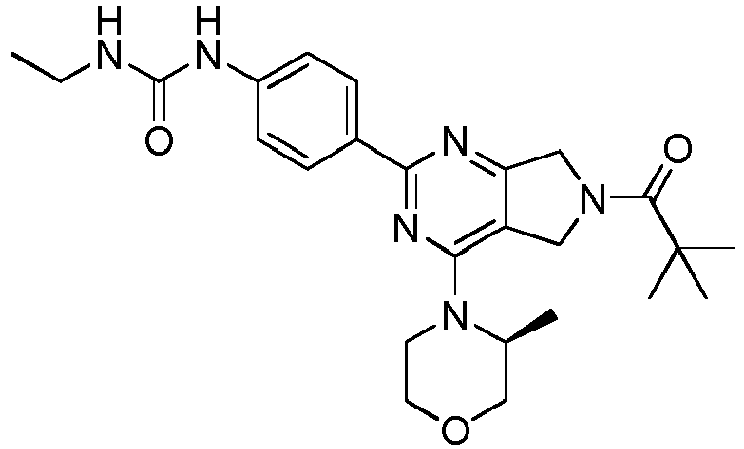
- Method as described for example 17 using example 7 and pivalic acid as starting materials. Purified by prep HPLC (low pH).
1H NMR (d6-DMSO) 8.69 (s, 1H), 8.18 (d, 2H), 7.48 (d, 2H), 6.19 (t, 1H), 4.86 (br s, 1H), 4.42 (br s, 1H), 4.14 (br d, 1H), 3.97 (dd, 1H), 3.76 (d, 1H), 3.69-3.65 (m, 1H), 3.15-3.08 (m, 2H), 1.28-1.26 (m, 12H), 1.06 (t, 3H).
LCMS (method A), (M+H+) 467, Rt = 8.00 min. -
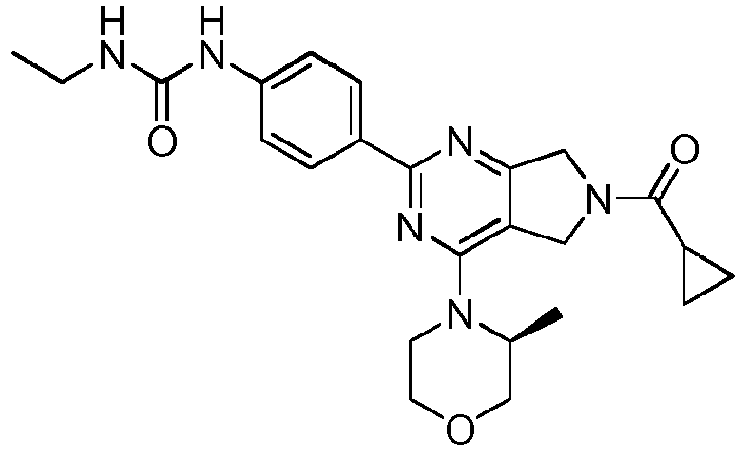
- Method as described for example 17 using example 7 and cyclopropanecarboxylic acid as starting materials. Purified by prep HPLC (low pH).
1H NMR (d6-DMSO) 8.68 (s, 1H), 8.19 (d, 2H), 7.48 (d, 2H), 6.19-6.16 (m, 1H), 5.17 (dd, 1H), 4.88 (s, 1H), 4.85-4.73 (m, 1H), 4.46 (s, 1H), 4.15 (br d, 1H), 3.96 (d, 1H), 3.74 (d, 1H), 3.70-3.64 (m, 1H), 3.56-3.48 (m, 1H), 3.15-3.08 (m, 2H), 2.06-1.88 (m, 1H), 1.28-1.25 (m, 3H), 1.06 (t, 3H), 0.82-0.80 (m, 4H).
LCMS (method A), (M+H+) 451, Rt = 7.19 min. -

- Method as described for example 17 using example 13 and 4-fluorobenzoic acid as starting materials, DCM as solvent and NEt3 as base. Purified by flash chromatography (5-10% MeOH in DCM).
1H NMR (CDCl3/CD3OD) 8.17 (dd, 2H), 7.58 (br s, 2H), 7.43 (dd , 2H), 7.22 (t, 2H), 4.65 (br s, 1H), 4.16 (br s, 1H), 4.06 (br s, 1H), 3.95 (dd, 1H), 3.83 (d, 2H), 3.64-3.78 (m, 4H), 3.57 (dd, 2H), 3.24 (br q, 2H), 2.80 (br s, 2H), 1.37 (d, 3H), 1.56 (t, 3H).
LCMS (method A), (M+H+) 519, Rt = 7.71 min. -

- (S)-4-(2-chloro-6-neopentyl-6,7-dihydro-5H-pyrrolo[3,4-d]pyrimidin-4-yl)-3-methylmorpholine (intermediate 7) (assumed 0.56 mmol) was stirred in CPME:EtOH:Water (7:3:2, freshly mixed, 2 mL) with 1-cyclopropyl-3-(4-(4,4,5,5-tetramethyl-1,3,2-dioxaborolan-2-yl)phenyl)urea (203 mg, 0.67 mmol), Pd(PPh3)2Cl2 (20 mg, 0.028 mmol) and Na2CO3 (89 mg, 0.84 mmol) under a stream of nitrogen for 5 min, then irradiated in the microwave at 130 °C for 30 min. The reaction mixture was diluted with water and EtOAc and passed through a celite cartridge. The organic layer was concentrated in vacuo and purified by prep HPLC to give the desired compound as a yellow solid (48 mg, 0.103 mmol, 18 % yield over three steps).
1H NMR (d6-DMSO) 8.53 (s, 1H), 8.17 (d, 2H), 7.47 (d, 2H), 6.45 (d, 1H), 4.36 (br s, 1H), 4.26 (d, 1H), 4.04 (d, 1H), 3.95-3.92 (m, 3H), 3.72 (d, 1H), 3.65 (dd, 1H), 3.49 (td, 1H), 3.31 (td, 1H), 2.58-2.53 (m, 3H), 1.24 (d, 3H), 0.93 (s, 9H), 0.66-0.61 (m, 2H), 0.43-0.39 (m, 2H). LCMS (method A), (M+H+) 465, Rt = 5.97 min. -

- To a solution of (S)-1-ethyl-3-(4-(4-(3-methylmorpholino)-6,7-dihydro-5H-pyrrolo[3,4-d]pyrimidin-2-yl)phenyl)urea (example 7) (150 mg, 0.36 mmol) in THF (3 mL) was added aqueous formaldehyde 37Wt% (58 µL, 0.72 mmol) and Et3N (149 µL, 1.07 mmol). The reaction mixture was then stirred at room temperature (20 °C) for 1h. After this time sodium triacetoxyborohydride (152 mg, 0.72 mmol) was added and stirring at room temperature (20 °C) continued for 18 h. The crude reaction mixture was then partitioned between water and EtOAc, the phases separated and the organic layer washed with NaHCO3 and brine, dried over magnesium sulfate, filtered and the solvent removed in vacuo. The residue was purified by prep HPLC (low pH) to give as a light brown solid (48 mg, 33%).
1H NMR (d6-DMSO) 8.67 (s, 1H), 8.17 (d, 2H), 7.46 (d, 2H), 6.18 (t, 1H), 4.30 (br s, 1H), 4.02 (dd, 3H), 3.95-3.91 (m, 1H), 3.72 (br s, 2H), 3.70 (br s, 1H), 3.66-3.63 (m, 1H), 3.52-3.46 (m, 2H), 3.14-3.07 (m, 2H), 1.24 (d, 3H), 1.05 (t, 3H).
LCMS (method A), (M+H+) 397, Rt = 5.09 min. -

- To a solution of (S)-1-ethyl-3-(4-(4-(3-methylmorpholino)-5,6,7,8-tetrahydropyrido[3,4-d]pyrimidin-2-yl)phenyl)urea (130 mg, 0.33 mmol) in DMF (2.5 mL) was added bromoethane (29 µL, 0.39 mmol) and DIPEA (69 µL, 0.39 mmol). The reaction mixture was then heated by microwave at 100 °C for 1 h. The crude reaction mixture was then partitioned between water and EtOAc, the phases separated and the organic layer washed with NaHCO3 and brine, dried over magnesium sulfate, filtered and the solvent removed in vacuo. The residue was purified by flash chromatography (2-10% MeOH/DCM) to give a light brown solid (79 mg, 57%).
1H NMR (CDCl3) 8.32 (d, 2H), 7.36 (d, 2H), 6.41 (s, 1H), 4.75 (t, 1H), 4.20-4.05 (m, 1H), 3.95 (d, 1H), 3.82 (d, 2H), 3.73 (td, 1H) 3.67 (dd, 1H), 3.47-3.64 (m, 3H), 3.31 (qn, 2H), 2.67-2.85 (m, 3H), 2.53-2.67 (m, 3H), 1.31 (d, 3H), 1.22 (t, 3H), 1.16 (t, 3H).
LCMS (method A), (M+H+) 425, Rt = 5.14 min. -

- Method as described for example 26 using example 7 and 2-cyclopropylacetaldehyde as starting materials. Purified by prep HPLC (high pH).
1H NMR (d6-DMSO) 8.66 (s, 1H), 8.17 (d, 2H), 7.46 (d, 2H), 6.17 (t, 1H), 4.36 (br s, 1H), 4.14-4.04 (m, 3H), 3.93 (dd, 1H), 3.81 (br s, 2H), 3.65 (dd, 1H), 3.49 (td, 1H), 3.15-3.08 (m, 2H), 2.55 (d, 2H), 1.24 (d, 3H), 1.07-1.04 (m, 3H), 0.99-0.92 (m, 1H), 0.52-0.48 (m, 2H), 0.19-0.16 (m, 2H).
LCMS (method A), (M+H+) 437, Rt = 5.45 min. -

- Method as described for example 27 using example 7 and 4-fluorobenzylbromide as starting materials. Purified by prep HPLC (low pH).
1H NMR (d6-DMSO) 8.67 (s, 1H), 8.16-8.14 (m, 2H), 7.46-7.40 (m, 2H), 7.20-7.15 (m, 2H), 6.18 (t, 1H), 4.33 (br s, 1H), 4.13-3.99 (m, 3H), 3.93-3.87 (m, 3H), 3.74 (s, 2H), 3.70 (d, 1H), 3.62 (dd, 1H), 3.50-3.43 (m, 2H), 3.30-3.25 (m, 1H), 3.13-3.07 (m, 2H), 1.22 (d, 3H), 1.04 (t, 3H).
LCMS (method A), (M+H+) 491, Rt = 6.15 min. -

- Method as described for example 26 using example 3 and 2-cyclopropylacetaldehyde as starting materials. Purified by prep HPLC (low pH).
1H NMR (d6-DMSO) 8.52 (s, 1H), 8.17 (d, 2H), 7.47 (d, 2H), 6.44 (br d, 1H), 4.37 (br d, 1H), 4.10 (dd, 3H), 3.94 (dd, 1H), 3.82 (s, 1H), 3.72 (d, 1H), 3.65 (dd, 1H), 3.50 (td, 1H), 3.32 (td, 1H), 2.57-2.54 (m, 2H), 1.25 (d, 3H), 1.00-0.90 (m, 1H), 0.66-0.62 (m, 2H), 0.52-0.48 (m, 2H), 0.43-0.39 (m, 2H), 0.20-0.16 (m, 2H).
LCMS (method A), (M+H+) 449, Rt = 5.38 min. -

- Method as described for example 26 using example 13 and 4-fluorobenzaldehyde as starting materials and DCM as solvent. Purified by flash chromatography (silica, 10 g, 50-100% EtOAc in petroleum ether (40-60)).
1H NMR (CDCl3) 8.29 (d, 2H), 7.33-7.38 (m, 4H), 7.03 (t, 2H), 6.34 (s, 1H), 4.70 (t, 1H), 4.08 (d, 1H), 3.94 (d, 1H), 3.81 (dd, 1H) 3.56-3.78 (m, 7H), 3.57 (ddd, 1H), 3.31 (q, 2H), 2.75-2.83 (m, 1H), 2.67-2.74 (br m, 2H), 2.53-2.62 (m, 1H), 1.31 (d, 3H), 1.1 6 (t, 3H).
LCMS (method A), (M+H+) 505, Rt = 6.13 min. -
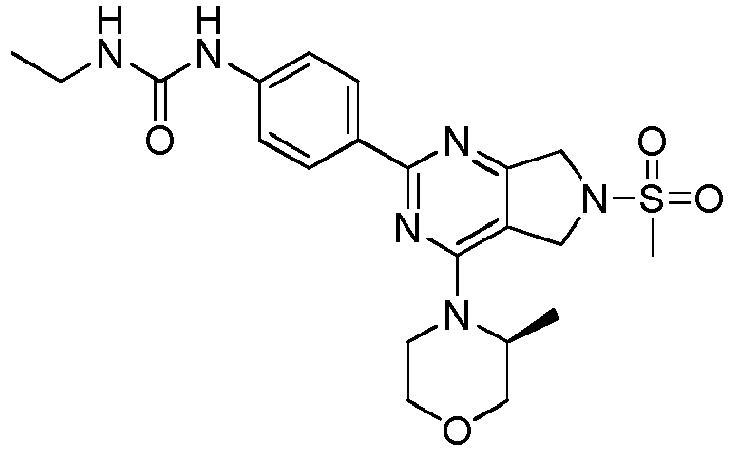
- To a stirred solution of (S)-1-ethyl-3-(4-(4-(3-methylmorpholino)-6,7-dihydro-5H-pyrrolo[3,4-d]pyrimidin-2-yl)phenyl)urea (example 7) (60 mg, 0.16 mmol) in MeCN (1.5 mL) was added triethylamine (64 uL, 0.47 mmol) and methane sulfonyl chloride (36 uL, 0.47 mmol). The reaction mixture was stirred overnight at room temperature and concentrated in vacuo. The residue was partitioned between water and ethyl acetate. The organic layer was concentrated and the product isolated by Prep HPLC (low pH) as an off white/ pink solid (36 mg, 0.078 mmol, 49% yield).
1H NMR (d6-DMSO) 8.72 (s, 1H), 8.17 (d, 2H), 7.47 (d, 2H), 6.20 (t, 1H), 4.88 (d, 1H), 4.76 (d, 1H), 4.50 (br s, 2H), 3.97-3.93 (m, 1H), 3.74 (d, 1H), 3.67-3.63 (m, 1H), 3.53-3.47 (m, 1H), 3.12-3.07 (m, 2H), 3.06 (s, 3H), 1.27 (d, 3H), 1.05 (t, 3H).
LCMS (method A), (M+H+) 461, Rt = 7.51 min. -

- To a solution of (S)-1-cyclopropyl-3-(4-(4-(3-methylmorpholino)-6,7-dihydro-5H-pyrrolo[3,4-d]pyrimidin-2-yl)phenyl)urea (example 3) (50 mg 0.13 mmol) in dioxane (3 mL) at room temperature (20 °C) was added ethyl isocyanate (20uL 0.26 mmol). The reaction mixture was stirred for 16 h. The solvent was removed in vacuo and the solid residue triturated with ether. The solid was collected by filtration and dried in vacuo to afford (32 mg 55%).
1H NMR (d6-DMSO) 8.53 (s, 1H), 8.18 (d, 2H), 7.48 (d , 2H), 6.45-6.41 (m, 2H), 4.71 (q, 2H), 4.45-4.35 (m, 1H), 4.42 (2, 2H), 4.28-4.10 (br m, 1H), 3.96 (br d, 1H), 3.75 (d, 1H), 3.67 (d, 1H), 3.52 (t, 1H), 3.34 (br t, 1H), 3.13 (qn, 2H), 2.60-2.52 (br m, 1H), 1.27 (d, 3H), 1.08 (t, 3H), 0.66-0.62(m, 2H), 0.43-0.39 (m, 2H).
LCMS (method B), (M+H+) 466, Rt = 2.03 min -

- To a solution of (S)-1-cyclopropyl-3-(4-(4-(3-methylmorpholino)-6,7-dihydro-5H-pyrrolo[3,4-d]pyrimidin-2-yl)phenyl)urea (example 3) (50 mg 0.13 mmol) in dioxane (3 mL) at room temperature (20°C) was added sodium hydrogencarbonate (22 mg 0.26 mmol) followed by ethyl chloroformate (14 uL 0.15 mmol). The reaction mixture was stirred for 16 h. The solvent was removed in vacuo and the residue partitioned between DCM and water. The organic phase was passed through a 1 micron PTFE filter to dry and then evaporated in vacuo to afford (38 mg 64%).
1H NMR (d6-DMSO) 8.54 (s, 1H), 8.18 (d, 2H), 6.44 (d , 1H), 4.87-4.72 (m, 2H), 4.47 (d, 2H), 4.38 (br s, 1H), 4.17-4.12 (m, 3H), 3.96 (d, 1H), 3.75 (d, 1H) 3.66 (d, 1H), 3.51 (t, 1H), 3.34(t, 1H), 2.58-2.52 (m, 1H), 1.27-1.22 (m, 6H),0.66-0.61 (m, 2H), 0.43-0.39 (m, 2H).
LCMS (method B), (M+H+) 467, Rt = 2.26 min -

- Method as described for example 26 using example 13 and formaldehyde as starting materials. Purified by flash chromatography (silica, 10 g, 5% MeOH in DCM).
1H NMR (CDCl3) 8.33 (d, 2H), 7.36 (d, 2H), 6.29 (s, 1H), 4.68 (t, 1H), 4.15-4.05 (m, 1H), 3.95 (dt, 1H), 3.83 (dd, 1H), 3.80-3.70 (m, 2H) 3.68 (dd, 1H), 3.59-3.47 (m, 3H), 3.37-3.28 (m, 2H), 2.81-2.65 (m, 3H), 2.54 (m, 1H), 2.49 (s, 3H), 1.30 (d, 3H), 1.17 (t, 3H).
LCMS (method A), (M+H+) 411, Rt = 5.13 min. -

- Method as described for example 27 using example 3 and bromoethane as starting materials, Product isolated by Prep HPLC (low pH).
1H NMR (d6-DMSO) 8.55 (s, 1H), 8.17 (d, 2H), 7.47 (d, 2H), 6.47 (br s, 1H), 4.37 (br s, 1H), 4.08 (d, 2H), 4.00 (d, 1H), 3.93 (dd, 1H), 3.80-3.60 (m, 4H) 3.48 (td, 2H), 2.77-2.65 (m, 2H), 2.58-2.53 (m, 1H), 1.25 (d, 3H), 1.12 (t, 3H), 0.68-0.60 (m, 2H), 0.45-0.39 (m, 2H).
LCMS (method A), (M+H+) 423, Rt = 5.60 min. -

- Method as described for example 26 using example 13 and 2-cyclopropylacetaldehyde as starting materials and using DCM as solvent.
1HNMR(CDCl3) 8.33 (d, 2H), 7.36 (d, 2H), 6.41 (s, 1H), 4.75 (t, 1H), 4.15-4.05 (m, 1H), 3.98-3.88 (m, 2H), 3.81 (dd, 1H), 3.75 (dd, 1H), 3.73-3.57 (m, 3H) 3.56-3.50 (m, 1H), 3.36-3.27 (m, 2H), 2.92-2.84 (m, 1H), 2.83-2.68 (m, 2H), 2.68-2.59 (m, 1H), 2.53-2.40 (m, 2H), 1.31 (d, 3H), 1.16 (t, 3H), 1.05-0.94 (m, 1H), 0.60 (dd, 2H), 0.22 (dd, 2H).
LCMS (method A), (M+H+) 451, Rt = 5.51 min. -

- Method as described for example 26 using example 3 and formaldehyde as starting materials. Purified by Prep HPLC (low pH).
1H NMR (d6-DMSO) 8.51 (s, 1H), 8.17 (d, 2H), 7.47 (d, 2H), 6.44 (br d, 1H), 4.35 (br s, 1H), 4.12-3.95 (m, 3H), 3.93 (dd, 1H), 3.80-3.60 (m, 4H) 3.49 (td, 2H), 2.58-2.53 (m, 1H), 1.25 (d, 3H), 0.67-0.61 (m, 2H), 0.44-038 (m, 2H).
LCMS (method A), (M+H+) 409, Rt = 5.15 min. -

- Method as described for example 27 using example 7 and bromoethane as starting materials. Purified by Prep HPLC (low pH).
1HNMR(CDCl3) 8.33 (s, 1H), 8.14 (d, 2H), 7.29 (d, 2H), 7.16 (br s, 1H), 4.38 (q, 2H), 4.26 (br s 1H), 4.12 (s 2H), 4.00 (dd, 2H), 3.78 (s, 2H) 3.65 (td, 1H), 3.40 (td, 1H), 3.31 (q, 2H), 3.05 (q, 2H) 1.37-1.29 (m, 6H), 1.17 (t, 3H).
LCMS (method A), (M+H+) 411, Rt = 5.19 min. -

- Method as described for example 26 using example 15 and Cyclopropanecarboxaldehyde as starting materials and DCM as solvent.
1HNMR(CDCl3) 8.33 (d, 2H), 7.49 (d, 2H), 6.96 (s, 1H), 4.89 (s, 1H), 4.15-4.05 (m, 1H), 3.98-3.88 (m, 2H), 3.82 (dd, 1H), 3.75 (dd, 1H), 3.73-3.57 (m, 3H) 3.56-3.50 (m, 1H), 2.93-2.85 (m, 1H), 2.82-2.70 (m, 2H), 2.69-2.58 (m, 2H), 2.54-2.40 (m, 2H), 1.31 (d, 3H), 1.05-0.94 (m, 1H), 0.91-0.84 (m, 2H), 0.72-0.66 (m, 2H), 0.64-0.56 (m, 2H), 0.26-0.16 (m, 2H).
LCMS (method A), (M+H+) 463, Rt = 5.57 min. -

- Method as described for example 26 using example 15 and pivaldehyde as starting materials and DCM as solvent.
1HNMR(CDCl3) 8.31 (d, 2H), 7.48 (d, 2H), 6.95 (s, 1H), 4.89 (s, 1H), 4.15-4.05 (m, 1H), 3.94 (dt, 1H), 3.90-3.80 (m, 2H), 3.80-3.70 (m, 2H), 3.70-3.57 (m, 2H) 3.58-3.47 (m, 1H), 2.84-2.75 (m, 1H), 2.74-2.69 (m, 3H), 2.68-2.60 (m, 1H), 2.29 (s, 2H), 1.34 (d, 3H), 0.94 (s, 9H), 0.90-0.83 (m, 2H), 0.72-0.66 (m, 2H).
LCMS (method A), (M+H+) 479, Rt = 6.12 min. -

- Method as described for example 26 using example 15 and iso-butyraldehyde as starting materials and DCM as solvent.
1H NMR (CDCl3) 8.31 (d, 2H), 7.48 (d, 2H), 6.95 (s, 1H), 4.88 (s, 1H), 4.15-4.05 (m, 1H), 3.94 (dt, 1H), 3.82 (dd, 1H), 3.78-3.62 (m, 3H), 3.61-3.47 (m, 3H) 2.79-2.67 (m, 3H), 2.67-2.59 (m, 1H), 2.59-2.50 (m, 1H), 2.30 (d, 2H), 2.02-1.87 (m, 1H), 1.33 (d, 3H), 0.96 (d, 6H), 0.90-0.83 (m, 2H), 0.72-0.66 (m, 2H).
LCMS (method A), (M+H+) 465, Rt = 5.65 min. -

- Method as described for example 26 using example 15 and acetone as starting materials and DCM as solvent.
1H NMR (CDCl3) 8.32 (d, 2H), 7.48 (d, 2H), 6.96 (s, 1H), 4.89 (s, 1H), 4.15-4.05 (m, 1H), 3.95 (dt, 1H), 3.86-3.78 (m, 2H), 3.78-3.67 (m, 2H), 3.66-3.58 (m, 2H), 3.55-3.47 (m, 1H), 2.99-2.86 (m, 1H), 2.86-2.80 (m, 1H), 2.75-2.70 (br m, 2H), 2.66-2.58 (m, 2H), 1.31 (d, 3H), 1.17 (d, 6H), 0.90-0.80 (m, 2H), 0.72-0.66 (m, 2H).
LCMS (method A), (M+H+) 451, Rt = 5.50 min. -

- Method as described for example 17 using example 3 and isobutyric acid. Purified by prep HPLC (low pH).
1H NMR (d6-DMSO) 8.59 (s, 1H), 8.19 (dd, 2H), 7.49 (dd, 2H), 6.50-6.48 (m, 1H), 5.05 (dd, 1H), 4.84-4.72 (m, 2H), 4.45 (br s, 1H), 4.40 (br s, 1H), 4.17-1.09 (m, 1H), 3.96 (br d, 1H), 3.75 (br d, 1H), 3.69-3.65 (m, 1H), 3.55-3.48 (m, 2H), 2.58-2.53 (m, 1H), 1.27 (d, 3H), 1.07 (d, 6H), 0.66-0.62 (m, 2H), 0.43-0.39 (m, 2H).
LCMS (method A), (M+H+) 465, Rt = 7.51 min. -

- Method as described for example 17 using example 3 and pivalic acid as starting materials. Purified by prep HPLC (low pH).
1H NMR (d6-DMSO) 8.55 (s, 1H), 8.19 (d, 2H), 7.49 (d, 2H), 6.46 (d, 1H), 4.86 (br s, 2H), 4.43 (br s, 1H), 4.15 (br d, 1H), 3.97 (dd, 1H), 3.76 (d, 1H), 3.67 (dd, 1H), 3.52 (td, 1H), 3.40-3.36 (m, 1H), 2.58-2.53 (m, 1H), 1.28-1.26 (m, 12H), 0.66-0.62 (m, 2H), 0.43-0.39 (m, 2H).
LCMS (method A), (M+H+) 479, Rt = 8.31 min. -

- Method as described for example 26 using example 3 and acetone as starting materials. Purified by prep HPLC (low pH).
1H NMR (d6-DMSO) 8.59 (s, 1H), 8.17 (d, 2H), 7.48 (d, 2H), 6.51 (d, 1H), 4.40 (br s, 2H), 4.03 (d, 1H), 3.94 (dd, 1H), 3.81 (br s, 2H), 3.72 (d, 1H), 3.65 (dd, 1H), 3.50 (td, 1H), 3.32 (td, 1H), 2.58-2.76 (m, 1H), 2.58-2.53 (m, 1H), 1.25 (d, 3H), 1.13 (d, 6H), 0.66-0.62 (m, 2H), 0.43-0.40 (m, 2H).
LCMS (method A), (M+H+) 437, Rt = 5.41 min. -

- To a stirring solution of (S)-4-(2-chloro-6,7-dihydro-5H-pyrrolo[3,4-d]pyrimidin-4-yl)-3-methylmorpholine hydrochloride (intermediate 6) (870 mg, 3.01 mmol) in dichloroethane, was added cyclopropanecarboxaldehyde (450 uL, 6.02 mmol) and Et3N (840 uL,6.02 mmol). The reaction mixture was stirred at room temperature (20 °C) for 45 minutes, before adding sodium triacetoxy borohydride (1.28 g, 6.02 mmol). The reaction mixture was then stirred for a further 2 h at room temperature (20 °C) before partitioning between saturated NaHCO3 solution and DCM. The organic layer was recovered, dried over MgSO4, filtered and the solvent removed in vacuo, affording the title compound as a colourless oil (882 mg, 92% yield).
1H NMR (CDCl3) 4.08 (br s, 1H), 3.91-3.89 (m, 2H), 3.84-3.5 (dd, 2H), 3.69-3.67 (m, 2H), 3.52 (d, 1H), 3.39-3.32 (m, 1H), 3.25-3.16 (m, 1H), 2.43-2.38 (m, 2H), 1.16 (d, 3H), 0.81-0.69 (m, 1H), 0.43-0.35 (m,2H), 0.26-0.01 (m, 2H).
LCMS (Method B), (M+H+) 309, Rt= 1.26 min -

- To a solution of (S)-4-(2-chloro-6-(cyclopropylmethyl)-6,7-dihydro-5H-pyrrolo[3,4-d]pyrimidin-4-yl)-3-methylmorpholine (intermediate 8) (50 mg, 0.16 mmol) and 1-methyl-3-(4-(4,4,5,5-tetramethyl-1,3,2-dioxaborolan-2-yl)phenyl)urea (407 mg, 0.39 mmol) in DME/EtOH/H2O (7:3:2) (5 mL) was added Pd(PPh3)2(Cl)2 (7 mg, 0.008 mmol) and Na2CO3 (26 mg, 0.24mmol). The reaction mixture was then heated by microwave at 130 °C for 30 minutes. The crude reaction mixture was then partitioned between water and EtOAc, the organic layer recovered, dried over MgSO4, filtered and the solvent removed in vacuo. The residue was purified by prep. LCMS (low pH).. The solvent was removed in vacuo. The residue was then re-purified by Flash SCX2 column chromatography, affording the title compound as a white solid (34.8 mg, 51 % yield).
1H NMR (CD3OD) 8.33 (s, 1H), 8.22 (d, 2H), 7.48 (d, 2H), 4.57-4.45 (m, 3H), 4.23 (br s, 2H), 4.05-4.01 (dd, 1H), 3.82 (br s, 1H), 3.79 (d, 1H), 3.68-3.60 (m, 1H), 3.52-3.45 (m, 1H), 2.99 (d, 2H), 2.81 (s, 3H), 1.39 (d, 3H),1.26 (br s, 1H),1.21-1.09 (m, 1H), 0.75-0.68 (m, 2H), 0.41-0.37 (m, 2H).
LCMS (Method A), (M+H+) 423, Rt= 5.29 min. -

- Method as described for example 47 using intermediate 8 and 1-(4-(4,4,5,5-tetramethyl-1,3,2-dioxaborolan-2-yl)phenyl)urea as starting materials. Purified by prep. LCMS (high pH) and (low pH).
1H NMR (CD3OD) 8.26 (br s, 1H), 7.95 (d, 2H), 7.64 (d, 1H), 7.39 (d, 2H), 7.16 (d, 1H), 3.91 (d, 3H), 3.73-3.68 (d, 1H), 3.65-3.60 (dd, 1H), 3.54-3.46 (m, 2H), 1.33 (d, 3H), 1.22-1.11 (m, 1H), 0.52-0.45 (m, 2H), 0.32-0.27 (m, 2H).
LCMS (Method A), (M+H+) 423, Rt= 4.78 min. -

- Method as described for example 47 using intermediate 8 and 1-propyl-3-(4-(4,4,5,5-tetramethyl-1,3,2-dioxaborolan-2-yl)phenyl)urea as starting materials. Purified by prep. LCMS (low pH).
1H NMR (CD3OD) 8.38 (br s, 1H), 8.12-8.07 (d, 2H), 7.38-7.32 (d, 2H), 4.43-4.28 (br s, 1H), 4.22-4.11 (m, 2H), 4.11-4.02 (m, 2H), 3.97-3.85 (m, 3H), 3.73-3.63 (m, 2H), 3.60-3.44 (m, 1H), 3.40-3.30 (m, 1H), 3.07 (t, 2H), 2.65 (d, 2H), 1.87 (s, 2H), 1.52-1.39 (m, 2H), 1.27 (d, 3H), 0.98-0.91 (m, 1H), 0.87 (t, 3H), 0.57-0.50 (m, 2H), 0.23-0.16 (m, 2H).
LCMS (Method A), (M+H+) 451, Rt= 5.98 min. -

- Method as described for example 47 using intermediate 8 and 1-isopropyl-3-(4-(4,4,5,5-tetramethyl-1,3,2-dioxaborolan-2-yl)phenyl)urea as starting materials. Purified by prep. LCMS (low pH).
1HNMR (CD3OD) 8.09 (d, 2H), 7.34 (d, 2H), 4.41-4.29 (br s, 1H), 4.15-4.03 (m, 3H), 4.03-4.86 (m, 1H), 3.90 (dd, 1H), 3.85 (dd, 2H), 3.83-3.75 (m, 1H), 3.73-3.63 (m, 2H), 3.57-3.47 (m, 1H), 3.40-3.29 (m, 1H), 2.59 (d, 2H), 1.91 (s, 1H), 1.27 (d, 3H), 1.14-1.11 (m, 1H), 1.06 (d, 6H), 0.97-0.87 (m, 1H), 0.55-0.47 (m, 2H), 0.21-0.14 (m, 2H).
LCMS (Method A), (M+H+) 451, Rt= 5.75 min -

-
Step 1 Method as intermediate 7 using formaldehyde as starting material. -
Step 2 Method as intermediate 5, using 4-(4,4,5,5-tetramethyl-1,3,2-dioxaborolan-2-yl)aniline and (S)-4-(2-chloro-6-methyl-6,7-dihydro-5H-pyrrolo[3,4-d]pyrimidin-4-yl)-3-methylmorpholine. The crude reaction mixture was partitioned between water and EtOAc, the phases separated and the organic layer dried over magnesium sulphate, filtered and the solvent removed in vacuo. The residue was purified by flash chromatography (0-15% MeOH/DCM), to yield a pale yellow oil (477 mg, 72%).
1HNMR (CDCl3) 8.12 (d, 2H), 6.63 (d, 2H), 4.32-4.21 (br s, 1H), 4.11-3.89 (m, 4H), 3.87-3.74 (m, 4H), 3.59-3.47 (m, 1H), 3.39-3.28 (m, 1H), 2.99 (s, 3H), 1.82-1.75 (m, 1H), 1.27 (d, 3H).
LCMS (Method B), (M+H+) 325, Rt= 0.81 min -

- To a stirring solution of (S)-4-(6-methyl-4-(3-methylmorpholino)-6,7-dihydro-5H-pyrrolo[3,4-d]pyrimidin-2-yl)aniline (intermediate 9) (311 mg, 0.96 mmol) and NaHCO3 (120 mg, 1.43 mmmol) in dry THF , was added phenyl chloroformate (133 µL, 1.05 mmol) dropwise. The reaction mixture was stirred at room temperature (200C) for 2 hours, before partitioning the crude reaction mixture between water and EtOAc. The phases were separated and the organic layer dried over magnesium sulphate, filtered and then reduced in vacuo, affording the title compound as a pink solid (425mg, 100%).
LCMS (Method B), (M+H+) 446, Rt= 1.95 min -

- To a stirring solution of (S)-phenyl 4-(6-methyl-4-(3-methylmorpholino)-6,7-dihydro-5H-pyrrolo[3,4-d]pyrimidin-2-yl)phenylcarbamate (intermediate 10)(50 mg, 0.12 mmol) in dry DMF, was added Et3N (51 µL, 0.36 mmol) and 3-aminopropan-l-ol (42 µL, 0.56 mmol). The reaction mixture was then heated at 50 °C for 2 hours. The solvent was then removed in vacuo and the crude residue was purified by prep. LCMS (high pH)affording the title compound as clear oil (12.5 mg, 0.029 mmol, 26%).
1HNMR (CD3OD) 8.17 (d, 2H), 7.48 (d, 2H), 4.45 (br s, 1H), 4.24-4.06 (m, 3H), 4.06-3.98 (m, 1H), 3.93-3.73 (m, 4H), 3.72-3.57 (m, 3H), 3.51-3.39 (m, 1H), 3.35 (d, 1H), 2.64 (s, 3H), 1.83-1.72 (m, 2H), 1.38 (d, 3H).
LCMS (Method A), (M+H+) 426, Rt= 4.70 min. -

- Method as described for example 51 using intermediate 10 and 4-fluoroaniline as starting materials. Purified by prep. LCMS (high pH).
1H NMR 8.35 (br s, 1H), 8.27, (d, 2H), 7.53, (d, 2H), 7.48-7.43 (m, 2H), 7.10-7.02 (m, 2H), 4.45 (br s, 1H), 4.38-4.27 (m, 2H), 4.17 (br d, 1H), 4.10-3.99 (m, 3H), 3.86-3.75 (m, 2H), 3.68-3.59 (m, 1H), 3.53-3.43 (m, 1H), 2.77 (s, 3H), 1.39 (d, 3H),
LCMS (Method A), (M+H+) 463, Rt= 6.21 min. -

- Method as described for example 51 using intermediate 10 and 3-methoxypropylamine as starting materials. Purified by prep. LCMS (high pH).
1H NMR (CD3OD) 8.38 (br s, 1H), 8.21 (d, 2H), 7.47 (d, 2H), 4.49-4.40 (br s, 1H), 4.32-4.22 (m, 2H), 4.21-4.13 (m, 1H), 4.06-3.97 (m, 3H), 3.85-3.74 (m, 2H), 3.68-3.58 (m, 1H), 3.54-3.43 (m, 3H), 2.74 (s, 3H), 1.86-1.75 (m, 2H), 1.39 (d, 3H),
LCMS (Method B), (M+H+) 440, Rt=1.63min. -

- Method as described for example 51 using intermediate 10 and N1,N1-dimethylethane-1,2-diamine as starting materials. Purified by prep. LCMS (high pH).
1H NMR (CD3OD) 8.21 (d, 2H), 7.48 (d, 2H), 4.44 (br s, 1H), 4.24-4.06 (m, 3H), 4.06-3.98 (m, 1H), 3.92-3.73 (m, 4H), 3.69-3.57 (m, 1H), 3.50-3.40 (m, 1H), 3.39-3.33 (t, 2H), 2.63 (s, 3H), 2.51 (t, 2H), 2.31 (s, 6H), 1.39 (d, 3H)
LCMS (Method A), (M+H+) 439, Rt= 7.71 min. -

- Method as described for example 51 using intermediate 10 and cyclobutanamine as starting materials. Purified by prep. LCMS (high pH).
1H NMR(CD3OD) 8.36 (br s, 1H), 8.20 (d, 2H), 7.45 (d, 2H), 4.48-4.32 (m, 3H), 4.31-4.19 (m, 1H), 4.19-3.97 (m, 4H), 3.86-3.72 (m, 2H), 3.68-3.58 (m, 1H), 3.52-3.40 (m, 1H), 2.83 (s, 3H), 2.40-2.28 (m, 2H), 2.01-1.88 (m, 2H), 1.80-1.67 (m, 2H), 1.38 (d, 3H).
LCMS (Method A), (M+H+) 422, Rt= 5.63 min. -

- To a stirred solution of (S)-1-ethyl-3-(4-(4-(3-methylmorpholino)-5,6,7,8-tetrahydropyrido[3,4-d]pyrimidin-2-yl)phenyl)
urea
1H NMR (d6-DMSO) 8.66 (s, 1H), 8.18 (d, 2H), 7.48 (d, 2H), 6.17 (t, 1H), 4.86 (br dd, 1H), 4.58 (br dd, 1H), 4.16-4.10 (m, 1H), 3.98-3.34 (m, 8H), 3.12 (q, 2H), 2.80-2.74 (m 1H), 2.69-2.57 (m, 1H), 2.14-2.07 (m, 1H), 1.26 (d, 3H), 1.06 (t, 3H), 0.78-0.76 (m, 4H).
LCMS (method A), (M+H+) 465, Rt = 6.46 min. -
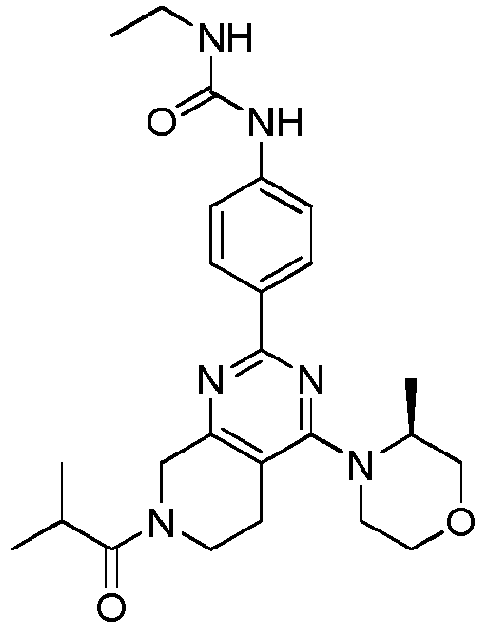
- Method as described for example 56 using example 13 TFA salt and isobutyryl chloride as starting materials. The reaction mixture was concentrated and purified by prep. HPLC to give a white solid (19 mg, 0.04 mmol, 21% yield).
1H NMR (d6-DMSO) 8.66 (s, 1H), 8.18 (d, 2H), 7.48 (d, 2H), 6.17 (t, 1H), 4.75-4.45 (m, 2H), 4.17-4.08 (m, 1H), 3.87 (d, 1H), 3.81-3.37 (m, 7H), 3.12 (q, 2H), 3.04-2.95 (m 1H), 2.77-2.70 (m, 1H), 2.64-2.57 (m, 1H), 1.26 (d, 3H), 1.08-1.03 (m, 9H).
LCMS (method A), (M+H+) 467, Rt = 6.65 min. -

- Method as described for example 56 using example 13 TFA salt and pivoyl chloride as starting materials The reaction mixture was concentrated and purified by prep. HPLC to give a white solid (7 mg, 0.01 mmol, 7% yield).
1H NMR (d6-DMSO) 8.68 (s, 1H), 8.17 (d, 2H), 7.49 (d, 2H), 6.17 (t, 1H), 4.70-4.53 (m, 2H), 4.22-4.13 (m, 1H), 3.89-3.38 (m, 10H), 3.12 (q, 2H), 2.73-2.65 (m, 2H), 1.28-1.26 (m 9H), 1.06 (t, 3H).
LCMS (method A), (M+H+) 481, Rt = 7.01 min. -

- Method as described for example 56 using example 13 TFA salt and acetyl chloride as starting materials The reaction mixture was concentrated and purified by prep. HPLC to give a white solid (20 mg, 0.05 mmol, 23% yield).
1H NMR (d6-DMSO) 8.79 (d, 1H), 8.18 (d, 2H), 7.49 (d, 2H), 6.34-6.29 (m, 1H), 4.69-4.44 (m, 2H), 4.12-4.10 (m, 1H), 3.90-3.87 (m, 1H), 3.82-3.51 (m, 7H), 3.15-3.09 (q, 2H), 2.76-2.74 (m 1H), 2.67-2.57 (m, 1H), 2.13 (s, 3H), 1.26 (t, 3H), 1.06 (t, 3H).
LCMS (method A), (M+H+) 439, Rt = 5.95 min. -

- To a stirred solution of (S)-1-cyclopropyl-3-(4-(4-(3-methylmorpholino)-5,6,7,8-tetrahydropyrido[3,4-d]pyrimidin-2-yl)phenyl)
urea
1H NMR (d6-DMSO) 8.54 (s, 1H), 8.19 (d, 2H), 7.50 (d, 2H), 6.45 (s, 1H), 4.94-4.48 (m, 2H), 4.15-4.10 (m, 1H), 4.01-3.38 (m, 8H), 2.81-2.74 (m, 1H), 2.68-2.59 (m, 1H), 2.58-2.53 (m, 1H), 2.16-2.06 (m, 1H), 1.27-1.26 (d, 3H), 0.79-0.77 (m, 4H), 0.67-0.62 (m, 2H), 0.44-0.40 (m, 2H).
LCMS (method A), (M+H+) 477, Rt = 6.59 min. -

- Method as described for example 60 using example 15 TFA salt and isobutyryl chloride as starting materials. The reaction mixture was concentrated and triturated from Et2O:MeOH (10:1) to give a white solid (87 mg, 0.18 mmol, 70% yield).
1H NMR (d6-DMSO) 8.54 (s, 1H), 8.19 (d, 2H), 7.50 (d, 2H), 6.45 (s, 1H), 4.78-4.45 (m, 2H), 4.17-4.08 (m, 1H), 3.92-3.38 (m, 8H), 3.05-2.97 (m, 1H), 2.78-2.71 (m, 1H), 2.68-2.59 (m, 1H), 2.58-2.54 (m, 1H), 1.27-1.26 (d, 3H), 1.08 (m, 6H), 0.67-0.62 (m, 2H), 0.44-0.40 (m, 2H).
LCMS (method A), (M+H+) 479, Rt = 6.78 min. -

- Method as described for example 60 using example 15 TFA salt and acetylchloride as starting materials. The reaction mixture was concentrated and triturated from Et2O:MeOH (10:1) to give a white solid (69 mg, 0.15 mmol, 58% yield).
1H NMR (d6-DMSO) 8.54 (s, 1H), 8.19 (dd, 2H), 7.50 (dd, 2H), 6.45 (br t, 1H), 4.70-4.44 (m, 2H), 4.15-4.07 (m, 1H), 3.90-3.87 (m, 1H), 3.83-3.71 (m, 2H), 3.64-3.53 (m, 4H), 3.49-3.39 (m, 1H), 2.75 (br t, 1H), 2.65-2.58 (m, 1H), 2.59-2.52 (m, 1H), 2.13 (s, 3H), 1.26 (t, 3H), 0.67-0.62 (m, 2H), 0.44-0.40 (m, 2H).
LCMS (method A), (M+H+) 451, Rt = 6.05 min. -

- To a solution of tert-butyl 2-chloro-4-morpholino-5H-pyrrolo[3,4-d]pyrimidine-6(7H)-carboxylate (intermediate 2) (300 mg, 0.88 mmol) and 4-(3-ethylureido)phenylboronic acid pinacol ester (281 mg, 0.97 mmol) in CPME/EtOH/H2O (7/2/3) (4.0 mL) was added Pd(PPh3)2(Cl)2 (31 mg, 0.04 mmol) and Na2CO3 (140 mg, 1.32 mmol). The reaction mixture was then heated by microwave at 130 °C for 0.5h. The crude reaction mixture was then partitioned between water and EtOAc, the phases separated and the solvent removed in vacuo. The residue was purified by flash chromatography (0-40% EtOAc/Petroleum Ether 40-60) to yield an off-white solid (275 mg, 67%).
1H NMR (d6-DMSO) 8.66 (br s, 1H), 8.16-8.20 (m, 2H), 7.48 (d , 2H), 6.17 (t, 1H), 4.76 (br s, 2H), 4.43 (br d, 2H), 3.72 (s, 8H), 3.08-3.16 (m, 2H), 1.47 (s, 9H), 1.06 (t, 3H).
LCMS (method A), (M+H+) 469, Rt = 8.44 min. -

- (S)-4-(2-chloro-6,7-dihydro-5H-pyrrolo[3,4-d]pyrimidin-4-yl)-3-methylmorpholine hydrochloride (intermediate 6) (330mg, 1.3 mmol), was dissolved in dry THF with srirring and treated with ethyl chloroformate (136uL, 1.4 mmol) and NaHCO3 (218 mg, 2.6 mmol) at room temperature (200C) overnight. The mixture was concentrated in vacuo and the residue purified by flash chromatography using a mixture of 0-100% petrol ether/ethyl acetate as eluent, yielding the title compound (475 mg, 1.46 mmol, 41%).
LCMS (Method B), (M+H+) 327,329, Rt=2.37 min. -

- Method as intermediate 8 using (S)-4-(2-chloro-6,7-dihydro-5H-pyrrolo[3,4-d]pyrimidin-4-yl)-3-methylmorpholine hydrochloride (intermediate 6) and formaldehyde as starting materials.
-

- Method as described for intermediate 8 using formaldehyde (37% solution in water) and (S)-4-(2-chloro-5,6,7,8-tetrahydropyrido[3,4-d]pyrimidin-4-yl)-3-methylmorpholine hydrochloride as starting materials. The mixture was partitioned between saturated NaHCO3 solution and DCM. The organic layer was recovered, dried over MgSO4, filtered and reduced in vacuo, yielding the title compound (2.11ug, 7.47 mmol, 78%).
LCMS (Method B), (M+H+) 283,285, Rt= 0.73 min -
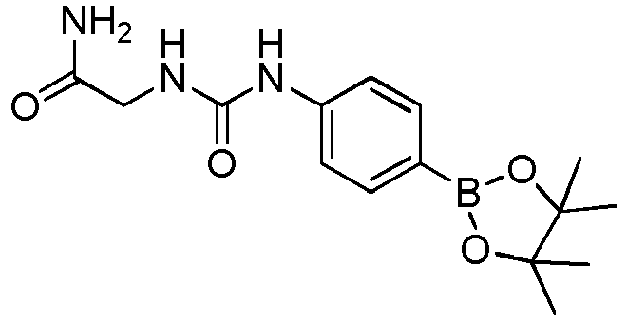
- 2-(4-isocyanatophenyl)-4,4,5,5-tetramethyl-1,3,2-dioxaborolane (300 mg, 1.22mmol) was dissolved in dry THF and stirred with 2-aminoacetamide hydrochloride (108 mg, 1.46 mmol) and triethylamine (drops) at 60°C overnight. The mixture was reduced in vacuo, yielding the title compound (345mg, 1.08 mmol, 88%).
LCMS (Method B), (M+H+) 320 Rt= 2.19 min -
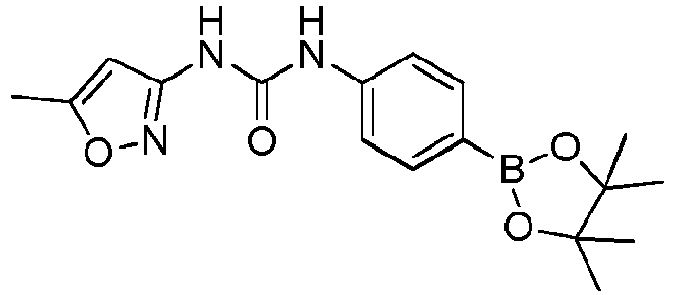
- 4-(4,4,5,5-tetramethyl-1,3,2-dioxaborolan-2-yl)aniline (100mg, 0.46 mmol), and triphosgene (47 mg, 0.16 mmol) were dissolved in a mixture of dry pyridine:DCM (4:1) and stirred at room temperature (20°C) under nitrogen atmosphere for 1h. 5-methylisoxazol-3-amine (49 mg, 0.50 mmol) dissolved in dry DCM was added dropwise, and stirring allowed overnight. Saturated NaHCO3 solution was added to the reaction mixture, and stirring allowed for 15 mins before partitioning between water and DCM. The organic layer was recovered, dried over MgSO4, filtered and solvent removed in vacuo, affording the title compound (155mg, 0.45 mmol, 99% yield).
LCMS (Method B), (M+H+) 344, Rt= 2.89 min -

- Method as described for intermediate 5 using 2-fluoro-4-(4,4,5,5-tetramethyl-1,3,2-dioxaborolan-2-yl)aniline as starting material. The crude reaction mixture was filtered through a celite 545 pre-packed cartridge (2.5g), washed with MeOH and solvent removed in vacuo. The residue was purified by flash SCX2 chromatography affording the title compound (139mg, 0.40 mmol, 98%).
LCMS (Method B), (M+H+) 344, Rt=1.51 min. -

- Method as intermediate 5 using (S)-tert-butyl 2-chloro-4-(3-methylmorpholino)-5H-pyrrolo[3,4-d]pyrimidine-6(7H)-carboxylate (intermediate 1)and 2-fluoro-4-(4,4,5,5-tetramethyl-1,3,2-dioxaborolan-2-yl)aniline as starting materials. The crude reaction mixture was then partitioned between water and EtOAc, the phases separated and the organic layer washed with brine, dried over magnesium sulfate, filtered and the solvent removed in vacuo. The residue was purified by flash chromatography (0-80% EtOAc/Petroleum Ether 40-60) to yield a white solid (660 mg, 1.54mmol, 22%).
LCMS (Method B), (M+H+) 430, Rt =2.62min -

- Step 1: To a stirring solution of (S)-tert-butyl 2-(4-amino-3-fluorophenyl)-4-(3-methylmorpholino)-5H-pyrrolo[3,4-d]pyrimidine-6(7H)-carboxylate (intermediate 17) (660mg, 1.54mmol) in THF was added ethyl isocyanate (183 µL, 2.31mmol). The reaction mixture was stirred at 60°C until analysis by LCMS indicated that reaction was complete. The solvent then was removed in vacuo. Purified by flash chromatography using 0-100% Ethyl acetate/ Petroleum Ether 40-60 to yield a yellow solid (510mg, 1.02mmol, 66%).
LCMS (Method B), (M+H+) 501, Rt =2.88min. - Step 2: (S)-tert-butyl 2-(4-(3-ethylureido)-3-fluorophenyl)-4-(3-methylmorpholino)-5H-pyrrolo[3,4-d]pyrimidine-6(7H)-carboxylate (510mg, 1.02mmol) was stirred in a solution of 4M HCl in Dioxane (10ml), and methanol (3ml) until analysis by LCMS indicated reaction was complete. Solvent was removed in vacuo to afford a light brown solid (450mg, 1.02mmol, 100%).
LCMS (Method B), (M+H+) 401, Rt =1.66min. -

- Method as described for intermediate 5 using (S)-ethyl 2-chloro-4-(3-methylmorpholino)-5H-pyrrolo[3,4-d]pyrimidine-6(7H)-carboxylate (intermediate 11) and 2-fluoro-4-(4,4,5,5-tetramethyl-1,3,2-dioxaborolan-2-yl)aniline as starting materials. The reaction mixture was filtered through a celite 545 pre-packed cartridge (2.5g), washed with MeOH and reduced in vacuo. The residue was purified by flash SCX2 chromatography affording the title compound (130mg, 0.32 mmol, 88%).
LCMS (Method B), (M+H+) 402, Rt=2.68 min. -

- Method as example 18 using (S)-1-cyclopropyl-3-(4-(4-(3-methylmorpholino)-5,6,7,8-tetrahydropyrido[3,4-d]pyrimidin-2-yl)phenyl)urea (example 15) and pivoyl chloride as starting materials
1H NMR (d6-DMSO) 8.54 (s, 1H), 8.19 (d, 2H), 8.14 (s, 0.6H formate), 7.49 (d, 2H), 6.44 (d, 1H), 4.60 (br dd, 2H), 4.15-4.12 (m, 1H), 3.91-3.80 (m, 2H), 3.71-3.55 (m, 5H), 3.47-3.38 (m, 1H), 2.70-2.67 (m, 2H), 2.58-2.52 (m, 1H), 1.26 (s, 12H), 0.66-0.62 (m, 2H), 0.43-0.38 (m, 2H).
LCMS (method A), (M+H+) 493.20, Rt = 7.65 min. -

- Method as described for example 26 using (S)-1-cyclopropyl-3-(4-(4-(3-methylmorpholino)-6,7-dihydro-5H-pyrrolo[3,4-d]pyrimidin-2-yl)phenyl)urea (example 3) and iso-butyraldehyde as starting materials. Purified by prep HPLC (low pH).
1H NMR (d6-DMSO) 8.54 (s, 1H), 8.17 (d, 2H), 7.47 (d, 2H), 6.46 (d, 1H), 4.38 (br s, 1H), 4.10-3.91 (br s, 1H), 4.10-3.91 (m, 4H), 3.74-3.70 (m, 2H), 3.65 (dd, 1H), 3.49 (td, 1H), 3.41-3.36 (q, 1H), 2.57-2.45 (m, 1H), 2.46 (d, 2H), 1.86-1.76 (m, 1H), 1.24 (d, 3H), 0.92 (d, 6H), 0.66-0.61 (m, 2H), 0.43-0.39 (m, 2H).
LCMS (method A), (M+H+) 451, Rt = 5.72 min. -

- Method as described for example 26 using (S)-1-ethyl-3-(4-(4-(3-methylmorpholino)-6,7-dihydro-5H-pyrrolo[3,4-d]pyrimidin-2-yl)phenyl)urea (example 7) and iso-butyraldehyde as starting materials. Purified by prep HPLC (low pH).
1H NMR (d6-DMSO) 8.64 (s, 1H), 8.16 (d, 2H), 7.46 (d, 2H), 6.16 (t, 1H), 4.39 (br s, 1H), 4.11-4.07 (3H, m), 3.97-3.91 (m, 1H), 3.74-3.70 (m, 3H), 3.65 (dd, 1H), 3.57-3.42 (m, 2H), 3.13-3.10 (m, 2H), 2.46 (d, 2H), 1.84-1.77 (m, 1H), 1.24 (d, 3H) 1.06 (t, 3H), 0.92 (d, 6H).
LCMS (method A), (M+H+) 439, Rt = 6.21 min. -
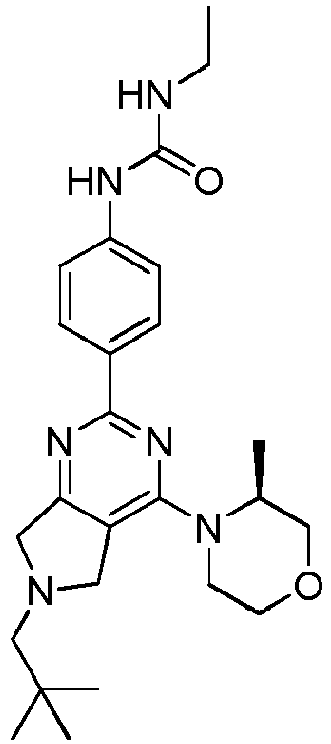
- Method as described for example 26 using (S)-1-ethyl-3-(4-(4-(3-methylmorpholino)-6,7-dihydro-5H-pyrrolo[3,4-d]pyrimidin-2-yl)phenyl)urea (example 7) and pivaldehyde as starting materials. Purified by prep HPLC (low pH).
1H NMR (d6-DMSO) 8.65 (s, 1H), 8.16 (d, 2H), 7.46 (d, 2H), 6.17 (t, 1H), 4.36 (br s, 1H), 4.26 (d, 1H), 4.18 (d, 1H), 3.97-3.92 (m, 3H), 3.72 (d, 1H), 3.64 (dd, 1H), 3.52-3.46 (m, 2H), 3.15-3.08 (m, 3H), 2.54 (s, 2H), 1.24 (d, 3H), 1.06 (t, 3H), 0.94 (d, 9H).
LCMS (method A), (M+H+) 453, Rt = 6.53 min. -

- To a stirred solution of (S)-1-ethyl-3-(4-(4-(3-methylmorpholino)-6,7-dihydro-5H-pyrrolo[3,4-d]pyrimidin-2-yl)phenyl)urea (example 7) (200 mg, 0.48 mmol) and Et3N (133 µL, 0.95 mmol). in toluene (1.5 mL) was added 2,2,2-trifluoroethyltrichloromethane sulfonate (91 µL, 0.95 mmol) and DMSO (0.5 mL). The reaction mixture was heated to 100 °C overnight. The reaction was cooled, diluted with methanol and adsorbed onto a mp-TsOH cartridge (2.5 g, 3 mmol/g). The cartridge was rinsed with MeOH (3 column volumes) and the product was eluted with 7M NH3 in MeOH. The basic fractions were concentrated in vacuo and purified by prep HPLC (low pH) to give the desired product (2.1 mg, 0.9% yield).
1H NMR (CD3OD) 8.39 (s, 2H), 8.19 (d, 2H), 7.45 (d, 2H), 4.43 (br d, 1H), 4.39-4.31 (m, 2H), 4.15 (br d, 1H), 4.07 (br d, 2H), 4.00 (dd, 1H), 3.79-3.74 (m, 2H), 3.62 (td, 1H), 3.54-3.41 (m, 3H), 3.24 (q, 2H), 1.36 (d, 3H), 1.17 (t, 3H).
LCMS (method A), (M+H+) 465, Rt = 7.44 min. -

- Method as described for example 26 using 1-ethyl-3-(4-(4-morpholino-6,7-dihydro-5H-pyrrolo[3,4-d]pyrimidin-2-yl)phenyl)urea (example 14) and formaldehyde as starting materials.
1H NMR (d6-DMSO) 8.64 (s, 1H), 8.17 (d, 2H), 7.45 (d, 2H), 6.15 (t, 1H), 4.03 (br s, 2H), 3.74 (br s, 2H), 3.63-3.72 (m, 8H), 3.32 (s, 3H), 3.08-3.15 (m, 2H), 1.05 (t, 3H).
LCMS (method A), (M+H+) 383, Rt = 4.68 min. -

- Method as described for example 34 using 1-ethyl-3-(4-(4-morpholino-6,7-dihydro-5H-pyrrolo[3,4-d]pyrimidin-2-yl)phenyl)urea (example 14) and ethyl chloroformate as starting materials.
1H NMR (d6-DMSO) 8.71 (s, 1H), 8.19 (d, 2H), 7.48 (d, 2H), 6.20 (t, 1H), 4.82 (d, 2H), 4.48 (d, 2H), 4.11-4.18 (m, 2H), 3.72 (s, 6H), 3.59-3.66 (m, 1H), 3.08-3.18 (m, 1H), 1.23-1.27 (m, 3H), 1.06 (t, 3H).
LCMS (method A), (M+H+) 441, Rt = 7.18 min. -
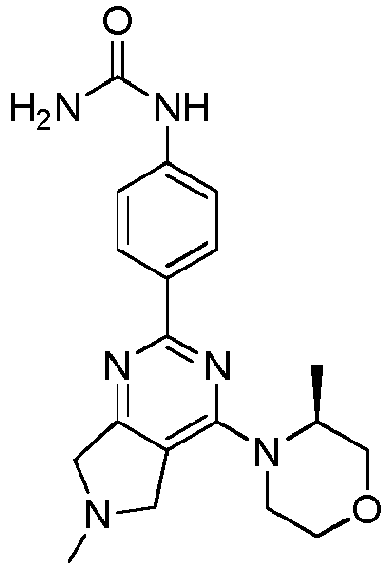
- Method as intermediate 5 using (S)-4-(2-chloro-6-methyl-6,7-dihydro-5H-pyrrolo[3,4-d]pyrimidin-4-yl)-3-methylmorpholine (intermediate 12) and 1-(4-(4,4,5,5-tetramethyl-1,3,2-dioxaborolan-2-yl)phenyl)urea as starting materials.
1HNMR (d6-DMSO) 8.74 (br, s, 1H), 8.17 (d, 2H), 7.47 (d, 2H), 5.92 (br, s, 2H), 4.39-4.29 (br, s, 1H), 4.12-3.88 (m, 4H), 3.77-3.62 (m, 4H), 3.55-.3.45 (m, 1H), 3.17 (d, 3H), 1.25 (d, 3H).
LCMS (Method A), (M+H+) 369.10, Rt= 7.36 min. -

- Method as intermediate 5 using (S)-4-(2-chloro-6-methyl-6,7-dihydro-5H-pyrrolo[3,4-d]pyrimidin-4-yl)-3-methylmorpholine (intermediate 12) and 1-(5-methylisoxazol-3-yl)-3-(4-(4,4,5,5-tetramethyl-1,3,2-dioxaborolan-2-yl)phenyl)urea (intermediate 15) as starting materials.
1HNMR (CD3OD) 8.20-8.174 (M, 3H), 7.46 (d, 2H), 6.32 (br s, 1H), 4.38-4.24(m, 3H), 4.10-4.95 (m, 3H), 3.95-3.88 (m, 1H), 3.74-3.62 (m, 2H), 3.57-3.47 (m, 1H), 3.40-3.31- (m, 1H), 2.72 (s, 3H), 2.29 (s, 3H), 1.28 (d, 3H).
LCMS (Method A), (M+H+) 450.20, Rt=5.78 min. -

- Method as described for example 51 using (S)-phenyl 4-(6-methyl-4-(3-methylmorpholino)-6,7-dihydro-5H-pyrrolo[3,4-d]pyrimidin-2-yl)phenylcarbamate (intermediate 10) and 2-amino ethanol.
1HNMR (CD3OD) 8.08 (d, 2H), 7.35 (d, 2H), 4.37-4.26 (br, s, 1H), 4.11-3.95 (m, 3H), 3.93-3.86 (dd, 1H), 3.80-3.61 (m, 4H), 3.57-3.45 (m, 3H), 3.39-3.28 (m, 1H), 3.23 (d, 1H), 2.52 (s, 3H), 1.25 (d, 3H).
LCMS (Method A), (M+H+) 413.10, Rt=4.59 min. -

- Method as example 26 using (S)-1-ethyl-3-(4-(4-(3-methylmorpholino)-6,7-dihydro-5H-pyrrolo[3,4-d]pyrimidin-2-yl)phenyl)urea (example 7) and acetone as starting materials. Purification by prep HPLC (high pH).
1H NMR (d6-DMSO) 8.64 (s, 1H), 8.17 (d, 2H), 7.46 (d, 2H), 6.16 (t, 1H), 4.45-4.35 (m, 1H), 4.15-4.35 (m, 2H), 4.13-3.98 (m, 2H), 3.97-3.92 (m, 1H), 3.80-3.63 (m, 3H), 3.55-3.45 (m, 1H), 3.15-3.09 (m, 2H), 2.78-2.72 (m, 2H), 1.25 (d, 3H), 1.12 (m, 6H),.1.06 (t, 3H).
LCMS (method A), (M+H+) 425, Rt = 5.57 min. -

- Method as example 26 using (S)-1-ethyl-3-(4-(4-(3-methylmorpholino)-5,6,7,8-tetrahydropyrido[3,4-d]pyrimidin-2 yl)phenyl)urea (example 13) and acetone as starting materials.
1H NMR (d6-DMSO) 8.65 (s, 1H), 8.17-8.15 (m, 3H), 7.47 (d, 2H), 6.17 (t, 1H), 4.13-4.11 (m, 1H), 3.88-3.85 (m, 1H), 3.71-3.57 (m, 6H), 3.43-3.36 (m, 1H under water peak), 3.15-3.08 (m, 2H), 3.12 (q, 2H), 2.87 (q, 1H), 2.75-2.70 (m, 1H), 2.67-2.64 (m, 2H), 2.58-2.54 (m, 1H), 1.22 (d, 3H), 1.08-1.04 (m, 9H).
LCMS (method A), (M+H+) 439.20, Rt = 5.39 min. -

- Method as example 26 using (S)-1-ethyl-3-(4-(4-(3-methylmorpholino)-5,6,7,8-tetrahydropyrido[3,4-d]pyrimidin-2 yl)phenyl)urea (example 13) and isobutyraldehyde as starting materials.
1H NMR (d6-DMSO) 8.65 (s, 1H), 8.17-8.15 (m, 3H), 7.47 (d, 2H), 6.17 (br t, 1H), 4.15-4.11 (m, 1H), 3.89-3.86 (m, 1H), 3.72-3.69 (m, 1H), 3.66-3.60 (m, 3H), 3.58-3.57 (m, 1H), 3.48-3.38 (m, 2H under water peak), 3.17-3.09 (m, 3H), 2.67-2.65 (m, 3H), 2.26-2.24 (m, 2H), 1.94-1.87 (m, 1H), 1.24 (d, 3H), 1.06 (m, 3H), 0.92 (d, 6H).
LCMS (method A), (M+H+) 453.20, Rt = 5.69 min -

- Method as example 34 using (S)-1-ethyl-3-(4-(4-(3-methylmorpholino)-5,6,7,8-tetrahydropyrido[3,4-d]pyrimidin-2 yl)phenyl)urea (example 13) and ethyl chloroformate as starting materials.
1H NMR (d6-DMSO) 8.66 (s, 1H), 8.18 (d, 2H), 7.49 (d, 2H), 6.17 (br t, 1H), 4.60-4.42 (m, 1H), 4.14-4.09 (m, 3H), 3.89-3.86 (m, 1H), 3.71-3.39 (m, 7H), 3.16-3.09 (m, 2H), 2.69-2.66 (m, 2H), 1.26-1.22 (m, 6H), 1.08-1.05 (m, 3H).
LCMS (method A), (M+H+) 469.20, Rt = 7.17 min. -

- Method as example 34 using (S)-1-cyclopropyl-3-(4-(4-(3-methylmorpholino)-5,6,7,8-tetrahydropyrido[3,4-d]pyrimidin-2-yl)phenyl)urea (example 15) and ethyl chloroformate as starting materials.
1H NMR (d6-DMSO) 8.53 (s, 1H), 8.18 (d, 2H), 7.49 (d, 2H), 6.44 (br d, 1H), 4.58-4.43 (m, 2H), 4.14-4.08 (m, 3H), 3.88-3.85 (m, 1H), 3.70-3.57 (m, 5H), 3.51-3.38 (m, 2H), 2.68-2.66 (m, 2H), 2.58-2.53 (m, 1H), 1.25-1.22 (m, 6H), 0.67-0.62 (2H), 0.43-0.39 (m, 2H).
LCMS (method A), (M+H+) 481.2, Rt = 7.39 min. -

- Method as described for example 33 using 1-ethyl-3-(4-(4-morpholino-6,7-dihydro-5H-pyrrolo[3,4-d]pyrimidin-2-yl)phenyl)urea (example 14) and ethyl isocyanate as starting materials.
1H NMR (d6-DMSO) 8.75 (br s, 1H), 8.18 (d, 2H), 7.48 (d, 2H), 6.43 (t, 1H), 6.25 (t, 1H), 4.72-4.74 (m, 2H), 4.42-4.44 (m, 2H), 3.32 (br s, 8H), 3.09-3.18 (m, 4H), 1.04-1.10 (q, 6H).
LCMS (method A), (M+H+) 440, Rt = 6.24 min. -
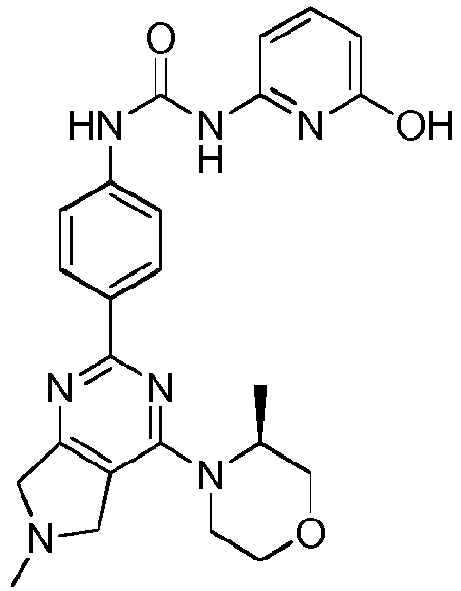
- Step 1: Method as described for intermediate 15 using 6-aminopyridin-2-ol as starting material. Saturated NaHCO3 solution was added to the reaction mixture, and stirring allowed for 15 mins before partitioning with DCM. The organic layer was recovered, dried over MgSO4, filtered and reduced in vacuo, affording the title compound (90mg, 0.25 mmol, 56% yield).
- Step 2: Method as described for example 47 using 1-(6-hydroxypyridin-2-yl)-3-(4-(4,4,5,5-tetramethyl-1,3,2-dioxaborolan-2-yl)phenyl)urea and (S)-4-(2-chloro-6-methyl-6,7-dihydro-5H-pyrrolo[3,4-d]pyrimidin-4-yl)-3-methylmorpholine (intermediate 12) as starting materials. The reaction mixture was filtered through a celite 545 pre-packed cartridge (2.5g), washed with MeOH and reduced in vacuo. The residue was purified by prep LCMS (high pH), to yield the title compound (7.9 mg, 0.017 mmol, 9.2%).
1HNMR (CD3OD) 8.25 (d, 2H), 7.77 (d, 2H), 7.40 (t, 1H), 6.09 (t, 2H), 4.46 (br, s, 1H), 4.26-4.07 (m, 3H), 4.02 (dd, 1H), 3.94-3.74 (m, 4H), 3.69-3.59 (m, 1H), 3.52-.3.41 (m, 1H), 2.64 (s, 3H), 1.38 (d, 3H).
LCMS (Method A), (M+H+) 462.10, Rt=5.23 min. -

- Method as example 34 using (S)-1-ethyl-3-(4-(4-(3-methylmorpholino)-5,6,7,8-tetrahydropyrido[3,4-d]pyrimidin-2 yl)phenyl)urea (example 13) and methylchloroformate as starting materials.
1H NMR (d6-DMSO) 8.65 (s, 1H), 8.17 (d, 2H), 7.48 (d, 2H), 6.16 (br t, 1H), 4.57-4.43 (m, 2H), 4.12-4.11 (m, 1H), 3.88-3.85 (m, 1H), 3.71-3.55 (m, 8H), 3.50-3.32 (m, 2H), 3.15-3.09 (m, 2H), 2.69-2.67 (m, 2H), 1.25 (d, 3H), 1.06 (t, 3H).
LCMS (method A), (M+H+) 455.2, Rt = 6.63 min. -

- Step 1: Method as described for intermediate 2 using tert-
butyl 2,4-dichloro-5,6-dihydropyrido[3,4d]pyrimidine-7(8H) carboxylate and morpholine as starting materials. - Step 2: Method as intermediate 5 using tert-butyl 2-chloro-4-morpholino-5,6-dihydropyrido[3,4-d]pyrimidine-7(8H)-carboxylate and 4-(3-ethylureido)phenylboronic acid pinacol ester
- Step 3: Method as example 3
step 2. Purified using MP-TsOH cartridge eluting with 2M ammonia in methanol.
1H NMR (d6-DMSO) 8.69 (s, 1H), 8.19 (d, 2H), 7.47 (d , 2H), 6.18 (t, 1H), 4.11-4.16 (m, 1H), 3.86 (s, 2H), 3.71-3.76 (m, 4H), 3.41-3.45 (m, 4H), , 3.08-3.15 (m, 2H), 2.90 (t, 2H), 2.58 (t, 2H), 1.06 (t, 3H).
LCMS (method A), (M+H+) 383, Rt = 4.88 min. -

- Method as example 34 using (S)-1-cyclopropyl-3-(4-(4-(3-methylmorpholino)-5,6,7,8-tetrahydropyrido[3,4-d]pyrimidin-2-yl)phenyl)urea (example 15) and methylchloroformate as starting materials.
1H NMR (d6-DMSO) 8.56 (s, 1H), 8.18 (d, 2H), 7.49 (d, 2H), 6.47-6.46 (m, 1H), 4.57-4.42 (m, 2H), 4.10-4.09 (m, 1H), 3.88-3.85 (m, 1H), 3.70-3.56 (m, 8H), 3.50-3.39 (m, 2H), 2.68-2.65 (m, 2H), 2.56-2.52 (m, 1H), 1.24 (d, 3H), 0.66-0.61 (m, 2H), 0.43-0.39 (m, 2H).
LCMS (method A), (M+H+) 467.2, Rt = 6.78 min. -

- Step 1: Method as described for intermediate 15 using 1-methyl-1H-pyrazol-4-amine as starting material. Saturated NaHCO3 solution was added to the reaction mixture, and stirring allowed for 15 mins before partitioning between water and DCM. The organic layer was recovered, dried over MgSO4, filtered and reduced in vacuo, affording the title compound (145mg, 0.42 mmol, 93% yield).
LCMS (Method B), (M+H+) 343, Rt= 2.50 min. - Step 2: Method as described for example 47 using 1-(1-methyl-1H-pyrazol-4-yl)-3-(4-(4,4,5,5-tetramethyl-1,3,2-dioxaborolan-2-yl)phenyl)urea and S)-4-(2-chloro-6-methyl-6,7-dihydro-5H-pyrrolo[3,4-d]pyrimidin-4-yl)-3-methylmorpholine (intermediate 12) as starting materials. The reaction mixture was filtered through a celite 545 pre-packed cartridge (2.5g), washed with MeOH and solvent removed in vacuo. The residue was purified by prep LCMS (high pH), to yield the title compound (19.4mg, 0.043 mmol, 12%).
1HNMR (CD3OD) 8.29 (br, s, 1H), 8.24 (d, 2H), 7.74 (br, s, 1H), 7.53 (d, 2H), 7.47 (br,s 1H), 4.63-4.51 (m, 2H), 4.42 (br, s, 1H), 4.22-4.21 (m, 2H), 4.13 (br, d, 1H), 4.02 (dd, 1H), 3.87 (s, 3H), 3.84-3.72 (m, 2H), 3.67-3.58 (m, 1H), 3.54-3.41 (m, 1H), 2.94 (s, 3H), 1.39 (d, 3H).
LCMS (Method A), (M+H+) 449.20, Rt=4.98 min. -

- To a stirred solution of (S)-2-fluoro-4-(6-methyl-4-(3-methylmorpholino)-6,7-dihydro-5H-pyrrolo[3,4-d]pyrimidin-2-yl)aniline (intermediate 16) (139 mg, 0.40 mmol) in dry THF, was added ethyl isocyanate (70µL, 0.89 mmol) dropwise. The reaction mixture was stirred at 40°C for 48 hours, before removal of the solvent in vacuo. The crude material was then purified prep. HPLC (high pH), affording the title compound as a white solid (23.3mg, 13.7%).
1HNMR (CD3OD) 8.17 (t, 1H), 8.04 (dd), 1H), 7.98 (dd, 1H), 4.42 (br, s, 1H), 4.22-4.06 (m, 3H), 4.03-3.98 (m, 1H), 3.90-3.72 (m, 4H), 3.68-3.58 (m, 1H), 3.50-3.38 (m, 1H), 2.63 (s, 3H), 1.37 (d, 3H), 1.18 (t, 3H).
LCMS (Method A), (M+H+) 415.20, Rt=5.30 min. -

- To a solution of (S)-1-cyclopropyl-3-(4-(4-(3-methylmorpholino)-6,7-dihydro-5H-pyrrolo[3,4-d]pyrimidin-2-yl)phenyl)urea (example 3) (103 mg, 0.26 mmol) in dioxane (5 mL) at room temperature (20°C) was added methyl chloroformate (32 uL, 0.23 mmol). The reaction mixture was stirred for 5 h. The solvent was removed in vacuo and the residue purified by prep HPLC (low pH) to afford an orange solid (18 mg,15%).
1H NMR (d6-DMSO) 8.65 (s, 1H), 8.24 (d, 2H), 7.55 (d , 2H), 6.54 (d, 1H) 4.95-4.78 (m, 2H), 4.54 (d, 2H), 4.44 (br s, 1H), 4.18 (br s, 1H), 4.02 (d, 1H), 3.81 (d, 1H) 3.71 (d, 1H), 3.56 (t, 1H), 2.63-2.59 (m, 1H), 1.32 (d, 3H), 0.73-0.68 (m, 2H), 0.49-0.45 (m, 2H).
LCMS (method A), (M+H+) 453, Rt = 7.36 min. -

- To a solution of (S)-1-ethyl-3-(4-(4-(3-methylmorpholino)-5,6,7,8-tetrahydropyrido[3,4-d]pyrimidin-2-yl)phenyl)urea hydrochloride (example 13 as a hydrochloride salt) (99 mg, 0.25 mmol) in DCM (3 mL) at room temperature (20 °C) was added DIPEA (44 uL, 0.26 mmol) followed by ethyl isocyanate (22 uL, 0.27 mmol). The reaction mixture was stirred overnight. The solvent was removed in vacuo and the residue purified by prep HPLC (low pH) to afford a brown solid (55 mg,47%).
1H NMR (d6-DMSO) 8.71 (s, 1H), 8.16 (d, 2H), 7.47 (d , 2H), 6.69 (t, 1H), 6.22 (t, 1H), 4.49 (q, 2H), 4.11 (d, 1H), 3.74-3.55 (m, 5H), 3.15-3.06 (m, 4H), 2.63-2.62 (m, 2H), 1.25 (d, 3H), 1.06 (t, 3H), 1.04 (t, 3H).
LCMS (method A), (M+H+) 468, Rt = 6.06 min. -

- To a solution of (S)-1-cyclopropyl-3-(4-(4-(3-methylmorpholino)-5,6,7,8-tetrahydropyrido[3,4-d]pyrimidin-2-yl)phenyl)urea (example 15) (102 mg, 0.25 mmol) in DCM (3 mL) at room temperature (20 °C) was added ethyl isocyanate (32 uL, 0.27 mmol). The reaction mixture was stirred for 5 h. The solvent was removed in vacuo and the residue purified by prep HPLC (low pH) to afford an orange solid (40 mg, 33%).
1H NMR (d6-DMSO) 8.60 (s, 1H), 8.16 (d, 2H), 7.49 (d , 2H), 6.69 (t, 1H), 6.52 (d, 1H), 4.49 (q, 2H), 4.11 (d, 1H), 3.89 (d, 1H), 3.68 (d, 1H), 3.69-3.60 (m, 4H), 3.15-3.02 (m, 2H), 2.66-2.58 (m, 2H), 2.57-2.53 (m, 1H), 1.25 (d, 3H), 1.04 (t, 3H), 0.66-0.62 (m, 2H), 0.43-0.39 (m, 2H).
LCMS (method A), (M+H+) 480, Rt = 6.23 min. -

- To a solution of (S)-methyl 2-(4-(3-ethylureido)phenyl)-4-(3-methylmorpholino)-5H-pyrrolo[3,4-d]pyrimidine-6(7H)-carboxylate hydrochloride (example 7 as a hydrochloride salt) (88 mg, 0.21 mmol) in dioxane (5 mL) at room temperature (20°C) was added DIPEA (19 uL, 0.1 mmol) followed by methyl chloroformate (18 uL, 0.23 mmol). The reaction mixture was stirred overnight. The solvent was removed in vacuo and the residue purified by prep HPLC (low pH) to afford a brown solid (6mg,6%).
1H NMR (d6-DMSO) 8.77 (s, 1H), 8.16 (d, 2H), 7.47 (d , 2H), 6.25 (t, 1H), 4.89-4.69 (m, 2H), 4.47 (d, 2H), 4.37 (br s, 1H), 4.11 (br s, 1H), 3.95 (d, 1H), 3.76 (d, 1H), 3.69 (s, 3H), 3.50 (t, 1H), 3.15-3.08 (m, 2H), 1.26 (d, 3H), 1.05 (t, 3H).
LCMS (method A), (M+H+) 441, Rt = 7.26 min. -

- To a solution of (S)-ethyl 2-(4-(3-ethylureido)phenyl)-4-(3-methylmorpholino)-5H-pyrrolo[3,4-d]pyrimidine-6(7H)-carboxylate trifluoroacetate (example 7 as a trifluoroacetic acid salt) (155 mg, 0.25 mmol) in dioxane (4 mL) at room temperature (20°C) was added DIPEA (22 uL, 0.26 mmol) followed by ethyl chloroformate (24 uL, 0.25 mmol). The reaction mixture was stirred for 3 h. The solvent was removed in vacuo and the residue purified by prep HPLC (low pH) to afford a brown solid (36mg, 32%).
1H NMR (d6-DMSO) 8.73 (s, 1H), 8.17 (d, 2H), 7.48 (d , 2H), 6.21 (t, 1H), 4.88-4.73 (m, 2H), 4.51 (d, 2H), 4.20-4.08 (m, 3H), 3.96 (d, 1H), 3.74 (d, 1H), 3.67 (d, 1H), 3.51 (t, 1H), 3.39-3.30 (m, 1H), 3.13-3.06 (m, 2H), 1.26 (t, 3H), 1.24 (t, 3H), 1.06 (t, 3H).
LCMS (method A), (M+H+) 455, Rt = 7.79 min. -

- Method as described for example 17 using example 13b and 3-pyridyleacetic acid hydrochloride as starting materials, DCM as solvent and NEt3 as base. The reaction mixture was stirred at room temperature overnight and then diluted with water. The product was collected by filtration and then purified by trituration with water, collected by filtration and washed with ether to give a cream solid (66 mg, 0.10 mmol, 42 % yield).
1H NMR (d6-DMSO) 8.69 (s, 1H), 8.47-8.43 (m, 2H), 8.19 (dd, 2H), 7.66 (t 1H), 7.49 (dd, 2H), 7.37-7.33 (m, 1H). 6.18 (q, 1H), 4.76 (q, 1H), 4.58 (q, 1H), 4.17-4.05 (br, s, 1H), 3.97-3.78 (m, 4H), 3.74-3.56 (m, 4H), 3.54-3.39 (m, 2H), 3.11 (qn, 2H), 2.79-2.72 (br, m, 1H), 2.69-2.62 (br, m, 1H), 1.26 (t, 3H), 1.06 (t, 3H)
LCMS (method A), (M+H+) 516, Rt = 5.16 min. -

- Method as described for example 17 using (S)-1-ethyl-3-(4-(4-(3-methylmorpholino)-5,6,7,8-tetrahydropyrido[4,3-d]pyrimidin-2-yl)phenyl)urea (example 12) and 3-dimethylamino propionic acid hydrochloride as starting materials. Purified by prep HPLC (low pH).
1H NMR (d6-DMSO) 8.81 (s, 1H), 8.17 (d, 2H), 7.49 (d, 2H), 6.32 (t, 1H), 4.56-4.41 (m, 1H), 3.95-3.84 (m, 4H), 3.81-3.70 (m, 2H), 3.66-3.60 (m, 2H), 3.51-3.39 (m, 4H), 3.15-3.08 (m, 2H), 2.94 (t, 1H), 2.59-2.54 (m, 3H), 2.17 (d, 6H), 1.25 (d, 3H), 1.06 (t, 3H).
LCMS (method A), (M+H+) 496, Rt = 4.50 min. -

- Method as example 26 using 1-Ethyl-3-(4-(4-morpholino-5,6,7,8-tetrahydropyrido[3,4-d]pyrimidin-2-yl)phenyl)urea (example 82) and formaldehyde as starting materials.
1H NMR (d6-DMSO) 8.68 (s, 1H), 8.17 (d, 2H), 7.47 (d , 2H), 6.18 (t, 1H), 3.73 (br t, 4H), 3.50 (s, 2H), 3.45 (br t, 4H), 3.08-3.15 (m, 2H), 2.68 (br t, 2H), 2.55 (br t, 2H), 2.36 (s, 3H), 1.05 (t, 3H).
LCMS (method A), (M+H+) 397, Rt = 4.86 min. -

- Method as example 33 using 1-Ethyl-3-(4-(4-morpholino-5,6,7,8-tetrahydropyrido[3,4-d]pyrimidin-2-yl)phenyl)urea (example 82) and ethyl isocyanate as starting materials.
1H NMR (d6-DMSO) 8.70 (s, 1H), 8.20 (d, 2H), 7.50 (d , 2H), 6.70 (t, 1H), 6.20 (t, 1H), 4.48 (s, 2H), 3.75 (t, 4H), 3.50 (t, 2H), 3.45 (t, 4H), 3.05-3.18 (m, 4H), 2.60 (t, 1H), 1.00-1.10 (m, 6H).
LCMS (method A), (M+H+) 454, Rt = 5.87 min. -
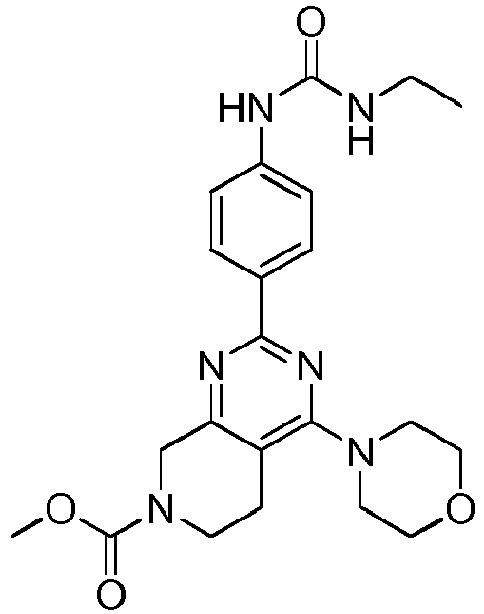
- Method as example 34 using 1-ethyl-3-(4-(4-morpholino-5,6,7,8-tetrahydropyrido[3,4-d]pyrimidin-2-yl)phenyl)urea (example 82) and methyl chloroformate as starting materials.
1H NMR (d6-DMSO) 8.70 (s, 1H), 8.18 (d, 2H), 7.48 (d, 2H), 6.18 (t, 1H), 4.51 (s, 2H), 3.70-3.75 (m, 4H), 3.67 (s, 3H), 3.56 (br s, 2H), 3.47 (br s, 4H), 3.07-3.17 (m, 2H), 2.64-2.72, (t, 2H), 1.05 (t, 3H).
LCMS (method A), (M+H+) 441, Rt = 6.40 min. -

- Method as example 34 using 1-Ethyl-3-(4-(4-morpholino-5,6,7,8-tetrahydropyrido[3,4-d]pyrimidin-2-yl)phenyl)urea (example 82) and ethyl chloroformate as starting materials.
1H NMR (d6-DMSO) 8.69 (s, 1H), 8.19 (d, 2H), 7.49 (d, 2H), 6.18 (t, 1H), 4.47-4.54 (br m, 2H), 4.08-4.41 (m, 2H), 3.71-3.75 (t, 4H), 3,57(br s, 2H), 3.44-3.48 (t, 4H), 3.08-3.16 (m, 2H), 2.67-2.71 (m, 2H), 1.24 (t, 3H), 1.06 (t, 3H).
LCMS (method A), (M+H+) 455, Rt = 6.95 min. -

- Method as example 18 using 1-ethyl-3-(4-(4-morpholino-5,6,7,8-tetrahydropyrido[3,4-d]pyrimidin-2-yl)phenyl)urea (example 82) and acetyl chloride as starting materials.
1H NMR (d6-DMSO) 8.75 (d, 1H), 8.19 (dd, 2H), 7.49 (dd, 2H), 6.25 (q, 1H), 4.64 (s, 1H), 4.55 (s, 1H), 3.71-3.75 (m, 4H), 3.62 (t, 3H), 3.08-3.15 (m, 3H), 2.76 (t, 1H), 2.63 (t, 1H), 2.55 (s, 2H), 2.13 (s, 3H), 1.06 (t, 3H).
LCMS (method A), (M+H+) 425, Rt = 5.03 min. -

- Method as example 18 using 1-ethyl-3-(4-(4-morpholino-5,6,7,8-tetrahydropyrido[3,4-d]pyrimidin-2-yl)phenyl)urea (example 82) and pivaloyl chloride as starting materials.
1H NMR (d6-DMSO) 8.70 (s, 1H), 8.20 (d, 2H), 7.48 (d, 2H), 6.18 (t, 1H), 4.61 (s, 2H), 3.75-3.79 (m, 2H), 3.73-3.75 (m, 4H), 3.46-3.51 (m, 4H), 3.08-3.15 (m, 2H), 2.71 (t, 2H), 1.27 (s, 9H), 1.06 (t, 3H).
LCMS (method A), (M+H+) 467, Rt = 6.92 min. -

- Method as example 18 using 1-ethyl-3-(4-(4-morpholino-6,7-dihydro-5H-pyrrolo[3,4-d]pyrimidin-2-yl)phenyl)urea (example 14) and acetyl chloride as starting materials.
1H NMR (d6-DMSO) 8.78 (s, 1H), 8.25 (dd, 2H), 7.55 (d, 2H), 6.25 (t, 1H), 5.07 (s, 1H), 4.81 (d, 2H), 4.50 (s, 1H), 3.77-3.81 (br m, 7H), 3.15-3.21 (m, 3H), 2.15 (d, 3H), 1.32 (t, 1H), 1.12 (t, 3H).
LCMS (method A), (M+H+) 411, Rt = 6.09 min. -
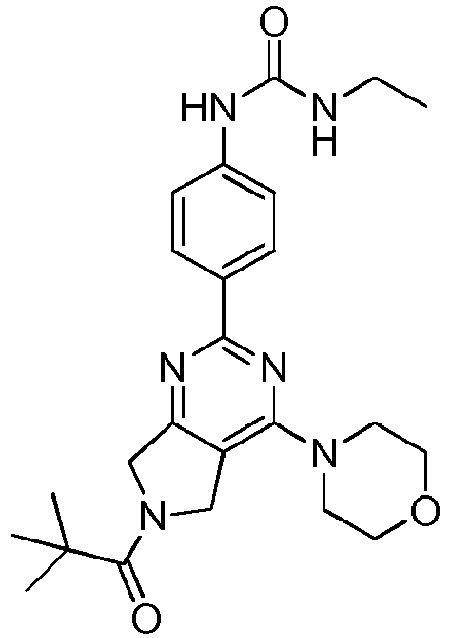
- Method as example 18 using 1-ethyl-3-(4-(4-morpholino-6,7-dihydro-5H-pyrrolo[3,4-d]pyrimidin-2-yl)phenyl)urea (example 14) and pivaloyl chloride as starting materials.
1H NMR (d6-DMSO) 8.70 (s, 1H), 8.20 (d, 2H), 7.48 (d, 2H), 6.19 (t, 1H), 4.80-4.94 (br s, 2H), 3.72-3.74 (br s, 7H), 3.08-3.15 (m, 2H), 1.27 (s, 9H), 1.11 (s, 1H), 1.05 (t, 3H).
LCMS (method A), (M+H+) 453, Rt = 7.62 min. -

- Method as described for example 68 using (S)-1-cyclopropyl-3-(4-(4-(3-methylmorpholino)-6,7-dihydro-5H-pyrrolo[3,4-d]pyrimidin-2-yl)phenyl)urea (example 3). Additional trituration with ether gave a pale brown solid.
1H NMR (CD3OD) 8.54 (s, 1H), 8.18 (d, 2H), 7.47 (d, 2H), 6.44 (br d, 1H), 4.36 (dd, 2H), 4.05 (br , 1H), 4.01 (s, 2H), 3.93 (dd, 1H), 3.73 (d, 1H), 3.67-3.59 (m, 1H), 3.58 (q, 2H), 3.54-3.48 (m, 2H), 3.19-3.15 (m, 1H), 2.58-2.50 (m, 1H), 1.25 (d, 3H), 0.66-0.62 (m, 2H), 0.43-0.39 (m, 2H).
LCMS (method A), (M+H+) 477, Rt = 7.60 min. -

- Method as described for example 17 using example 13 hydrochloride salt and glycolic acid as starting materials, DCM as solvent and NEt3 as base. The reaction mixture was stirred at room temperature overnight and then diluted with water. The product was collected by filtration and then purified by flash chromatography (5% MeOH/DCM) to yield a beige solid (16 mg, 0.035 mmol, 15 % yield).
1H NMR (CDCl3) 8.32 (dd, 2H), 7.39 (dd, 2H), 6.28 (s, 1H), 4.94 (d, 1H), 4.75 - 4.59 (m, 2H), 4.46 (s, 1H), 4.30 (d, 2H), 4.04 (dd, 1H), 3.97 (d, 1H), 3.81 (dd, 1H), 3.78 - 3.47 (m, 6H), 3.38 - 3.29 (m, 2H), 2.78 - 2.65 (m, 2H), 1.35 (t, 3H), 1.19 (t, 3H).
LCMS (method A), (M+H+) 455, Rt = 5.70 min. -

- Method as described for example 85 using (S)-ethyl 2-(4-amino-3-fluorophenyl)-4-(3-methylmorpholino)-5H-pyrrolo[3,4-d]pyrimidine-6(7H)-carboxylate (intermediate 19) and ethyl isocyanate as starting materials. The solvent was removed in vacuo and the residue purified by prep HPLC (high pH) yielding the title compound (10mg, 0.021 mmol, 22%).
1HNMR (CD3OD) 8.16 (t, 1H), 8.07-8.01 (m, 1H), 8.01-7.94 (m, 1H), 4.86-4.73 (m, 2H), 4.56-4.50 (m, 2H), 4.50-4.38 (br, s, 1H), 4.22 (q, 2H), 4.19-4.07 (br, d, 1H), 4.06-3.98 (m, 1H), 4.86-4.74 (m, 2H), 3.68-3.58 (m, 1H), 3.52-3.40 (m, 1H), 3.25 (q, 2H), 1.36 (d, 3H), 1.36-1.29 (m, 3H), 1.17 (t, 3H).
LCMS (Method A), (M+H+) 473, Rt= 9.40 min -

- Step 1: Method as described for intermediate 10 using (S)-ethyl 2-(4-amino-3-fluorophenyl)-4-(3-methylmorpholino)-5H-pyrrolo[3,4-d]pyrimidine-6(7H)-carboxylate (intermediate 19) as starting material.
- Step 2: Method as described for example 51, using 2-aminoethanol and (S)-ethyl 2-(3-fluoro-4-((phenoxycarbonyl)amino)phenyl)-4-(3-methylmorpholino)-5H-pyrrolo[3,4-d]pyrimidine-6(7H)-carboxylate as starting materials. The mixture was reduced in vacuo and purified by flash SCX2 chromatography affording the title compound (10mg, 0.020 mmol, 36%).
1HNMR (CD3OD) 8.16 (t, 1H), 8.07-8.02 (m, 1H), 8.02-7.95 (m, 1H), 4.87-4.76 (m, 2H), 4.58-4.51 (m, 2H), 4.51-4.40 (br, s, 1H), 4.22 (q, 2H), 4.17-4.07 (m, 1H), 4.05-3.99 (m, 1H), 3.85-3.73 (m, 2H), 3.67-3.59 (m, 3H), 3.52-3.41 (m, 1H), 3.34 (t, 2H), 1.37 (d, 3H), 1.35-1.26 (m, 3H).
LCMS (Method A), (M+H+) 489, Rt= 7.88 min -

- Step 1: Method as described for intermediate 10 using (S)-ethyl 2-(4-amino-3-fluorophenyl)-4-(3-methylmorpholino)-5H-pyrrolo[3,4-d]pyrimidine-6(7H)-carboxylate (intermediate 19) as starting material.
- Step 2: Method as described for example 51, using cyclopropylamine and (S)-ethyl 2-(3-fluoro-4-((phenoxycarbonyl)amino)phenyl)-4-(3-methylmorpholino)-5H-pyrrolo[3,4-d]pyrimidine-6(7H)-carboxylate as starting materials. The mixture was reduced in vacuo and purified by flash SCX2 chromatography affording the title compound (11mg, 0.023 mmol, 40%).
1HNMR (CD3OD) 8.18 (t, 1H), 8.08-8.03 (m, 1H), 8.03-7.95 (m, 1H), 4.88-4.75 (m, 2H), 4.58-4.51 (m, 2H), 4.51-4.41 (br, s, 1H), 4.22 (q, 2H), 4.03-3.98 (m, 1H), 3.86-3.75 (m, 2H), 3.70-3.58 (m, 1H), 3.52-3.41 (m, 1H), 2.66-2.56 (m, 1H), 1.38 (d, 3H), 1.36-1.27 (m, 4H), 0.80-0.72 (m, 2H), 0.56-0.49 (m, 2H).
LCMS (Method A), (M+H+) 485, Rt= 9.57 min -

- Step 1: Method as described for intermediate 5 using tert-butyl (5-(4,4,5,5-tetramethyl-1,3,2-dioxaborolan-2-yl)thiazol-2-yl)carbamate and (S)-4-(2-chloro-7-methyl-5,6,7,8-tetrahydropyrido[3,4-d]pyrimidin-4-yl)-3-methylmorpholine (intermediate 13) as starting materials. The tert-butyl carboxylate group was removed under the reaction conditions. The mixture was concentrated in vacuo and purified by flash SCX2 chromatography affording (S)-5-(7-methyl-4-(3-methylmorpholino)-5,6,7,8-tetrahydropyrido[3,4-d]pyrimidin-2-yl)thiazol-2-amine.
- Step 2: The product from step1 was treated as described for example 85 with ethyl isocyanate. The mixture was concentrated in vacuo and the material purified by prep HPLC at high and low pH, yielding the title compound (15.5mg, 0.037 mmol, 11% over 2 steps).
1HNMR (CD3OD) 7.98 (s, 1H), 4.20-4.09 (m, 1H), 3.95-3.86 (m, 1H), 3.82-3.74 (m, 1H), 3.74-3.65 (m, 2H), 3.65 (br s, 1H), 3.60 (br s, 1H), 3.56 (br s, 1H), 3.54-3.43 (m, 1H), 3.27 (t, 2H), 2.80-2.71 (m, 3H), 2.69-2.61 (m, 1H), 2.48 (s, 3H), 1.33 (d, 3H), 1.18 (t, 3H),
LCMS (Method A), (M+H+) 418 Rt= 5.15 min -

- Method as example 34 using (S)-1-ethyl-3-(4-(4-(3-methylmorpholino)-5,6,7,8-tetrahydropyrido[4,3-d]pyrimidin-2-yl)phenyl)urea (example 12) and ethyl chloroformate as starting materials.
1H NMR (d6-DMSO) 8.72 (s, 1H), 8.18 (d, 2H), 7.49 (d, 2H), 6.21 (t, 1H), 4.54-4.50 (m, 1H), 4.45-4.35 (m, 2H), 4.13-4.04 (m, 2H), 3.95-3.61 (m, 4H), 3.18 (d, 2H), 3.13-3.10 (m, 2H), 2.88-2.85 (m, 2H), 1.25 (d, 3H), 1.21 (t, 3H),.1.06 (t, 3H).
LCMS (method A), (M+H+) 469, Rt = 6.35 min. -

- Step 1: Method as described for intermediate 5 using (S)-4-(2-chloro-7-methyl-5,6,7,8-tetrahydropyrido[3,4-d]pyrimidin-4-yl)-3-methylmorpholine (intermediate 13) and 2,5-difluoro-4-(4,4,5,5-tetramethyl-1,3,2-dioxaborolan-2-yl)aniline as starting materials. The mixture was filtered through a celite 545 pre-packed cartridge (2.5g), washed with MeOH and solvent removed in vacuo. The residue was purified first by flash SCX2 chromatography, then by triturating with a (9:1) mixture of petrol ether (40-60)/ethyl acetate, yielding the title compound after filtration and drying of the solid obtained (55mg, 0.14 mmol, 42%).
LCMS (Method A), (M+H+) 376 Rt= 5.12 min. - Step 2: Method as example 85 using (S)-2,5-difluoro-4-(7-methyl-4-(3-methylmorpholino)-5,6,7,8-tetrahydropyrido[3,4-d]pyrimidin-2-yl)aniline and ethyl isocyanate as starting material. The solvent was removed in vacuo and purified twice by flash chromatography using 0-20% DCM/MeOH as eluent yielding the title compound (6.2mg, 0.013mmol, 11%).
1HNMR (CD3OD) 8.10-7.98 (m, 1H), 7.73-7.63 (m, 1H), 4.25-4.14 ( m, 1H), 3.95-3.87 (m, 1H), 3.83-3.74 (m, 1H), 3.74-3.66 (m, 3H), 3.65 (br s, 1H), 3.60 (br s, 1H), 3.57-3.45 (m, 1H), 3.24 (q, 2H), 2.83-2.77 (m, 2H), 2.77-2.73 (m, 1H), 2.71-2.62 (m, 1H), 2.50 (s, 3H), 1.33 (d, 3H), 1.17 (t, 3H).
LCMS (Method A), (M+H+) 447 Rt= 5.63 min. -
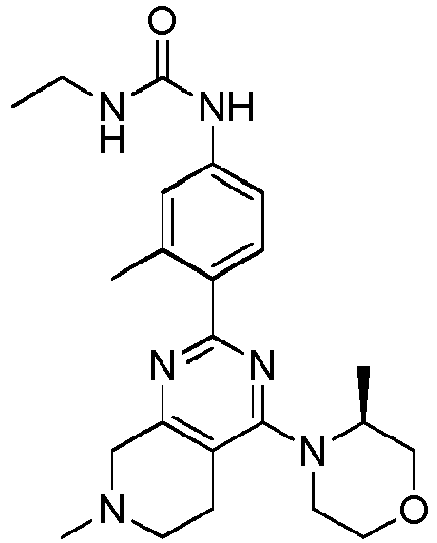
- Step 1: Method as described for intermediate 5 using (S)-4-(2-chloro-7-methyl-5,6,7,8-tetrahydropyrido[3,4-d]pyrimidin-4-yl)-3-methylmorpholine (intermediate 13) and 3-methyl-4-(4,4,5,5-tetramethyl-1,3,2-dioxaborolan-2-yl)aniline as starting materials. The mixture was filtered through a celite 545 pre-packed cartridge (2.5g), washed with MeOH and solvent removed in vacuo. The residue was purified by triturating with a (9:1) mixture of petrol ether (40-60)/ethyl acetate, yielding the title compound after filtration and drying of the solid obtained (85mg, 0.24 mmol, 68%).
LCMS (Method A), (M+H+) 354 Rt= 4.05 min. - Step 2: Method as example 85 using (S)-3-methyl-4-(7-methyl-4-(3-methylmorpholino)-5,6,7,8-tetrahydropyrido[3,4-d]pyrimidin-2-yl)aniline and ethyl isocyanate as starting materials. The solvent was removed in vacuo and purified by prep HPLC (high pH) yielding the title compound (11.8 mg, 0.027 mmol, 20%).
1HNMR (CD3OD) 7.58 (d, 1H), 7.31 (d, 1H), 7.29 (s, 1H), 4.21-4.10 (m, 1H), 3.95-3.86 (m, 1H), 3.85-3.75 (m, 1H), 3.75-3.63 (m, 3H), 3.63-3.45 (m, 3H), 3.23 (q, 2H), 2.88-2.76 (m, 3H), 2.69-2.63 (m, 1H), 2.50 (s, 3H), 2.46 (s, 3H), 1.92 (s, 1H), 1.30 (d, 3H), 1.16 (t, 3H). LCMS (Method A), (M+H+) 425 Rt= 5.03 min -

- Step 1: Method as described for intermediate 5 using (S)-4-(2-chloro-7-methyl-5,6,7,8-tetrahydropyrido[3,4-d]pyrimidin-4-yl)-3-methylmorpholine (intermediate 13) and as 3-fluoro-4-(4,4,5,5-tetramethyl-1,3,2-dioxaborolan-2-yl)aniline as starting materials. The reaction mixture was filtered through a celite 545 pre-packed cartridge (2.5g), washed with methanol and solvent removed in vacuo. The residue was purified by trituration with a (9:1) mixture of petrol ether (40-60)/ethyl acetate, yielding the title compound after filtration and drying of the solid obtained (85mg, 0.24 mmol, 67%).
LCMS (Method A), (M+H+) 358 Rt= 4.55 min. - Step 2: Method as example 85 using (S)-3-fluoro-4-(7-methyl-4-(3-methylmorpholino)-5,6,7,8-tetrahydropyrido[3,4-d]pyrimidin-2-yl)aniline and ethyl isocynate as starting materials. The solvent was removed in vacuo and purified by prep HPLC (low pH) yielding the title compound (4.3 mg, 0.01 mmol, 6%).
1HNMR (CD3OD) 8.42 (br s, 2H), 7.83 (t, 1H), 7.46 (dd, 1H), 7.09 (dd, 1H), 4.25-4.13 (m, 1H), 3.98-3.74 (m, 4H), 3.74-3.63 (m, 3H), 3.57-3.46 (m, 1H), 3.23 (q, 2H), 2.88-2.70 (m, 2H), 2.65 (s, 3H), 1.34 (d, 3H), 1.16 (t, 3H).
LCMS (Method A), (M+H+) 429 Rt= 5.25 min -

- Step 1: To a stirred solution of 3-aminophenol (66 mg, 0.55 mmol) and triethylamine (0.6 mmol, 84 µL) in DCM (5 ml) was added 4-isocyanatobenzene boronic acid pinacol ester. Reaction mixture was stirred at room temperature over the weekend. Solvent was removed in vacuo and used crude in the next reaction.
LCMS (method B), (M+H+) 355, Rt =2.72 min. - Step 2: Method as intermediate 5 using 1-(3-hydroxyphenyl)-3-(4-(4,4,5,5-tetramethyl-1,3,2-dioxaborolan-2-yl)phenyl)urea and (S)-ethyl 2-chloro-4-(3-methylmorpholino)-5H-pyrrolo[3,4-d]pyrimidine-6(7H)-carboxylate (intermediate 11) as starting materials. Reaction mixture was concentrated in vacuo and purified by prep. HPLC (low pH) to afford a brown solid, 22 mg (8% over 2 steps).
1H NMR (d6-DMSO) 9.11 (s, 1H), 8.87 (s, 1H), 8.22 (d, 2H), 7.55 (d, 2H), 7.07 (s, 1H), 6.82 (d, 1H), 6.39 (dd, 1H), 4.78 (q, 2H), 4.52-4.38 (m, 3H), 4.17-4.10 (m, 2H), 3.89 (d, 1H), 3.70 (d, 1H), 3.67 (d, 1H), 3.51 (t, 1H), 3.43 (t, 1H), 1.27-1.22 (m, 6H).
LCMS (method A), (MH+) 519, Rt = 8.08 min. -

- Step 1: Method as example 111
step 1 using 4-isocyanatobenzene boronic acid pinacol ester and tert-butyl-2-aminoethyl carbamate as starting material.
LCMS (method B), (M+H+) 355, Rt =2.72 min. - Step 2: Method as intermediate 5 was performed using tert-butyl (2-(3-(4-(4,4,5,5-tetramethyl-1,3,2-dioxaborolan-2-yl)phenyl)ureido)ethyl)carbamate and (S)-ethyl 2-chloro-4-(3-methylmorpholino)-5H-pyrrolo[3,4-d]pyrimidine-6(7H)-carboxylate ( intermediate 11) as starting materials. Reaction mixture was concentrated in vacuo and purified by prep.
HPLC (low pH) to afford a brown solid. - Step 3: Product from
step 2 deprotected using method in intermediate 6. The compound was isolated as a free base using a tosic acid cartridge to give a brown solid, 18 mg (7% over 2 steps).
1H NMR (d6-DMSO) 8.94 (s, 1H), 8.19 (d, 2H), 7.49 (d, 2H), 6.40 (t, 1H), 4.86-4.72 (m, 2H), 4.49 (d, 2H), 4.38 (br s, 1H), 4.17-4.08 (m, 2H), 3.94 (d, 1H), 3.74 (d, 1H), 3.68 (d, 1H), 3.51 (t, 1H), 3.17-3.11 (m, 2H), 2.69-2.66 (m, 2H), 1.27-1.22 (m, 6H).
LCMS (method A), (MH+) 470, Rt = 5.75 min. -

- Step1 Method as described for intermediate 5 using (S)-ethyl 2-chloro-4-(3-methylmorpholino)-5H-pyrrolo[3,4-d]pyrimidine-6(7H)-carboxylate (intermediate 11) and 3-fluoro-4-(4,4,5,5-tetramethyl-1,3,2-dioxaborolan-2-yl)aniline as starting materials. The mixture was filtered through a celite 545 pre-packed cartridge (2.5g), washed with MeOH and solvent removed in vacuo. The residue was purified by prep HPLC (high pH) yielding the title compound (54.7 mg, 0.13 mmol, 44%).
LCMS (Method A), (M+H+) 02 Rt= 6.70 min - Step 2: Method as example 85 using (S)-ethyl 2-(4-amino-2-fluorophenyl)-4-(3-methylmorpholino)-5H-pyrrolo[3,4-d]pyrimidine-6(7H)-carboxylate and ethyl isocyanate as starting materials. The solvent was removed in vacuo and purified by prep HPLC (low pH) yielding the title compound (14.6 mg, 0.03 mmol, 34%).
1HNMR (CD3OD) 7.92-7.82 (m, 1H), 7.47 (dd, 1H), 7.09, (d, 1H), 4.88-4.75 (m, 2H), 4.56 (br s, 2H), 4.47 (br s, 1H), 4.28-4.20 (q, 2H), 4.20-4.06 (m, 1H), 4.00 (dd, 1H), 3.84-3.72 (m, 2H), 3.673.56 (m, 1H), 3.52-3.39 (m, 1H), 3.25 (q, 2H), 1.24-1.28 (m, 6H), 1.18 (t, 3H).
LCMS (Method A), (M+H+) 473 Rt= 7.63 min -

- Step 1: 2-(4-isocyanatophenyl)-4,4,5,5-tetramethyl-1,3,2-dioxaborolane (300 mg, 1.22mmol) was dissolved in dry THF and stirred with 2-aminoacetamide hydrochloride (108 mg, 1.46 mmol) and triethylamine (drops) and stirred at 60°C overnight. The solvent was removed in vacuo, yielding the title compound (345mg, 1.08 mmol, 88%).
LCMS (Method B), (M+H+) 320 Rt= 2.19 min - Step 2: Method as described for intermediate 5 using (S)-ethyl 2-chloro-4-(3-methylmorpholino)-5H-pyrrolo[3,4-d]pyrimidine-6(7H)-carboxylate (intermediate 11) and 2-(3-(4-(4,4,5,5-tetramethyl-1,3,2-dioxaborolan-2-yl)phenyl)ureido)acetamide as starting materials, and [1,1'-bis(diphenylphosphino)ferrocene]dichloropalladium(II) as catalyst. The mixture was filtered through a celite 545 pre-packed cartridge (2.5g), washed with MeOH and solvent removed in vacuo. The residue was purified by prep HPLC (high pH) yielding the title compound (10.6 mg, 0.02 mmol, 12%).
1HNMR (CD3OD) 8.23-8.16 (m, 2H), 7.47 (d, 2H), 4.87-4.77 (m, 2H), 4.55 (br s, 2H), 4.51-4.40 (br s, 1H), 4.29-4.17 (m, 2H), 4.14-4.06 (m, 2H), 4.06-3.97 (m, 1H), 3.88 (s, 2H), 3.85-3.73 (m, 2H), 3.68-3.58 (m, 1H), 3.53-3.43 (m, 1H), 2.01(s, 2H), 1.38 (d, 3H), 1.36-1.27 (m, 3H), 1.24 (t, 2H).
LCMS (Method A), (M+H+) 484 Rt= 6.17min -

- Step 1: Method as described for example 114,
step 1 using 2-aminoacetic acid as starting material. The mixture was reduced in vacuo, yielding the title compound (492 mg, 1.53 mmol, 100%).
LCMS (Method B), (M+H+) 321 Rt= 2.34 min - Step 2: Method as described for intermediate 5, using (S)-ethyl 2-chloro-4-(3-methylmorpholino)-5H-pyrrolo[3,4-d]pyrimidine-6(7H)-carboxylate (intermediate 11) and 2-(3-(4-(4,4,5,5-tetramethyl-1,3,2-dioxaborolan-2-yl)phenyl)ureido)acetic acid as starting materials, and [1,1'-bis(diphenylphosphino)ferrocene]dichloropalladium(II) as catalyst. The mixture was filtered through a celite 545 pre-packed cartridge (2.5g), washed with MeOH and solvent removed in vacuo. The residue was purified by prep HPLC (low pH) yielding (6.5mg, 0.01 mmol, 9%).
1HNMR (CD3OD) 8.18 (d, 2H), 7.46 (d, 2H), 4.86-4.71 (m, 2H), 4.53 (d, 2H), 4.50-4.39 (br s, 1H), 4.26-4.16 (m, 2H), 4.16-4.07 (m, 1H), 4.06-3.96 (m, 1H), 3.90 (s, 2H), 3.85-3.71 (m, 2H), 3.66-3.57 (m, 1H), 3.52-3.39 (m, 1H), 1.37 (d, 3H), 1.35-1.29 (m, 3H).
LCMS (Method A), (M+H+) 485 Rt= 7.18min -

- Step 1: Method as described for intermediate 5 using (S)-ethyl 2-chloro-4-(3-methylmorpholino)-5H-pyrrolo[3,4-d]pyrimidine-6(7H)-carboxylate (intermediate 11), 5-(4,4,5,5-tetramethyl-1,3,2-dioxaborolan-2-yl)pyrazin-2-amine as starting materials, and [1,1'-bis(diphenylphosphino)ferrocene]dichloropalladium(II) as catalyst. The reaction mixture was filtered through a celite 545 pre-packed cartridge (2.5g), washed with MeOH and solvent removed in vacuo. The residue was purified by flash chromatography using a gradient of 0-40% DCM/MeOH yielding the title compound (69mg, 0.18 mmol, 58%).
LCMS (Method B), (M+H+) 386 Rt= 1.70 min - Step 2: Method as example 85 using (S)-ethyl 2-(5-aminopyrazin-2-yl)-4-(3-methylmorpholino)-5H-pyrrolo[3,4-d]pyrimidine-6(7H)-carboxylate as starting material. The solvent was removed in vacuo and purified by prep HPLC (low pH) yielding the title compound (1.4 mg, 1.7%).
1HNMR (CD3OD) 9.20 (s, 1H),8.69 (dd, 1H), 8.44 (br s, 1H), 4.64-4.59 (m , 2H), 4.53 (br s , 1H), 4.32-4.21 (m, 3H), 4.44 (dd, 1H), 3.87-3.76 (m, 2H), 3.70-3.60 (m, 2H), 3.57-3.45 (m, 1H), 3.41-3.33 (q, 2H), 1.41 (dd, 3H), 1.35 (t, 3H), 1.24 (t, 3H).
LCMS (Method A), (M+H+) 457 Rt= 7.01 min -

- To (S)-1-ethyl-3-(2-fluoro-4-(4-(3-methylmorpholino)-6,7-dihydro-5H-pyrrolo[3,4-d]pyrimidin-2-yl)phenyl)urea (intermediate 18) (100mg, 0.23mmol) and triethylamine (64 µL, 0.46mmol) in dry THF (3ml) was added 1-acetylpiperidin-4-one (56 µL, 0.46mmol) and stirred at room temperature for 30 min. To this sodium triacetoxyborohydride (97mg, 0.46mmol) was added. The reaction mixture was stirred at room temperature until analysis by LCMS indicated reaction was complete. The solvent was then removed in vacuo. Crude reaction mixture then was partitioned between ethyl acetate and water. The organic layer was recovered, dried with sodium sulphate and solvent removed in vacuo. Residue was then purified by prep HPLC (low pH) to afford a white solid (6.7mg, 0.013mmol, 6%)..
1H NMR (400 MHz, CD3OD) 8.25 (s, 1H), 8.18 (t, 1H), 8.10-7.97 (m, 2H), 4.49 (br, d, 2H), 4.32-4.11 (m, 3H), 4.07-3.91 (m, 4H), 3.86-3.75 (m, 2H), 3.70-3.58 (m, 1H), 3.54-3.41 (m, 2H), 3.30-3.21 (m, 3H), 2.95-2.78 (m, 2H), 2.15-2.04 (m, 3H), 1.62-1.42 (br, m, 2H), 1.38 (d, 3H), 1.19 (t, 3H)
LCMS (Method A), (M+H+) 526, Rt =5.98min -

- Step 1: Method as described for (intermediate 15) using pyridin-3-amine as starting material. Saturated solution of NaHCO3 was added , and the mixture stirred for 15 mins before partitioning between water and DCM. The organic layer was recovered, dried over MgSO4, filtered and solvent removed in vacuo. The crude residue was purified by flash chromatography using a gradient of 0-100% petrol ether (40-60)/ethyl acetate, yielding the title compound (47mg, 0.14mmol, 10%).
LCMS (Method B), (M+H+) 340 Rt= 2.10 min - Step 2: Method as described for intermediate 5 using (S)-ethyl 2-chloro-4-(3-methylmorpholino)-5H-pyrrolo[3,4-d]pyrimidine-6(7H)-carboxylate (intermediate 11) and 1-(pyridin-3-yl)-3-(4-(4,4,5,5-tetramethyl-1,3,2-dioxaborolan-2-yl)phenyl)urea as starting materials, and [1,1'-bis(diphenylphosphino)ferrocene]dichloropalladium(II) as catalyst. The reaction mixture was filtered through a celite 545 pre-packed cartridge (2.5g), washed with MeOH and reduced in vacuo. The residue was purified first by flash chromatography using a gradient of 0-40% DCM/MeOH, then triturating with a mixture of petrol ether/ethyl acetate (9:1) affording the title compound after filtration and drying of the solid obtained (23 mg, 0.05 mmol, 30%).
1HNMR (CD3OD) 8.62 (d, 1H), 8.24-8.16 (m, 3H), 8.06-8.00 (m, 1H), 7.55-7.47 (dd, 2H), 7.41-7.39 (m, 1H), 4.83-4.67 (m, 2H), 4.52 (d, 2H), 4.50-4.36 (br s, 1H), 4.25-4.13 (m, 2H),4.16-4.06 (m, 1H), 4.05-3.96 (m, 1H), 3.86-3.74 (m, 2H), 3.69-3.58 (m, 1H), 3.50-3.38 (m, 1H), 1.38 (d, 3H), 1.35-1.25 (m, 3H),
LCMS (Method A), (M+H+) 504 Rt= 6.19 min -

- Step 1: Method as described for (intermediate 15) using (4-aminophenyl)methanol as starting material. Saturated solution of NaHCO3 was added to the reaction mixture, and stirring allowed for 15 mins before partitioning between water and DCM. The organic layer was recovered, dried over MgSO4, filtered and solvent removed in vacuo. The crude residue was purified by flash chromatography using a gradient of 0-100% ethyl acetate/petrol ether (40-60), yielding the title compound (320mg, 0.87mmol, 64%).
LCMS (Method B), (M+H+) 369 Rt= 2.72 min - Step 2: Method as described for intermediate 5 using (S)-ethyl 2-chloro-4-(3-methylmorpholino)-5H-pyrrolo[3,4-d]pyrimidine-6(7H)-carboxylate (intermediate 11) and 1-(4-(hydroxymethyl)phenyl)-3-(4-(4,4,5,5-tetramethyl-1,3,2-dioxaborolan-2-yl)phenyl)urea as starting materials, and [1,1'-bis(diphenylphosphino)ferrocene]dichloropalladium(II) as catalyst. The reaction mixture was filtered through a celite 545 pre-packed cartridge (2.5g), washed with MeOH and solvent removed in vacuo. The residue was purified first by prep HPLC (low pH) yielding the title compound ( 34 mg, 0.06mmol, 41%).
1HNMR (CD3OD) 8.20 (d, 2H), 7.50 (dd, 2H), 7.42 (d, 2H), 7.29 (d, 2H), 4.84-4.69 (m, 2H), 4.55 (s, 2H), 4.53-4.48 (m, 1H), 4.47-4.39 (br s, 1H), 4.25-4.17 (m, 2H), 4.17-4.07 (m, 1H), 4.05-3.97 (m, 1H), 3.85-3.74 (m, 2H), 3.69-3.58 (m, 1H), 3.51-3.39 (m, 1H), 1.38 (d, 3H), 1.35-1.27 (m, 3H).
LCMS (Method A), (M+H+) 533 Rt= 7.76 min -

- Step 1: Method as intermediate 10 using 4-(4,4,5,5-tetramethyl-1,3,2-dioxaborolan-2-yl)aniline and phenyl chloroformate as starting materials.
- Step 2: Method as example 51 using 2-fluoroethylamine hydrochloride and phenyl (4-(4,4,5,5-tetramethyl-1,3,2-dioxaborolan-2-yl)phenyl)carbamate as starting materials. The solvent was removed in vacuo and the residue purified by flash chromatography using a gradient of 0-100% ethyl acetate/petrol ether (40-60) as eluent, yielding the title compound (65mg, 0.21 mmol, 78%).
- Step 3: Method as described for intermediate 5 using (S)-ethyl 2-chloro-4-(3-methylmorpholino)-5H-pyrrolo[3,4-d]pyrimidine-6(7H)-carboxylate (intermediate 11) and 1-(2-fluoroethyl)-3-(4-(4,4,5,5-tetramethyl-1,3,2-dioxaborolan-2-yl)phenyl)urea as starting materials and [1,1'-bis(diphenylphosphino)ferrocene]dichloropalladium(II) as catalyst. The mixture was filtered through a celite 545 pre-packed cartridge (2.5g), washed with MeOH and solvent removed in vacuo. The residue was purified first by flash chromatography using a gradient of 0-20% MeOH/DCM as eluent, then prep HPLC (low pH) yielding the title compound (9.2 mg, 0.02 mmol, 13%).
1HNMR (CD3OD) 8.24-8.17 (dd, 2H), 7.47 (d, 2H), 4.86-4.75 (m, 2H), 4.58-4.53 (m, 3H), 4.46-4.41 (t, 2H), 4.27-4.19 (q, 2H), 4.06-3.99 (m, 1H), 3.85-3.75 (m, 2H), 3.68-3.59 (m, 1H), 3.57-3.52 (m, 1H), 3.52-3.45 (m, 2H), 2.66 (s, 1H), 1.42-1.27 (m, 6H).
LCMS (Method A), (M+H+) 473 Rt= 7.45 min -

- Step 1: Method as (intermediate 14) using pyridin-4-amine as starting material. The solvent was removed in vacuo, and the residue purified by flash chromatography using a gradient of 0-100% ethyl acetate/petrol ether(40-60)as eluent, yielding the title compound (115mg, 0.33 mmol, 27%).
LCMS (Method B), (M+H+) 340 Rt= 1.92 min - Step 2: Method as described for intermediate 5 using (S)-ethyl 2-chloro-4-(3-methylmorpholino)-5H-pyrrolo[3,4-d]pyrimidine-6(7H)-carboxylate (intermediate 11) and 1-(pyridin-4-yl)-3-(4-(4,4,5,5-tetramethyl-1,3,2-dioxaborolan-2-yl)phenyl)urea as starting materials and [1,1'-bis(diphenylphosphino)ferrocene]dichloropalladium(II) as catalyst. The mixture was filtered through a celite 545 pre-packed cartridge (2.5g), washed with MeOH and solvent removed in vacuo. The residue was purified by prep HPLC (low pH) yielding the title compound (38.2 mg, 0.08 mmol, 49%).
1HNMR (d6-DMSO) 9.28 (s, 1H), 9.24 (s, 1H), 8.37 (dd, 2H), 8.26 (dd, 2H), 8.15 (s, 1H), 7.57 (dd, 2H), 7.46 (dd, 2H), 4.91-4.69 (m, 2H), 4.50 (d, 2H), 4.45-4.33 (br s, 1H), 4.19-4.09 (m, 3H), 3.98 (dd, 1H), 3.79-3.73 (d, 1H), 3.67 (dd, 1H), 3.58-3.47 (m, 1H), 1.31-1.21 (m, 6H).
LCMS (Method A), (M+H+) 504 Rt= 5.70 min -

- Step 1: To a solution of (S)-1-ethyl-3-(2-fluoro-4-(4-(3-methylmorpholino)-6,7-dihydro-5H-pyrrolo[3,4-d]pyrimidin-2-yl)phenyl)urea hydrochloride (intermediate 18) (120mg, 0.27mmol) and triethyamine (77 µL, 0.55mmol) in DCE (4mL, anhydrous) was added tert-butyl 4-oxopiperidine-1-carboxylate (130mg, 0.621mmol). Reaction mixture was stirred at room temperature for 30min. To this sodium triacetoxyborohydride (116mg, 0.55mmol) was added. The reaction mixture was stirred at room temperature until analysis by LCMS indicated reaction was complete. Solvent was then removed in vacuo. Purified by normal phase chromatography using 0-100% Ethyl acetate/cyclohexane to yield a white solid (95.6mg, 0.16mmol, 61%)
- Step 2: (S)-tert-butyl 4-(2-(4-(3-ethylureido)-3-fluorophenyl)-4-(3-methylmorpholino)-5H-pyrrolo[3,4-d]pyrimidin-6(7H)-yl)piperidine-1-carboxylate) (96mg, 0.16mmol) was stirred in a solution of HCl (4mL, 4M dioxane), and methanol (0.5mL) until analysis by LCMS indicated reaction was complete. Solvent was removed in vacuo to afford a white solid (130mg).
- Step 3: To a stirred solution of (S)-1-ethyl-3-(2-fluoro-4-(4-(3-methylmorpholino)-6-(piperidin-4-yl)-6,7-dihydro-5H-pyrrolo[3,4-d]pyrimidin-2-yl)phenyl)urea (90mg, 0.17mmol) and DIPEA (30 µL, 0.17mmol) in Dioxane (5mL) was added methyl chloroformate (14 µL, 0.19mmol). Reaction mixture was stirred at room temperature until analysis by LCMS indicated reaction was complete. Solvent was then removed in vacuo. Purified by prep. HPLC (low pH) to afford an orange gum. This was then further purified using a TsOH cartridge to remove residual formic acid from HPLC (loaded in MeOH eluted with 2M methanolic ammonia). This gave a creamy pink solid (4.9mg, 0.009mmol, 5.3%).
1H NMR (400 MHz, d6-DMSO) 8.46 (d, 1H), 8.26 (t, 1H), 8.01 (ddd, 2H), 6.68 (t, 1H), 4.42 (s, 1H), 4.18-3.98 (m, 3H), 3.97-3.90 (m, 1H), 3.90-3.76 (m, 4H), 3.75-3.61 (m, 3H), 3.60 (s, 3H), 3.56-3.42 (m, 1H), 3.18-3.08 (m, 3H), 3.00 (s, 2H), 2.70-2.58 (m, 1H), 1.90 (d, 2H), 1.46-1.35 (m, 2H), 1.24 (d, 3H), 1.07 (t, 3H).
LCMS (Method A), (M+H+) 542, Rt =5.76min -

- A stirred solution of (S)-1-ethyl-3-(2-fluoro-4-(4-(3-methylmorpholino)-6,7-dihydro-5H-pyrrolo[3,4-d]pyrimidin-2-yl)phenyl)urea (intermediate 18) (133mg, 0.25mmol) and N-methylmorpholine (55 µL, 0.5mmol) in DMF (5mL, anhydrous) was added EDC (53mg, 0.275mmol), HOBT (37mg, 0.275mmol), and 1-acetylpiperidine-4-carboxylic acid (43mg, 0.25mmol). The reaction mixture was stirred at room temperature until analysis by LCMS deemed reaction complete. Solvent was then removed in vacuo. Purified by prep. HPLC (low pH) Then further purified using a TsOH cartridge to remove residual formic acid from HPLC (loaded in MeOH eluted with 2M methanolic ammonia). Yielding a light pink solid (9.6mg, 0.017mmol, 7%).
1H NMR (d6-DMSO) 8.56 (s, 1H), 8.39-8.33 (m, 1H), 8.16-8.05 (m, 2H), 6.80-6.74 (m, 1H), 5.17 (dd, 1H), 4.96-4.80 (m, 3H), 4.55 (s, 1H), 4.48 (d, 1H), 4.09-4.02 (m, 1H), 3.93 (d, 1H), 3.88-3.79 (m, 1H), 3.77-3.71 (m, 1H), 3.63-3.54 (m, 1H), 3.25-3.16 (m, 3H), 3.05-2.86 (m, 1H), 2.74-2.61 (m, 2H), 2.09 (d, 3H), 1.91-1.79 (m, 2H), 1.68-1.38 (m, 3H), 1.35 (t, 3H), 1.15 (t, 3H).
LCMS (Method A), (M+H+) 554, Rt =7.10min -

- Step 1: Method as described for (intermediate 14) using N-(2-aminoethyl)acetamide as starting material. The solvent was removed in vacuo and the residue purified by flash chromatography using a gradient of 0-100 % ethyl acetate/petrol ether(40-60) followed by 0-10% methanol/ethyl acetate as eluent, yielding the title compound (245mg, 0.71 mmol, 58%).
LCMS (Method B), (M+H+) 348, Rt= 2.26 min - Step 2: Method as described for intermediate 5 using (S)-ethyl 2-chloro-4-(3-methylmorpholino)-5H-pyrrolo[3,4-d]pyrimidine-6(7H)-carboxylate (intermediate 11) and N-(2-(3-(4-(4,4,5,5-tetramethyl-1,3,2-dioxaborolan-2-yl)phenyl)ureido)ethyl)acetamide as starting materials and 1,1'-Bis(diphenylphosphino)ferrocene]dichloropalladium(II) as catalyst. The mixture was filtered through a celite 545 pre-packed cartridge (2.5g), washed with MeOH and solvent removed in vacuo. The residue was purified by prep HPLC (high pH) yielding the title compound (30 mg, 0.05 mmol, 38%).
1HNMR (d6-DMSO) 8.83 (s, 1H), 8.18 (dd, 2H), 7.97-7.91 (m, 1H), 7.48 (d, 2H), 6.29-6.22 (m, 1H), 4.88-4.68 (m, 2H), 4.51-4.43 (m, 2H), 4.43-4.32 (br s, 1H), 4.17-4.08 (m, 3H), 3.99-3.90 (m, 1H), 3.78-3.70 (m, 1H), 3.70-3.62 (m, 1H), 3.55-3.43 (m, 1H), 3.16-3.10 (m, 4H), 1.81 (s, 3H), 1.28-1.21 (m, 6H).
LCMS (Method C), (M+H+) 512 Rt= 7.33 min -

- Step 1: Method as described for (intermediate 14) 2-amino-N-methylacetamide as starting material. The solvent was removed in vacuo and the residue purified by flash chromatography using a gradient of 0-100 % ethyl acetate/petrol ether (40-60) followed by 0-10% MeOH/ethyl acetate as eluent, yielding (160mg, 0.48 mmol, 39%).
LCMS (Method B), (M+H+) 334 Rt= 2.24 min - Step 2: Method as described for intermediate 5 using (S)-ethyl 2-chloro-4-(3-methylmorpholino)-5H-pyrrolo[3,4-d]pyrimidine-6(7H)-carboxylate (intermediate 11) and N-methyl-2-(3-(4-(4,4,5,5-tetramethyl-1,3,2-dioxaborolan-2-yl)phenyl)ureido)acetamide as starting materials and [1,1'-bis(diphenylphosphino)ferrocene]dichloropalladium(II) as catalyst. The mixture was filtered through a celite 545 pre-packed cartridge (2.5g), washed with MeOH and solvent removed in vacuo. The residue was purified by prep HPLC (high pH) yielding the title compound (35 mg, 0.07 mmol, 46%).
1HNMR (d6-DMSO) 9.04 (s, 1H), 8.19 (dd, 2H), 7.93-7.83 (m, 1H), 7.48 (d, 2H), 6.46-6.39 (m, 1H), 491-4.67 (m, 2H), 4.52-4.41 (m, 2H), 4.43-4.29 (br s, 1H), 4.20-4.06 (m, 3H), 3.99-3.91 (m, 1H), 3.79-3.61 (m, 4H), 3.53-3.43 (m, 1H), 2.61 (d, 3H), 1.29-1.20 (m, 6H).
LCMS (Method C), (M+H+), 498 Rt= 7.34 min -

- Step 1: Method as described for example 123 using (S)-1-ethyl-3-(2-fluoro-4-(4-(3-methylmorpholino)-6,7-dihydro-5H-pyrrolo[3,4-d]pyrimidin-2-yl)phenyl)urea (intermediate 18) and N-Boc -isonipecotic acid as starting materials. Reaction mixture was concentrated in vacuo, purified by prep. HPLC (high pH).
- Step 2: Method as intermediate 6. The compound was isolated as a free base using a tosic acid cartridge to give a brown solid, 6.8 mg.
1H NMR (d6-DMSO) 8.30 (s, 1H), 8.06 (t, 1H), 7.77-7.95 (m, 2H), 6.47 (t, 1H), 4.91-4.75 (t, 1H), 4.64-4.47 (m, 3H), 4.32-4.10 (m, 2H), 3.88-3.80 (m, 1H), 3.78-3.68 (m, 2H), 3.56-3.50 (m, 1H), 3.48-3.42 (m, 1H), 3.29-3.22 (m, 1H), 2.98-2.88 (m, 1H), 2.58-2.48 (m, 2H), 2.31 (s, 4H), 1.60-1.51 (m, 2H), 1.45-1.33 (m, 2H), 1.18-1.01 (m, 3H), 0.83 (t, 3H).
LCMS (Method A), (M+H+) 512, Rt =5.43 min -

- To a stirred solution of (S)-1-cyclopropyl-3-(4-(4-(3-methylmorpholino)-6,7-dihydro-5H-pyrrolo[3,4-d]pyrimidin-2-yl)phenyl)urea (Example 3) (100mg, 0.25mmol) and N-methylmorpholine (56 µL, 0.5mmol) in DMF (5ml, anhydrous) was added EDC (53mg, 0.28mmol), HOBT (38mg, 0.28mmol), and 4-amino-4-oxobutanoic acid (29.7mg, 0.25mmol). The reaction mixture was stirred at room temperature until analysis by LCMS deemed reaction complete. Solvent was then removed in vacuo. Purified by prep. HPLC (high pH) to afford a white solid (25.7mg, 0.052mmol, 21%).
1H NMR (400 MHz, d6-DMSO) 8.60 (s, 1H), 8.19 (d, 2H), 7.50 (dd, , 2H), 7.35 (d, 1H), 6.80 (s, 1H), 6.49 (s, 1H), 5.08-4.92 (m, 1H), 4.84-4.70 (m, 2H), 4.49-4.32 (m, 2H), 4.14 (s, 1H), 3.97 (d, 1H), 3.80-3.63 (m, 2H), 3.52 (ddd, 1H), 2.65-2.52 (m, 3H), 2.39 (t, 2H), 1.27 (t, 3H), 0.68-0.60 (m, 2H), 0.46-0.37 (m, 2H).
LCMS (Method A), (M+H+) 494, Rt =5.74min. -

- To a solution of (S)-1-cyclopropyl-3-(4-(4-(3-methylmorpholino)-6,7-dihydro-5H-pyrrolo[3,4-d]pyrimidin-2-yl)phenyl)urea (Example 3) (147mg, 0.37mmol) and triethyamine (52 µL, 0.37mmol) in DMF (3mL, anhydrous) was added tert-butyl 4-(bromomethyl)piperidine-1-carboxylate (103mg, 0.37mmol). The reaction mixture was stirred at 75°C until LCMS indicated reaction was complete. Solvent was then removed in vacuo. Purified by prep. HPLC (high pH) to afford a brown solid (28.9mg, 0.049mmol, 13%)..
1H NMR (400 MHz, d6-DMSO) 8.55 (s, 1H), 8.17 (d, 2H), 7.48 (d, 2H), 6.47 (d, 1H), 4.39 (s, 1H), 4.14-3.89 (m, 6H), 3.78-3.62 (m, 4H), 3.54-3.46 (m, 1H), 3.17 (d, 1H), 2.74 (br, s, 2H), 2.58-2.53 (m, 3H), 1.80-1.67 (m, 3H), 1.40 (s, 9H), 1.24 (d, 3H), 1.06-0.92 (m, 2H), 0.68-0.61 (m, 2H), 0.44-0.38 (m, 2H).
LCMS (Method A), (M+H+) 592, Rt =6.51min -
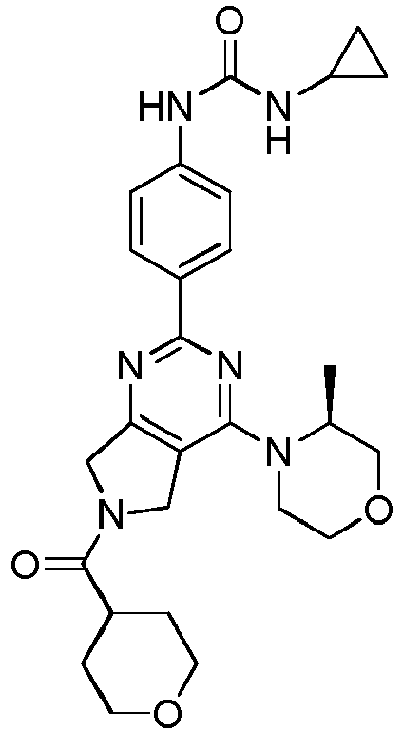
- To a solution of (S)-1-cyclopropyl-3-(4-(4-(3-methylmorpholino)-6,7-dihydro-5H-pyrrolo[3,4-d]pyrimidin-2-yl)phenyl)urea (Example 3) (100mg, 0.37mmol) and triethyamine (42.4 µL, 0.30mmol) in DCM (3mL, anhydrous), and DMF (1mL, anhydrous) was added tetrahydro-2H-pyran-4-carbonyl chloride (45.2mg, 0.30mmol). The reaction mixture was stirred at room temperature until LCMS indicated reaction was complete. Solvent was then removed in vacuo.
- Purified by prep. HPLC (low pH). This was then further purified using a TsOH cartridge (loaded in MeOH eluted with 2M methanolic ammonia), to afford a light brown solid (15.1mg, 0.030mmol, 12%).
1H NMR (d6-DMSO) 8.38 (d, 1H), 7.97 (dd, 2H), 7.29 (dd, 2H), 6.27 (s, 1H), 4.95-4.79 (m, 1H), 4.67-4.50 (m, 3H), 4.35-4.16 (m, 2H), 3.94 (br, s, 1H), 3.83-3.63 (m, 4H), 3.59-3.43 (m, 3H), 3.20-3.14 (m, 2H), 2.77-2.54 (m, 2H), 1.49-1.36 (m, 4H), 1.07 (t, 3H), 0.47-0.40 (m, 2H), 0.23-0.17 (m, 2H).
LCMS (Method A), (M+H+) 507, Rt =6.64min -

- (S)-tert-butyl 4-((2-(4-(3-cyclopropylureido)phenyl)-4-(3-methylmorpholino)-5H-pyrrolo[3,4-d]pyrimidin-6(7H)-yl)methyl)piperidine-1-carboxylate (example 128) (24mg, 0.04mmol) was stirred in a solution of 4M HCl in dioxane (1mL), and methanol (0.5mL) until analysis by LCMS indicated reaction was complete. Reaction mixture was then purified by TsOH cartridge (loaded in MeOH eluted with 2M methanolic ammonia) to afford an orange brown solid (4.9mg, 0.009mmol, 25%).
1H NMR (400 MHz, d6-DMSO) 8.56 (s, 1H), 8.17 (d, 2H), 7.48 (d, 2H), 6.48 (s, 1H), 4.39 (s, 1H), 4.14-3.90 (m, 5H), 3.80-3.62 (m, 5H), 3.55-3.45 (m, 3H), 3.18 (d, 2H), 2.76 (t, 2H), 2.59-2.53 (m, 2H), 1.85 (d, 2H), 1.80-1.71 (m, 1H), 1.27-1.13 (m, 5H), 0.67-0.61 (m, 2H), 0.44-0.38 (m, 2H).
LCMS (Method A), (M+H+) 492, Rt =4.17min -

- Step 1: Method as example 113
- Step 2: Method as example 113
step 2 using (S)-ethyl 2-(4-amino-2-fluorophenyl)-4-(3-methylmorpholino)-5H-pyrrolo[3,4-d]pyrimidine-6(7H)-carboxylate and isocyanatocyclopropane as starting materials. The solvent was removed in vacuo and the residue purified by prep HPLC (low pH) yielding the final compound (17mg, 0.04 mmol, 47%).
1HNMR (d6-DMSO) 8.82 (s, 1H), 7.98-7.89 (m, 1H), 7.58-7.48 (m, 1H), 7.17-7.09 (m, 1H), 6.65-6.59 (m, 1H), 4.92-4.71 (m, 2H), 4.47 (d, 2H), 4.43-4.29 (br s, 1H), 4.19-4.08 (m, 3H), 3.99-3.90 (m, 1H), 3.77-3.69 (m, 1H), 3.68-3.59 (m, 1H), 3.54-3.43 (m, 1H), 2.59-2.52 (m, 1H), 1.29-1.20 (m, 6H), 0.68-0.61 (m, 2H), 0.45-0.38 (m, 2H).
LCMS (Method C) (M+H+) 485, Rt= 8.54 min -

- Method as example 127 using 3-(2-oxopyrrolidin-1-yl)propanoic acid and (S)-1-cyclopropyl-3-(4-(4-(3-methylmorpholino)-6,7-dihydro-5H-pyrrolo[3,4-d]pyrimidin-2-yl)phenyl)urea (example 3) as starting materials. Purified by prep HPLC at low pH to afford a white solid. (35.3mg, 0.066mmol, 29%).
1H NMR (400 MHz, d6-DMSO) 8.38 (s, 1H), 7.98 (dd, 2H), 7.29 (d, 2H), 6.28 (s, 1H), 4.78 (q, 1H), 4.66-4.48 (m, 3H), 4.29-4.15 (m, 2H), 3.90 (br, s, 1H), 3.79-3.73 (m, 1H), 3.58-3.43 (m, 3H), 3.36-3.15 (m, 7H), 2.00 (t, 2H), 1.75-1.65 (m, 2H), 1.06 (d, 3H), 0.47-0.40 (m, 2H), 0.23-0.17 (m, 2H).
LCMS (Method A), (M+H+) 534, Rt =6.29min -

- Method as example 127 using 4-acetamidobutanoic acid and (S)-1-cyclopropyl-3-(4-(4-(3-methylmorpholino)-6,7-dihydro-5H-pyrrolo[3,4-d]pyrimidin-2-yl)phenyl)urea (example 3) as starting materials. Purified by Prep HPLC at low pH to afford a white solid (46.5mg, 0.089mmol, 39%).
1H NMR (400 MHz, d6-DMSO) 8.37 (s, 1H), 7.98-7.94 (m, 2H), 7.66-7.60 (m, 1H), 7.27 (d, 2H), 6.27 (s, 1H), 4.75 (q, 1H), 4.63-4.44 (m, 3H), 4.26-4.10 (m, 2H), 3.92 (br, s, 1H), 3.74 (d, 1H), 3.56-3.40 (m, 2H), 3.34-3.24 (m, 1H), 2.89-2.80 (m, 2H), 2.35-2.30 (m, 1H), 2.21-2.12 (m, 2H), 1.57 (d, 3H), 1.51-1.41 (m, 2H), 1.07-1.00 (m, 3H), 0.44-0.37 (m, 2H), 0.21-0.15 (m, 2H).
LCMS (Method A), (M+H+) 522, Rt =6.03min -

- To a solution of (S)-1-cyclopropyl-3-(4-(4-(3-methylmorpholino)-6,7-dihydro-5H-pyrrolo[3,4-d]pyrimidin-2-yl)phenyl)urea (Example 3) as a HCl salt (100mg, 0.23mmol) and triethyamine (64 µL, 0.46mmol) in DCE (3mL, anhydrous), and DMF 0.5mL, anhydrous) was added 4-oxobutanoic acid (45 µL, 0.46mmol). Reaction mixture was stirred at room temperature for 30mins. To this sodium triacetoxyborohydride (97mg, 0.46mmol) was added. The reaction mixture was stirred at room temperature until analysis by LCMS indicated reaction was complete. Solvent was then removed in vacuo. Purified by prep. HPLC (high pH) to afford a white solid (4.2mg, 0.008mmol, 4%).
1H NMR (400 MHz, d6-DMSO) 8.61 (s, 1H), 8.17 (d, 2H), 7.48 (d, 2H), 6.53 (s, 1H), 4.38 (s, 1H), 4.13-3.97 (m, 3H), 3.93 (dd, 1H), 3.79-3.61 (m, 6H), 2.69 (t, 2H), 2.58-2.52 (m, 1H), 2.29 (t, 2H), 1.75 (m, 2H), 1.24 (d, 3H), 0.68-0.60 (m, 2H), 0.44-0.39 (m, 2H).
LCMS (Method A), (M+H+) 481, Rt =5.01min -

- Method as example 127 using 3-(N-methylacetamido)propanoic acid and (S)-1-cyclopropyl-3-(4-(4-(3-methylmorpholino)-6,7-dihydro-5H-pyrrolo[3,4-d]pyrimidin-2-yl)phenyl)urea (example 3) as starting materials to yield a white solid (36.8mg, 0.071mmol, 26%)..
1H NMR (400 MHz, d6-DMSO) 8.58 (s, 1H), 8.22-8.17 (m, 2H), 7.50 (d, 2H), 6.48 (s, 1H), 5.10-4.90 (m, 1H), 4.88-4.68 (m, 2H), 4.50-3.34 (m, 2H), 4.22-4.06 (m, 1H), 3.98 (d, 1H), 3.80-3.64 (m, 2H), 3.62-3.47 (m, 3H), 3.01 (d, 2H), 2.82 (d, 1H), 2.77-2.67 (m, 1H), 2.65-2.53 (m, 2H), 2.01 (d, 3H), 1.31-1.24 (m, 3H), 0.68-0.61 (m, 2H), 0.44-0.39 (m, 2H).
LCMS (Method A), (M+H+) 522, Rt =6.22min -

- Method as example 127 using 3-ureidopropanoic acid and (S)-1-cyclopropyl-3-(4-(4-(3-methylmorpholino)-6,7-dihydro-5H-pyrrolo[3,4-d]pyrimidin-2-yl)phenyl)urea (example 3) as starting materials to afford a white solid (22.3mg, 0.044mmol, 16%.
1H NMR (400 MHz, d6-DMSO) 8.58 (s, 1H), 8.20 (d, 2H), 7.50 (d, 2H), 6.48 (s, 1H), 5.99 (dt, 1H), 5.51 (d, 2H), 4.98 (q, 1H), 4.80 (q, 1H), 4.70 (s, 1H), 4.50-4.33 (m, 2H), 4.12 (br, s, 1H), 3.97 (d, 1H), 3.72 (q, 2H), 3.52 (td, 1H), 3.30-3.22 (m, 2H), 2.59-2.52 (m, 2H), 1.28 (d, 3H), 0.68-0.61 (m, 2H), 0.44-0.39 (m, 2H).
LCMS (Method A), (M+H+) 509, Rt =5.71min -

- A solution of tert-butyl 2-chloro-4-morpholino-5H-pyrrolo[3,4-d]pyrimidine-6(7H)-carboxylate (intermediate 2) (2.05 g, 6.0 mmol) in TFA (15 ml) and DCM (30 ml) was stirred at room temperature (20 °C) overnight. The material was concentrated in vacuo to give an orange oil, which was used without further purification.
LCMS (method B), (M+H+) 241, Rt = 0.44 min. -

- To a stirring solution of 4-(2-chloro-6,7-dihydro-5H-pyrrolo[3,4-d]pyrimidin-4-yl)morpholine trifluoroacetate (intermediate 20) (2.16g, 2.0 mmol) in DMF, was added aqueous formaldehyde (0.3 ml, 4.0 mmol) and Et3N (560 uL, 4.0 mmol). The reaction mixture was stirred at room temperature (20 °C) for 45 minutes, before adding sodium triacetoxy borohydride (848 mg, 4.0 mmol). The reaction mixture was then stirred over-night at room temperature (20°C). The reaction mixture was basified (with 2M NaOH) before partitioning between water (25 ml) and DCM (50 ml). The organic layer was recovered, passed through a hydrophobic frit and the solvent removed in vacuo, affording the title compound as a pink solid, which was used without further purification.
LCMS (method B), (M+H+) 255, Rt = 1.83 min. -

- To a stirred solution of (S)-4-(2-chloro-6,7-dihydro-5H-pyrrolo[3,4-d]pyrimidin-4-yl)-3-methylmorpholine (intermediate 6) as a TFA salt (820mg, 2.0mmol) in anhydrous THF (5ml) was added anhydrous acetone (500µl) and glacial acetic acid (four drops). The reaction was stirred at RT for 30 minutes after which time sodium triacetoxyborohydride (848mg, 4.0mmols) was added. After stirring for a further 30 minutes at RT, the reaction was partitioned between water and DCM. The aqueous phase was extracted into DCM and the organic extracts were combined, dried over magnesium sulphate and concentrated in vacuo to afford the title compound as a brown oil, which was used without further purification.
LCMS (Method D), (M+H+) 297, RT = 2.25 mins -
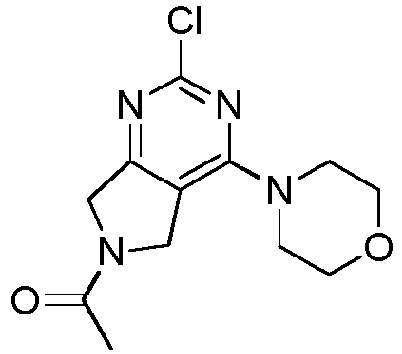
- To a stirring solution of 4-(2-chloro-6,7-dihydro-5H-pyrrolo[3,4-d]pyrimidin-4-yl)morpholine trifluoroacetate (intermediate 20) (2.16g, 2.0 mmol) in DMF (10 ml), was added Et3N (560 uL, 4.0 mmol). Reaction mixture was stirred at room temperature (20 °C) for 2 minutes followed by the addition of acetyl chloride (157 uL, 2.2 mmol) followed by stirring at room temperature overnight. The reaction mixture was basified (with 2M NaOH) before partitioning between water (25 ml) and DCM (50 ml). The organic layer was recovered, passed through a hydrophobic frit and the solvent removed in vacuo, affording the title compound as a pink solid, which was used without further purification.
LCMS (method B), (M+H+) 283 Rt = 1.75 min. -

- Method as described for 1-(2-chloro-4-morpholino-5H-pyrrolo[3,4-d]pyrimidin-6(7H)-yl)ethanone (intermediate 23) using (S)-4-(2-chloro-6,7-dihydro-5H-pyrrolo[3,4-d]pyrimidin-4-yl)-3-methylmorpholine (intermediate 6) as a TFA salt to yield a dark brown oil, which was used without further purification.
LCMS (method B), (M+H+) 297 Rt = 1.90 min. -

- To a stirring solution of 4-(2-chloro-6,7-dihydro-5H-pyrrolo[3,4-d]pyrimidin-4-yl)morpholine trifluoroacetate (intermediate 20) (2.16g, 2.0 mmol) in DMF (10 ml), was added Et3N (560 uL, 4.0 mmol). Reaction mixture was stirred at room temperature (20 °C) for 2 minutes followed by the addition of methylchloroformate (186 uL, 2.4 mmol) followed by stirring at room temperature overnight. The reaction mixture was basified (with 2M NaOH) before partitioning between water (25 ml) and DCM (50 ml). The organic layer was recovered, passed through a hydrophobic frit and the solvent removed in vacuo, affording the title compound as a brown solid used without further purification.
LCMS (method B), (M+H+) 299 Rt = 1.99 min. -
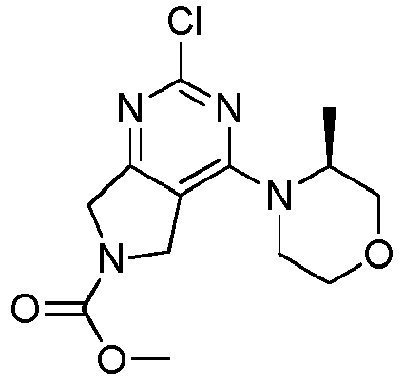
- Method as described for methyl 2-chloro-4-morpholino-5H-pyrrolo[3,4-d]pyrimidine-6(7H)-carboxylate (intermediate 25) using (S)-4-(2-chloro-6,7-dihydro-5H-pyrrolo[3,4-d]pyrimidin-4-yl)-3-methylmorpholine (intermediate 6) as a TFA salt to yield a dark brown oil, which was used without further purification.
LCMS (method B), (M+H+) 313 Rt = 2.17 min. -

- To a stirred solution of 4-(2-chloro-6,7-dihydro-5H-pyrrolo[3,4-d]pyrimidin-4-yl)morpholine trifluoroacetate (intermediate 20) as a TFA salt (708mg, 2.0mmol) in anhydrous DMF (5ml) was added triethylamine (555 µl, 4.0mmol) and the reaction was stirred at RT for two hours. After this time, ethyl chloroformate (228 µl, 2.4mmol) was added dropwise and the reaction was stirred at RT overnight. The reaction was partitioned between water and ethyl acetate and the aqueous phase was extracted into ethyl acetate. The organic extracts were combined, washed with brine, dried over magnesium sulphate and concentrated in vacuo to afford the title compound which was used without further purification.
LCMS (Method E), (M+H+) 313, RT = 0.99 mins -

- To a stirred solution of 3-fluoro-4-(4,4,5,5-tetramethyl-1,3,2-dioxaborolan-2-yl)aniline (1.5g, 6.33mmol) in DCM (30ml) was added ethyl isocyanate (1503µL, 19mmol). Reaction mixture was stirred at 35°C for 20 hours. Additional isocyanate was added and reaction mixture left for sufficient time to ensure reaction completion. The crude reaction mixture was then partitioned between water and DCM. The organic layer was recovered, passed through a hydrophobic frit and the solvent removed in vacuo. The residue was purified by flash chromatography using 0-60% ethyl acetate/petroleum ether 40-60 to yield a yellow solid (1.054g, 3.42mmol, 54%).
LCMS (Method B), (M+H+) 309, Rt=2.51min. -

- Prepared as 1-ethyl-3-(3-fluoro-4-(4,4,5,5-tetramethyl-1,3,2-dioxaborolan-2-yl)phenyl)urea (intermediate 28) using 3-fluoro-4-(4,4,5,5-tetramethyl-1,3,2-dioxaborolan-2-yl)aniline and cyclopropyl isocyanate as starting materials. The crude reaction mixture was then partitioned between DCM and water. The organic layer was recovered, passed through a hydrophobic frit and the solvent removed in vacuo to yield a light orange solid (3.2g, 10mmol, 100%).
LCMS (Method B), (M+H+) 321, Rt=2.52min. -

- 3-fluoro-4-(4,4,5,5-tetramethyl-1,3,2-dioxaborolan-2-yl)aniline (3g, 12.65 mmol) dissolved in dry THF was stirred with NaHCO3 ( 1.6g, 19 mmol) and phenyl chloroformate ( 1.92 mL, 15.20 mmol) at room temperature overnight. The reaction mixture was partitioned between water and DCM, the organic layer recovered, dried over MgSO4, filtered and the solvent removed in vacuo, affording the title compound which was used without further purification.
LCMS (Method B), (M+H+) 358 Rt= 3.08 min -

- To a stirring solution of phenyl (3-fluoro-4-(4,4,5,5-tetramethyl-1,3,2-dioxaborolan-2-yl)phenyl)carbamate (intermediate 30) (1.6 g, 4.48 mmol) in dry DMF was added triethylamine (2.03 mL, 14.55 mmol) and 2-fluoroethanamine hydrochloride ( 2.23g, 22.40 mmol). The mixture was stirred at 50°C for 2h. The solvent was then removed in vacuo affording the title compound which was used without further purification.
LCMS (Method B), (M+H+) 327 Rt= 2.48 min -

- Method as described for 1-(3-fluoro-4-(4,4,5,5-tetramethyl-1,3,2-dioxaborolan-2-yl)phenyl)-3-(2-fluoroethyl)urea (intermediate 31) using ethanolamine as starting material.
LCMS (Method B), (M+H+) 325 Rt= 2.22 min -

- Step 1: Method as (S)-tert-butyl 2-chloro-4-(3-methylmorpholino)-5H-pyrrolo[3,4-d]pyrimidine-6(7H)-carboxylate (intermediate 1) using tert-
butyl 2,4-dichloro-5H-pyrrolo[3,4-d]pyrimidine-6(7H)-carboxylate and (R)-3-methylmorpholine as starting materials to yield (R)-tert-butyl 2-chloro-4-(3-methylmorpholino)-5H-pyrrolo[3,4-d]pyrimidine-6(7H)-carboxylate a white solid (4.55g, 12.8mmol, 70%)
LCMS (Method B), (M+H+) 355, Rt=2.72min - Step 2: A solution of (R)-tert-butyl 2-chloro-4-(3-methylmorpholino)-5H-pyrrolo[3,4-d]pyrimidine-6(7H)-carboxylate (from step1) (985 mg, 2.77 mmol), 1-cyclopropyl-3-(3-fluoro-4-(4,4,5,5-tetramethyl-1,3,2-dioxaborolan-2-yl)phenyl)urea (intermediate 29) (978 mg, 3.0 mmol),.[1,1'-Bis (diphenylphosphino)ferrocene]dichloropalladium (II), complex with dichloromethane (113 mg, 0.139 mmol) and sodium carbonate (881 mg, 8.31 mmol) in 8ml of a 7:3:2 mixture of DME:H2O:EtOH respectively was heated in the microwave at 110°C for 1 hour. Reaction solvent was removed in vacuo. The residue was then partitioned between DCM (100ml) and water (80ml). The organic layer was recovered, passed through a hydrophobic frit and the solvent removed in vacuo. The residue was purified by flash chromatography using 20-100% ethyl acetate/ petroleum ether 40-60 to yield an off white solid (1.107g, 2.16mmol, 78%).
1H NMR (d6-DMSO) 8.52 (s, 1H), 7.72 (t, 1H), 7.32 (d, 1H), 6.92 (dd, 1H), 6.33 (s, 1H), 4.63-4.47 (m, 2H), 4.26-4.09 (m, 3H), 3.88 (q, 1H), 3.76-3.69 (m, 1H), 3.55-3.40 (m, 2H), 3.27 (td, 1H), 2.96 (d, 1H), 2.38-2.31 (m, 1H), 1.26 (s, 9H), 1.04 (d, 3H), 0.47-0.40 (m, 2H), 0.24-0.18 (m, 2H).
LCMS (Method A), (M+H+) 513, Rt=8.74min - Step 3: To a stirred solution of (R)-tert-butyl 2-(4-(3-cyclopropylureido)-2-fluorophenyl)-4-(3-methylmorpholino)-5H-pyrrolo[3,4-d]pyrimidine-6(7H)-carboxylate (1.1g, 2.1mmol) in methanol (15ml) was added 4M HCl in dioxane (4ml) and the reaction was stirred at RT overnight. The reaction was concentrated in vacuo to yield the titled compound as a yellow solid which was used without further purification.
LCMS (Method E), (M+H+) 413, RT = 0.76 mins -

- To a stirred solution of 4-(2-chloro-6,7-dihydro-5H-pyrrolo[3,4-d]pyrimidin-4-yl)morpholine (intermediate 20) as a HCl salt (455mg, 1.6mmol) in anhydrous THF (5ml) was added anhydrous acetone (500µl) and glacial acetic acid (two drops). The reaction was stirred at RT for 30 minutes after which time sodium triacetoxyborohydride (696mg, 3.3mmol) was added. After stirring for a further 2 hours at RT the reaction was partitioned between water and DCM. The aqueous phase was extracted into DCM and the organic extracts were combined and concentrated in vacuo to afford the title compound as a brown oil which was used without further purification.
LCMS (Method F), (M+H+) 283, RT = 0.92 mins -

- (S)-ethyl 2-chloro-4-(3-methylmorpholino)-5H-pyrrolo[3,4-d]pyrimidine-6(7H)-carboxylate (intermediate 11) (1.0 g, 3.06 mmol), 4-(4,4,5,5-tetramethyl-1,3,2-dioxaborolan-2-yl)aniline (805 mg, 3.67 mmol), Pd(PPh3)2(Cl)2 (107 mg, 0.15 mmol) and Na2CO3 (487 mg, 4.59 mmol) were stirred in CPME/Water/EtOH (14/1/6 mL) under nitrogen for 5 mins, followed by heating at 100 °C overnight. The reaction mixture was then diluted with water and CPME, and precipitate collected by filtration to give 1.05g of a brown solid. A portion of the brown solid was further purified by prep. HPLC to give 32.6 mg of an off-white solid.
1H NMR (d6-DMSO) 8.0 (d, 2H), 6.58 (d, 2H), 5.58 (s, 2H), 4.86-4.63 (m, 2H), 4.44 (d, 2H), 4.34 (br s, 1H), 4.13 (q, 2H), 4.07-4.00 (br m, 1H), 3.95 (dd, 1H), 3.74 (d, 1H), 3.65 (dd, 1H) 3.49 (t, 1H), 3.34-3.27 (m, 1H), 1.30-1.20 (m, 6H).
LCMS (Method B), (M+H+) 384 Rt= 6.50 mins -

- Method as described for example 47 using (S)-ethyl 2-chloro-4-(3-methylmorpholino)-5H-pyrrolo[3,4-d]pyrimidine-6(7H)-carboxylate (intermediate 11) and 3-fluoro-4-(4,4,5,5-tetramethyl-1,3,2-dioxaborolan-2-yl)aniline as starting materials. The mixture was filtered through a celite 545 pre-packed cartridge (2.5g), washed with MeOH and the solvent removed in vacuo. The residue was purified by prep. HPLC at high pH, yielding the title compound (55 mg, 0.14 mmol, 45%).
1H NMR (CD3OD) 7.80-7.70 (m, 1H), 6.51 (dd, 1H), 6.42 ( dd, 1H), 4.66 (br s, 3H), 4.58-4.51 (m, 2H), 4.46 (br s, 1H), 4.22 (q, 2H), 4.20-4.07 (m, 1H), 3.99 (dd, 1H), 3.84-3.73 (m, 2H), 3.68-3.57 (m, 1H), 3.52-3.39 (m, 1H), 1.40-1.30 (m, 6H).
LCMS (Method A), (M+H+) 402 Rt= 6.70 min -

- Step 1: 5-bromo-1,3-difluoro-2-isocyanatobenzene (200 mg, 0.85 mmol) was dissolved in dry THF and stirred at room temperature for 5 minutes under nitrogen, before adding ethylamine (2M solution in THF) (859 uL, 1.7 mmol) drop wise to the mixture. A white emulsion was immediately formed. The mixture was stirred at 40°C overnight, before removing the solvent in vacuo to give (239 mg, 0.85 mmol) of solid.
LCMS (Method B), (M+H+) 278,280 Rt= 2.17 min - Step 2:1-(4-bromo-2,6-difluorophenyl)-3-ethylurea (170 mg, 0.61 mmol) was dissolved in dry DMF and stirred with 4,4,4',4',5,5,5',5'-octamethyl-2,2'-bi(1,3,2-dioxaborolane) (171 ,g, 0.67 mmol), potassium acetate (180 mg, 1.83 mmol) and [1,1'-Bis(diphenylphosphino)ferrocene]dichloropalladium (II), complex with dichloromethane (15 mg, 0.02 mmol) at 80°C under nitrogen for 48h. The reaction mixture was filtered through a celite 545 pre-packed cartridge (2.5g), washed with MeOH and the solvent removed in vacuo, yielding 1-(2,6-difluoro-4-(4,4,5,5-tetramethyl-1,3,2-dioxaborolan-2-yl)phenyl)-3-ethylurea used without further purification.
LCMS (Method D), (M+H+) 327 Rt= 1.40 min - Step 3: Method as example 47 using (S)-4-(2-chloro-6-methyl-6,7-dihydro-5H-pyrrolo[3,4-d]pyrimidin-4-yl)-3-methylmorpholine (intermediate 12) and 1-(2,6-difluoro-4-(4,4,5,5-tetramethyl-1,3,2-dioxaborolan-2-yl)phenyl)-3-ethylurea as starting materials. The reaction mixture was filtered through a celite 545 pre-packed cartridge (2.5g), washed with MeOH and the solvent removed in vacuo. The crude material was then purified by prep. HPLC at high pH yielding the title compound (18.5mg, 0.04 mmol, 9.2%).
1H NMR (CD3OD) 7.90 (d, 2H), 4.48-4.35 (br s, 1H), 4.20-4.06 (m, 3H), 4.04-3.96 (m, 1H), 3.92-3.71 (m, 4H), 3.66-3.56 (m, 1H), 3.49-3.38 (m, 1H), 3.28-3.19 (q, 2H), 2.62 (s, 3H), 1.36 (d, 3H), 1.16 (t, 3H).
LCMS (Method A), (M+H+) 433, Rt= 5.14 min. -

- Step 1: To a stirring solution of 4-bromo-2,3-difluoroaniline (500 mg, 2.42 mmol) in dry THF was added ethyl isocyanate ( 229 uL, 2.90 mmol) dropwise. The reaction mixture was stirred at 60°C overnight. The solvent was then removed in vacuo, yielding the title compound as a white solid (650 mg, 2.34 mmol, 97%).
LCMS (Method D), (M+H+) 278,280 Rt= 2.55 min - Step 2: Method as described for example 139
step 2 using 1-(4-bromo-2,3-difluorophenyl)-3-ethylurea as starting material. - Step 3: Method as example 47 using (S)-4-(2-chloro-6-methyl-6,7-dihydro-5H-pyrrolo[3,4-d]pyrimidin-4-yl)-3-methylmorpholine (intermediate 12) and 1-(2,3-difluoro-4-(4,4,5,5-tetramethyl-1,3,2-dioxaborolan-2-yl)phenyl)-3-ethylurea as starting materials. The mixture was filtered through a celite 545 pre-packed cartridge (2.5g), washed with MeOH and the solvent removed in vacuo. The crude material was purified first by Flash Chromatography using a gradient of 0-40% DCM/MeOH, then prep. HPLC at low pH yielding the title compound (8.7 mg, 0.01 mmol, 4.2%).
1H NMR (CD3OD) 8.02-7.93 (m, 1H), 7.77-7.68 (m, 1H), 4.51-4.30 (m, 2H), 4.19-4.05 (m, 2H), 4.05-3.97 (m, 1H), 3.84-3.71 (m, 2H), 3.67-3.56 (m 1H), 3.50-3.39 (m, 1H), 3.26 (q, 2H), 2.80 (br s, 3H), 2.68 (s, 2H), 1.38 (d, 3H), 1.18 (t, 3H).
LCMS (Method A), (M+H+) 433 Rt= 5.44 min -

-
Step 1 Method as described for example 47 using (S)-ethyl 2-chloro-4-(3-methylmorpholino)-5H-pyrrolo[3,4-d]pyrimidine-6(7H)-carboxylate (intermediate 11) and 2,5-difluoro-4-(4,4,5,5-tetramethyl-1,3,2-dioxaborolan-2-yl)aniline as starting materials. The mixture was filtered through a celite 545 pre-packed cartridge (2.5g), washed with MeOH and the solvent removed in vacuo. The residue was purified by prep. HPLC at low pH, yielding the title compound (25 mg, 0.06 mmol, 13%).
1H NMR (CD3OD) 7.68-7.58 (m, 1H), 6.60-6.53 (m, 1H), 4.88-4.78 (m, 2H), 4.65 (br s, 1H), 4.59-4.52 (m, 2H), 4.46 (br s, 1H), 4.24 ( q, 2H), 4.19-4.09 (m, 1H), 4.01 (dd, 1H), 3.84-3.74 (m, 2H), 3.68-3.57 (m, 1H), 3.52-3.39 (m, 1H), 1.40-1.31 (m, 6H).
LCMS (Method A), (M+H+) 420 Rt= 8.12 min - Step 2: Method as described for example 85 using (S)-ethyl 2-(4-amino-2,5-difluorophenyl)-4-(3-methylmorpholino)-5H-pyrrolo[3,4-d]pyrimidine-6(7H)-carboxylate as staring material. Stirring was allowed at 60°C overnight. The solvent was removed in vacuo and the residue purified by prep. HPLC at low pH, yielding the title compound (3.3mg, 0.006 mmol, 17%).
1H NMR (CD3OD) 8.08-8.00 (m, 1H), 7.77-7.69 (m, 1H), 4.64 (br s, 3H), 4.56 (br s, 2H), 4.52-4.39 (br s, 1H), 4.26-4.17 (m, 2H), 4.17-4.06 (m, 1H), 4.04-3.96 (m, 1H), 3.84-3.72 (m, 2H), 3.65-3.57 (m, 1H), 3.51-3.38 (m, 1H), 3.29-3.21 (q, 2H), 1.39-1.29 (m. 6H), 1.17 (t, 3H).
LCMS (Method A), (M+H+) 491 Rt= 8.93 min -

- Step 1 : 4-bromo-3,5-difluoroaniline (1g, 4.863 mmol) was dissolved in dry DMF and stirred with 4,4,4',4',5,5,5',5'-octamethyl-2,2'-bi(1,3,2-dioxaborolane) (2.70g, 0.67120.6 mmol), potassium acetate (1.42g, 14.5 mmol) and [1,1'-Bis(diphenylphosphino)ferrocene]dichloropalladium (II), complex with dichloromethane (197 mg, 0.24 mmol) with microwave heating at 110°C for 4h. The reaction mixture was filtered through a celite 545 pre-packed cartridge (2.5g), washed with MeOH and the solvent removed in vacuo, yielding 3,5-difluoro-4-(4,4,5,5-tetramethyl-1,3,2-dioxaborolan-2-yl)aniline which was used without further purification.
LCMS (Method B), (M+H+) 256 Rt= 2.61 min - Step 2 : Method as described for example 47 using (S)-ethyl 2-chloro-4-(3-methylmorpholino)-5H-pyrrolo[3,4-d]pyrimidine-6(7H)-carboxylate (intermediate 11) and 3,5-difluoro-4-(4,4,5,5-tetramethyl-1,3,2-dioxaborolan-2-yl)aniline as starting materials. Reaction mixture heated in by microwave at 130°C for 1h. The mixture was filtered through a celite 545 pre-packed cartridge (2.5g), washed with MeOH and the solvent removed in vacuo. The residue was purified by prep. HPLC at high pH, yielding the title compound (55 mg, 0.13 mmol, 14%).
1H NMR (CD3OD) 6.27 (d, 2H), 4.57 ( br s, 3H), 4.51-4.38 (br s, 1H), 4.29-4.19 (m, 2H), 4.17-4.03 (m, 1H), 4.01-3.95 (m, 1H), 3.83-3.72 (m, 2H), 3.66-3.56 (m, 1H), 3.52-3.40 (m, 1H), 1.39-1.30 (m, 6H).
LCMS (Method A), (M+H+) 420 Rt= 7.79 min - Step 3: Method as described for example 85 using (S)-ethyl 2-(4-amino-2,6-difluorophenyl)-4-(3-methylmorpholino)-5H-pyrrolo[3,4-d]pyrimidine-6(7H)-carboxylate as starting material. Stirring was allowed at 60°C overnight. The solvent was removed in vacuo and the residue purified by prep. HPLC at low pH, yielding the title compound (6.4mg, 0.01 mmol, 15%).
1H NMR (CD3OD) 7.20-7.11 (d, 2H), 4.59 (br, s, 2H), 4.46 (br, s, 1H), 4.29-4.19 (m, 2H), 4.17-4.03 (m, 1H), 3.99 (dd, 1H), 3.83-3.72 (m, 2H), 3.66-3.56 (m, 1H), 3.53-3.40 (m, 1H), 3.36 (s, 2H), 3.25 (q, 2H), 1.41-1.29 (m, 6H), 1.17 (t, 3H).
LCMS (Method A), (M+H+) 491 Rt= 8.46 min -
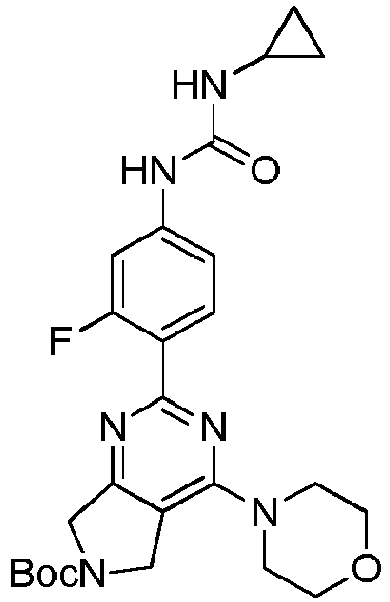
- A solution of tert-butyl 2-chloro-4-morpholino-5H-pyrrolo[3,4-d]pyrimidine-6(7H)-carboxylate (intermediate 2) (85mg, 0.25mmol), 1-cyclopropyl-3-(3-fluoro-4-(4,4,5,5-tetramethyl-1,3,2-dioxaborolan-2-yl)phenyl)urea (intermediate 29) (100mg, 0.31mmol), [1,1'-Bis(diphenylphosphino)ferrocene]dichloropalladium (II), complex with dichloromethane (10mg, 0.012mmol) and sodium carbonate (40mg, 0.38mmol) in 2ml of a 7:3:2 mixture of DME: EtOH :H2O respectively was heated in the microwave at 130°C for 30 minutes. The mixture was filtered through a celite 545 pre-packed cartridge (2.5g), washed with MeOH and the solvent removed in vacuo. The residue was purified by prep. HPLC at low pH, yielding the title compound (72 mg, 0.14 mmol, 58%).
1H NMR (CD3OD) 7.86 (td, 1H), 7.50 (dd, 1H), 7.13 (d, 1H), 4.85-4.82 (br s, 3H), 4.80 (br s, 1H), 4.52 (br s, 2H), 3.79 (s, 6H), 2.62-2.57 (m, 1H), 1.53 (s, 9H), 0.78-0.73 (m, 2H), 0.54-0.50 (m, 2H).
LCMS (Method E), (M+H+) 499, Rt = 0.98 min. -

- Method as described for tert-Butyl 2-(4-(3-cyclopropylureido)-2-fluorophenyl)-4-morpholino-5H-pyrrolo[3,4-d]pyrimidine-6(7H)-carboxylate (example 143) using (S)-tert-butyl 2-chloro-4-(3-methylmorpholino)-5H-pyrrolo[3,4-d]pyrimidine-6(7H)-carboxylate (intermediate 1).
1H NMR (CD3OD) 7.86 (td, 1H), 7.48 (dd, 1H), 7.13 (d, 1H), 4.85-4.82 (m, 3H), 4.52-4.47 (m, 2H), 4.19-4.10 (m, 1H), 4.00 (dd, 1H), 3.79-3.77 (m, 2H), 3.59 (td, 1H), 3.49-3.46 (m, 1H), 2.62-2.57 (m, 1H), 1.53 (s, 9H), 1.37 (d, 3H), 0.78-0.73 (m, 2H), 0.54-0.50 (m, 2H).
LCMS (Method B), (M+H+) 513, Rt = 2.42 min. -

- Method as described for tert-Butyl 2-(4-(3-cyclopropylureido)-2-fluorophenyl)-4-morpholino-5H-pyrrolo[3,4-d]pyrimidine-6(7H)-carboxylate (example 143) using 1-ethyl-3-(3-fluoro-4-(4,4,5,5-tetramethyl-1,3,2-dioxaborolan-2-yl)phenyl)urea (intermediate 28).
1H NMR (CD3OD) 7.86 (td, 1H), 7.46 (dd, 1H), 7.10 (d, 1H), 4.90-4.85 (m, 3H), 4.80 (br s, 1H), 4.52 (br s, 2H), 3.79 (s, 6H), 3.24 (q, 2H), 1.53 (s, 9H), 1.17 (t, 3H).
LCMS (Method E), (M+H+) 487, Rt = 0.96 min. -

- Method as described for tert-Butyl 2-(4-(3-(cyclopropylureido)-2-fluorophenyl)-4-morpholino-5H-pyrrolo[3,4-d]pyrimidine-6(7H)-carboxylate (example 143) using (S)-methyl 2-chloro-4-(3-methylmorpholino)-5H-pyrrolo[3,4-d]pyrimidine-6(7H)-carboxylate (intermediate 26) (193mg, 0.5 mmol) and 1-cyclopropyl-3-(3-fluoro-4-(4,4,5,5-tetramethyl-1,3,2-dioxaborolan-2-yl)phenyl)urea (intermediate 29) (182 mg, 0.57 mmol) as starting materials. Reaction mixture was partitioned between EtOAc (50 ml) and water (35 ml), the organic layer passed through a hydrophobic frit and concentrated in vacuo to leave a brown solid. The solid was purified by prep. HPLC at low pH to afford a colourless solid (22 mg, 10%).
1H NMR (d6-DMSO) 8.76 (s, 1H), 8.00-7.86 (m, 1H), 7.53 (dd, 1H), 7.12 (dd, 1H), 6.56 (d, 1H), 4.90-4.70 (m, 2H), 4.46 (d, 2H), 4.35 (br s, 1H), 4.12-3.98 (m, 1H), 3.94 (d, 1H), 3.76-3.60 (m, 5H), 3.49 (dd, 1H), 3.30 (dd, 1H), 2.60-2.53 (m, 1H), 1.25 (d, 3H), 0.70-0.60 (m, 2H), 0.46-0.37 (m, 2H).
LCMS (method A), (M+H+) 471, Rt = 7.13 min. -

- To a solution of (S)-4-(2-chloro-6-methyl-6,7-dihydro-5H-pyrrolo[3,4-d]pyrimidin-4-yl)-3-methylmorpholine (intermediate 12) (150mg, 0.55mmol) and 1-cyclopropyl-3-(3-fluoro-4-(4,4,5,5-tetramethyl-1,3,2-dioxaborolan-2-yl)phenyl)urea (intermediate 29) (212mg, 0.69mmol) in DME/EtOH/H2O (7/3/2) (2mL) was added [1,1'-Bis(diphenylphosphino)ferrocene]dichloropalladium (II), complex with dichloromethane (22mg, 0.027mmol) and Cs2CO3 (538mg, 1.65mmol). The reaction mixture was then heated by microwave at 115°C for 45min. The crude reaction mixture was partitioned between EtOAc (25ml) and water (25ml). The organic layer was recovered, passed through a hydrophobic frit and the solvent removed in vacuo. Residue was then purified by preparative HPLC at low pH to afford a yellow solid (25mg, 0.06mmol, 11%).
1H NMR (d6- DMSO) δ 8.77 (s, 1H), 7.92 (t, 1H), 7.52 (dd, 1H), 7.12 (dd, 1H), 6.59 (d, 1H), 4.32 (br, s, 1H), 4.12-3.99 (m, 3H), 3.92 (dd, 1H), 3.74 (d, 2H), 3.73-3.60 (m, 2H), 3.52-3.44 (m, 1H), 3.30 (ddd, 1H), 2.59-2.52 (m, 1H), 2.50-2.48 (m, 3H), 1.24 (d, 3H), 0.69-0.62 (m, 2H), 0.46-0.39 (m, 2H).
LCMS (Method A), (M+H+) 427, Rt =5.00min -

step 3 using tert-Butyl 2-(4-(3-(cyclopropylureido)-2-fluorophenyl)-4-morpholino-5H-pyrrolo[3,4-d]pyrimidine-6(7H)-carboxylate (example 143). The resulting solid was triturated from methanol/ether to give a cream solid (82% yield).
1H NMR (d6-DMSO) 9.71 (br s, 2H), 8.87 (s, 1H), 7.96 (t, 1H), 7.54 (dd, 1H), 7.14 (dd, 1H), 6.62 (br s, 1H), 4.71 (t, 2H), 4.37 (t, 2H), 3.69-3.64 (m, 8H), 2.56-2.52 (m, 1H), 0.67-0.62 (m, 2H), 0.43-0.40 (m, 2H).
LCMS (method A), (M+H+) 399, Rt = 4.67 min. -

- Method as described for (R)-1-cyclopropyl-3-(3-fluoro-4-(4-(3-methylmorpholino)-6,7-dihydro-5H-pyrrolo[3,4-d]pyrimidin-2-yl)phenyl)urea hydrochloride (intermediate 33)
step 3 using - (S)-tert-Butyl 2-(4-(3-cyclopropylureido)-2-fluorophenyl)-4-(3-methylmorpholino)-5H-pyrrolo[3,4-d]pyrimidine-6(7H)-carboxylate(example 144). The resulting solid was triturated from methanol/ether to give a cream solid (37% yield).
1H NMR (d6-DMSO) 9.81 (br s, 2H), 8.93 (s, 1H), 7.95 (t, 1H), 7.54 (dd, 1H), 7.14 (dd, 1H), 6.66 (br s, 1H), 4.77-4.67 (br m, 2H), 4.38-3.94 (br m, 4H), 3.95 (br dd, 1H), 3.73 (d, 1H), 3.64 (dd, 1H), 3.49 (td, 1H), 3.39-3.31 (m, 1H), 2.55-2.53 (m, 1H), 1.25 (d, 3H), 0.67-0.62 (m, 2H), 0.43-0.39 (m, 2H).
LCMS (method A), (M+H+) 413, Rt = 4.94 min. -

- Method as described for (R)-1-cyclopropyl-3-(3-fluoro-4-(4-(3-methylmorpholino)-6,7-dihydro-5H-pyrrolo[3,4-d]pyrimidin-2-yl)phenyl)urea hydrochloride (intermediate 33)
step 3 tert-butyl 2-(4-(3-ethylureido)-2-fluorophenyl)-4-morpholino-5H-pyrrolo[3,4-d]pyrimidine-6(7H)-carboxylate (example 145). The resulting solid was triturated from methanol/ether to give a cream solid (60% yield).
1H NMR (d6-DMSO) 9.71 (br s, 2H), 8.87 (s, 1H), 7.96 (t, 1H), 7.54 (dd, 1H), 7.14 (dd, 1H), 6.62 (br s, 1H), 4.71 (t, 2H), 4.37 (t, 2H), 3.69-3.64 (m, 8H), 2.55-2.52 (m, 1H), 0.67-0.62 (m, 2H), 0.43-0.40 (m, 2H).
LCMS (method A), (M+H+) 387, Rt = 4.61 min. -

- A solution of ethyl 2-chloro-4-morpholino-5H-pyrrolo[3,4-d]pyrimidine-6(7H)-carboxylate (intermediate 27) (156mg, 0.498mmol), 1-ethyl-3-(3-fluoro-4-(4,4,5,5-tetramethyl-1,3,2-dioxaborolan-2-yl)phenyl)urea (intermediate 28) (174mg, 0.567mmol), [1,1'-Bis (diphenylphosphino)ferrocene]dichloropalladium (II), complex with dichloromethane (20mg, 0.0249mmol) and sodium carbonate (148mg, 1.39mmol) in 2ml of a 7:3:1 mixture of DME:H2O:EtOH respectively was heated in the microwave at 115°C for 45 minutes. The reaction was concentrated in vacuo and the residue re-dissolved in a mix ofMeOH/DCM. It was loaded onto an SCX cartridge and washed with two column volumes of MeOH/DCM before being eluted with 2M NH3 in MeOH and concentrated in vacuo to give a solid. The solid was triturated in acetone and filtered to yield the title compound (45mg, 20%).
1H NMR (CD3OD) 7.87 (td, 1H), 7.47 (dd, 1H), 7.10 (dd, 1H), 4.89 (s, 2H), 4.57 (s, 2H), 4.23 (q, 2H), 3.79 (s, 8H), 3.24 (q, 2H), 1.33 (t, 3H), 1.16 (t, 3H).
LCMS (method A), (M+H+) 459, Rt = 7.15 min. -
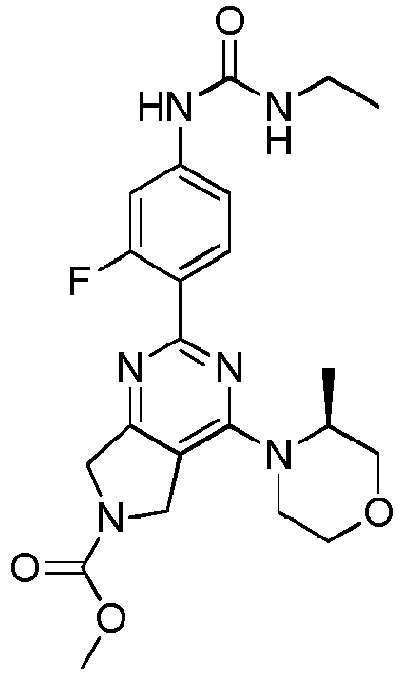
- A solution of (S)-methyl 2-chloro-4-(3-methylmorpholino)-5H-pyrrolo[3,4-d]pyrimidine-6(7H)-carboxylate (intermediate 26) (98mg, 0.313mmol), 1-ethyl-3-(3-fluoro-4-(4,4,5,5-tetramethyl-1,3,2-dioxaborolan-2-yl)phenyl)urea (intermediate 28) (110mg, 0.357mmol), [1,1'-Bis(diphenylphosphino)ferrocene]dichloropalladium (II), complex with dichloromethane (13mg, 0.0157mmol) and sodium carbonate (93mg, 0.876mmol) in 2ml of a 7:3:1 mixture of DME:H2O:EtOH respectively was heated in the microwave at 115°C for 45 minutes. The reaction was concentrated in vacuo and the residue was re-dissolved in a mix of H2O and EtOAc. The aqueous phase was extracted into EtOAc and the organic extracts were combined and concentrated in vacuo. The sample was then purified via preparative HPLC at low pH and then triturated in MeOH and filtered to yield the title compound (6mg, 4%).
1H NMR (d6-DMSO) 8.86 (s, 1H), 7.93 (td, 1H), 7.52 (dd, 1H), 7.09 (dd, 1H), 6.25 (t, 1H), 4.82 (dt, 2H), 4.47 (d, 2H), 4.35 (br s, 1H), 4.13-3.91 (m, 3H), 3.73 (d, 1H), 3.69 (s, 3H), 3.64 (d, 1H), 3.52-3.44 (m, 1H), 3.16-3.08 (m, 2H), 1.25 (d, 3H), 1.06 (t, 3H).
LCMS (method A), (M+H+) 459, Rt = 6.93 min. -

- A solution of (S)-tert-butyl 2-chloro-4-(3-methylmorpholino)-5H-pyrrolo[3,4-d]pyrimidine-6(7H)-carboxylate (intermediate 1) (214mg, 0.603mmol), 1-ethyl-3-(3-fluoro-4-(4,4,5,5-tetramethyl-1,3,2-dioxaborolan-2-yl)phenyl)urea (intermediate 28) (211mg, 0.685mmol), [1,1'-Bis(diphenylphosphino)ferrocene]dichloropalladium (II), complex with dichloromethane (25mg, 0.0306mmol) and sodium carbonate (179mg, 1.69mmol) in 2ml of a 7:3:1 mixture of DME:H2O:EtOH respectively was heated in the microwave at 115°C for 45 minutes then at 130°C for 15 minutes. The reaction mixture was concentrated in vacuo and the residue was re-dissolved in a mix of H2O and EtOAc. The aqueous phase was basified by the addition of aqueous NaOH and extracted into EtOAc. The organic extracts were combined, dried over magnesium sulphate and concentrated in vacuo. The sample was purified via preparative HPLC at low pH to yield the title compound (36mg, 13%).
1H NMR (CD3OD) 7.88-7.82 (m, 1H), 7.45 (dd, 1H), 7.07 (d, 1H), 4.79-4.69 (m, 2H), 4.49 (s, 2H), 4.44 (br s, 1H), 4.19-4.03 (m, 1H), 3.98 (d, 1H), 3.82-3.72 (m, 2H), 3.60 (t, 1H), 3.48-3.37 (m, 1H), 3.23 (q, 2H), 1.53 (s, 9H), 1.35 (d, 3H), 1.17 (t, 3H)
LCMS (method A), (M+H+) 501, Rt = 8.57 min. -

- Method as example 147 using 4-(2-chloro-6-methyl-6,7-dihydro-5H-pyrrolo[3,4-d]pyrimidin-4-yl)morpholine (intermediate 21) and 1-ethyl-3-(3-fluoro-4-(4,4,5,5-tetramethyl-1,3,2-dioxaborolan-2-yl)phenyl)urea (intermediate 28) as starting materials. The crude reaction mixture was partitioned between EtOAc (25ml) and water (25ml). The organic layer was recovered, passed through a hydrophobic frit and the solvent removed in vacuo. Residue was then purified by prep. HPLC at high pH to afford a light yellow solid (61mg, 0.15mmol, 26%).
1H NMR (d6-DMSO) 8.85 (s, 1H), 7.92 (t, 1H), 7.51 (dd, 1H), 7.09 (dd, 1H), 6.26 (t, 1H), 4.04 (s, 2H), 3.73 (s, 2H), 3.70-3.60 (m, 8H), 3.16-3.08 (m, 2H), 2.50 (s, 3H), 1.06 (t, 3H).
LCMS (Method A), (M+H+) 401, Rt =4.64min -

- Method as example 143 using (S)-1-(2-chloro-4-(3-methylmorpholino)-5H-pyrrolo[3,4-d]pyrimidin-6(7H)-yl)ethanone (intermediate 24) (212 mg, 0.5 mmol) and 1-cyclopropyl-3-(3-fluoro-4-(4,4,5,5-tetramethyl-1,3,2-dioxaborolan-2-yl)phenyl)urea (intermediate 29) (182 mg, 0.57 mmol) as starting materials. Reaction mixture was partitioned between EtOAc (50 ml) and water (35 ml), the organic layer passed through a hydrophobic frit and concentrated in vacuo to leave a purple solid. The solid was purified by prep. HPLC at high pH to afford a brown / red solid which was re-purified by prep. HPLC at low pH to afford a yellow solid (9 mg, 4%).
1H NMR (d6-DMSO) 8.82 (s, 1H), 7.98-7.91 (m, 1H), 7.53 (d, 1H), 7.13 (d, 1H), 6.63 (d, 1H), 5.10-4.91 (m, 1H), 4.84-4.68 (m, 2H), 4.47-4.32 (m, 2H), 4.15-4.00 (m, 1H), 3.94 (d, 1H), 3.73 (d, 1H), 3.65 (dd, 1H), 3.56-3.44 (m, 1H), 3.39-3.25 (m, 1H), 2.60-2.53 (m, 1H), 2.08 (d, 3H), 1.26 (d, 3H), 0.68-0.62 (m, 2H), 0.46-0.40 (m, 2H).
LCMS (method A), (M+H+) 455, Rt = 6.47 min. -

- A solution of ethyl 2-chloro-4-morpholino-5H-pyrrolo[3,4-d]pyrimidine-6(7H)-carboxylate (intermediate 27) (156mg, 0.498mmol), 1-cyclopropyl-3-(3-fluoro-4-(4,4,5,5-tetramethyl-1,3,2-dioxaborolan-2-yl)phenyl)urea (intermediate 29) (182mg, 0.567mmol), [1,1'-Bis(diphenylphosphino)ferrocene]dichloropalladium (II), complex with dichloromethane (20mg, 0.0249mmol) and sodium carbonate (148mg, 1.39mmol) in 2ml of a 7:3:1 mixture of DME:H2O:EtOH respectively was heated in the microwave at 115°C for 45 minutes. The reaction was concentrated in vacuo and the residue redissolved in a mix of MeOH/DCM. It was loaded onto an SCX cartridge and washed with two column volumes of MeOH/DCM before being eluted with 2M NH3 in MeOH and concentrated in vacuo to give a solid which was then triturated in MeOH to yield the title compound (8mg, 3%).
1H NMR (d6-DMSO) 8.73 (s, 1H), 7.94 (td, 1H), 7.53 (dd, 1H), 7.12 (dd, 1H), 6.53 (d, 1H), 4.82 (d, 2H), 4.47 (d, 2H), 4.20-4.05 (m, 2H), 3.69 (s, 8H), 2.61-2.53 (m, 1H), 1.24 (td, 3H), 0.70-0.59 (m, 2H), 0.45-0.40 (m, 2H)
LCMS (method A), (M+H+) 471, Rt = 7.17 min. -

- A solution of (S)-1-(2-chloro-4-(3-methylmorpholino)-5H-pyrrolo[3,4-d]pyrimidin-6(7H)-yl)ethanone (intermediate 24) (99mg, 0.334mmol), 1-ethyl-3-(3-fluoro-4-(4,4,5,5-tetramethyl-1,3,2-dioxaborolan-2-yl)phenyl)urea (intermediate 28) (103mg, 0.334mmol), [1,1'-Bis(diphenylphosphino)ferrocene]dichloropalladium (II), complex with dichloromethane (14mg, 0.0167mmol) and sodium carbonate (99mg, 0.934mmol) in 2ml of a 7:3:1 mixture of DME:H2O:EtOH respectively was heated in the microwave at 115°C for 45 minutes. The reaction was concentrated in vacuo and the residue was re-dissolved in a mix of H2O and EtOAc. The aqueous phase was basified by the addition of aqueous NaOH and extracted into EtOAc. The organic extracts were combined and concentrated in vacuo. The sample was purified via preparative HPLC at low pH, and then at high pH, to yield the title compound (6mg, 4%).
1H NMR (d6-DMSO) 8.97 (s, 1H), 7.94 (td, 1H), 7.52 (dd, 1H), 7.15-7.07 (m, 1H), 6.37 (q, 1H), 5.00 (dd, 1H), 4.84-4.69 (m, 2H), 4.43 (s, 1H), 4.37 (br s, 1H), 4.13-4.05 (m, 1H), 3.94 (dd, 1H), 3.73 (d, 1H), 3.68-3.62 (m, 1H), 3.54-3.45 (m, 1H), 3.17 (d, 1H), 3.15-3.08 (m, 2H), 2.08 (d, 3H), 1.26 (dd, 3H), 1.06 (t, 3H)
LCMS (method A), (M+H+) 443, Rt = 6.22 min -

- Method as described for (R)-1-cyclopropyl-3-(3-fluoro-4-(4-(3-methylmorpholino)-6,7-dihydro-5H-pyrrolo[3,4-d]pyrimidin-2-yl)phenyl)urea hydrochloride (intermediate 33)
step 3 using (S)-tert-butyl 2-(4-(3-ethylureido)-2-fluorophenyl)-4-(3-methylmorpholino)-5H-pyrrolo[3,4-d]pyrimidine-6-(7H)-carboxylate (example 153)
1H NMR (CD3OD) 8.02 (t, 1H), 7.74 (dd, 1H), 7.26 (dd, 1H), 5.05-4.90 (m, 2H), 4.76 (s, 2H), 4.08 (d, 1H), 3.86 (t, 2H), 3.81-3.56 (m, 4H), 3.25 (q, 2H), 1.51 (d, 3H), 1.17 (t, 3H)
LCMS (method A), (M+H+) 401, Rt = 4.84 min -

- Method as described for (S)-1-cyclopropyl-3-(3-fluoro-4-(6-methyl-4-(3-methylmorpholino)-6,7-dihydro-5H-pyrrolo[3,4-d]pyrimidin-2-yl)phenyl)urea (example 147) using 4-(2-chloro-6-methyl-6,7-dihydro-5H-pyrrolo[3,4-d]pyrimidin-4-yl)morpholine (intermediate 21). Residue was then purified by preparative HPLC at high pH to afford a yellow solid (31% yield).
1H NMR (d6-DMSO) 8.74 (br s, 2H), 7.91 (t, 1H), 7.51 (dd, 1H), 7.11 (dd, 1H), 6.55 (d, 1H), 4.03 (br s, 2H), 3.72-3.63 (m, 10H), 2.58-2.53 (m, 1H), 0.67-0.62 (m, 2H), 0.44-0.40 (m, 2H).
LCMS (method A), (M+H+) 413, Rt = 4.98 min. -

- Method as described for example 147 using (S)-4-(2-chloro-6-methyl-6,7-dihydro-5H-pyrrolo[3,4-d]pyrimidin-4-yl)-3-methylmorpholine (intermediate 12) and 1-ethyl-3-(3-fluoro-4-(4,4,5,5-tetramethyl-1,3,2-dioxaborolan-2-yl)phenyl)urea (intermediate 28) as starting materials. The crude reaction mixture was partitioned between EtOAc (25ml) and water (25ml). The organic layer was recovered, passed through a hydrophobic frit and the solvent removed in vacuo. Residue was then purified by prep. HPLC at low pH to afford a yellow solid (8.4mg, 0.02mmol, 4%).
1H NMR (d6-DMSO) 9.05 (s, 1H), 7.91 (t, 1H), 7.51 (dd, 1H), 7.10 (dd, 1H), 6.47 (t, 1H), 4.31 (s, 1H), 4.11-3.98 (m, 3H), 3.92 (dd, 1H), 3.76-3.60 (m, 4H), 3.52-3.44 (m, 1H), 3.33-3.25 (m, 1H), 3.17-3.08 (m, 2H), 2.50 (s, 3H), 1.24 (d, 3H), 1.06 (t, 3H).
LCMS (Method A), (M+H+) 415, Rt =4.94min -

- Method as described for example 147 using 1-(2-chloro-4-morpholino-5H-pyrrolo[3,4-d]pyrimidin-6(7H)-yl)ethanone (intermediate 23) and 1-ethyl-3-(3-fluoro-4-(4,4,5,5-tetramethyl-1,3,2-dioxaborolan-2-yl)phenyl) (intermediate 28) as starting materials. The crude reaction mixture was purified by SCX-2 cartridge (loaded in MeOH eluted with 2M methanolic ammonia). Ammonia eluent was concentrated in vacuo. Residue was then purified by prep. HPLC at high pH to afford an off white solid (17.4mg, 0.04mmol, 8%).
1H NMR (d6-DMSO) 8.90 (s, 1H), 7.95 (td, 1H), 7.53 (dt, 1H), 7.15-7.06 (m, 1H), 6.32-6.25 (m, 1H), 5.00 (s, 1H), 4.73 (d, 2H), 4.43 (s, 1H), 3.70 (s, 8H), 3.17-3.08 (m, 2H), 2.08 (d, 3H), 1.07 (t, 3H).
LCMS (Method A), (M+H+) 429, Rt=5.95min -

- Method as described for example 147 using methyl 2-chloro-4-morpholino-5H-pyrrolo[3,4-d]pyrimidine-6(7H)-carboxylate (intermediate 25) and 1-ethyl-3-(3-fluoro-4-(4,4,5,5-tetramethyl-1,3,2-dioxaborolan-2-yl)phenyl) (intermediate 28) as starting materials. The crude reaction mixture was purified by SCX-2 cartridge (loaded in MeOH eluted with 2M methanolic ammonia). Ammonia eluant was concentrated in vacuo. Residue was then purified by prep. HPLC at high pH to afford an off white solid (34.6mg, 0.08mmol, 16%).
1H NMR (d6-DMSO) 8.89 (s, 1H), 7.94 (td, 1H), 7.53 (dd, 1H), 7.09 (dd, 1H), 6.28 (t, 1H), 4.81 (d, 2H), 4.47 (d, 2H), 3.68 (s, 11H), 3.16-3.08 (m, 2H), 1.06 (t, 3H).
LCMS (Method A), (M+H+) 445, Rt=6.68min -

- (S)-tert-butyl 2-chloro-4-(3-methylmorpholino)-5,6-dihydropyrido[3,4-d]pyrimidine-7(8H)-carboxylate (intermediate 4) (738 mg, 2.0 mmol), 1-cyclopropyl-3-(3-fluoro-4-(4,4,5,5-tetramethyl-1,3,2-dioxaborolan-2-yl)phenyl)urea (intermediate 29) (730 mg, 2.28 mmol), sodium carbonate (594 mg, 5.6 mmol) and [1,1'-Bis(diphenylphosphino)ferrocene]dichloropalladium (II), complex with dichloromethane (82 mg, 0.1 mmol) were combined and heated in a microwave for 60 minutes at 100°C. Reaction mixture was partitioned between DCM (50 ml) and water (40 ml), the organic layer passed through a hydrophobic frit and concentrated in vacuo to leave a brown solid. The solid was purified by flash chromatography using 15-100% EtOAc/ petroleum ether 40-60 to afford a yellow oil (910 mg, 86%). The yellow oil was dissolved in dioxane (20 ml) and methanol (2 ml) and 4M HCl in dioxane (4 ml) was added and the mixture stirred overnight at room temperature. The reaction mixture was concentrated in vacuo and the resultant material was isolated as a free base using a 5g SCX cartridge to yield a yellow solid (656 mg, 89%). A sample of the the free base (100mg, 0.23 mmol) was purified by prep. HPLC at high pH to afford a pale yellow solid (40 mg, 40%).
1H NMR (d6-DMSO) 8.78 (s, 1H), 7.94-7.82 (m, 1H), 7.53 (dd, 1H), 7.13 (dd, 1H), 6.60 (s, 1H), 4.06 (d, 1H), 3.90-3.76 (m, 3H), 3.68 (dd, 1H), 3.63-3.50 (m, 3H), 2.99-2.88 (m, 1H), 2.88-2.77 (m, 1H), 2.62-2.53 (m, 3H), 1.22 (d, 3H), 0.69-0.62 (m, 2H), 0.45-0.38 (m, 2H).
LCMS (method A), (M+H+) 427, Rt = 5.25 min. -

- (S)-tert-butyl 2-chloro-4-(3-methylmorpholino)-5,6-dihydropyrido[3,4-d]pyrimidine-7(8H)-carboxylate (intermediate 4) (408 mg, 1.1 mmol), 1-ethyl-3-(3-fluoro-4-(4,4,5,5-tetramethyl-1,3,2-dioxaborolan-2-yl)phenyl)urea (intermediate 28) (387 mg, 1.254 mmol), sodium carbonate (327 mg, 3.08 mmol) and [1,1'-Bis(diphenylphosphino)ferrocene]dichloropalladium (II), complex with dichloromethane (45 mg, 0.055 mmol) were combined and heated in a microwave for 60 minutes at 100°C.
- Reaction mixture was partitioned between DCM (50 ml) and water (40 ml), the organic layer passed through a hydrophobic frit and concentrated in vacuo to leave a brown solid. The solid was purified by flash chromatography using 25-100% EtOAc/ petroleum ether 40-60 to afford a yellow oil (470 mg, 83%). The yellow oil was dissolved in dioxane (10 ml) and methanol (1 ml) and 4M HCl in dioxane (2 ml) was added and the mixture stirred overnight at room temperature. Reaction mixture was concentrated in vacuo and the resultant material was isolated as a free base using a 5g SCX cartridge to yield a yellow solid (341 mg, 90%). A sample of the free base (100mg, 0.23 mmol) was purified by prep. HPLC athigh pH to afford a pale yellow solid (40 mg, 40%).
1H NMR (d6-DMSO) 8.89 (s, 1H), 7.93-7.84 (m, 1H), 7.52 (d, 1H), 7.09 (d, 1H), 6.30 (t, 1H), 4.12-4.02 (m, 1H), 3.91-3.76 (m, 3H), 3.68 (d, 1H), 3.63-3.48 (m, 3H), 3.19-3.07 (m, 2H), 3.00-2.88 (m, 1H), 2.88-2.75 (m, 1H), 2.62-2.53 (m, 2H), 1.22 (d, 3H), 1.07 (t, 3H).
LCMS (method A), (M+H+) 415, Rt = 5.11 min. -

- To a stirring solution of (S)-1-cyclopropyl-3-(3-fluoro-4-(4-(3-methylmorpholino)-5,6,7,8-tetrahydropyrido[3,4-d]pyrimidin-2-yl)phenyl)urea (example 163) (99 mg, 0.23 mmol) and NEt3 (35 µL, 0.25 mmol) in DMF (2 ml) was added dimethylcarbamoyl chloride (29 µL, 0.25 mmol). Reaction mixture was stirred at room temperature (20°C) overnight before being concentrated in vacuo and purified by prep. HPLC at high pH to afford a white solid (42 mg, 37%).
1H NMR (d6-DMSO) 8.75 (s, 1H), 7.95-7.87 (m, 1H), 7.53 (dd, 1H), 7.13 (dd, 1H), 6.56 (d, 1H), 4.29 (s, 2H), 4.17-4.08 (m, 1H), 3.90-3.82 (m, 1H), 3.72-3.52 (m, 4H), 2.82 (s, 6H), 2.76-2.69 (m, 2H), 2.59-2.53 (m, 1H), 1.25 (d, 3H), 0.69-0.62 (m, 2H), 0.46-0.40 (m, 2H).
LCMS (method A), (M+H+) 498, Rt = 6.06 min. -

- Method as described for (S)-1-cyclopropyl-3-(3-fluoro-4-(6-methyl-4-(3-methylmorpholino)-6,7-dihydro-5H-pyrrolo[3,4-d]pyrimidin-2-yl)phenyl)urea(example 147) using 1-(2-chloro-4-morpholino-5H-pyrrolo[3,4-d]pyrimidin-6(7H)-yl)ethanone (intermediate 23) and 1-cyclopropyl-3-(3-fluoro-4-(4,4,5,5-tetramethyl-1,3,2-dioxaborolan-2-yl)phenyl)urea (intermediate 29). Residue was then purified by prep. HPLC at high pH to afford a cream solid (15% yield).
1H NMR (d6-DMSO) 8.96 (d, 1H), 7.95 (td, 1H), 7.53 (dd, 1H), 7.13 (d, 1H), 6.76 (dd, 1H), 5.00 (br s, 1H), 4.77 (br s, 1H), 4.70 (br s, 1H), 4.43 (br s, 1H), 3.70 (d, 8H), 2.58-2.52 (m, 1H), 2.08 (d, 3H), 0.68-0.61 (m, 2H), 0.43-0.40 (m, 2H).
LCMS (method A), (M+H+) 441, Rt = 6.02 min. -

- A solution of (S)-ethyl 2-chloro-4-(3-methylmorpholino)-5H-pyrrolo[3,4-d]pyrimidine-6(7H)-carboxylate (intermediate 11) (100mg, 0.31mmol), 1-(3-fluoro-4-(4,4,5,5-tetramethyl-1,3,2-dioxaborolan-2-yl)phenyl)-3-(2-hydroxyethyl)urea (intermediate 32) (149mg, 0.46mmol), [1,1'-Bis(diphenylphosphino)ferrocene]dichloropalladium (II), complex with dichloromethane (15mg, 0.018mmol) and sodium carbonate (49mg, 0.46mmol) in 2ml of a 7:3:2 mixture of DME: EtOH :H2O respectively was heated in the microwave at 130°C for 1 hour. The reaction was concentrated in vacuo and the residue redissolved in a mix of MeOH/DCM. It was loaded onto an SCX cartridge and washed with two column volumes of MeOH/DCM before being eluted with 2M NH3 in MeOH and concentrated in vacuo. The sample was then purified via preparative HPLC at high pH to yield the title compound (32.8mg, 22%).
1H NMR (d6-DMSO) 9.03 (s, 1H), 7.93 (td, 1H), 7.52 (dd, 1H), 7.07 (dd, 1H), 6.37 (t, 1H), 4.86-4.65 (m, 3H), 4.47-4.35 (m, 3H), 4.13 (qn, 2H), 3.99 (br s, 1H), 3.93 (dd, 1H), 3.73 (d, 1H), 3.64 (dd, 1H), 3.51-3.43 (m, 3H), 3.35-3.30 (m, 1H), 3.17 (q, 2H), 1.26-1.22 (m, 6H).
LCMS (method A), (M+H+) 489, Rt = 6.54 min. -

- A solution of (S)-ethyl 2-chloro-4-(3-methylmorpholino)-5H-pyrrolo[3,4-d]pyrimidine-6(7H)-carboxylate (intermediate 11) (100mg, 0.31mmol), 1-(3-fluoro-4-(4,4,5,5-tetramethyl-1,3,2-dioxaborolan-2-yl)phenyl)-3-(2-fluoroethyl)urea (intermediate 31) (450mg, 1.38mmol), [1,1'-Bis(diphenylphosphino)ferrocene]dichloropalladium (II), complex with dichloromethane (16mg, 0.02mmol) and sodium carbonate (49mg, 0.46mmol) in 2ml of a 7:3:2 mixture of DME: EtOH :H2O respectively was heated in the microwave at 130°C for 1 hour. The reaction was filtered through celite and purified via preparative HPLC at high pH then low pH to yield the title compound (15mg, 10%).
1H NMR (d6-DMSO) 9.01 (br s, 1H), 7.94 (td, 1H), 7.51 (dd, 1H), 7.11 (dd, 1H), 6.53 (t, 1H), 4.88-4.74 (m, 2H), 4.53 (t, 1H), 4.50 (d, 2H), 4.41 (t, 1H), 4.36 (br s, 1H), 4.14 (qn, 2H), 4.10-4.00 (m, 1H), 3.93 (dd, 1H), 3.73 (d, 1H), 3.64 (dd, 1H), 3.52-3.43 (m, 2H), 3.40-3.35 (m, 2H), 1.26-1.22 (m, 6H).
LCMS (method A), (M+H+) 491, Rt = 7.53 min. -

- Method as (S)-Ethyl 2-(2-fluoro-4-(3-(2-fluoroethyl)ureido)phenyl)-4-(3-methylmorpholino)-5H-pyrrolo[3,4-d]pyrimidine-6(7H)-carboxylate (Example 168) using methyl 2-chloro-4-morpholino-5H-pyrrolo[3,4-d]pyrimidine-6(7H)-carboxylate (intermediate 25). Residue was then purified by prep. HPLC at low pH to afford a colourless solid (16%).
1H NMR (d6-DMSO) 9.03 (br s, 1H), 7.94 (td, 1H), 7.52 (dd, 1H), 7.10 (dd, 1H), 6.54 (t, 1H), 4.82 (d, 2H), 4.53 (t, 1H), 4.47 (d, 2H), 4.41 (t, 1H), 3.69 (br s, 11H), 3.44 (q, 1H), 3.37 (q, 1H).
LCMS (method A), (M+H+) 493, Rt = 6.54 min. -

- Method as described for example 47 using ethyl 2-chloro-4-morpholino-5H-pyrrolo[3,4-d]pyrimidine-6(7H)-carboxylate (intermediate 27) and 1-(3-fluoro-4-(4,4,5,5-tetramethyl-1,3,2-dioxaborolan-2-yl)phenyl)-3-(2-fluoroethyl)urea (intermediate 31) as starting materials. [1,1'-Bis(diphenylphosphino)ferrocene]dichloropalladium (II), complex with dichloromethane was used as catalyst. The reaction mixture was heated at 130°C in the microwave for 30 mins, then a further 45 mins at 140°C. The mixture was filtered through a celite 545 pre-packed cartridge (2.5g), washed with MeOH and the solvent removed in vacuo. The residue was purified by prep. HPLC at low pH, yielding the title compound (27 mg, 0.06 mmol, 12%).
1H NMR (d6-DMSO) 9.24 (br s, 1H), 7.98-7.89 (m, 1H), 7.55-7.49 (dd, 1H). 7.15-7.09 (dd, 1H), 6.79-6.72 (m, 1H), 4.81 (d, 2H), 4.52 (t, 1H), 4.47 (d, 2H), 4.40 (t, 1H), 4.18-4.08 (m, 2H), 3.69 (s, 8H), 3.47-3.40 (m, 1H), 3.40-3.33 (m, 1H), 1.27-1.20 (m, 3H).
LCMS (Method A), (M+H+) 477 Rt= 7.08 min -

- Method as described for example 47 using ethyl 2-chloro-4-morpholino-5H-pyrrolo[3,4-d]pyrimidine-6(7H)-carboxylate (intermediate 27) and 1-(3-fluoro-4-(4,4,5,5-tetramethyl-1,3,2-dioxaborolan-2-yl)phenyl)-3-(2-hydroxyethyl)urea (intermediate 32) as starting materials. [1,1'-Bis(diphenylphosphino)ferrocene]dichloropalladium (II), complex with dichloromethane was used as catalyst. The mixture was filtered through a celite 545 pre-packed cartridge (2.5g), washed with MeOH and the solvent removed in vacuo. The residue was purified by prep. HPLC at high pH, yielding the title compound (115 mg, 0.24 mmol, 50%).
1H NMR (d6-DMSO) 9.00 (br s, 1H), 7.98-7.89 (m, 1H), 7.55-7.48(dd, 1H), 7.09-7.04 (dd, 1H), 6.33 (t, 1H), 4.81 (d, 2H), 4.75 (t, 1H), 4.47 (d, 2H), 4.18-4.08 (m, 2H), 3.69 (s, 8H), 3.48-3.41 (m, 2H), 3.19-3.13 (m, 2H), 1.27-1.20 (m, 3H).
LCMS (Method A), (M+H+) 475 Rt= 6.28 min -

- To a stirred solution of (S)-1-cyclopropyl-3-(3-fluoro-4-(4-(3-methylmorpholino)-6,7-dihydro-5H-pyrrolo[3,4-d]pyrimidin-2-yl)phenyl)urea (example 149) (115mg, 0.279mmol) in anhydrous DMF (2ml) was added triethylamine (78µl, 0.558mmol) and anhydrous acetone (100µl). The reaction was stirred at RT for 30 minutes after which time sodium triacetoxyborohydride (118mg, 0.558mmol) was added and the reaction was stirred for a further 2 hours at RT. The reaction was then partitioned between H2O and DCM and the aqueous phase was extracted into DCM. The organic extracts were combined, dried over magnesium sulphate and concentrated in vacuo. The sample was then purified via preparative HPLC at high pH to yield the title compound (16mg, 13%).
1H NMR (CD3OD) 7.83 (t, 1H), 7.48 (dd, 1H), 7.13 (dd, 1H), 4.45 (d, 1H), 4.22-4.09 (m, 3H), 3.98 (dd, 1H), 3.94-3.85 (m, 2H), 3.80-3.71 (m, 2H), 3.60 (td, 1H), 3.43 (td, 1H), 2.85 (qn, 1H), 2.64-2.56 (sept, 1H), 1.35 (d, 3H), 1.22 (d, 6H), 0.79-0.72 (m, 2H), 0.55-0.49 (m, 2H)
LCMS (method A), (M+H+) 455, Rt = 5.37 min -

- A solution of methyl 2-chloro-4-morpholino-5H-pyrrolo[3,4-d]pyrimidine-6(7H)-carboxylate (intermediate 25) (100mg, 0.335mol), 1-cyclopropyl-3-(3-fluoro-4-(4,4,5,5-tetramethyl-1,3,2-dioxaborolan-2-yl)phenyl)urea (intermediate 29) (122mg, 0.382mmol), [1,1'-Bis(diphenylphosphino)ferrocene]dichloropalladium (II), complex with dichloromethane (14mg, 0.0168mmol) and sodium carbonate (107mg, 1.01mmol) in 2ml of a 7:3:1 mixture of DME:H2O:EtOH respectively was heated in the microwave at 115°C for 45 minutes. The reaction was concentrated in vacuo and the residue redissolved in a mix of MeOH/DCM. It was loaded onto an SCX cartridge and washed with two column volumes of MeOH/DCM before being eluted with 2M NH3 in MeOH and concentrated in vacuo. The sample was then purified via preparative HPLC at low pH to yield the title compound (33mg, 22%).
1H NMR (d6-DMSO) 8.74 (s, 1H), 7.94 (td, 1H), 7.53 (dd, 1H), 7.12 (dd, 1H), 6.54 (d, 1H), 4.81 (d, 2H), 4.46 (d, 2H), 3.68 (s, 11H), 2.59-2.52 (m, 1H), 0.69-0.60 (m, 2H), 0.47-0.38 (m, 2H)
LCMS (method A), (M+H+) 457, Rt = 6.63 min -

- A solution of (S)-1-cyclopropyl-3-(3-fluoro-4-(4-(3-methylmorpholino)-6,7-dihydro-5H-pyrrolo[3,4-d]pyrimidin-2-yl)phenyl)urea hydrochloride (example 149) (115mg, 0.279mmol) and triethylamine (78µl, 0.558mmol) in anhydrous DMF (2ml) was stirred at RT for 1 hour. After this time, isobutyryl chloride (35µl, 0.335mmol) was added and stirring was continued at RT overnight. The reaction was partitioned between water and EtOAc and the aqueous phase was extracted into EtOAc. The organic extracts were combined, dried over magnesium sulphate and concentrated in vacuo. The sample was then purified via preparative HPLC at low pH to yield the title compound (60mg, 45%).
1H NMR (CD3OD) 7.88 (td, 1H), 7.48 (dd, 1H), 7.13 (dm, 1H), 5.10 (q, 1H), 4.93 - 4.81 (m, 1H), 4.79 (s, 1H), 4.59 (s, 1H), 4.50 (br d, 1H), 4.23 - 4.08 (m, 1H), 3.99 (dd, 1H), 3.82 - 3.73 (m, 2H), 3.66 - 3.57 (m, 1H), 3.54 - 3.40 (m, 1H), 2.92 (m, 1H), 2.60 (sept, 1H), 1.37 (d, 3H), 1.18 (d, 6H), 0.80 - 0.72 (m, 2H), 0.55 - 0.49 (m, 2H).
LCMS (method A), (M+H+) 483, Rt = 7.27 min -

- Method as (S)-Ethyl 2-(2-fluoro-4-(3-(2-hydroxyethyl)ureido)phenyl)-4-(3-methylmorpholino)-5H-pyrrolo[3,4-d]pyrimidine-6(7H)-carboxylate (Example 167) using methyl 2-chloro-4-morpholino-5H-pyrrolo[3,4-d]pyrimidine-6(7H)-carboxylate (intermediate 25). Residue was then purified by prep. HPLC at low pH then high pH to afford a colourless solid (16% yield).
1H NMR (d6-DMSO) 8.99 (br s, 1H), 7.93 (td, 1H), 7.52 (dd, 1H), 7.07 (dd, 1H), 6.32 (t, 1H), 4.82 (d, 2H), 4.76 (t, 1H), 4.46 (d, 2H), 3.69 (br s, 11H), 3.45 (q, 2H), 3.16 (q, 2H).
LCMS (method A), (M+H+) 461, Rt = 5.68 min. -

- Method as example 165 using (S)-1-ethyl-3-(3-fluoro-4-(4-(3-methylmorpholino)-5,6,7,8-tetrahydropyrido[3,4-d]pyrimidin-2-yl)phenyl)urea (example 164) (132 mg, 0.32 mmol) as a starting material. Reaction mixture was purified using an SCX cartridge before being dissolved in EtOAc (10 ml). The organic layer was washed with saturated sodium bicarbonate (3 x 10 ml), passed through a hydrophobic frit and concentrated in vacuo to afford a white solid (16 mg, 10%).
1H NMR (d6-DMSO) 9.40-9.25 (m, 1H), 7.94-7.86 (m, 1H), 7.53 (dd, 1H), 7.13 (dd, 1H), 6.80-6.65 (m, 1H), 4.29 (s, 2H), 4.16-4.07 (m, 2H), 3.89-3.82 (m, 1H), 3.71-3.53 (m, 6H), 3.15-3.08 (m, 2H), 2.81 (s, 6H), 2.74-2.68 (m, 2H), 1.25 (d, 3H), 1.06 (t, 3H).
LCMS (method A), (M+H+) 486, Rt = 6.05 min. -

- To a stirring solution of (S)-1-cyclopropyl-3-(3-fluoro-4-(4-(3-methylmorpholino)-6,7-dihydro-5H-pyrrolo[3,4-d]pyrimidin-2-yl)phenyl)urea hydrochloride (Example 149) (115 mg, 0.279 mmol) and NEt3 (43 µL, 0.307 mmol) in DMF (2 ml) was added methanesulfonyl chloride (24 µL, 0.307 mmol). Reation mixture was stirred at room temperature (20°C) overnight before being concentrated in vacuo and purified by prep. HPLC at high pH to afford a white solid (75 mg, 55%).
1H NMR (d6-DMSO) 8.74 (s, 1H), 7.94 (t, 1H), 7.54 (dd, 1H), 7.13 (dd, 1H), 6.54 (d, 1H), 4.89 (d, 1H), 4.78 (d, 1H), 4.49 (s, 2H), 4.40 (br s, 1H), 4.03 (br d, 1H), 3.94 (dd, 1H), 3.73 (d, 1H), 3.63 (dd, 1H), 3.49 (td, 1H), 3.40-3.33 (m, 1H), 3.06 (s, 3H), 2.60-2.53 (m, 1H), 1.27 (d, 3H), 0.67-0.62 (m, 2H), 0.44-0.40 (m, 2H).
LCMS (method A), (M+H+) 491, Rt = 7.37 min. -

- To a stirring solution of (S)-1-cyclopropyl-3-(3-fluoro-4-(4-(3-methylmorpholino)-6,7-dihydro-5H-pyrrolo[3,4-d]pyrimidin-2-yl)phenyl)urea hydrochloride (Example 149) (115 mg, 0.279 mmol) and NEt3 (43 µL, 0.307 mmol) in DMF (2 ml) was added dimethylcarbamoyl chloride (35 µL, 0.307 mmol). Reaction mixture was stirred at room temperature (20°C) overnight before being concentrated in vacuo and purified by prep. HPLC at high pH to afford a white solid (75 mg, 56%).
1H NMR (d6-DMSO) 8.75 (s, 1H), 7.97-7.91 (m, 1H), 7.53 (dd, 1H), 7.13 (dd, 1H), 6.56 (d, 1H), 4.93-4.80 (m, 2H), 4.54 (s, 2H), 4.44-4.33 (m, 1H), 4.12-4.03 (m, 1H), 3.94 (dd, 1H), 3.73 (d, 1H), 3.65 (dd, 1H), 3.55-3.46 (m, 1H), 3.37 (br m, 1H), 2.86 (s, 6H), 2.60-2.54 (m, 1H), 1.26 (d, 3H), 0.69-0.62 (m, 2H), 0.46-0.40 (m, 2H).
LCMS (method A), (M+H+) 484, Rt = 6.45 min. -

- A solution of (R)-1-cyclopropyl-3-(3-fluoro-4-(4-(3-methylmorpholino)-6,7-dihydro-5H-pyrrolo[3,4-d]pyrimidin-2-yl)phenyl)urea hydrochloride (intermediate 33) (121mg, 0.270mmol) and triethylamine (75µl, 0.534mmol) in anhydrous DMF (2ml) was stirred at RT for 40 minutes. After this time, ethyl chloroformate (30µl, 0.322mmol) was added and stirring was continued at RT overnight. The reaction was partitioned between H2O and EtOAc and the aqueous phase was extracted into EtOAc. The organic extracts were combined, dried over magnesium sulphate and concentrated in vacuo. The sample was then purified via preparative HPLC at low pH to yield the title compound (35mg, 27%).
1H NMR (CD3OD) 7.86 (td, 1H), 7.48 (dd, 1H), 7.11 (d, 1H), 4.90-4.76 (m, 2H), 4.54 (s, 2H), 4.45 (br s, 1H), 4.22 (q, 2H), 4.13 (br t, 1H), 3.99 (dd, 1H), 3.81-3.72 (m, 2H), 3.61 (td, 1H), 3.44 (br t, 1H), 2.63-2.56 (m, 1H), 1.36 (d, 3H), 1.32 (t, 3H), 0.79-0.72 (m, 2H), 0.55-0.49 (m, 2H)
LCMS (method A), (M+H+) 485, Rt = 7.60 min -

- Method as described for example 179 using methyl chloroformate.
1H NMR (d6-DMSO) 8.84 (s, 1H), 7.93 (td, 1H), 7.53 (dd, 1H), 7.13 (dd, 1H), 6.64 (d, 1H), 4.91 - 4.73 (m, 2H), 4.47 (d, 2H), 4.35 (br s, 1H), 4.06 (br s, 1H), 3.94 (d, 1H), 3.73 (d, 1H), 3.69 (s, 3H), 3.64 (d, 1H), 3.48 (t, 1H), 3.35 (br s, 1H), 2.60-2.53 (m, 1H), 1.25 (d, 3H), 0.68 - 0.60 (m, 2H), 0.47 - 0.37 (m, 2H)
LCMS (method A), (M+H+) 471, Rt = 7.07 min -

- Method as described for example 147 using (S)-methyl 2-chloro-4-(3-methylmorpholino)-5H-pyrrolo[3,4-d]pyrimidine-6(7H)-carboxylate (intermediate 26) and 1-(3-fluoro-4-(4,4,5,5-tetramethyl-1,3,2-dioxaborolan-2-yl)phenyl)-3-(2-hydroxyethyl)urea (intermediate 32) as starting materials. The crude reaction mixture was purified by SCX-2 cartridge (loaded in MeOH eluted with 2M methanolic ammonia). Ammonia eluent was concentrated in vacuo. Residue was then purified by prep. HPLC at high pH to afford a light brown solid (50mg, 0.11mmol, 26%).
1H NMR (d6-DMSO) 9.00 (s, 1H), 7.94 (td, 1H), 7.52 (dd, 1H), 7.08 (dd, 1H), 6.33 (t, 1H), 4.92-4.72 (m, 3H), 4.48 (d, 2H), 4.36 (s, 1H), 4.07 (s, 1H), 3.95 (d, 1H), 3.79-3.60 (m, 5H), 3.56-3.40 (m, 3H), 3.17 (q, 2H), 1.26 (d, 3H).
LCMS (Method A), (M+H+) 475, Rt=6.09min -

- Step 1: Method as (S)-tert-butyl 2-chloro-4-(3-methylmorpholino)-5H-pyrrolo[3,4-d]pyrimidine-6(7H)-carboxylate (intermediate 1) using tert-
butyl 2,4-dichloro-5H-pyrrolo[3,4-d]pyrimidine-6(7H)-carboxylate and (R)-3-methylmorpholine as starting materials to yield (R)-tert-butyl 2-chloro-4-(3-methylmorpholino)-5H-pyrrolo[3,4-d]pyrimidine-6(7H)-carboxylate a white solid (4.55g, 12.8mmol, 70%)
LCMS (Method B), (M+H+) 355, Rt=2.72min - Step 2: Method as described for example 147 using (R)-tert-butyl 2-chloro-4-(3-methylmorpholino)-5H-pyrrolo[3,4-d]pyrimidine-6(7H)-carboxylate (from step 1) and 1-cyclopropyl-3-(3-fluoro-4-(4,4,5,5-tetramethyl-1,3,2-dioxaborolan-2-yl)phenyl)urea (intermediate 29) as starting materials. Reaction solvent was removed in vacuo. The residue was then partitioned between DCM (100ml) and water (80ml). The organic layer was recovered, passed through a hydrophobic frit and the solvent removed in vacuo. The residue was purified by flash chromatography using 20-100% ethyl acetate/petroleum ether 40-60 to yield an off white solid (1.107g, 2.16mmol), 78%).
1H NMR (d6-DMSO) 8.52 (s, 1H), 7.72 (t, 1H), 7.32 (d, 1H), 6.92 (dd, 1H), 6.33 (s, 1H), 4.63-4.47 (m, 2H), 4.26-4.09 (m, 3H), 3.88 (q, 1H), 3.76-3.69 (m, 1H), 3.55-3.40 (m, 2H), 3.27 (td, 1H), 2.96 (d, 1H), 2.38-2.31 (m, 1H), 1.26 (s, 9H), 1.04 (d, 3H), 0.47-0.40 (m, 2H), 0.24-0.18 (m, 2H).
LCMS (Method A), (M+H+) 513, Rt=8.74min -

- Method as described for example 147 using (S)-methyl 2-chloro-4-(3-methylmorpholino)-5H-pyrrolo[3,4-d]pyrimidine-6(7H)-carboxylate (intermediate 26) and 1-(3-fluoro-4-(4,4,5,5-tetramethyl-1,3,2-dioxaborolan-2-yl)phenyl)-3-(2-fluoroethyl)urea (intermediate 31) as starting materials. The crude reaction mixture was purified by SCX-2 cartridge (loaded in MeOH eluted with 2M methanolic ammonia). Ammonia eluent was concentrated in vacuo. Residue was then purified by prep. HPLC at low pH to afford a brown solid (10mg, 0.02mmol, 5%).
1H NMR (d6-DMSO) 9.11 (s, 1H), 7.95 (td, 1H), 7.53 (dd, 1H), 7.12 (dd, 1H), 6.63 (t, 1H), 4.83 (dt, 2H), 4.53 (t, 1H), 4.48 (d, 2H), 4.41 (t, 1H), 4.36 (s, 1H), 4.07 (s, 1H), 3.95 (d, 1H), 3.77-3.61 (m, 6H), 3.46 (dd, 3H), 1.26 (d, 3H).
LCMS (Method A), (M+H+) 477, Rt=6.85min -

- Method as (S)-Ethyl 2-(2-fluoro-4-(3-(2-hydroxyethyl)ureido)phenyl)-4-(3-methylmorpholino)-5H-pyrrolo[3,4-d]pyrimidine-6(7H)-carboxylate (example 167) using 4-(2-chloro-6-isopropyl-6,7-dihydro-5H-pyrrolo[3,4-d]pyrimidin-4-yl)morpholine (intermediate 34)
1H NMR (d6-DMSO) 8.96 (br s, 1H), 7.92 (t, 1H), 7.50 (dd, 1H), 7.06 (dd, 1H), 6.31 (t, 1H), 4.75 (t, 1H), 4.06 (br s, 2H), 3.77 (br s, 2H), 3.67-3.66 (m, 6H), 3.45 (q, 2H), 3.31 (br s, 2H), 3.16 (q, 2H), 2.75 (qn, 1H), 1.11 (d, 6H).
LCMS (method A), (M+H+) 445, Rt = 4.45 min. -

- Method as (S)-ethyl 2-(2-fluoro-4-(3-(2-fluoroethyl)ureido)phenyl)-4-(3-methylmorpholino)-5H-pyrrolo[3,4-d]pyrimidine-6(7H)-carboxylate (Example 168) using 4-(2-chloro-6-isopropyl-6,7-dihydro-5H-pyrrolo[3,4-d]pyrimidin-4-yl)morpholine (intermediate 34).
1H NMR (d6-DMSO) 9.16 (br s, 1H), 7.92 (t, 1H), 7.50 (dd, 1H), 7.10 (dd, 1H), 6.70 (t, 1H), 4.52 (t, 1H), 4.41 (t, 1H), 4.06 (br s, 2H), 3.78 (br s, 2H), 3.67-3.66 (m, 8H), 3.44 (q, 1H), 3.37 (q, 1H), 2.75 (qn, 1H), 1.11 (d, 6H).
LCMS (method A), (M+H+) 447, Rt = 4.74 min. -

- A solution of (S)-4-(2-chloro-6-isopropyl-6,7-dihydro-5H-pyrrolo[3,4-d]pyrimidin-4-yl)-3-methylmorpholine (intermediate 22) (120mg, 0.404mmol), 1-(3-fluoro-4-(4,4,5,5-tetramethyl-1,3,2-dioxaborolan-2-yl)phenyl)-3-(2-fluoroethyl)urea (intermediate 31) (145mg, 0.445mmol), [1,1'-Bis(diphenylphosphino)ferrocene]dichloropalladium (II), complex with dichloromethane (16mg, 0.02mmol) and sodium carbonate (128mg, 1.21mmol) in 2ml of a 7:3:1 mixture of DME:H2O:EtOH respectively was heated in the microwave at 140°C for 1 hour. The reaction was filtered through celite and purified via preparative HPLC at high pH to yield the title compound (15mg, 8%).
1H NMR (CD3OD) 7.85 (t, 1H), 7.49 (dd, 1H), 7.12 (dd, 1H), 4.57 (t, 1H), 4.46 (br s, 1H), 4.45 (t, 1H), 4.21-4.13 (m, 3H), 3.99 (dd, 1H), 3.95-3.87 (m, 2H), 3.81-3.74 (m, 2H), 3.61 (td, 1H), 3.56 (t, 1H), 3.49 (t, 1H), 3.45 (td, 1H), 2.87 (sept, 1H), 1.37 (d, 3H), 1.24 (d, 6H)
LCMS (method A), (M+H+) 461, Rt = 5.07 min -

- A solution of (S)-4-(2-chloro-6-isopropyl-6,7-dihydro-5H-pyrrolo[3,4-d]pyrimidin-4-yl)-3-methylmorpholine (intermediate 22) (109mg, 0.367mmol), 1-(3-fluoro-4-(4,4,5,5-tetramethyl-1,3,2-dioxaborolan-2-yl)phenyl)-3-(2-hydroxyethyl)urea (intermediate 32) (151mg, 0.466mmol), [1,1'-Bis(diphenylphosphino)ferrocene]dichloropalladium (II), complex with dichloromethane (15mg, 0.018mmol) and sodium carbonate (117mg, 1.10mmol) in 2ml of a 7:3:1 mixture of CPME:H2O:EtOH respectively was heated in the microwave at 130°C for 1 hour. The reaction was concentrated in vacuo and the residue redissolved in a mix of MeOH/DCM. It was loaded onto an SCX cartridge and washed with two column volumes of MeOH/DCM before being eluted with 2M NH3 in MeOH and concentrated in vacuo. The sample was then purified via preparative HPLC at high pH to yield the title compound (8mg, 5%).
1H NMR (d6-DMSO) 8.99 (s, 1H), 7.91 (t, 1H), 7.50 (dd, 1H), 7.06 (dd, 1H), 6.35 (t, 1H), 4.76 (br s, 1H), 4.37 (br s, 1H), 4.12-3.99 (m, 3H), 3.91 (dd, 1H), 3.77 (s, 2H), 3.69 (d, 1H), 3.63 (dd, 1H), 3.50-3.43 (m, 3H), 3.29 (s, 1H), 3.17 (q, 2H), 2.75 (qn, 1H), 1.23 (d, 3H), 1.11 (d, 6H)
LCMS (method A), (M+H+) 459, Rt = 4.54 min -

- To a stirring solution of (R)-1-cyclopropyl-3-(3-fluoro-4-(4-(3-methylmorpholino)-6,7-dihydro-5H-pyrrolo[3,4-d]pyrimidin-2-yl)phenyl)urea hydrochloride (intermediate 33) (112mg, 0.25 mmol) in DMF (2 ml), was added Et3N (70 µL, 0.5 mmol). Reaction mixture was stirred at room temperature (20 °C) for 2 minutes followed by the addition of cyclopropanecarbonyl chloride (23 µL, 0.25 mmol) followed by stirring at room temperature for two hours. The reaction mixture was concentrated in vacuo before partitioning between water (10 ml) and DCM (10 ml). The organic layer was recovered, passed through a hydrophobic frit and the solvent removed in vacuo. Residue was then purified by prep. HPLC at high pH to afford the title compound as an off white solid (25 mg, 0.052mmol, 21%).
1H NMR (d6-DMSO) 8.76 (s, 1H), 7.96 (t, 1H), 7.54 (dd, 1H), 7.16-7.11 (m, 1H), 6.57 (s, 1H), 5.27-5.11 (m, 1H), 4.91-4.73 (m, 2H), 4.51-4.30 (m, 2H), 4.11 (d, 1H), 3.95 (d, 1H), 3.77-3.60 (m, 2H), 3.56-3.45 (m, 1H), 2.61-2.53 (m, 1H), 2.09-1.88 (m, 1H), 1.27 (t, 3H), 0.85-0.78 (m, 4H), 0.68-0.62 (m, 2H), 0.46-0.40 (m, 2H).
LCMS (Method A), (M+H+) 481, Rt=7.02min -

- To a stirred solution of (S)-1-cyclopropyl-3-(3-fluoro-4-(4-(3-methylmorpholino)-5,6,7,8-tetrahydropyrido[3,4-d]pyrimidin-2-yl)phenyl)urea (Example 163) (100mg, 0.23mmol) in DMF (2ml) was added isopropyl isocyanate (35µL, 0.35mmol). Reaction mixture was stirred at 20°C for 2 hours. The crude reaction mixture was then partitioned between water (10ml) and DCM (10ml). The organic layer was recovered, passed through a hydrophobic frit and the solvent removed in vacuo. Residue was then purified by prep. HPLC at high pH to afford the title compound as a white solid (61mg, 0.12mmol, 52%)
1H NMR (d6-DMSO) 8.72 (s, 1H), 7.91 (t, 1H), 7.53 (dd, 1H), 7.13 (dd, 1H), 6.55 (d, 1H), 6.37 (d, 1H), 4.45 (q, 2H), 4.13-4.05 (m, 1H), 3.88-3.74 (m, 2H), 3.69-3.53 (m, 5H), 3.45-3.35 (m, 2H), 2.65-2.59 (m, 2H), 2.58-2.52 (m, 1H), 1.24 (d, 3H), 1.08 (d, 6H), 0.68-0.62 (m, 2H), 0.45-0.39 (m, 2H).
LCMS (Method A), (M+H+) 512, Rt=6.43min -

- (R)-1-cyclopropyl-3-(3-fluoro-4-(6-formyl-4-(3-methylmorpholino)-6,7-dihydro-5H-pyrrolo[3,4-d]pyrimidin-2-yl)phenyl)urea was formed as a by-product from the following reaction:
- To a stirring solution of (R)-1-cyclopropyl-3-(3-fluoro-4-(4-(3-methylmorpholino)-6,7-dihydro-5H-pyrrolo[3,4-d]pyrimidin-2-yl)phenyl)urea hydrochloride (intermediate 33) (112mg, 0.25 mmol) in DMF (2mL) was added NEt3 (70µl, 0.5mmol), and acetone (37 µL, 0.5 mmol). After stirring for 30min sodium triactetoxyborohydride (106 mg, 0.5 mmol) was added and reaction stirred at room temp overnight. The reaction mixture was concentrated in vacuo before partitioned between DCM (10ml) and water (10ml). The organic layer was recovered, passed through a hydrophobic frit and the solvent removed in vacuo. Residue was then purified by prep. HPLC at high pH to afford the compound as a by product of the reaction as a light brown solid (15mg, 0.03mmol, 14%)
1H NMR (d6-DMSO) 8.80 (s, 1H), 8.36 (d, 1H), 7.99-7.92 (m, 1H), 7.57-7.51 (m, 1H), 7.14 (dd, 1H), 6.59 (s, 1H), 5.15-5.02 (m, 1H), 4.87-4.73 (m, 2H), 4.45 (s, 1H), 4.38 (br, s, 1H), 4.16-4.01 (m, 1H), 3.94 (dd, 1H), 3.77-3.61 (m, 2H), 3.54-3.46 (m, 1H), 2.60-2.52 (m, 1H), 1.29-1.25 (m, 3H), 1.25-1.09 (m, 1H), 0.69-0.62 (m, 2H), 0.46-0.40 (m, 2H).
LCMS (Method A), (M+H+) 441, Rt=6.38min -

- To a stirring solution of (R)-1-cyclopropyl-3-(3-fluoro-4-(4-(3-methylmorpholino)-6,7-dihydro-5H-pyrrolo[3,4-d]pyrimidin-2-yl)phenyl)urea hydrochloride (intermediate33) (112mg, 0.25 mmol) in DMF (2mL) was added NEt3 (70µL, 0.5mmol), and methanesulfonyl chloride (21 µL, 0.275 mmol). Reaction was stirred at room temp overnight. The reaction mixture was concentrated in vacuo before partitioning between DCM (10ml) and water (10ml). The organic layer was recovered, passed through a hydrophobic frit and the solvent removed in vacuo. Residue was then purified by prep. HPLC at high pH to afford the compound title compound as a light brown solid (30mg, 0.06mmol, 24%).
1H NMR (d6-DMSO) 8.73 (s, 1H), 7.94 (t, 1H), 7.53 (dd, 1H), 7.13 (dd, 1H), 6.54 (d, 1H), 4.83 (q, 3H), 4.49 (s, 1H), 4.39 (br, s, 1H), 4.02 (br, s, 1H), 3.94 (dd, 1H), 3.76-3.60 (m, 2H), 3.53-3.44 (m, 1H), 3.40-3.33 (m, 1H), 3.06 (s, 3H), 2.59-2.52 (m, 1H), 1.26 (d, 3H), 0.68-0.62 (m, 2H), 0.45-0.38 (m, 2H).
LCMS (Method A), (M+H+) 491, Rt=7.45min. - The compounds of the present invention as described were tested in the mTOR kinobeads assay as described below. Briefly, test compounds (at various concentrations) and the affinity matrix with the immobilized phenylmorpholin-chromen ligand (8-(4-aminomethyl-phenyl)-2-morpholin-4-yl-chromen-4-one) were added to cell lysate aliquots and allowed to bind to the proteins in the lysate sample. After the incubation time the beads with captured proteins were separated from the lysate. Bound proteins were then eluted and the presence of mTOR, PI3K delta (PI3Kd) and DNA-dependent protein kinase (DNA-PK) was detected and quantified using a specific antibody in a dot blot procedure and the Odyssey infrared detection system. Kinobeads assays for PI3K (
WO-A 2008/015013 ) and for kinase selectivity profiling (WO 2006/134056 ) have been previously described. - This protocol describes the synthesis of the phenylmorpholin-chromen ligand (8-(4-aminomethyl-phenyl)-2-morpholin-4-yl-chromen-4-one). This capture ligand was immobilized on a solid support through covalent linkage using an amino functional group and used for the capturing of proteins from cell lysates.
- 2,3-Dihydroxy-benzoic acid [A] (25g, 0.16mol) (Sigma-Aldrich, Cat no. 126209) was stirred in methanol (125ml) with concentrated sulphuric acid (1ml) and the reaction heated to gentle reflux over night. It was then concentrated and the residue partitioned between ethyl acetate and saturated aqueous sodium bicarbonate. The organic layer was washed with further saturated aqueous sodium bicarbonate, dried with magnesium sulphate, filtered and concentrated to afford 2,3-dihydroxy-benzoic acid methyl ester [B]. Yield 15.2g, 57%.
HPLC (Method B): (M-H+) 167; RT = 2.3min. 1H NMR: (CDCl3) 10.92 (s, 1H); 7.39 (dd, 1H); 7.13 (dd, 1H); 6.82 (dt, 1H); 5.70 (s, 1H); 3.98 (s, 3H). - 2,3-Dihydroxy-benzoic acid methyl ester [B] (15.g, 89mmol) was dissolved in dichloromethane (100ml) with pyridine (3.6ml, 44.6mmol, 0.5eq) and DMAP (272mg, 2.2mmol, 0.025eq) and the reaction cooled in an ice/water bath. Trifluoromethanesulphonic anhydride (16.2m, 98.2mmol), 1.1eq) was added, the reaction was allowed to warm to room temperature and stirred over night. The reaction mixture was diluted with dichloromethane, washed with 1M hydrochloric acid (150ml), dried with sodium sulphate, filtered and evaporated. The product was recrystallised from ethyl acetate to afford 2-hydroxy-3-trifluoromethanesulfonyloxy-benzoic acid methyl ester [C].
Yield crop 1, 6.5g, 24%. Further recrysatllisation afforded a second crop, 6.8g, 26%.
1H NMR (CDCl3): 11.11 (s, 1H); 7.80 (dd, 1H); 7.36 (dd, 1H); 6.86 (t, 1H); 3.93 (s, 3H). - A solution of N-acetylmorpholine (1.72g, 13.3mmol, 2eq) in 30ml dry tetrahydrofuran under nitrogen was cooled in an acetone/dry ice bath (-78°C) and treated with LDA (10ml, 2M solution in THF, 3eq). The reaction mixture was stirred for 60 minutes then 2-hydroxy-3-trifluoromethanesulfonyloxy-benzoic acid methyl ester [C] (2g, 6.6mmol, 1eq as a solution in 10ml dry THF) was added. The reaction mixture was allowed to warm from -78°C to room temperature and stirred over night. The reaction was diluted with water (4ml) followed by 2M hydrochloric acid (40ml), then extracted three times with dichloromethane. The extracts were combined, washed with brine, dried with magnesium sulphate, filtered and evaporated. The crude product was purified by flash chromatography eluting with ethyl acetate to afford trifluoro-methanesulfonic acid 2-hydroxy-3-(3-morpholin-4-yl-3-oxo-propionyl)-phenyl ester [D]. Yield 1.06g, 40%
1H NMR (CDCl3): 7.96 (dd, 1H); 7.49 (dd, 1H); 7.00 (t, 1H); 4.14 (s, 2H); 3.65-3.73 (m, 6H), 3.56 (t, 2H). - Trifluoro-methanesulfonic acid 2-hydroxy-3-(3-morpholin-4-yl-3-oxo-propionyl)-phenyl ester [D] (1.06g, 2.7mmol) in dichloromethane (30ml) was treated with trifluoromethanesulphonic anhydride and stirred over night at room temperature. The reaction mixture was then concentrated, re-dissolved in methanol and stirred for a further 2 hours. The solution was diluted with water and basified to pH8. It was then extracted three times with dichloromethane. The extracts were combined, washed with brine, dried with magnesium sulphate and evaporated to give the crude product as a brown oil. Trituration with ether gave trifluoro-methanesulfonic acid 2-morpholin-4-yl-4-oxo-4H-chromen-8-yl ester [E] as a brown solid. Yield 210mg, 20%.
HPLC (Method B): RT = 2.8min. 1H NMR (CDCl3): 8.16 (dd, 1H); 7.49 (dd, 1H); 7.40 (t, 1H); 5.62 (s, 1H); 3.85 (dd, 4H), 3.60 (dd, 4H). - Trifluoro-methanesulfonic acid 2-morpholin-4-yl-4-oxo-4H-chromen-8-yl ester [E] (380mg, 1.0mmol), 4-(N-Boc-aminomethyl)phenylboronic acid (280mg, 1.1mmol, 1.1eq), potassium carbonate (275mg, 2.0mmol, 2eq) and tetrakis triphenylphosphine palladium (0) (60mg, 0.05mmol 0.05eq) were stirred in dioxane (4ml) and heated to 80°C for 4 hours. The cooled reaction was then filtered and the filtrate concentrated in vacuo. The residue was purified by flash chromatography eluting with 0-3% methanol in dichloromethane to afford [4-(2-morpholin-4-yl-4-oxo-4H-chromen-8-yl)-benzyl]-carbamic acid tert-butyl ester [F]. Yield 238mg, 54%.
HPLC (Method A): (MH+) 437, (MNa+) 459; RT 3.0 min. 1H NMR (CDCl3) 8.17 (dd, 1H); 7.55 (dd, 1H); 7.49 (d, 2H); 7.37-7.42 (m, 3H); 5.51 (s, 1H), 5.00 (brs, 1H), 4.39 (d, 2H); 3.74 (dd, 4H); 3.35 (dd, 4H); 1.48 (s, 9H). - [4-(2-Morpholin-4-yl-4-oxo-4H-chromen-8-yl)-benzyl]-carbamic acid tert-butyl ester [F] (230mg, 0.53mmol), in dichloromethane (5ml) was treated with 4M hydrogen chloride in dioxane (2ml). The reaction was stirred at room temperature for 3 hours during which time a precipitate forms. The solvent was removed in vacuo and the residue triturated with ether. The resulting solid was collected by filtration and dried to give 8-(4-aminomethyl-phenyl)-2-morpholin-4-yl-chromen-4-one [G]. Yield 189mg, quantitative.
HPLC (Method 18): (MH+) 337, (MNa+) 359; RT 1.32 min (broad). 1H NMR (DMSO-d6): 8.54 (brs, 2H); 7.99 (dd, 1H); 7.68-7.73 (m, 3H); 7.62 (d, 2H); 7.51 (t, 1H); 5.79 (s, 1H); 4.09 (q, 2H); 3.68 (t, 4H); 3.41 (t, 4H)Table 1: Abbreviations DCM Dichloromethane DMAP 4-(Dimethylamino)pyridine LDA Lithium diisopropylamide MeOH Methanol THF Tetrahydrofuran - NMR spectra were obtained on a Bruker dpx400. LCMS was carried out on an Agilent 1100 using a ZORBAX® SB-C18, 4.6 x 75 mm, 3.5 micron column. Column flow was 1ml/min and solvents used were water and acetonitrile (0.1% formic acid) with an injection volume of 10ul. Wavelengths were 254 and 210nm. Methods are described below.
Table 2: Analytical methods Method Easy Access Method Name ChemStation Method Name Flow Rate Solvent Run Time A Short column ANL Positive Medium SANL_PGM.M 1ml/min 0-1.5 min 5 min 30-95% MeCN 1.5-4.5 min 95% MeCN B Short column ANL Negative Medium SANL_NGM.M 1ml/min 0-1.5 min 5 min 30-95% MeCN 1.5-4.5 min 95% MeCN - NHS-activated
Sepharose 4 Fast Flow (Amersham Biosciences, 17-0906-01) was equilibrated with anhydrous DMSO (Dimethylsulfoxid, Fluka, 41648, H20 <= 0.005%). 1 ml of settled beads was placed in a 15 ml Falcon tube, compound stock solution (usually 100 mM in DMF or DMSO) was added (final concentration 0.2-2 µmol/ml beads) as well as 15 µl of triethylamine (Sigma, T-0886, 99% pure). Beads were incubated at room temperature in darkness on an end-over-end shaker (Roto Shake Genie, Scientific Industries Inc.) for 16 - 20 hours. Coupling efficiency is determined by HPLC. Non-reacted NHS-groups were blocked by incubation with aminoethanol at room temperature on the end-over-end shaker over night. Beads were washed with 10 ml of DMSO and were stored in isopropanol at -20°C. These beads were used as the affinity matrix in example 2, 3 and 4. Control beads (no ligand immobilized) were generated by blocking the NHS-groups by incubation with aminoethanol as described above. - The kinobeads assay was performed as a competitive binding assay in which test compounds were added directly into a cell lysate. Test compounds (at various concentrations) and the affinity matrix (beads with immobilized phenylmorpholin-chromen ligand) were added to cell lysate aliquots and allowed to bind to the proteins contained in the lysate sample. After the incubation time the beads with captured proteins were separated from the lysate. Bound proteins were then eluted and the presence of kinases was detected and quantified using a multiplexed immunodetection format. Dose response curves for individual kinases were generated and IC50 values calculated.
- The affinity matrix (beads with immobilized phenylmorpholin-chromen ligand) was washed two times with 15 ml of 1x DP buffer containing 0.2% NP40 (IGEPAL® CA-630, Sigma, #I3021) and then resupended in 5.5 ml of 1x DP buffer containing 0.2% NP40 (10% beads slurry).
- 5xDP buffer: 250 mM Tris-HCl pH 7.4, 25% Glycerol, 7.5 mM MgCl2, 750 mM NaCl, 5 mM Na3VO4, filter the 5x-lysis buffer through 0.22 µm filter and store in aliquots at -80°C. The 5xDP buffer is diluted to 1xDP buffer containing 1 mM DTT and 25 mM NaF.
- Stock solutions of test compounds were prepared in DMSO. In a 96 well plate 30 µl solution of diluted test compounds at 5 mM in DMSO were prepared. Starting with this solution a 1:3 dilution series (9 steps) was prepared. For control experiments (no test compound) a buffer containing 2% DMSO was used. Compound CZC00018052 served as a positive control (PI-103; Calbiochem catalogue number 528100).
- Jurkat cells (ATCC catalogue number TIB-152 Jurkat, clone E6-1) were grown in 1 litre Spinner flasks (Integra Biosciences, #182101) in suspension in RPMI 1640 medium (Invitrogen, #21875-034) supplemented with 10% Fetal Bovine Serum (Invitrogen) at a density between 0.15 x 10⁶ and 1.2 x 10⁶ cells/ml. Cells were harvested by centrifugation, washed once with 1 x PBS buffer (Invitrogen, #14190-094) and cell pellets were frozen in liquid nitrogen and subsequently stored at -80°C.
- Jurkat cells were homogenized in a Potter S homogenizer in lysis buffer: 50 mM Tris-HCl, 0.8% NP40, 5% glycerol, 150 mM NaCl, 1.5 mM MgCl2, 25 mM NaF, 1 mM sodium vanadate, 1 mM DTT, pH 7.5. One complete EDTA-free tablet (protease inhibitor cocktail, Roche Diagnostics, 1873580) per 25 ml buffer was added. The material was dounced 10 times using a mechanized POTTER S, transferred to 50 ml falcon tubes, incubated for 30 minutes on ice and spun down for 10 min at 20,000 g at 4°C (10,000 rpm in Sorvall SLA600, precooled). The supernatant was transferred to an ultracentrifuge (UZ)-polycarbonate tube (Beckmann, 355654) and spun for 1 hour at 100.000 g at 4°C (33.500 rpm in Ti50.2, precooled). The supernatant was transferred again to a fresh 50 ml falcon tube, the protein concentration was determined by a Bradford assay (BioRad) and samples containing 50 mg of protein per aliquot were prepared. The samples were immediately used for experiments or frozen in liquid nitrogen and stored frozen at -80°C.
- Jurkat cell lysate (approximately 50 mg protein per plate) was thawed in a water bath at room temperature and then kept on ice. To the thawed cell lysate 1xDP 0.8% NP40 buffer containing protease inhibitors (1 tablet for 25 ml buffer; EDTA-free protease inhibitor cocktail; Roche Diagnostics 1873580) was added in order to reach a final protein concentration of 5mg/ml total protein. The diluted cell lysate was stored on ice.
- To a 96 well filter plate (Multiscreen HTS, BV Filter Plates, Millipore #MSBVN1250) were added per well: 50 µl affinity matrix (10% beads slurry), 3 µl of compound solution, and 100 µl of cell diluted lysate. Plates were sealed and incubated for two hours in a cold room on a Thermoxer with shaking (750 rpm). Afterwards the plate was washed twice with 230 µl washing buffer (1xDP 0.4% NP40). The filter plate was placed on top of a collection plate (Greiner bio-one, PP-microplate 96 well V-shape, 65120) and the beads were then eluted with 20 µl of sample buffer (100 mM Tris, pH 7.4, 4% SDS, 0.00025% Bromophenol blue, 20% glycerol, 50 mM DTT). The eluate was frozen qickly at -80°C and stored at -20°C.
- The kinases in the eluates were detected and quantified by spotting on Nitrocellulose membranes and using a first antibody directed against the kinase of interest and a fluorescently labeled secondary antibody (anti-mouse or anti-rabbit IRDye™ antibodies from Rockland). The Odyssey Infrared Imaging system from LI-COR Biosciences (Lincoln, Nebraska, USA) was operated according to instructions provided by the manufacturer (Schutz-Geschwendener et al., 2004. Quantitative, two-color Western blot detection with infrared fluorescence. Published May 2004 by LI-COR Biosciences, www.licor.com).
- After spotting of the eluates the nitrocellulose membrane (BioTrace NT; PALL, #BTNT30R) was first blocked by incubation with Odyssey blocking buffer (LICOR, 927-40000) for one hour at room temperature. Blocked membranes were then incubated for 16 hours at 25°C with the first antibody diluted in Odyssey blocking buffer (LICOR #927-40000). Afterwards the membrane was washed three times for 10 minutes with PBS buffer containing 0.1% Tween 20 at room temperature. Then the membrane was incubated for 60 minutes at room temperature with the detection antibody (IRDye™ labelled antibody from Rockland) diluted in Odyssey blocking buffer (LICOR #927-40000). Afterwards the membrane was washed three times for 10 minutes each with 1 x PBS buffer containng 0.1% Tween 20 at room temperature. Then the membrane was rinsed once with PBS buffer to remove residual Tween 20. The membrane was kept in PBS buffer at 4°C and then scanned with the Odyssey instrument. Fluorescence signals were recorded and analysed according to the instructions of the manufacturer.
Table 3: Sources and dilutions of antibodies Target kinase Primary antibody (dilution) Temperature of Primary incubation Secondary antibody (dilution) mTOR Cell signaling #2972 (1:500) Room Temperature Licor anti-rabbit 800 (1:5000) PI3Kδ Santa Cruz #sc-7176 (1:1000) 4°C Licor anti-rabbit 800 (1:2500) DNAPK Calbiochem #NA57 (1:1000) 4°C Licor anti-mouse 800 (1:5000) -
Table 4: Inhibition values (IC50 in µM) as determined in the kinobeads assay (Activity level: A <0.1µM; B >0.1µM < 1µM; C >1µM < 10µM; D >10µM). Example Number mTor PI3Kd DNA-PK 1 B D D 2 B D D 3 A D D 4 A C D 5 A C D 6 B C D 7 A D D 8 A D D 9 A D D 10 B D D 11 B D D 12 B D D 13 A D D 14 A C D 15 A D D 16 A D D 17 A D D 18 A C D 19 B D D 20 A D D 21 A C D 22 B D D 23 A C D 24 B D D 25 B D D 26 A D D 27 A D D 28 A D D 29 B D D 30 A D D 31 B D D 32 A D D 33 A D D 34 A D D 35 A D D 36 A D D 37 A D D 38 A D D 39 A D D 40 A D D 41 B D D 42 A D D 43 A D D 44 A D D 45 B D D 46 A D D 47 A C D 48 B C D 49 B D D 50 B D D 51 A D D 52 B D D 53 B D D 54 B B D 55 B D D 56 A D D 57 A D D 58 A D D 59 A D D 60 A D D 61 A D D 62 A D D 63 B C D - The effect of the compounds on the kinases PI3Kalpha (PI3Ka), PI3Kbeta (PI3Kb) and PI3Kgamma (PI3Kg) were tested in the kinobeads assay as described (
WO-A 2009/098021 ).Table 5: Sources and dilutions of antibodies Target kinase Primary antibody (dilution) Temperature of primary incubation Secondary antibody (dilution) PI3K alpha Cell Signalling Technologies 4255 (1 in 100) 25°C Anti-Rabbit (1 in 2500) PI3K beta Millipore 04-400 (1 in 1000) 25°C Anti-Rabbit (1 in 2500) PI3K delta Santa Cruz SC7176 (1 in 1000) 4° C Anti-Rabbit (1 in 2500) PI3K gamma Jena Bioscience ABD-026L (1 in 100) 25°C Anti-Mouse (1 in 2500) mTOR Cell Signalling Technologies 2972 (1 in 500) 25°C Anti-Rabbit (1 in 5000) DNAPK Calbiochem NA57 (1 in 1000) 4° C Anti-Mouse (1 in 5000) -
Table 6: Inhibition values (IC50 in µM) as determined in the above assay (Activity level: A <0.1µM; B >0.1µM < 1µM; C >1µM < 10µM; D >10µM) Example No. mTOR DNAPK PI3Ka PI3Kb PI3Kd PI3Kg 1 B D - - D - 2 B D - - D - 3 A D - - D - 4 A D - - C - 5 A D B C C B 6 B D - - C - 7 A D - - D - 8 A D - - D - 9 A D - - D - 10 B D - - D - 11 B D - - D - 12 B D - - D - 13 A D - - D - 14 A D - - C - 15 A D - - D - 16 A D - - D - 17 A D - - D - 18 A D - - C - 19 B D D D D D 20 A D - - D - 21 A D C D C D 22 B D - - D - 23 A D C D C D 24 B D D D D D 25 B D D D D D 26 A D - - D - 27 A D C C D C 28 A D D D D D 29 B D D D D D 30 A D - - D - 31 C D D 32 A D - - D - 33 A D - - D - 34 A D D D D D 35 A D D D D D 36 A D - - D - 37 A D D D D D 38 A D - - D - 39 A D - - D - 40 A D C C D C 41 B D D D D D 42 A D D D D D 43 A D C C D C 44 A D - - D - 45 B D D D D D 46 A D - - D - 47 A D - - C - 48 B D - - C - 49 B D - - D - 50 B D - - D - 51 A D - - D - 52 B D D D D D 53 B D - - D - 54 B D B B B C 55 B D - - D - 56 A D D D D D 57 A D D D D D 58 A D D D D D 59 A D - - D - 60 A D D D D D 61 A D D D D D 62 A D D D D D 63 B D - - C - 64 A D D D D D 65 A D D D D D 66 A D D D D D 67 B D D D D D 68 B D D D D D 69 A D C C D D 70 A C D D C D 71 A D C C C C 72 B D D D D D 73 A D C C C D 74 A D D D D D 75 A D D D D D 76 A D D D D D 77 A D D D D D 78 A D D D D D 79 A C C D C D 80 A D C C D C 81 A D D D D D 82 B D D D D D 83 A D D D D D 84 B D C D D D 85 B D D D D D 86 A D D D D D 87 A D D D D D 88 A D D D D D 89 A C D D D D 90 A D D D D D 91 A D D D D D 92 B D D D D D 93 B D D D D D 94 B D C D D D 95 B D D D D D 96 B D D D D D 97 A C C C C D 98 A D C D D D 99 A D C C C D 100 B D C D D D 101 B D D 102 A D D D D D 103 B D D D D D 104 B D D D D D 105 B D D D D D 106 B D D D D D 107 B D D D D D 108 B D D D D D 109 B D D D D D 110 B D D D D D 111 B D D D D D 112 A D B C B C 113 B D D D D D 114 B D B C B C 115 B D D D D D 116 B D C D D D 117 B D D D D D 118 B D D D D D 119 B D D D D D 120 A D D D D D 121 A D D D D D 122 B D D D D D 123 B D D D D D 124 B D C D C D 125 B D B C B C 126 B D D C D D 127 A - C - D D 128 B - D - D D 129 A - D - D D 130 A D C C C D 131 B D D D D D 132 A D C C C D 133 A D C C C D 134 A D C D D D 135 A D C C C D 136 A D C C C D Table 7: Further Kinobeads Data Example mTor DNAPK PI3Ka PI3Kb PI3Kd PI3Kg 139 C D D D D D 140 C D D D D D 141 C D D D D D 142 D D D D D D 143 A D D D D D 144 B D D D D D 145 B D D D D D 146 B D D D D D 147 A D D D D D 148 A D D D D D 149 B D C D D D 150 A D C D D D 151 B D C D D C 152 B D D D C D 153 A D D D D D 154 B D D D D D 155 A D D D D D 156 A D D D D D 157 A D D D C D 158 A D D D D D 159 B D C D D D 160 A D D D D D 161 A D D D D D 162 A D C C c D 163 A D D D D D 164 A D D D D D 165 A D D D D D 166 A D D D D D 167 A D D C C D 168 A D C D C D 169 A D D D D D 170 A C D D C D 171 A C D D D D 172 A C C D C C 173 A D D D D D 174 A D D D D D 175 B D D D D D 176 A C C C C C 177 A D D D D D 178 B D D D D D 179 A D D D D D 180 A C D D D D 181 A C D D D D 182 A C C D C D 183 B D D D D D 184 A D D D C D 185 A D C D C D 186 A D D D C D 187 A D D D D D 188 A D C D D D 189 A D D D D D 190 A D D D D D 191 B D D D D D - Activation of mTOR signaling results in phosphorylation of several downstream targets. In cells, mTOR exists in two different protein complexes. The mTOR Complex-1 (mTORC1) phosphorylates and activates S6 Kinase 1 (S6K1) and S6 Kinase 2 (S6K2) (also known as p70S6K) which then phosphorylate S6 Ribosomal Protein (S6RP) (also known as RPS6)3. S6RP is phosphorylated on serine 235, serine 236, serine 240 and serine 244 by both pS6K1 and pS6K2. The mTOR Complex-2 (mTORC2) phosphorylates AKT on serine 473 which activates the AKT signaling pathway.
- The assay measures a test compound's inhibition of S6RP serine-240/244 phosphorylation and inhibition of Akt serine-473 phosphorylation in human embryonic kidney derived HEK293T/17 cells (ATCC CRL-11268).
- The HEK293T/17 cell line is maintained in DMEM media (Invitrogen catalogue number 41965-039) supplemented with 10% FCS at 37°C in a 5% CO2 humidified incubator.
- Cells are seeded in 96-well plates at 40,000 cells/well (pS6RP S240/244 assay) or 80,000 cells/well (pAkt S473 assay) in 90µl growth media (DMEM, 2% FCS). Plates are incubated for 1 hour in a humidified incubator to allow the cells to adhere. Cells are treated with 8 concentrations of test compounds or DMSO alone for controls (final DMSO concentration 0.1%) and incubated at 37°C for 2 hours. Then 20µl of 5x concentrated lysis buffer (750mM NaCl, 100mM Tris pH7.4, 5mM ADTA, 5mM EGTA, 5% Triton X-100) is added, plates are sealed and incubated for 15 minutes at 4°C with gentle shaking. After cell lysis, 25 µl cell lysate is transferred to a MesoScale plate coated with an antibody to pS6RP Ser240/244 (MesoScale Discovery K150DGD-3) or an antibody to pAkt Ser 473 (MesoScale Discovery K151DGD-3). Plates have been blocked before by incubation with 150µl MesoScale Discovery Blocking Solution-A for 1 hour at room temperature followed by washing with 150µl 1x Tris wash buffer per well. After the transfer of the cell lysate to the MSD plate, the pS6RP (or pAkt) protein is captured on the coated antibody by incubation at room temperature for 1 hour with gentle shaking. After the capture step the plate is washed three times with 150µl of 1x Tris wash buffer per well. Then 25µl detection antibody conjugated with a Sulfo-Tag is added and incubated for 1 hour at room temperature with gentle shaking. Subsequently the antibody solution is removed and the plate is washed 3 times with 150µl 1x Tris wash buffer per well and 150µl Read buffer is added. The plates are analysed on a MSD 2400 Plate Reader (MesoScale Discovery). Data analysis is performed using nonlinear regression for a sigmoidal dose-response with a variable slope.
Table 8: Phospho-Akt and phospho-S6 cell assay data pAKT IC50 uM pS6 IC50 uM Example 1 0.052 Example 2 0.122 Example 8 0.289 Example 11 0.588 Example 12 0.839 Example 13 0.24 Example 15 0.238 Example 16 0.297 Example 17 0.142 Example 18 0.443 Example 19 0.135 Example 20 0.33 Example 21 0.111 Example 22 0.029 0.087 Example 23 0.115 Example 24 0.126 Example 25 0.098 Example 26 0.068 0.196 Example 27 0.016 0.024 Example 28 0.072 Example 29 0.13 Example 30 0.17 Example 32 0.182 Example 33 0.16 0.379 Example 34 0.021 0.049 Example 35 0.014 0.037 Example 36 0.113 Example 37 0.045 0.086 Example 38 0.17 Example 39 0.14 Example 40 0.043 0.07 Example 41 0.12 Example 42 0.104 Example 43 0.035 0.071 Example 44 0.205 Example 45 0.063 Example 46 0.147 Example 47 0.218 Example 48 0.698 Example 49 0.306 Example 50 0.423 Example 52 0.09 Example 55 0.435 Example 56 0.019 0.032 Example 57 0.014 0.032 Example 58 0.017 0.034 Example 59 0.16 Example 60 0.021 0.037 Example 61 0.02 0.022 Example 62 0.049 Example 63 0.046 Example 64 0.017 0.03 Example 65 0.149 Example 66 0.054 0.074 Example 67 0.143 Example 68 0.243 Example 69 0.208 Example 70 0.133 Example 71 0.69 Example 72 0.129 Example 73 0.425 Example 74 0.11 Example 75 0.082 Example 76 0.095 Example 77 0.028 0.038 Example 78 0.021 0.035 Example 79 0.589 Example 80 0.061 0.089 Example 81 0.022 0.047 Example 82 0.991 Example 83 0.07 0.14 Example 84 0.165 Example 85 0.531 0.873 Example 86 0.043 0.099 Example 87 0.091 0.108 Example 88 0.057 0.083 Example 89 0.042 0.082 Example 90 0.037 0.083 Example 91 0.087 0.105 Example 93 0.196 Example 94 0.565 Example 95 0.218 Example 96 0.05 Example 97 0.338 Example 98 0.045 Example 100 0.202 Example 101 0.252 Example 102 0.258 Example 103 0.088 0.207 Example 104 0.39 Example 105 0.414 Example 106 0.294 Example 107 0.159 Example 108 0.935 Example 110 0.118 0.192 Example 113 0.053 0.077 Example 120 0.025 Example 121 0.033 Example 122 0.175 Example 129 0.336 Example 131 0.049 0.099 Example 141 0.838 Example 146 0.041 0.096 Example 147 0.282 Example 151 0.107 0.153 Example 152 0.049 0.093 Example 153 0.14 Example 154 0.436 Example 155 0.815 Example 156 0.076 0.135 Example 159 0.314 0.271 Example 160 0.355 Example 162 0.085 0.114 Example 163 0.405 Example 164 0.51 Example 165 0.037 0.045 Example 167 0.615 Example 168 0.097 Example 169 0.143 Example 170 0.054 0.105 Example 171 0.983 Example 172 0.101 0.187 Example 173 0.049 0.172 Example 174 0.545 Example 176 0.054 0.076 Example 177 0.41 Example 178 0.052 0.163 Example 179 0.031 0.063 Example 180 0.058 Example 181 0.962 Example 183 0.06 Example 185 0.36 Example 186 0.197 Example 187 0.563 Example 188 0.218 Example 189 0.133 Example 190 0.351 Example 191 0.18 - In this mouse model, T cells and NK cells were activated in situ by the intraperitoneal (i.p.) injection of an anti-CD3 antibody into mice that had been pre-treated for 30 minutes with certain compounds of the invention (100 mg/kg po administration). Blood samples were collected 90 minutes after anti-CD3 injection. Plasma samples were prepared and the cytokine levels (Tumor Necrosis factor alpha (TNFα), Interleukin-2 (IL-2), Interferon-gamma (IFNγ) and Interleukin-4 (IL-4)) were measured using a Cytometric Bead Array method.
- A single dose of test compound was administered p.o. 30 minutes before anti-CD3 injection. 90 minutes after anti-CD3 injection blood samples were collected for cytokine analysis (approximately 400 µl whole blood anti-coagulated with Na-heparin) and stored frozen until use.
- The cytokine measurement was done using the mouse Cytometric Bead Array (CBA) Th1/Th2 kit (BD Biosciences, San Diego, CA, USA; catalogue number 551287) according to the manufacturer's instruction with the following modifications: all reagents were downscaled by a factor of 2 and the mixture of plasma, beads and detection reagents was done in 96-U-bottom plates. Standards and samples were acquired on a FACSCalibur® instrument (Becton Dickinson) using an HTS plate loader. Data were analysed with the CBA Software provided by Becton Dickinson which draws standard curves and converts mean fluorescence values into concentration values (pg/ml).
- Animals: male C57BL/6J mice, 9 weeks old (Janvier, Le Genest St Isle, France).
- Test compounds were dosed orally (p.o.) at 100 mg/kg (vehicle: 0.5% CMC, application volume 10 ml/kg).
- Anti-CD3 antibody (BD Bioscience, catalogue number 553057): 200 µl of a 10 µg/ml solution in PBS were applied i.p. (2 µg per mouse).
Table 9: Animal experimental groups for anti-CD3 mouse study Group Compound Dose (mg/kg) Animals (n) Stimulus antibody Animals number 1 Control (vehicle) 0 4 - (PBS) 1-4 2 Control (vehicle) 0 8 anti-CD3 5-12 3 Example 131 100 8 anti-CD3 13-20 4 Example 146 100 8 anti-CD3 21-28 5 Example 151 100 8 anti-CD3 29-36 6 Example 164 100 8 anti-CD3 37-44 - Administration of compound example 131 (group 3) leads to a reduction of TNFα, IL-2, IFNγ and IL-4 plasma levels compared to
control group 2. Further results are displayed inFigure 1 . - The Delayed type hypersensitivity (DTH) reaction is observed when subjects are immunized with an antigen, and then subsequently challenged with the same antigen to induce a localized inflammation. The model can be inhibited by drugs affecting a range of immune and inflammatory mechanisms. In this instance, a DTH reaction is induced in mice using Keyhole Limpet Hemocyanin (KLH), measuring inflammation in the ear pinna.
- Keyhole Limpet Hemocyanin (KLH; Sigma, catalogue number H7017) preparation: Lyophilized KLH (20 mg) was reconstituted with 2 ml of water for injection to give a 10 mg/ml buffered stock solution. Aliquots were stored at -20°C. For the first immunization (day 0) the KLH stock solution (10 mg/ml) was diluted to 0.5 mg/ml with PBS (1:20). Then a 1:1 mixture with Complete Freund's Adjuvant (CFA; Sigma catalogue number 5881) was prepared (final KLH concentration 0.25 mg/ml). For the second immunization (day 5) the KLH stock solution was diluted to 1 mg/ml with 0.9% NaCl (1:10).
- Mice (Balb/c ~9 weeks of age) were immunized with 2x 100µl of a 1:1 emulsion of KLH in CFA (25µg KLH/site) injected subcutaneously into the right and left flank. On
day 5 post-injection, mice received a challenge of 10 µg KLH (in 10 µl physiological saline), injected intradermally into the right ear. Onday - Compound CZC1 corresponding to example 34 of the present invention was dosed once daily orally (p.o.) from
day 0 to day 7 (Table 10). Vehicle: 0.5% carboxymethylcellulose (CMC). Doses: 3, 10 and 30 mg/kg. - Cyclosporine A (Calbiochem) was dosed twice daily orally (p.o., 8 am and 4 pm from
day 0 to day 7). Vehicle: 5% DMSO, 0.5 CMC. Dose: 25 mg/kg. - Control treatment: 5% DMSO, 0.5% CMC administered p.o.
Table 10: Animal groups and treatment (mouse DTH) Group Compound Dose Number of animals 1 Vehicle control Vehicle control 10 2 CZC1 (example 34) 3 mg/kg 10 3 CZC1 (example 34) 10 mg/kg 10 4 CZC1 (example 34) 30 mg/kg 10 5 Cyclosporine A 25 mg/kg 10 - A significant increase in ear thickness was observed in the vehicle control group at 24 hours post-challenge (
day 6, compared with pre-challenge, day 5). The increase in ear thickness was significantly reduced at 3, 10 and 30 mg/kg compound treatment with CZC1 (Figure 2 ), and with the reference compound cyclosporine A. No significant ear swelling was seen in the vehicle control group at 48 hours post-challenge (day 7 compared with pre-challenge, day 5). - Certain compounds of the invention were tested in a miniaturized screening version of the Ames test that requires a small amount of compound compared with the regulatory test. The Ames fluctuation assay is performed in 384-well plates using two Salmonella strains,TA98 and TA100. TA98 detects frameshifts and TA100 detects base substitutions leading to missense mutations. Whereas the original Ames test is carried out by plating bacteria onto selective agar plates, the Ames fluctuation assay is carried out in liquid culture using 384-well plates. The bacterial plates are incubated with the test compounds for 96 hours, after which bacterial growth is measured spectrophotometrically using a pH indicator that changes color in response to the acidification of the media due to bacterial growth.
- Metabolic activation is achieved by using rat liver S9 fraction (0.2 mg/ml). To prevent false negatives due to bacteriocidal or bacteriostatic effects, a bacterial cytotoxicity assay is conducted in parallel with the Ames fluctuation assay. Compounds are typically tested in both bacterial strains with and without S9, at four concentrations (5, 10, 50 and 100 µM) with n=48 wells. A bacterial cytotoxicity test is conducted in parallel at 8 concentrations (with 100 µM as the highest concentration) and n=3 wells. Four reference compounds (quercetin, streptozotocin, aminoanthracene and mitomycin C) are included in all experiments.
- Wells that displayed bacteria growth due to the reversion of the histidine mutation (as judged by the ratio of OD430/OD570 being greater than 1.0) are counted and recorded as positive counts. The significance of the positive counts between the treatment (in the presence of compound) and the control (in the absence of test compound) are calculated using the one-tailed Fisher's exact test-the significance levels are reported as follows:
- Weak positive, if 0.01 ≤ p ≤ 0.05, denoted as "+"
- Strong positive, if 0.001 ≤ p ≤ 0.01, denoted as "++"
- Very strong positive, if p < 0.001, denoted as "+++"
- Hyphens (-) indicate negative results
- Certain compounds of the invention were tested for their potential to induce gene mutations in bacterial strains of Salmonella typhimurium (strains TA1535, TA1537, TA98, TA100) and Escherichia coli (strain WP2uvrA(pKM101)) in a bacterial mutation assay in the absence and presence of metabolite activation (rat S9-mix). Compounds are tested at the following dose levels: 50, 150, 500, or 1500 µg/plate.
- Vehicle control treatment is the vehicle used to prepare the test compound formulation diluted to the same extent as the test compound solution. Positive controls using known mutagens are included for each strain with and without rat S9 mix. Four plates are used for the vehicle control and two replicate plates per dose per strain for the treated groups and for each positive control. At the end of incubation the number of revertant colonies per plate are recorded and mean values calculated for each vehicle control, positive control and concentration of test compound used. Results are also expressed as a ratio of the mean values to the mean concurrent vehicle control value (i.e. fold increase). If the data for any treatment level shows a response ≥2 times the concurrent vehicle control value (TA98, TA100 and WP2uvrA(pKM101), or ≥3 times the concurrent vehicle control value (TA1535 and TA1537), in conjunction with a dose-related response, the result is considered positive.
Table 12: Results of Ames plate assay for example 34 and 138 Exa Conc. µg/plate TA 98 -S9 TA 98 +S9 TA 100 - S9 TA 100 +S9 TA 1535 -S9 TA 1535 +S9 TA 1537 -S9 TA 1537 +S9 WP2uvrA (pKM101) -S9 WP2uvrA (pKM101 +S9 50 - - - - - - - - - - 34 150 - - - - - - - - - - 500 - - - - - - - - - - 1500 - - - - - - - - - - 50 - - - - - - - - - - 138 150 - - - - - - - - - - 500 - - - - - - - - - - 1500 - - - - - - - - - -
| Compound name | Compound structure | Conc. µM | TA 98 -S9 | TA 98 +S9 | TA 100 -S9 | TA 100 +S9 |
| (S)-ethyl 2-(4-(3-cyclopropylureido)phenyl) -4-(3-methylmorpholino)-5H-pyrrolo[3,4-d]pyrimidine-6(7H)-carboxylate |  | 5 | - | - | - | - |
| 10 | - | - | - | - | ||
| 50 | - | - | - | - | ||
| 100 | - | - | - | - | ||
| Example 34 | ||||||
| (S)-ethyl 2-(4-aminophenyl)-4-(3-methylmorpholino)-5H-pyrrolo[3,4-d]pyrimidine-6(7H)-carboxylate |  | 5 | - | +++ | - | - |
| 10 | - | +++ | - | - | ||
| 50 | - | +++ | - | ++ | ||
| 100 | - | +++ | - | - | ||
| Metabolite Example 137 | ||||||
| (S)-ethyl 2-(4-amino-3-fluorophenyl)-4-(3-methylmorpholino)-5H-pyrrolo[3,4-d]pyrimidine-6(7H)-carboxylate |  | 5 | - | +++ | - | - |
| 10 | - | +++ | - | +++ | ||
| 50 | - | +++ | - | +++ | ||
| 100 | - | +++ | - | +++ | ||
| Intermediate 19 | ||||||
| (S)-ethyl 2-(4-amino-2-fluorophenyl)-4-(3-methylmorpholino)-5H-pyrrolo[3,4-d]pyrimidine-6(7H)-carboxylate |  | 5 | - | - | - | - |
| 10 | - | - | - | - | ||
| 50 | - | - | - | - | ||
| 100 | - | - | - | - | ||
| Metabolite Example 138 |
Claims (23)
- A compound of formula (I)
 X is O; or S;m is 1; 2; or 3;n is 1; 2; or 3;R1 is H; C(O)R3; C(O)OR3; C(O)N(R3R3a); S(O)2N(R3R3a); S(O)N(R3R3a); S(O)2R3; S(O)R3; T1; or C1-6 alkyl, wherein C1-6 alkyl is optionally substituted with one or more R4, which are the same or different;R3, R3a are independently selected from the group consisting of H; T1; and C1-6 alkyl, wherein C1-6 alkyl is optionally substituted with one or more R4, which are the same or different;R4 is halogen; CN; C(O)OR5; OR5; C(O)R5; C(O)N(R5R5a); S(O)2N(R5R5a); S(O)N(R5R5a); S(O)2R5; S(O)R5; N(R5)S(O)2N(R5aR5b); N(R5)S(O)N(R5aR5b); SR5; N(R5R5a); NO2; OC(O)R5; N(R5)C(O)R5a; N(R5)S(O)2R5a; N(R5)S(O)R5a; N(R5)C(O)N(R5aR5b); N(R5)C(O)OR5a; OC(O)N(R5R5a); or T1;R5, R5a, R5b are independently selected from the group consisting of H; and C1-6 alkyl, wherein C1-6 alkyl is optionally substituted with one or more halogen, which are the same or different;T1 is C3-7 cycloalkyl; 4 to 7 membered heterocyclyl; 8 to 11 membered heterobicyclyl; phenyl; naphthyl; indenyl; or indanyl, wherein T1 is optionally substituted with one or more R6, which are the same or different;R6 is halogen; CN; C(O)OR7; OR7; oxo (=O), where the ring is at least partially saturated; C(O)R7; C(O)N(R7R7a); S(O)2N(R7R7a); S(O)N(R7R7a); S(O)2R7; S(O)R7; N(R7)S(O)2N(R7aR7b); N(R7)S(O)N(R7aR7b); SR7; N(R7R7a); NO2; OC(O)R7; N(R7)C(O)R7a; N(R7)S(O)2R7a; N(R7)S(O)R7a; N(R7)C(O)N(R7aR7b); N(R7)C(O)OR7a; OC(O)N(R7R7a); or C1-6 alkyl, wherein C1-6 alkyl is optionally substituted with one or more R8, which are the same or different;R7, R2a, R2b are independently selected from the group consisting of H; C1-6 alkyl, wherein C1-6 alkyl is optionally substituted with one or more halogen, which are the same or different;R8 is halogen; CN; C(O)OR9; OR9; C(O)R9; C(O)N(R9R9a); S(O)2N(R9R9a); S(O)N(R9R9a); S(O)2R9; S(O)R9; N(R9)S(O)2N(R9aR9b); N(R9)S(O)N(R9aR9b); SR9; N(R9R9a); NO2; OC(O)R9; N(R9)C(O)R9a; N(R9)S(O)2R9a; N(R9)S(O)R9a; N(R9)C(O)N(R9aR9b); N(R9)C(O)OR9a; or OC(O)N(R9R9a);R9, R9a, R9b are independently selected from the group consisting of H; and C1-6 alkyl, wherein C1-6 alkyl is optionally substituted with one or more halogen, which are the same or different;o is 1; 2; 3; or 4;Each R2 is independently selected from the group consisting of H; halogen; CN; C(O)OR10; OR10a; oxo (=O); C(O)R10; C(O)N(R10R10a); S(O)2N(R10R10a); S(O)N(R10R10a); S(O)2R10; S(O)R10; N(R10)S(O)2N(R10aR10b); N(R10)S(O)N(R10aR10b); SR10; N(R10R10a); NO2; OC(O)R10; N(R10)C(O)R10a; N(R10)S(O)2R10a; N(R10)S(O)R10a; N(R10)C(O)N(R10aR10b); N(R10)C(O)OR10a; OC(O)N(R10R10a); and C1-6 alkyl, wherein C1-6 alkyl is optionally substituted with one or more R11, which are the same or different;R10, R10a, R10b are independently selected from the group consisting of H; C1-6 alkyl, wherein C1-6 alkyl is optionally substituted with one or more halogen, which are the same or different;R11 is halogen; CN; C(O)OR12; OR12; C(O)R12; C(O)N(R12R12a); S(O)2N(R12R12a); S(O)N(R12R12a); S(O)2R12; S(O)R12; N(R12)S(O)2N(R12aR12b); N(R12)S(O)N(R12aR12b); SR12; N(R12R12a); NO2; OC(O)R12; N(R12)C(O)R12a; N(R12)S(O)2R12a; N(R12)S(O)R12a; N(R12)C(O)N(R12aR12b); N(R12)C(O)OR12a; or OC(O)N(R12R12a);R12, R12a, R12b are independently selected from the group consisting of H; and C1-6 alkyl, wherein C1-6 alkyl is optionally substituted with one or more halogen, which are the same or different;T is phenyl; or 5 to 6 membered aromatic heterocycle, wherein T is substituted with N(R13a)C(O)N(R13bR13) and optionally further substituted with one or more R14, which are the same or different;R14 is halogen; CN; C(O)OR15; OR15; C(O)R15; C(O)N(R15R15a); S(O)2N(R15R15a); S(O)N(R15R15a); S(O)2R15; S(O)R15; N(R15)S(O)2N(R15aR15b); N(R15)S(O)N(R15aR15b); SR15; N(R15R15a); NO2; OC(O)R15; N(R15)C(O)R15a; N(R15)S(O)2R15a; N(R15)S(O)R15a; N(R15)C(O)N(R15aR15b); N(R15)C(O)OR15a; OC(O)N(R15R15a); or C1-6 alkyl, wherein C1-6 alkyl is optionally substituted with one or more halogen, which are the same or different;R13a, R13b, R15, R15a, R15b are independently selected from the group consisting of H; C1-6 alkyl, wherein C1-6 alkyl is optionally substituted with one or more halogen, which are the same or different;R13 is H; T2; and C1-6 alkyl, wherein C1-6 alkyl is optionally substituted with one or more R16, which are the same or different;R16 is halogen; CN; C(O)OR17; OR17; C(O)R17; C(O)N(R17R17a); S(O)2N(R17R17a); S(O)N(R17R17a); S(O)2R17; S(O)R17; N(R17)S(O)2N(R17aR17b); N(R17)S(O)N(R17aR17b); SR17; N(R17R17a); NO2; OC(O)R17; N(R17)C(O)R17a; N(R17)S(O)2R17a; N(R17)S(O)R17a; N(R17)C(O)N(R17aR17b); N(R17)C(O)OR17a; OC(O)N(R17R17a); or T2;R17, R17a, R17b are independently selected from the group consisting of H; and C1-6 alkyl, wherein C1-6 alkyl is optionally substituted with one or more halogen, which are the same or different;Optionally R13, R13b are joined together with the nitrogen atom to which they are attached to form an at least the nitrogen atom as ring heteroatom containing 4 to 7 membered heterocyclyl ring; or 8 to 11 membered heterobicyclyl ring, wherein the 4 to 7 membered heterocyclyl ring; and the 8 to 11 membered heterobicyclyl ring are optionally substituted with one or more R18, which are the same or different;T2 is C3-7 cycloalkyl; 4 to 7 membered heterocyclyl; 8 to 11 membered heterobicyclyl; phenyl; naphthyl; indenyl; or indanyl, wherein T2 is optionally substituted with one or more R18, which are the same or different;R18 is halogen; CN; C(O)OR19; OR19; oxo (=O), where the ring is at least partially saturated; C(O)R19; C(O)N(R19R19a); S(O)2N(R19R19a); S(O)N(R19R19a); S(O)2R19; S(O)R19; N(R19)S(O)2N(R19aR19b); N(R19)S(O)N(R19aR19b); SR19; N(R19R19a); NO2; OC(O)R19; N(R19)C(O)R19a; N(R19)S(O)2R19a; N(R19)S(O)R19a; N(R19)C(O)N(R19aR19b); N(R19)C(O)OR19a; OC(O)N(R19R19a); or C1-6 alkyl, wherein C1-6 alkyl is optionally substituted with one or more R20, which are the same or different;R19, R19a, R19b are independently selected from the group consisting of H; C1-6 alkyl, wherein C1-6 alkyl is optionally substituted with one or more halogen, which are the same or different;R20 is halogen; CN; C(O)OR21; OR21; C(O)R21; C(O)N(R21R21a); S(O)2N(R21R21a); S(O)N(R21R21a); S(O)2R21; S(O)R21; N(R21)S(O)2N(R21aR21b); N(R21)S(O)N(R21aR21b); SR21; N(R21R21a); NO2; OC(O)R21; N(R21)C(O)R21a; N(R21)S(O)2R21a; N(R21)S(O)R21a; N(R21)C(O)N(R21aR21b); N(R21)C(O)OR21a; or OC(O)N(R21R21a);R21, R21a, R21b are independently selected from the group consisting of H; and C1-6 alkyl, wherein C1-6 alkyl is optionally substituted with one or more halogen, which are the same or different.
 - A compound of claim 1, wherein X is O.
- A compound of claim 1 or 2, wherein m and n are independently 1 or 2.
- A compound of any of claims 1 to 3, wherein m + n = 2 or 3.
- A compound of any of claims 1 to 4, wherein o is 1 or 2.
- A compound of any of claims 1 to 5, wherein T is phenyl; pyridine; pyrimidine; pyridazine; or pyrazine and wherein T is substituted with N(R13a)C(O)N(R13bR13) and optionally further substituted with one or more R14, which are the same or different.
- A compound of any of claims 1 to 6, wherein T is only substituted with N(R13a)C(O)N(R13bR13).
- A compound of any of claims 1 to 7, wherein X, m, n, o, T are selected to give formula (Ia), (Ib) or (Ic)


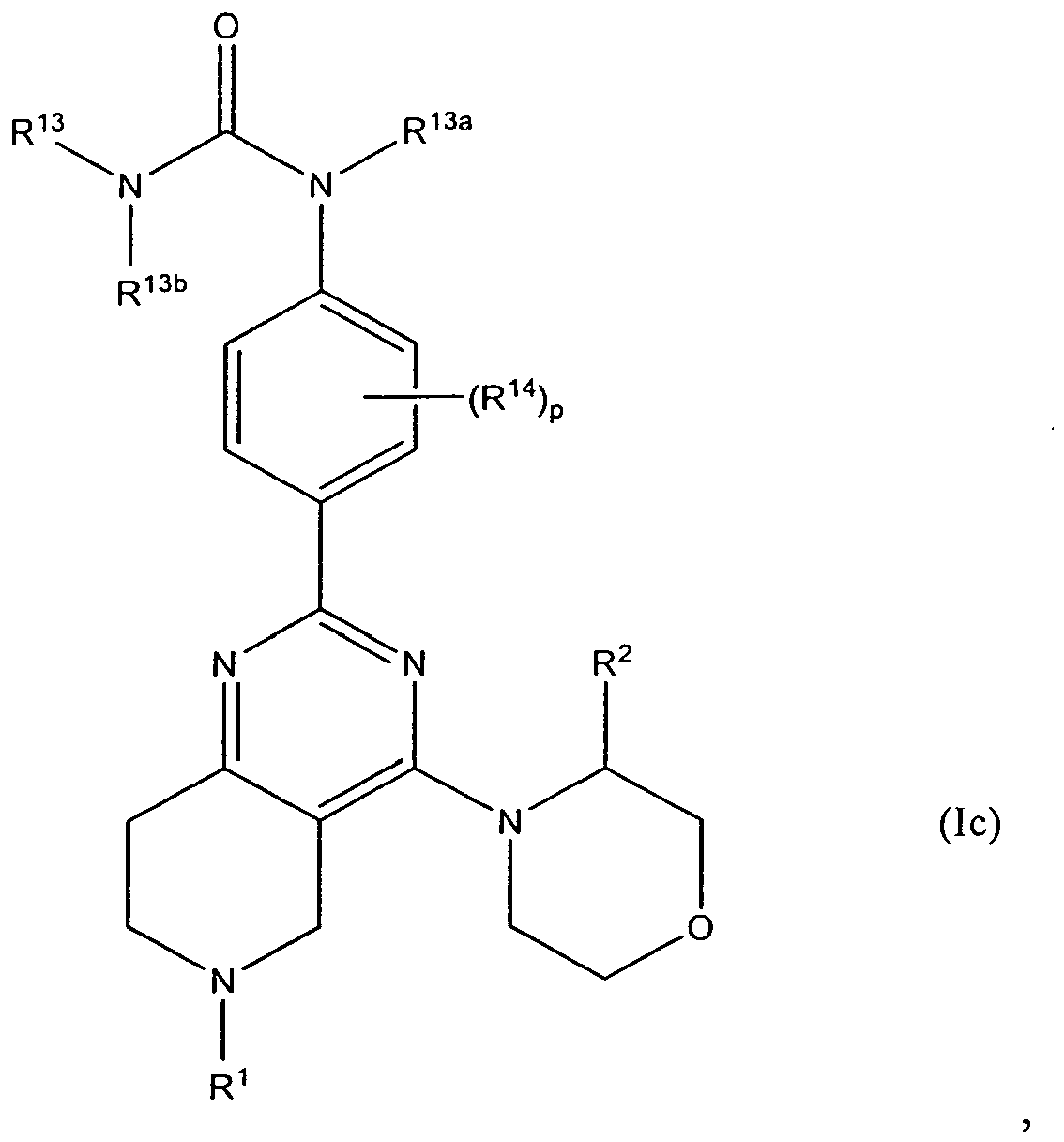
- A compound of any of claims 1 to 8, wherein X, m, n, o, T, R14 are selected to give formula (Id), (Ie) or (If)


- A compound of any of claims 1 to 9, wherein R1 is H; C(O)R3; S(O)2R3; optionally substituted C1-6 alkyl; C(O)OR3; C(O)NHR3; optionally substituted T1; or optionally substituted CH2-T1.
- A compound of any of claims 1 to 10, wherein R3 is H; optionally substituted C1-6 alkyl; optionally substituted T1; or optionally substituted CH2-T1.
- A compound of any of claims 1 to 11, wherein T1 is phenyl; or C3-7 cycloalkyl and wherein T1 is optionally substituted with one or more R6, which are the same or different.
- A compound of any of claims 1 to 12, wherein R2 is methyl.
- A compound of any of claims 1 to 13, wherein R13 is H; optionally substituted C1-6 alkyl; or optionally substituted T2.
- A compound of claim 1 selected from the group consisting of(S)-1-(4-(6-formyl-4-(3-methylmorpholino)-6,7-dihydro-5H-pyrrolo[3,4-d]pyrimidin-2-yl)phenyl)urea;(S)-1-methyl-3-(4-(4-(3-methylmorpholino)-6,7-dihydro-5H-pyrrolo[3,4-d]pyrimidin-2-yl)phenyl)urea;(S)-1-cyclopropyl-3-(4-(4-(3-methylmorpholino)-6,7-dihydro-5H-pyrrolo[3,4-d]pyrimidin-2-yl)phenyl)urea;(S)-1-(4-(4-(3-methylmorpholino)-6,7-dihydro-5H-pyrrolo[3,4-d]pyrimidin-2-yl)phenyl)urea;(S)-1-ethyl-3-(4-(6-formyl-4-(3-methylmorpholino)-6,7-dihydro-5H-pyrrolo[3,4-d]pyrimidin-2-yl)phenyl)urea;(S)-1-ethyl-3-(4-(4-(3-methylmorpholino)-6-(methylsulfonyl)-6,7-dihydro-5H-pyrrolo[3,4-d]pyrimidin-2-yl)phenyl)urea;(S)-1-(4-(6-acetyl-4-(3-methylmorpholino)-6,7-dihydro-5H-pyrrolo[3,4-d]pyrimidin-2-yl)phenyl)-3 -ethylurea;;(S)-1-ethyl-3-(4-(6-methyl-4-(3-methylmorpholino)-6,7-dihydro-5H-pyrrolo[3,4-d]pyrimidin-2-yl)phenyl)urea;(S)-1-ethyl-3-(4-(4-(3-methylmorpholino)-6,7-dihydro-5H-pyrrolo[3,4-d]pyrimidin-2-yl)phenyl)urea;(R)-1-cyclopropyl-3-(4-(4-(3-methylmorpholino)-6,7-dihydro-5H-pyrrolo[3,4-d]pyrimidin-2-yl)phenyl)urea;(S)-1-cyclopropyl-3-(4-(4-(3-methylmorpholino)-5,6,7,8-tetrahydropyrido[4,3-d]pyrimidin-2-yl)phenyl)urea;(S)-tert-butyl-2-(4-(3-ethylureido)phenyl)-4-(3-methylmorpholino)-7,8-dihydropyrido[4,3-d]pyrimidine-6(5H)-carboxylate;(S)-1-methyl-3-(4-(4-(3-methylmorpholino)-5,6,7,8-tetrahydropyrido[4,3-d]pyrimidin-2-yl)phenyl)urea;(S)-1-ethyl-3-(4-(4-(3-methylmorpholino)-5,6,7,8-tetrahydropyrido[4,3-d]pyrimidin-2-yl)phenyl)urea;(S)-1-ethyl-3-(4-(4-(3-methylmorpholino)-5,6,7,8-tetrahydropyrido[3,4-d]pyrimidin-2-yl)phenyl)urea;(S)-1-cyclopropyl-3-(4-(4-(3-methylmorpholino)-5,6,7,8-tetrahydropyrido[3,4-d]pyrimidin-2-yl)phenyl)urea;(S)-1-methyl-3-(4-(4-(3-methylmorpholino)-5,6,7,8-tetrahydropyrido[3,4-d]pyrimidin-2-yl)phenyl)urea;(S)-tert-butyl 2-(4-(3-ethylureido)phenyl)-4-(3-methylmorpholino)-5H-pyrrolo[3,4-d]pyrimidine-6(7H)-carboxylate;(S)-1-ethyl-3-(4-(6-(4-fluorobenzyl)-4-(3-methylmorpholino)-6,7-dihydro-5H-pyrrolo[3,4-d]pyrimidin-2-yl)phenyl)urea;1-ethyl-3-(4-(4-morpholino-6,7-dihydro-5H-pyrrolo[3,4-d]pyrimidin-2-yl)phenyl)urea;(S)-1-ethyl-3-(4-(6-(4-fluorobenzoyl)-4-(3-methylmorpholino)-6,7-dihydro-5H-pyrrolo[3,4-d]pyrimidin-2-yl)phenyl)urea;(S)-1-ethyl-3-(4-(7-ethyl-4-(3-methylmorpholino)-5,6,7,8-tetrahydropyrido[3,4-d]pyrimidin-2-yl)phenyl)urea;(S)-1-ethyl-3-(4-(7-(4-fluorobenzyl)-4-(3-methylmorpholino)-5,6,7,8-tetrahydropyrido[3,4-d]pyrimidin-2-yl)phenyl)urea;(S)-1-ethyl-3-(4-(7-(4-fluorobenzoyl)-4-(3-methylmorpholino)-5,6,7,8-tetrahydropyrido[3,4-d]pyrimidin-2-yl)phenyl)urea;(S)-1-(4-(6-acetyl-4-(3-methylmorpholino)-6,7-dihydro-5H-pyrrolo[3,4-d]pyrimidin-2-yl)phenyl)-3-cyclopropylurea;(S)-1-ethyl-3-(4-(6-isobutyryl-4-(3-methylmorpholino)-6,7-dihydro-5H-pyrrolo[3,4-d]pyrimidin-2-yl)phenyl)urea;(S)-1-ethyl-3-(4-(4-(3-methylmorpholino)-6-pivaloyl-6,7-dihydro-5H-pyrrolo[3,4-d]pyrimidin-2-yl)phenyl)urea;(S)-1-(4-(6-(cyclopropanecarbonyl)-4-(3-methylmorpholino)-6,7-dihydro-5H-pyrrolo[3,4-d]pyrimidin-2-yl)phenyl)-3-ethylurea;(S)-1-(4-(6-(cyclopropylmethyl)-4-(3-methylmorpholino)-6,7-dihydro-5H-pyrrolo[3,4-d]pyrimidin-2-yl)phenyl)-3-ethylurea;(S)-2-(4-(3-cyclopropylureido)phenyl)-N-ethyl-4-(3-methylmorpholino)-5H-pyrrolo[3,4-d]pyrimidine-6(7H)-carboxamide;(S)-ethyl 2-(4-(3-cyclopropylureido)phenyl)-4-(3-methylmorpholino)-5H-pyrrolo[3,4-d]pyrimidine-6(7H)-carboxylate;(S)-1-(4-(6-(cyclopropanecarbonyl)-4-(3-methylmorpholino)-6,7-dihydro-5H-pyrrolo[3,4-d]pyrimidin-2-yl)phenyl)-3-cyclopropylurea;(S)-1-cyclopropyl-3-(4-(6-(cyclopropylmethyl)-4-(3-methylmorpholino)-6,7-dihydro-5H-pyrrolo[3,4-d]pyrimidin-2-yl)phenyl)urea;(S)-1-cyclopropyl-3-(4-(4-(3-methylmorpholino)-6-neopentyl-6,7-dihydro-5H-pyrrolo[3,4-d]pyrimidin-2-yl)phenyl)urea;(S)-1-ethyl-3-(4-(7-methyl-4-(3-methylmorpholino)-5,6,7,8-tetrahydropyrido[3,4-d]pyrimidin-2-yl)phenyl)urea;(S)-1-cyclopropyl-3-(4-(6-ethyl-4-(3-methylmorpholino)-6,7-dihydro-5H-pyrrolo[3,4-d]pyrimidin-2-yl)phenyl)urea;(S)-1-(4-(7-(cyclopropylmethyl)-4-(3-methylmorpholino)-5,6,7,8-tetrahydropyrido[3,4-d]pyrimidin-2-yl)phenyl)-3-ethylurea;(S)-1-cyclopropyl-3-(4-(6-methyl-4-(3-methylmorpholino)-6,7-dihydro-5H-pyrrolo[3,4-d]pyrimidin-2-yl)phenyl)urea;(S)-1-ethyl-3-(4-(6-ethyl-4-(3-methylmorpholino)-6,7-dihydro-5H-pyrrolo [3,4-d]pyrimidin-2-yl)phenyl)urea;(S)-1-cyclopropyl-3-(4-(7-(cyclopropylmethyl)-4-(3-methylmorpholino)-5,6,7,8-tetrahydropyrido[3,4-d]pyrimidin-2-yl)phenyl)urea;(S)-1-cyclopropyl-3-(4-(4-(3-methylmorpholino)-7-neopentyl-5,6,7,8-tetrahydropyrido[3,4-d]pyrimidin-2-yl)phenyl)urea;(S)-1-cyclopropyl-3-(4-(7-isobutyl-4-(3-methylmorpholino)-5,6,7,8-tetrahydropyrido[3,4-d]pyrimidin-2-yl)phenyl)urea;(S)-1-cyclopropyl-3-(4-(7-isopropyl-4-(3-methylmorpholino)-5,6,7,8-tetrahydropyrido[3,4-d]pyrimidin-2-yl)phenyl)urea;(S)-1-cyclopropyl-3-(4-(6-isobutyryl-4-(3-methylmorpholino)-6,7-dihydro-5H-pyrrolo[3,4-d]pyrimidin-2-yl)phenyl)urea;(S)-1-cyclopropyl-3-(4-(4-(3-methylmorpholino)-6-pivaloyl-6,7-dihydro-5H-pyrrolo[3,4-d]pyrimidin-2-yl)phenyl)urea;(S)-1-cyclopropyl-3-(4-(6-isopropyl-4-(3-methylmorpholino)-6,7-dihydro-5H-pyrrolo[3,4-d]pyrimidin-2-yl)phenyl)urea;(S)-1-(4-(6-(cyclopropylmethyl)-4-(3-methylmorpholino)-6,7-dihydro-5H-pyrrolo[3,4-d]pyrimidin-2-yl)phenyl)-3-methylurea;(S)-1-(4-(6-(cyclopropylmethyl)-4-(3-methylmorpholino)-6,7-dihydro-5H-pyrrolo[3,4-d]pyrimidin-2-yl)phenyl)urea;(S)-1-(4-(6-(cyclopropylmethyl)-4-(3-methylmorpholino)-6,7-dihydro-5H-pyrrolo[3,4-d]pyrimidin-2-yl)phenyl)-3-propylurea;(S)-1-(4-(6-(cyclopropylmethyl)-4-(3-methylmorpholino)-6,7-dihydro-5H-pyrrolo[3,4-d]pyrimidin-2-yl)phenyl)-3-isopropylurea;(S)-1-(3-hydroxypropyl)-3-(4-(6-methyl-4-(3-methylmorpholino)-6,7-dihydro-5H-pyrrolo[3,4-d]pyrimidin-2-yl)phenyl)urea;(S)-1-(4-fluorophenyl)-3-(4-(6-methyl-4-(3-methylmorpholino)-6,7-dihydro-5H-pyrrolo[3,4-d]pyrimidin-2-yl)phenyl)urea;(S)-1-(3-methoxypropyl)-3-(4-(6-methyl-4-(3-methylmorpholino)-6,7-dihydro-5H-pyrrolo[3,4-d]pyrimidin-2-yl)phenyl)urea;(S)-1-(2-(dimethylamino)ethyl)-3-(4-(6-methyl-4-(3-methylmorpholino)-6,7-dihydro-5H-pyrrolo[3,4-d]pyrimidin-2-yl)phenyl)urea;(S)-1-cyclobutyl-3-(4-(6-methyl-4-(3-methylmorpholino)-6,7-dihydro-5H-pyrrolo[3,4-d]pyrimidin-2-yl)phenyl)urea;(S)-1-(4-(7-(cyclopropanecarbonyl)-4-(3-methylmorpholino)-5,6,7,8-tetrahydropyrido[3,4-d]pyrimidin-2-yl)phenyl)-3-ethylurea;(S)-1-ethyl-3-(4-(7-isobutyryl-4-(3-methylmorpholino)-5,6,7,8-tetrahydropyrido[3,4-d]pyrimidin-2-yl)phenyl)urea;(S)-1-ethyl-3-(4-(4-(3-methylmorpholino)-7-pivaloyl-5,6,7,8-tetrahydropyrido[3,4-d]pyrimidin-2-yl)phenyl)urea;(S)-1-(4-(7-acetyl-4-(3-methylmorpholino)-5,6,7,8-tetrahydropyrido[3,4-d]pyrimidin-2-yl)phenyl)-3-ethylurea;(S)-1-(4-(7-(cyclopropanecarbonyl)-4-(3-methylmorpholino)-5,6,7,8-tetrahydropyrido[3,4-d]pyrimidin-2-yl)phenyl)-3-cyclopropylurea;(S)-1-cyclopropyl-3-(4-(7-isobutyryl-4-(3-methylmorpholino)-5,6,7,8-tetrahydropyrido[3,4-d]pyrimidin-2-yl)phenyl)urea;(S)-1-(4-(7-acetyl-4-(3-methylmorpholino)-5,6,7,8-tetrahydropyrido[3,4-d]pyrimidin-2-yl)phenyl)-3-cyclopropylurea;tert-butyl 2-(4-(3-ethylureido)phenyl)-4-morpholino-5H-pyrrolo[3,4-d]pyrimidine-6(7H)-carboxylate;(S)-1-cyclopropyl-3-(4-(4-(3-methylmorpholino)-7-pivaloyl-5,6,7,8-tetrahydropyrido[3,4-d]pyrimidin-2-yl)phenyl)urea;(S)-1-cyclopropyl-3-(4-(6-isobutyl-4-(3-methylmorpholino)-6,7-dihydro-5H-pyrrolo[3,4-d]pyrimidin-2-yl)phenyl)urea;(S)-1-ethyl-3-(4-(6-isobutyl-4-(3-methylmorpholino)-6,7-dihydro-5H-pyrrolo[3,4-d]pyrimidin-2-yl)phenyl)urea;(S)-1-ethyl-3-(4-(4-(3-methylmorpholino)-6-neopentyl-6,7-dihydro-SH-pyrrolo[3,4-d]pyrimidin-2-yl)phenyl)urea;(S)-1-ethyl-3-(4-(4-(3-methylmorpholino)-6-(2,2,2-trifluoroethyl)-6,7-dihydro-5H-pyrrolo[3,4-d]pyrimidin-2-yl)phenyl)urea;1-ethyl-3-(4-(6-methyl-4-morpholino-6,7-dihydro-5H-pyrrolo[3,4-d]pyrimidin-2-yl)phenyl)urea;ethyl 2-(4-(3-ethylureido)phenyl)-4-morpholino-SH-pyrrolo[3,4-d]pyrimidine-6(7H)-carboxylate;(S)-1-(4-(6-methyl-4-(3-methylmorpholino)-6,7-dihydro-5H-pyrrolo[3,4-d]pyrimidin-2-yl)phenyl)urea;(S)-1-(4-(6-methyl-4-(3-methylmorpholino)-6,7-dihydro-5H-pyrrolo[3,4-d]pyrimidin-2-yl)phenyl)-3-(5-methylisoxazol-3-yl)urea;(S)-l-(2-hydroxyethyl)-3-(4-(6-methyl-4-(3-methylmorpholino)-6,7-dihydro-5H-pyrrolo[3,4-d]pyrimidin-2-yl)phenyl)urea;(S)-1-ethyl-3-(4-(6-isopropyl-4-(3-methylmorpholino)-6,7-dihydro-5H-pyrrolo[3,4-d]pyrimidin-2-yl)phenyl)urea;(S)-1-ethyl-3-(4-(7-isopropyl-4-(3-methylmorpholino)-5,6,7,8-tetrahydropyrido[3,4-d]pyrimidin-2-yl)phenyl)urea;(S)-1-ethyl-3-(4-(7-isobutyl-4-(3-methylmorpholino)-5,6,7,8-tetrahydropyrido[3,4-d]pyrimidin-2-yl)phenyl)urea;(S)-ethyl 2-(4-(3-ethylureido)phenyl)-4-(3-methylmorpholino)-5,6-dihydropyrido[3,4-d]pyrimidine-7(8H)-carboxylate;(S)-ethyl 2-(4-(3-cyclopropylureido)phenyl)-4-(3-methylmorpholino)-5,6-dihydropyrido[3,4-d]pyrimidine-7(8H)-carboxylate;N-ethyl-2-(4-(3-ethylureido)phenyl)-4-morpholino-5H-pyrrolo[3,4-d]pyrimidine-6(7H)-carboxamide;(S)-1-(6-hydroxypyridin-2-yl)-3-(4-(6-methyl-4-(3-methylmorpholino)-6,7-dihydro-5H-pyrrolo[3,4-d]pyrimidin-2-yl)phenyl)urea;(S)-methyl 2-(4-(3-ethylureido)phenyl)-4-(3-methylmorpholino)-5,6-dihydropyrido[3,4-d]pyrimidine-7(8H)-carboxylate;1-ethyl-3-(4-(4-morpholino-5,6,7,8-tetrahydropyrido[3,4-d]pyrimidin-2-yl)phenyl)urea;(S)-methyl 2-(4-(3-cyclopropylureido)phenyl)-4-(3-methylmorpholino)-5,6-dihydropyrido[3,4-d]pyrimidine-7(8H)-carboxylate;(S)-1-(1-methyl-1H-pyrazol-4-yl)-3-(4-(6-methyl-4-(3-methylmorpholino)-6,7-dihydro-5H-pyrrolo[3,4-d]pyrimidin-2-yl)phenyl)urea;(S)-1-ethyl-3-(2-fluoro-4-(6-methyl-4-(3-methylmorpholino)-6,7-dihydro-5H-pyrrolo[3,4-d]pyrimidin-2-yl)phenyl)urea;(S)-methyl 2-(4-(3-cyclopropylureido)phenyl)-4-(3-methylmorpholino)-5H-pyrrolo[3,4-d]pyrimidine-6(7H)-carboxylate;(S)-N-ethyl-2-(4-(3-ethylureido)phenyl)-4-(3-methylmorpholino)-5,6-dihydropyrido[3,4-d]pyrimidine-7(8H)-carboxamide;(S)-2-(4-(3-cyclopropylureido)phenyl)-N-ethyl-4-(3-methylmorpholino)-5,6-dihydropyrido[3,4-d]pyrimidine-7(8H)-carboxamide;(S)-methyl 2-(4-(3-ethylureido)phenyl)-4-(3-methylmorpholino)-5H-pyrrolo[3,4-d]pyrimidine-6(7H)-carboxylate;(S)-ethyl 2-(4-(3-ethylureido)phenyl)-4-(3-methylmorpholino)-5H-pyrrolo[3,4-d]pyrimidine-6(7H)-carboxylate;(S)-1-ethyl-3-(4-(4-(3-methylmorpholino)-7-(2-(pyridin-3-yl)acetyl)-5,6,7,8-tetrahydropyrido[3,4-d]pyrimidin-2-yl)phenyl)urea;(S)-1-(4-(6-(3-(dimethylamino)propanoyl)-4-(3-methylmorpholino)-5,6,7,8-tetrahydropyrido[4,3-d]pyrimidin-2-yl)phenyl)-3-ethylurea;1-ethyl-3-(4-(7-methyl-4-morpholino-5,6,7,8-tetrahydropyrido[3,4-d]pyrimidin-2-yl)phenyl)urea;N-ethyl-2-(4-(3-ethylureido)phenyl)-4-morpholino-5,6-dihydropyrido[3,4-d]pyrimidine-7(8H)-carboxamide;methyl 2-(4-(3-ethylureido)phenyl)-4-morpholino-5,6-dihydropyrido[3,4-d]pyrimidine-7(8H)-carboxylate;ethyl 2-(4-(3-ethylureido)phenyl)-4-morpholino-5,6-dihydropyrido[3,4-d]pyrimidine-7(8H)-carboxylate;1-((4-(7-acetyl-4-morpholino-5,6,7,8-tetrahydropyrido[3,4-d]pyrimidin-2-yl)phenyl)-3-ethylurea;1-ethyl-3-(4-(4-morpholino-7-pivaloyl-5,6,7,8-tetrahydropyrido[3,4-d]pyrimidin-2-yl)phenyl)urea;1-((4-(6-acetyl-4-morpholino-6,7-dihydro-5H-pyrrolo[3,4-d]pyrimidin-2-yl)phenyl)-3-ethylurea;1-ethyl-3-(4-(4-morpholino-6-pivaloyl-6,7-dihydro-5H-pyrrolo[3,4-d]pyrimidin-2-yl)phenyl)urea;(S)-1-cyclopropyl-3-(4-(4-(3-methylmorpholino)-6-(2,2,2-trifluoroethyl)-6,7-dihydro-5H-pyrrolo[3,4-d]pyrimidin-2-yl)phenyl)urea;(S)-1-ethyl-3-(4-(7-(2-hydroxyacetyl)-4-(3-methylmorpholino)-5,6,7,8-tetrahydropyrido[3,4-d]pyrimidin-2-yl)phenyl)urea;(S)-ethyl 2-(4-(3-ethylureido)-3-fluorophenyl)-4-(3-methylmorpholino)-5H-pyrrolo[3,4-d]pyrimidine-6(7H)-carboxylate;(S)-ethyl 2-(3-fluoro-4-(3-(2-hydroxyethyl)ureido)phenyl)-4-(3-methylmorpholino)-5H-pyrrolo[3,4-d]pyrimidine-6(7H)-carboxylate;(S)-ethyl 2-(4-(3-cyclopropylureido)-3-fluorophenyl)-4-(3-methylmorpholino)-5H-pyrrolo[3,4-d]pyrimidine-6(7H)-carboxylate;(S)-1-ethyl-3-(5-(7-methyl-4-(3-methylmorpholino)-5,6,7,8-tetrahydropyrido[3,4-d]pyrimidin-2-yl)thiazol-2-yl)urea;(S)-ethyl 2-(4-(3-ethylureido)phenyl)-4-(3-methylmorpholino)-7,8-dihydropyrido[4,3-d]pyrimidine-6(5H)-carboxylate;(S)-1-(2,5-difluoro-4-(7-methyl-4-(3-methylmorpholino)-5,6,7,8-tetrahydropyrido[3,4-d]pyrimidin-2-yl)phenyl)-3-ethylurea;(S)-1-ethyl-3-(3-methyl-4-(7-methyl-4-(3-methylmorpholino)-5,6,7,8-tetrahydropyrido[3,4-d]pyrimidin-2-yl)phenyl)urea;(S)-1-ethyl-3-(3-fluoro-4-(7-methyl-4-(3-methylmorpholino)-5,6,7,8-tetrahydropyrido[3,4-d]pyrimidin-2-yl)phenyl)urea;(S)-ethyl 2-(4-(3-(3-hydroxyphenyl)ureido)phenyl)-4-(3-methylmorpholino)-5H-pyrrolo[3,4-d]pyrimidine-6(7H)-carboxylate;(S)-ethyl 2-(4-(3-(2-aminoethyl)ureido)phenyl)-4-(3-methylmorpholino)-5H-pyrrolo[3,4-d]pyrimidine-6(7H)-carboxylate;(S)-ethyl 2-(4-(3-ethylureido)-2-fluorophenyl)-4-(3-methylmorpholino)-5H-pyrrolo[3,4-d]pyrimidine-6(7H)-carboxylate;(S)-ethyl 2-(4-(3-(2-amino-2-oxoethyl)ureido)phenyl)-4-(3-methylmorpholino)-5H-pyrrolo[3,4-d]pyrimidine-6(7H)-carboxylate;(S)-2-(3-(4-(6-(ethoxycarbonyl)-4-(3-methylmorpholino)-6,7-dihydro-5H-pyrrolo[3,4-d]pyrimidin-2-yl)phenyl)ureido)acetic acid;(S)-ethyl 2-(5-(3-ethylureido)pyrazin-2-yl)-4-(3-methylmorpholino)-5H-pyrrolo[3,4-d]pyrimidine-6(7H)-carboxylate;(S)-1-(4-(6-(1-acetylpiperidin-4-yl)-4-(3-methylmorpholino)-6,7-dihydro-5H-pyrrolo[3,4-d]pyrimidin-2-yl)-2-fluorophenyl)-3-ethylurea;(S)-ethyl 4-(3-methylmorpholino)-2-(4-(3-(pyridin-3-yl)ureido)phenyl)-5H-pyrrolo[3,4-d]pyrimidine-6(7H)-carboxylate;(S)-ethyl 2-(4-(3-(4-(hydroxymethyl)phenyl)ureido)phenyl)-4-(3-methylmorpholino)-5H-pyrrolo[3,4-d]pyrimidine-6(7H)-carboxylate;(S)-ethyl 2-(4-(3-(2-fluoroethyl)ureido)phenyl)-4-(3-methylmorpholino)-5H-pyrrolo[3,4-d]pyrimidine-6(7H)-carboxylate;(S)-ethyl 4-(3-methylmorpholino)-2-(4-(3-(pyridin-4-yl)ureido)phenyl)-5H-pyrrolo[3,4-d]pyrimidine-6(7H)-carboxylate;(S)-methyl 4-(2-(4-(3-ethylureido)-3-fluorophenyl)-4-(3-methylmorpholino)-5H-pyrrolo[3,4-d]pyrimidin-6(7H)-yl)piperidine-1-carboxylate;(S)-1-(4-(6-(1-acetylpiperidine-4-carbonyl)-4-(3-methylmorpholino)-6,7-dihydro-5H-pyrrolo[3,4-d]pyrimidin-2-yl)-2-fluorophenyl)-3-ethylurea;(S)-ethyl 2-(4-(3-(2-acetamidoethyl)ureido)phenyl)-4-(3-methylmorpholino)-5H-pyrrolo[3,4-d]pyrimidine-6(7H)-carboxylate;(S)-ethyl 2-(4-(3-(2-(methylamino)-2-oxoethyl)ureido)phenyl)-4-(3-methylmorpholino)-5H-pyrrolo[3,4-d]pyrimidine-6(7H)-carboxylate;(S)-1-ethyl-3-(2-fluoro-4-(4-(3-methylmorpholino)-6-(piperidine-4-carbonyl)-6,7-dihydro-5H-pyrrolo[3,4-d]pyrimidin-2-yl)phenyl)urea;(S)-4-(2-(4-(3-cyclopropylureido)phenyl)-4-(3-methylmorpholino)-5H-pyrrolo[3,4-d]pyrimidin-6(7H)-yl)-4-oxobutanamide;(S)-tert-butyl 4-((2-(4-(3-cyclopropylureido)phenyl)-4-(3-methylmorpholino)-5H-pyrrolo[3,4-d]pyrimidin-6(7H)-yl)methyl)piperidine-1-carboxylate;(S)-1-cyclopropyl-3-(4-(4-(3-methylmorpholino)-6-(tetrahydro-2H-pyran-4-carbonyl)-6,7-dihydro-5H-pyrrolo[3,4-d]pyrimidin-2-yl)phenyl)urea;(S)-1-cyclopropyl-3-(4-(4-(3-methylmorpholino)-6-(piperidin-4-ylmethyl)-6,7-dihydro-5H-pyrrolo[3,4-d]pyrimidin-2-yl)phenyl)urea;(S)-ethyl 2-(4-(3-cyclopropylureido)-2-fluorophenyl)-4-(3-methylmorpholino)-5H-pyrrolo[3,4-d]pyrimidine-6(7H)-carboxylate;(S)-1-cyclopropyl-3-(4-(4-(3-methylmorpholino)-6-(3-(2-oxopyrrolidin-1-yl)propanoyl)-6,7-dihydro-5H-pyrrolo[3,4-d]pyrimidin-2-yl)phenyl)urea;(S)-N-(4-(2-(4-(3-cyclopropylureido)phenyl)-4-(3-methylmorpholino)-5H-pyrrolo[3,4-d]pyrimidin-6(7H)-yl)-4-oxobutyl)acetamide;(S)-4-(2-(4-(3-cyclopropylureido)phenyl)-4-(3-methylmorpholino)-5H-pyrrolo[3,4-d]pyrimidin-6(7H)-yl)butanoic acid;(S)-N-(3-(2-(4-(3-cyclopropylureido)phenyl)-4-(3-methylmorpholino)-5H-pyrrolo[3,4-d]pyrimidin-6(7H)-yl)-3-oxopropyl)-N-methylacetamide;(S)-1-cyclopropyl-3-(4-(4-(3-methylmorpholino)-6-(3-ureidopropanoyl)-6,7-dihydro-5H-pyrrolo[3,4-d]pyrimidin-2-yl)phenyl)urea; andpharmaceutically acceptable salts thereof.
- A compound of claim 1 selected from the group consisting of(S)-1-(2,6-difluoro-4-(6-methyl-4-(3-methylmorpholino)-6,7-dihydro-5H-pyrrolo[3,4-d]pyrimidin-2-yl)phenyl)-3-ethylurea;(S)-1-(2,3-difluoro-4-(6-methyl-4-(3-methylmorpholino)-6,7-dihydro-5H-pyrrolo[3,4-d]pyrimidin-2-yl)phenyl)-3-ethylurea;(S)-ethyl 2-(4-(3-ethylureido)-2,5-difluorophenyl)-4-(3-methylmorpholino)-5H-pyrrolo[3,4-d]pyrimidine-6(7H)-carboxylate;(S)-ethyl 2-(4-(3-ethylureido)-2,6-difluorophenyl)-4-(3-methylmorpholino)-5H-pyrrolo[3,4-d]pyrimidine-6(7H)-carboxylate;tert-butyl 2-(4-(3-cyclopropylureido)-2-fluorophenyl)-4-morpholino-5H-pyrrolo[3,4-d]pyrimidine-6(7H)-carboxylate;(S)-tert-butyl 2-(4-(3-cyclopropylureido)-2-fluorophenyl)-4-(3-methylmorpholino)-5H-pyrrolo[3,4-d]pyrimidine-6(7H)-carboxylate;tert-butyl 2-(4-(3-ethylureido)-2-fluorophenyl)-4-morpholino-5H-pyrrolo[3,4-d]pyrimidine-6(7H)-carboxylate;(S)-methyl 2-(4-(3-cyclopropylureido)-2-fluorophenyl)-4-(3-methylmorpholino)-5H-pyrrolo[3,4-d]pyrimidine-6(7H)-carboxylate;(S)-1-cyclopropyl-3-(3-fluoro-4-(6-methyl-4-(3-methylmorpholino)-6,7-dihydro-5H-pyrrolo[3,4-d]pyrimidin-2-yl)phenyl)urea;1-cyclopropyl-3-(3-fluoro-4-(4-morpholino-6,7-dihydro-5H-pyrrolo[3,4-d]pyrimidin-2-yl)phenyl)urea;(S)-1-cyclopropyl-3-(3-fluoro-4-(4-(3-methylmorpholino)-6,7-dihydro-5H-pyrrolo[3,4-dJpyrimidin-2-yl)phenyl)urea;1-ethyl-3-(3-fluoro-4-(4-morpholino-6,7-dihydro-5H-pyrrolo[3,4-d]pyrimidin-2-yl)phenyl)urea;ethyl 2-(4-(3-ethylureido)-2-fluorophenyl)-4-morpholino-5H-pyrrolo[3,4-d]pyrimidine-6(7H)-carboxylate;(S)-methyl 2-(4-(3-ethylureido)-2-fluorophenyl)-4-(3-methylmorpholino)-5H-pyrrolo[3,4-d]pyrimidine-6(7H)-carboxylate;(S)-tert-butyl 2-(4-(3-ethylureido)-2-fluorophenyl)-4-(3-methylmorpholino)-5H-pyrrolo[3,4-d]pyrimidine-6(7H)-carboxylate;1-ethyl-3-(3-fluoro-4-(6-methyl-4-morpholino-6,7-dihydro-5H-pyrrolo[3,4-d]pyrimidin-2-yl)phenyl)urea;(S)-1-(4-(6-acetyl-4-(3-methylmorpholino)-6,7-dihydro-5H-pyrrolo[3,4-d]pyrimidin-2-yl)-3-fluorophenyl)-3-cyclopropylurea;ethyl 2-(4-(3-cyclopropylureido)-2-fluorophenyl)-4-morpholino-5H-pyrrolo[3,4-d]pyrimidine-6(7H)-carboxylate;(S)-1-(4-(6-acetyl-4-(3-methylmorpholino)-6,7-dihydro-5H-pyrrolo[3,4-d]pyrimidin-2-yl)-3-fluorophenyl)-3-ethylurea;(S)-1-ethyl-3-(3-fluoro-4-(4-(3-methylmorpholino)-6,7-dihydro-5H-pyrrolo[3,4-d]pyrimidin-2-yl)phenyl)urea;1-cyclopropyl-3-(3-fluoro-4-(6-methyl-4-morpholino-6,7-dihydro-5H-pyrrolo[3,4-d]pyrimidin-2-yl)phenyl)urea;(S)-1-ethyl-3-(3-fluoro-4-(6-methyl-4-(3-methylmorpholino)-6,7-dihydro-5H-pyrrolo[3,4-d]pyrimidin-2-yl)phenyl)urea;1-((4-(6-acetyl-4-morpholino-6,7-dihydro-5H-pyrrolo[3,4-d]pyrimidin-2-yl)-3-fluorophenyl)-3-ethylurea;methyl 2-(4-(3-ethylureido)-2-fluorophenyl)-4-morpholino-5H-pyrrolo[3,4-d]pyrimidine-6(7H)-carboxylate;(S)-1-cyclopropyl-3-(3-fluoro-4-(4-(3-methylmorpholino)-5,6,7,8-tetrahydropyrido[3,4-d]pyrimidin-2-yl)phenyl)urea;(S)-1-ethyl-3-(3-fluoro-4-(4-(3-methylmorpholino)-5,6,7,8-tetrahydropyrido[3,4-d]pyrimidin-2-yl)phenyl)urea;(S)-2-(4-(3-cyclopropylureido)-2-fluorophenyl)-N,N-dimethyl-4-(3-methylmorpholino)-5,6-dihydropyrido[3,4-d]pyrimidine-7(8H)-carboxamide;1-((4-(6-acetyl-4-morpholino-6,7-dihydro-5H-pyrrolo[3,4-d]pyrimidin-2-yl)-3-fluorophenyl)-3-cyclopropylurea;(S)-ethyl 2-(2-fluoro-4-(3-(2-hydroxyethyl)ureido)phenyl)-4-(3-methylmorpholino)-5H-pyrrolo[3,4-d]pyrimidine-6(7H)-carboxylate;(S)-ethyl 2-(2-fluoro-4-(3-(2-fluoroethyl)ureido)phenyl)-4-(3-methylmorpholino)-5H-pyrrolo[3,4-d]pyrimidine-6(7H)-carboxylate;methyl 2-(2-fluoro-4-(3-(2-fluoroethyl)ureido)phenyl)-4-morpholino-5H-pyrrolo[3,4-d]pyrimidine-6(7H)-carboxylate;ethyl 2-(2-fluoro-4-(3-(2-fluoroethyl)ureido)phenyl)-4-morpholino-5H-pyrrolo[3,4-d]yrimidine-6(7H)-carboxylate;ethyl 2-(2-fluoro-4-(3-(2-hydroxyethyl)ureido)phenyl)-4-morpholino-5H-pyrrolo[3,4-d]pyrimidine-6(7H)-carboxylate;(S)-1-cyclopropyl-3-(3-fluoro-4-(6-isopropyl-4-(3-methylmorpholino)-6,7-dihydro-5H-pyrrolo[3,4-d]pyrimidin-2-yl)phenyl)urea;methyl 2-(4-(3-cyclopropylureido)-2-fluorophenyl)-4-morpholino-5H-pyrrolo[3,4-d]pyrimidine-6(7H)-carboxylate;(S)-1-cyclopropyl-3-(3-fluoro-4-(6-isobutyryl-4-(3-methylmorpholino)-6,7-dihydro-5H-pyrrolo[3,4-d]pyrimidin-2-yl)phenyl)urea;methyl 2-(2-fluoro-4-(3-(2-hydroxyethyl)ureido)phenyl)-4-morpholino-5H-pyrrolo[3,4-d]pyrimidine-6(7H)-carboxylate;(S)-2-(4-(3-ethylureido)-2-fluorophenyl)-N,N-dimethyl-4-(3-methylmorpholino)-5,6-dihydropyrido[3,4-d]pyrimidine-7(8H)-carboxamide;(S)-1-cyclopropyl-3-(3-fluoro-4-(4-(3-methylmorpholino)-6-(methylsulfonyl)-6,7-dihydro-5H-pyrrolo[3,4-d]pyrimidin-2-yl)phenyl)urea;(S)-2-(4-(3-cyclopropylureido)-2-fluorophenyl)-N,N-dimethyl-4-(3-methylmorpholino)-5H-pyrrolo[3,4-d]pyrimidine-6(7H)-carboxamide;(R)-ethyl 2-(4-(3-cyclopropylureido)-2-fluorophenyl)-4-(3-methylmorpholino)-5H-pyrrolo[3,4-d]pyrimidine-6(7H)-carboxylate;(R)-methyl 2-(4-(3-cyclopropylureido)-2-fluorophenyl)-4-(3-methylmorpholino)-5H-pyrrolo[3,4-d]pyrimidine-6(7H)-carboxylate;(S)-methyl 2-(2-fluoro-4-(3-(2-hydroxyethyl)ureido)phenyl)-4-(3-methylmorpholino)-5H-pyrrolo[3,4-d]pyrimidine-6(7H)-carboxylate;(R)-tert-butyl 2-(4-(3-cyclopropylureido)-2-fluorophenyl)-4-(3-methylmorpholino)-5H-pyrrolo[3,4-d]pyrimidine-6(7H)-carboxylate;(S)-methyl 2-(2-fluoro-4-(3-(2-fluoroethyl)ureido)phenyl)-4-(3-methylmorpholino)-5H-pyrrolo[3,4-d]pyrimidine-6(7H)-carboxylate;1-((3-fluoro-4-(6-isopropyl-4-morpholino-6,7-dihydro-5H-pyrrolo[3,4-d]pyrimidin-2-yl)phenyl)-3-(2-hydroxyethyl)urea;1-((3-fluoro-4-(6-isopropyl-4-morpholino-6,7-dihydro-5H-pyrrolo[3,4-d]pyrimidin-2-yl)phenyl)-3-(2-fluoroethyl)urea;(S)-1-(3-fluoro-4-(6-isopropyl-4-(3-methylmorpholino)-6,7-dihydro-5H-pyrrolo[3,4-d]pyrimidin-2-yl)phenyl)-3-(2-fluoroethyl)urea;(S)-1-(3-fluoro-4-(6-isopropyl-4-(3-methylmorpholino)-6,7-dihydro-5H-pyrrolo[3,4-d]pyrimidin-2-yl)phenyl)-3-(2-hydroxyethyl)urea;(R)-1-(4-(6-(cyclopropanecarbonyl)-4-(3-methylmorpholino)-6,7-dihydro-5H-pyrrolo[3,4-d]pyrimidin-2-yl)-3-fluorophenyl)-3-cyclopropylurea;(S)-2-(4-(3-cyclopropylureido)-2-fluorophenyl)-N-isopropyl-4-(3-methylmorpholino)-5,6-dihydropyrido[3,4-d]pyrimidine-7(8H)-carboxamide;(R)-1-cyclopropyl-3-(3-fluoro-4-(6-formyl-4-(3-methylmorpholino)-6,7-dihydro-5H-pyrrolo[3,4-d]pyrimidin-2-yl)phenyl)urea;(R)-1-cyclopropyl-3-(3-fluoro-4-(4-(3-methylmorpholino)-6-(methylsulfonyl)-6,7-dihydro-5H-pyrrolo[3,4-d]pyrimidin-2-yl)phenyl)urea; andpharmaceutically acceptable salts thereof.
- A pharmaceutical composition comprising a compound or a pharmaceutically acceptable salt thereof of any one of the claims 1 to 16 together with a pharmaceutically acceptable carrier, optionally in combination with one or more other pharmaceutical compositions.
- A compound or a pharmaceutically acceptable salt thereof of any one of claims 1 to 16 for use as a medicament.
- A compound or a pharmaceutically acceptable salt thereof of any one of claims 1 to 16 for use in a method of treating or preventing an immunological, inflammatory, autoimmune, or allergic disorder or disease or a transplant rejection or a Graft-versus host disease.
- A compound or a pharmaceutically acceptable salt thereof of any one of claims 1 to 16 for use in a method of treating or preventing a proliferative disease, especially cancer.
- A compound or a pharmaceutically acceptable salt thereof of any of claims 1 to 16 for use in a method of treating or preventing a cardiovascular disease, a metabolic disease or a neurodegenerative disease.
- A compound or a pharmaceutically acceptable salt thereof of any one of claims 1 to 16 for use in a method of treating or preventing autophagy associated diseases.
- A method for the preparation of a compound of any one of the claims 1 to 16, comprising the steps of(a) reacting a compound of formula (III)
 (a1) with a compound of formula T-X0, wherein X0 is a suitable boronic acid or boronate ester functional group and T has the meaning as indicated in claim 1 in a Suzuki reaction to yield a compound of formula (I), wherein R1 is Pg; or(a2) deprotect the compound of formula (II) to yield a compound of formula (IV)
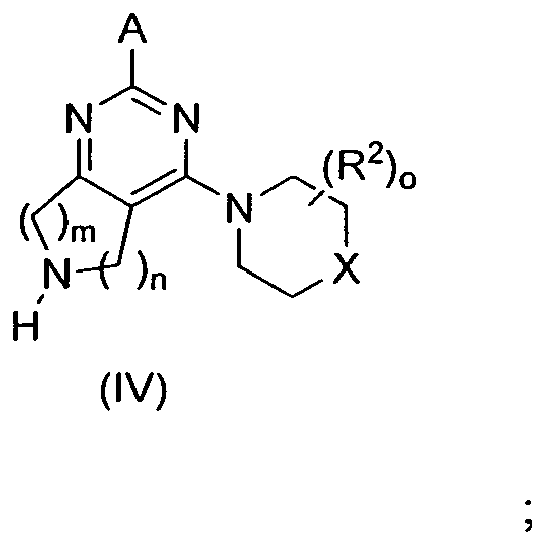 (b1) optionally, deprotect the product of step (a1) to yield a compound of formula (I), wherein R1 is H followed by the optional step of reacting a compound of formula (I), wherein R1 is H by a compound of formula R1-X1, wherein X1 is a suitable leaving group and R1 is defined as indicated in claim 1 excluding H to yield a compound of formula (I), wherein R1 is other than H; or(b2) react a compound of formula (IV) with a compound of formula R1-X1, wherein X1 is a suitable leaving group and R1 is defined as indicated in claim 1 excluding H to yield a compound of formula (V)
Priority Applications (1)
| Application Number | Priority Date | Filing Date | Title |
|---|---|---|---|
| EP10707924.6A EP2406258B1 (en) | 2009-03-13 | 2010-03-12 | PYRIMIDINE DERIVATIVES AS mTOR INHIBITORS |
Applications Claiming Priority (4)
| Application Number | Priority Date | Filing Date | Title |
|---|---|---|---|
| EP09155143 | 2009-03-13 | ||
| US30325210P | 2010-02-10 | 2010-02-10 | |
| EP10707924.6A EP2406258B1 (en) | 2009-03-13 | 2010-03-12 | PYRIMIDINE DERIVATIVES AS mTOR INHIBITORS |
| PCT/EP2010/053165 WO2010103094A1 (en) | 2009-03-13 | 2010-03-12 | PYRIMIDINE DERIVATIVES AS mTOR INHIBITORS |
Publications (2)
| Publication Number | Publication Date |
|---|---|
| EP2406258A1 EP2406258A1 (en) | 2012-01-18 |
| EP2406258B1 true EP2406258B1 (en) | 2014-12-03 |
Family
ID=40612824
Family Applications (1)
| Application Number | Title | Priority Date | Filing Date |
|---|---|---|---|
| EP10707924.6A Active EP2406258B1 (en) | 2009-03-13 | 2010-03-12 | PYRIMIDINE DERIVATIVES AS mTOR INHIBITORS |
Country Status (5)
| Country | Link |
|---|---|
| US (2) | US8785457B2 (en) |
| EP (1) | EP2406258B1 (en) |
| CA (1) | CA2755061A1 (en) |
| ES (1) | ES2529205T3 (en) |
| WO (1) | WO2010103094A1 (en) |
Families Citing this family (8)
| Publication number | Priority date | Publication date | Assignee | Title |
|---|---|---|---|---|
| EP2406258B1 (en) * | 2009-03-13 | 2014-12-03 | Cellzome Limited | PYRIMIDINE DERIVATIVES AS mTOR INHIBITORS |
| EP2542536B1 (en) | 2010-03-04 | 2015-01-21 | Cellzome Limited | Morpholino substituted urea derivatives as mtor inhibitors |
| US20130210030A1 (en) | 2010-07-19 | 2013-08-15 | Cellzome Ag | In vivo method for the evaluation of a compound-target interaction |
| WO2012136622A1 (en) | 2011-04-04 | 2012-10-11 | Cellzome Limited | Dihydropyrrolo pyrimidine derivatives as mtor inhibitors |
| CA2849189A1 (en) | 2011-09-21 | 2013-03-28 | Cellzome Limited | Morpholino substituted urea or carbamate derivatives as mtor inhibitors |
| JP5995977B2 (en) * | 2011-10-07 | 2016-09-21 | セルゾーム リミテッド | Morpholino-substituted bicyclic pyrimidine urea or carbamate derivatives as MTOR inhibitors |
| WO2020055761A1 (en) | 2018-09-10 | 2020-03-19 | Mirati Therapeutics, Inc. | Combination therapies |
| GB202415232D0 (en) | 2024-10-16 | 2024-11-27 | Nacamed As | Composition |
Family Cites Families (20)
| Publication number | Priority date | Publication date | Assignee | Title |
|---|---|---|---|---|
| CA2280930C (en) | 1997-02-12 | 2010-04-06 | The Regents Of The University Of Michigan | Protein markers for lung cancer and use thereof |
| GB9714249D0 (en) | 1997-07-08 | 1997-09-10 | Angiogene Pharm Ltd | Vascular damaging agents |
| BRPI0017548B8 (en) | 1999-02-10 | 2023-05-02 | Astrazeneca Ab | COMPOUND |
| CN100376567C (en) | 1999-11-05 | 2008-03-26 | 阿斯特拉曾尼卡有限公司 | Quinazoline derivatives as VEGF inhibitors |
| AR034118A1 (en) | 2000-02-15 | 2004-02-04 | Sugen Inc | COMPOUNDS OF 2-INDOLINONES REPLACED WITH PROTEINQUINASE INHIBITING PIRROLS; YOUR PHARMACEUTICAL AND INTERMEDIARY SYNTHESIS COMPOSITIONS |
| US7135298B2 (en) | 2003-03-26 | 2006-11-14 | The Burnham Institute For Medical Research | Screening assay for agents that alter target of Rapamycin activity |
| WO2006134056A1 (en) | 2005-06-14 | 2006-12-21 | Cellzome Ag | Process for the identification of novel enzyme interacting compounds |
| ATE414281T1 (en) | 2006-08-03 | 2008-11-15 | Cellzome Ag | METHOD FOR IDENTIFYING MOLECULES THAT INTERACT WITH PI3K AND METHOD FOR PURIFYING PI3K |
| JP5534811B2 (en) | 2006-08-24 | 2014-07-02 | アストラゼネカ アクチボラグ | Morpholinopyrimidine derivatives useful for the treatment of proliferative diseases |
| US20080234262A1 (en) | 2007-03-21 | 2008-09-25 | Wyeth | Pyrazolopyrimidine analogs and their use as mtor kinase and pi3 kinase inhibitors |
| US20080233127A1 (en) | 2007-03-21 | 2008-09-25 | Wyeth | Imidazolopyrimidine analogs and their use as pi3 kinase and mtor inhibitors |
| JP2010532756A (en) | 2007-07-06 | 2010-10-14 | オーエスアイ・ファーマスーティカルズ・インコーポレーテッド | Combination anti-cancer therapy comprising inhibitors of both mTORC1 and mTORC2 |
| US8138183B2 (en) | 2007-07-09 | 2012-03-20 | Astrazeneca Ab | Morpholino pyrimidine derivatives used in diseases linked to mTOR kinase and/or PI3K |
| BRPI0814818A2 (en) | 2007-07-09 | 2019-09-10 | Astrazeneca Ab | compound, use of a compound, methods for producing an antiproliferative effect and a inhibitor effect of mtor kinase in a warm-blooded animal, method for treating disease, and, pharmaceutical composition |
| AU2008273892A1 (en) | 2007-07-09 | 2009-01-15 | Astrazeneca Ab | Trisubstituted pyrimidine derivatives for the treatment of proliferative diseases |
| EP2178866A2 (en) | 2007-07-09 | 2010-04-28 | AstraZeneca AB | Trisubstituted pyrimidine derivatives for the treatment of proliferative diseases |
| CN101224207A (en) | 2007-10-12 | 2008-07-23 | 中国科学院上海有机化学研究所 | Drugs capable of inducing autophagy to treat diseases caused by misfolded protein aggregation and screening methods thereof |
| WO2009098021A1 (en) | 2008-02-04 | 2009-08-13 | Cellzome Ag | Selectivity profiling of pi3k interacting molecules against multiple targets |
| EP2318377B1 (en) | 2008-07-31 | 2013-08-21 | Genentech, Inc. | Pyrimidine compounds, compositions and methods of use |
| EP2406258B1 (en) * | 2009-03-13 | 2014-12-03 | Cellzome Limited | PYRIMIDINE DERIVATIVES AS mTOR INHIBITORS |
-
2010
- 2010-03-12 EP EP10707924.6A patent/EP2406258B1/en active Active
- 2010-03-12 CA CA2755061A patent/CA2755061A1/en not_active Abandoned
- 2010-03-12 ES ES10707924.6T patent/ES2529205T3/en active Active
- 2010-03-12 WO PCT/EP2010/053165 patent/WO2010103094A1/en not_active Ceased
- 2010-03-12 US US13/256,345 patent/US8785457B2/en not_active Expired - Fee Related
-
2014
- 2014-06-13 US US14/304,375 patent/US20140296234A1/en not_active Abandoned
Also Published As
| Publication number | Publication date |
|---|---|
| US20140296234A1 (en) | 2014-10-02 |
| CA2755061A1 (en) | 2010-09-16 |
| US20120065202A1 (en) | 2012-03-15 |
| EP2406258A1 (en) | 2012-01-18 |
| US8785457B2 (en) | 2014-07-22 |
| ES2529205T3 (en) | 2015-02-17 |
| WO2010103094A1 (en) | 2010-09-16 |
Similar Documents
| Publication | Publication Date | Title |
|---|---|---|
| AU2010309882B2 (en) | Heterocyclyl pyrazolopyrimidine analogues as JAK inhibitors | |
| US20140296234A1 (en) | Pyrimidine derivatives as mtor inhibitors | |
| CN103917530B (en) | The substituted urea of morpholino or carbamic acid derivative as MTOR inhibitor | |
| CN103946222B (en) | Morpholino substituted bicyclic pyrimidin urea or carbamic acid derivative as MTOR inhibitor | |
| US9249129B2 (en) | Morpholino substituted urea derivatives as mTOR inhibitors | |
| EP2760863A1 (en) | Pyrazolo[4,3-c]pyridine derivatives as kinase inhibitors | |
| EP2736901A1 (en) | Heterocyclyl pyrimidine analogues as jak inhibitors | |
| WO2013017480A1 (en) | Pyrazolo[4,3-c]pyridine derivatives as jak inhibitors | |
| CA2860095A1 (en) | Pyrimidine-2,4-diamine derivatives as kinase inhibitors | |
| US20140163023A1 (en) | Dihydropyrrolo pyrimidine derivatives as mtor inhibitors | |
| WO2012143320A1 (en) | (7h-pyrrolo[2,3-d]pyrimidin-2-yl)amine compounds as jak3 inhibitors | |
| WO2013017479A1 (en) | Pyrazolo[4,3-c]pyridine derivatives as jak inhibitors |
Legal Events
| Date | Code | Title | Description |
|---|---|---|---|
| PUAI | Public reference made under article 153(3) epc to a published international application that has entered the european phase |
Free format text: ORIGINAL CODE: 0009012 |
|
| 17P | Request for examination filed |
Effective date: 20111010 |
|
| AK | Designated contracting states |
Kind code of ref document: A1 Designated state(s): AT BE BG CH CY CZ DE DK EE ES FI FR GB GR HR HU IE IS IT LI LT LU LV MC MK MT NL NO PL PT RO SE SI SK SM TR |
|
| AX | Request for extension of the european patent |
Extension state: AL BA ME RS |
|
| GRAP | Despatch of communication of intention to grant a patent |
Free format text: ORIGINAL CODE: EPIDOSNIGR1 |
|
| INTG | Intention to grant announced |
Effective date: 20140606 |
|
| GRAS | Grant fee paid |
Free format text: ORIGINAL CODE: EPIDOSNIGR3 |
|
| GRAA | (expected) grant |
Free format text: ORIGINAL CODE: 0009210 |
|
| AK | Designated contracting states |
Kind code of ref document: B1 Designated state(s): AT BE BG CH CY CZ DE DK EE ES FI FR GB GR HR HU IE IS IT LI LT LU LV MC MK MT NL NO PL PT RO SE SI SK SM TR |
|
| AX | Request for extension of the european patent |
Extension state: AL BA ME RS |
|
| RAP1 | Party data changed (applicant data changed or rights of an application transferred) |
Owner name: CELLZOME LIMITED |
|
| REG | Reference to a national code |
Ref country code: GB Ref legal event code: FG4D |
|
| REG | Reference to a national code |
Ref country code: AT Ref legal event code: REF Ref document number: 699293 Country of ref document: AT Kind code of ref document: T Effective date: 20141215 Ref country code: CH Ref legal event code: EP |
|
| REG | Reference to a national code |
Ref country code: IE Ref legal event code: FG4D |
|
| REG | Reference to a national code |
Ref country code: DE Ref legal event code: R096 Ref document number: 602010020689 Country of ref document: DE Effective date: 20150115 |
|
| REG | Reference to a national code |
Ref country code: ES Ref legal event code: FG2A Ref document number: 2529205 Country of ref document: ES Kind code of ref document: T3 Effective date: 20150217 |
|
| PGFP | Annual fee paid to national office [announced via postgrant information from national office to epo] |
Ref country code: FR Payment date: 20141226 Year of fee payment: 6 |
|
| REG | Reference to a national code |
Ref country code: NL Ref legal event code: VDEP Effective date: 20141203 |
|
| REG | Reference to a national code |
Ref country code: AT Ref legal event code: MK05 Ref document number: 699293 Country of ref document: AT Kind code of ref document: T Effective date: 20141203 |
|
| PG25 | Lapsed in a contracting state [announced via postgrant information from national office to epo] |
Ref country code: NL Free format text: LAPSE BECAUSE OF FAILURE TO SUBMIT A TRANSLATION OF THE DESCRIPTION OR TO PAY THE FEE WITHIN THE PRESCRIBED TIME-LIMIT Effective date: 20141203 Ref country code: LT Free format text: LAPSE BECAUSE OF FAILURE TO SUBMIT A TRANSLATION OF THE DESCRIPTION OR TO PAY THE FEE WITHIN THE PRESCRIBED TIME-LIMIT Effective date: 20141203 Ref country code: NO Free format text: LAPSE BECAUSE OF FAILURE TO SUBMIT A TRANSLATION OF THE DESCRIPTION OR TO PAY THE FEE WITHIN THE PRESCRIBED TIME-LIMIT Effective date: 20150303 Ref country code: FI Free format text: LAPSE BECAUSE OF FAILURE TO SUBMIT A TRANSLATION OF THE DESCRIPTION OR TO PAY THE FEE WITHIN THE PRESCRIBED TIME-LIMIT Effective date: 20141203 |
|
| PGFP | Annual fee paid to national office [announced via postgrant information from national office to epo] |
Ref country code: DE Payment date: 20141231 Year of fee payment: 6 Ref country code: ES Payment date: 20150126 Year of fee payment: 6 Ref country code: IT Payment date: 20141231 Year of fee payment: 6 |
|
| REG | Reference to a national code |
Ref country code: LT Ref legal event code: MG4D |
|
| PG25 | Lapsed in a contracting state [announced via postgrant information from national office to epo] |
Ref country code: HR Free format text: LAPSE BECAUSE OF FAILURE TO SUBMIT A TRANSLATION OF THE DESCRIPTION OR TO PAY THE FEE WITHIN THE PRESCRIBED TIME-LIMIT Effective date: 20141203 Ref country code: SE Free format text: LAPSE BECAUSE OF FAILURE TO SUBMIT A TRANSLATION OF THE DESCRIPTION OR TO PAY THE FEE WITHIN THE PRESCRIBED TIME-LIMIT Effective date: 20141203 Ref country code: CY Free format text: LAPSE BECAUSE OF FAILURE TO SUBMIT A TRANSLATION OF THE DESCRIPTION OR TO PAY THE FEE WITHIN THE PRESCRIBED TIME-LIMIT Effective date: 20141203 Ref country code: LV Free format text: LAPSE BECAUSE OF FAILURE TO SUBMIT A TRANSLATION OF THE DESCRIPTION OR TO PAY THE FEE WITHIN THE PRESCRIBED TIME-LIMIT Effective date: 20141203 Ref country code: GR Free format text: LAPSE BECAUSE OF FAILURE TO SUBMIT A TRANSLATION OF THE DESCRIPTION OR TO PAY THE FEE WITHIN THE PRESCRIBED TIME-LIMIT Effective date: 20150304 Ref country code: AT Free format text: LAPSE BECAUSE OF FAILURE TO SUBMIT A TRANSLATION OF THE DESCRIPTION OR TO PAY THE FEE WITHIN THE PRESCRIBED TIME-LIMIT Effective date: 20141203 |
|
| PGFP | Annual fee paid to national office [announced via postgrant information from national office to epo] |
Ref country code: GB Payment date: 20150126 Year of fee payment: 6 |
|
| PG25 | Lapsed in a contracting state [announced via postgrant information from national office to epo] |
Ref country code: EE Free format text: LAPSE BECAUSE OF FAILURE TO SUBMIT A TRANSLATION OF THE DESCRIPTION OR TO PAY THE FEE WITHIN THE PRESCRIBED TIME-LIMIT Effective date: 20141203 Ref country code: SK Free format text: LAPSE BECAUSE OF FAILURE TO SUBMIT A TRANSLATION OF THE DESCRIPTION OR TO PAY THE FEE WITHIN THE PRESCRIBED TIME-LIMIT Effective date: 20141203 Ref country code: CZ Free format text: LAPSE BECAUSE OF FAILURE TO SUBMIT A TRANSLATION OF THE DESCRIPTION OR TO PAY THE FEE WITHIN THE PRESCRIBED TIME-LIMIT Effective date: 20141203 Ref country code: PT Free format text: LAPSE BECAUSE OF FAILURE TO SUBMIT A TRANSLATION OF THE DESCRIPTION OR TO PAY THE FEE WITHIN THE PRESCRIBED TIME-LIMIT Effective date: 20150403 Ref country code: RO Free format text: LAPSE BECAUSE OF FAILURE TO SUBMIT A TRANSLATION OF THE DESCRIPTION OR TO PAY THE FEE WITHIN THE PRESCRIBED TIME-LIMIT Effective date: 20141203 |
|
| PG25 | Lapsed in a contracting state [announced via postgrant information from national office to epo] |
Ref country code: PL Free format text: LAPSE BECAUSE OF FAILURE TO SUBMIT A TRANSLATION OF THE DESCRIPTION OR TO PAY THE FEE WITHIN THE PRESCRIBED TIME-LIMIT Effective date: 20141203 Ref country code: IS Free format text: LAPSE BECAUSE OF FAILURE TO SUBMIT A TRANSLATION OF THE DESCRIPTION OR TO PAY THE FEE WITHIN THE PRESCRIBED TIME-LIMIT Effective date: 20150403 |
|
| REG | Reference to a national code |
Ref country code: DE Ref legal event code: R097 Ref document number: 602010020689 Country of ref document: DE |
|
| PLBE | No opposition filed within time limit |
Free format text: ORIGINAL CODE: 0009261 |
|
| STAA | Information on the status of an ep patent application or granted ep patent |
Free format text: STATUS: NO OPPOSITION FILED WITHIN TIME LIMIT |
|
| PG25 | Lapsed in a contracting state [announced via postgrant information from national office to epo] |
Ref country code: DK Free format text: LAPSE BECAUSE OF FAILURE TO SUBMIT A TRANSLATION OF THE DESCRIPTION OR TO PAY THE FEE WITHIN THE PRESCRIBED TIME-LIMIT Effective date: 20141203 Ref country code: LU Free format text: LAPSE BECAUSE OF FAILURE TO SUBMIT A TRANSLATION OF THE DESCRIPTION OR TO PAY THE FEE WITHIN THE PRESCRIBED TIME-LIMIT Effective date: 20150312 Ref country code: MC Free format text: LAPSE BECAUSE OF FAILURE TO SUBMIT A TRANSLATION OF THE DESCRIPTION OR TO PAY THE FEE WITHIN THE PRESCRIBED TIME-LIMIT Effective date: 20141203 |
|
| REG | Reference to a national code |
Ref country code: CH Ref legal event code: PL |
|
| 26N | No opposition filed |
Effective date: 20150904 |
|
| REG | Reference to a national code |
Ref country code: IE Ref legal event code: MM4A |
|
| PG25 | Lapsed in a contracting state [announced via postgrant information from national office to epo] |
Ref country code: LI Free format text: LAPSE BECAUSE OF NON-PAYMENT OF DUE FEES Effective date: 20150331 Ref country code: CH Free format text: LAPSE BECAUSE OF NON-PAYMENT OF DUE FEES Effective date: 20150331 Ref country code: IE Free format text: LAPSE BECAUSE OF NON-PAYMENT OF DUE FEES Effective date: 20150312 |
|
| PG25 | Lapsed in a contracting state [announced via postgrant information from national office to epo] |
Ref country code: SI Free format text: LAPSE BECAUSE OF FAILURE TO SUBMIT A TRANSLATION OF THE DESCRIPTION OR TO PAY THE FEE WITHIN THE PRESCRIBED TIME-LIMIT Effective date: 20141203 |
|
| PG25 | Lapsed in a contracting state [announced via postgrant information from national office to epo] |
Ref country code: BE Free format text: LAPSE BECAUSE OF FAILURE TO SUBMIT A TRANSLATION OF THE DESCRIPTION OR TO PAY THE FEE WITHIN THE PRESCRIBED TIME-LIMIT Effective date: 20141203 |
|
| REG | Reference to a national code |
Ref country code: DE Ref legal event code: R119 Ref document number: 602010020689 Country of ref document: DE |
|
| GBPC | Gb: european patent ceased through non-payment of renewal fee |
Effective date: 20160312 |
|
| PG25 | Lapsed in a contracting state [announced via postgrant information from national office to epo] |
Ref country code: MT Free format text: LAPSE BECAUSE OF FAILURE TO SUBMIT A TRANSLATION OF THE DESCRIPTION OR TO PAY THE FEE WITHIN THE PRESCRIBED TIME-LIMIT Effective date: 20141203 |
|
| REG | Reference to a national code |
Ref country code: FR Ref legal event code: ST Effective date: 20161130 |
|
| PG25 | Lapsed in a contracting state [announced via postgrant information from national office to epo] |
Ref country code: GB Free format text: LAPSE BECAUSE OF NON-PAYMENT OF DUE FEES Effective date: 20160312 Ref country code: FR Free format text: LAPSE BECAUSE OF NON-PAYMENT OF DUE FEES Effective date: 20160331 Ref country code: DE Free format text: LAPSE BECAUSE OF NON-PAYMENT OF DUE FEES Effective date: 20161001 |
|
| PG25 | Lapsed in a contracting state [announced via postgrant information from national office to epo] |
Ref country code: IT Free format text: LAPSE BECAUSE OF NON-PAYMENT OF DUE FEES Effective date: 20160312 |
|
| REG | Reference to a national code |
Ref country code: ES Ref legal event code: FD2A Effective date: 20170427 |
|
| PG25 | Lapsed in a contracting state [announced via postgrant information from national office to epo] |
Ref country code: SM Free format text: LAPSE BECAUSE OF FAILURE TO SUBMIT A TRANSLATION OF THE DESCRIPTION OR TO PAY THE FEE WITHIN THE PRESCRIBED TIME-LIMIT Effective date: 20141203 Ref country code: BG Free format text: LAPSE BECAUSE OF FAILURE TO SUBMIT A TRANSLATION OF THE DESCRIPTION OR TO PAY THE FEE WITHIN THE PRESCRIBED TIME-LIMIT Effective date: 20141203 Ref country code: HU Free format text: LAPSE BECAUSE OF FAILURE TO SUBMIT A TRANSLATION OF THE DESCRIPTION OR TO PAY THE FEE WITHIN THE PRESCRIBED TIME-LIMIT; INVALID AB INITIO Effective date: 20100312 |
|
| PG25 | Lapsed in a contracting state [announced via postgrant information from national office to epo] |
Ref country code: ES Free format text: LAPSE BECAUSE OF NON-PAYMENT OF DUE FEES Effective date: 20160313 Ref country code: TR Free format text: LAPSE BECAUSE OF FAILURE TO SUBMIT A TRANSLATION OF THE DESCRIPTION OR TO PAY THE FEE WITHIN THE PRESCRIBED TIME-LIMIT Effective date: 20141203 |
|
| PG25 | Lapsed in a contracting state [announced via postgrant information from national office to epo] |
Ref country code: MK Free format text: LAPSE BECAUSE OF FAILURE TO SUBMIT A TRANSLATION OF THE DESCRIPTION OR TO PAY THE FEE WITHIN THE PRESCRIBED TIME-LIMIT Effective date: 20141203 |