EP2405705A1 - Method, system and apparatus for indicating a unit format - Google Patents
Method, system and apparatus for indicating a unit format Download PDFInfo
- Publication number
- EP2405705A1 EP2405705A1 EP10748327A EP10748327A EP2405705A1 EP 2405705 A1 EP2405705 A1 EP 2405705A1 EP 10748327 A EP10748327 A EP 10748327A EP 10748327 A EP10748327 A EP 10748327A EP 2405705 A1 EP2405705 A1 EP 2405705A1
- Authority
- EP
- European Patent Office
- Prior art keywords
- base station
- user equipment
- unit
- identifier
- determined
- Prior art date
- Legal status (The legal status is an assumption and is not a legal conclusion. Google has not performed a legal analysis and makes no representation as to the accuracy of the status listed.)
- Granted
Links
Images

Classifications
-
- H—ELECTRICITY
- H04—ELECTRIC COMMUNICATION TECHNIQUE
- H04L—TRANSMISSION OF DIGITAL INFORMATION, e.g. TELEGRAPHIC COMMUNICATION
- H04L1/00—Arrangements for detecting or preventing errors in the information received
- H04L1/0001—Systems modifying transmission characteristics according to link quality, e.g. power backoff
- H04L1/0023—Systems modifying transmission characteristics according to link quality, e.g. power backoff characterised by the signalling
- H04L1/0025—Transmission of mode-switching indication
-
- H—ELECTRICITY
- H04—ELECTRIC COMMUNICATION TECHNIQUE
- H04W—WIRELESS COMMUNICATION NETWORKS
- H04W28/00—Network traffic management; Network resource management
- H04W28/02—Traffic management, e.g. flow control or congestion control
- H04W28/06—Optimizing the usage of the radio link, e.g. header compression, information sizing, discarding information
Definitions
- the present invention relates to the field of wireless communications and particularly to a method, system and apparatus for indicating a unit format.
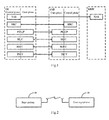
- FIG. 1 A structure of a protocol stack in an existing Long Term Evolution (LTE) system is illustrated in Fig. 1 .
- LTE Long Term Evolution
- the LTE system includes a User Equipment (UE), a base station (eNB) and a Mobility Management Entity (MME).
- UE User Equipment
- eNB base station
- MME Mobility Management Entity
- the structure of the protocol stack in the LTE system includes a Non-Access Stratum (NAS) layer, a Radio Resource Control (RRC) layer, a Packet Data Convergence Protocol (PDCP) layer, a Radio Link Control (RLC) layer, a Media Access Control (MAC) layer and a Physical (PHY) layer.
- NAS Non-Access Stratum
- RRC Radio Resource Control
- PDCP Packet Data Convergence Protocol
- RLC Radio Link Control
- MAC Media Access Control
- PHY Physical
- the protocol stack of the UE and the eNB may be divided vertically into a user plane and a control plane. Signalling is transmitted and processed, that is, the signalling is borne, in the control plane. Data is transmitted and processed, that is, the data is borne, in the user plane.
- both the signalling and the data are provided at specific locations in a unit and then encapsulated at each of the layers.
- an operation of head-compression (or head-decompression) and an operation of encryption (or decryption) are performed on a received data packet (i.e., user data) generally at the PDCP layer of the user plane.
- Operations of encryption (or decryption) and integrity protection (or integrity verification) are performed on a received data packet (i.e., control signalling) generally at the PDCP layer of the control plane.
- a data packet received from a higher layer for transmission (i.e., a unit at the higher-layer) is processed at the PDCP layer and added a PDCP head to form a data packet at the PDCP layer (i.e., a unit at the PDCP layer), which is transmitted to a lower layer.
- a transmitter shall perform a transmission operation in this unit format and a receiver shall perform a reception operation on the borne data also in this unit format upon reception of information transmitted from the transmitter.
- one unit format apparently can not satisfy a current demand with the development of communications. If there are a plurality of unit formats in the system, it may be difficult for the receiver to know a specific unit format in which the transmitter performs a transmission operation, and if the receiver adopts a different unit format from that of the transmitter, the reception may fail.
- Embodiments of the invention provide a method, system and apparatus for indicating a unit format so that both a transmitter and a receiver can operate in the same unit format in the case of a plurality of unit formats to thereby improve the efficiency of data transmission.
- the base station selects one of a plurality of unit formats according to a preset first selection condition; the base station determines an identifier corresponding to the selected unit format according to a preset corresponding relationship between unit formats and identifiers; and the base station transmits the determined identifier to a user equipment to instruct the user equipment to transmit in the unit format corresponding to the identifier. Since the base station can instruct the user equipment to operate in a specific unit format, both a transmitter and a receiver can operate in the same unit format, thereby improving both the success ratio and the efficiency of data transmission, and further improving the resource utilization ratio of the system and the user experience, and alleviating the burden of the system.
- Fig. 1 is a structure of a protocol stack in an LTE system
- Fig. 2 is a schematic diagram of a structure of a communication system according to an embodiment of the invention.
- Fig. 3 is a schematic diagram of a structure of a base station according to an embodiment of the invention.
- Fig. 4 is a flow chart of a method for indicating a unit format according to an embodiment of the invention.
- a base station selects one of a plurality of unit formats according to a preset first selection condition and transmits an identifier corresponding to the selected unit format to a user equipment to instruct the user equipment to transmit in the unit format corresponding to the identifier. Since the base station can instruct the user equipment to operate in a specific unit format, both a transmitter and a receiver can operate in the same unit format, thereby improving both the success ratio and the efficiency of data transmission.
- a communication system includes a base station 10 and a user equipment 20.
- the base station 10 is configured to select one of a plurality of unit formats according to a preset first selection condition, determine an identifier corresponding to the selected unit format according to a preset corresponding relationship between unit formats and identifiers, and transmit the determined identifier.
- the user equipment 20 is configured to transmit in the unit format corresponding to the received identifier.
- the user equipment 20 determines the unit format corresponding to the received identifier according to a preset corresponding relationship between unit formats and identifiers upon reception of the identifier to know the specific unit format in which a reception operation and a transmission operation are performed on data borne in a unit.
- the corresponding relationship between unit formats and identifiers preset in the user equipment 20 is the same as the corresponding relationship between unit formats and identifiers preset at the base station 10.
- the corresponding relationship between unit formats and identifiers may be stored into the base station 10 and the user equipment 20 respectively, or into another entity for retrieval by the base station 10 and the user equipment 20.
- the corresponding relationship between unit formats and identifiers may not be constant but may be set as required.
- a base station includes a selection module 100, an identifier determination module 110 and a transmission module 120.
- the selection module 100 is configured to select one of a plurality of unit formats according to a preset first selection condition.
- the first selection condition includes types of unit formats supported by the user equipment and may further include one or more of a transmission rate required for a bearer established between the user equipment and the base station, a channel condition between the user equipment and the base station and a current cell load condition.
- the first selection condition includes types of unit formats supported by the user equipment, and then the selection module 100 selects a unit format supportable by the user equipment among a plurality of unit formats according to the types of unit formats supported by the user equipment.
- Types of unit formats supported by the user equipment refer to unit formats supportable by the user equipment, for example, there are two unit formats, one of which is the PDCP PDU format in an LTE system (simply a first format, which represents below the PDCP PDU format in an LTE system), and the other of which is the PDCP PDU format in an LTE-A system (simply a second format, which represents below the PDCP PDU format in an LTE-A system).
- both the first format and the second format may be present in the LTE-A system. If the user equipment is an LTE user equipment, it does not support the second format; and if the user equipment is an LTE-A user equipment, it supports both the first format and the second format.
- a unit format suitable for the user equipment may be selected according to the types of unit formats supported by the user equipment.
- a format may be selected randomly. Preferably, it is determined whether the LTE-A user equipment supports one of Carrier Aggregation (CA) and Coordinated Multi-Point (CoMA), and if so, the second format is selected; otherwise, the first format is selected.
- CA Carrier Aggregation
- CoMA Coordinated Multi-Point
- the number of aggregated carriers and/the number of coordinated cells supported by the LTE-A user equipment may further be checked, and if the number of aggregated carriers and/the number of coordinated cells supported by the LTE-A user equipment is larger than a preset number, the second format is selected; otherwise, the first format is selected.
- the first selection condition includes types of unit formats supported by the user equipment and also one or more of a transmission rate required for a bearer established between the user equipment and the base station, a channel condition between the user equipment and the base station and a current cell load condition
- the selection module 100 determines all of unit formats supportable by the user equipment among a plurality of unit formats according to the types of unit formats supported by the user equipment and selects one of the determined unit formats supportable by the user equipment according to one or more of the transmission rate required for a bearer established between the user equipment and the base station, the channel condition between the user equipment and the base station and the current cell load condition.
- the selection module 100 determines that the user equipment supports only one unit format, it is not necessary to further determine any unit format according to one or more of the transmission rate required for a bearer established between the user equipment and the base station, the channel condition between the user equipment and the base station and the current cell load condition.
- a first condition relates to types of unit formats supported by the user equipment.
- selecting according to types of unit formats supported by the user equipment in the second approach is similar to selecting according to types of unit formats supported by the user equipment in the first approach except for further selecting according to one or more of the following conditions upon determining availability of the two formats for selection.
- the second format is selected; otherwise, the first format is selected.
- the second format is selected; otherwise, the first format is selected.
- a second condition relates to a transmission rate required for a bearer established between the user equipment and the base station.
- the transmission rate required for a bearer established between the user equipment and the base station is larger than a first threshold, and if so, the second format is selected; otherwise, the first format is selected.
- a third condition relates to a channel condition between the user equipment and the base station.
- the channel condition between the user equipment and the base station satisfies a condition, for example, if the signal to noise ratio and/or the signal to interference and noise ratio is larger than a second threshold, it is determined that the channel condition between the user equipment and the base station satisfies the condition, then the second format is selected; otherwise, the first format is selected.
- a condition for example, if the signal to noise ratio and/or the signal to interference and noise ratio is larger than a second threshold, it is determined that the channel condition between the user equipment and the base station satisfies the condition, then the second format is selected; otherwise, the first format is selected.
- a fourth condition relates to a current cell load condition.
- the current cell load condition satisfies a condition, for example, if a current system load is less than a third threshold, it is determined that the current cell load condition satisfies the condition, then the second format is selected; otherwise, the first format is selected.
- more than one condition may be used in combination, for example, the second and third conditions are used in combination with the first condition, and judgment is made against firstly the second condition and then the third condition. If it is determined against the second condition that the transmission rate required for a bearer established between the user equipment and the base station is larger than the first threshold, judgment is further made against the third condition; and if it is determined against the second condition that the transmission rate required for a bearer established between the user equipment and the base station is not larger than the first threshold, the first format is selected directly without further judgment against any other condition.
- the other combining modes of the conditions may be similar to the above combining mode, and a repeated description thereof is omitted here.
- the foregoing description relates to the PDCP PDU format in an LTE system and the PDCP PDU format in an LTE-A system, and the present embodiment is not limited to these two formats but may be applicable to other formats, e.g., the RLC PDU format in an LTE system and the RLC PDU format in an LTE-A system.
- the identifier determination module 110 is configured to determine an identifier corresponding to the unit format selected by the selection module 100 according to a preset corresponding relationship between unit formats and identifiers.
- the corresponding relationship between unit formats and identifiers may be stored in a database or in a file or in another form.
- the transmission module 120 is configured to transmit the identifier determined by the identifier determination module 110 to a user equipment to instruct the user equipment to transmit in the unit format corresponding to the received identifier.
- the transmission module 120 may transmit the determined identifier in one of the following ways:
- the determined identifier is transmitted in system broadcast
- the determined identifier is transmitted in RRC signalling
- the determined identifier is transmitted in a control data unit
- the determined identifier is transmitted in a reserved bit, an extension bit or a control field in a data packet.
- the user equipment extracts the identifier from the corresponding information upon reception of the information.
- Which way is adopted may be informed in a message from the base station to the user equipment or may be preconfigured.
- the base station may further include a parameter information determination module 130.
- the parameter information determination module 130 is configured to determine parameter information of a unit corresponding to the unit format selected by the selection module 100 according to a preset second selection condition after the selection module 100 selects one of the unit formats and before the transmission module 120 transmits the determined identifier.
- Each unit has its own corresponding parameter information, and for the PDCP PDU format in an LTE-A system, for example, the length of an SN is one kind of parameter information and varies in different scenarios.
- the second selection condition includes one or more of the following conditions:
- a first condition relates to a transmission rate required for a bearer established between the user equipment and the base station;
- a second condition relates to a channel condition between the user equipment and the base station
- a third condition relates to a current cell load condition.
- the first, second and third conditions for the second selection condition are similar to the second, third and fourth conditions for the first selection condition respectively except for different settings of the thresholds, and a threshold corresponding to a specific condition may be set as required.
- the transmission module 120 transmits the determined identifier and the parameter information together, or separately in the ways described above, to the user equipment.
- a specific transmission way is similar to those described above, and a repeated description thereof is omitted here.
- the user equipment performs a reception operation and a transmission operation on data borne in the unit according to the unit format corresponding to the identifier and the received parameter information upon reception of the identifier and the parameter information.
- a method for indicating a unit format includes the following steps.
- a base station selects one of a plurality of unit formats according to a preset first selection condition.
- the base station determines an identifier corresponding to the selected unit format according to a preset corresponding relationship between unit formats and identifiers.
- the corresponding relationship between unit formats and identifiers may be stored in a database or in a file or in another form.
- the base station transmits the determined identifier to a user equipment to instruct the user equipment to transmit in the unit format corresponding to the received identifier.
- the first selection condition includes types of unit formats supported by the user equipment and may further include one or more of a transmission rate required for a bearer established between the user equipment and the base station, a channel condition between the user equipment and the base station and a current cell load condition.
- the first selection condition includes types of unit formats supported by the user equipment
- the base station selects a unit format supportable by the user equipment among a plurality of unit formats according to the types of unit formats supported by the user equipment.
- Types of unit formats supported by the user equipment refer to unit formats supportable by the user equipment, for example, there are two unit formats, one of which is the PDCP PDU format in an LTE system (simply a first format, which represents below the PDCP PDU format in an LTE system), and the other of which is the PDCP PDU format in an LTE-A system (simply a second format, which represents below the PDCP PDU format in an LTE-A system).
- both the first format and the second format may be present in the LTE-A system. If the user equipment is an LTE user equipment, it does not support the second format; and if the user equipment is an LTE-A user equipment, it supports both the first format and the second format.
- a unit format suitable for the user equipment may be selected according to the types of unit formats supported by the user equipment.
- a format may be selected randomly. Preferably, it is determined whether the LTE-A user equipment supports one of Carrier Aggregation and Coordinated Multi-Point, and if so, the second format is selected; otherwise, the first format is selected.
- the number of aggregated carriers and/the number of coordinated cells supported by the LTE-A user equipment may further be checked, and if the number of aggregated carriers and/the number of coordinated cells supported by the LTE-A user equipment is larger than a preset number, the second format is selected; otherwise, the first format is selected.
- the first selection condition includes types of unit formats supported by the user equipment and also one or more of a transmission rate required for a bearer established between the user equipment and the base station, a channel condition between the user equipment and the base station and a current cell load condition
- the step 400 may further include the steps a400 and b400.
- the base station determines all of unit formats supportable by the user equipment among a plurality of unit formats according to the types of unit formats supported by the user equipment.
- the base station selects one of the determined unit formats supportable by the user equipment according to one or more of the transmission rate required for a bearer established between the user equipment and the base station, the channel condition between the user equipment and the base station and the current cell load condition.
- the base station determines that the user equipment supports only one unit format in the step a400, it is not necessary to perform the step b400.
- a first condition relates to types of unit formats supported by the user equipment.
- selecting according to types of unit formats supported by the user equipment in the second approach is similar to selecting according to types of unit formats supported by the user equipment in the first approach except for further selecting according to one or more of the following conditions upon determining availability of the two formats for selection.
- the second format is selected; otherwise, the first format is selected.
- the second format is selected; otherwise, the first format is selected.
- a second condition relates to a transmission rate required for a bearer established between the user equipment and the base station.
- the transmission rate required for a bearer established between the user equipment and the base station is larger than a first threshold, and if so, the second format is selected; otherwise, the first format is selected.
- a third condition relates to a channel condition between the user equipment and the base station.
- the channel condition between the user equipment and the base station satisfies a condition, for example, if the signal to noise ratio and/or the signal to interference and noise ratio is larger than a second threshold, it is determined that the channel condition between the user equipment and the base station satisfies the condition, then the second format is selected; otherwise, the first format is selected.
- a condition for example, if the signal to noise ratio and/or the signal to interference and noise ratio is larger than a second threshold, it is determined that the channel condition between the user equipment and the base station satisfies the condition, then the second format is selected; otherwise, the first format is selected.
- a fourth condition relates to a current cell load condition.
- the current cell load condition satisfies a condition, for example, if a current system load is less than a third threshold, it is determined that the current cell load condition satisfies the condition, then the second format is selected; otherwise, the first format is selected.
- more than one condition may be used in combination, for example, the second and third conditions are used in combination with the first condition, and judgment is made against firstly the second condition and then the third condition. If it is determined against the second condition that the transmission rate required for a bearer established between the user equipment and the base station is larger than the first threshold, judgment is further made against the third condition; and if it is determined against the second condition that the transmission rate required for a bearer established between the user equipment and the base station is not larger than the first threshold, the first format is selected directly without further judgment against any other condition.
- the other combining modes of the conditions may be similar to the above combining mode, and a repeated description thereof is omitted here.
- the foregoing description relates to the PDCP PDU format in an LTE system and the PDCP PDU format in an LTE-A system, and the present embodiment is not limited to these two formats but may be applicable to other formats, e.g., the RLC PDU format in an LTE system and the RLC PDU format in an LTE-A system.
- the base station may transmit the determined identifier in one of the following ways:
- the determined identifier is transmitted in system broadcast
- the determined identifier is transmitted in RRC signalling
- the determined identifier is transmitted in a control data unit
- the determined identifier is transmitted in a reserved bit, an extension bit or a control field in a data packet.
- the user equipment extracts the identifier from the corresponding information upon reception of the information.
- Which way is adopted may be informed in a message from the base station to the user equipment or may be preconfigured.
- step 403 may further be included after the step 402.
- the user equipment transmits in the unit format corresponding to the received identifier.
- the user equipment determines the unit format corresponding to the received identifier according to a preset corresponding relationship between unit formats and identifiers upon reception of the identifier to know the specific unit format in which a reception operation and a transmission operation are performed on data borne in a unit.
- the corresponding relationship between unit formats and identifiers preset in the user equipment is the same as the corresponding relationship between unit formats and identifiers preset at the base station.
- the corresponding relationship between unit formats and identifiers may be stored into the base station and the user equipment respectively, or into another entity for retrieval by the base station and the user equipment.
- the corresponding relationship between unit formats and identifiers may not be constant but may be set as required.
- step 400 Since it is possible that there are a plurality of kinds of parameter information for a unit corresponding to the determined unit format, it is also necessary for the base station to notify the user equipment of parameter information, and then the following step may further be included between the step 400 and the step 402:
- the base station determines parameter information of a unit corresponding to the selected unit format according to a preset second selection condition.
- Each unit has its own corresponding parameter information, and for the PDCP PDU format in an LTE-A system, for example, the length of an SN is one kind of parameter information and varies in different scenarios.
- the second selection condition includes one or more of the following conditions:
- a first condition relates to a transmission rate required for a bearer established between the user equipment and the base station;
- a second condition relates to a channel condition between the user equipment and the base station
- a third condition relates to a current cell load condition.
- the first, second and third conditions for the second selection condition are similar to the second, third and fourth conditions for the first selection condition respectively except for different settings of the thresholds, and a threshold corresponding to a specific condition may be set as required.
- the base station transmits the determined identifier and the parameter information together, or separately in the ways described above, to the user equipment.
- a specific transmission way is similar to those described above, and a repeated description thereof is omitted here.
- the user equipment performs a reception operation and a transmission operation on data borne in the unit according to the unit format corresponding to the identifier and the received parameter information upon reception of the identifier and the parameter information.
- the base station selects one of a plurality of unit formats according to a preset first selection condition; the base station determines an identifier corresponding to the selected unit format according to a preset corresponding relationship between unit formats and identifiers; and the base station transmits the determined identifier to a user equipment to instruct the user equipment to transmit in the unit format corresponding to the identifier. Since the base station can instruct the user equipment to operate in a specific unit format, both a transmitter and a receiver can operate in the same unit format, thereby improving both the success ratio and the efficiency of data transmission, and further improving the resource utilization ratio of the system and the user experience, and alleviating the burden of the system.
Landscapes
- Engineering & Computer Science (AREA)
- Computer Networks & Wireless Communication (AREA)
- Signal Processing (AREA)
- Quality & Reliability (AREA)
- Mobile Radio Communication Systems (AREA)
- Computer Security & Cryptography (AREA)
Abstract
Description
- This application claims the benefit of Chinese Patent Application No.
200910078850.2 - The present invention relates to the field of wireless communications and particularly to a method, system and apparatus for indicating a unit format.
- A structure of a protocol stack in an existing Long Term Evolution (LTE) system is illustrated in
Fig. 1 . - In
Fig. 1 , the LTE system includes a User Equipment (UE), a base station (eNB) and a Mobility Management Entity (MME). - The structure of the protocol stack in the LTE system includes a Non-Access Stratum (NAS) layer, a Radio Resource Control (RRC) layer, a Packet Data Convergence Protocol (PDCP) layer, a Radio Link Control (RLC) layer, a Media Access Control (MAC) layer and a Physical (PHY) layer.
- The protocol stack of the UE and the eNB may be divided vertically into a user plane and a control plane. Signalling is transmitted and processed, that is, the signalling is borne, in the control plane. Data is transmitted and processed, that is, the data is borne, in the user plane.
- For transmission of the data, both the signalling and the data are provided at specific locations in a unit and then encapsulated at each of the layers.
- At the PDCP layer, for example, an operation of head-compression (or head-decompression) and an operation of encryption (or decryption) are performed on a received data packet (i.e., user data) generally at the PDCP layer of the user plane. Operations of encryption (or decryption) and integrity protection (or integrity verification) are performed on a received data packet (i.e., control signalling) generally at the PDCP layer of the control plane.
- In order to perform the functions of head-compression, encryption, integrity protection, etc., a data packet received from a higher layer for transmission (i.e., a unit at the higher-layer) is processed at the PDCP layer and added a PDCP head to form a data packet at the PDCP layer (i.e., a unit at the PDCP layer), which is transmitted to a lower layer.
- There is only one unit format in the existing system. Therefore, a transmitter shall perform a transmission operation in this unit format and a receiver shall perform a reception operation on the borne data also in this unit format upon reception of information transmitted from the transmitter.
- However, one unit format apparently can not satisfy a current demand with the development of communications. If there are a plurality of unit formats in the system, it may be difficult for the receiver to know a specific unit format in which the transmitter performs a transmission operation, and if the receiver adopts a different unit format from that of the transmitter, the reception may fail.
- In summary, it may be difficult for both the transmitter and the receiver to operate in the same unit format in the case of a plurality of unit formats in the existing system, thus decreasing the efficiency of data transmission.
- Embodiments of the invention provide a method, system and apparatus for indicating a unit format so that both a transmitter and a receiver can operate in the same unit format in the case of a plurality of unit formats to thereby improve the efficiency of data transmission.
- A method for indicating a unit format according to an embodiment of the invention includes:
- selecting, by a base station, one of a plurality of unit formats according to a preset first selection condition;
- determining, by the base station, an identifier corresponding to the selected unit format according to a preset corresponding relationship between unit formats and identifiers; and
- transmitting, by the base station, the determined identifier to a user equipment to instruct the user equipment to transmit in the unit format corresponding to the identifier.
- A communication system according to an embodiment of the invention includes:
- a base station configured to select one of a plurality of unit formats according to a preset first selection condition, determine an identifier corresponding to the selected unit format according to a preset corresponding relationship between unit formats and identifiers, and transmit the determined identifier; and
- a user equipment configured to transmit in the unit format corresponding to the received identifier.
- A base station according to an embodiment of the invention includes:
- a selection module configured to select one of a plurality of unit formats according to a preset first selection condition;
- an identifier determination module configured to determine an identifier corresponding to the selected unit format according to a preset corresponding relationship between unit formats and identifiers; and
- a transmission module configured to transmit the determined identifier to a user equipment to instruct the user equipment to transmit in the unit format corresponding to the identifier.
- The base station according to the embodiment of the invention selects one of a plurality of unit formats according to a preset first selection condition; the base station determines an identifier corresponding to the selected unit format according to a preset corresponding relationship between unit formats and identifiers; and the base station transmits the determined identifier to a user equipment to instruct the user equipment to transmit in the unit format corresponding to the identifier. Since the base station can instruct the user equipment to operate in a specific unit format, both a transmitter and a receiver can operate in the same unit format, thereby improving both the success ratio and the efficiency of data transmission, and further improving the resource utilization ratio of the system and the user experience, and alleviating the burden of the system.
-
Fig. 1 is a structure of a protocol stack in an LTE system; -
Fig. 2 is a schematic diagram of a structure of a communication system according to an embodiment of the invention; -
Fig. 3 is a schematic diagram of a structure of a base station according to an embodiment of the invention; and -
Fig. 4 is a flow chart of a method for indicating a unit format according to an embodiment of the invention. - A base station according to an embodiment of the invention selects one of a plurality of unit formats according to a preset first selection condition and transmits an identifier corresponding to the selected unit format to a user equipment to instruct the user equipment to transmit in the unit format corresponding to the identifier. Since the base station can instruct the user equipment to operate in a specific unit format, both a transmitter and a receiver can operate in the same unit format, thereby improving both the success ratio and the efficiency of data transmission.
- Embodiments of the invention are further described in details hereinafter with reference to the drawings.
- As illustrated in
Fig. 2 , a communication system according to an embodiment of the invention includes abase station 10 and auser equipment 20. - The
base station 10 is configured to select one of a plurality of unit formats according to a preset first selection condition, determine an identifier corresponding to the selected unit format according to a preset corresponding relationship between unit formats and identifiers, and transmit the determined identifier. - The
user equipment 20 is configured to transmit in the unit format corresponding to the received identifier. - The
user equipment 20 determines the unit format corresponding to the received identifier according to a preset corresponding relationship between unit formats and identifiers upon reception of the identifier to know the specific unit format in which a reception operation and a transmission operation are performed on data borne in a unit. - The corresponding relationship between unit formats and identifiers preset in the
user equipment 20 is the same as the corresponding relationship between unit formats and identifiers preset at thebase station 10. - In a specific implementation, the corresponding relationship between unit formats and identifiers may be stored into the
base station 10 and theuser equipment 20 respectively, or into another entity for retrieval by thebase station 10 and theuser equipment 20. - The corresponding relationship between unit formats and identifiers may not be constant but may be set as required.
- As illustrated in
Fig. 3 , a base station according to an embodiment of the invention includes aselection module 100, anidentifier determination module 110 and a transmission module 120. - The
selection module 100 is configured to select one of a plurality of unit formats according to a preset first selection condition. - The first selection condition includes types of unit formats supported by the user equipment and may further include one or more of a transmission rate required for a bearer established between the user equipment and the base station, a channel condition between the user equipment and the base station and a current cell load condition. The following two processing approaches apply respectively to the foregoing two scenarios.
- In a first approach, the first selection condition includes types of unit formats supported by the user equipment, and then the
selection module 100 selects a unit format supportable by the user equipment among a plurality of unit formats according to the types of unit formats supported by the user equipment. - Types of unit formats supported by the user equipment refer to unit formats supportable by the user equipment, for example, there are two unit formats, one of which is the PDCP PDU format in an LTE system (simply a first format, which represents below the PDCP PDU format in an LTE system), and the other of which is the PDCP PDU format in an LTE-A system (simply a second format, which represents below the PDCP PDU format in an LTE-A system).
- Since the LTE-A system can be compatible with the LTE system, both the first format and the second format may be present in the LTE-A system. If the user equipment is an LTE user equipment, it does not support the second format; and if the user equipment is an LTE-A user equipment, it supports both the first format and the second format.
- Thus a unit format suitable for the user equipment may be selected according to the types of unit formats supported by the user equipment.
- If the user equipment is an LTE-A user equipment, a format may be selected randomly. Preferably, it is determined whether the LTE-A user equipment supports one of Carrier Aggregation (CA) and Coordinated Multi-Point (CoMA), and if so, the second format is selected; otherwise, the first format is selected.
- Upon determined that the LTE-A user equipment supports one of Carrier Aggregation and Coordinated Multi-Point, the number of aggregated carriers and/the number of coordinated cells supported by the LTE-A user equipment may further be checked, and if the number of aggregated carriers and/the number of coordinated cells supported by the LTE-A user equipment is larger than a preset number, the second format is selected; otherwise, the first format is selected.
- In the second approach, the first selection condition includes types of unit formats supported by the user equipment and also one or more of a transmission rate required for a bearer established between the user equipment and the base station, a channel condition between the user equipment and the base station and a current cell load condition, then the
selection module 100 determines all of unit formats supportable by the user equipment among a plurality of unit formats according to the types of unit formats supported by the user equipment and selects one of the determined unit formats supportable by the user equipment according to one or more of the transmission rate required for a bearer established between the user equipment and the base station, the channel condition between the user equipment and the base station and the current cell load condition. - In a specific implementation, if the
selection module 100 determines that the user equipment supports only one unit format, it is not necessary to further determine any unit format according to one or more of the transmission rate required for a bearer established between the user equipment and the base station, the channel condition between the user equipment and the base station and the current cell load condition. - The following description is presented still taking the first format and the second format as an example.
- A first condition relates to types of unit formats supported by the user equipment.
- Particularly, selecting according to types of unit formats supported by the user equipment in the second approach is similar to selecting according to types of unit formats supported by the user equipment in the first approach except for further selecting according to one or more of the following conditions upon determining availability of the two formats for selection.
- For example, if it is determined that the LTE-A user equipment supports one of carrier aggregation and coordinated multi-point, the second format is selected; otherwise, the first format is selected.
- Furthermore, if the number of aggregated carriers and/or the number of coordinated cells supported by the LTE-A user equipment is larger than a preset number, the second format is selected; otherwise, the first format is selected.
- A second condition relates to a transmission rate required for a bearer established between the user equipment and the base station.
- Specifically, it is checked whether the transmission rate required for a bearer established between the user equipment and the base station is larger than a first threshold, and if so, the second format is selected; otherwise, the first format is selected.
- A third condition relates to a channel condition between the user equipment and the base station.
- Specifically, it is checked whether the channel condition between the user equipment and the base station satisfies a condition, for example, if the signal to noise ratio and/or the signal to interference and noise ratio is larger than a second threshold, it is determined that the channel condition between the user equipment and the base station satisfies the condition, then the second format is selected; otherwise, the first format is selected.
- A fourth condition relates to a current cell load condition.
- Specifically, it is checked whether the current cell load condition satisfies a condition, for example, if a current system load is less than a third threshold, it is determined that the current cell load condition satisfies the condition, then the second format is selected; otherwise, the first format is selected.
- In a specific implementation, more than one condition may be used in combination, for example, the second and third conditions are used in combination with the first condition, and judgment is made against firstly the second condition and then the third condition. If it is determined against the second condition that the transmission rate required for a bearer established between the user equipment and the base station is larger than the first threshold, judgment is further made against the third condition; and if it is determined against the second condition that the transmission rate required for a bearer established between the user equipment and the base station is not larger than the first threshold, the first format is selected directly without further judgment against any other condition.
- The other combining modes of the conditions may be similar to the above combining mode, and a repeated description thereof is omitted here.
- The foregoing description relates to the PDCP PDU format in an LTE system and the PDCP PDU format in an LTE-A system, and the present embodiment is not limited to these two formats but may be applicable to other formats, e.g., the RLC PDU format in an LTE system and the RLC PDU format in an LTE-A system.
- It shall be noted that the foregoing description relates to two formats by way of an example, and if there are at least three formats, judgment may be made against a threshold which is a range of values, that is, a range of values corresponds to one or more formats, and the same selection condition is used.
- The
identifier determination module 110 is configured to determine an identifier corresponding to the unit format selected by theselection module 100 according to a preset corresponding relationship between unit formats and identifiers. - In a specific implementation, the corresponding relationship between unit formats and identifiers may be stored in a database or in a file or in another form.
- The transmission module 120 is configured to transmit the identifier determined by the
identifier determination module 110 to a user equipment to instruct the user equipment to transmit in the unit format corresponding to the received identifier. - The transmission module 120 may transmit the determined identifier in one of the following ways:
- the determined identifier is transmitted in system broadcast;
- the determined identifier is transmitted in RRC signalling;
- the determined identifier is transmitted in a control data unit; and
- the determined identifier is transmitted in a reserved bit, an extension bit or a control field in a data packet.
- Correspondingly, the user equipment extracts the identifier from the corresponding information upon reception of the information. Which way is adopted may be informed in a message from the base station to the user equipment or may be preconfigured.
- Since it is possible that there are a plurality of kinds of parameter information for a unit corresponding to the determined unit format, it is also necessary for the base station to notify the user equipment of parameter information, and then the base station according to an embodiment of the invention may further include a parameter
information determination module 130. - The parameter
information determination module 130 is configured to determine parameter information of a unit corresponding to the unit format selected by theselection module 100 according to a preset second selection condition after theselection module 100 selects one of the unit formats and before the transmission module 120 transmits the determined identifier. - Each unit has its own corresponding parameter information, and for the PDCP PDU format in an LTE-A system, for example, the length of an SN is one kind of parameter information and varies in different scenarios.
- The second selection condition includes one or more of the following conditions:
- a first condition relates to a transmission rate required for a bearer established between the user equipment and the base station;
- a second condition relates to a channel condition between the user equipment and the base station; and
- a third condition relates to a current cell load condition.
- The first, second and third conditions for the second selection condition are similar to the second, third and fourth conditions for the first selection condition respectively except for different settings of the thresholds, and a threshold corresponding to a specific condition may be set as required.
- Correspondingly, the transmission module 120 transmits the determined identifier and the parameter information together, or separately in the ways described above, to the user equipment. A specific transmission way is similar to those described above, and a repeated description thereof is omitted here.
- The user equipment performs a reception operation and a transmission operation on data borne in the unit according to the unit format corresponding to the identifier and the received parameter information upon reception of the identifier and the parameter information.
- As illustrated in
Fig. 4 , a method for indicating a unit format according to an embodiment of the invention includes the following steps. - In the
step 400, a base station selects one of a plurality of unit formats according to a preset first selection condition. - In the
step 401, the base station determines an identifier corresponding to the selected unit format according to a preset corresponding relationship between unit formats and identifiers. - In a specific implementation, the corresponding relationship between unit formats and identifiers may be stored in a database or in a file or in another form.
- In the
step 402, the base station transmits the determined identifier to a user equipment to instruct the user equipment to transmit in the unit format corresponding to the received identifier. - In the
step 400, the first selection condition includes types of unit formats supported by the user equipment and may further include one or more of a transmission rate required for a bearer established between the user equipment and the base station, a channel condition between the user equipment and the base station and a current cell load condition. The following two processing approaches apply respectively to the foregoing two scenarios. - In a first approach, the first selection condition includes types of unit formats supported by the user equipment, and then in the
step 400, the base station selects a unit format supportable by the user equipment among a plurality of unit formats according to the types of unit formats supported by the user equipment. - Types of unit formats supported by the user equipment refer to unit formats supportable by the user equipment, for example, there are two unit formats, one of which is the PDCP PDU format in an LTE system (simply a first format, which represents below the PDCP PDU format in an LTE system), and the other of which is the PDCP PDU format in an LTE-A system (simply a second format, which represents below the PDCP PDU format in an LTE-A system).
- Since the LTE-A system can be compatible with the LTE system, both the first format and the second format may be present in the LTE-A system. If the user equipment is an LTE user equipment, it does not support the second format; and if the user equipment is an LTE-A user equipment, it supports both the first format and the second format.
- Thus a unit format suitable for the user equipment may be selected according to the types of unit formats supported by the user equipment.
- If the user equipment is an LTE-A user equipment, a format may be selected randomly. Preferably, it is determined whether the LTE-A user equipment supports one of Carrier Aggregation and Coordinated Multi-Point, and if so, the second format is selected; otherwise, the first format is selected.
- Upon determined that the LTE-A user equipment supports one of Carrier Aggregation and Coordinated Multi-Point, the number of aggregated carriers and/the number of coordinated cells supported by the LTE-A user equipment may further be checked, and if the number of aggregated carriers and/the number of coordinated cells supported by the LTE-A user equipment is larger than a preset number, the second format is selected; otherwise, the first format is selected.
- In the second approach, the first selection condition includes types of unit formats supported by the user equipment and also one or more of a transmission rate required for a bearer established between the user equipment and the base station, a channel condition between the user equipment and the base station and a current cell load condition, then the
step 400 may further include the steps a400 and b400. - In the step a400, the base station determines all of unit formats supportable by the user equipment among a plurality of unit formats according to the types of unit formats supported by the user equipment.
- In the step b400, the base station selects one of the determined unit formats supportable by the user equipment according to one or more of the transmission rate required for a bearer established between the user equipment and the base station, the channel condition between the user equipment and the base station and the current cell load condition.
- In a specific implementation, if the base station determines that the user equipment supports only one unit format in the step a400, it is not necessary to perform the step b400.
- The following description is presented still taking the first format and the second format as an example.
- A first condition relates to types of unit formats supported by the user equipment.
- Particularly, selecting according to types of unit formats supported by the user equipment in the second approach is similar to selecting according to types of unit formats supported by the user equipment in the first approach except for further selecting according to one or more of the following conditions upon determining availability of the two formats for selection.
- For example, if it is determined that the LTE-A user equipment supports one of carrier aggregation and coordinated multi-point, the second format is selected; otherwise, the first format is selected.
- Furthermore, if the number of aggregated carriers and/or the number of coordinated cells supported by the LTE-A user equipment is larger than a preset number, the second format is selected; otherwise, the first format is selected.
- A second condition relates to a transmission rate required for a bearer established between the user equipment and the base station.
- Specifically, it is checked whether the transmission rate required for a bearer established between the user equipment and the base station is larger than a first threshold, and if so, the second format is selected; otherwise, the first format is selected.
- A third condition relates to a channel condition between the user equipment and the base station.
- Specifically, it is checked whether the channel condition between the user equipment and the base station satisfies a condition, for example, if the signal to noise ratio and/or the signal to interference and noise ratio is larger than a second threshold, it is determined that the channel condition between the user equipment and the base station satisfies the condition, then the second format is selected; otherwise, the first format is selected.
- A fourth condition relates to a current cell load condition.
- Specifically, it is checked whether the current cell load condition satisfies a condition, for example, if a current system load is less than a third threshold, it is determined that the current cell load condition satisfies the condition, then the second format is selected; otherwise, the first format is selected.
- In a specific implementation, more than one condition may be used in combination, for example, the second and third conditions are used in combination with the first condition, and judgment is made against firstly the second condition and then the third condition. If it is determined against the second condition that the transmission rate required for a bearer established between the user equipment and the base station is larger than the first threshold, judgment is further made against the third condition; and if it is determined against the second condition that the transmission rate required for a bearer established between the user equipment and the base station is not larger than the first threshold, the first format is selected directly without further judgment against any other condition.
- The other combining modes of the conditions may be similar to the above combining mode, and a repeated description thereof is omitted here.
- The foregoing description relates to the PDCP PDU format in an LTE system and the PDCP PDU format in an LTE-A system, and the present embodiment is not limited to these two formats but may be applicable to other formats, e.g., the RLC PDU format in an LTE system and the RLC PDU format in an LTE-A system.
- It shall be noted that the foregoing description relates to two formats by way of an example, and if there are at least three formats, judgment may be made against a threshold which is a range of values, that is, a range of values corresponds to one or more formats, and the same selection condition is used.
- In the
step 402, the base station may transmit the determined identifier in one of the following ways: - the determined identifier is transmitted in system broadcast;
- the determined identifier is transmitted in RRC signalling;
- the determined identifier is transmitted in a control data unit; and
- the determined identifier is transmitted in a reserved bit, an extension bit or a control field in a data packet.
- Correspondingly, the user equipment extracts the identifier from the corresponding information upon reception of the information. Which way is adopted may be informed in a message from the base station to the user equipment or may be preconfigured.
- The following step 403 may further be included after the
step 402. - In the step 403, the user equipment transmits in the unit format corresponding to the received identifier.
- In the step 403, the user equipment determines the unit format corresponding to the received identifier according to a preset corresponding relationship between unit formats and identifiers upon reception of the identifier to know the specific unit format in which a reception operation and a transmission operation are performed on data borne in a unit.
- The corresponding relationship between unit formats and identifiers preset in the user equipment is the same as the corresponding relationship between unit formats and identifiers preset at the base station.
- In a specific implementation, the corresponding relationship between unit formats and identifiers may be stored into the base station and the user equipment respectively, or into another entity for retrieval by the base station and the user equipment.
- The corresponding relationship between unit formats and identifiers may not be constant but may be set as required.
- Since it is possible that there are a plurality of kinds of parameter information for a unit corresponding to the determined unit format, it is also necessary for the base station to notify the user equipment of parameter information, and then the following step may further be included between the
step 400 and the step 402: - the base station determines parameter information of a unit corresponding to the selected unit format according to a preset second selection condition.
- Each unit has its own corresponding parameter information, and for the PDCP PDU format in an LTE-A system, for example, the length of an SN is one kind of parameter information and varies in different scenarios.
- The second selection condition includes one or more of the following conditions:
- a first condition relates to a transmission rate required for a bearer established between the user equipment and the base station;
- a second condition relates to a channel condition between the user equipment and the base station; and
- a third condition relates to a current cell load condition.
- The first, second and third conditions for the second selection condition are similar to the second, third and fourth conditions for the first selection condition respectively except for different settings of the thresholds, and a threshold corresponding to a specific condition may be set as required.
- Correspondingly, in the
step 402, the base station transmits the determined identifier and the parameter information together, or separately in the ways described above, to the user equipment. A specific transmission way is similar to those described above, and a repeated description thereof is omitted here. - In the step 403, the user equipment performs a reception operation and a transmission operation on data borne in the unit according to the unit format corresponding to the identifier and the received parameter information upon reception of the identifier and the parameter information.
- As can be apparent from the foregoing embodiments, the base station according to the embodiment of the invention selects one of a plurality of unit formats according to a preset first selection condition; the base station determines an identifier corresponding to the selected unit format according to a preset corresponding relationship between unit formats and identifiers; and the base station transmits the determined identifier to a user equipment to instruct the user equipment to transmit in the unit format corresponding to the identifier. Since the base station can instruct the user equipment to operate in a specific unit format, both a transmitter and a receiver can operate in the same unit format, thereby improving both the success ratio and the efficiency of data transmission, and further improving the resource utilization ratio of the system and the user experience, and alleviating the burden of the system.
- It will be appreciated that one skilled in the art may make various modifications and alterations to the present invention without departing from the scope of the present invention. Accordingly, if these modifications and alterations to the present invention fall within the scope of the claims of the present invention and their equivalents, the present invention intends to include all these modifications and alterations.
Claims (15)
- A method for indicating a unit format, comprising:selecting, by a base station, one of a plurality of unit formats according to a preset first selection condition;determining, by the base station, an identifier corresponding to the selected unit format according to a preset corresponding relationship between unit formats and identifiers; andtransmitting, by the base station, the determined identifier to a user equipment to instruct the user equipment to transmit in the unit format corresponding to the identifier.
- The method of claim 1, wherein selecting by the base station one of a plurality of unit formats comprises:selecting, by the base station, a unit format supportable by the user equipment among the plurality of unit formats according to types of unit formats supported by the user equipment.
- The method of claim 1, wherein selecting by the base station one of a plurality of unit formats comprises:determining, by the base station, all of unit formats supportable by the user equipment among the plurality of unit formats according to types of unit formats supported by the user equipment; andselecting, by the base station, one of the determined unit formats supportable by the user equipment according to one or more of a transmission rate required for a bearer established between the user equipment and the base station, a channel condition between the user equipment and the base station and a current cell load condition.
- The method of any one of claims 1 to 3, wherein transmitting, by the base station, the determined identifier in one of the following ways:transmitting the determined identifier in system broadcast;transmitting the determined identifier in Radio Resource Control, RRC, signalling;transmitting the determined identifier in a control data unit; andtransmitting the determined identifier in a reserved bit, an extension bit or a control field in a data packet.
- The method of claim 1, further comprising: after selecting by the base station one of a plurality of unit formats and before transmitting by the base station the determined identifier,
determining, by the base station, parameter information of a unit corresponding to the selected unit format according to a preset second selection condition; and
further comprising: after determining by the base station the parameter information,
transmitting, by the base station, the determined parameter information to the user equipment to instruct the user equipment to transmit according to the unit format corresponding to the identifier and the parameter information. - The method of claim 5, wherein the second selection condition comprises one or more of a transmission rate required for a bearer between the user equipment and the base station, a channel condition between the user equipment and the base station and a current cell load condition.
- The method of claim 5 or 6, wherein transmitting by the base station the determined parameter information in one of the following ways:transmitting the determined parameter information in system broadcast;transmitting the determined parameter information in RRC signalling;transmitting the determined parameter information in a control data unit; andtransmitting the determined parameter information in a reserved bit, an extension bit or a control field in a data packet.
- A communication system, comprising:a base station configured to select one of a plurality of unit formats according to a preset first selection condition, determine an identifier corresponding to the selected unit format according to a preset corresponding relationship between unit formats and identifiers, and transmit the determined identifier; anda user equipment configured to transmit in the unit format corresponding to the received identifier.
- A base station, comprising:a selection module configured to select one of a plurality of unit formats according to a preset first selection condition;an identifier determination module configured to determine an identifier corresponding to the selected unit format according to a preset corresponding relationship between unit formats and identifiers; anda transmission module configured to transmit the determined identifier to a user equipment to instruct the user equipment to transmit in the unit format corresponding to the identifier.
- The base station of claim 9, wherein the selection module is configured to select a unit format supportable by the user equipment among the plurality of unit formats according to types of unit formats supported by the user equipment.
- The base station of claim 9, wherein the selection module is configured to determine all of unit formats supportable by the user equipment among the plurality of unit formats according to types of unit formats supported by the user equipment, and select one of the determined unit formats supportable by the user equipment according to one or more of a transmission rate required for a bearer established between the user equipment and the base station, a channel condition between the user equipment and the base station and a current cell load condition.
- The base station of any one of claims 9 to 11, wherein the transmission module transmits the determined identifier in one of the following ways:the determined identifier is transmitted in system broadcast;the determined identifier is transmitted in Radio Resource Control, RRC, signalling;the determined identifier is transmitted in a control data unit; andthe determined identifier is transmitted in a reserved bit, an extension bit or a control field in a data packet.
- The base station of claim 9, wherein the base station further comprises a parameter information determination module configured to determine parameter information of a unit corresponding to the unit format selected by the selection module according to a preset second selection condition after the selection module selects one of the plurality of unit formats and before the transmission module transmits the determined identifier; and
the transmission module is further configured to transmit the determined parameter information to the user equipment to instruct the user equipment to transmit according to the unit format corresponding to the identifier and the parameter information. - The base station of claim 13, wherein the second selection condition comprises one or more of a transmission rate required for a bearer between the user equipment and the base station, a channel condition between the user equipment and the base station and a current cell load condition.
- The base station of claim 13 or 14, wherein the transmission module transmits the determined parameter information in one of the following ways:the determined parameter information is transmitted in system broadcast;the determined parameter information is transmitted in RRC signalling;the determined parameter information is transmitted in a control data unit; andthe determined parameter information is transmitted in a reserved bit, an extension bit or a control field in a data packet.
Applications Claiming Priority (2)
| Application Number | Priority Date | Filing Date | Title |
|---|---|---|---|
| CN 200910078850 CN101827341B (en) | 2009-03-04 | 2009-03-04 | Unit format indication method, system and device |
| PCT/CN2010/070827 WO2010099737A1 (en) | 2009-03-04 | 2010-03-02 | Method, system and apparatus for indicating a unit format |
Publications (3)
| Publication Number | Publication Date |
|---|---|
| EP2405705A1 true EP2405705A1 (en) | 2012-01-11 |
| EP2405705A4 EP2405705A4 (en) | 2013-07-10 |
| EP2405705B1 EP2405705B1 (en) | 2014-06-18 |
Family
ID=42690996
Family Applications (1)
| Application Number | Title | Priority Date | Filing Date |
|---|---|---|---|
| EP10748327.3A Active EP2405705B1 (en) | 2009-03-04 | 2010-03-02 | Method, system and apparatus for indicating a unit format |
Country Status (4)
| Country | Link |
|---|---|
| EP (1) | EP2405705B1 (en) |
| KR (1) | KR101329504B1 (en) |
| CN (1) | CN101827341B (en) |
| WO (1) | WO2010099737A1 (en) |
Families Citing this family (2)
| Publication number | Priority date | Publication date | Assignee | Title |
|---|---|---|---|---|
| MY178534A (en) * | 2014-07-01 | 2020-10-15 | Vf Worldwide Holdings Ltd | A computer implemented system and method for collating and presenting multi-format information |
| CN111355787B (en) * | 2020-02-20 | 2022-11-15 | 北京汽车集团有限公司 | Information transmission method and device and electronic equipment |
Family Cites Families (7)
| Publication number | Priority date | Publication date | Assignee | Title |
|---|---|---|---|---|
| DE19950653B4 (en) * | 1999-10-21 | 2020-01-16 | Ipcom Gmbh & Co. Kg | Method for operating a cellular network |
| AU1293001A (en) * | 1999-11-29 | 2001-06-04 | Nokia Corporation | Transfer of optimization algorithm parameters during handover of a mobile station between radio network subsystems |
| DE10031494A1 (en) * | 2000-06-28 | 2002-01-10 | Siemens Ag | Method for multiplexing a multiplicity of data packets of several data streams within the PDCP protocol of a UMTS radio communication system |
| US7336954B2 (en) * | 2001-07-05 | 2008-02-26 | Qualcomm Incorporated | Method and apparatus for soft handoff between base stations using different frame formats |
| KR101048256B1 (en) * | 2004-03-31 | 2011-07-08 | 엘지전자 주식회사 | Data transmission method according to importance of mobile communication system |
| CN101151818B (en) * | 2005-03-30 | 2011-08-10 | 摩托罗拉移动公司 | Method and apparatus for reducing round-trip latency and overhead within a communication system |
| GB2449423B (en) * | 2007-05-17 | 2012-06-20 | Plextek Ltd | Transmission frames |
-
2009
- 2009-03-04 CN CN 200910078850 patent/CN101827341B/en active Active
-
2010
- 2010-03-02 WO PCT/CN2010/070827 patent/WO2010099737A1/en not_active Ceased
- 2010-03-02 KR KR1020117023037A patent/KR101329504B1/en active Active
- 2010-03-02 EP EP10748327.3A patent/EP2405705B1/en active Active
Also Published As
| Publication number | Publication date |
|---|---|
| CN101827341A (en) | 2010-09-08 |
| CN101827341B (en) | 2013-06-05 |
| KR20110123277A (en) | 2011-11-14 |
| EP2405705A4 (en) | 2013-07-10 |
| EP2405705B1 (en) | 2014-06-18 |
| KR101329504B1 (en) | 2013-11-20 |
| WO2010099737A1 (en) | 2010-09-10 |
Similar Documents
| Publication | Publication Date | Title |
|---|---|---|
| US12212530B2 (en) | Method and apparatus for managing dormant bandwidth part in next-generation mobile communication system | |
| US10756942B2 (en) | Data transmission and apparatus | |
| EP3644645B1 (en) | Method and device for efficient communication in next generation mobile communication system | |
| US8351388B2 (en) | Method for transmitting data of common control channel | |
| US9986447B2 (en) | User equipment and protocol and methods for device-to-device communication | |
| US8983448B2 (en) | In-device coexistence interference report control method and apparatus of network in mobile communication system | |
| EP2529571B1 (en) | Method of performing a minimization of drive test (mdt) for specific area in wireless communication system | |
| EP3459321B1 (en) | Relaying pdcp packets | |
| US11051309B2 (en) | Method for managing duplication modes by user equipment in wireless communication system and apparatus therefor | |
| EP2824987A1 (en) | Method and device for transmitting signals | |
| CN108353313A (en) | User terminal, wireless base station and wireless communications method | |
| EP3111582A1 (en) | User equipment and evolved node-b and methods for random access for machine type communication | |
| EP3876652B1 (en) | Data transmission method and apparatus based on unlicensed uplink scheduling, and storage medium | |
| CN108282866B (en) | Cross-cell transmission block mapping method, access network equipment and user equipment | |
| KR20090041323A (en) | Method for effectively transmitting identification information of terminal in data block configuration | |
| TW201911960A (en) | Device and method for processing elastic duplex | |
| CN109327908B (en) | Apparatus and method for processing carrier aggregation and dual connectivity | |
| KR102616117B1 (en) | Method and device for transmitting and receiving inter-terminal coordination messages in NR V2X | |
| EP2405705B1 (en) | Method, system and apparatus for indicating a unit format | |
| TWI482471B (en) | Method of handling control channel and related communication device | |
| US10560870B2 (en) | Device and method of handling cellular-WLAN aggregation | |
| KR20240058288A (en) | Method and device for switching communication methods based on communication circumstance |
Legal Events
| Date | Code | Title | Description |
|---|---|---|---|
| PUAI | Public reference made under article 153(3) epc to a published international application that has entered the european phase |
Free format text: ORIGINAL CODE: 0009012 |
|
| 17P | Request for examination filed |
Effective date: 20110928 |
|
| AK | Designated contracting states |
Kind code of ref document: A1 Designated state(s): AT BE BG CH CY CZ DE DK EE ES FI FR GB GR HR HU IE IS IT LI LT LU LV MC MK MT NL NO PL PT RO SE SI SK SM TR |
|
| DAX | Request for extension of the european patent (deleted) | ||
| A4 | Supplementary search report drawn up and despatched |
Effective date: 20130607 |
|
| RIC1 | Information provided on ipc code assigned before grant |
Ipc: H04W 28/06 20090101ALN20130603BHEP Ipc: H04W 80/02 20090101ALN20130603BHEP Ipc: H04L 1/00 20060101AFI20130603BHEP |
|
| 17Q | First examination report despatched |
Effective date: 20130617 |
|
| REG | Reference to a national code |
Ref country code: DE Ref legal event code: R079 Ref document number: 602010016806 Country of ref document: DE Free format text: PREVIOUS MAIN CLASS: H04W0080000000 Ipc: H04L0001000000 |
|
| RIC1 | Information provided on ipc code assigned before grant |
Ipc: H04W 80/02 20090101ALN20140115BHEP Ipc: H04L 1/00 20060101AFI20140115BHEP Ipc: H04W 28/06 20090101ALN20140115BHEP |
|
| GRAP | Despatch of communication of intention to grant a patent |
Free format text: ORIGINAL CODE: EPIDOSNIGR1 |
|
| RIC1 | Information provided on ipc code assigned before grant |
Ipc: H04W 80/02 20090101ALN20140120BHEP Ipc: H04W 28/06 20090101ALN20140120BHEP Ipc: H04L 1/00 20060101AFI20140120BHEP |
|
| RIC1 | Information provided on ipc code assigned before grant |
Ipc: H04L 1/00 20060101AFI20140213BHEP Ipc: H04W 80/02 20090101ALN20140213BHEP Ipc: H04W 28/06 20090101ALN20140213BHEP |
|
| INTG | Intention to grant announced |
Effective date: 20140227 |
|
| GRAS | Grant fee paid |
Free format text: ORIGINAL CODE: EPIDOSNIGR3 |
|
| GRAA | (expected) grant |
Free format text: ORIGINAL CODE: 0009210 |
|
| AK | Designated contracting states |
Kind code of ref document: B1 Designated state(s): AT BE BG CH CY CZ DE DK EE ES FI FR GB GR HR HU IE IS IT LI LT LU LV MC MK MT NL NO PL PT RO SE SI SK SM TR |
|
| REG | Reference to a national code |
Ref country code: GB Ref legal event code: FG4D |
|
| REG | Reference to a national code |
Ref country code: CH Ref legal event code: EP |
|
| REG | Reference to a national code |
Ref country code: AT Ref legal event code: REF Ref document number: 673880 Country of ref document: AT Kind code of ref document: T Effective date: 20140715 |
|
| REG | Reference to a national code |
Ref country code: IE Ref legal event code: FG4D |
|
| REG | Reference to a national code |
Ref country code: DE Ref legal event code: R096 Ref document number: 602010016806 Country of ref document: DE Effective date: 20140731 |
|
| PG25 | Lapsed in a contracting state [announced via postgrant information from national office to epo] |
Ref country code: LT Free format text: LAPSE BECAUSE OF FAILURE TO SUBMIT A TRANSLATION OF THE DESCRIPTION OR TO PAY THE FEE WITHIN THE PRESCRIBED TIME-LIMIT Effective date: 20140618 Ref country code: NO Free format text: LAPSE BECAUSE OF FAILURE TO SUBMIT A TRANSLATION OF THE DESCRIPTION OR TO PAY THE FEE WITHIN THE PRESCRIBED TIME-LIMIT Effective date: 20140918 Ref country code: GR Free format text: LAPSE BECAUSE OF FAILURE TO SUBMIT A TRANSLATION OF THE DESCRIPTION OR TO PAY THE FEE WITHIN THE PRESCRIBED TIME-LIMIT Effective date: 20140919 Ref country code: FI Free format text: LAPSE BECAUSE OF FAILURE TO SUBMIT A TRANSLATION OF THE DESCRIPTION OR TO PAY THE FEE WITHIN THE PRESCRIBED TIME-LIMIT Effective date: 20140618 Ref country code: CY Free format text: LAPSE BECAUSE OF FAILURE TO SUBMIT A TRANSLATION OF THE DESCRIPTION OR TO PAY THE FEE WITHIN THE PRESCRIBED TIME-LIMIT Effective date: 20140618 |
|
| REG | Reference to a national code |
Ref country code: NL Ref legal event code: VDEP Effective date: 20140618 |
|
| REG | Reference to a national code |
Ref country code: AT Ref legal event code: MK05 Ref document number: 673880 Country of ref document: AT Kind code of ref document: T Effective date: 20140618 |
|
| REG | Reference to a national code |
Ref country code: LT Ref legal event code: MG4D |
|
| PG25 | Lapsed in a contracting state [announced via postgrant information from national office to epo] |
Ref country code: LV Free format text: LAPSE BECAUSE OF FAILURE TO SUBMIT A TRANSLATION OF THE DESCRIPTION OR TO PAY THE FEE WITHIN THE PRESCRIBED TIME-LIMIT Effective date: 20140618 Ref country code: HR Free format text: LAPSE BECAUSE OF FAILURE TO SUBMIT A TRANSLATION OF THE DESCRIPTION OR TO PAY THE FEE WITHIN THE PRESCRIBED TIME-LIMIT Effective date: 20140618 Ref country code: SE Free format text: LAPSE BECAUSE OF FAILURE TO SUBMIT A TRANSLATION OF THE DESCRIPTION OR TO PAY THE FEE WITHIN THE PRESCRIBED TIME-LIMIT Effective date: 20140618 |
|
| PG25 | Lapsed in a contracting state [announced via postgrant information from national office to epo] |
Ref country code: SK Free format text: LAPSE BECAUSE OF FAILURE TO SUBMIT A TRANSLATION OF THE DESCRIPTION OR TO PAY THE FEE WITHIN THE PRESCRIBED TIME-LIMIT Effective date: 20140618 Ref country code: RO Free format text: LAPSE BECAUSE OF FAILURE TO SUBMIT A TRANSLATION OF THE DESCRIPTION OR TO PAY THE FEE WITHIN THE PRESCRIBED TIME-LIMIT Effective date: 20140618 Ref country code: CZ Free format text: LAPSE BECAUSE OF FAILURE TO SUBMIT A TRANSLATION OF THE DESCRIPTION OR TO PAY THE FEE WITHIN THE PRESCRIBED TIME-LIMIT Effective date: 20140618 Ref country code: ES Free format text: LAPSE BECAUSE OF FAILURE TO SUBMIT A TRANSLATION OF THE DESCRIPTION OR TO PAY THE FEE WITHIN THE PRESCRIBED TIME-LIMIT Effective date: 20140618 Ref country code: EE Free format text: LAPSE BECAUSE OF FAILURE TO SUBMIT A TRANSLATION OF THE DESCRIPTION OR TO PAY THE FEE WITHIN THE PRESCRIBED TIME-LIMIT Effective date: 20140618 Ref country code: PT Free format text: LAPSE BECAUSE OF FAILURE TO SUBMIT A TRANSLATION OF THE DESCRIPTION OR TO PAY THE FEE WITHIN THE PRESCRIBED TIME-LIMIT Effective date: 20141020 |
|
| PG25 | Lapsed in a contracting state [announced via postgrant information from national office to epo] |
Ref country code: IS Free format text: LAPSE BECAUSE OF FAILURE TO SUBMIT A TRANSLATION OF THE DESCRIPTION OR TO PAY THE FEE WITHIN THE PRESCRIBED TIME-LIMIT Effective date: 20141018 Ref country code: PL Free format text: LAPSE BECAUSE OF FAILURE TO SUBMIT A TRANSLATION OF THE DESCRIPTION OR TO PAY THE FEE WITHIN THE PRESCRIBED TIME-LIMIT Effective date: 20140618 Ref country code: NL Free format text: LAPSE BECAUSE OF FAILURE TO SUBMIT A TRANSLATION OF THE DESCRIPTION OR TO PAY THE FEE WITHIN THE PRESCRIBED TIME-LIMIT Effective date: 20140618 Ref country code: AT Free format text: LAPSE BECAUSE OF FAILURE TO SUBMIT A TRANSLATION OF THE DESCRIPTION OR TO PAY THE FEE WITHIN THE PRESCRIBED TIME-LIMIT Effective date: 20140618 |
|
| REG | Reference to a national code |
Ref country code: DE Ref legal event code: R097 Ref document number: 602010016806 Country of ref document: DE |
|
| PLBE | No opposition filed within time limit |
Free format text: ORIGINAL CODE: 0009261 |
|
| STAA | Information on the status of an ep patent application or granted ep patent |
Free format text: STATUS: NO OPPOSITION FILED WITHIN TIME LIMIT |
|
| PG25 | Lapsed in a contracting state [announced via postgrant information from national office to epo] |
Ref country code: IT Free format text: LAPSE BECAUSE OF FAILURE TO SUBMIT A TRANSLATION OF THE DESCRIPTION OR TO PAY THE FEE WITHIN THE PRESCRIBED TIME-LIMIT Effective date: 20140618 Ref country code: DK Free format text: LAPSE BECAUSE OF FAILURE TO SUBMIT A TRANSLATION OF THE DESCRIPTION OR TO PAY THE FEE WITHIN THE PRESCRIBED TIME-LIMIT Effective date: 20140618 |
|
| 26N | No opposition filed |
Effective date: 20150319 |
|
| PG25 | Lapsed in a contracting state [announced via postgrant information from national office to epo] |
Ref country code: SI Free format text: LAPSE BECAUSE OF FAILURE TO SUBMIT A TRANSLATION OF THE DESCRIPTION OR TO PAY THE FEE WITHIN THE PRESCRIBED TIME-LIMIT Effective date: 20140618 |
|
| PG25 | Lapsed in a contracting state [announced via postgrant information from national office to epo] |
Ref country code: LU Free format text: LAPSE BECAUSE OF FAILURE TO SUBMIT A TRANSLATION OF THE DESCRIPTION OR TO PAY THE FEE WITHIN THE PRESCRIBED TIME-LIMIT Effective date: 20150302 Ref country code: MC Free format text: LAPSE BECAUSE OF FAILURE TO SUBMIT A TRANSLATION OF THE DESCRIPTION OR TO PAY THE FEE WITHIN THE PRESCRIBED TIME-LIMIT Effective date: 20140618 |
|
| REG | Reference to a national code |
Ref country code: CH Ref legal event code: PL |
|
| REG | Reference to a national code |
Ref country code: IE Ref legal event code: MM4A |
|
| PG25 | Lapsed in a contracting state [announced via postgrant information from national office to epo] |
Ref country code: LI Free format text: LAPSE BECAUSE OF NON-PAYMENT OF DUE FEES Effective date: 20150331 Ref country code: IE Free format text: LAPSE BECAUSE OF NON-PAYMENT OF DUE FEES Effective date: 20150302 Ref country code: CH Free format text: LAPSE BECAUSE OF NON-PAYMENT OF DUE FEES Effective date: 20150331 |
|
| REG | Reference to a national code |
Ref country code: FR Ref legal event code: PLFP Year of fee payment: 7 |
|
| PG25 | Lapsed in a contracting state [announced via postgrant information from national office to epo] |
Ref country code: MT Free format text: LAPSE BECAUSE OF FAILURE TO SUBMIT A TRANSLATION OF THE DESCRIPTION OR TO PAY THE FEE WITHIN THE PRESCRIBED TIME-LIMIT Effective date: 20140618 |
|
| REG | Reference to a national code |
Ref country code: FR Ref legal event code: PLFP Year of fee payment: 8 |
|
| PG25 | Lapsed in a contracting state [announced via postgrant information from national office to epo] |
Ref country code: HU Free format text: LAPSE BECAUSE OF FAILURE TO SUBMIT A TRANSLATION OF THE DESCRIPTION OR TO PAY THE FEE WITHIN THE PRESCRIBED TIME-LIMIT; INVALID AB INITIO Effective date: 20100302 Ref country code: SM Free format text: LAPSE BECAUSE OF FAILURE TO SUBMIT A TRANSLATION OF THE DESCRIPTION OR TO PAY THE FEE WITHIN THE PRESCRIBED TIME-LIMIT Effective date: 20140618 Ref country code: BG Free format text: LAPSE BECAUSE OF FAILURE TO SUBMIT A TRANSLATION OF THE DESCRIPTION OR TO PAY THE FEE WITHIN THE PRESCRIBED TIME-LIMIT Effective date: 20140618 |
|
| PG25 | Lapsed in a contracting state [announced via postgrant information from national office to epo] |
Ref country code: TR Free format text: LAPSE BECAUSE OF FAILURE TO SUBMIT A TRANSLATION OF THE DESCRIPTION OR TO PAY THE FEE WITHIN THE PRESCRIBED TIME-LIMIT Effective date: 20140618 |
|
| REG | Reference to a national code |
Ref country code: FR Ref legal event code: PLFP Year of fee payment: 9 |
|
| PG25 | Lapsed in a contracting state [announced via postgrant information from national office to epo] |
Ref country code: MK Free format text: LAPSE BECAUSE OF FAILURE TO SUBMIT A TRANSLATION OF THE DESCRIPTION OR TO PAY THE FEE WITHIN THE PRESCRIBED TIME-LIMIT Effective date: 20140618 |
|
| REG | Reference to a national code |
Ref country code: DE Ref legal event code: R081 Ref document number: 602010016806 Country of ref document: DE Owner name: DATANG MOBILE COMMUNICATIONS EQUIPMENT CO., LT, CN Free format text: FORMER OWNER: CHINA ACADEMY OF TELECOMMUNICATIONS TECHNOLOGY, BEIJING, CN |
|
| REG | Reference to a national code |
Ref country code: BE Ref legal event code: PD Owner name: DATANG MOBILE COMMUNICATIONS EQUIPMENT CO., LTD.; CN Free format text: DETAILS ASSIGNMENT: CHANGE OF OWNER(S), ASSIGNMENT; FORMER OWNER NAME: CHINA ACADEMY OF TELECOMMUNICATIONS TECHNOLOGY Effective date: 20210816 |
|
| REG | Reference to a national code |
Ref country code: GB Ref legal event code: 732E Free format text: REGISTERED BETWEEN 20211007 AND 20211013 |
|
| P01 | Opt-out of the competence of the unified patent court (upc) registered |
Effective date: 20230512 |
|
| PGFP | Annual fee paid to national office [announced via postgrant information from national office to epo] |
Ref country code: GB Payment date: 20260324 Year of fee payment: 17 |
|
| PGFP | Annual fee paid to national office [announced via postgrant information from national office to epo] |
Ref country code: DE Payment date: 20260319 Year of fee payment: 17 |
|
| PGFP | Annual fee paid to national office [announced via postgrant information from national office to epo] |
Ref country code: BE Payment date: 20260319 Year of fee payment: 17 |
|
| PGFP | Annual fee paid to national office [announced via postgrant information from national office to epo] |
Ref country code: FR Payment date: 20260320 Year of fee payment: 17 |