EP2405602A1 - Method, device and computer program product for node indexation in a hierarchical tree - Google Patents
Method, device and computer program product for node indexation in a hierarchical tree Download PDFInfo
- Publication number
- EP2405602A1 EP2405602A1 EP10305735A EP10305735A EP2405602A1 EP 2405602 A1 EP2405602 A1 EP 2405602A1 EP 10305735 A EP10305735 A EP 10305735A EP 10305735 A EP10305735 A EP 10305735A EP 2405602 A1 EP2405602 A1 EP 2405602A1
- Authority
- EP
- European Patent Office
- Prior art keywords
- node
- nodes
- indexing
- common ancestor
- sets
- Prior art date
- Legal status (The legal status is an assumption and is not a legal conclusion. Google has not performed a legal analysis and makes no representation as to the accuracy of the status listed.)
- Withdrawn
Links
- 238000000034 method Methods 0.000 title claims abstract description 28
- 238000004590 computer program Methods 0.000 title claims abstract description 4
- 238000004422 calculation algorithm Methods 0.000 claims abstract description 65
- 229920003266 Leaf® Polymers 0.000 description 26
- 230000008569 process Effects 0.000 description 8
- 239000000543 intermediate Substances 0.000 description 4
- 238000006467 substitution reaction Methods 0.000 description 4
- 230000006872 improvement Effects 0.000 description 2
- 230000000670 limiting effect Effects 0.000 description 2
- 239000003637 basic solution Substances 0.000 description 1
- 230000008901 benefit Effects 0.000 description 1
- 230000005540 biological transmission Effects 0.000 description 1
- 238000004364 calculation method Methods 0.000 description 1
- 238000004891 communication Methods 0.000 description 1
- 230000006870 function Effects 0.000 description 1
- 230000003993 interaction Effects 0.000 description 1
- 230000006855 networking Effects 0.000 description 1
- 230000002085 persistent effect Effects 0.000 description 1
- 230000002441 reversible effect Effects 0.000 description 1
Images
Classifications
-
- H—ELECTRICITY
- H04—ELECTRIC COMMUNICATION TECHNIQUE
- H04L—TRANSMISSION OF DIGITAL INFORMATION, e.g. TELEGRAPHIC COMMUNICATION
- H04L9/00—Cryptographic mechanisms or cryptographic arrangements for secret or secure communications; Network security protocols
- H04L9/08—Key distribution or management, e.g. generation, sharing or updating, of cryptographic keys or passwords
- H04L9/0816—Key establishment, i.e. cryptographic processes or cryptographic protocols whereby a shared secret becomes available to two or more parties, for subsequent use
- H04L9/0819—Key transport or distribution, i.e. key establishment techniques where one party creates or otherwise obtains a secret value, and securely transfers it to the other(s)
- H04L9/083—Key transport or distribution, i.e. key establishment techniques where one party creates or otherwise obtains a secret value, and securely transfers it to the other(s) involving central third party, e.g. key distribution center [KDC] or trusted third party [TTP]
- H04L9/0833—Key transport or distribution, i.e. key establishment techniques where one party creates or otherwise obtains a secret value, and securely transfers it to the other(s) involving central third party, e.g. key distribution center [KDC] or trusted third party [TTP] involving conference or group key
- H04L9/0836—Key transport or distribution, i.e. key establishment techniques where one party creates or otherwise obtains a secret value, and securely transfers it to the other(s) involving central third party, e.g. key distribution center [KDC] or trusted third party [TTP] involving conference or group key using tree structure or hierarchical structure
-
- G—PHYSICS
- G11—INFORMATION STORAGE
- G11B—INFORMATION STORAGE BASED ON RELATIVE MOVEMENT BETWEEN RECORD CARRIER AND TRANSDUCER
- G11B20/00—Signal processing not specific to the method of recording or reproducing; Circuits therefor
- G11B20/00086—Circuits for prevention of unauthorised reproduction or copying, e.g. piracy
- G11B20/0021—Circuits for prevention of unauthorised reproduction or copying, e.g. piracy involving encryption or decryption of contents recorded on or reproduced from a record carrier
- G11B20/0042—Circuits for prevention of unauthorised reproduction or copying, e.g. piracy involving encryption or decryption of contents recorded on or reproduced from a record carrier the copy protection scheme being related to a specific access protection standard
- G11B20/00427—Circuits for prevention of unauthorised reproduction or copying, e.g. piracy involving encryption or decryption of contents recorded on or reproduced from a record carrier the copy protection scheme being related to a specific access protection standard advanced access content system [AACS]
-
- H—ELECTRICITY
- H04—ELECTRIC COMMUNICATION TECHNIQUE
- H04L—TRANSMISSION OF DIGITAL INFORMATION, e.g. TELEGRAPHIC COMMUNICATION
- H04L2209/00—Additional information or applications relating to cryptographic mechanisms or cryptographic arrangements for secret or secure communication H04L9/00
- H04L2209/60—Digital content management, e.g. content distribution
- H04L2209/601—Broadcast encryption
Definitions
- the present invention relates generally to data processing and in particular to the subset difference algorithms.
- the Advanced Access Content System is used to protect, for example, Blu-ray discs. See for example Advanced Access Content System Introduction and Common Cryptographic Elements, v0.91, February 17, 2006, Intel Corporation, International Business Machines Corporation, Matsushita Electric, Industrial Co., Ltd., Microsoft Corporation, Sony Corporation, Toshiba Corporation, The Walt Disney Company, and Warner Bros .
- the AACS system is based on a broadcast encryption technique called Subset Difference (SD) introduced in D. Naor, M. Naor and J. Lotspiech, Revocation and Tracing Schemes for Stateless Receivers; in Proceedings of Crypto'01, volume 2139 of Lecture Notes in Computer Science, pages 41-62, 2001 .
- SD Subset Difference
- broadcast encryption is to put users into a plurality of overlapping groups.
- a secret key is assigned to each group and each user has access only to the secret keys of the groups it belongs to.
- An advantage of the method is that content is encrypted only once using the key of the large group containing all authorized users.
- subsets of authorized users are represented by differences of two subsets such that subset i covers a set of users and subset j excludes the revoked users in subset i .
- CF Cover Finding
- the present invention provides such an improvement, notably a subset difference algorithm that reduces storage requirements.
- the binary tree 100 comprises two revoked users n 12 and n 13 .
- Each SD group S i,j is the difference of two subsets represented by two nodes n i and n j in the tree; in other words S i,j represents the users that have node n i as an ancestor but not node n j ( i must be an ancestor of j ).
- node n i is node n 1 (i.e.
- SD group S 1,6 is thus the difference between the users having node n 1 as an ancestor but not node n 6 , or, to put it another way, all the non-revoked (i.e. authorized) users in the binary tree 100.
- a random 'seed' is generated.
- the seed is only known by an administrator and permits to derive the keys of all the groups.
- the seeds are derived using a one-way function H and the resulting output is called a ' label '.
- H takes n bits as input and outputs 3* n bits, and H M represents the middle n -bit part of the output.
- the number of ciphertexts required to broadcast to all authorized users is the number of groups S i,j that together contain the users.
- the first step in constructing the collection of groups S i,j consists in finding two revoked leaves n i and n j in the tree having a least common ancestor n lca(i,j) that does not contain another revoked leaf. Once this couple is found, the following algorithm outputs corresponding sets S i,j (at most two):
- This algorithm is the initially proposed Cover Finding (CF) algorithm.
- the algorithm proposed by Nakamura and Kikuchi finds all necessary subsets S i1,j1 , S i2,j2 ,..., S im,jm that cover all authorized users.
- the algorithm encompasses the difficulty of choosing two leaves n i and n j in the tree having a least common ancestor that does not contain another revoked leaf.
- This algorithm performs well regarding the processing time.
- the main drawback is however the memory space required.
- the amount of storage needed is about d.r where d is the depth of tree.
- the memory space will be about 12 MB for 100 000 revocations.
- This storage space is mainly required in Step 1 of the algorithm, which indexes all nodes in the path from a revoked leaf to the root.
- the invention is directed to a method of indexation of a plurality of nodes within a tree comprising nodes belonging to a group of nodes.
- a first node and a second node are selected among the group of nodes; a common ancestor node for the first node and the second node is calculated, the common ancestor node and its hierarchically superior nodes each having an indexing set; the first node is added to the indexing sets of the common ancestor node and its hierarchically superior nodes, wherein the first node is added to an indexing set only if it is not already present therein; the second node is added to the indexing sets of the common ancestor node and its hierarchically superior nodes; if the number of nodes in one or more indexing sets became two when the node or the second node was added, the nodes corresponding to these indexing sets are added to a selection set.
- the tree is a binary tree.
- the set of nodes is an ordered set of nodes and the order is from one end of the tree to the other. It is advantageous that the nodes that belong to the ordered set are leaves in the tree.
- the common ancestor node is the least common ancestor node.
- the tree is split into a plurality of hierarchic layers, the node is only added to the indexing sets of nodes in the same hierarchical layer, and the next node is only added to the indexing sets of nodes in the same hierarchical layer.
- the indexing sets and the selection set are used in a Subset Difference cover finding algorithm.
- only the hierarchically lowest node corresponding to the indexing sets for which the nodes became two is added to the selection set during an iteration.
- the invention is directed to an apparatus for indexation of a plurality of nodes within a tree comprising nodes belonging to a group of nodes.
- the apparatus comprises a processor programmed to iteratively: select a first node and a second node among the group of nodes; calculate a common ancestor node for the first node and the second node, the common ancestor node and its hierarchically superior nodes each having an indexing set; add the first node to the indexing sets of the common ancestor node and its hierarchically superior nodes , wherein the first node is added to an indexing set only if it is not already present therein; add the second node to the indexing sets of the common ancestor node and its hierarchically superior nodes; and if the number of nodes in one or more indexing sets became two when the node or the second node was added, add the nodes corresponding to these indexing sets to a selection set.
- the tree is split into a plurality of hierarchic layers and wherein the processor is further programmed to add the node only to the indexing sets of nodes of the same hierarchical layer, and to add the next node only to the indexing sets of nodes of the same hierarchical layer.
- the processor is further programmed to use the indexing sets and the selection set in a Subset Difference cover finding algorithm.
- the invention is directed to a computer program product storing thereon instructions that, when executed on a processor, performs the method of any one of the embodiments of the first aspect of the invention.
- Step 1 of Nakamura and Kikuchi's algorithm creates many node sets L i that contains only one node. These sets are useless as they are never taken as input for the CF algorithm. Furthermore, it indexes leafs for nodes that are not used immediately afterward (Indexation here means that each node that is not a leaf receives the list of revoked leaves it contains.)
- the indexation process for a Cover Finding algorithm of the present invention proposes two improvements:
- the revoked leafs are indexed by taking them by pairs. Each pair is indexed on intermediates nodes beginning from their least common ancestor in the path to the root.
- Revoked leaves are ordered, preferably from the left to the right of the binary tree, but for example right-to-left may also be envisaged.
- the depth of the tree is u and the tree comprises 2 u users.
- the total number of revoked nodes in a Steiner tree i.e. the minimal tree that comprises all the revoked leaves and the root) is at most r.u .
- leaf r i is already in a set IS , add only r j .
- IS k 2 for the first time for a given pair of nodes (nodes are scanned from bottom to top)
- the corresponding node n k is added to a temporary selection set denoted B .
- Step 2 Selection set B contains m nodes n ( 1 ) x ,..., n (m) x that, without loss of generality, are renumbered as n 1 ,..., n m . Nodes are removed from B going from the right to the left, i.e. n m ,..., n 1 . For each element n y , (with y belongs to ⁇ m,..,1 ⁇ ) removed from B , the CF algorithm is applied if
- Step 3 For all sets IS k , IS k-1 ,..., IS 1 (scanned from bottom to top), substitute all n i and n j with node n y . This removes all the descendants of the node and makes n y , a revoked leaf. If during the substitution process
- 2 for a given j in ⁇ k,..., 1 ⁇ , then corresponding node n j is put onto B if not already present.
- Step 4 Repeat Steps 2 and 3 until there is no element in B .
- the last element n y is other than root n 1 , output subset S 1,y .
- FIG. 2 illustrates an exemplary binary tree 200 which will be used as input to the algorithm of the first preferred embodiment of the present invention.
- n 5 Cover finding is applied to n 5 as
- 2 ⁇ 1.
- n 5 becomes a revoked leaf r 5 ⁇ r 10 , r 11 ⁇ is substituted by r 5 in IS 5 , IS 2 and IS 1 .
- IS 1 ⁇ r 8 , r 5 , r 14 ⁇ ,
- Step 4 While B is not empty, steps 2 and 3 are repeated.
- n 2 becomes a revoked leaf r 2 .
- ⁇ r 8 , r 5 ⁇ is substituted by r 2 in IS 2 and IS 1 .
- n 1 as
- 2 ⁇ 1.
- IS 1 ⁇ r 2 , r 14 ⁇ .
- Subsets ⁇ S 4,8 ; S 3,14 ⁇ are obtained as the output of the algorithm.
- three nodes ⁇ n 3 , n 4 , n 7 ⁇ were not used in the indexing process. (This is in contrast to Nakamura and Kikuchi's algorithm in which each contains one revoked leaf.) This enables a saving of the space required for storing three integers in the memory. The applicant has found that on the average 50 % of the memory space may be saved using the algorithm of the first preferred embodiment of the present invention.
- high level nodes are not indexed at the beginning of the algorithm.
- the tree is split in two parts and two separate indexation steps are performed.
- the tree is split according to its height, which is chosen so that indexation for each part uses approximately the same memory space.
- the revoked leafs are indexed by pairs beginning from their least common ancestor in the path to the root.
- Step1 Leaf indexation for low-level nodes.
- r i and r j are added to every node set of IS x , IS x-1 ,..., IS z .
- leaf r i is already in a set IS , only r j is added.
- 2 for the first time (nodes are scanned from bottom to top)
- the corresponding node n k is added to a temporary selection set B , although only the lowest node is added to selection set B .
- Stack B contains m-p nodes n 1 ,... , n m-p . Nodes are removed from B from the right to the left, i.e. n m-p ,... , n 1 .
- the cover finding algorithm is applied if
- n i and n j are substituted by node n y , which removes all the descendants of the node and makes n y a revoked leaf.
- the same substitutions are done in the revoked set R , i.e r i and r j are substituted by node r y .
- Steps 2 and 3 are repeated until B is empty. If R' , i.e. the set of revoked nodes at the end of 'low-level' algorithm, contains only one node r y , then subset S 1,y is added to the collection S and the algorithm ends. Else S' (containing the partial collection of subsets S i,j ) is ouput and R' is the updated set of revoked leaves, selection set B and all indexation sets IS x , IS x-1 ,..., IS z are flushed from memory and the algorithm moves to Step 5 .
- R' i.e. the set of revoked nodes at the end of 'low-level' algorithm
- Step 5 Leaf indexation for high-level nodes
- Stack B contains p nodes n 1 ,..., np . These nodes are removed from B from the right to the left, i.e. n p ,..., n 1 .
- the cover finding algorithm is applied if
- n i and n j is substituted by node n y . If during the substitution process
- 2 for a given j in ⁇ k,...,1 ⁇ , corresponding node n j is put onto B if not already present.
- Steps 6 and 7 are repeated until there B is empty.
- subset S 1,y is added to the collection S .
- S containing all subsets S i,j is output.
- the exemplary binary tree 300 in Figure 3 will also be used as input to the algorithm of the second preferred embodiment of the present invention.
- R ⁇ r 20 , r 21 , r 22 , r 23 , r 26 , r 30 ⁇ .
- r 20 , r 21 are added to node sets IS 10 and IS 5 .
- 2 for the first time, n 10 is put in B (but n 5 is not).
- r 22 is added to node set IS 5 .
- No node is added to B .
- IS 10 r 20 ⁇ r 21
- IS 5 r 20 ⁇ r 21 ⁇ r 22
- r 22 , r 23 are added to node set IS 11 and r 23 to node set IS 5 .
- 2 for the first time, n 11 is put in B .
- lca(r 23 , r 26 ) and lca(r 26 , r 30 ) are outside of the low-level nodes, so no indexation is performed.
- IS 5 ⁇ r 20 , r 21 , r 22 , r 23 ⁇
- IS 10 ⁇ r 20 , r 21 ⁇
- IS 11 ⁇ r 22 , r 23 ⁇
- B ⁇ n 10 , n 11 ⁇ .
- the cover finding is applied to n 11 .
- the conditions are not satisfied as direct children of n 11 are revoked leaves.
- No set is added to S .
- n 11 becomes a revoked leaf r 11 .
- Step 4 While B is not empty step 2 and 3 are repeated.
- the cover finding is applied to n 10 .
- the conditions are not satisfied as the direct children of n 10 are revoked leaves.
- No set is added to S .
- n 10 becomes a revoked leaf r 10 .
- ⁇ r 20 , r 21 ⁇ are substituted by r 10 in IS 5 , IS 10 and R .
- IS 5 r 20 ⁇ r 11
- IS 10 r 10
- R r 10 ⁇ r 11 ⁇ r 26 ⁇ r 30 . Since
- the cover finding is applied to n 5 .
- the conditions are not satisfied as direct children of n 5 are revoked leaves.
- No set is added to S .
- n 5 becomes a revoked leaf r 5 .
- ⁇ r 10 , r 11 ⁇ are substituted by r 5 in IS 5 and R .
- R' ⁇ r 5 , r 26 , r 30 ⁇ contains more than one node.
- lca r 5 ⁇ r 26 n 1 . r 5 , r 26 are added to node set IS 1 .
- r 26 , r 30 are added to node set IS 3 and r 30 is added to node set IS 1 .
- 2, so n 3 is put in B .
- n 3 becomes a revoked leaf r ; ⁇ r 26 , r 30 ⁇ are substituted by r 3 in IS 3 , IS 1 .
- Step 8 While B is not empty step 6 and 7 are repeated.
- the cover finding is applied to n 1 .
- the condition is satisfied for the left node.
- S 1,5 is added to the collection S.
- the three high-level nodes n 1 , n 2 and n 3 were not used in the first step of indexation. This saved the memory space for storing 16 integers.
- the indexation in the first step used only the sets IS 5 , IS 10 and IS 11 , which in terms of storage represents 8 integers.
- IS 3 and IS 1 were used, which represents storage of 5 integers. Storage for 8 integers is thus needed during the execution of whole algorithm.
- the basic prior art algorithm requires storing 24 integers; the algorithm of the second preferred embodiment of the present invention thus saves 2/3 of the memory space. When taking random leaves in a higher tree, the amount of saved memory space is roughly the same, i.e. about 2/3 of the space needed in Nakamura and Kikuchi's algorithm.
- the algorithm of the second preferred embodiment may be generalized by splitting the binary tree into n parts (or n layers) where n is greater than 2. Except for the lowest level layer of the tree, the depth of a layer of the tree is preferably sqrt(log( n )). In other words, the layer going from the root are equally spaced at a distance sqrt(log( n )), except for the last layer.
- a layer k is at a level k ⁇ sqrt(log( n )) where k is in [ 1,2,..,sqrt(log(n)) ] .
- the interval depends on the number of splits (maximum number of splits is advantageously less than or equal to sqrt(log( n )).
- the indexation process may then be done separately and iteratively for each level, beginning from the lowest level layer of the tree until reaching the top layer.
- the first layer nodes are nodes in the range ⁇ 1,..., 2 2 -1 ⁇
- the third layer comprises the nodes in ⁇ 2 4 ,..., 2 6 -1 ⁇ .
- the algorithm comprises running the algorithm of the second preferred embodiment from Step 1 until Step 4 k-1 times (when the tree is split in k layers): once for the lowest layer, once for the lowest but one layer, and so on. The algorithm is repeated until the second layer is treated. Finally, the algorithm is executed from Step 5 to Step 8 for the first layer.
- Step 1 to Step 4 are performed twice: once for the third layer and once for the second layer, and then Step 5 to Step 8 are performed for the first layer. It will be appreciated that splitting the tree in more parts can permit greater memory space savings.
- each leaf number can be then represented by a 32-bit integer in the range ⁇ 2 31 , 2 32 1 ⁇ .
- the first algorithm runs in constant time and requires only 13 arithmetic operations.
- the input and output of the algorithms are 32-bit variables.
- the second algorithm is faster (by 4 operations) if the bit scan reverse (BSR) operation is available.
- This instruction is for instance available on many architectures and particularly on Intel x86 used by ordinary PCs (see Intel 64 and IA-32 Architectures, Software Developer's Manual. Volume 2A: Instruction Set Reference, A-M, Order Number: 253666 ).
- FIG. 4 illustrates an exemplary computing device 400 on which the algorithms of the present invention may be implemented.
- the computing device 400 can be any kind of suitable computer or device capable of performing calculations, such as a standard Personal Computer (PC) or workstation.
- the computing device 400 preferably comprises at least one processor 410, RAM memory 420, a user interface 430 for interacting with a user, and a second interface 440 for interaction with other devices over connection 450.
- the computing device 400 also preferably comprises an interface for reading a software program from a digital data support 460 that stores instructions that, when executed by a processor, performs any of the algorithms of the present invention.
- the skilled person will appreciate that the illustrated devices are very simplified for reasons of clarity and that real devices in addition would comprise features such as persistent storage devices.
- the tree need not be binary, but also ternary, quaternary etc. It will also be appreciated that the revoked leaves need not be treated in any particular order, but that it is more efficient to treat them in an ordered manner, such as from 'left to right'.
- the SD system was designed to cope with a relatively small number of revoked users in practice.
- revoked users should not exceed 1% of the total number of users.
- AACS a tree of height 32 and revocation can in practice reach up to 100 000 users.
- finding the cover of all privileged users with the algorithm proposed by Nakamura and Kikuchi would require 12 Mbytes of memory.
- the algorithm of the first preferred embodiment of the present invention can permit a saving of half of the memory. With the algorithm of the second preferred embodiment of the present invention, a further saving can be achieved and only 4 Mbytes of memory would be needed.
- the two algorithms presented herein have a run time of about O(r.log(r).log(n)) basic operations.
- the basic solutions would face a problem if for instance several thousands of licenses are requested at a time.
- the algorithms of the present invention can be more efficient, dealing with changes in the group of authorized users, and providing the desired level of security without trading away performance in terms of computation cost.
- the memory space can be drastically reduced while the number of operations remains the same.
Landscapes
- Engineering & Computer Science (AREA)
- Computer Security & Cryptography (AREA)
- Signal Processing (AREA)
- Computer Networks & Wireless Communication (AREA)
- Information Retrieval, Db Structures And Fs Structures Therefor (AREA)
Abstract
A method of indexing nodes in a tree, the method being particularly suited to generated input to a Subset Difference Cover Finding algorithm. Some nodes, e.g. revoked users, belong to an ordered set. For these nodes, a processor (410): calculates the least common ancestor node for the node and the next node in the ordered set; adds the node to the indexing sets of the least common ancestor node and the nodes that are hierarchically superior to the least common ancestor node, wherein the node is added to an indexing set only if it is not already present therein; adds the next node to the indexing sets of the least common ancestor node and the nodes that are hierarchically superior to the least common ancestor node; and, if the number of nodes in one or more indexing sets became two when the node or the next node was added, adds the hierarchically lowest node corresponding to these indexing sets to a selection set. Also provided are an apparatus (400) and a computer program product (460).
Description
- The present invention relates generally to data processing and in particular to the subset difference algorithms.
- This section is intended to introduce the reader to various aspects of art, which may be related to various aspects of the present invention that are described and/or claimed below. This discussion is believed to be helpful in providing the reader with background information to facilitate a better understanding of the various aspects of the present invention. Accordingly, it should be understood that these statements are to be read in this light, and not as admissions of prior art.
- The Advanced Access Content System (AACS) is used to protect, for example, Blu-ray discs. See for example Advanced Access Content System Introduction and Common Cryptographic Elements, v0.91, February 17, 2006, Intel Corporation, International Business Machines Corporation, Matsushita Electric, Industrial Co., Ltd., Microsoft Corporation, Sony Corporation, Toshiba Corporation, The Walt Disney Company, and Warner Bros.
- The AACS system is based on a broadcast encryption technique called Subset Difference (SD) introduced in D. Naor, M. Naor and J. Lotspiech, Revocation and Tracing Schemes for Stateless Receivers; in Proceedings of Crypto'01, volume 2139 of Lecture Notes in Computer Science, pages 41-62, 2001.
- The idea of broadcast encryption is to put users into a plurality of overlapping groups. A secret key is assigned to each group and each user has access only to the secret keys of the groups it belongs to. An advantage of the method is that content is encrypted only once using the key of the large group containing all authorized users.
- In the SD method, users are organized in a binary tree wherein each user is a leaf. The subsets of authorized users are represented by differences of two subsets such that subset i covers a set of users and subset j excludes the revoked users in subset i.
- To obtain all the differences necessary to cover all authorized users in a tree, a sender has to execute a Cover Finding (CF) algorithm, such as the one described in the previously mentioned paper Naor, Naor and Lotspiech. This basic algorithm tests all possible combinations of revoked users, which takes O(r3 ) time where r is the number of revoked users.
- Another algorithm is proposed in Y. Nakamura, H. Kikuchi, Efficient Key Management Based on the Subset Difference Method for Secure Group Communication; in International Conference on Advanced Information Networking and Applications (AINA'05), vol. 1, pages 707-712, 2005. By introducing a technique for indexing nodes, the algorithm reduces the cost up to O(r.log(r).log(n)) at the expense of increased memory space. The amount of storage needed is O(d.r), where d is the depth of tree.
- While they work well, it will be appreciated that it is almost always desired to improve the existing algorithms. The present invention provides such an improvement, notably a subset difference algorithm that reduces storage requirements.
- Before presenting the invention, the previously mentioned prior art algorithms will be presented in detail.
-
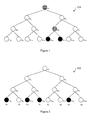
Figure 1 illustrates an exemplarybinary tree 100 with a number of nodes, n1-n15 and n leaves (n=8) that correspond to users (or players). Thebinary tree 100 comprises two revoked users n12 and n13. Each SD group Si,j is the difference of two subsets represented by two nodes ni and nj in the tree; in other words Si,j represents the users that have node ni as an ancestor but not node nj (i must be an ancestor of j). In the exemplarybinary tree 100, node ni is node n1 (i.e. the ancestor of all the users) and node nj is node n6 ; SD group S1,6 is thus the difference between the users having node n1 as an ancestor but not node n6 , or, to put it another way, all the non-revoked (i.e. authorized) users in thebinary tree 100. - For each internal node in the binary tree, a random 'seed' is generated. The seed is only known by an administrator and permits to derive the keys of all the groups. The seeds are derived using a one-way function H and the resulting output is called a 'label'. Each group Si,j has a corresponding Labeli,j and the private key Ki,j associated with Si,j is defined by Ki,j = HM(Labeli,j ). H takes n bits as input and outputs 3*n bits, and HM represents the middle n-bit part of the output. The number of ciphertexts required to broadcast to all authorized users is the number of groups Si,j that together contain the users.
- The first step in constructing the collection of groups Si,j consists in finding two revoked leaves ni and nj in the tree having a least common ancestor nlca(i,j) that does not contain another revoked leaf. Once this couple is found, the following algorithm outputs corresponding sets Si,j (at most two):
- i. Let n α and n β be the two direct child nodes of nlca(i,j) , such that nodes ni , nj are descendant of n α and n β respectively.
- ii. If n α ≠ ni add the subset S αi to the collection
- iii. If n β ≠ nj add S βj to the collection
- iv. Else no set is added
- This algorithm is the initially proposed Cover Finding (CF) algorithm.
- The algorithm proposed by Nakamura and Kikuchi finds all necessary subsets Si1,j1 , Si2,j2 ,..., Sim,jm that cover all authorized users. The algorithm encompasses the difficulty of choosing two leaves ni and nj in the tree having a least common ancestor that does not contain another revoked leaf.
- This algorithm performs well regarding the processing time. The main drawback is however the memory space required. The amount of storage needed is about d.r where d is the depth of tree. For a system like AACS, the memory space will be about 12 MB for 100 000 revocations. This storage space is mainly required in Step 1 of the algorithm, which indexes all nodes in the path from a revoked leaf to the root.
- In a first aspect, the invention is directed to a method of indexation of a plurality of nodes within a tree comprising nodes belonging to a group of nodes. A first node and a second node are selected among the group of nodes; a common ancestor node for the first node and the second node is calculated, the common ancestor node and its hierarchically superior nodes each having an indexing set; the first node is added to the indexing sets of the common ancestor node and its hierarchically superior nodes, wherein the first node is added to an indexing set only if it is not already present therein; the second node is added to the indexing sets of the common ancestor node and its hierarchically superior nodes; if the number of nodes in one or more indexing sets became two when the node or the second node was added, the nodes corresponding to these indexing sets are added to a selection set. This is repeated, while at least one node in the group of nodes has not been selected as the first node or the second node, with the second node of the previous iteration set as the first node and the second node selected as a node in the group of nodes that has not already been selected as the second node
- In a first preferred embodiment, the tree is a binary tree.
- In a second preferred embodiment, the set of nodes is an ordered set of nodes and the order is from one end of the tree to the other. It is advantageous that the nodes that belong to the ordered set are leaves in the tree.
- In a third preferred embodiment, the common ancestor node is the least common ancestor node.
- In a fourth preferred embodiment, the tree is split into a plurality of hierarchic layers, the node is only added to the indexing sets of nodes in the same hierarchical layer, and the next node is only added to the indexing sets of nodes in the same hierarchical layer.
- In a fifth preferred embodiment, the indexing sets and the selection set are used in a Subset Difference cover finding algorithm.
- In a sixth preferred embodiment, only the hierarchically lowest node corresponding to the indexing sets for which the nodes became two is added to the selection set during an iteration.
- In a second aspect, the invention is directed to an apparatus for indexation of a plurality of nodes within a tree comprising nodes belonging to a group of nodes. The apparatus comprises a processor programmed to iteratively: select a first node and a second node among the group of nodes; calculate a common ancestor node for the first node and the second node, the common ancestor node and its hierarchically superior nodes each having an indexing set; add the first node to the indexing sets of the common ancestor node and its hierarchically superior nodes , wherein the first node is added to an indexing set only if it is not already present therein; add the second node to the indexing sets of the common ancestor node and its hierarchically superior nodes; and if the number of nodes in one or more indexing sets became two when the node or the second node was added, add the nodes corresponding to these indexing sets to a selection set.
- In a first preferred embodiment, the tree is split into a plurality of hierarchic layers and wherein the processor is further programmed to add the node only to the indexing sets of nodes of the same hierarchical layer, and to add the next node only to the indexing sets of nodes of the same hierarchical layer.
- In a second preferred embodiment, the processor is further programmed to use the indexing sets and the selection set in a Subset Difference cover finding algorithm.
- In a third aspect, the invention is directed to a computer program product storing thereon instructions that, when executed on a processor, performs the method of any one of the embodiments of the first aspect of the invention.
- Preferred features of the present invention will now be described, by way of non-limiting example, with reference to the accompanying drawings, in which
-
Figure 1 illustrates an exemplary binary tree with leafs corresponding to users; -
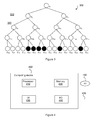
Figure 2 illustrates an exemplary binary tree which used as input to the algorithm of the first preferred embodiment of the present invention; -
Figure 3 illustrates an exemplary binary tree which used as input to the algorithm of the second preferred embodiment of the present invention; and -
Figure 4 illustrates an exemplary computing device on which the algorithms of the present invention may be implemented. - Step 1 of Nakamura and Kikuchi's algorithm creates many node sets Li that contains only one node. These sets are useless as they are never taken as input for the CF algorithm. Furthermore, it indexes leafs for nodes that are not used immediately afterward (Indexation here means that each node that is not a leaf receives the list of revoked leaves it contains.)
- The indexation process for a Cover Finding algorithm of the present invention proposes two improvements:
- 1 To index only useful nodes in the path from a revoked leaf to the root. This is based on computing the least common ancestor node of two revoked leaves.
- 2 To split the binary tree into (at least) two parts and index the parts separately: first, leaves for nodes that are in the low-level of the tree are indexed the CF algorithm is run. Then the high-level nodes are indexed and the CF algorithm is performed again.
- In the first preferred embodiment, the revoked leafs are indexed by taking them by pairs. Each pair is indexed on intermediates nodes beginning from their least common ancestor in the path to the root.
- Let R be the set of revoked users and |R| = r. Revoked leaves are ordered, preferably from the left to the right of the binary tree, but for example right-to-left may also be envisaged. The depth of the tree is u and the tree comprises 2 u users. The total number of revoked nodes in a Steiner tree (i.e. the minimal tree that comprises all the revoked leaves and the root) is at most r.u.
- Step 1: For each ri ∈ R, compute the least common ancestor (lca) with the next succeeding rj ∈ R, i.e. nlca(i,j) = lca (R[i], R[i+1]) = lca (ri, rj). Consider indexation sets ISx , ISx-1 ,..., IS1 corresponding to intermediate nodes in the path from nlca(i,j) to the root (sets Li are associated to nodes, which are not leaves, in the Steiner tree). Add ri and rj to every node set of ISx , ISx-1 ,..., IS1 . If leaf ri is already in a set IS, add only rj . During the process of adding revoked leaves, when a set ISk satisfies |ISk | = 2 for the first time for a given pair of nodes (nodes are scanned from bottom to top), the corresponding node nk is added to a temporary selection set denoted B. (It should be noted that, while less efficient, it is possible to add more than the lowest node.)
- Step 2: Selection set B contains m nodes n (1 ) x ,...,n(m) x that, without loss of generality, are renumbered as n1 ,...,nm . Nodes are removed from B going from the right to the left, i.e. nm ,...,n1 . For each element ny , (with y belongs to {m,..,1}) removed from B, the CF algorithm is applied if |ISx | ≠ 1:
- i. Let n α and n β be the two children of ny , such that the nodes in ISy = {ni, nj} are descendants of n α and n β respectively.
- ii. If n α ≠ ni , add the subset S αi to the collection
- iii. If n β ≠ nj , add the subset S βj to the collection
- Step 3: For all sets ISk, ISk-1 ,..., IS1 (scanned from bottom to top), substitute all ni and nj with node ny . This removes all the descendants of the node and makes ny , a revoked leaf. If during the substitution process |ISj | = 2 for a given j in {k,..., 1}, then corresponding node nj is put onto B if not already present.
- Step 4: Repeat Steps 2 and 3 until there is no element in B. When the last element ny is other than root n1 , output subset S1,y .
-
Figure 2 illustrates an exemplarybinary tree 200 which will be used as input to the algorithm of the first preferred embodiment of the present invention. Thebinary tree 200 has depth 3 and comprises 23=8 users u1-u8 corresponding to nodes n8-n15, of which users u1, u3, u4, and u7 have been revoked. Put another way R = {u 1, u 3, u 4, u 7} = {n 8, n 10, n 11, n 14} = {r 8, r 10, r 11, r 14}. -

- Add r 8, r 10 to node sets IS2 and IS1 .
|IS2 | = 2 for the first time (|IS1 | = 2 also happens, but after IS2 ) therefore n2 is put in B.

- Add r 10, r 11 to node set IS5 and r11 only to node sets IS2 and IS1 . |IS5 | = 2 for the first time, so n5 is put in B.


- Add r14 (but not r11 ) to node set IS1 .

- Cover finding is applied to n5 as |ISx | = 2 ≠ 1.
The two children of n5 are n10 and n11 , but the conditions are not satisfied as the direct children of n5 are leaves, i.e. n α = ni , and n β = nj . No set is output. - n5 becomes a revoked leaf r5 {r10 , r11 } is substituted by r5 in IS5 , IS2 and IS1 .
IS1 = {r8, r5, r14}, IS2 = {r8, r5}, IS5 = {r5}. |IS2 | = 2, n2 is already in B = {n2}. - Cover finding is applied to n2 as |IS2 | = 2 ≠ 1. IS2 = {r8, r5}
The two children of n2 are n α = n4 and n β = n5 .
n α = n4 ≠ r8 , so the condition is satisfied for the left child of n2 : S4,8 is the first subset added to the collection.
n β = n5 = r5 . so the condition is not satisfied for the right child of n2 : no subset is added to the collection. - n2 becomes a revoked leaf r2 .
{r8, r5 } is substituted by r2 in IS2 and IS1 .
IS1 = {r2, r14}, IS2 = {r2}, IS5 = {r5} and since |IS1 | = 2, n1 is put in B = {n1}. - As already mentioned, this is repeated until there is no element left in B.
- Cover finding is applied to n1 as |I/S1 | = 2 ≠ 1. IS1 = {r2, r14}.
The two children of n1 are n α = n2 and n β = n3 .
n α = n2 = r2 , so the condition is not satisfied for the left child of n1 : no subset is added to the collection.
n β = n3 ≠ r14 , so the condition is satisfied for the right child of n1 : S3,14 is the second subset added to the collection. - The algorithm then ends, as B is empty.
- Subsets {S4,8 ; S3,14 } are obtained as the output of the algorithm. In this example, three nodes {n3 , n4 , n7 } were not used in the indexing process. (This is in contrast to Nakamura and Kikuchi's algorithm in which each contains one revoked leaf.) This enables a saving of the space required for storing three integers in the memory. The applicant has found that on the average 50 % of the memory space may be saved using the algorithm of the first preferred embodiment of the present invention.
- During indexation, higher level nodes are put in the selection set B (and therefore used as input in cover finding algorithm) at the very end of the algorithm execution. Hence, indexation for the higher level nodes is costly in terms of memory space. In the second preferred embodiment, high level nodes are not indexed at the beginning of the algorithm.
- To do so, the tree is split in two parts and two separate indexation steps are performed. The tree is split according to its height, which is chosen so that indexation for each part uses approximately the same memory space. Experimental results have shown that when about 1% of total number of users are revoked, half of the memory is used by the nodes that are at a depth level of at most sqrt(log(n)) from the root (including the root). If n = 2u and s = sqrt(u), then high-level nodes are nodes in the range {1,..., 2s-1} and low-level nodes in the range {2s,..., 2u-1} (where n is the total number of users).
- For a tree containing 16 users, sqrt(log(n)) = sqrt(log(24 )) = sqrt(4) = 2 (rounded up), so the tree is split with nodes n1-n3 as high-level nodes and n4 -n31 as low-level nodes. This is illustrated in
Figure 3 , wherein thebinary tree 300 is divided into high-level nodes 310 and low-level nodes 320. - As before, the revoked leafs are indexed by pairs beginning from their least common ancestor in the path to the root. Let s = sqrt(log(n)), if n = 2u then s = sqrt(u); and S is the set of groups Si,j containing all authorized users.
- For each ri ∈ R, the least common ancestor (lca) with the next succeeding rj ∈ R is computed, i.e. nlca(i,j) = lca (R[i], R[i+1]) = lca (ri, rj). The indexation sets ISx , ISx-1,..., ISz correspond to intermediate nodes in the path from nx = nlca(i,j) to the highest node nz such that nz >= 2s . ri and r j are added to every node set of ISx, ISx-1,..., ISz . If leaf ri is already in a set IS, only rj is added. As in the first preferred embodiment, when a set ISk satisfies |ISk | = 2 for the first time (nodes are scanned from bottom to top), the corresponding node nk is added to a temporary selection set B, although only the lowest node is added to selection set B.
- Stack B contains m-p nodes n1,..., nm-p . Nodes are removed from B from the right to the left, i.e. nm-p,..., n1 . For each element ny (with y in {m,..,1}) removed from B, the cover finding algorithm is applied if |ISx | ≠ 1:
- i. Let n α and n β be the two children of ny , such that the nodes in ISy = {ni, nj} are descendants of n α and n β respectively.
- ii. If n α ≠ ni , add the subset Sαi to the collection
- iii. If n β ≠ nj , add S βj to the collection
- For all sets ISk, ISk-1,..., ISz (scanned from bottom to top), ni and nj are substituted by node ny , which removes all the descendants of the node and makes ny a revoked leaf. The same substitutions are done in the revoked set R, i.e ri and rj are substituted by node ry .
- If, during the substitution process, |ISj | = 2 for a given j in {k,..., 1}, then corresponding node nj is put onto B, if not already present.
- Steps 2 and 3 are repeated until B is empty.
If R', i.e. the set of revoked nodes at the end of 'low-level' algorithm, contains only one node ry , then subset S1,y is added to the collection S and the algorithm ends. Else S' (containing the partial collection of subsets Si,j ) is ouput and R' is the updated set of revoked leaves, selection set B and all indexation sets ISx , ISx-1 ,..., ISz are flushed from memory and the algorithm moves to Step 5. - For each ri ∈ R, the least common ancestor (lca) with the next succeeding rj ∈ R is computed, i.e. nlca(i,j) = lca (R[i], R[i+1]) = lca (ri, rj). ri and rj are added to each node set of ISz , IS z- 1,..., IS1 that corresponds to an intermediate node in the path from least common ancestor nz = nlca(i,j) to the root (note that nz necessarily is less than or equal to 2s-1). If leaf ri is already in a set IS, only rj is added. During the process of adding revoked leaves, when a set ISz satisfies |ISz | = 2 for the first time, the corresponding node nz is added to a selection set B.
- Stack B contains p nodes n1 ,...,np. These nodes are removed from B from the right to the left, i.e. np ,...,n1 . For each element ny (with y in {m,..,1}) removed from B, the cover finding algorithm is applied if |ISx | ≠ 1:
- i. n α and n β are the two children of ny , such that nodes in ISy = {ni, nj} are descendants of n α and n β respectively.
- ii. If nα ≠ ni add the subset Sαi to the collection
- iii. If n β ≠ nj add S βj to the collection
- For all sets ISz, IS z- 1,..., IS1 (scanned from bottom to top), ni and nj is substituted by node ny . If during the substitution process |ISj | = 2 for a given j in {k,...,1}, corresponding node nj is put onto B if not already present.
- Steps 6 and 7 are repeated until there B is empty. When the last element ny of B is other than root n1, subset S1,y is added to the collection S. Finally, S containing all subsets Si,j is output.
- The exemplary
binary tree 300 inFigure 3 will also be used as input to the algorithm of the second preferred embodiment of the present invention. Thebinary tree 300 has depth 4 and comprises 24=16 users corresponding to nodes n16-n31, of which users of nodes n20, n21, n22, n23, n26, and n30 have been revoked. Put another way, R = {r20, r21, r22, r23, r26, r30}. -

- r20 , r21 are added to node sets IS10 and IS5 . |IS10 | = 2 for the first time, n10 is put in B (but n5 is not).


- r22 is added to node set IS5 . No node is added to B.


- r22 , r23 are added to node set IS11 and r23 to node set IS5 . |IS11 | = 2 for the first time, n11 is put in B.

- lca(r23, r26) and lca(r26, r30) are outside of the low-level nodes, so no indexation is performed.
- Thus, at the end of step 1: IS5 = {r20, r21, r22, r23}, IS10 = {r20, r21}, IS11 = {r22, r23} and B = {n10, n11}.
- The cover finding is applied to n11. The conditions are not satisfied as direct children of n11 are revoked leaves. No set is added to S.
- n11 becomes a revoked leaf r11 .
{r22 , r23 } are substituted by r11 in IS5, IS11 and R
- The cover finding is applied to n10 .
The conditions are not satisfied as the direct children of n10 are revoked leaves. No set is added to S. - n10 becomes a revoked leaf r10 .
{r20 , r21 } are substituted by r10 in IS5 , IS10 and R.
Since |IS5 | = 2, n5 is put in B = {n5} - The cover finding is applied to n5 .
The conditions are not satisfied as direct children of n5 are revoked leaves. No set is added to S. - n5 becomes a revoked leaf r5.
{r10, r11 } are substituted by r5 in IS5 and R.
IS5 = {r5} and R = {r5, r26, r30} and B is empty.
S' = {} (i.e. S' is empty) is output as well as R' = {r5, r26, r30}, the updated set of revoked leaves. - R' = {r5, r26, r30} contains more than one node.

r5, r26 are added to node set IS1 . |IS1 | = 2 for the first time, n1 is put in B

r26, r30 are added to node set IS3 and r30 is added to node set IS1 . |IS3 | = 2, so n3 is put in B.
- The cover finding is applied to n3.
The condition is satisfied for both the right and the left child nodes. S6,26 and S7,30 are the first subsets added to the collection S'={S6,26; S7,30}. - n3 becomes a revoked leaf r;
{r26, r30} are substituted by r3 in IS3, IS1.
IS1= {r5, r3}, IS3 = {r3}. |IS1 | = 2 but n1 is already in B = {n1}. - The cover finding is applied to n1.
The condition is satisfied for the left node. S1,5 is added to the collection S. - B is empty.
S = {S6,26 ; S7,30 ; S1,5} is output. - In this example, the three high-level nodes n1, n2 and n3 were not used in the first step of indexation. This saved the memory space for storing 16 integers. The indexation in the first step used only the sets IS5 , IS10 and IS11 , which in terms of storage represents 8 integers. For the second indexation only used IS3 and IS1 were used, which represents storage of 5 integers. Storage for 8 integers is thus needed during the execution of whole algorithm. The basic prior art algorithm requires storing 24 integers; the algorithm of the second preferred embodiment of the present invention thus saves 2/3 of the memory space. When taking random leaves in a higher tree, the amount of saved memory space is roughly the same, i.e. about 2/3 of the space needed in Nakamura and Kikuchi's algorithm.
- The algorithm of the second preferred embodiment may be generalized by splitting the binary tree into n parts (or n layers) where n is greater than 2. Except for the lowest level layer of the tree, the depth of a layer of the tree is preferably sqrt(log(n)). In other words, the layer going from the root are equally spaced at a distance sqrt(log(n)), except for the last layer. A layer k is at a level k·sqrt(log(n)) where k is in [1,2,..,sqrt(log(n))]. The interval depends on the number of splits (maximum number of splits is advantageously less than or equal to sqrt(log(n)). The indexation process may then be done separately and iteratively for each level, beginning from the lowest level layer of the tree until reaching the top layer.
- For a tree containing 64 users then sqrt(log(n)) = sqrt(log(2 6 )) = sqrt(6) = 2, resulting in three parts that each comprises two levels. The first layer nodes are nodes in the range {1,..., 22-1}, the second layer nodes in {22,..., 24-1}, and the third layer comprises the nodes in {24,..., 26-1}.
- Without going into details, the algorithm comprises running the algorithm of the second preferred embodiment from Step 1 until Step 4 k-1 times (when the tree is split in k layers): once for the lowest layer, once for the lowest but one layer, and so on. The algorithm is repeated until the second layer is treated. Finally, the algorithm is executed from Step 5 to Step 8 for the first layer.
- For instance, for 64 users, Step 1 to Step 4 are performed twice: once for the third layer and once for the second layer, and then Step 5 to Step 8 are performed for the first layer. It will be appreciated that splitting the tree in more parts can permit greater memory space savings.
- This section describes two algorithms that compute the lca of two leafs in a tree. The node numbering of the tree is such as nl = i; meaning that the root node is 1, the direct left child node is 2, the right child node 3, and so on. For a tree of height 32 (which is the case for AACS and for most applications based on binary trees), each leaf number can be then represented by a 32-bit integer in the range {231 , 2321}.
- The first algorithm runs in constant time and requires only 13 arithmetic operations.
-
Input unsigned int rA unsigned int rB unsigned int r (temporary variable) Output r 


- The input and output of the algorithms are 32-bit variables.
- The second algorithm is faster (by 4 operations) if the bit scan reverse (BSR) operation is available. This instruction is for instance available on many architectures and particularly on Intel x86 used by ordinary PCs (see Intel 64 and IA-32 Architectures, Software Developer's Manual. Volume 2A: Instruction Set Reference, A-M, Order Number: 253666).
-
Input unsigned int rA unsigned int rB unsigned int r (temporary variable) Output r 


-
Figure 4 illustrates anexemplary computing device 400 on which the algorithms of the present invention may be implemented. Thecomputing device 400 can be any kind of suitable computer or device capable of performing calculations, such as a standard Personal Computer (PC) or workstation. Thecomputing device 400 preferably comprises at least oneprocessor 410,RAM memory 420, auser interface 430 for interacting with a user, and asecond interface 440 for interaction with other devices overconnection 450. Thecomputing device 400 also preferably comprises an interface for reading a software program from adigital data support 460 that stores instructions that, when executed by a processor, performs any of the algorithms of the present invention. The skilled person will appreciate that the illustrated devices are very simplified for reasons of clarity and that real devices in addition would comprise features such as persistent storage devices. - It will be appreciated that the tree need not be binary, but also ternary, quaternary etc. It will also be appreciated that the revoked leaves need not be treated in any particular order, but that it is more efficient to treat them in an ordered manner, such as from 'left to right'.
- The SD system was designed to cope with a relatively small number of revoked users in practice. For the scheme to be efficient in terms of transmission overhead, revoked users should not exceed 1% of the total number of users. In AACS, a tree of height 32 and revocation can in practice reach up to 100 000 users. In this case, finding the cover of all privileged users with the algorithm proposed by Nakamura and Kikuchi, would require 12 Mbytes of memory.
- The algorithm of the first preferred embodiment of the present invention can permit a saving of half of the memory. With the algorithm of the second preferred embodiment of the present invention, a further saving can be achieved and only 4 Mbytes of memory would be needed. In term of computation cost, the two algorithms presented herein have a run time of about O(r.log(r).log(n)) basic operations.
- The skilled person will appreciate that there are other systems where the key computation for authorized users occur more often than for AACS.
- The basic solutions would face a problem if for instance several thousands of licenses are requested at a time. The algorithms of the present invention can be more efficient, dealing with changes in the group of authorized users, and providing the desired level of security without trading away performance in terms of computation cost. The memory space can be drastically reduced while the number of operations remains the same.
- Each feature disclosed in the description and (where appropriate) the claims and drawings may be provided independently or in any appropriate combination. Features described as being implemented in hardware may also be implemented in software, and vice versa. Reference numerals appearing in the claims are by way of illustration only and shall have no limiting effect on the scope of the claims.
Claims (12)
- A method of indexation of a plurality of nodes within a tree comprising nodes belonging to a group of nodes, the method comprising the steps in a processor (410) of:A) selecting a first node and a second node among the group of nodes;B) calculating a common ancestor node for the first node and the second node, the common ancestor node and its hierarchically superior nodes each having an indexing set;C) adding the first node to the indexing set of the common ancestor node and the indexing sets of nodes hierarchically superior to the common ancestor node, wherein the first node is added to an indexing set only if it is not already present therein;D) adding the second node to the indexing set of the common ancestor node and the indexing sets of nodes hierarchically superior to the common ancestor node;E) if the number of nodes in one or more indexing sets became two when the first node or the second node was added, adding the nodes corresponding to these indexing sets to a selection set; andF) while at least one node in the group of nodes has not been selected as the first node or the second node, repeat steps B)-F) with the second node of the previous iteration set as the first node, and the second node of the current iteration selected as a node in the group of nodes that has not already been selected as the second node.
- The method of claim 1, wherein the tree is a binary tree.
- The method of claim 1, wherein the set of nodes is an ordered set of nodes and wherein the order is from one end of the tree to the other.
- The method of claim 3, wherein the nodes that belong to the ordered set are leaves in the tree.
- The method of claim 1, wherein the common ancestor node is the least common ancestor node.
- The method of claim 1, wherein the tree is split into a plurality of hierarchic layers and wherein the node is only added to the indexing sets of nodes in the same hierarchical layer, and wherein the next node is only added to the indexing sets of nodes in the same hierarchical layer.
- The method of claim 1, further comprising the subsequent steps of using the indexing sets and the selection set in a Subset Difference cover finding algorithm.
- The method of claim 1, wherein, during execution of step E), only the hierarchically lowest node corresponding to the indexing sets for which the nodes became two is added to the selection set.
- An apparatus (400) for indexation of a plurality of nodes within a tree comprising nodes belonging to a group of nodes, the apparatus (400) comprising a processor (410) programmed to iteratively:select a first node and a second node among the group of nodes;calculate a common ancestor node for the first node and the second node, the common ancestor node and its hierarchically superior nodes each having an indexing set;add the first node to the indexing sets of the common ancestor node and the indexing sets of nodes hierarchically superior to the common ancestor node, wherein the first node is added to an indexing set only if it is not already present therein;add the second node to the indexing sets of the common ancestor node and the indexing sets of nodes hierarchically superior to the common ancestor node; andif the number of nodes in one or more indexing sets became two when the node or the second node was added, add the nodes corresponding to these indexing sets to a selection set.
- The apparatus of claim 9, wherein the tree is split into a plurality of hierarchic layers and wherein the processor (410) is further programmed to add the node only to the indexing sets of nodes of the same hierarchical layer, and to add the next node only to the indexing sets of nodes of the same hierarchical layer.
- The apparatus of claim 9, wherein the processor (410) is further programmed to use the indexing sets and the selection set in a Subset Difference cover finding algorithm.
- A computer program product (460) storing thereon instructions that, when executed on a processor, performs the method of any one of claims 1-8.
Priority Applications (1)
| Application Number | Priority Date | Filing Date | Title |
|---|---|---|---|
| EP10305735A EP2405602A1 (en) | 2010-07-05 | 2010-07-05 | Method, device and computer program product for node indexation in a hierarchical tree |
Applications Claiming Priority (1)
| Application Number | Priority Date | Filing Date | Title |
|---|---|---|---|
| EP10305735A EP2405602A1 (en) | 2010-07-05 | 2010-07-05 | Method, device and computer program product for node indexation in a hierarchical tree |
Publications (1)
| Publication Number | Publication Date |
|---|---|
| EP2405602A1 true EP2405602A1 (en) | 2012-01-11 |
Family
ID=43064782
Family Applications (1)
| Application Number | Title | Priority Date | Filing Date |
|---|---|---|---|
| EP10305735A Withdrawn EP2405602A1 (en) | 2010-07-05 | 2010-07-05 | Method, device and computer program product for node indexation in a hierarchical tree |
Country Status (1)
| Country | Link |
|---|---|
| EP (1) | EP2405602A1 (en) |
-
2010
- 2010-07-05 EP EP10305735A patent/EP2405602A1/en not_active Withdrawn
Non-Patent Citations (7)
| Title |
|---|
| "Advanced Access Content System Introduction and Common Cryptographic Elements", vol. 091, 17 February 2006 |
| "Intel 64 and IA-32 Architectures, Software Developer's Manual", vol. 2A |
| D. NAOR; M. NAOR; J. LOTSPIECH: "Revocation and Tracing Schemes for Stateless Receivers", PROCEEDINGS OF CRYPTO'01, VOLUME 2139 OF LECTURE NOTES IN COMPUTER SCIENCE, vol. 2139, 2001, pages 41 - 62 |
| DALIT NAOR ET AL: "Revocation and Tracing Schemes for Stateless Receivers", 23 August 2001, ADVANCES IN CRYPTOLOGY. CRYPTO 2001. 21ST ANNUAL INTERNATIONAL CRYPTOLOGY CONFERENCE, SANTA BARBARA, CA, AUG. 19 - 23, 2001. PROCEEDINGS; [LECTURE NOTES IN COMPUTER SCIENCE ; VOL. 2139], PAGE(S) 1 - 33, ISBN: 978-3-540-42456-7, XP002491877 * |
| HUANG S C-H ET AL: "New constructions on broadcast encryption and key pre-distribution schemes", INFOCOM 2005. 24TH ANNUAL JOINT CONFERENCE OF THE IEEE COMPUTER AND CO MMUNICATIONS SOCIETIES. PROCEEDINGS IEEE MIAMI, FL, USA 13-17 MARCH 2005, PISCATAWAY, NJ, USA,IEEE, PISCATAWAY, NJ, USA, vol. 1, 13 March 2005 (2005-03-13), pages 515 - 523, XP010829153, ISBN: 978-0-7803-8968-7, DOI: 10.1109/INFCOM.2005.1497919 * |
| NAKAMURA Y ET AL: "Efficient Key Management Based on the Subset Difference Method for Secure Group Communication", ADVANCED INFORMATION NETWORKING AND APPLICATIONS, 2005. AINA 2005. 19T H INTERNATIONAL CONFERENCE ON TAIPEI, TAIWAN 25-30 MARCH 2005, PISCATAWAY, NJ, USA,IEEE, vol. 1, 25 March 2005 (2005-03-25), pages 707 - 712, XP010789873, ISBN: 978-0-7695-2249-4, DOI: 10.1109/AINA.2005.172 * |
| Y. NAKAMURA; H. KIKUCHI: "Efficient Key Management Based on the Subset Difference Method for Secure Group Communication", INTERNATIONAL CONFERENCE ON ADVANCED INFORMATION NETWORKING AND APPLICATIONS (AINA'05), vol. 1, 2005, pages 707 - 712 |
Similar Documents
| Publication | Publication Date | Title |
|---|---|---|
| Liu et al. | Privacy of outsourced k-means clustering | |
| Halevy et al. | The LSD broadcast encryption scheme | |
| Chen et al. | High-precision arithmetic in homomorphic encryption | |
| Garrison et al. | On the practicality of cryptographically enforcing dynamic access control policies in the cloud | |
| Huang et al. | Secure matrix multiplication based on fully homomorphic encryption: H. Huang, H. Zong | |
| US8300814B2 (en) | Information processing unit, terminal unit, information processing method, key generation method and program | |
| KR101825838B1 (en) | Method of partially encrypting data, method of decrypting a partially-encrpted data, storage medium for a program decrypting a partially-encrpted data | |
| Wang et al. | Simplified revocable hierarchical identity-based encryption from lattices | |
| US8000472B2 (en) | Information encryption apparatus and controlling method of the same, computer program and computer readable storage medium | |
| Rizomiliotis et al. | On matrix multiplication with homomorphic encryption | |
| Gu et al. | Bounds on traceability schemes | |
| US8300816B2 (en) | Information processing unit, terminal unit, information processing method, key generation method and program | |
| US8229121B2 (en) | Method of tracing device keys for broadcast encryption | |
| Kirshanova et al. | How to find ternary LWE keys using locality sensitive hashing | |
| US7523304B2 (en) | Generation of set coverings with free riders, and generation of ordered sets of meeting points, in systems which include, but are not limited to, systems for broadcast encryption and systems for certificate revocation | |
| Saha et al. | An enhancement of privacy-preserving wildcards pattern matching | |
| Raya et al. | Results on the key space of group-ring NTRU: The case of the dihedral group | |
| Ji et al. | Efficient comparison and swap on fully homomorphic encrypted data | |
| Akdim et al. | A comprehensive review of graph theory applications in secret sharing schemes | |
| De Micheli et al. | Characterizing overstretched NTRU attacks | |
| Triakosia et al. | Homomorphic encryption in manufacturing compliance checks | |
| Martinez et al. | Securing databases by using diagonal-based order preserving symmetric encryption | |
| Ren et al. | A new construction of tagged visual cryptography scheme | |
| Kamara et al. | A review of order preserving encryption schemes | |
| Gnana Sophia et al. | Secure storage and accessing the data in cloud using optimized homomorphic encryption |
Legal Events
| Date | Code | Title | Description |
|---|---|---|---|
| AK | Designated contracting states |
Kind code of ref document: A1 Designated state(s): AL AT BE BG CH CY CZ DE DK EE ES FI FR GB GR HR HU IE IS IT LI LT LU LV MC MK MT NL NO PL PT RO SE SI SK SM TR |
|
| AX | Request for extension of the european patent |
Extension state: BA ME RS |
|
| PUAI | Public reference made under article 153(3) epc to a published international application that has entered the european phase |
Free format text: ORIGINAL CODE: 0009012 |
|
| STAA | Information on the status of an ep patent application or granted ep patent |
Free format text: STATUS: THE APPLICATION IS DEEMED TO BE WITHDRAWN |
|
| 18D | Application deemed to be withdrawn |
Effective date: 20120712 |