EP2404903A1 - Method of synthesizing [18f]sfb using microsynthesis technique - Google Patents
Method of synthesizing [18f]sfb using microsynthesis technique Download PDFInfo
- Publication number
- EP2404903A1 EP2404903A1 EP10748713A EP10748713A EP2404903A1 EP 2404903 A1 EP2404903 A1 EP 2404903A1 EP 10748713 A EP10748713 A EP 10748713A EP 10748713 A EP10748713 A EP 10748713A EP 2404903 A1 EP2404903 A1 EP 2404903A1
- Authority
- EP
- European Patent Office
- Prior art keywords
- reaction
- injection port
- channel
- sfb
- reagent
- Prior art date
- Legal status (The legal status is an assumption and is not a legal conclusion. Google has not performed a legal analysis and makes no representation as to the accuracy of the status listed.)
- Granted
Links
- 238000000034 method Methods 0.000 title claims abstract description 33
- 230000002194 synthesizing effect Effects 0.000 title claims abstract description 13
- 238000006243 chemical reaction Methods 0.000 claims abstract description 180
- 239000003153 chemical reaction reagent Substances 0.000 claims abstract description 78
- 238000002347 injection Methods 0.000 claims abstract description 63
- 239000007924 injection Substances 0.000 claims abstract description 63
- 239000000243 solution Substances 0.000 claims abstract description 57
- 239000007788 liquid Substances 0.000 claims abstract description 13
- 239000000758 substrate Substances 0.000 claims abstract description 13
- 239000002994 raw material Substances 0.000 claims abstract description 9
- WEVYAHXRMPXWCK-UHFFFAOYSA-N Acetonitrile Chemical compound CC#N WEVYAHXRMPXWCK-UHFFFAOYSA-N 0.000 claims description 60
- IAZDPXIOMUYVGZ-UHFFFAOYSA-N Dimethylsulphoxide Chemical compound CS(C)=O IAZDPXIOMUYVGZ-UHFFFAOYSA-N 0.000 claims description 28
- 239000002904 solvent Substances 0.000 claims description 16
- 239000002243 precursor Substances 0.000 claims description 11
- 239000007795 chemical reaction product Substances 0.000 claims description 6
- -1 tetrafluoroborate Chemical compound 0.000 claims description 5
- 238000009835 boiling Methods 0.000 claims description 4
- LPSKDVINWQNWFE-UHFFFAOYSA-M tetrapropylazanium;hydroxide Chemical compound [OH-].CCC[N+](CCC)(CCC)CCC LPSKDVINWQNWFE-UHFFFAOYSA-M 0.000 claims description 4
- 230000015572 biosynthetic process Effects 0.000 description 30
- 238000003786 synthesis reaction Methods 0.000 description 30
- 238000002600 positron emission tomography Methods 0.000 description 14
- 238000001308 synthesis method Methods 0.000 description 13
- 230000018044 dehydration Effects 0.000 description 11
- 238000006297 dehydration reaction Methods 0.000 description 11
- 239000011521 glass Substances 0.000 description 10
- 230000035484 reaction time Effects 0.000 description 10
- XLYOFNOQVPJJNP-UHFFFAOYSA-N water Substances O XLYOFNOQVPJJNP-UHFFFAOYSA-N 0.000 description 9
- 238000004128 high performance liquid chromatography Methods 0.000 description 8
- 229940125904 compound 1 Drugs 0.000 description 7
- 229940125782 compound 2 Drugs 0.000 description 7
- 238000007796 conventional method Methods 0.000 description 7
- 239000000047 product Substances 0.000 description 7
- 230000008569 process Effects 0.000 description 6
- 238000000746 purification Methods 0.000 description 6
- 239000000523 sample Substances 0.000 description 6
- WPYMKLBDIGXBTP-UHFFFAOYSA-N benzoic acid Chemical compound OC(=O)C1=CC=CC=C1 WPYMKLBDIGXBTP-UHFFFAOYSA-N 0.000 description 5
- 238000005580 one pot reaction Methods 0.000 description 5
- 238000003745 diagnosis Methods 0.000 description 4
- 238000002474 experimental method Methods 0.000 description 4
- 238000004519 manufacturing process Methods 0.000 description 4
- BWHMMNNQKKPAPP-UHFFFAOYSA-L potassium carbonate Chemical compound [K+].[K+].[O-]C([O-])=O BWHMMNNQKKPAPP-UHFFFAOYSA-L 0.000 description 4
- 101100208721 Mus musculus Usp5 gene Proteins 0.000 description 3
- XAGFODPZIPBFFR-UHFFFAOYSA-N aluminium Chemical compound [Al] XAGFODPZIPBFFR-UHFFFAOYSA-N 0.000 description 3
- 229910052782 aluminium Inorganic materials 0.000 description 3
- 239000000919 ceramic Substances 0.000 description 3
- 238000001514 detection method Methods 0.000 description 3
- 238000002372 labelling Methods 0.000 description 3
- 239000012071 phase Substances 0.000 description 3
- AUFVJZSDSXXFOI-UHFFFAOYSA-N 2.2.2-cryptand Chemical compound C1COCCOCCN2CCOCCOCCN1CCOCCOCC2 AUFVJZSDSXXFOI-UHFFFAOYSA-N 0.000 description 2
- XKRFYHLGVUSROY-UHFFFAOYSA-N Argon Chemical compound [Ar] XKRFYHLGVUSROY-UHFFFAOYSA-N 0.000 description 2
- 239000005711 Benzoic acid Substances 0.000 description 2
- 206010028980 Neoplasm Diseases 0.000 description 2
- ZZLARVGXLOCKHG-DWSYCVKZSA-N [18F]C1=CC=C(C(=O)OC(C)(C)C)C=C1 Chemical compound [18F]C1=CC=C(C(=O)OC(C)(C)C)C=C1 ZZLARVGXLOCKHG-DWSYCVKZSA-N 0.000 description 2
- 235000010233 benzoic acid Nutrition 0.000 description 2
- 201000011510 cancer Diseases 0.000 description 2
- 238000012631 diagnostic technique Methods 0.000 description 2
- 150000002148 esters Chemical class 0.000 description 2
- UMPRJGKLMUDRHL-LMANFOLPSA-N ethyl 4-fluoranylbenzoate Chemical compound CCOC(=O)C1=CC=C([18F])C=C1 UMPRJGKLMUDRHL-LMANFOLPSA-N 0.000 description 2
- KRHYYFGTRYWZRS-UHFFFAOYSA-N hydrofluoric acid Substances F KRHYYFGTRYWZRS-UHFFFAOYSA-N 0.000 description 2
- 230000007246 mechanism Effects 0.000 description 2
- 239000011259 mixed solution Substances 0.000 description 2
- 239000000203 mixture Substances 0.000 description 2
- 238000002414 normal-phase solid-phase extraction Methods 0.000 description 2
- 229910000027 potassium carbonate Inorganic materials 0.000 description 2
- 238000002360 preparation method Methods 0.000 description 2
- 102000004196 processed proteins & peptides Human genes 0.000 description 2
- 108090000765 processed proteins & peptides Proteins 0.000 description 2
- 230000009467 reduction Effects 0.000 description 2
- 238000005488 sandblasting Methods 0.000 description 2
- 125000000999 tert-butyl group Chemical group [H]C([H])([H])C(*)(C([H])([H])[H])C([H])([H])[H] 0.000 description 2
- LSSQMISUDUUZCC-DWSYCVKZSA-N (2,5-dioxopyrrolidin-1-yl) 4-fluoranylbenzoate Chemical compound C1=CC([18F])=CC=C1C(=O)ON1C(=O)CCC1=O LSSQMISUDUUZCC-DWSYCVKZSA-N 0.000 description 1
- AOYNUTHNTBLRMT-SLPGGIOYSA-N 2-deoxy-2-fluoro-aldehydo-D-glucose Chemical compound OC[C@@H](O)[C@@H](O)[C@H](O)[C@@H](F)C=O AOYNUTHNTBLRMT-SLPGGIOYSA-N 0.000 description 1
- BBYDXOIZLAWGSL-COJKEBBMSA-N 4-fluoranylbenzoic acid Chemical class OC(=O)C1=CC=C([18F])C=C1 BBYDXOIZLAWGSL-COJKEBBMSA-N 0.000 description 1
- USFZMSVCRYTOJT-UHFFFAOYSA-N Ammonium acetate Chemical compound N.CC(O)=O USFZMSVCRYTOJT-UHFFFAOYSA-N 0.000 description 1
- 239000005695 Ammonium acetate Substances 0.000 description 1
- 235000019257 ammonium acetate Nutrition 0.000 description 1
- 229940043376 ammonium acetate Drugs 0.000 description 1
- 239000007864 aqueous solution Substances 0.000 description 1
- 229910052786 argon Inorganic materials 0.000 description 1
- 239000000872 buffer Substances 0.000 description 1
- 125000003178 carboxy group Chemical group [H]OC(*)=O 0.000 description 1
- 230000008859 change Effects 0.000 description 1
- 238000001035 drying Methods 0.000 description 1
- 230000000694 effects Effects 0.000 description 1
- 238000010828 elution Methods 0.000 description 1
- 238000005516 engineering process Methods 0.000 description 1
- 125000004494 ethyl ester group Chemical group 0.000 description 1
- 125000001495 ethyl group Chemical group [H]C([H])([H])C([H])([H])* 0.000 description 1
- 238000005194 fractionation Methods 0.000 description 1
- 239000007789 gas Substances 0.000 description 1
- 230000036541 health Effects 0.000 description 1
- 230000006872 improvement Effects 0.000 description 1
- 150000002605 large molecules Chemical class 0.000 description 1
- 238000005259 measurement Methods 0.000 description 1
- 230000004048 modification Effects 0.000 description 1
- 238000012986 modification Methods 0.000 description 1
- 229920000642 polymer Polymers 0.000 description 1
- 239000000941 radioactive substance Substances 0.000 description 1
- 230000001105 regulatory effect Effects 0.000 description 1
- 238000004007 reversed phase HPLC Methods 0.000 description 1
- 150000003384 small molecules Chemical class 0.000 description 1
- 239000000126 substance Substances 0.000 description 1
- ITMCEJHCFYSIIV-UHFFFAOYSA-M triflate Chemical compound [O-]S(=O)(=O)C(F)(F)F ITMCEJHCFYSIIV-UHFFFAOYSA-M 0.000 description 1
- 238000012795 verification Methods 0.000 description 1
Images




Classifications
-
- C—CHEMISTRY; METALLURGY
- C07—ORGANIC CHEMISTRY
- C07D—HETEROCYCLIC COMPOUNDS
- C07D207/00—Heterocyclic compounds containing five-membered rings not condensed with other rings, with one nitrogen atom as the only ring hetero atom
- C07D207/02—Heterocyclic compounds containing five-membered rings not condensed with other rings, with one nitrogen atom as the only ring hetero atom with only hydrogen or carbon atoms directly attached to the ring nitrogen atom
- C07D207/30—Heterocyclic compounds containing five-membered rings not condensed with other rings, with one nitrogen atom as the only ring hetero atom with only hydrogen or carbon atoms directly attached to the ring nitrogen atom having two double bonds between ring members or between ring members and non-ring members
- C07D207/34—Heterocyclic compounds containing five-membered rings not condensed with other rings, with one nitrogen atom as the only ring hetero atom with only hydrogen or carbon atoms directly attached to the ring nitrogen atom having two double bonds between ring members or between ring members and non-ring members with hetero atoms or with carbon atoms having three bonds to hetero atoms with at the most one bond to halogen, e.g. ester or nitrile radicals, directly attached to ring carbon atoms
- C07D207/36—Oxygen or sulfur atoms
- C07D207/40—2,5-Pyrrolidine-diones
- C07D207/404—2,5-Pyrrolidine-diones with only hydrogen atoms or radicals containing only hydrogen and carbon atoms directly attached to other ring carbon atoms, e.g. succinimide
-
- A—HUMAN NECESSITIES
- A61—MEDICAL OR VETERINARY SCIENCE; HYGIENE
- A61K—PREPARATIONS FOR MEDICAL, DENTAL OR TOILETRY PURPOSES
- A61K51/00—Preparations containing radioactive substances for use in therapy or testing in vivo
-
- C—CHEMISTRY; METALLURGY
- C07—ORGANIC CHEMISTRY
- C07B—GENERAL METHODS OF ORGANIC CHEMISTRY; APPARATUS THEREFOR
- C07B59/00—Introduction of isotopes of elements into organic compounds ; Labelled organic compounds per se
- C07B59/001—Acyclic or carbocyclic compounds
-
- C—CHEMISTRY; METALLURGY
- C07—ORGANIC CHEMISTRY
- C07B—GENERAL METHODS OF ORGANIC CHEMISTRY; APPARATUS THEREFOR
- C07B59/00—Introduction of isotopes of elements into organic compounds ; Labelled organic compounds per se
- C07B59/002—Heterocyclic compounds
Definitions
- the present invention relates to a method for synthesizing [ 18 F]SFB (N-succinimidyl 4-[ 18 F]fluorobenzoate) for use as a reagent for labeling high-molecular weight compounds such as peptides and antibodies or low-molecular weight compounds with [ 18 F], which is an RI (radioisotope), to synthesize PET (Positron Emission Tomography) diagnostic probes.
- 18 F]SFB N-succinimidyl 4-[ 18 F]fluorobenzoate
- RI radioisotope
- 18 F which is an RI with a short half-life of about 110 minutes is often used. Since 18 F has such a short half-life, 18 F-labeled diagnostic probes are produced using an on-site automatic synthesizing apparatus.
- the current most useful PET diagnostic probe is 18 F-labeled fluorodeoxyglucose ( 18 F-FDG) useful for early detection of cancer. Since 18 F-FDG became covered by health insurance, the number of private PET centers has been rapidly increased to over 100. It is believed that this reflects great expectations of society on early detection of cancer. Therefore, it can be said that PET is an advanced diagnostic technique but is becoming a common diagnostic technique rooted in society. In order to respond to such social demands and further develop PET diagnosis, it is necessary to establish a technique for automatically synthesizing PET diagnostic probes. Without it, it is impossible to expect that PET diagnosis will become common and contribute to society.
- [ 18 F]SFB is widely used as a reagent for labeling peptides, antibodies, and polymers.
- Non-Patent Document 1 is a method in which reaction reagents are added to one reactor in order.
- ethyl 4-(trimethylammonium triflate) benzoate as a labeled precursor is fluorinated with [ 18 F] to obtain ethyl 4-[ 18 F]fluorobenzoate.
- ethyl 4-[ 18 F]fluorobenzoate is saponified with a tetrapropylammonium hydroxide solution to obtain a 4-[ 18 F]fluorobenzoic acid salt ([ 18 F]FBA) as a [ 18 F]SFB intermediate.
- the intermediate is reacted with O-(N-succinimidyl)-N,N,N',N' -tetramethyluronium tetrafluoroborate to obtain target [ 18 F]SFB (see Non-Patent Document 1).
- [ 18 F]FBA which is a product of the second-step reaction and a [ 18 F]SFB intermediate, is purified by solid-phase extraction and azeotropically dehydrated using acetonitrile (MeCN) before the start of the third-step reaction.
- MeCN acetonitrile
- the amounts of solutions used in a reaction using a radioactive substance are very small, and therefore, there are limitations to conventional batch synthesis methods including one-pot synthesis methods.
- the present invention uses microprocessing technology that has rapidly advanced in recent years to perform a reaction by allowing a reaction solution to flow through a microchannel provided in a microreactor.
- the present invention is directed to a method for synthesizing [ 18 F]SFB comprising using a microreactor including a substrate with one channel formed therein so as to have a cross-sectional width of 1 mm or less and a cross-sectional depth of 1 mm or less, the channel being connected to a raw material injection port and a first reagent injection port at one end thereof, and connected to a second reagent injection port at a position far from the one end thereof, and connected to a third reagent injection port at a position far from the second reagent injection port in a direction toward another end thereof, and connected to a liquid discharge port at the other end thereof; and continuously performing the following three-step reaction by allowing a reaction solution to flow through the channel serving as a reaction channel from the one end to the other end thereof without taking out the reaction solution from anywhere between the one end and the other end of the channel:
- the method according to the present invention is a one-flow synthesis method in which a reaction from the beginning of the first-step reaction to the end of the third-step reaction is performed in one channel provided in the microreactor without taking out a reaction solution from anywhere between the one end and the other end of the channel to perform some kind of treatment on the reaction solution.
- a reaction solution is taken out from the channel after the completion of the first-step reaction or after the completion of the second-step reaction to measure a reaction product
- this is performed for pretreatment or verification of the present invention, and is therefore not the present invention itself. Therefore, according to the present invention, the intermediate produced by the second-step reaction is neither purified nor dehydrated before the beginning of the third-step reaction.
- Non-Patent Document 1 does not describe whether the third-step reaction proceeds without performing such purification and dehydration processes.
- TSTU used in the third-step reaction reacts with a carboxyl group even when water is present in a reaction solution (see Non-Patent Document 4).
- the present inventors have found that, even when such purification and dehydration processes are not performed, the third-step reaction proceeds with such reaction efficiency that the original object of the present invention can be achieved. Based on the finding, the present invention provides, for the first time, a [ 18 F]SFB synthesis method in which the series of reactions is continuously performed in one channel.
- the reaction efficiency is improved by performing a reaction in a microspace provided in a microreactor so that the reaction is completed in a short period of time. Further, steps after preparation of reagents are automatically performed by continuous solution sending, and therefore, the reproducibility of synthesis is easily achieved.
- the reaction device itself can be easily operated and does not require advanced skills. Further, the reaction can be performed with small amounts of reagents and solvents, and therefore, production costs for pharmaceutical synthesis can be reduced.
- FIG. 1 A reaction mechanism of synthesizing [ 18 F]SFB used in an embodiment of the present invention is shown in Fig. 1 .
- t-butyl 4-N,N,N-trimethyl-ammoniumbenzoate triflate (compound 1) was used as a labeled precursor.
- the compound 1 was synthesized using special grade reagents manufactured by Merck and Sigma Aldrich by a method described in Non-Patent Document 2 or 3.
- K222/K[ 18 F]F complex was used, which was obtained by eluting 18 F produced by a cyclotron into a mixed solution of K 2 CO 3 and Kryptofix (registered trademark) 222 (4,7,13,16,21,24-Hexaoxa-1,10-diazabicyclo[8.8.8]-hexacosane; hereinafter referred to as "K222"), drying the mixed solution to obtain a dried product, and subjecting the dried product to azeotropic dehydration using acetonitrile.
- K222 Kryptofix (registered trademark) 222 (4,7,13,16,21,24-Hexaoxa-1,10-diazabicyclo[8.8.8]-hexacosane
- the compound 1 and the first reagent are separately supplied as solutions to two liquid injection ports of a microreactor.
- a solvent of these solutions acetonitrile or DMSO was used.
- reaction reagents used in a second-step reaction and a third-step reaction the same solvent as used in the first-step reaction was used.
- a TPAH (tetrapropylammonium hydroxide) solution is continuously supplied as a second reagent to a reaction solution containing the compound 2 as a product of the first-step reaction through a second reagent injection port
- TPAH tetrapropylammonium hydroxide
- a TSTU O-(N-succinimidyl)-N,N,N' ,N' -tetramethyluronium tetrafluoroborate
- a reaction solution containing the [ 18 F]SFB intermediate as a product of the second-step reaction through a third reagent injection port
- [ 18 F]SFB is produced between the third reagent injection port and the other end of a channel of the microreactor.
- an ester e.g., ethyl ester, t-butyl ester, pentamethyl ester
- the compound 1 described above is a t-butyl ester of 4-(trimethylammoniumtrifate)benzoic acid.
- target [ 18 F]SFB can be synthesized without performing such purification and dehydration processes in the course of the series of reactions. The reason for this will be described below.
- the third-step reaction was performed without performing purification and dehydration of a product of the second-step reaction.
- This experiment was performed using a conventional reactor. More specifically, Kryptofix 222 (K222, 10 mg) was dissolved in acetonitrile (500 ⁇ L), and 18 F - (100 to 500 ⁇ L of a 33 mM aqueous K 2 CO 3 solution containing 18 F - dissolved therein) was added thereto. The mixture was azeotropically dehydrated at 110°C under the stream of argon gas, and was further azeotropically dehydrated by adding acetonitrile (400 ⁇ L).
- Azeotropic dehydration using acetonitrile 400 ⁇ L was repeated three times to completely remove water. Then, the compound 1 (as a 5 mg/1 mL acetonitrile solution) was added thereto to perform a reaction at 90°C for 10 minutes. Then, 20 ⁇ L of a 1 M aqueous TPAH solution was added to perform a reaction at 120°C for 5 minutes to synthesize an intermediate [ 18 F]FBA. After synthesis, a reaction solution was azeotropically dehydrated with acetonitrile and then reacted with TSTU to synthesize [ 18 F]SFB. On the other hand, a reaction solution whose water content was adjusted to 1.6 to 51% was reacted with TSTU without performing dehydration to synthesize [ 18 F]SFB.
- the [ 18 F]SFB was fractionated by high-performance liquid chromatography (HPLC), and comparison of the yield of [ 18 F]SFB was made.
- HPLC high-performance liquid chromatography
- the radioactivity of 18 F was measured using a Curie meter or a NaI (Tl) gamma scintillation counter.
- TPAH used as a reaction reagent in the second-step reaction is in the form of a 10 to 40% aqueous solution (manufactured by, for example, Tokyo Chemical Industry Co., Ltd.), and therefore, a reaction system according to the present invention absolutely contains water.
- TPAH is dissolved in DMSO or acetonitrile in a given ratio, and therefore the water content of the reaction solution is at most 20%. This is the reason why the dehydration process may be omitted.
- each of the steps of synthesis of [ 18 F]SFB was performed using both a microreactor and a conventional reactor (macro-scale) to compare changes in yield with reaction time at different reaction temperatures.
- a microchip shown in Fig. 3 was prepared as a microreactor used to perform the first-step reaction and the second-step reaction for the purposes of comparison with a macro-scale reaction.
- a microchip 1 is formed by bonding two glass substrates together. In the surface of one of the glass substrates, a reaction channel 3 and connection channels for connecting a reaction solution injection port, a reagent injection port, a liquid discharge port, and a reaction stop reagent injection port to the channel 3 are formed. In the other glass substrate, through holes are formed as a reaction solution injection port 7, a reagent injection port 9, a liquid discharge port 17, and a reaction stop reagent injection port 15. These two glass substrates are bonded together so that the reaction channel 3 and the connection channels are located inside. The channels and the through holes are formed by sandblasting, and the glass substrates are bonded by hydrofluoric acid bonding.
- the reaction solution injection port 7 and the reagent injection port 9 are connected to one end 5 of the reaction channel 3 through their respective connection channels, and the liquid discharge port 17 and the reaction stop reagent injection port 15 are connected to the other end 3a of the channel 3 through their respective connection channels.
- the reaction channel 3 is a channel extending between the one end 5 and the other end 3a.
- Each of the reaction channel 3 and the connection channels has a width of 150 ⁇ m and a depth of 150 ⁇ m, and the reaction channel 3 has a length of 250 mm and a volumetric capacity of 5.625 ⁇ L
- the microchip 1 was placed on an aluminum chip stage equipped with a built-in ceramic heater to perform a reaction at a predetermined temperature.
- the chip stage includes two aluminum plates 30 and 32, a ceramic heater 34, and a temperature sensor 36 comprising a thermocouple, and the ceramic heater 34 and the temperature sensor 36 are interposed between the aluminum plates 30 and 32.
- the heater 34 is connected to a power source 38, and a temperature regulator 40 controls an electric current supplied from the power source 38 to the heater 34 based on a detection signal outputted from the temperature sensor 36 so that the plates 30 and 32 can have a predetermined temperature.
- an acetonitrile solution of the compound 1 (1 mg/mL) was used.
- a K222/K[ 18 F]F complex solution (10 mg/mL) was used.
- a TPAH solution (1 M 20 ⁇ L/500 ⁇ L: a solution of 500 ⁇ L containing 20 ⁇ L of a 1 M TPAH solution) was used.
- the first-step reaction was performed at both 90°C and 120°C, and the second-step reaction was performed at 120°C. These reactions were performed using both the conventional reactor (macro-scale) and the microreactor to compare a change in yield with reaction time.
- the reaction temperature was 90°C
- acetonitrile was used as a solvent
- the reaction temperature was 120°C
- the results of the first-step reaction are shown in Fig. 5 .
- the vertical axis represents a decay-corrected radiochemical yield.
- the yield was higher than when the first-step reaction was performed on a macro-scale, that is, a reduction in reaction time was achieved. This tendency became more conspicuous by increasing the reaction temperature from 90°C to 120°C.
- the second-step reaction was performed at 120°C using both the conventional reactor (macro-scale) and the microreactor.
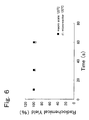
- the results of the second-step reaction are shown in Fig. 6 .
- the vertical axis represents a decay-corrected radiochemical yield.
- the reason for this is that the second-step reaction rapidly occurs and therefore no difference occurs between the macro-scale reaction and the reaction using the microreactor under this reaction condition.
- acetonitrile and DMSO were used as solvents.
- the reaction temperature and the type of solvent used were restudied by a macro-scale experimental system. This is because acetonitrile evaporates in the microreactor when the reaction temperature is 90 to 120°C.
- the reaction time of the first-step reaction was set to 10 minutes
- the reaction time of the second-step reaction was set to 5 minutes
- the reaction time of the third-step reaction was set to 2 minutes.
- acetonitrile was used as a solvent
- three reaction temperatures of 70°C, 80°C, and 90°C were used
- DMSO was used as a solvent
- the three-step reaction was performed at these different temperatures.
- a comparison of the yield of [ 18 F]SFB and the yield of the compound 2 (t-butyl 4-[ 18 F]fluorobenzoate) was made by HPLC analysis.
- Fig. 7 The results are shown in Fig. 7 .
- the vertical axis represents a decay-corrected radiochemical yield.
- an increase in the reaction temperature promotes the production of [ 18 F]SFB and reduces the amount of the residual compound 2, and changing a solvent from acetonitrile to DMSO makes it possible to reduce the amount of the residual compound 2.
- FIG. 8 shows a microchip as one example of a microreactor used to implement the present invention.
- a microchip 2 is formed by bonding two glass substrates together.
- a reaction channel 4 and connection channels for connecting a raw material injection port, a liquid discharge port, and injection ports for injecting various reagents to the channel 4 are formed.
- through holes are formed as a raw material injection port 8, a liquid discharge port 18, and injection ports 10, 12, 14, and 16 for injecting various reagents.
- the channels and the through holes are formed by sandblasting, and the glass substrates are bonded by hydrofluoric acid bonding.
- the raw material injection port 8 and the first reagent injection port 10 are connected to one end 6 of the reaction channel 4 through their respective connection channels, and the second reagent injection port 12 is connected to the channel 4 at a position far from the one end 6 of the channel 4, the third reagent injection port 14 is connected to the channel 4 at a position far from the second reagent injection port 12 in a direction toward the other end of the channel 4, and the liquid discharge port 18 is connected to the other end 20 of the channel 4. Further, the reaction stop reagent injection port 16 for injecting a reaction stop reagent is connected to the other end 20 of the channel 4 through its connection channel.
- the reaction channel 4 includes a first-step reaction channel 22, a second-step reaction channel 24, and a third-step reaction channel 26.
- the first-step reaction channel 22 extends from the one end 6 to a position 4a at which the second reagent injection port 12 is connected to the channel 4
- the second-step reaction channel 24 extends from the position 4a to a position 4b at which the third reagent injection port 14 is connected to the channel 4
- the third-step reaction channel 26 extends from the position 4b to the other end 20.
- Each of the reaction channel 4 and the connection channels has a width of 150 ⁇ m and a depth of 150 ⁇ m.
- the first-step reaction channel 22 has a length of 250 mm and a volumetric capacity of 5.625 ⁇ L
- the second-step reaction channel 24 has a length of 50 mm and a volumetric capacity of 1.125 ⁇ L
- the third-step reaction channel 26 has a length of 200 mm and a volumetric capacity of 4.5 ⁇ L
- the second-step reaction rapidly proceeds, and therefore, the reaction channel 4 is designed so that the second-step reaction channel 24 has the shortest length.
- the microchip 2 was placed on the chip stage shown in Fig. 4 to perform a reaction at a reaction temperature of 120°C.
- a solution of the compound 1 (concentration: 1 mg/500 ⁇ L), a K222/K[ 18 F]F complex solution (concentration: 10 mg/500 ⁇ L), a TPAH solution (1 M TPAH 40 ⁇ L/ 500 ⁇ L), and a TSTU solution (15 mg/500 ⁇ L) were prepared as the labeled precursor solution of [ 18 F]SFB, the first reagent, the second reagent, and the third reagent, respectively, and were then introduced into the microchip through their respective injection ports at a flow rate of 0.56 ⁇ L/min, a flow rate of 0.56 ⁇ L/min, a flow rate of 1.12 ⁇ L/min, and a flow rate of 2.24 ⁇ L/min, respectively.
- DMSO was used as a solvent of these solutions.
- the reaction time of the first-step reaction was 5 minutes
- the reaction time of the second-step reaction was 30 seconds
- the reaction time of the third-step reaction was 1 minute.
- DMSO/water (90/10) was introduced into the reaction stop reagent injection port 16 as a reaction stop reagent, and the resulting reaction solution was fractionated by HPLC and measured by a gamma counter to calculate a radiochemical yield.
- the HPLC used was reverse-phase HPLC, and a column used was COSMOSIL 5C 18 -PAQ or COSMOSIL 5C 18 -MSII (inner diameter. 4.6 mm, length: 150 mm, Nacalai Tesque).
- the HPLC was performed by gradient elution using a mixture of ammonium acetate buffer (50 mM, pH 4.0) (A) and MeCN (B) as a mobile phase.
- the volume ratio between A and B was set to 75A/25B at the beginning of HPLC, and was changed to be 20A/80B after a lapse of 20 minutes and 20A/80B after a lapse of 30 minutes.
- the flow rate of the mobile phase was 1 mL/min.
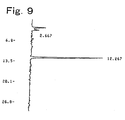
- the liquid chromatogram of the reaction solution after reaction is shown in Fig. 9 .
- the largest peak represents [ 18 F]SFB.
- the radioactivity of 18 F was measured by a Curie meter or a gamma scintillation counter.
- the horizontal axis represents time (min) and the vertical axis represents the number of counts.
- Example 20 62.2 54.8 The yields were calculated based on HPLC analysis.
- Conventional Method 1 60 43.8 30.0 J. Label. Compd. Radiopharm., 51, 68-71,2008 Conventional Method 2 78 46 28.1 Appl. Radiat. Isot., 65, 199-203, 2007 Conventional Method 3 68 36 23.4 Appl. Radiat. Isot., 63, 329-332, 2005 Conventional Method 4 120 49 23.0 Nucl. Med. Biol., 31, 739-746, 2004
- the conventional methods 1 to 4 are based on a one-pot procedure or a two-pot procedure and are disclosed in the above references.
- [ 18 F]SFB synthesized by the method according to the present invention can be used to synthesize probes for use in PET diagnosis.
Landscapes
- Chemical & Material Sciences (AREA)
- Organic Chemistry (AREA)
- Health & Medical Sciences (AREA)
- Life Sciences & Earth Sciences (AREA)
- Medicinal Chemistry (AREA)
- Optics & Photonics (AREA)
- Pharmacology & Pharmacy (AREA)
- Epidemiology (AREA)
- Physics & Mathematics (AREA)
- Animal Behavior & Ethology (AREA)
- General Health & Medical Sciences (AREA)
- Public Health (AREA)
- Veterinary Medicine (AREA)
- Organic Low-Molecular-Weight Compounds And Preparation Thereof (AREA)
- Pyrrole Compounds (AREA)
- Medicines Containing Antibodies Or Antigens For Use As Internal Diagnostic Agents (AREA)
Abstract
Description
- The present invention relates to a method for synthesizing [18F]SFB (N-succinimidyl 4-[18F]fluorobenzoate) for use as a reagent for labeling high-molecular weight compounds such as peptides and antibodies or low-molecular weight compounds with [18F], which is an RI (radioisotope), to synthesize PET (Positron Emission Tomography) diagnostic probes.
- In PET diagnosis, 18F which is an RI with a short half-life of about 110 minutes is often used. Since 18F has such a short half-life, 18F-labeled diagnostic probes are produced using an on-site automatic synthesizing apparatus. The current most useful PET diagnostic probe is 18F-labeled fluorodeoxyglucose (18F-FDG) useful for early detection of cancer. Since 18F-FDG became covered by health insurance, the number of private PET centers has been rapidly increased to over 100. It is believed that this reflects great expectations of society on early detection of cancer. Therefore, it can be said that PET is an advanced diagnostic technique but is becoming a common diagnostic technique rooted in society. In order to respond to such social demands and further develop PET diagnosis, it is necessary to establish a technique for automatically synthesizing PET diagnostic probes. Without it, it is impossible to expect that PET diagnosis will become common and contribute to society.
- An example of a labeling reagent for use in synthesizing PET diagnostic probes other than 18F-FDG is [18F]SFB. [18F]SFB is widely used as a reagent for labeling peptides, antibodies, and polymers.
- As a method for synthesizing [18F]SFB, a batch synthesis method using a three-step reaction is known. As such a batch synthesis method, a one-pot procedure has been reported (see Non-Patent Document 1), which is a modification of a two-pot procedure using two reactors. The one-pot procedure is a method in which reaction reagents are added to one reactor in order. According to the one-pot procedure, in a first-step reaction, ethyl 4-(trimethylammonium triflate) benzoate as a labeled precursor is fluorinated with [18F] to obtain ethyl 4-[18F]fluorobenzoate. Then, in a second-step reaction, ethyl 4-[18F]fluorobenzoate is saponified with a tetrapropylammonium hydroxide solution to obtain a 4-[18F]fluorobenzoic acid salt ([18F]FBA) as a [18F]SFB intermediate. Then, in a third-step reaction, the intermediate is reacted with
O-(N-succinimidyl)-N,N,N',N' -tetramethyluronium tetrafluoroborate to obtain target [18F]SFB (see Non-Patent Document 1). - In such a series of reactions, [18F]FBA, which is a product of the second-step reaction and a [18F]SFB intermediate, is purified by solid-phase extraction and azeotropically dehydrated using acetonitrile (MeCN) before the start of the third-step reaction.
-
- Non-Patent Document 1: G. Tang et al., J. Label. Compd. Radiopharm., 51, 68-71(2008)
- Non-Patent Document 2: F. Wust et al., Appl. Radiat Isot., 59, 43-48 (2003)
- Non-Patent Document 3: HJ. Wester et al., Nucl. Med. Biol., 23, 365-372 (1996)
- Non-Patent Document 4: W. Bannwarth et al., Tetrahedron Letters 32, 1157-1160 (1991)
- In addition to the above-described method, there are other methods for synthesizing [18F]SFB. However, all these methods are batch synthesis methods that are common in that reaction reagents are added to one or two reactors in order. These synthesis methods take a long time of 1 to 1.5 hours to synthesize [18F]SFB and require complicated operations, and therefore under the present circumstances, synthesis of [18F]SFB is performed in only part of PET centers and the like.
- In the case of manual synthesis, operations are complicated and, therefore, advanced skills are required. On the other hand, apparatuses that can automatically synthesize [18F]SFB are commercially available from overseas, but are large in size and expensive. Therefore, PET centers and the like that can introduce such apparatuses are limited.
- In order to solve the above problems, synthesis of [18F]SFB needs to be improved from the following viewpoints:
- (1) to improve reaction efficiency, that is, to improve radiochemical yield and to reduce synthesis time;
- (2) to simplify operation techniques; and
- (3) to reduce production costs for pharmaceutical synthesis.
- It is therefore an object of the present invention to reduce the time of [18F]SFB synthesis by improving reaction efficiency, simplify operations for [18F]SFB synthesis, and reduce the production cost of [18F]SFB.
- Basically, the amounts of solutions used in a reaction using a radioactive substance are very small, and therefore, there are limitations to conventional batch synthesis methods including one-pot synthesis methods. On the other hand, the present invention uses microprocessing technology that has rapidly advanced in recent years to perform a reaction by allowing a reaction solution to flow through a microchannel provided in a microreactor.
- The present invention is directed to a method for synthesizing [18F]SFB comprising using a microreactor including a substrate with one channel formed therein so as to have a cross-sectional width of 1 mm or less and a cross-sectional depth of 1 mm or less, the channel being connected to a raw material injection port and a first reagent injection port at one end thereof, and connected to a second reagent injection port at a position far from the one end thereof, and connected to a third reagent injection port at a position far from the second reagent injection port in a direction toward another end thereof, and connected to a liquid discharge port at the other end thereof; and continuously performing the following three-step reaction by allowing a reaction solution to flow through the channel serving as a reaction channel from the one end to the other end thereof without taking out the reaction solution from anywhere between the one end and the other end of the channel:
- a first-step reaction in which a solution of a labeled precursor of [18F]SFB and a solution containing 18F- ions as a first reagent are continuously supplied from the raw material injection port and the first reagent injection port, respectively to fluorinate the labeled precursor in the channel between the one end and the second reagent injection port;
- a second-step reaction in which a TPAH (tetrapropylammonium hydroxide) solution as a second reagent is continuously supplied from the second reagent injection port to saponify a reaction product of the first-step reaction in the channel between the second reagent injection port and the third reagent injection port so that a [18F]SFB intermediate is produced; and
- a third-step reaction in which a TSTU (O-(N-succinimidyl)-N,N,N' ,N' -tetramethyluronium tetrafluoroborate) solution as a third reagent is continuously supplied from the third reagent injection port to produce [18F]SFB in the channel between the third reagent injection port and the other end.
- The method according to the present invention is a one-flow synthesis method in which a reaction from the beginning of the first-step reaction to the end of the third-step reaction is performed in one channel provided in the microreactor without taking out a reaction solution from anywhere between the one end and the other end of the channel to perform some kind of treatment on the reaction solution. For the purpose of setting reaction conditions or verifying that the reaction has proceeded properly, a reaction solution is taken out from the channel after the completion of the first-step reaction or after the completion of the second-step reaction to measure a reaction product However, this is performed for pretreatment or verification of the present invention, and is therefore not the present invention itself. Therefore, according to the present invention, the intermediate produced by the second-step reaction is neither purified nor dehydrated before the beginning of the third-step reaction.
-
Non-Patent Document 1 does not describe whether the third-step reaction proceeds without performing such purification and dehydration processes. On the other hand, it has been reported that TSTU used in the third-step reaction reacts with a carboxyl group even when water is present in a reaction solution (see Non-Patent Document 4). However, it is impossible to tell from the description ofNon-Patent Document 4 whether the third-step reaction proceeds in a reaction system according to the present invention with such reaction efficiency that improvement in radiochemical yield and reduction in synthesis time can be achieved. - The present inventors have found that, even when such purification and dehydration processes are not performed, the third-step reaction proceeds with such reaction efficiency that the original object of the present invention can be achieved. Based on the finding, the present invention provides, for the first time, a [18F]SFB synthesis method in which the series of reactions is continuously performed in one channel.
- According to the present invention, it is possible to significantly reduce synthesis time by introducing microsynthesis techniques, whereas conventional methods require 1 to 1.5 hours for synthesis. This is because the reaction efficiency is improved by performing a reaction in a microspace provided in a microreactor so that the reaction is completed in a short period of time. Further, steps after preparation of reagents are automatically performed by continuous solution sending, and therefore, the reproducibility of synthesis is easily achieved. The reaction device itself can be easily operated and does not require advanced skills. Further, the reaction can be performed with small amounts of reagents and solvents, and therefore, production costs for pharmaceutical synthesis can be reduced.
- More specifically, conditions for one-flow synthesis of [18F]SFB were examined using a microchip for three-step reaction, and as a result, [18F]SFB was obtained in a decay-corrected radiochemical yield of about 60% in a synthesis time of 15 minutes. As can be seen from the result, the present invention makes it possible to achieve a higher yield and a shorter synthesis time as compared to conventional synthesis methods. Further, synthesis after preparation of reagents is automatically performed, which is advantageous in that reproducibility of experiments is easily achieved by anyone, the reaction can be performed with small amounts of reagents and solvents, and synthesis of [18F]SFB can be performed in a small space. Such a system has a wide range of applications from clinical use to laboratory use for PET pharmaceutical synthesis.
-
-
Fig. 1 shows a reaction formula representing a [18F]SFB synthesis method used in an embodiment of the present invention. -
Fig. 2 is a graph showing the results of an experiment to determine whether a dehydration process is required to allow a third-step reaction to proceed in the embodiment of the present invention. -
Fig. 3 is a plan view of a microchip for analyzing a reaction product of a first-step reaction. -
Fig. 4 is a schematic perspective view of a temperature regulation system for regulating the temperature of a microreactor used in the embodiment of the present invention. -
Fig. 5 is a graph showing the results of examining the influence of temperature on the first-step reaction with the use of the microchip shown inFig. 3 . -
Fig. 6 is a graph showing the results of comparison of radiochemical yield between when a second-step reaction is performed in the microreactor and when it is performed in a conventional reactor. -
Fig. 7 is a graph showing the results of comparison of radiochemical yield when different solvents are used in the embodiment of the present invention. -
Fig. 8 is a plan view of a microchip used as a microreactor for implementing the embodiment of the present invention. -
Fig. 9 is a liquid chromatogram of a reaction product obtained in the embodiment of the present invention. - A reaction mechanism of synthesizing [18F]SFB used in an embodiment of the present invention is shown in
Fig. 1 .
In a first-step reaction, t-butyl 4-N,N,N-trimethyl-ammoniumbenzoate triflate (compound 1) was used as a labeled precursor. Thecompound 1 was synthesized using special grade reagents manufactured by Merck and Sigma Aldrich by a method described inNon-Patent Document - The
compound 1 and the first reagent are separately supplied as solutions to two liquid injection ports of a microreactor. As a solvent of these solutions, acetonitrile or DMSO was used. As a solvent of reaction reagents used in a second-step reaction and a third-step reaction, the same solvent as used in the first-step reaction was used. - As a product of the first-step reaction, t-butyl 4-[18F]fluorobenzoate (compound 2) is produced.
- In the second-step reaction, a TPAH (tetrapropylammonium hydroxide) solution is continuously supplied as a second reagent to a reaction solution containing the
compound 2 as a product of the first-step reaction through a second reagent injection port As a result of a reaction between thecompound 2 and TPAH, thecompound 2 is saponified so that [18F]FBA (4-[18F]fluorobenzoic acid salt) as a [18F]SFB intermediate is produced. - In the third-step reaction, a TSTU (O-(N-succinimidyl)-N,N,N' ,N' -tetramethyluronium tetrafluoroborate) solution is continuously supplied as a third reagent to a reaction solution containing the [18F]SFB intermediate as a product of the second-step reaction through a third reagent injection port As a result, [18F]SFB is produced between the third reagent injection port and the other end of a channel of the microreactor.
- As the labeled precursor, an ester (e.g., ethyl ester, t-butyl ester, pentamethyl ester) of 4-(trimethylammoniumtrifate)benzoic acid can be used. The
compound 1 described above is a t-butyl ester of 4-(trimethylammoniumtrifate)benzoic acid. - Synthesis of [18F]SFB performed by such a three-step reaction mechanism as described above requires complicated experimental procedures, and therefore, conventional synthesis methods require 1 to 1.5 hours for synthesis. For the purpose of achieving easy and rapid synthesis, the present invention uses a microreactor that achieves reaction efficiency higher than that of conventional macro-scale synthesis.
- Conventional synthesis methods require purification of the intermediate [18F]FBA by solid-phase extraction and azeotropic dehydration using acetonitrile. Therefore, it is difficult for such conventional synthesis methods to achieve one-flow synthesis while performing such purification and dehydration processes in the course of the series of reactions. On the other hand, according to the present invention, target [18F]SFB can be synthesized without performing such purification and dehydration processes in the course of the series of reactions. The reason for this will be described below.
- In reference to the [18F]SFB synthesis method described in
Non-Patent Document 1, the third-step reaction was performed without performing purification and dehydration of a product of the second-step reaction. This experiment was performed using a conventional reactor. More specifically, Kryptofix 222 (K222, 10 mg) was dissolved in acetonitrile (500 µL), and 18F- (100 to 500 µL of a 33 mM aqueous K2CO3 solution containing 18F- dissolved therein) was added thereto. The mixture was azeotropically dehydrated at 110°C under the stream of argon gas, and was further azeotropically dehydrated by adding acetonitrile (400 µL). Azeotropic dehydration using acetonitrile (400 µL) was repeated three times to completely remove water. Then, the compound 1 (as a 5 mg/1 mL acetonitrile solution) was added thereto to perform a reaction at 90°C for 10 minutes. Then, 20 µL of a 1 M aqueous TPAH solution was added to perform a reaction at 120°C for 5 minutes to synthesize an intermediate [18F]FBA. After synthesis, a reaction solution was azeotropically dehydrated with acetonitrile and then reacted with TSTU to synthesize [18F]SFB. On the other hand, a reaction solution whose water content was adjusted to 1.6 to 51% was reacted with TSTU without performing dehydration to synthesize [18F]SFB. - The [18F]SFB was fractionated by high-performance liquid chromatography (HPLC), and comparison of the yield of [18F]SFB was made. The fractionation by HPLC was performed using a solution of water/MeCN = 60/40 as a mobile phase at a flow rate of 1 mL/min. The radioactivity of 18F was measured using a Curie meter or a NaI (Tl) gamma scintillation counter.
- The measurement results are shown in
Fig. 2 . InFig. 2 , the vertical axis represents a decay-corrected radiochemical yield. As can be seen from the results shown inFig. 2 , the radiochemical yield is not greatly influenced by the water content of the reaction solution as long as the water content is low (about 20% or less). TPAH used as a reaction reagent in the second-step reaction is in the form of a 10 to 40% aqueous solution (manufactured by, for example, Tokyo Chemical Industry Co., Ltd.), and therefore, a reaction system according to the present invention absolutely contains water. However, TPAH is dissolved in DMSO or acetonitrile in a given ratio, and therefore the water content of the reaction solution is at most 20%. This is the reason why the dehydration process may be omitted. - Based on the above study, the application of a microreactor to the synthesis of [18F]SFB was studied.
As a first step, each of the steps of synthesis of [18F]SFB was performed using both a microreactor and a conventional reactor (macro-scale) to compare changes in yield with reaction time at different reaction temperatures. - A microchip shown in
Fig. 3 was prepared as a microreactor used to perform the first-step reaction and the second-step reaction for the purposes of comparison with a macro-scale reaction. Amicrochip 1 is formed by bonding two glass substrates together. In the surface of one of the glass substrates, areaction channel 3 and connection channels for connecting a reaction solution injection port, a reagent injection port, a liquid discharge port, and a reaction stop reagent injection port to thechannel 3 are formed. In the other glass substrate, through holes are formed as a reactionsolution injection port 7, areagent injection port 9, aliquid discharge port 17, and a reaction stopreagent injection port 15. These two glass substrates are bonded together so that thereaction channel 3 and the connection channels are located inside. The channels and the through holes are formed by sandblasting, and the glass substrates are bonded by hydrofluoric acid bonding. - The reaction
solution injection port 7 and thereagent injection port 9 are connected to oneend 5 of thereaction channel 3 through their respective connection channels, and theliquid discharge port 17 and the reaction stopreagent injection port 15 are connected to theother end 3a of thechannel 3 through their respective connection channels. Thereaction channel 3 is a channel extending between the oneend 5 and theother end 3a. Each of thereaction channel 3 and the connection channels has a width of 150 µm and a depth of 150 µm, and thereaction channel 3 has a length of 250 mm and a volumetric capacity of 5.625 µL - The
microchip 1 was placed on an aluminum chip stage equipped with a built-in ceramic heater to perform a reaction at a predetermined temperature. One example of the chip stage is shown inFig. 4 . The chip stage includes twoaluminum plates ceramic heater 34, and atemperature sensor 36 comprising a thermocouple, and theceramic heater 34 and thetemperature sensor 36 are interposed between thealuminum plates heater 34 is connected to apower source 38, and atemperature regulator 40 controls an electric current supplied from thepower source 38 to theheater 34 based on a detection signal outputted from thetemperature sensor 36 so that theplates - As the labeled precursor solution, an acetonitrile solution of the compound 1 (1 mg/mL) was used. As the first reagent, a K222/K[18F]F complex solution (10 mg/mL) was used. As the reagent used in the second-step reaction, a TPAH solution (1
M 20 µL/500 µL: a solution of 500 µL containing 20 µL of a 1 M TPAH solution) was used. The first-step reaction was performed at both 90°C and 120°C, and the second-step reaction was performed at 120°C. These reactions were performed using both the conventional reactor (macro-scale) and the microreactor to compare a change in yield with reaction time. When the reaction temperature was 90°C, acetonitrile was used as a solvent, and when the reaction temperature was 120°C, DMSO having a high boiling point was used as a solvent - The results of the first-step reaction are shown in
Fig. 5 . InFig. 5 , the vertical axis represents a decay-corrected radiochemical yield. When the first-step reaction was performed using the microreactor, the yield was higher than when the first-step reaction was performed on a macro-scale, that is, a reduction in reaction time was achieved. This tendency became more conspicuous by increasing the reaction temperature from 90°C to 120°C. - The second-step reaction was performed at 120°C using both the conventional reactor (macro-scale) and the microreactor. The results of the second-step reaction are shown in
Fig. 6 . InFig. 6 , the vertical axis represents a decay-corrected radiochemical yield. As can be seen from the results shown inFig. 6 , there is little difference between the macro-scale reaction and the reaction using the microreactor. It can be considered that the reason for this is that the second-step reaction rapidly occurs and therefore no difference occurs between the macro-scale reaction and the reaction using the microreactor under this reaction condition. - As solvents, acetonitrile and DMSO were used. The reaction temperature and the type of solvent used were restudied by a macro-scale experimental system. This is because acetonitrile evaporates in the microreactor when the reaction temperature is 90 to 120°C. The reaction time of the first-step reaction was set to 10 minutes, the reaction time of the second-step reaction was set to 5 minutes, and the reaction time of the third-step reaction was set to 2 minutes. When acetonitrile was used as a solvent, three reaction temperatures of 70°C, 80°C, and 90°C were used, and when DMSO was used as a solvent, four reaction temperatures of 70°C, 80°C, 90°C, and 120°C were used. The three-step reaction was performed at these different temperatures. A comparison of the yield of [18F]SFB and the yield of the compound 2 (t-butyl 4-[18F]fluorobenzoate) was made by HPLC analysis.
- The results are shown in
Fig. 7 . InFig. 7 , the vertical axis represents a decay-corrected radiochemical yield. As can be seen fromFig. 7 , an increase in the reaction temperature promotes the production of [18F]SFB and reduces the amount of theresidual compound 2, and changing a solvent from acetonitrile to DMSO makes it possible to reduce the amount of theresidual compound 2. - An optimum reaction time was determined based on the above results, and a one-flow synthesis of [18F]SFB was performed using a microchip for three-step reaction.
-
Fig. 8 shows a microchip as one example of a microreactor used to implement the present invention. Amicrochip 2 is formed by bonding two glass substrates together. In the surface of one of the glass substrates, areaction channel 4 and connection channels for connecting a raw material injection port, a liquid discharge port, and injection ports for injecting various reagents to thechannel 4 are formed. In the other glass substrate, through holes are formed as a rawmaterial injection port 8, aliquid discharge port 18, andinjection ports reaction channel 4 and the connection channels are located inside. The channels and the through holes are formed by sandblasting, and the glass substrates are bonded by hydrofluoric acid bonding. - The raw
material injection port 8 and the firstreagent injection port 10 are connected to oneend 6 of thereaction channel 4 through their respective connection channels, and the secondreagent injection port 12 is connected to thechannel 4 at a position far from the oneend 6 of thechannel 4, the thirdreagent injection port 14 is connected to thechannel 4 at a position far from the secondreagent injection port 12 in a direction toward the other end of thechannel 4, and theliquid discharge port 18 is connected to theother end 20 of thechannel 4. Further, the reaction stopreagent injection port 16 for injecting a reaction stop reagent is connected to theother end 20 of thechannel 4 through its connection channel. - The
reaction channel 4 includes a first-step reaction channel 22, a second-step reaction channel 24, and a third-step reaction channel 26. The first-step reaction channel 22 extends from the oneend 6 to aposition 4a at which the secondreagent injection port 12 is connected to thechannel 4, the second-step reaction channel 24 extends from theposition 4a to aposition 4b at which the thirdreagent injection port 14 is connected to thechannel 4, and the third-step reaction channel 26 extends from theposition 4b to theother end 20. - Each of the
reaction channel 4 and the connection channels has a width of 150 µm and a depth of 150 µm. The first-step reaction channel 22 has a length of 250 mm and a volumetric capacity of 5.625 µL, the second-step reaction channel 24 has a length of 50 mm and a volumetric capacity of 1.125 µL, and the third-step reaction channel 26 has a length of 200 mm and a volumetric capacity of 4.5 µL The second-step reaction rapidly proceeds, and therefore, thereaction channel 4 is designed so that the second-step reaction channel 24 has the shortest length. - The
microchip 2 was placed on the chip stage shown inFig. 4 to perform a reaction at a reaction temperature of 120°C. - A solution of the compound 1 (concentration: 1 mg/500 µL), a K222/K[18F]F complex solution (concentration: 10 mg/500 µL), a TPAH solution (1
M TPAH 40 µL/ 500 µL), and a TSTU solution (15 mg/500 µL) were prepared as the labeled precursor solution of [18F]SFB, the first reagent, the second reagent, and the third reagent, respectively, and were then introduced into the microchip through their respective injection ports at a flow rate of 0.56 µL/min, a flow rate of 0.56 µL/min, a flow rate of 1.12 µL/min, and a flow rate of 2.24 µL/min, respectively. As a solvent of these solutions, DMSO was used. The reaction time of the first-step reaction was 5 minutes, the reaction time of the second-step reaction was 30 seconds, and the reaction time of the third-step reaction was 1 minute. - In order to analyze a reaction product, DMSO/water (90/10) was introduced into the reaction stop
reagent injection port 16 as a reaction stop reagent, and the resulting reaction solution was fractionated by HPLC and measured by a gamma counter to calculate a radiochemical yield. The HPLC used was reverse-phase HPLC, and a column used was COSMOSIL 5C18-PAQ or COSMOSIL 5C18-MSII (inner diameter. 4.6 mm, length: 150 mm, Nacalai Tesque). The HPLC was performed by gradient elution using a mixture of ammonium acetate buffer (50 mM, pH 4.0) (A) and MeCN (B) as a mobile phase. The volume ratio between A and B was set to 75A/25B at the beginning of HPLC, and was changed to be 20A/80B after a lapse of 20 minutes and 20A/80B after a lapse of 30 minutes. The flow rate of the mobile phase was 1 mL/min. - The liquid chromatogram of the reaction solution after reaction is shown in
Fig. 9 . The largest peak represents [18F]SFB. The radioactivity of 18F was measured by a Curie meter or a gamma scintillation counter. InFig. 9 , the horizontal axis represents time (min) and the vertical axis represents the number of counts. - The obtained result is shown in Table 1 as the result of Example. The results of
conventional methods 1 to 4 are also shown in Table 1.Table 1 Synthesis Time (min) Yield (%) (decay-corrected) Yield (%) (not decay-corrected) References etc. Example 20 62.2 54.8 The yields were calculated based on HPLC analysis. Conventional Method 160 43.8 30.0 J. Label. Compd. Radiopharm., 51, 68-71,2008 Conventional Method 278 46 28.1 Appl. Radiat. Isot., 65, 199-203, 2007 Conventional Method 368 36 23.4 Appl. Radiat. Isot., 63, 329-332, 2005 Conventional Method 4120 49 23.0 Nucl. Med. Biol., 31, 739-746, 2004 conventional methods 1 to 4 are based on a one-pot procedure or a two-pot procedure and are disclosed in the above references. - The decay-corrected yield was calculated by the following equation: N = N0/(1/2)(t/T), where N represents decay-corrected yield, No represents non-decay-corrected yield, T represents half-life, and t represents synthesis time.
- As can be seen from the results shown in Table 1, according to the method of the present invention, [18F]SFB was obtained in a radiochemical yield (decay-corrected) of about 60% in a synthesis time of 20 minutes.
- [18F]SFB synthesized by the method according to the present invention can be used to synthesize probes for use in PET diagnosis.
-
- 2
- microchip
- 4
- reaction channel
- 6
- one end of
channel 4 - 8
- raw material injection port
- 10
- first reagent injection port
- 12
- second reagent injection port
- 14
- third reagent injection port
- 16
- reaction stop reagent injection port
- 18
- liquid discharge port
- 20
- another end of
channel 4 - 22
- first-step reaction channel
- 24
- second-step reaction channel
- 26
- third-step reaction channel
Claims (3)
- A method for synthesizing [18F]SFB comprising:using a microreactor including a substrate having one channel formed therein so as to have a cross-sectional width of 1 mm or less and a cross-sectional depth of 1 mm or less, the channel being connected to a raw material injection port and a first reagent injection port at one end thereof, and connected to a second reagent injection port at a position far from the one end thereof, and connected to a third reagent injection port at a position far from the second reagent injection port in a direction toward other end thereof, and connected to a liquid discharge port at the other end thereof; andcontinuously performing the following three-step reaction by allowing a reaction solution to flow through the channel serving as a reaction channel from the one end to the other end thereof without taking out the reaction solution from anywhere between the one end and the other end of the channel:a first-step reaction in which a solution of a labeled precursor of [18F]SFB and a solution containing 18F- ions as a first reagent are continuously supplied from the raw material injection port and the first reagent injection port, respectively to fluorinate the labeled precursor in the channel between the one end and the second reagent injection port;a second-step reaction in which a TPAH (tetrapropylammonium hydroxide) solution as a second reagent is continuously supplied from the second reagent injection port to saponify a reaction product of the first-step reaction in the channel between the second reagent injection port and the third reagent injection port so that a [18F]SFB intermediate is produced; anda third-step reaction in which a TSTU
(O-(N-succinimidyl)-N,N,N',N'-tetramethyluronium tetrafluoroborate) solution as a third reagent is continuously supplied from the third reagent injection port to produce [18F]SFB in the channel between the third reagent injection port and the other end. - The method for synthesizing [18F]SFB according to claim 1, wherein acetonitrile is used as a solvent of the labeled precursor solution and the solution containing 18F- ions to cause a reaction at a temperature lower than a boiling point of acetonitrile.
- The method for synthesizing [18F]SFB according to claim 1, wherein DMSO (dimethyl sulfoxide) is used as a solvent of the labeled precursor solution and the solution containing 18F- ions to cause a reaction at a temperature equal to or higher than a boiling point of acetonitrile but lower than a boiling point of DMSO.
Applications Claiming Priority (2)
| Application Number | Priority Date | Filing Date | Title |
|---|---|---|---|
| JP2009050814 | 2009-03-04 | ||
| PCT/JP2010/053252 WO2010101118A1 (en) | 2009-03-04 | 2010-03-01 | Method of synthesizing [18f]sfb using microsynthesis technique |
Publications (3)
| Publication Number | Publication Date |
|---|---|
| EP2404903A1 true EP2404903A1 (en) | 2012-01-11 |
| EP2404903A4 EP2404903A4 (en) | 2012-08-08 |
| EP2404903B1 EP2404903B1 (en) | 2013-07-17 |
Family
ID=42709675
Family Applications (1)
| Application Number | Title | Priority Date | Filing Date |
|---|---|---|---|
| EP10748713.4A Not-in-force EP2404903B1 (en) | 2009-03-04 | 2010-03-01 | Method of synthesizing [18f]sfb using microsynthesis technique |
Country Status (4)
| Country | Link |
|---|---|
| US (1) | US20120029209A1 (en) |
| EP (1) | EP2404903B1 (en) |
| JP (1) | JP5291791B2 (en) |
| WO (1) | WO2010101118A1 (en) |
Cited By (3)
| Publication number | Priority date | Publication date | Assignee | Title |
|---|---|---|---|---|
| WO2013003528A1 (en) * | 2011-06-30 | 2013-01-03 | General Electric Company | Devices and methods for reducing radiolysis of radiolabeled compounds |
| WO2014079979A1 (en) | 2012-11-26 | 2014-05-30 | Advanced Accelerator Applications | New nucleophile-reactive sulfonated compounds for the (radio)labelling of (bio)molecules; precursors and conjugates thereof |
| US11401247B2 (en) | 2018-01-23 | 2022-08-02 | Xiangbei Welman Pharmaceutical Co., Ltd | Thiazole-5-carboxylic acid derivative and preparation method and use thereof |
Families Citing this family (1)
| Publication number | Priority date | Publication date | Assignee | Title |
|---|---|---|---|---|
| US10473668B2 (en) * | 2014-06-06 | 2019-11-12 | The Regents Of The University Of California | Self-shielded, benchtop radio chemistry system with a plurality shielded carriers containing a disposable chip cassette |
Family Cites Families (4)
| Publication number | Priority date | Publication date | Assignee | Title |
|---|---|---|---|---|
| GB0206117D0 (en) * | 2002-03-15 | 2002-04-24 | Imaging Res Solutions Ltd | Use of microfabricated devices |
| JP2004313867A (en) * | 2003-04-14 | 2004-11-11 | Shimadzu Corp | Micro reactor |
| JP5465369B2 (en) * | 2006-08-02 | 2014-04-09 | 住友重機械工業株式会社 | RI compound synthesis apparatus and RI compound synthesis method |
| US8071035B2 (en) * | 2007-04-12 | 2011-12-06 | Siemens Medical Solutions Usa, Inc. | Microfluidic radiosynthesis system for positron emission tomography biomarkers |
-
2010
- 2010-03-01 JP JP2011502745A patent/JP5291791B2/en not_active Expired - Fee Related
- 2010-03-01 EP EP10748713.4A patent/EP2404903B1/en not_active Not-in-force
- 2010-03-01 WO PCT/JP2010/053252 patent/WO2010101118A1/en not_active Ceased
- 2010-03-01 US US13/254,152 patent/US20120029209A1/en not_active Abandoned
Non-Patent Citations (2)
| Title |
|---|
| No further relevant documents disclosed * |
| See also references of WO2010101118A1 * |
Cited By (3)
| Publication number | Priority date | Publication date | Assignee | Title |
|---|---|---|---|---|
| WO2013003528A1 (en) * | 2011-06-30 | 2013-01-03 | General Electric Company | Devices and methods for reducing radiolysis of radiolabeled compounds |
| WO2014079979A1 (en) | 2012-11-26 | 2014-05-30 | Advanced Accelerator Applications | New nucleophile-reactive sulfonated compounds for the (radio)labelling of (bio)molecules; precursors and conjugates thereof |
| US11401247B2 (en) | 2018-01-23 | 2022-08-02 | Xiangbei Welman Pharmaceutical Co., Ltd | Thiazole-5-carboxylic acid derivative and preparation method and use thereof |
Also Published As
| Publication number | Publication date |
|---|---|
| JPWO2010101118A1 (en) | 2012-09-10 |
| EP2404903B1 (en) | 2013-07-17 |
| WO2010101118A1 (en) | 2010-09-10 |
| JP5291791B2 (en) | 2013-09-18 |
| EP2404903A4 (en) | 2012-08-08 |
| US20120029209A1 (en) | 2012-02-02 |
Similar Documents
| Publication | Publication Date | Title |
|---|---|---|
| Oh et al. | Fully automated synthesis of [18F] fluoromisonidazole using a conventional [18F] FDG module | |
| Wüst et al. | Radiolabelling of isopeptide Nε-(γ-glutamyl)-L-lysine by conjugation with N-succinimidyl-4-[18F] fluorobenzoate | |
| Herth et al. | Development of a 11 C-labeled tetrazine for rapid tetrazine–trans-cyclooctene ligation | |
| EP2404903B1 (en) | Method of synthesizing [18f]sfb using microsynthesis technique | |
| Zuhayra et al. | New approach for the synthesis of [18F] fluoroethyltyrosine for cancer imaging: simple, fast, and high yielding automated synthesis | |
| Römer et al. | Automated production of 16α-[18F] fluoroestradiol for breast cancer imaging | |
| US9096647B2 (en) | Simplified one-pot synthesis of [18F]SFB for radiolabeling | |
| Audrain et al. | Utilisation of [11 C]-labelled boron carbonyl complexes in palladium carbonylation reaction | |
| Zheng et al. | Synthesis of [18F] FMISO in a flow-through microfluidic reactor: Development and clinical application | |
| Bejot et al. | Batch‐mode microfluidic radiosynthesis of N‐succinimidyl‐4‐[18F] fluorobenzoate for protein labelling | |
| AU2007292578B2 (en) | Process for producing radioactive fluorine labeled organic compound, and relevant synthetic apparatus and program | |
| Bogni et al. | An improved automated one-pot synthesis of O-(2-[18F] fluoroethyl)-L-tyrosine ([18F] FET) based on a purification by cartridges | |
| Humpert et al. | Validation of analytical HPLC with post-column injection as a method for rapid and precise quantification of radiochemical yields | |
| Lu et al. | Proof-of-concept optimization of a copper-mediated 18 F-radiosynthesis of a novel MAGL PET tracer on a high-throughput microdroplet platform and its macroscale translation | |
| Mc Veigh et al. | Microfluidic synthesis of radiotracers: recent developments and commercialization prospects | |
| Tang et al. | A facile automated synthesis of N‐succinimidyl 4‐[18F] fluorobenzoate ([18F] SFB) for 18F‐labeled cell‐penetrating peptide as PET tracer | |
| Gao et al. | Synthesis of carbon-11-labeled isonicotinamides as new potential PET agents for imaging of GSK-3 enzyme in Alzheimer’s disease | |
| WO2007063940A1 (en) | Process for production of compound labeled with radioactive fluorine | |
| AU2004237297A1 (en) | Device and method for the fluorination of nucleophiles | |
| CN109942550A (en) | 11EGFR positive electron tracer of C flag and its preparation method and application | |
| Bouvet et al. | Application of [18 F] FDG in radiolabeling reactions using microfluidic technology | |
| Wadsak et al. | 18F fluoroethylations: different strategies for the rapid translation of 11C-methylated radiotracers | |
| Erlandsson et al. | 18F-labelled metomidate analogues as adrenocortical imaging agents | |
| CN102336678A (en) | A kind of method for preparing 18F-FET | |
| Szydło et al. | Synthesis, isolation and purification of [11C]-choline |
Legal Events
| Date | Code | Title | Description |
|---|---|---|---|
| PUAI | Public reference made under article 153(3) epc to a published international application that has entered the european phase |
Free format text: ORIGINAL CODE: 0009012 |
|
| 17P | Request for examination filed |
Effective date: 20110929 |
|
| AK | Designated contracting states |
Kind code of ref document: A1 Designated state(s): AT BE BG CH CY CZ DE DK EE ES FI FR GB GR HR HU IE IS IT LI LT LU LV MC MK MT NL NO PL PT RO SE SI SK SM TR |
|
| DAX | Request for extension of the european patent (deleted) | ||
| A4 | Supplementary search report drawn up and despatched |
Effective date: 20120711 |
|
| RIC1 | Information provided on ipc code assigned before grant |
Ipc: C07D 207/404 20060101AFI20120705BHEP Ipc: C07B 59/00 20060101ALI20120705BHEP Ipc: C07B 61/00 20060101ALI20120705BHEP Ipc: A61K 51/00 20060101ALI20120705BHEP |
|
| GRAP | Despatch of communication of intention to grant a patent |
Free format text: ORIGINAL CODE: EPIDOSNIGR1 |
|
| GRAS | Grant fee paid |
Free format text: ORIGINAL CODE: EPIDOSNIGR3 |
|
| GRAA | (expected) grant |
Free format text: ORIGINAL CODE: 0009210 |
|
| AK | Designated contracting states |
Kind code of ref document: B1 Designated state(s): AT BE BG CH CY CZ DE DK EE ES FI FR GB GR HR HU IE IS IT LI LT LU LV MC MK MT NL NO PL PT RO SE SI SK SM TR |
|
| REG | Reference to a national code |
Ref country code: GB Ref legal event code: FG4D |
|
| REG | Reference to a national code |
Ref country code: CH Ref legal event code: EP |
|
| REG | Reference to a national code |
Ref country code: IE Ref legal event code: FG4D |
|
| REG | Reference to a national code |
Ref country code: AT Ref legal event code: REF Ref document number: 622111 Country of ref document: AT Kind code of ref document: T Effective date: 20130815 |
|
| REG | Reference to a national code |
Ref country code: DE Ref legal event code: R096 Ref document number: 602010008683 Country of ref document: DE Effective date: 20130919 |
|
| REG | Reference to a national code |
Ref country code: AT Ref legal event code: MK05 Ref document number: 622111 Country of ref document: AT Kind code of ref document: T Effective date: 20130717 |
|
| REG | Reference to a national code |
Ref country code: NL Ref legal event code: VDEP Effective date: 20130717 |
|
| REG | Reference to a national code |
Ref country code: LT Ref legal event code: MG4D |
|
| PG25 | Lapsed in a contracting state [announced via postgrant information from national office to epo] |
Ref country code: HR Free format text: LAPSE BECAUSE OF FAILURE TO SUBMIT A TRANSLATION OF THE DESCRIPTION OR TO PAY THE FEE WITHIN THE PRESCRIBED TIME-LIMIT Effective date: 20130717 Ref country code: AT Free format text: LAPSE BECAUSE OF FAILURE TO SUBMIT A TRANSLATION OF THE DESCRIPTION OR TO PAY THE FEE WITHIN THE PRESCRIBED TIME-LIMIT Effective date: 20130717 Ref country code: LT Free format text: LAPSE BECAUSE OF FAILURE TO SUBMIT A TRANSLATION OF THE DESCRIPTION OR TO PAY THE FEE WITHIN THE PRESCRIBED TIME-LIMIT Effective date: 20130717 Ref country code: SE Free format text: LAPSE BECAUSE OF FAILURE TO SUBMIT A TRANSLATION OF THE DESCRIPTION OR TO PAY THE FEE WITHIN THE PRESCRIBED TIME-LIMIT Effective date: 20130717 Ref country code: NO Free format text: LAPSE BECAUSE OF FAILURE TO SUBMIT A TRANSLATION OF THE DESCRIPTION OR TO PAY THE FEE WITHIN THE PRESCRIBED TIME-LIMIT Effective date: 20131017 Ref country code: IS Free format text: LAPSE BECAUSE OF FAILURE TO SUBMIT A TRANSLATION OF THE DESCRIPTION OR TO PAY THE FEE WITHIN THE PRESCRIBED TIME-LIMIT Effective date: 20131117 Ref country code: CY Free format text: LAPSE BECAUSE OF FAILURE TO SUBMIT A TRANSLATION OF THE DESCRIPTION OR TO PAY THE FEE WITHIN THE PRESCRIBED TIME-LIMIT Effective date: 20130807 Ref country code: BE Free format text: LAPSE BECAUSE OF FAILURE TO SUBMIT A TRANSLATION OF THE DESCRIPTION OR TO PAY THE FEE WITHIN THE PRESCRIBED TIME-LIMIT Effective date: 20130717 Ref country code: PT Free format text: LAPSE BECAUSE OF FAILURE TO SUBMIT A TRANSLATION OF THE DESCRIPTION OR TO PAY THE FEE WITHIN THE PRESCRIBED TIME-LIMIT Effective date: 20131118 |
|
| PG25 | Lapsed in a contracting state [announced via postgrant information from national office to epo] |
Ref country code: FI Free format text: LAPSE BECAUSE OF FAILURE TO SUBMIT A TRANSLATION OF THE DESCRIPTION OR TO PAY THE FEE WITHIN THE PRESCRIBED TIME-LIMIT Effective date: 20130717 Ref country code: GR Free format text: LAPSE BECAUSE OF FAILURE TO SUBMIT A TRANSLATION OF THE DESCRIPTION OR TO PAY THE FEE WITHIN THE PRESCRIBED TIME-LIMIT Effective date: 20131018 Ref country code: NL Free format text: LAPSE BECAUSE OF FAILURE TO SUBMIT A TRANSLATION OF THE DESCRIPTION OR TO PAY THE FEE WITHIN THE PRESCRIBED TIME-LIMIT Effective date: 20130717 Ref country code: LV Free format text: LAPSE BECAUSE OF FAILURE TO SUBMIT A TRANSLATION OF THE DESCRIPTION OR TO PAY THE FEE WITHIN THE PRESCRIBED TIME-LIMIT Effective date: 20130717 Ref country code: ES Free format text: LAPSE BECAUSE OF FAILURE TO SUBMIT A TRANSLATION OF THE DESCRIPTION OR TO PAY THE FEE WITHIN THE PRESCRIBED TIME-LIMIT Effective date: 20131028 Ref country code: PL Free format text: LAPSE BECAUSE OF FAILURE TO SUBMIT A TRANSLATION OF THE DESCRIPTION OR TO PAY THE FEE WITHIN THE PRESCRIBED TIME-LIMIT Effective date: 20130717 Ref country code: SI Free format text: LAPSE BECAUSE OF FAILURE TO SUBMIT A TRANSLATION OF THE DESCRIPTION OR TO PAY THE FEE WITHIN THE PRESCRIBED TIME-LIMIT Effective date: 20130717 |
|
| PG25 | Lapsed in a contracting state [announced via postgrant information from national office to epo] |
Ref country code: CY Free format text: LAPSE BECAUSE OF FAILURE TO SUBMIT A TRANSLATION OF THE DESCRIPTION OR TO PAY THE FEE WITHIN THE PRESCRIBED TIME-LIMIT Effective date: 20130717 |
|
| PG25 | Lapsed in a contracting state [announced via postgrant information from national office to epo] |
Ref country code: SK Free format text: LAPSE BECAUSE OF FAILURE TO SUBMIT A TRANSLATION OF THE DESCRIPTION OR TO PAY THE FEE WITHIN THE PRESCRIBED TIME-LIMIT Effective date: 20130717 Ref country code: RO Free format text: LAPSE BECAUSE OF FAILURE TO SUBMIT A TRANSLATION OF THE DESCRIPTION OR TO PAY THE FEE WITHIN THE PRESCRIBED TIME-LIMIT Effective date: 20130717 Ref country code: CZ Free format text: LAPSE BECAUSE OF FAILURE TO SUBMIT A TRANSLATION OF THE DESCRIPTION OR TO PAY THE FEE WITHIN THE PRESCRIBED TIME-LIMIT Effective date: 20130717 Ref country code: DK Free format text: LAPSE BECAUSE OF FAILURE TO SUBMIT A TRANSLATION OF THE DESCRIPTION OR TO PAY THE FEE WITHIN THE PRESCRIBED TIME-LIMIT Effective date: 20130717 Ref country code: EE Free format text: LAPSE BECAUSE OF FAILURE TO SUBMIT A TRANSLATION OF THE DESCRIPTION OR TO PAY THE FEE WITHIN THE PRESCRIBED TIME-LIMIT Effective date: 20130717 |
|
| PLBE | No opposition filed within time limit |
Free format text: ORIGINAL CODE: 0009261 |
|
| STAA | Information on the status of an ep patent application or granted ep patent |
Free format text: STATUS: NO OPPOSITION FILED WITHIN TIME LIMIT |
|
| PG25 | Lapsed in a contracting state [announced via postgrant information from national office to epo] |
Ref country code: IT Free format text: LAPSE BECAUSE OF FAILURE TO SUBMIT A TRANSLATION OF THE DESCRIPTION OR TO PAY THE FEE WITHIN THE PRESCRIBED TIME-LIMIT Effective date: 20130717 |
|
| 26N | No opposition filed |
Effective date: 20140422 |
|
| REG | Reference to a national code |
Ref country code: DE Ref legal event code: R097 Ref document number: 602010008683 Country of ref document: DE Effective date: 20140422 |
|
| PG25 | Lapsed in a contracting state [announced via postgrant information from national office to epo] |
Ref country code: LU Free format text: LAPSE BECAUSE OF FAILURE TO SUBMIT A TRANSLATION OF THE DESCRIPTION OR TO PAY THE FEE WITHIN THE PRESCRIBED TIME-LIMIT Effective date: 20140301 |
|
| REG | Reference to a national code |
Ref country code: CH Ref legal event code: PL |
|
| REG | Reference to a national code |
Ref country code: IE Ref legal event code: MM4A |
|
| PG25 | Lapsed in a contracting state [announced via postgrant information from national office to epo] |
Ref country code: LI Free format text: LAPSE BECAUSE OF NON-PAYMENT OF DUE FEES Effective date: 20140331 Ref country code: IE Free format text: LAPSE BECAUSE OF NON-PAYMENT OF DUE FEES Effective date: 20140301 Ref country code: CH Free format text: LAPSE BECAUSE OF NON-PAYMENT OF DUE FEES Effective date: 20140331 |
|
| REG | Reference to a national code |
Ref country code: FR Ref legal event code: PLFP Year of fee payment: 7 |
|
| PG25 | Lapsed in a contracting state [announced via postgrant information from national office to epo] |
Ref country code: MT Free format text: LAPSE BECAUSE OF FAILURE TO SUBMIT A TRANSLATION OF THE DESCRIPTION OR TO PAY THE FEE WITHIN THE PRESCRIBED TIME-LIMIT Effective date: 20130717 |
|
| PG25 | Lapsed in a contracting state [announced via postgrant information from national office to epo] |
Ref country code: SM Free format text: LAPSE BECAUSE OF FAILURE TO SUBMIT A TRANSLATION OF THE DESCRIPTION OR TO PAY THE FEE WITHIN THE PRESCRIBED TIME-LIMIT Effective date: 20130717 |
|
| PG25 | Lapsed in a contracting state [announced via postgrant information from national office to epo] |
Ref country code: MC Free format text: LAPSE BECAUSE OF FAILURE TO SUBMIT A TRANSLATION OF THE DESCRIPTION OR TO PAY THE FEE WITHIN THE PRESCRIBED TIME-LIMIT Effective date: 20130717 |
|
| PG25 | Lapsed in a contracting state [announced via postgrant information from national office to epo] |
Ref country code: BG Free format text: LAPSE BECAUSE OF FAILURE TO SUBMIT A TRANSLATION OF THE DESCRIPTION OR TO PAY THE FEE WITHIN THE PRESCRIBED TIME-LIMIT Effective date: 20130717 |
|
| PG25 | Lapsed in a contracting state [announced via postgrant information from national office to epo] |
Ref country code: HU Free format text: LAPSE BECAUSE OF FAILURE TO SUBMIT A TRANSLATION OF THE DESCRIPTION OR TO PAY THE FEE WITHIN THE PRESCRIBED TIME-LIMIT; INVALID AB INITIO Effective date: 20100301 Ref country code: TR Free format text: LAPSE BECAUSE OF FAILURE TO SUBMIT A TRANSLATION OF THE DESCRIPTION OR TO PAY THE FEE WITHIN THE PRESCRIBED TIME-LIMIT Effective date: 20130717 |
|
| REG | Reference to a national code |
Ref country code: FR Ref legal event code: PLFP Year of fee payment: 8 |
|
| REG | Reference to a national code |
Ref country code: FR Ref legal event code: PLFP Year of fee payment: 9 |
|
| PG25 | Lapsed in a contracting state [announced via postgrant information from national office to epo] |
Ref country code: MK Free format text: LAPSE BECAUSE OF FAILURE TO SUBMIT A TRANSLATION OF THE DESCRIPTION OR TO PAY THE FEE WITHIN THE PRESCRIBED TIME-LIMIT Effective date: 20130717 |
|
| PGFP | Annual fee paid to national office [announced via postgrant information from national office to epo] |
Ref country code: FR Payment date: 20210210 Year of fee payment: 12 |
|
| PGFP | Annual fee paid to national office [announced via postgrant information from national office to epo] |
Ref country code: GB Payment date: 20210325 Year of fee payment: 12 |
|
| PGFP | Annual fee paid to national office [announced via postgrant information from national office to epo] |
Ref country code: DE Payment date: 20210331 Year of fee payment: 12 |
|
| REG | Reference to a national code |
Ref country code: DE Ref legal event code: R119 Ref document number: 602010008683 Country of ref document: DE |
|
| GBPC | Gb: european patent ceased through non-payment of renewal fee |
Effective date: 20220301 |
|
| PG25 | Lapsed in a contracting state [announced via postgrant information from national office to epo] |
Ref country code: GB Free format text: LAPSE BECAUSE OF NON-PAYMENT OF DUE FEES Effective date: 20220301 Ref country code: FR Free format text: LAPSE BECAUSE OF NON-PAYMENT OF DUE FEES Effective date: 20220331 Ref country code: DE Free format text: LAPSE BECAUSE OF NON-PAYMENT OF DUE FEES Effective date: 20221001 |