EP2404899A1 - Contrast medium for thrombus detection - Google Patents
Contrast medium for thrombus detection Download PDFInfo
- Publication number
- EP2404899A1 EP2404899A1 EP11184147A EP11184147A EP2404899A1 EP 2404899 A1 EP2404899 A1 EP 2404899A1 EP 11184147 A EP11184147 A EP 11184147A EP 11184147 A EP11184147 A EP 11184147A EP 2404899 A1 EP2404899 A1 EP 2404899A1
- Authority
- EP
- European Patent Office
- Prior art keywords
- thrombus
- compound
- iiia
- contrast medium
- formula
- Prior art date
- Legal status (The legal status is an assumption and is not a legal conclusion. Google has not performed a legal analysis and makes no representation as to the accuracy of the status listed.)
- Withdrawn
Links
- 0 C*COc1cc(C(C*(C(C=CC2CC*CC2)=O)N)=O)ccc1OCO Chemical compound C*COc1cc(C(C*(C(C=CC2CC*CC2)=O)N)=O)ccc1OCO 0.000 description 2
- VVSQGYINHQTSRU-UHFFFAOYSA-N CC(C)(C)OC(COC(CC(C)(C=C1)C(CN)=O)=C1OCC(OC(C)(C)C)=O)=O Chemical compound CC(C)(C)OC(COC(CC(C)(C=C1)C(CN)=O)=C1OCC(OC(C)(C)C)=O)=O VVSQGYINHQTSRU-UHFFFAOYSA-N 0.000 description 1
- RLZLFTKKBFNOBE-KGLIPLIRSA-N N[C@@H](CNC([C@H](CCC1)CN1C(CCC1CCNCC1)=O)=O)C(O)=O Chemical compound N[C@@H](CNC([C@H](CCC1)CN1C(CCC1CCNCC1)=O)=O)C(O)=O RLZLFTKKBFNOBE-KGLIPLIRSA-N 0.000 description 1
Classifications
-
- C—CHEMISTRY; METALLURGY
- C07—ORGANIC CHEMISTRY
- C07D—HETEROCYCLIC COMPOUNDS
- C07D295/00—Heterocyclic compounds containing polymethylene-imine rings with at least five ring members, 3-azabicyclo [3.2.2] nonane, piperazine, morpholine or thiomorpholine rings, having only hydrogen atoms directly attached to the ring carbon atoms
- C07D295/16—Heterocyclic compounds containing polymethylene-imine rings with at least five ring members, 3-azabicyclo [3.2.2] nonane, piperazine, morpholine or thiomorpholine rings, having only hydrogen atoms directly attached to the ring carbon atoms acylated on ring nitrogen atoms
- C07D295/18—Heterocyclic compounds containing polymethylene-imine rings with at least five ring members, 3-azabicyclo [3.2.2] nonane, piperazine, morpholine or thiomorpholine rings, having only hydrogen atoms directly attached to the ring carbon atoms acylated on ring nitrogen atoms by radicals derived from carboxylic acids, or sulfur or nitrogen analogues thereof
- C07D295/182—Radicals derived from carboxylic acids
- C07D295/185—Radicals derived from carboxylic acids from aliphatic carboxylic acids
-
- A—HUMAN NECESSITIES
- A61—MEDICAL OR VETERINARY SCIENCE; HYGIENE
- A61K—PREPARATIONS FOR MEDICAL, DENTAL OR TOILETRY PURPOSES
- A61K51/00—Preparations containing radioactive substances for use in therapy or testing in vivo
- A61K51/02—Preparations containing radioactive substances for use in therapy or testing in vivo characterised by the carrier, i.e. characterised by the agent or material covalently linked or complexing the radioactive nucleus
- A61K51/04—Organic compounds
- A61K51/0404—Lipids, e.g. triglycerides; Polycationic carriers
- A61K51/0406—Amines, polyamines, e.g. spermine, spermidine, amino acids, (bis)guanidines
-
- A—HUMAN NECESSITIES
- A61—MEDICAL OR VETERINARY SCIENCE; HYGIENE
- A61K—PREPARATIONS FOR MEDICAL, DENTAL OR TOILETRY PURPOSES
- A61K51/00—Preparations containing radioactive substances for use in therapy or testing in vivo
- A61K51/02—Preparations containing radioactive substances for use in therapy or testing in vivo characterised by the carrier, i.e. characterised by the agent or material covalently linked or complexing the radioactive nucleus
- A61K51/04—Organic compounds
- A61K51/041—Heterocyclic compounds
- A61K51/044—Heterocyclic compounds having nitrogen as a ring hetero atom, e.g. guanethidine, rifamycins
- A61K51/0455—Heterocyclic compounds having nitrogen as a ring hetero atom, e.g. guanethidine, rifamycins having six-membered rings with one nitrogen as the only ring hetero atom
-
- C—CHEMISTRY; METALLURGY
- C07—ORGANIC CHEMISTRY
- C07C—ACYCLIC OR CARBOCYCLIC COMPOUNDS
- C07C257/00—Compounds containing carboxyl groups, the doubly-bound oxygen atom of a carboxyl group being replaced by a doubly-bound nitrogen atom, this nitrogen atom not being further bound to an oxygen atom, e.g. imino-ethers, amidines
- C07C257/10—Compounds containing carboxyl groups, the doubly-bound oxygen atom of a carboxyl group being replaced by a doubly-bound nitrogen atom, this nitrogen atom not being further bound to an oxygen atom, e.g. imino-ethers, amidines with replacement of the other oxygen atom of the carboxyl group by nitrogen atoms, e.g. amidines
- C07C257/18—Compounds containing carboxyl groups, the doubly-bound oxygen atom of a carboxyl group being replaced by a doubly-bound nitrogen atom, this nitrogen atom not being further bound to an oxygen atom, e.g. imino-ethers, amidines with replacement of the other oxygen atom of the carboxyl group by nitrogen atoms, e.g. amidines having carbon atoms of amidino groups bound to carbon atoms of six-membered aromatic rings
-
- C—CHEMISTRY; METALLURGY
- C07—ORGANIC CHEMISTRY
- C07C—ACYCLIC OR CARBOCYCLIC COMPOUNDS
- C07C317/00—Sulfones; Sulfoxides
- C07C317/44—Sulfones; Sulfoxides having sulfone or sulfoxide groups and carboxyl groups bound to the same carbon skeleton
- C07C317/48—Sulfones; Sulfoxides having sulfone or sulfoxide groups and carboxyl groups bound to the same carbon skeleton the carbon skeleton being further substituted by singly-bound nitrogen atoms, not being part of nitro or nitroso groups
- C07C317/50—Sulfones; Sulfoxides having sulfone or sulfoxide groups and carboxyl groups bound to the same carbon skeleton the carbon skeleton being further substituted by singly-bound nitrogen atoms, not being part of nitro or nitroso groups at least one of the nitrogen atoms being part of any of the groups, X being a hetero atom, Y being any atom
-
- C—CHEMISTRY; METALLURGY
- C07—ORGANIC CHEMISTRY
- C07D—HETEROCYCLIC COMPOUNDS
- C07D211/00—Heterocyclic compounds containing hydrogenated pyridine rings, not condensed with other rings
- C07D211/04—Heterocyclic compounds containing hydrogenated pyridine rings, not condensed with other rings with only hydrogen or carbon atoms directly attached to the ring nitrogen atom
- C07D211/06—Heterocyclic compounds containing hydrogenated pyridine rings, not condensed with other rings with only hydrogen or carbon atoms directly attached to the ring nitrogen atom having no double bonds between ring members or between ring members and non-ring members
- C07D211/08—Heterocyclic compounds containing hydrogenated pyridine rings, not condensed with other rings with only hydrogen or carbon atoms directly attached to the ring nitrogen atom having no double bonds between ring members or between ring members and non-ring members with hydrocarbon or substituted hydrocarbon radicals directly attached to ring carbon atoms
- C07D211/18—Heterocyclic compounds containing hydrogenated pyridine rings, not condensed with other rings with only hydrogen or carbon atoms directly attached to the ring nitrogen atom having no double bonds between ring members or between ring members and non-ring members with hydrocarbon or substituted hydrocarbon radicals directly attached to ring carbon atoms with substituted hydrocarbon radicals attached to ring carbon atoms
- C07D211/34—Heterocyclic compounds containing hydrogenated pyridine rings, not condensed with other rings with only hydrogen or carbon atoms directly attached to the ring nitrogen atom having no double bonds between ring members or between ring members and non-ring members with hydrocarbon or substituted hydrocarbon radicals directly attached to ring carbon atoms with substituted hydrocarbon radicals attached to ring carbon atoms with hydrocarbon radicals, substituted by carbon atoms having three bonds to hetero atoms with at the most one bond to halogen, e.g. ester or nitrile radicals
-
- C—CHEMISTRY; METALLURGY
- C07—ORGANIC CHEMISTRY
- C07D—HETEROCYCLIC COMPOUNDS
- C07D211/00—Heterocyclic compounds containing hydrogenated pyridine rings, not condensed with other rings
- C07D211/04—Heterocyclic compounds containing hydrogenated pyridine rings, not condensed with other rings with only hydrogen or carbon atoms directly attached to the ring nitrogen atom
- C07D211/06—Heterocyclic compounds containing hydrogenated pyridine rings, not condensed with other rings with only hydrogen or carbon atoms directly attached to the ring nitrogen atom having no double bonds between ring members or between ring members and non-ring members
- C07D211/36—Heterocyclic compounds containing hydrogenated pyridine rings, not condensed with other rings with only hydrogen or carbon atoms directly attached to the ring nitrogen atom having no double bonds between ring members or between ring members and non-ring members with hetero atoms or with carbon atoms having three bonds to hetero atoms with at the most one bond to halogen, e.g. ester or nitrile radicals, directly attached to ring carbon atoms
- C07D211/60—Carbon atoms having three bonds to hetero atoms with at the most one bond to halogen, e.g. ester or nitrile radicals
-
- Y—GENERAL TAGGING OF NEW TECHNOLOGICAL DEVELOPMENTS; GENERAL TAGGING OF CROSS-SECTIONAL TECHNOLOGIES SPANNING OVER SEVERAL SECTIONS OF THE IPC; TECHNICAL SUBJECTS COVERED BY FORMER USPC CROSS-REFERENCE ART COLLECTIONS [XRACs] AND DIGESTS
- Y02—TECHNOLOGIES OR APPLICATIONS FOR MITIGATION OR ADAPTATION AGAINST CLIMATE CHANGE
- Y02P—CLIMATE CHANGE MITIGATION TECHNOLOGIES IN THE PRODUCTION OR PROCESSING OF GOODS
- Y02P20/00—Technologies relating to chemical industry
- Y02P20/50—Improvements relating to the production of bulk chemicals
- Y02P20/55—Design of synthesis routes, e.g. reducing the use of auxiliary or protecting groups
Definitions
- the present invention relates to a contrast medium for thrombus comprising a compound capable of binding to glycoprotein (GP) IIb/IIIa.
- Pathological thrombus formation in blood vessels is a cause of onset of ischemic diseases such as myocardinal infarct, cerebral infarct, peripheral nerve circulation disorder and the like.
- change in thrombus formation with lapse of time and distribution of thrombus in pathology is little known because an imaging method which makes it possible to quantitatively and effectively detect thrombus formation has not yet been established until today. If such an imaging method is established, this method will be useful for an evaluation of beneficial effect of a drug for cerebral infarct or for an investigation of new pathologies for which an effect of antithrombotic drugs or the like is expected.
- ADP adenosine diphosphate
- the main component of a thrombus is platelets, GPIIb/IIIa existing on the membrane thereof. It is known that GPIIb/IIIa is expressed only in platelets and platelet producing cells, and that a resting GPIIb/IIIa and an active GPIIb/IIIa specifically exist in the blood stream and at the site of thrombus formation, respectively. GPIIb/IIIa functions as a receptor of adhesive protein fibrinogen (precursor of fibrin), of fibronectin, of von Willebrand factor and of vitoronectin, and plays an important role for the thrombus formation.
- fibrinogen receptor antagonists a compound represented by the general formula (I):
- R 1 represents an N-containing cycloalkyl radical which may have one or more substituents
- R 2 represents a carboxy or protected carboxy radical
- a 1 represents a lower alkylene, lower alkanyl-ylidene or lower alkenylene radical, each of which may have one or more substituents
- a 2 represents a lower alkylene radical
- a 3 represents a lower alkylene radical which may have one or more substituents;
- N-containing heterocyclic radical represented by the formula:
- X 1 represents O, S or NH
- Y 1 represents NH
- Z 1 represents
- R 3 represents a hydrogen atom or a lower alkyl radical; and m, n and p are the same or different and represent an integer of 0 or 1, respectively; a compound represented by the general formula (II):
- R4 represents a piperidyl, tetrahydropyridyl, azetidinyl or tetrahydroisoquinolyl radical and these piperidyl, tetrahydropyridyl, azetidinyl and tetrahydroisoquinolyl radicals may have an amino protective group
- R 5 represents a carboxy or protected carboxy radical
- a 4 represents a lower alkylene, lower alkanyl-ylidene, lower alkenylene, cyclo(lower)alkylene or arylene radical
- a 5 represents a lower alkylene radical which may have one or more substituents or an arylene radical; a moiety represented by
- R 6 represents a hydrogen atom or an amino protective group
- a 6 represents a lower alkylene or lower alkenylene radical
- R 7 represents a hydrogen atom
- a lower alkanoyl radical which may be substituted with amino, lower alkanoylamino, ar(lower)alkoxycarbonylamino, aryl, aroylamino, carboxy, lower alkoxycarbonylamino, ar(lower)alkoxy, lower alkoxycarbonyl, lower alkanoyloxy, lower alkoxy or hydroxyl, among which aryl and aroylamino may further be substituted with carboxy, lower alkoxy or lower alkoxycarbonyl; a lower alkoxycarbonyl radical which may be substituted with lower alkoxy, aryl or cyclo(lower)alkyl; a lower alkenyloxycarbonyl radical; a di(lower)alkylaminosulphonyl radical; a cycloalkanoyl radical which
- the objective of the present invention is to provide a contrast medium for thrombus which can specifically bind to the thrombus, decrease a background noise and improve the resolution on thrombus imaging, and a method of thrombus detection using the same.
- the present invention is to provide a contrast medium for thrombus which comprises, as an active substance, a substance obtained by labeling a compound capable of binding to GPIIb/IIIa selected from compounds represented by the above general formulae (I) to (III) and the following formula (IV):
- R 9 represents a hydrogen atom or an amino protective group; and a physiologically acceptable salt thereof.
- the present invention also provides a compound represented by the above general formula (IV) and a physiologically acceptable salt thereof.
- the present invention further provides a method of detecting a thrombus which comprises the steps of administering the above contrast medium for thrombus to a mammal and detecting a label localized to the thrombus.
- the contrast medium for thrombus of the present invention can specifically bind to a thrombus and thereby has an effect that it makes possible to carry out thrombus imaging with decreased background and improved resolution.
- the present invention is a contrast medium for thrombus which comprises, as an active substance, the substance obtained by labeling the compound capable of binding to GPIIb/IIIa.
- the above-mentioned compound capable of binding to GPIIb/IIIa may be a compound that has a binding capacity to GPIIb/IIIa which is produced on the surface of platelets, and preferably is a compound which has a binding capacity selectively for an active GPIIb/IIIa.
- the contrast medium for thrombus which binds specifically to the active GPIIb/IIIa existing on a membrane of platelets that are main components of the thrombus and which has low binding capacity for a resting GPIIb/IIIa existing in blood stream.
- the compound having a binding capacity to GPIIb/IIIa is preferably a compound which can inhibit the aggregation of activated platelets in a method of measuring an inhibitory activity of adenosine diphosphate (ADP)-induced platelet aggregation, described herein below.
- ADP adenosine diphosphate
- the specific binding capacity of the above compound capable of binding to GPIIb/IIIa toward the active GPIIb/IIIa can be determined by calculating an R/A ratio from the measurement result of an inhibitory activity of platelet aggregation mentioned herein below and the measurement result of suppression activity of fibrinogen adhesion of prostaglandin E1 (PGE1)-treated platelet.
- the compound capable of binding to GPIIb/IIIa according to the present invention is selected from the compounds represented by the above general formulae (I) to (IV) and physiologically acceptable salts thereof, and preferably is a compound represented by the following formula (III-1):
- the compound represented by the above general formula (I) includes the compounds disclosed in WO 95/08536 .
- the compound represented by the above general formula (II) includes the compounds disclosed in WO 96/29309 .
- the compound represented by the above general formula (III) includes the compounds disclosed in WO 97/33869 , WO 01/60813 and WO 00/21932 .
- amino protective radical conventional amino protective radicals can be used and there are mentioned a lower alkanoyl radical such as acetyl, propionyl, etc.; an aroyl radical such as benzoyl, naphtoyl, etc.; an ar(lower)alkyl radical which may have a substituent such as benzyl, 4-nitrobenzyl, phenethyl, 1-phenetyl, benzhydryl, trityl, etc.; a lower alkoxycarbonyl radical such as tert-butyloxycarbonyl, etc.; an ar(lower)alkoxycarbonyl radical such as benzyloxycarbonyl, fluorenylmethoxycarbonyl, etc.
- a lower alkanoyl radical such as acetyl, propionyl, etc.
- an aroyl radical such as benzoyl, naphtoyl, etc.
- an ar(lower)alkyl radical which may have a substituent
- the physiologically acceptable salt of the compounds of the general formulae (I) to (IV) may be a conventional, non-toxic and physiologically acceptable salt and includes a salt with an inorganic base such as alkaline metal e.g. sodium, potassium etc., an alkaline earth metal e.g. calcium, magnesium, etc., or with ammonium; a salt with an organic base such as an organic amine e.g.
- the compound represented by the general formula (IV) can be produced, for example, by the method described below:
- the reaction between the compounds of the formulae (a) and (b) is preferably carried out in the presence of a suitable condensing agent.
- the usable condensing agent includes 1-ethyl-3-(3-dimethylaminopropyl)carbodiimide hydrochloride, DCC (dicyclohexyl carbodiimide), etc. Among these, 1-ethyl-3-(3-dimethylaminopropyl)carbodiimide hydrochloride is preferred.
- a halogen atom represented by X may be a fluorine, chlorine, bromine or iodine atom and is preferably a bromine atom.
- the reaction between the compound of the formulae (c) and (d) is preferably carried out in the presence of a suitable catalyst. Tetrabutylammonium iodide and the like can be used as the catalyst.
- Deprotection of the compound of the formula (e) thus obtained can be carried out by a conventional method, such as by treating the compound (e) with hydrochloric acid and thus the compound (IV)can be obtained.
- the compound capable of binding to GPIIb/IIIa of the present invention is the one labeled.
- the labeling may be the one physiologically acceptable and includes a radioactive labeling, a fluorescent labeling, a paramagnetic labeling, etc.
- the compound capable of binding to GPIIb/IIIa is preferably labeled with a radioactive labeling.
- the radioactive labeling is preferably detected by positron emission tomography and 11 C, 18 F and the like positron emitting isotope are suitable used.
- the compound capable of binding to GPIIb/IIIa is preferably labeled with the positron emitting isotope.
- well known labeling methods can be used as the method of labeling the compound capable of binding to GPIIb/IIIa.
- a method of labeling with 11 C can be a method of methylation using [ 11 C]CH 3 I.
- the compounds represented by the formulae (I) to (IV) and physiologically acceptable salts thereof can be labeled arbitrarily.
- the contrast medium for thrombus of the present invention may further comprise a conventional carrier or the other excipients which are physiologically acceptable.
- the physiologically acceptable carrier includes the ones normally used in the preparation of liquids, emulsions, suspensions and the like. Other agents, such as adjuvants, stabilizing agents, thickening agents, coloring agents and the like can also suitably be added.
- the content of the compound capable of binding to GPIIb/IIIa in the contrast medium for thrombus of the present invention may be such an amount that the label localized at the thrombus can be detected in a detection using the contrast medium for thrombus and is selected according to the application use.
- a method of detecting a thrombus which comprises the steps of administering the above contrast medium for thrombus to a mammal and detecting a label localized at the thrombus is also one of the embodiments of the present invention.
- the amount of the contrast medium of the present invention to be administered is suitably selected according to the sensitivity of a detector which detects the labeled compound capable of binding to GPIIb/IIIa.
- the amount to be administered is preferably an amount to obtain approximately 185 to 740 MBq and approximately 185 to 740 MBq for monkeys and humans, respectively.
- the step of detecting the label is carried out by, for example, positron emission tomography.
- Positron emission tomography includes a technique which comprises detecting a positron emitted from the labeled substance and analyzing thereof with a computer or the like to synthesize a tomographic image which reflects a specific biological properties of a tissue.
- Production Example 1 Production of 2,2'- ⁇ [4-([methyl[(2E)-3-(4-piperidinyl)-2-propenoyl]amino ⁇ acetyl)-1,2-phenylene]bis(oxy)]diacetic acid hydrochloride
- reaction mixture was stirred at 60°C for 30 min and concentrated in vacuo, and the residue was partitioned between ethyl acetate and water.
- the mixture was extracted with ethyl acetate.
- the organic layer was washed with water and saturated aqueous sodium chloride solution, dried over magnesium sulfate and concentrated in vacuo.
- Production Example 2 Production of N-[(3R)-1-[3-(4-piperidyl)propionyl]-3-piperidylcarbonyl]-2(S)-methoxyc arbonylamino- ⁇ -alanine
- a compound represented by the formula: was produced according to the method described in WO 01/60813 .
- Echistatin which is a venom protein known as binding substance to GPIIb/IIIa
- Tirofiban MK383
- Lamifiban Ro44-9883
- FK633 which are antithrombotic drugs
- Test 1 Measurement of inhibitory activity of adenosine diphosphate (ADP)-induced platelet aggregation
- Platelet rich plasma (PRP) containing 3 x 10 8 platelets/ml was prepared from human blood.
- PRP Platelet rich plasma
- 25 ⁇ l of a solution of the test compound was added and stirred at 37°C for 2 min.
- 5 ⁇ l of ADP final concentration: 2.5 ⁇ M was added as an aggregation inducing agent. Aggregation was measured with aggregometer (NBS HEMA-TRACER 801).
- NBS HEMA-TRACER 801 aggregometer
- test compound ADP was added when full response of the platelet aggregation was obtained, and the change in light transmittance was monitored by PL500 recorder (Yokogawa, Japan). Percent inhibition of aggregation by the test compound was calculated by comparison with the aggregation in the absence of the test compound.
- the activity of an inducing substance (test compound) is represented as a value of IC 50 , i.e., a dose required for the complete inhibition of the platelet aggregation. It shows that the smaller the value from Test 1 is, the higher the binding ability of the test compound toward the active GPIIb/IIIa is.
- Test 2 Measurement of suppression activity of fibrinogen adhesion of prostaglandin E1 (PGE1)-treated platelet
- Platelet rich plasma was prepared by centrifugation of whole blood. Platelets were washed with modified HEPES-Tyrode's buffer (129 mM NaCl, 2.8 mM KCl, 0.8 mM KH 2 PO 4 , 8.9 mM NaHCO 3 0.8 mM MgCl 2 , 10 mM HEPES, 5.5 mM Glucose, 0.1% BSA, pH 7.4) containing 1 ⁇ M PGE1. After washing, platelets were suspended in modified HEPES-Tyrode's buffer containing 1.0 mM CaCl 2 and 1 ⁇ M PGE1 and the number of platelet was adjusted.
- modified HEPES-Tyrode's buffer 129 mM NaCl, 2.8 mM KCl, 0.8 mM KH 2 PO 4 , 8.9 mM NaHCO 3 0.8 mM MgCl 2 , 10 mM HEPES, 5.5 mM Glucose, 0.1%
- Adhesion assay was carried out as follows. 96-well microtiter plates were coated with 1 ⁇ g/well of human fibrinogen. The plates were then blocked with 1% BSA. After washing the plates with the buffer, the washed platelets were added to each well in the presence of the test compound or buffer and incubated at 37°C for 30 min. The plates were then washed three times with buffer. The number of adhered cells was determined by measuring the acid phosphatase activity of cells using a microplate reader at 410 nm. Percent inhibition of adhesion in the sample treated with the test compound was calculated by comparison with the adhesion in absence of the test compound. The activity of the test compound was represented by a value of IC 50 , i.e. a dose required for the complete inhibition of the platelet adhesion. It shows that the bigger the value from Test 2 is, the lower the binding ability of the test compound toward the resting GPIIb/IIIa is.
- the IC 50 value (A) obtained in Test 1 and the IC 50 value (R) obtained in Test 2 were used to calculate the R/A ratio, and selective binding ability of the test compounds toward the active GPIIb/IIIa was evaluated. Results are shown in Tables 1-1 to 1-4.
- the compounds capable of binding to GPIIb/IIIa for the present contrast medium for thrombus have high R/A values. Therefore, it is shown that it has high selective binding ability toward the active GPIIb/IIIa.
- the compounds capable of binding to GPIIb/IIIa used for the present contrast medium for thrombus show lower IC 50 values in the inhibitory test of ADP-induced platelet aggregation than IC 50 values disclosed in the prior arts. Therefore, it is obvious that these compounds capable of binding to GPIIb/IIIa bind to the GPIIb/IIIa on the surface of the platelets activated by ADP.
- Production Example 21 Production of the contrast medium for thrombus
- reaction mixture was stirred at room temperature for 2 hours and concentrated in vacuo, and the residue was partitioned between ethyl acetate and water.
- the mixture was extracted with ethyl acetate.
- the organic layer was washed with 1N aqueous hydrogen chloride solution, saturated aqueous sodium bicarbonate solution and saturated aqueous sodium chloride solution, dried over magnesium sulfate, and concentrated in vacuo.
- the mixture was partitioned between ethyl acetate and phosphate buffer standard solution (pH 6.86). The mixture was extracted with ethyl acetate. The organic layer was washed with water and saturated aqueous sodium chloride solution, dried over magnesium sulfate, and concentrated in vacuo.
- Production Example 22 Production of the contrast medium for thrombus
- the contrast mediums prepared in Production Examples 21 and 22, respectively were administered intravenously (740 MBq/2 ml-saline). Imaging was performed for 90 min with a high-resolution positron emission tomography (PET) scanner (SHR-7700, Hamamatsu Photonics K.K., Japan). After PET measurement, the coil was removed, and the right femoral vein was collected to obtain a thrombus sample. Thigh muscle was collected, and saphenous artery was punctured to collect an arterial blood sample. The thrombus, thigh muscle and arterial blood samples were weighed and their radioactivity was measured with gamma counter (1480 WIZARD, Wallac Oy, Finland). Results are shown in the Table 2 below. Data was calculated as percent of injected dose (%ID/kg/g).
- the contrast mediums of Production Example 21 and 22 were accumulated in the thrombus with the ratio of approximately 24-fold and 4.8-fold (relative to blood) as well as approximately 95-fold and 16-fold (relative to muscle), respectively. Therefore, the contrast medium for thrombus of the present invention is demonstrated to specifically bind to the thrombus. Moreover, it was possible to carry out the PET imaging of thrombus with low background noise and high resolution.
Landscapes
- Chemical & Material Sciences (AREA)
- Organic Chemistry (AREA)
- Health & Medical Sciences (AREA)
- Life Sciences & Earth Sciences (AREA)
- Veterinary Medicine (AREA)
- Epidemiology (AREA)
- Proteomics, Peptides & Aminoacids (AREA)
- Physics & Mathematics (AREA)
- Medicinal Chemistry (AREA)
- Optics & Photonics (AREA)
- Pharmacology & Pharmacy (AREA)
- Public Health (AREA)
- Animal Behavior & Ethology (AREA)
- General Health & Medical Sciences (AREA)
- Molecular Biology (AREA)
- Biophysics (AREA)
- Hydrogenated Pyridines (AREA)
- Medicines Containing Antibodies Or Antigens For Use As Internal Diagnostic Agents (AREA)
- Apparatus For Radiation Diagnosis (AREA)
- Magnetic Resonance Imaging Apparatus (AREA)
Abstract
Disclosed is a contrast medium for thrombus which comprises, as an active substance, a substance obtained by labeling a compound capable of binding to glycoprotein IIb/IIIa or a physiologically acceptable salt thereof with a positron emitting isotope 11C, the compound being represented by the general formula (IV):

wherein R9 represents a hydrogen atom or an amino protective group.
Description
- The present invention relates to a contrast medium for thrombus comprising a compound capable of binding to glycoprotein (GP) IIb/IIIa.
- Pathological thrombus formation in blood vessels is a cause of onset of ischemic diseases such as myocardinal infarct, cerebral infarct, peripheral nerve circulation disorder and the like. However, change in thrombus formation with lapse of time and distribution of thrombus in pathology is little known because an imaging method which makes it possible to quantitatively and effectively detect thrombus formation has not yet been established until today. If such an imaging method is established, this method will be useful for an evaluation of beneficial effect of a drug for cerebral infarct or for an investigation of new pathologies for which an effect of antithrombotic drugs or the like is expected.
- With regard to the studies for thrombus imaging, there are reports of thrombus imaging in a patient with deep venous thrombosis using a radioactive technetium (99mTc)-labeled peptide P280 (Muto P. et al., J. Nucl Med. 1995, 36, p.1384-1391), of thrombus imaging in canine vein with a 99mTc-labeled activated platelet receptor-binding peptide (Lister-James L. et al., J. Nucl Med. 1996, 37, p.775-781), and of deep thrombus imaging in canine vein using radioactive iodine (125I)-labeled protein (Knight L.C. et al., Thromb Haemost., 1998, 80, p.845-851).
Thus, it is known that the thrombus imaging can be carried out by using a labeled peptide which shows IC50=0.087 µM or IC50=0.079 µM±0.017 µM in a test of inhibition of adenosine diphosphate (ADP)-induced platelet aggregation (Muto P. et al. and Lister-James L. et al., mentioned above). It is also known that the thrombus imaging can be carried out by using a labeled peptide which shows the affinity to ADP-stimulated platelets (Knight L.C. et al., above). - The main component of a thrombus is platelets, GPIIb/IIIa existing on the membrane thereof. It is known that GPIIb/IIIa is expressed only in platelets and platelet producing cells, and that a resting GPIIb/IIIa and an active GPIIb/IIIa specifically exist in the blood stream and at the site of thrombus formation, respectively. GPIIb/IIIa functions as a receptor of adhesive protein fibrinogen (precursor of fibrin), of fibronectin, of von Willebrand factor and of vitoronectin, and plays an important role for the thrombus formation.
- As fibrinogen receptor antagonists, a compound represented by the general formula (I):

- wherein
R1 represents an N-containing cycloalkyl radical which may have one or more substituents;
R2 represents a carboxy or protected carboxy radical; A1 represents a lower alkylene, lower alkanyl-ylidene or lower alkenylene radical, each of which may have one or more substituents; A2 represents a lower alkylene radical;
A3 represents a lower alkylene radical which may have one or more substituents;
a moiety represented by -

- is a N-containing heterocyclic radical represented by the formula:
-

- which may have one or more substituents;
X1 represents O, S or NH;
Y1 represents NH; and
Z1 represents -

- wherein R3 represents a hydrogen atom or a lower alkyl radical; and
m, n and p are the same or different and represent an integer of 0 or 1, respectively;
a compound represented by the general formula (II): -

- wherein
R4 represents a piperidyl, tetrahydropyridyl, azetidinyl or tetrahydroisoquinolyl radical and these piperidyl, tetrahydropyridyl, azetidinyl and tetrahydroisoquinolyl radicals may have an amino protective group;
R5 represents a carboxy or protected carboxy radical;
A4 represents a lower alkylene, lower alkanyl-ylidene, lower alkenylene, cyclo(lower)alkylene or arylene radical;
A5 represents a lower alkylene radical which may have one or more substituents or an arylene radical;
a moiety represented by -

- represents a piperidinediyl or tetrahydroisoquinolinediyl radical; and r represents an integer of 0 or 1; and
a compound represented by the general formula (III): -

R6 represents a hydrogen atom or an amino protective group;
A6 represents a lower alkylene or lower alkenylene radical;
R7 represents a hydrogen atom; a lower alkanoyl radical which may be substituted with amino, lower alkanoylamino, ar(lower)alkoxycarbonylamino, aryl, aroylamino, carboxy, lower alkoxycarbonylamino, ar(lower)alkoxy, lower alkoxycarbonyl, lower alkanoyloxy, lower alkoxy or hydroxyl, among which aryl and aroylamino may further be substituted with carboxy, lower alkoxy or lower alkoxycarbonyl; a lower alkoxycarbonyl radical which may be substituted with lower alkoxy, aryl or cyclo(lower)alkyl; a lower alkenyloxycarbonyl radical; a di(lower)alkylaminosulphonyl radical; a cycloalkanoyl radical which may be substituted with lower alkoxy; an aroyl radical which may be substituted with (C3-C6) alkoxy, carbamoyl(lower)alkoxy, N-(lower)alkylcarbamoyl(lower)alkoxy, N,N-di(lower)alkylcarbamoyl(lower)alkoxy, lower alkoxycarbonyl, nitro, cyano, carboxy, carboxy(lower)alkoxy, ar(lower)alkoxy, lower alkoxycarbonyl(lower)alkoxy, cyclo(lower)alkoxy, lower alkoxycarbonylamino, cyclo(lower)alkyl(lower)alkoxy, lower alkanoylamino or lower alkylcarbamoyl; an aryloxycarbonyl radical; a heterocyclylcarbonyl radical; an amino radical which may be substituted with an acyl radical selected from the group consisting of a protected carboxycarbonyl radical and a heterocyclyloxycarbonyl radical;
R8 represents a hydrogen atom or an aryl or aralkyl radical which may be substituted with one or more hydroxyl and/or lower alkoxy; a moiety represented by the formula: -

WO 95/08536 WO96/29309 WO 97/33869 WO01/60813
These compounds have been known to be effective for prophylaxis of thrombus formation as a GPIIb/IIIa antagonist, however, the use thereof as a contrast medium for thrombus has not been known. - The objective of the present invention is to provide a contrast medium for thrombus which can specifically bind to the thrombus, decrease a background noise and improve the resolution on thrombus imaging, and a method of thrombus detection using the same.
- The present invention is to provide a contrast medium for thrombus which comprises, as an active substance, a substance obtained by labeling a compound capable of binding to GPIIb/IIIa selected from compounds represented by the above general formulae (I) to (III) and the following formula (IV):

- wherein R9 represents a hydrogen atom or an amino protective group; and a physiologically acceptable salt thereof.
- The present invention also provides a compound represented by the above general formula (IV) and a physiologically acceptable salt thereof.
The present invention further provides a method of detecting a thrombus which comprises the steps of administering the above contrast medium for thrombus to a mammal and detecting a label localized to the thrombus. - The contrast medium for thrombus of the present invention can specifically bind to a thrombus and thereby has an effect that it makes possible to carry out thrombus imaging with decreased background and improved resolution.
- The present invention is a contrast medium for thrombus which comprises, as an active substance, the substance obtained by labeling the compound capable of binding to GPIIb/IIIa.
The above-mentioned compound capable of binding to GPIIb/IIIa may be a compound that has a binding capacity to GPIIb/IIIa which is produced on the surface of platelets, and preferably is a compound which has a binding capacity selectively for an active GPIIb/IIIa. With using such a compound capable of binding to GPIIb/IIIa, it is possible to obtain the contrast medium for thrombus which binds specifically to the active GPIIb/IIIa existing on a membrane of platelets that are main components of the thrombus and which has low binding capacity for a resting GPIIb/IIIa existing in blood stream. - In the present specification, the compound having a binding capacity to GPIIb/IIIa is preferably a compound which can inhibit the aggregation of activated platelets in a method of measuring an inhibitory activity of adenosine diphosphate (ADP)-induced platelet aggregation, described herein below.
The specific binding capacity of the above compound capable of binding to GPIIb/IIIa toward the active GPIIb/IIIa can be determined by calculating an R/A ratio from the measurement result of an inhibitory activity of platelet aggregation mentioned herein below and the measurement result of suppression activity of fibrinogen adhesion of prostaglandin E1 (PGE1)-treated platelet. - The compound capable of binding to GPIIb/IIIa according to the present invention is selected from the compounds represented by the above general formulae (I) to (IV) and physiologically acceptable salts thereof, and preferably is a compound represented by the following formula (III-1):
-


- or the compound represented by the above formula (IV) and physiologically acceptable salts thereof.
The compound represented by the above general formula (I) includes the compounds disclosed inWO 95/08536 WO 96/29309 WO 97/33869 WO 01/60813 WO 00/21932 - As the compound capable of binding to GPIIb/IIIa, compounds disclosed in
WO 95/25091 WO 97/41102 WO 99/21832
Therefore, the disclosures of these patent publications which are incorporated herein as reference should be referred for the specific description of the compounds of the above general formulae (I) to (III).
As an amino protective radical, conventional amino protective radicals can be used and there are mentioned a lower alkanoyl radical such as acetyl, propionyl, etc.; an aroyl radical such as benzoyl, naphtoyl, etc.; an ar(lower)alkyl radical which may have a substituent such as benzyl, 4-nitrobenzyl, phenethyl, 1-phenetyl, benzhydryl, trityl, etc.; a lower alkoxycarbonyl radical such as tert-butyloxycarbonyl, etc.; an ar(lower)alkoxycarbonyl radical such as benzyloxycarbonyl, fluorenylmethoxycarbonyl, etc. - The physiologically acceptable salt of the compounds of the general formulae (I) to (IV) may be a conventional, non-toxic and physiologically acceptable salt and includes a salt with an inorganic base such as alkaline metal e.g. sodium, potassium etc., an alkaline earth metal e.g. calcium, magnesium, etc., or with ammonium; a salt with an organic base such as an organic amine e.g. triethylamine, pyridine, picoline, ethanolamine, triethanolamine, dicyclohexylamine, N,N'-dibenzylethylenediamine, etc.; an inorganic acid addition salt such as hydrochloride, hydrobromate, hydroiodate, sulfate, phosphate, etc.; an organic carboxylic or sulfonic acid addition salt such as formate, acetate, trifluoroacetate, maleate, tartrate, methanesulfonate, benzenesulfonate, p-toluenesulfonate, etc.; and a salt with a basic or acidic amino acid such as arginine, aspartate, glutamate, etc.
- Among the compounds capable of binding to GPIIb/IIIa of the present invention, the compound represented by the general formula (IV) can be produced, for example, by the method described below:
-


- The reaction between the compounds of the formulae (a) and (b) is preferably carried out in the presence of a suitable condensing agent. The usable condensing agent includes 1-ethyl-3-(3-dimethylaminopropyl)carbodiimide hydrochloride, DCC (dicyclohexyl carbodiimide), etc. Among these, 1-ethyl-3-(3-dimethylaminopropyl)carbodiimide hydrochloride is preferred.
- In the formula (d), a halogen atom represented by X may be a fluorine, chlorine, bromine or iodine atom and is preferably a bromine atom.
The reaction between the compound of the formulae (c) and (d) is preferably carried out in the presence of a suitable catalyst. Tetrabutylammonium iodide and the like can be used as the catalyst.
Deprotection of the compound of the formula (e) thus obtained can be carried out by a conventional method, such as by treating the compound (e) with hydrochloric acid and thus the compound (IV)can be obtained. - The compound capable of binding to GPIIb/IIIa of the present invention is the one labeled. The labeling may be the one physiologically acceptable and includes a radioactive labeling, a fluorescent labeling, a paramagnetic labeling, etc. The compound capable of binding to GPIIb/IIIa is preferably labeled with a radioactive labeling. The radioactive labeling is preferably detected by positron emission tomography and 11C, 18F and the like positron emitting isotope are suitable used. The compound capable of binding to GPIIb/IIIa is preferably labeled with the positron emitting isotope.
As the method of labeling the compound capable of binding to GPIIb/IIIa, well known labeling methods can be used. For example, a method of labeling with 11C can be a method of methylation using [11C]CH3I. By using such methods, the compounds represented by the formulae (I) to (IV) and physiologically acceptable salts thereof can be labeled arbitrarily. - The contrast medium for thrombus of the present invention may further comprise a conventional carrier or the other excipients which are physiologically acceptable. The physiologically acceptable carrier includes the ones normally used in the preparation of liquids, emulsions, suspensions and the like. Other agents, such as adjuvants, stabilizing agents, thickening agents, coloring agents and the like can also suitably be added.
The content of the compound capable of binding to GPIIb/IIIa in the contrast medium for thrombus of the present invention may be such an amount that the label localized at the thrombus can be detected in a detection using the contrast medium for thrombus and is selected according to the application use. - A method of detecting a thrombus which comprises the steps of administering the above contrast medium for thrombus to a mammal and detecting a label localized at the thrombus is also one of the embodiments of the present invention.
The amount of the contrast medium of the present invention to be administered is suitably selected according to the sensitivity of a detector which detects the labeled compound capable of binding to GPIIb/IIIa. The amount to be administered is preferably an amount to obtain approximately 185 to 740 MBq and approximately 185 to 740 MBq for monkeys and humans, respectively. - The step of detecting the label is carried out by, for example, positron emission tomography. Positron emission tomography includes a technique which comprises detecting a positron emitted from the labeled substance and analyzing thereof with a computer or the like to synthesize a tomographic image which reflects a specific biological properties of a tissue.
- To a solution of (2E)-3-[1-(tert-butoxycarbonyl)-4-piperidinyl] acrylic acid (120 mg, 0.47 mmol) represented by the formula:
-

-

-


1H-NMR (300MHz, CDCl3) δ; 1.33-1.45(2H, m), 1.46(9H, s), 1.70-1.82(2H, m), 2.28-2.46(1H, m), 2.71-2.84(2H, m), 2.91(3H, s), 3.49(2H, brs), 4.06-4.22 (2H, m), 4.78(2H, s), 6.37(1H, d, J=15.8Hz), 6.80(1H, d, J=8.1Hz), 6.92(1H, dd, J=15.8, 7.0Hz), 7.30(1H, d, J=8.1HZ), 7.36(1H, s); MS(ES+) m/z419(M+1). - To a solution of 4-{(1E)-3-[[2-(3,4-dihydroxyphenyl)-2-oxoethyl] (methyl)amino]-3-oxo-1-propen-1-yl}-1-piperidinecarboxylate (125 mg, 0.299 mmol), tert-butyl bromoacetate (122 mg, 0.627 mmol) and tetrabutylammonium iodide (11 mg, 0.03 mmol) in DMF (1.5 ml) was added potassium carbonate (86.7 mg, 0.627 mmol) with cooling on an ice bath. The reaction mixture was stirred at 60°C for 30 min and concentrated in vacuo, and the residue was partitioned between ethyl acetate and water. The mixture was extracted with ethyl acetate. The organic layer was washed with water and saturated aqueous sodium chloride solution, dried over magnesium sulfate and concentrated in vacuo. The residue was purified by preparative thin layer silica gel chromatography eluted with a mixture of chloroform-methanol (10:1) to give tert-butyl 4-{(1E)-3-[{2-[3,4-bis(2-tert-butoxy-2-oxoethoxy)phenyl]-2-oxoethyl}(methyl)amino]-3-oxo-1-propen-1-yl}-1-piperidinecarboxylate represented by the formula:

- as an oil (183 mg, 94.8%).
1H-NMR(300MHz, CDCl3) δ; 1.24-1.51(2H,m), 1.47(9H, s), 1.48(9H, s), 1.49(9H, s), 1.71-1.80(2H, m), 2.26-2.40(1H, m), 2.66-2.84(2H, m), 3.13(3H, s), 4.03-4.20(2H, m), 4.63(2H, s), 4.68(2H, s), 4.82(2H, s), 6.33(1H, d, J=15.OHz), 6.82(1H, d, J=8.4Hz), 6.89(1H, dd, J=15.0, 8.4Hz), 7.49(1H, s), 7.60(1H, d, J=8.4Hz); MS(ES+) m/z647(M+1). - To a solution of tert-butyl 4-{(1E)-3-[{2-[3,4-bis(2-tert-butoxy-2-oxoethoxy)phenyl]-2-oxoethyl}(methyl)amino]-3-oxo-1-propen-1-yl}-1-piperidinecarboxylate (5.6 mg, 8.66 µmol) in dioxane (0.5 ml) was added a solution of 4N HCl in dioxane (1.5 ml) dropwise with cooling on an ice bath. The reaction mixture was stirred at 60°C for 5 min and concentrated in vacuo to give 2,2'-{[4-([methyl[(2E)-3-(4-piperidinyl)-2-propenoyl]amino} acetyl)-1,2-phenylene]bis(oxy)]diacetic acid hydrochloride represented by the formula:
-


1H-NMR(300MHz, DMSO-d6) δ; 1.43-2.16(4H, m), 2.80-3.48(7H, m), 3.12(3x0.5H, s), 3.20(3x0.5H, s), 4.87(2H, brs), 4.92-4.99(4H, m), 6.29(1H, brd), 6.57-6.79(1H, m), 7.07-7.19(1H, m), 7.50(1H, brs), 7.72-7.80(1H, m), 8.86-9.13(1H, brs); MS(ES+) m/z43S(M+1). - The compound of the above formula (III-1) was produced according to the method described in
WO 01/60813 - A compound represented by the formula:

- was produced according to the well known method.
- A compound represented by the formula:

- was produced according to the well known method.
- A compound represented by the formula:
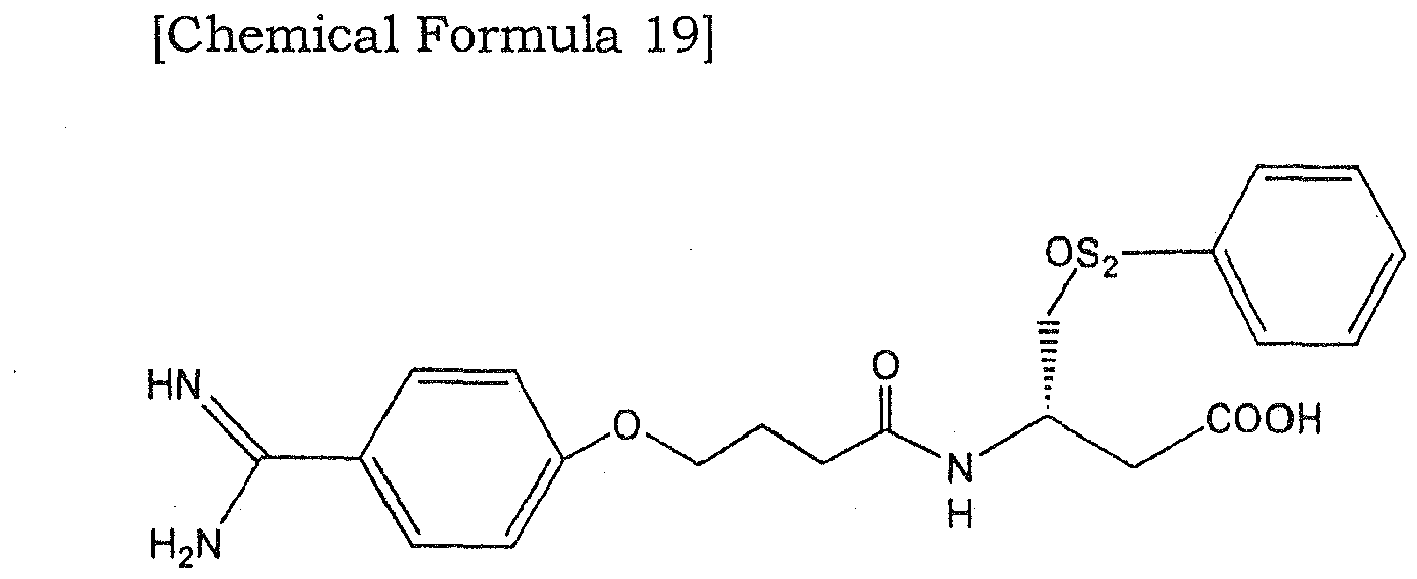
- was produced according to the well known method.
- A compound represented by the formula:
-


- was produced according to the method described in
WO 01/60813 - A compound represented by the formula:

- was produced according to the method described in
WO 01/60813 - A compound represented by the formula:

- was produced according to the method described in
WO 01/60813 - A compound represented by the formula:

- was produced according to the method described in
WO 01/60813 - A compound represented by the formula:

- was produced according to the method described in
WO 01/60813 - A compound represented by the formula:

- was produced according to the method described in
WO 01/60813 - A compound represented by the formula:

- was produced according to the method described in
WO 01/60813 - A compound represented by the formula:

- was produced according to the method described in
WO 01/60813 - A compound represented by the formula:

- was produced according to the well known method.
- A compound represented by the formula:
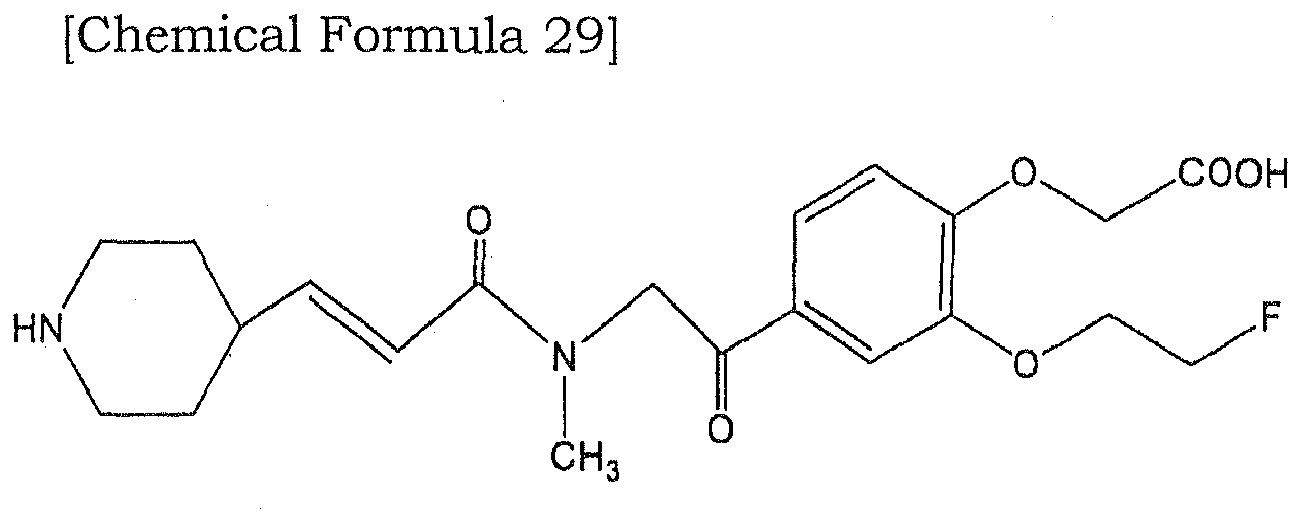
- was produced according to the well known method.
- A compound represented by the formula:

- was produced according to the method described in
WO 01/60813 - A compound represented by the formula:
-


- was produced according to the method described in
WO 01/60818 - A compound represented by the formula:

- was produced according to the method described in
WO 01/60813 - A compound represented by the formula:

WO 01/60813 - A compound represented by the formula:
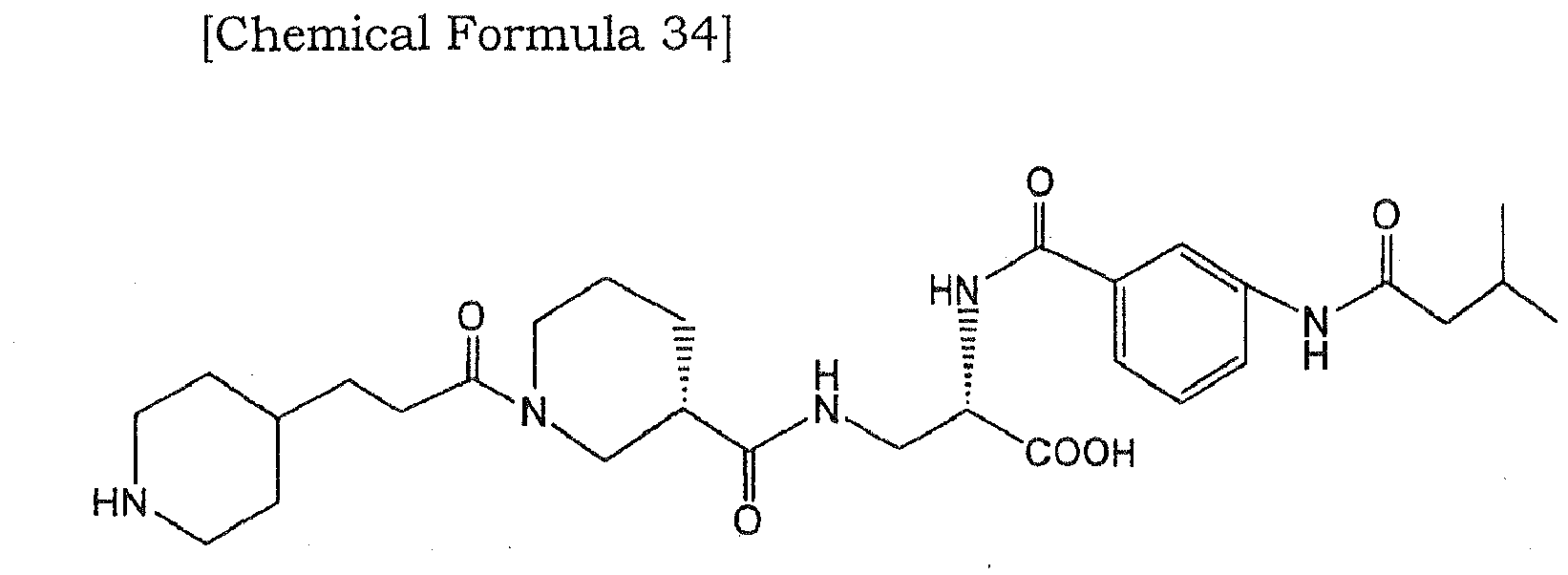
- was produced according to the method described in
WO 01/60813 - The following tests were carried out with compounds prepared in Production Examples 1 to 20. As Reference Examples 1 to 4, Echistatin, which is a venom protein known as binding substance to GPIIb/IIIa, Tirofiban (MK383), Lamifiban (Ro44-9883) and FK633, which are antithrombotic drugs, were used to carry out the following tests as well.
Results are shown in Tables 1-1 to 1-3. - Platelet rich plasma (PRP) containing 3 x 10⁸ platelets/ml was prepared from human blood. To 225 µl of PRP, 25 µl of a solution of the test compound was added and stirred at 37°C for 2 min. To the solution, 5 µl of ADP (final concentration: 2.5 µM) was added as an aggregation inducing agent. Aggregation was measured with aggregometer (NBS HEMA-TRACER 801). The procedure was as follows. Light transmittance of PRP was calibrated to 100%. PRP was incubated in the aggregometer at 37°C for 2 min. ADP was added when full response of the platelet aggregation was obtained, and the change in light transmittance was monitored by PL500 recorder (Yokogawa, Japan). Percent inhibition of aggregation by the test compound was calculated by comparison with the aggregation in the absence of the test compound. The activity of an inducing substance (test compound) is represented as a value of IC50, i.e., a dose required for the complete inhibition of the platelet aggregation.
It shows that the smaller the value from Test 1 is, the higher the binding ability of the test compound toward the active GPIIb/IIIa is. - Venous blood was collected onto sodium citrate. Platelet rich plasma (PRP) was prepared by centrifugation of whole blood. Platelets were washed with modified HEPES-Tyrode's buffer (129 mM NaCl, 2.8 mM KCl, 0.8 mM KH2PO4, 8.9 mM NaHCO3 0.8 mM MgCl2, 10 mM HEPES, 5.5 mM Glucose, 0.1% BSA, pH 7.4) containing 1µM PGE1. After washing, platelets were suspended in modified HEPES-Tyrode's buffer containing 1.0 mM CaCl2 and 1 µM PGE1 and the number of platelet was adjusted.
- Adhesion assay was carried out as follows. 96-well microtiter plates were coated with 1 µg/well of human fibrinogen. The plates were then blocked with 1% BSA. After washing the plates with the buffer, the washed platelets were added to each well in the presence of the test compound or buffer and incubated at 37°C for 30 min. The plates were then washed three times with buffer. The number of adhered cells was determined by measuring the acid phosphatase activity of cells using a microplate reader at 410 nm. Percent inhibition of adhesion in the sample treated with the test compound was calculated by comparison with the adhesion in absence of the test compound. The activity of the test compound was represented by a value of IC50, i.e. a dose required for the complete inhibition of the platelet adhesion.
It shows that the bigger the value from Test 2 is, the lower the binding ability of the test compound toward the resting GPIIb/IIIa is. - The IC50 value (A) obtained in Test 1 and the IC50 value (R) obtained in Test 2 were used to calculate the R/A ratio, and selective binding ability of the test compounds toward the active GPIIb/IIIa was evaluated.
Results are shown in Tables 1-1 to 1-4. - [Table 1-1]
Compound Structure A Inhibition of platelet aggregation IC50 (nM) R Suppression of fibrinogen adhesion IC50 (nM) R/A ratio Ex. 1 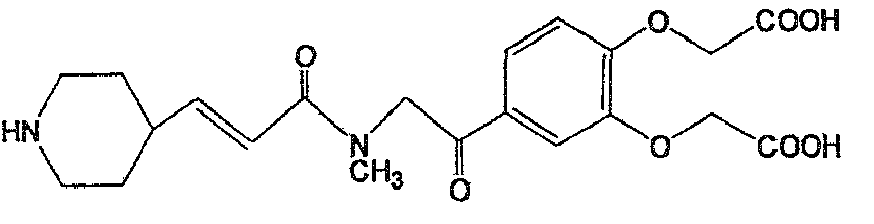
135 7900 59 Ex. 2 
53 298 5. 6 Ex. 3 
73 1350 18 Ex. 4 
260 1630 6. 3 Ex. 5 
80 770 9. 6 Ex. 6 
56 434 7. 8 Ex. 7 
35 533 15 -
[Table 1-2] Compound Structure A Inhibition of platelet aggregation IC50 (nM) R Suppression of fibrinogen adhesion IC50 (nM) R/A ratio Ex. 8 
49 1525 11 Ex. 9 
55 727 13 Ex. 10 
272 2510 9. 2 Ex. 11 
88 479 6. 5 Ex. 12 
791 5160 6. 5 Ex. 13 
817 10600 13 Ex. 14 
291 4050 14 -
[Table 1-3] Compound Structure A Inhibition of platelet aggregation IC50 (nM) R Suppression of fibrinogen adhesion IC50 (nM) R/A ratio Ex. 15 
320 6210 19 Ex. 16 
32. 4 198 6. 1 Ex. 17 
29. 9 486 16 Ex. 18 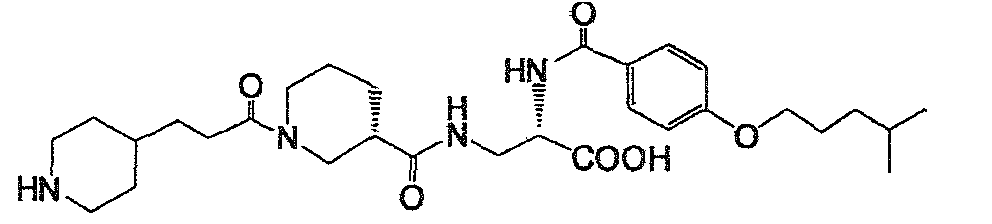
6. 1 48 7. 9 Ex. 9 
9. 1 151 17 Ex. 20 
30 239 8. 0 -
[Table 1-4] Compound Structure A Inhibition of platelet aggregation IC50 (nM) R Suppression of fibrinogen adhesion IC50 (nM) R/A ratio Reference Ex. 1 0.36 µg/ml 0.14 µg/ml 0. 38 Reference Ex. 2 
46 36 0. 78 Reference Ex. 3 
45 80 1. 8 Reference Ex. 4 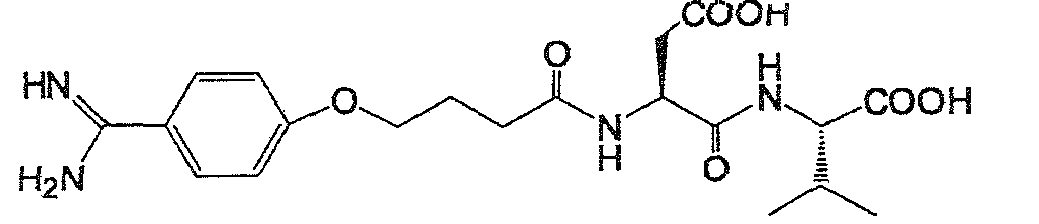
103 1320 13 - As obvious from Tables 1-1 to 1-4, the compounds capable of binding to GPIIb/IIIa for the present contrast medium for thrombus have high R/A values. Therefore, it is shown that it has high selective binding ability toward the active GPIIb/IIIa.
The compounds capable of binding to GPIIb/IIIa used for the present contrast medium for thrombus show lower IC50 values in the inhibitory test of ADP-induced platelet aggregation than IC50 values disclosed in the prior arts. Therefore, it is obvious that these compounds capable of binding to GPIIb/IIIa bind to the GPIIb/IIIa on the surface of the platelets activated by ADP. - To a solution of (2E)-3-[1-(tert-butoxycarbonyl)-4-piperidinyl] acrylic acid (1.6 g, 6.27 mmol), di-tert-butyl 2,2'-[[4-(aminoacetyl)-1,2-phenylene]bis(oxy)]diacetate hydrochloride (2.71 g, 6.27 mmol) represented by the formula:
-

- and bromotripyrrolidionophosphonium hexafluorophosphate (3.42 g, 6.58 mmol) in DMF (10 ml) was added N,N-diisopropylethylamine (2.51 g, 19.1 mmol) dropwise with cooling on an ice bath. The reaction mixture was stirred at 0°C for 20 min and then at room temperature for 30 min. The mixture was concentrated in vacuo, and the residue was partitioned between ethyl acetate and water. The mixture was extracted with ethyl acetate. The organic layer was washed with 0.5N aqueous potassium hydrogen sulfate solution, saturated aqueous sodium bicarbonate solution and saturated aqueous sodium chloride solution, dried over magnesium sulfate, and concentrated in vacuo. The residue was purified by silica gel column chromatography eluted with a mixture of chloroform-ethyl acetate (9:1) to give tert-butyl 4-[(1E)-3-({2-[3,4-bis(2-tert-butoxy-2-oxoethoxy) phenyl]-2-oxoethyl}amino)-3-oxo-1-propen- l-yl]-1-piperidinecarboxylate represented by the formula:

- as an amorphous.
1H-NMR(300MHz, DMSO-d6) δ; 1.18-1.36(2H, m), 1.49(9H, s), 1.53(18H, s), 1.71-1.84(2H, m), 2.32-2.47(1H, m), 2.74-2.99(2H, m), 3.94-4.11(2H, m), 4.71(2H, d, J=5.5Hz), 4.85(2H, s), 4.91(2H, s), 6.14(1H, d, J=15.4Hz), 6.70(1H, dd, J=15.4, 6.2Hz), 7.09(1H, d, J=8.8Hz), 7.49(1H, d, J=2.2Hz), 7.76(1H, dd, J=8.8, 2.2Hz), 8.36(1H, brt, J=5.5Hz); MS(ES+)m/z was not detected. - To a solution of tert-butyl 4-[(1E)-3-({2-[3,4-bis(2-tert-butoxy-2-oxoethoxy)phenyl]-2-oxoethyl}amino)-3-oxo-1-propen-1-yl]-1-piperidi necarboxylate (3.6 g, 5.69 mmol) and tert-butyldimethylsilyl chloride (1.29 g, 8.53 mmol) in CH2Cl2 (10 ml) was added 1,8-diazabicyclo[5.4.0]undec-7-ene (1.47 g, 9.67 mmol) dropwise with cooling on an ice bath. The reaction mixture was stirred at room temperature for 2 hours and concentrated in vacuo, and the residue was partitioned between ethyl acetate and water. The mixture was extracted with ethyl acetate. The organic layer was washed with 1N aqueous hydrogen chloride solution, saturated aqueous sodium bicarbonate solution and saturated aqueous sodium chloride solution, dried over magnesium sulfate, and concentrated in vacuo. The residue was purified by silica gel column chromatography eluted with a mixture of hexane-ethyl acetate (4: 1) to give 4-{(1E)-3-[((Z)-2-[3,4-bis(2-tert-butoxy-2-oxoethoxy)phenyl]-2-{[tert-butyl(dimethyl)silyl]oxy}vinyl)amino]-3-oxo-1-propen-1-yl}-1-piperidinecarboxylate represented by the formula:
-


- as an amorphous.
1H-NMR(300MHz, DMSO-d6) δ; 0.02-0.08(6H, m), 0.98(9H, s), 1.15-1.30(2H, m), 1.43(9H, s), 1.44(9H, s), 1.46(9H, s), 1.61-1.78(2H, m), 2.27-2.48(1H, m), 2.68-2.91(2H, m), 3.88-4.04(2H, m), 4.70(2H, s), 4.72(2H, s), 6.23(1H, d, J=15.8Hz), 6.71(1H, d, J=6.2Hz), 6.76(1H, d, J=6.2Hz), 6.85-6.94(2H, m), 7.01(1H, dd, J=8.1, 1.8Hz); MS(ES+)m/z was not detected. - To a solution of 4-{(1E)-3-[((Z)-2-[3,4-bis(2-tert-butoxy-2-oxoethoxy)phenyl]-2-{[tert-butyl(dimethyl)silyl]oxy}vinyl)amino]-3-oxo-1-propen-1-yl}-1- piperidinecarboxylate in DMF (2 ml) was added sodium hydride (17.7 mg, 736 mmol) portionwise with cooling on an ice bath and stirred at 0°C for 5 min. Then [11C]CH3I (105 mg, 736 mmol) was added to the reaction mixture at the same temperature, and the mixture was stirred for 5 min and stirred at room temperature for 5 min. The mixture was partitioned between ethyl acetate and phosphate buffer standard solution (pH 6.86). The mixture was extracted with ethyl acetate. The organic layer was washed with water and saturated aqueous sodium chloride solution, dried over magnesium sulfate, and concentrated in vacuo. The residue was purified by silica gel column chromatography eluted with a mixture of hexane-ethyl acetate (1:1) to give 4{(1E)-3-[((Z)-2-[3,4-bis(2-tert-butoxy-2-oxoethoxy)phenyl]-2-{[tert-butyl(dimethyl)silyl]oxy}vinyl) ([11C]methyl)amino]-3-oxo-1-propen-1-yl}-1-piperidinecarboxylate represented by the formula:

- as an amorphous.
- To a mixture of trifluoroacetic acid (TFA; 1 ml) and CH2Cl2 (1 ml) was added 4{(1E)-3-[((Z)-2-[3,4-bis(2-tert-butoxy-2-oxoethoxy) phenyl]-2-{[tert-butyl(dimethyl) silyl]oxy}vinyl) ([11C]methyl)amino]-3-oxo-1-propen-1-yl}-1-piperidinecarboxylate in CH2Cl2 (0.5 ml) dropwise with cooling on an ice bath. The reaction mixture was stirred at room temperature for 30 min. The mixture was concentrated in vacuo and the residue was purified by ODS chromatography eluted with a mixture of acetonitrile-water (10:1) to give 2,2'-[[4-({[11C]methyl[(2E)-3-(4-piperidinyl)-2-propenoyl]amino}acetyl)-1,2-phenylene]bis(oxy)]diacetic acid trifluoroacetate represented by the formula:

- as an amorphous.
- A solution of the compound prepared in Production Example 15 (13.0 mg, 30 µmol) in acetonitrile (1.5 ml) was added to a solution of [18F]- ion. The mixture was heated at 85°C for 20 min. After the mixture was cooled to room temperature, 4M HCl (1.0 ml) was added. The mixture was heated at 100°C for 10 min. Thus obtained mixture was loaded on an HPLC column (YMC-Pack C18 Pro, 10 x 250 mm, YMC Co., Ltd, Japan) eluted with 0.1% acetonitrile-0.05M NH4OAc to give the contrast medium for thrombus labeled with [18F].
- Kinetics of the labeled compounds in the body of monkey (Macaca fascicularis) was studied by using the contrast mediums labeled with [11C] and [18F] prepared in Production Examples 21 and 22, respectively.
According to the canine saphenous vein (which is formed with a confluence of dorsal digital veins of hallux and arcuate veins of foot, and ascends in front of a medial malleolus and behind of a medial condyle of femur, crosses a saphenous opening of patellar retinaculum and pour into a femoral vein over a femoral triangle) thrombosis model (Knight L.C. et al., Thromb Haemost., 1998, 80, p.845-851 and Lister-James L. et al., J. Nucl Med. 1996, 37, p.775-781), a platinum embolization coil (Boston Scientific Japan) was inserted and placed in the right femoral vein of the monkey while anesthetized and wound was sutured. - Three hours after the insertion of the coil, the contrast mediums prepared in Production Examples 21 and 22, respectively, were administered intravenously (740 MBq/2 ml-saline). Imaging was performed for 90 min with a high-resolution positron emission tomography (PET) scanner (SHR-7700, Hamamatsu Photonics K.K., Japan). After PET measurement, the coil was removed, and the right femoral vein was collected to obtain a thrombus sample. Thigh muscle was collected, and saphenous artery was punctured to collect an arterial blood sample. The thrombus, thigh muscle and arterial blood samples were weighed and their radioactivity was measured with gamma counter (1480 WIZARD, Wallac Oy, Finland).
Results are shown in the Table 2 below. Data was calculated as percent of injected dose (%ID/kg/g). -
[Table 2] Accumulation of radioactivity at thrombus, blood and muscle at 90 min after the administration of the contrast medium in monkey thrombus model Contrast medium Thrombus (%ID/g/kg) Blood (%ID/g/kg) Muscle (%ID/g/kg) Thrombus/Blood ratio Thrombus/Muscle ratio Production Ex. 21 ([11C]label) 1.902±1.132 0.084±0.012 0.021±0.005 24.2±17.9 94.8±65.0 Production Ex. 22 ([18F]label) 0.208±0.028 0.043±0.004 0.013±0.002 4.8±0.8 16.3±2.7 - As observed from Table 2, the contrast mediums of Production Example 21 and 22 were accumulated in the thrombus with the ratio of approximately 24-fold and 4.8-fold (relative to blood) as well as approximately 95-fold and 16-fold (relative to muscle), respectively. Therefore, the contrast medium for thrombus of the present invention is demonstrated to specifically bind to the thrombus.
Moreover, it was possible to carry out the PET imaging of thrombus with low background noise and high resolution.
Claims (3)
- A contrast medium for thrombus which comprises, as an active substance, a substance obtained by labeling a compound capable of binding to glycoprotein IIb/IIIa or a physiologically acceptable salt thereof with a positron emitting isotope 11C, the compound being represented by the general formula (IV):

- A compound represented by the general formula (IV):

or a physiologically acceptable salt thereof. - The contrast medium for thrombus according to claim 1, wherein the contrast medium for thrombus is detected by using by positron emission tomography.
Applications Claiming Priority (2)
| Application Number | Priority Date | Filing Date | Title |
|---|---|---|---|
| JP2004049996 | 2004-02-25 | ||
| EP05703547A EP1719529A4 (en) | 2004-02-25 | 2005-01-13 | CONTRAST PRODUCT FOR THE FORMATION OF A THROMBUS |
Related Parent Applications (1)
| Application Number | Title | Priority Date | Filing Date |
|---|---|---|---|
| EP05703547.9 Division | 2005-01-13 |
Publications (1)
| Publication Number | Publication Date |
|---|---|
| EP2404899A1 true EP2404899A1 (en) | 2012-01-11 |
Family
ID=34879569
Family Applications (2)
| Application Number | Title | Priority Date | Filing Date |
|---|---|---|---|
| EP11184147A Withdrawn EP2404899A1 (en) | 2004-02-25 | 2005-01-13 | Contrast medium for thrombus detection |
| EP05703547A Withdrawn EP1719529A4 (en) | 2004-02-25 | 2005-01-13 | CONTRAST PRODUCT FOR THE FORMATION OF A THROMBUS |
Family Applications After (1)
| Application Number | Title | Priority Date | Filing Date |
|---|---|---|---|
| EP05703547A Withdrawn EP1719529A4 (en) | 2004-02-25 | 2005-01-13 | CONTRAST PRODUCT FOR THE FORMATION OF A THROMBUS |
Country Status (5)
| Country | Link |
|---|---|
| US (1) | US20070189970A1 (en) |
| EP (2) | EP2404899A1 (en) |
| JP (1) | JP4910695B2 (en) |
| CA (1) | CA2558064A1 (en) |
| WO (1) | WO2005079863A1 (en) |
Families Citing this family (3)
| Publication number | Priority date | Publication date | Assignee | Title |
|---|---|---|---|---|
| KR20080031383A (en) * | 2005-07-05 | 2008-04-08 | 베이커 메디컬 리서치 인스티튜트 | Anticoagulants and Their Uses |
| HRP20170464T1 (en) * | 2011-08-17 | 2017-05-19 | Piramal Imaging Sa | Compounds for binding to the platelet specific glycoprotein iib/iiia and their use for imaging of thrombi |
| EP2956461A1 (en) | 2013-02-12 | 2015-12-23 | Bayer Pharma Aktiengesellschaft | Metal chelate compounds for binding to the platelet specific glycoprotein iib/iiia |
Citations (10)
| Publication number | Priority date | Publication date | Assignee | Title |
|---|---|---|---|---|
| EP0641770A1 (en) * | 1993-03-17 | 1995-03-08 | Meiji Seika Kabushiki Kaisha | Novel compound with platelet aggregation inhibitor activity |
| WO1995008536A1 (en) | 1993-09-22 | 1995-03-30 | Fujisawa Pharmaceutical Co., Ltd. | N-(3-piperidinylcarbonyl)-beta-alanine derivatives as paf antagonists |
| WO1995025091A2 (en) | 1994-03-16 | 1995-09-21 | Ortho Pharmaceutical Corporation | Nipecotic acid derivatives as antithrombic compounds |
| WO1996029309A1 (en) | 1995-03-17 | 1996-09-26 | Fujisawa Pharmaceutical Co., Ltd. | N-ACYLPIPERIDINYLCARBONYLAMINOCARBOXYLIC ACIDS AND THEIR USE AS GLYCOPROTEIN IIB/IIa ANTAGONISTS AND FIBRINOGEN-BLOOD PLATELETS BINDING INHIBITORS |
| WO1997033869A1 (en) | 1996-03-13 | 1997-09-18 | Fujisawa Pharmaceutical Co., Ltd. | N-[(r)-1-{3-(4-piperidyl)propionyl-3-piperidylcarbonyl]-2(s)-acetylamino-beta-alanine as fibrinogen receptor antagonist |
| WO1997041102A1 (en) | 1996-05-01 | 1997-11-06 | Ortho Pharmaceutical Corporation | Carboxamide derivatives of pyrrolidine, piperidine and hexahydroazepine for the treatment of thrombosis disorders |
| WO1997047329A2 (en) * | 1996-06-10 | 1997-12-18 | G.D. Searle & Co. | Radiopharmaceutical compositions capable of localizing at sites of thrombus |
| WO1999021832A2 (en) | 1997-10-29 | 1999-05-06 | Ortho-Mcneil Pharmaceutical, Inc. | Orally-active nipecotamide glycolamide esters for the treatment of thrombosis disorders |
| WO2000021932A1 (en) | 1998-10-12 | 2000-04-20 | Fujisawa Pharmaceutical Co., Ltd. | NEW PROCESSES FOR PRODUCING β-ALANINE DERIVATIVE |
| WO2001060813A1 (en) | 2000-02-17 | 2001-08-23 | Fujisawa Pharmaceutical Co., Ltd. | Beta-alanine derivatives and their use as receptor antagonists |
Family Cites Families (8)
| Publication number | Priority date | Publication date | Assignee | Title |
|---|---|---|---|---|
| US5084466A (en) * | 1989-01-31 | 1992-01-28 | Hoffmann-La Roche Inc. | Novel carboxamide pyridine compounds which have useful pharmaceutical utility |
| US5726192A (en) * | 1992-12-29 | 1998-03-10 | Smithkline Beecham Corporation | Platelet aggregation inhibiting compounds |
| US5879657A (en) * | 1993-03-30 | 1999-03-09 | The Dupont Merck Pharmaceutical Company | Radiolabeled platelet GPIIb/IIIa receptor antagonists as imaging agents for the diagnosis of thromboembolic disorders |
| KR100295353B1 (en) * | 1994-07-11 | 2001-09-17 | 후지야마 아키라 | Beta-alanine derivatives and preparation methods thereof |
| WO1996040250A2 (en) * | 1995-06-07 | 1996-12-19 | Centocor, Inc. | Platelet-specific chimeric immunoglobulin and methods of use therefor |
| US6171578B1 (en) * | 1999-04-14 | 2001-01-09 | Diatide, Inc. | Benzodiazepine derivatives for imaging thrombi |
| RU2324686C2 (en) * | 2000-08-24 | 2008-05-20 | Юнивесити Оф Питсбэг | AMYLOID-BINDING THIOFLAVIN DERIVATIVES, METHOD OF in vivo DETECTION OF AMYLOID DEPOSIT AND METHOD OF DIAGNOSTICS OF ALZHEIMER'S DISEASE |
| AU2002248222B2 (en) * | 2000-12-23 | 2006-04-27 | Dyax Corp. | Fibrin binding polypeptides useful inter alia in medical imaging processes |
-
2005
- 2005-01-13 CA CA002558064A patent/CA2558064A1/en not_active Abandoned
- 2005-01-13 JP JP2006510171A patent/JP4910695B2/en not_active Expired - Fee Related
- 2005-01-13 EP EP11184147A patent/EP2404899A1/en not_active Withdrawn
- 2005-01-13 EP EP05703547A patent/EP1719529A4/en not_active Withdrawn
- 2005-01-13 WO PCT/JP2005/000308 patent/WO2005079863A1/en not_active Ceased
- 2005-01-13 US US10/590,295 patent/US20070189970A1/en not_active Abandoned
Patent Citations (10)
| Publication number | Priority date | Publication date | Assignee | Title |
|---|---|---|---|---|
| EP0641770A1 (en) * | 1993-03-17 | 1995-03-08 | Meiji Seika Kabushiki Kaisha | Novel compound with platelet aggregation inhibitor activity |
| WO1995008536A1 (en) | 1993-09-22 | 1995-03-30 | Fujisawa Pharmaceutical Co., Ltd. | N-(3-piperidinylcarbonyl)-beta-alanine derivatives as paf antagonists |
| WO1995025091A2 (en) | 1994-03-16 | 1995-09-21 | Ortho Pharmaceutical Corporation | Nipecotic acid derivatives as antithrombic compounds |
| WO1996029309A1 (en) | 1995-03-17 | 1996-09-26 | Fujisawa Pharmaceutical Co., Ltd. | N-ACYLPIPERIDINYLCARBONYLAMINOCARBOXYLIC ACIDS AND THEIR USE AS GLYCOPROTEIN IIB/IIa ANTAGONISTS AND FIBRINOGEN-BLOOD PLATELETS BINDING INHIBITORS |
| WO1997033869A1 (en) | 1996-03-13 | 1997-09-18 | Fujisawa Pharmaceutical Co., Ltd. | N-[(r)-1-{3-(4-piperidyl)propionyl-3-piperidylcarbonyl]-2(s)-acetylamino-beta-alanine as fibrinogen receptor antagonist |
| WO1997041102A1 (en) | 1996-05-01 | 1997-11-06 | Ortho Pharmaceutical Corporation | Carboxamide derivatives of pyrrolidine, piperidine and hexahydroazepine for the treatment of thrombosis disorders |
| WO1997047329A2 (en) * | 1996-06-10 | 1997-12-18 | G.D. Searle & Co. | Radiopharmaceutical compositions capable of localizing at sites of thrombus |
| WO1999021832A2 (en) | 1997-10-29 | 1999-05-06 | Ortho-Mcneil Pharmaceutical, Inc. | Orally-active nipecotamide glycolamide esters for the treatment of thrombosis disorders |
| WO2000021932A1 (en) | 1998-10-12 | 2000-04-20 | Fujisawa Pharmaceutical Co., Ltd. | NEW PROCESSES FOR PRODUCING β-ALANINE DERIVATIVE |
| WO2001060813A1 (en) | 2000-02-17 | 2001-08-23 | Fujisawa Pharmaceutical Co., Ltd. | Beta-alanine derivatives and their use as receptor antagonists |
Non-Patent Citations (3)
| Title |
|---|
| KNIGHT L.C. ET AL., THROMB HAEMOST., vol. 80, 1998, pages 845 - 851 |
| LISTER-JAMES L. ET AL., J. NUCL MED., vol. 37, 1996, pages 775 - 781 |
| MUTO P. ET AL., J. NUCL MED., vol. 36, 1995, pages 1384 - 1391 |
Also Published As
| Publication number | Publication date |
|---|---|
| EP1719529A1 (en) | 2006-11-08 |
| WO2005079863A1 (en) | 2005-09-01 |
| JPWO2005079863A1 (en) | 2008-01-10 |
| EP1719529A4 (en) | 2008-05-21 |
| JP4910695B2 (en) | 2012-04-04 |
| CA2558064A1 (en) | 2005-09-01 |
| US20070189970A1 (en) | 2007-08-16 |
Similar Documents
| Publication | Publication Date | Title |
|---|---|---|
| ES2621379T3 (en) | Compounds for platelet specific glycoprotein IIb / IIIa binding and their use for thrombus imaging | |
| KR100932827B1 (en) | Peptide Compound | |
| RU2194038C2 (en) | Carboxamide derivatives of pyrrolidine or piperidine, pharmaceutical composition based on thereof and method of inhibition of platelet aggregation | |
| JP4220897B2 (en) | Piperazine compounds | |
| JP6164556B2 (en) | Drug for producing radiolabeled polypeptide with reduced nonspecific renal accumulation | |
| US20020193312A1 (en) | Carbamyloxy compounds which inhibit leukocyte adhesion mediated by VLA-4 | |
| US6410781B1 (en) | α-aminoacetic acid derivatives-α4β7 receptor antagonists | |
| FI113763B (en) | Nipecotinic acid derivatives as antithrombic agents | |
| CA2900595A1 (en) | Metal chelate compounds for binding to the platelet specific glycoprotein iib/iiia | |
| CN109096219B (en) | Novel anti-PD-L1 compound, application thereof and composition containing same | |
| JP4910695B2 (en) | Thrombus contrast agent | |
| US20220194930A1 (en) | Matrix Metalloproteinase Inhibitors and Imaging Agents, And Methods Using Same | |
| JP2009500410A (en) | Hydrazide conjugates as imaging agents | |
| CA2745364A1 (en) | Radioisotope-labeled lysine and ornithine derivatives, their use and processes for their preparation | |
| EP1121377A1 (en) | Chelator incorporated arg-gly-asp (rgd) mimetic synthetic disintegrins as imaging agents | |
| ES2248737T3 (en) | COMPOUNDS 1- (D-CICLOPROPILGLICINIL) -4- (PIPERIDIN-4-IL) PIPERAZINE AS INHIBITORS OF THE XA FACTOR OF THE SERINE PROTEASE. | |
| EP4122500A1 (en) | Thrombus imaging radiopharmaceutical and composition | |
| US6132697A (en) | Radiopharmaceutical compositions capable of localizing at sites of thrombus | |
| Halik | Kozmi nski, P.; Lipi nski, PFJ; Gniazdowska, E.; Misicka, A. Novel NK1R-targeted 68Ga-/177Lu-radioconjugates with potential application against glioblastoma multiforme: Preliminary exploration of structure–activity relationships | |
| JP4842254B2 (en) | PAR-2 agonist | |
| WO2024026262A1 (en) | Substituted pyrazolyl-pyridinyl compounds as ligand directed degraders of irak3 | |
| HK1197064B (en) | Compounds for binding to the platelet specific glycoprotein iib/iiia and their use for imaging of thrombi | |
| Fawwaz et al. | Synthesis and preclinical evaluation of a molecular probe for imaging lung cancer with L858R/T790M mutation of EGFR |
Legal Events
| Date | Code | Title | Description |
|---|---|---|---|
| AC | Divisional application: reference to earlier application |
Ref document number: 1719529 Country of ref document: EP Kind code of ref document: P |
|
| AK | Designated contracting states |
Kind code of ref document: A1 Designated state(s): DE ES FR GB IT |
|
| PUAI | Public reference made under article 153(3) epc to a published international application that has entered the european phase |
Free format text: ORIGINAL CODE: 0009012 |
|
| STAA | Information on the status of an ep patent application or granted ep patent |
Free format text: STATUS: THE APPLICATION HAS BEEN WITHDRAWN |
|
| 17P | Request for examination filed |
Effective date: 20120619 |
|
| 18W | Application withdrawn |
Effective date: 20120704 |