EP2403194A1 - Method and apparatus for aggregated packet switching - Google Patents
Method and apparatus for aggregated packet switching Download PDFInfo
- Publication number
- EP2403194A1 EP2403194A1 EP10290355A EP10290355A EP2403194A1 EP 2403194 A1 EP2403194 A1 EP 2403194A1 EP 10290355 A EP10290355 A EP 10290355A EP 10290355 A EP10290355 A EP 10290355A EP 2403194 A1 EP2403194 A1 EP 2403194A1
- Authority
- EP
- European Patent Office
- Prior art keywords
- packet
- packets
- container
- node
- data packets
- Prior art date
- Legal status (The legal status is an assumption and is not a legal conclusion. Google has not performed a legal analysis and makes no representation as to the accuracy of the status listed.)
- Granted
Links
- 238000000034 method Methods 0.000 title claims abstract description 17
- 230000002776 aggregation Effects 0.000 claims description 12
- 238000004220 aggregation Methods 0.000 claims description 12
- 230000005540 biological transmission Effects 0.000 claims description 5
- 230000008569 process Effects 0.000 description 5
- 238000010586 diagram Methods 0.000 description 2
- 235000003642 hunger Nutrition 0.000 description 2
- 230000037351 starvation Effects 0.000 description 2
- 230000008901 benefit Effects 0.000 description 1
- 230000003139 buffering effect Effects 0.000 description 1
- 238000005538 encapsulation Methods 0.000 description 1
- 239000012634 fragment Substances 0.000 description 1
- 230000010354 integration Effects 0.000 description 1
- 230000007246 mechanism Effects 0.000 description 1
- 230000004043 responsiveness Effects 0.000 description 1
- 230000007704 transition Effects 0.000 description 1
Images
Classifications
-
- H—ELECTRICITY
- H04—ELECTRIC COMMUNICATION TECHNIQUE
- H04L—TRANSMISSION OF DIGITAL INFORMATION, e.g. TELEGRAPHIC COMMUNICATION
- H04L49/00—Packet switching elements
- H04L49/90—Buffering arrangements
Definitions
- the present invention relates to the field of telecommunications and more particularly to a method and related apparatus for switching packets in an aggregated manner.
- Packet switching technology is increasing in modern telecommunications networks.
- Drivers are the packet based customer networks and the increasing popularity of the Internet.
- Transport (or core) networks which traditionally relied on circuit switching technology, will hence have to implement packet switching technology, too.
- the line rates in customer networks as well as in the access networks are increasing due to the increasing data volumes exchanged through video or other bandwidth hungry applications.
- the need to reduce transmission delay for time critical applications and the end-to-end acknowledgment mechanisms used in the TCP/IP protocol stack lead to a high amount of small size packets.
- the packet header processing effort is increasing even more than proportional with the line rate, which creates a scalability problem for future packet node design and leads to high power consumption.
- packets are collected at the edge of the core network into larger transport containers of approximately 9 to 16 kBytes.
- the containers are switched through the frame switched core network as undividable entities.
- the frequency of frames can be reduced by a factor of 100 and more.
- the installed processing power in the core nodes can be relaxed accordingly, while the flexibility and responsiveness to changing traffic conditions remains the same as for a packet network.
- a network node of such a frame switching network is incompatible to the existing packet network infrastructure.
- a devices referred to as Frame Aggregation Unit (FAU) at ingress and egress of the core network is mandatory.
- FAU Frame Aggregation Unit
- a method and related network node for switching data packets through a network in an aggregated manner.
- Data packets from various packet sources sharing a common egress node are assembled at an assembly edge node into a larger size container.
- Address information indicative of said common egress node is added to each container.
- Each container is then switched through the network to the common egress node in accordance with the address information added.
- the packets are extracted again from the container and forwarded in accordance with packet addresses contained in each data packet.
- containers are formed by assembling the data packets into a chain of packets, each having a valid packet line code and adding an additional header packet to the chain of packets, wherein the header packet contains the address information as well as information indicative of the length of the subsequent packet chain.
- downstream nodes are hence free to make use of this information or not.
- Downstream nodes which are capable of "virtual" frame switching, can make use of the header packet and process the whole chain of packets at once.
- the header packet is simply dropped.
- Packet switching nodes which are not adapted for virtual frame switching, would recognize the header packet as unknown or invalid and hence simply drop the header packet.
- the following embodiment is based on assembling data packets to larger size frames or containers.
- the frame assembly process puts packets back-to-back without intermediate gaps into larger containers.
- the network then forwards these containers individually in a store and forward, packet-switched manner exploiting potential multiplexing gains.
- Container frame forwarding within the core network requires a routable address, e.g. IP address, or a path identifier identifying a pre-configured label switched path (LSP). Such address information is transported within a header section of each container.
- IP address e.g. IP address
- LSP label switched path
- the key element in a frame switched network is the assembly edge node (AEN), which assembles packets to frames.
- AEN assembly edge node
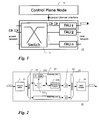
- Figure 1 shows a functional architecture of an assembly edge node.
- the AEN 10 in figure 1 contains two independent functions: switching and assembly for switching of traffic flows and assembly of aggregated traffic, respectively.
- a switch 11 connects packet interfaces from an access network with a number of Frame Assembly Units FAU1-FAUn, which connect to the frame switched core network.
- a control plane node 12 controls and configures the AEN and serves set to up label switched paths through the core network using the traffic engineering protocols of the well known GMPLS protocol suite.
- Packets received on the left hand side of figure 1 are switched by switch 11 to different frame aggregation units FAU1-FAUn in accordance with routing information contained in each packet.
- the frame aggregation units aggregate received packets to into frames and add routing information for each frame and forward the frames to the core network on the right hand side.
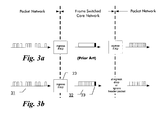
- FIG. 2 shows the functional architecture of the FAU's ingress direction.
- a classifier 21 classifies incoming packets according to destination egress AEN and CoS class and assigns them to a corresponding internal Forwarding Equivalent Class (FEC).
- the subsequent assembly stage assembles packets of the same FEC to frames using one assembly unit 23 per FEC. Therefore, a queue 231 in the corresponding assembly unit 23 collects arriving packet data.
- the control block 232 monitors the FIFO fill level and triggers a frame generation when exceeding the threshold. A packet arrival into an empty FIFO starts a timer to avoid starvation. Upon timeout, the assembly unit 23 generates a frame irrespective of the amount of available packet data.
- a padding generator (not shown) may append padding if the amount of collected packet data is below the minimum frame size.
- a buffering stage 24 stores frames ready for transmission in case of congestion, while a following scheduler 25 handles the frames according to their Class of Service (CoS).
- a MAC encapsulation stage 26 finalizes the frame for transmission by adding layer 2 headers and trailers, e.g. using Ethernet encoding.
- a new "virtual" frame format is proposed.
- the frame format is reduced to just an additional header packet.
- This header packet indicates that the following N packets could be treated as an undividable whole.
- the individual packets are valid packet line code that would be recognized as individual stand-alone packets, too. Downstream nodes are hence free to make use of this information or not.
- the header packet has also a valid packet line code, however, contains an indication that indentifies it as a header packet. Moreover, a packet switching node, which is not adapted for frame switching, would recognize the header packet as unknown or invalid and hence simply drop the header packet.
- the ingress node of figure 2 accumulates packets in its frame assembly stage per egress destination and quality class. As soon as sufficient packet volume is assembled (or the starvation timer lapsed), it forwards the whole chain of packets. The whole chain of packets is then switched through the core network according to the header packet at the beginning of the chain. At an egress node of the core network, the header packet is simply dropped. In the access network, packet forwarding continues according to the packet headers as usual.
- Figures 3a and b show a comparison between the known frame switching with opaque frames and the present concept of virtual frames as proposed in the present embodiment.
- FIG 3a shows traditional frame switching with opaque frames.
- the payload packets can be revealed only by special purpose egress Frame Aggregation Unit (FAU).
- FAU Frame Aggregation Unit
- the frame switched network does not see the payload packets inside the frame.
- figure 3b shows virtual frames 32.
- the packets 31 in the frame are tied together by the declaration in the header packet 33.
- Network nodes capable of virtual frame switching can make use of the header packet 33 and process the whole chain of packets at once. Nevertheless the individual packets 31 are valid packet line code that would be recognized stand-alone, too.
- the header packet 33 is removed, either intentionally by a virtual frame switching aware node recognizing that it shall act as edge node, or implicitly by an "unknown packet type" drop in a legacy packet node.
Landscapes
- Engineering & Computer Science (AREA)
- Computer Networks & Wireless Communication (AREA)
- Signal Processing (AREA)
- Data Exchanges In Wide-Area Networks (AREA)
Abstract
Description
- The present invention relates to the field of telecommunications and more particularly to a method and related apparatus for switching packets in an aggregated manner.
- Packet switching technology is increasing in modern telecommunications networks. Drivers are the packet based customer networks and the increasing popularity of the Internet. Transport (or core) networks, which traditionally relied on circuit switching technology, will hence have to implement packet switching technology, too.
- On the other hand, the line rates in customer networks as well as in the access networks are increasing due to the increasing data volumes exchanged through video or other bandwidth hungry applications. Furthermore, the need to reduce transmission delay for time critical applications and the end-to-end acknowledgment mechanisms used in the TCP/IP protocol stack lead to a high amount of small size packets. Studies have shown that about 50 % of all packets have a packet size smaller than 100 Bytes. All this contributes to an increasing switching density in the network and requires huge processing power for packet header processing. In particular, the packet header processing effort is increasing even more than proportional with the line rate, which creates a scalability problem for future packet node design and leads to high power consumption.
- A solution to this scalability issue is known as frame aggregation or frame switching. The conference article "Frame Assembly in Packet Core Networks - Overview and Experimental Results" by W. Lautenschläger at al, 10th ITG Symposium on Photonic Networks, Leipzig May 4/5, 2009, which is incorporated by reference herein, discusses frame switching technology and presents promising experimental results.
- In essence, packets are collected at the edge of the core network into larger transport containers of approximately 9 to 16 kBytes. The containers are switched through the frame switched core network as undividable entities. Compared to the original packet traffic, which is of 64 Bytes packets in the worst case, the frequency of frames can be reduced by a factor of 100 and more. The installed processing power in the core nodes can be relaxed accordingly, while the flexibility and responsiveness to changing traffic conditions remains the same as for a packet network.
- A network node of such a frame switching network is incompatible to the existing packet network infrastructure. For the transition between both network types, a devices referred to as Frame Aggregation Unit (FAU) at ingress and egress of the core network is mandatory. To benefit from frame switching, at least a frame switching island network of reasonable size needs to be introduced at once. This prevents operators from stepwise investments into frame switching technology.
- It is therefore an object of the present invention, to provide a method and related network node for switching packets in an aggregated form, which allows a stepwise introduction into existing packet networks.
- These and other objects that appear below are achieved by a method and related network node for switching data packets through a network in an aggregated manner. Data packets from various packet sources sharing a common egress node are assembled at an assembly edge node into a larger size container. Address information indicative of said common egress node is added to each container. Each container is then switched through the network to the common egress node in accordance with the address information added. At the common egress node, the packets are extracted again from the container and forwarded in accordance with packet addresses contained in each data packet. According to the present embodiments, containers are formed by assembling the data packets into a chain of packets, each having a valid packet line code and adding an additional header packet to the chain of packets, wherein the header packet contains the address information as well as information indicative of the length of the subsequent packet chain.
- Since the individual packets are coded using valid packet line code that would be recognized as individual stand-alone packets, too, downstream nodes are hence free to make use of this information or not. Downstream nodes, which are capable of "virtual" frame switching, can make use of the header packet and process the whole chain of packets at once. At an egress node of the core network, the header packet is simply dropped. Packet switching nodes, which are not adapted for virtual frame switching, would recognize the header packet as unknown or invalid and hence simply drop the header packet.
- Preferred embodiments of the present invention will now be described with reference to the accompanying drawings in which
- figure 1
- shows a block diagram of an assembly edge node for a frame switched network;
- figure 2
- shows a block diagram of a frame aggregation unit used in an assembly egde node; and
- figures 3a and b
- show a comparison between frame switching according to the prior art (
figure 3a ) and in accordance with the present embodiment (figure 3b ). - The following embodiment is based on assembling data packets to larger size frames or containers. The frame assembly process puts packets back-to-back without intermediate gaps into larger containers. The network then forwards these containers individually in a store and forward, packet-switched manner exploiting potential multiplexing gains.
- Container frame forwarding within the core network requires a routable address, e.g. IP address, or a path identifier identifying a pre-configured label switched path (LSP). Such address information is transported within a header section of each container.
- The key element in a frame switched network is the assembly edge node (AEN), which assembles packets to frames.
Figure 1 shows a functional architecture of an assembly edge node. - The AEN 10 in
figure 1 contains two independent functions: switching and assembly for switching of traffic flows and assembly of aggregated traffic, respectively. In particular, aswitch 11 connects packet interfaces from an access network with a number of Frame Assembly Units FAU1-FAUn, which connect to the frame switched core network. Acontrol plane node 12 controls and configures the AEN and serves set to up label switched paths through the core network using the traffic engineering protocols of the well known GMPLS protocol suite. - Packets received on the left hand side of
figure 1 are switched byswitch 11 to different frame aggregation units FAU1-FAUn in accordance with routing information contained in each packet. The frame aggregation units aggregate received packets to into frames and add routing information for each frame and forward the frames to the core network on the right hand side. -
Figure 2 shows the functional architecture of the FAU's ingress direction. From left to right, aclassifier 21 classifies incoming packets according to destination egress AEN and CoS class and assigns them to a corresponding internal Forwarding Equivalent Class (FEC). The subsequent assembly stage assembles packets of the same FEC to frames using oneassembly unit 23 per FEC. Therefore, aqueue 231 in thecorresponding assembly unit 23 collects arriving packet data. In every assembly unit, thecontrol block 232 monitors the FIFO fill level and triggers a frame generation when exceeding the threshold. A packet arrival into an empty FIFO starts a timer to avoid starvation. Upon timeout, theassembly unit 23 generates a frame irrespective of the amount of available packet data. In case of fixed size frames, the assembly stage fragments packets to fill frames completely. A padding generator (not shown) may append padding if the amount of collected packet data is below the minimum frame size. Before concatenation to one continuous data block, meta information is added atcircuit 233 to enable packet delineation in egress direction. - A
buffering stage 24 stores frames ready for transmission in case of congestion, while a followingscheduler 25 handles the frames according to their Class of Service (CoS). AMAC encapsulation stage 26 finalizes the frame for transmission by addinglayer 2 headers and trailers, e.g. using Ethernet encoding. - In order to allow a seamless integration of frame switching nodes with existing packet switching nodes, a new "virtual" frame format is proposed. In particular, the frame format is reduced to just an additional header packet. This header packet indicates that the following N packets could be treated as an undividable whole. The individual packets, however, are valid packet line code that would be recognized as individual stand-alone packets, too. Downstream nodes are hence free to make use of this information or not.
- The header packet has also a valid packet line code, however, contains an indication that indentifies it as a header packet. Moreover, a packet switching node, which is not adapted for frame switching, would recognize the header packet as unknown or invalid and hence simply drop the header packet.
- According to the present embodiment, the ingress node of
figure 2 accumulates packets in its frame assembly stage per egress destination and quality class. As soon as sufficient packet volume is assembled (or the starvation timer lapsed), it forwards the whole chain of packets. The whole chain of packets is then switched through the core network according to the header packet at the beginning of the chain. At an egress node of the core network, the header packet is simply dropped. In the access network, packet forwarding continues according to the packet headers as usual. - In a node that receives the virtual frame containing the whole chain of packets lead by the header packet, the following alternatives could occur:
- (a) The receiving node could be a frame switching enabled node. When receiving the header packet, the node does all routing, queuing, and forwarding decisions based on just the header packet information and than forwards the virtual frame as one entity, again with an appropriate header packet in front of the packet chain. For the payload packets only the link layer processing is done, e.g. line coding.
- (b) Based on the information from the header packet, a frame switching enabled node receiving the header packet could also recognize that it shall act as egress node for the virtual frame. In this case it simply drops the header packet and processes the payload packets individually as usual. No egress FAU is required.
- (c) In the case that a frame switching unaware packet node receives the header packet, it recognizes that the header packet has an invalid format or packet type and simply discards the header packet. Then it processes the following payload packets as usual. As in alternative (b), no egress FAU is required.
-
Figures 3a and b show a comparison between the known frame switching with opaque frames and the present concept of virtual frames as proposed in the present embodiment. -
Figure 3a shows traditional frame switching with opaque frames. The payload packets can be revealed only by special purpose egress Frame Aggregation Unit (FAU). The frame switched network does not see the payload packets inside the frame. - Conversely,
figure 3b showsvirtual frames 32. Thepackets 31 in the frame are tied together by the declaration in theheader packet 33. Network nodes capable of virtual frame switching can make use of theheader packet 33 and process the whole chain of packets at once. Nevertheless theindividual packets 31 are valid packet line code that would be recognized stand-alone, too. At the egress of a frame switching "island" network or sub-network, theheader packet 33 is removed, either intentionally by a virtual frame switching aware node recognizing that it shall act as edge node, or implicitly by an "unknown packet type" drop in a legacy packet node.
Claims (11)
Priority Applications (1)
| Application Number | Priority Date | Filing Date | Title |
|---|---|---|---|
| EP10290355A EP2403194B1 (en) | 2010-06-30 | 2010-06-30 | Method and apparatus for aggregated packet switching |
Applications Claiming Priority (1)
| Application Number | Priority Date | Filing Date | Title |
|---|---|---|---|
| EP10290355A EP2403194B1 (en) | 2010-06-30 | 2010-06-30 | Method and apparatus for aggregated packet switching |
Publications (2)
| Publication Number | Publication Date |
|---|---|
| EP2403194A1 true EP2403194A1 (en) | 2012-01-04 |
| EP2403194B1 EP2403194B1 (en) | 2012-08-22 |
Family
ID=42935514
Family Applications (1)
| Application Number | Title | Priority Date | Filing Date |
|---|---|---|---|
| EP10290355A Not-in-force EP2403194B1 (en) | 2010-06-30 | 2010-06-30 | Method and apparatus for aggregated packet switching |
Country Status (1)
| Country | Link |
|---|---|
| EP (1) | EP2403194B1 (en) |
Citations (2)
| Publication number | Priority date | Publication date | Assignee | Title |
|---|---|---|---|---|
| US20060072615A1 (en) * | 2004-09-29 | 2006-04-06 | Charles Narad | Packet aggregation protocol for advanced switching |
| US20070299987A1 (en) * | 2006-06-26 | 2007-12-27 | Ciena Corporation | Methods and systems for packet aggregation combining connection-oriented and connection-less techniques |
-
2010
- 2010-06-30 EP EP10290355A patent/EP2403194B1/en not_active Not-in-force
Patent Citations (2)
| Publication number | Priority date | Publication date | Assignee | Title |
|---|---|---|---|---|
| US20060072615A1 (en) * | 2004-09-29 | 2006-04-06 | Charles Narad | Packet aggregation protocol for advanced switching |
| US20070299987A1 (en) * | 2006-06-26 | 2007-12-27 | Ciena Corporation | Methods and systems for packet aggregation combining connection-oriented and connection-less techniques |
Also Published As
| Publication number | Publication date |
|---|---|
| EP2403194B1 (en) | 2012-08-22 |
Similar Documents
| Publication | Publication Date | Title |
|---|---|---|
| US10735320B2 (en) | Application wire | |
| US7412536B2 (en) | Method and system for a network node for attachment to switch fabrics | |
| US9276870B2 (en) | Switching node with load balancing of bursts of packets | |
| US20040264472A1 (en) | Method and system for open-loop congestion control in a system fabric | |
| US7872973B2 (en) | Method and system for using a queuing device as a lossless stage in a network device in a communications network | |
| CN105323185B (en) | Method and apparatus for flow control relevant to switch architecture | |
| EP2317702B1 (en) | Methods and apparatus related to a distributed switch fabric | |
| US20060039374A1 (en) | Pipelined packet switching and queuing architecture | |
| CN111224884B (en) | Processing method for congestion control, message forwarding device and message receiving device | |
| JP4547339B2 (en) | Packet relay device having transmission control function | |
| JP2018500851A (en) | Method and network node for traffic management in a network node in a packet switched network | |
| US7613116B1 (en) | Method and apparatus for preventing head of line blocking among ethernet switches | |
| Hou et al. | A differentiated services architecture for multimedia streaming in next generation Internet | |
| EP2403194B1 (en) | Method and apparatus for aggregated packet switching | |
| US7009973B2 (en) | Switch using a segmented ring | |
| Tounsi et al. | Small packets aggregation in an IP domain | |
| CN115065734A (en) | Data processing method, device and chip | |
| EP3176969B1 (en) | Data transmission method and media access controller | |
| Popa et al. | On optical packet format and traffic characteristics | |
| Kornaros et al. | Architecture and implementation of a frame aggregation unit for optical frame-based switching | |
| CN121283950A (en) | Adaptive backpressure in network devices | |
| WO2007074423A2 (en) | Method and system for byte slice processing data packets at a packet switch |
Legal Events
| Date | Code | Title | Description |
|---|---|---|---|
| 17P | Request for examination filed |
Effective date: 20110110 |
|
| AK | Designated contracting states |
Kind code of ref document: A1 Designated state(s): AL AT BE BG CH CY CZ DE DK EE ES FI FR GB GR HR HU IE IS IT LI LT LU LV MC MK MT NL NO PL PT RO SE SI SK SM TR |
|
| AX | Request for extension of the european patent |
Extension state: BA ME RS |
|
| PUAI | Public reference made under article 153(3) epc to a published international application that has entered the european phase |
Free format text: ORIGINAL CODE: 0009012 |
|
| GRAP | Despatch of communication of intention to grant a patent |
Free format text: ORIGINAL CODE: EPIDOSNIGR1 |
|
| GRAS | Grant fee paid |
Free format text: ORIGINAL CODE: EPIDOSNIGR3 |
|
| GRAA | (expected) grant |
Free format text: ORIGINAL CODE: 0009210 |
|
| AK | Designated contracting states |
Kind code of ref document: B1 Designated state(s): AL AT BE BG CH CY CZ DE DK EE ES FI FR GB GR HR HU IE IS IT LI LT LU LV MC MK MT NL NO PL PT RO SE SI SK SM TR |
|
| REG | Reference to a national code |
Ref country code: GB Ref legal event code: FG4D |
|
| REG | Reference to a national code |
Ref country code: CH Ref legal event code: EP |
|
| REG | Reference to a national code |
Ref country code: IE Ref legal event code: FG4D |
|
| REG | Reference to a national code |
Ref country code: AT Ref legal event code: REF Ref document number: 572453 Country of ref document: AT Kind code of ref document: T Effective date: 20120915 |
|
| REG | Reference to a national code |
Ref country code: DE Ref legal event code: R096 Ref document number: 602010002522 Country of ref document: DE Effective date: 20121018 |
|
| REG | Reference to a national code |
Ref country code: NL Ref legal event code: VDEP Effective date: 20120822 |
|
| REG | Reference to a national code |
Ref country code: AT Ref legal event code: MK05 Ref document number: 572453 Country of ref document: AT Kind code of ref document: T Effective date: 20120822 |
|
| REG | Reference to a national code |
Ref country code: LT Ref legal event code: MG4D Effective date: 20120822 |
|
| PG25 | Lapsed in a contracting state [announced via postgrant information from national office to epo] |
Ref country code: FI Free format text: LAPSE BECAUSE OF FAILURE TO SUBMIT A TRANSLATION OF THE DESCRIPTION OR TO PAY THE FEE WITHIN THE PRESCRIBED TIME-LIMIT Effective date: 20120822 Ref country code: NO Free format text: LAPSE BECAUSE OF FAILURE TO SUBMIT A TRANSLATION OF THE DESCRIPTION OR TO PAY THE FEE WITHIN THE PRESCRIBED TIME-LIMIT Effective date: 20121122 Ref country code: AT Free format text: LAPSE BECAUSE OF FAILURE TO SUBMIT A TRANSLATION OF THE DESCRIPTION OR TO PAY THE FEE WITHIN THE PRESCRIBED TIME-LIMIT Effective date: 20120822 Ref country code: IS Free format text: LAPSE BECAUSE OF FAILURE TO SUBMIT A TRANSLATION OF THE DESCRIPTION OR TO PAY THE FEE WITHIN THE PRESCRIBED TIME-LIMIT Effective date: 20121222 Ref country code: LT Free format text: LAPSE BECAUSE OF FAILURE TO SUBMIT A TRANSLATION OF THE DESCRIPTION OR TO PAY THE FEE WITHIN THE PRESCRIBED TIME-LIMIT Effective date: 20120822 Ref country code: HR Free format text: LAPSE BECAUSE OF FAILURE TO SUBMIT A TRANSLATION OF THE DESCRIPTION OR TO PAY THE FEE WITHIN THE PRESCRIBED TIME-LIMIT Effective date: 20120822 |
|
| PG25 | Lapsed in a contracting state [announced via postgrant information from national office to epo] |
Ref country code: SE Free format text: LAPSE BECAUSE OF FAILURE TO SUBMIT A TRANSLATION OF THE DESCRIPTION OR TO PAY THE FEE WITHIN THE PRESCRIBED TIME-LIMIT Effective date: 20120822 Ref country code: SI Free format text: LAPSE BECAUSE OF FAILURE TO SUBMIT A TRANSLATION OF THE DESCRIPTION OR TO PAY THE FEE WITHIN THE PRESCRIBED TIME-LIMIT Effective date: 20120822 Ref country code: LV Free format text: LAPSE BECAUSE OF FAILURE TO SUBMIT A TRANSLATION OF THE DESCRIPTION OR TO PAY THE FEE WITHIN THE PRESCRIBED TIME-LIMIT Effective date: 20120822 Ref country code: GR Free format text: LAPSE BECAUSE OF FAILURE TO SUBMIT A TRANSLATION OF THE DESCRIPTION OR TO PAY THE FEE WITHIN THE PRESCRIBED TIME-LIMIT Effective date: 20121123 Ref country code: BE Free format text: LAPSE BECAUSE OF FAILURE TO SUBMIT A TRANSLATION OF THE DESCRIPTION OR TO PAY THE FEE WITHIN THE PRESCRIBED TIME-LIMIT Effective date: 20120822 Ref country code: PT Free format text: LAPSE BECAUSE OF FAILURE TO SUBMIT A TRANSLATION OF THE DESCRIPTION OR TO PAY THE FEE WITHIN THE PRESCRIBED TIME-LIMIT Effective date: 20121224 |
|
| PG25 | Lapsed in a contracting state [announced via postgrant information from national office to epo] |
Ref country code: NL Free format text: LAPSE BECAUSE OF FAILURE TO SUBMIT A TRANSLATION OF THE DESCRIPTION OR TO PAY THE FEE WITHIN THE PRESCRIBED TIME-LIMIT Effective date: 20120822 |
|
| PG25 | Lapsed in a contracting state [announced via postgrant information from national office to epo] |
Ref country code: CZ Free format text: LAPSE BECAUSE OF FAILURE TO SUBMIT A TRANSLATION OF THE DESCRIPTION OR TO PAY THE FEE WITHIN THE PRESCRIBED TIME-LIMIT Effective date: 20120822 Ref country code: EE Free format text: LAPSE BECAUSE OF FAILURE TO SUBMIT A TRANSLATION OF THE DESCRIPTION OR TO PAY THE FEE WITHIN THE PRESCRIBED TIME-LIMIT Effective date: 20120822 Ref country code: DK Free format text: LAPSE BECAUSE OF FAILURE TO SUBMIT A TRANSLATION OF THE DESCRIPTION OR TO PAY THE FEE WITHIN THE PRESCRIBED TIME-LIMIT Effective date: 20120822 Ref country code: RO Free format text: LAPSE BECAUSE OF FAILURE TO SUBMIT A TRANSLATION OF THE DESCRIPTION OR TO PAY THE FEE WITHIN THE PRESCRIBED TIME-LIMIT Effective date: 20120822 |
|
| PG25 | Lapsed in a contracting state [announced via postgrant information from national office to epo] |
Ref country code: PL Free format text: LAPSE BECAUSE OF FAILURE TO SUBMIT A TRANSLATION OF THE DESCRIPTION OR TO PAY THE FEE WITHIN THE PRESCRIBED TIME-LIMIT Effective date: 20120822 Ref country code: SK Free format text: LAPSE BECAUSE OF FAILURE TO SUBMIT A TRANSLATION OF THE DESCRIPTION OR TO PAY THE FEE WITHIN THE PRESCRIBED TIME-LIMIT Effective date: 20120822 Ref country code: IT Free format text: LAPSE BECAUSE OF FAILURE TO SUBMIT A TRANSLATION OF THE DESCRIPTION OR TO PAY THE FEE WITHIN THE PRESCRIBED TIME-LIMIT Effective date: 20120822 |
|
| PLBE | No opposition filed within time limit |
Free format text: ORIGINAL CODE: 0009261 |
|
| STAA | Information on the status of an ep patent application or granted ep patent |
Free format text: STATUS: NO OPPOSITION FILED WITHIN TIME LIMIT |
|
| 26N | No opposition filed |
Effective date: 20130523 |
|
| PG25 | Lapsed in a contracting state [announced via postgrant information from national office to epo] |
Ref country code: BG Free format text: LAPSE BECAUSE OF FAILURE TO SUBMIT A TRANSLATION OF THE DESCRIPTION OR TO PAY THE FEE WITHIN THE PRESCRIBED TIME-LIMIT Effective date: 20121122 |
|
| REG | Reference to a national code |
Ref country code: DE Ref legal event code: R097 Ref document number: 602010002522 Country of ref document: DE Effective date: 20130523 |
|
| PG25 | Lapsed in a contracting state [announced via postgrant information from national office to epo] |
Ref country code: ES Free format text: LAPSE BECAUSE OF FAILURE TO SUBMIT A TRANSLATION OF THE DESCRIPTION OR TO PAY THE FEE WITHIN THE PRESCRIBED TIME-LIMIT Effective date: 20121203 |
|
| REG | Reference to a national code |
Ref country code: FR Ref legal event code: GC Effective date: 20131018 |
|
| PG25 | Lapsed in a contracting state [announced via postgrant information from national office to epo] |
Ref country code: CY Free format text: LAPSE BECAUSE OF FAILURE TO SUBMIT A TRANSLATION OF THE DESCRIPTION OR TO PAY THE FEE WITHIN THE PRESCRIBED TIME-LIMIT Effective date: 20120822 |
|
| PG25 | Lapsed in a contracting state [announced via postgrant information from national office to epo] |
Ref country code: MC Free format text: LAPSE BECAUSE OF FAILURE TO SUBMIT A TRANSLATION OF THE DESCRIPTION OR TO PAY THE FEE WITHIN THE PRESCRIBED TIME-LIMIT Effective date: 20120822 |
|
| REG | Reference to a national code |
Ref country code: IE Ref legal event code: MM4A |
|
| PG25 | Lapsed in a contracting state [announced via postgrant information from national office to epo] |
Ref country code: IE Free format text: LAPSE BECAUSE OF NON-PAYMENT OF DUE FEES Effective date: 20130630 |
|
| REG | Reference to a national code |
Ref country code: CH Ref legal event code: PCOW Free format text: NEW ADDRESS: 148/152 ROUTE DE LA REINE, 92100 BOULOGNE-BILLANCOURT (FR) |
|
| REG | Reference to a national code |
Ref country code: FR Ref legal event code: RG Effective date: 20141016 |
|
| REG | Reference to a national code |
Ref country code: CH Ref legal event code: PL |
|
| PG25 | Lapsed in a contracting state [announced via postgrant information from national office to epo] |
Ref country code: MT Free format text: LAPSE BECAUSE OF FAILURE TO SUBMIT A TRANSLATION OF THE DESCRIPTION OR TO PAY THE FEE WITHIN THE PRESCRIBED TIME-LIMIT Effective date: 20120822 |
|
| PG25 | Lapsed in a contracting state [announced via postgrant information from national office to epo] |
Ref country code: CH Free format text: LAPSE BECAUSE OF NON-PAYMENT OF DUE FEES Effective date: 20140630 Ref country code: LI Free format text: LAPSE BECAUSE OF NON-PAYMENT OF DUE FEES Effective date: 20140630 |
|
| PG25 | Lapsed in a contracting state [announced via postgrant information from national office to epo] |
Ref country code: SM Free format text: LAPSE BECAUSE OF FAILURE TO SUBMIT A TRANSLATION OF THE DESCRIPTION OR TO PAY THE FEE WITHIN THE PRESCRIBED TIME-LIMIT Effective date: 20120822 |
|
| REG | Reference to a national code |
Ref country code: FR Ref legal event code: PLFP Year of fee payment: 6 |
|
| PG25 | Lapsed in a contracting state [announced via postgrant information from national office to epo] |
Ref country code: TR Free format text: LAPSE BECAUSE OF FAILURE TO SUBMIT A TRANSLATION OF THE DESCRIPTION OR TO PAY THE FEE WITHIN THE PRESCRIBED TIME-LIMIT Effective date: 20120822 |
|
| PG25 | Lapsed in a contracting state [announced via postgrant information from national office to epo] |
Ref country code: LU Free format text: LAPSE BECAUSE OF NON-PAYMENT OF DUE FEES Effective date: 20130630 Ref country code: MK Free format text: LAPSE BECAUSE OF FAILURE TO SUBMIT A TRANSLATION OF THE DESCRIPTION OR TO PAY THE FEE WITHIN THE PRESCRIBED TIME-LIMIT Effective date: 20120822 Ref country code: HU Free format text: LAPSE BECAUSE OF FAILURE TO SUBMIT A TRANSLATION OF THE DESCRIPTION OR TO PAY THE FEE WITHIN THE PRESCRIBED TIME-LIMIT; INVALID AB INITIO Effective date: 20100630 |
|
| REG | Reference to a national code |
Ref country code: FR Ref legal event code: PLFP Year of fee payment: 7 |
|
| REG | Reference to a national code |
Ref country code: FR Ref legal event code: PLFP Year of fee payment: 8 |
|
| PGFP | Annual fee paid to national office [announced via postgrant information from national office to epo] |
Ref country code: FR Payment date: 20170621 Year of fee payment: 8 |
|
| PG25 | Lapsed in a contracting state [announced via postgrant information from national office to epo] |
Ref country code: AL Free format text: LAPSE BECAUSE OF FAILURE TO SUBMIT A TRANSLATION OF THE DESCRIPTION OR TO PAY THE FEE WITHIN THE PRESCRIBED TIME-LIMIT Effective date: 20120822 |
|
| PGFP | Annual fee paid to national office [announced via postgrant information from national office to epo] |
Ref country code: GB Payment date: 20181228 Year of fee payment: 9 |
|
| PG25 | Lapsed in a contracting state [announced via postgrant information from national office to epo] |
Ref country code: FR Free format text: LAPSE BECAUSE OF NON-PAYMENT OF DUE FEES Effective date: 20180630 |
|
| PGFP | Annual fee paid to national office [announced via postgrant information from national office to epo] |
Ref country code: DE Payment date: 20181228 Year of fee payment: 9 |
|
| REG | Reference to a national code |
Ref country code: GB Ref legal event code: 732E Free format text: REGISTERED BETWEEN 20190429 AND 20190502 |
|
| REG | Reference to a national code |
Ref country code: DE Ref legal event code: R082 Ref document number: 602010002522 Country of ref document: DE Representative=s name: MENZIETTI WETZEL, DE Ref country code: DE Ref legal event code: R081 Ref document number: 602010002522 Country of ref document: DE Owner name: PROVENANCE ASSET GROUP LLC, PITTSFORD, US Free format text: FORMER OWNER: ALCATEL LUCENT, PARIS, FR |
|
| REG | Reference to a national code |
Ref country code: DE Ref legal event code: R119 Ref document number: 602010002522 Country of ref document: DE |
|
| GBPC | Gb: european patent ceased through non-payment of renewal fee |
Effective date: 20190630 |
|
| PG25 | Lapsed in a contracting state [announced via postgrant information from national office to epo] |
Ref country code: DE Free format text: LAPSE BECAUSE OF NON-PAYMENT OF DUE FEES Effective date: 20200101 Ref country code: GB Free format text: LAPSE BECAUSE OF NON-PAYMENT OF DUE FEES Effective date: 20190630 |