EP2402715A2 - Apparatus and method for estimating walking status for step length estimation using portable terminal - Google Patents
Apparatus and method for estimating walking status for step length estimation using portable terminal Download PDFInfo
- Publication number
- EP2402715A2 EP2402715A2 EP11170019A EP11170019A EP2402715A2 EP 2402715 A2 EP2402715 A2 EP 2402715A2 EP 11170019 A EP11170019 A EP 11170019A EP 11170019 A EP11170019 A EP 11170019A EP 2402715 A2 EP2402715 A2 EP 2402715A2
- Authority
- EP
- European Patent Office
- Prior art keywords
- status
- probability
- walking
- observed
- step length
- Prior art date
- Legal status (The legal status is an assumption and is not a legal conclusion. Google has not performed a legal analysis and makes no representation as to the accuracy of the status listed.)
- Withdrawn
Links
Images




Classifications
-
- G—PHYSICS
- G01—MEASURING; TESTING
- G01C—MEASURING DISTANCES, LEVELS OR BEARINGS; SURVEYING; NAVIGATION; GYROSCOPIC INSTRUMENTS; PHOTOGRAMMETRY OR VIDEOGRAMMETRY
- G01C22/00—Measuring distance traversed on the ground by vehicles, persons, animals or other moving solid bodies, e.g. using odometers, using pedometers
- G01C22/006—Pedometers
Definitions
- the present invention relates generally to a portable terminal. More particularly, the present invention relates to an apparatus and a method for estimating walking status in step length estimation using the portable terminal.
- portable terminals that include a pedestrian navigation function are under development.
- the pedestrian navigation function can estimate a location using signals by means of a Global Positioning System (GPS).
- GPS Global Positioning System
- the location estimation using the signal is difficult because of poor signal reception.
- techniques for determining the location of the portable terminal by estimating a step length and a direction change using the portable terminal are being researched.
- Another aspect of the present invention is to provide an apparatus and a method for estimating a walking status to estimate an accurate step length in a portable terminal.
- Yet another aspect of the present invention is to provide an apparatus and a method for estimating a walking status using a Hidden Markov Model (HMM) in a portable terminal.
- HMM Hidden Markov Model
- a method for estimating a walking status in a portable terminal includes setting an observation using an estimated temporary step length, an acceleration variance, and a step frequency. The method also includes generating an observed probability vector including probabilities per walking status according to the observation. The method further includes determining final probabilities per walking status by multiplying the observed probability vector by at least one of an initial probability matrix and one or more status transition probability vectors. The method still further includes determining a walking status of the greatest final probability as a final walking status.
- an apparatus of a portable terminal includes an acceleration sensor configured to measure an acceleration according to a movement of the portable terminal, and a controller.
- the controller is configured to set an observation using an estimated temporary step length, an acceleration variance, and a step frequency.
- the controller is also configured to generate an observed probability vector including probabilities per walking status according to the observation.
- the controller is further configured to determine final probabilities per walking status by multiplying the observed probability vector by at least one of an initial probability matrix and one or more status transition probability vectors.
- the controller is still further configured to determine a walking status having the greatest final probability as a final walking status.
- FIGURES 1A and 1B illustrate linearity of a step frequency and an acceleration variance according to a step length
- FIGURES 2A and 2B illustrate characteristics of the step length and the step frequency according to walking status, and characteristics of the step length and the acceleration variance according to the walking status;
- FIGURE 3 illustrates experiment results of a walking status, a run status, and the walk status in sequence based on a straight-line distance travel
- FIGURE 4 illustrates status transitions of the walking status
- FIGURE 5 illustrates operations of a portable terminal according to an embodiment of the present invention.
- FIGURE 6 illustrates the portable terminal according to an embodiment of the present invention.
- FIGURES 1A through 6 discussed below, and the various embodiments used to describe the principles of the present disclosure in this patent document are by way of illustration only and should not be construed in any way to limit the scope of the disclosure. Those skilled in the art will understand that the principles of the present disclosure may be implemented in any suitably arranged wireless communications system.
- Exemplary embodiments of the present invention provide a technique for estimating walking status to estimate an accurate step length in a portable terminal.
- the term portable terminal encompasses cellular phones, Personal Communication Systems (PCSs), Personal Digital Assistants (PDAs), International Mobil Telecommunication (IMT)-200 terminals, smart phones, and the like.
- the term portable terminal also encompasses apparatuses that include a step length estimation function and exclude a communication function.
- the step length has linearity in proportion to a step frequency and an acceleration variance. Based on the linearity, a Pedestrian Dead Reckoning (PDR) can estimate a travel distance to calculate a pedestrian's location.
- PDR Pedestrian Dead Reckoning
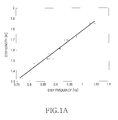
- FIGURE 1A depicts linearity of the step length and the step frequency
- FIGURE 1B depicts linearity of the step length and the acceleration variance.
- FIGURES 1A and 1B depict the step frequency and the acceleration variance increase.
- a travel distance estimation method using the linearity of the step frequency and the acceleration variance for the step length ensures a step length estimation performance with quite high accuracy in the walking situation.
- the linear estimation method is applied to a running situation, considerable errors occur. This is because the linearity of FIGURE 1A and FIGURE 1B does not reveal in the running. In other words, this implies that the step length estimation parameter differs in the walking situation and the running situation respectively.
- step length estimation errors take place.
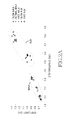
- FIGURE 2A depicts characteristics of the step length and the step frequency according to walking status
- FIGURE 2B depicts characteristics of the step length and the acceleration variance according to the walking status.
- the relation of the step length and the step frequency has linearity.
- the relation of the step length and the acceleration variance in the run status as the acceleration variance value is smaller, the step length increases.
- the present invention adopts the Hidden Markov Model (HMM).
- HMM which is one of the Markov models with hidden statuses, estimates a current status merely using an observation, a status transition probability, and a conditional probability.
- the Markov model is a random processor for determining a future process based only on the current status, that is, completely independent of the past status.
- the Markov model is called a memory-less process because it does not remember the past status, and is a finite state machine which changes the status every time.
- the Markov models are divided into the Markov Model (MM) and the HMM.
- the MM can know which status it passes and thus can acquire the order of the states or a decision function.
- the HMM does not know the passing state and can know merely a probability function. Accordingly, since only its output value is observed and the flow of the states is not observed, it is called the HMM.
- the present invention calculates the greatest probability P ( s i
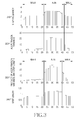
- FIGURE 3 depicts experiment results of a walk status, a run status, and a walk status in order based on travel along a 50m straight-line distance.
- FIGURE 3 shows the step frequency 310, the acceleration variance 320, a product 330 of the acceleration variance and the step length, and the step length 340 according to the status transition.
- the product 330 of the acceleration variance and the step length is used to represent the changes of the acceleration variance and the walking step length more clearly.
- the step length of the walk status is smaller than 1m, and the step length of the run status is greater than 1m.
- the change of the acceleration variance is exhibited more obviously through the product 330 of the acceleration variance and the step length.
- the step frequency 310, the acceleration variance 320, the product 330 of the acceleration variance and the step length, and the step length 340 are greater than thresholds, the probability of the run status is great.
- the present invention defines the step frequency 310, the acceleration variance 320, the product 330 of the acceleration variance and the step length, and the step length 340 as the observation for the HMM.
- the present invention can take account of the probability of the walking status using a certain number of previous steps for a more precise determination. For example, the present invention can calculate the probability of the current walking status by multiplying the probabilities of the walking status of the two previous steps by the probability of the current walking status. That is, when both of the two previous steps are associated with walking, the probability of actually being the walking status is greater, even though the current observation exceeds the threshold and indicates the run status. In various implementations, the walking status of three or more previous steps can be considered.
- the HMM is one statistical model for determining the hidden status from the observed status by assuming that the modeled system is the Markov model of the unknown status. That is, since the status is not directly visible, the status is statistically determined only through an observer. For doing so, it is necessary to define a status transition probability between the statuses and a status conditional probability using the observation.
- the status conditional probability can be given by Equation 1. P s i
- o i P o i
- s i ⁇ P s i P o i , i 1 , 2 , 3 ⁇ , n
- o i ) denotes, as the status conditional probability, the probability of the status s i when the observation is o i
- s i ) denotes the probability of observing o i when the status is s i
- P ( s i ) denotes the probability of generating the status s i
- P ( o i ) denotes the probability of generating the observation o i .
- the status conditional probability has the relation of Equation 2.
- o i P o i
- s i ⁇ P s i , i 1 , 2 , 3 , ⁇ , n
- Equation 2 P ( s i
- the HMM can be modeled based on Equation 3.
- ⁇ A ⁇ B ⁇ ⁇
- Equation 3 ⁇ denotes the HMM, and A , B, and ⁇ are the probability parameters of the HMM.
- A denotes a status transition probability matrix
- B denote an observed symbol probability distribution matrix
- ⁇ denotes an initial probability distribution matrix.
- the probability parameters are given by Equation 4.
- s t - 1 j 1 ⁇ i , j ⁇ N
- s t j 1 ⁇ k ⁇ M
- Equation 4 ⁇ j denotes the probability of the status j , A ij denotes the probability of the current status j when the previous status is i , and B j (o t ) denotes the probability of the observation o t when the status is j .
- the probability parameters of the model in Equation 4 are determined through the experiment. That is, the probability parameter values are determined to optimize the performance of the walking status recognition by calculating a combination of the probability values using previous experiment data.
- element values of the matrix A can be determined based on the walking pattern of normal people, specifically, based on the high probability that the first step is likely to be walking rather than running, the low probability that the walk status is transitioned to a mark-time status suddenly, and the low probability that the run status is transitioned to the mark-time status suddenly.
- the mark-time status denotes a status where a user remains stationary.
- the probability parameters are constituted as shown in Table 1, Table 2, and Table 3, and their specific values are determined according to the experiment results.
- Table 1 ⁇ Initial value Mark-time ⁇ 1 Walk ⁇ 1 Run ⁇ 1 Table 2 A Mark-time Walk Run Mark-time S 11 S 12 S 13 Walk S 21 S 22 S 23 Run S 31 S 32 S 33
- Table 3 B Observation 1 Observation 2 Observation 3 Mark-time O 11 O 12 O 13 Walk O 21 O 22 O 23 Run O 31 O 32 O 33
- Table 1 shows the probabilities of the walking statuses when the first step commences
- Table 2 shows the transition probabilities of the walking statuses where the vertical axis indicates the previous walking status and the horizontal axis indicates the current walking status
- Table 3 shows the probabilities of the walking statuses according to the observation.
- the status transitions indicated by the elements of Table 2 are shown in FIGURE 4 .
- S11 indicates the probability of maintaining the mark-time status 430
- S12 indicates the probability of transiting from the mark-time status 430 to the walk status 410
- S13 indicates the probability of transiting from the mark-time status 430 to the run status 410
- S21 indicates the probability of transiting from the walk status 410 to the mark-time status 430
- S22 indicates the probability of maintaining the walk status 410
- S23 indicates the probability of transiting from the walk status 410 to the run status 420
- S31 indicates the probability of transiting from the run status 420 to the mark-time status 430
- S32 indicates the probability of transiting from the run status 420 to the walk status 410
- S33 indicates the probability of maintaining the run status 420.
- each row is selectively used according to the previous walking status.
- the first row is used when the previous walking status is a mark-time
- the second row is used for a walk
- the third row is used for a run.
- the status transition probability matrix includes probability values of status transitions as many as a square of the number of possible walking statuses, i.e., 3 2 .
- the row selected according to the previous walking status in the matrix A is referred to as 'a status transition probability vector'.
- each column is selectively used according to the observation and selected based on the acceleration variance, the step frequency, and the step length. For example, when the observation exceeds a predefined threshold, the column corresponding to Observation 3 (great probability of a run) is used. When the acceleration variance is very small, the column corresponding to Observation 1 is used. When the acceleration variance is the intermediate value, the column corresponding to Observation 2 (great probability of a walk) is used. To ease the understanding, the column of the probability selected according to the observation in the matrix B is referred to as 'an observed probability vector'.
- the present invention multiplies the probability of the current walking status from the walking status of the recent two steps by the walking status probability based on the observation and determines the status of the greatest probability as the current walking status, which shall be explained in more detail.
- the portable terminal generates the 3 ⁇ 1 observed probability vector by extracting the column corresponding to the current observation of the matrix B. For example, when values indicating the Observation 1 are measured, the probability of the mark-time status is greatest and the portable terminal selects [ O 11 O 21 O 31 ] T as the observed probability vector in the matrix B.
- the portable terminal generates the status transition probability vector by extracting the column corresponding to the previous walking status in the matrix A . For example, when the previous walking status is a walk, the portable terminal extracts [ S 21 S 22 S 23 ]. By multiplying [ S 21 S 22 S 23 ] by [ O 11 O 21 O 31 ] T , the portable terminal determines the probability [ S 21 O 11 S 22 O 21 S 23 O 31 ] of each walking status.
- the matrix ⁇ is used in place of the matrix B.
- the portable terminal generates two status transition probability vectors from the matrix A and multiples the observed probability vector by the two status transition probability vectors.
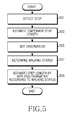
- FIGURE 5 illustrates operations of the portable terminal according to an embodiment of the present invention.
- the portable terminal detects the step using a measurement value of an acceleration sensor.
- the portable terminal can employ peak value detection, specific interval detection, zero-cross point detection, and the like.
- the portable terminal uses the zero-cross point detection, processes a raw signal of the accelerometer using sliding window summing and signal difference, and then recognizes the point of the signal crossing the zero value as the step.
- the portable terminal can obtain the step frequency.
- the portable terminal estimates a temporary step length using the integrated parameter. Since the correlation of the step length, the acceleration variance, and the step frequency is linear, the ratio value of the linearity is used as the integrated parameter. That is, a normal walk regularly increases the acceleration variance and the step frequency according to the pace, whereas the linearity of a running differs. Accordingly, it is advantageous to distinguish the running and to apply a separate running parameter.
- the linear ratio value can be calculated using every step data without distinction of the running, which is referred to as the integrated parameter.
- the integrated parameter can be a temporary reference value for calculating the approximate acceleration variance and step frequency to distinguish the running.
- the portable terminal sets the observation.
- the setting of the observation means how the current walking status is represented through the measured information.
- the setting of the observation is selected using the step frequency determined in step 501 and the temporary step length estimated in step 503. More specifically, when the step length determined using the integrated parameter, the step frequency, and the acceleration variance fall below a walk threshold, the observation is set to a halt. When the step length, step frequency, and acceleration variance exceed the walk threshold but fall below a run threshold, the observation is set to a walk. When all of the parameters exceed the run threshold, the observation is set to a running.
- the portable terminal determines the walking status.
- the portable terminal calculates a final probability for each walking status using at least one of the observation, an initial status probability, and the status transition probability, and determines the walking status having the greatest final probability as the final walking status. In so doing, details of the determination can vary depending on the number of the previous steps.
- the portable terminal calculates the final probabilities of the walking statuses by multiplying the observed probability vector corresponding to the observation by the initial status probability matrix. For example, the initial status probability matrix is shown in Table 1.
- the portable terminal extracts the status transition probability vector corresponding to the walking status of the previous step from the status transition probability matrix, and then calculates the final probabilities of the walking statuses by multiplying the observed probability vector corresponding to the observation by the status transition probability vector.
- the portable terminal extracts the status transition probability vectors corresponding to the walking status of the two previous steps from the status transition probability matrix, and then calculates the final probabilities of the walking statuses by sequentially multiplying the observed probability vector by the status transition probability vectors.
- the portable terminal determines the walking status corresponding to the greatest probability as the final walking status.
- the final probabilities as above can be expressed as Equation 5.
- Equation 5 ⁇ denotes the initial probability matrix, B ( observe ) denotes the selected observation, and A ( t ) denotes the row corresponding to the walking status of the t-th step in the status transition probability matrix.
- the portable terminal estimates the step length using the parameters according to the walking status.
- the portable terminal stores the parameters corresponding to the walking status, and estimates the step length using the parameter optimized for the walking status.
- the parameters can be predefined or set by the portable terminal.
- the portable terminal obtains the average number of the steps, the acceleration variance, and the step frequency according to the travel distance of the pedestrian through the GPS information, and proactively determines the relation parameter of the user's step length, acceleration variance, and step frequency using the obtained values.
- GPS Global Positioning System
- FIGURE 6 is a block diagram of the portable terminal according to an embodiment of the present invention.
- the portable terminal includes an acceleration sensor 602, a storage 604, and a controller 606.
- the acceleration sensor 602 measures the acceleration according to the movement of the portable terminal.
- the acceleration sensor 602 measures the magnitude of the acceleration using a physical displacement of its internal mechanical device, and outputs the magnitude of the acceleration as the frequency or the voltage.
- the acceleration sensor 602 can be of one of an inertial type, a gyro type, and a silicon type.
- the storage 604 stores a basic program for operating the portable terminal, application programs, and data such as user contents.
- the storage 604 provides the stored data according to a request of the controller 606.
- the storage 604 stores the status transition probability matrix, the observed symbol probability distribution matrix, and the initial probability distribution matrix for the walking status estimation, and the parameters per walking status for the step length estimation.
- the status transition probability matrix can be constituted as shown in Table 2
- the observed symbol probability distribution matrix can be constituted as shown in Table 3
- the initial probability distribution matrix can be constituted as shown in Table 1.
- the status transition probability matrix includes probability values of status transitions as many as a square of the number of possible walking statuses, i.e., 3 2 .
- the controller 606 controls the functions of the portable terminal. For example, the controller 606 controls to estimate the user's step length. In particular, the controller 606 controls to determine the walking status in the step length estimation. The walking status determination function is now explained in more detail.
- the controller 606 detects the step using the measurement value of the acceleration sensor 602 and estimates the temporary step length using the integrated parameter. Next, the controller 606 sets the observation and determines the walking status. That is, the controller 606 calculates the final probability for each walking status using at least one of the observation, the initial status probability, and the status transition probability, and determines the walking status having the greatest final probability as the final walking status. In so doing, the details of the determination can vary depending on the number of the previous steps. As for the first step, the controller 606 calculates the final probabilities of the walking statuses by multiplying the observed probability vector corresponding to the observation by the initial status probability matrix.
- the controller 606 extracts the status transition probability vector corresponding to the walking status of the previous step from the status transition probability matrix, and then calculates the final probabilities of the walking statuses by multiplying the observed probability vector corresponding to the observation by the status transition probability vector.
- the controller 606 extracts the status transition probability vectors corresponding to the walking status of the two previous steps from the status transition probability matrix, and then calculates the final probabilities of the walking statuses by sequentially multiplying the observed probability vector by the status transition probability vectors.
- the controller 606 determines the walking status corresponding to the greatest probability as the final walking status.
- the portable terminal estimates the current walking status using the walking status probability using the observation, the status transition probability from the previous walking status, and the initial status probability. Therefore, the step length estimation can apply the parameters optimized for the walking status.
Landscapes
- Physics & Mathematics (AREA)
- Engineering & Computer Science (AREA)
- General Physics & Mathematics (AREA)
- Radar, Positioning & Navigation (AREA)
- Remote Sensing (AREA)
- Measurement Of The Respiration, Hearing Ability, Form, And Blood Characteristics Of Living Organisms (AREA)
- Navigation (AREA)
- Telephone Function (AREA)
Abstract
Description
- The present application is related to and claims the benefit under 35 U.S.C. § 119(a) to a Korean patent application filed in the Korean Intellectual Property Office on June 30, 2010, and assigned Serial No.
10-2010-006257 - The present invention relates generally to a portable terminal. More particularly, the present invention relates to an apparatus and a method for estimating walking status in step length estimation using the portable terminal.
- Recently, the supply of portable terminals is increasing and user demand for various functions is also increasing. In this regard, portable terminals that include a pedestrian navigation function are under development.
- When a user is outdoors, the pedestrian navigation function can estimate a location using signals by means of a Global Positioning System (GPS). However, when the user is indoors, the location estimation using the signal is difficult because of poor signal reception. To address this, techniques for determining the location of the portable terminal by estimating a step length and a direction change using the portable terminal are being researched.
- To estimate a travel distance of the portable terminal carried by the user, current techniques calculate the distance based on the number of measured steps by consistently considering a distance for one step length; that is, by applying a constant step length estimation parameter. In other words, the constant step length estimation parameter is applied regardless of the walking status of the user. Disadvantageously, error can grow according to the walking status of the pedestrian. Further, as the total time of the step length estimation is increased, the error is accumulated. As a result, estimation during long-distance walking is subject to an increasing error in the final travel distance.
- To address the above-discussed deficiencies of the prior art, it is a primary aspect of the present invention to provide an apparatus and a method for enhancing accuracy of step length estimation in a portable terminal.
- Another aspect of the present invention is to provide an apparatus and a method for estimating a walking status to estimate an accurate step length in a portable terminal.
- Yet another aspect of the present invention is to provide an apparatus and a method for estimating a walking status using a Hidden Markov Model (HMM) in a portable terminal.
- According to one aspect of the present invention, a method for estimating a walking status in a portable terminal includes setting an observation using an estimated temporary step length, an acceleration variance, and a step frequency. The method also includes generating an observed probability vector including probabilities per walking status according to the observation. The method further includes determining final probabilities per walking status by multiplying the observed probability vector by at least one of an initial probability matrix and one or more status transition probability vectors. The method still further includes determining a walking status of the greatest final probability as a final walking status.
- According to another aspect of the present invention, an apparatus of a portable terminal includes an acceleration sensor configured to measure an acceleration according to a movement of the portable terminal, and a controller. The controller is configured to set an observation using an estimated temporary step length, an acceleration variance, and a step frequency. The controller is also configured to generate an observed probability vector including probabilities per walking status according to the observation. The controller is further configured to determine final probabilities per walking status by multiplying the observed probability vector by at least one of an initial probability matrix and one or more status transition probability vectors. The controller is still further configured to determine a walking status having the greatest final probability as a final walking status.
- Before undertaking the DETAILED DESCRIPTION OF THE INVENTION below, it may be advantageous to set forth definitions of certain words and phrases used throughout this patent document: the terms "include" and "comprise," as well as derivatives thereof, mean inclusion without limitation; the term "or," is inclusive, meaning and/or; the phrases "associated with" and "associated therewith," as well as derivatives thereof, may mean to include, be included within, interconnect with, contain, be contained within, connect to or with, couple to or with, be communicable with, cooperate with, interleave, juxtapose, be proximate to, be bound to or with, have, have a property of, or the like; and the term "controller" means any device, system or part thereof that controls at least one operation, such a device may be implemented in hardware, firmware or software, or some combination of at least two of the same. It should be noted that the functionality associated with any particular controller may be centralized or distributed, whether locally or remotely. Definitions for certain words and phrases are provided throughout this patent document, those of ordinary skill in the art should understand that in many, if not most instances, such definitions apply to prior, as well as future uses of such defined words and phrases.
- For a more complete understanding of the present disclosure and its advantages, reference is now made to the following description taken in conjunction with the accompanying drawings, in which like reference numerals represent like parts:
-
FIGURES 1A and1B illustrate linearity of a step frequency and an acceleration variance according to a step length; -
FIGURES 2A and2B illustrate characteristics of the step length and the step frequency according to walking status, and characteristics of the step length and the acceleration variance according to the walking status; -
FIGURE 3 illustrates experiment results of a walking status, a run status, and the walk status in sequence based on a straight-line distance travel; -
FIGURE 4 illustrates status transitions of the walking status; -
FIGURE 5 illustrates operations of a portable terminal according to an embodiment of the present invention; and -
FIGURE 6 illustrates the portable terminal according to an embodiment of the present invention. - Throughout the drawings, like reference numerals will be understood to refer to like parts, components and structures.
-
FIGURES 1A through 6 , discussed below, and the various embodiments used to describe the principles of the present disclosure in this patent document are by way of illustration only and should not be construed in any way to limit the scope of the disclosure. Those skilled in the art will understand that the principles of the present disclosure may be implemented in any suitably arranged wireless communications system. - Exemplary embodiments of the present invention provide a technique for estimating walking status to estimate an accurate step length in a portable terminal. Hereinafter, the term portable terminal encompasses cellular phones, Personal Communication Systems (PCSs), Personal Digital Assistants (PDAs), International Mobil Telecommunication (IMT)-200 terminals, smart phones, and the like. The term portable terminal also encompasses apparatuses that include a step length estimation function and exclude a communication function.
- Typically, the step length has linearity in proportion to a step frequency and an acceleration variance. Based on the linearity, a Pedestrian Dead Reckoning (PDR) can estimate a travel distance to calculate a pedestrian's location.
-
FIGURE 1A depicts linearity of the step length and the step frequency, andFIGURE 1B depicts linearity of the step length and the acceleration variance. As shown inFIGURES 1A and1B , as the step length increases, the step frequency and the acceleration variance increase. A travel distance estimation method using the linearity of the step frequency and the acceleration variance for the step length ensures a step length estimation performance with quite high accuracy in the walking situation. However, when the linear estimation method is applied to a running situation, considerable errors occur. This is because the linearity ofFIGURE 1A andFIGURE 1B does not reveal in the running. In other words, this implies that the step length estimation parameter differs in the walking situation and the running situation respectively. As a result, when the step length of the running situation is estimated using the step length estimation parameter of the walking situation, step length estimation errors take place. Hence, it is necessary to distinguish and recognize the running situation and the walking situation and apply an adequate step length estimation parameter according to the respective walking statuses. -
FIGURE 2A depicts characteristics of the step length and the step frequency according to walking status, andFIGURE 2B depicts characteristics of the step length and the acceleration variance according to the walking status. Referring toFIGURES 2A and2B , even in the run status, the relation of the step length and the step frequency has linearity. However, as for the relation of the step length and the acceleration variance in the run status, as the acceleration variance value is smaller, the step length increases. - To design a walking status recognition algorithm, the present invention adopts the Hidden Markov Model (HMM). The HMM, which is one of the Markov models with hidden statuses, estimates a current status merely using an observation, a status transition probability, and a conditional probability. The Markov model is a random processor for determining a future process based only on the current status, that is, completely independent of the past status. The Markov model is called a memory-less process because it does not remember the past status, and is a finite state machine which changes the status every time. The Markov models are divided into the Markov Model (MM) and the HMM. The MM can know which status it passes and thus can acquire the order of the states or a decision function. The HMM does not know the passing state and can know merely a probability function. Accordingly, since only its output value is observed and the flow of the states is not observed, it is called the HMM.
- Given an observation Oi and a model λ = (A, B, π) for the HMM, the present invention calculates the greatest probability P(si |oi ) of generating the current observation oi from the status si , and selects the status of the greatest probability.
- To utilize the HMM, an observation for the HMM should be defined. The present invention calculates the walking step length using the acceleration variance, the step frequency, and an integrated parameter of experiment data and thus obtains their relations.
FIGURE 3 depicts experiment results of a walk status, a run status, and a walk status in order based on travel along a 50m straight-line distance.FIGURE 3 shows thestep frequency 310, theacceleration variance 320, aproduct 330 of the acceleration variance and the step length, and thestep length 340 according to the status transition. Theproduct 330 of the acceleration variance and the step length is used to represent the changes of the acceleration variance and the walking step length more clearly. Referring toFIGURE 3 , on the whole, the step length of the walk status is smaller than 1m, and the step length of the run status is greater than 1m. Thus, the change of the acceleration variance is exhibited more obviously through theproduct 330 of the acceleration variance and the step length. When thestep frequency 310, theacceleration variance 320, theproduct 330 of the acceleration variance and the step length, and thestep length 340 are greater than thresholds, the probability of the run status is great. The present invention defines thestep frequency 310, theacceleration variance 320, theproduct 330 of the acceleration variance and the step length, and thestep length 340 as the observation for the HMM. - While the walking status may be determined merely using the observation of the corresponding step, the present invention can take account of the probability of the walking status using a certain number of previous steps for a more precise determination. For example, the present invention can calculate the probability of the current walking status by multiplying the probabilities of the walking status of the two previous steps by the probability of the current walking status. That is, when both of the two previous steps are associated with walking, the probability of actually being the walking status is greater, even though the current observation exceeds the threshold and indicates the run status. In various implementations, the walking status of three or more previous steps can be considered.
- The HMM is one statistical model for determining the hidden status from the observed status by assuming that the modeled system is the Markov model of the unknown status. That is, since the status is not directly visible, the status is statistically determined only through an observer. For doing so, it is necessary to define a status transition probability between the statuses and a status conditional probability using the observation. The status conditional probability can be given by
Equation 1.
- In
Equation 1, P(si |oi ) denotes, as the status conditional probability, the probability of the status si when the observation is oi, P(oi |si ) denotes the probability of observing oi when the status is si , P(si ) denotes the probability of generating the status si , and P(oi ) denotes the probability of generating the observation oi . - According to
Equation 1, the status conditional probability has the relation ofEquation 2.
- In
Equation 2, P(si | oi ) denotes, as the status conditional probability, the probability of the status si when the observation is oi, L(si |oi ) denotes a likelihood probability, P(oi |si ) denotes the probability of observing oi when the status is si , and P(si ) denotes the probability of generating the status si . - The HMM can be modeled based on
Equation 3.
- In
Equation 3, λ denotes the HMM, and A, B, and π are the probability parameters of the HMM. A denotes a status transition probability matrix, B denote an observed symbol probability distribution matrix, and π denotes an initial probability distribution matrix. More specifically, the probability parameters are given byEquation 4.
- In
Equation 4, π j denotes the probability of the status j , Aij denotes the probability of the current status j when the previous status is i, and Bj(ot) denotes the probability of the observation ot when the status is j. - The probability parameters of the model in
Equation 4 are determined through the experiment. That is, the probability parameter values are determined to optimize the performance of the walking status recognition by calculating a combination of the probability values using previous experiment data. For example, element values of the matrix A can be determined based on the walking pattern of normal people, specifically, based on the high probability that the first step is likely to be walking rather than running, the low probability that the walk status is transitioned to a mark-time status suddenly, and the low probability that the run status is transitioned to the mark-time status suddenly. Herein, the mark-time status denotes a status where a user remains stationary. As for the matrix B, it is important to minimize misjudgment caused by instantaneous data noise by setting the probability of the highest walking status in the corresponding observation and not extremely lowering the probabilities of the other walking status at the same time. Consequently, the probability parameters are constituted as shown in Table 1, Table 2, and Table 3, and their specific values are determined according to the experiment results.Table 1 π Initial value Mark-time π1 Walk π1 Run π1 Table 2 A Mark-time Walk Run Mark-time S11 S12 S13 Walk S21 S22 S23 Run S31 S32 S33 Table 3 B Observation 1 Observation 2Observation 3Mark-time O11 O12 O13 Walk O21 O22 O23 Run O31 O32 O33 - Table 1 shows the probabilities of the walking statuses when the first step commences, Table 2 shows the transition probabilities of the walking statuses where the vertical axis indicates the previous walking status and the horizontal axis indicates the current walking status, and Table 3 shows the probabilities of the walking statuses according to the observation. The status transitions indicated by the elements of Table 2 are shown in
FIGURE 4 . As shown inFIGURE 4 , S11 indicates the probability of maintaining the mark-time status 430, S12 indicates the probability of transiting from the mark-time status 430 to thewalk status 410, S13 indicates the probability of transiting from the mark-time status 430 to therun status 410, S21 indicates the probability of transiting from thewalk status 410 to the mark-time status 430, S22 indicates the probability of maintaining thewalk status 410, S23 indicates the probability of transiting from thewalk status 410 to therun status 420, S31 indicates the probability of transiting from therun status 420 to the mark-time status 430, S32 indicates the probability of transiting from therun status 420 to thewalk status 410, and S33 indicates the probability of maintaining therun status 420. - In the matrix A of Table 2, each row is selectively used according to the previous walking status. For example, the first row is used when the previous walking status is a mark-time, the second row is used for a walk, and the third row is used for a run. As shown in Table 2, the status transition probability matrix includes probability values of status transitions as many as a square of the number of possible walking statuses, i.e., 32. To ease the understanding, the row selected according to the previous walking status in the matrix A is referred to as 'a status transition probability vector'.
- In the matrix B of Table 3, each column is selectively used according to the observation and selected based on the acceleration variance, the step frequency, and the step length. For example, when the observation exceeds a predefined threshold, the column corresponding to Observation 3 (great probability of a run) is used. When the acceleration variance is very small, the column corresponding to
Observation 1 is used. When the acceleration variance is the intermediate value, the column corresponding to Observation 2 (great probability of a walk) is used. To ease the understanding, the column of the probability selected according to the observation in the matrix B is referred to as 'an observed probability vector'. - To estimate the walking status, the present invention multiplies the probability of the current walking status from the walking status of the recent two steps by the walking status probability based on the observation and determines the status of the greatest probability as the current walking status, which shall be explained in more detail.
- The portable terminal generates the 3×1 observed probability vector by extracting the column corresponding to the current observation of the matrix B. For example, when values indicating the
Observation 1 are measured, the probability of the mark-time status is greatest and the portable terminal selects [O 11 O 21 O 31] T as the observed probability vector in the matrix B. The portable terminal generates the status transition probability vector by extracting the column corresponding to the previous walking status in the matrix A. For example, when the previous walking status is a walk, the portable terminal extracts [S 21 S 22 S 23]. By multiplying [S 21 S 22 S 23] by [O 11 O 21 O 31] T , the portable terminal determines the probability [S 21 O 11 S 22 O 21 S 23 O 31] of each walking status. If the current step is the first step and the previous walking status is absent, the matrix π is used in place of the matrix B. When the current step exceeds the third step, two previous walking statuses are present. To reflect the status transition probability of the two previous walking statuses, the portable terminal generates two status transition probability vectors from the matrix A and multiples the observed probability vector by the two status transition probability vectors. - Now, operations and structure of the portable terminal for estimating the walking status as stated above are described in detail by referring to the drawings.
-
FIGURE 5 illustrates operations of the portable terminal according to an embodiment of the present invention. - In
step 501, the portable terminal detects the step using a measurement value of an acceleration sensor. For example, to detect the step, the portable terminal can employ peak value detection, specific interval detection, zero-cross point detection, and the like. Using the zero-cross point detection, the portable terminal processes a raw signal of the accelerometer using sliding window summing and signal difference, and then recognizes the point of the signal crossing the zero value as the step. Thus, the portable terminal can obtain the step frequency. - In
step 503, the portable terminal estimates a temporary step length using the integrated parameter. Since the correlation of the step length, the acceleration variance, and the step frequency is linear, the ratio value of the linearity is used as the integrated parameter. That is, a normal walk regularly increases the acceleration variance and the step frequency according to the pace, whereas the linearity of a running differs. Accordingly, it is advantageous to distinguish the running and to apply a separate running parameter. However, the linear ratio value can be calculated using every step data without distinction of the running, which is referred to as the integrated parameter. In other words, the integrated parameter can be a temporary reference value for calculating the approximate acceleration variance and step frequency to distinguish the running. - In step 505, the portable terminal sets the observation. Herein, the setting of the observation means how the current walking status is represented through the measured information. The setting of the observation is selected using the step frequency determined in
step 501 and the temporary step length estimated instep 503. More specifically, when the step length determined using the integrated parameter, the step frequency, and the acceleration variance fall below a walk threshold, the observation is set to a halt. When the step length, step frequency, and acceleration variance exceed the walk threshold but fall below a run threshold, the observation is set to a walk. When all of the parameters exceed the run threshold, the observation is set to a running. - In
step 507, the portable terminal determines the walking status. The portable terminal calculates a final probability for each walking status using at least one of the observation, an initial status probability, and the status transition probability, and determines the walking status having the greatest final probability as the final walking status. In so doing, details of the determination can vary depending on the number of the previous steps. As for the first step, the portable terminal calculates the final probabilities of the walking statuses by multiplying the observed probability vector corresponding to the observation by the initial status probability matrix. For example, the initial status probability matrix is shown in Table 1. As for the second step, the portable terminal extracts the status transition probability vector corresponding to the walking status of the previous step from the status transition probability matrix, and then calculates the final probabilities of the walking statuses by multiplying the observed probability vector corresponding to the observation by the status transition probability vector. For a step beyond the third step, the portable terminal extracts the status transition probability vectors corresponding to the walking status of the two previous steps from the status transition probability matrix, and then calculates the final probabilities of the walking statuses by sequentially multiplying the observed probability vector by the status transition probability vectors. Next, the portable terminal determines the walking status corresponding to the greatest probability as the final walking status. The final probabilities as above can be expressed asEquation 5.
- In
Equation 5, π denotes the initial probability matrix, B (observe) denotes the selected observation, and A (t) denotes the row corresponding to the walking status of the t-th step in the status transition probability matrix. - In step 509, the portable terminal estimates the step length using the parameters according to the walking status. The portable terminal stores the parameters corresponding to the walking status, and estimates the step length using the parameter optimized for the walking status. For instance, the parameters can be predefined or set by the portable terminal. In an area configured for receiving a Global Positioning System (GPS) signal, the portable terminal obtains the average number of the steps, the acceleration variance, and the step frequency according to the travel distance of the pedestrian through the GPS information, and proactively determines the relation parameter of the user's step length, acceleration variance, and step frequency using the obtained values.
-
FIGURE 6 is a block diagram of the portable terminal according to an embodiment of the present invention. - As shown in
FIGURE 6 , the portable terminal includes anacceleration sensor 602, astorage 604, and acontroller 606. - The
acceleration sensor 602 measures the acceleration according to the movement of the portable terminal. Theacceleration sensor 602 measures the magnitude of the acceleration using a physical displacement of its internal mechanical device, and outputs the magnitude of the acceleration as the frequency or the voltage. For example, theacceleration sensor 602 can be of one of an inertial type, a gyro type, and a silicon type. - The
storage 604 stores a basic program for operating the portable terminal, application programs, and data such as user contents. Thestorage 604 provides the stored data according to a request of thecontroller 606. In particular, thestorage 604 stores the status transition probability matrix, the observed symbol probability distribution matrix, and the initial probability distribution matrix for the walking status estimation, and the parameters per walking status for the step length estimation. For example, the status transition probability matrix can be constituted as shown in Table 2, the observed symbol probability distribution matrix can be constituted as shown in Table 3, and the initial probability distribution matrix can be constituted as shown in Table 1. As shown in Table 2, the status transition probability matrix includes probability values of status transitions as many as a square of the number of possible walking statuses, i.e., 32. - The
controller 606 controls the functions of the portable terminal. For example, thecontroller 606 controls to estimate the user's step length. In particular, thecontroller 606 controls to determine the walking status in the step length estimation. The walking status determination function is now explained in more detail. - The
controller 606 detects the step using the measurement value of theacceleration sensor 602 and estimates the temporary step length using the integrated parameter. Next, thecontroller 606 sets the observation and determines the walking status. That is, thecontroller 606 calculates the final probability for each walking status using at least one of the observation, the initial status probability, and the status transition probability, and determines the walking status having the greatest final probability as the final walking status. In so doing, the details of the determination can vary depending on the number of the previous steps. As for the first step, thecontroller 606 calculates the final probabilities of the walking statuses by multiplying the observed probability vector corresponding to the observation by the initial status probability matrix. As for the second step, thecontroller 606 extracts the status transition probability vector corresponding to the walking status of the previous step from the status transition probability matrix, and then calculates the final probabilities of the walking statuses by multiplying the observed probability vector corresponding to the observation by the status transition probability vector. For a step beyond the third step, thecontroller 606 extracts the status transition probability vectors corresponding to the walking status of the two previous steps from the status transition probability matrix, and then calculates the final probabilities of the walking statuses by sequentially multiplying the observed probability vector by the status transition probability vectors. Next, thecontroller 606 determines the walking status corresponding to the greatest probability as the final walking status. - As set forth above, the portable terminal estimates the current walking status using the walking status probability using the observation, the status transition probability from the previous walking status, and the initial status probability. Therefore, the step length estimation can apply the parameters optimized for the walking status.
- While the invention has been shown and described with reference to certain exemplary embodiments thereof, it will be understood by those skilled in the art that various changes in form and details may be made therein without departing from the spirit and scope of the invention as defined by the appended claims and their equivalents.
Claims (15)
- A method for estimating a walking status, the method comprising:setting an observation using an estimated temporary step length (340), an acceleration variance (320), and a step frequency (310);generating an observed probability vector comprising probabilities per walking status according to the observation;determining final probabilities per walking status by multiplying the observed probability vector by at least one of an initial probability matrix and one or more status transition probability vectors; anddetermining a walking status having a greatest final probability as a final walking status.
- The method of claim 1, further comprising:estimating the temporary step length (340) using an integrated parameter,wherein the integrated parameter comprises a step length (340) determined without distinction of the walking status and a step frequency (310) or a ratio value of the step length (340) and the acceleration variance (320).
- The method of claim 1, further comprising:determining the acceleration variance (320) and the step frequency (310) using a measurement value of an acceleration sensor (602).
- The method of claim 1, wherein the generating of the observed probability vector comprises:extracting a column corresponding to the observation from a predefined observed symbol probability distribution matrix.
- The method of claim 1, wherein the determining of the final probabilities per walking status comprises:multiplying the initial probability matrix by the observed probability vector.
- The method of claim 1, wherein the determining of the final probabilities per walking status comprises:generating at least one status transition probability vector by extracting at least one row corresponding to the walking status of at least one previous step from a pre-stored status transition probability matrix; andmultiplying the at least one status transition probability vector by the observed probability vector.
- An apparatus of a portable terminal, the apparatus comprising:an acceleration sensor (602) configured to measure an acceleration according to a movement of the portable terminal; anda controller (606) configured to:set an observation using an estimated temporary step length (340), an acceleration variance (320), and a step frequency (310);generate an observed probability vector comprising probabilities per walking status according to the observation;determine final probabilities per walking status by multiplying the observed probability vector by at least one of an initial probability matrix and one or more status transition probability vectors; anddetermine a walking status having the greatest final probability as a final walking status.
- The apparatus of claim 7, wherein the controller (606) estimates the temporary step length (340) using an integrated parameter, and
the integrated parameter comprises a step length (340) determined without distinction of the walking status and a step frequency (310) or a ratio value of the step length (340) and the acceleration variance (320). - The apparatus of claim 7, wherein the controller (606) determines the acceleration variance (320) and the step frequency (310) using a measurement value of the acceleration sensor (602).
- The apparatus of claim 7, wherein, to generate the observed probability vector, the controller (606) extracts a column corresponding to the observation from a predefined observed symbol probability distribution matrix.
- The apparatus of claim 7, wherein, to determine the final probabilities per walking status, the controller (606) multiplies the initial probability matrix by the observed probability vector.
- The apparatus of claim 7, wherein, to determine the final probabilities per walking status, the controller (606) generates at least one status transition probability vector by extracting at least one row corresponding to the walking status of at least one previous step from a pre-stored status transition probability matrix, and multiplies the at least one status transition probability vector by the observed probability vector.
- The method of claim 4 or the apparatus of claim 9, wherein the observed symbol probability distribution matrix comprises probability values per walking status corresponding to possible observations respectively.
- The method of claim 6 or the apparatus of claim 12, wherein the status transition probability matrix comprises probability values of status transitions as many as a square of the number of possible walking statuses.
- The method of claim 1 or the apparatus of claim 7, wherein the walking statuses comprise a walk status (410), a run status (420), and a mark-time status (430).
Applications Claiming Priority (1)
| Application Number | Priority Date | Filing Date | Title |
|---|---|---|---|
| KR1020100062557A KR20120001925A (en) | 2010-06-30 | 2010-06-30 | Apparatus and method for walking state estimation for stride length estimation using a portable terminal |
Publications (2)
| Publication Number | Publication Date |
|---|---|
| EP2402715A2 true EP2402715A2 (en) | 2012-01-04 |
| EP2402715A3 EP2402715A3 (en) | 2014-10-29 |
Family
ID=44508717
Family Applications (1)
| Application Number | Title | Priority Date | Filing Date |
|---|---|---|---|
| EP11170019.1A Withdrawn EP2402715A3 (en) | 2010-06-30 | 2011-06-15 | Apparatus and method for estimating walking status for step length estimation using portable terminal |
Country Status (3)
| Country | Link |
|---|---|
| US (1) | US20120004881A1 (en) |
| EP (1) | EP2402715A3 (en) |
| KR (1) | KR20120001925A (en) |
Cited By (3)
| Publication number | Priority date | Publication date | Assignee | Title |
|---|---|---|---|---|
| WO2014099232A1 (en) * | 2012-12-21 | 2014-06-26 | Qualcomm Incorporated | Swing compensation in step detection |
| US10408637B2 (en) | 2013-12-31 | 2019-09-10 | Commissariat A L'energie Atomique Et Aux Energies Alternatives | Method and device for counting steps |
| WO2021009499A1 (en) * | 2019-07-17 | 2021-01-21 | Waymap Limited | Apparatus and associated methods for step length estimation |
Families Citing this family (14)
| Publication number | Priority date | Publication date | Assignee | Title |
|---|---|---|---|---|
| US10145707B2 (en) * | 2011-05-25 | 2018-12-04 | CSR Technology Holdings Inc. | Hierarchical context detection method to determine location of a mobile device on a person's body |
| JP6011127B2 (en) * | 2012-08-06 | 2016-10-19 | 富士ゼロックス株式会社 | Action detection program and action detection apparatus |
| KR101982820B1 (en) | 2012-09-13 | 2019-05-27 | 삼성전자주식회사 | Method for Controlling Sensors and Terminal Thereof |
| US20140129177A1 (en) * | 2012-11-07 | 2014-05-08 | Motorola Mobility Llc | Systems and Methods for Frequency-Based Stride Length Correction in a Pedometer Device |
| CN104125021B (en) * | 2013-04-28 | 2016-12-28 | 华为技术有限公司 | A kind of method of kinestate identifying mobile terminal and mobile terminal |
| CN104729524A (en) * | 2013-12-18 | 2015-06-24 | 中国移动通信集团公司 | Method for estimating step length, pedometer and pedometer system |
| US10082598B2 (en) * | 2014-08-18 | 2018-09-25 | Intel Corporation | Sensor power management |
| KR102314717B1 (en) | 2014-10-10 | 2021-10-20 | 삼성전자주식회사 | Electronic device and method for measuring a velocity in the electronic device |
| KR101642286B1 (en) | 2015-02-12 | 2016-07-25 | 한국항공우주연구원 | Heading Orientation Estimation Method Using Pedestrian Characteristics in Indoor Environment |
| US9943262B2 (en) | 2015-10-26 | 2018-04-17 | Sk Planet Co., Ltd. | System and method for providing walking path guidance service based on measurement of motion of user |
| KR102453807B1 (en) | 2015-10-27 | 2022-10-12 | 에스케이플래닛 주식회사 | System and method for guiding footpath based on user movement detection |
| JP2021121781A (en) * | 2018-05-09 | 2021-08-26 | ソニーグループ株式会社 | Information processing device, information processing method and program |
| EP4115803A1 (en) * | 2021-07-09 | 2023-01-11 | Infonomy AB | Fall risk determination system and method |
| CN113790722B (en) * | 2021-08-20 | 2023-09-12 | 北京自动化控制设备研究所 | Pedestrian step length modeling method based on inertial data time-frequency domain feature extraction |
Citations (1)
| Publication number | Priority date | Publication date | Assignee | Title |
|---|---|---|---|---|
| KR20100006257A (en) | 2008-07-09 | 2010-01-19 | 현대자동차주식회사 | Hood latch apparatus with walker protection function |
Family Cites Families (4)
| Publication number | Priority date | Publication date | Assignee | Title |
|---|---|---|---|---|
| KR100421740B1 (en) * | 2000-11-14 | 2004-03-10 | 삼성전자주식회사 | Object activity modeling method |
| US6826477B2 (en) * | 2001-04-23 | 2004-11-30 | Ecole Polytechnique Federale De Lausanne (Epfl) | Pedestrian navigation method and apparatus operative in a dead reckoning mode |
| US7827011B2 (en) * | 2005-05-03 | 2010-11-02 | Aware, Inc. | Method and system for real-time signal classification |
| KR100800874B1 (en) * | 2006-10-31 | 2008-02-04 | 삼성전자주식회사 | Stride length estimation method and portable terminal for same |
-
2010
- 2010-06-30 KR KR1020100062557A patent/KR20120001925A/en not_active Withdrawn
-
2011
- 2011-06-15 EP EP11170019.1A patent/EP2402715A3/en not_active Withdrawn
- 2011-06-24 US US13/167,827 patent/US20120004881A1/en not_active Abandoned
Patent Citations (1)
| Publication number | Priority date | Publication date | Assignee | Title |
|---|---|---|---|---|
| KR20100006257A (en) | 2008-07-09 | 2010-01-19 | 현대자동차주식회사 | Hood latch apparatus with walker protection function |
Cited By (7)
| Publication number | Priority date | Publication date | Assignee | Title |
|---|---|---|---|---|
| WO2014099232A1 (en) * | 2012-12-21 | 2014-06-26 | Qualcomm Incorporated | Swing compensation in step detection |
| CN104956185A (en) * | 2012-12-21 | 2015-09-30 | 高通股份有限公司 | Swing compensation in step detection |
| CN104956185B (en) * | 2012-12-21 | 2018-09-28 | 高通股份有限公司 | Swing compensation in step number detection |
| US10564178B2 (en) | 2012-12-21 | 2020-02-18 | Qualcomm Incorporated | Swing compensation in step detection |
| US10408637B2 (en) | 2013-12-31 | 2019-09-10 | Commissariat A L'energie Atomique Et Aux Energies Alternatives | Method and device for counting steps |
| WO2021009499A1 (en) * | 2019-07-17 | 2021-01-21 | Waymap Limited | Apparatus and associated methods for step length estimation |
| US12318193B2 (en) | 2019-07-17 | 2025-06-03 | Waymap Limited | Apparatus and associated methods for step length estimation |
Also Published As
| Publication number | Publication date |
|---|---|
| EP2402715A3 (en) | 2014-10-29 |
| KR20120001925A (en) | 2012-01-05 |
| US20120004881A1 (en) | 2012-01-05 |
Similar Documents
| Publication | Publication Date | Title |
|---|---|---|
| EP2402715A2 (en) | Apparatus and method for estimating walking status for step length estimation using portable terminal | |
| US9244152B1 (en) | Determining device locations using movement, signal strength | |
| US9609615B2 (en) | Method for building database for fingerprinting positioning and fingerprinting positioning method using the built database | |
| US7783302B2 (en) | Apparatus and method for determining a current position of a mobile device | |
| US20100255856A1 (en) | Location Sensing Selection for Mobile Devices | |
| KR101058296B1 (en) | Real time location tracking method and system for mobile devices | |
| US9086283B2 (en) | Apparatus and method for estimating location of terminal using dead reckoning | |
| US10057831B2 (en) | Communications | |
| JP4695123B2 (en) | POSITION INFORMATION ACQUISITION DEVICE, POSITION INFORMATION ACQUISITION METHOD, AND POSITION INFORMATION ACQUISITION PROGRAM | |
| JP6242044B2 (en) | Positioning accuracy calculation method and apparatus, and terminal positioning method and apparatus using the same | |
| US12235374B2 (en) | Ranging-type positioning system and ranging-type positioning method based on crowdsourced calibration | |
| US11743678B2 (en) | Generic signal fusion framework for multi-modal localization | |
| JP2013042360A (en) | Information processing unit, information processing method, and program | |
| US11209502B2 (en) | System for object position estimation based on magnetic field signal using underwater sensor network and method thereof | |
| KR101631121B1 (en) | Method of measuring a location of mobile computing device and mobile computing device performing the same | |
| KR101663654B1 (en) | Apparatus and method for deciding variation of in-out door position in a mobile-terminal | |
| Hu et al. | A segment-based fusion algorithm of WiFi fingerprinting and pedestrian dead reckoning | |
| Yu et al. | Combinatorial data augmentation for real-time indoor positioning: Concepts and experiments | |
| KR20140119333A (en) | Method and Apparatus for Location Determination to Improve the accuracy of the location | |
| CN111105058A (en) | Running route dynamic time estimation method and device and electronic equipment | |
| Deblauwe et al. | Hybrid GPS and GSM localization—energy-efficient detection of spatial triggers | |
| JP6486982B2 (en) | Model generation apparatus, position estimation apparatus, and program | |
| KR101140045B1 (en) | Method and apparatus for tracking user location | |
| JP2017227640A (en) | Position determining apparatus, method and electronic apparatus | |
| Chen et al. | A novel RSS-based indoor positioning algorithm using mobility prediction |
Legal Events
| Date | Code | Title | Description |
|---|---|---|---|
| AK | Designated contracting states |
Kind code of ref document: A2 Designated state(s): AL AT BE BG CH CY CZ DE DK EE ES FI FR GB GR HR HU IE IS IT LI LT LU LV MC MK MT NL NO PL PT RO RS SE SI SK SM TR |
|
| AX | Request for extension of the european patent |
Extension state: BA ME |
|
| PUAI | Public reference made under article 153(3) epc to a published international application that has entered the european phase |
Free format text: ORIGINAL CODE: 0009012 |
|
| RAP1 | Party data changed (applicant data changed or rights of an application transferred) |
Owner name: SNU R&DB FOUNDATION Owner name: SAMSUNG ELECTRONICS CO., LTD. |
|
| PUAL | Search report despatched |
Free format text: ORIGINAL CODE: 0009013 |
|
| AK | Designated contracting states |
Kind code of ref document: A3 Designated state(s): AL AT BE BG CH CY CZ DE DK EE ES FI FR GB GR HR HU IE IS IT LI LT LU LV MC MK MT NL NO PL PT RO RS SE SI SK SM TR |
|
| AX | Request for extension of the european patent |
Extension state: BA ME |
|
| RIC1 | Information provided on ipc code assigned before grant |
Ipc: G01C 22/00 20060101AFI20140926BHEP |
|
| STAA | Information on the status of an ep patent application or granted ep patent |
Free format text: STATUS: THE APPLICATION IS DEEMED TO BE WITHDRAWN |
|
| 18D | Application deemed to be withdrawn |
Effective date: 20150430 |