EP2402327B1 - Acetamide compounds as glucokinase activators, their process and medicinal applications - Google Patents
Acetamide compounds as glucokinase activators, their process and medicinal applications Download PDFInfo
- Publication number
- EP2402327B1 EP2402327B1 EP10172616.4A EP10172616A EP2402327B1 EP 2402327 B1 EP2402327 B1 EP 2402327B1 EP 10172616 A EP10172616 A EP 10172616A EP 2402327 B1 EP2402327 B1 EP 2402327B1
- Authority
- EP
- European Patent Office
- Prior art keywords
- phenyl
- yloxy
- cyclopropanesulfonyl
- tetrahydro
- enantiomers
- Prior art date
- Legal status (The legal status is an assumption and is not a legal conclusion. Google has not performed a legal analysis and makes no representation as to the accuracy of the status listed.)
- Not-in-force
Links
- 0 C1C2=*(CCCC3)C1C3=C2 Chemical compound C1C2=*(CCCC3)C1C3=C2 0.000 description 6
- LTSJSGNRCOJMCO-UHFFFAOYSA-N C1C=CC=[O]C1 Chemical compound C1C=CC=[O]C1 LTSJSGNRCOJMCO-UHFFFAOYSA-N 0.000 description 1
- ADJPNXDTTBCKTM-UHFFFAOYSA-N C1CC=[O]CC1 Chemical compound C1CC=[O]CC1 ADJPNXDTTBCKTM-UHFFFAOYSA-N 0.000 description 1
- IRUDOKKYZUTXTH-UHFFFAOYSA-N C1SC(NCC=C2)=C2N1 Chemical compound C1SC(NCC=C2)=C2N1 IRUDOKKYZUTXTH-UHFFFAOYSA-N 0.000 description 1
- IBPIVZTUZOYUOC-UHFFFAOYSA-N CCOC(C(c(cc1)ccc1S(C1CC1)(=O)=O)=[NH+][NH-])=O Chemical compound CCOC(C(c(cc1)ccc1S(C1CC1)(=O)=O)=[NH+][NH-])=O IBPIVZTUZOYUOC-UHFFFAOYSA-N 0.000 description 1
- JTVDILIZHIAFAA-UHFFFAOYSA-N CCOC(c(cc1F)ccc1Oc1cnc(N)[s]1)=O Chemical compound CCOC(c(cc1F)ccc1Oc1cnc(N)[s]1)=O JTVDILIZHIAFAA-UHFFFAOYSA-N 0.000 description 1
- YPEUSIFWVFPVHR-UHFFFAOYSA-N COC(C1=CC=C(Cc2cnc(N)[s]2)CC1)=O Chemical compound COC(C1=CC=C(Cc2cnc(N)[s]2)CC1)=O YPEUSIFWVFPVHR-UHFFFAOYSA-N 0.000 description 1
- LLPVJZMTIYQTGU-UHFFFAOYSA-N COc(cc1)nc2c1nc(N)[s]2 Chemical compound COc(cc1)nc2c1nc(N)[s]2 LLPVJZMTIYQTGU-UHFFFAOYSA-N 0.000 description 1
- BIEJCSNZHZYGGX-UHFFFAOYSA-N OC(C(c(cc1)ccc1S(C1CC1)(=O)=O)OC1CCOCC1)=O Chemical compound OC(C(c(cc1)ccc1S(C1CC1)(=O)=O)OC1CCOCC1)=O BIEJCSNZHZYGGX-UHFFFAOYSA-N 0.000 description 1
Classifications
-
- C—CHEMISTRY; METALLURGY
- C07—ORGANIC CHEMISTRY
- C07D—HETEROCYCLIC COMPOUNDS
- C07D309/00—Heterocyclic compounds containing six-membered rings having one oxygen atom as the only ring hetero atom, not condensed with other rings
- C07D309/02—Heterocyclic compounds containing six-membered rings having one oxygen atom as the only ring hetero atom, not condensed with other rings having no double bonds between ring members or between ring members and non-ring members
- C07D309/08—Heterocyclic compounds containing six-membered rings having one oxygen atom as the only ring hetero atom, not condensed with other rings having no double bonds between ring members or between ring members and non-ring members with hetero atoms or with carbon atoms having three bonds to hetero atoms with at the most one bond to halogen, e.g. ester or nitrile radicals, directly attached to ring carbon atoms
-
- A—HUMAN NECESSITIES
- A61—MEDICAL OR VETERINARY SCIENCE; HYGIENE
- A61P—SPECIFIC THERAPEUTIC ACTIVITY OF CHEMICAL COMPOUNDS OR MEDICINAL PREPARATIONS
- A61P3/00—Drugs for disorders of the metabolism
-
- C—CHEMISTRY; METALLURGY
- C07—ORGANIC CHEMISTRY
- C07D—HETEROCYCLIC COMPOUNDS
- C07D231/00—Heterocyclic compounds containing 1,2-diazole or hydrogenated 1,2-diazole rings
- C07D231/02—Heterocyclic compounds containing 1,2-diazole or hydrogenated 1,2-diazole rings not condensed with other rings
- C07D231/10—Heterocyclic compounds containing 1,2-diazole or hydrogenated 1,2-diazole rings not condensed with other rings having two or three double bonds between ring members or between ring members and non-ring members
- C07D231/14—Heterocyclic compounds containing 1,2-diazole or hydrogenated 1,2-diazole rings not condensed with other rings having two or three double bonds between ring members or between ring members and non-ring members with hetero atoms or with carbon atoms having three bonds to hetero atoms with at the most one bond to halogen, e.g. ester or nitrile radicals, directly attached to ring carbon atoms
- C07D231/16—Halogen atoms or nitro radicals
-
- C—CHEMISTRY; METALLURGY
- C07—ORGANIC CHEMISTRY
- C07D—HETEROCYCLIC COMPOUNDS
- C07D277/00—Heterocyclic compounds containing 1,3-thiazole or hydrogenated 1,3-thiazole rings
- C07D277/02—Heterocyclic compounds containing 1,3-thiazole or hydrogenated 1,3-thiazole rings not condensed with other rings
- C07D277/20—Heterocyclic compounds containing 1,3-thiazole or hydrogenated 1,3-thiazole rings not condensed with other rings having two or three double bonds between ring members or between ring members and non-ring members
- C07D277/32—Heterocyclic compounds containing 1,3-thiazole or hydrogenated 1,3-thiazole rings not condensed with other rings having two or three double bonds between ring members or between ring members and non-ring members with hetero atoms or with carbon atoms having three bonds to hetero atoms with at the most one bond to halogen, e.g. ester or nitrile radicals, directly attached to ring carbon atoms
- C07D277/54—Nitrogen and either oxygen or sulfur atoms
-
- C—CHEMISTRY; METALLURGY
- C07—ORGANIC CHEMISTRY
- C07D—HETEROCYCLIC COMPOUNDS
- C07D309/00—Heterocyclic compounds containing six-membered rings having one oxygen atom as the only ring hetero atom, not condensed with other rings
- C07D309/02—Heterocyclic compounds containing six-membered rings having one oxygen atom as the only ring hetero atom, not condensed with other rings having no double bonds between ring members or between ring members and non-ring members
- C07D309/08—Heterocyclic compounds containing six-membered rings having one oxygen atom as the only ring hetero atom, not condensed with other rings having no double bonds between ring members or between ring members and non-ring members with hetero atoms or with carbon atoms having three bonds to hetero atoms with at the most one bond to halogen, e.g. ester or nitrile radicals, directly attached to ring carbon atoms
- C07D309/10—Oxygen atoms
- C07D309/12—Oxygen atoms only hydrogen atoms and one oxygen atom directly attached to ring carbon atoms, e.g. tetrahydropyranyl ethers
-
- C—CHEMISTRY; METALLURGY
- C07—ORGANIC CHEMISTRY
- C07D—HETEROCYCLIC COMPOUNDS
- C07D417/00—Heterocyclic compounds containing two or more hetero rings, at least one ring having nitrogen and sulfur atoms as the only ring hetero atoms, not provided for by group C07D415/00
- C07D417/02—Heterocyclic compounds containing two or more hetero rings, at least one ring having nitrogen and sulfur atoms as the only ring hetero atoms, not provided for by group C07D415/00 containing two hetero rings
- C07D417/12—Heterocyclic compounds containing two or more hetero rings, at least one ring having nitrogen and sulfur atoms as the only ring hetero atoms, not provided for by group C07D415/00 containing two hetero rings linked by a chain containing hetero atoms as chain links
-
- C—CHEMISTRY; METALLURGY
- C07—ORGANIC CHEMISTRY
- C07D—HETEROCYCLIC COMPOUNDS
- C07D417/00—Heterocyclic compounds containing two or more hetero rings, at least one ring having nitrogen and sulfur atoms as the only ring hetero atoms, not provided for by group C07D415/00
- C07D417/14—Heterocyclic compounds containing two or more hetero rings, at least one ring having nitrogen and sulfur atoms as the only ring hetero atoms, not provided for by group C07D415/00 containing three or more hetero rings
-
- C—CHEMISTRY; METALLURGY
- C07—ORGANIC CHEMISTRY
- C07D—HETEROCYCLIC COMPOUNDS
- C07D513/00—Heterocyclic compounds containing in the condensed system at least one hetero ring having nitrogen and sulfur atoms as the only ring hetero atoms, not provided for in groups C07D463/00, C07D477/00 or C07D499/00 - C07D507/00
- C07D513/02—Heterocyclic compounds containing in the condensed system at least one hetero ring having nitrogen and sulfur atoms as the only ring hetero atoms, not provided for in groups C07D463/00, C07D477/00 or C07D499/00 - C07D507/00 in which the condensed system contains two hetero rings
- C07D513/04—Ortho-condensed systems
Definitions
- This disclosure relates to a series of acetamide derivatives, their stereoisomers, tautomers, pharmaceutically acceptable salts, polymorphs, solvates and formulations thereof.
- the disclosure also relates to the process of preparation of acetamide derivatives along with their glucokinase activating effects, which are beneficial for the prophylaxis, management, treatment, control of progression, or adjunct treatment of diseases and/or medical conditions where the activation of glucokinase would be beneficial, such as diabetes, metabolic syndrome, and/or diabetes-related complications including retinopathy, nephropathy, neuropathy, ischemic heart disease, arteriosclerosis, ⁇ -cell dysfunction, and as therapeutic and/or prophylactic agents for obesity.
- liver selective Glucokinase activation useful for the treatment of hyperglycemia, diabetes, obesity, dyslipidemia, metabolic syndrome and the like, in mammals and have minimum hypoglycemic potential.
- Diabetes mellitus is a metabolic disorder characterized by recurrent or persistent hyperglycemia (high blood glucose) and other signs, as distinct from a single disease or condition.
- Glucose level abnormalities can result in serious long-term complications, which include cardiovascular disease, chronic renal failure, retinal damage, nerve damage (of several kinds), microvascular damage and obesity.
- Type 1 diabetes also known as Insulin Dependent Diabetes Mellitus (IDDM)
- IDDM Insulin Dependent Diabetes Mellitus
- Type-2 diabetes previously known as adult-onset diabetes, maturity-onset diabetes, or Non-Insulin Dependent Diabetes Mellitus (NIDDM) - is due to a combination of increased hepatic glucose output, defective insulin secretion, and insulin resistance or reduced insulin sensitivity (defective responsiveness of tissues to insulin).
- microvascular disease due to damage of small blood vessels
- macrovascular disease due to damage of the arteries.
- microvascular disease include diabetic retinopathy, neuropathy and nephropathy
- macrovascular disease examples include coronary artery disease, stroke, peripheral vascular disease, and diabetic myonecrosis.
- Diabetic retinopathy characterized by the growth of weakened blood vessels in the retina as well as macular edema (swelling of the macula), can lead to severe vision loss or blindness. Retinal damage (from microangiopathy) makes it the most common cause of blindness among non-elderly adults in the US.
- Diabetic neuropathy is characterized by compromised nerve function in the lower extremities. When combined with damaged blood vessels, diabetic neuropathy can lead to diabetic foot. Other forms of diabetic neuropathy may present as mononeuritis or autonomic neuropathy.
- Diabetic nephropathy is characterized by damage to the kidney, which can lead to chronic renal failure, eventually requiring dialysis. Diabetes mellitus is the most common cause of adult kidney failure worldwide.
- a high glycemic diet i.e., a diet that consists of meals that give high postprandial blood sugar
- a high glycemic diet i.e., a diet that consists of meals that give high postprandial blood
- Glucokinase also known as hexokinase IV or D, is one of four glucose-phosphorylating enzymes called hexokinases that catalyze the first step of glycolysis, the conversion of glucose to glucose 6-phosphate (G6P), in vertebrate tissues.
- GK functions in a dual role, with distinct functions in the pancreas and liver; (a) as a molecular glucose sensor in the insulin-producing pancreatic ⁇ -cells, and (b) as the high-capacity enzymatic step initiating the storage of glucose in the form of glycogen in the liver and uptake of glucose during hyperglycemia.
- GK plays a central role in glucose homeostasis, through the phosphorylation of glucose in the liver, and the modulation of insulin secretion in the pancreas ( Postic, C. et al (1999) J. Biol. Chem. 274: 305-315 ). GK also functions as a sensor in other neuroendocrine cells of the gastrointestinal tract and in various brain cells including specific cells in the hypothalamus ( Jetton, T. A. et al (1994) J. Biol. Chem. 269: 3641-3654 ).
- the physiological concentration of glucose in human plasma is approximately 5.5 mM under fasting conditions, and increases to about 12 mM in the fed state. This concentration is dependent on and maintained by the activity of GK, which senses glucose and controls metabolic flux in key cell types.
- the glucose concentration, at which GK activity is at half of its maximal velocity or V max is defined as its S 0.5 .
- the S 0.5 of GK for glucose lies in the middle of the physiological glucose concentration range at approximately 8 mM, allowing this enzyme to act as a molecular glucose sensor crucial for glucose homeostasis.
- the limited tissue distribution and unique kinetic properties of GK allow it to play a critical role in pancreatic ⁇ -cell insulin secretion and hepatic glucose utilization.
- GK differs from the other members of the mammalian hexokinase family in its unique sigmoidal kinetics with respect to glucose, a high S 0.5 that lies in the physiological glucose concentration range (the other three mammalian hexokinases have S 0.5 values less than 0.5 mM), the lack of product inhibition by G6P, and its tissue distribution in cell types that are thought to be responsive to changing plasma glucose levels.
- GKRP glucokinase regulatory protein
- GK is also known to be expressed in the hypothalamus, where it may exert effects on feeding behavior, and in the intestine K and L cells, where it may contribute to the secretion of enteroincretins such as glucagon-like peptide-1 (GLP-1), glucose dependent insulinotropic peptide (GIP) ( Matschinsky F. M. et al (2006) Diabetes 55: 1-12 ; Theodorakis M. J. et al (2006) Am. J. Physiol. Endocrinol. Metab. 290: E550-E559 ). Given the role of GK as a molecular glucose sensor, it is not surprising that GK mutations have a profound influence on glucose homeostasis.
- GLP-1 glucagon-like peptide-1
- GIP glucose dependent insulinotropic peptide
- GK mutations that have been identified in humans result in impaired glucose-mediated insulin secretion and maturity-onset diabetes of the young type 2 (MODY-2). Some of these mutations result in decreased accumulation of hepatic glycogen, while others decrease GK activity by reducing the stability of the enzyme or by decreasing its V max . Mutations that result in activation of GK are implicated in the onset of persistent hyperinsulinemic hypoglycemia of infancy (PHHI). Single point mutations (e.g. V62M, D158A, Y214A, V455M, and F456V) in regions distinct from the substrate binding site of the enzyme lead to modulation of GK activity ( Glaser, B. et al (1998) N. Engl. J. Med.
- GK Homozygous knock out of GK in mice results in severe diabetes and death, while heterozygous disruption results in a milder diabetic phenotype, decreased hepatic glucose uptake and impaired insulin secretion in response to glucose. Conversely, over-expression of GK in fat-induced diabetic as well as non-diabetic mice results in improved glucose tolerance. Transgenic mice over-expressing GK in the liver show a modest (20%) increase in fasting GK activity, which correlates with lower fasting plasma glucose and insulin, and improved glucose tolerance ( Hariharan, N. et al (1997) Diabetes 46: 11-16 ).
- GK The enzymatic properties of GK can be described in terms of its velocity (i.e. its rate of converting glucose to G6P) and its S 0.5 for glucose (i.e. the apparent glucose concentration at which GK converts glucose to G6P at half of its maximal velocity).
- the S 0.5 of human GK for glucose is approximately 8mM in enzyme based assay.
- GKAs induce increased conversion by GK of glucose to G6P by either decreasing the S 0.5 of GK for glucose, increasing its V max , or by a combination of both, and can potentially lower blood glucose concentrations to hypoglycemic levels.
- GKAs small-molecule glucokinase activators
- Rat liver glucokinase is inhibited by long chain acyl-CoA. Deinhibition of such inhibition may also result into glucokinase activation ( Tippett P. S. et. al (1982) J. Biol. Chem. 25712839-12845 , Tippett P. S. et. al (1982) J. Biol. Chem. 257,12846-12852 .
- liver selective glucokinase activation A concept of minimizing hypoglycemic potential by liver selective glucokinase activation has been mentioned in patent application no. WO 2005/123123 wherein, compounds described in WO 2004/002481 are identified as liver selective glucokinase activators which increase glucose utilization in the liver without inducing an increase in insulin secretion in response to glucose.
- the present disclosure provides a novel class of compounds characterized as glucokinase activators or modulators, and their potential use as medicament for the prophylactic or therapeutic treatment of hyperglycemia, diabetes, obesity, dyslipidemia, metabolic syndrome and the like.
- the present disclosure relates to a series of acetamide derivatives described by formula (I), their stereoisomers, tautomers, pharmaceutically acceptable salts, polymorphs, solvates and formulations thereof as glucokinase activators (GKAs); wherein;
- the present disclosure relates to a series of acetamide derivatives being not part of the present invention described by formula (I), their stereoisomers, tautomers, prodrugs, pharmaceutically acceptable salts, polymorphs, solvates and formulations thereof as glucokinase activators (GKAs); wherein;
- the disclosure also relates to the process of preparation of acetamide derivatives of formula-I.
- GKAs are beneficial for the prophylaxis, management, treatment, control of progression, or adjunct treatment of diseases and/or medical conditions such as Type-I and Type-II diabetes, obesity, dyslipidemia, metabolic syndrome and/or diabetes-related complications including retinopathy, nephropathy, neuropathy, ischemic heart disease, arteriosclerosis, ⁇ -cell dysfunction, and as therapeutic and/or prophylactic agents for obesity where the activation of glucokinase would be beneficial.
- diseases and/or medical conditions such as Type-I and Type-II diabetes, obesity, dyslipidemia, metabolic syndrome and/or diabetes-related complications including retinopathy, nephropathy, neuropathy, ischemic heart disease, arteriosclerosis, ⁇ -cell dysfunction, and as therapeutic and/or prophylactic agents for obesity where the activation of glucokinase would be beneficial.
- liver selective GK activators may be useful for the treatment of hyperglycemia, diabetes, obesity, dyslipidemia, metabolic syndrome and the like, in mammals and have minimum hypoglycemic potential.
- mono or bicyclic ring refers to a carbocycle, an aryl, a heterocycle or a heteroaryl which can be aromatic or non-aromatic, saturated or unsaturated, 3 to 18 ring atoms system including 0 to 5 heteroatoms independently selected from S, N, O; the said rings can be optionally substituted with common substituents.
- aryl refers to a monocyclic or a polycyclic aromatic ring system containing carbon-ring atoms, such as phenyl, biphenyl, naphthyl or anthryl which optionally carries one or more substituents, preferably one to three, each independently selected from halogen, trifluoromethyl, trifluoromethoxy, amino, alkyl, alkenyl, alkynyl, alkoxy, alkylcarbonyl, alkoxycarbamoyl, aminocarbonyl, cycloalkyl, cycloalkenyl, acyl, cyano, carbamoyl, methylendioxy, carboxy, alkoxycarbonyl, aryloxy, alkylaminocarbonyl, dialkylaminocarbonyl, hydroxy, heteroaryl, heterocyclyl, nitro, SO 2 alkyl, SO 2 cycloalkyl and the like.
- Heteroaryl refers to a monocyclic aromatic ring structure containing 5 or 6 ring atoms, or a bicyclic aromatic group having 8 to 12 atoms, containing one or more heteroatoms independently selected from O, S, and N, and optionally substituted with 1 to 3 groups or substituents such as halo, hydroxy, alkoxy, alkylthio, alkylsulfinyl, alkylsulfonyl, acyloxy, aryloxy, heteroaryloxy, amino optionally mono- or di-substituted with alkyl, aryl or heteroaryl groups, amidino, urea optionally substituted with alkyl, aryl, heteroaryl or heterocyclyl groups, aminosulfonyl optionally N-mono- or N,N-di-substituted with alkyl, aryl or heteroaryl groups, alkylsulfonylamino, aryls
- Heteroaryl is also intended to include oxidized S or N, such as sulfinyl, sulfonyl and N-oxide of tertiary ring nitrogen.
- a carbon or hetero-atom is the point of attachment of the heteroaryl ring structure such that a stable aromatic ring is retained.
- heteroaryl groups are azepinyl, benzimidazolyl, benzisoxazolyl, benzofurazanyl, benzopyranyl, benzothiazolyl, benzothienyl, benzoxazolyl, cinnolinyl, pyridinyl, pyridazinyl, pyrazinyl, quinazolinyl, purinyl, indolyl, quinolinyl, pyrimidinyl, pyrrolyl, oxazolyl, oxadiazolyl, thiazolyl, thienyl, isooxazolyl, oxathiadiazolyl, isothiazolyl, tetrazolyl, imidazolyl, triazinyl, furanyl, benzofuryl, naphthyridinyl, thiadiazolyl, triazolyl, oxazolopyridinyl, imidazopyridin
- a substituted heteroaryl contains a substituent attached to an available carbon or heteroatom to produce a stable compound.
- Heteroaryl is also intended to encompass compounds where a heteroaryl is attached to another non-aromatic cyclyl or heterocyclyl rings.
- Non-limiting examples include chromanyl, dihydrobenzofuranyl, indalinyl, dihydrobenzothienyl, benzodioxolyl dihydrobenzothienyl, dihydrobenzothiopyranyl, isochromanyl, dihydrobenzothiopyranyl sulfone, 1,3-dioxolanyl, benzofuryl, and the like.
- heterocycle or “heterocyclyl” refers to a stable 4 to 7-membered monocyclic or stable 8 to 12 membered bicyclic heterocyclic non-aromatic ring which is either saturated or unsaturated, and which consists of carbon atoms and from one to five heteroatoms selected from the group consisting of N, O, and S.
- Heterocyclyl is also intended to include oxidized S or N, such as sulfinyl, sulfonyl and N-oxide of tertiary ring nitrogen.
- the heterocyclic ring may be attached at any heteroatom or carbon atom which results in the creation of a stable structure.
- Non-limiting examples include imidazolidinyl, imidazolinyl, indolinyl, isoindolinyl, isoquinolinyl, isothiazolidinyl, isothiazolidinyl, morpholinyl, 2-oxopiperazinyl, 2-oxopiperdinyl, 2-oxopyrrolidinyl, piperidyl, piperazinyl, pyrazolidinyl, pyrrolidinyl, quinoxalinyl, dihydroimidazole-one, tetrahydrofuryl, tetrahydroisoquinolinyl, tetrahydroquinolinyl, tetrahydroquinoxalinyl, thiamorpholinyl sulfoxide, thiazolinyl, thiazolidine, benzooxazinone, benzothiazinone, isoxazoline, oxazolidin, dihydropyrazinyl, di
- Alkyl refers to straight or branched chain having 1 to 10 carbon atoms which is/are further substituted with one or more common substituents.
- alkyl groups include, but are not limited to methyl, ethyl, propyl, isopropyl, butyl, t-butyl and the like.
- Cycloalkyl refers to a cyclic or polycyclic alkyl group containing 3 to 15 carbon atoms which are further substituted with one or more common substituents. Examples of cycloalkyl groups include, but are not limited to cyclopropyl, cyclobutyl, cyclopentyl, bicyclo[4.4.0]decane, adamantanyl, and the like. "Cycloalkyl” is also intended to encompass cyclic alkyl group attached to an aryl group such as 1,2,3,4-tetrahydronaphthalenyl, indanyl and the like.
- alkenyl alone or in combination refers to a straight, branched, mono cyclic or polycyclic unsaturated hydrocarbon preferably containing 2 to 10 carbon atoms, and having 1 to 5 double bonds and preferably 1 double bond.
- alkenyl groups include, but are not limited to are ethenyl, propenyl, isopropenyl, butenyl, bicycle[2.2.1]heptene and the like.
- Alkynyl alone or in combination with any other term means a straight or branched hydrocarbon containing 2 to 10 carbon atoms containing 1 to 3 carbon to carbon triple bonds and at least one carbon to carbon triple bond.
- alkynyl groups include but are not limited to ethynyl, propynyl, butynyl and the like.
- Halo or “Halogen”, alone or in combination with any other term means halogens such as chloro (Cl), fluoro (F), bromo (Br) and iodo (I).
- Common substitution or common substituents are defined as halo, straight chain or branched chain alkyl, alkenyl, alkynyl, cycloalkyl, aryl, heteroaryl, heterocycle, alkylsulfonyl, nitro, cyano, -COOR 6 , -C(O)NR 6 R 7 , -OR 6 , -SR 6 , -NR 6 R 7 , oxo.
- the compounds of the present disclosure may have the ability to crystallize in more than one form, a characteristic known as polymorphism, and all such polymorphic forms (“polymorphs”) are encompassed within the scope of the disclosure.
- Polymorphism generally can occur as a response to changes in temperature or pressure or both, and can also result from variations in the crystallization process.
- Polymorphs can be distinguished by various physical characteristics, and typically the x-ray diffraction patterns, solubility behavior, and melting point of the compound are used to distinguish polymorphs.
- the compounds described herein may contain one or more chiral centers and/or double bonds and therefore, may exist as stereoisomers, such as geometric isomers, enantiomers or diastereomers. Accordingly, the chemical structures depicted herein encompass all possible enantiomers and stereoisomers of the illustrated or identified compounds including the stereoisomerically pure form (e.g., geometrically pure, enantiomerically pure or diastereomerically pure) and enantiomeric and stereoisomeric mixtures. Enantiomeric and stereoisomeric mixtures can be resolved into their component enantiomers or stereoisomers using separation techniques or chiral synthesis techniques well known to the person skilled in the art. The compounds may also exist in several tautomeric forms including the enol form, the keto form and mixtures thereof. Accordingly, the chemical structures depicted herein encompass all possible tautomeric forms of the illustrated or identified compounds.
- Compounds may exist in unsolvated forms as well as solvated forms, including hydrated forms. In general, compounds may be hydrated, solvated or N-oxides. Certain compounds may exist in multiple crystalline or amorphous forms. Also contemplated within the scope of the disclosure are congeners, analogs, hydrolysis products, metabolites and precursor of the compound. In general, unless otherwise indicated, all physical forms are equivalent for the uses contemplated herein and are intended to be within the scope of the present disclosure.
- Prodrug refers to a derivative of a drug molecule as, for example, esters, carbonates, carbamates, ureas, amides or phosphates that requires a transformation within the body to release the active drug. Prodrugs are frequently, although not necessarily, pharmacologically inactive until converted to the parent drug. Prodrugs may be obtained by bonding a promoiety (defined herein) typically via a functional group, to a drug.
- Promoiety refers to a group bonded to a drug, typically to a functional group of the drug, via bond(s) that are cleavable under specified conditions of use.
- the bond(s) between the drug and promoiety may be cleaved by enzymatic or non-enzymatic means. Under the conditions of use, for example following administration to a patient, the bond(s) between the drug and promoiety may be cleaved to release the parent drug.
- the cleavage of the promoiety may proceed spontaneously, such as via a hydrolysis reaction, or it may be catalyzed or induced by another agent, such as by an enzyme, by light, by acid, or by a change of or exposure to a physical or environmental parameter, such as a change of temperature, pH, etc.
- the agent may be endogenous to the conditions of use, such as an enzyme present in the systemic circulation to which the prodrug is administered or the acidic conditions of the stomach or the agent may be supplied exogenously.
- a “Cocrystal” is a crystalline entity in which more than one molecular substance is incorporated into the unit cell
- compounds of formula (I) being not part of the present invention wherein R 1 is selected from
- the present disclosure relates to compounds of formula (I), or its stereoisomers, tautomers, pharmaceutically acceptable salts, polymorphs, solvates and formulations thereof wherein ring-A is selected from
- the present disclosure relates to compounds of formula (I), or its stereoisomers, tautomers, pharmaceutically acceptable salts, polymorphs, solvates and formulations thereof wherein ring-B is selected from
- the present disclosure relates to compounds of formula (I), or its stereoisomers, tautomers, pharmaceutically acceptable salts, polymorphs, solvates and formulations thereof wherein ring-B is selected from Rings A, B and C are optionally substituted with 1 to 4 substituents independently selected from halogen, monohaloalkyl, dihaloalkyl or perhaloalkyl, monohaloalkoxy, dihaloalkoxy or perhaloalkoxy, cyano, nitro, alkyl, alkenyl, alkynyl, methylenedioxy, amidino -NR 6 R 7 , -OR 6 , -S(O) p R 6 , -S(O) p NR 6 R 7 , - NR 6 S(O) p R 7 , -NR 6 C(O)R 7 , -OS(O) p R 7 , -NR 6 C(O)OR 7 , -NR 6 C(O)OR 7 ,
- compound of formula (I), or its stereoisomers, tautomers, pharmaceutically acceptable salts, polymorphs, solvates and formulations thereof are for use in treating a disease through Glucokinase activation.
- compound of formula (I), or its stereoisomers, tautomers, pharmaceutically acceptable salts, polymorphs, solvates and formulations thereof are for use in treating a disease through Glucokinase deinhibition.
- compound of formula (I), or its stereoisomers, tautomers, pharmaceutically acceptable salts, polymorphs, solvates and formulations thereof are for use in prophylactic or therapeutic treatment of hyperglycemia or diabetes, particularly type II diabetes.
- compound of formula (I), or its stereoisomers, tautomers, pharmaceutically acceptable salts, polymorphs, solvates and formulations thereof are for use in preventing diabetes, particularly type II diabetes, in a human demonstrating pre-diabetic hyperglycemia or impaired glucose tolerance.
- compound of formula (I), or its stereoisomers, tautomers, pharmaceutically acceptable salts, polymorphs, solvates and formulations thereof, are for use in combined treatment or prevention of diabetes and obesity.
- compound of formula (I), or its stereoisomers, tautomers, pharmaceutically acceptable salts, polymorphs, solvates and formulations thereof, are for use in treating or preventing obesity.
- compound of formula (I), or its stereoisomers, tautomers, pharmaceutically acceptable salts, polymorphs, solvates and formulations thereof, are for use in treatment or prevention of dyslipidemia.
- compound of formula (I), or its stereoisomers, tautomers, pharmaceutically acceptable salts, polymorphs, solvates formulations thereof are for use in treating hyperglycemia, IGT, Syndrome X, type 2 diabetes, type 1 diabetes, dyslipidemia or hyperlipidemia, hypertension, for use in the treatment or prophylaxis of obesity, for use in lowering of food intake, for use in appetite regulation; and for use in regulating feeding behaviour.
- compound of formula (I), or its stereoisomers, tautomers, pharmaceutically acceptable salts, polymorphs, solvates and formulations thereof are for use in enhancing the secretion of enteroincretins, like GLP-1 and GIP, thereby managing diseases or disorders associated with modulation of secretions of enteroincretins, like hyperglycemia, insulin resistance, impaired glucose tolerance, obesity, gastric emptying, gastroparesis, satiety, leptin resistance, dyslipidemia, wound healing, diabetic complications, such as nephropathy, retinopathy, neuropathy and cataracts.
- enteroincretins like GLP-1 and GIP
- a pharmaceutical composition comprising, as an active ingredient, at least one compound of formula (I), or its stereoisomers, tautomers, pharmaceutically acceptable salts, polymorphs, and solvates thereof, together with one or more pharmaceutically acceptable carriers or excipients.
- An embodiment of the invention also provides a pharmaceutical composition
- a pharmaceutical composition comprising, as an active ingredient, at least one compound of formula (I), or its stereoisomers, tautomers, pharmaceutically acceptable salts, polymorphs, and solvates thereof, in combination with one or more pharmaceutically acceptable therapeutically active agents.
- compositions wherein the pharmaceutically acceptable therapeutically active agent is selected from anti-diabetic agents, anti-hyperglycemic agents, anti-obesity agents, anti-hypertensive agents or anti-dyslipidemic agents.
- the pharmaceutical acceptable therapeutically active agent is selected from insulin secretagogues like sulfonylureas selected from amaryl, glyburide, glimepiride, glipyride, glipizide; insulinotropic sulfonyl urea receptor ligands like meglitinides selected from nateglinide, rapaglinide; biguanides like metformin, phenformin, buformin; glucagon antagonists like a peptide or non-peptide glucagon antagonist; glucosidase inhibitors like acarbose, miglitol; glucose sensitive insulinotropic agents like GLP-1, GLP-1 mimetics like exendin-4; insulin sensitizers like troglitazone, rosiglitazone, pioglitazone; dipeptidyl peptidase-IV inhibitors like sitagliptin, vildagliptin; sibutramine, orlistat, rimonabant;
- Another embodiment provides a compound of Formula I, or pharmaceutically acceptable salt, or solvate thereof, for use as a Glucokinase activator.
- Another embodiment provides a compound of Formula I, or pharmaceutically acceptable salt, or solvate thereof, for use in the prophylactic or therapeutic treatment of hyperglycemia or diabetes, particularly type II diabetes.
- Yet another embodiment provides a compound of Formula I, or pharmaceutically acceptable salt, or solvate thereof, for use in the prevention of diabetes, particularly type II diabetes, in a human demonstrating pre-diabetic hyperglycemia or impaired glucose tolerance.
- Another embodiment provides a compound of Formula I, or pharmaceutically acceptable salt, or solvate thereof, for use in the prophylactic or or therapeutic treatment of obesity.
- Another embodiment provides use of a compound of Formula I, or pharmaceutically acceptable salt, or solvate thereof, for the manufacture of a medicament prophylactic or therapeutic treatment of hyperglycemia or diabetes, particularly type II diabetes.
- Yet another embodiment provides use of a compound of Formula I, or pharmaceutically acceptable salt, or solvate thereof, for the manufacture of a medicament for the prophylactic or therapeutic treatment of obesity.
- Another embodiment provides the use of a compound of Formula I, or pharmaceutically acceptable salt, or solvate thereof, for the manufacture of a medicament for the prevention of diabetes, particularly type II diabetes, in a human demonstrating pre-diabetic hyperglycemia or impaired glucose tolerance.
- the compounds and compositions of the present invention may be optionally employed in combination with one or more other anti-diabetic agents or anti-hyperglycemic agents, which include, for example, sulfonylureas (e.g.
- glyburide glimepiride, glipyride, glipizide, chlorpropamide, gliclazide, glisoxepid, acetohexamide, glibornuride, tolbutamide, tolazamide, carbutamide, gliquidone, glyhexamide, phenbutamide, tolcyclamide, etc.), biguanides (e.g. metformin, phenformin, buformin, etc.), glucagon antagonists (e.g. a peptide or non-peptide glucagon antagonist), glucosidase inhibitors (e.g. acarbose, miglitol, etc.), insulin secetagogues, insulin sensitizers (e.g.
- anti-obesity agents e.g. sibutramine, orlistat, etc.
- the compounds and compositions of the present invention and the other anti-diabetic agents or anti-hyperglycemic agents may be administered simultaneously, sequentially or separately.
- the present disclosure relates to a process for the preparation of a compound of formula (I), their stereoisomers, co-crystal, tautomers, pharmaceutically acceptable salts, polymorphs, solvates, said process comprising: wherein R is hydrogen, alkyl or arylalkyl, with a compound of formula (III) in presence of a suitable amide coupling reagent, optionally hydrolyzing and optionally further coupling with an amine of formula NHR 6 R 7 to obtain compound of formula (I).
- the compounds of formula (VIII) may be prepared following independent synthetic routes as outlined in Schemes 12 -13.
- Scheme 13 General route for the synthesis of compounds of formula (VIII): Compounds of formula (X), which are available commercially, may be reacted with R 1 -LG, where LG is a suitable leaving group, using reaction conditions for nucleophilic substitution to obtain S-alkylated compounds of formula (XI). The compounds of formula (XI) may be oxidized (sulfur to sulfone) to obtain compounds of formula (VIII).
- the amide coupling may be carried out using any suitable amide coupling regents such as oxallyl chloride, thionyl chloride, BOP-Cl, DCC, HOBt, HOAt, HATU, EDCI, alkylchloroformate and the like in the presence of organic non-nucleophillic bases such as triethyl amine, diisopropylethyl amine, pyridine, N-methyl pyrrolidine, N,N-dimethylaminopyridine, DBU, DABCO, other hindered amines and pyridines.
- suitable amide coupling regents such as oxallyl chloride, thionyl chloride, BOP-Cl, DCC, HOBt, HOAt, HATU, EDCI, alkylchloroformate and the like in the presence of organic non-nucleophillic bases such as triethyl amine, diisopropylethyl amine, pyr
- the amide coupling reaction may be carried out in the presence of solvents such as dichloromethane, dichloroethane, DMF, dimethylacetamide, THF, acetonitrile or mixture of them may be used at a temperature ranging from -5 to 150 °C.
- the reaction may be carried out optionally in presence of catalytic amount of DMF.
- Condition-II When R is not H, the amide coupling may be carried out by heating ester and amine either in the absence of solvent or in presence of high boiling solvent like toluene, xylene, DMSO. Amide coupling may be carried out in presence of trialkyl aluminium (Chem. Commun., 2008, 1100-1102).
- Halogenation reaction may be carried out using reagents such as N-halosuccinimide, dihalogens and the like, in presence of radical generating reagents like peroxides such as benzoylperoxide.
- Solvents used for this reaction include, but are not limited to, carbontetrachloride and ethers or mixtures thereof. The reaction may be carried out at a temperature ranging from -5 to 80 °C.
- Nucleophilic substitution reaction may be carried out using any suitable organic or inorganic bases.
- Organic bases may be selected from a group consisting of mono, di or trialkyl amines particularly methylamine, ethylamine, dimethylamine, diethylamine or triethylamine.
- Inorganic bases may be selected from a group consisting of alkali and alkaline earth metal hydrides, hyroxides, carbonates and bicarbonates or mixtures thereof.
- Solvents used for this reaction may be selected from a group consisting of lower alcohols, acetone, acetonitrile, DMSO, DMF, dimethylacetamide, THF and toluene, or mixtures thereof.
- the reaction may be carried out at a temperature in the range of 0 to 150 °C .
- Ester hydrolysis of carboxylic acids may be carried out using general saponification conditions employing inorganic bases such as alkali and alkaline earth metal hyroxides, carbonates and bicarbonates, for example lithium hydroxide, sodium hydride, sodium carbonate, potassium carbonate, cesium carbonate and the like; in the presence of solvents such as water, methanol, ethanol, THF and diethyl ether or mixtures thereof. These reactions may be done at 0 °C to refluxing temperature.
- inorganic bases such as alkali and alkaline earth metal hyroxides, carbonates and bicarbonates, for example lithium hydroxide, sodium hydride, sodium carbonate, potassium carbonate, cesium carbonate and the like
- solvents such as water, methanol, ethanol, THF and diethyl ether or mixtures thereof.
- Ester formation from the above mentioned carboxylic acids, may be carried out using general esterification conditions employing appropriate alcohol like methanol, ethanol and a suitable inorganic acid selected from HCl, H 2 SO 4 , or thionyl chloride, or base catalysed ester formation using alkyl halide and suitable base like sodium hydride, sodium hydroxide, sodium carbonate, potassium carbonate, sodium bicarbonate, potassium bicarbonate, cesium carbonate and the like in presence of solvents such as acetone, acetonitrile, DMF, DMSO, THF and diethyl ether or mixtures thereof.
- suitable inorganic acid selected from HCl, H 2 SO 4 , or thionyl chloride
- base catalysed ester formation using alkyl halide and suitable base like sodium hydride, sodium hydroxide, sodium carbonate, potassium carbonate, sodium bicarbonate, potassium bicarbonate, cesium carbonate and the like in presence of solvents such as acetone, aceton
- Oxidation of sulfanyls to sulfonyls may be carried out using appropriate oxidizing reagent such as H 2 O 2 , perbenzoic acid, mCPBA, Oxone, dioxirane and the like in the presence of a solvent such as DCM, DCE, DMF, DMSO, THF and diethyl ether or mixtures thereof.
- oxidizing reagent such as H 2 O 2 , perbenzoic acid, mCPBA, Oxone, dioxirane and the like in the presence of a solvent such as DCM, DCE, DMF, DMSO, THF and diethyl ether or mixtures thereof.
- Reagents like OsO 4 , KMnO 4 , PCC can also be used for such oxidation process.
- Reduction Type-1 may be carried out using appropriate reduction conditions for transforming carbonyls to sec -alcohols employing reducing agents like hydrogenation in presence of catalysts such as Pd/C, Pt/C, PtO 2 and the like.
- reducing agents like hydrogenation in presence of catalysts such as Pd/C, Pt/C, PtO 2 and the like.
- Such reduction by hydrogenation can also be done using organo-metallic complexes as catalyst from metals like Iron, Rhodium, Ruthenium, and phosphorus-based organic ligands like triphenylphosphine, bidentate phosphine ligands such as bis(diphenylphosphino)ethane.
- Such hydrogenation based reductions can also be done under asymmetric reduction conditions to yield chiral products (in individual enantiomers and in enantiometically enriched form) if employed appropriate chiral phosphine ligands such as chiral 2,2'-bis(diphenylphosphino)-1,1'-binaphthyl (BINAP) to form the organometallic complex.
- appropriate chiral phosphine ligands such as chiral 2,2'-bis(diphenylphosphino)-1,1'-binaphthyl (BINAP) to form the organometallic complex.
- BINAP 2,2'-bis(diphenylphosphino)-1,1'-binaphthyl
- metal hydrides such as sodium borohydride, lithium aluminiumhydride, borane reagents and the like.
- Such metal hydride or borane reagent based reductions can also be done in asymmetric way to yield chiral products (in individual enantiomers and in enantiometically enriched form) by using appropriate chiral ligands like tartarate (EP 0320096 ), chiral 1,1'-bi-2-napthol (BINOL), oxazaborolidines.
- Reduction Type-2 may be carried out using specific conditions known for transformation of arylic carbonyl group to corresponding arylalkyl functionality. Such reductions may be done using known Wolff-Kishner (KOH, NH 2 -NH 2 ) or Clemmensen (Zn/HCl) reduction conditions.
- the Mitsunobu reaction between alcohol and phenol, to obtain the corresponding ether may be carried out in THF using triphenylphosphine (TPP) and diethyl azodicarboxylate (DEAD) or diisopropyl azodicarboxylate (DIAD) as reagents.
- TPP triphenylphosphine
- DEAD diethyl azodicarboxylate
- DIAD diisopropyl azodicarboxylate
- Sulfonamide may be prepared by reacting any appropriate amine with sulfonylhalide in the presence of base such as pyridine, triethylamine & diisopropylethylamine. The reaction may be carried out in suitable solvent like pyridine, dichloromethane or tetrahydrofuran.
- Oxidative Chlorination Thiols can be converted to sulfonyl chlorides under mild condition of oxidative chlorination. Here thiols are treated with combination of oxidant and chlorinating agent such as KNO 3 -TMSCl, H 2 O 2 -SOCl 2 , Oxone-SOCl 2 in appropriate solvent such as DCM, acetonitrile, DMF or combination of acetonitrile-AcOH. The reaction may be carried out at a temperature in the range of 5 to 100 °C.
- Aryl or hetroaryl sulfonyl chloride synthesis may be carried out by elecrophilic substitution reaction using reagent like chlorosulfonic acid, SO 2 Cl 2 in appropriate solvent which are not limited to halogenated like DCM, DCE, CHCl 3 , CCl 4 , but also nonpolar solvents like Benzene, Tolune, Dioxane or mixture thereof.
- the reaction may be carried out at a temperature in the range of 0 °C to 60 °C.
- All stereoisomers of the compounds of the instant disclosure are contemplated, either in admixture or in pure or substantially pure form.
- the compounds of the present disclosure can have asymmetric centers at any of the carbon atoms, consequently, compounds of formula (I) can exist in enantiomeric, or diastereomeric forms, or in mixtures thereof.
- the processes for preparation can utilize racemates, enantiomers, or diastereomers as starting materials. When diastereomeric or enantiomeric products are obtained as mixtures, they can be separated by conventional methods for example, chromatographic separation or fractional crystallization or through diasteriomeric salt formation. When intended, a desired enantiomer or diasteriomer can also be obtained by following appropriate enantioselective or diastereoselective reactions.
- Step-I -(4-Mercapto-phenyl)-acetic acid methyl ester:
- Step-II [4-(Tetrahydro-pyran-4-ylsulfanyl)-phenyl)-acetic acid methyl ester:
- Step-III -[4-(Tetrahydro-pyran-4-sulfonyl)-phenyl]-acetic acid methyl ester:
- Crude compound was purified by column chromatography over silica gel using 35 % ethyl acetate hexane as eluent to provide pure [4-(tetrahydro-pyran-4-sulfonyl)-phenyl]-acetic acid methyl ester (1.69 gm).
- Step-IV Bromo-[4-(tetrahydro-pyran-4-sulfonyl)-phenyl]-acetic acid methyl ester:
- Step-V (2, 4-Difluoro-phenoxy)-[4-(tetrahydro-pyran-4-sulfonyi)-phenyl]-acetic acid methyl ester:
- Reaction mixture was diluted with ethyl acetate (50 ml), washed with water, 1N NaOH (cold, 50 ml), and brine (50 ml) dried over anhydrous sodium sulfate, filtered and concentrated to provide (2, 4-difluoro-phenoxy)-[4-(tetrahydro-pyran-4-sulfonyl)-phenyl]-acetic acid methyl ester (0.35 gm).
- Step VI (2, 4-Difluoro-phenoxy)-[4-(tetrahydro-pyran-4-sulfonyl)-phenyl]-acetic acid:
- Aqueous layer was acidified with 1 N HCl solution, and extracted with ethyl acetate (10 ml x 3), washed with water and brine (20ml, each) dried over anhydrous sodium sulfate, filtered and solvent was concentrated to provide (2, 4-difluoro-phenoxy)-[4-(tetrahydro-pyran-4-sulfonyl)-phenyl]-acetic acid (0.28 gm).
- Step I (4-Mercapto-phenyl)-acetic acid ethyl ester:
- Step II (4-Chlorosulfonyl-phenyl)-acetic acid ethyl ester:
- Step III Bromo-(4-chlorosulfonyl-phenyl)-acetic acid ethyl ester:
- reaction mixture was cooled to room temperature and filtered; filtrate was washed with water followed by brine solution, dried over anhydrous sodium sulfate and concentrated under reduced pressure to provide bromo-(4-chlorosulfonyl-phenyl)-acetic acid ethyl ester (2.08 gm) as a gummy mass.
- the crude material was used as such for further reaction.
- Step IV Bromo-[4-(piperidme-1-sulfonyl)-phenyl]-acetic acid ethyl ester:
- Step V (2,4-Difluoro-phenoxy)-14-(piperidine-1-sulfonyl)-phenyl]-acetic acid ethyl ester:
- Reaction mixture was diluted with water (30 ml), extracted with ethyl acetate (3X20 ml), organic layer was washed with brine solution, dried over anhydrous sodium sulfate and concentrated under reduced pressure to give a gummy mass which was purified by flash column chromatography using over silica gel using 40-60% ethyl acetate in hexane as eluent to give (2,4-difluoro-phenoxy)-[4-(piperidine-1-sulfonyl)-phenyl]-acetic acid ethyl ester (1.31 gm).
- Step VI (2,4-Difluoro-phenoxy)-[4-(piperidine-1-sulfonyl)-phenyl]-acetic acid:
- Phenyl-acetic acid methyl ester (10 gm, 66.6 mmol) was taken in carbon tetrachloride (100 ml). N-Bromosuccinimide (13.05 gm, 73.33 mmol) was added in one lot followed by benzoyl peroxide (1.77 gm, 7.3 mmol) and refluxed for 3 hours. The reaction mixture was cooled to room temperature and filtered; filtrate was washed with water followed by brine solution, dried over anhydrous sodium sulfate and concentrated under reduced pressure to provide bromo-phenyl-acetic acid methyl ester (16.4 gm) as a gummy mass.
- 1 H NMR 400 MHz, CDCl 3 ): ⁇ 3.82 (s, 3H), 5.39 (s, 1H), 7.39-7.41 (m, 3H), 7.56-7.58 (m, 2H).
- Step II Bromo-(4-chlorosulfonyl-phenyl)-acetic acid methyl ester and Bromo-(3-chlorosulfonyl-phenyl)-acetic acid methyl ester:
- Step III Bromo-[4-(pyrrolidine-1-sulfonyl)-phenyl]-acetic acid methyl ester and Bromo-[3-(pyrrolidine-1-sulfonyl)-phenyl]-acetic acid methyl ester:
- Step IV (2,4-Difluoro-phenoxy)-(4-(pyrrolidine-1-sulfonyl)-phenyl]-acetic acid methyl ester and (2,4-Difluoro-phenoxy)-[3-(pyrrolidine-1-sulfonyl)-phenyl]-acetic acid methyl ester:
- Step V (2,4-Difluoro-phenoxy)-[4-(pyrrolidine-1-sulfonyl)-phenyl]-acetic acid and (2,4-Difluoro-phenoxy)-[3-(pyrrolidine-1-sulfonyl)-phenyl]-acetic acid:
- Step I (4-(Piperidine-1-sulfonyl)-phenyl)-acetic acid methyl ester:
- Step II Diazo-[4-(piperidine-1-sulfonyl)-phenyl]-acetic acid methyl ester:
- Step III [4-(Piperidine-1-sulfonyl)-phenyl]-[(tetrahydro-pyran-4-yloxy)]-acetic acid methyl ester:
- Step IV [4-(Piperidine-1-sulfonyl)-phenyl]-[(tetrahydro-pyran-4-yloxy)]-acetic acid:
- Step I (4-Cyclopropylsulfanyl-phenyl)-oxo-acetic acid ethyl ester:
- Step II (4-Cyclopropanesulfonyl-phenyl) oxo acetic acid ethyl ester:
- Step III p-Toluene sulfonyl hydrazone (4-cyclopropyl sulfonyl) phenyl acetic acid ethyl ester:
- Step IV (4-Cyclopropanesulfonyl-phenyl) diazo acetic acid ethyl ester:
- Step V (4-Cyclopropanesulfonyl-phenyl)-[(tetrahydro-furan-3-yloxy)]-acetic acid ethyl ester:
- Reaction mixture was diluted with DCM (25 mL), organic layer was washed with water followed by brine solution, dried over anhydrous sodium sulfate, filtered and concentrated under reduced pressure to give a crude product which was purified by column chromatography using 35-40% ethyl acetate in hexane as eluent to provide (4-cyclopropanesulfonyl-phenyl)-[(tetrahydrofuran-3-yloxy)]-acetic acid ethyl ester (1 gm).
- Step VI (4-Cyclopropanesulfonyl-phenyl)-[(tetrahydro-furan-3-yloxy)]-acetic acid:
- Step I (4-Cyclopropanesulfonyl-phenyl)-[(tetrahydro-pyran-4-yloxy)]-acetic acid ethyl ester:
- Step II (4-Cyclopropanesulfonyl-phenyl)-[(tetrahydro-pyran-4-yloxy)]-acetic acid:
- Step I Synthesis of ethyl 2-bromo-2-(4-cyclopropanesulfonylphenyl)acetate, (A1-I):
- Step II Synthesis of ethyl 2-(4-cyclopropanesulfonylphenyl)-2-(2,4-difluoro-phenoxy)acetate:
- Step III Synthesis of 2-(4-cyclopropanesulfonylphenyl)-2-(2,4-difluorophenoxy)acetic acid:
- step II To a stirred solution of A1-II (obtained in step II) in tetrahydrofuran, was added aqueous solution of NaOH at room temperature and stirred for 4 h. After completion of reaction, THF was removed under reduced pressure. The residue was washed with diethyl ether. The aqueous layer was acidified using HCl and was extracted with ethyl acetate.
- Step-3 4-(3-Nitro-pyrazol-1-ylmethyl)-benzoic acid methyl ester:
- Step-4 4-(3-Amino-pyrazol-1-ylmethyl)-benzoic acid methyl ester:
- reaction mixture was diluted with water (100 ml) and extracted with ethyl acetate (100 ml x3),combined organic extracts were washed with water and brine (100 ml each) dried over Na 2 SO 4 , filtered and concentrated under vaccum to afford ethoxy-thiazolo[5,4-b]pyridin-2-ylamine (2.1 gm).
- Step I (5-Vinyl-thiazol-2-yl)-carbamic acid tert-t-butyl ester:
- Example A1 4- ⁇ 2-[2-(4-Cyclopropanesulfonyl-phenyl)-2-(tetrahydro-pyran-4-yloxy)-acetylamino]-thiazol-5-yloxy ⁇ -benzoic acid methyl ester
- reaction mixture was poured into water; organic layer was washed with water, brine, dried over sodium sulfate, and the organic solvent evaporated to get a residue which was purified by preparative TLC or column chromatoghaphy to provide the title compound.
- Compound (A1) can also be prepared using procedure-B or procedure-C
- Procedure-B (4-Cyclopropanesulfonyl-phenyl)-[(tetrahydro-pyran-4-yloxy)]-acetic acid (Preparation 18) was dissolved in DCM. To this solution was added DMF and cooled to 0 °C, followed by the addition of oxalyl chloride under stirring. To this mixture, a solution of 4-(2-Amino-thiazol-5-yloxy)-benzoic acid methyl ester and pyridine in DCM was added drop wise at 0°C and was stirred further for 4 h. at room temperature.
- reaction mixture was poured into 1N aqueous HCl under stirring, organic layer was again washed with 1N HCl, followed by 5% brine, dried over anhydrous sodium sulfate, solvent was removed under reduced pressure to get the crude compound which was purified by flash chromatography to get the title product.
- Procedure-C (4-Cyclopropanesulfonyl-phenyl)-[(tetrahydro-pyran-4-yloxy)]-acetic acid (Preparation 18) (1 mmol) and HATU (1.5 mmol) was dissolved in DCM. To this solution was added DIPEA (2 mmol.) and stirred for 15 minutes followed by addition of 4-(2-Amino-thiazol-5-yloxy)-benzoic acid methyl ester (1 mmol.) and continued to stir over night at room temperature.
- Example A2 4-(2- ⁇ 2-(4-Cyclopropanesulfonyl-phenyl)-2-[(R)-(tetrahydro-furan-3-yl)oxy]-acetylamino ⁇ -thiazol-5-yloxy)-benzoic acid methyl ester
- the compound of example A2 was obtained by similar method described in example A1 using (4-Cyclopropanesulfonyl-phenyl)-[(R)-(tetrahydro-furan-3-yl)oxy]-acetic acid (preparation 17) (0.150 gm, 0.46 mmol), 4-(2-Amino-thiazol-5-yloxy)-benzoicacid methyl ester (0.140 gm, 0.55 mmol), HOBt (0.075 gm, 0.55 mmol), and EDCI (0.106 gm 0.55 mmol), N -methyl morpholine (0.055 gm, 0.55 mmol) in DMF (10 mL) to provide the title compound (185 mg).
- the compound of example A3 was obtained by similar method described in example A1 using (2,4-Difluoro-phenoxy)-[4-(piperidine-1-sulfonyl)-phenyl]-acetic acid (Preparation 2) (0.1 gm, 0.27 mmol), thiazolo[5,4-b]pyridin-2-ylamine (0.042 gm, 0.33 mmol), HOBt (0.044 gm, 0.33 mmol), and EDCI (0.062 gm, 0.33 mmol), N -methyl morpholine (0.034 gm, 0.33 mmol) in DMF (10 mL) to provide the title compound (0.175 gm).
- the compound of example A4 was obtained by similar method described in example A1 using [4-(Morpholine-4-sulfonyl)-phenyl]-[(tetrahydro-pyran-4-yloxy)]-acetic acid (preparation 14)(0.1gm, 0.25 mmol), 5-Fluoro-thiazol-2-ylamine hydrochloride (0.048 gm, 0.31 mmol), HOBt (0.042 gm, 0.31 mmol), and EDCI (0.060 gm, 0.31 mmol), N- methyl morpholine (0.4 ml, 0.64 mmol) in DMF (5 ml) to provide the title compound (10 mg).
- the compound of example A5 was obtained by similar method described in example A1 using (4-cyclopropanesulfonyl-phenyl)-[(tetrahydro-pyran-4-yloxy)]-acetic acid (Preparation 14) (0.2 gm, 0.58 mmol), thiazolo[5,4-b]pyridin-2-ylamine (0.133 gm, 0.88 mmol), HOBt (0.119 gm,0.88 mmol), and EDCI (0.168 gm,0.88 mmol), N -methyl morpholine (0.178 gm, 0.88 mmol) in DMF (10 mL) to provide the title compound (0.175 gm).
- the compound of example A6 was obtained by similar method described in example A1 using (4-cyclopropanesulfonyl-phenyl)-[(tetrahydro-pyran-4-yloxy)]-acetic acid (Preparation 18) (0.5 gm,1.32 mmol), 5-methoxy-thiazolo[5,4-b]pyridin-2-ylamine (0.286 gm, 1.59 mmol), HOBt (0.267 gm,1.98 mmol), and EDCI (0.378 gm,1.98 mmol), N -methyl morpholine (0.4 gm, 3.97 mmol) in DMF (10 mL) to provide the title compound (0.280 gm).
- the compound of example A7 was obtained by similar method described in example A1 using (4-cyclopropanesulfonyl-phenyl)-[(tetrahydro-pyran-4-yloxy)]-acetic acid (Preparation 18) (0.25 gm, 0.73 mmol), 5- ethoxy-thiazolo[5,4-b]pyridin-2-ylamine (0.157 gm, 0.80 mmol), HOBt (0.148 gm, 1.10 mmol), and EDCI (0.210 gm, 1.10 mmol), N -methyl morpholine (0.22 gm, 2.20 mmol) in DMF (5 mL) to provide the title compound (0.140 gm).
- the compound of example A8 was obtained by similar method described in example A1 using (4-cyclopropanesulfonyl-phenyl)-[(tetrahydro-pyran-4-yloxy)]-acetic acid (Preparation 18) (0.100 gm, 0.29 mmol), 5- iso -propoxy-thiazolo[5,4-b]pyridin-2-ylamine (0.067 gm, 0.32 mmol), HOBt (0.047 gm, 0.35 mmol), and EDCI (0.067 gm, 0.35 mmol), N -methyl morpholine (0.065 gm, 0.58 mmol) in DMF (5 mL) to provide the title compound (0.060 gm).
- Examples A10 to A120 were prepared in analogues manner of examples A1-A9 from the appropriate intermediate that are available commercially or synthesized as above.
- Example (B1) 4- ⁇ 2-[2-(4-Cyclopropanesulfonyl-phenyl)-2-(2,4-difluoro-phenoxy)-acetylamino]-thiazol-5-yloxy ⁇ -benzoic acid. (Reference):
- Example B2 4- ⁇ 2-[2-(4-Cyclopropanesulfonyl-phenyl)-2-(tetrahydro-pyran-4-yloxy)-acetylamino]-thiazol-5-yloxy ⁇ -benzoic acid
- the compound of example B2 was obtained by similar method described in example B1 using 4- ⁇ 2-[2-(4-Cyclopropanesulfonyl-phenyl)-2-(2,4-difluoro-phenoxy)-acetylamino]-thiazol-5-yloxy ⁇ -benzoic acid methyl ester (0.17 gm, 0.29mmol), LiOH.H 2 O (0.062 gm, 1.48 mmol) in THF: MeOH: Water (1:1:1, 9 mL) to provide the title compound (0.117 gm, 72 %).
- Example B3 4-(2- ⁇ 2-(4-Cyclopropanesulfonyl-phenyl)-2-[(R)-(tetrahydro-furan-3-yl)oxy]-acetylamino ⁇ -thiazol-5-yloxy)-benzoic acid
- the compound of example B3 was obtained by similar method described in example B2 using 4-(2- ⁇ 2-(4-Cyclopropanesulfonyl-phenyl)-2-[(R)-(tetrahydro-furan-3-yl)oxy]-acetylamino ⁇ -thiazol-5-yloxy)-benzoic acid methyl ester (0.180 gm, 0.32 mmol), LiOH.H 2 O (0.067 gm, 1.61 mmol) in THF: MeOH: Water (1:1:1, 9 mL) to provide the title compound (0.160 gm, 92 %).
- Examples B4 to B64 were prepared in analogues manner of examples B1-B3 from the appropriate intermediate that are available commercially or synthesized as above.
- B5 * 584(M-1) (5-Chloro-2- ⁇ 2-(2,4-difluoro-phenoxy)-2-[4-(piperidine-1-sulfonyl)-phenyl]-acetylamino ⁇ -thiazol-4-yl)-acetic acid
- B7 * 588.3 (5-Chloro-2- ⁇ 2-(2,4-difluoro-phenoxy)-2-[4
- Example C1 N- ⁇ 5-[4-(Azetidine-1-carbonyl)-phenoxy]-thiazol-2-yl ⁇ -2-(4-cyclopropanesulfonyl-phenyl)-2-(tetrahydro-pyran-4-yloxy)-acetamide:
- Example E1 2-(4-Cyclopropanesulfonyl-phenyl)-2-(tetrahydro-pyran-4-yloxy)-N- ⁇ 5-[4-(2H-tetrazol-5-yl)-phenoxy]-thiazol-2-yl ⁇ -acetamide.
- Example F1 2-(4-Cyclopropanesulfonyl-phenyl)-N-[5-(4-hydroxymethyl-phenoxy)-thiazol-2-yl]-2-(tetrahydro-pyran-4-yloxy)-acetamide
- Example F2 2-(4-Cyclopropanesulfonyl-phenyl)-N-(4-hydroxymethyl-5-methylthiazol-2-yl)-2-(tetrahydro-pyran-4-yloxy)-acetamide
- Example G1 2-(4-Cyclopropanesulfonyl-phenyl)-N-[5-(1,2-dihydroxy-ethyl)-thiazol-2-yl]-2-(tetrahydro-pyran-4-yloxy)-acetamide
- reaction mixture was partitioned between 10% sodium thiosulphate (10 ml) and ethyl acetate (10 ml). The layers were separated. Aq. layer was extracted with ethyl acetate (2x10 ml). The combined organic layer was washed with brine and dried over anhydrous sodium sulfate filtered and concentrated under reduced pressure to get a residue which was purified by preparative TLC to get the required product (0.070 gm).
- Example G2 2-(4-Cyclopropanesulfonyl-phenyl)-N-[5-(1,2-dihydroxy-ethyl)-thiazolo[5,4-b]pyridin-2-yl]-2-(tetrahydro-pyran-4-yloxy)-acetamide
- Step-I Synthesis of 2-(4-Cyclopropanesulfonyl-phenyl)-2-(tetrahydro-pyran-4-yloxy)-N-(5-vinyl-thiazolo[5,4-b]pyridin-2-yl)-acetamide.
- Step-II 2-(4-Cyclopropanesulfonyl-phenyl)-N-[5-(1,2-dihydroxy-ethyl)-thiazolo[5,4-b]pyridin-2-yl]-2-(tetrahydro-pyran-4-yloxy)-acetamide.
- the glucokinase (GK) assay is a coupled enzymatic assay.
- GK catalyzes the first step of glycolysis, the conversion of glucose to glucose-6-phosphate (G6P) in the presence of ATP.
- G6P in turn is converted by glucose-6-phosphate dehydrogenase (G6PD) to 6-phosphogluconate, a process that requires NAD, resulting in NADH formation.
- G6PD glucose-6-phosphate dehydrogenase
- the GK-catalyzed step is the rate-limiting step of this coupled enzymatic process, the rate of accumulation of 6-phosphogluconate and NADH is directly proportional to the rate of glucose phosphorylation by GK.
- the rate of the GK-catalyzed reaction can therefore be measured by monitoring the increase in NADH absorbance at 340 nm.
- the assay is carried out according to the protocol outlined in Hariharan et al (1997), Diabetes 46: 11-16 . Briefly, the test compounds are incubated in a reaction mix containing 25 mM HEPES (pH 7.2), 10 mM MgCl 2 , 100 mM KCl, 5 mM ATP, 2 mM DTT, 0.5 mM NAD, 1 U/ml Leuconostoc mesenteroides G6PD, 0.3 U/ml of purified human recombinant GK, and different concentrations of glucose. Enzymatic activity is calculated from the initial reaction velocity, measured from the change in NADH absorbance as a function of time.
- a compound is considered to be a glucokinase activator if it, in its testable range of concentrations, yields a higher rate of glucose phosphorylation than in its absence at a particular glucose concentration, for example at 5 mM glucose.
- the change in the S 0.5 of glucokinase ( ⁇ S 0.5 ) for glucose is calculated by subtracting the S 0.5 at each concentration of the compound from the S 0.5 in the vehicle control.
- the ⁇ S 0.5 is then normalized to a percent scale, where the S 0.5 in the vehicle control is set to 0% and 0 mM glucose is set to 100%.
- the % ⁇ S 0.5 is then plotted against the log of the compound concentration.
- the EC 50 and E max of % change in S 0.5 is obtained from the sigmoidal fit of the data.
- Characterization data of some representative glucokinase activators of the present disclosure, which are illustrative but not limiting, are given in table I below.
- Primary hepatocytes are collected from male Wistar rats, and tested for viability by trypan blue exclusion. Primary hepatocytes cultures with viability greater than 95% are selected for the glycogen synthesis assay. The cells are seeded in a 48-well plate at a density of 200,000 cells/well in 250 ⁇ l Minimal Essential Medium (MEM) containing 10% foetal calf serum (FCS) and 1.7 ⁇ M insulin, and incubated for 4 hours at 37°C to allow attachment. The medium is replaced with fresh MEM containing 10% FCS, 1.7 ⁇ M insulin and 10 nM dexamethasone, and the cells are incubated for 16 hours at 37°C.
- MEM Minimal Essential Medium
- FCS foetal calf serum
- FCS foetal calf serum
- the medium is then replaced with fresh MEM (serum-free) containing 2 ⁇ Ci/ml of D-[U 14 C]-Glucose along with 10 ⁇ M of the compound in a final DMSO concentration of 0.1%.
- the final glucose concentration is brought to 10 mM by the addition of D-Glucose (MEM already contains 5 mM glucose).
- the cells are incubated for 3 hours at 37°C.
- the cells are washed twice with 150 mM NaCl, lysed with 0.1 N NaOH, and the lysate precipitated with 8% w/v trichloroacetic acid (TCA) and 1 mg/well unlabeled glycogen as carrier.
- TCA 8% w/v trichloroacetic acid
- the protocol for the glycogen assay is based on the method described in " Biochem J. 1990 Feb 15; 266(1): 91-102 " with a few minor modifications.
- the protocol for isolation of primary rat hepatocytes is based on the method described in " Methods in Enzymology, Vol. III. pp 34-50. Ed. by S.P. Colowick and N.O. Kaplan. New York, Academic Press, 1957 " with a few minor modifications.
- a compound is considered to be a glucokinase activator in a cellular environment if it demonstrates significant increase of glycogen synthesis over DMSO control as described in the above mentioned glycogen synthesis assay.
- glycogen synthesis data of some representative compounds of the present invention is given in the table 2 below.
- Table 2 Glycogen synthesis data Examples Fold increase in glycogen synthesis at 10 ⁇ M D6A 11 D11A 15.5 C6 13.5
Landscapes
- Chemical & Material Sciences (AREA)
- Organic Chemistry (AREA)
- Health & Medical Sciences (AREA)
- Nuclear Medicine, Radiotherapy & Molecular Imaging (AREA)
- Pharmacology & Pharmacy (AREA)
- Obesity (AREA)
- Diabetes (AREA)
- Chemical Kinetics & Catalysis (AREA)
- General Chemical & Material Sciences (AREA)
- Medicinal Chemistry (AREA)
- Bioinformatics & Cheminformatics (AREA)
- Engineering & Computer Science (AREA)
- Hematology (AREA)
- Life Sciences & Earth Sciences (AREA)
- Animal Behavior & Ethology (AREA)
- General Health & Medical Sciences (AREA)
- Public Health (AREA)
- Veterinary Medicine (AREA)
- Pharmaceuticals Containing Other Organic And Inorganic Compounds (AREA)
- Plural Heterocyclic Compounds (AREA)
Description
- This disclosure relates to a series of acetamide derivatives, their stereoisomers, tautomers, pharmaceutically acceptable salts, polymorphs, solvates and formulations thereof. The disclosure also relates to the process of preparation of acetamide derivatives along with their glucokinase activating effects, which are beneficial for the prophylaxis, management, treatment, control of progression, or adjunct treatment of diseases and/or medical conditions where the activation of glucokinase would be beneficial, such as diabetes, metabolic syndrome, and/or diabetes-related complications including retinopathy, nephropathy, neuropathy, ischemic heart disease, arteriosclerosis, β-cell dysfunction, and as therapeutic and/or prophylactic agents for obesity.
- It also relates to compounds with liver selective Glucokinase activation, useful for the treatment of hyperglycemia, diabetes, obesity, dyslipidemia, metabolic syndrome and the like, in mammals and have minimum hypoglycemic potential.
- Diabetes mellitus is a metabolic disorder characterized by recurrent or persistent hyperglycemia (high blood glucose) and other signs, as distinct from a single disease or condition. Glucose level abnormalities can result in serious long-term complications, which include cardiovascular disease, chronic renal failure, retinal damage, nerve damage (of several kinds), microvascular damage and obesity.
- Type 1 diabetes, also known as Insulin Dependent Diabetes Mellitus (IDDM), is characterized by loss of the insulin-producing β-cells of the islets of Langerhans of the pancreas leading to a deficiency of insulin. Type-2 diabetes previously known as adult-onset diabetes, maturity-onset diabetes, or Non-Insulin Dependent Diabetes Mellitus (NIDDM) - is due to a combination of increased hepatic glucose output, defective insulin secretion, and insulin resistance or reduced insulin sensitivity (defective responsiveness of tissues to insulin).
- Chronic elevation of blood glucose level leads to damage of blood vessels. In diabetes, the resultant problems are grouped under "microvascular disease" (due to damage of small blood vessels) and "macrovascular disease" (due to damage of the arteries). Examples of microvascular disease include diabetic retinopathy, neuropathy and nephropathy, while examples of macrovascular disease include coronary artery disease, stroke, peripheral vascular disease, and diabetic myonecrosis.
- Diabetic retinopathy, characterized by the growth of weakened blood vessels in the retina as well as macular edema (swelling of the macula), can lead to severe vision loss or blindness. Retinal damage (from microangiopathy) makes it the most common cause of blindness among non-elderly adults in the US. Diabetic neuropathy is characterized by compromised nerve function in the lower extremities. When combined with damaged blood vessels, diabetic neuropathy can lead to diabetic foot. Other forms of diabetic neuropathy may present as mononeuritis or autonomic neuropathy. Diabetic nephropathy is characterized by damage to the kidney, which can lead to chronic renal failure, eventually requiring dialysis. Diabetes mellitus is the most common cause of adult kidney failure worldwide. A high glycemic diet (i.e., a diet that consists of meals that give high postprandial blood sugar) is known to be one of the causative factors contributing to the development of obesity.
- Glucokinase (GK), also known as hexokinase IV or D, is one of four glucose-phosphorylating enzymes called hexokinases that catalyze the first step of glycolysis, the conversion of glucose to glucose 6-phosphate (G6P), in vertebrate tissues. GK functions in a dual role, with distinct functions in the pancreas and liver; (a) as a molecular glucose sensor in the insulin-producing pancreatic β-cells, and (b) as the high-capacity enzymatic step initiating the storage of glucose in the form of glycogen in the liver and uptake of glucose during hyperglycemia. Therefore, GK plays a central role in glucose homeostasis, through the phosphorylation of glucose in the liver, and the modulation of insulin secretion in the pancreas (Postic, C. et al (1999) J. Biol. Chem. 274: 305-315). GK also functions as a sensor in other neuroendocrine cells of the gastrointestinal tract and in various brain cells including specific cells in the hypothalamus (Jetton, T. A. et al (1994) J. Biol. Chem. 269: 3641-3654).
- The physiological concentration of glucose in human plasma is approximately 5.5 mM under fasting conditions, and increases to about 12 mM in the fed state. This concentration is dependent on and maintained by the activity of GK, which senses glucose and controls metabolic flux in key cell types. The glucose concentration, at which GK activity is at half of its maximal velocity or Vmax, is defined as its S0.5. The S0.5 of GK for glucose lies in the middle of the physiological glucose concentration range at approximately 8 mM, allowing this enzyme to act as a molecular glucose sensor crucial for glucose homeostasis. The limited tissue distribution and unique kinetic properties of GK allow it to play a critical role in pancreatic β-cell insulin secretion and hepatic glucose utilization. GK differs from the other members of the mammalian hexokinase family in its unique sigmoidal kinetics with respect to glucose, a high S0.5 that lies in the physiological glucose concentration range (the other three mammalian hexokinases have S0.5 values less than 0.5 mM), the lack of product inhibition by G6P, and its tissue distribution in cell types that are thought to be responsive to changing plasma glucose levels.
- Tissue-specific differences have been observed between the regulation of GK in the liver and the pancreas. In the liver, GK is allosterically inhibited by the glucokinase regulatory protein (GKRP), which results in its sequestration in the nucleus and subsequent protection from proteolytic degradation. This inhibition is reversed by high concentrations of glucose and by fructose 1-phosphate, and is potentiated by fructose 6-phosphate. In the pancreatic β-cells, GK expression is believed to be constitutive. GK is also known to be expressed in the hypothalamus, where it may exert effects on feeding behavior, and in the intestine K and L cells, where it may contribute to the secretion of enteroincretins such as glucagon-like peptide-1 (GLP-1), glucose dependent insulinotropic peptide (GIP) (Matschinsky F. M. et al (2006) Diabetes 55: 1-12; Theodorakis M. J. et al (2006) Am. J. Physiol. Endocrinol. Metab. 290: E550-E559). Given the role of GK as a molecular glucose sensor, it is not surprising that GK mutations have a profound influence on glucose homeostasis. About 2000 GK mutations that have been identified in humans result in impaired glucose-mediated insulin secretion and maturity-onset diabetes of the young type 2 (MODY-2). Some of these mutations result in decreased accumulation of hepatic glycogen, while others decrease GK activity by reducing the stability of the enzyme or by decreasing its Vmax. Mutations that result in activation of GK are implicated in the onset of persistent hyperinsulinemic hypoglycemia of infancy (PHHI). Single point mutations (e.g. V62M, D158A, Y214A, V455M, and F456V) in regions distinct from the substrate binding site of the enzyme lead to modulation of GK activity (Glaser, B. et al (1998) N. Engl. J. Med. 338: 226-230; Gloyn, A. L. (2003) Hum. Mutat. 22: 353-362; Gloyn, A. L. et al (2003) Diabetes 52: 2433-2440). These observations highlight that GK activity can be regulated through allosteric modulation.
- Homozygous knock out of GK in mice results in severe diabetes and death, while heterozygous disruption results in a milder diabetic phenotype, decreased hepatic glucose uptake and impaired insulin secretion in response to glucose. Conversely, over-expression of GK in fat-induced diabetic as well as non-diabetic mice results in improved glucose tolerance. Transgenic mice over-expressing GK in the liver show a modest (20%) increase in fasting GK activity, which correlates with lower fasting plasma glucose and insulin, and improved glucose tolerance (Hariharan, N. et al (1997) Diabetes 46: 11-16).
- The enzymatic properties of GK can be described in terms of its velocity (i.e. its rate of converting glucose to G6P) and its S0.5 for glucose (i.e. the apparent glucose concentration at which GK converts glucose to G6P at half of its maximal velocity). The S0.5 of human GK for glucose is approximately 8mM in enzyme based assay. GKAs induce increased conversion by GK of glucose to G6P by either decreasing the S0.5 of GK for glucose, increasing its Vmax, or by a combination of both, and can potentially lower blood glucose concentrations to hypoglycemic levels.
- Several patent applications and publications describe the discovery of small-molecule glucokinase activators (GKAs) that allosterically modulate or activate the activity of GK (Kamata, K. et al (2004) Structure 12: 429-438;
WO 2003/055482 A1 ;WO 2005/123132 A2 ;WO 2004/002481 A2 ;US 6,486,184 B2 ;WO 2006/040528 A1 ; Fyfe, M. C. T. (2007) Diabetologia, 50: 1277-1287; McKerrecher, D. et al Bioorg. Med. Chem. Lett. 15 (2005) 2103-2106; Efanov, A. M. et al (2005) Endocrinology 146: 3696-3701; Printz, R. L. and Granner, D. K. (2005) Endocrinology 146: 3693-3695; Brocklehurst, K. J. et al (2004) Diabetes, 53: 535-541; Grimsby, J. et al (2003) Science 301: 370-373). These GKAs increase GK activity by decreasing its S0.5 for glucose, and, in some cases, also increasing its Vmax. However, for many of these compounds, hypoglycemia has been reported in animal studies which may be a consequence of excessive GK activation. For example, GK activators like Ro-28-1675 cause hypoglycemia in animal efficacy models (Kamata, K. et al (2004) Structure 12: 429-438). Similar hypoglycemic potential is seen in another GK activator, PSN-GK1, at higher dose (Fyfe, M. C. T. (2007) Diabetologia, 50: 1277-1287). - Moreover, document
WO 2009/047798 A2 discloses acetamide derivatives as glucokinase activators. - Document
WO 2008/104994 A2 relates to 2,2,2-tri-substituted acetamide derivatives as glucokinase activators. - Rat liver glucokinase is inhibited by long chain acyl-CoA. Deinhibition of such inhibition may also result into glucokinase activation (Tippett P. S. et. al (1982) J. Biol. Chem. 25712839-12845, Tippett P. S. et. al (1982) J. Biol. Chem. 257,12846-12852.
- A concept of minimizing hypoglycemic potential by liver selective glucokinase activation has been mentioned in patent application no.
WO 2005/123123 wherein, compounds described inWO 2004/002481 are identified as liver selective glucokinase activators which increase glucose utilization in the liver without inducing an increase in insulin secretion in response to glucose. - The present disclosure provides a novel class of compounds characterized as glucokinase activators or modulators, and their potential use as medicament for the prophylactic or therapeutic treatment of hyperglycemia, diabetes, obesity, dyslipidemia, metabolic syndrome and the like.
- The present disclosure relates to a series of acetamide derivatives described by formula (I), their stereoisomers, tautomers, pharmaceutically acceptable salts, polymorphs, solvates and formulations thereof as glucokinase activators (GKAs);

- R1 is a cycloalkyl; R2 and R3 are hydrogen;
- R4 and R5 are independently selected from a group consisting of hydrogen, halogen, alkyl, cycloalkyl, heterocyclyl, aryl, heteroaryl, mono, di or tri substituted haloalkyl, nitrile, -NR6C(O)OR7, -(CR8R9)nC(O)OR6, -(CR8R9)nC(O)NR6R7, - (CR8R9)nS(O)pNR6R7, -(CR8R9)nN(R6)C(O)R7, -(CR8R9)nOR6, -C(R8R9)nNR6R7, - C(R8R9)nCO(R6) and -S(O)pC(R8R9)nC(O)OR6; wherein each of R4 and R5 is optionally substituted with one or more substituents selected from halo, alkyl, alkenyl, alkynyl, cycloalkyl, aryl, heteroaryl, heterocyclyl, alkylsulfonyl, oxo, nitro, cyano, -(CR8R9)nR6, -(CR8R9)nCOOR6, -(CR8R9)nC(O)NR6R7, -(CR8R9)nOR6, -SR6 or -NR6R7; wherein n = 0-4;
- X represents O;
- Ring A represents a monocyclic heterocyclyl;
- Ring B is heteroaryl and Ring C is phenyl;
- Rings A, B and C are optionally substituted with 1 to 4 substituents independently selected from halogen, monohaloalkyl, dihaloalkyl or perhaloalkyl, monohaloalkoxy, dihaloalkoxy or perhaloalkoxy, cyano, nitro, alkyl, alkenyl, alkynyl, methylenedioxy, amidino NR6R7, -OR6, -S(O)pR6, -S(O)pNR6R7, -NR6S(O)pR7, -NR6C(O)R7, - OS(O)pR7, -NR6C(O)OR7, -NR6C(O)NR6R7, -(CR8R9)nC(O)OR6, - (CR8R9)nC(O)NR6R7, -(CR8R9)nC(O)R6, cycloalkyl, cycloalkylalkyl, heterocyclyl, heterocycloalkyl, aryl, arylalkyl, heteroaryl, heteroarylalkyl, cycloalkenyl, aryloxy, heteroaryloxy groups;
p = 0-2; n= 0-4; - R6 and R7 are independently selected from a group consisting of hydrogen, alkyl, alkenyl, alkynyl, aryl, arylalkyl, heteroaryl, heteroarylalkyl, cycloalkyl, cycloalkylalkyl, heterocyclyl and heterocyclylalkyl wherein each of R6 and R7 is optionally substituted with one or more substituents selected from halo, alkyl, cycloalkyl, aryl, heteroaryl, heterocyclyl, alkylsulfonyl, cyano, (CR8R9)nOR6, -(CR8R9)nCOOR6 or - (CR8R9)nC(O)NR6R7; wherein n = 0-4;
or - R6 and R7 taken together form a monocyclic or a bicyclic ring system which may be saturated or partially unsaturated and optionally have additional heteroatoms selected from O, N or S, the said ring system may further be optionally substituted with 1 to 4 substituents independently selected from halo, alkyl, alkenyl, alkynyl, nito, cyano, - OR6, -SR6, - NR6R7, oxo, alkylsulfonyl, -COOR6, -C(O)NR6R7, cycloalkyl, cycloalkylalkyl, aryl, arylalkyl, heterocyclyl, heterocyclylalkyl, heteroaryl, heteroarylalkyl
wherein R6 and R7 are as described above; - R8 and R9 are independently selected from a group consisting of hydrogen, fluorine, OR6, alkyl, and perfluoroalkyl,
or - R8 and R9 taken together form a monocyclic or a bicyclic ring system which is saturated or partially unsaturated and optionally have additional heteroatoms selected from O, N or S, the said ring system may further be optionally substituted with 1 to 4 substituents independently selected from halo, alkyl, alkenyl, alkynyl, nito, cyano, oxo, -OR6, -SR6, - NR6R7, alkylsulfonyl, -COOR6, -C(O)NR6R7, cycloalkyl, cycloalkylalkyl, aryl, arylalkyl, heterocyclyl, heterocyclylalkyl, heteroaryl, heteroarylalkyl.
- The present disclosure relates to a series of acetamide derivatives being not part of the present invention described by formula (I), their stereoisomers, tautomers, prodrugs, pharmaceutically acceptable salts, polymorphs, solvates and formulations thereof as glucokinase activators (GKAs);

- R1 is a heterocycle; R2 and R3 are hydrogen;
- R4 and R5 are independently selected from a group consisting of hydrogen, halogen, alkyl, cycloalkyl, heterocyclyl, aryl, heteroaryl, mono, di or tri substituted haloalkyl, nitrile, -NR6C(O)OR7, -(CR8R9)nC(O)OR6, -(CR8R9)nC(O)NR6R7, - (CR8R9)nS(O)pNR6R7, -(CR8R9)nN(R6)C(O)R7, -(CR8R9)nOR6, -C(R8R9)nNR6R7, - C(R8R9)nCO(R6) and -S(O)pC(R8R9)nC(O)OR6; wherein each of R4 and R5 is optionally substituted with one or more substituents selected from halo, alkyl, alkenyl, alkynyl, cycloalkyl, aryl, heteroaryl, heterocyclyl, alkylsulfonyl, oxo, nitro, cyano, -(CR8R9)nR6, -(CR8R9)nCOORb, -(CR8R9)nC(O)NR6R7, -(CR8R9)nOR6, -SR6 or -NR6R7; wherein n = 0-4;
- X represents O;
- Ring A is selected from aryl or heterocyclyl;
- Ring B is heteroaryl and Ring C is phenyl
or - R1 is a cycloalkyl; R2, R3 and R5 are hydrogen;
- R4 is selected from a group consisting of hydrogen and -OR6;
- X represents O;
- Ring A is selected from aryl or heterocyclyl;
- Ring B is fused bicyclic heteroaryl and Ring C is phenyl
or - R1 is a cycloalkyl; R2 and R3 are hydrogen;
- R4 is OR6; wherein R6' is aryl or heteroaryl; wherein R6' is optionally substituted with one or more substituents selected from halo, alkyl, cyano, (CR8R9)nOR6, - (CR8R9)nCOOR6 or -(CR8R9)nC(O)NR6R7; wherein n = 0-4;
- R5 is selected from hydrogen or alkyl;
- Ring A and C are aryl and ring B is heteroaryl
and - Rings A, B and C are optionally substituted with 1 to 4 substituents independently selected from halogen, monohaloalkyl, dihaloalkyl or perhaloalkyl, monohaloalkoxy, dihaloalkoxy or perhaloalkoxy, cyano, nitro, alkyl, alkenyl, alkynyl, methylenedioxy, amidino -NR6R7, -OR6, -S(O)pR6, -S(O)pNR6R7, -NR6S(O)pR7, -NR6C(O)R7, - OS(O)pR7, -NR6C(O)OR7, -NR6C(O)NR6R7, -(CR8R9)nC(O)OR6, - (CR8R9)nC(O)NR6R7, -(CR8R9)nC(O)R6, cycloalkyl, cycloalkylalkyl, heterocyclyl, heterocycloalkyl, aryl, arylalkyl, heteroaryl, heteroarylalkyl, cycloalkenyl, aryloxy, heteroaryloxy groups;
p = 0-2; n= 0-4; - R6 and R7 are independently selected from a group consisting of hydrogen, alkyl, alkenyl, alkynyl, aryl, arylalkyl, heteroaryl, heteroarylalkyl, cycloalkyl, cycloalkylalkyl, heterocyclyl and heterocyclylalkyl wherein each of R6 and R7 is optionally substituted with one or more substituents selected from halo, alkyl, cycloalkyl, aryl, heteroaryl, heterocyclyl, alkylsulfonyl, cyano, (CR8R9)nOR6, -(CR8R9)nCOOR6 or - (CR8R9)nC(O)NR6R7; wherein n = 0-4;
wherein n = 0-4:
or - R6 and R7 taken together form a monocyclic or a bicyclic ring system which may be saturated or partially unsaturated and optionally have additional heteroatoms selected from O, N or S, the said ring system may further be optionally substituted with 1 to 4 substituents independently selected from halo, alkyl, alkenyl, alkynyl, nito, cyano, - OR6, -SR6, - NR6R7, oxo, alkylsulfonyl, -COOR6, -C(O)NR6R7, cycloalkyl, cycloalkylalkyl, aryl, arylalkyl, heterocyclyl, heterocyclylalkyl, heteroaryl, heteroarylalkyl
wherein R6 and R7 are as described above; - R8 and R9 are independently selected from a group consisting of hydrogen, fluorine, OR6, alkyl, and perfluoroalkyl,
or - R8 and R9 taken together form a monocyclic or a bicyclic ring system which is saturated or partially unsaturated and optionally have additional heteroatoms selected from O, N or S, the said ring system may further be optionally substituted with 1 to 4 substituents independently selected from halo, alkyl, alkenyl, alkynyl, nito, cyano, oxo, -OR6, -SR6, - NR6R7, alkylsulfonyl, -COOR6, -C(O)NR6R7, cycloalkyl, cycloalkylalkyl, aryl, arylalkyl, heterocyclyl, heterocyclylalkyl, heteroaryl, heteroarylalkyl.
- The disclosure also relates to the process of preparation of acetamide derivatives of formula-I.
- These GKAs are beneficial for the prophylaxis, management, treatment, control of progression, or adjunct treatment of diseases and/or medical conditions such as Type-I and Type-II diabetes, obesity, dyslipidemia, metabolic syndrome and/or diabetes-related complications including retinopathy, nephropathy, neuropathy, ischemic heart disease, arteriosclerosis, β-cell dysfunction, and as therapeutic and/or prophylactic agents for obesity where the activation of glucokinase would be beneficial.
- The present disclosure also relates to the compounds of formula (I) that are liver selective GK activators. Such liver selective GK activators may be useful for the treatment of hyperglycemia, diabetes, obesity, dyslipidemia, metabolic syndrome and the like, in mammals and have minimum hypoglycemic potential.
- Surprisingly, compounds of the present invention were found to have superior glucokinase activating properties over the compounds disclosed in co-pending Indian patent application 409/CHE/2007.
- These and other features, aspects, and advantages of the present subject matter will become better understood with reference to the following description and appended claims. This Summary is provided to introduce a selection of concepts in a simplified form. This Summary is not intended to identify key features or essential features of the claimed subject matter, nor is it intended to be used to limit the scope of the claimed subject matter.
- In the structural formulae given herein and throughout the present disclosure, the following terms have the indicated meaning:
- The term "optionally substituted" as used herein means that the group in question is either unsubstituted or substituted with one or more of the substituents specified. When the group in question is substituted with more than one substituent, the substituent may be same or different.
- The term "mono or bicyclic ring" refers to a carbocycle, an aryl, a heterocycle or a heteroaryl which can be aromatic or non-aromatic, saturated or unsaturated, 3 to 18 ring atoms system including 0 to 5 heteroatoms independently selected from S, N, O; the said rings can be optionally substituted with common substituents.
- The term "aryl ", alone or in combination with any other term, refers to a monocyclic or a polycyclic aromatic ring system containing carbon-ring atoms, such as phenyl, biphenyl, naphthyl or anthryl which optionally carries one or more substituents, preferably one to three, each independently selected from halogen, trifluoromethyl, trifluoromethoxy, amino, alkyl, alkenyl, alkynyl, alkoxy, alkylcarbonyl, alkoxycarbamoyl, aminocarbonyl, cycloalkyl, cycloalkenyl, acyl, cyano, carbamoyl, methylendioxy, carboxy, alkoxycarbonyl, aryloxy, alkylaminocarbonyl, dialkylaminocarbonyl, hydroxy, heteroaryl, heterocyclyl, nitro, SO2alkyl, SO2cycloalkyl and the like.
- "Heteroaryl", alone or in combination with any other term, refers to a monocyclic aromatic ring structure containing 5 or 6 ring atoms, or a bicyclic aromatic group having 8 to 12 atoms, containing one or more heteroatoms independently selected from O, S, and N, and optionally substituted with 1 to 3 groups or substituents such as halo, hydroxy, alkoxy, alkylthio, alkylsulfinyl, alkylsulfonyl, acyloxy, aryloxy, heteroaryloxy, amino optionally mono- or di-substituted with alkyl, aryl or heteroaryl groups, amidino, urea optionally substituted with alkyl, aryl, heteroaryl or heterocyclyl groups, aminosulfonyl optionally N-mono- or N,N-di-substituted with alkyl, aryl or heteroaryl groups, alkylsulfonylamino, arylsulfonylamino, heteroarylsulfonylamino, alkylcarbonylamino, arylcarbonylamino, heteroarylcarbonylamino, or the like. "Heteroaryl" is also intended to include oxidized S or N, such as sulfinyl, sulfonyl and N-oxide of tertiary ring nitrogen. A carbon or hetero-atom is the point of attachment of the heteroaryl ring structure such that a stable aromatic ring is retained. Examples of heteroaryl groups are azepinyl, benzimidazolyl, benzisoxazolyl, benzofurazanyl, benzopyranyl, benzothiazolyl, benzothienyl, benzoxazolyl, cinnolinyl, pyridinyl, pyridazinyl, pyrazinyl, quinazolinyl, purinyl, indolyl, quinolinyl, pyrimidinyl, pyrrolyl, oxazolyl, oxadiazolyl, thiazolyl, thienyl, isooxazolyl, oxathiadiazolyl, isothiazolyl, tetrazolyl, imidazolyl, triazinyl, furanyl, benzofuryl, naphthyridinyl, thiadiazolyl, triazolyl, oxazolopyridinyl, imidazopyridinyl, thiazolopyridinyl, thiazolotraizinyl, thiazolopyrazinyl, quinoxalinyl and the like. A substituted heteroaryl contains a substituent attached to an available carbon or heteroatom to produce a stable compound. "Heteroaryl" is also intended to encompass compounds where a heteroaryl is attached to another non-aromatic cyclyl or heterocyclyl rings. Non-limiting examples include chromanyl, dihydrobenzofuranyl, indalinyl, dihydrobenzothienyl, benzodioxolyl dihydrobenzothienyl, dihydrobenzothiopyranyl, isochromanyl, dihydrobenzothiopyranyl sulfone, 1,3-dioxolanyl, benzofuryl, and the like.
- As used herein, "heterocycle" or "heterocyclyl" refers to a stable 4 to 7-membered monocyclic or stable 8 to 12 membered bicyclic heterocyclic non-aromatic ring which is either saturated or unsaturated, and which consists of carbon atoms and from one to five heteroatoms selected from the group consisting of N, O, and S. "Heterocyclyl" is also intended to include oxidized S or N, such as sulfinyl, sulfonyl and N-oxide of tertiary ring nitrogen. The heterocyclic ring may be attached at any heteroatom or carbon atom which results in the creation of a stable structure. Non-limiting examples include imidazolidinyl, imidazolinyl, indolinyl, isoindolinyl, isoquinolinyl, isothiazolidinyl, isothiazolidinyl, morpholinyl, 2-oxopiperazinyl, 2-oxopiperdinyl, 2-oxopyrrolidinyl, piperidyl, piperazinyl, pyrazolidinyl, pyrrolidinyl, quinoxalinyl, dihydroimidazole-one, tetrahydrofuryl, tetrahydroisoquinolinyl, tetrahydroquinolinyl, tetrahydroquinoxalinyl, thiamorpholinyl sulfoxide, thiazolinyl, thiazolidine, benzooxazinone, benzothiazinone, isoxazoline, oxazolidin, dihydropyrazinyl, dihydrobenzoxazinyl, dihydrobenzothiazinyl, benzodioxolyl, dihydrobenzodioxolyl, dihydropyridyl and dihydrobenzodiazepinone.
- "Alkyl" refers to straight or branched chain having 1 to 10 carbon atoms which is/are further substituted with one or more common substituents. Examples of alkyl groups include, but are not limited to methyl, ethyl, propyl, isopropyl, butyl, t-butyl and the like.
- "Cycloalkyl" refers to a cyclic or polycyclic alkyl group containing 3 to 15 carbon atoms which are further substituted with one or more common substituents. Examples of cycloalkyl groups include, but are not limited to cyclopropyl, cyclobutyl, cyclopentyl, bicyclo[4.4.0]decane, adamantanyl, and the like. "Cycloalkyl" is also intended to encompass cyclic alkyl group attached to an aryl group such as 1,2,3,4-tetrahydronaphthalenyl, indanyl and the like.
- "Alkenyl", alone or in combination refers to a straight, branched, mono cyclic or polycyclic unsaturated hydrocarbon preferably containing 2 to 10 carbon atoms, and having 1 to 5 double bonds and preferably 1 double bond. Examples of alkenyl groups include, but are not limited to are ethenyl, propenyl, isopropenyl, butenyl, bicycle[2.2.1]heptene and the like.
- "Alkynyl", alone or in combination with any other term means a straight or branched hydrocarbon containing 2 to 10 carbon atoms containing 1 to 3 carbon to carbon triple bonds and at least one carbon to carbon triple bond. Examples of alkynyl groups include but are not limited to ethynyl, propynyl, butynyl and the like.
- "Halo" or "Halogen", alone or in combination with any other term means halogens such as chloro (Cl), fluoro (F), bromo (Br) and iodo (I).
- Common substitution or common substituents are defined as halo, straight chain or branched chain alkyl, alkenyl, alkynyl, cycloalkyl, aryl, heteroaryl, heterocycle, alkylsulfonyl, nitro, cyano, -COOR6, -C(O)NR6R7, -OR6, -SR6, -NR6R7, oxo.
- The compounds of the present disclosure may have the ability to crystallize in more than one form, a characteristic known as polymorphism, and all such polymorphic forms ("polymorphs") are encompassed within the scope of the disclosure. Polymorphism generally can occur as a response to changes in temperature or pressure or both, and can also result from variations in the crystallization process. Polymorphs can be distinguished by various physical characteristics, and typically the x-ray diffraction patterns, solubility behavior, and melting point of the compound are used to distinguish polymorphs.
- The compounds described herein may contain one or more chiral centers and/or double bonds and therefore, may exist as stereoisomers, such as geometric isomers, enantiomers or diastereomers. Accordingly, the chemical structures depicted herein encompass all possible enantiomers and stereoisomers of the illustrated or identified compounds including the stereoisomerically pure form (e.g., geometrically pure, enantiomerically pure or diastereomerically pure) and enantiomeric and stereoisomeric mixtures. Enantiomeric and stereoisomeric mixtures can be resolved into their component enantiomers or stereoisomers using separation techniques or chiral synthesis techniques well known to the person skilled in the art. The compounds may also exist in several tautomeric forms including the enol form, the keto form and mixtures thereof. Accordingly, the chemical structures depicted herein encompass all possible tautomeric forms of the illustrated or identified compounds.
- Compounds may exist in unsolvated forms as well as solvated forms, including hydrated forms. In general, compounds may be hydrated, solvated or N-oxides. Certain compounds may exist in multiple crystalline or amorphous forms. Also contemplated within the scope of the disclosure are congeners, analogs, hydrolysis products, metabolites and precursor of the compound. In general, unless otherwise indicated, all physical forms are equivalent for the uses contemplated herein and are intended to be within the scope of the present disclosure.
- "Prodrug" refers to a derivative of a drug molecule as, for example, esters, carbonates, carbamates, ureas, amides or phosphates that requires a transformation within the body to release the active drug. Prodrugs are frequently, although not necessarily, pharmacologically inactive until converted to the parent drug. Prodrugs may be obtained by bonding a promoiety (defined herein) typically via a functional group, to a drug.
- "Promoiety" refers to a group bonded to a drug, typically to a functional group of the drug, via bond(s) that are cleavable under specified conditions of use. The bond(s) between the drug and promoiety may be cleaved by enzymatic or non-enzymatic means. Under the conditions of use, for example following administration to a patient, the bond(s) between the drug and promoiety may be cleaved to release the parent drug. The cleavage of the promoiety may proceed spontaneously, such as via a hydrolysis reaction, or it may be catalyzed or induced by another agent, such as by an enzyme, by light, by acid, or by a change of or exposure to a physical or environmental parameter, such as a change of temperature, pH, etc. The agent may be endogenous to the conditions of use, such as an enzyme present in the systemic circulation to which the prodrug is administered or the acidic conditions of the stomach or the agent may be supplied exogenously.
- A "Cocrystal" is a crystalline entity in which more than one molecular substance is incorporated into the unit cell
Herein disclosed are compounds of formula (I) being not part of the present invention wherein R1 is selected from
- Ring A is selected from

- Ring B is selected from


- Ring C is

p = 0-2; n= 0-4; - X is O;
- R2 and R3 are hydrogen;
- R4 and R3 are independently selected from a group consisting of hydrogen, halogen, alkyl, cycloalkyl, heterocyclyl, aryl, heteroaryl, mono, di or tri substituted haloalkyl, nitrile, -(CR8R9)nC(O)OR6, -(CR8R9)n(CO)NR6R7, -(CR8R9)nN(R6)C(O)R6, - (CR8R9)nOR6, -C(R8R9)nNR6R7, -C(R8R9)nCO(R6); wherein each of R4 and R5 is optionally substituted with one or more substituents selected from halo, alkyl, cycloalkyl, aryl, heteroaryl, heterocycle, alkylsulfonyl, cyano, -(CR8R9)nOR6, - (CR8R9)nCOOR6 or -(CR8R9)nC(O)NR6R7;
wherein n = 0-4; - R6 and R7 are independently selected from a group consisting of hydrogen, alkyl, aryl, heteroaryl, cycloalkyl, heterocyclyl; wherein each of R6 and R7 is optionally substituted with one or more substituents selected from halo, alkyl, cycloalkyl, aryl, heteroaryl, heterocyclyl, alkylsulfonyl, cyano, -(CR8R9)nOR6, -(CR8R9)nCOOR6 or - (CR8R9)nC(O)NR6R7;
wherein n = 0-4;
or - R6 and R7 taken together form a monocyclic or a bicyclic ring system which may be saturated or partially unsaturated and optionally have additional heteroatoms selected from O, N or S, the said ring system may further be optionally substituted with 1 to 4 substituents independently selected from halo, alkyl, alkenyl, alkynyl, nito, cyano, - OR6, -SR6, - NR6R7, oxo, alkylsulfonyl, -COOR6, -C(O)NR6R7, cycloalkyl, cycloalkylalkyl, aryl, arylalkyl, heterocyclyl, heterocyclylalkyl, heteroaryl, heteroarylalkyl
wherein R6 and R7 are as described above; - R8 and R9 are independently selected from a group consisting of hydrogen, fluorine, alkyl, and perfluoroalkyl.
- According to one embodiment, the present disclosure relates to compounds of formula (I), or its stereoisomers, tautomers, pharmaceutically acceptable salts, polymorphs, solvates and formulations thereof wherein ring-A is selected from


- Ring-B is selected from


p = 0-2; n= 0-4; - R1 is selected from C3-C6 cycloalkyl;
- R4 and R5 are independently selected from a group consisting of hydrogen, halogen, alkyl, cycloalkyl, heterocyclyl, aryl, heteroaryl, mono, di or tri substituted haloalkyl, nitrile, nitro, -NR6R7, -OR6, -NR6C(O)R7, -NR6C(O)OR7, -(CR8R9)nC(O)OR6, - (CR8R9)n(CO)NR6R7, -(CR8R9)nS(O)pNR6R7, -(CR8R9)nN(R6)C(O)R7, -(CR8R9)nOR6, -C(R8R9)nNR6R7, -C(R8R9)nCO(R6) and -S(O)pC(R8R9)nC(O)OR6; wherein each of R4 and R5 is optionally substituted with one or more substituents selected from halo, straight chain or branched chain alkyl, alkenyl, alkynyl, cycloalkyl, aryl, heteroaryl, heterocyclyl, alkylsulfonyl, oxo, nitro, cyano, -(CR8R9)nCOOR6, -C(O)NR6R7,-OR6, - SR6 or -NR6R7;
wherein n = 0-4; - R6 and R7 are independently selected from a group consisting of hydrogen, alkyl, aryl, arylalkyl, heteroaryl, heteroarylalkyl, cycloalkyl, cycloalkylalkyl, heterocyclyl and heterocyclylalkyl; wherein each of R6 and R7 is optionally substituted with one or more substituents selected from halo, alkyl, cycloalkyl, aryl, heteroaryl, heterocyclyl, alkylsulfonyl, cyano, -(CR8R9)nOR6, -(CR8R9)nCOOR6 or -(CR8R9)nC(O)NR6R7;
wherein n = 0-4;
or - R6 and R7 taken together form a monocyclic or a bicyclic ring system which may be saturated or partially unsaturated and optionally have additional heteroatoms selected from O, N or S, the said ring system may further be optionally substituted with 1 to 4 substituents independently selected from halo, alkyl, alkenyl, alkynyl, nito, cyano, - OR6, -SR6, - NR6R7, oxo, alkylsulfonyl, -COOR6, -C(O)NR6R7, cycloalkyl, cycloalkylalkyl, aryl, arylalkyl, heterocyclyl, heterocyclylalkyl, heteroaryl, heteroarylalkyl
wherein R6 and R7 are as described above; - R8 and R9 are independently selected from a group consisting of hydrogen, fluorine, alkyl, and perfluoroalkyl;
- According to a second embodiment, the present disclosure relates to compounds of formula (I), or its stereoisomers, tautomers, pharmaceutically acceptable salts, polymorphs, solvates and formulations thereof wherein ring-B is selected from


- Ring A is selected from

p = 0-2; n= 0-4; - R1 is selected from C3-C6 cycloalkyl;
- R2, R3 and R5 are hydrogen;
- R4 is selected from a group consisting of hydrogen, halogen, alkyl, cycloalkyl, heterocyclyl, aryl, heteroaryl, mono, di or tri substituted haloalkyl, nitrile, nitro, -NR6R7, -OR6, - NR6C(O)R7, -NR6C(O)OR7, -(CR8R9)nC(O)OR6, -(CR8R9)n(CO)NR6R7, - (CR8R9)nS(O)pNR6R7, -(CR8R9)nN(R6)C(O)R'7, -(CR8R9)nOR6, -C(R8R9)nNR6R7, - C(R8R9)nCO(R6) and -S(O)pC(R8R9)nC(O)OR6; wherein R4 is optionally substituted with one or more substituents selected from halo, straight chain or branched chain alkyl, alkenyl, alkynyl, cycloalkyl, aryl, heteroaryl, heterocyclyl, alkylsulfonyl, oxo, nitro, cyano, -(CR8R9)nCOOR6, -C(O)NR6R7, -OR6, -SR6 or NR6R7;
wherein n = 0-4; - R6 and R7 are independently selected from a group consisting of hydrogen, alkyl, aryl, heteroaryl, cycloalkyl, heterocyclyl; wherein each of R6 and R7 is optionally substituted with one or more substituents selected from halo, alkyl, cycloalkyl, aryl, heteroaryl, heterocyclyl, alkylsulfonyl, cyano, -(CR8R9)nOR6, -(CR8R9)nCOOR6 or - (CR8R9)nC(O)NR6R7;
wherein n = 0-4;
or - R6 and R7 taken together form a monocyclic or a bicyclic ring system which may be saturated or partially unsaturated and optionally have additional heteroatoms selected from O, N or S, the said ring system may further be optionally substituted with 1 to 4 substituents independently selected from halo, alkyl, alkenyl, alkynyl, nito, cyano, - OR6, -SR6, - NR6R7, oxo, alkylsulfonyl, -COOR6, -C(O)NR6R7, cycloalkyl, cycloalkylalkyl, aryl, arylalkyl, heterocyclyl, heterocyclylalkyl, heteroaryl, heteroarylalkyl
wherein R6 and R7 are as described above; - R8 and R9 are independently selected from a group consisting of hydrogen, fluorine, alkyl, and perfluoroalkyl;
- According to a third embodiment, the present disclosure relates to compounds of formula (I), or its stereoisomers, tautomers, pharmaceutically acceptable salts, polymorphs, solvates and formulations thereof wherein ring-B is selected from


- R1 is selected from C3-C6 cycloalkyl;
- R4 is -OR6', wherein R6' is phenyl or pyridyl which is optionally substituted with one or more substituents selected from halo, alkyl, cycloalkyl, alkylsulfonyl, cyano, - (CR8R9)nOR6, - (CR8R9)nCOOR6, -(CR8R9)nC(O)NR6R7;
wherein n = 0-4; - R6 and R7 are independently selected from a group consisting of hydrogen, alkyl, aryl, arylalkyl, heteroaryl, heteroarylalkyl, cycloalkyl, cycloalkylalkyl, heterocyclyl and heterocyclylalkyl; wherein each of R6 and R7 is optionally substituted with one or more substituents selected from halo, alkyl, cycloalkyl, aryl, heteroaryl, heterocyclyl, alkylsulfonyl, cyano, -(CR8R9)nOR6, -(CR8R9)nCOOR6 or -(CR8R9)nC(O)NR6R7:
wherein n = 0-4;
or - R6 and R7 taken together form a monocyclic or a bicyclic ring system which may be saturated or partially unsaturated and optionally have additional heteroatoms selected from O, N or S, the said ring system may further be optionally substituted with 1 to 4 substituents independently selected from halo, alkyl, alkenyl, alkynyl, nito, cyano, - OR6, -SR6, - NR6R7, oxo, alkylsulfonyl, -COOR6, -C(O)NR6R7, cycloalkyl, cycloalkylalkyl, aryl, arylalkyl, heterocyclyl, heterocyclylalkyl, heteroaryl, heteroarylalkyl
wherein R6 and R7 are as described above; - R8 and R9 are independently selected from a group consisting of hydrogen, fluorine, alkyl, and perfluoroalkyl.
- In an embodiment of the present invention, compound of formula (I), or its stereoisomers, tautomers, pharmaceutically acceptable salts, polymorphs, solvates and formulations thereof are for use in treating a disease through Glucokinase activation.
- In another embodiment, compound of formula (I), or its stereoisomers, tautomers, pharmaceutically acceptable salts, polymorphs, solvates and formulations thereof, are for use in treating a disease through Glucokinase deinhibition.
- In yet another embodiment, compound of formula (I), or its stereoisomers, tautomers, pharmaceutically acceptable salts, polymorphs, solvates and formulations thereof, are for use in prophylactic or therapeutic treatment of hyperglycemia or diabetes, particularly type II diabetes.
- In another embodiment, compound of formula (I), or its stereoisomers, tautomers, pharmaceutically acceptable salts, polymorphs, solvates and formulations thereof, are for use in preventing diabetes, particularly type II diabetes, in a human demonstrating pre-diabetic hyperglycemia or impaired glucose tolerance.
- In yet another embodiment, compound of formula (I), or its stereoisomers, tautomers, pharmaceutically acceptable salts, polymorphs, solvates and formulations thereof, are for use in combined treatment or prevention of diabetes and obesity.
- In another embodiment, compound of formula (I), or its stereoisomers, tautomers, pharmaceutically acceptable salts, polymorphs, solvates and formulations thereof, are for use in treating or preventing obesity.
- In another embodiment, compound of formula (I), or its stereoisomers, tautomers, pharmaceutically acceptable salts, polymorphs, solvates and formulations thereof, are for use in treatment or prevention of dyslipidemia.
- In an embodiment of the present invention, compound of formula (I), or its stereoisomers, tautomers, pharmaceutically acceptable salts, polymorphs, solvates formulations thereof, are for use in treating hyperglycemia, IGT, Syndrome X, type 2 diabetes, type 1 diabetes, dyslipidemia or hyperlipidemia, hypertension, for use in the treatment or prophylaxis of obesity, for use in lowering of food intake, for use in appetite regulation; and for use in regulating feeding behaviour.
- In another embodiment, compound of formula (I), or its stereoisomers, tautomers, pharmaceutically acceptable salts, polymorphs, solvates and formulations thereof, are for use in enhancing the secretion of enteroincretins, like GLP-1 and GIP, thereby managing diseases or disorders associated with modulation of secretions of enteroincretins, like hyperglycemia, insulin resistance, impaired glucose tolerance, obesity, gastric emptying, gastroparesis, satiety, leptin resistance, dyslipidemia, wound healing, diabetic complications, such as nephropathy, retinopathy, neuropathy and cataracts.
- In an embodiment, it is provided a pharmaceutical composition comprising, as an active ingredient, at least one compound of formula (I), or its stereoisomers, tautomers, pharmaceutically acceptable salts, polymorphs, and solvates thereof, together with one or more pharmaceutically acceptable carriers or excipients.
- An embodiment of the invention also provides a pharmaceutical composition comprising, as an active ingredient, at least one compound of formula (I), or its stereoisomers, tautomers, pharmaceutically acceptable salts, polymorphs, and solvates thereof, in combination with one or more pharmaceutically acceptable therapeutically active agents.
- Another embodiment of the present invention provide, a pharmaceutical composition wherein the pharmaceutically acceptable therapeutically active agent is selected from anti-diabetic agents, anti-hyperglycemic agents, anti-obesity agents, anti-hypertensive agents or anti-dyslipidemic agents. The pharmaceutical acceptable therapeutically active agent is selected from insulin secretagogues like sulfonylureas selected from amaryl, glyburide, glimepiride, glipyride, glipizide; insulinotropic sulfonyl urea receptor ligands like meglitinides selected from nateglinide, rapaglinide; biguanides like metformin, phenformin, buformin; glucagon antagonists like a peptide or non-peptide glucagon antagonist; glucosidase inhibitors like acarbose, miglitol; glucose sensitive insulinotropic agents like GLP-1, GLP-1 mimetics like exendin-4; insulin sensitizers like troglitazone, rosiglitazone, pioglitazone; dipeptidyl peptidase-IV inhibitors like sitagliptin, vildagliptin; sibutramine, orlistat, rimonabant; fibrates like gemfibrozil, fenofibrate; niacin; statins like rosuvatatin, atorvastatin, simvastatin; cholesterol absorption inhibitors like ezetimibe; bile acid sequestrants like cholestyramine; diuretics like hydrochlorothiazides, mannitol, indapamide, furosemide; angiotensin converting enzyme (ACE) inhibitors like captopril, enalapril; angiotensin-II receptor type-I blockers (ARB) like losartan, irbesartan; rennin inhibitors like aliskerin; β-adrenergic receptor blockers like atenolol, metoprolol; calcium channel blockers like amlodipine, nifedipine; aldosterone receptor antagonist like spironolactone, aldosterone synthase inhibitors like FAD286.
- In an embodiment of the present invention it provides use of a compound of formula (I) its polymorphs, stereoisomers, pharmaceutically acceptable salt, or solvate thereof, for the manufacture of a medicament for the activation of Glucokinase.
- Further, another embodiment provides a compound of Formula I, or pharmaceutically acceptable salt, or solvate thereof, for use as a Glucokinase activator.
- Another embodiment provides a compound of Formula I, or pharmaceutically acceptable salt, or solvate thereof, for use in the prophylactic or therapeutic treatment of hyperglycemia or diabetes, particularly type II diabetes.
- Yet another embodiment provides a compound of Formula I, or pharmaceutically acceptable salt, or solvate thereof, for use in the prevention of diabetes, particularly type II diabetes, in a human demonstrating pre-diabetic hyperglycemia or impaired glucose tolerance.
- Another embodiment provides a compound of Formula I, or pharmaceutically acceptable salt, or solvate thereof, for use in the prophylactic or or therapeutic treatment of obesity.
- Another embodiment provides use of a compound of Formula I, or pharmaceutically acceptable salt, or solvate thereof, for the manufacture of a medicament prophylactic or therapeutic treatment of hyperglycemia or diabetes, particularly type II diabetes.
- Yet another embodiment provides use of a compound of Formula I, or pharmaceutically acceptable salt, or solvate thereof, for the manufacture of a medicament for the prophylactic or therapeutic treatment of obesity.
- Another embodiment provides the use of a compound of Formula I, or pharmaceutically acceptable salt, or solvate thereof, for the manufacture of a medicament for the prevention of diabetes, particularly type II diabetes, in a human demonstrating pre-diabetic hyperglycemia or impaired glucose tolerance. The compounds and compositions of the present invention may be optionally employed in combination with one or more other anti-diabetic agents or anti-hyperglycemic agents, which include, for example, sulfonylureas (e.g. glyburide, glimepiride, glipyride, glipizide, chlorpropamide, gliclazide, glisoxepid, acetohexamide, glibornuride, tolbutamide, tolazamide, carbutamide, gliquidone, glyhexamide, phenbutamide, tolcyclamide, etc.), biguanides (e.g. metformin, phenformin, buformin, etc.), glucagon antagonists (e.g. a peptide or non-peptide glucagon antagonist), glucosidase inhibitors (e.g. acarbose, miglitol, etc.), insulin secetagogues, insulin sensitizers (e.g. troglitazone, rosiglitazone, pioglitazone, etc.) and the like; or anti-obesity agents (e.g. sibutramine, orlistat, etc.) and the like. The compounds and compositions of the present invention and the other anti-diabetic agents or anti-hyperglycemic agents may be administered simultaneously, sequentially or separately.
- According to an embodiment, the present disclosure relates to a process for the preparation of a compound of formula (I), their stereoisomers, co-crystal, tautomers, pharmaceutically acceptable salts, polymorphs, solvates, said process comprising:


- Compounds of formula I may be prepared as shown in the following reaction schemes and the description thereof, as well as relevant literature procedures that may be used by one skilled in the art. Exemplary reagents and procedures for these reactions appear hereinafter and in the working examples. Protection and deprotection in the schemes below may be carried out by procedures generally known in the art (see, for example, Greene, T. W. and Wuts, P.G.M., Protecting Groups in Organic Synthesis, 3rd Edition, 1999 [Wiley]).
- The compounds of formula (I) may be prepared following independent general synthetic routes as outlined in the Schemes 1-6:
- Compounds of formula (II) wherein R is hydrogen, alkyl or arylalkyl, may be reacted with compounds of formula (III) following amide coupling reaction conditions to obtain compounds of formula (I), as shown herein below.

- Compounds of formula (IV) wherein R is hydrogen, alkyl or arylalkyl, obtained according to
WO2004072031 , may be reduced to compounds of formula (V) which may be reacted with compounds of formula (III) under amide coupling conditions to provide compounds of formula (VI). Compounds of formula (VI) may be reacted with compounds of formula (VIIa) under Mitsunobu conditions to provide compounds of formula (I).


- Compounds of formula (IVa) may be reduced to compounds of formula (VIIIa) followed by esterification to obtain compounds of formula (VIII), which may be halogenated to obtain compounds of formula (IX). Compounds of formula (IX) may be reacted with compounds of formula (VII) under nucleophilic substitution conditions to obtain compounds of formula (IIb) wherein R is alkyl or arylalkyl, which may be hydrolysed to obtain intermediates of formula (IIA).
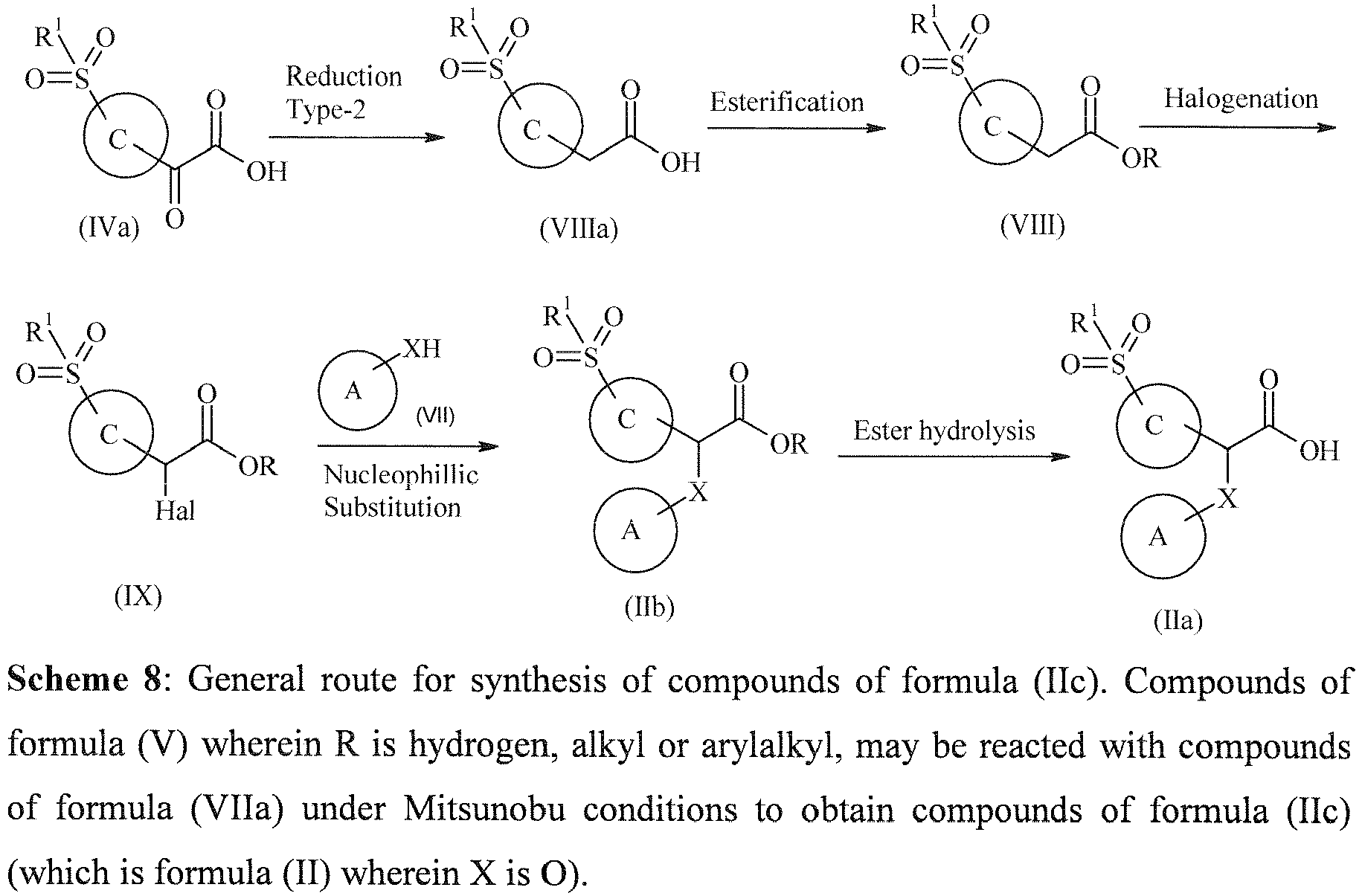


- The compounds of formula (VIII) may be prepared following independent synthetic routes as outlined in Schemes 12 -13.
- Scheme 13: General route for the synthesis of compounds of formula (VIII): Compounds of formula (X), which are available commercially, may be reacted with R1-LG, where LG is a suitable leaving group, using reaction conditions for nucleophilic substitution to obtain S-alkylated compounds of formula (XI). The compounds of formula (XI) may be oxidized (sulfur to sulfone) to obtain compounds of formula (VIII).


- Amide Coupling Conditions: Condition-I: When R = H, the amide coupling may be carried out using any suitable amide coupling regents such as oxallyl chloride, thionyl chloride, BOP-Cl, DCC, HOBt, HOAt, HATU, EDCI, alkylchloroformate and the like in the presence of organic non-nucleophillic bases such as triethyl amine, diisopropylethyl amine, pyridine, N-methyl pyrrolidine, N,N-dimethylaminopyridine, DBU, DABCO, other hindered amines and pyridines. The amide coupling reaction may be carried out in the presence of solvents such as dichloromethane, dichloroethane, DMF, dimethylacetamide, THF, acetonitrile or mixture of them may be used at a temperature ranging from -5 to 150 °C. The reaction may be carried out optionally in presence of catalytic amount of DMF. Condition-II: When R is not H, the amide coupling may be carried out by heating ester and amine either in the absence of solvent or in presence of high boiling solvent like toluene, xylene, DMSO. Amide coupling may be carried out in presence of trialkyl aluminium (Chem. Commun., 2008, 1100-1102).
- Halogenation Conditions: Halogenation reaction may be carried out using reagents such as N-halosuccinimide, dihalogens and the like, in presence of radical generating reagents like peroxides such as benzoylperoxide. Solvents used for this reaction include, but are not limited to, carbontetrachloride and ethers or mixtures thereof. The reaction may be carried out at a temperature ranging from -5 to 80 °C.
- Conditions for Nucleophilic Substitution: Nucleophilic substitution reaction, may be carried out using any suitable organic or inorganic bases. Organic bases may be selected from a group consisting of mono, di or trialkyl amines particularly methylamine, ethylamine, dimethylamine, diethylamine or triethylamine. Inorganic bases may be selected from a group consisting of alkali and alkaline earth metal hydrides, hyroxides, carbonates and bicarbonates or mixtures thereof. Solvents used for this reaction may be selected from a group consisting of lower alcohols, acetone, acetonitrile, DMSO, DMF, dimethylacetamide, THF and toluene, or mixtures thereof. The reaction may be carried out at a temperature in the range of 0 to 150 °C .
- Conditions for Ester Hydrolysis: Ester hydrolysis of carboxylic acids may be carried out using general saponification conditions employing inorganic bases such as alkali and alkaline earth metal hyroxides, carbonates and bicarbonates, for example lithium hydroxide, sodium hydride, sodium carbonate, potassium carbonate, cesium carbonate and the like; in the presence of solvents such as water, methanol, ethanol, THF and diethyl ether or mixtures thereof. These reactions may be done at 0 °C to refluxing temperature.
- Conditions for Esterification: Ester formation, from the above mentioned carboxylic acids, may be carried out using general esterification conditions employing appropriate alcohol like methanol, ethanol and a suitable inorganic acid selected from HCl, H2SO4, or thionyl chloride, or base catalysed ester formation using alkyl halide and suitable base like sodium hydride, sodium hydroxide, sodium carbonate, potassium carbonate, sodium bicarbonate, potassium bicarbonate, cesium carbonate and the like in presence of solvents such as acetone, acetonitrile, DMF, DMSO, THF and diethyl ether or mixtures thereof.
- Conditions for Oxidation: Oxidation of sulfanyls to sulfonyls, may be carried out using appropriate oxidizing reagent such as H2O2, perbenzoic acid, mCPBA, Oxone, dioxirane and the like in the presence of a solvent such as DCM, DCE, DMF, DMSO, THF and diethyl ether or mixtures thereof. Reagents like OsO4, KMnO4, PCC can also be used for such oxidation process.
- Conditions for Reduction Type-1: Reduction Type-1, may be carried out using appropriate reduction conditions for transforming carbonyls to sec-alcohols employing reducing agents like hydrogenation in presence of catalysts such as Pd/C, Pt/C, PtO2 and the like. Such reduction by hydrogenation can also be done using organo-metallic complexes as catalyst from metals like Iron, Rhodium, Ruthenium, and phosphorus-based organic ligands like triphenylphosphine, bidentate phosphine ligands such as bis(diphenylphosphino)ethane. Such hydrogenation based reductions can also be done under asymmetric reduction conditions to yield chiral products (in individual enantiomers and in enantiometically enriched form) if employed appropriate chiral phosphine ligands such as chiral 2,2'-bis(diphenylphosphino)-1,1'-binaphthyl (BINAP) to form the organometallic complex. Such reductions can also be done using metal hydrides such as sodium borohydride, lithium aluminiumhydride, borane reagents and the like. Such metal hydride or borane reagent based reductions can also be done in asymmetric way to yield chiral products (in individual enantiomers and in enantiometically enriched form) by using appropriate chiral ligands like tartarate (
EP 0320096 ), chiral 1,1'-bi-2-napthol (BINOL), oxazaborolidines. - Conditions for Reduction Type-2: Reduction Type-2, may be carried out using specific conditions known for transformation of arylic carbonyl group to corresponding arylalkyl functionality. Such reductions may be done using known Wolff-Kishner (KOH, NH2-NH2) or Clemmensen (Zn/HCl) reduction conditions.
- Conditions for Mitsunobu reaction: The Mitsunobu reaction between alcohol and phenol, to obtain the corresponding ether, may be carried out in THF using triphenylphosphine (TPP) and diethyl azodicarboxylate (DEAD) or diisopropyl azodicarboxylate (DIAD) as reagents.
- Sulfonamide Coupling Condition: Sulfonamide may be prepared by reacting any appropriate amine with sulfonylhalide in the presence of base such as pyridine, triethylamine & diisopropylethylamine. The reaction may be carried out in suitable solvent like pyridine, dichloromethane or tetrahydrofuran.
- Oxidative Chlorination: Thiols can be converted to sulfonyl chlorides under mild condition of oxidative chlorination. Here thiols are treated with combination of oxidant and chlorinating agent such as KNO3-TMSCl, H2O2-SOCl2, Oxone-SOCl2 in appropriate solvent such as DCM, acetonitrile, DMF or combination of acetonitrile-AcOH. The reaction may be carried out at a temperature in the range of 5 to 100 °C.
- Chlorosulfonation: Aryl or hetroaryl sulfonyl chloride synthesis may be carried out by elecrophilic substitution reaction using reagent like chlorosulfonic acid, SO2Cl2 in appropriate solvent which are not limited to halogenated like DCM, DCE, CHCl3, CCl4, but also nonpolar solvents like Benzene, Tolune, Dioxane or mixture thereof. The reaction may be carried out at a temperature in the range of 0 °C to 60 °C.
- The following abbreviations are employed in the examples and elsewhere herein:
- DMF: Dimethyl formamide
- DMSO: Dimethyl sulfoxide
- DCM: Dichloromethane
- DCE: Dichloroethane
- THF: Tetrahydrofuran
- mCPBA: meta chloro perbenzoic acid
- BOP-Cl: Bis(2-oxo-3-oxazolidinyl)phosphinic chloride
- DABCO: 1,4-Diazabicyclo[2.2.2]octane
- DBU: 1,8-Diazabicyclo[5.4.0]undec-7-ene
- DCC: N,N-Dicyclohexyl carbodiimide
- EDCI: 1-Ethyl-3-(3-dimetylaminopropyl)carbodiimide
- HOBT: 1-Hydroxybenzotriazole
- HOAT: 1-Hydroxy-7-azabenzotriazole
- HBTU: O-(benzotriazol-1-yl)-tetramethyluronium hexafluorophosphate
- HATU: O-(7-azabenzotriazol-1-yl)-tetramethyluronium hexafluorophosphate
- TPP: triphenylphosphine
- DEAD: diethyl azodicarboxylate
- DIAD: diisopropyl azodicarboxylate
- NBS : N-Bromosuccinamide
- KNO3 : Potassium nitrate
- AlCl3: Aluminium chloride
- TMSCl : Trimethylsilyl chloride
- H2O2 : Hydrogen peroxide
- LiOH : Lithium hydroxide
- All stereoisomers of the compounds of the instant disclosure are contemplated, either in admixture or in pure or substantially pure form. The compounds of the present disclosure can have asymmetric centers at any of the carbon atoms, consequently, compounds of formula (I) can exist in enantiomeric, or diastereomeric forms, or in mixtures thereof. The processes for preparation can utilize racemates, enantiomers, or diastereomers as starting materials. When diastereomeric or enantiomeric products are obtained as mixtures, they can be separated by conventional methods for example, chromatographic separation or fractional crystallization or through diasteriomeric salt formation. When intended, a desired enantiomer or diasteriomer can also be obtained by following appropriate enantioselective or diastereoselective reactions.
- Structures of the intermediates as well as the final compounds were confirmed by nuclear magnetic resonance spectra for proton (1H NMR) and LCMS.
-

- 4-Mercapto-phenyl acetic acid (10 gm, 59.5 mmol) was dissolved in methanol (300 ml). To this solution, sulfuric acid (5.8 gm, 59.5 mmol) was added and mixture was refluxed for 2 hrs. Solvent was removed under reduced pressure. The resulting residue was dissolved in ethyl acetate (200 ml), and was washed with water, sodium bicarbonate solution and brine (100 ml each), dried over anhydrous sodium sulfate, and filtered and solvent was removed under reduced pressure to provide (4-mercapto-phenyl)-acetic acid methyl ester (10 gm).
1HNMR (CDCl3, 400 MHz):- δ 3.44 (s, 1H), 3.58 (s, 2H), 3.70 (s, 3H), 7.16 (d, J = 8.0 Hz, 2H), 7.25 (d, J = 8.4 Hz, 2H). - (4-Mercapto-phenyl)-acetic acid methyl ester (1.8 gm, 9.89 mmol) was dissolved in DMF (20 ml) at 0 °C. Triethylamine (1.5 gm, 14.83 mmol) was added and stirred for 15 minutes followed by addition of 4-iodo-tetrahydropyran (3.14 gm, 14.83 mmol). The reaction mixture was stirred overnight at room temperature. Solvent was removed under reduced pressure, the resulting residue was taken into water and extracted with ethyl acetate (50 ml x 2) washed with water and brine (50 ml each) dried over anhydrous sodium sulfate, fliltered and concentrated to obtain a crude product which was purified by column chromatography over silica gel using 15 % ethyl acetate in hexanes as eluent to provide [4-(Tetrahydro-pyran-4-ylsulfanyl)-phenyl]-acetic acid methyl ester (2.1 gm).
1HNMR (CDCl3, 400 MHz):- δ 1.65-1.72 (m, 2H), 1.89-1.92 (m, 2H), 3.25-3.26(m, 1H), 3.41-3.46 (m, 2H), 3.62 (s, 2H), 3.71 (s, 3 H), 3.86-4.00 (m, 2 H), 7.39 (d, J = 8.0 Hz, 2H), 7.45 (d, J = 8.4 Hz, 2H). MS (EI) m/z: 267.20 (M+1). - [4-(Tetrahydro-pyran-4-ylsulfanyl)-phenyl]-acetic acid methyl ester (2.1 gm, 7.89 mmol) was taken in dichloromethane (100 ml) at 0 °C. mCPBA (8.00 gm, 47.36 mmol) was added portion wise and stirred for 5 hrs at room temperature. Reaction mixture was diluted with dichloromethane (100 ml), solid was filtered, filtrate was washed with saturated solution of sodium thiosulphate (150 ml), organic layer was washed with saturated solution of sodium bicarbonate, water and brine (100 ml each), dried over anhydrous sodium sulfate, filtered and concentrated. Crude compound was purified by column chromatography over silica gel using 35 % ethyl acetate hexane as eluent to provide pure [4-(tetrahydro-pyran-4-sulfonyl)-phenyl]-acetic acid methyl ester (1.69 gm).
1HNMR (CDCl3, 400 MHz):- δ 1.80-1.87 (m, 2H), 1.92-1.95 (m, 2H), 3.12-3.18 (m, 1H), 3.31-3.38 (m, 2H), 3.76 (s, 5H), 4.06 - 4.10 (m, 2H),), 7.53 (d, J = 8.0 Hz, 2H), 7.86 (d, J = 8.0 Hz, 2H). - [4-(Tetrahydro-pyran-4-sulfonyl)-phenyl]-acetic acid methyl ester (1.60 gm, 5.36 mmol), NBS (1.04 g, 5.90 mmol) and benzoyl peroxide (0.130 gm, 0.53 mmol) in carbon tetrachloride (50 ml) was refluxed for 7 hrs. Reaction mixture was diluted with DCM (50 ml), washed with water and brine (100 ml each), dried over anhydrous sodium sulfate, fliltered and concentrated. Crude compound was purified by column chromatography over silica gel using 30% ethyl acetate hexane as eluent to give the pure bromo-[4-(tetrahydro-pyran-4-sulfonyl)-phenyl]-acetic acid methyl ester (0.75 gm).
1HNMR (CDCl3, 400 MHz) :- δ 1.75-1.87 (m, 2H), 1.93-1.96 (m, 2H), 3.15-3.22 (m, 1H)3.33-3.38 (m,2 H), 3.85 (s, 3H), 4.07-4.11 (m, 2H), 5.41 (s,1H), 7.79 (d, J= 8.4 Hz, 2H), 7.90 (d, J = 8.4 Hz, 2H). - A mixture of 2,4- difluorophenol (0.28 gm, 2.18 mmol) and cesium carbonate (0.39 gm, 1.19 mmol) in acetonitrilie (20 ml) stirred for 30 mins. A solution of bromo-[4-(tetrahydro-pyran-4-sulfonyl)-phenyl]-acetic acid methyl ester (0.75 gm, 1.98 mmol) in acetonitrile (5 ml) was added drop wise at room temperature and stirred further for 2 hrs. Reaction mixture was diluted with ethyl acetate (50 ml), washed with water, 1N NaOH (cold, 50 ml), and brine (50 ml) dried over anhydrous sodium sulfate, filtered and concentrated to provide (2, 4-difluoro-phenoxy)-[4-(tetrahydro-pyran-4-sulfonyl)-phenyl]-acetic acid methyl ester (0.35 gm).
1HNMR (CDCl3, 400 MHz) :- δ 1.80-1.87 (m, 2H), 1.93-1.96 (m, 2H), 3.15-3.22 (m,1H), 3.33-3.38 (m, 2H), 3.80 (s, 3H), 4.07-4.11 (m, 2H), 5.70 (s, 1H), 6.78-6.83 (m, 1H), 6.89-6.95 (m, 1H), 6.98-7.04 (m,1H), 7.83 (d, J = 8.0 Hz, 2H), 7.95 (d, J = 8.4 Hz, 2H).MS (EI) m/z:444.00 (M+18) - To a solution of (2, 4-difluoro-phenoxy)-[4-(tetrahydro-pyran-4-sulfonyl)-phenyl]-acetic acid methyl ester (0.35 gm, 0.82 mmol) in THF (3 ml), was added lithium hydroxide monohydrate (0.035 gm, 2.05 mmol) in 1 ml water and stirred overnight at room temperature. Solvent was removed under reduced pressure, residue obtained was taken into water (5 ml), extracted with diethyl ether (10 ml x 2). Aqueous layer was acidified with 1 N HCl solution, and extracted with ethyl acetate (10 ml x 3), washed with water and brine (20ml, each) dried over anhydrous sodium sulfate, filtered and solvent was concentrated to provide (2, 4-difluoro-phenoxy)-[4-(tetrahydro-pyran-4-sulfonyl)-phenyl]-acetic acid (0.28 gm).
1HNMR (CDCl3, 400 MHz) :- δ 1.79-1.87 (m, 2H), 1.92-1.95 (m, 2H), 3.15-3.21 (m, 1H), 3.32-3.38 (m,2H), 4.07-4.11 (m, 2H), 5.71 (s, 1H), 6.78-6.83 (m, 1H), 6.89-6.95 (m, 1H), 6.98-7.04 (m,1H), 7.85 (d, J = 8.4 Hz, 2H), 7.95 (d, J = 8.0 Hz, 2H). -
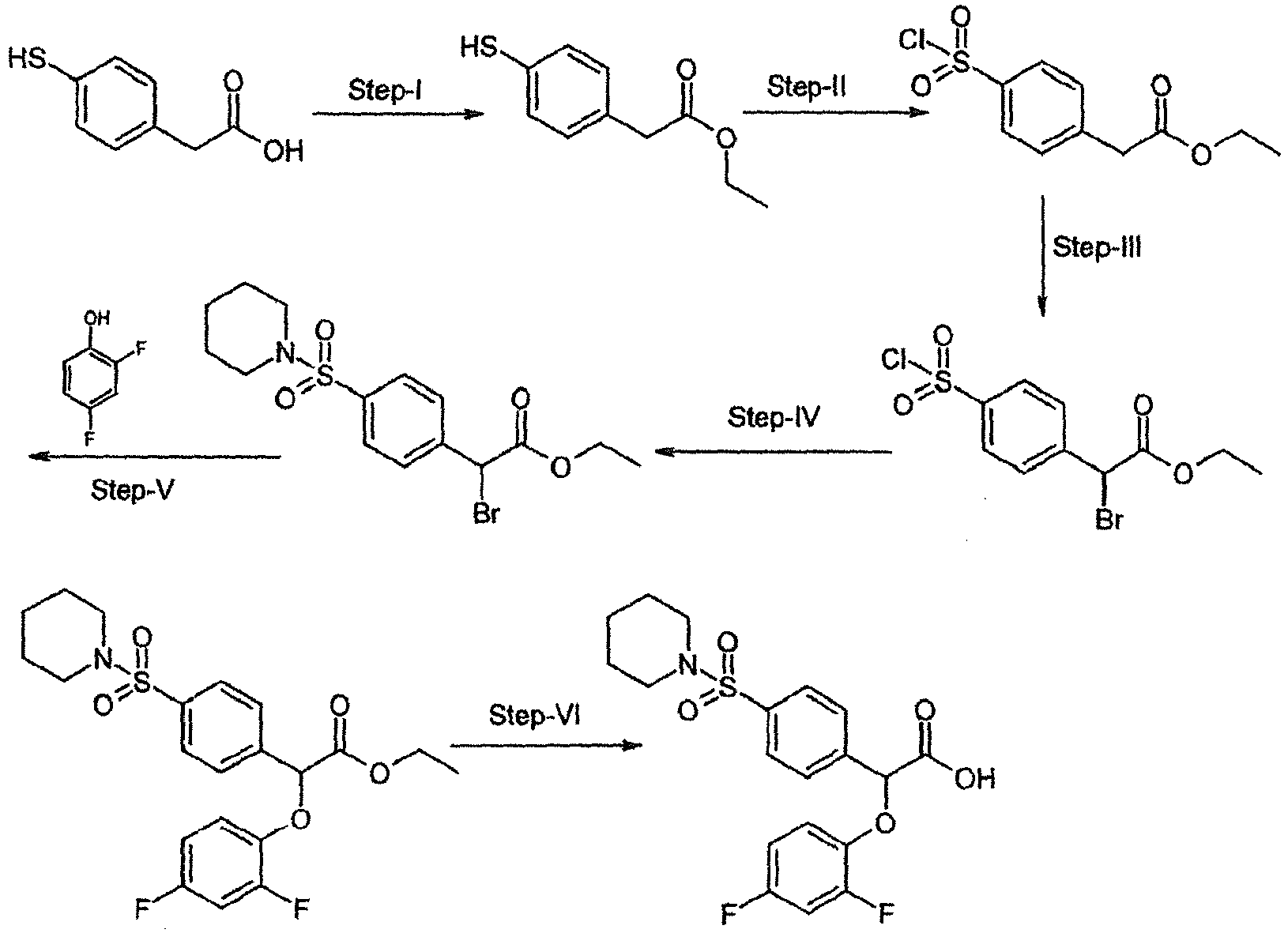
- To a solution of 4-mercapto-phenyl acetic acid (5 gm, 29.72 mmol) in ethanol (60 ml) was added sulfuric acid (1.58 ml, 29.72 mmol) dropwise. Reaction mixture was then heated at 60 °C for 3 hr, concentrated to remove ethanol. The residue was neutralized with satd. aq. NaHCO3 solution and extracted with ethyl acetate (3X30 ml) washed with brine, dried over anhydrous sodium sulfate, filtered and concentrated under reduced pressure to provide (4-mercapto-phenyl)-acetic acid ethyl ester (5.5 gm).
1H NMR (400 MHz, CDCl3): δ 1.22 (t, J=6.8 Hz, 3H), 3.55 (s, 2H), 4.11 (q, J=7.2 Hz, 2H), 7.14 (d, J=8.0 Hz, 2H), 7.22 (d, J=8.0 Hz, 2H). - (4-Mercapto-phenyl)-acetic acid ethyl ester (2 gm, 10.2 mmole) was taken in a seal tube. To it DCM (30 ml) was added followed by KNO3 (2.42 gm, 22.4 mmole) and TMSCl (2.79 ml, 22.4 mmole). Mixture was heated at 50 °C for 24 hr, cooled to room temperature and filtered to remove solids, residue was washed with DCM (10X2 ml), combined filtrate was washed with water followed by brine solution, dried over anhydrous sodium sulfate, filtered and concentrated under reduced pressure to provide (4-chlorosulfonyl-phenyl)-acetic acid ethyl ester (1.6 gm).
1H NMR (400 MHz, DMSO-d6): δ 1.17 (t, J=6.8 Hz, 3H), 3.66 (s, 2H), 4.05-4.11 (m, 2H), 7.21 (d, J=8.0 Hz, 2H), 7.54 (d, J=8.0 Hz, 2H). - (4-Chlorosulfonyl-phenyl)-acetic acid ethyl ester (1.6 gm, 6.45 mmol) was taken in carbon tetrachloride (13 ml). N-Bromosuccinimide (1.26 gm, 7.09 mmol) was added in one lot followed by benzoyl peroxide (171 mg, 0.7 mmol). The reaction mixture was refluxed for 2 days. The reaction mixture was cooled to room temperature and filtered; filtrate was washed with water followed by brine solution, dried over anhydrous sodium sulfate and concentrated under reduced pressure to provide bromo-(4-chlorosulfonyl-phenyl)-acetic acid ethyl ester (2.08 gm) as a gummy mass. The crude material was used as such for further reaction.
- Bromo-(4-chlorosulfonyl-phenyl)-acetic acid ethyl ester (2.08 gm, 6.38 mmol) was taken in DCM (63 ml) under argon atmosphere and cooled to 0-5 °C, piperidine (0.56 ml, 5.74 mmol) was added dropwise to the mixture at 0-5 °C. Reaction mixture was then stirred at room temperature for 30 min. Reaction mixture was washed with water followed by brine solution, dried over anhydrous sodium sulfate and concentrated under reduced pressure to give the crude product, which was purified by flash column chromatography over silica gel using 30-50% ethyl acetate in hexane as eluent to give bromo-[4-(piperidine-1-sulfonyl)-phenyl]-acetic acid ethyl ester (1.2 gm).
1H NMR (400 MHz, CDCl3): 8 1.31 (t, J=7.2 Hz, 3H), 1.46-1.49 (m, 2H), 1.65-1.71 (m, 4H), 2.99-3.04 (m, 4H), 4.21-4.31 (m, 2H), 5.38 (s, 1H), 7.72 (d, J=8.4 Hz, 2H), 7.76 (d, J=8.4 Hz, 2H). - 2,4-Difluorophenol (0.38 ml, 3.89 mmol) and cesium carbonate (0.76 gm, 2.33 mmol) were taken in acetonitrile (30 ml) under argon atmosphere and was stirred for 30 minutes. Bromo-[4-(piperidine-1-sulfonyl)-phenyl]-acetic acid ethyl ester (1.4 gm, 3.86 mmol) in acetonitrile (15 ml) was added to the mixture and stirred at 25 °C for 3 hour. Reaction mixture was diluted with water (30 ml), extracted with ethyl acetate (3X20 ml), organic layer was washed with brine solution, dried over anhydrous sodium sulfate and concentrated under reduced pressure to give a gummy mass which was purified by flash column chromatography using over silica gel using 40-60% ethyl acetate in hexane as eluent to give (2,4-difluoro-phenoxy)-[4-(piperidine-1-sulfonyl)-phenyl]-acetic acid ethyl ester (1.31 gm).
1H NMR (400 MHz, CDCl3): δ 1.22 (t, J=7.2 Hz, 3H), 1.44-1.46 (m, 2H), 1.66-1.67 (m, 4H), 3.0-3.04 (m, 4H), 4.21-4.27 (m, 2H), 5.66 (s, 1H), 6.80-6.82 (m, 1H), 6.89-6.95 (m, 1H), 6.95-7.29 (m, 1H), 7.76 (d, J=8.4 Hz, 2H), 7.81 (d, J=8.4 Hz, 2H). - (2,4-Difluoro-phenoxy)-[4-(piperidine-1-sulfonyl)-phenyl]-acetic acid ethyl ester (1.3 gm, 2.98 mmol) was dissolved in THF (5 ml) and methanol (0.5 ml). To this was added a solution of lithium hydroxide (0.62 gm, 14.90 mmol) in water (5 ml) and stirred for 18 hours at 250C. Organic solvents were evaporated from the reaction mixture and aqueous layer was acidified with 1N HCl, precipitated product was filtered off and residue was washed with water. Solid product was dried under vacuum to provide (2,4-difluoro-phenoxy)-[4-(piperidine-1-sulfonyl)-phenyl]-acetic acid (1gm).
1H NMR (400 MHz, DMSO-d6): δ 1.35-1.42 (m, 2H), 1.51-1.61 (m, 4H), 2.86-2.91 (m, 4H), 6.12 (s, 1H), 7.02-7.06 (m, 1H), 7.18-7.24 (m, 1H), 7.33-7.39 (m, 1H), 7.79-7.84 (brs, 4H). MS (EI) m/z: 412.0 (M+1). -
Preparation No. IUPAC Name 3 (2,4-Difluoro-phenoxy)-[4-(morpholine-4-sulfonyl)-phenyl]-acetic acid 4 (4-Chloro-phenoxy)-[4-(morpholine-4-sulfonyl)-phenyl]-acetic acid 5 (4-Chloro-phenoxy)-[4-(piperidine-1-sulfonyl)-phenyl]-acetic acid 6 (4-Chloro-2-fluoro-phenoxy)-[4-(piperidine-1-sulfonyl)-phenyl]-aceticacid 7 (4-Chloro-2-fluoro-phenoxy)-[4-(morpholine-4-sulfonyl)-phenyl]-aceticacid -

- Phenyl-acetic acid methyl ester (10 gm, 66.6 mmol) was taken in carbon tetrachloride (100 ml). N-Bromosuccinimide (13.05 gm, 73.33 mmol) was added in one lot followed by benzoyl peroxide (1.77 gm, 7.3 mmol) and refluxed for 3 hours. The reaction mixture was cooled to room temperature and filtered; filtrate was washed with water followed by brine solution, dried over anhydrous sodium sulfate and concentrated under reduced pressure to provide bromo-phenyl-acetic acid methyl ester (16.4 gm) as a gummy mass.
1H NMR (400 MHz, CDCl3): δ 3.82 (s, 3H), 5.39 (s, 1H), 7.39-7.41 (m, 3H), 7.56-7.58 (m, 2H). - Chlorosulphonic acid (1.5 ml, 21.86 mmol) was dissolved in DCM (20 ml) and cooled to 0-5 °C under argon atmosphere. Bromo-phenyl-acetic acid methyl ester (1.0 gm, 4.36 mmol) was added to cooled mixture in drop wise manner and continued to stirr at 0-50C. for 1 hour then at room temperature for 1 hour. Reaction mixture was diluted with water (10 ml), organic layer was washed with brine solution, dried over anhydrous sodium sulfate, filtered and concentrated under reduced pressure to give the product as mixture of para and meta regioisomers as gummy mass. The crude material was used as such for further reaction.
- A solution of pyrrolidine (0.14 gm, 2 mmol) in DCM (10 ml) was cooled to 0-5 °C under argon atmosphere. To this was added a solution of bromo-(4-chlorosulfonyl-phenyl)-acetic acid methyl ester and bromo-(3-chlorosulfonyl-phenyl)-acetic acid methyl ester (0.207 gm, 2.04 mmol) in DCM (10 ml) drop wise at 0-5 °C The reaction mixture was then stirred at room temperature for 18 hours, diluted with water (10 ml), organic layer was washed with brine solution, dried over anhydrous sodium sulfate, filtered and concentrated under reduced pressure to give the product as a mixture of para and meta regioisomers.
MS (EI) m/z: 363.9 (M+1) - 2,4-Difluorophenol (0.5 gm, 3.86 mmol) and cesium carbonate (0.75 gm, 2.32 mmol) were taken in acetonitrile (10 ml). Mixture was stirred for 30 minutes under argon atmosphere, followed by addition of regioisomers obtained in step III (1.4 gm, 3.86 mmol) in acetonitrile (15 ml). Mixture was then stirred at 25 °C 18 hours, diluted with water (30 ml) and extracted with ethyl acetate (3X20 ml). The organic layer was washed with brine solution, dried over anhydrous sodium sulfate, filtered and concentrated under reduced pressure to give the product as a gummy mass which was purified by column chromatography(30-40% ethyl acetate in hexane) to give 0.720 gm of mixture of products as meta and para regioisomers.
MS (EI) m/z: 412.2 (M+1). - Mixture of regioisomers obtained in step IV (0.6 gm, 1.45 mmol) was dissolved in THF (5 ml) and methanol (5 ml). A solution of lithium hydroxide (0.15 gm, 3.64 mmol) in water (5 ml) was added stirred for 18 hours at 25 °C. Organic solvents were evaporated from the reaction mixture and aqueous layer was acidified with 1N HCl and extracted with ethylacetate (3X10 ml), organic layer was washed with brine solution, dried over anhydrous sodium sulfate, and concentrated under reduced pressure to give 0.56 gm of products as mixture of para and meta regioisomers.
MS (EI) m/z: 398.2. -
Preparation No. IUPAC Name 10 [4-(Azetidine-1-sulfonyl)-phenyl]-(2,4-difluoro-phenoxy)-acetic acid 11 [3-(Azetidine-1-sulfonyl)-phenyl]-(2,4-difluoro-phenoxy)-acetic acid 12 (2,4-Difluoro-phenoxy)-[3-(piperidine-1-sulfonyl)-phenyl]-acetic acid -

- (4-Chlorosulfonyl-phenyl)-acetic acid methyl ester, obtained similarly as described in Preparation 2, (1.0 gm, 4.02 mmol) was taken in dry DCM (40 ml) under argon atmosphere and cooled to 0-5°C, piperidine (0.50 ml, 4.42 mmol) followed by triethylamine (0.61 ml, 4.42 mmol) was added dropwise to the mixture at 0-5°C. Reaction mixture was then brought to room temperature and stirred for additional 2 hours. Reaction mixture was washed with water followed by brine solution, dried over anhydrous sodium sulfate and concentrated under reduced pressure to give the crude product, which was purified by column chromatography using 20-30% ethyl acetate in hexane as eluent to give [4-(Piperidine-1-sulfonyl)-phenyl)-acetic acid methyl ester (0.95 gm).
1H NMR (400 MHz, CDCl3): δ 1.38-1.44 (m, 2H), 1.60-1.66 (m, 4H), 2.96-2.99 (m, 4H), 3.70 (s, 2H), 3.72 (s, 3H), 7.43 (d, J = 8.3 Hz, 2H), 7.70 (d, J = 8.3 Hz, 2H)
MS (EI) m/z: 297.9 (M + 1). - [4-(Piperidine-1-sulfonyl)-phenyl]-acetic acid methyl ester (0.5g, 1.68 mmol) was dissolved in dry acetonitrile (8ml) under argon atmosphere. To the above solution para toluene sulfonyl azide (0.36g, 1.85 mmol) was added, followed by DBU (0.38 ml, 2.52 mmol) in dropwise manner, and stirred for 30 min. Reaction mixture was poured in ice cold water (20ml), extracted with ethyl acetate (3X20 ml), organic layer was washed with brine solution, dried over anhydrous sodium sulfate, and concentrated under reduced pressure to provide crude product, which was purified by column chromatography using 20-25% ethyl acetate in hexane as eluent to give Diazo-[4-(piperidine-1-sulfonyl)-phenyl]-acetic acid methyl ester (0.42 gm).
1H NMR (400 MHz, CDCl3): δ 1.38-1.44 (m, 2H), 1.60-1.66m(m, 4H), 2.96-2.99 (m, 4H), 3.90 (s, 3H), 7.64 (d, J = 8.8 Hz, 2H), 7.74(d, J = 8.3 Hz, 2H).
MS (EI) m/z: 324.1 (M+1). - Diazo-[4-(piperidine-1-sulfonyl)-phenyl)-acetic acid methyl ester (0.72 gm, 2.13 mmol) was dissolved in DCM (10 ml) under argon atmosphere. To this solution, 4-hydroxy tetrahydropyran (0.24 ml, 2.56 mmol) was added followed by rhodium (II) acetate dimer (19 mg, 0.044 mmol). Mixture was stirred at 250C for 30 min. Reaction mixture was diluted with DCM (10 ml), organic layer was washed with water followed by brine solution, dried over anhydrous sodium sulfate, filtered and concentrated under reduced pressure to give a crude product which was purified by column chromatography using 35-40% ethyl acetate in hexane as eluent to provide [4-(Piperidine-1-sulfonyl)-phenyl]-[(tetrahydro-pyran-4-yloxy)]-acetic acid methyl ester (520 mg).
1H NMR (400 MHz, CDCl3): δ 1.25-1.28 (m, 2H), 1.60-1.69 (m, 6H), 1.88-2.00(m, 2H), 2.98-3.01(m, 4H), 3.38-3.49(m, 2H), 3.60-3.66 (m, 1H), 3.75 (s, 3H) 3.91-4.02 (m, 2H), 5.13 (s, 1H), 7.64 (d, J = 8.3 Hz, 2H), 7.75(d, J = 8.3 Hz, 2H).
MS (EI) m/z: 398.2 (M + 1). - To [4-(Piperidine-1-sulfonyl)-phenyl]-[(tetrahydro-pyran-4-yloxy)]-acetic acid methyl ester (0.52 gm, 1.30 mmol) was added a solution of lithium hydroxide (0.274 gm, 6.54 mmol) in water (3 ml) followed by THF (4 ml) and methanol (0.5 ml) and stirred for 2 hours at 250C. Organic solvents were evaporated from the reaction mixture and aqueous layer was acidified by using 1N HCl, extracted with ethyl acetate (3X20 ml), organic layer was washed with brine solution, dried over anhydrous sodium sulfate, and concentrated under reduced pressure to provide [4-(Piperidine-1-sulfonyl)-phenyl]-[(tetrahydro-pyran-4-yloxy)]-acetic acid (0.35gm).
1H NMR (400 MHz, DMSO-d6): δ 1.36-1.37 (m, 2H), 1.48-1.53 (m, 6H), 1.85-1.93 (m, 2H), 2.86-2.89 (m, 4H), 3.30-3.35 (m, 4H), 3.60-3.65(m, 1H), 3.75-3.85(m, 2H), 5.25 (s, 1H), 7.67 (d, J = 8.3 Hz, 2H), 7.74 (d, J = 8.4 Hz, 2H).
MS (EI) m/z: 384.2 (M + 1). -
Preparation No. IUPAC Name 14 [4-(Morpholine-4-sulfonyl)-phenyl]-[(tetrahydro-pyran-4-yloxy)]-acetic Acid -

- AlCl3 (7.98 gm, 48.42 mmole) was suspended in DCM (50 ml) and cooled to 00C under argon atmosphere. To this suspension was added chlorooxo ethylacetate (4.5 ml, 39.98 mmol) at 00C and stirred for 45 min. followed by addition of a solution of cyclopropylsulfanyl-benzene (5 gm, 33.28 mmol) in DCM (10 ml) and stirred at 250C for 2 hr. Reaction mixture was slowly poured over crushed ice, organic layer was separated and aqueous layer was extracted with DCM (3X50 ml), combined organic layer was washed with brine solution, dried over anhydrous sodium sulfate, filtered and concentrated under reduced pressure to obtain (4-cyclopropylsulfanyl-phenyl)-oxo-acetic acid ethyl ester (3.1 gm) as an oil.
1H NMR (400 MHz, CDCl3): δ 0.72-0.73 (m, 2H), 1.15-1.17 (m, 2H), 1.40 (t, J=6.6 Hz, 3H), 2.18-2.21 (m, 1H), 4.41 (q, J=6.8 Hz, 2H), 7.43 (d, J=8.0 Hz, 2H), 7.90 (d, J=8.0 Hz, 2H). MS (EI) m/z: 250.9 (M+1). - (4-Cyclopropylsulfanyl-phenyl)-oxo-acetic acid ethyl ester (3.1 gm, 12.53 mmole) in DCM (50 ml) was cooled to 0-50C followed by addition of mCPBA (9.8 gm, 31.33 mmol) portion wise at 00C. After stirring at 250C for 4 hr, the reaction mixture was filtered; filtrate was washed with saturated aq. Na2S2O3 and satd. aq. sodium bicarbonate solution followed by brine solution, dried over anhydrous sodium sulfate, filtered and concentrated under reduced pressure to give (4-cyclopropanesulfonyl-phenyl) oxo acetic acid ethyl ester (3 gm).
1H NMR (400 MHz, CDCl3): δ 1.05-1.10 (m, 2H), 1.36-1.39 (m, 2H), 1.40 (t, J=6.8 Hz, 3H), 2.45-2.50 (m, 1H), 4.42 (q, J=7.2 Hz, 2H), 8.01 (d, J=8.4 Hz, 2H), 8.20 (d, J=8.4 Hz, 2H). MS (EI) m/z: 297.1 (M+NH4). - A mixture of (4-cyclopropanesulfonyl-phenyl) oxo acetic acid ethyl ester (0.5 gm, 1.77 mmole) and p-toluene sulfonyl hydrazide (0.48 gm, 2.3 mmol) in toluene (15 ml) was refluxed for 16 hr using a Dean-Stark apparatus. Reaction mixture was concentrated to give the crude product which was purified by column chromatography over silica gel using 20-25% ethyl acetate in hexane as eleunt to provide p-toluene sulfonyl hydrazone (4-cyclopropyl sulfonyl) phenyl acetic acid ethyl ester (0.5 gm).
MS (EI) m/z: 451.0 (M+1). - To a solution of p-toluene sulfonyl hydrazone (4-cyclopropyl sulfonyl) phenyl acetic acid ethyl ester (0.5 gm, 1.23 mmole) in dry DCM (6 ml), was added triethylamine (0.17 mL, 1.35 mmol) and stirred at 250C for 1 hr. Reaction mixture was concentrated to provide (4-cyclopropanesulfonyl-phenyl) diazo acetic acid ethyl ester (0.5 gm) which was used as it is for next reaction.
MS (EI) m/z: 295.1 (M+1). - (4-Cyclopropanesulfonyl-phenyl) diazo acetic acid ethyl ester (2 gm, 6.74 mmol) was dissolved in DCM (33 mL) under argon atmosphere. To this solution, 3-hydroxy tetrahydrofuran (1.36 mL, 16.87 mmol) was added followed by rhodium(II)acetate dimer (62 mg, 0.14 mmol). Mixture was stirred at 250C for 3 hr. Reaction mixture was diluted with DCM (25 mL), organic layer was washed with water followed by brine solution, dried over anhydrous sodium sulfate, filtered and concentrated under reduced pressure to give a crude product which was purified by column chromatography using 35-40% ethyl acetate in hexane as eluent to provide (4-cyclopropanesulfonyl-phenyl)-[(tetrahydrofuran-3-yloxy)]-acetic acid ethyl ester (1 gm).
1H NMR (400 MHz, CDCl3): δ 0.99-1.05 (m, 2H), 1.18-1.24 (m, 3H), 1.31-1.34 (m, 2H), 1.96-2.10 (m, 2H), 2.38-2.48 (m, 1H), 3.73-3.97 (m, 4H), 4.14-4.19 (m, 2H), 4.20-4.22 (m, 1H), 4.97-4.99 (d, J=8.4,1H), 7.61-7.64 (m, 2H), 7.85-7.88 (m, 2H).
MS (EI) m/z: 355 (M+1), 372.1 (M+18). - To (4-cyclopropanesulfonyl-phenyl)-[(tetrahydro-furan-3-yloxy)]-acetic acid ethyl ester (1 gm, 2.82 mmol) was added a solution of lithium hydroxide (0.59 gm, 14.12 mmol) in water (5 ml) followed by THF (10 ml) and methanol (2 ml) and stirred for 2 hours at 25 °C.
- Organic solvents were evaporated from the reaction mixture and aqueous layer was acidified 1N HCl, extracted with ethyl acetate (3X10 ml), organic layer was washed with brine solution, dried over anhydrous sodium sulfate, and washed concentrated under reduced pressure to provide (4-cyclopropanesulfonyl-phenyl)-[(tetrahydro-furan-3-yloxy)]-acetic acid (0.8 gm)
1H NMR (400 MHz, CDCl3): δ 1.05-1.07 (m, 2H), 1.37-1.42 (m, 2H), 2.06-2.10 (m, 2H), 2.47-2.51 (m, 1H), 3.74-4.28 (m, 4H), 4.12-4.28 (m, 1H), 5.04 (s, 1H), 7.66 (t, J=6.6 Hz, 2H), 7.91 (d, J = 8.0 Hz, 2H). MS (EI) m/z: 327 (M+1), 344.1 (M+18) -
Prreparation No. IUPAC Name 16 (4-Cyclopropanesulfonyl-phenyl)-[(S)-(tetrahydro-furan-3-yl)oxy]-acetic acid 17 (4-Cyclopropanesulfonyl-phenyl)-[(R)-(tetrahydro-furan-3-yl)oxy]-acetic acid -

- (4-Cyclopropanesulfonyl-phenyl) diazo acetic acid ethyl ester, obtained similarly as described in preparation 13, (5gm, 16.87 mmol) was dissolved in DCM (84 mL) under argon atmosphere. To this solution, 4-hydroxy tetrahydropyran (2.0 mL, 20.24 mmol) was added followed by rhodium(II)acetate dimer (156 mg, 0.35 mmol). Mixture was stirred at 250C for 3 hr. Reaction mixture was diluted with DCM (50 mL), organic layer was washed with water followed by brine solution, dried over anhydrous sodium sulfate, filtered and concentrated under reduced pressure to give a crude product which was purified by column chromatography using 35-40% ethyl acetate in hexane as eluent to provide (4-cyclopropanesulfonyl-phenyl)-[(tetrahydro-pyran-4-yloxy)]-acetic acid ethyl ester (3.5 gm).
1H NMR (400 MHz, CDCl3): δ 1.02-1.07 (m, 2H), 1.24 (t, 3H), 1.34-1.37 (m, 2H), 1.65-1.81 (m, 2H), 1.87-1.92 (m, 1H), 1.95-2.01 (m, 1H), 2,43-2.49 (m, 1H), 3.39-3.48 (m, 2H), 3.62-3.68 (m, 1H), 3.91-4.02 (m, 2H) 4.15-4.23 (m, 2H), 5.11 (s,1H), 7.68- (d, J = 8.0 Hz, 2H), 7.90 (d, J = 8.0 Hz, 2H).
MS (EI) m/z: 369 (M+1), 386.1 (M+18). - To (4-cyclopropanesulfonyl-phenyl)-[(tetrahydro-pyran-4-yloxy)]-acetic acid ethyl ester (23.2 gm, 62.87 mmol) was added a solution of lithium hydroxide (13.0 gm, 314.36 mmol) in water (150 ml) followed by THF (200 ml) and methanol (10 ml) and stirred for 2 hours at 250C. Organic solvents were evaporated from the reaction mixture and aqueous layer was acidified 1N HCl, extracted with ethyl acetate (3X200 ml), organic layer was washed with brine solution, dried over anhydrous sodium sulfate, and washed concentrated under reduced pressure to provide (4-cyclopropanesulfonyl-phenyl)-[(tetrahydro-pyran-4-yloxy)]-acetic acid (18.49 gm).
1H NMR (400 MHz, CDCl3): δ 1.02-1.06 (m, 2H), 1.07-1.15 (m, 2H) 1.23-1.56 (m, 2H), 1.83-1.94 (m, 2H), 2.83-2.89 (m, 1H), 3.28-3.35 (m, 2H), 3.69-3.65 (m, 1H), 3.74-3.85 (m, 2H) 5.26 (s, 1H), 7.69 (d, J = 8.0 Hz, 2H), 7.90 (d, J = 8.0 Hz, 2H).
MS (EI) m/z: 341.0 (M+1), 358.0 (M+18). -

- To a solution of ethyl 2-(4-cyclopropanesulfonylphenyl) acetate, obtained according to
WO2004072031 , in carbon tetrachloride, was added N-Bromosuccinimide followed by catalytic amount of benzoyl peroxide. The reaction mixture was then refluxed for 4 hours. After completion, the reaction mixture was cool to room temperature, filtered; the filtrate was washed with water followed by brine solution, dried over anhydrous sodium sulfate, solvent was removed under reduced pressure to provide title compound as a gummy mass which was used for the next step with out any further purification.
1H NMR (400 MHz, CDCl3): δ 1.04-1.10 (m, 2H), 1.31 (t, J = 7.2 Hz, 3H), 1.36-1.40 (m, 2H), 2.45-2.49 (m, 1H), 4.23-4.32 (m, 2H), 5.37 (s, 1H), 7.75 (d, J = 8.4 Hz, 2H), 7.91 (d, J = 8.4 Hz, 2H).
MS (EI) m/z: 346.9 (M+1) - To a solution of 2,4-difluorophenol in acetonitrile, was added potassium carbonate followed by bromo-(4-cyclopropanesulfonyl-phenyl)-acetic acid ethyl ester (obtained in step I) and stirred for 10-14 hours. After completion, the reaction mixture was filtered; the filtrate was concentrated to obtain a residue which was dissolved in ethyl acetate; this solution was washed with water followed by brine solution, dried over anhydrous sodium sulfate, solvent was removed under reduced pressure to provide a crude product which was purified by column chromatography to provide the title compound.
1H NMR (400 MHz, CDCl3): δ 1.03-1.10 (m, 2H), 1.24 (t, J = 7.2 Hz, 3H), 1.36-1.41 (m, 2H), 2.46-2.50 (m, 1H), 4.19-4.26 (m, 2H), 5.66 (s, 1H), 6.77-6.81 (m, 1H), 6.88-6.93 (m, 1 H), 6.97-7.03 (m, 1H), 7.80 (d, J = 8.4 Hz, 2H), 7.96 (d, J = 8.4 Hz, 2H).
MS (EI) m/z: 397 (M+1). - To a stirred solution of A1-II (obtained in step II) in tetrahydrofuran, was added aqueous solution of NaOH at room temperature and stirred for 4 h. After completion of reaction, THF was removed under reduced pressure. The residue was washed with diethyl ether. The aqueous layer was acidified using HCl and was extracted with ethyl acetate. The organic layer was washed with brine and dried over anhydrous sodium sulfate; solvent was evaporated under reduced pressure to obtain the title compound
1H NMR (400 MHz, CDCl3): δ 1.06-1.09 (m, 2H), 1.36-1.39 (m, 2H), 2.46-2.49 (m, 1H), 5.69 (s, 1H), 6.78-6.79 (m, 1H), 6.91-6.99 (m, 2H), 7.80 (d, J = 8.0 Hz, 2H), 7.96 (d, J = 8.4 Hz, 2H).
MS (EI) m/z: 369 (M+1) -
Prreparation No. IUPAC Name 20 (4-Chloro-phenoxy)-(4-cyclopropanesulfonyl-phenyl)-acetic acid 21 (4-Cyclopropanesulfonyl-phenyl)-(4-fluoro-phenoxy)-acetic acid 22 (4-Cyclopropanesulfonyl-phenyl)-(3-fluoro-phenoxyl-acetic acid 23 (4-Cyclopropanesulfonyl-phenyl)-(4-methoxy-phenoxy)-acetic acid 24 (4-Cyclopropanesulfonyl-phenyl)-(3-methoxy-phenoxy)-acetic acid 25 (4-Cyclopropanesulfonyl-phenyl)-(4-trifluoromethoxy-phenoxy)-acetic acid 26 (4-Cyclopropanesulfonyl-phenyl)-(4-trifluoromethyl-phenoxy)-acetic acid 27 (4-Cyclopropanesulfonyl-phenyl)-(3-trifluoromethyl-phenoxy)-acetic acid 28 (4-Cyclopropanesulfonyl-phenyl)-p-tolyloxy-acetic acid 29 (4-Cyclopropanesulfonyl-phenyl)-phenoxy-acetic acid 20 (4-Cyclopropanesulfonyl-phenyl)-(3,4-dichloro-phenoxy)-acetic acid 31 (4-Cyclopropancsulfonyl-phenyl)-(3,4-difluoro-phenoxy)-acetic acid 32 (3-Chloro-4-fluoro-phenoxy)-(4-cyclopropanesulfonyl-phenyl)-acetic acid - Intermediates-33-40 were either obtained from commercial source or prepared as per literature method.


Commercial Source 33-1 Commercial Source 33-2 WO2009047798 33-3 WO2004058752 33-4 


Chem.Pharm.Bull 36, 2969 33-5 WO2008005914 33-6 WO2008005914 33-7 WO2007099317 33-8 


Commercial Source 33-9 33-10 Commercial Source 34-1 Commercial Sorce 34-2 


Commercial Source 35 J.Med.Chem. 2007, 50(8), 4464 36-1 Commercial Source 36-2 Commercial Source37 Aq. NH4OH 38 


J.Het.Chem. 1977, 14, 129 39-1 WO2007007886 39-2 WO2007041366 39-3 

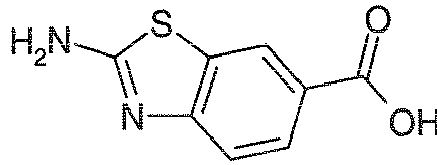

WO2008084873 39-4 Commercial Source 40-1 WO2007113644 40-2 Commercial Source 40-3 -
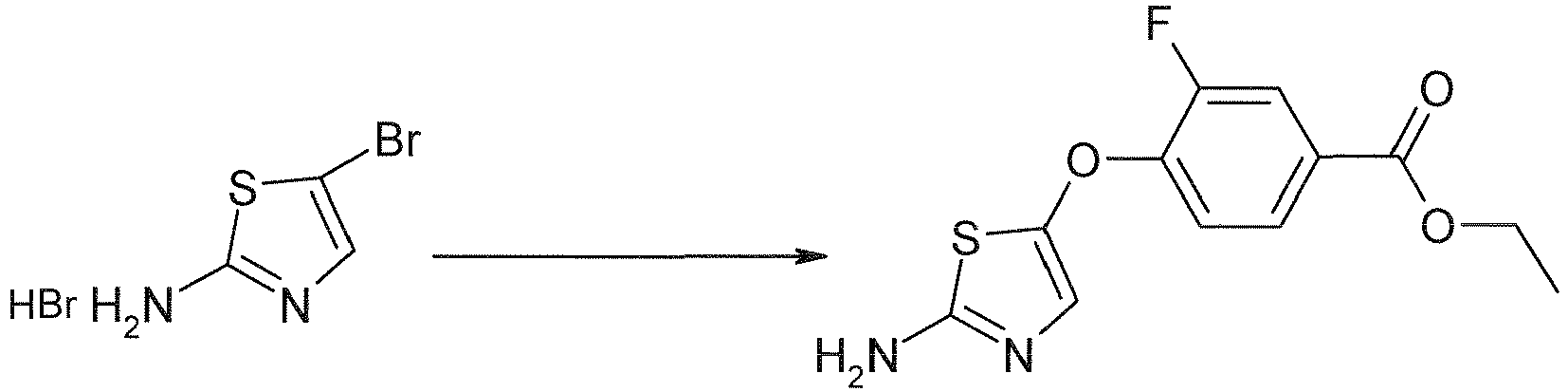
- To a solution of 5-Bromothiazole-2-amine hydrobromide (1.55 g, 5.97 mmol) in acetone (100 mL) was added 3-fluoro-4-hydroxy benzoic acid ethyl ester (1.1 g, 5.97 mmol) and cesium carbonate (3.89 g, 11.94 mmol) under argon atmosphere and refluxed for 5 hrs. The reaction mixture was cooled to room temperature and filtered; the filtrate was concentrated under reduced pressure. The residue was partitioned in between ethyl acetate and water. The layers were separated, the organic layer was washed with cold 2 N NaOH (10 mL), brine and dried over anhydrous sodium sulfate, filtered and concentrated under reduced pressure to provide 4-(2-amino-thiazol-5-yloxy)-3-fluoro-benzoic acid ethyl ester (0.68 gm).
1H NMR (400 MHz, CDCl3): δ 1.39 (t, 3H), 4.37 (q, 2H), 6.83 (s, 1H), 7.13-7.17 (t, 1H), 7.76-7.84 (m, 2H). MS (EI) m/z: 282.9 (M+1). -
Preparation No. IUPAC Name 42 4-(2-Amino-thiazol-5-yloxy)-2-fluoro-benzoic acid methyl ester 43 5-(5-Trifluoromethyl-pyridin-2-yloxy)-thiazol-2-ylamine 44 [4-(2-Amino-thiazol-5-yloxy)-phenyl]-acetic acid methyl ester 45 4-(2-Amino-thiazol-5-yloxy)-benzonitrile 46 6-(2-Amino-thiazol-5-yloxy)-nicotinic acid methyl ester 47 4-(2-Amino-thiazol-5-yloxy)-benzaldehyde -

- To a mixture of 2-amino-5-bromothiazole monohydrobromide (2 gm, 7.69 mmol) and powdered potassium carbonate (2.1 gm, 15.38 mmol) in DMF (20 mL) was added morpholine (1.34 ml, 15.38 mmol) under argon atmosphere and heated at 60 °C for 3 hr. Reaction mixture was cooled to rt and poured over ice cold water (100 ml), extracted with ethylacetate (3X100ml), washed with brine solution, dried over anhydrous sodium sulfate, filtered and concentrated under reduced pressure. To the residue, diisopropyl ether (50 mL) was added, after stirring for 30 minutes product precipitated out, which was filtered and dried under vacuum to provide 5-morpholin-4-yl-thiazol-2-ylamine (0.95 gm).
1H NMR (400 MHz, DMSO-d6): δ 2.80-2.82 (m, 4H), 3.66-3.68 (m, 4H), 6.30 (s, 1H)), 6.49 (bs, 2H). MS (EI) m/z: 186 (M + 1). -
Preparation No. IUPAC Name 49 1-(2-Amino-thiaxol-5-yl)-piperidine-4-carboxylic acid ethyl ester 50 5-Pyrazol-1-yl-thiazol-2-ylamine -

- Obtained as described in
WO2007/99317 A1 - Obtained as described in
WO2008/21032 A1 - Obtained as described in
US2008/146625 A1 - 4-(3-Nitro-pyrazol-1-ylmethyl)-benzoic acid methyl ester (530 mg, 2.03 mmol) was dissolved in ethyl acetate (10 ml). Tin(II) chloride dihydrate (2.29 gm, 10.15 mmol) was added, reaction mixture was heated at 70°C. for 1 h. The reaction mixture was cooled to ambient temperature, the pH adjusted to pH 8-9 by addition of aq. saturated sodium carbonate and extracted with ethyl acetate (3X25 ml), dried over anhydrous Na2SO4 and concentrated under reduced pressure to provide 4-(3-amino-pyrazol-1-ylmethyl)-benzoic acid methyl ester (480 mg)
1H NMR (400 MHz, DMSO-d6): δ 3.83(s, 3H), 4.62 (bs, 2H), 5.12 (s, 2H)), 5.43 (d, J = 2.4 Hz, 1H), 7.27 (d, J = 8.4 Hz, 2H), 7.47 (d, J = 2.0 Hz, 1H), 7.90 (d, J = 8.0 Hz, 2H). MS (EI) m/z: 232 (M + 1). - Prepared in an analogous manner of preparation 51.
-

- Synthesized as described in
WO 2007/007886 - To a solution of 2-Amino-thiazolo[5,4-b]pyridin-5-ol (4.7 gm, 28.1 mmol) in Dimethylformamide (50 ml) was added cesium fluoride (12.8 gm, 84.4 mmol) under argon atmosphere. Ethyl iodide (2.7 ml, 33.7 mmol) was added in drop wise manner at room temperature and stirred overnight. Completion of reaction was confirmed by TLC, reaction mixture was diluted with water (100 ml) and extracted with ethyl acetate (100 ml x3),combined organic extracts were washed with water and brine (100 ml each) dried over Na2SO4, filtered and concentrated under vaccum to afford ethoxy-thiazolo[5,4-b]pyridin-2-ylamine (2.1 gm).
1H NMR (400 MHz,DMSO- d6):δ 1.30 (t, J = 7.2 Hz, 3H), 4.23 (q, J = 7.2, Hz, 2H), 6.65 (d, J = 8.8 Hz, 1H), 7.42 (bs, 2H), 7.59 (d, J= 8.8 Hz, 1H). MS (EI) m/z: 195.90 (M + 1). - Prepared in analogous manner of preparation 53.
-

- (5-Bromo-thiazol-2-yl)-carbamic acid tert-butyl ester (0.200 gm, 0.71 mmol), tetrakis(triphenylphospine)palladium (0.042 gm, 0.036 mmol), lithium chloride (0.91 gm, 2.14 mmol), and tributyl (vinyl)stannate (0. 68 gm, 2.14 mmol) were taken in 8 ml of THF and 8 ml of DMF and reflux for 2 hrs. After completion of reaction THF was removed under reduced pressure on rotary evaporator and the residue was partitioned between ethyl acetate (20 ml) and water (20 ml). The layers were separated. Aq. Layer was extracted with ethyl acetate (2x20 ml). The combined organic layer was washed with brine and dried over anhydrous sodium sulfate filtered and concentrated under reduced pressure to get the crude product which was purified by preparative TLC to get the pure product (5-Vinyl-thiazol-2-yl)-carbamic acid tert-butyl ester (0.137 gm,).
1H NMR- (CDCl3, 400 MHz): δ 1.57 (s, 9H), 5.12 (d, J = 10.8 Hz, 1H), 5.41 (d, J =17.2 Hz, 1H), 6.71 (dd, J = 17.6, 11 Hz, 1H), 7.19 (s, 1H), 11.55 (bs, 1H).
MS (EI) m/z: 227.1 (M + 1). - (5-Vinyl-thiazol-2-yl)-carbamic acid tert-butyl ester (0.130 gm, 0.574 mmol) was taken in 15 ml of DCM, to it trifluoroacetic acid (1 ml, 13.46 mmol) was added and the reaction was stirred for room temperature for over night. Solvent was removed under reduced pressure and the residue was partitioned between aq. saturated NaHCO3 (20 ml) and ethyl acetate (20 ml). The layers were separated. Aq. layer was extracted with ethyl acetate (2X20 ml). The combined organic layer was washed with brine and dried over anhydrous sodium sulfate filtered and concentrated under reduced pressure to get the 5-Vinyl-thiazol-2-ylamine (0.054 gm).
1H NMR- (CDCl3, 400 MHz): δ 5.02(d, J = 11 Hz, 1H), 5.16(d, J = 17.4 Hz, 1H), 6.62-6.68 (dd, J = 16.8, 10.8 Hz, 1H), 6.95(s, 1H).
MS (EI) m/z: 145.2 (M + 18). - Prepared in analogous manner of preparation 55
-
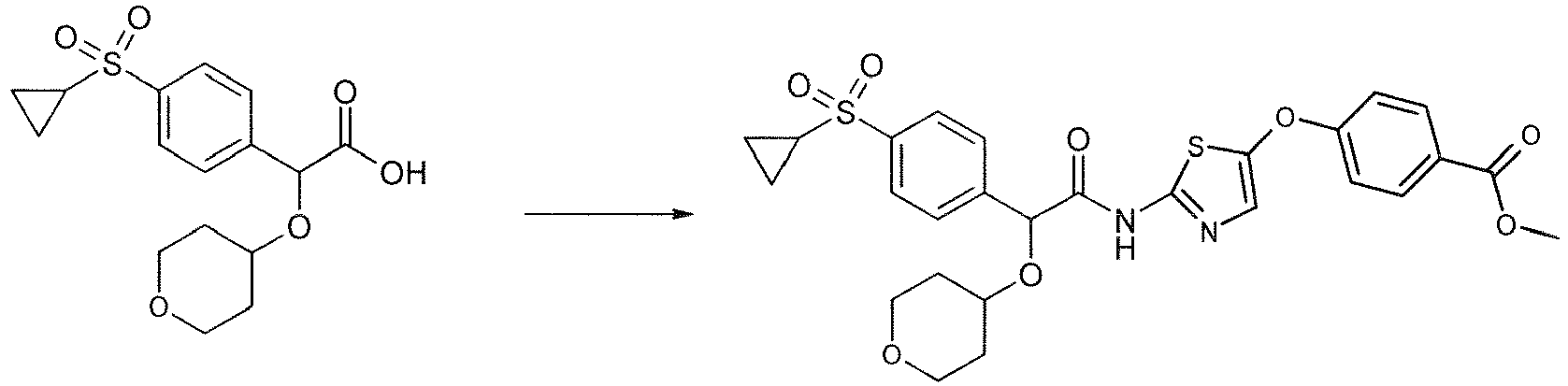
- To a mixture of (4-Cyclopropanesulfonyl-phenyl)-[(tetrahydro-pyran-4-yloxy)]-acetic acid (Preparation 18) (0.5g, 1.47 mmol), 4-(2-Amino-thiazol-5-yloxy)-benzoic acid methyl ester (0.441g, 1.76 mmol), HOBt (0.237g, 1.76 mmol), and EDCI (0.337g, 1.76 mmol) in DMF (20 mL), was added N-methyl morpholine (0.178g, 1.76 mmol). The resulting mixture was stirred at room temperature overnight followed by dilution with methylene chloride. The reaction mixture was poured into water; organic layer was washed with water, brine, dried over sodium sulfate, and the organic solvent evaporated to get a residue which was purified by preparative TLC or column chromatoghaphy to provide the title compound.
- Compound (A1) can also be prepared using procedure-B or procedure-C
- Procedure-B: (4-Cyclopropanesulfonyl-phenyl)-[(tetrahydro-pyran-4-yloxy)]-acetic acid (Preparation 18) was dissolved in DCM. To this solution was added DMF and cooled to 0 °C, followed by the addition of oxalyl chloride under stirring. To this mixture, a solution of 4-(2-Amino-thiazol-5-yloxy)-benzoic acid methyl ester and pyridine in DCM was added drop wise at 0°C and was stirred further for 4 h. at room temperature. The reaction mixture was poured into 1N aqueous HCl under stirring, organic layer was again washed with 1N HCl, followed by 5% brine, dried over anhydrous sodium sulfate, solvent was removed under reduced pressure to get the crude compound which was purified by flash chromatography to get the title product.
- Procedure-C: (4-Cyclopropanesulfonyl-phenyl)-[(tetrahydro-pyran-4-yloxy)]-acetic acid (Preparation 18) (1 mmol) and HATU (1.5 mmol) was dissolved in DCM. To this solution was added DIPEA (2 mmol.) and stirred for 15 minutes followed by addition of 4-(2-Amino-thiazol-5-yloxy)-benzoic acid methyl ester (1 mmol.) and continued to stir over night at room temperature. Reaction mixture was diluted with dichloromethane, washed with water, brine, dried over anhydrous sodium sulfate, solvent was removed under reduced pressure to get the crude compound which was purified by flash chromatography to get the title product.
1H NMR (CDCl3, 400 MHz): δ - 1.04-1.07 (m, 2H), 1.34-1.37 (m, 2H), 1.68-1.79 (m, 2H), 1.85-1.90 (m, 1H), 2.02-2.10 (m, 1H), 2.42-2.47 (m, 1H), 3.34-3.43 (m, 2H), 3.65-3.70 (m, 1H), 3.90 (s, 3H), 3.93-4.02 (m, 2H), 5.21 (s, 1H), 7.06 (d, J = 7.2Hz, 2H), 7.15 (s, 1H), 7.68 (d, J = 7.6Hz, 2H), 7.93 (d, J = 8.4 Hz, 2H), 7.99 (d, J = 7.2Hz, 2H). MS (EI) m/z: 572.8 (M + 1). -

- The compound of example A2 was obtained by similar method described in example A1 using (4-Cyclopropanesulfonyl-phenyl)-[(R)-(tetrahydro-furan-3-yl)oxy]-acetic acid (preparation 17) (0.150 gm, 0.46 mmol), 4-(2-Amino-thiazol-5-yloxy)-benzoicacid methyl ester (0.140 gm, 0.55 mmol), HOBt (0.075 gm, 0.55 mmol), and EDCI (0.106 gm 0.55 mmol), N-methyl morpholine (0.055 gm, 0.55 mmol) in DMF (10 mL) to provide the title compound (185 mg).
1H NMR (CDCl3, 400 MHz): δ - 1.04-1.07 (m, 2H), 1.34-1.37 (m, 2H), 1.68-1.79 (m, 2H), 1.85-1.90 (m, 1H), 2.02-2.10 (m, 1H), 2.42-2.47 (m, 1H), 3.34-3.43 (m, 2H), 3.65-3.70 (m, 1H), 3.90 (s, 3H), 3.93-4.02 (m, 2H), 5.21 (s, 1H), 7.06 (d, J = 7.2 Hz, 2H), 7.15 (s, 1H), 7.68 (d, J = 7.6 Hz, 2H), 7.93 (d, J = 8.4 Hz, 2H), 7.99 (d, J = 7.2 Hz, 2H). MS (EI) m/z: 572.8 (M + 1). -

- The compound of example A3 was obtained by similar method described in example A1 using (2,4-Difluoro-phenoxy)-[4-(piperidine-1-sulfonyl)-phenyl]-acetic acid (Preparation 2) (0.1 gm, 0.27 mmol), thiazolo[5,4-b]pyridin-2-ylamine (0.042 gm, 0.33 mmol), HOBt (0.044 gm, 0.33 mmol), and EDCI (0.062 gm, 0.33 mmol), N-methyl morpholine (0.034 gm, 0.33 mmol) in DMF (10 mL) to provide the title compound (0.175 gm).
1H NMR (400 MHz, ,DMSO- d6):- δ 1.34 (bs, 2H), 1.53 (bs, 4H), 2.90 (bs, 4H), 6.27 (s, 1H), 7.02-7.06 (m, 1H), 7.14-7.20 (m, 1H), 7.36-7.41 (m, 1H), 7.50-7.53 (m, 1H), 7.84 (d, J = 8.0 Hz, 2H), 7.91 (d, J = 8.0 Hz, 2H), 8.14 (d, J = 8.0 Hz, 1H), 8.49 (d, J = 4.4 Hz, 1H).
MS (EI) m/z: 545.0 (M + 1). -

- The compound of example A4 was obtained by similar method described in example A1 using [4-(Morpholine-4-sulfonyl)-phenyl]-[(tetrahydro-pyran-4-yloxy)]-acetic acid (preparation 14)(0.1gm, 0.25 mmol), 5-Fluoro-thiazol-2-ylamine hydrochloride (0.048 gm, 0.31 mmol), HOBt (0.042 gm, 0.31 mmol), and EDCI (0.060 gm, 0.31 mmol), N-methyl morpholine (0.4 ml, 0.64 mmol) in DMF (5 ml) to provide the title compound (10 mg).
1H NMR (400 MHz, CDCl3):- δ 1.70-1.77 (m, 2H), 1.86-1.89 (m, 1H), 2.01-2.05 (m, 1H), 2.64-3.03 (m, 4H), 3.36-3.43 (m, 2H), 3.65-3.71 (m, 1H), 3.74-3.76 (m, 4H), 3.94-4.03 (m, 2H), 5.20 (s, 1H), 7.06 (d, J = 2.4 Hz, 1H), 7.68 (d, J = 8.4 Hz, 2H), 7.79 (d, J = 8.4 Hz, 2H).
MS (EI) m/z: 486.2 (M + 1). -

- The compound of example A5 was obtained by similar method described in example A1 using (4-cyclopropanesulfonyl-phenyl)-[(tetrahydro-pyran-4-yloxy)]-acetic acid (Preparation 14) (0.2 gm, 0.58 mmol), thiazolo[5,4-b]pyridin-2-ylamine (0.133 gm, 0.88 mmol), HOBt (0.119 gm,0.88 mmol), and EDCI (0.168 gm,0.88 mmol), N-methyl morpholine (0.178 gm, 0.88 mmol) in DMF (10 mL) to provide the title compound (0.175 gm).
1H NMR (400 MHz, DMSO- d6):- δ 1.00-1.04 (m, 2H), 1.05-1.15 (m, 2H), 1.46-1.61 (m, 2H), 1.62-1.96 (m, 2H), 2.83-2.86 (m, 1H), 3.28-3.34 (m, 2H), 3.65-3.76 (m, 1H), 3.78-3.85 (m, 2H), 5.55 (s, 1H), 7.48 (dd, J = 4.4 Hz, J = 8.0 Hz, 1H), 7.79 (d, J = 8.4 Hz, 2H), 7.92 (d, J = 8.4 Hz, 2H), 8.12 (d, J = 8.0 Hz, 1H), 8.46(dd, J = 1.6 Hz, J = 4.8 Hz, 1H), 12.80 (s, 1H).
MS (EI) m/z: 474.20 (M + 1). -

- The compound of example A6 was obtained by similar method described in example A1 using (4-cyclopropanesulfonyl-phenyl)-[(tetrahydro-pyran-4-yloxy)]-acetic acid (Preparation 18) (0.5 gm,1.32 mmol), 5-methoxy-thiazolo[5,4-b]pyridin-2-ylamine (0.286 gm, 1.59 mmol), HOBt (0.267 gm,1.98 mmol), and EDCI (0.378 gm,1.98 mmol), N-methyl morpholine (0.4 gm, 3.97 mmol) in DMF (10 mL) to provide the title compound (0.280 gm).
1H NMR (400 MHz, ,DMSO- d6):- δ 1.02-1.06 (m, 2H), 1.11-1.14 (m, 2H), 1.49-1.63 (m, 2H), 1.85-1.99 (m, 2H), 2.82-2.89 (m, 1H), 3.29-3.36 (m, 2H), 3.65-3.72 (m, 1H), 3.78-3.86 (m, 2H), 3.90 (s, 3H), 5.54 (s, 1H), 6.93 (d, J = 8.8 Hz, 1H), 7.80 (d, J = 8.8 Hz, 2H), 7.94 (d, J = 8.4 Hz, 2H), 8.06 (d, J = 8.8 Hz, 1H), 12.70 (s, 1H).
MS (EI) m/z: 504.10 (M + 1). -

- The compound of example A7 was obtained by similar method described in example A1 using (4-cyclopropanesulfonyl-phenyl)-[(tetrahydro-pyran-4-yloxy)]-acetic acid (Preparation 18) (0.25 gm, 0.73 mmol), 5- ethoxy-thiazolo[5,4-b]pyridin-2-ylamine (0.157 gm, 0.80 mmol), HOBt (0.148 gm, 1.10 mmol), and EDCI (0.210 gm, 1.10 mmol), N-methyl morpholine (0.22 gm, 2.20 mmol) in DMF (5 mL) to provide the title compound (0.140 gm).
1H NMR (400 MHz, ,DMSO- d6):- δ 1.00-1.04 (m, 2H), 1.05-1.13 (m, 2H), 1.35 (t, J = 7.2 Hz, 3H), 1.50-1.60 (m, 2H), 1.85-1.97 (m, 2H), 2.84-2.89 (m, 1H), 3.29-3.34 (m, 2H), 3.65-3.71 (m, 1H), 3.78-3.86 (m, 2H), 4.33 (q, J = 7.2 Hz, 2H), 5.54 (s, 1H), 6.90 (d, J = 8.8 Hz, 1H), 7.80 (d, J = 8.4 Hz, 2H), 7.94 (d, J = 8.0 Hz, 2H), 8.05 (d, J = 8.8 Hz, 1H), 12.70 (s, 1H). MS (EI) m/z: 518.00 (M + 1). -

- The compound of example A8 was obtained by similar method described in example A1 using (4-cyclopropanesulfonyl-phenyl)-[(tetrahydro-pyran-4-yloxy)]-acetic acid (Preparation 18) (0.100 gm, 0.29 mmol), 5-iso-propoxy-thiazolo[5,4-b]pyridin-2-ylamine (0.067 gm, 0.32 mmol), HOBt (0.047 gm, 0.35 mmol), and EDCI (0.067 gm, 0.35 mmol), N-methyl morpholine (0.065 gm, 0.58 mmol) in DMF (5 mL) to provide the title compound (0.060 gm).
1H NMR (DMSO-d6, 400 MHz): δ 1.01-1.10 (m, 2H), 1.11-1.18 (m, 2H), 1.30 (d, 6H), 1.50-1.60 (m 2H), 1.85-1.96 (m, 2H), 2.70-2.84 (m, 1H), 3.35-3.40 (m, 2H), 3.61-3.72 (m, 1H), 3.79-3.85 (m, 2H), 5.24-5.27 (m, 1H), 5.54 (s, 1H), 6.84 (d, J = 8.8 Hz, 1H), 7.80 (d, J = 8.4 Hz, 2H), 7.94 (d, J = 8.4 Hz, 2H), 8.03 (d, J = 8.8 Hz, 1H).
MS (EI) m/z: 532.2 (M + 1). -

- To a mixture of 2-(4-cyclopropanesulfonylphenyl)-2-(2,4-difluorophenoxy)acetic acid (Preparation 19) (2 gm, 5.43 mmol) & HATU (3.1 gm , 8.14 mmol) in anhydrous DCM (50 mL) was added TEA (1.65 gm, 16.3 mmol)& reaction mixture was kept on stirring at room temperature for 0.5 hours. To this solution was added 4-(2-Amino-thiazol-5-yloxy)-benzoic acid methyl ester (1.36 gm, 5.43mmol) and stirring was continued for another 2 hrs. The reaction mixture was quenched with 1N HCl & diluted with DCM. The organic layer was separated, washed with water, brine and dried over sodium sulfate filtered and concentrated under reduced pressure to get a residue which was purified by column chromatography using 50-60% ethylacetate in hexane as eluent to provide the title compound (1.7 gm).
1H NMR- (CDCl3), δ 1.05-1.19 (m, 4H), 2.88 (m, 1H), 3.83 (s, 3H),6.2 (s, 1H), 7.05-7.40 (m, 6H), 7.88-8.01 (m, 5H), 12.97 (s, 1H). MS (EI) m/z: 601 (M+1) -
Example No. MS (EI)m/z: (M + 1). IUPAC Name A10 * 512.0 2-(2,4-Difluoro-phenoxy)-N-(5-fluoro-thiazol-2-yl)-2-[4-(piperidine-1-sulfonyl)-phenyl]-acetamide A11 * 528.0 N-(5-Chloro-thiazol-2-yl)-2-(2,4-difluoro-phenoxy)-2-[4-(piperidine-1-sulfanyl)-phenyl]-acetamide A12 * 512.0 2-(2,4-Difluoro-phenoxy)-N-(5-fluoro-thiazol-2-yl)-2-(3-(piperidine-1-sulfonyl)-phenyl]-acetamide A13 * 527.9 N-(5-Chloro-thiazol-2-yl)-2-(2,4-difluoro-phenoxy)-2-[3-(piperidine-1-sulfonyl)-phenyl]-acetamide A14 * 498 2-(2,4-Difluoro-phenoxy)-N-(5-fluoro-thiazol-2-yl)-2-[3-(pyrrolidine-1-sulfonyl)-phenyl]-acetamide A15 * 498 2-(2,4-Difluoro-phenoxy)-N-(5-fluoro-thiazol-2-yl)-2-[4-(pyrrolidine-1-sulfonyl)-phenyl]-acetamide A16 * 514 N-(5-Chloro-thiazol-2-yl)-2-(2,4-difluoro-phenoxy)-2-[3-(pyrrolidine-1-sulfonyl)-phenyl]-acetamide A17 * 514 N-(5-Chloro-thiazol-2-yl)-2-(2,4-difluoro-phenoxy)-2-[4-(pyrrolidine-1-sulfonyl)-phenyl]-acetamide A18 * 499.90 2-[3-(Azetidine-1-sulfonyl)-phenyl]-N-(5-chloro-thiazol-2-yl)-2-(2,4-difluoro-phenoxy)-acetamide A19 * 500.00 2-[4-(Azetidine-1-sulfonyl)-phenyl]-N-(5-chloro-thiazol-2-yl)-2-(2,4-difluoro-phenoxy)-acetamide A20 * 484.00 2-[4-(Azetidine-1-sulfonyl)-phenyl]-2-(2,4-difluoro-phenoxy)-N-(5-fluoro-thiazol-2-yl)-acetamide A21 * 514.2 2-(2,4-Difluoro-phenoxy)-N-(5-fluoro-thiazol-2-yl)-2-[4-(morpholine-4-sulfonyl)-phenyl]-acetamide A22 * 530.1 N-(5-Chloro-thiazol-2-yl)-2-(2,4-difluoro-phenoxy)-2-[4-(morpholine-4-sulfonyl)-phenyl]-acetamide A23 * 477.0 2-(2,4-Difluoro-phenoxy)-2-[4-(piperidine-1-sulfonyl)-phenyl]-N-(1H-pyrazol-3-yl)-acetamide A24 * 477.0 2-(4-Chloro-phenoxy)-2-[4-(morpholine-4-sulfonyl)-phenyl]-N-(1H-pyrazol-3-yl)-acetamide A25 * 475.0 2-(4-Chloro-phenoxy)-2-[4-(piperidine-1-sulfonyl)-phenyl]-N-(1H-pyrazo 1-3-yl)-acetamide A26 * 579.3 2-(2,4-Difluoro-phenoxy)-N-(5-morpholin-4-yl-thiaxol-2-yl)-2-[4-(piper idine-1-sulfonyl)-phenyl]-acetamide A27 * 491.3 2-(2,4-Difluoro-phenoxy)-N-(1-methyl-1H-pyrazol-3-yl)-2-[4-(piperidine -1-sulfonyl)-phenyl]-acetamide A28 * 493.3 2-(2,4-Difluoro-phenoxy)-N-(1-methyl-1H-pyrazol-3-yl)-2-[4-(morpholine -4-sulfonyl)-phenyl]-acetamide A29 * 491.3 2-(2,4-Difluoro-phenoxy)-2-[4-(morp holine-4-sulfonyl)-phenyl]-N-pyrazin-2-yl-acetamide A30 * 565.3 2-(2,4-Difluoro-phenoxy)-N-(5-morpholin-4-yl-thiazol-2-yl)-2-[4-(pyrrolidine-1-sulfonyl)-phenyl]-acetamide A31 * 547.2 2-(2,4-Difluoro-phenoxy)-2-[4-(morpholine-4-sulfonyl)-phenyl]-N-thiazolo[5,4-b]pyridin-2-yl-acetamide A32 * 531.0 2-(2,4-Difluoro-phenoxy)-2-[4-(pyrr olidine-1-sulfonyl)-phenyl]-N-thiazolo[5,4-b]pyridin-2-yl-acetamide A33 * 502.30 2-(4-Cyclopropanesulfonyl-phenyl)-2-(2,4-difluoro-phenoxy)-N-thiazolo[5,4-b]pyridin-2-yl-acetamide A34 * 531.8 2-(4-Cyclopropanesulfonyl-phenyl)-2-(2,4-difluoro-phenoxy)-N-(5-methoxy-thiazolo[5,4-b]pyridin-2-yl)-acetamide A35 489.00 2-(4-Cyclopropanesulfonyl-phenyl)-N-(5-pyrazol-1-yl-thiazol-2-yl)-2-(tetrahydro-pyran-4-yloxy)-acetamide A36 508.00 2-(4-Cyclopropanesulfonyl-phenyl)-N-(5-morpholin-4-yl-thiazol-2-yl)-2-(tetrahydro-pyran-4-yloxy)-acetamide A37 440.90 2-(4-Cyclopropanesulfonyl-phenyl)-N-(5-fluoro-thiazol-2-yl)-2-(tetrahydro-pyran-4-yloxy)-acetamide A38 420.1 2-(4-Cyclopropanesulfonyl-phenyl)-N-(1-methyl-1H-pyrazol-3-yl)-2-(tetrahydro-pyran-4-yloxy)-acetamide A39 417.5 2-(4-Cyclopropanesulfonyl-phenyl)-N-pyraxin-2-yl-2-(tetrahydropyran-4-yloxy)-acetamide A40 540.00 N-[5-(4-Cyano-phenoxy)-thiazol-2-yl]-2-(4-cyclopropanesulfonyl-phenyl)-2-(tetrahydro-pyran-4-yloxy)-acetamide A41 452.9 2-(4-Cyclopropanesulfonyl-phenyl)-N-(5-methoxy-thiazol-2-yl)-2-(tetrahydro-pyran-4-yloxy)-acetamide A42 * NA (5-Chloro-2-{2-(2,4-difluoro-phenoxy)-2-[4-(piperidine-1-sulfonyl)-phenyl]-acetylamino}-thiazol-4-yl)-acetic acid ethyl ester A43 * NA 4-(2-{2-(2,4-Difluoro-phenoxy)-2-[4 -(morpholine-4-sulfonyl)-phenyl]-acetylamino}-thiazol-5-yloxy)-benzoic acid methyl ester A44 * 616.2 (5-Chloro-2-{2-(2,4-difluoro-phenoxy)-2-[4-(morpholine-4-sulfonyl)-phenyl]-acetylamino}-thiazol-4-yl)-acetic acid ethyl ester A45 * NA 3-(2-(2-(2,4-Difluoro-phenoxy)-2-[4 -(morpholine-4-sulfonyl)-phenyl]-acetylammo}-thiazol-5-yloxy)-benzoic acid methyl ester A46 * 635.4 1-(2-{2-(2,4-Difluoro-phenoxy)-2-[4-(pyrrolidine-1-sulfonyl)-phenyl]-acetylamino}-thiazol-5-yl)-piperidine-4-carboxylic acid ethyl ester A47 * 630.3 4-(2-{2-(2,4-Difluoro-phenoxy)-2-[4-(pyrrolidine-1-sulfonyl)-phenyl]-acetylamino}-thiazol-5-yloxy)-benzoic acid methyl ester A48 * 630.3 3-(2-{2-(2,4-Difluoro-phenoxy)-2-[4-(pyrrolidine-1-sulfonyl)-phenyl]-acetylamino}-thiazol-5-yloxy)-benzoic acid methyl ester A49 * 600 (5-Chloro-2-{2-(2,4-difluoro-phenoxy)-2-[3-(pyrrolidine-1-sulfonyl)-phenyl]-acetylamino}-thiazol-4-yl)-acetic acid ethyl ester A50 * 586.00 {2-[2-[3-(Azetidine-1-sulfonyl)-phenyl]-2-(2,4-difluoro-phenoxy)-acetylamino]-5-chloro-thiazol-4-yl}-acetic acid ethyl ester A51 * 586.00 {2-[2-[4-(Azetidine-1-sulfonyl)-phenyl]-2-(2,4-difluoro-phenoxy)-acetylamino]-5-chloro-thiazol-4-yl}-acetic acid A52 * NA (5-Chloro-2-{2-(4-chloro-phenoxy)-2-[4-(piperidine-1-sulfonyl)-phenyl]-acetylamino}-thiazol-4-yl)-acetic acid ethyl ester A53 * NA (5-Chloro-2-{2-(4-chloro-2-fluoro-phenoxy)-2-[4-(piperidine-1-sulfonyl )-phenyl]-acetylamino}-thiazol-4-yl)-acetic acid ethyl ester A54* NA (5-Chloro-2-{2-(4-chloro-phenoxy)-2-[4-(morpholine-4-sulfonyl)-phenyl]-acetylamino}-thiazol-4-yl)-acetic acid ethyl ester A55 * NA 3-(2-{2-(4-Chloro-phenoxy)-2-[4-(piperidine-1-sulfonyl)-phenyl]-acetylamino}-thiazol-5-yloxy)-benzoic acid methyl ester A56 * NA 4-(2-{2-(4-Chloro-phenoxy)-2-[4-(pi peridine-1-sulfonyl)-phenyl]-acetylamino}-thiazol-5-yloxy)-benzoic acid methyl ester A57 * NA 1-(2-{2-(2,4-Difluoro-phenoxy)-2-[4-(piperidine-1-sulfonyl)-phenyl]-acetylamino}-thiazol-5-yl)-iperidine-4-carboxylic acid ethyl ester A58 * 634.1 (5-Chloro-2-{2-(4-chloro-2-fluoro-phenoxy)-2-[4-(morpholine-4-sulfonyl )-phenyl]-acetylamino}-thiazol-4-yl)-acetic acid ethyl eter A59 * 644.2 4-(2-{2-(2,4-Difluoro-phenoxy)-2-[4-(piperidine-1-sulfonyl)-phenyl]-acetylamino}-thiazol-5-yloxy)-benzoic acid methyl ester A60 * 644.2 3-(2-{2-(2,4-Difluoro-phenoxy)-2-[4-(piperidine-1-sulfonyl)-phenyl]-acetylamino}-thiazol-5-yloxy)-benzoic acid methyl ester A61 * 598.1 (2-{2-(4-Chloro-2-fluoro-phenoxy)-2-[4-(morpholine-4-sulfonyl)-phenyl]-acetylamino}-thiazol-4-yl)-acetic acid ethyl ester A62 * 645.30 4-(2-{2-(2,4-Difluoro-phenoxy)-2-[4 -(tetrahydro-pyran-4-sulfonyl)-phenyl]-acetylamino}-thiazol-5-yloxy)-benzoicacid methyl ester A63 529.1 {5-Chloro-2-[2-(4-cyclopropanesulfonyl-phenyl)-2-tetrahydrofuran-3-yloxy)-acetylamino]-thiazol-4-yl}-aceticacid ethyl ester A64 559.2 4-{2-[2-(4-Cyclopropanesulfonyl-phenyl)-2-(tetrahydro-furan-3-yloxy)-acetylamino]-thiazol-5-yloxy}-benzoic acid methyl ester A65 528.9 (5-Chloro-2-{2-(4-cyclopropanesulfonyl-phenyl)-2-[(R)-(tetrahydro-furan-3-yl)oxy]-acetylamino}-thiazol-4-yl)-acetic acid ethyl ester A66 558.8 4-(2-{2-(4-Cyclopropanesulfonyl-phenyl)-2-[(S)-(tetrahydrofuran-3-yl)oxy]-acetylamino}-thiazol-5-yloxy)-benzoic acid methyl ester A67 529.9 (5-Chloro-2-{2-(4-cyclopropanesulfonyl-phenyl)-2-[(S)-(tetrahydro-furan-3-yl)oxy]-acetylamino}-thiazol-4-yl)-acetic acid ethyl ester A68 * 604.2 {2-[2-(4-Cyclopropanesulfonyl-phenyl)-2-(2,4-difluoro-phenoxy)-acetylamino]-thiazolo[5,4-b]pyridin-5-yloxy}-acetic acid ethyl ester A69 554.3 4-{3-[2-(4-Cyclopropanesulfonyl-phenyl)-2-(tetrahydro-pyran-4-yloxy)-acetylamino]-pyrazol-1-ylmethyl}-benzoic acid methyl ester A70 542.90 {5-Chloro-2-[2-(4-cyclopropanesulfonyl-phenyl)-2-(tetrahydropyran-4-yloxy)-acetylamino]-thiazol-4-yl}-acetic acid ethyl ester A71 571 3-{2-[2-(4-Cyclopropanesulfonyl-phenyl)-2-(tetrahydro-pyran-4-yloxv)-acetylamino]-thiazol-5-yloxy}-benzoic acid methyl ester A72 645.3 4-{2-[2-(4-Cyclopropanesulfonyl-phenyl)-2-(tetrahydro-pyran-4-yloxy)-acetylamino]-thiazol-5-yloxy}-2-fluoro-benxoic acid methyl ester A73 605.3 4-{2-[2-(4-Cyclopropanesulfonyl-phenyl)-2-(tetrahydro-pyran-4-yloxy)-acetylamino]-thiazol-5-yloxy}-3-fluoro-benzoic acid methyl ester A74 576.2 {2-[2-(4-Cyclopropanesulfonyl-phenyl)-2-(tetrahydro-pyran-4-yloxy)-acetylamino]-thiazolo[5,4-b]pyridin-5-yloxy}-acetic acid ethyl ester A75 * 652 4-{2-[2-(4-Cyclopropanesulfonyl-phenyl)-2-(2,4-difluorophenoxy)-acetylamino]-thiazolo[5,4-b]pyridin-5-yloxy}-benzoic acid methyl ester A76 624 4-{2-[2-(4-Cyclopropanesulfonyl-phenyl)-2-(tetrahydro-pyran-4-yloxy)-acetylamino]-thiazolo[5,4-h]pyridin-5-yloxy}-benzoic acid methyl ester A77 502.9 2-(4-Cyclopropanesulfonyl-phenyl)-N-(6-methoxy-benzothiazol-2-yl)-2-(tetrahydro-pyran-4-yloxy)-acetamide A78 489.9 2-(4-Cyclopropanesulfonyl-phenyl)-N-(5-methoxy-thiazolo[5,4-b]pyridin-2-yl)-2-[(R)-(tetrahydro-furan-3-yl)oxy]-acetamide A79 540.3 4-[(4-Cyclopropanesulfonyl-phenyl)-(5-fluoro-thiazol-2-ylcarbamoyl)-methoxy]-piperidine-1-carboxylic acid tert-butyl ester A80 440.2 2-(4-Cyclopropanesulfonyl-phenyl)-N-(5-fluoro-thiazol-2-yl)-2-(piperidin-4-yloxy)-acetamide A81 601.2 (4-{2-(2-(4-Cyclopropanesulfonyl-phenyl)-2-(tetrahydro-pyran-4-yloxy)-acetylamino)-thiazol-5-yloxy}-phenyl)-acetic acid methyl ester A82 545.1 2-[2-(4-Cyclopropanesnlfonyl-phenyl)-2-(tetrahydro-pyran-4-yloxy)-acetyiamino]-benzothiazole-6-carboxylic acid methyl ester A83 531.2 2-{2-(4-Cyclopropanesulfonyl-phenyl)-2-[(R)-(tetrahydro-furan-3-yl)oxy]-acetylamino}-benzothiazole-6-carboxylic acid methyl ester A84 490.1 2-(4-Cyclopropanesulfonyl-phenyl)-N-(5-oxo-4,5-dihydrothiazolo[5,4-b]pyridin-2-yl)-2-(tetrahydro-pyran-4-yloxy)-acetamide A85 518.2 2-(4-Cyclopropanesulfonyl-phenyl)-N-(5-isopropoxy-thiazolo[5,4-b]pyridin-2-yl)-2-[(R)-(tetrahydro-furan-3-yl)oxy]-acetamide A86 * 484.1 N-(5-Fluoro-thiazol-2-yl)-2-[4-(piperidine-1-sulfonyl)-phenyl]-2-(tetrahydro-pyran-4-yloxy)-acetamide A87 * 517.2 2-[4-(Piperidine-1-sulfonyl)-phenyl]-2-(tetrahydro-pyran-4-yloxy)-N-thiazolo[5,4-b]pyridin-2-yl-acetamide A88 * 547.2 N-(5-Methoxy-thiazolo[5,4-b]pyridin-2-yl)-2-[4-(piperidine-1-sulfonyl)-phenyl]-2-(tetrahydro-pyran-4-yloxy)-acetamide A89 * 615.0 (5-Chloro-2-{2-(2,4-difluoro-phenoxy)-2-[4-(tetrahydro-pyran-4-sulfonyl)-phenyl]-acetylamino}-thiazol-4-yl)-acetic acid ethyl ester A90 * 486.2 N-(5-Fluoro-thiazol-2-yl)-2-[4-(morpholine-4-sulfonyl)-phenyl]-2-(tetrahydro-pyran-4-yloxy)-acetamide A91 * 519.2 2-[4-(Morpholine-4-sulfonyl)-phenyl]-2-(tetrahydro-pyran-4-yloxy)-N-thiazolo[5,4-b]pyridin-2-yl-acetamide A92 * 549.2 N-(5-Methoxy-thiazolo[5,4-b]pyridin-2-yl)-2-[4-(morpholine-4-sulfonyl)-phenyl]-2-(tetrahydro-pyran-4-yloxy)-acetamide A93 587.2 4-{2-[2-(4-Cyclopropanesulfonyl-phenyl)-2-(tetrahydro-pyran-4-yloxy)-acetylamino]-thiazol-5-yloxy} -2-methyl-benzoic acid methyl ester A94 495.2 2-[2-(4-Cyclopropanesulfonyl-phenyl)-2-(tetrahydro-pyran-4-yloxy)-acetylamino]-5-methyl-thiazole-4-carboxylic acid methyl ester A95 552.1, 554.2 N-(5-Bromo-thiazolo[5,4-b]pyridin-2-yl)-2-(4-cyclopropanesulfonyl-phenyl)-2-(tetrahydro-pyran-4-yloxy)-ac etamide A96 * 601.3 3-{2-[2-(4-Cyclopropanesulfonyl-phenyl)-2-(2,4-difluorophenoxy)-acetylamino]-thiazol-5-yloxy}-benzoicacid methyl ester A97 * 598.5 4-{2-[2-(4-Chloro-phenoxy)-2-(4-cyclopropanesulfonyl-phenyl)-acetylamino]-thiazol-5-yloxy}-benzoicacid methyl ester A98 * 583 4-{2-[2-(4-Cyclopropanesulfonyl-phenyl)-2-(4-fluoro-phenoxy)-acetylamino]-thiazol-5-yloxy)-benzoicacid methyl ester A99 * 635.1 4-{2-[2-(4-Cyclopropanesulfonyl-phenyl)-2-(3,4-dichlorophenoxy)-acetylamino]-thiazol-5-yloxy}-benzoicacid methyl ester A100 * 601.2 4-{2-[2-(4-Cyclopropanesulfonyl-phenyl)-2-(3,4-difluorophenoxy)-acetylamino]-thiazol-5-yloxy}-benzoic acid methyl ester A101 * 583.2 4-{2-[2-(4-Cyclopropanesulfonyl-phenyl)-2-(3-fluoro-phenoxy)-acetylamino]-thiazol-5-yloxy}-benzoic acid methyl ester A102 * 601.2 4-{2-[2-(3-Chloro-4-fluoro-phenoxy)-2-(4-cyclopropanesulfonylphenyl)-acetylamino]-thiazol-5-yloxy}-benzoic acid methyl ester A103 * 595.20 4-{2-[2-(4-Cyclopropanesulfonyl-phenyl)-2-(4-methoxyphenoxy)-acetylamino]-thiazol-5-yloxy}-benzoic acid methyl ester A104 * 595.20 4-{2-[2-(4-Cyclopropanesulfonyl-phenyl)-2-(3-methoxyphenoxy)-acetylamino]-thiazol-5-yloxy}-benzoic acid ethyl ester A105 * 633.10 4-{2-[2-(4-Cyclopropanesulfonyl-phenyl)-2-(4-trifluoromethylphenoxy)-acetylamino]-thiazol-5-yloxy}-benzoic acid methyl ester A106 * 633.20 4-{2-[2-(4-Cyclopropanesulfonyl-phenyl)-2-(3-trifluoromethylphenoxy)-acetylamino]-thiazol-5-yloxy}-benzoic acid methyl ester A107 * 649.10 4-{2-[2-(4-Cyclopropanesulfonyl-phenyl)-2-(4-trifluoromethoxyphenoxy)-acetylamino]-thiazol-5-yloxy}-benzoic acid methyl ester A108 * 602.20 6-{2-[2-(4-Cyclopropanesulfonyl-phenyl)-2-(2,4-difluorophenoxy)-acetylamino]-thiazol-5-yloxy}-nicotinicacid methyl ester A109 * 579.2 4-{2-[2-(4-Cyclopropanesulfonyl-phenyl)-2-(4-methyl-phenoxy)-acetylamino]-thiazol-5-yloxy}-benzoic acid methyl ester A110 * 565.2 4-{2-[2-(4-Cyclopropanesulfonyl-phenyl)-2-phenoxyacetylamino]-thiazol-5-yloxy}-benzoic acid methyl ester A111 * 615.1 (4-{2-[2-(4-Cyclopropanesulfonyl-phenyl)-2-(2,4-difluorophenoxy)-acetylamino]-thiazol-5-yloxy}-phenyl)-acetic acid methyl ester A112 * 614.8 4-{2-[2-(4-Cyclopropanesulfonyl-phenyl)-2-(2,4-difluorophenoxy)-acetylamino]-4-methyl-thiazol-5-yloxy}-benzoic acid methyl ester A113 * 632.8 4-{2-[2-(4-Cyclopropanesulfonyl-phenyl)-2-(2,4-difluorophenoxy)-acetylamino]-thiazol-5-yloxy}-3-fluoro-benzoic acid methyl ester A114 * 632.8 4-{2-[2-(4-Cyclopropanesulfonyl-phenyl)-2-(2,4-difluorophenoxy)-acetylamino]-thiazol-5-yloxy}-2-fluoro-benzoic acid methyl ester A115 * 612.30 2-(4-Cyclopropanesulfonyl-phenyl)-2-(2,4-difluoro-phenoxy)-N-[5-(5-trifluoromethyl-pyridin-2-yloxy)-thiazol-2-yl]-acetamide A116 * 560.56 2-(4-Cyclopropanesulfonyl-phenyl)-2-(2,4-difluoro-phenoxy)-N-[5-(4-fluoro-phenoxy)-thiazol-2-yl]-acetamide A117 543.2 2-(4-Cyclopropanesulfonyl-phenyl)-N-[5-(4-formyl-phenoxy)-thiazol-2-yl]-2-(tetrahydro-pyran-4-yloxy)-acetamide A118 449.2 2-(4-Cyclopropanesulfonyl-phenyl)-2-(tetrahydro-pyran-4-yloxy)-N-(5-vinyl-thiazol-2-yl)-acetamide A119 449.1 2-(4-Cyclopropanesulfonyl-phenyl)-2-(tetrahydro-pyran-4-yloxy)-N-(4-vinyl-thiazol-2-yl)-acetamide A120 * 494.1 2-[4-(Morpholine-4-sulfonyl)-phenyl]-2-(tetrahydro-pyran-4-yloxy)-N-(5-vinyl-thiazol-2-yl)-acetamide *Reference Example -

- 4-{2-[2-(4-Cyclopropanesulfonyl-phenyl)-2-(2,4-difluoro-phenoxy)-acetylamino]-thiazol-5-yloxy}-benzoic acid methyl ester (1.4 gm, 2.33 mmol, obtained in example A74) was taken in THF: MeOH (1:1, 20 mL), to it was added aqueous solution of LiOH (0.34 gm, 7.94 mmol in 10 mL water) and stirred for 1-4 h. After completion of the reaction, organic solvent was removed under reduced pressure. The aqueous layer was washed with diisopropyl ether then acidified with 1 N HCl to pH 2. The solid formed was filtered, washed with water, followed by washing with diisopropyl ether & dried under vacuum to get the title compound (1.17g, 86%).
1H NMR- (CDCl3), δ 1.04-1.13 (m, 4H), 2.88 (m, 1H), 6.2 (s, 1H), 7.05-7.39 (m, 6H), 7.88-8.01 (m, 5H), 12.94 (bs, 1H). MS (EI) m/z: 587 (M+1) -

- The compound of example B2 was obtained by similar method described in example B1 using 4-{2-[2-(4-Cyclopropanesulfonyl-phenyl)-2-(2,4-difluoro-phenoxy)-acetylamino]-thiazol-5-yloxy}-benzoic acid methyl ester (0.17 gm, 0.29mmol), LiOH.H2O (0.062 gm, 1.48 mmol) in THF: MeOH: Water (1:1:1, 9 mL) to provide the title compound (0.117 gm, 72 %).
1H NMR (DMSO-d6, 400 MHz): δ - 1.03-1.06 (m, 2H), 1.10-1.34 (m, 2H), 1.46-1.60 (m, 2H), 1.85-1.94 (m, 2H), 2.83-2.89 (m, 1H), 3.29-3.39 (m, 2H), 3.63-3.68 (m, 1H), 3.77-3.85 (m, 2H), 5.48 (s, 1H), 7.18 (d, J = 9.2 Hz, 2H), 7.38 (s, 1H), 7.78 (d, J = 8.0 Hz, 2H), 7.93-7.95 (m, 4H). MS (EI) m/z: 558.8 (M + 1). -

- The compound of example B3 was obtained by similar method described in example B2 using 4-(2-{2-(4-Cyclopropanesulfonyl-phenyl)-2-[(R)-(tetrahydro-furan-3-yl)oxy]-acetylamino}-thiazol-5-yloxy)-benzoic acid methyl ester (0.180 gm, 0.32 mmol), LiOH.H2O (0.067 gm, 1.61 mmol) in THF: MeOH: Water (1:1:1, 9 mL) to provide the title compound (0.160 gm, 92 %).
1H NMR (DMSO-d6, 400 MHz): δ- 1.01-1.05 (m, 2H), 1.09-1.31 (m, 2H), 1.94-1.99 (m, 2H), 2.80-2.68 (m, 1H), 3.60-3.85 (m, 4H), 4.20-4.30 (m, 1H), 5.36 (s,1H), 7.16 (d, J = 7.2 Hz , 2H), 7.38 (s, 1H), 7.73-7.76 (m, 2H), 7.92 (d, J = 8.4 Hz, 4H).
MS (EI) m/z: 544.9 (M + 1). -
B4 500.8 {5-Chloro-2-[2-(4-cyclopropanesulfonyl-phenyl)-2-(tetrahydro-furan-3-yloxy)-acetylamino]-thiazol-4-yl}-acetic acid B5 * 584(M-1) (5-Chloro-2-{2-(2,4-difluoro-phenoxy)-2-[4-(piperidine-1-sulfonyl)-phenyl]-acetylamino}-thiazol-4-yl)-acetic acid B6 * 632.3 4-(2-{2-(2,4-Difluoro-phenoxy)-2-[4 -(morpholine-4-sulfonyl)-phenyl]-acetylamino}-thiazol-5-yloxy)-benzoic acid B7 * 588.3 (5-Chloro-2-{2-(2,4-difluoro-phenoxy)-2-[4-(morpholine-4-sulfonyl)-phenyl]-acetylamino}-thiazol-4-yl)-acetic acid B8 * 632.3 3-(2-{2-(2,4-Difluoro-phenoxy)-2-[4 -(morpholine-4-sulfonyl)-phenyl]-acetylamino}-thiazol-5-yloxy)-benzoic acid B9 * 607.4 1-(2-{2-(2,4-Difluoro-phenoxy)-2-[4-(pyrrolidine-1-sulfonyl)-phenyl]-acetylamino}-thiazol-5-yl)-piperidine-4-carboxylic acid B10 * 614.1(M-1) 4-(2-{2-(2,4-Difluoro-phenoxy)-2-[4 -(pyrrolidine-1-sulfonyl)-phenyl]-acetylamino}-thiazol-5-yloxy)-benzoic acid B11 * 614.2(M-1) 3-(2-{2-(2,4-Difluoro-phenoxy)-2-[4-(pyrrolidine-1-sulfonyl)-phenyl]-acetylamino}-thiazol-5-yloxy)-benzoic acid B12 * 572 (5-Chloro-2-{2-(2,4-difluoro-phenoxy)-2-[3-(pyrrolidine-1-sulfonyl)-phenyl]-acetylamino}-thiazol-4-yl)-acetic acid B13 * 557.90 {2-[2-[3-(Azetidine-1-sulfonyl)-phenyl]-2-(2,4-difluorophenoxy)-acetylamino]-5-chloro-thiazol-4-yl}-aceticacid B14 * 557.90 {2-[2-[4-(Azetidine-1-sulfonyl)-phenyl]-2-(2,4-difluorophenoxy)-acetylamino]-5-chloro-thiazol-4-yl}-acetic acid B15 * 582.0 (5-Chloro-2-{2-(4-chloro-phenoxy)-2-[4-(piperidine-1-sulfonyl)-phenyl]-acetylamino}-thiazol-4-yl)-acetic acid B16 * 604.1 (5-Chloro-2-{2-(4-chloro-2-fluoro-phenoxy)-2-[4-(piperidine-1-sulfonyl )-phenyl]-acetylamino}-thiazol-4-yl)-acetic acid B17 * 585.9 (5-Chloro-2-{2-(4-chloro-phenoxy)-2-[4-(morpholine-4-sulfonyl)-phenyl]-acetylamino}-thiazol-4-yl)-acetic acid B18 * 628.2 3-(2-{2-(4-Chloro-phenoxy)-2-[4-(piperidine-1-sulfonyl)-phenyl]-acetylamino}-thiazol-5-yloxy)-benzoic acid B19 * 628.0 4-(2-{2-(4-Chloro-phenoxy)-2-[4-(pi peridine-1-sulfonyl)-phenyl]-acetylamino}-thiazol-5-yloxy)-benzoic acid B20 * 621.4 1-(2-{2-(2,4-Difluoro-phenoxy)-2-[4-(piperidine-1-sulfonyl)-phenyl]-acetylamino}-thiazol-5-yl)-iperidine-4-carboxylic acid B21 * 603.5 (5-Chloro-2-{2-(4-chloro-2-fluoro-phenoxy)-2-[4-(morpholine-4-sulfonyl )-phenyl]-acetylamino}-thiazol-4-yl)-acetic acid B22 * 630.2 4-(2-{2-(2,4-Difluoro-phenoxy)-2-[4-(piperidine-1-sulfonyl)-phenyl]-acetylamino}-thiazol-5-yloxy)-benzoic acid B23 *. 630.2 3-(2-{2-(2,4-Difluoro-phenoxy)-2-[4-(piperidine-1-sulfonyl)-phenyl]-acetylamino}-thiazol-5-yloxy)-benzoic acid B24 * 570.1 (2-{2-(4-Chloro-2-fluoro-phenoxy)-2-[4-(morpholine-4-sulfonyl)-phenyl]-acetylamino}-thiazol-4-yl)-acetic acid B25 * 631.30 4-(2-{2-(2,4-Difluoro-phenoxy)-2-[4 -(tetrahydro-pyran-4-sulfonyl)-phenyl]-acetylamino}-thiazol-5-yloxy)-benzoic acid B26 545.1 4-{2-[2-(4-Cyclopropanesulfonyl-phenyl)-2-(tetrahydro-furan-3-yloxy)-acetylamino]-thiazol-5-yloxy}-benzoic acid B27 500.9 (5-Chloro-2-{2-(4-cyclopropanesulfonyl-phenyl)-2-[(R)-(tetrahydro-furan-3-yl)oxy]-acetylamino}-thiazol-4-yl)-acetic acid B28 544.9 4-(2-{2-(4-Cyclopropanesulfonyl-phenyl)-2-[(S)-(tetrahydrofuran-3-yl)oxy]-acetylamino}-thiazol-5-yloxy)-benzoic acid B29 500.9 (5-Chloro-2-{2-(4-cyclopropanesulfonyl-phenyl)-2-[(S)-(tetrahydro-furan-3-yl)oxy]-acetylamino}-thiazol-4-yl)-acelic acid B30 540.3 4-{3-[2-(4-Cyclopropanesulfonyl-phenyl)-2-(tetrahydropyran-4-yloxy)-acetylamino]-pyrazol-1-ylmethyl}-benzoic acid B31 514.90 {5-Chloro-2-[2-(4-cyclopropanesulfonyl-phenyl)-2-(tetrahydro-pyran-4-yloxy)-acetylamino]-thiazol-4-yl}-acetic acid B32 558.9 3-{2-[2-(4-Cyclopropanesulfonyl-phenyl)-2-(tetrahydropyran-4-yloxy)-acetylamino]-thiazol-5-yloxy}-benzoic acid B33 576.9 4-{2-[2-(4-Cyclopropanesulfonyl-phenyl)-2-(tetrahydropyran-4-yloxy)-acetylamino]-thiazol-5-yloxy}-2-fluorobenzoic acid B34 576.9 4-{2-[2-(4-Cyclopropanesulfonyl-phenyl)-2-(tetrahydropyran-4-yloxy)-acetylamino]-thiazol-5-yloxy}-3-fluorobenzoic acid B35 548.0 {2-[2-(4-Cyclopropanesulfonyl-phenyl)-2-(tetrahydro-pyran-4-yloxy)-acetylamino]-thiazolo[5,4-b]pyridin-5-yloxy}-acetic acid B36 * 638.00 4-{2-[2-(4-Cyclopropanesulfonyl-phenyl)-2-(2,4-difluorophenoxy)-acetylamino]-thiazolo[5,4-b]pyridin-5-yloxy}-benzoic acid B37 610.20 4-{2-[2-(4-Cyclopropanesulfonyl-phenyl)-2-(tetrahydropyran-4-yloxy)-acetylamino]-thiaxolo[5,4-b]pyridin-5-yloxy}-benzoic acid B38 615.9 4-[(4-Carboxymethyl-5-chloro-thiazol-2-ylcarbamoyl)-(4-cyclopropanesulfonyl-phenyl)-methoxy]-piperidine-1-carboxylic acid tert-butyl ester B39 515 {5-Chloro-2-[2-(4-cyclopropanesulfonyl-phenyl)-2-(piperidin-4-yloxy)-acetylamino]-thiazol-4-yl} -acetic acid B40 573.2 (4-{2-[2-(4-Cyclopropanesulfonyl-phenyl)-2-(tetrahydropyran-4-yloxy)-acetylamino]-thiazol-5-yloxy}-phenyl)-acetic acid B41 517.2 2-[2-(4-Cyclopropanesulfonyl-phenyl)-2-(tetrahydro-pyran-4-yloxy)-acetylamino]-benzothiazole-6-carboxylic acid B42 503.2 2-{2-(4-Cyclopropanesulfonyl-phenyl)-2-[(R)-(tetrahydrofuran-3-yl)oxy]-acetylamino}-benzothiazole-6-carboxylic acid B43 * 587.0 (5-Chloro-2-{2-(2,4-difluoro-phenoxy)-2-[4-(tetrahydropyran-4-sulfonyl)-phenyl]-acetylamino}-thiazol-4-yl)-acetic acid B44 573.2 4-{2-[2-(4-Cyclopropanesulfonyl-phenyl)-2-(tetrahydropyran-4-yloxy)-acetylamino]-thiazol-5-yloxy}-2-methylbenzoic acid B45 481.1 2-[2-(4-Cyclopropanesulfonyl-phenyl)-2-(tetrahydro-pyran-4-yloxy)-acetylamino]-5-methyl-thiazole-4-carboxylic acid B46 * 587.3 3-{2-[2-(4-Cyclopropanesulfonyl-phenyl)-2-(2,4-difluorophenoxy)-acetylamino]-thiazol-5-yloxy}-benzoic acid B47 * 584.9 4-{2-[2-(4-Chloro-phenoxy)-2-(4-cyclopropanesulfonylphenyl)-acetylamino]-thiazol-5-yloxy}-benzoic acid B48 * 568.6 4-{2-[2-(4-Cyclopropanesulfonyl-phenyl)-2-(4-fluoro-phenoxy)-acetylamino]-thiazol-5-yloxy}-benzoic acid B49 * 619.1 4-{2-[2-(4-Cyclopropanesulfonyl-phenyl)-2-(3,4-dichlorophenoxy)-acetylamino]-thiazol-5-yloxy}-benzoic acid B50 * 587.2 4-{2-[2-(4-Cyclopropanesulfonyl-phenyl)-2-(3,4-difluorophenoxy)-acetylamino]-thiazol-5-yloxy}-benzoic acid B51 * 569.2 4-{2-[2-(4-Cyclopropanesulfonyl-phenyl)-2-(3-fluoro-phenoxy)-acetylamino]-thiazol-5-yloxy}-benzoic acid B52 * 617.2 4-{2-[2-(3-Chloro-4-fluoro-phenoxy)-2-(4-cyclopropanesulfonyl-phenyl)-acetylamino]-thiazol-5-yloxy}-benzoic acid B53 * 581.20 4-{2-[2-(4-Cyclopropanesulfonyl-phenyl)-2-(4-methoxyphenoxy)-acetylamino]-thiazol-5-yloxy}-benzoic acid B54 * 581.20 4-{2-[2-(4-Cyclopropanesulfonyl-phenyl)-2-(3-methoxyphenoxy)-acetylamino]-thiazol-5-yloxy}-benzoic acid B55 * 619.20 4-{2-[2-(4-Cyclopropanesulfonyl-phenyl)-2-(4-trifluoromethyl-phenoxy)-acetylamino]-thiazol-5-yloxy}-benzoic acid B56 * 619.20 4-{2-[2-(4-Cyclopropanesulfonyl-phenyl)-2-(3-trifluoromethyl-phenoxy)-acetylamino]-thiazol-5-yloxy}-benzoic acid B57 * 635.20 4-{2-[2-(4-Cyclopropanesulfonyl-phenyl)-2-(4-trifluoromethoxy-phenoxy)-acetylamino]-thiazol-5-yloxy}-benzoic acid B58 * 588.20 6-{2-[2-(4-Cyclopropanesulfonyl-phenyl)-2-(2,4-difluorophenoxy)-acetylamino]-thiazol-5-yloxy}-nicotinicacid B59 * 565.2 4-{2-[2-(4-Cyclopropanesulfonyl-phenyl)-2-(4-methylphenoxy)-acetylamino]-thiazol-5-yloxy} -benzoic acid B60 * 551.1 4-{2-[2-(4-Cyclopropanesulfonyl-phenyl)-2-phenoxyacetylamino]-thiazol-5-yloxy}-benzoic acid B61 * 601.1 (4-{2-[2-(4-Cyclopropanesulfonyl-phenyl)-2-(2,4-difluorophenoxy)-acetylamino]-thiazol-5-yloxy}-phenyl)-acetic acid B62 * 600.8 4-{2-[2-(4-Cyclopropanesulfonyl-phenyl)-2-(2,4-difluorophenoxy)-acetylamino]-4-methyl-thiazol-5-yloxy}-benzoic acid B63 * 604.8 4-{2-[2-(4-Cyclopropanesulfonyl-phenyl)-2-(2,4-difluorophenoxy)-acetylamino]-thiazol-5-yloxy}-3-fluoro-benzoic acid B64 * 604.8 4-{2-[2-(4-Cyclopropanesulfonyl-phenyl)-2-(2,4-1-difluorophenoxy)-acetylamino]-thiazol-5-yloxy}-2-fluoro-benzoic acid *Reference Example -
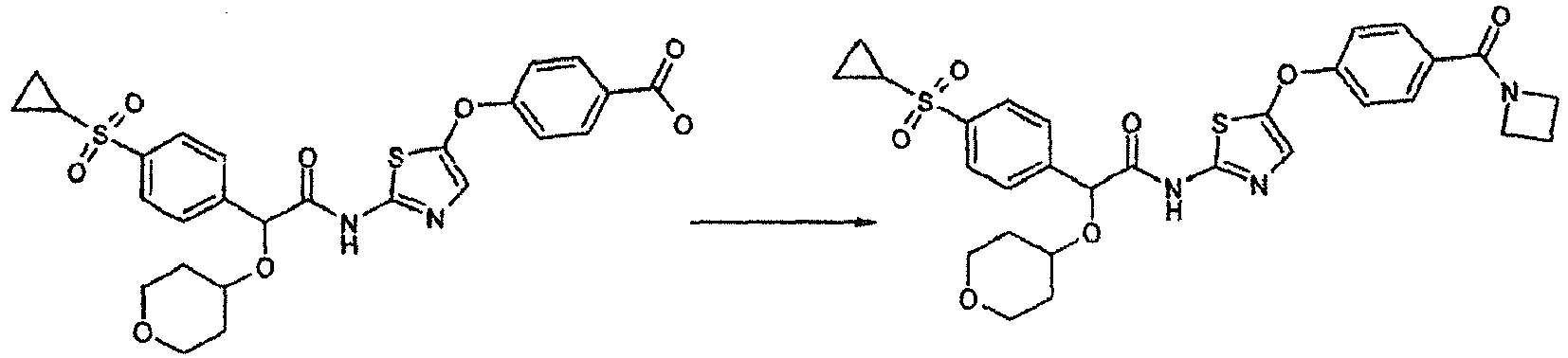
- To a solution of 4-{2-[2-(4-Cyclopropanesulfonyl-phenyl)-2-(tetrahydro-pyran-4-yloxy)-acetylamino]-thiazol-5-yloxy}-benzoic acid (0.250 gm, 0.44 mmol) in DMF (7 ml) was added azetidine hydrochloride (0.052 gm, 0.56 mmol), HOAt (0.5M in DMF) (1.16 ml, 0.58 mmol), EDCI (0.106 gm, 0.56 mmol) and diisopropylethylamine (0.2 ml, 1.16 mmol) and mixture was stirred for 18 hours at 25°C under argon atmosphere. Reaction mixture was diluted with water (25 ml) and extracted with ethylacetate (3X30 ml), combined organic layer was washed with brine solution, dried over anhydrous sodium sulfate, filtered and concentrated under reduced pressure. The residue was triturated with diisopropylether to get the title compound (0.174 gm).
1H NMR (400 MHz, DMSOd6): δ 1.02-1.04 (m, 2H), 1.08-1.13 (m, 2H), 1.40-1.60 (m, 2H), 1.82-1.95 (m, 2H), 2.21-2.30 (m, 2H), 2.82-2.90 (m, 1H), 3.29-3.40 (m, 2H), 3.60-3.70 (m, 1H), 3.78-3.90 (m, 2H), 3.99-4.03 (m, 2H), 4.26-4.29 (m, 2H), 5.48 (s, 1H), 7.13 (d, J = 8.8 Hz, 2H), 7.37 (s, 1H), 7.63 (d, J = 8.8 Hz, 2H), 7.78 (d, J = 8.4 Hz, 2H), 7.93 (d, J = 8.4 Hz, 2H).
MS (EI) m/z: 598.2 (M+1). -
Example No. Mass IUPAC Name C2 543.9 4-{2-[2-(4-Cyclopropanesulfonyl-phenyl)-2-(tetrahydro-furan-3-yloxy)-acetylamino]-thiazol-5-yloxy}-benzamide C3 554.9 N-[4-(2-Azetidin-1-yl-2-oxo-ethyl)-5-chloro-thiazol-2-yl]-2-(4-cyclopropanesulfonyl-phenyl)-2-(tetrahydro-pyran-4-yloxy)-acetamide C4 * 626.3 N-{5-[4-(Azetidine-1-carbonyl)-phenoxy]-thiazol-2-yl}-2-(4-cyclopropanesulfonyl-phenyl)-2-(2,4-difluoro-phenoxy)-acetamide C5 * 626.3 N-{5-[3-(Azetidine-1-carbonyl)-phenoxy]-thiazol-2-yl}-2-(4-cyclopropanesulfonyl-phenyl)-2-(2,4-difluoro-phenoxy)-acetamide C6 * 586.2 3-{2-[2-(4-Cyclopropanesulfonyl-phenyl)-2-(2,4-difluorophenoxy)-acetylamino]-thiazol-5-yloxy}-benzamide C7 * 586.2 4-{2-[2-(4-Cyclopropanesulfonyl-phenyl)-2-(2,4-difluorophenoxy)-acetylamino]-thiazol-5-yloxy}-benzamide *Reference Example -
- Method-1:-Column-OJ-RH (150X4.6)mm, 5µm; Flow: 1.0 ml min-1; M.Phase:(98:02) Methanol : 0.05% Formic acid in water; Column Temp.: 40°C, Detection wavelength: 220 nm.
- Method-2:-Column-OJ-RH (150X4.6)mm, 5µm; Flow:1.0 ml min-1; M.Phase: 100% Methanol, Column Temp.: ambient, Detection wavelength : 220 nm.
- Method-3:-Column-OJ-RH (150X4.6)mm, 5µm; Flow:1.0 ml min-1; M.Phase:(95:5) Methanol : 0.05% Formic acid in water; Column Temp.: 40°C, Detection wavelength : 220/295 nm.
- Method-4:-Column-OJ-RH (150X4.6)mm, 5µm; Flow:1.0 ml min-1; M.Phase:(98:2) Methanol (0.05% Formic acid) : 0.05% Formic acid in water; Column Temp.: 40°C, Detection wavelength : 220 nm.
- Method-5:-Column-OJ-RH (150X4.6)mm, 5µm; Flow:0.7 ml min-1; M.Phase:(90:10) Methanol : 0.05% Formic acid in water; Column Temp.: 40°C, Detection wavelength : 220 nm.
- Method-6:-Column-OJ-RH (150X4.6)mm, 5µm; Flow:1.4 ml min-1; M.Phase:(95:5) Methanol : 0.05% Formic acid in water; Column Temp.: 40°C, Detection wavelength : 274 nm.
- Method-7:-Column-OJ-RH (150X4.6)mm, 5µm; Flow:1.0 ml min-1; M.Phase: 100% Methanol, Column Temp.: 40°C, Detection wavelength : 220 nm.
- Method-8:-Column-OJ-RH (150X4.6)mm, 5µm; Flow:1.0 ml min-1; M.Phase:(90:10) Methanol (0.05% Formic acid) : 0.05% Formic acid in water; Column Temp.: 40°C, Detection wavelength: 220 nm.
- Method-9:-Column-OJ-RH (150X4.6)mm, 5µm; Flow:1.5 ml min-1; M.Phase: Methanol, Column Temp.: 40°C, Detection wavelength: 220 nm.
-

- The mixture of N-[5-(4-Cyano-phenoxy)-thiazol-2-yl]-2-(4-cyclopropanesulfonylhenyl)-2-(tetrahydro-pyran-4-yloxy)-acetamide (0.25 gm, 0.46 mmol), sodium azide (0.24 gm, 3.71 mmol) and ammonium chloride (0198 gm, 3.71 mmol) in DMF (10 ml) was refluxed for 4-5 hr. After completion, reaction mixture was diluted with water and extracted with ethyl acetate, washed with water and brine, dried (Na2SO4) and concentrated in vacuo. Purified by PREP TLC to afford title compound (0.120 g, 44 %).
1H NMR (400 MHz, ,CDCl3): δ 1.03-1.08 (m, 2H), 1.34-1.49 (m, 2H), 1.73-1.81 (m, 2H), 1.87-2.05 (m, 2H), 2.43-2.48 (m ,1H), 3.37-3.44 (m, 2H), 3.67-3.74 (m, 1H), 3.93-4.03 (m, 2H), 5.24 (s, 1H), 7.16 (d, J = 8.8 Hz, 2H), 7.18 (s, 1H), 7.69 (d, J = 8.4 Hz, 2H), 7.91 (d, J = 8.8 Hz, 2H), 8.02 (d, J = 8.8 Hz, 2H).
MS (EI) m/z: 583.30 (M + 1). -

- To a stirred solution of 2-(4-Cyclopropanesulfonyl-phenyl)-N-[5-(4-formyl-phenoxy)-thiazol-2-yl]-2-(tetrahydro-pyran-4-yloxy)-acetamide (Example A117) (0.2g, 0.36 mmol) in 10 mL methanol, sodium borohydride (0.027g, 0.73 mmol) was added in portions at 0°C After complete addition reaction mixture was stirred for 1hr at 0°C to 10 °C. Completion of the reaction was confirmed by TLC, then methanol was evaporated on rotavapour. Reaction mixture was diluted with ethyl acetate (20mL X 3), organic layer was washed with water and brine, dried (Na2SO4) and concentrated in vacuo. Purified by PREP TLC to afford title compound (0.110 gm).
1H NMR (400 MHz, CDCl3): δ 1.04-1.06 (m, 2H), 1.35-1.37 (m, 2H), 1.69-1.76 (m, 2H), 1.84-1.88 (m, 1H), 2.01-2.04 (m, 1H), 2.43-2.46 (m, 1H), 3.35-3.42 (m, 2H), 3.65-3.69 (m, 1H), 3.94-4.02 (m, 2H), 4.65 (bs, 2H), 5.20 (s, 1H), 7.06 (d, J = 8.8 Hz, 2H), 7.09 (s, 1H), 7.32 (d, J = 8.8 Hz, 2H), 7.68 (d, J = 7.6 Hz, 2H), 7.92 (d, J = 8.4 Hz, 2H).
MS (EI) m/z: 545.2 (M + 1). -

- To a solution of 2-[2-(4-Cyclopropanesulfonyl-phenyl)-2-(tetrahydro-pyran-4-yloxy)-acetylamino]-5-methyl-thiazole-4-carboxylic acid methyl ester(Example A94) (0.23 gm, 0.46 mmol) in toluene (5 ml) was added DIBALH (1M in toluene,0.13 g, 0.93 mmol) at 0°C and reaction mixture was stirred overnight at room temperature. Solvent was removed in vacuo and taken into water, extracted with ethyl acetate (10 ml x 3), combined organic layers were washed with 1 N NaOH solution, water and brine, dried (Na2SO4) and concentrated in vacuo. Purified by preparative HPLC to afford title compound (0.012 gm)
1HNMR (CDCl3, 400 MHz):- δ 1.02-1.05 (m, 2H), 1.33-1.36 (m, 2H), 1.67-1.79 (m, 2H), 1.81-1.85 (m,1H), 1.89-2.30 (m,1H), 2.35 (s, 3H), 2.40-2.47(m, 1H), 3.34-3.42 (m, 2H), 3.61-3.65(m,1H), 3.93-4.02 (m, 2H), 4.60 (s, 2H), 5.20 (s, 1H), 7.67 (d, J = 8.0 Hz, 2H),7.91 (d, J = 8.4 Hz, 2H).
MS (EI) m/z: 467.20 (M+1). -

- 2-(4-Cyclopropanesulfonyl-phenyl)-2-(tetrahydro-pyran-4-yloxy)-N-(5-vinyl-thiazol-2-yl)-acetamide (Example A118) (0.107 gm, 0.238 mmol), osmium tetroxide (0.0061 gm , 0.0238 mmol) and N-methylmorpholine N-oxide (0.041 gm, 0.353 mmol) were taken in 4 ml of THF and 1 ml of water and stirred at room temperature for 3 hrs. The reaction mixture was partitioned between 10% sodium thiosulphate (10 ml) and ethyl acetate (10 ml). The layers were separated. Aq. layer was extracted with ethyl acetate (2x10 ml). The combined organic layer was washed with brine and dried over anhydrous sodium sulfate filtered and concentrated under reduced pressure to get a residue which was purified by preparative TLC to get the required product (0.070 gm).
1H NMR (400 MHz, DMSOd6): δ 1.00-1.05 (m,2H), 1.09-1.13 (m, 2H), 1.48-1.58 (m, 2H), 1.85-1.93 (m, 2H), 2.82-2.86 (m, 1H), 3.29-3.36 (m, 2H), 3.40-3.59 (m, 2H), 3.62-3.66 (m, 1H), 3.77-3.85 (m, 2H), 4.69-4.73 (q, J = 5.2 Hz, 1H), 4.89-4.93 (q, J = 5.6 Hz,1H), 5.47 (s, 1H), 5.59-5.61(t, J = 4.4 Hz, 1H), 7.31 (s, 1H), 7.77(d, J = 8.4 Hz, 2H), 7.92(d, J = 8.4 Hz, 2H), 12.25 (s, 1H).
MS (EI) m/z: 483.1 (M + 1). -
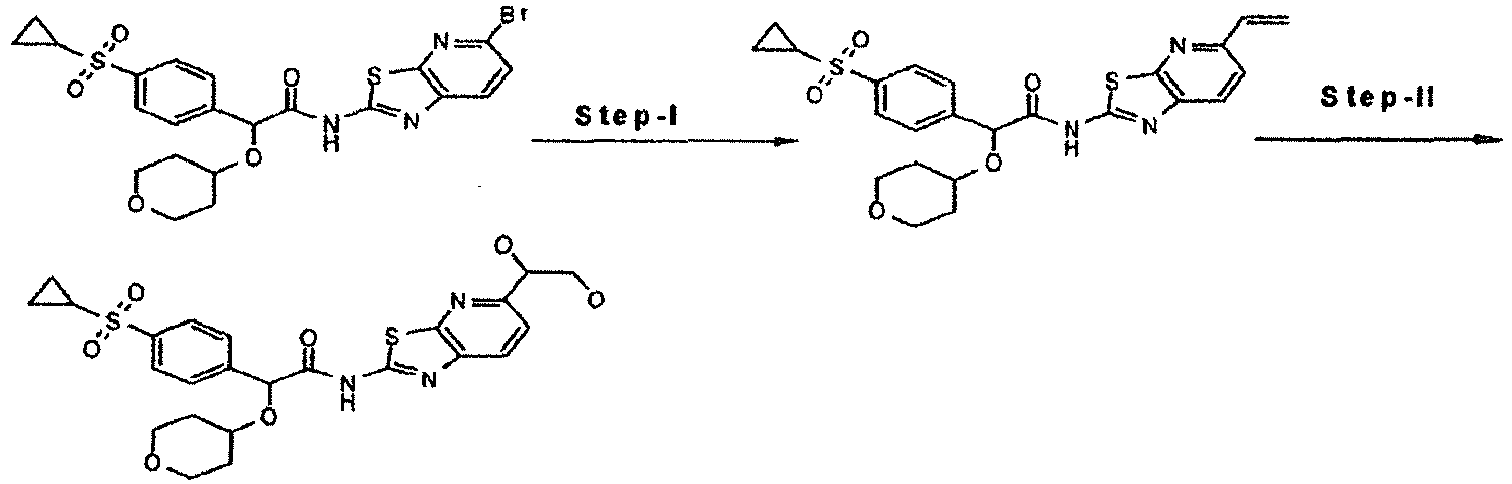
- To mixture of N-(5-Bromo-thiazolo[5,4-b]pyridin-2-yl)-2-(4-cyclopropanesulfonylphenyl)-2-(tetrahydro-pyran-4-yloxy)-acetamide (Example-A95) (0.135 gm, 0.24 mmol), Pd (PPh3)4 (0.014 gm, 0.012 mmol) and LiCl (0.031 gm, 0.73 mmol) in THF:DMF (1:1, 5 ml) under inert atmosphere was added tributyl(vinyl)stannane (0.23 gm, 0.73 mmol) and heated under reflux for 8 hrs.Solvent was removed in vacuo and taken into brine and extracted with ethyl aceatate (3X5 ml),washed with water and brine, dried (Na2SO4) and concentrated in vacuo to afford titled compound (0.080 gm)
MS (EI) m/z: 500.20 (M+1). - 1HNMR (DMSO-d6, 400 MHz):- δ 1.00-1.06 (m, 2H), 1.10-1.1.14 (m, 2H), 1.47-1.64 (m, 2H), 1.84-2.02 (m,2H), 2.83-2.89 (m,1H), 3.25-3.35 (m, 2H), 3.51-3.57 (m, 1H), 3.65-3.72 (m, 2H), 3.78-3.87 (m, 2H), 4.66-4.74 (m,2H), 5.54 (d, J = 4.8 Hz, 1H), 5. 56 (s, 1H), 7.59 (d, J = 8.4 Hz, 1H), 7.81 (d, J = 8.0 Hz, 2H), 7.95 (d, J = 8.4 Hz, 2H), 8.11 (d, J = 8.4 Hz, 1H), 12.78 (bs, 1H).
MS (EI) m/z: 534.20 (M+1). -
Example No. Mass IUPAC Name G3 483.1 2-(4-Cyclopropanesulfonyl-phenyl)-N-[4-(1,2-dihydroxy-ethyl)-thiazol-2-yl]-2-(tetrahydro-pyran-4-yloxy)-acetamide G4* 528.2 N-[5-(1,2-Dihydroxy-ethyl)-thiazol-2-yl]-2-[4-(morpholine-4-sulfonyl)-phenyl]-2-(tetrahydro-pyran-4-yloxy)-acetamide *Reference Example - The list of examples below, but not to be limited to these, can also be synthesized following the general synthesis described above:
- 2-(4-Cyclopropanesulfonyl-phenyl)-N-[3-(1,2-dihydroxy-ethyl)-[1,2,4]thiadiazol-5-yl]-2-(tetrahydro-pyran-4-yloxy)-acetamide and its (+) and (-) enantiomers;
- {5-Chloro-2-[2-(4-cyclopropanesulfonyl-phenyl)-2-(2-methyl-tetrahydro-pyran-3-yloxy)-acetylamino]-thiazol-4-yl}-acetic acid and its (+) and (-) enantiomers;
- 2-[2-[4-(3-Oxo-cyclopentanesulfonyl)-phenyl]-2-(tetrahydro-furan-3-yloxy)-acetylamino]-thiazole-4-carboxylic acid and its (+) and (-) enantiomers;
- N-[4-(1-Acetyl-piperidin-4-yl)-thiazol-2-yl]-2-(4-cyclopropanesulfonyl-phenyl)-2-(tetrahydro-pyran-4-yloxy)-acetamide and its (+) and (-) enantiomers;
- 2-(4-Cyclopropanesulfonyl-phenyl)-N-{5-[4-(1,2-dihydroxy-ethyl)-phenoxy]-thiazol-2-yl}-2-(tetrahydro-pyran-4-yloxy)-acetamide and its (+) and (-) enantiomers;
- 2-(4-Cyclopropanesulfonyl-phenyl)-N-(4,5,6,7-tetrahydro-benzothiazol-2-yl)-2-(tetrahydro-pyran-4-yloxy)-acetamide and its (+) and (-) enantiomers;
- 2-(4-Cyclopropanesulfonyl-phenyl)-2-(tetrahydro-pyran-4-yloxy)-N-thiazolo[5,4-d]pyrimidin-2-yl-acetamide and its (+) and (-) enantiomers;
- 2-(4-Cyclopropanesulfonyl-phenyl)-N-[5-(4-hydroxymethyl-phenoxy)-thiazol-2-yl]-2-(tetrahydro-pyran-4-yloxy)-acetamide and its (+) and (-) enantiomers;
- 2-(2,4-Difluoro-phenoxy)-N-(5-methyl-4,5,6,7-tetrahydro-thiazolo[4,5-c]pyridin-2-yl)-2-[4-(piperidine-1-sulfonyl)-phenyl]-acetamide and its (+) and (-) enantiomers (Reference Example);
- 2-(2,4-Difluoro-phenoxy)-N-[3-(1,2-dihydroxy-ethyl)-[1,2,4]thiadiazol-5-yl]-2-[4-(piperidine-1-sulfonyl)-phenyl]-acetamide and its (+) and (-) enantiomers (Reference Example);
- N-[3-(1,2-Dihydroxy-ethyl)-[1,2,4]thiadiazol-5-yl]-2-[4-(piperidine-1-sulfonyl)-phenyl]-2-(tetrahydro-pyran-4-yloxy)-acetamide and its (+) and (-) enantiomers (Reference Example);
- 2-(4-Cyclopropanesulfonyl-phenyl)-N-[4-(1,2-dihydroxy-ethyl)-thiazol-2-yl]-2-(tetrahydro-pyran-4-yloxy)-acetamide and its (+) and (-) enantiomers;
- 2-(4-Cyclopropanesulfonyl-phenyl)-N-[4-(1,2-dihydroxy-ethyl)-5-fluoro-thiazol-2-yl]-2-(tetrahydro-pyran-4-yloxy)-acetamide and its (+) and (-) enantiomers;
- 2-(4-Cyclopropanesulfonyl-phenyl)-N-[5-(1,2-dihydroxy-ethyl)-thiazol-2-yl]-2-(tetrahydro-pyran-4-yloxy)-acetamide and its (+) and (-) enantiomers;
- 2-(2,4-Difluoro-phenoxy)-N-[4-(1,2-dihydroxy-ethyl)-thiazol-2-yl]-2-[4-(piperidine-1-sulfonyl)-phenyl]-acetamide and its (+) and (-) enantiomers (Reference Example);
- 2-(4-Cyclopropanesulfonyl-phenyl)-N-[5-(1,2-dihydroxy-ethyl)-thiazolo[5,4-b]pyridin-2-yl]-2-(tetrahydro-pyran-4-yloxy)-acetamide and its (+) and (-) enantiomers;
- N-[5-(1,2-Dihydroxy-ethyl)-thiazolo[5,4-b]pyridin-2-yl]-2-[4-(morpholine-4-sulfonyl)-phenyl]-2-(tetrahydro-pyran-4-yloxy)-acetamide and its (+) and (-) enantiomers (Reference Example);
- 2-(4-Chloro-2-fluoro-phenoxy)-N-[5-(1,2-dihydroxy-ethyl)-thiazolo[5,4-b]pyridin-2-yl]-2-[4-(pyrrolidine-1-sulfonyl)-phenyl]-acetamide and its (+) and (-) enantiomers (Reference Example);
- {2-[2-(4-Cyclopropanesulfonyl-phenyl)-2-(4,6-difluoro-indan-2-yloxy)-acetylamino]-thiazol-4-yl}-acetic acid and its (+) and (-) enantiomers (Reference Example);
- 2-(3-{2-(4-Cyclopropanesulfonyl-phenyl)-2-[(R)-(tetrahydro-furan-3-yl)oxy]-acetylamino}-pyrazol-1-yl)-2-methyl-propionic acid and its (+) and (-) enantiomers;
- 2-(4-Cyclopentanesulfonyl-phenyl)-2-(2,4-difluoro-phenoxy)-N-(4-hydroxymethyl-5-methyl-thiazol-2-yl)-acetamide and its (+) and (-) enantiomers (Reference Example);
- N-[5-Chloro-4-(2-hydroxy-ethyl)-thiazol-2-yl]-2-[4-(tetrahydro-pyran-4-sulfonyl)-phenyl]-2-(tetrahydro-pyran-4-yloxy)-acetamide and its (+) and enantiomers (Reference Example);
- N-(5-Hydroxymethyl-pyridin-2-yl)-2-[4-(morpholine-4-sulfonyl)-phenyl]-2-(tetrahydropyran-4-yloxy)-acetamide and its (+) and (-) enantiomers (Reference Example);
- 6-{2-(Tetrahydro-furan-3-yloxy)-2-[4-(tetrahydro-pyran-4-sulfonyl)-phenyl]-acetylamino}-nicotinic acid and its (+) and (-) enantiomers (Reference Example).
- The glucokinase (GK) assay is a coupled enzymatic assay. GK catalyzes the first step of glycolysis, the conversion of glucose to glucose-6-phosphate (G6P) in the presence of ATP. G6P in turn is converted by glucose-6-phosphate dehydrogenase (G6PD) to 6-phosphogluconate, a process that requires NAD, resulting in NADH formation. Since the GK-catalyzed step is the rate-limiting step of this coupled enzymatic process, the rate of accumulation of 6-phosphogluconate and NADH is directly proportional to the rate of glucose phosphorylation by GK. The rate of the GK-catalyzed reaction can therefore be measured by monitoring the increase in NADH absorbance at 340 nm.
- The assay is carried out according to the protocol outlined in Hariharan et al (1997), Diabetes 46: 11-16. Briefly, the test compounds are incubated in a reaction mix containing 25 mM HEPES (pH 7.2), 10 mM MgCl2, 100 mM KCl, 5 mM ATP, 2 mM DTT, 0.5 mM NAD, 1 U/ml Leuconostoc mesenteroides G6PD, 0.3 U/ml of purified human recombinant GK, and different concentrations of glucose. Enzymatic activity is calculated from the initial reaction velocity, measured from the change in NADH absorbance as a function of time.
- Compounds described in formula (I), in concentration ranges from 1.0 nM to 500 µM, are tested in the purified human recombinant glucokinase assay described above.
- A compound is considered to be a glucokinase activator if it, in its testable range of concentrations, yields a higher rate of glucose phosphorylation than in its absence at a particular glucose concentration, for example at 5 mM glucose.
- Compounds of general formula (I) are tested in the in vitro GK enzymatic assay to monitor dose-dependent effect on glucokinase activation (in kinetic mode), as described above, at various glucose concentrations. The S0.5 of glucokinase for glucose at different concentration of each compound of interest is calculated from the following modified version of the Michaelis-Menten equation, V = Vmax [S] n /(S0.5 n + [S] n ), where [S] is the glucose concentration and n is the Hill coefficient (taken as 1.7 to account for the sigmoidal kinetics of glucokinase with respect to glucose). The S0.5 is plotted against the log of the compound concentration. The change in the S0.5 of glucokinase (ΔS0.5) for glucose is calculated by subtracting the S0.5 at each concentration of the compound from the S0.5 in the vehicle control. The ΔS0.5 is then normalized to a percent scale, where the S0.5 in the vehicle control is set to 0% and 0 mM glucose is set to 100%. The % ΔS0.5 is then plotted against the log of the compound concentration. The EC50 and Emax of % change in S0.5 is obtained from the sigmoidal fit of the data. Detailed protocol has been described in our copending application no. 409/CHE/2007 which is incorporated herein by reference. Characterization data of some representative glucokinase activators of the present disclosure, which are illustrative but not limiting, are given in table I below.
- The glucokinase activation data of some representative compounds of the present disclosure, which are illustrative but not to be construed as limiting the scope or spirit of the disclosure, are given in the table I below.
Table I: EC50 and Emax (with respect to % ΔS0.5) of GK activators Example No. EC50 (µM) % Emax F1 0.1 91 D4A 0.069 92 D6A 0.022 88 B34 0.045 91 E1 0.099 88 D9A 0.068 95 D10A 0.054 92 B41 0.1 75 D1A 0.084 85 D11A 0.034 95 - Primary hepatocytes are collected from male Wistar rats, and tested for viability by trypan blue exclusion. Primary hepatocytes cultures with viability greater than 95% are selected for the glycogen synthesis assay. The cells are seeded in a 48-well plate at a density of 200,000 cells/well in 250 µl Minimal Essential Medium (MEM) containing 10% foetal calf serum (FCS) and 1.7 µM insulin, and incubated for 4 hours at 37°C to allow attachment. The medium is replaced with fresh MEM containing 10% FCS, 1.7 µM insulin and 10 nM dexamethasone, and the cells are incubated for 16 hours at 37°C. The medium is then replaced with fresh MEM (serum-free) containing 2 µCi/ml of D-[U14C]-Glucose along with 10 µM of the compound in a final DMSO concentration of 0.1%. The final glucose concentration is brought to 10 mM by the addition of D-Glucose (MEM already contains 5 mM glucose). The cells are incubated for 3 hours at 37°C. The cells are washed twice with 150 mM NaCl, lysed with 0.1 N NaOH, and the lysate precipitated with 8% w/v trichloroacetic acid (TCA) and 1 mg/well unlabeled glycogen as carrier. Cell debris is pelleted by centrifugation, the supernatant is removed, and the glycogen is precipitated with 63% ethanol. After another round of centrifugation, the supernatant is removed, and the pellet containing the precipitated glycogen is dried overnight. De novo synthesized glycogen is estimated in a scintillation counter (MicroBeta Trilux, Perkin Elmer), and expressed as fold increase over DMSO control.
- The protocol for the glycogen assay is based on the method described in "Biochem J. 1990 Feb 15; 266(1): 91-102" with a few minor modifications. The protocol for isolation of primary rat hepatocytes is based on the method described in "Methods in Enzymology, Vol. III. pp 34-50. Ed. by S.P. Colowick and N.O. Kaplan. New York, Academic Press, 1957" with a few minor modifications.
- Compounds described in formula (I), in concentration ranges from 1.0 nM to 500 µM, are tested in glycogen synthesis assay described above.
- A compound is considered to be a glucokinase activator in a cellular environment if it demonstrates significant increase of glycogen synthesis over DMSO control as described in the above mentioned glycogen synthesis assay.
- The glycogen synthesis data of some representative compounds of the present invention, which are illustrative but not limiting, is given in the table 2 below.
Table 2: Glycogen synthesis data Examples Fold increase in glycogen synthesis at 10 µM D6A 11 D11A 15.5 C6 13.5
| Exam pie No. | Mass | IUPAC Name | Examples Used/ Method Used |
| D1A * | 545.0 | (-)2-(2,4-Difluoro-phenoxy)-2-[4-(piperidine-1-sulfonyl)-phenyl]-N-thiazo lo[5,4-b]pyridin-2-yl-acetamide | A-3 Method-3 |
| D1B * | 545.0 | (+)2-(2,4-Difluoro-phenoxy)-2-[4-(piperidine-1-sulfonyl)-phenyl]-N-thiazo lo[5,4-b]pyridin-2-yl-acetamide | |
| D2A * | 587.8 | (-) (5-Chloro-2-{2-(2,4-difluoro-phenoxy)-2-[4-(morpholine-4-sulfonyl)-phenyl]-acetylamino}-thiazol-4-yl)-acetic acid | B-7 Method-4 |
| D2B * | 587.8 | (+) (5-Chloro-2-{2-(2,4-difluorophenoxy)-2-[4-(morpholine-4-sulfonyl)-phenyl]-acetylamino}-thiazol-4-yl)-acetic acid | |
| D3A * | 585.8 | (-) (5-Chloro-2-{2-(2,4-difluorophenoxy)-2-[4-(piperidine-1-sulfonyl)-phenyl]-acetylamino}-thiazol-4-yl)-acetic acid | B-5 Method-5 |
| D3B * | 585.8 | (+) (5-Chloro-2-{2-(2,4-difluorophenoxy)-2-[4-(piperidine-1-sulfonyl)-phenyl]-acetylamino}-thiazol-4-yl)-acetic acid | |
| D4A | 559.3 | (+) 4-{2-[2-(4-Cyclopropanesulfonylphenyl)-2-(tetrahydro-pyran-4-yloxy)-acetylamino]-thiazol-5-yloxy}-benzoic acid | B-2 Method-7 |
| D4B | 559.3 | (-) 4-{2-[2-(4-Cyclopropanesulfonylphenyl)-2-(tetrahydro-pyran-4-yloxy)-acetylamino]-thiazol-5-yloxy}-benzoic acid | |
| D5A | 544.9 | 4-(2-{2-(4-Cyclopropanesulfonyl-phenyl)-2-[(S)-(tetrahydro-furan-3-yl)oxy]-acetylamino}-thiazol-5-yloxy)-benzoic acid | B-28 Method-1 |
| D5B | 544.9 | 4-(2-{2-(4-Cyclopropanesulfonyl-phenyl)-2-[(S)-(tetrahydro-furan-3-yl)oxy]-acetylamino}-thiazol-5-yloxy)-benzoic acid | |
| D6A | 545.0 | 4-(2-{2-(4-Cyclopropanesulfonyl-phenyl)-2-[(R)-(tetrahydro-furan-3-yl)oxy]-acetylamino}-thiazol-5-yloxy)-benzoic acid | B-2 Method-1 |
| D6B | 545.0 | 4-(2-{2-(4-Cyclopropanesulfonyl-phenyl)-2-[(R)-(tetrahydro-furan-3-yl)oxy]-acetylamino}-thiazol-5-yloxy)-benzoic acid | |
| D7A | 474.00 | (-)2-(4-Cyclopropanesulfonyl-phenyl)-2-(tetrahydro-pyran-4-yloxy)-N-thiazolo[5,4-b]pyridin-2-yl-acetamide | A-79 Method-2 |
| D7B | 474.00 | (+)2-(4-Cyclopropanesulfonyl-phenyl)-2-(tetrahydro-pyran-4-yloxy)-N-thiazolo[5,4-b]pyridin-2-yl-acetamide | |
| D8A * | 603.5 | (-)(5-Chloro-2-{2-(4-chloro-2-fluoro-phenoxy)-2-[4-(morpholine-4-sulfonyl )-phenyl]-acetylamino}-thiazol-4-yl)-acetic acid | B-21 Method-8 |
| D8B * | 603.5 | (+)(5-Chloro-2-{2-(4-chloro-2-fluoro-phenoxy)-2-[4-(morpholine-4-sulfonyl )-phenyl]-acetylamino}-thiazol-4-yl)-acetic acid | |
| D9A | 504.20 | (+)2-(4-Cyclopropanesulfonyl-phenyl)-N -(5-methoxy-thiazolo[5,4-b]pyridin-2-yl)-2-(tetrahydro-pyran-4-yloxy)-Acetamide | A-6 Method-9 |
| D9B | 504.20 | (-)2-(4-Cyclopropanesulfonyl-phenyl)-N -(5-methoxy-thiazolo[5,4-b]pyridin-2-yl)-2-(tetrahydro-pyran-4-yloxy)-Acetamide | |
| D10A | 518.20 | (+)2-(4-Cyclopropanesulfonyl-phenyl)-N -(5-ethoxy-thiazolo[5,4-b]pyridin-2 -yl)-2-(tetrahydro-pyran-4-yloxy)-a Cetamide | A-7 Method-2 |
| D10B | 518.20 | (-)2-(4-Cyclopropanesulfonyl-phenyl)-N -(5-ethoxy-thiazolo[5,4-b]pyridin-2 -yl)-2-(tetrahydro-pyran-4-yloxy)-a Cetamide | |
| D11A * | 587 | (+)4-{2-[2-(4-Cyclopropanesulfonylphenyl)-2-(2,4-difluoro-phenoxy)-acetylamino]-thiazol-5-yloxy}-benzoic acid | B-1 Method-6 |
| D11B * | 587 | (-)4-{2-[2-(4-Cyclopropanesulfonylphenyl)-2-(2,4-difluoro-phenoxy)-acetylamino]-thiazol-5-yloxy}-benzoic acid | |
| D12A * | 626.0 | (+)N-{5-[4-(Azetidine-1-carbonyl)-phenoxy]-thiazol-2-yl}-2-(4-cyclopropanesulfonyl-phenyl)-2-(2,4-difluoro-phenoxy)-acetamide | |
| D12B * | 626.0 | (-)N-{5-[4-(Azetidine-1-carbonyl)-phenoxy]-thiazol-2-yl}-2-(4-cyclopropanesulfonyl-phenyl)-2-(2,4-difluoro-phenoxy)-acetamide | C-4 Method-3 |
| *Reference Example |
Claims (23)
- A compound of formula (I)
 R1 is a cycloalkyl; R2 and R3 are hydrogen;R4 and R5 are independently selected from a group consisting of hydrogen, halogen, alkyl, cycloalkyl, heterocyclyl, aryl, heteroaryl, mono, di or tri substituted haloalkyl, nitrile, -NR6C(O)OR7, -(CR8R9)nC(O)OR6, -(CR8R9)nC(O)NR6R7, - CR8R9)nS(O)pNR6R7, -(CR8R9)nN(R6)C(O)R7; -(CR8R9)nOR6, -C(R8R9)nNR6R7, - C(R8R9)nCO(R6) and -s(O)pC(R8R9)nC(O)OR6; wherein each of R4 and R5 is optionally substituted with one or more substituents selected from halo, alkyl, alkenyl, alkynyl, cycloalkyl, aryl, heteroaryl, heterocyclyl, alkylsulfonyl, oxo, nitro, cyano, -(CR8R9)nR6, -(CR8R9)nCOOR6, -(CR8R9)nC(O)NR6R7, - CR8R9)nOR6, -SR6 or -NR6R7; wherein n = 0-4;X represents O;Ring A represents a monocyclic heterocyclyl;Ring B is heteroaryl and Ring C is phenyl;Rings A, B and C are optionally substituted with 1 to 4 substituents independently selected from halogen, monohaloalkyl, dihaloalkyl or perhaloalkyl, monohaloalkoxy, dihaloalkoxy or perhaloalkoxy, cyano, nitro, alkyl, alkenyl, alkynyl, methylenedioxy, amidino, -NR6R7, -OR6, -S(O)pR6, -S(O)pNR6R7, -NR6S(O)pR7, -NR6C(O)R7, -OS(O)pR7, -NR6C(O)OR7, -NR6C(O)NR6R7, -(CR8R9)nC(O)OR6, -(CR8R9)nC(O)NR6R7, -(CR8R9)nC(O)R6, cycloalkyl, cycloalkylalkyl heterocyclyl, heterocycloalkyl, aryl, arylalkyl, heteroaryl, heteroarylalkyl, cycloalkenyl, aryloxy, heteroaryloxy groups;
p = 0-2; n= 0-4;R6 and R7 are independently selected from a group consisting of hydrogen, alkyl, alkenyl, alkynyl, aryl, arylalkyl, heteroaryl, heteroarylalkyl, cycloalkyl, cycloalkylalkyl heterocyclyl and heterocyclylalkyl wherein each of R6 and R7 is optionally substituted with one or more substituents selected from halo, alkyl, cycloalkyl, aryl, heteroaryl, heterocyclyl, alkylsulfonyl, cyano, (CR8R9)nOR6, - (CR8R9)nCOOR6 or -(CR8R9)nC(O)NR6R7; wherein n = 0-4;
orR6 and R7 taken together form a monocyclic or a bicyclic ring system which may be saturated or partially unsaturated and optionally have additional heteroatoms selected from O, N or S, the said ring system may further be optionally substituted with 1 to 4 substituents independently selected from halo, alkyl, alkenyl, alkynyl, nitro, cyano, -OR6, -SR6, - NR6R7, oxo, alkylsulfonyl, -COOR6, -C(O)NR6R7, cycloalkyl, cycloalkylalkyl, aryl, arylalkyl, heterocyclyl, heterocyclylalkyl, heteroaryl, heteroarylalkyl;
wherein R6 and R7 are as described above;R8 and R9 are independently selected from a group consisting of hydrogen, fluorine, OR6, alkyl, and perfluoroalkyl,
orR8 and R9 taken together form a monocyclic or a bicyclic ring system which is saturated or partially unsaturated and optionally have additional heteroatoms selected from O, N or S, the said ring system may further be optionally substituted with 1 to 4 substituents independently selected from halo, alkyl, alkenyl, alkynyl, nitro, cyano, oxo, -OR6, -SR6, -NR6R7, alkylsulfonyl, -COOR6, -C(O)NR6R7, cycloalkyl, cycloalkylalkyl, aryl, arylalkyl, heterocyclyl, heterocyclylalkyl, heteroaryl, heteroarylalkyl. - The compound as claimed in claim 1, or its stereoisomers, tautomers, pharmaceutically acceptable salts, polymorphs, solvates and formulations wherein ring-A is selected from

 Ring B is selected from


p = 0-2; n= 0-4;R1 is selected from C3-C6 cycloalkyl;R4 and R5 are independently selected from a group consisting of hydrogen, halogen, alkyl, cycloalkyl, heterocyclyl, aryl, heteroaryl, mono, di or tri substituted haloalkyl, nitrile, nitro, -NR6R7, -OR6, -NR6C(O)R7, -NR6C(O)OR7, -CR8R9)pC(O)OR6, -(CR8R9)n(CO)NR6R7, -(CR8R9)nS(O)pNR6R7, -CR8R9)nN(R6)C(O)R7, -(CR8R9)nOR6, -C(R8R9)nNR6R7, -C(R8R9)nCO(R6) and - S(O)pC(R8R9)nC(O)OR6; wherein each of R4 and R5 is optionally substituted with one or more substituents selected from halo, straight chain or branched chain alkyl, alkenyl, alkynyl, cycloalkyl, aryl, heteroaryl, heterocyclyl, alkylsulfonyl, oxo, nitro, cyano, -(CR8R9)nCOOR6, -C(O)NR6R7-OR6, -SR6 or -NR6R7;
wherein n = 0-4;R6 and R7 are independently selected from a group consisting of hydrogen, alkyl, aryl, arylalkyl, heteroaryl, heteroarylalkyl, cycloalkyl, cycloalkylalkyl, heterocyclyl and heterocyclylalkyl; wherein each of R6 and R7 is optionally substituted with one or more substituents selected from halo, alkyl, cycloalkyl, aryl, heteroaryl, heterocyclyl, alkylsulfonyl, cyano, -(CR8R9)nOR6, -(CR8R9)nCOOR6 or (CR8R9)nC(O)NR6R7;
wherein n = 0-4;
orR6 and R7 taken together form a monocyclic or a bicyclic ring system which may be saturated or partially unsaturated and optionally have additional heteroatoms selected from O, N or S, the said ring system may further be optionally substituted with 1 to 4 substituents independently selected from halo, alkyl, alkenyl, alkynyl, nitro, cyano, -OR6, -SR6, - NR6R7, oxo, alkylsulfonyl, -COOR6, - C(O)NR6R7, cycloalkyl, cycloalkylalkyl, aryl, arylalkyl, heterocyclyl, heterocyclylalkyl, heteroaryl, heteroarylalkyl
wherein R6 and R7 are as described above;R8 and R9 are independently selected from a group consisting of hydrogen, fluorine, alkyl, and perfluoroalkyl; - The compound as claimed in claim 1, or its stereoisomers, tautomers, pharmaceutically acceptable salts, polymorphs, solvates and formulations thereof, wherein ring B is selected from


 Ring A is selected from
p = 0-2; n= 0-4;R1 is selected from C3-C6 cycloalkyl;R2, R3 and R5 are hydrogen;R4 is selected from a group consisting of hydrogen, halogen, alkyl, cycloalkyl, heterocyclyl, aryl, heteroaryl, mono, di or tri substituted haloalkyl, nitrile, nitro, -NR6R7, -OR6, -NR6C(O)R7, -NR6C(O)OR7, -(CR8R9)nC(O)OR6, - (CR8R9)n(CO)NR6R7, -(CR8R9)nS(O)pNR6R7, -(CR8R9)nN(R6)C(O)R7, -(CR8R9)nOR6, -C(R8R9)nNR6R7, -C(R8R9)nCO(R6) and -S(O)pC(R8R9)nC(O)OR6; wherein R4 is optionally substituted with one or more substituents selected from halo, straight chain or branched chain alkyl, alkenyl, alkynyl, cycloalkyl, aryl, heteroaryl, heterocyclyl, alkylsulfonyl, oxo, nitro, cyano, -(CR8R9)nCOOR6, -C(O)NR6R7, -OR6, -SR6 or NR6R7;
wherein n = 0-4;R6 and R7 are independently selected from a groups consisting of hydrogen, alkyl, aryl, heteroaryl, cycloalkyl, heterocyclyl; wherein each of R6 and R7 is optionally substituted with one or more substituents selected from halo, alkyl, cycloalkyl, aryl, heteroaryl, heterocyclyl, alkylsulfonyl, cyano, -(CR8R9)nOR6, - (CR8R9)nCOOR6 or -(CR8R9)nC(O)NR6R7;
wherein n = 0-4;
orR6 and R7 taken together form a monocyclic or a bicyclic ring system which may be saturated or partially unsaturated and optionally have additional heteroatoms selected from O, N or S, the said ring system may further be optionally substituted with 1 to 4 substituents independently selected from halo, alkyl, alkenyl; alkynyl, nitro, cyano, -OR6, -SR6, - NR6R7, oxo, alkylsulfonyl, -COOR6, - C(O)NR6R7, cycloalkyle, cycloalkylalkyl, aryl, arylalkyl, heterocyclyl, heterocyclylalkyl, heteroaryl, heteroarylalkyl
wherein R6 and R7 are as described above;R8 and R9 are independently selected from a group consisting of hydrogen, fluorine, alkyl, and perfluoroalkyl; - The compound as claimed in claim 1, or its stereoisomers, tautomers, pharmaceutically acceptable salts, polymorphs, solvates and formulations thereof, wherein Ring B is selected from

 Rings A, B and C are optionally substituted with 1 to 4 substituents independently selected from halogen, monohaloalkyl, dihaloalkyl or perhaloalkyl, monohaloalkoxy, dihaloalkoxy or perhaloalkoxy, cyano, nitro, alkyl, alkenyl, alkynyl, methylenedioxy, amidino -NR6R7, -OR6, -S(O)pR6, -S(O)pNR6R7, -NR6S(O)pR7, -NR6C(O)R7, -OS(O)pR7, -NR6C(O)OR7, -NR6C(O)NR6R7, - (CR8R9)nC(O)OR6, -(CR8R9)nC(O)NR6R7, -(CR8R9)nC(O)R6, cycloalkyl, cycloalkylalkyl, heterocyclyl, heterocycloalkyl, aryl, arylalkyl, heteroaryl, heteroarylalkyl, cycloalkenyl, aryloxy, heteroaryloxy groups;
p = 0-2; n= 0-4;R1 is selected from C3-C6 cycloalkyl;R4 is -OR6, wherein R6' is phenyl or pyridyl which is optionally substituted with one or more substituents selected from halo, alkyl, cycloalkyl, alkylsulfonyl, cyano, - (CR8R9)nOR6, - (CR8R9)nCOOR6, -(CR8R9)nC(O)NR6R7;
wherein n = 0-4;R6 and R7 are independently selected from a group consisting of hydrogen, alkyl, aryl, arylalkyl, heteroaryl, heteroarylalkyl, cycloalkyl, cycloalkylalkyl, heterocyclyl and heterocyclylalkyl; wherein each of R6 and R7 is optionally substituted with one or more substituents selected from halo, alkyl, cycloalkyl, aryl, heteroaryl, heterocyclyl, alkylsulfonyl, cyano, -(CR8R9)nOR6, -(CR8R9)nCOOR6 or -(CR8R9)nC(O)NR6R7;
wherein n = 0-4;
orR6 and R7 taken together form a monocyclic or a bicyclic ring system which may be saturated or partially unsaturated and optionally have additional heteroatoms selected from O, N or S, the said ring system may further be optionally substituted with 1 to 4 substituents independently selected from halo, alkyl, alkenyl, alkynyl, nitro, cyano, -OR6, -SR6, - NR6R7, oxo, alkylsulfonyl, -COOR6, -C(O)NR6R7, cycloalkyl, cycloalkylalkyl, aryl, arylalkyl, heterocyclyl, heterocyclylalkyl, heteroaryl, heteroarylalkyl
wherein R6 and R7 are as described above;R8 and R9 are independently selected from a group consisting of hydrogen, fluorine, alkyl, and perfluoroalkyl. - A compound as claimed in claim 1 which is4-{2-[2-(4-Cyclopropanesulfonyl-phenyl)-2-(tetrahydro-pyran-4-yloxy)-acetylamino]-thiazol-5-yloxy}-benzoic acid methyl ester and its (+) and (-) enantiomers;4-(2-{2-(4-Cyclopropanesulfonyl-phenyl)-2-[(R)-(tetrahydro-furan-3-yl)oxy]-acetylamino}-thiazol-5-yloxy)-benzoic acid methyl ester and its (+) and (-) enantiomers;2-(4-Cyclopropanesulfonyl-phenyl)-2-(tetrahydro-pyran-4-yloxy)-N-thiazolo[5,4-b]pyridin-2-yl-acetamide and its (+) and (-) enantiomers;2-(4-Cyclopropanesulfonyl-phenyl)-N-(5-methoxy-thiazolo[5,4-b]pyridin-2-yl)-2-(tetrahydro-pyran-4-yloxy)-acetamide and its (+) and (-) enantiomers;2-(4-Cyclopropanesulfonyl-phenyl)-N-(5-ethoxy-thiazolo[5,4-b]pyridin-2-yl)-2-(tetrahydro-pyran-4-yloxy)-acetamide and its (+) and (-) enantiomers;2-(4-Cyclopropanesulfonyl-phenyl)-N-(5-isopropoxy-thiazolo[5,4-b]pyridin-2-yl)-2-(tetrahydro-pyran-4-yloxy)-acetamide and its (+) and (-) enantiomers;2-(4-Cyclopropanesulfonyl-phenyl)-N-(5-pyrazol-1-yl-thiazol-2-yl)-2-(tetrahydropyran-4-yloxy)-acetamide and its (+) and (-) enantiomers;2-(4-Cyclopropanesulfonyl-phenyl)-N-(5-morpholin-4-yl-thiazol-2-yl)-2-(tetrahydro-pyran-4-yloxy)-acetamide and its (+) and (-) enantiomers;2-(4-Cyclopropanesulfonyl-phenyl)-N-(5-fluoro-thiazol-2-yl)-2-(tetrahydro-pyran-4-yloxy)-acetamide and its (+) and (-) enantiomers;2-(4-Cyclopropanesulfonyl-phenyl)-N-(1-methyl-1H-pyrazol-3-yl)-2-(tetrahydropyran-4-yloxy)-acetamide and its (+) and (-) enantiomers;2-(4-Cyclopropanesulfonyl-phenyl)-N-pyrazin-2-yl-2-(tetrahydro-pyran-4-yloxy)-acetamide and its (+) and (-) enantiomers;N-[5-(4-Cyano-phenoxy)-thiazol-2-yl]-2-(4-cyclopropanesulfonyl-phenyl)-2-(tetrahydro-pyran-4-yloxy)-acetamide and its (+) and (-) enantiomers;2-(4-Cyclopropanesulfonyl-phenyl)-N-(5-methoxy-thiazol-2-yl)-2-(tetrahydropyran-4-yloxy)-acetamide and its (+) and (-) enantiomers;{5-Chloro-2-[2-(4-cyclopropanesulfonyl-phenyl)-2-tetrahydro-furan-3-yloxy)-acetylamino]-thiazol-4-yl}-aceticacid ethyl ester and its (+) and (-) enantiomers;4-{2-[2-(4-Cyclopropanesulfonyl-phenyl)-2-(tetrahydro-furan-3-yloxy)-acetylamino]-thiazol-5-yloxy}-benzoic acid methyl ester and its (+) and (-) enantiomers;(5-Chloro-2-{2-(4-cyclopropanesulfonyl-phenyl)-2-[(R)-(tetrahydro-furan-3-yl)oxy]-acetylamino}-thiazol-4-yl)-acetic acid ethyl ester and its (+) and (-) enantiomers;4-(2-{2-(4-Cyclopropanesulfonyl-phenyl)-2-[(S)-(tetrahydro-furan-3-yl)oxy]-acetylamino}-thiazol-5-yloxy)-benzoic acid methyl ester and its (+) and (-) enantiomers;(5-Chloro-2-{2-(4-cyclopropanesulfonyl-phenyl)-2-[(S)-(tetrahydro-furan-3-yl)oxy]-acetylamino}-thiazol-4-yl)-acetic acid ethyl ester and its (+) and (-) enantiomers;4-{3-[2-(4-Cyclopropanesulfonyl-phenyl)-2-(tetrahydro-pyran-4-yloxy)-acetylamino]-pyrazol-1-ylmethyl}-benzoic acid methyl ester and its (+) and (-) enantiomers;{5-Chloro-2-[2-(4-cyclopropanesulfonyl-phenyl)-2-(tetrahydro-pyran-4-yloxy)-acetylamino]-thiazol-4-yl}-acetic acid ethyl ester and its (+) and (-) enantiomers;3-{2-[2-(4-Cyclopropanesulfonyl-phenyl)-2-(tetrahydro-pyran-4-yloxy)-acetylamino]-thiazol-5-yloxy}-benzoic acid methyl ester and its (+) and (-) enantiomers;4-{2-[2-(4-Cyclopropanesulfonyl-phenyl)-2-(tetrahydro-pyran-4-yloxy)-acetylamino]-thiazol-5-yloxy}-2-fluoro-benzoic acid methyl ester and its (+) and (-) enantiomers;4-{2-[2-(4-Cyclopropanesulfonyl-phenyl)-2-(tetrahydro-pyran-4-yloxy)-acetylamino]-thiazol-5-yloxy}-3-fluoro-benzoic acid methyl ester and its (+) and (-) enantiomers;{2-[2-(4-Cyclopropanesulfonyl-phenyl)-2-(tetrahydro-pyran-4-yloxy)-acetylamino]-thiazolo[5,4-b]pyridin-5-yloxy}-acetic acid ethyl ester and its (+) and (-) enantiomers;4-{2-[2-(4-Cyclopropanesulfonyl-phenyl)-2-(tetrahydro-pyran-4-yloxy)-acetylamino]-thiazolo[5,4-b]pyridin-5-yloxy}-benzoic acid methyl ester and its (+) and (-) enantiomers;2-(4-Cyclopropanesulfonyl-phenyl)-N-(6-methoxy-benzothiazol-2-yl)-2-(tetrahydro-pyran-4-yloxy)-acetamide and its (+) and (-) enantiomers;2-(4-Cyclopropanesulfonyl-phenyl)-N-(5-methoxy-thiazolo[5,4-b]pyridin-2-yl)-2-[(R)-(tetrahydro-furan-3-yl)oxy]-acetamide and its (+) and (-) enantiomers;4-[(4-Cyclopropanesulfonyl-phenyl)-(5-fluoro-thiazol-2-ylcarbamoyl)-methoxy]-piperidine-1-carboxylic acid tert-butyl ester and its (+) and (-) enantiomers;2-(4-Cyclopropanesulfonyl-phenyl)-N-(5-fluoro-thiazol-2-yl)-2-(piperidin-4-yloxy)-acetamide and its (+) and (-) enantiomers;(4-{2-[2-(4-Cyclopropanesulfonyl-phenyl)-2-(tetrahydro-pyran-4-yloxy)-acetylamino]-thiazol-5-yloxy}-phenyl)-acetic acid methyl ester and its (+) and (-) enantiomers;2-[2-(4-Cyclopropanesulfonyl-phenyl)-2-(tetrahydro-pyran-4-yloxy)-acetylamino]-benzothiazole-6-carboxylic acid methyl ester and its (+) and (-) enantiomers;2-{2-(4-Cyclopropanesulfonyl-phenyl)-2-[(R)-(tetrahydro-furan-3-yl)oxy]-acetylamino}-benzothiazole-6-carboxylic acid methyl ester and its (+) and (-) enantiomers;2-(4-C-yclopropanesulfonyl-phenyl)-N-(5-oxo-4,5-dihydro-thiazolo[5,4-b]pyridin-2-yl)-2-(tetrahydro-pyran-4-yloxy)-acetamide and its (+) and (-) enantiomers;2-(4-Cyclopropanesulfonyl-phenyl)-N-(5-isopropoxy-thiazolo[5,4-b]pyridin-2-yl)-2-[(R)-(tetrahydro-furan-3-yl)oxy]-acetamide and its (+) and (-) enantiomers;4-{2-[2-(4-Cyclopropanesulfonyl-phenyl)-2-(tetrahydro-pyran-4-yloxy)-acetylamino]-thiazol-5-yloxy}-2-methyl-benzoic acid methyl ester and its (+) and (-) enantiomers;2-[2-(4-Cyclopropanesulfonyl-phenyl)-2-(tetrahydro-pyran-4-yloxy)-acetylamino]-5-methyl-thiazole-4-carboxylic acid methyl ester and its (+) and (-) enantiomers;N-(5-Bromo-thiazolo[5,4-b]pyridin-2-yl)-2-(4-cyclopropanesulfonyl-phenyl)-2-(tetrahydro-pyran-4-yloxy)-acetamide and its (+) and (-) enantiomers;2-(4-Cyclopropanesulfonyl-phenyl)-N-[5-(4-formyl-phenoxy)-thiazol-2-yl]-2-(tetrahydro-pyran-4-yloxy)-acetamide and its (+) and (-) enantiomers;2-(4-Cyclopropanesulfonyl-phenyl)-2-(tetrahydro-pyran-4-yloxy)-N-(5-vinyl-thiazol-2-yl)-acetamide and its (+) and (-) enantiomers;2-(4-Cyclopropanesulfonyl-phenyl)-2-(tetrahydro-pyran-4-yloxy)-N-(4-vinyl-thiazol-2-yl)-acetamide and its (+) and (-) enantiomers;4-{2-[2-(4-Cyclopropanesulfonyl-phenyl)-2-(tetrahydro-pyran-4-yloxy)-acetylamino]-thiazol-5-yloxy}-benzoic acid and its (+) and (-) enantiomers;4-(2-{2-(4-Cyclopropanesulfonyl-phenyl)-2-[(R)-(tetrahydro-furan-3-yl)oxy]-acetylamino}-thiazol-5-yloxy)-benzoic acid and its (+) and (-) enantiomers;{5-Chloro-2-[2-(4-cyclopropanesulfonyl-phenyl)-2-(tetrahydro-furan-3-yloxy)-acetylamino]-thiazol-4-yl}-acetic acid and its (+) and (-) enantiomers;4-{2-[2-(4-Cyclopropanesulfonyl-phenyl)-2-(tetrahydro-furan-3-yloxy)-acetylamino]-thiazol-5-yloxy}-benzoic acid and its (+) and (-) enantiomers;(5-Chloro-2-{2-(4-cyclopropanesulfonyl-phenyl)-2-[(R)-(tetrahydro-furan-3-yl)oxy]-acetylamino}-thiazol-4-yl)-acetic acid and its (+) and (-) enantiomers;4-(2-{2-(4-Cyclopropanesulfonyl-phenyl)-2-[(S)-(tetrahydro-furan-3-yl)oxy]-acetylamino}-thiazol-5-yloxy)-benzoic acid and its (+) and (-) enantiomers;(5-Chloro-2-{2-(4-cyclopropanesulfonyl-phenyl)-2-[(S)-(tetrahydro-furan-3-yl)oxy]-acetylamino}-thiazol-4-yl)-acetic acid and its (+) and (-) enantiomers;4-{3-[2-(4-Cyclopropanesulfonyl-phenyl)-2-(tetrahydro-pyran-4-yloxy)-acetylamino]-pyrazol-1-ylmethyl}-benzoic acid and its (+) and (-) enantiomers;{5-Chloro-2-[2-(4-cyclopropanesulfonyl-phenyl)-2-(tetrahydro-pyran-4-yloxy)-acetylamino]-thiazol-4-yl}-acetic acid and its (+) and (-) enantiomers;3-{2-[2-(4-Cyclopropanesulfonyl-phenyl)-2-(tetrahydro-pyran-4-yloxy)-acetylamino]-thiazol-5-yloxy}-benzoic acid and its (+) and (-) enantiomers;4-{2-[2-(4-Cyclopropanesulfonyl-phenyl)-2-(tetrahydro-pyran-4-yloxy)-acetylamino]-thiazol-5-yloxy}-2-fluoro-benzoic acid and its (+) and (-) enantiomers;4-{2-[2-(4-Cyclopropanesulfonyl-phenyl)-2-(tetrahydro-pyran-4-yloxy)-acetylamino]-thiazol-5-yloxy}-3-fluoro-benzoic acid and its (+) and (-) enantiomers;{2-[2-(4-Cyclopropanesulfonyl-phenyl)-2-(tetrahydro-pyran-4-yloxy)-acetylamino]-thiazolo[5,4-b]pyridin-5-yloxy}-acetic acid and its (+) and (-) enantiomers;4-{2-[2-(4-Cyclopropanesulfonyl-phenyl)-2-(tetrahydro-pyran-4-yloxy)-acetylamino]-thiazolo[5,4-b]pyridin-5-yloxy}-benzoic acid and its (+) and (-) enantiomers;4-[(4-Carboxymethyl-5-chloro-thiazol-2-ylcarbamoyl)-(4-cyclopropanesulfonyl-phenyl)-methoxy]-piperidine-1-carboxylic acid tert-butyl ester and its (+) and (-) enantiomers;{5-Chloro-2-[2-(4-cyclopropanesuifonyl-phenyl)-2-(piperidin-4-yloxy)-acetylamino]-thiazol-4-yl}-acetic acid and its (+) and (-) enantiomers;(4-{2-[2-(4-Cyclopropanesulfonyl-phenyl)-2-(tetrahydro-pyran-4-yloxy)-acetylamino]-thiazol-5-yloxy}-phenyl)-acetic acid and its (+) and (-) enantiomers;2-[2-(4-Cyclopropanesulfonyl-phenyl)-2-(tetrahydro-pyran-4-yloxy)-acetylamino]-benzothiazole-6-carboxylic acid and its (+) and (-) enantiomers;2-{2-(4-Cyclopropanesulfonyl-phenyl)-2-[(R)-(tetrahydro-furan-3-yl)oxy]-acetylamino}-benzothiazole-6-carboxylic acid and its (+) and (-) enantiomers;4-{2-[2-(4-Cyclopropanesulfonyl-phenyl)-2-(tetrahydro-pyran-4-yloxy)-acetylamino]-thiazol-5-yloxy}-2-methyl-benzoic acid and its (+) and (-) enantiomers;2-[2-(4-Cyclopropanesulfonyl-phenyl)-2-(tetrahydro-pyran-4-yloxy)-acetylamino]-5-methyl-thiazole-4-carboxylic acid and its (+) and (-) enantiomers;N-{5-[4-(Azetidine-1-carbonyl)-phenoxy]-thiazol-2-yl}-2-(4-cyclopropanesulfonyl-phenyl)-2-(tetrahydro-pyran-4-yloxy)-acetamide and its (+) and (-) enantiomers;4-{2-[2-(4-Cyclopropanesulfonyl-phenyl)-2-(tetrahydro-furan-3-yloxy)-acetylamino]-thiazol-5-yloxy}-benzamide and its (+) and (-) enantiomers;N-[4-(2-Azetidin-1-yl-2-oxo-ethyl)-5-chloro-thiazol-2-yl]-2-(4-cyclopropanesulfonyl-phenyl)-2-(tetrahydro-pyran-4-yloxy)-acetamide and its (+) and (-) enantiomers;2-(4-Cyclopropanesulfonyl-phenyl)-2-(tetrahydro-pyran-4-yloxy)-N-{5-[4-(2H-tetrazol-5-yl)-phenoxy]-thiazol-2-yl}-acetamide and its (+) and (-) enantiomers;2-(4-Cyclopropanesulfonyl-phenyl)-N-[5-(4-hydroxymethyl-phenoxy)-thiazol-2-yl]-2-(tetrahydro-pyran-4-yloxy)-acetamide and its (+) and (-) enantiomers;2-(4-Cyclopropanesulfonyl-phenyl)-N-(4-hydroxymethyl-5-methyl-thiazol-2-yl)-2-(tetrahydro-pyran-4-yloxy)-acetamide and its (+) and (-) enantiomers;2-(4-Cyclopropanesulfonyl-phenyl)-N-[5-(1,2-dihydroxy-ethyl)-thiazol-2-yl]-2-(tetrahydro-pyran-4-yloxy)-acetamide and its (+) and (-) enantiomers;2-(4-Cyclopropanesulfonyl-phenyl)-N-[5-(1,2-dihydroxy-ethyl)-thiazolo[5,4-b]pyridin-2-yl]-2-(tetrahydro-pyran-4-yloxy)-acetamide and its (+) and (-) enantiomers;2-(4-Cyclopropanesulfonyl-phenyl)-N-[4-(1,2-dihydroxy-ethyl)-thiazol-2-yl]-2-(tetrahydro-pyran-4-yloxy)-acetamide and its (+) and (-) enantiomers;2-(4-Cyclopropanesulfonyl-phenyl)-N-[3-(1,2-dihydroxy-ethyl)-[1,2,4]thiadiazol-5-yl]-2-(tetrahydro-pyran-4-yloxy)-acetamide and its (+) and (-) enantiomers;{5-Chloro-2-[2-(4-cyclopropanesulfonyl-phenyl)-2-(2-methyl-tetrahydro-pyran-3-yloxy)-acetylamino]-thiazol-4-yl}-acetic acid and its (+) and (-) enantiomers;2-[2-[4-(3-Oxo-cyclopentanesulfonyl)-phenyl]-2-(tetrahydro-furan-3-yloxy)-acetylamino]-thiazole-4-carboxylic acid and its (+) and (-) enantiomers;N-[4-(1-Acetyl-piperidin-4-yl)-thiazol-2-yl]-2-(4-cyclopropanesulfonyl-phenyl)-2-(tetrahydro-pyran-4-yloxy)-acetamide and its (+) and (-) enantiomers;2-(4-Cyclopropanesulfonyl-phenyl)-N-{5-[4-(1,2-dihydroxy-ethyl)-phenoxy]-thiazol-2-yl}-2-(tetrahydro-pyran-4-yloxy)-acetamide and its (+) and (-) enantiomers;2-(4-Cyclopropanesulfonyl-phenyl)-N-(4,5,6,7-tetrahydro-benzothiazol-2-yl)-2-(tetrahydro-pyran-4-yloxy)-acetamide and its (+) and (-) enantiomers;2-(4-Cyclopropanesulfonyl-phenyl)-2-(tetrahydro-pyran-4-yloxy)-N-thiazolo[5,4-d]pyrimidin-2-yl-acetamide and its (+) and (-) enantiomers;2-(4-Cyclopropanesulfonyl-phenyl)-N-[5-(4-hydroxymethyl-phenoxy)-thiazol-2-yl]-2-(tetrahydro-pyran-4-yloxy)-acetamide and its (+) and (-) enantiomers;2-(4-Cyclopropanesulfonyl-phenyl)-N-[4-(1,2-dihydroxy-ethyl)-thiazol-2-yl]-2-(tetrahydro-pyran-4-yloxy)-acetamide and its (+) and (-) enantiomers;2-(4-Cyclopropanesulfonyl-phenyl)-N-[4-(1,2-dihydroxy-ethyl)-5-fluoro-thiazol-2-yl]-2-(tetrahydro-pyran-4-yloxy)-acetamide and its (+) and (-) enantiomers;2-(4-Cyclopropanesulfonyl-phenyl)-N-[5-(1,2-dihydroxy-ethyl)-thiazol-2-yl]-2-(tetrahydro-pyran-4-yloxy)-acetamide and its (+) and (-) enantiomers;2-(4-Cyclopropanesulfonyl-phenyl)-N-[5-(1,2-dihydroxy-ethyl)-thiazolo[5,4-b]pyridin-2-yl]-9-(tetrahydro-pyran-4-yloxy)-acetamide and its (+) and (-) enantiomers;2-(3-{2-(4-Cyclopropanesulfonyl-phenyl)-2-[(R)-(tetrahydro-furan-3-yl)oxy]-acetylamino}-pyrazol-1-yl)-2-methyl-propionic acid and its (+) and (-) enantiomers.
- A compound of formula (I), as claimed in any one of the claims 1 to 5, or its stereoisomers, tautomers, pharmaceutically acceptable salts, polymorphs, solvates and formulations thereof, for use in treating a disease through Glucokinase activation.
- A compound of formula (I), as claimed in any one of the claims 1 to 5, or its stereoisomers, tautomers, pharmaceutically acceptable salts, polymorphs, solvates and formulations thereof, for use in treating a disease through Glucokinase deinhibition.
- A compound of formula (I), as claimed in any one of the claims 1 to 5, or its stereoisomers, tautomers, pharmaceutically acceptable salts, polymorphs, solvates and formulations thereof, for use in prophylactic or therapeutic treatment of hyperglycemia or diabetes, particularly type II diabetes.
- A compound of formula (I), as claimed in any one of the claims 1 to 5, or its stereoisomers, tautomers, pharmaceutically acceptable salts, polymorphs, solvates and formulations thereof, for use in preventing diabetes, particularly type II diabetes, in a human demonstrating pre-diabetic hyperglycemia or impaired glucose tolerance.
- A compound of formula (I), as claimed in any one of the claims 1 to 5, or its stereoisomers, tautomers, pharmaceutically acceptable salts, polymorphs, solvates and formulations thereof, for use in combined treatment or prevention of diabetes and obesity.
- A compound of formula (I), as claimed in any one of the claims 1 to 5, or its stereoisomers, tautomers, pharmaceutically acceptable salts, polymorphs, solvates and formulations thereof, for use in treating or preventing obesity.
- A compound of formula (I), as claimed in any one of the claims 1 to 5, or its stereoisomers, tautomers, pharmaceutically acceptable salts, polymorphs, solvates and formulations thereof, for use in treatment or prevention of dyslipidemia.
- A compound of formula (I), as claimed in any one of the claims 1 to 5, or its stereoisomers, tautomers, pharmaceutically acceptable salts, polymorphs, solvates and formulations thereof, for use in treating hyperglycemia, IGT, Syndrome X, type 2 diabetes, type 1 diabetes, dyslipidemia or hyperlipidemia, hypertension, for use in the treatment or prophylaxis of obesity, for use in lowering of food intake, for use in appetite regulation; and for use in regulating feeding behaviour.
- A compound of formula (I), as claimed in any one of the claims 1 to 5, or its stereoisomers, tautomers, pharmaceutically acceptable salts, polymorphs, solvates and formulations thereof, for use in enhancing the secretion of enteroincretins, like GLP-1 and GIP, thereby managing diseases or disorders associated with modulation of secretions of enteroincretins, like hyperglycemia, insulin resistance, impaired glucose tolerance, obesity, gastric emptying, gastroparesis, satiety, leptin resistance, dyslipidemia, wound healing, diabetic complications, such as nephropathy, retinopathy, neuropathy and cataracts.
- A pharmaceutical composition comprising, as an active ingredient, at least one compound of formula (I), as claimed in any one of the claims 1 to 5, or its stereoisomers, tautomers; pharmaceutically acceptable salts, polymorphs, and solvates thereof, together with one or more pharmaceutically acceptable carriers or excipients.
- A pharmaceutical composition comprising, as an active ingredient, at least one compound of formula (I), as claimed in any one of the claims 1 to 5, or its stereoisomers, tautomers, pharmaceutically acceptable salts, polymorphs, and solvates thereof, in combination with one or more pharmaceutically acceptable therapeutically active agents.
- The pharmaceutical composition as claimed in claim 16 wherein, the pharmaceutically acceptable therapeutically active agent is selected from antidiabetic agents, anti-hyperglycemic agents, anti-obesity agents, anti-hypertensive agents or anti-dyslipidemic agents.
- The pharmaceutical composition as claimed in claim 16 or claim 17 wherein the pharmaceutically acceptable therapeutically active agent is selected from insulin secretagogues like sulfonylureas selected from amaryl, glyburide, glimepiride, glipyride, glipizide; insulinotropic sulfonyl urea receptor ligands like meglitinides selected from nateglinide, rapaglinide; biguanides like metformin, phenformin, buformin; glucagon antagonists like a peptide or non-peptide glucagon antagonist; glucosidase inhibitors like acarbose, miglitol; glucose sensitive insulinotropic agents like GLP-1, GLP-1 mimetics like exendin-4; insulin sensitizers like troglitazone, rosiglitazone, pioglitazone; dipeptidyl peptidase-IV inhibitors like sitagliptin, vildagliptin; sibutramine, orlistat, rimonabant; fibrates like gemfibrozil, fenofibrate; niacin; statins like rosuvastatin, atorvastatin, simvastatin; cholesterol absorption inhibitors like ezetimibe; bile acid sequestrants like cholestyramine; diuretics like hydrochlorothiazides, mannitol, indapamide, furosemide; angiotensin converting enzyme (ACE) inhibitors like captopril, enalapril; angiotensin-II receptor type-I blockers (ARB) like losartan, irbesartan; rennin inhibitors like aliskerin; β-adrenergic receptor blockers like atenolol, metoprolol; calcium channel blockers like amlodipine, nifedipine; aldosterone receptor antagonists like spironolactone, aldosterone synthase inhibitors like FAD286.
- Use of a compound of formula (I) as claimed in any of the claims 1-5, its polymorphs, stereoisomers, pharmaceutically acceptable salt, or solvate thereof, for the manufacture of a medicament for the activation of Glucokinase.
- Use of a compound of formula (I) as claimed in any of the claims 1-5, its polymorphs, stereoisomers, pharmaceutically acceptable salt, or solvate thereof, for the manufacture of a medicament for the prophylactic or therapeutic treatment of obesity.
- Use of a compound of formula (I) as claimed in any of the claims 1-5, its polymorphs, stereoisomers, pharmaceutically acceptable salt, or solvate thereof, for the manufacture of a medicament for the prophylactic or therapeutic treatment of hyperglycemia or diabetes, particularly type II diabetes.
- Use of a compound of formula (I) as claimed in any of the claims 1-5, its polymorphs, stereoisomers, pharmaceutically acceptable salt, or solvate thereof, for the manufacture of a medicament for the prevention of diabetes, particularly type II diabetes, in a human demonstrating pre-diabetic hyperglycemia or impaired glucose tolerance.
- A process for the preparation of a compound of formula (I) as claimed in any one of the claims 1 to 5 or its stereoisomers, tautomers, pharmaceutically acceptable salts, polymorphs, and solvates thereof, said process comprising: reacting an acid of formula (II)

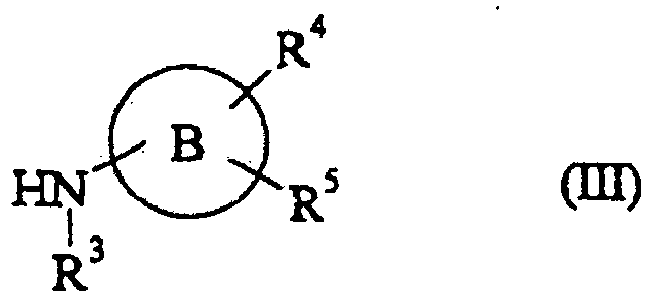
Applications Claiming Priority (1)
| Application Number | Priority Date | Filing Date | Title |
|---|---|---|---|
| IN1837CH2010 | 2010-06-29 |
Publications (2)
| Publication Number | Publication Date |
|---|---|
| EP2402327A1 EP2402327A1 (en) | 2012-01-04 |
| EP2402327B1 true EP2402327B1 (en) | 2018-03-07 |
Family
ID=44202209
Family Applications (1)
| Application Number | Title | Priority Date | Filing Date |
|---|---|---|---|
| EP10172616.4A Not-in-force EP2402327B1 (en) | 2010-06-29 | 2010-08-12 | Acetamide compounds as glucokinase activators, their process and medicinal applications |
Country Status (1)
| Country | Link |
|---|---|
| EP (1) | EP2402327B1 (en) |
Families Citing this family (4)
| Publication number | Priority date | Publication date | Assignee | Title |
|---|---|---|---|---|
| JP6195684B2 (en) | 2014-06-03 | 2017-09-13 | アクテリオン ファーマシューティカルズ リミテッドActelion Pharmaceuticals Ltd | Pyrazole compounds and their use as T-type calcium channel blockers |
| CN107074822B (en) | 2014-09-15 | 2020-01-03 | 爱杜西亚药品有限公司 | Triazole compounds as T-type calcium channel blockers |
| LT3554490T (en) | 2016-12-16 | 2022-04-25 | Idorsia Pharmaceuticals Ltd | PHARMACEUTICAL COMBINATION INCLUDING TYPE CALCIUM CHANNEL BLOCKER |
| CA3050348A1 (en) | 2017-02-06 | 2018-08-09 | Idorsia Pharmaceuticals Ltd | A novel process for the synthesis of 1-aryl-1-trifluoromethylcyclopropanes |
Family Cites Families (14)
| Publication number | Priority date | Publication date | Assignee | Title |
|---|---|---|---|---|
| JP2536046B2 (en) | 1987-11-11 | 1996-09-18 | 味の素株式会社 | Asymmetric reduction of ketones |
| PT1305301E (en) | 2000-07-20 | 2005-09-30 | Hoffmann La Roche | BENZENO-ACETAMIDES ALPHA-ACYL AND ALPHA-HETEROATOMO-SUBSTITUTED ACTIVATORS OF GLUCOCINASE |
| WO2003055482A1 (en) | 2001-12-21 | 2003-07-10 | Novo Nordisk A/S | Amide derivatives as gk activators |
| AU2003243921B2 (en) | 2002-06-27 | 2009-05-07 | Novo Nordisk A/S | Aryl carbonyl derivatives as therapeutic agents |
| PL378117A1 (en) | 2003-02-11 | 2006-03-06 | Prosidion Limited | Tri(cyclo) substituted amide compounds |
| AU2005253923A1 (en) | 2004-06-08 | 2005-12-29 | Primegen Biotech Llc | Therapeutic reprogramming, hybrid stem cells and maturation |
| JP2008502658A (en) | 2004-06-17 | 2008-01-31 | ノボ ノルディスク アクティーゼルスカブ | Use of liver-selective glucokinase activator |
| GB0423043D0 (en) | 2004-10-16 | 2004-11-17 | Astrazeneca Ab | Compounds |
| AR057661A1 (en) | 2005-07-11 | 2007-12-12 | Tanabe Seiyaku Co | A DERIVATIVE OF OXIMA AND ITS PREPARATIONS |
| WO2007099317A1 (en) | 2006-03-02 | 2007-09-07 | Astrazeneca Ab | Quinazoline derivatives |
| MX2009000688A (en) | 2006-07-24 | 2009-01-30 | Hoffmann La Roche | Pyrazoles as glucokinase activators. |
| US7902248B2 (en) | 2006-12-14 | 2011-03-08 | Hoffmann-La Roche Inc. | Oxime glucokinase activators |
| CN101622231B (en) * | 2007-02-28 | 2013-12-04 | 艾德维纳斯医疗私人有限公司 | 2,2,2-tri-substituted acetamide derivatives as glucokinase activators, their process and pharmaceutical application |
| ES2446932T3 (en) * | 2007-10-08 | 2014-03-10 | Advinus Therapeutics Private Limited | Acetamide derivatives as glucokinase activators, their procedure and applications in medicine |
-
2010
- 2010-08-12 EP EP10172616.4A patent/EP2402327B1/en not_active Not-in-force
Non-Patent Citations (1)
| Title |
|---|
| None * |
Also Published As
| Publication number | Publication date |
|---|---|
| EP2402327A1 (en) | 2012-01-04 |
Similar Documents
| Publication | Publication Date | Title |
|---|---|---|
| US8501955B2 (en) | Acetamide derivatives as glucokinase activators, their process and medicinal application | |
| EP2155720B1 (en) | Pyrrole-2-carboxamide derivatives as glucokinase activators, their process and pharmaceutical application | |
| RU2330030C2 (en) | Derivatives of heteroarylcarbamoylbenzene | |
| US9340506B2 (en) | Acetamide derivatives as glucokinase activators, their process and medicinal applications | |
| JP5491871B2 (en) | 2,2,2-Trisubstituted acetamide derivatives as glucokinase activators, methods and pharmaceutical applications thereof | |
| JP4834840B2 (en) | Heteroaryl ureas and their use as glucokinase activators | |
| AU2001265914A1 (en) | Para-amine substituted phenylamide glucokinase activators | |
| WO2001085707A1 (en) | Para-amine substituted phenylamide glucokinase activators | |
| WO2012020357A1 (en) | Acetamide compounds, their process and pharmaceutical application | |
| EP2402327A1 (en) | Acetamide compounds as glucokinase activators, their process and medicinal applications | |
| EP2511265A1 (en) | Benzamide compound | |
| KR20120047960A (en) | Substituted benzamide derivatives as glucokinase (gk) activators | |
| CN101130526A (en) | Arylcarbonyl derivatives useful as therapeutic agents | |
| WO2011095997A1 (en) | Benzamide compounds as glucokinase activators and their pharmaceutical application |
Legal Events
| Date | Code | Title | Description |
|---|---|---|---|
| AK | Designated contracting states |
Kind code of ref document: A1 Designated state(s): AL AT BE BG CH CY CZ DE DK EE ES FI FR GB GR HR HU IE IS IT LI LT LU LV MC MK MT NL NO PL PT RO SE SI SK SM TR |
|
| AX | Request for extension of the european patent |
Extension state: BA ME RS |
|
| PUAI | Public reference made under article 153(3) epc to a published international application that has entered the european phase |
Free format text: ORIGINAL CODE: 0009012 |
|
| 17P | Request for examination filed |
Effective date: 20120629 |
|
| 17Q | First examination report despatched |
Effective date: 20141002 |
|
| GRAP | Despatch of communication of intention to grant a patent |
Free format text: ORIGINAL CODE: EPIDOSNIGR1 |
|
| INTG | Intention to grant announced |
Effective date: 20170215 |
|
| GRAS | Grant fee paid |
Free format text: ORIGINAL CODE: EPIDOSNIGR3 |
|
| GRAJ | Information related to disapproval of communication of intention to grant by the applicant or resumption of examination proceedings by the epo deleted |
Free format text: ORIGINAL CODE: EPIDOSDIGR1 |
|
| GRAL | Information related to payment of fee for publishing/printing deleted |
Free format text: ORIGINAL CODE: EPIDOSDIGR3 |
|
| INTC | Intention to grant announced (deleted) | ||
| GRAP | Despatch of communication of intention to grant a patent |
Free format text: ORIGINAL CODE: EPIDOSNIGR1 |
|
| INTG | Intention to grant announced |
Effective date: 20170908 |
|
| GRAA | (expected) grant |
Free format text: ORIGINAL CODE: 0009210 |
|
| RAP1 | Party data changed (applicant data changed or rights of an application transferred) |
Owner name: IMPETIS BIOSCIENCES LTD. |
|
| AK | Designated contracting states |
Kind code of ref document: B1 Designated state(s): AL AT BE BG CH CY CZ DE DK EE ES FI FR GB GR HR HU IE IS IT LI LT LU LV MC MK MT NL NO PL PT RO SE SI SK SM TR |
|
| REG | Reference to a national code |
Ref country code: GB Ref legal event code: FG4D |
|
| REG | Reference to a national code |
Ref country code: CH Ref legal event code: EP Ref country code: AT Ref legal event code: REF Ref document number: 976415 Country of ref document: AT Kind code of ref document: T Effective date: 20180315 |
|
| REG | Reference to a national code |
Ref country code: IE Ref legal event code: FG4D |
|
| REG | Reference to a national code |
Ref country code: DE Ref legal event code: R096 Ref document number: 602010048963 Country of ref document: DE |
|
| REG | Reference to a national code |
Ref country code: NL Ref legal event code: MP Effective date: 20180307 |
|
| REG | Reference to a national code |
Ref country code: LT Ref legal event code: MG4D |
|
| PG25 | Lapsed in a contracting state [announced via postgrant information from national office to epo] |
Ref country code: CY Free format text: LAPSE BECAUSE OF FAILURE TO SUBMIT A TRANSLATION OF THE DESCRIPTION OR TO PAY THE FEE WITHIN THE PRESCRIBED TIME-LIMIT Effective date: 20180307 Ref country code: FI Free format text: LAPSE BECAUSE OF FAILURE TO SUBMIT A TRANSLATION OF THE DESCRIPTION OR TO PAY THE FEE WITHIN THE PRESCRIBED TIME-LIMIT Effective date: 20180307 Ref country code: NO Free format text: LAPSE BECAUSE OF FAILURE TO SUBMIT A TRANSLATION OF THE DESCRIPTION OR TO PAY THE FEE WITHIN THE PRESCRIBED TIME-LIMIT Effective date: 20180607 Ref country code: LT Free format text: LAPSE BECAUSE OF FAILURE TO SUBMIT A TRANSLATION OF THE DESCRIPTION OR TO PAY THE FEE WITHIN THE PRESCRIBED TIME-LIMIT Effective date: 20180307 Ref country code: HR Free format text: LAPSE BECAUSE OF FAILURE TO SUBMIT A TRANSLATION OF THE DESCRIPTION OR TO PAY THE FEE WITHIN THE PRESCRIBED TIME-LIMIT Effective date: 20180307 Ref country code: ES Free format text: LAPSE BECAUSE OF FAILURE TO SUBMIT A TRANSLATION OF THE DESCRIPTION OR TO PAY THE FEE WITHIN THE PRESCRIBED TIME-LIMIT Effective date: 20180307 |
|
| REG | Reference to a national code |
Ref country code: AT Ref legal event code: MK05 Ref document number: 976415 Country of ref document: AT Kind code of ref document: T Effective date: 20180307 |
|
| REG | Reference to a national code |
Ref country code: FR Ref legal event code: PLFP Year of fee payment: 9 |
|
| PG25 | Lapsed in a contracting state [announced via postgrant information from national office to epo] |
Ref country code: LV Free format text: LAPSE BECAUSE OF FAILURE TO SUBMIT A TRANSLATION OF THE DESCRIPTION OR TO PAY THE FEE WITHIN THE PRESCRIBED TIME-LIMIT Effective date: 20180307 Ref country code: SE Free format text: LAPSE BECAUSE OF FAILURE TO SUBMIT A TRANSLATION OF THE DESCRIPTION OR TO PAY THE FEE WITHIN THE PRESCRIBED TIME-LIMIT Effective date: 20180307 Ref country code: BG Free format text: LAPSE BECAUSE OF FAILURE TO SUBMIT A TRANSLATION OF THE DESCRIPTION OR TO PAY THE FEE WITHIN THE PRESCRIBED TIME-LIMIT Effective date: 20180607 Ref country code: GR Free format text: LAPSE BECAUSE OF FAILURE TO SUBMIT A TRANSLATION OF THE DESCRIPTION OR TO PAY THE FEE WITHIN THE PRESCRIBED TIME-LIMIT Effective date: 20180608 |
|
| PG25 | Lapsed in a contracting state [announced via postgrant information from national office to epo] |
Ref country code: IT Free format text: LAPSE BECAUSE OF FAILURE TO SUBMIT A TRANSLATION OF THE DESCRIPTION OR TO PAY THE FEE WITHIN THE PRESCRIBED TIME-LIMIT Effective date: 20180307 Ref country code: NL Free format text: LAPSE BECAUSE OF FAILURE TO SUBMIT A TRANSLATION OF THE DESCRIPTION OR TO PAY THE FEE WITHIN THE PRESCRIBED TIME-LIMIT Effective date: 20180307 Ref country code: RO Free format text: LAPSE BECAUSE OF FAILURE TO SUBMIT A TRANSLATION OF THE DESCRIPTION OR TO PAY THE FEE WITHIN THE PRESCRIBED TIME-LIMIT Effective date: 20180307 Ref country code: EE Free format text: LAPSE BECAUSE OF FAILURE TO SUBMIT A TRANSLATION OF THE DESCRIPTION OR TO PAY THE FEE WITHIN THE PRESCRIBED TIME-LIMIT Effective date: 20180307 Ref country code: PL Free format text: LAPSE BECAUSE OF FAILURE TO SUBMIT A TRANSLATION OF THE DESCRIPTION OR TO PAY THE FEE WITHIN THE PRESCRIBED TIME-LIMIT Effective date: 20180307 Ref country code: AL Free format text: LAPSE BECAUSE OF FAILURE TO SUBMIT A TRANSLATION OF THE DESCRIPTION OR TO PAY THE FEE WITHIN THE PRESCRIBED TIME-LIMIT Effective date: 20180307 |
|
| PG25 | Lapsed in a contracting state [announced via postgrant information from national office to epo] |
Ref country code: SM Free format text: LAPSE BECAUSE OF FAILURE TO SUBMIT A TRANSLATION OF THE DESCRIPTION OR TO PAY THE FEE WITHIN THE PRESCRIBED TIME-LIMIT Effective date: 20180307 Ref country code: SK Free format text: LAPSE BECAUSE OF FAILURE TO SUBMIT A TRANSLATION OF THE DESCRIPTION OR TO PAY THE FEE WITHIN THE PRESCRIBED TIME-LIMIT Effective date: 20180307 Ref country code: AT Free format text: LAPSE BECAUSE OF FAILURE TO SUBMIT A TRANSLATION OF THE DESCRIPTION OR TO PAY THE FEE WITHIN THE PRESCRIBED TIME-LIMIT Effective date: 20180307 Ref country code: CZ Free format text: LAPSE BECAUSE OF FAILURE TO SUBMIT A TRANSLATION OF THE DESCRIPTION OR TO PAY THE FEE WITHIN THE PRESCRIBED TIME-LIMIT Effective date: 20180307 |
|
| REG | Reference to a national code |
Ref country code: DE Ref legal event code: R097 Ref document number: 602010048963 Country of ref document: DE |
|
| PG25 | Lapsed in a contracting state [announced via postgrant information from national office to epo] |
Ref country code: PT Free format text: LAPSE BECAUSE OF FAILURE TO SUBMIT A TRANSLATION OF THE DESCRIPTION OR TO PAY THE FEE WITHIN THE PRESCRIBED TIME-LIMIT Effective date: 20180709 |
|
| PLBE | No opposition filed within time limit |
Free format text: ORIGINAL CODE: 0009261 |
|
| STAA | Information on the status of an ep patent application or granted ep patent |
Free format text: STATUS: NO OPPOSITION FILED WITHIN TIME LIMIT |
|
| PG25 | Lapsed in a contracting state [announced via postgrant information from national office to epo] |
Ref country code: DK Free format text: LAPSE BECAUSE OF FAILURE TO SUBMIT A TRANSLATION OF THE DESCRIPTION OR TO PAY THE FEE WITHIN THE PRESCRIBED TIME-LIMIT Effective date: 20180307 |
|
| 26N | No opposition filed |
Effective date: 20181210 |
|
| PG25 | Lapsed in a contracting state [announced via postgrant information from national office to epo] |
Ref country code: SI Free format text: LAPSE BECAUSE OF FAILURE TO SUBMIT A TRANSLATION OF THE DESCRIPTION OR TO PAY THE FEE WITHIN THE PRESCRIBED TIME-LIMIT Effective date: 20180307 |
|
| PG25 | Lapsed in a contracting state [announced via postgrant information from national office to epo] |
Ref country code: MC Free format text: LAPSE BECAUSE OF FAILURE TO SUBMIT A TRANSLATION OF THE DESCRIPTION OR TO PAY THE FEE WITHIN THE PRESCRIBED TIME-LIMIT Effective date: 20180307 |
|
| REG | Reference to a national code |
Ref country code: CH Ref legal event code: PL |
|
| PG25 | Lapsed in a contracting state [announced via postgrant information from national office to epo] |
Ref country code: CH Free format text: LAPSE BECAUSE OF NON-PAYMENT OF DUE FEES Effective date: 20180831 Ref country code: LU Free format text: LAPSE BECAUSE OF NON-PAYMENT OF DUE FEES Effective date: 20180812 Ref country code: LI Free format text: LAPSE BECAUSE OF NON-PAYMENT OF DUE FEES Effective date: 20180831 |
|
| REG | Reference to a national code |
Ref country code: BE Ref legal event code: MM Effective date: 20180831 |
|
| REG | Reference to a national code |
Ref country code: IE Ref legal event code: MM4A |
|
| PG25 | Lapsed in a contracting state [announced via postgrant information from national office to epo] |
Ref country code: IE Free format text: LAPSE BECAUSE OF NON-PAYMENT OF DUE FEES Effective date: 20180812 |
|
| PG25 | Lapsed in a contracting state [announced via postgrant information from national office to epo] |
Ref country code: BE Free format text: LAPSE BECAUSE OF NON-PAYMENT OF DUE FEES Effective date: 20180831 |
|
| PG25 | Lapsed in a contracting state [announced via postgrant information from national office to epo] |
Ref country code: MT Free format text: LAPSE BECAUSE OF NON-PAYMENT OF DUE FEES Effective date: 20180812 |
|
| PG25 | Lapsed in a contracting state [announced via postgrant information from national office to epo] |
Ref country code: TR Free format text: LAPSE BECAUSE OF FAILURE TO SUBMIT A TRANSLATION OF THE DESCRIPTION OR TO PAY THE FEE WITHIN THE PRESCRIBED TIME-LIMIT Effective date: 20180307 |
|
| PG25 | Lapsed in a contracting state [announced via postgrant information from national office to epo] |
Ref country code: HU Free format text: LAPSE BECAUSE OF FAILURE TO SUBMIT A TRANSLATION OF THE DESCRIPTION OR TO PAY THE FEE WITHIN THE PRESCRIBED TIME-LIMIT; INVALID AB INITIO Effective date: 20100812 |
|
| PG25 | Lapsed in a contracting state [announced via postgrant information from national office to epo] |
Ref country code: MK Free format text: LAPSE BECAUSE OF NON-PAYMENT OF DUE FEES Effective date: 20180307 |
|
| PG25 | Lapsed in a contracting state [announced via postgrant information from national office to epo] |
Ref country code: IS Free format text: LAPSE BECAUSE OF FAILURE TO SUBMIT A TRANSLATION OF THE DESCRIPTION OR TO PAY THE FEE WITHIN THE PRESCRIBED TIME-LIMIT Effective date: 20180707 |
|
| PGFP | Annual fee paid to national office [announced via postgrant information from national office to epo] |
Ref country code: GB Payment date: 20230817 Year of fee payment: 14 |
|
| PGFP | Annual fee paid to national office [announced via postgrant information from national office to epo] |
Ref country code: FR Payment date: 20230821 Year of fee payment: 14 Ref country code: DE Payment date: 20230816 Year of fee payment: 14 |
|
| REG | Reference to a national code |
Ref country code: DE Ref legal event code: R119 Ref document number: 602010048963 Country of ref document: DE |
|
| GBPC | Gb: european patent ceased through non-payment of renewal fee |
Effective date: 20240812 |
|
| PG25 | Lapsed in a contracting state [announced via postgrant information from national office to epo] |
Ref country code: DE Free format text: LAPSE BECAUSE OF NON-PAYMENT OF DUE FEES Effective date: 20250301 |
|
| PG25 | Lapsed in a contracting state [announced via postgrant information from national office to epo] |
Ref country code: GB Free format text: LAPSE BECAUSE OF NON-PAYMENT OF DUE FEES Effective date: 20240812 |
|
| PG25 | Lapsed in a contracting state [announced via postgrant information from national office to epo] |
Ref country code: FR Free format text: LAPSE BECAUSE OF NON-PAYMENT OF DUE FEES Effective date: 20240831 |