EP2402305A1 - Loxoprofen derivative and pharmaceutical containing same - Google Patents
Loxoprofen derivative and pharmaceutical containing same Download PDFInfo
- Publication number
- EP2402305A1 EP2402305A1 EP10746132A EP10746132A EP2402305A1 EP 2402305 A1 EP2402305 A1 EP 2402305A1 EP 10746132 A EP10746132 A EP 10746132A EP 10746132 A EP10746132 A EP 10746132A EP 2402305 A1 EP2402305 A1 EP 2402305A1
- Authority
- EP
- European Patent Office
- Prior art keywords
- group
- loxoprofen
- atom
- derivative
- substituted
- Prior art date
- Legal status (The legal status is an assumption and is not a legal conclusion. Google has not performed a legal analysis and makes no representation as to the accuracy of the status listed.)
- Granted
Links
- YMBXTVYHTMGZDW-UHFFFAOYSA-N loxoprofen Chemical class C1=CC(C(C(O)=O)C)=CC=C1CC1C(=O)CCC1 YMBXTVYHTMGZDW-UHFFFAOYSA-N 0.000 title 1
- BAZQYVYVKYOAGO-UHFFFAOYSA-M loxoprofen sodium hydrate Chemical class O.O.[Na+].C1=CC(C(C([O-])=O)C)=CC=C1CC1C(=O)CCC1 BAZQYVYVKYOAGO-UHFFFAOYSA-M 0.000 claims abstract description 81
- 150000003839 salts Chemical class 0.000 claims abstract description 20
- 125000005843 halogen group Chemical group 0.000 claims abstract description 16
- 125000001424 substituent group Chemical group 0.000 claims abstract description 16
- 125000001997 phenyl group Chemical group [H]C1=C([H])C([H])=C(*)C([H])=C1[H] 0.000 claims abstract description 15
- 125000000217 alkyl group Chemical group 0.000 claims abstract description 9
- WKBOTKDWSSQWDR-UHFFFAOYSA-N Bromine atom Chemical group [Br] WKBOTKDWSSQWDR-UHFFFAOYSA-N 0.000 claims abstract description 6
- 125000003277 amino group Chemical group 0.000 claims abstract description 6
- 229910052731 fluorine Inorganic materials 0.000 claims abstract description 6
- 125000001153 fluoro group Chemical group F* 0.000 claims abstract description 6
- 125000002887 hydroxy group Chemical group [H]O* 0.000 claims abstract description 6
- 125000000449 nitro group Chemical group [O-][N+](*)=O 0.000 claims abstract description 6
- 125000003545 alkoxy group Chemical group 0.000 claims abstract description 5
- 125000003178 carboxy group Chemical group [H]OC(*)=O 0.000 claims abstract description 5
- ZCYVEMRRCGMTRW-UHFFFAOYSA-N 7553-56-2 Chemical group [I] ZCYVEMRRCGMTRW-UHFFFAOYSA-N 0.000 claims abstract description 4
- 229910052801 chlorine Inorganic materials 0.000 claims abstract description 4
- 125000001309 chloro group Chemical group Cl* 0.000 claims abstract description 4
- 229910052740 iodine Inorganic materials 0.000 claims abstract description 4
- 125000004414 alkyl thio group Chemical group 0.000 claims abstract description 3
- 239000004480 active ingredient Substances 0.000 claims description 7
- 239000000825 pharmaceutical preparation Substances 0.000 claims description 7
- 230000003110 anti-inflammatory effect Effects 0.000 abstract description 10
- 208000018522 Gastrointestinal disease Diseases 0.000 abstract description 7
- 208000010643 digestive system disease Diseases 0.000 abstract description 7
- 208000018685 gastrointestinal system disease Diseases 0.000 abstract description 7
- 230000001760 anti-analgesic effect Effects 0.000 abstract description 6
- 231100000957 no side effect Toxicity 0.000 abstract description 4
- 150000001875 compounds Chemical class 0.000 description 53
- 238000012360 testing method Methods 0.000 description 36
- HEDRZPFGACZZDS-MICDWDOJSA-N Trichloro(2H)methane Chemical compound [2H]C(Cl)(Cl)Cl HEDRZPFGACZZDS-MICDWDOJSA-N 0.000 description 23
- 238000004519 manufacturing process Methods 0.000 description 23
- -1 p-hydroxyphenyl group Chemical group 0.000 description 22
- 229960002373 loxoprofen Drugs 0.000 description 21
- OKKJLVBELUTLKV-MZCSYVLQSA-N Deuterated methanol Chemical compound [2H]OC([2H])([2H])[2H] OKKJLVBELUTLKV-MZCSYVLQSA-N 0.000 description 20
- 238000006243 chemical reaction Methods 0.000 description 16
- 239000000203 mixture Substances 0.000 description 13
- WVDDGKGOMKODPV-UHFFFAOYSA-N Benzyl alcohol Chemical compound OCC1=CC=CC=C1 WVDDGKGOMKODPV-UHFFFAOYSA-N 0.000 description 12
- IAZDPXIOMUYVGZ-UHFFFAOYSA-N Dimethylsulphoxide Chemical compound CS(C)=O IAZDPXIOMUYVGZ-UHFFFAOYSA-N 0.000 description 12
- OKKJLVBELUTLKV-UHFFFAOYSA-N Methanol Chemical compound OC OKKJLVBELUTLKV-UHFFFAOYSA-N 0.000 description 12
- 210000004379 membrane Anatomy 0.000 description 12
- 239000012528 membrane Substances 0.000 description 12
- 230000006378 damage Effects 0.000 description 11
- 206010030113 Oedema Diseases 0.000 description 10
- 208000027418 Wounds and injury Diseases 0.000 description 10
- ZUOUZKKEUPVFJK-UHFFFAOYSA-N diphenyl Chemical compound C1=CC=CC=C1C1=CC=CC=C1 ZUOUZKKEUPVFJK-UHFFFAOYSA-N 0.000 description 10
- 208000014674 injury Diseases 0.000 description 10
- 238000000034 method Methods 0.000 description 10
- 239000002904 solvent Substances 0.000 description 10
- 208000025865 Ulcer Diseases 0.000 description 9
- 210000004369 blood Anatomy 0.000 description 9
- 239000008280 blood Substances 0.000 description 9
- 230000000694 effects Effects 0.000 description 9
- 231100000397 ulcer Toxicity 0.000 description 9
- VHYFNPMBLIVWCW-UHFFFAOYSA-N 4-Dimethylaminopyridine Chemical compound CN(C)C1=CC=NC=C1 VHYFNPMBLIVWCW-UHFFFAOYSA-N 0.000 description 8
- LFQSCWFLJHTTHZ-UHFFFAOYSA-N Ethanol Chemical compound CCO LFQSCWFLJHTTHZ-UHFFFAOYSA-N 0.000 description 8
- VEXZGXHMUGYJMC-UHFFFAOYSA-N Hydrochloric acid Chemical compound Cl VEXZGXHMUGYJMC-UHFFFAOYSA-N 0.000 description 8
- 238000003556 assay Methods 0.000 description 8
- 239000008363 phosphate buffer Substances 0.000 description 8
- 239000000725 suspension Substances 0.000 description 8
- 239000007787 solid Substances 0.000 description 7
- XLYOFNOQVPJJNP-UHFFFAOYSA-N water Substances O XLYOFNOQVPJJNP-UHFFFAOYSA-N 0.000 description 7
- RTZKZFJDLAIYFH-UHFFFAOYSA-N Diethyl ether Chemical compound CCOCC RTZKZFJDLAIYFH-UHFFFAOYSA-N 0.000 description 6
- 235000010418 carrageenan Nutrition 0.000 description 6
- 229920001525 carrageenan Polymers 0.000 description 6
- 238000010586 diagram Methods 0.000 description 6
- XEYBRNLFEZDVAW-ARSRFYASSA-N dinoprostone Chemical compound CCCCC[C@H](O)\C=C\[C@H]1[C@H](O)CC(=O)[C@@H]1C\C=C/CCCC(O)=O XEYBRNLFEZDVAW-ARSRFYASSA-N 0.000 description 6
- 239000000243 solution Substances 0.000 description 6
- 239000004305 biphenyl Substances 0.000 description 5
- 235000010290 biphenyl Nutrition 0.000 description 5
- 238000009472 formulation Methods 0.000 description 5
- 239000000041 non-steroidal anti-inflammatory agent Substances 0.000 description 5
- 229940021182 non-steroidal anti-inflammatory drug Drugs 0.000 description 5
- CSCPPACGZOOCGX-UHFFFAOYSA-N Acetone Chemical compound CC(C)=O CSCPPACGZOOCGX-UHFFFAOYSA-N 0.000 description 4
- KDLHZDBZIXYQEI-UHFFFAOYSA-N Palladium Chemical compound [Pd] KDLHZDBZIXYQEI-UHFFFAOYSA-N 0.000 description 4
- 238000006161 Suzuki-Miyaura coupling reaction Methods 0.000 description 4
- WYURNTSHIVDZCO-UHFFFAOYSA-N Tetrahydrofuran Chemical compound C1CCOC1 WYURNTSHIVDZCO-UHFFFAOYSA-N 0.000 description 4
- 230000000202 analgesic effect Effects 0.000 description 4
- 235000019445 benzyl alcohol Nutrition 0.000 description 4
- DEGAKNSWVGKMLS-UHFFFAOYSA-N calcein Chemical compound O1C(=O)C2=CC=CC=C2C21C1=CC(CN(CC(O)=O)CC(O)=O)=C(O)C=C1OC1=C2C=C(CN(CC(O)=O)CC(=O)O)C(O)=C1 DEGAKNSWVGKMLS-UHFFFAOYSA-N 0.000 description 4
- 239000000679 carrageenan Substances 0.000 description 4
- 229940113118 carrageenan Drugs 0.000 description 4
- 229940125782 compound 2 Drugs 0.000 description 4
- 229940126214 compound 3 Drugs 0.000 description 4
- 210000001156 gastric mucosa Anatomy 0.000 description 4
- 239000008187 granular material Substances 0.000 description 4
- 238000006460 hydrolysis reaction Methods 0.000 description 4
- 238000000338 in vitro Methods 0.000 description 4
- 230000005764 inhibitory process Effects 0.000 description 4
- 239000007788 liquid Substances 0.000 description 4
- ZCSHNCUQKCANBX-UHFFFAOYSA-N lithium diisopropylamide Chemical compound [Li+].CC(C)[N-]C(C)C ZCSHNCUQKCANBX-UHFFFAOYSA-N 0.000 description 4
- 125000002496 methyl group Chemical group [H]C([H])([H])* 0.000 description 4
- 229960002378 oftasceine Drugs 0.000 description 4
- 210000002966 serum Anatomy 0.000 description 4
- 239000011734 sodium Substances 0.000 description 4
- 239000000126 substance Substances 0.000 description 4
- UHVMMEOXYDMDKI-JKYCWFKZSA-L zinc;1-(5-cyanopyridin-2-yl)-3-[(1s,2s)-2-(6-fluoro-2-hydroxy-3-propanoylphenyl)cyclopropyl]urea;diacetate Chemical compound [Zn+2].CC([O-])=O.CC([O-])=O.CCC(=O)C1=CC=C(F)C([C@H]2[C@H](C2)NC(=O)NC=2N=CC(=CC=2)C#N)=C1O UHVMMEOXYDMDKI-JKYCWFKZSA-L 0.000 description 4
- QTBSBXVTEAMEQO-UHFFFAOYSA-N Acetic acid Chemical compound CC(O)=O QTBSBXVTEAMEQO-UHFFFAOYSA-N 0.000 description 3
- 102100038280 Prostaglandin G/H synthase 2 Human genes 0.000 description 3
- 108050003267 Prostaglandin G/H synthase 2 Proteins 0.000 description 3
- 241000700159 Rattus Species 0.000 description 3
- YXFVVABEGXRONW-UHFFFAOYSA-N Toluene Chemical compound CC1=CC=CC=C1 YXFVVABEGXRONW-UHFFFAOYSA-N 0.000 description 3
- 239000002253 acid Substances 0.000 description 3
- 230000001741 anti-phlogistic effect Effects 0.000 description 3
- 230000001754 anti-pyretic effect Effects 0.000 description 3
- 230000015572 biosynthetic process Effects 0.000 description 3
- 239000002775 capsule Substances 0.000 description 3
- 150000001732 carboxylic acid derivatives Chemical class 0.000 description 3
- 125000001511 cyclopentyl group Chemical group [H]C1([H])C([H])([H])C([H])([H])C([H])(*)C1([H])[H] 0.000 description 3
- 230000007062 hydrolysis Effects 0.000 description 3
- 238000001727 in vivo Methods 0.000 description 3
- 239000002502 liposome Substances 0.000 description 3
- 238000007911 parenteral administration Methods 0.000 description 3
- 239000000546 pharmaceutical excipient Substances 0.000 description 3
- 239000002243 precursor Substances 0.000 description 3
- WSLDOOZREJYCGB-UHFFFAOYSA-N 1,2-Dichloroethane Chemical compound ClCCCl WSLDOOZREJYCGB-UHFFFAOYSA-N 0.000 description 2
- 102000004506 Blood Proteins Human genes 0.000 description 2
- 108010017384 Blood Proteins Proteins 0.000 description 2
- HEDRZPFGACZZDS-UHFFFAOYSA-N Chloroform Chemical compound ClC(Cl)Cl HEDRZPFGACZZDS-UHFFFAOYSA-N 0.000 description 2
- 238000002965 ELISA Methods 0.000 description 2
- 102000004190 Enzymes Human genes 0.000 description 2
- 108090000790 Enzymes Proteins 0.000 description 2
- 238000005481 NMR spectroscopy Methods 0.000 description 2
- CDBYLPFSWZWCQE-UHFFFAOYSA-L Sodium Carbonate Chemical compound [Na+].[Na+].[O-]C([O-])=O CDBYLPFSWZWCQE-UHFFFAOYSA-L 0.000 description 2
- FAPWRFPIFSIZLT-UHFFFAOYSA-M Sodium chloride Chemical compound [Na+].[Cl-] FAPWRFPIFSIZLT-UHFFFAOYSA-M 0.000 description 2
- IPBVNPXQWQGGJP-UHFFFAOYSA-N acetic acid phenyl ester Natural products CC(=O)OC1=CC=CC=C1 IPBVNPXQWQGGJP-UHFFFAOYSA-N 0.000 description 2
- 239000003708 ampul Substances 0.000 description 2
- 125000003118 aryl group Chemical group 0.000 description 2
- 230000037396 body weight Effects 0.000 description 2
- 150000001639 boron compounds Chemical class 0.000 description 2
- 150000001642 boronic acid derivatives Chemical class 0.000 description 2
- 125000004432 carbon atom Chemical group C* 0.000 description 2
- 238000010531 catalytic reduction reaction Methods 0.000 description 2
- 238000007796 conventional method Methods 0.000 description 2
- 238000001816 cooling Methods 0.000 description 2
- 238000006114 decarboxylation reaction Methods 0.000 description 2
- 229960004132 diethyl ether Drugs 0.000 description 2
- LOKCTEFSRHRXRJ-UHFFFAOYSA-I dipotassium trisodium dihydrogen phosphate hydrogen phosphate dichloride Chemical compound P(=O)(O)(O)[O-].[K+].P(=O)(O)([O-])[O-].[Na+].[Na+].[Cl-].[K+].[Cl-].[Na+] LOKCTEFSRHRXRJ-UHFFFAOYSA-I 0.000 description 2
- 239000002552 dosage form Substances 0.000 description 2
- 239000002158 endotoxin Substances 0.000 description 2
- 125000004185 ester group Chemical group 0.000 description 2
- 238000005886 esterification reaction Methods 0.000 description 2
- 230000005284 excitation Effects 0.000 description 2
- 238000002474 experimental method Methods 0.000 description 2
- 238000003018 immunoassay Methods 0.000 description 2
- 238000011534 incubation Methods 0.000 description 2
- CGIGDMFJXJATDK-UHFFFAOYSA-N indomethacin Chemical compound CC1=C(CC(O)=O)C2=CC(OC)=CC=C2N1C(=O)C1=CC=C(Cl)C=C1 CGIGDMFJXJATDK-UHFFFAOYSA-N 0.000 description 2
- 238000002347 injection Methods 0.000 description 2
- 239000007924 injection Substances 0.000 description 2
- 239000000543 intermediate Substances 0.000 description 2
- 238000001990 intravenous administration Methods 0.000 description 2
- 229940041476 lactose 100 mg Drugs 0.000 description 2
- 229920006008 lipopolysaccharide Polymers 0.000 description 2
- HQKMJHAJHXVSDF-UHFFFAOYSA-L magnesium stearate Chemical compound [Mg+2].CCCCCCCCCCCCCCCCCC([O-])=O.CCCCCCCCCCCCCCCCCC([O-])=O HQKMJHAJHXVSDF-UHFFFAOYSA-L 0.000 description 2
- 238000005259 measurement Methods 0.000 description 2
- 239000011259 mixed solution Substances 0.000 description 2
- 239000008188 pellet Substances 0.000 description 2
- 230000000144 pharmacologic effect Effects 0.000 description 2
- 229940049953 phenylacetate Drugs 0.000 description 2
- WLJVXDMOQOGPHL-UHFFFAOYSA-N phenylacetic acid Chemical class OC(=O)CC1=CC=CC=C1 WLJVXDMOQOGPHL-UHFFFAOYSA-N 0.000 description 2
- 239000002953 phosphate buffered saline Substances 0.000 description 2
- BWHMMNNQKKPAPP-UHFFFAOYSA-L potassium carbonate Chemical compound [K+].[K+].[O-]C([O-])=O BWHMMNNQKKPAPP-UHFFFAOYSA-L 0.000 description 2
- 230000003389 potentiating effect Effects 0.000 description 2
- 239000000047 product Substances 0.000 description 2
- 238000006722 reduction reaction Methods 0.000 description 2
- 238000010992 reflux Methods 0.000 description 2
- 239000011780 sodium chloride Substances 0.000 description 2
- HEMHJVSKTPXQMS-UHFFFAOYSA-M sodium hydroxide Inorganic materials [OH-].[Na+] HEMHJVSKTPXQMS-UHFFFAOYSA-M 0.000 description 2
- VWDWKYIASSYTQR-UHFFFAOYSA-N sodium nitrate Chemical compound [Na+].[O-][N+]([O-])=O VWDWKYIASSYTQR-UHFFFAOYSA-N 0.000 description 2
- GEHJYWRUCIMESM-UHFFFAOYSA-L sodium sulfite Chemical compound [Na+].[Na+].[O-]S([O-])=O GEHJYWRUCIMESM-UHFFFAOYSA-L 0.000 description 2
- 210000002784 stomach Anatomy 0.000 description 2
- 239000000758 substrate Substances 0.000 description 2
- 239000006228 supernatant Substances 0.000 description 2
- 208000024891 symptom Diseases 0.000 description 2
- VZGDMQKNWNREIO-UHFFFAOYSA-N tetrachloromethane Chemical compound ClC(Cl)(Cl)Cl VZGDMQKNWNREIO-UHFFFAOYSA-N 0.000 description 2
- YLQBMQCUIZJEEH-UHFFFAOYSA-N tetrahydrofuran Natural products C=1C=COC=1 YLQBMQCUIZJEEH-UHFFFAOYSA-N 0.000 description 2
- 238000005160 1H NMR spectroscopy Methods 0.000 description 1
- MROVZCRMXJZHCN-UHFFFAOYSA-N 3-[4-(aminomethyl)-6-(trifluoromethyl)pyridin-2-yl]oxy-N-(2-hydroxyethyl)benzamide Chemical compound NCC1=CC(=NC(=C1)C(F)(F)F)OC=1C=C(C(=O)NCCO)C=CC=1 MROVZCRMXJZHCN-UHFFFAOYSA-N 0.000 description 1
- 244000215068 Acacia senegal Species 0.000 description 1
- BSYNRYMUTXBXSQ-UHFFFAOYSA-N Aspirin Chemical compound CC(=O)OC1=CC=CC=C1C(O)=O BSYNRYMUTXBXSQ-UHFFFAOYSA-N 0.000 description 1
- OKTJSMMVPCPJKN-UHFFFAOYSA-N Carbon Chemical group [C] OKTJSMMVPCPJKN-UHFFFAOYSA-N 0.000 description 1
- 229920002261 Corn starch Polymers 0.000 description 1
- YMWUJEATGCHHMB-UHFFFAOYSA-N Dichloromethane Chemical compound ClCCl YMWUJEATGCHHMB-UHFFFAOYSA-N 0.000 description 1
- 102000002322 Egg Proteins Human genes 0.000 description 1
- 108010000912 Egg Proteins Proteins 0.000 description 1
- 239000001828 Gelatine Substances 0.000 description 1
- 229920000084 Gum arabic Polymers 0.000 description 1
- HTTJABKRGRZYRN-UHFFFAOYSA-N Heparin Chemical compound OC1C(NC(=O)C)C(O)OC(COS(O)(=O)=O)C1OC1C(OS(O)(=O)=O)C(O)C(OC2C(C(OS(O)(=O)=O)C(OC3C(C(O)C(O)C(O3)C(O)=O)OS(O)(=O)=O)C(CO)O2)NS(O)(=O)=O)C(C(O)=O)O1 HTTJABKRGRZYRN-UHFFFAOYSA-N 0.000 description 1
- UFHFLCQGNIYNRP-UHFFFAOYSA-N Hydrogen Chemical compound [H][H] UFHFLCQGNIYNRP-UHFFFAOYSA-N 0.000 description 1
- 229920002153 Hydroxypropyl cellulose Polymers 0.000 description 1
- GUBGYTABKSRVRQ-QKKXKWKRSA-N Lactose Natural products OC[C@H]1O[C@@H](O[C@H]2[C@H](O)[C@@H](O)C(O)O[C@@H]2CO)[C@H](O)[C@@H](O)[C@H]1O GUBGYTABKSRVRQ-QKKXKWKRSA-N 0.000 description 1
- 241001465754 Metazoa Species 0.000 description 1
- PCLIMKBDDGJMGD-UHFFFAOYSA-N N-bromosuccinimide Chemical compound BrN1C(=O)CCC1=O PCLIMKBDDGJMGD-UHFFFAOYSA-N 0.000 description 1
- 229930040373 Paraformaldehyde Natural products 0.000 description 1
- NFHFRUOZVGFOOS-UHFFFAOYSA-N Pd(PPh3)4 Substances [Pd].C1=CC=CC=C1P(C=1C=CC=CC=1)C1=CC=CC=C1.C1=CC=CC=C1P(C=1C=CC=CC=1)C1=CC=CC=C1.C1=CC=CC=C1P(C=1C=CC=CC=1)C1=CC=CC=C1.C1=CC=CC=C1P(C=1C=CC=CC=1)C1=CC=CC=C1 NFHFRUOZVGFOOS-UHFFFAOYSA-N 0.000 description 1
- 102100038277 Prostaglandin G/H synthase 1 Human genes 0.000 description 1
- 108050003243 Prostaglandin G/H synthase 1 Proteins 0.000 description 1
- VMHLLURERBWHNL-UHFFFAOYSA-M Sodium acetate Chemical compound [Na+].CC([O-])=O VMHLLURERBWHNL-UHFFFAOYSA-M 0.000 description 1
- 229920002472 Starch Polymers 0.000 description 1
- 235000021355 Stearic acid Nutrition 0.000 description 1
- 208000007107 Stomach Ulcer Diseases 0.000 description 1
- 229920004890 Triton X-100 Polymers 0.000 description 1
- 239000013504 Triton X-100 Substances 0.000 description 1
- 238000007239 Wittig reaction Methods 0.000 description 1
- LNUFLCYMSVYYNW-ZPJMAFJPSA-N [(2r,3r,4s,5r,6r)-2-[(2r,3r,4s,5r,6r)-6-[(2r,3r,4s,5r,6r)-6-[(2r,3r,4s,5r,6r)-6-[[(3s,5s,8r,9s,10s,13r,14s,17r)-10,13-dimethyl-17-[(2r)-6-methylheptan-2-yl]-2,3,4,5,6,7,8,9,11,12,14,15,16,17-tetradecahydro-1h-cyclopenta[a]phenanthren-3-yl]oxy]-4,5-disulfo Chemical compound O([C@@H]1[C@@H](COS(O)(=O)=O)O[C@@H]([C@@H]([C@H]1OS(O)(=O)=O)OS(O)(=O)=O)O[C@@H]1[C@@H](COS(O)(=O)=O)O[C@@H]([C@@H]([C@H]1OS(O)(=O)=O)OS(O)(=O)=O)O[C@@H]1[C@@H](COS(O)(=O)=O)O[C@H]([C@@H]([C@H]1OS(O)(=O)=O)OS(O)(=O)=O)O[C@@H]1C[C@@H]2CC[C@H]3[C@@H]4CC[C@@H]([C@]4(CC[C@@H]3[C@@]2(C)CC1)C)[C@H](C)CCCC(C)C)[C@H]1O[C@H](COS(O)(=O)=O)[C@@H](OS(O)(=O)=O)[C@H](OS(O)(=O)=O)[C@H]1OS(O)(=O)=O LNUFLCYMSVYYNW-ZPJMAFJPSA-N 0.000 description 1
- WGCOQYDRMPFAMN-ZDUSSCGKSA-N [(3S)-3-[4-(aminomethyl)-6-(trifluoromethyl)pyridin-2-yl]oxypiperidin-1-yl]-pyrimidin-5-ylmethanone Chemical compound NCC1=CC(=NC(=C1)C(F)(F)F)O[C@@H]1CN(CCC1)C(=O)C=1C=NC=NC=1 WGCOQYDRMPFAMN-ZDUSSCGKSA-N 0.000 description 1
- ZVQOOHYFBIDMTQ-UHFFFAOYSA-N [methyl(oxido){1-[6-(trifluoromethyl)pyridin-3-yl]ethyl}-lambda(6)-sulfanylidene]cyanamide Chemical compound N#CN=S(C)(=O)C(C)C1=CC=C(C(F)(F)F)N=C1 ZVQOOHYFBIDMTQ-UHFFFAOYSA-N 0.000 description 1
- 239000000205 acacia gum Substances 0.000 description 1
- 235000010489 acacia gum Nutrition 0.000 description 1
- DPXJVFZANSGRMM-UHFFFAOYSA-N acetic acid;2,3,4,5,6-pentahydroxyhexanal;sodium Chemical compound [Na].CC(O)=O.OCC(O)C(O)C(O)C(O)C=O DPXJVFZANSGRMM-UHFFFAOYSA-N 0.000 description 1
- 229960001138 acetylsalicylic acid Drugs 0.000 description 1
- 238000005903 acid hydrolysis reaction Methods 0.000 description 1
- 238000010306 acid treatment Methods 0.000 description 1
- 230000002378 acidificating effect Effects 0.000 description 1
- 230000001476 alcoholic effect Effects 0.000 description 1
- 150000001298 alcohols Chemical class 0.000 description 1
- 235000010443 alginic acid Nutrition 0.000 description 1
- 239000000783 alginic acid Substances 0.000 description 1
- 229920000615 alginic acid Polymers 0.000 description 1
- 229960001126 alginic acid Drugs 0.000 description 1
- 150000004781 alginic acids Chemical class 0.000 description 1
- 229910052783 alkali metal Inorganic materials 0.000 description 1
- 150000008044 alkali metal hydroxides Chemical class 0.000 description 1
- 238000005904 alkaline hydrolysis reaction Methods 0.000 description 1
- 150000003863 ammonium salts Chemical class 0.000 description 1
- 229940127090 anticoagulant agent Drugs 0.000 description 1
- 239000003146 anticoagulant agent Substances 0.000 description 1
- 150000001491 aromatic compounds Chemical class 0.000 description 1
- 239000011230 binding agent Substances 0.000 description 1
- 230000023555 blood coagulation Effects 0.000 description 1
- GDTBXPJZTBHREO-UHFFFAOYSA-N bromine Substances BrBr GDTBXPJZTBHREO-UHFFFAOYSA-N 0.000 description 1
- 229910052794 bromium Inorganic materials 0.000 description 1
- 125000001246 bromo group Chemical group Br* 0.000 description 1
- 239000006172 buffering agent Substances 0.000 description 1
- 125000004106 butoxy group Chemical group [*]OC([H])([H])C([H])([H])C(C([H])([H])[H])([H])[H] 0.000 description 1
- 125000000484 butyl group Chemical group [H]C([*])([H])C([H])([H])C([H])([H])C([H])([H])[H] 0.000 description 1
- 125000002915 carbonyl group Chemical group [*:2]C([*:1])=O 0.000 description 1
- 239000001768 carboxy methyl cellulose Substances 0.000 description 1
- 239000003054 catalyst Substances 0.000 description 1
- 239000001913 cellulose Substances 0.000 description 1
- 229920002678 cellulose Polymers 0.000 description 1
- 239000003153 chemical reaction reagent Substances 0.000 description 1
- 239000000460 chlorine Substances 0.000 description 1
- 229940125904 compound 1 Drugs 0.000 description 1
- 229910000365 copper sulfate Inorganic materials 0.000 description 1
- ARUVKPQLZAKDPS-UHFFFAOYSA-L copper(II) sulfate Chemical compound [Cu+2].[O-][S+2]([O-])([O-])[O-] ARUVKPQLZAKDPS-UHFFFAOYSA-L 0.000 description 1
- 239000008120 corn starch Substances 0.000 description 1
- XCIXKGXIYUWCLL-HOSYLAQJSA-N cyclopentanol Chemical group O[13CH]1CCCC1 XCIXKGXIYUWCLL-HOSYLAQJSA-N 0.000 description 1
- BGTOWKSIORTVQH-HOSYLAQJSA-N cyclopentanone Chemical group O=[13C]1CCCC1 BGTOWKSIORTVQH-HOSYLAQJSA-N 0.000 description 1
- 230000003247 decreasing effect Effects 0.000 description 1
- 238000006193 diazotization reaction Methods 0.000 description 1
- 229960002986 dinoprostone Drugs 0.000 description 1
- 208000037265 diseases, disorders, signs and symptoms Diseases 0.000 description 1
- 208000035475 disorder Diseases 0.000 description 1
- 239000012153 distilled water Substances 0.000 description 1
- 235000013345 egg yolk Nutrition 0.000 description 1
- 210000002969 egg yolk Anatomy 0.000 description 1
- 230000032050 esterification Effects 0.000 description 1
- 125000001301 ethoxy group Chemical group [H]C([H])([H])C([H])([H])O* 0.000 description 1
- 125000001495 ethyl group Chemical group [H]C([H])([H])C([H])([H])* 0.000 description 1
- 238000011156 evaluation Methods 0.000 description 1
- 238000001704 evaporation Methods 0.000 description 1
- 238000011049 filling Methods 0.000 description 1
- 238000006170 formylation reaction Methods 0.000 description 1
- 230000002496 gastric effect Effects 0.000 description 1
- 201000005917 gastric ulcer Diseases 0.000 description 1
- 210000001035 gastrointestinal tract Anatomy 0.000 description 1
- 229920000159 gelatin Polymers 0.000 description 1
- 235000019322 gelatine Nutrition 0.000 description 1
- 229910052736 halogen Inorganic materials 0.000 description 1
- 150000002367 halogens Chemical class 0.000 description 1
- 229960002897 heparin Drugs 0.000 description 1
- 229920000669 heparin Polymers 0.000 description 1
- 125000004051 hexyl group Chemical group [H]C([H])([H])C([H])([H])C([H])([H])C([H])([H])C([H])([H])C([H])([H])* 0.000 description 1
- 125000003707 hexyloxy group Chemical group [H]C([H])([H])C([H])([H])C([H])([H])C([H])([H])C([H])([H])C([H])([H])O* 0.000 description 1
- YPGCWEMNNLXISK-UHFFFAOYSA-N hydratropic acid Chemical group OC(=O)C(C)C1=CC=CC=C1 YPGCWEMNNLXISK-UHFFFAOYSA-N 0.000 description 1
- 239000001863 hydroxypropyl cellulose Substances 0.000 description 1
- 235000010977 hydroxypropyl cellulose Nutrition 0.000 description 1
- 229960000905 indomethacin Drugs 0.000 description 1
- 230000002757 inflammatory effect Effects 0.000 description 1
- 238000001802 infusion Methods 0.000 description 1
- 230000002401 inhibitory effect Effects 0.000 description 1
- 239000007972 injectable composition Substances 0.000 description 1
- 238000011835 investigation Methods 0.000 description 1
- INQOMBQAUSQDDS-UHFFFAOYSA-N iodomethane Chemical compound IC INQOMBQAUSQDDS-UHFFFAOYSA-N 0.000 description 1
- 125000002510 isobutoxy group Chemical group [H]C([H])([H])C([H])(C([H])([H])[H])C([H])([H])O* 0.000 description 1
- 125000000959 isobutyl group Chemical group [H]C([H])([H])C([H])(C([H])([H])[H])C([H])([H])* 0.000 description 1
- 125000005921 isopentoxy group Chemical group 0.000 description 1
- 125000001972 isopentyl group Chemical group [H]C([H])([H])C([H])(C([H])([H])[H])C([H])([H])C([H])([H])* 0.000 description 1
- 125000001449 isopropyl group Chemical group [H]C([H])([H])C([H])(*)C([H])([H])[H] 0.000 description 1
- 238000004898 kneading Methods 0.000 description 1
- 239000008101 lactose Substances 0.000 description 1
- 239000000314 lubricant Substances 0.000 description 1
- 235000019359 magnesium stearate Nutrition 0.000 description 1
- 125000000956 methoxy group Chemical group [H]C([H])([H])O* 0.000 description 1
- PZBBESSUKAHBHD-UHFFFAOYSA-N methyl 2-oxocyclopentane-1-carboxylate Chemical compound COC(=O)C1CCCC1=O PZBBESSUKAHBHD-UHFFFAOYSA-N 0.000 description 1
- 238000007069 methylation reaction Methods 0.000 description 1
- 238000002156 mixing Methods 0.000 description 1
- QIQXTHQIDYTFRH-UHFFFAOYSA-N octadecanoic acid Chemical compound CCCCCCCCCCCCCCCCCC(O)=O QIQXTHQIDYTFRH-UHFFFAOYSA-N 0.000 description 1
- OQCDKBAXFALNLD-UHFFFAOYSA-N octadecanoic acid Natural products CCCCCCCC(C)CCCCCCCCC(O)=O OQCDKBAXFALNLD-UHFFFAOYSA-N 0.000 description 1
- 238000007254 oxidation reaction Methods 0.000 description 1
- 229920002866 paraformaldehyde Polymers 0.000 description 1
- 125000004115 pentoxy group Chemical group [*]OC([H])([H])C([H])([H])C([H])([H])C(C([H])([H])[H])([H])[H] 0.000 description 1
- 125000001147 pentyl group Chemical group C(CCCC)* 0.000 description 1
- KHIWWQKSHDUIBK-UHFFFAOYSA-N periodic acid Chemical compound OI(=O)(=O)=O KHIWWQKSHDUIBK-UHFFFAOYSA-N 0.000 description 1
- 239000008194 pharmaceutical composition Substances 0.000 description 1
- WTJKGGKOPKCXLL-RRHRGVEJSA-N phosphatidylcholine Chemical compound CCCCCCCCCCCCCCCC(=O)OC[C@H](COP([O-])(=O)OCC[N+](C)(C)C)OC(=O)CCCCCCCC=CCCCCCCCC WTJKGGKOPKCXLL-RRHRGVEJSA-N 0.000 description 1
- XAEFZNCEHLXOMS-UHFFFAOYSA-M potassium benzoate Chemical compound [K+].[O-]C(=O)C1=CC=CC=C1 XAEFZNCEHLXOMS-UHFFFAOYSA-M 0.000 description 1
- 229910000027 potassium carbonate Inorganic materials 0.000 description 1
- 238000002360 preparation method Methods 0.000 description 1
- 125000002572 propoxy group Chemical group [*]OC([H])([H])C(C([H])([H])[H])([H])[H] 0.000 description 1
- 125000001436 propyl group Chemical group [H]C([*])([H])C([H])([H])C([H])([H])[H] 0.000 description 1
- XEYBRNLFEZDVAW-UHFFFAOYSA-N prostaglandin E2 Natural products CCCCCC(O)C=CC1C(O)CC(=O)C1CC=CCCCC(O)=O XEYBRNLFEZDVAW-UHFFFAOYSA-N 0.000 description 1
- 102000004169 proteins and genes Human genes 0.000 description 1
- 108090000623 proteins and genes Proteins 0.000 description 1
- 239000000376 reactant Substances 0.000 description 1
- 230000035484 reaction time Effects 0.000 description 1
- 239000000523 sample Substances 0.000 description 1
- 239000012488 sample solution Substances 0.000 description 1
- 238000007789 sealing Methods 0.000 description 1
- 125000002914 sec-butyl group Chemical group [H]C([H])([H])C([H])([H])C([H])(*)C([H])([H])[H] 0.000 description 1
- 238000010898 silica gel chromatography Methods 0.000 description 1
- 239000001632 sodium acetate Substances 0.000 description 1
- 235000017281 sodium acetate Nutrition 0.000 description 1
- 239000012279 sodium borohydride Substances 0.000 description 1
- 229910000033 sodium borohydride Inorganic materials 0.000 description 1
- 229910000029 sodium carbonate Inorganic materials 0.000 description 1
- 235000019812 sodium carboxymethyl cellulose Nutrition 0.000 description 1
- 229920001027 sodium carboxymethylcellulose Polymers 0.000 description 1
- 239000004317 sodium nitrate Substances 0.000 description 1
- 235000010344 sodium nitrate Nutrition 0.000 description 1
- 159000000000 sodium salts Chemical class 0.000 description 1
- 235000010265 sodium sulphite Nutrition 0.000 description 1
- NASFKTWZWDYFER-UHFFFAOYSA-N sodium;hydrate Chemical compound O.[Na] NASFKTWZWDYFER-UHFFFAOYSA-N 0.000 description 1
- 239000003381 stabilizer Substances 0.000 description 1
- 239000008107 starch Substances 0.000 description 1
- 235000019698 starch Nutrition 0.000 description 1
- 239000007858 starting material Substances 0.000 description 1
- 239000008117 stearic acid Substances 0.000 description 1
- 230000002194 synthesizing effect Effects 0.000 description 1
- 239000000454 talc Substances 0.000 description 1
- 229910052623 talc Inorganic materials 0.000 description 1
- 125000000999 tert-butyl group Chemical group [H]C([H])([H])C(*)(C([H])([H])[H])C([H])([H])[H] 0.000 description 1
- XNRNNGPBEPRNAR-JQBLCGNGSA-N thromboxane B2 Chemical compound CCCCC[C@H](O)\C=C\[C@H]1OC(O)C[C@H](O)[C@@H]1C\C=C/CCCC(O)=O XNRNNGPBEPRNAR-JQBLCGNGSA-N 0.000 description 1
- 239000003981 vehicle Substances 0.000 description 1
- 238000005303 weighing Methods 0.000 description 1
- 238000013389 whole blood assay Methods 0.000 description 1
Images


Classifications
-
- C—CHEMISTRY; METALLURGY
- C07—ORGANIC CHEMISTRY
- C07C—ACYCLIC OR CARBOCYCLIC COMPOUNDS
- C07C59/00—Compounds having carboxyl groups bound to acyclic carbon atoms and containing any of the groups OH, O—metal, —CHO, keto, ether, groups, groups, or groups
- C07C59/40—Unsaturated compounds
- C07C59/76—Unsaturated compounds containing keto groups
- C07C59/88—Unsaturated compounds containing keto groups containing halogen
-
- C—CHEMISTRY; METALLURGY
- C07—ORGANIC CHEMISTRY
- C07C—ACYCLIC OR CARBOCYCLIC COMPOUNDS
- C07C205/00—Compounds containing nitro groups bound to a carbon skeleton
- C07C205/49—Compounds containing nitro groups bound to a carbon skeleton the carbon skeleton being further substituted by carboxyl groups
- C07C205/56—Compounds containing nitro groups bound to a carbon skeleton the carbon skeleton being further substituted by carboxyl groups having nitro groups bound to carbon atoms of six-membered aromatic rings and carboxyl groups bound to acyclic carbon atoms of the carbon skeleton
-
- A—HUMAN NECESSITIES
- A61—MEDICAL OR VETERINARY SCIENCE; HYGIENE
- A61P—SPECIFIC THERAPEUTIC ACTIVITY OF CHEMICAL COMPOUNDS OR MEDICINAL PREPARATIONS
- A61P29/00—Non-central analgesic, antipyretic or antiinflammatory agents, e.g. antirheumatic agents; Non-steroidal antiinflammatory drugs [NSAID]
-
- C—CHEMISTRY; METALLURGY
- C07—ORGANIC CHEMISTRY
- C07C—ACYCLIC OR CARBOCYCLIC COMPOUNDS
- C07C229/00—Compounds containing amino and carboxyl groups bound to the same carbon skeleton
- C07C229/40—Compounds containing amino and carboxyl groups bound to the same carbon skeleton having amino groups bound to carbon atoms of at least one six-membered aromatic ring and carboxyl groups bound to acyclic carbon atoms of the same carbon skeleton
- C07C229/42—Compounds containing amino and carboxyl groups bound to the same carbon skeleton having amino groups bound to carbon atoms of at least one six-membered aromatic ring and carboxyl groups bound to acyclic carbon atoms of the same carbon skeleton with carboxyl groups linked to the six-membered aromatic ring, or to the condensed ring system containing that ring, by saturated carbon chains
-
- C—CHEMISTRY; METALLURGY
- C07—ORGANIC CHEMISTRY
- C07C—ACYCLIC OR CARBOCYCLIC COMPOUNDS
- C07C323/00—Thiols, sulfides, hydropolysulfides or polysulfides substituted by halogen, oxygen or nitrogen atoms, or by sulfur atoms not being part of thio groups
- C07C323/50—Thiols, sulfides, hydropolysulfides or polysulfides substituted by halogen, oxygen or nitrogen atoms, or by sulfur atoms not being part of thio groups containing thio groups and carboxyl groups bound to the same carbon skeleton
- C07C323/62—Thiols, sulfides, hydropolysulfides or polysulfides substituted by halogen, oxygen or nitrogen atoms, or by sulfur atoms not being part of thio groups containing thio groups and carboxyl groups bound to the same carbon skeleton having the sulfur atom of at least one of the thio groups bound to a carbon atom of a six-membered aromatic ring of the carbon skeleton
-
- C—CHEMISTRY; METALLURGY
- C07—ORGANIC CHEMISTRY
- C07C—ACYCLIC OR CARBOCYCLIC COMPOUNDS
- C07C59/00—Compounds having carboxyl groups bound to acyclic carbon atoms and containing any of the groups OH, O—metal, —CHO, keto, ether, groups, groups, or groups
- C07C59/40—Unsaturated compounds
- C07C59/42—Unsaturated compounds containing hydroxy or O-metal groups
- C07C59/54—Unsaturated compounds containing hydroxy or O-metal groups containing six-membered aromatic rings and other rings
-
- C—CHEMISTRY; METALLURGY
- C07—ORGANIC CHEMISTRY
- C07C—ACYCLIC OR CARBOCYCLIC COMPOUNDS
- C07C59/00—Compounds having carboxyl groups bound to acyclic carbon atoms and containing any of the groups OH, O—metal, —CHO, keto, ether, groups, groups, or groups
- C07C59/40—Unsaturated compounds
- C07C59/42—Unsaturated compounds containing hydroxy or O-metal groups
- C07C59/56—Unsaturated compounds containing hydroxy or O-metal groups containing halogen
-
- C—CHEMISTRY; METALLURGY
- C07—ORGANIC CHEMISTRY
- C07C—ACYCLIC OR CARBOCYCLIC COMPOUNDS
- C07C59/00—Compounds having carboxyl groups bound to acyclic carbon atoms and containing any of the groups OH, O—metal, —CHO, keto, ether, groups, groups, or groups
- C07C59/40—Unsaturated compounds
- C07C59/76—Unsaturated compounds containing keto groups
- C07C59/90—Unsaturated compounds containing keto groups containing singly bound oxygen-containing groups
-
- C—CHEMISTRY; METALLURGY
- C07—ORGANIC CHEMISTRY
- C07C—ACYCLIC OR CARBOCYCLIC COMPOUNDS
- C07C65/00—Compounds having carboxyl groups bound to carbon atoms of six—membered aromatic rings and containing any of the groups OH, O—metal, —CHO, keto, ether, groups, groups, or groups
- C07C65/32—Compounds having carboxyl groups bound to carbon atoms of six—membered aromatic rings and containing any of the groups OH, O—metal, —CHO, keto, ether, groups, groups, or groups containing keto groups
- C07C65/34—Compounds having carboxyl groups bound to carbon atoms of six—membered aromatic rings and containing any of the groups OH, O—metal, —CHO, keto, ether, groups, groups, or groups containing keto groups polycyclic
- C07C65/36—Compounds having carboxyl groups bound to carbon atoms of six—membered aromatic rings and containing any of the groups OH, O—metal, —CHO, keto, ether, groups, groups, or groups containing keto groups polycyclic containing rings other than six-membered aromatic rings
-
- C—CHEMISTRY; METALLURGY
- C07—ORGANIC CHEMISTRY
- C07C—ACYCLIC OR CARBOCYCLIC COMPOUNDS
- C07C69/00—Esters of carboxylic acids; Esters of carbonic or haloformic acids
- C07C69/74—Esters of carboxylic acids having an esterified carboxyl group bound to a carbon atom of a ring other than a six-membered aromatic ring
- C07C69/757—Esters of carboxylic acids having an esterified carboxyl group bound to a carbon atom of a ring other than a six-membered aromatic ring having any of the groups OH, O—metal, —CHO, keto, ether, acyloxy, groups, groups, or in the acid moiety
-
- C—CHEMISTRY; METALLURGY
- C07—ORGANIC CHEMISTRY
- C07C—ACYCLIC OR CARBOCYCLIC COMPOUNDS
- C07C69/00—Esters of carboxylic acids; Esters of carbonic or haloformic acids
- C07C69/76—Esters of carboxylic acids having a carboxyl group bound to a carbon atom of a six-membered aromatic ring
-
- C—CHEMISTRY; METALLURGY
- C07—ORGANIC CHEMISTRY
- C07B—GENERAL METHODS OF ORGANIC CHEMISTRY; APPARATUS THEREFOR
- C07B2200/00—Indexing scheme relating to specific properties of organic compounds
- C07B2200/07—Optical isomers
-
- C—CHEMISTRY; METALLURGY
- C07—ORGANIC CHEMISTRY
- C07C—ACYCLIC OR CARBOCYCLIC COMPOUNDS
- C07C2601/00—Systems containing only non-condensed rings
- C07C2601/06—Systems containing only non-condensed rings with a five-membered ring
- C07C2601/08—Systems containing only non-condensed rings with a five-membered ring the ring being saturated
Definitions
- the present invention relates to novel loxoprofen derivatives that have an excellent antiphlogistic effect and a high level of safety. Specifically, the present invention relates to a loxoprofen derivative that has no side effect, particularly such as a gastrointestinal disorder, and is useful as a pharmaceutical preparation.
- a sodium salt hydrate of loxoprofen (generic name: loxoprofen sodium hydrate) has been widely used clinically as a pharmaceutical preparation that has excellent analgesic, anti-inflammatory, and antipyretic effects.
- Various kinds of derivatives that retain the excellent analgesic, anti-inflammatory, and antipyretic effects of loxoprofen have been proposed many times so far.
- derivatives represented by the following formulae A, B, and C are known (Patent Literatures 1 to 3).
- Patent Literature 1 discloses the compound represented by the above-mentioned formula (A). This compound is reported to have anti-inflammatory, analgesic, and antipyretic effects.
- Patent Literature 2 also discloses a wide range of derivatives represented formally by the above-mentioned formula (B). However, these derivatives are different from loxoprofen derivatives provided by the present invention.
- Patent Literature 3 discloses a wide range of derivatives represented formally by the above-mentioned formula (C).
- the present invention for solving the above-mentioned problems is a loxoprofen derivative represented by the following formula (I) or (II):
- R 1 and R 2 each represent a halogen atom or a substituted or unsubstituted phenyl group
- a pharmacologically acceptable salt thereof
- the present invention is a loxoprofen derivative or a pharmacologically acceptable salt thereof, wherein the halogen atom represented by R 1 and R 2 in the above-mentioned formulae (I) and (II) is selected from a chlorine atom, a bromine atom, a fluorine atom, and an iodine atom.
- the present invention is a loxoprofen derivative or a pharmacologically acceptable salt thereof, wherein a substituent of the substituted phenyl group represented by R 1 in the above-mentioned formula (I) is a halogen atom, a hydroxyl group, a substituted or unsubstituted lower alkyl group, a lower alkylthio group, a lower alkoxy group, a nitro group, an amino group, or a carboxyl group.
- a substituent of the substituted phenyl group represented by R 1 in the above-mentioned formula (I) is a halogen atom, a hydroxyl group, a substituted or unsubstituted lower alkyl group, a lower alkylthio group, a lower alkoxy group, a nitro group, an amino group, or a carboxyl group.
- the present invention is also a loxoprofen derivative or a pharmacologically acceptable salt thereof, wherein a substituent of the substituted phenyl group represented by R 2 in the above-mentioned formula (II) is a halogen atom or a substituted lower alkyl group.
- the present invention is also a pharmaceutical preparation that contains a loxoprofen derivative represented by the above-mentioned formula (I) or (II) or a pharmacologically acceptable salt thereof as an active ingredient.
- the present invention is a loxoprofen derivative or a pharmacologically acceptable salt thereof, wherein the substituent R 1 in the above-mentioned formula (I) is a fluorine atom, a bromine atom, a p-hydroxyphenyl group, or a p-aminophenyl group, and a pharmaceutical preparation that contains such a compound as an active ingredient.
- the loxoprofen derivative provided by the present invention is a novel compound that has been unknown until now. Furthermore, the loxoprofen derivative provided by the invention has no side effect such as a gastrointestinal disorder, which is caused by conventional acid NSAIDs, and moreover has stronger anti-inflammatory and analgesic effects than clinically-used loxoprofen. Therefore, the loxoprofen derivative provided by the invention is said to be very effective in that it can be used safely in humans due to its wide safety margin.
- the basic embodiment of the present invention is a loxoprofen derivative represented by the following formula (I) or (II):
- R 1 and R 2 each represent a halogen atom or a substituted or unsubstituted phenyl group
- a pharmacologically acceptable salt thereof
- a halogen atom as a substituent “R 1 " or “R 2 " refers to a halogen atom selected from a chlorine atom, a bromine atom, a fluorine atom, and an iodine atom.
- a lower alkyl group that is a substituent of the substituted phenyl group represented by a substituent "R 1 " or “R 2 " refers to a substituted or unsubstituted alkyl group having about 1 to 6 carbon atoms.
- a lower alkyl group refers to a methyl group, an ethyl group, a propyl group, an isopropyl group, a butyl group, an isobutyl group, a sec-butyl group, a tert-butyl group, a pentyl group, an isopentyl group, a hexyl group, or the like.
- Substituents of these lower alkyl groups include a hydroxyl group, an amino group, a nitro group, or the like.
- a lower alkoxy group refers to a lower alkyloxy group having about 1 to 6 carbon atoms, specifically, a methoxy group, an ethoxy group, a propoxy group, a butoxy group, an isobutoxy group, a sec-butyloxy group, a tert-butyloxy group, a pentyloxy group, an isopentyloxy group, a hexyloxy group, or the like.
- the substituted phenyl group is preferably a mono-substituted phenyl group and the substituted position is preferably a meta position or a para position.
- the configuration of the methyl group on the phenylpropionic acid moiety may be an ⁇ -position or a ⁇ -position.
- the positions of the methyl groups may be both an ⁇ -position and a ⁇ -position as well as a mixture thereof.
- the hydroxyl group (position 1) and the phenyl group (position 2) of the cyclopentane ring in the formula (II-a) may exist in a cis-configuration or a trans-configuration.
- the compound of the formula (II-a) may exist in a 1,2-cis form or a 1,2-trans form, or as a mixture of these diastereomers.
- novel loxoprofen derivative provided by the present invention may be produced as follows. It is needless to say that the production method described below is merely one specific production method and the present invention is not limited thereto and that the inventive loxoprofen derivative may be produced by reference to a general chemistry textbook.
- the loxoprofen derivatives of the present invention represented by the formula (I)
- the loxoprofen derivative wherein the substituent "R 1 " is a halogen atom may be synthesized, for example, in accordance with Production Scheme 1 shown in the chemical reaction formula described below.
- step i a diazotization reaction is performed by using hydrochloric acid / sodium nitrate / copper sulfate / sodium sulfite / sodium acetate.
- step ii the resulting product is treated with hydroximic amine hydrochloride in the presence of paraformaldehyde.
- step iii the resulting product is degraded by using hydrochloric acid to obtain the aldehyde compound of interest.
- the obtained aldehyde compounds (2a to 2d) are subjected to, for example, a Wittig reaction using MeOCH 2 P(Ph 3 )Cl and C 6 H 18 KNSi 2 in toluene (step iv), and furthermore, for example, to acid treatment using hydrochloric acid in acetone (step v), thereby obtaining phenyl aldehyde compounds (3a to 3d) that have an extended carbon chain.
- the phenyl aldehyde compounds (3a to 3d) are converted to phenylacetic acid compounds (4a to 4d) by the oxidation reaction using periodic acid in the presence of 2% by mole of PFC (step vi).
- the phenylacetic acid compounds (4a to 4d) are converted to phenylacetate ester compounds (5a to 5d) by allowing an esterification reaction of acid and alcohol to occur (step vii).
- phenylacetate ester compounds (5a to 5d) were subjected to an ⁇ -methylation reaction using methyl iodide in the presence of about 2 moles of lithium diisopropylamide (LDA) in dry tetrahydrofuran (step viii) and were sequentially converted to propionate ester compounds (6a to 6d).
- This reaction is preferably performed at a low temperature. For example, it is preferably performed under a temperature range changing gradually from -78°C to about -40°C.
- the propioate ester compounds (6a to 6d) are treated, for example, by reflux with N-bromosuccinimide (NBS) and azoisobutyronitrile (AIBN) in carbon tetrachloride to produce compounds (7a to 7d) having their methyl group ends converted to bromomethylene (step ix).
- NBS N-bromosuccinimide
- AIBN azoisobutyronitrile
- the obtained compounds (7a to 7d) are reacted with methyl 2-oxocyclopentanecarboxylate in the presence of potassium carbonate in a solvent (for example, dry acetone) (step x) to obtain diester compounds (8a to 8d) having a cyclopentane ring as intermediates.
- a solvent for example, dry acetone
- these intermediate compounds (8a to 8d) are subjected to ,for example, acid hydrolysis and decarboxylation using acetic acid / hydrochloric acid, so that, among the loxoprofen derivatives of interest of the present invention represented by the formula (I), loxoprofen derivatives (9a to 9d) wherein the substituent "R 1 " is a halogen atom are produced.
- loxoprofen derivatives of the present invention represented by the formula (I)
- a loxoprofen derivative wherein the substituent "R 1 " is a substituted or unsubstituted phenyl group may be synthesized, for example, in accordance with Production Scheme 2 or Production Scheme 3 shown in the chemical reaction formulae described below.
- Production Scheme 2 and Production Scheme 3 illustrate a process for synthesizing loxoprofen derivatives (19 to 25 and 31 to 35) wherein the substituent "R 1 " is a substituted or unsubstituted phenyl group among the loxoprofen derivatives of the present invention.
- the carboxylic acid end of the loxoprofen derivative (9c) wherein the aromatic ring is substituted with bromine which was obtained by Production Scheme 1, was subjected to an esterification of a carboxyl group with methanol or benzyl alcohol (BnOH) in the presence of 4-dimethylaminopyridine (4-DMAP) in 1,2-dichloroethane (step i).
- ester-protected compounds (10c and 11c) were synthesized. These compounds were used as substrates for a Suzuki-Miyaura cross-coupling reaction with various boron compounds (step ii) to obtain an ester-protected biphenyl type of loxoprofen derivatives (12 to 17).
- the Suzuki-Miyaura cross-coupling reaction can be performed, for example, by using a boron compound [R 2 -PhB(OH) 2 ] that has the substituent shown as R 2 above and treating the reactants by reflux in hydrous tetrahydrofuran with Pd(PPh 3 ) 4 in the presence of about 2 moles of sodium carbonate.
- the Suzuki-Miyaura cross-coupling reaction with boronic acid compounds (step i) and the hydrolysis and decarboxylation reaction (step ii) may be performed by using reactions similar to those performed in Reaction Scheme 2 and Reaction Scheme 1 described above.
- the carboxyl groups were esterified with methanol or benzyl alcohol (BnOH) in the presence of 4-dimethylaminopyridine (4-DMAP) in 1,2-dichloroethane (step i) to synthesize ester-protected compounds (10c, 11c, and 12).
- step iii the ester group end was reduced catalytically or hydrolyzed (step iii or iv) to obtain reduced loxoprofen derivatives of interest (40a and 40c; 41a and 41c; 42; and 43).
- the catalytic reduction or hydrolysis reaction in this case employs means similar to those used in the method of step iv or v in Production Scheme 2.
- These compounds and their precursors exist as geometrical isomers in a cis or trans form, which have different configurations at asymmetric carbons at two positions (position 1 and position 2) of the cyclopentane ring in their chemical structures.
- These compounds and their precursors can be isolated by silica gel chromatography as a mixture of four diastereoisomers, including stereoisomers that have different configurations at each of the asymmetric carbons at ⁇ positions.
- the loxoprofen derivatives as the compounds of interest of the present invention can be obtained by the production methods described above.
- the physicochemical properties of the obtained compounds are summarized in the tables 1 to 3 below.
- loxoprofen derivative provided by the present invention may be used as it is, that is, as a free carboxylic acid, or as a pharmacologically acceptable salt thereof.
- Pharmacologically acceptable salts may include alkali metal salts such as a sodium salt and a potassium salt or ammonium salts.
- the derivative or the pharmacologically acceptable salt thereof as an active ingredient may be administered orally or parenterally alone or in a suitable dosage form, such as a capsule, a tablet, and an injection, in conjunction with a conventional excipient.
- a capsule may be formulated by mixing a loxoprofen derivative or a salt thereof with an excipient such as lactose, starch or a derivative thereof, and a cellulose derivative and filling the mixture into a gelatine capsule.
- a tablet may be formulated by adding a binding agent such as sodium carboxymethylcellulose, alginic acid, or gum arabic and water in addition to the above-mentioned excipient and kneading the mixture, granulating it if necessary, then further adding a lubricant such as talc or stearic acid, and using a normal tablet compressing machine.
- a binding agent such as sodium carboxymethylcellulose, alginic acid, or gum arabic and water in addition to the above-mentioned excipient and kneading the mixture, granulating it if necessary, then further adding a lubricant such as talc or stearic acid, and using a normal tablet compressing machine.
- an injectable formulation is formulated by dissolving a loxoprofen derivative or a salt thereof together with a solubilizer in sterile distilled water or sterile saline, and placing the solution into an ampoule and sealing the ampoule. If necessary, a stabilizing agent, a buffering agent, and the like may be included. These formulations for parenteral administration may be administered by intravenous administration or an intravenous infusion.
- the dosage of the loxoprofen derivative provided by the present invention varies depending on various factors such as the symptom of the patient to be treated, the patient's severity, the patient's age, and the presence or absence of a complication, and thus, the dosage is not always the same.
- the dosage also varies depending on an administration route, a dosage form, the frequency of administration, and the like; however, in general, the loxoprofen derivative as an active ingredient may be administered in a dosage selected as follows: in the case of oral administration, the dosage may be usually selected within 0.1 to 1000 mg/day/person, preferably within 1 to 500 mg/day/person as appropriate; and in the case of parenteral administration, the dosage may be selected within about 1/100 to 1/2 amount of the dosage for the oral administration as appropriate. Naturally, these dosages may be increased or decreased if necessary depending on the patient's age, symptoms, and the like.
- Test Example 1 Human whole blood assay (in vitro)
- a person who had not taken NSAIDs for at least one week and was healthy on the day of blood collection was selected as a subject for blood collection.
- Blood was collected without adding an anticoagulant agent and used for the assay immediately.
- the collected blood was dispensed in 500 ⁇ L aliquots into tubes (Protein Lobingdin tube, Eppenduf Co. LTD., Tokyo, Japan).
- Two ⁇ L of the test compound (final concentration: 0.1 ⁇ M to 1000 ⁇ M) dissolved in an appropriate solvent (DMSO or MilliQ water) was added and incubated at 37°C for 24 hours until blood coagulation was observed. After incubation, the samples were centrifuged at 12,000 x g for 5 minutes to separate serum.
- TXB 2 in the supernatant was quantified by using an enzyme immunoassay (EIA) kit [Cayman (Ann, Arbor, MI, USA) #519031]. The protocol followed the protocol attached to the kit.
- EIA enzyme immunoassay
- a person who had not taken NSAIDs for at least one week and was healthy on the day of blood collection was selected as a subject for blood collection.
- Blood was collected in heparin-treated test tubes (Venojectll blood collection tubes, Terumo Corporation), and an inflammatory stimulant, lipopolysaccharide (LPS) (Sigma-Aldrich Japan Inc., #L2880 from E. coli055:B5: diluted in phosphate buffered saline (PBS) to a final concentration of 100 ug/mL) was added to the blood.
- PBS phosphate buffered saline
- test compound 2 ⁇ L of the test compound (final concentration: 0.1 ⁇ M to 1000 ⁇ M) dissolved in an appropriate solvent (DMSO or MilliQ water) was added and incubated at 37°C for 24 hours to induce COX-2. After incubation, the samples were centrifuged at 12,000 x g for 5 minutes to separate serum. 100 ⁇ L of the obtained serum was added to 400 ⁇ L of ethanol to remove blood protein, and the mixture was centrifuged again at 12,000 x g for 5 minutes. PGE2 in the supernatant was quantified by using an enzyme immunoassay (EIA) kit [Cayman (Ann, Arbor, MI, USA) #514040]. The protocol followed the protocol attached to the kit.
- EIA enzyme immunoassay
- Test Example 2 Renal damage assay (in vivo)
- the liposomal membrane solution was suspended in 5 mL of phosphate buffer, and the suspension was centrifuged (at 10,500 x g for 20 minutes) and washed with phosphate buffer twice. The pellet was suspended in 1 mL of phosphate buffer and the suspension was used for a membrane injury experiment. The suspension was dispensed in 6 ⁇ L aliquots into 1.5 mL tubes. 6 ⁇ L of test samples at different concentrations in phosphate buffer were added to the liposome suspensions and incubated at 30°C for 10 minutes. After cooling on ice, the mixed solution was dispensed in 10 ⁇ L aliquots into each well of a 384-well plate, and then the fluorescence intensity of leaked calcein was measured (excitation wavelength: 490 nm).
- the liposome suspension was centrifuged (at 10,500 x g for 20 minutes) and washed with phosphate buffer twice. The pellet was suspended in 5 mL of phosphate buffer, and 0.75mL of the suspension was diluted with 50 mL of phosphate buffer and used for the membrane injury experiment. The diluted suspension was dispensed in 400 ⁇ L aliquots into 1.5 mL tubes. Test sample solutions at different concentrations in DMSO were added to the liposome suspensions and incubated at 30°C for 10 minutes. After cooling on ice, the mixed solution was dispensed in 200 ⁇ L aliquots into each well of a 96-well plate, and then the fluorescence intensity of leaked calcein was measured (excitation wavelength: 490 nm).
- a 25 % solution of triton X-100 was used as a control and the membrane injury caused by this solution was considered as 100% membrane injury.
- the ratio of the fluorescence intensity to that of the control considered as 100% membrane injury was expressed as a percentage and this was used as an index of the ability to cause membrane injury (calcein release).
- Test Example 3 Assay using an animal (in vivo test)
- Figs. 1 to 3 show the results when the test compounds were administered in an amount equivalent to 40 mg/kg of loxoprofen.
- Fig. 2 shows the results when the test compounds were administered in an amount equivalent to 50 mg/kg of loxoprofen.
- Fig. 3 shows the change in the amount of the gastric mucosa PGE 2 .
- the loxoprofen derivatives of the present invention (Compounds 1 to 4) have significantly less ulcer indices than loxoprofen. Formation of an ulcer was hardly observed when Compound 3 or Compound 4 was used.
- the amount of the gastric mucosa PGE 2 when Compound 2, Compound 3, or Compound 4 was used was more than that when loxoprofen was used.
- Figs. 4 to 6 show the percentage of carrageenan-induced edema (%) 6 hours after administration of test compounds in an amount equivalent to 10 mg/kg of loxoprofen
- Fig. 5 shows the percentage of inhibition of edema (%) 6 hours after administration of test compounds in an amount equivalent to 10 mg/kg of loxoprofen.
- Fig. 6 shows the change in the paw volumes 3 hours and 6 hours after administration.
- the loxoprofen derivatives of the present invention have a good antiphlogistic effect and also do not cause formation of an ulcer, which is a side effect.
- the loxoprofen derivatives of the invention are found to be compounds in which their pharmacological effects were successfully separated from their side effects.
- Compound 1 50 mg Lactose 100 mg Hydroxypropylcellulose 150 mg magnesium stearate 50 mg Based on the formulation described above, granules were prepared and compressed to produce tablets weighing 350 mg by a conventional method.
- Compound 2 50 mg Lactose 100 mg corn starch 150 mg Based on the formulation described above, granules that contained 50 mg of active ingredient in 200 mg of granules were prepared by a conventional method.
- the loxoprofen derivative provided by the present invention is a novel compound that has been unknown until now. Furthermore, the loxoprofen derivative provided by the invention has no side effect such as a gastrointestinal disorder, which is caused by conventional NSAIDs, and moreover has stronger anti-inflammatory and analgesic effects than clinically-used loxoprofen. Therefore, the loxoprofen derivative provided by the invention is very effective in that it can be used safely in humans due to its wide safety margin and contributes greatly to the industry.
Landscapes
- Chemical & Material Sciences (AREA)
- Organic Chemistry (AREA)
- Health & Medical Sciences (AREA)
- Chemical Kinetics & Catalysis (AREA)
- Life Sciences & Earth Sciences (AREA)
- General Chemical & Material Sciences (AREA)
- Medicinal Chemistry (AREA)
- Nuclear Medicine, Radiotherapy & Molecular Imaging (AREA)
- Pain & Pain Management (AREA)
- Pharmacology & Pharmacy (AREA)
- Rheumatology (AREA)
- Animal Behavior & Ethology (AREA)
- General Health & Medical Sciences (AREA)
- Public Health (AREA)
- Veterinary Medicine (AREA)
- Acyclic And Carbocyclic Compounds In Medicinal Compositions (AREA)
- Organic Low-Molecular-Weight Compounds And Preparation Thereof (AREA)
Abstract
Description
- The present invention relates to novel loxoprofen derivatives that have an excellent antiphlogistic effect and a high level of safety. Specifically, the present invention relates to a loxoprofen derivative that has no side effect, particularly such as a gastrointestinal disorder, and is useful as a pharmaceutical preparation.
- A sodium salt hydrate of loxoprofen (generic name: loxoprofen sodium hydrate) has been widely used clinically as a pharmaceutical preparation that has excellent analgesic, anti-inflammatory, and antipyretic effects.
Various kinds of derivatives that retain the excellent analgesic, anti-inflammatory, and antipyretic effects of loxoprofen have been proposed many times so far. For example, derivatives represented by the following formulae A, B, and C are known (Patent Literatures 1 to 3). -

- Specifically,
Patent Literature 1 discloses the compound represented by the above-mentioned formula (A). This compound is reported to have anti-inflammatory, analgesic, and antipyretic effects.Patent Literature 2 also discloses a wide range of derivatives represented formally by the above-mentioned formula (B). However, these derivatives are different from loxoprofen derivatives provided by the present invention.
Furthermore,Patent Literature 3 discloses a wide range of derivatives represented formally by the above-mentioned formula (C). It is reported that these derivatives have an even more potent anti-inflammatory effect and an even more potent analgesic effect than pre-existing acidic nonsteroidal antiphlogistics (acid NSAIDs) represented by aspirin or indomethacin and have very few side effects such as a gastrointestinal tract disorder. - However, specific severity of the side effects such as a gastrointestinal disorder varies depending on respective pharmaceutical preparations, and the severity of injury of the ulcer onset in an alimentary canal, especially in a gastric mucosa, varies greatly.
Therefore, various investigations on the compounds having anti-inflammatory and analgesic effects have been performed so far to separate their pharmacological effects from their side effects. However, no particular achievement has been produced yet.
Under the above-mentioned circumstances, the present inventors investigated loxoprofen derivatives and successfully synthesized a compound that had excellent anti-inflammatory and analgesic effects while avoiding side effects such as a gastrointestinal disorder, and thus accomplished the present invention. -
- Patent Literature 1: Japanese Patent Application Laid-Open No.
Sho 58-4699 - Patent Literature 2: Japanese Patent Application Laid-Open No.
Sho 54-103852 - Patent Literature 3: International Publication NO.
WO 93/02999 - Therefore, it is an object of the present invention to provide a novel loxoprofen derivative that avoids side effect such as a gastrointestinal disorder and also has excellent anti-inflammatory and analgesic effects.
- The present invention for solving the above-mentioned problems is a loxoprofen derivative represented by the following formula (I) or (II):
-

- (wherein R1 and R2 each represent a halogen atom or a substituted or unsubstituted phenyl group)
or a pharmacologically acceptable salt thereof. - Specifically, the present invention is a loxoprofen derivative or a pharmacologically acceptable salt thereof, wherein the halogen atom represented by R1 and R2 in the above-mentioned formulae (I) and (II) is selected from a chlorine atom, a bromine atom, a fluorine atom, and an iodine atom.
- More specifically, the present invention is a loxoprofen derivative or a pharmacologically acceptable salt thereof, wherein a substituent of the substituted phenyl group represented by R1 in the above-mentioned formula (I) is a halogen atom, a hydroxyl group, a substituted or unsubstituted lower alkyl group, a lower alkylthio group, a lower alkoxy group, a nitro group, an amino group, or a carboxyl group. The present invention is also a loxoprofen derivative or a pharmacologically acceptable salt thereof, wherein a substituent of the substituted phenyl group represented by R2 in the above-mentioned formula (II) is a halogen atom or a substituted lower alkyl group.
- As another embodiment, the present invention is also a pharmaceutical preparation that contains a loxoprofen derivative represented by the above-mentioned formula (I) or (II) or a pharmacologically acceptable salt thereof as an active ingredient.
- Among others, in a particularly preferable embodiment, the present invention is a loxoprofen derivative or a pharmacologically acceptable salt thereof, wherein the substituent R1 in the above-mentioned formula (I) is a fluorine atom, a bromine atom, a p-hydroxyphenyl group, or a p-aminophenyl group, and a pharmaceutical preparation that contains such a compound as an active ingredient.
- The loxoprofen derivative provided by the present invention is a novel compound that has been unknown until now. Furthermore, the loxoprofen derivative provided by the invention has no side effect such as a gastrointestinal disorder, which is caused by conventional acid NSAIDs, and moreover has stronger anti-inflammatory and analgesic effects than clinically-used loxoprofen.
Therefore, the loxoprofen derivative provided by the invention is said to be very effective in that it can be used safely in humans due to its wide safety margin. -
-
Fig. 1 is a diagram showing the results of an ulcer index measurement in Test Example 3 in which compounds were administered in an amount equivalent to 40 mg/kg of loxoprofen. -
Fig. 2 is a diagram showing the results of an ulcer index measurement in Test Example 3 in which compounds were administered in an amount equivalent to 50 mg/kg of loxoprofen. -
Fig. 3 is a diagram showing the change in the amount of the gastric mucosa PGE2 in Test Example 3 in which compounds were administered in an amount equivalent to 40 mg/kg of loxoprofen. -
Fig. 4 is a diagram showing the percentage of carrageenan-induced edema (%) 6 hours after administration of test compounds in an amount equivalent to 10 mg/kg of loxoprofen in Test Example 3. -
Fig. 5 is a diagram showing the percentage of inhibition of carrageenan-induced edema (%) 6 hours after administration of test compounds in an amount equivalent to 10 mg/kg of loxoprofen in Test Example 3. -
Fig. 6 is a diagram showing the change in thepaw volumes 3 hours and 6 hours after administration of test compounds in an amount equivalent to 10 mg/kg of loxoprofen in Test Example 3. - As described above, the basic embodiment of the present invention is a loxoprofen derivative represented by the following formula (I) or (II):
-

- (wherein R1 and R2 each represent a halogen atom or a substituted or unsubstituted phenyl group)
or a pharmacologically acceptable salt thereof. - Herein, a halogen atom as a substituent "R1" or "R2" refers to a halogen atom selected from a chlorine atom, a bromine atom, a fluorine atom, and an iodine atom.
- A lower alkyl group that is a substituent of the substituted phenyl group represented by a substituent "R1" or "R2" refers to a substituted or unsubstituted alkyl group having about 1 to 6 carbon atoms. Specifically, a lower alkyl group refers to a methyl group, an ethyl group, a propyl group, an isopropyl group, a butyl group, an isobutyl group, a sec-butyl group, a tert-butyl group, a pentyl group, an isopentyl group, a hexyl group, or the like.
Substituents of these lower alkyl groups include a hydroxyl group, an amino group, a nitro group, or the like. - A lower alkoxy group refers to a lower alkyloxy group having about 1 to 6 carbon atoms, specifically, a methoxy group, an ethoxy group, a propoxy group, a butoxy group, an isobutoxy group, a sec-butyloxy group, a tert-butyloxy group, a pentyloxy group, an isopentyloxy group, a hexyloxy group, or the like.
- Although the positions and the number of substituents of a substituted phenyl group are not particularly limited, the substituted phenyl group is preferably a mono-substituted phenyl group and the substituted position is preferably a meta position or a para position.
- Therefore, the following compounds can specifically be listed as novel loxoprofen derivatives provided by the present invention.
-

-

-


- In the above-mentioned formulae (I-a), (I-b), and (II-a), the configuration of the methyl group on the phenylpropionic acid moiety may be an α-position or a β-position. However, in the present invention, the positions of the methyl groups may be both an α-position and a β-position as well as a mixture thereof.
Furthermore, the hydroxyl group (position 1) and the phenyl group (position 2) of the cyclopentane ring in the formula (II-a) may exist in a cis-configuration or a trans-configuration. In the present invention, the compound of the formula (II-a) may exist in a 1,2-cis form or a 1,2-trans form, or as a mixture of these diastereomers. - Specifically, the novel loxoprofen derivative provided by the present invention may be produced as follows.
It is needless to say that the production method described below is merely one specific production method and the present invention is not limited thereto and that the inventive loxoprofen derivative may be produced by reference to a general chemistry textbook. - Among the loxoprofen derivatives of the present invention represented by the formula (I), the loxoprofen derivative wherein the substituent "R1" is a halogen atom may be synthesized, for example, in accordance with
Production Scheme 1 shown in the chemical reaction formula described below. -


- In the formula, Arabic numerals denote specific compound numbers and Roman numerals denote step numbers in the Production Scheme 1 (this applies to other production schemes described below).
Furthermore, a reaction condition (e.g., reaction time and reaction temperature), a reagent, a solvent, a catalyst, and the like that are used in each production step based on each production scheme described below are intended to exemplify a preferable example of production, and the present invention is not limited to these. - First, commercially available tri-substituted aromatic compounds (1a to 1d) including different halogens were used as a starting material and converted to aldehyde compounds (2a to 2d) by subjecting their amino group ends to a formylation reaction.
Such conversion can be performed, for example, in accordance with the following steps: In step i, a diazotization reaction is performed by using hydrochloric acid / sodium nitrate / copper sulfate / sodium sulfite / sodium acetate. Then, in step ii, the resulting product is treated with hydroximic amine hydrochloride in the presence of paraformaldehyde. Then, in step iii, the resulting product is degraded by using hydrochloric acid to obtain the aldehyde compound of interest. - Then, the obtained aldehyde compounds (2a to 2d) are subjected to, for example, a Wittig reaction using MeOCH2P(Ph3)Cl and C6H18KNSi2 in toluene (step iv), and furthermore, for example, to acid treatment using hydrochloric acid in acetone (step v), thereby obtaining phenyl aldehyde compounds (3a to 3d) that have an extended carbon chain. The phenyl aldehyde compounds (3a to 3d) are converted to phenylacetic acid compounds (4a to 4d) by the oxidation reaction using periodic acid in the presence of 2% by mole of PFC (step vi). Then, the phenylacetic acid compounds (4a to 4d) are converted to phenylacetate ester compounds (5a to 5d) by allowing an esterification reaction of acid and alcohol to occur (step vii).
- Furthermore, the obtained phenylacetate ester compounds (5a to 5d) were subjected to an α-methylation reaction using methyl iodide in the presence of about 2 moles of lithium diisopropylamide (LDA) in dry tetrahydrofuran (step viii) and were sequentially converted to propionate ester compounds (6a to 6d). This reaction is preferably performed at a low temperature. For example, it is preferably performed under a temperature range changing gradually from -78°C to about -40°C.
- Subsequently, the propioate ester compounds (6a to 6d) are treated, for example, by reflux with N-bromosuccinimide (NBS) and azoisobutyronitrile (AIBN) in carbon tetrachloride to produce compounds (7a to 7d) having their methyl group ends converted to bromomethylene (step ix). The obtained compounds (7a to 7d) are reacted with methyl 2-oxocyclopentanecarboxylate in the presence of potassium carbonate in a solvent (for example, dry acetone) (step x) to obtain diester compounds (8a to 8d) having a cyclopentane ring as intermediates.
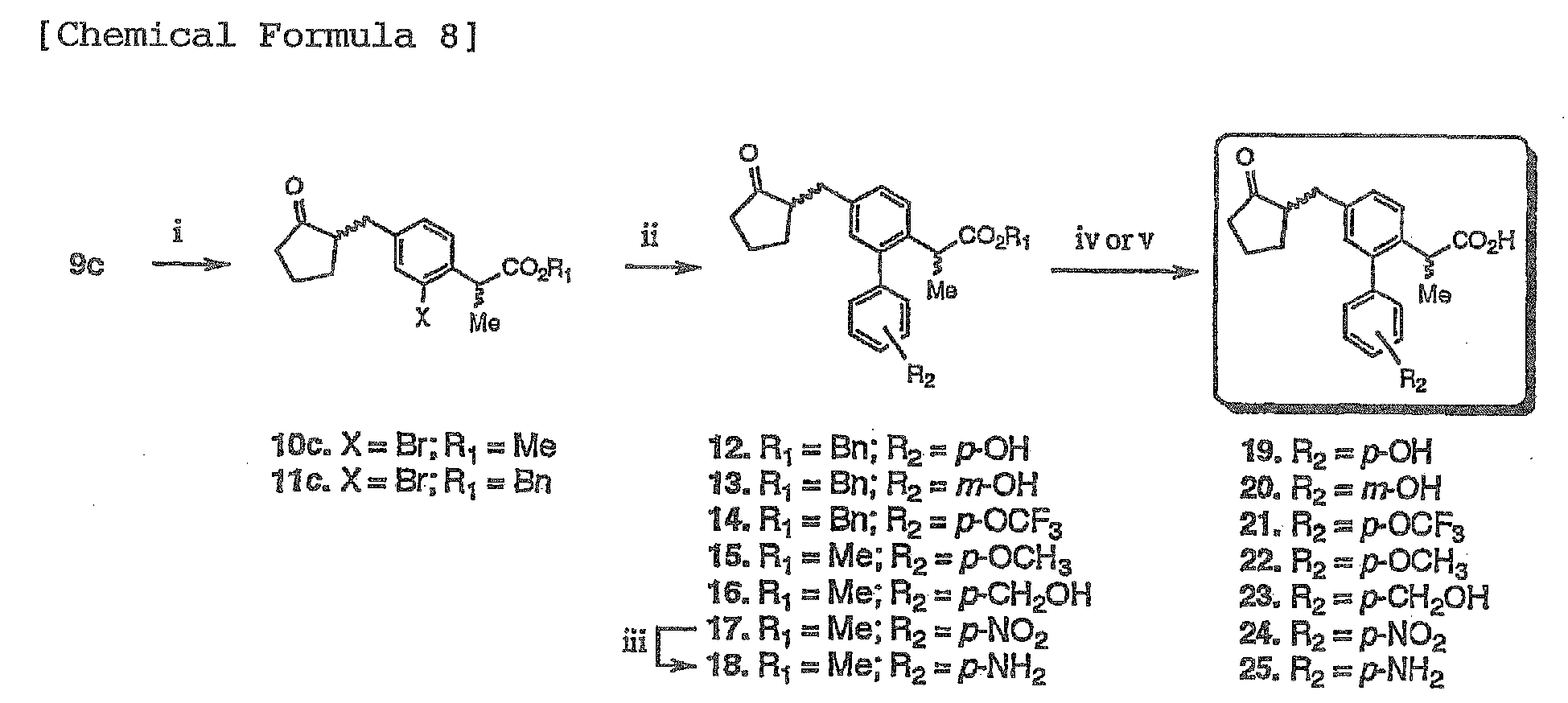
Finally, these intermediate compounds (8a to 8d) are subjected to ,for example, acid hydrolysis and decarboxylation using acetic acid / hydrochloric acid, so that, among the loxoprofen derivatives of interest of the present invention represented by the formula (I), loxoprofen derivatives (9a to 9d) wherein the substituent "R1" is a halogen atom are produced. - Furthermore, among the loxoprofen derivatives of the present invention represented by the formula (I), a loxoprofen derivative wherein the substituent "R1" is a substituted or unsubstituted phenyl group may be synthesized, for example, in accordance with
Production Scheme 2 orProduction Scheme 3 shown in the chemical reaction formulae described below. -
-

- Thus,
Production Scheme 2 andProduction Scheme 3 illustrate a process for synthesizing loxoprofen derivatives (19 to 25 and 31 to 35) wherein the substituent "R1" is a substituted or unsubstituted phenyl group among the loxoprofen derivatives of the present invention.
First, the carboxylic acid end of the loxoprofen derivative (9c) wherein the aromatic ring is substituted with bromine, which was obtained byProduction Scheme 1, was subjected to an esterification of a carboxyl group with methanol or benzyl alcohol (BnOH) in the presence of 4-dimethylaminopyridine (4-DMAP) in 1,2-dichloroethane (step i). Thus, ester-protected compounds (10c and 11c) were synthesized. These compounds were used as substrates for a Suzuki-Miyaura cross-coupling reaction with various boron compounds (step ii) to obtain an ester-protected biphenyl type of loxoprofen derivatives (12 to 17). - The Suzuki-Miyaura cross-coupling reaction can be performed, for example, by using a boron compound [R2-PhB(OH)2] that has the substituent shown as R2 above and treating the reactants by reflux in hydrous tetrahydrofuran with Pd(PPh3)4 in the presence of about 2 moles of sodium carbonate.
- For the compound (17) that was substituted by a nitro group at its biphenyl end, the nitro group was converted to an amino group by a reduction reaction using palladium on carbon (Compound 18). Finally, the ester group ends of these compounds (12 to 18) were reduced catalytically or hydrolyzed to obtain the biphenyl type of loxoprofen derivatives (19 to 25) of interest.
Catalytic reduction may be performed, for example, by allowing the compounds to absorb hydrogen gas in an alcohol solvent such as methanol or ethanol with the aid of 10% palladium on carbon. Hydrolysis can be performed by ordinal alkaline hydrolysis (for example, hydrolysis using alkali metal hydroxide in an alcoholic solvent). - On the other hand, different biphenyl-type loxoprofen derivatives (31 to 35) shown in
Reaction Scheme 3 were obtained as follows. The diester compound (8c) having a cyclopentanone ring obtained inReaction Scheme 1 was used as a substrate for the Suzuki-Miyaura cross-coupling reaction with various boronic acid compounds to synthesize diester compounds (26 to 30), which are precursors of the compounds of interest. Finally, these compounds were hydrolyzed and decarboxylated to obtain the different loxoprofen derivatives of interest (31 to 35). - The Suzuki-Miyaura cross-coupling reaction with boronic acid compounds (step i) and the hydrolysis and decarboxylation reaction (step ii) may be performed by using reactions similar to those performed in
Reaction Scheme 2 andReaction Scheme 1 described above. - Furthermore, in the production of reduced loxoprofen derivatives having a cyclopentanol ring represented by the formula (II), which are compounds of interest of the present invention, these derivatives can be synthesized, for example, in accordance with
Production Scheme 4 shown in the chemical reaction formula described below. -

- First, carboxylic acid ends of the halogenated loxoprofen derivatives (9a and 9c) produced by the method shown in
Production Scheme 1 wherein their aromatic rings are substituted by a fluorine atom or a bromine atom and the biphenyl type of loxoprofen derivative (19) produced by the method shown inProduction Scheme 2 that was substituted by a hydroxyl group (para position) at its biphenyl end group were esterified (step i). For example, the carboxyl groups were esterified with methanol or benzyl alcohol (BnOH) in the presence of 4-dimethylaminopyridine (4-DMAP) in 1,2-dichloroethane (step i) to synthesize ester-protected compounds (10c, 11c, and 12). - Then, these compounds were converted to alcohol compounds (36a and 36c; 37a and 37c; 38; and 39), for example, by subjecting them to a reduction reaction using dichloromethan as a solvent and sodium borohydride (step ii) to reduce their carbonyl groups. Finally, the ester group end was reduced catalytically or hydrolyzed (step iii or iv) to obtain reduced loxoprofen derivatives of interest (40a and 40c; 41a and 41c; 42; and 43).
The catalytic reduction or hydrolysis reaction in this case employs means similar to those used in the method of step iv or v inProduction Scheme 2. - These compounds and their precursors exist as geometrical isomers in a cis or trans form, which have different configurations at asymmetric carbons at two positions (
position 1 and position 2) of the cyclopentane ring in their chemical structures. These compounds and their precursors can be isolated by silica gel chromatography as a mixture of four diastereoisomers, including stereoisomers that have different configurations at each of the asymmetric carbons at α positions. - The loxoprofen derivatives as the compounds of interest of the present invention can be obtained by the production methods described above. The physicochemical properties of the obtained compounds are summarized in the tables 1 to 3 below.
-
[Table 1] No. property MS (m/z) 1H-NMR (δ/ppm) 9a liquid 265 M+H+ (CDCl3)δ: 7.18(1H, t, J=7.9Hz), 6.86(2H, dd, J=11.9, 5.4Hz), 3.98(1H, q, J=7.3Hz), 3.73(3H, s), 3.68(3H, s), 3.21(1H, d, J=13.9Hz), 3.02(1H, d, J=13.9Hz), 2.46-2.37(2H, m), 2.36-2.27(1H, m), 2.17-2.05(1H, m), 1.98-1.89(1H, m), 1.72-1.67(1H, m), 1.47(3H, d, J=7.3Hz) 9b liquid 281 M+ (CDCl3)δ: 10.79(1H, brs), 7.32(1H, brs), 7.21-7.12(2H, m), 3.69(1H, q, J=7.2Hz), 3.28(1H, dd, J=13.7, 4.2Hz), 2.59(1H, dd, J=13.7, 9.7Hz), 2.51-2.32(2H, m), 2.21-1.94(3H, m), 1.82-1.68(1H, m), 1.62-1.46(1H, m), 1.50(3H, d, J=7.3Hz) 9c liquid 347 M+Na+ (CDCl3)δ: 7.39(1H, d, J=1.5Hz), 7.25(1H, d, J=8.1Hz), 7.10(1H, dd, J=8.1, 1.5Hz), 4.24(1H, q, J=7.2 Hz), 3.10(1H, dd, J=13.7, 3.8Hz), 2.47(1H, dd, J=13.7, 9.3Hz), 2.40-2.27(2H, m), 2.18-1.93(3H, m), 1.83-1.67(1H, m), 1.60-1.54(1H, m), 1.50(3H, d, J=7.2Hz) 9d liquid 373 M+H+ (CDCl3)δ: 7.68(1H, s), 7.25(1H, d, J=6.6Hz), 7.14(1H, d, J=8.4Hz), 4.13(1H, q, J=7.2Hz), 3.08(1H, dd, J=13.6, 3.7Hz), 2.44(1H, dd, J=13.7, 9.3Hz), 2.37-2.26(2H, m), 2.18-2.06(2H, m), 2.03-1.94(1H, m), 1.83-1.67(1H, m), 1.59-1.42(1H, m), 1.47(3H, d, J=7.3 Hz) 19 white solid 338 M+ (CD3OD)δ: 7.28(1H d, J=8.1Hz), 7.15-7,10(3H, m), 6.99(1H, s), 6.82(2H, d, J= 8.6Hz), 3.85(1H, q, J =7.0Hz), 3.05(1H, dd, J=13.6, 3.8Hz), 2.52(1H, dd, J=13.6, 9.4Hz), 2.45-2.24(2H, m), 2.14-2.02(2H, m), 1.99-1.89(1H, m), 1.82-1.69(1H, m), 1.67-1.51(1H, m), 1.27(3H, d, J=7.0Hz) 20 white solid 338 M+ (CD3OD)δ: 7.29(1H, d, J=8.1Hz), 7.21(1H, t, J=7.9Hz), 7.15(1H, dd, J=8.1, 1.8Hz), 7.01(1H, d, J=1.8Hz), 6.80-6.73(3H, m), 3.84(1H, q, J=7.1Hz), 3.07(1H, dd, J=13.6, 4.0Hz), 2.54(1H, dd, J=13.6, 9.5Hz), 2.47-2.26(2H, m), 2.15-2.26(2H, m), 2.15-2.03(2H, m), 2.00-1.90(1H, m), 1.84-1.70(1H, m), 1.68-1.52(1H, m), 1.29(3H, dd, J=7.1, 1.6Hz) 21 oil 406 M+ (CD3OD)δ: 7.43(2H, d, J=8.8Hz), 7.36-7.32(3H, m), 7.20(1H, d, J=8.1Hz), 7.04(1H, s), 3.73(1H, q, J=7.2Hz), 3.08(1H, dd, J=13.8, 4.0Hz), 2.56(1H, dd, J=13.8, 9.2Hz), 2.44-2.26(2H, m), 2.15-1.94(3H, m), 1.85-1.56(2H, m), 1.30(3H, d, J=7.2Hz) 22 oil 352 M+ (CD3OD)δ: 7.31-7.22(3H, m), 7.14(1H, dd, J=8.1, 1.8Hz), 7.01-6.95(3H, m), 3.86-3.79(4H, m), 3.06(1H, dd, J=13.6, 4.0Hz), 2.54(1H, dd, J=13.6, 9.2Hz), 2.43-2.25(2H, m), 2.15-1.58(5H, m), 1.27(3H, dd, J=7.1, 1.3Hz) -
[Table 2] No. prpperty MS (m/z) NMR (δ/ppm) 23 oil 352 M+ (CD3OD)δ: 7.42(2H, d, J=8.1Hz), 7.35-7.33(3H, m), 7.17(1H, d, J=7.3Hz), 7.04(1H, s), 4.75(2H, s), 3.87(1H, q, J=7.0Hz), 3.16(1H, dd, J=13.7, 3.5Hz), 2.51(1H, dd, J=13.9, 9.5Hz), 2.40-2.30(2H, m), 2.17-2.09(2H, m), 2.02-1.92(1H, m), 1.82-1.68(1H, m), 1.63-1.50(1H, m), 1.35(3H, d, J=7.0Hz) 24 yellow solid 368 M+H+ (CD3OD)δ: 8.27(2H, d, J=8.8, 0.9Hz), 7.53(2H, d, J=8.8Hz), 7.40(1H, d, J=8.1Hz), 7.24(1H, dd, J=8.1, 1.8Hz), 7.03(1H, d, J=1.8 Hz), 3.74(1H, q, J=7.1Hz), 3.16(1H, dd, J=13.7, 3.8Hz), 2.55(1H, dd, J=13.7, 9.5Hz), 2.42-2.32(2H, m), 2.20-1.95(3H, m), 1.84-1.51(2H, m), 1.37(3H, d, J=7.0Hz) 25 brown solid 337 M+ (CDCl3)δ: 7.31(1H, d, J=8.1Hz), 7.15-7.10(3H, m), 7.03(1H, s), 6.73(2H, d, J=8.4Hz), 4.68(3H, s), 3.97(1H, q, J=7.1Hz), 3.15(1H, dd, J=13.7, 3.5Hz), 2.48(1H, dd, J=13.7, 9.9Hz), 2.41-2.30(2H, m), 2.18-1.95(3H, m), 1.81-1.50(2H, m), 1.35(3H, d, J=6.6Hz) 31 oil 322 M+ (CD3OD)δ: 7.44(6H, m), 7.17(1H, dd, J=7.9, 2.0Hz), 7.02(1H, d, J=1.8Hz), 3.78(1H, q, J=7.2Hz), 3.07(1H, dd, J=13.6, 4.0Hz), 2.55(1H , dd, J=13.6, 9.2Hz), 2.47-2.25(2H , m), 2.13-1.72(4H, m), 1.28(3H, dd, J=7.2, 1.3Hz) 32 oil 336 M+ (CDCl3)δ: 7.34(1H, d, J=8.1Hz). 7.22(4H, s), 7.15(1H, d, J=8.4Hz), 7.04(1H, s), 3.91(1H, q, J=7.1Hz), 3.16(1H, dd, J=13.9, 3.7Hz), 2.50(1H, dd, J=13.9, 9.5Hz), 2.40(3H, s), 2.37-2.28(2H, m), 2.18-2.06(3H, m), 1.99-1.93(1H, m), 1.80-1.68(1H, m), 1.59-1.31(1H, m), 1.36(3H, dd, J=7.0, 1.1Hz) 33 Oil 368 M+ (CDC13) δ: 7.36-7.26(5H, m), 7.16(1H, d, J=8.1Hz), 7.03(1H, s), 3.90(1H, q, J=7.1Hz), 3.16(1H, dd, J=13.7, 3.8Hz ), 2.55-2.47(4H, m), 2.39-2.31(2H, m), 2.18-2.09(2H, m), 2.03-1.91(1H, m), 1.88-1.70(1H, m), 1.66-1.50(1H, m), 1.36(3H, dd, J=7.1, 0.9Hz) 34 Oil 340 M+ (CD3OD)δ: 7.36-7.31(3H, m), 7.20-7.12(3H, m), 7.02(1H, d, J=1.8Hz), 3.75(1H, q, J=7.1Hz), 3.07(1H, dd, J=13.7, 4.2Hz), 2.55(1H, dd, J=13.7, 9.5Hz), 2.43-2.26(2H, m), 2.15-2.03(2H, m), 2.00-1.91(1H, m), 1.86-1.68(1H, m), 1.65-1.52(1H, m), 1.29(3H, dd, J=7.1, 1.1Hz) -
[Table 3] No. property MS (m/z) NMR δ/ppm) 35 Oil 366 M+ (CDCl3)δ: 8.10(2H, d, J=8.4Hz), 7.42(2H, d, J=8.4Hz), 7.36(1H d, J=8.1Hz), 7.18(1H, d, J=8.1Hz), 7.01(1H, s), 3.79(1H, q, J=7.3Hz), 3.13(1H, dd, J=13.9, 9.5Hz), 2.50(1H, dd, J=13.9, 9.5Hz), 2.35-2.27(2H, m), 2.14-2.05(2H, m), 1.99-1.93(1H. m), 1.75-1.65(1H, m), 1.60-1.50(1H, m), 1.36(3H, d, J=7.3Hz) 40a Oil 289 M++Na (CDCl3)δ: 7.19(1H, t, J=7.9Hz), 6.96(1H, dd, J=7.9, 1.6Hz), 6.92(1H, dd, J=11.0, 1.5Hz), 4.09 (1H, t, J=3.5Hz), 4.00(1H, q, J=7.2Hz), 2.82(1H, dd, J=13.6, 7.7Hz), 2.61(1H, dd, J=13.6, 7.7Hz), 2.02-1.91(1H, m), 1.89-1.77(2H, m), 1.73-1.61(2H, m), 1.60-1-43(1H, m), 1.53-1.45(1H, m), 1.50(3H, d, J=7.3Hz) 40c white solid 289 M++Na (CDCl3)δ: 7.19(1H, t, J=7.9Hz), 6.91-6.83(2H, m), 3.99(1H, q, J= 7.2Hz), 3.87(1H, q, J=5.9Hz), 2.77(1H dd, J=13.9, 5.9Hz), 2.39(1H dd, J=13.6, 9.2Hz), 1.92-1.58(9H, m), 1.26-1.14(1H, m) 41a Oil 349 M++Na (CDCl3)δ: 7.45(1H, d, J=1.5Hz), 7.24(1H, d, J= 7.7Hz), 7.16(1H, dd, J=8.1, 1.5Hz), 4.24(1H, q, J=7.2Hz), 4.09(1H, s), 2.82(1H, dd, J=13.7, 7.9Hz), 2.61(1H, dd, J=13.7, 7.5Hz), 2.00-1.80(3H, m), 1.72-1.49(7H, m) 41c Oil 349 M++Na (CDCl3)δ: 7.41(1H, s), 7.25(1H, d, J=7.0Hz), 7.11(1H, d, J=8.1Hz), 4.23(1H, q, J=7.2Hz), 3.89(1H q, J=5.9Hz), 2.76(1H, dd, J=13.7, 6.0Hz), 2.42(1H, dd, J=13.9, 6.8Hz), 2.09-1.92(2H, m), 1.86-1.78(1H, m), 1.71-1.47(6H, m), 1.29-1.16(1H, m) 42 white solid 340 M+ (CD3OD)δ: 7.26(1H, d, J=8.1Hz), 7.15(3H, d, J=8.4Hz), 7.04(1H, s), 6.82(2H, d, J=8.4Hz), 4.04(1H, brs), 3.85(1H, q, J=7.1Hz), 2.87(1H, dd, J=6.8, 3.4Hz), 2.56(1H, dd, J=13.4, 8.2Hz), 2.02-1.90(2H, m), 1.27(3H, d, J=7.0Hz) 43 White solid 340 M+ (CD3OD)δ: 7.27(1H, d, J=8.1Hz), 7.15-7.12(3H, m), 7.00(1H, s), 6.83(2H, d, J=8.6 Hz), 3.86-3.81(2H, m), 2.85(1H, dd, J=13.6, 5.5Hz), 2.38(1H, dd, J=13.5, 9.2Hz), 2.00(1H, d, J=28.9Hz), 1.90(1H d, J=25.8Hz), 1.60-1.78(4H, m), 1.27(4H, d, J=7.0Hz) - The above-mentioned loxoprofen derivative provided by the present invention may be used as it is, that is, as a free carboxylic acid, or as a pharmacologically acceptable salt thereof.
Pharmacologically acceptable salts may include alkali metal salts such as a sodium salt and a potassium salt or ammonium salts. - When the loxoprofen derivative provided by the present invention or a pharmacologically acceptable salt thereof is administered as a pharmaceutical composition, for example, the derivative or the pharmacologically acceptable salt thereof as an active ingredient may be administered orally or parenterally alone or in a suitable dosage form, such as a capsule, a tablet, and an injection, in conjunction with a conventional excipient. Specifically, for example, a capsule may be formulated by mixing a loxoprofen derivative or a salt thereof with an excipient such as lactose, starch or a derivative thereof, and a cellulose derivative and filling the mixture into a gelatine capsule.
- A tablet may be formulated by adding a binding agent such as sodium carboxymethylcellulose, alginic acid, or gum arabic and water in addition to the above-mentioned excipient and kneading the mixture, granulating it if necessary, then further adding a lubricant such as talc or stearic acid, and using a normal tablet compressing machine.
- Furthermore, in the case of a parenteral administration by injection, an injectable formulation is formulated by dissolving a loxoprofen derivative or a salt thereof together with a solubilizer in sterile distilled water or sterile saline, and placing the solution into an ampoule and sealing the ampoule. If necessary, a stabilizing agent, a buffering agent, and the like may be included. These formulations for parenteral administration may be administered by intravenous administration or an intravenous infusion.
- The dosage of the loxoprofen derivative provided by the present invention varies depending on various factors such as the symptom of the patient to be treated, the patient's severity, the patient's age, and the presence or absence of a complication, and thus, the dosage is not always the same.
The dosage also varies depending on an administration route, a dosage form, the frequency of administration, and the like; however, in general, the loxoprofen derivative as an active ingredient may be administered in a dosage selected as follows: in the case of oral administration, the dosage may be usually selected within 0.1 to 1000 mg/day/person, preferably within 1 to 500 mg/day/person as appropriate; and in the case of parenteral administration, the dosage may be selected within about 1/100 to 1/2 amount of the dosage for the oral administration as appropriate. Naturally, these dosages may be increased or decreased if necessary depending on the patient's age, symptoms, and the like. - Hereinbelow, the present invention will be described more specifically with reference to Test Examples instead of Working Examples, but it is needless to say that the scope of the present invention is not intended to be limited to these examples.
- The chemical structure of the loxoprofen derivative of the present invention used in an in vitro test and in vivo test is shown below.
-

-
[Table 4] TEST COMPOUND COMPOUND NUMBER R20 loxoprofen - H Compound 1 9a F Compound 2 9c Br Compound 3 19 p-hydroxyphenyl- Compound 425 p-aminophenyl- - This test was performed according to the method described in Inflamm. Res., 45: 68-74 (1996).
- A person who had not taken NSAIDs for at least one week and was healthy on the day of blood collection was selected as a subject for blood collection.
Blood was collected without adding an anticoagulant agent and used for the assay immediately. The collected blood was dispensed in 500 µL aliquots into tubes (Protein Lobingdin tube, Eppenduf Co. LTD., Tokyo, Japan). Two µL of the test compound (final concentration: 0.1 µM to 1000 µM) dissolved in an appropriate solvent (DMSO or MilliQ water) was added and incubated at 37°C for 24 hours until blood coagulation was observed.
After incubation, the samples were centrifuged at 12,000 x g for 5 minutes to separate serum. 100 µL of the obtained serum was added to 400 µL of ethanol to remove blood protein and centrifuged again at 12,000 x g for 5 minutes. TXB2 in the supernatant was quantified by using an enzyme immunoassay (EIA) kit [Cayman (Ann, Arbor, MI, USA) #519031]. The protocol followed the protocol attached to the kit. - A person who had not taken NSAIDs for at least one week and was healthy on the day of blood collection was selected as a subject for blood collection.
Blood was collected in heparin-treated test tubes (Venojectll blood collection tubes, Terumo Corporation), and an inflammatory stimulant, lipopolysaccharide (LPS) (Sigma-Aldrich Japan Inc., #L2880 from E. coli055:B5: diluted in phosphate buffered saline (PBS) to a final concentration of 100 ug/mL) was added to the blood. The mixture was dispensed in 500 µL aliquots into tubes. 2 µL of the test compound (final concentration: 0.1 µM to 1000 µM) dissolved in an appropriate solvent (DMSO or MilliQ water) was added and incubated at 37°C for 24 hours to induce COX-2.
After incubation, the samples were centrifuged at 12,000 x g for 5 minutes to separate serum. 100 µL of the obtained serum was added to 400 µL of ethanol to remove blood protein, and the mixture was centrifuged again at 12,000 x g for 5 minutes. PGE2 in the supernatant was quantified by using an enzyme immunoassay (EIA) kit [Cayman (Ann, Arbor, MI, USA) #514040]. The protocol followed the protocol attached to the kit. - This test was performed according to the method described in Biochem. Biophysical. Res. Com., 323; 1032-39 (2004).
- Egg yolk phosphatidylcholine (10 µM, 7.7 mg: manufactured by KANTO CHEMICAL CO.,INC.) was dissolved in chloroform / methanol (1:2, v/v), dried, and then dissolved in 1.5 mL of diethylether. 1 mL of 100 mM calcein-NaOH (pH 7.4) was added to the solution and the mixture was sonicated for 1 minute. Then, diethylether was removed by a conventional rotary evaporator (25°C) and the residue was suspended in phosphate buffer to obtain solution of liposomal membrane (reversed-phase evaporation method).
- 30 µL of the liposomal membrane solution was suspended in 5 mL of phosphate buffer, and the suspension was centrifuged (at 10,500 x g for 20 minutes) and washed with phosphate buffer twice. The pellet was suspended in 1 mL of phosphate buffer and the suspension was used for a membrane injury experiment.
The suspension was dispensed in 6 µL aliquots into 1.5 mL tubes. 6 µL of test samples at different concentrations in phosphate buffer were added to the liposome suspensions and incubated at 30°C for 10 minutes. After cooling on ice, the mixed solution was dispensed in 10 µL aliquots into each well of a 384-well plate, and then the fluorescence intensity of leaked calcein was measured (excitation wavelength: 490 nm). - The liposome suspension was centrifuged (at 10,500 x g for 20 minutes) and washed with phosphate buffer twice. The pellet was suspended in 5 mL of phosphate buffer, and 0.75mL of the suspension was diluted with 50 mL of phosphate buffer and used for the membrane injury experiment.
The diluted suspension was dispensed in 400 µL aliquots into 1.5 mL tubes. Test sample solutions at different concentrations in DMSO were added to the liposome suspensions and incubated at 30°C for 10 minutes. After cooling on ice, the mixed solution was dispensed in 200 µL aliquots into each well of a 96-well plate, and then the fluorescence intensity of leaked calcein was measured (excitation wavelength: 490 nm). - A 25 % solution of triton X-100 was used as a control and the membrane injury caused by this solution was considered as 100% membrane injury. After measuring the fluorescence intensity caused by each test sample, the ratio of the fluorescence intensity to that of the control considered as 100% membrane injury was expressed as a percentage and this was used as an index of the ability to cause membrane injury (calcein release).
- These results are collectively shown in the table below.
-
[Table 5] TEST COMPOUND COX INHIBITORY ACTIVITY IC50 (mM) COX-2 SELECTIVITY MEMBRANE INJURY COX·1/COX·2 Calcein release COX·1 COX·2 ED50% (nM) LOXONIN 36 9 4.0 800 Compound 116 6 2.0 > 1,000 Compound 29.9 16 0.6 > 1,000 Compound 3570±80 21±13 40±21 15 Compound 4675±64 85±9 8.0 > 1,000 - This test was performed according to the method described in Biochem. Pharmacol., 67; 575-85 (2004).
After male Wister rats (body weight: 180 to 200 g) were fasted for 18 hours, test compounds were administered orally to them (the dosage was determined so that an amount of substance of a test compound is equal to loxoprofen). After 8 hours, the stomach was excised and the area of the ulcers that developed inside the stomach was measured. The total area of all the ulcers was used as an ulcer index.
On the other hand, the amount of PGE2 in the gastric mucosae was measured by an ELISA method.
The protocol followed the protocol attached to the kit. - These results are shown in
Figs. 1 to 3 .
Fig. 1 shows the results when the test compounds were administered in an amount equivalent to 40 mg/kg of loxoprofen.Fig. 2 shows the results when the test compounds were administered in an amount equivalent to 50 mg/kg of loxoprofen.Fig. 3 shows the change in the amount of the gastric mucosa PGE2.
As is found from the results shown in the figures, the loxoprofen derivatives of the present invention (Compounds 1 to 4) have significantly less ulcer indices than loxoprofen. Formation of an ulcer was hardly observed whenCompound 3 orCompound 4 was used.
The amount of the gastric mucosa PGE2 whenCompound 2,Compound 3, orCompound 4 was used was more than that when loxoprofen was used. - This test was performed according to the method described in Br. J. Pharmacol., 151; 285-91 (2007).
After male Wister rats (body weight: 180 to 200 g) were fasted for 18 hours, test compounds were administered orally to them (the dosage was determined so that an amount of substance of a test compound is equal to loxoprofen). After 1 hour, rats were injected subcutaneously with 100 µL of 1% carrageenin (dissolved in saline) in their left footpads to induce edema.
The paw volumes were measured before and 3 hours and 6 hours after administration of carrageenin by Plethysmometer.
PGE2 in paw edema was also measured by an ELISA method. The protocol followed the protocol attached to the kit. - These results are shown in
Figs. 4 to 6 .
Fig. 4 shows the percentage of carrageenan-induced edema (%) 6 hours after administration of test compounds in an amount equivalent to 10 mg/kg of loxoprofen, andFig. 5 shows the percentage of inhibition of edema (%) 6 hours after administration of test compounds in an amount equivalent to 10 mg/kg of loxoprofen.
The percentage of inhibition of edema was calculated based on the formula below:
Fig. 6 shows the change in thepaw volumes 3 hours and 6 hours after administration. - As is found from these results, the loxoprofen derivatives of the present invention (
Compounds 1 to 4) have a good antiphlogistic effect and also do not cause formation of an ulcer, which is a side effect. The loxoprofen derivatives of the invention are found to be compounds in which their pharmacological effects were successfully separated from their side effects. -
Compound 150 mg Lactose 100 mg Hydroxypropylcellulose 150 mg magnesium stearate 50 mg -
Compound 250 mg Lactose 100 mg corn starch 150 mg - As described above, the loxoprofen derivative provided by the present invention is a novel compound that has been unknown until now. Furthermore, the loxoprofen derivative provided by the invention has no side effect such as a gastrointestinal disorder, which is caused by conventional NSAIDs, and moreover has stronger anti-inflammatory and analgesic effects than clinically-used loxoprofen.
Therefore, the loxoprofen derivative provided by the invention is very effective in that it can be used safely in humans due to its wide safety margin and contributes greatly to the industry.
Claims (6)
- A loxoprofen derivative represented by the following formula (I) or (II):

or a pharmacologically acceptable salt thereof. - The loxoprofen derivative or a pharmacologically acceptable salt thereof according to claim 1, wherein the halogen atom represented by R1 and R2 in the formulae (I) and (II) is selected from a chlorine atom, a bromine atom, a fluorine atom, and an iodine atom.
- The loxoprofen derivative or a pharmacologically acceptable salt thereof according to claim 1, wherein a substituent of the substituted phenyl group represented by R1 in the formula (I) is a halogen atom, a hydroxyl group, a substituted or unsubstituted lower alkyl group, a lower alkylthio group, a lower alkoxy group, a nitro group, an amino group, or a carboxyl group.
- The loxoprofen derivative or a pharmacologically acceptable salt thereof according to claim 1, wherein a substituent of the substituted phenyl group represented by R2 in the formula (II) is a halogen atom or a substituted lower alkyl group.
- A pharmaceutical preparation, comprising the loxoprofen derivative represented by the formula (I) or (II) or the pharmacologically acceptable salt thereof according to claim 1 as an active ingredient.
- A pharmaceutical preparation, comprising the loxoprofen derivative or the pharmacologically acceptable salt thereof according to any of claims 2 to 4 as an active ingredient.
Applications Claiming Priority (2)
| Application Number | Priority Date | Filing Date | Title |
|---|---|---|---|
| JP2009043801A JP5390883B2 (en) | 2009-02-26 | 2009-02-26 | Loxoprofen derivative and pharmaceutical containing the same |
| PCT/JP2010/052463 WO2010098251A1 (en) | 2009-02-26 | 2010-02-18 | Loxoprofen derivative and pharmaceutical containing same |
Publications (3)
| Publication Number | Publication Date |
|---|---|
| EP2402305A1 true EP2402305A1 (en) | 2012-01-04 |
| EP2402305A4 EP2402305A4 (en) | 2012-07-18 |
| EP2402305B1 EP2402305B1 (en) | 2013-10-02 |
Family
ID=42665458
Family Applications (1)
| Application Number | Title | Priority Date | Filing Date |
|---|---|---|---|
| EP10746132.9A Not-in-force EP2402305B1 (en) | 2009-02-26 | 2010-02-18 | Loxoprofen derivative and pharmaceutical containing same |
Country Status (6)
| Country | Link |
|---|---|
| US (1) | US8431614B2 (en) |
| EP (1) | EP2402305B1 (en) |
| JP (1) | JP5390883B2 (en) |
| KR (1) | KR101708073B1 (en) |
| CN (1) | CN102333754B (en) |
| WO (1) | WO2010098251A1 (en) |
Cited By (2)
| Publication number | Priority date | Publication date | Assignee | Title |
|---|---|---|---|---|
| WO2013062028A1 (en) * | 2011-10-25 | 2013-05-02 | 塩野義製薬株式会社 | Hiv replication inhibitor |
| US9221786B2 (en) | 2011-12-27 | 2015-12-29 | Ltt Bio-Pharma Co., Ltd. | 2-fluorophenyl propionic acid derivatives |
Families Citing this family (10)
| Publication number | Priority date | Publication date | Assignee | Title |
|---|---|---|---|---|
| KR101465025B1 (en) * | 2013-02-27 | 2014-11-26 | 한미정밀화학주식회사 | The stereoselective manufacturing method of loxoprofen(2s, 1'r, 2'r) trans-alcohol |
| WO2014167509A2 (en) * | 2013-04-10 | 2014-10-16 | Shasun Pharmaceuticals Limited | Loxoprofen polymorphs and process for preparation of the same |
| CN109134261A (en) * | 2017-06-15 | 2019-01-04 | 北京蓝丹医药科技有限公司 | A kind of loxoprofen derivative |
| CN109134262A (en) * | 2017-06-15 | 2019-01-04 | 北京蓝丹医药科技有限公司 | A kind of loxoprofen derivative |
| CN111635309B (en) * | 2019-03-01 | 2024-03-12 | 华创合成制药股份有限公司 | A new type of antipyretic and analgesic drug and its preparation method and use |
| CN111635315B (en) * | 2019-03-01 | 2024-03-12 | 华创合成制药股份有限公司 | An antipyretic and analgesic drug and its preparation method and use |
| CN113121331B (en) * | 2019-12-31 | 2024-01-05 | 华创合成制药股份有限公司 | Phenoxyaromatic acid compounds with cyclopropyl group and pharmaceutically acceptable salts thereof, as well as their preparation methods and applications |
| WO2022052936A1 (en) * | 2020-09-09 | 2022-03-17 | 南京海融医药科技股份有限公司 | Aryl propionic acid derivative, pharmaceutical composition, and method for preparation thereof and application thereof |
| CN115557839B (en) * | 2021-12-23 | 2024-02-13 | 南京海融医药科技股份有限公司 | Fat emulsion containing aryl propionic acid derivative and preparation method thereof |
| WO2023115511A1 (en) * | 2021-12-24 | 2023-06-29 | 南京海融医药科技股份有限公司 | Arylpropionic acid derivative and emulsion preparation thereof |
Family Cites Families (6)
| Publication number | Priority date | Publication date | Assignee | Title |
|---|---|---|---|---|
| JPS584699B2 (en) * | 1977-04-05 | 1983-01-27 | 三共株式会社 | Substituted phenylacetic acid derivatives and their production method |
| US4161538A (en) | 1977-04-05 | 1979-07-17 | Sankyo Company Limited | Substituted phenylacetic acid derivatives and process for the preparation thereof |
| DD141422A5 (en) | 1978-01-27 | 1980-04-30 | Schering Ag | PROCESS FOR THE PREPARATION OF PHENYL ACID DERIVATIVES |
| JPS6033718B2 (en) | 1981-06-27 | 1985-08-05 | 石川島播磨重工業株式会社 | ship steering system |
| EP0641760B1 (en) * | 1991-08-10 | 1996-11-06 | Hisamitsu Pharmaceutical Co., Inc. | Phenylalkanoic acid derivative, production thereof, and separation of optical isomers thereof |
| JPH0584699A (en) | 1991-09-24 | 1993-04-06 | Shima Seiki Mfg Ltd | Cutting device |
-
2009
- 2009-02-26 JP JP2009043801A patent/JP5390883B2/en not_active Expired - Fee Related
-
2010
- 2010-02-18 KR KR1020117022258A patent/KR101708073B1/en not_active Expired - Fee Related
- 2010-02-18 EP EP10746132.9A patent/EP2402305B1/en not_active Not-in-force
- 2010-02-18 US US13/148,566 patent/US8431614B2/en not_active Expired - Fee Related
- 2010-02-18 WO PCT/JP2010/052463 patent/WO2010098251A1/en not_active Ceased
- 2010-02-18 CN CN201080009343.4A patent/CN102333754B/en not_active Expired - Fee Related
Cited By (3)
| Publication number | Priority date | Publication date | Assignee | Title |
|---|---|---|---|---|
| WO2013062028A1 (en) * | 2011-10-25 | 2013-05-02 | 塩野義製薬株式会社 | Hiv replication inhibitor |
| US9199959B2 (en) | 2011-10-25 | 2015-12-01 | Shionogi & Co., Ltd. | HIV replication inhibitor |
| US9221786B2 (en) | 2011-12-27 | 2015-12-29 | Ltt Bio-Pharma Co., Ltd. | 2-fluorophenyl propionic acid derivatives |
Also Published As
| Publication number | Publication date |
|---|---|
| WO2010098251A1 (en) | 2010-09-02 |
| US20120016158A1 (en) | 2012-01-19 |
| KR20110137321A (en) | 2011-12-22 |
| JP5390883B2 (en) | 2014-01-15 |
| EP2402305B1 (en) | 2013-10-02 |
| JP2010195727A (en) | 2010-09-09 |
| US8431614B2 (en) | 2013-04-30 |
| CN102333754A (en) | 2012-01-25 |
| CN102333754B (en) | 2014-04-16 |
| KR101708073B1 (en) | 2017-02-17 |
| EP2402305A4 (en) | 2012-07-18 |
Similar Documents
| Publication | Publication Date | Title |
|---|---|---|
| EP2402305B1 (en) | Loxoprofen derivative and pharmaceutical containing same | |
| US7820721B2 (en) | Compounds for the treatment of metabolic disorders | |
| AU2007253929B2 (en) | Compounds for the treatment of metabolic disorders | |
| CA2637884A1 (en) | Compounds for the treatment of metabolic disorders | |
| BRPI0909299B1 (en) | COMPOUNDS AND METHODS FOR REDUCING URIC ACID | |
| JPH04270261A (en) | Isoprenoid phospholipase a2 inhibitor and preparation containing same | |
| KR100979077B1 (en) | Solid salts of benzazine compounds and pharmaceutical compositions comprising the same | |
| NO174848B (en) | Analogous Process for Preparing Therapeutically Active Substitutes | |
| FR2910892A1 (en) | New substituted 1,3-diphenylpropane derivatives are peroxisome proliferator-activated receptor agonist useful treat e.g. diabetic, dyslipidemia, cardiovascular disease, obesity, hypertension, inflammatory diseases and cerebral ischaemia | |
| WO2002083625A1 (en) | Ferulic acid dimers and their pharmaceutically acceptable salts, their preparation and use thereof for treating dementia | |
| FR2849849A1 (en) | NOVEL CARBOXYLIC ACIDS AND DERIVATIVES FOR THE TREATMENT AND PREVENTION OF DIABETES AND DYSLIPEMICS | |
| US3846445A (en) | Dibenzofuranyloxy and carbazolyloyx alkanoic acids and esters | |
| JPS60104084A (en) | 4h-benzo(4,5)cyclohepta(1,2-b)thiophene derivative | |
| JP5770621B2 (en) | 2-Fluorophenylpropionic acid derivative | |
| JPS5936614B2 (en) | Method for producing benzoic acid derivatives and their salts | |
| EP0238401A2 (en) | Sulfon amides derived from diaryl methanes, processes for their preparation and pharmaceutical preparation containing them | |
| CA2639939A1 (en) | Compounds for the treatment of metabolic disorders | |
| CN1338458A (en) | Ticlid acetylsalicylate, and its preparing process and medical application | |
| JP2004123643A (en) | AGENT FOR PREVENTING OR TREATING DIABETES, CONTAINING omega-ARYL-alpha-SUBSTITUTED FATTY ACID DERIVATIVE | |
| CH643229A5 (en) | METHYL-OR METHOXY-SUBSTITUTED 2-HYDROXYBENZOIC ACID DERIVATIVES, PROCEDURE FOR THEIR PREPARATION AND PHARMACEUTICAL FORMULATIONS CONTAINING THEM. | |
| JPS6348263B2 (en) |
Legal Events
| Date | Code | Title | Description |
|---|---|---|---|
| PUAI | Public reference made under article 153(3) epc to a published international application that has entered the european phase |
Free format text: ORIGINAL CODE: 0009012 |
|
| 17P | Request for examination filed |
Effective date: 20110830 |
|
| AK | Designated contracting states |
Kind code of ref document: A1 Designated state(s): AT BE BG CH CY CZ DE DK EE ES FI FR GB GR HR HU IE IS IT LI LT LU LV MC MK MT NL NO PL PT RO SE SI SK SM TR |
|
| DAX | Request for extension of the european patent (deleted) | ||
| A4 | Supplementary search report drawn up and despatched |
Effective date: 20120619 |
|
| RIC1 | Information provided on ipc code assigned before grant |
Ipc: C07C 229/42 20060101ALI20120613BHEP Ipc: A61K 31/192 20060101ALI20120613BHEP Ipc: C07C 59/88 20060101AFI20120613BHEP Ipc: A61P 29/00 20060101ALI20120613BHEP Ipc: C07C 59/56 20060101ALI20120613BHEP Ipc: C07C 323/62 20060101ALI20120613BHEP Ipc: C07C 59/86 20060101ALI20120613BHEP Ipc: A61K 31/194 20060101ALI20120613BHEP Ipc: C07C 59/90 20060101ALI20120613BHEP Ipc: A61K 31/235 20060101ALI20120613BHEP Ipc: C07C 59/54 20060101ALI20120613BHEP Ipc: C07C 205/56 20060101ALI20120613BHEP |
|
| GRAP | Despatch of communication of intention to grant a patent |
Free format text: ORIGINAL CODE: EPIDOSNIGR1 |
|
| INTG | Intention to grant announced |
Effective date: 20130521 |
|
| GRAS | Grant fee paid |
Free format text: ORIGINAL CODE: EPIDOSNIGR3 |
|
| GRAA | (expected) grant |
Free format text: ORIGINAL CODE: 0009210 |
|
| AK | Designated contracting states |
Kind code of ref document: B1 Designated state(s): AT BE BG CH CY CZ DE DK EE ES FI FR GB GR HR HU IE IS IT LI LT LU LV MC MK MT NL NO PL PT RO SE SI SK SM TR |
|
| REG | Reference to a national code |
Ref country code: GB Ref legal event code: FG4D |
|
| REG | Reference to a national code |
Ref country code: AT Ref legal event code: REF Ref document number: 634522 Country of ref document: AT Kind code of ref document: T Effective date: 20131015 Ref country code: CH Ref legal event code: EP |
|
| REG | Reference to a national code |
Ref country code: IE Ref legal event code: FG4D |
|
| REG | Reference to a national code |
Ref country code: DE Ref legal event code: R096 Ref document number: 602010010715 Country of ref document: DE Effective date: 20131128 |
|
| REG | Reference to a national code |
Ref country code: AT Ref legal event code: MK05 Ref document number: 634522 Country of ref document: AT Kind code of ref document: T Effective date: 20131002 |
|
| REG | Reference to a national code |
Ref country code: NL Ref legal event code: VDEP Effective date: 20131002 |
|
| PG25 | Lapsed in a contracting state [announced via postgrant information from national office to epo] |
Ref country code: SI Free format text: LAPSE BECAUSE OF FAILURE TO SUBMIT A TRANSLATION OF THE DESCRIPTION OR TO PAY THE FEE WITHIN THE PRESCRIBED TIME-LIMIT Effective date: 20131002 |
|
| REG | Reference to a national code |
Ref country code: LT Ref legal event code: MG4D |
|
| PG25 | Lapsed in a contracting state [announced via postgrant information from national office to epo] |
Ref country code: SE Free format text: LAPSE BECAUSE OF FAILURE TO SUBMIT A TRANSLATION OF THE DESCRIPTION OR TO PAY THE FEE WITHIN THE PRESCRIBED TIME-LIMIT Effective date: 20131002 Ref country code: HR Free format text: LAPSE BECAUSE OF FAILURE TO SUBMIT A TRANSLATION OF THE DESCRIPTION OR TO PAY THE FEE WITHIN THE PRESCRIBED TIME-LIMIT Effective date: 20131002 Ref country code: FI Free format text: LAPSE BECAUSE OF FAILURE TO SUBMIT A TRANSLATION OF THE DESCRIPTION OR TO PAY THE FEE WITHIN THE PRESCRIBED TIME-LIMIT Effective date: 20131002 Ref country code: IS Free format text: LAPSE BECAUSE OF FAILURE TO SUBMIT A TRANSLATION OF THE DESCRIPTION OR TO PAY THE FEE WITHIN THE PRESCRIBED TIME-LIMIT Effective date: 20140202 Ref country code: NL Free format text: LAPSE BECAUSE OF FAILURE TO SUBMIT A TRANSLATION OF THE DESCRIPTION OR TO PAY THE FEE WITHIN THE PRESCRIBED TIME-LIMIT Effective date: 20131002 Ref country code: CZ Free format text: LAPSE BECAUSE OF FAILURE TO SUBMIT A TRANSLATION OF THE DESCRIPTION OR TO PAY THE FEE WITHIN THE PRESCRIBED TIME-LIMIT Effective date: 20131002 Ref country code: BE Free format text: LAPSE BECAUSE OF FAILURE TO SUBMIT A TRANSLATION OF THE DESCRIPTION OR TO PAY THE FEE WITHIN THE PRESCRIBED TIME-LIMIT Effective date: 20131002 Ref country code: NO Free format text: LAPSE BECAUSE OF FAILURE TO SUBMIT A TRANSLATION OF THE DESCRIPTION OR TO PAY THE FEE WITHIN THE PRESCRIBED TIME-LIMIT Effective date: 20140102 Ref country code: LT Free format text: LAPSE BECAUSE OF FAILURE TO SUBMIT A TRANSLATION OF THE DESCRIPTION OR TO PAY THE FEE WITHIN THE PRESCRIBED TIME-LIMIT Effective date: 20131002 |
|
| PG25 | Lapsed in a contracting state [announced via postgrant information from national office to epo] |
Ref country code: LV Free format text: LAPSE BECAUSE OF FAILURE TO SUBMIT A TRANSLATION OF THE DESCRIPTION OR TO PAY THE FEE WITHIN THE PRESCRIBED TIME-LIMIT Effective date: 20131002 Ref country code: AT Free format text: LAPSE BECAUSE OF FAILURE TO SUBMIT A TRANSLATION OF THE DESCRIPTION OR TO PAY THE FEE WITHIN THE PRESCRIBED TIME-LIMIT Effective date: 20131002 Ref country code: CY Free format text: LAPSE BECAUSE OF FAILURE TO SUBMIT A TRANSLATION OF THE DESCRIPTION OR TO PAY THE FEE WITHIN THE PRESCRIBED TIME-LIMIT Effective date: 20131002 Ref country code: ES Free format text: LAPSE BECAUSE OF FAILURE TO SUBMIT A TRANSLATION OF THE DESCRIPTION OR TO PAY THE FEE WITHIN THE PRESCRIBED TIME-LIMIT Effective date: 20131002 Ref country code: PL Free format text: LAPSE BECAUSE OF FAILURE TO SUBMIT A TRANSLATION OF THE DESCRIPTION OR TO PAY THE FEE WITHIN THE PRESCRIBED TIME-LIMIT Effective date: 20131002 |
|
| PG25 | Lapsed in a contracting state [announced via postgrant information from national office to epo] |
Ref country code: PT Free format text: LAPSE BECAUSE OF FAILURE TO SUBMIT A TRANSLATION OF THE DESCRIPTION OR TO PAY THE FEE WITHIN THE PRESCRIBED TIME-LIMIT Effective date: 20140203 |
|
| REG | Reference to a national code |
Ref country code: DE Ref legal event code: R097 Ref document number: 602010010715 Country of ref document: DE |
|
| PG25 | Lapsed in a contracting state [announced via postgrant information from national office to epo] |
Ref country code: EE Free format text: LAPSE BECAUSE OF FAILURE TO SUBMIT A TRANSLATION OF THE DESCRIPTION OR TO PAY THE FEE WITHIN THE PRESCRIBED TIME-LIMIT Effective date: 20131002 |
|
| PLBE | No opposition filed within time limit |
Free format text: ORIGINAL CODE: 0009261 |
|
| STAA | Information on the status of an ep patent application or granted ep patent |
Free format text: STATUS: NO OPPOSITION FILED WITHIN TIME LIMIT |
|
| PG25 | Lapsed in a contracting state [announced via postgrant information from national office to epo] |
Ref country code: SK Free format text: LAPSE BECAUSE OF FAILURE TO SUBMIT A TRANSLATION OF THE DESCRIPTION OR TO PAY THE FEE WITHIN THE PRESCRIBED TIME-LIMIT Effective date: 20131002 Ref country code: RO Free format text: LAPSE BECAUSE OF FAILURE TO SUBMIT A TRANSLATION OF THE DESCRIPTION OR TO PAY THE FEE WITHIN THE PRESCRIBED TIME-LIMIT Effective date: 20131002 |
|
| 26N | No opposition filed |
Effective date: 20140703 |
|
| PG25 | Lapsed in a contracting state [announced via postgrant information from national office to epo] |
Ref country code: MC Free format text: LAPSE BECAUSE OF FAILURE TO SUBMIT A TRANSLATION OF THE DESCRIPTION OR TO PAY THE FEE WITHIN THE PRESCRIBED TIME-LIMIT Effective date: 20131002 Ref country code: LU Free format text: LAPSE BECAUSE OF FAILURE TO SUBMIT A TRANSLATION OF THE DESCRIPTION OR TO PAY THE FEE WITHIN THE PRESCRIBED TIME-LIMIT Effective date: 20140218 Ref country code: DK Free format text: LAPSE BECAUSE OF FAILURE TO SUBMIT A TRANSLATION OF THE DESCRIPTION OR TO PAY THE FEE WITHIN THE PRESCRIBED TIME-LIMIT Effective date: 20131002 |
|
| REG | Reference to a national code |
Ref country code: CH Ref legal event code: PL |
|
| REG | Reference to a national code |
Ref country code: DE Ref legal event code: R097 Ref document number: 602010010715 Country of ref document: DE Effective date: 20140703 |
|
| PG25 | Lapsed in a contracting state [announced via postgrant information from national office to epo] |
Ref country code: LI Free format text: LAPSE BECAUSE OF NON-PAYMENT OF DUE FEES Effective date: 20140228 Ref country code: CH Free format text: LAPSE BECAUSE OF NON-PAYMENT OF DUE FEES Effective date: 20140228 |
|
| REG | Reference to a national code |
Ref country code: IE Ref legal event code: MM4A |
|
| PG25 | Lapsed in a contracting state [announced via postgrant information from national office to epo] |
Ref country code: IE Free format text: LAPSE BECAUSE OF NON-PAYMENT OF DUE FEES Effective date: 20140218 |
|
| REG | Reference to a national code |
Ref country code: FR Ref legal event code: PLFP Year of fee payment: 6 |
|
| REG | Reference to a national code |
Ref country code: FR Ref legal event code: PLFP Year of fee payment: 7 |
|
| PG25 | Lapsed in a contracting state [announced via postgrant information from national office to epo] |
Ref country code: MT Free format text: LAPSE BECAUSE OF FAILURE TO SUBMIT A TRANSLATION OF THE DESCRIPTION OR TO PAY THE FEE WITHIN THE PRESCRIBED TIME-LIMIT Effective date: 20131002 |
|
| PG25 | Lapsed in a contracting state [announced via postgrant information from national office to epo] |
Ref country code: SM Free format text: LAPSE BECAUSE OF FAILURE TO SUBMIT A TRANSLATION OF THE DESCRIPTION OR TO PAY THE FEE WITHIN THE PRESCRIBED TIME-LIMIT Effective date: 20131002 Ref country code: NO Free format text: LAPSE BECAUSE OF FAILURE TO SUBMIT A TRANSLATION OF THE DESCRIPTION OR TO PAY THE FEE WITHIN THE PRESCRIBED TIME-LIMIT Effective date: 20140101 |
|
| PG25 | Lapsed in a contracting state [announced via postgrant information from national office to epo] |
Ref country code: BG Free format text: LAPSE BECAUSE OF FAILURE TO SUBMIT A TRANSLATION OF THE DESCRIPTION OR TO PAY THE FEE WITHIN THE PRESCRIBED TIME-LIMIT Effective date: 20131002 Ref country code: GR Free format text: LAPSE BECAUSE OF FAILURE TO SUBMIT A TRANSLATION OF THE DESCRIPTION OR TO PAY THE FEE WITHIN THE PRESCRIBED TIME-LIMIT Effective date: 20140103 |
|
| PG25 | Lapsed in a contracting state [announced via postgrant information from national office to epo] |
Ref country code: TR Free format text: LAPSE BECAUSE OF FAILURE TO SUBMIT A TRANSLATION OF THE DESCRIPTION OR TO PAY THE FEE WITHIN THE PRESCRIBED TIME-LIMIT Effective date: 20131002 Ref country code: HU Free format text: LAPSE BECAUSE OF FAILURE TO SUBMIT A TRANSLATION OF THE DESCRIPTION OR TO PAY THE FEE WITHIN THE PRESCRIBED TIME-LIMIT; INVALID AB INITIO Effective date: 20100218 |
|
| REG | Reference to a national code |
Ref country code: FR Ref legal event code: PLFP Year of fee payment: 8 |
|
| REG | Reference to a national code |
Ref country code: FR Ref legal event code: PLFP Year of fee payment: 9 |
|
| PG25 | Lapsed in a contracting state [announced via postgrant information from national office to epo] |
Ref country code: MK Free format text: LAPSE BECAUSE OF FAILURE TO SUBMIT A TRANSLATION OF THE DESCRIPTION OR TO PAY THE FEE WITHIN THE PRESCRIBED TIME-LIMIT Effective date: 20131002 |
|
| PGFP | Annual fee paid to national office [announced via postgrant information from national office to epo] |
Ref country code: FR Payment date: 20230221 Year of fee payment: 14 |
|
| PGFP | Annual fee paid to national office [announced via postgrant information from national office to epo] |
Ref country code: IT Payment date: 20230223 Year of fee payment: 14 Ref country code: GB Payment date: 20230220 Year of fee payment: 14 Ref country code: DE Payment date: 20230216 Year of fee payment: 14 |
|
| REG | Reference to a national code |
Ref country code: DE Ref legal event code: R119 Ref document number: 602010010715 Country of ref document: DE |
|
| GBPC | Gb: european patent ceased through non-payment of renewal fee |
Effective date: 20240218 |
|
| PG25 | Lapsed in a contracting state [announced via postgrant information from national office to epo] |
Ref country code: DE Free format text: LAPSE BECAUSE OF NON-PAYMENT OF DUE FEES Effective date: 20240903 |
|
| PG25 | Lapsed in a contracting state [announced via postgrant information from national office to epo] |
Ref country code: GB Free format text: LAPSE BECAUSE OF NON-PAYMENT OF DUE FEES Effective date: 20240218 |
|
| PG25 | Lapsed in a contracting state [announced via postgrant information from national office to epo] |
Ref country code: FR Free format text: LAPSE BECAUSE OF NON-PAYMENT OF DUE FEES Effective date: 20240229 |
|
| PG25 | Lapsed in a contracting state [announced via postgrant information from national office to epo] |
Ref country code: GB Free format text: LAPSE BECAUSE OF NON-PAYMENT OF DUE FEES Effective date: 20240218 Ref country code: FR Free format text: LAPSE BECAUSE OF NON-PAYMENT OF DUE FEES Effective date: 20240229 Ref country code: DE Free format text: LAPSE BECAUSE OF NON-PAYMENT OF DUE FEES Effective date: 20240903 |
|
| PG25 | Lapsed in a contracting state [announced via postgrant information from national office to epo] |
Ref country code: IT Free format text: LAPSE BECAUSE OF NON-PAYMENT OF DUE FEES Effective date: 20240218 |