EP2400967B1 - Treatment of dyskinesia related disorders - Google Patents
Treatment of dyskinesia related disorders Download PDFInfo
- Publication number
- EP2400967B1 EP2400967B1 EP10707436.1A EP10707436A EP2400967B1 EP 2400967 B1 EP2400967 B1 EP 2400967B1 EP 10707436 A EP10707436 A EP 10707436A EP 2400967 B1 EP2400967 B1 EP 2400967B1
- Authority
- EP
- European Patent Office
- Prior art keywords
- compound
- dopa
- dyskinesia
- dopamine
- micro
- Prior art date
- Legal status (The legal status is an assumption and is not a legal conclusion. Google has not performed a legal analysis and makes no representation as to the accuracy of the status listed.)
- Active
Links
- 208000012661 Dyskinesia Diseases 0.000 title claims description 103
- 238000011282 treatment Methods 0.000 title description 35
- 208000037265 diseases, disorders, signs and symptoms Diseases 0.000 title description 22
- 150000001875 compounds Chemical class 0.000 claims description 97
- WTDRDQBEARUVNC-LURJTMIESA-N L-DOPA Chemical compound OC(=O)[C@@H](N)CC1=CC=C(O)C(O)=C1 WTDRDQBEARUVNC-LURJTMIESA-N 0.000 claims description 93
- WTDRDQBEARUVNC-UHFFFAOYSA-N L-Dopa Natural products OC(=O)C(N)CC1=CC=C(O)C(O)=C1 WTDRDQBEARUVNC-UHFFFAOYSA-N 0.000 claims description 90
- VYFYYTLLBUKUHU-UHFFFAOYSA-N dopamine Chemical compound NCCC1=CC=C(O)C(O)=C1 VYFYYTLLBUKUHU-UHFFFAOYSA-N 0.000 claims description 80
- VMWNQDUVQKEIOC-CYBMUJFWSA-N apomorphine Chemical compound C([C@H]1N(C)CC2)C3=CC=C(O)C(O)=C3C3=C1C2=CC=C3 VMWNQDUVQKEIOC-CYBMUJFWSA-N 0.000 claims description 47
- 229960004046 apomorphine Drugs 0.000 claims description 47
- 229960003638 dopamine Drugs 0.000 claims description 40
- FASDKYOPVNHBLU-ZETCQYMHSA-N pramipexole Chemical compound C1[C@@H](NCCC)CCC2=C1SC(N)=N2 FASDKYOPVNHBLU-ZETCQYMHSA-N 0.000 claims description 27
- 229960003089 pramipexole Drugs 0.000 claims description 25
- 150000003839 salts Chemical class 0.000 claims description 15
- 238000009256 replacement therapy Methods 0.000 claims description 10
- 229960002802 bromocriptine Drugs 0.000 claims description 9
- OZVBMTJYIDMWIL-AYFBDAFISA-N bromocriptine Chemical compound C1=CC(C=2[C@H](N(C)C[C@@H](C=2)C(=O)N[C@]2(C(=O)N3[C@H](C(N4CCC[C@H]4[C@]3(O)O2)=O)CC(C)C)C(C)C)C2)=C3C2=C(Br)NC3=C1 OZVBMTJYIDMWIL-AYFBDAFISA-N 0.000 claims description 9
- 229960003179 rotigotine Drugs 0.000 claims description 7
- KFQYTPMOWPVWEJ-INIZCTEOSA-N rotigotine Chemical compound CCCN([C@@H]1CC2=CC=CC(O)=C2CC1)CCC1=CC=CS1 KFQYTPMOWPVWEJ-INIZCTEOSA-N 0.000 claims description 7
- DKFJCEPDDQVHLK-UKRRQHHQSA-N (6ar,10ar)-7-propyl-6a,8,9,10,10a,11-hexahydro-6h-[1,3]benzodioxolo[7,6-g]quinoline Chemical compound C1=C2C[C@H]3N(CCC)CCC[C@@H]3CC2=C2OCOC2=C1 DKFJCEPDDQVHLK-UKRRQHHQSA-N 0.000 claims description 5
- BKRGVLQUQGGVSM-KBXCAEBGSA-N Revanil Chemical compound C1=CC(C=2[C@H](N(C)C[C@H](C=2)NC(=O)N(CC)CC)C2)=C3C2=CNC3=C1 BKRGVLQUQGGVSM-KBXCAEBGSA-N 0.000 claims description 5
- 229960003587 lisuride Drugs 0.000 claims description 5
- 229960004851 pergolide Drugs 0.000 claims description 5
- YEHCICAEULNIGD-MZMPZRCHSA-N pergolide Chemical compound C1=CC([C@H]2C[C@@H](CSC)CN([C@@H]2C2)CCC)=C3C2=CNC3=C1 YEHCICAEULNIGD-MZMPZRCHSA-N 0.000 claims description 5
- UHSKFQJFRQCDBE-UHFFFAOYSA-N ropinirole Chemical compound CCCN(CCC)CCC1=CC=CC2=C1CC(=O)N2 UHSKFQJFRQCDBE-UHFFFAOYSA-N 0.000 claims description 5
- 229960001879 ropinirole Drugs 0.000 claims description 5
- KORNTPPJEAJQIU-KJXAQDMKSA-N Cabaser Chemical compound C1=CC([C@H]2C[C@H](CN(CC=C)[C@@H]2C2)C(=O)N(CCCN(C)C)C(=O)NCC)=C3C2=CNC3=C1 KORNTPPJEAJQIU-KJXAQDMKSA-N 0.000 claims description 4
- 229960004596 cabergoline Drugs 0.000 claims description 4
- ZLVXBBHTMQJRSX-VMGNSXQWSA-N jdtic Chemical compound C1([C@]2(C)CCN(C[C@@H]2C)C[C@H](C(C)C)NC(=O)[C@@H]2NCC3=CC(O)=CC=C3C2)=CC=CC(O)=C1 ZLVXBBHTMQJRSX-VMGNSXQWSA-N 0.000 description 53
- 229940125773 compound 10 Drugs 0.000 description 52
- 238000002474 experimental method Methods 0.000 description 43
- 241001465754 Metazoa Species 0.000 description 37
- 210000004027 cell Anatomy 0.000 description 37
- 239000000203 mixture Substances 0.000 description 37
- 230000000694 effects Effects 0.000 description 36
- DIVDFFZHCJEHGG-UHFFFAOYSA-N oxidopamine Chemical compound NCCC1=CC(O)=C(O)C=C1O DIVDFFZHCJEHGG-UHFFFAOYSA-N 0.000 description 34
- 239000000556 agonist Substances 0.000 description 31
- 238000012360 testing method Methods 0.000 description 31
- QFLWZFQWSBQYPS-AWRAUJHKSA-N (3S)-3-[[(2S)-2-[[(2S)-2-[5-[(3aS,6aR)-2-oxo-1,3,3a,4,6,6a-hexahydrothieno[3,4-d]imidazol-4-yl]pentanoylamino]-3-methylbutanoyl]amino]-3-(4-hydroxyphenyl)propanoyl]amino]-4-[1-bis(4-chlorophenoxy)phosphorylbutylamino]-4-oxobutanoic acid Chemical compound CCCC(NC(=O)[C@H](CC(O)=O)NC(=O)[C@H](Cc1ccc(O)cc1)NC(=O)[C@@H](NC(=O)CCCCC1SC[C@@H]2NC(=O)N[C@H]12)C(C)C)P(=O)(Oc1ccc(Cl)cc1)Oc1ccc(Cl)cc1 QFLWZFQWSBQYPS-AWRAUJHKSA-N 0.000 description 30
- 239000000872 buffer Substances 0.000 description 30
- 210000004556 brain Anatomy 0.000 description 28
- 208000018737 Parkinson disease Diseases 0.000 description 27
- 241000700159 Rattus Species 0.000 description 27
- HEMHJVSKTPXQMS-UHFFFAOYSA-M Sodium hydroxide Chemical compound [OH-].[Na+] HEMHJVSKTPXQMS-UHFFFAOYSA-M 0.000 description 27
- 102000005962 receptors Human genes 0.000 description 27
- 108020003175 receptors Proteins 0.000 description 27
- XEKOWRVHYACXOJ-UHFFFAOYSA-N Ethyl acetate Chemical compound CCOC(C)=O XEKOWRVHYACXOJ-UHFFFAOYSA-N 0.000 description 22
- 239000003814 drug Substances 0.000 description 22
- OKKJLVBELUTLKV-UHFFFAOYSA-N Methanol Chemical compound OC OKKJLVBELUTLKV-UHFFFAOYSA-N 0.000 description 21
- 241000699670 Mus sp. Species 0.000 description 21
- BNQDCRGUHNALGH-UHFFFAOYSA-N benserazide Chemical compound OCC(N)C(=O)NNCC1=CC=C(O)C(O)=C1O BNQDCRGUHNALGH-UHFFFAOYSA-N 0.000 description 21
- 229960000911 benserazide Drugs 0.000 description 21
- 230000033001 locomotion Effects 0.000 description 21
- 238000003556 assay Methods 0.000 description 20
- 230000004044 response Effects 0.000 description 19
- GHYOCDFICYLMRF-UTIIJYGPSA-N (2S,3R)-N-[(2S)-3-(cyclopenten-1-yl)-1-[(2R)-2-methyloxiran-2-yl]-1-oxopropan-2-yl]-3-hydroxy-3-(4-methoxyphenyl)-2-[[(2S)-2-[(2-morpholin-4-ylacetyl)amino]propanoyl]amino]propanamide Chemical compound C1(=CCCC1)C[C@@H](C(=O)[C@@]1(OC1)C)NC([C@H]([C@@H](C1=CC=C(C=C1)OC)O)NC([C@H](C)NC(CN1CCOCC1)=O)=O)=O GHYOCDFICYLMRF-UTIIJYGPSA-N 0.000 description 18
- PLRACCBDVIHHLZ-UHFFFAOYSA-N 1-methyl-4-phenyl-1,2,3,6-tetrahydropyridine Chemical compound C1N(C)CCC(C=2C=CC=CC=2)=C1 PLRACCBDVIHHLZ-UHFFFAOYSA-N 0.000 description 18
- UXVMQQNJUSDDNG-UHFFFAOYSA-L Calcium chloride Chemical compound [Cl-].[Cl-].[Ca+2] UXVMQQNJUSDDNG-UHFFFAOYSA-L 0.000 description 18
- RTZKZFJDLAIYFH-UHFFFAOYSA-N Diethyl ether Chemical compound CCOCC RTZKZFJDLAIYFH-UHFFFAOYSA-N 0.000 description 18
- VMHLLURERBWHNL-UHFFFAOYSA-M Sodium acetate Chemical compound [Na+].CC([O-])=O VMHLLURERBWHNL-UHFFFAOYSA-M 0.000 description 18
- 239000001110 calcium chloride Substances 0.000 description 18
- 229910001628 calcium chloride Inorganic materials 0.000 description 18
- 229940079593 drug Drugs 0.000 description 18
- 238000002347 injection Methods 0.000 description 18
- 239000007924 injection Substances 0.000 description 18
- 230000006735 deficit Effects 0.000 description 17
- 238000000034 method Methods 0.000 description 17
- 238000006243 chemical reaction Methods 0.000 description 16
- XLYOFNOQVPJJNP-UHFFFAOYSA-N water Chemical compound O XLYOFNOQVPJJNP-UHFFFAOYSA-N 0.000 description 16
- WEVYAHXRMPXWCK-UHFFFAOYSA-N Acetonitrile Chemical compound CC#N WEVYAHXRMPXWCK-UHFFFAOYSA-N 0.000 description 15
- 229940125797 compound 12 Drugs 0.000 description 15
- 239000002207 metabolite Substances 0.000 description 15
- 101150049660 DRD2 gene Proteins 0.000 description 14
- VEXZGXHMUGYJMC-UHFFFAOYSA-N Hydrochloric acid Chemical compound Cl VEXZGXHMUGYJMC-UHFFFAOYSA-N 0.000 description 14
- 239000005557 antagonist Substances 0.000 description 13
- 231100000673 dose–response relationship Toxicity 0.000 description 13
- KRVOJOCLBAAKSJ-RDTXWAMCSA-N (2R,3R)-nemonapride Chemical compound C1=C(Cl)C(NC)=CC(OC)=C1C(=O)N[C@H]1[C@@H](C)N(CC=2C=CC=CC=2)CC1 KRVOJOCLBAAKSJ-RDTXWAMCSA-N 0.000 description 12
- LFQSCWFLJHTTHZ-UHFFFAOYSA-N Ethanol Chemical compound CCO LFQSCWFLJHTTHZ-UHFFFAOYSA-N 0.000 description 12
- OHCQJHSOBUTRHG-KGGHGJDLSA-N FORSKOLIN Chemical compound O=C([C@@]12O)C[C@](C)(C=C)O[C@]1(C)[C@@H](OC(=O)C)[C@@H](O)[C@@H]1[C@]2(C)[C@@H](O)CCC1(C)C OHCQJHSOBUTRHG-KGGHGJDLSA-N 0.000 description 12
- NHTGHBARYWONDQ-JTQLQIEISA-N L-α-methyl-Tyrosine Chemical compound OC(=O)[C@](N)(C)CC1=CC=C(O)C=C1 NHTGHBARYWONDQ-JTQLQIEISA-N 0.000 description 12
- TWRXJAOTZQYOKJ-UHFFFAOYSA-L Magnesium chloride Chemical compound [Mg+2].[Cl-].[Cl-] TWRXJAOTZQYOKJ-UHFFFAOYSA-L 0.000 description 12
- PXIPVTKHYLBLMZ-UHFFFAOYSA-N Sodium azide Chemical compound [Na+].[N-]=[N+]=[N-] PXIPVTKHYLBLMZ-UHFFFAOYSA-N 0.000 description 12
- 230000006742 locomotor activity Effects 0.000 description 12
- 229950011108 nemonapride Drugs 0.000 description 12
- 230000015572 biosynthetic process Effects 0.000 description 11
- 201000010099 disease Diseases 0.000 description 11
- 235000019439 ethyl acetate Nutrition 0.000 description 11
- 230000003902 lesion Effects 0.000 description 11
- CSNNHWWHGAXBCP-UHFFFAOYSA-L Magnesium sulfate Chemical compound [Mg+2].[O-][S+2]([O-])([O-])[O-] CSNNHWWHGAXBCP-UHFFFAOYSA-L 0.000 description 10
- IMNFDUFMRHMDMM-UHFFFAOYSA-N N-Heptane Chemical compound CCCCCCC IMNFDUFMRHMDMM-UHFFFAOYSA-N 0.000 description 10
- 208000035475 disorder Diseases 0.000 description 10
- 239000003136 dopamine receptor stimulating agent Substances 0.000 description 10
- 239000007787 solid Substances 0.000 description 10
- 230000000638 stimulation Effects 0.000 description 10
- 108091003079 Bovine Serum Albumin Proteins 0.000 description 9
- 229940098773 bovine serum albumin Drugs 0.000 description 9
- LOKCTEFSRHRXRJ-UHFFFAOYSA-I dipotassium trisodium dihydrogen phosphate hydrogen phosphate dichloride Chemical compound P(=O)(O)(O)[O-].[K+].P(=O)(O)([O-])[O-].[Na+].[Na+].[Cl-].[K+].[Cl-].[Na+] LOKCTEFSRHRXRJ-UHFFFAOYSA-I 0.000 description 9
- 230000004899 motility Effects 0.000 description 9
- 239000002953 phosphate buffered saline Substances 0.000 description 9
- 239000001632 sodium acetate Substances 0.000 description 9
- 235000017281 sodium acetate Nutrition 0.000 description 9
- 229940052760 dopamine agonists Drugs 0.000 description 8
- 238000011534 incubation Methods 0.000 description 8
- 239000008194 pharmaceutical composition Substances 0.000 description 8
- 230000002441 reversible effect Effects 0.000 description 8
- 239000000243 solution Substances 0.000 description 8
- ZMANZCXQSJIPKH-UHFFFAOYSA-N Triethylamine Chemical compound CCN(CC)CC ZMANZCXQSJIPKH-UHFFFAOYSA-N 0.000 description 7
- 239000003795 chemical substances by application Substances 0.000 description 7
- 230000001419 dependent effect Effects 0.000 description 7
- 230000003291 dopaminomimetic effect Effects 0.000 description 7
- 230000006698 induction Effects 0.000 description 7
- 208000024891 symptom Diseases 0.000 description 7
- GOTMKOSCLKVOGG-OAHLLOKOSA-N (5R)-8-chloro-3-methyl-5-phenyl-1,2,4,5-tetrahydro-3-benzazepin-7-ol Chemical compound C1([C@@H]2C3=CC(O)=C(Cl)C=C3CCN(C2)C)=CC=CC=C1 GOTMKOSCLKVOGG-OAHLLOKOSA-N 0.000 description 6
- OYPRJOBELJOOCE-UHFFFAOYSA-N Calcium Chemical compound [Ca] OYPRJOBELJOOCE-UHFFFAOYSA-N 0.000 description 6
- SUZLHDUTVMZSEV-UHFFFAOYSA-N Deoxycoleonol Natural products C12C(=O)CC(C)(C=C)OC2(C)C(OC(=O)C)C(O)C2C1(C)C(O)CCC2(C)C SUZLHDUTVMZSEV-UHFFFAOYSA-N 0.000 description 6
- 101710138657 Neurotoxin Proteins 0.000 description 6
- 239000002253 acid Substances 0.000 description 6
- 230000008484 agonism Effects 0.000 description 6
- 230000008485 antagonism Effects 0.000 description 6
- 230000006399 behavior Effects 0.000 description 6
- 238000013262 cAMP assay Methods 0.000 description 6
- 239000011575 calcium Substances 0.000 description 6
- 229910052791 calcium Inorganic materials 0.000 description 6
- 210000004978 chinese hamster ovary cell Anatomy 0.000 description 6
- OHCQJHSOBUTRHG-UHFFFAOYSA-N colforsin Natural products OC12C(=O)CC(C)(C=C)OC1(C)C(OC(=O)C)C(O)C1C2(C)C(O)CCC1(C)C OHCQJHSOBUTRHG-UHFFFAOYSA-N 0.000 description 6
- 229910001629 magnesium chloride Inorganic materials 0.000 description 6
- 210000004245 medial forebrain bundle Anatomy 0.000 description 6
- 230000001404 mediated effect Effects 0.000 description 6
- 239000002581 neurotoxin Substances 0.000 description 6
- 231100000618 neurotoxin Toxicity 0.000 description 6
- 239000012044 organic layer Substances 0.000 description 6
- 238000011552 rat model Methods 0.000 description 6
- 238000010898 silica gel chromatography Methods 0.000 description 6
- 210000003523 substantia nigra Anatomy 0.000 description 6
- 239000003981 vehicle Substances 0.000 description 6
- 208000016285 Movement disease Diseases 0.000 description 5
- 239000002671 adjuvant Substances 0.000 description 5
- 239000012267 brine Substances 0.000 description 5
- 230000008859 change Effects 0.000 description 5
- 239000003085 diluting agent Substances 0.000 description 5
- FGXWKSZFVQUSTL-UHFFFAOYSA-N domperidone Chemical compound C12=CC=CC=C2NC(=O)N1CCCN(CC1)CCC1N1C2=CC=C(Cl)C=C2NC1=O FGXWKSZFVQUSTL-UHFFFAOYSA-N 0.000 description 5
- 229960001253 domperidone Drugs 0.000 description 5
- 210000003494 hepatocyte Anatomy 0.000 description 5
- 238000004895 liquid chromatography mass spectrometry Methods 0.000 description 5
- 229910052943 magnesium sulfate Inorganic materials 0.000 description 5
- 230000004060 metabolic process Effects 0.000 description 5
- HPALAKNZSZLMCH-UHFFFAOYSA-M sodium;chloride;hydrate Chemical compound O.[Na+].[Cl-] HPALAKNZSZLMCH-UHFFFAOYSA-M 0.000 description 5
- 239000002904 solvent Substances 0.000 description 5
- HZPDHOOVQQYBJP-TZMCWYRMSA-N (4ar,10ar)-1-propyl-3,4,4a,5,10,10a-hexahydro-2h-benzo[g]quinoline-6,7-diol Chemical compound C1=CC(O)=C(O)C2=C1C[C@H]1N(CCC)CCC[C@@H]1C2 HZPDHOOVQQYBJP-TZMCWYRMSA-N 0.000 description 4
- 206010008748 Chorea Diseases 0.000 description 4
- 229940081615 DOPA decarboxylase inhibitor Drugs 0.000 description 4
- 208000014094 Dystonic disease Diseases 0.000 description 4
- 208000024453 abnormal involuntary movement Diseases 0.000 description 4
- -1 aliphatic mono Chemical class 0.000 description 4
- 238000010171 animal model Methods 0.000 description 4
- 239000000939 antiparkinson agent Substances 0.000 description 4
- 230000008499 blood brain barrier function Effects 0.000 description 4
- 210000001218 blood-brain barrier Anatomy 0.000 description 4
- 150000003943 catecholamines Chemical class 0.000 description 4
- 208000012601 choreatic disease Diseases 0.000 description 4
- 229940125898 compound 5 Drugs 0.000 description 4
- 239000000534 dopa decarboxylase inhibitor Substances 0.000 description 4
- 208000010118 dystonia Diseases 0.000 description 4
- 238000009472 formulation Methods 0.000 description 4
- 125000004435 hydrogen atom Chemical group [H]* 0.000 description 4
- 230000003834 intracellular effect Effects 0.000 description 4
- 239000000463 material Substances 0.000 description 4
- BDAGIHXWWSANSR-UHFFFAOYSA-N methanoic acid Natural products OC=O BDAGIHXWWSANSR-UHFFFAOYSA-N 0.000 description 4
- 210000002569 neuron Anatomy 0.000 description 4
- 230000002035 prolonged effect Effects 0.000 description 4
- 230000009467 reduction Effects 0.000 description 4
- 238000006722 reduction reaction Methods 0.000 description 4
- 238000003786 synthesis reaction Methods 0.000 description 4
- DYHSDKLCOJIUFX-UHFFFAOYSA-N tert-butoxycarbonyl anhydride Chemical compound CC(C)(C)OC(=O)OC(=O)OC(C)(C)C DYHSDKLCOJIUFX-UHFFFAOYSA-N 0.000 description 4
- 239000003643 water by type Substances 0.000 description 4
- QLIKRYHBUISCTR-UKRRQHHQSA-N (4ar,10ar)-1-propyl-2,3,4,4a,5,7,8,9,10,10a-decahydrobenzo[g]quinolin-6-one Chemical compound C([C@H]1CCCN([C@@H]1C1)CCC)C2=C1CCCC2=O QLIKRYHBUISCTR-UKRRQHHQSA-N 0.000 description 3
- KWTSXDURSIMDCE-QMMMGPOBSA-N (S)-amphetamine Chemical compound C[C@H](N)CC1=CC=CC=C1 KWTSXDURSIMDCE-QMMMGPOBSA-N 0.000 description 3
- KYWKJKVQLGANBH-UHFFFAOYSA-N 3-butyl-1-methyl-7h-purine-2,6-dione Chemical compound O=C1N(C)C(=O)N(CCCC)C2=C1NC=N2 KYWKJKVQLGANBH-UHFFFAOYSA-N 0.000 description 3
- NLXLAEXVIDQMFP-UHFFFAOYSA-N Ammonia chloride Chemical compound [NH4+].[Cl-] NLXLAEXVIDQMFP-UHFFFAOYSA-N 0.000 description 3
- 241000288950 Callithrix jacchus Species 0.000 description 3
- 241000282693 Cercopithecidae Species 0.000 description 3
- 208000023105 Huntington disease Diseases 0.000 description 3
- 102000010909 Monoamine Oxidase Human genes 0.000 description 3
- 108010062431 Monoamine oxidase Proteins 0.000 description 3
- FAPWRFPIFSIZLT-UHFFFAOYSA-M Sodium chloride Chemical compound [Na+].[Cl-] FAPWRFPIFSIZLT-UHFFFAOYSA-M 0.000 description 3
- YXFVVABEGXRONW-UHFFFAOYSA-N Toluene Chemical compound CC1=CC=CC=C1 YXFVVABEGXRONW-UHFFFAOYSA-N 0.000 description 3
- 230000002159 abnormal effect Effects 0.000 description 3
- 230000009471 action Effects 0.000 description 3
- 239000004480 active ingredient Substances 0.000 description 3
- 239000000654 additive Substances 0.000 description 3
- 230000036626 alertness Effects 0.000 description 3
- 229940025084 amphetamine Drugs 0.000 description 3
- 230000000648 anti-parkinson Effects 0.000 description 3
- 101150024767 arnT gene Proteins 0.000 description 3
- 210000004227 basal ganglia Anatomy 0.000 description 3
- 229940015929 carbidopa 12.5 mg Drugs 0.000 description 3
- 238000011284 combination treatment Methods 0.000 description 3
- 229940125782 compound 2 Drugs 0.000 description 3
- 229940126214 compound 3 Drugs 0.000 description 3
- 239000013078 crystal Substances 0.000 description 3
- 210000005064 dopaminergic neuron Anatomy 0.000 description 3
- 230000002349 favourable effect Effects 0.000 description 3
- 239000000706 filtrate Substances 0.000 description 3
- 238000003384 imaging method Methods 0.000 description 3
- 238000000338 in vitro Methods 0.000 description 3
- 239000003112 inhibitor Substances 0.000 description 3
- 230000005764 inhibitory process Effects 0.000 description 3
- 150000002500 ions Chemical class 0.000 description 3
- 230000002147 killing effect Effects 0.000 description 3
- 239000010410 layer Substances 0.000 description 3
- 230000003137 locomotive effect Effects 0.000 description 3
- 241001515942 marmosets Species 0.000 description 3
- 238000010172 mouse model Methods 0.000 description 3
- 230000000144 pharmacologic effect Effects 0.000 description 3
- 230000036544 posture Effects 0.000 description 3
- 230000003389 potentiating effect Effects 0.000 description 3
- 238000002360 preparation method Methods 0.000 description 3
- FTSUPYGMFAPCFZ-ZWNOBZJWSA-N quinpirole Chemical compound C([C@H]1CCCN([C@@H]1C1)CCC)C2=C1C=NN2 FTSUPYGMFAPCFZ-ZWNOBZJWSA-N 0.000 description 3
- 229950001037 quinpirole Drugs 0.000 description 3
- 239000011541 reaction mixture Substances 0.000 description 3
- 230000002829 reductive effect Effects 0.000 description 3
- 230000003252 repetitive effect Effects 0.000 description 3
- 238000011160 research Methods 0.000 description 3
- OSWFIVFLDKOXQC-UHFFFAOYSA-N 4-(3-methoxyphenyl)aniline Chemical compound COC1=CC=CC(C=2C=CC(N)=CC=2)=C1 OSWFIVFLDKOXQC-UHFFFAOYSA-N 0.000 description 2
- HBAQYPYDRFILMT-UHFFFAOYSA-N 8-[3-(1-cyclopropylpyrazol-4-yl)-1H-pyrazolo[4,3-d]pyrimidin-5-yl]-3-methyl-3,8-diazabicyclo[3.2.1]octan-2-one Chemical class C1(CC1)N1N=CC(=C1)C1=NNC2=C1N=C(N=C2)N1C2C(N(CC1CC2)C)=O HBAQYPYDRFILMT-UHFFFAOYSA-N 0.000 description 2
- QTBSBXVTEAMEQO-UHFFFAOYSA-N Acetic acid Chemical compound CC(O)=O QTBSBXVTEAMEQO-UHFFFAOYSA-N 0.000 description 2
- XKRFYHLGVUSROY-UHFFFAOYSA-N Argon Chemical compound [Ar] XKRFYHLGVUSROY-UHFFFAOYSA-N 0.000 description 2
- CIWBSHSKHKDKBQ-JLAZNSOCSA-N Ascorbic acid Chemical compound OC[C@H](O)[C@H]1OC(=O)C(O)=C1O CIWBSHSKHKDKBQ-JLAZNSOCSA-N 0.000 description 2
- HEDRZPFGACZZDS-UHFFFAOYSA-N Chloroform Chemical compound ClC(Cl)Cl HEDRZPFGACZZDS-UHFFFAOYSA-N 0.000 description 2
- 108050004812 Dopamine receptor Proteins 0.000 description 2
- 102000015554 Dopamine receptor Human genes 0.000 description 2
- CPELXLSAUQHCOX-UHFFFAOYSA-N Hydrogen bromide Chemical compound Br CPELXLSAUQHCOX-UHFFFAOYSA-N 0.000 description 2
- GUBGYTABKSRVRQ-QKKXKWKRSA-N Lactose Natural products OC[C@H]1O[C@@H](O[C@H]2[C@H](O)[C@@H](O)C(O)O[C@@H]2CO)[C@H](O)[C@@H](O)[C@H]1O GUBGYTABKSRVRQ-QKKXKWKRSA-N 0.000 description 2
- 239000007832 Na2SO4 Substances 0.000 description 2
- NBBJYMSMWIIQGU-UHFFFAOYSA-N Propionic aldehyde Chemical compound CCC=O NBBJYMSMWIIQGU-UHFFFAOYSA-N 0.000 description 2
- 208000005793 Restless legs syndrome Diseases 0.000 description 2
- KEAYESYHFKHZAL-UHFFFAOYSA-N Sodium Chemical compound [Na] KEAYESYHFKHZAL-UHFFFAOYSA-N 0.000 description 2
- PMZURENOXWZQFD-UHFFFAOYSA-L Sodium Sulfate Chemical compound [Na+].[Na+].[O-]S([O-])(=O)=O PMZURENOXWZQFD-UHFFFAOYSA-L 0.000 description 2
- UIIMBOGNXHQVGW-UHFFFAOYSA-M Sodium bicarbonate Chemical compound [Na+].OC([O-])=O UIIMBOGNXHQVGW-UHFFFAOYSA-M 0.000 description 2
- 206010047700 Vomiting Diseases 0.000 description 2
- 208000028752 abnormal posture Diseases 0.000 description 2
- 150000007513 acids Chemical class 0.000 description 2
- 230000000996 additive effect Effects 0.000 description 2
- 238000000540 analysis of variance Methods 0.000 description 2
- MWPLVEDNUUSJAV-UHFFFAOYSA-N anthracene Chemical compound C1=CC=CC2=CC3=CC=CC=C3C=C21 MWPLVEDNUUSJAV-UHFFFAOYSA-N 0.000 description 2
- 230000001090 anti-dopaminergic effect Effects 0.000 description 2
- ILAHWRKJUDSMFH-UHFFFAOYSA-N boron tribromide Chemical compound BrB(Br)Br ILAHWRKJUDSMFH-UHFFFAOYSA-N 0.000 description 2
- FJDQFPXHSGXQBY-UHFFFAOYSA-L caesium carbonate Chemical compound [Cs+].[Cs+].[O-]C([O-])=O FJDQFPXHSGXQBY-UHFFFAOYSA-L 0.000 description 2
- 239000003054 catalyst Substances 0.000 description 2
- YCIMNLLNPGFGHC-UHFFFAOYSA-N catechol Chemical compound OC1=CC=CC=C1O YCIMNLLNPGFGHC-UHFFFAOYSA-N 0.000 description 2
- 230000000052 comparative effect Effects 0.000 description 2
- 229940125904 compound 1 Drugs 0.000 description 2
- 239000013058 crude material Substances 0.000 description 2
- 230000003247 decreasing effect Effects 0.000 description 2
- 238000013461 design Methods 0.000 description 2
- 238000011161 development Methods 0.000 description 2
- 230000000142 dyskinetic effect Effects 0.000 description 2
- 238000011156 evaluation Methods 0.000 description 2
- 238000000105 evaporative light scattering detection Methods 0.000 description 2
- 239000000945 filler Substances 0.000 description 2
- 238000001914 filtration Methods 0.000 description 2
- 235000019253 formic acid Nutrition 0.000 description 2
- 239000008187 granular material Substances 0.000 description 2
- 238000001727 in vivo Methods 0.000 description 2
- 230000010354 integration Effects 0.000 description 2
- 230000001788 irregular Effects 0.000 description 2
- 239000008101 lactose Substances 0.000 description 2
- HQKMJHAJHXVSDF-UHFFFAOYSA-L magnesium stearate Chemical compound [Mg+2].CCCCCCCCCCCCCCCCCC([O-])=O.CCCCCCCCCCCCCCCCCC([O-])=O HQKMJHAJHXVSDF-UHFFFAOYSA-L 0.000 description 2
- 230000014759 maintenance of location Effects 0.000 description 2
- QPJVMBTYPHYUOC-UHFFFAOYSA-N methyl benzoate Chemical compound COC(=O)C1=CC=CC=C1 QPJVMBTYPHYUOC-UHFFFAOYSA-N 0.000 description 2
- 150000007522 mineralic acids Chemical class 0.000 description 2
- 230000004118 muscle contraction Effects 0.000 description 2
- 210000001577 neostriatum Anatomy 0.000 description 2
- 150000007524 organic acids Chemical class 0.000 description 2
- 230000037361 pathway Effects 0.000 description 2
- 239000003755 preservative agent Substances 0.000 description 2
- 239000000047 product Substances 0.000 description 2
- 238000006268 reductive amination reaction Methods 0.000 description 2
- 238000010992 reflux Methods 0.000 description 2
- YGSDEFSMJLZEOE-UHFFFAOYSA-M salicylate Chemical compound OC1=CC=CC=C1C([O-])=O YGSDEFSMJLZEOE-UHFFFAOYSA-M 0.000 description 2
- 229910052938 sodium sulfate Inorganic materials 0.000 description 2
- GEHJYWRUCIMESM-UHFFFAOYSA-L sodium sulfite Chemical compound [Na+].[Na+].[O-]S([O-])=O GEHJYWRUCIMESM-UHFFFAOYSA-L 0.000 description 2
- 230000006641 stabilisation Effects 0.000 description 2
- 238000011105 stabilization Methods 0.000 description 2
- 238000007920 subcutaneous administration Methods 0.000 description 2
- 230000002459 sustained effect Effects 0.000 description 2
- 238000002560 therapeutic procedure Methods 0.000 description 2
- VZCYOOQTPOCHFL-UHFFFAOYSA-N trans-butenedioic acid Natural products OC(=O)C=CC(O)=O VZCYOOQTPOCHFL-UHFFFAOYSA-N 0.000 description 2
- 239000003039 volatile agent Substances 0.000 description 2
- FUWVVGOECLWXFE-QMDUSEKHSA-N (4ar,10ar)-1-propyl-3,4,4a,5,10,10a-hexahydro-2h-benzo[g]quinoline-6,7-diol;hydrobromide Chemical compound Br.C1=CC(O)=C(O)C2=C1C[C@H]1N(CCC)CCC[C@@H]1C2 FUWVVGOECLWXFE-QMDUSEKHSA-N 0.000 description 1
- FUWVVGOECLWXFE-KYSPHBLOSA-N (4as,10as)-1-propyl-3,4,4a,5,10,10a-hexahydro-2h-benzo[g]quinoline-6,7-diol;hydrobromide Chemical compound Br.C1=CC(O)=C(O)C2=C1C[C@@H]1N(CCC)CCC[C@H]1C2 FUWVVGOECLWXFE-KYSPHBLOSA-N 0.000 description 1
- NDMYMOKUJPZILA-JZKFLRDJSA-N (4as,10as)-6,7-dimethoxy-1,2,3,4,4a,5,10,10a-octahydrobenzo[g]quinoline;hydrochloride Chemical compound Cl.N1CCC[C@H]2CC3=C(OC)C(OC)=CC=C3C[C@@H]21 NDMYMOKUJPZILA-JZKFLRDJSA-N 0.000 description 1
- XQJJQGSJBFINEI-SWYZXDRTSA-N (6ar,10ar)-7-propyl-6a,8,9,10,10a,11-hexahydro-6h-[1,3]benzodioxolo[7,6-g]quinoline;hydrochloride Chemical compound Cl.C1=C2C[C@H]3N(CCC)CCC[C@@H]3CC2=C2OCOC2=C1 XQJJQGSJBFINEI-SWYZXDRTSA-N 0.000 description 1
- UWYVPFMHMJIBHE-OWOJBTEDSA-N (e)-2-hydroxybut-2-enedioic acid Chemical compound OC(=O)\C=C(\O)C(O)=O UWYVPFMHMJIBHE-OWOJBTEDSA-N 0.000 description 1
- HCSBTDBGTNZOAB-UHFFFAOYSA-N 2,3-dinitrobenzoic acid Chemical compound OC(=O)C1=CC=CC([N+]([O-])=O)=C1[N+]([O-])=O HCSBTDBGTNZOAB-UHFFFAOYSA-N 0.000 description 1
- JKMHFZQWWAIEOD-UHFFFAOYSA-N 2-[4-(2-hydroxyethyl)piperazin-1-yl]ethanesulfonic acid Chemical compound OCC[NH+]1CCN(CCS([O-])(=O)=O)CC1 JKMHFZQWWAIEOD-UHFFFAOYSA-N 0.000 description 1
- AFENDNXGAFYKQO-UHFFFAOYSA-N 2-hydroxybutyric acid Chemical compound CCC(O)C(O)=O AFENDNXGAFYKQO-UHFFFAOYSA-N 0.000 description 1
- IVHKZCSZELZKSJ-UHFFFAOYSA-N 2-hydroxyethyl sulfonate Chemical compound OCCOS(=O)=O IVHKZCSZELZKSJ-UHFFFAOYSA-N 0.000 description 1
- AHTIKSAMAQAGQV-UHFFFAOYSA-N 3-(3,7,8-trimethoxynaphthalen-2-yl)propanenitrile Chemical compound C1=C(OC)C(CCC#N)=CC2=C(OC)C(OC)=CC=C21 AHTIKSAMAQAGQV-UHFFFAOYSA-N 0.000 description 1
- QCQCHGYLTSGIGX-GHXANHINSA-N 4-[[(3ar,5ar,5br,7ar,9s,11ar,11br,13as)-5a,5b,8,8,11a-pentamethyl-3a-[(5-methylpyridine-3-carbonyl)amino]-2-oxo-1-propan-2-yl-4,5,6,7,7a,9,10,11,11b,12,13,13a-dodecahydro-3h-cyclopenta[a]chrysen-9-yl]oxy]-2,2-dimethyl-4-oxobutanoic acid Chemical compound N([C@@]12CC[C@@]3(C)[C@]4(C)CC[C@H]5C(C)(C)[C@@H](OC(=O)CC(C)(C)C(O)=O)CC[C@]5(C)[C@H]4CC[C@@H]3C1=C(C(C2)=O)C(C)C)C(=O)C1=CN=CC(C)=C1 QCQCHGYLTSGIGX-GHXANHINSA-N 0.000 description 1
- PXACTUVBBMDKRW-UHFFFAOYSA-N 4-bromobenzenesulfonic acid Chemical compound OS(=O)(=O)C1=CC=C(Br)C=C1 PXACTUVBBMDKRW-UHFFFAOYSA-N 0.000 description 1
- OBKXEAXTFZPCHS-UHFFFAOYSA-N 4-phenylbutyric acid Chemical compound OC(=O)CCCC1=CC=CC=C1 OBKXEAXTFZPCHS-UHFFFAOYSA-N 0.000 description 1
- GEHRSERUQRFUFW-UHFFFAOYSA-N 5-ethylhex-2-ynedioic acid Chemical compound CCC(C(O)=O)CC#CC(O)=O GEHRSERUQRFUFW-UHFFFAOYSA-N 0.000 description 1
- NISUIDMYPHRYFC-UHFFFAOYSA-N 6,7-dimethoxy-2,3,4,4a,5,10-hexahydrobenzo[g]quinoline;hydrochloride Chemical compound Cl.C1CCC2CC3=C(OC)C(OC)=CC=C3CC2=N1 NISUIDMYPHRYFC-UHFFFAOYSA-N 0.000 description 1
- VLEIZXXQBXAFBA-UHFFFAOYSA-N 7-iodo-1,2,6-trimethoxynaphthalene Chemical compound C1=C(OC)C(OC)=C2C=C(I)C(OC)=CC2=C1 VLEIZXXQBXAFBA-UHFFFAOYSA-N 0.000 description 1
- ZCYVEMRRCGMTRW-UHFFFAOYSA-N 7553-56-2 Chemical compound [I] ZCYVEMRRCGMTRW-UHFFFAOYSA-N 0.000 description 1
- QTBSBXVTEAMEQO-UHFFFAOYSA-M Acetate Chemical compound CC([O-])=O QTBSBXVTEAMEQO-UHFFFAOYSA-M 0.000 description 1
- NIXOWILDQLNWCW-UHFFFAOYSA-M Acrylate Chemical compound [O-]C(=O)C=C NIXOWILDQLNWCW-UHFFFAOYSA-M 0.000 description 1
- NLHHRLWOUZZQLW-UHFFFAOYSA-N Acrylonitrile Chemical compound C=CC#N NLHHRLWOUZZQLW-UHFFFAOYSA-N 0.000 description 1
- 229940082496 Adrenoreceptor antagonist Drugs 0.000 description 1
- GUBGYTABKSRVRQ-XLOQQCSPSA-N Alpha-Lactose Chemical compound O[C@@H]1[C@@H](O)[C@@H](O)[C@@H](CO)O[C@H]1O[C@@H]1[C@@H](CO)O[C@H](O)[C@H](O)[C@H]1O GUBGYTABKSRVRQ-XLOQQCSPSA-N 0.000 description 1
- BSYNRYMUTXBXSQ-UHFFFAOYSA-N Aspirin Chemical compound CC(=O)OC1=CC=CC=C1C(O)=O BSYNRYMUTXBXSQ-UHFFFAOYSA-N 0.000 description 1
- 208000009017 Athetosis Diseases 0.000 description 1
- IJGRMHOSHXDMSA-UHFFFAOYSA-N Atomic nitrogen Chemical compound N#N IJGRMHOSHXDMSA-UHFFFAOYSA-N 0.000 description 1
- 229910015845 BBr3 Inorganic materials 0.000 description 1
- 229910014265 BrCl Inorganic materials 0.000 description 1
- 206010006100 Bradykinesia Diseases 0.000 description 1
- CPELXLSAUQHCOX-UHFFFAOYSA-M Bromide Chemical compound [Br-] CPELXLSAUQHCOX-UHFFFAOYSA-M 0.000 description 1
- WKBOTKDWSSQWDR-UHFFFAOYSA-N Bromine atom Chemical group [Br] WKBOTKDWSSQWDR-UHFFFAOYSA-N 0.000 description 1
- VEXZGXHMUGYJMC-UHFFFAOYSA-M Chloride anion Chemical compound [Cl-] VEXZGXHMUGYJMC-UHFFFAOYSA-M 0.000 description 1
- 108010009685 Cholinergic Receptors Proteins 0.000 description 1
- KRKNYBCHXYNGOX-UHFFFAOYSA-K Citrate Chemical compound [O-]C(=O)CC(O)(CC([O-])=O)C([O-])=O KRKNYBCHXYNGOX-UHFFFAOYSA-K 0.000 description 1
- 208000028698 Cognitive impairment Diseases 0.000 description 1
- 229920002261 Corn starch Polymers 0.000 description 1
- XDTMQSROBMDMFD-UHFFFAOYSA-N Cyclohexane Chemical compound C1CCCCC1 XDTMQSROBMDMFD-UHFFFAOYSA-N 0.000 description 1
- FBPFZTCFMRRESA-FSIIMWSLSA-N D-Glucitol Natural products OC[C@H](O)[C@H](O)[C@@H](O)[C@H](O)CO FBPFZTCFMRRESA-FSIIMWSLSA-N 0.000 description 1
- FBPFZTCFMRRESA-KVTDHHQDSA-N D-Mannitol Chemical compound OC[C@@H](O)[C@@H](O)[C@H](O)[C@H](O)CO FBPFZTCFMRRESA-KVTDHHQDSA-N 0.000 description 1
- FBPFZTCFMRRESA-JGWLITMVSA-N D-glucitol Chemical compound OC[C@H](O)[C@@H](O)[C@H](O)[C@H](O)CO FBPFZTCFMRRESA-JGWLITMVSA-N 0.000 description 1
- FEWJPZIEWOKRBE-JCYAYHJZSA-N Dextrotartaric acid Chemical compound OC(=O)[C@H](O)[C@@H](O)C(O)=O FEWJPZIEWOKRBE-JCYAYHJZSA-N 0.000 description 1
- 108091007265 Dopamine D2-Like Receptors Proteins 0.000 description 1
- 239000006144 Dulbecco’s modified Eagle's medium Substances 0.000 description 1
- BDAGIHXWWSANSR-UHFFFAOYSA-M Formate Chemical compound [O-]C=O BDAGIHXWWSANSR-UHFFFAOYSA-M 0.000 description 1
- VZCYOOQTPOCHFL-OWOJBTEDSA-N Fumaric acid Chemical compound OC(=O)\C=C\C(O)=O VZCYOOQTPOCHFL-OWOJBTEDSA-N 0.000 description 1
- 239000001828 Gelatine Substances 0.000 description 1
- WQZGKKKJIJFFOK-GASJEMHNSA-N Glucose Natural products OC[C@H]1OC(O)[C@H](O)[C@@H](O)[C@@H]1O WQZGKKKJIJFFOK-GASJEMHNSA-N 0.000 description 1
- UFHFLCQGNIYNRP-UHFFFAOYSA-N Hydrogen Chemical compound [H][H] UFHFLCQGNIYNRP-UHFFFAOYSA-N 0.000 description 1
- 208000006083 Hypokinesia Diseases 0.000 description 1
- 208000015592 Involuntary movements Diseases 0.000 description 1
- JVTAAEKCZFNVCJ-UHFFFAOYSA-M Lactate Chemical compound CC(O)C([O-])=O JVTAAEKCZFNVCJ-UHFFFAOYSA-M 0.000 description 1
- OFOBLEOULBTSOW-UHFFFAOYSA-L Malonate Chemical compound [O-]C(=O)CC([O-])=O OFOBLEOULBTSOW-UHFFFAOYSA-L 0.000 description 1
- 241000124008 Mammalia Species 0.000 description 1
- 229930195725 Mannitol Natural products 0.000 description 1
- AFVFQIVMOAPDHO-UHFFFAOYSA-M Methanesulfonate Chemical compound CS([O-])(=O)=O AFVFQIVMOAPDHO-UHFFFAOYSA-M 0.000 description 1
- AFVFQIVMOAPDHO-UHFFFAOYSA-N Methanesulfonic acid Chemical compound CS(O)(=O)=O AFVFQIVMOAPDHO-UHFFFAOYSA-N 0.000 description 1
- 229920000168 Microcrystalline cellulose Polymers 0.000 description 1
- QIAFMBKCNZACKA-UHFFFAOYSA-N N-benzoylglycine Chemical compound OC(=O)CNC(=O)C1=CC=CC=C1 QIAFMBKCNZACKA-UHFFFAOYSA-N 0.000 description 1
- 229940127523 NMDA Receptor Antagonists Drugs 0.000 description 1
- 229910002651 NO3 Inorganic materials 0.000 description 1
- PVNIIMVLHYAWGP-UHFFFAOYSA-N Niacin Chemical compound OC(=O)C1=CC=CN=C1 PVNIIMVLHYAWGP-UHFFFAOYSA-N 0.000 description 1
- NHNBFGGVMKEFGY-UHFFFAOYSA-N Nitrate Chemical compound [O-][N+]([O-])=O NHNBFGGVMKEFGY-UHFFFAOYSA-N 0.000 description 1
- 229940123257 Opioid receptor antagonist Drugs 0.000 description 1
- MUBZPKHOEPUJKR-UHFFFAOYSA-N Oxalic acid Chemical compound OC(=O)C(O)=O MUBZPKHOEPUJKR-UHFFFAOYSA-N 0.000 description 1
- KDLHZDBZIXYQEI-UHFFFAOYSA-N Palladium on carbon Substances [Pd] KDLHZDBZIXYQEI-UHFFFAOYSA-N 0.000 description 1
- 208000027089 Parkinsonian disease Diseases 0.000 description 1
- 206010034010 Parkinsonism Diseases 0.000 description 1
- 208000036757 Postencephalitic parkinsonism Diseases 0.000 description 1
- XBDQKXXYIPTUBI-UHFFFAOYSA-M Propionate Chemical compound CCC([O-])=O XBDQKXXYIPTUBI-UHFFFAOYSA-M 0.000 description 1
- VYPSYNLAJGMNEJ-UHFFFAOYSA-N Silicium dioxide Chemical compound O=[Si]=O VYPSYNLAJGMNEJ-UHFFFAOYSA-N 0.000 description 1
- 206010044565 Tremor Diseases 0.000 description 1
- DTQVDTLACAAQTR-UHFFFAOYSA-M Trifluoroacetate Chemical compound [O-]C(=O)C(F)(F)F DTQVDTLACAAQTR-UHFFFAOYSA-M 0.000 description 1
- 238000002441 X-ray diffraction Methods 0.000 description 1
- ZZXDRXVIRVJQBT-UHFFFAOYSA-M Xylenesulfonate Chemical compound CC1=CC=CC(S([O-])(=O)=O)=C1C ZZXDRXVIRVJQBT-UHFFFAOYSA-M 0.000 description 1
- 238000010521 absorption reaction Methods 0.000 description 1
- IPBVNPXQWQGGJP-UHFFFAOYSA-N acetic acid phenyl ester Natural products CC(=O)OC1=CC=CC=C1 IPBVNPXQWQGGJP-UHFFFAOYSA-N 0.000 description 1
- 102000034337 acetylcholine receptors Human genes 0.000 description 1
- 125000001931 aliphatic group Chemical group 0.000 description 1
- 150000001336 alkenes Chemical class 0.000 description 1
- 150000001412 amines Chemical class 0.000 description 1
- 235000019270 ammonium chloride Nutrition 0.000 description 1
- 230000002547 anomalous effect Effects 0.000 description 1
- 239000003963 antioxidant agent Substances 0.000 description 1
- 235000006708 antioxidants Nutrition 0.000 description 1
- 229940125688 antiparkinson agent Drugs 0.000 description 1
- 229910052786 argon Inorganic materials 0.000 description 1
- 239000012300 argon atmosphere Substances 0.000 description 1
- 159000000032 aromatic acids Chemical class 0.000 description 1
- 229940072107 ascorbate Drugs 0.000 description 1
- 235000010323 ascorbic acid Nutrition 0.000 description 1
- 239000011668 ascorbic acid Substances 0.000 description 1
- 125000004429 atom Chemical group 0.000 description 1
- 208000018300 basal ganglia disease Diseases 0.000 description 1
- 239000002585 base Substances 0.000 description 1
- 229940077388 benzenesulfonate Drugs 0.000 description 1
- SRSXLGNVWSONIS-UHFFFAOYSA-M benzenesulfonate Chemical compound [O-]S(=O)(=O)C1=CC=CC=C1 SRSXLGNVWSONIS-UHFFFAOYSA-M 0.000 description 1
- WPYMKLBDIGXBTP-UHFFFAOYSA-N benzoic acid Chemical compound OC(=O)C1=CC=CC=C1 WPYMKLBDIGXBTP-UHFFFAOYSA-N 0.000 description 1
- JPOXNPPZZKNXOV-UHFFFAOYSA-N bromochloromethane Chemical compound ClCBr JPOXNPPZZKNXOV-UHFFFAOYSA-N 0.000 description 1
- 229910000024 caesium carbonate Inorganic materials 0.000 description 1
- 239000003557 cannabinoid Substances 0.000 description 1
- 229930003827 cannabinoid Natural products 0.000 description 1
- 238000005119 centrifugation Methods 0.000 description 1
- 239000003153 chemical reaction reagent Substances 0.000 description 1
- JOYKCMAPFCSKNO-UHFFFAOYSA-N chloro benzenesulfonate Chemical compound ClOS(=O)(=O)C1=CC=CC=C1 JOYKCMAPFCSKNO-UHFFFAOYSA-N 0.000 description 1
- KVSASDOGYIBWTA-UHFFFAOYSA-N chloro benzoate Chemical compound ClOC(=O)C1=CC=CC=C1 KVSASDOGYIBWTA-UHFFFAOYSA-N 0.000 description 1
- 230000001684 chronic effect Effects 0.000 description 1
- 229940114081 cinnamate Drugs 0.000 description 1
- 238000003776 cleavage reaction Methods 0.000 description 1
- 208000010877 cognitive disease Diseases 0.000 description 1
- 238000004040 coloring Methods 0.000 description 1
- 238000007906 compression Methods 0.000 description 1
- 230000006835 compression Effects 0.000 description 1
- 238000001816 cooling Methods 0.000 description 1
- 239000008120 corn starch Substances 0.000 description 1
- 238000012937 correction Methods 0.000 description 1
- 238000005564 crystal structure determination Methods 0.000 description 1
- 238000013480 data collection Methods 0.000 description 1
- GHVNFZFCNZKVNT-UHFFFAOYSA-M decanoate Chemical compound CCCCCCCCCC([O-])=O GHVNFZFCNZKVNT-UHFFFAOYSA-M 0.000 description 1
- 230000007850 degeneration Effects 0.000 description 1
- 238000001514 detection method Methods 0.000 description 1
- 150000001991 dicarboxylic acids Chemical class 0.000 description 1
- 229910001873 dinitrogen Inorganic materials 0.000 description 1
- 238000007907 direct compression Methods 0.000 description 1
- 239000003937 drug carrier Substances 0.000 description 1
- 230000004064 dysfunction Effects 0.000 description 1
- 239000003480 eluent Substances 0.000 description 1
- 238000005516 engineering process Methods 0.000 description 1
- CCIVGXIOQKPBKL-UHFFFAOYSA-M ethanesulfonate Chemical compound CCS([O-])(=O)=O CCIVGXIOQKPBKL-UHFFFAOYSA-M 0.000 description 1
- 239000000284 extract Substances 0.000 description 1
- 238000011049 filling Methods 0.000 description 1
- 239000012458 free base Substances 0.000 description 1
- 229920000159 gelatin Polymers 0.000 description 1
- 235000019322 gelatine Nutrition 0.000 description 1
- 210000001905 globus pallidus Anatomy 0.000 description 1
- 239000008103 glucose Substances 0.000 description 1
- PCHJSUWPFVWCPO-UHFFFAOYSA-N gold Chemical compound [Au] PCHJSUWPFVWCPO-UHFFFAOYSA-N 0.000 description 1
- MNWFXJYAOYHMED-UHFFFAOYSA-N heptanoic acid Chemical compound CCCCCCC(O)=O MNWFXJYAOYHMED-UHFFFAOYSA-N 0.000 description 1
- 238000004128 high performance liquid chromatography Methods 0.000 description 1
- 239000003382 histamine H3 receptor agonist Substances 0.000 description 1
- 150000003840 hydrochlorides Chemical class 0.000 description 1
- 239000001257 hydrogen Substances 0.000 description 1
- 229910052739 hydrogen Inorganic materials 0.000 description 1
- XMBWDFGMSWQBCA-UHFFFAOYSA-N hydrogen iodide Chemical compound I XMBWDFGMSWQBCA-UHFFFAOYSA-N 0.000 description 1
- 230000002401 inhibitory effect Effects 0.000 description 1
- 230000003993 interaction Effects 0.000 description 1
- 238000011835 investigation Methods 0.000 description 1
- 229910052740 iodine Inorganic materials 0.000 description 1
- 239000011630 iodine Substances 0.000 description 1
- 230000003447 ipsilateral effect Effects 0.000 description 1
- KQNPFQTWMSNSAP-UHFFFAOYSA-N isobutyric acid Chemical compound CC(C)C(O)=O KQNPFQTWMSNSAP-UHFFFAOYSA-N 0.000 description 1
- TWBYWOBDOCUKOW-UHFFFAOYSA-M isonicotinate Chemical compound [O-]C(=O)C1=CC=NC=C1 TWBYWOBDOCUKOW-UHFFFAOYSA-M 0.000 description 1
- WGOPGODQLGJZGL-UHFFFAOYSA-N lithium;butane Chemical compound [Li+].CC[CH-]C WGOPGODQLGJZGL-UHFFFAOYSA-N 0.000 description 1
- 238000011866 long-term treatment Methods 0.000 description 1
- 235000019359 magnesium stearate Nutrition 0.000 description 1
- 229940049920 malate Drugs 0.000 description 1
- VZCYOOQTPOCHFL-UPHRSURJSA-N maleic acid Chemical compound OC(=O)\C=C/C(O)=O VZCYOOQTPOCHFL-UPHRSURJSA-N 0.000 description 1
- BJEPYKJPYRNKOW-UHFFFAOYSA-N malic acid Chemical compound OC(=O)C(O)CC(O)=O BJEPYKJPYRNKOW-UHFFFAOYSA-N 0.000 description 1
- IWYDHOAUDWTVEP-UHFFFAOYSA-M mandelate Chemical compound [O-]C(=O)C(O)C1=CC=CC=C1 IWYDHOAUDWTVEP-UHFFFAOYSA-M 0.000 description 1
- 239000000594 mannitol Substances 0.000 description 1
- 235000010355 mannitol Nutrition 0.000 description 1
- 238000004519 manufacturing process Methods 0.000 description 1
- 239000011159 matrix material Substances 0.000 description 1
- 238000005259 measurement Methods 0.000 description 1
- 239000000155 melt Substances 0.000 description 1
- 230000002503 metabolic effect Effects 0.000 description 1
- IZYBEMGNIUSSAX-UHFFFAOYSA-N methyl benzenecarboperoxoate Chemical compound COOC(=O)C1=CC=CC=C1 IZYBEMGNIUSSAX-UHFFFAOYSA-N 0.000 description 1
- 229940095102 methyl benzoate Drugs 0.000 description 1
- 235000019813 microcrystalline cellulose Nutrition 0.000 description 1
- 239000008108 microcrystalline cellulose Substances 0.000 description 1
- 229940016286 microcrystalline cellulose Drugs 0.000 description 1
- 238000002156 mixing Methods 0.000 description 1
- 230000017311 musculoskeletal movement, spinal reflex action Effects 0.000 description 1
- 125000004123 n-propyl group Chemical group [H]C([H])([H])C([H])([H])C([H])([H])* 0.000 description 1
- PSZYNBSKGUBXEH-UHFFFAOYSA-N naphthalene-1-sulfonic acid Chemical compound C1=CC=C2C(S(=O)(=O)O)=CC=CC2=C1 PSZYNBSKGUBXEH-UHFFFAOYSA-N 0.000 description 1
- KVBGVZZKJNLNJU-UHFFFAOYSA-N naphthalene-2-sulfonic acid Chemical compound C1=CC=CC2=CC(S(=O)(=O)O)=CC=C21 KVBGVZZKJNLNJU-UHFFFAOYSA-N 0.000 description 1
- 230000004770 neurodegeneration Effects 0.000 description 1
- 208000015122 neurodegenerative disease Diseases 0.000 description 1
- 235000001968 nicotinic acid Nutrition 0.000 description 1
- 239000011664 nicotinic acid Substances 0.000 description 1
- 229910052757 nitrogen Inorganic materials 0.000 description 1
- 239000012299 nitrogen atmosphere Substances 0.000 description 1
- 125000004433 nitrogen atom Chemical group N* 0.000 description 1
- WWZKQHOCKIZLMA-UHFFFAOYSA-M octanoate Chemical compound CCCCCCCC([O-])=O WWZKQHOCKIZLMA-UHFFFAOYSA-M 0.000 description 1
- JRZJOMJEPLMPRA-UHFFFAOYSA-N olefin Natural products CCCCCCCC=C JRZJOMJEPLMPRA-UHFFFAOYSA-N 0.000 description 1
- 235000005985 organic acids Nutrition 0.000 description 1
- YJVFFLUZDVXJQI-UHFFFAOYSA-L palladium(ii) acetate Chemical compound [Pd+2].CC([O-])=O.CC([O-])=O YJVFFLUZDVXJQI-UHFFFAOYSA-L 0.000 description 1
- 230000036961 partial effect Effects 0.000 description 1
- 239000000546 pharmaceutical excipient Substances 0.000 description 1
- 125000001997 phenyl group Chemical group [H]C1=C([H])C([H])=C(*)C([H])=C1[H] 0.000 description 1
- DYUMLJSJISTVPV-UHFFFAOYSA-N phenyl propanoate Chemical compound CCC(=O)OC1=CC=CC=C1 DYUMLJSJISTVPV-UHFFFAOYSA-N 0.000 description 1
- 229940049953 phenylacetate Drugs 0.000 description 1
- WLJVXDMOQOGPHL-UHFFFAOYSA-N phenylacetic acid Chemical compound OC(=O)CC1=CC=CC=C1 WLJVXDMOQOGPHL-UHFFFAOYSA-N 0.000 description 1
- 229950009215 phenylbutanoic acid Drugs 0.000 description 1
- XNGIFLGASWRNHJ-UHFFFAOYSA-L phthalate(2-) Chemical compound [O-]C(=O)C1=CC=CC=C1C([O-])=O XNGIFLGASWRNHJ-UHFFFAOYSA-L 0.000 description 1
- 208000000170 postencephalitic Parkinson disease Diseases 0.000 description 1
- 229920001592 potato starch Polymers 0.000 description 1
- 238000011533 pre-incubation Methods 0.000 description 1
- 238000001556 precipitation Methods 0.000 description 1
- 239000002243 precursor Substances 0.000 description 1
- 229940002612 prodrug Drugs 0.000 description 1
- 239000000651 prodrug Substances 0.000 description 1
- UORVCLMRJXCDCP-UHFFFAOYSA-M propynoate Chemical compound [O-]C(=O)C#C UORVCLMRJXCDCP-UHFFFAOYSA-M 0.000 description 1
- RUOKEQAAGRXIBM-GFCCVEGCSA-N rasagiline Chemical group C1=CC=C2[C@H](NCC#C)CCC2=C1 RUOKEQAAGRXIBM-GFCCVEGCSA-N 0.000 description 1
- 229960000245 rasagiline Drugs 0.000 description 1
- 229940044551 receptor antagonist Drugs 0.000 description 1
- 239000002464 receptor antagonist Substances 0.000 description 1
- 229960001860 salicylate Drugs 0.000 description 1
- 230000007017 scission Effects 0.000 description 1
- 229940116351 sebacate Drugs 0.000 description 1
- CXMXRPHRNRROMY-UHFFFAOYSA-L sebacate(2-) Chemical compound [O-]C(=O)CCCCCCCCC([O-])=O CXMXRPHRNRROMY-UHFFFAOYSA-L 0.000 description 1
- 238000000926 separation method Methods 0.000 description 1
- 239000000741 silica gel Substances 0.000 description 1
- 229910002027 silica gel Inorganic materials 0.000 description 1
- 238000009097 single-agent therapy Methods 0.000 description 1
- 229910000030 sodium bicarbonate Inorganic materials 0.000 description 1
- 235000010265 sodium sulphite Nutrition 0.000 description 1
- 239000011343 solid material Substances 0.000 description 1
- 238000000638 solvent extraction Methods 0.000 description 1
- 239000000600 sorbitol Substances 0.000 description 1
- 238000013222 sprague-dawley male rat Methods 0.000 description 1
- 238000012453 sprague-dawley rat model Methods 0.000 description 1
- 239000007858 starting material Substances 0.000 description 1
- 239000008223 sterile water Substances 0.000 description 1
- 230000001954 sterilising effect Effects 0.000 description 1
- 238000004659 sterilization and disinfection Methods 0.000 description 1
- 230000004936 stimulating effect Effects 0.000 description 1
- 239000007929 subcutaneous injection Substances 0.000 description 1
- 238000010254 subcutaneous injection Methods 0.000 description 1
- TYFQFVWCELRYAO-UHFFFAOYSA-L suberate(2-) Chemical compound [O-]C(=O)CCCCCCC([O-])=O TYFQFVWCELRYAO-UHFFFAOYSA-L 0.000 description 1
- 210000004281 subthalamic nucleus Anatomy 0.000 description 1
- 229940086735 succinate Drugs 0.000 description 1
- KDYFGRWQOYBRFD-UHFFFAOYSA-L succinate(2-) Chemical compound [O-]C(=O)CCC([O-])=O KDYFGRWQOYBRFD-UHFFFAOYSA-L 0.000 description 1
- 239000006228 supernatant Substances 0.000 description 1
- 238000001356 surgical procedure Methods 0.000 description 1
- 239000000725 suspension Substances 0.000 description 1
- 238000002636 symptomatic treatment Methods 0.000 description 1
- 239000007916 tablet composition Substances 0.000 description 1
- 239000000454 talc Substances 0.000 description 1
- 229910052623 talc Inorganic materials 0.000 description 1
- 235000012222 talc Nutrition 0.000 description 1
- 229940095064 tartrate Drugs 0.000 description 1
- YGEYSGSAYGXGMO-UHFFFAOYSA-N tert-butyl n-[3-(3,7,8-trimethoxy-1,4-dihydronaphthalen-2-yl)propyl]carbamate Chemical compound C1=CC(OC)=C(OC)C2=C1CC(OC)=C(CCCNC(=O)OC(C)(C)C)C2 YGEYSGSAYGXGMO-UHFFFAOYSA-N 0.000 description 1
- 229940124597 therapeutic agent Drugs 0.000 description 1
- 230000001225 therapeutic effect Effects 0.000 description 1
- 230000001550 time effect Effects 0.000 description 1
- JOXIMZWYDAKGHI-UHFFFAOYSA-N toluene-4-sulfonic acid Chemical compound CC1=CC=C(S(O)(=O)=O)C=C1 JOXIMZWYDAKGHI-UHFFFAOYSA-N 0.000 description 1
- WBYWAXJHAXSJNI-VOTSOKGWSA-M trans-cinnamate Chemical compound [O-]C(=O)\C=C\C1=CC=CC=C1 WBYWAXJHAXSJNI-VOTSOKGWSA-M 0.000 description 1
- 238000002424 x-ray crystallography Methods 0.000 description 1
- 229940071104 xylenesulfonate Drugs 0.000 description 1
Images


Classifications
-
- A—HUMAN NECESSITIES
- A61—MEDICAL OR VETERINARY SCIENCE; HYGIENE
- A61K—PREPARATIONS FOR MEDICAL, DENTAL OR TOILETRY PURPOSES
- A61K31/00—Medicinal preparations containing organic active ingredients
- A61K31/33—Heterocyclic compounds
- A61K31/395—Heterocyclic compounds having nitrogen as a ring hetero atom, e.g. guanethidine or rifamycins
- A61K31/435—Heterocyclic compounds having nitrogen as a ring hetero atom, e.g. guanethidine or rifamycins having six-membered rings with one nitrogen as the only ring hetero atom
- A61K31/47—Quinolines; Isoquinolines
- A61K31/473—Quinolines; Isoquinolines ortho- or peri-condensed with carbocyclic ring systems, e.g. acridines, phenanthridines
-
- A—HUMAN NECESSITIES
- A61—MEDICAL OR VETERINARY SCIENCE; HYGIENE
- A61K—PREPARATIONS FOR MEDICAL, DENTAL OR TOILETRY PURPOSES
- A61K31/00—Medicinal preparations containing organic active ingredients
- A61K31/33—Heterocyclic compounds
- A61K31/395—Heterocyclic compounds having nitrogen as a ring hetero atom, e.g. guanethidine or rifamycins
- A61K31/435—Heterocyclic compounds having nitrogen as a ring hetero atom, e.g. guanethidine or rifamycins having six-membered rings with one nitrogen as the only ring hetero atom
- A61K31/47—Quinolines; Isoquinolines
- A61K31/4738—Quinolines; Isoquinolines ortho- or peri-condensed with heterocyclic ring systems
- A61K31/4741—Quinolines; Isoquinolines ortho- or peri-condensed with heterocyclic ring systems condensed with ring systems having oxygen as a ring hetero atom, e.g. tubocuraran derivatives, noscapine, bicuculline
-
- A—HUMAN NECESSITIES
- A61—MEDICAL OR VETERINARY SCIENCE; HYGIENE
- A61K—PREPARATIONS FOR MEDICAL, DENTAL OR TOILETRY PURPOSES
- A61K47/00—Medicinal preparations characterised by the non-active ingredients used, e.g. carriers or inert additives; Targeting or modifying agents chemically bound to the active ingredient
- A61K47/30—Macromolecular organic or inorganic compounds, e.g. inorganic polyphosphates
- A61K47/36—Polysaccharides; Derivatives thereof, e.g. gums, starch, alginate, dextrin, hyaluronic acid, chitosan, inulin, agar or pectin
- A61K47/38—Cellulose; Derivatives thereof
-
- A—HUMAN NECESSITIES
- A61—MEDICAL OR VETERINARY SCIENCE; HYGIENE
- A61K—PREPARATIONS FOR MEDICAL, DENTAL OR TOILETRY PURPOSES
- A61K9/00—Medicinal preparations characterised by special physical form
- A61K9/0012—Galenical forms characterised by the site of application
- A61K9/0019—Injectable compositions; Intramuscular, intravenous, arterial, subcutaneous administration; Compositions to be administered through the skin in an invasive manner
-
- A—HUMAN NECESSITIES
- A61—MEDICAL OR VETERINARY SCIENCE; HYGIENE
- A61K—PREPARATIONS FOR MEDICAL, DENTAL OR TOILETRY PURPOSES
- A61K9/00—Medicinal preparations characterised by special physical form
- A61K9/20—Pills, tablets, discs, rods
-
- A—HUMAN NECESSITIES
- A61—MEDICAL OR VETERINARY SCIENCE; HYGIENE
- A61P—SPECIFIC THERAPEUTIC ACTIVITY OF CHEMICAL COMPOUNDS OR MEDICINAL PREPARATIONS
- A61P25/00—Drugs for disorders of the nervous system
-
- A—HUMAN NECESSITIES
- A61—MEDICAL OR VETERINARY SCIENCE; HYGIENE
- A61P—SPECIFIC THERAPEUTIC ACTIVITY OF CHEMICAL COMPOUNDS OR MEDICINAL PREPARATIONS
- A61P25/00—Drugs for disorders of the nervous system
- A61P25/14—Drugs for disorders of the nervous system for treating abnormal movements, e.g. chorea, dyskinesia
-
- A—HUMAN NECESSITIES
- A61—MEDICAL OR VETERINARY SCIENCE; HYGIENE
- A61P—SPECIFIC THERAPEUTIC ACTIVITY OF CHEMICAL COMPOUNDS OR MEDICINAL PREPARATIONS
- A61P25/00—Drugs for disorders of the nervous system
- A61P25/14—Drugs for disorders of the nervous system for treating abnormal movements, e.g. chorea, dyskinesia
- A61P25/16—Anti-Parkinson drugs
Definitions
- aspects of the subject invention relate to methods of treating Parkinson's disease while maintaining a low dyskinesia induction profile and to methods of reversing dyskinesias comprising administering therapeutically effective amount of a compound disclosed herein.
- the present invention further relates to uses and pharmaceutical compositions of said compounds in the manufacture of medicaments in treating the same or other movement disorders such as Huntington's chorea.
- L-DOPA Parkinson's disease
- D1 receptors can be divided into D 1 and D 5 receptors while D2 receptors can be divided into D 2 , D 3 , and D 4 receptors.
- dopamine-replacement therapy does have limitations, especially following long-term treatment.
- the duration period response to a dose of L-DOPA becomes progressively shorter over the years, and periods in which the patient responds to the drug become complicated by the appearance of a range of side-effects.
- the side-effects may manifest as dyskinesias, which can be seen either when the patient is undergoing dopamine replacement therapy or even when the patient is off therapy.
- Dyskinesias are abnormal involuntary movement disorders.
- the abnormal movements may manifest as chorea (involuntary, rapid, irregular, jerky movements that may affect the face, arms, legs, or trunk), ballism (involuntary movements similar to chorea but of a more violent and forceful nature), dystonia (sustained muscle contractions, usually producing twisting and repetitive movements or abnormal postures or positions) and/or athetosis (repetitive involuntary, slow, sinuous, writhing movements, which are especially severe in the hands).
- chorea involuntary, rapid, irregular, jerky movements that may affect the face, arms, legs, or trunk
- ballism involuntary movements similar to chorea but of a more violent and forceful nature
- dystonia sustained muscle contractions, usually producing twisting and repetitive movements or abnormal postures or
- PD afflicted patients may cycle between "on” periods which are complicated by dyskinesia and "off” periods in which they are severely parkinsonian. As a consequence they may experience profound disability despite the fact that L-DOPA remains an effective anti-Parkinson agent throughout the course of the disease ( Obeso, et al. Neurology 2000, 55, S13-23 ).
- Dopamine agonists such as bromocriptine, lisuride, pramipexole, ropinirole and pergolide are less efficacious than L-DOPA, particularly in moderate-to-severe PD. However, their side-effect profile is different from that of L-DOPA.
- Dyskinesias and other movement disorders from dysfunction of the basal ganglia are of major socio-economic importance. Many attempts have been made to develop agents to prevent and/or treat dyskinesias although such attempts have met with limited success. There is, therefore, a need to provide novel agents to treat dyskinesia.
- 6-hydroxydopamine (6-OHDA) lesion model of parkinsonism in the rat has provided an invaluable tool in the investigation of PD at a preclinical level and for the evaluation of novel therapeutic options ( Schwarting and Huston, Prog. Neurobiol. 1996, 50, 275-331 ).
- 6-OHDA paradigms One of the most widely used 6-OHDA paradigms is the evaluation of rotational behavior in rats which bear a discrete degeneration of the dopaminergic nigrostriatal pathway ( Ungerstedt and Aburthnott, Brain Res. 1970, 24, 485 ).
- 6-OHDA is unilaterally infused into the nigrostriatal pathway, striatum or medial forebrain bundle (MFB), producing a functional imbalance between the dopaminergic nigrostriatal systems.
- MFB medial forebrain bundle
- Administration of drugs directly stimulating dopamine receptors, such as the dopamine metabolic precursor L-DOPA and the dopamine agonist apomorphine produces a rotational behavior directed away from the body side in which 6-OHDA has been infused.
- the 6-OHDA model can be used to reproduce other features of PD.
- the development of both sensitized rotational behavior as well as abnormal involuntary movements (AIMs) has been observed in rats injected with 6-OHDA either in the striatum or in the MFB, and chronically treated with L-DOPA, therefore providing further an animal model for the study of L-DOPA induced dyskinesia ( Lundblad, et al. Eur. J Neurosci. 2002, 15,120-132 ).
- L-DOPA but not bromocriptine induces a gradual development of AIMs.
- rats lesioned with 6-OHDA exhibit motor deficits that share essential functional similarities with Parkinson's dyskinesia and can be used to evaluate the potential of a treatment to provide treatments for dyskinesia.
- Compounds 10, 11 and 12 have the potential to become the first PD drugs with L-DOPA-like efficacy and a favorable profile not only in terms of both induction of dyskinesia, but also as a medication for the reversal of dyskinesias.
- the present invention contemplates the use of the corresponding racemic trans mixture.
- the present invention further provides methods of treating Parkinson's disease with a low dyskinesia induction profile comprising administering a therapeutically effective amount of said compound.
- the treatment of Parkinson's disease is as efficacious as L-DOPA treatment.
- methods of reversing dyskinesias or treating Parkinson's disease comprising administering said compound and pharmaceutical compositions thereof.
- WO 2009/026934 discloses compounds 10, 11 and 12 for use in the treatment of neurodegenerative diseases such as PD and Huntington's disease and for use in the treatment of other indications such as dyskinetic disorders, cognitive impairment and restless legs syndrome (RLS).
- neurodegenerative diseases such as PD and Huntington's disease
- RLS restless legs syndrome
- the invention relates to(6aR,10aR)-7-n-propyl-6,6a,7,8,9,10,10a,11-octahydro-1,3-dioxa-7-aza-cyclopenta[a]anthracene or a pharmaceutically acceptable salt thereof, for use in reversing dyskinesias, wherein the dyskinesia is associated with dopamine replacement therapy, wherein the dopamine replacement therapy agent is selected from the group consisting of rotigotine, ropinirole, pramipexole, cabergoline, bromocriptine, lisuride, pergolide, L-DOPA and apomorphine.
- the invention relates to (6aR,10aR)-7-n-propyl-6,6a,7,8,9,10,10a,11-octahydro-1,3-dioxa-7-aza-cyclopenta[a]anthracene or a pharmaceutically acceptable salt thereof, for use in reversing dyskinesias, wherein the dyskinesia is associated with dopamine replacement therapy, wherein the dopamine replacement therapy agent is selected from the group consisting of rotigotine, ropinirole, pramipexole, cabergoline, bromocriptine, lisuride, pergolide, L-DOPA and apomorphine; wherein the dyskinesia is established as a result of repeated administration of L-DOPA.
- the compounds of the present invention contain two chiral centers (denoted with * in the below formula)
- the compounds of the invention can exist in two different diastereomeric forms, the cis- and trans -isomers, both of which can exist in two enantiomeric forms.
- the present invention relates only to the trans racemate and the (4aR, 10aR)-enantiomer.
- the present invention is based on the discovery that (4aR,10aR)-1- n -propyl-1,2,3,4,4a,5,10,10a-octahydro-benzo[g]quinoline-6,7-diol (herein referred to as "Compound 10 ”) reversed dyskinesias induced by L-DOPA/benserazide and apomorphine in rats lesioned with 6-OHDA.
- the compound of the present invention contains two chiral centers (denoted with * in the below formula)
- the compound of the invention can exist in two different diastereomeric forms, the cis- and trans -isomers, both of which can exist in two enantiomeric forms.
- the present invention relates only to the trans racemate and the (6aR, 10aR)-enantiomer.
- the present invention is based on the discovery that (6aR,10aR)-7- n -propyl-6,6a,7,8,9,10,10a,11-octahydro-1,3-dioxa-7-aza-cyclopenta[a]anthracene (herein referred to as "Compound 11 ”) reversed dyskinesias induced by L-DOPA/benserazide and apomorphine in rats lesioned with 6-OHDA.
- the present invention is based on the discovery that (4aR,10aR)-1- n- propyl-2,3,4,4a,5,7,8,9,10,10a-decahydro-1H-benzo[g]quinolin-6-one (herein referred to as Compound 12 ) has favorable profiles in rats with unilateral 6-OHDA lesions. It induces less dyskinesias than L-DOPA and apomorphine, and reduces L-DOPA induced dyskinesias more effectively than D2 agonists, as exemplified by pramipexole.
- dyskinesia refers to a condition characterized by abnormal involuntary movements that are associated with disorders of brain regions known as the basal ganglia.
- the dyskinesia may be an "L-DOPA-induced dyskinesia” that arises and is a complication of the treatment of Parkinson's disease (the most common basal ganglia disease).
- Dyskinesia can physically manifest in two forms, chorea and dystonia.
- Chorea consists of involuntary, continuous, purposeless, abrupt, rapid, brief, unsustained and irregular movements that flow from one part of the body to another.
- Dystonia refers to sustained muscle contractions that cause twisting and repetitive movements or abnormal postures.
- Treating refers to inhibiting the disease or disorder, either physically, (e.g., stabilization of a discernible symptom), physiologically, (e.g., stabilization of a physical parameter), or both, and inhibit at least one physical parameter which may not be discernible to the patient. Further, “treating” or “treatment” refers to delaying the onset of the disease or disorder or at least symptoms thereof in a patient which may be exposed to or predisposed to a disease or disorder even though that patient does not yet experience or display symptoms of the disease or disorder.
- “Therapeutically effective amount” refers to the amount of a compound that, when administered to a patient for treating a disease or disorder, is sufficient to affect such treatment for the disease or disorder.
- the “therapeutically effective amount” will vary depending on the compound, the disease or disorder and its severity and the age and weight of the patient to be treated.
- the phrase "while maintaining a low dyskinesia profile” refers to the dyskinesia profile as seen in patients who have been treated via continuous dopaminergic stimulation. Treatments involving continuous dopaminergic stimulation are described in Stocchi and Olanow, Neurology 2004, 2004, 62, S56-S63 ; and Hilary, et al., Journal of Neurology 2004,251,11,1370-1374 .
- Compound 10 (4aR,10aR)-1- n -propyl-1,2,3,4,4a,5,10,10a-octahydro-benzo[g]quinoline-6,7-diol as a potent D1/D2 agonist is referred to as Compound 10 .
- (6aR,10aR)-7- n -propyl-6,6a,7,8,9,10,10a,11-octahydro-1,3-dioxa-7-aza-cyclopenta[a]anthracene is referred to as Compound 11 .
- Compound 10, 11 or 12 may be used to treat dyskinesia as a monotherapy (i.e. use of the compound alone); as an adjunct to compositions to prevent dyskinetic side-effects caused by the composition (e.g. as an adjunct to L-DOPA or apomorphine given to treat parkinsonian patients) or alternatively the compound may be given in combination with other treatments which also reduce dyskinesia (e.g. opioid receptor antagonists, ( ⁇ 2-adrenoreceptor- antagonists, cannabinoid CBI-antagonists, NMDA receptor-antagonists, cholinergic receptor antagonists, histamine H3-receptor agonists, and globus pallidus/subthalamic nucleus lesion/deep brain stimulation).
- dyskinesia e.g. opioid receptor antagonists, ( ⁇ 2-adrenoreceptor- antagonists, cannabinoid CBI-antagonists, NMDA receptor-antagonists, cholinergic receptor antagonists, histamine H3-recept
- the present invention is further concerned with the concurrent, separate or sequential use in the treatment of Parkinson's disease while reducing dyskinesia induced by L-DOPA or a dopamine agonist comprising administering a therapeutically effective amount of Compound 11 or a pharmaceutically salt thereof.
- the dyskinesia is associated with a basal ganglia-related movement disorder.
- the dyskinesia is associated with Parkinson's disease.
- One embodiment relates to dyskinesia associated with idiopathic Parkinson's disease or post-encephalitic Parkinsonism.
- the dyskinesia is associated with off-dystonia in Parkinson's disease.
- the dyskinesia arises as a side-effect of a therapeutic agent to treat Parkinson's disease.
- dyskinesia is associated with dopamine replacement therapy.
- dopamine replacement therapy agent is selected from the group consisting of rotigotine, ropinirole, pramipexole, cabergoline, bromocriptine, lisuride, pergolide, L-DOPA and apomorphine.
- the dyskinesia is established as a result of repeated administration of L-DOPA.
- the present invention provides for a pharmaceutical composition comprising Compound 11 or a pharmaceutically acceptable salt thereof, in the preparation of a medicament for treating Parkinson's disease while maintaining a low dyskinesia induction profile, and to a pharmaceutical composition comprising racemic trans -1- n- propyl-1,2,3,4,4a,5,10,10a-octahydro-benzo[g]quinoline-6,7-diol in the preparation of a medicament for treating Parkinson's disease while maintaining a low dyskinesia induction profile.
- the pharmaceutical composition additionally comprises a MAO-B inhibitor.
- the MAO-B inhibitor is selegine. In a separate embodiment, the MAO-B inhibitor is rasagiline.
- the invention in another embodiment, relates to a pharmaceutical composition
- a pharmaceutical composition comprising a therapeutically effective amount of Compound 11 , or a pharmaceutically acceptable acid addition salt thereof, and one or more pharmaceutically acceptable carriers, diluents and excipients.
- the mammal is a human subject.
- the therapeutically effective amount of Compound 11 calculated as the daily dose of Compound 11 above as the free base, is suitably between 0.01 and 125 mg/day, more suitable between 0.05 and 100 mg/day, e.g. preferably between 0.1 and 50 mg/day.
- the daily dose of Compound 11 is between 1.0 and 10 mg/day.
- the daily dose of Compound 11 is less than about 1.0 mg/day.
- the daily dose of Compound 11 is about 0.10 mg/day.
- the invention provides an oral formulation comprising from 0.001 mg to 125 mg of Compound 11 .
- the invention provides an oral formulation comprising from 0.001 mg to 0.100 mg of Compound 11 .
- the invention provides an oral formulation comprising from 0.01 mg to 1.0 mg of Compound 11 .
- the invention provides an oral formulation comprising from 0.10 mg to 10 mg of Compound 11 .
- Compound 10, 11 or 12 forms pharmaceutically acceptable acid addition salts with a wide variety of organic and inorganic acids. Such salts of compound 11 are also part of this invention.
- a pharmaceutically acceptable acid addition salt of Compound 10, 11 or 12 is formed from a pharmaceutically acceptable acid as is well known in the art. Such salts include the pharmaceutically acceptable salts listed in Journal of Pharmaceutical Science, 1977, 66, 2-19 and are known to the skilled person.
- Typical inorganic acids used to form such salts include hydrochloric, hydrobromic, hydriodic, nitric, sulphuric, phosphoric, hypophosphoric, metaphosphoric, pyrophosphoric, and the like.
- Salts derived from organic acids such as aliphatic mono and dicarboxylic acids, phenyl substituted alkanoic acids, hydroxyalkanoic and hydroxyalkandioic acids, aromatic acids, aliphatic and aromatic sulfonic acids, may also be used.
- Such pharmaceutically acceptable salts thus include the chloride, bromide, iodide, nitrate, acetate, phenylacetate, trifluoroacetate, acrylate, ascorbate, benzoate, chlorobenzoate, dinitrobenzoate, hydroxybenzoate, methoxybenzoate, methylbenzoate, o-acetoxybenzoate, isobutyrate, phenylbutyrate, ⁇ -hydroxybutyrate, butyne-1,4-dicarboxylate, hexyne-1,4-dicarboxylate, caprate, caprylate, cinnamate, citrate, formate, fumarate, glycollate, heptanoate, hippurate, lactate, malate, maleate, hydroxymaleate, malonate, mandelate, mesylate, nicotinate, isonicotinate, oxalate, phthalate, teraphthalate, propiolate, propionate, phen
- Tablets may thus be prepared by mixing the active ingredient with ordinary adjuvants, fillers and diluents and subsequently compressing the mixture in a convenient tabletting machine.
- adjuvants, fillers and diluents comprise microcrystalline cellulose, corn starch, potato starch, lactose, mannitol, sorbitol talcum, magnesium stearate, gelatine, lactose, gums, and the like. Any other adjuvant or additive such as colorings, aroma, preservatives, etc. may also be used provided that they are compatible with the active ingredients.
- the tablet formulations according to the invention may be prepared by direct compression of Compound 11 in admixture with conventional adjuvants or diluents.
- a wet granulate or a melt granulate of Compound 11 optionally in admixture with conventional adjuvants or diluents may be used for compression of tablets.
- Solutions of Compound 11 for injections may be prepared by dissolving the active ingredient and possible additives in a part of the solvent for injection, preferably sterile water, adjusting the solution to the desired volume, sterilization of the solution and filling in suitable ampoules or vials.
- Any suitable additive conventionally used in the art may be added, such as tonicity agents, preservatives, antioxidants, solubilizing agents, etc.
- X-ray crystal structure determination was performed as follows.
- the crystal of the compound was cooled to 120 K using a Cryostream nitrogen gas cooler system.
- the data were collected on a Siemens SMART Platform diffractometer with a CCD area sensitive detector.
- the structures were solved by direct methods and refined by full-matrix least-squares against F 2 of all data.
- the hydrogen atoms in the structures could be found in the electron density difference maps.
- the Flack x-parameters are in the range 0.0(1)-0.05(1), indicating that the absolute structures are correct.
- Programs used for data collection, data reduction and absorption were SMART, SAINT and SADABS [cf. " SMART and SAINT, Area Detector Control and Integration Software", Version 5.054,Bruker Analytical X-Ray Instruments Inc., Madison, USA (1998 ), Sheldrick "SADABS, Program for Empirical Correction of Area Detector Data” Version 2.03, University of Göttingen, Germany (2001 )].
- SHELXTL [cf. Sheldrick "SHELXTL, Structure Determination Programs", Version 6.12, Bruker Analytical X-Ray Instruments Inc., Madison, USA (2001 )] was used to solve the structures and for molecular graphics.
- compound 8 can be prepared as described herein in eight steps. This material can be resolved by chiral SFC as described herein to give compounds 9 and ent - 9 . After cleavage of the Boc-protective group, reductive amination can be used to introduce the n-propyl group on the nitrogen atom. The resulting masked catechol amines can be deprotected under standard conditions by treatment with 48% HBr or by reaction with BBr 3 to give compounds 10 and ent - 10 . Further reaction of 10 with CH 2 ClBr or a related reagent in the presence of base can be applied to give compound 11 .
- Compound 12 can be prepared as described in EP Patent No. 1274411 .
- Compound 12 is referred to as (-)-GMC6650 in the above-identified patent.
- Compound 12 is included as a comparative example and does not form part of the invention.
- Example 1 Compounds 11 and 12 convert into the catechol-containing active metabolite of compound 10 upon in-vivo administration.
- the active metabolite (i.e. Compound 10 ) was found to function as a potent agonist at both the D1 and D2 receptors in-vitro. As discussed in greater detail below, the data generated from in-vivo experiments indicate that this active metabolite possesses a superior profile against other dopamine agonists and is on par with the efficacy seen with L-DOPA/apomorphine treatment.
- the ability of the compounds to either stimulate or inhibit the D 1 receptor mediated cAMP formation in CHO cells stably expressing the human recombinant D 1 receptor was measured as follows. Cells were seeded in 96-well plates at a concentration of 11000 cells/well 3 days prior to the experiment.
- the cells were incubated for 20 minutes at 37 °C and the reaction was stopped by the addition of 100 micro-L S buffer (0.1 M HCl and 0.1 mM CaCl 2 ) and the plates were placed at 4 °C for 1h. 68 micro-L N buffer (0.15 M NaOH and 60 mM NaOAc) was added and the plates were shaken for 10 minutes.
- 100 micro-L S buffer 0.1 M HCl and 0.1 mM CaCl 2
- 68 micro-L N buffer (0.15 M NaOH and 60 mM NaOAc
- the ability of the compounds to either stimulate or inhibit the D 2 receptor mediated inhibition of cAMP formation in CHO cells transfected with the human D 2 receptor was measure as follows. Cells were seeded in 96 well plates at a concentration of 8000 cells/well 3 days prior to the experiment. On the day of the experiment the cells were washed once in preheated G buffer (1 mM MgCl 2 , 0.9 mM CaCl 2 , 1 mM IBMX in PBS) and the assay was initiated by addition of 100 micro-1 of a mixture of 1 micro-M quinpirole, 10 microM forskolin and test compound in G buffer (antagonism) or 10 micro-M forskolin and test compound in G buffer (agonism).
- the cells were incubated 20 minutes at 37 °C and the reaction was stopped by the addition of 100 micro-1 S buffer (0.1 M HCl and 0.1 mM CaCl 2 ) and the plates were placed at 4 °C for 1h. 68 micro-L N buffer (0.15 M NaOH and 60 mM Sodium acetate) were added and the plates were shaken for 10 minutes.
- 100 micro-1 S buffer 0.1 M HCl and 0.1 mM CaCl 2
- 68 micro-L N buffer (0.15 M NaOH and 60 mM Sodium acetate
- Dopamine agonists can have activity at either the D1 receptors, the D2 receptors, or both.
- the rotation response in rats with unilateral 6-OHDA lesions can be used to assess compounds for their ability to stimulate both receptor types and induce rotation ( Ungerstedt and Arbuthnott, Brain Res., 1970, 24, 485 ; Setler, et al. Eur. J. Pharmacol., 1978, 50(4), 419 ; and Ungerstedt, et al. "Advances in Dopamine Research” (Kohsaka, Ed.), Pergamon Press, 1982, Oxford, p. 219 ).
- 6-OHDA (6-hydroxydopamine) is a neurotoxin used by neurobiologists to selectively kill dopaminergic neurons at the site of injection in the brain in experimental animals.
- the nigrostraital dopamine cells are destroyed on one side of the brain (unilateral) by injecting 6-OHDA into the median forebrain bundle, located in front of the substantia nigra.
- This unilateral injection combined with stimulation by dopamine agonists such as apomorphine will induce rotation behaviour as only one side of the brain is stimulated.
- MED minimum effective dose
- Nemonapride is a D2 antagonist that blocks the D2 receptor, therefore any observed rotations would be dependent upon activity at the D1 receptor.
- a third experiment is run using the MED Nemonapride dose and observing the effect of the D1 antagonist, SCH 23390 alone, the D2 antagonist, Nemonapride alone and finally, the effect of combined treatment with SCH 23390 and Nemonapride.
- Compound 10 possess 'apomorphine'-like profiles with a D1/D2 ratio of about 2-4 as compared to a ratio of about 3 for apomorphine. Moreover, the duration of action observed was ca. 18h for the compound which is significantly higher than that seen with L-DOPA / apomorphine. A D1 component could not be observed for D2-agonists as exemplified by pramipexole and rotigotine.
- Apomorphine and L-DOPA are able to reverse motility deficits in a mouse model of severe dopamine depletion. Both Apomorphine and L-DOPA stimulate D1 and D2 dopamine receptors. Pramipexole, an agonist at D2 receptors is ineffective in this model.
- AMPT alpha-methyl-p-tyrosine
- a drug that temporarily reduces brain catecholamine activity in this case especially dopamine levels.
- Various dopaminergic compounds were tested for their ability to reverse the motility deficits produced in this model. Both L-DOPA/Benserazide, and apomorphine restored locomotion in the mice in a dose-dependent manner.
- Benserazide is a DOPA decarboxylase inhibitor which is unable to cross the blood-brain barrier; it is used to prevent metabolism of L-DOPA to dopamine outside the brain.
- the D2 agonists, pramipexole and bromocriptine did not restore the locomotion in the mice.
- This model was used to evaluate whether or not Compound 10 exhibits the same superiority as L-DOPA and apomorphine over D2 agonists.
- a dose response experiment for Compound 10 was performed and there was a dose-dependent trend for reversing the hypomotility deficits induced by severe depletion of endogenous dopamine.
- a final experiment directly comparing the effects of apomorphine, pramipexole and Compound 10 in this model was performed and confirmed that Compound 10 was able to restore locomotion in MPTP mice treated and was superior to pramipexole.
- Benserazide is a DOPA decarboxylase inhibitor which is unable to cross the blood-brain barrier; it is used to prevent metabolism of L-DOPA to dopamine outside the brain.
- rats received once daily injections of the test compounds subcutaneously and were observed for 3h following injection. Each animal was observed for 1 minute every 20 min throughout the 3h period for the presence of dyskinesias using the Abnormal Involuntary Movement Scale (AIMS) as described previously ( Lundblad, et al., Eur. J Neurosci., 15, 120, (2002 )). Rats received drug for 14 consecutive days and were scored on days 1, 2, 3, 4, 5, 8, 10 and 12. Two-way repeated measures ANOVA revealed that there was a significant treatment effect, time effect and treatment by time interaction (p ⁇ 0.001, in all cases).
- AIMS Abnormal Involuntary Movement Scale
- the data showed a partial reversal of the dyskinesias induced by L-DOPA and apomorphine to about the level of dyskinesias induced by compound 10 (which did not cause an increase in dyskinesia in group 1 as compared to the score of about 30 observed after 12 days of treatment).
- Locomotor Activity was assessed using test cages that are comprised of 8 photo-electric switches comprised of 8 infra-red beams which are strategically placed in the cage and interruption of a beam is recorded as one count. The total number of beam counts per time segment is then plotted as time course or displayed as area under the curve (AUC) for total activity. The assessment of motor disability was performed by a trained observer blinded to the treatment.
- L-DOPA (12.5mg/kg, p.o.) increased locomotor activity and reversed motor disability as previously described ( Smith, et al. Mov. Disord. 2002, 17(5), 887 ).
- the dose chosen for this challenge is at the top of the dose response curve for this drug.
- Compound 10 (dosed subcutaneously) produced dose-related increases in locomotor activity and reversal of motor disability tending to produce in a response greater than for L-DOPA (12.5mg/kg, p.o.). Both test compounds produced a prolonged reversal of motor disability compared to L-DOPA and were as efficacious as L-DOPA.
- Compound 10 produced a prolonged reversal of motor disability compared to L-DOPA and was as efficacious as L-DOPA.
- the ability of the compounds to either stimulate or inhibit the D 1 receptor mediated cAMP formation in CHO cells stably expressing the human recombinant D 1 receptor was measured as follows. Cells were seeded in 96-well plates at a concentration of 11000 cells/well 3 days prior to the experiment.
- the cells were incubated for 20 minutes at 37 °C and the reaction was stopped by the addition of 100 micro-L S buffer (0.1 M HCl and 0.1 mM CaCl 2 ) and the plates were placed at 4 °C for 1h. 68 micro-L N buffer (0.15 M NaOH and 60 mM NaOAc) was added and the plates were shaken for 10 minutes.
- 100 micro-L S buffer 0.1 M HCl and 0.1 mM CaCl 2
- 68 micro-L N buffer (0.15 M NaOH and 60 mM NaOAc
- 60 micro-1 of the reaction were transferred to cAMP FlashPlates (DuPont NEN) containing 40 micro-L 60 mM Sodium acetate pH 6.2 and 100 micro-L IC mix (50 mM Sodium acetate pH 6.2, 0.1 % sodium azide, 12 mM CaCl 2 , 1% BSA (bovine serum albumin) and 0.15 micro-Ci/mL 12S I-cAMP) were added. Following an 18h incubation at 4 °C the plates were washed once and counted in a Wallac TriLux counter. The active metabolite or Compound 10 was found to be a D 1 agonist in this assay.
- the ability of the compounds to either stimulate or inhibit the D 2 receptor mediated inhibition of cAMP formation in CHO cells transfected with the human D 2 receptor was measure as follows. Cells were seeded in 96 well plates at a concentration of 8000 cells/well 3 days prior to the experiment. On the day of the experiment the cells were washed once in preheated G buffer (1 mM MgCl 2 , 0.9 mM CaCl 2 , 1 mM IBMX in PBS) and the assay was initiated by addition of 100 micro-1 of a mixture of 1 micro-M quinpirole, 10 microM forskolin and test compound in G buffer (antagonism) or 10 micro-M forskolin and test compound in G buffer (agonism).
- micro-1S buffer 0.1 M HCl and 0.1 mM CaCl 2
- 68 micro-L N buffer (0.15 M NaOH and 60 mM Sodium acetate) were added and the plates were shaken for 10 minutes.
- Dopamine agonists can have activity at either the D1 receptors, the D2 receptors, or both.
- the rotation response in rats with unilateral 6-OHDA lesions can be used to assess compounds for their ability to stimulate both receptor types and induce rotation ( Ungerstedt and Arbuthnott, Brain Res. 24, 485 (1970 ); Setler, et al., Eur. J. Pharmacol., 50(4), 419 (1978 ); and Ungerstedt, et al., "Advances in Dopamine Research” (Kohsaka, Ed.), Pergamon Press, 1982, Oxford, p. 219 ).
- 6-OHDA (6-hydroxydopamine) is a neurotoxin used by neurobiologists to selectively kill dopaminergic neurons at the site of injection in the brain in experimental animals.
- 6-OHDA the nigrostraital dopamine cells are destroyed on one side of the brain (unilateral) by injecting 6-OHDA into the median forebrain bundle, located in front of the substantia nigra.
- This unilateral injection combined with stimulation by dopamine agonists such as apomorphine will induce rotation behaviour as only one side of the brain is stimulated.
- MED minimum effective dose
- Nemonapride is a D2 antagonist that blocks the D2 receptor, therefore any observed rotations would be dependent upon activity at the D1 receptor.
- a third experiment is run using the MED Nemonapride dose and observing the effect of the D1 antagonist, SCH 23390 alone, the D2 antagonist, Nemonapride alone and finally, the effect of combined treatment with SCH 23390 and Nemonapride.
- the active metabolite or Compound 10 and Compound 11 possess 'apomorphine'-like profiles with D1/D2 ratios of about 2 as compared to a ratio of about 3 for apomorphine.
- the duration of action observed was ca. 18h for the compound which is significantly higher than that seen with L-DOPA / apomorphine.
- a D1 component could not be observed for D2-agonists as exemplified by pramipexole and rotigotine.
- Apomorphine and L-DOPA are able to reverse motility deficits in a mouse model of severe dopamine depletion. Both Apomorphine and L-DOPA stimulate D1 and D2 dopamine receptors. Pramipexole, an agonist at D2-like receptors is ineffective in this model.
- AMPT alpha-methyl-p-tyrosine
- brain catecholamine activity in this case especially dopamine levels.
- rescue of locomotive deficits is attempted with The active metabolite or compound 10 and activity was recorded for an additional 1.5 hours.
- the first 30 min of data collected after the rescue treatment was 'contaminated' due to stressing the animals with handling and injection as evidenced by increased levels in the vehicle controls therefore the data were analyzed using the last 1 hour of recorded data.
- Various dopaminergic compounds are tested for their ability to reverse the motility deficits produced in this model. Both L-DOPA/Benserazide, and apomorphine restored locomotion in the mice in a dose-dependent manner.
- Benserazide is a DOPA decarboxylase inhibitor which is unable to cross the blood-brain barrier; it is used to prevent metabolism of L-DOPA to dopamine outside the brain.
- the D2 agonists, pramipexole and bromocriptine did not restore the locomotion in the mice.
- a rat dyskinesia model reported in the literature ( Lundblad, et al., Eur. J Neurosci., 2002, 15, 120 ) was used to examine the effects of the active metabolite vs. L-DOPA/benserazide with respect to dyskinesias that were assessed as abnormal involuntary movements (AIMs) in 'parkinsonian' rats.
- AIMs abnormal involuntary movements
- mice were scored according to AIM-scoring by recording dyskinesias using the Abnormal Involuntary Movement Scale (AIMS) as described previously ( Lundblad, et al., Eur. J Neurosci., 2002, 15, 120 ).
- AIMS Abnormal Involuntary Movement Scale
- Days 15 - 26 Group A animals were treated with the test drug (as group B) instead of L-DOPA/benserazide.
- Day 15, 16, 17, 19, 22, 24 and 26 Animals scored according AIM-scoring.
- group A animals had dyskinesia scores of 10-12, which remained constant until day 12.
- group B animals had significantly fewer dyskinesias (scores of 2-4).
- the degree of dyskinesias did not change during the study.
- Group A animals After shifting group A animals from L-dopa/benserazide to the test drug, their level of dyskinesia gradually decreased to the level observed for the other group of animals.
- Compound 11 induced significantly less dyskinesia than L-DOPA and was able to reduce the dyskinesias induced by L-DOPA.
- Locomotor Activity was assessed using test cages that are comprised of 8 photo-electric switches comprised of 8 infra-red beams which are strategically placed in the cage and interruption of a beam is recorded as one count. The total number of beam counts per time segment is then plotted as time course or displayed as area under the curve (AUC) for total activity. The assessment of motor disability was performed by a trained observer blinded to the treatment.
- L-DOPA (12.5mg/kg, p.o.) increased locomotor activity and reversed motor disability as previously described ( Smith, et al. Mov. Disord. 2002, 17(5), 887 ).
- the dose chosen for this challenge is at the top of the dose response curve for this drug.
- Compound 11 dosed p.o.
- compound 10 dosed subcutaneously
- Both test compounds produced a prolonged reversal of motor disability compared to L-DOPA and were as efficacious as L-DOPA.
- Cryopreserved pooled male rat hepatocytes (Sprague Dawley) and pooled human hepatocytes from 10 donors (male and female) were purchased from In Vitro Technologies Inc., BA, USA. Cells were thawed at 37 °C in a water bath, live cells counted and seeded in a total of 100 micro-L in Dulbecco's modified Eagle medium (high glucose) with 5 mM Hepes buffer in 96 well plates, each well containing 250.000 and 500.000 cells/mL for rat and human hepatocytes, respectively.
- Dulbecco's modified Eagle medium high glucose
- Incubations were started after 15 min of preincubation and stopped at time points of 0, 5, 15, 30 and 60 min for rats and at 0, 30, 60, 90 and 120 min for human hepatocytes. Incubations were stopped by addition of an equal volume of ice-cold acetonitrile containing 10% 1 M HCl. Following centrifugation, 20 micro-L of the supernatants were injected on a HPLC Column Atlantis dC18 3 micro-m, 150 x 2.1 mm i.d. (Waters, MA, USA). The mobile phase had the following composition: A: 5% acetonitrile, 95% H 2 0, 3.7 ml/l 25% aq. NH 3 , 1.8 mL/L formic acid.
- Mobile phase B 100% acetonitrile and 0.1% formic acid.
- the flow rate was 0.3 ml/min.
- the gradient operated from 0% to 75 % B from 5 min to 20 min and the eluate was analyzed using a Q-TOFmicro mass spectrometer (Waters, MA, USA). Formation of the product/metabolite was confirmed by accurate mass measurements and comparison with a synthesized standard giving coinciding retention times. In this assay, the metabolism of Compound 11 to Compound 10 was demonstrated.
- the ability of the compounds to either stimulate or inhibit the D 1 receptor mediated cAMP formation in CHO cells stably expressing the human recombinant D 1 receptor was measured as follows. Cells were seeded in 96-well plates at a concentration of 11000 cells/well 3 days prior to the experiment.
- the cells were incubated for 20 minutes at 37 °C and the reaction was stopped by the addition of 100 micro-L S buffer (0.1 M HCl and 0.1 mM CaCl 2 ) and the plates were placed at 4 °C for 1h. 68 micro-L N buffer (0.15 M NaOH and 60 mM NaOAc) was added and the plates were shaken for 10 minutes.
- 100 micro-L S buffer 0.1 M HCl and 0.1 mM CaCl 2
- 68 micro-L N buffer (0.15 M NaOH and 60 mM NaOAc
- the ability of the compounds to either stimulate or inhibit the D 2 receptor mediated inhibition of cAMP formation in CHO cells transfected with the human D 2 receptor was measure as follows. Cells were seeded in 96 well plates at a concentration of 8000 cells/well 3 days prior to the experiment. On the day of the experiment the cells were washed once in preheated G buffer (1 mM MgCl 2 , 0.9 mM CaCl 2 , 1 mM IBMX in PBS) and the assay was initiated by addition of 100 micro-1 of a mixture of 1 micro-M quinpirole, 10 microM forskolin and test compound in G buffer (antagonism) or 10 micro-M forskolin and test compound in G buffer (agonism).
- the cells were incubated 20 minutes at 37 °C and the reaction was stopped by the addition of 100 micro-1 S buffer (0.1 M HCl and 0.1 mM CaCl 2 ) and the plates were placed at 4 °C for 1h. 68 micro-L N buffer (0.15 M NaOH and 60 mM Sodium acetate) were added and the plates were shaken for 10 minutes.
- 100 micro-1 S buffer 0.1 M HCl and 0.1 mM CaCl 2
- 68 micro-L N buffer (0.15 M NaOH and 60 mM Sodium acetate
- Dopamine agonists can have activity at either the D1 receptors, the D2 receptors, or both.
- the rotation response in rats with unilateral 6-OHDA lesions can be used to assess compounds for their ability to stimulate both receptor types and induce rotation ( Ungerstedt and Arbuthnott; Brain Res., 24, 485 (1970 ); Setler, et al., Eur. J. Pharmacol., 50(4), 419 (1978 ); and Ungerstedt, et al., "Advances in Dopamine Research” (Kohsaka, Ed.), Pergamon Press, 1982, Oxford, p. 219 ).
- 6-OHDA (6-hydroxydopamine) is a neurotoxin used by neurobiologists to selectively kill dopaminergic neurons at the site of injection in the brain in experimental animals.
- 6-OHDA the nigrostraital dopamine cells are destroyed on one side of the brain (unilateral) by injecting 6-OHDA into the median forebrain bundle, located in front of the substantia nigra.
- This unilateral injection combined with stimulation by dopamine agonists such as apomorphine will induce rotation behaviour as only one side of the brain is stimulated.
- MED minimum effective dose
- Nemonapride is a D2 antagonist that blocks the D2 receptor, therefore any observed rotations would be dependent upon activity at the D1 receptor.
- a third experiment is run using the MED Nemonapride dose and observing the effect of the D1 antagonist, SCH 23390 alone, the D2 antagonist, Nemonapride alone and finally, the effect of combined treatment with SCH 23390 and Nemonapride.
- Apomorphine and L-DOPA are able to reverse motility deficits in a mouse model of severe dopamine depletion. Both Apomorphine and L-DOPA stimulate D1 and D2 receptors. Pramipexole, an agonist at D2 receptors is ineffective in this model.
- AMPT alpha-methyl-p-tyrosine
- Benserazide is a DOPA decarboxylase inhibitor which is unable to cross the blood-brain barrier; it was used to prevent metabolism of L-DOPA to dopamine outside the brain.
- the D2 agonists, pramipexole and bromocriptine did not restore the locomotion in the mice.
- This model was used to evaluate whether or not Compound 10 exhibits the same superiority as L-DOPA and apomorphine over D2 agonists.
- a dose response experiment for was performed and there was a dose-dependent trend for reversing the hypomotility deficits induced by severe depletion of endogenous dopamine.
- a final experiment directly comparing the effects of apomorphine, pramipexole and Compound 10 was performed. It was confirmed that Compound 10 was able to restore locomotion in MPTP mice treated and was superior to pramipexole.
- a rat dyskinesia model reported in the literature ( Lundblad, et al., Eur. J Neurosci., 2002, 15, 120 ) was used to examine the effects of Compound 12 vs. L-DOPA/benserazide with respect to dyskinesias that were assessed as abnormal involuntary movements (AIMs) in 'parkinsonian' rats.
- mice were scored according to AIM-scoring by recording dyskinesias using the Abnormal Involuntary Movement Scale (AIMS) as described previously.
- AIMS Abnormal Involuntary Movement Scale
- Days 15 - 26 Group A animals were treated with Compound 12 (as group B) instead of L-DOPA/benserazide.
- Day 15, 16, 17, 19, 22, 24 and 26 Animals scored according AIM-scoring.
- group A animals had dyskinesia scores of 70-80, which remained constant until day 15.
- group B animals had significantly fewer dyskinesias (scores of 10-25).
- the degree of dyskinesias did not change during the study.
- group A animals After shifting group A animals from L-DOPA/benserazide to compound 12 for 10 days, their level of dyskinesia gradually decreased to scores of 30-35.
- compound 12 induced significantly less dyskinesia than L-DOPA and was able to reduce the dyskinesias induced by L-DOPA.
- Locomotor Activity was assessed using test cages that are comprised of 8 photo-electric switches comprised of 8 infra-red beams which are strategically placed in the cage and interruption of a beam is recorded as one count. The total number of beam counts per time segment is then plotted as time course or displayed as area under the curve (AUC) for total activity. The assessment of motor disability was performed by a trained observer blinded to the treatment.
- L-DOPA (12.5mg/kg, p.o.) increased locomotor activity and reversed motor disability as previously described ( Smith, et al. Mov. Disord. 2002, 17(5), 887 ).
- the dose chosen for this challenge is at the top of the dose response curve for this drug.
- Compound 12 dosed p.o.
- Compound 10 dosed p.o.
- Both test compounds produced a prolonged reversal of motor disability compared to L-DOPA and were as efficacious as L-DOPA.
Landscapes
- Health & Medical Sciences (AREA)
- Chemical & Material Sciences (AREA)
- Animal Behavior & Ethology (AREA)
- Pharmacology & Pharmacy (AREA)
- Life Sciences & Earth Sciences (AREA)
- General Health & Medical Sciences (AREA)
- Public Health (AREA)
- Veterinary Medicine (AREA)
- Medicinal Chemistry (AREA)
- Epidemiology (AREA)
- Biomedical Technology (AREA)
- Neurosurgery (AREA)
- Neurology (AREA)
- Engineering & Computer Science (AREA)
- Bioinformatics & Cheminformatics (AREA)
- Chemical Kinetics & Catalysis (AREA)
- General Chemical & Material Sciences (AREA)
- Nuclear Medicine, Radiotherapy & Molecular Imaging (AREA)
- Organic Chemistry (AREA)
- Psychology (AREA)
- Dermatology (AREA)
- Inorganic Chemistry (AREA)
- Pharmaceuticals Containing Other Organic And Inorganic Compounds (AREA)
- Acyclic And Carbocyclic Compounds In Medicinal Compositions (AREA)
- Nitrogen Condensed Heterocyclic Rings (AREA)
Description
- Aspects of the subject invention relate to methods of treating Parkinson's disease while maintaining a low dyskinesia induction profile and to methods of reversing dyskinesias comprising administering therapeutically effective amount of a compound disclosed herein. The present invention further relates to uses and pharmaceutical compositions of said compounds in the manufacture of medicaments in treating the same or other movement disorders such as Huntington's chorea.
- The use of dopamine-replacing agents in the symptomatic treatment of Parkinson's disease (PD) has undoubtedly been successful in increasing the quality of life of patients. L-DOPA, which has been used for many years and remains the gold standard for treatment of PD, alleviates motor symptoms of PD characterized by the slowness of movement (bradykinesia), rigidity and/or tremor. It is understood that L-DOPA acts as a prodrug which is bio-metabolized into dopamine (DA). DA in turn activates dopamine receptors in the brain which fall into two classes: D1 and D2 receptors. D1 receptors can be divided into D1 and D5 receptors while D2 receptors can be divided into D2, D3, and D4 receptors. However, dopamine-replacement therapy does have limitations, especially following long-term treatment. The duration period response to a dose of L-DOPA becomes progressively shorter over the years, and periods in which the patient responds to the drug become complicated by the appearance of a range of side-effects.
- The side-effects may manifest as dyskinesias, which can be seen either when the patient is undergoing dopamine replacement therapy or even when the patient is off therapy. Dyskinesias are abnormal involuntary movement disorders. The abnormal movements may manifest as chorea (involuntary, rapid, irregular, jerky movements that may affect the face, arms, legs, or trunk), ballism (involuntary movements similar to chorea but of a more violent and forceful nature), dystonia (sustained muscle contractions, usually producing twisting and repetitive movements or abnormal postures or positions) and/or athetosis (repetitive involuntary, slow, sinuous, writhing movements, which are especially severe in the hands).
- PD afflicted patients may cycle between "on" periods which are complicated by dyskinesia and "off" periods in which they are severely parkinsonian. As a consequence they may experience profound disability despite the fact that L-DOPA remains an effective anti-Parkinson agent throughout the course of the disease (Obeso, et al. Neurology 2000, 55, S13-23). Dopamine agonists such as bromocriptine, lisuride, pramipexole, ropinirole and pergolide are less efficacious than L-DOPA, particularly in moderate-to-severe PD. However, their side-effect profile is different from that of L-DOPA. It is worth noticing that DA agonists do cause less dyskinesias that L-DOPA but this is of limited value to PD patients with dyskinesias because many of them have moderate-to-severe PD and hence they need the efficacy of L-DOPA
- Dyskinesias and other movement disorders from dysfunction of the basal ganglia are of major socio-economic importance. Many attempts have been made to develop agents to prevent and/or treat dyskinesias although such attempts have met with limited success. There is, therefore, a need to provide novel agents to treat dyskinesia.
- The 6-hydroxydopamine (6-OHDA) lesion model of parkinsonism in the rat has provided an invaluable tool in the investigation of PD at a preclinical level and for the evaluation of novel therapeutic options (Schwarting and Huston, Prog. Neurobiol. 1996, 50, 275-331). One of the most widely used 6-OHDA paradigms is the evaluation of rotational behavior in rats which bear a discrete degeneration of the dopaminergic nigrostriatal pathway (Ungerstedt and Aburthnott, Brain Res. 1970, 24, 485). In this model, 6-OHDA is unilaterally infused into the nigrostriatal pathway, striatum or medial forebrain bundle (MFB), producing a functional imbalance between the dopaminergic nigrostriatal systems. Administration of drugs directly stimulating dopamine receptors, such as the dopamine metabolic precursor L-DOPA and the dopamine agonist apomorphine produces a rotational behavior directed away from the body side in which 6-OHDA has been infused.
- In addition to motor-related deficits, the 6-OHDA model can be used to reproduce other features of PD. The development of both sensitized rotational behavior as well as abnormal involuntary movements (AIMs) has been observed in rats injected with 6-OHDA either in the striatum or in the MFB, and chronically treated with L-DOPA, therefore providing further an animal model for the study of L-DOPA induced dyskinesia (Lundblad, et al. Eur. J Neurosci. 2002, 15,120-132). During chronic treatment in this model, L-DOPA but not bromocriptine induces a gradual development of AIMs. Based on these observations, it has been accepted that rats lesioned with 6-OHDA exhibit motor deficits that share essential functional similarities with Parkinson's dyskinesia and can be used to evaluate the potential of a treatment to provide treatments for dyskinesia.
- In an attempt to identify new therapies for treating dyskinesia and other related movement disorders, applicants have surprisingly found that (4aR,10aR)-1-n-propyl-1,2,3,4,4a,5,10,10a-octahydro-benzo[g]quinoline-6,7-diol as a potent D1/D2 agonist [herein referred to as Compound 10]; (6aR,10aR)-7-n-propyl-6,6a,7,8,9,10,10a,11-octahydro-1,3-dioxa-7-aza-cyclopenta[a]anthracene [herein referred to as Compound 11]; and (4aR,10aR)-1-n-propyl-2,3,4,4a,5,7,8,9,10,10a-decahydro-1H-benzo[g]quinolin-6-one [herein referred to as Compound 12] have favorable profiles in rats with unilateral 6-OHDA lesions. They induce less dyskinesias than L-DOPA and apomorphine, and reduce L-DOPA induced dyskinesias more effectively than D2 agonists, as exemplified by pramipexole. Hence,
Compounds 10, 11 and 12 have the potential to become the first PD drugs with L-DOPA-like efficacy and a favorable profile not only in terms of both induction of dyskinesia, but also as a medication for the reversal of dyskinesias. - Accordingly, it is expected that above identified compounds can be used to treat dyskinesias and other related movement disorders such as Huntington's chorea. Moreover, the present invention contemplates the use of the corresponding racemic trans mixture. The present invention further provides methods of treating Parkinson's disease with a low dyskinesia induction profile comprising administering a therapeutically effective amount of said compound. In one aspect, the treatment of Parkinson's disease is as efficacious as L-DOPA treatment. Further provided are methods of reversing dyskinesias or treating Parkinson's disease comprising administering said compound and pharmaceutical compositions thereof.
-
WO 2009/026934 disclosescompounds 10, 11 and 12 for use in the treatment of neurodegenerative diseases such as PD and Huntington's disease and for use in the treatment of other indications such as dyskinetic disorders, cognitive impairment and restless legs syndrome (RLS). - The invention relates to(6aR,10aR)-7-n-propyl-6,6a,7,8,9,10,10a,11-octahydro-1,3-dioxa-7-aza-cyclopenta[a]anthracene or a pharmaceutically acceptable salt thereof, for use in reversing dyskinesias, wherein the dyskinesia is associated with dopamine replacement therapy, wherein the dopamine replacement therapy agent is selected from the group consisting of rotigotine, ropinirole, pramipexole, cabergoline, bromocriptine, lisuride, pergolide, L-DOPA and apomorphine.
- In a further embodiment, the invention relates to (6aR,10aR)-7-n-propyl-6,6a,7,8,9,10,10a,11-octahydro-1,3-dioxa-7-aza-cyclopenta[a]anthracene or a pharmaceutically acceptable salt thereof, for use in reversing dyskinesias, wherein the dyskinesia is associated with dopamine replacement therapy, wherein the dopamine replacement therapy agent is selected from the group consisting of rotigotine, ropinirole, pramipexole, cabergoline, bromocriptine, lisuride, pergolide, L-DOPA and apomorphine; wherein the dyskinesia is established as a result of repeated administration of L-DOPA.
- The compounds of the present invention contain two chiral centers (denoted with * in the below formula)

- The compounds of the invention can exist in two different diastereomeric forms, the cis- and trans-isomers, both of which can exist in two enantiomeric forms. The present invention relates only to the trans racemate and the (4aR, 10aR)-enantiomer.

- As previously indicated, the present invention is based on the discovery that (4aR,10aR)-1-n-propyl-1,2,3,4,4a,5,10,10a-octahydro-benzo[g]quinoline-6,7-diol (herein referred to as "
Compound 10") reversed dyskinesias induced by L-DOPA/benserazide and apomorphine in rats lesioned with 6-OHDA. - Additionally, the compound of the present invention contains two chiral centers (denoted with * in the below formula)

- The compound of the invention can exist in two different diastereomeric forms, the cis- and trans-isomers, both of which can exist in two enantiomeric forms. The present invention relates only to the trans racemate and the (6aR, 10aR)-enantiomer.

- As previously indicated, the present invention is based on the discovery that (6aR,10aR)-7-n-propyl-6,6a,7,8,9,10,10a,11-octahydro-1,3-dioxa-7-aza-cyclopenta[a]anthracene (herein referred to as "Compound 11") reversed dyskinesias induced by L-DOPA/benserazide and apomorphine in rats lesioned with 6-OHDA.
- Furthermore, the present invention is based on the discovery that (4aR,10aR)-1-n-propyl-2,3,4,4a,5,7,8,9,10,10a-decahydro-1H-benzo[g]quinolin-6-one (herein referred to as Compound 12) has favorable profiles in rats with unilateral 6-OHDA lesions. It induces less dyskinesias than L-DOPA and apomorphine, and reduces L-DOPA induced dyskinesias more effectively than D2 agonists, as exemplified by pramipexole.
- The invention is explained in greater detail below but this description is not intended to be a detailed catalog of all the different ways in which the invention may be implemented, or all the features that may be added to the instant invention.
- As used herein, "dyskinesia" refers to a condition characterized by abnormal involuntary movements that are associated with disorders of brain regions known as the basal ganglia. The dyskinesia may be an "L-DOPA-induced dyskinesia" that arises and is a complication of the treatment of Parkinson's disease (the most common basal ganglia disease). Dyskinesia can physically manifest in two forms, chorea and dystonia. Chorea consists of involuntary, continuous, purposeless, abrupt, rapid, brief, unsustained and irregular movements that flow from one part of the body to another. Dystonia refers to sustained muscle contractions that cause twisting and repetitive movements or abnormal postures.
- "Treating" or "treatment" refers to inhibiting the disease or disorder, either physically, (e.g., stabilization of a discernible symptom), physiologically, (e.g., stabilization of a physical parameter), or both, and inhibit at least one physical parameter which may not be discernible to the patient. Further, "treating" or "treatment" refers to delaying the onset of the disease or disorder or at least symptoms thereof in a patient which may be exposed to or predisposed to a disease or disorder even though that patient does not yet experience or display symptoms of the disease or disorder.
- "Therapeutically effective amount" refers to the amount of a compound that, when administered to a patient for treating a disease or disorder, is sufficient to affect such treatment for the disease or disorder. The "therapeutically effective amount" will vary depending on the compound, the disease or disorder and its severity and the age and weight of the patient to be treated.
- As used herein, the phrase "while maintaining a low dyskinesia profile" refers to the dyskinesia profile as seen in patients who have been treated via continuous dopaminergic stimulation. Treatments involving continuous dopaminergic stimulation are described in Stocchi and Olanow, Neurology 2004, 2004, 62, S56-S63; and Hilary, et al., Journal of Neurology 2004,251,11,1370-1374.
- As used herein, (4aR,10aR)-1-n-propyl-1,2,3,4,4a,5,10,10a-octahydro-benzo[g]quinoline-6,7-diol as a potent D1/D2 agonist is referred to as
Compound 10. - As used herein, (6aR,10aR)-7-n-propyl-6,6a,7,8,9,10,10a,11-octahydro-1,3-dioxa-7-aza-cyclopenta[a]anthracene is referred to as Compound 11.
- As used herein, (4aR,10aR)-1-n-propyl-2,3,4,4a,5,7,8,9,10,10a-decahydro-1H-benzo[g]quinolin-6-one [herein referred to as Compound 12.
-
Compound 10, 11 or 12 may be used to treat dyskinesia as a monotherapy (i.e. use of the compound alone); as an adjunct to compositions to prevent dyskinetic side-effects caused by the composition (e.g. as an adjunct to L-DOPA or apomorphine given to treat parkinsonian patients) or alternatively the compound may be given in combination with other treatments which also reduce dyskinesia (e.g. opioid receptor antagonists, (α2-adrenoreceptor- antagonists, cannabinoid CBI-antagonists, NMDA receptor-antagonists, cholinergic receptor antagonists, histamine H3-receptor agonists, and globus pallidus/subthalamic nucleus lesion/deep brain stimulation). - The present invention is further concerned with the concurrent, separate or sequential use in the treatment of Parkinson's disease while reducing dyskinesia induced by L-DOPA or a dopamine agonist comprising administering a therapeutically effective amount of Compound 11 or a pharmaceutically salt thereof.
- In one embodiment, the dyskinesia is associated with a basal ganglia-related movement disorder.
- In another embodiment, the dyskinesia is associated with Parkinson's disease.
- One embodiment relates to dyskinesia associated with idiopathic Parkinson's disease or post-encephalitic Parkinsonism.
- In one embodiment, the dyskinesia is associated with off-dystonia in Parkinson's disease.
- In a separate embodiment, the dyskinesia arises as a side-effect of a therapeutic agent to treat Parkinson's disease.
- In yet another embodiment, the dyskinesia is associated with dopamine replacement therapy. In one embodiment, dopamine replacement therapy agent is selected from the group consisting of rotigotine, ropinirole, pramipexole, cabergoline, bromocriptine, lisuride, pergolide, L-DOPA and apomorphine.
- In one embodiment, the dyskinesia is established as a result of repeated administration of L-DOPA.
- As previously indicated, the present invention provides for a pharmaceutical composition comprising Compound 11 or a pharmaceutically acceptable salt thereof, in the preparation of a medicament for treating Parkinson's disease while maintaining a low dyskinesia induction profile, and to a pharmaceutical composition comprising racemic trans-1-n-propyl-1,2,3,4,4a,5,10,10a-octahydro-benzo[g]quinoline-6,7-diol in the preparation of a medicament for treating Parkinson's disease while maintaining a low dyskinesia induction profile.
- In one embodiment, the pharmaceutical composition additionally comprises a MAO-B inhibitor.
- In a one embodiment, the MAO-B inhibitor is selegine. In a separate embodiment, the MAO-B inhibitor is rasagiline.
- In another embodiment, the invention relates to a pharmaceutical composition comprising a therapeutically effective amount of Compound 11, or a pharmaceutically acceptable acid addition salt thereof, and one or more pharmaceutically acceptable carriers, diluents and excipients.
- In a specific embodiment of the invention, the mammal is a human subject.
- The therapeutically effective amount of Compound 11, calculated as the daily dose of Compound 11 above as the free base, is suitably between 0.01 and 125 mg/day, more suitable between 0.05 and 100 mg/day, e.g. preferably between 0.1 and 50 mg/day.
- In a specific embodiment, the daily dose of Compound 11 is between 1.0 and 10 mg/day.
- In another embodiment, the daily dose of Compound 11 is less than about 1.0 mg/day.
- In a separate embodiment, the daily dose of Compound 11 is about 0.10 mg/day.
- In a further embodiment, the invention provides an oral formulation comprising from 0.001 mg to 125 mg of Compound 11.
- In a further embodiment, the invention provides an oral formulation comprising from 0.001 mg to 0.100 mg of Compound 11.
- In a further embodiment, the invention provides an oral formulation comprising from 0.01 mg to 1.0 mg of Compound 11.
- In a further embodiment, the invention provides an oral formulation comprising from 0.10 mg to 10 mg of Compound 11.
-
Compound 10, 11 or 12 forms pharmaceutically acceptable acid addition salts with a wide variety of organic and inorganic acids. Such salts of compound 11 are also part of this invention. A pharmaceutically acceptable acid addition salt ofCompound 10, 11 or 12 is formed from a pharmaceutically acceptable acid as is well known in the art. Such salts include the pharmaceutically acceptable salts listed in Journal of Pharmaceutical Science, 1977, 66, 2-19 and are known to the skilled person. Typical inorganic acids used to form such salts include hydrochloric, hydrobromic, hydriodic, nitric, sulphuric, phosphoric, hypophosphoric, metaphosphoric, pyrophosphoric, and the like. Salts derived from organic acids, such as aliphatic mono and dicarboxylic acids, phenyl substituted alkanoic acids, hydroxyalkanoic and hydroxyalkandioic acids, aromatic acids, aliphatic and aromatic sulfonic acids, may also be used. Such pharmaceutically acceptable salts thus include the chloride, bromide, iodide, nitrate, acetate, phenylacetate, trifluoroacetate, acrylate, ascorbate, benzoate, chlorobenzoate, dinitrobenzoate, hydroxybenzoate, methoxybenzoate, methylbenzoate, o-acetoxybenzoate, isobutyrate, phenylbutyrate, α-hydroxybutyrate, butyne-1,4-dicarboxylate, hexyne-1,4-dicarboxylate, caprate, caprylate, cinnamate, citrate, formate, fumarate, glycollate, heptanoate, hippurate, lactate, malate, maleate, hydroxymaleate, malonate, mandelate, mesylate, nicotinate, isonicotinate, oxalate, phthalate, teraphthalate, propiolate, propionate, phenylpropionate, salicylate, sebacate, succinate, suberate, benzenesulfonate, p-bromobenzenesulfonate, chlorobenzenesulfonate, ethylsulfonate, 2-hydroxyethylsulfonate, methylsulfonate, naphthalene-1-sulfonate, naphthalene-2-sulfonate, naphthalene-1,5-sulfonate, p-toluenesulfonate, xylenesulfonate, tartrate, and the like. - Methods of the preparation of solid pharmaceutical compositions are also well known in the art. Tablets may thus be prepared by mixing the active ingredient with ordinary adjuvants, fillers and diluents and subsequently compressing the mixture in a convenient tabletting machine. Examples of adjuvants, fillers and diluents comprise microcrystalline cellulose, corn starch, potato starch, lactose, mannitol, sorbitol talcum, magnesium stearate, gelatine, lactose, gums, and the like. Any other adjuvant or additive such as colorings, aroma, preservatives, etc. may also be used provided that they are compatible with the active ingredients.
- In particular, the tablet formulations according to the invention may be prepared by direct compression of Compound 11 in admixture with conventional adjuvants or diluents. Alternatively, a wet granulate or a melt granulate of Compound 11, optionally in admixture with conventional adjuvants or diluents may be used for compression of tablets.
- Solutions of Compound 11 for injections may be prepared by dissolving the active ingredient and possible additives in a part of the solvent for injection, preferably sterile water, adjusting the solution to the desired volume, sterilization of the solution and filling in suitable ampoules or vials. Any suitable additive conventionally used in the art may be added, such as tonicity agents, preservatives, antioxidants, solubilizing agents, etc.
-
-
FIGURE 1 : Crystal structure of compound ent-10. The absolute configuration was determined by the anomalous scattering of the 'heavy' bromine atom. -
FIGURE 2 : Dose-response curve for the concentration-dependent stimulation of intracellular Ca2+ release by dopamine in hD5-transfected CHO-Ga16 cells. - Analytical LC/MS data were obtained on a PE Sciex API 150EX instrument equipped with atmospheric pressure photo ionization and a Shimadzu LC-8A/SLC-10A LC system. Purity was determined by integration of the UV (254 nm) and ELSD traces. MS instruments are from Peskier (API), equipped with APPI-source and operated in positive ion mode. The retention times in the UV-trace (RT) are expressed in min. Solvents A was made of 0.05% TFA in water, while solvent B was made of 0.035% TFA and 5% water in acetonitrile. Several different methods have been used:
- Method 25: API 150EX and Shimadzu LC10AD/SLC-10A LC system. Column: dC-18 4.6x30mm, 3µm (Atlantis, Waters). Column temperature: 40 °C. Gradient: reverse phase with ion pairing. Flow: 3.3 mL/min. Injection volume: 15 µL. Gradient: 2% B in A to 100% B over 2.4 min then 2% B in A for 0.4 min. Total run time: 2.8 min.
- Method 14: API 150EX and Shimadzu LC8/SLC-10A LC system. Column: C-18 4.6x30mm, 3.5µm (Symmetry, Waters). Column temperature: rt. Gradient: reverse phase with ion pairing. Flow: 2mL/min. Injection volume: 10 µL. Gradient: 10% B in A to 100% B over 4 min then 10% B in A for 1 min. Total run time: 5 min.
- X-ray crystal structure determination was performed as follows. The crystal of the compound was cooled to 120 K using a Cryostream nitrogen gas cooler system. The data were collected on a Siemens SMART Platform diffractometer with a CCD area sensitive detector. The structures were solved by direct methods and refined by full-matrix least-squares against F2 of all data. The hydrogen atoms in the structures could be found in the electron density difference maps. The non-hydrogen atoms were refined anisotropically. All the hydrogen atoms were at calculated positions using a riding model with O-H=0.84, C-H = 0.99-1.00, N-H = 0.92-0.93 Å. For all hydrogen atoms the thermal parameters were fixed [U(H) = 1.2 U for attached atom]. The Flack x-parameters are in the range 0.0(1)-0.05(1), indicating that the absolute structures are correct. Programs used for data collection, data reduction and absorption were SMART, SAINT and SADABS [cf. "SMART and SAINT, Area Detector Control and Integration Software", Version 5.054,Bruker Analytical X-Ray Instruments Inc., Madison, USA (1998), Sheldrick "SADABS, Program for Empirical Correction of Area Detector Data" Version 2.03, University of Göttingen, Germany (2001)]. The program SHELXTL [cf. Sheldrick "SHELXTL, Structure Determination Programs", Version 6.12, Bruker Analytical X-Ray Instruments Inc., Madison, USA (2001)] was used to solve the structures and for molecular graphics.
- Starting from compound 1 whose synthesis is described in the literature prepared as described in Taber et al., J. Am. Chem. Soc., 124(42), 12416 (2002),
compound 8 can be prepared as described herein in eight steps. This material can be resolved by chiral SFC as described herein to givecompounds 9 and ent-9. After cleavage of the Boc-protective group, reductive amination can be used to introduce the n-propyl group on the nitrogen atom. The resulting masked catechol amines can be deprotected under standard conditions by treatment with 48% HBr or by reaction with BBr3 to givecompounds 10 and ent-10. Further reaction of 10 with CH2ClBr or a related reagent in the presence of base can be applied to give compound 11.
-

- To a stirred solution of compound 1 (26.2 g; prepared as described in Taber et al., J. Am. Chem. Soc., 124(42), 12416 (2002) in dry THF (200 mL) under argon and at -78 °C was slowly added s-butyl lithium (1.2 M in cyclohexane, 110 mL). The solution was stirred at - 78°C for 3h. A solution of iodine (30.5 g) in dry THF (50 mL) was added over a period of 10 min. The resulting mixture was then stirred for another 10 min at -78 °C. The reaction mixture was quenched by the addition of sat. NH4Cl (100 mL), water (240 mL), and Et2O (240 mL). The organic layer was washed with 10% aqueous sodium sulfite solution (100 mL), dried (Na2SO4) and concentrated in vacuo. The crude material was purified by distilling off unreacted starting material. The residue was further purified by silica gel chromatography (EtOAc/heptane) to produce an impure solid material, which was purified by precipitation from EtOAc/heptane affording 11.46 g of compound 2.
-

- To a suspension of compound 2 (3.41 g) in dry acetonitrile (10.7 mL) in a microwave reactor vial was added acrylonitrile (1.19 mL) Pd(OAc)2 (73 mg), and triethylamine (1.48 mL). The vial was sealed, and the mixture was heated for 40 min at 145 °C under microwave irradiation. This procedure was carried out two more times (using a total of 10.23g of compound 5). The crude reaction mixtures were combined and the catalyst was filtered off, and the filtrate was concentrated in vacuo. The residue was partitioned between Et2O (300 mL) and 2M HCl (150 mL). The organic layer was washed with brine (100 mL), dried (Na2SO4) and concentrated in vacuo. The crude material (7.34 g) was purified by silica gel chromatography (EtOAc/heptane) to produce 5.23 g of compound 3 as a mixture of olefin isomers.
-

- Compound 3 (5.23 g) was dissolved in CHCl3 (15 mL) and 99% EtOH (100 mL). 10% Pd/C (0.8 g) was added and the solution was hydrogenated for 45 min under a hydrogen pressure of 3 bar using a Parr shaker. The catalyst was filtered off, and the filtrate was passed through a small plough of silica gel (eluent: 99% EtOH). Yield: 4.91 g compound 4 as a white solid.
-

- Compound 4 (5.0g) was dissolved in 99% EtOH (150 mL) and the mixture was heated to reflux under nitrogen atmosphere. Sodium metal (5g) was added in small lumps over 3h. The mixture was refluxed for an addition 2h, before it was stirred at rt for 2 days. Then it was heated to reflux again, and more sodium metal (3.68 g) was added and the mixture was refluxed overnight. After cooling on an ice/water bath, the reaction was quenched by the addition of solid ammonium chloride (20 g) and water (25 mL). The resulting mixture was filtered, and the filtrate was concentrated in vacuo. The residue was partitioned between diethyl ether (50 mL) and water (50 mL). The aqueous layer was neutralized with 37% HCl and extracted with diethyl ether (2x50 mL). The combined organic extracts were washed with brine (50 mL), dried (MgSO4) and concentrated in vacuo to afford an oil. This material was dissolved in THF (50 mL) and treated with Boc2O (2.34 g) and Et3N (1.78 mL) at rt. After six days the volatiles were removed in vacuo and the residue was purified by silica gel chromatography (EtOAc/heptane). This provided impure compound 5 (1.52 g).
-

- Compound 5 (1.52 g from the previous step) was dissolved in MeOH (20 mL). 37% HCl (3.5 mL) was added, and the mixture was refluxed for 4h. The volatiles were removed in vacuo, using toluene to azeotropically remove the water. This provided impure compound 6 (0.89 g) as an yellow oil.
-

- Compound 6 (0.89 g) was dissolved in MeOH (10 mL) and NaCNBH3 (0.19 g) was added. The reaction was stirred overnight at rt. The crude mixture was cooled on an ice/water bath, before it was quenched with 2 M HCl in Et2O (1 mL). The mixture was partitioned between Et2O (50 mL), water (50 mL), and 2 M NaOH (10 mL). The aqueous layer was extracted with diethyl ether (3x50 mL). The combined organic layers were dried (MgSO4) and concentrated in vacuo to afford the impure free amine (compound 7). This material was dissolved in THF (25 mL) and treated with Boc2O (0.68 g) and Et3N (0.86 mL) at rt for 1h. The crude mixture was concentrated in vacuo, and the residue was purified by silica gel chromatography (EtOAc/heptane) to provide 1.18g of slightly impure
racemic compound 8. -

- Compound 8 (19.7 g) was resolved into its enantiomers using chiral SFC on a Berger SFC multigram II instrument equipped with a Chiralcel OD 21.2 x 250 mm column. Solvent system: CO2/EtOH (85:15), Method: constant gradient with a flow rate of 50 mL/min. Fraction collection was performed by UV 230 nm detection. Fast eluting enantiomer (4aR, 10aR enantiomer; compound 9): 9.0 g of a white solid. Slow eluting enantiomer (4aS, 10aS enantiomer; compound ent-9): 8.1 g of a white solid.
-

- Compound ent-9 (0.52g) was dissolved in MeOH (15 mL) and treated with 5 M HCl in Et2O (7.5 mL) at rt for 2h.. The mixture was concentrated in vacuo and the solid was dried in vacuo to give compound ent-9' as a white solid. LC/MS (method 14): RT 1.31 min.
-

- Compound 9 (0.5 g) was dissolved in 99% EtOH (5 mL) and treated with 2M HCl in Et2O (4 mL) overnight at rt. The crude mixture was concentrated in vacuo, and the residue was partitioned between EtOAc and 10% aqueous NaOH (5 mL). The aqueous layer was extracted with EtOAc, and the combined organic layers were washed with brine, dried (MgSO4), concentrated in vacuo. The residue was dissolved in 99% EtOH (5 mL) and treated with propionic aldehyde (0.52 mL), NaCNBH3 (0.45 g), and AcOH (3 drops) overnight at rt. The crude mixture was portioned between sat. aqueous NaHCO3 (12.5 mL), water (12.5 mL), and EtOAc (2x25 mL). The combined organic layers were washed with brine, dried (MgSO4), and concentrated in vacuo. The residue was purified by silica gel chromatography (MeOH/EtOAc). The obtained intermediate was treated with 48% HBr (3 mL) at 150 °C for 1h under microwave conditions, before the crude mixture was stored at 4 °C overnight. The precipitated material was isolated by filtration and dried in vacuo. Yield of compound 10: 103 mg as a solid. LC/MS (method 25): RT 0.77 min.
-

- The procedure described for
compound 10 was followed starting from compound ent-9' (0.5 g; the HCl salt was liberated by partitioning between EtOAc and 10% aqueous NaOH before the reductive amination step). Yield of compound ent-10: 70 mg as a solid. LC/MS (method 25): RT 0.70 min. A small sample of compound ent-10 was dissolved in MeOH and allowed to crystallize slowly at rt over 2 months. The formed white crystals were collected and subjected to X-ray analysis (cf.Figure 1 ). The absolute configuration of compound ent-10 was determined by X-ray crystallography and allowed for unambiguous determination of the stereochemistry ofcompounds -
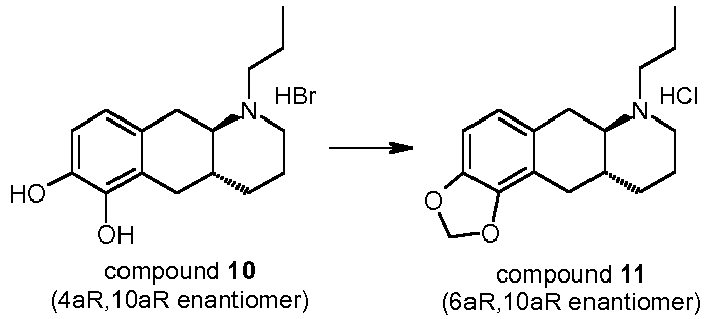
- Compound 10 (7.80 g), Cs2CO3 (18.6 g), CH2BrCl (2.2 mL), and DMF (180 mL) were heated to 100 °C for 1h under an argon atmosphere. The crude reaction mixture was added to separatory funnel and diluted with ice/water (300 mL). The resulting mixture was extracted with Et2O (3x300 mL). The combined organic layers were washed with brine (200 mL), dried (MgSO4) and concentrated in vacuo. The residue was purified by silica gel chromatography (EtOAc/MeOH) to afford a pale red solid, which was dissolved in MeOH (25 mL) and precipitated as the hydrochloride salt by addition of 2 M HCl in Et2O (20 mL) and Et2O (100 mL). The precipitated product was isolated by filtration and dried in vacuo. Yield of compound 11: 5.1 g. LC/MS (method 111): RT 0.70 min. ELSD 100%. UV 97.0%. MH+: 274.0.
- The synthesis of Compound 12 can be prepared as described in
EP Patent No. 1274411 . Compound 12 is referred to as (-)-GMC6650 in the above-identified patent. Compound 12 is included as a comparative example and does not form part of the invention. -

- The active metabolite (i.e. Compound 10) was found to function as a potent agonist at both the D1 and D2 receptors in-vitro. As discussed in greater detail below, the data generated from in-vivo experiments indicate that this active metabolite possesses a superior profile against other dopamine agonists and is on par with the efficacy seen with L-DOPA/apomorphine treatment.
- The ability of the compounds to either stimulate or inhibit the D1 receptor mediated cAMP formation in CHO cells stably expressing the human recombinant D1 receptor was measured as follows. Cells were seeded in 96-well plates at a concentration of 11000 cells/well 3 days prior to the experiment. On the day of the experiment the cells were washed once in preheated G buffer (1 mM MgCl2, 0.9 mM CaCl2, 1 mM IBMX (3-i-butyl-1-methylxanthine) in PBS (phosphate buffered saline)) and the assay was initiated by addition of 100 micro-L of a mixture of 30 nM A68930 and test compound diluted in G buffer (antagonism) or test compound diluted in G buffer (agonism).
- The cells were incubated for 20 minutes at 37 °C and the reaction was stopped by the addition of 100 micro-L S buffer (0.1 M HCl and 0.1 mM CaCl2) and the plates were placed at 4 °C for 1h. 68 micro-L N buffer (0.15 M NaOH and 60 mM NaOAc) was added and the plates were shaken for 10 minutes. 60 micro-1 of the reaction were transferred to cAMP FlashPlates (DuPont NEN) containing 40 micro-L 60 mM Sodium acetate pH 6.2 and 100 micro-L IC mix (50 mM Sodium acetate pH 6.2, 0.1 % sodium azide, 12 mM CaCl2, 1% BSA (bovine serum albumin) and 0.15 micro-Ci/mL 12SI-cAMP) were added. Following an 18h incubation at 4 °C the plates were washed once and counted in a Wallac TriLux counter.
Compound 10 was demonstrated to act as a D1 agonist in this assay. - The ability of the compounds to either stimulate or inhibit the D2 receptor mediated inhibition of cAMP formation in CHO cells transfected with the human D2 receptor was measure as follows. Cells were seeded in 96 well plates at a concentration of 8000 cells/well 3 days prior to the experiment. On the day of the experiment the cells were washed once in preheated G buffer (1 mM MgCl2, 0.9 mM CaCl2, 1 mM IBMX in PBS) and the assay was initiated by addition of 100 micro-1 of a mixture of 1 micro-M quinpirole, 10 microM forskolin and test compound in G buffer (antagonism) or 10 micro-M forskolin and test compound in G buffer (agonism).
- The cells were incubated 20 minutes at 37 °C and the reaction was stopped by the addition of 100 micro-1 S buffer (0.1 M HCl and 0.1 mM CaCl2) and the plates were placed at 4 °C for 1h. 68 micro-L N buffer (0.15 M NaOH and 60 mM Sodium acetate) were added and the plates were shaken for 10 minutes. 60 micro-L of the reaction were transferred to cAMP FlashPlates (DuPont NEN) containing 40 micro-L 60 mM NaOAc pH 6.2 and 100 micro-L IC mix (50 mM NaOAc pH 6.2, 0.1 % Sodium azide, 12 mM CaCl2, 1% BSA and 0.15 micro-Ci/ml 125I-cAMP) were added. Following an 18h incubation at 4 °C the plates were washed once and counted in a Wallac TriLux counter.
Compound 10 was demonstrated to act as a D2 agonist in this assay. - Concentration-dependent stimulation of intracellular Ca2+ release by dopamine in hD5-transfected CHO-Ga16 cells. The cells were loaded with fluoro-4, a calcium indicator dye, for 1h. Calcium response (fluorescence change) was monitored by FLIPR (fluorometric imaging plate reader) for 2.5 min. Peak responses (EC50) were averaged from duplicate wells for each data point and plotted with drug concentrations (cf.
Figure 2 for dopamine).Compound 10 was demonstrated to act as a D5 agonist in this assay. - Dopamine agonists can have activity at either the D1 receptors, the D2 receptors, or both. The rotation response in rats with unilateral 6-OHDA lesions can be used to assess compounds for their ability to stimulate both receptor types and induce rotation (Ungerstedt and Arbuthnott, Brain Res., 1970, 24, 485; Setler, et al. Eur. J. Pharmacol., 1978, 50(4), 419; and Ungerstedt, et al. "Advances in Dopamine Research" (Kohsaka, Ed.), Pergamon Press, 1982, Oxford, p. 219). 6-OHDA (6-hydroxydopamine) is a neurotoxin used by neurobiologists to selectively kill dopaminergic neurons at the site of injection in the brain in experimental animals. In the 6-OHDA model, the nigrostraital dopamine cells are destroyed on one side of the brain (unilateral) by injecting 6-OHDA into the median forebrain bundle, located in front of the substantia nigra. This unilateral injection combined with stimulation by dopamine agonists such as apomorphine will induce rotation behaviour as only one side of the brain is stimulated. Experiments consist of determining a minimum effective dose (MED) to induce rotation for the compound in question. Once a MED has been determined, a second experiment is performed to determine the MED of the compound to overcome Nemonapride block (MEDNemonapride). Nemonapride is a D2 antagonist that blocks the D2 receptor, therefore any observed rotations would be dependent upon activity at the D1 receptor. Finally, once the MEDNemonapride is known a third experiment is run using the MEDNemonapride dose and observing the effect of the D1 antagonist, SCH 23390 alone, the D2 antagonist, Nemonapride alone and finally, the effect of combined treatment with SCH 23390 and Nemonapride. This third experiment confirms the activity of the compound at both receptors as either antagonist alone can only partially inhibit the rotation response induced by the test compound while the combination treatment completely blocks all rotations in the rats [Arnt and Hyttel, Psychopharmacology, 1985, 85(3), 346; and Sonsalla et al., J. Pharmacol Exp. Ther., 1988, 247(1), 180]. This model was validated using apomorphine as the proof-of-principle compound for mixed D1/D2 agonists.
- In this model,
Compound 10 possess 'apomorphine'-like profiles with a D1/D2 ratio of about 2-4 as compared to a ratio of about 3 for apomorphine. Moreover, the duration of action observed was ca. 18h for the compound which is significantly higher than that seen with L-DOPA / apomorphine. A D1 component could not be observed for D2-agonists as exemplified by pramipexole and rotigotine. - Apomorphine and L-DOPA are able to reverse motility deficits in a mouse model of severe dopamine depletion. Both Apomorphine and L-DOPA stimulate D1 and D2 dopamine receptors. Pramipexole, an agonist at D2 receptors is ineffective in this model.
- The experiments were performed as follows: Mice previously treated with MPTP (2x15mg/kg subcutaneously) and that had stable lesions are used and vehicle treated mice served as normal controls. MPTP (1-methyl-4-phenyl-1,2,3,6-tetrahydropyridine) is a neurotoxin that causes permanent symptoms of Parkinson's disease by killing certain neurons in the substantia nigra of the brain. It is used to study the disease in monkeys and mice. On the day of the experiment, mice were treated with AMPT (250mg/kg subcutaneously) and then returned to their home cages for 1.5 hours after which they were placed in individual cages in the motility unit. AMPT (alpha-methyl-p-tyrosine) is a drug that temporarily reduces brain catecholamine activity (in this case especially dopamine levels). Three hours after the AMPT injection, rescue of locomotive deficits is attempted with
Compound 10 and activity was recorded for an additional 1.5 hours. The first 30 min of data collected after the rescue treatment was 'contaminated' due to stressing the animals with handling and injection as evidenced by increased levels in the vehicle controls therefore the data were analyzed using the last 1 hour of recorded data. Various dopaminergic compounds were tested for their ability to reverse the motility deficits produced in this model. Both L-DOPA/Benserazide, and apomorphine restored locomotion in the mice in a dose-dependent manner. Benserazide is a DOPA decarboxylase inhibitor which is unable to cross the blood-brain barrier; it is used to prevent metabolism of L-DOPA to dopamine outside the brain. In contrast, the D2 agonists, pramipexole and bromocriptine did not restore the locomotion in the mice. - This model was used to evaluate whether or not Compound 10 exhibits the same superiority as L-DOPA and apomorphine over D2 agonists. A dose response experiment for
Compound 10 was performed and there was a dose-dependent trend for reversing the hypomotility deficits induced by severe depletion of endogenous dopamine. A final experiment directly comparing the effects of apomorphine, pramipexole andCompound 10 in this model was performed and confirmed thatCompound 10 was able to restore locomotion in MPTP mice treated and was superior to pramipexole. - Twenty male Sprague Dawley rats with unilateral 6-OHDA lesions were used to test induction of dyskinesia by compound 10 (administered subcutaneously; n=7; group 1) compared to L-DOPA/benserazide (6mg/kg / 15mg/kg subcutaneously; n=7; group 2) and apomorphine (1mg/kg subcutaneously; n=6; group 3). Benserazide is a DOPA decarboxylase inhibitor which is unable to cross the blood-brain barrier; it is used to prevent metabolism of L-DOPA to dopamine outside the brain. Three weeks after 6-OHDA surgery, the animals were tested for their rotation response induced by 2.5mg/kg amphetamine, which induces ipsilateral circling (amphetamine increases the level dopamine in the brain via the intact neurons on the unlesioned side causing the animals to rotate in the opposite direction as compared to their response to direct agonists such as L-DOPA and apomorphine that act predominantly on the lesioned side of the brain). All animals included in this study met the criteria of greater than 350 rotations in 60 min. Rats where then randomly allocated to the three treatment groups balancing the groups for the animals' rotation response on amphetamine.
- During the actual dyskinesia experiments, rats received once daily injections of the test compounds subcutaneously and were observed for 3h following injection. Each animal was observed for 1 minute every 20 min throughout the 3h period for the presence of dyskinesias using the Abnormal Involuntary Movement Scale (AIMS) as described previously (Lundblad, et al., Eur. J Neurosci., 15, 120, (2002)). Rats received drug for 14 consecutive days and were scored on
days compound 10 had significantly less dykinesia (scores of about 30) compared to animals treated with either L-DOPA or apomorphine (scores of about 70). There were no differences between L-DOPA and apomorphine treated groups. Following this experiment all rats were given subcutaneous injections ofcompound 10 from day 15-19 in order to determine how Example I influenced the severity of dyskinesia seen in the apomorphine and L-DOPA groups. Dykinesia scoring was performed on day 19 of the experiment (corresponding to 5 days on compound 10). The data showed a partial reversal of the dyskinesias induced by L-DOPA and apomorphine to about the level of dyskinesias induced by compound 10 (which did not cause an increase in dyskinesia in group 1 as compared to the score of about 30 observed after 12 days of treatment). - A separate dyskinesia study addressed the reversal of L-DOPA induced dyskinesias with either pramipexole or
compound 10. Briefly, 18 animals were treated with L-DOPA/Benserazide (6/15mg/kg subcutaneously) for 7 days. Animals were observed on Days 1, 3 and 5 and AIMS were scored. The day 5 scores were then used to separate the animals into three groups of 6 animals each. Group 1 continued with daily L-DOPA treatment. Group 2 was treated with compound 10 (administered subcutaneously). Group 3 was treated with pramipexole (0.16mg/kg subcutaneously). Treatment continued daily for 10 days and the amount of dyskinesia was scored ondays compound 10 had significantly fewer dyskinesias than both the pramipexole group and the L-DOPA/Benserazide group. The pramipexole group had significantly less dyskinesias than the L-DOPA/Benserazide group. Hence,compound 10 had a superior profile over pramipexole in terms of reversing dyskinesias induced by L-DOPA. - The experiments were conducted using 6 MPTP treated marmosets (2.0mg/kg daily for up to 5 consecutive days dissolved in sterile 0.9% saline solution). All the animals had previously been treated with L-DOPA (12.5mg/kg p.o., plus carbidopa 12.5mg/kg p.o.) administered daily for up to 30 days in order to induce dyskinesia. Prior to the study all subjects exhibited stable motor deficits including a marked reduction of basal locomotor activity, poor coordination of movement, abnormal and/or rigid posture, reduced alertness and head checking movements. Domperidone was administered 60 min before any of the test compounds. Domperidone is an anti-dopaminergic drug that suppresses nausea and vomiting. Locomotor Activity was assessed using test cages that are comprised of 8 photo-electric switches comprised of 8 infra-red beams which are strategically placed in the cage and interruption of a beam is recorded as one count. The total number of beam counts per time segment is then plotted as time course or displayed as area under the curve (AUC) for total activity. The assessment of motor disability was performed by a trained observer blinded to the treatment.
- L-DOPA (12.5mg/kg, p.o.) increased locomotor activity and reversed motor disability as previously described (Smith, et al. Mov. Disord. 2002, 17(5), 887). The dose chosen for this challenge is at the top of the dose response curve for this drug. Compound 10 (dosed subcutaneously) produced dose-related increases in locomotor activity and reversal of motor disability tending to produce in a response greater than for L-DOPA (12.5mg/kg, p.o.). Both test compounds produced a prolonged reversal of motor disability compared to L-DOPA and were as efficacious as L-DOPA.
Compound 10 produced a prolonged reversal of motor disability compared to L-DOPA and was as efficacious as L-DOPA. - The ability of the compounds to either stimulate or inhibit the D1 receptor mediated cAMP formation in CHO cells stably expressing the human recombinant D1 receptor was measured as follows. Cells were seeded in 96-well plates at a concentration of 11000 cells/well 3 days prior to the experiment. On the day of the experiment the cells were washed once in preheated G buffer (1 mM MgCl2, 0.9 mM CaCl2, 1 mM IBMX (3-i-butyl-1-methylxanthine) in PBS (phosphate buffered saline)) and the assay was initiated by addition of 100 micro-L of a mixture of 30 nM A68930 and test compound diluted in G buffer (antagonism) or test compound diluted in G buffer (agonism).
- The cells were incubated for 20 minutes at 37 °C and the reaction was stopped by the addition of 100 micro-L S buffer (0.1 M HCl and 0.1 mM CaCl2) and the plates were placed at 4 °C for 1h. 68 micro-L N buffer (0.15 M NaOH and 60 mM NaOAc) was added and the plates were shaken for 10 minutes. 60 micro-1 of the reaction were transferred to cAMP FlashPlates (DuPont NEN) containing 40 micro-L 60 mM Sodium acetate pH 6.2 and 100 micro-L IC mix (50 mM Sodium acetate pH 6.2, 0.1 % sodium azide, 12 mM CaCl2, 1% BSA (bovine serum albumin) and 0.15 micro-Ci/mL 12SI-cAMP) were added. Following an 18h incubation at 4 °C the plates were washed once and counted in a Wallac TriLux counter. The active metabolite or
Compound 10 was found to be a D1 agonist in this assay. - The ability of the compounds to either stimulate or inhibit the D2 receptor mediated inhibition of cAMP formation in CHO cells transfected with the human D2 receptor was measure as follows. Cells were seeded in 96 well plates at a concentration of 8000 cells/well 3 days prior to the experiment. On the day of the experiment the cells were washed once in preheated G buffer (1 mM MgCl2, 0.9 mM CaCl2, 1 mM IBMX in PBS) and the assay was initiated by addition of 100 micro-1 of a mixture of 1 micro-M quinpirole, 10 microM forskolin and test compound in G buffer (antagonism) or 10 micro-M forskolin and test compound in G buffer (agonism).
- The cells were incubated 20 minutes at 37 °C and the reaction was stopped by the addition of 100 micro-1S buffer (0.1 M HCl and 0.1 mM CaCl2) and the plates were placed at 4 °C for 1h. 68 micro-L N buffer (0.15 M NaOH and 60 mM Sodium acetate) were added and the plates were shaken for 10 minutes. 60 micro-L of the reaction were transferred to cAMP FlashPlates (DuPont NEN) containing 40 micro-L 60 mM NaOAc pH 6.2 and 100 micro-L IC mix (50 mM NaOAc pH 6.2, 0.1 % Sodium azide, 12 mM CaCl2, 1% BSA and 0.15 micro-Ci/ml 125I-cAMP) were added. Following an 18h incubation at 4 °C the plates were washed once and counted in a Wallac TriLux counter. The active metabolite or
Compound 10 was found to be a D2 agonist in this assay. - Concentration-dependent stimulation of intracellular Ca2+ release by dopamine in hD5-transfected CHO-Ga16 cells. The cells were loaded with fluoro-4, a calcium indicator dye, for 1h. Calcium response (fluorescence change) was monitored by FLIPR (fluorometric imaging plate reader) for 2.5 min. Peak responses (EC50) were averaged from duplicate wells for each data point and plotted with drug concentrations. The active metabolite or
Compound 10 was found to be a D5 agonist in this assay. - Dopamine agonists can have activity at either the D1 receptors, the D2 receptors, or both. The rotation response in rats with unilateral 6-OHDA lesions can be used to assess compounds for their ability to stimulate both receptor types and induce rotation (Ungerstedt and Arbuthnott, Brain Res. 24, 485 (1970); Setler, et al., Eur. J. Pharmacol., 50(4), 419 (1978); and Ungerstedt, et al., "Advances in Dopamine Research" (Kohsaka, Ed.), Pergamon Press, 1982, Oxford, p. 219). 6-OHDA (6-hydroxydopamine) is a neurotoxin used by neurobiologists to selectively kill dopaminergic neurons at the site of injection in the brain in experimental animals. In the 6-OHDA model the nigrostraital dopamine cells are destroyed on one side of the brain (unilateral) by injecting 6-OHDA into the median forebrain bundle, located in front of the substantia nigra. This unilateral injection combined with stimulation by dopamine agonists such as apomorphine will induce rotation behaviour as only one side of the brain is stimulated. Experiments consist of determining a minimum effective dose (MED) to induce rotation for the compound in question. Once a MED has been determined, a second experiment is performed to determine the MED of the compound to overcome Nemonapride block (MEDNemonapride). Nemonapride is a D2 antagonist that blocks the D2 receptor, therefore any observed rotations would be dependent upon activity at the D1 receptor. Finally, once the MEDNemonapride is known a third experiment is run using the MEDNemonapride dose and observing the effect of the D1 antagonist, SCH 23390 alone, the D2 antagonist, Nemonapride alone and finally, the effect of combined treatment with SCH 23390 and Nemonapride. This third experiment confirms the activity of the compound at both receptors as either antagonist alone can only partially inhibit the rotation response induced by the test compound while the combination treatment completely blocks all rotations in the rats (Arnt and Hyttel; Psychophannacology, 85(3), 346 (1985); and Sonsalla, et al., J. Pharmacol Exp. Ther., 247(1), 180, (1988)). This model was validated using apomorphine as the proof-of-principle compound for mixed D1/D2 agonists.
- In this model, the active metabolite or
Compound 10 and Compound 11 possess 'apomorphine'-like profiles with D1/D2 ratios of about 2 as compared to a ratio of about 3 for apomorphine. Moreover, the duration of action observed was ca. 18h for the compound which is significantly higher than that seen with L-DOPA / apomorphine. A D1 component could not be observed for D2-agonists as exemplified by pramipexole and rotigotine. - Apomorphine and L-DOPA are able to reverse motility deficits in a mouse model of severe dopamine depletion. Both Apomorphine and L-DOPA stimulate D1 and D2 dopamine receptors. Pramipexole, an agonist at D2-like receptors is ineffective in this model.
- The experiments were performed as follows: Mice previously treated with MPTP (2x15mg/kg subcutaneously) and that had stable lesions are used and vehicle treated mice served as normal controls. MPTP (1-methyl-4-phenyl-1,2,3,6-tetrahydropyridine) is a neurotoxin that causes permanent symptoms of Parkinson's disease by killing certain neurons in the substantia nigra of the brain. It is used to study the disease in monkeys and mice. On the day of the experiment, mice were treated with AMPT (250mg/kg subcutaneously) and then returned to their home cages for 1.5 hours after which they are placed in individual cages in the motility unit. AMPT (alpha-methyl-p-tyrosine) is a drug that temporarily reduces brain catecholamine activity (in this case especially dopamine levels). Three hours after the AMPT injection, rescue of locomotive deficits is attempted with The active metabolite or
compound 10 and activity was recorded for an additional 1.5 hours. The first 30 min of data collected after the rescue treatment was 'contaminated' due to stressing the animals with handling and injection as evidenced by increased levels in the vehicle controls therefore the data were analyzed using the last 1 hour of recorded data. Various dopaminergic compounds are tested for their ability to reverse the motility deficits produced in this model. Both L-DOPA/Benserazide, and apomorphine restored locomotion in the mice in a dose-dependent manner. Benserazide is a DOPA decarboxylase inhibitor which is unable to cross the blood-brain barrier; it is used to prevent metabolism of L-DOPA to dopamine outside the brain. In contrast, the D2 agonists, pramipexole and bromocriptine did not restore the locomotion in the mice. - This model was used to evaluate whether or not The active metabolite or compound 10 exhibits the same superiority as L-DOPA and apomorphine over D2 agonists. A dose response experiment for was performed and there was a dose-dependent trend for reversing the hypomotility deficits induced by severe depletion of endogenous dopamine. A final experiment directly comparing the effects of apomorphine, pramipexole and
compound 10 was performed. It was confirmed thatcompound 10 was able to restore locomotion in MPTP mice treated and was superior to pramipexole. - A rat dyskinesia model reported in the literature (Lundblad, et al., Eur. J Neurosci., 2002, 15, 120) was used to examine the effects of the active metabolite vs. L-DOPA/benserazide with respect to dyskinesias that were assessed as abnormal involuntary movements (AIMs) in 'parkinsonian' rats.
- Throughout the study animals received L-DOPA/benserazide (6 mg/kg and 15 mg/kg subcutaneous) or the active metabolite (Compound 10) (Group B) once daily at t = -20 min. 0 - 180 min. Animals were scored for dyskinesias. Days 1 - 14: All animals were dosed with L-DOPA/benserazide (group A) or the active metabolite (Compound 10) (Group B).
- At
days 1, 3, 5, 8 and 12, animals were scored according to AIM-scoring by recording dyskinesias using the Abnormal Involuntary Movement Scale (AIMS) as described previously (Lundblad, et al., Eur. J Neurosci., 2002, 15, 120). Days 15 - 26: Group A animals were treated with the test drug (as group B) instead of L-DOPA/benserazide. Day 15, 16, 17, 19, 22, 24 and 26: Animals scored according AIM-scoring. - After eight days of treatment, group A animals had dyskinesia scores of 10-12, which remained constant until day 12. In comparison, group B animals had significantly fewer dyskinesias (scores of 2-4). For group B, the degree of dyskinesias did not change during the study. After shifting group A animals from L-dopa/benserazide to the test drug, their level of dyskinesia gradually decreased to the level observed for the other group of animals. Hence, Compound 11 induced significantly less dyskinesia than L-DOPA and was able to reduce the dyskinesias induced by L-DOPA.
- The experiments were conducted using 6 MPTP treated marmosets (2.0mg/kg daily for up to 5 consecutive days dissolved in sterile 0.9% saline solution). All the animals had previously been treated with L-DOPA (12.5mg/kg p.o., plus carbidopa 12.5mg/kg p.o.) administered daily for up to 30 days in order to induce dyskinesia. Prior to the study all subjects exhibited stable motor deficits including a marked reduction of basal locomotor activity, poor coordination of movement, abnormal and/or rigid posture, reduced alertness and head checking movements. Domperidone was administered 60 min before any of the test compounds. Domperidone is an antidopaminergic drug that suppresses nausea and vomiting. Locomotor Activity was assessed using test cages that are comprised of 8 photo-electric switches comprised of 8 infra-red beams which are strategically placed in the cage and interruption of a beam is recorded as one count. The total number of beam counts per time segment is then plotted as time course or displayed as area under the curve (AUC) for total activity. The assessment of motor disability was performed by a trained observer blinded to the treatment.
- L-DOPA (12.5mg/kg, p.o.) increased locomotor activity and reversed motor disability as previously described (Smith, et al. Mov. Disord. 2002, 17(5), 887). The dose chosen for this challenge is at the top of the dose response curve for this drug. Compound 11 (dosed p.o.) as well as compound 10 (dosed subcutaneously) produced dose-related increases in locomotor activity and reversal of motor disability tending to produce in a response greater than for L-DOPA (12.5mg/kg, p.o.). Both test compounds produced a prolonged reversal of motor disability compared to L-DOPA and were as efficacious as L-DOPA.
- Cryopreserved pooled male rat hepatocytes (Sprague Dawley) and pooled human hepatocytes from 10 donors (male and female) were purchased from In Vitro Technologies Inc., BA, USA. Cells were thawed at 37 °C in a water bath, live cells counted and seeded in a total of 100 micro-L in Dulbecco's modified Eagle medium (high glucose) with 5 mM Hepes buffer in 96 well plates, each well containing 250.000 and 500.000 cells/mL for rat and human hepatocytes, respectively. Incubations were started after 15 min of preincubation and stopped at time points of 0, 5, 15, 30 and 60 min for rats and at 0, 30, 60, 90 and 120 min for human hepatocytes. Incubations were stopped by addition of an equal volume of ice-cold acetonitrile containing 10% 1 M HCl. Following centrifugation, 20 micro-L of the supernatants were injected on a HPLC Column Atlantis dC18 3 micro-m, 150 x 2.1 mm i.d. (Waters, MA, USA). The mobile phase had the following composition: A: 5% acetonitrile, 95% H20, 3.7 ml/l 25% aq. NH3, 1.8 mL/L formic acid. Mobile phase B: 100% acetonitrile and 0.1% formic acid. The flow rate was 0.3 ml/min. The gradient operated from 0% to 75 % B from 5 min to 20 min and the eluate was analyzed using a Q-TOFmicro mass spectrometer (Waters, MA, USA). Formation of the product/metabolite was confirmed by accurate mass measurements and comparison with a synthesized standard giving coinciding retention times. In this assay, the metabolism of Compound 11 to Compound 10 was demonstrated.
- The ability of the compounds to either stimulate or inhibit the D1 receptor mediated cAMP formation in CHO cells stably expressing the human recombinant D1 receptor was measured as follows. Cells were seeded in 96-well plates at a concentration of 11000 cells/well 3 days prior to the experiment. On the day of the experiment the cells were washed once in preheated G buffer (1 mM MgCl2, 0.9 mM CaCl2, 1 mM IBMX (3-i-butyl-1-methylxanthine) in PBS (phosphate buffered saline)) and the assay was initiated by addition of 100 micro-L of a mixture of 30 nM A68930 and test compound diluted in G buffer (antagonism) or test compound diluted in G buffer (agonism).
- The cells were incubated for 20 minutes at 37 °C and the reaction was stopped by the addition of 100 micro-L S buffer (0.1 M HCl and 0.1 mM CaCl2) and the plates were placed at 4 °C for 1h. 68 micro-L N buffer (0.15 M NaOH and 60 mM NaOAc) was added and the plates were shaken for 10 minutes. 60 micro-1 of the reaction were transferred to cAMP FlashPlates (DuPont NEN) containing 40 micro-L 60 mM Sodium acetate pH 6.2 and 100 micro-L IC mix (50 mM Sodium acetate pH 6.2, 0.1 % sodium azide, 12 mM CaCl2, 1% BSA (bovine serum albumin) and 0.15 micro-Ci/mL 125I-cAMP) were added. Following an 18h incubation at 4 °C the plates were washed once and counted in a Wallac TriLux counter. The active metabolite (i.e. Compound 10) was found to be a D1 agonist in this assay.
- The ability of the compounds to either stimulate or inhibit the D2 receptor mediated inhibition of cAMP formation in CHO cells transfected with the human D2 receptor was measure as follows. Cells were seeded in 96 well plates at a concentration of 8000 cells/well 3 days prior to the experiment. On the day of the experiment the cells were washed once in preheated G buffer (1 mM MgCl2, 0.9 mM CaCl2, 1 mM IBMX in PBS) and the assay was initiated by addition of 100 micro-1 of a mixture of 1 micro-M quinpirole, 10 microM forskolin and test compound in G buffer (antagonism) or 10 micro-M forskolin and test compound in G buffer (agonism).
- The cells were incubated 20 minutes at 37 °C and the reaction was stopped by the addition of 100 micro-1 S buffer (0.1 M HCl and 0.1 mM CaCl2) and the plates were placed at 4 °C for 1h. 68 micro-L N buffer (0.15 M NaOH and 60 mM Sodium acetate) were added and the plates were shaken for 10 minutes. 60 micro-L of the reaction were transferred to cAMP FlashPlates (DuPont NEN) containing 40 micro-L 60 mM NaOAc pH 6.2 and 100 micro-L IC mix (50 mM NaOAc pH 6.2, 0.1 % Sodium azide, 12 mM CaCl2, 1% BSA and 0.15 micro-Ci/ml 125I-cAMP) were added. Following an 18h incubation at 4 °C the plates were washed once and counted in a Wallac TriLux counter. The active metabolite (i.e. Compound 10) was found to be a D2 agonist in this assay.
- Concentration-dependent stimulation of intracellular Ca2+ release by dopamine in hD5-transfected CHO-Ga16 cells. The cells were loaded with fluoro-4, a calcium indicator dye, for 1h. Calcium response (fluorescence change) was monitored by FLIPR (fluorometric imaging plate reader) for 2.5 min. Peak responses (EC50) were averaged from duplicate wells for each data point and plotted with drug concentrations (cf.
Figure 1 for dopamine). The active metabolite (i.e. Compound 10) was found to be a D5 agonist in this assay. - Dopamine agonists can have activity at either the D1 receptors, the D2 receptors, or both. The rotation response in rats with unilateral 6-OHDA lesions can be used to assess compounds for their ability to stimulate both receptor types and induce rotation (Ungerstedt and Arbuthnott; Brain Res., 24, 485 (1970); Setler, et al., Eur. J. Pharmacol., 50(4), 419 (1978); and Ungerstedt, et al., "Advances in Dopamine Research" (Kohsaka, Ed.), Pergamon Press, 1982, Oxford, p. 219). 6-OHDA (6-hydroxydopamine) is a neurotoxin used by neurobiologists to selectively kill dopaminergic neurons at the site of injection in the brain in experimental animals. In the 6-OHDA model the nigrostraital dopamine cells are destroyed on one side of the brain (unilateral) by injecting 6-OHDA into the median forebrain bundle, located in front of the substantia nigra. This unilateral injection combined with stimulation by dopamine agonists such as apomorphine will induce rotation behaviour as only one side of the brain is stimulated. Experiments consist of determining a minimum effective dose (MED) to induce rotation for the compound in question. Once a MED has been determined, a second experiment is performed to determine the MED of the compound to overcome Nemonapride block (MEDNemonapride). Nemonapride is a D2 antagonist that blocks the D2 receptor, therefore any observed rotations would be dependent upon activity at the D1 receptor. Finally, once the MEDNemonapride is known a third experiment is run using the MEDNemonapride dose and observing the effect of the D1 antagonist, SCH 23390 alone, the D2 antagonist, Nemonapride alone and finally, the effect of combined treatment with SCH 23390 and Nemonapride. This third experiment confirms the activity of the compound at both receptors as either antagonist alone can only partially inhibit the rotation response induced by the test compound while the combination treatment completely blocks all rotations in the rats [Arnt and Hyttel, Psychopharmacology, 1985, 85(3), 346; and Sonsalla et al., J. Pharmacol Exp. Ther., 1988, 247(1), 180]. This model was validated using apomorphine as the proof-of-principle compound for mixed D1/D2 agonists.
- In this model, Compounds 10 and 12 possess 'apomorphine'-like profiles with D1 / D2 ratios of about 2-4 as compared to a ratio of about 3 for apomorphine. Moreover, the duration of action observed was ca. 18h for the compound which is significantly higher than that seen with L-DOPA / apomorphine. A D1 component could not be observed for D2-agonists as exemplified by pramipexole and rotigotine.
- Apomorphine and L-DOPA are able to reverse motility deficits in a mouse model of severe dopamine depletion. Both Apomorphine and L-DOPA stimulate D1 and D2 receptors. Pramipexole, an agonist at D2 receptors is ineffective in this model.
- The experiments were performed as follows: Mice previously treated with MPTP (2x15mg/kg subcutaneously) and that had stable lesions are used and vehicle treated mice served as normal controls. MPTP (1-methyl-4-phenyl-1,2,3,6-tetrahydropyridine) is a neurotoxin that causes permanent symptoms of Parkinson's disease by killing certain neurons in the substantia nigra of the brain. It is used to study the disease in monkeys and mice. On the day of the experiment, mice were treated with AMPT (250mg/kg subcutaneously) and then returned to their home cages for 1.5 hours after which they were placed in individual cages in the motility unit. AMPT (alpha-methyl-p-tyrosine) is a drug that temporarily reduces brain catecholamine activity (in this case especially dopamine levels). Three hours after the AMPT injection, rescue of locomotive deficits was attempted with
Compound 10 and activity was recorded for an additional 1.5 hours. The first 30 min of data collected after the rescue treatment was 'contaminated' due to stressing the animals with handling and injection as evidenced by increased levels in the vehicle controls therefore the data were analyzed using the last 1 hour of recorded data. Various dopaminergic compounds were tested for their ability to reverse the motility deficits produced in this model. Both L-DOPA/Benserazide, and apomorphine restored locomotion in the mice in a dose-dependent manner. Benserazide is a DOPA decarboxylase inhibitor which is unable to cross the blood-brain barrier; it was used to prevent metabolism of L-DOPA to dopamine outside the brain. In contrast, the D2 agonists, pramipexole and bromocriptine did not restore the locomotion in the mice. - This model was used to evaluate whether or not Compound 10 exhibits the same superiority as L-DOPA and apomorphine over D2 agonists. A dose response experiment for was performed and there was a dose-dependent trend for reversing the hypomotility deficits induced by severe depletion of endogenous dopamine. A final experiment directly comparing the effects of apomorphine, pramipexole and
Compound 10 was performed. It was confirmed thatCompound 10 was able to restore locomotion in MPTP mice treated and was superior to pramipexole. - A rat dyskinesia model reported in the literature (Lundblad, et al., Eur. J Neurosci., 2002, 15, 120) was used to examine the effects of Compound 12 vs. L-DOPA/benserazide with respect to dyskinesias that were assessed as abnormal involuntary movements (AIMs) in 'parkinsonian' rats.
- Throughout the study animals received L-DOPA/benserazide (6 mg/kg and 15 mg/kg subcutaneous) or Compound 12 (group B) once daily at t = -20 min. 0 - 180 min. Animals were scored for dyskinesias. Days 1 - 14: All animals were dosed with L-DOPA/benserazide (group A) or Compound 12 (group B).
- At
days 1, 3, 5, 8 and 12, animals were scored according to AIM-scoring by recording dyskinesias using the Abnormal Involuntary Movement Scale (AIMS) as described previously. Days 15 - 26: Group A animals were treated with Compound 12 (as group B) instead of L-DOPA/benserazide. Day 15, 16, 17, 19, 22, 24 and 26: Animals scored according AIM-scoring. - After eight days of treatment, group A animals had dyskinesia scores of 70-80, which remained constant until day 15. In comparison, group B animals had significantly fewer dyskinesias (scores of 10-25). For group B, the degree of dyskinesias did not change during the study. After shifting group A animals from L-DOPA/benserazide to compound 12 for 10 days, their level of dyskinesia gradually decreased to scores of 30-35. Hence, compound 12 induced significantly less dyskinesia than L-DOPA and was able to reduce the dyskinesias induced by L-DOPA.
- The experiments were conducted using 6 MPTP treated marmosets (2.0mg/kg daily for up to 5 consecutive days dissolved in sterile 0.9% saline solution). All the animals had previously been treated with L-DOPA (12.5mg/kg p.o., plus carbidopa 12.5mg/kg p.o.) administered daily for up to 30 days in order to induce dyskinesia. Prior to the study all subjects exhibited stable motor deficits including a marked reduction of basal locomotor activity, poor coordination of movement, abnormal and/or rigid posture, reduced alertness and head checking movements. Domperidone was administered 60 min before any of the test compounds. Locomotor Activity was assessed using test cages that are comprised of 8 photo-electric switches comprised of 8 infra-red beams which are strategically placed in the cage and interruption of a beam is recorded as one count. The total number of beam counts per time segment is then plotted as time course or displayed as area under the curve (AUC) for total activity. The assessment of motor disability was performed by a trained observer blinded to the treatment.
- L-DOPA (12.5mg/kg, p.o.) increased locomotor activity and reversed motor disability as previously described (Smith, et al. Mov. Disord. 2002, 17(5), 887). The dose chosen for this challenge is at the top of the dose response curve for this drug. Compound 12 (dosed p.o.) as well as Compound 10 (dosed p.o.) produced dose-related increases in locomotor activity and reversal of motor disability tending to produce in a response greater than for L-DOPA (12.5mg/kg, p.o.). Both test compounds produced a prolonged reversal of motor disability compared to L-DOPA and were as efficacious as L-DOPA.
Claims (2)
- (6aR,10aR)-7-n-propyl-6,6a,7,8,9,10,10a,11-octahydro-1,3-dioxa-7-aza-cyclopenta[a]anthracene or a pharmaceutically acceptable salt thereof, for use in reversing dyskinesias, wherein the dyskinesia is associated with dopamine replacement therapy, wherein the dopamine replacement therapy agent is selected from the group consisting of rotigotine, ropinirole, pramipexole, cabergoline, bromocriptine, lisuride, pergolide, L-DOPA and apomorphine.
- The compound for use according to claim 1 wherein the dyskinesia is established as a result of repeated administration of L-DOPA.
Priority Applications (1)
| Application Number | Priority Date | Filing Date | Title |
|---|---|---|---|
| EP19191241.9A EP3653210A1 (en) | 2009-02-27 | 2010-02-26 | Treatment of dyskinesia related disorders |
Applications Claiming Priority (7)
| Application Number | Priority Date | Filing Date | Title |
|---|---|---|---|
| US15594309P | 2009-02-27 | 2009-02-27 | |
| US15596609P | 2009-02-27 | 2009-02-27 | |
| US15595309P | 2009-02-27 | 2009-02-27 | |
| DKPA200900281 | 2009-02-27 | ||
| DKPA200900273 | 2009-02-27 | ||
| DKPA200900280 | 2009-02-27 | ||
| PCT/DK2010/050051 WO2010097092A1 (en) | 2009-02-27 | 2010-02-26 | Treatment of dyskinesia related disorders |
Related Child Applications (1)
| Application Number | Title | Priority Date | Filing Date |
|---|---|---|---|
| EP19191241.9A Division EP3653210A1 (en) | 2009-02-27 | 2010-02-26 | Treatment of dyskinesia related disorders |
Publications (2)
| Publication Number | Publication Date |
|---|---|
| EP2400967A1 EP2400967A1 (en) | 2012-01-04 |
| EP2400967B1 true EP2400967B1 (en) | 2019-08-14 |
Family
ID=42060693
Family Applications (2)
| Application Number | Title | Priority Date | Filing Date |
|---|---|---|---|
| EP10707436.1A Active EP2400967B1 (en) | 2009-02-27 | 2010-02-26 | Treatment of dyskinesia related disorders |
| EP19191241.9A Withdrawn EP3653210A1 (en) | 2009-02-27 | 2010-02-26 | Treatment of dyskinesia related disorders |
Family Applications After (1)
| Application Number | Title | Priority Date | Filing Date |
|---|---|---|---|
| EP19191241.9A Withdrawn EP3653210A1 (en) | 2009-02-27 | 2010-02-26 | Treatment of dyskinesia related disorders |
Country Status (19)
| Country | Link |
|---|---|
| US (1) | US20120108624A1 (en) |
| EP (2) | EP2400967B1 (en) |
| JP (1) | JP5738775B2 (en) |
| KR (1) | KR101700978B1 (en) |
| CN (1) | CN102333531B (en) |
| AR (1) | AR075625A1 (en) |
| AU (1) | AU2010217059B2 (en) |
| BR (1) | BRPI1007017A2 (en) |
| CA (1) | CA2751322C (en) |
| CL (1) | CL2011002102A1 (en) |
| CO (1) | CO6410297A2 (en) |
| EA (1) | EA023778B1 (en) |
| IL (1) | IL213502A (en) |
| MX (1) | MX340138B (en) |
| NZ (1) | NZ594264A (en) |
| SG (1) | SG174163A1 (en) |
| TW (1) | TW201036949A (en) |
| WO (1) | WO2010097092A1 (en) |
| ZA (1) | ZA201106294B (en) |
Families Citing this family (17)
| Publication number | Priority date | Publication date | Assignee | Title |
|---|---|---|---|---|
| CR20200225A (en) * | 2017-11-24 | 2020-07-25 | H Lundbeck As | New catecholamine prodrugs for use in the treatment of parkinson's disease |
| WO2020070099A1 (en) | 2018-10-02 | 2020-04-09 | H. Lundbeck A/S | Administration of catecholamine prodrugs in combination with a 5-ht2b antagonist |
| US12319686B2 (en) | 2019-01-17 | 2025-06-03 | Hoffmann-La Roche Inc. | Process for the preparation of tetrahydropyridopyrimidines |
| US11168056B2 (en) | 2019-05-20 | 2021-11-09 | H. Lundbeck A/S | Process for the manufacturing of (6aR,10aR)-7-propyl-6,6a,7,8,9,10,10a,11-octahydro-[1,3]dioxolo[4′,5′:5,6]benzo[1,2-G]quinoline and (4aR,10aR)-1-propyl-1,2,3,4,4a,5,10,10a-octahydro-benzo[G]quinoline-6,7-diol |
| US11111263B2 (en) * | 2019-05-20 | 2021-09-07 | H. Lundbeck A/S | Process for the manufacture of (2S,3S,4S,5R,6S)-3,4,5-trihydroxy-6-(((4aR,10aR)-7-hydroxy-1-propyl-1,2,3,4,4a,5,10,10a-octahydrobenzo[g]quinolin-6-yl)oxy)tetrahydro-2H-pyran-2-carboxylic acid |
| US11104697B2 (en) | 2019-05-20 | 2021-08-31 | H. Lundbeck A/S | Process for the manufacture of (2S,3S,4S,5R,6S)-3,4,5-trihydroxy-6-(((4AR,10AR)-7-hydroxy-1- propyl-1,2,3,4,4A,5,10,10A-octahydrobenzo[g]quinolin-6-yl)oxy)tetrahydro-2H-pyran-2-carboxylic acid |
| US11130775B2 (en) * | 2019-05-20 | 2021-09-28 | H. Lundbeck A/S | Solid forms of (2S,3S,4S,5R,6S)-3,4,5-trihydroxy-6-(((4aR,10aR)-7-hydroxy-1-propyl-1,2,3,4,4A,5,10,10A-octahydrobenzo[g]quinolin-6-yl)oxy)tetrahydro-2H-pyran-2-carboxylic acid |
| JP7562562B2 (en) | 2019-05-21 | 2024-10-07 | ハー・ルンドベック・アクチエゼルスカベット | Novel catecholamine prodrugs for use in the treatment of Parkinson's disease |
| EP3972971A1 (en) | 2019-05-21 | 2022-03-30 | H. Lundbeck A/S | New catecholamine prodrugs for use in the treatment of parkinson's diseases |
| EP3972600B1 (en) | 2019-05-21 | 2026-02-18 | H. Lundbeck A/S | Catecholamine carbamate prodrugs for use in the treatment of parkinson s disease |
| JP7641234B2 (en) | 2019-05-21 | 2025-03-06 | ハー・ルンドベック・アクチエゼルスカベット | Novel catecholamine prodrugs for use in the treatment of Parkinson's disease |
| US20240025857A1 (en) | 2020-11-17 | 2024-01-25 | H. Lundbeck A/S | New catecholamine prodrugs for use in the treatment of parkinson's disease |
| EP4514467A1 (en) | 2022-04-25 | 2025-03-05 | Integrative Research Laboratories Sweden AB | Novel 1,2,3,4,4a,5,6,7,8,9,10,10a-dodecahydrobenzo[g]quinolin-6-ol compounds and uses thereof |
| WO2023208867A1 (en) | 2022-04-25 | 2023-11-02 | Integrative Research Laboratories Sweden Ab | NOVEL 1,2,3,4,4a,5,8,9,10,10a-DECAHYDROBENZO[G]QUINOLIN-6(7H)-ONE COMPOUNDS AND USES THEREOF |
| US20250282732A1 (en) | 2022-04-25 | 2025-09-11 | Integrative Research Laboratories Sweden Ab | NOVEL ESTERS OF 1,2,3,4,4a,5,6,7,8,9,10,10a-DODECAHYDROBENZO[G]QUINOLIN-6-OL COMPOUNDS AND USES THEREOF |
| WO2025078571A1 (en) | 2023-10-12 | 2025-04-17 | Integrative Research Laboratories Sweden Ab | NOVEL CARBONATES AND CARBAMATES OF 1,2,3,4,4a,5,6,7,8,9,10,10a- DODECAHYDROBENZO[g]QUINOLIN-6-OL COMPOUNDS AND USES THEREOF |
| WO2025078574A1 (en) | 2023-10-12 | 2025-04-17 | Integrative Research Laboratories Sweden Ab | NOVEL ESTERS OF 1,2,3,4,4a,5,6,7,8,9,10,10a-DODECAHYDROBENZO[g]QUINOLIN-6-OL COMPOUNDS AND USES THEREOF |
Family Cites Families (3)
| Publication number | Priority date | Publication date | Assignee | Title |
|---|---|---|---|---|
| SE0001438D0 (en) | 2000-04-18 | 2000-04-18 | Axon Chemicals Bv | New chemical compounds and their use in therapy |
| TWI404702B (en) | 2007-08-31 | 2013-08-11 | Lundbeck & Co As H | Catecholamine derivatives and prodrugs thereof |
| US20090124651A1 (en) * | 2007-08-31 | 2009-05-14 | H. Lundbeck A/S | Catecholamine derivatives and prodrugs thereof |
-
2010
- 2010-02-25 TW TW099105396A patent/TW201036949A/en unknown
- 2010-02-26 EA EA201171088A patent/EA023778B1/en not_active IP Right Cessation
- 2010-02-26 CN CN2010800098743A patent/CN102333531B/en active Active
- 2010-02-26 AU AU2010217059A patent/AU2010217059B2/en not_active Ceased
- 2010-02-26 JP JP2011551409A patent/JP5738775B2/en not_active Expired - Fee Related
- 2010-02-26 MX MX2011008944A patent/MX340138B/en active IP Right Grant
- 2010-02-26 KR KR1020117019748A patent/KR101700978B1/en not_active Expired - Fee Related
- 2010-02-26 US US13/202,768 patent/US20120108624A1/en not_active Abandoned
- 2010-02-26 CA CA2751322A patent/CA2751322C/en active Active
- 2010-02-26 AR ARP100100573A patent/AR075625A1/en unknown
- 2010-02-26 NZ NZ594264A patent/NZ594264A/en not_active IP Right Cessation
- 2010-02-26 EP EP10707436.1A patent/EP2400967B1/en active Active
- 2010-02-26 EP EP19191241.9A patent/EP3653210A1/en not_active Withdrawn
- 2010-02-26 BR BRPI1007017A patent/BRPI1007017A2/en not_active Application Discontinuation
- 2010-02-26 WO PCT/DK2010/050051 patent/WO2010097092A1/en not_active Ceased
- 2010-02-26 SG SG2011061785A patent/SG174163A1/en unknown
-
2011
- 2011-06-12 IL IL213502A patent/IL213502A/en active IP Right Grant
- 2011-08-26 CO CO11109225A patent/CO6410297A2/en not_active Application Discontinuation
- 2011-08-26 ZA ZA2011/06294A patent/ZA201106294B/en unknown
- 2011-08-26 CL CL2011002102A patent/CL2011002102A1/en unknown
Non-Patent Citations (2)
| Title |
|---|
| HILARY L. TYNE ET AL: "A 10 year retrospective audit of long-term apomorphine use in Parkinson?s disease", JOURNAL OF NEUROLOGY - ZEITSCHRIFT FUER NEUROLOGIE, vol. 251, no. 11, 1 November 2004 (2004-11-01), DE, pages 1370 - 1374, XP055311973, ISSN: 0340-5354, DOI: 10.1007/s00415-004-0547-4 * |
| STOCCHI F ET AL: "Continuous dopaminergic stimulation in early and advanced Parkinson's disease", NEUROLOGY, LIPPINCOTT WILLIAMS & WILKINS, PHILADELPHIA, US, vol. 62, no. 1 Supplement 1, 13 January 2004 (2004-01-13), pages S56 - S63, XP002576738, ISSN: 0028-3878 * |
Also Published As
| Publication number | Publication date |
|---|---|
| EP3653210A1 (en) | 2020-05-20 |
| HK1166472A1 (en) | 2012-11-02 |
| US20120108624A1 (en) | 2012-05-03 |
| CA2751322A1 (en) | 2010-09-02 |
| MX340138B (en) | 2016-06-28 |
| AU2010217059B2 (en) | 2012-08-30 |
| CO6410297A2 (en) | 2012-03-30 |
| KR101700978B1 (en) | 2017-01-31 |
| ZA201106294B (en) | 2012-10-31 |
| TW201036949A (en) | 2010-10-16 |
| EP2400967A1 (en) | 2012-01-04 |
| NZ594264A (en) | 2013-11-29 |
| IL213502A0 (en) | 2011-07-31 |
| CN102333531A (en) | 2012-01-25 |
| EA201171088A1 (en) | 2012-02-28 |
| MX2011008944A (en) | 2011-09-15 |
| CA2751322C (en) | 2017-10-31 |
| CL2011002102A1 (en) | 2012-07-20 |
| JP2012519157A (en) | 2012-08-23 |
| AU2010217059A1 (en) | 2011-08-11 |
| SG174163A1 (en) | 2011-10-28 |
| EA023778B1 (en) | 2016-07-29 |
| JP5738775B2 (en) | 2015-06-24 |
| BRPI1007017A2 (en) | 2016-03-29 |
| IL213502A (en) | 2017-02-28 |
| CN102333531B (en) | 2013-11-06 |
| AR075625A1 (en) | 2011-04-20 |
| KR20110132340A (en) | 2011-12-07 |
| WO2010097092A1 (en) | 2010-09-02 |
Similar Documents
| Publication | Publication Date | Title |
|---|---|---|
| AU2010217059B2 (en) | Treatment of dyskinesia related disorders | |
| KR100568063B1 (en) | Pharmacologically active morpholinol | |
| EP3503879B1 (en) | Composition comprising (a) a dual agent acting as a 5-ht2a receptor antagonist and cyp2d6 inhibitor and (b) an nmda receptor antagonist for use in the treatment of diseases involving glucose | |
| KR19990021896A (en) | Use of R-enantiomers, salts of N-propargyl-1-aminoindane, and their compositions | |
| DK2197883T3 (en) | Catecholamine derivative useful for the treatment of Parkinson's disease | |
| JP2780834B2 (en) | Methods and compositions for treating Parkinson's syndrome in mammals | |
| Sit | Dopamine Agonists in the Treatment of Parkinsons Disease-Past, Present and Future | |
| Van der Weide et al. | The enantiomers of the D-2 dopamine receptor agonist N-0437 discriminate between pre-and postsynaptic dopamine receptors | |
| Frattola et al. | Treatment of Huntington's chorea with bromocriptine | |
| Micheli et al. | Beneficial effects of lisuride in Meige disease | |
| US7098206B2 (en) | Pharmaceutically active morpholinol | |
| US6734213B2 (en) | Pharmaceutically active morpholinol | |
| US6998400B2 (en) | Pharmaceutically active morpholinol | |
| HK1166472B (en) | Treatment of dyskinesia related disorders | |
| US20130209362A1 (en) | 2-alkoxy-11-hydroxyaporphine derivatives and uses thereof | |
| JP3926867B2 (en) | Use of (α-aminomethyl-3,4-dichlorobenzyl) thioacetamide derivatives for inhibiting dopamine reuptake and novel compounds for this use | |
| Van Oene et al. | trans-Nn-propyl-7-hydroxy-octahydrobenzo (f) quinoline, a rigid 3-PPP analogue with greater potency but lack of selectivity for dopamine autoreceptors | |
| AU2002315922B2 (en) | Pharmaceutically active morpholinol | |
| KR20250077949A (en) | Composition for preventing or treating trpml1-related diseases via trpml1 activation | |
| KR20040023653A (en) | Pharmaceutically Active Morpholinol | |
| MXPA00007127A (en) | Pharmaceutically active morpholinol |
Legal Events
| Date | Code | Title | Description |
|---|---|---|---|
| PUAI | Public reference made under article 153(3) epc to a published international application that has entered the european phase |
Free format text: ORIGINAL CODE: 0009012 |
|
| 17P | Request for examination filed |
Effective date: 20110927 |
|
| AK | Designated contracting states |
Kind code of ref document: A1 Designated state(s): AT BE BG CH CY CZ DE DK EE ES FI FR GB GR HR HU IE IS IT LI LT LU LV MC MK MT NL NO PL PT RO SE SI SK SM TR |
|
| AX | Request for extension of the european patent |
Extension state: AL BA RS |
|
| 17Q | First examination report despatched |
Effective date: 20130910 |
|
| STAA | Information on the status of an ep patent application or granted ep patent |
Free format text: STATUS: EXAMINATION IS IN PROGRESS |
|
| GRAP | Despatch of communication of intention to grant a patent |
Free format text: ORIGINAL CODE: EPIDOSNIGR1 |
|
| STAA | Information on the status of an ep patent application or granted ep patent |
Free format text: STATUS: GRANT OF PATENT IS INTENDED |
|
| INTG | Intention to grant announced |
Effective date: 20181207 |
|
| GRAS | Grant fee paid |
Free format text: ORIGINAL CODE: EPIDOSNIGR3 |
|
| GRAA | (expected) grant |
Free format text: ORIGINAL CODE: 0009210 |
|
| STAA | Information on the status of an ep patent application or granted ep patent |
Free format text: STATUS: THE PATENT HAS BEEN GRANTED |
|
| AK | Designated contracting states |
Kind code of ref document: B1 Designated state(s): AT BE BG CH CY CZ DE DK EE ES FI FR GB GR HR HU IE IS IT LI LT LU LV MC MK MT NL NO PL PT RO SE SI SK SM TR |
|
| AX | Request for extension of the european patent |
Extension state: AL BA RS |
|
| REG | Reference to a national code |
Ref country code: GB Ref legal event code: FG4D |
|
| REG | Reference to a national code |
Ref country code: CH Ref legal event code: EP Ref country code: AT Ref legal event code: REF Ref document number: 1166192 Country of ref document: AT Kind code of ref document: T Effective date: 20190815 |
|
| REG | Reference to a national code |
Ref country code: DE Ref legal event code: R096 Ref document number: 602010060542 Country of ref document: DE |
|
| REG | Reference to a national code |
Ref country code: IE Ref legal event code: FG4D |
|
| REG | Reference to a national code |
Ref country code: NL Ref legal event code: MP Effective date: 20190814 |
|
| REG | Reference to a national code |
Ref country code: LT Ref legal event code: MG4D |
|
| PG25 | Lapsed in a contracting state [announced via postgrant information from national office to epo] |
Ref country code: NL Free format text: LAPSE BECAUSE OF FAILURE TO SUBMIT A TRANSLATION OF THE DESCRIPTION OR TO PAY THE FEE WITHIN THE PRESCRIBED TIME-LIMIT Effective date: 20190814 Ref country code: SE Free format text: LAPSE BECAUSE OF FAILURE TO SUBMIT A TRANSLATION OF THE DESCRIPTION OR TO PAY THE FEE WITHIN THE PRESCRIBED TIME-LIMIT Effective date: 20190814 Ref country code: LT Free format text: LAPSE BECAUSE OF FAILURE TO SUBMIT A TRANSLATION OF THE DESCRIPTION OR TO PAY THE FEE WITHIN THE PRESCRIBED TIME-LIMIT Effective date: 20190814 Ref country code: BG Free format text: LAPSE BECAUSE OF FAILURE TO SUBMIT A TRANSLATION OF THE DESCRIPTION OR TO PAY THE FEE WITHIN THE PRESCRIBED TIME-LIMIT Effective date: 20191114 Ref country code: PT Free format text: LAPSE BECAUSE OF FAILURE TO SUBMIT A TRANSLATION OF THE DESCRIPTION OR TO PAY THE FEE WITHIN THE PRESCRIBED TIME-LIMIT Effective date: 20191216 Ref country code: HR Free format text: LAPSE BECAUSE OF FAILURE TO SUBMIT A TRANSLATION OF THE DESCRIPTION OR TO PAY THE FEE WITHIN THE PRESCRIBED TIME-LIMIT Effective date: 20190814 Ref country code: FI Free format text: LAPSE BECAUSE OF FAILURE TO SUBMIT A TRANSLATION OF THE DESCRIPTION OR TO PAY THE FEE WITHIN THE PRESCRIBED TIME-LIMIT Effective date: 20190814 Ref country code: NO Free format text: LAPSE BECAUSE OF FAILURE TO SUBMIT A TRANSLATION OF THE DESCRIPTION OR TO PAY THE FEE WITHIN THE PRESCRIBED TIME-LIMIT Effective date: 20191114 |
|
| REG | Reference to a national code |
Ref country code: AT Ref legal event code: MK05 Ref document number: 1166192 Country of ref document: AT Kind code of ref document: T Effective date: 20190814 |
|
| PG25 | Lapsed in a contracting state [announced via postgrant information from national office to epo] |
Ref country code: LV Free format text: LAPSE BECAUSE OF FAILURE TO SUBMIT A TRANSLATION OF THE DESCRIPTION OR TO PAY THE FEE WITHIN THE PRESCRIBED TIME-LIMIT Effective date: 20190814 Ref country code: IS Free format text: LAPSE BECAUSE OF FAILURE TO SUBMIT A TRANSLATION OF THE DESCRIPTION OR TO PAY THE FEE WITHIN THE PRESCRIBED TIME-LIMIT Effective date: 20191214 Ref country code: ES Free format text: LAPSE BECAUSE OF FAILURE TO SUBMIT A TRANSLATION OF THE DESCRIPTION OR TO PAY THE FEE WITHIN THE PRESCRIBED TIME-LIMIT Effective date: 20190814 Ref country code: GR Free format text: LAPSE BECAUSE OF FAILURE TO SUBMIT A TRANSLATION OF THE DESCRIPTION OR TO PAY THE FEE WITHIN THE PRESCRIBED TIME-LIMIT Effective date: 20191115 |
|
| PG25 | Lapsed in a contracting state [announced via postgrant information from national office to epo] |
Ref country code: TR Free format text: LAPSE BECAUSE OF FAILURE TO SUBMIT A TRANSLATION OF THE DESCRIPTION OR TO PAY THE FEE WITHIN THE PRESCRIBED TIME-LIMIT Effective date: 20190814 |
|
| PG25 | Lapsed in a contracting state [announced via postgrant information from national office to epo] |
Ref country code: DK Free format text: LAPSE BECAUSE OF FAILURE TO SUBMIT A TRANSLATION OF THE DESCRIPTION OR TO PAY THE FEE WITHIN THE PRESCRIBED TIME-LIMIT Effective date: 20190814 Ref country code: EE Free format text: LAPSE BECAUSE OF FAILURE TO SUBMIT A TRANSLATION OF THE DESCRIPTION OR TO PAY THE FEE WITHIN THE PRESCRIBED TIME-LIMIT Effective date: 20190814 Ref country code: AT Free format text: LAPSE BECAUSE OF FAILURE TO SUBMIT A TRANSLATION OF THE DESCRIPTION OR TO PAY THE FEE WITHIN THE PRESCRIBED TIME-LIMIT Effective date: 20190814 Ref country code: RO Free format text: LAPSE BECAUSE OF FAILURE TO SUBMIT A TRANSLATION OF THE DESCRIPTION OR TO PAY THE FEE WITHIN THE PRESCRIBED TIME-LIMIT Effective date: 20190814 Ref country code: IT Free format text: LAPSE BECAUSE OF FAILURE TO SUBMIT A TRANSLATION OF THE DESCRIPTION OR TO PAY THE FEE WITHIN THE PRESCRIBED TIME-LIMIT Effective date: 20190814 Ref country code: PL Free format text: LAPSE BECAUSE OF FAILURE TO SUBMIT A TRANSLATION OF THE DESCRIPTION OR TO PAY THE FEE WITHIN THE PRESCRIBED TIME-LIMIT Effective date: 20190814 |
|
| PG25 | Lapsed in a contracting state [announced via postgrant information from national office to epo] |
Ref country code: IS Free format text: LAPSE BECAUSE OF FAILURE TO SUBMIT A TRANSLATION OF THE DESCRIPTION OR TO PAY THE FEE WITHIN THE PRESCRIBED TIME-LIMIT Effective date: 20200224 Ref country code: SM Free format text: LAPSE BECAUSE OF FAILURE TO SUBMIT A TRANSLATION OF THE DESCRIPTION OR TO PAY THE FEE WITHIN THE PRESCRIBED TIME-LIMIT Effective date: 20190814 Ref country code: CZ Free format text: LAPSE BECAUSE OF FAILURE TO SUBMIT A TRANSLATION OF THE DESCRIPTION OR TO PAY THE FEE WITHIN THE PRESCRIBED TIME-LIMIT Effective date: 20190814 Ref country code: SK Free format text: LAPSE BECAUSE OF FAILURE TO SUBMIT A TRANSLATION OF THE DESCRIPTION OR TO PAY THE FEE WITHIN THE PRESCRIBED TIME-LIMIT Effective date: 20190814 |
|
| REG | Reference to a national code |
Ref country code: DE Ref legal event code: R097 Ref document number: 602010060542 Country of ref document: DE |
|
| PLBE | No opposition filed within time limit |
Free format text: ORIGINAL CODE: 0009261 |
|
| STAA | Information on the status of an ep patent application or granted ep patent |
Free format text: STATUS: NO OPPOSITION FILED WITHIN TIME LIMIT |
|
| PG2D | Information on lapse in contracting state deleted |
Ref country code: IS |
|
| 26N | No opposition filed |
Effective date: 20200603 |
|
| PG25 | Lapsed in a contracting state [announced via postgrant information from national office to epo] |
Ref country code: SI Free format text: LAPSE BECAUSE OF FAILURE TO SUBMIT A TRANSLATION OF THE DESCRIPTION OR TO PAY THE FEE WITHIN THE PRESCRIBED TIME-LIMIT Effective date: 20190814 |
|
| REG | Reference to a national code |
Ref country code: DE Ref legal event code: R119 Ref document number: 602010060542 Country of ref document: DE |
|
| REG | Reference to a national code |
Ref country code: CH Ref legal event code: PL |
|
| GBPC | Gb: european patent ceased through non-payment of renewal fee |
Effective date: 20200226 |
|
| REG | Reference to a national code |
Ref country code: BE Ref legal event code: MM Effective date: 20200229 |
|
| PG25 | Lapsed in a contracting state [announced via postgrant information from national office to epo] |
Ref country code: MC Free format text: LAPSE BECAUSE OF FAILURE TO SUBMIT A TRANSLATION OF THE DESCRIPTION OR TO PAY THE FEE WITHIN THE PRESCRIBED TIME-LIMIT Effective date: 20190814 Ref country code: LU Free format text: LAPSE BECAUSE OF NON-PAYMENT OF DUE FEES Effective date: 20200226 |
|
| PG25 | Lapsed in a contracting state [announced via postgrant information from national office to epo] |
Ref country code: CH Free format text: LAPSE BECAUSE OF NON-PAYMENT OF DUE FEES Effective date: 20200229 Ref country code: LI Free format text: LAPSE BECAUSE OF NON-PAYMENT OF DUE FEES Effective date: 20200229 |
|
| PG25 | Lapsed in a contracting state [announced via postgrant information from national office to epo] |
Ref country code: DE Free format text: LAPSE BECAUSE OF NON-PAYMENT OF DUE FEES Effective date: 20200901 Ref country code: GB Free format text: LAPSE BECAUSE OF NON-PAYMENT OF DUE FEES Effective date: 20200226 Ref country code: FR Free format text: LAPSE BECAUSE OF NON-PAYMENT OF DUE FEES Effective date: 20200229 Ref country code: IE Free format text: LAPSE BECAUSE OF NON-PAYMENT OF DUE FEES Effective date: 20200226 |
|
| PG25 | Lapsed in a contracting state [announced via postgrant information from national office to epo] |
Ref country code: BE Free format text: LAPSE BECAUSE OF NON-PAYMENT OF DUE FEES Effective date: 20200229 |
|
| PG25 | Lapsed in a contracting state [announced via postgrant information from national office to epo] |
Ref country code: MT Free format text: LAPSE BECAUSE OF FAILURE TO SUBMIT A TRANSLATION OF THE DESCRIPTION OR TO PAY THE FEE WITHIN THE PRESCRIBED TIME-LIMIT Effective date: 20190814 Ref country code: CY Free format text: LAPSE BECAUSE OF FAILURE TO SUBMIT A TRANSLATION OF THE DESCRIPTION OR TO PAY THE FEE WITHIN THE PRESCRIBED TIME-LIMIT Effective date: 20190814 |
|
| PG25 | Lapsed in a contracting state [announced via postgrant information from national office to epo] |
Ref country code: MK Free format text: LAPSE BECAUSE OF FAILURE TO SUBMIT A TRANSLATION OF THE DESCRIPTION OR TO PAY THE FEE WITHIN THE PRESCRIBED TIME-LIMIT Effective date: 20190814 |