EP2400034A1 - Diluent for preparing analytical sample - Google Patents
Diluent for preparing analytical sample Download PDFInfo
- Publication number
- EP2400034A1 EP2400034A1 EP11171086A EP11171086A EP2400034A1 EP 2400034 A1 EP2400034 A1 EP 2400034A1 EP 11171086 A EP11171086 A EP 11171086A EP 11171086 A EP11171086 A EP 11171086A EP 2400034 A1 EP2400034 A1 EP 2400034A1
- Authority
- EP
- European Patent Office
- Prior art keywords
- diluent
- analytical
- sample
- liquid chromatography
- analytical sample
- Prior art date
- Legal status (The legal status is an assumption and is not a legal conclusion. Google has not performed a legal analysis and makes no representation as to the accuracy of the status listed.)
- Granted
Links
Images

Classifications
-
- C—CHEMISTRY; METALLURGY
- C12—BIOCHEMISTRY; BEER; SPIRITS; WINE; VINEGAR; MICROBIOLOGY; ENZYMOLOGY; MUTATION OR GENETIC ENGINEERING
- C12Q—MEASURING OR TESTING PROCESSES INVOLVING ENZYMES, NUCLEIC ACIDS OR MICROORGANISMS; COMPOSITIONS OR TEST PAPERS THEREFOR; PROCESSES OF PREPARING SUCH COMPOSITIONS; CONDITION-RESPONSIVE CONTROL IN MICROBIOLOGICAL OR ENZYMOLOGICAL PROCESSES
- C12Q1/00—Measuring or testing processes involving enzymes, nucleic acids or microorganisms; Compositions therefor; Processes of preparing such compositions
- C12Q1/001—Enzyme electrodes
- C12Q1/005—Enzyme electrodes involving specific analytes or enzymes
- C12Q1/006—Enzyme electrodes involving specific analytes or enzymes for glucose
-
- G—PHYSICS
- G01—MEASURING; TESTING
- G01N—INVESTIGATING OR ANALYSING MATERIALS BY DETERMINING THEIR CHEMICAL OR PHYSICAL PROPERTIES
- G01N33/00—Investigating or analysing materials by specific methods not covered by groups G01N1/00 - G01N31/00
- G01N33/48—Biological material, e.g. blood, urine; Haemocytometers
- G01N33/50—Chemical analysis of biological material, e.g. blood, urine; Testing involving biospecific ligand binding methods; Immunological testing
- G01N33/66—Chemical analysis of biological material, e.g. blood, urine; Testing involving biospecific ligand binding methods; Immunological testing involving blood sugars, e.g. galactose
-
- G—PHYSICS
- G01—MEASURING; TESTING
- G01N—INVESTIGATING OR ANALYSING MATERIALS BY DETERMINING THEIR CHEMICAL OR PHYSICAL PROPERTIES
- G01N33/00—Investigating or analysing materials by specific methods not covered by groups G01N1/00 - G01N31/00
- G01N33/48—Biological material, e.g. blood, urine; Haemocytometers
- G01N33/50—Chemical analysis of biological material, e.g. blood, urine; Testing involving biospecific ligand binding methods; Immunological testing
- G01N33/72—Chemical analysis of biological material, e.g. blood, urine; Testing involving biospecific ligand binding methods; Immunological testing involving blood pigments, e.g. haemoglobin, bilirubin or other porphyrins; involving occult blood
- G01N33/721—Haemoglobin
- G01N33/723—Glycosylated haemoglobin
-
- G—PHYSICS
- G01—MEASURING; TESTING
- G01N—INVESTIGATING OR ANALYSING MATERIALS BY DETERMINING THEIR CHEMICAL OR PHYSICAL PROPERTIES
- G01N33/00—Investigating or analysing materials by specific methods not covered by groups G01N1/00 - G01N31/00
- G01N33/48—Biological material, e.g. blood, urine; Haemocytometers
- G01N33/50—Chemical analysis of biological material, e.g. blood, urine; Testing involving biospecific ligand binding methods; Immunological testing
- G01N33/72—Chemical analysis of biological material, e.g. blood, urine; Testing involving biospecific ligand binding methods; Immunological testing involving blood pigments, e.g. haemoglobin, bilirubin or other porphyrins; involving occult blood
- G01N33/721—Haemoglobin
- G01N33/726—Devices
Definitions
- the present invention relates to a diluent for preparing an analytical sample, which diluent can be used both for analyzing a first object in a test sample by electrode method and for analyzing a second object in the test sample by liquid chromatography method.
- the method for analyzing a substance in a test sample such as a biological sample includes various methods such as electrode method and liquid chromatography method, and those methods are widely utilized in research and clinical sites.
- the method for analyzing a substance by electrode method has been, for example, applied to the measurement of glucose concentration in blood by enzyme electrode method, which measurement is generally carried out in a screening test and treatment of diabetes (Japanese Laid-open Patent Application (Kokai) No. 9-33533 , Japanese Laid-open Patent Application (Kokai) No. 2005-148058 ).
- glucose in a blood sample is reacted with glucose oxidase (GOD), glucose dehydrogenase (GDH) or the like, an electric current generated by the resulting oxidation-reduction reaction of enzyme reaction product (e.g. hydrogen peroxide) or mediater such as potassium ferricyanide is measured, an operation such as equivalent point method (end point method) or differentiation (rate method) is performed to obtain the glucose concentration in the blood sample.
- enzyme reaction product e.g. hydrogen peroxide
- mediater such as potassium ferricyanide
- the method for analyzing a substance by liquid chromatography method has been, for example, applied to the measurement of glycohemoglobin concentration in blood by liquid chromatography method, which measurement is generally carried out in a screening test and treatment of diabetes (Japanese Laid-open Patent Application (Kokai) No. 5-5730 , Japanese Laid-open Patent Application (Kokai) No. 9-178719 ).
- components such as HbAlc and HbF are separated on the analytical column utilizing the difference in electric charge, and the glycohemoglobin concentration in a blood sample is obtained based on the chromatogram showing the relationship between elution times and the amounts of elution of each fraction (for example, optical information such as absorbance).
- a blood analyzer for measuring glucose concentration by enzyme electrode method and a blood analyzer for measuring glycohemoglobin concentration by liquid chromatography method existed as separate apparatuses.
- the present inventors sought to attain more excellent usefulness, and developed a blood analyzer which can measure both glucose concentration and glycohemoglobin concentration by using a prepared sample for measurement commonly ( WO2008/035748 ).
- GOD electrode method as used herein utilizes fact that an electric current passes between cathode and anode by decomposing glucose at a GOD-immobilized membrane, bringing hydrogen peroxide as an enzyme reaction product to a hydrogen peroxide electrode, and applying external voltage to cause an oxidation-reduction reaction.
- a diluent is a supporting electrolyte solution, so that the higher the ionic strength of the diluent, the better the detection performance.
- liquid chromatography method as used herein, components such as HbAlc and HbF are separated by utilizing the difference in electric charge depending on the types of glycohemoglobin, so that the higher the ionic strength of the diluent, the lower the separation performance. Therefore, it was difficult to simultaneously attain the same diluent for preparing an analytical sample which is subjected to both analysis systems of an analysis of a first object in a test sample by electrode method and an analysis of a second object in the test sample by liquid chromatography method, and high analytical precision for both two objects.
- an object of the present invention is to provide a diluent which can prepare an analytical sample used both for analyzing a first object in a test sample by electrode method and for analyzing a second object in the test sample by liquid chromatography method, and can attain high-precision measurement.
- the present inventors intensively studied to discover that a diluent having the ionic strength range of 0.06 to 0.16 is suited for the common diluent in both analysis systems of an analysis of a first object in a test sample by electrode method and an analysis of a second object in the test sample by liquid chromatography method, thereby completing the present invention. That is, the present invention is as follows.
- a diluent which can prepare an analytical sample used both for analyzing a first object in a test sample by electrode method and for analyzing a second object in the test sample by liquid chromatography method, and can attain high-precision measurement is provided.
- the diluent according to the present invention is used for preparing an analytical sample which can be used both for analyzing a first object in a test sample by electrode method and for analyzing a second object in the test sample by liquid chromatography method.
- the above-described electrode method may be any method which can analyze a substance by utilizing an electrode.
- enzyme electrode method by using an enzyme is exemplified, but the electrode method is not restricted thereto.
- enzyme electrode method as an enzyme immobilized on an electrode, the following enzymes are exemplified.
- examples of such enzymes include those generally used in the enzyme electrode method, such as glucose oxidase (GOD) and glucose dehydrogenase (GDH), and preferably GOD, but are not restricted thereto.
- examples of such enzymes include LDH (lactic acid dehydrogenase, lactate dehydrogenase), cytochrome c dependent D-lactate dehydrogenase, cytochrome c dependent L-lactate dehydrogenase, NAD(P)-dependent enzyme D-lactate dehydrogenase, NAD(P)-dependent enzyme L-lactate dehydrogenase, LOD (lactic oxidase, lactate oxidase), but are not restricted thereto.
- the above-described liquid chromatography method can be preferably applied in cases where the second object is glycohemoglobin, but is not restricted thereto.
- the measurement of glycohemoglobin by liquid chromatography method is carried out by measuring an absorbance of each fraction at the absorption wavelength of hemoglobin after separating the fraction on the analytical column.
- the analytical column used include those generally used in separating glycohemoglobin, which filler is silica gel, polymethacrylate, polyhydroxymethacrylate, polyvinyl alcohol, styrenedivinylbenzene copolymer or the like.
- the test sample contains the first object and the second object, and the examples of the test sample preferably include a blood sample, but are not restricted thereto.
- the ionic strength is 0.06 to 0.16, preferably 0.08 to 0.14, more preferably 0.10 to 0.12.
- the ionic strength is one obtained by adding the products of mol concentration m of each ion and the square of charge z for all ionic species in solution, and then dividing the total into halves, and can be calculated by using the following equation (A).
- I ⁇ Ci ⁇ Zi 2 / 2
- Ci and Zi represent the concentration and the charge of the "i"th ion in the solution, respectively.
- the ionic strength is larger than 0.16, the second object cannot be well separated by the liquid chromatography column, and the analytical precision for the second object is poor.
- the detection performance for the first object by the electrode method is poor.
- the test sample is diluted with the use of the diluent of the present invention until the usual dilution factor, for example, about 50 to 200 times is attained.
- the analytical sample prepared by using the diluent having the ionic strength within this range can be subjected to both for analyzing a first object in a test sample by electrode method and for analyzing a second object in the test sample by liquid chromatography method, and high-precision analysis can be attained.
- the analytical sample is especially useful for preparing a sample for measurement used both for analyzing glucose concentration in a blood sample by enzyme electrode method and for analyzing glycohemoglobin concentration in the blood sample by liquid chromatography method.
- the type of an ion contained in the diluent according to the present invention is not restricted, for example, the ion is one or more selected from the group consisting of sodium ion (Na - ), potassium ion (K + ) , calcium ion (Ca 2- ), magnesium ion (Mg 2+ ), chloride ion (Cl - ), phosphate ion (PO 4 3- ) and hydrogen carbonate ion (HCO 3 - ).
- Na - sodium ion
- K + potassium ion
- Ca 2- calcium ion
- Mg 2+ magnesium ion
- chloride ion Cl -
- phosphate ion PO 4 3-
- HCO 3 - hydrogen carbonate ion
- the valency of the ion used herein is not restricted.
- the diluent according to the present invention is prepared by using an electrolyte which generates the above-described ion, such as an alkali metal salt
- the diluent according to the present invention may contain a hemolytic agent in an amount of not adversely affecting the effect of the present invention.
- a hemolytic agent for destroying a blood cell membrane of a blood cell component in a blood specimen include known hemolytic agents including glycoside such as saponin; surfactant such as polyoxyethylene alkyl aryl ether, higher aliphatic alcohol, alkyl aryl polyether alcohol, polyoxyethylene glycol or polyoxyethylene ether of sulfonate compound or sulfate compound, and polyoxyethylene adduct of sorbitol fatty acid ester; and ammonium chloride.
- the hemolytic agent may be preliminarily added to the diluent according to the present invention, and it may be added together with the blood specimen in preparing a sample for measurement, or may be added before or after adding the blood specimen. Further, the diluent according to the present invention may contain any additive such as a known antiseptic in an appropriate amount of not adversely affecting the effect of the present invention.
- the diluent can constitute a kit for preparing an analytical sample in combination with a hemolytic agent or a solution comprising a hemolytic agent, which kit can be used both for analyzing a first object in a blood sample by electrode method and for measuring a second object in the blood sample by liquid chromatography method.
- a container containing the diluent and a container containing the hemolytic agent or the solution comprising the hemolytic agent are included as separate packagings in the kit.
- the ionic strength when the diluent and the hemolytic agent or the solution comprising the hemolytic agent are mixed is 0.06 to 0.16, preferably 0.08 to 0.14, more preferably 0.10 to 0.12.
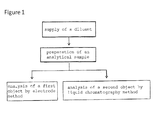
- the diluent according to the present invention can be applied to an analytical method comprising the steps of: (i) mixing a diluent for preparing an analytical sample and a test sample to prepare the analytical sample; (ii) a first analysis step of analyzing a first object in the analytical sample by electrode method; and (iii) a second analysis step of analyzing a second object in the analytical sample by liquid chromatography method.
- an analytical method see the flow chart shown in Fig. 1 .
- the preferable case is that the first analysis step (ii) is a step of measuring glucose concentration in the analytical sample by enzyme electrode method, and the second analysis step (iii) is a step of measuring glycohemoglobin concentration in the analytical sample by liquid chromatography method, but the present invention is not restricted thereto.
- High-precision analysis can be attained for both the first object and the second object in the test sample by carrying out the above-mentioned analytical method with the use of the dilution of the present invention as the diluent in the step (i) of preparing the analytical sample.
- the diluent according to the present invention can be applied to analyze the first object and the second object by using an analytical apparatus having a diluent bottle, a preparation device of the analytical sample, an analytical device of the first object and an analytical device of the second object.
- the diluent bottle used herein contains the diluent of the present invention.
- the preparation device of the sample the diluent of the present invention supplied from the diluent bottle and a test sample are mixed to prepare the analytical sample.
- the first object is analyzed by electrode method for the analytical sample prepared in the preparation device of the sample.
- the second object is analyzed by liquid chromatography method for the analytical sample also prepared in the preparation device of the sample.
- the diluent according to the present invention functions as the diluent for preparing an analytical sample, which diluent is used both for analyzing the first object in a test sample by electrode method and for analyzing the second object in the test sample by liquid chromatography method.
- the analytical apparatus used herein preferably includes the apparatus wherein the analytical device of the first object is for measuring glucose concentration in the analytical sample by enzyme electrode method, and the analytical device of the second object is for measuring glycohemoglobin concentration in the analytical sample by liquid chromatography method, but is not restricted thereto.
- the diluent according to the present invention also serves as a washing solution for a path and a measuring device in this analytical apparatus.
- the influence of the ionic strength of the diluent for preparing the test sample on the analytical performance of the first object and the second object was investigated.
- the first object was glucose
- the second object was glycohemoglobin
- each concentration of these in the test blood sample was measured by the following method to evaluate the measurement performance.
- Buffers containing supporting electrolytes (alkali metal, alkaline-earth metal and the like) having different concentrations were prepared, and diluents having various ionic strengths were prepared.
- the glucose concentrations in the samples for measurement obtained by diluting the test blood sample with the use of these each diluent were measured by using GOD electrode.
- the glycohemoglobin Alc concentrations in the samples for measurement were measured by liquid chromatography method using ion-exchange column.
- the apparatuses widely used in the usual measurement were used.
- the test blood sample used herein the sample in which both glucose concentration and glycohemoglobin Alc concentration were known was used, and the glucose concentration and the glycohemoglobin Alc concentration were 100 mg/dL and 5%, respectively.
- the difference between the measured value by the above-described measurement and the known concentration value was calculated as measurement accuracy (%). In cases where the ranges of the measurement accuracy are 97 to 103% for glucose concentration, and 99 to 101% for glycohemoglobin Alc concentration, it is considered that the accuracy of measurement is high.
- glucose is greatly influenced by clinical condition of a sample donor of short time period on the order of hours to days
- glycohemoglobin Alc indicates clinical condition of a sample donor of medium- to long-term period on the order of several months and does not vary in the short time period.
- the result of each of the measurement accuracy for glucose and glycohemoglobin at each value of ionic strength of the diluent is shown in Fig. 2 .
- the measurement accuracies for both glucose concentration and glycohemoglobin Alc concentration are high over the ionic strength range of the dilution from 0.090 to 0.124, and moreover, the measurement accuracies are especially high over the ionic strength range from 0.100 to 0.120.
- the diluent can be subjected to both for analyzing the first object in a test sample by electrode method and for analyzing the second object in the test sample by liquid chromatography method, and high-precision analysis can be attained, which is industrially useful.
- the diluent according to the present invention is applied for preparing a sample for measurement used both for measuring glucose concentration in a blood sample by enzyme electrode method and for measuring glycohemoglobin concentration in the blood sample by liquid chromatography method, the diluent is useful for a screening test and treatment of diabetes.
Landscapes
- Health & Medical Sciences (AREA)
- Life Sciences & Earth Sciences (AREA)
- Engineering & Computer Science (AREA)
- Chemical & Material Sciences (AREA)
- Hematology (AREA)
- Molecular Biology (AREA)
- Immunology (AREA)
- Biomedical Technology (AREA)
- Urology & Nephrology (AREA)
- Biotechnology (AREA)
- Microbiology (AREA)
- Biochemistry (AREA)
- Physics & Mathematics (AREA)
- Analytical Chemistry (AREA)
- General Health & Medical Sciences (AREA)
- Medicinal Chemistry (AREA)
- Organic Chemistry (AREA)
- Cell Biology (AREA)
- Food Science & Technology (AREA)
- General Physics & Mathematics (AREA)
- Pathology (AREA)
- Wood Science & Technology (AREA)
- Proteomics, Peptides & Aminoacids (AREA)
- Zoology (AREA)
- Biophysics (AREA)
- Emergency Medicine (AREA)
- Diabetes (AREA)
- Bioinformatics & Cheminformatics (AREA)
- General Engineering & Computer Science (AREA)
- Genetics & Genomics (AREA)
- Investigating Or Analysing Biological Materials (AREA)
Abstract
Description
- The present invention relates to a diluent for preparing an analytical sample, which diluent can be used both for analyzing a first object in a test sample by electrode method and for analyzing a second object in the test sample by liquid chromatography method.
- The method for analyzing a substance in a test sample such as a biological sample includes various methods such as electrode method and liquid chromatography method, and those methods are widely utilized in research and clinical sites.
- The method for analyzing a substance by electrode method has been, for example, applied to the measurement of glucose concentration in blood by enzyme electrode method, which measurement is generally carried out in a screening test and treatment of diabetes (Japanese Laid-open Patent Application (Kokai) No.
9-33533 2005-148058 - The method for analyzing a substance by liquid chromatography method has been, for example, applied to the measurement of glycohemoglobin concentration in blood by liquid chromatography method, which measurement is generally carried out in a screening test and treatment of diabetes (Japanese Laid-open Patent Application (Kokai) No.
5-5730 9-178719 - Conventionally, the above-described analysis by using electrode method and the above-described analysis by using liquid chromatography method have been carried out separately. For example, a blood analyzer for measuring glucose concentration by enzyme electrode method and a blood analyzer for measuring glycohemoglobin concentration by liquid chromatography method existed as separate apparatuses.
The present inventors sought to attain more excellent usefulness, and developed a blood analyzer which can measure both glucose concentration and glycohemoglobin concentration by using a prepared sample for measurement commonly (WO2008/035748 ). - In cases where a common analytical sample is used in both an analysis by electrode method and an analysis by liquid chromatography method for a test sample, there may be a problem of analytical precision since the same diluent for preparing the sample is used.
For example, in a blood analyzer in which the aforementioned measurement of glucose concentration by enzyme electrode method and the aforementioned measurement of glycohemoglobin concentration by liquid chromatography method are carried out by using the common sample for measurement, the following problem arises. Firstly, GOD electrode method as used herein utilizes fact that an electric current passes between cathode and anode by decomposing glucose at a GOD-immobilized membrane, bringing hydrogen peroxide as an enzyme reaction product to a hydrogen peroxide electrode, and applying external voltage to cause an oxidation-reduction reaction. At this time, a diluent is a supporting electrolyte solution, so that the higher the ionic strength of the diluent, the better the detection performance.
On the other hand, in liquid chromatography method as used herein, components such as HbAlc and HbF are separated by utilizing the difference in electric charge depending on the types of glycohemoglobin, so that the higher the ionic strength of the diluent, the lower the separation performance.
Therefore, it was difficult to simultaneously attain the same diluent for preparing an analytical sample which is subjected to both analysis systems of an analysis of a first object in a test sample by electrode method and an analysis of a second object in the test sample by liquid chromatography method, and high analytical precision for both two objects. - In view of these circumstances, an object of the present invention is to provide a diluent which can prepare an analytical sample used both for analyzing a first object in a test sample by electrode method and for analyzing a second object in the test sample by liquid chromatography method, and can attain high-precision measurement.
- To solve the above-described problem, the present inventors intensively studied to discover that a diluent having the ionic strength range of 0.06 to 0.16 is suited for the common diluent in both analysis systems of an analysis of a first object in a test sample by electrode method and an analysis of a second object in the test sample by liquid chromatography method, thereby completing the present invention.
That is, the present invention is as follows. - (1) A diluent for preparing an analytical sample, which diluent can be used both for analyzing a first object in a test sample by electrode method and for analyzing a second object in the test sample by liquid chromatography method, the diluent having an ionic strength of 0.06 to 0.16.
- (2) The diluent according to item 1, wherein the first object in the test sample is analyzed by electrode method using an enzyme which reacts with the first object in the test sample.
- (3) The diluent according to item 2, wherein the first object is glucose and the second object is glycohemoglobin, and
the glucose concentration in the test sample is measured by enzyme electrode method, and
the glycohemoglobin concentration in the test sample is measured by liquid chromatography method. - (4) The diluent according to any one of items 1 to 3, wherein the test sample is blood.
- (5) The diluent according to any one of items 1 to 4,
wherein an ion contained in the diluent is one or more selected from the group consisting of sodium ion, potassium ion, calcium ion, magnesium ion, chloride ion, phosphate ion and hydrogen carbonate ion. - (6) The diluent according to item 4 or 5, further comprising a hemolytic agent.
- (7) The diluent according to item 6, wherein said hemolytic agent is one or more selected from the group consisting of saponin, polyoxyethylene alkyl aryl ether, higher aliphatic alcohol, alkyl aryl polyether alcohol, polyoxyethylene glycol or polyoxyethylene ether of sulfonate compound or sulfate compound, polyoxyethylene adduct of sorbitol fatty acid ester, and ammonium chloride.
- (8) A kit for preparing an analytical sample, which kit can be used both for analyzing a first object in a blood sample by electrode method and for measuring a second object in the blood sample by liquid chromatography method, the kit comprising a diluent and a hemolytic agent, wherein an ionic strength of the dilluent after mixed with the hemolytic agent is 0.06 to 0.16.
- (9) A kit according to item 8, wherein said hemolytic agent is one or more selected from the group consisting of saponin, polyoxyethylene alkyl aryl ether, higher aliphatic alcohol, alkyl aryl polyether alcohol, polyoxyethylene glycol or polyoxyethylene ether of sulfonate compound or sulfate compound, polyoxyethylene adduct of sorbitol fatty acid ester, and ammonium chloride.
- (10) An analytical method comprising the steps of:
- mixing a diluent and a test sample to prepare the analytical sample;
- a first analysis step of analyzing a first object in said analytical sample by electrode method; and
- a second analysis step of analyzing a second object in said analytical sample by liquid chromatography method;
- wherein the diluent being the diluent according to any one of items 1 to 7.
- (11) The analytical method according to item 10, wherein
- said first analysis step is a step of measuring glucose concentration in said analytical sample by enzyme electrode method, and
- said second analysis step is a step of measuring glycohemoglobin concentration in said analytical sample by liquid chromatography method.
- (12) An analytical apparatus having:
- a diluent bottle containing a diluent for preparing an analytical sample;
- a preparation device of the analytical sample, in which said diluent supplied from said diluent bottle and a test sample are mixed to prepare the analytical sample;
- an analytical device of a first object, in which the first object is analyzed by electrode method for the analytical sample prepared in said preparation device of the analytical sample; and
- an analytical device of a second object, in which the second object is analyzed by liquid chromatography method for the analytical sample prepared in said preparation device of the analytical sample,
- said diluent being the diluent according to any one of items 1 to 7.
- (13) The analytical apparatus according to item 12, wherein
- said analytical device of the first object is for measuring glucose concentration in said analytical sample by enzyme electrode method, and
- said analytical device of the second object is for measuring glycohemoglobin concentration in said analytical sample by liquid chromatography method.
- (14) Use of a dilluent having an ionic strength of 0.06 to 0.16 in preparation of an analytical sample used both for analyzing a first object in a test sample by electrode method and for analyzing a second object in the test sample by liquid chromatography method.
- (15) The use according to item 14, wherein the first object in the test sample is analyzed by electrode method using an enzyme which reacts with the first object in the test sample.
- (16) The use according to item 15, wherein the first object is glucose and the second object is glycohemoglobin, and
the glucose concentration in the test sample is measured by enzyme electrode method, and
the glycohemoglobin concentration in the test sample is measured by liquid chromatography method. - (17) The use according to any one of items 14 to 16,
wherein the test sample is blood. - (18) The use according to any one of items 14 to 17,
wherein said diluents contains one or more ions selected from the group consisting of sodium ion, potassium ion, calcium ion, magnesium ion, chloride ion, phosphate ion and hydrogen carbonate ion. - (19) The use according to item 17 or 18, wherein the dilluent further comprises a hemolytic agent.
- (20) The use according to item 19, wherein said hemolytic agent is one or more selected from the group consisting of saponin, polyoxyethylene alkyl aryl ether, higher aliphatic alcohol, alkyl aryl polyether alcohol, polyoxyethylene glycol or polyoxyethylene ether of sulfonate compound or sulfate compound, polyoxyethylene adduct of sorbitol fatty acid ester, and ammonium chloride.
- According to the present invention, a diluent which can prepare an analytical sample used both for analyzing a first object in a test sample by electrode method and for analyzing a second object in the test sample by liquid chromatography method, and can attain high-precision measurement is provided.
-
-
Fig. 1 is a flow chart showing the analytical method according to the present invention. -
Fig. 2 is a graph showing the influence by the ionic strength of the diluent on the measurement performance of glucose concentration and hemoglobin Alc. - The diluent according to the present invention is used for preparing an analytical sample which can be used both for analyzing a first object in a test sample by electrode method and for analyzing a second object in the test sample by liquid chromatography method.
The above-described electrode method may be any method which can analyze a substance by utilizing an electrode. For example, enzyme electrode method by using an enzyme is exemplified, but the electrode method is not restricted thereto. In the above-described enzyme electrode method, as an enzyme immobilized on an electrode, the following enzymes are exemplified. In cases where the first object is glucose, examples of such enzymes include those generally used in the enzyme electrode method, such as glucose oxidase (GOD) and glucose dehydrogenase (GDH), and preferably GOD, but are not restricted thereto. In cases where the first object is lactic acid, examples of such enzymes include LDH (lactic acid dehydrogenase, lactate dehydrogenase), cytochrome c dependent D-lactate dehydrogenase, cytochrome c dependent L-lactate dehydrogenase, NAD(P)-dependent enzyme D-lactate dehydrogenase, NAD(P)-dependent enzyme L-lactate dehydrogenase, LOD (lactic oxidase, lactate oxidase), but are not restricted thereto.
The above-described liquid chromatography method can be preferably applied in cases where the second object is glycohemoglobin, but is not restricted thereto. The measurement of glycohemoglobin by liquid chromatography method is carried out by measuring an absorbance of each fraction at the absorption wavelength of hemoglobin after separating the fraction on the analytical column. Examples of the analytical column used include those generally used in separating glycohemoglobin, which filler is silica gel, polymethacrylate, polyhydroxymethacrylate, polyvinyl alcohol, styrenedivinylbenzene copolymer or the like.
In the present invention, the test sample contains the first object and the second object, and the examples of the test sample preferably include a blood sample, but are not restricted thereto. - In the dilution according to the present invention, the ionic strength is 0.06 to 0.16, preferably 0.08 to 0.14, more preferably 0.10 to 0.12. In the present invention, the ionic strength is one obtained by adding the products of mol concentration m of each ion and the square of charge z for all ionic species in solution, and then dividing the total into halves, and can be calculated by using the following equation (A).

- The type of an ion contained in the diluent according to the present invention is not restricted, for example, the ion is one or more selected from the group consisting of sodium ion (Na-), potassium ion (K+) , calcium ion (Ca2-), magnesium ion (Mg2+), chloride ion (Cl-), phosphate ion (PO4 3-) and hydrogen carbonate ion (HCO3 -). This is because more stable measurement system can be obtained by using the same type of ion as that of ion contained in a living body in measuring a component in the blood specimen. The valency of the ion used herein is not restricted.
The diluent according to the present invention is prepared by using an electrolyte which generates the above-described ion, such as an alkali metal salt or alkaline-earth metal salt. - The diluent according to the present invention may contain a hemolytic agent in an amount of not adversely affecting the effect of the present invention. Examples of the hemolytic agent for destroying a blood cell membrane of a blood cell component in a blood specimen include known hemolytic agents including glycoside such as saponin; surfactant such as polyoxyethylene alkyl aryl ether, higher aliphatic alcohol, alkyl aryl polyether alcohol, polyoxyethylene glycol or polyoxyethylene ether of sulfonate compound or sulfate compound, and polyoxyethylene adduct of sorbitol fatty acid ester; and ammonium chloride. The hemolytic agent may be preliminarily added to the diluent according to the present invention, and it may be added together with the blood specimen in preparing a sample for measurement, or may be added before or after adding the blood specimen.
Further, the diluent according to the present invention may contain any additive such as a known antiseptic in an appropriate amount of not adversely affecting the effect of the present invention. - In the present invention, the diluent can constitute a kit for preparing an analytical sample in combination with a hemolytic agent or a solution comprising a hemolytic agent, which kit can be used both for analyzing a first object in a blood sample by electrode method and for measuring a second object in the blood sample by liquid chromatography method. In this case, a container containing the diluent and a container containing the hemolytic agent or the solution comprising the hemolytic agent are included as separate packagings in the kit. The ionic strength when the diluent and the hemolytic agent or the solution comprising the hemolytic agent are mixed is 0.06 to 0.16, preferably 0.08 to 0.14, more preferably 0.10 to 0.12.
By preparing an analytical sample with the use of this kit, the analytical sample can be subjected to both for analyzing a first object in a blood sample by electrode method and for analyzing a second object in the blood sample by liquid chromatography method. - The diluent according to the present invention can be applied to an analytical method comprising the steps of: (i) mixing a diluent for preparing an analytical sample and a test sample to prepare the analytical sample; (ii) a first analysis step of analyzing a first object in the analytical sample by electrode method; and (iii) a second analysis step of analyzing a second object in the analytical sample by liquid chromatography method. As for the analytical method, see the flow chart shown in
Fig. 1 . In the analytical method, the preferable case is that the first analysis step (ii) is a step of measuring glucose concentration in the analytical sample by enzyme electrode method, and the second analysis step (iii) is a step of measuring glycohemoglobin concentration in the analytical sample by liquid chromatography method, but the present invention is not restricted thereto. High-precision analysis can be attained for both the first object and the second object in the test sample by carrying out the above-mentioned analytical method with the use of the dilution of the present invention as the diluent in the step (i) of preparing the analytical sample. - The diluent according to the present invention can be applied to analyze the first object and the second object by using an analytical apparatus having a diluent bottle, a preparation device of the analytical sample, an analytical device of the first object and an analytical device of the second object.
The diluent bottle used herein contains the diluent of the present invention. In the preparation device of the sample, the diluent of the present invention supplied from the diluent bottle and a test sample are mixed to prepare the analytical sample. In the analytical device of the first object, the first object is analyzed by electrode method for the analytical sample prepared in the preparation device of the sample. In the analytical device of the second object, the second object is analyzed by liquid chromatography method for the analytical sample also prepared in the preparation device of the sample.
In this analytical apparatus, the diluent according to the present invention functions as the diluent for preparing an analytical sample, which diluent is used both for analyzing the first object in a test sample by electrode method and for analyzing the second object in the test sample by liquid chromatography method. The analytical apparatus used herein preferably includes the apparatus wherein the analytical device of the first object is for measuring glucose concentration in the analytical sample by enzyme electrode method, and the analytical device of the second object is for measuring glycohemoglobin concentration in the analytical sample by liquid chromatography method, but is not restricted thereto.
The diluent according to the present invention also serves as a washing solution for a path and a measuring device in this analytical apparatus. - The present invention will now be described in more detail by way of Examples, but the present invention is not restricted to these Examples.
- The influence of the ionic strength of the diluent for preparing the test sample on the analytical performance of the first object and the second object was investigated. In this Example, the first object was glucose, the second object was glycohemoglobin, and each concentration of these in the test blood sample was measured by the following method to evaluate the measurement performance.
Buffers containing supporting electrolytes (alkali metal, alkaline-earth metal and the like) having different concentrations were prepared, and diluents having various ionic strengths were prepared. The glucose concentrations in the samples for measurement obtained by diluting the test blood sample with the use of these each diluent were measured by using GOD electrode. Further, the glycohemoglobin Alc concentrations in the samples for measurement were measured by liquid chromatography method using ion-exchange column. As for measuring apparatuses, the apparatuses widely used in the usual measurement were used.
As the test blood sample used herein, the sample in which both glucose concentration and glycohemoglobin Alc concentration were known was used, and the glucose concentration and the glycohemoglobin Alc concentration were 100 mg/dL and 5%, respectively. The difference between the measured value by the above-described measurement and the known concentration value was calculated as measurement accuracy (%). In cases where the ranges of the measurement accuracy are 97 to 103% for glucose concentration, and 99 to 101% for glycohemoglobin Alc concentration, it is considered that the accuracy of measurement is high. The reason why different criteria are set for each item is that glucose is greatly influenced by clinical condition of a sample donor of short time period on the order of hours to days, while glycohemoglobin Alc indicates clinical condition of a sample donor of medium- to long-term period on the order of several months and does not vary in the short time period.
The result of each of the measurement accuracy for glucose and glycohemoglobin at each value of ionic strength of the diluent is shown inFig. 2 . By this, it can be seen that, the measurement accuracies for both glucose concentration and glycohemoglobin Alc concentration are high over the ionic strength range of the dilution from 0.090 to 0.124, and moreover, the measurement accuracies are especially high over the ionic strength range from 0.100 to 0.120. - By using the diluent according to the present invention, the diluent can be subjected to both for analyzing the first object in a test sample by electrode method and for analyzing the second object in the test sample by liquid chromatography method, and high-precision analysis can be attained, which is industrially useful. Especially, in cases where the diluent according to the present invention is applied for preparing a sample for measurement used both for measuring glucose concentration in a blood sample by enzyme electrode method and for measuring glycohemoglobin concentration in the blood sample by liquid chromatography method, the diluent is useful for a screening test and treatment of diabetes.
Claims (13)
- A diluent for preparing an analytical sample, which diluent can be used both for analyzing a first object in a test sample by electrode method and for analyzing a second object in the test sample by liquid chromatography method, wherein the diluent has an ionic strength of 0.06 to 0.16.
- The diluent according to claim 1, wherein the first object in the test sample is analyzed by electrode method using an enzyme which reacts with the first object in the test sample.
- The diluent according to claim 2, wherein the first object is glucose and the second object is glycohemoglobin, and
the glucose concentration in the test sample is measured by enzyme electrode method, and
the glycohemoglobin concentration in the test sample is measured by liquid chromatography method. - The diluent according to any one of claims 1 to 3, wherein the test sample is blood.
- The diluent according to any one of claims 1 to 4, wherein said diluent contains one or more ions selected from the group consisting of sodium ion, potassium ion, calcium ion, magnesium ion, chloride ion, phosphate ion and hydrogen carbonate ion.
- The diluent according to claim 4 or 5, further comprising a hemolytic agent.
- The diluent according to claim 6, wherein said hemolytic agent is one or more selected from the group consisting of saponin, polyoxyethylene alkyl aryl ether, higher aliphatic alcohol, alkyl aryl polyether alcohol, polyoxyethylene glycol or polyoxyethylene ether of sulfonate compound or sulfate compound, polyoxyethylene adduct of sorbitol fatty acid ester, and ammonium chloride.
- A kit for preparing an analytical sample, which kit can be used both for analyzing a first object in a blood sample by electrode method and for measuring a second object in the blood sample by liquid chromatography method, the kit comprising a diluent and a hemolytic agent, wherein an ionic strength of the dilluent after mixed with the hemolytic agent is 0.06 to 0.16.
- The kit according to claim 8, wherein said hemolytic agent is one or more selected from the group consisting of saponin, polyoxyethylene alkyl aryl ether, higher aliphatic alcohol, alkyl aryl polyether alcohol, polyoxyethylene glycol or polyoxyethylene ether of sulfonate compound or sulfate compound, polyoxyethylene adduct of sorbitol fatty acid ester, and ammonium chloride.
- An analytical method comprising the steps of:mixing a diluent and a test sample to prepare the analytical sample;a first analysis step of analyzing a first object in said analytical sample by electrode method; anda second analysis step of analyzing a second object in said analytical sample by liquid chromatography method;wherein the diluent is the diluent according to any one of claims 1 to 7.
- The analytical method according to claim 10, wherein
said first analysis step is a step of measuring glucose concentration in said analytical sample by enzyme electrode method, and
said second analysis step is a step of measuring glycohemoglobin concentration in said analytical sample by liquid chromatography method. - An analytical apparatus having:a diluent bottle containing a diluent for preparing an analytical sample;a preparation device of the analytical sample, in which said diluent supplied from said diluent bottle and a test sample are mixed to prepare the analytical sample;an analytical device of a first object, in which the first object is analyzed by electrode method for the analytical sample prepared in said preparation device of the analytical sample; andan analytical device of a second object, in which the second object is analyzed by liquid chromatography method for the analytical sample prepared in said preparation device of the analytical sample,wherein the diluent is the diluent according to any one of claims 1 to 7.
- The analytical apparatus according to claim 12, wherein
said analytical device of the first object is for measuring glucose concentration in said analytical sample by enzyme electrode method, and
said analytical device of the second object is for measuring glycohemoglobin concentration in said analytical sample by liquid chromatography method.
Applications Claiming Priority (1)
| Application Number | Priority Date | Filing Date | Title |
|---|---|---|---|
| JP2010142245 | 2010-06-23 |
Publications (2)
| Publication Number | Publication Date |
|---|---|
| EP2400034A1 true EP2400034A1 (en) | 2011-12-28 |
| EP2400034B1 EP2400034B1 (en) | 2016-08-24 |
Family
ID=44658570
Family Applications (1)
| Application Number | Title | Priority Date | Filing Date |
|---|---|---|---|
| EP11171086.9A Active EP2400034B1 (en) | 2010-06-23 | 2011-06-22 | Diluent for preparing analytical sample |
Country Status (4)
| Country | Link |
|---|---|
| US (1) | US20120015388A1 (en) |
| EP (1) | EP2400034B1 (en) |
| JP (1) | JP2012027014A (en) |
| CN (1) | CN102297801A (en) |
Families Citing this family (3)
| Publication number | Priority date | Publication date | Assignee | Title |
|---|---|---|---|---|
| CN106525553A (en) * | 2016-11-30 | 2017-03-22 | 刘相东 | Diluent applied to blood analyzer and preparation method thereof |
| JP6789109B2 (en) | 2016-12-28 | 2020-11-25 | 富士フイルム株式会社 | Blood analysis method and blood test kit |
| CN112334767B (en) * | 2018-09-12 | 2024-01-09 | 积水医疗株式会社 | Reagents for measuring hemoglobins and methods for measuring hemoglobins |
Citations (7)
| Publication number | Priority date | Publication date | Assignee | Title |
|---|---|---|---|---|
| JPH055730A (en) | 1990-11-30 | 1993-01-14 | Hitachi Ltd | Liquid chromatograph |
| JPH0933533A (en) | 1995-07-21 | 1997-02-07 | Kdk Corp | Method for measuring concentration of glucose |
| JPH09178719A (en) | 1987-07-14 | 1997-07-11 | Kdk Corp | Automatic measuring method for glycohemoglobin |
| JP2000346848A (en) * | 1999-06-04 | 2000-12-15 | Tosoh Corp | Method and apparatus for measuring glucose |
| US6670192B1 (en) * | 1995-04-07 | 2003-12-30 | Robert S. Galen | Apparatus for combined assay for current glucose level and intermediate or long-term glycemic control |
| JP2005148058A (en) | 2003-10-20 | 2005-06-09 | Arkray Inc | Method and apparatus for measuring concentration of specific component in blood sample |
| WO2008035748A1 (en) | 2006-09-22 | 2008-03-27 | Arkray, Inc. | Blood analysis apparatus |
Family Cites Families (4)
| Publication number | Priority date | Publication date | Assignee | Title |
|---|---|---|---|---|
| JPH04127055A (en) * | 1990-09-19 | 1992-04-28 | Hitachi Ltd | Sample introducing method and apparatus and diagnostic apparatus using the same |
| JP4901956B2 (en) * | 2007-04-25 | 2012-03-21 | アークレイ株式会社 | Substrate concentration measuring method and substrate concentration measuring apparatus |
| US20100051464A1 (en) * | 2007-04-27 | 2010-03-04 | Arkray Inc. | Analysis chip and analysis apparatus |
| US9494553B2 (en) * | 2007-04-27 | 2016-11-15 | National Institute Of Advanced Industrial Science And Technology | Electrophoresis chip, electrophoresis apparatus, and method for analyzing sample by capillary electrophoresis |
-
2011
- 2011-06-22 EP EP11171086.9A patent/EP2400034B1/en active Active
- 2011-06-22 US US13/166,575 patent/US20120015388A1/en not_active Abandoned
- 2011-06-22 JP JP2011138108A patent/JP2012027014A/en active Pending
- 2011-06-23 CN CN2011101736019A patent/CN102297801A/en active Pending
Patent Citations (8)
| Publication number | Priority date | Publication date | Assignee | Title |
|---|---|---|---|---|
| JPH09178719A (en) | 1987-07-14 | 1997-07-11 | Kdk Corp | Automatic measuring method for glycohemoglobin |
| JPH055730A (en) | 1990-11-30 | 1993-01-14 | Hitachi Ltd | Liquid chromatograph |
| US6670192B1 (en) * | 1995-04-07 | 2003-12-30 | Robert S. Galen | Apparatus for combined assay for current glucose level and intermediate or long-term glycemic control |
| JPH0933533A (en) | 1995-07-21 | 1997-02-07 | Kdk Corp | Method for measuring concentration of glucose |
| JP2000346848A (en) * | 1999-06-04 | 2000-12-15 | Tosoh Corp | Method and apparatus for measuring glucose |
| JP2005148058A (en) | 2003-10-20 | 2005-06-09 | Arkray Inc | Method and apparatus for measuring concentration of specific component in blood sample |
| WO2008035748A1 (en) | 2006-09-22 | 2008-03-27 | Arkray, Inc. | Blood analysis apparatus |
| EP2083274A1 (en) * | 2006-09-22 | 2009-07-29 | ARKRAY, Inc. | Blood analysis apparatus |
Also Published As
| Publication number | Publication date |
|---|---|
| CN102297801A (en) | 2011-12-28 |
| US20120015388A1 (en) | 2012-01-19 |
| JP2012027014A (en) | 2012-02-09 |
| EP2400034B1 (en) | 2016-08-24 |
Similar Documents
| Publication | Publication Date | Title |
|---|---|---|
| US20240027480A1 (en) | Method of analyzing diluted biological sample component | |
| EP2319937B1 (en) | Blood component measurement method utilizing hemolyzed whole blood, and kit for the method | |
| EP3483603A1 (en) | Hemoglobin liquid preparation and liquid chromatography method for measuring hemoglobin component | |
| JP7593713B2 (en) | Hemoglobin measuring reagent and hemoglobin measuring method | |
| EP1992943A1 (en) | Method of determining metal by colorimetry and determination reagent | |
| CN107870170B (en) | A kind of kit of luminol chemiluminescence analysis measurement glycated albumin | |
| US20170102371A1 (en) | Lithium reagent composition, and method and device for determing lithium ion amount using same | |
| EP2400034B1 (en) | Diluent for preparing analytical sample | |
| EP0097472B1 (en) | Method of determining calcium in a fluid sample | |
| CN104673878A (en) | Kit for measuring concentration ratio of glycated albumin and albumin by virtue of single system | |
| CN110343740A (en) | A kind of highly sensitive Plasma lactate method and lactate acid detection kit | |
| JP4144117B2 (en) | Method and apparatus for measuring glucose | |
| Yagi et al. | Glycative stress and anti-aging: 2. The Evaluation of Glycative Stress: Measurement of blood glucose, glycated proteins and intermediates | |
| Shinya et al. | Development of an assay of seven biochemical items, HbA1c, and hematocrit using a small amount of blood collected from the fingertip | |
| JP3698281B2 (en) | Method for measuring glucose concentration | |
| CN108007922B (en) | A kind of kit detecting glucose using luminol chemiluminescence analysis | |
| EP3851850A1 (en) | Reagent and method for measuring hemoglobins | |
| US5227305A (en) | Buffer solution systems for standardizing pH analyzers and electrolytes | |
| EP4692785A1 (en) | Preparation liquid for analyzing hemoglobin component, and method for measuring hemoglobin component | |
| EP4685479A1 (en) | Blood analysis device and blood analysis method | |
| EP4502591A1 (en) | Ion concentration measurement device and measurement method | |
| JP7547952B2 (en) | Hemoglobin preparation and method for measuring hemoglobins using the hemoglobin preparation | |
| JPS6314303B2 (en) | ||
| JP3714689B2 (en) | Reagent for measuring bilirubin | |
| Savolainen et al. | Problems with the use of whole blood as a sample material in novel direct glucose analysers |
Legal Events
| Date | Code | Title | Description |
|---|---|---|---|
| AK | Designated contracting states |
Kind code of ref document: A1 Designated state(s): AL AT BE BG CH CY CZ DE DK EE ES FI FR GB GR HR HU IE IS IT LI LT LU LV MC MK MT NL NO PL PT RO RS SE SI SK SM TR |
|
| AX | Request for extension of the european patent |
Extension state: BA ME |
|
| PUAI | Public reference made under article 153(3) epc to a published international application that has entered the european phase |
Free format text: ORIGINAL CODE: 0009012 |
|
| 17P | Request for examination filed |
Effective date: 20120628 |
|
| 17Q | First examination report despatched |
Effective date: 20130206 |
|
| RAP1 | Party data changed (applicant data changed or rights of an application transferred) |
Owner name: SEKISUI MEDICAL CO., LTD. Owner name: ARKRAY, INC. |
|
| GRAP | Despatch of communication of intention to grant a patent |
Free format text: ORIGINAL CODE: EPIDOSNIGR1 |
|
| INTG | Intention to grant announced |
Effective date: 20160303 |
|
| GRAS | Grant fee paid |
Free format text: ORIGINAL CODE: EPIDOSNIGR3 |
|
| GRAA | (expected) grant |
Free format text: ORIGINAL CODE: 0009210 |
|
| RIN1 | Information on inventor provided before grant (corrected) |
Inventor name: TAKAGI, TAKESHI Inventor name: SAKAI, TOSHIKATSU Inventor name: OKA, TAKAYUKI Inventor name: KAMATA, TATSUO Inventor name: MIYAMOTO, CHIAKI Inventor name: YOTANI, TAKUYA Inventor name: ASAMI, TAKESHI |
|
| AK | Designated contracting states |
Kind code of ref document: B1 Designated state(s): AL AT BE BG CH CY CZ DE DK EE ES FI FR GB GR HR HU IE IS IT LI LT LU LV MC MK MT NL NO PL PT RO RS SE SI SK SM TR |
|
| REG | Reference to a national code |
Ref country code: GB Ref legal event code: FG4D |
|
| REG | Reference to a national code |
Ref country code: CH Ref legal event code: EP |
|
| REG | Reference to a national code |
Ref country code: AT Ref legal event code: REF Ref document number: 823148 Country of ref document: AT Kind code of ref document: T Effective date: 20160915 |
|
| REG | Reference to a national code |
Ref country code: IE Ref legal event code: FG4D |
|
| REG | Reference to a national code |
Ref country code: DE Ref legal event code: R096 Ref document number: 602011029545 Country of ref document: DE |
|
| REG | Reference to a national code |
Ref country code: LT Ref legal event code: MG4D |
|
| REG | Reference to a national code |
Ref country code: NL Ref legal event code: MP Effective date: 20160824 |
|
| REG | Reference to a national code |
Ref country code: AT Ref legal event code: MK05 Ref document number: 823148 Country of ref document: AT Kind code of ref document: T Effective date: 20160824 |
|
| PG25 | Lapsed in a contracting state [announced via postgrant information from national office to epo] |
Ref country code: RS Free format text: LAPSE BECAUSE OF FAILURE TO SUBMIT A TRANSLATION OF THE DESCRIPTION OR TO PAY THE FEE WITHIN THE PRESCRIBED TIME-LIMIT Effective date: 20160824 Ref country code: HR Free format text: LAPSE BECAUSE OF FAILURE TO SUBMIT A TRANSLATION OF THE DESCRIPTION OR TO PAY THE FEE WITHIN THE PRESCRIBED TIME-LIMIT Effective date: 20160824 Ref country code: LT Free format text: LAPSE BECAUSE OF FAILURE TO SUBMIT A TRANSLATION OF THE DESCRIPTION OR TO PAY THE FEE WITHIN THE PRESCRIBED TIME-LIMIT Effective date: 20160824 Ref country code: NO Free format text: LAPSE BECAUSE OF FAILURE TO SUBMIT A TRANSLATION OF THE DESCRIPTION OR TO PAY THE FEE WITHIN THE PRESCRIBED TIME-LIMIT Effective date: 20161124 Ref country code: FI Free format text: LAPSE BECAUSE OF FAILURE TO SUBMIT A TRANSLATION OF THE DESCRIPTION OR TO PAY THE FEE WITHIN THE PRESCRIBED TIME-LIMIT Effective date: 20160824 Ref country code: NL Free format text: LAPSE BECAUSE OF FAILURE TO SUBMIT A TRANSLATION OF THE DESCRIPTION OR TO PAY THE FEE WITHIN THE PRESCRIBED TIME-LIMIT Effective date: 20160824 |
|
| PG25 | Lapsed in a contracting state [announced via postgrant information from national office to epo] |
Ref country code: ES Free format text: LAPSE BECAUSE OF FAILURE TO SUBMIT A TRANSLATION OF THE DESCRIPTION OR TO PAY THE FEE WITHIN THE PRESCRIBED TIME-LIMIT Effective date: 20160824 Ref country code: SE Free format text: LAPSE BECAUSE OF FAILURE TO SUBMIT A TRANSLATION OF THE DESCRIPTION OR TO PAY THE FEE WITHIN THE PRESCRIBED TIME-LIMIT Effective date: 20160824 Ref country code: LV Free format text: LAPSE BECAUSE OF FAILURE TO SUBMIT A TRANSLATION OF THE DESCRIPTION OR TO PAY THE FEE WITHIN THE PRESCRIBED TIME-LIMIT Effective date: 20160824 Ref country code: PT Free format text: LAPSE BECAUSE OF FAILURE TO SUBMIT A TRANSLATION OF THE DESCRIPTION OR TO PAY THE FEE WITHIN THE PRESCRIBED TIME-LIMIT Effective date: 20161226 Ref country code: AT Free format text: LAPSE BECAUSE OF FAILURE TO SUBMIT A TRANSLATION OF THE DESCRIPTION OR TO PAY THE FEE WITHIN THE PRESCRIBED TIME-LIMIT Effective date: 20160824 Ref country code: GR Free format text: LAPSE BECAUSE OF FAILURE TO SUBMIT A TRANSLATION OF THE DESCRIPTION OR TO PAY THE FEE WITHIN THE PRESCRIBED TIME-LIMIT Effective date: 20161125 |
|
| PG25 | Lapsed in a contracting state [announced via postgrant information from national office to epo] |
Ref country code: RO Free format text: LAPSE BECAUSE OF FAILURE TO SUBMIT A TRANSLATION OF THE DESCRIPTION OR TO PAY THE FEE WITHIN THE PRESCRIBED TIME-LIMIT Effective date: 20160824 Ref country code: EE Free format text: LAPSE BECAUSE OF FAILURE TO SUBMIT A TRANSLATION OF THE DESCRIPTION OR TO PAY THE FEE WITHIN THE PRESCRIBED TIME-LIMIT Effective date: 20160824 |
|
| REG | Reference to a national code |
Ref country code: DE Ref legal event code: R097 Ref document number: 602011029545 Country of ref document: DE |
|
| PG25 | Lapsed in a contracting state [announced via postgrant information from national office to epo] |
Ref country code: PL Free format text: LAPSE BECAUSE OF FAILURE TO SUBMIT A TRANSLATION OF THE DESCRIPTION OR TO PAY THE FEE WITHIN THE PRESCRIBED TIME-LIMIT Effective date: 20160824 Ref country code: DK Free format text: LAPSE BECAUSE OF FAILURE TO SUBMIT A TRANSLATION OF THE DESCRIPTION OR TO PAY THE FEE WITHIN THE PRESCRIBED TIME-LIMIT Effective date: 20160824 Ref country code: SM Free format text: LAPSE BECAUSE OF FAILURE TO SUBMIT A TRANSLATION OF THE DESCRIPTION OR TO PAY THE FEE WITHIN THE PRESCRIBED TIME-LIMIT Effective date: 20160824 Ref country code: CZ Free format text: LAPSE BECAUSE OF FAILURE TO SUBMIT A TRANSLATION OF THE DESCRIPTION OR TO PAY THE FEE WITHIN THE PRESCRIBED TIME-LIMIT Effective date: 20160824 Ref country code: BE Free format text: LAPSE BECAUSE OF FAILURE TO SUBMIT A TRANSLATION OF THE DESCRIPTION OR TO PAY THE FEE WITHIN THE PRESCRIBED TIME-LIMIT Effective date: 20160824 Ref country code: BG Free format text: LAPSE BECAUSE OF FAILURE TO SUBMIT A TRANSLATION OF THE DESCRIPTION OR TO PAY THE FEE WITHIN THE PRESCRIBED TIME-LIMIT Effective date: 20161124 Ref country code: SK Free format text: LAPSE BECAUSE OF FAILURE TO SUBMIT A TRANSLATION OF THE DESCRIPTION OR TO PAY THE FEE WITHIN THE PRESCRIBED TIME-LIMIT Effective date: 20160824 |
|
| REG | Reference to a national code |
Ref country code: FR Ref legal event code: PLFP Year of fee payment: 7 |
|
| PLBE | No opposition filed within time limit |
Free format text: ORIGINAL CODE: 0009261 |
|
| STAA | Information on the status of an ep patent application or granted ep patent |
Free format text: STATUS: NO OPPOSITION FILED WITHIN TIME LIMIT |
|
| 26N | No opposition filed |
Effective date: 20170526 |
|
| PG25 | Lapsed in a contracting state [announced via postgrant information from national office to epo] |
Ref country code: SI Free format text: LAPSE BECAUSE OF FAILURE TO SUBMIT A TRANSLATION OF THE DESCRIPTION OR TO PAY THE FEE WITHIN THE PRESCRIBED TIME-LIMIT Effective date: 20160824 |
|
| PG25 | Lapsed in a contracting state [announced via postgrant information from national office to epo] |
Ref country code: MC Free format text: LAPSE BECAUSE OF FAILURE TO SUBMIT A TRANSLATION OF THE DESCRIPTION OR TO PAY THE FEE WITHIN THE PRESCRIBED TIME-LIMIT Effective date: 20160824 |
|
| REG | Reference to a national code |
Ref country code: CH Ref legal event code: PL |
|
| REG | Reference to a national code |
Ref country code: IE Ref legal event code: MM4A |
|
| PG25 | Lapsed in a contracting state [announced via postgrant information from national office to epo] |
Ref country code: IE Free format text: LAPSE BECAUSE OF NON-PAYMENT OF DUE FEES Effective date: 20170622 Ref country code: LU Free format text: LAPSE BECAUSE OF NON-PAYMENT OF DUE FEES Effective date: 20170622 Ref country code: LI Free format text: LAPSE BECAUSE OF NON-PAYMENT OF DUE FEES Effective date: 20170630 Ref country code: CH Free format text: LAPSE BECAUSE OF NON-PAYMENT OF DUE FEES Effective date: 20170630 |
|
| REG | Reference to a national code |
Ref country code: FR Ref legal event code: PLFP Year of fee payment: 8 |
|
| PG25 | Lapsed in a contracting state [announced via postgrant information from national office to epo] |
Ref country code: MT Free format text: LAPSE BECAUSE OF NON-PAYMENT OF DUE FEES Effective date: 20170622 |
|
| PG25 | Lapsed in a contracting state [announced via postgrant information from national office to epo] |
Ref country code: AL Free format text: LAPSE BECAUSE OF FAILURE TO SUBMIT A TRANSLATION OF THE DESCRIPTION OR TO PAY THE FEE WITHIN THE PRESCRIBED TIME-LIMIT Effective date: 20160824 |
|
| PG25 | Lapsed in a contracting state [announced via postgrant information from national office to epo] |
Ref country code: HU Free format text: LAPSE BECAUSE OF FAILURE TO SUBMIT A TRANSLATION OF THE DESCRIPTION OR TO PAY THE FEE WITHIN THE PRESCRIBED TIME-LIMIT; INVALID AB INITIO Effective date: 20110622 |
|
| PG25 | Lapsed in a contracting state [announced via postgrant information from national office to epo] |
Ref country code: CY Free format text: LAPSE BECAUSE OF NON-PAYMENT OF DUE FEES Effective date: 20160824 |
|
| PG25 | Lapsed in a contracting state [announced via postgrant information from national office to epo] |
Ref country code: MK Free format text: LAPSE BECAUSE OF FAILURE TO SUBMIT A TRANSLATION OF THE DESCRIPTION OR TO PAY THE FEE WITHIN THE PRESCRIBED TIME-LIMIT Effective date: 20160824 |
|
| PG25 | Lapsed in a contracting state [announced via postgrant information from national office to epo] |
Ref country code: TR Free format text: LAPSE BECAUSE OF FAILURE TO SUBMIT A TRANSLATION OF THE DESCRIPTION OR TO PAY THE FEE WITHIN THE PRESCRIBED TIME-LIMIT Effective date: 20160824 |
|
| PG25 | Lapsed in a contracting state [announced via postgrant information from national office to epo] |
Ref country code: IS Free format text: LAPSE BECAUSE OF FAILURE TO SUBMIT A TRANSLATION OF THE DESCRIPTION OR TO PAY THE FEE WITHIN THE PRESCRIBED TIME-LIMIT Effective date: 20161224 |
|
| REG | Reference to a national code |
Ref country code: DE Ref legal event code: R082 Ref document number: 602011029545 Country of ref document: DE |
|
| P01 | Opt-out of the competence of the unified patent court (upc) registered |
Effective date: 20230612 |
|
| PGFP | Annual fee paid to national office [announced via postgrant information from national office to epo] |
Ref country code: DE Payment date: 20250618 Year of fee payment: 15 |
|
| PGFP | Annual fee paid to national office [announced via postgrant information from national office to epo] |
Ref country code: GB Payment date: 20250618 Year of fee payment: 15 |
|
| PGFP | Annual fee paid to national office [announced via postgrant information from national office to epo] |
Ref country code: FR Payment date: 20250624 Year of fee payment: 15 |
|
| PGFP | Annual fee paid to national office [announced via postgrant information from national office to epo] |
Ref country code: IT Payment date: 20250624 Year of fee payment: 15 |