EP2398290A1 - Method and apparatus for terminal locating in long term evolution system - Google Patents
Method and apparatus for terminal locating in long term evolution system Download PDFInfo
- Publication number
- EP2398290A1 EP2398290A1 EP10740914A EP10740914A EP2398290A1 EP 2398290 A1 EP2398290 A1 EP 2398290A1 EP 10740914 A EP10740914 A EP 10740914A EP 10740914 A EP10740914 A EP 10740914A EP 2398290 A1 EP2398290 A1 EP 2398290A1
- Authority
- EP
- European Patent Office
- Prior art keywords
- terminal
- base station
- unit
- distance
- signal
- Prior art date
- Legal status (The legal status is an assumption and is not a legal conclusion. Google has not performed a legal analysis and makes no representation as to the accuracy of the status listed.)
- Ceased
Links
- 238000000034 method Methods 0.000 title claims abstract description 34
- 230000007774 longterm Effects 0.000 title claims abstract description 5
- 230000005540 biological transmission Effects 0.000 claims description 47
- 238000005259 measurement Methods 0.000 claims description 28
- 238000004364 calculation method Methods 0.000 claims description 22
- 238000012545 processing Methods 0.000 claims description 10
- 230000011664 signaling Effects 0.000 claims description 7
- 108010001267 Protein Subunits Proteins 0.000 claims 1
- 238000010586 diagram Methods 0.000 description 5
- 238000007429 general method Methods 0.000 description 2
- 238000012935 Averaging Methods 0.000 description 1
- 230000006978 adaptation Effects 0.000 description 1
- 238000004891 communication Methods 0.000 description 1
- 238000009499 grossing Methods 0.000 description 1
- 238000010295 mobile communication Methods 0.000 description 1
- 238000012986 modification Methods 0.000 description 1
- 230000004048 modification Effects 0.000 description 1
- 230000003287 optical effect Effects 0.000 description 1
- 238000006467 substitution reaction Methods 0.000 description 1
- 230000001360 synchronised effect Effects 0.000 description 1
Images


Classifications
-
- G—PHYSICS
- G01—MEASURING; TESTING
- G01S—RADIO DIRECTION-FINDING; RADIO NAVIGATION; DETERMINING DISTANCE OR VELOCITY BY USE OF RADIO WAVES; LOCATING OR PRESENCE-DETECTING BY USE OF THE REFLECTION OR RERADIATION OF RADIO WAVES; ANALOGOUS ARRANGEMENTS USING OTHER WAVES
- G01S5/00—Position-fixing by co-ordinating two or more direction or position line determinations; Position-fixing by co-ordinating two or more distance determinations
- G01S5/02—Position-fixing by co-ordinating two or more direction or position line determinations; Position-fixing by co-ordinating two or more distance determinations using radio waves
- G01S5/12—Position-fixing by co-ordinating two or more direction or position line determinations; Position-fixing by co-ordinating two or more distance determinations using radio waves by co-ordinating position lines of different shape, e.g. hyperbolic, circular, elliptical or radial
-
- G—PHYSICS
- G01—MEASURING; TESTING
- G01S—RADIO DIRECTION-FINDING; RADIO NAVIGATION; DETERMINING DISTANCE OR VELOCITY BY USE OF RADIO WAVES; LOCATING OR PRESENCE-DETECTING BY USE OF THE REFLECTION OR RERADIATION OF RADIO WAVES; ANALOGOUS ARRANGEMENTS USING OTHER WAVES
- G01S5/00—Position-fixing by co-ordinating two or more direction or position line determinations; Position-fixing by co-ordinating two or more distance determinations
- G01S5/0009—Transmission of position information to remote stations
- G01S5/0018—Transmission from mobile station to base station
- G01S5/0036—Transmission from mobile station to base station of measured values, i.e. measurement on mobile and position calculation on base station
-
- H—ELECTRICITY
- H04—ELECTRIC COMMUNICATION TECHNIQUE
- H04W—WIRELESS COMMUNICATION NETWORKS
- H04W64/00—Locating users or terminals or network equipment for network management purposes, e.g. mobility management
Definitions
- the present invention relates to the field of mobile communications and particularly to a method and device for positioning a terminal in a long term evolution system.
- LTE Long Term Evolution
- a GPS device In a first method based upon positioning with a Global Position System (GPS), a GPS device is installed in a terminal to thereby acquire and report to the system the current position of the terminal.
- GPS Global Position System
- a rough position of a terminal can be acquired by referring to a station address of a current serving cell of the terminal because the station addresses of serving cells are typically known during deployment of a communication system.
- a terminal measures concurrently transmission time differences of more than three nearby cells and multiplies the transmission time differences by transmission velocity (the velocity of light c) to derive distance differences and hereby plane curve equations of the position of the terminal, and the position of the terminal can be derived from an intersection of curves corresponding to the plane curve equations of the cells.
- transmission velocity the velocity of light c
- the first method with relatively high precision of positioning has to rely upon the expensive GPS device, and this method is costly to implement and relies upon the required capability of the terminal to receive a GPS signal;
- the second method has too low precision of positioning, especially in a macro cell with a large coverage area of a base station;
- the third method with relatively high complexity of measurement requires concurrent measurement and reporting by the terminal of the transmission time differences of three nearby cells, which may result in significant signaling overhead, furthermore, the terminal centered in a cell may measure a surrounding cell with a considerable error due to an interference and a signal strength.
- the invention provides a method and device for positioning a terminal in an LTE system to offer the advantages of a low cost, high precision and low complexity.
- a method for positioning a terminal in an LTE system includes:
- a device for positioning a terminal in an LTE system includes a first information acquisition unit, a transmission delay calculation unit, a distance calculation unit and a position determination unit, wherein:
- the transmission delay of the terminal to its serving base station is calculated from the synchronization timing advance of the terminal and the signal reception delay of the serving base station of the terminal, the distance of the terminal from the base station is determined from the transmission delay, and the position of the terminal relative to the base station is determined from the distance and the angle of arrival of the signal of the terminal.
- the device according to the invention can position the terminal in a simple algorithm at a greatly lowered cost as compared with a GPS device, and since all the parameters used in the invention, i.e., the synchronization timing advance of the terminal, the signal reception delay of the base station and the angle of arrival of the signal of the terminal, are measured parameters already present in the system and no value of any additional measurement parameter is required, good compatibility with an existing system can be achieved with low implementation complexity, and all these parameters can be precise to an elementary time unit T s of the LTE system, approximately 1/(15000 ⁇ 2048) second, thereby resulting in high precision of positioning.
- T s of the LTE system approximately 1/(15000 ⁇ 2048) second
- Fig. 1 is a flow chart of a general method according to the invention
- Fig. 2 is a flow chart of a specific method according to an embodiment of the invention.
- Fig. 3 is a schematic diagram of measuring of an angle of arrival of a signal according to an embodiment of the invention.
- Fig. 4a is a schematic diagram of a distance without considering a height of a base station according to an embodiment of the invention.
- Fig. 4b is a schematic diagram of a distance while considering a height of a base station according to an embodiment of the invention.
- Fig. 5 is a schematic diagram of a geometrical position relationship between a base station and a terminal according to an embodiment of the invention.
- Fig. 6 is a structural diagram of a device according to an embodiment of the invention.
- a method according to the invention may be as illustrated in Fig. 1 and generally include the following steps.
- the step 101 is to calculate, from a synchronization timing advance of a terminal and a signal reception delay of a serving base station of the terminal, a transmission delay of the terminal to the base station.
- the step 102 is to determine, from the calculated transmission delay, a distance of the terminal from the serving base station and to determine, from the distance and an angle of arrival of a signal of the terminal, a position of the terminal relative to the serving base station.
- Fig. 2 is a flow chart of a specific method according to an embodiment of the invention, and as illustrated in Fig. 2 , the method may include the following steps.
- a positioning device determines a terminal to be positioned, searches for a serving base station of the terminal and acquires positional information (X, Y) of the base station.
- Information on serving base stations of terminals can be retrieved from a data base of a system to which the terminals have already accesses.
- positional information of the terminals can not be determined directly, positional information of the base stations in a network keeps unchanged, so the positional information of the terminals can be acquired indirectly from the positional information of the serving base stations of the terminals.
- the positional information of the serving base station of the terminal may be identified with coordinates (X, Y) in a coordinate system.
- the step 202 is to determine a current status of the terminal, and if the terminal is in an unconnected status, the flow goes to the step 203, or if the terminal is in a connected status, the flow goes to the step 204.
- the positioning device transmits a paging message to the terminal through the base station to activate the terminal.
- the terminal If the terminal is in an unconnected status, firstly the terminal shall be activated to perform a subsequent task of measuring parameters, or if the terminal is in a connected status, the subsequent task of measuring parameters may be performed directly.
- the positioning device transmits to the base station a paging message including an ID of the terminal to be activated; and the base station transmits the paging message to the terminal to be activated according to the ID of the terminal included in the paging message upon reception of the paging message.
- the base station receives and transmits the paging message in a transparent transport process.
- the positioning device transmits a measurement command to the base station to instruct the base station to measure a signal reception delay T D for the terminal and an Angle of Arrival (AOA) of a signal of the terminal and to trigger the base station to instruct the terminal through Radio Resource Control (RRC) signaling upon reception of the measurement command to measure a synchronization timing advance T A of the terminal; and the positioning device acquires measurement results of the terminal and the base station.
- AOA Angle of Arrival
- RRC Radio Resource Control
- the base station instructs the terminal through RRC signaling upon reception of the measurement command to measure the synchronization timing advance T A , and the base station measures, from an uplink signal of the terminal, the signal reception delay T D and the Angle of Arrival (AOA) of the signal of the terminal.
- the base station may measure the signal reception delay T D from an uplink optical signal which may be an uplink Sounding Reference Signal (SRS), an uplink random access signal, an uplink data traffic signal, or an uplink control channel signal, etc.
- SRS uplink Sounding Reference Signal
- RRC Radio Resource Control Channel
- AOA Angle of Arrival
- the foregoing measurement process may be one-time measurement or perform a plurality of measurements and then a smoothing process thereon, e.g., averaging thereof, or taking the median thereof.
- the terminal acquires a downlink reference clock by receiving a downlink special signal transmitted periodically from the base station, and due to the transmission delay T from transmission of the base station to reception of the terminal, the transmission delay from transmission of the terminal to reception of the base station is also T.
- the system may perform a closed-loop synchronization process to have the base station transmit a synchronization command to the terminal to have the terminal adjust the time of transmission by an adjusting amount which is the synchronization timing advance T A of the terminal in the LTE system.
- the terminal transmits the signal by the synchronization timing advance T A , which arrives at the base station after the transmission delay T, and ideally the time of reception at the base station is exactly synchronized with a clock of the base station.
- T A the signal reception delay
- T D the signal reception delay
- the device may include a first information acquisition unit 601, a transmission delay calculation unit 602, a distance calculation unit 603 and a position determination unit 604.
- the first information acquisition unit 601 is configured to acquire a synchronization timing advance of a terminal, a signal reception delay of a serving base station of the terminal and an angle of arrival of a signal of the terminal.
- the transmission delay calculation unit 602 is configured to calculate, from the synchronization timing advance of the terminal and the signal reception delay, a transmission delay of the terminal to the base station.
- the distance calculation unit 603 is configured to determine, from the transmission delay calculated by the transmission delay calculation unit 602, a distance of the terminal from the base station.
- the position determination unit 604 is configured to determine, from the distance determined by the distance calculation unit 603 and the angle of arrival of the signal of the terminal acquired by the first information acquisition unit 601, a position of the terminal relative to the base station.
- the device may further include a second information acquisition unit 605 configured to determine the terminal to be positioned, search for the serving base station of the terminal and acquire positional information of the base station, and provide the first information acquisition unit 601 with information on the determined terminal and base station, and provide the position determination unit 604 with the acquired positional information of the base station.
- a second information acquisition unit 605 configured to determine the terminal to be positioned, search for the serving base station of the terminal and acquire positional information of the base station, and provide the first information acquisition unit 601 with information on the determined terminal and base station, and provide the position determination unit 604 with the acquired positional information of the base station.
- the first information acquisition unit 601 may include a measurement command transmission sub-unit 606 and a measurement result acquisition sub-unit 607.
- the measurement command transmission sub-unit 606 is configured to transmit a measurement command to the base station upon reception of the information on the determined terminal and base station to instruct the base station to measure the signal reception delay for the terminal and the angle of arrival of the signal of the terminal, and to trigger the base station to instruct the terminal through RRC signaling upon reception of the measurement command to measure the synchronization timing advance.
- the measurement result acquisition sub-unit 607 is configured to acquire measurement results of the terminal and the base station.
- the device may further include a status determination unit 608 and a paging processing unit 609.
- the status determination unit 608 is configured to determine whether the terminal is in an unconnected status upon reception of the information on the terminal and the base station transmitted from the second information acquisition unit 605, and if so, transmit a processing instruction to the paging processing unit 609; otherwise, transmit the information on the determined terminal and base station to the first information acquisition unit 601.
- the paging processing unit 609 is configured to transmit the information on the determined terminal and base station to the first information acquisition unit 601 after transmitting a paging message to the terminal through the base station to activate the terminal upon reception of the processing instruction.
- the foregoing positioning device according to the invention may be embodied as a separate device or by being arranged in the base station.
- the transmission delay of the terminal to its serving base station is calculated from the synchronization timing advance of the terminal and the signal reception delay of the serving base station of the terminal, the distance of the terminal from the base station is determined from the transmission delay, and the position of the terminal relative to the base station is determined from the distance and the angle of arrival of the signal of the terminal.
- the device according to the invention can position the terminal in a simple algorithm at a greatly lowered cost as compared with a GPS device, and since all the parameters used in the invention, i.e., the synchronization timing advance of the terminal, the signal reception delay of the base station and the angle of arrival of the signal of the terminal, are measured parameters already present in the system and no value of any additional measurement parameter is required, good compatibility with an existing system can be achieved with low implementation complexity, and all these parameters can be precise to an elementary time unit T s of the LTE system, approximately 1/(15000 ⁇ 2048) second, thereby resulting in high precision of positioning.
- T s of the LTE system approximately 1/(15000 ⁇ 2048) second
Landscapes
- Physics & Mathematics (AREA)
- Engineering & Computer Science (AREA)
- General Physics & Mathematics (AREA)
- Radar, Positioning & Navigation (AREA)
- Remote Sensing (AREA)
- Position Fixing By Use Of Radio Waves (AREA)
- Mobile Radio Communication Systems (AREA)
Abstract
Description
- The present invention relates to the field of mobile communications and particularly to a method and device for positioning a terminal in a long term evolution system.
- It is highly required in a Long Term Evolution (LTE) system to position a terminal. At present, there are the following several general methods for positioning a terminal.
- In a first method based upon positioning with a Global Position System (GPS), a GPS device is installed in a terminal to thereby acquire and report to the system the current position of the terminal.
- In a second method based upon positioning with a system cell, a rough position of a terminal can be acquired by referring to a station address of a current serving cell of the terminal because the station addresses of serving cells are typically known during deployment of a communication system.
- In a third method based upon positioning with Observed Time Difference of Arrival (OTDOA), a terminal measures concurrently transmission time differences of more than three nearby cells and multiplies the transmission time differences by transmission velocity (the velocity of light c) to derive distance differences and hereby plane curve equations of the position of the terminal, and the position of the terminal can be derived from an intersection of curves corresponding to the plane curve equations of the cells.
- Among the foregoing three methods, the first method with relatively high precision of positioning has to rely upon the expensive GPS device, and this method is costly to implement and relies upon the required capability of the terminal to receive a GPS signal; the second method has too low precision of positioning, especially in a macro cell with a large coverage area of a base station; and the third method with relatively high complexity of measurement requires concurrent measurement and reporting by the terminal of the transmission time differences of three nearby cells, which may result in significant signaling overhead, furthermore, the terminal centered in a cell may measure a surrounding cell with a considerable error due to an interference and a signal strength.
- In view of this, the invention provides a method and device for positioning a terminal in an LTE system to offer the advantages of a low cost, high precision and low complexity.
- A method for positioning a terminal in an LTE system includes:
- A. calculating, from a synchronization timing advance of the terminal and a signal reception delay of a serving base station of the terminal, a transmission delay of the terminal to the base station; and
- B. determining, from the calculated transmission delay, a distance of the terminal from the base station and determining, from the distance and an angle of arrival of a signal of the terminal, a position of the terminal relative to the base station.
- A device for positioning a terminal in an LTE system includes a first information acquisition unit, a transmission delay calculation unit, a distance calculation unit and a position determination unit, wherein:
- the first information acquisition unit is configured to acquire a synchronization timing advance of the terminal, a signal reception delay of a serving base station of the terminal and an angle of arrival of a signal of the terminal;
- the transmission delay calculation unit is configured to calculate, from the synchronization timing advance of the terminal and the signal reception delay, a transmission delay of the terminal to the base station;
- the distance calculation unit is configured to determine, from the transmission delay calculated by the transmission delay calculation unit, a distance of the terminal from the base station; and
- the position determination unit is configured to determine, from the distance determined by the distance calculation unit and the angle of arrival of the signal of the terminal acquired by the first information acquisition unit, a position of the terminal relative to the base station.
- As can be apparent from the foregoing technical solutions, in the method and device according to the invention, the transmission delay of the terminal to its serving base station is calculated from the synchronization timing advance of the terminal and the signal reception delay of the serving base station of the terminal, the distance of the terminal from the base station is determined from the transmission delay, and the position of the terminal relative to the base station is determined from the distance and the angle of arrival of the signal of the terminal. The device according to the invention can position the terminal in a simple algorithm at a greatly lowered cost as compared with a GPS device, and since all the parameters used in the invention, i.e., the synchronization timing advance of the terminal, the signal reception delay of the base station and the angle of arrival of the signal of the terminal, are measured parameters already present in the system and no value of any additional measurement parameter is required, good compatibility with an existing system can be achieved with low implementation complexity, and all these parameters can be precise to an elementary time unit Ts of the LTE system, approximately 1/(15000×2048) second, thereby resulting in high precision of positioning.
-
Fig. 1 is a flow chart of a general method according to the invention; -
Fig. 2 is a flow chart of a specific method according to an embodiment of the invention; -
Fig. 3 is a schematic diagram of measuring of an angle of arrival of a signal according to an embodiment of the invention; -
Fig. 4a is a schematic diagram of a distance without considering a height of a base station according to an embodiment of the invention; -
Fig. 4b is a schematic diagram of a distance while considering a height of a base station according to an embodiment of the invention; -
Fig. 5 is a schematic diagram of a geometrical position relationship between a base station and a terminal according to an embodiment of the invention; and -
Fig. 6 is a structural diagram of a device according to an embodiment of the invention. - The invention will be described in details hereinafter with reference to the drawings and embodiments thereof to make the objects, technical solutions and advantages of the invention more apparent.
- A method according to the invention may be as illustrated in
Fig. 1 and generally include the following steps. - The
step 101 is to calculate, from a synchronization timing advance of a terminal and a signal reception delay of a serving base station of the terminal, a transmission delay of the terminal to the base station. - The
step 102 is to determine, from the calculated transmission delay, a distance of the terminal from the serving base station and to determine, from the distance and an angle of arrival of a signal of the terminal, a position of the terminal relative to the serving base station. - The method according to the invention will be detailed below with reference to the embodiments thereof.
Fig. 2 is a flow chart of a specific method according to an embodiment of the invention, and as illustrated inFig. 2 , the method may include the following steps. - In the
step 201, a positioning device determines a terminal to be positioned, searches for a serving base station of the terminal and acquires positional information (X, Y) of the base station. - Information on serving base stations of terminals can be retrieved from a data base of a system to which the terminals have already accesses.
- Although positional information of the terminals can not be determined directly, positional information of the base stations in a network keeps unchanged, so the positional information of the terminals can be acquired indirectly from the positional information of the serving base stations of the terminals.
- In this embodiment, the positional information of the serving base station of the terminal may be identified with coordinates (X, Y) in a coordinate system.
- The
step 202 is to determine a current status of the terminal, and if the terminal is in an unconnected status, the flow goes to thestep 203, or if the terminal is in a connected status, the flow goes to thestep 204. - In the
step 203, the positioning device transmits a paging message to the terminal through the base station to activate the terminal. - If the terminal is in an unconnected status, firstly the terminal shall be activated to perform a subsequent task of measuring parameters, or if the terminal is in a connected status, the subsequent task of measuring parameters may be performed directly.
- Particularly in this step, the positioning device transmits to the base station a paging message including an ID of the terminal to be activated; and the base station transmits the paging message to the terminal to be activated according to the ID of the terminal included in the paging message upon reception of the paging message. In this step, the base station receives and transmits the paging message in a transparent transport process.
- In the
step 204, the positioning device transmits a measurement command to the base station to instruct the base station to measure a signal reception delay TD for the terminal and an Angle of Arrival (AOA) of a signal of the terminal and to trigger the base station to instruct the terminal through Radio Resource Control (RRC) signaling upon reception of the measurement command to measure a synchronization timing advance TA of the terminal; and the positioning device acquires measurement results of the terminal and the base station. - The base station instructs the terminal through RRC signaling upon reception of the measurement command to measure the synchronization timing advance TA, and the base station measures, from an uplink signal of the terminal, the signal reception delay TD and the Angle of Arrival (AOA) of the signal of the terminal. Particularly, the base station may measure the signal reception delay TD from an uplink optical signal which may be an uplink Sounding Reference Signal (SRS), an uplink random access signal, an uplink data traffic signal, or an uplink control channel signal, etc.
- The base station may measure the Angle of Arrival (AOA) of the signal of the terminal by estimating it from signal phase differences of antennas, and as illustrated in
Fig. 3 , a distance between anantenna 1 and anantenna 2 is d1, the angle of arrival is AOA, and the phase difference of signals over theantenna 1 and theantenna 2 is θ, so d1×cos (AOA) = λ×θ/2π, where λ is a wavelength of a carrier and π is the ratio of the circumference of a circle to its diameter, so
- Upon reception of the RRC signaling instructing to measure the synchronization timing advance, the terminal reports the synchronization timing advance TA which is an integer multiple of 16TS in the LTE system, where TS is an elementary time unit of the LTE system, typically TS = 1/(15000×2048) second.
- Furthermore, the foregoing measurement process may be one-time measurement or perform a plurality of measurements and then a smoothing process thereon, e.g., averaging thereof, or taking the median thereof.
- The
step 205 is to calculate a transmission delay T of the terminal to the serving base station via a formula T = (TA + TD)/2 and a distance d of the terminal from the serving base station via a formula d = T×c, where c is the velocity of light. - In the LTE system, the terminal acquires a downlink reference clock by receiving a downlink special signal transmitted periodically from the base station, and due to the transmission delay T from transmission of the base station to reception of the terminal, the transmission delay from transmission of the terminal to reception of the base station is also T. In order to synchronize exactly with the base station the time that the signal is transmitted from the terminal to the base station, the system may perform a closed-loop synchronization process to have the base station transmit a synchronization command to the terminal to have the terminal adjust the time of transmission by an adjusting amount which is the synchronization timing advance TA of the terminal in the LTE system. The terminal transmits the signal by the synchronization timing advance TA, which arrives at the base station after the transmission delay T, and ideally the time of reception at the base station is exactly synchronized with a clock of the base station. However, no ideal synchronization can be achieved, that is, the signal reception delay TD may arise, due to a delay of the synchronization command and mobility of the terminal. Therefore, both of the factors of TA and TD shall be considered for the transmission delay T of the terminal to the serving base station, that is, T = (TA + TD)/2.
- Without considering a height of the base station, the distance between the terminal and the base station is d = T×c, as illustrated in
Fig. 4a ; and while the height H of the base station is considered, the distance of the terminal from the serving base station may be calculated via a formula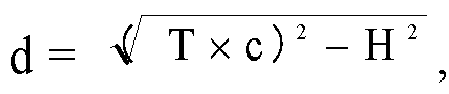
Fig. 4b . - The
step 206 is to determine positional information (x, y) of the terminal via formulas x = X + d×cos (AOA) and y = Y + d×sin (AOA). - With a geometrical relationship in the grid coordinate, the relationship between the position (x, y) of the terminal and the position (X, Y) of the base station may be derived as x = X + d×cos (AOA) and y = Y + d×sin (AOA), as illustrated in
Fig. 5 . - The embodiment has been described by taking the grid coordinate as an example, and of course the position of the terminal relative to the serving base station may alternatively be represented in the form of polar coordinate or another form under substantially the same principle without departing from the scope of the invention, and a repeated description thereof will be omitted here.
- The method according to the invention has been described in details above, and a positioning device according to the invention will be described in details below. As illustrated in
Fig. 6 , the device may include a firstinformation acquisition unit 601, a transmissiondelay calculation unit 602, adistance calculation unit 603 and aposition determination unit 604. - The first
information acquisition unit 601 is configured to acquire a synchronization timing advance of a terminal, a signal reception delay of a serving base station of the terminal and an angle of arrival of a signal of the terminal. - The transmission
delay calculation unit 602 is configured to calculate, from the synchronization timing advance of the terminal and the signal reception delay, a transmission delay of the terminal to the base station. - The
distance calculation unit 603 is configured to determine, from the transmission delay calculated by the transmissiondelay calculation unit 602, a distance of the terminal from the base station. - The
position determination unit 604 is configured to determine, from the distance determined by thedistance calculation unit 603 and the angle of arrival of the signal of the terminal acquired by the firstinformation acquisition unit 601, a position of the terminal relative to the base station. - Furthermore, the device may further include a second
information acquisition unit 605 configured to determine the terminal to be positioned, search for the serving base station of the terminal and acquire positional information of the base station, and provide the firstinformation acquisition unit 601 with information on the determined terminal and base station, and provide theposition determination unit 604 with the acquired positional information of the base station. - Furthermore, the first
information acquisition unit 601 may include a measurementcommand transmission sub-unit 606 and a measurementresult acquisition sub-unit 607. - The measurement
command transmission sub-unit 606 is configured to transmit a measurement command to the base station upon reception of the information on the determined terminal and base station to instruct the base station to measure the signal reception delay for the terminal and the angle of arrival of the signal of the terminal, and to trigger the base station to instruct the terminal through RRC signaling upon reception of the measurement command to measure the synchronization timing advance. - The measurement result acquisition sub-unit 607 is configured to acquire measurement results of the terminal and the base station.
- Furthermore, the device may further include a
status determination unit 608 and apaging processing unit 609. - The
status determination unit 608 is configured to determine whether the terminal is in an unconnected status upon reception of the information on the terminal and the base station transmitted from the secondinformation acquisition unit 605, and if so, transmit a processing instruction to thepaging processing unit 609; otherwise, transmit the information on the determined terminal and base station to the firstinformation acquisition unit 601. - The
paging processing unit 609 is configured to transmit the information on the determined terminal and base station to the firstinformation acquisition unit 601 after transmitting a paging message to the terminal through the base station to activate the terminal upon reception of the processing instruction. - Particularly, the transmission
delay calculation unit 602 may calculate the transmission delay T of the terminal to the serving base station via a formula T = (TA + TD)/2, where TA is the synchronization timing advance of the terminal and TD is the signal reception delay. - The
distance calculation unit 603 calculates the distance d of the terminal from the serving base station via a formula
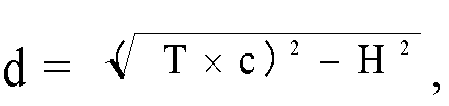
- The
position determination unit 604 determines positional information (x, y) of the terminal via formulas x = X + d×cos (AOA) and y = Y + d×sin (AOA), where (x, y) and (X, Y) are coordinate values of the terminal and the base station in the same grid coordinate system respectively. - The foregoing positioning device according to the invention may be embodied as a separate device or by being arranged in the base station.
- As can be apparent from the foregoing description, in the method and device according to the invention, the transmission delay of the terminal to its serving base station is calculated from the synchronization timing advance of the terminal and the signal reception delay of the serving base station of the terminal, the distance of the terminal from the base station is determined from the transmission delay, and the position of the terminal relative to the base station is determined from the distance and the angle of arrival of the signal of the terminal. The device according to the invention can position the terminal in a simple algorithm at a greatly lowered cost as compared with a GPS device, and since all the parameters used in the invention, i.e., the synchronization timing advance of the terminal, the signal reception delay of the base station and the angle of arrival of the signal of the terminal, are measured parameters already present in the system and no value of any additional measurement parameter is required, good compatibility with an existing system can be achieved with low implementation complexity, and all these parameters can be precise to an elementary time unit Ts of the LTE system, approximately 1/(15000×2048) second, thereby resulting in high precision of positioning.
- The foregoing description is merely illustrative of the preferred embodiments of the invention but not intended to limit the invention, and any modifications, equivalent substitutions and adaptations made without departing from the scope and principle of the invention shall be encompassed in the scope of the invention.
Claims (14)
- A method for positioning a terminal in a Long Term Evolution, LTE, system, comprising:A. calculating, from a synchronization timing advance of the terminal and a signal reception delay of a serving base station of the terminal, a transmission delay of the terminal to the base station; andB. determining, from the calculated transmission delay, a distance of the terminal from the base station and determining, from the distance and an angle of arrival of a signal of the terminal, a position of the terminal relative to the base station.
- The method of claim 1, further comprising: before the step A,
a step A1 of determining the terminal to be positioned, searching for the serving base station of the terminal and acquiring positional information of the base station. - The method of claim 2, further comprising: between the step A1 and the step A,
a step A2 of transmitting a measurement command to the base station to instruct the base station to measure the signal reception delay for the terminal and the Angle of Arrival, AOA, of the signal of the terminal and to trigger the base station to instruct the terminal through Radio Resource Control, RRC, signaling upon reception of the measurement command to measure the synchronization timing advance, and acquiring measurement results of the terminal and the base station. - The method of claim 3, further comprising: between the step A1 and the step A2, a step A3 of determining whether the terminal is in an unconnected status, and if so, proceeding to the step A2; otherwise, proceeding to a step A4 of transmitting a paging message to the terminal through the base station to activate the terminal and proceeding to the step A2.
- The method of any one of claims 1 to 4, wherein the step A comprises: calculating the transmission delay T of the terminal to the serving base station via a formula T = (TA + TD)/2, wherein TA is the synchronization timing advance of the terminal and TD is the signal reception delay.
- The method of any one of claims 1 to 4, wherein determining from the calculated transmission delay the distance of the terminal from the base station in the step B comprises:calculating the distance d of the terminal from the serving base station via a formula d = T×c or

- The method of any one of claims 1 to 4, wherein determining the position of the terminal relative to the base station in the step B comprises: determining positional information (x, y) of the terminal via formulas x = X + d×cos (AOA) and y = Y + d×sin (AOA), wherein (x, y) and (X, Y) are coordinate values of the terminal and the base station in the same grid coordinate system respectively.
- A device for positioning a terminal in an LTE system, comprising: a first information acquisition unit, a transmission delay calculation unit, a distance calculation unit and a position determination unit, wherein:the first information acquisition unit is configured to acquire a synchronization timing advance of the terminal, a signal reception delay of a serving base station of the terminal and an angle of arrival of a signal of the terminal;the transmission delay calculation unit is configured to calculate, from the synchronization timing advance of the terminal and the signal reception delay, a transmission delay of the terminal to the base station;the distance calculation unit is configured to determine, from the transmission delay calculated by the transmission delay calculation unit, a distance of the terminal from the base station; andthe position determination unit is configured to determine, from the distance determined by the distance calculation unit and the angle of arrival of the signal of the terminal acquired by the first information acquisition unit, a position of the terminal relative to the base station.
- The device of claim 8, further comprising: a second information acquisition unit configured to determine the terminal to be positioned, search for the serving base station of the terminal and acquire positional information of the base station, provide the first information acquisition unit with information on the determined terminal and base station and provide the position determination unit with the acquired positional information of the base station.
- The device of claim 9, wherein the first information acquisition unit comprises a measurement command transmission sub-unit and a measurement result acquisition sub-unit, wherein:the measurement command transmission sub-unit is configured to transmit a measurement command to the base station upon reception of the information on the determined terminal and base station to instruct the base station to measure the signal reception delay for the terminal and the angle of arrival of the signal of the terminal and to trigger the base station to instruct the terminal through RRC signaling upon reception of the measurement command to measure the synchronization timing advance; andthe measurement result acquisition sub-unit is configured to acquire measurement results of the terminal and the base station.
- The device of claim 9, further comprising: a status determination unit and a paging processing unit, wherein:the status determination unit is configured to determine whether the terminal is in an unconnected status upon reception of the information on the terminal and the base station transmitted from the second information acquisition unit, and if so, transmit a processing instruction to the paging processing unit; otherwise, transmit the information on the terminal and the base station to the first information acquisition unit; andthe paging processing unit is configured to transmit the information on the terminal and the base station to the first information acquisition unit after transmitting a paging message to the terminal through the base station to activate the terminal upon reception of the processing instruction.
- The device of any one of claims 8 to 11, wherein the transmission delay calculation unit calculates the transmission delay T of the terminal to the serving base station via a formula T = (TA + TD)/2, wherein TA is the synchronization timing advance of the terminal and TD is the signal reception delay.
- The device of any one of claims 8 to 11, wherein the distance calculation unit calculates the distance d of the terminal from the serving base station via a formula d = T×c or


- The device of any one of claims 8 to 11, wherein the position determination unit determines positional information (x, y) of the terminal via formulas x = X + d×cos (AOA) and y = Y + d×sin (AOA), wherein (x, y) and (X, Y) are coordinate values of the terminal and the base station in the same grid coordinate system respectively.
Applications Claiming Priority (2)
| Application Number | Priority Date | Filing Date | Title |
|---|---|---|---|
| CN200910077471.1A CN101808359B (en) | 2009-02-12 | 2009-02-12 | Method and device for positioning terminal in long-term evolution system |
| PCT/CN2010/070513 WO2010091625A1 (en) | 2009-02-12 | 2010-02-04 | Method and apparatus for terminal locating in long term evolution system |
Publications (2)
| Publication Number | Publication Date |
|---|---|
| EP2398290A1 true EP2398290A1 (en) | 2011-12-21 |
| EP2398290A4 EP2398290A4 (en) | 2013-02-27 |
Family
ID=42561410
Family Applications (1)
| Application Number | Title | Priority Date | Filing Date |
|---|---|---|---|
| EP10740914A Ceased EP2398290A4 (en) | 2009-02-12 | 2010-02-04 | Method and apparatus for terminal locating in long term evolution system |
Country Status (4)
| Country | Link |
|---|---|
| US (1) | US8825076B2 (en) |
| EP (1) | EP2398290A4 (en) |
| CN (1) | CN101808359B (en) |
| WO (1) | WO2010091625A1 (en) |
Cited By (3)
| Publication number | Priority date | Publication date | Assignee | Title |
|---|---|---|---|---|
| EP2816842A4 (en) * | 2012-02-17 | 2016-02-17 | Datang Mobile Comm Equip Co | ACCESS CONTROL METHOD AND DEVICE |
| US9602226B2 (en) | 2012-06-12 | 2017-03-21 | Datang Mobile Communications Equipment Co., Ltd | Distributed spectrum analyzer and method of spectrum analysis applying same |
| US20180070205A1 (en) * | 2016-09-02 | 2018-03-08 | Marvell World Trade Ltd. | Method and apparatus for determining an angle of arrival of a wireless signal |
Families Citing this family (21)
| Publication number | Priority date | Publication date | Assignee | Title |
|---|---|---|---|---|
| CN102143576B (en) * | 2010-01-29 | 2014-12-10 | 中兴通讯股份有限公司 | Terminal positioning system and terminal positioning method |
| JP2012009977A (en) * | 2010-06-23 | 2012-01-12 | Panasonic Corp | Network system |
| CN102387530A (en) * | 2010-09-06 | 2012-03-21 | 中国移动通信集团黑龙江有限公司 | User position detection method, user position detection device and user position detection system |
| CN102413565A (en) * | 2011-12-06 | 2012-04-11 | 大唐移动通信设备有限公司 | Method and equipment for determining terminal position |
| CN102595527B (en) * | 2012-03-21 | 2015-02-18 | 武汉邮电科学研究院 | Method and device for long term evolution (LTE) change-over judgment based on timing advance (TA) |
| CN103546963B (en) * | 2012-07-10 | 2016-09-14 | 电信科学技术研究院 | Method and equipment for determining positioning information |
| CN103686927A (en) * | 2012-09-04 | 2014-03-26 | 阿尔卡特朗讯 | Method and device for judging whether to terminate communication between mobile terminal and base station |
| CN104457736A (en) * | 2014-11-03 | 2015-03-25 | 深圳市邦彦信息技术有限公司 | Method and device for acquiring target location information |
| EP3250938B1 (en) | 2015-01-30 | 2021-09-08 | Telefonaktiebolaget LM Ericsson (publ) | Aoa determination method and associated wireless communication device and radio base station |
| CN106034355A (en) * | 2015-03-11 | 2016-10-19 | 中国移动通信集团河北有限公司 | A method and device for realizing user positioning |
| CN106851550B (en) * | 2015-12-04 | 2020-02-14 | 华为技术有限公司 | Method for positioning terminal and baseband unit |
| CN111034244B (en) * | 2017-06-14 | 2024-07-16 | 弗劳恩霍夫应用研究促进协会 | Apparatus, system and method for improving position estimation |
| CN107846658A (en) * | 2017-10-17 | 2018-03-27 | 珠海格力电器股份有限公司 | Position distance determining system and method |
| CN109788549B (en) * | 2017-11-10 | 2020-11-10 | 上海华为技术有限公司 | RRU positioning method and related device thereof |
| EP3640663B1 (en) * | 2018-10-15 | 2025-09-10 | Nxp B.V. | Device and method for unambiguous determination of angle of arrival for rf signals |
| CN110300375B (en) * | 2019-04-17 | 2021-01-26 | 中国联合网络通信集团有限公司 | Method and device for determining home base station |
| CN112399329B (en) * | 2019-08-01 | 2022-01-25 | 大唐移动通信设备有限公司 | Method, equipment and device for synthesizing, sending and receiving reference signals |
| CN110401919A (en) * | 2019-08-21 | 2019-11-01 | RealMe重庆移动通信有限公司 | Information processing method and device, electronic equipment, storage medium |
| US20230305099A1 (en) * | 2020-08-10 | 2023-09-28 | Lenovo (Singapore) Pte. Ltd. | Sidelink angular-based and sl rrm-based positioning |
| EP4507410A4 (en) * | 2022-06-29 | 2025-05-21 | Huawei Technologies Co., Ltd. | Positioning method and device |
| EP4312057B1 (en) * | 2022-07-26 | 2026-04-15 | Nokia Technologies Oy | Time of arrival method for ue positioning in distributed ran system architecture |
Family Cites Families (6)
| Publication number | Priority date | Publication date | Assignee | Title |
|---|---|---|---|---|
| US6161018A (en) * | 1998-02-27 | 2000-12-12 | Motorola, Inc. | Method and system for estimating a subscriber's location in a wireless communication system service area |
| CA2296812A1 (en) * | 1999-02-17 | 2000-08-17 | Lucent Technologies Inc. | Method for combining multiple measurements to determine the position of a mobile transceiver |
| US6681099B1 (en) * | 2000-05-15 | 2004-01-20 | Nokia Networks Oy | Method to calculate true round trip propagation delay and user equipment location in WCDMA/UTRAN |
| CN100578253C (en) * | 2003-06-30 | 2010-01-06 | 樊天蔚 | Location and search guidance for radio transmitting device |
| CN1744763A (en) * | 2005-09-30 | 2006-03-08 | 上海贝豪通讯电子有限公司 | Combined positioning-method in TD-SCDMA and WIFI system |
| CN101489180B (en) * | 2008-01-15 | 2010-11-17 | 大唐移动通信设备有限公司 | Method and device for locating mobile terminal |
-
2009
- 2009-02-12 CN CN200910077471.1A patent/CN101808359B/en active Active
-
2010
- 2010-02-04 EP EP10740914A patent/EP2398290A4/en not_active Ceased
- 2010-02-04 WO PCT/CN2010/070513 patent/WO2010091625A1/en not_active Ceased
- 2010-02-04 US US13/201,178 patent/US8825076B2/en active Active
Non-Patent Citations (5)
| Title |
|---|
| "3rd Generation Partnership Project; Technical Specification Group Radio Access Network; Physical layer; Measurements (TDD) (Release 8)", 3GPP STANDARD; 3GPP TS 25.225, 3RD GENERATION PARTNERSHIP PROJECT (3GPP), MOBILE COMPETENCE CENTRE ; 650, ROUTE DES LUCIOLES ; F-06921 SOPHIA-ANTIPOLIS CEDEX ; FRANCE, no. V8.0.0, 1 March 2008 (2008-03-01), pages 1-28, XP050367199, * |
| CATT: "UE Positioning Based on AoA+TA for LTE Rel-9", 3GPP DRAFT; R1-090936, 3RD GENERATION PARTNERSHIP PROJECT (3GPP), MOBILE COMPETENCE CENTRE ; 650, ROUTE DES LUCIOLES ; F-06921 SOPHIA-ANTIPOLIS CEDEX ; FRANCE, no. Athens, Greece; 20090204, 4 February 2009 (2009-02-04), XP050318776, [retrieved on 2009-02-04] * |
| CWTS/CATT: "Angle of arrival enhanced positioning Agenda Point: 9.2.5", 3GPP DRAFT; R2-011651, 3RD GENERATION PARTNERSHIP PROJECT (3GPP), MOBILE COMPETENCE CENTRE ; 650, ROUTE DES LUCIOLES ; F-06921 SOPHIA-ANTIPOLIS CEDEX ; FRANCE, vol. RAN WG2, no. Berlin, Germany; 20010706, 6 July 2001 (2001-07-06), XP050118423, [retrieved on 2001-07-06] * |
| INTERDIGITAL COMM CORP: "Synchronization of Timing Advance and Timing Deviation Measurement", 3GPP DRAFT; R1-00-0974-CR25.224, 3RD GENERATION PARTNERSHIP PROJECT (3GPP), MOBILE COMPETENCE CENTRE ; 650, ROUTE DES LUCIOLES ; F-06921 SOPHIA-ANTIPOLIS CEDEX ; FRANCE, vol. RAN WG1, no. Berlin, Germany; 20000818, 18 August 2000 (2000-08-18), XP050093110, [retrieved on 2000-08-18] * |
| See also references of WO2010091625A1 * |
Cited By (4)
| Publication number | Priority date | Publication date | Assignee | Title |
|---|---|---|---|---|
| EP2816842A4 (en) * | 2012-02-17 | 2016-02-17 | Datang Mobile Comm Equip Co | ACCESS CONTROL METHOD AND DEVICE |
| US9602226B2 (en) | 2012-06-12 | 2017-03-21 | Datang Mobile Communications Equipment Co., Ltd | Distributed spectrum analyzer and method of spectrum analysis applying same |
| US20180070205A1 (en) * | 2016-09-02 | 2018-03-08 | Marvell World Trade Ltd. | Method and apparatus for determining an angle of arrival of a wireless signal |
| US10349213B2 (en) * | 2016-09-02 | 2019-07-09 | Marvell World Trade Ltd. | Method and apparatus for determining an angle of arrival of a wireless signal |
Also Published As
| Publication number | Publication date |
|---|---|
| US8825076B2 (en) | 2014-09-02 |
| CN101808359B (en) | 2014-08-13 |
| CN101808359A (en) | 2010-08-18 |
| WO2010091625A1 (en) | 2010-08-19 |
| EP2398290A4 (en) | 2013-02-27 |
| US20120015669A1 (en) | 2012-01-19 |
Similar Documents
| Publication | Publication Date | Title |
|---|---|---|
| US8825076B2 (en) | Method and device for positioning terminal in long term evolution system | |
| US12057918B2 (en) | Non-line-of-sight path detection for user equipment positioning in wireless networks | |
| US20220201646A1 (en) | Methods and devices for positioning of a device | |
| EP3542177B1 (en) | Detection of a narrowband positioning reference signal (nprs) location in a radio frame | |
| EP3036948B1 (en) | Positioning in a shared cell | |
| US20260129610A1 (en) | Methods for communication, terminal device, network device, and computer readable media | |
| EP2747498B1 (en) | User equipment positioning methods and devices | |
| US11882466B2 (en) | Calibrating beam orientation errors for improved positioning | |
| US20250119864A1 (en) | Equiphase contour information associated with antenna of wireless node | |
| CN107306421B (en) | Positioning method and device | |
| RU2013138380A (en) | SUPPORT OF IMPROVED CONFIGURATION MEASUREMENT SPACE FOR DETERMINING LOCATION | |
| EP2763478A1 (en) | Method and device using observed time difference of arrival for positioning mobile station | |
| US20150327018A1 (en) | Method and Network Node for Enabling Position Determination of a User Equipment Measurement | |
| US10935671B2 (en) | Positioning method, assistant site, and system | |
| EP4022797B1 (en) | Methods and systems for reducing beam search space for selection of an optimal beam | |
| CN106793057A (en) | Time advance for cellular network communication system determines method and device | |
| WO2014146530A1 (en) | Method, device, and system for triggering location measurement | |
| CN103139901B (en) | The localization method of TD-SCDMA mobile phone terminal | |
| US12481020B2 (en) | Method and apparatus for positioning reference signal transmission and reception | |
| US12052677B2 (en) | Apparatus and method for time synchronization | |
| WO2024127355A1 (en) | Methods and apparatus for providing assistance to carrier-phase-based positioning in wireless networks | |
| WO2024089678A1 (en) | Phase error estimate for position determination |
Legal Events
| Date | Code | Title | Description |
|---|---|---|---|
| PUAI | Public reference made under article 153(3) epc to a published international application that has entered the european phase |
Free format text: ORIGINAL CODE: 0009012 |
|
| 17P | Request for examination filed |
Effective date: 20110824 |
|
| AK | Designated contracting states |
Kind code of ref document: A1 Designated state(s): AT BE BG CH CY CZ DE DK EE ES FI FR GB GR HR HU IE IS IT LI LT LU LV MC MK MT NL NO PL PT RO SE SI SK SM TR |
|
| DAX | Request for extension of the european patent (deleted) | ||
| A4 | Supplementary search report drawn up and despatched |
Effective date: 20130125 |
|
| RIC1 | Information provided on ipc code assigned before grant |
Ipc: H04W 64/00 20090101AFI20130121BHEP Ipc: G01S 5/12 20060101ALI20130121BHEP |
|
| 17Q | First examination report despatched |
Effective date: 20130621 |
|
| REG | Reference to a national code |
Ref country code: DE Ref legal event code: R003 |
|
| STAA | Information on the status of an ep patent application or granted ep patent |
Free format text: STATUS: THE APPLICATION HAS BEEN REFUSED |
|
| 18R | Application refused |
Effective date: 20140509 |