EP2396296B1 - Aminotetraline derivatives, pharmaceutical compositions containing them, and their use in therapy - Google Patents
Aminotetraline derivatives, pharmaceutical compositions containing them, and their use in therapy Download PDFInfo
- Publication number
- EP2396296B1 EP2396296B1 EP10706575.7A EP10706575A EP2396296B1 EP 2396296 B1 EP2396296 B1 EP 2396296B1 EP 10706575 A EP10706575 A EP 10706575A EP 2396296 B1 EP2396296 B1 EP 2396296B1
- Authority
- EP
- European Patent Office
- Prior art keywords
- benzyl
- ethyl
- methyl
- amino
- tetrahydro
- Prior art date
- Legal status (The legal status is an assumption and is not a legal conclusion. Google has not performed a legal analysis and makes no representation as to the accuracy of the status listed.)
- Active
Links
- 0 CCCC(CCC)C*(*)c1ccc(C)c(CC)c1 Chemical compound CCCC(CCC)C*(*)c1ccc(C)c(CC)c1 0.000 description 11
- YVORRVFKHZLJGZ-UHFFFAOYSA-N Cc1c(C)[o]cn1 Chemical compound Cc1c(C)[o]cn1 YVORRVFKHZLJGZ-UHFFFAOYSA-N 0.000 description 2
- BSWGZCMLNFBDEZ-UHFFFAOYSA-N Cc1c(C)[o]nc1 Chemical compound Cc1c(C)[o]nc1 BSWGZCMLNFBDEZ-UHFFFAOYSA-N 0.000 description 2
- SPRVGONRQZESPA-UHFFFAOYSA-N Cc1c(C)[s]nc1 Chemical compound Cc1c(C)[s]nc1 SPRVGONRQZESPA-UHFFFAOYSA-N 0.000 description 2
- AKUSZFPCJFNRSZ-UHFFFAOYSA-N Cc1c[o]nc1C Chemical compound Cc1c[o]nc1C AKUSZFPCJFNRSZ-UHFFFAOYSA-N 0.000 description 2
- NZBKSJIASLUASD-WAYWQWQTSA-N C/C(/C=C)=C(\C)/NN Chemical compound C/C(/C=C)=C(\C)/NN NZBKSJIASLUASD-WAYWQWQTSA-N 0.000 description 1
- DITAMUBJJHDKON-UHFFFAOYSA-N C/C=[O]/C(NC1C(Cc2cc(F)cc(F)c2)c2cc(OCCNS(c3c[n](C)cc3)(=O)=O)ccc2CC1)=O Chemical compound C/C=[O]/C(NC1C(Cc2cc(F)cc(F)c2)c2cc(OCCNS(c3c[n](C)cc3)(=O)=O)ccc2CC1)=O DITAMUBJJHDKON-UHFFFAOYSA-N 0.000 description 1
- DHXVGJBLRPWPCS-UHFFFAOYSA-N C1CCOCC1 Chemical compound C1CCOCC1 DHXVGJBLRPWPCS-UHFFFAOYSA-N 0.000 description 1
- NIWMRCBQHHQCIN-UHFFFAOYSA-N CC(C)(C)OC(NC1C(Cc(cc2Cl)ccc2Cl)c2cc(CN)ccc2CC1)=O Chemical compound CC(C)(C)OC(NC1C(Cc(cc2Cl)ccc2Cl)c2cc(CN)ccc2CC1)=O NIWMRCBQHHQCIN-UHFFFAOYSA-N 0.000 description 1
- LKPMLIHHOOTFQA-VURMDHGXSA-N CC/C(/C)=N\NC#C Chemical compound CC/C(/C)=N\NC#C LKPMLIHHOOTFQA-VURMDHGXSA-N 0.000 description 1
- MDWCKITYJLPNKL-BENRWUELSA-N CCC1(C(C)/C(/CC)=C\N(C)C)OCCO1 Chemical compound CCC1(C(C)/C(/CC)=C\N(C)C)OCCO1 MDWCKITYJLPNKL-BENRWUELSA-N 0.000 description 1
- VTSCOUPTHIJOPA-UHFFFAOYSA-N CCCS(N(C)CCOS(CCC)(=O)=O)(=O)=O Chemical compound CCCS(N(C)CCOS(CCC)(=O)=O)(=O)=O VTSCOUPTHIJOPA-UHFFFAOYSA-N 0.000 description 1
- SEMIYAVYWMYDNZ-UHFFFAOYSA-N CCCS(N(C)CCOc1ccc(CCC(C2Cc3cc(Cl)ccc3)NC(OCC)=O)c2c1)(=O)=O Chemical compound CCCS(N(C)CCOc1ccc(CCC(C2Cc3cc(Cl)ccc3)NC(OCC)=O)c2c1)(=O)=O SEMIYAVYWMYDNZ-UHFFFAOYSA-N 0.000 description 1
- ZDUGXQSAFYXYSG-UHFFFAOYSA-O CCCS(NCCCc1ccc(CCC(C2Cc(cc3)ccc3F)NCC)c2c1)[OH2+] Chemical compound CCCS(NCCCc1ccc(CCC(C2Cc(cc3)ccc3F)NCC)c2c1)[OH2+] ZDUGXQSAFYXYSG-UHFFFAOYSA-O 0.000 description 1
- BUSXFTXMQRDEBO-UHFFFAOYSA-N CCCS(NCCCc1ccc(CCC(C2Cc3cc(Cl)ccc3)N)c2c1)(=O)=O Chemical compound CCCS(NCCCc1ccc(CCC(C2Cc3cc(Cl)ccc3)N)c2c1)(=O)=O BUSXFTXMQRDEBO-UHFFFAOYSA-N 0.000 description 1
- ILGDWEJGIYFNNN-UHFFFAOYSA-N CCCS(NCCOc1ccc(CCC(C2Cc(cccc3)c3F)NC)c2c1)(=O)=O Chemical compound CCCS(NCCOc1ccc(CCC(C2Cc(cccc3)c3F)NC)c2c1)(=O)=O ILGDWEJGIYFNNN-UHFFFAOYSA-N 0.000 description 1
- CGXVLZCHCUSGSF-UHFFFAOYSA-N CCCS(NCc1cc(C(Cc2ccccc2)C(CC2)NC)c2cc1)(=O)=O Chemical compound CCCS(NCc1cc(C(Cc2ccccc2)C(CC2)NC)c2cc1)(=O)=O CGXVLZCHCUSGSF-UHFFFAOYSA-N 0.000 description 1
- QBDNZKACLDDLNA-UHFFFAOYSA-N CCN(CC)C1C(Cc(cc2)ccc2Cl)c2cc(CCCNS(CC3CC3)(=O)=O)ccc2CC1 Chemical compound CCN(CC)C1C(Cc(cc2)ccc2Cl)c2cc(CCCNS(CC3CC3)(=O)=O)ccc2CC1 QBDNZKACLDDLNA-UHFFFAOYSA-N 0.000 description 1
- LLYOFMWKPVHLKD-UHFFFAOYSA-N CCOC(NC1C(Cc(cc2)cc(Cl)c2Cl)c2cc(OC)ccc2CC1)=O Chemical compound CCOC(NC1C(Cc(cc2)cc(Cl)c2Cl)c2cc(OC)ccc2CC1)=O LLYOFMWKPVHLKD-UHFFFAOYSA-N 0.000 description 1
- OAERTTLQWFCLCB-UHFFFAOYSA-N CCOC(NC1C(Cc(cc2Cl)ccc2Cl)c2cc(C#N)ccc2CC1)=O Chemical compound CCOC(NC1C(Cc(cc2Cl)ccc2Cl)c2cc(C#N)ccc2CC1)=O OAERTTLQWFCLCB-UHFFFAOYSA-N 0.000 description 1
- QRJUCUGMSGYDGD-UHFFFAOYSA-N CCS(CCCOc1ccc(CCC(C2Cc3cc(Cl)ccc3)N)c2c1)=O Chemical compound CCS(CCCOc1ccc(CCC(C2Cc3cc(Cl)ccc3)N)c2c1)=O QRJUCUGMSGYDGD-UHFFFAOYSA-N 0.000 description 1
- YMCQDXPZVQHJPV-UHFFFAOYSA-N CN(CCCc1ccc(CCC(C2Cc(cc3)ccc3F)N)c2c1)S(CC1CC1)=O Chemical compound CN(CCCc1ccc(CCC(C2Cc(cc3)ccc3F)N)c2c1)S(CC1CC1)=O YMCQDXPZVQHJPV-UHFFFAOYSA-N 0.000 description 1
- BVAFOIYVJDIOLI-UHFFFAOYSA-N CN(CCOc1ccc(CCC(C2Cc(cc3)cc(Cl)c3Cl)N3CCCC3)c2c1)S(CC1CC1)(=O)=O Chemical compound CN(CCOc1ccc(CCC(C2Cc(cc3)cc(Cl)c3Cl)N3CCCC3)c2c1)S(CC1CC1)(=O)=O BVAFOIYVJDIOLI-UHFFFAOYSA-N 0.000 description 1
- CBIMEKQSMPVUCF-UHFFFAOYSA-N CNC1C(Cc(cccc2)c2Cl)c2cc(OCCNS(c3c[n](C)nc3)(=O)=O)ccc2CC1 Chemical compound CNC1C(Cc(cccc2)c2Cl)c2cc(OCCNS(c3c[n](C)nc3)(=O)=O)ccc2CC1 CBIMEKQSMPVUCF-UHFFFAOYSA-N 0.000 description 1
- AOWOTLCPUVGVBJ-UHFFFAOYSA-N COc1ccc(CCC(C2CC3C=CC=CC3)N)c2c1 Chemical compound COc1ccc(CCC(C2CC3C=CC=CC3)N)c2c1 AOWOTLCPUVGVBJ-UHFFFAOYSA-N 0.000 description 1
- GKAKZZCMZUUFSM-ZCFIWIBFSA-N C[C@H]1N(C)NC=C1C Chemical compound C[C@H]1N(C)NC=C1C GKAKZZCMZUUFSM-ZCFIWIBFSA-N 0.000 description 1
- CRBPCIKGIJUMBY-UHFFFAOYSA-N C[n]1cnc(S(NCCOc2ccc(CCC(C3Cc4cc(C#N)ccc4)N4CCCC4)c3c2)(=O)=O)c1 Chemical compound C[n]1cnc(S(NCCOc2ccc(CCC(C3Cc4cc(C#N)ccc4)N4CCCC4)c3c2)(=O)=O)c1 CRBPCIKGIJUMBY-UHFFFAOYSA-N 0.000 description 1
- QTUXMVZZQMHBAN-UHFFFAOYSA-N C[n]1cnc(S(NCCOc2ccc(CCC(C3Cc4ccccc4)N4CCCC4)c3c2)(=O)=O)c1 Chemical compound C[n]1cnc(S(NCCOc2ccc(CCC(C3Cc4ccccc4)N4CCCC4)c3c2)(=O)=O)c1 QTUXMVZZQMHBAN-UHFFFAOYSA-N 0.000 description 1
- QRQNFGXMKCGVEU-UHFFFAOYSA-N C[n]1cnc(S(NCc2ccc(CCC(C3Cc4ccccc4)N(CCC4)C4=O)c3c2)(=O)=O)c1 Chemical compound C[n]1cnc(S(NCc2ccc(CCC(C3Cc4ccccc4)N(CCC4)C4=O)c3c2)(=O)=O)c1 QRQNFGXMKCGVEU-UHFFFAOYSA-N 0.000 description 1
- WSHXMPUIWMGJIP-UHFFFAOYSA-N C[n]1ncc(S(NCCOc2ccc(CCC(C3Cc4ccccc4)N4CCCC4)c3c2)(=O)=O)c1 Chemical compound C[n]1ncc(S(NCCOc2ccc(CCC(C3Cc4ccccc4)N4CCCC4)c3c2)(=O)=O)c1 WSHXMPUIWMGJIP-UHFFFAOYSA-N 0.000 description 1
- OXQOBQJCDNLAPO-UHFFFAOYSA-N Cc1c(C)nccn1 Chemical compound Cc1c(C)nccn1 OXQOBQJCDNLAPO-UHFFFAOYSA-N 0.000 description 1
- OLICQMSZRKFIIN-UHFFFAOYSA-N Cc1c[s]nc1C Chemical compound Cc1c[s]nc1C OLICQMSZRKFIIN-UHFFFAOYSA-N 0.000 description 1
- CGBSPKKOYSSZJQ-UHFFFAOYSA-N Cc1cccc(CC2c3cc(OCCNS(c4c[n](C)cn4)(=O)=O)ccc3CCC2N2CCCC2)c1 Chemical compound Cc1cccc(CC2c3cc(OCCNS(c4c[n](C)cn4)(=O)=O)ccc3CCC2N2CCCC2)c1 CGBSPKKOYSSZJQ-UHFFFAOYSA-N 0.000 description 1
- XPCYMUBTCGGWOH-UHFFFAOYSA-N Cc1cncnc1C Chemical compound Cc1cncnc1C XPCYMUBTCGGWOH-UHFFFAOYSA-N 0.000 description 1
- GTLOCDKNYFCLNI-UHFFFAOYSA-N NC(CC1)C(Cc(cc2)ccc2Cl)c2c1ccc(CCCNS(CC1CC1)(=O)=O)c2 Chemical compound NC(CC1)C(Cc(cc2)ccc2Cl)c2c1ccc(CCCNS(CC1CC1)(=O)=O)c2 GTLOCDKNYFCLNI-UHFFFAOYSA-N 0.000 description 1
- DRXXVNWVHXVGGO-UHFFFAOYSA-N NC1C(Cc(cc2)cc(F)c2F)c2cc(CNS(CC3CC3)(=O)=O)ccc2CC1 Chemical compound NC1C(Cc(cc2)cc(F)c2F)c2cc(CNS(CC3CC3)(=O)=O)ccc2CC1 DRXXVNWVHXVGGO-UHFFFAOYSA-N 0.000 description 1
- ZBOFPUGFDSPMNK-UHFFFAOYSA-N NC1C(Cc(cccc2)c2Cl)c2cc(OCCNS(CC3CC3)(=O)=O)ccc2CC1 Chemical compound NC1C(Cc(cccc2)c2Cl)c2cc(OCCNS(CC3CC3)(=O)=O)ccc2CC1 ZBOFPUGFDSPMNK-UHFFFAOYSA-N 0.000 description 1
- SOOSENKMEUSKKZ-UHFFFAOYSA-N NC1C(Cc2cc(Cl)cc(F)c2)c2cc(OCCNS(CC3CC3)(=O)=O)ccc2CC1 Chemical compound NC1C(Cc2cc(Cl)cc(F)c2)c2cc(OCCNS(CC3CC3)(=O)=O)ccc2CC1 SOOSENKMEUSKKZ-UHFFFAOYSA-N 0.000 description 1
- WHKGTFDFEPPMCM-UHFFFAOYSA-N O=S(CC1CC1)(NCCOc1ccc(CCC(C2Cc(cc3)cc(Cl)c3Cl)N3CCC3)c2c1)=O Chemical compound O=S(CC1CC1)(NCCOc1ccc(CCC(C2Cc(cc3)cc(Cl)c3Cl)N3CCC3)c2c1)=O WHKGTFDFEPPMCM-UHFFFAOYSA-N 0.000 description 1
- WUVOFOHULVJFGW-UHFFFAOYSA-N O=S(CC1CC1)(NCCOc1ccc(CCC(C2Cc3cc(Cl)ccc3)N3CCC3)c2c1)=O Chemical compound O=S(CC1CC1)(NCCOc1ccc(CCC(C2Cc3cc(Cl)ccc3)N3CCC3)c2c1)=O WUVOFOHULVJFGW-UHFFFAOYSA-N 0.000 description 1
- FJYJEQLNBGCTMQ-UHFFFAOYSA-N O=S(CC1CC1)(NCCOc1ccc(CCC(C2Cc3ccccc3)N3CCCC3)c2c1)=O Chemical compound O=S(CC1CC1)(NCCOc1ccc(CCC(C2Cc3ccccc3)N3CCCC3)c2c1)=O FJYJEQLNBGCTMQ-UHFFFAOYSA-N 0.000 description 1
Classifications
-
- C—CHEMISTRY; METALLURGY
- C07—ORGANIC CHEMISTRY
- C07C—ACYCLIC OR CARBOCYCLIC COMPOUNDS
- C07C311/00—Amides of sulfonic acids, i.e. compounds having singly-bound oxygen atoms of sulfo groups replaced by nitrogen atoms, not being part of nitro or nitroso groups
- C07C311/01—Sulfonamides having sulfur atoms of sulfonamide groups bound to acyclic carbon atoms
- C07C311/02—Sulfonamides having sulfur atoms of sulfonamide groups bound to acyclic carbon atoms of an acyclic saturated carbon skeleton
- C07C311/03—Sulfonamides having sulfur atoms of sulfonamide groups bound to acyclic carbon atoms of an acyclic saturated carbon skeleton having the nitrogen atoms of the sulfonamide groups bound to hydrogen atoms or to acyclic carbon atoms
- C07C311/05—Sulfonamides having sulfur atoms of sulfonamide groups bound to acyclic carbon atoms of an acyclic saturated carbon skeleton having the nitrogen atoms of the sulfonamide groups bound to hydrogen atoms or to acyclic carbon atoms to acyclic carbon atoms of hydrocarbon radicals substituted by nitrogen atoms, not being part of nitro or nitroso groups
-
- A—HUMAN NECESSITIES
- A61—MEDICAL OR VETERINARY SCIENCE; HYGIENE
- A61K—PREPARATIONS FOR MEDICAL, DENTAL OR TOILETRY PURPOSES
- A61K31/00—Medicinal preparations containing organic active ingredients
- A61K31/33—Heterocyclic compounds
- A61K31/395—Heterocyclic compounds having nitrogen as a ring hetero atom, e.g. guanethidine or rifamycins
- A61K31/495—Heterocyclic compounds having nitrogen as a ring hetero atom, e.g. guanethidine or rifamycins having six-membered rings with two or more nitrogen atoms as the only ring heteroatoms, e.g. piperazine or tetrazines
- A61K31/505—Pyrimidines; Hydrogenated pyrimidines, e.g. trimethoprim
-
- A—HUMAN NECESSITIES
- A61—MEDICAL OR VETERINARY SCIENCE; HYGIENE
- A61P—SPECIFIC THERAPEUTIC ACTIVITY OF CHEMICAL COMPOUNDS OR MEDICINAL PREPARATIONS
- A61P15/00—Drugs for genital or sexual disorders; Contraceptives
-
- A—HUMAN NECESSITIES
- A61—MEDICAL OR VETERINARY SCIENCE; HYGIENE
- A61P—SPECIFIC THERAPEUTIC ACTIVITY OF CHEMICAL COMPOUNDS OR MEDICINAL PREPARATIONS
- A61P25/00—Drugs for disorders of the nervous system
-
- A—HUMAN NECESSITIES
- A61—MEDICAL OR VETERINARY SCIENCE; HYGIENE
- A61P—SPECIFIC THERAPEUTIC ACTIVITY OF CHEMICAL COMPOUNDS OR MEDICINAL PREPARATIONS
- A61P25/00—Drugs for disorders of the nervous system
- A61P25/04—Centrally acting analgesics, e.g. opioids
-
- A—HUMAN NECESSITIES
- A61—MEDICAL OR VETERINARY SCIENCE; HYGIENE
- A61P—SPECIFIC THERAPEUTIC ACTIVITY OF CHEMICAL COMPOUNDS OR MEDICINAL PREPARATIONS
- A61P25/00—Drugs for disorders of the nervous system
- A61P25/14—Drugs for disorders of the nervous system for treating abnormal movements, e.g. chorea, dyskinesia
-
- A—HUMAN NECESSITIES
- A61—MEDICAL OR VETERINARY SCIENCE; HYGIENE
- A61P—SPECIFIC THERAPEUTIC ACTIVITY OF CHEMICAL COMPOUNDS OR MEDICINAL PREPARATIONS
- A61P25/00—Drugs for disorders of the nervous system
- A61P25/14—Drugs for disorders of the nervous system for treating abnormal movements, e.g. chorea, dyskinesia
- A61P25/16—Anti-Parkinson drugs
-
- A—HUMAN NECESSITIES
- A61—MEDICAL OR VETERINARY SCIENCE; HYGIENE
- A61P—SPECIFIC THERAPEUTIC ACTIVITY OF CHEMICAL COMPOUNDS OR MEDICINAL PREPARATIONS
- A61P25/00—Drugs for disorders of the nervous system
- A61P25/18—Antipsychotics, i.e. neuroleptics; Drugs for mania or schizophrenia
-
- A—HUMAN NECESSITIES
- A61—MEDICAL OR VETERINARY SCIENCE; HYGIENE
- A61P—SPECIFIC THERAPEUTIC ACTIVITY OF CHEMICAL COMPOUNDS OR MEDICINAL PREPARATIONS
- A61P25/00—Drugs for disorders of the nervous system
- A61P25/20—Hypnotics; Sedatives
-
- A—HUMAN NECESSITIES
- A61—MEDICAL OR VETERINARY SCIENCE; HYGIENE
- A61P—SPECIFIC THERAPEUTIC ACTIVITY OF CHEMICAL COMPOUNDS OR MEDICINAL PREPARATIONS
- A61P25/00—Drugs for disorders of the nervous system
- A61P25/24—Antidepressants
-
- A—HUMAN NECESSITIES
- A61—MEDICAL OR VETERINARY SCIENCE; HYGIENE
- A61P—SPECIFIC THERAPEUTIC ACTIVITY OF CHEMICAL COMPOUNDS OR MEDICINAL PREPARATIONS
- A61P25/00—Drugs for disorders of the nervous system
- A61P25/28—Drugs for disorders of the nervous system for treating neurodegenerative disorders of the central nervous system, e.g. nootropic agents, cognition enhancers, drugs for treating Alzheimer's disease or other forms of dementia
-
- A—HUMAN NECESSITIES
- A61—MEDICAL OR VETERINARY SCIENCE; HYGIENE
- A61P—SPECIFIC THERAPEUTIC ACTIVITY OF CHEMICAL COMPOUNDS OR MEDICINAL PREPARATIONS
- A61P25/00—Drugs for disorders of the nervous system
- A61P25/30—Drugs for disorders of the nervous system for treating abuse or dependence
-
- A—HUMAN NECESSITIES
- A61—MEDICAL OR VETERINARY SCIENCE; HYGIENE
- A61P—SPECIFIC THERAPEUTIC ACTIVITY OF CHEMICAL COMPOUNDS OR MEDICINAL PREPARATIONS
- A61P27/00—Drugs for disorders of the senses
- A61P27/16—Otologicals
-
- A—HUMAN NECESSITIES
- A61—MEDICAL OR VETERINARY SCIENCE; HYGIENE
- A61P—SPECIFIC THERAPEUTIC ACTIVITY OF CHEMICAL COMPOUNDS OR MEDICINAL PREPARATIONS
- A61P29/00—Non-central analgesic, antipyretic or antiinflammatory agents, e.g. antirheumatic agents; Non-steroidal antiinflammatory drugs [NSAID]
-
- A—HUMAN NECESSITIES
- A61—MEDICAL OR VETERINARY SCIENCE; HYGIENE
- A61P—SPECIFIC THERAPEUTIC ACTIVITY OF CHEMICAL COMPOUNDS OR MEDICINAL PREPARATIONS
- A61P31/00—Antiinfectives, i.e. antibiotics, antiseptics, chemotherapeutics
- A61P31/12—Antivirals
- A61P31/14—Antivirals for RNA viruses
- A61P31/18—Antivirals for RNA viruses for HIV
-
- A—HUMAN NECESSITIES
- A61—MEDICAL OR VETERINARY SCIENCE; HYGIENE
- A61P—SPECIFIC THERAPEUTIC ACTIVITY OF CHEMICAL COMPOUNDS OR MEDICINAL PREPARATIONS
- A61P9/00—Drugs for disorders of the cardiovascular system
- A61P9/10—Drugs for disorders of the cardiovascular system for treating ischaemic or atherosclerotic diseases, e.g. antianginal drugs, coronary vasodilators, drugs for myocardial infarction, retinopathy, cerebrovascula insufficiency, renal arteriosclerosis
-
- C—CHEMISTRY; METALLURGY
- C07—ORGANIC CHEMISTRY
- C07C—ACYCLIC OR CARBOCYCLIC COMPOUNDS
- C07C215/00—Compounds containing amino and hydroxy groups bound to the same carbon skeleton
- C07C215/46—Compounds containing amino and hydroxy groups bound to the same carbon skeleton having hydroxy groups bound to carbon atoms of at least one six-membered aromatic ring and amino groups bound to acyclic carbon atoms or to carbon atoms of rings other than six-membered aromatic rings of the same carbon skeleton
- C07C215/64—Compounds containing amino and hydroxy groups bound to the same carbon skeleton having hydroxy groups bound to carbon atoms of at least one six-membered aromatic ring and amino groups bound to acyclic carbon atoms or to carbon atoms of rings other than six-membered aromatic rings of the same carbon skeleton with rings other than six-membered aromatic rings being part of the carbon skeleton
-
- C—CHEMISTRY; METALLURGY
- C07—ORGANIC CHEMISTRY
- C07C—ACYCLIC OR CARBOCYCLIC COMPOUNDS
- C07C217/00—Compounds containing amino and etherified hydroxy groups bound to the same carbon skeleton
- C07C217/54—Compounds containing amino and etherified hydroxy groups bound to the same carbon skeleton having etherified hydroxy groups bound to carbon atoms of at least one six-membered aromatic ring and amino groups bound to acyclic carbon atoms or to carbon atoms of rings other than six-membered aromatic rings of the same carbon skeleton
- C07C217/74—Compounds containing amino and etherified hydroxy groups bound to the same carbon skeleton having etherified hydroxy groups bound to carbon atoms of at least one six-membered aromatic ring and amino groups bound to acyclic carbon atoms or to carbon atoms of rings other than six-membered aromatic rings of the same carbon skeleton with rings other than six-membered aromatic rings being part of the carbon skeleton
-
- C—CHEMISTRY; METALLURGY
- C07—ORGANIC CHEMISTRY
- C07C—ACYCLIC OR CARBOCYCLIC COMPOUNDS
- C07C233/00—Carboxylic acid amides
- C07C233/01—Carboxylic acid amides having carbon atoms of carboxamide groups bound to hydrogen atoms or to acyclic carbon atoms
- C07C233/16—Carboxylic acid amides having carbon atoms of carboxamide groups bound to hydrogen atoms or to acyclic carbon atoms having the nitrogen atom of at least one of the carboxamide groups bound to a carbon atom of a hydrocarbon radical substituted by singly-bound oxygen atoms
- C07C233/17—Carboxylic acid amides having carbon atoms of carboxamide groups bound to hydrogen atoms or to acyclic carbon atoms having the nitrogen atom of at least one of the carboxamide groups bound to a carbon atom of a hydrocarbon radical substituted by singly-bound oxygen atoms with the substituted hydrocarbon radical bound to the nitrogen atom of the carboxamide group by an acyclic carbon atom
- C07C233/18—Carboxylic acid amides having carbon atoms of carboxamide groups bound to hydrogen atoms or to acyclic carbon atoms having the nitrogen atom of at least one of the carboxamide groups bound to a carbon atom of a hydrocarbon radical substituted by singly-bound oxygen atoms with the substituted hydrocarbon radical bound to the nitrogen atom of the carboxamide group by an acyclic carbon atom having the carbon atom of the carboxamide group bound to a hydrogen atom or to a carbon atom of an acyclic saturated carbon skeleton
-
- C—CHEMISTRY; METALLURGY
- C07—ORGANIC CHEMISTRY
- C07C—ACYCLIC OR CARBOCYCLIC COMPOUNDS
- C07C233/00—Carboxylic acid amides
- C07C233/01—Carboxylic acid amides having carbon atoms of carboxamide groups bound to hydrogen atoms or to acyclic carbon atoms
- C07C233/16—Carboxylic acid amides having carbon atoms of carboxamide groups bound to hydrogen atoms or to acyclic carbon atoms having the nitrogen atom of at least one of the carboxamide groups bound to a carbon atom of a hydrocarbon radical substituted by singly-bound oxygen atoms
- C07C233/17—Carboxylic acid amides having carbon atoms of carboxamide groups bound to hydrogen atoms or to acyclic carbon atoms having the nitrogen atom of at least one of the carboxamide groups bound to a carbon atom of a hydrocarbon radical substituted by singly-bound oxygen atoms with the substituted hydrocarbon radical bound to the nitrogen atom of the carboxamide group by an acyclic carbon atom
- C07C233/19—Carboxylic acid amides having carbon atoms of carboxamide groups bound to hydrogen atoms or to acyclic carbon atoms having the nitrogen atom of at least one of the carboxamide groups bound to a carbon atom of a hydrocarbon radical substituted by singly-bound oxygen atoms with the substituted hydrocarbon radical bound to the nitrogen atom of the carboxamide group by an acyclic carbon atom having the carbon atom of the carboxamide group bound to an acyclic carbon atom of a saturated carbon skeleton containing rings
-
- C—CHEMISTRY; METALLURGY
- C07—ORGANIC CHEMISTRY
- C07C—ACYCLIC OR CARBOCYCLIC COMPOUNDS
- C07C233/00—Carboxylic acid amides
- C07C233/64—Carboxylic acid amides having carbon atoms of carboxamide groups bound to carbon atoms of six-membered aromatic rings
- C07C233/67—Carboxylic acid amides having carbon atoms of carboxamide groups bound to carbon atoms of six-membered aromatic rings having the nitrogen atom of at least one of the carboxamide groups bound to a carbon atom of a hydrocarbon radical substituted by singly-bound oxygen atoms
- C07C233/68—Carboxylic acid amides having carbon atoms of carboxamide groups bound to carbon atoms of six-membered aromatic rings having the nitrogen atom of at least one of the carboxamide groups bound to a carbon atom of a hydrocarbon radical substituted by singly-bound oxygen atoms with the substituted hydrocarbon radical bound to the nitrogen atom of the carboxamide group by an acyclic carbon atom
- C07C233/69—Carboxylic acid amides having carbon atoms of carboxamide groups bound to carbon atoms of six-membered aromatic rings having the nitrogen atom of at least one of the carboxamide groups bound to a carbon atom of a hydrocarbon radical substituted by singly-bound oxygen atoms with the substituted hydrocarbon radical bound to the nitrogen atom of the carboxamide group by an acyclic carbon atom of an acyclic saturated carbon skeleton
-
- C—CHEMISTRY; METALLURGY
- C07—ORGANIC CHEMISTRY
- C07C—ACYCLIC OR CARBOCYCLIC COMPOUNDS
- C07C255/00—Carboxylic acid nitriles
- C07C255/49—Carboxylic acid nitriles having cyano groups bound to carbon atoms of six-membered aromatic rings of a carbon skeleton
- C07C255/58—Carboxylic acid nitriles having cyano groups bound to carbon atoms of six-membered aromatic rings of a carbon skeleton containing cyano groups and singly-bound nitrogen atoms, not being further bound to other hetero atoms, bound to the carbon skeleton
-
- C—CHEMISTRY; METALLURGY
- C07—ORGANIC CHEMISTRY
- C07C—ACYCLIC OR CARBOCYCLIC COMPOUNDS
- C07C271/00—Derivatives of carbamic acids, i.e. compounds containing any of the groups, the nitrogen atom not being part of nitro or nitroso groups
- C07C271/06—Esters of carbamic acids
- C07C271/08—Esters of carbamic acids having oxygen atoms of carbamate groups bound to acyclic carbon atoms
- C07C271/24—Esters of carbamic acids having oxygen atoms of carbamate groups bound to acyclic carbon atoms with the nitrogen atom of at least one of the carbamate groups bound to a carbon atom of a ring other than a six-membered aromatic ring
-
- C—CHEMISTRY; METALLURGY
- C07—ORGANIC CHEMISTRY
- C07C—ACYCLIC OR CARBOCYCLIC COMPOUNDS
- C07C307/00—Amides of sulfuric acids, i.e. compounds having singly-bound oxygen atoms of sulfate groups replaced by nitrogen atoms, not being part of nitro or nitroso groups
- C07C307/04—Diamides of sulfuric acids
- C07C307/06—Diamides of sulfuric acids having nitrogen atoms of the sulfamide groups bound to acyclic carbon atoms
-
- C—CHEMISTRY; METALLURGY
- C07—ORGANIC CHEMISTRY
- C07C—ACYCLIC OR CARBOCYCLIC COMPOUNDS
- C07C309/00—Sulfonic acids; Halides, esters, or anhydrides thereof
- C07C309/63—Esters of sulfonic acids
- C07C309/64—Esters of sulfonic acids having sulfur atoms of esterified sulfo groups bound to acyclic carbon atoms
- C07C309/65—Esters of sulfonic acids having sulfur atoms of esterified sulfo groups bound to acyclic carbon atoms of a saturated carbon skeleton
-
- C—CHEMISTRY; METALLURGY
- C07—ORGANIC CHEMISTRY
- C07C—ACYCLIC OR CARBOCYCLIC COMPOUNDS
- C07C311/00—Amides of sulfonic acids, i.e. compounds having singly-bound oxygen atoms of sulfo groups replaced by nitrogen atoms, not being part of nitro or nitroso groups
- C07C311/01—Sulfonamides having sulfur atoms of sulfonamide groups bound to acyclic carbon atoms
- C07C311/02—Sulfonamides having sulfur atoms of sulfonamide groups bound to acyclic carbon atoms of an acyclic saturated carbon skeleton
- C07C311/07—Sulfonamides having sulfur atoms of sulfonamide groups bound to acyclic carbon atoms of an acyclic saturated carbon skeleton having the nitrogen atom of at least one of the sulfonamide groups bound to a carbon atom of a ring other than a six-membered aromatic ring
-
- C—CHEMISTRY; METALLURGY
- C07—ORGANIC CHEMISTRY
- C07C—ACYCLIC OR CARBOCYCLIC COMPOUNDS
- C07C311/00—Amides of sulfonic acids, i.e. compounds having singly-bound oxygen atoms of sulfo groups replaced by nitrogen atoms, not being part of nitro or nitroso groups
- C07C311/01—Sulfonamides having sulfur atoms of sulfonamide groups bound to acyclic carbon atoms
- C07C311/02—Sulfonamides having sulfur atoms of sulfonamide groups bound to acyclic carbon atoms of an acyclic saturated carbon skeleton
- C07C311/09—Sulfonamides having sulfur atoms of sulfonamide groups bound to acyclic carbon atoms of an acyclic saturated carbon skeleton the carbon skeleton being further substituted by at least two halogen atoms
-
- C—CHEMISTRY; METALLURGY
- C07—ORGANIC CHEMISTRY
- C07C—ACYCLIC OR CARBOCYCLIC COMPOUNDS
- C07C311/00—Amides of sulfonic acids, i.e. compounds having singly-bound oxygen atoms of sulfo groups replaced by nitrogen atoms, not being part of nitro or nitroso groups
- C07C311/01—Sulfonamides having sulfur atoms of sulfonamide groups bound to acyclic carbon atoms
- C07C311/10—Sulfonamides having sulfur atoms of sulfonamide groups bound to acyclic carbon atoms of a saturated carbon skeleton containing rings
-
- C—CHEMISTRY; METALLURGY
- C07—ORGANIC CHEMISTRY
- C07C—ACYCLIC OR CARBOCYCLIC COMPOUNDS
- C07C311/00—Amides of sulfonic acids, i.e. compounds having singly-bound oxygen atoms of sulfo groups replaced by nitrogen atoms, not being part of nitro or nitroso groups
- C07C311/01—Sulfonamides having sulfur atoms of sulfonamide groups bound to acyclic carbon atoms
- C07C311/12—Sulfonamides having sulfur atoms of sulfonamide groups bound to acyclic carbon atoms of an unsaturated carbon skeleton containing rings
- C07C311/13—Sulfonamides having sulfur atoms of sulfonamide groups bound to acyclic carbon atoms of an unsaturated carbon skeleton containing rings the carbon skeleton containing six-membered aromatic rings
-
- C—CHEMISTRY; METALLURGY
- C07—ORGANIC CHEMISTRY
- C07C—ACYCLIC OR CARBOCYCLIC COMPOUNDS
- C07C311/00—Amides of sulfonic acids, i.e. compounds having singly-bound oxygen atoms of sulfo groups replaced by nitrogen atoms, not being part of nitro or nitroso groups
- C07C311/14—Sulfonamides having sulfur atoms of sulfonamide groups bound to carbon atoms of rings other than six-membered aromatic rings
-
- C—CHEMISTRY; METALLURGY
- C07—ORGANIC CHEMISTRY
- C07C—ACYCLIC OR CARBOCYCLIC COMPOUNDS
- C07C311/00—Amides of sulfonic acids, i.e. compounds having singly-bound oxygen atoms of sulfo groups replaced by nitrogen atoms, not being part of nitro or nitroso groups
- C07C311/15—Sulfonamides having sulfur atoms of sulfonamide groups bound to carbon atoms of six-membered aromatic rings
- C07C311/16—Sulfonamides having sulfur atoms of sulfonamide groups bound to carbon atoms of six-membered aromatic rings having the nitrogen atom of at least one of the sulfonamide groups bound to hydrogen atoms or to an acyclic carbon atom
- C07C311/17—Sulfonamides having sulfur atoms of sulfonamide groups bound to carbon atoms of six-membered aromatic rings having the nitrogen atom of at least one of the sulfonamide groups bound to hydrogen atoms or to an acyclic carbon atom to an acyclic carbon atom of a hydrocarbon radical substituted by singly-bound oxygen atoms
-
- C—CHEMISTRY; METALLURGY
- C07—ORGANIC CHEMISTRY
- C07C—ACYCLIC OR CARBOCYCLIC COMPOUNDS
- C07C311/00—Amides of sulfonic acids, i.e. compounds having singly-bound oxygen atoms of sulfo groups replaced by nitrogen atoms, not being part of nitro or nitroso groups
- C07C311/15—Sulfonamides having sulfur atoms of sulfonamide groups bound to carbon atoms of six-membered aromatic rings
- C07C311/16—Sulfonamides having sulfur atoms of sulfonamide groups bound to carbon atoms of six-membered aromatic rings having the nitrogen atom of at least one of the sulfonamide groups bound to hydrogen atoms or to an acyclic carbon atom
- C07C311/18—Sulfonamides having sulfur atoms of sulfonamide groups bound to carbon atoms of six-membered aromatic rings having the nitrogen atom of at least one of the sulfonamide groups bound to hydrogen atoms or to an acyclic carbon atom to an acyclic carbon atom of a hydrocarbon radical substituted by nitrogen atoms, not being part of nitro or nitroso groups
-
- C—CHEMISTRY; METALLURGY
- C07—ORGANIC CHEMISTRY
- C07C—ACYCLIC OR CARBOCYCLIC COMPOUNDS
- C07C311/00—Amides of sulfonic acids, i.e. compounds having singly-bound oxygen atoms of sulfo groups replaced by nitrogen atoms, not being part of nitro or nitroso groups
- C07C311/15—Sulfonamides having sulfur atoms of sulfonamide groups bound to carbon atoms of six-membered aromatic rings
- C07C311/20—Sulfonamides having sulfur atoms of sulfonamide groups bound to carbon atoms of six-membered aromatic rings having the nitrogen atom of at least one of the sulfonamide groups bound to a carbon atom of a ring other than a six-membered aromatic ring
-
- C—CHEMISTRY; METALLURGY
- C07—ORGANIC CHEMISTRY
- C07C—ACYCLIC OR CARBOCYCLIC COMPOUNDS
- C07C311/00—Amides of sulfonic acids, i.e. compounds having singly-bound oxygen atoms of sulfo groups replaced by nitrogen atoms, not being part of nitro or nitroso groups
- C07C311/22—Sulfonamides, the carbon skeleton of the acid part being further substituted by singly-bound oxygen atoms
- C07C311/23—Sulfonamides, the carbon skeleton of the acid part being further substituted by singly-bound oxygen atoms having the sulfur atoms of the sulfonamide groups bound to acyclic carbon atoms
- C07C311/24—Sulfonamides, the carbon skeleton of the acid part being further substituted by singly-bound oxygen atoms having the sulfur atoms of the sulfonamide groups bound to acyclic carbon atoms of an acyclic saturated carbon skeleton
-
- C—CHEMISTRY; METALLURGY
- C07—ORGANIC CHEMISTRY
- C07C—ACYCLIC OR CARBOCYCLIC COMPOUNDS
- C07C317/00—Sulfones; Sulfoxides
- C07C317/16—Sulfones; Sulfoxides having sulfone or sulfoxide groups and singly-bound oxygen atoms bound to the same carbon skeleton
- C07C317/18—Sulfones; Sulfoxides having sulfone or sulfoxide groups and singly-bound oxygen atoms bound to the same carbon skeleton with sulfone or sulfoxide groups bound to acyclic carbon atoms of the carbon skeleton
-
- C—CHEMISTRY; METALLURGY
- C07—ORGANIC CHEMISTRY
- C07C—ACYCLIC OR CARBOCYCLIC COMPOUNDS
- C07C317/00—Sulfones; Sulfoxides
- C07C317/26—Sulfones; Sulfoxides having sulfone or sulfoxide groups and nitrogen atoms, not being part of nitro or nitroso groups, bound to the same carbon skeleton
- C07C317/28—Sulfones; Sulfoxides having sulfone or sulfoxide groups and nitrogen atoms, not being part of nitro or nitroso groups, bound to the same carbon skeleton with sulfone or sulfoxide groups bound to acyclic carbon atoms of the carbon skeleton
-
- C—CHEMISTRY; METALLURGY
- C07—ORGANIC CHEMISTRY
- C07D—HETEROCYCLIC COMPOUNDS
- C07D205/00—Heterocyclic compounds containing four-membered rings with one nitrogen atom as the only ring hetero atom
- C07D205/02—Heterocyclic compounds containing four-membered rings with one nitrogen atom as the only ring hetero atom not condensed with other rings
- C07D205/04—Heterocyclic compounds containing four-membered rings with one nitrogen atom as the only ring hetero atom not condensed with other rings having no double bonds between ring members or between ring members and non-ring members
-
- C—CHEMISTRY; METALLURGY
- C07—ORGANIC CHEMISTRY
- C07D—HETEROCYCLIC COMPOUNDS
- C07D207/00—Heterocyclic compounds containing five-membered rings not condensed with other rings, with one nitrogen atom as the only ring hetero atom
- C07D207/02—Heterocyclic compounds containing five-membered rings not condensed with other rings, with one nitrogen atom as the only ring hetero atom with only hydrogen or carbon atoms directly attached to the ring nitrogen atom
- C07D207/04—Heterocyclic compounds containing five-membered rings not condensed with other rings, with one nitrogen atom as the only ring hetero atom with only hydrogen or carbon atoms directly attached to the ring nitrogen atom having no double bonds between ring members or between ring members and non-ring members
- C07D207/08—Heterocyclic compounds containing five-membered rings not condensed with other rings, with one nitrogen atom as the only ring hetero atom with only hydrogen or carbon atoms directly attached to the ring nitrogen atom having no double bonds between ring members or between ring members and non-ring members with hydrocarbon radicals, substituted by hetero atoms, attached to ring carbon atoms
- C07D207/09—Radicals substituted by nitrogen atoms, not forming part of a nitro radical
-
- C—CHEMISTRY; METALLURGY
- C07—ORGANIC CHEMISTRY
- C07D—HETEROCYCLIC COMPOUNDS
- C07D207/00—Heterocyclic compounds containing five-membered rings not condensed with other rings, with one nitrogen atom as the only ring hetero atom
- C07D207/02—Heterocyclic compounds containing five-membered rings not condensed with other rings, with one nitrogen atom as the only ring hetero atom with only hydrogen or carbon atoms directly attached to the ring nitrogen atom
- C07D207/04—Heterocyclic compounds containing five-membered rings not condensed with other rings, with one nitrogen atom as the only ring hetero atom with only hydrogen or carbon atoms directly attached to the ring nitrogen atom having no double bonds between ring members or between ring members and non-ring members
- C07D207/10—Heterocyclic compounds containing five-membered rings not condensed with other rings, with one nitrogen atom as the only ring hetero atom with only hydrogen or carbon atoms directly attached to the ring nitrogen atom having no double bonds between ring members or between ring members and non-ring members with hetero atoms or with carbon atoms having three bonds to hetero atoms with at the most one bond to halogen, e.g. ester or nitrile radicals, directly attached to ring carbon atoms
-
- C—CHEMISTRY; METALLURGY
- C07—ORGANIC CHEMISTRY
- C07D—HETEROCYCLIC COMPOUNDS
- C07D207/00—Heterocyclic compounds containing five-membered rings not condensed with other rings, with one nitrogen atom as the only ring hetero atom
- C07D207/02—Heterocyclic compounds containing five-membered rings not condensed with other rings, with one nitrogen atom as the only ring hetero atom with only hydrogen or carbon atoms directly attached to the ring nitrogen atom
- C07D207/04—Heterocyclic compounds containing five-membered rings not condensed with other rings, with one nitrogen atom as the only ring hetero atom with only hydrogen or carbon atoms directly attached to the ring nitrogen atom having no double bonds between ring members or between ring members and non-ring members
- C07D207/10—Heterocyclic compounds containing five-membered rings not condensed with other rings, with one nitrogen atom as the only ring hetero atom with only hydrogen or carbon atoms directly attached to the ring nitrogen atom having no double bonds between ring members or between ring members and non-ring members with hetero atoms or with carbon atoms having three bonds to hetero atoms with at the most one bond to halogen, e.g. ester or nitrile radicals, directly attached to ring carbon atoms
- C07D207/12—Oxygen or sulfur atoms
-
- C—CHEMISTRY; METALLURGY
- C07—ORGANIC CHEMISTRY
- C07D—HETEROCYCLIC COMPOUNDS
- C07D207/00—Heterocyclic compounds containing five-membered rings not condensed with other rings, with one nitrogen atom as the only ring hetero atom
- C07D207/02—Heterocyclic compounds containing five-membered rings not condensed with other rings, with one nitrogen atom as the only ring hetero atom with only hydrogen or carbon atoms directly attached to the ring nitrogen atom
- C07D207/18—Heterocyclic compounds containing five-membered rings not condensed with other rings, with one nitrogen atom as the only ring hetero atom with only hydrogen or carbon atoms directly attached to the ring nitrogen atom having one double bond between ring members or between a ring member and a non-ring member
- C07D207/22—Heterocyclic compounds containing five-membered rings not condensed with other rings, with one nitrogen atom as the only ring hetero atom with only hydrogen or carbon atoms directly attached to the ring nitrogen atom having one double bond between ring members or between a ring member and a non-ring member with hetero atoms or with carbon atoms having three bonds to hetero atoms with at the most one bond to halogen, e.g. ester or nitrile radicals, directly attached to ring carbon atoms
- C07D207/24—Oxygen or sulfur atoms
- C07D207/26—2-Pyrrolidones
- C07D207/263—2-Pyrrolidones with only hydrogen atoms or radicals containing only hydrogen and carbon atoms directly attached to other ring carbon atoms
- C07D207/27—2-Pyrrolidones with only hydrogen atoms or radicals containing only hydrogen and carbon atoms directly attached to other ring carbon atoms with substituted hydrocarbon radicals directly attached to the ring nitrogen atom
-
- C—CHEMISTRY; METALLURGY
- C07—ORGANIC CHEMISTRY
- C07D—HETEROCYCLIC COMPOUNDS
- C07D207/00—Heterocyclic compounds containing five-membered rings not condensed with other rings, with one nitrogen atom as the only ring hetero atom
- C07D207/02—Heterocyclic compounds containing five-membered rings not condensed with other rings, with one nitrogen atom as the only ring hetero atom with only hydrogen or carbon atoms directly attached to the ring nitrogen atom
- C07D207/30—Heterocyclic compounds containing five-membered rings not condensed with other rings, with one nitrogen atom as the only ring hetero atom with only hydrogen or carbon atoms directly attached to the ring nitrogen atom having two double bonds between ring members or between ring members and non-ring members
- C07D207/34—Heterocyclic compounds containing five-membered rings not condensed with other rings, with one nitrogen atom as the only ring hetero atom with only hydrogen or carbon atoms directly attached to the ring nitrogen atom having two double bonds between ring members or between ring members and non-ring members with hetero atoms or with carbon atoms having three bonds to hetero atoms with at the most one bond to halogen, e.g. ester or nitrile radicals, directly attached to ring carbon atoms
- C07D207/36—Oxygen or sulfur atoms
-
- C—CHEMISTRY; METALLURGY
- C07—ORGANIC CHEMISTRY
- C07D—HETEROCYCLIC COMPOUNDS
- C07D207/00—Heterocyclic compounds containing five-membered rings not condensed with other rings, with one nitrogen atom as the only ring hetero atom
- C07D207/46—Heterocyclic compounds containing five-membered rings not condensed with other rings, with one nitrogen atom as the only ring hetero atom with hetero atoms directly attached to the ring nitrogen atom
- C07D207/48—Sulfur atoms
-
- C—CHEMISTRY; METALLURGY
- C07—ORGANIC CHEMISTRY
- C07D—HETEROCYCLIC COMPOUNDS
- C07D213/00—Heterocyclic compounds containing six-membered rings, not condensed with other rings, with one nitrogen atom as the only ring hetero atom and three or more double bonds between ring members or between ring members and non-ring members
- C07D213/02—Heterocyclic compounds containing six-membered rings, not condensed with other rings, with one nitrogen atom as the only ring hetero atom and three or more double bonds between ring members or between ring members and non-ring members having three double bonds between ring members or between ring members and non-ring members
- C07D213/04—Heterocyclic compounds containing six-membered rings, not condensed with other rings, with one nitrogen atom as the only ring hetero atom and three or more double bonds between ring members or between ring members and non-ring members having three double bonds between ring members or between ring members and non-ring members having no bond between the ring nitrogen atom and a non-ring member or having only hydrogen or carbon atoms directly attached to the ring nitrogen atom
- C07D213/60—Heterocyclic compounds containing six-membered rings, not condensed with other rings, with one nitrogen atom as the only ring hetero atom and three or more double bonds between ring members or between ring members and non-ring members having three double bonds between ring members or between ring members and non-ring members having no bond between the ring nitrogen atom and a non-ring member or having only hydrogen or carbon atoms directly attached to the ring nitrogen atom with hetero atoms or with carbon atoms having three bonds to hetero atoms with at the most one bond to halogen, e.g. ester or nitrile radicals, directly attached to ring carbon atoms
- C07D213/62—Oxygen or sulfur atoms
- C07D213/70—Sulfur atoms
- C07D213/71—Sulfur atoms to which a second hetero atom is attached
-
- C—CHEMISTRY; METALLURGY
- C07—ORGANIC CHEMISTRY
- C07D—HETEROCYCLIC COMPOUNDS
- C07D231/00—Heterocyclic compounds containing 1,2-diazole or hydrogenated 1,2-diazole rings
- C07D231/02—Heterocyclic compounds containing 1,2-diazole or hydrogenated 1,2-diazole rings not condensed with other rings
- C07D231/10—Heterocyclic compounds containing 1,2-diazole or hydrogenated 1,2-diazole rings not condensed with other rings having two or three double bonds between ring members or between ring members and non-ring members
- C07D231/14—Heterocyclic compounds containing 1,2-diazole or hydrogenated 1,2-diazole rings not condensed with other rings having two or three double bonds between ring members or between ring members and non-ring members with hetero atoms or with carbon atoms having three bonds to hetero atoms with at the most one bond to halogen, e.g. ester or nitrile radicals, directly attached to ring carbon atoms
- C07D231/18—One oxygen or sulfur atom
-
- C—CHEMISTRY; METALLURGY
- C07—ORGANIC CHEMISTRY
- C07D—HETEROCYCLIC COMPOUNDS
- C07D233/00—Heterocyclic compounds containing 1,3-diazole or hydrogenated 1,3-diazole rings, not condensed with other rings
- C07D233/54—Heterocyclic compounds containing 1,3-diazole or hydrogenated 1,3-diazole rings, not condensed with other rings having two double bonds between ring members or between ring members and non-ring members
- C07D233/66—Heterocyclic compounds containing 1,3-diazole or hydrogenated 1,3-diazole rings, not condensed with other rings having two double bonds between ring members or between ring members and non-ring members with hetero atoms or with carbon atoms having three bonds to hetero atoms with at the most one bond to halogen, e.g. ester or nitrile radicals, directly attached to ring carbon atoms
- C07D233/84—Sulfur atoms
-
- C—CHEMISTRY; METALLURGY
- C07—ORGANIC CHEMISTRY
- C07D—HETEROCYCLIC COMPOUNDS
- C07D249/00—Heterocyclic compounds containing five-membered rings having three nitrogen atoms as the only ring hetero atoms
- C07D249/02—Heterocyclic compounds containing five-membered rings having three nitrogen atoms as the only ring hetero atoms not condensed with other rings
- C07D249/08—1,2,4-Triazoles; Hydrogenated 1,2,4-triazoles
- C07D249/10—1,2,4-Triazoles; Hydrogenated 1,2,4-triazoles with hetero atoms or with carbon atoms having three bonds to hetero atoms with at the most one bond to halogen, e.g. ester or nitrile radicals, directly attached to ring carbon atoms
- C07D249/12—Oxygen or sulfur atoms
-
- C—CHEMISTRY; METALLURGY
- C07—ORGANIC CHEMISTRY
- C07D—HETEROCYCLIC COMPOUNDS
- C07D261/00—Heterocyclic compounds containing 1,2-oxazole or hydrogenated 1,2-oxazole rings
- C07D261/02—Heterocyclic compounds containing 1,2-oxazole or hydrogenated 1,2-oxazole rings not condensed with other rings
- C07D261/06—Heterocyclic compounds containing 1,2-oxazole or hydrogenated 1,2-oxazole rings not condensed with other rings having two or more double bonds between ring members or between ring members and non-ring members
- C07D261/08—Heterocyclic compounds containing 1,2-oxazole or hydrogenated 1,2-oxazole rings not condensed with other rings having two or more double bonds between ring members or between ring members and non-ring members with only hydrogen atoms, hydrocarbon or substituted hydrocarbon radicals, directly attached to ring carbon atoms
-
- C—CHEMISTRY; METALLURGY
- C07—ORGANIC CHEMISTRY
- C07D—HETEROCYCLIC COMPOUNDS
- C07D265/00—Heterocyclic compounds containing six-membered rings having one nitrogen atom and one oxygen atom as the only ring hetero atoms
- C07D265/28—1,4-Oxazines; Hydrogenated 1,4-oxazines
- C07D265/30—1,4-Oxazines; Hydrogenated 1,4-oxazines not condensed with other rings
-
- C—CHEMISTRY; METALLURGY
- C07—ORGANIC CHEMISTRY
- C07D—HETEROCYCLIC COMPOUNDS
- C07D275/00—Heterocyclic compounds containing 1,2-thiazole or hydrogenated 1,2-thiazole rings
- C07D275/02—Heterocyclic compounds containing 1,2-thiazole or hydrogenated 1,2-thiazole rings not condensed with other rings
-
- C—CHEMISTRY; METALLURGY
- C07—ORGANIC CHEMISTRY
- C07D—HETEROCYCLIC COMPOUNDS
- C07D295/00—Heterocyclic compounds containing polymethylene-imine rings with at least five ring members, 3-azabicyclo [3.2.2] nonane, piperazine, morpholine or thiomorpholine rings, having only hydrogen atoms directly attached to the ring carbon atoms
- C07D295/04—Heterocyclic compounds containing polymethylene-imine rings with at least five ring members, 3-azabicyclo [3.2.2] nonane, piperazine, morpholine or thiomorpholine rings, having only hydrogen atoms directly attached to the ring carbon atoms with substituted hydrocarbon radicals attached to ring nitrogen atoms
- C07D295/08—Heterocyclic compounds containing polymethylene-imine rings with at least five ring members, 3-azabicyclo [3.2.2] nonane, piperazine, morpholine or thiomorpholine rings, having only hydrogen atoms directly attached to the ring carbon atoms with substituted hydrocarbon radicals attached to ring nitrogen atoms substituted by singly bound oxygen or sulfur atoms
- C07D295/096—Heterocyclic compounds containing polymethylene-imine rings with at least five ring members, 3-azabicyclo [3.2.2] nonane, piperazine, morpholine or thiomorpholine rings, having only hydrogen atoms directly attached to the ring carbon atoms with substituted hydrocarbon radicals attached to ring nitrogen atoms substituted by singly bound oxygen or sulfur atoms with the ring nitrogen atoms and the oxygen or sulfur atoms separated by carbocyclic rings or by carbon chains interrupted by carbocyclic rings
-
- C—CHEMISTRY; METALLURGY
- C07—ORGANIC CHEMISTRY
- C07D—HETEROCYCLIC COMPOUNDS
- C07D295/00—Heterocyclic compounds containing polymethylene-imine rings with at least five ring members, 3-azabicyclo [3.2.2] nonane, piperazine, morpholine or thiomorpholine rings, having only hydrogen atoms directly attached to the ring carbon atoms
- C07D295/04—Heterocyclic compounds containing polymethylene-imine rings with at least five ring members, 3-azabicyclo [3.2.2] nonane, piperazine, morpholine or thiomorpholine rings, having only hydrogen atoms directly attached to the ring carbon atoms with substituted hydrocarbon radicals attached to ring nitrogen atoms
- C07D295/12—Heterocyclic compounds containing polymethylene-imine rings with at least five ring members, 3-azabicyclo [3.2.2] nonane, piperazine, morpholine or thiomorpholine rings, having only hydrogen atoms directly attached to the ring carbon atoms with substituted hydrocarbon radicals attached to ring nitrogen atoms substituted by singly or doubly bound nitrogen atoms
- C07D295/135—Heterocyclic compounds containing polymethylene-imine rings with at least five ring members, 3-azabicyclo [3.2.2] nonane, piperazine, morpholine or thiomorpholine rings, having only hydrogen atoms directly attached to the ring carbon atoms with substituted hydrocarbon radicals attached to ring nitrogen atoms substituted by singly or doubly bound nitrogen atoms with the ring nitrogen atoms and the substituent nitrogen atoms separated by carbocyclic rings or by carbon chains interrupted by carbocyclic rings
-
- C—CHEMISTRY; METALLURGY
- C07—ORGANIC CHEMISTRY
- C07D—HETEROCYCLIC COMPOUNDS
- C07D305/00—Heterocyclic compounds containing four-membered rings having one oxygen atom as the only ring hetero atoms
- C07D305/02—Heterocyclic compounds containing four-membered rings having one oxygen atom as the only ring hetero atoms not condensed with other rings
- C07D305/04—Heterocyclic compounds containing four-membered rings having one oxygen atom as the only ring hetero atoms not condensed with other rings having no double bonds between ring members or between ring members and non-ring members
- C07D305/08—Heterocyclic compounds containing four-membered rings having one oxygen atom as the only ring hetero atoms not condensed with other rings having no double bonds between ring members or between ring members and non-ring members with hetero atoms or with carbon atoms having three bonds to hetero atoms with at the most one bond to halogen, e.g. ester or nitrile radicals, directly attached to ring atoms
-
- C—CHEMISTRY; METALLURGY
- C07—ORGANIC CHEMISTRY
- C07D—HETEROCYCLIC COMPOUNDS
- C07D333/00—Heterocyclic compounds containing five-membered rings having one sulfur atom as the only ring hetero atom
- C07D333/02—Heterocyclic compounds containing five-membered rings having one sulfur atom as the only ring hetero atom not condensed with other rings
- C07D333/04—Heterocyclic compounds containing five-membered rings having one sulfur atom as the only ring hetero atom not condensed with other rings not substituted on the ring sulphur atom
- C07D333/26—Heterocyclic compounds containing five-membered rings having one sulfur atom as the only ring hetero atom not condensed with other rings not substituted on the ring sulphur atom with hetero atoms or with carbon atoms having three bonds to hetero atoms with at the most one bond to halogen, e.g. ester or nitrile radicals, directly attached to ring carbon atoms
- C07D333/30—Hetero atoms other than halogen
- C07D333/34—Sulfur atoms
-
- C—CHEMISTRY; METALLURGY
- C07—ORGANIC CHEMISTRY
- C07D—HETEROCYCLIC COMPOUNDS
- C07D401/00—Heterocyclic compounds containing two or more hetero rings, having nitrogen atoms as the only ring hetero atoms, at least one ring being a six-membered ring with only one nitrogen atom
- C07D401/02—Heterocyclic compounds containing two or more hetero rings, having nitrogen atoms as the only ring hetero atoms, at least one ring being a six-membered ring with only one nitrogen atom containing two hetero rings
- C07D401/12—Heterocyclic compounds containing two or more hetero rings, having nitrogen atoms as the only ring hetero atoms, at least one ring being a six-membered ring with only one nitrogen atom containing two hetero rings linked by a chain containing hetero atoms as chain links
-
- C—CHEMISTRY; METALLURGY
- C07—ORGANIC CHEMISTRY
- C07D—HETEROCYCLIC COMPOUNDS
- C07D403/00—Heterocyclic compounds containing two or more hetero rings, having nitrogen atoms as the only ring hetero atoms, not provided for by group C07D401/00
- C07D403/02—Heterocyclic compounds containing two or more hetero rings, having nitrogen atoms as the only ring hetero atoms, not provided for by group C07D401/00 containing two hetero rings
- C07D403/12—Heterocyclic compounds containing two or more hetero rings, having nitrogen atoms as the only ring hetero atoms, not provided for by group C07D401/00 containing two hetero rings linked by a chain containing hetero atoms as chain links
-
- C—CHEMISTRY; METALLURGY
- C07—ORGANIC CHEMISTRY
- C07D—HETEROCYCLIC COMPOUNDS
- C07D409/00—Heterocyclic compounds containing two or more hetero rings, at least one ring having sulfur atoms as the only ring hetero atoms
- C07D409/02—Heterocyclic compounds containing two or more hetero rings, at least one ring having sulfur atoms as the only ring hetero atoms containing two hetero rings
- C07D409/12—Heterocyclic compounds containing two or more hetero rings, at least one ring having sulfur atoms as the only ring hetero atoms containing two hetero rings linked by a chain containing hetero atoms as chain links
-
- C—CHEMISTRY; METALLURGY
- C07—ORGANIC CHEMISTRY
- C07F—ACYCLIC, CARBOCYCLIC OR HETEROCYCLIC COMPOUNDS CONTAINING ELEMENTS OTHER THAN CARBON, HYDROGEN, HALOGEN, OXYGEN, NITROGEN, SULFUR, SELENIUM OR TELLURIUM
- C07F7/00—Compounds containing elements of Groups 4 or 14 of the Periodic Table
- C07F7/02—Silicon compounds
- C07F7/08—Compounds having one or more C—Si linkages
- C07F7/0803—Compounds with Si-C or Si-Si linkages
- C07F7/081—Compounds with Si-C or Si-Si linkages comprising at least one atom selected from the elements N, O, halogen, S, Se or Te
-
- C—CHEMISTRY; METALLURGY
- C07—ORGANIC CHEMISTRY
- C07C—ACYCLIC OR CARBOCYCLIC COMPOUNDS
- C07C2601/00—Systems containing only non-condensed rings
- C07C2601/02—Systems containing only non-condensed rings with a three-membered ring
-
- C—CHEMISTRY; METALLURGY
- C07—ORGANIC CHEMISTRY
- C07C—ACYCLIC OR CARBOCYCLIC COMPOUNDS
- C07C2601/00—Systems containing only non-condensed rings
- C07C2601/04—Systems containing only non-condensed rings with a four-membered ring
-
- C—CHEMISTRY; METALLURGY
- C07—ORGANIC CHEMISTRY
- C07C—ACYCLIC OR CARBOCYCLIC COMPOUNDS
- C07C2602/00—Systems containing two condensed rings
- C07C2602/02—Systems containing two condensed rings the rings having only two atoms in common
- C07C2602/04—One of the condensed rings being a six-membered aromatic ring
- C07C2602/10—One of the condensed rings being a six-membered aromatic ring the other ring being six-membered, e.g. tetraline
Definitions
- the present invention relates to aminotetraline derivatives, pharmaceutical compositions comprising such aminotetraline derivatives, and the use of such aminotetraline derivatives for therapeutic purposes.
- the aminotetraline derivatives are GlyT1 inhibitors.
- NMDA receptor function can be modulated by altering the availability of the co-agonist glycine.
- This approach has the critical advantage of maintaining activity-dependent activation of the NMDA receptor because an increase in the synaptic concentration of glycine will not produce an activation of NMDA receptors in the absence of glutamate. Since synaptic glutamate levels are tightly maintained by high affinity transport mechanisms, an increased activation of the glycine site will only enhance the NMDA component of activated synapses.
- GlyT1 and GlyT2 Two specific glycine transporters, GlyT1 and GlyT2 have been identified and shown to belong to the Na/Cl-dependent family of neurotransmitter transporters which includes taurine, gamma-aminobutyric acid (GABA), proline, monoamines and orphan transporters.
- GlyT1 and GlyT2 have been isolated from different species and shown to have only 50% identity at the amino acid level. They also have a different pattern of expression in mammalian central nervous system, with GlyT2 being expressed in spinal cord, brainstem and cerebellum and GlyT1 present in these regions as well as forebrain areas such as cortex, hippocampus, septum and thalamus.
- GlyT2 has been reported to be expressed by glycinergic nerve endings in rat spinal cord whereas GlyT1 appears to be preferentially expressed by glial cells.
- GlyT-1a three variants of GlyT1, termed GlyT-1a, GlyT-1b and GlyT-1c, each of which displays a unique distribution in the brain and peripheral tissues.
- the variants arise by differential splicing and exon usage, and differ in their N-terminal regions.
- Glycine transporter inhibitors are already known in the art, for example: US 200426364 US 2002169197 EP 1 284 257 WO 2003053942 WO 2004096761 WO 2003031435 DE 10315570 WO 2003055478 WO 2004113280 WO 2004112787 WO 2004113301 WO 2005049023 WO 2003089411 WO 2004013100 WO 2004013101 WO 2005037783 WO 2005037792 WO 2005037781 WO 2005037782 WO 2005037785 WO 2005037785 WO 2004072034 WO 2005014563 WO 2005023260 WO 2005023261 WO 2005040166 WO 2005058882 WO 2005058885 WO 2005058317 WO 2005046601 WO 2003087086 WO 2003076420 WO 2004022528 (see also Hashimoto K., Recent Patents on CNS Drug Discovery, 2006, 1, 43-53 ; Harsing L.G.
- the present invention relates to aminotetraline derivatives of the formula (1) wherein
- the present invention relates to aminotetraline derivatives having the formula (la) wherein A, R 1 , W, A 1 , Q, Y, A 2 , X 1 , R 2 , R 3 , R 4a , R 4b , X 2 , X 3 , R 5 , n are as defined herein.
- the present invention describes aminotetraline derivatives of formula (I) wherein R is -CN, i.e. aminotetraline derivatives having the formula (Ib) wherein A, R 2 , R 3 , R 4a , R 4b , X 2 , X 3 , R 5 , n are as defined herein.
- Said compounds of formual (I), i.e., the aminotetraline derivatives of formual (I) and their physiologically tolerated acid addition salts, are glycine transporter inhibitors and thus useful as pharmaceuticals.
- the present invention thus further relates to the compounds of formula (I) for use in therapy.
- the present invention also relates to pharmaceutical compositions which comprise a carrier and a compound of formula (I).
- said compounds i.e., the aminotetraline derivatives and their physiologically tolerated acid addition salts, are inhibitors of the glycine transporter GfyT1.
- the present invention thus further relates to the compounds of formula (I) for use in inhibiting the glycine transporter.
- the present invention also relates to the use of the compounds of formula (I) in the manufacture of a medicament for inhibiting the glycine transporter GlyT1.
- Glycine transport inhibitors and in particular inhibitors of the glycine transporter GfyT1 are known to be useful in treating a variety of neurologic and psychiatric disorders.
- the present invention thus further relates to the compounds of formula (I) for use in treating a neurologic or psychiatric disorder.
- the present invention further relates to the compounds of formula (I) for use in treating pain.
- the present invention also relates to the use of the compounds of formula (I) in the manufacture of a medicament for treating a neurologic or psychiatric disorder.
- the present invention also relates to the use of the compounds of formula (I) in the manufacture of a medicament for treating pain.
- the present invention further relates to aminotetraline derivatives of formula (II) wherein L is an amino-protecting group selected from optionally substituted alkylcarbonyl, optionally substituted arylcarbonyl, optionally substituted arylalkycarbonyl, optionally substituted alkoxycarbonyl, optionally substituted aryloxycarbonyl or optionally substituted arylalkoxycarbonyl, Y is NR 9 , and A, A 2 , X 1 , R 2 , R 3 , R 4a , R 4b , X 2 , X 3 , R 5 , n and R 9 are defined as above.
- L is an amino-protecting group selected from optionally substituted alkylcarbonyl, optionally substituted arylcarbonyl, optionally substituted arylalkycarbonyl, optionally substituted alkoxycarbonyl, optionally substituted aryloxycarbonyl or optionally substituted arylalkoxycarbonyl
- Y is
- aminotetraline derivatives of formula (II) are useful as intermediates in the preparation of GlyT1 inhibitors, in particular those of formula (I).
- aminotetraline derivatives of the formula (I) or (II) of a given constitution may exist in different spatial arrangements, for example if they possess one or more centers of asymmetry, polysubstituted rings or double bonds, or as different tautomers, it is also possible to use enantiomeric mixtures, in particular racemates, diastereomeric mixtures and tautomeric mixtures, preferably, however, the respective essentially pure enantiomers, diastereomers and tautomers of the compounds of formula (I) or (II) and/or of their salts.
- an enantiomer of the aminotetraline derivatives of the present invention has the following formula: wherein A, R, R 2 , R 3 , R 4a , R 4b , X 2 , X 3 , R 5 , n are as defined herein.
- an enantiomer of the aminotetraline derivatives of the present invention has the following formula: wherein A, R, R 2 , R 3 , R 4a , R 4h , X 2 , X 3 , R 5 , n are as defined herein.
- an enantiomer of the aminotetraline derivatives of the present invention has the following formula: wherein A, R, R 2 , R 3 , R 4a , R 4b , X 2 , X 3 , R 5 , n are as defined herein.
- an enantiomer of the aminotetraline derivatives of the present invention has the following formula: wherein A, R, R 2 , R 3 , R 4a , R 4b , X 2 , X 3 , R 5 , n are as defined herein.
- physiologically tolerated salts of the aminotetraline derivatives of the formula (I) or (II) are especially acid addition salts with physiologically tolerated acids.
- suitable physiologically tolerated organic and inorganic acids are hydrochloric acid, hydrobromic acid, phosphoric acid, sulfuric acid, C 1 -C 4 -alkylsulfonic acids, such as methanesulfonic acid, cycloaliphatic sulfonic acids, such as S-(+)-10-campher sulfonic acid, aromatic sulfonic acids, such as benzenesulfonic acid and toluenesulfonic acid, di- and tricarboxylic acids and hydroxycarboxylic acids having 2 to 10 carbon atoms, such as oxalic acid, malonic acid, maleic acid, fumaric acid, lactic acid, tartaric acid, citric acid, glycolic acid, adipic acid and benzoic acid.
- Other utilizable acids are described, e.g
- the present invention moreover relates to compounds of formula (I) or (II) as defined herein, wherein at least one of the atoms has been replaced by its stable, non-radioactive isotope (e.g., hydrogen by deuterium, 12 C by 13 C, 14 N by 15 N, 16 O by 18 O) and preferably wherein at least one hydrogen atom has been replaced by a deuterium atom.
- stable, non-radioactive isotope e.g., hydrogen by deuterium, 12 C by 13 C, 14 N by 15 N, 16 O by 18 O
- Stable isotopes are nonradioactive isotopes which contain one or more additional neutron than the normally abundant isotope of the respective atom.
- Deuterated compounds have been used in pharmaceutical research to investigate the in vivo metabolic fate of the compounds by evaluation of the mechanism of action and metabolic pathway of the non deuterated parent compound ( Blake et al. J. Pharm. Sci. 64, 3, 367-391 (1975 )).
- Such metabolic studies are important in the design of safe, effective therapeutic drugs, either because the in vivo active compound administered to the patient or because the metabolites produced from the parent compound prove to be toxic or carcinogenic ( Foster et al., Advances in Drug Research Vol. 14, pp.
- Stable isotope labeling of a drug can alter its physico-chemical properties such as pKa and lipid solubility. These changes may influence the fate of the drug at different steps along its passage through the body. Absorption, distribution, metabolism or excretion can be changed. Absorption and distribution are processes that depend primarily on the molecular size and the lipophilicity of the substance. These effects and alterations can affect the pharmacodynamic response of the drug molecule if the isotopic substitution affects a region involved in a ligand-receptor interaction.
- Drug metabolism can give rise to large isotopic effect if the breaking of a chemical bond to a deuterium atom is the rate limiting step in the process. While some of the physical properties of a stable isotope-labeled molecule are different from those of the unlabeled one, the chemical and biological properties are the same, with one important exception: because of the increased mass of the heavy isotope, any bond involving the heavy isotope and another atom will be stronger than the same bond between the light isotope and that atom. In any reaction in which the breaking of this bond is the rate limiting step, the reaction will proceed slower for the molecule with the heavy isotope due to "kinetic isotope effect".
- a reaction involving breaking a C--D bond can be up to 700 percent slower than a similar reaction involving breaking a C--H bond. If the C--D bond is not involved in any of the steps leading to the metabolite, there may not be any effect to alter the behavior of the drug. If a deuterium is placed at a site involved in the metabolism of a drug, an isotope effect will be observed only if breaking of the C--D bond is the rate limiting step. There is evidence to suggest that whenever cleavage of an aliphatic C--H bond occurs, usually by oxidation catalyzed by a mixed-function oxidase, replacement of the hydrogen by deuterium will lead to observable isotope effect. It is also important to understand that the incorporation of deuterium at the site of metabolism slows its rate to the point where another metabolite produced by attack at a carbon atom not substituted by deuterium becomes the major pathway a process called "metabolic switching".
- Deuterium tracers such as deuterium-labeled drugs and doses, in some cases repeatedly, of thousands of milligrams of deuterated water, are also used in healthy humans of all ages, including neonates and pregnant women, without reported incident (e.g. Pons G and Rey E, Pediatrics 1999 104: 633 ; Coward W A et al., Lancet 1979 7: 13 ; Schwarcz H P, Control. Clin. Trials 1984 5(4 Suppl): 573 ; Rodewald L E et al., J. Pediatr. 1989 114: 885 ; Butte N F et al. Br. J. Nutr. 1991 65: 3 ; MacLennan A H et al. Am. J. Obstet Gynecol. 1981 139: 948 ).
- any deuterium released, for instance, during the metabolism of compounds of this invention poses no health risk.
- the weight percentage of hydrogen in a mammal indicates that a 70 kg human normally contains nearly a gram of deuterium. Furthermore, replacement of up to about 15% of normal hydrogen with deuterium has been effected and maintained for a period of days to weeks in mammals, including rodents and dogs, with minimal observed adverse effects ( Czajka D M and Finkel A J, Ann. N.Y. Acad. Sci. 1960 84: 770 ; Thomson J F, Ann. New York Acad. Sci 1960 84: 736 ; Czakja D M et al., Am. J. Physiol. 1961 201: 357 ).
- enrichment Increasing the amount of deuterium present in a compound above its natural abundance is called enrichment or deuterium-enrichment.
- the amount of enrichment include from about 0.5, 1, 2, 3, 4, 5, 6, 7, 8, 9, 10, 12, 16, 21, 25, 29, 33, 37, 42, 46, 50, 54, 58, 63, 67, 71, 75, 79, 84, 88, 92, 96, to about 100 mol %.
- the hydrogens present on a particular organic compound have different capacities for exchange with deuterium.
- Certain hydrogen atoms are easily exchangeable under physiological conditions and, if replaced by deuterium atoms, it is expected that they will readily exchange for protons after administration to a patient.
- Certain hydrogen atoms may be exchanged for deuterium atoms by the action of a deuteric acid such as D 2 SO 4 /D 2 O.
- deuterium atoms may be incorporated in various combinations during the synthesis of compounds of the invention.
- Certain hydrogen atoms are not easily exchangeable for deuterium atoms. However, deuterium atoms at the remaining positions may be incorporated by the use of deuterated starting materials or intermediates during the construction of compounds of the invention.
- Deuterated and deuterium-enriched compounds of the invention can be prepared by using known methods described in the literature. Such methods can be carried out utilizing corresponding deuterated and optionally, other isotope-containing reagents and/or intermediates to synthesize the compounds delineated herein, or invoking standard synthetic protocols known in the art for introducing isotopic atoms to a chemical structure.
- the organic moieties mentioned in the above definitions of the variables are - like the term halogen - collective terms for individual listings of the individual group members.
- the prefix C n -C m indicates in each case the possible number of carbon atoms in the group.
- substituted means that a radical is substituted with 1, 2 or 3, especially 1, substituent which are in particular selected from the group consisting of halogen, C 1 -C 4 -alkyl, hydroxy-C 1 -C 4 -alkyl, C 3 -C 12 -heterocyclyl-alkyl, C 1 -C 4 -alkoxy-C 1 -C 4 -alkyl, amino-C 1 -C 4 -alkyl, C 1 -C 4 -alkenyl, OH, SH, CN, CF 3 , O-CF 3 , COOH, O-CH 2 -COOH, C 1 -C 6 -alkoxy, C 1 -C 6 -alkylthio, C 3 -C 7 -cycloalkyl, COO-C 1 -C 6 -alkyl, CONH 2 , CONH-C 1 -C 6 -alkyl, SO 2 NH-C
- halogen denotes in each case fluorine, bromine, chlorine or iodine, in particular fluorine or chlorine.
- C 1 -C 4 -Alkyl is a straight-chain or branched alkyl group having from 1 to 4 carbon atoms.
- Examples of an alkyl group are methyl, C 2 -C 4 -alkyl such as ethyl, n-propyl, iso-propyl, n-butyl, 2-butyl, iso-butyl or tert-butyl.
- C 1 -C 2 -Alkyl is methyl or ethyl
- C 1 -C 3 -alkyl is additionally n-propyl or isopropyl.
- C 1- C 6 -Alkyl is a straight-chain or branched alkyl group having from 1 to 6 carbon atoms. Examples include methyl, C 2 -C 4 -alkyl as mentioned herein and also pentyl, 1-methylbutyl, 2-methylbutyl, 3-methylbutyl, 2,2-dimethylpropyl, 1-ethylpropyl, hexyl, 1,1-dimethylpropyl, 1,2-dimethylpropyl, 1-methylpentyl, 2-methylpentyl, 3-methylpentyl, 4-methylpentyl, 1,1-dimethylbutyl, 1,2-dimethylbutyl, 1,3-dimethylbutyl, 2,2-dimethylbutyl, 2,3-dimethylbutyl, 3,3-dimethylbutyl, 1-ethylbutyl, 2-ethylbutyl, 1,1,2-trimethylpropyl, 1,2,2-trimethylpropyl, 1-ethyl-1-methylpropy
- Halogenated C 1 -C 4 -alkyl is a straight-chain or branched alkyl group having 1 to 4 carbon atoms, preferably 1 to 3 carbon atoms, more preferably 1 or 2 carbon atoms, wherein at least one, e.g.
- 1, 2, 3, 4 or all of the hydrogen atoms are replaced by 1, 2, 3, 4 or a corresponding number of identical or different halogen atoms, such as in halogenomethyl, dihalogenomethyl, trihalogenomethyl, (R)-1-hafogenoethyl, (S)-1-halogenoethyl, 2-hafogenoethyl, 1,1-dihalogenoethyl, 2,2-dihalogenoethyl, 2,2,2-trihalogenoethyl, (R)-1-halogenopropyl, (S)-1-halogenopropyl, 2-halogenopropyl, 3-halogenopropyl, 1,1-dihalogenopropyl, 2,2-dihalogenopropyl, 3,3-dihalogenopropyl, 3,3,3-trihalogenopropyl, (R)-2-halogeno-1-methylethyl, (S)-2-halogeno-1-methylethyl, (R)-2
- C 6 -C 12 -Aryl-C 1- C 4 -alkyl is a straight-chain or branched alkyl group having 1 to 4 carbon atoms, preferably 1 to 3 carbon atoms, more preferably 1 or 2 carbon atoms, in particular 1 or two carbon atoms, wherein one hydrogen atom is replaced by C 6 -C 12 -aryl, such as in benzyl.
- Hydroxy-C 1 -C 4 -alkyl is a straight-chain or branched alkyl group having 1 to 4 carbon atoms, preferably 1 to 3 carbon atoms, more preferably 1 or 2 carbon atoms, wherein one or two hydrogen atoms are replaced by one or two hydroxyl groups, such as in hydroxymethyl, (R)-1-hydroxyethyl, (S)-1-hydroxyethyl, 2-hydroxyethyl, (R)-1-hydroxypropyl, (S)-1-hydroxypropyl, 2-hydroxypropyl, 3-hydroxypropyl, (R)-2-hydroxy-1-methylethyl, (S)-2-hydroxy-1-methylethyl, 2-hydroxy-1-(hydroxymethy)ethyl, (R)-1-hydroxybutyl, (S)-1-hydroxybutyl, 2-hydroxybutyl, 3-hydroxybutyl, 4-hydroxybutyl.
- C 1 -C 6 -Alkoxy-C 1- C 4 -alkyl is a straight-chain or branched alkyl group having 1 to 4 carbon atoms, preferably 1 to 3 carbon atoms, more preferably 1 or 2 carbon atoms, wherein one or two hydrogen atoms are replaced by one or two alkoxy groups having 1 to 6, preferably 1 to 4, in particular 1 or 2 carbon atoms, such as in methoxymethyl, (R)-1-methaxyethyl, (S)-1-methoxyethyl, 2-methoxyethyl, (R)-1-methoxypropyl, (S)-1-methoxypropyl, 2-methoxypropyl, 3-methoxypropyl, (R)-2-methoxy-1-methylethyl, (S)-2-methoxy-1-methylethyl, 2-methoxy-1-(methaxymethyl)ethyl, (R)-1-methoxybutyl, (S)-1
- Amino-C 1 -C 4 -alkyl is a straight-chain or branched alkyl group having 1 to 4 carbon atoms, preferably 1 to 3 carbon atoms, more preferably 1 or 2 carbon atoms, in particular 1 or two carbon atoms, wherein one hydrogen atom is replaced by an amino group, such as in aminomethyl, 2-aminoethyl.
- C 1 -C 6 -Alkylamino-C 1 -C 4 -alkyl is a straight-chain or branched alkyl group having 1 to 4 carbon atoms, preferably 1 to 3 carbon atoms, more preferably 1 or 2 carbon atoms, in particular 1 or two carbon atoms, wherein one hydrogen atom is replaced by a C 1 -C 6 -alkylamino group, in particular by a C 1- C 4 -alkylamino group, such as in methylaminomethyl, ethylaminomethyl, n-propylaminamethyl, iso-propylaminomethyl, n-butylaminomethyl, 2-butylaminomethyl, iso-butylaminomethyl or tert-butylaminomethyl.
- Di-C 1 -C 6 -Alkylamino-C 1 -C 4 -alkyl is a straight-chain or branched alkyl group having 1 to 4 carbon atoms, preferably 1 to 3 carbon atoms, more preferably 1 or 2 carbon atoms, in particular 1 or two carbon atoms, wherein one hydrogen atom is replaced by a di-C 1 -C 6 -Alkylamino group, in particular by a di-C 1 -C 4 -alkylam ⁇ no group, such as in dimethylaminomethyl.
- C 1 -C 6 -Alkylcarbonylamino-C 1 -C 4 -alkyl is a straight-chain or branched alkyl group having 1 to 4 carbon atoms, preferably 1 to 3 carbon atoms, more preferably 1 or 2 carbon atoms, in particular 1 or two carbon atoms, wherein one hydrogen atom is replaced by a C 1 -C 6 -alkylcarbonylamino group, in particular by a C 1 -C 4 -alkylcarbonylamino group, such as in methylcarbonylaminomethyl, ethylcarbonylaminomethyl, n-propylcarbonylaminomethyl, iso-propylcarbonylaminomethyl, n-butylcarbonylaminomethyl, 2-butylcarbonylaminomethyl, iso-butylcarbonylaminomethyl or tert-butylcarbonylaminomethyl.
- C 1- C 6 -Alkylaminocarbonylamino-C 1 -C 4 -alkyl is a straight-chain or branched alkyl group having 1 to 4 carbon atoms, preferably 1 to 3 carbon atoms, more preferably 1 or 2 carbon atoms, in particular 1 or two carbon atoms, wherein one hydrogen atom is replaced by a C 1- C 6 -alkylaminocarbonylamino group, in particular by a C 1 -C 6- alkylaminocarbonylamino group, such as in methylaminocarbonylaminomethyl, ethylaminocarbonylaminomethyl, n-propylaminocarbonylaminomethyl, iso-propylaminocarbonylaminomethyl, n-butylaminocarbonylaminomethyl, 2-butylaminocarbonylaminomethyl, iso-butylaminocarbonylaminomethyl or tert-butylaminocarbonylaminomethyl.
- Di-C 1 -C 6 -alkylaminocarbonylamino-C 1 -C 4 -alkyl is a straight-chain or branched alkyl group having 1 to 4 carbon atoms, preferably 1 to 3 carbon atoms, more preferably 1 or 2 carbon atoms, in particular 1 or two carbon atoms, wherein one hydrogen atom is replaced by a di-C 1 -C 6 -alkylaminocarbonylamino group, in particular by a di-C 1 -C 4 -alkylaminocarbonylamino group, such as in dimethylaminocarbonylaminomethyl, dimethylaminocarbonylaminoethyl, dimethylaminocarbonylaminon-propyl.
- C 1- C 6 -Alkylsulfonylamino-C 1 -C 4 -alkyl is a straight-chain or branched alkyl group having 1 to 4 carbon atoms, preferably 1 to 3 carbon atoms, more preferably 1 or 2 carbon atoms, in particular 1 or two carbon atoms, wherein one hydrogen atom is replaced by a C 1 -C 6 -alkylsulfonylamino group, in particular by a C 1- C 4 -alkylsulfonylamino group, such as in methylsulfonylaminomethyl, ethylsulfonylaminomethyl, n-propylsulfonylaminomethyl, iso-propylsulfonylaminomethyl, n-butylsulfonylaminomethyl, 2-butylsulfonylaminomethyl, iso-butylsulfonylaminomethyl or tert-buty
- (C 6 -C 12 -Aryl-C 1 -C 6 -alkyl)amino-C 1 -C 4 alkyl is a straight-chain or branched alkyl group having 1 to 4 carbon atoms, preferably 1 to 3 carbon atoms, more preferably 1 or 2 carbon atoms, in particular 1 or two carbon atoms, wherein one hydrogen atom is replaced by a (C 6 -C 12 -aryl-C 1 -C 6 -alkyl)amino group, in particular a (C 6 -C 12 -aryl-C 1 -C 2 -alkyl)amino group, such as in benzylaminomethyl.
- C 3 -C 12 -Heterocyclyl-C 1 -C 4 -alkyl is a straight-chain or branched alkyl group having 1 to 4 carbon atoms, preferably 1 to 3 carbon atoms, more preferably 1 or 2 carbon atoms, in particular 1 or two carbon atoms, wherein one hydrogen atom is replaced by C 3 -C 12 -heterocyclyl, such as in N-pyrrolidinylmethyl, N-piperidinylmethyl, N-morpholinylmethyl.
- C 3 -C 12 -Cycloalkyl is a cycloaliphatic radical having from 3 to 12 carbon atoms.
- 3 to 6 carbon atoms form the cyclic structure, such as cyclopropyl, cyclobutyl, cyclopentyl and cyclohexyl.
- the cyclic structure may be unsubstituted or may carry 1, 2, 3 or 4 C 1 -C 4 alkyl radicals, preferably one or more methyl radicals.
- C 1- C 6 -Alkylcarbonyl is a radical of the formula R-C(O)-, wherein R is an alkyl radical having from 1 to 6, preferably from 1 to 4, in particular 1 or 2 carbon atoms as defined herein. Examples include acetyl, propionyl, n-butyryl, 2-methylpropionyl, pivaloyl.
- Halogenated C 1 -C 6 -alkylcarbonyl is C 1 -C 6 -alkylcarbonyl as defined herein, wherein at least one, e.g. 1, 2, 3, 4 or all of the hydrogen atoms are replaced by 1, 2, 3, 4 or a corresponding number of identical or different halogen atoms.
- Examples include fluoromethylcarbonyl, difluoromethylcarbonyl, trifluoromethylcarbonyl. Further examples are 1,1,1-trifluoroeth-2-ylcarbonyl, 1,1,1-trifluoroprop-3-ylcarbonyl.
- C 6 -C 12 -Arylcarbonyl is a radical of the formula R-C(O)-, wherein R is an aryl radical having from 6 to 12 carbon atoms as defined herein. Examples include benzoyl.
- C 1- C 6 -Alkoxycarbonyl is a radical of the formula R-O-C(O)-, wherein R is an alkyl radical having from 1 to 6, preferably from 1 to 4, in particular 1 or 2 carbon atoms as defined herein. Examples include methoxycarbonyl and tert-butyloxycarbonyl.
- Halogenated C 1 -C 6 -alkoxycarbonyl is a C 1 -C 6 -alkoxycarbonyl as defined herein, wherein at least one, e.g. 1, 2, 3, 4 or all of the hydrogen atoms are replaced by 1, 2, 3, 4 or a corresponding number of identical or different halogen atoms.
- C 6 -C 12 -Aryloxycarbonyl is a radical of the formula R-O-C(O)-, wherein R is an aryl radical having from 6 to 12 carbon atoms as defined herein. Examples include phenoxycarbonyl.
- Aminocarbonyl is NH 2 C(O)-.
- C 1 -C 6 -Alkylaminocarbonyl is a radical of the formula R-NH-C(O)-, wherein R is an alkyl radical having from 1 to 6, preferably from 1 to 4, in particular 1 or 2 carbon atoms as defined herein. Examples include methylaminocarbonyl.
- Halogenated C 1 -C 4 -alkyl)aminocarbonyl is a C 1 -C 4 -alkylaminocarbonyl as defined herein, wherein at least one, e.g. 1, 2, 3, 4 or all of the hydrogen atoms are replaced by 1, 2, 3, 4 or a corresponding number of identical or different hydrogen atoms.
- C 6 -C 12 -Arylaminocarbonyl is a radical of the formula R-NH-C(O)-, wherein R is an aryl radical having from 6 to 12 carbon atoms as defined herein. Examples include phenylaminocarbonyl.
- C 2 -C 6 -Alkenyl is a singly unsaturated hydrocarbon radical having 2, 3, 4, 5 or 6 carbon atoms, e.g. vinyl, allyl (2-propen-1-yl), 1-propen-1-yl, 2-propen-2-yl, methallyl(2-methylprop-2-en-1-yl) and the like.
- C 3 -C 5 -Alkenyl is, in particular, allyl, 1-methylprop-2-en-1-yl, 2-buten-1-yl, 3-buten-1-yl, methallyl, 2-penten-1-yl, 3-penten-1-yl, 4-penten-1-yl, 1-methylbut-2-en-1-yl or 2-ethylprop-2-en-9-yl.
- C 2 -C 6 -Alkynyl is a singly unsaturated hydrocarbon radical having 2, 3, 4, 5 or 6 carbon atoms, e.g. ethynyl, 2-propyn-1-yl, 1-propyn-1-yl, 2-propyn-2-yl and the like.
- C 3 -C 5 -Alkynyl is, in particular, 2-propyn-1-yl, 2-butyn-1-yl, 3-butyn-1-yl, 2-pentyn-1-yl, 3-pentyn-1-yl, 4-pentyn-1-yl.
- C 1 -C 4 -Alkylene is straight-chain or branched alkylene group having from 1 to 4 carbon atoms. Examples include methylene and ethylene. A further example is propylene.
- C 2 -C 4 -Alkenylene is straight-chain or branched alkenylene group having from 2 to 4 carbon atoms.
- C 2 -C 4 -Alkynylene is straight-chain or branched alkynylene group having from 2 to 4 carbon atoms. Examples include propynylene.
- C 6 -C 12 -Aryl is a 6- to 12-membered, in particular 6- to 10-membered, aromatic cyclic radical. Examples include phenyl and naphthyl.
- C 3 -C 12 -Arylene is an aryl diradical. Examples include phen-1,4-ylene and phen-1,3-ylene.
- C 1 -C 6 -Alkoxy is a radical of the formula R-O-, wherein R is a straight-chain or branched alkyl group having from 1 to 6, in particular 1 to 4 carbon atoms.
- R is a straight-chain or branched alkyl group having from 1 to 6, in particular 1 to 4 carbon atoms.
- Examples include methoxy, ethoxy, n-propoxy, isopropoxy, n-butoxy, 2-butoxy, iso-butoxy (2-methylpropoxy), tert.-butoxy pentyloxy, 1-methylbutoxy, 2-methylbutoxy, 3-methylbutoxy, 2,2-dimethylpropoxy, 1-ethylpropoxy, hexyloxy, 1,1-dimethylpropoxy, 1,2-dimethylpropoxy, 1-methylpentyloxy, 2-methylpentyloxy, 3-methylpentyloxy, 4-methylpentyloxy, 1,1-dimethylbutyloxy, 1,2-dimethylbutyloxy,
- Halogenated C 1 -C 6 -alkoxy is a straight-chain or branched alkoxy group having from 1 to 6, preferably from 1 to 4, in particular 1 or 2 carbon atoms, wherein at least one, e.g. 1, 2, 3, 4 or all of the hydrogen atoms are replaced by 1, 2, 3, 4 or a corresponding number of identical or different halogen atoms, such as in halogenomethoxy, dihalogenomethoxy, trihalogenomethoxy, (R)-1-halogenoethoxy, (S)-1-halogenoethoxy, 2-halogenoethoxy, 1,1-dihalogenoethoxy, 2,2-dihalogenoethoxy, 2,2,2-trihalogenoethoxy, (R)-1-halogenopropoxy, (S)-1-halogenopropoxy, 2-halogenopropoxy, 3-halogenopropoxy, 1,1-dihalogenopropoxy, 2,2-dihalogenopropoxy, 3,3-dihalogenopropoxy,
- C 1 -C 6 -Hydroxyalkoxy is an alkoxy radical having from 1 to 6, preferably from 1 to 4 carbon atoms as defined herein, wherein one or two hydrogen atoms are replaced by hydroxy. Examples include 2-hydroxyethoxy, 3-hydroxypropoxy, 2-hydroxypropoxy, 1-methyl-2-hydroxyethoxy and the like.
- C 1 -C 6 -Alkoxy-C 1 -C 4 -alkoxy is an alkoxy radical having from 1 to 4 carbon atoms, preferably 1 or 2 carbon atoms as defined herein, wherein one or two hydrogen atoms are replaced by one or two alkoxy radicals having from 1 to 6, preferably from 1 to 4 carbon atoms as defined herein.
- Examples include methoxymethoxy, 2-methoxyethoxy, 1-methoxyethoxy, 3-methoxypropoxy, 2-methoxypropoxy, 1-methyl-1-methoxyethoxy, ethoxymethoxy, 2-ethoxyethoxy, 1-ethoxyethaxy, 3-ethoxypropoxy, 2-ethoxypropoxy, 1-methyl-1-ethoxyethoxy and the like.
- Amino-C 1 -C 4 -alkoxy is an alkoxy radical having from 1 to 4, preferably 1 or 2 carbon atoms as defined herein, wherein one hydrogen atom is replaced by an amino group. Examples include 2-aminoethoxy.
- C 1 -C 6 -Alkylamino-C 1 -C 4 -alkoxy is an alkoxy radical having from 1 to 4, preferably 1 or 2 carbon atoms as defined herein, wherein one hydrogen atom is replaced by an alkylamino group having from 1 to 6, preferably from 1 to 4 carbon atoms as defined herein.
- Examples include methylaminomethoxy, ethylaminomethoxy, n-propylaminomethoxy, iso-propylaminomethoxy, n-butylaminomethoxy, 2-butylaminomethoxy, iso-butylaminomethoxy, tert-butylaminomethoxy, 2-(methylamino)ethoxy, 2-(ethylamino)ethoxy, 2-(n-propylamino)ethoxy, 2-(iso-propylamino)ethoxy, 2-(n-butylamino)ethoxy, 2-(2-butylamino)ethoxy, 2-(iso-butylamino)ethoxy, 2-(tert-butylamino)ethoxy.
- Di-C 1 -C 6 -alkylamino-C 1 -C 4 -alkoxy is an alkoxy radical having from 1 to 4, preferably 1 or 2 carbon atoms as defined herein, wherein one hydrogen atom is replaced by a dialkylamino group having from 1 to 6, preferably from 1 to 4 carbon atoms as defined herein.
- Examples include dimethylaminomethoxy, diethylaminomethoxy, N-methyl-N-ethylamino)ethoxy, 2-(dimethylamino)ethoxy, 2-(diethylamino)ethoxy, 2-(N-methyl-N-ethylamino)ethoxy.
- C 1 -C 6 -Alkylcarbonylamino-C 1 -C 4 -alkoxy is an alkoxy radical having from 1 to 4, preferably 1 or 2 carbon atoms as defined herein, wherein one hydrogen atom is replaced by an alkylcarbonylamino group wherein the alkyl group has from 1 to 6, preferably from 1 to 4 carbon atoms as defined herein.
- Examples include methylcarbonylaminomethoxy, ethylcarbonylaminomethoxy, n-propylcarbonylaminomethoxy, iso-propylcarbonylaminomethoxy, n-butylcarbonylaminomethoxy, 2-butylcarbonylaminomethoxy, iso-butylcarbonylaminomethoxy, tert-butylcarbonyl-aminomethoxy, 2-(methylcarbonylamino)ethoxy, 2-(ethylcarbonylamino)ethoxy, 2-(n-propylcarbonylamino)ethoxy, 2-(iso-propylcarbonylamino)ethoxy, 2-(n-butylcarbonylamino)ethoxy, 2-(2-butylcarbonylamino)ethoxy, 2-(iso-butylcarbonyl-amino)ethoxy, 2-(tert-butylcarbonylamino)ethoxy.
- C 6 -C 12 -Arylcarbonylamino-C 1 -C 4 -alkoxy is an alkoxy radical having from 1 to 4, preferably 1 or 2 carbon atoms as defined herein, wherein one hydrogen atom is replaced by a C 6 -C 12 -arylcarbonylamino group as defined herein.
- Examples include 2-(benzoylamino)ethoxy.
- C 1 -C 6 -Alkoxycarbonylamino-C 1 -C 4 -alkoxy is an alkoxy radical having from 1 to 4, preferably 1 or 2 carbon atoms as defined herein, wherein one hydrogen atom is replaced by an alkoxycarbonylamino group wherein the alkoxy group has from 1 to 6, preferably from 1 to 4 carbon atoms as defined herein.
- Examples include methoxycarbonylaminomethoxy, ethoxycarbonylaminomethoxy, n-propoxycarbonylaminomethoxy, iso-propoxycarbonylaminomethoxy, n-butoxycarbonylaminomethoxy, 2-butoxycarbonylaminomethoxy, iso-butoxycarbonylaminomethoxy, tert-butoxycarbonylaminomethoxy, 2-(methoxycarbonylamino)ethoxy, 2-(ethoxycarbonylamino)ethoxy, 2-(n-propoxycarbonylamino)ethoxy, 2-(iso-propoxycarbonylamino)ethoxy, 2-(n-butoxycarbonylamino)ethoxy, 2-(2-butoxycarbonylamino)ethoxy, 2-(iso-butoxycarbonylamino)ethoxy, 2-(tert-butoxycarbonylamino)ethoxy.
- C 2 -C 6 -Alkenyloxy is a radical of the formula R-O-, wherein R is a straight-chain or branched alkenyl group having from 2 to 6, in particular 2 to 4 carbon atoms.
- R is a straight-chain or branched alkenyl group having from 2 to 6, in particular 2 to 4 carbon atoms. Examples include vinyloxy, allyloxy (2-propen-1-yloxy), 1-propen-1-yloxy, 2-propen-2-yloxy, methal-lyloxy (2-methylprop-2-en-1-yloxy) and the like.
- C 3 -C 5 -Alkenyloxy is, in particular, allyloxy, 1-methylprop-2-en-1-yloxy, 2-buten-1-yloxy, 3-buten-1-yloxy, methallyloxy, 2-penten-1-yloxy, 3-penten-1-yloxy, 4-penten-1-yloxy, 1-methylbut-2-en-1-yloxy or 2-ethylprop-2-en-1-yloxy.
- C 6 -C 12 -Aryl-C 1 -C 4 -alkoxy is an alkoxy radical having from 1 to 4, preferably 1 or 2 carbon atoms as defined herein, wherein one hydrogen atom is replaced by a C 6 -C 12 -aryl group as defined herein. Examples include benzyloxy.
- C 1 -C 6 -Alkylsulfonylamino-C 1 -C 4 -alkoxy is an alkoxy radical having from 1 to 4, preferably 1 or 2 carbon atoms as defined herein, wherein one hydrogen atom is replaced by an alkylsulfonylamino group having from 1 to 6, preferably from 1 to 4 carbon atoms as defined herein.
- Examples include 2-(methylsulfonylamino)ethoxy, 2-(ethylsulfonylamino)ethoxy, 2-[(2-methylpropyl)sulfonylamino]ethoxy.
- Halogenated C 1 -C 6 -alkyl)sulfonylamino-C 1 -C 4 -alkoxy is an alkoxy radical having from 1 to 4, preferably 1 or 2 carbon atoms as defined herein, wherein one hydrogen atom is replaced by an alkylsulfonylamino group having from 1 to 6, preferably from 1 to 4 carbon atoms as defined herein, wherein the alkyl group is halogenated. Examples include 2-(trifluoromethylsulfonylamino)ethoxy.
- C 6 -C 12 -Arytsulfonylamino-C 1 -C 4 -alkoxy is an alkoxy radical having from 1 to 4, preferably 1 or 2 carbon atoms as defined herein, wherein one hydrogen atom is replaced by a C 6 -C 12 -arylsulfonylamino group as defined herein.
- Examples include 2-(phenylsulfonylamino)ethoxy, 2-(naphthylsulfonylamino)ethoxy.
- (C 6 -C 12 -Aryl-C 1 -C 6 -alkyl)sulfonylamino-C 1 -C 4 -alkoxy is an alkoxy radical having from 1 to 4, preferably 1 or 2 carbon atoms as defined herein, wherein one hydrogen atom is replaced by a (C 6 -C 12 -aryl-C 1 -C 6 -alkyl)sulfonylamino group, preferably by a (C 6 -C 12 -aryl-C 1 -C 2 -alkyl)sulfonylamino group.
- Examples include 2-(benzylsulfonylamino)ethoxy.
- C 3 -C 12 -Heterocyclylsulfonylamino-C 1 -C 4 -alkoxy is an alkoxy radical having from 1 to 4, preferably 1 or 2 carbon atoms as defined herein, wherein one hydrogen atom is replaced by a C 3 -C 12 -heterocyclylsulfonylamino group as defined herein. Examples include 2-(pyridin-3-yl-sulfonylamino)ethoxy.
- C 3 -C 12 -Heterocyclyl-C 1 -C 4 -alkoxy is an alkoxy radical having from 1 to 4, preferably 1 or 2 carbon atoms as defined herein, wherein one hydrogen atom is replaced by a C 3 -C 12 -heterocyclyl group as defined herein.
- Examples include 2-(N-pyrrolidinyl)ethoxy, 2-(N-morpholinyl)ethoxy and 2-(N-imidazolyl)ethoxy.
- C 1 -C 2 -Alkylenedioxo is a radical of the formula -O-R-O-, wherein R is a straight-chain or branched alkylene group having from 1 or 2 carbon atoms as defined herein. Examples include methylenedioxo.
- C 6 -C 12 -Aryloxy is a radical of the formula R-O-, wherein R is an aryl group having from 6 to 12, in particular 6 carbon atoms as defined herein. Examples include phenoxy.
- C 3 -C 12 -Heterocyclyloxy is a radical of the formula R-O-, wherein R is a C 3 -C 12 -heterocyclyl group having from 3 to 12, in particular from 3 to 7 carbon atoms as defined herein. Examples include pyridin-2-yloxy.
- C 1 -C 6 -Alkylthio is a radical of the formula R-S-, wherein R is an alkyl radical having from 1 to 6, preferably from 1 to 4 carbon atoms as defined herein.
- R is an alkyl radical having from 1 to 6, preferably from 1 to 4 carbon atoms as defined herein.
- Examples include methylthio, ethylthio, propylthio, butylthio, pentylthio, 1-methylbutylthio, 2-methylbutylthio, 3-methylbutylthio, 2,2-dimethylpropylthio, 1-ethylpropylthio, hexylthio, 1,1-dimethylpropylthio, 1,2-dimethylpropylthio, 1-methylpentylthio, 2-methylpentylthio, 3-methylpentylthio, 4-methylpentylthio, 1,1-dimethylbutylthio, 1,2-dimethylbutylthi
- Halogenated C 1 -C 6 -alkylthio is a radical of the formula R-S-, wherein R is a halogenated alkyl radical having from 1 to 6, preferably from 1 to 4 carbon atoms as defined herein.
- R is a halogenated alkyl radical having from 1 to 6, preferably from 1 to 4 carbon atoms as defined herein. Examples include halogenomethylthio, dihalogenomethylthio, trihalogenomethylthio, (R)-1-halogenoethylthio, (S)-1-halogenoethylthio, 2-halogenoethylthio, 1,1-dihalogenoethylthio, 2,2-dihalogenoethylthio, 2,2,2-trihalogenoethylthio, (R)-1-halogenopropylthio, (S)-1-halogenopropylthio, 2-halogenopropylthio, 3-halogenopropylthio,
- C 1 -C 6 -Alkylsulfinyl is a radical of the formula R-S(O)-, wherein R is an alkyl radical having from 1 to 6, preferably from 1 to 4 carbon atoms as defined herein.
- R is an alkyl radical having from 1 to 6, preferably from 1 to 4 carbon atoms as defined herein.
- Examples include methylsulfinyl, ethylsulfinyl, propylsulfinyl, butylsulfinyl, pentylsulfinyl, 1-methylbutylsulfinyl, 2-methylbutylsulfinyl, 3-methylbutylsulfinyl, 2,2-dimethylpropylsulfinyl, 1-ethylpropylsulfinyl, hexylsulfinyl, 1,1-dimethylpropylsulfinyl, 1,2-dimethylpropylsulfiny
- C 1 -C 6 -Alkylsulfonyl is a radical of the formula R-S(O) 2 -, wherein R is an alkyl radical having from 1 to 6, preferably from 1 to 4 carbon atoms as defined herein.
- Examples include methylsulfonyl, ethylsulfonyl, propylsulfonyl, butylsulfonyl, pentylsulfonyl, 1-methylbutylsulfonyl, 2-methylbutylsulfonyl, 3-methylbutylsulfonyl, 2,2-dimethylpropylsulfonyl, 1-ethylpropylsulfonyl, hexylsulfonyl, 1,1-dimethylpropylsulfonyl, 1,2-dimethylpropylsulfonyl, 1-methylpentylsulfonyl, 2-methylpentylsulfonyl, 3-methylpentylsulfonyl, 4-methylpentylsulfonyl, 1,1-dimethylbutylsulfonyl, 1,2-dimethylbutylsulfonyl, 1,3-dimethylbuty
- Halogenated C 1 -C 6 -alkyl)sulfonyl is a C 1 -C 6 -alkylsulfonyl as defined herein, wherein at least one, e.g. 1, 2, 3, 4 or all of the hydrogen atoms are replaced by 1, 2, 3, 4 or a corresponding number of identical or different halogen atoms.
- C 6 -C 12 -Arylsulfonyl is a radical of the formula R-S(O) 2 -, wherein R is an aryl radical having from 6 to 12 carbon atoms as defined herein. Examples include phenylsulfonyl.
- (C 6 -C 12 -Aryl-C 1 -C 4 -alkyl)sulfonyl is a radical of the formula R-S(O) 2 - wherein R is a C 6 -C 12 -aryl-C 1 -C 4 -alkyl radical, in particular a C 6 -C 12 -aryl-C 1 -C 2 -alkyl radical as defined herein. Examples include benzylsulfonyl.
- C 3 -C 12 -Heterocyclylsulfonyl is a radical of the formula R-S(O) 2 -, wherein R is C 3 -C 12 -heterocyclyl as defined herein.
- Aminosulfonyl is NH 2 -S(O) 2 -.
- C 1 -C 6 -Alkylaminosulfonyl is a radical of the formula R-NH-S(O) 2 - wherein R is an alkyl radical having from 1 to 6, preferably from 1 to 4 carbon atoms as defined herein.
- R is an alkyl radical having from 1 to 6, preferably from 1 to 4 carbon atoms as defined herein. Examples include methylaminosulfonyl, ethylaminosulfonyl, n-propylaminosulfonyl, iso-propylaminosulfonyl, n-butylaminosulfonyl, 2-butylaminosulfonyl, iso-butylaminosulfonyl, tert-butylaminosulfonyl.
- Di-C 1 -C 6 -alkylaminosulfonyl is a radical of the formula RR'N-S(O) 2 - wherein R and R' are independently of each other an alkyl radical having from 1 to 6, preferably from 1 to 4 carbon atoms as defined herein. Examples include dimethylaminosulfonyl, diethylaminosulfonyl, N-methyl-N-ethylaminosulfonyl.
- C 6 -C 12 -Arylaminosulfonyl is a radical of the formula R-NH-S(O) 2 - wherein R is an aryl radical having from 6 to 12, preferably 6 carbon atoms as defined herein.
- Amino is NH 2 .
- C 1 -C 6 -Alkylamino is a radical of the formula R-NH- wherein R is an alkyl radical having from 1 to 6, in particular from 1 to 4 carbon atoms as defined herein. Examples include methytamino, ethylamino, n-propylamino, iso-propylamino, n-butylamino, 2-butylamino, iso-butylamino, tert-butylamino.
- Halogenated C 1 -C 6 -alkyl)amino is a C 1 -C 6 -alkylamino as defined herein, wherein at least one, e.g. 1, 2, 3, 4 or all of the hydrogen atoms are replaced by 1, 2, 3, 4 or a corresponding number of identical or different halogen atoms.
- Di-C 1 -C 6 -alkylamino is a radical of the formula RR'N- wherein R and R' are independently of each other an alkyl radical having from 1 to 6, in particular from 1 to 4 carbon atoms as defined herein. Examples include dimethylamino, diethylamino, N-methyl-N-ethylamino.
- Di-(halogenated C 1 -C 6 -alkyl)amino is a di-C 1 -C 6 -alkylamino as defined herein, wherein at least one, e.g. 1, 2, 3, 4 or all of the hydrogen atoms are replaced by 1, 2, 3, 4 or a corresponding number of identical or different halogen atoms.
- C 1 -C 6 -Alkylcarbonylamino is a radical of the formula R-C(O)-NH-, wherein R is an alkyl radical having from 1 to 6, in particular from 1 to 4 carbon atoms as defined herein.
- R is an alkyl radical having from 1 to 6, in particular from 1 to 4 carbon atoms as defined herein.
- Examples include acetamido (methylcarbonylamino), propionamido, n-butyramido, 2-methylpropionamido (isopropylcarbonylamino), 2,2-dimethylpropionamido and the like.
- Halogenated C 1 -C 6 -alkyl)carbonylamino is a C 1 -C 6 -alkylcarbonylamino as defined herein, wherein at least one, e.g. 1, 2, 3, 4 or all of the hydrogen atoms are replaced by 1, 2, 3, 4 or a corresponding number of identical or different halogen atoms.
- C 6 -C 12 -Arylcarbonylamino is a radical of the formula R-C(O)-NH-, wherein R is an aryl radical having from 6 to 12 carbon atoms as defined herein. Examples include phenylcarbonylamino.
- C 2 -C 6 -Alkenylamino is a radical of the formula R-NH-, wherein R is a straight-chain or branched alkenyl group having from 2 to 6, in particular 2 to 4 carbon atoms.
- R is a straight-chain or branched alkenyl group having from 2 to 6, in particular 2 to 4 carbon atoms.
- Examples include vinylamino, allylamino (2-propen-1-ylamino), 1-propen-1-ylamino, 2-propen-2-ylamino, methallylamino (2-methylprop-2-en-1-ylamino) and the like.
- C 3 -C 5 -Alkenylamino is, in particular, allylamino, 1-methylprop-2-en-1-ylamino, 2-buten-1-ylamino, 3-buten-1-ylamino, methallylamino, 2-penten-1-ylamino, 3-penten-1-ylamino, 4-penten-1-ylamino, 1-methylbut-2-en-1-ylamino or 2-ethylprop-2-en-1-ylamino.
- C 1 -C 6 -Alkylsulfonylamino is a radical of the formula R-S(O) 2 -NH-, wherein R is an alkyl radical having from 1 to 6, in particular from 1 to 4 carbon atoms as defined herein.
- R is an alkyl radical having from 1 to 6, in particular from 1 to 4 carbon atoms as defined herein. Examples include methylsulfonylamino, ethylsulfonylamino, n-propylsulfonylamino, iso-propylsulfonylamino, n-butylsulfonylamino, 2-butylsulfonylamino, iso-butylsulfonylamino, tert-butylsulfonylamino.
- Halogenated C 1 -C 6 alkyl is a C 1 -C 6 -alkylsulfonylamino as defined herein, wherein at least one, e.g. 1, 2, 3, 4 or all of the hydrogen atoms are replaced by 1, 2, 3, 4 or a corresponding number of identical or different halogen atoms.
- C 6 -C 12 -Arylsulfonylamino is a radical of the formula R-S(O) 2 -NH-, wherein R is an aryl radical having from 6 to 12 carbon atoms as defined herein. Examples include phenylsulfonylamino.
- Nitro is -NO 2 .
- C 3 -C 12 -Heterocyclyl is a 3- to 12-membered heterocyclic radical including a saturated heterocyclic radical, which generally has 3, 4, 5, 6,or 7 ring forming atoms (ring members), an unsaturated non-aromatic heterocyclic radical, which generally has 5, 6 or 7 ring forming atoms, and a heteroaromatic radical (hetaryl), which generally has 5, 6 or 7 ring forming atoms.
- the heterocyclic radicals may be bound via a carbon atom (C-bound) or a nitrogen atom (N-bound).
- Preferred heterocyclic radicals comprise 1 nitrogen atom as ring member atom and optionally 1, 2 or 3 further heteroatoms as ring members, which are selected, independently of each other from O, S and N.
- preferred heterocyclic radicals comprise 1 heteroatom as ring member, which is selected from O, S and N, and optionally 1, 2 or 3 further nitrogen atoms as ring members.
- C 3 -C 12 -heterocyclyl examples include:
- Heterocyclyl also includes bicyclic heterocycles, which comprise one of the described 5-or 6-membered heterocyclic rings and a further anellated, saturated or unsaturated or aromatic carbocycle, such as a benzene, cyclohexane, cyclohexene or cyclohexadiene ring, or a futher anellated 5- or 6-membered heterocyclic ring, this heterocyclic ring being saturated or unsaturated or aromatic.
- bicyclic heterocycles which comprise one of the described 5-or 6-membered heterocyclic rings and a further anellated, saturated or unsaturated or aromatic carbocycle, such as a benzene, cyclohexane, cyclohexene or cyclohexadiene ring, or a futher anellated 5- or 6-membered heterocyclic ring, this heterocyclic ring being saturated or unsaturated or aromatic.
- Examples of 5- or 6-membered heteroaromatic compounds comprising an anellated cycloalkenyl ring include dihydroindolyl, dihydroindoliz-inyl, dihydroisoindolyl, dihydrochinolinyl, dihydroisoquinolinyl, chromenyl and chromanyl.
- C 3 -C 12 -Heteroarylene is a heteroaryl diradical.
- Examples include pyrid-2,5-ylene and pyr-id-2,4-ylene.
- variables A, R, R 1 , W, A 1 , Q, Y, A 2 , X 1 , R 2 , R 3 , R 4 , X 2 , X 3 , R 5 , R 6 , R 7 , R 8 , R 9 , R 10 , R 11 , R 12 , R 13 , R 14 , R 15 , R 16 , n preferably have the following meanings which, when taken alone or in combination, represent particular embodiments of the aminotetraline derivatives of the formula (I), (II) or any other formula disclosed herein.
- substituent R there may be one or more than one substituent R, R 2 and/or R 3 . More particularly, there may be up to 3 substituents R 2 , and up to 6 substituents R 3 . Preferably there is one substituent R and 1, 2 or 3 substituents R 2 .
- Formula (I) may thus be depicted as follows: wherein a is 1, 2 or 3, b is 1, 2, 3, 4, 5 or 6 and c is 1. If there is more than one radical R 2 , these may be the same or different radicals. If there is more than one radical R 3 , these may be the same or different radicals.
- A is a 5- or 6-membered ring, as defined herein, which includes two carbon atoms from the cyclopentane, cyclohexane or cycloheptane moiety to which A is fused.
- A may be a homocyclic or heterocyclic ring.
- A is a benzene ring.
- A includes 1 or 2 heteroatoms as ring member atoms, which are selected, independently of each other from N, S and O.
- Preferred heterocyclic rings comprise 1 nitrogen atom as ring member atom and optionally 1 further heteroatom as ring member, which is selected, independently of each other from O, S and N.
- heterocyclic radicals comprise 1 heteroatom as ring member atom, which is selected from O, S and N, and optionally 1 further nitrogen atoms as ring member atom.
- A is a heterocyclic ring selected from the group consisting of the following 5- or 6-membered heterocyclic rings:
- hydrogen atoms are not depicted. This is meant to illustrate that the free valency of a carbon or nitrogen atom may be either bound to a hydrogen atom, to R or to R 2 . Accordingly, R and R 2 may be C- or N-bound at any position of ring A.
- A is a heterocyclic ring selected from the group consisting of the following 5- or 6-membered heterocyclic rings:
- A is a heterocyclic ring selected from the group consisting of the following 5- or 6-membered heterocyclic rings:
- A is a heterocyclic ring selected from the group consisting of the following 5- or 6-membered heterocyclic rings:
- Heterocyclic compounds having the following partial structures are preferred:
- Heterocyclic compounds having the following partial structures are particularly preferred:
- R and R 2 are as defined herein. If there is more than one radical R 2 , these may be the same or different radicals.
- the partial structures depicted above are fused with a cyclohexane moiety (i.e., n is 1). The same applies to the preferred and particular embodiments disclosed for ring A.
- R is R 1 -W-A 1 -Q-Y-A 2 -X 1 - and A, R 1 , W, A 1 , Q, Y, A 2 , X 1 , R 2 , R 3 , R 4a , R 4b , X 2 , X 3 , R 5 are as defined herein.
- R 1 is hydrogen, C 1 -C 6 -alkyl (e.g. methyl, ethyl, n-propyl, isopropyl or sec-butyl, a further example being n-butyl or n-pentyl), C 3 -C 12 -cycloalkyl-C 1 -C 4 -alkyl (e.g. cyclopentylmethyl or cyclohexylmethyl, a further example being cyclopropylmethyl), halogenated C 1 -C 6 -alkyl (e.g.
- C 1 -C 6 -alkylcarbonyl C 1 -C 6 -alkoxycarbonyl, halogenated C 1 -C 6 -alkoxycarbonyl, C 6 -C 12 -aryloxycarbonyl, aminocarbonyl, C 1 -C 6 -alkylaminocarbonyl, (halogenated C 1 -C 4 -alkyl)aminocarbonyl, C 6 -C 12 -arylaminocarbonyl, C 2 -C 6 -alkenyl (e.g.
- prop-1,2-en-1-yl C 2 -C 6 -alkynyl, optionally substituted C 6 -C 12 -aryl (e.g. phenyl, a further example being 2-methylphenyl), hydroxy, C 1 -C 6 -alkoxy (e.g.
- C 1 -C 6 -alkoxy C 1 -C 6 -hydroxyalkoxy, C 1 -C 6 -alkoxy-C 1 -C 4 -alkoxy, amino-C 1 -C 4 -alkoxy, C 1 -C 6 -alkylamino-C 1 -C 4 -alkoxy, di-C 1 -C 6 -alkylamino-C 1 -C 4 -alkoxy, C 1 -C 6 -alkylcarbonylamino-C 1 -C 4 -alkoxy, C 6 -C 12 -arylcarbonylamino-C 1 -C 4 -alkoxy, C 1 -C 6 -alkoxycarbonylamino-C 1 -C 4 -alkoxy, C 6 -C 12 -aryl-C 1 -C 4 -alkoxy, C 1 -C 6 -alkoxycarbonylamino-C 1 -C 4 -alkoxy,
- dimethylamino di-(halogenated C 1 -C 6 -alkyl)amino, C 1 -C 6 -alkylcarbonylamino, (halogenated C 1 -C 6 -alkyl)carbonylamino, C 6 -C 12 -arylcarbonylamino, C 1 -C 6 -alkylsulfonylamino, (halogenated C 1 -C 6 -alkyl)sulfonylamino, C 6 -C 12 -arylsulfonylamino or optionally substituted C 3 -C 12 -heterocyclyl (e.g.
- R 1 may also be tri-(C 1 -C 4 -alkyl)-silyl-C 1 -C 4 -alkyl (e.g. trimethylsilylethyl).
- R 1 is C 1 -C 6 -alkyl (e.g. methyl, ethyl, n-propyl, isopropyl or sec-butyl, a further example being n-butyl or n-pentyl), C 3 -C 12 -cycloalkyl-C 1 -C 4 -alkyl (e.g.
- cyclopentylmethyl or cyclohexylmethyl a further example being cyclopropylmethyl
- halogenated C 1 -C 6 -alkyl e.g. 3-fluoroprop-1-yl, 3-chloroprop-1-yl or 3,3,3-trifluoroprop-1-yl
- C 1 -C 6 -alkoxy-C 1 -C 4 -alkyl e.g.
- amino-C 1 -C 4 -alkyl amino-C 1 -C 4 -alkyl, C 1 -C 6 -alkylamino-C 1 -C 4 -alkyl, di-C 1 -C 6 -alkylamino-C 1 -C 4 -alkyl, C 1 -C 6 -alkyloxycarbonylamino-C 1 -C 4 -alkyl, C 1 -C 6 -alkylaminocarbonylamino-C 1 -C 4 -alkyl, C 6 -C 12 -aryl-C 1 -C 4 -alkyl, C 3 -C 12 -cycloalkyl (e.g.
- cyclopropyl or cyclobutyl C 2 -C 6 -alkenyl (e.g. prop-1,2-en-1-yl), optionally substituted C 6 -C 12 -aryl (e.g. phenyl), hydroxy, C 1 -C 6 -alkylamino, (halogenated C 1 -C 6 -alkyl)amino, di-C 1 -C 6 -alkylamino or optionally substituted C 3 -C 12 -heterocyclyl (e.g.
- R 1 is tri-(C 1 -C 4 -alkyl)-silyl-C 1 -C 4 -alkyl (e.g. trimethylsilylethyl).
- R 1 is C 1 -C 6 -alkyl (e.g. methyl, ethyl, n-propyl, isopropyl or sec-butyl, a further example being n-butyl or n-pentyl), C 3 -C 12 -cycloalkyl-C 1 -C 4 -alkyl (e.g. cyclopentylmethyl or cyclohexylmethyl, a further example being cyclopropylmethyl), halogenated C 1 -C 6 -alkyl (e.g.
- R 1 may also be tri-(C 1 -C 4 -alkyl)-silyl-C 1 -C 4 -alkyl (e.g. trimethylsilylethyl).
- substituted C 6 -C 12 -aryl in particular includes C 6 -C 12 -aryl, such as phenyl or naphthyl, substituted with 1, 2 or 3 substituents selected from the group consisting of halogen, C 1 -C 4 -alkyl, C 1 -C 4 -haloalkyl, cyano, C 1 -C 4 -alkoxy, C 1 -C 4 -haloalkoxy, amino, C 1 -C 4 -alkylamino, C 1 -C 4 -dialkylamino, morpholino and piperidinyl.
- substituted C 6 -C 12 -aryl in substituted C 6 -C 12 -aryl-C 1 -C 4 -alkyl.
- substituted C 3 -C 12 -heterocyclyl in particular includes C 3 -C 12 -heterocyclyl, such as pyridyl, thienyl, diazolyl, quinolinyl, piperidinyl, piperazinyl or morpholinyl (pyrrolyl, isoxazolyl and triazolyl being further examples of such C 3 -C 12 -heterocyclyl), substituted with 1, 2 or 3 substituents selected from the group consisting of halogen, C 1 -C 4 -alkyl, C 1 -C 4 -haloalkyl, C 1 -C 4 -alkoxycarbonyl, cyano, C 1 -C 4 -alkoxy, C 1 -C 4 -haloalkoxy, C 1 -C 4 -alkylsulfonyl, amino, C 1 -C 4 -alkylamino, C 1 -C 4 -
- W is -NR 8 - and Y is a bond.
- W is a bond and Y is -NR 9 -.
- W is a bond and Y is a bond, especially if R 1 is a nitrogen-bound radical, e.g. nitrogen-bound heterocyclyl such as piperazinyl or morpholinyl.
- Q is -S(O) 2 -. According to an alternative embodiment, Q is -C(O)-.
- -W-A 1 -Q-Y- is -W-A 1 -S(O) 2 -NR 9 -, -NR 8 -S(O) 2 -, -A 1 -S(O) 2 - or -S(O) 2 -.
- -W-A 1 -Q-Y- is -W-A 1 -CO-NR 9 - or -NR 8 -CO-.
- a 1 is optionally substituted C 1 -C 4 -alkylene or a bond.
- substituted C 1 -C 4 -alkylene in particular includes C 1 -C 4 -alkylene substituted with 1, 2 or 3 substituents selected from the group consisting of halogen, C 1 -C 4 -alkyl and cyano.
- a 1 is a bond. If A 1 is C 1 -C 4 -alkylene, W is preferably -NR 8 -.
- a 2 is optionally substituted C 1 -C 4 -alkylene (e.g. 1,2-ethylene or 1,3-propylene), C 1 -C 4 -alkylene-CO-, -CO-C 1 -C 4 -alkylene, C 1 -C 4 -alkylene-O-C 1 -C 4 -alkylene, C 1 -C 4 -alkylene-NR 10 -C 1 -C 4 -alkylene, optionally substituted C 6 -C 12 -arylene, optionally substituted C 6 -C 12 -heteroarylene or a bond.
- C 1 -C 4 -alkylene e.g. 1,2-ethylene or 1,3-propylene
- C 1 -C 4 -alkylene-CO- e.g. 1,2-ethylene or 1,3-propylene
- -CO-C 1 -C 4 -alkylene e.g. 1,2-ethylene or 1,3-propylene
- a 2 may be optionally substituted C 2 -C 4 -alkenylene or optionally substituted C 2 -C 4 -alkynylene.
- a 2 is optionally substituted C 1 -C 4 -alkylene (e.g. 1,2-ethylene or 1,3-propylene). More preferably, A 2 is C 1 -C 4 -alkylene (e.g. 1,2-ethylene or 1,3-propylene).
- a 2 is optionally substituted C 6 -C 12 -arylene, in particular C 6 -C 12 -arylene selected from the group consisting of phen-1,4-ylene and phen-1,3-ylene, or optionally substituted C 6 -C 12 -heteroarylene, in particular C 6 -C 12 -heteroarylene selected from the group consisting of pyrid-2,5-ylene and pyrid-2,4-ylene.
- X 1 is preferably optionally substituted C 1 -C 4 -alkylene.
- X 1 is in particular optionally substituted C 2 -C 4 -alkenylene or optionally substituted C 2 -C 4 -alkynylene.
- substituted C 1 -C 4 -alkylene in particular includes C 1 -C 4 -alkylene substituted with 1, 2 or 3 substituents selected from the group consisting of halogen, C 1 -C 4 -alkyl, C 1 -C 4 -haloalkyl and cyano.
- substituted C 2 -C 4 -alkenylene or substituted C 2 -C 4 -alkynylene in particular includes C 2 -C 4 -alkenylene or C 2 -C 4 -alkynylene substituted with 1, 2 or 3 substituents selected from the group consisting of halogen, C 1 -C 4 -alkyl, C 1 -C 4 -haloalkyl and cyano.
- substituted C 6 -C 12 -arylene in particular includes C 6 -C 12 -arylene substituted with 1, 2 or 3 substituents selected from the group consisting of C 1 -C 4 -alkyl, C 1 -C 4 -haloalkyl, C 1 -C 4 -alkoxycarbonyl, cyano, C 1 -C 4 -alkoxy, C 1 -C 4 -haloalkoxy, C 1 -C 4 -alkylsulfonyl, amino, C 1 -C 4 -alkylamino, C 1 -C 4 -dialkylamino, C 6 -C 12 -arylamino and C 3 -C 12 -heterocyclyl (e.g., morpholino or piperidinyl).
- substituents selected from the group consisting of C 1 -C 4 -alkyl, C 1 -C 4 -haloalkyl, C 1 -C 4 -alkoxy
- substituted C 6 -C 12 -heteroarylene in particular includes C 6 -C 12 -heteroarylene substituted with 1, 2 or 3 substituents selected from the group consisting of C 1 -C 4 -alkyl, C 1 -C 4 -haloalkyl, C 1 -C 4 -alkoxycarbonyl, cyano, C 1 -C 4 -alkoxy, C 1 -C 4 -haloalkoxy, C 1 -C 4 -alkylsulfonyl, amino, C 1 -C 4 -alkylamino, C 1 -C 4 -dialkylamino, C 6 -C 12 -arylamino and C 3 -C 12 -heterocyclyl (e.g, morpholino or piperidinyl).
- substituents selected from the group consisting of C 1 -C 4 -alkyl, C 1 -C 4 -haloalkyl, C 1 -C 4
- X 1 is -O-, -NR 11 -, -S- or optionally substituted C 1 -C 4 -alkylene (e.g. -CH 2 -, a further example being 1,2-ethylene and 1,3-popylene).
- substituted C 1 -C 4 -alkylene in particular includes C 1 -C 4 -alkylene substituted with 1, 2 or 3 substituents selected from the group consisting of halogen, C 1 -C 4 -alkyl, C 1 -C 4 -haloalkyl and cyano.
- X 1 may be optionally substituted C 2 -C 4 -alkenylene or optionally substituted C 2 -C 4 -alkynylene (e.g. propynylene).
- substituted C 2 -C 4 -alkenylene or substituted C 2 -C 4 -alkynylene in particular includes C 2 -C 4 -alkenylene or C 2 -C 4 -alkynylene substituted with 1, 2 or 3 substituents selected from the group consisting of halogen, C 1 -C 4 -alkyl, C 1 -C 4 -haloalkyl and cyano.
- X 1 is -O-, -NR 11 , -S-. More preferably, X 1 is -O-. Alternatively, it is preferred if X 1 is optionally substituted C 1 -C 4 -alkylene (e.g. -CH 2 -, 1,2-ethylene and 1,3-popylene).
- a 2 is a bond and X 1 is optionally substituted C 1 -C 4 -alkylene, optionally substituted C 2 -C 4 -alkenylene or optionally substituted C 2 -C 4 -alkynylene.
- R 1 -W-A 1 -Q-Y-A 2 -X 1 - is R 1 -S(O) 2 -NH-A 2 -X 1 -, R 1 -NH-S(O) 2 -A 2 -X 1 -, R 1 -C(O)-NH-A 2 -X 1 - or R 1 -NH-C(O)-A 2 -X 1 -.
- the structural element -Y-A 2 -X 1 - comprises at least 2, 3 or 4 atoms in the main chain. According to further particular embodiments the structural element -Y-A 2 -X 1 - has up to 4, 5 or 6 atoms in the main chain, such as 2 to 6, 2 to 5 or 2 to 4 atoms in the main chain, especially 2, 3 or 4 atoms in the main chain.
- -Y-A 2 -X 1 - is -C 1 -C 4 -alkylene-O- or -NR 9 -C 1 -C 4 -alkylene-O-, with -Y-A 2 -X 1 - preferably having 2 to 6, 3 to 5 and especially 4 atoms in the main chain.
- -Y-A 2 -X 1 - include -(CH 2 ) 3 -O- and -NR 9 -(CH 2 ) 2 -O-.
- R 9 is as defined herein and preferably R 9 is hydrogen, C 1 -C 6 -alkyl (e.g.
- R 9 is C 1 -C 4 -alkylene that is bound to a carbon atom in A 2 which is C 1 -C 4 -alkylene.
- -Y-A 2 -X 1 - is -NR 9 -C 1 -C 4 -alkylene-(e.g. -NH-CH 2 -, a further example being -NH-(CH 2 ) 2 - or -NH-(CH 2 ) 3 -), with -Y-A 2 -X 1 - preferably having 2 to 6, 2 to 5, 2 to 4 and especially 2, 3 or 4 atoms in the main chain.
- R 9 is as defined herein and preferably R 9 is hydrogen, C 1 -C 6 -alkyl (e.g. methyl or ethyl) or C 3 -C 12 -cycloalkyl (e.g.
- R 9 is C 1 -C 4 -alkylene that is bound to a carbon atom in X 1 which is C 1 -C 4 -alkylene. If A is a heterocyclic ring, this embodiment of -Y-A 2 -X 1 - is particularly suitable.
- -Y-A 2 -X 1 - is -NR 9 -C 2 -C 4 -alkenylene- or -NR 9 -C 2 -C 4 -alkynylene- (e.g. -NH-CH 2 -C ⁇ C-), with -Y-A 2 -X 1 - preferably having 2 to 6, 3 to 5 and especially 4 atoms in the main chain.
- R 9 is as defined herein and preferably is R 9 is hydrogen, C 1 -C 6 -alkyl (e.g. methyl or ethyl) or C 3 -C 12 -cycloalkyl (e.g. cyclopropyl or cyclobutyl). If A is a heterocyclic ring, this embodiment of -Y-A 2 -X 1 - is particularly suitable.
- -Y-A 2 -X 1 - is -C 1 -C 4 -alkylene- (e.g. -(CH 2 ) 2 -), with -Y-A 2 -X 1 - preferably having 2 to 6, 2 to 5,2 to 4 and especially 2 atoms in the main chain. If A is a heterocyclic ring, this embodiment of -Y-A 2 -X 1 - is particularly suitable.
- the structural motif -Y-A 2 -X 1 as disclosed herein is bound to Q being -S(O) 2 - or -C(O)-.
- Particular examples for this embimdnet include heterocyclic compounds of the invention wherein R is R 1 -S(O) 2 -Y-A 2 -X 1 or R 1 -C(O)-Y-A 2 -X 1 .
- R 1 , W, A 1 , Q, Y, A 2 , X 1 , R 2 , R 3 , R 4a , R 4b , X 2 , X 3 , R 5 , n are as defined herein.
- the aminotetraline derivatives of the invention may have one or more than one further substituent bound to the ring A.
- the skeleton of the aminotetraline derivatives may thus be substituted with one or more than one radical R 2 .
- lf there is more than one radical R 2 these may be the same or different radicals.
- the aminotetraline skeleton may be substituted with one or more than one radical R 2 .
- the aminotetraline derivatives of the invention may therefore be represented by one of the following formulae: wherein R 2a , R 2b , R 2d independently have one of the meanings given for R 2 , and R 1 , W, A 1 , Q, Y, A 2 , X 1 , R 2 , R 3 , R 4a , R 4b , X 2 , X 3 , R 5 , n are as defined herein.
- R 2 is hydrogen, halogen, C 1 -C 6 -alkyl, halogenated C 1 -C 4 -alkyl, hydroxy-C 1 -C 4 -alkyl, -CN, C 2 -C 6 -alkenyl, C 2 -C 6 -alkynyl, hydroxy, C 1 -C 6 -alkoxy, halogenated C 1 -C 6 -alkoxy, C 1 -C 6 -alkoxycarbonyl, C 2 -C 6 -alkenyloxy, C 1 -C 6 -alkylcarbonyloxy, C 1 -C 6 -alkylthio, C 1 -C 6 -alkylsulfinyl, C 1 -C 6 -alkylsulfonyl, aminosulfonyl, amino, C 1 -C 6 -alkylamino, C 2 -C 6 -alkenylamino or nitro.
- R 2 is hydrogen, halogen or C 1 -C 6 -alkoxy.
- R 2 is hydrogen.
- the aminotetraline derivatives of the invention have one of the following formulae: wherein R 1 , W, A 1 , Q, Y, A 2 , X 1 , R 2 , R 3 , R 4a , R 4b , X 2 , X 3 , R 5 , n are as defined herein.
- the aminotetraline derivatives of the invention may be substituted with one or more than one radical R 3 . If there is more than one radical R 3 , these may be the same or different radicals.
- the aminotetraline derivatives of the invention may therefore be represented by the following formula: wherein R 3a , R 3b , R 3c , R 3d , R 3e , R 3f independently have one of the meanings given for R 3 , and A, R, R 2 , R 3 , R 4a , R 4b , X 2 , X 3 , R 5 , n are as defined herein.
- the aminotetraline derivatives of the invention have one of the following formulae: wherein R 3a , R 3b , R 3f independently have the meaning of R 3 and A, R, R 2 , R 3 , R 4a , R 4b , X 2 , X 3 , R 5 , n are as defined herein.
- R 3 is hydrogen or C 1 -C 6 -alkyl.
- R 3 is hydrogen
- R 4a is hydrogen, C 1 -C 6 -alkyl (e.g. methyl, ethyl, n-propyl or isopropyl), C 3 -C 12 -cycloalkyl-C 1 -C 4 -alkyl (e.g. cyclopropylmethyl), halogenated C 1 -C 4 -alkyl (e.g.
- fluoromethylcarbonyl difluoromethylcarbonyl or trifluoromethylcarbonyl, a further example being 1,1,1-trifluoroeth-2-ylcarbonyl or 1,1,1-trifluoroprop-3-ylcarbonyl
- C 6 -C 12 -arylcarbonyl e.g. phenylcarbonyl
- C 1 -C 4 -alkoxycarbonyl e.g. ethoxycarbonyl or tert-butyloxycarbonyl
- C 6 -C 12 -aryloxycarbonyl e.g.
- R 4a is hydrogen, C 1 -C 6 -alkyl (e.g. methyl, ethyl, n-propyl or isopropyl), C 3 -C 12 -cycloalkyl-C 1 -C 4 -alkyl (e.g. cyclopropylmethyl), halogenated C 1 -C 4 -alkyl (e.g. 2-fluoroethyl or 2,2,2-trifluoroethyl), amino-C 1 -C 4 -alkyl, CH 2 CN, C 1 -C 4 -alkylcarbonyl (e.g.
- C 1 -C 4 -alkylcarbonyl e.g. fluoromethylcarbonyl, difluoromethylcarbonyl or trifluoromethylcarbonyl
- C 6 -C 12 -arylcarbonyl e.g. phenylcarbonyl
- C 1 -C 4 -alkoxycarbonyl e.g. ethoxycarbonyl or tert-butyloxycarbonyl
- C 6 -C 12 -aryloxycarbonyl e.g.
- R 1 is -CHO.
- R 4a is hydrogen, C 1 -C 6 -alkyl (e.g. methyl, ethyl, n-propyl or isopropyl), C 3 -C 12 -cycloalkyl-C 1 -C 4 -alkyl (e.g. cyclopropylmethyl), halogenated C 1 -C 4 -alkyl (e.g. 2-fluoroethyl or 2,2,2-trifluoroethyl), C 1 -C 4 -alkylcarbonyl (e.g. methylcarbonyl or isopropylcarbonyl), (halogenated C 1 -C 4 -alkyl)carbonyl (e.g.
- R 4a may also be -CHO.
- R 4b is hydrogen, C 1 -C 6 -alkyl (e.g. methyl, a further example being ethyl).
- R 4a , R 4b together are optionally substituted C 1 -C 6 -alkylene (e.g. 1,4-butylene, a further example being 1,3-propylene, 2-fluoro-but-1,4-ylene or 1-oxo-but-1,4-ylene), wherein one -CH 2 - of C 1 -C 4 -alkylene may be replaced by an oxygen atom (e.g. -CH 2 -CH 2 -O-CH 2 -CH 2 -) or -NR 16 .
- C 1 -C 6 -alkylene e.g. 1,4-butylene, a further example being 1,3-propylene, 2-fluoro-but-1,4-ylene or 1-oxo-but-1,4-ylene
- one -CH 2 - of C 1 -C 4 -alkylene may be replaced by an oxygen atom (e.g. -CH 2 -CH 2 -O-CH 2 -CH 2 -)
- X 2 is is >CR 12a R 12b .
- X 3 is a bond.
- R 12a is hydrogen, optionally substituted C 1 -C 6 -alkyl, C 1 -C 6 -alkylamino-C 1 -C 4 -alkyl, di-C 1 -C 6 -alkylamino-C 1 -C 4 -alkyl, C 3 -C 12 -heterocyclyl-C 1 -C 6 -alkyl, optionally substituted C 6 -C 12 -aryl or hydroxy.
- R 12a is hydrogen or C 1 -C 6 -alkyl.
- substituted C 1 -C 6 -alkyl in particular includes C 1 -C 6 -alkyl substituted with 1, 2 or 3 substituents selected from the group consisting of halogen, hydroxy, C 1 -C 4 -alkoxy and amino.
- substituted C 6 -C 12 -aryl in particular includes C 6 -C 12 -aryl, such as phenyl, substituted with 1, 2 or 3 substituents selected from the group consisting of C 1 -C 4 -alkyl, C 1 -C 4 -haloalkyl, cyano, C 1 -C 4 -alkoxy and C 1 -C 4 -haloalkoxy.
- R 12b is hydrogen or C 1 -C 6 -alkyl. According to a particular embodiment, R 12b is hydrogen.
- R 12a and R 12b together are together are carbonyl or, preferably, optionally substituted C 1 -C 4 -alkylene (e.g. 1,3-propylene), wherein one -CH 2 - of C 1 -C 4 -alkylene may be replaced by an oxygen atom or -NR 14 -.
- C 1 -C 4 -alkylene e.g. 1,3-propylene
- substituted C 1 -C 4 -alkylene in particular includes C 1 -C 4 -alkylene substituted with 1, 2 or 3 substituents selected from the group consisting of halogen, C 1 -C 4 -alkyl, C 1 -C 4 -haloalkyl, cyano, C 1 -C 4 -alkoxy and C 1 -C 4 -haloalkoxy.
- R 12a is C 1 -C 6 -alkyl and R 12b is hydrogen or C 1 -C 6 -alkyl.
- R 12a is hydrogen and R 12b is hydrogen.
- R 12a and R 12b together are optionally substituted 1,3-propylene.
- R 5 is optionally substituted C 6 -C 12 -aryl (e.g. phenyl, 3-chlorophenyl, 3,4-dichlorophenyl or 2,4-dichlorophenyl, a further example being 2-fluorophenyl, 2-chlorophenyl, 3-fluorophenyl, 3-chlorophenyl; 3-cyanophenyl, 3-methylphenyl, 3-trifluoromethylphenyl, 3-methoxyphenyl, 4-fluorophenyl, 4-chlorophenyl, 4-methoxyphenyl, 3,4-difluorophenyl, 3,5-difluorophenyl, 3-fluoro-5-chlorophenyl, 3-chloro-4-ffuorophenyl), optionally substituted C 3 -C 12 -cycloalkyl (e.g. cyclohexyl) or optionally substituted C 3 -C 12 -heterocyclyl.
- substituted C 3 -C 12 -cycloalkyl in particular includes C 3 -C 12 -cycloalkyl, such as cyclopropyl or cyclohexyl, substituted with 1, 2 or 3 substituents selected from the group consisting of halogen, optionally substituted C 1 -C 6 -alkyl, halogenated C 1 -C 6 -alkyl, CN, hydroxy, C 1 -C 6 -alkoxy, halogenated C 1 -C 6 -alkoxy, amino, C 1 -C 6 -alkylamino, di-C 1 C 6 -alkylamino and C 3 -C 12 -heterocyclyl.
- substituents selected from the group consisting of halogen, optionally substituted C 1 -C 6 -alkyl, halogenated C 1 -C 6 -alkyl, CN, hydroxy, C 1 -C 6 -alkoxy, halogenated C 1
- substituted C 6 -C 12 -aryl in particular includes C 6 -C 12 -aryl, such as phenyl, substituted with 1, 2 or 3 substituents selected from the group consisting of halogen (e.g. F, Cl, Br), optionally substituted C 1 -C 6 -alkyl (e.g. methyl), halogenated C 1 -C 6 -alkyl (e.g. trifluoromethyl), CN, hydroxy, C 1 -C 6 -alkoxy (e.g.
- halogen e.g. F, Cl, Br
- optionally substituted C 1 -C 6 -alkyl e.g. methyl
- halogenated C 1 -C 6 -alkyl e.g. trifluoromethyl
- CN hydroxy, C 1 -C 6 -alkoxy (e.g.
- substituted C 3 -C 12 -heterocyclyl in particular includes C 3 -C 12 -heterocyclyl substituted with 1, 2 or 3 substituents selected from the group consisting of halogen, optionally substituted C 1 -C 6 -alkyl, halogenated C 1 -C 6 -alkyl, CN, hydroxy, C 1 -C 6 -alkoxy, halogenated C 1 -C 6 -alkoxy, amino, C 1 -C 6 -alkylamino, di-C 1 -C 6 -alkylamino and C 3 -C 12 -heterocyclyl.
- substituents selected from the group consisting of halogen, optionally substituted C 1 -C 6 -alkyl, halogenated C 1 -C 6 -alkyl, CN, hydroxy, C 1 -C 6 -alkoxy, halogenated C 1 -C 6 -alkoxy, amino, C 1
- C 3 -C 12 -heterocyclyl in particular is C 3 -C 12 -heteroaryl.
- R 5 is optionally substituted C 6 -C 12 -aryl, in particular as in the aminotetraline derivatives of the formula: wherein A, R, R 2 , R 3 , R 4a , R 4b , X 2 , X 3 , n are as defined herein, and R 15a , R 15b , R 15c , R 15d , R 15e independently are hydrogen, halogen (e.g. F, Cl or Br), optionally substituted C 1 -C 6 -alkyl (e.g. methyl), halogenated C 1 -C 6 -alkyl (e.g.
- the invention relates to aminotetralin derivatives of the formula: wherein A, R, R 2 , R 3 , R 4a , R 4b , R 5 , n are as defined herein, R 5 preferably being optionally substituted aryl and in particular optionally substituted phenyl as disclosed herein.
- substituted C 1 -C 6 -alkyl in particular includes C 1 -C 6 -alkyl, especially C 1 -C 4 -alkyl, substituted with 1, 2 or 3 substituents selected from the group consisting of hydroxy, C 1 -C 6 -alkoxy, amino, C 1 -C 6 -alkylamino, di-C 1 -C 6 -alkylamino and C 3 -C 12 -heterocyclyl (e.g. morpholinyl or piperidinyl).
- substituents selected from the group consisting of hydroxy, C 1 -C 6 -alkoxy, amino, C 1 -C 6 -alkylamino, di-C 1 -C 6 -alkylamino and C 3 -C 12 -heterocyclyl (e.g. morpholinyl or piperidinyl).
- R 15a , R 15b , R 15d , R 15e are hydrogen and R 15c is different from hydrogen (para-mono-substitution).
- R 15a , R 15c , R 15d , R 15e are hydrogen and R 15b is different from hydrogen (meta-mono-substitution).
- R 15a , R 15b , R 15c , R 15d , R 15e , C 3 -C 12 -heterocyclyl in particular includes morpholinyl, imidazolyl and pyrazolyl.
- n 0, 1 or 2. According to a particular embodiment, n is 1.
- R 8 is hydrogen or C 1 -C 6 -alkyl. Preferably, R 8 is hydrogen.
- R 9 is hydrogen, C 1 -C 6 -alkyl (e.g. methyl or ethyl), C 3 -C 12 -cycloalkyl (e.g. cyclopropyl), amino-C 1 -C 6 -alkyl, optionally substituted C 6 -C 12 -aryl-C 1 -C 4 -alkyl or C 3 -C 12 -heterocyclyl (e.g. 3-azetidinyl).
- R 9 is hydrogen or C 1 -C 6 -alkyl (e.g. methyl or ethyl).
- R 9 and R 1 together are C 1 -C 4 -alkylene (e.g. 1,3-propylene, a further example being 1,2-ethylene) so as that R 9 and R 1 together with the atom in Q to which R 1 is bound and the nitrogen atom to which R 9 is bound form an heterocyclic ring having, in particular, 4, 5 or 6 ring member atoms (including the nitrogen atom and Q).
- W and A 1 both being a bond such a ring may be represented by the following partial structure: wherein Q is as defined herein (e.g. S(O) 2 ) and n is 0, 1, 2, 3 or 4.
- R 9 is C 1 -C 4 -alkylene (e.g. methylene or 1,3-propylene) that is bound to a carbon atom in A 2 and A 2 is C 1- C 4 -alkylene so that R 9 and at least part of A 2 together with the nitrogen atom to which R 9 is bound form an N-containing heterocyclic ring having, in particular, 4, 5 , 6 or 7 ring member atoms (including the nitrogen atom).
- Such a ring may be represented by the following partial structure: wherein R 1 , W, A 1 , Q and X 1 are as defined herein, p is 1 or 2, r is 0, 1 or 2 and q is 0, 1 or 2.
- X 1 preferably is -O-.
- p is 0, r is 3 and q is 1, with X 1 preferably being -O-.
- R 9 is C 1 -C 4 -alkylene (e.g. methylene or 1,3-propylene) that is bound to a carbon atom in X 1 and X 1 is C 1 -C 4 -alkylene (e.g. 1,2-ethylene) so that R 9 and at least part of X 1 together with the nitrogen atom to which R 9 is bound form an N-containing heterocyclic ring having, in particular, 4, 5 , 6 or 7 ring member atoms (including the nitrogen atom).
- C 1 -C 4 -alkylene e.g. methylene or 1,3-propylene
- X 1 is C 1 -C 4 -alkylene (e.g. 1,2-ethylene) so that R 9 and at least part of X 1 together with the nitrogen atom to which R 9 is bound form an N-containing heterocyclic ring having, in particular, 4, 5 , 6 or 7 ring member atoms (including the nitrogen atom).
- R 10 is hydrogen, C 1 -C 6 -alkyl or C 1 -C 6 -alkylsulfonyl. Preferably, R 10 is hydrogen.
- R11 is hydrogen or C 1- C 6 -alkyl
- R 11 is hydrogen
- R 9 , R 11 together are C 1 -C 4 -alkylene (e.g. ethylene).
- R 14 is hydrogen or C 1 -C 6 -alkyl. Preferably, R 14 is hydrogen.
- R 16 is hydrogen or C 1 -C 6 -alkyl. Preferably, R 16 is hydrogen.
- Particular compounds of the present invention are the aminotetraline derivatives disclosed in preparation examples and physiologically tolerated acid addition salts thereof. These include for each preparation example the exemplified compound as well as the corresponding free base and any other physiologically tolerated acid addition salts of the free base (if the exemplified compound is a salt), or any physiologically tolerated acid addition salt of the free base (if the exemplified compound is a free base). These further include enantiomers, diastereomers, tautomers and any other isomeric forms of said compounds, be they explicitly or implicitly disclosed.
- the compounds of the formula (I) can be prepared by analogy to methods which are well known in the art. Suitable methods for the preparation of compounds of formula (I) is outlined in the following schemes.
- L a suitable protecting group
- the process depicted in scheme 1 is also useful for obtaining amino-tetralines, wherein X is optionally substituted alkylene.
- L is a group that represents, or can be converted into, the desired side chain R 1 -W-A 1 -Q-Y-A 2 -.
- the compound of general formula 4 readily undergoes alkylation to give the compound of general formula 5.
- Conversion to the acid chloride and subsequent ring closure with ethylene in the presence of a Lewis acid affords compound 3 (e.g. J. Het. Chem., 23 (2), 343, 1986 and Bioorg. Med. Chem. Let, 17 (22), 6160, 2007 )
- Compounds 3 can be further converted to compounds of the general formula (I).
- the intermediate of general formula 35 reacts with various nucleophiles of general formula H 2 N-NH-R in an alcoholic solvent preferably methanol or ethanol at a temperature of about 20° to 80 °C to obtain the compounds of general formulae 36 and 37.
- an alcoholic solvent preferably methanol or ethanol at a temperature of about 20° to 80 °C.
- monosubstituted hydrazines regioisomeric products are formed.
- Compounds 36 and 37 can be transformed to compounds of the general formula (I) as depicted in Scheme 9.
- variable R is as defined herein.
- Alkylation of 38 can proceed via an enamine as described in scheme 1, or via an enolate. Reductive amination of 39 leads to 40. Alkylation or acylation of 40 affords 41.
- the variables R, R 4a , R 4b , R 5 , X 2 , X 3 are as defined herein.
- the intermediate of general formula 53 readily can undergo condensation with dimethylformamide dimethyl acetal to give the compound of general formula 54, which reacts with various nucleophiles of general formula H 2 N-NH-R in an alcoholic solvent, preferably methanol or ethanol, at a temperature of about 20° to 80 °C to afford the compound of general formula 55 and 56.
- Compounds 55 and 56 can be transformed to compounds of the general formula (I) as depicted in the previous schemes.
- the acid addition salts of the aminotetraline derivatives of formula (I) are prepared in a customary manner by mixing the free base with a corresponding acid, optionally in solution in an organic solvent, for example a lower alcohol, such as methanol, ethanol or propanol, an ether, such as methyl tert-butyl ether or diisopropyl ether, a ketone, such as acetone or methyl ethyl ketone, or an ester, such as ethyl acetate.
- a lower alcohol such as methanol, ethanol or propanol
- an ether such as methyl tert-butyl ether or diisopropyl ether
- a ketone such as acetone or methyl ethyl ketone
- an ester such as ethyl acetate.
- L is an amino-protecting group selected from optionally substituted alkylcarbonyl (e.g., tert-butylcarbonyl), optionally substituted arylcarbonyl, optionally substituted arylalkycarbonyl (e.g., benzylcarbonyl), optionally substituted alkoxycarbonyl (e.g., methoxycarbonyl or tert-butyloxycarbonyl), optionally substituted aryloxycarbonyl (e.g.
- Y is NR 9
- A, A 2 , X 1 , R 2 , R 3 , R 4a , R 4b , X 2 , X 3 , R 5 , n are defined as above are useful as intermediates in the preparation of GlyT1 inhibitors, in particular those of formula (1).
- Suitable amino-protecting groups are well known in the art such as those described in Protective Groups in Organic Chemistry, ed. J. F. W. McOmie, Plenum Press, 1973 ; and T. W. Greene & P. G. M. Wuts, Protective Groups in Organic Synthesis, John Wiley & Sons, 1991 .
- the compounds of the formula (I) are capable of inhibiting the activity of glycine transporter, in particular glycine transporter 1 (GlyT1).
- compounds of the formula (I) are preferred which achieve effective inhibition at low concentrations.
- compounds of the formula (I) are preferred which inhibit glycine transporter 1 (glut1) at a level of IC 50 ⁇ 1 ⁇ Mol, more preferably at a level of IC 50 ⁇ 0.5 ⁇ Mol, particularly preferably at a level of IC 50 ⁇ 0.2 ⁇ Mol and most preferably at a level of IC 50 ⁇ 0.1 ⁇ Mol.
- the present invention therefore also relates to pharmaceutical compositions which comprise an inert carrier and a compound of the formula (I).
- the present invention also relates to the use of the compounds of the formula (I) in the manufacture of a medicament for inhibiting the glycine transporter GlyT1.
- the NMDA receptor is central to a wide range of CNS processes, and its role in a variety of diseases in humans or other species has been described.
- GlyT1 inhibitors slow the removal of glycine from the synapse, causing the level of synaptic glycine to rise. This in turn increases the occupancy of the glycine binding site on the NMDA receptor, which increases activation of the NMDA receptor following glutamate release from the presynaptic terminal.
- Glycine transport inhibitors and in particular inhibitors of the glycine transporter GlyT1 are thus known to be useful in treating a variety of neurologic and psychiatric disorders.
- glycine A receptors play a role in a variety of diseases in humans or other species.
- Glycine transport inhibitors and in particular inhibitors of the glycine transporter GlyT1 are thus useful in treating a variety of neurologic and psychiatric disorders.
- the present invention thus further relates to the use of the compounds of the formula (I) for the manufacture of a medicament for treating a neurologic or psychiatric disorder.
- the disorder is associated with glycinergic or glutamatergic neurotransmission dysfunction.
- the disorder is one or more of the following conditions or diseases: schizophrenia or a psychotic disorder including schizophrenia (paranoid, disorganized, catatonic or undifferentiated), schizophreniform disorder, schizoaffective disorder, delusional disorder, brief psychotic disorder, shared psychotic disorder, psychotic disorder due to a general medical condition and substance- induced psychotic disorder, including both the positive and the negative symptoms of schizophrenia and other psychoses; cognitive disorders including dementia (associated with Alzheimer's disease, ischemia, multi-infarct dementia, trauma, vascular problems or stroke, HIV disease, Parkinson's disease, Huntington's disease, Pick's disease, Creutzfeldt-Jacob disease, perinatal hypoxia, other general medical conditions or substance abuse); delirium, amnestic disorders or cognitive impairment including age related cognitive decline; anxiety disorders including acute stress disorder, agoraphobia, generalized anxiety disorder, obsessive-compulsive disorder, panic attack, panic disorder, post-traumatic stress disorder, separation anxiety disorder, social phobia,
- the disorder is pain, in particular chronic pain and especially neuropathic pain.
- Acute pain which occurs following tissue injury, is self-limiting, serves as an alert to ongoing tissue damage and following tissue repair it will usually subside. There are minimal psychological symptoms associated with acute pain apart from mild anxiety. Acute pain is nociceptive in nature and occurs following chemical, mechanical and thermal stimulation of A-delta and C-polymodal pain receptors.
- Chronic pain serves no protective biological function. Rather than being the symptom of tissue damage it is a disease in its own right. Chronic pain is unrelenting and not self-limiting and can persist for years, perhaps decades after the initial injury. Chronic pain can be refractory to multiple treatment regimes. Psychological symptoms associated with chronic pain include chronic anxiety, fear, depression, sleeplessness and impairment of social interaction. Chronic non-malignant pain is predominantly neuropathic in nature and involves damage to either the peripheral or central nervous systems.
- Acute pain and chronic pain are caused by different neuro-physiological processes and therefore tend to respond to different types of treatments.
- Acute pain can be somatic or visceral in nature. Somatic pain tends to be a well localised, constant pain and is described as sharp, aching, throbbing or gnawing. Visceral pain, on the other hand, tends to be vague in distribution, paroxysmal in nature and is usually described as deep, aching, squeezing or colicky in nature. Examples of acute pain include post-operative pain, pain associated with trauma and the pain of arthritis. Acute pain usually responds to treatment with opioids or non-steroidal anti-inflammatory drugs.
- Chronic pain in contrast to acute pain, is described as burning, electric, tingling and shooting in nature. It can be continuous or paroxysmal in presentation.
- the hallmarks of chronic pain are chronic allodynia and hyperalgesia. Allodynia is pain resulting from a stimulus that normally does not ellicit a painful response, such as a light touch.
- Hyperalgesia is an increased sensitivity to normally painful stimuli. Primary hyperalgesia occurs immediately within the area of the injury. Secondary hyperalgesia occurs in the undamaged area surrounding the injury.
- chronic pain examples include complex regional pain syndrome, pain arising from peripheral neuropathies, post-operative pain, chronic fatigue syndrome pain, tension-type headache, pain arising from mechanical nerve injury and severe pain associated with diseases such as cancer, metabolic disease, neurotropic viral disease, neurotoxicity, inflammation, multiple sclerosis or any pain arising as a consequence of or associated with stress or depressive illness.
- opioids are cheap and effective, serious and potentially life-threatening side effects occur with their use, most notably respiratory depression and muscle rigidity.
- doses of opioids which can be administered are limited by nausea, emesis, constipation, pruritis and urinary retention, often resulting in patients electing to receive suboptimal pain control rather than suffer these distressing side-effects.
- these side-effects often result in patients requiring extended hospitalisation.
- Opioids are highly addictive and are scheduled drugs in many territories.
- the compounds of formula (I) are particularly useful in the treatment of schizophrenia, bipolar disorder, depression including unipolar depression, seasonal depression and post-partum depression, premenstrual syndrome (PMS) and premenstrual dysphoric disorder (PDD), learning disorders, pervasive developmental disorder including autistic disorder, attention deficit disorders including Attention-Deficit/Hyperactivity Disorder, tic disorders including Tourette's disorder, anxiety disorders including phobia and post traumatic stress disorder, cognitive disorders associated with dementia, AIDS dementia, Alzheimer's, Parkinson's, Huntington's disease, spasticity, myoclonus, muscle spasm, tinnitus and hearing impairment and loss are of particular importance.
- Particular cognitive disorders are dementia, delirium, amnestic disorders and cognitive impartment including age-related cognitive decline.
- Particular anxiety disorders are generalized anxiety disorder, obsessive-compulsive disorder and panic attack.
- Particular schizophrenia or psychosis pathologies are paranoid, disorganized, catatonic or undifferentiated schizophrenia and substance-induced psychotic disorder.
- Particular neurologic disorders that can be treated with the compounds of of the formula (I) include in particular a cognitive disorder such as dementia, cognitive impairment, attention deficit hyperactivity disorder.
- Particular psychiatric disorders that can be treated with the compounds of of the formula (I) include in particular an anxiety disorder, a mood disorder such as depression or a bipolar disorder, schizophrenia, a psychotic disorder.
- the use according to the invention of the compounds of the formula (I) involves a method.
- an effective quantity of one or more compounds or the formula (I), as a rule formulated in accordance with pharmaceutical and veterinary practice, is administered to the individual to be treated, preferably a mammal, in particular a human being.
- a mammal in particular a human being.
- Whether such a treatment is indicated, and in which form it is to take place, depends on the individual case and is subject to medical assessment (diagnosis) which takes into consideration signs, symptoms and/or malfunctions which are present, the risks of developing particular signs, symptoms and/or malfunctions, and other factors.
- the treatment is effected by means of single or repeated daily administration, where appropriate together, or alternating, with other drugs or drug-containing preparations.
- the invention also relates to the manufacture of pharmaceutical compositions for treating an individual, preferably a mammal, in particular a human being.
- the compounds of the formula (I) are customarily administered in the form of pharmaceutical compositions which comprise an inert carrier (e.g. a pharmaceutically acceptable excipient) together with at least one compound according to the invention and, where appropriate, other drugs.
- an inert carrier e.g. a pharmaceutically acceptable excipient
- These compositions can, for example, be administered orally, rectally, transdermally, subcutaneously, intravenously, intramuscularly or intranasally.
- suitable pharmaceutical formulations are solid medicinal forms, such as powders, granules, tablets, in particular film tablets, lozenges, sachets, cachets, sugarcoated tablets, capsules, such as hard gelatin capsules and soft gelatin capsules, suppositories or vaginal medicinal forms, semisolid medicinal forms, such as ointments, creams, hydrogels, pastes or plasters, and also liquid medicinal forms, such as solutions, emulsions, in particular oil-in-water emulsions, suspensions, for example lotions, injection preparations and infusion preparations, and eyedrops and eardrops.
- Implanted release devices can also be used for administering inhibitors according to the invention.
- liposomes or microspheres can also be used for administering inhibitors according to the invention.
- liposomes or microspheres can also be used for administering inhibitors according to the invention.
- the compounds according to the invention are optionally mixed or diluted with one or more carriers (excipients).
- Carriers can be solid, semisolid or liquid materials which serve as vehicles, carriers or medium for the active compound.
- Suitable carriers are listed in the specialist medicinal monographs.
- the formulations can comprise pharmaceutically acceptable auxiliary substances, such as wetting agents; emulsifying and suspending agents; preservatives; antioxidants; antiirritants; chelating agents; coating auxiliaries; emulsion stabilizers; film formers; gel formers; odor masking agents; taste corrigents; resin; hydrocolloids; solvents; solubilizers; neutralizing agents; diffusion accelerators; pigments; quaternary ammonium compounds; refatting and overfatting agents; raw materials for ointments, creams or oils; silicone derivatives; spreading auxiliaries; stabilizers; sterilants; suppository bases; tablet auxiliaries, such as binders, fillers, glidants, disintegrants or coatings; propellants; drying agents; opacifiers; thickeners; waxes; plasticizers and white mineral oils.
- auxiliary substances such as wetting agents; emulsifying and suspending agents; pre
- a formulation in this regard is based on specialist knowledge as described, for example, in Fiedler, H.P., Lexikon der Hilfsstoffe fur Pharmazie, Kosmetik und angrenzende füre [Encyclopedia of auxiliary substances for pharmacy, cosmetics and related fields], 4th edition, Aulendorf: ECV-Editio-Cantor-Verlag, 1996 .
- the compounds of formula (I) may also be suitable for combination with other therapeutic agents.
- the present invention also provides:
- adjunctive administration is meant the coterminous or overlapping administration of each of the components in the form of separate pharmaceutical compositions or devices.
- This regime of therapeutic administration of two or more therapeutic agents is referred to generally by those skilled in the art and herein as adjunctive therapeutic administration; it is also known as add-on therapeutic administration.
- Any and all treatment regimes in which a patient receives separate but coterminous or overlapping therapeutic administration of the compounds of formula (I) and at least one further therapeutic agent are within the scope of the current invention.
- a patient is typically stabilised on a therapeutic administration of one or more of the components for a period of time and then receives administration of another component.
- the combination therapies of the invention may also be administered simultaneously.
- simultaneous administration is meant a treatment regime wherein the individual components are administered together, either in the form of a single pharmaceutical composition or device comprising or containing both components, or as separate compositions or devices, each comprising one of the components, administered simultaneously.
- Such combinations of the separate individual components for simultaneous combination may be provided in the form of a kit-of-parts.
- the invention provides the use of compounds of formula (I) in the manufacture of a medicament for adjunctive therapeutic administration for the treatment of a psychotic disorder in a patient receiving therapeutic administration of at least one antipsychotic agent.
- the invention further provides compounds of formula (I) for use for adjunctive therapeutic administration for the treatment of a psychotic disorder in a patient receiving therapeutic administration of at least one antipsychotic agent.
- the invention provides the use of at least one antipsychotic agent in the manufacture of a medicament for adjunctive therapeutic administration for the treatment of a psychotic disorder in a patient receiving therapeutic administration of compounds of formula (I).
- the invention further provides at least one antipsychotic agent for adjunctive therapeutic administration for the treatment of a psychotic disorder in a patient receiving therapeutic administration of compounds of formula (I).
- the invention further provides the use of a combination of compounds of formula (I) and at least one antipsychotic agent in the manufacture of a medicament for simultaneous therapeutic administration in the treatment of a psychotic disorder.
- the invention further provides a combination of compounds of formula (I) and at least one antipsychotic agent for simultaneous therapeutic administration in the treatment of a psychotic disorder.
- the invention further provides the use of compounds of formula (I) in the manufacture of a medicament for simultaneous therapeutic administration with at least one antipsychotic agent in the treatment of a psychotic disorder.
- the invention further provides compounds of formula (I) for use for simultaneous therapeutic administration with at least one antipsychotic agent in the treatment of a psychotic disorder.
- the invention further provides the use of at least one antipsychotic agent in the manufacture of a medicament for simultaneous therapeutic administration with compounds of formula (I) in the treatment of a psychotic disorder.
- the invention further provides at least one antipsychotic agent for simultaneous therapeutic administration with compounds of formula (I) in the treatment of a psychotic disorder.
- the invention provides a pharmaceutical composition comprising compounds of formula (I) and at least one mood stabilising or antimanic agent, the use of a pharmaceutical composition comprising compounds of formula (I) and at least one mood stabilising or antimanic agent in the manufacture of a medicament for the treatment of a psychotic disorder, and a pharmaceutical composition comprising compounds of formula (I) and at least one mood stabilising or antimanic agent for use in the treatment of a psychotic disorder.
- Antipsychotic agents include both typical and atypical antipsychotic drugs.
- antipsychotic drugs that are useful in the present invention include, but are not limited to: butyrophenones, such as haloperidol, pimozide, and droperidol; phenothiazines, such as chlorpromazine, thioridazine, mesoridazine, trifluoperazine, perphenazine, fluphenazine, thiflupromazine, prochlorperazine, and acetophenazine; thioxanthenes, such as thiothixene and chlorprothixene; thienobenzodiazepines; dibenzodiazepines; benzisoxazoles; dibenzothiazepines; imidazolidinones; benziso- thiazolyl-piperazines; triazine such as lamotrigine; dibenzoxazepines, such as loxapine; dihydroindo
- tradenames and suppliers of selected antipsychotic drugs are as follows: clozapine (available under the tradename CLOZARIL®, from Mylan, Zenith Goldline, UDL, Novartis); olanzapine (available under the tradename ZYPREX®, from Lilly); ziprasidone (available under the tradename GEODON®, from Pfizer); risperidone (available under the tradename RISPERDAL®, from Janssen); quetiapine fumarate (available under the tradename SEROQUEL®, from AstraZeneca); haloperidol (available under the tradename HALDOL®, from Ortho-McNeil); chlorpromazine (available under the tradename THORA-ZINE®, from SmithKline Beecham (GSK)); fluphenazine (available under the tradename PROLIXIN®, from Apothecon, Copley, Schering, Teva, and American Pharmaceutical Partners, Pasadena); thiothixene (available under
- benperidol (Gliartimon®), perazine (Taxilan®) or melperone (Eunerpan®) may be used.
- Other antipsychotic drugs include promazine (available under the tradename SPARINE®), triflurpromazine (available under the tradename VESPRI N®), chlorprothixene (available under the tradename TARACTAN®), droperidol (available under the tradename INAPSINE®), acetophenazine (available under the tradename TINDAL®), prochlorperazine (available under the tradename COMPAZINE®), methotrimeprazine (available under the tradename NOZINAN®), pipotiazine (available under the tradename PIPOTRIL®), ziprasidone, and hoperidone.
- promazine available under the tradename SPARINE®
- triflurpromazine available under the tradename VESPRI N®
- chlorprothixene available under the tradename TARACTAN®
- droperidol
- the invention provides the use of compounds of formula (I) in the manufacture of a medicament for adjunctive therapeutic administration for the treatment of a neurodegenerative disorder such as Alzheimer Disease in a patient receiving therapeutic administration of at least one agent suitable for the treatment of a neurodegenerative disorder such as Alzheimer Disease.
- the invention further provides compounds of formula (I) for use for adjunctive therapeutic administration for the treatment of a neurodegenerative disorder such as Alzheimer Disease in a patient receiving therapeutic administration of at least one agent suitable for the treatment of a neurodegenerative disorder such as Alzheimer Disease.
- the invention provides the use of at least one agent suitable for the treatment of a neurodegenerative disorder such as Alzheimer Disease in the manufacture of a medicament for adjunctive therapeutic administration for the treatment of a neurodegenerative disorder such as Alzheimer Disease in a patient receiving therapeutic administration of compounds of formula (I).
- the invention further provides at least one agent suitable for the treatment of a neurodegenerative disorder such as Alzheimer Disease for adjunctive therapeutic administration for the treatment of a neurodegenerative disorder such as Alzheimer Disease in a patient receiving therapeutic administration of compounds of formula (I).
- the invention further provides the use of a combination of compounds of formula (I) and at least one agent suitable for the treatment of a neurodegenerative disorder such as Alzheimer Disease in the manufacture of a medicament for simultaneous therapeutic administration in the treatment of a neurodegenerative disorder such as Alzheimer Disease.
- the invention further provides a combination of compounds of formula (I) and at least one agent suitable for the treatment of a neurodegenerative disorder such as Alzheimer Disease for simultaneous therapeutic administration in the treatment of a neurodegenerative disorder such as Alzheimer Disease.
- the invention further provides the use of compounds of formula (I) in the manufacture of a medicament for simultaneous therapeutic administration with at least one agent suitable for the treatment of a neurodegenerative disorder such as Alzheimer Disease in the treatment of a neurodegenerative disorder such as Alzheimer Disease.
- the invention further provides compounds of formula (I) for use for simultaneous therapeutic administration with at least one agent suitable for the treatment of a neurodegenerative disorder such as Alzheimer Disease in the treatment of a neurodegenerative disorder such as Alzheimer Disease.
- the invention further provides the use of at least one agent suitable for the treatment of a neurodegenerative disorder such as Alzheimer Disease in the manufacture of a medicament for simultaneous therapeutic administration with compounds of formula (I) in the treatment of a neurodegenerative disorder such as Alzheimer Disease.
- the invention further provides at least one agent suitable for the treatment of a neurodegenerative disorder such as Alzheimer Disease for simultaneous therapeutic administration with compounds of formula (I) in the treatment of a neurodegenerative disorder such as Alzheimer Disease.
- agents suitable for the treatment of a neurodegenerative disorder such as Alzheimer Disease include, but are not limited to: cholinesterase inhibitors, agents targeting nicotinic or muscarinic acethylcholine receptors, NMDA receptors, amyloid formation, mitochondrial dysfunctions, disease associated calpain activity, neuroinflamation, tumor necrosis factor receptors, NF-kappaB, peroxisome proliferator activator receptor gamma, Apolipoprotein E variant 4 (ApoE4), disease-associated increase of the HPA axis, epileptic discharges, vascular dysfunction, vascular risk factors, and oxidative stress.
- cholinesterase inhibitors agents targeting nicotinic or muscarinic acethylcholine receptors, NMDA receptors, amyloid formation, mitochondrial dysfunctions, disease associated calpain activity, neuroinflamation, tumor necrosis factor receptors, NF-kappaB, peroxisome proliferator activator receptor gam
- Suitable cholinesterase inhibitors which may be used in combination with the compounds of the inventions include for example tacrine, donepezil, galantamine and rivastigmine.
- Suitable NMDA receptors targeting agents which may be used in combination with the compounds of the inventions include for example memantine.
- Suitable agents affecting increased HPA axis activity include for example CRF1 antagonists or V1b antagonists.
- the invention provides the use of compounds of formula (I) in the manufacture of a medicament for adjunctive therapeutic administration for the treatment of pain in a patient receiving therapeutic administration of at least one agent suitable for the treatment of pain.
- the invention further provides compounds of formula (I) for use for adjunctive therapeutic administration for the treatment of pain in a patient receiving therapeutic administration of at least one agent suitable for the treatment of pain.
- the invention provides the use of at least one agent suitable for the treatment of pain in the manufacture of a medicament for adjunctive therapeutic administration for the treatment of pain in a patient receiving therapeutic administration of compounds of formula (I).
- the invention further provides at least one agent suitable for the treatment of pain for adjunctive therapeutic administration for the treatment of pain in a patient receiving therapeutic administration of compounds of formula (I).
- the invention further provides the use of a combination of compounds of formula (I) and at least one agent suitable for the treatment of pain in the manufacture of a medicament for simultaneous therapeutic administration in the treatment of pain.
- the invention further provides a combination of compounds of formula (I) and at least one agent suitable for the treatment of pain for simultaneous therapeutic administration in the treatment of pain.
- the invention further provides the use of compounds of formula (I) in the manufacture of a medicament for simultaneous therapeutic administration with at least one agent suitable for the treatment of pain in the treatment of pain.
- the invention further provides compounds of formula (I) for use for simultaneous therapeutic administration with at least one agent suitable for the treatment of pain in the treatment of pain.
- the invention further provides the use of at least one agent suitable for the treatment of pain in the manufacture of a medicament for simultaneous therapeutic administration with compounds of formula (I) in the treatment of pain.
- the invention further provides at least one agent suitable for the treatment of pain for simultaneous therapeutic administration with compounds of formula (I) in the treatment of pain.
- agents suitable for the treatment of pain include, but are not limited to: NSAIDs (Nonsteroidal Antiinflammatory Drugs), anticonvulsant drugs such as carbamazepine and gabapentin, sodium channel blockers, antidepressant drugs, cannabinoids and local anaesthetics.
- NSAIDs Nonsteroidal Antiinflammatory Drugs
- anticonvulsant drugs such as carbamazepine and gabapentin
- sodium channel blockers such as sodium channel blockers
- antidepressant drugs such as cannabinoids and local anaesthetics.
- Suitable agents used in combination with the compounds of the inventions include for example celecoxib, etoricoxib, lumiracoxib, paracetamol, tramadol, methadone, venlafaxine, imipramine, duloxetine, bupropion, gabapentin, pregabalin, lamotrigine, fentanyl, parecoxib, nefopam, remifentanil, pethidine, diclofenac, rofecoxib, nalbuphine, sufentanil, pethidine, diamorphine and butorphanol.
- antidepressant agents such as 5HT3 antagonists, serotonin agonists, NK-1 antagonists, selective serotonin reuptake inhibitors (SSRI), noradrenaline re-uptake inhibitors (SNRI), tricyclic antidepressants, dopaminergic antidepressants, H3 antagonists, 5HT1A antagonists, 5HT1 B antagonists, 5HT1 D antagonists, D1 agonists, M1 agonists and/or anticonvulsant agents, as well as cognitive enhancers.
- antidepressant agents such as 5HT3 antagonists, serotonin agonists, NK-1 antagonists, selective serotonin reuptake inhibitors (SSRI), noradrenaline re-uptake inhibitors (SNRI), tricyclic antidepressants, dopaminergic antidepressants, H3 antagonists, 5HT1A antagonists, 5HT1 B antagonists, 5HT1 D antagonists, D1 agonists, M1 agonists and/or anticonvulsant agents,
- Suitable 5HT3 antagonists which may be used in combination of the compounds of the inventions include for example ondansetron, granisetron, metoclopramide.
- Suitable serotonin agonists which may be used in combination with the compounds of the invention include sumatriptan, rauwolscine, yohimbine, metoclopramide.
- Suitable SSRIs which may be used in combination with the compounds of the invention include fluoxetine, citalopram, femoxetine, fluvoxamine, paroxetine, indalpine, sertraline, zimeldine.
- Suitable SNRIs which may be used in combination with the compounds of the invention include venlafaxine and reboxetine.
- Suitable tricyclic antidepressants which may be used in combination with a compound of the invention include imipramine, amitriptiline, chlomipramine and nortriptiline.
- Suitable dopaminergic antidepressants which may be used in combination with a compound of the invention include bupropion and amineptine.
- Suitable anticonvulsant agents which may be used in combination of the compounds of the invention include for example divalproex, carbamazepine and diazepam.
- the compounds were characterized by mass spectrometry, generally recorded via HPLC-MS in a fast gradient on C18-material (electrospray-ionisation (ESI) mode).
- N-(2-(7-Amino-8-(3,4-dichlorobenzyl)-5,6,7,8-tetrahydronaphthalen-2-yloxy)ethyl)propane-1-sulfonamide (example 3, 150 mg, 0.318 mmol) and triethylamine (32.2 mg, 0.318 mmol) were dissolved in THF (10 ml) and trifluoro acetic anhydride (66.8 mg, 0.318 mmol) was added. The mixture was stirred at RT for 48 h. Ethyl acetate was added and the mixture was extracted with water and then washed with a NaHCO 3 solution and a saturated NaCl solution.
- Ethyl 1-(3,4-dichlorobenzyl)-7-(2-(1-methyl-1H-imidazole-4-sulfonamido)ethoxy)-1,2,3,4-tetrahydronaphthalen-2-ylcarbamate (example3, 60.0 mg, 0.103 mmol) was dissolved in THF (5 ml) and LiAlH 4 (7.83 mg, 0.206 mmol) was added at RT. The residue was added to 2N NaOH and extracted with dichloromethane. The organic layer was washed with saturated NaHCO 3 solution and then with saturated NaCl solution, dried and evaporated.
- Ethyl 1-(3,4-dichlorobenzyl)-7-(2-(1-methyl-1H-imidazole-4-sulfonamido)ethoxy)-1,2,3,4-tetrahydronaphthalen-2-ylcarbamate (example 3, 60.0 mg, 0.103 mmol) was dissolved in dichloromethane (5 ml) and acetaldehyde (5.45 mg, 0.124 mmol ⁇ l) and molsieve 3 ⁇ were added and the mixture was stirred for 3h. Acetic acid (7.07 mg, 0.118 mmol) was added and the mixture was stirred for another 3h.
- Ethyl 1-(3,4-dichlorobenzyl)-7-hydroxy-1,2,3,4-tetrahydronaphthalen-2-ylcarbamate (700 mg, 1.775 mmol, cf. example 3d) and 1,1,1-trifluoro-N-phenyl-N-(trifluoromethylsulfonyl)methanesulfonamide (761 mg, 2.13 mmol) were dissolved in dichloromethane (30 mL). The reaction mixture was cooled to 0°C and a solution of triethylamine (0.495 mL, 3.55 mmol) in dichloromethane (5 mL) was added dropwise. The reaction mixture was allowed to warm to room temperature and stirring was continued over night.
- DPPF (8.1 mg, 0.015 mmol) and Pd 2 dba 3 (3.35 mg, 0.00365 mmol) were suspended in dimethylformamide (0.4 mL) and after stirring at room temperature under an inert atmosphere of nitrogen for 20 min 7-[(tert-butoxycarbonyl)amino]-8-(4-chlorobenzyl)-5,6,7,8-tetrahydronaphthalen-2-yl trifluoromethanesulfonate (38 mg, 0.073 mmol) and zinc cyanide (12.87 mg, 0.110 mmol) were added. The reaction mixture was stirred at 90°C for 1 h. The solvent was evaporated in vacuo.
- Diphenylphosphinoferrocene 100 mg, 0.18 mmol
- dipalladium trisdibenzylideneacetone 41 mg, 0.045 mmol
- 7-[(tert-butoxycarbonyl)amino]-8-(3,4-dichlorobenzyl)-5,6,7,8-tetrahydronaphthalen-2-yl trifluoromethanesulfonate 0.5 g, 0.902 mmol
- zinc cyanide 159 mg, 1.353 mmol
- tert-Butyl [1-(4-chlorobenzyl)-7-hydroxy-1,2,3,4-tetrahydronaphthalen-2-yl]carbamate (2 g, 6.95 mmol, prepared analogously to tert-butyl [1-(3,4-dichlorobenzyl)-7-hydroxy-1,2,3,4-tetrahydronaphthalen-2-yl]carbamate, cf. example 34.2 were suspended in dimethylformamide (40 mL). Triethylamine (0.969 mL, 6.95 mmol) and benzyl carbonochloridate (1.186 g, 6.95 mmol) were added. The reaction mixture was stirred at room temperature over night.
- Butane-1-sulfonic acid ⁇ 2-[7-amino-8-(3,4-dichloro-benzyl)-5,6,7,8-tetrahydro-naphthalen-2-yloxy]-ethyl ⁇ -amide hydrochloride
- Butane-1-sulfonic acid ⁇ 2-[7-amino-8-(3,4-dichloro-benzyl)-5,6,7,8-tetrahydro-naphthalen-2-yloxy]-ethyl ⁇ -amide hydrochloride was prepared in analogy to example 3.
- N-(2-(7-Amino-8-(3,4-dichlorobenzyl)-5,6,7,8-tetrahydronaphthalen-2-yloxy)ethyl)methanesulfonamide hydrochloride (50.0 mg, 0.104 mmol), Pd-C 10% (1.10 mg), and hydrazine monohydrate (522 mg, 10.4 mmol) were suspended in ethanol (5 ml) and stirred for 4h under reflux. Water and CH 2 Cl 2 were added, the mixture filtered, and the filtrate was extracted with CH 2 Cl 2 .
- Ethyl 7-(2-aminoethoxy)-1-(3,4-dichlorobenzyl)-1,2,3,4-tetrahydronaphthalen-2-ylcarbamate hydrochloride (example 2.1, 100 mg, 0.229 mmol) and N,N-dimethyl amino pyridine (30.7 mg, 0.252 mmol) were dissolved in CH 2 Cl 2 (20 ml) and propionyl chloride (30.7 mg, 0,252 mmol) was added at RT. After stirring at RT for 14h 0.5 N HCl was added and the mixture was extracted with CH 2 Cl 2 .
Landscapes
- Chemical & Material Sciences (AREA)
- Organic Chemistry (AREA)
- Health & Medical Sciences (AREA)
- Life Sciences & Earth Sciences (AREA)
- Bioinformatics & Cheminformatics (AREA)
- Engineering & Computer Science (AREA)
- Veterinary Medicine (AREA)
- Public Health (AREA)
- General Health & Medical Sciences (AREA)
- Animal Behavior & Ethology (AREA)
- Pharmacology & Pharmacy (AREA)
- Medicinal Chemistry (AREA)
- General Chemical & Material Sciences (AREA)
- Nuclear Medicine, Radiotherapy & Molecular Imaging (AREA)
- Chemical Kinetics & Catalysis (AREA)
- Biomedical Technology (AREA)
- Neurology (AREA)
- Neurosurgery (AREA)
- Psychiatry (AREA)
- Pain & Pain Management (AREA)
- Virology (AREA)
- Psychology (AREA)
- Heart & Thoracic Surgery (AREA)
- Endocrinology (AREA)
- Vascular Medicine (AREA)
- Urology & Nephrology (AREA)
- Oncology (AREA)
- Communicable Diseases (AREA)
- Molecular Biology (AREA)
- Addiction (AREA)
- Tropical Medicine & Parasitology (AREA)
- Hospice & Palliative Care (AREA)
- AIDS & HIV (AREA)
- Rheumatology (AREA)
- Anesthesiology (AREA)
- Cardiology (AREA)
- Reproductive Health (AREA)
- Epidemiology (AREA)
- Pharmaceuticals Containing Other Organic And Inorganic Compounds (AREA)
- Medicines That Contain Protein Lipid Enzymes And Other Medicines (AREA)
Description
- The present invention relates to aminotetraline derivatives, pharmaceutical compositions comprising such aminotetraline derivatives, and the use of such aminotetraline derivatives for therapeutic purposes. The aminotetraline derivatives are GlyT1 inhibitors.
- Dysfunction of glutamatergic pathways has been implicated in a number of disease states in the human central nervous system (CNS) including but not limited to schizophrenia, cognitive deficits, dementia, Parkinson disease, Alzheimer disease and bipolar disorder. A large number of studies in animal models lend support to the NMDA hypofunction hypothesis of schizophrenia.
- NMDA receptor function can be modulated by altering the availability of the co-agonist glycine. This approach has the critical advantage of maintaining activity-dependent activation of the NMDA receptor because an increase in the synaptic concentration of glycine will not produce an activation of NMDA receptors in the absence of glutamate. Since synaptic glutamate levels are tightly maintained by high affinity transport mechanisms, an increased activation of the glycine site will only enhance the NMDA component of activated synapses.
- Two specific glycine transporters, GlyT1 and GlyT2 have been identified and shown to belong to the Na/Cl-dependent family of neurotransmitter transporters which includes taurine, gamma-aminobutyric acid (GABA), proline, monoamines and orphan transporters. GlyT1 and GlyT2 have been isolated from different species and shown to have only 50% identity at the amino acid level. They also have a different pattern of expression in mammalian central nervous system, with GlyT2 being expressed in spinal cord, brainstem and cerebellum and GlyT1 present in these regions as well as forebrain areas such as cortex, hippocampus, septum and thalamus. At the cellular level, GlyT2 has been reported to be expressed by glycinergic nerve endings in rat spinal cord whereas GlyT1 appears to be preferentially expressed by glial cells. These expression studies have led to the suggestion that GlyT2 is predominantly responsible for glycine uptake at glycinergic synapses whereas GlyT1 is involved in monitoring glycine concentration in the vicinity of NMDA receptor expressing synapses. Recent functional studies in rat have shown that blockade of GlyT1 with the potent inhibitor (N-[3-(4'-fluorophenyl)-3-(4'-phenylphenoxy)propyl])-sarcosine (NFPS) potentiates NMDA receptor activity and NMDA receptor-dependent long-term potentiation in rat.
- Molecular cloning has further revealed the existence of three variants of GlyT1, termed GlyT-1a, GlyT-1b and GlyT-1c, each of which displays a unique distribution in the brain and peripheral tissues. The variants arise by differential splicing and exon usage, and differ in their N-terminal regions.
- The physiological effects of GlyT1 in forebrain regions together with clinical reports showing the beneficial effects of GlyT1 inhibitor sarcosine in improving symptoms in schizophrenia patients suggest that selective GlyT1 inhibitors represent a new class of antipsychotic drugs.
- Glycine transporter inhibitors are already known in the art, for example:
- It was one object of the present invention to provide further glycine transporter inhibitors.
- The present invention relates to aminotetraline derivatives of the formula (1)

- A
- is a ring selected from the group consisting of the following 5- or 6-membered heterocyclic rings:



- A
- is a benzene ring and the compound has the following formula:

- R
- is R1-W-A1-Q-Y-A2-X1-;
- R1
- is hydrogen, C1-C6-alkyl, C3-C12-cycloalkyl-C1-C4-alkyl, halogenated C1-C6-alkyl, tri-(C1-C4-alkyl)-silyl-C1-C4-alkyl, hydroxy-C1-C4-alkyl, C1-C6-alkoxy-C1-C4-alkyl, amino-C1-C4-alkyl, C1-C6-alkylamino-C1-C4-alkyl, di-C1-C6-alkylamino-C1-C4-alkyl, C1-C6-alkylcarbonylamino-C1-C4-alkyl, C1-C6-alkyloxycarbonylamino-C1-C4-alkyl, C1-C6-alkylaminocarbonylamino-C1-C4-alkyl, di-C1-C6-alkylaminocarbonylamino-C1-C4-alkyl, C1-C6-alkylsulfonylamino-C1-C4-alkyl, (optionally substituted C6-C12-aryl-C1-C6-alkyl)amino-C1-C4-alkyl, optionally substituted C6-C12-aryl-C1-C4-alkyl, optionally substituted C3-C12-heterocyclyl-C1-C4-alkyl, C3-C12-cycloalkyl, C1-C6-alkylcarbonyl, C1-C6-alkoxycarbonyl, halogenated C1-C6-alkoxycarbonyl, C6-C12-aryloxycarbonyl, aminocarbonyl, C1-C6-alkylaminocarbonyl, (halogenated C1-C4-alkyl)aminocarbonyl, C6-C12-arylaminocarbonyl, C2-C6-alkenyl, C2-C60-alkynyl, optionally substituted C6-C12-aryl, hydroxy, C1-C6-alkoxy, halogenated C1-C6-alkoxy, C1-C6-hydroxyalkoxy, C1-C6-alkoxy-C1-C4-alkoxy, amino-C1-C4-alkoxy, C1-C6-alkylamino-C1-C4-alkoxy, di-C1-C6-alkylamino-C1-C4-alkoxy, C1-C6-alkylcarbonylamino-C1-C4-alkoxy, C6-C12-arylcarbonylamino-C1-C4-alkoxy, C1-C6-alkoxycarbonylamino-C1-C4-alkoxy, C6-C12-aryl-C1-C4-alkoxy, C1-C6-alkylsulfonylamino-C1-C4-alkoxy, (halogenated C1-C6-alkyl)sulfonylamino-C1-C4-alkoxy, C6-C12-arylsulfonylamino-C1-C4-alkoxy, (C6-C12-aryl-C1-C6-alkyl)sulfonylamino-C1-C4-alkoxy, C3-C12-heterocyclylsulfonylamino-C1-C4-alkoxy, C3-C12-heterocyclyi-C1-C4-alkoxy, C6-C12-aryloxy, C3-C12-heterocyclyloxy, C1-C6-alkylthio, halogenated C1-C6-alkylthio, C1-C6-alkylamino, (halogenated C1-C6-alkyl)amino, di-C1-C6-alkylamino, di-(halogenated C1-C6-alkyl)amino, C1-C6-alkylcarbonylamino, (halogenated C1-C6-alkyl)carbonylamino, C6-C12-arylcarbonylamino, C1-C6-alkylsulfonylamino, (halogenated C1-C6-alkyl)sulfonylamino, C6-C12-arylsulfonylamino or optionally substituted C3-C12-heterocyclyl;
- W
- is -NR8- or a bond;
- A1
- is optionally substituted C1-C4-alkylene or a bond;
- Q
- is -S(O)2- or -C(O)-;
- Y
- is -NR9- or a bond;
- A2
- is optionally substituted C1-C4-alkylene, C1-C4-alkylene-CO-, -CO-C1-C4-alkylene, C1-C4-alkylene-O-C1-C4-alkylene, C1-C4-alkylene-NR10-C,-C4-alkylene, optionally substituted C2-C4-alkenylene optionally substituted C2-C4-alkynylene, optionally substituted C6-C12-arylene, optionally substituted C6,-C12-heteroarylene or a bond;
- X1
- is -O-, -NR11-, -S-, optionally substituted C1-C4-alkylene, optionally substituted C2-C4-alkenylene optionally substituted C2-C4-alkynylene;
- R2
- is hydrogen, halogen, C1-C6-alkyl, halogenated C1-C4-alkyl, hydroxy-C1-C4-alkyl, -CN, C2-C6-alkenyl, C2-C6-alkynyl, hydroxy, C1-C6-alkoxy, halogenated C1-C6-alkoxy, C1-C6-alkoxycarbonyl, C1-C6-alkenyloxy, C1-C6-alkylcarbonyloxy, C1-C6-alkylthio, C1-C6-alkylsulfinyl, C1-C6-alkylsulfonyl, aminosulfonyl, amino, C1-C6-alkylamino, C2-C6-alkenylamino or nitro;
- R3
- is hydrogen or C1-C6-alkyl;
- R4a
- is hydrogen, C1-C6-alkyl, C3-C12-cycloalkyl-C1-C4-alkyl, halogenated C1-C4-alkyl, hydroxy-C1-C4-alkyl, C1-C6-alkoxy-C1-C4-alkyl, amino-C1-C4-alkyl, CH2CN, -CHO, C1-C4-alkylcarbonyl, (halogenated C1-C4-alkyl)carbonyl, C6-C12-arylcarbonyl, C1-C4-alkoxycarbonyl, C6-C12-aryloxycarbonyl, C1-C6-alkylaminocarbonyl, C2-C6-alkenyl,-C(=NH)NH2, -C(=NH)NHCN, C1-C6-alkylsulfonyl, C6-C12-arylsulfonyl, amino, -NO or C3-C12-heterocyclyl;
- R4b
- is hydrogen, C1-C6-alkyl, halogenated C1-C4-alkyl, hydroxy-C1-C4-alkyl, C1-C6-alkoxy-C1-C4-alkyl, amino-C1-C4-alkyl, CH2CN, -CHO, C1-C4-alkylcarbonyl, (halogenated C1-C4-alkyl)carbonyl, C6-C12-arylcarbonyl, C1-C4-alkoxycarbonyl, C6-C12-aryloxycarbonyl, C1-C6-alkylaminocarbonyl, C2-C6-alkenyl, -C(=NH)NH2,-C(=NH)NHCN, C1-C6-alkylsulfonyl, C6-C12-alkylsulfony), amino, -NO or C3-C12-heterocyclyl; or
- R4a, R4b
- together are optionally substituted C1-C6-alkylene, wherein one -CH2- of C1-C4-alkylene may be replaced by an oxygen atom or -NR16;
- X2
- is >CR12aR12b;
- X3
- is a bond;
- R5
- is optionally substituted C6-C12-aryl, optionally substituted C3-C12-cycloalkyl or optionally substituted C3-C12-heterocyclyl;
- n
- is 0, 1 or 2;
- R8
- is hydrogen or C1-C6-alkyl;
- R9
- is hydrogen, C1-C6-alkyl, C3-C12-cycloalkyl, amino-C1-C6-alkyl, optionally substituted C6-C12-aryl-C1-C4-alkyl or C3-C12-heterocyclyl; or
- R9 , R1
- together are C1-C4-alkylene; or
- R9
- is C1-C4-alkylene that is bound to a carbon atom in A2 and A2 is C1-C4-alkylene or to a carbon atom in X1 and X1 is C1-C4-alkylene;
- R10
- is hydrogen, C1-C6-alkyl or C1-C6-alkylsulfonyl;
- R11
- is hydrogen or C1-C6-alkyl, or
- R9, R11
- together are C1-C4-alkylene,
- R12a
- is hydrogen, optionally substituted C1-C6-alkyl, C1-C6-alkylamino-C1-C4-alkyl, di-C1-C6-alkylamino-C4-C4-alkyl, C3-C12-heterocyclyl-C1-C6-alkyl, optionally substituted C6-C12-aryl or hydroxy;
- R12b
- is hydrogen or C1-C6-alkyl, or
- R12a R12b
- together are carbonyl or optionally substituted C1-C4-alkylene, wherein one -CH2- of C1-C4-alkylene may be replaced by an oxygen atom or -NR14-;
- R14
- is hydrogen or C1-C6-alkyl; and
- R16
- is hydrogen or C1-C6-alkyl;
- Thus, the present invention relates to aminotetraline derivatives having the formula (la)

- Fruther, the present invention describes aminotetraline derivatives of formula (I) wherein R is -CN, i.e. aminotetraline derivatives having the formula (Ib)

- Thus, the term aminotetraline derivative is used herein to denote in particular aminotetralines (n=1) and fused cyclohexanes (n=1) wherein the benzene ring is replaced by a 5- or 6-membered heterocyclic ring as well as homologous bicyclic compounds wherein n is 0 or 2.
- Said compounds of formual (I), i.e., the aminotetraline derivatives of formual (I) and their physiologically tolerated acid addition salts, are glycine transporter inhibitors and thus useful as pharmaceuticals.
- The present invention thus further relates to the compounds of formula (I) for use in therapy.
- The present invention also relates to pharmaceutical compositions which comprise a carrier and a compound of formula (I).
- In particular, said compounds, i.e., the aminotetraline derivatives and their physiologically tolerated acid addition salts, are inhibitors of the glycine transporter GfyT1.
- The present invention thus further relates to the compounds of formula (I) for use in inhibiting the glycine transporter.
- The present invention also relates to the use of the compounds of formula (I) in the manufacture of a medicament for inhibiting the glycine transporter GlyT1.
- Glycine transport inhibitors and in particular inhibitors of the glycine transporter GfyT1 are known to be useful in treating a variety of neurologic and psychiatric disorders.
- The present invention thus further relates to the compounds of formula (I) for use in treating a neurologic or psychiatric disorder.
- The present invention further relates to the compounds of formula (I) for use in treating pain.
- The present invention also relates to the use of the compounds of formula (I) in the manufacture of a medicament for treating a neurologic or psychiatric disorder. The present invention also relates to the use of the compounds of formula (I) in the manufacture of a medicament for treating pain.
- The present invention further relates to aminotetraline derivatives of formula (II)

- The aminotetraline derivatives of formula (II) are useful as intermediates in the preparation of GlyT1 inhibitors, in particular those of formula (I).
- Provided that the aminotetraline derivatives of the formula (I) or (II) of a given constitution may exist in different spatial arrangements, for example if they possess one or more centers of asymmetry, polysubstituted rings or double bonds, or as different tautomers, it is also possible to use enantiomeric mixtures, in particular racemates, diastereomeric mixtures and tautomeric mixtures, preferably, however, the respective essentially pure enantiomers, diastereomers and tautomers of the compounds of formula (I) or (II) and/or of their salts.
- According to one embodiment, an enantiomer of the aminotetraline derivatives of the present invention has the following formula:

- According to another embodiment, an enantiomer of the aminotetraline derivatives of the present invention has the following formula:

- According to one embodiment, an enantiomer of the aminotetraline derivatives of the present invention has the following formula:

- According to another embodiment, an enantiomer of the aminotetraline derivatives of the present invention has the following formula:

- The physiologically tolerated salts of the aminotetraline derivatives of the formula (I) or (II) are especially acid addition salts with physiologically tolerated acids. Examples of suitable physiologically tolerated organic and inorganic acids are hydrochloric acid, hydrobromic acid, phosphoric acid, sulfuric acid, C1-C4-alkylsulfonic acids, such as methanesulfonic acid, cycloaliphatic sulfonic acids, such as S-(+)-10-campher sulfonic acid, aromatic sulfonic acids, such as benzenesulfonic acid and toluenesulfonic acid, di- and tricarboxylic acids and hydroxycarboxylic acids having 2 to 10 carbon atoms, such as oxalic acid, malonic acid, maleic acid, fumaric acid, lactic acid, tartaric acid, citric acid, glycolic acid, adipic acid and benzoic acid. Other utilizable acids are described, e.g., in Fortschritte der Arzneimittelforschung [Advances in drug research], Volume 10, pages 224 ff., Birkhäuser Verlag, Basel and Stuttgart, 1966.
- The present invention moreover relates to compounds of formula (I) or (II) as defined herein, wherein at least one of the atoms has been replaced by its stable, non-radioactive isotope (e.g., hydrogen by deuterium, 12C by 13C, 14N by 15N, 16O by 18O) and preferably wherein at least one hydrogen atom has been replaced by a deuterium atom.
- Of course, such compounds contain more of the respective isotope than this naturally occurs and thus is anyway present in the compounds (I) or (II).
- Stable isotopes (e.g., deuterium, 13C, 15N, 18O) are nonradioactive isotopes which contain one or more additional neutron than the normally abundant isotope of the respective atom. Deuterated compounds have been used in pharmaceutical research to investigate the in vivo metabolic fate of the compounds by evaluation of the mechanism of action and metabolic pathway of the non deuterated parent compound (Blake et al. J. Pharm. Sci. 64, 3, 367-391 (1975)). Such metabolic studies are important in the design of safe, effective therapeutic drugs, either because the in vivo active compound administered to the patient or because the metabolites produced from the parent compound prove to be toxic or carcinogenic (Foster et al., Advances in Drug Research Vol. 14, pp. 2-36, Academic press, London, 1985; Kato et al., J. Labelled Comp. Radiopharmaceut., 36(10):927-932 (1995); Kushner et al., Can. J. Physiol. Pharmacol., 77, 79-88 (1999).
- Incorporation of a heavy atom particularly substitution of deuterium for hydrogen, can give rise to an isotope effect that could alter the pharmacokinetics of the drug. This effect is usually insignificant if the label is placed at a metabolically inert position of the molecule.
- Stable isotope labeling of a drug can alter its physico-chemical properties such as pKa and lipid solubility. These changes may influence the fate of the drug at different steps along its passage through the body. Absorption, distribution, metabolism or excretion can be changed. Absorption and distribution are processes that depend primarily on the molecular size and the lipophilicity of the substance. These effects and alterations can affect the pharmacodynamic response of the drug molecule if the isotopic substitution affects a region involved in a ligand-receptor interaction.
- Drug metabolism can give rise to large isotopic effect if the breaking of a chemical bond to a deuterium atom is the rate limiting step in the process. While some of the physical properties of a stable isotope-labeled molecule are different from those of the unlabeled one, the chemical and biological properties are the same, with one important exception: because of the increased mass of the heavy isotope, any bond involving the heavy isotope and another atom will be stronger than the same bond between the light isotope and that atom. In any reaction in which the breaking of this bond is the rate limiting step, the reaction will proceed slower for the molecule with the heavy isotope due to "kinetic isotope effect". A reaction involving breaking a C--D bond can be up to 700 percent slower than a similar reaction involving breaking a C--H bond. If the C--D bond is not involved in any of the steps leading to the metabolite, there may not be any effect to alter the behavior of the drug. If a deuterium is placed at a site involved in the metabolism of a drug, an isotope effect will be observed only if breaking of the C--D bond is the rate limiting step. There is evidence to suggest that whenever cleavage of an aliphatic C--H bond occurs, usually by oxidation catalyzed by a mixed-function oxidase, replacement of the hydrogen by deuterium will lead to observable isotope effect. It is also important to understand that the incorporation of deuterium at the site of metabolism slows its rate to the point where another metabolite produced by attack at a carbon atom not substituted by deuterium becomes the major pathway a process called "metabolic switching".
- Deuterium tracers, such as deuterium-labeled drugs and doses, in some cases repeatedly, of thousands of milligrams of deuterated water, are also used in healthy humans of all ages, including neonates and pregnant women, without reported incident (e.g. Pons G and Rey E, Pediatrics 1999 104: 633; Coward W A et al., Lancet 1979 7: 13; Schwarcz H P, Control. Clin. Trials 1984 5(4 Suppl): 573; Rodewald L E et al., J. Pediatr. 1989 114: 885; Butte N F et al. Br. J. Nutr. 1991 65: 3; MacLennan A H et al. Am. J. Obstet Gynecol. 1981 139: 948). Thus, it is clear that any deuterium released, for instance, during the metabolism of compounds of this invention poses no health risk.
- The weight percentage of hydrogen in a mammal (approximately 9%) and natural abundance of deuterium (approximately 0.015%) indicates that a 70 kg human normally contains nearly a gram of deuterium. Furthermore, replacement of up to about 15% of normal hydrogen with deuterium has been effected and maintained for a period of days to weeks in mammals, including rodents and dogs, with minimal observed adverse effects (Czajka D M and Finkel A J, Ann. N.Y. Acad. Sci. 1960 84: 770; Thomson J F, Ann. New York Acad. Sci 1960 84: 736; Czakja D M et al., Am. J. Physiol. 1961 201: 357). Higher deuterium concentrations, usually in excess of 20%, can be toxic in animals. However, acute replacement of as high as 15%-23% of the hydrogen in humans' fluids with deuterium was found not to cause toxicity (Blagojevic N et al. in "Dosimetry & Treatment Planning for Neutron Capture Therapy", Zamenhof R, Solares G and Harling O Eds. 1994. Advanced Medical Publishing, Madison Wis. pp.125-134; Diabetes Metab. 23: 251 (1997)).
- Increasing the amount of deuterium present in a compound above its natural abundance is called enrichment or deuterium-enrichment. Examples of the amount of enrichment include from about 0.5, 1, 2, 3, 4, 5, 6, 7, 8, 9, 10, 12, 16, 21, 25, 29, 33, 37, 42, 46, 50, 54, 58, 63, 67, 71, 75, 79, 84, 88, 92, 96, to about 100 mol %.
- The hydrogens present on a particular organic compound have different capacities for exchange with deuterium. Certain hydrogen atoms are easily exchangeable under physiological conditions and, if replaced by deuterium atoms, it is expected that they will readily exchange for protons after administration to a patient. Certain hydrogen atoms may be exchanged for deuterium atoms by the action of a deuteric acid such as D2SO4/D2O. Alternatively, deuterium atoms may be incorporated in various combinations during the synthesis of compounds of the invention. Certain hydrogen atoms are not easily exchangeable for deuterium atoms. However, deuterium atoms at the remaining positions may be incorporated by the use of deuterated starting materials or intermediates during the construction of compounds of the invention.
- Deuterated and deuterium-enriched compounds of the invention can be prepared by using known methods described in the literature. Such methods can be carried out utilizing corresponding deuterated and optionally, other isotope-containing reagents and/or intermediates to synthesize the compounds delineated herein, or invoking standard synthetic protocols known in the art for introducing isotopic atoms to a chemical structure. Relevant procedures and intermediates are disclosed, for instance in Lizondo, J et al., Drugs Fut, 21(11), 1116 (1996); Brickner, S J et al., J Med Chem, 39(3), 673 (1996); Mallesham, B et aL, Org Lett, 5(7), 963 (2003);
PCT publications WO1997010223 ,WO2005099353 WO1995007271 ,WO2006008754 ;US Patent Nos. 7538189 ;7534814 ;7531685 ;7528131 ;7521421 ;7514068 ;7511013 ; andUS Patent Application Publication Nos. 20090137457 ;20090131485 ;20090331363 ;20090118238 ;20090111840 ;20090105338 ;20090105307 ;20090105147 ;20090093422 ;20090088416 ;20090082471 . - The organic moieties mentioned in the above definitions of the variables are - like the term halogen - collective terms for individual listings of the individual group members. The prefix Cn-Cm indicates in each case the possible number of carbon atoms in the group.
- Unless indicated otherwise, the term "substituted" means that a radical is substituted with 1, 2 or 3, especially 1, substituent which are in particular selected from the group consisting of halogen, C1-C4-alkyl, hydroxy-C1-C4-alkyl, C3-C12-heterocyclyl-alkyl, C1-C4-alkoxy-C1-C4-alkyl, amino-C1-C4-alkyl, C1-C4-alkenyl, OH, SH, CN, CF3, O-CF3, COOH, O-CH2-COOH, C1-C6-alkoxy, C1-C6-alkylthio, C3-C7-cycloalkyl, COO-C1-C6-alkyl, CONH2, CONH-C1-C6-alkyl, SO2NH-C1-C6-alkyl, CON-(C1-C6-alkyl)2, SO2N-(C1-C6-alkyl)2, NH2, NH-C1-C6-alkyl, N-(C1-C6-alkyl)2, NH-(C1-C4-alkyl- C6-C12-aryl), NH-CO-C3-C6-alkyl, NH-SO2-C1-C6-alkyl, SO2-C1-C6-alkyl, C6-C12-aryl, O-C6-C12-aryl, O-CH2-C6-C12-aryl, CONH-C6-C12-aryl, SO2NH-C6-C12-aryl, CONH-C3-C2-heterocyclyl, SO2NH-C3-C12-heterocyclyl, SO2-C6-C12-aryl, NH-SO2-C6-C12-aryl, NH-CO-C6-C12-aryl, NH-SO2-C3-C12-heterocyclyl, NH-CO-C3-C12-heterocyclyl and C3-C12-heterocyclyl, wherein aryl and heterocyclyl in turn may be unsubstituted or substituted with 1, 2 or 3 substituents selected from the group consisting of halogen, C1-C4-alkyl, C1-C4-haloalkyl, C1-C4-alkoxy and C1-C4-haloalkoxy.
- The term halogen denotes in each case fluorine, bromine, chlorine or iodine, in particular fluorine or chlorine.
- C1-C4-Alkyl is a straight-chain or branched alkyl group having from 1 to 4 carbon atoms. Examples of an alkyl group are methyl, C2-C4-alkyl such as ethyl, n-propyl, iso-propyl, n-butyl, 2-butyl, iso-butyl or tert-butyl. C1-C2-Alkyl is methyl or ethyl, C1-C3-alkyl is additionally n-propyl or isopropyl.
- C1-C6-Alkyl is a straight-chain or branched alkyl group having from 1 to 6 carbon atoms. Examples include methyl, C2-C4-alkyl as mentioned herein and also pentyl, 1-methylbutyl, 2-methylbutyl, 3-methylbutyl, 2,2-dimethylpropyl, 1-ethylpropyl, hexyl, 1,1-dimethylpropyl, 1,2-dimethylpropyl, 1-methylpentyl, 2-methylpentyl, 3-methylpentyl, 4-methylpentyl, 1,1-dimethylbutyl, 1,2-dimethylbutyl, 1,3-dimethylbutyl, 2,2-dimethylbutyl, 2,3-dimethylbutyl, 3,3-dimethylbutyl, 1-ethylbutyl, 2-ethylbutyl, 1,1,2-trimethylpropyl, 1,2,2-trimethylpropyl, 1-ethyl-1-methylpropyl and 1-ethyl-2-methylpropyl.
- Halogenated C1-C4-alkyl is a straight-chain or branched alkyl group having 1 to 4 carbon atoms, preferably 1 to 3 carbon atoms, more preferably 1 or 2 carbon atoms, wherein at least one, e.g. 1, 2, 3, 4 or all of the hydrogen atoms are replaced by 1, 2, 3, 4 or a corresponding number of identical or different halogen atoms, such as in halogenomethyl, dihalogenomethyl, trihalogenomethyl, (R)-1-hafogenoethyl, (S)-1-halogenoethyl, 2-hafogenoethyl, 1,1-dihalogenoethyl, 2,2-dihalogenoethyl, 2,2,2-trihalogenoethyl, (R)-1-halogenopropyl, (S)-1-halogenopropyl, 2-halogenopropyl, 3-halogenopropyl, 1,1-dihalogenopropyl, 2,2-dihalogenopropyl, 3,3-dihalogenopropyl, 3,3,3-trihalogenopropyl, (R)-2-halogeno-1-methylethyl, (S)-2-halogeno-1-methylethyl, (R)-2,2-dihalogena-1-methylethyl, (S)-2,2-dihalogeno-1-methylethyl, (R)-1,2-dihalogeno-1-methylethyl, (S)-1,2-dihalogeno-1-methylethyl, (R)-2,2,2-trihalogeno-1-methylethyl, (S)-2,2,2-trihalogeno-1-methylethyl, 2-halogeno-1-(halogenomethyl)ethyl, 1-(dihalogenomethyl)-2,2-dihalogenoethyl, (R)-1-halogenobutyl, (S)-1-halogenobutyl, 2-halogenobutyl, 3-halogenobutyl, 4-halogenobutyl, 1,1-dihalogenobutyl, 2,2-dihalogenobutyl, 3,3-dihalogenobutyl, 4,4-dihalogenobutyl, 4,4,4-trihalogenobutyl, etc. Particular examples include the fluorinated C1-C4 alkyl groups as defined, such as trifluoromethyl.
- C6-C12-Aryl-C1-C4-alkyl is a straight-chain or branched alkyl group having 1 to 4 carbon atoms, preferably 1 to 3 carbon atoms, more preferably 1 or 2 carbon atoms, in particular 1 or two carbon atoms, wherein one hydrogen atom is replaced by C6-C12-aryl, such as in benzyl.
- Hydroxy-C1-C4-alkyl is a straight-chain or branched alkyl group having 1 to 4 carbon atoms, preferably 1 to 3 carbon atoms, more preferably 1 or 2 carbon atoms, wherein one or two hydrogen atoms are replaced by one or two hydroxyl groups, such as in hydroxymethyl, (R)-1-hydroxyethyl, (S)-1-hydroxyethyl, 2-hydroxyethyl, (R)-1-hydroxypropyl, (S)-1-hydroxypropyl, 2-hydroxypropyl, 3-hydroxypropyl, (R)-2-hydroxy-1-methylethyl, (S)-2-hydroxy-1-methylethyl, 2-hydroxy-1-(hydroxymethy)ethyl, (R)-1-hydroxybutyl, (S)-1-hydroxybutyl, 2-hydroxybutyl, 3-hydroxybutyl, 4-hydroxybutyl.
- C1-C6-Alkoxy-C1-C4-alkyl is a straight-chain or branched alkyl group having 1 to 4 carbon atoms, preferably 1 to 3 carbon atoms, more preferably 1 or 2 carbon atoms, wherein one or two hydrogen atoms are replaced by one or two alkoxy groups having 1 to 6, preferably 1 to 4, in particular 1 or 2 carbon atoms, such as in methoxymethyl, (R)-1-methaxyethyl, (S)-1-methoxyethyl, 2-methoxyethyl, (R)-1-methoxypropyl, (S)-1-methoxypropyl, 2-methoxypropyl, 3-methoxypropyl, (R)-2-methoxy-1-methylethyl, (S)-2-methoxy-1-methylethyl, 2-methoxy-1-(methaxymethyl)ethyl, (R)-1-methoxybutyl, (S)-1-methoxybutyl, 2-methoxybutyl, 3-methoxybutyl, 4-methoxybutyl, ethoxymethyl, (R)-1-ethoxyethyl, (S)-1-ethoxyethyl, 2-ethoxyethyl, (R)-1-ethoxypropyl, (S)-1-ethoxypropyl, 2-ethoxypropyl, 3-ethoxypropyl, (R)-2-ethoxy-1-methylethyl, (S)-2-ethoxy-l-methylethyl, 2-ethoxy-1-(ethoxymethyl)ethyl, (R)-1-ethoxybutyl, (S)-1-ethoxybutyl, 2-ethoxybutyl, 3-ethoxybutyl, 4-ethoxybutyl.
- Amino-C1-C4-alkyl is a straight-chain or branched alkyl group having 1 to 4 carbon atoms, preferably 1 to 3 carbon atoms, more preferably 1 or 2 carbon atoms, in particular 1 or two carbon atoms, wherein one hydrogen atom is replaced by an amino group, such as in aminomethyl, 2-aminoethyl.
- C1-C6-Alkylamino-C1-C4-alkyl is a straight-chain or branched alkyl group having 1 to 4 carbon atoms, preferably 1 to 3 carbon atoms, more preferably 1 or 2 carbon atoms, in particular 1 or two carbon atoms, wherein one hydrogen atom is replaced by a C1-C6-alkylamino group, in particular by a C1-C4-alkylamino group, such as in methylaminomethyl, ethylaminomethyl, n-propylaminamethyl, iso-propylaminomethyl, n-butylaminomethyl, 2-butylaminomethyl, iso-butylaminomethyl or tert-butylaminomethyl.
- Di-C1-C6-Alkylamino-C1-C4-alkyl is a straight-chain or branched alkyl group having 1 to 4 carbon atoms, preferably 1 to 3 carbon atoms, more preferably 1 or 2 carbon atoms, in particular 1 or two carbon atoms, wherein one hydrogen atom is replaced by a di-C1-C6-Alkylamino group, in particular by a di-C1-C4-alkylamíno group, such as in dimethylaminomethyl.
- C1-C6-Alkylcarbonylamino-C1-C4-alkyl is a straight-chain or branched alkyl group having 1 to 4 carbon atoms, preferably 1 to 3 carbon atoms, more preferably 1 or 2 carbon atoms, in particular 1 or two carbon atoms, wherein one hydrogen atom is replaced by a C1-C6-alkylcarbonylamino group, in particular by a C1-C4-alkylcarbonylamino group, such as in methylcarbonylaminomethyl, ethylcarbonylaminomethyl, n-propylcarbonylaminomethyl, iso-propylcarbonylaminomethyl, n-butylcarbonylaminomethyl, 2-butylcarbonylaminomethyl, iso-butylcarbonylaminomethyl or tert-butylcarbonylaminomethyl.
- C1-C6-Alkylaminocarbonylamino-C1-C4-alkyl is a straight-chain or branched alkyl group having 1 to 4 carbon atoms, preferably 1 to 3 carbon atoms, more preferably 1 or 2 carbon atoms, in particular 1 or two carbon atoms, wherein one hydrogen atom is replaced by a C1-C6-alkylaminocarbonylamino group, in particular by a C1-C6-alkylaminocarbonylamino group, such as in methylaminocarbonylaminomethyl, ethylaminocarbonylaminomethyl, n-propylaminocarbonylaminomethyl, iso-propylaminocarbonylaminomethyl, n-butylaminocarbonylaminomethyl, 2-butylaminocarbonylaminomethyl, iso-butylaminocarbonylaminomethyl or tert-butylaminocarbonylaminomethyl.
- Di-C1-C6-alkylaminocarbonylamino-C1-C4-alkyl is a straight-chain or branched alkyl group having 1 to 4 carbon atoms, preferably 1 to 3 carbon atoms, more preferably 1 or 2 carbon atoms, in particular 1 or two carbon atoms, wherein one hydrogen atom is replaced by a di-C1-C6-alkylaminocarbonylamino group, in particular by a di-C1-C4-alkylaminocarbonylamino group, such as in dimethylaminocarbonylaminomethyl, dimethylaminocarbonylaminoethyl, dimethylaminocarbonylaminon-propyl.
- C1-C6-Alkylsulfonylamino-C1-C4-alkyl is a straight-chain or branched alkyl group having 1 to 4 carbon atoms, preferably 1 to 3 carbon atoms, more preferably 1 or 2 carbon atoms, in particular 1 or two carbon atoms, wherein one hydrogen atom is replaced by a C1-C6-alkylsulfonylamino group, in particular by a C1-C4-alkylsulfonylamino group, such as in methylsulfonylaminomethyl, ethylsulfonylaminomethyl, n-propylsulfonylaminomethyl, iso-propylsulfonylaminomethyl, n-butylsulfonylaminomethyl, 2-butylsulfonylaminomethyl, iso-butylsulfonylaminomethyl or tert-butylsulfonylaminomethyl.
- (C6-C12-Aryl-C1-C6-alkyl)amino-C1-C4 alkyl is a straight-chain or branched alkyl group having 1 to 4 carbon atoms, preferably 1 to 3 carbon atoms, more preferably 1 or 2 carbon atoms, in particular 1 or two carbon atoms, wherein one hydrogen atom is replaced by a (C6-C12-aryl-C1-C6-alkyl)amino group, in particular a (C6-C12-aryl-C1-C2-alkyl)amino group, such as in benzylaminomethyl.
- C3-C12-Heterocyclyl-C1-C4-alkyl is a straight-chain or branched alkyl group having 1 to 4 carbon atoms, preferably 1 to 3 carbon atoms, more preferably 1 or 2 carbon atoms, in particular 1 or two carbon atoms, wherein one hydrogen atom is replaced by C3-C12-heterocyclyl, such as in N-pyrrolidinylmethyl, N-piperidinylmethyl, N-morpholinylmethyl.
- C3-C12-Cycloalkyl is a cycloaliphatic radical having from 3 to 12 carbon atoms. In particular, 3 to 6 carbon atoms form the cyclic structure, such as cyclopropyl, cyclobutyl, cyclopentyl and cyclohexyl. The cyclic structure may be unsubstituted or may carry 1, 2, 3 or 4 C1-C4 alkyl radicals, preferably one or more methyl radicals.
- Carbonyl is >C=O.
- C1-C6-Alkylcarbonyl is a radical of the formula R-C(O)-, wherein R is an alkyl radical having from 1 to 6, preferably from 1 to 4, in particular 1 or 2 carbon atoms as defined herein. Examples include acetyl, propionyl, n-butyryl, 2-methylpropionyl, pivaloyl.
- Halogenated C1-C6-alkylcarbonyl is C1-C6-alkylcarbonyl as defined herein, wherein at least one, e.g. 1, 2, 3, 4 or all of the hydrogen atoms are replaced by 1, 2, 3, 4 or a corresponding number of identical or different halogen atoms. Examples include fluoromethylcarbonyl, difluoromethylcarbonyl, trifluoromethylcarbonyl. Further examples are 1,1,1-trifluoroeth-2-ylcarbonyl, 1,1,1-trifluoroprop-3-ylcarbonyl.
- C6-C12-Arylcarbonyl is a radical of the formula R-C(O)-, wherein R is an aryl radical having from 6 to 12 carbon atoms as defined herein. Examples include benzoyl.
- C1-C6-Alkoxycarbonyl is a radical of the formula R-O-C(O)-, wherein R is an alkyl radical having from 1 to 6, preferably from 1 to 4, in particular 1 or 2 carbon atoms as defined herein. Examples include methoxycarbonyl and tert-butyloxycarbonyl.
- Halogenated C1-C6-alkoxycarbonyl is a C1-C6-alkoxycarbonyl as defined herein, wherein at least one, e.g. 1, 2, 3, 4 or all of the hydrogen atoms are replaced by 1, 2, 3, 4 or a corresponding number of identical or different halogen atoms.
- C6-C12-Aryloxycarbonyl is a radical of the formula R-O-C(O)-, wherein R is an aryl radical having from 6 to 12 carbon atoms as defined herein. Examples include phenoxycarbonyl.
- Cyano is -C=N.
- Aminocarbonyl is NH2C(O)-.
- C1-C6-Alkylaminocarbonyl is a radical of the formula R-NH-C(O)-, wherein R is an alkyl radical having from 1 to 6, preferably from 1 to 4, in particular 1 or 2 carbon atoms as defined herein. Examples include methylaminocarbonyl.
- (Halogenated C1-C4-alkyl)aminocarbonyl is a C1-C4-alkylaminocarbonyl as defined herein, wherein at least one, e.g. 1, 2, 3, 4 or all of the hydrogen atoms are replaced by 1, 2, 3, 4 or a corresponding number of identical or different hydrogen atoms.
- C6-C12-Arylaminocarbonyl is a radical of the formula R-NH-C(O)-, wherein R is an aryl radical having from 6 to 12 carbon atoms as defined herein. Examples include phenylaminocarbonyl.
- C2-C6-Alkenyl is a singly unsaturated hydrocarbon radical having 2, 3, 4, 5 or 6 carbon atoms, e.g. vinyl, allyl (2-propen-1-yl), 1-propen-1-yl, 2-propen-2-yl, methallyl(2-methylprop-2-en-1-yl) and the like. C3-C5-Alkenyl is, in particular, allyl, 1-methylprop-2-en-1-yl, 2-buten-1-yl, 3-buten-1-yl, methallyl, 2-penten-1-yl, 3-penten-1-yl, 4-penten-1-yl, 1-methylbut-2-en-1-yl or 2-ethylprop-2-en-9-yl.
- C2-C6-Alkynyl is a singly unsaturated hydrocarbon radical having 2, 3, 4, 5 or 6 carbon atoms, e.g. ethynyl, 2-propyn-1-yl, 1-propyn-1-yl, 2-propyn-2-yl and the like. C3-C5-Alkynyl is, in particular, 2-propyn-1-yl, 2-butyn-1-yl, 3-butyn-1-yl, 2-pentyn-1-yl, 3-pentyn-1-yl, 4-pentyn-1-yl.
- C1-C4-Alkylene is straight-chain or branched alkylene group having from 1 to 4 carbon atoms. Examples include methylene and ethylene. A further example is propylene.
- C2-C4-Alkenylene is straight-chain or branched alkenylene group having from 2 to 4 carbon atoms.
- C2-C4-Alkynylene is straight-chain or branched alkynylene group having from 2 to 4 carbon atoms. Examples include propynylene.
- C6-C12-Aryl is a 6- to 12-membered, in particular 6- to 10-membered, aromatic cyclic radical. Examples include phenyl and naphthyl.
- C3-C12-Arylene is an aryl diradical. Examples include phen-1,4-ylene and phen-1,3-ylene.
- Hydroxy is -OH.
- C1-C6-Alkoxy is a radical of the formula R-O-, wherein R is a straight-chain or branched alkyl group having from 1 to 6, in particular 1 to 4 carbon atoms. Examples include methoxy, ethoxy, n-propoxy, isopropoxy, n-butoxy, 2-butoxy, iso-butoxy (2-methylpropoxy), tert.-butoxy pentyloxy, 1-methylbutoxy, 2-methylbutoxy, 3-methylbutoxy, 2,2-dimethylpropoxy, 1-ethylpropoxy, hexyloxy, 1,1-dimethylpropoxy, 1,2-dimethylpropoxy, 1-methylpentyloxy, 2-methylpentyloxy, 3-methylpentyloxy, 4-methylpentyloxy, 1,1-dimethylbutyloxy, 1,2-dimethylbutyloxy, 1,3-dimethylbutyloxy, 2,2-dimethylbutyloxy, 2,3-dimethylbutyloxy, 3,3-dimethylbutyloxy, 1-ethylbutyloxy, 2-ethylbutyloxy, 1,1,2-trimethylpropoxy, 1,2,2-trimethylpropoxy, 1-ethyl-1-methylpropoxy and 1-ethyl-2-methylpropoxy.
- Halogenated C1-C6-alkoxy is a straight-chain or branched alkoxy group having from 1 to 6, preferably from 1 to 4, in particular 1 or 2 carbon atoms, wherein at least one, e.g. 1, 2, 3, 4 or all of the hydrogen atoms are replaced by 1, 2, 3, 4 or a corresponding number of identical or different halogen atoms, such as in halogenomethoxy, dihalogenomethoxy, trihalogenomethoxy, (R)-1-halogenoethoxy, (S)-1-halogenoethoxy, 2-halogenoethoxy, 1,1-dihalogenoethoxy, 2,2-dihalogenoethoxy, 2,2,2-trihalogenoethoxy, (R)-1-halogenopropoxy, (S)-1-halogenopropoxy, 2-halogenopropoxy, 3-halogenopropoxy, 1,1-dihalogenopropoxy, 2,2-dihalogenopropoxy, 3,3-dihalogenopropoxy, 3,3,3-trihalogenopropoxy, (R)-2-halogeno-1-methylethoxy, (S)-2-halogeno-1-methylethoxy, (R)-2,2-dihalogeno-1-methylethoxy, (S)-2,2-dihalogeno-1-methylethoxy, (R)-1,2-dihalogeno-1-methylethoxy, (S)-1,2-dihalogeno-1-methylethoxy, (R)-2,2,2-trihalogeno-1-methylethoxy, (S)-2,2,2-trihalogeno-1-methylethoxy, 2-hafogeno-1-(halogenomethyl)ethoxy, 1-(dihaloge-nomethyl)-2,2-dihalogenoethoxy, (R)-1-halogenobutoxy, (S)-1-halogenobutoxy, 2-halogenobutoxy, 3-halogenobutoxy, 4-halogenobutoxy, 1,1-dihalogenobutoxy, 2,2-dihalogenobutoxy, 3,3-dihalogenobutoxy, 4,4-dihalogenobutoxy, 4,4,4-trihalogenobutoxy, etc. Particular examples include the fluorinated C1-C4 alkoxy groups as defined, such as trifluoromethoxy.
- C1-C6-Hydroxyalkoxy is an alkoxy radical having from 1 to 6, preferably from 1 to 4 carbon atoms as defined herein, wherein one or two hydrogen atoms are replaced by hydroxy. Examples include 2-hydroxyethoxy, 3-hydroxypropoxy, 2-hydroxypropoxy, 1-methyl-2-hydroxyethoxy and the like.
- C1-C6-Alkoxy-C1-C4-alkoxy is an alkoxy radical having from 1 to 4 carbon atoms, preferably 1 or 2 carbon atoms as defined herein, wherein one or two hydrogen atoms are replaced by one or two alkoxy radicals having from 1 to 6, preferably from 1 to 4 carbon atoms as defined herein. Examples include methoxymethoxy, 2-methoxyethoxy, 1-methoxyethoxy, 3-methoxypropoxy, 2-methoxypropoxy, 1-methyl-1-methoxyethoxy, ethoxymethoxy, 2-ethoxyethoxy, 1-ethoxyethaxy, 3-ethoxypropoxy, 2-ethoxypropoxy, 1-methyl-1-ethoxyethoxy and the like.
- Amino-C1-C4-alkoxy is an alkoxy radical having from 1 to 4, preferably 1 or 2 carbon atoms as defined herein, wherein one hydrogen atom is replaced by an amino group. Examples include 2-aminoethoxy.
- C1-C6-Alkylamino-C1-C4-alkoxy is an alkoxy radical having from 1 to 4, preferably 1 or 2 carbon atoms as defined herein, wherein one hydrogen atom is replaced by an alkylamino group having from 1 to 6, preferably from 1 to 4 carbon atoms as defined herein. Examples include methylaminomethoxy, ethylaminomethoxy, n-propylaminomethoxy, iso-propylaminomethoxy, n-butylaminomethoxy, 2-butylaminomethoxy, iso-butylaminomethoxy, tert-butylaminomethoxy, 2-(methylamino)ethoxy, 2-(ethylamino)ethoxy, 2-(n-propylamino)ethoxy, 2-(iso-propylamino)ethoxy, 2-(n-butylamino)ethoxy, 2-(2-butylamino)ethoxy, 2-(iso-butylamino)ethoxy, 2-(tert-butylamino)ethoxy.
- Di-C1-C6-alkylamino-C1-C4-alkoxy is an alkoxy radical having from 1 to 4, preferably 1 or 2 carbon atoms as defined herein, wherein one hydrogen atom is replaced by a dialkylamino group having from 1 to 6, preferably from 1 to 4 carbon atoms as defined herein. Examples include dimethylaminomethoxy, diethylaminomethoxy, N-methyl-N-ethylamino)ethoxy, 2-(dimethylamino)ethoxy, 2-(diethylamino)ethoxy, 2-(N-methyl-N-ethylamino)ethoxy.
- C1-C6-Alkylcarbonylamino-C1-C4-alkoxy is an alkoxy radical having from 1 to 4, preferably 1 or 2 carbon atoms as defined herein, wherein one hydrogen atom is replaced by an alkylcarbonylamino group wherein the alkyl group has from 1 to 6, preferably from 1 to 4 carbon atoms as defined herein. Examples include methylcarbonylaminomethoxy, ethylcarbonylaminomethoxy, n-propylcarbonylaminomethoxy, iso-propylcarbonylaminomethoxy, n-butylcarbonylaminomethoxy, 2-butylcarbonylaminomethoxy, iso-butylcarbonylaminomethoxy, tert-butylcarbonyl-aminomethoxy, 2-(methylcarbonylamino)ethoxy, 2-(ethylcarbonylamino)ethoxy, 2-(n-propylcarbonylamino)ethoxy, 2-(iso-propylcarbonylamino)ethoxy, 2-(n-butylcarbonylamino)ethoxy, 2-(2-butylcarbonylamino)ethoxy, 2-(iso-butylcarbonyl-amino)ethoxy, 2-(tert-butylcarbonylamino)ethoxy.
- C6-C12-Arylcarbonylamino-C1-C4-alkoxy is an alkoxy radical having from 1 to 4, preferably 1 or 2 carbon atoms as defined herein, wherein one hydrogen atom is replaced by a C6-C12-arylcarbonylamino group as defined herein. Examples include 2-(benzoylamino)ethoxy.
- C1-C6-Alkoxycarbonylamino-C1-C4-alkoxy is an alkoxy radical having from 1 to 4, preferably 1 or 2 carbon atoms as defined herein, wherein one hydrogen atom is replaced by an alkoxycarbonylamino group wherein the alkoxy group has from 1 to 6, preferably from 1 to 4 carbon atoms as defined herein. Examples include methoxycarbonylaminomethoxy, ethoxycarbonylaminomethoxy, n-propoxycarbonylaminomethoxy, iso-propoxycarbonylaminomethoxy, n-butoxycarbonylaminomethoxy, 2-butoxycarbonylaminomethoxy, iso-butoxycarbonylaminomethoxy, tert-butoxycarbonylaminomethoxy, 2-(methoxycarbonylamino)ethoxy, 2-(ethoxycarbonylamino)ethoxy, 2-(n-propoxycarbonylamino)ethoxy, 2-(iso-propoxycarbonylamino)ethoxy, 2-(n-butoxycarbonylamino)ethoxy, 2-(2-butoxycarbonylamino)ethoxy, 2-(iso-butoxycarbonylamino)ethoxy, 2-(tert-butoxycarbonylamino)ethoxy.
- C2-C6-Alkenyloxy is a radical of the formula R-O-, wherein R is a straight-chain or branched alkenyl group having from 2 to 6, in particular 2 to 4 carbon atoms. Examples include vinyloxy, allyloxy (2-propen-1-yloxy), 1-propen-1-yloxy, 2-propen-2-yloxy, methal-lyloxy (2-methylprop-2-en-1-yloxy) and the like. C3-C5-Alkenyloxy is, in particular, allyloxy, 1-methylprop-2-en-1-yloxy, 2-buten-1-yloxy, 3-buten-1-yloxy, methallyloxy, 2-penten-1-yloxy, 3-penten-1-yloxy, 4-penten-1-yloxy, 1-methylbut-2-en-1-yloxy or 2-ethylprop-2-en-1-yloxy.
- C6-C12-Aryl-C1-C4-alkoxy is an alkoxy radical having from 1 to 4, preferably 1 or 2 carbon atoms as defined herein, wherein one hydrogen atom is replaced by a C6-C12-aryl group as defined herein. Examples include benzyloxy.
- C1-C6-Alkylsulfonylamino-C1-C4-alkoxy is an alkoxy radical having from 1 to 4, preferably 1 or 2 carbon atoms as defined herein, wherein one hydrogen atom is replaced by an alkylsulfonylamino group having from 1 to 6, preferably from 1 to 4 carbon atoms as defined herein. Examples include 2-(methylsulfonylamino)ethoxy, 2-(ethylsulfonylamino)ethoxy, 2-[(2-methylpropyl)sulfonylamino]ethoxy.
- (Halogenated C1-C6-alkyl)sulfonylamino-C1-C4-alkoxy is an alkoxy radical having from 1 to 4, preferably 1 or 2 carbon atoms as defined herein, wherein one hydrogen atom is replaced by an alkylsulfonylamino group having from 1 to 6, preferably from 1 to 4 carbon atoms as defined herein, wherein the alkyl group is halogenated. Examples include 2-(trifluoromethylsulfonylamino)ethoxy.
- C6-C12-Arytsulfonylamino-C1-C4-alkoxy is an alkoxy radical having from 1 to 4, preferably 1 or 2 carbon atoms as defined herein, wherein one hydrogen atom is replaced by a C6-C12-arylsulfonylamino group as defined herein. Examples include 2-(phenylsulfonylamino)ethoxy, 2-(naphthylsulfonylamino)ethoxy.
- (C6-C12-Aryl-C1-C6-alkyl)sulfonylamino-C1-C4-alkoxy is an alkoxy radical having from 1 to 4, preferably 1 or 2 carbon atoms as defined herein, wherein one hydrogen atom is replaced by a (C6-C12-aryl-C1-C6-alkyl)sulfonylamino group, preferably by a (C6-C12-aryl-C1-C2-alkyl)sulfonylamino group. Examples include 2-(benzylsulfonylamino)ethoxy.
- C3-C12-Heterocyclylsulfonylamino-C1-C4-alkoxy is an alkoxy radical having from 1 to 4, preferably 1 or 2 carbon atoms as defined herein, wherein one hydrogen atom is replaced by a C3-C12-heterocyclylsulfonylamino group as defined herein. Examples include 2-(pyridin-3-yl-sulfonylamino)ethoxy.
- C3-C12-Heterocyclyl-C1-C4-alkoxy is an alkoxy radical having from 1 to 4, preferably 1 or 2 carbon atoms as defined herein, wherein one hydrogen atom is replaced by a C3-C12-heterocyclyl group as defined herein. Examples include 2-(N-pyrrolidinyl)ethoxy, 2-(N-morpholinyl)ethoxy and 2-(N-imidazolyl)ethoxy.
- C1-C2-Alkylenedioxo is a radical of the formula -O-R-O-, wherein R is a straight-chain or branched alkylene group having from 1 or 2 carbon atoms as defined herein. Examples include methylenedioxo.
- C6-C12-Aryloxy is a radical of the formula R-O-, wherein R is an aryl group having from 6 to 12, in particular 6 carbon atoms as defined herein. Examples include phenoxy.
- C3-C12-Heterocyclyloxy is a radical of the formula R-O-, wherein R is a C3-C12-heterocyclyl group having from 3 to 12, in particular from 3 to 7 carbon atoms as defined herein. Examples include pyridin-2-yloxy.
- C1-C6-Alkylthio is a radical of the formula R-S-, wherein R is an alkyl radical having from 1 to 6, preferably from 1 to 4 carbon atoms as defined herein. Examples include methylthio, ethylthio, propylthio, butylthio, pentylthio, 1-methylbutylthio, 2-methylbutylthio, 3-methylbutylthio, 2,2-dimethylpropylthio, 1-ethylpropylthio, hexylthio, 1,1-dimethylpropylthio, 1,2-dimethylpropylthio, 1-methylpentylthio, 2-methylpentylthio, 3-methylpentylthio, 4-methylpentylthio, 1,1-dimethylbutylthio, 1,2-dimethylbutylthio, 1,3-dimethylbutylthio, 2,2-dimethylbutylthio, 2,3-dimethylbutylthio, 3,3-dimethylbutylthio, 1-ethylbutylthio, 2-ethylbutylthio, 1,1,2-trimethylpropylthio, 1,2,2-trimethylpropylthio, 1-ethyl-1-methylpropylthio and 1-ethyl-2-methylpropylthio.
- Halogenated C1-C6-alkylthio is a radical of the formula R-S-, wherein R is a halogenated alkyl radical having from 1 to 6, preferably from 1 to 4 carbon atoms as defined herein. Examples include halogenomethylthio, dihalogenomethylthio, trihalogenomethylthio, (R)-1-halogenoethylthio, (S)-1-halogenoethylthio, 2-halogenoethylthio, 1,1-dihalogenoethylthio, 2,2-dihalogenoethylthio, 2,2,2-trihalogenoethylthio, (R)-1-halogenopropylthio, (S)-1-halogenopropylthio, 2-halogenopropylthio, 3-halogenopropylthio, 1,1-dihalogenopropylthio, 2,2-dihalogenopropylthio, 3,3-dihalogenopropylthio, 3,3,3-trihalogenopropylthio, (R)-2-halogeno-1-methylethylthio, (S)-2-halogeno-1-methylethylthio, (R)-2,2-dihalogeno-1-methylethylthio, (S)-2,2-dihalogeno-1-methylethylthio, (R)-1,2-dihalogeno-1-methylethylthio, (S)-1,2-dihalogeno-1-methylethylthio, (R)-2,2,2-trihalogeno-1-methylethylthio, (S)-2,2,2-trihalogeno-1-methylethylthio, 2-halogeno-1-(halogenomethyl)ethylthio, 1-(dihalogenomethyl)-2,2-dihalogenoethylthio, (R)-1-halogenobutylthio, (S)-1-halagenobutylthio, 2-halogenobutylthio, 3-halogenobutylthio, 4-halogenobutylthio, 1,1-dihalogenobutylthio, 2,2-dihalogenobutylthio, 3,3-dihalogenobutylthio, 4,4-dihalogenobutylthio, 4,4,4-trihalogenobutylthio, etc. Particular examples include the fluorinated C1-C4 alkylthio groups as defined, such as trifluoromethylthio.
- C1-C6-Alkylsulfinyl is a radical of the formula R-S(O)-, wherein R is an alkyl radical having from 1 to 6, preferably from 1 to 4 carbon atoms as defined herein. Examples include methylsulfinyl, ethylsulfinyl, propylsulfinyl, butylsulfinyl, pentylsulfinyl, 1-methylbutylsulfinyl, 2-methylbutylsulfinyl, 3-methylbutylsulfinyl, 2,2-dimethylpropylsulfinyl, 1-ethylpropylsulfinyl, hexylsulfinyl, 1,1-dimethylpropylsulfinyl, 1,2-dimethylpropylsulfinyl, 1-methylpentylsulfinyl, 2-methylpentylsulfinyl, 3-methylpentylsulfinyl, 4-methylpentylsulfinyl, 1,1-dimethylbutylsulfinyl, 1,2-dimethylbutylsulfinyl, 1,3-dimethylbutylsulfinyl, 2,2-dimethylbutylsulfinyl, 2,3-dimethylbutylsulfinyl, 3,3-dimethylbutylsulfinyl, 1-ethylbutylsulfinyl, 2-ethylbutylsulfinyl, 1,1,2-trimethylpropylsulfinyl, 1,2,2-trimethylpropylsulfinyl, 1-ethyl-1-methylpropylsulfinyl and 1-ethyl-2-methylpropylsulfinyl.
- C1-C6-Alkylsulfonyl is a radical of the formula R-S(O)2-, wherein R is an alkyl radical having from 1 to 6, preferably from 1 to 4 carbon atoms as defined herein. Examples include methylsulfonyl, ethylsulfonyl, propylsulfonyl, butylsulfonyl, pentylsulfonyl, 1-methylbutylsulfonyl, 2-methylbutylsulfonyl, 3-methylbutylsulfonyl, 2,2-dimethylpropylsulfonyl, 1-ethylpropylsulfonyl, hexylsulfonyl, 1,1-dimethylpropylsulfonyl, 1,2-dimethylpropylsulfonyl, 1-methylpentylsulfonyl, 2-methylpentylsulfonyl, 3-methylpentylsulfonyl, 4-methylpentylsulfonyl, 1,1-dimethylbutylsulfonyl, 1,2-dimethylbutylsulfonyl, 1,3-dimethylbutylsulfonyl, 2,2-dimethylbutylsulfonyl, 2,3-dimethylbutylsulfonyl, 3,3-dimethylbutylsulfonyl, 1-ethylbutylsulfonyl, 2-ethylbutylsulfonyl, 1,1,2-trimethylpropylsulfonyl, 1,2,2-trimethylpropylsulfonyl, 1-ethyl-1-methylpropylsulfonyl and 1-ethyl-2-methylpropylsulfonyl.
- (Halogenated C1-C6-alkyl)sulfonyl is a C1-C6-alkylsulfonyl as defined herein, wherein at least one, e.g. 1, 2, 3, 4 or all of the hydrogen atoms are replaced by 1, 2, 3, 4 or a corresponding number of identical or different halogen atoms.
- C6-C12-Arylsulfonyl is a radical of the formula R-S(O)2-, wherein R is an aryl radical having from 6 to 12 carbon atoms as defined herein. Examples include phenylsulfonyl.
- (C6-C12-Aryl-C1-C4-alkyl)sulfonyl is a radical of the formula R-S(O)2- wherein R is a C6-C12-aryl-C1-C4-alkyl radical, in particular a C6-C12-aryl-C1-C2-alkyl radical as defined herein. Examples include benzylsulfonyl.
- C3-C12-Heterocyclylsulfonyl is a radical of the formula R-S(O)2-, wherein R is C3-C12-heterocyclyl as defined herein.
- Aminosulfonyl is NH2-S(O)2-.
- C1-C6-Alkylaminosulfonyl is a radical of the formula R-NH-S(O)2- wherein R is an alkyl radical having from 1 to 6, preferably from 1 to 4 carbon atoms as defined herein. Examples include methylaminosulfonyl, ethylaminosulfonyl, n-propylaminosulfonyl, iso-propylaminosulfonyl, n-butylaminosulfonyl, 2-butylaminosulfonyl, iso-butylaminosulfonyl, tert-butylaminosulfonyl.
- Di-C1-C6-alkylaminosulfonyl is a radical of the formula RR'N-S(O)2- wherein R and R' are independently of each other an alkyl radical having from 1 to 6, preferably from 1 to 4 carbon atoms as defined herein. Examples include dimethylaminosulfonyl, diethylaminosulfonyl, N-methyl-N-ethylaminosulfonyl.
- C6-C12-Arylaminosulfonyl is a radical of the formula R-NH-S(O)2- wherein R is an aryl radical having from 6 to 12, preferably 6 carbon atoms as defined herein.
- Amino is NH2.
- C1-C6-Alkylamino is a radical of the formula R-NH- wherein R is an alkyl radical having from 1 to 6, in particular from 1 to 4 carbon atoms as defined herein. Examples include methytamino, ethylamino, n-propylamino, iso-propylamino, n-butylamino, 2-butylamino, iso-butylamino, tert-butylamino.
- (Halogenated C1-C6-alkyl)amino is a C1-C6-alkylamino as defined herein, wherein at least one, e.g. 1, 2, 3, 4 or all of the hydrogen atoms are replaced by 1, 2, 3, 4 or a corresponding number of identical or different halogen atoms.
- Di-C1-C6-alkylamino is a radical of the formula RR'N- wherein R and R' are independently of each other an alkyl radical having from 1 to 6, in particular from 1 to 4 carbon atoms as defined herein. Examples include dimethylamino, diethylamino, N-methyl-N-ethylamino.
- Di-(halogenated C1-C6-alkyl)amino is a di-C1-C6-alkylamino as defined herein, wherein at least one, e.g. 1, 2, 3, 4 or all of the hydrogen atoms are replaced by 1, 2, 3, 4 or a corresponding number of identical or different halogen atoms.
- C1-C6-Alkylcarbonylamino is a radical of the formula R-C(O)-NH-, wherein R is an alkyl radical having from 1 to 6, in particular from 1 to 4 carbon atoms as defined herein. Examples include acetamido (methylcarbonylamino), propionamido, n-butyramido, 2-methylpropionamido (isopropylcarbonylamino), 2,2-dimethylpropionamido and the like.
- (Halogenated C1-C6-alkyl)carbonylamino is a C1-C6-alkylcarbonylamino as defined herein, wherein at least one, e.g. 1, 2, 3, 4 or all of the hydrogen atoms are replaced by 1, 2, 3, 4 or a corresponding number of identical or different halogen atoms.
- C6-C12-Arylcarbonylamino is a radical of the formula R-C(O)-NH-, wherein R is an aryl radical having from 6 to 12 carbon atoms as defined herein. Examples include phenylcarbonylamino.
- C2-C6-Alkenylamino is a radical of the formula R-NH-, wherein R is a straight-chain or branched alkenyl group having from 2 to 6, in particular 2 to 4 carbon atoms. Examples include vinylamino, allylamino (2-propen-1-ylamino), 1-propen-1-ylamino, 2-propen-2-ylamino, methallylamino (2-methylprop-2-en-1-ylamino) and the like. C3-C5-Alkenylamino is, in particular, allylamino, 1-methylprop-2-en-1-ylamino, 2-buten-1-ylamino, 3-buten-1-ylamino, methallylamino, 2-penten-1-ylamino, 3-penten-1-ylamino, 4-penten-1-ylamino, 1-methylbut-2-en-1-ylamino or 2-ethylprop-2-en-1-ylamino.
- C1-C6-Alkylsulfonylamino is a radical of the formula R-S(O)2-NH-, wherein R is an alkyl radical having from 1 to 6, in particular from 1 to 4 carbon atoms as defined herein. Examples include methylsulfonylamino, ethylsulfonylamino, n-propylsulfonylamino, iso-propylsulfonylamino, n-butylsulfonylamino, 2-butylsulfonylamino, iso-butylsulfonylamino, tert-butylsulfonylamino.
- (Halogenated C1-C6 alkyl)sulfonylamino is a C1-C6-alkylsulfonylamino as defined herein, wherein at least one, e.g. 1, 2, 3, 4 or all of the hydrogen atoms are replaced by 1, 2, 3, 4 or a corresponding number of identical or different halogen atoms.
- C6-C12-Arylsulfonylamino is a radical of the formula R-S(O)2-NH-, wherein R is an aryl radical having from 6 to 12 carbon atoms as defined herein. Examples include phenylsulfonylamino.
- Nitro is -NO2.
- C3-C12-Heterocyclyl is a 3- to 12-membered heterocyclic radical including a saturated heterocyclic radical, which generally has 3, 4, 5, 6,or 7 ring forming atoms (ring members), an unsaturated non-aromatic heterocyclic radical, which generally has 5, 6 or 7 ring forming atoms, and a heteroaromatic radical (hetaryl), which generally has 5, 6 or 7 ring forming atoms. The heterocyclic radicals may be bound via a carbon atom (C-bound) or a nitrogen atom (N-bound). Preferred heterocyclic radicals comprise 1 nitrogen atom as ring member atom and optionally 1, 2 or 3 further heteroatoms as ring members, which are selected, independently of each other from O, S and N. Likewise preferred heterocyclic radicals comprise 1 heteroatom as ring member, which is selected from O, S and N, and optionally 1, 2 or 3 further nitrogen atoms as ring members.
- Examples of C3-C12-heterocyclyl include:
- C- or N-bound 3-4-membered, saturated rings, such as 2-oxiranyl, 2-oxetanyl, 3-oxetanyl, 2-aziridinyl, 3-thiethanyl, 1-azetidinyl, 2-azetidinyl, 3-azetidinyl;
- C-bound, 5-membered, saturated rings, such as tetrahydrofuran-2-yl, tetrahydrofuran-3-yl, tetrahydrothien-2-yl, tetrahydrothien-3-yl, tetrahydropyrrol-2-yl, tetrahydropyrrol-3-yl, tetrahydropyrazol-3-yl, tetrahydro-pyrazol-4-yl, tetrahydroisoxazol-3-yl, tetrahydroisoxazol-4-yl, tetrahydroisoxazol-5-yl, 1,2-oxathiolan-3-yl, 1,2-oxathiolan-4-yl, 1,2-oxathiolan-5-yl, tetrahydroisothiazol-3-yl, tetrahydroisothiazol-4-yl, tetrahydroisothiazol-5-yl, 1,2-dithiolan-3-yl, 1,2-dithiolan-4-yl, tetrahydroimidazol-2-yl, tetrahydroimidazol-4-yl, tetrahydrooxazol-2-yl, tetrahydrooxazol-4-yl, tetrahydrooxazol-5-yl, tetrahydrothiazol-2-yl, tetrahydrothiazol-4-yl, tetrahydrothiazol-5-yl, 1,3-dioxolan-2-yl, 1,3-dioxolan-4-yl, 1,3-oxathiolan-2-yl, 1,3-oxathiolan-4-yl, 1,3-oxathiolan-5-yl, 1,3-dithiolan-2-yl, 1,3-dithiolan-4-yl, 1,3,2-dioxathiolan-4-yl;
- C-bound, 6-membered, saturated rings, such as tetrahydropyran-2-yl, tetrahydropyran-3-yl, tetrahydropyran-4-yl, piperidin-2-yl, piperidin-3-yl, piperidin-4-yl, tetrahydrothiopyran-2-yl, tetrahydrothiopyran-3-yl, tetrahydrothiopyran-4-yl, 1,3-dioxan-2-yl, 1,3-dioxan-4-yl, 1,3-dioxan-5-yl, 1,4-dioxan-2-yl, 1,3-dithian-2-yl, 1,3-dithian-4-yl, 1,3-dithian-5-yl, 1,4-dithian-2-yl, 1,3-oxathian-2-yl, 1,3-oxathian-4-yl, 1,3-oxathian-5-yl, 1,3-oxathian-6-yl, 1,4-oxathian-2-yl, 1,4-oxathian-3-yl, 1,2-dithian-3-yl, 1,2-dithian-4-yl, hexahydropyrimidin-2-yl, hexahydropyrimidin-4-yl, hexahydropyrimidin-5-yl, hexahydropyrazin-2-yl, hexahydropyridazin-3-yl, hexahydropyridazin-4-yl, tetrahydro-1,3-oxazin-2-yl, tetrahydro-1,3-oxazin-4-yl, tetrahydro-1,3-oxazin-5-yl, tetrahydro-1,3-oxazin-6-yl, tetrahydro-1,3-thiazin-2-yl, tetrahydro-1,3-thiazin-4-yl, tetrahydro-1,3-thiazin-5-yl, tetrahydro-1,3-thiazin-6-yl, tetrahydro-1,4-thiazin-2-yl, tetrahydro-1,4-thiazin-3-yl, tetrahydro-1,4-oxazin-2-yl, tetrahydro-1,4-oxazin-3-yl, tetrahydro-1,2-oxazin-3-yl, tetrahydro-1,2-oxazin-4-yl, tetrahydro-1,2-oxazin-5-yl, tetrahydro-1,2-oxazin-6-yl;
- N-bound, 5-membered, saturated rings, such as tetrahydropyrrol-1-yl(pyrrolidin-1-yl), tetrahydropyrazol-1-yl, tetrahydroisoxazol-2-yl, tetrahydroisothiazol-2-yl, tetrahydroimidazol-1-yl, tetrahydrooxazol-3-yl, tetrahydrothiazol-3-yl;
- N-bound, 6-membered, saturated rings, such as piperidin-1-yl, hexahydropyrimidin-1-yl, hexahydropyrazin-1-yl (piperazin-1-yl), hexahydropyridazin-1-yl, tetrahydro-1,3-oxazin-3-yl, tetrahydro-1,3-thiazin-3-yl, tetrahydro-1,4-thiazin-4-yl, tetrahydro-1,4-oxazin-4-yl(morpholin-1-yl), tetrahydro-1,2-oxazin-2-yl;
- C-bound, 5-membered, partially unsaturated rings, such as 2,3-dihydrofuran-2-yl, 2,3-dihydrofuran-3-yl, 2,5-dihydrofuran-2-yl, 2,5-di-hydrofuran-3-yl, 4,5-dihydrofuran-2-yl, 4,5-dihydrofuran-3-yl, 2,3-dihydro-thien-2-yl, 2,3-dihydrothien-3-yl, 2,5-dihydrothien-2-yl, 2,5-dihydrothien-3-yl, 4,5-dihydrothien-2-yl, 4,5-dihydrothien-3-yl, 2,3-dihydro-1H-pyrrol-2-yl, 2,3-dihydro-1H-pyrrol-3-yl, 2,5-dihydro-1H-pyrrol-2-yl, 2,5-dihydro-1H-pyrrol-3-yl, 4,5-dihydro-1H-pyrrol-2-yl, 4,5-dihydro-1H-pyrrol-3-yl, 3,4-dihydro-2H-pyrrol-2-yl, 3,4-dihydro-2H-pyrrol-3-yl, 3,4-dihydro-5H-pyrrol-2-yl, 3,4-dihydro-5H-pyrrol-3-yl, 4,5-dihydro-1H-pyrazol-3-yl, 4,5-dihydro-1H-pyrazol-4-yl, 4,5-dihydro-1H-pyrazol-5-yl, 2,5-dihydro-1H-pyrazol-3-yl, 2,5-dihydro-1H-pyrazol-4-yl, 2,5-dihydro-1H-pyrazol-5-yl, 4,5-dihydroisoxazol-3-yl, 4,5-dihydroisoxazol-4-yl, 4,5-dihydroisoxazol-5-yl, 2,5-dihydroisoxazol-3-yl, 2,5-dihydroisoxazol-4-yl, 2,5-dihydroisoxazol-5-yl, 2,3-dihydroisoxazol-3-yl, 2,3-dihydroisoxazol-4-yl, 2,3-dihydroisoxazol-5-yl, 4,5-dihydroisothiazol-3-yl, 4,5-dihydroisothiazol-4-yl, 4,5-dihydroisothiazol-5-yl, 2,5-dihydroisothiazol-3-yl, 2,5-dihydroisothiazol-4-yl, 2,5-dihydroisothiazol-5-yl, 2,3-dihydroisothiazol-3-yl, 2,3-dihydroisothiazol-4-yl, 2,3-dihydroisothiazol-5-yl, 4,5-dihydro-1H-imidazol-2-yl, 4,5-dihydro-1H-imidazol-4-yl, 4,5-dihydro-1H-imidazol-5-yl, 2,5-dihydro-1H-imidazol-2-yl, 2,5-dihydro-1H-imidazol-4-yl, 2,5-dihydro-1H-imidazol-5-yl, 2,3-dihydro-1H-imidazol-2-yl, 2,3-dihydro-1H-imidazol-4-yl, 4,5-dihydro-oxazol-2-yl, 4,5-dihydrooxazol-4-yl, 4,5-dihydrooxazol-5-yl, 2,5-dihydrooxazol-2-yl, 2,5-dihydrooxazol-4-yl, 2,5-dihydrooxazol-5-yl, 2,3-dihydrooxazol-2-yl, 2,3-dihydrooxazol-4-yl, 2,3-dihydrooxazol-5-yl, 4,5-dihydrothiazol-2-yl, 4,5-dihydrothiazol-4-yl, 4,5-dihydrothiazol-5-yl, 2,5-dihydrothiazol-2-yl, 2,5-dihydrothiazol-4-yl, 2,5-dihydrothiazol-5-yl, 2,3-dihydrothiazol-2-yl, 2,3-dihydro-thiazol-4-yl, 2,3-dihydrothiazol-5-yl, 1,3-dioxol-2-yl, 1,3-dioxol-4-yl, 1,3-dithiol-2-yl, 1,3-dithiol-4-yl, 1,3-oxathiol-2-yl, 1,3-oxathiol-4-yl, 1,3-oxathiol-5-yl;
- C-bound, 6-membered, partially unsaturated rings, such as 2H-3,4-dihydropyran-6-yl, 2H-3,4-dihydropyran-5-yl, 2H-3,4-dihydropyran-4-yl, 2H-3,4-dihydropyran-3-yl, 2H-3,4-dihydropyran-2-yl, 2H-3,4-dihydrothiopyran-6-yl, 2H-3,4-dihydrothiopyran-5-yl, 2H-3,4-dihydrothiopyran-4-yl, 2H-3,4-dihydrothiopyran-3-yl, 2H-3,4-dihydrothiopyran-2-yl, 1,2,3,4-tetrahydropyridin-6-yl, 1,2,3,4-tetrahydropyridin-5-yl, 1,2,3,4-tetrahydropyridin-4-yl, 1,2,3,4-tetra-hydropyridin-3-yl, 1,2,3,4-tetrahydropyridin-2-yl, 2H-5,6-dihydropyran-2-yl, 2H-5,6-dihydropyran-3-yl, 2H-5,6-dihydropyran-4-yl, 2H-5,6-dihydropyran-5-yl, 2H-5,6-dihydropyran-6-yl, 2H-5,6-dihydrothiopyran-2-yl, 2H-5,6-dihydrothiopyran-3-yl, 2H-5,6-dihydrothiopyran-4-yl, 2H-5,6-dihydrothiopyran-5-yl, 2H-5,6-dihydrothiopyran-6-yl, 1,2,5,6-tetrahydropyridin-2-yl, 1,2,5,6-tetrahydropyridin-3-yl, 1,2,5,6-tetrahydropyridin-4-yl, 1,2,5,6-tetrahydropyridin-5-yl, 1,2,5,6-tetrahydropyridin-6-yl, 2,3,4,5-tetrahydropyridin-2-yl, 2,3,4,5-tetrahydropyridin-3-yl, 2,3,4,5-tetrahydropyridin-4-yl, 2,3,4,5-tetrahydropyridin-5-yl, 2,3,4,5-tetrahydropyridin-6-yl, 4H-pyran-2-yl, 4H-pyran-3-yl-, 4H-pyran-4-yl, 4H-thiopyran-2-yl, 4H-thiopyran-3-yl, 4H-thiopyran-4-yl, 1,4-dihydropyridin-2-yl, 1,4-dihydropyridin-3-yl, 1,4-dihydropyridin-4-yl, 2H-pyran-2-yl, 2H-pyran-3-yl, 2H-pyran-4-yl, 2H-pyran-5-yl, 2H-pyran-6-yl, 2H-thiopyran-2-yl, 2H-thiopyran-3-yl, 2H-thiopyran-4-yl, 2H-thiopyran-5-yl, 2H-thiopyran-6-yl, 1,2-dihydropyridin-2-yl, 1,2-dihydro-pyridin-3-yl, 1,2-dihydropyridin-4-yl, 1,2-dihydropyridin-5-yl, 1,2-dihydro-pyridin-6-yl, 3,4-dihydropyridin-2-yl, 3,4-dihydropyridin-3-yl, 3,4-dihydro-pyridin-4-yl, 3,4-dihydropyridin-5-yl, 3,4-dihydropyridin-6-yl, 2,5-dihydropyridin-2-yl, 2,5-dihydropyridin-3-yl, 2,5-dihydropyridin-4-yl, 2,5-dihydropyridin-5-yl, 2,5-dihydropyridin-6-yl, 2,3-dihydropyridin-2-yl, 2,3-dihydropyridin-3-yl, 2,3-dihydropyridin-4-yl, 2,3-dihydropyridin-5-yl, 2,3-dihydropyridin-5-yl, 2H-5,6-dihydro-1,2-oxazin-3-yl, 2H-5,6-dihydro-1,2-oxazin-4-yl, 2H-5,6-dihydro-1,2-oxazin-5-yl, 2H-5,6-dihydro-1,2-oxazin-6-yl, 2H-5,6-dihydro-1,2-thiazin-3-yl, 2H-5,6-dihydro-1,2-thiazin-4-yl, 2H-5,6-dihydro-1,2-thiazin-5-yl, 2H-5,6-dihydro-1,2-thiazin-6-yl, 4H-5,6-dihydro-1,2-oxazin-3-yl, 4H-5,6-dihydro-1,2-oxazin-4-yl, 4H-5,6-di-hydro-1,2-oxazin-5-yl, 4H-5,6-dihydro-1,2-oxazin-6-yl, 4H-5,6-dihydro-1,2-thiazin-3-yl, 4H-5,6-dihydro-1,2-thiazin-4-yl, 4H-5,6-dihydro-1,2-thiazin-5-yl, 4H-5,6-dihydro-1,2-thiazin-5-yl, 2H-3,6-dihydro-1,2-oxazin-3-yl, 2H-3,6-dihydro-1,2-oxazin-4-yl, 2H-3,6-dihydro-1,2-oxazin-5-yl, 2H-3,6-dihydro-1,2-oxazin-6-yl, 2H-3,6-dihydro-1,2-thiazin-3-yl, 2H-3,6-dihydro-1,2-thiazin-4-yl, 2H-3,6-dihydro-1,2-thiazin-5-yl, 2H-3,6-dihydro-1,2-thiazin-6-yl, 2H-3,4-dihydro-1,2-oxazin-3-yl, 2H-3,4-dihydro-1,2-oxazin-4-yl, 2H-3,4-dihydro-1,2-oxazin-5-yl, 2H-3,4-dihydro-1,2-oxazin-6-yl, 2H-3,4-dihydro-1,2-thiazin-3-yl, 2H-3,4-dihydro-1,2-thiazin-4-yl, 2H-3,4-dihydro-1,2-thiazin-5-yl, 2H-3,4-dihydro-1,2-thiazin-6-yl, 2,3,4,5-tetrahydropyridazin-3-yl, 2,3,4,5-tetrahydropyridazin-4-yl, 2,3,4,5-tetrahydropyridazin-5-yl, 2,3,4,5-tetrahydrapyridazin-6-yl, 3,4,5,6-tetrahydropyridazin-3-yl, 3,4,5,6-tetrahydropyridazin-4-yl, 1,2,5,6-tetrahydropyridazin-3-yl, 1,2,5,6-tetrahydropyridazin-4-yl, 1,2,5,6-tetra-hydropyridazin-5-yl, 1,2,5,6-tetrahydropyridazin-6-yl, 1,2,3,5-tetrahydro-pyridazin-3-yl, 1,2,3,6-tetrahydropyridazin-4-yl, 4H-5,6-dihydro-1,3-oxazin-2-yl, 4H-5,6-dihydro-1,3-oxazin-4-yl, 4H-5,6-dihydro-1,3-oxazin-5-yl, 4H-5,6-dihydro-1,3-oxazin-6-yl, 4H-5,6-dihydro-1,3-thiazin-2-yl, 4H-5,6-dihydro-1,3-thiazin-4-yl, 4H-5,6-dihydro-1,3-thiazin-5-yl, 4H-5,6-dihydro-1,3-thiazin-6-yl, 3,4,5-6-tetrahydropyrimidin-2-yl, 3,4,5,6-tetrahydropyrimidin-4-yl, 3,4,5,6-tetrahydropyrimidin-5-yl, 3,4,5,6-tetrahydropyrimidin-6-yl, 1,2,3,4-tetrahydropyrazin-2-yl, 1,2,3,4-tetrahydropyrazin-5-yl, 1,2,3,4-tetrahydro-pyrimidin-2-yl, 1,2,3,4-tetrahydropyrimidin-4-yl, 1,2,3,4-tetrahydropyrimidin-5-yl, 1,2,3,4-tetrahydropyrimidin-6-yl, 2,3-dihydro-1,4-thiazin-2-yl, 2,3-dihydro-1,4-thiazin-3-yl, 2,3-dihydro-1,4-thiazin-5-yl, 2,3-dihydro-1,4-thiazin-6-yl, 2H-1,3-oxazin-2-yl, 2H-1,3-oxazin-4-yl, 2H-1,3-oxazin-5-yl, 2H-1,3-oxazin-6-yl, 2H-1,3-thiazin-2-yl, 2H-1,3-thiazin-4-yl, 2H-1,3-thiazin-5-yl, 2H-1,3-thiazin-6-yl, 4H-1,3-oxazin-2-yl, 4H-1,3-oxazin-4-yl, 4H-1,3-oxazin-5-yl, 4H-1,3-oxazin-6-yl, 4H-1,3-thiazin-2-yl, 4H-1,3-thiazin-4-yl, 4H-1,3-thiazin-5-yl, 4H-1,3-thiazin-6-yl, 6H-1,3-oxazin-2-yl, 6H-1,3-oxazin-4-yl, 6H-1,3-oxazin-5-yl, 6H-1,3-oxazin-6-yl, 6H-1,3-thiazin-2-yl, 6H-1,3-oxazin-4-yl, 6H-1,3-oxazin-5-yl, 6H-1,3-thiazin-6-yl, 2H-1,4-oxazin-2-yl, 2H-1,4-oxazin-3-yl, 2H-1,4-oxazin-5-yl, 2H-1,4-oxazin-6-yl, 2H-1,4-thiazin-2-yl, 2H-1,4-thiazin-3-yl, 2H-1,4-thiazin-5-yl, 2H-1,4-thiazin-6-yi, 4H-1,4-oxazin-2-yl, 4H-1,4-oxazin-3-yl, 4H-1,4-thiazin-2-yl, 4H-1,4-thiazin-3-yl, 1,4-dihydropyridazin-3-yl, 1,4-dihydropyridazin-4-yl, 1,4-dihydropyridazin-5-yl, 1,4-dihydropyridazin-6-yl, 1,4-dihydropyrazin-2-yl, 1,2-dihydropyrazin-2-yl, 1,2-dihydropyrazin-3-yl, 1,2-dihydropyrazin-5-yl, 1,2-dihydropyrazin-6-yl, 1,4-dihydropyrimidin-2-yl, 1,4-dihydropyrimidin-4-yl, 1,4-dihydropyrimidin-5-yl, 1,4-dihydropyrimidin-6-yl, 3,4-dihydropyrimidin-2-yl, 3,4-dihydropyrimidin-4-yl, 3,4-dihydropyrimidin-5-yl or 3,4-dihydropyrimidin-6-yl;
- N-bound, 5-membered, partially unsaturated rings, such as 2,3-dihydro-1H-pyrrol-1-yl, 2,5-dihydro-1H-pyrrol-1-yl, 4,5-dihydro-1H-pyrazol-1-yl, 2,5-dihydro-1H-pyrazol-1-yl, 2,3-dihydro-1H-pyrazol-1-yl, 2,5-dihydroisoxazol-2-yl, 2,3-dihydroisoxazol-2-yl, 2,5-dihydroisothiazol-2-yl, 2,3-dihydroisoxazol-2-yl, 4,5-dihydro-1H-imidazol-1-yl, 2,5-dihydro-1H-imidazol-1-yl, 2,3-dihydro-1H-imidazol-1-yl, 2,3-dihydrooxazol-3-yl, 2,3-dihydrothiazol-3-yl;
- N-bound, 6-membered, partially unsaturated rings, such as 1,2,3,4-tetrahydropyridin-1-yl, 1,2,5,6-tetrahydropyridin-1-yl, 1,4-dihydro-pyridin-1-yl, 1,2-dihydropyridin-1-yl, 2H-5,6-dihydro-1,2-oxazin-2-yl, 2H-5,6-dihydro-1,2-thiazin-2-yl, 2H-3,6-dihydro-1,2-oxazin-2-yl, 2H-3,6-dihydro-1,2-thiazin-2-yl, 2H-3,4-dihydro-1,2-oxazin-2-yi, 2H-3,4-dihydro-1,2-thiazin-2-yl, 2,3,4,5-tetrahydropyridazin-2-yl, 1,2,5,6-tetrahydropyridazin-1-yl, 1,2,5,6-tetrahydropyridazin-2-yl, 1,2,3,6-tetrahydropyridazin-1-yl, 3,4,5,6-tetrahydropyrimidin-3-yl, 1,2,3,4-tetrahydropyrazin-1-yl, 1,2,3,4-tetrahydropyrimidin-1-yl, 1,2,3,4-tetrahydropyrimidin-3-yl, 2,3-dihdro-1,4-thiazin-4-yl, 2H-1,2-axazin-2-yl, 2H-1,2-thiazin-2-yl, 4H-1,4-oxazin-4-yl, 4H-1,4-thiazin-4-yl, 1,4-dihydropyridazin-1-yl, 1,4-dihydropyrazin-1-yl, 1,2-dihydropyrazin-1-yl, 1,4-dihydropyrimidin-1-yl or 3,4-dihydropyrimidin-3-yl;
- C-bound, 5-membered, heteroaromatic rings, such as 2-furyl, 3-furyl, 2-thienyt, 3-thienyl, pyrrol-2-yl, pyrrol-3-yl, pyrazol-3-yl, pyrazol-4-yl, isoxazol-3-yl, isoxazol-4-yl, isoxazol-5-yl, isothiazol-3-yl, isothiazol-4-yl, isothiazol-5-yl, imidaz-ol-2-yl, imidazol-4-yl, oxazol-2-yl, oxazol-4-yl, oxazol-5-yl, thiazol-2-yl, thiazol-4-yl, thiazol-5-yi, 1,2,3-oxadiazol-4-yl, 1,2,3-oxadiazol-5-yl, 1,2,4-oxadiazol-3-yl, 1,2,4,-oxadiazol-5-yl, 1,3,4-oxadiazol-2-yl, 1,2,3-thiadiazol-4-yl, 1,2,3-thiadiazol-5-yl, 1,2,4-thiadiazol-3-yl, 1,2,4-thiadiazol-5-yl, 1,3,4-thiadiazolyl-2-yl, 1,2,3-triazol-4-yl, 1,2,4-triazol-3-yl, tetrazol-5-yl;
- C-bound, 6-membered, heteroaromatic rings, such as pyridin-2-yl, pyridin-3-yl, pyridin-4-yl (4-pyridyl), pyridazin-3-yl, pyridazin-4-yl, pyrimidin-2-yl, pyrimidin-4-yl, pyrimidin-5-yl, pyrazin-2-yl, 1,3,5-triazin-2-yl, 1,2,4-triazin-3-yl, 1,2,4-triazin-5-yl, 1,2,4-triazin-6-yl, 1,2,4,5-tetrazin-3-yl;
- N-bound, 5-membered, heteroaromatic rings, such as pyrrol-1-yl, pyrazol-1-yl, imidazol-1-yl, 1,2,3-triazol-1-yl, 1,2,4-triazol-1-yl, tetrazol-1-yl.
- Heterocyclyl also includes bicyclic heterocycles, which comprise one of the described 5-or 6-membered heterocyclic rings and a further anellated, saturated or unsaturated or aromatic carbocycle, such as a benzene, cyclohexane, cyclohexene or cyclohexadiene ring, or a futher anellated 5- or 6-membered heterocyclic ring, this heterocyclic ring being saturated or unsaturated or aromatic. These include quinolinyl, isoquinolinyl, indolyl, indolizinyl, isoindolyl, indazolyl, benzofuryl, benzthienyl, benzo[b]thiazolyl, benzoxazolyl, benzthiazolyl and benzimidazolyl. Examples of 5- or 6-membered heteroaromatic compounds comprising an anellated cycloalkenyl ring include dihydroindolyl, dihydroindoliz-inyl, dihydroisoindolyl, dihydrochinolinyl, dihydroisoquinolinyl, chromenyl and chromanyl.
- C3-C12-Heteroarylene is a heteroaryl diradical. Examples include pyrid-2,5-ylene and pyr-id-2,4-ylene.
- With respect to the compounds' capability of inhibiting glycine transporter 1, the variables A, R, R1, W, A1, Q, Y, A2, X1, R2, R3, R4, X2, X3, R5, R6, R7, R8, R9, R10, R11, R12, R13, R14, R15, R16, n preferably have the following meanings which, when taken alone or in combination, represent particular embodiments of the aminotetraline derivatives of the formula (I), (II) or any other formula disclosed herein.
- In said formula (I) or (II), there may be one or more than one substituent R, R2 and/or R3. More particularly, there may be up to 3 substituents R2, and up to 6 substituents R3. Preferably there is one substituent R and 1, 2 or 3 substituents R2. Formula (I) may thus be depicted as follows:

- A is a 5- or 6-membered ring, as defined herein, which includes two carbon atoms from the cyclopentane, cyclohexane or cycloheptane moiety to which A is fused. A may be a homocyclic or heterocyclic ring. According to a particular embodiment, A is a benzene ring. As a heterocyclic ring, A includes 1 or 2 heteroatoms as ring member atoms, which are selected, independently of each other from N, S and O. Preferred heterocyclic rings comprise 1 nitrogen atom as ring member atom and optionally 1 further heteroatom as ring member, which is selected, independently of each other from O, S and N. Likewise preferred heterocyclic radicals comprise 1 heteroatom as ring member atom, which is selected from O, S and N, and optionally 1 further nitrogen atoms as ring member atom. According to a particular embodiment, A is a heterocyclic ring selected from the group consisting of the following 5- or 6-membered heterocyclic rings:


- In said formulae, hydrogen atoms are not depicted. This is meant to illustrate that the free valency of a carbon or nitrogen atom may be either bound to a hydrogen atom, to R or to R2. Accordingly, R and R2 may be C- or N-bound at any position of ring A.
- The skilled person will appreciate that some of the rings depicted above may be represented with a different structure, e.g. with hydrogen atoms having other positions than those shown above, for instance as given in the following structures:

- Preferably, A is a heterocyclic ring selected from the group consisting of the following 5- or 6-membered heterocyclic rings:


- According to a further particular embodiment, A is a heterocyclic ring selected from the group consisting of the following 5- or 6-membered heterocyclic rings:


- According to a perferred embodiment, A is a heterocyclic ring selected from the group consisting of the following 5- or 6-membered heterocyclic rings:
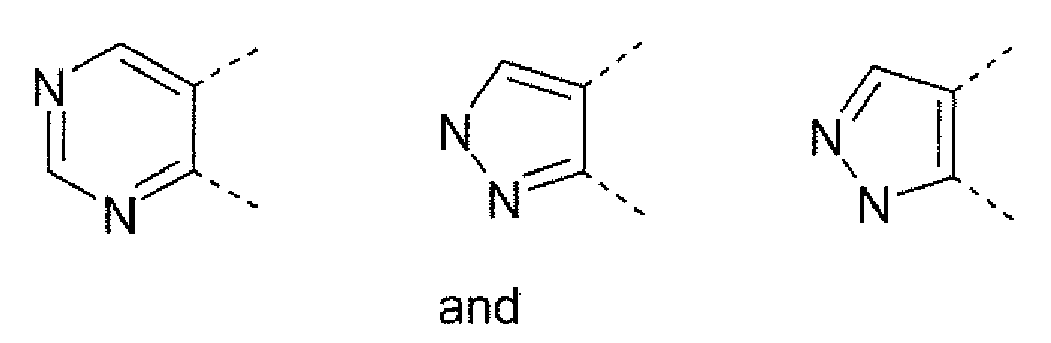

- Heterocyclic compounds having the following partial structures are preferred:


- Heterocyclic compounds having the following partial structures are particularly preferred:


- In said formulae, R and R2 are as defined herein. If there is more than one radical R2, these may be the same or different radicals.
- According to a particular embodiment, the partial structures depicted above are fused with a cyclohexane moiety (i.e., n is 1). The same applies to the preferred and particular embodiments disclosed for ring A.
- R is R1-W-A1-Q-Y-A2-X1- and A, R1, W, A1, Q, Y, A2, X1, R2, R3, R4a, R4b, X2, X3, R5 are as defined herein.
- R1 is hydrogen, C1-C6-alkyl (e.g. methyl, ethyl, n-propyl, isopropyl or sec-butyl, a further example being n-butyl or n-pentyl), C3-C12-cycloalkyl-C1-C4-alkyl (e.g. cyclopentylmethyl or cyclohexylmethyl, a further example being cyclopropylmethyl), halogenated C1-C6-alkyl (e.g. 3-fluoroprop-1-yl, 3-chloroprop-1-yl or 3,3,3-trifluoroprop-1-yl), hydroxy-C1-C4-alkyl, C1-C6-alkoxy-C1-C4-alkyl (e.g. ethoxyethyl), amino-C1-C4-alkyl, C1-C6-alkylamino-C1-C4-alkyl, di-C1-C6-alkylamino-C1-C4-alkyl, C1-C6-alkylcarbonylamino-C1-C4-alkyl, C1-C6-alkyloxycarbonylamino-C1-C4-alkyl, C1-C6-alkylaminocarbonylamino-C1-C4-alkyl, di-C1-C6-alkylaminocarbonylamino-C1-C4-alkyl, C1-C6-alkylsulfonylamino-C1-C4-alkyl, (optionally substituted C6-C12-aryl-C1-C6-alkyl)amino-C1-C4-alkyl, optionally substituted C6-C12-aryl-C1-C4-alkyl, optionally substituted C3-C12-heterocyclyl-C1-C4-alkyl, C3-C12-cycloalkyl (e.g. cyclopropyl or cyclobutyl), C1-C6-alkylcarbonyl, C1-C6-alkoxycarbonyl, halogenated C1-C6-alkoxycarbonyl, C6-C12-aryloxycarbonyl, aminocarbonyl, C1-C6-alkylaminocarbonyl, (halogenated C1-C4-alkyl)aminocarbonyl, C6-C12-arylaminocarbonyl, C2-C6-alkenyl (e.g. prop-1,2-en-1-yl), C2-C6-alkynyl, optionally substituted C6-C12-aryl (e.g. phenyl, a further example being 2-methylphenyl), hydroxy, C1-C6-alkoxy (e.g. tert-butyloxy), halogenated C1-C6-alkoxy, C1-C6-hydroxyalkoxy, C1-C6-alkoxy-C1-C4-alkoxy, amino-C1-C4-alkoxy, C1-C6-alkylamino-C1-C4-alkoxy, di-C1-C6-alkylamino-C1-C4-alkoxy, C1-C6-alkylcarbonylamino-C1-C4-alkoxy, C6-C12-arylcarbonylamino-C1-C4-alkoxy, C1-C6-alkoxycarbonylamino-C1-C4-alkoxy, C6-C12-aryl-C1-C4-alkoxy, C1-C6-alkylsulfonylamino-C1-C4-alkoxy, (halogenated C1-C6-alkyl)sulfonylamino-C1-C4-alkoxy, C6-C12-arylsulfonylamino-C1-C4-alkoxy, (C6-C12-aryl-C1-C6-alkyl)sulfonylamino-C1-C4-alkoxy, C3-C12-heterocyclylsulfonylamino-C1-C4-alkoxy, C3-C12-heterocyclyl-C1-C4-alkoxy, C6-C12-aryloxy, C3-C12-heterocyclyloxy, C1-C6-alkylthio, halogenated C1-C6-alkylthio, C1-C6-alkylamino, (halogenated C1-C6-alkyl)amino, di-C1-C6-alkylamino (e.g. dimethylamino), di-(halogenated C1-C6-alkyl)amino, C1-C6-alkylcarbonylamino, (halogenated C1-C6-alkyl)carbonylamino, C6-C12-arylcarbonylamino, C1-C6-alkylsulfonylamino, (halogenated C1-C6-alkyl)sulfonylamino, C6-C12-arylsulfonylamino or optionally substituted C3-C12-heterocyclyl (e.g. 3-pyridyl, 2-thienyl, 4-methyl-2-thienyl, 5-methyl-2-thienyl, 5-chloro-2-thienyl, 2,5-dimethyl-3-thienyl, 1,2-diazol-4-yl, 1-methyl-1,2-diazol-4-yl, 1-ethyl-1,2-diazol-4-yl, 1-difluormethyl-1,2-diazol-4-yl, 2-methyl-1,3-diazol-4-yl, 1-methyl-1,3-diazol-4-yl, 2-methyl-1,3-thiazol-5-yl, 2,4-dimethyl-1,3-thiazol-5-yl or 3-pyrrolidinyl, a further example being 1-methyl-pyrrol-3-yl, 2-pyridyl, 1-methyl-1,2-diazol-3-yl, 1-methyl-3-trifluoromethyl-1,2-diazol-4-yl, 1, 2-dimethyl-1,3-diazol-4-yl, 5-methylisoxazol-3-yl or 1-methyl-1,2,4-triazol-3-yl). Additionally, R1 may also be tri-(C1-C4-alkyl)-silyl-C1-C4-alkyl (e.g. trimethylsilylethyl).
Preferably, R1 is C1-C6-alkyl (e.g. methyl, ethyl, n-propyl, isopropyl or sec-butyl, a further example being n-butyl or n-pentyl), C3-C12-cycloalkyl-C1-C4-alkyl (e.g. cyclopentylmethyl or cyclohexylmethyl, a further example being cyclopropylmethyl), halogenated C1-C6-alkyl (e.g. 3-fluoroprop-1-yl, 3-chloroprop-1-yl or 3,3,3-trifluoroprop-1-yl), C1-C6-alkoxy-C1-C4-alkyl (e.g. ethoxyethyl), amino-C1-C4-alkyl, C1-C6-alkylamino-C1-C4-alkyl, di-C1-C6-alkylamino-C1-C4-alkyl, C1-C6-alkyloxycarbonylamino-C1-C4-alkyl, C1-C6-alkylaminocarbonylamino-C1-C4-alkyl, C6-C12-aryl-C1-C4-alkyl, C3-C12-cycloalkyl (e.g. cyclopropyl or cyclobutyl), C2-C6-alkenyl (e.g. prop-1,2-en-1-yl), optionally substituted C6-C12-aryl (e.g. phenyl), hydroxy, C1-C6-alkylamino, (halogenated C1-C6-alkyl)amino, di-C1-C6-alkylamino or optionally substituted C3-C12-heterocyclyl (e.g. 3-pyridyl, 2-thienyl, 4-methyl-2-thienyl, 5-methyl-2-thienyl, 5-chloro-2-thienyl, 2,5-dimethyl-3-thienyl, 1,2-diazol-4-yl, 1-methyl-1,2-diazol-4-yl, 1-ethyl-1,2-diazol-4-yl, 1-difluormethyl-1,2-diazol-4-yl, 2-methyl-1,3-diazol-4-yl, 1-methyl-1,3-diazol-4-yl, 2-methyl-1,3-thiazol-5-yl, 2,4-dimethyl-1,3-thiazol-5-yl or 3-pyrrolidinyl). It is further preferred if R1 is tri-(C1-C4-alkyl)-silyl-C1-C4-alkyl (e.g. trimethylsilylethyl). - In particular, R1 is C1-C6-alkyl (e.g. methyl, ethyl, n-propyl, isopropyl or sec-butyl, a further example being n-butyl or n-pentyl), C3-C12-cycloalkyl-C1-C4-alkyl (e.g. cyclopentylmethyl or cyclohexylmethyl, a further example being cyclopropylmethyl), halogenated C1-C6-alkyl (e.g. 3-fluoroprop-1-yl, 3-chloroprop-1-yl or 3,3,3-trifluoroprop-1-yl), C3-C12-cycloalkyl (e.g. cyclopropyl or cyclobutyl), C2-C6-alkenyl (e.g. prop-1,2-en-1-yl), optionally substituted C6-C12-aryl (e.g. phenyl), or optionally substituted C3-C12-heterocyclyl (e.g. 3-pyridyl, 2-thienyl, 4-methyl-2-thienyl, 5-methyl-2-thienyl, 5-chloro-2-thienyl, 2,5-dimethyl-3-thienyl, 1,2-diazol-4-yl, 1-methyl-1,2-diazol-4-yl, 1-ethyl-1,2-diazol-4-yl, 1-difluormethyl-1,2-diazol-4-yl, 2-methyl-1,3-diazol-4-yl, 1-methyl-1,3-diazol-4-yl, 2-methyl-1,3-thiazol-5-yl, 2,4-dimethyl-1,3-thiazol-5-yl or 3-pyrrolidinyl). In particular, R1 may also be tri-(C1-C4-alkyl)-silyl-C1-C4-alkyl (e.g. trimethylsilylethyl).
- In connection with R1, substituted C6-C12-aryl in particular includes C6-C12-aryl, such as phenyl or naphthyl, substituted with 1, 2 or 3 substituents selected from the group consisting of halogen, C1-C4-alkyl, C1-C4-haloalkyl, cyano, C1-C4-alkoxy, C1-C4-haloalkoxy, amino, C1-C4-alkylamino, C1-C4-dialkylamino, morpholino and piperidinyl. The same applies to substituted C6-C12-aryl in substituted C6-C12-aryl-C1-C4-alkyl.
- In connection with R1, substituted C3-C12-heterocyclyl in particular includes C3-C12-heterocyclyl, such as pyridyl, thienyl, diazolyl, quinolinyl, piperidinyl, piperazinyl or morpholinyl (pyrrolyl, isoxazolyl and triazolyl being further examples of such C3-C12-heterocyclyl), substituted with 1, 2 or 3 substituents selected from the group consisting of halogen, C1-C4-alkyl, C1-C4-haloalkyl, C1-C4-alkoxycarbonyl, cyano, C1-C4-alkoxy, C1-C4-haloalkoxy, C1-C4-alkylsulfonyl, amino, C1-C4-alkylamino, C1-C4-dialkylamino, C6-C12-arylamino and C3-C12-heterocyclyl (e.g., morpholino or piperidinyl). The same applies to substituted C3-C12-heteroaryl in substituted C3-C12-heteroaryl-C1-C4-alkyl.
- According to one embodiment, W is -NR8- and Y is a bond. According to an alternative embodiment, W is a bond and Y is -NR9-. According to a further alternative embodiment, W is a bond and Y is a bond, especially if R1 is a nitrogen-bound radical, e.g. nitrogen-bound heterocyclyl such as piperazinyl or morpholinyl.
- According to one embodiment, Q is -S(O)2-. According to an alternative embodiment, Q is -C(O)-.
- According to a particular embodiment, -W-A1-Q-Y- is -W-A1-S(O)2-NR9-, -NR8-S(O)2-, -A1-S(O)2- or -S(O)2-. According to a further particular embodiment, -W-A1-Q-Y- is -W-A1-CO-NR9- or -NR8-CO-.
- A1 is optionally substituted C1-C4-alkylene or a bond. In connection with A1, substituted C1-C4-alkylene in particular includes C1-C4-alkylene substituted with 1, 2 or 3 substituents selected from the group consisting of halogen, C1-C4-alkyl and cyano. Preferably, A1 is a bond. If A1 is C1-C4-alkylene, W is preferably -NR8-.
- A2 is optionally substituted C1-C4-alkylene (e.g. 1,2-ethylene or 1,3-propylene), C1-C4-alkylene-CO-, -CO-C1-C4-alkylene, C1-C4-alkylene-O-C1-C4-alkylene, C1-C4-alkylene-NR10-C1-C4-alkylene, optionally substituted C6-C12-arylene, optionally substituted C6-C12-heteroarylene or a bond. Additionally, A2 may be optionally substituted C2-C4-alkenylene or optionally substituted C2-C4-alkynylene. Preferably, A2 is optionally substituted C1-C4-alkylene (e.g. 1,2-ethylene or 1,3-propylene). More preferably, A2 is C1-C4-alkylene (e.g. 1,2-ethylene or 1,3-propylene). Alternatively, it is preferred that A2 is optionally substituted C6-C12-arylene, in particular C6-C12-arylene selected from the group consisting of phen-1,4-ylene and phen-1,3-ylene, or optionally substituted C6-C12-heteroarylene, in particular C6-C12-heteroarylene selected from the group consisting of pyrid-2,5-ylene and pyrid-2,4-ylene. If A2 is a bond, X1 is preferably optionally substituted C1-C4-alkylene. Alternatively, if A2 is a bond, X1 is in particular optionally substituted C2-C4-alkenylene or optionally substituted C2-C4-alkynylene.
- In connection with A2, substituted C1-C4-alkylene in particular includes C1-C4-alkylene substituted with 1, 2 or 3 substituents selected from the group consisting of halogen, C1-C4-alkyl, C1-C4-haloalkyl and cyano.
- In connection with A2, substituted C2-C4-alkenylene or substituted C2-C4-alkynylene in particular includes C2-C4-alkenylene or C2-C4-alkynylene substituted with 1, 2 or 3 substituents selected from the group consisting of halogen, C1-C4-alkyl, C1-C4-haloalkyl and cyano.
- In connection with A2, substituted C6-C12-arylene in particular includes C6-C12-arylene substituted with 1, 2 or 3 substituents selected from the group consisting of C1-C4-alkyl, C1-C4-haloalkyl, C1-C4-alkoxycarbonyl, cyano, C1-C4-alkoxy, C1-C4-haloalkoxy, C1-C4-alkylsulfonyl, amino, C1-C4-alkylamino, C1-C4-dialkylamino, C6-C12-arylamino and C3-C12-heterocyclyl (e.g., morpholino or piperidinyl).
- In connection with A2, substituted C6-C12-heteroarylene in particular includes C6-C12-heteroarylene substituted with 1, 2 or 3 substituents selected from the group consisting of C1-C4-alkyl, C1-C4-haloalkyl, C1-C4-alkoxycarbonyl, cyano, C1-C4-alkoxy, C1-C4-haloalkoxy, C1-C4-alkylsulfonyl, amino, C1-C4-alkylamino, C1-C4-dialkylamino, C6-C12-arylamino and C3-C12-heterocyclyl (e.g, morpholino or piperidinyl).
- X1 is -O-, -NR11-, -S- or optionally substituted C1-C4-alkylene (e.g. -CH2-, a further example being 1,2-ethylene and 1,3-popylene). In connection with X1, substituted C1-C4-alkylene in particular includes C1-C4-alkylene substituted with 1, 2 or 3 substituents selected from the group consisting of halogen, C1-C4-alkyl, C1-C4-haloalkyl and cyano. Additionally, X1 may be optionally substituted C2-C4-alkenylene or optionally substituted C2-C4-alkynylene (e.g. propynylene). In connection with X1, substituted C2-C4-alkenylene or substituted C2-C4-alkynylene in particular includes C2-C4-alkenylene or C2-C4-alkynylene substituted with 1, 2 or 3 substituents selected from the group consisting of halogen, C1-C4-alkyl, C1-C4-haloalkyl and cyano. Preferably, X1 is -O-, -NR11, -S-. More preferably, X1 is -O-. Alternatively, it is preferred if X1 is optionally substituted C1-C4-alkylene (e.g. -CH2-, 1,2-ethylene and 1,3-popylene).
- According to a particular embodiment, A2 is a bond and X1 is optionally substituted C1-C4-alkylene, optionally substituted C2-C4-alkenylene or optionally substituted C2-C4-alkynylene.
- According to a particular embodiment, R1-W-A1-Q-Y-A2-X1- is R1-S(O)2-NH-A2-X1-, R1-NH-S(O)2-A2-X1-, R1-C(O)-NH-A2-X1- or R1-NH-C(O)-A2-X1-.
- According to a particular embodiment, the structural element -Y-A2-X1- comprises at least 2, 3 or 4 atoms in the main chain. According to further particular embodiments the structural element -Y-A2-X1- has up to 4, 5 or 6 atoms in the main chain, such as 2 to 6, 2 to 5 or 2 to 4 atoms in the main chain, especially 2, 3 or 4 atoms in the main chain.
- According to a further particular embodiment, -Y-A2-X1- is -C1-C4-alkylene-O- or -NR9-C1-C4-alkylene-O-, with -Y-A2-X1- preferably having 2 to 6, 3 to 5 and especially 4 atoms in the main chain. Particular examples of -Y-A2-X1- include -(CH2)3-O- and -NR9-(CH2)2-O-. In this particular embodment, R9 is as defined herein and preferably R9 is hydrogen, C1-C6-alkyl (e.g. methyl or ethyl) or C3-C12-cycloalkyl (e.g. cyclopropyl), or R9 is C1-C4-alkylene that is bound to a carbon atom in A2 which is C1-C4-alkylene.
- According to a further particular embodiment, -Y-A2-X1- is -NR9-C1-C4-alkylene-(e.g. -NH-CH2-, a further example being -NH-(CH2)2- or -NH-(CH2)3-), with -Y-A2-X1- preferably having 2 to 6, 2 to 5, 2 to 4 and especially 2, 3 or 4 atoms in the main chain. In this particular embodment, R9 is as defined herein and preferably R9 is hydrogen, C1-C6-alkyl (e.g. methyl or ethyl) or C3-C12-cycloalkyl (e.g. cyclopropyl); or R9 is C1-C4-alkylene that is bound to a carbon atom in X1 which is C1-C4-alkylene. If A is a heterocyclic ring, this embodiment of -Y-A2-X1- is particularly suitable.
- According to a further particular embodiment, -Y-A2-X1- is -NR9-C2-C4-alkenylene- or -NR9-C2-C4-alkynylene- (e.g. -NH-CH2-C≡C-), with -Y-A2-X1- preferably having 2 to 6, 3 to 5 and especially 4 atoms in the main chain. In this particular embodment, R9 is as defined herein and preferably is R9 is hydrogen, C1-C6-alkyl (e.g. methyl or ethyl) or C3-C12-cycloalkyl (e.g. cyclopropyl or cyclobutyl). If A is a heterocyclic ring, this embodiment of -Y-A2-X1- is particularly suitable.
- According to a further particular embodiment, -Y-A2-X1- is -C1-C4-alkylene- (e.g. -(CH2)2-), with -Y-A2-X1- preferably having 2 to 6, 2 to 5,2 to 4 and especially 2 atoms in the main chain. If A is a heterocyclic ring, this embodiment of -Y-A2-X1- is particularly suitable.
- According to a further particular embodiment, the structural motif -Y-A2-X1 as disclosed herein is bound to Q being -S(O)2- or -C(O)-. Particular examples for this embimdnet include heterocyclic compounds of the invention wherein R is R1-S(O)2-Y-A2-X1 or R1-C(O)-Y-A2-X1.
- The radical R1-W-A1-Q-Y-A2-X1- is bound to the 7--position of the aminotetraline skeleton:

- In said formulae, R1, W, A1, Q, Y, A2, X1, R2, R3, R4a, R4b, X2, X3, R5, n are as defined herein.
- In addition to the radical R1-W-A1-Q-Y-A2-X1-, the aminotetraline derivatives of the invention may have one or more than one further substituent bound to the ring A. In these positions, the skeleton of the aminotetraline derivatives may thus be substituted with one or more than one radical R2. lf there is more than one radical R2, these may be the same or different radicals. In particular, in 5-, 6- and/or 8-position, the aminotetraline skeleton may be substituted with one or more than one radical R2. The aminotetraline derivatives of the invention may therefore be represented by one of the following formulae:

- R2 is hydrogen, halogen, C1-C6-alkyl, halogenated C1-C4-alkyl, hydroxy-C1-C4-alkyl, -CN, C2-C6-alkenyl, C2-C6-alkynyl, hydroxy, C1-C6-alkoxy, halogenated C1-C6-alkoxy, C1-C6-alkoxycarbonyl, C2-C6-alkenyloxy, C1-C6-alkylcarbonyloxy, C1-C6-alkylthio, C1-C6-alkylsulfinyl, C1-C6-alkylsulfonyl, aminosulfonyl, amino, C1-C6-alkylamino, C2-C6-alkenylamino or nitro.
- Preferably, R2 is hydrogen, halogen or C1-C6-alkoxy. In particular, R2 is hydrogen.
- According to a particular embodiment, the aminotetraline derivatives of the invention have one of the following formulae:

- In 1-, 2,- 3-, 4- and/or 5-position, the aminotetraline derivatives of the invention may be substituted with one or more than one radical R3. If there is more than one radical R3, these may be the same or different radicals. The aminotetraline derivatives of the invention may therefore be represented by the following formula:
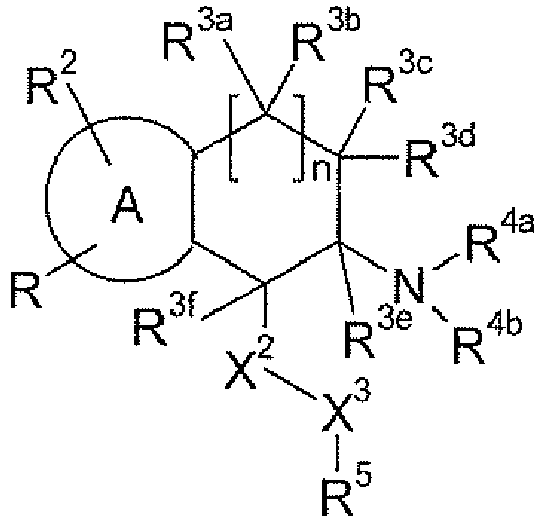
- According to a particular embodiment, the aminotetraline derivatives of the invention have one of the following formulae:


- R3 is hydrogen or C1-C6-alkyl.
- In particular, R3 is hydrogen.
- R4a is hydrogen, C1-C6-alkyl (e.g. methyl, ethyl, n-propyl or isopropyl), C3-C12-cycloalkyl-C1-C4-alkyl (e.g. cyclopropylmethyl), halogenated C1-C4-alkyl (e.g. 2-fluoroethyl or 2,2,2-trifluoroethyl), hydroxy-C1-C4-alkyl, C1-C6-alkoxy-C1-C4-alkyl, amino-C1-C4-alkyl, CH2CN, - CHO, C1-C4-alkylcarbonyl (e.g. methylcarbonyl or isopropylcarbonyl, a further example being ethylcarbonyl), (halogenated C1-C4-alkyl)carbonyl (e.g. fluoromethylcarbonyl, difluoromethylcarbonyl or trifluoromethylcarbonyl, a further example being 1,1,1-trifluoroeth-2-ylcarbonyl or 1,1,1-trifluoroprop-3-ylcarbonyl), C6-C12-arylcarbonyl (e.g. phenylcarbonyl), C1-C4-alkoxycarbonyl (e.g. ethoxycarbonyl or tert-butyloxycarbonyl), C6-C12-aryloxycarbonyl (e.g. phenoxycarbonyl), C1-C6-alkylaminocarbonyl, C2-C6-alkenyl, - C(=NH)NH2, -C(=NH)NHCN, C1-C6-alkylsulfonyl, C6-C12-arylsulfonyl, amino, -NO or C3-C12-heterocyclyl.
- Preferably, R4a is hydrogen, C1-C6-alkyl (e.g. methyl, ethyl, n-propyl or isopropyl), C3-C12-cycloalkyl-C1-C4-alkyl (e.g. cyclopropylmethyl), halogenated C1-C4-alkyl (e.g. 2-fluoroethyl or 2,2,2-trifluoroethyl), amino-C1-C4-alkyl, CH2CN, C1-C4-alkylcarbonyl (e.g. methylcarbonyl or isopropylcarbonyl), (halogenated C1-C4-alkyl)carbonyl (e.g. fluoromethylcarbonyl, difluoromethylcarbonyl or trifluoromethylcarbonyl), C6-C12-arylcarbonyl (e.g. phenylcarbonyl), C1-C4-alkoxycarbonyl (e.g. ethoxycarbonyl or tert-butyloxycarbonyl), C6-C12-aryloxycarbonyl (e.g. phenoxycarbonyl), -C(=NH)NH2, -C(=NH)NHCN, C1-C6-alkylsulfonyl, amino, -NO or C3-C12-heterocyclyl. It is further preferred if R1 is -CHO.
- In particular, R4a is hydrogen, C1-C6-alkyl (e.g. methyl, ethyl, n-propyl or isopropyl), C3-C12-cycloalkyl-C1-C4-alkyl (e.g. cyclopropylmethyl), halogenated C1-C4-alkyl (e.g. 2-fluoroethyl or 2,2,2-trifluoroethyl), C1-C4-alkylcarbonyl (e.g. methylcarbonyl or isopropylcarbonyl), (halogenated C1-C4-alkyl)carbonyl (e.g. fluoromethylcarbonyl, difluoromethylcarbonyl or trifluoromethylcarbonyl), C6-C12-arylcarbonyl (e.g. phenylcarbonyl), C1-C4-alkoxycarbonyl (e.g. ethoxycarbonyl or tert-butyloxycarbonyl), C6-C12-aryloxycarbonyl (e.g. phenoxycar-bonyl). In particular, R4a may also be -CHO.
- R4b is hydrogen, C1-C6-alkyl (e.g. methyl, a further example being ethyl), halogenated C1-C4-alkyl, hydroxy-C1-C4-alkyl, C1-C6-alkoxy-C1-C4-alkyl, amino-C1-C4-alkyl, CH2CN, -CHO, C1-C4-alkylcarbonyl, (halogenated C1-C4-alkyl)carbonyl, C6-C12-arylcarbonyl, C1-C4-alkoxycarbonyl, C6-C12-aryloxycarbonyl, C1-C6-alkylaminocarbonyl, C2-C6-alkenyl, - C(=NH)NH2, -C(=NH)NHCN, C1-C6-alkylsulfonyl, C6-C12-arylsulfonyl, amino, -NO or C3-C12-heterocyclyl.
- Preferably, R4b is hydrogen, C1-C6-alkyl (e.g. methyl, a further example being ethyl).
- Alternatively, R4a, R4b together are optionally substituted C1-C6-alkylene (e.g. 1,4-butylene, a further example being 1,3-propylene, 2-fluoro-but-1,4-ylene or 1-oxo-but-1,4-ylene), wherein one -CH2- of C1-C4-alkylene may be replaced by an oxygen atom (e.g. -CH2-CH2-O-CH2-CH2-) or -NR16.
- X2 is is >CR12aR12b.
- X3 is a bond.
- R12a is hydrogen, optionally substituted C1-C6-alkyl, C1-C6-alkylamino-C1-C4-alkyl, di-C1-C6-alkylamino-C1-C4-alkyl, C3-C12-heterocyclyl-C1-C6-alkyl, optionally substituted C6-C12-aryl or hydroxy. Preferably, R12a is hydrogen or C1-C6-alkyl.
- In connection with R12a, substituted C1-C6-alkyl in particular includes C1-C6-alkyl substituted with 1, 2 or 3 substituents selected from the group consisting of halogen, hydroxy, C1-C4-alkoxy and amino.
- In connection with R12a, substituted C6-C12-aryl in particular includes C6-C12-aryl, such as phenyl, substituted with 1, 2 or 3 substituents selected from the group consisting of C1-C4-alkyl, C1-C4-haloalkyl, cyano, C1-C4-alkoxy and C1-C4-haloalkoxy.
- R12b is hydrogen or C1-C6-alkyl. According to a particular embodiment, R12b is hydrogen.
- Alternatively, R12a and R12b together are together are carbonyl or, preferably, optionally substituted C1-C4-alkylene (e.g. 1,3-propylene), wherein one -CH2- of C1-C4-alkylene may be replaced by an oxygen atom or -NR14-.
- In connection with R12a and R12b, substituted C1-C4-alkylene in particular includes C1-C4-alkylene substituted with 1, 2 or 3 substituents selected from the group consisting of halogen, C1-C4-alkyl, C1-C4-haloalkyl, cyano, C1-C4-alkoxy and C1-C4-haloalkoxy.
- According to a particular embodiement, R12a is C1-C6-alkyl and R12b is hydrogen or C1-C6-alkyl.
- According to a further particular embodiement, R12a is hydrogen and R12b is hydrogen.
- According to a further particular embodiment, R12a and R12b together are optionally substituted 1,3-propylene.
- R5 is optionally substituted C6-C12-aryl (e.g. phenyl, 3-chlorophenyl, 3,4-dichlorophenyl or 2,4-dichlorophenyl, a further example being 2-fluorophenyl, 2-chlorophenyl, 3-fluorophenyl, 3-chlorophenyl; 3-cyanophenyl, 3-methylphenyl, 3-trifluoromethylphenyl, 3-methoxyphenyl, 4-fluorophenyl, 4-chlorophenyl, 4-methoxyphenyl, 3,4-difluorophenyl, 3,5-difluorophenyl, 3-fluoro-5-chlorophenyl, 3-chloro-4-ffuorophenyl), optionally substituted C3-C12-cycloalkyl (e.g. cyclohexyl) or optionally substituted C3-C12-heterocyclyl.
- In connection with R5, substituted C3-C12-cycloalkyl in particular includes C3-C12-cycloalkyl, such as cyclopropyl or cyclohexyl, substituted with 1, 2 or 3 substituents selected from the group consisting of halogen, optionally substituted C1-C6-alkyl, halogenated C1-C6-alkyl, CN, hydroxy, C1-C6-alkoxy, halogenated C1-C6-alkoxy, amino, C1-C6-alkylamino, di-C1C6-alkylamino and C3-C12-heterocyclyl.
- In connection with R5, substituted C6-C12-aryl in particular includes C6-C12-aryl, such as phenyl, substituted with 1, 2 or 3 substituents selected from the group consisting of halogen (e.g. F, Cl, Br), optionally substituted C1-C6-alkyl (e.g. methyl), halogenated C1-C6-alkyl (e.g. trifluoromethyl), CN, hydroxy, C1-C6-alkoxy (e.g. methoxy), halogenated C1-C6-alkoxy, amino, C1-C6-alkylamino, di-C1-C6-alkylamino and C3-C12-heterocyclyl.
- In connection with R5, substituted C3-C12-heterocyclyl in particular includes C3-C12-heterocyclyl substituted with 1, 2 or 3 substituents selected from the group consisting of halogen, optionally substituted C1-C6-alkyl, halogenated C1-C6-alkyl, CN, hydroxy, C1-C6-alkoxy, halogenated C1-C6-alkoxy, amino, C1-C6-alkylamino, di-C1-C6-alkylamino and C3-C12-heterocyclyl.
- In connection with R5, C3-C12-heterocyclyl in particular is C3-C12-heteroaryl.
- Preferably, R5 is optionally substituted C6-C12-aryl, in particular as in the aminotetraline derivatives of the formula:
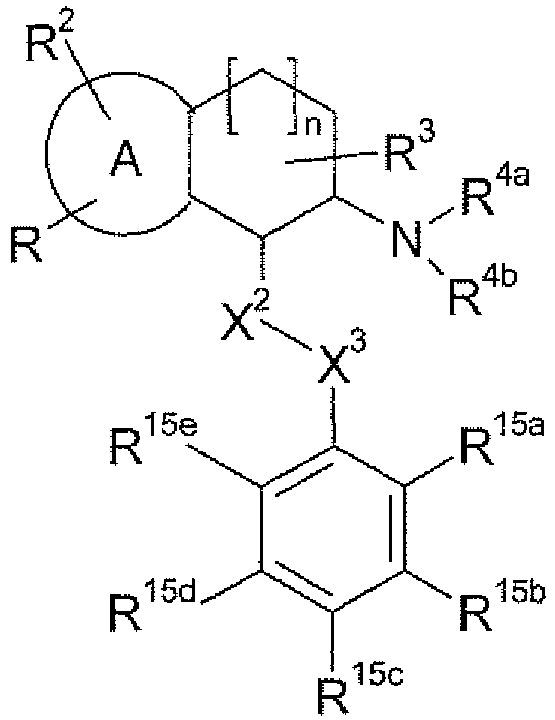
R15a, R15b, R15c, R15d, R15e independently are hydrogen, halogen (e.g. F, Cl or Br), optionally substituted C1-C6-alkyl (e.g. methyl), halogenated C1-C6-alkyl (e.g. trifluoromethyl), CN, hydroxy, C1-C6-alkoxy (e.g. methoxy), amino, C1-C6-alkylamino, di-C1-C6-alkylamino or C3-C12-heterocyclyl. - According to a particular embodiment, the invention relates to aminotetralin derivatives of the formula:

- In connection with R5 or R15a, R15b, R15c, R15d , R15e, substituted C1-C6-alkyl in particular includes C1-C6-alkyl, especially C1-C4-alkyl, substituted with 1, 2 or 3 substituents selected from the group consisting of hydroxy, C1-C6-alkoxy, amino, C1-C6-alkylamino, di-C1-C6-alkylamino and C3-C12-heterocyclyl (e.g. morpholinyl or piperidinyl).
- According to a particular embodiment, R15a, R15b, R15d , R15e are hydrogen and R15c is different from hydrogen (para-mono-substitution).
- According to a further particular embodiment, R15a, R15c, R15d, R15e are hydrogen and R15b is different from hydrogen (meta-mono-substitution).
- In connection with R15a, R15b, R15c, R15d, R15e, C3-C12-heterocyclyl in particular includes morpholinyl, imidazolyl and pyrazolyl.
- The index n is 0, 1 or 2. According to a particular embodiment, n is 1.
- R8 is hydrogen or C1-C6-alkyl. Preferably, R8 is hydrogen.
- R9 is hydrogen, C1-C6-alkyl (e.g. methyl or ethyl), C3-C12-cycloalkyl (e.g. cyclopropyl), amino-C1-C6-alkyl, optionally substituted C6-C12-aryl-C1-C4-alkyl or C3-C12-heterocyclyl (e.g. 3-azetidinyl). Preferably, R9 is hydrogen or C1-C6-alkyl (e.g. methyl or ethyl).
- According to a particular embodiment, R9 and R1 together are C1-C4-alkylene (e.g. 1,3-propylene, a further example being 1,2-ethylene) so as that R9 and R1 together with the atom in Q to which R1 is bound and the nitrogen atom to which R9 is bound form an heterocyclic ring having, in particular, 4, 5 or 6 ring member atoms (including the nitrogen atom and Q). With W and A1 both being a bond, such a ring may be represented by the following partial structure:

- According to a further particular embodiment, R9 is C1-C4-alkylene (e.g. methylene or 1,3-propylene) that is bound to a carbon atom in A2 and A2 is C1-C4-alkylene so that R9 and at least part of A2 together with the nitrogen atom to which R9 is bound form an N-containing heterocyclic ring having, in particular, 4, 5 , 6 or 7 ring member atoms (including the nitrogen atom). Such a ring may be represented by the following partial structure:

- According to a further particular embodiment, R9 is C1-C4-alkylene (e.g. methylene or 1,3-propylene) that is bound to a carbon atom in X1 and X1 is C1-C4-alkylene (e.g. 1,2-ethylene) so that R9 and at least part of X1 together with the nitrogen atom to which R9 is bound form an N-containing heterocyclic ring having, in particular, 4, 5 , 6 or 7 ring member atoms (including the nitrogen atom). With A2 being a bond, such a ring may be represented by the following partial structure:

- R10 is hydrogen, C1-C6-alkyl or C1-C6-alkylsulfonyl. Preferably, R10 is hydrogen.
- R11 is hydrogen or C1-C6-alkyl Preferably, R11 is hydrogen.
- Alternatively, R9, R11 together are C1-C4-alkylene (e.g. ethylene).
- R14 is hydrogen or C1-C6-alkyl. Preferably, R14 is hydrogen.
- R16 is hydrogen or C1-C6-alkyl. Preferably, R16 is hydrogen.
- Particular embodiments of aminotetraline derivatives of the invention result if
- A
- is a 5- or 6-membered ring as defined herein;
- R
- is R1-W-A1-Q-Y-A2-X1-;
- R1
- is hydrogen, C1-C6-alkyl, C3-C12-cycloalkyl-C1-C4-alkyl, halogenated C1-C6-alkyl, hydroxy-Cl-C4-alkyl, C1-C6-alkoxy-C1-C4-alkyl, amino-C1-C4-alkyl, C1-C6-alkylamino-C1-C4-alkyl, di-C1-C6-alkylamino-C1-C4-alkyl, C1-C6-alkylcarbonylamino-C1-C4-alkyl, C1-C6-alkyloxycarbonylamino-C1-C4-alkyl, C1-C6-alkylaminocarbonylamino-C1-C4-alkyl, di-C1-C6-alkylaminocarbonylamino-C1-C4-alkyl, C1-C6-alkylsufonylamino-C1-C4-alkyl, (optionally substituted C6-C12-aryl-C1-C6-alkyl)amino-C1-C4-alkyl, optionally substituted C6-C12-aryl-C1-C4-alkyl, optionally substituted C3-C12-heterocyclyl-C1-C4-alkyl, C3-C12-cycloalkyl, C1-C6-alkylcarbonyl, C1-C6-alkoxycarbonyl, halogenated C1-C6-alkoxycarbonyl, C6-C12-aryloxycarbonyl, aminocarbonyl, C1-C6-alkylaminocarbonyl, (halogenated C1-C4-alkyl)amínocarbonyl, C6-C12-arylaminocarbonyl, C2-C6-alkenyl, C2-C6-alkynyl, optionally substituted C6-C12-aryl, hydroxy, C1-C6-alkoxy, halogenated C1-C6-alkoxy, C1-C6-hydroxyalkoxy, C1-C6-alkoxy-C1-C4-alkoxy, amino-C1C4-alkoxy, C1-C6-alkylamino-C1C4-alkoxy, di-C1-C6-alkylamino-C1-C4-alkoxy, C1-C6-alkylcarbonylamino-C1-C4-alkoxy, C6-C12-arylcarbonylamino-C1-C4-alkoxy, C1-C6-alkoxycarbonylamino-C1-C4-alkoxy, C6-C12-aryl-C1-C4-alkoxy, C1-C6-alkylsulfonylamino-C1-C4-alkoxy, (halogenated C1-C6-alkyl)sulfonylamino-C1-C4-alkoxy, C6-C12-arylsulfonylamino-C1-C4-alkoxy, (C6-C12-aryl-C1-C6-alkyl)sulfonylamino-C1-C6-alkoxy, C3-C12-heterocyclylsulfonylamino-C1-C4-alkoxy, C3-C12-heterocyclyl-C1-C4-alkoxy, C6-C12-aryloxy, C3-C12-heterocyclyloxy, C1-C6-alkylthio, halogenated C1-C6-alkylthio, C1-C6-alkylamino, (halogenated C1-C6-alkyl)amino, di-C1-C6-alkylamino, di-(halogenated C1-C6-alkyl)amino, C1-C6-alkylcarbonylamino, (halogenated C1-C6-alkyl)carbonylamino, C6-C12-arylcarbonylamino, C1-C6-alkylsulfonylamino, (halogenated C1-C6-alkyl)sulfonylamino, C6-C12-arylsulfonylamino or optionally substituted C3-C12-heterocyclyl;
- W
- is -NR8- or a bond;
- A1
- is optionally substituted C1-C4-alkylene or a bond;
- Q
- is -S(O)2- or -C(O)-;
- Y
- is -NR9- or a bond;
- A2
- is optionally substituted C3-C4-alkylene, C1-C4-alkylene-CO-, -CO-C1-C4-alkylene, C1-C4-alkylene-O-C1-C4-alkylene, C1-C4-alkylene-NR10-C1-C4-alkylene, optionally substituted C6-C12-arylene, optionally substituted C6-C12-heteroarylene or a bond;
- X1
- is -O-, -NR11-, -S-, optionally substituted C1-C4-alkylene;
- R2
- is hydrogen, halogen, C1-C6-alkyl, halogenated C1-C4-alkyl, hydroxy-C1-C4-alkyl,-CN, C2-C6-alkenyl, C2-C6-alkynyl, hydroxy, C1-C6-alkoxy, halogenated C1-C6-alkoxy, C1-C6-alkoxycarbonyl, C2-C6-alkenyloxy, C1-C6-alkylcarbonyloxy, C1-C6-alkylthio, C1-C6-alkylsulfinyl, C1-C6-alkylsulfonyl, aminosulfonyl, amino, C1-C6-alkylamino, C2-C6-alkenylamino or nitro;
- R3
- is hydrogen or halogen;
- R4a
- is hydrogen, C1-C6-alkyl, C3-C12-cycloalkyl-C1-C4-alkyl, Halogenated C1-C4-alkyl, hydroxy-C1-C4-alkyl, C1C6-alkoxy-C1-C4-alkyl, amino-C1-C4-alkyl, CH2CN, -CHO, C1-C4-alkylcarbonyl, (halogenated C1-C4-alkyl)carbonyl, C6-C12-arylcarbonyl, C1-C4-alkoxycarbonyl, C6-C12-aryloxycarbonyl, C1-C6-alkylaminocarbonyl, C2-C6-alkenyl,-C(=NH)NH2, -C(=NH)NHCN, C1-C6-alkylsulfonyl, C6-C12-arylsulfonyl, amino, -NO or C3-C12-heterocyclyl;
- R4b
- is hydrogen, C1-C6-alkyl, (halogenated C1-C4-alkyl, hydroxy-C1-C4-alkyl, C1-C6-alkoxy-C1C4-alkyl, amino-C1-C4-alkyl, CH2CN, -CHO, C1-C4-alkylcarbonyl, (halogenated C1-C4-alkyl)carbonyl, C6-C12-arylcarbonyl, C1-C4-alkoxycarbonyl, C6-C12-aryloxycarbonyl, C1-C6-alkylaminocarbonyl, C2-C6-alkenyl, -C(=NH)NH2,-C(=NH)NHCN, C1-C6-alkylsulfonyl, C6-C12-arylsulfonyl, amino, -NO or C3-C12-heterocyclyl; or
- R4a, R4b
- together are optionally substituted C1-C6-alkylene, wherein one -CH2- of C1-C4-alkylene may be replaced by an oxygen atom or -NR16;
- X2
- is >CR12aR12b;
- X3
- is - a bond;
- R5
- is optionally substituted C6-C12-aryl, optionally substituted C3-C2-cycloalkyl or optionally substituted C3-C12-heterocyclyl;
- n
- is 0, 1 or 2;
- R8
- is hydrogen or C1-C6-alkyl;
- R9
- is hydrogen, C1-C6-alkyl, C3-C12-cycloalkyl, amino-C1-C6-alkyl, optionally substituted C6-C12-aryl-C1-C4-alkyl; or
- R9, R1
- together are C1-C4-alkylene; or
- R9
- is C1-C4-alkylene that is bound to a carbon atom in A2 and A2 is C1-C4-alkylene or to a carbon atom in X1 and X1 is C1-C4-alkylene;
- R10
- is hydrogen, C1-C6-alkyl or C1-C6-alkylsulfonyl;
- R11
- is hydrogen or C1-C6-alkyl, or
- R9, R11
- together are C1-C4-alkylene,
- R12a
- is hydrogen, optionally substituted C1-C6-alkyl, C1-C6-alkylamino-C1-C4-alkyl, di-C1-C6-alkylamino-C1-C4-alkyl, C3-C12-heterocyclyl-C1-C6-alkyl, optionally substituted C6-C12-aryl or hydroxy;
- R12b
- is hydrogen or C1-C6-alkyl, or
- R12a, R12b
- together are carbonyl or optionally substituted C1-C4-alkylene, wherein one -CH2- of C1-C4-alkylene may be replaced by an oxygen atom or -NR14-;
- R14
- is hydrogen or C1-C6-alkyl; and
- R16
- is hydrogen or C1-C6-alkyl,
- Further particular embodiments of aminotetraline derivatives of the invention result if
- A
- is a benzene ring;
- R
- is R1-W-A1-Q-Y-A2-X1-;
- R1
- is C1-C6-alkyl (e.g. methyl, ethyl, n-propyl, isopropyl, n-butyl, sec-butyl, n-pentyl), C3-C12-cycloalkyl-C1-C4-alkyl (e.g. cyclopropylmethyl, cyclopentylmethyl, cyclohexylmethyl), halogenated C1-C6-alkyl (e.g. 3-fluoroprop-1-yl, 3-chloroprop-1-yl, 3,3,3-trifluoroprop-1-yl), tri-(C1-C4-alkyl)-silyl-C1-C4-alkyl (e.g. trimethylsilylethyl), C1-C6-alkoxy-C1-C4-alkyl (e.g. ethoxyethyl), C3-C12-cycloalkyl (e.g. cyclopropyl, cyclobutyl, cyclohexyl), C2-C6-alkenyl (e.g. prop-1,2-en-1-yl), optionally substituted C6-C12-aryl (e.g. phenyl, 2-methylphenyl), or optionally substituted C3-C12-heterocyclyl (e.g. 1-methyl-pyrrol-3-yl, 2-pyridyl, 3-pyridyl, 2-thienyl, 4-methyl-2-thienyl, 5-methyl-2-thienyl, 5-chloro-2-thienyl, 2,5-dimethyl-3-thienyl, 1,2-diazol-4-yl, 1-methyl-1,2-diazol-3-yl, 1-methyl-1,2-diazol-4-yl, 1-ethyl-1,2-diazol-4-yl, 1-difluormethyl-1,2-diazol-4-yl, 1-methyl-3-trifluoromethyl-1,2-diazol-4-yl, 2-methyl-1,3-diazol-4-yl, 1-methyl-1,3-diazol-4-yl, 1, 2-dimethyl-1,3-diazol-4-yl, 5-methylisoxazol-3-yl, 2-methyl-1,3-thiazol-5-yl, 2,4-dimethyl-1,3-thiazol-5-yl, 1-methyl-1,2,4-triazol-3-yl, 3-pyrrolidinyl);
- W
- is a bond;
- A1
- is a bond;
- Q
- is -S(O)2- or -C(O)-;
- Y
- is -NR9- or a bond;
- A2
- is C1-C4-alkylene (e.g. 1,2-ethylene, 1,3-propylene) or a bond;
- X1
- is -O- or optionally substituted C1-C4-alkylene (e.g. methylene, 1,2-ethylene, 1,3-propylene) or C2-C4-alkynylene (e.g. prop-1,2-yn-1,3-ylene);
- R2
- is hydrogen;
- R3
- is hydrogen;
- R4a
- is hydrogen, C1-C4-alkyl (e.g. methyl, ethyl, n-propyl, isopropyl), C3-C12-cycloalkyl-C1-C4-alkyl (e.g. cyclopropylmethyl), halogenated C1-C4-alkyl (e.g. 2-fluoroethyl, 2,2,2-trifluoroethyl), -CHO, C1-C4-alkylcarbonyl (e.g. methylcarbonyl, ethylcarbonyl, isopropylcarbonyl), (halogenated C1-C4-alkyl)carbonyl (e.g. fluoromethylcarbonyl, difluoromethylcarbonyl, trifluoromethylcarbonyl, 1,1,1-trifluoroeth-2-ylcarbonyl, 1,1,1-trifluoroprop-3-ylcarbonyl), C6-C12-arylcarbonyl (e.g. phenylcarbonyl), C1-C4-alkoxycarbonyl (e.g. ethoxycarbonyl, tert-butyloxycarbonyl), C6-C12-aryloxycarbonyl (e.g. phenoxycarbonyl);
- R4b
- is hydrogen or C1-C6-alkyl (e.g. methyl, ethyl); or
- R4a R4b
- together are optionally substituted C1-C6-alkylene (e.g. 1,3-propylene, 1,4-butylene, 2-fluoro-but-1,4-ylene, 1-oxo-but-1 ,4-ylene), wherein one -CH2- of C1-C4-alkylene may be replaced by an oxygen atom (e.g. -CH2-CH2-O-CH2-CH2-);
- X2
- is CR12aR12b;
- X3
- is a bond;
- R5
- is optionally substituted phenyl (e.g. phenyl, 2-fluorophenyl, 2-chlorophenyl, 3-fluorophenyl, 3-chlorophenyl, 3-cyanophenyl, 3-methylphenyl, 3-trifluoromethylphenyl, 3-methoxyphenyl, 4-fluorophenyl, 4-chlorophenyl, 4-methoxyphenyl, 3,4-difluorophenyl, 3,5-difluorophenyl, 3-fluoro-5-chlorophenyl, 3-chloro-4-fluorophenyl, 3,4-dichlorophenyl, 2,4-dichlorophenyl) or optionally substituted C3-C12-cycloalkyl (e.g. cyclohexyl);
- n
- is 1;
- R9
- is hydrogen, C1-C6-alkyl (e.g. methyl, ethyl) or C3-C12-cycloalkyl[cyclopropyl), or
- R9, R1
- together are C1-C4-alkylene (e.g. 1,3-propylene); or
- R9
- is C1-C4-alkylene (e.g. methylene, 1,3-propylene) that is bound to a carbon atom in A2 and A2 is C1-C4-alkylene (e.g. 1,2-ethylene, 1,3-propylene) or to a carbon atom in X1 and X1 is C1-C4-alkylene (e.g. 1,2-ethylene);
- R12a
- is hydrogen; and
- R12b
- is hydrogen.
- Further particular embodiments of aminotetraline derivatives of the invention result if
- A
- is a benzene ring;
- R
- is R1-W-A1-Q-Y-A2-X1-;
- R1
- is C1-C6-alkyl (e.g. methyl, ethyl, n-propyl, isopropyl or sec-butyl), C3-C12-cycloalkyl-C1-C4-alkyl (e.g. cyclopentylmethyl or cyclohexylmethyl), halogenated C1-C6-alkyl (e.g. 3-fluoroprop-1-yl, 3-chloroprop-1-yl or 3,3,3-trifluoroprop-1-yl), C3-C12-cycloalkyl (e.g. cyclopropyl or cyclobutyl), C2-C6-alkenyl (e.g. prop-1,2-en-1-yl), optionally substituted C6-C12-aryl (e.g. phenyl), or optionally substituted C3-C12-heterocyclyl (e.g. 3-pyridyl, 2-thienyl, 4-methyl-2-thienyl, 5-methyl-2-thienyl, 5-chloro-2-thienyl, 2,5-dimethyl-3-thienyl, 1,2-diazol-4-yl, 1-methyl-1,2-diazol-4-yl, 1-ethyl-1,2-diazol-4-yl, 1-difluormethyl-1,2-diazol-4-yl, 2-methyl-1,3-diazol-4-yl, 1-methyl-1,3-diazol-4-yl, 2-methyl-1,3-thiazol-5-yl, 2,4-dimethyl-1,3-thiazol-5-yl or 3-pyrrolidinyl);
- W
- is a bond;
- A1
- is a bond;
- Q
- is -S(O)2- or -C(O)-;
- Y
- is -NR9- or a bond;
- A2
- is C1-C4-alkylene (e.g. methylene or 1,3-propylene) or a bond;
- X1
- is -O- or optionally substituted C1-C4-alkylene (e.g. methylene);
- R2
- is hydrogen;
- R3
- is hydrogen;
- R4a
- is hydrogen, C1-C6-alkyl (e.g. methyl, ethyl, n-propyl or isopropyl), C3-C12-cycloalkyl-C1-C4-alkyl (e.g. cyclopropylmethyl), halogenated C1-C4-alkyl (e.g. 2-fluoroethyl or 2,2,2-trifluoroethyl), C1-C4-alkylcarbonyl (e.g. methylcarbonyl or, isopropylcarbonyl), (halogenated C1-C4-alkyl)carbonyl (e.g. fluoromethylcarbonyl, difluoromethylcarbonyl or trifluoromethylcarbonyl), C6-C12-arylcarbonyl (e.g. phenylcarbonyl), C1-C4-alkoxycarbonyl (e.g. ethoxycarbonyl or tert-butyloxycarbonyl), C6-C12-aryloxycarbonyl (e.g. phenoxycarbonyl);
- R4b
- is hydrogen or C1-C6-alkyl (e.g. methyl);
- X2
- is CR12aR12b;
- X3
- is a bond;
- R5
- is optionally substituted phenyl (e.g. phenyl, 3-chlorophenyl, 3,4-dichlorophenyl or 2,4-dichlorophenyl);
- n
- is 1;
- R8
- is hydrogen;
- R9
- is hydrogen or alkyl (e.g. methyl or ethyl); or
- R9, R1
- together are C1-C4-alkylene (e.g. 1,3-propylene); or
- R9
- is C1-C4-alkylene (e.g. methylene or 1,3-propylene) that is bound to a carbon atom in A2 and A2 is C1-C4-alkylene;
- R10
- is hydrogen;
- R11
- is hydrogen;
- R12a
- is hydrogen; and
- R12b
- is hydrogen.
- Particular compounds of the present invention are the aminotetraline derivatives disclosed in preparation examples and physiologically tolerated acid addition salts thereof. These include for each preparation example the exemplified compound as well as the corresponding free base and any other physiologically tolerated acid addition salts of the free base (if the exemplified compound is a salt), or any physiologically tolerated acid addition salt of the free base (if the exemplified compound is a free base). These further include enantiomers, diastereomers, tautomers and any other isomeric forms of said compounds, be they explicitly or implicitly disclosed.
- The compounds of the formula (I) can be prepared by analogy to methods which are well known in the art. Suitable methods for the preparation of compounds of formula (I) is outlined in the following schemes.
- The process depicted in scheme 1 is useful for obtaining aminotetralines, wherein X1 is-O- or -S-.

- As shown in scheme 1, the compound of general formula 1 readily undergoes enamine alkylation to give the compound of general formula 3.
- In scheme 1, the variables X2, X3, R5 are as defined herein and L a suitable protecting group (e.g. L = Me). The process depicted in scheme 1 is also useful for obtaining amino-tetralines, wherein X is optionally substituted alkylene. In this case, L is a group that represents, or can be converted into, the desired side chain R1-W-A1-Q-Y-A2-.
- Alternatively, compounds of formula 3 can be prepared as described in scheme 2.

- As shown in scheme 2, the compound of general formula 4 readily undergoes alkylation to give the compound of general formula 5. Conversion to the acid chloride and subsequent ring closure with ethylene in the presence of a Lewis acid (e.g. AlCl3) affords compound 3 (e.g. J. Het. Chem., 23 (2), 343, 1986 and Bioorg. Med. Chem. Let, 17 (22), 6160, 2007) The variables X2, X3, R5 are as defined herein and L, L1 are a suitable protecting group (e.g. L, L1 = Me). Compounds 3 can be further converted to compounds of the general formula (I).
- The process depicted in scheme 3 is useful for obtaining aminotetralines, wherein X1 is-O- or -S-, A2 is optionally substituted alkylene, Y is -NR9-, and Q is -S(O)2.


- In scheme 3, the variables R1, W, A1, R2, R3, R4a, R4b, R5, R9, X2, X3 are as defined herein and L2 is a suitable protecting group (e.g. L2=COOEt).
- The process depicted in scheme 4 is useful for obtaining aminotetralines, wherein X1 is methylene, A2 is a bond, Y is -NR9-, and Q is -S(O)2.


- Alternatively to triflate 19, the corresponding bromide or iodide can be used to prepare compound 20.
- In scheme 4, the variables R1, W, A1, R2, R3, R4a, R4b, R5, R9, X2, X3 are as defined herein, and L3 is a suitable protecting group (e.g. L3 = COOtBu).
- The process depicted in scheme 5 is useful for obtaining aminotetralines, wherein X1 is optionally substituted alkylene, A2 is optionally substituted alkylene or a bond, Y is -NR9-, and Q is -S(O)2.


- Instead of the trifluoroborate 66, the corresponding 9-borabicyclo[3.3.1]non-9-yl derivative can be used to prepare compound 26.
- In scheme 5, the variables R1, W, A1, R2, R3, R4a, R4b, R5, R9, X2, X3, A2 are as defined herein, and L3 is a suitable protecting group (e.g. L3 = COOtBu).
- The process depicted in scheme 6 is useful for obtaining aminotetralines, wherein X is-NR11-, A2 is optionally substituted alkylene, Y is -NR9-, and Q is -S(O)2.

- In scheme 5, the variables R1, W, A1, R2, R3, R4a, R4b, R5, R9, X2, X3, A2 are as defined herein, and L4 is a suitable protecting group.
- The process depicted in the following schemes is useful for obtaining compounds of the general formula (I) in which A is a heterocycle.

- As shown in scheme 7, the compound of general formula 34 readily undergoes condensation with dimethylformamide dimethyl acetal to give the compound of general formula 35.

- As shown in the above scheme 8, the intermediate of general formula 35 reacts with various nucleophiles of general formula H2N-NH-R in an alcoholic solvent preferably methanol or ethanol at a temperature of about 20° to 80 °C to obtain the compounds of general formulae 36 and 37. In case of monosubstituted hydrazines regioisomeric products are formed. Compounds 36 and 37 can be transformed to compounds of the general formula (I) as depicted in Scheme 9.
- In scheme 8, the variable R is as defined herein.

- Alkylation of 38 can proceed via an enamine as described in scheme 1, or via an enolate. Reductive amination of 39 leads to 40. Alkylation or acylation of 40 affords 41. In scheme 9, the variables R, R4a, R4b , R5, X2, X3 are as defined herein.

- As shown in scheme 10, the reaction of compound of general formula 34 with hydroxyl(tosyloxy)iodobenzene gives the compound of formula 42. Reaction of compound of general formula 42 with 1,3-nucleophiles under appropriate conditions yield the compound of general formula 43. Further transformation to compounds of general formula 46 occurs as described in Scheme 9.
- In scheme 10, the variables R, R4a, R4b, R5, X2, X3 are as defined herein.

- As shown in scheme 11, the condensation of compound of general formula 35 with reagent of general formula 49 and ammonia acetate in refluxing acetic acid give compound of general formula 47, which can be further transformed to compounds of general formula 48.
- In scheme 11, the variables R, R4a, R4b, R5, X2, X3 are as defined herein.


- As shown in scheme 12, the cyclocondensation of intermediate of general formula 35 with the 1,3-nucleophiles of general formula 50 in the presence of suitable organic or inorganic bases such as KOH, NaOH, NaHCO3, sodium ethoxide, sodium methoxide, triethyl amine and diisopropyl ethyl amine in an alcoholic solvent, preferably ethanol or methanol, at a temperature of about 20° to 80°C yield the compound of general formula 51, which can be transformed further to give compounds of general formula 52.
- In scheme 12, the variables R, R4a, R4b, R5, X2, X3 are as defined herein.

- As shown in scheme 13, the intermediate of general formula 53 readily can undergo condensation with dimethylformamide dimethyl acetal to give the compound of general formula 54, which reacts with various nucleophiles of general formula H2N-NH-R in an alcoholic solvent, preferably methanol or ethanol, at a temperature of about 20° to 80 °C to afford the compound of general formula 55 and 56. Compounds 55 and 56 can be transformed to compounds of the general formula (I) as depicted in the previous schemes.
- In scheme 13, the variables R, R4a, R4b, R5, X2, X3 are as defined herein.


- As shown in scheme 14, the reaction of compound of general formula 53 with hydroxyl(tasyloxy)iodobenzene gives the compound of formula 59, which reacts with 1,3-nucleophiles under appropriate conditions to yield the compound of general formula 60. Further transformation to compounds of general formula 62 occurs as described in the previous schemes.
- In scheme 14, the variables R, R4a, R4b, R5, X2, X3 are as defined herein.

- As shown in scheme 15, the cyclocondensation of intermediate of general formula 54 with the 1,3-nucleophiles of general formula 50 in the presence of suitable organic or inorganic bases such as KOH, NaOH, NaHCO3, sodium ethoxide, sodium methoxide, triethyl amine and diisopropyl ethyl amine in an alcoholic solvent, preferably ethanol or methanol, at a temperature of about 20° to 80°C yields the compound of general formula 63, which can be transformed further to give compounds of general formula 65 as described in the previous schemes.
- In scheme 15, the variables R, R4a, R4b, R5, X2, X3 are as defined herein.
- The acid addition salts of the aminotetraline derivatives of formula (I) are prepared in a customary manner by mixing the free base with a corresponding acid, optionally in solution in an organic solvent, for example a lower alcohol, such as methanol, ethanol or propanol, an ether, such as methyl tert-butyl ether or diisopropyl ether, a ketone, such as acetone or methyl ethyl ketone, or an ester, such as ethyl acetate.
- The aminotetraline derivatives of formula (II)

- Suitable amino-protecting groups are well known in the art such as those described in Protective Groups in Organic Chemistry, ed. J. F. W. McOmie, Plenum Press, 1973; and T. W. Greene & P. G. M. Wuts, Protective Groups in Organic Synthesis, John Wiley & Sons, 1991.
- The compounds of the formula (I) are capable of inhibiting the activity of glycine transporter, in particular glycine transporter 1 (GlyT1).
- The utility of the compounds in accordance with the present invention as inhibiting the glycine transporter activity, in particular GlyT1 activity, may be demonstrated by methodology known in the art. For instance, human GlyT1c expressing recombinant hGlyT1c_5_CHO cells can be used for measuring glycine uptake and its inhibition (IC50) by a compound of formula (I).
- Amongst the compounds of the formula (I) those are preferred which achieve effective inhibition at low concentrations. In particular, compounds of the formula (I) are preferred which inhibit glycine transporter 1 (glut1) at a level of IC50 < 1 µMol, more preferably at a level of IC50 < 0.5 µMol, particularly preferably at a level of IC50 < 0.2 µMol and most preferably at a level of IC50 < 0.1 µMol.
- The compounds of the formula (I) according to the present invention are thus uselful as pharmaceuticals.
- The present invention therefore also relates to pharmaceutical compositions which comprise an inert carrier and a compound of the formula (I).
- The present invention also relates to the use of the compounds of the formula (I) in the manufacture of a medicament for inhibiting the glycine transporter GlyT1.
- The NMDA receptor is central to a wide range of CNS processes, and its role in a variety of diseases in humans or other species has been described. GlyT1 inhibitors slow the removal of glycine from the synapse, causing the level of synaptic glycine to rise. This in turn increases the occupancy of the glycine binding site on the NMDA receptor, which increases activation of the NMDA receptor following glutamate release from the presynaptic terminal. Glycine transport inhibitors and in particular inhibitors of the glycine transporter GlyT1 are thus known to be useful in treating a variety of neurologic and psychiatric disorders. Further, glycine A receptors play a role in a variety of diseases in humans or other species. Increasing extracellular glycine concentrations by inhibiting glycine transport may enhance the activity of glycine A receptors. Glycine transport inhibitors and in particular inhibitors of the glycine transporter GlyT1 are thus useful in treating a variety of neurologic and psychiatric disorders.
- The present invention thus further relates to the use of the compounds of the formula (I) for the manufacture of a medicament for treating a neurologic or psychiatric disorder.
- According to a particular embodiment, the disorder is associated with glycinergic or glutamatergic neurotransmission dysfunction.
- According to a further particular embodiment, the disorder is one or more of the following conditions or diseases: schizophrenia or a psychotic disorder including schizophrenia (paranoid, disorganized, catatonic or undifferentiated), schizophreniform disorder, schizoaffective disorder, delusional disorder, brief psychotic disorder, shared psychotic disorder, psychotic disorder due to a general medical condition and substance- induced psychotic disorder, including both the positive and the negative symptoms of schizophrenia and other psychoses; cognitive disorders including dementia (associated with Alzheimer's disease, ischemia, multi-infarct dementia, trauma, vascular problems or stroke, HIV disease, Parkinson's disease, Huntington's disease, Pick's disease, Creutzfeldt-Jacob disease, perinatal hypoxia, other general medical conditions or substance abuse); delirium, amnestic disorders or cognitive impairment including age related cognitive decline; anxiety disorders including acute stress disorder, agoraphobia, generalized anxiety disorder, obsessive-compulsive disorder, panic attack, panic disorder, post-traumatic stress disorder, separation anxiety disorder, social phobia, specific phobia, substance-induced anxiety disorder and anxiety due to a general medical condition; substance-related disorders and addictive behaviors (including substance-induced delirium, persisting dementia, persisting amnestic disorder, psychotic disorder or anxiety disorder; tolerance, dependence or withdrawal from substances including alcohol, amphetamines, cannabis, cocaine, hallucinogens, inhalants, nicotine, opioids, phencyclidine, sedatives, hypnotics or anxiolytics); obesity, bulimia nervosa and compulsive eating disorders; bipolar disorders, mood disorders including depressive disorders; depression including unipolar depression, seasonal depression and post-partum depression, premenstrual syndrome (PMS) and premenstrual dysphoric disorder (PDD), mood disorders due to a general medical condition, and substance-induced mood disorders; learning disorders, pervasive developmental disorder including autistic disorder, attention deficit disorders including attention-deficit hyperactivity disorder (ADHD) and conduct disorder; movement disorders, including akinesias and akinetic-rigid syndromes (including Parkinson's disease, drug-induced parkinsonism, postencephalitic parkinsonism, progressive supranuclear palsy, multiple system atrophy, corticobasal degeneration, parkinsonism-ALS dementia complex and basal ganglia calcification), medication-induced parkinsonism (such as neuroleptic-induced parkinsonism, neuroleptic malignant syndrome, neuroleptic-induced acute dystonia, neuroleptic-induced acute akathisia, neuroleptic-induced tardive dyskinesia and medication-induced postural tremor), Gilles de la Tourette's syndrome, epilepsy, muscular spasms and disorders associated with muscular spasticity or weakness including tremors; dyskinesias [including tremor (such as rest tremor, postural tremor and intention tremor), chorea (such as Sydenham's chorea, Huntington's disease, benign hereditary chorea, neuroacanthocytosis, symptomatic chorea, drug-induced chorea and hemiballism), myoclonus (including generalised myoclonus and focal myoclonus), tics (including simple tics, complex tics and symptomatic tics), and dystonia (including generalised dystonia such as iodiopathic dystonia, drug-induced dystonia, symptomatic dystonia and paroxymal dystonia, and focal dystonia such as blepharospasm, oromandibular dystonia, spasmodic dysphonia, spasmodic torticollis, axial dystonia, dystonic writer's cramp and hemiplegic dystonia)]; urinary incontinence; neuronal damage including ocular damage, retinopathy or macular degeneration of the eye, tinnitus, hearing impairment and loss, and brain edema; emesis; and sleep disorders including insomnia and narcolepsy.
- According to a further particular embodiment, the disorder is pain, in particular chronic pain and especially neuropathic pain.
- Pain can be classified as acute and chronic pain. Acute pain and chronic pain differ in their etiology, pathophysiology, diagnosis and treatment.
- Acute pain, which occurs following tissue injury, is self-limiting, serves as an alert to ongoing tissue damage and following tissue repair it will usually subside. There are minimal psychological symptoms associated with acute pain apart from mild anxiety. Acute pain is nociceptive in nature and occurs following chemical, mechanical and thermal stimulation of A-delta and C-polymodal pain receptors.
- Chronic pain, on the other hand, serves no protective biological function. Rather than being the symptom of tissue damage it is a disease in its own right. Chronic pain is unrelenting and not self-limiting and can persist for years, perhaps decades after the initial injury. Chronic pain can be refractory to multiple treatment regimes. Psychological symptoms associated with chronic pain include chronic anxiety, fear, depression, sleeplessness and impairment of social interaction. Chronic non-malignant pain is predominantly neuropathic in nature and involves damage to either the peripheral or central nervous systems.
- Acute pain and chronic pain are caused by different neuro-physiological processes and therefore tend to respond to different types of treatments. Acute pain can be somatic or visceral in nature. Somatic pain tends to be a well localised, constant pain and is described as sharp, aching, throbbing or gnawing. Visceral pain, on the other hand, tends to be vague in distribution, paroxysmal in nature and is usually described as deep, aching, squeezing or colicky in nature. Examples of acute pain include post-operative pain, pain associated with trauma and the pain of arthritis. Acute pain usually responds to treatment with opioids or non-steroidal anti-inflammatory drugs.
- Chronic pain, in contrast to acute pain, is described as burning, electric, tingling and shooting in nature. It can be continuous or paroxysmal in presentation. The hallmarks of chronic pain are chronic allodynia and hyperalgesia. Allodynia is pain resulting from a stimulus that normally does not ellicit a painful response, such as a light touch. Hyperalgesia is an increased sensitivity to normally painful stimuli. Primary hyperalgesia occurs immediately within the area of the injury. Secondary hyperalgesia occurs in the undamaged area surrounding the injury. Examples of chronic pain include complex regional pain syndrome, pain arising from peripheral neuropathies, post-operative pain, chronic fatigue syndrome pain, tension-type headache, pain arising from mechanical nerve injury and severe pain associated with diseases such as cancer, metabolic disease, neurotropic viral disease, neurotoxicity, inflammation, multiple sclerosis or any pain arising as a consequence of or associated with stress or depressive illness.
- Although opioids are cheap and effective, serious and potentially life-threatening side effects occur with their use, most notably respiratory depression and muscle rigidity. In addition the doses of opioids which can be administered are limited by nausea, emesis, constipation, pruritis and urinary retention, often resulting in patients electing to receive suboptimal pain control rather than suffer these distressing side-effects. Furthermore, these side-effects often result in patients requiring extended hospitalisation. Opioids are highly addictive and are scheduled drugs in many territories.
- The compounds of formula (I) are particularly useful in the treatment of schizophrenia, bipolar disorder, depression including unipolar depression, seasonal depression and post-partum depression, premenstrual syndrome (PMS) and premenstrual dysphoric disorder (PDD), learning disorders, pervasive developmental disorder including autistic disorder, attention deficit disorders including Attention-Deficit/Hyperactivity Disorder, tic disorders including Tourette's disorder, anxiety disorders including phobia and post traumatic stress disorder, cognitive disorders associated with dementia, AIDS dementia, Alzheimer's, Parkinson's, Huntington's disease, spasticity, myoclonus, muscle spasm, tinnitus and hearing impairment and loss are of particular importance.
- Particular cognitive disorders are dementia, delirium, amnestic disorders and cognitive impartment including age-related cognitive decline.
- Particular anxiety disorders are generalized anxiety disorder, obsessive-compulsive disorder and panic attack.
- Particular schizophrenia or psychosis pathologies are paranoid, disorganized, catatonic or undifferentiated schizophrenia and substance-induced psychotic disorder.
- Particular neurologic disorders that can be treated with the compounds of of the formula (I) include in particular a cognitive disorder such as dementia, cognitive impairment, attention deficit hyperactivity disorder.
- Particular psychiatric disorders that can be treated with the compounds of of the formula (I) include in particular an anxiety disorder, a mood disorder such as depression or a bipolar disorder, schizophrenia, a psychotic disorder.
- Within the context of the treatment, the use according to the invention of the compounds of the formula (I) involves a method. In this method, an effective quantity of one or more compounds or the formula (I), as a rule formulated in accordance with pharmaceutical and veterinary practice, is administered to the individual to be treated, preferably a mammal, in particular a human being. Whether such a treatment is indicated, and in which form it is to take place, depends on the individual case and is subject to medical assessment (diagnosis) which takes into consideration signs, symptoms and/or malfunctions which are present, the risks of developing particular signs, symptoms and/or malfunctions, and other factors.
- As a rule, the treatment is effected by means of single or repeated daily administration, where appropriate together, or alternating, with other drugs or drug-containing preparations.
- The invention also relates to the manufacture of pharmaceutical compositions for treating an individual, preferably a mammal, in particular a human being. Thus, the compounds of the formula (I) are customarily administered in the form of pharmaceutical compositions which comprise an inert carrier (e.g. a pharmaceutically acceptable excipient) together with at least one compound according to the invention and, where appropriate, other drugs. These compositions can, for example, be administered orally, rectally, transdermally, subcutaneously, intravenously, intramuscularly or intranasally.
- Examples of suitable pharmaceutical formulations are solid medicinal forms, such as powders, granules, tablets, in particular film tablets, lozenges, sachets, cachets, sugarcoated tablets, capsules, such as hard gelatin capsules and soft gelatin capsules, suppositories or vaginal medicinal forms, semisolid medicinal forms, such as ointments, creams, hydrogels, pastes or plasters, and also liquid medicinal forms, such as solutions, emulsions, in particular oil-in-water emulsions, suspensions, for example lotions, injection preparations and infusion preparations, and eyedrops and eardrops. Implanted release devices can also be used for administering inhibitors according to the invention. In addition, it is also possible to use liposomes or microspheres.
- When producing the compositions, the compounds according to the invention are optionally mixed or diluted with one or more carriers (excipients). Carriers (excipients) can be solid, semisolid or liquid materials which serve as vehicles, carriers or medium for the active compound.
- Suitable carriers (excipients) are listed in the specialist medicinal monographs. In addition, the formulations can comprise pharmaceutically acceptable auxiliary substances, such as wetting agents; emulsifying and suspending agents; preservatives; antioxidants; antiirritants; chelating agents; coating auxiliaries; emulsion stabilizers; film formers; gel formers; odor masking agents; taste corrigents; resin; hydrocolloids; solvents; solubilizers; neutralizing agents; diffusion accelerators; pigments; quaternary ammonium compounds; refatting and overfatting agents; raw materials for ointments, creams or oils; silicone derivatives; spreading auxiliaries; stabilizers; sterilants; suppository bases; tablet auxiliaries, such as binders, fillers, glidants, disintegrants or coatings; propellants; drying agents; opacifiers; thickeners; waxes; plasticizers and white mineral oils. A formulation in this regard is based on specialist knowledge as described, for example, in Fiedler, H.P., Lexikon der Hilfsstoffe fur Pharmazie, Kosmetik und angrenzende Gebiete [Encyclopedia of auxiliary substances for pharmacy, cosmetics and related fields], 4th edition, Aulendorf: ECV-Editio-Cantor-Verlag, 1996.
- The compounds of formula (I) may also be suitable for combination with other therapeutic agents.
- Thus, the present invention also provides:
- i) a combination comprising a compound of formula (I) with one or more further therapeutic agents;
- ii) a pharmaceutical composition comprising a combination product as defined in i) above and at least one carrier, diluent or excipient;
- iii) the use of a combination as defined in i) above in the manufacture of a medicament for treating or preventing a disorder, disease or condition as defined herein;
- iv) a combination as defined in i) above for use in treating or preventing a disorder, disease or condition as defined herein;
- v) a kit-of-parts for use in the treatment of a disorder, disease or condition as defined herein, comprising a first dosage form comprising a compound of formula (I) and one or more further dosage forms each comprising one or more further therapeutic agents for simultaneous therapeutic administration,
- vi) a combination as defined in i) above for use in therapy;
- vii) a combination as defined in i) above for treating or preventing a disorder, disease or condition as defined herein.
- The combination therapies of the invention may be administered adjunctively. By adjunctive administration is meant the coterminous or overlapping administration of each of the components in the form of separate pharmaceutical compositions or devices. This regime of therapeutic administration of two or more therapeutic agents is referred to generally by those skilled in the art and herein as adjunctive therapeutic administration; it is also known as add-on therapeutic administration. Any and all treatment regimes in which a patient receives separate but coterminous or overlapping therapeutic administration of the compounds of formula (I) and at least one further therapeutic agent are within the scope of the current invention. In one embodiment of adjunctive therapeutic administration as described herein, a patient is typically stabilised on a therapeutic administration of one or more of the components for a period of time and then receives administration of another component.
- The combination therapies of the invention may also be administered simultaneously. By simultaneous administration is meant a treatment regime wherein the individual components are administered together, either in the form of a single pharmaceutical composition or device comprising or containing both components, or as separate compositions or devices, each comprising one of the components, administered simultaneously. Such combinations of the separate individual components for simultaneous combination may be provided in the form of a kit-of-parts.
- In a further aspect, the invention provides the use of compounds of formula (I) in the manufacture of a medicament for adjunctive therapeutic administration for the treatment of a psychotic disorder in a patient receiving therapeutic administration of at least one antipsychotic agent. The invention further provides compounds of formula (I) for use for adjunctive therapeutic administration for the treatment of a psychotic disorder in a patient receiving therapeutic administration of at least one antipsychotic agent.
- In a further aspect, the invention provides the use of at least one antipsychotic agent in the manufacture of a medicament for adjunctive therapeutic administration for the treatment of a psychotic disorder in a patient receiving therapeutic administration of compounds of formula (I). The invention further provides at least one antipsychotic agent for adjunctive therapeutic administration for the treatment of a psychotic disorder in a patient receiving therapeutic administration of compounds of formula (I).
- The invention further provides the use of a combination of compounds of formula (I) and at least one antipsychotic agent in the manufacture of a medicament for simultaneous therapeutic administration in the treatment of a psychotic disorder. The invention further provides a combination of compounds of formula (I) and at least one antipsychotic agent for simultaneous therapeutic administration in the treatment of a psychotic disorder. The invention further provides the use of compounds of formula (I) in the manufacture of a medicament for simultaneous therapeutic administration with at least one antipsychotic agent in the treatment of a psychotic disorder. The invention further provides compounds of formula (I) for use for simultaneous therapeutic administration with at least one antipsychotic agent in the treatment of a psychotic disorder. The invention further provides the use of at least one antipsychotic agent in the manufacture of a medicament for simultaneous therapeutic administration with compounds of formula (I) in the treatment of a psychotic disorder. The invention further provides at least one antipsychotic agent for simultaneous therapeutic administration with compounds of formula (I) in the treatment of a psychotic disorder.
- In further aspects, the invention provides a pharmaceutical composition comprising compounds of formula (I) and at least one mood stabilising or antimanic agent, the use of a pharmaceutical composition comprising compounds of formula (I) and at least one mood stabilising or antimanic agent in the manufacture of a medicament for the treatment of a psychotic disorder, and a pharmaceutical composition comprising compounds of formula (I) and at least one mood stabilising or antimanic agent for use in the treatment of a psychotic disorder.
- Antipsychotic agents include both typical and atypical antipsychotic drugs. Examples of antipsychotic drugs that are useful in the present invention include, but are not limited to: butyrophenones, such as haloperidol, pimozide, and droperidol; phenothiazines, such as chlorpromazine, thioridazine, mesoridazine, trifluoperazine, perphenazine, fluphenazine, thiflupromazine, prochlorperazine, and acetophenazine; thioxanthenes, such as thiothixene and chlorprothixene; thienobenzodiazepines; dibenzodiazepines; benzisoxazoles; dibenzothiazepines; imidazolidinones; benziso- thiazolyl-piperazines; triazine such as lamotrigine; dibenzoxazepines, such as loxapine; dihydroindolones, such as molindone; aripiprazole; and derivatives thereof that have antipsychotic activity.
- Examples of tradenames and suppliers of selected antipsychotic drugs are as follows: clozapine (available under the tradename CLOZARIL®, from Mylan, Zenith Goldline, UDL, Novartis); olanzapine (available under the tradename ZYPREX®, from Lilly); ziprasidone (available under the tradename GEODON®, from Pfizer); risperidone (available under the tradename RISPERDAL®, from Janssen); quetiapine fumarate (available under the tradename SEROQUEL®, from AstraZeneca); haloperidol (available under the tradename HALDOL®, from Ortho-McNeil); chlorpromazine (available under the tradename THORA-ZINE®, from SmithKline Beecham (GSK)); fluphenazine (available under the tradename PROLIXIN®, from Apothecon, Copley, Schering, Teva, and American Pharmaceutical Partners, Pasadena); thiothixene (available under the tradename NAVANE®, from Pfizer); trifluoperazine (10-[3-(4-methyl-1-piperazinyl)propyl]-2- (trifluoromethyl)phenothiazine dihydrochloride, available under the tradename STELAZINE®, from Smith Klein Beckman); perphenazine (available under the tradename TRILAFON®; from Schering); thioridazine (available under the tradename MELLARIL®; from Novartis, Roxane, HiTech, Teva, and Alpharma) ; molindone (available under the tradename MOBAN®, from Endo); and loxapine (available under the tradename LOXITANE(D; from Watson). Furthermore, benperidol (Gliartimon®), perazine (Taxilan®) or melperone (Eunerpan®) may be used. Other antipsychotic drugs include promazine (available under the tradename SPARINE®), triflurpromazine (available under the tradename VESPRI N®), chlorprothixene (available under the tradename TARACTAN®), droperidol (available under the tradename INAPSINE®), acetophenazine (available under the tradename TINDAL®), prochlorperazine (available under the tradename COMPAZINE®), methotrimeprazine (available under the tradename NOZINAN®), pipotiazine (available under the tradename PIPOTRIL®), ziprasidone, and hoperidone.
- In a further aspect, the invention provides the use of compounds of formula (I) in the manufacture of a medicament for adjunctive therapeutic administration for the treatment of a neurodegenerative disorder such as Alzheimer Disease in a patient receiving therapeutic administration of at least one agent suitable for the treatment of a neurodegenerative disorder such as Alzheimer Disease. The invention further provides compounds of formula (I) for use for adjunctive therapeutic administration for the treatment of a neurodegenerative disorder such as Alzheimer Disease in a patient receiving therapeutic administration of at least one agent suitable for the treatment of a neurodegenerative disorder such as Alzheimer Disease.
- In a further aspect, the invention provides the use of at least one agent suitable for the treatment of a neurodegenerative disorder such as Alzheimer Disease in the manufacture of a medicament for adjunctive therapeutic administration for the treatment of a neurodegenerative disorder such as Alzheimer Disease in a patient receiving therapeutic administration of compounds of formula (I). The invention further provides at least one agent suitable for the treatment of a neurodegenerative disorder such as Alzheimer Disease for adjunctive therapeutic administration for the treatment of a neurodegenerative disorder such as Alzheimer Disease in a patient receiving therapeutic administration of compounds of formula (I).
- The invention further provides the use of a combination of compounds of formula (I) and at least one agent suitable for the treatment of a neurodegenerative disorder such as Alzheimer Disease in the manufacture of a medicament for simultaneous therapeutic administration in the treatment of a neurodegenerative disorder such as Alzheimer Disease. The invention further provides a combination of compounds of formula (I) and at least one agent suitable for the treatment of a neurodegenerative disorder such as Alzheimer Disease for simultaneous therapeutic administration in the treatment of a neurodegenerative disorder such as Alzheimer Disease. The invention further provides the use of compounds of formula (I) in the manufacture of a medicament for simultaneous therapeutic administration with at least one agent suitable for the treatment of a neurodegenerative disorder such as Alzheimer Disease in the treatment of a neurodegenerative disorder such as Alzheimer Disease. The invention further provides compounds of formula (I) for use for simultaneous therapeutic administration with at least one agent suitable for the treatment of a neurodegenerative disorder such as Alzheimer Disease in the treatment of a neurodegenerative disorder such as Alzheimer Disease. The invention further provides the use of at least one agent suitable for the treatment of a neurodegenerative disorder such as Alzheimer Disease in the manufacture of a medicament for simultaneous therapeutic administration with compounds of formula (I) in the treatment of a neurodegenerative disorder such as Alzheimer Disease. The invention further provides at least one agent suitable for the treatment of a neurodegenerative disorder such as Alzheimer Disease for simultaneous therapeutic administration with compounds of formula (I) in the treatment of a neurodegenerative disorder such as Alzheimer Disease.
- Examples of agents suitable for the treatment of a neurodegenerative disorder such as Alzheimer Disease that are useful in the present invention include, but are not limited to: cholinesterase inhibitors, agents targeting nicotinic or muscarinic acethylcholine receptors, NMDA receptors, amyloid formation, mitochondrial dysfunctions, disease associated calpain activity, neuroinflamation, tumor necrosis factor receptors, NF-kappaB, peroxisome proliferator activator receptor gamma, Apolipoprotein E variant 4 (ApoE4), disease-associated increase of the HPA axis, epileptic discharges, vascular dysfunction, vascular risk factors, and oxidative stress.
- Suitable cholinesterase inhibitors which may be used in combination with the compounds of the inventions include for example tacrine, donepezil, galantamine and rivastigmine.
- Suitable NMDA receptors targeting agents which may be used in combination with the compounds of the inventions include for example memantine.
- Suitable agents affecting increased HPA axis activity which may be used in combination with the compounds of the inventions include for example CRF1 antagonists or V1b antagonists.
- In a further aspect, the invention provides the use of compounds of formula (I) in the manufacture of a medicament for adjunctive therapeutic administration for the treatment of pain in a patient receiving therapeutic administration of at least one agent suitable for the treatment of pain. The invention further provides compounds of formula (I) for use for adjunctive therapeutic administration for the treatment of pain in a patient receiving therapeutic administration of at least one agent suitable for the treatment of pain.
- In a further aspect, the invention provides the use of at least one agent suitable for the treatment of pain in the manufacture of a medicament for adjunctive therapeutic administration for the treatment of pain in a patient receiving therapeutic administration of compounds of formula (I). The invention further provides at least one agent suitable for the treatment of pain for adjunctive therapeutic administration for the treatment of pain in a patient receiving therapeutic administration of compounds of formula (I).
- The invention further provides the use of a combination of compounds of formula (I) and at least one agent suitable for the treatment of pain in the manufacture of a medicament for simultaneous therapeutic administration in the treatment of pain. The invention further provides a combination of compounds of formula (I) and at least one agent suitable for the treatment of pain for simultaneous therapeutic administration in the treatment of pain. The invention further provides the use of compounds of formula (I) in the manufacture of a medicament for simultaneous therapeutic administration with at least one agent suitable for the treatment of pain in the treatment of pain. The invention further provides compounds of formula (I) for use for simultaneous therapeutic administration with at least one agent suitable for the treatment of pain in the treatment of pain. The invention further provides the use of at least one agent suitable for the treatment of pain in the manufacture of a medicament for simultaneous therapeutic administration with compounds of formula (I) in the treatment of pain. The invention further provides at least one agent suitable for the treatment of pain for simultaneous therapeutic administration with compounds of formula (I) in the treatment of pain.
- Examples of agents suitable for the treatment of pain that are useful in the present invention include, but are not limited to: NSAIDs (Nonsteroidal Antiinflammatory Drugs), anticonvulsant drugs such as carbamazepine and gabapentin, sodium channel blockers, antidepressant drugs, cannabinoids and local anaesthetics.
- Suitable agents used in combination with the compounds of the inventions include for example celecoxib, etoricoxib, lumiracoxib, paracetamol, tramadol, methadone, venlafaxine, imipramine, duloxetine, bupropion, gabapentin, pregabalin, lamotrigine, fentanyl, parecoxib, nefopam, remifentanil, pethidine, diclofenac, rofecoxib, nalbuphine, sufentanil, pethidine, diamorphine and butorphanol.
- It will be appreciated by those skilled in the art that the compounds according to the invention may advantageously be used in conjunction with one or more other therapeutic agents, for instance, antidepressant agents such as 5HT3 antagonists, serotonin agonists, NK-1 antagonists, selective serotonin reuptake inhibitors (SSRI), noradrenaline re-uptake inhibitors (SNRI), tricyclic antidepressants, dopaminergic antidepressants, H3 antagonists, 5HT1A antagonists, 5HT1 B antagonists, 5HT1 D antagonists, D1 agonists, M1 agonists and/or anticonvulsant agents, as well as cognitive enhancers.
- Suitable 5HT3 antagonists which may be used in combination of the compounds of the inventions include for example ondansetron, granisetron, metoclopramide.
- Suitable serotonin agonists which may be used in combination with the compounds of the invention include sumatriptan, rauwolscine, yohimbine, metoclopramide.
- Suitable SSRIs which may be used in combination with the compounds of the invention include fluoxetine, citalopram, femoxetine, fluvoxamine, paroxetine, indalpine, sertraline, zimeldine.
- Suitable SNRIs which may be used in combination with the compounds of the invention include venlafaxine and reboxetine.
- Suitable tricyclic antidepressants which may be used in combination with a compound of the invention include imipramine, amitriptiline, chlomipramine and nortriptiline.
- Suitable dopaminergic antidepressants which may be used in combination with a compound of the invention include bupropion and amineptine.
- Suitable anticonvulsant agents which may be used in combination of the compounds of the invention include for example divalproex, carbamazepine and diazepam.
- The following examples serve to explain the invention without limiting it.
- The compounds were characterized by mass spectrometry, generally recorded via HPLC-MS in a fast gradient on C18-material (electrospray-ionisation (ESI) mode).
- All final compounds have cis configuration at the tetrahydronaphthalen core if not otherwise noted.
-

- 15 g (85 mmol) of 7-methoxy-3,4-dihydronaphthalen-2(1H)-one were dissolved in 200 ml of dry MeOH under nitrogen. Then 6.66 g (94 mmol) of pyrrolidine were added dropwise and slowly and the colour changes. The mixture is stirred for one h. The solvent was reduced under vacuo and the residue was dissolved in MeCN. At 5°C 22.5 g (94 mmol) 4-(bromomethyl)-1,2-dichlorobenzene dissolved in MeCN were added and the mixture was stirred over night at RT. The solvent was reduced under vacuo and the residue was mixed with MeOH/CH2Cl2/H2O 1:1:1 (50 ml, 50 ml, 50 ml) and 10 ml of glacial acid were added. The mixture was stirred over night. Work-up: The reaction mixture was put on ice water and extracted 3x with CH2Cl2. The combined organic layers were washed 1x with NaHCO3 solution and 1x with saturated NaCl solution. The organic phase was dried on MgSO4 and the solvent was evaporated. The residue (31.5 g) was purified by flash-chromatography on silica gel with heptane/EtOAc 2:1. 24.1 g (71.7 mmol, 84%) of the product were obtained.
ESI-MS [M+H+] = 335.1 Calculated for C18H16Cl2O2 = 334.05. -

- To 1-(3,4-dichlorobenzyl)-7-methoxy-3,4-dihydronaphthalen-2(1H)-one 5.2 g (15.5 mmol) in MeOH reactant ammonium acetate (12.0 g, 155 mmol) and sodium cyanoborohydride (1.46 g, 23.3 mmol) were added under nitrogen. The mixture was stirred for 4d at RT. The solvent was reduced under vacuo and extracted with EtOAc after addition of water. The organic layer was washed with NaCl, dried on MgSO4 and the solvent was removed. The residue was dissolved in iPrOH and HCl in iPrOH (6N) was added. After crystallization over night the HCl-salt was separated from the mother liquor and transferred to the free base with NaOH (1 N). An oil was obtained that after treatment with HCl gave the cis product (1.95 g, 5.80 mmol, 37.4%) after crystallization. The mother liquor contained a cis/ trans mixture of the product.
ESI-MS [M+H+] = 336.2 Calculated for C18H19Cl2NO = 336.26. - 1.3 Ethyl1-(3,4-dichlorobenzyl)-7-methoxy-1,2,3,4-tetrahydronaphthalen-2-ylcarbamate To 1-(3,4-dichlorobenzyl)-7-methoxy-1,2,3,4-tetrahydronaphthalen-2-amine hydrochloride (1.95 g, 5.80 mmol) in pyridine 10 ml) the ethylchloroformate (1.00 g, 9.28 mmol) was added slowly under nitrogen. The mixture was stirred over night at RT. The solvent was reduced under vacuo and extracted with CH2Cl2 after addition of HCl (1 N). The organic layer was washed with HCl (1 N), NaHCO3 solution, and NaCl solution, then dried on MgSO4 and the solvent was removed. The product was obtained as an orange oil that precipitates after a few hours (2.10 g, 5.14 mmol, 89%).

-

- Ethyl 1-(3,4-dichlorobenzyl)-7-methoxy-1,2,3,4-tetrahydronaphthalen-2-ylcarbamate (2.1 g, 5.14 mmol) was dissolved in CH2Cl2 (50 ml) and BBr3 (3.87 g, 15.4 mmol) was added at -10°C. The reaction mixture was slowly warmed to RT and stirred for 2h. The reaction mixture was added to ice water and extracted with CH2Cl2. The organic layer was washed with NaHCO3 solution and NaCl solution, then dried on MgSO4 and the solvent was removed. The product was obtained as a brown oil (2.05 g, 5.14 mmol, 100%).
ESI-MS [M+H+] = 394.1 Calculated for C20H21Cl2NO3 = 393.09. -

- NaH (55% in paraffin, 34.5 mmol) was suspended in DMA (80 ml) and ethyl 1-(3,4-dichlorobenzyl)-7-hydroxy-1,2,3,4-tetrahydronaphthalen-2-ylcarbamate (6.80 g, 17.3 mmol) dissolved in DMA (40 ml) was added. The mixture was stirred for another h. Then the bromide was added in portions and the mixture was stirred for 3d at RT. The reaction mixture was added to half concentrated NaCl and extracted with EtOAc. The organic layer was washed wit H2O, NaCl solution, then dried on MgSO4 and the solvent was removed. Some DMA was removed on an oil pump. The residue was purified by flash chromatography using silica gel and CH2Cl2/ MeOH 98:2. The product was obtained as an yellow oil (9.27 g, 17.3 mmol, 100%) that becomes solid after a few hours.
ESI-MS [M+H+] = 481.1 Calculated for C27H34Cl2N2O5 = 536.18 -

- [7-(2-tert-Butoxycarbonylamino-ethoxy)-1-(3,4-dichloro-benzyl)-1,2,3,4-tetrahydro-naphthalen-2-yl]-carbamic acid ethyl ester (9.27 g, 17.3 mmol) example 1 was dissolved in CH2Cl2 (200 ml) and HCl in iPrOH (6N) was added. The reaction was stirred at RT over night after which a solid precipitates. To the reaction mixture diethyl ether was added and the precipitating HCl salt was separated by filtration to give the final product as a solid (5.85 g, 12.3 mmol, 72%).
ESI-MS [M+H+] = 437.1 Calculated for C22H26Cl2N2O3 = 436.13 -

- Ethyl 7-(2-aminoethoxy)-1-(3,4-dichlorobenzyl)-1,2,3,4-tetrahydronaphthalen-2-ylcarbamate hydrochloride (100 mg, 0.229 mmol) and DMAP (27.9 mg, 0.229 mmol) were dissolved in CH2Cl2 (15 ml) and 1-methyl-1 H-imidazole-4-sulfonyl chloride (41.3 mg, 0.229 mmol) dissolved in CH2Cl2 (15 ml) was added. The reaction mixture was stirred over night at RT. After addition of H2O the phases were separated and the aqueous phase was extracted with CH2Cl2. The organic layer was washed with HCl (1 N), NaHCO3 solution and NaCl solution, then dried on MgSO4 and the solvent was removed. To the residue EtOAc/ diethylether (1:1) was added, stirred, and the precipitate was separated by filtration to obtain a brown solid of product (100 mg).
ESI-MS [M+H+] = 581.5 Calculated for C26H3OCl2N4O5S = 580.13 -

- Ethyl 1-(3,4-dichlorobenzyl)-7-(2-(1-methyl-1H-imidazole-4-sulfonamido)ethoxy)-1,2,3,4-tetrahydronaphthalen-2-ylcarbamate (1.00 g, 1.72 mmol) example 2 was refluxed in 25 g of EtOH/ 20% KOH for 2h. To the reaction mixture half concentrated NaCl solution was added and the mixture was extracted with ethyl acetate. The organic layers were combined and washed with NaCl solution, then dried on MgSO4 and the solvent was removed. A significant amount was found to be bound on MgSO4 and so additional separation/ extraction with H2O/ CH2Cl2 and drying on Na2SO4 resulted in a yellow oil (830 mg). This residue was dissolved in little MeOH, HCl (1 N) was added, and the final product (650 mg, 1.19 mmol, 69%) was separated by filtration.
ESI-MS [M+H+] = 509.1 Calculated for C23H26Cl2N4O3S = 508.11 -

- 1-Methyl-1 H-pyrazole-4-sulfonic acid {2-[7-amino-8-(3,4-dichloro-benzyl)-8,6,7,8-tetrahydro-naphthalen-2-yloxy]-ethyl}-amide hydrodrochloride was prepared analogously to example 3 using 1-methyl-1 H-pyrazole-4-sulfonyl chloride in place of 1-methyl-1 H-imidazole-4-sulfonyl chloride.
ESI-MS [M+H+] = 509.1 Calculated for C23H26Cl2N4O3S = 508.11 -
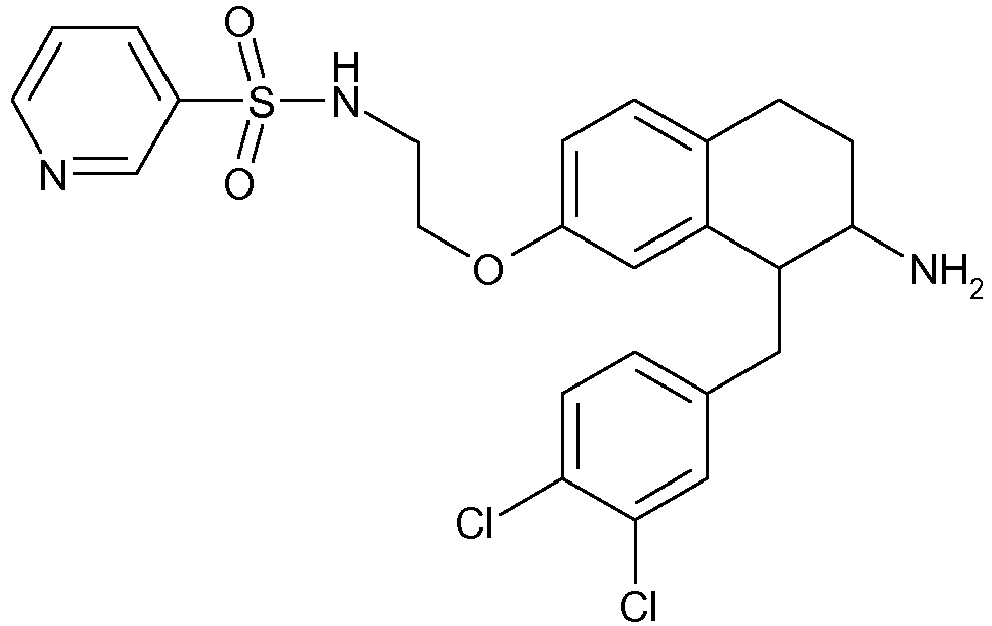
ESI-MS [M+H+] = 506.1 Calculated for C24H25Cl2N3O3S = 505 -

- N-(2-(7-Amino-8-(3,4-dichlorobenzyl)-5,6,7,8-tetrahydronaphthalen-2-yloxy)ethyl)propane-1-sulfonamide (example 8) (66.0 mg, 0.140 mmol), paraformaldehyde (7.63 mg, 0.254 mmol), and formic acid (21.6 mg, 0.469 mmol) were dissolved in ethanol (5 ml) and refluxed for 4h. The solvent was reduced and to the residue NaOH (1 N) was added. After extraction with CH2Cl2 the organic layers were washed with water and saturated NaCl solution, dried with Na2SO4, filtered, and the solvent was removed. The residue was purified by column chromatography (CH2Cl2/ MeOH 97:7 -> 95:5). The final product (15.0 mg, 0.028 mmol, 20%) was obtained as a brown, solid HCl salt from isopropanol treated with HCl in isopropanol (6N).
ESI-MS [M+H+] = 499.1 Calculated for C24H32Cl2N2O3S = 498 -

-

- Propane-1-sulfonic acid {2-[7-amino-8-(3,4-dichloro-benzyl)-5,6,7,8-tetrahydronaphthalen-2-yloxy]-ethyl}-amide hydrochloride was prepared analogously to example 3 using propane-1-sulfonyl chloride in place of 1-methyl-1 H-imidazole-4-sulfonyl chloride.
ESI-MS [M+H+] = 471.1 Calculated for C22H28Cl2N2O3S = 470 -

- {1-(3,4-Dichloro-benzyl)-7-[2-(1-methyl-1H-pyrazole-4-sulfonylamino)-ethoxy]-1,2,3,4-tetrahydro-naphthalen-2-yl}-carbamic acid ethyl ester was prepared analogously to example example 3 using 1-methyl-1 H-pyrazole-4-sulfonyl chloride in place of 1-methyl-1 H-imidazole-4-sulfonyl chloride.
ESI-MS [M+H+] = 581.2 Calculated for C26H30Cl2N4O5S = 580 -

- {1-(3,4-Dichloro-benzyl)-7-[2-(pyridine-3-sulfonylamino)-ethoxy]-1,2,3,4-tetrahydronaphthalen-2-yl}-carbamic acid ethyl ester was prepared analogously to example 3 using pyridine-3-sulfonyl chloride in place of 1-methyl-1 H-imidazole-4-sulfonyl chloride.
ESI-MS [M+H+] = 578.2 Calculated for C27H29Cl2N3O5S = 577 -

- N-(2-(7-Amino-8-(3,4-dichlorobenzyl)-5,6,7,8-tetrahydronaphthalen-2-yloxy)ethyl)propane-1-sulfonamide (example 3, 150 mg, 0.318 mmol) and triethylamine (32.2 mg, 0.318 mmol) were dissolved in THF (10 ml) and trifluoro acetic anhydride (66.8 mg, 0.318 mmol) was added. The mixture was stirred at RT for 48 h. Ethyl acetate was added and the mixture was extracted with water and then washed with a NaHCO3 solution and a saturated NaCl solution. After drying with MgSO4 and removal of the solvent the residue was purified by chromatography on silica gel using CH2Cl2/ MeOH 98:2 to give the final product as a colourless oil that becomes solid after a while (80.0 mg, 0.141 mmol, 44%).
-

- NaH (3.38 mg, 0.078 mmol, 55% in oil) was suspended in DMA (5 ml) and N-(1-(3,4-dichlorobenzyl)-7-(2-(propylsulfonamido)ethoxy)-1,2,3,4-tetrahydronaphthalen-2-yl)-2,2,2-trifluoroacetamide (40 mg, 0.07 mmol) dissolved in DMA (4 ml) was added dropwise. After stirring for 1 h iodomethane (10.5 mg, 0.074 mmol) dissolved in DMA (1 ml) was added. After stirring for another 14 h the reaction mixture was added to a halfconcentrated solution of NaCl. Extraction with ethyl acetate, washing of the organic layers with water and saturated NaCl solution followed by drying with Na2SO4 gave a residue that was washed with diisopropyl ether. Cleavage of the amide bond was achieved by stirring the residue with concentrated NaOH in water and subsequent extraction with ethyl acetate. The organic layer was dried with MgSO4 and evaporated. The residue was purified by preparative HPLC (RP-18, acetonitrile/ water, 0.01% TFA). After transferring the product into the HCl salt a yellow solid (11.0 mg, 0.021 mmol, 30%) was obtained.
ESI-MS [M+H+] = 485.2 Calculated for C23H3OCl2N2O3S = 484 -

- [1-(3,4-Dichloro-benzyl)-7-(2-methanesulfonylamino-ethoxy)-1,2,3,4-tetrahydro-naphthalen-2-yl]-carbamic acid ethyl ester was prepared analogously to example 3 using methyl sulfonyl chloride in place of 1-methyl-1 H-imidazole-4-sulfonyl chloride.
ESI-MS [M+H+] = 515.1 Calculated for C23H28Cl2N2O5S = 514 -

- [7-(2-Benzenesulfonylamino-ethoxy)-1-(3,4-dichloro-benzyl)-1,2,3,4-tetrahydro-naphthalen-2-yl]-carbamic acid ethyl ester was prepared analogously to example 3 using phenyl sulfonyl chloride in place of 1-methyl-1 H-imidazole-4-sulfonyl chloride.
ESI-MS [M+H+] = 577.2 Calculated for C28H3OCl2N2O5S = 576 -

- {1-(3,4-Dichlore-benzyl)-7-[2-(thiophene-2-sulfonylamino)-ethoxy]-1,2,3,4-tetrahydro-naphthalen-2-yl}-carbamic acid ethyl ester was prepared analogously to example 3 using phenyl sulfonyl chloride in place of 1-methyl-1 H-imidazole-4-sulfonyl chloride.
ESI-MS [M+H+] = 583.1 Calculated for C26H28Cl2N2O5S2 = 582 -

- N-{2-[7-Amino-8-(3,4-dichloro-benzyl)-5,6,7,8-tetrahydro-naphthalen-2-yloxy]-ethyl}-methanesulfonamide was prepared analogously to example 3 using methyl sulfonyl chloride in place of 1-methyl-1 H-imidazole-4-sulfonyl chloride.
ESI-MS [M+H+] = 443.1 Calculated for C20H24Cl2N2O3S = 442 -
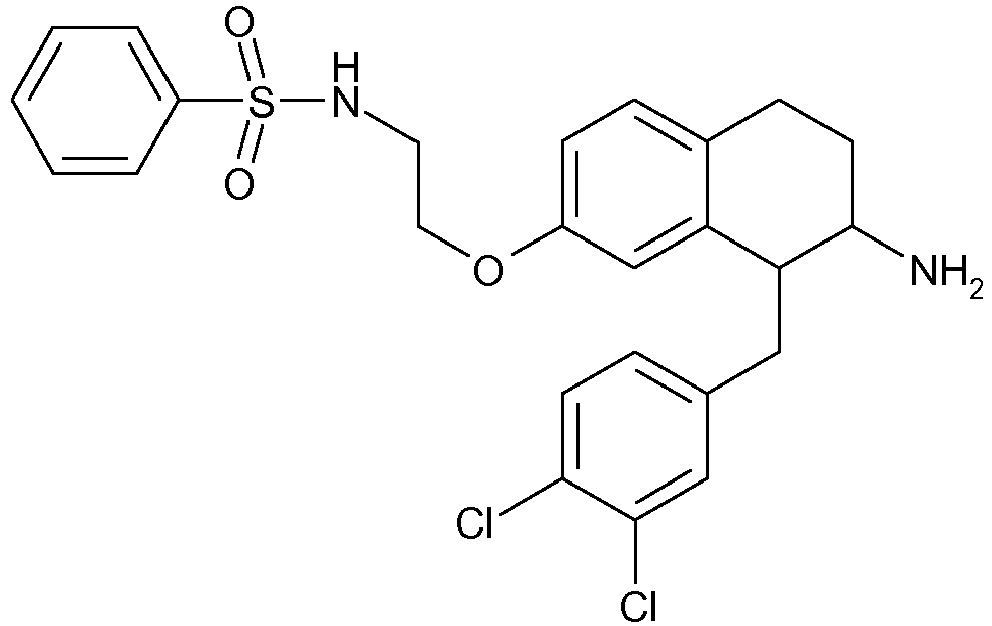
- N-{2-[7-Amino-8-(3,4-dichloro-benzyl)-5,6,7,8-tetrahydro-naphthalen-2-yloxy]-ethyl}-benzenesulfonamide was prepared analogously to example 3 using phenyl sulfonyl chloride in place of 1-methyl-1 H-imidazole-4-sulfonyl chloride.
ESI-MS [M+H+] = 505.1 Calculated for C25H26Cl2N2O3S = 504 -

- Thiophene-2-sulfonic acid {2-[7-amino-8-(3,4-dichloro-benzyl)-5,6,7,8-tetrahydro-naphthalen-2-yloxy]-ethyl}-amide was prepared analogously to example 3 using thiophene sulfonyl chloride in place of 1-methyl-1 H-imidazole-4-sulfonyl chloride.
ESI-MS [M+H+] =511.1 Calculated for C23H24Cl2N2O3S2 = 510 -

- N-{1-(3,4-Dichloro-benzyl)-7-[2-(1-methyl-1H-imidazole-4-sulfonylamino)-ethoxy]-1,2,3,4-tetrahydro-naphthalen-2-yl}-2,2,2-trifluoro-acetamide was prepared analogously to example 11 using the product of example 3 in place of example 8.
ESI-MS [M+H+] = 605.1 Calculated for C25H25Cl2F3N4O4S = 604 -

- Pyrrolidine-3-sulfonic acid {2-[7-amino-8-(3,4-dichloro-benzyl)-5,6,7,8-tetrahydronaphthalen-2-yloxy]-ethyl}-amide hydrochloride was prepared analogously to example 3 using benzyl 3-(chlorosulfonyl)pyrrolidine-1-carboxylate (synthesis described in
WO2008075070 ) in place of 1-methyl-1 H-imidazole-4-sulfonyl chloride.
ESI-MS [M+H+] = 498.2 Calculated for C23H29Cl2N3O3S = 497 -
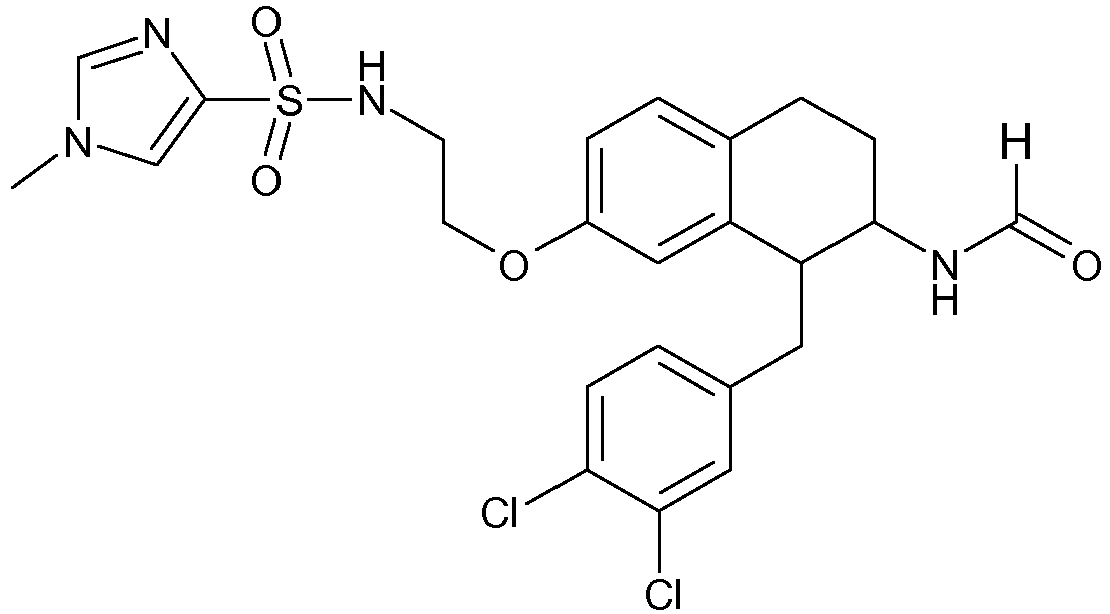
- Ethyl 1-(3,4-dichlorobenzyl)-7-(2-(1-methyl-1H-imidazole-4-sulfonamido)ethoxy)-1,2,3,4-tetrahydronaphthalen-2-ylcarbamate (example3, 60.0 mg, 0.103 mmol) was dissolved in THF (5 ml) and LiAlH4 (7.83 mg, 0.206 mmol) was added at RT. The residue was added to 2N NaOH and extracted with dichloromethane. The organic layer was washed with saturated NaHCO3 solution and then with saturated NaCl solution, dried and evaporated. The product was precipitated as an HCl salt from 6N HCl in isopropanol and isopropylether to obtain the product as a white salt (36 mg, 61%).
ESI-MS [M+H+] = 537.1 Calculated for C24H26Cl2N4O4S = 536 -

- 1-(3,4-Dichloro-benzyl)-7-[2-(4-methyl-thiophene-2-sulfonylamino)-ethoxy]-1,2,3,4-tetrahydro-naphthalen-2-yl}-carbamic acid ethyl ester was prepared analogously to example 3 using 4-methylthiophene-2-sulfonyl chloride in place of 1-methyl-1 H-imidazole-4-sulfonyl chloride.
ESI-MS [M+H+] = 597.1 Calculated for C27H30Cl2N2O5S2 = 596 -
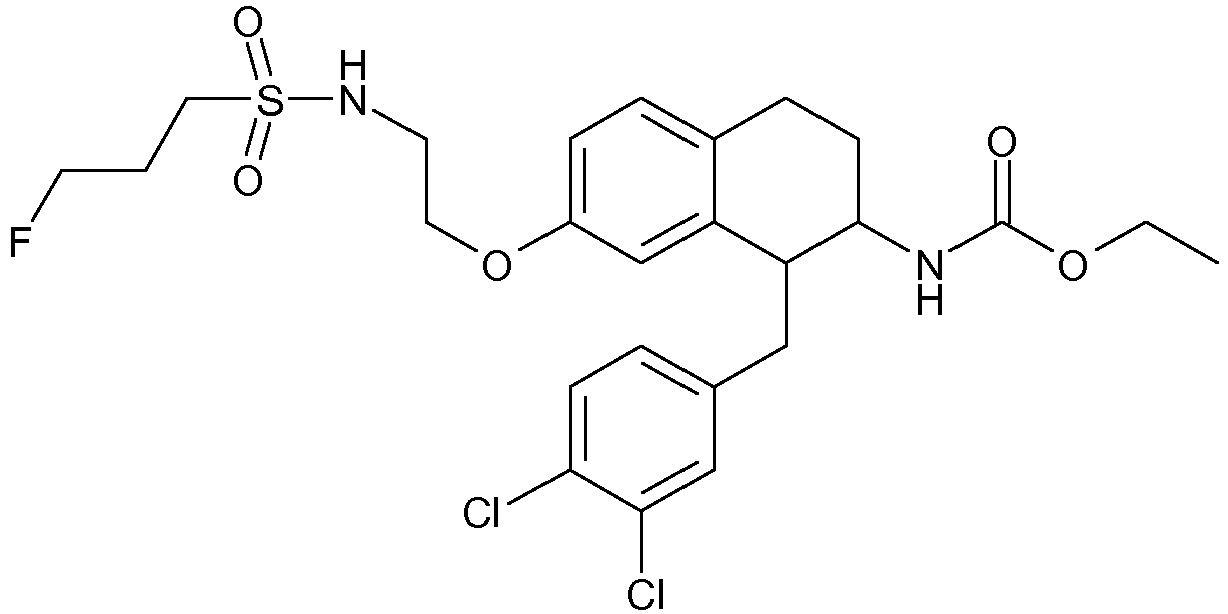
- {1-(3,4-Dichloro-benzyl)-7-[2-(3-fluoro-propane-1-sulfonylamino)-ethoxy]-1,2,3,4-tetrahydro-naphthalen-2-yl}-carbamic acid ethyl ester was prepared analogously to example 3 using 3-fluoropropane-1-sulfonyl chloride in place of 1-methyl-1 H-imidazole-4-sulfonyl chloride.
ESI-MS [M+H+] = 561.2 Calculated for C25H3lCl2FN2O5S = 560 -

- Ethyl 1-(3,4-dichlorobenzyl)-7-(2-(1-methyl-1H-imidazole-4-sulfonamido)ethoxy)-1,2,3,4-tetrahydronaphthalen-2-ylcarbamate (example 3, 60.0 mg, 0.103 mmol) was dissolved in dichloromethane (5 ml) and acetaldehyde (5.45 mg, 0.124 mmol µl) and molsieve 3Ǻ were added and the mixture was stirred for 3h. Acetic acid (7.07 mg, 0.118 mmol) was added and the mixture was stirred for another 3h. MeOH (5 ml) and sodium cyanoborohydride (14.8 mg, 0.236 mmol) were added and it was stirred for another 14 h. Water was added and it was extracted with dichloromethane. The organic layer was washed with saturated NaHCO3 solution, washed and evaporated. The residue was purified by column chromatography using SiO2 and CH2Cl2/ MeOH 95:5 -> 90:10. The product was precipitated as an HCl salt from 6N HCl in isopropanol and isopropylether to obtain the product as a white salt (17 mg, 25%).
ESI-MS [M+H+] = 537.2 Calculated for C25H30Cl2N4O3S = 536 -

- 4-Methyl-thiophene-2-sulfonic acid {2-[7-amino-8-(3,4-dichloro-benzyl)-5,6,7,8-tetrahydronaphthalen-2-yloxy]-ethyl}-amide hydrochloride was prepared analogously to example 3 using 4-methylthiophene-2-sulfonyl chloride in place of 1-methyl-1 H-imidazole-4-sulfonyl chloride.
ESI-MS [M+H+] = 525.1 Calculated for C24H26Cl2N2O3S2 = 524 -

- N'-(2-{[7-Amino-8-(3,4-dichlorobenzyl)-5,6,7,8-tetrahydronaphthalen-2-yl]oxy}ethyl)-N,N-dimethylsulfuric diamide hydrochloride was prepared analogously to example 3 using dimethylsulfamoyl chloride in place of 1-methyl-1 H-imidazole-4-sulfonyl chloride.
ESI-MS [M+H+] = 472.1 Calculated for C21H27Cl2N3O3S = 471 -

- {1-(3,4-Dichloro-benzyl)-7-[2-(3,3,3-trifluoro-propane-1-sulfonylamino)-ethoxy]-1,2,3,4-tetrahydro-naphthalen-2-yl}-carbamic acid ethyl ester was prepared analogously to example 3 using dimethylsulfamoyl chloride in place of 1-methyl-1 H-imidazole-4-sulfonyl chloride.
ESI-MS [M+H+] = 597.1 Calculated for C25H29Cl2F3N2O5S = 596 -
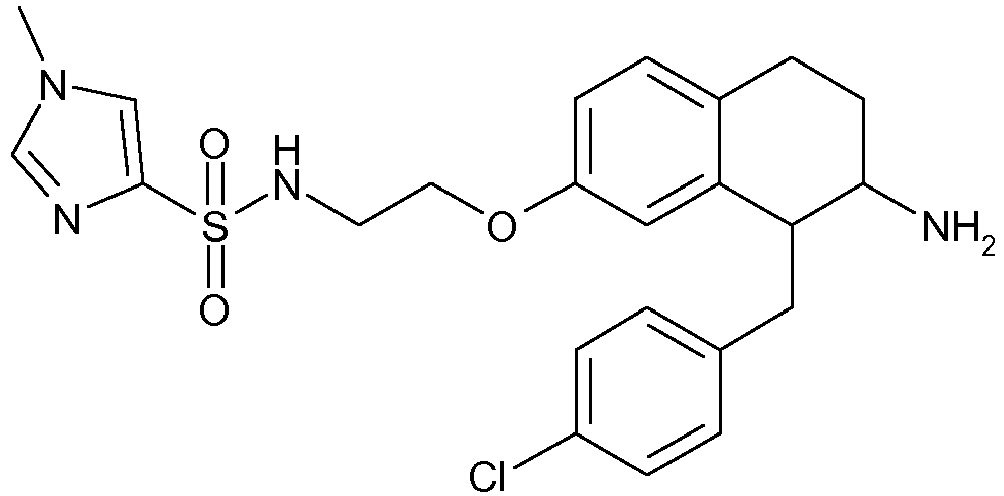
- 1-Methyl-1 H-imidazole-4-sulfonic acid {2-[7-amino-8-(4-chloro-benzyl)-5,6,7,8-tetrahydronaphthalen-2-yloxy]-ethyl}-amide hydrochloride was prepared analogously to example 3 using 1-methyl-1 H-imidazole-4-sulfonyl chloride in place of 1-methyl-1 H-imidazole-4-sulfonyl chloride and 4-(bromomethyl)-1-dichlorobenzene instead of 4-(bromomethyl)-1,2-dichlorobenzene.
ESI-MS [M+H+] = 475.1 Calculated for C23H27ClN4O3S = 474 -

- 1-Methyl-1 H-pyrazole-4-sulfonic acid {2-[7-amino-8-(4-chloro-benzyl)-5,6,7,8-tetrahydronaphthalen-2-yloxy]-ethyl}-amide hydrochloride was prepared analogously to example 3 using 1-methyl-1 H-pyrazole-4-sulfonyl chloride in place of 1-methyl-1 H-imidazole-4-sulfonyl chloride and 4-(bromomethyl)-1-dichlorobenzene instead of 4-(bromomethyl)-1,2-dichlorobenzene.
ESI-MS [M+H+] = 475.1 Calculated for C23H27ClN4O3S = 474 -

- Ethyl 1-(3,4-dichlorobenzyl)-7-hydroxy-1,2,3,4-tetrahydronaphthalen-2-ylcarbamate (700 mg, 1.775 mmol, cf. example 3d) and 1,1,1-trifluoro-N-phenyl-N-(trifluoromethylsulfonyl)methanesulfonamide (761 mg, 2.13 mmol) were dissolved in dichloromethane (30 mL). The reaction mixture was cooled to 0°C and a solution of triethylamine (0.495 mL, 3.55 mmol) in dichloromethane (5 mL) was added dropwise. The reaction mixture was allowed to warm to room temperature and stirring was continued over night. The solvent was evaporated in vacuo and the crude product was purified by flash chromatography (dichloromethane, silica gel). Yield: 934 mg (100 %).
ESI-MS [M+H+] = 526 Calculated for C21H2OCl2F3NO5S = 525. -
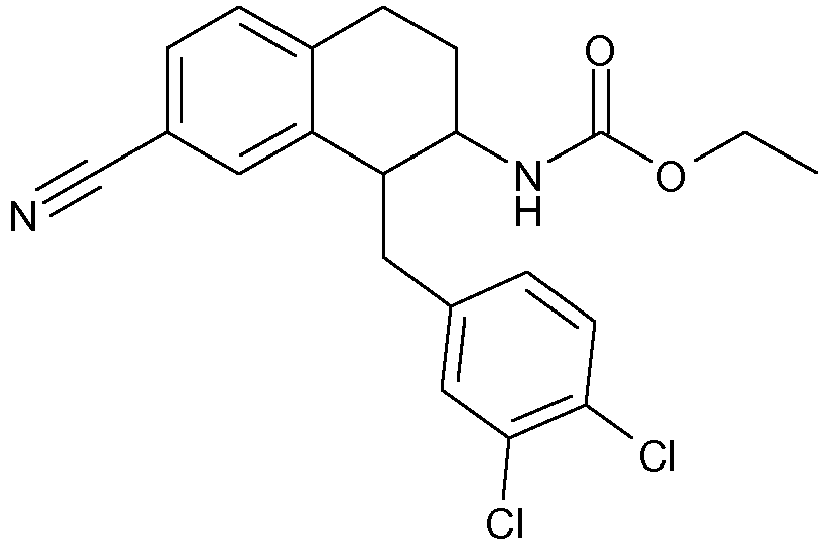
- 8-(3,4-Dichlorobenzyl)-7-[(ethoxycarbonyl)amino]-5,6,7,8-tetrahydronaphthalen-2-yl trifluoromethanesulfonate (250 mg, 0.475 mmol), zinc cyanide (139 mg, 1.187 mmol) and tetrakistriphenyl palladium (82 mg, 0.071 mmol) in dimethylformamide (5 mL) were heated in the microwave at 120°C (100 W) under stirring for 35 min. The solvent was evaporated in vacuo and the crude product was partitioned between ethyl acetate (40 mL) and water (30 mL). The aqueous layer was extracted with ethyl acetate one more time (20 mL) and the combined organic extracts were dried (Na2SO4) and concentrated in vacuo. The crude product (460 mg) was purified by flash chromatography (dichloromethane to dichloromethane:methanol = 100 : 1, silica gel). Yield: 109 mg (0.270 mmo, 57%, colorless solid).
ESI-MS [M+H+] = 403 Calculated for C21H20Cl2N2O2 = 402. -

- Ethyl [7-cyano-1-(3,4-dichlorobenzyl)-1,2,3,4-tetrahydronaphthalen-2-yl]carbamate (50 mg, 0.124 mmol) was dissolved in 10% potassium hydroxide in ethanol (1.5 mL) and the reaction mixture was stirred at 80°C for 2.5 h. The solvent was evaporated in vacuo. To the crude product brine (5 mL) and 2N hydrochloric acid were added until pH 7 was reached. The aqueous layer was extracted with dichloromethane three times. The combined organic extracts were dried (Na2SO4) and concentrated in vacuo. The crude product (60 mg) was purified by preparative HPLC (xTerra prep MS C18 column, 19x150 mm, 5 µm; gradient: water, acetonitrile with 0.1% trifluoroacetic acid, flow: 20 mL/min). Yield: 6 mg (0.013 mmol, 11%).
ESI-MS [M+H+] = 331 Calculated for C18H16Cl2N2 =330. -

- 1-(4-chlorobenzyl)-7-methoxy-1,2,3,4-tetrahydronaphthalen-2-amine (13.18 g, 43.7 mmol, prepared analogously to 1-(3,4-dichlorobenzyl)-7-methoxy-1,2,3,4-tetrahydronaphthalen-2-amine cf. example 3) was dissolved in dichloromethane (200 mL). The solution was cooled to -10°C and a 1 M solution of borontribromide in dichloromethane (131 mL, 131 mmol) was slowly added. The reaction mixture was allowed to warm to room temperature and stirring was continued for 2h. The reaction mixture was poured on ice water and sodium hydroxide was added until pH 8 was reached. The aqueous layer was extracted with dichloromethane. The combined organic extracts were dried (Na2SO4) and concentrated in vacuo. The crude product was used for the next step without further purification. Yield: 8.89 g (30.9 mmol, 71%, colorless solid).
ESI-MS [M +H+] = 288 Calculated for C17H18ClNO =287. -

- 7-Amino-8-(4-chlorobenzyl)-5,6,7,8-tetrahydronaphthalen-2-ol (2.0 g, 6.95 mmol) was dissolved in dry tetrahydrofurane and di-tertiar butyl carbonate (1.517 g, 6.95 mmol) and triethylamine (2.91 mL, 20.85 mmol) were added. The reaction mixture was stirred at room temperature for 3 h. The solvent was evaporated in vacuo. Water was added and the aqueous layer was extracted with dichloromethane. The combined organic extracts were dried (Na2SO4) and concentrated in vacuo. The crude product was recrystallized from n-hexane. Yield: 2.2 g (5.67 mmol, 82%).
ESI-MS [M-isobutene +H+] = 332 Calculated for C22H26ClNO3 =387. -

- Tert-butyl [1-(4-chlorobenzyl)-7-hydroxy-1,2,3,4-tetrahydronaphthalen-2-yl]carbamate (850 mg, 2.191 mmol) and 1,1,1-trifluoro-N-phenyl-N-(trifluoromethylsulfonyl)methanesulfonamide (939 mg, 2.63 mmol) were dissolved in dichloromethane (45 mL). The pale yellow solution was cooled to 0°C and a solution of triethylamine (0.611 mL, 4.38 mmol) in dichloromethane (5 mL) was added dropwise. The reaction mixture was allowed to warm to room temperature and stirring was continued over night. The solvent was evaporated in vacuo and the crude product was purified by flash chromatography (dichloromethane, silica gel). Yield: 1.03 g (1.981 mmol, 90%, colorless solid).
ESI-MS [M-isobutene+CH3CN+H+] = 505 Calculated for C23H25ClF3NO5S =519. -

- DPPF (8.1 mg, 0.015 mmol) and Pd2dba3 (3.35 mg, 0.00365 mmol) were suspended in dimethylformamide (0.4 mL) and after stirring at room temperature under an inert atmosphere of nitrogen for 20 min 7-[(tert-butoxycarbonyl)amino]-8-(4-chlorobenzyl)-5,6,7,8-tetrahydronaphthalen-2-yl trifluoromethanesulfonate (38 mg, 0.073 mmol) and zinc cyanide (12.87 mg, 0.110 mmol) were added. The reaction mixture was stirred at 90°C for 1 h. The solvent was evaporated in vacuo. Water (10 mL) was added to the crude product and the aqueous layer was extracted with ethyl acetate (two times with 10 mL). The combined organic extracts were dried (Na2SO4) and concentrated in vacuo. The crude product was purified by flash chromatography (dichloromethane, silica gel). Yield: 16 mg (0.040 mmol, 55%).
ESI-MS [M-isobutene+CH3CN+H+] = 382 Calculated for C23H25ClN2O2 =396. -

- Tert-butyl [1-(4-chlorobenzyl)-7-cyano-1,2,3,4-tetrahydronaphthalen-2-yl]carbamate (15 mg, 0.038 mmol) was dissolved in dichloromethane (1.5 mL) and 5 M hydrochloric acid in isopropanol (0.3 mL) was added. The reaction mixture was stirred for 3 h at room temperature. The solvent and the excess hydrochloric acid were evaporated in vacuo. Yield: 11 mg (0.033 mmol, 87 %, colorless solid).
ESI-MS [M+H+] = 297 Calculated for C18H17ClN2 =296. -

- Tert-butyl [1-(4-chlorobenzyl)-7-cyano-1,2,3,4-tetrahydronaphthalen-2-yl]carbamate (52 mg, 0.131 mmol, cf. example 30d) were dissolved in methanol (5 mL). Raney nickel (about 30 mg) was added and the reaction mixture was stirred at room temperature for 4 h under an atmosphere of hydrogen. The catalyst was removed by filtration. The solvent was evaporated in vacuo. The crude product was used without further purification for the next step. Yield: 32 mg (0.087 mmol, 67%).
ESI-MS [M-isobutene+H+] = 311 Calculated for C23H30N2O2 = 366. -

- Tert-butyl [7-(aminomethyl)-1-benzyl-1,2,3,4-tetrahydronaphthalen-2-yl]carbamate (32 mg, 0.87 mmol) was dissolved in dichloromethane (15 mL) and 4-dimethylaminopyridine (12 mg, 0.096 mmol) and 3-fluoropropane-1-sulfonyl chloride (14 mg, 0.087 mmol) were added. The reaction mixture was stirred at room temperature over night. The dichloromethane solution of the crude product was washed successively with 1 N aqueous hydrochloric acid and aqueous NaHCO3 solution, dried (Na2SO4) and concentrated in vacuo. The crude product was purified by flash chromatography (dichloromethane, methanol, silica gel). Yield: 9.3 mg (0.019 mmol, 22 %).
ESI-MS [M-isobutene+H+] = 435 Calculated for C26H35FN2O4S = 490. -

- Tert-butyl [1-benzyl-7-({[(3-fluoropropyl)sulfonyl]amino}methyl)-1,2,3,4-tetrahydronaphthalen-2-yl]carbamate (9.3 mg, 0.019 mmol) was dissolved in dichloromethane (10 mL) and trifluoroacetic acid (excess) was added. The reaction mixture was stirred at room temperature for 4 h. The solvent was evaporated in vacuo and the crude product was purified by flash chromatography (silica gel, dichloromethane, methanol). Yield: 4 mg (0.0079 mmol, 42%).
ESI-MS [M+H+] = 391 Calculated for C21H27FN2O2S =390. -

ESI-MS [M+H+] = 403 Calculated for C21H20Cl2N2O2 = 402. -

-

- 1-(3,4-Dichlorobenzyl)-7-methoxy-1,2,3,4-tetrahydronaphthalen-2-amine (10 g, 26.8 mmol, cf. example 3.2 were dissolved in dichloromethane (240 mL). The suspension was cooled to -10°C and a 1 M solution of bortribromide in dichloromethane (80 mL, 80 mmol). The solution was allowed to warm to room temperature and stirring was continued for 3 h. The reaction mixture was poured on ice (1 L). The aqueous layer was made alkaline (pH 10) with 2N sodium hydroxide solution. The layers were separated. The aqueous layer was extracted with dichloromethane and the combined organic layers were washed with saturated NaHCO3 solution and water. The organic layers were dried (Na2SO4) and concentrated in vacuo. The crude product was used without further purification for the next step. Yield: 10.8 g
ESI-MS [M+H+] = 322 Calculated for C17H17Cl2NO= 321. -

- 7-Amino-8-(3,4-dichlorobenzyl)-5,6,7,8-tetrahydronaphthalen-2-ol (10.8 g) and triethylamine (14.01 mL, 101 mmol) were dissolved in dry tetrahydrofuran (200 mL). Di-tert-butyl carbonate (7.31 g, 33.5 mmol) was added in small portions at room temperature. The reaction mixture was stirred over night. The solvent was evaporated in vacuo. The residue was dissolved in ethyl acetate (300 mL) and washed with water (2x 200 mL). The ethyl acetate solution of the crude product was dried (Na2SO4). The solvent was evaporated in vacuo and the crude product was used for the next step without further purification. Yield: 12.2 g.
ESI-MS [M-isobutene+CH3CN+H+] = 407 Calculated for C22H25Cl2NO3= 421. -

- tert-Butyl [1-(3,4-dichlorobenzyl)-7-hydroxy-1,2,3,4-tetrahydronaphthalen-2-yl]carbamate (4.06 g, 9.66 mmol) and 1,1,1-trifluoro-N-phenyl-N-(trifluoromethylsulfonyl)methanesulfonamide (4.14 g, 11.59 mmol) were dissolved in dichloromethane (190 mL). The light brown solution was cooled to 0°C and triethylamine (2.69 mL, 19.32 mmol) in dichloromethane (10 mL) was added dropwise. The reaction mixture was allowed to warm to room temperature and stirring was continued over night. The solvent was evaporated in vacuo and the crude product was purified by flash chromatography (dichloromethane, silica gel). Yield: 3.2 g (5.77 mmol, 60%).
-

- Diphenylphosphinoferrocene (100 mg, 0.18 mmol) and dipalladium trisdibenzylideneacetone (41 mg, 0.045 mmol) were suspended under an atmosphere of argon in dry dimethylformamide (5 mL). After stirring at room temperature for 40 min 7-[(tert-butoxycarbonyl)amino]-8-(3,4-dichlorobenzyl)-5,6,7,8-tetrahydronaphthalen-2-yl trifluoromethanesulfonate (0.5 g, 0.902 mmol) was added and the reaction mixture was heated to 90°C. Over 30 min zinc cyanide (159 mg, 1.353 mmol) was added in small portions. After complete addition stirring was continued at 90°C for 2 h. The reaction mixture was cooled to room temperature diluted with dichloromethane (50 mL), washed with saturated NaHCO3 (3x 10 mL). The organic layer was dried (MgSO4) and concentrated in vacuo. The crude product was purified by flash chromatography (dichloromethane, silica gel). Yield: 97 mg (0.225 mmol, 25%).
ESI-MS [M+Na+] = 453 Calculated for C23H24Cl2N2O2 = 430. -

- Cf. example 34a
ESI-MS [M+H+] = 322 Calculated for C17H17Cl2NO = 321. -

- Tert-butyl [1-(4-chlorobenzyl)-7-hydroxy-1,2,3,4-tetrahydronaphthalen-2-yl]carbamate (180 mg, 0.464 mmol, prepared analogously to tert-butyl [1-(3,4-dichlorobenzyl)-7-hydroxy-1,2,3,4-tetrahydronaphthalen-2-yl]carbamate, cf. Example 34.2 and potassium hydroxide (1.4 g, 25 mmol) were suspended in acetonitrile (4 mL). After stirring the two phase system for 45 min at room temperature the reaction mixture was cooled to -15°C and a solution of 2-chloro-2,2-difluoro-1-phenylethanone (442 mg, 2.32 mmol) in acetonitrile (1 mL) was added dropwise over 30 min. The reaction mixture was warmed to room temperature and then heated at 80°C for 2 h. The reaction mixture was cooled to room temperature and diluted with ethyl acetate. The aqueous layer was extracted with ethyl acetate. The combined extracts were dried (MgSO4) and concentrated in vacuo. The crude product was purified by flash chromatography (dichloromethane, silica gel). Yield: 30 mg (0.069 mmol, 15 %).
ESI-MS [M-isobutene+CH3CN+H+] = 423 Calculated for C23H26ClF2NO3= 437. -

- tert-Butyl [1-(4-chlorobenzyl)-7-(difluoromethoxy)-1,2,3,4-tetrahydronaphthalen-2-yl]carbamate (30 mg, 0.069 mmol) was dissolved in dichloromethane (2 mL). 5N isopropanolic hydrochloric acid (0.3 mL) were added and the reaction mixture was stirred at room temperature for 3 h. The solvents were evaporated in vacuo. Yield: 26 mg (0.069 mmol, 100%, colorless solid).
ESI-MS [M+H+] = 338 Calculated for C18H18ClF2NO = 337. -
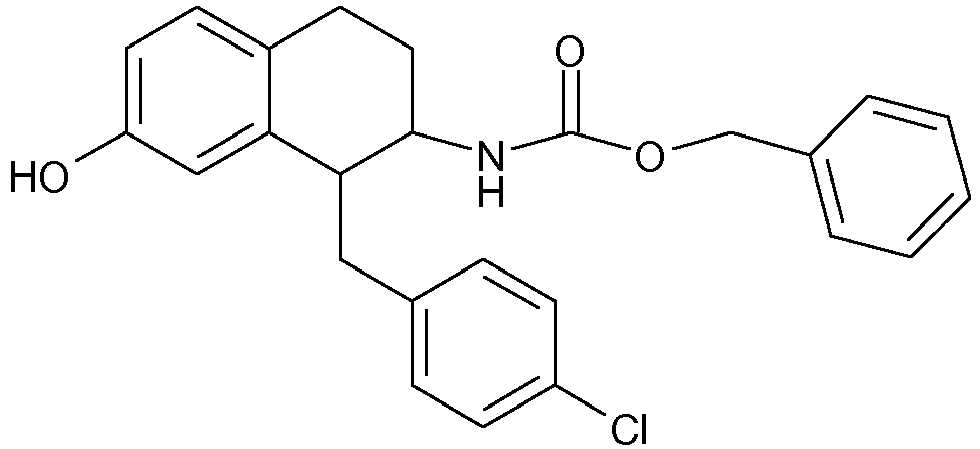
- tert-Butyl [1-(4-chlorobenzyl)-7-hydroxy-1,2,3,4-tetrahydronaphthalen-2-yl]carbamate (2 g, 6.95 mmol, prepared analogously to tert-butyl [1-(3,4-dichlorobenzyl)-7-hydroxy-1,2,3,4-tetrahydronaphthalen-2-yl]carbamate, cf. example 34.2 were suspended in dimethylformamide (40 mL). Triethylamine (0.969 mL, 6.95 mmol) and benzyl carbonochloridate (1.186 g, 6.95 mmol) were added. The reaction mixture was stirred at room temperature over night. The solvent was evaporated in vacuo. To the crude product ethyl acetate and water were added. The aqueous layer was extracted with ethyl acetate. The combined organic layers were dried (MgSO4) and concentrated in vacuo. The crude product was purified by flash chromatography (silica gel, dichloromethane, methanol). Yield: 393 mg (0.931 mmol, 13.4%, colorless foam).
ESI-MS [M+H+] = 422 Calculated for C25H24ClNO3 = 421. -

- tert-Butyl [7-cyano-1-(3,4-dichlorobenzyl)-1,2,3,4-tetrahydronaphthalen-2-yl]carbamate (30 mg, 0.07 mmol, cf. example 34d) were dissolved in methanol (3 mL). Raney nickel (10 mg) was added and the reaction mixture stirred at room temperature under an atmosphere of hydrogen for 4 h. The catalyst was removed by filtration and the methanol was evaporated in vacuo. Yield: 18 mg (0.041 mmol, 59%).
ESI-MS [M+H+] = 435 Calculated for C23H28Cl2N2O2 = 434. -

- tert-Butyl [7-(aminomethyl)-1-(3,4-dichlorobenzyl)-1,2,3,4-tetrahydronaphthalen-2-yl]carbamate (120 mg, 0.276 mmol, cf. Example 38) was dissolved in dichloromethane (5 mL). 4-Dimethylaminopyridine (35 mg, 0.289 mmol) was added. After stirring at room temperature for 5 min propane-1-sulfonyl chloride (39 mg, 0.031 mmol) was added and stirring was continued over night. The reaction mixture was diluted with dichloromethane and washed successively with 0.5 N hydrochloric acid (2x 2 mL) and saturated NaHCO3 (1x2 mL). The organic phase was dried (MgSO4) and concentrated in vacuo. The crude product was used for the next step without further purification. Yield: 125 mg (0.231 mmol, 84%).
ESI-MS [M+Na+] = 563 Calculated for C26H34Cl2N2O4S = 540. -

- Tert-butyl [1-(3,4-dichlorobenzyl)-7-{[(propylsulfonyl)amino]methyl}-1,2,3,4-tetrahydronaphthalen-2-yl]carbamate (120 mg, 0.222 mmol, cf. example 39) was dissolved in 5 N isopropanolic hydrochloric acid (2 mL). The reaction mixture was stirred at room temperature for 1 h. The solvent was evaporated and the product was dried in vacuo. Yield: 101 mg (0.211 mmol, 95%).
ESI-MS [M+H+] = 441 Calculated for C21H26Cl2N2O2S = 440. -

- The compound was prepared analogously to example 40 using 3-fluoropropane-1-sulfonyl chloride in place of n-propane-1-sulfonyl chloride.
ESI-MS [M+H+] = 459 Calculated for C21H25Cl2FN2O2S = 458. -

- N-{[7-Amino-8-(3,4-dichlorobenzyl)-5,6,7,8-tetrahydronaphthalen-2-yl]methyl}propane-1-sulfonamide hydrochloride (40 mg, 0.084 mmol, cf. example 40) were dissolved in methanol (4 mL) and hydrogenated at the H-cube (1 h, 40 °C, 30 bar, 20% Pd/C). The solvent was evaporated and the crude product was purified by preparative HPLC (xTerra prep MS C18 column, 19x150 mm, 5 µm; gradient: water, acetonitrile with 0.1% trifluoroacetic acid, flow: 20 mL/min). Yield: 4.9 mg (0.0102 mmol, 12%).
ESI-MS [M+H+] = 373 Calculated for C21H28N2O2S = 372. -

- The compound was prepared analogously to example 40 using cyclobutylsulfonyl chloride in place of n-propane-1-sulfonyl chloride.
ESI-MS [M+H+] = 385 Calculated for C22H28N2O2S = 384. -

- The compound was prepared analogously to example 40 using cyclopropylmethanesulfonyl chloride in place of n-propane-1-sulfonyl chloride.
ESI-MS [M+H+] = 385 Calculated for C22H28N2O2S = 384. -
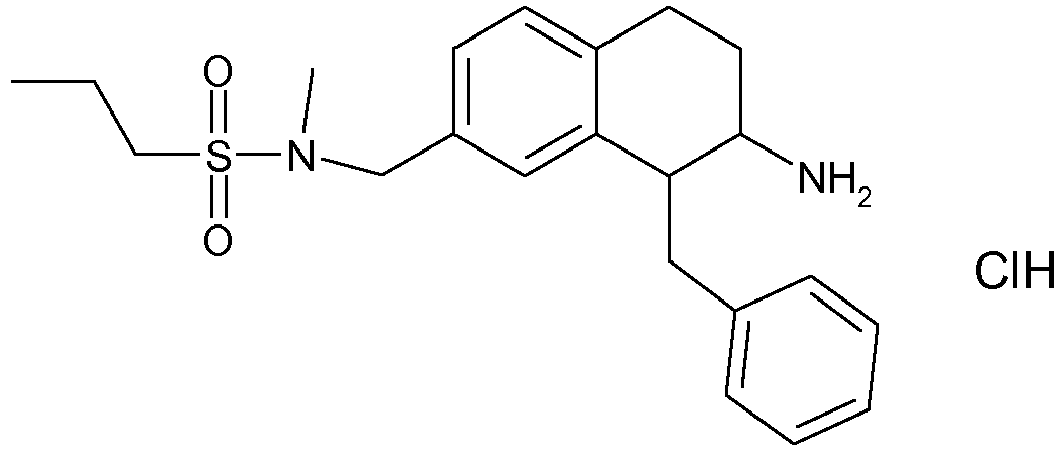
- Tert-butyl-1-benzyl-7-(propylsulfonamidomethyl)-1,2,3,4-tetrahydronaphthalen-2-ylcarbamate (35 mg, 0.074 mmol, prepared analog to example 40) was dissolved in acetonitrile (1 mL). Cesium carbonate (29 mg, 0.09 mmol)) and methyliodide (12 µL, 0.19 mmol) were added successively and the reaction mixture was heated in the microwave to 100°C for 3 h. The solvents were evaporated in vacuo. The residue was treated with dichloromethane and washed with water. The organic layer was dried (MgSO4) and concentrated. The crude product was dissolved in isopropanol and treated with 5 M hydrochloric acid in isopropanol. The solvent was evaporated in vacuo to yield the final product as colorless solid. Yield: 18 mg (0.043 mmol, 58%).
ESI-MS [M+H+] = 387 Calculated for C22H30N2O2S = 386. -

- 7-(2-tert-Butoxycarbonylamino-ethoxy)-1-(3-chloro-benzyl)-1,2,3,4-tetrahydro-naphthalen-2-yl]-carbamic acid ethyl ester was prepared in analogy to example 1 using 1-bromomethyl-3-chloro-benzene in place of 4-(bromomethyl)-1,2-dichlorobenzene.
ESI-MS [M+H+] = 503 Calculated for C27H35ClN2O5 = 502 -

- {1-(3-Chloro-benzyl)-7 -[2-(1-methyl-1H-pyrazole-4-sulfonylamino)-ethoxy]-1,2,3,4-tetrahydro-naphthalen-2-yl}-carbamic acid ethyl ester was prepared starting from 7-(2-tert-Butoxycarbonylamino-ethoxy)-1-(3-chloro-benzyl)-1,2,3,4-tetrahydro-naphthalen-2-yl]-carbamic acid ethyl ester from previous step in analogy to example 2 using 1-methyl-1 H-pyrazole-4-sulfonyl chloride in place of 1-methyl-1 H-imidazole-4-sulfonyl chloride.
ESI-MS [M+H+] = 547 Calculated for C26H31ClN4O5 = 546 -

- 1-Methyl-1 H-pyrazole-4-sulfonic acid {2-[7-amino-8-(3-chloro-benzyl)-5,6,7,8-tetrahydronaphthalen-2-yloxy]-ethyl}-amide hydrochloride was prepared in analogy to example 3 starting from {1-(3-Chloro-benzyl)-7 -[2-(1-methyl-1H-pyrazole-4-sulfonylamino)-ethoxy]-1,2,3,4-tetrahydro-naphthalen-2-yl}-carbamic acid ethyl ester (example 46)
ESI-MS [M+H+] = 475 Calculated for C23H27ClN4O3S = 474 -

- 1-Methyl-1 H-imidazole-4-sulfonic acid {2-[7-amino-8-(3-chloro-benzyl)-5,6,7,8-tetrahydronaphthalen-2-yloxy]-ethyl}-amide hydrochloride was prepared in three steps from 7-(2-tert-Butoxycarbonylamino-ethoxy)-1-(3-chloro-benzyl)-1,2,3,4-tetrahydro-naphthalen-2-yl]-carbamic acid ethyl ester in analogy to example 47 using 1-Methyl-1 H-imidazole-4-sulfonyl chloride.
ESI-MS [M+H+] = 475 Calculated for C23H27ClN4O3S = 474 -

- Prepared in two steps from 7-(2-tert-Butoxycarbonylamino-ethoxy)-1-(3-chloro-benzyl)-1,2,3,4-tetrahydro-naphthalen-2-yl]-carbamic acid ethyl ester in analogy to example 46 using 2,4-dimethyl-thiazole-5-sulfonyl chloride.
ESI-MS [M+H+] = 578 Calculated for C27H32ClN3O5S2 = 577 -

- Prepared in two steps from 7-(2-tert-Butoxycarbonylamino-ethoxy)-1-(3-chloro-benzyl)-1,2,3,4-tetrahydro-naphthalen-2-yl]-carbamic acid ethyl ester in analogy to example 46 using thiophene-2-sulfonyl chloride.
ESI-MS [M+H+] = 549 Calculated for C26H29ClN2O5S2 = 548 -

- Prepared in two steps from 7-(2-tert-butoxycarbonylamino-ethoxy)-1-(3-chloro-benzyl)-1,2,3,4-tetrahydro-naphthalen-2-yl]-carbamic acid ethyl ester in analogy to example 46 using 5-Chloro-thiophene-2-sulfonyl chloride.
ESI-MS [M+H+] = 583 Calculated for C26H28Cl2N2O5S2 = 582 -

- Prepared in two steps from 7-(2-tert-butoxycarbonylamino-ethoxy)-1-(3-chloro-benzyl)-1,2,3,4-tetrahydro-naphthalen-2-yl]-carbamic acid ethyl ester in analogy to example 46 using 2-Methyl-3H-imidazole-4-sulfonyl chloride.
ESI-MS [M+H+] = 547 Calculated for C26H31ClN4O5S = 546 -

- Prepared in two steps from 7-(2-tert-butoxycarbonylamino-ethoxy)-1-(3-chloro-benzyl)-1,2,3,4-tetrahydro-naphthalen-2-yl]-carbamic acid ethyl ester in analogy to example 46 using 5-Methyl-thiophene-2-sulfonyl chloride.
ESI-MS [M+H+] = 563 Calculated for C27H31ClN2O5S2 = 562 -

- Prepared in two steps from 7-(2-tert-butoxycarbonylamino-ethoxy)-1-(3-chloro-benzyl)-1,2,3,4-tetrahydro-naphthalen-2-yl]-carbamic acid ethyl ester in analogy to example 46 using 4-Methyl-thiophene-2-sulfonyl chloride.
ESI-MS [M+H+] = 563 Calculated for C27H31ClN2O5S2 = 562 -

- Prepared in three steps from 7-(2-tert-butoxycarbonylamino-ethoxy)-1-(3-chloro-benzyl)-1,2,3,4-tetrahydro-naphthalen-2-yl]-carbamic acid ethyl ester in analogy to example 48 using propane-1-sulfonyl chloride.
ESI-MS [M+H+] = 437 Calculated for C22H29ClN2O3S = 436 -

- Prepared in one step from {1-(3-chloro-benzyl)-7-[2-(thiophene-2-sulfonylamino)-ethoxy]-1,2,3,4-tetrahydro-naphthalen-2-yl}-carbamic acid ethyl ester in analogy to example 48.
ESI-MS [M+H+] = 477 Calculated for C23H25ClN2O3S2 = 476 -

- Prepared in one step from {1-(3-Chloro-benzyl)-7-[2-(2,4-dimethyl-thiazole-5-sulfonylamino)-ethoxy]-1,2,3,4-tetrahydro-naphthalen-2-yl}-carbamic acid ethyl ester (example 49) in analogy to example 48.
ESI-MS [M+H+] = 506 Calculated for C24H28ClN3O3S2 = 505 -

- Prepared in one step from {1-(3-Chloro-benzyl)-7-[2-(2-methyl-3H-imidazole-4-sulfonylamino)-ethoxy]-1,2,3,4-tetrahydro-naphthalen-2-yl}-carbamic acid ethyl ester (example 52) in analogy to example 48.
ESI-MS [M+H+] = 475 Calculated for C23H27ClN4O3S = 474 -

- Prepared in one step from {1-(3-chloro-benzyl)-7-[2-(5-chloro-thiophene-2-sulfonylamino)-ethoxy]-1,2,3,4-tetrahydro-naphthalen-2-yl}-carbamic acid ethyl ester (example 51) in analogy to example 48.
ESI-MS [M+H+] = 511 Calculated for C23H24Cl2N2O3S2 = 510 -

- Prepared in two steps from 7-(2-tert-butoxycarbonylamino-ethoxy)-1-(3-chloro-benzyl)-1,2,3,4-tetrahydro-naphthalen-2-yl]-carbamic acid ethyl ester in analogy to example 46 using 2,5-Dimethyl-thiophene-3-sulfonyl chloride.
ESI-MS [M+H+] = 577 Calculated for C28H33ClN2O5S2 = 576 -

- Prepared in two steps from 7-(2-tert-butoxycarbonylamino-ethoxy)-1-(3-chloro-benzyl)-1,2,3,4-tetrahydro-naphthalen-2-yl]-carbamic acid ethyl ester in analogy to example 46 using 1-Ethyl-1 H-pyrazole-4-sulfonyl chloride.
ESI-MS [M+H+] = 561 Calculated for C27H33ClN4O5S = 560 -

- Prepared as described for example 46 using 1-bromomethyl-2,4-dichloro-benzene in place of 4-(bromomethyl)-3-chlorobenzene.
ESI-MS [M+H+] = 581 Calculated for C26H30Cl2N4O5S = 580 -

- Prepared as described for example 62 using thiophene-2-sulfonyl chloride in place of 1-methyl-1 H-pyrazole-4-sulfonyl chloride.
ESI-MS [M+H+] = 583 Calculated for C26H28Cl2N4O5S2 = 582 -

- Prepared as described for example 62 using 5-methyl-thiophene-2-sulfonyl chloride in place of 1-Methyl-1 H-pyrazole-4-sulfonyl chloride.
ESI-MS [M+H+] = 597 Calculated for C27H30Cl2N2O5S2 = 596 -

- Prepared in two steps from 7-(2-tert-butoxycarbonylamino-ethoxy)-1-(3-chloro-benzyl)-1,2,3,4-tetrahydro-naphthalen-2-yl]-carbamic acid ethyl ester in analogy to example 46 using ethane-sulfonyl chloride.
ESI-MS [M+H+] = 495 Calculated for C24H31ClN2O5S = 494 -

- Prepared in one step from {1-(3-chloro-benzyl)-7-[2-(1-ethyl-1H-pyrazole-4-sulfonylamino)-ethoxy]-1,2,3,4-tetrahydro-naphthalen-2-yl}-carbamic acid ethyl ester (example 61) in analogy to example 48.
ESI-MS [M+H+] = 489 Calculated for C24H29ClN4O3S = 488 -

- Prepared in one step from {1-(3-chloro-benzyl)-7-[2-(2-methyl-3H-imidazole-4-sulfonylamino)-ethoxy]-1,2,3,4-tetrahydro-naphthalen-2-yl}-carbamic acid ethyl ester (example 53) in analogy to example 48.
ESI-MS [M+H+] = 491 Calculated for C24H27ClN2O3S2 = 490 -

- Prepared in one step from {1-(3-chloro-benzyl)-7-[2-(5-methyl-thiophene-2-sulfonylamino)-ethoxy]-1,2,3,4-tetrahydro-naphthalen-2-yl}-carbamic acid ethyl ester (example 53) in analogy to example 48.
ESI-MS [M+H+] = 491 Calculated for C24H27ClN2O3S2 = 490 -

- Prepared in one step from {1-(3-Chloro-benzyl)-7-[2-(2,5-dimethyl-thiophene-3-sulfonylamino)-ethoxy]-1,2,3,4-tetrahydro-naphthalen-2-yl}-carbamic acid ethyl ester (example 60) in analogy to example 48.
ESI-MS [M+H+] = 505 Calculated for C25H29ClN2O3S2 = 504 -

- Prepared in one step from [1-(3-chloro-benzyl)-7-(2-ethanesulfonylamino-ethoxy)-1,2,3,4-tetrahydro-naphthalen-2-yl]-carbamic acid ethyl ester (example 65) in analogy to example 48.
ESI-MS [M+H+] = 423 Calculated for C21H27ClN2O3S = 422 -

- Prepared in one step from {1-(2,4-dichloro-benzyl)-7-[2-(1-methyl-1H-pyrazole-4-sulfonylamino)-ethoxy]-1,2,3,4-tetrahydro-naphthalen-2-yl}-carbamic acid ethyl ester (example 62) in analogy to example 48.
ESI-MS [M+H+] = 509 Calculated for C23H26Cl2N4O3S = 508 -

- Prepared in one step from {1-(2,4-dichloro-benzyl)-7-[2-(thiophene-2-sulfonylamino)-ethoxy]-1,2,3,4-tetrahydro-naphthalen-2-yl}-carbamic acid ethyl ester (example 63) in analogy to example 48.
ESI-MS [M+H+] = 511 Calculated for C23H24Cl2N2O3S2 = 510 -

- Prepared in one step from {1-(2,4-dichloro-benzyl)-7-[2-(5-methyl-thiophene-2-sulfonylamino)-ethoxy]-1,2,3,4-tetrahydro-naphthalen-2-yl}-carbamic acid ethyl ester (example 64) in analogy to example 48.
ESI-MS [M+H+] = 525 Calculated for C24H26Cl2N2O3S2 = 524 -
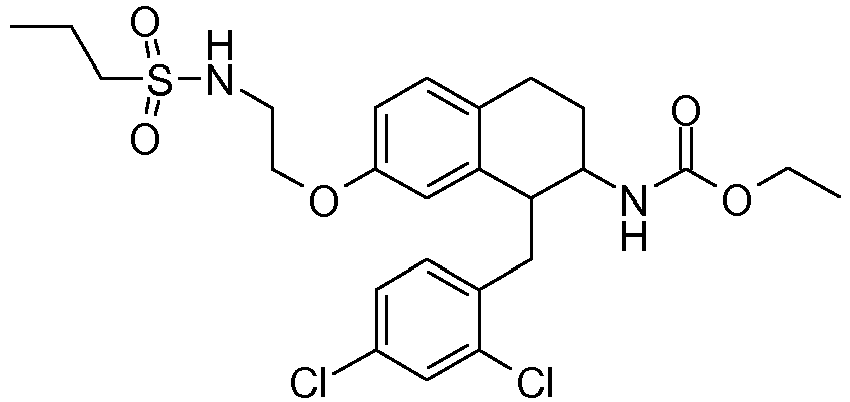
- Prepared as described for example 62 using propane-1-sulfonyl chloride in place of 1-methyl-1 H-pyrazole-4-sulfonyl chloride.
ESI-MS [M+H+] = 543 Calculated for C25H32Cl2N2O5S = 542 -

- Prepared in one step from {1-(2,4-dichloro-benzyl)-7-[2-(propane-1-sulfonylamino)-ethoxy]-1,2,3,4-tetrahydro-naphthalen-2-yl}-carbamic acid ethyl ester (example 74) in analogy to example 48.
ESI-MS [M+H+] = 471 Calculated for C22H28Cl2N2O3S = 470 -

- To a cooled solution (0-5°C) of 2-(methylamino)ethanol (8.56 ml, 107 mmol) in 100 ml DCM was added dropwise a solution of propane-1-sulfonyl chloride (13.1 ml, 117 mmol) in 50 ml DCM over an 1h period. The resulting mixture was stirred at room temperature over night. Water and 10% citric acid were added and then was extracted with DCM, dried over MgSO4, filtrated and evaporated to obtain a yellow/orange oil. (13,6 g) Chromatography afforded 2.75 g of product.
-

- A solution of ethyl 1-(4-chlorobenzyl)-7-hydroxy-1,2,3,4-tetrahydronaphthalen-2-ylcarbamate (0,128 g, 0,355 mmol) in DMF under N2 was treated with sodium hydride (0,014 g, 0,568 mmol) and the reaction was stirred for 30 minutes at room temperature. A solution of 2-(N-methylpropylsulfonamido)ethyl propane-1-sulfonate (0,102 g, 0,355 mmol) (see step 1) in DMF was added and the reaction mixture wasstirred at ambient temperature over night. The mixture was portioned between ethyl acetate and water. The organic layer was washed with water, dried (MgSO4), filtrated and evaporated to afford brown/white crystals. After addition of a few drops of ethyl acetate/cyclohexane (1 : 4) a white precipitate formed. Yield 43 mg
ESI-MS [M+H+] = 523 Calculated for C26H35ClN2O5S = 522 -

- Prepared in one step from (1-(4-chloro-benzyl)-7-2-[methyl-(propane-1-sulfonyl)-amino]-ethoxy}-1,2,3,4-tetrahydro-naphthalen-2-yl)-carbamic acid ethyl ester (example 76) in analogy to example 48.
ESI-MS [M+H+] = 451 Calculated for C23H31ClN2O3S = 450 -

- Prepared from [1-(3-chloro-benzyl)-7-hydroxy-1,2,3,4-tetrahydro-naphthalen-2-yl]-carbamic acid ethyl ester as described example 77.
ESI-MS [M+H+] = 523 Calculated for C26H35ClN2O5S = 522 -

- Prepared in one step from (1-(3-chloro-benzyl)-7-2-[methyl-(propane-1-sulfonyl)-amino]-ethoxy}-1,2,3,4-tetrahydro-naphthalen-2-yl)-carbamic acid ethyl ester (example 78) in analogy to example 48.
ESI-MS [M+H+] = 451 Calculated for C23H31ClN2O3S = 450 -
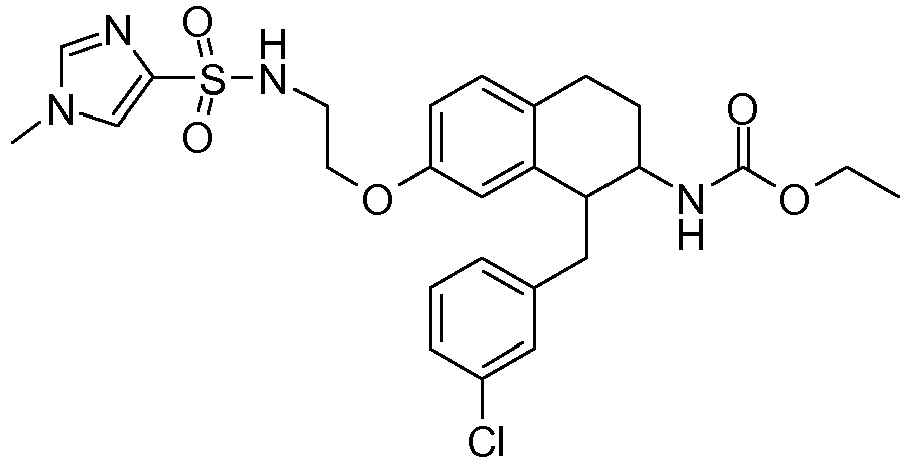
- Prepared in two steps from 7-(2-tert-butoxycarbonylamino-ethoxy)-1-(3-chloro-benzyl)-1,2,3,4-tetrahydro-naphthalen-2-yl]-carbamic acid ethyl ester in analogy to example 46 using 1-Methyl-1 H-imidazole-4-sulfonyl chloride.
ESI-MS [M+H+] = 547 Calculated for C26H31ClN4O5S = 546 -

- Prepared in two steps from 7-(2-tert-butoxycarbonylamino-ethoxy)-1-(3-chloro-benzyl)-1,2,3,4-tetrahydro-naphthalen-2-yl]-carbamic acid ethyl ester in analogy to example 46 using 1-difluoromethyl-1 H-pyrazole-4-sulfonyl chloride.
ESI-MS [M+H+] = 583 Calculated for C26H29ClF2N4O5S = 582 -

- Prepared as described for 2-(N-methylpropylsulfonamido)ethyl propane-1-sulfonate (example 76, step 1 using (R)-1-pyrrolidin-2-yl-methanol instead of 2-(methylamino)ethanol.
-

- Prepared in two steps from (propane-1-sulfonic acid (R)-1-(propane-1-sulfonyl)-pyrrolidin-2-ylmethyl ester (see previous step) and ethyl 1-(4-chlorobenzyl)-7-hydroxy-1,2,3,4-tetrahydronaphthalen-2-ylcarbamate as described for example 77.
ESI-MS [M+H+] = 477 Calculated for C25H33ClN2O3S = 476 -

- To a cooled solution (0-5°C) of azetidin-3-ol hydrochloride (1 g, 9,13 mmol) in 10 ml dichloromethane containing diisopropyl ethyl amine (2,391 ml, 13,69 mmol) was added dropwise a solution of propane-1-sulfonyl chloride (1,126 ml, 10,04 mmol) dissolved in 5 ml dichloromethane over an 1h period. The mixture was allowed to warm up to room temperature and was stirred over night. Citric acid (10%) was added, extracted with dichloromethane, dried over MgSO4, filtered and the solvent was evaporated to obtain 597 mg of a yellow oil, which was purified by chromatography (yield 470 mg)
-

- To a solution of 1-(propane-1-sulfonyl)-azetidin-3-ol (236 mg, 1,317 mmol) in pyridine was added drop wise methane sulfonyl chloride (205 µl, 2,63 mmol) at 0°C. The mixture was allowed to warm up to room temperature and was stirred for 3h. Dichloromethane was added. The mixture was subsequently washed with water, saturated NaHCO3 and brine, dried (MgSO4), and filtrated. The solvent was evaporated to obtain 293 mg of crude product which was used without further purification.
-

- Prepared in two steps from methanesulfonic acid 1-(propane-1-sulfonyl)-azetidin-3-yl ester (see previous step) and ethyl 1-(4-chlorobenzyl)-7-hydroxy-1,2,3,4-tetrahydronaphthalen-2-ylcarbamate as described for example 77.
ESI-MS [M+H+] = 449 Calculated for C23H29ClN2O3S = 448 -
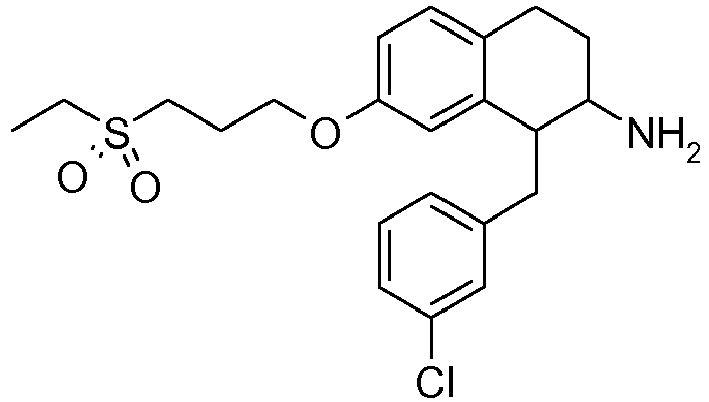
- Prepared in two steps from 1-chloro-3-ethanesulfonyl-propane (see: Synthetic Communications, 19(9-10), 1583-91; 1989) and ethyl 1-(4-chlorobenzyl)-7-hydroxy-1,2,3,4-tetrahydronaphthalen-2-ylcarbamate in analogy to example 77.
ESI-MS [M+H+] = 422 Calculated for C22H28ClNO3S = 421 -

- Cyclohexanesulfonic acid {2-[7-amino-8-(3,4-dichloro-benzyl)-5,6,7,8-tetrahydro-naphthalen-2-yloxy]-ethyl}-amide hydrochloride was prepared in analogy to example 3 using cyclohexyl-sulfonyl chloride in place of 1-methyl-1 H-imidazole-4-sulfonyl chloride.
ESI-MS [M+H+] = 511 Calculated for C25H32Cl2N2O3S = 510 -

- 2-Trimethylsilanyl-ethanesulfonic acid {2-[7-amino-8-(3,4-dichloro-benzyl)-5,6,7,8-tetrahydro-naphthalen-2-yloxy]-ethyl}-amid hydrochloride was prepared in analogy to example 3.
ESI-MS [M+H+] = 529 Calculated for C24H34Cl2N2O3SSi = 528 -

- N-{2-[7-Amino-8-(3,4-dichloro-benzyl)-5,6,7,8-tetrahydro-naphthalen-2-yloxy]-ethyl}-C-(5-methyl-isoxazol-3-yl)-methanesulfonamide hydrochloride was prepared in analogy to example 3.
ESI-MS [M+H+] = 524 Calculated for C24H27C2N3O4S = 523 -

-

- 1-(3,4-Dichlorobenzyl)-7-methoxy-3,4-dihydronaphthalen-2(1H)-one (5.5 g, 16.4 mmol, example 1), pyrrolidine (1.40 g, 19.7 mmol), and p-toluenesulfonic acid monohydrate (31.0 mg, 0.164 mmol) were dissolved in toluene (100 ml) and refluxed for 2h using a Dean-Stark condenser. The solvent was removed and after addition of MeOH (50 ml) and sodium cyanohydride (1.57 g, 24.6 mmol) the mixture was stirred for 4d at room temperature under nitrogen. Water was added, the organic phase separated and the aqueous phase extracted with ethyl acetate. The combined organic layers were washed with saturated NaCl solution, dried over MgSO4, and concentrated to afford a residue that was purified by flash chromatography (silica gel, MeOH/ CH2Cl23:97 → 5:95). The beige solid product (1.6 g, 25%) was obtained from precipitation in ethyl acetate/diisopropylether (1:1).
-

- 1-(1-(3,4-Dichlorobenzyl)-7-methoxy-1,2,3,4-tetrahydronaphthalen-2-yl)pyrrolidine (1.6 g, 4.10 mmol) was dissolved in CH2Cl2 (100 ml) and BBr3 (1 molar in CH2Cl2, 12.3 ml, 12.3 mmol) was added at -10°C. It was stirred for 2h after which time the temperature rose to room temperature. Ice water was added, the organic phase separated and the aqueous phase extracted with CH2Cl2. The combined organic layers were washed with saturated NaHCO3 and NaCl solution, dried over Na2SO4, and concentrated to afford a residue. The beige solid product (1.2 g, 78%) was obtained from precipitation in ethyl acetate.
-

- NaH in paraffin (0.278 g, 6.38 mmol, 55% in paraffin) was washed wit n-hexane and suspended in DMA (30 ml). 8-(3,4-Dichlorobenzyl)-7-(pyrrolidin-1-yl)-5,6,7,8-tetrahydronaphthalen-2-ol (1.2 g, 3.19 mmol) in DMA (20 ml) was added. After stirring for 1h at room temperature tert-butyl 2-bromoethylcarbamate (2.14 g, 6.38 mmol) was added in portions and the mixture was stirred for 48h. Water was added and the aqueous phase was extracted with ethyl acetate. The combined organic layers were washed with saturated NaCl solution, dried over Na2SO4, and concentrated to afford a residue that was purified by flash chromatography (silica gel, MeOH/ CH2Cl23:97). The product (1.6 g, 97%) was obtained as a yellow oil.
-

- tert-Butyl 2-(8-(3,4-dichlorobenzyl)-7-(pyrrolidin-1-yl)-5,6,7,8-tetrahydronaphthalen-2-yloxy)ethylcarbamate (1.6 g, 3.08 mmol) was dissolved in CH2Cl2 (70 ml) and HCl in iPrOH was added. It was stirred for 14h at room temperature after during which time the temperature rose to room temperature. The solvent was removed to obtain white salt (1.2 g, 85%).
-

- 2-(8-(3,4-Dichlorobenzyl)-7-(pyrrolidin-1-yl)-5,6,7,8-tetrahydronaphthalen-2-yloxy)ethanamine (120 mg, 0.286 mmol), para-(N,N-dimethylamino) pyridine (1.40 g, 19.7 mmol), and cyclobutanesulfonyl chloride (46.5 mg, 0.30 mmol) were dissolved in CH2Cl2 (20 ml) and stirred for 14h at room temperature. 0.5N HCl was added, the organic phase separated and the aqueous phase extracted with CH2Cl2. The combined organic layers were washed with water, NaHCO3 solution, and saturated NaCl solution, dried over Na2SO4, and concentrated to afford a residue that was purified by flash chromatography (silica gel, MeOH/ CH2Cl23:97 → 5:95). The white solid product (164 mg, 32%) was transferred to an HCl salt and precipitated from diisopropyl ether.
ESI-MS [M+H+] = 537 Calculated for C27H34Cl2N2O3S = 536 -

- N-(2-(8-(3,4-Dichlorobenzyl)-7-(pyrrolidin-1-yl)-5,6,7,8-tetrahydronaphthalen-2-yloxy)ethyl)-1-methyl-1 H-pyrazole-4-sulfonamide hydrochloride (41 mg, 0.068 mmol, Example 91, iodomethane (11.6 mg, 0.082 mmol), caesium carbonate (49.0 mg, 0.150 mmol) were dissolved in acetonitrile (3 ml) and stirred for 1h at 100°C in the microwave. After addition of another iodomethane (11.6 mg, 0.082 mmol) and caesium carbonate (49.0 mg, 0.150 mmol) it was stirred for another 1h at 100°C in the microwave. Water and CH2Cl2 were added, the organic phase separated and the aqueous phase extracted with CH2Cl2. The combined organic layers were washed with saturated NaCl solution, dried over Na2SO4, and concentrated to afford a residue that was purified by flash chromatography (silica gel, MeOH/ CH2Cl2 3:97 → 5:95). The white solid product (42 mg, 38%) was transferred to an HCl salt and precipitated from diisopropyl ether.ESI-MS [M+H+] = 577 Calculated for C28H34Cl2N4O3S = 576
-

- Butane-1-sulfonic acid {2-[7-amino-8-(3,4-dichloro-benzyl)-5,6,7,8-tetrahydro-naphthalen-2-yloxy]-ethyl}-amide hydrochloride was prepared in analogy to example 3.
ESI-MS [M+H+] = 485 Calculated for C23H30Cl2N2O3S = 484 -

- Propane-2-sulfonic acid {2-[7-amino-8-(3,4-dichloro-benzyl)-5,6,7,8-tetrahydro-naphthalen-2-yloxy]-ethyl}-amide hydrochloride was prepared in analogy to example 3.
ESI-MS [M+H+] = 471 Calculated for C22H28Cl2N2O3S = 470 -

- 1-Methyl-1 H-pyrazole-4-sulfonic acid {2-[8-(3,4-dichloro-benzyl)-7-pyrrolidin-1-yl-5,6,7,8-tetrahydro-naphthalen-2-yloxy]-ethyl}-amide hydrochloride was prepared in analogy to example 88.
ESI-MS [M+H+] = 563 Calculated for C27H32Cl2N4O3S = 562 -

- 2-Ethoxy-ethanesulfonic acid {2-[7-amino-8-(3,4-dichloro-benzyl)-5,6,7,8-tetrahydro-naphthalen-2-yloxy]-ethyl}-amide hydrochloride was prepared in analogy to example 3.
ESI-MS [M+H+] = 501 Calculated for C23H30Cl2N2O4S = 500 -

- Cyclobutanesulfonic acid {2-[8-(3,4-dichloro-benzyl)-7-pyrrolidin-1-yl-5,6,7,8-tetrahydro-naphthalen-2-yloxy]-ethyl}-methyl-amide hydrochloride was prepared from N-(2-(8-(3,4-dichlorobenzyl)-7-(pyrrolidin-1-yl)-5,6,7,8-tetrahydronaphthalen-2-yloxy)ethyl)cyclobutanesulfonamide hydrochloride (example 88) in analogy to example 89.
ESI-MS [M+H+] = 551 Calculated for C28H36Cl2N2O3S = 550 -

- N-{2-[7-Amino-8-(3,4-dichloro-benzyl)-5,6,7,8-tetrahydro-naphthalen-2-yloxy]-ethyl}-C-cyclopropyl-methanesulfonamide hydrochloride was prepared in analogy to example 3.
ESI-MS [M+H+] = 483 Calculated for C23H28Cl2N2O3S = 482 -

- Propane-1-sulfonic acid {2-[7-amino-8-(4-methoxy-benzyl)-5,6,7,8-tetrahydro-naphthalen-2-yloxy]-ethyl}-amide hydrochloride was prepared in analogy to example 3.
ESI-MS [M+H+] = 433 Calculated for C23H32N2O4S = 432 -

- N-(2-(7-Amino-8-(3,4-dichlorobenzyl)-5,6,7,8-tetrahydronaphthalen-2-yloxy)ethyl)methanesulfonamide hydrochloride (50.0 mg, 0.104 mmol), Pd-C 10% (1.10 mg), and hydrazine monohydrate (522 mg, 10.4 mmol) were suspended in ethanol (5 ml) and stirred for 4h under reflux. Water and CH2Cl2 were added, the mixture filtered, and the filtrate was extracted with CH2Cl2. The combined organic layers were washed with water, saturated NaCl solution, dried over Na2SO4, and concentrated to afford a residue that was purified by precipitation from diisopropylether. The residue was transferred to an HCl salt and finally gave the product as a white solid (31 mg, 72%).
ESI-MS [M+H+] = 375 Calculated for C20H26N2O3S = 374 -

- 1-Methyl-1 H-imidazole-4-sulfonic acid [2-(7-amino-8-benzyl-5,6,7,8-tetrahydro-naphthalen-2-yloxy)-ethyl]-methyl-amide hydrochloride was prepared in analogy to exam-ple 3 and 89.
ESI-MS [M+H+] = 455 Calculated for C24H30N4O3S = 454 -

- N-[2-(7-Amino-8-benzyl-5,6,7,8-tetrahydro-naphthalen-2-yloxy)-ethyl]-benzenesulfonamide hydrochloride was prepared from N-{2-[7-Amino-8-(3,4-dichloro-benzyl)-5,6,7,8-tetrahydro-naphthalen-2-yloxy]-ethyl}-benzenesulfonamide hydrochloride (example 16) in analogy to example 3 and 97.
ESI-MS [M+H+] = 437 Calculated for C25H28N2O3S = 436 -

- 3,3,3-Trifluoro-propane-1-sulfonic acid [2-(7-amino-8-benzyl-5,6,7,8-tetrahydro-naphthalen-2-yloxy)-ethyl]-amide hydrochloride was prepared in analogy to example 3 and 97.
ESI-MS [M+H+] = 457 Calculated for C22H27F3N2O3S = 456 -

- N-(2-{[7-Amino-8-benzyl-5,6,7,8-tetrahydronaphthalen-2-yl]oxy}ethyl)-N,1-dimethyl-1 H-imidazole-4-sulfonamide hydrochloride (98), 1,4-dibromobutane (49.9 mg, 0.231 mmol), and triethylamine (31.2 mg, 0.308 mmol) were dissolved in acetonitrile (3 ml) and stirred for 2h at 130°C in the microwave. Water and ethyl acetate were added and the organic phase was separated. After extraction of the aqueous phase with ethylacetate the combined organic layers were washed with saturated NaCl solution, dried over Na2SO4, and concentrated to afford a residue a residue that was purified by flash chromatography (silica gel, MeOH/ CH2Cl25:95). The residue was transferred to an HCl salt and finally gave the product as a white solid (8.5 mg, 10%) after precipitation from diisopropylether.
ESI-MS [M+H+] = 509 Calculated for C28H36N4O3S = 508 -

- Cyclopropanesulfonic acid [2-(7-amino-8-benzyl-5,6,7,8-tetrahydro-naphthalen-2-yloxy)-ethyl]-amide hydrochloride was prepared in analogy to example 3 and 97.
ESI-MS [M+H+] = 401 Calculated for C22H28N2O3S = 400 -

- Ethyl 7-(2-aminoethoxy)-1-(3,4-dichlorobenzyl)-1,2,3,4-tetrahydronaphthalen-2-ylcarbamate hydrochloride (example 2.1, 100 mg, 0.229 mmol) and N,N-dimethyl amino pyridine (30.7 mg, 0.252 mmol) were dissolved in CH2Cl2 (20 ml) and propionyl chloride (30.7 mg, 0,252 mmol) was added at RT. After stirring at RT for 14h 0.5 N HCl was added and the mixture was extracted with CH2Cl2. The combined organic layers were washed with saturated NaHCO3 and NaCl solution, dried over Na2SO4, and concentrated to afford a residue. White solid ethyl 1-(3,4-dichlorobenzyl)-7-(2-propionamidoethoxy)-1,2,3,4-tetrahydronaphthalen-2-ylcarbamate (98 mg, 87%) was obtained from precipitation in ethyl acetate. Further transformation in analogy to example 2 and 97 finally gave N-[2-(7-Amino-8-benzyl-5,6,7,8-tetrahydro-naphthalen-2-yloxy)-ethyl]-propionamide hydrochloride.
ESI-MS [M+H+] = 353 Calculated for C22H28N2O2 = 352 -

- 1-Methyl-1 H-[1,2,4]triazole-3-sulfonic acid {2-[7-amino-8-(3,4-dichloro-benzyl)-5,6,7,8-tetrahydro-naphthalen-2-yloxy]-ethyl}-amide was prepared in analogy to example 3.
ESI-MS [M+H+] = 510 Calculated for C22H25Cl2N5O3S = 509 -

- 1-Methyl-1 H-imidazole-4-sulfonic acid [2-(7-azetidin-1-yl-8-benzyl-5,6,7,8-tetrahydro-naphthalen-2-yloxy)-ethyl]-methyl-amide was prepared in analogy to example 101.
ESI-MS [M+H+] = 495 Calculated for C27H34N4O3S = 494 -

- N-{2-[7-Amino-8-(3,4-dichloro-benzyl)-5,6,7,8-tetrahydro-naphthalen-2-yloxy]-ethyl}-C-cyclobutyl-methanesulfonamide hydrochloride was prepared in analogy to example 3.
ESI-MS [M+H+] = 497 Calculated for C24H3OCl2N2O3S = 496 -

- Propane-1-sulfonic acid {2-[7-amino-8-(3-fluoro-benzyl)-5,6,7,8-tetrahydro-naphthalen-2-yloxy]-ethyl}-amide hydrochloride was prepared in analogy to example 3.
ESI-MS [M+H+] = 421 Calculated for C22H29FN2O3S = 420 -

- N-{2-[7-Amino-8-(3,4-dichloro-benzyl)-5,6,7,8-tetrahydro-naphthalen-2-yloxy]-ethyl}-C-cyclopropyl-N-methyl-methanesulfonamide hydrochloride was prepared in analogy to example 11.
ESI-MS [M+H+] = 497 Calculated for C24H30Cl2N2O3S = 496 -

- 1-Methyl-1 H-pyrazole-4-sulfonic acid [2-(7-amino-8-benzyl-5,6,7,8-tetrahydro-naphthalen-2-yloxy)-ethyl]-methyl-amide was prepared in analogy to example 3 and 89.
ESI-MS [M+H+] = 455 Calculated for C24H30N4O3S = 454 -

- N-(2-(7-Amino-8-(3,4-dichlorobenzyl)-5,6,7,8-tetrahydronaphthalen-2-yloxy)ethyl)-N-ethyl-1-methyl-1 H-pyrazole-4-sulfonamide was prepared in analogy to example 11.
ESI-MS [M+H+] = 537 Calculated for C25H3OCl2N4O3S = 536 -

- 1-Methyl-1 H-pyrazole-4-sulfonic acid [2-(8-benzyl-7-pyrrolidin-1-yl-5,6,7,8-tetrahydro-naphthalen-2-yloxy)-ethyl]-methyl-amide hydrochloride was prepared in analogy to example 50.
ESI-MS [M+H+] = 509 Calculated for C28H36N4O3S = 508 -

- 1-Methyl-1 H-pyrazole-4-sulfonic acid [2-(7-azetidin-1-yl-8-benzyl-5,6,7,8-tetrahydro-naphthalen-2-yloxy)-ethyl]-methyl-amide hydrochloride was prepared in analogy to example 50.
ESI-MS [M+H+] = 495 Calculated for C27H34N4O3S = 494 -

- N-(2-(7-Amino-8-benzyl-5,6,7,8-tetrahydronaphthalen-2-yloxy)ethyl)-N-ethyl-1-methyl-1 H-pyrazole-4-sulfonamide hydrochloride was prepared in analogy to example 3 and 89.
ESI-MS [M+H+] = 469 Calculated for C25H32N4O3S = 468 -

- N-(2-(7-Amino-8-(3,4-dichlorobenzyl)-5,6,7,8-tetrahydronaphthalen-2-yloxy)ethyl)pentane-1-sulfonamide hydrochloride was prepared in analogy to example 3.
ESI-MS [M+H+] = 499 Calculated for C24H32Cl2N2O3S = 498 -

- N-(2-(8-(3,4-Dichlorobenzyl)-7-(pyrrolidin-1-yl)-5,6,7,8-tetrahydronaphthalen-2-yloxy)ethyl)-1-methyl-1 H-imidazole-4-sulfonamide hydrochloride was synthesized in analogy to example 88.
ESI-MS [M+H+] = 536 Calculated for C27H32Cl2N4O3S = 535 -

- N-(2-(8-Benzyl-7-(pyrrolidin-1-yl)-5,6,7,8-tetrahydronaphthalen-2-yloxy)ethyl)-1-methyl-1 H-imidazole-4-sulfonamide hydrochloride was prepared from N-(2-(8-(3,4-dichlorobenzyl)-7-(pyrrolidin-1-yl)-5,6,7,8-tetrahydronaphthalen-2-yloxy)ethyl)-1-methyl-1 H-imidazole-4-sulfonamide (example 115) in analogy to 97.
ESI-MS [M+H+] = 495 Calculated for C27H34N4O3S = 494 -

- The racemate of N-(2-(8-benzyl-7-(pyrrolidin-1-yl)-5,6,7,8-tetrahydronaphthalen-2-yloxy)ethyl)-1-methyl-1 H-imidazole-4-sulfonamide hydrochloride (ex. 116) was separated by chiral chromatography on Chiracel AD (n-heptane/ ethanol 35:65, 0.1 % TEA, 9 ml/min) to deliver (after transfer to the salt form) (-)-N-(2-(8-benzyl-7-(pyrrolidin-1-yl)-5,6,7,8-tetrahydronaphthalen-2-yloxy)ethyl)-1-methyl-1H-imidazole-4-sulfonamide hydrochloride ([α] = -76.0° in MeOH, c=1.040 g/100 ml [ex. 117]) and (+)-N-(2-(8-benzyl-7-(pyrrolidin-1-yl)-5,6,7,8-tetrahydronaphthalen-2-yloxy)ethyl)-1-methyl-1H-imidazole-4-sulfonamide hydrochloride ([α] = -77.7° in MeOH, c=0.382 g/100 ml ex. 118]).
ESI-MS [M+H+] = 495 Calculated for C27H34N4O3S = 494 -

ESI-MS [M+H+] = 495 Calculated for C27H34N4O3S = 494 -

- N-(2-{[7-Amino-8-(3-chloro-4-fluorobenzyl)-5,6,7,8-tetrahydronaphthalen-2-yl]oxy}ethyl)propane-1-sulfonamide hydrochloride was prepared in analogy to example 3.
ESI-MS [M+H+] = 455 Calculated for C22H28ClFN2O3S = 454 -

- N-(2-{[7-Amino-8-benzyl-5,6,7,8-tetrahydronaphthalen-2-yl]oxy}ethyl)-1-cyclopropylmethanesulfonamide hydrochloride was prepared in analogy to example 3.
ESI-MS [M+H+] = 415 Calculated for C23H30N2O3S = 414 -

- N-(2-{[7-Amino-8-(3,4-dichlorobenzyl)-5,6,7,8-tetrahydronaphthalen-2-yl]oxy}ethyl)-2-cyclopropylacetamide hydrochloride was synthesized in analogy to example 103.
ESI-MS [M+H+] = 447 Calculated for C24H28Cl2N2O2 = 446 -

- N-(2-{[7-Amino-8-(3,4-dichlorobenzyl)-5,6,7,8-tetrahydronaphthalen-2-yl]oxy}ethyl)benzamide hydrochloride was synthesized in analogy to example 103.
ESI-MS [M+H+] = 469 Calculated for C26H26Cl2N2O2 = 468 -

- N-(2-{[8-Benzyl-7-(pyrrolidin-1-yl)-5,6,7,8-tetrahydronaphthalen-2-yl]oxy}ethyl)-N-ethyl-1-methyl-1 H-pyrazole-4-sulfonamide hydrochloride was synthesized from N-(2-(7-amino-8-benzyl-5,6,7,8-tetrahydronaphthalen-2-yloxy)ethyl)-N-ethyl-1-methyl-1 H-pyrazole-4-sulfonamide hydrochloride (example 113) in analogy to example 97.
ESI-MS [M+H+] = 523 Calculated for C29H38N4O3S = 522 -

- N-(2-{[7-Amino-8-(3,4-dichlorobenzyl)-5,6,7,8-tetrahydronaphthalen-2-yl]oxy}ethyl)-2-cyclopropylethanesulfonamide hydrochloride was prepared in analogy to example 3.
ESI-MS [M+H+] = 497 Calculated for C24H30Cl2N2O3S = 496 -
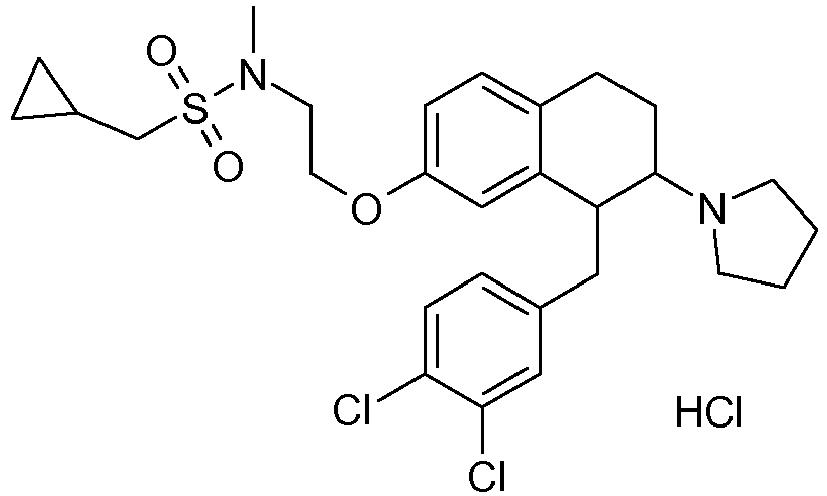
- C-Cyclopropyl-N-{2-[8-(3,4-dichloro-benzyl)-7-pyrrolidin-1-yl-5,6,7,8-tetrahydro-naphthalen-2-yloxy]-ethyl}-N-methyl-methanesulfonamide hydrochloride was synthesized in analogy to examples 89, 97, 101.
ESI-MS [M+H+] = 551 Calculated for C28H36Cl2N2O3S = 550 -

- N-(2-{[8-Benzyl-7-(pyrrolidin-1-yl)-5,6,7,8-tetrahydronaphthalen-2-yl]oxy}ethyl)-1-cyclopropyl-N-methylmethanesulfonamide hydrochloride was synthesized from 1-cyclopropyl-N-(2-{[8-(3,4-dichlorobenzyl)-7-(pyrrolidin-1-yl)-5,6,7,8-tetrahydronaphthalen-2-yl]oxy}ethyl)-N-methylmethanesulfonamide hydrochloride in analogy to example 97.
ESI-MS [M+H+] = 483 Calculated for C28H38N2O3S = 482 -
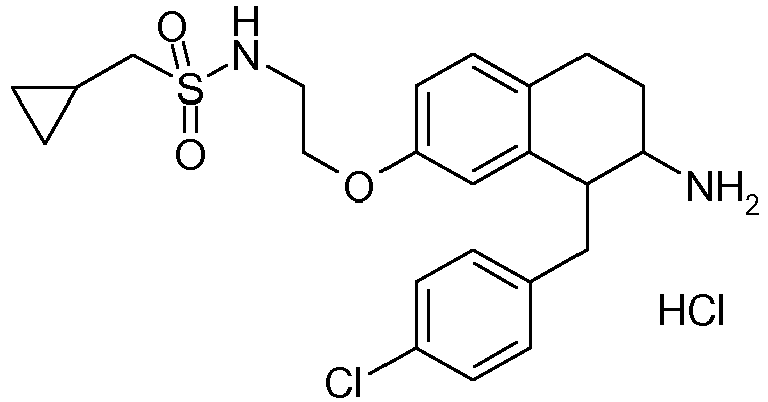
- N-(2-{[7-Amino-8-(4-chlorobenzyl)-5,6,7,8-tetrahydronaphthalen-2-yl]oxy}ethyl)-1-cyclopropylmethanesulfonamide hydrochloride was prepared in analogy to example 3.
ESI-MS [M+H+] = 449 Calculated for C23H29ClN2O3S = 448 -

- N-(2-{[7-Amino-8-(4-chlorobenzyl)-5,6,7,8-tetrahydronaphthalen-2-yl]oxy}ethyl)-1-cyclopropyl-N-methylmethanesulfonamide hydrochloride was prepared in analogy to example 3, N-methylation was performed according to 89.
ESI-MS [M+H+] = 463 Calculated for C24H31ClN2O3S = 462 -

- N-[2-(7-Amino-8-benzyl-5,6,7,8-tetrahydro-naphthalen-2-yloxy)-ethyl]-C-cyclopropyl-N-methyl-methanesulfonamide hydrochloride was prepared from N-(2-{[7-amino-8-(3,4-dichlorobenzyl)-5,6,7,8-tetrahydronaphthalen-2-yl]oxy}ethyl)-1-cyclopropyl-N-methylmethanesulfonamide hydrochloride (example 108) in analogy to example 97.
ESI-MS [M+H+] = 429 Calculated for C24H32N2O3S = 428 -

- N-(2-{[7-Amino-8-(3,4-difluorobenzyl)-5,6,7,8-tetrahydronaphthalen-2-yl]oxy}ethyl)-1-cyclopropylmethanesulfonamide hydrochloride was prepared in analogy to example 3.
ESI-MS [M+H+] = 451 Calculated for C23H28F2N2O3S = 450 -

- C-Cyclopropyl-N-{2-[8-(3,4-dichloro-benzyl)-7-pyrrolidin-1-yl-5,6,7,8-tetrahydro-naphthalen-2-yloxy]-ethyl}-methanesulfonamide hydrochloride was prepared in analogy to example 88.
ESI-MS [M+H+] = 537 Calculated for C27H34Cl2N2O3S = 536 -

- N-(2-{[8-Benzyl-7-(pyrrolidin-1-yl)-5,6,7,8-tetrahydronaphthalen-2-yl]oxy}ethyl)-1-cyclopropylmethanesulfonamide hydrochloride was prepared from C-cyclopropyl-N-{2-[8-(3,4-dichloro-benzyl)-7-pyrrolidin-1-yl-5,6,7,8-tetrahydro-naphthalen-2-yloxy]-ethyl}-methanesulfonamide hydrochloride (example 132) in analogy to example 97.
ESI-MS [M+H+] = 469 Calculated for C27H36N2O3S = 468 -

- 7-Amino-8-(3,4-dichlorobenzyl)-5,6,7,8-tetrahydronaphthalen-2-ol (691 mg, 2.146 mmol, example 34), 2 eq of 1,4-dibromo-2-fluorobutane, and 3 eq of triethylamine were dissolved in acetonitrile (10 ml) and heated in the microwave for 2h. Addition of water with ethylacetate, washing of the organic phase with saturated NaHCO3, NaCl, drying over Na2SO4 and flash chromatography (silica gel, CH2Cl2/ MeOH 95:5) gave 8-(3,4-dichlorobenzyl)-7-(3-fluoropyrrolidin-1-yl)-5,6,7,8-tetrahydronaphthalen-2-ol (330 mg, 39%). The ethylene sulfonamide side chain was added in analogy to examples 1, 7, 8 to give 1-cyclopropyl-N-[2-({8-(3,4-dichlorobenzyl)-7-[3-fluoropyrrolidin-1-yl]-5,6,7,8-tetrahydronaphthalen-2-yl}oxy)ethyl]methanesulfonamide.
ESI-MS [M+H+] = 555 Calculated for C27H33Cl2FN2O3S = 554 -

- N-(2-{[7-(Azetidin-1-yl)-8-(3,4-dichlorobenzyl)-5,6,7,8-tetrahydronaphthalen-2-yl]oxy}ethyl)-1-cyclopropylmethanesulfonamide was prepared in analogy to example 320.
ESI-MS [M+H+] = 523 Calculated for C26H32Cl2N2O3S = 522 -

- N-[2-({8-Benzyl-7-[3-fluoropyrrolidin-1-yl]-5,6,7,8-tetrahydronaphthalen-2-yl}oxy)ethyl]-1-cyclopropylmethanesulfonamide hydrochloride was synthesized from 1-cyclopropyl-N-[2-({8-(3,4-dichlorobenzyl)-7-[3-fluoropyrrolidin-1-yl]-5,6,7,8-tetrahydronaphthalen-2-yl}oxy)ethyl]methanesulfonamide (example 134) in analogy to97.
ESI-MS [M+H+] = 487 Calculated for C27H35FN2O3S = 486 -

- The synthesis was performed starting from ethyl 1-benzyl-7-(2-(cyclopropylmethylsulfonamido)ethoxy)-1,2,3,4-tetrahydronaphthalen-2-ylcarbamate (synthesized in analogy to example 3), which was dissolved in THF (50 ml), after which LiAlH4 was added at room temperature and the mixture was stirred for 8h under reflux. Addition of 2N aqueous NaOH, extraction with CH2Cl2, washing of the organic layers with saturated NaHCO3 solution and saturated NaCl solution and evaporation of the solvent gave a residue that was treated with iPrOH/HCl after which the product precipitated. After filtration a white salt (287 mg, 58%) were obtained.
ESI-MS [M+H+] = 429 Calculated for C24H32N2O3S = 428 -

- 1-Cyclopropyl-N-(2-{[8-(3-fluorobenzyl)-7-(pyrrolidin-1-yl)-5,6,7,8-tetrahydronaphthalen-2-yl]oxy}ethyl)methanesulfonamide hydrochloride was synthesized in analogy to examples 264/88.
ESI-MS [M+H+] = 487 C27H35FN2O3S = 486 -

- N-(2-{[7-(Azetidin-1-yl)-8-(3-fluorobenzyl)-5,6,7,8-tetrahydronaphthalen-2-yl]oxy}ethyl)-1-cyclopropylmethanesulfonamide hydrochloride was synthesized in analogy to example 320.
ESI-MS [M+H+] = 473 C26H33FN2O3S = 472 -

- N-(2-{[8-(3-Fluorobenzyl)-7-(pyrrolidin-1-yl)-5,6,7,8-tetrahydronaphthalen-2-yl]oxy}ethyl)-1-methyl-1 H-imidazole-4-sulfonamide hydrochloride was synthesized in analogy to examples 264/88
ESI-MS [M+H+] = 513 C27H33FN4O3S = 512 -

- N-(2-{[7-(Azetidin-1-yl)-8-(3-fluorobenzyl)-5,6,7,8-tetrahydronaphthalen-2-yl]oxy}ethyl)-1-methyl-1 H-imidazole-4-sulfonamide hydrochloride was synthesized in analogy to example 320.
ESI-MS [M+H+] = 499 C26H31FN4O3S = 498 -

- N-(2-{[7-(Azetidin-1-yl)-8-benzyl-5,6,7,8-tetrahydronaphthalen-2-yl]oxy}ethyl)-1-cyclopropylmethanesulfonamide hydrochloride was synthesized in analogy to example 320.
ESI-MS [M+H+] = 455 C26H34N2O3S = 454 -

- The racemate of N-(2-{[7-(azetidin-1-yl)-8-benzyl-5,6,7,8-tetrahydronaphthalen-2-yl]oxy}ethyl)-1-cyclopropylmethanesulfonamide hydrochloride (example 142) was separated by chiral chromatography on Chiracel AD (n-heptane/ ethanol 35:65, 0.1 % TEA, 9 ml/min) to deliver (after transfer to salt form) (-)-N-(2-(7-(azetidin-1-yl)-8-benzyl-5,6,7,8-tetrahydronaphthalen-2-yloxy)ethyl)-1-cyclopropylmethanesulfonamide ([α] = -103.0° in MeOH, c=0.461 g/100 ml [example 143]) and (+)-N-(2-(7-(azetidin-1-yl)-8-benzyl-5,6,7,8-tetrahydronaphthalen-2-yloxy)ethyl)-1-cyclopropylmethanesulfonamide succinate ([α] = +57.0° in MeOH, c=0.508 g/100 ml [example 144])
ESI-MS [M+H+] = 455 C26H34N2O3S = 454 -

- N-(2-{[7-(Azetidin-1-yl)-8-benzyl-5,6,7,8-tetrahydronaphthalen-2-yl]oxy}ethyl)-1-methyl-1 H-imidazole-4-sulfonamide was synthesized in analogy to example 320.
ESI-MS [M+H+] = 481 C26H32N4O3S = 480 -

- The racemate of N-(2-{[7-(azetidin-1-yl)-8-benzyl-5,6,7,8-tetrahydronaphthalen-2-yl]oxy}ethyl)-1-methyl-1 H-imidazole-4-sulfonamide (145) can be separated by chiral chromatography to deliver (after transfer to the salt form) (-)-N-(2-((7S,8R)-7-(azetidin-1-yl)-8-benzyl-5,6,7,8-tetrahydronaphthalen-2-yloxy)ethyl)-1-methyl-1 H-imidazole-4-sulfonamide fumarate ([α] = -81.4° in MeOH, c=0.409 g/100 ml).
ESI-MS [M+H+] = 481 Calculated for C27H34N4O3S = 480 -

- N-(2-{[7-(Azetidin-1-yl)-8-benzyl-5,6,7,8-tetrahydronaphthalen-2-yl]oxy}ethyl)cyclobutanesulfonamide was synthesized in analogy to example 320.
ESI-MS [M+H+] = 455 C26H34N2O3S = 454 -

- Propane-1-sulfonic acid [2-(7-azetidin-1-yl-8-benzyl-5,6,7,8-tetrahydro-naphthalen-2-yloxy)-ethyl]-amide was synthesized in analogy to example 320.
ESI-MS [M+H+] = 443 C25H34N2O3S = 442 -

- N-(2-{[8-(3-Fluorobenzyl)-7-(pyrrolidin-1-yl)-5,6,7,8-tetrahydronaphthalen-2-yl]oxy}ethyl)-1-methyl-1 H-pyrrole-3-sulfonamide hydrochloride was synthesized in analogy to examples 264/88.
ESI-MS [M+H+] = 512 C28H34FN3O3S = 511 -

- N-(2-{[7-Amino-8-(3-chloro-5-fluorobenzyl)-5,6,7,8-tetrahydronaphthalen-2-yl]oxy}ethyl)-1-cyclopropylmethanesulfonamide hydrochloride was synthesized in analogy to example 3.
ESI-MS [M+H+] = 467 C23H28ClFN2O3S = 466 -

- N-(2-{[7-Amino-8-(3-chloro-5-fluorobenzyl)-5,6,7,8-tetrahydronaphthalen-2-yl]oxy}ethyl)-1-methyl-1 H-imidazole-4-sulfonamide hydrochloride was synthesized in analogy to example 3.
ESI-MS [M+H+] = 493 C23H26ClFN4O3S = 492 -

- N-[2-({8-Benzyl-7-[3-fluoropyrrolidin-1-yl]-5,6,7,8-tetrahydronaphthalen-2-yl}oxy)ethyl]-1-methyl-1 H-imidazole-4-sulfonamide hydrochloride was synthesized in analogy to 264/88.
ESI-MS [M+H+] = 513 C27H33FN4O3S = 512 -

- N-(2-{[8-(3-Cyanobenzyl)-7-(pyrrolidin-1-yl)-5,6,7,8-tetrahydronaphthalen-2-yl]oxy}ethyl)-1-methyl-1 H-imidazole-4-sulfonamide was synthesized in analogy to 264/88.
ESI-MS [M+H+] = 520 C28H33N5O3S = 519 -

- N-(2-{[8-(3-Cyanobenzyl)-7-(propan-2-ylamino)-5,6,7,8-tetrahydronaphthalen-2-yl]oxy}ethyl)-1-methyl-1 H-imidazole-4-sulfonamide hydrochloride was synthesized in analogy to example 88.
ESI-MS [M+H+] = 508 C27H33N5O3S = 507 -

- N-(2-{[8-(3-Cyanobenzyl)-7-(pyrrolidin-1-yl)-5,6,7,8-tetrahydronaphthalen-2-yl]oxy}ethyl)-1-cyclopropylmethanesulfonamide hydrochloride was synthesized in analogy to examples 264/88.
ESI-MS [M+H+] = 494 C28H35N3O3S = 493 -

- N-(2-{[8-(3-Cyanobenzyl)-7-(propan-2-ylamino)-5,6,7,8-tetrahydronaphthalen-2-yl]oxy}ethyl)-1-cyclopropylmethanesulfonamide hydrochloride was synthesized in analogy to example 88.
ESI-MS [M+H+] = 482 C27H35N3O3S = 481 -
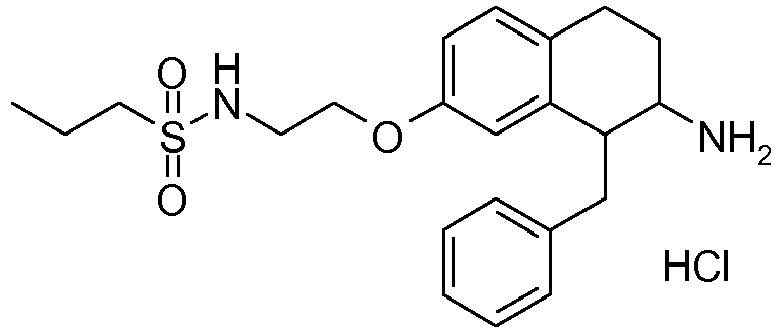
- N-(2-{[7-Amino-8-benzyl-5,6,7,8-tetrahydronaphthalen-2-yl]oxy}ethyl)propane-1-sulfonamide hydrochloride was synthesized from Propane-1-sulfonic acid {2-[7-amino-8-(3,4-dichloro-benzyl)-5,6,7,8-tetrahydro-naphthalen-2-yloxy]-ethyl}-amide hydrochloride (example 8) in analogy to example 97.
ESI-MS [M+H+] = 403 C22H30N2O3S = 402 -

- The synthesis was performed starting from ethyl 1-(3-chloro-5-fluorobenzyl)-7-(2-(cyclopropylmethylsulfonamido)ethoxy)-1,2,3,4-tetrahydronaphthalen-2-ylcarbamate (synthesized in analogy to example 3), which was dissolved in THF (50 ml), after which LiAlH4 was added at room temperature and the mixture was stirred for 8h under reflux. Addition of 2N aqueous NaOH, extraction with CH2Cl2, washing of the organic layers with saturated NaHCO3 solution and saturated NaCl solution and evaporation of the solvent gave a residue that was treated with iPrOH/HCl after which the product precipitated. After filtration a white salt (134 mg, 39%) was obtained.
ESI-MS [M+H+] = 481 Calculated for C24H30ClFN2O3S = 480 -

- N-(2-{[7-(Azetidin-1-yl)-8-(3-chloro-5-fluorobenzyl)-5,6,7,8-tetrahydronaphthalen-2-yl]oxy}ethyl)-1-cyclopropylmethanesulfonamide (2E)-but-2-enedioate was synthesized in analogy to example 320.
ESI-MS [M+H+] = 507 C26H32ClFN2O3S = 506 -

- N-(2-{[7-(Azetidin-1-yl)-8-(3-chloro-5-fluorobenzyl)-5,6,7,8-tetrahydronaphthalen-2-yl]oxy}ethyl)-1-methyl-1 H-imidazole-4-sulfonamide (2E)-but-2-enedioate was synthesized in analogy to example 320.
ESI-MS [M+H+] = 533 C26H30CIFN4O3S = 532 -

- The synthesis was performed starting from ethyl 7-(2-(cyclopropylmethylsulfonamido)-ethoxy)-1-(4-fluorobenzyl)-1,2,3,4-tetrahydronaphthalen-2-ylcarbamate (synthesized in analogy to example 3), which was dissolved in THF (50 ml), after which LiAlH4 was added at room temperature and the mixture was stirred for 8h under reflux. Addition of 2N aqueous NaOH, extraction with CH2Cl2, washing of the organic layers with saturated NaHCO3 solution and saturated NaCl solution and evaporation of the solvent gave a residue that was treated with iPrOH/HCl after which the product precipitated. After filtration a white salt (89 mg, 76%) was obtained.
ESI-MS [M+H+] = 447 C24H3,FN2O3S = 446 -

- The synthesis was performed starting from (-)-ethyl 1-benzyl-7-(2-(cyclopropylmethyl-sulfonamido)ethoxy)-1,2,3,4-tetrahydronaphthalen-2-ylcarbamate (137), which was dissolved in THF (50 ml), after which LiAlH4 was added at room temperature and the mixture was stirred for 8h under reflux. Addition of 2N aqueous NaOH, extraction with CH2Cl2, washing of the organic layers with saturated NaHCO3 solution and saturated NaCl solution and evaporation of the solvent gave a residue that was treated with iPrOH/HCl after which the product precipitated. After filtration a white salt (102 mg, 79%) was obtained. The racemate was separated by chiral chromatography on Chiracel AD (n-heptane/ ethanol/ tert-butanol 800:150:50) to deliver (after transfer to the salt form) (-)-N-(2-(8-benzyl-7-(pyrrolidin-1-yl)-5,6,7,8-tetrahydronaphthalen-2-yloxy)ethyl)-1-methyl-1H-imidazole-4-sulfonamide hydrochloride ([α] = -80.5° in MeOH, c=0.191 g/100 ml)
ESI-MS [M+H+] = 429 C24H32N2O3S = 428 -

- 1-Methyl-N-(2-{[8-(3-methylbenzyl)-7-(pyrrolidin-1-yl)-5,6,7,8-tetrahydronaphthalen-2-yl]oxy}ethyl)-1 H-imidazole-4-sulfonamide was synthesized in analogy to 264/88.
ESI-MS [M+H+] = 509 C28H36N4O3S = 508 -

- N-(2-{[8-(3-Methoxybenzyl)-7-(pyrrolidin-1-yl)-5,6,7,8-tetrahydronaphthalen-2-yl]oxy}ethyl)-1-methyl-1H-imidazole-4-sulfonamide hydrochloride was synthesized in analogy to examples 264/88.
ESI-MS [M+H+] = 525 C28H36N4O4S = 524 -

- 1-Methyl-1 H-imidazole-4-sulfonic acid {2-[7-amino-8-(3-trifluoromethyl-benzyl)-5,6,7,8-tetrahydro-naphthalen-2-yloxy]-ethyl}-amide hydrochloride was synthesized in analogy to example 3.
ESI-MS [M+H+] = 509 C24H27F3N4O3S = 508 - The following examples were prepared in analogy to example 40:
-

-

-

-

- The compound was obtained by chiral chromatography (Chiralpak AD-H 30 mm ID x 250 mm, n-hexane/EtOH/MeOH/diethylamine = 20/40/40/0.1) from the racemic compound (example 42) as the first eluting peak. Optical rotation = -50° (589 nm, 25°C, c = 0.1 in methanol).
ESI-MS [M+H+] = 373 Calculated for C21H28N2O2S = 372 -

- The compound was obtained by chiral chromatography (Chiralpak AD-H 30 mm ID x 250 mm, n-hexane/EtOH/MeOH/diethylamine = 20/40/40/0.1) from the racemic compound (example 42) as the second eluting peak. Optical rotation = +49° (589 nm, 25°C, c = 0.1 in methanol).
ESI-MS [M+H+] = 373 Calculated for C21H28N2O2S = 372 -

-

-

-

-

-

-

-

-

-

-

-

-
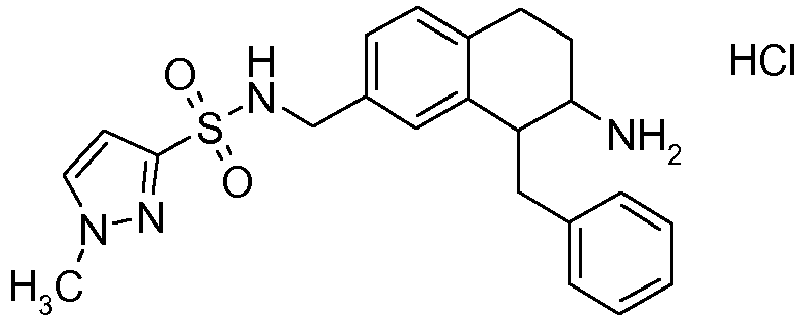
-

-

-

-

- tert-Butyl [1-benzyl-7-{[(propylsulfonyl)amino]methyl}-1,2,3,4-tetrahydronaphthalen-2-yl]carbamate prepared in analogy to example 39 (1240 mg, 2.62 mmol) was dissolved in tetrahydrofuran (50 mL). A solution of lithium aluminium hydride (1 M in tetrahydrofuran, 7.87 mL, 7.87 mmol) was added dropwise at room temperature. The reaction mixture was then heated to 60°C for 1 h. Aqueous work-up, purification of the extracted product by flash chromatography (silica gel, dichloromethane, methanol) and treatment with 1.25 M hydrochloric acid in ethanol followed by concentration in vacuo gave the desired product. Yield: 590 mg (1.4 mmol, 53%).
ESI-MS [M+H+] = 425 Calculated for C22H30N2O2S = 424 - In analogy to example 187 the following examples were prepared:
-

-
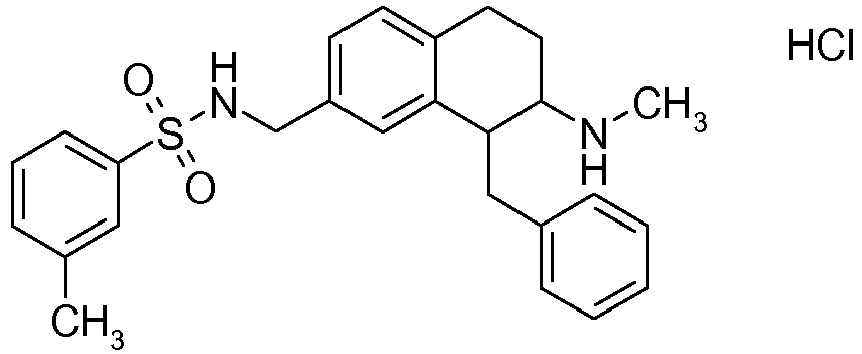
-

-

-

-
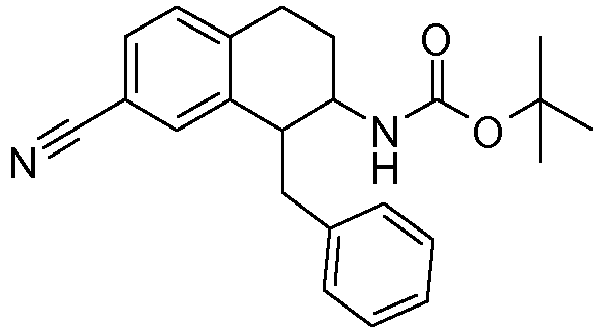
- tert-Butyl (1-benzyl-7-cyano-1,2,3,4-tetrahydronaphthalen-2-yl)carbamate can be prepared in analogy to the dichloroderivative described in example 34. The cis-isomer can be separated into the enantiomers by chiral chromatography (Daicel, Chiralpak IC, 250x4,6 mm ID, 5µ, n-heptane/ethanol = 1/9 with 0.1 % triethylamine). The enantiomer eluting second was used in the syntheses described above.
ESI-MS [M+H+] = 387 Calculated for C22H30N2O2S = 386 -

- The enantiomer of tert-butyl (1-benzyl-7-cyano-1,2,3,4-tetrahydronaphthalen-2-yl)carbamate described in example 192 was as chiral building block for the synthesis.
ESI-MS [M+H+] = 399 Calculated for C23H30N2O2S = 398 -

- Prepared from the trans derivative obtained as a by-product in the recrystallization of

ESI-MS [M+H+] = 387 Calculated for C22H30N2O2S = 386 -
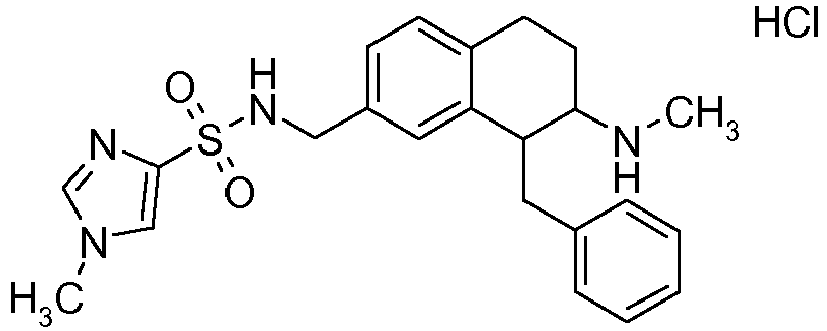
-

- N-{[7-Amino-8-benzyl-5,6,7,8-tetrahydronaphthalen-2-yl]methyl}propane-1-sulfonamide (cf. example 42) was acetylated in dichloromethane with acetyl chloride in the presence of ethyldiisopropylamine at room temperature.
ESI-MS [M+H+] = 415 Calculated for C23H30N2O3S = 414 -

- This compound was prepared in analogy to example 196.
ESI-MS [M+H+] = 471 Calculated for C24H27FN4O3S = 470 -

- N-(1-Benzyl-7-{[(propylsulfonyl)amino]methyl}-1,2,3,4-tetrahydronaphthalen-2-yl)acetamide (example 196, 153 mg, 0.37 mmol) was dissolved in tetrahydrofuran (5 mL). 1 M Boran dimethylsulfide complex solution in tetrahydrofuran (852 µL, 8.52 mmol) was added and the reaction mixture stirred at room temperature over night. Water was added and the mixture extracted with dichloromethane (three times). The combined organic extracts were dried (MgSO4) and concentrated in vacuo. The crude product was purified by flash chromatography (silica gel, dichloromethane, methanol). Excess 6 M hydrochloric acid in isopropanol was added. The solvent was evaporated and the product dried in vacuo. Yield: 70 mg (0.16 mmol, 36%).
ESI-MS [M+H+] = 401 Calculated for C23H32N2O2S = 400 - The following examples were prepared in analogy to example 198:
-

-

-

- To a solution of 9-BBN (0.5 M in tetrahydrofuran, 8.85 mL, 4.42 mmol) was added dropwise a solution N-allylpropane-1-sulfonamide (1152 mg, 7.06 mmol) in tetrahydrofuran (1 mL) a 0°C. After stirring at 0°C to 5°C for 3.5 hours dioxane (25 mL) was added followed by 7-(tert-butoxycarbonylamino)-8-(4-chlorobenzyl)-5,6,7,8-tetrahydronaphthalen-2-yl trifluoromethanesulfonate (1000 mg, 1.923 mmol, prepared analogously to example 34.3), palladium acetate (43.2 mg, 0.192 mmol), triphenylphosphine (101 mg, 0.385 mmol) and cesium carbonate (1253 mg, 3.85 mmol). The yellow reaction mixture was heated under reflux for 3 hours. The reaction mixture was diluted with ethyl acetate (60 mL) and washed with water (2x 40 mL). The organic layer was dried and concentrated in vacuo. The crude product was purified by flash chromatography (silica gel, dichloro methane, methanol). Yield: 854 mg (1.596 mmol, 83%).
-

- tert-Butyl [1-(4-chlorobenzyl)-7-{3-[(propylsulfonyl)amino]propyl}-1,2,3,4-tetrahydronaphthalen-2-yl]carbamate (150 mg, 0.281 mmol) was dissolved in dichloromethane (3 mL) and a solution of hydrochloric acid (0.5 mL, 5 M in isopropanol) was added. After stirring at room temperature for 2 hours the solvent was removed in vacuo. Water was added (15 mL) and the pH was adjusted to 9 with aqueous saturated sodium bicarbonate and the mixture was extracted with dichloromethane (3x 15 mL). The combined organic extracts were dried and concentrated in vacuo. The crude product was purified by flash chromatography (silica gel, dichloromethane, methanol). The product was dissolved in dichloromethane (2 mL) and a solution of hydrochloric acid in ethanol (1.25 M) was added. The solvent was removed in vacuo. Yield: 31.4 mg (0.187 mmol, 36%).
ESI-MS [M+H+] = 435 Calculated for C23H31CIN2O2S = 434 - The following examples were prepared in analogy to example 201:
-

-

-
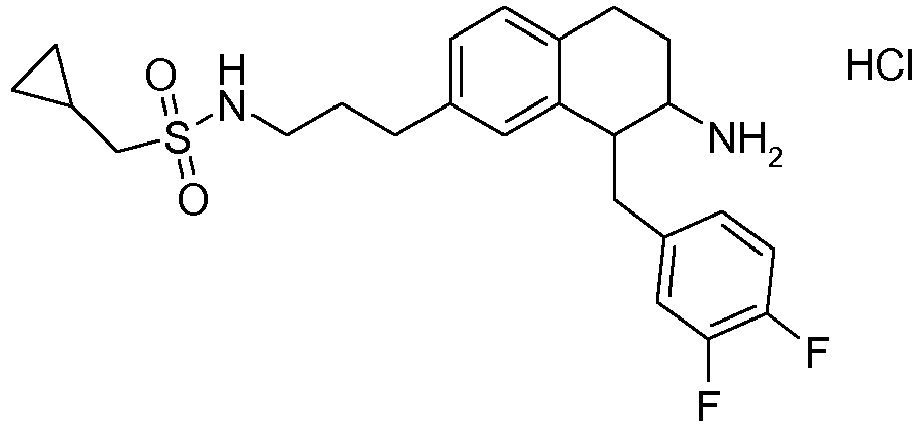
-
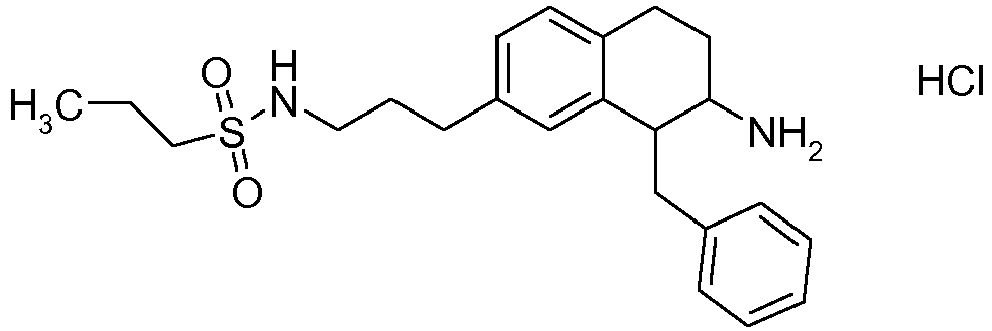
-

-

-

-

-

-

-

-

-

- N-(3-(7-Amino-8-(3-fluorobenzyl)-5,6,7,8-tetrahydronaphthalen-2-yl)propyl)propane-1-sulfonamide (cf. example 209: 45 mg, 0.108 mmol) and triethylamine (15µL, 0.108 mmol) were dissolved in dichloromethane (2 mL). Acetylchloride (7.64 µL, 0.108 mmol) were added. The reaction mixture was stirred for 12 hours at room temperature. The reaction mixture was diluted with dichloromethane and successively washed with hydrochloric acid, water and saturated sodium chloride solution. The organic layer was dried and concentrated in vacuo. The crude product was purified by flash-chromatography (silica gel, dichloromethane, methanol). Yield: 37 mg (0.08 mmol, 75%).
ESI-MS [M+H+] = 461 Calculated for C25H33FN2O3S = 460 - In analogy to example 214 the following examples were prepared:
-

-

-

-

-

- N-(1-(3-Fluorobenzyl)-7-(3-(propylsulfonamido)propyl)-1,2,3,4-tetrahydronaphthalen-2-yl)acetamide (cf. example 214, 19.5 mg, 0.042 mmol) was dissolved in tetrahydrofuran (1 mL) and borane dimethylsulfide (106 µL, 0.212 mmol) was added. The reaction mixture was stirred for 5 hours at 50°C. After cooling to room temperature aqueous hydrochloric acid was added. The mixture was made alkaline by the addition of sodium bicarbonate and extracted several times with dichloromethane. The combined organic extracts were dried (MgSO4), concentrated in vacuo and the crude product purified by flash-chromatography (silica gel, dichloromethane, methanol). An excess of 1 M hydrochloric acid in ether was added to the purified product and the ether distilled off. Yield: 7 mg (0.016 mmol, 37%).
ESI-MS [M+H+] = 447 Calculated for C25H35FN2O2S = 446 - The following examples were prepared in analogy to example 219:
-

-

-

-

-

-
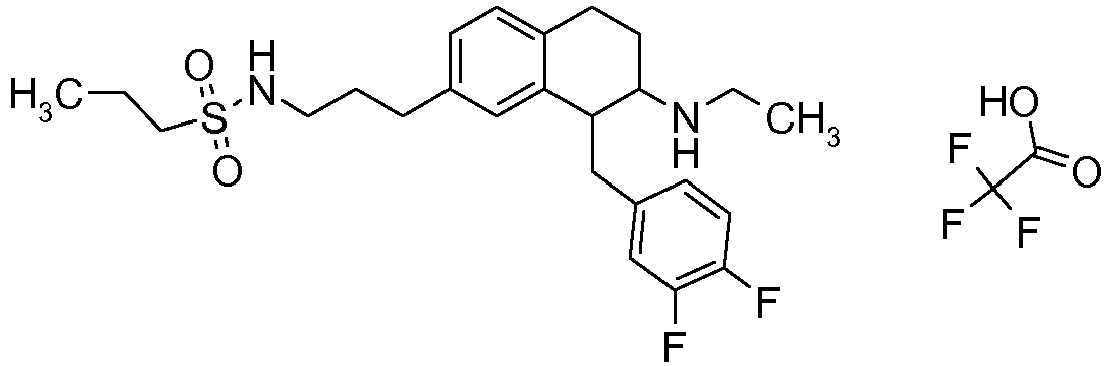
-
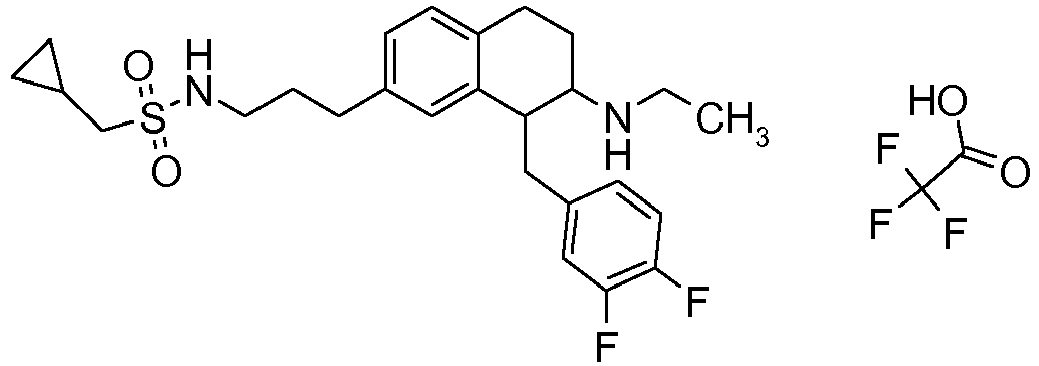
-

- tert-Butyl (1-(3-fluorobenzyl)-7-(3-(propylsulfonamido)propyl)-1,2,3,4-tetrahydronaphthalen-2-ylcarbamate (cf. 209 and 201 a, 65 mg, 0.125 mmol) was dissolved in acetonitrile (800 µL) and methyl iodide (24 µL, 0.376 mmol) and cesium carbonate (0.102 g, 0.313 mmol) was added. The reaction mixture was heated for 24 hours in a sealed vessel to 80°C. The reaction mixture was diluted with ethyl acetate. The ethyl acetate solution was successively washed with water and saturated sodium chloride solution. The organic phase was dried (MgSO4) and concentrated in vacuo. The crude product was purified by preparative thin-layer chromatography (silica gel, dichloromethane, methanol). The obtained tert-butyl 1-(3-fluorobenzyl)-7-(3-(N-methylpropylsulfonamido)propyl)-1,2,3,4-tetrahydronaphthalen-2-ylcarbamate (65 mg, 0.122 mmol) was dissolved in 4 M hydrochloric acid in isopropanol and stirred at room temperature for 4 hours. The solvent was removed in vacuo. Diethyl ether was added and the precipitate removed by filtration and dried. Yield: 22 mg (0.047 mmol, 38%).
ESI-MS [M+H+] = 433 Calculated for C24H33FN2O2S = 432 - The following examples were prepared in analogy to example 227:
-

-

-

-
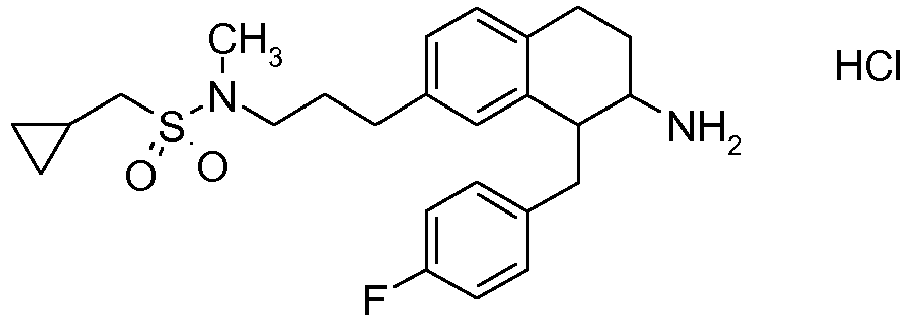
-

-

-

-

- The following examples were prepared in analogy to example 46:
-
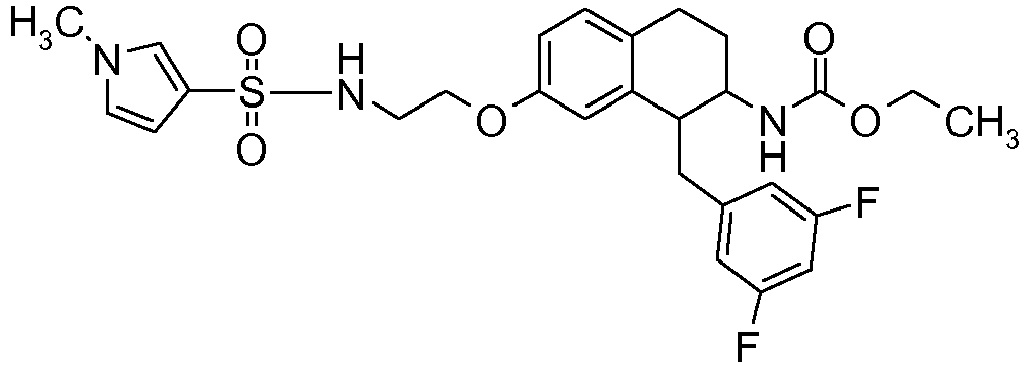
-

-

- Could be separated by chiral chromatography of the final compound or an intermediate.
ESI-MS [M+H+] = 441 Calculated for C23H28N4O3S = 440 - The following examples were prepared in analogy to example 137:
-

- C-Cyclopropyl-N-{2-[8-(3-fluoro-benzyl)-7-methylamino-5,6,7,8-tetrahydro-naphthalen-2-yloxy]-ethyl}-methanesulfonamide (Daicel, Chiralpak IC, 250x4,6 mm ID, 5µ, methyl t-butyl ether/dichloromethane/methanol/triethylamine = 900/50/50/1). The second eluting enantiomer was used for synthesis of the final compound.
ESI-MS [M+H+] = 447 Calculated for C24H31FN2O3S = 446 -

- Ethyl 7-(2-(cyclopropylmethylsulfonamido)ethoxy)-1-(3-fluorobenzyl)-1,2,3,4-tetrahydronaphthalen-2-ylcarbamate was separated by chiral chromatography (Daicel, Chiralpak IC, 250x4,6 mm ID, methyl t-butyl ether/dichloromethane/methanol/triethylamine = 900/50/50/1). The first eluting enantiomer was used for synthesis of the final compound.
ESI-MS [M+H+] = 447 Calculated for C24H31FN2O3S = 446 -

- Ethyl1-(3,5-difluorobenzyl)-7-(2-(1-methyl-1H-pyrrole-3-sulfonamido)ethoxy)-1,2,3,4-tetrahydronaphthalen-2-ylcarbamate was separated by chiral chromatography (Daicel, Chiralpak AD,250x20 mm ID, 10µ, n-heptane/ethanol/triethylamine = 35/65/1). The second eluting enantiomer was used for synthesis of the final compound. Can be separated by chiral chromatography of the final compound or an intermediate.
ESI-MS [M+H+] = 490 Calculated for C25H29F2N3O3S = 489 -

- Ethyl 1-(3,5-difluorobenzyl)-7-(2-(1-methyl-1H-pyrrole-3-sulfonamido)ethoxy)-1,2,3,4-tetrahydronaphthalen-2-ylcarbamate was separated by chiral chromatography (Daicel, Chiralpak AD,250x20 mm ID, 10µ, n-heptane/ethanol/triethylamine = 35/65/1). The first eluting enantiomer was used for synthesis of the final compound.
ESI-MS [M+H+] = 490 Calculated for C25H29F2N3O3S = 489 -

-

- Ethyl 7-(2-(cyclopropylmethylsulfonamido)ethoxy)-1-(3,5-difluorobenzyl)-1,2,3,4-tetrahydronaphthalen-2-ylcarbamate was separated by chiral chromatography (Daicel, Chiralpak AD,250x20 mm ID, 10µ, n-heptane/ethanol/t-butanol = 800/150/50). The first eluting enantiomer was used for synthesis of the final compound.
ESI-MS [M+H+] = 465 Calculated for C24H30F2N2O3S = 464 -

- Ethyl 7-(2-(cyclopropylmethylsulfonamido)ethoxy)-1-(3,5-difluorobenzyl)-1,2,3,4-tetrahydronaphthalen-2-ylcarbamate was separated by chiral chromatography (Daicel, Chiralpak AD,250x20 mm ID, 10µ, n-heptane/ethanol/t-butanol = 800/150/50). The second eluting enantiomer was used for synthesis of the final compound.
ESI-MS [M+H+] = 465 Calculated for C24H30F2N2O3S = 464 -

-

-

- Tert-butyl 1-benzyl-7-cyano-1,2,3,4-tetrahydronaphthalen-2-ylcarbamate (1.1 g, 3.03 mmol) was dissolved in dichloromethane (20 mL) and 5 M hydrochloric acid in isopropanol (2 mL) was added. The reaction mixture was stirred at room temperature for 12 h followed by 4 h at 35°C. The solvent was evaporated in vacuo. Water (30 mL) was added and the pH was adjusted to pH 9 using aqueous saturated sodium bicarbonate solution. The aqueous layer was extracted with dichloromethane. The combined extracts were dried (MgSO4) and the solvent was evaporated in vacuo. Yield: 790 mg (3.03 mmol, 100%).
-

- 7-Amino-8-benzyl-5,6,7,8-tetrahydronaphthalene-2-carbonitrile (790 mg, 3.03 mmol), 1,3-dibromopropane (0.4 mL, 3.93 mmol) and triethylamine (0.914 mL, 6.56 mmol) were dissolved in acetonitrile (8 mL) and the reaction mixture heated to 120°C in the microwave for 2 h. The solvent was evaporated in vacuo. Water (30 mL) and ethyl acetate (40 mL) were added. The layers were separated and the aqueous layer extracted with ethyl acetate. The combined organic extracts were dried (MgSO4) and the solvent evaporated in vacuo. The crude product was purified by flash chromatography (silica gel, dichloromethane, methanol). Yield: 346 mg (1.14 mmol, 37.6 %).
-

- 7-(Azetidin-1-yl)-8-benzyl-5,6,7,8-tetrahydronaphthalene-2-carbonitrile (340 mg, 1.12 mmol) was dissolved in dry methanol (20 mL) under a nitrogen atmosphere. Raney nickel (900 mg, 3.36 mmol) was added under nitrogen and the reaction mixture stirred at room temperature for 48 h under an atmosphere of hydrogen. Methanol (20 mL) and dichloromethane (30 mL) were added. After stirring at room temperature for 20 minutes the catalyst was removed by filtration and the solvent evaporated in vacuo. Yield: 338 mg (1.10 mmol, 98%).
-

- (7-(Azetidin-1-yl)-8-benzyl-5,6,7,8-tetrahydronaphthalen-2-yl)methanamine (250 mg, 0.816 mmol) and N,N-dimethyl-4-aminopyridine (199 mg, 1.632 mmol) were dissolved in dichloromethane (18 mL). 1-Methyl-1H-imidazole-4-sulfonyl chloride (147 mg, 0.816 mmol) dissolved in dichloromethane (2 mL) was added dropwise. The reaction mixture was stirred at room temperature for 12 h. The reaction mixture was diluted with dichloromethane (20 mL) and washed successively with saturated ammonium chloride (3x 15 mL) and water (2x 10 mL). The organic phase was dried (MgSO4) and the solvent was evaporated in vacuo. The crude product was purified by flash chromatography (silica gel, dichloromethane, methanol). Yield: 64 mg (0.142 mmol, 17%).
ESI-MS [M+H+] = 451 Calculated for C25H30N4O2S = 450 - The following examples were prepared in analogy to 248:
-

-

-

-

- The enantiomer of tert-butyl (1-benzyl-7-cyano-1,2,3,4-tetrahydronaphthalen-2-yl)carbamate described in example 192 was used as chiral building block for the synthesis.
ESI-MS [M+H+] = 451 Calculated for C25H30N4O2S = 450 -

- The enantiomer of tert-butyl (1-benzyl-7-cyano-1,2,3,4-tetrahydronaphthalen-2-yl)carbamate described in example 192 was used as chiral building block for the synthesis.
ESI-MS [M+H+] = 448 Calculated for C26H29N3O2S = 447 -

- The enantiomer of tert-butyl (1-benzyl-7-cyano-1,2,3,4-tetrahydronaphthalen-2-yl)carbamate described in example 192 was as chiral building block for the synthesis.
ESI-MS [M+H+] = 451 Calculated for C25H30N4O2S = 450 -

- The enantiomer of tert-butyl (1-benzyl-7-cyano-1,2,3,4-tetrahydronaphthalen-2-yl)carbamate described in example 192 was used as chiral building block for the synthesis.
ESI-MS [M+H+] = 453 Calculated for C25H28N2O2S2 = 452 -

-

- This compound was prepared in analogy to example 248 using 1-bromo-2-(2-bromoethoxy)ethane in place of 1,3-dibromopropane.
ESI-MS [M+H+] = 481 Calculated for C26H32N4O3S = 480 - The following examples were prepared in analogy to 257:
-

-

-

-

-

- This compound was prepared in analogy to example 248 using 1,4-dibromobutane in place of 1,3-dibromopropane.
ESI-MS [M+H+] = 465 Calculated for C26H32N4O2S = 464 -

- N-((7-Amino-8-benzyl-5,6,7,8-tetrahydronaphthalen-2-yl)methyl)-1-methyl-1 H-imidazole-4-sulfonamide (271 mg, 0.66 mmol, cf. 173) was dissolved in dichloromethane (10 mL). Pyridine (0.191 mL, 2.357 mmol) was added. 4-Chlorobutanoyl chloride (0.116 mL, 1.038 mmol) was added dropwise. After 2 h N,N-dimethyl-4-aminopyridine (46 mg, 0.378 mmol) was added and stirring was continued over night. 1 N sodium hydroxide solution was added and the mixture extracted with dichloromethane. The combined organic extracts were dried (MgSO4) and concentrated in vacuo. The crude product was suspended in dry tetrahydrofuran and a suspension of sodium hydride (60% in oil, 179 mg, washed twice with pentane prior to addition) in tetrahydrofuran (3 mL) was added. The reaction mixture was heated to 45°C for 1 h. Water was added and the mixture was extracted with dichloromethane (3x 20 mL). The combined organic extracts were dried (MgSO4) and concentrated in vacuo. The crude product was purified by flash chromatography (silica gel, dichloromethane, methanol). Yield: 98 mg (0.205 mmol, 46%).
ESI-MS [M+H+] = 479 Calculated for C26H30N4O3S = 478 -

- 1-(3-Chlorobenzyl)-7-methoxy-1,2,3,4-tetrahydronaphthalen-2-amine (6 g, 19.88 mmol) was dissolved in acetonitrile (150 mL). 1,4-Dibromobutane (2.61 mL, 21.87 mmol) and triethylamine (6.1 mL, 43.7 mmol) were added and the reaction mixture heated under reflux for 3 h. The reaction mixture was poured on ice and extracted with dichloromethane. The combined organic extracts were successively washed with water and brine, dried (MgSO4) and the solvent was evaporated in vacuo. The crude product (6.6 g) was used for the next step without further purification.
-

- 1-(1-(3-Chlorobenzyl)-7-methoxy-1,2,3,4-tetrahydronaphthalen-2-yl)pyrrolidine (6.6 g, 18.54 mmol) was dissolved in dichloromethane (100 mL). A 1 M solution of bortribromide in dichloromethane (55.6 mL, 55.6 mmol) was added dropwise under cooling maintaining the reaction mixture at room temperature. The reaction mixture was stirred at room temperature for 2 h. The reaction was poured on ice, made alkaline with sodium hydroxide. The aqueous phase was extracted with ethyl acetate and the combined organic extracts were washed successively with sodium bicarbonate and brine. The combined extracts were dried (MgSO4) and the solvent was evaporated in vacuo. The crude product (5.5 g) was used for the next step without further purification.
-

- 8-(3-Chlorobenzyl)-7-(pyrrolidin-1-yl)-5,6,7,8-tetrahydronaphthalen-2-ol (5.5 g, 16.09 mmol) was dissolved in dichloromethane (150 mL). 1,1,1-trifluoro-N-phenyl-N-(trifluoromethylsulfonyl)methanesulfonamide (6.9 g, 19.31 mmol) was added at 0°C followed by the addition of a solution of triethylamine (4.48 mL, 32.2 mmol) in dichloromethane (50 mL). The reaction mixture was allowed to warm to room temperature and stirring was continued over night. The reaction was poured on ice and extracted with dichloromethane. The combined extracts were washed successively with ammonium chloride solution, water and brine. The extracts were dried (Na2SO4) and the solvent was evaporated in vacuo. The crude product was purified by flash chromatography (silica gel, dichloromethane, methanol). Yield: 6.33 g (13.36 mmol, 83%).
-

- N-allylpropane-1-sulfonamide (0.238 g, 1.456 mmol) is added to a solution of 9-borabicyclo[3.3.1]nonane (0.185 g, 1.519 mmol) in tetrahydrofuran (4 mL). The reaction mixture was stirred for 2 h at room temperature. (7R,8S)-8-(3-chlorobenzyl)-7-(pyrrolidin-1-yl)-5,6,7,8-tetrahydronaphthalen-2-yl trifluoromethanesulfonate (0.3 g, 0.633 mmol) dissolved in tetrahydrofuran (2 mL), sodium hydroxide (0.063 g, 1.582 mmol in 0.06 mL water) and palladium tetrakistriphenylphosphine (0.073 g, 0.063 mmol) were added. The reaction mixture was heated under reflux over night. The reaction mixture was diluted with ethyl acetate and washed with 1 M sodium hydroxide solution. The aqueous phase was extracted two more times with ethyl acetate. The combined organic extracts were washed with brine, dried (MgSO4) and the solvent was evaporated in vacuo. The crude product was purified by preparative thin-layer-chromatography (silica gel, dichloromethane, methanol). The product was dissolved in dichloromethane. Excess 5N hydrochloric acid in ethanol was added. The solvent was evaporated and the product dried in vacuo. Yield: 53 mg (0.108 mmol, 17%).
ESI-MS [M+H+] = 489 Calculated for C27H37CIN2O2S = 488 - The following examples were prepared in analogy to 264:
-

-

-

- 8-(3-Fluorobenzyl)-7-(pyrrolidin-1-yl)-5,6,7,8-tetrahydronaphthalen-2-ol was prepared in analogy to 8-(3-chlorobenzyl)-7-(pyrrolidin-1-yl)-5,6,7,8-tetrahydronaphthalen-2-ol (cf. 264).
-

- 2-{[8-(3-Fluorobenzyl)-7-(pyrrolidin-1-yl)-5,6,7,8-tetrahydronaphthalen-2-yl]oxy}ethanamine was prepared in analogy to example 1 and 2 from 8-(3-fluorobenzyl)-7-(pyrrolidin-1-yl)-5,6,7,8-tetrahydronaphthalen-2-ol.
-
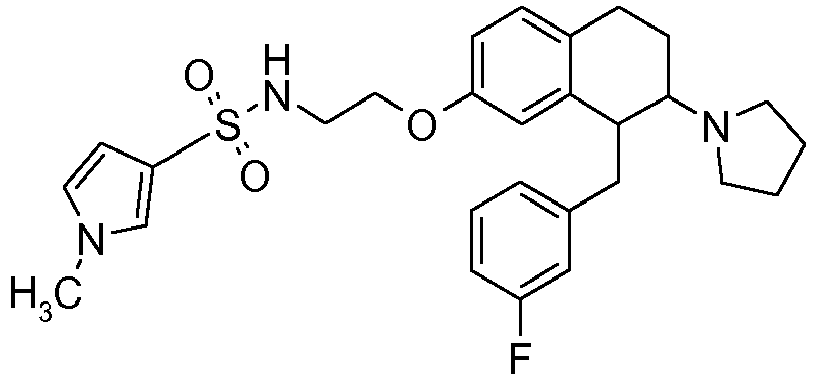
- 2-(8-(3-Fluorobenzyl)-7-(pyrrolidin-1-yl)-5,6,7,8-tetrahydronaphthalen-2-yloxy)ethanamine (50 mg, 0.136 mmol) was dissolved in dichloromethane (2 mL). N,N-Dimethyl-4-aminopyridine (49.7 mg, 0.407 mmol) and 1-methyl-1 H-pyrrole-3-sulfonyl chloride (24.4 mg, 0.136 mmol) were added successively. The reaction mixture was stirred at room temperature over night. The reaction was diluted with dichloromethane and washed with water. The organic phase was dried (MgSO4) and the solvent was evaporated in vacuo. The crude product was purified by flash chromatography (silica gel, dichloromethane, methanol). Yield: 31 mg (0.061 mmol, 45%).
ESI-MS [M+H+] = 512 Calculated for C28H34FN3O3S = 511 - The following examples were prepared in analogy to 267:
-

-

-

- N-{1-Benzyl-7-[2-(1-methyl-1H-imidazole-4-sulfonylamino)-ethoxy]-1,2,3,4-tetrahydro-naphthalen-2-yl}-propionamide was prepared in analogy to example 2 using propionyl chloride in place of ethyl chloroformate.
Could be separated by chiral chromatography of the final compound or an intermediate.
ESI-MS [M+H+] = 497 Calculated for C26H32N4O4S = 496 -

- Ethyl[1-(3,5-difluorobenzyl)-7-(2-{[(1-methyl-1H-pyrrol-3-yl)sulfonyl]amino}ethoxy)-1,2,3,4-tetrahydronaphthalen-2-yl]carbamate was prepared in analogy to example 2.
-

- Ethyl[1-(3,5-difluorobenzyl)-7-(2-{[(1-methyl-1H-pyrrol-3-yl)sulfonyl]amino}ethoxy)-1,2,3,4-tetrahydronaphthalen-2-yl]carbamate (200 mg, 0.365 mmol) was dissolved in tetrahydrofuran (16 mL). A 1 M solution of lithium aluminium hydride in tetrahydrofuran (0.73 mL, 0.73 mmol) was added dropwise at room temperature. The reaction mixture was heated to 50°C for 2 h. Under cooling 2N sodium hydroxide solution (3 mL) was added dropwise. Water (30 mL) and ethyl acetate (30 mL) were added. The aqueous phase was extracted twice with ethyl acetate. The combined extracts were dried (MgSO4) and the solvent was evaporated in vacuo. The crude product was purified by flash chromatography (silica gel, dichloromethane, methanol). Yield: 61 mg (0.116 mmol, 32%).
ESI-MS [M+H+] = 504 Calculated for C25H27F2N3O4S = 503 -

- 1-(3,4-Dichlorobenzyl)-7-methoxy-N-(propan-2-yl)-1,2,3,4-tetrahydronaphthalen-2-amine was isolated as a minor by-product in the recrystallization of 1-(3,4-dichlorobenzyl)-7-methoxy-1,2,3,4-tetrahydronaphthalen-2-amine hydrochloride from isopropanol.
-

- N-{3-[8-(3,4-Dichlorobenzyl)-7-(propan-2-ylamino)-5,6,7,8-tetrahydronaphthalen-2-yl]propyl}propane-1-sulfonamide was prepared in analogy to example 264 using 1-(3,4-dichlorobenzyl)-7-methoxy-N-(propan-2-yl)-1,2,3,4-tetrahydronaphthalen-2-amine in place of 1-[1-(3-chlorobenzyl)-7-methoxy-1,2,3,4-tetrahydronaphthalen-2-yl]pyrrolidine.
ESI-MS [M+H+] = 511 Calculated for C25H32Cl2N2O3S = 510 -

- N-{3-[8-(3,4-Dichlorobenzyl)-7-(propan-2-ylamino)-5,6,7,8-tetrahydronaphthalen-2-yl]propyl}propane-1-sulfonamide (70 mg, 0.137 mmol) was dissolved in methanol (1.5 mL) and palladium hydroxide (30 mg, 0.214 mmol) was added. The reaction mixture was heated under reflux in an atmosphere of hydrogen for 6h. The catalyst was removed by filtration and the crude product was purified by flash chromatography (silica gel, dichloromethane, methanol). The obtained amine was dissolved in dichloromethane (2 mL) and 5 N hydrochloric acid in isopropanol (0.3 mL) was added. The solvent was evaporated and the product dried in vacuo. Yield: 30 mg (0.63 mmol, 46%).
ESI-MS [M+H+] = 443 Calculated for C26H38N2O2S = 442 -

- N-{3-[7-Amino-8-(4-chlorobenzyl)-5,6,7,8-tetrahydronaphthalen-2-yl]propyl}-1-cyclopropylmethanesulfonamide (cf. 202).
-

- N-(3-(7-Amino-8-(4-chlorobenzyl)-5,6,7,8-tetrahydronaphthalen-2-yl)propyl)-1-cyclopropylmethanesulfonamide (49 mg, 0.11 mmol) was dissolved in dichloromethane (2 mL). Acetic acid (7 µL, 0.11 mmol) was added followed by acetaldehyde (18 µL, 0.322 mmol) in dichloromethane (2 mL) and sodium triacetoxyborohydride (34 mg, 0.16 mmol). The reaction mixture was stirred at room temperature for 2 h. The reaction mixture was diluted with dichloromethane (20 mL) and washed with water (2x 10 mL). The organic layer was dried (MgSO4) and the solvent was evaporated in vacuo. The crude product was purified by flash chromatography (silica gel, dichloromethane, methanol). The amine was dissolved in dichloromethane (3 mL) and excess hydrochloric acid in ethanol was added. The solvents were evaporated and the product dried in vacuo. Yield: 22 mg (0.041 mmol, 38%).
ESI-MS [M+H+] = 503 Calculated for C28H39CIN2O2S = 502 -

- This compound could be prepared in analogy to example 227 using tert-butyl [(1S,2R)-1-benzyl-7-{[(propylsulfonyl)amino]methyl}-1,2,3,4-tetrahydronaphthalen-2-yl]carbamate in place of tert-butyl 1-(3-fluorobenzyl)-7-(3-(propylsulfonamido)propyl)-1,2,3,4-tetrahydronaphthalen-2-ylcarbamate (alkylation of sulfonamide). The tert-butyl carbamate could then be reduced with lithium aluminium hydride as in example 187.
ESI-MS [M+H+] = 401 Calculated for C23H32N2O2S = 400 -

- 7-Acetamido-8-benzyl-5,6,7,8-tetrahydronaphthalen-2-yl trifluoromethanesulfonate (100 mg, 0.234 mmol; prepared in analogy to 8-(3,4-dichlorobenzyl)-7-[(ethoxycarbonyl)amino]-5,6,7,8-tetrahydronaphthalen-2-yl trifluoromethanesulfonate, example 29), N-(prop-2-ynyl)propane-1-sulfonamide (75 mg, 0.468 mmol), palladium tetrakistriphenylphosphine (54 mg, 0.047 mmol), copper(l) iodide (35.6 mg, 0.187 mmol) and triethylamine (65 µL, 0.468 mmol) in dioxane (3 mL) were heated under reflux for 16 h. Water (15 mL) was added and the mixture extracted with dichloromethane (3x 20 mL). The combined organic extracts were dried (MgSO4) and the solvent was evaporated in vacuo. The crude product was purified by flash chromatography (silica gel, dichloromethane, methanol). Yield: 56 mg (0.132 mmol, 57%).
ESI-MS [M+H+] = 439 Calculated for C25H30N2O3S = 438 -

- N-(2-(7-Amino-8-benzyl-5,6,7,8-tetrahydronaphthalen-2-yloxy)ethyl)-1-cyclopropylmethanesulfonamide (50 mg, 0.121 mmol) was dissolved in methanol. Oxetan-3-one (87 mg, 1.21 mmol), zinc chloride (66 mg, 0.482 mmol) and sodium cyanoboro-hydride (23 mg, 0.362 mmol) were added at 0°C. The reaction mixture was then heated to 40°C for 5 h. Aqueous ammonium chloride solution was added and the aqueous layer was extracted with ethyl acetate. The combined organic extracts were washed with brine, dried (MgSO4) and concentrated in vacuo. The crude product was purified by flash chromatography (silica gel, dichloromethane, methanol). Yield: 3 mg (6.4 µmol, 5%).
ESI-MS [M+H+] = 471 Calculated for C26H34N2O4S = 470 -

- N-((7-Amino-8-benzyl-5,6,7,8-tetrahydronaphthalen-2-yl)methyl)propane-1-sulfonamide (51 mg, 0.137 mmol), (1-ethoxycyclopropoxy)trimethylsilane (26 mg, 0.151 mmol), acetic acid (0.078 mL, 1.37 mmol), sodium cyanoborohydride (26 mg, 0.411 mmol) and molecular sieve (50 mg) in methanol (1.5 mL) were heated in the microwave at 100°C for 25 min. The solvent was evaporated and the crude product purified by flash chromatography (silica gel, dichloromethane, methanol) and converted into the hydro chloride. Yield: 18 mg (0.04 mmol, 29%).
ESI-MS [M+H+] = 413 Calculated for C24H32N2O2S = 412 -

- To a solution of cyclopropylamine (1.2 ml, 17.5 mmol) in 100 ml CH2Cl2 and DMAP (2.4 g, 17.5 mmol) was added dropwise a solution of propane-1-sulfonyl chloride (2.3 ml, 19.2 mmol) in 50 ml CH2Cl2. The resulting mixture was stirred at room temperature over night and diluted with 50 ml of CH2Cl2. The mixture was extracted subsequently with water, 1 M HCl, and brine, tried over Na2SO4, filtered and the solvent evaporated to obtain 2.8 g of product (oil) which was used in the next step without further purification.
-

- A mixture of propane-1-sulfonic acid cyclopropyl amide (1.3 g, 8 mmol), K2CO3 (2.4 g, 14.4 mmol) and acetic acid 2-bromo-ethyl ester (9.5 g, 16 mmol) mmol) in 10 ml acetone was heated for 6h to 120°C in the microwave (Biotage). After cooling the mixture was filtered and the solvent evaporated to obtain 1.7 g of product as an oil which was used without further purification in the next step.
-

- A mixture of acetic acid 2-[cyclopropyl-(propane-1-sulfonyl)-amino]-ethyl ester (1.7 g, 6.8 mmol) and KOH (0.57 g, 10.2 mmol) in 30 ml Methanol was stirred over night at room temperature. The solvent was evaporated the residue dissolved in ethyl acetate und subsequently extracted with water and 1 M KOH, dried over Na2SO4 and the solvent evaporated to obtain 0.46 g of product which was used purified by chromatography (253.5 mg of colorless oil)
-

- To a solution of propane-1-sulfonic acid cyclopropyl-(2-hydroxy-ethyl)-amide (150 mg, 0.8 mmol) in CH2Cl2 and DMAP (97 mg, 0.8 mmol) was added dropwise a solution of propane-1-sulfonyl chloride (97 mg, 0.8 mmol) in CH2Cl2. The resulting mixture was stirred at room temperature over night, diluted with 50 ml of CH2Cl2, extracted subsequently with water, 1 M HCl, and brine, tried over Na2SO4, filtered and the solvent evaporated to obtain 197.5 mg of product which was used in the next step without further purification.
-

- Prepared in one step from ethyl 1-(3-chlorobenzyl)-7-hydroxy-1,2,3,4-tetrahydronaphthalen-2-ylcarbamate (prepared in analogy to example 1d) and propane-1-sulfonic acid 2-[cyclopropyl-(propane-1-sulfonyl)-amino]-ethyl ester in analogy to example 76.
ESI-MS [M+H+] = 549 Calculated for C28H37ClN2O5S = 548 -

- Prepared in one step from ethyl 1-benzyl-7-hydroxy-1,2,3,4-tetrahydronaphthalen-2-ylcarbamate (prepared in analogy to example 1d) and propane-1-sulfonic acid 2-[cyclopropyl-(propane-1-sulfonyl)-amino]-ethyl ester in analogy to example 76.
ESI-MS [M+H+] = 515 Calculated for C28H38N2O5S = 514 -

- Prepared in one step from 1-(3-Chloro-benzyl)-7-{2-[cyclopropyl-(propane-1-sulfonyl)-amino]-ethoxy}-1,2,3,4-tetrahydro-naphthalen-2-yl)-carbamic acid ethyl ester (example 279) example in analogy to example 3.
ESI-MS [M+H+] = 477 Calculated for C25H33ClN2O3S = 476 -

- Prepared in one step from 1-Benzyl-7-{2-[cyclopropyl-(propane-1-sulfonyl)-amino]-ethoxy}-1,2,3,4-tetrahydro-naphthalen-2-yl)-carbamic acid ethyl ester (example 280) in analogy to example 3.
ESI-MS [M+H+] = 443 Calculated for C25H34N2O3S = 442 -

- A suspension of zinc powder (152 mg, 2.3 mmol) in 1 ml of DMA in a dry flask was heated under N2 to 65-70°C. A mixture of TMS-Cl (28 mg, 0.26 mmol) and 1,2-dibromoethane (49 mg, 0.26 mmol) was added dropwise, stirred for 30 min, followed by slow (15 min) addition of 3-iodo-azetidine-1-carboxylic acid tert-butyl ester (510 mg, 1.8 mmol) in 1 ml DMA. The reaction was cooled slowly (3h) to room temperature, added to a mixture of 8-(3,4-chlorobenzyl)-7-[(ethoxycarbonyl)amino]-5,6,7,8-tetrahydronaphthalen-2-yl trifluoromethanesulfonate (633 mg, 1.3 mmol, prepared in analogy to example 29), Cul (74 mg, 0,39 mmol) and PdCl2(dppf) (63 mg, 0.08 mmol) in 4 ml DMA preheated to 70°C and stirred for 7h at 70°C Water and MTB (1:1 20 ml) were added and the resulting mixture filtered. The organic layer was separated, dried (Na2SO4) and the solvent evaporated. Purification by chromatography afforded 560 mg of product (white foam).
-

- Prepared in three steps from 3-[8-(3-chloro-benzyl)-7-ethoxycarbonylamino-5,6,7,8-tetrahydro-naphthalen-2-yl]-azetidine-1-carboxylic acid tert-butyl ester in analogy to example 46/47.
Cleavage of Boc-group was done in formic acid.
ESI-MS [M+H+] = 433 Calculated for C23H29ClN2O2S = 432 -

- Prepared in analogy to example 283.
ESI-MS [M+H+] = 399 Calculated for C23H30N2O2S = 398 -

- Prepared by standard procedure from azetidine-3-carboxylic acid methyl ester and propane-1-sulfonyl chloride (e.g. example 279).
-

- Prepared by reduction of 1-(propane-1-sulfonyl)-azetidine-3-carboxylic acid methyl with LiAIH4 in THF at room temperature to 50°C (e.g. example 300).
-

- Prepared by standard procedure from [1-(propane-1-sulfonyl)-azetidin-3-yl]-methanol and methan-1-sulfonyl chloride (e.g. example 40)
-

- Prepared from 1-(3-chlorobenzyl)-7-hydroxy-1,2,3,4-tetrahydronaphthalen-2-ylcarbamate and methanesulfonic acid 1-(propane-1-sulfonyl)-azetidin-3-ylmethyl ester in analogy to example 315.
ESI-MS [M+H+] = 536 Calculated for C27H35ClN2O5S = 535 -

- Prepared from {1-(3-chloro-benzyl)-7-[1-(propane-1-sulfonyl)-azetidin-3-ylmethoxy]-1,2,3,4-tetrahydronaphthalen-2-yl}-carbamic acid ethyl ester in analogy to example 3.
ESI-MS [M+H+] = 463 Calculated for C24H31ClN2O3S = 462 -

- Prepared in analogy to example 3.
ESI-MS [M+H+] = 521 Calculated for C26H33ClN2O5S = 520 -

- Prepared from [1-(3-chloro-benzyl)-7-(2-cyclopropylmethanesulfonylamino-ethoxy)-1,2,3,4-tetrahydro-naphthalen-2-yl]-carbamic acid ethyl ester in analogy to example 3.
ESI-MS [M+H+] = 449 Calculated for C23H29ClN2O3S = 448 -

- Prepared from 1-(3-chlorobenzyl)-7-hydroxy-1,2,3,4-tetrahydronaphthalen-2-ylcarbamate and methanesulfonic acid Methanesulfonic acid 1-cyclopropylmethanesulfonyl-azetidin-3-yl methylester (prepared in analogy to example 285) in analogy to example 315.
ESI-MS [M+H+] = 547 Calculated for C28H35ClN2O5S= 546 -

- Prepared from [1-(3-chloro-benzyl)-7-(2-cyclopropylmethanesulfonylamino-ethoxy)-1,2,3,4-tetrahydro-naphthalen-2-yl]-carbamic acid ethyl ester in analogy to example 45.
ESI-MS [M+H+] = 535 Calculated for C27H35ClN2O5S= 534 -

- {1-(3-Chloro-benzyl)-7-[2-(cyclopropylmethanesulfonyl-methyl-amino)-ethoxy]-1,2,3,4-tetrahydro-naphthalen-2-yl}-carbamic acid ethyl ester in analogy to example 3.
ESI-MS [M+H+] = 463 Calculated for C24H31ClN2O3S = 462 -

- Prepared in analogy to example 46.
ESI-MS [M+H+] = 429 Calculated for C24H31ClN2O3S = 428 -

- Prepared in analogy to example 3.
ESI-MS [M+H+] = 437 Calculated for C22H29ClN2O3S= 436 -

- Prepared in analogy to example 3.
ESI-MS [M+H+] = 435 Calculated for C22H27ClN2O3S= 434 -

- Prepared in analogy to example 3.
ESI-MS [M+H+] = 449 Calculated for C23H29ClN2O3S= 448 -

- A solution of tert-butyl allylcarbamate (297 mg, 1,9 mmol) in dry THF under nitrogen was added dropwise at 0°C to 9-BBN dissolved in THF (0,5 M, 2.3 ml, 1.2 mmol) and stirred for 4 h. This mixture was subsequently treated with 8-(3,4-chlorobenzyl)-7-[(ethoxycarbonyl)amino]-5,6,7,8-tetrahydronaphthalen-2-yl trifluoromethanesulfonate (250 mg, 0.5 mmol), palladium(II)acetate (11.5 mg, 0.05 mmol), triphenylphosphine (27 mg, 0.1 mmol) and cesium carbonate (333 mg, 1 mmol) after which the mixture was heated to reflux for 2h.
- The solvent was evaporated the residue dissolved in ethylacetate, extracted with water, dried (Na2SO4). Evaporation of solvent gave 0.51 g of a brown oil which was treated with diisopropyl ether to afford 91 mg of a brownish powder.
-

- Prepared from [7-(3-tert-butoxycarbonylamino-propyl)-1-(3-chloro-benzyl)-1,2,3,4-tetrahydro-naphthalen-2-yl]-carbamic acid ethyl ester in analogy to example 3.
ESI-MS [M+H+] = 447 Calculated for C24H31ClN2O2S= 446 -

- Prepared in analogy to example 296.
ESI-MS [M+H+] = 435 Calculated for C23H31ClN2O2S= 434 -

- Prepared in analogy to example 3.
ESI-MS [M+H+] = 547 Calculated for C26H31ClN4O5S= 546 -

- Prepared in analogy to example 3.
ESI-MS [M+H+] = 547 Calculated for C26H31ClN4O5S= 546 -

- A solution of LiAlH4 in THF (1 M, 1.5 ml, 1.5 mmol) was added dropwise to [1-(3-chloro-benzyl)-7-(2-cyclopropylmethanesulfonylamino-ethoxy)-1,2,3,4-tetrahydro-naphthalen-2-yl]-carbamic acid ethyl ester (523 mg, 1 mmol, example 287) dissolved in 100 ml of dry THF. The mixture was heated to reflux for 1 h, treated with 2N NaOH, and extracted with CH2Cl2. The organic layer was extracted with sat. NaHCO3 and brine, dried (Na2SO4) filtered and the solvent evaporated. Purification by chromatography afforded 324 mg of product as colorless oil which was transformed to the hydrochloride in a mixture of HCl in isopropanol. (325 mg, white powder)
ESI-MS [M+H+] = 463 Calculated for C24H31ClN2O3S= 462 -

- Prepared in analogy to example 3.
ESI-MS [M+H+] = 475 Calculated for C23H27ClN4O3S= 474 -

- Prepared in analogy to example 3/300.
ESI-MS [M+H+] = 489 Calculated for C24H29CIN4O3S= 488 -

- Prepared in analogy to example 3/300.
ESI-MS [M+H+] = 489 Calculated for C24H29ClN4O3S= 488 -

- A mixture of potassium (2-(benzyloxycarbonylamino)ethyl)trifluoroborate (1,130 g, 3,96 mmol), cesium carbonate (2,58 g, 7,93 mmol), 8-(3-chlorobenzyl)-7-(ethoxycarbonylamino)-5,6,7,8-tetrahydronaphthalen-2-yl trifluoromethanesulfonate (1,3 g, 2,64 mmol), Pd(OAc)2 (0,030 g, 0,132 mmol) and 2-dicyclohexyphosphino-2',6'-di-i-propoxy-1,1'-biphenyl (0,130 g, 0,264 mmol) under N2 in toluene/water 3:1 (15 ml) was heated to refluxed for 13h. The reaction was filtered, the solvent evaporated and the residue purified by chromatography to afford 1.04 g of product as colorless oil.
-

- To [7-(2-benzyloxycarbonylamino-ethyl)-1-(3-chloro-benzyl)-1,2,3,4-tetrahydro-naphthalen-2-yl]-carbamic acid ethyl ester (500 mg, 0,960 mmol) was added at room temperature 8 ml of 33%HBr in acetic acid. After 2h the mixture was diluted with CH2Cl2, washed twice with NaHCO3, dried and filtered. The solvent was evaporated to obtain the product as a yellow oil (392 mg), which was used without further purification.
-
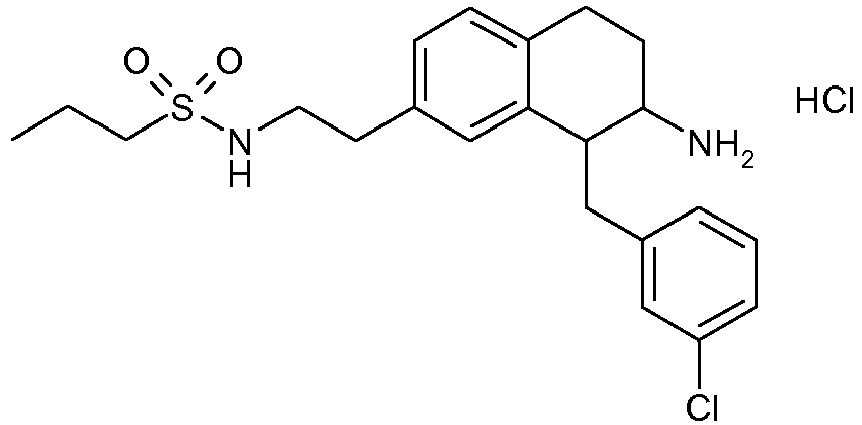
- Prepared from [7-(2-amino-ethyl)-1-(3-chloro-benzyl)-1,2,3,4-tetrahydro-naphthalen-2-yl]-carbamic acid ethyl ester in analogy to example 3.
ESI-MS [M+H+] = 421 Calculated for C22H29ClN2O2S= 420 -

- Prepared in analogy to example 3.
ESI-MS [M+H+] = 475 Calculated for C23H27ClN4O3S= 474 -

- Prepared in analogy to example 214.
ESI-MS [M+H+] = 491 Calculated for C25H31ClN2O4S= 490 -

- Prepared in analogy to example 300.
ESI-MS [M+H+] = 477 Calculated for C25H33ClN2O3S= 476 -

- Prepared in analogy to examples 297/300.
ESI-MS [M+H+] = 449 Calculated for C24H33ClN2O2S= 448 -

- Prepared in analogy to examples 304/300.
ESI-MS [M+H+] = 435 Calculated for C23H31ClN2O2S= 434 -

- Prepared in analogy to example 304.
ESI-MS [M+H+] = 433 Calculated for C23H29ClN2O2S = 432 -

- Prepared in analogy to examples 3/300.
ESI-MS [M+H+] = 435 Calculated for C23H31FN2O3 = 434 -

- Prepared in analogy to examples 3/300.
ESI-MS [M+H+] = 447 Calculated for C24H3,FN2O3S = 446 -

- Prepared in analogy to examples 304/300.
ESI-MS [M+H+] = 473 Calculated for C24H29ClN4O2S = 472 -

- Prepared in analogy to examples 3/300.
ESI-MS [M+H+] = 423 Calculated for C23H38N2O3S = 422 -

- Prepared in analogy to example 263.
-

- Prepared from compound of previous step by reduction with LiAlH4 in analogy to 300.
ESI-MS [M+H+] = 529 Calculated for C27H33ClN4O3S = 528 -

- Prepared in analogy to example 3.
ESI-MS [M+H+] = 489 Calculated for C24H29ClN4O3S = 488 -

- Prepared in analogy to examples 264/88.
ESI-MS [M+H+] = 503 Calculated for C27H35ClN2O3S = 502 -
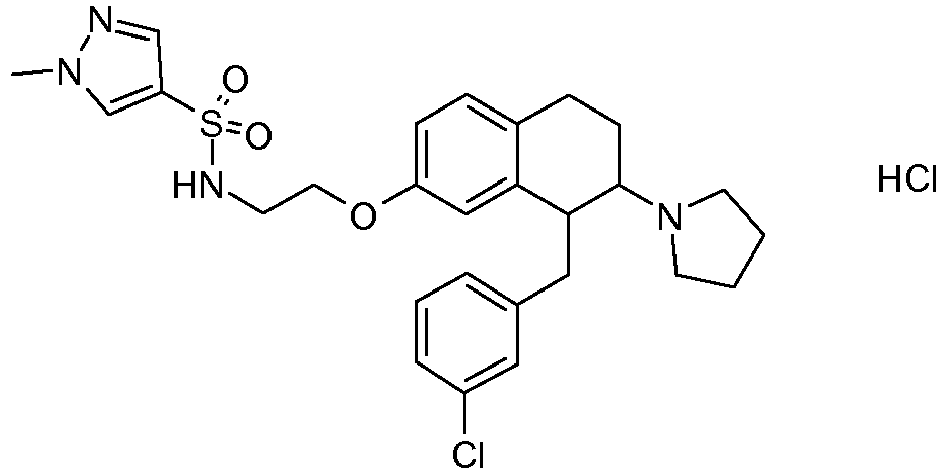
- Prepared in analogy to examples 264/88.
ESI-MS [M+H+] = 529 Calculated for C27H33ClN4O3S = 528 -

- Prepared in analogy to examples 264/88.
ESI-MS [M+H+] = 529 Calculated for C27H33ClN4O3S = 528 -

- Prepared in analogy to example 264 using 1,3-dibromopropane instead of 1,4-dibromobutane.
-

- Prepared from compound of previous step in analogy to example 88.
ESI-MS [M+H+] = 489 Calculated for C26H33ClN2O3S = 488 -

- Prepared in analogy to example 320.
ESI-MS [M+H+] = 515 Calculated for C26H31ClN4O3S = 514 -

- Prepared in analogy to example 320.
ESI-MS [M+H+] = 515 Calculated for C26H31CIN4O3S = 514 -

- Prepared in analogy to examples 264/88.
ESI-MS [M+H+] = 491 Calculated for C26H35ClN2O3S = 490 -

- Prepared in analogy to example 320.
ESI-MS [M+H+] = 481 Calculated for C26H32N4O3S = 480 -

- Synthesis performed in analogy to: Organic Letters; 2002, Vol4; p.107-109.
- A solution of potassium trifluoro(vinyl)borate (1,000 g, 7,46 mmol), PdCl2(dppf)-CH2Cl2 adduct (0,102 g, 0,124 mmol), 8-(3-chlorobenzyl)-7-(ethoxycarbonylamino)-5,6,7,8-tetrahydronaphthalen-2-yl trifluoromethanesulfonate (3,06 g, 6,22 mmol) and triethylamine (0,867 ml, 6,22 mmol) in 100 ml n-BuOH was stirred under N2 at 85-90°C for 4h and then cooled to room temperature.
- Water was added, followed by extraction with ether. The ethereal solution was washed with brine, dried, filtered and evaporated to obtain a brown oil. Chromatography afforded 1.55 g of product as a pale yellow solid.
-

- BH3 DMS (1 M in THF, 0.838 ml, 0.838 mmol) was added a solution of ethyl 1-(3-chlorobenzyl)-7-vinyl-1,2,3,4-tetrahydronaphthalen-2-ylcarbamate (1,55 g, 4,19 mmol) in 20 ml dry THF. The reaction was stirred at 60°C for 1 h and cooled to room temperature. Some water was added to destroy the excess of borane complex and the resulting mixture refluxed for 1 h with 30% H2O2 (8,56 ml, 84 mmol) and 2N NaOH (9,74 ml, 19,49 mmol). The reaction mixture was extracted with CH2Cl2, washed with water and brine, dried, filtered and the solvent evaporated to obtain a pale brown solid (1,7 g), which was purified by chromatography to afford 854 mg of product as a white solid.
-

- To a solution of [1-(3-chloro-benzyl)-7-(2-hydroxy-ethyl)-1,2,3,4-tetrahydro-naphthalen-2-yl]-carbamic acid ethyl ester (554 mg, 1,428 mmol) in 15 ml dry CH2Cl2 cooled to 0°C was added triphenylphosphine (562 mg, 2,142 mmol) and carbon tetrabromide (0,208 ml, 2,142 mmol). The mixture was stirred for 1 h, after which solvents were evaporated. The residue was purified by chromatography to obtain 277 mg of product as a white solid.
-

- To a suspension of NaH (4,73 mg, 0,177 mmol) in 3 ml dry DMF under N2 was added 1-propanthiol (0,012 ml, 0,133 mmol, dissolved in 1 ml dry DMF). The reaction was stirred at room temperature for 2h, followed by addition of triethylamine (0,019 ml, 0,133 mmol) and ethyl 7-(2-bromoethyl)-1-(3-chlorobenzyl)-1,2,3,4-tetrahydronaphthalen-2-ylcarbamate (40 mg, 0,089 mmol, dissolved in 2 ml dry DMF). The mixture was stirred at room temperature over night, the solvent evaporated, the residue re-dissolved in ethyl acetate, washed with water, citric acid, NaHCO3 and brine and filtered. The solvent was evaporated to obtain 31 mg of an off white solid which was used without further purification.
-

- To a cooled mixture (0°C) of ethyl 1-(3-chlorobenzyl)-7-(2-(propylthio)ethyl)-1,2,3,4-tetrahydronaphthalen-2-ylcarbamate (31,4 mg, 0,070 mmol) in 2 ml ethyl acetate was added m-CPBA (33,4 mg, 0,155 mmol). The reaction was stirred for 2h allowing warming up to room temperature. The mixture was diluted with ethyl acetate, washed with Na-HCO3, water and brine, dried, filtered and the solvent evaporated to obtain a white solid, which was purified by chromatography (27 mg).
-

- Ethyl 1-(3-chlorobenzyl)-7-(2-(propylsulfonyl)ethyl)-1,2,3,4-tetrahydronaphthalen-2-ylcarbamate (27,1 mg, 0,057 mmol) and ammonium formiate (71,5 mg, 1,134 mmol) were dissolved in 5 ml MeOH. Pd/C (0,845 mg, 7,94 µmol) was added and stirred at 80°C for 4h. The mixture was filtered, the solvent evaporated, the residue re-dissolved in ethyl acetate, which was subsequently washed with water, NaHCO3 and brine, dried, filtered. Solvent was evaporated to obtain white solid which was purified by chromatography affording 12.7 mg of product as a white solid.
-

- Prepared in analogy to example 3 [1-Benzyl-7-(2-propylsulfanyl-ethyl)-1,2,3,4-tetrahydro-naphthalen-2-yl]-carbamic acid ethyl ester.
ESI-MS [M+H+] = 372 Calculated for C22H29NO2S = 371 -

- Prepared in analogy to example 325 leaving out the de-chlorination step.
ESI-MS [M+H+] = 406 Calculated for C22H28ClNO2S = 405 -
- 1. [3H]-Glycine uptake into recombinant CHO cells expressing human GlyT1:
- Human GlyT1c expressing recombinant hGlyT1c_5_CHO cells were plated at 20,000 cells per well in 96 well Cytostar-T scintillation microplates (Amersham Biosciences) and cultured to sub-confluency for 24h. For glycine uptake assays the culture medium was aspirated and the cells were washed once with 100 µl HBSS (Gibco BRL, #14025-050) with 5 mM L-Alanine (Merck #1007). 80 µl HBSS buffer were added, followed by 10 µl inhibitor or vehicle (10% DMSO) and 10 µl [3H]-glycine (TRK71, Amersham Biosciences) to a final concentration of 200 nM for initiation of glycine uptake. The plates were placed in a Wal-lac Microbeta (PerkinElmer) and continuously counted by solid phase scintillation spectrometry during up to 3 hours. Nonspecific uptake was determined in the presence of 10 µM Org24598. IC50 calculations were made by four-parametric logistic nonlinear regression analysis (GraphPad Prism) using determinations within the range of linear increase of [3H]-glycine incorporation between 60 and 120 min.
- 2. Radioligand binding assays using recombinant CHO cell membranes expressing human GlyT1:
- Radioligand binding to human GlyT1c transporter-expressing membranes was carried out as described in Mezler et al., Molecular Pharmacology 74:1705-1715, 2008.
- The following results were obtained with the compounds disclosed in the examples:
Table 1: Glycine uptake radioligand binding Example IC50 [µmol] Kiapp [µmol] 1 ≤ 1000 ≤ 10 2 ≤ 1 ≤ 0.1 3 ≤ 0.01 ≤ 0.01 4 ≤ 0.01 ≤ 0.01 5 ≤1 ≤ 1 6 ≤ 1 ≤ 0.1 7 ≤ 10 ≤ 10 8 ≤ 0.1 ≤ 0.1 9 ≤ 1 ≤ 1 10 ≤ 100 ≤ 10 11 ≤ 1 ≤ 0.1 12 ≤ 100 ≥ 10 13 ≤ 1000 ≤ 100 14 ≤ 1000 ≤ 100 15 ≤ 1 ≤ 1 16 ≤ 10 ≤ 10 17 ≤ 10 ≤ 1 18 ≤ 0.1 ≤ 0.01 19 ≤ 100 ≤ 10 20 ≤ 0.1 ≤ 0.01 21 ≤ 1000 ≤ 100 22 ≤ 1000 ≤ 10 23 ≤ 100 ≤ 10 24 ≤ 10 ≤ 0.1 25 ≤ 1 ≤ 0.1 26 ≤ 1000 ≤ 10 27 ≤ 0.01 ≤ 0.01 28 ≤ 0.01 ≤ 0.01 29 ≤ 100 ≤ 10 30 ≤ 100 ≤ 100 31 ≤ 1 ≤ 0.1 32 ≤ 100 ≤ 10 33 ≤ 1 ≤ 1 34 ≤ 1000 ≤ 10 35 ≤ 100 ≥ 100 36 ≤ 10 ≤ 100 37 ≤ 100 ≤ 10 38 ≤ 100 ≤ 100 39 ≤ 1000 ≤ 10 40 ≤ 100 ≤ 10 41 ≤ 100 ≤ 10 42 ≤ 0.1 ≤ 0.1 43 ≤ 1 ≤ 0.1 44 ≤ 0.1 ≤ 0.1 45 ≤ 0.1 ≤ 0.1 46 ≤ 1 ≤ 1 47 ≤ 0.01 ≤ 0.01 48 ≤ 0.01 ≤ 0.01 49 ≤ 100 ≤ 100 50 ≤ 10 ≤ 1 51 ≤ 1000 ≤ 100 52 ≤ 10 ≤ 10 53 ≤ 1000 ≤ 10 54 ≥ 100 ≤ 10 55 ≤ 0.1 ≤ 0.01 56 ≤ 1 ≤ 0.1 57 ≤ 10 ≤ 1 58 ≤ 10 ≤ 1 59 ≤ 10 ≤ 1 60 ≥ 100 ≤ 10 61 ≤ 1000 ≤ 10 62 ≤ 1000 ≤ 10 63 ≥ 100 ≤ 10 64 ≤ 1000 ≤ 10 65 ≤ 100 ≥ 10 66 ≤ 1 ≤ 0.1 67 ≤ 1 ≤ 0.1 68 ≤ 10 ≤ 1 69 ≤ 10 ≤ 1 70 ≤ 1 ≤ 0.1 71 ≤ 0.1 ≤ 0.01 72 ≤ 10 ≤ 10 73 ≤ 10 ≤ 1 74 ≤ 100 ≥ 10 75 ≤ 10 ≤ 1 76 ≤ 1000 ≤ 100 77 ≤ 1 ≤ 0.1 78 ≤ 10 ≤ 10 79 ≤ 1 ≤ 0.1 80 ≤ 1 ≤ 1 81 ≥ 1000 ≤ 10 82 ≤ 1 ≤ 0.1 83 ≤ 10 ≤ 1 84 ≤ 10 ≤ 10 85 - ≤ 1 86 - ≤ 10 87 - ≤ 10 88 - ≤ 0.1 89 - ≤ 0.1 90 - ≤ 1 91 - ≤ 0.1 92 - - 93 - ≤ 1 94 - ≤ 0.1 95 - ≤ 0.01 967 - ≤ 1 98 - ≤ 1 99 - ≤ 0.1 100 - ≤ 1 100 - ≤ 10 101 - ≤ 0.1 102 - ≤ 1 103 - ≤ 10 104 - ≤ 1 105 - ≤ 0.1 106 - ≤ 1 107 - ≤ 0.1 108 - ≤ 0.01 109 - ≤ 0.1 110 - ≤ 1 111 - ≤ 0.1 112 - ≤ 0.1 113 - ≤ 0.1 114 - ≤ 1 115 - - 116 - ≤ 0.01 117 - ≤ 0.01 118 - ≤ 0.1 119 - ≤ 0.01 120 - ≤ 0.1 121 - ≤ 0.01 122 - ≤ 10 123 - ≤ 10 124 - ≤ 1 125 - ≤ 1 126 - ≤ 0.01 127 - ≤ 0.1 128 - ≤ 0.1 129 - ≤ 0.01 130 - ≤ 0.01 131 - ≤ 0.1 132 - ≤ 0.1 133 - ≤ 0.1 134 - ≤ 1 135 - ≤ 0.1 136 - ≤ 0.1 137 - ≤ 0.01 138 - ≤ 0.01 139 - ≤ 0.01 140 - ≤ 0.01 141 - ≤ 0.01 142 - ≤ 0.1 143 - ≤ 0.01 144 - ≤ 1 145 - ≤ 0.01 146 - ≤ 0.01 147 - ≤ 0.1 148 - ≤ 0.1 149 - ≤ 0.1 150 - ≤ 0.01 151 - ≤ 0.01 152 - ≤ 0.01 153 - ≤ 0.1 154 - ≤ 0.1 155 - ≤ 1 156 - ≤ 1 157 - ≤ 0.1 158 - ≤ 0.01 159 - ≤ 0.1 160 - ≤ 0.01 161 - ≤ 0.01 162 - ≤ 0.01 163 - ≤ 0.01 164 - ≤ 0.01 165 - ≤ 0.01 166 - ≤ 0.1 167 - ≤ 10 168 - ≤ 10 169 - ≤ 0.01 170 - > 10 171 - ≤ 0.1 172 - ≤ 0.01 173 - ≤ 0.01 174 - ≤ 1 175 - ≤ 1 176 - ≤ 0.1 177 - ≤ 0.01 178 - ≤ 0.01 179 - ≤ 1 180 - ≤ 0.01 181 - ≤ 0.1 182 - ≤ 0.1 183 - ≤ 1 184 - ≤ 0.1 185 - ≤ 1 186 - ≤ 1 187 - ≤ 0.01 188 - ≤ 0.1 189 - ≤ 10 190 - ≤ 0.01 191 - ≤ 1 192 - - 193 - ≤ 0.01 194 - - 195 - - 196 - ≤ 10 197 - ≤ 10 198 - ≤ 0.1 199 - ≤ 0.1 200 - ≤ 0.1 201 - ≤ 0.1 202 - ≤ 0.1 203 - ≤ 0.01 204 - ≤ 0.1 205 - ≤ 0.1 206 - ≤ 0.1 207 - ≤ 0.1 208 - ≤ 0.1 209 - ≤ 0.1 210 - ≤ 0.1 211 - ≤ 1 212 - ≤ 1 213 - ≤ 0.1 214 - ≤ 10 215 - ≤ 10 216 - ≤ 10 217 - ≤ 10 218 - ≤ 10 219 - ≤ 0.1 220 - ≤ 1 221 - ≤ 0.1 222 - ≤ 1 223 - ≤ 0.1 224 - ≤ 0.1 225 - ≤ 0.1 226 - ≤ 0.1 227 - ≤ 0.1 228 - ≤ 0.1 229 - ≤ 1 230 - ≤ 0.01 231 - ≤ 0.01 232 - ≤ 0.1 233 - ≤ 0.1 234 - ≤ 0.1 235 - ≤ 0.01 236 - ≤ 1 237 - ≤ 10 238 - ≤ 0.01 239 - ≤ 1 240 - ≤ 0.01 241 - ≤ 0.1 242 - ≤ 0.01 243 - ≤ 0.01 244 - ≤ 0.01 245 - ≤ 1 246 - ≤ 0.01 247 - ≤ 0.01 248 - ≤ 0.01 249 - ≤ 0.1 250 - ≤ 0.01 251 - ≤ 0.1 252 - ≤ 0.01 253 - ≤ 1 254 - ≤ 0.01 255 - ≤ 1 256 - ≤ 0.1 257 - ≤ 0.1 258 - ≤ 0.1 259 - ≤ 1 260 - ≤ 1 261 - ≤ 1 262 - ≤ 0.1 263 - ≤ 1 264 - ≤ 1 265 - ≤ 1 266 - ≤ 1 267 - ≤ 0.1 268 - ≤ 0.01 269 - ≤ 0.01 270 - ≤ 0.1 271 - ≤ 0.1 272 - ≤ 0.1 273 - ≤ 1 274 - ≤ 0.1 275 - ≤ 0.1 276 - ≤ 10 277 - 278 - 279 - ≤ 10 280 - ≤ 10 281 - ≤ 0.1 282 - ≤ 0.1 283 - ≤ 1 284 - ≤ 1 285 - ≤ 10 286 - ≤ 10 287 - ≤ 10 288 - ≤ 0.01 289 - >10 290 - ≤ 10 291 - ≤ 0.01 292 - ≤ 1 293 - ≤ 1 294 - ≤ 10 295 - ≤ 1 296 - ≤ 0.1 297 - ≤ 0.1 298 - ≤ 10 299 - >10 300 - ≤ 0.01 301 - ≤ 0.01 302 - ≤ 0.1 303 - ≤ 0.1 304 - ≤ 1 305 - ≤ 0.1 306 - ≤ 0.1 307 - ≤ 0.01 308 - ≤ 0.01 309 - ≤ 0.1 310 - ≤ 1 311 - ≤ 0.1 312 - ≤ 0.1 313 - ≤ 0.1 314 - ≤ 1 315 - ≤ 1 316 - ≤ 1 317 - ≤ 0.1 318 - ≤ 0.01 319 - ≤ 0.1 320 - ≤ 0.1 321 - ≤ 0.01 322 - ≤ 0.01 323 - ≤ 1 324 - ≤ 0.01 325 - ≤ 1 326 - ≤ 1


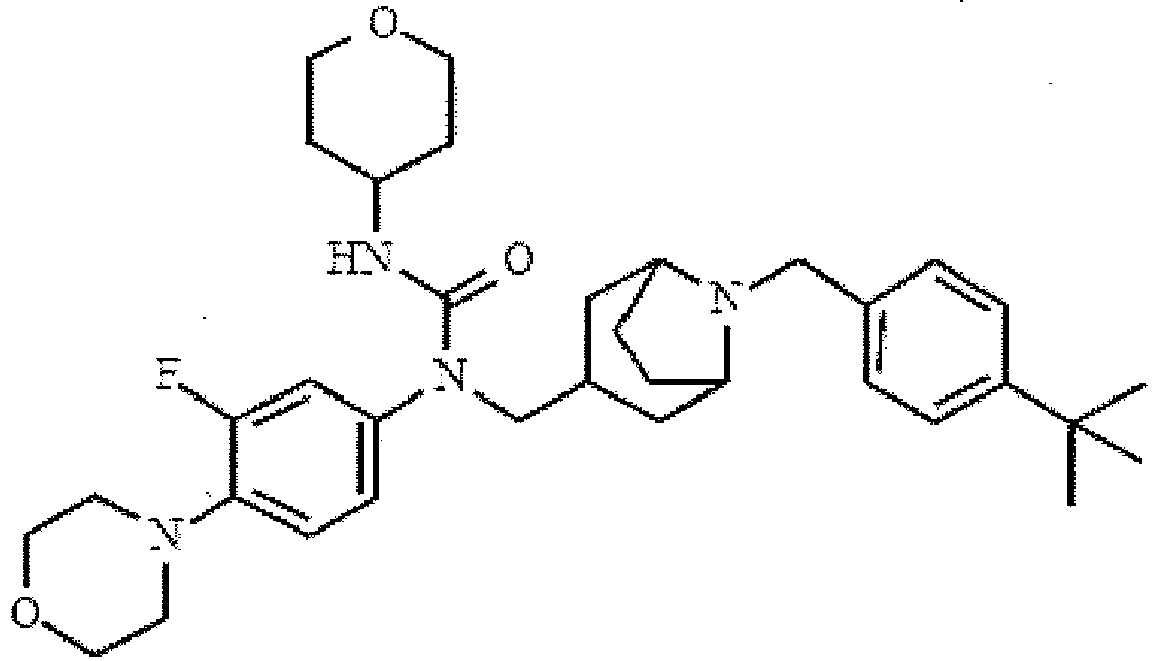


or a physiologically tolerated salt thereof.
Claims (22)
- A compound of the formula (I)
 A is a ring selected from the group consisting of the following 5- or 6-membered heterocyclic rings:


 A is a benzene ring and the compound has the following formula:
 R is R1-W-A1-Q-Y-A2-X1-;R1 is hydrogen, C1-C6-alkyl, C3-C12-Cycloalkyl-C1-C4-alkyl, halogenated C1-C6-alkyl, tri-(C1-C4-alkyl)-silyl-C1-C4-alkyl, hydroxy-C1-C4-alkyl, C1-C6-alkoxy-C1-C4-alkyl, amino-C1-C4-alkyl, C1-C6-alkylamino-C1-C4-alkyl, di-C1-C6-alkylamino-C1-C4-alkyl, C1-C6-alkylcarbonylamino-C1-C4-alkyl, C1-C6-alkyloxycarbonylamino-C1-C4-alkyl, C1-C6-alkylaminocarbonylamino-C1-C4-alkyl, di-C1-C6-alkylaminocarbonylamino-C1-C4-alkyl, C1-C6-alkylsulfonylamino-C1-C4-alkyl, (optionally substituted C6-C12-aryl-C1-C6-alkyl)amino-C1-C4-alkyl, optionally substituted C6-C12-aryl-C1-C4-alkyl, optionally substituted C3-C12-heterocycly-C1-C4-alkYl, C3-C12-cycloalkyl, C1-C6-alkylcarbonyl, C1-C6-alkoxycarbonyl, halogenated C1-C6-alkoxycarbonyl, C6-C12-aryloxycarbonyl, aminocarbonyl, C1-C6-alkylaminocarbonyl, (halogenated C1-C4-alkyl)aminocarbonyl, C6-C12-arylaminocarbonyl, C2-C6-alkenyl, C2-C6-alkynyl, optionally substituted C6-C12-aryl, hydroxy, C1-C6-alkoxy, halogenated C1-C6-alkoxy, C1-C6-hydroxyalkoxy, C1-C6-alkoxy-C1-C4-alkoxy, amino-C1-C4-alkoxy, C1-C6-alkylamino-C1-C4-alkoxy, di-C1-C6-alkylamino-C1-C4-alkoxy, C1C6-alkylcarbonylamino-C1-C4-alkoxy, C6-C12-arylcarbonylamino-C1-C4-alkoxy, C1-C6-alkoxycarbonylamino-C1-C4-alkoxy, C6-C12-aryl-C1-C4-alkoxy, C1-C6-alkylsulfonylamino-C1-C6-alkoxy, (halogenated C1-C6-alkyl)sulfonylamino-C1-C4-alkoxy, C6-C12-arylsulfonylamino-C1-C4-alkoxy, (C6-C12-aryl-C1-C6-alkyl)sulfonylamino-C1-C4-alkoxy, C3-C12-heterocyclysulfonylamino-C1-C4-alkoxy, C3-C12-heterocyclyl-C1-C4-alkoxy, C6-C12-aryloxy, C3-C12-heterocyclyloxy, C1-C6-alkylthio, halogenated C1-C6-alkylthio, C1-C6-alkylamino, (halogenated C1-C6-alkyl)amino, di-C1C6-alkylamino, di-(halogenated C1-C6-alkyl)amino, C1-C6-alkylcarbonylamino, (halogenated C1-C6-alkyl)carbonylamino, C6-C12-arylcarbonylamino, C1-C6-alkylsulfonylamino, (halogenated C1-C6-alkyl)sulfonylamino, C6-C12-arylsulfonylamino or optionally substituted C3-C12-heterocyclyl;W is -NR8- or a bond;A1 is optionally substituted C1-C4-alkylene or a bond;Q is -S(O)2- or -C(O)-;Y is -NR9- or a bond;A2 is optionally substituted C1-C4-alkylene, C1-C4-alkylene-CO-, -CO-C1-C4-alkylene, C1-C4-alkylene-O-C1-C4-alkylene, C1-C4-alkylene-NR10-C1-C4-alkylene, optionally substituted C2-C4-alkenylene optionally substituted C2-C4-alkynylene, optionally substituted C6-C12-arylene, optionally substituted C6-C12-heteroarylene or a bond;X1 is -O-, -NR11-, -S-, optionally substituted C1-C4-alkylene, optionally substituted C2-C4-alkenylene optionally substituted C2-C4-alkynylene;R2 is hydrogen, halogen, C1-C6-alkyl, halogenated C1-C4-alkyl, hydroxy-C1-C4-alkyl, -CN, C2-C6-alkenyl, C2-C6-alkynyl, hydroxy, C1-C6-alkoxy, halogenated C1-C6-alkoxy, C1-C6-alkoxycarbonyl, C2-C6-alkenyloxy, C1-C6-alkylcarbonyloxy, C1-C6-alkylthio, C1-C6-alkylsulfinyl, C1-C6-alkylsulfonyl, aminosulfonyl, amino, C1-C6-alkylamino, C2-C6-alkenylamino, or nitro;R3 is hydrogen or C1-C6-alkyl;R4a is hydrogen, C1-C6-alkyl, C3-C12-cycloalkyl-C1-C4-alkyl, halogenated C1-C4-alkyl, hydroxy-C1-C4-alkyl, C1-C6-alkoxy-C1-C4-alkyl, amino-C1-C4-alkyl, CH2CN, -CHO, C1-C4-alkylcarbonyl, (halogenated C1-C4-alkyl)carbonyl, C6-C12-arylcarbonyl, C1-C4-alkoxycarbonyl, C6-C12-aryloxycarbonyl, C1-C6-alkylaminocarbonyl, C2-C6-alkenyl,-C(=NH)NH2, -C(=NH)NHCN, C1-C6-alkylsulfonyl, C6-C12-arylsulfonyl, amino, -NO or C3-C12-heterocyclyl;R4b is hydrogen, C1C6-alkyl, halogenated C1-C4-alkyl, hydroxy-C1-C4-alkyl, C1-C6-alkoxy-C1-C4-alkyl, amino-C1-C4-alkyl, CH2CN, -CHO, C1-C4-alkylcarbonyl, (halogenated C1-C4-alkyl)carbonyl, C6-C12-arylcarbonyl, C1-C4-alkoxycarbonyl, C6-C12-aryloxycarbonyl, C1-C6-alkylaminocarbonyl, C2-G6-alkenyl, -C(=NH)NH2,-C(=NH)NHCN, C1-C6-alkylsulfonyl, C6-C12-arylsulfonyl, amino, -NO or C3-C12-heterocyclyl; orR4a, R4b together are optionally substituted C1-C6-alkylene, wherein one -CH2- of C1-C4-alkylene may be replaced by an oxygen atom or -NR16;X2 is >CR12aR12b;X3 is a bond;R5 is optionally substituted C6-C12-aryl, optionally substituted C3-C12-cycloalkyl or optionally substituted C3-C12-heterocyclyl;n is 0, 1 or 2;R8 is hydrogen or C1-C6-alkyl;R9 is hydrogen, C1-C6-alkyl, C3-C12-cycloalkyl, amino-C1-C6-alkyl, optionally substituted C6-C12-aryl-C1-C4-alkyl or C3-C12-heterocyclyl; orR9, R1 together are C1-C4-alkylene; orR9 is C1-C4-alkylene that is bound to a carbon atom in A2 and A2 is C1-C4-alkylene or to a carbon atom in X1 and X1 is C1-C4-alkylene;R10 is hydrogen, C1-C6-alkyl or C1-C6-alkylsulfonyl;R11 is hydrogen or C1-C6-alkyl, orR9, R11 together are C1-C4-alkylene,R12a is hydrogen, optionally substituted C1-C6-alkyl, C1-C6-alkylamino-C1-C4-alkyl, di-C1-C6-alkylamino-C1-C4-alkyl, C3-C12-heterocyclyl-C1-C6-alkyl, optionally substituted C6-C12-aryl or hydroxy;R12b is hydrogen or C1-C6-alkyl, orR12a, R12b together are carbonyl or optionally substituted C1-C4-alkylene, wherein one -CH2- of C1-C4alkylene may be replaced by an oxygen atom or -NR14-;R14 is hydrogen or C1-C6-alkyl; andR16 is hydrogen or C1-C6-alkyl;wherein the term "substituted" means that a radical is substituted with 1, 2 or 3 substituent(s) which are selected from the group consisting of halogen, C1-C4-alkyl, hydroxy-C1-C4-alkyl, C3-C12-heterocyclyl-alkyl, C1-C4-alkoxy-C1-C4-alkyl, amino-C1-C4-alkyl, C1-C4-alkenyl, OH, SH, CN, CF3, O-CF3, COOH, O-CH2-COOH, C1-C6-alkoxy, C1-C6-alkylthio, C3-C7-cycloalkyl, COO-C1-C6-alkyl, CONH2, CONH-C1-C6-alkyl, SO2NH-C1-C6-alkyl, CON-(C1-C6-alkyl)2, SO2N-(C1-C6-alkyl)2, NH2, NH-C1-C6-alkyl, N-(C1-C6-alkyl)2, NH-(C1-C4-alkyl- C6-C12-aryl), NH-CO-C1-C6-alkyl, NH-SO2-C1-C6-alkyl, SO2-C1-C6-alkyl, C6-C12-aryl, O-C6-C12-aryl, O-CH2-C6-C12-aryl, CONH-C6-C12-aryl, SO2NH-C6-C12-aryl, CONH-C3-C12-heterocyclyl, SO2NH-C3-C12-heterocyclyl, SO2-C6-C12-aryl, NH-SO2-C6-C12-aryl, NH-CO-C6-C12-aryl, NH-SO2-C3-C12-heterocyclyl, NH-CO-C3-C12-heterocyclyl and C3-C12-heterocyclyl, wherein aryl and heterocyclyl in turn may be unsubstituted or substituted with 1, 2 or 3 substituent(s) selected from the group consisting of halogen, C1-C4-alkyl, C1-C4-haloalkyl, C1-C4-alkoxy and C1-C4-haloalkoxy;
or a physiologically tolerated salt thereof. - Compound as claimed in claim 1, wherein -Y-A2-X1- comprises at least 2, 3 or 4 atoms in the main chain.
- Compound as claimed in claim 1 or 2, wherein R1 is C1-C6-alkyl, C3-C12-cycloalkyl-C1-C4-alkyl, halogenated C1-C6-alkyl, C1-C6-alkoxy-C1-C4-alkyl, amino-C1-C4-alkyl, C1-C6-alkylamino-C1-C4-alkyl, di-C1-C6-alkylamino-C1-C4-alkyl, C1-C6-alkyloxycarbonylamino-C1-C4-alkyl, C1-C6-alkylaminocarbonylamino-C1-C4-alkyl, C6-C12-aryl-C1-C4-alkyl, C3-C12-cycloalkyl, C2-C6-alkenyl, optionally substituted C6-C12-aryl, hydroxy, C1-C6-alkylamino, (halogenated C1-C6-alkyl)amino, di-C1-C6-alkylamino or optionally substituted C3-C12-heterocyclyl.
- Compound as claimed in any one of claims 1 to 3, wherein A1 is a bond, or A1 is C1-C4-alkylene and W is -NR8-.
- Compound as claimed in any one of claims 1 to 4, wherein A2 is C1-C4-alkylene, or A2 is C6-C12-arylene selected from the group consisting of phen-1,4-ylene and phen-1,3-ylene, or C6-C12-heteroarylene selected from the group consisting of pyrid-2,5-ylene and pyrid-2,4-ylene.
- Compound as claimed in any one of claims 1 to 5, wherein X1 is -O- or -NR11, or X1 is optionally substituted C1-C4-alkylene and A2 is a bond, or X1 is optionally substituted C2-C4-alkynylene and A2 is a bond.
- Compound as claimed in any one of claims 1 to 6, wherein R1-W-A1-Q-Y-A2-X1- is R1-S(O)2-NH-A2-X1-, R1-NH-S(O)2-A2-X1-, R1-C(O)-NH-A2-X1- or R1-NH-C(O)-A2-X1-.
- Compound as claimed in any one of claims 1 to 7, wherein R2 is hydrogen, halogen or C1-C6-alkoxy.
- Compound as claimed in claim 1 to 8, wherein R4a is hydrogen, C1-C6-alkyl, C3-C12-cycloalkyl-C1-C4-alkyl, halogenated C1-C4-alkyl, amino-C1-C4-alkyl, CH2CN, -CHO, C1-C4-alkylcarbonyl, (halogenated C1-C4-alkyl)carbonyl, C6-C12-arylcarbonyl, C1-C4-alkoxycarbonyl, C6-C12-aryloxycarbonyl, -C(=NH)NH2, -C(=NH)NHCN, C1-C6-alkylsulfonyl, amino, -NO or C3-C12-heterocyclyl, and R4b is hydrogen or C1-C6-alkyl, or R4a, R4b together are optionally substituted C1-C6-alkylene, wherein one -CH2- of C1-C4-alkylene may be replaced by an oxygen atom.
- Compound as claimed in any one of claims 1 to 9, wherein R12a is hydrogen or C1-C6-alkyl and R12b is hydrogen or C1-C6-alkyl, or R12a, R12b together are optionally substituted C1-C4-alkylene.
- Compound as claimed in claim 10, having the formula

independently are hydrogen, halogen, optionally substituted C1-C6-alkyl, halogenated C1-C6-alkyl, CN, hydroxy, C1-C6-alkoxy, amino, C1-C6-alkylamino, di-C1-C6-alkylamino or C3-C12-heterocyclyl. - Compound as claimed in any one of claims 1 to 11, wherein R9 is hydrogen, C1-C6-alkyl or C3-C12-cycloalkyl, or R9 and R1 together are C1-C4-alkylene; or R9 is C1-C4-alkylene that is bound to a carbon atom in A2 and A2 is C1-C4-alkylene or to a carbon atom in X1 and X1 is C1-C4-alkylene.
- Compound as claimed in claim 1, whereinA is a benzene ring;R is R1-W-A1-Q-Y-A2-X1-;R1 is C1-C6-alkyl, C3-C12-cycloalkyl-C1-C4-alkyl, halogenated C1-C6-alkyl, tri-(C1-C4-alkyl)-silyl-C1-C4-alkyl, C1-C6-alkoxy-C1-C4-alkyl, C3-C12-cycloalkyl, C2-C6-alkenyl, optionally substituted C6-C12-aryl, or optionally substituted C3-C12-heterocyclyl;W is a bond;A1 is a bond;Q is -S(O)2 or -C(O)-;Y is -NR9- or a bond;A2 is C1-C4-alkylene or a bond;X1 is -O- or optionally substituted C1-C4-alkylene or C2-C4-alkynylene;R2 is hydrogen;R3 is hydrogen;R4a is hydrogen, C1-C6-alkyl, C3-C12-cycloalkyl-C1-C4-alkyl, halogenated C1-C4-alkyl,-CHO, C1-C4-alkylcarbonyl, (halogenated C1-C4-alkyl)carbonyl, C6-C12-arylcarbonyl, C1-C4-alkoxycarbonyl, C6-C12-aryloxycarbonyl;R4b is hydrogen or C1-C6-alkyl; orR4a, R4b together are optionally substituted C1-C6-alkylene, wherein one -CH2- of C1-C4-alkylene may be replaced by an oxygen atom;X2 is CR12aR12b;X3 is a bond;R5 is optionally substituted phenyl or optionally substituted C3-C12-cycloalkyl;n is 1;R9 is hydrogen, C1-C6-alkyl or C3-C12-cycloalkyl; orR9, R1 together are C1-C4-alkylene; orR9 is C1-C4-alkylene that is bound to a carbon atom in A2 and A2 is C3-C4-alkylene or to a carbon atom in X1 and X1 is C1-C4-alkylene;R12a is hydrogen; andR12b is hydrogen.
- Compound as claimed in claim 1, which is:[7-(2-tert-Butoxycarbonylamino-ethoxy)-1-(3,4-dichloro-benzyl)-1,2,3,4-tetrahydro-naphthalen-2-yl]-carbamic acid ethyl ester;Ethyl 1-(3,4-dichlorobenzyl)-7-(2-(1-methyl-1H-imidazole-4-sulfonamido)ethoxy)-1,2,3,4-tetrahydronaphthalen-2-ylcarbamate;N-(2-(7-Amino-8-(3,4-dichlorobenzyl)-5,6,7,8-tetrahydronaphthalen-2-yloxy)ethyl)-1-methyl-1H-imidazole-4-sulfonamide;1-Methyl-1H-pyrazole-4-sulfonic acid {2-[7-amino-8-(3,4-dichloro-benzyl)-5,6,7,8-tetrahydro-naphthalen-2-yloxy]-ethyl}-amide;Pyridine-3-sulfonic acid {2-[7-amino-8-{3,4-dichloro-benzyl)-5,6,7,8-tetrahydro-naphthalen-2-yloxy]-ethyl}-amide;Propane-1-sulfonic acid {2-[8-(3,4-dichloro-benzyl)-7-dimethylamino-5,6,7,8-tetrahydro-naphthalen-2-yloxy]-ethyl}-amide;1-(3,4-Dichloro-benzyl)-7-[2-(propane-1-sulfonylamino)-ethoxy]-1,2,3,4-tetrahydro-naphthalen-2-yl}-carbamic acid ethyl ester;Propane-1-sulfonic acid {2-[7-amino-8-(3,4-dichloro-benzyl)-5,6,7,8-tetrahydro-naphthalen-2-yloxy]-ethyl}-amide;{1-(3,4-Dichloro-benzyl)-7-[2-(1-methyl-1H-pyrazole-4-sulfonylamino)-ethoxy]-1,2,3,4-tetrahydro-naphthalen-2-yl}-carbamic acid ethyl ester;{1-(3(4-Dichloro-benzyl)-7-[2-(pyridine-3-sulfonylamino)-ethoxy]-1,2,3,4-tetrahydro-naphthalen-2-yl}-carbamic acid ethyl ester;N-(2-(7-Amino-8-(3,4-dichlorobenzyl)-5,6,7,8-tetrahydronaphthalen-2-yloxy)ethyl)-N-methylpropane-1 -sulfonamide;[1-(3,4-Dichloro-benzyl)-7-(2-methanesulfonylamino-ethoxy)-1,2,3,4-tetrahydro-naphthaten-2-yl]-carbamic acid ethyl ester;[7-(2-Benzenesulfonylamino-ethoxy)-1-(3,4-dichloro-benzyl)-1,2,3,4-tetrahydro-naphthalen-2-yl]-carbamic acid ethyl ester;{1-(3,4-Dichloro-benzyl)-7-[2-(thiophene-2-sulfonylamino)-ethoxy]-1,2,3,4-tetrahydro-naphthalen-2-yl}-carbamic acid ethyl ester;N-{2-[7-Amino-8-(3,4-dichloro-benzyl)-5,6,7,8-tetrahydro-naphthalen-2-yloxy]-ethyl}-methanesulfonamide;N-{2-[7-Amino-8-(3,4-dichloro-benzyl)-5,6,7,8-tetrahydro-naphthalen-2-yloxy]-ethyl}-benzenesulfonamide;Thiophene-2-sulfonic acid {2-[7-amino-8-(3,4-dichloro-benzyl)-5,6,7,8-tetrahydro-naphthalen-2-yloxy]-ethyl}-amide;N-{1-(3,4-Dichloro-benzyl)-7-[2-(1-methyl-1H-imidazole-4-sulfonylamino)-ethoxy]-1,2,3,4-tetrahydro-naphthalen-2-yl}-2,2,2-trifluoro-acetamide;Pyrrolidine-3-sulfonic acid {2-[7-amino-8-(3,4-dichloro-benzyl)-5,6,7,8-tetrahydro-naphthalen-2-yloxy]-ethyl}-amide;1-Methyl-1H-imidazole-4-sulfonic acid {2-[8-(3,4-dichloro-benzyl)-7-formylamino-5,6,7,8-tetrahydro-naphthalen-2-yloxy]-ethyl}-amide;1-(3,4-Dichloro-benzyl)-7-[2-(4-methyl-thiophene-2-sulfonylamino)-ethoxy]-1,2,3,4-tetrahydro-naphthalen-2-yl}-carbamic acid ethyl ester;{1-(3,4-Dichloro-benzyl)-7-[2-(3-fluoro-propane-1-sulfonylamino)-ethoxy]-1,2,3,4-tetrahydro-naphthalen-2-yl}-carbamic acid ethyl ester;1-Methyl-1 H-imidazole-4-sulfonic acid {2-[8-(3,4-dichloro-benzyl)-7-ethylamino-5,6,7,8-tetrahydro-naphthalen-2-yloxy]-ethyl}-amide;4-Methyl-thiophene-2-sulfonic acid {2-[7-amino-8-(3,4-dichloro-benzyl)-5,6,7,8-tetrahydro-naphthalen-2-yloxy]-ethyl}-amide;N'-(2-{[7-amino-8-(3,4-dichlorobenzyl)-5,6,7,8-tetrahydronaphthalen-2-yl]oxy}ethyl)-N,N-dimethylsulfuric diamide;{1-(3,4-Dichloro-benzyl)-7-[2-(3,3,3-trifluoro-propane-1-sulfonylamino)-ethoxy]-1,2,3,4-tetrahydro-naphthalen-2-yl}-carbamic acid ethyl ester;1-Methyl-1H-imidazole-4-sulfonic acid {2-[7-amino-8-(4-chloro-benzyl)-5,6,7,8-tetrahydro-naphthalen-2-yloxy]-ethyl}-amide;1-Methyl-1H-pyrazole-4-suffonic acid {2-[7-amino-8-(4-chloro-benzyl)-5,6,7,8-tetrahydro-naphthalen-2-yloxy]-ethyl}-amide;N-[(7-Amino-8-benzyl-5,6,7,8-tetrahydronaphthalen-2-yl)methyl]-3-fluoropropane-1-sulfonamide;1-(3-Chlorobenzyl)-7-[2-(1,1-dioxidoisothiazolidin-2-yl)ethoxy]-1,2,3,4-tetrahydronaphthalen-2-amine;tert-Butyl [1-(3,4-dichlorobenzyl)-7-{[(propylsulfonyl)amino]methyl}-1,2,3,4-tetrahydronaphthalen-2-yl]carbamate;N-{[7-Amino-8-(3,4-dichlorobenzyl)-5,6,7,8-tetrahydronaphthalen-2-yl]methyl}propane-1-sulfonamide;N-{[7-Amino-8-(3,4-dichlorobenzyl)-5,8,7,8-tetrahydronaphthalen-2-yl]methyl}-3-fluoropropane-1-sulfonamide;N-{[7-Amino-8-benzyl-5,6,7,8-tetrahydronaphthalen-2-yl]methyl}propane-1-sulfonamide; N-{[ cis-7-Amino-8-benzyl-5,6,7,8-tetrahydronaphthalen-2-yl]methyl}cyclobutanesulfonamide;N-{[cis-7-Amino-8-benzyl-5,6,7,8-tetrahydronaphthalen-2-yl]methyl}-1-cyclopropylmethanesulfonamide;N-{[cis-7-amino-8-benzyl-5,6,7,8-tetrahydronaphthalen-2-yl]methyl}-N-methylpropane-1-sulfonamide;{1-(3-Chloro-benzyl)-7-[2-(1-methyl-1H-pyrazole-4-sulfonylamino)-ethoxy]-1,2,3,4-tetrahydro-naphthalen-2-yl}-carbamic acid ethyl ester;1-Methyl-1H-pyrazole-4-sulfonic acid {2-[7-amino-8-(3-chloro-benzyl)-5,6,7,8-tetrahydro-naphthalen-2-yloxy]-ethyl}-amide;1-Methyl-1H-imidazole-4-sulfonic acid {2-[7-amino-8-(3-chloro-benzyl)-5,6,7,8-tetrahydro-naphthalen-2-yloxy]-ethyl}-amide;{1-(3-Chloro-benzyl)-7-[2-(2,4-dimethyl-thiazole-5-sulfonylamino)-ethoxy]-1,2,3,4-tetrahydro-naphthalen-2-yl}-carbamic acid ethyl ester;{1-(3-Chloro-benzyl}-7-[2-{thiophene-2-sulfonylamino)-ethoxy]-1,2,3,4-tetrahydro-naphthalen-2-yl}-carbamic acid ethyl ester;{1-(3-Chloro-benzyl)-7-[2-(5-chloro-thiophene-2-sulfonylamino)-ethoxy]-1,2,3,4-tetrahydro-naphthalen-2-yl}-carbamic acid ethyl ester;{1-(3-Chloro-benzyl)-7-(2-(2-methyl-3H-imidazole-4-sulfonylamino)-ethoxy]-1,2,3,4-tetrahydro-naphthalen-2-yl}-carbamic acid ethyl ester;{1-(3-Chloro-benzyl)-7-[2-(5-methyl-thiophene-2-sulfonylamino)-ethoxy]-1,2,3,4-tetrahydro-naphthalen-2-yl}-carbamic acid ethyl ester;{1-(3-Chloro-benzyl)-7-[2-(4-methyl-thiophene-2-sulfonylamino)-ethoxy]-1,2,3,4-tetrahydro-naphthalen-2-yl}-carbamic acid ethyl ester;Propane-1-sulfonic acid {2-[7-amino-8-(3-chloro-benzyl)-5,6,7,8-tetrahydro-naphthalen-2-yloxy]-ethyl}-amide;Thiophene-2-sulfonic acid {2-[7-amino-8-(3-chloro-benzyl)-5,6,7,8-tetrahydro-naphthalen-2-yloxy]-ethyl}-amide;2,4-Dimethyl-thiazole-5-sulfonic acid {2-[7-amino-8-(3-chloro-benzyl)-5,6,7,8-tetrahydro-naphthalen-2-yloxy]-ethyl}-amide;2-Methyl-3H-imidazole-4-sulfonic acid {2-[7-amino-8-(3-chloro-benzyl)-5,6,7,8-tetrahydro-naphthalen-2-yloxy]-ethyl}-amide;5-Chloro-thiophene-2-sulfonic acid {2-[7-amino-8-(3-chloro-benzyl)-5,6,7,8-tetrahydro-naphthalen-2-yloxy]-ethyl}-amide;{1-(3-Chloro-benzyl)-7-[2-(2,5-dimethyl-thiophene-3-sulfonylamino)-ethoxy]-1,2,3,4-tetrahydro-naphthalen-2-yl}-carbamic acid ethyl ester;{1-(3-Chloro-benzyl)-7-[2-(1-ethyl-1H-pyrazole-4-sulfonylamino)-ethoxy]-1,2,3,4-tetrahydro-naphthalen-2-yl}-carbamic acid ethyl ester;{1-(2,4-Dichloro-benzyl)-7-[2-(1-methyl-1H-pyrazole-4-sulfonylamino)-ethoxy]-1,2,3,4-tetrahydro-naphthalen-2-yl}-carbamic acid ethyl ester;{1-(2,4-Dichloro-benzyl}-7-[2-(thiophene-2-sulfonylamino)-ethoxy]-1,2,3,4-tetrahydro-naphthalen-2-yl}-carbamic acid ethyl ester;{1-(2,4-Dichloro-benzyl)-7-[2-(5-methyl-thiophene-2-sulfonylamino)-ethoxy]-1,2,3,4-tetrahydro-naphthalen-2-yl)-carbamic acid ethyl ester;[1-(3-Chloro-benzyl)-7-(2-ethanesulfonylamino-ethoxy)-1,2,3,4-tetrahydro-naphthalen-2-yl]-carbamic acid ethyl ester;1-Ethyl-1H-pyrazole-4-sulfonic acid {2-[7-amino-8-(3-chloro-benzyl)-5,6,7,8-tetrahydro-naphthalen-2-yloxy]-ethyl}-amide;4-Methyl-thiophene-2-sulfonic acid {2-[7-amino-8-(3-chloro-benzyl)-5,6,7,8-tetrahydro-naphthalen-2-yloxy]-ethyl}-amide;5-Methyl-thiophene-2-sulfonic acid {2-[7-amino-8-(3-chloro-benzyl)-5,8,7,8-tetrahydro-naphthalen-2-yloxy]-ethyl}-amide;2,5-Dimethyl-thiophene-3-sulfonic acid {2-[7-amino-8-(3-chloro-benzyl)-5,6,7,8-tetrahydro-naphthalen-2-yloxy]-ethyl}-amide;Ethanesulfonic acid {2-[7-amino-8-(3-chloro-benzyl)-5,6,7,8-tetrahydro-naphthalen-2-yloxyl-ethyl}-amide;1-Methyl-1H-pyrazole-4-sulfonic acid {2-[7-amino-8-(2,4-dichloro-benzyl)-5,6,7,8-tetrahydro-naphthalen-2-yloxy]-ethyl}-amide;Thiophene-2-sulfonic acid {2-[7-amino-8-(2,4-dichloro-benzyl)-5,6,7,8-tetrahydro-naphthalen-2-yloxy]-ethyl}-amide;5-Methyl-thiophene-2-sulfonic acid {2-[7-amino-8-(2,4-dichloro-benzyl)-5,6,7,8-tetrahydro-naphthalen-2-yloxy]-ethyl}-amide;{1-(2,4-Dichloro-benzyl)-7-[2-(propane-1-sulfonylamino)-ethoxy]-1,2,3,4-tetrahydro-naphthalen-2-yl}-carbamic acid ethyl ester;Propane-1-sulfanic acid {2-[7-amino-8-(2,4-dichloro-benzyl)-5,6,7,8-tetrahydro-naphthalen-2-yloxy]-ethyl}-amide;(1-(4-Chloro-benzyl)-7-{2-[methyl-(propane-1-sulfonyl)-amino]-ethoxy}-1,2,3,4-tetrahydro-naphthalen-2-yl)-carbamic acid ethyl ester;Propane-1-sulfonic acid {2-[7-amino-8-(4-chloro-benzyl)-5,6,7,8-tetrahydro-naphthalen-2-yloxy]-ethyl}-methyl-amide;(1-(3-Chloro-benzyl)-7-{2-[methyl-(propane-1-sulfonyl)-amino]-ethoxy}-1,2,3,4-tetrahydro-naphthalen-2-yl)-carbarmic acid ethyl ester;Propane-1-sulfonic acid {2-[7-amino-8-(3-chloro-benzyl)-5,6,7,8-tetrahydro naphthalen-2-yloxy]-ethyl}-methyl-amide;{1-(3-Chloro-benzyl)-7-[2-(1-methyl-1H-imidazole-4-sulfonylamino)-ethoxy]-1,2,3,4-tetrahydro-naphthalen-2-yl}-carbamic acid ethyl ester;{1-(3-Chloro-benzyl)-7-[2-(1-difluoromethyl-1H-pyrazole-4-sulfonylamino)-ethoxy]-1,2,3,4-tetrahydro-naphthalen-2-yl}-carbamic acid ethyl ester;1-(3-Chloro-benzyl)-7-[(R)-1-(propane-1-sulfonyl)-pyrrolidin-2-ylmethoxy]-1,2,3,4-tetrahydro-naphthalen-2-ylamine;1-(3-Chloro-benzyl)-7-[1-(propane-1-sulfonyl)-azetidin-3-yloxy]-1,2,3,4-tetrahydro-naphthalen-2-ylamine;1-(3-Chloro-benzyl)-7-(3-ethanesulfonyl-propoxy)-1,2,3,4-tetrahydro-naphthalen-2-ylamine;Cyclohexanesulfonic acid {2-[7-amino-8-(3,4-dichloro-benzyl)-5,6,7,8-tetrahydro-naphthalen-2-yloxy]-ethyl}-amide;2-Trimethylsilanyl-ethanesulfonic acid {2-[7-amino-8-(3,4-dichloro-benzyl)-5,6,7,8-tetrahydro-naphthalen-2-yloxy]-ethyl}-amide;N-{2-[7-Amino-8-(3,4-dichloro-benzyl)-5,6,7,8-tetrahydro-naphthalen-2-yloxy]-ethyl}-C-(5-methyl-isoxazol-3-yl)-methanesulfonamide;Cyclobutanesulfonic acid {2-[8-(3,4-dichloro-benzyl)-7-pyrrolidin-1-yl-5,6,7,8-tetrahydro-naphthalen-2-yloxy]-ethyl}-amide;1-Methyl-1H-pyrazole-4-sulfonic acid {2-[8-(3,4-dichloro-benzyl)-7-pyrrolidin-1-yl-5,6,7,8-tetrahydro-naphthalen-2-yloxy]-ethyl}-methyl-amide;Butane-1-sulfonic acid {2-[7-amino-8-(3,4-dichloro-benzyl)-5,6,7,8-tetrahydro-naphthalen-2-yloxy]-ethyl}-amide;Propane-2-sulfonic acid {2-[7-amino-8-(3,4-dichloro-benzyl)-5,8,7,8-tetrahydro-naphthalen-2-yloxy]-ethyl}-amide;1-Methyl-1H-pyrazole-4-sulfonic acid {2-[8-(3,4-dichloro-benzyl)-7-pyrrolidin-1-yl-5,6,7,8-tetrahydro-naphthalen-2-yloxy]-ethyl}-amide;2-Ethoxy-ethanesulfonic acid {2-[7-amino-8-(3,4-dichloro-benzyl)-5,6,7,8-tetrahydro-naphthalen-2-yloxy]-ethyl}-amide;Cyclobutanesulfonic acid {2-[8-(3,4-dichloro-benzyl)-7-pyrrolidin-1-yl-5,6,7,8-tetrahydro-naphthalen-2-yloxy]-ethyl}-methyl-amide;N-{2-[7-Amino-8-(3,4-dichloro-benzyl)-5,6,7,8-tetrahydro-naphthalen-2-yloxy]-ethyl}-C-cyclopropyl-methanesulfonamide;Propane-1-sulfonic acid {2-[7-amino-8-(4-methoxy-benzyl)-5,6,7,8-tetrahydro-naphthalen-2-yloxy]-ethyl}-amide;N-[2-(7-Amino-8-benzyl-5,6,7,8-tetrahydro-naphthalen-2-yloxy)-ethyl]-methanesulfonamide;1-Methyl-1H-imidazole-4-sulfonic acid [2-(7-amino-8-benzyl-5,6,7,8-tetrahydro-naphthalen-2-yloxy)-ethyl]-methyl-amide;N-[2-(7-Amino-8-benzyl-5,6,7,8-tetrahydro-naphthalen-2-yloxy)-ethyl]-benzenesulfonamide;3,3,3-Trifluoro-propane-1-sulfonic acid [2-(7-amino-8-benzyl-5,6,7,8-tetrahydro-naphthalen-2-yloxy)-ethyl]-amide;1-Methyl-1H-imidazole-4-sulfonic acid [2-(8-benzyl-7-pyrrolidin-1-yl-5,6,7,8-tetrahydronaphthalen-2-yloxy)-ethyl]-methyl-amide;Cyclopropanesulfonic acid [2-(7-amino-8-benzyl-5,6,7,8-tetrahydro-naphthalen-2-yloxy)-ethyl]-amide;N-[2-(7-Amino-8-benzyl-5,6,7,8-tetrahydro-naphthalen-2-yloxy)-ethyl]-propionamide;1-Methyl-1H-[1,2,4]triazole-3-sulfonic acid {2-[7-amino-8-(3,4-dichloro-benzyl)-5,6,7,8-tetrahydro-naphthalen-2-yloxy]-ethyl}-amide;1-Methyl-1H-imidazole-4-sulfonic acid [2-(7-azetidin-1-yl-8-benzyl-5,6,7,8-tetrahydro-naphthalen-2-yloxy)-ethyl]-methyl-amide;N-{2-[7-Amino-8-(3,4-dichloro-benzyl)-5,6,7,8-tetrahydro-naphthalen-2-yloxy]-ethyl}-C-cyclobutyl-methanesulfonamide;Prapane-1-sulfonic acid {2-[7-amino-8-(3-fluoro-benzyl)-5,6,7,8-tetrahydro-naphthalen-2-yloxy]-ethyl}-amide;N-{2-[7-Amino-8-(3,4-dichloro-benzyl)-5,6,7,8-tetrahydro-naphthalen-2-yloxy]-ethyl}-C-cyclopropyl-N-methyl-methanesulfonamide;1-Methyl-1H-pyrazole-4-sulfonic acid [2-(7-amino-8-benzyl-5,6,7,8-tetrahydro-naphthalen-2-yloxy)-ethyl]-methyl-amide;N-(2-(7-Amino-8-(3,4-dichlorobenzyl)-5,6,7,8-tetrahydronaphthalen-2-yloxy)ethyl)-N-ethyl-1-methyl-1H-pyrazole-4-sulfonamide;1-Methyl-1H-pyrazole-4-suffonic acid [2-(8-benzyl-7-pyrrolidin-1-yl-5,6,7,8-tetrahydro-naphthalen-2-yloxy)-ethyl]-methyl-amide;1-Methyl-1H-pyrazole-4-sulfonic acid [2-(7-azetidin-1-yl-8-benzyl-5,6,7,8-tetrahydro-naphthalen-2-yloxy)-ethyl]-methyl-amide;N-(2-(7-Amino-8-benzyl-5,6,7,8-tetrahydronaphthalen-2-yloxy)ethyl)-N-ethyl-1-methyl-1H-pyrazole-4-sulfonamide;N-(2-(7-Amino-8-(3,4-dichlorobenzyl)-5,6,7,8-tetrahydronaphthalen-2-yloxy)ethyl)pentane-1-sulfonamide;N-(2-(8-(3,4-Dichlorobenzyl)-7-(pyrrolidin-1-yl)-5,6,7,8-tetrahydronaphthalen-2-yloxy)ethyl)-1-methyl-1H-imidazole-4-sulfonamide;N-(2-(8-Benzyl-7-(pyrrolidin-1-yl)-5,6,7,8-tetrahydronaphthalen-2-yloxy)ethyl)-1-methyl-1H-imidazole-4-sulfonamide;N-(2-(8-Benzyl-7-(pyrrolidin-1-yl)-5,6,7,8-tetrahydronaphthalen-2-yloxy)ethyl)-1-methyl-1H-pyrazole-4-sulfonamide;N-{2-{[7-Amino-8-(3-chloro-4-fluorobenzyl)-5,6,7,8-tetrahydronaphthalen-2-yl]oxy}ethyl)propane-1-sulfonamide;N-(2-{[7-Amino-8-benzyl-5,6,7,8-tetrahydronaphthalen-2-yl]oxy}ethyl)-1-cyclopropylmethanesulfonamide;N-(2-{[7-Amino-8-(3,4-dichlorobenzyl)-5,6,7,8-tetrahydronaphthalen-2-yl]oxy}ethyl)-2-cyclopropylacetamide;N-(2-{[7-Amino-8-(3,4-dichlorobenzyl)-5,6,7,8-tetrahydronaphthalen-2-yl]oxy}ethyl)benzamide;N-(2-{[8-Benzyl-7-(pyrrolidin-1-yl)-5,6,7,8-tetrahydronaphthalen-2-yl]oxy}ethyl)-N-ethyl-1-methyl-1H-pyrazole-4-sulfonamide;N-(2-{[7-Amino-8-(3,4-dichlorobenzyl)-5,6,7,8-tetrahydronaphthalen-2-yl]oxy}ethyl)-2-cyclopropylethanesulfonamide;C-Cyclopropyl-N-{2-[8-(3,4-dichloro-benzyl)-7-pyrrolidin-1-yl-5,6,7,8-tetrahydro-naphthalen-2-yloxy]-ethyl}-N-methyl-methanesulfonamide;N-(2-{[8-Benzyl-7-(pyrrolidin-1-yl)-5,6,7,8-tetrahydronaphthalen-2-yl]oxy}ethyl)-1-cyclopropyl-N-methylmethanesulfonamide;N-(2-{[7-Amino-8-(4-chlorobenzyl)-5,6,7,8-tetrahydronaphthalen-2-yl]oxy}ethyl)-1-cyclopropylmethanesulfonamide;N-(2-{[7-Amino-8-(4-chlorobenzyl)-5,6,7,8-tetrahydronaphthalen-2-yl]oxy}ethyl)-1-cyclopropyl-N-methylmethanesulfonamide;N-[2-(7-Amino-8-benzyl-5,6,7,8-tetrahydro-naphthalen-2-yloxy)-ethyl]-C-cyclapropyl-N-methyl-methanesulfonamide;N-(2-{[7-Amino-8-(3,4-difluorobenzyl)-5,6,7,8-tetrahydronaphthalen-2-yl]oxy}ethyl)-1-cyclopropylmethanesulfonamide;C-Cyclopropyl-N-{2-[8-(3,4-dichloro-benzyl)-7-pyrrolidin-1-yl-5,6,7,8-tetrahydro-naphthalen-2-yloxy]-ethyl}-methanesulfonamide;N-(2-{[8-Benzyl-7-(pyrrolidin-1-yl)-5,6,7,8-tetrahydronaphthalen-2-yl]oxy}ethyl)-1-cyclopropylmethanesulfonamide;1-Cyclopropyl-N-[2-({8-(3,4-dichlorobenzyl)-7-[3-fluoropyrrolidin-1-yl]-5,6,7,8-tetrahydronaphthalen-2-yl}oxy)ethyl]methanesulfonamide;N-(2-{[7-(Azetidin-1-yl)-8-(3,4-dichlorobenzyl)-5,6,7,8-tetrahydronaphthalen-2-yl]oxy}ethyl)-1-cyclopropylmethanesulfonamide;N-[2-({8-Benzyl-7-[3-fluoropyrrolidin-1-yl]-5,6,7,8-tetrahydronaphthalen-2-yl}oxy)ethyl]-1-cyclopropylmethanesulfonamide;N-(2-{[8-Benzyl-7-(methylamino)-5,6,7,8-tetrahydronaphthalen-2-yl]oxy}ethyl)-1-cyclopropylmethanesulfonamide;1-Cyclopropyl-N-(2-{[8-(3-fluorobenzyl)-7-(pyrrolidin-1-yl)-5,6,7,8-tetrahydronaphthalen-2-yl]oxy}ethyl)methanesulfonamide;N-(2-{[7-(Azetidin-1-yl)-8-(3-fluorobenzyl)-5,6,7,8-tetrahydronaphthalen-2-yl]oxy}ethyl)-1-cyclopropylmethanesulfonamide;N-(2-{[8-(3-Fluorobenzyl)-7-(pyrrolidin-1-yl)-5,6,7,8-tetrahydronaphthalen-2-yl]oxy}ethyl)-1-methyl-1H-imidazole-4-sulfonamide;N-(2-{[7-(Azetidin-1-yl)-8-(3-fluorobenzyl)-5,6,7,8-tetrahydronaphthalen-2-yl]oxy}ethyl)-1-methyl-1H-imidazole-4-sulfonamide;N-(2-{[7-(Azetidin-1-yl)-8-benzyl-5,6,7,8-tetrahydronaphthalen-2-yl]oxy}ethyl)-1-cyclapropylmethanesulfonamide;N-(2-{[7-(Azetidin-1-yl)-8-benzyl-5,6,7,8-tetrahydronaphthalen-2-yl]oxy}ethyl)-1-methyl-1H-imidazole-4-sulfonamide;N-(2-{[7-(Azetidin-1-yl)-8-benzyl-5,6,7,8-tetrahydronaphthalen-2-yl]oxy}ethyl)cyclobutanesulfonamide;Propane-1-sulfonic acid [2-(7-azetidin-1-yl-8-benzyl-5,8,7,8-tetrahydro-naphthalen-2-yloxy)-ethyl]-amide;N-(2-{[8-(3-Fluorobenzyl)-7-(pyrrolidin-1-yl)-5,6,7,8-tetrahydronaphthalen-2-yl]oxy}ethyl)-1-methyl(-1H-pyrrole-3-sulfonamide;N-(2-{[7-Amino-8-(3-chloro-5-fluorobenzyl)-5,6,7,8-tetrahydronaphthalen-2-yl]oxy}ethyl}-1-cyclopropylmethanesulfonamide;N-(2-{[7-Amino-8-(3-chloro-5-fluorobenzyl)-5,6,7,8-tetrahydronaphthalen-2-yl]oxy}ethyl)-1-methyl-1H-imidazole-4-sulfonamide;N-[2-({8-Benzyl-7-[3-fluoropyrrolidin-1-yl]-5,6,7,8-tetrahydronaphthalen-2-yl}oxy)ethyl]-1-methyl-1H-imidazole-4-sulfonamide;N-(2-{[8-(3-Cyanobenzyl)-7-(pyrrolidin-1-yl}-5,6,7,8-tetrahydronaphthalen-2-yl]oxy}ethyl)-1-methyl-1H-imidazole-4-sulfonamide;N-(2-{[8-(3-Cyanobenzyl)-7-(propan-2-ylamino)-5,6,7,8-tetrahydronaphthalen-2-yl]oxy}ethyl)-1-methyl-1H-imidazole-4-sulfonamide;N-(2-{[8-(3-Cyanobenzyl)-7-(pyrrolidin-1-yl)-5,6,7,8-tetrahydronaphthalen-2-yl]oxy}ethyl)-1-cyclopropylmethanesulfonamide;N-(2-{[8-(3-Cyanobenzyl)-7-(propan-2-ylamino)-5,6,7,8-tetrahydronaphthalen-2-yl]oxy}ethyl)-1-cyclopropylmethanesulfonamide;N-(2-{[7-Amino-8-benzyl-5,6,7,8-tetrahydronaphthalen-2-yl]oxy}ethyl)propane-1-sulfonamide;N-(2-{[8-(3-Chloro-5-fluorobenzyl)-7-(methylamino)-5,6,7,8-tetrahydronaphthalen-2-yl]oxy}ethyl)-1-cyclopropylmethanesulfonamide;N-(2-{[7-(Azetidin-1-yl)-8-(3-chloro-5-fluorobenzyl)-5,6,7,8-tetrahydronaphthalen-2-yl]oxy}ethyl)-1-cyclopropylmethanesulfonamide;N-(2-{[7-(Azetidin-1-yl)-8-(3-chloro-5-fluorobenzyl)-5,6,7,8-tetrahydronaphthalen-2-yl]oxy}ethyl)-1-methyl-1H-imidazole-4-sulfonamide;1-Cyclopropyl-N-(2-{[8-(4-fluorobenzyl)-7-(methylamino)-5,6,7,8-tetrahydronaphthalen-2-yl]oxy}ethyl)methanesulfonamide;(-)-N-(2-(8-Benzyl-7-(pyrrolidin-1-yl)-5,6,7,8-tetrahydronaphthalen-2-yloxy)ethyl)-1-methyl-1H-imidazole-4-sulfonamide;1-Methyl-N-(2-{[8-(3-methylbenzyl)-7-(pyrrolidin-1-yl)-5,6,7,8-tetrahydronaphthalen-2-yl]oxy}ethyl)-1H-imidazole-4-sulfonamide;N-(2-{[8-(3-Methoxybenzyl)-7-(pyrrolidin-1-yl)-5,6,7,8-tetrahydronaphthalen-2-yl]oxy}ethyl)-1-methyl-1H-imidazole-4-sulfonamide;1-Methyl-1H-imidazole-4-sulfonic acid {2-[7-amino-8-(3-trifluoromethyl-benzyl)-5,6,7,8-tetrahydro-naphthalen-2-yloxy]-ethyl}-amide;N-{[7-Amino-8-(3-chlorobenzyl)-5,6,7,8-tetrahydronaphthalen-2-yl]methyl}propane-1-sulfonamide;N-[(7-Amino-8-benzyl-5,6,7,8-tetrahydronaphthalen-2-yl)methyl]methanesulfonamide;N-[(7-Amino-8-benzyl-5,6,7,8-tetrahydronaphthalen-2-yl)methyl]benzenesulfonamide;N-{[7-Amino-8-benzyl-5,6,7,8-tetrahydronaphthalen-2-yl]methyl}propane-1-sulfonamide;N-{[7-amino-8-benzyl-5,6,7,8-tetrahydronaphthalen-2-yl]methyl}propane-1-sulfonamide;N-{[7-Amino-8-(3-fluorobenzyl)-5,6,7,8-tetrahydronaphthalen-2-yl]methyl}propane-1-sulfonamide;N-[(7-Amino-8-benzyl-5,6,7,8-tetrahydronaphthalen-2-yl)methyl]-1-methyl-1H-pyrazole-4-sulfonamide;N-[(7-Amino-8-benzyl-5,6,7,8-tetrahydronaphthalen-2-yl)methyl]-1-methyl-1H-imidazole-4-sulfonamide;N-{[7-Amino-8-(4-fluorobenzyl)-5,6,7,8-tetrahydronaphthalen-2-yl]methyl}cyclobutanesulfonamide;N-{[7-Amino-8-(4-fluorobenzyl)-5,6,7,8-tetrahydronaphthalen-2-yl]methyl}propane-1-sulfonamide;N-{[7-Amino-8-(4-fluorobenzyl)-5,6,7,8-tetrahydronaphthalen-2-yl]methyl}-1-methyl-1H-imidazole-4-sulfonamide;N-{[7-Amino-8-(3-fluorobenzyl)-5,6,7,8-tetrahydronaphthalen-2-yl]methyl}-1-methyl-1H-imidazole-4-sulfonamide;N-{[7-Amino-8-(3-fluarobenzyl)-5,6,7,8-tetrahydronaphthalen-2-yl]methyl}-1-methyl-1H-pyrazole-4-sulfonamide;N-{[7-Amino-8-benzyl-5,6,7,8-tetrahydronaphthalen-2-yl]methyl}-3-methylbenzenesulfonamide;N{[7-Amino-8-benzyl-5,6,7,8-tetrahydronaphthalen-2-yl]methyl}-1-methyl-1H-pyrrole-3-sulfonamide;N-{[7-Amino-8-benzyl-5,6,7,8-tetrahydronaphthalen-2-yl]methyl}pyridine-3-sulfonamide;N-{[7-Amino-8-benzyl-5,6,7,8-tetrahydronaphthalen-2-yl]methyl}-1-methyl-3-(trifluoromethyl)-1H-pyrazole-4-sulfonamide;N-{[7-Amino-8-benzyl-5,6,7,8-tetrahydronaphthalen-2-yl]methyl}-1-methyl-1H-pyrazole-3-sulfonamide;N-{[7-Amino-8-(3-fluorobenzyl)-5,6,7,8-tetrahydronaphthalen-2-yl]methyl}cyclobutanesulfonamide;N-{[7-Amino-8-(3,4-difluorobenzyl)-5,6,7,8-tetrahydronaphthalen-2-yl]methyt}-1-cyclopropylmethanesulfonamide;N-{[7-Amino-8-(3,4-difluorobenzyl)-5,6,7,8-tetrahydronaphthalen-2-yl]methyl}cyclobutanesulfonamide;N-{[8-Benzyl-7-(methylamino)-5,8,7,8-tetrahydronaphthalen-2-yl]methyl}propane-1-sulfonamide;N-{[8-Benzyl-7-(methylamino)-5,6,7,8-tetrahydronaphthalen-2-yl]methyl}cyclobutanesulfonamide;N-{[8-Benzyl-7-(methylamino)-5,6,7,8-tetrahydronaphthalen-2-yl]methyl}-3-methylbenzenesulfonamide;N-{[8-Benzyl-7-(methylamino)-5,6,7,8-tetrahydronaphthalen-2-yl]methyl}-1-methyl-1H-pyrrole-3-sulfonamide;N-{[8-Benzyl-7-(methylamino)-5,6,7,8-tetrahydronaphthalen-2-yl]methyl}-1-methyl-1H-pyrazole-3-sulfonamide;N-{[8-Benzyl-7-(methylamino)-5,6,7,8-tetrahydronaphthalen-2-yl]methyl}-1-methyl-1H-imidazole-4-sulfonamide;N-(1-Benzyl-7-{[(propylsulfonyl)amino]methyl}-1,2,3,4-tetrahydronaphthalen-2-yl)acetamide;N-[(1-(4-Fluorobenzyl)-7-({[(1-methyl-1H-imidazol-4-yl)sulfonyl]amino}methyl)-1,2,3,4-tetrahydronaphthalen-2-yl]acetamide;N-{[8-Benzyl-7-(ethylamino)-5,6,7,8-tetrahydronaphthalen-2-yl]methyl}propane-1-sulfonamide;1-Methyl-1H-imidazole-4-sulfonic acid [7-ethylamino-8-(4-fluoro-benzyl)-5,6,7,8-tetrahydro-naphthalen-2-ylmethyl]-amide;1-Methyl-1H-pyrazole-4-sulfonic acid [7-ethylamino-8-(3-fluoro-benzyl)-5,6,7,8-tetrahydro-naphthalen-2-ylmethyl]-amide;N-{3-[7-Amino-8-(4-chlorobenzyl)-5,6,7,8-tetrahydronaphthalen-2-yl]propyl}propane-1-sulfonamide;N-{3-[7-Amino-8-(4-chlorobenzyl)-5,6,7,8-tetrahydronaphthalen-2-yl]propyl}-1-cyclopropylmethanesulfonamide;N-{3-[7-Amino-8-(3,4-dichlorobenzyl)-5,6,7,8-tetrahydronaphthalen-2-yl]propyl}propane-1-sulfonamide;N-{3-[7-Amino-8-(3,4-difluoro-benzyl)-5,6,7,8-tetrahydro-naphthalen-2-yl]-propyl}-C-cyclopropyl-methanesulfonamide;N-{3-[7-Amino-8-benzyl-5,6,7,8-tetrahydronaphthalen-2-yl]propyl}propane-1-sulfonamide;N-{3-[7-Amino-8-(3,4-difluoro-benzyl)-5,6,7,8-tetrahydronaphthalen-2-yl]propyl}propane-1-sulfonamide;N-{3-[7-Amino-8-benzyl-5,6,7,8-tetrahydronaphthalen-2-yl]propyl}-1-cyclopropylmethanesulfonamide;N-{3-[7-Amino-8-(4-fluorobenzyl)-5,6,7,8-tetrahydronaphthalen-2-yl]propyl}-1-cyclopropylmethanesulfonamide;N-{3-[7-Amino-8-(3-fluorobenzyl)-5,6,7,8-tetrahydronaphthalen-2-yl]propyl}propane-1-sulfonamide;N-{3-[7-Amino-8-(3-fluorobenzyl)-5,6,7,8-tetrahydronaphthalen-2-yl]propyl}-1-cyclopropylmethanesulfonamide;N-{3-[7-Amino-8-(2-chlorobenzyl)-5,6,7,8-tetrahydronaphthalen-2-yl]propyl}propane-1-sulfonamide;N-{3-[7-Amino-8-(2-chloro-benzyl)-5,6,7,8-tetrahydro-naphthalen-2-yl]-propyl}-C-cyclopropyl-methanesulfonamide;N-{3-[7-Amino-8-(4-fluorobenzyl)-5,6,7,8-tetrahydronaphthalen-2-yl]propyl}propane-1-sulfonamide;N-[1-(3-Fluorobenzyl)-7-{3-[(propylsulfonyl)amino]propyl}-1,2,3,4-tetrahydronaphthalen-2-yl]acetamide;N-[1-(4-Fluorobenzyl)-7-{3-[(propylsulfonyl)amino]propyl}-1,2,3,4-tetrahydronaphthalen-2-yl]acetamide;N-[1-Benzyl-7-(3-{[(cyclopropylmethyl)sulfonyl]amino}propyl)-1,2,3,4-tetrahydronaphthalen-2-yl]acetamide;N-[1-Benzyl-7-{3-[(propylsulfonyl)amino]propyl}-1,2,3,4-tetrahydronaphthalen-2-yl]acetamide;N-[7-(3-{[(Cyclopropylmethyl)sulfonyl]amino}propyl)-1-(3-fluorobenzyl)-1,2,3,4-tetrahydronaphthalen-2-yl]acetamide;Propane-1-sulfonic acid {3-[7-ethylamino-8-(3-fluoro-benzyl)-5,6,7,8-tetrahydro-naphthalen-2-yl]-propyl}-amide;N-{3-[7-{Ethylamino}-8-(4-fluorobenzyl)-5,6,7,8-tetrahydronaphthalen-2-yl]propyl}propane-1-sulfonamide;C-Cyclopropyl-N-{3-[7-ethylamino-8-(3-fluoro-benzyl)-5,6,7,8-tetrahydro-naphthalen-2-yl]-propyl}-methanesulfonamide;Propane-1-sulfonic acid {3-[8-(2-chloro-benzyl)-7-ethylamino-5,6,7,8-tetrahydro-naphthalen-2-yl]-propyl}-amide;N-{3-[8-Benzyl-7-(ethylamino)-5,6,7,8-tetrahydronaphthalen-2-yl]propyl}propane-1-sulfonamide;N-{3-[8-Benzyl-7-(ethylamino)-5,6,7,8-tetrahydronaphthalen-2-yl]propyl}-1-cyclopropylmethanesulfonamide;N-{3-[8-(3,4-Difluorobenzyl)-7-(ethylamino)-5,6,7,8-tetrahydronaphthalen-2-yl]propyl}propane-1-sulfonamide;1-Cyclopropyl-N-{3-[8-(3,4-difluorobenzyl)-7-(ethylamino)-5,6,7,8-tetrahydronaphthalen-2-yl]propyl}methanesulfonamide;N-{3-[7-Amino-8-(3-fluorobenzyl)-5,6,7,8-tetrahydronaphthalen-2-yl]propyl}-N-methylpropane-1-sutfonamide;N-{3-[7-Amino-8-(2-chloro-benzyl)-5,6,7,8-tetrahydro-naphthalen-2-yl]-propyl}-C-cyclopropyl-N-methyl-methanesulfonamide;Propane-1-suifonic acid {3-[7-amino-8-(2-chloro-benzyl)-5,6,7,8-tetrahydro-naphthalen-2-yl]-propyl}-methyl-amide;N-{3-[7-Amino-8-(3-fluorobenzyl)-5,6,7,8-tetrahydronaphthalen-2-yl]propyl}-1-cyclopropyl-N-methylmethanesulfonamide;N-{3-[7-Amino-8-(4-fluorobenzyl)-5,6,7,8-tetrahydronaphthalen-2-yl]propyl}-1-cyclopropyl-N-methylmethanesulfonamide;N-{3-[7-Amino-8-(4-fluorobenzyl)-5,6,7,8-tetrahydronaphthalen-2-yl]propyl}-N-methylpropane-1-sulfonamide;N-{3-[7-Amino-8-(4-chlorobenzyl)-5,6,7,8-tetrahydronaphthalen-2-yl]propyl}-1-cyclopropyl-N-methylmethanesulfonamide;N-{3-[7-Amino-8-(4-chlorobenzyl)-5,6,7,8-tetrahydronaphthalen-2-yl]propyl}-N-methylpropane-1-sulfonamide;N-(2-{[7-Amino-8-(3-fluorobenzyl)-5,6,7,8-tetrahydronaphthalen-2-yl]oxy}ethyl)-1-cyclopropylmethanesulfonamide;Ethyl [1-(3,5-difluorobenzyl)-7-(2-{[(1-methyl-1H-pyrrol-3-yl)sulfonyl]amino}ethoxy}-1,2,3,4-tetrahydronaphthalen-2-yl]carbamate;Ethyl [7-(2-{[(cyclopropylmethyl)sulfonyl]amino}ethoxy)-1-(3,5-difluorobenzyl)-1,2,3,4-tetrahydronaphthalen-2-yl]carbamate;N-(2-{[7-amino-8-benzyl-5,6,7,8-tetrahydronaphthalen-2-yl]oxy}ethyl)-1-methyl-1H-imidazole-4-sulfonamide;C-cyclopropyl-N-{2-[8-(3-fluoro-benzyl)-7-methylamino-5,6,7,8-tetrahydro-naphthalen-2-yloxy]-ethyl}-methanesulfonamide;1-Cyclopropyl-N-(2-{[8-{3-fluorobenzyl)-7-(methylamino)-5,6,7,8-tetrahydronaphthalen-2-yl]oxy}ethyl)methanesulfonamide;N-(2-{[8-(3,5-difluorobenzyl)-7-(methylamino)-5,6,7,8-tetrahydronaphthalen-2-yl]oxy}ethyl)-1-methyl-1H-pyrrole-3-sulfonamide;N-(2-{[8-(3,5-difluorobenzyl)-7-(methylamino)-5,6,7,8-tetrahydronaphthalen-2-yl]oxy}ethyl)-1-methyl-1H-pyrrole-3-sulfonamide;1-Cyclopropyl-N-(2-{[8-(3,5-difluorobenzyl)-7-(methylamino)-5,6,7,8-tetrahydronaphthalen-2-yl]oxy}ethyl)methanesulfonamide;N-(2-{[8-(3,5-Difluorobenzyl)-7-(methylamino)-5,6,7,8-tetrahydronaphthalen-2-yl]oxy}ethyl)-1-methyl-1H-pyrrole-3-sulfonamide;1-Cyclopropyl-N-(2-{[8-(3-fluorobenzyl)-7-(methylamino)-5,6,7,8-tetrahydronaphthalen-2-yl]oxy}ethyl)methanesulfonamide;N-{[7-(Azetidin-1-yl)-8-benzyl-5,6,7,8-tetrahydronaphthalen-2-yl]methyl}-1-methyl-1H-imidazole-4-sulfonamide;N-{[7-(Azetidin-1-yl)-8-benzyl-5,6,7,8-tetrahydronaphthalen-2-yl]methyl}propane-1-sulfonamide;N-{[7-(Azetidin-1-yl)-8-benzyl-5,6,7,8-tetrahydronaphthalen-2-yl]methyl}-1-methyl-1H-pyrazole-4-sulfonamide;N-{[7-(Azetidin-1-yl)-8-benzyl-5,6,7,8-tetrahydronaphthalen-2-yl]methyl}-1-methyl-1H-pyrrole-3-sulfonamide;N-{[7-(azetidin-1-yl)-8-benzyl-5,6,7,8-tetrahydronaphthalen-2-yl]methyl}pyridine-2-sulfonamide;N-{[7-(azetidin-1-yl)-8-benzyl-5,6,7,8-tetrahydronaphthalen-2-yl]methyl}thiophene-2-suifonamide;N-{[7-(Azetidin-1-yl)-8-(3-fluorobenzyl)-5,6,7,8-tetrahydronaphthalen-2-yl]methyl}-1-methyl-1H-imidazole-4-sulfonamide;N-{[8-Benzyl-7-(morpholin-4-yl)-5,6,7,8-tetrahydronaphthalen-2-yl]methyl}-1-methyl-1H-imidazole-4-sulfonamide;N-{[8-Benzyl-7-(morpholin-4-yl)-5,6,7,8-tetrahydronaphthalen-2-yl]methyl}-1-methyl-1H-pyrazole-4-sulfonamide;N-{[8-Benzyl-7-(morpholin-4-yl)-5,6,7,8-tetrahydronaphthalen-2-yl]methyl}-1-cyclopropylmethanesulfonamide;N-{[8-Benzyl-7-(morpholin-4-yl)-5,6,7,8-tetrahydronaphthalen-2-yl]methyl}propane-1-sulfonamide;N-{[8-Benzyl-7-(morpholin-4-yl)-5,6,7,8-tetrahydronaphthalen-2-yl]methyl}cyclobutanesulfonamide;N-{[8-Benzyl-7-(pyrrolidin-1-yl)-5,6,7,8-tetrahydronaphthalen-2-yl]methyl}-1-methyl-1H-imidazole-4-sulfonamide;N-{[8-Benzyl-7-(2-oxopyrrolidin-1-yl)-5,6,7,8-tetrahydronaphthalen-2-yl]methyl}-1-methyl-1 H-imidazole-4-sulfonamide;N-{3-[8-(3-Chlorobenzyl)-7-(pyrrolidin-1-yl)-5,6,7,8-tetrahydronaphthalen-2-yl]propyl}propane-1-sulfonamide;Propane-1-sulfonic acid [3-(8-benzyl-7-pyrrolidin-1-yl-5,6,7,8-tetrahydro-naphthalen-2-yl)-propyl]-amide;N-{3-[8-Benzyl-7-(pyrrolidin-1-yl)-5,6,7,8-tetrahydronaphthalen-2-yl]propyl}-1-cyclopropylmethanesulfonamide;N-(2-{[8-(3-Fluorobenzyl)-7-(pyrrolidin-1-yl)-5,6,7,8-tetrahydronaphthalen-2-yl]oxy}ethyl)-1-methyl-1H-pyrrole-3-sulfanamide;N-(2-{[7-(Azetidin-1-yl)-8-benzyl-5,6,7,8-tetrahydronaphthalen-2-yl]oxy}ethyl)-1-methyl-1H-pyrrole-3-sulfonamide;1-Methyl-1H-pyrrole-3-sulfonic acid {2-[7-azetidin-1-yl-8-(3-fluoro-benzyl)-5,6,7,8-tetrahydro-naphthalen-2-yloxy]-ethyl}-amide;N-{1-benzyl-7-[2-(1-methyl-1H-imidazole-4-sulfonylamino)-ethoxy]-1,2,3,4-tetrahydro-naphthalen-2-yl}-propionamide;N-(2-{[8-(3,5-Difluorobenzyl)-7-(formylamino)-5,6,7,8-tetrahydronaphthalen-2-yl]oxy}ethyl)-1-methyl-1H-pyrrole-3-sulfonamide;N-{3-[8-(3,4-Dichlorobenzyl)-7-(propan-2-ylamino)-5,6,7,8-tetrahydronaphthalen-2-yl]propyl}propane-1-sulfonamide;N-{3-[8-Benzyl-7-(propan-2-ylamino)-5,6,7,8-tetrahydronaphthalen-2-yl]propyl}propane-1-sulfonamide;N-{3-[8-(4-Chlorobenzyl)-7-(diethylamino)-5,6,7,8-tetrahydronaphthalen-2-yl]propyl}-1-cyclopropylmethanesulfonamide;N-{[8-Benzyl-7-(methylamino)-5,6,7,8-tetrahydronaphthalen-2-yl]methyl}-N-methylpropane-1-sulfonamide;N-[1-Benzyl-7-{3-[{propylsulfonyl)amino]prop-1-yn-1-yl}-1,2,3,4-tetrahydronaphthalen-2-yl]acetamide;N-(2-(8-Benzyl-7-(oxetan-3-ylamino)-5,6,7,8-tetrahydronaphthalen-2-yloxy)ethyl)-1-cyclopropylmethanesulfonamide;Propane-1-sulfonic acid (8-benzyl-7-cyclopropylamino-5,6,7,8-tetrahydro-naphthalen-2-ylmethyl)-amide;(1-(4-Chloro-benzyl)-7-{2-[methyl-(propane-1-sulfonyl)-amino]-ethoxy}-1,2,3,4-tetrahydro-naphthalen-2-yl)-carbamic acid ethyl ester;1-Benzyl-7-{2-[cyclopropyl-(propane-1-sulfonyl)-amino]-ethoxyl-1,2,3,4-tetrahydro-naphthalen-2-yl)-carbamic acid ethyl ester;Propane-1-sulfonic acid {2-[7-amino-8-(3-chloro-benzyl)-5,8,7,8-tetrahydro-naphthalen-2-yloxy]-ethyl}-cyclopropyl-amide;Propane-1-sulfonic acid [2-(7-amino-8-benzyl-5-6,8,7,8-tetrahydro-naphthalen-2-yloxy)-ethyl]-cyclopropyl-amide;1-(3-Chloro-benzyl)-7-[1-(propane-1-sulfonyl)-azetidin-3-yl]-1,2,3,4-tetrahydro-naphthalen-2-ylamine;1-Benzyl-7-[1-(propane-1-sulfonyl)-azetidin-3-yl]-1,2,3,4-tetrahydro-naphthalen-2-ylamine;{1-(3-Chloro-benzyl)-7-[1-(propane-1-sulfonyl)-azetidin-3-ylmethoxy]-1,2,3,4-tetrahydronaphthalen-2-yl}-carbamic acid ethyl ester;1-(3-Chloro-benzyl)-7-[1-(propane-1-sulfonyl)-azetidin-3-ylmethoxy]-1,2,3,4-tetrahydro-naphthalen-2-ylamine;[1-(3-Chloro-benzyl)-7-(2-cyclopropylmethanesulfonylamino-ethoxy)-1,2,3,4-tetrahydro-naphthalen-2-yl]-carbamic acid ethyl ester;N-{2-[7-Amino-8-(3-chloro-benzyl)-5,6,7,8-tetrahydro-naphthalen-2-yloxy]-ethyl}-C-cyclopropyl-methanesulfonamide;[1-(3-Chloro-benzyl)-7-(1-cyclopropylmethanesulfonyl-azetidin-3-ylmethoxy)-1,2,3,4-tetrahydro-naphthalen-2-yl]-carbamic acid ethyl ester;{1-(3-Chloro-benzyl)-7-[2-(cyclopropylmethanesulfonyl-methyl-amino)-ethoxy]-1,2,3,4-tetrahydro-naphthalen-2-yl}-carbamic acid ethyl ester;N-{2-[7-Amino-8-(3-chloro-benzyl)-5,6,7,8-tetrahydro-naphthalen-2-yloxy]-ethyl}-C-cyclopropyl- N-methyl-methanesulfonamide;1-Benzyl-7-[1-(propane-1-sulfonyl)-azetidin-3-ylmethoxy]-1,2,3,4-tetrahydro-naphthalen-2-ylamine;Propane-1-sulfonic acid {2-[7-amino-8-(2-chloro-benzyl)-5,6,7,8-tetrahydro-naphthalen-2-yloxy]-ethyl}-amide;Cyclopropanesulfonic acid {2-[7-amino-8-(2-chloro-benzyl)-5,6,7,8-tetrahydro-naphthalen-2-yloxy]-ethyl}-amide;N-{2-[7-Amino-8-(2-chloro-benzyl)-5,6,7,8-tetrahydro-naphthalen-2-yloxy]-ethyl}-C-cyclopropyl-methanesulfonamide;N-{3-[7-Amino-8-(3-chloro-benzyl)-5,6,7,8-tetrahydro-naphthalen-2-yl]-propyl}-C-cyclopropyl-methanesulfonamide;Propane-1-sulfonic acid {3-[7-amino-8-(3-chloro-benzyl)-5,6,7,8-tetrahydro-naphthalen-2-yl]-propyl}-amide;{1-(2-Chloro-benzyl)-7-[2-(1-methyl-1H-imidazole-4-sulfanylamino)-ethoxy]-1,2,3,4-tetrahydro-naphthalen-2-yl}-carbamic acid ethyl ester;{1-(2-Chloro-benzyl)-7-[2-(1-methyl-1H-pyrazole-4-sulfonylamino)-ethoxy]-1,2,3,4-tetrahydro-naphthalen-2-yl}-carbamic acid ethyl ester;N-{2-[8-(3-Chloro-benzyl)-7-methylamino-5,6,7,8-tetrahydro-naphthalen-2-yloxy]-ethyl}-C-cyclopropyl-methanesulfonamide;1-Methyl-1H-pyrazole-4-sulfonic acid {2-[7-amino-8-(2-chloro-benzyl)-5,6,7,8-tetrahydro-naphthalen-2-yloxy]-ethyl}-amide;1-Methyl-1H-pyrazole-4-sulfonic acid {2-[8-(2-chloro-benzyl)-7-methylamino-5,6,7,8-tetrahydro-naphthalen-2-yloxy]-ethyl}-amide;1-Methyl-1H-imidazole-4-sulfonic acid {2-[8-(2-chloro-benzyl)-7-methylamino-5,6,7,8-tetrahydro-naphthalen-2-yloxy]-ethyl}-amide;Propane-1-sulfonic acid {2-[7-amino-8-(3-chloro-benzyl)-5,6,7,8-tetrahydro-naphthalen-2-yl]-ethyl}-amide;1-Methyl-1H-imidazole-4-sulfonic acid {2-[7-amino-8-(2-chloro-benzyl)-5,6,7,8-tetrahydro-naphthalen-2-yloxy]-ethyl}-amide;N-[1-(3-Chloro-benzyl)-7-(2-cyclopropylmethanesulfonylamino-ethoxy)-1,2,3,4-tetrahydro-naphthalen-2-yl]-acetamide;N-{2-[8-(3-Chloro-benzyl)-7-ethylamino-5,6,7,8-tetrahydro-naphthalen-2-yloxy]-ethyl}-C-cyclopropyl-methanesulfonamide;Propane-1-sultonic acid {3-[8-(3-chloro-benzyl)-7-methylamino-5,6,7,8-tetrahydro-naphthalen-2-yl]-propyl}-amide;Propane-1-sulfonic acid {2-[8-(3-chloro-benzyl)-7-methylamino-5,6,7,8-tetrahydro-naphthaten-2-yl]-ethyl}-amide;N-{2-[7-Amino-8-(3-chloro-benzyl)-5,6,7,8-tetrahydro-naphthalen-2-yl]-ethyl}-C-cyclopropyl-methanesulfonamide;Propane-1-sulfonic acid {2-[8-(2-fluoro-benzyl)-7-methylamino-5,6,7,8-tetrahydro-naphthalen-2-yloxy]-ethyl}-amide;C-Cyclopropyl-N-{2-[8-(2-fluoro-benzyl)-7-methylamino-5,6,7,8-tetrahydro-naphthalen-2-yloxy]-ethyl}-methanesulfonamide;1-Methyl-1H-imidazole-4-sulfonic acid {2-[8-(3-chloro-benzyl)-7-methylamino-5,6,7,8-tetrahydro-naphthalen-2-yl]-ethyl}-amide;Propane-1-sulfonic acid [2-(8-cyclohexylmethyl-7-methylamino-5,6,7,8-tetrahydro-naphthalen-2-yloxy)-ethyl]-amide;1-Methyl-1H-imidazole-4-sulfonic acid {2-[8-(2-chloro-benzyl)-7-pyrrolidin-1-yl-5,6,7,8-tetrahydro-naphthalen-2-yloxy]-ethyl}-amide;1,2-Dimethyl-1H-imidazole-4-sulfonic acid {2-[7-amino-8-(3-chloro-benzyl)-5,6,7,8-tetrahydro-naphthalen-2-yloxy]-ethyl}-amide;N-{2-[8-(3-Chloro-benzyl)-7-pyrrolidin-1-yl-5,6,7,8-tetrahydro-naphthalen-2-yloxy]-ethyl}-C-cyciapropyl-methanesulfonamide;1-ethyl-1H-pyrazole-4-sulfonic acid {2-[8-(3-chloro-benzyl)-7-pyrrolidin-1-yl-5,6,7,8-tetrahydro-naphthalen-2-yloxy]-ethyl}-amide;1-Methyl-1H-imidazole-4-sulfonic acid {2-[8-(3-chloro-benzyl)-7-pyrrolidin-1-yl-5,6,7,8-tetrahydro-naphthalen-2-yloxy]-ethyl}-amide;N-{2-[7-Azetidin-1-yl-8-(3-chloro-benzyl)-5,6,7,8-tetrahydro-naphthalen-2-yloxy]-ethyl}-C-cyclopropyl-methanesulfonamide;1-Methyl-1H-imidazole-4-sulfonic acid {2-[7-azetidin-1-yl-8-(3-chloro-benzyl)-5,6,7,8-tetrahydro-naphthalen-2-yloxy]-ethyl}-amide;1-Methyl-1H-pyrazole-4-sulfonic acid {2-[7-azetidin-1-yl-8-(3-chloro-benzyl)-5,6,7,8-tetrahydro-naphthalen-2-yloxy]-ethyl}-amide;Propane-1-sulfonic acid {2-[8-(3-chloro-benzyl)-7-pyrrolidin-1-yl-5,6,7,8-tetrahydro-naphthalen-2-yloxy]-ethyl}-amide;1-Methyl-1H-pyrazole-4-sulfonic acid [2-(7-azetidin-1-yl-8-benzyl-5,6,7,8-tetrahydro-naphthalen-2-yloxy)-ethyl]-amide;1-Benzyl-7-[2-(propane-1-sulfonyl)-ethyl]-1,2,3,4-tetrahydro-naphthalen-2-ylamine; or1-(3-Chloro-benzyl)-7-[2-(propane-1-sulfonyl)-ethyl]-1,2,3,4-tetrahydro-naphthalen-2-ylamine,or a physiologically tolerated salt thereof.
- Compound of claim 1, which is N-(2-(8-benzyl-7-(pyrrolidin-1-yl)-5,6,7,8-tetrahydronaphthalen-2-yloxy)ethyl)-1-methyl-1H-imidazole-4-sulfonamide, or a physiologically tolerated salt thereof.
- Compound of claim 1, which is N-(2-{[7-(azetidin-1-yl)-8-(3-fluorobenzyl)-5,6,7,8-tetrahydronaphthalen-2-yl]oxy}ethyl)-1-cyclopropyl-methanesulfonamide, or a physiologically tolerated salt thereof.
- Compound of claim 1, which is N-(2-{[7-(azetidin-1-yl)-8-benzyl-5,6,7,8-tetrahydronaphthalen-2-yl]oxy}ethyl)-1-methyl-1H-imidazole-4-sulfonamide, or a physiologically tolerated salt thereof.
- Compound of claim 1, which is (-)-N-(2-{[7-(azetidin-1-yl)-8-benzyl-5,6,7,8-tetrahydronaphthalen-2-yl]oxy}ethyl)-1-methyl-1H-imidazole-4-sulfonamide, or a physiologically tolerated salt thereof.
- Compound of claim 1, which is 1-Methyl-1H-pyrazole-4-sulfonic acid-[2-(7-azetidin-1-yl-8-benzyl-5,6,7,8-tetrahydro-naphthalen-2-yloxy)-ethyl]-amide, or a physiologically tolerated salt thereof.
- Pharmaceutical composition which comprises a carrier and a compound of any one of claims 1 to 19.
- The compound of any one of claims 1 to 19 for use in a method of treating a neurologic or psychiatric disorder or pain.
- A compound of the formula (II)

L is optionally substituted alkylcarbonyl, optionally substituted arylcarbonyl, optionally substituted arylalkycarbonyl, optionally substituted alkoxycarbonyl, optionally substituted aryloxycarbonyl or optionally substituted arylalkoxycarbonyl,
Y is NR9, and
A, A2, X1, R2, R3, R4a, R4b, X2, X3, R5, n, R9 are defined as in any one of claims 1 to 14.
Priority Applications (1)
| Application Number | Priority Date | Filing Date | Title |
|---|---|---|---|
| PL10706575T PL2396296T3 (en) | 2009-02-16 | 2010-02-16 | Aminotetraline derivatives, pharmaceutical compositions containing them, and their use in therapy |
Applications Claiming Priority (2)
| Application Number | Priority Date | Filing Date | Title |
|---|---|---|---|
| US15282509P | 2009-02-16 | 2009-02-16 | |
| PCT/EP2010/051903 WO2010092180A1 (en) | 2009-02-16 | 2010-02-16 | Aminotetraline derivatives, pharmaceutical compositions containing them, and their use in therapy |
Publications (2)
| Publication Number | Publication Date |
|---|---|
| EP2396296A1 EP2396296A1 (en) | 2011-12-21 |
| EP2396296B1 true EP2396296B1 (en) | 2016-05-25 |
Family
ID=42129294
Family Applications (1)
| Application Number | Title | Priority Date | Filing Date |
|---|---|---|---|
| EP10706575.7A Active EP2396296B1 (en) | 2009-02-16 | 2010-02-16 | Aminotetraline derivatives, pharmaceutical compositions containing them, and their use in therapy |
Country Status (29)
| Country | Link |
|---|---|
| US (3) | US8563617B2 (en) |
| EP (1) | EP2396296B1 (en) |
| JP (1) | JP5816557B2 (en) |
| KR (1) | KR20110116233A (en) |
| CN (1) | CN102395558B (en) |
| AR (1) | AR075442A1 (en) |
| AU (1) | AU2010212762B2 (en) |
| BR (1) | BRPI1008045A2 (en) |
| CA (1) | CA2750793A1 (en) |
| CL (1) | CL2011001924A1 (en) |
| CO (1) | CO6430456A2 (en) |
| CR (1) | CR20110424A (en) |
| DK (1) | DK2396296T3 (en) |
| DO (1) | DOP2011000264A (en) |
| EC (1) | ECSP11011327A (en) |
| ES (1) | ES2584002T3 (en) |
| IL (1) | IL214175A (en) |
| MX (1) | MX2011008634A (en) |
| NZ (2) | NZ608314A (en) |
| PE (1) | PE20120062A1 (en) |
| PL (1) | PL2396296T3 (en) |
| PT (1) | PT2396296T (en) |
| RU (1) | RU2546649C2 (en) |
| SG (1) | SG173079A1 (en) |
| TW (1) | TWI530283B (en) |
| UA (1) | UA105036C2 (en) |
| UY (1) | UY32455A (en) |
| WO (1) | WO2010092180A1 (en) |
| ZA (2) | ZA201105486B (en) |
Families Citing this family (30)
| Publication number | Priority date | Publication date | Assignee | Title |
|---|---|---|---|---|
| ES2397764T3 (en) * | 2008-04-01 | 2013-03-11 | Abbott Gmbh & Co. Kg | Tetrahydroisoquinolines, pharmaceutical compositions containing them, and their use in therapy |
| AR075442A1 (en) | 2009-02-16 | 2011-03-30 | Abbott Gmbh & Co Kg | AMINOTETRALINE DERIVATIVES, PHARMACEUTICAL COMPOSITIONS THAT CONTAIN THEM AND THEIR USES IN THERAPY |
| PT3252057T (en) | 2009-12-04 | 2024-06-04 | Sunovion Pharmaceuticals Inc | Multicyclic compounds and methods of use thereof |
| US8846743B2 (en) | 2010-08-13 | 2014-09-30 | Abbott Laboratories | Aminoindane derivatives, pharmaceutical compositions containing them, and their use in therapy |
| US8877794B2 (en) | 2010-08-13 | 2014-11-04 | Abbott Laboratories | Phenalkylamine derivatives, pharmaceutical compositions containing them, and their use in therapy |
| US9045459B2 (en) | 2010-08-13 | 2015-06-02 | AbbVie Deutschland GmbH & Co. KG | Phenalkylamine derivatives, pharmaceutical compositions containing them, and their use in therapy |
| US9051280B2 (en) | 2010-08-13 | 2015-06-09 | AbbVie Deutschland GmbH & Co. KG | Tetraline and indane derivatives, pharmaceutical compositions containing them, and their use in therapy |
| US8883839B2 (en) | 2010-08-13 | 2014-11-11 | Abbott Laboratories | Tetraline and indane derivatives, pharmaceutical compositions containing them, and their use in therapy |
| US9309200B2 (en) | 2011-05-12 | 2016-04-12 | AbbVie Deutschland GmbH & Co. KG | Benzazepine derivatives, pharmaceutical compositions containing them, and their use in therapy |
| JP2014521682A (en) * | 2011-08-05 | 2014-08-28 | アッヴィ・ドイチュラント・ゲー・エム・ベー・ハー・ウント・コー・カー・ゲー | Aminochroman, aminothiochroman and amino-1,2,3,4-tetrahydroquinoline derivatives, pharmaceutical compositions containing them, and their use in therapy |
| EP2780328A1 (en) | 2011-11-18 | 2014-09-24 | Abbvie Deutschland GmbH & Co. KG | N-substituted aminobenzocycloheptene, aminotetraline, aminoindane and phenalkylamine derivatives, pharmaceutical compositions containing them, and their use in therapy |
| US9365512B2 (en) | 2012-02-13 | 2016-06-14 | AbbVie Deutschland GmbH & Co. KG | Isoindoline derivatives, pharmaceutical compositions containing them, and their use in therapy |
| US9227901B2 (en) | 2012-07-05 | 2016-01-05 | Abbvie Inc. | Process for preparing bicyclic amine derivatives |
| US9650334B2 (en) | 2013-03-15 | 2017-05-16 | Abbvie Inc. | Pyrrolidine derivatives, pharmaceutical compositions containing them, and their use in therapy |
| US9656955B2 (en) | 2013-03-15 | 2017-05-23 | Abbvie Inc. | Pyrrolidine derivatives, pharmaceutical compositions containing them, and their use in therapy |
| MX2016004936A (en) | 2013-10-17 | 2016-12-20 | Abbvie Deutschland | Aminochromane, aminothiochromane and amino-1,2,3,4-tetrahydroquin oline derivatives, pharmaceutical compositions containing them, and their use in therapy. |
| WO2015055771A1 (en) * | 2013-10-17 | 2015-04-23 | AbbVie Deutschland GmbH & Co. KG | Aminotetraline and aminoindane derivatives, pharmaceutical compositions containing them, and their use in therapy |
| US10774072B2 (en) | 2014-06-10 | 2020-09-15 | Ube Industries, Ltd. | Crystal of N-substituted sulfonamide compound |
| CA2951784C (en) * | 2014-06-10 | 2022-05-31 | Ube Industries, Ltd. | N-substituted sulfonamide compound and method for producing same |
| JP6572890B2 (en) | 2014-06-10 | 2019-09-11 | 宇部興産株式会社 | Process for producing heteroaromatic sulfonamide compound |
| US9550754B2 (en) | 2014-09-11 | 2017-01-24 | AbbVie Deutschland GmbH & Co. KG | 4,5-dihydropyrazole derivatives, pharmaceutical compositions containing them, and their use in therapy |
| DE102015121017B4 (en) * | 2015-12-03 | 2025-12-04 | Karl Storz Se & Co. Kg | Medical observation device with a control unit and use of an input module |
| MX2019000982A (en) | 2016-07-29 | 2019-07-04 | Sunovion Pharmaceuticals Inc | COMPOUNDS AND COMPOSITIONS AND USES THEREOF. |
| EA201990400A1 (en) | 2016-07-29 | 2019-07-31 | Суновион Фармасьютикалз, Инк. | COMPOUNDS AND COMPOSITIONS AND THEIR APPLICATION |
| CN116808023A (en) | 2017-02-16 | 2023-09-29 | 桑诺维恩药品公司 | Method for treating schizophrenia |
| JP7191085B2 (en) | 2017-08-02 | 2022-12-16 | サノビオン ファーマシューティカルズ インク | Isochroman compounds and uses thereof |
| MX2020008537A (en) | 2018-02-16 | 2021-01-08 | Sunovion Pharmaceuticals Inc | SALTS, CRYSTALLINE FORMS AND METHODS OF PRODUCTION THEREOF. |
| CN113784755B (en) | 2019-03-14 | 2024-05-10 | 赛诺维信制药公司 | Salts of isochroman-based compounds, crystalline forms thereof, methods of preparation, therapeutic uses and pharmaceutical compositions |
| CA3180115A1 (en) | 2020-04-14 | 2021-10-21 | Sunovion Pharmaceuticals Inc. | (s)-(4,5-dihydro-7h-thieno[2,3-c]pyran-7-yl)-n-methylmethanamine for treating neurological and psychiatric disorders |
| US12029718B2 (en) | 2021-11-09 | 2024-07-09 | Cct Sciences, Llc | Process for production of essentially pure delta-9-tetrahydrocannabinol |
Family Cites Families (122)
| Publication number | Priority date | Publication date | Assignee | Title |
|---|---|---|---|---|
| US1284257A (en) * | 1915-07-06 | 1918-11-12 | Westinghouse Electric & Mfg Co | Electric heating apparatus. |
| SE8004002L (en) | 1980-05-29 | 1981-11-30 | Arvidsson Folke Lars Erik | THERAPEUTICALLY APPLICABLE TETRALIN DERIVATIVES |
| ATE39483T1 (en) | 1982-04-02 | 1989-01-15 | Takeda Chemical Industries Ltd | CONDENSED PYRROLINONE DERIVATIVES AND THEIR PREPARATION. |
| US4789678A (en) | 1986-08-25 | 1988-12-06 | Hoechst-Roussel Pharmaceuticals, Inc. | Memory enhancing α-alkyl-4-amino-3-quinolinemethanols and 1-(4-aralkylamino-3-quinolinyl)alkanones and related compounds |
| US4927838A (en) | 1987-07-10 | 1990-05-22 | Hoffman-La Roche Inc. | Pyridine compounds which are useful in treating a disease state characterized by an excess of platelet activating factors |
| ZA885824B (en) | 1987-08-14 | 1989-04-26 | Merrell Dow Pharma | Novel antidepressants |
| US5300523A (en) | 1988-07-28 | 1994-04-05 | Bayer Aktiengesellschaft | Substituted aminomethyltetralins and their heterocyclic analogues |
| CA2051399C (en) | 1989-05-31 | 2003-12-30 | Chiu-Hong Lin | Therapeutically useful 2-aminotetralin derivatives |
| US5545755A (en) | 1989-05-31 | 1996-08-13 | The Upjohn Company | Therapeutically useful 2-aminotetralin derivatives |
| US5071875A (en) | 1989-09-25 | 1991-12-10 | Northwestern University | Substituted 2-amidotetralins as melatonin agonists and antagonists |
| HUT57185A (en) * | 1990-03-21 | 1991-11-28 | Merrell Dow Pharma | Process for producing 8-sulfamil-methylen-2-amino-tetraline derivatives and pharmaceutical compositions containing them |
| JPH06502165A (en) | 1990-10-12 | 1994-03-10 | ファルマシア・アンド・アップジョン・カンパニー | Therapeutically useful 2-aminotetralin derivatives |
| CA2106197A1 (en) * | 1991-04-26 | 1992-10-27 | Montford F. Piercey | Method of treating/preventing substance abuse |
| JPH05213884A (en) | 1991-06-14 | 1993-08-24 | Upjohn Co:The | Novel 4-aminoquinoline and prophylatic/ therapeutic agent for hypertensive/congestive heart failure using same as effective component |
| GB9127306D0 (en) | 1991-12-23 | 1992-02-19 | Boots Co Plc | Therapeutic agents |
| MY115155A (en) | 1993-09-09 | 2003-04-30 | Upjohn Co | Substituted oxazine and thiazine oxazolidinone antimicrobials. |
| PT1019385E (en) | 1995-09-15 | 2004-06-30 | Upjohn Co | AMINOARYL-OXAZOLIDINONE N-OXIDES |
| CZ294348B6 (en) | 1996-05-31 | 2004-12-15 | Allelix Neuroscience Inc. | Substituted glycine derivative and pharmaceutical composition in which the derivative is comprised |
| US6083986A (en) | 1996-07-26 | 2000-07-04 | Icagen, Inc. | Potassium channel inhibitors |
| US6057357A (en) * | 1997-04-30 | 2000-05-02 | Warner-Lambert Company | Peripherally selective kappa opioid agonists |
| AU7552198A (en) | 1997-06-11 | 1998-12-30 | Sankyo Company Limited | Benzylamine derivatives |
| US6060491A (en) | 1997-06-19 | 2000-05-09 | Dupont Pharmaceuticals | 6-membered aromatics as factor Xa inhibitors |
| US20030220234A1 (en) | 1998-11-02 | 2003-11-27 | Selvaraj Naicker | Deuterated cyclosporine analogs and their use as immunodulating agents |
| TW555757B (en) * | 1998-07-31 | 2003-10-01 | Akzo Nobel Nv | Aminomethylcarboxylic acid derivatives |
| NZ510988A (en) | 1998-10-07 | 2005-01-28 | Ortho Mcneil Pharm Inc | N-aralkylaminotetralins useful as ligands for the neuropeptide Y5 receptor |
| AU6314900A (en) | 1999-07-26 | 2001-02-13 | Banyu Pharmaceutical Co., Ltd. | Biarylurea derivatives |
| HUP0202143A3 (en) | 1999-07-28 | 2003-12-29 | Ortho Mcneil Pharm Inc | Amine and amide derivatives as ligands for the neuropeptide y y5 receptor pharmaceutical compositions containing them and their use |
| GB9918037D0 (en) | 1999-07-30 | 1999-09-29 | Biochemie Gmbh | Organic compounds |
| US6426364B1 (en) | 1999-11-01 | 2002-07-30 | Nps Allelix Corp. | Diaryl-enynes |
| JP4850332B2 (en) | 2000-10-18 | 2012-01-11 | 東京エレクトロン株式会社 | Etching method of dual damascene structure |
| DE10115820A1 (en) * | 2001-03-26 | 2002-10-17 | Wieland Dental & Technik Gmbh | Process for the production of all-ceramic dental molded parts |
| EP1379523B1 (en) | 2001-03-27 | 2005-07-27 | Actelion Pharmaceuticals Ltd. | 1,2,3,4-tetrahydroisoquinolines derivatives as urotensin ii receptor antagonists |
| AU2756602A (en) | 2001-04-25 | 2002-10-31 | Pfizer Products Inc. | Methods and kits for treating depression or preventing deterioration of cognitive function |
| US6831193B2 (en) | 2001-05-18 | 2004-12-14 | Abbott Laboratories | Trisubstituted-N-[(1S)-1,2,3,4-Tetrahydro-1-naphthalenyl]benzamides which inhibit P2X3 and P2X2/3 containing receptors |
| PE20030297A1 (en) * | 2001-08-09 | 2003-06-19 | Fernandez Rafael Vidal | CHEMICAL-MECHANICAL PROCESS TO REDUCE THE POLLUTION PRODUCED BY THE COMBUSTION OF FOSSIL FUELS, PETROLEUM AND ITS DERIVATIVES |
| DE60206454T2 (en) | 2001-08-16 | 2006-06-29 | Pfizer Products Inc., Groton | Difluoromethylene aromatic ethers and their use as inhibitors of the glycine type 1 transporter |
| US6694193B2 (en) * | 2001-09-14 | 2004-02-17 | Koninklijke Philips Electronics N.V. | Medical electrode and release liner configurations facilitating packaged electrode characterization |
| DE10149370A1 (en) | 2001-10-06 | 2003-04-10 | Merck Patent Gmbh | New 1-(phenyl or pyridinyl)-1H-pyrazole derivatives, are glycine transporter inhibitors useful e.g. for treating schizophrenia, depression, dementia, neurodegenerative diseases or pain |
| WO2003045924A1 (en) | 2001-11-21 | 2003-06-05 | Pharmacia & Upjohn Company | Substituted aryl 1,4-pyrazine derivatives |
| CN100457738C (en) | 2001-12-20 | 2009-02-04 | H·隆德贝克有限公司 | Aryloxyphenyl and Arylthiophenyl Derivatives |
| GB0130696D0 (en) | 2001-12-21 | 2002-02-06 | Smithkline Beecham Plc | Chemical Compounds |
| DE10210779A1 (en) | 2002-03-12 | 2003-10-09 | Merck Patent Gmbh | Cyclic amides |
| DE10217006A1 (en) | 2002-04-16 | 2003-11-06 | Merck Patent Gmbh | Substituted indoles |
| FR2838739B1 (en) | 2002-04-19 | 2004-05-28 | Sanofi Synthelabo | N- [PHENYL (PIPERIDIN-2-YL) METHYL) BENZAMIDE DERIVATIVES, THEIR PREPARATION AND THEIR THERAPEUTIC APPLICATION |
| ATE533743T1 (en) * | 2002-05-17 | 2011-12-15 | Janssen Pharmaceutica Nv | UREA DERIVATIVES OF AMINOTETRALIN AS MODULATORS OF THE VANILLOID RECEPTOR VR1 |
| JP4530852B2 (en) | 2002-07-15 | 2010-08-25 | メルク・シャープ・エンド・ドーム・コーポレイション | Piperidinopyrimidine dipeptidyl peptidase inhibitors for the treatment of diabetes |
| FR2842804B1 (en) | 2002-07-29 | 2004-09-03 | Sanofi Synthelabo | N- [PHENYL (PIPERIDIN-2-YL) METHYL] BENZAMIDE DERIVATIVES, THEIR PREPARATION AND THEIR THERAPEUTIC APPLICATION |
| FR2842805A1 (en) | 2002-07-29 | 2004-01-30 | Sanofi Synthelabo | N- [PHENYL (PIPERIDIN-2-YL) METHYL] BENZAMIDE DERIVATIVES, THEIR PREPARATION AND APPLICATION THERAPEUTICS |
| US20040152741A1 (en) | 2002-09-09 | 2004-08-05 | Nps Allelix Corporation | Arylglycine derivatives and their use as glycine transport inhibitors |
| US6946227B2 (en) * | 2002-11-20 | 2005-09-20 | Xerox Corporation | Imaging members |
| US7084154B2 (en) | 2003-02-11 | 2006-08-01 | Pharmacopeia Drug Disclovery, Inc. | 2-(aminomethyl) arylamide analgesics |
| CN100372838C (en) | 2003-02-17 | 2008-03-05 | 弗·哈夫曼-拉罗切有限公司 | Piperidine-Benzenesulfonamide Derivatives |
| BRPI0407616A (en) | 2003-03-07 | 2006-02-14 | Lilly Co Eli | compound, pharmaceutical composition, method to block a combination of mu receptor, hood, delta (heterodimer) thereof in mammals, method to treat or prevent obesity and related diseases, use of a compound, and method of suppressing appetite in a patient in need of this " |
| DE10315570A1 (en) | 2003-04-05 | 2004-10-14 | Merck Patent Gmbh | New 1-aryl-1,2,3-triazole derivatives useful for treating e.g. schizophrenia, depression, dementia, Parkinson's disease or Alzheimer's disease, are glycine transporter inhibitors |
| WO2004096761A1 (en) | 2003-04-30 | 2004-11-11 | H. Lundbeck A/S | Aromatic oxyphenyl and aromatic sulfanylphenyl derivatives |
| JP2004359633A (en) | 2003-06-06 | 2004-12-24 | Bayer Cropscience Ag | Utilization of isoindolinone derivative as insecticide |
| GB0314476D0 (en) | 2003-06-20 | 2003-07-23 | Glaxo Group Ltd | Compounds |
| GB0314478D0 (en) | 2003-06-20 | 2003-07-23 | Glaxo Group Ltd | Compounds |
| GB0314479D0 (en) | 2003-06-20 | 2003-07-23 | Glaxo Group Ltd | Compounds |
| UA85194C2 (en) | 2003-08-11 | 2009-01-12 | Ф.Хоффманн-Ля Рош Аг | Piperazine with or-substituted phenyl group and their use as glyt1 inhibitors |
| ATE374610T1 (en) | 2003-09-09 | 2007-10-15 | Hoffmann La Roche | 1-(2-AMINO-BENZOYL)-PIPERAZINE DERIVATIVES AS GLYCINE ABSORPTION INHIBITORS FOR THE TREATMENT OF PSYCHOSIS |
| AU2004269892B2 (en) | 2003-09-09 | 2010-03-11 | F. Hoffmann-La Roche Ag | 1-benzoyl-piperazine derivatives as glycine uptake inhibitors for the treatment of psychoses |
| FR2861070B1 (en) | 2003-10-17 | 2006-01-06 | Sanofi Synthelabo | DERIVATIVES OF N- [PHENYL (PYRROLIDIN-2-YL) METHYL] BENZAMIDE AND N - [(AZEPAN-2-YL) PHENYLMETHYL] BENZAMIDE, THEIR PREPARATION AND THEIR THERAPEUTIC USE |
| FR2861074B1 (en) | 2003-10-17 | 2006-04-07 | Sanofi Synthelabo | N- [PHENYL (PIPERIDIN-2-YL) METHYL] BENZAMIDE DERIVATIVES, THEIR PREPARATION AND THEIR THERAPEUTIC USE |
| FR2861073B1 (en) | 2003-10-17 | 2006-01-06 | Sanofi Synthelabo | N- [HETEROARYL (PIPERIDIN-2-YL) METHYL] BENZAMIDE DERIVATIVES, THEIR PREPARATION AND THERAPEUTIC USE THEREOF |
| FR2861076B1 (en) | 2003-10-17 | 2006-01-06 | Sanofi Synthelabo | N-HETEROCYCLYMETHYLBENZAMIDE DERIVATIVES, THEIR PREPARATION AND THEIR THERAPEUTIC USE |
| FR2861071B1 (en) | 2003-10-17 | 2006-01-06 | Sanofi Synthelabo | N- [PHENYL (ALKYLPIPERIDIN-2-YL) METHYL] BENZAMIDE DERIVATIVES, THEIR PREPARATION AND THEIR THERAPEUTIC USE |
| ES2297502T3 (en) | 2003-10-23 | 2008-05-01 | F. Hoffmann-La Roche Ag | DERIVATIVES OF TRIAZA-ESPIROPIPERIDINAS FOR USE AS GLYT-1 INHIBITORS IN THE TREATMENT OF NEUROLOGICAL AND NEUROPSYCHIATRIC DISORDERS. |
| US20070105902A1 (en) | 2003-11-12 | 2007-05-10 | Lindsley Craig W | 4-Phenyl piperdine sulfonyl glycine transporter inhibitors |
| GB0326840D0 (en) | 2003-11-18 | 2003-12-24 | Glaxo Group Ltd | Compounds |
| WO2005058885A2 (en) | 2003-12-18 | 2005-06-30 | Glaxo Group Limited | Piperidine derivatives and their use as glycine transporter inhibitors |
| GB0329362D0 (en) | 2003-12-18 | 2004-01-21 | Glaxo Group Ltd | Compounds |
| WO2005058317A1 (en) | 2003-12-18 | 2005-06-30 | Glaxo Group Limited | Glycine transporter-1 inhibirors |
| PL1737850T3 (en) | 2004-04-19 | 2008-02-29 | Symed Labs Ltd | A novel process for the preparation of linezolid and related compounds |
| DE102004030099A1 (en) | 2004-06-22 | 2006-01-12 | Grünenthal GmbH | Saturated and unsaturated 3-pyridylbenzocycloalkylmethylamines as serotonin and / or norepinephrine reuptake inhibitors and / or μ-opioid receptor modulators |
| WO2006008754A1 (en) | 2004-07-20 | 2006-01-26 | Symed Labs Limited | Novel intermediates for linezolid and related compounds |
| WO2006025308A1 (en) | 2004-08-31 | 2006-03-09 | Matsushita Electric Industrial Co., Ltd. | Content purchase processing terminal ,method thereof, and program |
| US20060074105A1 (en) | 2004-09-20 | 2006-04-06 | Serenex, Inc. | Substituted quinoline and quinazoline inhibitors of quinone reductase 2 |
| EP1804823A4 (en) | 2004-09-29 | 2010-06-09 | Amr Technology Inc | Novel cyclosporin analogues and their pharmaceutical uses |
| DE602005019465D1 (en) | 2004-12-15 | 2010-04-01 | Hoffmann La Roche | BI- AND TRICYCLIC SUBSTITUTED PHENYL-METHANONE AS INHIBITORS OF GLYCIN-I (GLYT-1) TRANSPORTERS FOR THE TREATMENT OF ALZHEIMER DISEASE |
| GB0428233D0 (en) * | 2004-12-23 | 2005-01-26 | Glaxo Group Ltd | Compounds |
| UA91536C2 (en) | 2005-02-07 | 2010-08-10 | Ф. Хоффманн-Ля Рош Аг | Heterocyclic substituted phenyl methanones as inhibitors of the glycine transporter 1 |
| EP1863804A1 (en) | 2005-04-01 | 2007-12-12 | Methylgene, Inc. | Inhibitors of histone deacetylase |
| WO2006121767A2 (en) | 2005-05-06 | 2006-11-16 | Apath, Llc | 4-aminoquinoline compounds for treating virus-related conditions |
| TW200716636A (en) | 2005-05-31 | 2007-05-01 | Speedel Experimenta Ag | Heterocyclic spiro-compounds |
| KR101594898B1 (en) | 2005-07-15 | 2016-02-18 | 알바니 몰레큘라 리써치, 인크. | Aryl-and heteroaryl-substituted tetrahydrobenzazepines and use thereof to block reuptake of norepinephrine, dopamine, and serotonin |
| US7514068B2 (en) | 2005-09-14 | 2009-04-07 | Concert Pharmaceuticals Inc. | Biphenyl-pyrazolecarboxamide compounds |
| CA2632227A1 (en) | 2005-12-01 | 2007-06-07 | Elan Pharmaceuticals, Inc. | 5-(arylsulfonyl)-pyrazolopiperidines |
| CA2654792A1 (en) | 2006-06-12 | 2007-12-21 | Merck Frosst Canada Ltd. | Azetidine derivatives as inhibitors of stearoyl-coenzyme a delta-9 desaturase |
| GB0619176D0 (en) | 2006-09-29 | 2006-11-08 | Lectus Therapeutics Ltd | Ion channel modulators & uses thereof |
| US8796267B2 (en) | 2006-10-23 | 2014-08-05 | Concert Pharmaceuticals, Inc. | Oxazolidinone derivatives and methods of use |
| TW200831092A (en) | 2006-12-21 | 2008-08-01 | Astrazeneca Ab | Therapeutic agents |
| MX2009008465A (en) | 2007-02-15 | 2009-08-20 | Hoffmann La Roche | 2-aminooxazolines as taar1 ligands. |
| KR20100105802A (en) | 2007-04-19 | 2010-09-29 | 콘서트 파마슈티컬즈, 인크. | Deuterated morpholinyl compound |
| US7531685B2 (en) | 2007-06-01 | 2009-05-12 | Protia, Llc | Deuterium-enriched oxybutynin |
| ATE551328T1 (en) | 2007-06-06 | 2012-04-15 | Dsm Sinochem Pharm Nl Bv | NOVEL 5-SUBSTITUTED HYDANTOINS |
| EP2178842A2 (en) | 2007-08-22 | 2010-04-28 | Abbott GmbH & Co. KG | 4-benzylaminoquinolines, pharmaceutical compositions containing them and their use |
| WO2009035598A1 (en) | 2007-09-10 | 2009-03-19 | Concert Pharmaceuticals, Inc. | Deuterated pirfenidone |
| US20090118238A1 (en) | 2007-09-17 | 2009-05-07 | Protia, Llc | Deuterium-enriched alendronate |
| US20090082471A1 (en) | 2007-09-26 | 2009-03-26 | Protia, Llc | Deuterium-enriched fingolimod |
| US20090088416A1 (en) | 2007-09-26 | 2009-04-02 | Protia, Llc | Deuterium-enriched lapaquistat |
| US20090137457A1 (en) | 2007-10-02 | 2009-05-28 | Concert Pharmaceuticals, Inc. | Pyrimidinedione derivatives |
| EP2212298B1 (en) | 2007-10-18 | 2013-03-27 | Concert Pharmaceuticals Inc. | Deuterated etravirine |
| US20090105338A1 (en) | 2007-10-18 | 2009-04-23 | Protia, Llc | Deuterium-enriched gabexate mesylate |
| AU2008317375B2 (en) | 2007-10-26 | 2013-02-28 | Concert Pharmaceuticals, Inc. | Deuterated darunavir |
| ES2397764T3 (en) | 2008-04-01 | 2013-03-11 | Abbott Gmbh & Co. Kg | Tetrahydroisoquinolines, pharmaceutical compositions containing them, and their use in therapy |
| WO2010020548A1 (en) | 2008-08-20 | 2010-02-25 | F. Hoffmann-La Roche Ag | Glyt1 receptor antagonists |
| AU2009289846B2 (en) | 2008-09-02 | 2014-10-16 | Sanofi-Aventis | Substituted aminoindanes and analogs thereof, and the pharmaceutical use thereof |
| DE102008047162A1 (en) | 2008-09-15 | 2010-03-25 | Institut Für Solarenergieforschung Gmbh | Rear contact solar cell with integrated bypass diode and manufacturing method thereof |
| AR075442A1 (en) | 2009-02-16 | 2011-03-30 | Abbott Gmbh & Co Kg | AMINOTETRALINE DERIVATIVES, PHARMACEUTICAL COMPOSITIONS THAT CONTAIN THEM AND THEIR USES IN THERAPY |
| TW201038569A (en) | 2009-02-16 | 2010-11-01 | Abbott Gmbh & Co Kg | Heterocyclic compounds, pharmaceutical compositions containing them, and their use in therapy |
| EP2246331A1 (en) | 2009-04-24 | 2010-11-03 | Westfälische Wilhelms-Universität Münster | NR2B-selective NMDA-receptor antagonists |
| WO2010138901A1 (en) | 2009-05-29 | 2010-12-02 | Biogen Idec Ma Inc | Carboxylic acid-containing compounds, derivatives thereof, and related methods of use |
| US8846743B2 (en) | 2010-08-13 | 2014-09-30 | Abbott Laboratories | Aminoindane derivatives, pharmaceutical compositions containing them, and their use in therapy |
| US8883839B2 (en) | 2010-08-13 | 2014-11-11 | Abbott Laboratories | Tetraline and indane derivatives, pharmaceutical compositions containing them, and their use in therapy |
| US8877794B2 (en) | 2010-08-13 | 2014-11-04 | Abbott Laboratories | Phenalkylamine derivatives, pharmaceutical compositions containing them, and their use in therapy |
| US9045459B2 (en) | 2010-08-13 | 2015-06-02 | AbbVie Deutschland GmbH & Co. KG | Phenalkylamine derivatives, pharmaceutical compositions containing them, and their use in therapy |
| US9051280B2 (en) | 2010-08-13 | 2015-06-09 | AbbVie Deutschland GmbH & Co. KG | Tetraline and indane derivatives, pharmaceutical compositions containing them, and their use in therapy |
| US9309200B2 (en) | 2011-05-12 | 2016-04-12 | AbbVie Deutschland GmbH & Co. KG | Benzazepine derivatives, pharmaceutical compositions containing them, and their use in therapy |
| JP2014521682A (en) | 2011-08-05 | 2014-08-28 | アッヴィ・ドイチュラント・ゲー・エム・ベー・ハー・ウント・コー・カー・ゲー | Aminochroman, aminothiochroman and amino-1,2,3,4-tetrahydroquinoline derivatives, pharmaceutical compositions containing them, and their use in therapy |
| EP2780328A1 (en) | 2011-11-18 | 2014-09-24 | Abbvie Deutschland GmbH & Co. KG | N-substituted aminobenzocycloheptene, aminotetraline, aminoindane and phenalkylamine derivatives, pharmaceutical compositions containing them, and their use in therapy |
| US9365512B2 (en) | 2012-02-13 | 2016-06-14 | AbbVie Deutschland GmbH & Co. KG | Isoindoline derivatives, pharmaceutical compositions containing them, and their use in therapy |
-
2010
- 2010-02-11 AR ARP100100450A patent/AR075442A1/en unknown
- 2010-02-12 TW TW099104889A patent/TWI530283B/en active
- 2010-02-16 CN CN201080017287.9A patent/CN102395558B/en not_active Expired - Fee Related
- 2010-02-16 PL PL10706575T patent/PL2396296T3/en unknown
- 2010-02-16 PT PT107065757T patent/PT2396296T/en unknown
- 2010-02-16 EP EP10706575.7A patent/EP2396296B1/en active Active
- 2010-02-16 SG SG2011052636A patent/SG173079A1/en unknown
- 2010-02-16 ES ES10706575.7T patent/ES2584002T3/en active Active
- 2010-02-16 RU RU2011138027/04A patent/RU2546649C2/en not_active IP Right Cessation
- 2010-02-16 CA CA2750793A patent/CA2750793A1/en not_active Abandoned
- 2010-02-16 AU AU2010212762A patent/AU2010212762B2/en not_active Ceased
- 2010-02-16 BR BRPI1008045A patent/BRPI1008045A2/en not_active IP Right Cessation
- 2010-02-16 PE PE2011001496A patent/PE20120062A1/en not_active Application Discontinuation
- 2010-02-16 NZ NZ608314A patent/NZ608314A/en not_active IP Right Cessation
- 2010-02-16 NZ NZ594928A patent/NZ594928A/en not_active IP Right Cessation
- 2010-02-16 MX MX2011008634A patent/MX2011008634A/en active IP Right Grant
- 2010-02-16 KR KR1020117021559A patent/KR20110116233A/en not_active Abandoned
- 2010-02-16 JP JP2011549597A patent/JP5816557B2/en not_active Expired - Fee Related
- 2010-02-16 US US12/706,326 patent/US8563617B2/en not_active Expired - Fee Related
- 2010-02-16 DK DK10706575.7T patent/DK2396296T3/en active
- 2010-02-16 UA UAA201111056A patent/UA105036C2/en unknown
- 2010-02-16 WO PCT/EP2010/051903 patent/WO2010092180A1/en not_active Ceased
- 2010-02-17 UY UY0001032455A patent/UY32455A/en not_active Application Discontinuation
-
2011
- 2011-07-19 IL IL214175A patent/IL214175A/en not_active IP Right Cessation
- 2011-07-25 ZA ZA2011/05486A patent/ZA201105486B/en unknown
- 2011-08-08 CR CR20110424A patent/CR20110424A/en unknown
- 2011-08-09 CL CL2011001924A patent/CL2011001924A1/en unknown
- 2011-08-15 DO DO2011000264A patent/DOP2011000264A/en unknown
- 2011-09-12 CO CO11117486A patent/CO6430456A2/en not_active Application Discontinuation
- 2011-09-14 EC EC2011011327A patent/ECSP11011327A/en unknown
-
2012
- 2012-08-13 ZA ZA2012/06062A patent/ZA201206062B/en unknown
-
2013
- 2013-03-08 US US13/789,967 patent/US9096619B2/en not_active Expired - Fee Related
- 2013-09-19 US US14/031,265 patent/US9067871B2/en not_active Expired - Fee Related
Also Published As
Similar Documents
| Publication | Publication Date | Title |
|---|---|---|
| DK2396296T3 (en) | Aminotetralin derivatives PHARMACEUTICAL COMPOSITIONS CONTAINING THEM AND THEIR USE IN THERAPY | |
| US9045459B2 (en) | Phenalkylamine derivatives, pharmaceutical compositions containing them, and their use in therapy | |
| EP3057960B1 (en) | Aminochromane, aminothiochromane and amino-1,2,3,4-tetrahydroquinoline derivatives, pharmaceutical compositions containing them, and their use in therapy | |
| MX2013001786A (en) | Tetraline and indane derivatives, pharmaceutical compositions containing them, and their use in therapy. | |
| WO2013120835A1 (en) | Isoindoline derivatives, pharmaceutical compositions containing them, and their use in therapy | |
| MX2013001789A (en) | Aminoindane derivatives, pharmaceutical compositions containing them, and their use in therapy. | |
| EP2707358A1 (en) | Benzazepine derivatives, pharmaceutical compositions containing them, and their use in therapy | |
| MX2013001790A (en) | Phenalkylamine derivatives, pharmaceutical compositions containing them, and their use in therapy. | |
| EP2780328A1 (en) | N-substituted aminobenzocycloheptene, aminotetraline, aminoindane and phenalkylamine derivatives, pharmaceutical compositions containing them, and their use in therapy | |
| EP3057958B1 (en) | Aminotetraline and aminoindane derivatives, pharmaceutical compositions containing them, and their use in therapy | |
| MX2013001785A (en) | Phenalkylamine derivatives, pharmaceutical compositions containing them, and their use in therapy. |
Legal Events
| Date | Code | Title | Description |
|---|---|---|---|
| PUAI | Public reference made under article 153(3) epc to a published international application that has entered the european phase |
Free format text: ORIGINAL CODE: 0009012 |
|
| 17P | Request for examination filed |
Effective date: 20110816 |
|
| AK | Designated contracting states |
Kind code of ref document: A1 Designated state(s): AT BE BG CH CY CZ DE DK EE ES FI FR GB GR HR HU IE IS IT LI LT LU LV MC MK MT NL NO PL PT RO SE SI SK SM TR |
|
| AX | Request for extension of the european patent |
Extension state: RS |
|
| RAX | Requested extension states of the european patent have changed |
Extension state: RS Payment date: 20110816 |
|
| REG | Reference to a national code |
Ref country code: HK Ref legal event code: DE Ref document number: 1159603 Country of ref document: HK |
|
| 17Q | First examination report despatched |
Effective date: 20130208 |
|
| RAP1 | Party data changed (applicant data changed or rights of an application transferred) |
Owner name: ABBOTT GMBH & CO. KG Owner name: ABBVIE INC. |
|
| RAP1 | Party data changed (applicant data changed or rights of an application transferred) |
Owner name: ABBVIE DEUTSCHLAND GMBH & CO KG Owner name: ABBVIE INC. |
|
| GRAP | Despatch of communication of intention to grant a patent |
Free format text: ORIGINAL CODE: EPIDOSNIGR1 |
|
| INTG | Intention to grant announced |
Effective date: 20151127 |
|
| GRAS | Grant fee paid |
Free format text: ORIGINAL CODE: EPIDOSNIGR3 |
|
| GRAA | (expected) grant |
Free format text: ORIGINAL CODE: 0009210 |
|
| AK | Designated contracting states |
Kind code of ref document: B1 Designated state(s): AT BE BG CH CY CZ DE DK EE ES FI FR GB GR HR HU IE IS IT LI LT LU LV MC MK MT NL NO PL PT RO SE SI SK SM TR |
|
| AX | Request for extension of the european patent |
Extension state: RS |
|
| REG | Reference to a national code |
Ref country code: GB Ref legal event code: FG4D |
|
| REG | Reference to a national code |
Ref country code: CH Ref legal event code: EP |
|
| REG | Reference to a national code |
Ref country code: IE Ref legal event code: FG4D Ref country code: AT Ref legal event code: REF Ref document number: 802187 Country of ref document: AT Kind code of ref document: T Effective date: 20160615 |
|
| REG | Reference to a national code |
Ref country code: DE Ref legal event code: R096 Ref document number: 602010033616 Country of ref document: DE |
|
| REG | Reference to a national code |
Ref country code: RO Ref legal event code: EPE |
|
| REG | Reference to a national code |
Ref country code: DK Ref legal event code: T3 Effective date: 20160818 |
|
| REG | Reference to a national code |
Ref country code: NL Ref legal event code: FP Ref country code: PT Ref legal event code: SC4A Ref document number: 2396296 Country of ref document: PT Date of ref document: 20160831 Kind code of ref document: T Free format text: AVAILABILITY OF NATIONAL TRANSLATION Effective date: 20160824 |
|
| REG | Reference to a national code |
Ref country code: CH Ref legal event code: NV Representative=s name: BOHEST AG, CH |
|
| REG | Reference to a national code |
Ref country code: SE Ref legal event code: TRGR |
|
| REG | Reference to a national code |
Ref country code: ES Ref legal event code: FG2A Ref document number: 2584002 Country of ref document: ES Kind code of ref document: T3 Effective date: 20160923 |
|
| REG | Reference to a national code |
Ref country code: LT Ref legal event code: MG4D |
|
| PG25 | Lapsed in a contracting state [announced via postgrant information from national office to epo] |
Ref country code: LT Free format text: LAPSE BECAUSE OF FAILURE TO SUBMIT A TRANSLATION OF THE DESCRIPTION OR TO PAY THE FEE WITHIN THE PRESCRIBED TIME-LIMIT Effective date: 20160525 Ref country code: NO Free format text: LAPSE BECAUSE OF FAILURE TO SUBMIT A TRANSLATION OF THE DESCRIPTION OR TO PAY THE FEE WITHIN THE PRESCRIBED TIME-LIMIT Effective date: 20160825 Ref country code: FI Free format text: LAPSE BECAUSE OF FAILURE TO SUBMIT A TRANSLATION OF THE DESCRIPTION OR TO PAY THE FEE WITHIN THE PRESCRIBED TIME-LIMIT Effective date: 20160525 |
|
| PG25 | Lapsed in a contracting state [announced via postgrant information from national office to epo] |
Ref country code: LV Free format text: LAPSE BECAUSE OF FAILURE TO SUBMIT A TRANSLATION OF THE DESCRIPTION OR TO PAY THE FEE WITHIN THE PRESCRIBED TIME-LIMIT Effective date: 20160525 Ref country code: HR Free format text: LAPSE BECAUSE OF FAILURE TO SUBMIT A TRANSLATION OF THE DESCRIPTION OR TO PAY THE FEE WITHIN THE PRESCRIBED TIME-LIMIT Effective date: 20160525 |
|
| REG | Reference to a national code |
Ref country code: FR Ref legal event code: PLFP Year of fee payment: 8 |
|
| PG25 | Lapsed in a contracting state [announced via postgrant information from national office to epo] |
Ref country code: SK Free format text: LAPSE BECAUSE OF FAILURE TO SUBMIT A TRANSLATION OF THE DESCRIPTION OR TO PAY THE FEE WITHIN THE PRESCRIBED TIME-LIMIT Effective date: 20160525 Ref country code: CZ Free format text: LAPSE BECAUSE OF FAILURE TO SUBMIT A TRANSLATION OF THE DESCRIPTION OR TO PAY THE FEE WITHIN THE PRESCRIBED TIME-LIMIT Effective date: 20160525 Ref country code: EE Free format text: LAPSE BECAUSE OF FAILURE TO SUBMIT A TRANSLATION OF THE DESCRIPTION OR TO PAY THE FEE WITHIN THE PRESCRIBED TIME-LIMIT Effective date: 20160525 |
|
| REG | Reference to a national code |
Ref country code: GR Ref legal event code: EP Ref document number: 20160401989 Country of ref document: GR Effective date: 20161118 |
|
| PG25 | Lapsed in a contracting state [announced via postgrant information from national office to epo] |
Ref country code: SM Free format text: LAPSE BECAUSE OF FAILURE TO SUBMIT A TRANSLATION OF THE DESCRIPTION OR TO PAY THE FEE WITHIN THE PRESCRIBED TIME-LIMIT Effective date: 20160525 |
|
| REG | Reference to a national code |
Ref country code: DE Ref legal event code: R097 Ref document number: 602010033616 Country of ref document: DE |
|
| PLBE | No opposition filed within time limit |
Free format text: ORIGINAL CODE: 0009261 |
|
| STAA | Information on the status of an ep patent application or granted ep patent |
Free format text: STATUS: NO OPPOSITION FILED WITHIN TIME LIMIT |
|
| 26N | No opposition filed |
Effective date: 20170228 |
|
| PG25 | Lapsed in a contracting state [announced via postgrant information from national office to epo] |
Ref country code: SI Free format text: LAPSE BECAUSE OF FAILURE TO SUBMIT A TRANSLATION OF THE DESCRIPTION OR TO PAY THE FEE WITHIN THE PRESCRIBED TIME-LIMIT Effective date: 20160525 |
|
| PG25 | Lapsed in a contracting state [announced via postgrant information from national office to epo] |
Ref country code: MC Free format text: LAPSE BECAUSE OF FAILURE TO SUBMIT A TRANSLATION OF THE DESCRIPTION OR TO PAY THE FEE WITHIN THE PRESCRIBED TIME-LIMIT Effective date: 20160525 |
|
| PG25 | Lapsed in a contracting state [announced via postgrant information from national office to epo] |
Ref country code: LU Free format text: LAPSE BECAUSE OF NON-PAYMENT OF DUE FEES Effective date: 20170216 |
|
| REG | Reference to a national code |
Ref country code: FR Ref legal event code: PLFP Year of fee payment: 9 |
|
| PGFP | Annual fee paid to national office [announced via postgrant information from national office to epo] |
Ref country code: PL Payment date: 20171218 Year of fee payment: 9 |
|
| PGFP | Annual fee paid to national office [announced via postgrant information from national office to epo] |
Ref country code: NL Payment date: 20180209 Year of fee payment: 9 |
|
| PGFP | Annual fee paid to national office [announced via postgrant information from national office to epo] |
Ref country code: ES Payment date: 20180302 Year of fee payment: 9 Ref country code: GB Payment date: 20180125 Year of fee payment: 9 Ref country code: DK Payment date: 20180125 Year of fee payment: 9 Ref country code: DE Payment date: 20180207 Year of fee payment: 9 Ref country code: RO Payment date: 20180117 Year of fee payment: 9 Ref country code: CH Payment date: 20180125 Year of fee payment: 9 |
|
| PGFP | Annual fee paid to national office [announced via postgrant information from national office to epo] |
Ref country code: FR Payment date: 20180118 Year of fee payment: 9 Ref country code: AT Payment date: 20180126 Year of fee payment: 9 Ref country code: IE Payment date: 20180126 Year of fee payment: 9 Ref country code: PT Payment date: 20180130 Year of fee payment: 9 Ref country code: GR Payment date: 20180126 Year of fee payment: 9 Ref country code: BE Payment date: 20180219 Year of fee payment: 9 Ref country code: SE Payment date: 20180207 Year of fee payment: 9 Ref country code: TR Payment date: 20180124 Year of fee payment: 9 Ref country code: IT Payment date: 20180216 Year of fee payment: 9 |
|
| REG | Reference to a national code |
Ref country code: HK Ref legal event code: WD Ref document number: 1159603 Country of ref document: HK |
|
| PG25 | Lapsed in a contracting state [announced via postgrant information from national office to epo] |
Ref country code: MT Free format text: LAPSE BECAUSE OF NON-PAYMENT OF DUE FEES Effective date: 20170216 |
|
| REG | Reference to a national code |
Ref country code: AT Ref legal event code: UEP Ref document number: 802187 Country of ref document: AT Kind code of ref document: T Effective date: 20160525 |
|
| PG25 | Lapsed in a contracting state [announced via postgrant information from national office to epo] |
Ref country code: HU Free format text: LAPSE BECAUSE OF FAILURE TO SUBMIT A TRANSLATION OF THE DESCRIPTION OR TO PAY THE FEE WITHIN THE PRESCRIBED TIME-LIMIT; INVALID AB INITIO Effective date: 20100216 |
|
| PG25 | Lapsed in a contracting state [announced via postgrant information from national office to epo] |
Ref country code: BG Free format text: LAPSE BECAUSE OF FAILURE TO SUBMIT A TRANSLATION OF THE DESCRIPTION OR TO PAY THE FEE WITHIN THE PRESCRIBED TIME-LIMIT Effective date: 20160525 |
|
| REG | Reference to a national code |
Ref country code: DE Ref legal event code: R119 Ref document number: 602010033616 Country of ref document: DE |
|
| REG | Reference to a national code |
Ref country code: DK Ref legal event code: EBP Effective date: 20190228 |
|
| REG | Reference to a national code |
Ref country code: CH Ref legal event code: PL |
|
| REG | Reference to a national code |
Ref country code: SE Ref legal event code: EUG |
|
| REG | Reference to a national code |
Ref country code: NL Ref legal event code: MM Effective date: 20190301 |
|
| REG | Reference to a national code |
Ref country code: AT Ref legal event code: MM01 Ref document number: 802187 Country of ref document: AT Kind code of ref document: T Effective date: 20190216 |
|
| GBPC | Gb: european patent ceased through non-payment of renewal fee |
Effective date: 20190216 |
|
| PG25 | Lapsed in a contracting state [announced via postgrant information from national office to epo] |
Ref country code: PT Free format text: LAPSE BECAUSE OF NON-PAYMENT OF DUE FEES Effective date: 20190816 Ref country code: CY Free format text: LAPSE BECAUSE OF NON-PAYMENT OF DUE FEES Effective date: 20160525 Ref country code: RO Free format text: LAPSE BECAUSE OF NON-PAYMENT OF DUE FEES Effective date: 20190216 Ref country code: SE Free format text: LAPSE BECAUSE OF NON-PAYMENT OF DUE FEES Effective date: 20190217 |
|
| REG | Reference to a national code |
Ref country code: BE Ref legal event code: MM Effective date: 20190228 |
|
| REG | Reference to a national code |
Ref country code: IE Ref legal event code: MM4A |
|
| PG25 | Lapsed in a contracting state [announced via postgrant information from national office to epo] |
Ref country code: MK Free format text: LAPSE BECAUSE OF FAILURE TO SUBMIT A TRANSLATION OF THE DESCRIPTION OR TO PAY THE FEE WITHIN THE PRESCRIBED TIME-LIMIT Effective date: 20160525 Ref country code: GR Free format text: LAPSE BECAUSE OF NON-PAYMENT OF DUE FEES Effective date: 20190904 |
|
| PG25 | Lapsed in a contracting state [announced via postgrant information from national office to epo] |
Ref country code: CH Free format text: LAPSE BECAUSE OF NON-PAYMENT OF DUE FEES Effective date: 20190228 Ref country code: AT Free format text: LAPSE BECAUSE OF NON-PAYMENT OF DUE FEES Effective date: 20190216 Ref country code: LI Free format text: LAPSE BECAUSE OF NON-PAYMENT OF DUE FEES Effective date: 20190228 |
|
| PG25 | Lapsed in a contracting state [announced via postgrant information from national office to epo] |
Ref country code: DE Free format text: LAPSE BECAUSE OF NON-PAYMENT OF DUE FEES Effective date: 20190903 Ref country code: DK Free format text: LAPSE BECAUSE OF NON-PAYMENT OF DUE FEES Effective date: 20190228 Ref country code: GB Free format text: LAPSE BECAUSE OF NON-PAYMENT OF DUE FEES Effective date: 20190216 Ref country code: IE Free format text: LAPSE BECAUSE OF NON-PAYMENT OF DUE FEES Effective date: 20190216 Ref country code: NL Free format text: LAPSE BECAUSE OF NON-PAYMENT OF DUE FEES Effective date: 20190301 |
|
| PG25 | Lapsed in a contracting state [announced via postgrant information from national office to epo] |
Ref country code: FR Free format text: LAPSE BECAUSE OF NON-PAYMENT OF DUE FEES Effective date: 20190228 Ref country code: IT Free format text: LAPSE BECAUSE OF NON-PAYMENT OF DUE FEES Effective date: 20190216 Ref country code: BE Free format text: LAPSE BECAUSE OF NON-PAYMENT OF DUE FEES Effective date: 20190228 |
|
| REG | Reference to a national code |
Ref country code: ES Ref legal event code: FD2A Effective date: 20200330 |
|
| PG25 | Lapsed in a contracting state [announced via postgrant information from national office to epo] |
Ref country code: ES Free format text: LAPSE BECAUSE OF NON-PAYMENT OF DUE FEES Effective date: 20190217 |
|
| PG25 | Lapsed in a contracting state [announced via postgrant information from national office to epo] |
Ref country code: IS Free format text: LAPSE BECAUSE OF FAILURE TO SUBMIT A TRANSLATION OF THE DESCRIPTION OR TO PAY THE FEE WITHIN THE PRESCRIBED TIME-LIMIT Effective date: 20160925 |
|
| PG25 | Lapsed in a contracting state [announced via postgrant information from national office to epo] |
Ref country code: PL Free format text: LAPSE BECAUSE OF NON-PAYMENT OF DUE FEES Effective date: 20190216 |
|
| PG25 | Lapsed in a contracting state [announced via postgrant information from national office to epo] |
Ref country code: TR Free format text: LAPSE BECAUSE OF NON-PAYMENT OF DUE FEES Effective date: 20190216 |