EP2394981A1 - Process for the preparation of cis-diaminocycloalkanes - Google Patents
Process for the preparation of cis-diaminocycloalkanes Download PDFInfo
- Publication number
- EP2394981A1 EP2394981A1 EP10005901A EP10005901A EP2394981A1 EP 2394981 A1 EP2394981 A1 EP 2394981A1 EP 10005901 A EP10005901 A EP 10005901A EP 10005901 A EP10005901 A EP 10005901A EP 2394981 A1 EP2394981 A1 EP 2394981A1
- Authority
- EP
- European Patent Office
- Prior art keywords
- formula
- compound
- independently
- hydrogen
- alkyl
- Prior art date
- Legal status (The legal status is an assumption and is not a legal conclusion. Google has not performed a legal analysis and makes no representation as to the accuracy of the status listed.)
- Withdrawn
Links
- 238000000034 method Methods 0.000 title claims abstract description 36
- 230000008569 process Effects 0.000 title claims abstract description 32
- 238000002360 preparation method Methods 0.000 title claims abstract description 20
- 150000001875 compounds Chemical class 0.000 claims abstract description 30
- -1 cyclic dienes Chemical class 0.000 claims abstract description 13
- 125000001424 substituent group Chemical group 0.000 claims abstract description 8
- 125000004209 (C1-C8) alkyl group Chemical group 0.000 claims abstract description 7
- 125000004432 carbon atom Chemical group C* 0.000 claims abstract description 7
- USVVENVKYJZFMW-ONEGZZNKSA-N (e)-carboxyiminocarbamic acid Chemical class OC(=O)\N=N\C(O)=O USVVENVKYJZFMW-ONEGZZNKSA-N 0.000 claims abstract description 6
- 125000004122 cyclic group Chemical group 0.000 claims abstract description 5
- XLYOFNOQVPJJNP-UHFFFAOYSA-N water Substances O XLYOFNOQVPJJNP-UHFFFAOYSA-N 0.000 claims description 25
- 238000005984 hydrogenation reaction Methods 0.000 claims description 22
- 239000000203 mixture Substances 0.000 claims description 19
- QGZKDVFQNNGYKY-UHFFFAOYSA-N Ammonia Chemical compound N QGZKDVFQNNGYKY-UHFFFAOYSA-N 0.000 claims description 17
- OAKJQQAXSVQMHS-UHFFFAOYSA-N Hydrazine Chemical compound NN OAKJQQAXSVQMHS-UHFFFAOYSA-N 0.000 claims description 16
- 239000003054 catalyst Substances 0.000 claims description 15
- 229910052739 hydrogen Inorganic materials 0.000 claims description 14
- 239000001257 hydrogen Substances 0.000 claims description 14
- UFHFLCQGNIYNRP-UHFFFAOYSA-N Hydrogen Chemical compound [H][H] UFHFLCQGNIYNRP-UHFFFAOYSA-N 0.000 claims description 11
- 125000004169 (C1-C6) alkyl group Chemical group 0.000 claims description 9
- 239000002253 acid Substances 0.000 claims description 9
- 239000002904 solvent Substances 0.000 claims description 8
- 229910021529 ammonia Inorganic materials 0.000 claims description 7
- 239000003586 protic polar solvent Substances 0.000 claims description 7
- 239000011541 reaction mixture Substances 0.000 claims description 7
- 239000007868 Raney catalyst Substances 0.000 claims description 6
- 229910000564 Raney nickel Inorganic materials 0.000 claims description 6
- 150000001993 dienes Chemical class 0.000 claims description 6
- 150000007513 acids Chemical class 0.000 claims description 4
- 238000005580 one pot reaction Methods 0.000 claims description 4
- 150000002431 hydrogen Chemical class 0.000 claims description 3
- 238000011065 in-situ storage Methods 0.000 claims description 3
- NPXOKRUENSOPAO-UHFFFAOYSA-N Raney nickel Chemical compound [Al].[Ni] NPXOKRUENSOPAO-UHFFFAOYSA-N 0.000 claims 1
- ZSWFCLXCOIISFI-UHFFFAOYSA-N cyclopentadiene Chemical compound C1C=CC=C1 ZSWFCLXCOIISFI-UHFFFAOYSA-N 0.000 abstract description 25
- 239000000543 intermediate Substances 0.000 abstract description 17
- XOZUGNYVDXMRKW-AATRIKPKSA-N azodicarbonamide Chemical compound NC(=O)\N=N\C(N)=O XOZUGNYVDXMRKW-AATRIKPKSA-N 0.000 abstract description 10
- 235000019399 azodicarbonamide Nutrition 0.000 abstract description 10
- 125000002619 bicyclic group Chemical group 0.000 abstract description 2
- 150000004985 diamines Chemical class 0.000 description 19
- PEDCQBHIVMGVHV-UHFFFAOYSA-N Glycerine Chemical compound OCC(O)CO PEDCQBHIVMGVHV-UHFFFAOYSA-N 0.000 description 17
- QTBSBXVTEAMEQO-UHFFFAOYSA-N Acetic acid Chemical compound CC(O)=O QTBSBXVTEAMEQO-UHFFFAOYSA-N 0.000 description 12
- 239000000047 product Substances 0.000 description 11
- 239000007858 starting material Substances 0.000 description 11
- 238000005160 1H NMR spectroscopy Methods 0.000 description 9
- DZACWSKYBAIRGS-UHFFFAOYSA-N 2,3-diazabicyclo[2.2.1]hept-5-ene-2,3-dicarboxamide Chemical compound C1C2C=CC1N(C(=O)N)N2C(N)=O DZACWSKYBAIRGS-UHFFFAOYSA-N 0.000 description 9
- YMWUJEATGCHHMB-UHFFFAOYSA-N Dichloromethane Chemical compound ClCCl YMWUJEATGCHHMB-UHFFFAOYSA-N 0.000 description 9
- YXFVVABEGXRONW-UHFFFAOYSA-N Toluene Chemical compound CC1=CC=CC=C1 YXFVVABEGXRONW-UHFFFAOYSA-N 0.000 description 9
- 238000006243 chemical reaction Methods 0.000 description 9
- 238000001914 filtration Methods 0.000 description 9
- KIDHWZJUCRJVML-UHFFFAOYSA-N putrescine Chemical compound NCCCCN KIDHWZJUCRJVML-UHFFFAOYSA-N 0.000 description 9
- ZQWRZCZEOLZBQF-SYDPRGILSA-N (1s,3r)-cyclopentane-1,3-diamine Chemical compound N[C@H]1CC[C@@H](N)C1 ZQWRZCZEOLZBQF-SYDPRGILSA-N 0.000 description 8
- KDLHZDBZIXYQEI-UHFFFAOYSA-N Palladium Chemical compound [Pd] KDLHZDBZIXYQEI-UHFFFAOYSA-N 0.000 description 8
- 239000000725 suspension Substances 0.000 description 8
- LFQSCWFLJHTTHZ-UHFFFAOYSA-N Ethanol Chemical compound CCO LFQSCWFLJHTTHZ-UHFFFAOYSA-N 0.000 description 7
- LYCAIKOWRPUZTN-UHFFFAOYSA-N Ethylene glycol Chemical compound OCCO LYCAIKOWRPUZTN-UHFFFAOYSA-N 0.000 description 7
- 239000004202 carbamide Substances 0.000 description 7
- XEKOWRVHYACXOJ-UHFFFAOYSA-N Ethyl acetate Chemical compound CCOC(C)=O XEKOWRVHYACXOJ-UHFFFAOYSA-N 0.000 description 6
- KFZMGEQAYNKOFK-UHFFFAOYSA-N Isopropanol Chemical compound CC(C)O KFZMGEQAYNKOFK-UHFFFAOYSA-N 0.000 description 6
- PXHVJJICTQNCMI-UHFFFAOYSA-N Nickel Chemical compound [Ni] PXHVJJICTQNCMI-UHFFFAOYSA-N 0.000 description 6
- KWYUFKZDYYNOTN-UHFFFAOYSA-M Potassium hydroxide Chemical compound [OH-].[K+] KWYUFKZDYYNOTN-UHFFFAOYSA-M 0.000 description 6
- HEMHJVSKTPXQMS-UHFFFAOYSA-M Sodium hydroxide Chemical compound [OH-].[Na+] HEMHJVSKTPXQMS-UHFFFAOYSA-M 0.000 description 6
- XSQUKJJJFZCRTK-UHFFFAOYSA-N Urea Chemical compound NC(N)=O XSQUKJJJFZCRTK-UHFFFAOYSA-N 0.000 description 6
- 239000006227 byproduct Substances 0.000 description 6
- 238000006352 cycloaddition reaction Methods 0.000 description 6
- 235000011187 glycerol Nutrition 0.000 description 6
- 239000007787 solid Substances 0.000 description 6
- PWHOCEZDDSHQTI-UHFFFAOYSA-N 2,3-diazabicyclo[2.2.1]heptane Chemical compound C1C2CCC1NN2 PWHOCEZDDSHQTI-UHFFFAOYSA-N 0.000 description 5
- 0 CC1(*)C=C*C=C1 Chemical compound CC1(*)C=C*C=C1 0.000 description 5
- 238000005698 Diels-Alder reaction Methods 0.000 description 5
- LRHPLDYGYMQRHN-UHFFFAOYSA-N N-Butanol Chemical compound CCCCO LRHPLDYGYMQRHN-UHFFFAOYSA-N 0.000 description 5
- 239000004952 Polyamide Substances 0.000 description 5
- BTANRVKWQNVYAZ-UHFFFAOYSA-N butan-2-ol Chemical compound CCC(C)O BTANRVKWQNVYAZ-UHFFFAOYSA-N 0.000 description 5
- 238000003776 cleavage reaction Methods 0.000 description 5
- MGNZXYYWBUKAII-UHFFFAOYSA-N cyclohexa-1,3-diene Chemical compound C1CC=CC=C1 MGNZXYYWBUKAII-UHFFFAOYSA-N 0.000 description 5
- 229920002647 polyamide Polymers 0.000 description 5
- 230000007017 scission Effects 0.000 description 5
- WMRWBNHHVLYNOD-UHFFFAOYSA-N 2,3-diazabicyclo[2.2.1]heptane-2,3-dicarboxamide Chemical compound C1CC2N(C(N)=O)N(C(=O)N)C1C2 WMRWBNHHVLYNOD-UHFFFAOYSA-N 0.000 description 4
- IAZDPXIOMUYVGZ-WFGJKAKNSA-N Dimethyl sulfoxide Chemical compound [2H]C([2H])([2H])S(=O)C([2H])([2H])[2H] IAZDPXIOMUYVGZ-WFGJKAKNSA-N 0.000 description 4
- 239000005700 Putrescine Substances 0.000 description 4
- DKGAVHZHDRPRBM-UHFFFAOYSA-N Tert-Butanol Chemical compound CC(C)(C)O DKGAVHZHDRPRBM-UHFFFAOYSA-N 0.000 description 4
- 125000005603 azodicarboxylic group Chemical group 0.000 description 4
- 230000015572 biosynthetic process Effects 0.000 description 4
- DYHSDKLCOJIUFX-UHFFFAOYSA-N tert-butoxycarbonyl anhydride Chemical compound CC(C)(C)OC(=O)OC(=O)OC(C)(C)C DYHSDKLCOJIUFX-UHFFFAOYSA-N 0.000 description 4
- NWZSZGALRFJKBT-KNIFDHDWSA-N (2s)-2,6-diaminohexanoic acid;(2s)-2-hydroxybutanedioic acid Chemical compound OC(=O)[C@@H](O)CC(O)=O.NCCCC[C@H](N)C(O)=O NWZSZGALRFJKBT-KNIFDHDWSA-N 0.000 description 3
- RTZKZFJDLAIYFH-UHFFFAOYSA-N Diethyl ether Chemical compound CCOCC RTZKZFJDLAIYFH-UHFFFAOYSA-N 0.000 description 3
- IAZDPXIOMUYVGZ-UHFFFAOYSA-N Dimethylsulphoxide Chemical compound CS(C)=O IAZDPXIOMUYVGZ-UHFFFAOYSA-N 0.000 description 3
- OKKJLVBELUTLKV-UHFFFAOYSA-N Methanol Chemical compound OC OKKJLVBELUTLKV-UHFFFAOYSA-N 0.000 description 3
- RWRDLPDLKQPQOW-UHFFFAOYSA-N Pyrrolidine Chemical compound C1CCNC1 RWRDLPDLKQPQOW-UHFFFAOYSA-N 0.000 description 3
- 239000002585 base Substances 0.000 description 3
- FAMRKDQNMBBFBR-BQYQJAHWSA-N diethyl azodicarboxylate Substances CCOC(=O)\N=N\C(=O)OCC FAMRKDQNMBBFBR-BQYQJAHWSA-N 0.000 description 3
- FAMRKDQNMBBFBR-UHFFFAOYSA-N ethyl n-ethoxycarbonyliminocarbamate Chemical compound CCOC(=O)N=NC(=O)OCC FAMRKDQNMBBFBR-UHFFFAOYSA-N 0.000 description 3
- IKDUDTNKRLTJSI-UHFFFAOYSA-N hydrazine monohydrate Substances O.NN IKDUDTNKRLTJSI-UHFFFAOYSA-N 0.000 description 3
- 229910052763 palladium Inorganic materials 0.000 description 3
- 229920000642 polymer Polymers 0.000 description 3
- BDERNNFJNOPAEC-UHFFFAOYSA-N propan-1-ol Chemical compound CCCO BDERNNFJNOPAEC-UHFFFAOYSA-N 0.000 description 3
- 229920006395 saturated elastomer Polymers 0.000 description 3
- 239000000243 solution Substances 0.000 description 3
- PUPZLCDOIYMWBV-UHFFFAOYSA-N (+/-)-1,3-Butanediol Chemical compound CC(O)CCO PUPZLCDOIYMWBV-UHFFFAOYSA-N 0.000 description 2
- VHUUQVKOLVNVRT-UHFFFAOYSA-N Ammonium hydroxide Chemical compound [NH4+].[OH-] VHUUQVKOLVNVRT-UHFFFAOYSA-N 0.000 description 2
- 239000004215 Carbon black (E152) Substances 0.000 description 2
- JOYRKODLDBILNP-UHFFFAOYSA-N Ethyl urethane Chemical group CCOC(N)=O JOYRKODLDBILNP-UHFFFAOYSA-N 0.000 description 2
- CSNNHWWHGAXBCP-UHFFFAOYSA-L Magnesium sulfate Chemical compound [Mg+2].[O-][S+2]([O-])([O-])[O-] CSNNHWWHGAXBCP-UHFFFAOYSA-L 0.000 description 2
- WNLRTRBMVRJNCN-UHFFFAOYSA-N adipic acid Chemical compound OC(=O)CCCCC(O)=O WNLRTRBMVRJNCN-UHFFFAOYSA-N 0.000 description 2
- 125000000217 alkyl group Chemical group 0.000 description 2
- 238000010945 base-catalyzed hydrolysis reactiony Methods 0.000 description 2
- WERYXYBDKMZEQL-UHFFFAOYSA-N butane-1,4-diol Chemical compound OCCCCO WERYXYBDKMZEQL-UHFFFAOYSA-N 0.000 description 2
- 125000000484 butyl group Chemical group [H]C([*])([H])C([H])([H])C([H])([H])C([H])([H])[H] 0.000 description 2
- 150000004657 carbamic acid derivatives Chemical class 0.000 description 2
- 239000011203 carbon fibre reinforced carbon Substances 0.000 description 2
- KXDHJXZQYSOELW-UHFFFAOYSA-N carbonic acid monoamide Natural products NC(O)=O KXDHJXZQYSOELW-UHFFFAOYSA-N 0.000 description 2
- MYSWGUAQZAJSOK-UHFFFAOYSA-N ciprofloxacin Chemical compound C12=CC(N3CCNCC3)=C(F)C=C2C(=O)C(C(=O)O)=CN1C1CC1 MYSWGUAQZAJSOK-UHFFFAOYSA-N 0.000 description 2
- HGCIXCUEYOPUTN-UHFFFAOYSA-N cis-cyclohexene Natural products C1CCC=CC1 HGCIXCUEYOPUTN-UHFFFAOYSA-N 0.000 description 2
- 125000001995 cyclobutyl group Chemical group [H]C1([H])C([H])([H])C([H])(*)C1([H])[H] 0.000 description 2
- UVJHQYIOXKWHFD-UHFFFAOYSA-N cyclohexa-1,4-diene Chemical compound C1C=CCC=C1 UVJHQYIOXKWHFD-UHFFFAOYSA-N 0.000 description 2
- 125000001559 cyclopropyl group Chemical group [H]C1([H])C([H])([H])C1([H])* 0.000 description 2
- 238000004821 distillation Methods 0.000 description 2
- 125000001495 ethyl group Chemical group [H]C([H])([H])C([H])([H])* 0.000 description 2
- 239000000284 extract Substances 0.000 description 2
- 238000000605 extraction Methods 0.000 description 2
- 239000000706 filtrate Substances 0.000 description 2
- 229930195733 hydrocarbon Natural products 0.000 description 2
- 150000002430 hydrocarbons Chemical class 0.000 description 2
- 238000007327 hydrogenolysis reaction Methods 0.000 description 2
- 150000002466 imines Chemical class 0.000 description 2
- 125000001449 isopropyl group Chemical group [H]C([H])([H])C([H])(*)C([H])([H])[H] 0.000 description 2
- 239000003446 ligand Substances 0.000 description 2
- 238000004519 manufacturing process Methods 0.000 description 2
- 230000001404 mediated effect Effects 0.000 description 2
- 125000002496 methyl group Chemical group [H]C([H])([H])* 0.000 description 2
- 239000000178 monomer Substances 0.000 description 2
- 239000003960 organic solvent Substances 0.000 description 2
- BASFCYQUMIYNBI-UHFFFAOYSA-N platinum Chemical compound [Pt] BASFCYQUMIYNBI-UHFFFAOYSA-N 0.000 description 2
- BWHMMNNQKKPAPP-UHFFFAOYSA-L potassium carbonate Chemical compound [K+].[K+].[O-]C([O-])=O BWHMMNNQKKPAPP-UHFFFAOYSA-L 0.000 description 2
- 150000003839 salts Chemical class 0.000 description 2
- 238000005406 washing Methods 0.000 description 2
- DNIAPMSPPWPWGF-VKHMYHEASA-N (+)-propylene glycol Chemical compound C[C@H](O)CO DNIAPMSPPWPWGF-VKHMYHEASA-N 0.000 description 1
- RRKODOZNUZCUBN-CCAGOZQPSA-N (1z,3z)-cycloocta-1,3-diene Chemical compound C1CC\C=C/C=C\C1 RRKODOZNUZCUBN-CCAGOZQPSA-N 0.000 description 1
- DNIAPMSPPWPWGF-GSVOUGTGSA-N (R)-(-)-Propylene glycol Chemical compound C[C@@H](O)CO DNIAPMSPPWPWGF-GSVOUGTGSA-N 0.000 description 1
- WHTVZRBIWZFKQO-AWEZNQCLSA-N (S)-chloroquine Chemical compound ClC1=CC=C2C(N[C@@H](C)CCCN(CC)CC)=CC=NC2=C1 WHTVZRBIWZFKQO-AWEZNQCLSA-N 0.000 description 1
- GWYPDXLJACEENP-UHFFFAOYSA-N 1,3-cycloheptadiene Chemical compound C1CC=CC=CC1 GWYPDXLJACEENP-UHFFFAOYSA-N 0.000 description 1
- YPFDHNVEDLHUCE-UHFFFAOYSA-N 1,3-propanediol Substances OCCCO YPFDHNVEDLHUCE-UHFFFAOYSA-N 0.000 description 1
- HQGYGGZHZWXFSI-UHFFFAOYSA-N 1,4-cycloheptadiene Chemical compound C1CC=CCC=C1 HQGYGGZHZWXFSI-UHFFFAOYSA-N 0.000 description 1
- VYXHVRARDIDEHS-UHFFFAOYSA-N 1,5-cyclooctadiene Chemical compound C1CC=CCCC=C1 VYXHVRARDIDEHS-UHFFFAOYSA-N 0.000 description 1
- 239000004912 1,5-cyclooctadiene Substances 0.000 description 1
- LLVWLCAZSOLOTF-UHFFFAOYSA-N 1-methyl-4-[1,4,4-tris(4-methylphenyl)buta-1,3-dienyl]benzene Chemical compound C1=CC(C)=CC=C1C(C=1C=CC(C)=CC=1)=CC=C(C=1C=CC(C)=CC=1)C1=CC=C(C)C=C1 LLVWLCAZSOLOTF-UHFFFAOYSA-N 0.000 description 1
- HECLRDQVFMWTQS-RGOKHQFPSA-N 1755-01-7 Chemical compound C1[C@H]2[C@@H]3CC=C[C@@H]3[C@@H]1C=C2 HECLRDQVFMWTQS-RGOKHQFPSA-N 0.000 description 1
- MABJHMBANBLDSX-UHFFFAOYSA-N 2,3-diazabicyclo[2.2.1]hept-3-ene Chemical compound N1C(C2)CCC2=N1 MABJHMBANBLDSX-UHFFFAOYSA-N 0.000 description 1
- WEYHWOSXMFTTHP-UHFFFAOYSA-N 2,3-diazabicyclo[2.2.1]heptane-2,3-dicarboxylic acid Chemical compound C1CC2N(C(O)=O)N(C(=O)O)C1C2 WEYHWOSXMFTTHP-UHFFFAOYSA-N 0.000 description 1
- BDUVRRCAGMFDAO-UHFFFAOYSA-N 2,3-diazabicyclo[2.2.1]heptane;dihydrochloride Chemical compound Cl.Cl.C1C2CCC1NN2 BDUVRRCAGMFDAO-UHFFFAOYSA-N 0.000 description 1
- XOQQVKDBGLYPGH-UHFFFAOYSA-N 2-oxo-1h-quinoline-3-carboxylic acid Chemical class C1=CC=C2NC(=O)C(C(=O)O)=CC2=C1 XOQQVKDBGLYPGH-UHFFFAOYSA-N 0.000 description 1
- DKPFZGUDAPQIHT-UHFFFAOYSA-N Butyl acetate Natural products CCCCOC(C)=O DKPFZGUDAPQIHT-UHFFFAOYSA-N 0.000 description 1
- DGAQECJNVWCQMB-PUAWFVPOSA-M Ilexoside XXIX Chemical compound C[C@@H]1CC[C@@]2(CC[C@@]3(C(=CC[C@H]4[C@]3(CC[C@@H]5[C@@]4(CC[C@@H](C5(C)C)OS(=O)(=O)[O-])C)C)[C@@H]2[C@]1(C)O)C)C(=O)O[C@H]6[C@@H]([C@H]([C@@H]([C@H](O6)CO)O)O)O.[Na+] DGAQECJNVWCQMB-PUAWFVPOSA-M 0.000 description 1
- 229920003189 Nylon 4,6 Polymers 0.000 description 1
- 230000002378 acidificating effect Effects 0.000 description 1
- 239000001361 adipic acid Substances 0.000 description 1
- 235000011037 adipic acid Nutrition 0.000 description 1
- 229910001413 alkali metal ion Inorganic materials 0.000 description 1
- 150000001412 amines Chemical class 0.000 description 1
- 125000003277 amino group Chemical group 0.000 description 1
- 230000000844 anti-bacterial effect Effects 0.000 description 1
- 229940088710 antibiotic agent Drugs 0.000 description 1
- 239000003430 antimalarial agent Substances 0.000 description 1
- 229940033495 antimalarials Drugs 0.000 description 1
- 239000008346 aqueous phase Substances 0.000 description 1
- 239000007864 aqueous solution Substances 0.000 description 1
- 239000007900 aqueous suspension Substances 0.000 description 1
- 239000007844 bleaching agent Substances 0.000 description 1
- 238000009835 boiling Methods 0.000 description 1
- 238000010504 bond cleavage reaction Methods 0.000 description 1
- BMRWNKZVCUKKSR-UHFFFAOYSA-N butane-1,2-diol Chemical compound CCC(O)CO BMRWNKZVCUKKSR-UHFFFAOYSA-N 0.000 description 1
- GSHYGIZIWMJKRV-UHFFFAOYSA-N butane-1,4-diamine Chemical compound NCCCCN.NCCCCN GSHYGIZIWMJKRV-UHFFFAOYSA-N 0.000 description 1
- GHWVXCQZPNWFRO-UHFFFAOYSA-N butane-2,3-diamine Chemical compound CC(N)C(C)N GHWVXCQZPNWFRO-UHFFFAOYSA-N 0.000 description 1
- OWBTYPJTUOEWEK-UHFFFAOYSA-N butane-2,3-diol Chemical compound CC(O)C(C)O OWBTYPJTUOEWEK-UHFFFAOYSA-N 0.000 description 1
- 239000003795 chemical substances by application Substances 0.000 description 1
- 229960003677 chloroquine Drugs 0.000 description 1
- WHTVZRBIWZFKQO-UHFFFAOYSA-N chloroquine Natural products ClC1=CC=C2C(NC(C)CCCN(CC)CC)=CC=NC2=C1 WHTVZRBIWZFKQO-UHFFFAOYSA-N 0.000 description 1
- 229960003405 ciprofloxacin Drugs 0.000 description 1
- 238000007796 conventional method Methods 0.000 description 1
- 125000000753 cycloalkyl group Chemical group 0.000 description 1
- 125000000113 cyclohexyl group Chemical group [H]C1([H])C([H])([H])C([H])([H])C([H])(*)C([H])([H])C1([H])[H] 0.000 description 1
- 125000001511 cyclopentyl group Chemical group [H]C1([H])C([H])([H])C([H])([H])C([H])(*)C1([H])[H] 0.000 description 1
- 230000020176 deacylation Effects 0.000 description 1
- 238000005947 deacylation reaction Methods 0.000 description 1
- 238000010908 decantation Methods 0.000 description 1
- 238000006114 decarboxylation reaction Methods 0.000 description 1
- 238000000354 decomposition reaction Methods 0.000 description 1
- 125000002704 decyl group Chemical group [H]C([H])([H])C([H])([H])C([H])([H])C([H])([H])C([H])([H])C([H])([H])C([H])([H])C([H])([H])C([H])([H])C([H])([H])* 0.000 description 1
- 230000002939 deleterious effect Effects 0.000 description 1
- 229940079593 drug Drugs 0.000 description 1
- 239000003814 drug Substances 0.000 description 1
- 238000001035 drying Methods 0.000 description 1
- 150000002148 esters Chemical class 0.000 description 1
- 239000004088 foaming agent Substances 0.000 description 1
- 235000013373 food additive Nutrition 0.000 description 1
- 239000002778 food additive Substances 0.000 description 1
- 238000010438 heat treatment Methods 0.000 description 1
- NAQMVNRVTILPCV-UHFFFAOYSA-N hexane-1,6-diamine Chemical compound NCCCCCCN NAQMVNRVTILPCV-UHFFFAOYSA-N 0.000 description 1
- FUZZWVXGSFPDMH-UHFFFAOYSA-N hexanoic acid Chemical compound CCCCCC(O)=O FUZZWVXGSFPDMH-UHFFFAOYSA-N 0.000 description 1
- 125000004051 hexyl group Chemical group [H]C([H])([H])C([H])([H])C([H])([H])C([H])([H])C([H])([H])C([H])([H])* 0.000 description 1
- 150000002429 hydrazines Chemical class 0.000 description 1
- 125000002887 hydroxy group Chemical group [H]O* 0.000 description 1
- 239000012535 impurity Substances 0.000 description 1
- ZXEKIIBDNHEJCQ-UHFFFAOYSA-N isobutanol Chemical compound CC(C)CO ZXEKIIBDNHEJCQ-UHFFFAOYSA-N 0.000 description 1
- 125000000959 isobutyl group Chemical group [H]C([H])([H])C([H])(C([H])([H])[H])C([H])([H])* 0.000 description 1
- 238000002955 isolation Methods 0.000 description 1
- 239000007791 liquid phase Substances 0.000 description 1
- 229910052943 magnesium sulfate Inorganic materials 0.000 description 1
- 230000007246 mechanism Effects 0.000 description 1
- 229910052751 metal Inorganic materials 0.000 description 1
- 239000002184 metal Substances 0.000 description 1
- NFWSQSCIDYBUOU-UHFFFAOYSA-N methylcyclopentadiene Chemical compound CC1=CC=CC1 NFWSQSCIDYBUOU-UHFFFAOYSA-N 0.000 description 1
- 125000001570 methylene group Chemical group [H]C([H])([*:1])[*:2] 0.000 description 1
- DNIAPMSPPWPWGF-UHFFFAOYSA-N monopropylene glycol Natural products CC(O)CO DNIAPMSPPWPWGF-UHFFFAOYSA-N 0.000 description 1
- 125000004123 n-propyl group Chemical group [H]C([H])([H])C([H])([H])C([H])([H])* 0.000 description 1
- 230000035407 negative regulation of cell proliferation Effects 0.000 description 1
- 125000002347 octyl group Chemical group [H]C([*])([H])C([H])([H])C([H])([H])C([H])([H])C([H])([H])C([H])([H])C([H])([H])C([H])([H])[H] 0.000 description 1
- 238000006053 organic reaction Methods 0.000 description 1
- 239000004033 plastic Substances 0.000 description 1
- 229920003023 plastic Polymers 0.000 description 1
- 238000006068 polycondensation reaction Methods 0.000 description 1
- 239000000244 polyoxyethylene sorbitan monooleate Substances 0.000 description 1
- 235000010482 polyoxyethylene sorbitan monooleate Nutrition 0.000 description 1
- 229920000136 polysorbate Polymers 0.000 description 1
- 229920000053 polysorbate 80 Polymers 0.000 description 1
- 229940068968 polysorbate 80 Drugs 0.000 description 1
- 229920000166 polytrimethylene carbonate Polymers 0.000 description 1
- 229910000027 potassium carbonate Inorganic materials 0.000 description 1
- 125000002924 primary amino group Chemical group [H]N([H])* 0.000 description 1
- 125000001436 propyl group Chemical group [H]C([*])([H])C([H])([H])C([H])([H])[H] 0.000 description 1
- 235000013772 propylene glycol Nutrition 0.000 description 1
- 238000000746 purification Methods 0.000 description 1
- 230000009257 reactivity Effects 0.000 description 1
- 230000008707 rearrangement Effects 0.000 description 1
- 238000001953 recrystallisation Methods 0.000 description 1
- 125000006413 ring segment Chemical group 0.000 description 1
- 238000009738 saturating Methods 0.000 description 1
- 150000003335 secondary amines Chemical class 0.000 description 1
- 230000035939 shock Effects 0.000 description 1
- 229910052708 sodium Inorganic materials 0.000 description 1
- 239000011734 sodium Substances 0.000 description 1
- IAHFWCOBPZCAEA-UHFFFAOYSA-N succinonitrile Chemical compound N#CCCC#N IAHFWCOBPZCAEA-UHFFFAOYSA-N 0.000 description 1
- 238000003786 synthesis reaction Methods 0.000 description 1
- KJAMZCVTJDTESW-UHFFFAOYSA-N tiracizine Chemical compound C1CC2=CC=CC=C2N(C(=O)CN(C)C)C2=CC(NC(=O)OCC)=CC=C21 KJAMZCVTJDTESW-UHFFFAOYSA-N 0.000 description 1
- 231100000331 toxic Toxicity 0.000 description 1
- 230000002588 toxic effect Effects 0.000 description 1
- 231100000419 toxicity Toxicity 0.000 description 1
- 230000001988 toxicity Effects 0.000 description 1
- 230000009466 transformation Effects 0.000 description 1
- WVPSKSLAZQPAKQ-CDMJZVDBSA-N trovafloxacin Chemical compound C([C@H]1[C@@H]([C@H]1C1)N)N1C(C(=CC=1C(=O)C(C(O)=O)=C2)F)=NC=1N2C1=CC=C(F)C=C1F WVPSKSLAZQPAKQ-CDMJZVDBSA-N 0.000 description 1
- 229960000497 trovafloxacin Drugs 0.000 description 1
- 150000003672 ureas Chemical class 0.000 description 1
- 239000002699 waste material Substances 0.000 description 1
- 238000010626 work up procedure Methods 0.000 description 1
Classifications
-
- C—CHEMISTRY; METALLURGY
- C07—ORGANIC CHEMISTRY
- C07C—ACYCLIC OR CARBOCYCLIC COMPOUNDS
- C07C209/00—Preparation of compounds containing amino groups bound to a carbon skeleton
- C07C209/30—Preparation of compounds containing amino groups bound to a carbon skeleton by reduction of nitrogen-to-oxygen or nitrogen-to-nitrogen bonds
- C07C209/42—Preparation of compounds containing amino groups bound to a carbon skeleton by reduction of nitrogen-to-oxygen or nitrogen-to-nitrogen bonds by reduction of nitrogen-to-nitrogen bonds
-
- C—CHEMISTRY; METALLURGY
- C07—ORGANIC CHEMISTRY
- C07D—HETEROCYCLIC COMPOUNDS
- C07D487/00—Heterocyclic compounds containing nitrogen atoms as the only ring hetero atoms in the condensed system, not provided for by groups C07D451/00 - C07D477/00
- C07D487/02—Heterocyclic compounds containing nitrogen atoms as the only ring hetero atoms in the condensed system, not provided for by groups C07D451/00 - C07D477/00 in which the condensed system contains two hetero rings
- C07D487/08—Bridged systems
-
- C—CHEMISTRY; METALLURGY
- C07—ORGANIC CHEMISTRY
- C07C—ACYCLIC OR CARBOCYCLIC COMPOUNDS
- C07C2601/00—Systems containing only non-condensed rings
- C07C2601/06—Systems containing only non-condensed rings with a five-membered ring
- C07C2601/08—Systems containing only non-condensed rings with a five-membered ring the ring being saturated
Definitions
- the present invention relates to a process for the preparation of cycloaliphatic diamines of general formula wherein Q, R and n are as defined below, and new intermediates in said process.
- the present disclosure describes a process for the preparation of diamines of general formula (I), in which Q represents -CH 2 -, -CH(CH 3 )-, -C(CH 3 ) 2 -, -(CH 2 ) 2 -, -(CH 2 ) 3 -, or -(CH 2 ) 4 -, n is an integer from 0 to 4, and each substituent R, if present, independently represents linear or branched C 1-8 alkyl attached to any one of the carbon atoms depicted in formula I. Also disclosed are novel intermediates in the process.
- Aliphatic diamines are important intermediates or starting materials in organic syntheses, e. g. as monomers for the preparation of polyamides, as building blocks for the preparation of ligands for metal complexes, or for the preparation of biologically active compounds.
- 1,4-diaminobutane (putrescine) has been successfully used for the preparation of ligands for alkali metal ions ( J. Am. Chem. Soc. 1973, 95, 3569-3572 ) and is also being used as monomer for the preparation of polyamides (e.g. Stanyl ® , polyamide of diaminobutane and adipic acid).
- ciprofloxacin ciprofloxacin
- chloroquine ciprofloxacin
- trovafloxacin ciprofloxacin
- cis -1,3-Diaminocyclopentane has been used as intermediate for the preparation of new agents for the inhibition of cell proliferation ( WO 2007/138277 ), new antimalarials ( US 5 736 557 ), and new quinolonecarboxylic acid derivatives as antibacterials ( US 5 519 024 ).
- diamines such as 1,4-diaminobutane are intended to be used for the preparation of polymers such as polyamides
- the purity of the diamine will be of critical importance. Small amounts of monoamines will lead to an interruption of the polycondensation process, and will thus limit the length of the polymer chains and have a deleterious effect on the mechanical stability of the final polymer.
- the preferred method for the preparation of 1,4-diaminobutane, 1,6-diaminohexane, and related ⁇ , ⁇ -diamines is the hydrogenation of the corresponding dinitriles.
- This hydrogenation is, however, difficult, because imines are formed as intermediates, which may hydrolyze or cyclize, and thereby lead to the formation of monoamines or other byproducts.
- the imines can also react with already present amino groups, leading to the formation of secondary amines.
- the hydrogenation of succinodinitrile (NC-CH 2 -CH 2 -CN) usually gives pyrrolidine as well as 1,4-diaminobutane. Therefore, new methods for the preparation of diamines which are not based on the hydrogenation of dinitriles and, because of the reaction mechanism, cannot lead to the formation of monoamine byproducts will be highly valuable.
- Cyclic diamines of general formula (I) are conformationally constrained analogs of 1,4-diaminobutane, and their derivatives may show properties similar to those of the corresponding derivatives of 1,4-diaminobutane.
- the required 2,3-diazabicyclo[2.2.1]heptane was prepared by Diels-Alder reaction of cyclopentadiene with diethyl azodicarboxylate, followed by hydrogenation, base-catalyzed hydrolysis of the ethyl carbamate groups, protection by treatment with di- tert -butyl dicarbonate (Boc 2 O), and acid-mediated cleavage of the Boc-groups ( Tetrahedron Lett. 2002, 43, 5551-5554 ).
- cis -1,3-diaminocyclopentane may be prepared from 2,3-diazabicyclo[2.2.1]heptane-2,3-dicarboxylate by treatment with sodium in liquid ammonia ( US 5 736 557 ).
- the required starting material can be prepared from the hydrogenated Diels-Alder adduct of diethyl azodicarboxylate and cyclopentadiene by treatment with potassium hydroxide in ethylene glycol ( Org. Synth. Coll. Vol. V, 96).
- Alkyl refers to a monovalent radical formally derived from a saturated, linear, branched, or cyclic hydrocarbon, such as methyl, ethyl, 1-propyl, 2-propyl, butyl, hexyl, octyl, decyl, cyclopropyl, cyclobutyl, cyclopentyl, cyclohexyl, and the like.
- “Lower alkyl”, in particular C 1-8 alkyl, refers to a monovalent radical formally derived from a saturated, linear, branched, or cyclic C 1-8 hydrocarbon, such as methyl, ethyl, propyl, 2-propyl, cyclopropyl, butyl, isobutyl, cyclobutyl, and the like.
- C 1-6 alkyl refers to a monovalent radical formally derived from a saturated, linear, branched, or cyclic C 1-6 hydrocarbon.
- cis refers to the relative stereochemical configuration of two substituents in the same molecule. More specifically, “ cis” means that the two substituents the term refers to are located on the same side of a ring (i. e., a plane defined by the ring atoms) or a double bond.
- one-pot synthesis means a two- or multistep synthetic process, wherein at least one of the intermediates occurring in the course of the process is neither purified nor isolated, but directly used as starting material for a subsequent step.
- the expression “one-pot synthesis” does not necessarily imply that two or all steps are actually conducted in the same reaction vessel.
- azodicarboxamide readily undergoes a Diels-Alder-type cycloaddition with cyclopentadiene, preferably in polar protic solvents such as water or acetic acid, to form 2,3-bis(aminocarbonyl)-2,3-diazabicyclo[2.2.1]hept-2-ene in high yield.
- Step (i) of the process of the invention can be performed at room temperature or at higher temperatures, such as 40 °C or higher, depending on the reactivity and stability of the starting materials and on the solvent. If a volatile 1,3-diene is used and the reaction is to be performed above the boiling point of said diene, an autoclave or another closed vessel must be used as reactor.
- Suitable dienes which may be used as starting materials in the process of the invention include cyclopentadiene, methylcyclopentadiene, other alkylated cyclopentadienes, 1,3-cyclohexadiene, alkylated cyclohexadienes, 1,3-cycloheptadiene, or 1,3-cyclooctadiene.
- non-conjugated dienes such as 1,4-cyclohexadiene, 1,4-cycloheptadiene, or 1,5-cyclooctadiene, may rearrange in situ into the corresponding conjugated 1,3-dienes under the conditions of the Diels-Alder reaction, and then undergo the normal cycloaddition. Therefore, such unconjugated cyclic dienes are also included within the scope of the present invention.
- the ammonia-mediated deacylation of intermediate V will also be applicable to the hydrogenated Diels-Alder products of dienes and azodicarboxylic esters, to yield the same cyclic hydrazine VI and the corresponding carbamates (H 2 N-CO-OR 3 ), depending on the azodicarboxylic acid ester used as starting material. Accordingly, the present invention also provides a process for the preparation of intermediates (IV, V and VI) and diamines I from dienes and azodicarboxylic esters.
- the cycloaddition products of general formula (IV) can be readily hydrogenated in the presence of hydrogenation catalysts suitable for the hydrogenation of carbon-carbon double bonds, such as nickel-, platinum-, or palladium-based catalysts, in particular Raney nickel or palladium on charcoal, and using standard reaction conditions, e. g. hydrogen pressures of 1-50 bar and reaction temperatures in the range of 20-70 °C. Surprisingly, however, also this reaction can be conducted in water or acetic acid, and isolation and drying of the cycloaddition product (IV) is therefore not required.
- hydrogenation catalysts suitable for the hydrogenation of carbon-carbon double bonds such as nickel-, platinum-, or palladium-based catalysts, in particular Raney nickel or palladium on charcoal
- step (i) when water is used as solvent in step (i), a simple washing of the reaction mixture of the Diels-Alder reaction with a water-immiscible organic solvent, such as toluene, ethyl acetate or dichloromethane, in which the cycloaddition product (IV) is not or only sparingly soluble, will remove unreacted cyclopentadiene and any dicyclopentadiene present as impurity or byproduct, and yield an aqueous suspension of (IV) that can be directly hydrogenated.
- a water-immiscible organic solvent such as toluene, ethyl acetate or dichloromethane
- the conversion of the hydrogenated intermediate (V) into the diamine (I) can be realized under non-acidic reaction conditions, for instance by treatment with ammonia or hydrazine, optionally at elevated pressure or temperature, followed by hydrogenolytic cleavage of the N-N bond in the bicyclic hydrazine intermediate VI.
- non-acidic reaction conditions for instance by treatment with ammonia or hydrazine, optionally at elevated pressure or temperature, followed by hydrogenolytic cleavage of the N-N bond in the bicyclic hydrazine intermediate VI.
- any catalyst known in the art to be effective in the hydrogenolytic cleavage of hydrazine can be employed, for example a nickel- or palladium-based catalyst such as Raney nickel or palladium on charcoal.
- steps (iii) and (iv) of the process of the invention are conducted without isolating the intermediate compound of formula VI, i. e. by directly adding a hydrogenation catalyst to the reaction mixture resulting from step (iii) and exposing it to hydrogen.
- steps (ii), (iii) and (iv) are conducted as a one-pot synthesis, i. e., without isolating the intermediate compounds V and VI.
- the acid-free transformation in step (iii) can be achieved by treating the reaction mixture containing compound V, directly after the hydrogenation step (ii) and without removal of the hydrogenation catalyst, with gaseous ammonia until saturation, or with aqueous ammonia, followed by heating the resulting mixture in an autoclave, e. g. to about 100 °C for 1-48 h, or for 6-30 h, or for about 12 h.
- the diamines of general formula (I) can be isolated by conventional methods, for example by filtering off the hydrogenation catalyst, adding water, if necessary, extracting the diamine with a suitable solvent, such as toluene, dichloromethane, ethyl acetate, butyl acetate, or another solvent in which urea is insoluble or sparingly soluble, and distilling the extract. From the aqueous phase the pure urea can be isolated, if required, by concentration and filtration, followed by optional recrystallization from water or ethanol or another suitable solvent. Alternatively, after filtering off the hydrogenation catalyst, the amine may be isolated from the filtrate by distilling off the mixture of water and diamine from the urea under reduced pressure.
- a suitable solvent such as toluene, dichloromethane, ethyl acetate, butyl acetate, or another solvent in which urea is insoluble or sparingly soluble
- Diamines such as I may be separated from water, dried and purified by saturating an aqueous solution of said diamine with a strong base such as sodium hydroxide, whereupon the diamine usually separates as a second liquid phase.
- the diamine may be separated by decantation or by extraction with a suitable solvent such as diethyl ether, and dried and purified further by treatment with solid sodium hydroxide or potassium hydroxide, followed by distillation ( Woodburn, O'Gee, J. Org. Chem. 1952, 17, 1235-1244 ; Denk et al., Tetrahedron 2003, 59, 7565-7570 ).
- step (i) is preferably conducted in a polar protic solvent.
- the polar protic solvent is selected from the group consisting of water, C 1-4 alkanols, C 2-4 alkanoic acids, and mixtures of water and one or more C 1-4 alkanols or C 2-4 alkanoic acids.
- C 1-4 alkanols includes compounds having one or more hydroxy groups and 1 to 4 carbon atoms, such as methanol, ethanol, 1-propanol, 2-propanol (isopropyl alcohol), 1-butanol, 2-butanol ( sec -butyl alcohol), 2-methyl-1-propanol (isobutyl alcohol), 2-methyl-2-propanol ( tert -butyl alcohol), 1,2-ethanediol (ethylene glycol), 1,2-propanediol, 1,3-propanediol, 1,2-butanediol, 1,3-butanediol, 1,4-butanediol, 2,3-butanediol, and 1,2,3-propanetriol (glycerol).
- C 2-4 alkanoic acids includes compounds such as acetic (ethanoic) acid, propionic (propanoic) acid, butyric (butanoic) acid and isobutyric (2-methylpropanoic) acid.
- the polar protic solvent in step (i) is water.
- the solvent in steps (i), (iii) and (iv) is water.
- the hydrogenation catalyst(s) in steps (ii) and (iv) may be any catalyst known in the art to catalyze the hydrogenation of carbon-carbon double bonds and the hydrogenolysis of hydrazines, respectively.
- the hydrogenation catalyst in steps (ii) and (iv) is Raney nickel.
- the process of the invention is particularly suited to the preparation of cis -diamines of formula I, wherein Q is a methylene (-CH 2 -) group.
- the cyclic diene (II) starting material in this embodiment is a cyclopentadiene.
- n is zero, the cyclic diene (II) being an unsubstituted cycloalka-1,3-diene.
- G 1 and G 2 in the azodicarboxylic acid derivative (III) are -NR 1 R 2 moieties wherein R 1 and R 2 are hydrogen, G 1 and G 2 thus being amino (-NH 2 ) groups and the azodicarboxylic acid derivative being azodicarboxamide.
- R 1 and R 2 are hydrogen
- G 1 and G 2 thus being amino (-NH 2 ) groups
- the azodicarboxylic acid derivative being azodicarboxamide.
- G 1 and G 2 are independently -NR 1 R 2 with R 1 and R 2 independently being hydrogen or C 1-6 alkyl;
- Q is selected from the group consisting of -CH 2 -, -CH(CH 3 )-, -C(CH 3 ) 2 -, -(CH 2 ) 2 -, -(CH 2 ) 3 - and -(CH 2 ) 4 -, n is an integer from 0 to 4, and each substituent R, if present, independently is a linear or branched C 1-8 alkyl attached to any one of the depicted carbon atoms, are novel and also an object of the present invention.
- G 1 and G 2 are independently -NR 1 R 2 with R 1 and R 2 independently being hydrogen or C 1-6 alkyl;
- Q is selected from the group consisting of -CH 2 -, -CH(CH 3 )-, -C(CH 3 ) 2 -, -(CH 2 ) 2 -, -(CH 2 ) 3 - and -(CH 2 ) 4 -, n is an integer from 0 to 4, and each substituent R, if present, independently is a linear or branched C 1-8 alkyl attached to any one of the depicted carbon atoms, are likewise novel and also an object of the present invention.
- both R 1 and R 2 are hydrogen, Q is -CH 2 -, and n is zero.
- Azodicarboxamide (14.3 g, 0.12 mol) was dissolved in glycerol (161.32 g) and at 70 °C cyclopentadiene (10 g, 0.15 mol) was added at a constant rate (0.67 g/min) within 15 min and at a maximum pressure of 2.4 bar. The resulting mixture was stirred at 70 °C for 60 min. Then the reactor was cooled to room temperature within 60 min. The resulting viscous solution could be filtered upon addition of water (400 g). After filtration, a wet cake was obtained (21.4 g).
Landscapes
- Chemical & Material Sciences (AREA)
- Organic Chemistry (AREA)
- Low-Molecular Organic Synthesis Reactions Using Catalysts (AREA)
- Organic Low-Molecular-Weight Compounds And Preparation Thereof (AREA)
Abstract
The present invention relates to a process for the preparation of cyclic cis-diamines of formula
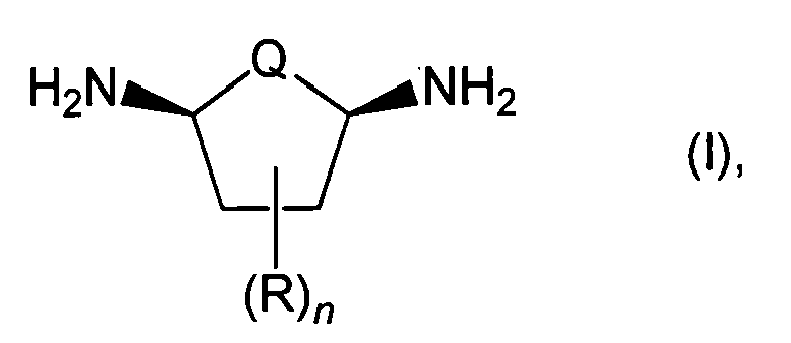
wherein Q is selected from the group consisting of -CH2-, -CH(CH3)-, -C(CH3)2-, -(CH2)2-, -(CH2)3- and -(CH2)4-;
n is an integer from 0 to 4;
and each substituent R, if present, is independently a linear or branched C1-8 alkyl attached to any one of the depicted carbon atoms;
starting from cyclic dienes such as cyclopentadiene and an azodicarboxylic acid derivative such as azodicarboxamide. Also claimed are novel bicyclic hydrazo compounds as intermediates in the process.
n is an integer from 0 to 4;
and each substituent R, if present, is independently a linear or branched C1-8 alkyl attached to any one of the depicted carbon atoms;
starting from cyclic dienes such as cyclopentadiene and an azodicarboxylic acid derivative such as azodicarboxamide. Also claimed are novel bicyclic hydrazo compounds as intermediates in the process.
Description
- The present invention relates to a process for the preparation of cycloaliphatic diamines of general formula

- In particular, the present disclosure describes a process for the preparation of diamines of general formula (I), in which Q represents -CH2-, -CH(CH3)-, -C(CH3)2-, -(CH2)2-, -(CH2)3-, or -(CH2)4-, n is an integer from 0 to 4, and each substituent R, if present, independently represents linear or branched C1-8 alkyl attached to any one of the carbon atoms depicted in formula I. Also disclosed are novel intermediates in the process.
- Aliphatic diamines are important intermediates or starting materials in organic syntheses, e. g. as monomers for the preparation of polyamides, as building blocks for the preparation of ligands for metal complexes, or for the preparation of biologically active compounds. For instance, 1,4-diaminobutane (putrescine) has been successfully used for the preparation of ligands for alkali metal ions (J. Am. Chem. Soc. 1973, 95, 3569-3572) and is also being used as monomer for the preparation of polyamides (e.g. Stanyl®, polyamide of diaminobutane and adipic acid). Furthermore, numerous drugs contain a diamine substructure and require such a diamine for their manufacture, e.g. ciprofloxacin, chloroquine, or trovafloxacin. cis-1,3-Diaminocyclopentane has been used as intermediate for the preparation of new agents for the inhibition of cell proliferation (
WO 2007/138277 ), new antimalarials (US 5 736 557 ), and new quinolonecarboxylic acid derivatives as antibacterials (US 5 519 024 ). - If diamines such as 1,4-diaminobutane are intended to be used for the preparation of polymers such as polyamides, the purity of the diamine will be of critical importance. Small amounts of monoamines will lead to an interruption of the polycondensation process, and will thus limit the length of the polymer chains and have a deleterious effect on the mechanical stability of the final polymer.
- Currently, the preferred method for the preparation of 1,4-diaminobutane, 1,6-diaminohexane, and related α,ω-diamines is the hydrogenation of the corresponding dinitriles. This hydrogenation is, however, difficult, because imines are formed as intermediates, which may hydrolyze or cyclize, and thereby lead to the formation of monoamines or other byproducts. Furthermore, the imines can also react with already present amino groups, leading to the formation of secondary amines. Thus, the hydrogenation of succinodinitrile (NC-CH2-CH2-CN) usually gives pyrrolidine as well as 1,4-diaminobutane. Therefore, new methods for the preparation of diamines which are not based on the hydrogenation of dinitriles and, because of the reaction mechanism, cannot lead to the formation of monoamine byproducts will be highly valuable.
- Cyclic diamines of general formula (I) are conformationally constrained analogs of 1,4-diaminobutane, and their derivatives may show properties similar to those of the corresponding derivatives of 1,4-diaminobutane.
- Various preparations of cis-1,3-diaminocyclopentane have been reported in the literature. In
WO 2007/138277 this compound is prepared by hydrogenation of 2,3-diazabicyclo[2.2.1]heptane dihydrochloride in aqueous ethanol in the presence of platinum on charcoal. This yields the dihydrochloride of cis-1,3-diaminocyclopentane, which must be deprotonated by treatment with a base, and separated from the resulting salts by filtration or extraction. The required 2,3-diazabicyclo[2.2.1]heptane was prepared by Diels-Alder reaction of cyclopentadiene with diethyl azodicarboxylate, followed by hydrogenation, base-catalyzed hydrolysis of the ethyl carbamate groups, protection by treatment with di-tert-butyl dicarbonate (Boc2O), and acid-mediated cleavage of the Boc-groups (Tetrahedron Lett. 2002, 43, 5551-5554). Alternatively, cis-1,3-diaminocyclopentane may be prepared from 2,3-diazabicyclo[2.2.1]heptane-2,3-dicarboxylate by treatment with sodium in liquid ammonia (US 5 736 557 ). The required starting material can be prepared from the hydrogenated Diels-Alder adduct of diethyl azodicarboxylate and cyclopentadiene by treatment with potassium hydroxide in ethylene glycol (Org. Synth. Coll. Vol. V, 96). - The methods described in the literature for the preparation of cis-1,3-diaminocyclopentane are wasteful, because they require base-catalyzed hydrolysis of a carbamic acid ester to yield a carbamate salt, which must be acidified in order to undergo decarboxylation. To obtain the free, non-protonated 2,3-diazabicyclo[2.2.1]heptane, an additional treatment with base is required. Moreover, diethyl azodicarboxylate and related azodicarboxylic esters are toxic, shock sensitive, thermally unstable, and relatively expensive.
- Thus, a cheap, simple process for the preparation of cis-1,3-diaminocyclopentane and related diamines has not yet been reported, and would be highly valuable. If such a process would be based on the hydrogenolytic N-N-bond cleavage of a 2,3-diazabicyclo[2.2.1]heptane derivative or a 2,3-diazabicyclo[2.2.1]heptene, then no monoamine byproducts should be formed, and highly pure cis-diamines, well suited for the preparation of polyamides, should be obtained as products.
- "Alkyl" refers to a monovalent radical formally derived from a saturated, linear, branched, or cyclic hydrocarbon, such as methyl, ethyl, 1-propyl, 2-propyl, butyl, hexyl, octyl, decyl, cyclopropyl, cyclobutyl, cyclopentyl, cyclohexyl, and the like.
- "Lower alkyl", in particular C1-8 alkyl, refers to a monovalent radical formally derived from a saturated, linear, branched, or cyclic C1-8 hydrocarbon, such as methyl, ethyl, propyl, 2-propyl, cyclopropyl, butyl, isobutyl, cyclobutyl, and the like. Accordingly, C1-6 alkyl refers to a monovalent radical formally derived from a saturated, linear, branched, or cyclic C1-6 hydrocarbon.
- The term "cis" refers to the relative stereochemical configuration of two substituents in the same molecule. More specifically, "cis" means that the two substituents the term refers to are located on the same side of a ring (i. e., a plane defined by the ring atoms) or a double bond.
- The expression "one-pot synthesis" means a two- or multistep synthetic process, wherein at least one of the intermediates occurring in the course of the process is neither purified nor isolated, but directly used as starting material for a subsequent step. However, the expression "one-pot synthesis" does not necessarily imply that two or all steps are actually conducted in the same reaction vessel.
- According to the invention, cis-diamines of formula
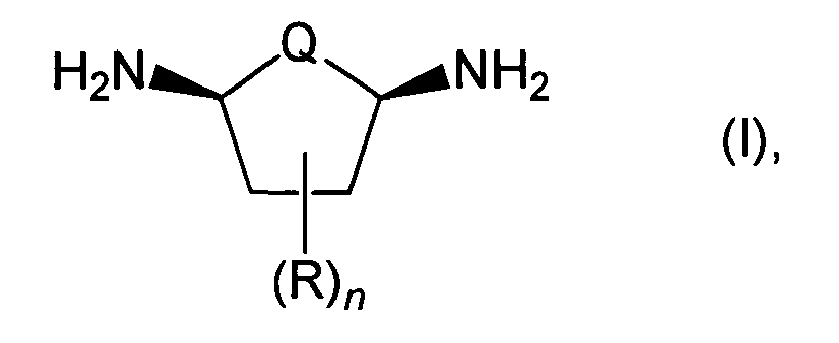
- Q is selected from the group consisting of -CH2-, -CH(CH3)-, -C(CH3)2-, -(CH2)2-, -(CH2)3- and -(CH2)4-,
- n is an integer from 0 to 4,
- and each substituent R, if present, independently is a linear or branched C1-8 alkyl attached to any one of the depicted carbon atoms,
- are prepared by a process comprising the steps of
- (i) reacting a cyclic diene of formula

with an azodicarboxylic acid derivative of formula
to yield a product of general formula
- (ii) catalytically hydrogenating the compound of formula IV to obtain a compound of formula

- (iii) reacting the compound of formula V with an excess of ammonia and/or hydrazine to obtain a compound of formula

- (iv) catalytically hydrogenating the compound of formula VI to obtain the cis-diamine of formula I.
- (i) reacting a cyclic diene of formula
- Applicants have surprisingly found that azodicarboxamide readily undergoes a Diels-Alder-type cycloaddition with cyclopentadiene, preferably in polar protic solvents such as water or acetic acid, to form 2,3-bis(aminocarbonyl)-2,3-diazabicyclo[2.2.1]hept-2-ene in high yield.
- Azodicarboxamide (H2N-CO-N=N-CO-NH2), is a cheap compound that is used e. g. as food additive, flour-bleaching agent, and foaming agent for the production of foamed plastics. Because of its lower price, lower toxicity, and higher stability it may be a more suitable starting material for the 1,4-diamination of 1,3-dienes than azodicarboxylic esters. Unfortunately, azodicarboxamide is only slightly soluble in DMF or DMSO, and practically insoluble in most other organic solvents. Only few examples of organic reactions with this compound have been reported, and most of them were conducted in DMF.
- Step (i) of the process of the invention can be performed at room temperature or at higher temperatures, such as 40 °C or higher, depending on the reactivity and stability of the starting materials and on the solvent. If a volatile 1,3-diene is used and the reaction is to be performed above the boiling point of said diene, an autoclave or another closed vessel must be used as reactor. Suitable dienes which may be used as starting materials in the process of the invention include cyclopentadiene, methylcyclopentadiene, other alkylated cyclopentadienes, 1,3-cyclohexadiene, alkylated cyclohexadienes, 1,3-cycloheptadiene, or 1,3-cyclooctadiene. Some non-conjugated dienes, such as 1,4-cyclohexadiene, 1,4-cycloheptadiene, or 1,5-cyclooctadiene, may rearrange in situ into the corresponding conjugated 1,3-dienes under the conditions of the Diels-Alder reaction, and then undergo the normal cycloaddition. Therefore, such unconjugated cyclic dienes are also included within the scope of the present invention.
- As will be evident to those skilled in the art upon reading the present disclosure, the ammonia-mediated deacylation of intermediate V will also be applicable to the hydrogenated Diels-Alder products of dienes and azodicarboxylic esters, to yield the same cyclic hydrazine VI and the corresponding carbamates (H2N-CO-OR3), depending on the azodicarboxylic acid ester used as starting material. Accordingly, the present invention also provides a process for the preparation of intermediates (IV, V and VI) and diamines I from dienes and azodicarboxylic esters.
- The cycloaddition products of general formula (IV) can be readily hydrogenated in the presence of hydrogenation catalysts suitable for the hydrogenation of carbon-carbon double bonds, such as nickel-, platinum-, or palladium-based catalysts, in particular Raney nickel or palladium on charcoal, and using standard reaction conditions, e. g. hydrogen pressures of 1-50 bar and reaction temperatures in the range of 20-70 °C. Surprisingly, however, also this reaction can be conducted in water or acetic acid, and isolation and drying of the cycloaddition product (IV) is therefore not required. Thus, when water is used as solvent in step (i), a simple washing of the reaction mixture of the Diels-Alder reaction with a water-immiscible organic solvent, such as toluene, ethyl acetate or dichloromethane, in which the cycloaddition product (IV) is not or only sparingly soluble, will remove unreacted cyclopentadiene and any dicyclopentadiene present as impurity or byproduct, and yield an aqueous suspension of (IV) that can be directly hydrogenated.
- It has further been found that the conversion of the hydrogenated intermediate (V) into the diamine (I) can be realized under non-acidic reaction conditions, for instance by treatment with ammonia or hydrazine, optionally at elevated pressure or temperature, followed by hydrogenolytic cleavage of the N-N bond in the bicyclic hydrazine intermediate VI. Thereby the formation of salt waste is avoided, and the only byproduct of this process is urea (if azodicarboxamide was used as starting material) or a substituted urea and/or an ester of carbamic acid (if another azodicarboxylic acid derivative of formula III was used as starting material).
- In the second hydrogenation (hydrogenolysis) step (iv), any catalyst known in the art to be effective in the hydrogenolytic cleavage of hydrazine can be employed, for example a nickel- or palladium-based catalyst such as Raney nickel or palladium on charcoal.
- In a preferred embodiment, steps (iii) and (iv) of the process of the invention are conducted without isolating the intermediate compound of formula VI, i. e. by directly adding a hydrogenation catalyst to the reaction mixture resulting from step (iii) and exposing it to hydrogen.
- More preferably, steps (ii), (iii) and (iv) are conducted as a one-pot synthesis, i. e., without isolating the intermediate compounds V and VI. For example, the acid-free transformation in step (iii) can be achieved by treating the reaction mixture containing compound V, directly after the hydrogenation step (ii) and without removal of the hydrogenation catalyst, with gaseous ammonia until saturation, or with aqueous ammonia, followed by heating the resulting mixture in an autoclave, e. g. to about 100 °C for 1-48 h, or for 6-30 h, or for about 12 h. It is also possible to use hydrazine or hydrazine hydrate instead of ammonia, or a mixture of hydrazine and ammonia. Afterwards, the mixture of (VI), water, the hydrogenation catalyst, and urea or derivative of carbamic acid is again put under an atmosphere of hydrogen to achieve the hydrogenolytic cleavage of the N-N bond. Suitable reaction conditions for the hydrogenolytic cleavage for example are 50-100 bar and 20-150 °C.
- It is, of course, also possible and within the scope of the invention to isolate the intermediate compounds IV, V and VI according to standard work-up methods.
- The diamines of general formula (I) can be isolated by conventional methods, for example by filtering off the hydrogenation catalyst, adding water, if necessary, extracting the diamine with a suitable solvent, such as toluene, dichloromethane, ethyl acetate, butyl acetate, or another solvent in which urea is insoluble or sparingly soluble, and distilling the extract. From the aqueous phase the pure urea can be isolated, if required, by concentration and filtration, followed by optional recrystallization from water or ethanol or another suitable solvent. Alternatively, after filtering off the hydrogenation catalyst, the amine may be isolated from the filtrate by distilling off the mixture of water and diamine from the urea under reduced pressure.
- Diamines such as I may be separated from water, dried and purified by saturating an aqueous solution of said diamine with a strong base such as sodium hydroxide, whereupon the diamine usually separates as a second liquid phase. The diamine may be separated by decantation or by extraction with a suitable solvent such as diethyl ether, and dried and purified further by treatment with solid sodium hydroxide or potassium hydroxide, followed by distillation (Woodburn, O'Gee, J. Org. Chem. 1952, 17, 1235-1244; Denk et al., Tetrahedron 2003, 59, 7565-7570).
- As mentioned above, step (i) is preferably conducted in a polar protic solvent.
- More preferably, the polar protic solvent is selected from the group consisting of water, C1-4 alkanols, C2-4 alkanoic acids, and mixtures of water and one or more C1-4 alkanols or C2-4 alkanoic acids. The expression "C1-4 alkanols" includes compounds having one or more hydroxy groups and 1 to 4 carbon atoms, such as methanol, ethanol, 1-propanol, 2-propanol (isopropyl alcohol), 1-butanol, 2-butanol (sec-butyl alcohol), 2-methyl-1-propanol (isobutyl alcohol), 2-methyl-2-propanol (tert-butyl alcohol), 1,2-ethanediol (ethylene glycol), 1,2-propanediol, 1,3-propanediol, 1,2-butanediol, 1,3-butanediol, 1,4-butanediol, 2,3-butanediol, and 1,2,3-propanetriol (glycerol). The expression "C2-4 alkanoic acids" includes compounds such as acetic (ethanoic) acid, propionic (propanoic) acid, butyric (butanoic) acid and isobutyric (2-methylpropanoic) acid.
- Still more preferably, the polar protic solvent in step (i) is water.
- Most preferably, the solvent in steps (i), (iii) and (iv) is water.
- As mentioned above, the hydrogenation catalyst(s) in steps (ii) and (iv) may be any catalyst known in the art to catalyze the hydrogenation of carbon-carbon double bonds and the hydrogenolysis of hydrazines, respectively.
- In a preferred embodiment the hydrogenation catalyst in steps (ii) and (iv) is Raney nickel.
- The process of the invention is particularly suited to the preparation of cis-diamines of formula I, wherein Q is a methylene (-CH2-) group. The cyclic diene (II) starting material in this embodiment is a cyclopentadiene.
- In another preferred embodiment n is zero, the cyclic diene (II) being an unsubstituted cycloalka-1,3-diene.
- In still another preferred embodiment, G1 and G2 in the azodicarboxylic acid derivative (III) are -NR1R2 moieties wherein R1 and R2 are hydrogen, G1 and G2 thus being amino (-NH2) groups and the azodicarboxylic acid derivative being azodicarboxamide. As mentioned above, it is also possible to produce the cyclic diene in situ by rearrangement of a corresponding non-conjugated cyclic diene, for example from 1,4-cyclohexadiene that can rearrange to 1,3-cyclohexadiene before undergoing the cycloaddition step (i).
- The intermediate compounds of formula

- The intermediate compounds of formula

- In particularly preferred embodiments of the intermediates IV and V, both R1 and R2 are hydrogen, Q is -CH2-, and n is zero.
- The following examples are intended to illustrate the present invention, but not to limit its scope in any way. The products were identified by 1H NMR spectroscopy.
- To a stirred suspension of azodicarboxamide (245.8 g, 2.12 mol) in water (870 ml) at 38 °C was dropwise added cyclopentadiene (100 g, 1.51 mol) within 0.5 h. The resulting mixture was stirred at 38 °C for 24 h, and then more cyclopentadiene (100 g, 1.51 mol) was added within 0.5 h. The mixture was stirred at 38 °C for another 24 h, to yield an almost colorless suspension of 2,3-bis(aminocarbonyl)-2,3-diazabicyclo[2.2.1]-hept-5-ene. Filtration and washing with toluene gave the wet title compound (488 g), which was used in the next step without further purification.
A sample was dried under reduced pressure to yield the title compound as a slightly yellow solid, mp 195-198 °C (decomposition).
1H NMR (400 MHz, d6-DMSO): δ 1.45 (d, J= 8 Hz, 1H), 1.58 (d, J= 8 Hz, 1H), 5.01 (br. s, 2H), 6.47 (br. s, 6H). - To a stirred suspension of azodicarboxamide (13.9 g,0.12 mol) in water (76.3 ml) at 70 °C was added cyclopentadiene (9.5 g, 0.14 mol) at a constant rate (0.43 g/min) within 22 min and at a maximum pressure of 2.7 bar. The reaction mixture was stirred at 70 °C for 95 min. The resulting suspension was cooled to room temperature and the solid filtered off and washed with water (109.4 ml). After filtration, a wet cake was obtained (17.45 g). By 1H NMR it was determined that the wet cake contained 81% of 2,3-bis(aminocarbonyl)-2,3-diazabicyclo[2.2.1]hept-5-ene (14.1 g, 77 mmol), corresponding to a yield of 65%. The rest of the cake was unreacted starting material (11 %) and water (8%).
When acetic acid was used instead of water, a comparable result could be obtained. - To a stirred suspension of azodicarboxamide (13.9 g, 0.12 mol) and Tween® 80 (Polysorbate 80, 1.59 g, 1.2 mmol) in water (215.8 ml) at 70 °C was added cyclopentadiene (9.5 g, 0.14 mol) at a constant rate (0.56 g/min) within 17 min and at a maximum pressure of 2.1 bar. The reaction mixture was stirred at 70 °C for 35 min. The resulting suspension was cooled to room temperature within 35 min and the solid was filtered off and washed with water (71 ml). After filtration, a wet cake was obtained (16.6 g). By 1H NMR it was determined that the wet cake contained 95% of 2,3-bis(aminocarbonyl)-2,3-diazabicyclo[2.2.1]hept-5-ene (15.8 g, 87 mmol), corresponding to a yield of 72%. The rest of the cake was water (5%).
- Azodicarboxamide (14.3 g, 0.12 mol) was dissolved in glycerol (161.32 g) and at 70 °C cyclopentadiene (10 g, 0.15 mol) was added at a constant rate (0.67 g/min) within 15 min and at a maximum pressure of 2.4 bar. The resulting mixture was stirred at 70 °C for 60 min. Then the reactor was cooled to room temperature within 60 min. The resulting viscous solution could be filtered upon addition of water (400 g). After filtration, a wet cake was obtained (21.4 g). By 1H NMR it was determined that the wet cake contained 72% of 2,3-bis(aminocarbonyl)-2,3-diazabicyclo[2.2.1]hept-5-ene (15.4 g, 85 mmol), corresponding to a yield of 68%.
- To a suspension of 2,3-bis(aminocarbonyl)-2,3-diazabicyclo[2.2.1]hept-5-ene (10 g, 54.9 mmol) in butanol (80 ml) was added Raney nickel (3.0 g), and the resulting mixture was hydrogenated at 50 °C for 15 min at 50 bar and for 10 min at 90 bar. The resulting suspension was diluted with acetic acid (140 ml), filtered, and the filtrate was concentrated under reduced pressure to yield 9.1 g (90%) of the title compound as a solid.
1H NMR (400 MHz, d6-DMSO): δ 1.42 (br d, J= 8 Hz, 1H), 1.47 (d, J= 8 Hz, 1H), 1.60 (m, 4H), 4.39 (m, 2H), 5.90 (m, 1H), 6.39 (br. s, 3H). - 2,3-Bis(aminocarbonyl)-2,3-diazabicyclo[2.2.1]heptane (60 g, 0.33 mol) was dissolved in hydrazine hydrate (163 g, 3.26 mol). The mixture was heated to 100 °C for 24 h in an autoclave. To a sample of the obtained solution of the product (20 g) was added 1.7 g glycerol and the product was distilled off under reduced pressure (20-60 mbar) at a temperature of 50-60°C. It was shown that in this manner the desired product 2,3-di-azabicyclo[2.2.1]heptane could be separated from the solid side-product urea. The product was identified by 1H NMR
1H NMR (500 MHz, d6-DMSO): δ 1.30-1.62 (m, 10H). - A mixture of 2,3-bis(aminocarbonyl)-2,3-diazabicyclo[2.2.1]heptane (2.9 g, 15.7 mmol) and aqueous ammonia (32%, 226 g) was stirred in a closed autoclave at 100 °C for 22.5 h. The mixture was allowed to cool to room temperature, Raney nickel (0.20 g) was added, and the mixture was hydrogenated at 50 °C for 20 min at 50 bar and for 3 h at 90 bar. The mixture was filtered, concentrated under reduced pressure to 75% of its original volume, potassium carbonate (60 g) was added, and the mixture was extracted with dichloromethane. The combined extracts were dried over anhydrous MgSO4, and concentrated under reduced pressure to yield the title diamine.
1H NMR (400 MHz, d6-DMSO): δ 1.14 (m, 1H), 1.43 (m, 2H), 1.71 (m, 2H), 1.95 (m, 1H), 3.21 (m, 2H). - To 2,3-bis(aminocarbonyl)-2,3-diazabicyclo[2.2.1]heptane (16.0 g, 86.9 mmol) were added glycerol (110 g) and hydrazine hydrate (21.7 g, 434 mmol), and the mixture was stirred at 110 °C for 24 h. The solution was transferred to an autoclave, palladium on charcoal (5% Pd, 9.2 g, 0.4 mmol) was added, and the mixture was hydrogenated at 50 bar and 50 °C for 24 h. Filtration and distillation yielded 6.2 g of a mixture of the target diamine and glycerol.
Claims (15)
- A process for the preparation of a cis-diamine of formula
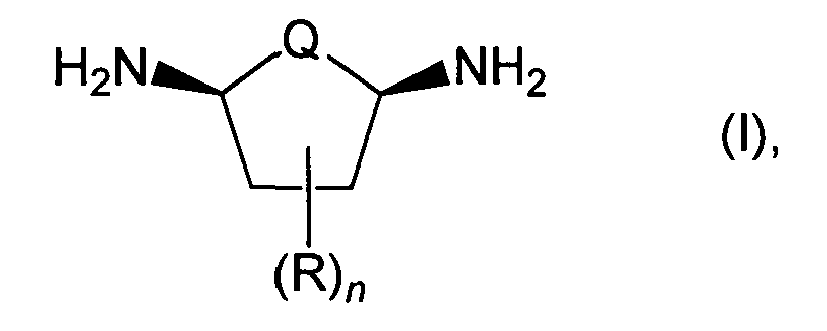 Q is selected from the group consisting of -CH2-, -CH(CH3)-, -C(CH3)2-, -(CH2)2-, -(CH2)3- and -(CH2)4-,n is an integer from 0 to 4,and each substituent R, if present, independently is a linear or branched C1-8 alkyl attached to any one of the depicted carbon atoms,said process comprising the steps of(i) reacting a cyclic diene of formula
with an azodicarboxylic acid derivative of formula
to yield a product of formula (ii) catalytically hydrogenating the compound of formula IV to obtain a compound of formula
 (iii) reacting the compound of formula V with an excess of ammonia and/or hydrazine to obtain a compound of formula
 (iv) catalytically hydrogenating the compound of formula VI to obtain the cis-diamine of formula I.
 - The process of claim 1, wherein steps (iii) and (iv) are conducted without isolating the compound of formula VI, by adding hydrogen and a hydrogenation catalyst to the reaction mixture obtained in step (iii).
- The process of claim 1, wherein steps (ii), (iii) and (iv) are conducted as a one-pot synthesis by leaving the hydrogenation catalyst of step (ii) in the reaction mixture and using it again in step (iv).
- The process of any of claims 1 to 3, wherein step (i) is conducted in a polar protic solvent.
- The process of claim 4, wherein the polar protic solvent is selected from the group consisting of water, C1-4 alkanols, C2-4 alkanoic acids, and mixtures of water and one or more of the beforementioned.
- The process of claim 5, wherein the polar protic solvent is water.
- The process of claim 6, wherein the solvent in steps (i), (iii) and (iv) is water.
- The process of any of claims 1 to 7, wherein the hydrogenations in steps (ii) and (iv) are carried out using Raney nickel as hydrogenation catalyst.
- The process of any of claims 1 to 8, wherein Q is -CH2-.
- The process of any of claims 1 to 9, wherein n is zero.
- The process of any of claims 1 to 10, wherein G1 and G2 are -NR1R2 with R1 and R2 being hydrogen.
- The process of any of claims 1 to 11, wherein the cyclic diene (II) is formed in situ from a corresponding cyclic non-conjugated diene.
- A compound having the formula

- A compound having the formula

- The compound of claim 13 or 14, wherein R1 and R2 are hydrogen, Q is -CH2-, and n is zero.
Priority Applications (1)
| Application Number | Priority Date | Filing Date | Title |
|---|---|---|---|
| EP10005901A EP2394981A1 (en) | 2010-06-08 | 2010-06-08 | Process for the preparation of cis-diaminocycloalkanes |
Applications Claiming Priority (1)
| Application Number | Priority Date | Filing Date | Title |
|---|---|---|---|
| EP10005901A EP2394981A1 (en) | 2010-06-08 | 2010-06-08 | Process for the preparation of cis-diaminocycloalkanes |
Publications (1)
| Publication Number | Publication Date |
|---|---|
| EP2394981A1 true EP2394981A1 (en) | 2011-12-14 |
Family
ID=42662435
Family Applications (1)
| Application Number | Title | Priority Date | Filing Date |
|---|---|---|---|
| EP10005901A Withdrawn EP2394981A1 (en) | 2010-06-08 | 2010-06-08 | Process for the preparation of cis-diaminocycloalkanes |
Country Status (1)
| Country | Link |
|---|---|
| EP (1) | EP2394981A1 (en) |
Citations (3)
| Publication number | Priority date | Publication date | Assignee | Title |
|---|---|---|---|---|
| US5519024A (en) | 1993-03-09 | 1996-05-21 | Takeda Chemical Industries, Ltd. | Quinolonecarboxylic acid derivatives and their use |
| US5736557A (en) | 1994-06-17 | 1998-04-07 | Hoffman-La Roche, Inc. | N,N-bis (quinolin-4-yl)-diamine derivatives, their preparation and their use as antimalarials |
| WO2007138277A1 (en) | 2006-05-26 | 2007-12-06 | Astrazeneca Ab | 2-carbocycloamino-4-imidaz0lylpyrimidines as agents for the inhbition of cell proliferation |
-
2010
- 2010-06-08 EP EP10005901A patent/EP2394981A1/en not_active Withdrawn
Patent Citations (3)
| Publication number | Priority date | Publication date | Assignee | Title |
|---|---|---|---|---|
| US5519024A (en) | 1993-03-09 | 1996-05-21 | Takeda Chemical Industries, Ltd. | Quinolonecarboxylic acid derivatives and their use |
| US5736557A (en) | 1994-06-17 | 1998-04-07 | Hoffman-La Roche, Inc. | N,N-bis (quinolin-4-yl)-diamine derivatives, their preparation and their use as antimalarials |
| WO2007138277A1 (en) | 2006-05-26 | 2007-12-06 | Astrazeneca Ab | 2-carbocycloamino-4-imidaz0lylpyrimidines as agents for the inhbition of cell proliferation |
Non-Patent Citations (7)
| Title |
|---|
| CHAKRABORTY T K ET AL: "Development of 2,3-diazabicyclo[2.2.1]heptane as a constrained azapeptide template and its uses in peptidomimetic studies", TETRAHEDRON LETTERS, ELSEVIER, AMSTERDAM, NL LNKD- DOI:10.1016/S0040-4039(02)01141-3, vol. 43, no. 32, 5 August 2002 (2002-08-05), pages 5551 - 5554, XP004371561, ISSN: 0040-4039 * |
| DENK ET AL., TETRAHEDRON, vol. 59, 2003, pages 7565 - 7570 |
| FURDIK, MIKULAS ET AL: "Diels-Alder synthesis of new substances from N,N'-disubstituted diamides of azodicarboxylic acid as dienophiles", ACTA FACULTATIS RERUM NATURALIUM UNIVERSITATIS COMENIANAE, CHIMIA , NO. 12, 239-51 CODEN: AFRCAQ; ISSN: 0524-2312, 1968, XP008126468 * |
| J. AM. CHEM. SOC., vol. 95, 1973, pages 3569 - 3572 |
| ORG. SYNTH. COLL., vol. V, pages 96 |
| TETRAHEDRON LEFT., vol. 43, 2002, pages 5551 - 5554 |
| WOODBURN; O'GEE, J. ORG. CHEM., vol. 17, 1952, pages 1235 - 1244 |
Similar Documents
| Publication | Publication Date | Title |
|---|---|---|
| JP6576253B2 (en) | Method for producing N-methyl-substituted triacetoneamine compound | |
| JP5291630B2 (en) | Method for reductive amination of aldehydes and ketones | |
| JPH0390054A (en) | Preparation of cyclic amino acid and its interme- diate | |
| EP1418170B1 (en) | Process for the preparation of optically active amino alcohols by optical resolution | |
| JPH0368541A (en) | Amination of carbonyl | |
| US20220402871A1 (en) | Process for producing substituted amino alcohols | |
| NO177531B (en) | Process for the preparation of 1- (aminomethyl) cyclohexanacetic acid, as well as an intermediate for use in this process | |
| US6696609B2 (en) | Process for producing diamines | |
| US8835687B2 (en) | Method for preparation of 4,4′-dinitrodiphenylamine and 4,4′-bis(alkylamino)diphenylamine with the base catalyst complex | |
| FI90862C (en) | 2-aza-4- (alkoxycarbonyl) spiro / 4,5 / decan-3-one | |
| Wheeler et al. | Synthesis of 1-aminocyclopropenecarboxylic acid: the unsaturated analog of ACC | |
| MX2007016493A (en) | Process for the reductive amination of aldehydes and ketones via the formation of macrocyclic polyimine intermediates. | |
| EP1527042B1 (en) | Method for producing aminoalkoxy benzylamines and aminoalkoxy benzonitriles as intermediates | |
| EP2394982A1 (en) | Process for the preparation of cis-diaminocycloalkanes | |
| CN108440307B (en) | Preparation method of chiral amine compound | |
| KR20120070258A (en) | Method for preparation of 4,4'-dintrodiphenylamine and 4,4'-bis(alkylamino)diphenylamine by using 4-nitroanilin | |
| US20250197364A1 (en) | Method for producing cis-4-aminotetrahyrdrofuran-2-carboxylic acid esters | |
| US9890108B2 (en) | Catalytic hydrogenation for the preparation of amines from amide acetals, ketene N, O-acetals or ester imides | |
| TW201406457A (en) | Process for preparing amines by homogeneously catalyzed alcohol amination in the presence of a complex catalyst comprising iridium and an amino acid | |
| US20240294448A1 (en) | Hydrogenation of esters to alcohols in the presence of an mn-pnn complex | |
| KR20110041279A (en) | Method for preparing 4,4'-bis (alkylamino) diphenylamine | |
| IE851273L (en) | Process for preparing rimantadine. | |
| EP3271324B1 (en) | Process for the preparation of diaminobutane | |
| KR20050083886A (en) | A method for preparing indan-1,3-dicarboxylic acid | |
| CN106380418B (en) | It is a kind of to use N-Methyl pyrrolidone/SOCl2The method for efficiently realizing ketoxime Beckmann rearrangement |
Legal Events
| Date | Code | Title | Description |
|---|---|---|---|
| AK | Designated contracting states |
Kind code of ref document: A1 Designated state(s): AL AT BE BG CH CY CZ DE DK EE ES FI FR GB GR HR HU IE IS IT LI LT LU LV MC MK MT NL NO PL PT RO SE SI SK SM TR |
|
| AX | Request for extension of the european patent |
Extension state: BA ME RS |
|
| PUAI | Public reference made under article 153(3) epc to a published international application that has entered the european phase |
Free format text: ORIGINAL CODE: 0009012 |
|
| STAA | Information on the status of an ep patent application or granted ep patent |
Free format text: STATUS: THE APPLICATION HAS BEEN WITHDRAWN |
|
| 18W | Application withdrawn |
Effective date: 20120530 |