EP2393797B1 - Process for preparing olopatadine and/or a pharmaceutically acceptable salt thereof - Google Patents
Process for preparing olopatadine and/or a pharmaceutically acceptable salt thereof Download PDFInfo
- Publication number
- EP2393797B1 EP2393797B1 EP10705320.9A EP10705320A EP2393797B1 EP 2393797 B1 EP2393797 B1 EP 2393797B1 EP 10705320 A EP10705320 A EP 10705320A EP 2393797 B1 EP2393797 B1 EP 2393797B1
- Authority
- EP
- European Patent Office
- Prior art keywords
- process according
- salt
- compound
- formula
- olopatadine
- Prior art date
- Legal status (The legal status is an assumption and is not a legal conclusion. Google has not performed a legal analysis and makes no representation as to the accuracy of the status listed.)
- Active
Links
- ONMJUODQUPOCQH-LSCVHKIXSA-N CN(C)CC/C=C1\c2cc(CC(N)=O)ccc2OCc2ccccc12 Chemical compound CN(C)CC/C=C1\c2cc(CC(N)=O)ccc2OCc2ccccc12 ONMJUODQUPOCQH-LSCVHKIXSA-N 0.000 description 1
Classifications
-
- C—CHEMISTRY; METALLURGY
- C07—ORGANIC CHEMISTRY
- C07D—HETEROCYCLIC COMPOUNDS
- C07D313/00—Heterocyclic compounds containing rings of more than six members having one oxygen atom as the only ring hetero atom
- C07D313/02—Seven-membered rings
- C07D313/06—Seven-membered rings condensed with carbocyclic rings or ring systems
- C07D313/10—Seven-membered rings condensed with carbocyclic rings or ring systems condensed with two six-membered rings
- C07D313/12—[b,e]-condensed
-
- A—HUMAN NECESSITIES
- A61—MEDICAL OR VETERINARY SCIENCE; HYGIENE
- A61P—SPECIFIC THERAPEUTIC ACTIVITY OF CHEMICAL COMPOUNDS OR MEDICINAL PREPARATIONS
- A61P11/00—Drugs for disorders of the respiratory system
- A61P11/02—Nasal agents, e.g. decongestants
-
- A—HUMAN NECESSITIES
- A61—MEDICAL OR VETERINARY SCIENCE; HYGIENE
- A61P—SPECIFIC THERAPEUTIC ACTIVITY OF CHEMICAL COMPOUNDS OR MEDICINAL PREPARATIONS
- A61P11/00—Drugs for disorders of the respiratory system
- A61P11/06—Antiasthmatics
-
- A—HUMAN NECESSITIES
- A61—MEDICAL OR VETERINARY SCIENCE; HYGIENE
- A61P—SPECIFIC THERAPEUTIC ACTIVITY OF CHEMICAL COMPOUNDS OR MEDICINAL PREPARATIONS
- A61P17/00—Drugs for dermatological disorders
- A61P17/04—Antipruritics
-
- A—HUMAN NECESSITIES
- A61—MEDICAL OR VETERINARY SCIENCE; HYGIENE
- A61P—SPECIFIC THERAPEUTIC ACTIVITY OF CHEMICAL COMPOUNDS OR MEDICINAL PREPARATIONS
- A61P37/00—Drugs for immunological or allergic disorders
- A61P37/08—Antiallergic agents
Definitions
- the present invention relates to a process for the preparation of olopatadine and, more particularly, to an improved method of synthesizing olopatadine which comprises reacting a dibenz[b,e]oxepin-11-one derivative of formula and a suitable reagent under Wittig condition.
- Olopatadine, 11-[(Z)-3-(dimethylamino)-propylidene]-6-11-dihydrodibenz-[b,e]-oxepin-2-acetic acid is a dibenzoxepine derivative of formula initially useful for systemic treatment of allergic rhinitis, urticaria and bronchial asthma and developed as a topical anti-allergic agent.
- Olopatadine is a relatively selective histamine H 1 antagonist and a inhibitor of the release of histamine from mast cells. It is considered to have high affinity for H 1 receptor and no effect on alpha-adrenergic, dopaminergic and muscarinic type 1 and 2 receptors.
- hydrochloric acid addition salt is the marketed product which may be administered in a solid oral dosage form or as an ophthalmic solution the latter indicated for the treatment of signs and symptoms of allergic conjunctivitis.
- Synthetic approaches to olopatadine generally starts from a common suitably substituted dibenz[b,e]oxepin-11-one substrate. Mainly, two different route are pursued:
- Olopatadine base was first described in EP 0214779 (The Wellcome Foundation Ltd.), although no specific examples for its preparation are provided therein. Olopatadine analogues were synthesized, inter alias, by means of the well know
- Example 5 describes the preparation of 11-[(E/Z)-3-(dimethylamino)-propylidene]-6-11-dihydrodibenz[b,e]-oxepin-2-(E)-acrylic acid by Wittig reaction between an ethyl dibenz[b,e]oxepin-11-one acrilate derivative and 3-(dimethylamino)-propyltriphenylphosphonium bromide hydrobromide and subsequent basic deprotection of the ester moiety.
- EP 0235796 (Kyowa Hakko Kogyo CO.) describes novel dibenz[b,e]oxepin derivatives useful in the treatment and control of allergic asthma and also in the treatment of inflammation.
- the application reports several processes for the preparation of olopatadine and analogues thereof.
- process C foresees the reaction showed in scheme below wherein Y, Z, A' and n have the meanings described in the application.
- Y is, inter alias, -(CH 2 )n- and A' is, inter alias, carboxy or -CONR 1 R 2 wherein R 1 and R 2 are the same or different and represent hydrogen atom or lower alkyl.
- Compound XIII which is a phosphorus ylide can be prepared according to the method described in C.A. 63, 16366a (1965).
- Compound (IIb) is reacted with 1-5 equivalents of compound XIII in an inert solvent such as tetrahydrofuran to give If.
- the application entails the opportunity to carry out a Wittig reaction on a generic protected carboxy group derivative, however, experimental work does not individualize any dimethylaminopropylidene chain insertion on dibenz[b,e]oxepin-11-one amide derivatives.
- WO 2007/119120 (Medichem S.A.) describes new polymorphic forms of olopatadine hydrochloride and methods of preparing, purifying and treating them. Synthetic preparation of olopatadine base comprises classic Wittig reaction on 11-oxo-6,11-dihydrodibenzo[b,e]oxepin-2-yl)-acetic acid by using hexyllithium or sodium hydride as strong base.
- WO 2007/110761 (Azad Pharmaceutical Ingredient AG) describes a new polymorphic form of olopatadine hydrochloride and method for preparing the same.
- the application relates to a method for preparing olopatadine comprising combining 3-dimethylamino propyl triphenylphosphonium halide or a salt thereof, with sodium hydride to provide a reaction mixture which is reacted under Wittig condition with 11-oxo-6,11-dihydrodibenzo[b,e]oxepin-2-yl)-acetic acid.
- a first object of the present invention is a process for preparing a compound of formula by reacting a compound of formula and a 3-dimethylamino propyl triphenylphosphonium halide or a salt thereof in the presence of a base under Wittig conditions.
- Wittig reaction is perfectly known to the skilled person and foresees that an aldehyde or ketone is treated with a phosphorus ylide to give an olefin derivative.
- Said ylide are generally prepared by treatment of a phosphonium salt with a base.
- Wittig conditions entail that phosphonium salt, 3-dimethylamino propyl triphenylphosphonium halide or a salt thereof, is combined with a base to provide a reaction mixture comprising correspondent phosphorous ylide which is reacted with substrate, 11-oxo-6,11-dihydrodibenzo[b,e]oxepin-2-yl)-acetic amide, in a suitable solvent.
- Reactant 3-dimethylamino propyl triphenylphosphonium halide or a salt thereof is commercially available and/or may be prepared in accordance with known methods.
- Patent EP 0235796 process C, furnishes an accurate disclosure of the phosphorous ylide useful in the Wittig reaction according to the invention.
- Suitable salts are hydrohalide salts and, in particular, hydrobromide, hydroiodine or hydrochloride.
- Preferred reactant is 3-dimethylamino propyl triphenylphosphonium bromide hydrobromide.
- Suitable bases according to the invention are alkaline hydrides, alkaline alkoxides, alkaline carbonates, organolithium derivatives and the like.
- Preferred bases are butyl lithium, hexyl litium, sodium hydride, potassium hydride, sodium carbonate, potassium carbonate, sodium amide, sodium methoxide, sodium ethoxide, LDA, LiHMDS, KHMDS and the like.
- Most preferred base is n-butyl lithium which is, preferably, used in a n-hexane or toluene solution.
- Suitable solvents of the invention are ether-type solvent such as tetrahydrofuran and the like, and hydrocarbon, particularly, aromatic hydrocarbon such as toluene and the like.
- Preferred solvent is tetrahydrofuran.
- Reactant and compound of formula III are used in a molar ratio comprised between 2.0 and 4.0, preferably, they are mixed in a 2.5:1 molar ratio.
- Suitable base and compound of formula III are used in a molar ratio comprised between 4.0 and 7.0, preferably, they are mixed in a 5.5:1 molar ratio.
- said reacting a compound of formula III with Wittig reagent is carried out at a temperature comprised between -70°C and 70°C.
- the reaction is preferably carried out in the range of -20°C and 70°C.
- reaction mixture coming from combining a strong base with a phosphonium salt is, in situ, reacted with an amide derivative of formula III in an inert solvent to give a compound of formula II endowed with a high purity which is, in turn, further purified and converted into olopatadine or a salt thereof.
- a compound of formula II is to be further purified in order to increase Z/E ratio, for instance, by conventional methods.
- the aminopropylidene chain is inserted by Wittig reaction and obtained amide of formula II (E/Z mixture around 25/75) is purified by crystallization as p-toluensulfonate salt from alcoholic solvent to give highly pure Z-enriched olopatadine amide.
- Olopatadine amide from Wittig reaction may be recovered as crystal or as solution, preferably as alcoholic solution, and is directly reacted with p-toluensulfonic acid to give correspondent salt which is isolated by filtration.
- Said salt may be further purified in accordance with known methods such as recrystallization, preferably, from alcoholic solvent and more preferably from methanol.
- neutralization and hydrolysis are carried out in the presence of a base or, alternatively, an acid.
- Preferred bases are alkaline hydroxide such as sodium or potassium hydroxide.
- Preferred acids are mineral acids such as hydrobromic, hydrochloric and sulfuric acid; hydrochloric acid being preferred
- olopatadine amide p-toluensulfonate salt is hydrolyzed in the presence of sodium hydroxide.
- Olopatadine hydrochloride is the preferred acid addition salt and it may be prepared by reaction with hydrochloric acid in accordance with prior art methods ( J. Med. Chem. 1992, 35, 2074-2084 ).
- a further object of the present invention is a process for synthesizing olopatadine characterised in that a compound of formula is prepared by reacting a compound of formula and a 3-dimethylamino propyl triphenylphosphonium halide or a salt thereof in the presence of a base under Wittig conditions.
- a further object of the present invention is a process for synthesizing olopatadine which comprises
- a further object of the present invention is a process for synthesizing olopatadine or a pharmaceutically acceptable salt thereof which comprises
- Characterising feature of the invention resides in that Wittig reaction is performed on a dibenz[b,e]oxepin-11-one amide derivative.
- protecting acid moiety as amide derivative allows to reduce the amount of reagents as well as to completely convert starting material into olopatadine amide.
- Wittig reaction according to the invention by using around 2.5 equivalents of reagent and around 5.5 equivalents of base results in an almost quantitative conversion of a compound of formula III into a diastereoisomeric mixture of olopatadine amide of formula II with a Z/E ratio of around 75/25.
- the process of the invention does not need for an additional esterification step after Wittig reaction as well as purification by column chromatography so as to avoid useless loss in yield.
- a practical embodiment of the process object of the present invention comprises combining a phosphonium salt, 3-dimethylamino propyl triphenylphosphonium halide or a salt thereof, with a base to provide a reaction mixture comprising correspondent phosphorous ylide which is reacted with substrate, 11-oxo-6,11-dihydrodibenzo[b,e]oxepin-2-yl)-acetic amide, under Wittig conditions.
- a preferred practical embodiment of the process object of the present invention comprises converting commercially available 11-oxo-6,11-dihydro-dibenzo-[ b,e ]-oxepin-2-acetic acid into an amide of formula III; combining 3-dimethylamino propyl triphenylphosphonium halide or a salt thereof, with a base, preferably, butyllithium to provide a reaction mixture which is reacted with said amide of formula III under Wittig conditions, preferably, in the presence of an ether type solvent; purifying so obtained amide of formula II (E/Z mixture around 25/75) by crystallization as p-toluensulfonate salt from alcoholic solvent, preferably methanol, to give highly pure Z-enriched olopatadine amide salt; optionally recrystallizing from alcoholic solvent, preferably, from methanol; hydrolysing olopatadine amide p-toluensulfonate salt, preferably
Landscapes
- Health & Medical Sciences (AREA)
- Organic Chemistry (AREA)
- Chemical & Material Sciences (AREA)
- Life Sciences & Earth Sciences (AREA)
- Pharmacology & Pharmacy (AREA)
- Bioinformatics & Cheminformatics (AREA)
- Animal Behavior & Ethology (AREA)
- General Chemical & Material Sciences (AREA)
- Medicinal Chemistry (AREA)
- Nuclear Medicine, Radiotherapy & Molecular Imaging (AREA)
- Pulmonology (AREA)
- Veterinary Medicine (AREA)
- Engineering & Computer Science (AREA)
- Chemical Kinetics & Catalysis (AREA)
- General Health & Medical Sciences (AREA)
- Public Health (AREA)
- Immunology (AREA)
- Dermatology (AREA)
- Otolaryngology (AREA)
- Pharmaceuticals Containing Other Organic And Inorganic Compounds (AREA)
- Pyrane Compounds (AREA)
- Organic Low-Molecular-Weight Compounds And Preparation Thereof (AREA)
Description
- The present invention relates to a process for the preparation of olopatadine and, more particularly, to an improved method of synthesizing olopatadine which comprises reacting a dibenz[b,e]oxepin-11-one derivative of formula


- Olopatadine is a relatively selective histamine H1 antagonist and a inhibitor of the release of histamine from mast cells. It is considered to have high affinity for H1 receptor and no effect on alpha-adrenergic, dopaminergic and muscarinic type 1 and 2 receptors.
- The hydrochloric acid addition salt is the marketed product which may be administered in a solid oral dosage form or as an ophthalmic solution the latter indicated for the treatment of signs and symptoms of allergic conjunctivitis. Synthetic approaches to olopatadine generally starts from a common suitably substituted dibenz[b,e]oxepin-11-one substrate. Mainly, two different route are pursued:
- Wittig reaction with a phosphorus ylide of formula Ph3P=CH(CH2)2N(CH3)2;
- Grignard reaction with a reagent of formula (CH3)2N(CH2)3MgX followed by dehydration with a strong acid.
- Olopatadine base was first described in
EP 0214779 (The Wellcome Foundation Ltd.), although no specific examples for its preparation are provided therein. Olopatadine analogues were synthesized, inter alias, by means of the well know - Wittig method by reaction of a compound of formula

-
EP 0235796 (Kyowa Hakko Kogyo CO.) describes novel dibenz[b,e]oxepin derivatives useful in the treatment and control of allergic asthma and also in the treatment of inflammation. The application reports several processes for the preparation of olopatadine and analogues thereof. In particular, process C foresees the reaction showed in scheme below
- Compound XIII which is a phosphorus ylide can be prepared according to the method described in C.A. 63, 16366a (1965). Compound (IIb) is reacted with 1-5 equivalents of compound XIII in an inert solvent such as tetrahydrofuran to give If. The application entails the opportunity to carry out a Wittig reaction on a generic protected carboxy group derivative, however, experimental work does not individualize any dimethylaminopropylidene chain insertion on dibenz[b,e]oxepin-11-one amide derivatives.
- In the specific olopatadine preparation, Examples 9 and 35, Wittig reaction is carried out on an unprotected dibenz[b,e]oxepin-11-one acetic acid derivative. So obtained olopatadine is converted into correspondent ethyl ester and then hydrolysed in order to obtain olopatadine endowed with a suitable E/Z ratio.
- Preparation of olopatadine hydrochloride salt, the active ingredient, was first described in J. Med. Chem. 1992, 35, 2074-2084. Dibenz[b,e]oxepin-11-one derivatives possessing a carboxy group connected by an alkyl or vinyl spacer (4c-e) were submitted to Wittig reaction and the crude product obtained were esterified for ease of purification. By this method the Z-isomer was preferentially obtained (E/Z=3/7, experimental section E/Z=1/2). So obtained ester is saponified without isomerization and converted into p-toluensulfonate salt which was recrystallized from alcoholic solvent, neutralized, and treated with hydrochloric acid to furnish desired product.
- The article reports, in addition, that attempts to prepare the same product under the same Wittig condition from corresponding ester protected derivative (e.g. methyl acetate derivative) resulted in the recovery of the starting material. Literature reports some alternative processes for the preparation of olopatadine.
WO 2006/010459 (Urquima S.A.) describes a process for the preparation of olopatadine which comprises the reaction of a compound of formula
-
WO 2007/119120 (Medichem S.A.) describes new polymorphic forms of olopatadine hydrochloride and methods of preparing, purifying and treating them. Synthetic preparation of olopatadine base comprises classic Wittig reaction on 11-oxo-6,11-dihydrodibenzo[b,e]oxepin-2-yl)-acetic acid by using hexyllithium or sodium hydride as strong base. -
WO 2007/110761 (Azad Pharmaceutical Ingredient AG) describes a new polymorphic form of olopatadine hydrochloride and method for preparing the same. In particular, the application relates to a method for preparing olopatadine comprising combining 3-dimethylamino propyl triphenylphosphonium halide or a salt thereof, with sodium hydride to provide a reaction mixture which is reacted under Wittig condition with 11-oxo-6,11-dihydrodibenzo[b,e]oxepin-2-yl)-acetic acid. - It results apparent from the prior art that Wittig reaction plays an essential role in the preparation of olopatadine and, in turn, of the active pharmaceutical acceptable salt.
- Nevertheless, prior art methods suffer from significant cost and procedural drawbacks.
- In particular, need for excess Wittig reagent and strong bases; incomplete dibenz[b,e]oxepin-11-one derivative conversion into the end product in so far as low yields are reported in the literature; poor stereo selectivity in the preparation of Z-pure isomer required; after Wittig reaction, protection and deprotection of the carboxylic group increasing the number of reaction steps; moreover, ester derivative purification by chromatography furnishing a Z-enriched derivative which is necessarily further purified by recrystallization.
- Hence, it would be desirable to study alternative efficient methods for preparing pure olopatadine or a salt thereof with good yields and under conditions favourable from the industrial application point of view. It would further be desirable to carry out Wittig reaction under mild condition, in particular, by reducing the amount of expensive and hazardous reagents and to avoid the need to derivatize olopatadine obtained therefrom.
- We have now, surprisingly, found an easy and efficient alternative synthesis of olopatadine amide, key intermediates in preparing olopatadine, which allows to overcome the drawbacks of the processes described in the prior art.
- Therefore, a first object of the present invention is a process for preparing a compound of formula


- The compound of formula III is prepared in accordance with known methods, for instance, patent
EP 0069810 (Merck & CO Inc., US) describes its synthesis starting from correspondent acid derivative. -
US 2005/288283 also discloses compound III - In one embodiment of the invention, commercially available 11-oxo-6,11-dihydrodibenzo[b,e]oxepin-2-acetic acid is reacted with SOCl2 in toluene to give correspondent chloride which is reacted, in situ, with ammonia to give the compound of formula III as a white powder.
- Wittig reaction is perfectly known to the skilled person and foresees that an aldehyde or ketone is treated with a phosphorus ylide to give an olefin derivative. Said ylide are generally prepared by treatment of a phosphonium salt with a base. Thus, Wittig conditions entail that phosphonium salt, 3-dimethylamino propyl triphenylphosphonium halide or a salt thereof, is combined with a base to provide a reaction mixture comprising correspondent phosphorous ylide which is reacted with substrate, 11-oxo-6,11-dihydrodibenzo[b,e]oxepin-2-yl)-acetic amide, in a suitable solvent.
- Reactant 3-dimethylamino propyl triphenylphosphonium halide or a salt thereof is commercially available and/or may be prepared in accordance with known methods.
- Patent
EP 0235796 , process C, furnishes an accurate disclosure of the phosphorous ylide useful in the Wittig reaction according to the invention. - Suitable salts are hydrohalide salts and, in particular, hydrobromide, hydroiodine or hydrochloride.
- Preferred reactant is 3-dimethylamino propyl triphenylphosphonium bromide hydrobromide.
- Suitable bases according to the invention are alkaline hydrides, alkaline alkoxides, alkaline carbonates, organolithium derivatives and the like.
- Preferred bases are butyl lithium, hexyl litium, sodium hydride, potassium hydride, sodium carbonate, potassium carbonate, sodium amide, sodium methoxide, sodium ethoxide, LDA, LiHMDS, KHMDS and the like.
- Most preferred base is n-butyl lithium which is, preferably, used in a n-hexane or toluene solution.
- Suitable solvents of the invention are ether-type solvent such as tetrahydrofuran and the like, and hydrocarbon, particularly, aromatic hydrocarbon such as toluene and the like.
- Preferred solvent is tetrahydrofuran.
- Reactant and compound of formula III are used in a molar ratio comprised between 2.0 and 4.0, preferably, they are mixed in a 2.5:1 molar ratio.
- Suitable base and compound of formula III are used in a molar ratio comprised between 4.0 and 7.0, preferably, they are mixed in a 5.5:1 molar ratio.
- Generally, said reacting a compound of formula III with Wittig reagent is carried out at a temperature comprised between -70°C and 70°C.
- The reaction is preferably carried out in the range of -20°C and 70°C.
- Operatively, the reaction mixture coming from combining a strong base with a phosphonium salt is, in situ, reacted with an amide derivative of formula III in an inert solvent to give a compound of formula II endowed with a high purity which is, in turn, further purified and converted into olopatadine or a salt thereof.
- Since olopatadine has Z configuration, a compound of formula II is to be further purified in order to increase Z/E ratio, for instance, by conventional methods.
- In one embodiment of the invention the aminopropylidene chain is inserted by Wittig reaction and obtained amide of formula II (E/Z mixture around 25/75) is purified by crystallization as p-toluensulfonate salt from alcoholic solvent to give highly pure Z-enriched olopatadine amide.
- Olopatadine amide from Wittig reaction may be recovered as crystal or as solution, preferably as alcoholic solution, and is directly reacted with p-toluensulfonic acid to give correspondent salt which is isolated by filtration.
- Said salt may be further purified in accordance with known methods such as recrystallization, preferably, from alcoholic solvent and more preferably from methanol.
- Pure olopatadine amide p-toluensulfonate salt is neutralized and hydrolysed to liberate olopatadine free base.
- Generally, neutralization and hydrolysis are carried out in the presence of a base or, alternatively, an acid.
- Preferred bases are alkaline hydroxide such as sodium or potassium hydroxide. Preferred acids are mineral acids such as hydrobromic, hydrochloric and sulfuric acid; hydrochloric acid being preferred
- In a preferred embodiment of the invention olopatadine amide p-toluensulfonate salt is hydrolyzed in the presence of sodium hydroxide.
- Pure olopatadine base is then optionally converted into correspondent pharmaceutically acceptable salt in accordance with conventional methods. Olopatadine hydrochloride is the preferred acid addition salt and it may be prepared by reaction with hydrochloric acid in accordance with prior art methods (J. Med. Chem. 1992, 35, 2074-2084).
- Therefore, a further object of the present invention is a process for synthesizing olopatadine characterised in that a compound of formula


- A further object of the present invention is a process for synthesizing olopatadine which comprises
- a. reacting a compound of formula
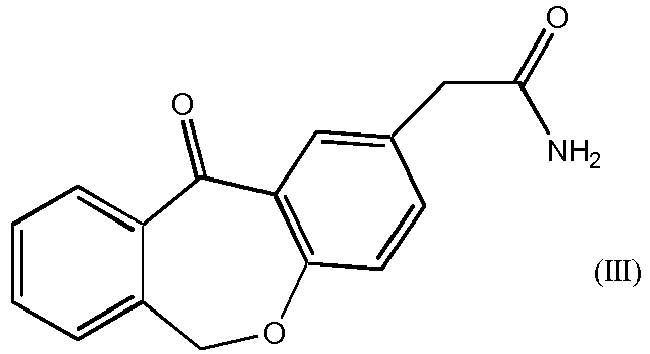

- b. purifying a compound of formula II by fractional crystallization of correspondent p-toluensulfonate salt.
- It is a further object of the invention the compound 11-[(Z)-3-(dimethylamino)-propylidene]-6-11-dihydrodibenz[b,e]-oxepin-2-acetamide p-toluensulfonate salt as key intermediate in the preparation of a highly pure olopatadine end product.
- A further object of the present invention is a process for synthesizing olopatadine or a pharmaceutically acceptable salt thereof which comprises
- a. reacting a compound of formula


- b. purifying a compound of formula II by fractional crystallization of correspondent p-toluensulfonate salt;
- c. hydrolysing so obtained pure Z-isomer of formula II to give olopatadine and optionally converting it into correspondent pharmaceutically acceptable salt.
- It is thus evident how the method object of the invention constitutes a suited for industrial production, efficient and economic synthetic alternative for the preparation of olopatadine; in addition, reduced number of synthetic steps and good yields obtained, give notable benefits in terms of process costs and efficiency.
- Characterising feature of the invention resides in that Wittig reaction is performed on a dibenz[b,e]oxepin-11-one amide derivative.
- To the best of inventors' knowledge, the introduction of the dimethylaminopropylidene chain on a primary amide protected acetic moiety under Wittig conditions is neither known in the art nor suggested by any prior art reference.
- Although prior art entails a generic protection of the acetic moiety, it carries out Wittig reaction on an acid substrate; it was confirmed by the inventors that ester derivatives do not withstand Wittig conditions and undergo hydrolysis process.
- On the contrary, protecting acid moiety as amide derivative allows to reduce the amount of reagents as well as to completely convert starting material into olopatadine amide.
- Moreover, Wittig reaction performed on an amide substrate according to the invention provides, surprisingly, a product which is highly enriched in the Z-isomer (Z/E = 75/25) and, thus, suitable for following purification step aimed to separate the desired Z-pure active ingredient.
- For instance, Wittig reaction according to the invention by using around 2.5 equivalents of reagent and around 5.5 equivalents of base results in an almost quantitative conversion of a compound of formula III into a diastereoisomeric mixture of olopatadine amide of formula II with a Z/E ratio of around 75/25.
- In fact, it appears to be essential to have a Z-enriched derivative in order to simplify purification step which is predominantly carried out by fractional crystallization.
- So, the process of the invention does not need for an additional esterification step after Wittig reaction as well as purification by column chromatography so as to avoid useless loss in yield.
- Subsequent saponification does not undergo isomerization and furnishes a highly pure end product.
- A practical embodiment of the process object of the present invention comprises combining a phosphonium salt, 3-dimethylamino propyl triphenylphosphonium halide or a salt thereof, with a base to provide a reaction mixture comprising correspondent phosphorous ylide which is reacted with substrate, 11-oxo-6,11-dihydrodibenzo[b,e]oxepin-2-yl)-acetic amide, under Wittig conditions.
- A preferred practical embodiment of the process object of the present invention comprises converting commercially available 11-oxo-6,11-dihydro-dibenzo-[b,e]-oxepin-2-acetic acid into an amide of formula III; combining 3-dimethylamino propyl triphenylphosphonium halide or a salt thereof, with a base, preferably, butyllithium to provide a reaction mixture which is reacted with said amide of formula III under Wittig conditions, preferably, in the presence of an ether type solvent; purifying so obtained amide of formula II (E/Z mixture around 25/75) by crystallization as p-toluensulfonate salt from alcoholic solvent, preferably methanol, to give highly pure Z-enriched olopatadine amide salt; optionally recrystallizing from alcoholic solvent, preferably, from methanol; hydrolysing olopatadine amide p-toluensulfonate salt, preferably in the presence of a base, to liberate olopatadine free base; and converting said free base into correspondent hydrochloride salt.
- For better illustrating the invention the following examples are now given.
- A suspension of 11-oxo-6,11-dihydro-dibenzo-[b,e]-oxepin-2-acetic acid (47 g, 0.1752 mol) in toluene was heated at 90°C. Thionyl chloride (22.9 g, 0.1927 mol) was added and the mixture was stirred for 4 hours at 90°C.
- After complete conversion, solvent and excess of reagent was removed by distillation and the residual was diluted with THF, then, added to a 30% wt ammonia solution in water (85.5 ml) at 15°C. Title compound of formula III was isolated by filtration at 0°C (44.3 g, 95% yield).
- To a suspension of 3-dimethylamino propyl triphenylphosphonium bromide hydrobromide (285 g, 0.5615 mol) in THF anhydrous (600 ml) was added at 5°C a 2.5 M BuLi solution in n-Hexane (491.6 ml, 1.2291 mol) and heated to 25°C. The solution was added to a suspension of a compound of formula III (60 g, 0.2245 mol) in THF anhydrous (600 ml) at 66°C. The mixture was stirred at 66°C for 4 hours. At reaction completed, the excess of ylide and BuLi was quenched with a 10% wt ammonium chloride solution in water and the organic compounds were extracted in dichloromethane, the waste aqueous layer was discarded. The organic phase was then washed two times with 4N hydrochloride acid and the waste organic layer was discarded. The aqueous layers were collected and pH was adjusted to a value of 13 with a 30% wt sodium hydroxide solution in water and the compound of formula II was extracted with IPAC, concentrated and then diluted with methanol.
- Title compound of formula II was so obtained with Z/E ratio around 75/25 in a methanol solution (250 ml, 62.1 g, 83% yield). p-toluensulfonic acid monohydrate (38.5 g, 0.2024 mol) was added to the obtained methanol mixture of a compound of formula II at R.T. and corresponding p-toluensulfonate salt was isolated by filtration at 0°C and recrystallized from methanol to give pure 11-[(Z)-3-(dimethylamino)-propylidene]-6,11-dihydro-dibenzo-[b,e]-oxepin-2-acetamide p-toluensulfonate salt (50.7 g, 45% yield, Z-isomer>99.5%).
- 1H-NMR (600MHz, DMSO-d6): δ=2.25 (s, 3H, CH 3 C6H5SO3H); 2.71 (m, 2H, CH2C=C); 2.73 (s, 6H, N(CH3)2); 3.24 (m, 2H, CH 2 N(CH3)2); 3.30 (s, 2H, CH2CONH2); 5.16 (m, 2H, CH2O); 5.59 (m, 1H, C=CHCH2); 6.75 (dd, J=8.4, 1H,Ar); 6.84 (s, 1H, NH2); 7.04 (m, J=2.1, 1H, Ar); 7.06 (m, J=8.4, 2.1, 1H, Ar); 7.08 (dd, J=8.0, 2H, Ar); 7.25 (dd, J=7.6, 1.2, 1H, Ar); 7.30 (m, J=7.6, 1.2, 1H, Ar); 7.35 (m, J=7.6, 1H, Ar); 7.36 (m, J=7.6, 1.2, 1H, Ar); 7.42 (s, 1H, NH2); 7.45 (dd, J=8.0, 2H, Ar); 9.25 (s, 1H, NH+).
- 13C-NMR (20 MHz, DMSO-d6): δ= 20.7 (CH 3 C6H5SO3H); 24.8 (CH2C=C); 39.4 (CH 2 CONH 2 ); 42.2 (N(CH3)2); 55.8 (CH 2 N(CH3)2; 69.5 (CH2O); 119.1 (Ar); 122.7 (Ar); 125.4 (Ar); 125.8 (Ar); 126.5 (Ar); 127.8 (Ar); 128.0 (Ar); 128.6 (C=CHCH2); 129.0 (Ar); 130.3 (Ar); 131.5 (Ar); 133.5 (Ar); 137.5 (Ar); 141.3 (Ar); 144.4 (C=CHCH2); 145.7 (Ar); 153.6 (Ar); 172.5 (CONH2).
- To a suspension in dichlorometane (13.2 ml) methanol (0.6 ml) of p-toluensulfonate salt of a compound of formula II (1.32 g, 0.002595 mol) was added a 5% wt solution of sodium bicarbonate in water (6.6 g, 0.003928 mol). The mixture was stirred 15 minutes and the waste acqueous layer was discarded. The organic layer was washed with a 5% wt solution of sodium bicarbonate in water (4.0 g, 0.002381 mol). The waste acqueous layer was discarded and the organic phase was concentred, diluited with methanol (6 ml) and a 5M potassium hydroxide solution in water (4.16 ml, 0.0208 mol) was added. The mixture was stirred at 70°C for 8 hours. At reaction completed, the mixture was cooled to R.T., neutralized to pH 11 with 6N hydrochloride acid. The compound of formula I was purified by absorbing on resin DIAION SK1B (23 ml, 0.0506 mol) and recovered by a 5% ammonia solution in water (511 g) wash. Finally isopropil alcool (20 ml) was added and the solvent was evaporated to give the title compound (0.388 g, 44.3% yield).
Claims (14)
- A process for preparing olopatadine characterised in that a compound of formula


- A process according to claim 1 wherein 3-dimethylamino propyl triphenylphosphonium bromide hydrobromide is used.
- A process according to claim 1 wherein said base is n-butyl lithium.
- A process according to claim 1 wherein said reacting a compound of formula III and a 3-dimethylamino propyl triphenylphosphonium halide or a salt thereof is carried out in an ether-type solvent.
- A process according to claim 4 wherein said solvent is tetrahydrofuran,
- A process according to claim 1 wherein reactant and compound of formula III are used in a molar ratio comprised between 2.0 and 4.0.
- A process according to claim 6 wherein molar ratio is 2.5:1
- A process according to claim 1 wherein base and compound of formula III arc used in a molar ratio comprised between 4.0 and 7.0.
- A process according to claim 8 wherein molar ratio is 5.5:1
- A process according to claim 1 wherein said reacting is carried out at a temperature comprised between -20°C and 70°C.
- A process according to claim 1 further comprisinga. converting a compound of formula II into correspondent p-toluensulfonate salt;b. purifying said salt by fractional crystallization;c. neutralizing Z-pure p-toluensulfonate salt;d. hydrolysing so obtained Z-pure isomer of formula II to give olopatadine; ande. optionally converting it into a correspondent pharmaceutically acceptable salt,
- A process according to claim 11 wherein step b is carried out by crystallization from methanol.
- A process according to claim 11 wherein step d is carried out in the presence of sodium hydroxide.
- 11-[(Z)-3-(dimethylamino)-propylidene]-6-11-dihydrodibenz[b,e]-oxepin-2-acetamide p-toluensulfonate salt.
Priority Applications (3)
| Application Number | Priority Date | Filing Date | Title |
|---|---|---|---|
| SI201031206A SI2393797T1 (en) | 2009-02-05 | 2010-02-01 | Process for preparing olopatadine and/or a pharmaceutically acceptable salt thereof |
| EP10705320.9A EP2393797B1 (en) | 2009-02-05 | 2010-02-01 | Process for preparing olopatadine and/or a pharmaceutically acceptable salt thereof |
| HRP20160567TT HRP20160567T1 (en) | 2009-02-05 | 2010-02-01 | PROCEDURE FOR PREPARATION OF OLOPATADINE AND / OR ITS PHARMACEUTICAL APPLICATION SALTS |
Applications Claiming Priority (3)
| Application Number | Priority Date | Filing Date | Title |
|---|---|---|---|
| EP09152194 | 2009-02-05 | ||
| PCT/EP2010/051148 WO2010089268A2 (en) | 2009-02-05 | 2010-02-01 | Process for preparing olopatadine and/or a pharmaceutically acceptable salt thereof |
| EP10705320.9A EP2393797B1 (en) | 2009-02-05 | 2010-02-01 | Process for preparing olopatadine and/or a pharmaceutically acceptable salt thereof |
Publications (2)
| Publication Number | Publication Date |
|---|---|
| EP2393797A2 EP2393797A2 (en) | 2011-12-14 |
| EP2393797B1 true EP2393797B1 (en) | 2016-04-20 |
Family
ID=42109900
Family Applications (1)
| Application Number | Title | Priority Date | Filing Date |
|---|---|---|---|
| EP10705320.9A Active EP2393797B1 (en) | 2009-02-05 | 2010-02-01 | Process for preparing olopatadine and/or a pharmaceutically acceptable salt thereof |
Country Status (14)
| Country | Link |
|---|---|
| US (1) | US8835655B2 (en) |
| EP (1) | EP2393797B1 (en) |
| JP (1) | JP5564060B2 (en) |
| CN (1) | CN102292326B (en) |
| AU (1) | AU2010211085B2 (en) |
| BR (1) | BRPI1008743B1 (en) |
| CA (1) | CA2746331C (en) |
| ES (1) | ES2581833T3 (en) |
| HR (1) | HRP20160567T1 (en) |
| HU (1) | HUE028705T2 (en) |
| IL (1) | IL213364A (en) |
| PL (1) | PL2393797T3 (en) |
| SI (1) | SI2393797T1 (en) |
| WO (1) | WO2010089268A2 (en) |
Families Citing this family (2)
| Publication number | Priority date | Publication date | Assignee | Title |
|---|---|---|---|---|
| WO2014147647A1 (en) | 2013-03-19 | 2014-09-25 | Council Of Scientific & Industrial Research | A process for the synthesis of olopatadine |
| CN106117176B (en) * | 2016-06-24 | 2018-12-11 | 四川大学 | The double benzos of dihydro dislike derivative in heptan and combinations thereof and application |
Family Cites Families (8)
| Publication number | Priority date | Publication date | Assignee | Title |
|---|---|---|---|---|
| US4282365A (en) * | 1978-11-24 | 1981-08-04 | Merck & Co., Inc. | Dibenz[b,e]oxepin compounds |
| ATE24002T1 (en) | 1981-07-09 | 1986-12-15 | Merck & Co Inc | DIBENZOXEPINES, THEIR PRODUCTION, COMPOSITIONS CONTAINING THESE COMPOUNDS AND THEIR USE IN THE TREATMENT OF ALLERGIC CONDITIONS. |
| GB8520662D0 (en) | 1985-08-17 | 1985-09-25 | Wellcome Found | Tricyclic aromatic compounds |
| JPS6310784A (en) | 1986-03-03 | 1988-01-18 | Kyowa Hakko Kogyo Co Ltd | Dibenz(b,e)oxepin derivative, antiallergic agent and anti-inflammatory agent |
| AU2005259911A1 (en) * | 2004-06-28 | 2006-01-12 | Alcon, Inc. | Topical formulations for treating allergic diseases |
| ES2253996B1 (en) | 2004-07-28 | 2007-08-16 | Urquima, S.A. | PROCEDURE FOR THE PREPARATION OF ACID 11 - ((Z) -3- (DIMETHYLAMINE) PROPILIDEN) -6,11-DIHYDRODIBENZ (B, E) OXEPINACETIC. |
| EP2228371A1 (en) * | 2005-12-22 | 2010-09-15 | Medichem, S.A. | New process for preparing olopatadine free base and/or its hydrochloride salt |
| US7687646B2 (en) | 2006-03-28 | 2010-03-30 | Azad Pharmaceutical Ingredients, Ag | Polymorphic forms of olopatadine hydrochloride and methods for producing olopatadine and salts thereof |
-
2010
- 2010-02-01 JP JP2011548657A patent/JP5564060B2/en active Active
- 2010-02-01 ES ES10705320.9T patent/ES2581833T3/en active Active
- 2010-02-01 AU AU2010211085A patent/AU2010211085B2/en active Active
- 2010-02-01 EP EP10705320.9A patent/EP2393797B1/en active Active
- 2010-02-01 BR BRPI1008743-5A patent/BRPI1008743B1/en active IP Right Grant
- 2010-02-01 SI SI201031206A patent/SI2393797T1/en unknown
- 2010-02-01 WO PCT/EP2010/051148 patent/WO2010089268A2/en not_active Ceased
- 2010-02-01 HU HUE10705320A patent/HUE028705T2/en unknown
- 2010-02-01 CA CA2746331A patent/CA2746331C/en active Active
- 2010-02-01 US US13/147,741 patent/US8835655B2/en active Active
- 2010-02-01 PL PL10705320.9T patent/PL2393797T3/en unknown
- 2010-02-01 HR HRP20160567TT patent/HRP20160567T1/en unknown
- 2010-02-01 CN CN201080005022.7A patent/CN102292326B/en active Active
-
2011
- 2011-06-05 IL IL213364A patent/IL213364A/en active IP Right Grant
Also Published As
| Publication number | Publication date |
|---|---|
| BRPI1008743B1 (en) | 2021-09-08 |
| US8835655B2 (en) | 2014-09-16 |
| WO2010089268A3 (en) | 2010-10-14 |
| EP2393797A2 (en) | 2011-12-14 |
| WO2010089268A2 (en) | 2010-08-12 |
| CA2746331A1 (en) | 2010-08-12 |
| ES2581833T3 (en) | 2016-09-07 |
| BRPI1008743A8 (en) | 2017-07-11 |
| SI2393797T1 (en) | 2016-07-29 |
| HUE028705T2 (en) | 2016-12-28 |
| HRP20160567T1 (en) | 2016-07-01 |
| US20120016138A1 (en) | 2012-01-19 |
| AU2010211085A1 (en) | 2011-07-07 |
| AU2010211085B2 (en) | 2016-08-25 |
| CN102292326B (en) | 2015-04-22 |
| CN102292326A (en) | 2011-12-21 |
| IL213364A (en) | 2016-06-30 |
| BRPI1008743A2 (en) | 2015-09-01 |
| JP2012516869A (en) | 2012-07-26 |
| PL2393797T3 (en) | 2016-12-30 |
| CA2746331C (en) | 2016-09-06 |
| JP5564060B2 (en) | 2014-07-30 |
| IL213364A0 (en) | 2011-07-31 |
Similar Documents
| Publication | Publication Date | Title |
|---|---|---|
| CN101175741B (en) | For the preparation of trans-5-chloro-2-methyl-2,3,3a,12b-tetrahydro-1H-dibenzo[2,3:6,7]-oxaza[4,5- C] intermediate compound of pyrrole | |
| KR102900525B1 (en) | Method for manufacturing asenapine | |
| EP2145882B1 (en) | Process for obtaining olopatadine and intermediates | |
| WO2007105234A2 (en) | A PROCESS FOR THE PREPARATION OF ISOMERS OF 11-[3-(DIMETHYLAMINO)PROPYLIDENE]-6, 11-DIHYDRODIBENZ [b, e] OXEPIN-2-ACETIC ACID HYDROCHLORIDE AND POLYMORPHS THEREOF | |
| WO2011128911A2 (en) | Improved process for ll-[(z)-3-(dimethylamino)propyiidenel-6-ll- dihydrodibenz[b,el oxepin-2-aceticacid | |
| JP2012524740A (en) | Method for producing olopatadine | |
| CA2746331C (en) | Process for preparing olopatadine and/or a pharmaceutically acceptable salt thereof | |
| WO2013035109A1 (en) | Improved process for the preparation of asenapine maleate | |
| JP5301676B2 (en) | Process for producing (3S, 4S) -4-((R) -2- (benzyloxy) tridecyl) -3-hexyl-2-oxetanone and novel intermediate used therefor | |
| WO2009081417A2 (en) | Process for preparation of olopat adine hydrochloride | |
| EP1347960B1 (en) | Process for preparing (+) trans-4-p-fluorophenyl-3-hydroxymethyl-1 | |
| CN1073554C (en) | Preparation method of o-chloromethylphenylglycolic acid derivative | |
| JP2007031363A (en) | Method for producing dibenz[b,e]oxepin derivative and intermediate thereof | |
| WO2011033532A1 (en) | Process for preparation of olopatadine hydrochloride | |
| CN102333775A (en) | Preparation method for nortropine benzilate and its salts and intermediates used in said method | |
| WO2006046096A2 (en) | A polymorphic form of narwedine and its use in the synthesis of galantamine |
Legal Events
| Date | Code | Title | Description |
|---|---|---|---|
| PUAI | Public reference made under article 153(3) epc to a published international application that has entered the european phase |
Free format text: ORIGINAL CODE: 0009012 |
|
| 17P | Request for examination filed |
Effective date: 20110831 |
|
| AK | Designated contracting states |
Kind code of ref document: A2 Designated state(s): AT BE BG CH CY CZ DE DK EE ES FI FR GB GR HR HU IE IS IT LI LT LU LV MC MK MT NL NO PL PT RO SE SI SK SM TR |
|
| RIN1 | Information on inventor provided before grant (corrected) |
Inventor name: MARQUILLAS OLONDRIZ, FRANCISCO Inventor name: ORRU', GIANMAURO Inventor name: GUIDI, ALBERTO Inventor name: TREPAT GUIXER, ELISENDA Inventor name: COTARCA, LIVIUS Inventor name: KIZIRIAN, JEAN-CLAUDE Inventor name: VERZINI, MASSIMO Inventor name: CHIARELLO, FILIPPO |
|
| DAX | Request for extension of the european patent (deleted) | ||
| 17Q | First examination report despatched |
Effective date: 20130306 |
|
| GRAP | Despatch of communication of intention to grant a patent |
Free format text: ORIGINAL CODE: EPIDOSNIGR1 |
|
| INTG | Intention to grant announced |
Effective date: 20150904 |
|
| GRAS | Grant fee paid |
Free format text: ORIGINAL CODE: EPIDOSNIGR3 |
|
| GRAA | (expected) grant |
Free format text: ORIGINAL CODE: 0009210 |
|
| AK | Designated contracting states |
Kind code of ref document: B1 Designated state(s): AT BE BG CH CY CZ DE DK EE ES FI FR GB GR HR HU IE IS IT LI LT LU LV MC MK MT NL NO PL PT RO SE SI SK SM TR |
|
| REG | Reference to a national code |
Ref country code: GB Ref legal event code: FG4D |
|
| REG | Reference to a national code |
Ref country code: CH Ref legal event code: EP Ref country code: CH Ref legal event code: NV Representative=s name: FIAMMENGHI-FIAMMENGHI, CH |
|
| REG | Reference to a national code |
Ref country code: AT Ref legal event code: REF Ref document number: 792310 Country of ref document: AT Kind code of ref document: T Effective date: 20160515 |
|
| REG | Reference to a national code |
Ref country code: IE Ref legal event code: FG4D |
|
| REG | Reference to a national code |
Ref country code: HR Ref legal event code: TUEP Ref document number: P20160567 Country of ref document: HR |
|
| REG | Reference to a national code |
Ref country code: DE Ref legal event code: R096 Ref document number: 602010032459 Country of ref document: DE |
|
| REG | Reference to a national code |
Ref country code: HR Ref legal event code: T1PR Ref document number: P20160567 Country of ref document: HR |
|
| REG | Reference to a national code |
Ref country code: NL Ref legal event code: FP |
|
| REG | Reference to a national code |
Ref country code: LT Ref legal event code: MG4D |
|
| REG | Reference to a national code |
Ref country code: ES Ref legal event code: FG2A Ref document number: 2581833 Country of ref document: ES Kind code of ref document: T3 Effective date: 20160907 |
|
| REG | Reference to a national code |
Ref country code: AT Ref legal event code: MK05 Ref document number: 792310 Country of ref document: AT Kind code of ref document: T Effective date: 20160420 |
|
| PG25 | Lapsed in a contracting state [announced via postgrant information from national office to epo] |
Ref country code: NO Free format text: LAPSE BECAUSE OF FAILURE TO SUBMIT A TRANSLATION OF THE DESCRIPTION OR TO PAY THE FEE WITHIN THE PRESCRIBED TIME-LIMIT Effective date: 20160720 Ref country code: FI Free format text: LAPSE BECAUSE OF FAILURE TO SUBMIT A TRANSLATION OF THE DESCRIPTION OR TO PAY THE FEE WITHIN THE PRESCRIBED TIME-LIMIT Effective date: 20160420 Ref country code: LT Free format text: LAPSE BECAUSE OF FAILURE TO SUBMIT A TRANSLATION OF THE DESCRIPTION OR TO PAY THE FEE WITHIN THE PRESCRIBED TIME-LIMIT Effective date: 20160420 |
|
| PG25 | Lapsed in a contracting state [announced via postgrant information from national office to epo] |
Ref country code: PT Free format text: LAPSE BECAUSE OF FAILURE TO SUBMIT A TRANSLATION OF THE DESCRIPTION OR TO PAY THE FEE WITHIN THE PRESCRIBED TIME-LIMIT Effective date: 20160822 Ref country code: LV Free format text: LAPSE BECAUSE OF FAILURE TO SUBMIT A TRANSLATION OF THE DESCRIPTION OR TO PAY THE FEE WITHIN THE PRESCRIBED TIME-LIMIT Effective date: 20160420 Ref country code: SE Free format text: LAPSE BECAUSE OF FAILURE TO SUBMIT A TRANSLATION OF THE DESCRIPTION OR TO PAY THE FEE WITHIN THE PRESCRIBED TIME-LIMIT Effective date: 20160420 Ref country code: AT Free format text: LAPSE BECAUSE OF FAILURE TO SUBMIT A TRANSLATION OF THE DESCRIPTION OR TO PAY THE FEE WITHIN THE PRESCRIBED TIME-LIMIT Effective date: 20160420 |
|
| REG | Reference to a national code |
Ref country code: HU Ref legal event code: AG4A Ref document number: E028705 Country of ref document: HU |
|
| REG | Reference to a national code |
Ref country code: DE Ref legal event code: R097 Ref document number: 602010032459 Country of ref document: DE |
|
| REG | Reference to a national code |
Ref country code: HR Ref legal event code: ODRP Ref document number: P20160567 Country of ref document: HR Payment date: 20170124 Year of fee payment: 8 |
|
| PG25 | Lapsed in a contracting state [announced via postgrant information from national office to epo] |
Ref country code: SK Free format text: LAPSE BECAUSE OF FAILURE TO SUBMIT A TRANSLATION OF THE DESCRIPTION OR TO PAY THE FEE WITHIN THE PRESCRIBED TIME-LIMIT Effective date: 20160420 Ref country code: EE Free format text: LAPSE BECAUSE OF FAILURE TO SUBMIT A TRANSLATION OF THE DESCRIPTION OR TO PAY THE FEE WITHIN THE PRESCRIBED TIME-LIMIT Effective date: 20160420 Ref country code: RO Free format text: LAPSE BECAUSE OF FAILURE TO SUBMIT A TRANSLATION OF THE DESCRIPTION OR TO PAY THE FEE WITHIN THE PRESCRIBED TIME-LIMIT Effective date: 20160420 Ref country code: DK Free format text: LAPSE BECAUSE OF FAILURE TO SUBMIT A TRANSLATION OF THE DESCRIPTION OR TO PAY THE FEE WITHIN THE PRESCRIBED TIME-LIMIT Effective date: 20160420 Ref country code: CZ Free format text: LAPSE BECAUSE OF FAILURE TO SUBMIT A TRANSLATION OF THE DESCRIPTION OR TO PAY THE FEE WITHIN THE PRESCRIBED TIME-LIMIT Effective date: 20160420 |
|
| REG | Reference to a national code |
Ref country code: FR Ref legal event code: PLFP Year of fee payment: 8 |
|
| PLBE | No opposition filed within time limit |
Free format text: ORIGINAL CODE: 0009261 |
|
| STAA | Information on the status of an ep patent application or granted ep patent |
Free format text: STATUS: NO OPPOSITION FILED WITHIN TIME LIMIT |
|
| PG25 | Lapsed in a contracting state [announced via postgrant information from national office to epo] |
Ref country code: SM Free format text: LAPSE BECAUSE OF FAILURE TO SUBMIT A TRANSLATION OF THE DESCRIPTION OR TO PAY THE FEE WITHIN THE PRESCRIBED TIME-LIMIT Effective date: 20160420 |
|
| REG | Reference to a national code |
Ref country code: DE Ref legal event code: R082 Ref document number: 602010032459 Country of ref document: DE Representative=s name: KADOR & PARTNER PARTG MBB, DE Ref country code: DE Ref legal event code: R081 Ref document number: 602010032459 Country of ref document: DE Owner name: F.I.S. - FABBRICA ITALIANA SINTETICI S.P.A., M, IT Free format text: FORMER OWNER: ZACH SYSTEM S.P.A., BRESSO, MILANO, IT Ref country code: DE Ref legal event code: R082 Ref document number: 602010032459 Country of ref document: DE Representative=s name: KADOR & PARTNER PART MBB PATENTANWAELTE, DE Ref country code: DE Ref legal event code: R082 Ref document number: 602010032459 Country of ref document: DE Representative=s name: KADOR & PARTNER PARTG MBB PATENTANWAELTE, DE Ref country code: DE Ref legal event code: R081 Ref document number: 602010032459 Country of ref document: DE Owner name: F.I.S. - FABBRICA ITALIANA SINTETICI S.P.A., IT Free format text: FORMER OWNER: ZACH SYSTEM S.P.A., BRESSO, MILANO, IT |
|
| 26N | No opposition filed |
Effective date: 20170123 |
|
| PGFP | Annual fee paid to national office [announced via postgrant information from national office to epo] |
Ref country code: SI Payment date: 20170119 Year of fee payment: 8 Ref country code: NL Payment date: 20170226 Year of fee payment: 8 Ref country code: HR Payment date: 20170124 Year of fee payment: 8 Ref country code: BE Payment date: 20170227 Year of fee payment: 8 Ref country code: PL Payment date: 20170222 Year of fee payment: 8 Ref country code: HU Payment date: 20170126 Year of fee payment: 8 |
|
| REG | Reference to a national code |
Ref country code: GB Ref legal event code: 732E Free format text: REGISTERED BETWEEN 20170608 AND 20170614 |
|
| REG | Reference to a national code |
Ref country code: CH Ref legal event code: NV Representative=s name: PRONOVEM SWISS LTD., CH Ref country code: CH Ref legal event code: PUE Owner name: F.I.S.- FABBRICA ITALIANA SINTETICI S.P.A., IT Free format text: FORMER OWNER: ZACH SYSTEM S.P.A., IT |
|
| PG25 | Lapsed in a contracting state [announced via postgrant information from national office to epo] |
Ref country code: MC Free format text: LAPSE BECAUSE OF FAILURE TO SUBMIT A TRANSLATION OF THE DESCRIPTION OR TO PAY THE FEE WITHIN THE PRESCRIBED TIME-LIMIT Effective date: 20160420 |
|
| REG | Reference to a national code |
Ref country code: IE Ref legal event code: MM4A |
|
| PG25 | Lapsed in a contracting state [announced via postgrant information from national office to epo] |
Ref country code: LU Free format text: LAPSE BECAUSE OF NON-PAYMENT OF DUE FEES Effective date: 20170201 |
|
| REG | Reference to a national code |
Ref country code: FR Ref legal event code: PLFP Year of fee payment: 9 |
|
| PG25 | Lapsed in a contracting state [announced via postgrant information from national office to epo] |
Ref country code: IE Free format text: LAPSE BECAUSE OF NON-PAYMENT OF DUE FEES Effective date: 20170201 |
|
| REG | Reference to a national code |
Ref country code: HR Ref legal event code: PBON Ref document number: P20160567 Country of ref document: HR Effective date: 20180201 |
|
| REG | Reference to a national code |
Ref country code: NL Ref legal event code: MM Effective date: 20180301 |
|
| PG25 | Lapsed in a contracting state [announced via postgrant information from national office to epo] |
Ref country code: HU Free format text: LAPSE BECAUSE OF NON-PAYMENT OF DUE FEES Effective date: 20180202 |
|
| REG | Reference to a national code |
Ref country code: BE Ref legal event code: FP Effective date: 20160708 Ref country code: BE Ref legal event code: MM Effective date: 20180228 |
|
| PG25 | Lapsed in a contracting state [announced via postgrant information from national office to epo] |
Ref country code: SI Free format text: LAPSE BECAUSE OF NON-PAYMENT OF DUE FEES Effective date: 20180202 Ref country code: HR Free format text: LAPSE BECAUSE OF NON-PAYMENT OF DUE FEES Effective date: 20180201 |
|
| REG | Reference to a national code |
Ref country code: SI Ref legal event code: KO00 Effective date: 20181008 |
|
| PG25 | Lapsed in a contracting state [announced via postgrant information from national office to epo] |
Ref country code: NL Free format text: LAPSE BECAUSE OF NON-PAYMENT OF DUE FEES Effective date: 20180301 |
|
| PG25 | Lapsed in a contracting state [announced via postgrant information from national office to epo] |
Ref country code: BE Free format text: LAPSE BECAUSE OF NON-PAYMENT OF DUE FEES Effective date: 20180228 |
|
| PG25 | Lapsed in a contracting state [announced via postgrant information from national office to epo] |
Ref country code: BG Free format text: LAPSE BECAUSE OF FAILURE TO SUBMIT A TRANSLATION OF THE DESCRIPTION OR TO PAY THE FEE WITHIN THE PRESCRIBED TIME-LIMIT Effective date: 20160420 |
|
| PG25 | Lapsed in a contracting state [announced via postgrant information from national office to epo] |
Ref country code: CY Free format text: LAPSE BECAUSE OF NON-PAYMENT OF DUE FEES Effective date: 20160420 |
|
| PG25 | Lapsed in a contracting state [announced via postgrant information from national office to epo] |
Ref country code: MK Free format text: LAPSE BECAUSE OF FAILURE TO SUBMIT A TRANSLATION OF THE DESCRIPTION OR TO PAY THE FEE WITHIN THE PRESCRIBED TIME-LIMIT Effective date: 20160420 Ref country code: PL Free format text: LAPSE BECAUSE OF NON-PAYMENT OF DUE FEES Effective date: 20180201 |
|
| PG25 | Lapsed in a contracting state [announced via postgrant information from national office to epo] |
Ref country code: TR Free format text: LAPSE BECAUSE OF FAILURE TO SUBMIT A TRANSLATION OF THE DESCRIPTION OR TO PAY THE FEE WITHIN THE PRESCRIBED TIME-LIMIT Effective date: 20160420 |
|
| PGFP | Annual fee paid to national office [announced via postgrant information from national office to epo] |
Ref country code: DE Payment date: 20200227 Year of fee payment: 11 |
|
| PG25 | Lapsed in a contracting state [announced via postgrant information from national office to epo] |
Ref country code: GR Free format text: LAPSE BECAUSE OF FAILURE TO SUBMIT A TRANSLATION OF THE DESCRIPTION OR TO PAY THE FEE WITHIN THE PRESCRIBED TIME-LIMIT Effective date: 20160420 |
|
| PG25 | Lapsed in a contracting state [announced via postgrant information from national office to epo] |
Ref country code: IS Free format text: LAPSE BECAUSE OF FAILURE TO SUBMIT A TRANSLATION OF THE DESCRIPTION OR TO PAY THE FEE WITHIN THE PRESCRIBED TIME-LIMIT Effective date: 20160820 |
|
| REG | Reference to a national code |
Ref country code: DE Ref legal event code: R119 Ref document number: 602010032459 Country of ref document: DE |
|
| PG25 | Lapsed in a contracting state [announced via postgrant information from national office to epo] |
Ref country code: DE Free format text: LAPSE BECAUSE OF NON-PAYMENT OF DUE FEES Effective date: 20210901 |
|
| P01 | Opt-out of the competence of the unified patent court (upc) registered |
Effective date: 20230309 |
|
| REG | Reference to a national code |
Ref country code: CH Ref legal event code: U11 Free format text: ST27 STATUS EVENT CODE: U-0-0-U10-U11 (AS PROVIDED BY THE NATIONAL OFFICE) Effective date: 20260301 |
|
| PGFP | Annual fee paid to national office [announced via postgrant information from national office to epo] |
Ref country code: GB Payment date: 20260227 Year of fee payment: 17 |
|
| PGFP | Annual fee paid to national office [announced via postgrant information from national office to epo] |
Ref country code: ES Payment date: 20260302 Year of fee payment: 17 |
|
| PGFP | Annual fee paid to national office [announced via postgrant information from national office to epo] |
Ref country code: IT Payment date: 20260219 Year of fee payment: 17 |
|
| PGFP | Annual fee paid to national office [announced via postgrant information from national office to epo] |
Ref country code: FR Payment date: 20260225 Year of fee payment: 17 |
|
| PGFP | Annual fee paid to national office [announced via postgrant information from national office to epo] |
Ref country code: CH Payment date: 20260301 Year of fee payment: 17 |
|
| PGFP | Annual fee paid to national office [announced via postgrant information from national office to epo] |
Ref country code: MT Payment date: 20260120 Year of fee payment: 17 |