EP2392649A2 - Adipoyl-7-ADCA producing strains - Google Patents
Adipoyl-7-ADCA producing strains Download PDFInfo
- Publication number
- EP2392649A2 EP2392649A2 EP11163622A EP11163622A EP2392649A2 EP 2392649 A2 EP2392649 A2 EP 2392649A2 EP 11163622 A EP11163622 A EP 11163622A EP 11163622 A EP11163622 A EP 11163622A EP 2392649 A2 EP2392649 A2 EP 2392649A2
- Authority
- EP
- European Patent Office
- Prior art keywords
- seq
- sequences
- adipoyl
- coa
- strain
- Prior art date
- Legal status (The legal status is an assumption and is not a legal conclusion. Google has not performed a legal analysis and makes no representation as to the accuracy of the status listed.)
- Withdrawn
Links
- WNLRTRBMVRJNCN-UHFFFAOYSA-N adipic acid Chemical compound OC(=O)CCCCC(O)=O WNLRTRBMVRJNCN-UHFFFAOYSA-N 0.000 claims abstract description 109
- 230000000813 microbial effect Effects 0.000 claims abstract description 67
- 239000001361 adipic acid Substances 0.000 claims abstract description 54
- 235000011037 adipic acid Nutrition 0.000 claims abstract description 54
- -1 β-lactam compound Chemical class 0.000 claims abstract description 47
- 238000010348 incorporation Methods 0.000 claims abstract description 38
- 239000001963 growth medium Substances 0.000 claims abstract description 20
- 239000002609 medium Substances 0.000 claims abstract description 20
- 108090000623 proteins and genes Proteins 0.000 claims description 140
- 102000004190 Enzymes Human genes 0.000 claims description 54
- 108090000790 Enzymes Proteins 0.000 claims description 54
- 241000228150 Penicillium chrysogenum Species 0.000 claims description 40
- WNLRTRBMVRJNCN-UHFFFAOYSA-L adipate(2-) Chemical compound [O-]C(=O)CCCCC([O-])=O WNLRTRBMVRJNCN-UHFFFAOYSA-L 0.000 claims description 35
- 238000000034 method Methods 0.000 claims description 32
- 108090000765 processed proteins & peptides Proteins 0.000 claims description 20
- 101710104123 Deacetoxycephalosporin C synthase Proteins 0.000 claims description 19
- SPNAEHGLBRRCGL-BIEWRJSYSA-N adipoyl-CoA Chemical compound O[C@@H]1[C@H](OP(O)(O)=O)[C@@H](COP(O)(=O)OP(O)(=O)OCC(C)(C)[C@@H](O)C(=O)NCCC(=O)NCCSC(=O)CCCCC(O)=O)O[C@H]1N1C2=NC=NC(N)=C2N=C1 SPNAEHGLBRRCGL-BIEWRJSYSA-N 0.000 claims description 19
- 229920001184 polypeptide Polymers 0.000 claims description 19
- 102000004196 processed proteins & peptides Human genes 0.000 claims description 19
- 102000003960 Ligases Human genes 0.000 claims description 15
- 108090000364 Ligases Proteins 0.000 claims description 15
- 241000233866 Fungi Species 0.000 claims description 13
- 108010074633 Mixed Function Oxygenases Proteins 0.000 claims description 11
- 241000228143 Penicillium Species 0.000 claims description 11
- 238000004519 manufacturing process Methods 0.000 claims description 10
- 102000008109 Mixed Function Oxygenases Human genes 0.000 claims description 9
- 230000002018 overexpression Effects 0.000 claims description 9
- 239000002253 acid Substances 0.000 claims description 7
- 230000008569 process Effects 0.000 claims description 7
- 240000004808 Saccharomyces cerevisiae Species 0.000 claims description 6
- 102000004357 Transferases Human genes 0.000 claims description 6
- 108090000992 Transferases Proteins 0.000 claims description 6
- 238000010276 construction Methods 0.000 claims description 6
- 238000000855 fermentation Methods 0.000 claims description 6
- 230000004151 fermentation Effects 0.000 claims description 6
- 241000894006 Bacteria Species 0.000 claims description 3
- 208000035823 Non-specific autoimmune cerebellar ataxia without characteristic antibodies Diseases 0.000 claims description 3
- 238000012258 culturing Methods 0.000 claims description 3
- 229920000771 poly (alkylcyanoacrylate) Polymers 0.000 claims description 3
- WLJVXDMOQOGPHL-UHFFFAOYSA-N phenylacetic acid Chemical group OC(=O)CC1=CC=CC=C1 WLJVXDMOQOGPHL-UHFFFAOYSA-N 0.000 description 54
- 125000003275 alpha amino acid group Chemical group 0.000 description 50
- 229940088598 enzyme Drugs 0.000 description 49
- 239000002773 nucleotide Substances 0.000 description 39
- 125000003729 nucleotide group Chemical group 0.000 description 39
- 239000002299 complementary DNA Substances 0.000 description 34
- 210000004027 cell Anatomy 0.000 description 33
- 239000012634 fragment Substances 0.000 description 26
- 229960003424 phenylacetic acid Drugs 0.000 description 26
- 239000003279 phenylacetic acid Substances 0.000 description 26
- 230000000694 effects Effects 0.000 description 21
- DLFVBJFMPXGRIB-UHFFFAOYSA-N Acetamide Chemical compound CC(N)=O DLFVBJFMPXGRIB-UHFFFAOYSA-N 0.000 description 20
- 230000014509 gene expression Effects 0.000 description 17
- 108091028043 Nucleic acid sequence Proteins 0.000 description 16
- 238000006243 chemical reaction Methods 0.000 description 16
- 239000013598 vector Substances 0.000 description 16
- 108091034117 Oligonucleotide Proteins 0.000 description 15
- 101150069003 amdS gene Proteins 0.000 description 15
- 108020004999 messenger RNA Proteins 0.000 description 14
- 108020004414 DNA Proteins 0.000 description 13
- 239000000523 sample Substances 0.000 description 13
- 239000003550 marker Substances 0.000 description 11
- 150000007523 nucleic acids Chemical class 0.000 description 11
- 239000013612 plasmid Substances 0.000 description 11
- IJGRMHOSHXDMSA-UHFFFAOYSA-N Atomic nitrogen Chemical compound N#N IJGRMHOSHXDMSA-UHFFFAOYSA-N 0.000 description 10
- 235000001014 amino acid Nutrition 0.000 description 10
- 238000012217 deletion Methods 0.000 description 10
- 230000037430 deletion Effects 0.000 description 10
- 230000002538 fungal effect Effects 0.000 description 9
- 239000000203 mixture Substances 0.000 description 9
- 150000003952 β-lactams Chemical class 0.000 description 9
- NVIAYEIXYQCDAN-CLZZGJSISA-N 7beta-aminodeacetoxycephalosporanic acid Chemical compound S1CC(C)=C(C(O)=O)N2C(=O)[C@@H](N)[C@@H]12 NVIAYEIXYQCDAN-CLZZGJSISA-N 0.000 description 8
- 229940024606 amino acid Drugs 0.000 description 8
- 150000001413 amino acids Chemical class 0.000 description 8
- 230000010354 integration Effects 0.000 description 8
- JLCPHMBAVCMARE-UHFFFAOYSA-N [3-[[3-[[3-[[3-[[3-[[3-[[3-[[3-[[3-[[3-[[3-[[5-(2-amino-6-oxo-1H-purin-9-yl)-3-[[3-[[3-[[3-[[3-[[3-[[5-(2-amino-6-oxo-1H-purin-9-yl)-3-[[5-(2-amino-6-oxo-1H-purin-9-yl)-3-hydroxyoxolan-2-yl]methoxy-hydroxyphosphoryl]oxyoxolan-2-yl]methoxy-hydroxyphosphoryl]oxy-5-(5-methyl-2,4-dioxopyrimidin-1-yl)oxolan-2-yl]methoxy-hydroxyphosphoryl]oxy-5-(6-aminopurin-9-yl)oxolan-2-yl]methoxy-hydroxyphosphoryl]oxy-5-(6-aminopurin-9-yl)oxolan-2-yl]methoxy-hydroxyphosphoryl]oxy-5-(6-aminopurin-9-yl)oxolan-2-yl]methoxy-hydroxyphosphoryl]oxy-5-(6-aminopurin-9-yl)oxolan-2-yl]methoxy-hydroxyphosphoryl]oxyoxolan-2-yl]methoxy-hydroxyphosphoryl]oxy-5-(5-methyl-2,4-dioxopyrimidin-1-yl)oxolan-2-yl]methoxy-hydroxyphosphoryl]oxy-5-(4-amino-2-oxopyrimidin-1-yl)oxolan-2-yl]methoxy-hydroxyphosphoryl]oxy-5-(5-methyl-2,4-dioxopyrimidin-1-yl)oxolan-2-yl]methoxy-hydroxyphosphoryl]oxy-5-(5-methyl-2,4-dioxopyrimidin-1-yl)oxolan-2-yl]methoxy-hydroxyphosphoryl]oxy-5-(6-aminopurin-9-yl)oxolan-2-yl]methoxy-hydroxyphosphoryl]oxy-5-(6-aminopurin-9-yl)oxolan-2-yl]methoxy-hydroxyphosphoryl]oxy-5-(4-amino-2-oxopyrimidin-1-yl)oxolan-2-yl]methoxy-hydroxyphosphoryl]oxy-5-(4-amino-2-oxopyrimidin-1-yl)oxolan-2-yl]methoxy-hydroxyphosphoryl]oxy-5-(4-amino-2-oxopyrimidin-1-yl)oxolan-2-yl]methoxy-hydroxyphosphoryl]oxy-5-(6-aminopurin-9-yl)oxolan-2-yl]methoxy-hydroxyphosphoryl]oxy-5-(4-amino-2-oxopyrimidin-1-yl)oxolan-2-yl]methyl [5-(6-aminopurin-9-yl)-2-(hydroxymethyl)oxolan-3-yl] hydrogen phosphate Polymers Cc1cn(C2CC(OP(O)(=O)OCC3OC(CC3OP(O)(=O)OCC3OC(CC3O)n3cnc4c3nc(N)[nH]c4=O)n3cnc4c3nc(N)[nH]c4=O)C(COP(O)(=O)OC3CC(OC3COP(O)(=O)OC3CC(OC3COP(O)(=O)OC3CC(OC3COP(O)(=O)OC3CC(OC3COP(O)(=O)OC3CC(OC3COP(O)(=O)OC3CC(OC3COP(O)(=O)OC3CC(OC3COP(O)(=O)OC3CC(OC3COP(O)(=O)OC3CC(OC3COP(O)(=O)OC3CC(OC3COP(O)(=O)OC3CC(OC3COP(O)(=O)OC3CC(OC3COP(O)(=O)OC3CC(OC3COP(O)(=O)OC3CC(OC3COP(O)(=O)OC3CC(OC3COP(O)(=O)OC3CC(OC3COP(O)(=O)OC3CC(OC3CO)n3cnc4c(N)ncnc34)n3ccc(N)nc3=O)n3cnc4c(N)ncnc34)n3ccc(N)nc3=O)n3ccc(N)nc3=O)n3ccc(N)nc3=O)n3cnc4c(N)ncnc34)n3cnc4c(N)ncnc34)n3cc(C)c(=O)[nH]c3=O)n3cc(C)c(=O)[nH]c3=O)n3ccc(N)nc3=O)n3cc(C)c(=O)[nH]c3=O)n3cnc4c3nc(N)[nH]c4=O)n3cnc4c(N)ncnc34)n3cnc4c(N)ncnc34)n3cnc4c(N)ncnc34)n3cnc4c(N)ncnc34)O2)c(=O)[nH]c1=O JLCPHMBAVCMARE-UHFFFAOYSA-N 0.000 description 7
- 230000015556 catabolic process Effects 0.000 description 7
- 238000010367 cloning Methods 0.000 description 7
- 238000006731 degradation reaction Methods 0.000 description 7
- 230000035772 mutation Effects 0.000 description 7
- 239000002243 precursor Substances 0.000 description 7
- 238000006467 substitution reaction Methods 0.000 description 7
- TWRXJAOTZQYOKJ-UHFFFAOYSA-L Magnesium chloride Chemical compound [Mg+2].[Cl-].[Cl-] TWRXJAOTZQYOKJ-UHFFFAOYSA-L 0.000 description 6
- 108700026244 Open Reading Frames Proteins 0.000 description 6
- MUBZPKHOEPUJKR-UHFFFAOYSA-N Oxalic acid Chemical compound OC(=O)C(O)=O MUBZPKHOEPUJKR-UHFFFAOYSA-N 0.000 description 6
- 101100383231 Streptomyces clavuligerus cefE gene Proteins 0.000 description 6
- 239000013599 cloning vector Substances 0.000 description 6
- 230000004048 modification Effects 0.000 description 6
- 238000012986 modification Methods 0.000 description 6
- 108010089113 phenylacetate - CoA ligase Proteins 0.000 description 6
- 239000000047 product Substances 0.000 description 6
- 238000013518 transcription Methods 0.000 description 6
- 230000035897 transcription Effects 0.000 description 6
- NGHVIOIJCVXTGV-ALEPSDHESA-N 6-aminopenicillanic acid Chemical compound [O-]C(=O)[C@H]1C(C)(C)S[C@@H]2[C@H]([NH3+])C(=O)N21 NGHVIOIJCVXTGV-ALEPSDHESA-N 0.000 description 5
- NGHVIOIJCVXTGV-UHFFFAOYSA-N 6beta-amino-penicillanic acid Natural products OC(=O)C1C(C)(C)SC2C(N)C(=O)N21 NGHVIOIJCVXTGV-UHFFFAOYSA-N 0.000 description 5
- OFOBLEOULBTSOW-UHFFFAOYSA-N Malonic acid Chemical compound OC(=O)CC(O)=O OFOBLEOULBTSOW-UHFFFAOYSA-N 0.000 description 5
- 235000014680 Saccharomyces cerevisiae Nutrition 0.000 description 5
- 238000004458 analytical method Methods 0.000 description 5
- 230000003247 decreasing effect Effects 0.000 description 5
- 230000003834 intracellular effect Effects 0.000 description 5
- 229910052757 nitrogen Inorganic materials 0.000 description 5
- 108020004707 nucleic acids Proteins 0.000 description 5
- 102000039446 nucleic acids Human genes 0.000 description 5
- 238000007254 oxidation reaction Methods 0.000 description 5
- 235000018102 proteins Nutrition 0.000 description 5
- 102000004169 proteins and genes Human genes 0.000 description 5
- 230000002194 synthesizing effect Effects 0.000 description 5
- 238000012795 verification Methods 0.000 description 5
- BQIMPGFMMOZASS-CLZZGJSISA-N (6r,7r)-7-amino-3-(hydroxymethyl)-8-oxo-5-thia-1-azabicyclo[4.2.0]oct-2-ene-2-carboxylic acid Chemical compound S1CC(CO)=C(C(O)=O)N2C(=O)[C@@H](N)[C@H]21 BQIMPGFMMOZASS-CLZZGJSISA-N 0.000 description 4
- 108091032973 (ribonucleotides)n+m Proteins 0.000 description 4
- HSHGZXNAXBPPDL-HZGVNTEJSA-N 7beta-aminocephalosporanic acid Chemical compound S1CC(COC(=O)C)=C(C([O-])=O)N2C(=O)[C@@H]([NH3+])[C@@H]12 HSHGZXNAXBPPDL-HZGVNTEJSA-N 0.000 description 4
- 108010049926 Acetate-CoA ligase Proteins 0.000 description 4
- 102000008146 Acetate-CoA ligase Human genes 0.000 description 4
- 239000004382 Amylase Substances 0.000 description 4
- 102000013142 Amylases Human genes 0.000 description 4
- 108010065511 Amylases Proteins 0.000 description 4
- 240000006439 Aspergillus oryzae Species 0.000 description 4
- 235000002247 Aspergillus oryzae Nutrition 0.000 description 4
- 108010078853 Choline-Phosphate Cytidylyltransferase Proteins 0.000 description 4
- 108020004705 Codon Proteins 0.000 description 4
- 238000012408 PCR amplification Methods 0.000 description 4
- JGSARLDLIJGVTE-MBNYWOFBSA-N Penicillin G Natural products N([C@H]1[C@H]2SC([C@@H](N2C1=O)C(O)=O)(C)C)C(=O)CC1=CC=CC=C1 JGSARLDLIJGVTE-MBNYWOFBSA-N 0.000 description 4
- 101100383233 Streptomyces clavuligerus cefF gene Proteins 0.000 description 4
- 108020002494 acetyltransferase Proteins 0.000 description 4
- 235000019418 amylase Nutrition 0.000 description 4
- 238000000137 annealing Methods 0.000 description 4
- BQIMPGFMMOZASS-UHFFFAOYSA-N beta-amino-3-hydroxymethyl-3-cefem-4-carboxylic acid Natural products S1CC(CO)=C(C(O)=O)N2C(=O)C(N)C21 BQIMPGFMMOZASS-UHFFFAOYSA-N 0.000 description 4
- 230000001413 cellular effect Effects 0.000 description 4
- 150000001875 compounds Chemical class 0.000 description 4
- 239000013604 expression vector Substances 0.000 description 4
- 230000002779 inactivation Effects 0.000 description 4
- 238000003780 insertion Methods 0.000 description 4
- 230000037431 insertion Effects 0.000 description 4
- 239000008188 pellet Substances 0.000 description 4
- 230000008488 polyadenylation Effects 0.000 description 4
- 239000007787 solid Substances 0.000 description 4
- 239000006228 supernatant Substances 0.000 description 4
- 101150016309 trpC gene Proteins 0.000 description 4
- XLYOFNOQVPJJNP-UHFFFAOYSA-N water Substances O XLYOFNOQVPJJNP-UHFFFAOYSA-N 0.000 description 4
- QKNYBSVHEMOAJP-UHFFFAOYSA-N 2-amino-2-(hydroxymethyl)propane-1,3-diol;hydron;chloride Chemical compound Cl.OCC(N)(CO)CO QKNYBSVHEMOAJP-UHFFFAOYSA-N 0.000 description 3
- 241000228431 Acremonium chrysogenum Species 0.000 description 3
- 241000351920 Aspergillus nidulans Species 0.000 description 3
- OKTJSMMVPCPJKN-UHFFFAOYSA-N Carbon Chemical compound [C] OKTJSMMVPCPJKN-UHFFFAOYSA-N 0.000 description 3
- IAZDPXIOMUYVGZ-UHFFFAOYSA-N Dimethylsulphoxide Chemical compound CS(C)=O IAZDPXIOMUYVGZ-UHFFFAOYSA-N 0.000 description 3
- 101100136092 Drosophila melanogaster peng gene Proteins 0.000 description 3
- WQZGKKKJIJFFOK-GASJEMHNSA-N Glucose Natural products OC[C@H]1OC(O)[C@H](O)[C@@H](O)[C@@H]1O WQZGKKKJIJFFOK-GASJEMHNSA-N 0.000 description 3
- PEDCQBHIVMGVHV-UHFFFAOYSA-N Glycerine Chemical compound OCC(O)CO PEDCQBHIVMGVHV-UHFFFAOYSA-N 0.000 description 3
- 101100370749 Streptomyces coelicolor (strain ATCC BAA-471 / A3(2) / M145) trpC1 gene Proteins 0.000 description 3
- 150000007513 acids Chemical class 0.000 description 3
- 125000000539 amino acid group Chemical group 0.000 description 3
- 230000015572 biosynthetic process Effects 0.000 description 3
- 229910052799 carbon Inorganic materials 0.000 description 3
- 230000003197 catalytic effect Effects 0.000 description 3
- 150000001991 dicarboxylic acids Chemical class 0.000 description 3
- 230000029087 digestion Effects 0.000 description 3
- 238000010363 gene targeting Methods 0.000 description 3
- 239000008103 glucose Substances 0.000 description 3
- FUZZWVXGSFPDMH-UHFFFAOYSA-N hexanoic acid Chemical compound CCCCCC(O)=O FUZZWVXGSFPDMH-UHFFFAOYSA-N 0.000 description 3
- 239000000543 intermediate Substances 0.000 description 3
- 229910001629 magnesium chloride Inorganic materials 0.000 description 3
- 239000011159 matrix material Substances 0.000 description 3
- 238000002493 microarray Methods 0.000 description 3
- 230000037361 pathway Effects 0.000 description 3
- 210000001938 protoplast Anatomy 0.000 description 3
- 230000028327 secretion Effects 0.000 description 3
- 230000035945 sensitivity Effects 0.000 description 3
- 239000011550 stock solution Substances 0.000 description 3
- 230000009466 transformation Effects 0.000 description 3
- 238000013519 translation Methods 0.000 description 3
- ZJIANJKJAAXAOC-HWZXHQHMSA-N (6r)-7-amino-3-(carbamoyloxymethyl)-8-oxo-5-thia-1-azabicyclo[4.2.0]oct-2-ene-2-carboxylic acid Chemical compound S1CC(COC(N)=O)=C(C(O)=O)N2C(=O)C(N)[C@H]21 ZJIANJKJAAXAOC-HWZXHQHMSA-N 0.000 description 2
- OQSAFIZCBAZPMY-PUOGSPQQSA-N (6r)-7-amino-3-chloro-8-oxo-5-thia-1-azabicyclo[4.2.0]oct-2-ene-2-carboxylic acid Chemical compound S1CC(Cl)=C(C(O)=O)N2C(=O)C(N)[C@H]21 OQSAFIZCBAZPMY-PUOGSPQQSA-N 0.000 description 2
- RTBFRGCFXZNCOE-UHFFFAOYSA-N 1-methylsulfonylpiperidin-4-one Chemical compound CS(=O)(=O)N1CCC(=O)CC1 RTBFRGCFXZNCOE-UHFFFAOYSA-N 0.000 description 2
- MLLYDWHLZFTQBY-UHFFFAOYSA-N 3-(carboxymethylsulfanyl)propanoic acid Chemical compound OC(=O)CCSCC(O)=O MLLYDWHLZFTQBY-UHFFFAOYSA-N 0.000 description 2
- 108700020831 3-Hydroxyacyl-CoA Dehydrogenase Proteins 0.000 description 2
- 102100021834 3-hydroxyacyl-CoA dehydrogenase Human genes 0.000 description 2
- 108010003902 Acetyl-CoA C-acyltransferase Proteins 0.000 description 2
- 102000004672 Acetyl-CoA C-acyltransferase Human genes 0.000 description 2
- 101100445826 Acremonium chrysogenum CEFEF gene Proteins 0.000 description 2
- 108700016155 Acyl transferases Proteins 0.000 description 2
- 102000057234 Acyl transferases Human genes 0.000 description 2
- 229920001817 Agar Polymers 0.000 description 2
- 108010037870 Anthranilate Synthase Proteins 0.000 description 2
- 101000690713 Aspergillus niger Alpha-glucosidase Proteins 0.000 description 2
- 101000757144 Aspergillus niger Glucoamylase Proteins 0.000 description 2
- 108091026890 Coding region Proteins 0.000 description 2
- 108700010070 Codon Usage Proteins 0.000 description 2
- 108010077385 Coenzyme A-Transferases Proteins 0.000 description 2
- 102000010079 Coenzyme A-Transferases Human genes 0.000 description 2
- 108010023922 Enoyl-CoA hydratase Proteins 0.000 description 2
- 241000588724 Escherichia coli Species 0.000 description 2
- 101100462961 Fischerella muscicola pcb gene Proteins 0.000 description 2
- 241000223221 Fusarium oxysporum Species 0.000 description 2
- 108091092584 GDNA Proteins 0.000 description 2
- 206010064571 Gene mutation Diseases 0.000 description 2
- 108700007698 Genetic Terminator Regions Proteins 0.000 description 2
- DHMQDGOQFOQNFH-UHFFFAOYSA-N Glycine Chemical compound NCC(O)=O DHMQDGOQFOQNFH-UHFFFAOYSA-N 0.000 description 2
- 102100027612 Kallikrein-11 Human genes 0.000 description 2
- HNDVDQJCIGZPNO-YFKPBYRVSA-N L-histidine Chemical compound OC(=O)[C@@H](N)CC1=CN=CN1 HNDVDQJCIGZPNO-YFKPBYRVSA-N 0.000 description 2
- AGPKZVBTJJNPAG-WHFBIAKZSA-N L-isoleucine Chemical compound CC[C@H](C)[C@H](N)C(O)=O AGPKZVBTJJNPAG-WHFBIAKZSA-N 0.000 description 2
- COLNVLDHVKWLRT-QMMMGPOBSA-N L-phenylalanine Chemical compound OC(=O)[C@@H](N)CC1=CC=CC=C1 COLNVLDHVKWLRT-QMMMGPOBSA-N 0.000 description 2
- AYFVYJQAPQTCCC-GBXIJSLDSA-N L-threonine Chemical compound C[C@@H](O)[C@H](N)C(O)=O AYFVYJQAPQTCCC-GBXIJSLDSA-N 0.000 description 2
- QIVBCDIJIAJPQS-VIFPVBQESA-N L-tryptophane Chemical compound C1=CC=C2C(C[C@H](N)C(O)=O)=CNC2=C1 QIVBCDIJIAJPQS-VIFPVBQESA-N 0.000 description 2
- OUYCCCASQSFEME-QMMMGPOBSA-N L-tyrosine Chemical compound OC(=O)[C@@H](N)CC1=CC=C(O)C=C1 OUYCCCASQSFEME-QMMMGPOBSA-N 0.000 description 2
- KZSNJWFQEVHDMF-BYPYZUCNSA-N L-valine Chemical compound CC(C)[C@H](N)C(O)=O KZSNJWFQEVHDMF-BYPYZUCNSA-N 0.000 description 2
- 108010011449 Long-chain-fatty-acid-CoA ligase Proteins 0.000 description 2
- 229930182555 Penicillin Natural products 0.000 description 2
- 241000187433 Streptomyces clavuligerus Species 0.000 description 2
- 101100274819 Streptomyces clavuligerus cmcH gene Proteins 0.000 description 2
- KDYFGRWQOYBRFD-UHFFFAOYSA-N Succinic acid Natural products OC(=O)CCC(O)=O KDYFGRWQOYBRFD-UHFFFAOYSA-N 0.000 description 2
- 229930006000 Sucrose Natural products 0.000 description 2
- CZMRCDWAGMRECN-UGDNZRGBSA-N Sucrose Chemical compound O[C@H]1[C@H](O)[C@@H](CO)O[C@@]1(CO)O[C@@H]1[C@H](O)[C@@H](O)[C@H](O)[C@@H](CO)O1 CZMRCDWAGMRECN-UGDNZRGBSA-N 0.000 description 2
- AYFVYJQAPQTCCC-UHFFFAOYSA-N Threonine Natural products CC(O)C(N)C(O)=O AYFVYJQAPQTCCC-UHFFFAOYSA-N 0.000 description 2
- 239000004473 Threonine Substances 0.000 description 2
- 101710152431 Trypsin-like protease Proteins 0.000 description 2
- QIVBCDIJIAJPQS-UHFFFAOYSA-N Tryptophan Natural products C1=CC=C2C(CC(N)C(O)=O)=CNC2=C1 QIVBCDIJIAJPQS-UHFFFAOYSA-N 0.000 description 2
- 239000006035 Tryptophane Substances 0.000 description 2
- KZSNJWFQEVHDMF-UHFFFAOYSA-N Valine Natural products CC(C)C(N)C(O)=O KZSNJWFQEVHDMF-UHFFFAOYSA-N 0.000 description 2
- 102000005421 acetyltransferase Human genes 0.000 description 2
- 239000008272 agar Substances 0.000 description 2
- JFCQEDHGNNZCLN-UHFFFAOYSA-N anhydrous glutaric acid Natural products OC(=O)CCCC(O)=O JFCQEDHGNNZCLN-UHFFFAOYSA-N 0.000 description 2
- 238000013459 approach Methods 0.000 description 2
- WQZGKKKJIJFFOK-VFUOTHLCSA-N beta-D-glucose Chemical compound OC[C@H]1O[C@@H](O)[C@H](O)[C@@H](O)[C@@H]1O WQZGKKKJIJFFOK-VFUOTHLCSA-N 0.000 description 2
- KDYFGRWQOYBRFD-NUQCWPJISA-N butanedioic acid Chemical compound O[14C](=O)CC[14C](O)=O KDYFGRWQOYBRFD-NUQCWPJISA-N 0.000 description 2
- 150000001782 cephems Chemical group 0.000 description 2
- 210000000349 chromosome Anatomy 0.000 description 2
- 239000003797 essential amino acid Substances 0.000 description 2
- 235000020776 essential amino acid Nutrition 0.000 description 2
- 238000002474 experimental method Methods 0.000 description 2
- 239000000284 extract Substances 0.000 description 2
- 239000000706 filtrate Substances 0.000 description 2
- 230000006870 function Effects 0.000 description 2
- HNDVDQJCIGZPNO-UHFFFAOYSA-N histidine Natural products OC(=O)C(N)CC1=CN=CN1 HNDVDQJCIGZPNO-UHFFFAOYSA-N 0.000 description 2
- AGPKZVBTJJNPAG-UHFFFAOYSA-N isoleucine Natural products CCC(C)C(N)C(O)=O AGPKZVBTJJNPAG-UHFFFAOYSA-N 0.000 description 2
- 229960000310 isoleucine Drugs 0.000 description 2
- 239000007788 liquid Substances 0.000 description 2
- 235000006408 oxalic acid Nutrition 0.000 description 2
- 101150074325 pcbC gene Proteins 0.000 description 2
- 101150093025 pepA gene Proteins 0.000 description 2
- COLNVLDHVKWLRT-UHFFFAOYSA-N phenylalanine Natural products OC(=O)C(N)CC1=CC=CC=C1 COLNVLDHVKWLRT-UHFFFAOYSA-N 0.000 description 2
- 108091033319 polynucleotide Proteins 0.000 description 2
- 102000040430 polynucleotide Human genes 0.000 description 2
- 239000002157 polynucleotide Substances 0.000 description 2
- 230000010076 replication Effects 0.000 description 2
- 108091008146 restriction endonucleases Proteins 0.000 description 2
- 238000006049 ring expansion reaction Methods 0.000 description 2
- 238000012216 screening Methods 0.000 description 2
- 230000028070 sporulation Effects 0.000 description 2
- 230000000087 stabilizing effect Effects 0.000 description 2
- 239000000758 substrate Substances 0.000 description 2
- 239000005720 sucrose Substances 0.000 description 2
- 230000002103 transcriptional effect Effects 0.000 description 2
- 238000012546 transfer Methods 0.000 description 2
- 229960004799 tryptophan Drugs 0.000 description 2
- OUYCCCASQSFEME-UHFFFAOYSA-N tyrosine Natural products OC(=O)C(N)CC1=CC=C(O)C=C1 OUYCCCASQSFEME-UHFFFAOYSA-N 0.000 description 2
- 239000004474 valine Substances 0.000 description 2
- MTCFGRXMJLQNBG-REOHCLBHSA-N (2S)-2-Amino-3-hydroxypropansäure Chemical compound OC[C@H](N)C(O)=O MTCFGRXMJLQNBG-REOHCLBHSA-N 0.000 description 1
- 238000005160 1H NMR spectroscopy Methods 0.000 description 1
- ZWTVQBKRIRUBDC-UHFFFAOYSA-N 2,2-dimethyl-3-oxo-3-sulfanylpropanoic acid Chemical compound OC(=O)C(C)(C)C(S)=O ZWTVQBKRIRUBDC-UHFFFAOYSA-N 0.000 description 1
- SIHCENGFXNSHNG-UHFFFAOYSA-N 2-(2-carboxyethylsulfanyl)propanoic acid Chemical compound OC(=O)C(C)SCCC(O)=O SIHCENGFXNSHNG-UHFFFAOYSA-N 0.000 description 1
- 101150090724 3 gene Proteins 0.000 description 1
- 102000052553 3-Hydroxyacyl CoA Dehydrogenase Human genes 0.000 description 1
- 101710186512 3-ketoacyl-CoA thiolase Proteins 0.000 description 1
- 108020002872 3-oxoacid CoA-transferase Proteins 0.000 description 1
- 102000005460 3-oxoacid CoA-transferase Human genes 0.000 description 1
- 101100112372 Acinetobacter baylyi (strain ATCC 33305 / BD413 / ADP1) catM gene Proteins 0.000 description 1
- 241001019659 Acremonium <Plectosphaerellaceae> Species 0.000 description 1
- 108010001058 Acyl-CoA Dehydrogenase Proteins 0.000 description 1
- 102000002735 Acyl-CoA Dehydrogenase Human genes 0.000 description 1
- 102000004539 Acyl-CoA Oxidase Human genes 0.000 description 1
- 108020001558 Acyl-CoA oxidase Proteins 0.000 description 1
- 108020004491 Antisense DNA Proteins 0.000 description 1
- 239000004475 Arginine Substances 0.000 description 1
- 241000228212 Aspergillus Species 0.000 description 1
- 101100216041 Aspergillus niger GLAA gene Proteins 0.000 description 1
- 101100317631 Aspergillus tubingensis xynA gene Proteins 0.000 description 1
- 101100162670 Bacillus subtilis (strain 168) amyE gene Proteins 0.000 description 1
- 101100277447 Bacillus subtilis (strain 168) degQ gene Proteins 0.000 description 1
- 101710085076 Beta-galactosidase LacA Proteins 0.000 description 1
- 101150092493 CREA gene Proteins 0.000 description 1
- 102100035882 Catalase Human genes 0.000 description 1
- 108010053835 Catalase Proteins 0.000 description 1
- 108010059892 Cellulase Proteins 0.000 description 1
- 229930186147 Cephalosporin Natural products 0.000 description 1
- 102000005870 Coenzyme A Ligases Human genes 0.000 description 1
- NBSCHQHZLSJFNQ-GASJEMHNSA-N D-Glucose 6-phosphate Chemical compound OC1O[C@H](COP(O)(O)=O)[C@@H](O)[C@H](O)[C@H]1O NBSCHQHZLSJFNQ-GASJEMHNSA-N 0.000 description 1
- 238000007399 DNA isolation Methods 0.000 description 1
- 238000000018 DNA microarray Methods 0.000 description 1
- 101100317179 Dictyostelium discoideum vps26 gene Proteins 0.000 description 1
- 101100273894 Emericella nidulans (strain FGSC A4 / ATCC 38163 / CBS 112.46 / NRRL 194 / M139) celB gene Proteins 0.000 description 1
- 101100407639 Emericella nidulans (strain FGSC A4 / ATCC 38163 / CBS 112.46 / NRRL 194 / M139) prtB gene Proteins 0.000 description 1
- 101710121765 Endo-1,4-beta-xylanase Proteins 0.000 description 1
- 102000011426 Enoyl-CoA hydratase Human genes 0.000 description 1
- 241000589565 Flavobacterium Species 0.000 description 1
- 229930091371 Fructose Natural products 0.000 description 1
- 239000005715 Fructose Substances 0.000 description 1
- RFSUNEUAIZKAJO-ARQDHWQXSA-N Fructose Chemical compound OC[C@H]1O[C@](O)(CO)[C@@H](O)[C@@H]1O RFSUNEUAIZKAJO-ARQDHWQXSA-N 0.000 description 1
- 101150108358 GLAA gene Proteins 0.000 description 1
- VFRROHXSMXFLSN-UHFFFAOYSA-N Glc6P Natural products OP(=O)(O)OCC(O)C(O)C(O)C(O)C=O VFRROHXSMXFLSN-UHFFFAOYSA-N 0.000 description 1
- 108010073178 Glucan 1,4-alpha-Glucosidase Proteins 0.000 description 1
- 102100022624 Glucoamylase Human genes 0.000 description 1
- 239000004366 Glucose oxidase Substances 0.000 description 1
- 108010015776 Glucose oxidase Proteins 0.000 description 1
- WHUUTDBJXJRKMK-UHFFFAOYSA-N Glutamic acid Natural products OC(=O)C(N)CCC(O)=O WHUUTDBJXJRKMK-UHFFFAOYSA-N 0.000 description 1
- 239000004471 Glycine Substances 0.000 description 1
- 241000282414 Homo sapiens Species 0.000 description 1
- 102000004157 Hydrolases Human genes 0.000 description 1
- 108090000604 Hydrolases Proteins 0.000 description 1
- MIFYHUACUWQUKT-UHFFFAOYSA-N Isopenicillin N Natural products OC(=O)C1C(C)(C)SC2C(NC(=O)CCCC(N)C(O)=O)C(=O)N21 MIFYHUACUWQUKT-UHFFFAOYSA-N 0.000 description 1
- ONIBWKKTOPOVIA-BYPYZUCNSA-N L-Proline Chemical compound OC(=O)[C@@H]1CCCN1 ONIBWKKTOPOVIA-BYPYZUCNSA-N 0.000 description 1
- QNAYBMKLOCPYGJ-REOHCLBHSA-N L-alanine Chemical compound C[C@H](N)C(O)=O QNAYBMKLOCPYGJ-REOHCLBHSA-N 0.000 description 1
- ODKSFYDXXFIFQN-BYPYZUCNSA-P L-argininium(2+) Chemical compound NC(=[NH2+])NCCC[C@H]([NH3+])C(O)=O ODKSFYDXXFIFQN-BYPYZUCNSA-P 0.000 description 1
- CKLJMWTZIZZHCS-REOHCLBHSA-N L-aspartic acid Chemical compound OC(=O)[C@@H](N)CC(O)=O CKLJMWTZIZZHCS-REOHCLBHSA-N 0.000 description 1
- WHUUTDBJXJRKMK-VKHMYHEASA-N L-glutamic acid Chemical compound OC(=O)[C@@H](N)CCC(O)=O WHUUTDBJXJRKMK-VKHMYHEASA-N 0.000 description 1
- ZDXPYRJPNDTMRX-VKHMYHEASA-N L-glutamine Chemical compound OC(=O)[C@@H](N)CCC(N)=O ZDXPYRJPNDTMRX-VKHMYHEASA-N 0.000 description 1
- ROHFNLRQFUQHCH-YFKPBYRVSA-N L-leucine Chemical compound CC(C)C[C@H](N)C(O)=O ROHFNLRQFUQHCH-YFKPBYRVSA-N 0.000 description 1
- KDXKERNSBIXSRK-YFKPBYRVSA-N L-lysine Chemical compound NCCCC[C@H](N)C(O)=O KDXKERNSBIXSRK-YFKPBYRVSA-N 0.000 description 1
- FFEARJCKVFRZRR-BYPYZUCNSA-N L-methionine Chemical compound CSCC[C@H](N)C(O)=O FFEARJCKVFRZRR-BYPYZUCNSA-N 0.000 description 1
- ROHFNLRQFUQHCH-UHFFFAOYSA-N Leucine Natural products CC(C)CC(N)C(O)=O ROHFNLRQFUQHCH-UHFFFAOYSA-N 0.000 description 1
- 102100033562 Long-chain-fatty-acid-CoA ligase ACSBG2 Human genes 0.000 description 1
- KDXKERNSBIXSRK-UHFFFAOYSA-N Lysine Natural products NCCCCC(N)C(O)=O KDXKERNSBIXSRK-UHFFFAOYSA-N 0.000 description 1
- 239000004472 Lysine Substances 0.000 description 1
- 102100024295 Maltase-glucoamylase Human genes 0.000 description 1
- 238000005481 NMR spectroscopy Methods 0.000 description 1
- 241000187654 Nocardia Species 0.000 description 1
- 108091005804 Peptidases Proteins 0.000 description 1
- 102000002508 Peptide Elongation Factors Human genes 0.000 description 1
- 108010068204 Peptide Elongation Factors Proteins 0.000 description 1
- 239000001888 Peptone Substances 0.000 description 1
- 108010080698 Peptones Proteins 0.000 description 1
- 101710091541 Phenylacetate-coenzyme A ligase Proteins 0.000 description 1
- ONIBWKKTOPOVIA-UHFFFAOYSA-N Proline Natural products OC(=O)C1CCCN1 ONIBWKKTOPOVIA-UHFFFAOYSA-N 0.000 description 1
- XBDQKXXYIPTUBI-UHFFFAOYSA-N Propionic acid Substances CCC(O)=O XBDQKXXYIPTUBI-UHFFFAOYSA-N 0.000 description 1
- 239000004365 Protease Substances 0.000 description 1
- 229940124158 Protease/peptidase inhibitor Drugs 0.000 description 1
- 108010076504 Protein Sorting Signals Proteins 0.000 description 1
- 108020004511 Recombinant DNA Proteins 0.000 description 1
- 102100037486 Reverse transcriptase/ribonuclease H Human genes 0.000 description 1
- MTCFGRXMJLQNBG-UHFFFAOYSA-N Serine Natural products OCC(N)C(O)=O MTCFGRXMJLQNBG-UHFFFAOYSA-N 0.000 description 1
- FAPWRFPIFSIZLT-UHFFFAOYSA-M Sodium chloride Chemical compound [Na+].[Cl-] FAPWRFPIFSIZLT-UHFFFAOYSA-M 0.000 description 1
- 241000187747 Streptomyces Species 0.000 description 1
- 101710091395 Succinyl-CoA:3-ketoacid coenzyme A transferase subunit A Proteins 0.000 description 1
- 108010006785 Taq Polymerase Proteins 0.000 description 1
- 241000223259 Trichoderma Species 0.000 description 1
- 102000005924 Triose-Phosphate Isomerase Human genes 0.000 description 1
- 108700015934 Triose-phosphate isomerases Proteins 0.000 description 1
- 241000700605 Viruses Species 0.000 description 1
- 108010048241 acetamidase Proteins 0.000 description 1
- 230000002378 acidificating effect Effects 0.000 description 1
- 230000003213 activating effect Effects 0.000 description 1
- 230000004913 activation Effects 0.000 description 1
- 108010013491 acyl-CoA-6-aminopenicillanic acid acyltransferase Proteins 0.000 description 1
- 235000004279 alanine Nutrition 0.000 description 1
- 108010028144 alpha-Glucosidases Proteins 0.000 description 1
- BFNBIHQBYMNNAN-UHFFFAOYSA-N ammonium sulfate Chemical compound N.N.OS(O)(=O)=O BFNBIHQBYMNNAN-UHFFFAOYSA-N 0.000 description 1
- 229910052921 ammonium sulfate Inorganic materials 0.000 description 1
- 239000001166 ammonium sulphate Substances 0.000 description 1
- 235000011130 ammonium sulphate Nutrition 0.000 description 1
- AVKUERGKIZMTKX-NJBDSQKTSA-N ampicillin Chemical compound C1([C@@H](N)C(=O)N[C@H]2[C@H]3SC([C@@H](N3C2=O)C(O)=O)(C)C)=CC=CC=C1 AVKUERGKIZMTKX-NJBDSQKTSA-N 0.000 description 1
- 229960000723 ampicillin Drugs 0.000 description 1
- 101150069712 amyA gene Proteins 0.000 description 1
- 101150009288 amyB gene Proteins 0.000 description 1
- 239000003816 antisense DNA Substances 0.000 description 1
- 101150075954 apeB gene Proteins 0.000 description 1
- 101150010487 are gene Proteins 0.000 description 1
- ODKSFYDXXFIFQN-UHFFFAOYSA-N arginine Natural products OC(=O)C(N)CCCNC(N)=N ODKSFYDXXFIFQN-UHFFFAOYSA-N 0.000 description 1
- 238000003491 array Methods 0.000 description 1
- 210000004507 artificial chromosome Anatomy 0.000 description 1
- 125000003118 aryl group Chemical group 0.000 description 1
- 235000009582 asparagine Nutrition 0.000 description 1
- 150000001508 asparagines Chemical class 0.000 description 1
- 235000003704 aspartic acid Nutrition 0.000 description 1
- 238000003556 assay Methods 0.000 description 1
- 101150036080 at gene Proteins 0.000 description 1
- 239000003782 beta lactam antibiotic agent Substances 0.000 description 1
- OQFSQFPPLPISGP-UHFFFAOYSA-N beta-carboxyaspartic acid Natural products OC(=O)C(N)C(C(O)=O)C(O)=O OQFSQFPPLPISGP-UHFFFAOYSA-N 0.000 description 1
- 230000008827 biological function Effects 0.000 description 1
- 230000033228 biological regulation Effects 0.000 description 1
- 239000012152 bradford reagent Substances 0.000 description 1
- 239000000872 buffer Substances 0.000 description 1
- 238000010804 cDNA synthesis Methods 0.000 description 1
- 229940041514 candida albicans extract Drugs 0.000 description 1
- 101150053553 catR gene Proteins 0.000 description 1
- 230000006652 catabolic pathway Effects 0.000 description 1
- 101150072516 cbhA gene Proteins 0.000 description 1
- 101150043283 ccdA gene Proteins 0.000 description 1
- 101150091913 cefE gene Proteins 0.000 description 1
- 230000030570 cellular localization Effects 0.000 description 1
- 229940106157 cellulase Drugs 0.000 description 1
- 238000005119 centrifugation Methods 0.000 description 1
- 229940124587 cephalosporin Drugs 0.000 description 1
- 150000001780 cephalosporins Chemical class 0.000 description 1
- 230000008859 change Effects 0.000 description 1
- 238000012512 characterization method Methods 0.000 description 1
- 239000013611 chromosomal DNA Substances 0.000 description 1
- 230000002759 chromosomal effect Effects 0.000 description 1
- 238000003776 cleavage reaction Methods 0.000 description 1
- RGJOEKWQDUBAIZ-UHFFFAOYSA-N coenzime A Natural products OC1C(OP(O)(O)=O)C(COP(O)(=O)OP(O)(=O)OCC(C)(C)C(O)C(=O)NCCC(=O)NCCS)OC1N1C2=NC=NC(N)=C2N=C1 RGJOEKWQDUBAIZ-UHFFFAOYSA-N 0.000 description 1
- 239000005516 coenzyme A Substances 0.000 description 1
- 229940093530 coenzyme a Drugs 0.000 description 1
- XUJNEKJLAYXESH-UHFFFAOYSA-N cysteine Natural products SCC(N)C(O)=O XUJNEKJLAYXESH-UHFFFAOYSA-N 0.000 description 1
- 210000000172 cytosol Anatomy 0.000 description 1
- 230000007850 degeneration Effects 0.000 description 1
- 239000007857 degradation product Substances 0.000 description 1
- 230000000593 degrading effect Effects 0.000 description 1
- 230000001419 dependent effect Effects 0.000 description 1
- KDTSHFARGAKYJN-UHFFFAOYSA-N dephosphocoenzyme A Natural products OC1C(O)C(COP(O)(=O)OP(O)(=O)OCC(C)(C)C(O)C(=O)NCCC(=O)NCCS)OC1N1C2=NC=NC(N)=C2N=C1 KDTSHFARGAKYJN-UHFFFAOYSA-N 0.000 description 1
- 230000008021 deposition Effects 0.000 description 1
- 235000014113 dietary fatty acids Nutrition 0.000 description 1
- 101150095359 eglA gene Proteins 0.000 description 1
- 101150038498 eglB gene Proteins 0.000 description 1
- 238000005516 engineering process Methods 0.000 description 1
- 239000011536 extraction buffer Substances 0.000 description 1
- 229930195729 fatty acid Natural products 0.000 description 1
- 239000000194 fatty acid Substances 0.000 description 1
- 150000004665 fatty acids Chemical class 0.000 description 1
- 150000002185 fatty acyl-CoAs Chemical class 0.000 description 1
- 238000001914 filtration Methods 0.000 description 1
- 108010028610 formyl-coenzyme A transferase Proteins 0.000 description 1
- 230000037433 frameshift Effects 0.000 description 1
- 238000004108 freeze drying Methods 0.000 description 1
- 238000012224 gene deletion Methods 0.000 description 1
- 230000002068 genetic effect Effects 0.000 description 1
- 238000010353 genetic engineering Methods 0.000 description 1
- 229940116332 glucose oxidase Drugs 0.000 description 1
- 235000019420 glucose oxidase Nutrition 0.000 description 1
- 235000013922 glutamic acid Nutrition 0.000 description 1
- 239000004220 glutamic acid Substances 0.000 description 1
- ZDXPYRJPNDTMRX-UHFFFAOYSA-N glutamine Natural products OC(=O)C(N)CCC(N)=O ZDXPYRJPNDTMRX-UHFFFAOYSA-N 0.000 description 1
- 210000004397 glyoxysome Anatomy 0.000 description 1
- 101150073906 gpdA gene Proteins 0.000 description 1
- 101150095733 gpsA gene Proteins 0.000 description 1
- 238000000227 grinding Methods 0.000 description 1
- 230000012010 growth Effects 0.000 description 1
- 238000004128 high performance liquid chromatography Methods 0.000 description 1
- 238000002744 homologous recombination Methods 0.000 description 1
- 230000006801 homologous recombination Effects 0.000 description 1
- 238000009396 hybridization Methods 0.000 description 1
- 230000006872 improvement Effects 0.000 description 1
- 238000000338 in vitro Methods 0.000 description 1
- 238000009776 industrial production Methods 0.000 description 1
- 230000005764 inhibitory process Effects 0.000 description 1
- 239000003999 initiator Substances 0.000 description 1
- MIFYHUACUWQUKT-GTQWGBSQSA-N isopenicillin N Chemical compound OC(=O)[C@H]1C(C)(C)S[C@@H]2[C@H](NC(=O)CCC[C@H](N)C(O)=O)C(=O)N21 MIFYHUACUWQUKT-GTQWGBSQSA-N 0.000 description 1
- 108010012172 isopenicillin N synthetase Proteins 0.000 description 1
- 238000002372 labelling Methods 0.000 description 1
- VZCYOOQTPOCHFL-UPHRSURJSA-N maleic acid Chemical compound OC(=O)\C=C/C(O)=O VZCYOOQTPOCHFL-UPHRSURJSA-N 0.000 description 1
- 239000011976 maleic acid Substances 0.000 description 1
- 239000000463 material Substances 0.000 description 1
- 238000005259 measurement Methods 0.000 description 1
- 230000001404 mediated effect Effects 0.000 description 1
- 230000002503 metabolic effect Effects 0.000 description 1
- 238000012269 metabolic engineering Methods 0.000 description 1
- 230000004060 metabolic process Effects 0.000 description 1
- 229930182817 methionine Natural products 0.000 description 1
- 244000005700 microbiome Species 0.000 description 1
- 210000002500 microbody Anatomy 0.000 description 1
- 210000003470 mitochondria Anatomy 0.000 description 1
- 238000010369 molecular cloning Methods 0.000 description 1
- 239000004570 mortar (masonry) Substances 0.000 description 1
- OYKBQNOPCSXWBL-SNAWJCMRSA-N n-hydroxy-3-[(e)-3-(hydroxyamino)-3-oxoprop-1-enyl]benzamide Chemical compound ONC(=O)\C=C\C1=CC=CC(C(=O)NO)=C1 OYKBQNOPCSXWBL-SNAWJCMRSA-N 0.000 description 1
- 238000003012 network analysis Methods 0.000 description 1
- 230000006780 non-homologous end joining Effects 0.000 description 1
- 101150100654 pacC gene Proteins 0.000 description 1
- 101150022041 penDE gene Proteins 0.000 description 1
- HHXMXAQDOUCLDN-RXMQYKEDSA-N penem Chemical compound S1C=CN2C(=O)C[C@H]21 HHXMXAQDOUCLDN-RXMQYKEDSA-N 0.000 description 1
- 125000002217 penem group Chemical group 0.000 description 1
- 229940049954 penicillin Drugs 0.000 description 1
- 150000002960 penicillins Chemical class 0.000 description 1
- 101150035909 pepB gene Proteins 0.000 description 1
- 101150094986 pepC gene Proteins 0.000 description 1
- 239000000137 peptide hydrolase inhibitor Substances 0.000 description 1
- 235000019319 peptone Nutrition 0.000 description 1
- 239000008363 phosphate buffer Substances 0.000 description 1
- 102000054765 polymorphisms of proteins Human genes 0.000 description 1
- 230000004481 post-translational protein modification Effects 0.000 description 1
- 230000001124 posttranscriptional effect Effects 0.000 description 1
- 101150023641 ppc gene Proteins 0.000 description 1
- 238000002360 preparation method Methods 0.000 description 1
- 230000019525 primary metabolic process Effects 0.000 description 1
- 239000013587 production medium Substances 0.000 description 1
- 230000001915 proofreading effect Effects 0.000 description 1
- 101150115781 prtT gene Proteins 0.000 description 1
- 230000006798 recombination Effects 0.000 description 1
- 238000005215 recombination Methods 0.000 description 1
- 230000022532 regulation of transcription, DNA-dependent Effects 0.000 description 1
- 230000001105 regulatory effect Effects 0.000 description 1
- 230000003362 replicative effect Effects 0.000 description 1
- 230000004044 response Effects 0.000 description 1
- 150000003839 salts Chemical class 0.000 description 1
- 230000007017 scission Effects 0.000 description 1
- 238000010187 selection method Methods 0.000 description 1
- 238000012163 sequencing technique Methods 0.000 description 1
- 241000894007 species Species 0.000 description 1
- 238000010561 standard procedure Methods 0.000 description 1
- 239000000126 substance Substances 0.000 description 1
- 238000003786 synthesis reaction Methods 0.000 description 1
- 230000008685 targeting Effects 0.000 description 1
- 238000012360 testing method Methods 0.000 description 1
- YHGNXQAFNHCBTK-OWOJBTEDSA-N trans-3-hexenedioic acid Chemical compound OC(=O)C\C=C\CC(O)=O YHGNXQAFNHCBTK-OWOJBTEDSA-N 0.000 description 1
- VZCYOOQTPOCHFL-UHFFFAOYSA-N trans-butenedioic acid Natural products OC(=O)C=CC(O)=O VZCYOOQTPOCHFL-UHFFFAOYSA-N 0.000 description 1
- 108091008023 transcriptional regulators Proteins 0.000 description 1
- 230000014616 translation Effects 0.000 description 1
- 230000014621 translational initiation Effects 0.000 description 1
- 230000032258 transport Effects 0.000 description 1
- 238000011144 upstream manufacturing Methods 0.000 description 1
- 101150077833 xlnA gene Proteins 0.000 description 1
- 101150021205 xlnB gene Proteins 0.000 description 1
- 101150068226 xlnC gene Proteins 0.000 description 1
- 101150011516 xlnD gene Proteins 0.000 description 1
- 101150034760 xlnR gene Proteins 0.000 description 1
- 239000012138 yeast extract Substances 0.000 description 1
- 239000002132 β-lactam antibiotic Substances 0.000 description 1
- 229940124586 β-lactam antibiotics Drugs 0.000 description 1
- DGVVWUTYPXICAM-UHFFFAOYSA-N β‐Mercaptoethanol Chemical compound OCCS DGVVWUTYPXICAM-UHFFFAOYSA-N 0.000 description 1
Images


Classifications
-
- C—CHEMISTRY; METALLURGY
- C12—BIOCHEMISTRY; BEER; SPIRITS; WINE; VINEGAR; MICROBIOLOGY; ENZYMOLOGY; MUTATION OR GENETIC ENGINEERING
- C12P—FERMENTATION OR ENZYME-USING PROCESSES TO SYNTHESISE A DESIRED CHEMICAL COMPOUND OR COMPOSITION OR TO SEPARATE OPTICAL ISOMERS FROM A RACEMIC MIXTURE
- C12P37/00—Preparation of compounds having a 4-thia-1-azabicyclo [3.2.0] heptane ring system, e.g. penicillin
-
- C—CHEMISTRY; METALLURGY
- C12—BIOCHEMISTRY; BEER; SPIRITS; WINE; VINEGAR; MICROBIOLOGY; ENZYMOLOGY; MUTATION OR GENETIC ENGINEERING
- C12N—MICROORGANISMS OR ENZYMES; COMPOSITIONS THEREOF; PROPAGATING, PRESERVING, OR MAINTAINING MICROORGANISMS; MUTATION OR GENETIC ENGINEERING; CULTURE MEDIA
- C12N9/00—Enzymes; Proenzymes; Compositions thereof; Processes for preparing, activating, inhibiting, separating or purifying enzymes
- C12N9/10—Transferases (2.)
- C12N9/13—Transferases (2.) transferring sulfur containing groups (2.8)
-
- C—CHEMISTRY; METALLURGY
- C12—BIOCHEMISTRY; BEER; SPIRITS; WINE; VINEGAR; MICROBIOLOGY; ENZYMOLOGY; MUTATION OR GENETIC ENGINEERING
- C12N—MICROORGANISMS OR ENZYMES; COMPOSITIONS THEREOF; PROPAGATING, PRESERVING, OR MAINTAINING MICROORGANISMS; MUTATION OR GENETIC ENGINEERING; CULTURE MEDIA
- C12N9/00—Enzymes; Proenzymes; Compositions thereof; Processes for preparing, activating, inhibiting, separating or purifying enzymes
- C12N9/93—Ligases (6)
Definitions
- the present invention relates to N-adipoylated ⁇ -lactam compound producing strains, to a method for their construction as well to the identification and over expression of genes and enzymes involved in the incorporation of adipic acid from the fermentation medium into the to N-adipoylated ⁇ -lactam compound.
- SSA's Semi-synthetic ⁇ -lactam antibiotics (SSA's) are produced on an industrial scale starting from ⁇ -lactam intermediates such as 6-aminopenicillanic acid (6-APA), 7-amino-desacetoxy-cephalosporanic acid (7-ADCA), 7-aminocephalosporanic acid (7-ACA) and 7-amino-3-chloro-3-cephem-4-carboxylate (7-ACCA), 7-amino-3-[(Z/E)-1-propen-1-yl]-3-cephem-4-carboxylate (7-PACA), 7-aminodeacetylcephalosporanic acid (7-ADAC), 7-amino-3-carbamoyloxymethyl-3-cephem-4-carboxylic acid (7-ACCCA) and others.
- 6-aminopenicillanic acid (6-APA), 7-amino-desacetoxy-cephalosporanic acid (7-ADCA), 7-
- the first generation 7-ADCA product was derived from PenG whereby both the expansion of the 5-membered penem ring to the 6-membered cephem ring and the subsequent cleavage of the phenylacetic acid side chain of the phenylacetyl-7-ADCA were carried out using chemical reactions.
- the next generation 7-ADCA product was still obtained from PenG but after the chemical ring expansion, the phenylacetic acid side chain of the phenylacetyl-7-ADCA was cleaved off enzymatically using a suitable (penicillin) acylase.
- Other processes have been developed wherein also the ring expansion of PenG to phenylacetyl-7-ADCA is carried out in vitro using a suitable expandase enzyme, but these processes are of little industrial importance.
- the most recent and most elegant production process for 7-ADCA comprises the culturing of a Penicillium chrysogenum, transformed with and expressing a gene encoding a suitable expandase.
- This engineered Penicillium chrysogenum strain when grown in the presence of adipic acid as the side chain precursor in the fermentation vessel, produces and excretes adipoyl-7-ADCA - see WO93/05158 .
- the adipoyl-7-ADCA is recovered from the fermentation broth, subjected to a suitable acylase to cleave off the adipic acid side chain after which the 7-ADCA thus obtained is further purified, crystallized and dried.
- adipate may be degraded and used as a carbon source in the primary metabolism. This was demonstrated by Robin et al. (Appl. Microbiol. Biotechnol (2001) 57, 357-362 )) in batch cultures with sucrose as the primary carbon source. After depletion of the glucose and fructose (derived from the sucrose), the formation of adipoyl-6-APA and adipoyl-7-ADCA commenced and in this stage only up to 2% of the adipic acid was incorporated in the ⁇ -lactam compounds while the remainder was used as a carbon source.
- adipate is costly compared to glucose or glycerol, adipate degradation is undesirable. Instead, from an industrial production process point of view, an incorporation yield of adipate into N-adipoylated ⁇ -lactam compounds close to 100% is very desirable.
- the invention provides a method for the identification of one or more genes of a microbial strain capable of producing an N-adipoylated ⁇ -lactam compound and which encode one or more enzymes which are involved in the incorporation of the adipic acid from the culture medium into the N-adipoylated ⁇ -lactam compound by the microbial strain when cultured in a medium comprising adipic acid.
- the incorporation of the adipic acid from the culture medium into the N-adipoylated ⁇ -lactam compound may comprise the following steps:
- the method for the identification of one ore more genes of the microbial strain encoding one or more enzymes which are involved in the incorporation of the adipic acid from the culture medium into the N-adipoylated ⁇ -lactam compound may comprise the following steps:
- genes encoding one or more enzymes which are involved in the incorporation of the adipic acid from the culture medium into the N-adipoylated ⁇ -lactam compound may be selected from the group consisting of genes encoding enzymes that are capable of catalyzing the conversion of the intracellular adipic acid into adipoyl-CoA such as CoA-ligase and CoA-transferase.
- the CoA-ligase (EC 6.2.1.xx) preferably has the capability of synthesizing CoA-derivates of dicarboxylic acids such as oxalic acid, malonic acid, succinic acid, glutaric acid, carboxy-methyl-thio-propionic acid, thio-di-propionic acid, trans- ⁇ -hydromuconic acid and/or adipic acid.
- a highly preferred CoA-ligase (EC 6.2.1.xx) has the capability of synthesizing adipoyl-CoA.
- the CoA-transferase (EC 2.8.3.xx) preferably has the capability of synthesizing CoA-derivates of dicarboxylic acids such as oxalic acid, malonic acid, succinic acid, glutaric acid and/or adipic acid.
- a highly preferred CoA-transferase (EC 2.8.3.xx) has the capability of synthesizing adipoyl-CoA.
- the selected sequence is a known nucleotide sequence of the gene or a known amino acid sequence of the enzyme optionally encoded by said gene and may be selected from (but is not limited to) the group consisting of the following genes: Probe A. Acetyl-coenzyme A synthetase (EC 6.2.1.1) from Saccharomyces cerevisiae (Entrez Accession No. AAB35143). Probe B. Phenylacetate-CoA ligase (EC 6.2.1.30) from Penicillium chrysogenum (Entrez Accession No. CAA04820) Probe C.
- the method utilizes as a probe the amino acid sequence of the acetyl-coenzyme A synthetase (EC 6.2.1.1) from Saccharomyces cerevisiae (Entrez Accession No. AAB35143) (Probe A) and/or the amino acid sequence of the phenylacetate-CoA ligase (EC 6.2.1.30) from Penicillium chrysogenum (Entrez Accession No. CAA04820) (Probe B).
- the amino acid sequence of the acetyl-coenzyme A synthetase EC 6.2.1.1
- Saccharomyces cerevisiae Entrez Accession No. AAB35143
- the amino acid sequence of the phenylacetate-CoA ligase EC 6.2.1.30
- Penicillium chrysogenum Entrez Accession No. CAA04820
- the BLAST algorithm is used to identify homologous sequences ( Altschul, et al., 1990, J. Mol. Biol. 215: 403-410 ).
- Software for performing BLAST analyses is publicly available through the National Center for Biotechnology Information ( http://www.ncbi.nlm.nih.gov/ ).
- the BLAST algorithm parameters W, T, and X determine the sensitivity and speed of the alignment.
- the genes encoding one or more enzymes which are involved in the incorporation of the adipic acid from the culture medium into the N-adipoylated ⁇ -lactam compound may further be selected on the basis of their ratio of the transcript level of the gene when the parent strain is grown in a medium containing adipic acid with the transcript level of the gene when the parent strain is grown in a control medium without adipic acid (defined herein as "adipate/control" ratio).
- such a gene has an "adipate/control" ratio of more than 1, preferably ⁇ 2, preferably ⁇ 3, preferably ⁇ 4, preferably ⁇ 5, preferably ⁇ 10, preferably ⁇ 15, preferably ⁇ 20, preferably ⁇ 30, preferably ⁇ 40, preferably more ⁇ 50, preferably ⁇ 60, preferably ⁇ 70, preferably ⁇ 80, most preferably ⁇ 90.
- the ratio of the transcript level of the gene when the parent strain is grown in a medium containing phenyl acetic acid with the transcript level of the gene when the parent strain is grown in a control medium without phenyl acetic acid (designated as "PAA/control”) may be determined.
- a third ratio may be calculated by dividing the "adipate/control” ratio by the "PAA/control” ratio thus yielding the "adipate/PAA” ratio.
- the gene of the invention has an "adipate/PAA" ratio of ⁇ 1, preferably ⁇ 2, preferably ⁇ 3, preferably ⁇ 4, preferably ⁇ 5, preferably ⁇ 10, preferably ⁇ 15, preferably ⁇ 20, preferably ⁇ 30, preferably ⁇ 40, preferably more ⁇ 50, preferably ⁇ 60, preferably ⁇ 70, preferably ⁇ 80, most preferably ⁇ 90.
- Preferred genes combine a high "adipate/control" ratio with a low "PAA/control” ratio.
- a gene with an "adipate/control" ratio of around 50 and a PAA/control ratio of around 10 is preferred over a gene with an adipate/control ratio of around 50 and a PAA/control ratio of around 50 (i.e. a adipate/PAA of 1).
- the invention provides a gene encoding a polypeptide which is involved in the incorporation of the adipic acid from the culture medium into the N-adipoylated ⁇ -lactam compound.
- genes encoding one or more enzymes which are involved in the incorporation of the adipic acid from the culture medium into the N-adipoylated ⁇ -lactam compound may be selected from the group consisting of genes encoding enzymes that are capable of catalyzing the conversion of the intracellular adipic acid into adipoyl-CoA such as CoA-ligase and CoA-transferase as described hereinbefore.
- the genes encoding a polypeptide which is an enzyme having CoA-ligase (EC 6.2.1.xx) activity is an enzyme having CoA-ligase (EC 6.2.1.xx) activity
- nucleotide sequences of the genes of the present invention are not limited to the sequences listed above but also comprise sequences that are "substantially homologous" to said sequences with the proviso that said genes encode an enzyme having CoA-ligase (EC 6.2.1.xx) activity or CoA-transferase (EC 2.8.3.xx) respectively.
- amino acid sequences are not limited to the sequences listed above but also comprise sequences that are "substantially homologous" to said sequences with the proviso that the polypeptide having such an amino acid sequence is having CoA-ligase (EC 6.2.1.xx) activity or CoA-transferase (EC 2.8.3.xx) respectively.
- sequence 1 is “substantially homologous" to another sequence (sequence 2) when sequence 1 possesses a degree of identity to sequence 2 of at least 75%, preferably at least 80%, preferably at least 85%, preferably at least 90%, preferably at least 95%, still more preferably at least 96%, still more preferably at least 97%, still more preferably at least 98% and most preferably at least 99%.
- sequence 2 is “substantially homologous” to another sequence (sequence 2) when sequence 1 possesses a degree of identity to sequence 2 of at least 75%, preferably at least 80%, preferably at least 85%, preferably at least 90%, preferably at least 95%, still more preferably at least 96%, still more preferably at least 97%, still more preferably at least 98% and most preferably at least 99%.
- the invention provides the following genes encoding CoA-ligase (EC 6.2.1.xx):
- the homology between two amino acid sequences refers to the percentage of amino acids that are identical between the two sequences.
- the homology is determined using the BLAST algorithm, which is described in Altschul et al. (J. Mol. Biol. 215: 403-410 (1990 )).
- Software for performing BLAST analyses is publicly available through the National Center for Biotechnology Information ( http://www.ncbi.nlm.nih.gov ).
- the BLAST algorithm parameters W, T, and X determine the sensitivity and speed of the alignment.
- a substantially homologous polypeptide may encompass polymorphisms that may exist in cells from different populations or within a population due to natural allelic or intra-strain variation.
- a substantially homologous polypeptide may further be derived from a fungus other than the fungus where the specified amino acid and/or DNA sequence originates from, or may be encoded by an artificially designed and synthesized DNA sequence.
- the homology between two nucleotide sequences refers to the percentage of bases that are identical between the two sequences.
- DNA sequences related to the specified DNA sequences and obtained by degeneration of the genetic code are also part of the invention.
- Homologues may also encompass biologically active fragments of the full-length sequence.
- Substantially homologous polypeptides may contain only conservative substitutions of one or more amino acids of the specified amino acid sequences or substitutions, insertions or deletions of non-essential amino acids.
- a non-essential amino acid is a residue that can be altered in one of these sequences without substantially altering the biological function.
- guidance concerning how to make phenotypically silent amino acid substitutions is provided in Bowie, J.U. et al., (Science 247:1306-1310 (1990 )) wherein the authors indicate that there are two main approaches for studying the tolerance of an amino acid sequence to change. The first method relies on the process of evolution, in which mutations are either accepted or rejected by natural selection.
- the second approach uses genetic engineering to introduce amino acid changes at specific positions of a cloned gene and selects or screens to identify sequences that maintain functionality.
- proteins are surprisingly tolerant of amino acid substitutions.
- the authors further indicate which changes are likely to be permissive at a certain position of the protein. For example, most buried amino acid residues require non-polar side chains, whereas few features of surface side chains are generally conserved. Other such phenotypically silent substitutions are described in Bowie et al, and the references cited therein.
- substitution is intended to mean that a substitution in which the amino acid residue is replaced with an amino acid residue having a similar side chain.
- amino acids with basic side chains e.g. lysine, arginine and histidine
- acidic side chains e.g.
- aspartic acid glutamic acid
- uncharged polar side chains e.g., glycine, asparagines, glutamine, serine, threonine, tyrosine, cystein
- non-polar side chains e.g., alanine, valine, leucine, isoleucine, proline, phenylalanine, methionine, tryptophane
- branched side chains e.g., threonine, valine, isoleucine
- aromatic side chains e.g., tyrosine, phenylalanine tryptophane, histidine.
- Variants of the amino acid sequences of the present inventions leading to an improved catalytic function may be obtained by modifying the corresponding genes of the present invention. Among such modifications are:
- Variants of the genes of the present invention leading to an increased level of mRNA and/or protein, resulting in more enzyme activity may be obtained by modifying the polynucleotide sequences of said genes. Among such modifications are:
- Preferred methods to isolate variants with improved catalytic properties or increased levels of mRNA or protein are described in WO03010183 and WO0301311 .
- Preferred methods to optimize the codon usage in parent microbial strains are described in PCT/EP2007/05594 .
- Preferred methods to add stabilizing elements to the genes encoding the adipoyl-CoA forming enzyme(s) are described in WO2005059149 .
- the invention provides a mutant microbial strain derived from a parent microbial strain capable of producing an N-adipoylated ⁇ -lactam compound when cultured in a medium comprising adipic acid characterized in that the mutant microbial strain has an improved incorporation yield of the adipic acid from the culture medium into the N-adipoylated ⁇ -lactam compound compared to the parent microbial strain.
- the incorporation yield is defined herein as the molar percentage of adipic acid incorporated in the N-adipoylated ⁇ -lactam compound relative to the total molar amount of adipic acid consumed.
- the total molar amount of adipic acid consumed is equal to the total molar amount of adipic acid added to the fermentation process minus the molar amount of adipic acid remaining after the fermentation process.
- the improved incorporation yield may be expressed as the relative improvement if the mutant microbial strain compared to the parent microbial strain. For instance, when the parent microbial strain has an incorporation yield of 5% as defined above and the mutant microbial strain of 6%, than the improved incorporation yield of the mutant is 20% (6/5*100 - 100).
- the mutant strain of the invention has an improved incorporation yield of at least 5%, more preferably at least 7.5%, more preferably at least 10%, more preferably at least 15%, more preferably at least 20%, more preferably at least 30%, more preferably at least 40%, more preferably at least 50%, more preferably at least 60%, more preferably at least 70%, more preferably at least 80%, more preferably at least 90%, more preferably at least 95%, more preferably at least 97%, more preferably at least 98%, more preferably at least 99%, more preferably at least 100%,
- the maximal improved incorporation yield that can be obtained is dependent on the actual incorporation yield of the parent microbial strain.
- the mutant microbial strain may have a maximal improved incorporation yield of 1900% (100/5*100 - 100).
- the mutant microbial strain may have a maximal improved incorporation yield of 100% (100/50*100 - 100).
- one or more genes of the present invention as summarized hereinbefore and which have been identified by the method of the invention as described hereinbefore and which encode one or more enzymes which are involved in the incorporation of the adipic acid from the culture medium into the N-adipoylated ⁇ -lactam compound, preferably CoA-ligase and/or CoA-transferase, is over expressed in the mutant microbial strain of the invention compared to the parent microbial strain in which said gene is not over expressed.
- Over expression of a gene is defined herein as the expression of the gene which results in an activity of the enzyme encoded by said gene in the mutant microbial strain being at least 1.5-fold the activity of the enzyme in the parent microbial; preferably the activity of said enzyme is at least 2-fold, more preferably at least 3-fold, more preferably at least 4-fold, more preferably at least 5-fold, even more preferably at least 10-fold and most preferably at least 20-fold the activity of the enzyme in the parent microbial.
- the N-adipoylated ⁇ -lactam compound produced by the microbial strain may be any N-adipoylated ⁇ -lactam wherein the ⁇ -lactam moiety is a penem or cephem.
- Preferred N-adipoylated ⁇ -lactam compounds are adipoyl-derivates of the intermediates lister before: 6-aminopenicillanic acid (6-APA), 7-amino-desacetoxy-cephalosporanic acid (7-ADCA), 7-aminocephalosporanic acid (7-ACA) and 7-amino-3-chloro-3-cephem-4-carboxylate (7-ACCA), 7-amino-3-[(Z/E)-1-propen-1-yl]-3-cephem-4-carboxylate (7-PACA), 7-aminodeacetylcephalosporanic acid (7-ADAC), 7-amino-3-carbamoyloxymethyl-3-
- the microbial strain capable of producing an N-adipoylated ⁇ -lactam compound may be selected from the group consisting of a fungus, bacterium or yeast.
- the microbial strain of the present invention is a fungus, more preferably a filamentous fungus.
- a preferred filamentous fungus may be selected from the group consisting of Aspergillus, Acremonium, Trichoderma and Penicillium. More preferably the mutant microbial strain of the present invention belongs to the species Penicillium, most preferably Penicillium chrysogenum.
- a preferred bacterium may be selected from the groups consisting of Streptomyces, Nocardia, or Flavobacterium.
- the mutant microbial strain of the present invention capable of producing an N-adipoylated ⁇ -lactam compound belongs to the species Penicillium, most preferably is Penicillium chrysogenum, which has been transformed with a gene encoding an expandase, preferably the Streptomyces clavuligerus cefE gene, which enables the strain to produce adipoyl-7-ADCA when cultured in the presence of the precursor adipic acid.
- the mutant microbial strain of the present invention capable of producing an N-adipoylated ⁇ -lactam compound belongs to the species Penicillium, most preferably is Penicillium chrysogenum, and in addition to an expandase gene, preferably the Streptomyces clavuligerus cefE gene, has been transformed with a hydroxylase gene, preferably the Streptomyces clavuligerus cefF gene, whose expression product converts the 3-methyl side chain of adipoyl-7-ADCA to 3-hydroxymethyl, to give adipoyl-7-aminodeacetylcephalosporanic acid (adipoyl-7-ADAC).
- Penicillium most preferably is Penicillium chrysogenum
- an expandase gene preferably the Streptomyces clavuligerus cefE gene
- a hydroxylase gene preferably the Streptomyces clavuligerus cefF gene
- the mutant microbial strain of the present invention capable of producing an N-adipoylated ⁇ -lactam compound belongs to the species Penicillium, most preferably is Penicillium chrysogenum, has been transformed with a expandase/hydroxylase gene, preferably the Acremonium chrysogenum cefEF gene, whose expression product converts the 3-methyl side chain of adipoyl-7-ADCA to 3-hydroxymethyl, to give adipoyl-7-aminodeacetylcephalosporanic acid (adipoyl-7-ADAC).
- Penicillium most preferably is Penicillium chrysogenum
- a expandase/hydroxylase gene preferably the Acremonium chrysogenum cefEF gene, whose expression product converts the 3-methyl side chain of adipoyl-7-ADCA to 3-hydroxymethyl, to give adipoyl-7-aminodeacetylcephalosporanic acid (adip
- the mutant microbial strain of the present invention capable of producing an N-adipoylated ⁇ -lactam compound belongs to the species Penicillium, most preferably is Penicillium chrysogenum, and in addition to the genes encoding expandase, preferably the Streptomyces clavuligerus cefE gene, and hydroxylase, preferably the Streptomyces clavuligerus cefF gene, is further transformed with an acetyltransferase gene, preferably the Streptomyces clavuligerus cefG gene, whose expression product (i.e. the acyltransferase) converts the 3-hydroxymethyl side chain to the 3-acetyloxymethyl side chain to give adipoyl-7-ACA.
- Penicillium most preferably is Penicillium chrysogenum
- expandase preferably the Streptomyces clavuligerus cefE gene
- hydroxylase preferably the Streptomyces clavuligerus
- the mutant microbial strain of the present invention capable of producing an N-adipoylated ⁇ -lactam compound belongs to the species Penicillium, most preferably is Penicillium chrysogenum and has been transformed with genes encoding an expandase, preferably the Streptomyces clavuligerus cefE gene, a hydroxylase, preferably the Streptomyces clavuligerus cefF gene, and an O-carbamoyl transferase enzyme, preferably the Streptomyces clavuligerus cmcH gene, resulting in adipoyl-7-amino-3-carbamoyloxymethyl-3-cephem-4-carboxylic acid.
- Penicillium most preferably is Penicillium chrysogenum and has been transformed with genes encoding an expandase, preferably the Streptomyces clavuligerus cefE gene, a hydroxylase, preferably the Streptomyces clavuligerus cef
- the mutant microbial strain of the present invention belongs to the species Penicillium, most preferably Penicillium chrysogenum, optionally transformed with one or more of the above mentioned genes encoding an expandase, a hydroxylase, an expandase/hydroxylase, an acetyltransferase and/or an O-carbamoyl transferase, and in addition has deletions in one or more genes encoding enzymes involved in the consumption of adipic acid. Preferred examples of such modifications are (but not limited to) ⁇ -oxidation encoding enzymes.
- the respective enzymes involved may be a CoA ligase (EC 6.2.1.xx), an acyl-CoA dehydrogenase (EC 1.3.99.xx), an acyl-CoA oxidase (EC 1.3.3.xx), an enoyl-CoA hydratase (EC 4.2.1.17), a 3-Hydroxyacyl-CoA dehydrogenase (EC 1.1.1.35) or an acetyl-CoA C-acyltransferase (EC 2.3.1.16), respectively.
- the mutant microbial strain of the present invention belongs to the species Penicillium, most preferably Penicillium chrysogenum, optionally transformed with one or more of the above mentioned genes encoding an expandase, a hydroxylase, an expandase/hydroxylase, an acetyltransferase, an O-carbamoyl transferase and/or contains deletions in genes encoding enzymes involved in the consumption of adipic acid and in addition is also transformed with genes encoding enzymes capable of increasing the secretion of N-adipoylated ⁇ -lactam in to the medium.
- Preferred examples of such genes are (but not limited to): the Acremonium chrysogenum cefT gene or homologs thereof and the Acremonium chrysogenum cefM gene or homologs thereof.
- the invention provides a method for the construction of the mutant microbial strains of the invention.
- Over expression of the gene of the invention in the mutant microbial strain of the invention is obtained with the use of nucleic acid constructs, e.g. expression constructs, which contain one or more of the selected genes, each operably linked to one or more control sequences, which direct the expression of the encoded polypeptide in a suitable expression host.
- the nucleic acid constructs may be on one DNA fragment, or, preferably, on separate fragments. Expression will be understood to include any step involved in the production of the polypeptide and may include transcription, post-transcriptional modification, translation, post-translational modification, and secretion.
- nucleic acid construct is synonymous with the term expression vector or cassette when the nucleic acid construct contains all the control sequences required for expression of a coding sequence in a particular host organism.
- control sequences is defined herein to include all components, which are necessary or advantageous for the expression of a polypeptide. Each control sequence may be native or foreign to the nucleic acid sequence encoding the polypeptide. Such control sequences may include, but are not limited to, a promoter, a leader, optimal translation initiation sequences (as described in Kozak, 1991, J. Biol. Chem. 266:19867-19870 ), a secretion signal sequence, a pro-peptide sequence, a polyadenylation sequence, a transcription terminator.
- control sequences include a promoter, and transcriptional and translational stop signals.
- operably linked is defined herein as a configuration in which a control sequence is appropriately placed at a position relative to the coding sequence of the DNA sequence such that the control sequence directs the production of a polypeptide.
- the control sequence may include an appropriate promoter sequence containing transcriptional control sequences.
- the promoter may be any nucleic acid sequence, which shows transcription regulatory activity in the cell including mutant, truncated, and hybrid promoters, and may be obtained from genes encoding extra cellular or intracellular polypeptides.
- the promoter may be either homologous or heterologous to the cell or to the polypeptide.
- Preferred promoters for filamentous fungal cells are known in the art and can be, for example, the glucose-6-phosphate dehyrogenase gpdA promoters, protease promoters such as pep A, pep B, pep C, the glucoamylase gla A promoters, amylase amy A, amy B promoters, the catalase cat R or catA promoters, glucose oxidase gox C promoter, beta-galactosidase lac A promoter, alpha-glucosidase agl A promoter, translation elongation factor tef A promoter, xylanase promoters such as xln A, xln B, xln C, xln D, cellulase promoters such as egl A, egl B, cbh A, promoters of transcriptional regulators such as are A, cre A, xln R, pac C
- the promoter may be derived from a gene, which is highly expressed (defined herein as the mRNA concentration with at least 0.5% (w/w) of the total cellular mRNA). In another preferred embodiment, the promoter may be derived from a gene, which is medium expressed (defined herein as the mRNA concentration with at least 0.01% until 0.5% (w/w) of the total cellular mRNA). In another preferred embodiment, the promoter may be derived from a gene, which is low expressed (defined herein as the mRNA concentration lower than 0.01% (w/w) of the total cellular mRNA).
- Micro Array data is used to select genes, and thus promoters of those genes, that have a certain transcriptional level and regulation. In this way one can adapt the gene expression cassettes optimally to the conditions it should function in.
- suitable promoters to be selected via this method are promoters of genes that have a very high "adipate/control" ratio as explained above.
- strong and/or constitutive promoters as isolated and/or disclosed by WO2007071399 can be considered to be suitable promoters.
- acetamide plate assay as disclosed by WO2007118836 _one can easily screen for active promoters, as these should facilitate growth on acetamide as the sole nitrogen source.
- DNA fragments can be derived from many sources, i.e. different species, PCR amplified, synthetically and the like.
- the control sequence may also include a suitable transcription terminator sequence, a sequence recognized by a filamentous fungal cell to terminate transcription.
- the terminator sequence is operably linked to the 3' terminus of the nucleic acid sequence encoding the polypeptide. Any terminator, which is functional in the cell, may be used in the present invention.
- Preferred terminators for filamentous fungal cells are obtained from the genes encoding Aspergillus oryzae TAKA amylase, Aspergillus niger glucoamylase, Aspergillus nidulans anthranilate synthase, Aspergillus niger alpha-glucosidase, trpC gene and Fusarium oxysporum trypsin-like protease.
- the control sequence may also include a suitable leader sequence, a non-translated region of an mRNA, which is important for translation by the filamentous fungal cell.
- the leader sequence is operably linked to the 5' terminus of the nucleic acid sequence encoding the polypeptide. Any leader sequence, which is functional in the cell, may be used in the present invention.
- Preferred leaders for filamentous fungal cells are obtained from the genes encoding Aspergillus oryzae TAKA amylase and Aspergillus nidulans triose phosphate isomerase and Aspergillus niger glaA.
- Other preferred initiator sequences are isolated and/or disclosed by WO2006077258 .
- the control sequence may also include a polyadenylation sequence, a sequence which is operably linked to the 3' terminus of the nucleic acid sequence and which, when transcribed, is recognized by the filamentous fungal cell as a signal to add polyadenosine residues to transcribed mRNA.
- a polyadenylation sequence which is functional in the cell, may be used in the present invention.
- Preferred polyadenylation sequences for filamentous fungal cells are obtained from the genes encoding Aspergillus oryzae TAKA amylase, Aspergillus niger glucoamylase, Aspergillus nidulans anthranilate synthase, Fusarium oxysporum trypsin-like protease and Aspergillus niger alpha-glucosidase.
- the nucleic acid construct may be an expression vector.
- the expression vector may be any vector (e.g. a plasmid or virus), which can be conveniently subjected to recombinant DNA procedures and can bring about the expression of the nucleic acid sequence encoding the polypeptide.
- the choice of the vector will typically depend on the compatibility of the vector with the cell into which the vector is to be introduced.
- the vectors may be linear or closed circular plasmids.
- the vector may be an autonomously replicating vector, i.e. a vector, which exists as an extrachromosomal entity, the replication of which is independent of chromosomal replication, e.g. a plasmid, an extrachromosomal element, a minichromosome, or an artificial chromosome.
- An autonomously maintained cloning vector for a filamentous fungus may comprise the AMA1-sequence (see e.g. Aleksenko and Clutterbuck (1997), Fungal Genet. Biol. 21: 373-397 ).
- the vector may be one which, when introduced into the cell, is integrated into the genome and replicated together with the chromosome (s) into which it has been integrated.
- the integrative cloning vector may integrate at random or at a predetermined target locus in the chromosomes of the host cell.
- the integrative cloning vector comprises a DNA fragment, which is homologous to a DNA sequence in a predetermined target locus in the genome of host cell for targeting the integration of the cloning vector to this predetermined locus.
- the cloning vector is preferably linearized prior to transformation of the host cell.
- Linearization is preferably performed such that at least one but preferably either end of the cloning vector is flanked by sequences homologous to the target locus.
- the length of the homologous sequences flanking the target locus is preferably at least at least 0.1 kb, even preferably at least 0.2kb, more preferably at least 0.5 kb, even more preferably at least 1 kb, most preferably at least 2 kb.
- the parent microbial strains are modified for improved frequency of targeted DNA integration as described by WO05095624 and/or WO2007115886 .
- the vector system may be a single vector or plasmid or two or more vectors or plasmids, which together contain the total DNA to be introduced into the genome of the host cell.
- the DNA constructs may be used on an episomal vector. However in the present invention the constructs are preferably integrated in the genome of the host strain.
- the invention provides the use of the genes of the invention for the construction of the mutant microbial strain of the invention capable of producing an N-adipoylated ⁇ -lactam compound when cultured in a medium comprising adipic acid whereby the mutant microbial strain has an improved incorporation yield of the adipic acid from the culture medium into the N-adipoylated ⁇ -lactam compound compared to the parent microbial strain.
- the mutant microbial strain may contain more than one of the genes of the present invention, all being overexpressed and the combination leading to an improved incorporation yield of the adipic acid from the culture medium into the N-adipoylated ⁇ -lactam compound compared to the parent microbial strain.
- the mutant microbial strain of the present invention contains one or more of the genes of the present invention encoding enzymes that are capable of catalyzing the conversion of the intracellular adipic acid into adipoyl-CoA such as CoA-ligase and CoA-transferase as described hereinbefore, as well as functionally inactivated genes encoding enzymes involved in one or more degradation pathways of adipic acid.
- “Inactivation of a gene” is defined herein as the modification of a gene in order to obtain a functionally inactive gene as defined hereinbefore.
- Methods for the modification of a gene in order to obtain a functionally inactive gene are known in the art and may include: inactivation of the gene by base pair mutation resulting in a(n early) stop or frame shift; mutation of one or more codons which encode one or more a critical amino acids (such as the catalytic triad for hydrolases); mutations in the gene resulting in mutations in the amino acid sequence of the enzyme which lead to a decreased half-life of the enzyme; modifying the mRNA molecule in such away that the mRNA half-life is decreased; insertion of a second sequence (i.e.
- a selection marker gene disturbing the open reading frame; a partial or complete removal of the gene; removal/mutation of the promoter of the gene; using anti-sense DNA or comparable RNA inhibition methods to lower the effective amount of mRNA in the cell.
- the gene has been made functionally inactive by deletion resulting in a total absence of the encoded polypeptide and hence enzyme activity.
- the invention provides a process for the production of an N-adipoylated ⁇ -lactam compound by culturing the mutant microbial strain of the invention whereby the process for the production of the N-adipoylated ⁇ -lactam compound has an improved incorporation yield of the adipic acid from the culture medium into the N-adipoylated ⁇ -lactam compound compared to the process for the production of an N-adipoylated ⁇ -lactam using the parent microbial strain.
- Figure 1 is a representation of the steps involved in deleting the Penicillium chrysogenum gene Pc22g20270.
- P. chrysogenum strains with and without the Streptomyces clavuligerus cefE gene encoding expandase were inoculated in 100 ml shake flasks with 25 ml of ⁇ -lactam production medium (as described in US20020039758 ), with either 10 g/I adipate, 3 g/l phenylacetic acid (PAA) or no precursor (control).
- the cultures were incubated at 25 °C with 280 rotations per minute. After 90 hours the total broth was sampled and rapidly cooled. The cells were washed and the cell pellet was frozen in liquid nitrogen. The cells were subsequently disrupted by grinding the frozen pellet with a pestle and mortar, and RNA was isolated using Trizol.
- RNA quality and amount of total RNA was routinely checked on a Bioanalyzer (Agilent). Twenty microgram of total RNA was used for a standard cDNA synthesis and labelling reaction (according to Affymetrix instructions). Hybridisation of the GeneChips ® was performed according to the suppliers instructions (Affymetrix, Santa Clara, USA) Hybridized arrays were scanned and analyzed using the Affymetrix GeneChip ® Operating Software (GCOS, Affymetrix, Santa Clara, USA). All experiments were done in triplicate and the average of the three measurements was taken as the relative level of transcript.
- Pc22g1400 Digestion of the amplified fragment with Ndel and Nsil enabled to clone Pc22g14900 into the plasmid pISEWAn (as described in WO04106347 ) pre-digested with the same restriction enzymes resulting in the plasmid piPCLA. Therefore, the expression of Pc22g1400 was controlled by the pcbC (encoding IPN synthase from P. chrysogenum ) promoter and the penDE (encoding acyltransferase of P. chrysogenum ) terminator.
- pcbC encoding IPN synthase from P. chrysogenum
- penDE encoding acyltransferase of P. chrysogenum
- the Pc22g14900 expression cassette was obtained from the pIPCLA plasmid after digestion with Not I and the isolated fragment was transfected by co-transformation with the amdS selection marker in parent microbial hosts (i.e. P. chrysogenum strains expressing the expandase gene, cefE ).
- the integration of the amdS marker enables the P. chrysogenum transformants to grow on selection medium containing acetamide as the sole nitrogen source.
- the amdS fragment was isolated after digestion with Hind III from plasmid pHELY-A1 (as described in WO04106347 ).
- acetamide-positive clones were transferred to a second acetamide-containing plate and subsequently transferred to induce sporulation (for example on YEPD media per liter: yeast extract, 10 g; peptone, 10 g; glucose, 20 g). Subsequently, several clones were colony purified and the presence of the Pc22g14900 expression cassette was determined via PCR. To this end a piece of sporulated colony was resuspended in 50 ⁇ l of water and boiled for 10 minutes at 98 degrees Celsius. The cell debris was spun down and one ⁇ l of the supernatant was used in a specific PCR reaction.
- the adipoyl-7-ADCA concentration in the filtrate was determined via HPLC (as described in US 6,410,259 ) - see Table 3.
- the CoA-ligase activity and the formation of acyl-CoA compounds were determined as described in WO97/38107 .
- the frozen cells were grinded and 50 mg resuspended in 2 ml extraction buffer (per 10.4 ml: 35% ammonium sulphate, 10 ml; 1 tablet of Complete TM Protease Inhibitor (Roche) in 2 ml milliQ water, 0.4 ml; ⁇ -mercaptoethanol, 3.9 ⁇ l; ATP, 27.1 mg; pH 8.56).
- the mixture was stirred for 15 minutes at 4 °C and afterwards the cell debris was spun down for 5 minutes at 14000 rpm.
- the protein concentration was determined with Bradford reagent.
- Penicillium chrysogenum gene Pc22g20270 leads to a decreased incorporation yield of the adipic acid from the culture medium into the N-adipoylated ⁇ -lactam compound compared to the non-mutant parent strain.
- the gene Pc22g20270 was identified as a gene with an "adipate/control" ratio of 6.4 and an “adipate/PAA” ratio of 3.3 (see Table 1).
- a selection marker gene was inserted between the promoter and the open reading frame (ORF).
- ORF open reading frame
- the promoter and the ORF were PCR amplified using the oligonucleotides SEQ ID NO. 98 plus 99 and SEQ ID NO. 100 plus 101, respectively.
- Phusion Hot-Start Polymerase (Finnzymes) was used to amplify the fragments.
- the ampliefied fragments are approximately 1500 and 1800 basepairs (bp) in length respectievley and contain a 14 bp tail suitable for the so-called STABY cloning method (Eurogentec).
- pSTamdSL was used for cloning the PCR amplified Pc22g20270 promoter.
- pSTamdSR was used for cloning the PCR amplified Pc22g20270 terminator.
- Both vectors do contain an overlapping but non-functional fragment of the fungal selection marker gene amdS, encoding acetamidase and allowing recipient cells that recombine the two fragments into a functional selectionmarker to grow on agar media with acetamide as the sole nitrogen source ( EP 635,574 ; WO97/06261 ; Tilburn et al., 1983, Gene 26: 205-221 ).
- the PCR fragments were ligated into the vectors overnight using T4 ligase (Invitrogen) at 16 °C, according to the STABY-protocol (Eurogentec) and transformed to chemically competent CYS21 cells (Eurogentec).
- Ampicillin resistant clones were isolated and used to PCR amplify the cloned fragments fused to the non-functional amdS fragments (see Fig. 1 ). This was done using the oligonucleotides SEQ ID NO. 104 and 105. The thus obtained PCR fragments were combined (see Fig. 1 ) and used to transform a P . chrysogenum strain with the hdfA gene deleted ( WO05095624 ). In this strain the non-homologous end-joining pathway is disturbed and therefore the random integration of DNA is drastically reduced. And as the combined PCR fragments themselves should recombine also to form a functional amdS selection marker gene (i.e.
- mutants obtained were used for further characterisation: verification of the actual gene deletion by PCR and verification of the N-adipoylated ⁇ -lactam titer and yield on adipic acid after cultivation in 25 ml batch cultures (in 100ml shake flasks).
- mutant Pc22g20270 were used to inoculate 3 ml of medium in a 24-well MTP plate and grown for 2-3 days at 550 rpm, 25°C and 80% humidity. Cells are washed and protoplasted using standard buffers (see Swinkels, B.W., Selten, G.C.M., Bakhuis, J.G., Bovenberg, R.A.L., Vollebregt, A.W. 1997. The use of homologous amdS genes as selectable markers. WO9706261 ).
- Protoplastation was done for 2 hours at 37°C, using Glucanex at 10 mg/ml in the 24-well plates. Cells (protoplasts and remaining mycelium) are washed again and DNA was isolated using the Puragen DNA isolation kit (Gentra) according to the suppliers' instructions. The DNA was air-dried and dissolved in 100 ul water.
- PCR reactions were performed in a final 50 ⁇ l, with the following composition: 5 ⁇ l DNA template (5x diluted from sample preparation) 21.5 ⁇ l water 10 ⁇ l GC buffer (Finnzymes) 1 ⁇ l dNTP (stocksolution of 10mM ) 2 ⁇ l DMSO 5 ⁇ l Forward oligonucleotide (stocksolution of 2 ⁇ M ) 5 ⁇ l Reverse oligonucleotide (stocksolution of 2 ⁇ M ) 0.5 ⁇ l Phusion Polymerase (Finnzymes)
- the first PCR reaction is to confirm the correct integration at left flanking, using for the locus of gene Pc22g20270 the specific forward oligonucleotide of SEQ ID NO. 106 and the reverse oligonucleotide of SEQ ID NO. 107; the former being specific for this gene locus and choosen just upfront of the fragment used for gene targeting and the latter annealing in the amdS selection marker, which can be used to verify all individual gene mutations.
- the second PCR reaction is to confirm the correct integration at right flanking, using for the locus of gene Pc22g20270 the forward oligonucleotide of SEQ ID NO.
- the third PCR reaction is to confirm the absence of the WT fragment and the correct integration at the locus of gene; for this one can combine the two locus specific oligonucleotides of the first two PCR reactions, i.e. in the case of locus of gene Pc22g20270 the forward oligonucleotide of SEQ ID NO. 106 and the reverse oligonucleotide of SEQ ID NO. 109; if the gene targeting is correct this yields a much larger band than in the case of the WT (see table 4).
- the PCR amplification is performed in a Tetrad machine of Biorad using the following program:
- the spores of mutants for locus Pc22g20270 were inoculated in 25 ml medium as described in example 2, in 100 ml shake flasks and incubated for 168 hours at 25 °C and 280 rpm.
- P. chrysogenum strain DS17690 S917, deposited at the Centraalbureau voor Schimmelcultures, Utrecht, The Netherlands on April 15, 2008 with deposition number CBS 122850, was inoculated and grown in the same way. Subsequently, the cells were removed by centrifugation and 1 ml of the supernatant was used for NMR analysis.
- Quantitative 1 H NMR experiments were performed at 600 MHz on a Bruker Avance 600 spectrometer.
- a known quantity of filtrate a known quantity of filtrate, a known quantity of internal standard (for example maleic acid), dissolved in phosphate buffer was added prior to lyophilisation. The residue was dissolved in D 2 O and measured at 300°K. The delay between scans (30 s) was more than 5 times T 1 of all compounds, so the ratio between the integrals of the compounds of interest and the integral of the internal standard is an exact measure for the quantity of the penicillins, intermediates (6-APA and IsopenicillinN), degradation products (8-HPA), remaining sugar and remaining side-chain (adipate).
- the functional inactivation of gene Pc22g20270 decreased the adipoyl-6APA titer in shake flask cultivation significantly.
- the titer of DS17690 set at 100 the Pc22g20270 microbial mutant strain produced 89% adipoyl-6APA, while using phenyl acetic acid as a side chain the mutant microbial strain of Pc22g20270 had the same penicillinG productivity as the DS17690 strain.
- gene Pc22g20270 the adipic acid incorporation yield is decreased as compared to the parent strain and therefore gene Pc22g20270 should be over expressed to obtain mutant microbial strains with an improved incorporation yield of the adipic acid from the culture medium into the N-adipoylated ⁇ -lactam compound compared to the non-mutant parent strain.
Landscapes
- Chemical & Material Sciences (AREA)
- Life Sciences & Earth Sciences (AREA)
- Organic Chemistry (AREA)
- Health & Medical Sciences (AREA)
- Engineering & Computer Science (AREA)
- Zoology (AREA)
- Wood Science & Technology (AREA)
- Genetics & Genomics (AREA)
- Bioinformatics & Cheminformatics (AREA)
- General Health & Medical Sciences (AREA)
- Biochemistry (AREA)
- General Engineering & Computer Science (AREA)
- Microbiology (AREA)
- Biotechnology (AREA)
- Medicinal Chemistry (AREA)
- Molecular Biology (AREA)
- Biomedical Technology (AREA)
- Chemical Kinetics & Catalysis (AREA)
- General Chemical & Material Sciences (AREA)
- Micro-Organisms Or Cultivation Processes Thereof (AREA)
- Preparation Of Compounds By Using Micro-Organisms (AREA)
Abstract
Description
- The present invention relates to N-adipoylated β-lactam compound producing strains, to a method for their construction as well to the identification and over expression of genes and enzymes involved in the incorporation of adipic acid from the fermentation medium into the to N-adipoylated β-lactam compound.
- Semi-synthetic β-lactam antibiotics (SSA's) are produced on an industrial scale starting from β-lactam intermediates such as 6-aminopenicillanic acid (6-APA), 7-amino-desacetoxy-cephalosporanic acid (7-ADCA), 7-aminocephalosporanic acid (7-ACA) and 7-amino-3-chloro-3-cephem-4-carboxylate (7-ACCA), 7-amino-3-[(Z/E)-1-propen-1-yl]-3-cephem-4-carboxylate (7-PACA), 7-aminodeacetylcephalosporanic acid (7-ADAC), 7-amino-3-carbamoyloxymethyl-3-cephem-4-carboxylic acid (7-ACCCA) and others.
- The first generation 7-ADCA product was derived from PenG whereby both the expansion of the 5-membered penem ring to the 6-membered cephem ring and the subsequent cleavage of the phenylacetic acid side chain of the phenylacetyl-7-ADCA were carried out using chemical reactions. The next generation 7-ADCA product was still obtained from PenG but after the chemical ring expansion, the phenylacetic acid side chain of the phenylacetyl-7-ADCA was cleaved off enzymatically using a suitable (penicillin) acylase. Other processes have been developed wherein also the ring expansion of PenG to phenylacetyl-7-ADCA is carried out in vitro using a suitable expandase enzyme, but these processes are of little industrial importance.
- The most recent and most elegant production process for 7-ADCA comprises the culturing of a Penicillium chrysogenum, transformed with and expressing a gene encoding a suitable expandase. This engineered Penicillium chrysogenum strain, when grown in the presence of adipic acid as the side chain precursor in the fermentation vessel, produces and excretes adipoyl-7-ADCA - see
WO93/05158 WO95/04148 WO95/04149 WO96/38580 WO98/048034 WO98/048035 - However, in addition to being used as side chain precursor, adipate may be degraded and used as a carbon source in the primary metabolism. This was demonstrated by Robin et al. (Appl. Microbiol. Biotechnol (2001) 57, 357-362)) in batch cultures with sucrose as the primary carbon source. After depletion of the glucose and fructose (derived from the sucrose), the formation of adipoyl-6-APA and adipoyl-7-ADCA commenced and in this stage only up to 2% of the adipic acid was incorporated in the β-lactam compounds while the remainder was used as a carbon source. It was suggested by the authors that, due to the similarity between adipic acid and fatty acids, the adipic acid degradation was likely to occur by β-oxidation. In a later study, Thykaer et al. (Metabolic Engineering (2002), 4, 151-158), on the basis of a metabolic network analysis of an adipoyl-7-ADCA producing strain of Penicillium chrysogenum, arrived at the conclusion that the adipate degradation takes place in the microbodies (glyoxysomes) by β-oxidation enzymes and not in the cytosol or mitochondria.
- The nature of the β-oxidation pathway in (filamentous) fungi and yeast in general, and in Penicillium chrysogenum in particular, is still obscure in terms of the intracellular localization, the enzymes involved, as well as the role of the β-oxidation pathway in the total metabolism of the micro-organism. In order to reduce the adipic acid degradation, it has been suggested by Thykaer et al. (2002) to delete the enzyme responsible for the adipate degradation, however, without specifying any of such enzymes to be a suitable candidate.
- Since adipate is costly compared to glucose or glycerol, adipate degradation is undesirable. Instead, from an industrial production process point of view, an incorporation yield of adipate into N-adipoylated β-lactam compounds close to 100% is very desirable.
- Surprisingly we have found that over expression of a gene encoding an adipoyl-CoA forming enzyme in a microbial strain capable of producing an N-adipoylated β-lactam compound result in a mutant microbial strain having an improved incorporation of the adipic acid from the culture medium into the N-adipoylated β-lactam compound.
- In a first aspect, the invention provides a method for the identification of one or more genes of a microbial strain capable of producing an N-adipoylated β-lactam compound and which encode one or more enzymes which are involved in the incorporation of the adipic acid from the culture medium into the N-adipoylated β-lactam compound by the microbial strain when cultured in a medium comprising adipic acid. The incorporation of the adipic acid from the culture medium into the N-adipoylated β-lactam compound may comprise the following steps:
- 1. Transport of the adipic acid from the culture medium into the interior of the microbial cell.
- 2. Conversion of the intracellular adipic acid into adipoyl-CoA by an enzyme such as a CoA-ligase (EC 6.2.1.xx) or a CoA-transferase (EC 2.8.3.xx)
- 3. Transfer of the adipatoyl-moiety from adipoyl-CoA towards isopenicillin N by the enzyme acyl coenzyme A: isopenicillin N acyltransferase (EC 2.3.1.164) resulting in adipoyl-6-APA.
- 4. Optionally, the adipoyl-6-APA may be converted into adipoyl-7-ADCA by means of the enzyme expandase (EC 1.14.20.1).
- The method for the identification of one ore more genes of the microbial strain encoding one or more enzymes which are involved in the incorporation of the adipic acid from the culture medium into the N-adipoylated β-lactam compound may comprise the following steps:
- a. Selection of a nucleotide sequence of one or more known genes and/or the amino acid sequence of one or more known enzymes, optionally encoded by said genes, which are involved in activation of acids into the respective acyl-CoA compounds.
- b. Using the selected sequence from step (a) as a probe in a BLAST search for the identification of homologous sequences among available nucleotide or amino acid sequences of the microbial strain capable of producing an N-adipoylated β-lactam compound.
- In a preferred embodiment, genes encoding one or more enzymes which are involved in the incorporation of the adipic acid from the culture medium into the N-adipoylated β-lactam compound may be selected from the group consisting of genes encoding enzymes that are capable of catalyzing the conversion of the intracellular adipic acid into adipoyl-CoA such as CoA-ligase and CoA-transferase.
- The CoA-ligase (EC 6.2.1.xx) preferably has the capability of synthesizing CoA-derivates of dicarboxylic acids such as oxalic acid, malonic acid, succinic acid, glutaric acid, carboxy-methyl-thio-propionic acid, thio-di-propionic acid, trans-β-hydromuconic acid and/or adipic acid. A highly preferred CoA-ligase (EC 6.2.1.xx) has the capability of synthesizing adipoyl-CoA.
- The CoA-transferase (EC 2.8.3.xx) preferably has the capability of synthesizing CoA-derivates of dicarboxylic acids such as oxalic acid, malonic acid, succinic acid, glutaric acid and/or adipic acid. A highly preferred CoA-transferase (EC 2.8.3.xx) has the capability of synthesizing adipoyl-CoA.
- In a preferred embodiment, the selected sequence (probe) is a known nucleotide sequence of the gene or a known amino acid sequence of the enzyme optionally encoded by said gene and may be selected from (but is not limited to) the group consisting of the following genes:
Probe A. Acetyl-coenzyme A synthetase (EC 6.2.1.1) from Saccharomyces cerevisiae (Entrez Accession No. AAB35143). Probe B. Phenylacetate-CoA ligase (EC 6.2.1.30) from Penicillium chrysogenum (Entrez Accession No. CAA04820) Probe C. Very long-chain fatty acyl-CoA synthase (EC 6.2.1.3) Saccharomyces cerevisiae (Entrez Accession No. CAA84983) Probe D. Acyl-CoA synthetase from Aspergillus oryzae (Entrez Accession No. Q2UHE5) Probe E. Succinyl-CoA:3-ketoacid-coenzyme A transferase subunit A (EC 2.8.3.5) from Homo sapiens (Entrez Accession No. BAB40810) Probe F. Formyl-coenzyme-A transferase (EC 2.8.3.2) from Escherichia coli (Entrez Accession No. P69902) - In a preferred embodiment, the method utilizes as a probe the amino acid sequence of the acetyl-coenzyme A synthetase (EC 6.2.1.1) from Saccharomyces cerevisiae (Entrez Accession No. AAB35143) (Probe A) and/or the amino acid sequence of the phenylacetate-CoA ligase (EC 6.2.1.30) from Penicillium chrysogenum (Entrez Accession No. CAA04820) (Probe B).
- For the purpose of the present invention, the BLAST algorithm is used to identify homologous sequences (Altschul, et al., 1990, J. Mol. Biol. 215: 403-410). Software for performing BLAST analyses is publicly available through the National Center for Biotechnology Information (http://www.ncbi.nlm.nih.gov/). The BLAST algorithm parameters W, T, and X determine the sensitivity and speed of the alignment. The BLAST program uses as default a word length (W) of 11, the BLOSUM62 scoring matrix (see Henikoff & Henikoff, Proc. Natl. Acad. Sci. USA 89:10915 (1989)) alignments (B) of 50, expectation (E) of 10, M=5, N=-4, and a comparison of both strands.
- In addition to the method of the invention described above, the genes encoding one or more enzymes which are involved in the incorporation of the adipic acid from the culture medium into the N-adipoylated β-lactam compound, may further be selected on the basis of their ratio of the transcript level of the gene when the parent strain is grown in a medium containing adipic acid with the transcript level of the gene when the parent strain is grown in a control medium without adipic acid (defined herein as "adipate/control" ratio). Preferably, such a gene has an "adipate/control" ratio of more than 1, preferably ≥ 2, preferably ≥ 3, preferably ≥ 4, preferably ≥ 5, preferably ≥ 10, preferably ≥ 15, preferably ≥ 20, preferably ≥ 30, preferably ≥ 40, preferably more ≥ 50, preferably ≥ 60, preferably ≥ 70, preferably ≥ 80, most preferably ≥ 90. As a second control, the ratio of the transcript level of the gene when the parent strain is grown in a medium containing phenyl acetic acid with the transcript level of the gene when the parent strain is grown in a control medium without phenyl acetic acid (designated as "PAA/control") may be determined.
- A third ratio may be calculated by dividing the "adipate/control" ratio by the "PAA/control" ratio thus yielding the "adipate/PAA" ratio. Preferably, the gene of the invention has an "adipate/PAA" ratio of ≥ 1, preferably ≥ 2, preferably ≥ 3, preferably ≥ 4, preferably ≥ 5, preferably ≥ 10, preferably ≥ 15, preferably ≥ 20, preferably ≥ 30, preferably ≥ 40, preferably more ≥ 50, preferably ≥ 60, preferably ≥ 70, preferably ≥ 80, most preferably ≥ 90. Preferred genes combine a high "adipate/control" ratio with a low "PAA/control" ratio. For example, a gene with an "adipate/control" ratio of around 50 and a PAA/control ratio of around 10 (i.e. a adipate/PAA of 5) is preferred over a gene with an adipate/control ratio of around 50 and a PAA/control ratio of around 50 (i.e. a adipate/PAA of 1).
- In a second aspect, the invention provides a gene encoding a polypeptide which is involved in the incorporation of the adipic acid from the culture medium into the N-adipoylated β-lactam compound. Preferably, genes encoding one or more enzymes which are involved in the incorporation of the adipic acid from the culture medium into the N-adipoylated β-lactam compound may be selected from the group consisting of genes encoding enzymes that are capable of catalyzing the conversion of the intracellular adipic acid into adipoyl-CoA such as CoA-ligase and CoA-transferase as described hereinbefore.
- In one embodiment, the genes encoding a polypeptide which is an enzyme having CoA-ligase (EC 6.2.1.xx) activity,
- may have a genomic nucleotide sequence selected from the group consisting of Pc13g14420 (SEQ ID No:1); Pc21g22010 (SEQ ID No:2); Pc22g20270 (SEQ ID No:3); Pc22g00960 (SEQ ID No:4); Pc12g05520 (SEQ ID No:5); Pc13g12270 (SEQ ID No:6); Pc18g05710 (SEQ ID No:7); Pc20g13500 (SEQ ID No:8); Pc13g01890 (SEQ ID No:9); Pc20g10840 (SEQ ID No:10); Pc13g05130 (SEQ ID No:11); Pc13g10810 (SEQ ID No:12); Pc22g06680 (SEQ ID No:13); Pc22g14900 (SEQ ID No:14); Pc22g16410 (SEQ ID No:15); Pc21g13540 (SEQ ID No:16); Pc21g20650 (SEQ ID No:17); Pc21g23730 (SEQ ID No:18); Pc21g21960 (SEQ ID No:19); Pc22g24780 (SEQ ID No:20); Pc06g01160 (SEQ ID No:21); Pc12g09980 (SEQ ID No:22); Pc15g00420 (SEQ ID No:23); Pc21g07810 (SEQ ID No:24) and Pc21g09470 (SEQ ID No 25); or
- may have a corresponding cDNA nucleotide selected from the group consisting of SEQ ID No: 32;SEQ ID No: 33;SEQ ID No: 34;SEQ ID No: 35;SEQ ID No: 36;SEQ ID No: 37;SEQ ID No: 38;SEQ ID No: 39;SEQ ID No: 40; SEQ ID No: 41; SEQ ID No: 42; SEQ ID No: 43; SEQ ID No: 44; SEQ ID No: 45; SEQ ID No: 46; SEQ ID No: 47; SEQ ID No: 48; SEQ ID No: 49; SEQ ID No: 50; SEQ ID No: 51; SEQ ID No: 52; SEQ ID No: 53; SEQ ID No: 54; SEQ ID No: 55; SEQ ID No: 56;
- may encode a corresponding amino acid sequence selected from the group consisting of SEQ ID No: 63; SEQ ID No: 64; SEQ ID No: 65; SEQ ID No: 66; SEQ ID No: 67; SEQ ID No: 68; SEQ ID No: 79; SEQ ID No: 70; SEQ ID No: 71 SEQ ID No: 72; SEQ ID No: 73; SEQ ID No: 74; SEQ ID No: 75; SEQ ID No: 76; SEQ ID No: 77; SEQ ID No: 78; SEQ ID No: 79; SEQ ID No: 80; SEQ ID No: 81; SEQ ID No: 82; SEQ ID No: 83; SEQ ID No: 84; SEQ ID No: 85; SEQ ID No: 86; SEQ ID No: 87;
- In a second embodiment, the genes encoding a polypeptide which is an enzyme having CoA-transferase (EC 2.8.3.xx) activity
- may have a genomic nucleotide sequence selected from the group consisting of Pc20g15639 (SEQ ID No: 26); Pc13g02780 (SEQ ID No: 27); Pc22g13680 (SEQ ID No: 28); Pc22g03940 (SEQ ID No: 29); Pc14g00590 (SEQ ID No: 30); Pc16g00210 (SEQ ID No:31).
- may have a corresponding cDNA nucleotide selected from the group consisting of SEQ ID No: 57; SEQ ID No: 58; SEQ ID No: 59; SEQ ID No: 60; SEQ ID No: 61; SEQ ID No: 62;
- may encode a corresponding amino acid sequence selected from the group consisting of SEQ ID No: 88; SEQ ID No: 89; SEQ ID No: 90; SEQ ID No: 91; SEQ ID No: 92; SEQ ID No: 93
- The nucleotide sequences of the genes of the present invention are not limited to the sequences listed above but also comprise sequences that are "substantially homologous" to said sequences with the proviso that said genes encode an enzyme having CoA-ligase (EC 6.2.1.xx) activity or CoA-transferase (EC 2.8.3.xx) respectively.
- The amino acid sequences are not limited to the sequences listed above but also comprise sequences that are "substantially homologous" to said sequences with the proviso that the polypeptide having such an amino acid sequence is having CoA-ligase (EC 6.2.1.xx) activity or CoA-transferase (EC 2.8.3.xx) respectively.
- It is defined herein that a sequence (sequence 1) is "substantially homologous" to another sequence (sequence 2) when
sequence 1 possesses a degree of identity to sequence 2 of at least 75%, preferably at least 80%, preferably at least 85%, preferably at least 90%, preferably at least 95%, still more preferably at least 96%, still more preferably at least 97%, still more preferably at least 98% and most preferably at least 99%. This definition of "substantially homologous" applies to nucleotide sequences as well as to amino acid sequences. - The invention provides the following genes encoding CoA-ligase (EC 6.2.1.xx):
- 1. Pc13g14420 with a genomic nucleotide sequence as depicted in SEQ ID No. 1 and the corresponding cDNA sequence as depicted in SEQ ID No. 32 and the corresponding amino acid sequence as depicted in SEQ ID No. 63 as well as sequences that are more than 55% homologues to these sequences, more preferably more than 60%, more preferably more than 70%, more preferably more than 80%, more preferably more than 90%, more preferably more than 95% homologues to these sequences.
- 2. Pc21g22010 with a genomic nucleotide sequence as depicted in SEQ ID No. 2 and the corresponding cDNA sequence as depicted in SEQ ID No. 33 and the corresponding amino acid sequence as depicted in SEQ ID No. 64 as well as sequences that are more than 45% homologues to these sequences, more preferably more than 50%, more preferably more than 60%, more preferably more than 70%, more preferably more than 80%, more preferably more than 90%, more preferably more than 95% homologues to these sequences.
- 3. Pc22g20270 with a genomic nucleotide sequence as depicted in SEQ ID No. 3 and the corresponding cDNA sequence as depicted in SEQ ID No. 34 and the corresponding amino acid sequence as depicted in SEQ ID No. 65
- 4. Pc22g00960 with a genomic nucleotide sequence as depicted in SEQ ID No. 4 and the corresponding cDNA sequence as depicted in SEQ ID No. 35 and the corresponding amino acid sequence as depicted in SEQ ID No. 66 as well as sequences that are more than 70% homologues to these sequences, more preferably more than 80%, more preferably more than 90%, more preferably more than 95% homologues to these sequences.
- 5. Pc12g05520 with a genomic nucleotide sequence as depicted in SEQ ID No. 5 and the corresponding cDNA sequence as depicted in SEQ ID No. 36 and the corresponding amino acid sequence as depicted in SEQ ID No. 67 as well as sequences that are more than 85% homologues to these sequences, more preferably more than 90%, more preferably more than 95% homologues to these sequences.
- 6. Pc13g12270 with a genomic nucleotide sequence as depicted in SEQ ID No. 6 and the corresponding cDNA sequence as depicted in SEQ ID No. 37 and the corresponding amino acid sequence as depicted in SEQ ID No. 68 as well as sequences that are more than 80% homologues to these sequences, more preferably more than 90%, more preferably more than 95% homologues to these sequences.
- 7. Pc18g05710 with a genomic nucleotide sequence as depicted in SEQ ID No. 7 and the corresponding cDNA sequence as depicted in SEQ ID No. 38 and the corresponding amino acid sequence as depicted in SEQ ID No. 69 as well as sequences that are more than 80% homologues to these sequences, more preferably more than 90%, more preferably more than 95% homologues to these sequences.
- 8. Pc20g13500 with a genomic nucleotide sequence as depicted in SEQ ID No. 8 and the corresponding cDNA sequence as depicted in SEQ ID No. 39 and the corresponding amino acid sequence as depicted in SEQ ID No. 70 as well as sequences that are more than 80% homologues to these sequences, more preferably more than 90%, more preferably more than 95% homologues to these sequences.
- 9. Pc13g01890 with a genomic nucleotide sequence as depicted in SEQ ID No. 9 and the corresponding cDNA sequence as depicted in SEQ ID No. 40 and the corresponding amino acid sequence as depicted in SEQ ID No. 71 as well as sequences that are more than 75% homologues to these sequences, more preferably more than 80%, more preferably more than 95% homologues to these sequences.
- 10. Pc20g10840 with a genomic nucleotide sequence as depicted in SEQ iD No. 10 and the corresponding cDNA sequence as depicted in SEQ ID No. 41 and the corresponding amino acid sequence as depicted in SEQ ID No. 72 as well as sequences that are more than 55% homologues to these sequences, more preferably more than 60%, more preferably more than 70%, more preferably more than 80%, more preferably more than 90%, more preferably more than 95% homologues to these sequences.
- 11. Pc13g05130 with a genomic nucleotide sequence as depicted in SEQ ID No. 11 and the corresponding cDNA sequence as depicted in SEQ ID No. 42 and the corresponding amino acid sequence as depicted in SEQ ID No. 73 as well as sequences that are more than 80% homologues to these sequences, more preferably more than 90%, more preferably more than 95% homologues to these sequences.
- 12. Pc13g10810 with a genomic nucleotide sequence as depicted in SEQ ID No. 12 and the corresponding cDNA sequence as depicted in SEQ ID No. 43 and the corresponding amino acid sequence as depicted in SEQ ID No. 74 as well as sequences that are more than 80% homologues to these sequences, more preferably more than 90%, more preferably more than 95% homologues to these sequences.
- 13. Pc22g06680 with a genomic nucleotide sequence as depicted in SEQ ID No. 13 and the corresponding cDNA sequence as depicted in SEQ ID No. 44 and the corresponding amino acid sequence as depicted in SEQ ID No. 75.
- 14. Pc22g14900 with a genomic nucleotide sequence as depicted in SEQ ID No. 14 and the corresponding cDNA sequence as depicted in SEQ ID No. 45 and the corresponding amino acid sequence as depicted in SEQ ID No. 76.
- 15. Pc22g16410 with a genomic nucleotide sequence as depicted in SEQ ID No. 15 and the corresponding cDNA sequence as depicted in SEQ ID No. 46 and the corresponding amino acid sequence as depicted in SEQ ID No. 77 as well as sequences that are more than 80% homologues to these sequences, more preferably more than 90%, more preferably more than 95% homologues to these sequences.
- 16. Pc21g13540 with a genomic nucleotide sequence as depicted in SEQ ID No. 16 and the corresponding cDNA sequence as depicted in SEQ ID No. 47 and the corresponding amino acid sequence as depicted in SEQ ID No. 78 as well as sequences that are more than 80% homologues to these sequences, more preferably more than 90%, more preferably more than 95% homologues to these sequences.
- 17. Pc21g20650 with a genomic nucleotide sequence as depicted in SEQ ID No. 17 and the corresponding cDNA sequence as depicted in SEQ ID No. 48 and the corresponding amino acid sequence as depicted in SEQ ID No. 79 as well as sequences that are more than 80% homologues to these sequences, more preferably more than 90%, more preferably more than 95% homologues to these sequences.
- 18. Pc21g23730 with a genomic nucleotide sequence as depicted in SEQ ID No. 18 and the corresponding cDNA sequence as depicted in SEQ ID No. 49 and the corresponding amino acid sequence as depicted in SEQ ID No. 80 as well as sequences that are more than 85% homologues to these sequences, more preferably more than 90%, more preferably more than 95% homologues to these sequences.
- 19. Pc21g21960 with a genomic nucleotide sequence as depicted in SEQ ID No. 19 and the corresponding cDNA sequence as depicted in SEQ ID No. 50 and the corresponding amino acid sequence as depicted in SEQ ID No. 81 as well as sequences that are more than 80% homologues to these sequences, more preferably more than 90%, more preferably more than 95% homologues to these sequences.
- 20. Pc22g24780 with a genomic nucleotide sequence as depicted in SEQ ID No. 20 and the corresponding cDNA sequence as depicted in SEQ ID No. 51 and the corresponding amino acid sequence as depicted in SEQ ID No. 82 as well as sequences that are more than 70% homologues to these sequences, more preferably more than 80%, more preferably more than 90%, more preferably more than 95% homologues to these sequences.
- 21. Pc06g01160 with a genomic nucleotide sequence as depicted in SEQ ID No. 21 and the corresponding cDNA sequence as depicted in SEQ ID No. 52 and the corresponding amino acid sequence as depicted in SEQ ID No. 83 as well as sequences that are more than 65% homologues to these sequences, more preferably more than 70%, more preferably more than 80%, more preferably more than 90%, more preferably more than 95% homologues to these sequences.
- 22. Pc12g09980 with a genomic nucleotide sequence as depicted in SEQ iD No. 22 and the corresponding cDNA sequence as depicted in SEQ ID No. 53 and the corresponding amino acid sequence as depicted in SEQ ID No. 84 as well as sequences that are more than 45% homologues to these sequences, more preferably more than 50%, more preferably more than 60%, more preferably more than 70%, more preferably more than 80%, more preferably more than 90%, more preferably more than 95% homologues to these sequences.
- 23. Pc15g00420 with a genomic nucleotide sequence as depicted in SEQ ID No. 23 and the corresponding cDNA sequence as depicted in SEQ ID No. 54 and the corresponding amino acid sequence as depicted in SEQ ID No. 85 as well as sequences that are more than 80% homologues to these sequences, more preferably more than 90%, more preferably more than 95% homologues to these sequences.
- 24. Pc21g07810 with a genomic nucleotide sequence as depicted in SEQ ID No. 24 and the corresponding cDNA sequence as depicted in SEQ ID No. 55 and the corresponding amino acid sequence as depicted in SEQ ID No. 86 as well as sequences that are more than 70% homologues to these sequences, more preferably more than 80%, more preferably more than 90%, more preferably more than 95% homologues to these sequences.
- 25. Pc21g09470 with a genomic nucleotide sequence as depicted in SEQ ID No. 25 and the corresponding cDNA sequence as depicted in SEQ ID No. 56 and the corresponding amino acid sequence as depicted in SEQ ID No. 87 as well as sequences that are more than 70% homologues to these sequences, more preferably more than 80%, more preferably more than 90%, more preferably more than 95% homologues to these sequences.
- 26. Pc20g15630 with a genomic nucleotide sequence as depicted in SEQ ID No. 26 and the corresponding cDNA sequence as depicted in SEQ ID No. 57 and the corresponding amino acid sequence as depicted in SEQ ID No. 88 as well as sequences that are more than 60% homologues to these sequences, more preferably more than 70%, more preferably more than 80%, more preferably more than 90%, more preferably more than 95% homologues to these sequences.
- 27. Pc13g02780 with a genomic nucleotide sequence as depicted in SEQ ID No. 27 and the corresponding cDNA sequence as depicted in SEQ ID No. 58 and the corresponding amino acid sequence as depicted in SEQ ID No. 89 as well as sequences that are more than 85% homologues to these sequences, more preferably more than 90%, more preferably more than 95% homologues to these sequences.
- 28. Pc22g13680 with a genomic nucleotide sequence as depicted in SEQ ID No. 28 and the corresponding cDNA sequence as depicted in SEQ ID No. 59 and the corresponding amino acid sequence as depicted in SEQ ID No. 90 as well as sequences that are more than 80% homologues to these sequences, more preferably more than 90%, more preferably more than 95% homologues to these sequences.
- 29. Pc22g03940 with a genomic nucleotide sequence as depicted in SEQ ID No. 29 and the corresponding cDNA sequence as depicted in SEQ ID No. 60 and the corresponding amino acid sequence as depicted in SEQ ID No. 91 as well as sequences that are more than 95% homologues to these sequences.
- 30. Pc14g00590 with a genomic nucleotide sequence as depicted in SEQ ID No. 30 and the corresponding cDNA sequence as depicted in SEQ ID No. 61 and the corresponding amino acid sequence as depicted in SEQ ID No. 92 as well as sequences that are more than 80% homologues to these sequences, more preferably more than 90%, more preferably more than 95% homologues to these sequences.
- 31. Pc16g00210 with a genomic nucleotide sequence as depicted in SEQ ID No. 31 and the corresponding cDNA sequence as depicted in SEQ ID No. 62 and the corresponding amino acid sequence as depicted in SEQ ID No. 93 as well as sequences that are more than 80% homologues to these sequences, more preferably more than 90%, more preferably more than 95% homologues to these sequences.
- For the purpose of the present invention, the homology between two amino acid sequences refers to the percentage of amino acids that are identical between the two sequences. The homology is determined using the BLAST algorithm, which is described in Altschul et al. (J. Mol. Biol. 215: 403-410 (1990)). Software for performing BLAST analyses is publicly available through the National Center for Biotechnology Information (http://www.ncbi.nlm.nih.gov). The BLAST algorithm parameters W, T, and X determine the sensitivity and speed of the alignment. The BLAST program uses as defaults a word length (W) of 11, the BLOSUM62 scoring matrix (see Henikoff & Henikoff, Proc. Natl. Acad. Sci. USA 89: 10915 (1989)) alignments (B) of 50, expectation (E) of 10, M=5, N=-4, and a comparison of both strands.
- A substantially homologous polypeptide may encompass polymorphisms that may exist in cells from different populations or within a population due to natural allelic or intra-strain variation. A substantially homologous polypeptide may further be derived from a fungus other than the fungus where the specified amino acid and/or DNA sequence originates from, or may be encoded by an artificially designed and synthesized DNA sequence.
- For the purpose of the present invention, the homology between two nucleotide sequences refers to the percentage of bases that are identical between the two sequences. DNA sequences related to the specified DNA sequences and obtained by degeneration of the genetic code are also part of the invention. Homologues may also encompass biologically active fragments of the full-length sequence.
- Substantially homologous polypeptides may contain only conservative substitutions of one or more amino acids of the specified amino acid sequences or substitutions, insertions or deletions of non-essential amino acids. Accordingly, a non-essential amino acid is a residue that can be altered in one of these sequences without substantially altering the biological function. For example, guidance concerning how to make phenotypically silent amino acid substitutions is provided in Bowie, J.U. et al., (Science 247:1306-1310 (1990)) wherein the authors indicate that there are two main approaches for studying the tolerance of an amino acid sequence to change. The first method relies on the process of evolution, in which mutations are either accepted or rejected by natural selection. The second approach uses genetic engineering to introduce amino acid changes at specific positions of a cloned gene and selects or screens to identify sequences that maintain functionality. As the authors state, these studies have revealed that proteins are surprisingly tolerant of amino acid substitutions. The authors further indicate which changes are likely to be permissive at a certain position of the protein. For example, most buried amino acid residues require non-polar side chains, whereas few features of surface side chains are generally conserved. Other such phenotypically silent substitutions are described in Bowie et al, and the references cited therein.
- The term "conservative substitution" is intended to mean that a substitution in which the amino acid residue is replaced with an amino acid residue having a similar side chain. These families are known in the art and include amino acids with basic side chains (e.g. lysine, arginine and histidine), acidic side chains (e.g. aspartic acid, glutamic acid), uncharged polar side chains (e.g., glycine, asparagines, glutamine, serine, threonine, tyrosine, cystein), non-polar side chains (e.g., alanine, valine, leucine, isoleucine, proline, phenylalanine, methionine, tryptophane), branched side chains (e.g., threonine, valine, isoleucine) and aromatic side chains (e.g., tyrosine, phenylalanine tryptophane, histidine).
- Variants of the amino acid sequences of the present inventions leading to an improved catalytic function (i.e. conversion of adipate into adipoyl-CoA) may be obtained by modifying the corresponding genes of the present invention. Among such modifications are:
- 1. Error prone PCR to introduce random mutations, followed by a screening of obtained variants (essentially as described in example 4) and isolating of variants with improved kinetic properties
- 2. Family shuffling of related variants of the genes encoding the adipoyi-CoA forming enzyme(s), followed by a screening of obtained variants (essentially as described in example 4) and isolating of variants with improved kinetic properties
- Variants of the genes of the present invention leading to an increased level of mRNA and/or protein, resulting in more enzyme activity (i.e. conversion of adipate into adipoyl-CoA) may be obtained by modifying the polynucleotide sequences of said genes. Among such modifications are:
- 1. Improving the codon usage in such a way that the codons are (optimally) adapted to the parent microbial host.
- 2. Improving the codon pair usage in such a way that the codons are (optimally)adapted to the parent microbial host
- 3. Addition of stabilizing sequences to the genomic information encoding the adipoyl-CoA forming enzyme(s) resulting in mRNA molecules with an increased half life
- Preferred methods to isolate variants with improved catalytic properties or increased levels of mRNA or protein are described in
WO03010183 WO0301311 PCT/EP2007/05594 WO2005059149 . - In a third aspect, the invention provides a mutant microbial strain derived from a parent microbial strain capable of producing an N-adipoylated β-lactam compound when cultured in a medium comprising adipic acid characterized in that the mutant microbial strain has an improved incorporation yield of the adipic acid from the culture medium into the N-adipoylated β-lactam compound compared to the parent microbial strain.
- The incorporation yield is defined herein as the molar percentage of adipic acid incorporated in the N-adipoylated β-lactam compound relative to the total molar amount of adipic acid consumed. The total molar amount of adipic acid consumed is equal to the total molar amount of adipic acid added to the fermentation process minus the molar amount of adipic acid remaining after the fermentation process. The improved incorporation yield may be expressed as the relative improvement if the mutant microbial strain compared to the parent microbial strain. For instance, when the parent microbial strain has an incorporation yield of 5% as defined above and the mutant microbial strain of 6%, than the improved incorporation yield of the mutant is 20% (6/5*100 - 100).
- Preferably, the mutant strain of the invention has an improved incorporation yield of at least 5%, more preferably at least 7.5%, more preferably at least 10%, more preferably at least 15%, more preferably at least 20%, more preferably at least 30%, more preferably at least 40%, more preferably at least 50%, more preferably at least 60%, more preferably at least 70%, more preferably at least 80%, more preferably at least 90%, more preferably at least 95%, more preferably at least 97%, more preferably at least 98%, more preferably at least 99%, more preferably at least 100%,
- The maximal improved incorporation yield that can be obtained is dependent on the actual incorporation yield of the parent microbial strain. When the parent microbial strain has an incorporation yield of 5% and 100% is the theoretical maximal incorporation yield, then the mutant microbial strain may have a maximal improved incorporation yield of 1900% (100/5*100 - 100). Likewise, when the parent microbial strain has already an incorporation yield of 50% and 100% is the theoretical maximal incorporation yield, then the mutant microbial strain may have a maximal improved incorporation yield of 100% (100/50*100 - 100).
- In a preferred embodiment, one or more genes of the present invention as summarized hereinbefore and which have been identified by the method of the invention as described hereinbefore and which encode one or more enzymes which are involved in the incorporation of the adipic acid from the culture medium into the N-adipoylated β-lactam compound, preferably CoA-ligase and/or CoA-transferase, is over expressed in the mutant microbial strain of the invention compared to the parent microbial strain in which said gene is not over expressed.
- Over expression of a gene is defined herein as the expression of the gene which results in an activity of the enzyme encoded by said gene in the mutant microbial strain being at least 1.5-fold the activity of the enzyme in the parent microbial; preferably the activity of said enzyme is at least 2-fold, more preferably at least 3-fold, more preferably at least 4-fold, more preferably at least 5-fold, even more preferably at least 10-fold and most preferably at least 20-fold the activity of the enzyme in the parent microbial.
- The N-adipoylated β-lactam compound produced by the microbial strain may be any N-adipoylated β-lactam wherein the β-lactam moiety is a penem or cephem. Preferred N-adipoylated β-lactam compounds are adipoyl-derivates of the intermediates lister before: 6-aminopenicillanic acid (6-APA), 7-amino-desacetoxy-cephalosporanic acid (7-ADCA), 7-aminocephalosporanic acid (7-ACA) and 7-amino-3-chloro-3-cephem-4-carboxylate (7-ACCA), 7-amino-3-[(Z/E)-1-propen-1-yl]-3-cephem-4-carboxylate (7-PACA), 7-aminodeacetylcephalosporanic acid (7-ADAC), 7-amino-3-carbamoyloxymethyl-3-cephem-4-carboxylic acid (7-ACCCA) and others. Most preferred are N-adipoylated cephalosporins, most preferred is adipoyl-7-ADCA.
- The microbial strain capable of producing an N-adipoylated β-lactam compound may be selected from the group consisting of a fungus, bacterium or yeast. Preferably the microbial strain of the present invention is a fungus, more preferably a filamentous fungus. A preferred filamentous fungus may be selected from the group consisting of Aspergillus, Acremonium, Trichoderma and Penicillium. More preferably the mutant microbial strain of the present invention belongs to the species Penicillium, most preferably Penicillium chrysogenum. A preferred bacterium may be selected from the groups consisting of Streptomyces, Nocardia, or Flavobacterium.
- In a preferred embodiment, the mutant microbial strain of the present invention capable of producing an N-adipoylated β-lactam compound belongs to the species Penicillium, most preferably is Penicillium chrysogenum, which has been transformed with a gene encoding an expandase, preferably the Streptomyces clavuligerus cefE gene, which enables the strain to produce adipoyl-7-ADCA when cultured in the presence of the precursor adipic acid.
- In another embodiment, the mutant microbial strain of the present invention capable of producing an N-adipoylated β-lactam compound belongs to the species Penicillium, most preferably is Penicillium chrysogenum, and in addition to an expandase gene, preferably the Streptomyces clavuligerus cefE gene, has been transformed with a hydroxylase gene, preferably the Streptomyces clavuligerus cefF gene, whose expression product converts the 3-methyl side chain of adipoyl-7-ADCA to 3-hydroxymethyl, to give adipoyl-7-aminodeacetylcephalosporanic acid (adipoyl-7-ADAC).
- In another embodiment, the mutant microbial strain of the present invention capable of producing an N-adipoylated β-lactam compound belongs to the species Penicillium, most preferably is Penicillium chrysogenum, has been transformed with a expandase/hydroxylase gene, preferably the Acremonium chrysogenum cefEF gene, whose expression product converts the 3-methyl side chain of adipoyl-7-ADCA to 3-hydroxymethyl, to give adipoyl-7-aminodeacetylcephalosporanic acid (adipoyl-7-ADAC).
- In another embodiment the mutant microbial strain of the present invention capable of producing an N-adipoylated β-lactam compound belongs to the species Penicillium, most preferably is Penicillium chrysogenum, and in addition to the genes encoding expandase, preferably the Streptomyces clavuligerus cefE gene, and hydroxylase, preferably the Streptomyces clavuligerus cefF gene, is further transformed with an acetyltransferase gene, preferably the Streptomyces clavuligerus cefG gene, whose expression product (i.e. the acyltransferase) converts the 3-hydroxymethyl side chain to the 3-acetyloxymethyl side chain to give adipoyl-7-ACA.
- In a further embodiment the mutant microbial strain of the present invention capable of producing an N-adipoylated β-lactam compound belongs to the species Penicillium, most preferably is Penicillium chrysogenum and has been transformed with genes encoding an expandase, preferably the Streptomyces clavuligerus cefE gene, a hydroxylase, preferably the Streptomyces clavuligerus cefF gene, and an O-carbamoyl transferase enzyme, preferably the Streptomyces clavuligerus cmcH gene, resulting in adipoyl-7-amino-3-carbamoyloxymethyl-3-cephem-4-carboxylic acid.
- In another embodiment the mutant microbial strain of the present invention belongs to the species Penicillium, most preferably Penicillium chrysogenum, optionally transformed with one or more of the above mentioned genes encoding an expandase, a hydroxylase, an expandase/hydroxylase, an acetyltransferase and/or an O-carbamoyl transferase, and in addition has deletions in one or more genes encoding enzymes involved in the consumption of adipic acid. Preferred examples of such modifications are (but not limited to) β-oxidation encoding enzymes. The respective enzymes involved may be a CoA ligase (EC 6.2.1.xx), an acyl-CoA dehydrogenase (EC 1.3.99.xx), an acyl-CoA oxidase (EC 1.3.3.xx), an enoyl-CoA hydratase (EC 4.2.1.17), a 3-Hydroxyacyl-CoA dehydrogenase (EC 1.1.1.35) or an acetyl-CoA C-acyltransferase (EC 2.3.1.16), respectively.
- In yet another embodiment, the mutant microbial strain of the present invention belongs to the species Penicillium, most preferably Penicillium chrysogenum, optionally transformed with one or more of the above mentioned genes encoding an expandase, a hydroxylase, an expandase/hydroxylase, an acetyltransferase, an O-carbamoyl transferase and/or contains deletions in genes encoding enzymes involved in the consumption of adipic acid and in addition is also transformed with genes encoding enzymes capable of increasing the secretion of N-adipoylated β-lactam in to the medium. Preferred examples of such genes are (but not limited to): the Acremonium chrysogenum cefT gene or homologs thereof and the Acremonium chrysogenum cefM gene or homologs thereof.
- A highly preferred embodiment of the mutant microbial strain of the present invention has the following characteristics:
- 1) It belongs to the species Penicillium, most preferably Penicillium chrysogenum, and,
- 2) optionally has been transformed with genes encoding:
- a. an expandase, preferably the Streptomyces clavuligerus cefE gene,
- b. a hydroxylase, preferably the Streptomyces clavuligerus cefF gene,
- c. an expandase/hydroxylase, preferably the Acremonium chrysogenum cefEF gene,
- d. an acetyltransferase gene, , preferably the Streptomyces clavuligerus cefG gene, and/or
- e. an O-carbamoyl transferase, preferably the Streptomyces clavuligerus cmcH gene.
- f. an N-adipoyl β-lactam transporter, preferably the Acremonium chrysogenum cefT gene,
- 3. Optionally, genes encoding adipate degrading enzymes or adipate consuming enzymes are also modified in such a way that the degradation or consumption is lowered as compared to the parent microbial strain.
- In a fourth aspect, the invention provides a method for the construction of the mutant microbial strains of the invention. Over expression of the gene of the invention in the mutant microbial strain of the invention is obtained with the use of nucleic acid constructs, e.g. expression constructs, which contain one or more of the selected genes, each operably linked to one or more control sequences, which direct the expression of the encoded polypeptide in a suitable expression host. The nucleic acid constructs may be on one DNA fragment, or, preferably, on separate fragments. Expression will be understood to include any step involved in the production of the polypeptide and may include transcription, post-transcriptional modification, translation, post-translational modification, and secretion. The term nucleic acid construct is synonymous with the term expression vector or cassette when the nucleic acid construct contains all the control sequences required for expression of a coding sequence in a particular host organism. The term "control sequences" is defined herein to include all components, which are necessary or advantageous for the expression of a polypeptide. Each control sequence may be native or foreign to the nucleic acid sequence encoding the polypeptide. Such control sequences may include, but are not limited to, a promoter, a leader, optimal translation initiation sequences (as described in Kozak, 1991, J. Biol. Chem. 266:19867-19870), a secretion signal sequence, a pro-peptide sequence, a polyadenylation sequence, a transcription terminator. At a minimum, the control sequences include a promoter, and transcriptional and translational stop signals. The term "operably linked" is defined herein as a configuration in which a control sequence is appropriately placed at a position relative to the coding sequence of the DNA sequence such that the control sequence directs the production of a polypeptide.
- The control sequence may include an appropriate promoter sequence containing transcriptional control sequences. The promoter may be any nucleic acid sequence, which shows transcription regulatory activity in the cell including mutant, truncated, and hybrid promoters, and may be obtained from genes encoding extra cellular or intracellular polypeptides. The promoter may be either homologous or heterologous to the cell or to the polypeptide.
- Preferred promoters for filamentous fungal cells are known in the art and can be, for example, the glucose-6-phosphate dehyrogenase gpdA promoters, protease promoters such as pepA, pepB, pepC, the glucoamylase glaA promoters, amylase amyA, amyB promoters, the catalase catR or catA promoters, glucose oxidase goxC promoter, beta-galactosidase lacA promoter, alpha-glucosidase aglA promoter, translation elongation factor tefA promoter, xylanase promoters such as xlnA, xlnB, xlnC, xlnD, cellulase promoters such as eglA, eglB, cbhA, promoters of transcriptional regulators such as areA, creA, xlnR, pacC, prtT, etc or any other, and can be found among others at the NCBI website (http://www.ncbi.nlm.nih.gov/entrez/).
- In a preferred embodiment, the promoter may be derived from a gene, which is highly expressed (defined herein as the mRNA concentration with at least 0.5% (w/w) of the total cellular mRNA). In another preferred embodiment, the promoter may be derived from a gene, which is medium expressed (defined herein as the mRNA concentration with at least 0.01% until 0.5% (w/w) of the total cellular mRNA). In another preferred embodiment, the promoter may be derived from a gene, which is low expressed (defined herein as the mRNA concentration lower than 0.01% (w/w) of the total cellular mRNA).
- In an even more preferred embodiment, Micro Array data is used to select genes, and thus promoters of those genes, that have a certain transcriptional level and regulation. In this way one can adapt the gene expression cassettes optimally to the conditions it should function in. Amongst the suitable promoters to be selected via this method are promoters of genes that have a very high "adipate/control" ratio as explained above. Also, strong and/or constitutive promoters as isolated and/or disclosed by
WO2007071399 can be considered to be suitable promoters. - Alternatively, one could clone random DNA fragments in front of the polynucleotides of this invention. Using an acetamide plate assay as disclosed by
WO2007118836 _one can easily screen for active promoters, as these should facilitate growth on acetamide as the sole nitrogen source. These DNA fragments can be derived from many sources, i.e. different species, PCR amplified, synthetically and the like. - The control sequence may also include a suitable transcription terminator sequence, a sequence recognized by a filamentous fungal cell to terminate transcription. The terminator sequence is operably linked to the 3' terminus of the nucleic acid sequence encoding the polypeptide. Any terminator, which is functional in the cell, may be used in the present invention. Preferred terminators for filamentous fungal cells are obtained from the genes encoding Aspergillus oryzae TAKA amylase, Aspergillus niger glucoamylase, Aspergillus nidulans anthranilate synthase, Aspergillus niger alpha-glucosidase, trpC gene and Fusarium oxysporum trypsin-like protease.
- The control sequence may also include a suitable leader sequence, a non-translated region of an mRNA, which is important for translation by the filamentous fungal cell. The leader sequence is operably linked to the 5' terminus of the nucleic acid sequence encoding the polypeptide. Any leader sequence, which is functional in the cell, may be used in the present invention. Preferred leaders for filamentous fungal cells are obtained from the genes encoding Aspergillus oryzae TAKA amylase and Aspergillus nidulans triose phosphate isomerase and Aspergillus niger glaA. Other preferred initiator sequences are isolated and/or disclosed by
WO2006077258 . - The control sequence may also include a polyadenylation sequence, a sequence which is operably linked to the 3' terminus of the nucleic acid sequence and which, when transcribed, is recognized by the filamentous fungal cell as a signal to add polyadenosine residues to transcribed mRNA. Any polyadenylation sequence, which is functional in the cell, may be used in the present invention. Preferred polyadenylation sequences for filamentous fungal cells are obtained from the genes encoding Aspergillus oryzae TAKA amylase, Aspergillus niger glucoamylase, Aspergillus nidulans anthranilate synthase, Fusarium oxysporum trypsin-like protease and Aspergillus niger alpha-glucosidase.
- The nucleic acid construct may be an expression vector. The expression vector may be any vector (e.g. a plasmid or virus), which can be conveniently subjected to recombinant DNA procedures and can bring about the expression of the nucleic acid sequence encoding the polypeptide. The choice of the vector will typically depend on the compatibility of the vector with the cell into which the vector is to be introduced. The vectors may be linear or closed circular plasmids.
- The vector may be an autonomously replicating vector, i.e. a vector, which exists as an extrachromosomal entity, the replication of which is independent of chromosomal replication, e.g. a plasmid, an extrachromosomal element, a minichromosome, or an artificial chromosome. An autonomously maintained cloning vector for a filamentous fungus may comprise the AMA1-sequence (see e.g. Aleksenko and Clutterbuck (1997), Fungal Genet. Biol. 21: 373-397).
- Alternatively, the vector may be one which, when introduced into the cell, is integrated into the genome and replicated together with the chromosome (s) into which it has been integrated. The integrative cloning vector may integrate at random or at a predetermined target locus in the chromosomes of the host cell. In a preferred embodiment of the invention, the integrative cloning vector comprises a DNA fragment, which is homologous to a DNA sequence in a predetermined target locus in the genome of host cell for targeting the integration of the cloning vector to this predetermined locus. In order to promote targeted integration, the cloning vector is preferably linearized prior to transformation of the host cell. Linearization is preferably performed such that at least one but preferably either end of the cloning vector is flanked by sequences homologous to the target locus. The length of the homologous sequences flanking the target locus is preferably at least at least 0.1 kb, even preferably at least 0.2kb, more preferably at least 0.5 kb, even more preferably at least 1 kb, most preferably at least 2 kb. Preferably, the parent microbial strains are modified for improved frequency of targeted DNA integration as described by
WO05095624 WO2007115886 . - The vector system may be a single vector or plasmid or two or more vectors or plasmids, which together contain the total DNA to be introduced into the genome of the host cell.
- The DNA constructs may be used on an episomal vector. However in the present invention the constructs are preferably integrated in the genome of the host strain.
- In a fifth aspect the invention provides the use of the genes of the invention for the construction of the mutant microbial strain of the invention capable of producing an N-adipoylated β-lactam compound when cultured in a medium comprising adipic acid whereby the mutant microbial strain has an improved incorporation yield of the adipic acid from the culture medium into the N-adipoylated β-lactam compound compared to the parent microbial strain.
- In one embodiment, the mutant microbial strain may contain more than one of the genes of the present invention, all being overexpressed and the combination leading to an improved incorporation yield of the adipic acid from the culture medium into the N-adipoylated β-lactam compound compared to the parent microbial strain.
- In another embodiment, the mutant microbial strain of the present invention contains one or more of the genes of the present invention encoding enzymes that are capable of catalyzing the conversion of the intracellular adipic acid into adipoyl-CoA such as CoA-ligase and CoA-transferase as described hereinbefore, as well as functionally inactivated genes encoding enzymes involved in one or more degradation pathways of adipic acid. The combination of functionally inactivated genes involved in the degradation of adipic acid and the overexpression of genes involved in the incorporation of adipic acid into the N-adipoylated β-lactam compound in one single microbial strain, leads to an even further improved incorporation yield of the adipic acid from the culture medium into the N-adipoylated β-lactam compound compared to the parent microbial strain. "Functionally inactive" is defined herein as the inactivation of a gene which results in a residual activity of the encoded enzyme of preferably less than 50%, more preferably less than 40%, more preferably less than 30%, more preferably less than 20%, more preferably less than 10%, more preferably less than 5%, more preferably less than 2%. "Inactivation of a gene" is defined herein as the modification of a gene in order to obtain a functionally inactive gene as defined hereinbefore. Methods for the modification of a gene in order to obtain a functionally inactive gene are known in the art and may include: inactivation of the gene by base pair mutation resulting in a(n early) stop or frame shift; mutation of one or more codons which encode one or more a critical amino acids (such as the catalytic triad for hydrolases); mutations in the gene resulting in mutations in the amino acid sequence of the enzyme which lead to a decreased half-life of the enzyme; modifying the mRNA molecule in such away that the mRNA half-life is decreased; insertion of a second sequence (i.e. a selection marker gene) disturbing the open reading frame; a partial or complete removal of the gene; removal/mutation of the promoter of the gene; using anti-sense DNA or comparable RNA inhibition methods to lower the effective amount of mRNA in the cell. Most preferably the gene has been made functionally inactive by deletion resulting in a total absence of the encoded polypeptide and hence enzyme activity.
- In a sixth aspect, the invention provides a process for the production of an N-adipoylated β-lactam compound by culturing the mutant microbial strain of the invention whereby the process for the production of the N-adipoylated β-lactam compound has an improved incorporation yield of the adipic acid from the culture medium into the N-adipoylated β-lactam compound compared to the process for the production of an N-adipoylated β-lactam using the parent microbial strain.
-
Figure 1 is a representation of the steps involved in deleting the Penicillium chrysogenum gene Pc22g20270. Legend: - solid arrow, Pc22g20270 promoter;
- open arrow, Pc22g20270 ORF;
- hatched box, trpC terminator;
- dashed box, ccdA gene;
- solid box, lox site;
- crosses, recombination event;
- downwards arrows, subsequent steps in the procedure; REKR and KRAM, overlapping non-functional amdS selection marker fragments; REKRAM, functional amdS selection marker gene.
- BLAST algorithms are used to identify homologous sequences (Altschul, et al., 1990, J. Mol. Biol. 215: 403-410). Software for performing BLAST analyses is publicly available through the National Center for Biotechnology Information (http://www.ncbi.nlm.nih.gov/). The BLAST algorithm parameters W, T, and X determine the sensitivity and speed of the alignment. The BLAST program uses as defaults a word length (W) of 11, the BLOSUM62 scoring matrix (see Henikoff & Henikoff, Proc. Natl. Acad. Sci. USA 89: 10915 (1989)) alignments (B) of 50, expectation (E) of 10, M=5, N=-4, and a comparison of both strands.
- Standard procedures were carried out as described elsewhere (Sambrook, J. et al. (1989), Molecular cloning: a laboratory manual, 2nd Ed., Cold Spring Harbor Laboratory Press, Cold Spring Harbor, New York). DNA was amplified using the proofreading polymerases Turbo-Pfu-Polymerase (Stratagene, The Netherlands) or Phusion (Finnzymes), following the manufacturers protocol, while the verification of constructed strains and plasmids was achieved by using Taq polymerase. Restriction enzymes were from Invitrogen or New England Biolabs. For routine cloning, Escherichia coli strains Top10 and DH10B (Invitrogen) were employed. Verification of the constructed plasmids was carried out by restriction analysis and subsequent sequencing.
- Using probe A, probe B, probe C and probe D (see text), the genome of Penicillium chrysogenum strain Wisconsin54-1255 was searched and subsequent annotation revealed 25 genes encoding a putative CoA-ligase activity (EC 6.2.1.xx); see table 1.
- Using probe E and probe F (see text), the genome of Penicillium chrysogenum strain Wiscons54-1255, was searched and revealed 6 genes encoding a putative CoA-transferase (EC 2.8.3.xx); see table 2.
- To identify which of the 31 identified putative adipoyl-CoA synthesizing enzymes, in particular CoA ligases (EC 6.2.1) and/or CoA transferases (EC 2.8.3.xx), are suitable candidates for over expression in order to increase the synthesis of the N-adipoylated β-lactam compound, a MicroArray study was performed. The P. chrysogenum genome sequence was used to prepare a proprietary DNA microarray, using the Affymetrix Custom GeneChip program (Affymetrix, Inc., Santa Clara, CA): GeneChip, DSM_PENa520255F.
- P. chrysogenum strains with and without the Streptomyces clavuligerus cefE gene encoding expandase, were inoculated in 100 ml shake flasks with 25 ml of β-lactam production medium (as described in
US20020039758 ), with either 10 g/I adipate, 3 g/l phenylacetic acid (PAA) or no precursor (control). The cultures were incubated at 25 °C with 280 rotations per minute. After 90 hours the total broth was sampled and rapidly cooled. The cells were washed and the cell pellet was frozen in liquid nitrogen. The cells were subsequently disrupted by grinding the frozen pellet with a pestle and mortar, and RNA was isolated using Trizol. The quality and amount of total RNA was routinely checked on a Bioanalyzer (Agilent). Twenty microgram of total RNA was used for a standard cDNA synthesis and labelling reaction (according to Affymetrix instructions). Hybridisation of the GeneChips® was performed according to the suppliers instructions (Affymetrix, Santa Clara, USA) Hybridized arrays were scanned and analyzed using the Affymetrix GeneChip®Operating Software (GCOS, Affymetrix, Santa Clara, USA). All experiments were done in triplicate and the average of the three measurements was taken as the relative level of transcript. - Genes specifically induced by adipate were identified by determining the ratios between the transcript level on adipate-containing medium and the transcript level on the PAA-containing or control medium. The PAA-containing medium was used to identify a-specific responses by looking at the ratios between the transcript level on control medium and the transcript level on the PAA-containing medium. In Tables 1 and 2 the results are shown.
Table 1 Transcript levels of Penicillium chrysogenum genes encoding an enzyme with a putative CoA ligase activity (EC 6.2.1.xx). GeneID SEQ ID No Homology to (Probe) Ratio gDNA CDNA Amino acid % adipate/PAA PAA/control adipate/control Pc13q14420 1 32 63 52 (D) 5.3 2.8 15.1 Pc21g22010 2 33 64 52 (B) 4.3 0.2 0.8 Pc22g20270 3 34 65 55 (B) 3.3 1.9 6.4 Pc22g00960 4 35 66 41 (A) 3.2 1.8 5.9 Pc12g05520 5 36 67 43 (B) 2.8 1.4 4.0 Pc13g12270 6 37 68 53 (B) 2.1 3.9 8.3 Pc18g05710 7 38 69 53 (C) 1.7 1.6 2.6 Pc20g13500 8 39 70 54 (C) 1.7 6.7 11.6 Pc13g01890 9 40 71 41 (B) 1.6 2.1 3.4 Pc20g10840 10 41 72 40 (C) 1.6 0.4 0.6 Pc13g05130 11 42 73 51 (A) 1.5 1.7 2.6 Pc13g10810 12 43 74 42 (A) 1.2 2.1 2.5 Pc22g06680 13 44 75 75 (A) 1.2 0.8 0.9 Pc22g14900 14 45 76 100 (B) 1.1 2.0 2.1 Pc22g16410 15 46 77 43 (B) 1.1 4.7 5.3 Pc21g13540 16 47 78 59 (D) 1.0 1.4 1.4 Pc21g20650 17 48 79 51 (B) 1.0 2.1 3 Pc21g23730 18 49 80 41 (B) 0.8 2.6 2.1 Pc21g21960 19 50 81 86 (D) 0.7 1.5 1.1 Pc22g24780 20 51 82 52 (B) 0.3 22.1 6.4 Pc06g01160 21 52 83 50 (B) -* - - Pc12g09980 22 53 84 42 (B) - - - Pc15g00420 23 54 85 52 (C) - - - Pc21g07810 24 55 86 46 (B) - - - Pc21q09470 25 56 87 41 (B) - - - * - = no detectable transcripts under the conditions studied Table 2 Transcript levels of Penicillium chrysogenum genes encoding an enzyme with a putative CoA transferase activity (EC 2.8.3.xx). GeneID SEQ ID No Homology to (Probe) Ratio gDNA CDNA Amino acid % adipate/PAA PAA/control adipate/control Pc20g15630 26 57 88 50 (F) 24.9 2.8 70.5 Pc13g02780 27 58 89 47 (F) 12.0 1.1 12.6 Pc22g13680 28 59 90 44 (F) 5.8 4.3 5.8 Pc22g03940 29 60 91 68 (E) 1.2. 4.4 5.5 Pc14g00590 30 61 92 63 (E) 0.9 2.7 2.4 Pc16g00210 31 62 93 45 (F) 0.6 2.0 1.1 - The Penicillium chrysogenum Pc22g14900 gene encoding a putative CoA-ligase with an amino acid sequence identical to probe B (Probe B = Phenylacetate-CoA ligase (EC 6.2.1.30) from Penicillium chrysogenum (Entrez Accession No. CAA04820)) was PCR amplified using the oligonucleotides of SEQ ID NO 94 and 95, introducing NdeI and NsiI sites upstream and downstream of the gene for cloning. Digestion of the amplified fragment with Ndel and Nsil enabled to clone Pc22g14900 into the plasmid pISEWAn (as described in
WO04106347 - The Pc22g14900 expression cassette was obtained from the pIPCLA plasmid after digestion with NotI and the isolated fragment was transfected by co-transformation with the amdS selection marker in parent microbial hosts (i.e. P. chrysogenum strains expressing the expandase gene, cefE). The integration of the amdS marker enables the P. chrysogenum transformants to grow on selection medium containing acetamide as the sole nitrogen source. The amdS fragment was isolated after digestion with HindIII from plasmid pHELY-A1 (as described in
WO04106347 - Techniques involved in the transfer of DNA to protoplasts of P. chrysogenum are well known in the art and are described in many references, including Finkelstein and Ball (eds.), Biotechnology of filamentous fungi, technology and products, Butterworth-Heinemann (1992); Bennett and Lasure (eds.) More Gene Manipulations in fungi, Academic Press (1991); Turner, in: Pühler (ed), Biotechnology, second completely revised edition, VHC (1992). The Ca-PEG mediated protoplast transformation and the acetamide selection procedure used is described in
EP635574 - Hundreds of acetamide-positive clones were transferred to a second acetamide-containing plate and subsequently transferred to induce sporulation (for example on YEPD media per liter: yeast extract, 10 g; peptone, 10 g; glucose, 20 g). Subsequently, several clones were colony purified and the presence of the Pc22g14900 expression cassette was determined via PCR. To this end a piece of sporulated colony was resuspended in 50 µl of water and boiled for 10 minutes at 98 degrees Celsius. The cell debris was spun down and one µl of the supernatant was used in a specific PCR reaction. Using a primer set with the forward primer (SEQ ID NO 96) annealing at the pcbC promoter of the Pc22g14900 cassette and the reverse primer annealing (SEQ ID NO 97) downstream of the ATG of the Pc22g14900 gene. Only co-transformants with the Pc22g14900 expression cassette intact integrated should give a 262 bp fragment.
- One acetamide-positive transformant which gave the 262 bp fragment in the specific Pc22g14900 expression cassette PCR was selected for further testing. This mutant and the parent strain were cultivated as described in example 2 and after 6 days the cultures were sampled. The supernatant was separated from the cells via filtration. The cells were washed twice with ice-cold physiological salt (0.9% NaCl) and the pellet was frozen in liquid nitrogen. The frozen pellet was subsequently freeze-dried.
- The adipoyl-7-ADCA concentration in the filtrate was determined via HPLC (as described in
US 6,410,259 ) - see Table 3. The CoA-ligase activity and the formation of acyl-CoA compounds were determined as described inWO97/38107 - Three substrate mixtures were prepared to determine the CoA-enzyme activity:
- 1. adipate mixture: 55.1 mg/ml ATP, 250 µl; 15.35 mg/ml CoA, 250 µl; 1.0 M adipate, 240 µl; 50.83 mg/ml MgCl2, 50 µl; 50 mM Tris-HCl, 360 µl; pH 7.04
- 2. hexanoate mixture: 55.1 mg/ml ATP, 250 µl; 15.35 mg/ml CoA, 250 µl; 0.4 M hexanoate, 75 µl; 50.83 mg/ml MgCl2, 50 µl; 50 mM Tris-HCl, 525 µl; pH 7.06
- 3. phenylacetic acid (PA) mixture: 55.1 mg/ml ATP, 250 µl; 15.35 mg/ml CoA, 250 µl; 0.4 M PA, 75 µl; 50.83 mg/ml MgCl2, 50 µl; 50 mM Tris-HCl, 525 µl; pH 7.00
- The gene Pc22g20270 was identified as a gene with an "adipate/control" ratio of 6.4 and an "adipate/PAA" ratio of 3.3 (see Table 1). In order to prevent the transcription of this gene a selection marker gene was inserted between the promoter and the open reading frame (ORF). To this end the promoter and the ORF were PCR amplified using the oligonucleotides SEQ ID NO. 98 plus 99 and SEQ ID NO. 100 plus 101, respectively. Phusion Hot-Start Polymerase (Finnzymes) was used to amplify the fragments. The ampliefied fragments are approximately 1500 and 1800 basepairs (bp) in length respectievley and contain a 14 bp tail suitable for the so-called STABY cloning method (Eurogentec).
- From the standard STABY vector, pSTC1.3, two derivatives were obtained. One, pSTamdSL, was used for cloning the PCR amplified Pc22g20270 promoter. The other, pSTamdSR, was used for cloning the PCR amplified Pc22g20270 terminator. pSTamdSL (SEQ ID NO. 102) was constructed by insertion of an inactive part of the amdS selectionmarker gene (see for example the PgpdA-amdS cassette of pHELY-A1 in
WO04106347 WO 04106347 EP 635,574 WO97/06261 Fig. 1 ). This was done using the oligonucleotides SEQ ID NO. 104 and 105. The thus obtained PCR fragments were combined (seeFig. 1 ) and used to transform a P. chrysogenum strain with the hdfA gene deleted (WO05095624 Fig. 1 ).
Transformants were obtained on acetamide containing agar (EP 635,574 WO97/06261 - The mutants obtained were used for further characterisation: verification of the actual gene deletion by PCR and verification of the N-adipoylated β-lactam titer and yield on adipic acid after cultivation in 25 ml batch cultures (in 100ml shake flasks).
- To isolate chromosomal DNA of the correct quality (i.e. enabling PCR amplification up to 9 kb) spores of mutant Pc22g20270 were used to inoculate 3 ml of medium in a 24-well MTP plate and grown for 2-3 days at 550 rpm, 25°C and 80% humidity. Cells are washed and protoplasted using standard buffers (see Swinkels, B.W., Selten, G.C.M., Bakhuis, J.G., Bovenberg, R.A.L., Vollebregt, A.W. 1997. The use of homologous amdS genes as selectable markers.
WO9706261 5 µl DNA template (5x diluted from sample preparation) 21.5 µl water 10 µl GC buffer (Finnzymes) 1 µl dNTP (stocksolution of 10mM) 2 µl DMSO 5 µl Forward oligonucleotide (stocksolution of 2µM) 5 µl Reverse oligonucleotide (stocksolution of 2µM) 0.5 µl Phusion Polymerase (Finnzymes) - To verify the
correct deletion 3 PCR reactions are performed (seeFigure 2 ). The first PCR reaction is to confirm the correct integration at left flanking, using for the locus of gene Pc22g20270 the specific forward oligonucleotide of SEQ ID NO. 106 and the reverse oligonucleotide of SEQ ID NO. 107; the former being specific for this gene locus and choosen just upfront of the fragment used for gene targeting and the latter annealing in the amdS selection marker, which can be used to verify all individual gene mutations. The second PCR reaction is to confirm the correct integration at right flanking, using for the locus of gene Pc22g20270 the forward oligonucleotide of SEQ ID NO. 108 and the specific reverse oligonucleotide of SEQ ID NO. 109; the former being specific for this gene locus and chosen just downstream of the fragment used for gene targeting and the latter annealing in the amdS selectionmarker, which can be used to verify all individual gene mutations. The third PCR reaction is to confirm the absence of the WT fragment and the correct integration at the locus of gene; for this one can combine the two locus specific oligonucleotides of the first two PCR reactions, i.e. in the case of locus of gene Pc22g20270 the forward oligonucleotide of SEQ ID NO. 106 and the reverse oligonucleotide of SEQ ID NO. 109; if the gene targeting is correct this yields a much larger band than in the case of the WT (see table 4). - The PCR amplification is performed in a Tetrad machine of Biorad using the following program:
- Step 1:30 sec at 98°C
- Step 2:10 sec at 98°C
- Step 3:30 sec at 55°C
- Step 4:1.5-4.5 min at 72°C
(the actual extention time is set by using 0.5 min/kb to be amplified) - Step 5: Repeat steps 2-4 for 35 cycles
- Step 6:10min at 72°C
- The same procedure can be applied to all the mutants obtained according to the present invention; in all cases the oilgonucleotides of SEQ ID NO. 107 and 108 stay the same, but the oligonucleotides of SEQ ID NO. 106 and SEQ ID NO. 109 are gene specific.
- The spores of mutants for locus Pc22g20270 were inoculated in 25 ml medium as described in example 2, in 100 ml shake flasks and incubated for 168 hours at 25 °C and 280 rpm. As a control strain, P. chrysogenum strain DS17690 (S917), deposited at the Centraalbureau voor Schimmelcultures, Utrecht, The Netherlands on April 15, 2008 with deposition number CBS 122850, was inoculated and grown in the same way. Subsequently, the cells were removed by centrifugation and 1 ml of the supernatant was used for NMR analysis. Quantitative 1H NMR experiments were performed at 600 MHz on a Bruker Avance 600 spectrometer. To a known quantity of filtrate, a known quantity of internal standard (for example maleic acid), dissolved in phosphate buffer was added prior to lyophilisation. The residue was dissolved in D2O and measured at 300°K. The delay between scans (30 s) was more than 5 times T1 of all compounds, so the ratio between the integrals of the compounds of interest and the integral of the internal standard is an exact measure for the quantity of the penicillins, intermediates (6-APA and IsopenicillinN), degradation products (8-HPA), remaining sugar and remaining side-chain (adipate). Compared to the DS17690 strain, the functional inactivation of gene Pc22g20270 decreased the adipoyl-6APA titer in shake flask cultivation significantly. With the titer of DS17690 set at 100, the Pc22g20270 microbial mutant strain produced 89% adipoyl-6APA, while using phenyl acetic acid as a side chain the mutant microbial strain of Pc22g20270 had the same penicillinG productivity as the DS17690 strain.
- These results suggest that the putative acyl-CoA ligase encoded by gene Pc22g20270 has a functional role in activating adipic acid as the side chain precursor for the production of N-adipoylated β-lactams. The relative yield of N-adipoylated β-lactams on the side chain precursor adipic acid (the incorporation yield as defined in the text) was 84% of the incorporation yield of DS17690.
- Thus, we may conclude that by deleting gene Pc22g20270 the adipic acid incorporation yield is decreased as compared to the parent strain and therefore gene Pc22g20270 should be over expressed to obtain mutant microbial strains with an improved incorporation yield of the adipic acid from the culture medium into the N-adipoylated β-lactam compound compared to the non-mutant parent strain.


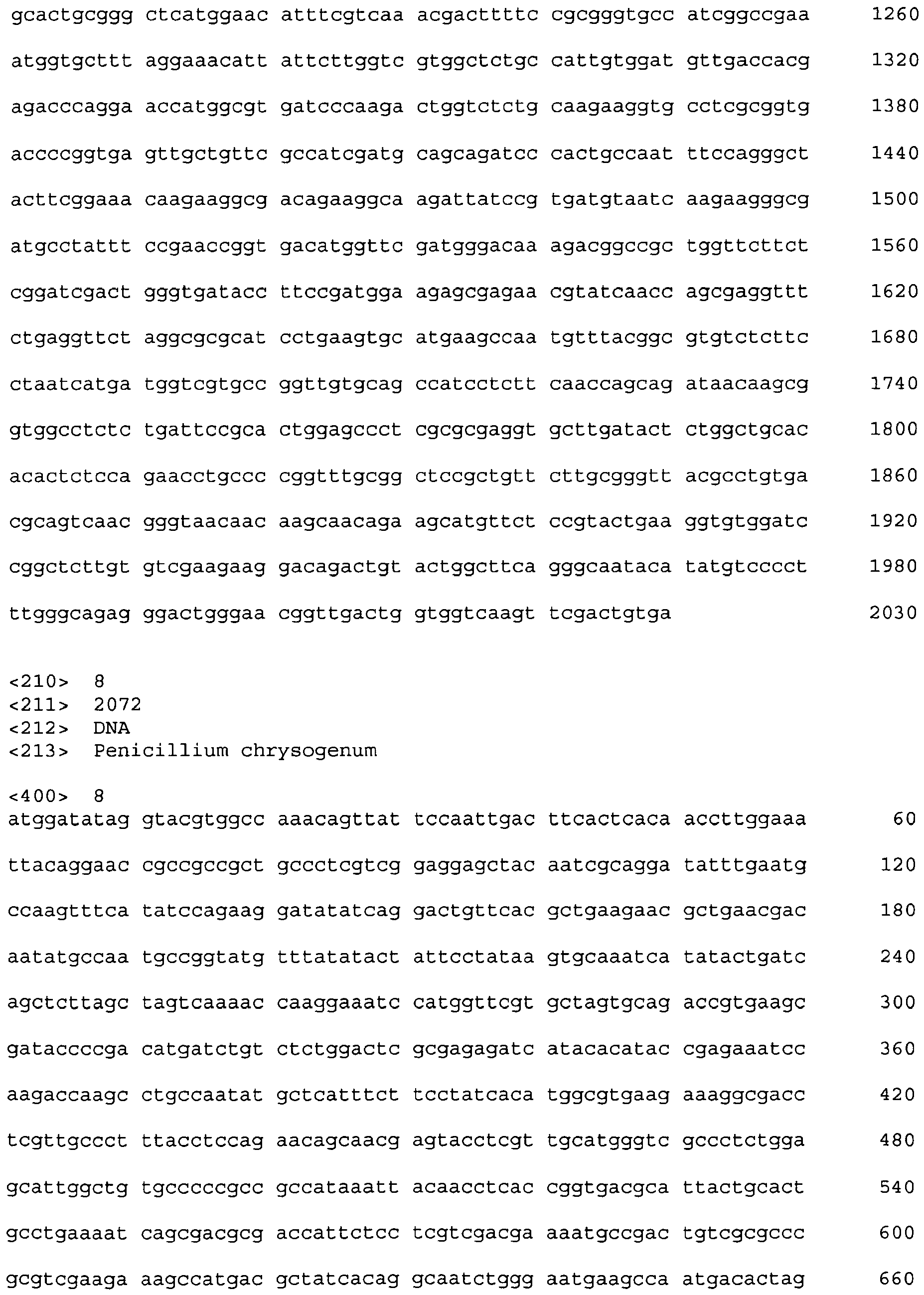


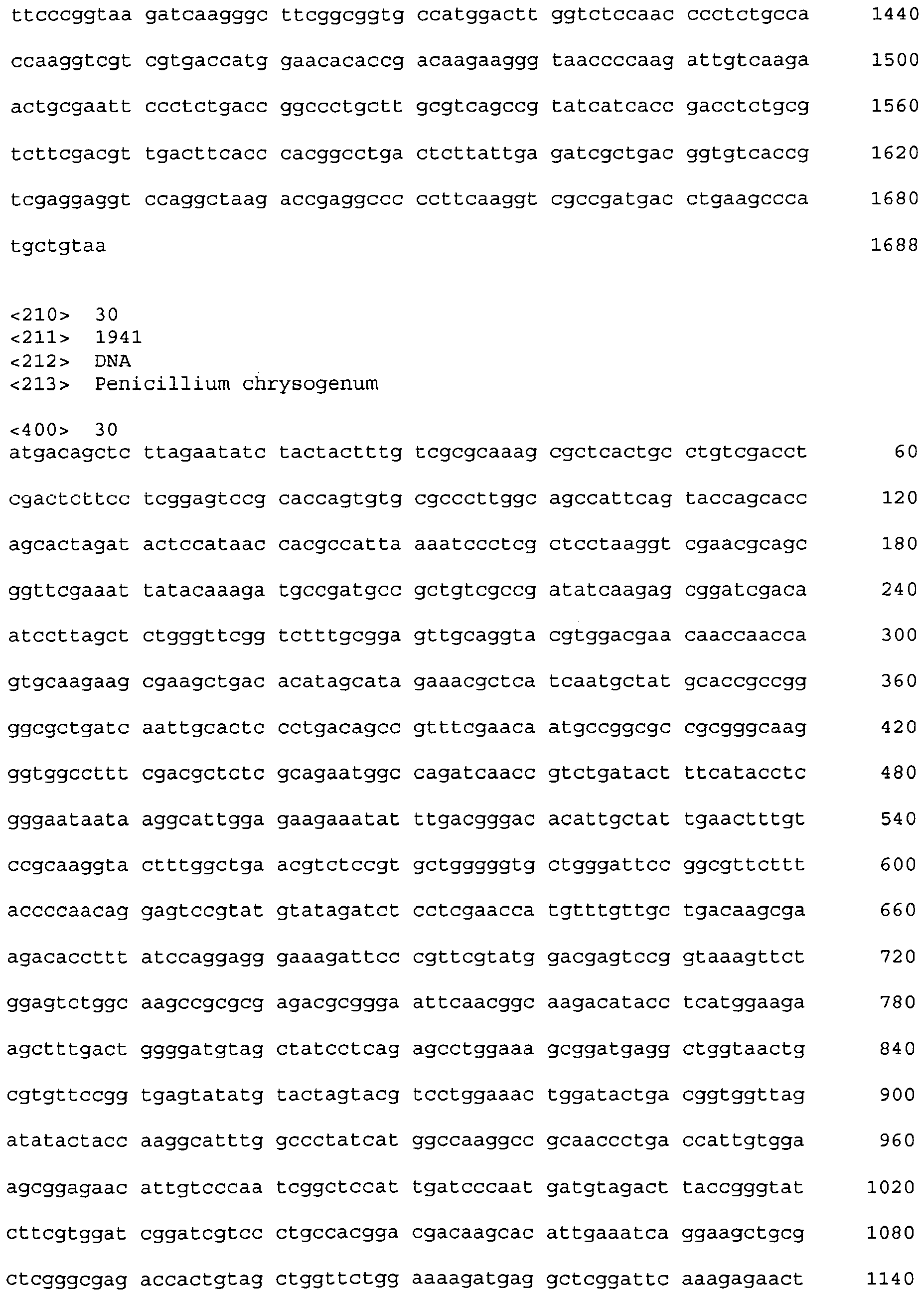


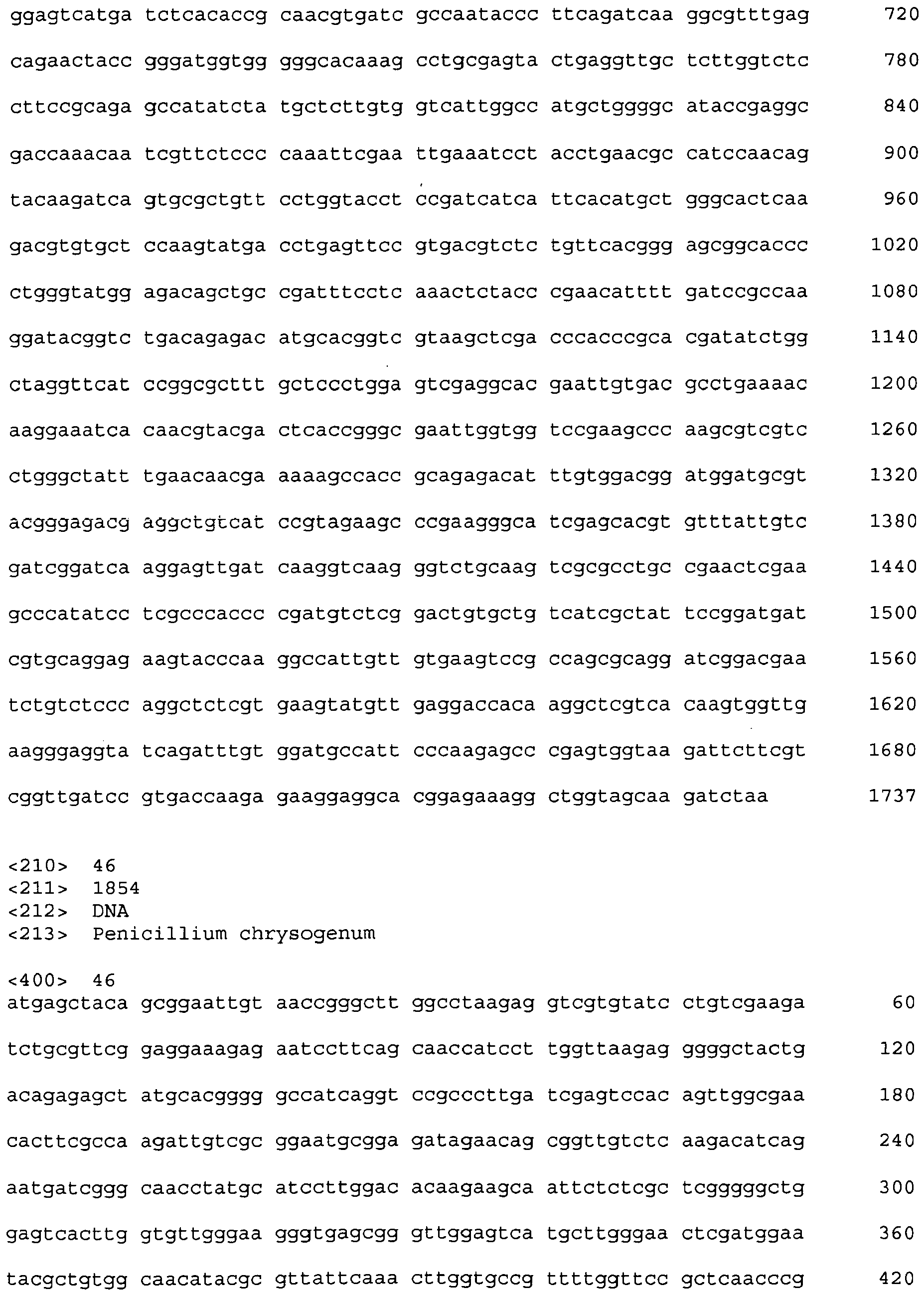


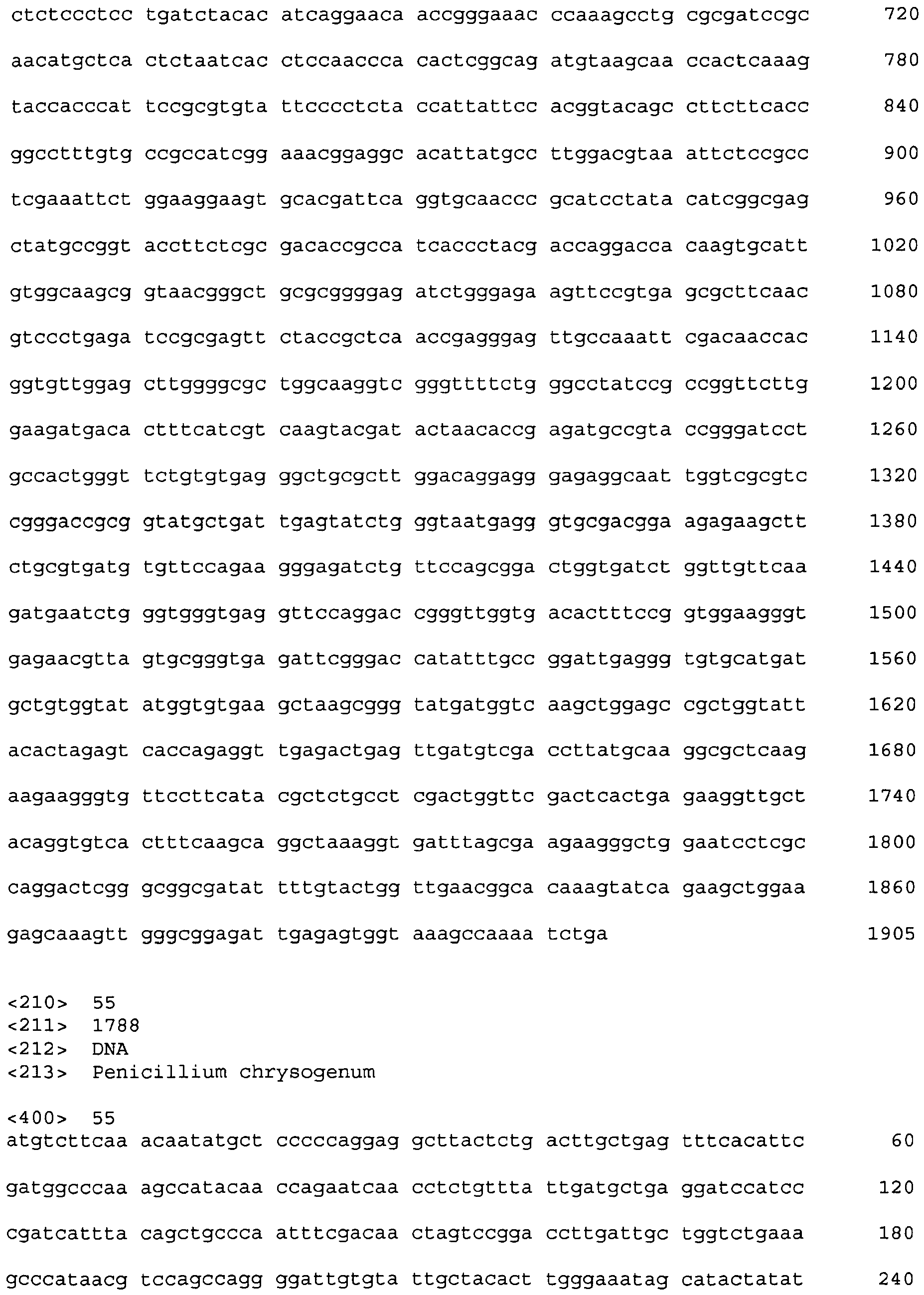


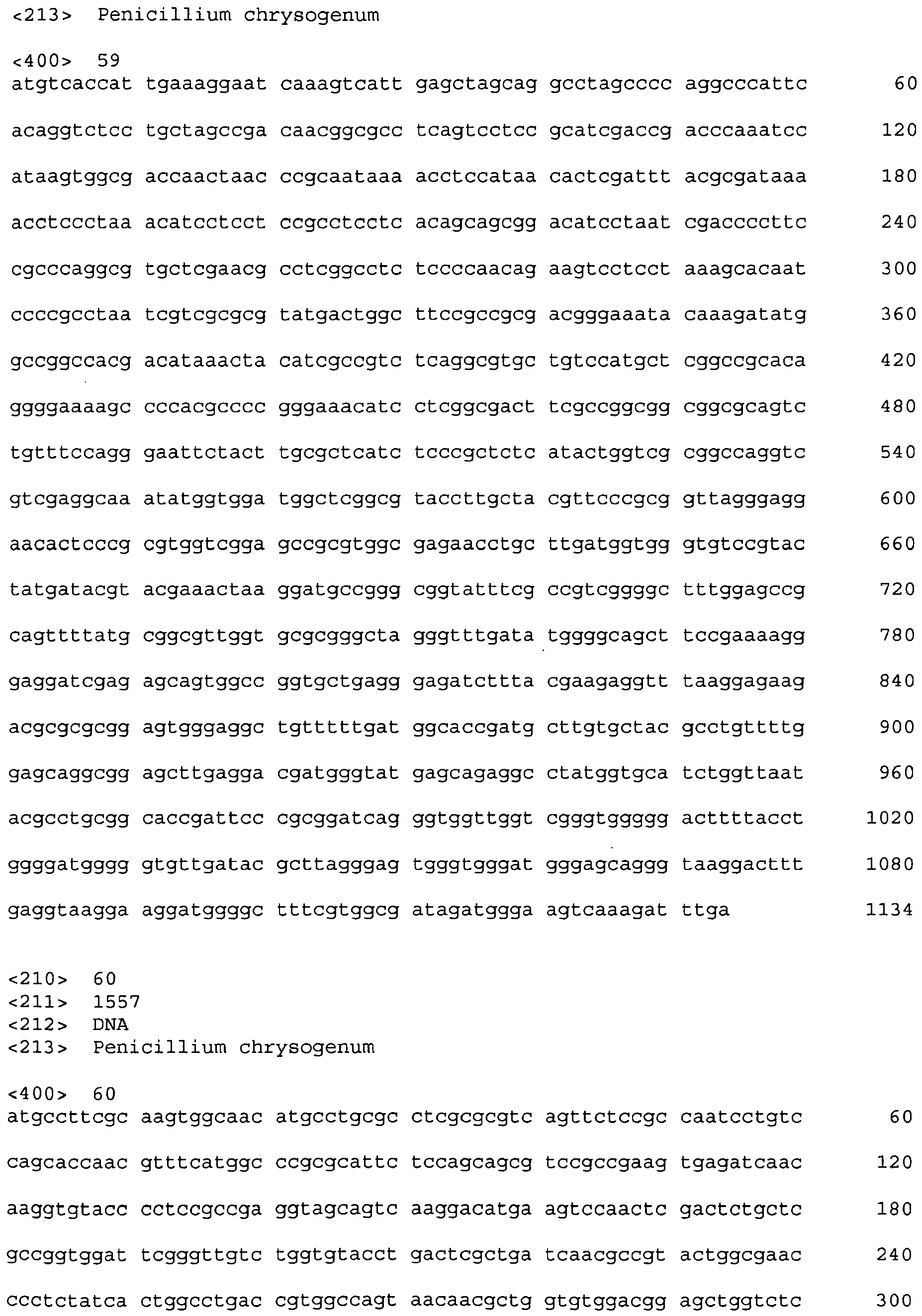


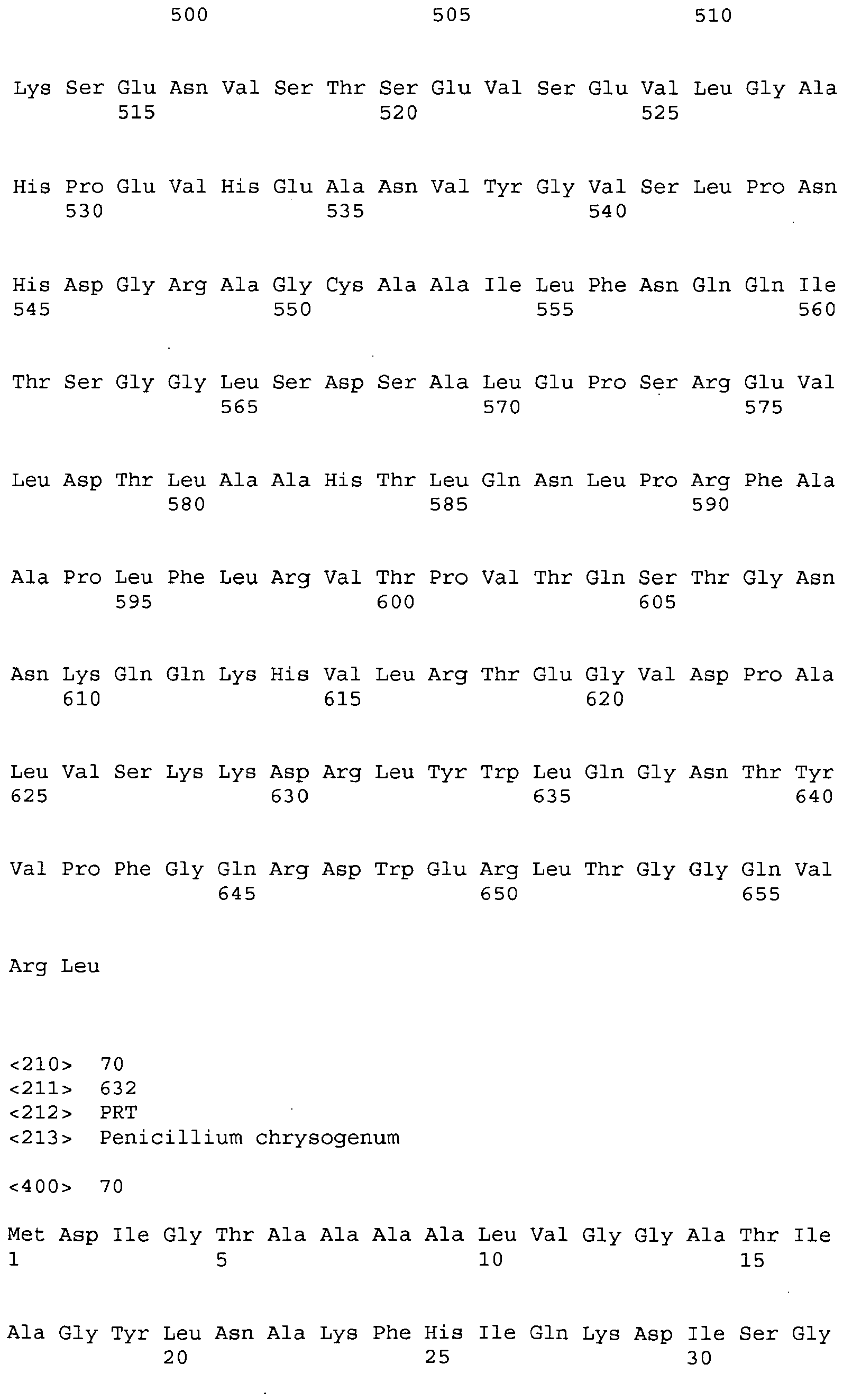


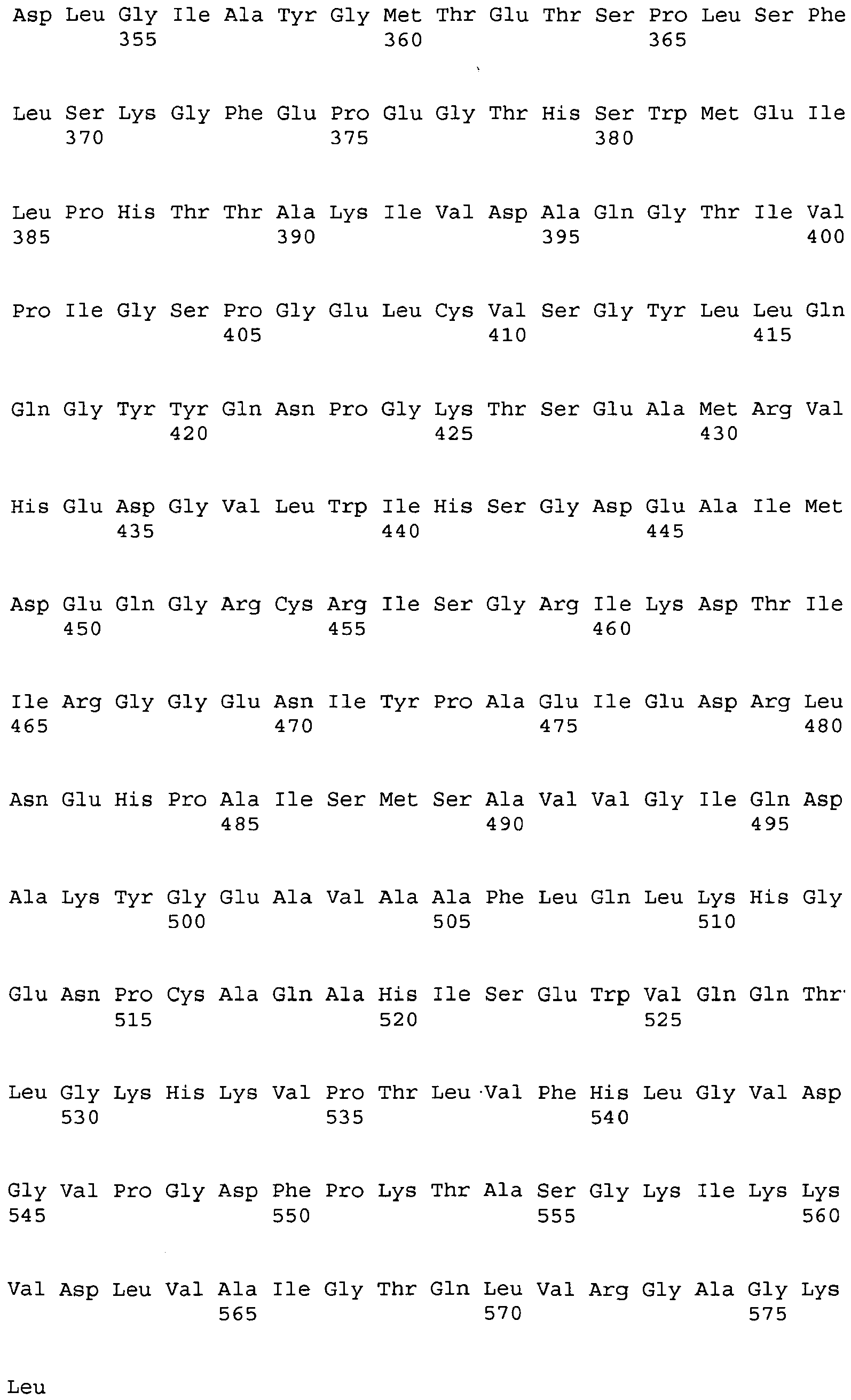

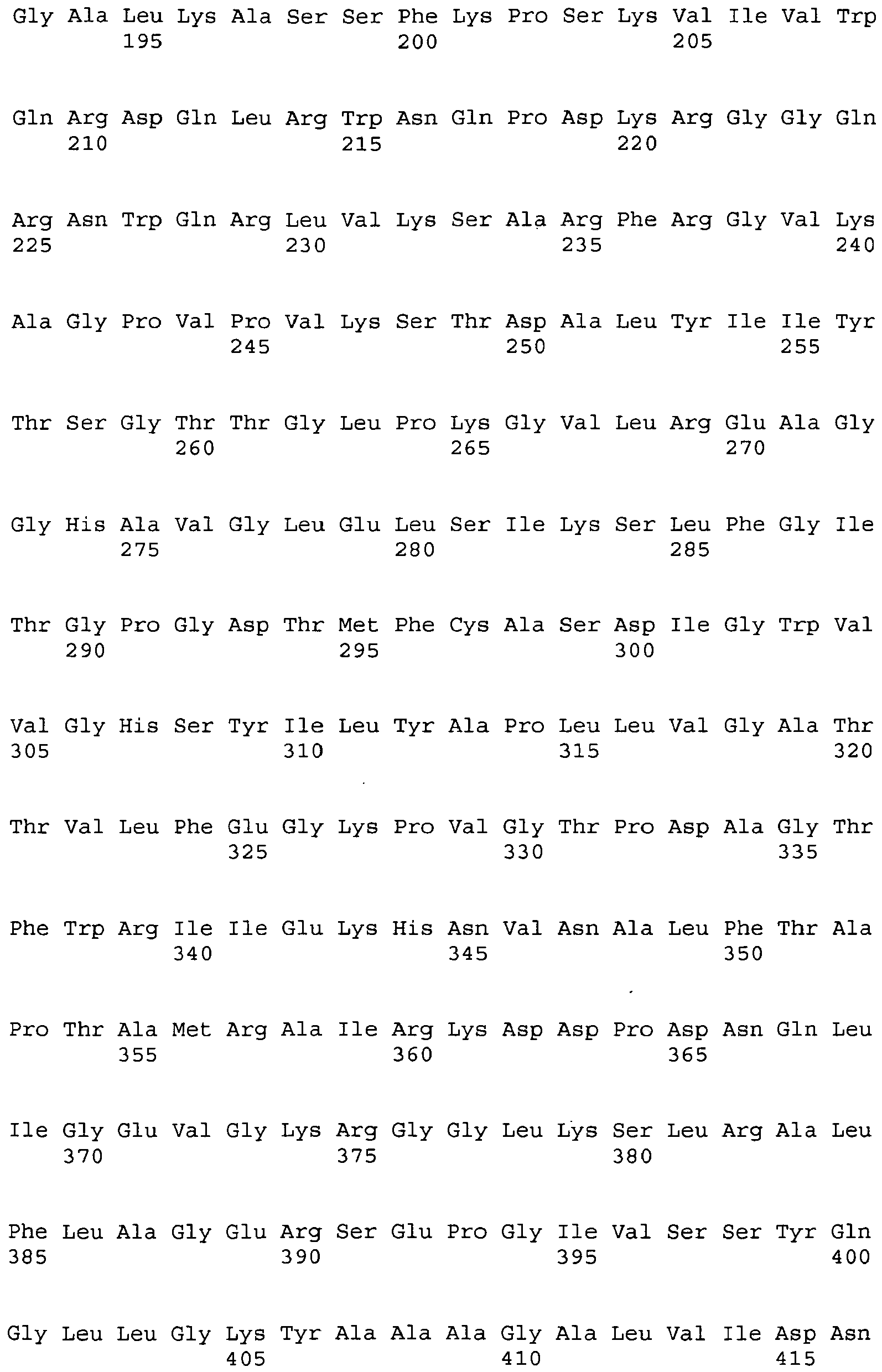


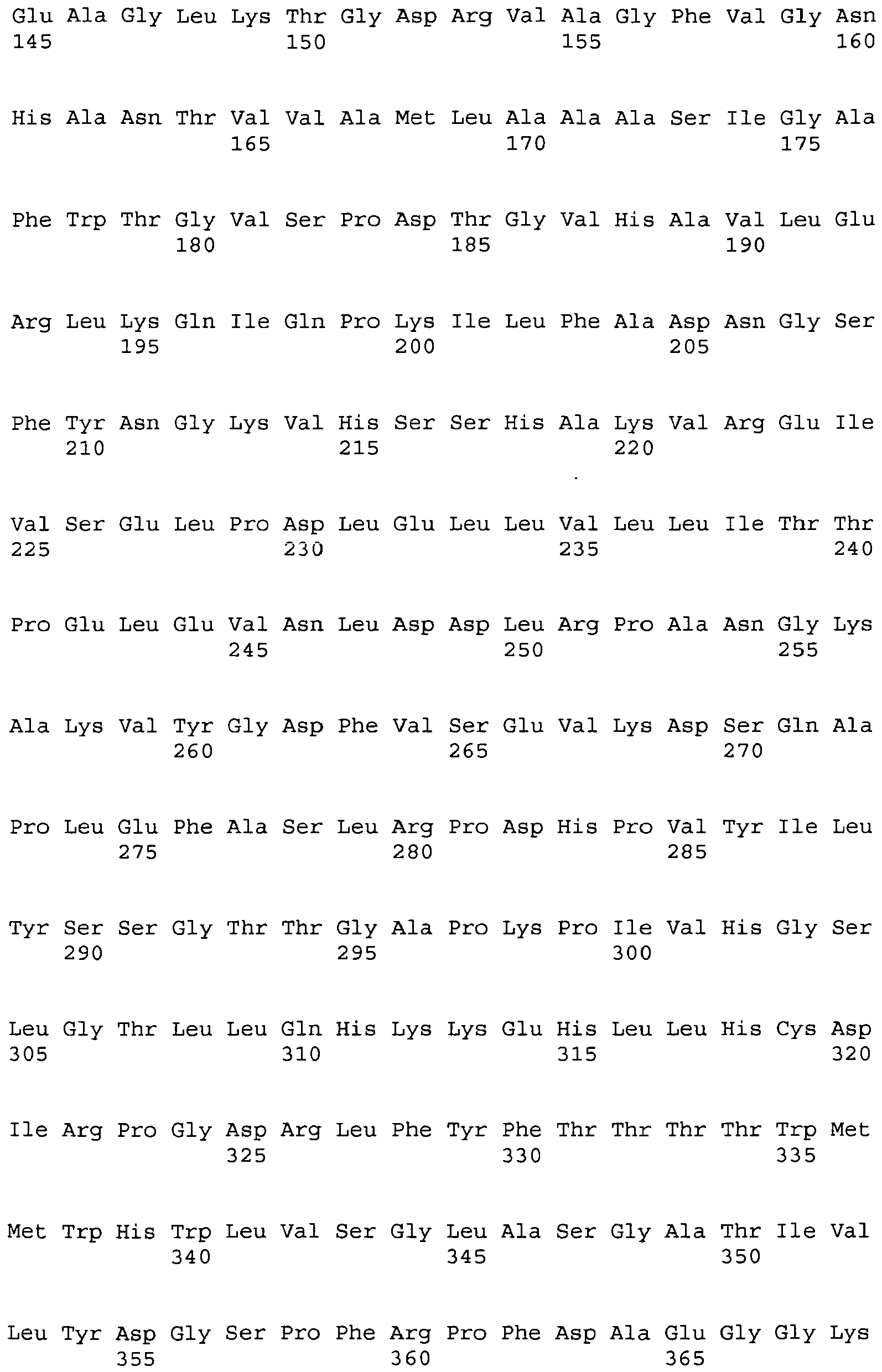


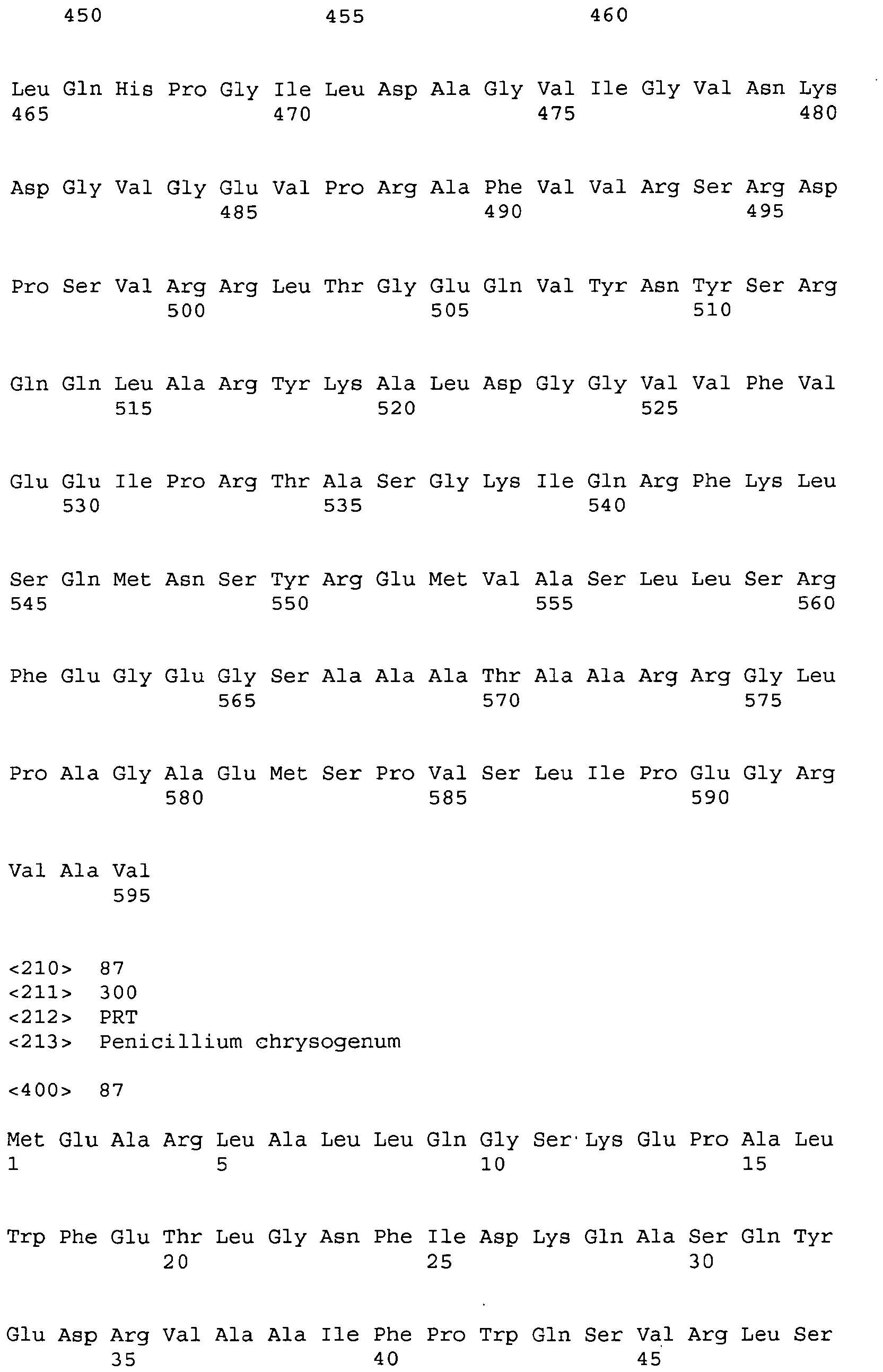


| Strain | Adipoyl-7ADCA (control=100) | Adipoyl-CoA ligase (nmol/min.mg) | Hexanoyl-CoA ligase (nmol/min.mg) | PA-CoA ligase (nmol/min.mg) |
| Parent | 100% | 51 | 100 | 100 |
| Transformant A | 112% | 159 | 222 | 755 |
| PCR | Target | Fwd oligo | Rev oligo | Expected if correct | Expected if |
| 1 | Left flank | SEQ ID NO 106 | SEQ ID NO 107 | 1.9 kb | No |
| 2 | Right flank | SEQ ID NO 108 | SEQ ID NO 109 | 3.4 kb | No |
| 3 | Gene Locus | SEQ ID NO 106 | SEQ ID NO 109 | 8.3 kb | 4.5 kb |
Claims (17)
- A mutant microbial strain capable of producing an N-adipoylated β-lactam compound when cultured in a culture medium comprising adipic acid characterized in that one ore more genes encoding an adipoyl-CoA forming enzyme is over expressed in the mutant strain resulting in an improved incorporation yield of the adipic acid from the culture medium into the N-adipoylated β-lactam compound compared to the non-mutant parent strain wherein said gene is not over expressed.
- The mutant microbial strain of claim 1 characterized in that the improved adipate incorporation yield is at least 5%.
- The mutant microbial strain of any of claims 1 and 2 wherein the adipoyl-CoA forming enzyme is acid CoA ligase (EC 6.2.1.xx).
- The mutant microbial strain of any of claims 1 and 2 wherein the adipoyl-CoA forming enzyme is acid-CoA transferase (EC 2.8.3.xx).
- The mutant microbial strain of 3 wherein the gene encoding acid CoA ligase (EC 6.2.1.xx) is selected from the group consisting of Pc13g14420 (SEQ ID No:1); Pc21g22010 (SEQ ID No:2); Pc22g20270 (SEQ ID No:3); Pc22g00960 (SEQ ID No:4); Pc12g05520 (SEQ ID No:5); Pc13g12270 (SEQ ID No:6); Pc18g05710 (SEQ ID No:7); Pc20g13500 (SEQ ID No:8); Pc13g01890 (SEQ ID No:9); Pc20g10840 (SEQ ID No:10); Pc13g05130 (SEQ ID No:11); Pc13g10810 (SEQ ID No:12); Pc22g06680 (SEQ ID No:13); Pc22g14900 (SEQ ID No:14); Pc22g16410 (SEQ ID No:15); Pc21g13540 (SEQ ID No:16); Pc21g20650 (SEQ ID No:17); Pc21g23730 (SEQ ID No:18); Pc21g21960 (SEQ ID No:19); Pc22g24780 (SEQ ID No:20); Pc06g01160 (SEQ ID No:21); Pc12g09980 (SEQ ID No:22); Pc15g00420 (SEQ ID No:23); Pc21g07810 (SEQ ID No:24) and Pc21g09470 (SEQ ID No 25) and sequences that are substantially homologous to said sequences.
- The mutant microbial strain of claim 4 wherein the gene encoding acid-CoA transferase (EC 2.8.3.xx) is selected from the group consisting of Pc20g15639 (SEQ ID No: 26); Pc13g02780 (SEQ ID No: 27); Pc22g13680 (SEQ ID No: 28); Pc22g03940 (SEQ ID No: 29); Pc14g00590 (SEQ ID No: 30); Pc16g00210 (SEQ ID No: 31) and sequences that are substantially homologous to said sequences.
- The strain of any of the preceding claims wherein the N-adipoylated β-lactam compound is selected from the group consisting of adipoyl-6-APA, adipoyl-7-ADCA, adipoyl-7-ACA, adipoyl-7-ACCA, adipoyl-7-PACA, adipoyl-7-ADAC, adipoyl-7-ACCCA.
- The strain of any of the preceding claims wherein the strain is a fungus, bacterium or yeast.
- The strain of any of the preceding claims wherein the fungus belongs to the genus Penicillium.
- The strain of any of the preceding claims wherein the fungus is Penicillium chrysogenum, preferably transformed with and expressing a gene encoding an expandase or an expandase/hydroxylase.
- A method for the construction of the mutant strain as defined in claims 1-10 comprising over expression one ore more genes encoding an adipoyl-CoA forming enzyme.
- The method according to claim 11, wherein the adipoyl-CoA forming enzyme is acid CoA ligase (EC 6.2.1.xx).
- The method according to claim 11, wherein the adipoyl-CoA forming enzyme is acid-CoA transferase (EC 2.8.3).
- A gene encoding acid CoA ligase (EC 6.2.1.xx) and which is selected from the group consisting of Pc13g14420 (SEQ ID No:1); Pc21g22010 (SEQ ID No:2); Pc22g20270 (SEQ ID No:3); Pc22g00960 (SEQ ID No:4); Pc12g05520 (SEQ ID No:5); Pc13g12270 (SEQ ID No:6); Pc18g05710 (SEQ ID No:7); Pc20g13500 (SEQ ID No:8); Pc13g01890 (SEQ ID No:9); Pc20g10840 (SEQ ID No:10); Pc13g05130 (SEQ ID No:11); Pc13g10810 (SEQ ID No:12); Pc22g06680 (SEQ ID No:13); Pc22g14900 (SEQ ID No:14); Pc22g16410 (SEQ ID No:15); Pc21g13540 (SEQ ID No:16); Pc21g20650 (SEQ ID No:17); Pc21g23730 (SEQ ID No:18); Pc21g21960 (SEQ ID No:19); Pc22g24780 (SEQ ID No:20); Pc06g01160 (SEQ ID No:21); Pc12g09980 (SEQ ID No:22); Pc15g00420 (SEQ ID No:23); Pc21g07810 (SEQ ID No:24) and Pc21g09470 (SEQ ID No 25) or an acid-CoA transferase (EC 2.8.3.xx) and which is selected from the group consisting of Pc20g15639 (SEQ ID No: 26); Pc13g02780 (SEQ ID No: 27); Pc22g13680 (SEQ ID No: 28); Pc22g03940 (SEQ ID No: 29); Pc14g00590 (SEQ ID No: 30); Pc16g00210 (SEQ ID No: 31) and sequences that are substantially homologous to said sequences.
- A gene encoding acid-CoA transferase (EC 2.8.3.xx) and which is selected from the group consisting of Pc20g15639 (SEQ ID No: 26); Pc13g02780 (SEQ ID No: 27); Pc22g13680 (SEQ ID No: 28); Pc22g03940 (SEQ ID No: 29); Pc14g00590 (SEQ ID No: 30); Pc16g00210 (SEQ ID No: 31) and sequences that are substantially homologous to said sequences.
- A polypeptide encoded by the gene as defined in claim 14 or claim 15
- A process for the production of an N-adipoylated β-lactam compound comprising culturing the strain as defined in any of claims 1-10 in a fermentation medium comprising adipic acid.
Priority Applications (1)
| Application Number | Priority Date | Filing Date | Title |
|---|---|---|---|
| EP11163622A EP2392649A3 (en) | 2008-08-05 | 2009-08-04 | Adipoyl-7-ADCA producing strains |
Applications Claiming Priority (3)
| Application Number | Priority Date | Filing Date | Title |
|---|---|---|---|
| EP08161838 | 2008-08-05 | ||
| EP11163622A EP2392649A3 (en) | 2008-08-05 | 2009-08-04 | Adipoyl-7-ADCA producing strains |
| EP09781469A EP2310487A2 (en) | 2008-08-05 | 2009-08-04 | Adipoyl-7-adca producing strains |
Related Parent Applications (2)
| Application Number | Title | Priority Date | Filing Date |
|---|---|---|---|
| EP09781469.3 Division | 2009-08-04 | ||
| EP09781469 Previously-Filed-Application | 2009-08-04 |
Publications (2)
| Publication Number | Publication Date |
|---|---|
| EP2392649A2 true EP2392649A2 (en) | 2011-12-07 |
| EP2392649A3 EP2392649A3 (en) | 2012-01-11 |
Family
ID=41581076
Family Applications (2)
| Application Number | Title | Priority Date | Filing Date |
|---|---|---|---|
| EP09781469A Withdrawn EP2310487A2 (en) | 2008-08-05 | 2009-08-04 | Adipoyl-7-adca producing strains |
| EP11163622A Withdrawn EP2392649A3 (en) | 2008-08-05 | 2009-08-04 | Adipoyl-7-ADCA producing strains |
Family Applications Before (1)
| Application Number | Title | Priority Date | Filing Date |
|---|---|---|---|
| EP09781469A Withdrawn EP2310487A2 (en) | 2008-08-05 | 2009-08-04 | Adipoyl-7-adca producing strains |
Country Status (3)
| Country | Link |
|---|---|
| EP (2) | EP2310487A2 (en) |
| CN (1) | CN102131921A (en) |
| WO (1) | WO2010015627A2 (en) |
Families Citing this family (6)
| Publication number | Priority date | Publication date | Assignee | Title |
|---|---|---|---|---|
| UA115766C2 (en) | 2010-12-03 | 2017-12-26 | ДАУ АГРОСАЙЄНСІЗ ЕлЕлСі | Stacked herbicide tolerance event 8264.44.06.1, related transgenic soybean lines, and detection thereof |
| US9540656B2 (en) | 2010-12-03 | 2017-01-10 | Dow Agrosciences Llc | Stacked herbicide tolerance event 8291.45.36.2, related transgenic soybean lines, and detection thereof |
| TW201317353A (en) | 2011-07-13 | 2013-05-01 | Dow Agrosciences Llc | Stacked herbicide tolerance event 8264.42.32.1, related transgenic soybean lines, and detection thereof |
| EP2687603A1 (en) * | 2012-07-19 | 2014-01-22 | Ruhr-Universität Bochum | T7 promoter variants and methods of using the same |
| US10538746B2 (en) * | 2016-03-17 | 2020-01-21 | INVISTA North America S.à r.l. | Polypeptides and variants having improved activity, materials and processes relating thereto |
| CN113430215B (en) * | 2021-06-03 | 2023-04-18 | 昆明理工大学 | Acetyl CoA synthetase gene RKACS1 and application thereof |
Citations (19)
| Publication number | Priority date | Publication date | Assignee | Title |
|---|---|---|---|---|
| WO1993005158A1 (en) | 1991-09-11 | 1993-03-18 | Merck & Co., Inc. | Novel bioprocess for preparing 7-adca |
| EP0635574A1 (en) | 1993-07-23 | 1995-01-25 | Gist-Brocades N.V. | Selection marker gene free recombinant strains, a method for obtaining them and the use of these strains |
| WO1995004149A1 (en) | 1993-07-30 | 1995-02-09 | Gist-Brocades B.V. | Process for the efficient production of 7-adca via 3-(carboxyethylthio)propionyl-7-adca |
| WO1995004148A1 (en) | 1993-07-30 | 1995-02-09 | Gist-Brocades B.V. | Process for the efficient production of 7-adca via 2-(carboxyethylthio)acetyl-7-adca and 3-(carboxymethylthio)propionyl-7-adca |
| WO1996038580A1 (en) | 1995-06-02 | 1996-12-05 | Gist-Brocades B.V. | Process for the production of 7-adca via expandase activity on penicillin g |
| WO1997006261A2 (en) | 1995-08-03 | 1997-02-20 | Gist-Brocades B.V. | THE USE OF HOMOLOGOUS amdS GENES AS SELECTABLE MARKERS |
| WO1997038107A1 (en) | 1996-04-04 | 1997-10-16 | Gist-Brocades B.V. | An enzyme with high adipoyl-coenzyme a synthetase activity and uses thereof |
| WO1998048034A1 (en) | 1997-04-22 | 1998-10-29 | Gist-Brocades B.V. | Process for the fermentative production of deacylated cephalosporins |
| WO1998048035A1 (en) | 1997-04-22 | 1998-10-29 | Gist-Brocades B.V. | Process for the fermentative production of deacylated cephalosporins |
| US20020039758A1 (en) | 1997-02-20 | 2002-04-04 | De Laat Wilhelmus Theodorus Antonius Maria | Fermentative production of valuable compounds on an industrial scale using chemically defined media |
| WO2003001311A1 (en) | 2001-06-26 | 2003-01-03 | Eads Astrium Sas | Method and device for controlling satellite attitude and steering using a gyrodyne cluster |
| WO2003010183A2 (en) | 2001-07-23 | 2003-02-06 | Dsm Ip Assets B.V. | Process for preparing variant polynucleotides |
| WO2004106347A1 (en) | 2003-05-28 | 2004-12-09 | Dsm Ip Assets B.V. | Cephem compound |
| WO2005059149A2 (en) | 2003-12-12 | 2005-06-30 | Chromagenics B.V. | Improved protein production |
| WO2005095624A2 (en) | 2004-04-02 | 2005-10-13 | Dsm Ip Assets B.V. | Filamentous fungal mutants with improved homologous recombination efficiency |
| WO2006077258A1 (en) | 2005-01-24 | 2006-07-27 | Dsm Ip Assets B.V. | Method for producing a compound of interest in a filamentous fungal cell |
| WO2007071399A2 (en) | 2005-12-22 | 2007-06-28 | Sandoz Ag | Promoter sequences |
| WO2007115886A1 (en) | 2006-04-08 | 2007-10-18 | Dsm Ip Assets B.V. | Improved method for homologous recombination in eukaryotic cells |
| WO2007118836A1 (en) | 2006-04-13 | 2007-10-25 | Dsm Ip Assets B.V. | Bi-directional selection markers with improved activity |
-
2009
- 2009-08-04 EP EP09781469A patent/EP2310487A2/en not_active Withdrawn
- 2009-08-04 WO PCT/EP2009/060090 patent/WO2010015627A2/en not_active Ceased
- 2009-08-04 CN CN2009801309965A patent/CN102131921A/en active Pending
- 2009-08-04 EP EP11163622A patent/EP2392649A3/en not_active Withdrawn
Patent Citations (20)
| Publication number | Priority date | Publication date | Assignee | Title |
|---|---|---|---|---|
| WO1993005158A1 (en) | 1991-09-11 | 1993-03-18 | Merck & Co., Inc. | Novel bioprocess for preparing 7-adca |
| EP0635574A1 (en) | 1993-07-23 | 1995-01-25 | Gist-Brocades N.V. | Selection marker gene free recombinant strains, a method for obtaining them and the use of these strains |
| WO1995004149A1 (en) | 1993-07-30 | 1995-02-09 | Gist-Brocades B.V. | Process for the efficient production of 7-adca via 3-(carboxyethylthio)propionyl-7-adca |
| WO1995004148A1 (en) | 1993-07-30 | 1995-02-09 | Gist-Brocades B.V. | Process for the efficient production of 7-adca via 2-(carboxyethylthio)acetyl-7-adca and 3-(carboxymethylthio)propionyl-7-adca |
| WO1996038580A1 (en) | 1995-06-02 | 1996-12-05 | Gist-Brocades B.V. | Process for the production of 7-adca via expandase activity on penicillin g |
| WO1997006261A2 (en) | 1995-08-03 | 1997-02-20 | Gist-Brocades B.V. | THE USE OF HOMOLOGOUS amdS GENES AS SELECTABLE MARKERS |
| WO1997038107A1 (en) | 1996-04-04 | 1997-10-16 | Gist-Brocades B.V. | An enzyme with high adipoyl-coenzyme a synthetase activity and uses thereof |
| US20020039758A1 (en) | 1997-02-20 | 2002-04-04 | De Laat Wilhelmus Theodorus Antonius Maria | Fermentative production of valuable compounds on an industrial scale using chemically defined media |
| US6410259B1 (en) | 1997-04-22 | 2002-06-25 | Dsm Patents & Trademarks | Process for the fermentative production of deacylated cephalosporins |
| WO1998048035A1 (en) | 1997-04-22 | 1998-10-29 | Gist-Brocades B.V. | Process for the fermentative production of deacylated cephalosporins |
| WO1998048034A1 (en) | 1997-04-22 | 1998-10-29 | Gist-Brocades B.V. | Process for the fermentative production of deacylated cephalosporins |
| WO2003001311A1 (en) | 2001-06-26 | 2003-01-03 | Eads Astrium Sas | Method and device for controlling satellite attitude and steering using a gyrodyne cluster |
| WO2003010183A2 (en) | 2001-07-23 | 2003-02-06 | Dsm Ip Assets B.V. | Process for preparing variant polynucleotides |
| WO2004106347A1 (en) | 2003-05-28 | 2004-12-09 | Dsm Ip Assets B.V. | Cephem compound |
| WO2005059149A2 (en) | 2003-12-12 | 2005-06-30 | Chromagenics B.V. | Improved protein production |
| WO2005095624A2 (en) | 2004-04-02 | 2005-10-13 | Dsm Ip Assets B.V. | Filamentous fungal mutants with improved homologous recombination efficiency |
| WO2006077258A1 (en) | 2005-01-24 | 2006-07-27 | Dsm Ip Assets B.V. | Method for producing a compound of interest in a filamentous fungal cell |
| WO2007071399A2 (en) | 2005-12-22 | 2007-06-28 | Sandoz Ag | Promoter sequences |
| WO2007115886A1 (en) | 2006-04-08 | 2007-10-18 | Dsm Ip Assets B.V. | Improved method for homologous recombination in eukaryotic cells |
| WO2007118836A1 (en) | 2006-04-13 | 2007-10-25 | Dsm Ip Assets B.V. | Bi-directional selection markers with improved activity |
Non-Patent Citations (11)
| Title |
|---|
| ALEKSENKO, CLUTTERBUCK, FUNGAL GENET. BIOL, vol. 21, 1997, pages 373 - 397 |
| ALTSCHUL ET AL., J. MOL. BIOL., vol. 215, 1990, pages 403 - 410 |
| BOWIE, J.U. ET AL., SCIENCE, vol. 247, 1990, pages 1306 - 1310 |
| BUTTERWORTH-HEINEMANN: "More Gene Manipulations in fungi", 1992, ACADEMIC PRESS |
| HENIKOFF, HENIKOFF, PROC. NATL. ACAD. SCI. USA, vol. 89, 1989, pages 10915 |
| KOZAK, J. BIOL. CHEM., vol. 266, 1991, pages 19867 - 19870 |
| ROBIN ET AL., APPL. MICROBIOL. BIOTECHNOL, vol. 57, 2001, pages 357 - 362 |
| SAMBROOK, J. ET AL.: "Molecular cloning: a laboratory manual", 1989, COLD SPRING HARBOR LABORATORY PRESS |
| THYKAER, METABOLIC ENGINEERING, vol. 4, 2002, pages 151 - 158 |
| TILBURN ET AL., GENE, vol. 26, 1983, pages 205 - 221 |
| TURNER: "Biotechnology", 1992, VHC |
Also Published As
| Publication number | Publication date |
|---|---|
| WO2010015627A3 (en) | 2010-09-30 |
| EP2310487A2 (en) | 2011-04-20 |
| CN102131921A (en) | 2011-07-20 |
| EP2392649A3 (en) | 2012-01-11 |
| WO2010015627A2 (en) | 2010-02-11 |
Similar Documents
| Publication | Publication Date | Title |
|---|---|---|
| Kennedy et al. | δ-(L-α-Aminoadipyl)-L-cysteinyl-D-valine synthetase is a rate limiting enzyme for penicillin production in Aspergillus nidulans | |
| CN100390285C (en) | Improvements in the in vivo production of cephalosporins | |
| RU2711983C2 (en) | Microorganism which produces lactic acid and method of producing lactic acid using thereof | |
| EP2392649A2 (en) | Adipoyl-7-ADCA producing strains | |
| EP1656450B1 (en) | Cephalosporin c acylase mutant and method for preparing 7-aca using same | |
| US20110223640A1 (en) | Improved statin production | |
| Koetsier et al. | The Penicillium chrysogenum aclA gene encodes a broad-substrate-specificity acyl-coenzyme A ligase involved in activation of adipic acid, a side-chain precursor for cephem antibiotics | |
| KR101985911B1 (en) | Mutants of penicillin G acylase from Achromobacter sp. CCM 4824, and uses thereof | |
| MX2007006780A (en) | Production of beta-lactam antibiotics by genetically modified non-naturally producing microorganisms. | |
| CN1162337A (en) | Process of producing beta-lactam antibiotics applying microorganisms with increased ligase activity | |
| US20090233287A1 (en) | Production of compounds in a recombinant host | |
| WO2009133098A2 (en) | β-LACTAM PRODUCING STRAINS | |
| WO2010015625A1 (en) | Adipoyl-7-adca producing strains | |
| EP2094841B1 (en) | Process for preparing pravastatin | |
| WO2009133096A2 (en) | β-LACTAM PRODUCING STRAINS | |
| EP2123772A1 (en) | Beta-lactam antibiotic producing strains | |
| KR102688632B1 (en) | Deacetoxycephalosporin C Producing Strain for 7-ADCA Production with High Concentration and High Purity and Production Method Using the Same | |
| EP0444758A1 (en) | Method for modification of ACV synthetase and use of the modified enzyme for production of beta-lactam antibiotics | |
| EP1226266B1 (en) | Method for enhancing secretion of beta-lactam compounds | |
| WO1997038107A1 (en) | An enzyme with high adipoyl-coenzyme a synthetase activity and uses thereof | |
| CN101432297A (en) | Production of compounds in a recombinant host | |
| WO2010069914A1 (en) | Statin transcription regulators | |
| HK1125973A (en) | Mutant expandases and their use in the production of beta-lactam compounds | |
| BRPI0609248A2 (en) | unchanged isopenicillin-acyltransferase polypeptides and related polynucleotides |
Legal Events
| Date | Code | Title | Description |
|---|---|---|---|
| 17P | Request for examination filed |
Effective date: 20110426 |
|
| AC | Divisional application: reference to earlier application |
Ref document number: 2310487 Country of ref document: EP Kind code of ref document: P |
|
| AK | Designated contracting states |
Kind code of ref document: A2 Designated state(s): AT BE BG CH CY CZ DE DK EE ES FI FR GB GR HR HU IE IS IT LI LT LU LV MC MK MT NL NO PL PT RO SE SI SK SM TR |
|
| AX | Request for extension of the european patent |
Extension state: AL BA RS |
|
| PUAI | Public reference made under article 153(3) epc to a published international application that has entered the european phase |
Free format text: ORIGINAL CODE: 0009012 |
|
| PUAL | Search report despatched |
Free format text: ORIGINAL CODE: 0009013 |
|
| AK | Designated contracting states |
Kind code of ref document: A3 Designated state(s): AT BE BG CH CY CZ DE DK EE ES FI FR GB GR HR HU IE IS IT LI LT LU LV MC MK MT NL NO PL PT RO SE SI SK SM TR |
|
| AX | Request for extension of the european patent |
Extension state: AL BA RS |
|
| RIC1 | Information provided on ipc code assigned before grant |
Ipc: C12N 9/10 20060101ALI20111208BHEP Ipc: C12N 9/00 20060101AFI20111208BHEP |
|
| RAP1 | Party data changed (applicant data changed or rights of an application transferred) |
Owner name: DSM SINOCHEM PHARMACEUTICALS NETHERLANDS B.V. |
|
| STAA | Information on the status of an ep patent application or granted ep patent |
Free format text: STATUS: THE APPLICATION IS DEEMED TO BE WITHDRAWN |
|
| 18D | Application deemed to be withdrawn |
Effective date: 20120712 |