EP2391633B1 - Process for the recovery of beta-acetylfuranoside - Google Patents
Process for the recovery of beta-acetylfuranoside Download PDFInfo
- Publication number
- EP2391633B1 EP2391633B1 EP10700424.4A EP10700424A EP2391633B1 EP 2391633 B1 EP2391633 B1 EP 2391633B1 EP 10700424 A EP10700424 A EP 10700424A EP 2391633 B1 EP2391633 B1 EP 2391633B1
- Authority
- EP
- European Patent Office
- Prior art keywords
- acf
- distillation
- acetylation
- weight
- followed
- Prior art date
- Legal status (The legal status is an assumption and is not a legal conclusion. Google has not performed a legal analysis and makes no representation as to the accuracy of the status listed.)
- Active
Links
Images

Classifications
-
- C—CHEMISTRY; METALLURGY
- C07—ORGANIC CHEMISTRY
- C07H—SUGARS; DERIVATIVES THEREOF; NUCLEOSIDES; NUCLEOTIDES; NUCLEIC ACIDS
- C07H1/00—Processes for the preparation of sugar derivatives
-
- C—CHEMISTRY; METALLURGY
- C07—ORGANIC CHEMISTRY
- C07H—SUGARS; DERIVATIVES THEREOF; NUCLEOSIDES; NUCLEOTIDES; NUCLEIC ACIDS
- C07H1/00—Processes for the preparation of sugar derivatives
- C07H1/06—Separation; Purification
-
- C—CHEMISTRY; METALLURGY
- C07—ORGANIC CHEMISTRY
- C07H—SUGARS; DERIVATIVES THEREOF; NUCLEOSIDES; NUCLEOTIDES; NUCLEIC ACIDS
- C07H13/00—Compounds containing saccharide radicals esterified by carbonic acid or derivatives thereof, or by organic acids, e.g. phosphonic acids
- C07H13/02—Compounds containing saccharide radicals esterified by carbonic acid or derivatives thereof, or by organic acids, e.g. phosphonic acids by carboxylic acids
- C07H13/04—Compounds containing saccharide radicals esterified by carbonic acid or derivatives thereof, or by organic acids, e.g. phosphonic acids by carboxylic acids having the esterifying carboxyl radicals attached to acyclic carbon atoms
Definitions
- the present invention is directed to a novel process for the recovery of further ⁇ -Acetylfuranoside ( ⁇ -ACF, ⁇ -5-deoxy-1,2,3-tri-O-acetyl- D -ribofuranose) from mother liquors and process waste streams remaining from an initial synthesis of ACF.
- ⁇ -ACF ⁇ -Acetylfuranoside
- ACF can be prepared according to well known methods, as for example described in Helvetica Chimica Acta, Viol 65(Nr.149), Fasc. 5, 1982, 1531 .
- the synthesis of ACF leads to a racemic mixture of ⁇ - and ⁇ -ACF which can be separated by selective crystallization and thus precipitation from the reaction mixture.
- ⁇ -ACF is the desired product, as it is a valuable starting material used in the manufacture of inter alia cytidine derivatives, such as capecitabine.
- Capecitabine is the active ingredient of the medicament XelodaTM.
- the ACF synthesis can be summarized according to the following reaction scheme 1:
- EP 0 021 231 as well as WO 2005/040184 disclose the further reaction of the unseparated ACF racemic mixture, containing both ⁇ - and ⁇ -ACF, to a final product. The separation is thus only carried out subsequent to the reaction of the ⁇ -anomer to the desired end product.
- the advantages of the method according to the present invention are the increase of the overall yield of ⁇ -ACF, and consequently also of capecitabine per production cycle, thereby reducing the overall production costs.
- the present method renders the entire manufacturing more environmentally friendly due to avoiding of unnecessary high amounts of chemical waste.
- the method according to the present invention can also optionally be repeated in several serially connected cycles, thereby further improving the efficacy of the present method.
- the present invention provides a method for recovery of initially not separated ⁇ -ACF from mother liquor remaining from the synthesis of ACF, comprising the following sequential reaction steps:
- the distillation to about 60 to 80 weight-% in process step a) as described above is carried out at 1 to 3 mbar and 200 to 210 °C heating temperature in a continuous thin-film evaporator.
- the mixture which has to be distilled does surprisingly not decompose under these conditions though normally ß-Acetylfuranoside begins to decompose at 150°C.
- step b) comprises the de-acetylation of ⁇ / ⁇ -ACF in the presence of a suitable base, followed by neutralization with a suitable acid and further followed by the re-acetylation reaction in the presence of suitable base, a suitable catalyst and a suitable acetylating agent.
- the process step a) as described above is carried out according to the specific conditions as described in the accompanying Example 1; and the process step b) is carried out according to the specific conditions as described in the accompanying Example 2.
- mother liquor means any remaining mixture of residual starting materials or by-products left over after a main reaction product is isolated from that mixture in any step according to the present method.
- mother liquor means the remaining mixture subsequent to the synthesis of ACF according to scheme 1 above, which contains residual amounts of ⁇ / ⁇ -ACF together with a variety of impurities and by-products.
- distillation or “distillation method” as used herein means falling-film evaporation, molecular distillation, centrifugal molecular distillation or thin-film evaporation.
- a particularly preferred distillation method according to the present invention is the use of a thin-film evaporator.
- suitable solvent in connection with the crystallization of ⁇ -ACF preferably means aliphatic alcohols, most preferably propan-2-ol.
- chemical reaction step or “chemical conversion” as used herein means the conversion of the mixture of ⁇ - and ⁇ -Acetylfuranoside ( ⁇ / ⁇ -ACF), which are both present in a ratio ⁇ : ⁇ of about 1:1, towards an increased amount of ⁇ -Acetylfuranoside by a series of chemical reaction steps, in particular by de-acetylation and subsequent re-acetylation.
- suitable base in connection with the de-acetylation in step b) as described herein means alkali hydroxides or alkali alcoholates, preferably sodium methanolate (sodium methoxide).
- suitable acid in connection with step b) as described herein means any conventional acid, preferably hydrochloric acid.
- suitable base in connection with the re-acetylation in step b) as described herein means a base, preferably aliphatic or aromatic amines, most preferably triethylamine, n-methylpiperidine or pyridine.
- suitable acetylation agent in connection with re-acetylation in step b) as described herein means acetic anhydride or acetyl halides, e. g. acetyl chloride.
- suitable catalyst in connection with the re-acetylation in step b) as described herein means substituted amino-pyridines, preferably 4-dimethylaminopyridine.
- the de-acetylation mentioned under step b) above is preferably carried out in aliphatic alcohols, in particular methanol, as solvents and at temperatures between 0 and -20°C, preferably -5 and -10 °C. Subsequently, the reaction mixture is neutralized with a mineral acid, preferably hydrochloric acid, up to pH 4-6, preferably 5.
- a mineral acid preferably hydrochloric acid, up to pH 4-6, preferably 5.
- the initial solvent thus the aliphatic alcohol, is removed by distillation and replaced by a new solvent selected from chlorinated hydrocarbons, preferably methylenchloride or aromatic hydrocarbons, preferably toluene.
- re-acetylation is carried out by the addition of a suitable amine, preferably triethylamine, 4-dimethylaminopyridine and acetic anhydride at temperatures of below 30°C, preferably 15°C to 20°C.
- a suitable amine preferably triethylamine, 4-dimethylaminopyridine and acetic anhydride
- steps a) and b) are given below and in particular by the accompanying working examples.
- step c) The optional repetition of the sequential recovery cycle according to the present invention as mentioned under step c) above, can be carried out as many times as necessary. Possible limitations in the number of recovery cycles may arise from technical and chemical considerations, for example if no further ⁇ -ACF can be recovered or if the amount of recovered ⁇ -ACF becomes to small to justify the costs of the further continuation of the recovery cycle.
- the mother liquor/waste stream solvent is removed ("Desolventizing") under reduced pressure (0 to 1000 mbar, preferably 0 to 200 mbar) and at 10 to 100°C, preferably 30 to 80°C, the obtained evaporation residue is feeded to a continuous or semi-continuous distillation as thin-film evaporator, falling-film evaporator, molecular distillation or centrifugal molecular distillation.
- Desolventizing under reduced pressure (0 to 1000 mbar, preferably 0 to 200 mbar) and at 10 to 100°C, preferably 30 to 80°C
- the obtained evaporation residue is feeded to a continuous or semi-continuous distillation as thin-film evaporator, falling-film evaporator, molecular distillation or centrifugal molecular distillation.
- the use of a thin-film evaporator or molecular distillation is especially preferred.
- the residue is than distilled under reduced pressure at 0 to 10 mbar, preferably 0 to 5 mbar, and 100-210°C heating temperature (preferably 180-210 °C).
- the distillate can be used and processed as crude oil or is dissolved and crystallized from organic solvent (preferably propan-2-ol).
- solvent from the initial ACF synthesis (scheme 1) is distilled off.
- a suitable solvent such as aliphatic alcohols, preferably methanol and a suitable base such as alkali hydroxides or alkali alcoholates, preferably sodium methoxide, at reaction temperatures of 0°C to -20°C, preferably at -5°C to - 10°C.
- the reaction mixture is neutralized with an acid, preferably hydrochloric acid, up to pH 4-6, preferably 5.
- the alcohol is distilled off and the residue treated with a suitable solvent such as chlorinated hydrocarbons, preferably methylenchloride or aromatic hydrocarbons, preferably toluene.
- acetic anhydride is added slowly at batch temperatures of below 30°C, preferably 15°C to 20°C 4-dimethylaminopyridine and additionally acetic anhydride are added.
- the batch is quenched with water and a suitable solvent such as chlorinated hydrocarbons, preferably methylenchloride or aromatic hydrocarbons, preferably toluene is added.
- the organic layer is separated and the aqueous layer several times extracted with the suitable solvent mentioned above.
- the combined organic layers are washed with an alkali solution, preferably sodium bicarbonate, leading to pH 8 after washing and further washed with water.
- the solvent is distilled off and ⁇ -ACF crystallized in suitable solvents such as aliphatic alcohols, preferably propan-2-ol.
- suitable solvents such as aliphatic alcohols, preferably propan-2-ol.
- the crude product is recrystallized in a suitable solvent such as aliphatic alcohols, preferably propan-2-ol, resulting in white ⁇ -Acetylfuranoside crystals with a content of ⁇ 2 weight-% of the ⁇ -anomer.
- the method described herein is also referred to as "Chemical Reprocessing" in figure 1 which further summarizes the present process.
- Fig. 1 Process flow chart summarizing the process according to the present invention
- Acetylfuranoside mother liquor (ratio ⁇ / ⁇ 35:65) was evaporated to an oil (residual solvent ⁇ 1 %) at 30 to 80°C and 5 to 100 mbar (about 1000 kg residual oil).
- the residual oil was distilled under vacuum at 1 to 3 mbar and 200 to 210°C steam heating temperature in a continuous thin-film evaporator resulting in 609 kg distillate (containing ⁇ / ⁇ -Acetylfuranoside) and about 400 kg residue.
- Acetylfuranoside mother liquor (about 250 kg ⁇ / ⁇ -Acetylfuranoside) was concentrated by distillation to obtain an oily residue (ratio ⁇ / ⁇ 60:40). Then 1060 L of methanol was added and cooled to -8°C. 127 L of sodium methoxide was then added and stirred for 3 hours. The reaction mixture was neutralized with 126 L of semi concentrated hydrochloric acid to bring the pH to 5.1.
Landscapes
- Chemical & Material Sciences (AREA)
- Organic Chemistry (AREA)
- Engineering & Computer Science (AREA)
- Health & Medical Sciences (AREA)
- Biochemistry (AREA)
- Biotechnology (AREA)
- General Health & Medical Sciences (AREA)
- Genetics & Genomics (AREA)
- Molecular Biology (AREA)
- Life Sciences & Earth Sciences (AREA)
- Saccharide Compounds (AREA)
- Preparation Of Compounds By Using Micro-Organisms (AREA)
- Enzymes And Modification Thereof (AREA)
- Pharmaceuticals Containing Other Organic And Inorganic Compounds (AREA)
- Low-Molecular Organic Synthesis Reactions Using Catalysts (AREA)
Description
- The present invention is directed to a novel process for the recovery of further β-Acetylfuranoside (β-ACF, β-5-deoxy-1,2,3-tri-O-acetyl-D-ribofuranose) from mother liquors and process waste streams remaining from an initial synthesis of ACF.
- ACF can be prepared according to well known methods, as for example described in Helvetica Chimica Acta, Viol 65(Nr.149), Fasc. 5, 1982, 1531. The synthesis of ACF leads to a racemic mixture of α- and β-ACF which can be separated by selective crystallization and thus precipitation from the reaction mixture. Usually the β-ACF is the desired product, as it is a valuable starting material used in the manufacture of inter alia cytidine derivatives, such as capecitabine. Capecitabine is the active ingredient of the medicament Xeloda™. The ACF synthesis can be summarized according to the following reaction scheme 1:

-
EP 0 021 231 as well asWO 2005/040184 disclose the further reaction of the unseparated ACF racemic mixture, containing both α- and β-ACF, to a final product. The separation is thus only carried out subsequent to the reaction of the β-anomer to the desired end product. -
WO 2008/105593 and P. Sairam et al., Carbohydrate Research, Vol. 338, No. 4, 2003, 303-306 also disclose processes for making β-ACF. - In any of the known methods the remaining, residual reaction mixture (mother liquor) contains about 8-15 weight-% of not precipitated α/β-Acetylfuranoside (ratio α : B is about 35 : 65), which is not separated from the reaction mixture. Consequently, and in particular when used on an industrial scale, considerable amounts of valuable β-ACF are wasted, huge amounts of waste residue have to be worked-up and the costs for the entire manufacturing process up to the final product rise significantly.
- It is therefore the objective of the present invention to provide an improved method for the recovery of residual, unseparated β-ACF from reaction mixtures remaining from an initial synthesis of ACF, which is in particular usable on a large industrial scale, more particularly in the production of 5'-deoxy-5-fluoro-N-(pentyloxycarbonyl) cytidine (capecitabine). The advantages of the method according to the present invention are the increase of the overall yield of β-ACF, and consequently also of capecitabine per production cycle, thereby reducing the overall production costs. In addition, the present method renders the entire manufacturing more environmentally friendly due to avoiding of unnecessary high amounts of chemical waste. The method according to the present invention can also optionally be repeated in several serially connected cycles, thereby further improving the efficacy of the present method.
- In one embodiment, the present invention provides a method for recovery of initially not separated β-ACF from mother liquor remaining from the synthesis of ACF, comprising the following sequential reaction steps:
- a) Evaporation to less than 1 % residual solvent of the mother liquor remaining from an initial synthesis of ACF, to increase the content of residual α/β-ACF from about 8 to 15 weight-% to about 25 to 45 weight-%, followed by distillation to about 60 to 80 weight-% and subsequent crystallization of β-ACF out of the distillate by adding a suitable solvent;
- b) Chemical conversion of α/β-ACF mixture remaining in the mother liquor of step a), to β-ACF by de-acetylation and subsequent re-acetylation, followed by crystallization of β-ACF by addition of a suitable solvent;
- c) Optional repetition of step a) and b) in a sequential (clockwise) cyclic process,
- In still another preferred embodiment according to the present invention, the distillation to about 60 to 80 weight-% in process step a) as described above is carried out at 1 to 3 mbar and 200 to 210 °C heating temperature in a continuous thin-film evaporator. The mixture which has to be distilled does surprisingly not decompose under these conditions though normally ß-Acetylfuranoside begins to decompose at 150°C.
- In yet another preferred embodiment there is provided the method as described above, wherein step b) comprises the de-acetylation of α/β-ACF in the presence of a suitable base, followed by neutralization with a suitable acid and further followed by the re-acetylation reaction in the presence of suitable base, a suitable catalyst and a suitable acetylating agent.
- In a particularly preferred embodiment according to the present invention, the process step a) as described above is carried out according to the specific conditions as described in the accompanying Example 1; and the process step b) is carried out according to the specific conditions as described in the accompanying Example 2.
- In another particularly preferred embodiment there is provided the process for recovery of β-ACF according to the present invention used during the manufacture of capecitabine.
- The term "mother liquor" means any remaining mixture of residual starting materials or by-products left over after a main reaction product is isolated from that mixture in any step according to the present method. In particular, as used herein the term mother liquor means the remaining mixture subsequent to the synthesis of ACF according to scheme 1 above, which contains residual amounts of α/β-ACF together with a variety of impurities and by-products.
- The term "distillation" or "distillation method" as used herein means falling-film evaporation, molecular distillation, centrifugal molecular distillation or thin-film evaporation. A particularly preferred distillation method according to the present invention is the use of a thin-film evaporator.
- The term "suitable solvent" in connection with the crystallization of β-ACF preferably means aliphatic alcohols, most preferably propan-2-ol.
- The term "chemical reaction step" or "chemical conversion" as used herein means the conversion of the mixture of α- and β-Acetylfuranoside (α/β-ACF), which are both present in a ratio α:β of about 1:1, towards an increased amount of β-Acetylfuranoside by a series of chemical reaction steps, in particular by de-acetylation and subsequent re-acetylation.
- The term "suitable base" in connection with the de-acetylation in step b) as described herein means alkali hydroxides or alkali alcoholates, preferably sodium methanolate (sodium methoxide).
- The term "suitable acid" in connection with step b) as described herein means any conventional acid, preferably hydrochloric acid.
- The term "suitable base" in connection with the re-acetylation in step b) as described herein means a base, preferably aliphatic or aromatic amines, most preferably triethylamine, n-methylpiperidine or pyridine.
- The term "suitable acetylation agent" in connection with re-acetylation in step b) as described herein means acetic anhydride or acetyl halides, e. g. acetyl chloride.
- The term "suitable catalyst" in connection with the re-acetylation in step b) as described herein means substituted amino-pyridines, preferably 4-dimethylaminopyridine.
- The de-acetylation mentioned under step b) above is preferably carried out in aliphatic alcohols, in particular methanol, as solvents and at temperatures between 0 and -20°C, preferably -5 and -10 °C. Subsequently, the reaction mixture is neutralized with a mineral acid, preferably hydrochloric acid, up to pH 4-6, preferably 5. The initial solvent, thus the aliphatic alcohol, is removed by distillation and replaced by a new solvent selected from chlorinated hydrocarbons, preferably methylenchloride or aromatic hydrocarbons, preferably toluene. Subsequently re-acetylation is carried out by the addition of a suitable amine, preferably triethylamine, 4-dimethylaminopyridine and acetic anhydride at temperatures of below 30°C, preferably 15°C to 20°C.
- Further details of the conditions for both steps a) and b) as described herein, together with appropriate work-up procedures, are given below and in particular by the accompanying working examples. The sequential use of steps a) and b), optionally followed by c), according to the specific parameters, temperature ranges, substances, solvents and conditions used in the disclosed working examples 1 and 2, respectively form a further particularly preferred embodiment according to the present invention.
- The optional repetition of the sequential recovery cycle according to the present invention as mentioned under step c) above, can be carried out as many times as necessary. Possible limitations in the number of recovery cycles may arise from technical and chemical considerations, for example if no further β-ACF can be recovered or if the amount of recovered β-ACF becomes to small to justify the costs of the further continuation of the recovery cycle.
- The essential process steps according to the present invention can be generally carried out as follows:
- Mother liquors and waste streams remaining from the chemical standard procedure to obtain β-ACF according to scheme 1 above, contain considerable amounts of α/β-Acetylfuranoside besides a variety of impurities and by-products.
- After the mother liquor/waste stream solvent is removed ("Desolventizing") under reduced pressure (0 to 1000 mbar, preferably 0 to 200 mbar) and at 10 to 100°C, preferably 30 to 80°C, the obtained evaporation residue is feeded to a continuous or semi-continuous distillation as thin-film evaporator, falling-film evaporator, molecular distillation or centrifugal molecular distillation. The use of a thin-film evaporator or molecular distillation is especially preferred.
- The residue is than distilled under reduced pressure at 0 to 10 mbar, preferably 0 to 5 mbar, and 100-210°C heating temperature (preferably 180-210 °C). The distillate can be used and processed as crude oil or is dissolved and crystallized from organic solvent (preferably propan-2-ol).
- The conversion of α/β-Acetylfuranoside to β-Acetylfuranoside can be carried out according to the process of scheme 2 below:
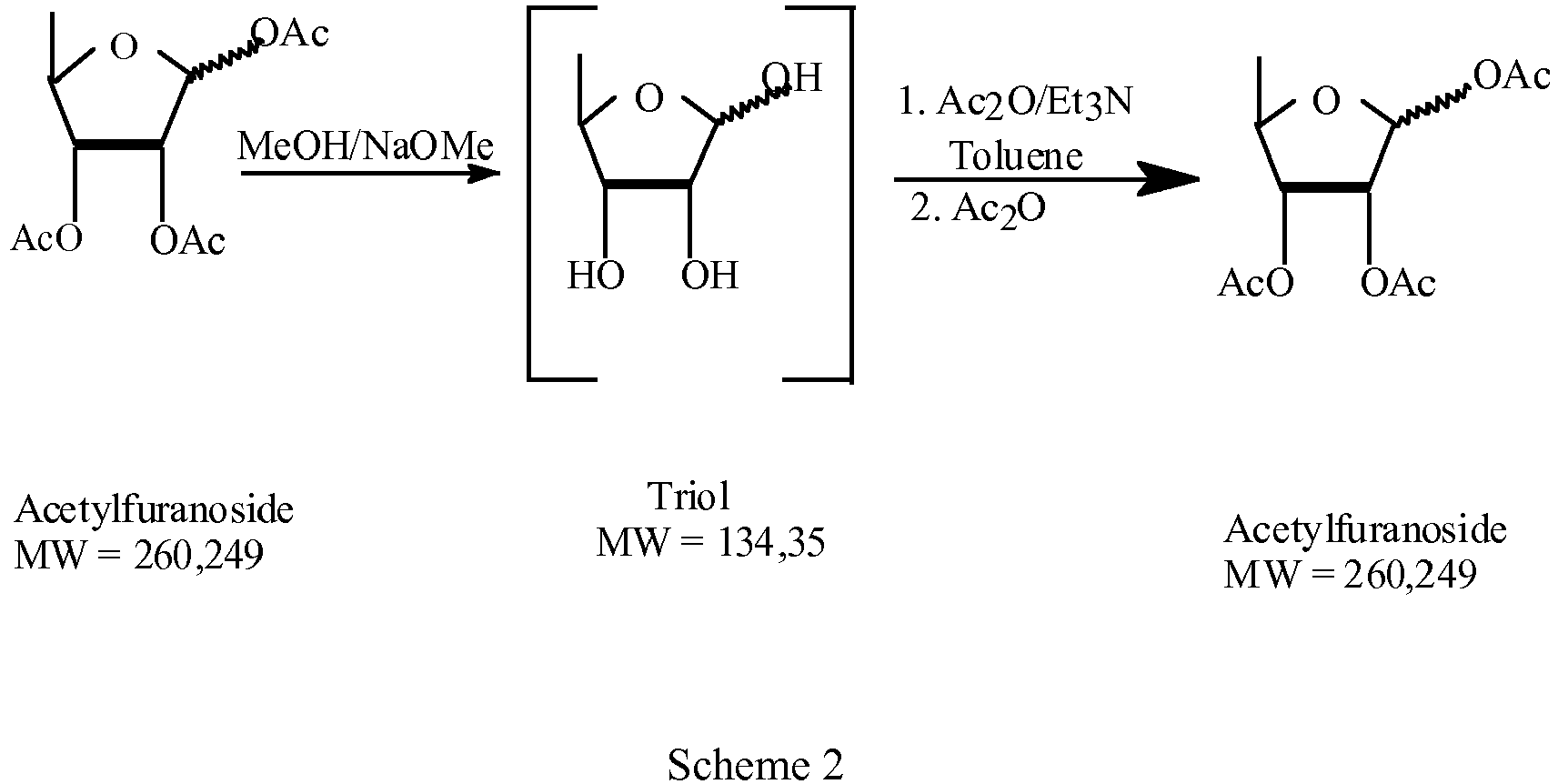
- In a first step, solvent from the initial ACF synthesis (scheme 1) is distilled off. The following deacetylation is carried out with a suitable solvent such as aliphatic alcohols, preferably methanol and a suitable base such as alkali hydroxides or alkali alcoholates, preferably sodium methoxide, at reaction temperatures of 0°C to -20°C, preferably at -5°C to - 10°C.
- The reaction mixture is neutralized with an acid, preferably hydrochloric acid, up to pH 4-6, preferably 5. The alcohol is distilled off and the residue treated with a suitable solvent such as chlorinated hydrocarbons, preferably methylenchloride or aromatic hydrocarbons, preferably toluene.
- After addition of an amine, preferably triethylamine, acetic anhydride is added slowly at batch temperatures of below 30°C, preferably 15°C to 20°C 4-dimethylaminopyridine and additionally acetic anhydride are added. The batch is quenched with water and a suitable solvent such as chlorinated hydrocarbons, preferably methylenchloride or aromatic hydrocarbons, preferably toluene is added.
- The organic layer is separated and the aqueous layer several times extracted with the suitable solvent mentioned above. The combined organic layers are washed with an alkali solution, preferably sodium bicarbonate, leading to pH 8 after washing and further washed with water. The solvent is distilled off and β-ACF crystallized in suitable solvents such as aliphatic alcohols, preferably propan-2-ol. The crude product is recrystallized in a suitable solvent such as aliphatic alcohols, preferably propan-2-ol, resulting in white β-Acetylfuranoside crystals with a content of < 2 weight-% of the α-anomer. The method described herein is also referred to as "Chemical Reprocessing" in
figure 1 which further summarizes the present process. -
Fig. 1 : Process flow chart summarizing the process according to the present invention - The invention is now further illustrated by the followings working examples, which are by no means intended to limit the scope of the present method.
- 3000 kg Acetylfuranoside mother liquor (ratio α/β 35:65) was evaporated to an oil (residual solvent < 1 %) at 30 to 80°C and 5 to 100 mbar (about 1000 kg residual oil). The residual oil was distilled under vacuum at 1 to 3 mbar and 200 to 210°C steam heating temperature in a continuous thin-film evaporator resulting in 609 kg distillate (containing α/β-Acetylfuranoside) and about 400 kg residue.
- 1247 kg distillate (ratio α/β 35:65) was dissolved in 541 L propan-2-ol at 20 to 25°C and cooled to -12 to -8°C. The resulting suspension was agitated for 6 hours to complete crystallization. The crystallizate was isolated and washed with cold propan-2-ol.
- 425 kg of white crude product was obtained (2-3% residual moisture).
- 755 kg of crude product was recrystallized from propan-2-ol (ratio 1:1) under the same conditions. Yield: 748 kg β-Acetylfuranoside.
- 811 kg Acetylfuranoside mother liquor (about 250 kg α/β-Acetylfuranoside) was concentrated by distillation to obtain an oily residue (ratio α/β 60:40). Then 1060 L of methanol was added and cooled to -8°C. 127 L of sodium methoxide was then added and stirred for 3 hours. The reaction mixture was neutralized with 126 L of semi concentrated hydrochloric acid to bring the pH to 5.1.
- 1235 L of solvents were distilled off. 212 L of toluene; 322 L of triethylamine and 42 L of toluene were added. 265 L of acetic anhydride were added slowly, keeping the batch temperature between 15-17°C. The mixture was stirred at 16-17°C for 1.5 hours. 6.06 kg of 4-dimethylaminopyridine and additionally 367 L of acetic anhydride were added. The batch was stirred for 1.5 hours. The reaction mixture was quenched with 212 L of water and 265 L of toluene were added. After the aqueous layer was separated, it was extracted 3 times with 265 L of toluene. The combined organic layers were washed twice with 550 L of saturated sodium bicarbonate solution, leading to pH 8 after washing, and 530 L of water. Toluene was then distilled off and 424 L of propan-2-ol were added and the residue dissolved. The solution was cooled to -9°C for 6 hours. The crystallizate was isolated and washed with cold propan-2-ol. 205.2 kg of white product were obtained (2-3 % residual moisture). Finally, the crude product was recrystallized with 205 L of propan-2-ol. Yield: 187.8 kg β-Acetylfuranoside.
Claims (4)
- A method for recovery of initially not separated β-ACF from mother liquor remaining from the synthesis of ACF, comprising the following sequential steps:a) Evaporation to less than 1 % residual solvent of the mother liquor remaining from an initial synthesis of ACF, to increase the content of residual α/β-ACF from about 8 to 15 weight-% to about 25 to 45 weight-%, followed by distillation to about 60 to 80 weight-% and subsequent crystallization of β-ACF out of the distillate by adding a suitable solvent;b) Chemical conversion of α/β-ACF mixture remaining in the mother liquor of step a), to β-ACF by de-acetylation and subsequent re-acetylation, followed by crystallization of β-ACF by addition of a suitable solvent;c) Optional repetition of step a) and b) in a sequential (clockwise) cyclic process, andwherein the distillation method is selected from falling-film evaporation, molecular distillation, centrifugal molecular distillation or thin-film evaporation.
- The process according to claim 1, wherein the distillation to about 60 to 80 weight-% of step a) is carried out at 1 to 3 mbar and 200 to 210 °C heating temperature in a continuous thin-film evaporator.
- The process according to claim 1 or 2, wherein step b) comprises the deacetylation of α/β-ACF in the presence of a suitable base, followed by neutralization with a suitable acid and further followed by the re-acetylation reaction in the presence of suitable base, a suitable catalyst and a suitable acetylating agent.
- The process according to any one of claims 1 to 3 for use during the manufacture of capecitabine.
Priority Applications (3)
| Application Number | Priority Date | Filing Date | Title |
|---|---|---|---|
| EP10700424.4A EP2391633B1 (en) | 2009-01-27 | 2010-01-18 | Process for the recovery of beta-acetylfuranoside |
| SI201030937T SI2391633T1 (en) | 2009-01-27 | 2010-01-18 | Process for the recovery of beta-acetylfuranoside |
| PL10700424T PL2391633T3 (en) | 2009-01-27 | 2010-01-18 | Process for the recovery of beta-acetylfuranoside |
Applications Claiming Priority (3)
| Application Number | Priority Date | Filing Date | Title |
|---|---|---|---|
| EP09151384A EP2210895A1 (en) | 2009-01-27 | 2009-01-27 | Process for the recovery of beta-Acetylfuranoside |
| EP10700424.4A EP2391633B1 (en) | 2009-01-27 | 2010-01-18 | Process for the recovery of beta-acetylfuranoside |
| PCT/EP2010/050523 WO2010086247A1 (en) | 2009-01-27 | 2010-01-18 | Process for the recovery of beta-acetylfuranoside |
Publications (2)
| Publication Number | Publication Date |
|---|---|
| EP2391633A1 EP2391633A1 (en) | 2011-12-07 |
| EP2391633B1 true EP2391633B1 (en) | 2015-03-18 |
Family
ID=40801987
Family Applications (2)
| Application Number | Title | Priority Date | Filing Date |
|---|---|---|---|
| EP09151384A Withdrawn EP2210895A1 (en) | 2009-01-27 | 2009-01-27 | Process for the recovery of beta-Acetylfuranoside |
| EP10700424.4A Active EP2391633B1 (en) | 2009-01-27 | 2010-01-18 | Process for the recovery of beta-acetylfuranoside |
Family Applications Before (1)
| Application Number | Title | Priority Date | Filing Date |
|---|---|---|---|
| EP09151384A Withdrawn EP2210895A1 (en) | 2009-01-27 | 2009-01-27 | Process for the recovery of beta-Acetylfuranoside |
Country Status (11)
| Country | Link |
|---|---|
| US (2) | US20100190976A1 (en) |
| EP (2) | EP2210895A1 (en) |
| JP (1) | JP5612603B2 (en) |
| CN (2) | CN102245621A (en) |
| CA (1) | CA2748954C (en) |
| DK (1) | DK2391633T3 (en) |
| ES (1) | ES2535051T3 (en) |
| PL (1) | PL2391633T3 (en) |
| SG (1) | SG173113A1 (en) |
| SI (1) | SI2391633T1 (en) |
| WO (1) | WO2010086247A1 (en) |
Families Citing this family (3)
| Publication number | Priority date | Publication date | Assignee | Title |
|---|---|---|---|---|
| EP2210895A1 (en) * | 2009-01-27 | 2010-07-28 | F. Hoffmann-La Roche AG | Process for the recovery of beta-Acetylfuranoside |
| CN104017033B (en) * | 2014-06-14 | 2016-08-17 | 济南尚博生物科技有限公司 | A kind of method preparing glucosides |
| CN112125938A (en) * | 2020-09-26 | 2020-12-25 | 安徽金禾实业股份有限公司 | A kind of method for extracting sucralose-6-ethyl ester from sugar residue |
Family Cites Families (7)
| Publication number | Priority date | Publication date | Assignee | Title |
|---|---|---|---|---|
| CA1135258A (en) | 1979-06-15 | 1982-11-09 | Richard D'souza | Process for the preparation of 5'deoxy-5-fluorouridine |
| DE3714473A1 (en) * | 1987-04-30 | 1988-11-10 | Basf Ag | CONTINUOUS PROCESS FOR EPIMERIZING SUGAR, ESPECIALLY FROM D-ARABINOSE TO D-RIBOSE |
| ITMI20032059A1 (en) | 2003-10-22 | 2005-04-23 | Clariant Lsm Italia Spa | PROCESS FOR THE PREPARATION OF DOXIFLURIDINE. |
| CN100383128C (en) * | 2004-02-23 | 2008-04-23 | 上海迪赛诺医药发展有限公司 | Ramification of N-carbethoxy cytosine and preparation method and application |
| WO2008080822A1 (en) * | 2006-12-29 | 2008-07-10 | F. Hoffmann-La Roche Ag | Epimerization methodologies for recovering stereo isomers in high yield and purity |
| KR100908363B1 (en) * | 2007-02-28 | 2009-07-20 | 한미약품 주식회사 | Stereoselective preparation method of tri-O-acetyl-5-deoxy-β-D-ribofuranose and separation method thereof |
| EP2210895A1 (en) * | 2009-01-27 | 2010-07-28 | F. Hoffmann-La Roche AG | Process for the recovery of beta-Acetylfuranoside |
-
2009
- 2009-01-27 EP EP09151384A patent/EP2210895A1/en not_active Withdrawn
-
2010
- 2010-01-18 ES ES10700424.4T patent/ES2535051T3/en active Active
- 2010-01-18 WO PCT/EP2010/050523 patent/WO2010086247A1/en not_active Ceased
- 2010-01-18 SG SG2011053337A patent/SG173113A1/en unknown
- 2010-01-18 CN CN2010800035320A patent/CN102245621A/en active Pending
- 2010-01-18 PL PL10700424T patent/PL2391633T3/en unknown
- 2010-01-18 JP JP2011542848A patent/JP5612603B2/en not_active Expired - Fee Related
- 2010-01-18 DK DK10700424.4T patent/DK2391633T3/en active
- 2010-01-18 CA CA2748954A patent/CA2748954C/en active Active
- 2010-01-18 EP EP10700424.4A patent/EP2391633B1/en active Active
- 2010-01-18 SI SI201030937T patent/SI2391633T1/en unknown
- 2010-01-18 CN CN201610288682.XA patent/CN106397503A/en active Pending
- 2010-01-20 US US12/690,167 patent/US20100190976A1/en not_active Abandoned
-
2012
- 2012-11-13 US US13/675,220 patent/US9580455B2/en not_active Expired - Fee Related
Also Published As
| Publication number | Publication date |
|---|---|
| SG173113A1 (en) | 2011-08-29 |
| CN102245621A (en) | 2011-11-16 |
| ES2535051T3 (en) | 2015-05-04 |
| SI2391633T1 (en) | 2015-06-30 |
| PL2391633T3 (en) | 2015-08-31 |
| JP2012513970A (en) | 2012-06-21 |
| JP5612603B2 (en) | 2014-10-22 |
| EP2210895A1 (en) | 2010-07-28 |
| CN106397503A (en) | 2017-02-15 |
| CA2748954C (en) | 2017-01-03 |
| US20130072674A1 (en) | 2013-03-21 |
| US20100190976A1 (en) | 2010-07-29 |
| CA2748954A1 (en) | 2010-08-05 |
| WO2010086247A1 (en) | 2010-08-05 |
| DK2391633T3 (en) | 2015-05-11 |
| US9580455B2 (en) | 2017-02-28 |
| US20160333040A9 (en) | 2016-11-17 |
| EP2391633A1 (en) | 2011-12-07 |
Similar Documents
| Publication | Publication Date | Title |
|---|---|---|
| US5298611A (en) | Sucralose pentaester production | |
| EP2828275B1 (en) | Synthesis of the trisaccharide 3-o-fucosyllactose and intermediates thereof | |
| KR100390629B1 (en) | Method for preparing sucralose without intermediate separation of crystalline sucralose-6-ester | |
| KR20110101207A (en) | Method for the synthesis of L-fucosyl disaccharide- or oligo-sugars and their novel 2,3,4 tribenzyl-fucosyl derivative intermediates | |
| Ying et al. | General methods for the synthesis of glycopyranosyluronic acid azides | |
| CN101200463A (en) | Fully acylated-4-thio-D-ribose and its preparation method | |
| US9580455B2 (en) | Process for the recovery of beta acetylfuranoside | |
| KR100908363B1 (en) | Stereoselective preparation method of tri-O-acetyl-5-deoxy-β-D-ribofuranose and separation method thereof | |
| HU181712B (en) | Process for preparing 5'-deoxy-5-fluoro-uridine | |
| WO2013177243A1 (en) | Sulfilimine and sulphoxide methods for producing festinavir | |
| WO1993002094A1 (en) | A process for the preparation of demethylepypodophyllotoxin | |
| CN112358514B (en) | Synthesis process of arbutin | |
| CN103025748B (en) | Method for crystallization of fucose | |
| NO300638B1 (en) | New and improved solvent-free synthesis of ether-substituted, blocked monosaccharides and their selective hydrolysis | |
| HK1228403A1 (en) | Process for the recovery of beta-acetylfuranoside | |
| CA2205535C (en) | Sucralose pentaester production | |
| EP2374809A1 (en) | A process for the preparation of 6-O-acetyl-2-azido-3,4-di-O-benzyl-2-deoxy-D-glucopyranose | |
| CN105026382B (en) | Method for producing (2R)-2-fluoro-2-C-methyl-D-ribono-γ-lactone | |
| EP4487910A1 (en) | Process for the preparation of dapagliflozin | |
| Kalmár et al. | D-glucopyranoside, a Versatile, Orthogonally Protected Building Block | |
| CN107090009A (en) | A kind of disaccharides nucleoside compound and preparation method thereof | |
| Bøjstrup et al. | László Kalmár, Zoltán Szurmai, János Kerékgyártó, András Guttman | |
| PL180551B1 (en) | Method for the isolation and purification of 3'-azido-3'-deoxytimidine (AZT) |
Legal Events
| Date | Code | Title | Description |
|---|---|---|---|
| PUAI | Public reference made under article 153(3) epc to a published international application that has entered the european phase |
Free format text: ORIGINAL CODE: 0009012 |
|
| 17P | Request for examination filed |
Effective date: 20110829 |
|
| AK | Designated contracting states |
Kind code of ref document: A1 Designated state(s): AT BE BG CH CY CZ DE DK EE ES FI FR GB GR HR HU IE IS IT LI LT LU LV MC MK MT NL NO PL PT RO SE SI SK SM TR |
|
| DAX | Request for extension of the european patent (deleted) | ||
| 17Q | First examination report despatched |
Effective date: 20130308 |
|
| REG | Reference to a national code |
Ref country code: DE Ref legal event code: R079 Ref document number: 602010023169 Country of ref document: DE Free format text: PREVIOUS MAIN CLASS: C07H0003020000 Ipc: C07H0013040000 |
|
| GRAP | Despatch of communication of intention to grant a patent |
Free format text: ORIGINAL CODE: EPIDOSNIGR1 |
|
| RIC1 | Information provided on ipc code assigned before grant |
Ipc: C07H 13/04 20060101AFI20141020BHEP |
|
| INTG | Intention to grant announced |
Effective date: 20141120 |
|
| GRAS | Grant fee paid |
Free format text: ORIGINAL CODE: EPIDOSNIGR3 |
|
| GRAA | (expected) grant |
Free format text: ORIGINAL CODE: 0009210 |
|
| AK | Designated contracting states |
Kind code of ref document: B1 Designated state(s): AT BE BG CH CY CZ DE DK EE ES FI FR GB GR HR HU IE IS IT LI LT LU LV MC MK MT NL NO PL PT RO SE SI SK SM TR |
|
| REG | Reference to a national code |
Ref country code: GB Ref legal event code: FG4D |
|
| REG | Reference to a national code |
Ref country code: CH Ref legal event code: EP |
|
| REG | Reference to a national code |
Ref country code: IE Ref legal event code: FG4D |
|
| REG | Reference to a national code |
Ref country code: AT Ref legal event code: REF Ref document number: 716502 Country of ref document: AT Kind code of ref document: T Effective date: 20150415 |
|
| REG | Reference to a national code |
Ref country code: SE Ref legal event code: TRGR |
|
| REG | Reference to a national code |
Ref country code: DE Ref legal event code: R096 Ref document number: 602010023169 Country of ref document: DE Effective date: 20150430 |
|
| REG | Reference to a national code |
Ref country code: ES Ref legal event code: FG2A Ref document number: 2535051 Country of ref document: ES Kind code of ref document: T3 Effective date: 20150504 |
|
| REG | Reference to a national code |
Ref country code: DK Ref legal event code: T3 Effective date: 20150507 |
|
| REG | Reference to a national code |
Ref country code: NL Ref legal event code: T3 |
|
| PG25 | Lapsed in a contracting state [announced via postgrant information from national office to epo] |
Ref country code: FI Free format text: LAPSE BECAUSE OF FAILURE TO SUBMIT A TRANSLATION OF THE DESCRIPTION OR TO PAY THE FEE WITHIN THE PRESCRIBED TIME-LIMIT Effective date: 20150318 Ref country code: LT Free format text: LAPSE BECAUSE OF FAILURE TO SUBMIT A TRANSLATION OF THE DESCRIPTION OR TO PAY THE FEE WITHIN THE PRESCRIBED TIME-LIMIT Effective date: 20150318 Ref country code: NO Free format text: LAPSE BECAUSE OF FAILURE TO SUBMIT A TRANSLATION OF THE DESCRIPTION OR TO PAY THE FEE WITHIN THE PRESCRIBED TIME-LIMIT Effective date: 20150618 Ref country code: HR Free format text: LAPSE BECAUSE OF FAILURE TO SUBMIT A TRANSLATION OF THE DESCRIPTION OR TO PAY THE FEE WITHIN THE PRESCRIBED TIME-LIMIT Effective date: 20150318 |
|
| REG | Reference to a national code |
Ref country code: LT Ref legal event code: MG4D |
|
| PG25 | Lapsed in a contracting state [announced via postgrant information from national office to epo] |
Ref country code: GR Free format text: LAPSE BECAUSE OF FAILURE TO SUBMIT A TRANSLATION OF THE DESCRIPTION OR TO PAY THE FEE WITHIN THE PRESCRIBED TIME-LIMIT Effective date: 20150619 Ref country code: LV Free format text: LAPSE BECAUSE OF FAILURE TO SUBMIT A TRANSLATION OF THE DESCRIPTION OR TO PAY THE FEE WITHIN THE PRESCRIBED TIME-LIMIT Effective date: 20150318 |
|
| REG | Reference to a national code |
Ref country code: PL Ref legal event code: T3 |
|
| PG25 | Lapsed in a contracting state [announced via postgrant information from national office to epo] |
Ref country code: SK Free format text: LAPSE BECAUSE OF FAILURE TO SUBMIT A TRANSLATION OF THE DESCRIPTION OR TO PAY THE FEE WITHIN THE PRESCRIBED TIME-LIMIT Effective date: 20150318 Ref country code: EE Free format text: LAPSE BECAUSE OF FAILURE TO SUBMIT A TRANSLATION OF THE DESCRIPTION OR TO PAY THE FEE WITHIN THE PRESCRIBED TIME-LIMIT Effective date: 20150318 Ref country code: PT Free format text: LAPSE BECAUSE OF FAILURE TO SUBMIT A TRANSLATION OF THE DESCRIPTION OR TO PAY THE FEE WITHIN THE PRESCRIBED TIME-LIMIT Effective date: 20150720 Ref country code: RO Free format text: LAPSE BECAUSE OF FAILURE TO SUBMIT A TRANSLATION OF THE DESCRIPTION OR TO PAY THE FEE WITHIN THE PRESCRIBED TIME-LIMIT Effective date: 20150318 |
|
| PG25 | Lapsed in a contracting state [announced via postgrant information from national office to epo] |
Ref country code: IS Free format text: LAPSE BECAUSE OF FAILURE TO SUBMIT A TRANSLATION OF THE DESCRIPTION OR TO PAY THE FEE WITHIN THE PRESCRIBED TIME-LIMIT Effective date: 20150718 |
|
| REG | Reference to a national code |
Ref country code: DE Ref legal event code: R097 Ref document number: 602010023169 Country of ref document: DE |
|
| REG | Reference to a national code |
Ref country code: HU Ref legal event code: AG4A Ref document number: E024790 Country of ref document: HU |
|
| REG | Reference to a national code |
Ref country code: FR Ref legal event code: PLFP Year of fee payment: 7 |
|
| PLBE | No opposition filed within time limit |
Free format text: ORIGINAL CODE: 0009261 |
|
| STAA | Information on the status of an ep patent application or granted ep patent |
Free format text: STATUS: NO OPPOSITION FILED WITHIN TIME LIMIT |
|
| REG | Reference to a national code |
Ref country code: AT Ref legal event code: UEP Ref document number: 716502 Country of ref document: AT Kind code of ref document: T Effective date: 20150318 |
|
| 26N | No opposition filed |
Effective date: 20151221 |
|
| PG25 | Lapsed in a contracting state [announced via postgrant information from national office to epo] |
Ref country code: LU Free format text: LAPSE BECAUSE OF FAILURE TO SUBMIT A TRANSLATION OF THE DESCRIPTION OR TO PAY THE FEE WITHIN THE PRESCRIBED TIME-LIMIT Effective date: 20160118 |
|
| PG25 | Lapsed in a contracting state [announced via postgrant information from national office to epo] |
Ref country code: MC Free format text: LAPSE BECAUSE OF FAILURE TO SUBMIT A TRANSLATION OF THE DESCRIPTION OR TO PAY THE FEE WITHIN THE PRESCRIBED TIME-LIMIT Effective date: 20150318 |
|
| REG | Reference to a national code |
Ref country code: FR Ref legal event code: PLFP Year of fee payment: 8 |
|
| PG25 | Lapsed in a contracting state [announced via postgrant information from national office to epo] |
Ref country code: MT Free format text: LAPSE BECAUSE OF FAILURE TO SUBMIT A TRANSLATION OF THE DESCRIPTION OR TO PAY THE FEE WITHIN THE PRESCRIBED TIME-LIMIT Effective date: 20150318 |
|
| REG | Reference to a national code |
Ref country code: FR Ref legal event code: PLFP Year of fee payment: 9 |
|
| PG25 | Lapsed in a contracting state [announced via postgrant information from national office to epo] |
Ref country code: CY Free format text: LAPSE BECAUSE OF FAILURE TO SUBMIT A TRANSLATION OF THE DESCRIPTION OR TO PAY THE FEE WITHIN THE PRESCRIBED TIME-LIMIT Effective date: 20150318 Ref country code: SM Free format text: LAPSE BECAUSE OF FAILURE TO SUBMIT A TRANSLATION OF THE DESCRIPTION OR TO PAY THE FEE WITHIN THE PRESCRIBED TIME-LIMIT Effective date: 20150318 |
|
| PG25 | Lapsed in a contracting state [announced via postgrant information from national office to epo] |
Ref country code: MK Free format text: LAPSE BECAUSE OF FAILURE TO SUBMIT A TRANSLATION OF THE DESCRIPTION OR TO PAY THE FEE WITHIN THE PRESCRIBED TIME-LIMIT Effective date: 20150318 Ref country code: MT Free format text: LAPSE BECAUSE OF FAILURE TO SUBMIT A TRANSLATION OF THE DESCRIPTION OR TO PAY THE FEE WITHIN THE PRESCRIBED TIME-LIMIT Effective date: 20160131 |
|
| PG25 | Lapsed in a contracting state [announced via postgrant information from national office to epo] |
Ref country code: BG Free format text: LAPSE BECAUSE OF FAILURE TO SUBMIT A TRANSLATION OF THE DESCRIPTION OR TO PAY THE FEE WITHIN THE PRESCRIBED TIME-LIMIT Effective date: 20150318 |
|
| PGFP | Annual fee paid to national office [announced via postgrant information from national office to epo] |
Ref country code: NL Payment date: 20221220 Year of fee payment: 14 Ref country code: IE Payment date: 20221227 Year of fee payment: 14 Ref country code: GB Payment date: 20221214 Year of fee payment: 14 Ref country code: FR Payment date: 20221216 Year of fee payment: 14 Ref country code: CZ Payment date: 20221227 Year of fee payment: 14 |
|
| PGFP | Annual fee paid to national office [announced via postgrant information from national office to epo] |
Ref country code: PL Payment date: 20221220 Year of fee payment: 14 Ref country code: BE Payment date: 20221220 Year of fee payment: 14 |
|
| PGFP | Annual fee paid to national office [announced via postgrant information from national office to epo] |
Ref country code: ES Payment date: 20230208 Year of fee payment: 14 Ref country code: DK Payment date: 20230103 Year of fee payment: 14 Ref country code: CH Payment date: 20230201 Year of fee payment: 14 Ref country code: AT Payment date: 20221227 Year of fee payment: 14 |
|
| PGFP | Annual fee paid to national office [announced via postgrant information from national office to epo] |
Ref country code: TR Payment date: 20230117 Year of fee payment: 14 Ref country code: SI Payment date: 20221227 Year of fee payment: 14 Ref country code: SE Payment date: 20230110 Year of fee payment: 14 Ref country code: IT Payment date: 20230116 Year of fee payment: 14 Ref country code: HU Payment date: 20221219 Year of fee payment: 14 Ref country code: DE Payment date: 20221215 Year of fee payment: 14 |
|
| P01 | Opt-out of the competence of the unified patent court (upc) registered |
Effective date: 20230331 |
|
| P02 | Opt-out of the competence of the unified patent court (upc) changed |
Effective date: 20230410 |
|
| REG | Reference to a national code |
Ref country code: DE Ref legal event code: R119 Ref document number: 602010023169 Country of ref document: DE |
|
| REG | Reference to a national code |
Ref country code: DK Ref legal event code: EBP Effective date: 20240131 |
|
| REG | Reference to a national code |
Ref country code: CH Ref legal event code: PL |
|
| REG | Reference to a national code |
Ref country code: SE Ref legal event code: EUG |
|
| REG | Reference to a national code |
Ref country code: NL Ref legal event code: MM Effective date: 20240201 |
|
| REG | Reference to a national code |
Ref country code: AT Ref legal event code: MM01 Ref document number: 716502 Country of ref document: AT Kind code of ref document: T Effective date: 20240118 |
|
| GBPC | Gb: european patent ceased through non-payment of renewal fee |
Effective date: 20240118 |
|
| PG25 | Lapsed in a contracting state [announced via postgrant information from national office to epo] |
Ref country code: DE Free format text: LAPSE BECAUSE OF NON-PAYMENT OF DUE FEES Effective date: 20240801 |
|
| PG25 | Lapsed in a contracting state [announced via postgrant information from national office to epo] |
Ref country code: GB Free format text: LAPSE BECAUSE OF NON-PAYMENT OF DUE FEES Effective date: 20240118 |
|
| PG25 | Lapsed in a contracting state [announced via postgrant information from national office to epo] |
Ref country code: BE Free format text: LAPSE BECAUSE OF NON-PAYMENT OF DUE FEES Effective date: 20240131 |
|
| PG25 | Lapsed in a contracting state [announced via postgrant information from national office to epo] |
Ref country code: FR Free format text: LAPSE BECAUSE OF NON-PAYMENT OF DUE FEES Effective date: 20240131 |
|
| PG25 | Lapsed in a contracting state [announced via postgrant information from national office to epo] |
Ref country code: NL Free format text: LAPSE BECAUSE OF NON-PAYMENT OF DUE FEES Effective date: 20240201 |
|
| PG25 | Lapsed in a contracting state [announced via postgrant information from national office to epo] |
Ref country code: CH Free format text: LAPSE BECAUSE OF NON-PAYMENT OF DUE FEES Effective date: 20240131 |
|
| PG25 | Lapsed in a contracting state [announced via postgrant information from national office to epo] |
Ref country code: CZ Free format text: LAPSE BECAUSE OF NON-PAYMENT OF DUE FEES Effective date: 20240118 |
|
| PG25 | Lapsed in a contracting state [announced via postgrant information from national office to epo] |
Ref country code: AT Free format text: LAPSE BECAUSE OF NON-PAYMENT OF DUE FEES Effective date: 20240118 |
|
| PG25 | Lapsed in a contracting state [announced via postgrant information from national office to epo] |
Ref country code: SI Free format text: LAPSE BECAUSE OF NON-PAYMENT OF DUE FEES Effective date: 20240119 Ref country code: HU Free format text: LAPSE BECAUSE OF NON-PAYMENT OF DUE FEES Effective date: 20240119 |
|
| PG25 | Lapsed in a contracting state [announced via postgrant information from national office to epo] |
Ref country code: SI Free format text: LAPSE BECAUSE OF NON-PAYMENT OF DUE FEES Effective date: 20240119 Ref country code: NL Free format text: LAPSE BECAUSE OF NON-PAYMENT OF DUE FEES Effective date: 20240201 Ref country code: HU Free format text: LAPSE BECAUSE OF NON-PAYMENT OF DUE FEES Effective date: 20240119 Ref country code: GB Free format text: LAPSE BECAUSE OF NON-PAYMENT OF DUE FEES Effective date: 20240118 Ref country code: FR Free format text: LAPSE BECAUSE OF NON-PAYMENT OF DUE FEES Effective date: 20240131 Ref country code: DE Free format text: LAPSE BECAUSE OF NON-PAYMENT OF DUE FEES Effective date: 20240801 Ref country code: CZ Free format text: LAPSE BECAUSE OF NON-PAYMENT OF DUE FEES Effective date: 20240118 Ref country code: CH Free format text: LAPSE BECAUSE OF NON-PAYMENT OF DUE FEES Effective date: 20240131 Ref country code: BE Free format text: LAPSE BECAUSE OF NON-PAYMENT OF DUE FEES Effective date: 20240131 Ref country code: AT Free format text: LAPSE BECAUSE OF NON-PAYMENT OF DUE FEES Effective date: 20240118 |
|
| REG | Reference to a national code |
Ref country code: BE Ref legal event code: MM Effective date: 20240131 |
|
| REG | Reference to a national code |
Ref country code: SI Ref legal event code: KO00 Effective date: 20241001 |
|
| PG25 | Lapsed in a contracting state [announced via postgrant information from national office to epo] |
Ref country code: DK Free format text: LAPSE BECAUSE OF NON-PAYMENT OF DUE FEES Effective date: 20240131 |
|
| PG25 | Lapsed in a contracting state [announced via postgrant information from national office to epo] |
Ref country code: IE Free format text: LAPSE BECAUSE OF NON-PAYMENT OF DUE FEES Effective date: 20240118 |
|
| PG25 | Lapsed in a contracting state [announced via postgrant information from national office to epo] |
Ref country code: IE Free format text: LAPSE BECAUSE OF NON-PAYMENT OF DUE FEES Effective date: 20240118 Ref country code: DK Free format text: LAPSE BECAUSE OF NON-PAYMENT OF DUE FEES Effective date: 20240131 |
|
| PG25 | Lapsed in a contracting state [announced via postgrant information from national office to epo] |
Ref country code: IT Free format text: LAPSE BECAUSE OF NON-PAYMENT OF DUE FEES Effective date: 20240118 |
|
| REG | Reference to a national code |
Ref country code: ES Ref legal event code: FD2A Effective date: 20250228 |
|
| PG25 | Lapsed in a contracting state [announced via postgrant information from national office to epo] |
Ref country code: ES Free format text: LAPSE BECAUSE OF NON-PAYMENT OF DUE FEES Effective date: 20240119 |
|
| PG25 | Lapsed in a contracting state [announced via postgrant information from national office to epo] |
Ref country code: PL Free format text: LAPSE BECAUSE OF NON-PAYMENT OF DUE FEES Effective date: 20240118 |
|
| PG25 | Lapsed in a contracting state [announced via postgrant information from national office to epo] |
Ref country code: SE Free format text: LAPSE BECAUSE OF NON-PAYMENT OF DUE FEES Effective date: 20240119 |