EP2391617B1 - Azetidines as histamine h3 receptor antagonists - Google Patents
Azetidines as histamine h3 receptor antagonists Download PDFInfo
- Publication number
- EP2391617B1 EP2391617B1 EP10702109.9A EP10702109A EP2391617B1 EP 2391617 B1 EP2391617 B1 EP 2391617B1 EP 10702109 A EP10702109 A EP 10702109A EP 2391617 B1 EP2391617 B1 EP 2391617B1
- Authority
- EP
- European Patent Office
- Prior art keywords
- carbonyl
- cyclobutyl
- azetidin
- diazepane
- compound
- Prior art date
- Legal status (The legal status is an assumption and is not a legal conclusion. Google has not performed a legal analysis and makes no representation as to the accuracy of the status listed.)
- Active
Links
- 0 *C(c(cc1F)ccc1-[n]1ncnc1)=O Chemical compound *C(c(cc1F)ccc1-[n]1ncnc1)=O 0.000 description 3
- XMHXCPKZGJAJPX-UHFFFAOYSA-N O=C(C1CNC1)N(CCC1)CCN1C1CCC1 Chemical compound O=C(C1CNC1)N(CCC1)CCN1C1CCC1 XMHXCPKZGJAJPX-UHFFFAOYSA-N 0.000 description 2
- MOAGRQKOSLBPAM-UHFFFAOYSA-N CC(C)N(CCC1)CCN1C(C(C1)CN1C(c1cnc(C)cc1)=O)=O Chemical compound CC(C)N(CCC1)CCN1C(C(C1)CN1C(c1cnc(C)cc1)=O)=O MOAGRQKOSLBPAM-UHFFFAOYSA-N 0.000 description 1
- BPKKYUXXZOTIBI-UHFFFAOYSA-O CCC(N(C1)CC1C(N(CCC1)CC[NH+]1C1CCC1)=O)=O Chemical compound CCC(N(C1)CC1C(N(CCC1)CC[NH+]1C1CCC1)=O)=O BPKKYUXXZOTIBI-UHFFFAOYSA-O 0.000 description 1
- QBKKABPBPUVYIL-UHFFFAOYSA-N CN(CC1CCOCC1)C(N(C1)CC1C(N(CCC1)CCN1C1CCC1)=O)=O Chemical compound CN(CC1CCOCC1)C(N(C1)CC1C(N(CCC1)CCN1C1CCC1)=O)=O QBKKABPBPUVYIL-UHFFFAOYSA-N 0.000 description 1
- GTGOJSDZGAPFDW-UHFFFAOYSA-N COc(cc1)ccc1SCl Chemical compound COc(cc1)ccc1SCl GTGOJSDZGAPFDW-UHFFFAOYSA-N 0.000 description 1
- NDNREGJJJLZTIK-UHFFFAOYSA-N COc(cc1)ccc1SN(C1)CC1C(N(CCC1)CCN1C1CCC1)=O Chemical compound COc(cc1)ccc1SN(C1)CC1C(N(CCC1)CCN1C1CCC1)=O NDNREGJJJLZTIK-UHFFFAOYSA-N 0.000 description 1
- IULFXBLVJIPESI-UHFFFAOYSA-N CSC(SC)=NC#N Chemical compound CSC(SC)=NC#N IULFXBLVJIPESI-UHFFFAOYSA-N 0.000 description 1
- DOTSVMDRTIADPL-UHFFFAOYSA-N Cc(cc1)ncc1OC(N(C1)CC1C(N(CCC1)CCN1C1CCC1)=O)=O Chemical compound Cc(cc1)ncc1OC(N(C1)CC1C(N(CCC1)CCN1C1CCC1)=O)=O DOTSVMDRTIADPL-UHFFFAOYSA-N 0.000 description 1
- KNYBDSBBXUPOPJ-UHFFFAOYSA-N Cc1nc(-c(cc2)ccc2C(N(C2)CC2C(N(CCC2)CCN2C2CCC2)=O)=O)n[o]1 Chemical compound Cc1nc(-c(cc2)ccc2C(N(C2)CC2C(N(CCC2)CCN2C2CCC2)=O)=O)n[o]1 KNYBDSBBXUPOPJ-UHFFFAOYSA-N 0.000 description 1
- LVUSJYUNCIJZJG-UHFFFAOYSA-N Cc1nc(-c2cc(C(N(C3)CC3C(N(CCC3)CCN3C3CCC3)=O)=O)ccc2)c[s]1 Chemical compound Cc1nc(-c2cc(C(N(C3)CC3C(N(CCC3)CCN3C3CCC3)=O)=O)ccc2)c[s]1 LVUSJYUNCIJZJG-UHFFFAOYSA-N 0.000 description 1
- HZVWBFVLPISYFR-UHFFFAOYSA-N Cc1ncc(CC(N(C2)CC2C(N(CCC2)CCN2C2CCC2)=O)=O)cc1 Chemical compound Cc1ncc(CC(N(C2)CC2C(N(CCC2)CCN2C2CCC2)=O)=O)cc1 HZVWBFVLPISYFR-UHFFFAOYSA-N 0.000 description 1
- KXDJKEDKTQGGBF-UHFFFAOYSA-N O=C(C(C1)CN1C(C1CCCCC1)=O)N(CCC1)CCN1C1CCC1 Chemical compound O=C(C(C1)CN1C(C1CCCCC1)=O)N(CCC1)CCN1C1CCC1 KXDJKEDKTQGGBF-UHFFFAOYSA-N 0.000 description 1
- ZRMSEMFVQRNONX-UHFFFAOYSA-N O=C(C(C1)CN1C(N1CC2C=CC=CC2CC1)=O)N(CCC1)CCN1C1CCC1 Chemical compound O=C(C(C1)CN1C(N1CC2C=CC=CC2CC1)=O)N(CCC1)CCN1C1CCC1 ZRMSEMFVQRNONX-UHFFFAOYSA-N 0.000 description 1
- YKTFVMGWHOCETN-UHFFFAOYSA-N O=C(C(C1)CN1C(c(cc1)ccc1-[n]1nccc1)=O)N(CCC1)CCN1C1CCC1 Chemical compound O=C(C(C1)CN1C(c(cc1)ccc1-[n]1nccc1)=O)N(CCC1)CCN1C1CCC1 YKTFVMGWHOCETN-UHFFFAOYSA-N 0.000 description 1
- OFMYRTZUBGPZTI-UHFFFAOYSA-N O=C(C(C1)CN1C(c(cc1)ccc1-c1cccnc1)=O)N(CCC1)CCN1C1CCC1 Chemical compound O=C(C(C1)CN1C(c(cc1)ccc1-c1cccnc1)=O)N(CCC1)CCN1C1CCC1 OFMYRTZUBGPZTI-UHFFFAOYSA-N 0.000 description 1
- BEOPNCCTVKYDTL-UHFFFAOYSA-O O=C(C(C1)C[NH+]1C(c1ccc(-[n]2nccc2)nc1)=O)N(CCC1)CCN1C1CCC1 Chemical compound O=C(C(C1)C[NH+]1C(c1ccc(-[n]2nccc2)nc1)=O)N(CCC1)CCN1C1CCC1 BEOPNCCTVKYDTL-UHFFFAOYSA-O 0.000 description 1
- WMZYIKJSQHNJNC-UHFFFAOYSA-N O=C1OCCN1S(Cl)(=O)=O Chemical compound O=C1OCCN1S(Cl)(=O)=O WMZYIKJSQHNJNC-UHFFFAOYSA-N 0.000 description 1
- NZNMSOFKMUBTKW-UHFFFAOYSA-N OC(C1CCCCC1)=O Chemical compound OC(C1CCCCC1)=O NZNMSOFKMUBTKW-UHFFFAOYSA-N 0.000 description 1
Classifications
-
- C—CHEMISTRY; METALLURGY
- C07—ORGANIC CHEMISTRY
- C07D—HETEROCYCLIC COMPOUNDS
- C07D403/00—Heterocyclic compounds containing two or more hetero rings, having nitrogen atoms as the only ring hetero atoms, not provided for by group C07D401/00
- C07D403/14—Heterocyclic compounds containing two or more hetero rings, having nitrogen atoms as the only ring hetero atoms, not provided for by group C07D401/00 containing three or more hetero rings
-
- A—HUMAN NECESSITIES
- A61—MEDICAL OR VETERINARY SCIENCE; HYGIENE
- A61P—SPECIFIC THERAPEUTIC ACTIVITY OF CHEMICAL COMPOUNDS OR MEDICINAL PREPARATIONS
- A61P1/00—Drugs for disorders of the alimentary tract or the digestive system
-
- A—HUMAN NECESSITIES
- A61—MEDICAL OR VETERINARY SCIENCE; HYGIENE
- A61P—SPECIFIC THERAPEUTIC ACTIVITY OF CHEMICAL COMPOUNDS OR MEDICINAL PREPARATIONS
- A61P1/00—Drugs for disorders of the alimentary tract or the digestive system
- A61P1/04—Drugs for disorders of the alimentary tract or the digestive system for ulcers, gastritis or reflux esophagitis, e.g. antacids, inhibitors of acid secretion, mucosal protectants
-
- A—HUMAN NECESSITIES
- A61—MEDICAL OR VETERINARY SCIENCE; HYGIENE
- A61P—SPECIFIC THERAPEUTIC ACTIVITY OF CHEMICAL COMPOUNDS OR MEDICINAL PREPARATIONS
- A61P11/00—Drugs for disorders of the respiratory system
-
- A—HUMAN NECESSITIES
- A61—MEDICAL OR VETERINARY SCIENCE; HYGIENE
- A61P—SPECIFIC THERAPEUTIC ACTIVITY OF CHEMICAL COMPOUNDS OR MEDICINAL PREPARATIONS
- A61P11/00—Drugs for disorders of the respiratory system
- A61P11/02—Nasal agents, e.g. decongestants
-
- A—HUMAN NECESSITIES
- A61—MEDICAL OR VETERINARY SCIENCE; HYGIENE
- A61P—SPECIFIC THERAPEUTIC ACTIVITY OF CHEMICAL COMPOUNDS OR MEDICINAL PREPARATIONS
- A61P11/00—Drugs for disorders of the respiratory system
- A61P11/06—Antiasthmatics
-
- A—HUMAN NECESSITIES
- A61—MEDICAL OR VETERINARY SCIENCE; HYGIENE
- A61P—SPECIFIC THERAPEUTIC ACTIVITY OF CHEMICAL COMPOUNDS OR MEDICINAL PREPARATIONS
- A61P25/00—Drugs for disorders of the nervous system
-
- A—HUMAN NECESSITIES
- A61—MEDICAL OR VETERINARY SCIENCE; HYGIENE
- A61P—SPECIFIC THERAPEUTIC ACTIVITY OF CHEMICAL COMPOUNDS OR MEDICINAL PREPARATIONS
- A61P25/00—Drugs for disorders of the nervous system
- A61P25/02—Drugs for disorders of the nervous system for peripheral neuropathies
-
- A—HUMAN NECESSITIES
- A61—MEDICAL OR VETERINARY SCIENCE; HYGIENE
- A61P—SPECIFIC THERAPEUTIC ACTIVITY OF CHEMICAL COMPOUNDS OR MEDICINAL PREPARATIONS
- A61P25/00—Drugs for disorders of the nervous system
- A61P25/06—Antimigraine agents
-
- A—HUMAN NECESSITIES
- A61—MEDICAL OR VETERINARY SCIENCE; HYGIENE
- A61P—SPECIFIC THERAPEUTIC ACTIVITY OF CHEMICAL COMPOUNDS OR MEDICINAL PREPARATIONS
- A61P25/00—Drugs for disorders of the nervous system
- A61P25/08—Antiepileptics; Anticonvulsants
-
- A—HUMAN NECESSITIES
- A61—MEDICAL OR VETERINARY SCIENCE; HYGIENE
- A61P—SPECIFIC THERAPEUTIC ACTIVITY OF CHEMICAL COMPOUNDS OR MEDICINAL PREPARATIONS
- A61P25/00—Drugs for disorders of the nervous system
- A61P25/14—Drugs for disorders of the nervous system for treating abnormal movements, e.g. chorea, dyskinesia
-
- A—HUMAN NECESSITIES
- A61—MEDICAL OR VETERINARY SCIENCE; HYGIENE
- A61P—SPECIFIC THERAPEUTIC ACTIVITY OF CHEMICAL COMPOUNDS OR MEDICINAL PREPARATIONS
- A61P25/00—Drugs for disorders of the nervous system
- A61P25/14—Drugs for disorders of the nervous system for treating abnormal movements, e.g. chorea, dyskinesia
- A61P25/16—Anti-Parkinson drugs
-
- A—HUMAN NECESSITIES
- A61—MEDICAL OR VETERINARY SCIENCE; HYGIENE
- A61P—SPECIFIC THERAPEUTIC ACTIVITY OF CHEMICAL COMPOUNDS OR MEDICINAL PREPARATIONS
- A61P25/00—Drugs for disorders of the nervous system
- A61P25/18—Antipsychotics, i.e. neuroleptics; Drugs for mania or schizophrenia
-
- A—HUMAN NECESSITIES
- A61—MEDICAL OR VETERINARY SCIENCE; HYGIENE
- A61P—SPECIFIC THERAPEUTIC ACTIVITY OF CHEMICAL COMPOUNDS OR MEDICINAL PREPARATIONS
- A61P25/00—Drugs for disorders of the nervous system
- A61P25/20—Hypnotics; Sedatives
-
- A—HUMAN NECESSITIES
- A61—MEDICAL OR VETERINARY SCIENCE; HYGIENE
- A61P—SPECIFIC THERAPEUTIC ACTIVITY OF CHEMICAL COMPOUNDS OR MEDICINAL PREPARATIONS
- A61P25/00—Drugs for disorders of the nervous system
- A61P25/22—Anxiolytics
-
- A—HUMAN NECESSITIES
- A61—MEDICAL OR VETERINARY SCIENCE; HYGIENE
- A61P—SPECIFIC THERAPEUTIC ACTIVITY OF CHEMICAL COMPOUNDS OR MEDICINAL PREPARATIONS
- A61P25/00—Drugs for disorders of the nervous system
- A61P25/24—Antidepressants
-
- A—HUMAN NECESSITIES
- A61—MEDICAL OR VETERINARY SCIENCE; HYGIENE
- A61P—SPECIFIC THERAPEUTIC ACTIVITY OF CHEMICAL COMPOUNDS OR MEDICINAL PREPARATIONS
- A61P25/00—Drugs for disorders of the nervous system
- A61P25/28—Drugs for disorders of the nervous system for treating neurodegenerative disorders of the central nervous system, e.g. nootropic agents, cognition enhancers, drugs for treating Alzheimer's disease or other forms of dementia
-
- A—HUMAN NECESSITIES
- A61—MEDICAL OR VETERINARY SCIENCE; HYGIENE
- A61P—SPECIFIC THERAPEUTIC ACTIVITY OF CHEMICAL COMPOUNDS OR MEDICINAL PREPARATIONS
- A61P25/00—Drugs for disorders of the nervous system
- A61P25/30—Drugs for disorders of the nervous system for treating abuse or dependence
-
- A—HUMAN NECESSITIES
- A61—MEDICAL OR VETERINARY SCIENCE; HYGIENE
- A61P—SPECIFIC THERAPEUTIC ACTIVITY OF CHEMICAL COMPOUNDS OR MEDICINAL PREPARATIONS
- A61P25/00—Drugs for disorders of the nervous system
- A61P25/30—Drugs for disorders of the nervous system for treating abuse or dependence
- A61P25/36—Opioid-abuse
-
- A—HUMAN NECESSITIES
- A61—MEDICAL OR VETERINARY SCIENCE; HYGIENE
- A61P—SPECIFIC THERAPEUTIC ACTIVITY OF CHEMICAL COMPOUNDS OR MEDICINAL PREPARATIONS
- A61P29/00—Non-central analgesic, antipyretic or antiinflammatory agents, e.g. antirheumatic agents; Non-steroidal antiinflammatory drugs [NSAID]
-
- A—HUMAN NECESSITIES
- A61—MEDICAL OR VETERINARY SCIENCE; HYGIENE
- A61P—SPECIFIC THERAPEUTIC ACTIVITY OF CHEMICAL COMPOUNDS OR MEDICINAL PREPARATIONS
- A61P3/00—Drugs for disorders of the metabolism
- A61P3/04—Anorexiants; Antiobesity agents
-
- A—HUMAN NECESSITIES
- A61—MEDICAL OR VETERINARY SCIENCE; HYGIENE
- A61P—SPECIFIC THERAPEUTIC ACTIVITY OF CHEMICAL COMPOUNDS OR MEDICINAL PREPARATIONS
- A61P3/00—Drugs for disorders of the metabolism
- A61P3/08—Drugs for disorders of the metabolism for glucose homeostasis
- A61P3/10—Drugs for disorders of the metabolism for glucose homeostasis for hyperglycaemia, e.g. antidiabetics
-
- A—HUMAN NECESSITIES
- A61—MEDICAL OR VETERINARY SCIENCE; HYGIENE
- A61P—SPECIFIC THERAPEUTIC ACTIVITY OF CHEMICAL COMPOUNDS OR MEDICINAL PREPARATIONS
- A61P37/00—Drugs for immunological or allergic disorders
- A61P37/08—Antiallergic agents
-
- A—HUMAN NECESSITIES
- A61—MEDICAL OR VETERINARY SCIENCE; HYGIENE
- A61P—SPECIFIC THERAPEUTIC ACTIVITY OF CHEMICAL COMPOUNDS OR MEDICINAL PREPARATIONS
- A61P43/00—Drugs for specific purposes, not provided for in groups A61P1/00-A61P41/00
-
- A—HUMAN NECESSITIES
- A61—MEDICAL OR VETERINARY SCIENCE; HYGIENE
- A61P—SPECIFIC THERAPEUTIC ACTIVITY OF CHEMICAL COMPOUNDS OR MEDICINAL PREPARATIONS
- A61P9/00—Drugs for disorders of the cardiovascular system
-
- A—HUMAN NECESSITIES
- A61—MEDICAL OR VETERINARY SCIENCE; HYGIENE
- A61P—SPECIFIC THERAPEUTIC ACTIVITY OF CHEMICAL COMPOUNDS OR MEDICINAL PREPARATIONS
- A61P9/00—Drugs for disorders of the cardiovascular system
- A61P9/10—Drugs for disorders of the cardiovascular system for treating ischaemic or atherosclerotic diseases, e.g. antianginal drugs, coronary vasodilators, drugs for myocardial infarction, retinopathy, cerebrovascula insufficiency, renal arteriosclerosis
-
- C—CHEMISTRY; METALLURGY
- C07—ORGANIC CHEMISTRY
- C07D—HETEROCYCLIC COMPOUNDS
- C07D405/00—Heterocyclic compounds containing both one or more hetero rings having oxygen atoms as the only ring hetero atoms, and one or more rings having nitrogen as the only ring hetero atom
- C07D405/14—Heterocyclic compounds containing both one or more hetero rings having oxygen atoms as the only ring hetero atoms, and one or more rings having nitrogen as the only ring hetero atom containing three or more hetero rings
-
- C—CHEMISTRY; METALLURGY
- C07—ORGANIC CHEMISTRY
- C07D—HETEROCYCLIC COMPOUNDS
- C07D413/00—Heterocyclic compounds containing two or more hetero rings, at least one ring having nitrogen and oxygen atoms as the only ring hetero atoms
- C07D413/14—Heterocyclic compounds containing two or more hetero rings, at least one ring having nitrogen and oxygen atoms as the only ring hetero atoms containing three or more hetero rings
Definitions
- the present invention relates to Histamine H3 receptor antagonists, pharmaceutical compositions thereof, the preparation of such compounds as well as the production and use as medicament.
- the histamine H3 receptor is a G protein-coupled receptor (GPCR) and one out of four receptors of the histamine receptor family. Histamine receptors have long been attractive drug targets, mirrored in the development of antihistamines, which were directed at the histamine H1 receptor for the treatment of allergic reactions or at the histamine H2 receptor to ameliorate gastric ulcers by inhibiting gastric acid secretion.
- the H3 receptor has been identified as a presynaptic autoreceptor, regulating the release of histamine ( Arrang et al.
- H3 receptor antagonists / inverse agonists have been developed and shown to comprise activity in a variety of cognition tests in mice and rat (e.g. Esbenshade et al. (2006) Mol Interventions: 6 (2); 77 - 88 ) as well as in models for sleeping disorders and energy balance.
- Such antagonists comprise a potential treatment for a variety of disorders affecting cognition (e.g., Alzheimer's disease, Parkinson's disease, Attention Deficit and Hyperactivity Disorder, Schizophrenia, Foetal Alcohol Syndrome, Mild Cognitive Impairment, Age-related Memory Dysfunction, Down Syndrome and others), as well as sleep (e.g., hypersomnia and narcolepsy), and energy homeostasis (e.g. obesity)
- cognition e.g., Alzheimer's disease, Parkinson's disease, Attention Deficit and Hyperactivity Disorder, Schizophrenia, Foetal Alcohol Syndrome, Mild Cognitive Impairment, Age-related Memory Dysfunction, Down Syndrome and others
- sleep e.g., hypersomnia and narcolepsy
- energy homeostasis e.g. obesity
- histamine H3 receptor antagonists are described in the art for the treatment of the above mentioned diseases and disorders.
- cyclobutyl derivatives are disclosed as histamine-3 receptor antagonists.
- WO-A 2001/66534 and US-A 2001/049367 relate to the preparation of cyclic and bicyclic diamino histamine-3 receptor antagonists.
- an object of the present invention is to provide a new class of compounds as Histamine H3 receptor antagonists which may be effective in the treatment of H3 receptor related diseases and may show improved pharmaceutically relevant properties including activity, ADME properties and/or reduced side effects.
- the present invention provides compounds of formula (I) or a pharmaceutically acceptable salt thereof, wherein R 1 is C 1-5 alkyl; C 2-5 alkenyl; C 2-5 alkynyl; or T 0 , wherein C 1-5 alkyl; C 2-5 alkenyl; C 2-5 alkynyl are optionally substituted with one or more substituents, which are the same or different and selected from the group consisting of halogen; OH; OCH 3 ; OCH 2 F; OCHF 2 ; OCF 3 ; CN; and T 0 ; T 0 is C 3-5 cycloalkyl; or 4 to 5 membered saturated heterocyclyl, wherein T 0 is optionally substituted with one or more substituents, which are the same or different and selected from the group consisting of halogen; C 1-5 alkyl; C 2-5 alkenyl; C 2-5 alkynyl; OH; O-C 1-5 alkyl; O-C 2 - 5 alkeny
- variable or substituent in formula (I) as defined above can be selected from a group of different variants and such variable or substituent occurs more than once the respective variants can be the same or different.
- Preferred compounds of formula (I) are those compounds in which one or more of the residues contained therein have the meanings given below, with all combinations of preferred substituent definitions being a subject of the present invention.
- the present invention also includes all tautomeric and stereoisomeric forms and mixtures thereof in all ratios, and their pharmaceutically acceptable salts as well as their isotopic derivatives.
- the substituents R, R 1 , m, n and X 1 to X 3 of formula (I) independently have the following meaning.
- one or more of the substituents R, R 1 , m, n and X 1 to X 3 can have the preferred or more preferred meanings given below.
- R 1 is C 1-5 alkyl; C 2-5 alkenyl; C 2-5 alkynyl; C 3-5 cycloalkyl; CH 2 -cyclopropyl; CHF-cyclopropyl; CF 2 -cyclopropyl; CH 2 -cyclobutyl; CHF-cyclobutyl; CF 2 -cyclobutyl; or 4 to 5 membered saturated heterocyclyl, wherein C 1-5 alkyl; C 2-5 alkenyl; C 2-5 alkenyl are optionally substituted with one or more substituents, which are the same or different and selected from the group consisting of halogen; OH; OCH 3 ; OCH 2 F; OCHF 2 ; OCF 3 ; and CN, and wherein C 3-5 cycloalkyl; CH 2 -cyclopropyl; CHF-cyclopropyl; CF 2 -cyclopropyl; CH 2 -cyclobutyl; CHF-cyclo
- R 1 is C 1-5 alkyl; C 2-5 alkenyl; C 2-5 alkynyl; C 3-5 cycloalkyl; CH 2 -cyclopropyl; CH 2 -cyclobutyl; or 4 to 5 membered saturated heterocyclyl, wherein C 1-5 alkyl; C 2-5 alkenyl; C 2-5 alkynyl are optionally substituted with one or more substituents, which are the same or different and selected from the group consisting of halogen; OH; OCH 3 ; OCH 2 F; OCHF 2 ; OCF 3 ; and CN, and wherein C 3-5 cycloalkyl; CH 2 -cyclopropyl; CH 2 -cyclobutyl; and 4 to 5 membered saturated heterocyclyl are optionally substituted with one or more substituents, which are the same or different and selected from the group consisting of halogen; OH; OCH 3 ; OCH- 2 F; OCHF 2 ; OCF 3
- R 1 is C 3-5 cycloalkyl; CH 2 -cyclopropyl; CHF-cyclopropyl; CF 2 -cyclopropyl; CH 2 -cyclobutyl; CHF-cyclobutyl; CF 2 -cyclobutyl; or 4 to 5 membered saturated heterocyclyl, wherein C 3-5 cycloalkyl; CH 2 -cyclopropyl; CHF-cyclopropyl; CF 2 -cyclopropyl; CH 2 -cyclobutyl; CHF-cyclobutyl; CF 2 -cyclobutyl; and 4 to 5 membered saturated heterocyclyl are optionally substituted with one or more substituents, which are the same or different and selected from the group consisting of halogen; OH; OCH 3 ; OCH 2 F; OCHF 2 ; OCF 3 ; CN; CH 3 ; CH 2 F; CHF 2 ; and CF 3 .
- R 1 is substituted or unsubstituted C 1-5 alkyl; substituted or unsubstituted C 3-5 cycloalkyl; substituted or unsubstituted CH 2 -cyclopropyl; or substituted or unsubstituted CH 2 -cyclobutyl.
- R 1 is substituted or unsubstituted C 3-5 cycloalkyl; substituted or unsubstituted CH 2 -cyclopropyl; or substituted or unsubstituted CH 2 -cyclobutyl.
- R 1 is isopropyl; cyclobutyl; ethyl; cyclopropyl; CH 2 -cyclopropyl; or CH 2 -cyclobutyl.
- R 1 is isopropyl; cyclobutyl; cyclopropyl; CH 2 -cyclopropyl; or CH 2 -cyclobutyl.
- R 1 is cyclobutyl; ethyl; or cyclopropyl.
- a 1 is cyclobutyl; or cyclopropyl.
- n is 2.
- X 1 is N.
- X 2 is O
- m is 0.
- n1; n2 are independently selected from the group consisting of 0; and 1. Even more preferably, n1 is 0 and n2 is 0 or 1.
- X 3 is (CH 2 ) n1 C(O)(CH 2 ) n2 R 2 ; (CH 2 ) n1 C(O)N(R 1a )(CH 2 ) n2 R 2 ; (CH 2 ) n1 C(O)O(CH 2 ) n2 R 2 ; (CH 2 ) n1 S(O) 2 (CH 2 ) n2 R 2 ; (CH 2 ) n1 S(O) 2 N(R 1a )(CH 2 ) n2 R 2 ; or (CH 2 ) n1 N(R 1a )S(O) 2 (CH 2 ) n2 R 2 .
- X 3 is C(O)N(R 1a )CH 2 T; C(O)OCH 2 T; C(O)CH 2 T; C(O)CH 2 OT; C(O)T; S(O) 2 T; or S(O) 2 CH 2 T. Even more preferably, X 3 is C(O)T; or C(O)CH 2 T.
- R 1a is H; or CH 3 .
- one of R 2 , R 3 , R 4 , R 4a , R 4b , R 5 , R 6 , R 6a , R 6b is T.
- R 2 is T; or CH 2 OT.
- T is phenyl; tetrahydropyranyl; morpholinyl; piperidinyl; pyridinyl; pyrimidinyl; pyrazinyl; pyrazolyl; cyclopropyl; cyclopentyl; cyclohexyl; or tetrahydroisoquinolinyl, wherein T is optionally substituted with one or more R 7 , which are the same or different.
- T is unsubstituted or substituted with 1 to 3 R 7 , which are the same or different and selected from the group consisting of NO 2 ; CN; C(O)OCH 3 ; OCH 3 ; CH 3 ; F; and T 1 , wherein T 1 is unsubstituted or substituted with 1 to 3 R 12 , which are the same or different and selected from the group consisting of NO 2 ; CN; C(O)OCH 3 ; OCH 3 ; CH 3 ; and F.
- ⁇ Preferred individual compounds of the present invention are selected from the group consisting of Benzyl 3-[(4-cyclobutyl-1,4-diazepan-1-yl)carbonyl]azetidine-1-carboxylate; 1-cyclobutyl-4- ⁇ [1-(piperidin-1-ylcarbonyl)azetidin-3-yl]carbonyl ⁇ -1,4-diazepane; 1-cyclobutyl-4- ⁇ [1-(morpholin-4-ylcarbonyl)azetidin-3-yl]carbonyl ⁇ -1,4-diazepane; 1-cyclobutyl-4- ⁇ [1-(cyclohexylcarbonyl)azetidin-3-yl]carbonyl ⁇ -1,4-diazepane; 1-cyclobutyl-4- ⁇ [1-(tetrahydro-2H-pyran-4-ylcarbonyl)azetidin-3-yl]carbonyl)-1,4
- tautomerism like e.g. keto-enol tautomerism
- the individual forms like e.g. the keto and enol form, are comprised separately and together as mixtures in any ratio.
- stereoisomers like e.g. enantiomers, cis/trans isomers, conformers and the like.
- each pure form separately and any mixture of at least two of the pure forms in any ratio is comprised by formula (I) and is a subject of the present invention.
- Isotopic labeled compounds of formula (I) are also within the scope of the present invention. Methods for isotope labeling are known in the art. Preferred isotopes are those of the elements H, C, N, O and S.
- isomers can be separated by methods well known in the art, e.g. by liquid chromatography. Same applies for enantiomers by using e.g. chiral stationary phases. Additionally, enantiomers may be isolated by converting them into diastereomers, i.e. coupling with an enantiomerically pure auxiliary compound, subsequent separation of the resulting diastereomers and cleavage of the auxiliary residue. Alternatively, any enantiomer of a compound of formula (I) may be obtained from stereoselective synthesis using optically pure starting materials, reagents and/or catalysts.
- the invention also comprises their corresponding pharmaceutically or toxicologically acceptable salts, in particular their pharmaceutically utilizable salts.
- the compounds of the formula (I) which contain acidic groups can be used according to the invention, for example, as alkali metal salts, alkaline earth metal salts or as ammonium salts. More precise examples of such salts include sodium salts, potassium salts, calcium salts, magnesium salts or salts with ammonia or organic amines such as, for example, ethylamine, ethanolamine, triethanolamine or amino acids.
- Compounds of the formula (I) which contain one or more basic groups i.e.
- acids which can be protonated, can be present and can be used according to the invention in the form of their addition salts with inorganic or organic acids.
- suitable acids include hydrogen chloride, hydrogen bromide, phosphoric acid, sulfuric acid, nitric acid, methanesulfonic acid, p-toluenesulfonic acid, naphthalenedisulfonic acids, oxalic acid, acetic acid, tartaric acid, lactic acid, salicylic acid, benzoic acid, formic acid, propionic acid, pivalic acid, diethylacetic acid, malonic acid, succinic acid, pimelic acid, fumaric acid, maleic acid, malic acid, sulfaminic acid, phenylpropionic acid, gluconic acid, ascorbic acid, isonicotinic acid, citric acid, adipic acid, and other acids known to the person skilled in the art.
- the invention also includes, in addition to the salt forms mentioned, inner salts or betaines (zwitterions).
- the respective salts according to the formula (I) can be obtained by customary methods which are known to the person skilled in the art like, for example by contacting these with an organic or inorganic acid or base in a solvent or dispersant, or by anion exchange or cation exchange with other salts.
- the present invention also includes all salts of the compounds of the formula (I) which, owing to low physiological compatibility, are not directly suitable for use in pharmaceuticals but which can be used, for example, as intermediates for chemical reactions or for the preparation of pharmaceutically acceptable salts.
- the present invention provides compounds of general formula (I) as Histamine H3 receptor antagonists.
- the histamine H3 receptor is a G protein-coupled receptor (GPCR) and one out of four receptors of the histamine receptor family. Histamine receptors have long been attractive drug targets, mirrored in the development of antihistamines, which were directed at the histamine H1 receptor for the treatment of allergic reactions or at the histamine H2 receptor to ameliorate gastric ulcers by inhibiting gastric acid secretion.
- the H3 receptor has been identified as a presynaptic autoreceptor, regulating the release of histamine ( Arrang et al.
- H3 receptor antagonists / inverse agonists have been developed and shown to comprise activity in a variety of cognition tests in mice and rat (e.g. Esbenshade et al. (2006) Mol Interventions: 6 (2); 77 - 88 ) as well as in models for sleeping disorders and energy balance.
- Such antagonists comprise a potential treatment for a variety of disorders affecting cognition (e.g., Alzheimer's disease, Parkinson's disease, Attention Deficit and Hyperactivity Disorder, Schizophrenia, Foetal Alcohol Syndrome, Mild Cognitive Impairment, Age-related Memory Dysfunction, Down Syndrome and others), as well as sleep (e.g., hypersomnia and narcolepsy), and energy homeostasis (e.g. obesity)
- cognition e.g., Alzheimer's disease, Parkinson's disease, Attention Deficit and Hyperactivity Disorder, Schizophrenia, Foetal Alcohol Syndrome, Mild Cognitive Impairment, Age-related Memory Dysfunction, Down Syndrome and others
- sleep e.g., hypersomnia and narcolepsy
- energy homeostasis e.g. obesity
- the pharmacology of the H3 receptor seems not only to be determined by its localization but appears also to be regulated by differential splicing.
- the H3 receptor is localized primarily to the central nervous system (CNS), with highest expression, in rodents, in the cerebral cortex, hippocampal formations, striatum, and hypothalamus ( Drutel et al. (2001) Mol Pharmacol: 59; 1 - 8 ).
- H3 receptor expression is prominent in the basal ganglia, globus pallidus, hippocampus, and cortex ( Martinez-Mir et al. (1990) Brain Res: 526; 322 327 ). Notably, many of these brain regions are critical for cognition (cortex and hippocampus) and sleep and homeostatic regulation (hypothalamus).
- the H3 receptor has been shown also to localize to regions which might be involved in pain sensation or transmission and therefore might offer treatment opportunities for different pain states ( Cannon et al. (2007) Pain: 129; 76 - 92 ).
- the H3 receptor is constitutively active and capable of signaling independently of agonist both in vitro and in vivo ( Morisset et al. (2000) Nature: 408, 860 - 864 ).
- H3 receptor antagonists like the series in this application could be useful in the treatment of cognitive dysfunctions as well as sleeping and energy homeostasis disorders.
- antagonist also includes inverse agonists.
- disorders affecting energy homeostasis as well as complications associated therewith e.g. obesity, eating disorders associated with excessive food intake, bulima, binge eating, complications associated therewith e.g. diabetes mellitus.
- Pain e.g. neuropathic pain, inflammatory pain, nociception.
- Cardiovascular disorders e.g. acute myocardial infarction
- other disorders i.e. gastrointestinal disorders
- vestibular dysfunction e.g. Morbus Meniere, dizziness caused by drug abuse, motion sickness
- drug abuse nasal congestion
- allergic rhinitis hay fever
- Preferred disorders are Alzheimer's disease, Parkinson's disease, Attention Deficit and Hyperactivity Disorder, schizophrenia, Foetal Alcohol Syndrome, Mild Cognitive Impairment, Age-related Memory Dysfunction, disease-related cognitive dysfunctions, Lewy body dementia, vascular dementia, Down Syndrome, epilepsy, convulsion, depression, anxiety disorders, idiopathic hypersomnia, narcolepsy, shift-work sleep disorder, disease-related fatigue, chronic fatigue syndrome, Migraine Stroke, tremor, obesity, eating disorders, diabetes mellitus, neuropathic pain, inflammatory pain, acute myocardial infarction, gastrointestinal disorders, vestibular dysfunction (e.g. Morbus Meniere), motion sickness, drug abuse, nasal congestion, allergic rhinitis (hay fever), asthma.
- schizophrenia Foetal Alcohol Syndrome
- Mild Cognitive Impairment Mild Cognitive Impairment
- Age-related Memory Dysfunction disease-related cognitive dysfunctions
- Lewy body dementia vascular dementia
- Down Syndrome epilepsy
- convulsion depression
- More preferred disorders are Alzheimer's disease, Parkinson's disease, Attention Deficit and Hyperactivity Disorder, schizophrenia, Mild Cognitive Impairment, disease-related cognitive dysfunctions, Lewy body dementia, vascular dementia, idiopathic hypersomnia, narcolepsy, obesity, diabetes mellitus, neuropathic pain, nasal congestion, allergic rhinitis (hay fever), asthma.
- Alzheimer's disease Parkinson's disease, Attention Deficit and Hyperactivity Disorder, schizophrenia, idiopathic hypersomnia, narcolepsy, obesity, neuropathic pain.
- the compounds of the present invention may be used for fatigue and cognitive impairment/dysfunction associated with Multiple Sclerosis. Accordingly, Multiple Sclerosis is a more preferred disease or disorder for disease related fatigue and cognitive impairment/dysfunction.
- one aspect of the present invention is a compound or a pharmaceutically acceptable salt thereof of the present invention for use as a medicament.
- Yet another aspect of the present invention is a compound or a pharmaceutically acceptable salt thereof of the present invention for use in a method of treating or preventing diseases and disorders associated with the H3 receptor.
- Yet another aspect of the present invention is a compound or a pharmaceutically acceptable salt thereof of the present invention for use in a method of treating or preventing neurological disorders, e.g. behavioral/cognitive syndromes (e.g. Alzheimer's disease, Parkinson's disease, Attention Deficit and Hyperactivity Disorder, schizophrenia, Foetal Alcohol Syndrome, Mild Cognitive Impairment, Age-related Memory Dysfunction, Down Syndrome, epilepsy, convulsion, depression, anxiety disorders), seizure disorders, neurodegenerative disorders (e.g. Alzheimer's disease, Parkinson's disease, Multiple Sclerosis), sleep disorders (e.g.
- behavioral/cognitive syndromes e.g. Alzheimer's disease, Parkinson's disease, Attention Deficit and Hyperactivity Disorder, schizophrenia, Foetal Alcohol Syndrome, Mild Cognitive Impairment, Age-related Memory Dysfunction, Down Syndrome, epilepsy, convulsion, depression, anxiety disorders
- seizure disorders e.g. Alzheimer's disease, Parkinson's disease, Multiple Sclerosis
- sleep disorders e.g.
- hypersomnia and narcolepsy excessive daytime sleepiness, diurnal and seasonal variations in sleep patterns), Migraine, Fatigue, Stroke, tremor; disorders affecting energy homeostasis as well as complications associated therewith, e.g. obesity, eating disorders associated with excessive food intake, bulima, binge eating, complications associated therewith e.g. diabetes mellitus; pain, e.g. neuropathic pain, inflammatory pain, nociception; cardiovascular disorders, e.g. acute myocardial infarction; gastrointestinal disorders; vestibular dysfunction (e.g. Morbus Meniere, dizziness caused by drug abuse, motion sickness); drug abuse; nasal congestion; allergic rhinitis (hay fever); or asthma.
- obesity eating disorders associated with excessive food intake, bulima, binge eating, complications associated therewith e.g. diabetes mellitus
- pain e.g. neuropathic pain, inflammatory pain, nociception
- cardiovascular disorders e.g. acute myo
- Preferred disorders are Alzheimer's disease, Parkinson's disease, Attention Deficit and Hyperactivity Disorder, schizophrenia, Foetal Alcohol Syndrome, Mild Cognitive Impairment, Age-related Memory Dysfunction, disease-related cognitive dysfunctions, Lewy body dementia, vascular dementia, Down Syndrome, epilepsy, convulsion, depression, anxiety disorders, idiopathic hypersomnia, narcolepsy, shift-work sleep disorder, disease-related fatigue, chronic fatigue syndrome, Migraine Stroke, tremor, obesity, eating disorders, diabetes mellitus, neuropathic pain, inflammatory pain, acute myocardial infarction, gastrointestinal disorders, vestibular dysfunction (e.g. Morbus Meniere), motion sickness, drug abuse, nasal congestion, allergic rhinitis (hay fever), asthma.
- schizophrenia Foetal Alcohol Syndrome
- Mild Cognitive Impairment Mild Cognitive Impairment
- Age-related Memory Dysfunction disease-related cognitive dysfunctions
- Lewy body dementia vascular dementia
- Down Syndrome epilepsy
- convulsion depression
- Alzheimer's disease, Parkinson's disease, Attention Deficit and Hyperactivity Disorder schizophrenia, Mild Cognitive Impairment, disease-related cognitive dysfunctions, Lewy body dementia, vascular dementia, idiopathic hypersomnia, narcolepsy, obesity, diabetes mellitus, neuropathic pain, nasal congestion, allergic rhinitis (hay fever), asthma.
- Even more preferred disorders are Alzheimer's disease, Parkinson's disease, Attention Deficit and Hyperactivity Disorder, schizophrenia, idiopathic hypersomnia, narcolepsy, obesity, neuropathic pain.
- Yet another aspect of the present invention is the use of a compound or a pharmaceutically acceptable salt thereof of the present invention for the manufacture of a medicament for the treatment or prophylaxis of diseases and disorders associated with the H3 receptor.
- Yet another aspect of the present invention is the use of a compound or a pharmaceutically acceptable salt thereof of the present invention for the manufacture of a medicament for the treatment or prophylaxis of neurological disorders, e.g. behavioral/cognitive syndromes (e.g. Alzheimer's disease, Parkinson's disease, Attention Deficit and Hyperactivity Disorder, schizophrenia, Foetal Alcohol Syndrome, Mild Cognitive Impairment, Age-related Memory Dysfunction, Down Syndrome, epilepsy, convulsion, depression, anxiety disorders), seizure disorders, neurodegenerative disorders (e.g. Alzheimer's disease, Parkinson's disease, Multiple Sclerosis), sleep disorders (e.g.
- behavioral/cognitive syndromes e.g. Alzheimer's disease, Parkinson's disease, Attention Deficit and Hyperactivity Disorder, schizophrenia, Foetal Alcohol Syndrome, Mild Cognitive Impairment, Age-related Memory Dysfunction, Down Syndrome, epilepsy, convulsion, depression, anxiety disorders
- seizure disorders e.g. Alzheimer's disease, Parkinson's disease, Multiple Sclerosis
- hypersomnia and narcolepsy excessive daytime sleepiness, diurnal and seasonal variations in sleep patterns), Migraine, Fatigue, Stroke, tremor; disorders affecting energy homeostasis as well as complications associated therewith, e.g. obesity, eating disorders associated with excessive food intake, bulima, binge eating, complications associated therewith e.g. diabetes mellitus; pain, e.g. neuropathic pain, inflammatory pain, nociception; cardiovascular disorders, e.g. acute myocardial infarction; gastrointestinal disorders; vestibular dysfunction (e.g. Morbus Meniere, dizziness caused by drug abuse, motion sickness); drug abuse; nasal congestion; allergic rhinitis (hay fever); or asthma.
- obesity eating disorders associated with excessive food intake, bulima, binge eating, complications associated therewith e.g. diabetes mellitus
- pain e.g. neuropathic pain, inflammatory pain, nociception
- cardiovascular disorders e.g. acute myo
- Preferred disorders are Alzheimer's disease, Parkinson's disease, Attention Deficit and Hyperactivity Disorder, schizophrenia, Foetal Alcohol Syndrome, Mild Cognitive Impairment, Age-related Memory Dysfunction, disease-related cognitive dysfunctions, Lewy body dementia, vascular dementia, Down Syndrome, epilepsy, convulsion, depression, anxiety disorders, idiopathic hypersomnia, narcolepsy, shift-work sleep disorder, disease-related fatigue, chronic fatigue syndrome, Migraine Stroke, tremor, obesity, eating disorders, diabetes mellitus, neuropathic pain, inflammatory pain, acute myocardial infarction, gastrointestinal disorders, vestibular dysfunction (e.g. Morbus Meniere), motion sickness, drug abuse, nasal congestion, allergic rhinitis (hay fever), asthma.
- schizophrenia Foetal Alcohol Syndrome
- Mild Cognitive Impairment Mild Cognitive Impairment
- Age-related Memory Dysfunction disease-related cognitive dysfunctions
- Lewy body dementia vascular dementia
- Down Syndrome epilepsy
- convulsion depression
- Alzheimer's disease, Parkinson's disease, Attention Deficit and Hyperactivity Disorder schizophrenia, Mild Cognitive Impairment, disease-related cognitive dysfunctions, Lewy body dementia, vascular dementia, idiopathic hypersomnia, narcolepsy, obesity, diabetes mellitus, neuropathic pain, nasal congestion, allergic rhinitis (hay fever), asthma.
- Even more preferred disorders are Alzheimer's disease, Parkinson's disease, Attention Deficit and Hyperactivity Disorder, schizophrenia, idiopathic hypersomnia, narcolepsy, obesity, neuropathic pain.
- Yet another aspect of the present invention is a compound for use in a method for treating, controlling, delaying or preventing in a mammalian patient in need of the treatment of one or more conditions selected from the group consisting of diseases and disorders associated with the H3 receptor, wherein the method comprises the administration to said patient a therapeutically effective amount of a compound of the present invention or a pharmaceutically acceptable salt thereof.
- Yet another aspect of the present invention is a compound for use in a method for treating, controlling, delaying or preventing in a mammalian patient in need of the treatment of one or more conditions selected from the group consisting of neurological disorders, e.g. behavioral/cognitive syndromes (e.g. Alzheimer's disease, Parkinson's disease, Attention Deficit and Hyperactivity Disorder, schizophrenia, Foetal Alcohol Syndrome, Mild Cognitive Impairment, Age-related Memory Dysfunction, Down Syndrome, epilepsy, convulsion, depression, anxiety disorders), seizure disorders, neurodegenerative disorders (e.g. Alzheimer's disease, Parkinson's disease, Multiple Sclerosis), sleep disorders (e.g.
- neurological disorders e.g. behavioral/cognitive syndromes (e.g. Alzheimer's disease, Parkinson's disease, Attention Deficit and Hyperactivity Disorder, schizophrenia, Foetal Alcohol Syndrome, Mild Cognitive Impairment, Age-related Memory Dysfunction, Down Syndrome, epilepsy, convulsion, depression, anxiety disorders), seizure disorders, neurodegenerative disorders (
- hypersomnia and narcolepsy excessive daytime sleepiness, diurnal and seasonal variations in sleep patterns), Migraine, Fatigue, Stroke, tremor; disorders affecting energy homeostasis as well as complications associated therewith, e.g. obesity, eating disorders associated with excessive food intake, bulima, binge eating, complications associated therewith e.g. diabetes mellitus; pain, e.g. neuropathic pain, inflammatory pain, nociception; cardiovascular disorders, e.g. acute myocardial infarction; gastrointestinal disorders; vestibular dysfunction (e.g.
- Preferred disorders are Alzheimer's disease, Parkinson's disease, Attention Deficit and Hyperactivity Disorder, schizophrenia, Foetal Alcohol Syndrome, Mild Cognitive Impairment, Age-related Memory Dysfunction, disease-related cognitive dysfunctions, Lewy body dementia, vascular dementia, Down Syndrome, epilepsy, convulsion, depression, anxiety disorders, idiopathic hypersomnia, narcolepsy, shift-work sleep disorder, disease-related fatigue, chronic fatigue syndrome, Migraine Stroke, tremor, obesity, eating disorders, diabetes mellitus, neuropathic pain, inflammatory pain, acute myocardial infarction, gastrointestinal disorders, vestibular dysfunction (e.g. Morbus Meniere), motion sickness, drug abuse, nasal congestion, allergic rhinitis (hay fever), asthma.
- schizophrenia Foetal Alcohol Syndrome
- Mild Cognitive Impairment Mild Cognitive Impairment
- Age-related Memory Dysfunction disease-related cognitive dysfunctions
- Lewy body dementia vascular dementia
- Down Syndrome epilepsy
- convulsion depression
- Alzheimer's disease, Parkinson's disease, Attention Deficit and Hyperactivity Disorder schizophrenia, Mild Cognitive Impairment, disease-related cognitive dysfunctions, Lewy body dementia, vascular dementia, idiopathic hypersomnia, narcolepsy, obesity, diabetes mellitus, neuropathic pain, nasal congestion, allergic rhinitis (hay fever), asthma.
- Even more preferred disorders are Alzheimer's disease, Parkinson's disease, Attention Deficit and Hyperactivity Disorder, schizophrenia, idiopathic hypersomnia, narcolepsy, obesity, neuropathic pain.
- Yet another aspect of the present invention is a pharmaceutical composition
- a pharmaceutical composition comprising at least one compound or a pharmaceutically acceptable salt thereof of the present invention together with a pharmaceutically acceptable carrier, optionally in combination with one or more other bioactive compounds or pharmaceutical compositions.
- the one or more bioactive compounds are lipase inhibitors, anorectic agents, selective serotonin uptake inhibitors, neurotransmitter reuptake blocker, dopamine replacement agents, agents that stimulate metabolism of body fat, anti-diabetic agents, lipid lowering agents, anti-stroke agents or histamine H1 receptor antagonists.
- a combination of one or more histamine H3 receptor antagonists of the present invention and histamine H1 receptor antagonists is preferred, especially for the treatment of allergic rhinitis, allergic congestion or nasal congestion.
- “Pharmaceutical composition” means one or more active ingredients, and one or more inert ingredients that make up the carrier, as well as any product which results, directly or indirectly, from combination, complexation or aggregation of any two or more of the ingredients, or from dissociation of one or more of the ingredients, or from other types of reactions or interactions of one or more of the ingredients. Accordingly, the pharmaceutical compositions of the present invention encompass any composition made by admixing a compound of the present invention and a pharmaceutically acceptable carrier.
- a pharmaceutical composition of the present invention may comprise one or more additional compounds as active ingredients like one or more compounds of formula (I) not being the first compound in the composition or other Histamine H3 receptor antagonists.
- the active ingredients may be comprised in one or more different pharmaceutical compositions (combination of pharmaceutical compositions).
- pharmaceutically acceptable salts refers to salts prepared from pharmaceutically acceptable non-toxic bases or acids, including inorganic bases or acids and organic bases or acids.
- the compounds of formula (I) may be combined as the active ingredient in intimate admixture with a pharmaceutical carrier according to conventional pharmaceutical compounding techniques.
- the carrier may take a wide variety of forms depending on the form of preparation desired for administration, e.g., oral or parenteral (including intravenous).
- any of the usual pharmaceutical media may be employed, such as water, glycols, oils, alcohols, flavoring agents, preservatives, coloring agents and the like in the case of oral liquid preparations, such as, for example, suspensions, elixirs and solutions; or carriers such as starches, sugars, microcrystalline cellulose, diluents, granulating agents, lubricants, binders, disintegrating agents and the like in the case of oral solid preparations such as powders, hard and soft capsules and tablets, with the solid oral preparations being preferred over the liquid preparations.
- oral liquid preparations such as, for example, suspensions, elixirs and solutions
- carriers such as starches, sugars, microcrystalline cellulose, diluents, granulating agents, lubricants, binders, disintegrating agents and the like in the case of oral solid preparations such as powders, hard and soft capsules and tablets, with the solid oral preparations being preferred over the liquid preparations.
- tablets and capsules represent the most advantageous oral dosage unit form in which case solid pharmaceutical carriers are obviously employed. If desired, tablets may be coated by standard aqueous or nonaqueous techniques. Such compositions and preparations should contain at least 0.1 percent of active compound. The percentage of active compound in these compositions may, of course, be varied and may conveniently be between about 2 percent to about 60 percent of the weight of the unit. The amount of active compound in such therapeutically useful compositions is such that an effective dosage will be obtained.
- the active compounds can also be administered intranasally, for example, as liquid drops or spray.
- the tablets, pills, capsules, and the like may also contain a binder such as gum tragacanth, acacia, corn starch or gelatin; excipients such as dicalcium phosphate; a disintegrating agent such as corn starch, potato starch, alginic acid; a lubricant such as magnesium stearate; and a sweetening agent such as sucrose, lactose or saccharin.
- a dosage unit form is a capsule, it may contain, in addition to materials of the above type, a liquid carrier such as a fatty oil.
- tablets may be coated with shellac, sugar or both.
- a syrup or elixir may contain, in addition to the active ingredient, sucrose as a sweetening agent, methyl and propylparabens as preservatives, a dye and a flavoring such as cherry or orange flavor.
- Compounds of formula (I) may also be administered parenterally. Solutions or suspensions of these active compounds can be prepared in water suitably mixed with a surfactant such as hydroxypropyl-cellulose. Dispersions can also be prepared in glycerol, liquid polyethylene glycols and mixtures thereof in oils. Under ordinary conditions of storage and use, these preparations contain a preservative to prevent the growth of microorganisms.
- the pharmaceutical forms suitable for injectable use include sterile aqueous solutions or dispersions and sterile powders for the extemporaneous preparation of sterile injectable solutions or dispersions.
- the form should be sterile and should be fluid to the extent that easy syringability exists. It should be stable under the conditions of manufacture and storage and should be preserved against the contaminating action of microorganisms such as bacteria and fungi.
- the carrier can be a solvent or dispersion medium containing, for example, water, ethanol, polyol (e.g., glycerol, propylene glycol and liquid polyethylene glycol), suitable mixtures thereof, and vegetable oils.
- Any suitable route of administration may be employed for providing a mammal, especially a human, with an effective dose of a compound of the present invention.
- oral, rectal, topical, parenteral, ocular, pulmonary, nasal, and the like may be employed.
- Dosage forms include tablets, troches, dispersions, suspensions, solutions, capsules, creams, ointments, aerosols, and the like.
- compounds of formula (I) are administered orally.
- the effective dosage of active ingredient employed may vary depending on the particular compound employed, the mode of administration, the condition being treated and the severity of the condition being treated. Such dosage may be ascertained readily by a person skilled in the art.
- One exemplary method for the preparation of a compound of the present invention wherein in formula (I) X 1 is N; X 2 is O; X 4 is C(O), comprises the steps of
- the azetidine amino group of a compound resulting from step (b) can be selectively deprotected in the presence of an orthogonal protecting group R 1' by
- Another aspect of the present invention is a method for the preparation of a compound of the present invention, wherein in formula (I) X 1 is N; X 2 , is O, n is 0, X 4 is C(O), comprising the steps of
- compounds of formula (I), wherein X 1 is N and X 2 is S may be prepared by a method comprising the steps of
- compounds of formula (I) wherein X 1 is N and X 2 is N-CN may be prepared by a method comprising the steps of
- compounds of general formula (I), wherein X 2 is N-OC 1-4 alkyl and X 3' is Cbz may be prepared from a compound of formula (Ib) by a method comprising the steps of
- compounds of general formula (I) wherein X 1 is CH and n is 1, may be prepared from a compound of formula (X) by a method comprising the steps of
- compounds of general formula (I) wherein X 1 is CH and n is 2 may be prepared from a compound of formula (XIII) by a method comprising the steps of
- compounds of general formula (I) wherein X 1 is CH and n is 2 may be prepared from a compound of formula (XIIIa) where R 1' is a suitable protecting group (such as Cbz or Boc) by a method comprising the steps of
- the method may comprise further steps where independently compounds of formulae (IV), (IVb), (V), (VIII), (IX), (XII) or (XIV), wherein the meanings are as indicated above, are further modified by reacting the secondary amino group with either of;
- another aspect of the present invention is a method for the preparation of a compound of any of the present invention, comprising the steps of reacting a compound of formula (Ia) wherein R 1 , n, X 1 , X 2 , R, m have the meaning as indicated above with
- the method may comprise either of the further steps when R 1a of the above methods is H:
- the method may comprise the further steps where compounds of formula (I), wherein the meanings are as indicated above and R 2 has a potentially chemically reactive group, are further modified as follows:
- the method may comprise the further steps where compounds of formula (I), wherein the meanings are as indicated above and R 2 includes a primary or secondary amine, are further modified as follows:
- the method may comprise the further step where compounds of formula (I) represented by formula (XVI), wherein the meanings are as indicated above, are further modified as follows;
- the method may comprise the further step where compounds of formula (I) represented by formula (XVII), wherein the meanings are as indicated above, are further modified as follows;
- CHO-K1 cell line expressing human H3 receptors were purchased from Euroscreen (Gosselies, Belgium, Cat. no.: ES-392-C)
- Human H3 receptor-expressing cell-lines were grown in Ham's F12 [Sigma, Cat. no. N6658], supplemented with 10% FBS [Sigma, Cat. no. F9665], 400 ⁇ g/ml G418 [Sigma, Cat. no. N1876] and 250 ⁇ g/ml Zeocin [Invitrogen, Cat. no. 46-0509]) according to the protocol provided by Euroscreen.
- the assay measures the ability of test compounds to inhibit Histamine receptor agonist-induced decrease of intracellular free cAMP (receptor is G i coupled).
- cAMP quantification assay system from DiscoveRx (cAMP XS+; Cat. no. 90-0075) was used.
- cAMP assay confluent cells were detached from the culture vessels with 1x trypsin-EDTA solution (Sigma), and seeded into 384-well Costar plates (white, clear bottom, Cat. no. 3707) at a density of 10,000 cells per well. Cells were seeded in a volume of 50 ⁇ l in medium without antibiotics and incubated overnight in a humidified atmosphere with 5% CO 2 at 37°C. The cAMP assay was performed according to the protocol provided by DiscoveRx.
- the cell culture medium was removed and the cells washed once with PBS (50 ⁇ l per well).
- the plates were emptied by inversion and 7.5 ⁇ l/well of compound in PBS (containing 1mM IBMX and 0.03% BSA) were added and incubated for 30min at 37°C. Subsequent 7.5 ⁇ l/well specific agonist solution was added and the plates for another 30min incubated at 37°C.
- the following agonist solution is used for the individual cell-lines:
- Test compounds were assayed at 8 concentrations in triplicate. Serial 10-fold dilutions in 100% DMSO were made at a 100-times higher concentration than the final concentration. and then diluted with a 2 step protocol in assay buffer to reach the required assay concentrations and 1% DMSO.
- Example compounds and their intermediates were analysed by HPLC-MS using a combination of the following methods.
- Example compounds and their intermediates were purified by one of or any combination of the following methods.
- Example 48 Preparation of 5-( ⁇ 3-[(4-cyclobutyl-1,4-diazepan-1-yl)carbonyl]azetidin-1-yl ⁇ carbonyl)-1-methyl-1H-benzimidazole.
- Example 50 Preparation of 7-( ⁇ 3-[(4-cyclobutyl-1,4-diazepan-1-yl)carbonyl]azetidin-1-yl ⁇ carbonyl)imidazo[1,2- ⁇ ]pyridine.
- Example 52 Preparation of 1-cyclobutyl-4-( ⁇ 1-[(1-methyl-1H-pyrazol-4-yl)carbonyl]azetidin-3-yl ⁇ carbonyl)-1,4-diazepane.
- reaction was then concentrated at reduced pressure and purified directly via FCC (using a gradient of eluents; 98:2 to 95:5 DCM:2M NH 3 in MeOH) to give the title compound (45 mg, 25% yield) as yellow oil.
Landscapes
- Health & Medical Sciences (AREA)
- Organic Chemistry (AREA)
- Chemical & Material Sciences (AREA)
- Bioinformatics & Cheminformatics (AREA)
- Engineering & Computer Science (AREA)
- Life Sciences & Earth Sciences (AREA)
- Chemical Kinetics & Catalysis (AREA)
- Nuclear Medicine, Radiotherapy & Molecular Imaging (AREA)
- General Chemical & Material Sciences (AREA)
- Pharmacology & Pharmacy (AREA)
- Medicinal Chemistry (AREA)
- Animal Behavior & Ethology (AREA)
- General Health & Medical Sciences (AREA)
- Public Health (AREA)
- Veterinary Medicine (AREA)
- Biomedical Technology (AREA)
- Neurosurgery (AREA)
- Neurology (AREA)
- Psychiatry (AREA)
- Pulmonology (AREA)
- Pain & Pain Management (AREA)
- Diabetes (AREA)
- Addiction (AREA)
- Psychology (AREA)
- Heart & Thoracic Surgery (AREA)
- Obesity (AREA)
- Hematology (AREA)
- Cardiology (AREA)
- Child & Adolescent Psychology (AREA)
- Immunology (AREA)
- Emergency Medicine (AREA)
- Endocrinology (AREA)
- Anesthesiology (AREA)
- Hospice & Palliative Care (AREA)
- Vascular Medicine (AREA)
- Urology & Nephrology (AREA)
- Rheumatology (AREA)
- Otolaryngology (AREA)
- Pharmaceuticals Containing Other Organic And Inorganic Compounds (AREA)
- Plural Heterocyclic Compounds (AREA)
Description
- The present invention relates to Histamine H3 receptor antagonists, pharmaceutical compositions thereof, the preparation of such compounds as well as the production and use as medicament.
- The histamine H3 receptor is a G protein-coupled receptor (GPCR) and one out of four receptors of the histamine receptor family. Histamine receptors have long been attractive drug targets, mirrored in the development of antihistamines, which were directed at the histamine H1 receptor for the treatment of allergic reactions or at the histamine H2 receptor to ameliorate gastric ulcers by inhibiting gastric acid secretion. The H3 receptor has been identified as a presynaptic autoreceptor, regulating the release of histamine (Arrang et al. (1983) Nature: 302; 832 - 837), as well as a heteroreceptor that regulates the release of many other important neurotransmitters (acetylcholine, norepinephrine, dopamine, and serotonin). Structurally divergent H3 receptor antagonists / inverse agonists have been developed and shown to comprise activity in a variety of cognition tests in mice and rat (e.g. Esbenshade et al. (2006) Mol Interventions: 6 (2); 77 - 88) as well as in models for sleeping disorders and energy balance. From these studies it is concluded that such antagonists comprise a potential treatment for a variety of disorders affecting cognition (e.g., Alzheimer's disease, Parkinson's disease, Attention Deficit and Hyperactivity Disorder, Schizophrenia, Foetal Alcohol Syndrome, Mild Cognitive Impairment, Age-related Memory Dysfunction, Down Syndrome and others), as well as sleep (e.g., hypersomnia and narcolepsy), and energy homeostasis (e.g. obesity) (Witkin & Nelson (2004) JPET:103; 1 - 20; Hancock & Brune (2005) Exp Opin Inves Drugs:14 (3), 223 - 241).
- Accordingly, histamine H3 receptor antagonists are described in the art for the treatment of the above mentioned diseases and disorders.
- In
WO-A 2007/080140 cyclylhexyl piperazinyl methanone derivatives are disclosed, which are useful as H3 receptor modulators. - In
WO-A 2006/136924 cyclobutyl derivatives are disclosed as histamine-3 receptor antagonists. -
WO-A 2001/66534 US-A 2001/049367 relate to the preparation of cyclic and bicyclic diamino histamine-3 receptor antagonists. - However there is a continuing need for new compounds useful as histamine H3 receptor antagonists.
- Thus, an object of the present invention is to provide a new class of compounds as Histamine H3 receptor antagonists which may be effective in the treatment of H3 receptor related diseases and may show improved pharmaceutically relevant properties including activity, ADME properties and/or reduced side effects.
- Accordingly, the present invention provides compounds of formula (I)

R1 is C1-5 alkyl; C2-5 alkenyl; C2-5 alkynyl; or T0, wherein C1-5 alkyl; C2-5 alkenyl; C2-5 alkynyl are optionally substituted with one or more substituents, which are the same or different and selected from the group consisting of halogen; OH; OCH3; OCH2F; OCHF2; OCF3; CN; and T0;
T0 is C3-5 cycloalkyl; or 4 to 5 membered saturated heterocyclyl, wherein T0 is optionally substituted with one or more substituents, which are the same or different and selected from the group consisting of halogen; C1-5 alkyl; C2-5 alkenyl; C2-5 alkynyl; OH; O-C1-5 alkyl; O-C2-5 alkenyl; O-C2-5 alkynyl; and CN, wherein C1-5 alkyl; C2-5 alkenyl; C2-5 alkynyl; O-C1-5 alkyl; O-C2-5 alkenyl; and O-C2-5 alkynyl are optionally substituted with one or more halogen, which are the same or different;
n is 1 or 2;
X1 is N; or CH;
X2 is O; S; N-CN; N-OH; or N-OC1-4 alkyl;
X3 is (CH2)n1X4(CH2)n2R2;
R is F;
m is 0, 1, 2, 3, or 4;
n1; n2 are independently selected from the group consisting of 0; 1; and 2;
X4 is C(O); C(O)O; OC(O); O; C(O)N(R1a); N(R1a)C(O); S(O)2N(R1a); N(R1a)S(O)2; S(O)N(R1a); N(R1a)S(O); S(O)2; S(O); N(R1a)S(O)2N(R1b); S; N(R1a); N(R1a)C(O)N(R1b); N(R1a)C(O)O; or OC(O)N(R1a);
R1a, R1b are independently selected from the group consisting of H; C1-4 alkyl; C2-4 alkenyl; and C2-4 alkynyl, wherein C1-4 alkyl; C2-4 alkenyl; and C2-4 alkynyl are optionally substituted with one or more halogen, which are the same or different;
R2 is H; T; C1-6 alkyl; C2-6 alkenyl; and C2-6 alkynyl, wherein C1-6 alkyl; C2-6 alkenyl; and C2-6 alkynyl are optionally substituted with one or more R3, which are the same or different;
R3 is halogen; CN; C(O)R4; C(O)OR4; OR4; C(O)N(R4R4a); S(O)2N(R4R4a); S(O)N(R4R4a); S(O)2R4; S(O)R4; N(R4)S(O)2N(R4aR4b); SR4; N(R4R4a); NO2; OC(O)R4; N(R4)C(O)R4a; N(R4)SO2R4a; N(R4)S(O)R4a; N(R4)C(O)N(R4aR4b); N(Ra)C(O)OR4a; OC(O)N(R4R4a); or T;
R4, R4a, R4b are independently selected from the group consisting of H; T; C1-6 alkyl; C2-6 alkenyl; and C2-6 alkynyl, wherein C1-6 alkyl; C2-6 alkenyl; and C2-6 alkynyl are optionally substituted with one or more R5, which are the same or different;
R5 is halogen; CN; C(O)R6; C(O)OR6; OR6; C(O)N(R6R6a); S(O)2N(R6R6a); S(O)N(R6R6a); S(O)2R6; S(O)R6; N(R6)S(O)2N(R6aR6b); SR6; N(R6R6a); NO2; OC(O)R6; N(R6)C(O)R6a; N(R6)SO2R6a; N(R6)S(O)R6a; N(R6)C(O)N(R6aR6b); N(R6)C(O)OR6a; OC(O)N(R6R6a); or T;
R6, R6a, R6b are independently selected from the group consisting of H; T; C1-6 alkyl; C2-6 alkenyl; and C2-6 alkynyl, wherein C1-6 alkyl; C2-6 alkenyl; and C2-6 alkynyl are optionally substituted with one or more halogen, which are the same or different;
T is phenyl; naphthyl; azulenyl; indenyl; indanyl; C3-7 cycloalkyl; 3 to 7 membered heterocyclyl; or 7 to 11 membered heterobicyclyl, wherein T is optionally substituted with one or more R7, which are the same or different;
R7 is halogen; CN; C(O)OR8; OR8; C(O)R8; C(O)N(R8R8a); S(O)2N(R8R8a); S(O)N(R8R8a); S(O)2R8; S(O)R8; N(R8)S(O)2N(R8aR8b); SR8; N(R8R8a); NO2; OC(O)R8; N(R8)C(O)R8a; N(R8)S(O)2R8a; N(R8)S(O)R8a; N(R8)C(O)OR8a; N(R8)C(O)N(R8aR8b); OC(O)N(R8R8a); oxo (=O), where the ring is at least partially saturated; T1; C1-6 alkyl; C2-6 alkenyl; or C2-6 alkynyl, wherein C1-6 alkyl; C2-6 alkenyl; and C2-6 alkynyl are optionally substituted with one or more R9, which are the same or different;
R8, R8a, R8b are independently selected from the group consisting of H; T1; C1-6 alkyle; C2-6 alkenyl; and C2-6 alkynyl, wherein C1-6 alkyl; C2-6 alkenyl; and C2-6 alkynyl are optionally substituted with one or more R10, which are the same or different;
R9, R10 are independently selected from the group consisting of halogen; CN; C(O)R11; C(O)OR11; OR11; C(O)N(R11R11a); S(O)2N(R11R11a); S(O)N(R11R11a); S(O)2R11; S(O)R11; N(R11)S(O)2N(R11aR11b); SR11; N(R11R11a); NO2; OC(O)R11; N(R11)C(O)R11a; N(R11)SO2R11a; N(R11)S(O)R11a; N(R11)C(O)N(R11aR11b); N(R11)C(O)OR11a; OC(O)N(R11R11a); and T1;
R11, R11a, R11b are independently selected from the group consisting of H; T1; C1-6 alkyl; C2-6 alkenyl; and C2-6 alkynyl, wherein C1-6 alkyl; C2-6 alkenyl; and C2-6 alkynyl are optionally substituted with one or more halogen, which are the same or different;
T1 is phenyl; C3-7 cycloalkyl; or 3 to 7 membered heterocyclyl, wherein T1 is optionally substituted with one or more R12, which are the same or different;
R12 is halogen; CN; C(O)OR13; OR13; C(O)R13; C(O)N(R13R13a); S(O)2N(R13R13a); S(O)N(R13R13a); S(O)2R13; S(O)R13; N(R13)S(O)2N(R13aR13b); SR13; N(R13R13a); NO2; OC(O)R13; N(R13)C(O)R13a; N(R13)S(O)2R13a; N(R13)S(O)R13a; N(R13)C(O)OR13a; N(R13)C(O)N(R13aR13b); OC(O)N(R13R13a); oxo (=O), where the ring is at least partially saturated; C1-6 alkyl; C2-6 alkenyl; or C2-6 alkynyl, wherein C1-6 alkyl; C2-6 alkenyl; and C2-6 alkynyl are optionally substituted with one or more halogen, which are the same or different;
R13, R13a, R13b are independently selected from the group consisting of H; C1-6 alkyl; C2-6 alkenyl; and C2-6 alkynyl, wherein C1-6 alkyl; C2-6 alkenyl; and C2-6 alkynyl are optionally substituted with one or more halogen, which are the same or different. - In case a variable or substituent in formula (I) as defined above can be selected from a group of different variants and such variable or substituent occurs more than once the respective variants can be the same or different.
- Within the meaning of the present invention the terms are used as follows:
- "Alkyl" means a straight-chain or branched saturated hydrocarbon chain. Each hydrogen of an alkyl carbon may be replaced by a substituent as further specified.
- "Alkenyl" means a straight-chain or branched hydrocarbon chain that contains at least one carbon-carbon double bond. Each hydrogen of an alkenyl carbon may be replaced by a substituent as further specified.
- "Alkynyl" means a straight-chain or branched hydrocarbon chain that contains at least one carbon-carbon triple bond. Each hydrogen of an alkynyl carbon may be replaced by a substituent as further specified.
- "C1-4 alkyl" means an alkyl chain having 1 - 4 carbon atoms, e.g. if present at the end of a molecule: methyl, ethyl, n-propyl, isopropyl, n-butyl, isobutyl, sec-butyl, tert-butyl, or e.g.-CH2-, -CH2-CH2-, -CH(CH3)-, -CH2-CH2-CH2-, -CH(C2H5)-, -C(CH3)2-, when two moieties of a molecule are linked by the alkyl group. Each hydrogen of a C1-4 alkyl carbon may be replaced by a substituent as further specified.
- "C1-6 alkyl" means an alkyl chain having 1 - 6 carbon atoms, e.g. if present at the end of a molecule: C1-4 alkyl, methyl, ethyl, n-propyl, isopropyl, n-butyl, isobutyl, sec-butyl; tert-butyl, n-pentyl, n-hexyl, or e.g. -CH2-, -CH2-CH2-, -CH(CH3)-, -CH2-CH2-CH2-, -CH(C2H5)-,-C(CH3)2-, when two moieties of a molecule are linked by the alkyl group. Each hydrogen of a C1-6 alkyl carbon may be replaced by a substituent as further specified. The term "C1-5 alkyl" is defined accordingly.
- "C2-6 alkenyl" means an alkenyl chain having 2 to 6 carbon atoms, e.g. if present at the end of a molecule: -CH=CH2, -CH=CH-CH3, -CH2-CH=CH2, -CH=CH-CH2-CH3, -CH=CH-CH=CH2, or e.g. -CH=CH-, when two moieties of a molecule are linked by the alkenyl group. Each hydrogen of a C2-6 alkenyl carbon may be replaced by a substituent as further specified. The terms "C2-4 alkenyl" and "C2-5 alkenyl" are defined accordingly.
- "C2-6 alkynyl" means an alkynyl chain having 2 to 6 carbon atoms, e.g. if present at the end of a molecule: -C≡CH, -CH2-C≡CH, CH2-CH2-C≡CH, CH2-C≡C-CH3, or e.g. -C≡C- when two moieties of a molecule are linked by the alkynyl group. Each hydrogen of a C2-6 alkynyl carbon may be replaced by a substituent as further specified. The terms "C2-4 alkynyl" and "C2-5 alkynyl" are defined accordingly.
- "C3-7 cycloalkyl" or "C3-7 cycloalkyl ring" means a cyclic alkyl chain having 3 to 7 carbon atoms, e.g. cyclopropyl, cyclobutyl, cyclopentyl, cyclohexyl, cycloheptyl. Each hydrogen of a cycloalkyl carbon may be replaced by a substituent as further specified. The term "C3-5 cycloalkyl" is defined accordingly.
- "Halogen" means fluoro, chloro, bromo or iodo. It is generally preferred that halogen is fluoro or chloro.
- "3 to 7 membered heterocyclyl" or "3 to 7 membered heterocycle" means a ring with 3, 4, 5, 6 or 7 ring atoms that may contain up to the maximum number of double bonds (aromatic or non-aromatic ring which is fully, partially or un-saturated) wherein at least one ring atom and up to 4 ring atoms are replaced by a heteroatom selected from the group consisting of sulfur (including -S(O)-, -S(O)2-), oxygen and nitrogen (including =N(O)-) and wherein the ring is linked to the rest of the molecule via a carbon or nitrogen atom. Examples for 3 to 7 membered heterocycles are azeridine, azetidine, oxetane, thietane, furan, thiophene, pyrrole, pyrroline, imidazole, imidazoline, pyrazole, pyrazoline, oxazole, oxazoline, isoxazole, isoxazoline, thiazole, thiazoline, isothiazole, isothiazoline, thiadiazole, thiadiazoline, tetrahydrofuran, tetrahydrothiophene, pyrrolidine, imidazolidine, pyrazolidine, oxazolidine, isoxazolidine, thiazolidine, isothiazolidine, thiadiazolidine, sulfolane, pyran, dihydropyran, tetrahydropyran, imidazolidine, pyridine, pyridazine, pyrazine, pyrimidine, piperazine, piperidine, morpholine, tetrazole, triazole, triazolidine, tetrazolidine, diazepane, azepine or homopiperazine. The term "4 to 5 membered heterocyclyl" or "4 to 5 membered heterocycle" is defined accordingly. The term "5 to 6 membered heterocyclyl" or "5 to 6 membered heterocycle" is defined accordingly.
- "4 to 5 membered saturated heterocyclyl" or "4 to 5 membered saturated heterocycle" means a "4 to 5 membered heterocyclyl" or "4 to 5 membered heterocycle" without double bonds in the ring.
- "7 to 11 membered heterobicyclyl" or "7 to 11 membered heterobicycle" means a heterocyclic system of two rings with 7 to 11 ring atoms, where at least one ring atom is shared by both rings and that may contain up to the maximum number of double bonds (aromatic or non-aromatic ring which is fully, partially or un-saturated) wherein at least one ring atom up to 6 ring atoms are replaced by a heteroatom selected from the group consisting of sulfur (including -S(O)-, -S(O)2-), oxygen and nitrogen (including =N(O)-) and wherein the ring is linked to the rest of the molecule via a carbon or nitrogen atom. Examples for 7 to 11 membered heterobicycles are imidazo[1,5-a]pyridine, imidazo[2,1-b][1,3]oxazole, imidazo[2,1-b][1,3]thiazole, 5,6,7,8-tetrahydro-1,6-naphthyridine, indole, indoline, benzofuran, benzothiophene, benzoxazole, benzisoxazole, benzothiazole, benzisothiazole, benzimidazole, benzimidazoline, quinoline, quinazoline, dihydroquinazoline, quinoline, dihydroquinoline, tetrahydroquinoline, decahydroquinoline, isoquinoline, decahydroisoquinoline, tetrahydroisoquinoline, dihydroisoquinoline, benzazepine, purine or pteridine. The term 7 to 11 membered heterobicycle also includes spiro structures of two rings like 1,4-dioxa-8-azaspiro[4.5]decane or bridged heterocycles like 8-aza-bicyclo[3.2.1]octane. The term "8 to 11 membered heterobicyclyl" or "8 to 11 membered heterobicycle" is defined accordingly.
- "5 to 6 membered aromatic heterocyclyl" or "5 to 6 membered aromatic heterocycle" means a heterocycle derived from cyclopentadienyl or benzene, where at least one carbon atom is replaced by a heteoatom selected from the group consisting of sulfur (including -S(O)-, - S(O)2-), oxygen and nitrogen (including =N(O)-). Examples for such heterocycles are furan, thiophene, pyrrole, imidazole, pyrazole, oxazole, isoxazole, thiazole, isothiazole, thiadiazole, pyranium, pyridine, pyridazine, pyrimidine, triazole, tetrazole.
- Preferred compounds of formula (I) are those compounds in which one or more of the residues contained therein have the meanings given below, with all combinations of preferred substituent definitions being a subject of the present invention. With respect to all preferred compounds of the formula (I) the present invention also includes all tautomeric and stereoisomeric forms and mixtures thereof in all ratios, and their pharmaceutically acceptable salts as well as their isotopic derivatives.
- In preferred embodiments of the present invention, the substituents R, R1, m, n and X1 to X3 of formula (I) independently have the following meaning. Hence, one or more of the substituents R, R1, m, n and X1 to X3 can have the preferred or more preferred meanings given below.
- Preferably, R1 is C1-5 alkyl; C2-5 alkenyl; C2-5 alkynyl; C3-5 cycloalkyl; CH2-cyclopropyl; CHF-cyclopropyl; CF2-cyclopropyl; CH2-cyclobutyl; CHF-cyclobutyl; CF2-cyclobutyl; or 4 to 5 membered saturated heterocyclyl, wherein C1-5 alkyl; C2-5 alkenyl; C2-5 alkenyl are optionally substituted with one or more substituents, which are the same or different and selected from the group consisting of halogen; OH; OCH3; OCH2F; OCHF2; OCF3; and CN, and wherein C3-5 cycloalkyl; CH2-cyclopropyl; CHF-cyclopropyl; CF2-cyclopropyl; CH2-cyclobutyl; CHF-cyclobutyl; CF2-cyclobutyl; and 4 to 5 membered saturated heterocyclyl are optionally substituted with one or more substituents, which are the same or different and selected from the group consisting of halogen; OH; OCH3; OCH2F; OCHF2; OCF3; CN; CH3; CH2F; CHF2; and CF3.
- More preferably, R1 is C1-5 alkyl; C2-5 alkenyl; C2-5 alkynyl; C3-5 cycloalkyl; CH2-cyclopropyl; CH2-cyclobutyl; or 4 to 5 membered saturated heterocyclyl, wherein C1-5 alkyl; C2-5 alkenyl; C2-5 alkynyl are optionally substituted with one or more substituents, which are the same or different and selected from the group consisting of halogen; OH; OCH3; OCH2F; OCHF2; OCF3; and CN, and wherein C3-5 cycloalkyl; CH2-cyclopropyl; CH2-cyclobutyl; and 4 to 5 membered saturated heterocyclyl are optionally substituted with one or more substituents, which are the same or different and selected from the group consisting of halogen; OH; OCH3; OCH-2F; OCHF2; OCF3; CN; CH3; CH2F; CHF2; and CF3.
- More preferably, R1 is C3-5 cycloalkyl; CH2-cyclopropyl; CHF-cyclopropyl; CF2-cyclopropyl; CH2-cyclobutyl; CHF-cyclobutyl; CF2-cyclobutyl; or 4 to 5 membered saturated heterocyclyl, wherein C3-5 cycloalkyl; CH2-cyclopropyl; CHF-cyclopropyl; CF2-cyclopropyl; CH2-cyclobutyl; CHF-cyclobutyl; CF2-cyclobutyl; and 4 to 5 membered saturated heterocyclyl are optionally substituted with one or more substituents, which are the same or different and selected from the group consisting of halogen; OH; OCH3; OCH2F; OCHF2; OCF3; CN; CH3; CH2F; CHF2; and CF3.
- In a more preferred embodiment R1 is substituted or unsubstituted C1-5 alkyl; substituted or unsubstituted C3-5 cycloalkyl; substituted or unsubstituted CH2-cyclopropyl; or substituted or unsubstituted CH2-cyclobutyl.
- In yet another more preferred embodiment R1 is substituted or unsubstituted C3-5 cycloalkyl; substituted or unsubstituted CH2-cyclopropyl; or substituted or unsubstituted CH2-cyclobutyl.
- In an even more preferred embodiment R1 is isopropyl; cyclobutyl; ethyl; cyclopropyl; CH2-cyclopropyl; or CH2-cyclobutyl.
- In yet another even more preferred embodiment R1 is isopropyl; cyclobutyl; cyclopropyl; CH2-cyclopropyl; or CH2-cyclobutyl.
- In an even more preferred embodiment R1 is cyclobutyl; ethyl; or cyclopropyl.
- In yet another even more preferred embodiment a1 is cyclobutyl; or cyclopropyl.
- Preferably, n is 2.
- Preferably, X1 is N.
- Preferably, X2 is O;
- Preferably, m is 0.
- Preferably, n1; n2 are independently selected from the group consisting of 0; and 1. Even more preferably, n1 is 0 and n2 is 0 or 1.
- Preferably, X3 is (CH2)n1C(O)(CH2)n2R2; (CH2)n1C(O)N(R1a)(CH2)n2R2; (CH2)n1C(O)O(CH2)n2R2; (CH2)n1S(O)2(CH2)n2R2; (CH2)n1S(O)2N(R1a)(CH2)n2R2; or (CH2)n1N(R1a)S(O)2(CH2)n2R2. More preferably, X3 is C(O)N(R1a)CH2T; C(O)OCH2T; C(O)CH2T; C(O)CH2OT; C(O)T; S(O)2T; or S(O)2CH2T. Even more preferably, X3 is C(O)T; or C(O)CH2T.
- Preferably, R1a is H; or CH3.
- Preferably, one of R2, R3, R4, R4a, R4b, R5, R6, R6a, R6b is T.
- Preferably, R2 is T; or CH2OT.
- Preferably, T is phenyl; tetrahydropyranyl; morpholinyl; piperidinyl; pyridinyl; pyrimidinyl; pyrazinyl; pyrazolyl; cyclopropyl; cyclopentyl; cyclohexyl; or tetrahydroisoquinolinyl, wherein T is optionally substituted with one or more R7, which are the same or different.
- Preferably, T is unsubstituted or substituted with 1 to 3 R7, which are the same or different and selected from the group consisting of NO2; CN; C(O)OCH3; OCH3; CH3; F; and T1, wherein T1 is unsubstituted or substituted with 1 to 3 R12, which are the same or different and selected from the group consisting of NO2; CN; C(O)OCH3; OCH3; CH3; and F.
- Compounds of the formula (I) in which some or all of the above-mentioned groups have the preferred or more preferred meanings are also an object of the present invention.
- \Preferred individual compounds of the present invention are selected from the group consisting of
Benzyl 3-[(4-cyclobutyl-1,4-diazepan-1-yl)carbonyl]azetidine-1-carboxylate;
1-cyclobutyl-4-{[1-(piperidin-1-ylcarbonyl)azetidin-3-yl]carbonyl}-1,4-diazepane;
1-cyclobutyl-4-{[1-(morpholin-4-ylcarbonyl)azetidin-3-yl]carbonyl}-1,4-diazepane;
1-cyclobutyl-4-{[1-(cyclohexylcarbonyl)azetidin-3-yl]carbonyl}-1,4-diazepane;
1-cyclobutyl-4-{[1-(tetrahydro-2H-pyran-4-ylcarbonyl)azetidin-3-yl]carbonyl)-1,4-diazepane;
4-({3-[(4-cyclobutyl-1,4-diazepan-1-yl)carbonyl]azetidin-1-yl}carbonyl)benzonitrile;
Methyl 5-({3-[(4-cyclobutyl-1,4-diazepan-1-yl)carbonyl]azetidin-1-yl}carbonyl)pyridine-2-carboxylate;
1-cyclobutyl-4-({1-[(2-methylpyrimidin-5-yl)carbonyl]azetidin-3-yl}carbonyl)-1,4-diazepane;
1-cyclobutyl-4-({1-[(5-methylpyrazin-2-yl)carbonyl]azetidin-3-yl}carbonyl)-1,4-diazepane;
1-cyclobutyl-4-({1-[(6-methylpyridin-3-yl)carbonyl]azetidin-3-yl}carbonyl)-1,4-diazepane;
1-cyclobutyl-4-[(1-{[4-(tetrahydro-2H-pyran-4-yloxy)phenyl]carbonyl}azetidin-3-yl)carbonyl]-1,4-diazepane;
1-cyclobutyl-4-[(1-{[6-(1H-imidazo1-1-yl)pyridin-3-yl]carbonylazetidin-3-yl)carbonyl]-1,4-diazepane;
1-cyclobutyl-4-[(1-{[6-(1H-1,2,4-triazol-1-yl)pyridin-3-yl]carbonyl}azetidin-3-yl)carbonyl]-1,4-diazepane;
1-cyclobutyl-4-{[1-(1H-pyrazol-1-ylacetyl)azetidin-3-yl]carbonyl}-1,4-diazepane;
1-cyclobutyl-4-{[1-(piperidin-1-ylacetyl)azetidin-3-yl]carbonyl}-1,4-diazepane;
1-cyclobutyl-4-{[1-(morpholin-4-ylacetyl)azetidin-3-yl]carbonyl}-1,4-diazepane;
1-cyclobutyl-4-({1-[(1,1-dioxidothiomorpholin-4-yl)acetyl]azetidin-3-yl}carbonyl)-1,4-diazepane;
1-cyclobutyl-4-({1-[(3,3-difluoropyrrolidin-1-yl)acetyl]azetidin-3-yl}carbonyl)-1,4-diazepane;
1-cyclobutyl-4-({1-[(4,4-difluoropiperidin-1-yl)acetyl]azetidin-3-yl}carbonyl)-1,4-diazepane;
1-cyclobutyl-4-[(1-{[(6-methylpyridin-3-yl)oxy]acetyl}azetidin-3-yl)carbonyl]-1,4-diazepane;
4-(2- {3-[(4-cyclobutyl-1,4-diazepan-1-yl)carbonyl]azetidin-1-yl}-2-oxoethoxy)benzonitrile;
1-cyclobutyl-4-({1-[(4-methoxyphenyl)sulfonyl]azetidin-3-yl}carbonyl)-1,4-diazepane;
1-cyclobutyl-4-{[1-(cyclohexylsulfonyl)azetidin-3-yl]carbonyl}-1,4-diazepane;
1-cyclobutyl-4-({1-[(cyclopentylmethyl)sulfonyl]azetidin-3-yl}carbonyl)-1,4-diazepane;
1-cyclobutyl-4-{[1-(phenylsulfonyl)azetidin-3-yl]carbonyl}-1,4-diazepane;
4-({3-[(4-cyclobutyl-1,4-diazepan-1-yl)carbonyl]azetidin-1-yl}sulfonyl)benzonitrile;
1-cyclobutyl-4-({1-[(4-methoxycyclohexyl)carbonyl]azetidin-3-yl}carbonyl)-1,4-diazepane;
1-cyclobutyl-4-({1-[(4,4-difluorocyclohexyl)carbonyl]azetidin-3-yl}carbonyl)-1,4-diazepane;
1-cyclobutyl-4-[(1-{[4-(3,5-dimethyl-1H-pyrazol-1-yl)phenyl]carbonyl}azetidin-3-yl)carbonyl]-1,4-diazepane;
1-cyclobutyl-4-[(1-{[4-(5-methyl-1,3,4-oxadiazol-2-yl)phenyl]carbonyl}azetidin-3-yl)carbonyl]-1,4-diazepane;
1-cyclobutyl-4-{[1-(cyclopropylacetyl)azetidin-3-yl]carbonyl}-1,4-diazepane;
1-cyclobutyl-4-{[1-(cyclohexylacetyl)azetidin-3-yl]carbonyl}-1,4-diazepane;
4-(2-{3-[(4-cyclobutyl-1,4-diazepan-1-yl)carbonyl]azetidin-1-yl}-2-oxoethyl)benzonitrile;
1-cyclobutyl-4-[(1-{[4-(1,3-thiazol-2-yl)phenyl]carbonyl}azetidin-3-yl)carbonyl]-1,4-diazepane;
1-cyclobutyl-4-[(1-{[4-(2-methyl-1,3-thiazol-4-yl)phenyl]carbonyl}azetidin-3-yl)carbonyl]-1,4-diazepane;
1-cyclobutyl-4-[(1-{[4-(5-methyl-1,2,4-oxadiazol-3-yl)phenyl]carbonyl}azetidine-3-yl)carbonyl]-1,4-diazepane;
1-cyclobutyl-4-[(1-{[4-(1-methylethyl)phenyl]carbonyl}azetidin-3-yl)carbonyl]-1,4-diazepane;
1-cyclobutyl-4-({1-[(4-phenoxyphenyl)carbonyl]azetidin-3-yl}carbonyl)-1,4-diazepane;
1-cyclobutyl-4-[(1-{[4-(1H-pyrazol-1-yl)phenyl]carbonyl}azetidin-3-yl)carbonyl]-1,4-diazepane;
1-cyclobutyl-4-[(1-{[4-(3-methyl-1,2,4-oxadiazol-5-yl)phenyl]carbonyl}azetidin-3-yl)carbonyl]-1,4-diazepane;
1-cyclobutyl-4-[(1-{[4-(4,4-dimethyl-4,5-dihydro-1,3-oxazol-2-yl)phenyl]carbonyl}azetidin-3-yl)carbonyl]-1,4-diazepane;
1-cyclobutyl-4-({1-[(6-methylpyridin-3-yl)acetyl]azetidin-3-yl}carbonyl)-1,4-diazepane;
1-cyclobutyl-4-({1-[(4-pyridin-3-ylphenyl)carbonyl]azetidin-3-yl}carbonyl)-1,4-diazepane;
1-cyclobutyl-4-({1-[(4-pyridin-4-ylphenyl)carbonyl]azetidin-3-yl}carbonyl)-1,4-diazepane;
1-cyclobutyl-4-[(1-{[3-(2-methyl-1,3-thiazo1-4-yl)phenyl]carbonyl}azetidin-3-yl)carbonyl]-1,4-diazepane;
2-({3-[(4-cyclobutyl-1,4-diazepan-1-yl)carbonyl]azetidin-1-yl}carbonyl)-1H-benzimidazole;
5-({3-[(4-cyclobutyl-1,4-diazepan-1-yl)carbonyl]azetidin-1-yl}carbonyl)-1-methyl-1H-benzimidazole;
5-({3-[(4-cyclobutyl-1,4-diazepan-1-yl)carbonyl]azetidin-1-yl}carbonyl)-1-methyl-1H-benzotriazole;
7-({3-[(4-cyclobutyl-1,4-diazepan-1-yl)carbonyl]azetidin-1-yl}carbonyl)imidazo[1,2-α]pyridine;
1-cyclobutyl-4-{[1-(1H-1,2,4-triazol-3-ylcarbonyl)azetidin-3-yl]carbonyl}-1,4-diazepane;
1-cyclobutyl-4-({1-[(1-methyl-1H-pyrazol-4-yl)carbonyl]azetidin-3-yl}carboxyl)-1,4-diazepane;
1-cyclobutyl-4-{[1-(tetrahydro-2H-pyran-4-ylacetyl)azetidin-3-yl]carbonyl}-1,4-diazepane;
1-({1-[(4-chlorophenyl)acetyl]azetidin-3-yl}carbonyl)-4-cyclobutyl-1,4-diazepane;
1-cyclobutyl-4-[(1-{[4-(methylsulfonyl)phenyl]carbonyl}azetidin-3-yl)carbonyl]-1,4-diazepane;
3-[(4-cyclobutyl-1,4-diazepan-1-yl)carbonyl]-N-(cyclohexylmethyl)azetidine-1-carboxamide;
3-[(4-cyclobutyl-1,4-diazepan-1-yl)carbonyl]-N-(tetrahydro-2H-pyran-4-ylmethyl)azetidine-1-carboxamide;
3-[(4-cyclobufyl-1,4-diazepan-1-yl)carbonyl]-N-(4-fluorobenzyl)azetidine-1-carboxamide;
N-(4-cyanophenyl)-3-[(4-cyclobutyl-1,4-diazepan-1-yl)carbonyl]azetidine-1-carboxamide;
3-[(4-cyclobutyl-1,4-diazepan-1-yl)carbonyl]-N-(cyclohexylmethyl)-N-methylazetidine-1-carboxamide;
3-[(4-cyclobutyl-1,4-diazepan-1-yl)carbonyl]-N-methyl-N-(tetrahydro-2H-pyran-4-ylmethyl)azetidine-1-carboxamide;
3-[(4-cyclobutyl-1,4-diazepan-1-yl)carbonyl]-N-(4-fluorobenzyl)-N-methylazetidine-1-carboxamide;
3-[(4-cyclobutyl-1,4-diazepan-1-yl)carbonyl]-N-(4-fluorobenzyl)-N-methylazetidine-1-carboxamide;
N-(4-cyanobenzyl)-3-[(4-cyclobutyl-1,4-diazepan-1-yl)carbonyl]-N-methylazetidine-1-carboxamide;
4-nitrophenyl 3-[(4-cyclobutyl-1,4-diazepan-1-yl)carbonyl]azetidine-1-carboxylate;
2-({3-[(4-cyclobutyl-1,4-diazepan-1-yl)carbonyl]azetidin-1-yl}carbonyl)-1,2,3,4-tetrahydroisoquinoline;
N-(4-cyanobenzyl)-3-[(4-cyclobutyl-1,4-diazepan-1-yl)carbonyl]azetidine-1-carboxamide;
4-chlorophenyl 3-[(4-cyclobutyl-1,4-diazepan-1-yl)carbonyl]azetidine-1-carboxylate;
6-methylpyridin-3-yl 3-[(4-cyclobutyl-1,4-diazepan-1-yl)carbonyl]azetidine-1-carboxylate;
4-cyanophenyl 3-[(4-cyclobutyl-1,4-diazepan-1-yl)carbonyl]azetidine-l-carboxylate;
1-[(1-acetylazetidin-3-yl)carbonyl]-4-cyclobutyl-1,4-diazepane;
1-cyclobutyl-4-[(1-propanoylazetidin-3-yl)carbonyl]-1,4-diazepane;
1-cyclobutyl-4-[(1-{[4-(1H-imidazo1-1-yl)phenyl]carbonyl}azetidin-3-yl)carbonyl]-1,4-diazepane;
1-cyclobutyl-4-[(1-{[4-(1H-1,2,4-triazol-1-yl)phenyl]carbonyl}azetidin-3-yl)carbonyl]-1,4-diazepane;
1-cyclobutyl-4-[(1-{[4-(1H-1,2,4-triazo1-1-ylmethyl)phenyl]carbonyl}azetidin-3-yl)carbonyl]-1,4-diazepane;
1-cyclobutyl-4-({1-[(2-methylpyridin-4-yl)carbonyl]azetidin-3-yl}carbonyl)-1,4-diazepane;
2-[5-({3-[(4-cyclobutyl-1,4-diazepan-1-yl)carbonyl]azetidin-1-yl}carbonyl)pyridin-2-yl]propan-2-ol;
5-({3-[(4-cyclobutyl-1,4-diazepan-1-yl)carbonyl]azetidin-1-yl}carbonyl)-N-methylpyridine-2-carboxamide;
1-cyclobutyl-4-[(1-{[3-fluoro-4-(1H-1,2,4-triazol-1-yl)phenyl]carbonyl}azetidin-3-yl)carbonyl]-1,4-diazepane;
1-(1-methylethyl)-4-({1-[(6-methylpyridin-3-yl)carbonyl]azetidin-3-yl}carbonyl)-1,4-diazepane;
1-ethyl-4-({1-[(6-methylpyridin-3-yl)carbonyl]azetidin-3-yl}carbonyl)-1,4-diazepane;
1-cyclopentyl-4-({1-[(6-methylpyridin-3-yl)carbonyl]azetidin-3-yl}carbonyl)-1,4-diazepane;
1-cyclohexyl-4-({1-[(6-methylpyridin-3-yl)carbonyl]azetidin-3-yl}carbonyl)-1,4-diazepane;
1-(cyclopropylmethyl)-4-({1-[(6-methylpyridin-3-yl)carbonyl]azetidin-3-yl}carbonyl)-1,4-diazepane;
1-(2-methylpropyl)-4-({1-[(6-methylpyridin-3-yl)carbonyl]azetidin-3-yl}carbonyl)-1,4-diazepane;
1-methyl-4-({1-[(6-methylpyridin-3-yl)carbonyl]azetidin-3-yl}carbonyl)-1,4-diazepane;
2-({3-[(4-cyclobutyl-1,4-diazepan-1-yl)carbonyl]azetidin-1-yl}carbonyl)-1-methyl-1H-benzimidazole; and
1-cyclobutyl-4-({1-[(6-methylpyridin-3-yl)carbonyl]azetidin-3-yl}carbonyl)piperazine. - Where tautomerism, like e.g. keto-enol tautomerism, of compounds of formula (I) may occur, the individual forms, like e.g. the keto and enol form, are comprised separately and together as mixtures in any ratio. Same applies for stereoisomers, like e.g. enantiomers, cis/trans isomers, conformers and the like.
- Especially, when enantiomeric or diastereomeric forms are given in a compound according to formula (I) each pure form separately and any mixture of at least two of the pure forms in any ratio is comprised by formula (I) and is a subject of the present invention.
- Isotopic labeled compounds of formula (I) are also within the scope of the present invention. Methods for isotope labeling are known in the art. Preferred isotopes are those of the elements H, C, N, O and S.
- If desired, isomers can be separated by methods well known in the art, e.g. by liquid chromatography. Same applies for enantiomers by using e.g. chiral stationary phases. Additionally, enantiomers may be isolated by converting them into diastereomers, i.e. coupling with an enantiomerically pure auxiliary compound, subsequent separation of the resulting diastereomers and cleavage of the auxiliary residue. Alternatively, any enantiomer of a compound of formula (I) may be obtained from stereoselective synthesis using optically pure starting materials, reagents and/or catalysts.
- In case the compounds according to formula (I) contain one or more acidic or basic groups, the invention also comprises their corresponding pharmaceutically or toxicologically acceptable salts, in particular their pharmaceutically utilizable salts. Thus, the compounds of the formula (I) which contain acidic groups can be used according to the invention, for example, as alkali metal salts, alkaline earth metal salts or as ammonium salts. More precise examples of such salts include sodium salts, potassium salts, calcium salts, magnesium salts or salts with ammonia or organic amines such as, for example, ethylamine, ethanolamine, triethanolamine or amino acids. Compounds of the formula (I) which contain one or more basic groups, i.e. groups which can be protonated, can be present and can be used according to the invention in the form of their addition salts with inorganic or organic acids. Examples for suitable acids include hydrogen chloride, hydrogen bromide, phosphoric acid, sulfuric acid, nitric acid, methanesulfonic acid, p-toluenesulfonic acid, naphthalenedisulfonic acids, oxalic acid, acetic acid, tartaric acid, lactic acid, salicylic acid, benzoic acid, formic acid, propionic acid, pivalic acid, diethylacetic acid, malonic acid, succinic acid, pimelic acid, fumaric acid, maleic acid, malic acid, sulfaminic acid, phenylpropionic acid, gluconic acid, ascorbic acid, isonicotinic acid, citric acid, adipic acid, and other acids known to the person skilled in the art. If the compounds of the formula (I) simultaneously contain acidic and basic groups in the molecule, the invention also includes, in addition to the salt forms mentioned, inner salts or betaines (zwitterions). The respective salts according to the formula (I) can be obtained by customary methods which are known to the person skilled in the art like, for example by contacting these with an organic or inorganic acid or base in a solvent or dispersant, or by anion exchange or cation exchange with other salts. The present invention also includes all salts of the compounds of the formula (I) which, owing to low physiological compatibility, are not directly suitable for use in pharmaceuticals but which can be used, for example, as intermediates for chemical reactions or for the preparation of pharmaceutically acceptable salts.
- The present invention provides compounds of general formula (I) as Histamine H3 receptor antagonists.
- As described before, the histamine H3 receptor is a G protein-coupled receptor (GPCR) and one out of four receptors of the histamine receptor family. Histamine receptors have long been attractive drug targets, mirrored in the development of antihistamines, which were directed at the histamine H1 receptor for the treatment of allergic reactions or at the histamine H2 receptor to ameliorate gastric ulcers by inhibiting gastric acid secretion. The H3 receptor has been identified as a presynaptic autoreceptor, regulating the release of histamine (Arrang et al. (1983) Nature: 302; 832 - 837), as well as a heteroreceptor that regulates the release of many other important neurotransmitters (acetylcholine, norepinephrine, dopamine, and serotonin). Structurally divergent H3 receptor antagonists / inverse agonists have been developed and shown to comprise activity in a variety of cognition tests in mice and rat (e.g. Esbenshade et al. (2006) Mol Interventions: 6 (2); 77 - 88) as well as in models for sleeping disorders and energy balance. From these studies it is concluded that such antagonists comprise a potential treatment for a variety of disorders affecting cognition (e.g., Alzheimer's disease, Parkinson's disease, Attention Deficit and Hyperactivity Disorder, Schizophrenia, Foetal Alcohol Syndrome, Mild Cognitive Impairment, Age-related Memory Dysfunction, Down Syndrome and others), as well as sleep (e.g., hypersomnia and narcolepsy), and energy homeostasis (e.g. obesity) (Witkin & Nelson (2004) JPET:103; 1 - 20; Hancock & Brune (2005) Exp Opin Inves Drugs: 14 (3), 223 - 241).
- The pharmacology of the H3 receptor seems not only to be determined by its localization but appears also to be regulated by differential splicing. Today more than 20 splice variants (isoforms) have been described but their functions have yet to be elucidated completely (Bongers et al. (2007) Biochem Pharm: 73; 1195 - 1204). The H3 receptor is localized primarily to the central nervous system (CNS), with highest expression, in rodents, in the cerebral cortex, hippocampal formations, striatum, and hypothalamus (Drutel et al. (2001) Mol Pharmacol: 59; 1 - 8). Similarly in human, H3 receptor expression is prominent in the basal ganglia, globus pallidus, hippocampus, and cortex (Martinez-Mir et al. (1990) Brain Res: 526; 322 327). Notably, many of these brain regions are critical for cognition (cortex and hippocampus) and sleep and homeostatic regulation (hypothalamus). The H3 receptor has been shown also to localize to regions which might be involved in pain sensation or transmission and therefore might offer treatment opportunities for different pain states (Cannon et al. (2007) Pain: 129; 76 - 92).
- In addition to agonist-induced signaling, the H3 receptor is constitutively active and capable of signaling independently of agonist both in vitro and in vivo (Morisset et al. (2000) Nature: 408, 860 - 864).
- All these considerations suggest that novel H3 receptor antagonists like the series in this application could be useful in the treatment of cognitive dysfunctions as well as sleeping and energy homeostasis disorders. The term "antagonist" also includes inverse agonists.
- Based on the information above and further literature, like
WO-A 2007/080140 andWO-A 2006/136924 the following diseases and disorders are preferably affected. - Major conditions include
- behavioral/cognitive syndromes (e.g. Alzheimer's disease, Parkinson's disease, Attention Deficit and Hyperactivity Disorder, schizophrenia, Foetal Alcohol Syndrome, Mild Cognitive Impairment, Age-related Memory Dysfunction, Down Syndrome, epilepsy, convulsion, depression, anxiety disorders);
- seizure disorders;
- neurodegenerative disorders (e.g. Alzheimer's disease, Parkinson's disease, Multiple Sclerosis);
- sleep disorders (e.g. hypersomnia and narcolepsy, excessive daytime sleepiness, diurnal and seasonal variations in sleep patterns);
- Migraine;
- Fatigue;
- Stroke;
- tremor.
- Disorders affecting energy homeostasis as well as complications associated therewith, e.g. obesity, eating disorders associated with excessive food intake, bulima, binge eating, complications associated therewith e.g. diabetes mellitus.
- Pain, e.g. neuropathic pain, inflammatory pain, nociception.
- Cardiovascular disorders, e.g. acute myocardial infarction, and
other disorders, i.e. gastrointestinal disorders, vestibular dysfunction (e.g. Morbus Meniere, dizziness caused by drug abuse, motion sickness), drug abuse, nasal congestion, allergic rhinitis (hay fever), asthma. - Preferred disorders are Alzheimer's disease, Parkinson's disease, Attention Deficit and Hyperactivity Disorder, schizophrenia, Foetal Alcohol Syndrome, Mild Cognitive Impairment, Age-related Memory Dysfunction, disease-related cognitive dysfunctions, Lewy body dementia, vascular dementia, Down Syndrome, epilepsy, convulsion, depression, anxiety disorders, idiopathic hypersomnia, narcolepsy, shift-work sleep disorder, disease-related fatigue, chronic fatigue syndrome, Migraine Stroke, tremor, obesity, eating disorders, diabetes mellitus, neuropathic pain, inflammatory pain, acute myocardial infarction, gastrointestinal disorders, vestibular dysfunction (e.g. Morbus Meniere), motion sickness, drug abuse, nasal congestion, allergic rhinitis (hay fever), asthma.
- More preferred disorders are Alzheimer's disease, Parkinson's disease, Attention Deficit and Hyperactivity Disorder, schizophrenia, Mild Cognitive Impairment, disease-related cognitive dysfunctions, Lewy body dementia, vascular dementia, idiopathic hypersomnia, narcolepsy, obesity, diabetes mellitus, neuropathic pain, nasal congestion, allergic rhinitis (hay fever), asthma.
- Even more preferred disorders are Alzheimer's disease, Parkinson's disease, Attention Deficit and Hyperactivity Disorder, schizophrenia, idiopathic hypersomnia, narcolepsy, obesity, neuropathic pain.
- Preferably, the compounds of the present invention may be used for fatigue and cognitive impairment/dysfunction associated with Multiple Sclerosis. Accordingly, Multiple Sclerosis is a more preferred disease or disorder for disease related fatigue and cognitive impairment/dysfunction.
- Accordingly, one aspect of the present invention is a compound or a pharmaceutically acceptable salt thereof of the present invention for use as a medicament.
- Yet another aspect of the present invention is a compound or a pharmaceutically acceptable salt thereof of the present invention for use in a method of treating or preventing diseases and disorders associated with the H3 receptor.
- Yet another aspect of the present invention is a compound or a pharmaceutically acceptable salt thereof of the present invention for use in a method of treating or preventing neurological disorders, e.g. behavioral/cognitive syndromes (e.g. Alzheimer's disease, Parkinson's disease, Attention Deficit and Hyperactivity Disorder, schizophrenia, Foetal Alcohol Syndrome, Mild Cognitive Impairment, Age-related Memory Dysfunction, Down Syndrome, epilepsy, convulsion, depression, anxiety disorders), seizure disorders, neurodegenerative disorders (e.g. Alzheimer's disease, Parkinson's disease, Multiple Sclerosis), sleep disorders (e.g. hypersomnia and narcolepsy, excessive daytime sleepiness, diurnal and seasonal variations in sleep patterns), Migraine, Fatigue, Stroke, tremor; disorders affecting energy homeostasis as well as complications associated therewith, e.g. obesity, eating disorders associated with excessive food intake, bulima, binge eating, complications associated therewith e.g. diabetes mellitus; pain, e.g. neuropathic pain, inflammatory pain, nociception; cardiovascular disorders, e.g. acute myocardial infarction; gastrointestinal disorders; vestibular dysfunction (e.g. Morbus Meniere, dizziness caused by drug abuse, motion sickness); drug abuse; nasal congestion; allergic rhinitis (hay fever); or asthma. Preferred disorders are Alzheimer's disease, Parkinson's disease, Attention Deficit and Hyperactivity Disorder, schizophrenia, Foetal Alcohol Syndrome, Mild Cognitive Impairment, Age-related Memory Dysfunction, disease-related cognitive dysfunctions, Lewy body dementia, vascular dementia, Down Syndrome, epilepsy, convulsion, depression, anxiety disorders, idiopathic hypersomnia, narcolepsy, shift-work sleep disorder, disease-related fatigue, chronic fatigue syndrome, Migraine Stroke, tremor, obesity, eating disorders, diabetes mellitus, neuropathic pain, inflammatory pain, acute myocardial infarction, gastrointestinal disorders, vestibular dysfunction (e.g. Morbus Meniere), motion sickness, drug abuse, nasal congestion, allergic rhinitis (hay fever), asthma. More preferred disorders are Alzheimer's disease, Parkinson's disease, Attention Deficit and Hyperactivity Disorder, schizophrenia, Mild Cognitive Impairment, disease-related cognitive dysfunctions, Lewy body dementia, vascular dementia, idiopathic hypersomnia, narcolepsy, obesity, diabetes mellitus, neuropathic pain, nasal congestion, allergic rhinitis (hay fever), asthma. Even more preferred disorders are Alzheimer's disease, Parkinson's disease, Attention Deficit and Hyperactivity Disorder, schizophrenia, idiopathic hypersomnia, narcolepsy, obesity, neuropathic pain.
- Yet another aspect of the present invention is the use of a compound or a pharmaceutically acceptable salt thereof of the present invention for the manufacture of a medicament for the treatment or prophylaxis of diseases and disorders associated with the H3 receptor.
- Yet another aspect of the present invention is the use of a compound or a pharmaceutically acceptable salt thereof of the present invention for the manufacture of a medicament for the treatment or prophylaxis of neurological disorders, e.g. behavioral/cognitive syndromes (e.g. Alzheimer's disease, Parkinson's disease, Attention Deficit and Hyperactivity Disorder, schizophrenia, Foetal Alcohol Syndrome, Mild Cognitive Impairment, Age-related Memory Dysfunction, Down Syndrome, epilepsy, convulsion, depression, anxiety disorders), seizure disorders, neurodegenerative disorders (e.g. Alzheimer's disease, Parkinson's disease, Multiple Sclerosis), sleep disorders (e.g. hypersomnia and narcolepsy, excessive daytime sleepiness, diurnal and seasonal variations in sleep patterns), Migraine, Fatigue, Stroke, tremor; disorders affecting energy homeostasis as well as complications associated therewith, e.g. obesity, eating disorders associated with excessive food intake, bulima, binge eating, complications associated therewith e.g. diabetes mellitus; pain, e.g. neuropathic pain, inflammatory pain, nociception; cardiovascular disorders, e.g. acute myocardial infarction; gastrointestinal disorders; vestibular dysfunction (e.g. Morbus Meniere, dizziness caused by drug abuse, motion sickness); drug abuse; nasal congestion; allergic rhinitis (hay fever); or asthma. Preferred disorders are Alzheimer's disease, Parkinson's disease, Attention Deficit and Hyperactivity Disorder, schizophrenia, Foetal Alcohol Syndrome, Mild Cognitive Impairment, Age-related Memory Dysfunction, disease-related cognitive dysfunctions, Lewy body dementia, vascular dementia, Down Syndrome, epilepsy, convulsion, depression, anxiety disorders, idiopathic hypersomnia, narcolepsy, shift-work sleep disorder, disease-related fatigue, chronic fatigue syndrome, Migraine Stroke, tremor, obesity, eating disorders, diabetes mellitus, neuropathic pain, inflammatory pain, acute myocardial infarction, gastrointestinal disorders, vestibular dysfunction (e.g. Morbus Meniere), motion sickness, drug abuse, nasal congestion, allergic rhinitis (hay fever), asthma. More preferred disorders are Alzheimer's disease, Parkinson's disease, Attention Deficit and Hyperactivity Disorder, schizophrenia, Mild Cognitive Impairment, disease-related cognitive dysfunctions, Lewy body dementia, vascular dementia, idiopathic hypersomnia, narcolepsy, obesity, diabetes mellitus, neuropathic pain, nasal congestion, allergic rhinitis (hay fever), asthma. Even more preferred disorders are Alzheimer's disease, Parkinson's disease, Attention Deficit and Hyperactivity Disorder, schizophrenia, idiopathic hypersomnia, narcolepsy, obesity, neuropathic pain.
- Yet another aspect of the present invention is a compound for use in a method for treating, controlling, delaying or preventing in a mammalian patient in need of the treatment of one or more conditions selected from the group consisting of diseases and disorders associated with the H3 receptor, wherein the method comprises the administration to said patient a therapeutically effective amount of a compound of the present invention or a pharmaceutically acceptable salt thereof.
- Yet another aspect of the present invention is a compound for use in a method for treating, controlling, delaying or preventing in a mammalian patient in need of the treatment of one or more conditions selected from the group consisting of neurological disorders, e.g. behavioral/cognitive syndromes (e.g. Alzheimer's disease, Parkinson's disease, Attention Deficit and Hyperactivity Disorder, schizophrenia, Foetal Alcohol Syndrome, Mild Cognitive Impairment, Age-related Memory Dysfunction, Down Syndrome, epilepsy, convulsion, depression, anxiety disorders), seizure disorders, neurodegenerative disorders (e.g. Alzheimer's disease, Parkinson's disease, Multiple Sclerosis), sleep disorders (e.g. hypersomnia and narcolepsy, excessive daytime sleepiness, diurnal and seasonal variations in sleep patterns), Migraine, Fatigue, Stroke, tremor; disorders affecting energy homeostasis as well as complications associated therewith, e.g. obesity, eating disorders associated with excessive food intake, bulima, binge eating, complications associated therewith e.g. diabetes mellitus; pain, e.g. neuropathic pain, inflammatory pain, nociception; cardiovascular disorders, e.g. acute myocardial infarction; gastrointestinal disorders; vestibular dysfunction (e.g. Morbus Meniere, dizziness caused by drug abuse, motion sickness); drug abuse; nasal congestion; allergic rhinitis (hay fever); and asthma, wherein the method comprises the administration to said patient a therapeutically effective amount of a compound of the present invention or a pharmaceutically acceptable salt thereof. Preferred disorders are Alzheimer's disease, Parkinson's disease, Attention Deficit and Hyperactivity Disorder, schizophrenia, Foetal Alcohol Syndrome, Mild Cognitive Impairment, Age-related Memory Dysfunction, disease-related cognitive dysfunctions, Lewy body dementia, vascular dementia, Down Syndrome, epilepsy, convulsion, depression, anxiety disorders, idiopathic hypersomnia, narcolepsy, shift-work sleep disorder, disease-related fatigue, chronic fatigue syndrome, Migraine Stroke, tremor, obesity, eating disorders, diabetes mellitus, neuropathic pain, inflammatory pain, acute myocardial infarction, gastrointestinal disorders, vestibular dysfunction (e.g. Morbus Meniere), motion sickness, drug abuse, nasal congestion, allergic rhinitis (hay fever), asthma. More preferred disorders are Alzheimer's disease, Parkinson's disease, Attention Deficit and Hyperactivity Disorder, schizophrenia, Mild Cognitive Impairment, disease-related cognitive dysfunctions, Lewy body dementia, vascular dementia, idiopathic hypersomnia, narcolepsy, obesity, diabetes mellitus, neuropathic pain, nasal congestion, allergic rhinitis (hay fever), asthma. Even more preferred disorders are Alzheimer's disease, Parkinson's disease, Attention Deficit and Hyperactivity Disorder, schizophrenia, idiopathic hypersomnia, narcolepsy, obesity, neuropathic pain.
- Yet another aspect of the present invention is a pharmaceutical composition comprising at least one compound or a pharmaceutically acceptable salt thereof of the present invention together with a pharmaceutically acceptable carrier, optionally in combination with one or more other bioactive compounds or pharmaceutical compositions.
- Preferably, the one or more bioactive compounds are lipase inhibitors, anorectic agents, selective serotonin uptake inhibitors, neurotransmitter reuptake blocker, dopamine replacement agents, agents that stimulate metabolism of body fat, anti-diabetic agents, lipid lowering agents, anti-stroke agents or histamine H1 receptor antagonists. A combination of one or more histamine H3 receptor antagonists of the present invention and histamine H1 receptor antagonists is preferred, especially for the treatment of allergic rhinitis, allergic congestion or nasal congestion.
- "Pharmaceutical composition" means one or more active ingredients, and one or more inert ingredients that make up the carrier, as well as any product which results, directly or indirectly, from combination, complexation or aggregation of any two or more of the ingredients, or from dissociation of one or more of the ingredients, or from other types of reactions or interactions of one or more of the ingredients. Accordingly, the pharmaceutical compositions of the present invention encompass any composition made by admixing a compound of the present invention and a pharmaceutically acceptable carrier.
- A pharmaceutical composition of the present invention may comprise one or more additional compounds as active ingredients like one or more compounds of formula (I) not being the first compound in the composition or other Histamine H3 receptor antagonists.
- The active ingredients may be comprised in one or more different pharmaceutical compositions (combination of pharmaceutical compositions).
- The term "pharmaceutically acceptable salts" refers to salts prepared from pharmaceutically acceptable non-toxic bases or acids, including inorganic bases or acids and organic bases or acids.
- The compositions include compositions suitable for oral, rectal, topical, parenteral (including subcutaneous, intramuscular, and intravenous), ocular (ophthalmic), pulmonary (nasal or buccal inhalation), or nasal administration, although the most suitable route in any given case will depend on the nature and severity of the conditions being treated and on the nature of the active ingredient. They may be conveniently presented in unit dosage form and prepared by any of the methods well-known in the art of pharmacy.
- In practical use, the compounds of formula (I) may be combined as the active ingredient in intimate admixture with a pharmaceutical carrier according to conventional pharmaceutical compounding techniques. The carrier may take a wide variety of forms depending on the form of preparation desired for administration, e.g., oral or parenteral (including intravenous). In preparing the compositions for oral dosage form, any of the usual pharmaceutical media may be employed, such as water, glycols, oils, alcohols, flavoring agents, preservatives, coloring agents and the like in the case of oral liquid preparations, such as, for example, suspensions, elixirs and solutions; or carriers such as starches, sugars, microcrystalline cellulose, diluents, granulating agents, lubricants, binders, disintegrating agents and the like in the case of oral solid preparations such as powders, hard and soft capsules and tablets, with the solid oral preparations being preferred over the liquid preparations.
- Because of their ease of administration, tablets and capsules represent the most advantageous oral dosage unit form in which case solid pharmaceutical carriers are obviously employed. If desired, tablets may be coated by standard aqueous or nonaqueous techniques. Such compositions and preparations should contain at least 0.1 percent of active compound. The percentage of active compound in these compositions may, of course, be varied and may conveniently be between about 2 percent to about 60 percent of the weight of the unit. The amount of active compound in such therapeutically useful compositions is such that an effective dosage will be obtained. The active compounds can also be administered intranasally, for example, as liquid drops or spray.
- The tablets, pills, capsules, and the like may also contain a binder such as gum tragacanth, acacia, corn starch or gelatin; excipients such as dicalcium phosphate; a disintegrating agent such as corn starch, potato starch, alginic acid; a lubricant such as magnesium stearate; and a sweetening agent such as sucrose, lactose or saccharin. When a dosage unit form is a capsule, it may contain, in addition to materials of the above type, a liquid carrier such as a fatty oil.
- Various other materials may be present as coatings or to modify the physical form of the dosage unit. For instance, tablets may be coated with shellac, sugar or both. A syrup or elixir may contain, in addition to the active ingredient, sucrose as a sweetening agent, methyl and propylparabens as preservatives, a dye and a flavoring such as cherry or orange flavor.
- Compounds of formula (I) may also be administered parenterally. Solutions or suspensions of these active compounds can be prepared in water suitably mixed with a surfactant such as hydroxypropyl-cellulose. Dispersions can also be prepared in glycerol, liquid polyethylene glycols and mixtures thereof in oils. Under ordinary conditions of storage and use, these preparations contain a preservative to prevent the growth of microorganisms.
- The pharmaceutical forms suitable for injectable use include sterile aqueous solutions or dispersions and sterile powders for the extemporaneous preparation of sterile injectable solutions or dispersions. In all cases, the form should be sterile and should be fluid to the extent that easy syringability exists. It should be stable under the conditions of manufacture and storage and should be preserved against the contaminating action of microorganisms such as bacteria and fungi. The carrier can be a solvent or dispersion medium containing, for example, water, ethanol, polyol (e.g., glycerol, propylene glycol and liquid polyethylene glycol), suitable mixtures thereof, and vegetable oils.
- Any suitable route of administration may be employed for providing a mammal, especially a human, with an effective dose of a compound of the present invention. For example, oral, rectal, topical, parenteral, ocular, pulmonary, nasal, and the like may be employed. Dosage forms include tablets, troches, dispersions, suspensions, solutions, capsules, creams, ointments, aerosols, and the like. Preferably compounds of formula (I) are administered orally.
- The effective dosage of active ingredient employed may vary depending on the particular compound employed, the mode of administration, the condition being treated and the severity of the condition being treated. Such dosage may be ascertained readily by a person skilled in the art.
- Starting materials for the synthesis of preferred embodiments of the invention may be purchased from commercially available sources such as Array, Sigma Aldrich, Acros, Fisher, Fluka, ABCR or can be synthesized using known methods by one skilled in the art.
- In general, several methods are applicable to prepare compounds of the present invention. In some cases various strategies can be combined. Sequential or convergent routes may be used. The following routes should be understood as examples. It is clear for a practitioner in the art to combine such routes optionally in combination with standard methods and reagents, like activation of functional groups or protection of functional groups.
- One exemplary method for the preparation of a compound of the present invention, wherein in formula (I) X1 is N; X2 is O; X4 is C(O), comprises the steps of
- (a) protecting the amino group of a compound of formula (II) by reacting the amino group with a suitable chloroformate (such as benzyl chlorocarbonate) or di-tert-butyl dicarbonate
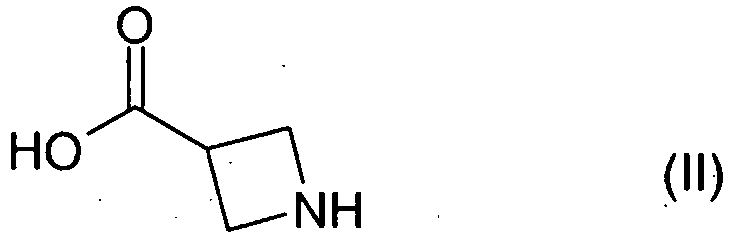
- (b) reacting the carboxylic acid group of the resulting carbamate compound from step (a) with amide coupling reagents (such as HOBt and HBTU or HOBt and EDCI) or alternatively forming the acid chloride using a reagent such as SOCl2) and reacting the resulting activated ester or acid chloride with a compound of formula (III)

- (c) deprotecting the azetidine amino group of the resulting compound from step (b) by hydrogenation (using conditions such as Pd-C and hydrogen gas) or transfer hydrogenation (using conditions such as ammonium formate and Pd-C) or strong acid (such as 4M HCl or TFA) to form a compound represented by formula (IV)
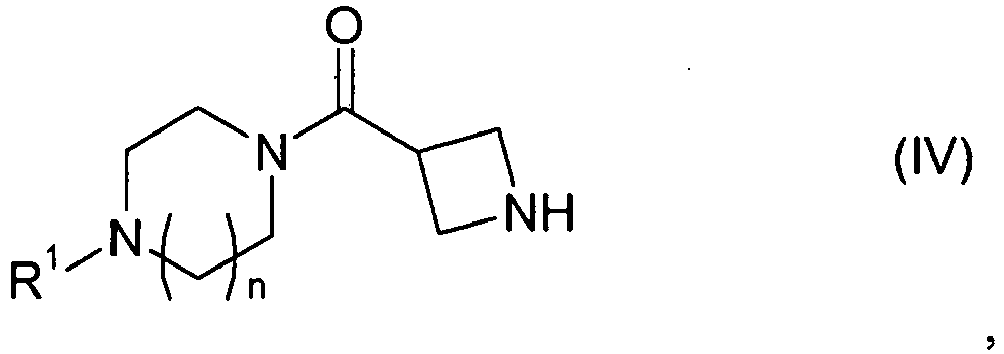
- (d) reacting the resulting secondary amino group from step (c) with an acid chloride of formula ClC(O)(CH2)n2R2 in the presence of a suitable base (such as DIPEA or pyridine) at a temperature usually between 0°C and 85°C, to yield a compound of formula (I), wherein n2, R2 are defined as indicated above.
- In a further embodiment of the above method, the azetidine amino group of a compound resulting from step (b) can be selectively deprotected in the presence of an orthogonal protecting group R1' by
- (e) hydrogenation (using conditions such as Pd-C and hydrogen gas) or transfer hydrogenation (using conditions such as ammonium formate and Pd-C) or strong acid (such as 4M HCl or TFA) to form a compound represented by formula (IVa); and

- (f) reacting the resulting azetidine amino group from step (e) with an acid chloride of formula ClC(O)(CH2)n2R2 in the presence of a suitable base (such as DIPEA or pyridine) usually between 0 °C and 85 °C, wherein n2, R2 are defined as indicated above; and
- (g) removal of the amino protecting group the R1' of the resulting compound from step (f) by hydrogenation (using conditions such as Pd-C and hydrogen gas) or transfer hydrogenation (using conditions such as ammonium formate and Pd-C) or strong acid (such as 4M HCl or TFA); and
- (h) reacting the liberated amino group with a compound of formula R1=O, wherein the oxo group is attached to a carbon atom of R1, followed by reduction of the resulting imine to yield a compound of formula (I); or alternatively, reacting the liberated amino group with a compound of formula R1-halide (optionally in the presence of base) to yield a compound of formula (I).
- Accordingly another aspect of the present invention is a method for the preparation of a compound of the present invention, wherein in formula (I) X1 is N; X2, is O, n is 0, X4 is C(O), comprising the steps of
- (a) protecting the amino group of a compound of formula (IIa) by reacting the amino group with a suitable chloroformate (such as benzyl chlorocarbonate) or di-tert-butyl dicarbonate

- (b) reacting the carboxylic acid group of the resulting carbamate compound from step (a) with a compound of formula (III) - or optionally firstly reacting with amide coupling reagents (such as HOBt and HBTU or HOBt and EDCI) or alternatively forming the acid chloride using a reagent such as SOCl2) and secondly reacting the resulting activated ester or acid chloride with a compound of formula (III) -

- (c) deprotecting the azetidine amino group of the resulting compound from step (b) to form a compound represented by formula (IVb)

- (d) reacting the resulting secondary amino group from step (c) with an acid chloride of formula ClC(O)(CH2)n2R2 in the presence of a suitable base to yield a compound of formula (I), wherein n2, R2 are defined as indicated above.
- Alternatively, compounds of formula (I), wherein X1 is N and X2 is S, may be prepared by a method comprising the steps of
- (c') reacting amide group of the product formed from step (b) with Lawesson's reagent (usually between room temperature and 100°C)
- (d') deprotecting the azetidine amino group of the resulting compound from step (c') by hydrogenation (using conditions such as Pd-C and hydrogen gas) or transfer hydrogenation (using conditions such as ammonium formate and Pd-C) to form a compound represented by formula (V)

- (e') reacting the resulting secondary amino group from step (d') with an acid chloride of formula ClC(O)(CH2)n2R2 in the presence of a suitable base (such as DIPEA or pyridine) and at a temperature usually between 0°C and 85°C, to yield a compound of formula (I), wherein n2, R2 are defined as above.
- Alternatively, compounds of formula (I) wherein X1 is N and X2 is N-CN, may be prepared by a method comprising the steps of
- (a) reacting cyanamide with carbon disulfide and then treating the resulting intermediate with dimethyl sulphate to form a compound of formula (VI)

- (b) reacting the amino group of compound of formula (III) with a compound of formula (VI) (usually between room temperature and 80°C);
- (c) reacting the compound from step (b) with a compound of formula (VII) at elevated temperature (up to 100°C), wherein X2 = N-CN and X3' is a suitable nitrogen protecting group (such as Boc or Cbz)
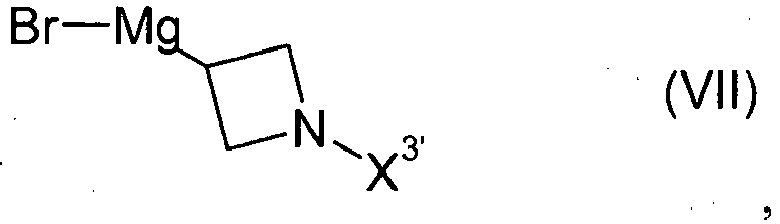
- (d) removal of the X3' nitrogen protecting group of the resulting compound from step (c) using strong acid (such as 4M HCl or TFA) when X3' is Boc, or by hydrogenation (using conditions such as Pd-C and hydrogen gas) or transfer hydrogenation (using conditions such as ammonium formate and Pd-C) when X3' is Cbz, to form a compound represented by formula (VIII)

- (e) reacting the resulting secondary amino group from step (d) with an acid chloride of formula ClC(O)(CH2)n2R2 in the presence of a suitable base (such as DIPEA or pyridine) and at a temperature usually between 0°C and 85°C, to yield a compound of formula (1), wherein n2, R2 are defined as indicated above.
- Alternatively, compounds of general formula (I), wherein X2 is N-OC1-4 alkyl and X3' is Cbz, may be prepared from a compound of formula (Ib) by a method comprising the steps of

- (a) reaction with oxalyl chloride followed by reaction with a compound of formula NH2-OC1-4 alkyl
- (b) deprotecting the azetidine amino group of the resulting compound from step (a) by hydrogenation (using conditions such as Pd-C and hydrogen gas) or transfer hydrogenation (using conditions such as ammonium formate and Pd-C), to form a compound represented by formula (IX)

- (c) reacting the resulting secondary amino group from step (b) with an acid chloride of formula ClC(O)(CH2)n2R2 in the presence of a suitable base (such as DIPEA or pyridine) and at a temperature usually between 0°C and 85°C, to yield a compound of formula (I), wherein n2, R2 are defined as indicated above.
- Alternatively, compounds of general formula (I) wherein X1 is CH and n is 1, may be prepared from a compound of formula (X) by a method comprising the steps of

- (a) reacting the amino group with a compound of formula R1=O, wherein the oxo group is attached to a carbon atom of R1, followed by reduction of the resulting imine;
- (b) saponification of the ester group with base such as LiOH;
- (c) reacting the carboxylic acid group from step (b) with a chlorinating agent (such as thionyl chloride or oxalyl chloride, optionally in the presence of catalytic DMF) and reacting the resulting acid chloride with a compound of formula (XI)

- (d) deprotecting the azetidine amino group of the resulting compound from step (c) with strong acid (such as 4M HCl or TFA), to form a compound represented by formula (XII)

- (e) reacting the resulting secondary amino group from step (d) with an acid chloride of formula ClC(O)(CH2)n2R2 in the presence of a suitable base (such as DIPEA or pyridine) and at a temperature usually between 0°C and 85°C, to yield a compound of formula (I) wherein n2, R2 are defined as indicated above.
- Alternatively, compounds of general formula (I) wherein X1 is CH and n is 2, may be prepared from a compound of formula (XIII) by a method comprising the steps of

- (a) reacting the ketone group with sodium azide and MeSO3H at between RT and 80 °C, followed by reduction of the resulting lactam and ester with LAH (usually between RT and 80 °C);
- (b) reacting the amino group with a compound of formula R1=O, wherein the oxo group is attached to a carbon atom of R1, followed by reduction of the resulting imine;
- (c) oxidation of the primary alcohol to the carboxylic acid with chromic acid (Jones oxidation);
- (d) reacting the carboxylic acid group from step (c) with a chlorinating agent (such as thionyl chloride or oxalyl chloride, optionally in the presence of catalytic DMF) and reacting the resulting acid chloride with a compound of formula (XI);
- (e) deprotecting the azetidine amino group of the resulting compound from step (d) with strong acid (such as 4M HCl or TFA), to form a compound represented by formula (XIV)

- (f) reacting the resulting secondary amino group from step (e) with an acid chloride of formula ClC(O)(CH2)n2R2 in the presence of a suitable base (such as DIPEA or pyridine) and at a temperature usually between 0°C and 85°C, to yield a compound of formula (I) wherein n2, R2 are defined as indicated above.
- Alternatively, compounds of general formula (I) wherein X1 is CH and n is 2, may be prepared from a compound of formula (XIIIa) where R1' is a suitable protecting group (such as Cbz or Boc) by a method comprising the steps of

- (a) reacting the ketone group with an alkyl diazoacetate (such as ethyl diazoacetate) in the presence of a Lewis acid (such as boron trifluoride diethyl etherate) usually between -80 °C and RT;
- (b) eliminating the resulting alcohol to give an α,β-unsaturated ester by acid catalysed elimination (alternatively the alcohol can be converted into a halide (such as bromide using a reagent such as PBr3) or sulfonate (such as a mesylate via reaction with MsCl and TEA) and eliminated in the presence of a base (such as DBU) usually between RT and 100 °C);
- (c) removal of the alkene via hydrogenation (usually using hydrogen gas or ammonium formatate in the presence of a source of palladium such as Pd/C);
- (d) removal of the protecting group R1' (using H2/Pd/C for a cbz protecting group) and reacting the amino group with a compound of formula R1=O, wherein the oxo group is attached to a carbon atom of R1, followed by reduction of the resulting imine;
- (e) hydrolysis of the ester to give the carboxylic acid using aqueous base such as LiOH or acid such as HCl and reacting the carboxylic acid group with a chlorinating agent (such as thionyl chloride or oxalyl chloride, optionally in the presence of catalytic DMF) and reacting the resulting acid chloride with a compound of formula (XI);
- (f) deprotecting the azetidine amino group of the resulting compound from step (d) with strong acid (such as 4M HCl or TFA), to form a compound represented by formula (XIV);
- (g) reacting the resulting secondary amino group from step (f) with an acid chloride of formula ClC(O)(CH2)n2R2 in the presence of a suitable base (such as DIPEA or pyridine) and at a temperature usually between 0 °C and 85 °C, to yield a compound of formula (I) wherein n2, R2 are defined as indicated above.
- The method may comprise further steps where independently compounds of formulae (IV), (IVb), (V), (VIII), (IX), (XII) or (XIV), wherein the meanings are as indicated above, are further modified by reacting the secondary amino group with either of;
- (i) a compound of formula HOC(O)(CH2)n2R2 that is first converted to the relevant activated ester by reaction with amide coupling reagents (such as EDCI / HOBt or HBTU / HOBt in the presence of a base such as DIPEA) to yield a compound of formula (I), wherein n1 = 0 and X4 is C(O);
- (ii) a compound of formula R2(CH2)n2C(O)OC(O)(CH2)n2R2 in the presence of a base such as DIPEA to yield a compound of formula (I), wherein n1 = 0 and X4 is C(O);
- (iii) a compound of formula R2(CH2)n2NCO to yield a compound of formula.(I), wherein n1 = 0 and X4 is C(O)NH;
- (iv) a compound of formula R2(CH2)n2S(O)2(CH2)n1-halide in the presence of a base such as DIPEA to yield a compound of formula (I), wherein n1 = 0 to 2 and X4 is S(O)2;
- (v) a compound of formula R2(CH2)n2(R1a)NC(O)(CH2)n1-halide in the presence of a base such as DIPEA to yield a compound of formula (I), wherein n1 = 0 to 2 and X4 is C(O)N(R1a);
- (vi) a compound of formula R2(CH2)n2OC(O)(CH2)n1-halide in the presence of a base such as DIPEA to yield a compound of formula (I), wherein n1 = 0 to 2 and X4 is C(O)O;
- (vii) a compound of formula R2(CH2)n2(R1a)NS(O)2(CH2)n1-halide in the presence of a base such as DIPEA to yield a compound of formula (I), wherein n1 = 0 to 2 and X4 is S(O)2N(R1a);
- (viii) a three step process a. to c. where by;
- a. 2-chloroethanol is first reacted with isocyanatosulfuryl chloride in the presence of base to form an intermediate compound of formula (XV)

- b. reacting a compound of formula (XV) with a compound of formula (IV), (IVb), (V), (VIII), (IX), (XII) or (XIV), wherein the meanings are as indicated above
- c. followed by reacting the resulting intermediate from step b. with a compound of formula HN(R1a)(CH2)n2R2 in base such as TEA and at elevated temperature (usually 40 to 85 °C) to yield a compound of formula (I), wherein n1 = 0 and X4 is S(O)2N(R1a).
- a. 2-chloroethanol is first reacted with isocyanatosulfuryl chloride in the presence of base to form an intermediate compound of formula (XV)
- (ix) a compound of formula R2(CH2)n2C(O)(CH2)n1-halide in the presence of a base such as DIPEA and optionally at elevated temperature (usually 30 to 120 °C) to yield a compound of formula (I), wherein n1 = 1 to 2 and X4 is C(O);
- (x) a two step process d. to e. where by;
- d. a compound of formula ClC(O)(CH2)n1-halide in the presence of base is first reacted with a compound of formula R2(CH2)n2X4' to form an intermediate compound of formula (XVa), wherein n1 = 1 to 2 and X4' is OH, NH2 or NHR1a

- e. reacting a compound of formula (XVa) in the presence of a base such as DIPEA and optionally at elevated temperature (usually 30 to 120°C) with a compound of formula (IV), (IVb), (V), (VIII), (IX), (XII) or (XIV) to yield a compound of formula (I), wherein the meanings are as indicated above; or
- d. a compound of formula ClC(O)(CH2)n1-halide in the presence of base is first reacted with a compound of formula R2(CH2)n2X4' to form an intermediate compound of formula (XVa), wherein n1 = 1 to 2 and X4' is OH, NH2 or NHR1a
- (xi) a two step process f. to g. where by;
- f. a compound of formula ClS(O)2(CH2)n1-halide in the presence of base is first reacted with a compound of formula R2(CH2)n2X4, to form an intermediate compound of formula (XVb), wherein n1 = 1 to 2 and X4' is NH2 or NHR1a

- g. reacting a compound of formula (XVb) in the presence of a base such as DIPEA and optionally at elevated temperature (usually 30 to 120°C) with a compound of formula (IV), (IVb), (V), (VIII), (IX), (XII) or (XIV) to yield a compound of formula (I), wherein the meanings are as indicated above
- f. a compound of formula ClS(O)2(CH2)n1-halide in the presence of base is first reacted with a compound of formula R2(CH2)n2X4, to form an intermediate compound of formula (XVb), wherein n1 = 1 to 2 and X4' is NH2 or NHR1a
- Accordingly, another aspect of the present invention is a method for the preparation of a compound of any of the present invention, comprising the steps of
reacting a compound of formula (Ia)
- (i) an activated ester or anhydride of a compound of formula R2(CH2)n2C(O)OH in the presence of amide coupling reagents to yield a compound of formula (I), wherein n1 = 0 and X4 is C(O); or
- (ii) a compound of formula. R2(CH2)n2NCO to yield a compound of formula (I), wherein n1 = 0 and X4 is C(O)NH; or
- (iii) a compound of formula R2(CH2)n2S(O)2(CH2)n1-halide in the presence of a base to yield a compound of formula (I), wherein n1 = 0 to 2 and X4 is S(O)2; or
- (iv) a compound of formula R2(CH2)n2(R1a)NC(O)(CH2)n1-halide in the presence of a base to yield a compound of formula (I), wherein n1 is 0 to 2 and X4 is C(O)N(R1a); or
- (v) a compound of formula R2(CH2)n2OC(O)(CH2)n1-halide in the presence of a base to yield a compound of formula (I), wherein n1 = 0 to 2 and X4 is C(O)O; or
- (vi) a compound of formula R2(CH2)n2(R1a)NS(O)2(CH2)n1-halide in the presence of a base to yield a compound of formula (I), wherein n1 = 0 to 2 and X4 is S(O)2N(R1a); or
- (vii)
- (aa) an intermediate compound of formula (XV)

- (bb) reacting the resulting intermediate from step (aa) with a compound of formula HN(R1a)(CH2)n2R2 in the presence of a base at elevated temperature to yield a compound of formula (I), wherein n = 0 and X4 is S(O)2N(R1a); or
- (aa) an intermediate compound of formula (XV)
- (viii) a compound of formula R2(CH2)n2C(O)(CH2)n1-halide in the presence of a base and optionally at elevated temperature to yield a compound of formula (I), wherein n1 = 1 to 2 and X4 is C(O); or
- (ix) an intermediate compound of formula (XVa)

- (x) an intermediate compound of formula (XVb)

- The method may comprise either of the further steps when R1a of the above methods is H:
- (a) reacting the resulting secondary amine with a suitable alkyl halide or activated alcohol (such as OMs or OTs) in the presence of an organic base (such as TEA) or NaH at temperatures between 0°C and 200°C, to yield a compound of formula (I), wherein R1a is alkyl; or
- (b) reacting the secondary amine with a suitable alkyl aldehyde in the presence of an organic acid (such as AcOH) and reducing agent (such as NaBH3CN or STAB) at room temperature or elevated temperature (up to 100 °C), to yield a compound of formula (I), wherein R1a is alkyl.
- Additionally a compound of formula (I), wherein n1=0 and X4 is C(O)O may comprise a further step comprising of;
- (a) reacting the carbamate compound of formula (I) with a primary or secondary amine in the presence of base (such as DIPEA) at room temperature or elevated temperatures of up to 200°C), to yield a compound of formula (I) with a respective urea group (X4 = C(O)N(R1a)).
- The method may comprise the further steps where compounds of formula (I), wherein the meanings are as indicated above and R2 has a potentially chemically reactive group, are further modified as follows:
- (a) reacting a suitable alcohol or (hetero)aryl alcohol with a strong base (such as NaH or tBuOK) and the resulting alkoxide or (hetero)aryloxide reacted (usually between room temperature and 180°C) with the halide or activated alcohol (sulfonate) substituent of R2, to yield a compound of formula (I); or
- (b) reacting a halide or activated alcohol (sulfonate) substituent of R2 in a Suzuki reaction using a palladium phosphine catalyst (such as that formed from Pd2(dba)3 and tricyclohexylphosphine) and suitable boronate ester or boronic acid (usually at room temperature to 150°C) in the presence of a base (such as K3PO4 or K2CO3), to yield a compound of formula (I); or
- (c) reacting the compound of formula (I) with a primary or secondary amine optionally in the presence of base (such as DIPEA or K2CO3) at room temperature or elevated temperatures of up to 200°C, to yield a compound of formula (I).
- The method may comprise the further steps where compounds of formula (I), wherein the meanings are as indicated above and R2 includes a primary or secondary amine, are further modified as follows:
- (a) reacting the amine of a compound of formula (I) with a (hetero)aromatic halide at elevated temperature (up to 120 °C) in the presence of palladium catalysed coupling reagents (such as Pd2(dba)3, BINAP and tBuOK) to yield compounds of formula (I).
- The same reaction types may apply for compounds of the present invention, where in formula (I) m is other than 0.
- The method may comprise the further step where compounds of formula (I) represented by formula (XVI), wherein the meanings are as indicated above, are further modified as follows;

- (a) reacting the ester group with a Grignard reagent (such as MeMgBr), optionally in the presence of lithium chloride, at a temperature usually between -78°C and 150°C, to yield a compound of formula (I);
- (b) saponifying the ester group using aqueous base (such as aquesous lithium hydroxide) and coupling the resulting acid with an amine of formula HN(R4R4a) using amide coupling reagents (such as HOBt and HBTU or HOBt and EDCI) usually between 0 °C and 85 °C to yield a compound of formula (I); or
- (c) reacting the ester group with an amine of formula HN(R4R4a) in the presence of a solution of AlMe3, usually between 0 °C and 85 °C to yield a compound of formula (I).
- The method may comprise the further step where compounds of formula (I) represented by formula (XVII), wherein the meanings are as indicated above, are further modified as follows;

- (a) reducing the ester group (usually with LAH) at temperatures ranging from -50 to 100 °C, to yield a compound of formula (I).
- The same reaction types may apply for compounds of the present invention, where in formula (I) m is other than 0.
- CHO-K1 cell line expressing human H3 receptors were purchased from Euroscreen (Gosselies, Belgium, Cat. no.: ES-392-C)
- Human H3 receptor-expressing cell-lines were grown in Ham's F12 [Sigma, Cat. no. N6658], supplemented with 10% FBS [Sigma, Cat. no. F9665], 400µg/ml G418 [Sigma, Cat. no. N1876] and 250µg/ml Zeocin [Invitrogen, Cat. no. 46-0509]) according to the protocol provided by Euroscreen.
- The assay measures the ability of test compounds to inhibit Histamine receptor agonist-induced decrease of intracellular free cAMP (receptor is Gi coupled).
- Specifically, a cAMP quantification assay system from DiscoveRx (cAMP XS+; Cat. no. 90-0075) was used.
- For the cAMP assay, confluent cells were detached from the culture vessels with 1x trypsin-EDTA solution (Sigma), and seeded into 384-well Costar plates (white, clear bottom, Cat. no. 3707) at a density of 10,000 cells per well. Cells were seeded in a volume of 50µl in medium without antibiotics and incubated overnight in a humidified atmosphere with 5% CO2 at 37°C. The cAMP assay was performed according to the protocol provided by DiscoveRx.
- The cell culture medium was removed and the cells washed once with PBS (50 µl per well). The plates were emptied by inversion and 7.5µl/well of compound in PBS (containing 1mM IBMX and 0.03% BSA) were added and incubated for 30min at 37°C.
Subsequent 7.5µl/well specific agonist solution was added and the plates for another 30min incubated at 37°C.
The following agonist solution is used for the individual cell-lines: - hH3: 100 nM histamine, 10 µM forskolin in PBS (containing 1mM IBMX and 0.03% BSA)
- After the incubation with the agonist, 5µl/well cAMP XS antibody solution was added followed by 20µl/well Gal/EII/Lysis(1:5:19) +ED (1:1). The plates were incubated for one hour at room temperature and afterwards 20µl/well EA reagent was added. The luminescence was developed for approximately three hours at room temperature and the plates were read out using a 'BMG Novostar' plate reader.
- Test compounds were assayed at 8 concentrations in triplicate. Serial 10-fold dilutions in 100% DMSO were made at a 100-times higher concentration than the final concentration. and then diluted with a 2 step protocol in assay buffer to reach the required assay concentrations and 1% DMSO.
- The specific compounds exemplified below were categorized by the following potency ranges (IC50 values):
- A: < 50 nM; B: > 50 nM to 100 nM; C: > 100 nM to 5000 nM.
-
- Bruker DRX 500 MHz NMR
- Bruker AVANCE 400 MHz NMR
- Bruker DPX 250 MHz NMR
- Bruker DPX 360 MHz NMR
- High performance digital NMR spectrometer, 2-channel microbay console and Windows XP host workstation running Topspin version 1.3.
- Equipped with:
- Oxford instruments magnet 11.74 Tesla (500 MHz proton resonance frequency)
- B-VT 3000 temperature controller
- GRASP II gradient spectroscopy accessory for fast acquisition of 2D pulse sequences
- Deuterium lock switch for gradient shimming
- 5mm Broad Band Inverse geometry double resonance probe with automated tuning and matching (BBI ATMA). Allows 1H observation with pulsing/decoupling of nuclei in the frequency range 15N and 31P with 2H lock and shielded z-gradient coils.
- High performance one bay Bruker 250 MHz digital two channel NMR spectrometer console and Windows XP host workstation running XwinNMR version 3.5.
- Equipped with:
- Oxford instruments magnet 5.87 Tesla (250 MHz proton resonance frequency)
- B-VT 3300 variable temperature controller unit
- Four nucleus (QNP) switchable probe for observation of 1H, 13C, 19F and 31P with 2H lock
- High performance one bay Bruker AVANCE 400 MHz digital two channel NMR spectrometer console
- Equipped with:
- Bruker magnet 9.40 Tesla (400MHz proton resonance frequency)
- B-VT 3200 variable temperature controller unit
- GRASP II gradient spectroscopy accessory for the generation of one field gradient of up to 50 Gauss cm-1
- Four nucleus (QNP) switchable probe for observation of 1H, 13C, 19F and 31P with 2H lock with z-gradient coils for gradient spectroscopy.
- Example compounds and their intermediates were analysed by HPLC-MS using a combination of the following methods.
-
Generic 2 minute method Column Atlantis dC18 2.1 x 30mm, 3um Mobile phase A = Formic acid (aq) 0.1% B = Formic acid (acetonitrile) 0.1 % Flow rate 1 mL/min Injection volume 3ul Detector 215nm (nominal) Gradient Time (min) % Organic 0 5 1.50 100 1.60 100 1.61 5 -
Standard 3 minute method Column Atlantis dC18 2.1 x 50mm, 5um Mobile phase A = Formic acid (aq) 0.1% B = Formic acid (acetonitrile) 0.1% Flow rate 1 mL/min Injection volume 3ul Detector 215nm (nominal) Gradient Time (min) % Organic 0 5 2.5 100 2.7 100 2.71 5 3.0 5 -
High resolution method Column Waters Atlantis dC18 100 x 2.1mm, 3µm column 40 °C Mobile phase A - 0.1% Formic acid (water) B - 0.1% Formic acid (acetonitrile) Flow rate 0.6 mL/min Injection volume 3ul Detector 215nm (nominal) Gradient Time (min) % Organic 0.00 5 5.00 100 5.40 100 5.42 5 7.00 5 -
High pH method, high resolution Column Phenomenex Gemini C18 2.0 x 100mm, 3um 50°C Mobile A = 2mM Amm. phase Bicarbonate, buffered to pH10 B = Acetonitrile Flow rate 0.5 ml/min Injection volume 3ul Detector 215nm (nominal) Gradient Time (mins) % Organic 0 5 5.50 100 5.90 100 5.92 5 -
Column Chromolith Speed Rod RP -18c 4.6 x 50 mm Mobile phase A - Buffer + Acetonitrile (95:5) Buffer: 0.01% ammonium acetate pH 5.00 (water) B - acetonitrile Flow rate 1.5 mL/min Injection volume 10ul Detector PDA detector Detection: Spectrum Max Gradient Time (min) % Organic 0.00 5 0.60 5 5.00 95 8.00 95 8.50 5 10.0 5 -
Column Waters X-terra MS C-18 4.6 x 50 mm, 5 micron Mobile phase A - Buffer + Acetonitrile (95:5) Buffer: 0.01% ammonium acetate pH 5.00 (water) B - acetonitrile Flow rate 1.0 mL/min Injection volume 10ul Detector PDA detector Detection: Spectrum Max Gradient Time (min) % Organic 0.00 5 1.00 5 7.00 95 12.0 95 13.0 5 15.0 5 - Where indicated, Example compounds and their intermediates were purified by one of or any combination of the following methods.
-
Column Waters SunFire Prep C18 OBD 5um 19 x 100mm Mobile Phase A, TFA (aq) 0.1% B, TFA (CH3CN) 0.1% -
Column Phenomenex Gemini C18 NX 5u 100 x 21.2mm Mobile Phase A, 2mM ammonium bicarbonate, buffered to pH10 B, Acetonitrile:2mM ammonium bicarbonate 95:5 -
Column Waters SunFire Prep C18 OBD 5um 19 x 100mm Mobile Phase A, HCO2H (aq) 0.1% B, HCO2H (MeOH) 0.1% -
Column Waters SunFire Prep C18 OBD 5um 19 x 100mm Mobile Phase A, H2O B, CH3CN -
Column Waters SunFire Prep C18 OBD 5um 19 x 100mm Mobile Phase A, H2O B, MeOH - All compounds are named using ACD Labs 10.0 naming software which conforms to IUPAC naming protocols. Some compounds are isolated as TFA, formic acid or fumaric acid salts, which is not reflected by the chemical name. Within the meaning of the present invention the chemical name represents the compound in neutral form as well as its TFA, formic acid or fumaric acid salt or any other salt, especially pharmaceutically acceptable salt, if applicable.
-
- AcOH
- acetic acid
- br s
- broad singlet
- Boc
- tert-butoxycarbonyl
- BINAP
- 2,2'-bis(diphenylphosphino)-1,1'binaphthyl
- tBuOK
- potassium tert-butoxide
- ca.
- circa
- cat
- catalytic
- CDI
- 1,1'-carbonyldiimidazole
- Chloroform-d
- deuterated chloroform
- CDCl3
- deuterated chloroform
- DCC
- dicyclohexylcarbodiimide
- DCE
- 1,2-dichloroethane
- DCM
- dichloromethane
- DIPEA
- N,N-diisopropylethylamine
- DMAP
- N,N-4-dimethylaminopyridine
- EDCI
- 1-ethyl-3-(3-dimethylaminopropyl)carbodiimide hydrochloride
- eq
- equivalent
- Ether
- diethyl ether
- Et2O
- diethyl ether
- EtOAc
- ethyl acetate
- EtOH
- ethanol
- FCC
- flash column chromatography
- h
- hours
- HCl
- hydrochloric acid
- HOBt
- 1-hydroxybenzotriazole
- HBTU
- o-benzotriazol-1-yl-N,N,N',N'-tetramethyluronium tetrafluoroborate
- IBX
- 1-hydroxy-1,2-benziodoxol-3(1h)-one 1-oxide
- LAH
- lithium aluminium hydride
- LCMS
- liquid chromatography and mass spectrometry
- MeCN
- acetonitrile
- MeOH
- methanol
- MeOD
- dueterated methanol
- MsCl
- methanesulfonyl chloride
- m
- multiplet
- min(s)
- minute(s)
- ml
- millilitre
- mL
- millilitre
- mol/M
- mole/molar
- MW
- molecular weight
- NaH
- sodium hydride
- NMR
- nuclear magnetic resonance
- NaBH3CN
- sodium cyanoborohydride
- NaBH4
- sodium borohydride
- OMs
- methanesulfonate
- OTs
- para-toluenesulfonate
- Pd2(dba)3
- bis(dibenzylideneacetone)palladium(0)
- PBr3
- tribromophospine
- PMA
- phosphomolibdic acid
- PPh3
- triphenylphosphine
- PS-DIPEA
- polymer-supported N,N-diisopropylethylamine
- Rt
- retention time
- RT
- room temperature
- STAB
- sodium triacetoxyborohydride
- thio-CDI
- thio-carbonyl diimidazole
- TBAF
- tetra-n-butylammonium fluoride
- TBAI
- tetra-n-butylammonium iodide
- TBDMSCl
- tert-butyldimethylsilyl chloride
- TEA
- triethylamine
- TFA
- 2,2,2-trifluoroacetic acid
- TFE
- 2,2,2-trifluoroethanol
- THF
- tetrahydrofuran
- TLC
- thin layer chromatography
- TMS
- trimethylsilyl
- wt
- weight
-

-

- To a stirred solution of [1,4]diazepane-1-carboxylic acid tert-butyl ester (5 g, 24.97 mmol) in DCE (70 ml) at 20 to 25 °C was added cyclobutanone (1.75 g, 24.97 mmol) followed by acetic acid (1.5 g, 24.97 mmol) dropwise. The resulting mixture was stirred at 20 to 25 °C for ca. 2 h. Sodium triacetoxyborohydride (7.94 g, 37.46 mmol) was added in 9 portions, keeping the temperature in the range of 20 to 25 °C. The resulting suspension was stirred at 20 to 25 °C overnight. Saturated aqueous NaHCO3 (80 ml) was added in four portions and the biphasic mixture stirred at 20 to 25 °C for ca. 0.5 h. The organic layer was separated, washed with water (20 ml) and the aqueous phase back extracted at pH 9 with DCM (20 ml). The combined organic phases were dried (Na2SO4), filtered and concentrated at reduced pressure to provide the title compound (6.1 g, 96% yield) as yellow oil.
LCMS data: Calculated MH+ (255); Found 100% [2(M-Boc)]H+ m/z (307), Rt = 1.4 min.
NMR data: 1H NMR (400 MHz, MeOD) δ ppm 3.38 - 3.52 (4 H, m), 2.86 - 2.98 (1 H, m), 2.40 - 2.54 (4 H, in), 2.02 - 2.12 (2 H, m), 1.77 - 1.92 (4 H, m), 1.61 - 1.75 (2 H, m), 1.46 (9 H, s). -

- To a stirred solution of tert-butyl 4-cyclobutyl-1,4-diazepane-1-carboxylate (6.1 g, 23.98 mmol) in DCM (70 ml) at 20 to 25 °C was added a solution of 4M HCl in dioxane (30 ml, 120 mmol) dropwise. The resulting mixture was stirred at 20 to 25 °C for ca. 2 h. MeOH (6 ml) was added and the resulting mixture stirred at 20 to 25 °C for 1 to 2 days. The solvent was removed at reduced pressure and the resulting gummy residue slurried in ether (100 ml) for 0.5 h. The solvent was evaporated and the residue slurried in ether/MeOH (10:1, 66 ml). The resulting white solid was collected by filtration, suspended in DCM (150 ml) and treated with 2M NaOH. The aqueous phase was extracted with DCM until complete transfer of product in the organic layer, as monitored by TLC analysis (eluent, DCM/MeOH/conc.NH3 (90:10:1); stain, PMA) was achieved. The combined organic phases were dried (Na2SO4) filtered and concentrated at reduced pressure to provide the title compound (2.67 g, 73% yield) as orange oil.
LCMS data: Calculated MH+ (155); Found 100% (MH+) m/z 155, Rt = 0.44 min.
NMR data: 1H NMR (400 MHz, Chloroform-d) δ ppm 2.85 - 2.97 (5 H, m), 2.43 - 2.53 (4 H, m), 1.97 - 2.08 (2 H, m), 1.52 - 1.91 (7 H, m). -

-

- To a 0 °C stirred solution of 3-azetidine carboxylic acid (500 mg, 4.95 mmol) in 2 M K2CO3 aqueous (5 ml) and dioxane (5 ml), benzyl chlorocarbonate (929 mg / 0.78 ml, 5.45 mmol) was added dropwise. The reaction mixture was allowed to warm to RT and stirred for 15 hours. The reaction was monitored by TLC. Upon completion the reaction mixture was quenched with piperazine (42 mg, 0.50 mmol), concentrated at reduced pressure and treated with 2 M aqueous HCl (10 ml). The aqueous layer was extracted with EtOAc (5 x 10 ml), the phases separated, dried (MgSO4), filtered and concentrated at reduced pressure. The crude orange oil was purified by silica FCC to give the title compound (760 mg, 65% yield) as a white solid.
LCMS data (reaction IPC): Calculated MH+ (236); Found 7% (MH+) m/z 236, Rt = 1.09 min.
NMR data: 1H NMR (500 MHz, Chloroform-d) δ ppm 8.49 (1 H, br. s.), 7.30 - 7.42 (5 H, m), 5.10 - 5.15 (2 H, m), 4.18 - 4.27 (4 H, m), 3.43 (1 H, m). -
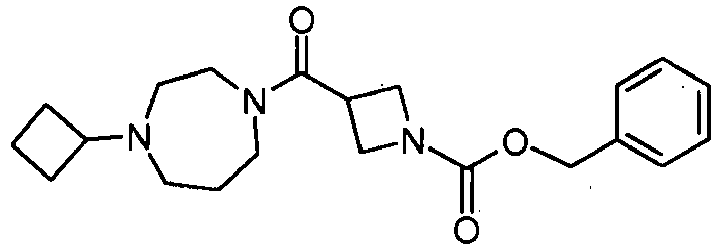
- To a stirred solution of 1-[(benzyloxy)carbonyl]azetidine-3-carboxylic acid (500 mg, 2.13 mmol) in DMF/DCM (1:10) (11 ml) was added HOBt (287 mg, 2.13 mmol) and EDCI (490 mg, 2.56 mmol). The resulting suspension was stirred at RT for 10 mins before dropwise addition of 1-cyclobutyl-1,4-diazepane (328 mg, 2.13 mmol) in DCM (3 ml). After stirring for 16 h at RT the reaction was shown to be complete by TLC and the solvent was evaporated at reduced pressure. The residue was treated with saturated aqueous NaHCO3 (10 ml) and the resulting aqueous extracted with EtOAc (3 x 7.5 ml). The combined organic phases were dried (MgSO4), filtered and concentrated at reduced pressure. Purification by silica FCC (eluting with 99:1 to 97:3 gradient of DCM / 2M NH3 in MeOH) provided the title compound (475 mg, 60% yield) as a yellow oil.
LCMS data: Calculated MH+ (372); Found 97% (MH+) m/z 372, Rt = 2.51 min (Method C).
NMR data: 1H NMR (500 MHz, CHLOROFORM-d) δ ppm 7.29 - 7.41 (5 H, m), 5.10 (2 H, s), 4.19 - 4.47 (2 H, m), 4.07 - 4.18 (2 H, m), 3.59 - 3.71 (2 H, m), 3.48 - 3.58 (1 H, m), 3.33 (2 H, m), 2.85 (1 H, m), 2.45 - 2.56 (2 H, m), 2.34 - 2.45 (2 H, m), 1.97 - 2.10 (2 H, m), 1.73 - 1.92 (4 H, m), 1.58 - 1.73 (2 H, m). -

- To a solution of benzyl 3-[(4-cyclobutyl-1,4-diazepan-1-yl)carbonyl]azetidine-1-carboxylate (420 mg, 1.13 mmol) in EtOH (10 ml) was added 5% Pd-C (42 mg, 10% wt/wt). The flask was evacuated and the vacuum purged with N2 gas. The flask was evacuated again and the vacuum purged with H2 gas. The reaction was complete after 16 h, as shown by 1H NMR. The suspension was filtered through Celite® with MeOH washings (3 x 5 ml), and the combined filtrate dried (MgSO4), filtered and concentrated at reduced pressure to give the title compound (248 mg, 93% yield) as a viscous pale yellow oil.
LCMS data: Calculated MH+ (238); Found (MH+) m/z 238 Rt = 2.91 - 3.02 min (Method D).
NMR data: 1H NMR (500 MHz, CHLOROFORM-d) δ ppm 4.01 - 4.08 (2 H, m), 3.72 - 3.80 (1 H, m), 3.67 - 3.72 (2 H, m), 3.60 - 3.67 (2 H, m), 3.33 - 3.38 (2 H, m), 2.86 (1 H, m), 2.48 (2 H, td, J=10.3, 5.0 Hz), 2.35 - 2.44 (3 H, m), 1.99 - 2.09 (2 H, m), 1.75 - 1.90 (4 H, m), 1.57 - 1.72 (2 H, m). -

- To a stirred 0 °C solution of 1-(azetidin-3-ylcarbonyl)-4-cyclobutyl-1,4-diazepane (20 mg, 0.084 mmol) in DCM (1 ml) and TEA (0.023 ml, 0.17 mmol) was added dropwise piperidine-1-carbonyl chloride (14.9 mg, 0.013 ml, 0.10 mmol). The reaction was stirred for 1 h and then allowed to warm to RT and the progress monitored by LCMS. After 1 h the reaction was quenched with water (5 ml), extracted with DCM (2 x 10 ml), dried (MgSO4), filtered and concentrated at reduced pressure. Purification by silica FCC (eluting with 99:1 to 96:4 gradient of DCM / 2M NH3 in MeOH) provided impure title compound (22 mg, 78%) as brown oil. Re-purification by preparative HPLC provided the title compound (3 mg, 10% yield) as a colourless oil.
LCMS data: Calculated MH+ (348); Found 95% (MH+) m/z 348, Rt = 2.19 min (Method D).
NMR data: 1H NMR (500 MHz, CHLOROFORM-d) δ ppm 4.08 - 4.20 (2 H, m), 3.97 - 4.06 (2 H, m), 3.56 (2 H, m), 3.36 - 3.48 (1 H, m), 3.24 - 3.31 (2 H, m), 3.16 - 3.22 (4 H, m), 2.72 - 2.83 (1 H, m), 2.42 (2 H, m), 2.34 (2 H, m), 1.96 (2 H, m), 1.77 (4 H, m), 1.49 - 1.66 (10 H, m), 1.38 - 1.48 (4 H, m). - The following compound was prepared as described in Route 2, General Procedure C above.
-

- In a similar fashion (Route 2, GP C), 1-(azetidin-3-ylcarbonyl)-4-cyclobutyl-1,4-diazepane (30 mg, 0.126 mmol) and morpholine-4-carbonyl chloride (23 mg, 0.151 mmol) gave the title compound (6.6 mg, 15% yield) as colourless oil after purification by silica FCC (eluting with 99:1 to 96:4 gradient of DCM / 2M NH3 in MeOH).
LCMS data: Calculated MH+ (351); Found 95% (MH+) m/z 351, Rt = 3.15 min (Method D).
NMR data: 1H NMR (250 MHz, CHLOROFORM-d) δ ppm 4.13 - 4.23 (2 H, m), 4.04 (2 H, m), 3.54 - 3.63 (6 H, m), 3.36 - 3.52 (1 H, m), 3.27 (6 H, m), 2.71 - 2.85 (1 H, m), 2.42 (2 H, m), 2.29 - 2.38 (2 H, m), 1.90 - 2.04 (2 H, m), 1.43 - 1.87 (10 H, m). -

-

- To a stirred solution of cyclohexanecarboxylic acid (10.8 mg, 0.084 mmol) in DCM/DMF (1.1 ml) was added HOBt (11.4 mg, 0.084 mmol) and EDCI (16.1 mg, 0.084 mmol). After 10 mins a solution of 1-(azetidin-3-ylcarbonyl)-4-cyclobutyl-1,4-diazepane (20 mg, 0.084 mmol) in DCM (1 ml) and DIPEA (0.01 ml, 0.084 mmol) was added dropwise. After 15 h the solvent was evaporated at reduced pressure and purified by silica FCC (eluting with 99:1 to 95:5 gradient of DCM / 2M NH3 in MeOH) to give the title compound (24 mg, 82% yield) as brown oil.
LCMS data: Calculated MH+ (348); Found 100% (MH+) m/z 348 and (MNa+) 370.1, Rt = 2.19 min (Method C).
NMR data: 1H NMR (500 MHz, CHLOROFORM-d) δ ppm 4.57 (1 H, m), 4.13 - 4.23 (2 H, m), 4.05 (1 H, m), 3.56 - 3.74 (2 H, m), 3.52 (1 H, m), 3.29 - 3.41 (2 H, m), 2.81 - 2.90 (1 H, m), 2.49 - 2.57 (1 H, m), 2.43 - 2.49 (2 H, m), 2.34 - 2.42 (1 H, m), 2.15 (1 H, m), 2.03 (2 H, m), 1.89 (2 H, m), 1.75 - 1.85 (4 H, m), 1.57 - 1.72 (4 H, m), 1.38 - 1.54 (2 H, m), 1.15 - 1.32 (4 H, m). - The following compounds were prepared as described in Route 3, General Procedure D .above.
-

- In a similar fashion (Route 3, GP D), tetrahydro-2H-pyran-4-carboxylic acid (16.4 mg, 0.13 mmol) and 1-(azetidin-3-ylcarbonyl)-4-cyclobutyl-1,4-diazepane (30 mg, 0.13 mmol) gave the title compound (15 mg, 34% yield) as colourless oil.
LCMS data: Calculated MH+ (349); Found 99% (MH+) m/z 349, Rt = 3.14 min (Method C).
NMR data: 1H NMR (500 MHz, CHLOROFORM-d) δ ppm 4.59 - 4.65 (1 H, m), 4.14 - 4.27 (2 H, m), 3.96 - 4.10 (3 H, m), 3.49 - 3.76 (3 H, m), 3.29 - 3.46 (4 H, m), 2.81 - 2.91 (1 H, m), 2.34 - 2.58 (5 H, m), 1.99 - 2.08 (2 H, m), 1.74 - 1.93 (7 H, m), 1.53 - 1.74 (3 H, m). -

- In a similar fashion (Route 3, GP D), 4-cyanobenzoic acid (18.5 mg, 0.13 mmol) and 1-(azetidin-3-ylcarbonyl)-4-cyclobutyl-1,4-diazepane (30 mg, 0.13 mmol) gave the title compound (15 mg, 34% yield) as viscous orange brown oil.
LCMS data: Calculated MH+ (366); Found 99% (MH+) m/z 366, Rt = 3.58 min (Method D).
NMR data: 1H NMR (500 MHz, CHLOROFORM-d) δ ppm 7.71 - 7.77 (4 H, m), 4.72 (1 H, m), 4.38 - 4.47 (1 H, m), 4.32 (2 H, m), 3.58 - 3.75 (3 H, m), 3.35 - 3.40 (2 H, m), 2.83 - 2.91 (1 H, m), 2.34 - 2.58 (4 H, m), 2.04 (2 H, m), 1.74 - 1.94 (5 H, m), 1.56 - 1.73 (2 H, m). -

- In a similar fashion (Route 3, GP D), 6-(methoxycarbonyl)pyridine-3-carboxylic acid (200 mg, 1.10 mmol) and 1-(azetidin-3-ylcarbonyl)-4-cyclobutyl-1,4-diazepane (262 mg, 1.10 mmol) gave the title compound (173 mg, 39% yield) as white solid.
LCMS data: Calculated MH+ (401); Found 100% (MH+) m/z 401, Rt = 3.31 min (Method D).
NMR data: 1H NMR (500 MHz, CHLOROFORM-d) δ ppm 8.96 (1 H, m), 8.18 - 8.27 (1 H, m), 8.09 - 8.18 (1 H, m), 4.74 (1 H, m), 4.27 - 4.50 (3 H, m), 4.03 (3 H, s), 3.57 - 3.75 (3 H, m), 3.32 - 3.43 (2 H, m), 2.87 (1 H, s), 2.47 - 2.57 (2 H, m), 2.42 (2 H, m), 1.98 - 2.10 (2 H, m), 1.76 - 1.93 (4 H, m), 1.57 - 1.72 (2 H, m). -
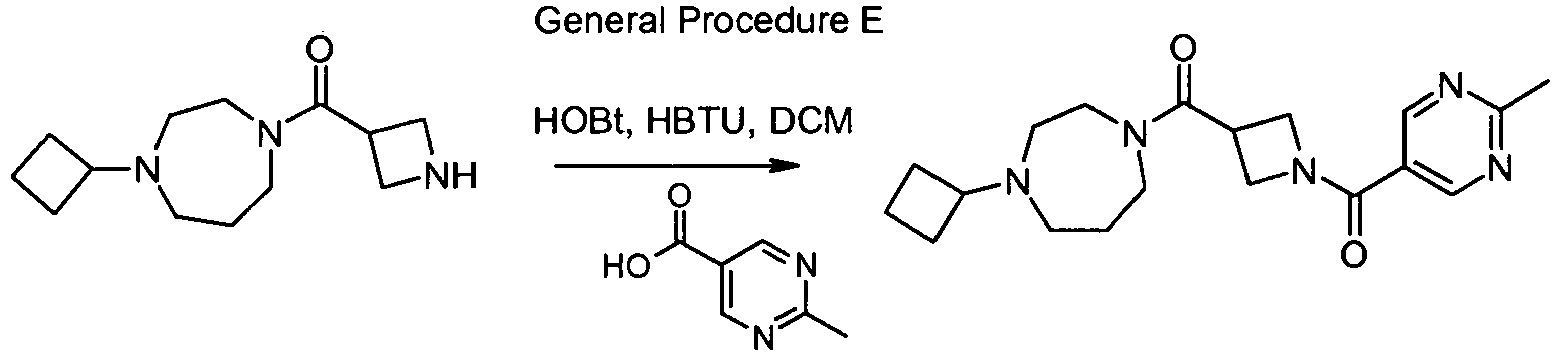
-

- To a stirred solution of 2-methylpyrimidine-5-carboxylic acid (23 mg, 0.17 mmol) in DCM (3 ml) was added HOBt (23 mg, 0.17 mmol) and HBTU (64 mg, 0.17 mmol). After 3 hours, a solution of 1-(Azetidin-3-ylcarbonyl)-4-cyclobutyl-1,4-diazepane (48 mg, 0.17 mmol), in DCM (1 ml) was added and the yellow suspension gradually dissolved to give a yellow solution. The reaction mixture was quenched with saturated NaHCO3 (1 ml) and the aqueous layer extracted with DCM (3 x 5 ml). The combined organic layers were dried (MgSO4), filtered and concentrated at reduced pressure. Purification by silica FCC (eluting with 99:1 to 95:5 gradient of DCM / 2M NH3 in MeOH) gave the title compound (17.4 mg, 29% yield) as pale yellow oil.
LCMS data: Calculated MH+ (358); Found 99% (MH+) m/z 358, Rt = 3.05 min (Method D).
NMR data: 1H NMR (500 MHz, CHLOROFORM-d) δ ppm 8.89 (2 H, m), 4.77 (1 H, m), 4.36 - 4.44 (2 H, m), 4.27 - 4.34 (1 H, m), 3.58 - 3.72 (3 H, m), 3.33 - 3.38 (2 H, m), 2.85 (1 H, m), 2.77 (3 H, s), 2.46 - 2.52 (2 H, m), 2.37 - 2.43 (2 H, m), 2.02 (2 H, m), 1.87 (1 H, m), 1.74 - 1.84 (3 H, m), 1.58 - 1.70 (2 H, m). - The following compounds were prepared as described in Route 4, General Procedure E above.
-

- In a similar fashion (Route 4, GP E), 5-methylpyrazine-2-carboxylic acid (23 mg, 0.17 mmol) and 1-(azetidin-3-ylcarbonyl)-4-cyclobutyl-1,4-diazepane (40 mg, 0.17 mmol) gave the title compound (22 mg, 34% yield) as pale yellow oil.
LCMS data: Calculated MH+ (358); Found 98% (MH+) m/z 358, Rt = 2.05 min (Method D).
NMR data: 1H NMR (500 MHz, CHLOROFORM-d) δ ppm 9.15 (1 H, s), 8.37 (1 H, s), 4.92 (1 H, m), 4.82 (1 H, m), 4.32 - 4.45 (2 H, m), 3.57 - 3.75 (3 H, m), 3.33 - 3.42 (2 H, m), 2.86 (1 H, m), 2.60 (3 H, s), 2.33 - 2.57 (4 H, m), 2.11 - 2.31 (1 H, m), 1.97 - 2.08 (2 H, m), 1.87 - 1.94 (1 H, m), 1.74 - 1.87 (3 H, m), 1.61 (2 H, m). -

- In a similar fashion (Route 4, GP E), 6-methylpyridine-3-carboxylic acid (200 mg, 1.46 mmol) and 1-(azetidin-3-ylcarbonyl)-4-cyclobutyl-1,4-diazepane (0.346 mg, 1.46 mmol) gave the title compound (219 mg, 42% yield) as white solid.
LCMS data: Calculated MH+ (357); Found 100% (MH+) m/z 357, RT = 3.34 min (Method D).
NMR data: 1H NMR (500 MHz, CHLOROFORM-d) δ ppm 8.76 (1 H, d, J=1.8 Hz), 7.90 (1 H, dd, J=8.1, 2.0 Hz), 7.23 (1 H, d, J=8.1 Hz), 4.75 (1 H, m), 4.35 - 4.46 (2 H, m), 4.28 - 4.36 (1 H, m), 3.59 - 3.74 (3 H, m), 3.33 - 3.42 (2 H, m), 2.82 - 2.92 (1 H, m), 2.61 (3 H, s), 2.48 - 2.54 (2 H, m), 2.39 - 2.46 (2 H, m), 2.00 - 2.10 (2 H, m), 1.74 - 1.93 (4 H, m), 1.58 - 1.74 (2 H, m). -

- In a similar fashion (Route 4, GP E) 4-(tetrahydropyran-4-yloxy)benzoic acid (50 mg, 0.23 mmol) and 1-(azetidin-3-ylcarbonyl)-4-cyclobutyl-1,4-diazepane (53 mg, 0.23 mmol) gave the title compound (57 mg, 57 %).
LCMS data: Calculated MH+ (442); Found 97% (MH+) m/z 442, Rt = 2.79 min (Method C).
NMR data: 1H NMR (500 MHz, CHLOROFORM-d) δ ppm 7.63 (2 H, d, J=8.7 Hz), 6.92 (2 H, d, J=8.9 Hz), 4.70 - 4.85 (1 H, m), 4.50 - 4.64 (1 H, m), 4.20 - 4.47 (3 H, m), 3.93 - 4.06 (2. H, m), 3.54 - 3.78 (5 H, m), 3.30 - 3.44 (2 H, m), 2.80 - 2.95 (1 H, m), 2.32 - 2.62 (4 H, m), 1.97 - 2.12 (4 H, m), 1.74 - 1.96 (6 H, m), 1.60 - 1.74 (2 H, m). -

- In a similar fashion (Route 4 GP E) 6-(1H-imidazol-1-yl)nicotinic acid (26 mg, 0.14 mmol) and 1-(azetidin-3-ylcarbonyl)-4-cyclobutyl-1,4-diazepane (30 mg, 0.13 mmol) gave the title compound (16 mg, 31 %).
LCMS data: Calculated MH+ (409); Found 100% (MH+) m/z 409, Rt = 3.38 min (Method D).
NMR data: 1H NMR (500 MHz, CHLOROFORM-d) δ ppm 8.75 (1 H, d, J=1.7 Hz), 8.41 (1 H, s), 8.17 (1 H, dd, J=8.5, 1.2 Hz), 7.68 (1 H, s), 7.43 (1 H, d, J=8.5 Hz), 7.23 (1 H, s), 4.83 (1 H, m.), 4.40 - 4.51 (2 H, m), 4.27 - 4.39 (1 H, m), 3.56 - 3.79 (3 H, m), 3.40 (2 H, m.), 2.82 - 2.96 (1 H, m), 2.53 (4 H, m.), 2.04 - 2.1 (2 H, m), 1.49 - 1.99 (6 H, m). -

- In a similar fashion (Route 4, GP E), 6-(1H-1,2,4-triazol-1-yl)nicotinic acid (26 mg, 0.14 mmol) and 1-(azetidin-3-ylcarbonyl)-4-cyclobutyl-1,4-diazepane (30 mg, 0.13 mmol) gave the title compound (16 mg, 31 %).
LCMS data: Calculated MH+ (410); Found 100% (MH+) m/z 410, Rt = 3.46 min (Method D).
1H NMR (500 MHz, MeOD) δ ppm 9.42 (1H, s), 8.81 (1H, d, J=2.0 Hz), 8.31 (1H, dd, J=8.5, 2.2 Hz), 8.24 (1H, s), 8.05 (1H, d, J=8.5 Hz), 4.62 (2H, m), 4.38 - 4.52 (1H, m), 4.23 - 4.38 (1 H, m), 3.85 - 4.02 (1 H, m), 3.60 - 3.75 (2 H, m), 3.40 - 3.57 (2 H, m), 2.84 - 3.02 (1 H, m), 2.52 - 2.71 (2 H, m), 2.39 - 2.51 (2 H, m), 2.01 - 2.16 (2 H, m), 1.77 - 1.96 (4 H, m), 1.56 - 1.77 (2H, m). -

- In a similar fashion (Route 4 GP E), 6-(1H-Pyrazol-1-yl)nicotinic acid (50 mg, 0.26 mmol) and 1-(azetidin-3-ylcarbonyl)-4-cyclobutyl-1,4-diazepane (57 mg, 0.24 mmol) gave the title compound (4.7 mg, 5 %) after preparative HPLC (Method 2).
LCMS data: Calculated MH+ (409); Found 98% (MH+) m/z 409, Rt = 4.02 min (Method D).
NMR data: 1H NMR (500 MHz, MeOD) δ ppm 8.74 (1 H, d, J=1.8 Hz), 8.66 (1 H, d, J=2.7 Hz), 8.21 (1 H, dd, J=8.5, 2.3 Hz), 8.04 (1 H, d, J=8.7 Hz), 7.80 (1 H, s), 6.50 - 6.63 (1 H, m), 4.62 (2 H, d, J=7.3 Hz), 4.37 - 4.48 (1 H, m), 4.28 - 4.37 (1 H, m), 3.83 - 3.99 (1 H, m), 3.60 - 3.74 (2 H, m), 3.43 - 3.55 (2 H, m), 2.84 - 3.03 (1 H, m), 2.41 - 2.63 (4 H, m), 2.01 - 2.13 (2 H, m), 1.79 - 1.97 (4 H, m), 1.57 - 1.76 (2 H, m). -

-

- To a solution of 1-(azetidin-3-ylcarbonyl)-4-cyclobutyl-1,4-diazepane (330 mg, 1.39 mmol) and Na2CO3 (590 mg, 5.56 mmol) in dichloromethane (10 ml) at 0 °C was added chloroacetyl chloride (107 µl, 1.39 mmol). After 10 mins the reaction temperature was raised to RT and stirred for a further hour. The reaction was then filtered and concentrated at reduced pressure to give the title compound as colourless oil (411 mg, 91% yield), which was used without further purification.
LCMS data: Calculated MH+ (314); Found 81% (MH+) m/z 314, Rt = 3.38 min.
NMR data: 1H NMR (500 MHz, CDCl3) δ ppm 4.54 - 4.65 (1 H, m), 4.25 - 4.37 (1 H, m), 4.06 - 4.24 (2 H, m), 3.77 - 3.89 (2 H, m), 3.47 - 3.76 (3 H, m), 3.20 - 3.37 (2 H, m), 2.74 - 2.89 (1 H, m), 2.28 - 2.59 (4 H, m), 1.70 - 2.04 (6 H, m), 1.49 - 1.68 (2 H, m). -

- A solution of 1-{[1-(chloroacetyl)azetidin-3-yl]carbonyl}-4-cyclobutyl-1,4-diazepane (40 mg, 0.13 mol), K2CO3 (20 mg, 0,14 mmol) and pyrazole (9 mg, 0.13 mmol) was heated at 120 °C in DMF (2 ml) in a sealed tube for 16 hrs. The solvent was evaporated at reduced pressure and purified by silica FCC (using a gradient of eluents; DCM/MeOH/NH3 99:1:1 to 92:8:1) to give the title compound (18 mg, 40% yield) as pale brown oil.
LCMS data: Calculated MH+(346); Found 79% (MH+) m/z 346, Rt = 3.23 min (Method D).
NMR data - esitmated ∼90% purity: 1H NMR (500 MHz, CDCl3) δ ppm 7.49 - 7.58 (2 H, m), 6.32 (1 H, m), 4.70 - 4.88 (2 H, m), 4.29 - 4.39 (1 H, m), 4.11 - 4.28 (2 H, m), 3.95 - 4.09 (1 H, m), 3.45 - 3.72 (3 H, m), 3.25 - 3.38 (2 H, m), 2.79 - 2.92 (1 H, m), 2.30 - 2.57 (4 H, m), 2.03 (2 H, m), 1.72 - 1.96 (4 H, m), 1.54 - 1.72 (2 H, m). -

-

- A solution of 1-{[1-(chloroacetyl)azetidin-3-yl]carbonyl}-4-cyclobutyl-1,4-diazepane (40 mg, 0.13 mmol) and piperidine (38 µl, 0.38 mmol) in toluene (2 ml) was heated at 80 °C for 4 hrs in a sealed tube then cooled to RT. The reaction was diluted with DCM (30 ml), washed with a saturated aqueous solution of NaHCO3 (2 x 15 ml), dried (MgSO4), filtered and concentrated at reduced pressure. The residue was purified by silica FCC (using a gradient of eluents; DCM/MeOH/NH3 99:1:1 to 92:8:1) to give the title compound (25 mg, 53% yield) as a colourless oil.
LCMS data: Calculated MH+(363); Found 85% (MH+) m/z 363, Rt = 3.74 min (Method D).
NMR data: 1H NMR (500 MHz, CDCl3) δ ppm 4.55 - 4.65 (1 H, m), 4.30 - 4.40 (1 H, m), 4.06 - 4.24 (2 H, m), 3.47 - 3.73 (3 H, m), 3.28 - 3.40 (2 H, m), 2.92 - 3.06 (2 H, m), 2.80 - 2.90 (1 H, m), 2.30 - 2.58 (8 H, m), 1.98 - 2.08 (2 H, m), 1.73 - 1.93 (4 H, m), 1.50 - 1.73(6 H, m), 1.34 - 1.46 (2 H, m). - The following compound was prepared as described in Route 6, General Procedure N above.
-

- In a similar fashion (Route 6, GP N), 1-{[1-(chloroacetyl)azetidin-3-yl]carbonyl}-4-cyclobutyl-1,4-diazepane (100 mg, 0.32 mmol) and morpholine (83 mg, 0.95 mmol) gave the title compound (8.8 mg, 8%) as a colourless oil after purification by preparative HPLC (Method 2).
LCMS data: Calculated MH+ (365); Found 99% (MH+) m/z 365, Rt = 3.06 min (Method D).
NMR data: 1H NMR (500 MHz, MeOD) δ ppm 4.43 - 4.51 (2 H, m), 4.15 - 4.23 (1 H, m), 4.06 - 4.15 (1 H, m), 3.77 - 3.87 (1 H, m), 3.67 - 3.73 (4 H, m), 3.58 - 3.67 (2 H, m), 3.41 - 3.51 (2 H, m), 3.07 (2 H, s), 2.87 - 3.00 (1 H, m), 2.41 - 2.63 (8 H, m), 2.02 - 2.13 (2 H, m), 1.78 - 1.95 (4 H, m), 1.61 - 1.76 (2 H, m). -
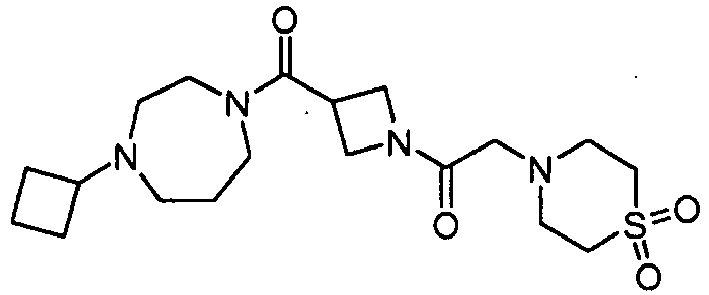
- In a similar fashion (Route 6, GP N), 1-{[1-(chloroacetyl)azetidin-3-yl]carbonyl}-4-cyclobutyl-1,4-diazepane (150 mg, 0.47 mmol) and thiomorpholine-1,1-dioxide (130 mg, 0.75 mmol) gave the title compound (7.9 mg, 3%) as a colourless oil after purification by preparative HPLC (Method 2).
LCMS data: Calculated MH+(413); Found 100% (MH+) m/z 413, Rt = 3.00 min (Method D).
NMR data: 1H NMR (500 MHz, MeOD) δ ppm 4.37 - 4.54 (2 H, m), 4.16 - 4.27 (1 H, m), 4.07 - 4.15 (1 H, m), 3.69 - 3.89 (2 H, m), 2.67 - 3.69 (18 H, m), 2.16 - 2.32 (2 H, m), 1.89 - 2.16 (4 H, m), 1.67 - 1.87 (2 H, m). -

- In a similar fashion (Route 6, GP N), 1-{[1-(chloroacetyl)azetidin-3-yl]carbonyl}-4-cyclobutyl-1,4-diazepane (150 mg, 0.47 mmol) and 3,3-difluoropyrrolidine hydrochloride (111 mg, 0.75 mmol) gave the title compound (6.3 mg, 3%) as colourless oil after purification by preparative HPLC (Method 2).
LCMS data: Calculated MH+(385); Found 100% (MH+) m/z 385, Rt = 3.56 min (Method D).
NMR data: 1H NMR (500 MHz, MeOD) δ ppm 4.37 - 4.52 (2 H, m), 4.04 - 4.30 (3 H, m), 3.65 - 3.91 (3 H, m), 3.37 - 3.65 (4 H, m), 3.28 - 3.37 (2 H, m), 2.83 - 3.19 (6 H, m), 2.08 - 2.43 (8 H, m), 1.69 - 1.93 (2 H, m). -
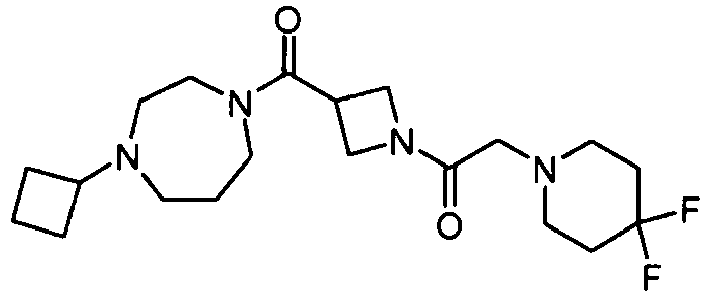
- In a similar fashion (Route 6, GP N), 1-{[1-(chloroacetyl)azetidin-3-yl]carbonyl}-4-cyclobutyl-1,4-diazepane (150 mg, 0.47 mmol) and 4,4-difluoropiperidine hydrochloride (90 mg, 0.57 mmol) gave the title compound (7.3 mg, 4%) as colourless oil after purification by preparative HPLC (Method 2).
LCMS data: Calculated MH+ (399); Found 90% (MH+) m/z 399, Rt = 3.68 min (Method D).
NMR data: 1H NMR (500 MHz, CHLOROFORM-d) δ ppm 4.63 (1 H, m), 4.17 - 4.34 (2 H, m), 4.06 - 4.17 (1 H, m), 3.51 - 3.77 (3 H, m), 3.29 - 3.43 (2 H, m), 3.04 - 3.13 (2 H, m), 2.81 -2.93(1 H, m), 2.35-2.77(8H, m), 1.75 - 2.14 (10 H, m), 1.55-1.75(2H,m). -
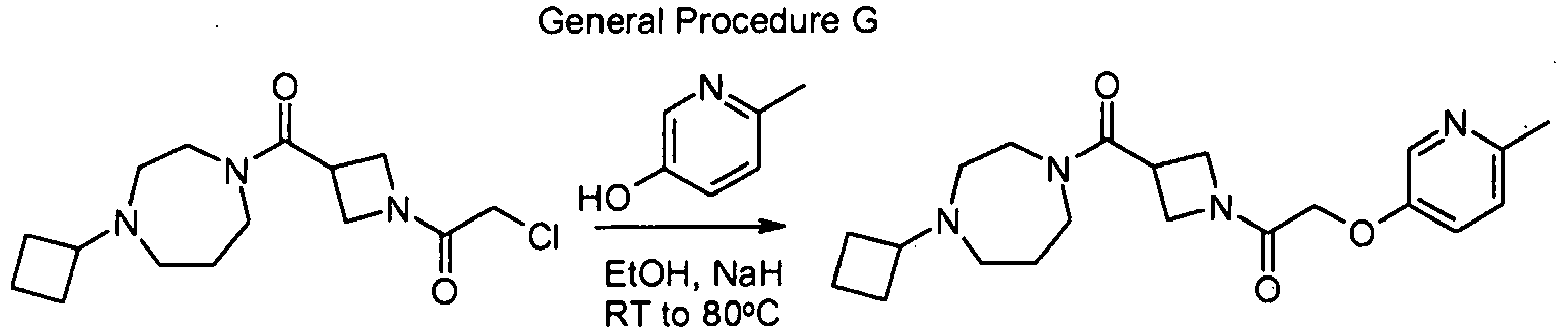
-
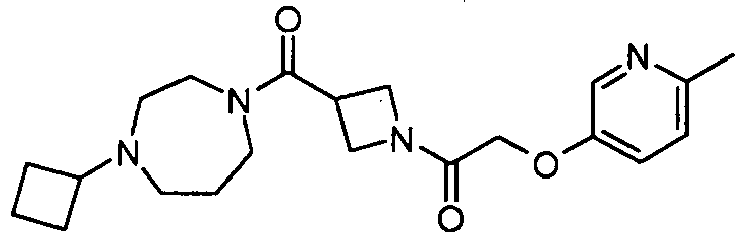
- To a stirred solution of 3-hydroxy-6-methylpyridine (28 mg, 0.26 mmol) in EtOH (1 ml) was added NaH (8 mg of a 60% dispersion in mineral oil, 0.19 mmol). When evolution of gas had ceased the solution was added to 1-{[1-(chloroacetyl)azetidin-3-yl]carbonyl}-4-cyclobutyl-1,4-diazepane (40 mg, 0.13 mmol) in EtOH (1 ml) at RT and the reaction was then heated at 80 °C in a sealed tube for 4 hrs. After cooling to RT and quenching with water (1 ml), the mixture was diluted with DCM (30 ml) and washed with a saturated solution of NaHCO3 (2 x 15 ml), dried (MgSO4), filtered and concentrated at reduced pressure. The residue was purified by silica FCC (using a gradient of eluents; DCM/MeOH/NH3 99:1:1 to 90:10:1) to give the title compound (18 mg, 36% yield) as colourless oil.
LCMS data: Calculated MH+ (387); Found 94% (MH+) m/z 387, Rt = 3.50 min (Method D).
NMR data: 1H NMR (500 MHz, CDCl3) δ ppm 8.19 (1 H, d, J=2.7 Hz), 7.04 - 7.16 (2 H, m), 4.64 - 4.74 (1 H, m), 4.52 - 4.63 (2 H, m), 4.35 - 4.43 (1 H, m), 4.14 - 4.29 (2 H, m), 3.53 - 3.72 (3 H, m), 3.24 - 3.40 (2 H, m), 2.77 - 2.90 (1 H, m), 2.29 - 2.57 (7 H, m), 1.95 - 2.08 (2 H, m), 1.71 - 1.94 (4 H, m), 1.52 - 1.71 (2 H, m). - The following compound was prepared as described in Route 7, General Procedure G above.
-

- In a similar fashion (Route 7, GP G), 4-cyanophenol (30 mg, 0.26 mmol) and 1-{[1-(chloroacetyl)azetidin-3-yl]carbonyl}-4-cyclobutyl-1,4-diazepane (40 mg, 0.13 mmol) gave the title compound (5 mg, 10 % yield) as colourless oil after purification by preparative HPLC.
LCMS data: Calculated MH+ (397); Found 99% (MH+) m/z 397, Rt = 3.82 min. (Method D).
NMR data: 1H NMR (500 MHz, EDCl3) δ ppm 7.69 (2 H, d, J=8.9 Hz), 7.11 (2 H, d, J=8.9 Hz), 4.74 (2 H, s), 4.45 - 4.56 (2 H, m), 4.20 - 4.29 (1 H, m), 4.14 - 4.20 (1 H, m), 3.81 - 3.91 (1 H, m), 3.56 - 3.76 (2 H, m), 3.42 - 3.52 (2 H, m), 2.97 - 3.21 (1 H, m), 2.48 - 2.82 (4 H, m), 2.06 - 2.21 (2 H, m), 1.82 - 2.02 (4 H, m), 1.62 - 1.80 (2 H, m). -

-

- To a stirred solution of 1-(azetidin-3-ylcarbonyl)-4-cyclobutyl-1,4-diazepane (40 mg, 0.169 mmol) in DCM (4 ml) was added DIPEA (0.056 ml, 0.34 mmol) and 4-methoxybenzenesulfonyl chloride (38 mg, 0.185 mmol) at RT. After stirring for 16 hrs at RT the reaction was quenched by addition of MeOH (0.5 ml) and the solvent removed at reduced pressure. Purification by preparative HPLC (Method 1) provided the TFA salt in ∼90% purity by 1H NMR. Re-purification by silica FCC (using a gradient of eluents; DCM/MeOH/NH3 98:2:0.5 to 95:5:0.5) gave the title compound (25 mg, 36% yield) as colourless oil.
LCMS data: Calculated MH+ (408); Found 99% (MH+) m/z 408, Rt = 4.20 min (Method D).
1H NMR (500 MHz, MeOD) δ ppm 7.69 - 7.91 (2 H, m), 7.17 (2 H, d, J=8.9 Hz), 3.82 - 3.99 (7 H, m), 3.55 - 3.68 (1 H, m), 3.45 - 3.53 (2 H, m), 3.32 (3H, s), 2.89 (1 H, m), 2.48 - 2.54 (1 H, m), 2.43 - 2.47 (1 H, m), 2.37 - 2.43 (2 H, m), 1.99 - 2.13 (2 H, m), 1.77 - 1.89 (3 H,m), 1.75 (1 H, dt, J=11.6, 5.8 Hz), 1.59 - 1.71 (2 H, m). - The following compounds were prepared as described in Route 8, General Procedure H above.
-
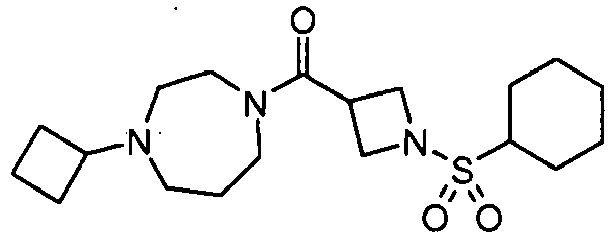
- In a similar fashion (Route 8, GP H), 1-(azetidin-3-ylcarbonyl)-4-cyclobutyl-1,4-diazepane (50 mg, 0.21 mmol) and cyclohexanesulfonyl chloride (42.3 mg, 0.23 mmol) gave the title compound (32 mg, 40% yield) as colourless oil.
LCMS data: Calculated MH+ (384); Found 99% (MH+) m/z 384, Rt = 4.44 min (Method D).
1H NMR (500 MHz, MeOD) δ ppm 4.17 (2 H, m), 4.03 (2 H, m), 3.74 - 3.82 (1 H, m), 3.58 - 3.67 (2 H, m), 3.39 - 3.47 (2H, m), 2.87 - 3.00 (2 H, m), 2.55 (2 H, m), 2.47 (2 H, m), 2.02 - 2.18 (4 H, m), 1.78 - 1.94 (6 H, m), 1.60 - 1.76 (3 H, m), 1.40 - 1.52 (2 H, m), 1.34 (2 H, m), 1.1 - 1.26 (1 H, m). -

- In a similar fashion (Route 8, GP H), 1-(azetidin-3-ylcarbonyl)-4-cyclobutyl-1,4-diazepane (50 mg, 0.21 mmol) and cyclopentylmethanesulfonyl chloride (42.3 mg, 0.23 mmol) gave the title compound (26 mg, 32% yield) as colourless oil.
LCMS data: Calculated MH+ (384); Found 98% (MH+) m/z 384, Rt = 4.47 min (Method D).
1H NMR (500 MHz, MeOD) δ ppm 4.15 (2 H, m), 4.05 (2 H, m), 3.75 - 3.82 (1 H, m), 3.59 - 3.65 (2 H, m), 3.41 - 3.46 (2H, m), 3.11 (2 H, m), 2.93 (1 H, m), 2.52 - 2.58 (2 H, m), 2.44 - 2.50 (2 H, m), 2.27 - 2.37 (1 H, m), 2.04 - 2.12 (2 H, m), 1.93 - 2.01 (2 H, m), 1.81 - 1.91 (4 H, m), 1.65 - 1.74 (4 H, m), 1.55 - 1.64 (2 H, m). -
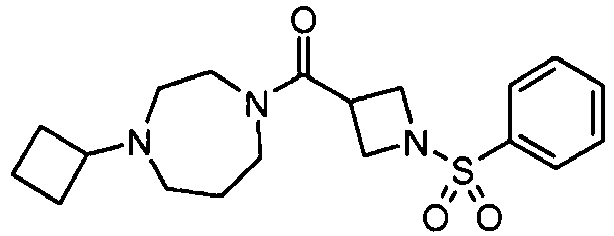
- In a similar fashion (Route 8, GP H), 1-(azetidin-3-ylcarbonyl)-4-cyclobutyl-1,4-diazepane (50 mg, 0.21 mmol) and benzenesulfonyl chloride (40.9 mg, 0.23 mmol) gave the title compound (18 mg, 23% yield) as colourless oil.
LCMS data: Calculated MH+ (378); Found 98% (MH+) m/z 378, Rt = 4.15 min (Method D).
1H NMR (500 MHz, MeOD) δ ppm 7.83 - 7.91 (2 H, m), 7.71 - 7.78 (1 H, m), 7.65 - 7.70 (2 H, m), 3.95 - 4.01 (2 H, m), 3.92 (2 H, m), 3.57 - 3.66 (1 H, m), 3.45 - 3.51 (2 H, m), 3.33 - 3.35 (1 H, m), 3.32 (2 H, m), 2.83 - 2.95 (1 H, m), 2.48 - 2.51 (1 H, m), 2.42 - 2.46 (1 H, m), 2.40 (2 H, m), 2.01 - 2.10 (2 H, m), 1.78 - 1.87 (3 H, m), 1.60 - 1.76 (3 H, m). -
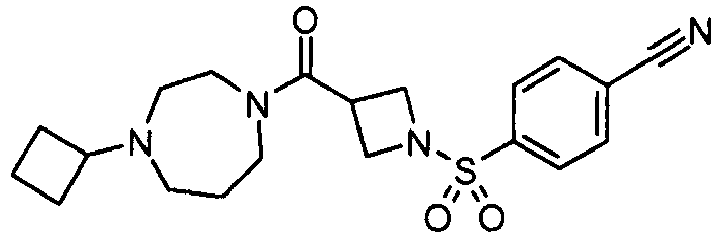
- In a similar fashion (Route 8, GP H), 1-(azetidin-3-ylcarbonyl)-4-cyclobutyl-1,4-diazepane (50 mg, 0.21 mmol) and 4-cyanobenzenesulfonyl chloride (46.7 mg, 0.23 mmol) gave the title compound (45 mg, 53% yield) as colourless oil.
LCMS data: Calculated MH+ (403); Found 100% (MH+) m/z 403, Rt = 4.17 min (Method D). 1H NMR (500 MHz, MeOD) δ ppm 7.99 - 8.08 (4 H, m), 4.01 - 4.08 (2 H, m), 3.95 (2 H, m), 3.66 (1 H, m), 3.45 - 3.51 (2 H, m), 3.33 - 3.38 (2 H, m), 2.84 - 2.96 (1 H, m), 2.48 - 2.53 (1 H, m), 2.43 - 2.46 (1 H, m), 2.38 - 2.43 (2 H, m), 2.02 - 2.11 (2 H, m), 1.78 - 1.87 (3 H, m), 1.75 (1 H, m), 1.60 - 1.71 (2 H, m). -

-

- To a stirred solution of 4-methoxycyclohexane carboxylic acid (20 mg, 0.13 mmol) in DMF/DCM (1:1) (2 ml) was added HOBt (38 mg, 0.28 mmol) and HBTU (96 mg, 0.25 mmol) and the reaction mixture stirred for 15 mins at RT. 1-(Azetidin-3-ylcarbonyl)-4-cyclobutyl-1,4-diazepane (30 mg, 0.13 mmol) in DCM (1 ml) was added and the reaction mixture stirred at RT for 16 hrs. Upon completion, the reaction mixture was evaporated at reduced pressure and purified by silica gel FCC (using DCM/MeOH/NH3; 95:5:0.5 to 90:10:1 as eluent) to give the title compound as colourless oil and as a 1:1 mixture of diastereoisomers by 1H NMR spectroscopy (5.2 mg, 11% yield).
LCMS data: Diastereoisomer A - Calculated MH+ (378); Found 43% (MH+) m/z 378, Rt = 3.50 min. Method D.
Diastereoisomer B - Calculated MH+ (378); Found 55% (MH+) m/z 378, Rt = 3.68 min. Method D.
NMR data: 1H NMR (500 MHz, MeOD) δ ppm 4.34 - 4.49 (2 H, m), 4.11 - 4.20 (1 H, m), 4.00 - 4.09 (1 H, m), 3.79 (1 H, m), 3.56 - 3.68 (2 H, m), 3.40 - 3.52 (3 H, m), 3.35 (1 H, s), 3.29 (2 H, s), 2.93 (1 H, m), 2.42 - 2.63 (4 H, m), 2.19 - 2.39 (1 H, m), 2.03 - 2.16 (3 H, m), 1.94 - 2.02 (1 H, m), 1.60 - 1.93 (8 H, m), 1.41 - 1.56 (3 H, m), 1.13 - 1.28 (1 H, m). - The following compounds were prepared as described in Route 9, General Procedure I above.
-

- In a similar fashion (Route 9, GP I), 4,4-difluorocyclohexane carboxylic-acid (21 mg, 0.13 mmol) and 1-(azetidin-3-ylcarbonyl)-4-cyclobutyl-1,4-diazepane (30 mg, 0.13 mmol) gave the title compound as colourless oil (5.7 mg, 12% yield).
LCMS data: Calculated MH+ (384); Found 90% (MH+) m/z 384, Rt = 3.87 min (Method D).
NMR data: 1H NMR (500 MHz, MeOD) δ ppm 4.36 - 4.49 (2 H, m), 4.13 - 4.20 (1 H, m), 4.06 (1 H, m), 3.74 - 3.86 (1 H, m), 3.56 - 3.72 (2 H, m), 3.37 - 3.53 (2 H, m), 2.78 - 3.05 (1 H, m), 2.36 - 2.64 (5 H, m), 2.03 - 2.17 (4 H, m), 1.59 - 1.99 (12 H, m). -

LCMS data: Calculated MH+ (436); Found 91% (MH+) m/z 436, Rt = 2.65 min (Method C).
NMR data: 1H NMR (500 MHz, MeOD) δ ppm 7.82 (2 H, d, J=8.5 Hz), 7.58 (2 H, d, J=8.5 Hz), 6.13 (1 H, s), 4.62 (2 H, d), 4.13 - 4.50 (3 H, m), 3.90 (1 H, d), 3.66 - 3.83 (2 H, m), 3.46 - 3.65 (5 H, m), 2.87 - 3.16 (2 H, m), 2.35 - 2.44 (2 H, m), 2.34 (3 H, s), 2.27 (3 H, s), 2.18 - 2.26 (2 H, m), 2.03 - 2.18 (1 H, m), 1.74 - 1.93 (2 H, m). -

- In a similar fashion (Route 9, GP I), 4-(5-dimethyl-1,3,4-oxadiazol-2-yl)benzoic acid (26 mg, 0.13 mmol) and 1-(azetidin-3-ylcarbonyl)-4-cyclobutyl-1,4-diazepane (30 mg, 0.13 mmol) gave the title compound (5.6 mg, 10% yield) as colourless oil.
LCMS data: Calculated MH+ (424); Found 98% (MH+) m/z 424, Rt = 3.57 min (Method D).
NMR data: 1H NMR (500 MHz, MeOD) δ ppm 8.15 (2 H, d, J=8.4 Hz), 7.86 (2 H, d, J=8.4 Hz), 4.52 - 4.64 (2 H, m), 4.38 - 4.47 (1 H, m), 4.29 - 4.37 (1 H, m), 3.86 - 3.95 (1 H, m), 3.60 - 3.72 (2 H, m), 3.44 - 3.54 (2 H, m), 2.95 (1 H, m), 2.66 (3 H, s), 2.54 - 2.62 (2 H, m), 2.38 - 2.54 (2 H, m), 2.04 - 2.19 (2 H, m), 1.81 - 1.96 (4 H, m), 1.60 - 1.76 (2 H, m). -

- In a similar fashion (Route 9, GP I), cyclopropyl acetic acid (13 mg, 0.13 mmol) and 1-(azetidin-3-ylcarbonyl)-4-cyclobutyl-1,4-diazepane (30 mg, 0.13 mmol) gave the title compound (5.3 mg, 13% yield) as colourless oil.
LCMS data: Calculated MH+ (320); Found 93% (MH+) m/z 320, Rt = 2.07 min (Method D).
NMR data: 1H NMR (500 MHz, MeOD) δ ppm 4.32 - 4.41 (2 H, m), 4.14 - 4.21 (1 H, m), 4.06 - 4.12 (1 H, m), 3.74 - 3.84 (1 H, m), 3.58 - 3.70 (2 H, m), 3.43 - 3.52 (2 H, m), 2.93 - 3.08 (1 H, m), 2.55 2.69 (3 H, m), 2.47 - 2.55 (1 H, m), 2.10 - 2.16 (2 H, m), 2.08 (2 H, d, J=7.0 Hz), 1.81 - 1.98 (4 H, m), 1.62 - 1.78 (2 H, m), 0.94 - 1.05 (1 H, m), 0.49 - 0.57 (2 H, m), 0.18 (2 H, m). -
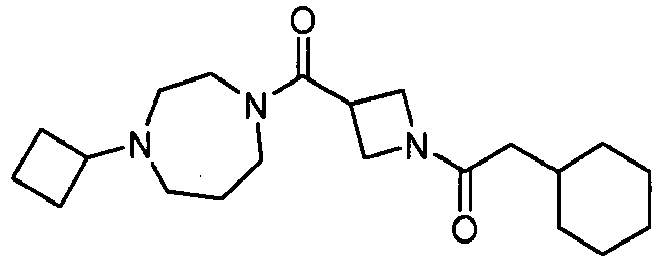
- In a similar fashion (Route 9, GP I), cyclohexylacetic acid (18 mg, 0.13 mmol) and 1-(azetidin-3-ylcarbonyl)-4-cyclobutyl-1,4-diazepane (30 mg, 0.13 mmol) gave the title compound as a colourless oil (11.5 mg, 25% yield) after purification by preparative HPLC.
LCMS data: Calculated MH+ (362); Found 99% (MH+) m/z 362, Rt = 2.68 min (Method C).
NMR data: 1H NMR (500 MHz, MeOD) δ ppm 4.32 - 4.47 (2 H, m), 4.14 - 4.27 (2 H, m), 4.03 - 4.13 (1 H, m), 3.66 - 3.86 (3 H, m), 3.41 - 3.63 (4 H, m), 2.89 - 3.13 (2 H, m), 2.35 (2 H, m), 2.20 - 2.30 (3 H, m), 2.06 - 2.17 (1 H, m), 2.02 (2 H, m), 1.62 - 1.93 (8 H, m), 1.12 - 1.37 (3 H, m), 0.91 - 1.06 (2 H, m). -
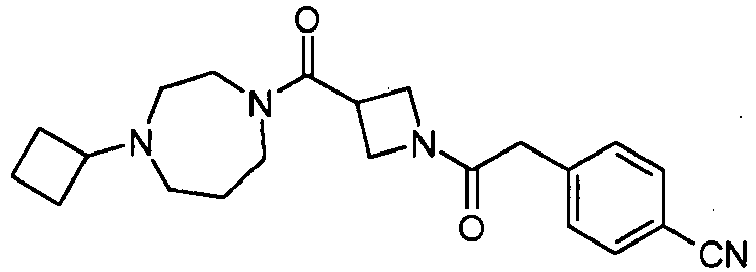
- In a similar fashion (Route 9, GP I), 4-cyanophenylacetic acid (20 mg, 0.13 mmol) and 1-(azetidin-3-ylcarbonyl)-4-cyclobutyl-1,4-diazepane (30 mg, 0.13 mmol) gave the title compound as colourless oil (3.9 mg, 8% yield) after purification by preparative HPLC.
LCMS data: Calculated MH+ (381); Found 92% (MH+) m/z 381, Rt = 2.36 min (Method C).
NMR data: 1H NMR (500 MHz, MeOD) δ ppm 7.69 (2 H, d, J=8.2 Hz), 7.46 (2 H, d, J=8.2 Hz), 4.36 - 4.57 (2 H, m), 4.16 - 4.30 (2 H, m), 4.08 - 4.15 (1 H, m), 3.66 - 3.88 (3 H, m), 3.62 (2 H, s), 3.46 - 3.60 (4 H, m), 2.89 - 3.13 (2 H, m), 2.32 - 2.42 (2 H, m), 2.18 - 2.30 (3 H, m), 2.01 - 2.18 (1 H, m), 1.73 - 1.93 (2 H, m). -

- In a similar fashion (Route 9, GP I), 4-(1,3-thiazol-4-yl)benzoic acid (46 mg, 0.22 mmol) and 1-(azetidin-3-ylcarbonyl)-4-cyclobutyl-1,4-diazepane (50 mg, 0.21 mmol) gave the title compound (5 mg, 6% yield) as pale yellow oil after purification by preparative HPLC (Method 2).
LCMS data: Calculated MH+ (425); Found 100% (MH+) m/z 425, Rt = 4.08 min (LCMS method D).
1H NMR (500 MHz, MeOD) δ ppm 8.01 - 8.09 (2 H, m), 7.92 (1 H, d, J=3.2 Hz), 7.77 (2 H, d, J=8.2 Hz), 7.68 (1 H, d, J=3.2 Hz), 4.51 - 4.62 (2 H, m), 4.26 - 4.45 (2 H, m), 3.83 - 3.93 (1 H, m), 3.59 - 3.71 (2 H, m), 3.42 - 3.52 (2 H, m), 2.91 - 3.09 (1 H, m), 2.45 - 2.69 (4 H, m), 2.01 - 2.16 (2 H, m), 1.79 - 1.98 (4 H, m), 1.59 - 1.77 (2 H, m). -

- In a similar fashion (Route 9, GP I), 4-(2-methyl-1,3-thiazol-4-yl)benzoic acid (250 mg, 1.15 mmol) and 1-(azetidin-3-ylcarbonyl)-4-cyclobutyl-1,4-diazepane (210 mg, 0.89 mmol) gave the title compound (30 mg, 8% yield) as pale yellow oil after purification by preparative HPLC (Method 2).
LCMS data: Calculated MH+ (439); Found 97% (MH+) m/z 439, Rt = 4.24 min (LCMS method D).
1H NMR (500 MHz, MeOD) δ ppm 7.99 (2 H, d, J=8.4 Hz), 7.78 (1 H, s), 7.71 (2 H, d, J=8.4 Hz), 4.52 - 4.61 (2 H, m), 4.25 - 4.42 (2 H, m), 3.88 (1 H, m), 3.59 - 3.76 (2 H, m), 3.43 - 3.55 (2 H, m), 3.01 - 3.27 (1 H, m), 2.73 - 2.83 (5 H, m), 2.55 - 2.72 (2 H, m), 2.07 - 2.21 (2 H, m), 1.81 - 2.06 (4 H, m), 1.60 - 1.81 (2 H, m). -

- In a similar fashion (Route 9, GP I), 4-(5-methyl-1,2,4-oxadiazol-3-yl)benzoic acid (100 mg, 0.49 mmol) and 1-(azetidin-3-ylcarbonyl)-4-cyclobutyl-1,4-diazepane (140 mg, 0.59 mmol) gave the title compound (3.6 mg, 1.5% yield) as pale yellow oil after purification by preparative HPLC (Method 2).
LCMS data: Calculated MH+ (424); Found 100% (MH+) m/z 424, Rt = 2.50 min (LCMS method C).
1H NMR (500 MHz, MeOD) δ ppm 8.14 (2 H, m), 7.80 (2 H, d, J=8.2 Hz), 4.49 - 4.62 (2 H, m), 4.25 - 4.44 (2 H, m), 3.78 - 3.94 (1 H, m), 3.55 - 3.73 (2 H, m), 3.41 - 3.54 (2 H, m), 2.90 - 3.04 (1 H, m), 2.67 (3 H, s), 2.42 - 2.65 (4 H, m), 2.04 - 2.14 (2 H, m), 1.77 - 1.97 (4, H, m), 1.60 - 1.76 (2 H, m). -

- In a similar fashion (Route 9, GP I), 4-(1-methylethyl)benzoic acid (86 mg, 0.52 mmol) and 1-(azetidin-3-ylcarbonyl)-4-cyclobutyl-1,4-diazepane (125 mg, 0.52 mmol) gave the title compound (24 mg, 12% yield) as pale yellow oil after purification by preparative HPLC (Method 2).
LCMS data: Calculated MH+ (384); Found 98% (MH+) m/z 384, Rt = 4.50 min (LCMS method D).
1H NMR (500 MHz, CHLOROFORM) δ ppm 7.57 (2 H, d, J=8.2 Hz), 7.26 (2 H, m), 4.63 - 4.81 (1 H, m), 4.18 - 4.47 (3 H, m), 3.52 - 3.81 (3 H, m), 3.29 - 3.44 (2 H, m), 2.77 - 2.99 (2 H, m), 2.30 - 2.63 (4 H, m), 1.97 - 2.10 (2 H, m), 1.73 - 1.95 (4 H, m), 1.51 - 1.73 (2 H, m), 1.25 (6 H, d, J=7.0 Hz). -

- In a similar fashion (Route 9, GP I), 4-phenoxybenzoic acid (112 mg, 0.52 mmol) and 1-(azetidin-3-ylcarbonyl)-4-cyclobutyl-1,4-diazepane (125 mg, 0.53 mmol) gave the title compound (34 mg, 15% yield) as pale yellow oil after purification by preparative HPLC (Method 2).
LCMS data: Calculated MH+ (434); Found 100% (MH+) m/z 434, Rt = 4.57 min (LCMS method D).
1H NMR (500 MHz, CHLOROFORM-d) δ ppm 7.59 - 7.68 (2 H, m), 7.34 - 7.42 (2 H, m), 7.13 - 7.21 (1 H, m), 7.02 - 7.08 (2 H, m), 6.95 - 7.01 (2 H, m), 4.63 - 4.83 (1 H, m), 4.17 - 4.50 (3 H, m), 3.53 - 3.81 (3 H, m), 3.27 - 3.46 (2 H, m), 2.79 - 2.99 (1 H, m), 2.29 - 2.68 (4 H, m), 1.99 - 2.12 (2 H, m), 1.52 - 1.99 (6 H, m). -

- In a similar fashion (Route 9, GP I), 4-(1H-pyrazol-1-yl)benzoic acid (100 mg, 0.52 mmol) and 1-(azetidin-3-ylcarbonyl)-4-cyclobutyl-1,4-diazepane (125 mg, 0.52 mmol) gave the title compound (31 mg, 14% yield) as pale yellow oil after purification by preparative HPLC (Method 2).
LCMS data: Calculated MH+ (408); Found 93% (MH+) m/z 408, Rt = 3.84 min (LCMS method D).
1H NMR (500 MHz, CHLOROFORM-d) δ ppm 7.98 (1 H, d, J=2.6 Hz), 7.68 - 7.82 (5 H, m), 6.49 (1 H, m), 4.75 (1 H, m), 4.21 - 4.48 (3 H, m), 3.56 - 3.77 (3 H, m), 3.28 - 3.44 (2 H, m), 2.85 (1 H, m), 2.31 - 2.59 (4 H, m), 1.96 - 2.31 (2 H, m), 1.73 - 1.96 (4 H, m), 1.52 - 1.73 (2 H, m). -

- In a similar fashion (Route 9, GP I), 4-(3-methyl-1,2,4-oxadiazol-5-yl)benzoic acid (100 mg, 0.49 mmol) and 1-(azetidin-3-ylcarbonyl)-4-cyclobutyl-1,4-diazepane (119 mg, 0.50 mmol) gave the title compound (8 mg, 4% yield) as pale yellow oil after purification by preparative HPLC (Method 2).
LCMS data: Calculated MH+ (424); Found 92% (MH+) m/z 424, Rt = 3.90 min (LCMS method D).
1H NMR (500 MHz, CHLOROFORM) δ ppm 8.17 (2 H, d, J=8.5 Hz), 7.80 (2 H, d, J=8.2 Hz), 4.71 - 4.80 (1 H, m), 4.27 - 4.48 (3 H, m), 3.58 - 3.84 (3 H, m), 3.40 (2 H, m), 2.88 (1 H, m), 2.33 - 2.65 (7 H, m), 2.01 - 2.11 (2 H, m), 1.87 (2 H, m), 1.55 - 1.77 (4 H, m). -

- In a similar fashion (Route 9, GP I), 4-(4,4-dimethyl-4,5-dihydro-1,3-oxazol-2-yl)benzoic acid (12 mg, 0.05 mmol) and 1-(azetidin-3-ylcarbonyl)-4-cyclobutyl-1,4-diazepane (20 mg, 0.09 mmol) gave the title compound (3 mg, 13% yield) as pale yellow oil.
LCMS data: Calculated MH+ (439); Found 95% (MH+) m/z 439, Rt = 2.36 min (LCMS method C).
1H NMR (500 MHz, MeOD) δ ppm 8.00 (2 H, d, J=8.4 Hz), 7.74 (2 H, d, J=8.2 Hz), 4.53 (2 H, d, J=7.6 Hz), 4.27 - 4.41 (2 H, m), 4.23 (2 H, s), 3.84 - 3.92 (1 H, m), 3.60 - 3.66 (2 H, m), 3.44 - 3.48 (2 H, m), 2.88 - 2.97 (1 H, m), 2.52 - 2.59 (2 H, m), 2.43 - 2.49 (2 H, m), 2.04 - 2.11 (2 H, m), 1.82 - 1.90 (4 H, m), 1.62 - 1.73 (2 H, m), 1.39 (6 H, s). -

- In a similar fashion (Route 9, GP I), 1-(azetidin-3-ylcarbonyl)-4-cyclobutyl-1,4-diazepane (137 mg, 0.57 mmol) and (6-methylpyridin-3-yl)acetic acid (73 mg, 0.48 mmol) gave the title compound (16 mg, 9%) as colourless oil after purification by preparative HPLC (Method 2).
LCMS data: Calculated MH+ (371); Found 100% (MH+) m/z 371, Rt = 3.41 min (Method D).
NMR data: 1H NMR (500 MHz, MeOD) δ ppm 8.31 (1 H, d, J=1.7 Hz), 7.65 (1 H, dd, J=8.0, 2.1 Hz), 7.27 (1 H, d, J=8.1 Hz), 4.39 - 4.51 (2 H, m), 4.15 - 4.23 (1 H, m), 4.05 - 4.15 (1 H, m), 3.75 - 3.88 (1 H, m), 3.56 - 3.69 (2 H, m), 3.53 (2 H, s), 3.41 - 3.50 (2 H, m), 2.88 - 3.01 (1 H, m), 2.39 - 2.61 (7 H, m), 2.04 - 2.13 (2 H, m), 1.77 - 1.96 (4 H, m), 1.59 - 1.76 (2 H, m). -
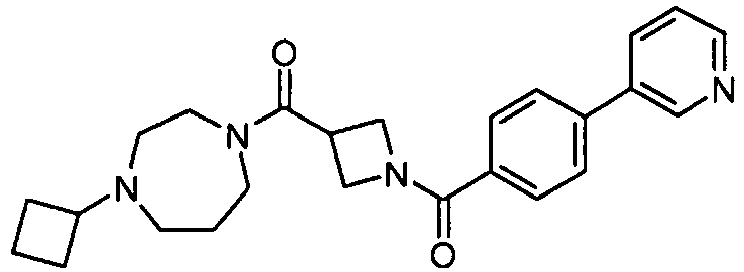
- In a similar fashion (Route 9, GP I), 1-(azetidin-3-ylcarbonyl)-4-cyclobutyl-1,4-diazepane (118 mg, 0.50 mmol) and 4-pyrid-3-ylbenzoic acid (100 mg, 0.50 mmol) gave the title compound (39 mg, 19%) after purification by preparative HPLC (Method 2).
LCMS data: Calculated MH+ (419); Found 100% (MH+) m/z 419, Rt = 3.82 min (Method C).
NMR data: 1H NMR (500 MHz, CHLOROFORM-d) δ ppm 8.86 (1 H, d, J=2.0 Hz), 8.63 (1 H, dd, J=4.8, 1.4 Hz), 7.90 (1 H, dt, J=7.9, 2.0 Hz), 7.77 (2 H, d, J=8.4 Hz), 7.63 (2 H, d, J=8.2 Hz), 7.40 (1 H, dd, J=7.9, 4.8 Hz), 4.71 - 4.84 (1 H, m), 4.35 - 4.49 (2 H, m), 4.26 - 4.35 (1 H, m), 3.57 - 3.80 (3 H, m), 3.31 - 3.45 (2 H, m), 2.81 - 2.95 (1 H, m), 2.34 - 2.63 (4 H, m), 1.99 - 2.11 (2 H, m), 1.75 - 1.99 (4 H, m), 1.55 - 1.75 (2 H, m). -

- In a similar fashion (Route 9, GP I), 1-(azetidin-3-ylcarbonyl)-4-cyclobutyl-1,4-diazepane (118 mg, 0.50 mmol) and 4-pyrid-4-ylbenzoic acid (100 mg, 0.50 mmol) gave the title compound (25 mg, 12%).
LCMS data: Calculated MH+ (419); Found 100% (MH+) m/z 419, Rt = 3.82 min (Method C).
NMR data: 1H NMR (500 MHz, CHLOROFORM) δ ppm 8.68 (2 H, d, J=5.0 Hz), 7.75 (2 H, d, J=8.1 Hz), 7.68 (2 H, d, J=8.1 Hz), 7.51 (2 H, d, J=5.3 Hz), 4.75 (1 H, m), 4.34 - 4.50 (2 H, m), 4.24 - 4.33 (1 H, m), 3.57 - 3.96 (3 H, m), 3.34 - 3.52 (2 H, m), 3.04 - 3.13 (1 H, m), 2.69 (4 H, m), 2.04 - 2.26 (5 H, m), 1.91 - 2.01 (1 H, m), 1.59 - 1.77 (2 H, m). -
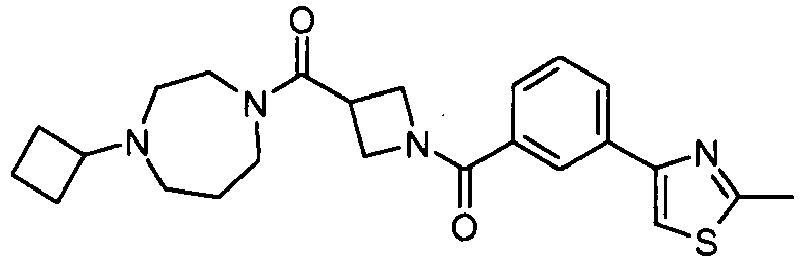
- In a similar fashion (Route 9, GP I), 1-(azetidin-3-ylcarbonyl)-4-cyclobutyl-1,4-diazepane (100 mg, 0.42 mmol) and 3-(2-methyl-1,3-thiazol-4-yl)benzoic acid (92 mg, 0.42 mmol) gave the title compound (55 mg, 34%).
LCMS data: Calculated MH+ (439); Found 99% (MH+) m/z 439, Rt = 2.58 min (Method C).
NMR data: 1H NMR (500 MHz, CHLOROFORM-d) δ ppm 8.10 (1 H, s), 7.97 (1 H, d, J =7.9 Hz), 7.54 (1 H, d, J=7.8 Hz), 7.40 - 7.46 (1 H, m), 7.36 (1 H, s), 4.69 (1 H, d, J=8.1 Hz), 4.25 - 4.43 (3 H, m), 3.56 - 3.74 (3 H, m), 3.31 - 3.38 (2 H, m), 2.87 (1 H, s), 2.74 (3 H, s), 2.33 - 2.61 (4 H, m), 1.97 - 2.06 (2 H, m), 1.74 - 1.94 (4 H, m), 1.59 (2 H, s). -

- In a similar fashion (Route 9, GP I), 1-(azetidin-3-ylcarbonyl)-4-cyclobutyl-1,4-diazepane (100 mg, 0.42 mmol) and 1H-1,3-benzimidazole-2-carboxylic acid (69 mg, 0.42 mmol) gave the title compound (26 mg, 10%) after purification by preparative HPLC (Method 1) as the TFA salt.
LCMS data: Calculated MH+ (382); Found 100% (MH+) m/z 382, Rt = 2.42 min (Method C).
NMR data: 1H NMR (500 MHz, MeOD) δ ppm 7.63 - 7.72 (2 H, m), 7.29 - 7.43 (2 H, m), 4.86 - 5.08 (2 H, m), 4.33 - 4.53 (2 H, m), 4.13 - 4.30 (1 H, m), 3.42 - 4.01, (8 H, m), 2.86 - 3.15 (2 H, m), 2.07 - 2.43 (6 H, m), 1.72 - 1.93 (2 H, m). -

- In a similar fashion (Route 9, GP I), 1-(azetidin-3-ylcarbonyl)-4-cyclobutyl-1,4-diazepane (100 mg, 0.42 mmol) and 1-methyl-benzimidazole-5-carboxylic acid (76 mg, 0.42 mmol) gave the title compound (35 mg, 21 %) after purification by preparative HPLC (Method 2).
LCMS data: Calculated MH+ (396); Found (MH+) m/z 396, Rt = 3.51 min (Method D).
NMR data: Purity by NMR >95%. 1H NMR (500 MHz, MeOD) δ ppm 8.21 (1 H, s), 7.95 (1 H, s), 7.55 - 7.69 (2 H, m), 4.54 (2 H, m), 4.36 (1 H, m), 4.24 - 4.32 (1 H, m), 3.89 (3 H, s), 3.80 - 3.88 (1 H, m), 3.54 - 3.66 (2 H, m), 3.39 - 3.47 (2 H, m), 2.88 (1 H, m), 2.47 - 2.56 (2 H, m), 2.36 - 2.46 (2 H, m), 2.01 - 2.08 (2 H, m), 1.75 - 1.89 (4 H, m), 1.57 - 1.70 (2 H, m). -

- In a similar fashion (Route 9, GP I), 1-(azetidin-3-ylcarbonyl)-4-cyclobutyl-1,4-diazepane (100 mg, 0.42 mmol) and 1-methyl-1,2,3-benzotriazole-5-carboxylic acid (75 mg, 0.42 mmol) gave the title compound (40 mg, 24%) after purification by preparative HPLC (Method 2).
LCMS data: Calculated MH+ (397); Found 98% (MH+) m/z 397, Rt = 3.49 min (Method D).
NMR data: 1H NMR (500 MHz, MeOD) δ ppm 8.27 (1 H, s), 7.84 (2 H, s), 4.53 - 4.64 (2 H, m), 4.28 - 4.47 (5 H, m), 3.82 - 3.96 (1 H, m), 3.55 - 3.73 (2 H, m), 3.39 - 3.53 (2 H, m), 2.82 - 2.97 (1 H, m), 2.50 - 2.61 (2 H, m), 2.39 - 2.50 (2 H, m), 2.00 - 2.12 (2 H, m), 1.76 - 1.93 (4 H, m), 1.57 - 1.75 (2 H, m). -

- In a similar fashion (Route 9, GP I), 1-(azetidin-3-ylcarbonyl)-4-cyclobutyl-1,4-diazepane (175 mg, 0.74 mmol) and imidazo[1,2-α]pyridine-7-carboxylic acid (120 mg, 0.74 mmol) gave the title compound (34 mg, 9%) after purification by preparative HPLC (Method 2).
LCMS data: Calculated MH+ (382); Found 100% (MH+) m/z 382, Rt = 3.37 min (Method D).
NMR data: 1H NMR (500 MHz, MeOD) δ ppm 8.53 (1 H, d, J=7.0 Hz), 7.97 (1 H, s), 7.85 (1 H, s), 7.72 (1 H, s), 7.18 (1 H, d, J=7.0 Hz), 4.55 = 4.70 (2 H, m), 4.24 - 4.46 (2 H, m), 3.83 - 3.97 (1 H, m), 3.58 - 3.68 (2 H, m), 3.41 - 3.53 (2 H, m), 2.86 - 2.99 (1 H, m), 2.42 - 2.63 (4 H, m), 2.01 - 2.13 (2 H, m), 1.77 - 1.98 (4 H, m), 1.56 - 1.76 (2 H, m) -

- In a similar fashion (Route 9, GP I), 1-(azetidin-3-ylcarbonyl)-4-cyclobutyl-1,4-diazepane (100 mg, 0.42 mmol) and 1,2,4-triazole-3-carboxylic acid (47 mg, 0.42 mmol) gave the title compound (45 mg, 32%) after purification by preparative HPLC (Method 2).
LCMS data: Calculated MH+ (333); Found 100% (MH+) m/z 333, Rt = 2.24 min (Method D).
NMR data: 1H NMR (500 MHz, MeOD) δ ppm 8.44 (1 H, s), 4.74 - 4.87 (2 H, m), 4.26 - 4.42 (2 H, m), 3.84 - 3.97 (1 H, m), 3.56 - 3.73 (2 H, m), 3.46 - 3.53 (2 H, m), 2.88 - 3.04 (1 H, m), 2.56 - 2.66 (2 H, m), 2.43 - 2.56 (2 H, m), 2.02 - 2.16 (2 H, m), 1.80 - 1.99 (4 H, m), 1.59 - 1.79 (2 H, m) -

- In a similar fashion (Route 9, GP I), 1-(azetidin-3-ylcarbonyl)-4-cyclobutyl-1,4-diazepane (25 mg, 0.11 mmol) and 1-methyl-pyrazole-4-carboxylic acid (13 mg, 0.11 mmol) gave the title compound (10 mg, 26%) after purification by preparative HPLC (Method 2).
LCMS data: Calculated MH+ (346); Found 100% (MH+) m/z 346, Rt = 1.83 min (Method C).
NMR data: 1H NMR (500 MHz, MeOD) δ ppm 8.03 (1 H, s), 7.78 (1 H, s), 4.52 - 4.63 (2 H, m), 4.24 - 4.33 (1 H, m), 4.14 - 4.23 (1 H, m), 3.90 (3 H, s), 3.82 - 3.89 (1 H, m), 3.56 - 3.67 (2 H, m), 3.42 - 3.51 (2 H, m), 2.84 - 2.96 (1 H, m), 2.49 - 2.59 (2 H, m), 2.39 - 2.49 (2 H, m), 2.02 - 2.12 (2 H, m), 1.77 - 1.93 (4 H, m), 1.58 - 1.72 (2 H, m). -

-

- To a stirred solution of 1-(azetidin-3-ylcarbonyl)-4-cyclobutyl-1,4-diazepane (30 mg, 0.13 mmol) and DIPEA (42 µl, 0.25 mmol) in DCM (1 ml) was added tetrahydropyran-4-yl acetyl chloride (21 mg, 0.13 mmol) in DCM (1ml). The reaction mixture stirred at RT for 16 hrs. Upon completion, water and 1M HCl were added and the reaction mixture was washed with DCM (3 x 5 ml). The combined organic phases were dried (MgSO4), filtered and concentrated at reduced pressure. The residue was purified by preparative HPLC to afford the title compound as colourless oil (1.2 mg, 3% yield).
LCMS data: Calculated MH+ (364); Found 95% (MH+) m/z 364, Rt = 3.33 min (Method D).
NMR data: 1H NMR (500 MHz, MeOD) δ ppm 4.31 - 4.49 (2 H, m), 4.14 - 4.29 (2 H, m), 4.10 (1 H, m), 3.92 (3 H, m), 3.67 - 3.86 (2 H, m), 3.56 (1 H, m), 3.46 - 3.53 (1 H, m), 3.39 - 3.46 (3 H, m), 3.23 (1 H, m), 3.01 - 3.15 (1 H, m), 2.88 - 3.01 (1 H, m), 2.32 - 2.45 (1 H, m), 2.17 - 2.32 (2 H, m), 2.14 (1 H, m), 2.08 - 2.11 (1 H, m), 1.94 - 2.06 (2 H, m), 1.74 - 1.92 (1 H, m), 1.65 (2 H, m), 1.25 - 1.46 (5 H, m). - The following compound was prepared as described in Route 10, General Procedure J above.
-

- In a similar fashion (Route 10, GP J), 1-(azetidin-3-ylcarbonyl)-4-cyclobutyl-1,4-diazepane (100 mg, 0.42 mmol) and 4-chlorobenzeneacetyl chloride (88 mg, 0.46 mmol) gave the title compound (55 mg, 34%).
LCMS data: Calculated MH+ (390); Found 100% (MH+) m/z 390, Rt = 2.54 min (Method C).
NMR data: 1H NMR (500 MHz, CHLOROFORM-d) δ ppm 7.26 - 7.34 (2 H, m), 7.22 (2 H, d, J=8.2 Hz), 4.52 - 4.60 (1 H, m), 4.15 - 4.24 (2 H, m), 4.04 - 4.14 (1 H, m), 3.75 - 3.82 (1 H, m), 3.65-3.74 (1 H, m), 3.51 - 3.62 (1 H, m), 3.29 - 3.47 (4 H, m), 2.87 - 3.01 (1 H, m), 2.41 - 2.77 (4 H, m), 1.96 - 2.13 (4 H, m), 1.84 - 1.91 (2 H, m), 1.59 - 1.77 (2 H, m). -

- In a similar fashion (Route 10, GP J), 1-(azetidin-3-ylcarbonyl)-4-cyclobutyl-1,4-diazepane (50 mg, 0.21 mmol) and 4-(methylsulfonyl)benzoyl chloride (51 mg, 0.23 mmol) gave the title compound as the TFA salt (22.7 mg, 20%) after purification by silica FCC (eluting with 96:3.6:0.4 of DCM /MeOH/NH3) followed by preparative HPLC (Method 1).
LCMS data: Calculated MH+ (420); Found 100% (MH+) m/z 420, Rt = 2.11 min (Method C).
NMR data: 1H NMR (500 MHz, CHLOROFORM-d) δ ppm 8.04 (2 H, d, J=8.2 Hz), 7.84 (2 H, d, J=7.6 Hz), 4.61 - 4.80 (1 H, m), 4.23 - 4.55 (4 H, m), 3.51 - 3.77 (5 H, m), 3.27 - 3.48 (2 H, m), 3.11 (3 H, s), 2.14 - 2.90 (8 H, m), 1.88 - 2.00 (1 H, m), 1.68 - 1.84 (1 H, m). -

-

- To a stirred solution of 1-(azetidin-3-ylcarbonyl)-4-cyclobutyl-1,4-diazepane (30 mg, 0.13 mmol) in DCM (1 ml) was added cyclohexanemethyl isocyanate (18 µl, 0.13 mmol) in DCM (1 ml). The reaction mixture was stirred at RT for 16 hrs then evaporated at reduced pressure and the resulting crude material purified by silica FCC (using a gradient of eluents; 99:1:1 to 90:10:1 DCM:MeOH:7M NH3 in MeOH) to provide the title compound as colourless oil (39 mg, 82% yield).
LCMS data: Calculated MH+ (377); Found 96% (MH+) m/z 377, Rt = 4.18 min (Method D).
NMR data: 1H NMR (250 MHz, CHLOROFORM-d) δ ppm 4.12 - 4.25 (3 H, m), 3.98 - 4.11 (2 H, m), 3.58 - 3.72 (2 H, m), 3.44 - 3.58 (2 H, m), 3.26 - 3.43 (2 H, m), 3.03 (2 H, t, J=6.4 Hz), 2.75 - 2.94 (1 H, m), 2.29 - 2.62 (4 H, m), 1.97 - 2.17 (2 H, m), 1.78 - 1.96 (3 H, m), 1.53 - 1.78 (6 H, m), 1.43 (1 H, m), 1.03 - 1.34 (4 H, m), 0.71 - 1.02 (2 H, m). - The following compounds were prepared as described in Route 11, General Procedure K above.
-
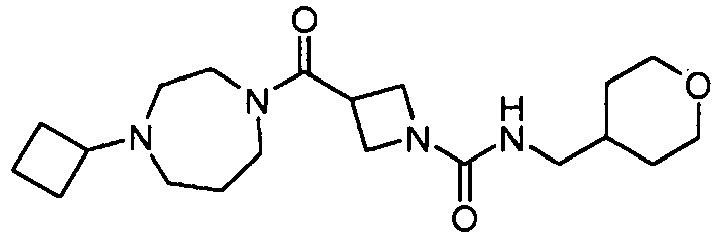
- In a similar fashion (Route 11, GP K), 4-(isocyanatomethyl)tetrahydropyran (18 mg, 0.13 mmol) and 1-(azetidin-3-ylcarbonyl)-4-cyclobutyl-1,4-diazepane (30 mg, 0.13 mmol) gave the title compound (36 mg, 74% yield) as colourless oil.
LCMS data: Calculated MH+ (379); Found 90% (MH+) m/z 379, Rt = 1.91 min (Method C).
NMR data: 1H NMR (500 MHz, CHLOROFORM-d) δ ppm 4.14 - 4.27 (3 H, m), 4.02 - 4.13 (2 H, m), 3.97 (2 H, m), 3.60 - 3.71 (2 H, m), 3.54 (1 H, m), 3.29 - 3.43 (4 H, m), 3.10 (2 H, m), 2.79 - 2.94 (1 H, m), 2.46 - 2.55 (2 H, m), 2.36 - 2.46 (2 H, m), 2.04 (2 H, m), 1.77 - 1.95 (4 H, m), 1.50 - 1.77 (5 H, m), 1.22 - 1.38 (2 H, m). -
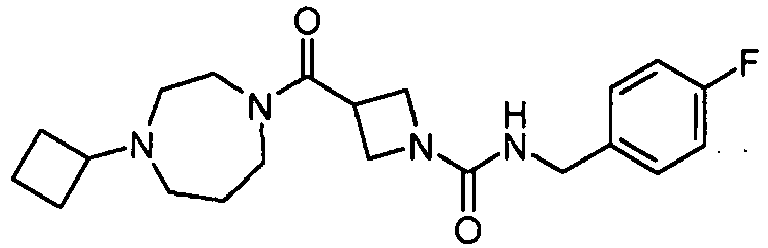
- In a similar fashion (Route 11, GP K), 4-fluorobenzylisocyanate (16.1 µl, 0.13 mmol) and 1-(azetidin-3-ylcarbonyl)-4-cyclobutyl-1,4-diazepane (30 mg, 0.13 mmol) gave the title compound (25.5 mg, 52% yield) as colourless oil.
LCMS data: Calculated MH+ (389); Found 92% (MH+) m/z 389, Rt = 2.48 min (Method C).
NMR data: 1H NMR (500 MHz, CHLOROFORM-d) δ ppm 7.23 - 7.30 (2 H, m), 6.98 - 7.05 (2 H, m), 4.40 - 4.46 (1 H, m), 4.34 - 4.38 (2 H, m), 4.19 - 4.28 (2 H, m), 4.04 - 4.11 (2 H, m), 3.61 - 3.68 (2 H, m), 3.50 - 3.59 (1 H, m), 3.31 - 3.38 (2 H, m), 2.80 - 2.91 (1 H, m), 2.46 - 2.52 (2 H, m), 2.37 - 2.45 (2 H, m), 1.99 - 2.09 (2 H, m), 1.75 - 1.92 (4 H, m), 1.56 - 1.74 (2 H, m). -
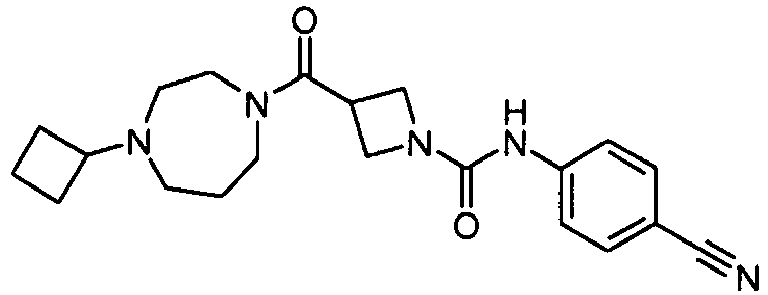
- In a similar fashion (Route 11, GP K), 1-(azetidin-3-ylcarbonyl)-4-cyclobutyl-1,4-diazepane (150 mg, 0.63 mmol) and 4-cyanophenyl isocyanate (136 mg, 0.95 mmol) gave the title compound (20 mg, 8%) as colourless oil after purification by preparative HPLC (Method 2).
LCMS data: Calculated MH+ (382); Found 99% (MH+) m/z 382, Rt = 3.84 min (Method D).
NMR data: 1H NMR (500 MHz, CHLOROFORM-d) δ ppm 7.48 - 7.62 (4 H, m), 6.36 (1 H, s), 4.30 - 4.42 (2 H, m), 4.15 - 4.28 (2 H, m), 3.54 - 3.73 (3 H, m), 3.32 - 3.43 (2 H, m), 2.88 (1 H, m), 2.37 - 2.60 (4 H, m), 2.01 - 2.10 (2 H, m), 1.75 - 1.99 (4 H, m), 1.51 - 1.76 (2 H, m). -

-

- To a stirred solution of 3-[(4-cyclobutyl-1,4-diazepan-1-yl)carbonyl]-N-(cyclohexylmethyl)azetidine-1-carboxamide (26 mg, 0.069 mmol) in dry DMF (1 ml) at 0 °C under a nitrogen atmosphere was added sodium hydride (4.1 mg of a 60% dispersion in mineral oil, 0.103 mmol). The resulting suspension was stirred at 0 °C for 30 min. Methyl iodide (4.3 µl, 0.069 mmol) was added and the reaction mixture allowed to warm to RT and was stirred for 16 hrs. The reaction mixture was poured onto ice-water, extracted with EtOAc (3 x 5 ml), the combined organics washed with brine (5 ml), dried (MgSO4), filtered and concentrated at reduced pressure. Purification by preparative HPLC provided the title compound (5.6 mg, 21% yield) as colourless oil.
LCMS data: Calculated MH+ (391); Found 94% (MH+) m/z 391, Rt = 2.97 min (Method C).
NMR data: 1H NMR (500 MHz, MeOD) δ ppm 4.16 (4 H, m), 3.93 - 4.11 (1 H, m), 3.64 - 3.86 (3 H, m), 3.41 - 3.63 (4 H, m), 3.10 (2 H, m), 3.00 - 3.08 (1 H, m), 2.90 - 3.00 (1 H, m), 2.87 (3 H, s), 2.31 - 2.43 (2 H, m), 2.17 - 2.30 (3 H, m), 1.98 - 2.17 (1 H, m), 1.79 - 1.93 (2 H, m), 1.58 - 1.78 (6 H, m), 1.12 - 1.35 (3 H, m), 0.84 - 1.04 (2 H, m). - The following compounds were prepared as described in Route 12, General Procedure L above.
-

- In a similar fashion (Route 12, GP L), 3-[(4-cyclobutyl-1,4-diazepan-1-yl)carbonyl]-N-(tetrahydro-2H-pyran-4-ylmethyl)azetidine-1-carboxamide (24.9 mg, 0.066 mmol), sodium hydride (3.9 mg of a 60% dispersion in mineral oil, 0.099 mmol) and methyl iodide (4.1 µl, 0.066 mmol) gave the title compound (4.2 mg, 16% yield) as colourless oil.
LCMS data: Calculated MH+ (393); Found 94% (MH+) m/z 393, Rt = 2.20 min (Method C).
NMR data: 1H NMR (500 MHz, MeOD) δ ppm 4.12 - 4.29 (4 H, m), 3.97 - 4.12 (1 H, m), 3.94 (2 H, m), 3.66 - 3.87 (3 H, m), 3.46 - 3.63 (4 H, m), 3.36 - 3.43 (2 H, m), 3.14 - 3.22 (2 H, m), 2.93 - 3.12 (2 H, m), 2.91 (3 H, s), 2.32 - 2.46 (2 H, m), 2.17 - 2.31 (3 H, m), 2.00 - 2.16 (1 H, m), 1.75 - 1.99 (3 H, m), 1.50 - 1.68 (2 H, m), 1.19 - 1.35 (2 H, m). -

- In a similar fashion (Route 12, GP L), 3-[(4-cyclobutyl-1,4-diazepan-1-yl)carbonyl]-N-(4-fluorobenzyl)azetidine-1-carboxamide (18 mg, 0.046 mmol), sodium hydride (2.8 mg of a 60% dispersion in mineral oil, 0.070 mmol) and methyl iodide (2.9 µl, 0.046 mmol) gave the title compound (4.3 mg, 23% yield) as colourless oil.
LCMS data: Calculated MH+ (403); Found 90% (MH+) m/z 403, Rt = 2.72 min (Method C).
NMR data: 1H NMR (500 MHz, MeOD) δ ppm 7.19 - 7.41 (2 H, m), 6.93 - 7.16 (2 H, m), 4.44 (2 H, s), 4.14 - 4.25 (4 H, m), 3.64 - 3.95 (3 H, m), 3.40 - 3.62 (5 H, m), 3.05 (1 H, m), 2.90 - 3.01 (1 H, m), 2.83 (3 H, s), 2.31 - 2.54 (2 H, m), 2.18 - 2.31 (3 H, m), 1.98 - 2.17 (1 H, m), 1.68 - 1.93 (2 H, m). -

- In a similar fashion (Route 12, GP L), N-(4-cyanophenyl)-3-[(4-cyclobutyl-1,4-diazepan-1-yl)carbonyl]azetidine-1-carboxamide (80 mg, 0.21 mmol) and methyl iodide (16 µl, 0.25 mmol) gave the title compound (2.7 mg, 3%) as colourless oil after purification by preparative HPLC (Method 2).
LCMS data: Calculated MH+ (396); Found 100% (MH+) m/z 396, Rt = 3.77 min (Method D).
NMR data: 1H NMR (500 MHz, CHLOROFORM-d) δ ppm 7.65 (2 H, d, J=8.4 Hz), 7.33 (2 H, d, J=8.5 Hz), 3.90 - 4.02 (2 H, m), 3.51 - 3.83 (4 H, m), 3.20 - 3.45 (6 H, m), 2.79 - 2.99 (1 H, m), 2.26 - 2.66 (4 H, m), 2.02 (2 H, m), 1.45 - 1.97 (6 H, m). -

- In a similar fashion (Route 12, GP L), N-(4-cyanobenzyl)-3-[(4-cyclobutyl-1,4-diazepan-1-yl)carbonyl]azetidine-1-carboxamide (35 mg, 88 µmol) and methyl iodide (68 µl, 105 µmol) gave the title compound (1.1 mg, 0.3%) as colourless oil after purification by preparative HPLC (Method 2).
LCMS data: Calculated MH+(410); Found 100% (MH+) m/z 410, Rt = 2.53 min (Method D).
NMR data: 1H NMR (500 MHz, MeOD) δ ppm 7.72 (2 H, d, J=8.1 Hz), 7.45 (2 H, d, J=8.1 Hz), 4.50 - 4.62 (2 H, m), 4.14 - 4.26 (4 H, m), 3.71 - 3.80 (1 H, m), 3.59 - 3.71 (2 H, m), 3.42 - 3.52 (2 H, m), 3.31 - 3.39 (2 H, m), 2.86 (3 H, s), 2.48 - 2.75 (3 H, m), 2.05 - 2.19 (2 H, m), 1.81 - 2.00 (4 H, m), 1.62 - 1.79 (2 H, m). -

-
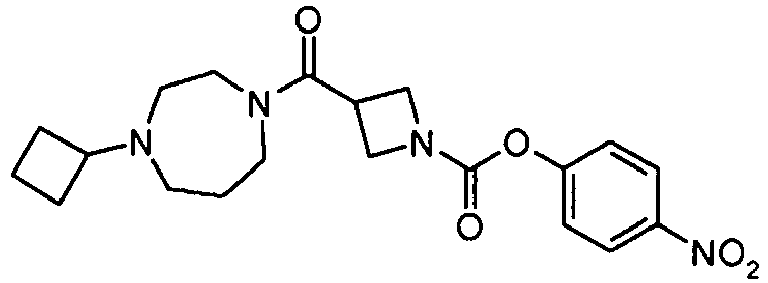
- To a solution of 1-(azetidin-3-ylcarbonyl)-4-cyclobutyl-1,4-diazepane (208 mg, 0.88 mmol) and TEA (146 µl, 1.05 mmol) in dichloromethane (5 ml) at 0 °C was added 4-nitrophenylchloroformate (176 mg, 0.88 mmol). After 10 minutes the reaction temperature was raised to RT and after a further hour the mixture was diluted with dichloromethane (30 ml), washed with 1M aq. K2CO3 (2 x 15 ml), dried (MgSO4), filtered and concentrated at reduced pressure. The residue was purified by silica FCC (using a gradient of eluents 99:1:1 to 92:8:1 DCM/MeOH/2M NH3 in MeOH) to give the title compound (206 mg, 58% yield) as yellow oil.
LCMS data: Calculated MH+ (403); Found 99% (MH+) m/z 403, Rt = 4.36 min.
NMR data: 1H NMR (500 MHz, CDCl3) δ ppm 8.20 - 8.31 (2 H, m), 7.29 - 7.37 (2 H, m), 4.51 - 4.65 (1 H, m), 4.19 - 4.42 (3 H, m), 3.56 - 3.77 (3 H, m), 3.29 - 3.43 (2 H, m), 2.80 - 2.94 (1 H, m), 2.35 - 2.62 (4 H, m), 1.99 - 2.09 (2 H, m), 1.75 - 1.95 (4 H, m), 1.52 - 1.75 (2 H, m). -

- 4-Nitrophenyl 3-[(4-cyclobutyl-1,4-diazepan-1-yl)carbonyl]azetidine-1-carboxylate (50 mg, 0.12 mmol), 1,2,3,4-tetrahydroisoquinoline (25 µl, 0.19 mmol) and DIPEA (42 µl, 0.24 mmol) were stirred in 1,2-dichloroethane (2 ml) and isopropanol (1 ml) at 120 °C in a sealed tube for 16 hrs. The mixture was then cooled to RT, diluted with dichloromethane (30 ml) and washed with 1M aq. K2CO3 (2 x 15 ml), dried (MgSO4), filtered and concentrated at reduced pressure. The residue was purified by silica FCC (eluting with 99:1:1 to 92:8:1 gradient of DCM/MeOH/2M NH3 in MeOH) to give the title compound (9 mg, 19% yield) as colourless oil.
LCMS data: Calculated MH+ (397); Found 88% (MH+) m/z 397, Rt = 4.26 min (Method D).
NMR data: 1H NMR (500 MHz, CDCl3) δ ppm 7.05 - 7.23 (4 H, m), 4.50 (2 H, s), 4.23 - 4.35 (2 H, m), 4.11 - 4.23 (2 H, m), 3.61 - 3.72 (2 H, m), 3.46 - 3.61 (3 H, m), 3.31 - 3.39 (2 H, m), 2.80 - 2.92 (3 H, m), 2.34 - 2.57 (4 H, m), 1.98 - 2.10 (2 H, m), 1.53 - 1.96 (6 H, m). - The following compound was prepared as described in Route 13, General Procedure M above.
-

- In a similar fashion (Route 13, GP M), 4-nitrophenyl 3-[(4-cyclobutyl-1,4-diazepan-1-yl)carbonyl]azetidine-1-carboxylate (100 mg, 0.25 mmol) and 4-cyanobenzylamine hydrochloride (46 mg, 0.27 mmol) gave the title compound (7 mg, 7% yield) as colourless oil after purification by preparative HPLC (Method 2).
LCMS data: Calculated MH+ (396); Found 96% (MH+) m/z 396, Rt = 3.75 min (Method D).
NMR data: 1H NMR (500 MHz, MeOD) δ ppm 7.64 - 7.71 (2 H, m), 7.47 (2 H, d, J=8.4 Hz), 4.38 (2 H, s), 4.08 - 4.20 (4 H, m), 3.74 - 3.84 (1 H, m), 3.57 - 3.70 (2 H, m), 3.40 - 3.52 (2 H, m), 2.87 - 3.00 (1 H, m), 2.52 - 2.62 (2 H, m), 2.42 - 2.52 (2 H, m), 2.02 - 2.14 (2 H, m), 1.79 - 1.94 (4 H, m), 1.58 - 1.78 (2 H, m). -

-

- A stirred solution of 4-chlorophenol (200 mg, 1.56 mmol) and triphosgene (460 mg, 1.56 mmol) in DCE (5 ml) was cooled to 0 °C and DIPEA (2.16 ml, 12.4 mmol) added. The resulting solution was stirred at 0 °C for 90 minutes then 1-(azetidin-3-ylcarbonyl)-4-cyclobutyl-1,4-diazepane (367 mg, 1.56 mmol) in DCE (2 ml) was added. The resulting mixture was heated at 100 °C for 12 hours then cooled to room temperature and diluted with DCM (25 ml) and water (30 ml). The organic phase was separated and the aqueous phase extracted with DCM (3 x 25 ml). The organics were combined, dried (MgSO4), filtered and concentrated at reduced pressure. The residue was purified by FCC (98:2:1 DCM:MeOH:NH3) followed by preparative HPLC (Method 2) to yield the title compound (1.4 mg, 0.2% yield).
LCMS data: Calculated MH+ (392); Found 100% (MH+) m/z 392, Rt = 2.86 min (Method C).
NMR data: 1H NMR (500 MHz, MeOD) δ ppm 7.30 - 7.40 (2 H, m), 6.99 - 7.19 (2 H, m), 4.35 (2 H, m), 4.19 (2 H, m), 3.80 - 3.88 (1 H, m), 3.59 - 3.67 (2 H, m), 3.43 - 3.48 (2 H, m), 2.94 (1 H, m), 2.56 (2 H, m), 2.45 - 2.50 (2 H, m), 2.04 - 2.10 (2 H, m), 1.81 - 1.92 (4 H, m), 1.62 - 1.72 (2 H, m). - The following compound was prepared as described in Route 14, General Procedure O above.
-

- In a similar fashion (Route 14, GP O), 1-(azetidin-3-ylcarbonyl)-4-cyclobutyl-1,4-diazepane (430 mg, 1.83 mmol) and 3-hydroxy-6-methylpyridine (200 mg, 1.83 mmol) gave the title compound (0.6 mg, 0.1%) as colourless oil after purification by preparative HPLC (Method 2).
LCMS data: Calculated MH+ (373); Found (MH+) m/z 373. The product eluted in the solvent front. (Method C).
NMR data: 1H NMR (500 MHz, MeOD) δ ppm 8.22 (1 H, d, J=2.6 Hz), 7.51 (1 H, dd, J=8.5, 2.7 Hz), 7.30 (1 H, d, J=8.4 Hz), 4.31 - 4.48 (2 H, m), 4.21 (2 H, m), 3.86 (1 H, m), 3.57 - 3.71 (2 H, m), 3.43 - 3.49 (2 H, m), 2.94 (1 H, m), 2.54 - 2.65 (2 H, m), 2.50 (3 H, s), 2.43 - 2.48 (2 H, m), 2.03 - 2.12 (2 H, m), 1.77 - 1.95 (4 H, m), 1.56 - 1.73 (2 H, m). -

- In a similar fashion (Route 14, GP O), 1-(azetidin-3-ylcarbonyl)-4-cyclobutyl-1,4-diazepane (200 mg, 1.26 mmol) and 4-cyanophenol (150 mg, 1.26 mmol) gave the title compound (6 mg, 1 %) after purification by preparative HPLC (Method 2).
LCMS data: Calculated MH+ (383); Found (MH+) m/z 383. The product was not stable to the LCMS conditions giving several UV peaks (Method C).
NMR data: 1H NMR (500 MHz, CHLOROFORM-d) δ ppm 7.64 - 7.69 (2 H, m), 7.24 - 7.29 (2 H, m), 4.56 (1 H, m), 4.20 - 4.39 (3 H, m), 3.60 - 3.81 (3 H, m), 3.39 (3 H, m), 2.81 - 2.96 (1 H, m), 2.34 - 2.66 (4 H, m), 2.01 - 2.13 (2 H, m), 1.76 2.01 (3 H, m), 1.53 - 1.76 (3 H, m). -

-

- To a stirred solution of 1-(azetidin-3-ylcarbonyl)-4-cyclobutyl-1,4-diazepane (100 mg, 0.42 mmol) in dichloromethane (10 mL) cooled to 0 °C was added diisopropylethylamine (160 mg, 1.26 mmol) and acetic anhydride (45 mg, 0.51 mmol). The resulting mixture was stirred at RT for 3 h before it was quenched by addition of water (10 ml). The aqueous layer was extracted with dichloromethane (3 × 10 ml) and the combined organic layers were washed with saturated aqueous NaHCO3 (10 ml), dried (Na2SO4), filtered and concentrated. Purification by silica FCC (using a gradient of eluents; 100:0 to 99:1 DCM:2M NH3 in MeOH) followed by purification by preparative HPLC (Method 2) gave the title compound (35 mg, 30% yield) as colourless oil.
LCMS data: Calculated MH+ (280); Found 99% (MH+) m/z 280, Rt = 3.10 min (Method D).
1H NMR (500 MHz, CHLOROFORM-d) δ ppm 4.55 (1 H, m), 4.14 - 4.24 (2 H, m), 4.02 - 4.13 (1 H, m), 3.47 - 3.81 (3 H, m), 3.29 - 3.45 (2 H, m), 2.83 - 2.96 (1 H, m), 2.34 - 2.68 (4 H, m), 1.91 - 2.12 (4 H, m), 1.78 - 1.91 (5 H, m), 1.55 - 1.77 (2 H, m). -

-

- To a stirred solution of 1-(azetidin-3-ylcarbonyl)-4-cyclobutyl-1,4-diazepane (125 mg, 0.53 mmol) in dichloromethane (5 ml) at 0 °C was added sodium carbonate (167 mg, 1.58 mmol) and propionyl chloride (58 mg, 0.63 mmol). The resulting mixture was stirred at RT for 13 h before volatiles were removed under reduced pressure. Purification by silica FCC (using a gradient of eluents; 100:0 to 98:2 DCM:2M NH3 in MeOH) followed by purification by preparative HPLC (Method 2) gave the title compound (18 mg, 12% yield) as pale yellow oil.
LCMS data: Calculated MH+ (294); Found 86% (MH+) m/z 294, Rt = 3.18 min (Method D).
1H NMR (500 MHz, CHLOROFORM-d) δ ppm 4.47 - 4.57 (1 H, m), 4.12 - 4.23 (2 H, m), 4.00 - 4.12 (1 H, m), 3.46 - 3.74 (3 H, m), 3.27 - 3.42 (2 H, m), 2.79 - 2.91 (1 H, m), 2.30 - 2.57 (4 H, m), 1.95 - 2.19 (4 H, m), 1.72 - 1.93 (4 H, m), 1.52 - 1.72 (2 H, m), 1.10 (3 H, t, J=7.6 Hz). -

-

- To a solution of 4-(1H-imidazol-1-yl)benzoic acid (150 mg, 0.80 mmol) in dichloromethane (10 mL) cooled to 0 °C was added oxalyl chloride (1 mL). DMF (2 drops) was added and the mixture was stirred for 45 min at 0 °C and volatiles were then removed at reduced pressure. The residue was diluted with dichloromethane (20 mL), cooled to 0 °C and triethylamine (201 mg, 2.0 mmol) was added followed by 1-(azetidin-3-ylcarbonyl)-4-cyclobutyl-1,4-diazepane (187 mg, 0.79 mmol). The resulting mixture was stirred at RT for 16 h before being diluted with more dichloromethane (50 mL) and quenched by addition of water (50 mL). The organic layer was then washed with saturated aqueous NaHCO3 (50 mL), dried (Na2SO4), filtered and concentrated at reduced pressure. Purification by silica FCC (using a gradient of eluents; 97:3 to 95:5 DCM/2M NH3 in MeOH) followed by purification by preparative HPLC (Method 2) gave the title compound (14 mg, 4% yield) as pale yellow oil.
LCMS data: Calculated MH+ (408); Found 100% (MH+) m/z 408, Rt = 3.38 min (Method D).
1H NMR (500 MHz, MeOD) δ ppm 8.26 (1 H, s), 7.84 (2 H, d, J=8.5 Hz), 7.72 (2 H, d, J=8.7 Hz), 7.68 (1 H, s), 7.19 (1 H, s), 4.50 - 4.64 (2 H, m), 4.35 - 4.45 (1 H, m), 4.24 - 4.35 (1 H, m), 3.84 - 3.94 (1 H, m), 3.57 - 3.70 (2 H, m), 3.42 - 3.53 (2 H, m), 2.86 - 2.99 (1 H, m), 2.42 - 2.63 (4 H, m), 2.01 - 2.13 (2 H, m), 1.78 - 1.95 (4 H, m), 1.59 - 1.75 (2 H, m). - The following compound was prepared as described in Route 17, General Procedure P above.
-

- In a similar fashion (Route 17, GP P), 4-(1H-1,2,4-triazol-1-yl)benzoic acid (100 mg, 0.53 mmol) and 1-(azetidin-3-ylcarbonyl)-4-cyclobutyl-1,4-diazepane (125 mg, 0.53 mmol) gave the TFA salt of the title compound (32 mg, 12% yield) as yellow oil after purification by preparative HPLC (Method 1).
LCMS data: Calculated MH+ (409); Found 100% (MH+) m/z 409, Rt = 2.14 min (Method C).
1H NMR (500 MHz, MeOD) δ ppm 9.22 (1 H, s), 8.22 (1 H, s), 7.97 (2 H, d, J=8.5 Hz), 7.85 (2 H, d, J=8.5 Hz), 4.51 - 4.68 (2 H, m), 4.27 - 4.50 (2 H, m), 4.13 - 4.27 (1 H, m), 3.84 - 3.95 (1 H, m), 3.66 - 3.84 (2 H, m), 3.40 - 3.66 (4 H, m), 2.87 - 3.15 (2 H, m), 2.05 - 2.41 (6 H, m), 1.72 - 1.92 (2 H, m). -

- In a similar fashion (Route 17 GP P), 4-(1H-1,2,4-triazol-1-ylmethyl)benzoic acid (60 mg, 0.29 mmol) and 1-(azetidin-3-ylcarbonyl)-4-cyclobutyl-1,4-diazepane (62 mg, 0.261 mmol) gave the title compound (1.2 mg, 1%) as an oil after purification by preparative HPLC (Method 2).
LCMS data: Calculated MH+ (423); Found 95% (MH+) m/z 423, Rt = 3.52 min (Method D).
NMR data: 1H NMR (500 MHz, MeOD) δ ppm 8.61 (1 H, s), 8.02 (1 H, s), 7.66 (2 H, d, J=8.2 Hz), 7.41 (2 H, d, J=8.1 Hz), 5.51 (2 H, s), 4.46 - 4.60 (2 H, m), 4.31 - 4.43 (1 H, m), 4.23 - 4.31 (1 H, m), 3.81 - 3.94 (1 H, m), 3.56 - 3.70 (2 H, m), 3.41 - 3.52 (2 H, m), 2.83 - 3.01 (1 H, m), 2.52 - 2.60 (2 H, m), 2.41 - 2.53 (2 H, m), 2.05 - 2.12 (2 H, m), 1.78 - 1.94 (4 H, m), 1.59 - 1.77 (2 H, m). -

- In a similar fashion (Route 17 GP P), 2-methylpyridine-4-carboxylic acid (100 mg, 0.73 mmol) and 1-(azetidin-3-ylcarbonyl)-4-cyclobutyl-1,4-diazepane (50 mg, 0.21 mmol) gave the title compound after purification by silica FCC (90:9:1 Et2O/MeOH/NH3).
NMR data: (96% purity by 1H NMR). 1H NMR (500 MHz, MeOD) δ ppm 8.54 (1 H, d, J=5.2 Hz), 7.50 (1 H, s), 7.42 (1 H, d, J=5.2 Hz), 4.46 - 4.56 (2 H, m), 4.34 - 4.42 (1 H, m), 4.34 - 4.42 (1 H, m), 4.25 - 4.34 (1 H, m), 3.84 - 3.94 (1 H, m), 3.59 - 3.71 (2 H, m), 3.43 - 3.50 (2 H, m), 2.95 (1 H, m), 2.54 - 2.63 (5 H, m), 2.45 - 2.53 (2 H, m), 2.08 (2 H, q, J=8.0 Hz), 1.80 - 1.97 (4 H, m), 1.61 - 1.76 (2 H, m). -

-

- To a suspension of mono-methylterephtalate (360 mg, 2.0 mmol) in dichloromethane (10 mL) under N2 was added 1,1'-carbonyldiimidazole (422 mg, 2.6 mmol) in one portion. The mixture was stirred at RT for 18 h. 2-Amino-2-methyl-1-propanol (232 mg, 2.6 mmol) was added as a solution in dichloromethane (1 mL) and stirring was continued for another 3 h. The reaction was quenched by pouring onto saturated aqueous NaHCO3 (50 mL). After extraction with dichloromethane (3 x 50 mL), the combined organic extracts were washed with brine (50 mL), dried (MgSO4) filtered and concentrated at reduced pressure. Purification by silica FCC (using a gradient of eluents; 7:3 to 1:1 heptane:EtOAc) gave the title compound (100 mg, 20% yield) as white solid.
LCMS data: Calculated MH+ (252); Found 100% (MH+) m/z 252, Rt = 1.08 min (Method A).
1H NMR (500 MHz, CHLOROFORM-d) δ ppm 8.10 (2 H, d, J=8.4 Hz), 7.80 (2 H, d, J=8.4 Hz), 6.23 (1 H, br. s.), 3.95 (3 H, s), 3.72 (2 H, s), 1.44 (6 H, s). -

- To a solution of methyl 4-[(2-hydroxy-1,1-dimethylethyl)carbamoyl]benzoate (100 mg, 0.40 mmol) in CDCl3 (2 mL) was added thionyl chloride (57 mg, 0.48 mmol). The mixture was heated to 60 °C in a sealed tube for 4 h. After cooling, the reaction was quenched by pouring onto saturated aqueous NaHCO3 (20 mL). After extraction with dichloromethane (3 x 20 mL), the combined organic extracts were washed with brine (20 mL), dried (MgSO4), filtered and concentrated at reduced pressure. Purification by silica FCC (eluting with 20:80 heptane / EtOAc) gave the title compound (78 mg, 84% yield) as colourless oil.
LCMS data: Calculated MH+ (234); Found 81% (MH+) m/z 234, Rt = 1.19 min (Method A).
1H NMR (500 MHz, CHLOROFORM-d) δ ppm 8.48 (2 H, d, J=8.4 Hz), 8.19 (2 H, d, J=8.4 Hz), 4.80 (2 H, s), 3.94 (3 H, s), 1.77 (6 H, s). -

- To a solution of methyl 4-(4,4-dimethyl-4,5-dihydro-1,3-oxazol-2-yl)benzoate (78 mg, 0.33 mmol) in THF (1 mL) and H2O (1 mL) was added LiOH (23 mg, 1 mmol). The mixture was stirred at RT for 4 h before it was diluted with EtOAc (5 mL) and quenched by addition of aqueous HCl (5 ml of a 0.5 M aqueous solution, 2.5 mmol). After extraction with EtOAc (3 x 10 mL), the combined organic extracts were washed with brine (10 mL), dried (MgSO4), filtered and concentrated at reduced pressure. The crude residue (12 mg, 16% yield) was obtained as colourless oil and was used without further purification.
LCMS data: Calculated MH+ (220); Found 44% (MH+) m/z 220, Rt = 0.90 min (Method A).
1H NMR (500 MHz, CHLOROFORM-d) δ ppm 8.16 (2 H, d, J=8.1 Hz), 8.09 (2 H, d, J=8.2 Hz), 4.22 (2 H, s), 1.47 (6 H, m). -

-

- To a stirred solution of 6-methylnicotinic acid (200 mg, 1.46 mmol) in DCM (10 ml) at 0 °C was added oxalyl chloride (1.25 ml, 14.6 mmol) and DMF (2 drops) and the resulting solution was stirred at room temperature for 2 hours. The reaction was then concentrated at reduced pressure and then redissolved in DCM (10 ml) and cooled to 0 °C. TMS diazomethane (1.45 ml of a 2M solution in THF, 2.9 mmol) and NEt3 (0.38 ml, 2.9 mmol) were added slowly and the resulting solution was maintained at 5 °C for 12 hours. The reaction was then filtered and concentrated at reduced pressure to give the title compound (180 mg, 76%) as black oil that was used without further purification.
-
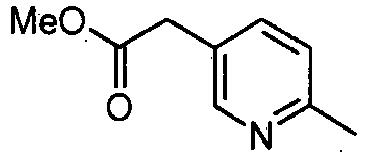
- To a stirred solution of 2-(diazynylidene)-1-(6-methylpyridin-3-yl)ethanone (100 mg, 0.62 mmol) in methanol (5 ml) was added AgO (39 mg, 0.36 mmol) and the resulting solution was heated at 65 °C for 2 hours. The reaction was then cooled to room temperature, filtered through Celite® and concentrated at reduced pressure to yield the title product (60 mg, 58%) as orange oil which was used without further purification.
LCMS data: Calculated MH+ (166); Found 100% (MH+) m/z 166, Rt = 0.79 min (Method C). -

- To a stirred solution of methyl (6-methylpyridin-3-yl)acetate (60 mg, 0.36 mmol) in methanol (5 ml) was added NaOH (1.0 ml of a 2M aqueous solution, 2.0 mmol) and the resulting solution was heated at 65 °C for 2 hours. The solvent was then removed at reduced pressure and the resulting residue was dissolved in methanolic HCl (5 ml) and then reconcentrated to yield the title product (54 mg, quant. yield) that was used without further purification.
LCMS data: Calculated MH+ (152); Found 100% (MH+) m/z 152, Rt = 0.79 min. Method C. -
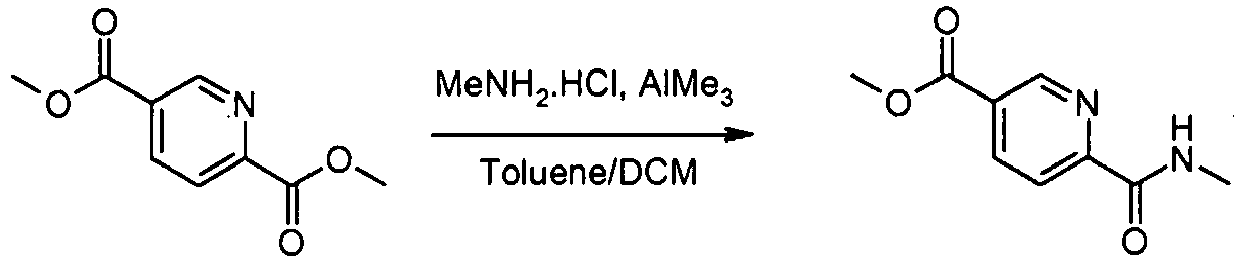
-

- To a stirred solution of MeNH2.HCl (173 mg, 5.12 mmol) in toluene (5 mL) at 0 °C, was added AlMe3 (2 M solution in Hexanes, 1.28 mL, 2.56 mmol). After 30 minutes the solution was canulated into a stirred solution dimethyl pyridine-2,5-dicarboxylate (500 mg, 2.56 mmol) in DCM (5 mL) at 0 °C before stirring over night at room temperature. An aliquot was taken and analysed by NMR, indicating that there was a 0.8:1 ratio of product to starting material. MeNH2.HCl (173 mg, 5.124 mmol) and AlMe3 (2M solution in Hexanes, 1.28 mL, 2.56 mmol) were added and the reaction stirred for 12 hours. The reaction was quenched by addition of H2O (2 mL) and extracted with EtOAc (2 x 10 mL). The organics were combined, dried (MgSO4), filtered and concentrated at reduced pressure to give the title compound (520 mg, quant. yield) which was used without further purification.
NMR data: 1H NMR (250 MHz, CHLOROFORM-d) δ ppm 9.14 (1 H, d, J=1.8 Hz), 8.45 (1 H, dd, J=8.1, 2.1 Hz), 8.29 (1 H, d, J=8.1 Hz), 8.06 (1 H, br. s.), 3.99 (3H, s), 3.07 (3H, d). -

-

- To a stirred solution of dimethyl pyridine-2,5-dicarboxylate (2.0 g, 10.25 mmol) in THF (40 mL) at -78 °C was added MeMgCl (3M sol in THF, 6.83 mL, 20.49 mmol). After 2 hours a second charge of MeMgCl (3.4 mL, 10.25 mmol) was added and a third (1.8 mL, 5.4 mmol) after a further 45 minutes. The reaction was deemed complete by TLC analysis and quenched by addition of saturated aqueous NH4Cl (1 mL) and concentrated at reduced pressure. Purification by silica FCC (eluting with 80:20 Heptanes/EtOAc) gave the title compound (539 mg, 27% yield) as oil.
LCMS data: Calculated MH+ (196); Found 100% (MH+) m/z 196, Rt = 1.24 min (Method B). NMR data: 1H NMR (500 MHz, CHLOROFORM-d) δ ppm 9.12 (1 H, d, J=1.2 Hz), 8.30 (1 H, dd, J=8.2, 2.1 Hz), 7.48 (1 H, d, J=8.4 Hz), 4.73 (1 H, br. s.), 3.96 (3 H, s), 1.56 (6 H, s). -

-

- To a stirred solution of methyl 6-(1-hydroxy-1-methylethyl)pyridine-3-carboxylate (479 mg, 2.45 mmol) in THF, (10 mL) was added LiOH (2M aqueous solution, 1.35 mL), 2.70 mmol). After 4 hours the solvent was removed at reduced pressure to give the title compound (458 mg, 100%) that was used without further purification.
NMR data: 1H NMR (500 MHz, MeOD) δ ppm 9.00 (1 H, d, J=1.4 Hz), 8.27 (1 H, dd, J=8.2, 2.1 Hz), 7.68 (1 H, d, J=8.2 Hz), 1.55 (6 H, s). - The following compound was prepared as described in Route 22, General Procedure Q above.
-

- In a similar fashion (Route 24, GP Q), methyl 6-(methylcarbamoyl)pyridine-3-carboxylate (520 mg, 2.68 mmol) and LiOH (2 M aqueous solution, 1.47 mL, 2.95 mmol) in THF (10 mL) gave the title compound (498 mg, 100%) that was used without further purification.
NMR data: 1H NMR (250 MHz, MeOD) δ ppm 9.09 (1 H, dd, J=2.0, 0.8 Hz), 8.37 (1 H, dd, J=8.0, 2.1 Hz), 8.06 (1 H, dd, J=8.0, 0.8 Hz), 2.97 (3 H, s). -

- In a similar fashion (Route 24, GP Q), methyl 3-fluoro-4-(1H-1,2,4-triazol-1-yl)benzenecarboxylate (100 mg, 0.45 mmol) and LiOH (11.4 mg, 0.48 mmol) in THF (1 mL) and water (1 mL) gave the title compound (96 mg, 100%) as a white solid that was used without further purification.
-
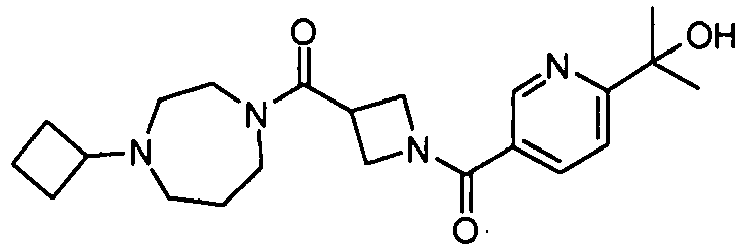
- To a stirred solution of lithium 6-(1-hydroxy-1-methylethyl)pyridine-3-carboxylate (50 mg, 0.28 mmol) and HOBt (42 mg, 0.30 mmol) in DMF (2 mL) was added HBTU, (117mg, 0.30 mmol) and 1-(azetidin-3-ylcarbonyl)-4-cyclobutyl-1,4-diazepane (46 mg, 0.30 mmol). After 20 hours the reaction was absorbed onto an SCX column and the product eluted with 7M NH3. Volatiles were removed at reduced pressure to give the title compound (1.4 mg, 1.2%) after purification by silica FCC (eluting with 90:9:1 Et2O/MeOH/NH3).
LCMS data: Calculated MH+ (401); Found 100% (MH+) m/z 401, Rt = 3.44 min (Method D).
NMR data: 1H NMR (500 MHz, MeOD) δ ppm 8.77 (1 H, d, J=1.5 Hz), 8.06 (1 H, dd, J=8.3, 2.1 Hz), 7.79 (1 H, d, J=8.2 Hz), 4.57 (2 H, d, J=7.2 Hz), 4.36 - 4.43 (1 H, m), 4.27 - 4.35 (1 H, m), 3.89 (1 H, m), 3.59 - 3.69 (2 H, m), 3.44 - 3.50 (2 H, m), 3.35 (1 H, s), 2.96 (1 H, m), 2.58 (2 H, d, J=4.4 Hz), 2.45 - 2.53 (2 H, m), 2.04 - 2.12 (2 H, m), 1.79 - 1.95 (4 H, m), 1.62 - 1.75 (2 H, m), 1.52 - 1.58 (6 H, m). - The following compound was prepared as described in Route 22, General Procedure R above.
-
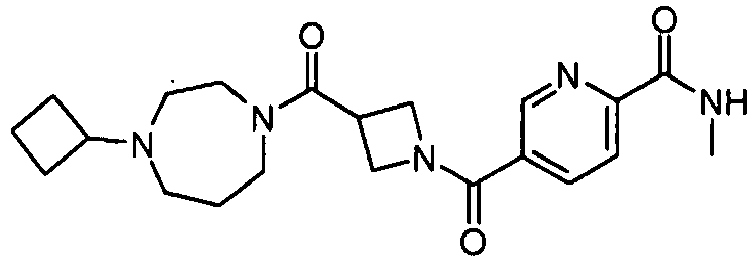
- In a similar fashion (Route 24, GP R), lithium 6-(methylcarbamoyl)pyridine-3-carboxylate (50 mg, 0.28 mmol) and 1-(azetidin-3-ylcarbonyl)-4-cyclobutyl-1,4-diazepane (46 mg, 0.30 mmol) in DMF (2 mL) gave the title compound (35 mg, 21%).
LCMS data: Calculated MH+ (400); Found 100% (MH+) m/z 400, Rt = 1.94 min (Method C).
NMR data: 1H NMR (500 MHz, CHLOROFORM-d) δ ppm 8.79 (1 H, s), 8.23 (1 H, d, J=7.9 Hz), 8.08 (1 H, dd, J=8.0, 1.8 Hz), 8.01 (1 H, br. s.), 4.67 - 4.82 (1 H, m), 4.24 - 4.50 (3 H, m), 3.57 - 3.77 (3 H, m), 3.30 - 3.42 (2 H, m), 2.98 - 3.10 (3 H, m), 2.78 - 2.93 (1 H, m), 2.32 - 2.60 (4 H, m), 1.49 - 2.11 (8 H, m). -
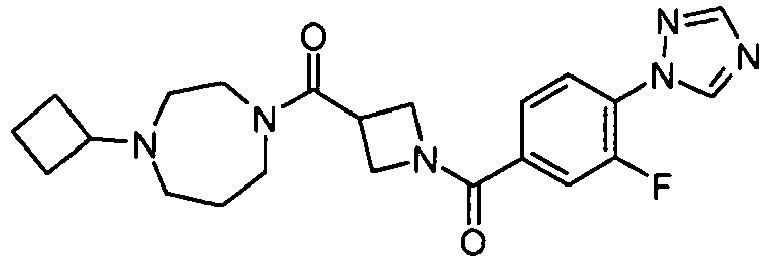
- In a similar fashion (Route 24, GP R), lithium 3-fluoro-4-(1H-1,2,4-triazol-1-yl)benzoate (49 mg, 0.23 mmol) and 1-(azetidin-3-ylcarbonyl)-4-cyclobutyl-1,4-diazepane (50 mg, 0.21 mmol) in DMF (2 mL) and DIPEA (104 µL, 0.63 mmol) gave the title compound (16 mg, 17%) after purification by preparative HPLC (Method 2).
LCMS data: Calculated MH+ (427); Found 100% (MH+) m/z 427, Rt = 3.52 min (Method D).
NMR data: 1H NMR (500 MHz, CHLOROFORM-d) δ ppm 8.76 (1 H, d, J=2.6 Hz), 8.15 (1 H, s), 8.03 (1 H, t, J=7.9 Hz), 7.65 (1 H, dd, J=11.8, 1.4 Hz), 7.60 (1 H, dd, J=8.4, 1.2 Hz), 4.80 (1 H, m), 4.35 - 4.58 (2 H, m), 4.31 (1 H, m), 3.56 - 3.82 (3 H, m), 3.39 (2 H, m), 2.76 - 2.96 (1 H, m), 2.50 (4 H, m), 2.03 - 2.13 (2 H, m), 1.86 (4 H, m), 1.52 - 1.75 (2 H, m). -

-

- To a stirred solution of 4-methylsulphonylbenzoic acid (100 mg, 0.48 mmol) in DCM (2 mL) was added SOCl2 (52 µL, 0.73 mmol) and toluene (2 mL) and the resulting reaction was stirred at 60 °C for 20 hours. A further charge of SOCl2 (100 µL, 1.45 mmol) was added and the reaction was heated at 80 °C for a further 24 hours. Volatiles were removed at reduced pressure and the crude product used in subsequent steps without further purification.
-

-
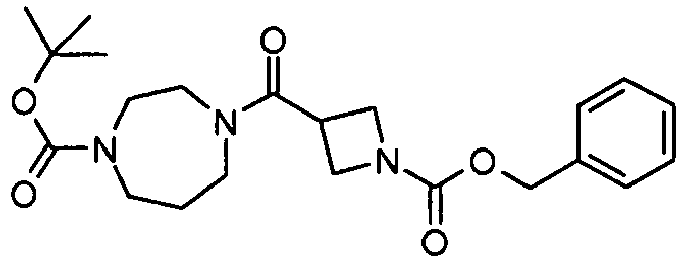
- To a stirred solution of benzyl 3-[(4-cyclobutyl-1,4-diazepan-1-yl)carbonyl]azetidine-1-carboxylate (1.0 g, 4.25 mmol) in DCM (20 mL) was added SOCl2 (0.754 g, 0.460 mL, 6.38 mmol) and the resulting mixture was stirred for 2 hours at room temperature. LCMS analysis showed incomplete conversion so a further 1.0 eq of SOCl2 (501 mg, 305 µL) was added and the reaction stirred for a further 19 hours. Volatiles were removed at reduced pressure and the crude acid chloride dissolved in DCM (10 mL) and added dropwise to a solution of tert-butyl 1,4-diazepane-1-carboxylate (0.658 g, 5.10 mmol, 1.2 eq) and DIPEA (1.67 g, 12.75 mmol, 3.0 eq) in DCM (10 mL) at 0 °C. The resulting solution was stirred at room temperature for 17 hours and then quenched by addition of NaHCO3 (5 mL). The reaction was diluted with DCM (10 mL) and the phases separated. The organic was washed with brine (5 mL), dried (MgSO4), filtered and concentrated at reduced pressure. Purification by silica FCC (eluting with 98:1.2:0.8 to 97:2.7:0.3 gradient of DCM/MeOH/NH3) gave the title compound (1.54 g, 86%).
NMR data: 1H NMR (500 MHz, CHLOROFORM-d) δ ppm 7.28 - 7.40 (5 H, m), 5.04 - 5.15 (2 H, m), 4.18 - 4.39 (2 H, m), 4.13 (2 H, q, J=8.3 Hz), 3.22 - 3.74 (9 H, m), 1.75 - 1.91 (2 H, m), 1.37 - 1.51 (9 H, m). -

- A stirred solution of tert-butyl 4-({1-[(benzyloxy)carbonyl]azetidin-3-yl}carbonyl)-1,4-diazepane-1-carboxylate (1.54 g, 3.69 mmol) in EtOH (10 mL) was purged with N2 and charged with 10% Pd/C (154 mg, 10% wt/wt). The flask was purged with N2 (N2/vacuum cycle x 3) and then H2 (H2/vacuum cycle x 3). After 24 hours the reaction was incomplete by NMR analysis. The mixture was filtered through Celite®, fresh catalyst charged (154 mg, 10% wt/wt) and the hydrogenation resumed and after a further 24 and 48 hours this process was repeated. NMR analysis confirmed consumption of starting material and the reaction was filtered through Celite® and concentrated at reduced pressure to give the title compound (1.02g, 98%).
NMR data: 1H NMR (500 MHz, MeOD) δ ppm 4.10 - 4.26 (3 H, m), 3.95 - 4.09 (1 H, m), 3.65 - 3.72 (1 H, m), 3.46 - 3.58 (4 H, m), 3.36 - 3.46 (4 H, m), 1.69 - 1.86 (2 H, m), 1.39 - 1.53 (9 H, m). -

- To a stirred solution of tert-butyl 4-(azetidin-3-ylcarbonyl)-1,4-diazepane-1-carboxylate (1.02 g, 3.6 mmol) and DIPEA (1.41 g, 10.8 mmol) in DCM (20 mL) was added a solution of 6-methylpyridine-3-carbonyl chloride (420 mg, 4.32 mmol) in DCM (5 mL) at 0 °C. After 3 hours the reaction was diluted with DCM (10 mL), washed with saturated aqueous NaHCO3 (10 mL), brine (5 mL), dried (MgSO4), filtered and concentrated at reduced pressure. Purification by silica FCC (eluting with 100:0:0 to 95:4.5:0.5 gradient of DCM/MeOH/NH3) gave the title compound (527 mg, 36%) as an orange-brown oil.
NMR data: 1H NMR (500 MHz, CHLOROFORM-d) δ ppm 8.72 (1 H, br. s.), 7.87 (1 H, m), 7.18 - 7.25 (1 H, m), 4.58 - 4.80 (1 H, m), 4.36 (2 H, m), 4.23 - 4.33 (1 H, m), 3.53 - 3.81 (4 H, m), 3.17 - 3.44 (4 H, m), 2.59 (3 H, d, J=2.0 Hz), 1.71 - 2.00 (3 H, m), 1.36 - 1.62 (9 H, m). -

- To a stirred solution of tert-butyl 4-({1-[(6-methylpyridin-3-yl)carbonyl]azetidin-3-yl}carbonyl)-1,4-diazepane-1-carboxylate (455 mg, 1.13 mmol) in DCM (10 mL) was added TFA (440 µL, 5.65 mmol) and stirred at room temperature for 24 hours. The reaction was recharged with TFA (0.5 mL, 6.5 mmol) and the reaction stirred for a further 5 hours until consumption of starting materials seen by TLC. Volatiles were removed at reduced pressure and the crude product shaken with Ambersep 900-OH resin in DCM (20 ml) for 2 hours. The resin was removed by filtration and the washings concentrated at reduced pressure to give the title compound (302 mg, 89%).
NMR data: 1H NMR (500 MHz, MeOD) δ ppm 8.66 (1 H, d, J=1.7 Hz), 7.95 (1 H, dd, J=8.1, 2.1 Hz), 7.38 (1 H, d, J=8.1 Hz), 4.51 - 4.58 (2 H, m), 4.32 - 4.40 (1 H, m), 4.24 - 4.32 (1 H, m), 3.86 (1 H, dt, J=15.0, 7.4 Hz), 3.77 - 3.81 (1 H, m), 3.61 - 3.70 (1 H, m), 3.50 (1 H, m), 3.20 - 3.30 (6 H, m), 2.55 (3 H, s), 1.93 - 2.10 (2 H, m). -
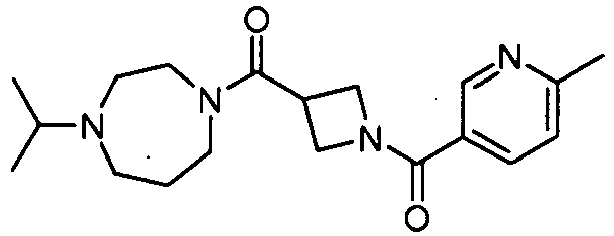
- To a stirred solution of 1-({1-[(6-methylpyridin-3-yl)carbonyl]azetidin-3-yl}carbonyl)-1,4-diazepane (60 mg, 0.194 mmol) in EtOH (3 mL) was added Pd/C (10% wt/wt, 6 mg) and acetone (143 µL, 1.95 mmol). The flask was purged with N2 (N2/vacuum cycle x 3) and then H2 (H2/vacuum cycle x 3). After 24 hours the reaction was filtered through Celite® and concentrated at reduced pressure. Purification by silica FCC (90:9:1 Et2O/MeOH/NH3) and capture and release (SCX-2, flush with MeOH, then release with 7M NH3 in MeOH) gave the title compound (18.4 mg, 27%).
LCMS data: Calculated MH+ (345); Found 100% (MH+) m/z 345. The product eluted in the solvent front (Method C).
NMR data: 1H NMR (500 MHz, CHLOROFORM-d) δ ppm 8.74 (1 H, s), 7.88 (1 H, d, J=8.1 Hz), 7.22 (1 H, d, J=8.1 Hz), 4.74 (1 H, m), 4.34 - 4.44 (2 H, m), 4.27 - 4.33 (1 H, m), 3.59 - 3.71 (3 H, m), 3.36 (1 H, m), 3.32 (1 H, m), 2.85 - 2.99 (1 H, m), 2.64 - 2.74 (2 H, m), 2.55 - 2.63 (5 H, m), 1.74 - 1.89 (2 H, m), 0.99 (6 H, m). - The following compound was prepared as described in Route 24, General Procedure S above.
-

- In a similar fashion (Route 24 GP S), 1-({1-[(6-methylpyridin-3-yl)carbonyl]azetidin-3-yl}carbonyl)-1,4-diazepane (70 mg, 0.23 mmol) and acetaldehyde (127 µL, 2.27 mmol) gave the title compound (13.9 mg, 18%).
LCMS data: Calculated MH+ (331); Found 100% (MH+) m/z 331. The product eluted in the solvent front (Method C).
NMR data: 1H NMR (500 MHz, CHLOROFORM-d) δ ppm 8.72 - 8.79 (1 H, m), 7.89 (1 H, dt, J=8.0, 1.9 Hz), 7.22 (1 H, d, J=7.9 Hz), 4.74 (1 H, m), 4.35 - 4.45 (2 H, m), 4.26 - 4.34 (1 H, m), 3.60 - 3.76 (3 H, m), 3.33 - 3.43 (2 H, m), 2.67 (2 H, m), 2.60 (5 H, m), 2.51 - 2.57 (2 H, m), 1.81 - 1.95 (2 H, m), 1.06 (3 H, t, J=7.1 Hz). -

- In a similar fashion (Route 24 GP S), 1-({1-[(6-methylpyridin-3-yl)carbonyl]azetidin-3-yl}carbonyl)-1,4-diazepane (60 mg, 0.194 mmol) and cyclopentanone (207 µL, 1.95 mmol) gave the title compound (39.7 mg, 55%).
LCMS data: Calculated MH+ (371); Found 100% (MH+) m/z 371. The product eluted in the solvent front (LCMS Method C).
NMR data: 1H NMR (500 MHz, MeOD) δ ppm 8.69 (1 H, s), 7.99 (1 H, dt, J=8.1, 1.1 Hz), 7.41 (1 H, d, J=8.2 Hz), 4.52 - 4.60 (2 H, m), 4.35 - 4.42 (1 H, m), 4.25 - 4.33 (1 H, m), 3.85 - 3.95 (1 H, m), 3.59 - 3.71 (2 H, m), 3.43 - 3.51 (2 H, m), 2.89 - 3.00 (1 H, m), 2.82 (2 H, m), 2.68 - 2.76 (2 H, m), 2.59 (3 H, s), 1.80 - 1.96 (4 H, m), 1.69 (2 H, m), 1.53 - 1.63 (2 H, m), 1.36 - 1.48 (2 H, m). -
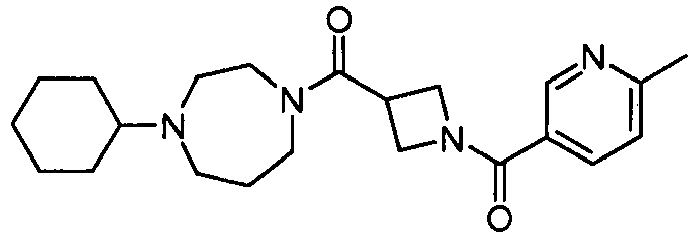
- In a similar fashion (Route 24 GP S), 1-({1-[(6-methylpyridin-3-yl)carbonyl]azetidin-3-yl}carbonyl)-1,4-diazepane (60 mg, 0.194 mmol) and cyclohexanone (201 µL, 1.95 mmol) gave the title compound (26.7 mg, 36%).
LCMS data: Calculated MH+ (386); Found 100% (MH+) m/z 386, Rt = 2.04 (LCMS Method C).
NMR data: 1H NMR (500 MHz, CHLOROFORM-d) δ ppm 8.76 (1 H, d, J=1.7 Hz), 7.85 - 7.93 (1 H, m), 7.21 - 7.26 (1 H, m), 4.70 - 4.78 (1 H, m), 4.35 - 4.49 (2 H, m), 4.22 - 4.35 (1 H, m), 3.57 - 3.79 (2 H, m), 3.43 (2 H, m), 2.65 - 3.26 (4 H, m), 2.61 (3 H, s), 1.77 - 2.13 (5 H, m), 1.53 - 1.76 (4 H, m), 1.19 - 1.44 (4 H, m), 1.04 - 1.18 (1 H, m). -

-
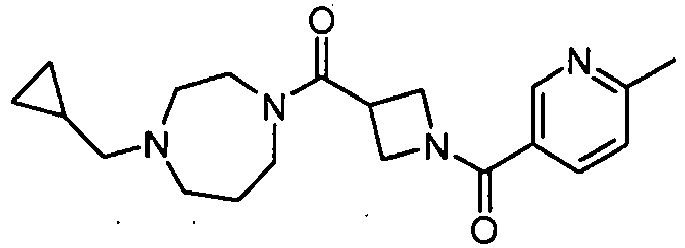
- To a stirred solution of 1-({1-[(6-methylpyridin-3-yl)carbonyl]azetidin-3-yl}carbonyl)-1,4-diazepane (100 mg, 0.33 mmol) and 1-(bromomethyl)cyclopropane (53 mg, 0.39 mmol) in ACN (5 mL) was added potassium carbonate (91 mg, 0.66 mmol). The mixture was heated to 70 °C in a sealed tube for 20 hours and then concentrated at reduced pressure. The crude residue was purified by silica FCC (eluting with 97:3:1 DCM/MeOH/NH3) and then preparative HPLC (Method 2) to give the title compound (45 mg, 38% yield) as pale yellow oil
LCMS data: Calculated MH+ (357); Found 93% (MH+) m/z 357, Rt = 3.45 min. Method D.
NMR data: 1H NMR (500 MHz, MeOD) δ ppm 8.70 (1 H, d, J=1.1 Hz), 7.99 (1 H, dd, J=8.1, 2.3 Hz), 7.41 (1 H, d, J=8.1 Hz), 4.57 (2 H, m), 4.22 - 4.46 (2 H, m), 3.83 - 3.97 (1 H, m), 3.57 - 3.75 (2 H, m), 3.40 - 3.56 (2 H, m), 2.65 - 2.89 (4 H, m), 2.59 (3 H, s), 2.35 - 2.45 (2 H, m), 1.78 - 2.01 (2 H, m), 0.80 - 0.96 (1 H, m), 0.46 - 0.63 (2 H, m), 0.05 - 0.20 (2 H, m). - The following compound was prepared as described in Route 25, General Procedure T above.
-

- In a similar fashion (Route 25, GP T), 1-({1-[(6-methylpyridin-3-yl)carbonyl]azetidin-3-yl}carbonyl)-1,4-diazepane (100 mg, 0.33 mmol) and 1-bromo-2-methylpropane (54 mg, 0.39 mmol) gave the title compound (25 mg, 21% yield) as pale yellow oil after purification by preparative HPLC (Method 2).
LCMS data: Calculated MH+ (359); Found 89% (MH+) m/z 359, Rt = 3.98 min. Method D.
NMR data: 1H NMR (500 MHz, MeOD) δ ppm 8.70 (1 H, s), 7.99 (1 H, dt, J=8.2, 1.9 Hz), 7.41 (1 H, d, J=8.1 Hz), 4.49 - 4.62 (2 H, m), 4.23 - 4.45 (2 H, m), 3.83 - 3.94 (1 H, m), 3.56-3.69 (2 H, m), 3.40 - 3.51 (2 H, m), 2.67 - 2.76 (2 H, m), 2.54 - 2.67 (5 H, m), 2.21 - 2.30 (2 H, m), 1.68 - 1.96 (3 H, m), 0.85 - 0.95 (6 H, m). -

-

- To a stirred solution of 1-({1-[(6-methylpyridin-3-yl)carbonyl]azetidin-3-yl}carbonyl)-1,4-diazepane (50 mg, 0.162 mmol) in formic acid (0.25 mL) was added formaldehyde (37% aq. sol., 0.097 mL, 1.296 mmol) and the reaction mixture was heated at 100 °C for 5 hours. Volatiles were then removed at reduced pressure to give the title compound (38 mg, 75%) after purification by silica FCC (eluting with 95:4.5:0.5 to 92.5:7.25:0.75 gradient of DCM/MeOH/NH3).
LCMS data: Calculated MH+ (317); Found 90% (MH+) m/z 317, Rt = 2.94 min (LCMS Method D).
NMR data: 1H NMR (500 MHz, MeOD) δ ppm 8.70 (1 H, d, J=1.8 Hz), 7.99 (1 H, m), 7.41 (1 H, d, J=8.1 Hz), 4.52 - 4.60 (2 H, m), 4.34 - 4.43 (1 H, m), 4.26 - 4.33 (1 H, m), 3.89 (1 H, m), 3.66 - 3.70 (1 H, m), 3.63 (1 H, m), 3.49 (1 H, m), 3.44 - 3.47 (1 H, m), 2.66 - 2.73 (2 H, m), 2.60 - 2.65 (2 H, m), 2.59 (3 H, s), 2.38 (3 H, m), 2.36 - 2.36 (1 H, m), 1.92 - 1.99 (1 H, m), 1.85 - 1.92 (1 H, m). -

-

- To a stirred solution of 2-({3-[(4-cyclobutyl-1,4-diazepan-1-yl)carbonyl]azetidin-1-yl}carbonyl)-1H-benzimidazole (170 mg, 0.45 mmol) in THF (10 ml) was added NaOH (1.12 ml of a 2.5 M aqueous solution, 2.8 mmol). After 5 minutes, dimethylsulfate (0.2 ml, 2.1 mmol) was added and the reaction was stirred at room temperature for 16 hours. The reaction was then concentrated at reduced pressure and purified directly via FCC (using a gradient of eluents; 98:2 to 95:5 DCM:2M NH3 in MeOH) to give the title compound (45 mg, 25% yield) as yellow oil.
NMR data: 1H NMR (300 MHz, CHLOROFORM-d) δ ppm 7.70 - 7.80 (1 H, m), 7.20 - 7.45 (3 H, m), 5.00 (1 H, m), 4.86 (1 H, m), 4.55 (1 H, m), 4.35 (1 H, m), 4.15 (3 H, s), 3.55 - 3.80 (3 H, m), 3.30 - 3.45 (2 H, m), 2.85 (1 H, m), 2.30 - 2.60 (4 H, m), 2.00 - 2.15 (2 H, m), 1.50 - 1.95 (6 H, m). -

-

- To a stirred solution of 1-[(benzyloxy)carbonyl]azetidine-3-carboxylic acid (250 mg, 1.06 mmol) in dichloromethane (2 mL) at RT was added SOCl2 (115 µL, 1.59 mmol). The mixture was stirred for 18 hours before volatiles were removed at reduced pressure. The residue was then dissolved in dichlormethane (3 mL) and 1-cyclobutylpiperazine (115 mg, 1.28 mmol) followed by DIPEA (940 µL, 5.31 mmol) added. The mixture was stirred at RT for 4 hours and then quenched with saturated aq. NaHCO3 (1 mL). The aqueous phase was extracted with dichloromethane (2 x 5 mL), the organics combined, washed with brine (2 mL), dried (MgSO4), filtered and concentrated at reduced pressure to give the title compound (130 mg, 34%), after purification by silica FCC (97.5:2.25:0.25 DCM/MeOH/NH3).
NMR data: 1H NMR (500 MHz, CHLOROFORM-d) δ ppm 7.30 - 7.44 (5 H, m), 5.09 (2 H, s), 4.21 - 4.39 (2 H, m), 4.08 - 4.19 (2 H, m), 3.57 - 3.79 (2 H, m), 3.44 -3.57 (1 H, m), 3.16-3.38 (2 H, m), 2.54 - 2.83 (1 H, m), 2.20 - 2.40 (4 H, m), 1.98 - 2.15 (2 H, m), 1.80 - 1.97 (2 H, m), 1.65 - 1.80 (2 H, m) -

- To a stirred solution of benzyl 3-[(4-cyclobutylpiperazin-1-yl)carbonyl]azetidine-1-carboxylate (130 mg, 0.36 mmol) in EtOH (10 mL) was added 10 % Pd/C (13 mg, 10% wt/wt). The flask was evacuated and the vacuum purged with N2 gas. The flask was evacuated again and the vacuum purged with H2 gas. After 16 hours the reaction mixture was filtered through Celite® and charged with 10 % Pd/C (13 mg, 10% wt/wt). The flask was evacuated and the vacuum purged with N2 gas. The flask was evacuated again and the vacuum purged with H2 gas. After 23 hours, the reaction mixture was filtered through Celite® and the filtrate concentrated at reduced pressure to give the final compound (60 mg, 74%) which was used without further purification.
-

- To a strirred solution of 1-(azetidin-3-ylcarbonyl)-4-cyclobutylpiperazine (60 mg, 0.27 mmol) in dichloromethane (1 mL) at 0 °C, was added 6-methylpyridine-3-carbonyl chloride (31 mg, 0.32 mmol) and DIPEA (142 µL, 0.81 mmol). After 4 hours the reaction was quenched by addition of saturated aq. NaHCO3 (1 mL) and the aqueous extracted with dichloromethane (2 x 5 mL), dried (MgSO4), filtered, and concentrated at reduced pressure. Purification by silica FCC (eluting with 90:9:1 Et2O/MeOH/NH3) followed by capture and release on an SCX-2 cartridge (washing with MEOH and releasing with 7M NH3 in MeOH) gave the title compound (17.8 mg, 19%)
LCMS data: Calculated MH+ (343); Found 97% (MH+) m/z 343, Rt = 3.47 min (Method D).
1H NMR (500 MHz, MeOD) δ ppm 8.69 (1 H, d, J=2.0 Hz), 7.98 (1 H, dd, J=8.2, 2.2 Hz), 7.41 (1 H, d, J=8.1 Hz), 4.49 - 4.66 (2 H, m), 4.32 - 4.50 (1 H, m), 4.22 - 4.32 (1 H, m), 3.79 - 3.96 (1 H, m), 3.53 - 3.75 (2 H, m), 3.36 - 3.50 (2 H, m), 2.72 - 2.98 (1 H, m), 2.59 (3 H, s), 2.27 - 2.47 (4 H, m), 2.01 - 2.21 (2 H, m), 1.84 - 2.02 (2 H, m), 1.58 - 1.84 (2 H, m) -

-

- To a stirred solution of 6-methylpyridine-3-carboxylic acid (100 mg, 0.73 mmol) in DCM (2 mL) was added oxalyl chloride (120 µL, 1.46 mmol) and DMF (2 drops). After 2 hours the reaction mixture was concentrated at reduced pressure and the crude product used in subsequent steps without further purification.
Claims (17)
- A compound of formula (I)

R1 is C1-5 alkyl; C2-5 alkenyl; C2-5 alkynyl; or T0, wherein C1-5 alkyl; C2-5 alkenyl; C2-5 alkynyl are optionally substituted with one or more substituents, which are the same or different and selected from the group consisting of halogen; OH; OCH3; OCH2F; OCHF2; OCF3; CN; and T0;
T0 is C3-5 cycloalkyl; or 4 to 5 membered saturated heterocyclyl, wherein T0 is optionally substituted with one or more substituents, which are the same or different and selected from the group consisting of halogen; C1-5 alkyl; C2-5 alkenyl; C2-5 alkynyl; OH; O-C1-5 alkyl; O-C2-5 alkenyl; O-C2-5 alkynyl; and CN, wherein C1-5 alkyl; C2-5 alkenyl; C2-5 alkynyl; O-C1-5 alkyl; O-C2-5 alkenyl; and O-C2-5 alkynyl are optionally substituted with one or more halogen, which are the same or different;
n is 1 or 2;
X1 is N; or CH;
X2 is O; S; N-CN; N-OH; or N-OC1-4 alkyl;
X3 is (CH2)n1X4(CH2)n2R2;
R is F;
m is 0, 1, 2, 3, or 4;
n1; n2 are independently selected from the group consisting of 0; 1; and 2;
X4 is C(O); C(O)O; OC(O); O; C(O)N(R1a); N(R1a)C(O); S(O)2N(R1a); N(R1a)S(O)2; S(O)N(R1a); N(R1a)S(O); S(O)2; S(O); N(R1a)S(O)2N(R1b); S; N(R1a); N(R1a)C(O)N(R1b); N(R1a)C(O)O; or OC(O)N(R1a);
R1a, R1b are independently selected from the group consisting of H; C1-4 alkyl; C2-4 alkenyl; and C2-4 alkynyl, wherein C1-4 alkyl; C2-4 alkenyl; and C2-4 alkynyl are optionally substituted with one or more halogen, which are the same or different;
R2 is H; T; or C1-6 alkyl; C2-6 alkenyl; or C2-6 alkynyl, wherein C1-6 alkyl; C2-6 alkenyl; and C2-6 alkynyl are optionally substituted with one or more R3, which are the same or different;
R3 is halogen; CN; C(O)R4; C(O)OR4; OR4; C(O)N(R4R4a); S(O)2N(R4R4a); S(O)N(R4R4a); S(O)2R4; S(O)R4; N(R4)S(O)2N(R4aR4b); SR4; N(R4R4a); NO2; OC(O)R4; N(R4)C(O)R4a; N(R4)SO2R4a; N(R4)S(O)R4a; N(R4)C(O)N(R4aR4b); N(R4)C(O)OR4a; OC(O)N(R4R4a); or T;
R4, R4a, R4b are independently selected from the group consisting of H; T; C1-6alkyl; C2-6 alkenyl; and C2-6 alkynyl, wherein C1-6 alkyl; C2-6 alkenyl; and C2-6 alkynyl are optionally substituted with one or more R5, which are the same or different;
R5 is halogen; CN; C(O)R6; C(O)OR6; OR6; C(O)N(R6R6a); S(O)2N(R6R6a); S(O)N(R6R6a); S(O)2R6; S(O)R6; N(R6)S(O)2N(R6aR6b); SR6; N(R6R6a); NO2; OC(O)R6; N(R6)C(O)R6a; N(R6)SO2R6a; N(R6)S(O)R6a; N(R6)C(O)N(R6aR6b); N(R6)C(O)OR6a; OC(O)N(R6R6a); orT;
R6, R6a, R6b are independently selected from the group consisting of H; T; C1-6 alkyl; C2-6 alkenyl; and C2-6 alkynyl, wherein C1-6 alkyl; C2-6 alkenyl; and C2-6 alkynyl are optionally substituted with one or more halogen, which are the same or different;
T is phenyl; naphthyl; azulenyl; indenyl; indanyl; C3-7 cycloalkyl; 3 to 7 membered heterocyclyl; or 7 to 11 membered heterobicyclyl, wherein T is optionally substituted
with one or more R7, which are the same or different;
R7 is halogen; CN; C(O)OR8; OR8; C(O)R8; C(O)N(R8R8a); S(O)2N(R8R8a); S(O)N(R8R8a); S(O)2R8; S(O)R8; N(R8)S(O)2N(R8aR8b); SR8; N(R8R8a); NO2; OC(O)R8; N(R8)C(O)R8a; N(R8)S(O)2R8a; N(R8)S(O)R8a; N(R8)C(O)OR8a; N(R8)C(O)N(R8aR8b); OC(O)N(R8R8a); oxo (=O), where the ring is at least partially saturated; T1; C1-6 alkyl; C2-6 alkenyl; or C2-6 alkynyl, wherein C1-6 alkyl; C2-6 alkenyl; and C2-6 alkynyl are optionally substituted with one or more R9, which are the same or different;
R8, R8a, R8b are independently selected from the group consisting of H; T1; C1-6 alkyl; C2-6 alkenyl; and C2-6 alkynyl, wherein C1-6 alkyl; C2-6 alkenyl; and C2-6 alkynyl are optionally substituted with one or more R10, which are the same or different;
R9, R10 are independently selected from the group consisting of halogen; CN; C(O)R11; C(O)OR11; OR11; C(O)N(R11R11a); S(O)2N(R11R11a); S(O)N(R11R11a); S(O)2R11; S(O)R11; N(R11)S(O)2N(R11aR11b); SR11; N(R11R11a); NO2; OC(O)R11; N(R11)C(O)R11a; N(R11)SO2R11a; N(R11)S(O)R11a; N(R11)C(O)N(R11aR11b); N(R11)C(O)OR11a; OC(O)N(R11R11a); and T1;
R11, R11a, R11b are independently selected from the group consisting of H; T1; C1-6 alkyl; C2-6 alkenyl; and C2-6 alkynyl, wherein C1-6 alkyl; C2-6 alkenyl; and C2-6 alkynyl are optionally substituted with one or more halogen, which are the same or different;
T1 is phenyl; C3-7 cycloalkyl; or 3 to 7 membered heterocyclyl, wherein T1 is optionally substituted with one or more R12, which are the same or different;
R12 is halogen; CN; C(O)OR13; OR13; C(O)R13; C(O)N(R13R13a); S(O)2N(R13R13a); S(O)N(R13R13a); S(O)2R13; S(O)R13; N(R13)S(O)2N(R13aR13b); SR13; N(R13R13a); NO2; OC(O)R13; N(R13)C(O)R13a; N(R13)S(O)2R13a; N(R13)S(O)R13a; N(R13)C(O)OR13a; N(R13)C(O)N(R13aR13b); OC(O)N(R13R13a); oxo (=O), where the ring is at least partially saturated; C1-6 alkyl; C2-6 alkenyl; or C2-6 alkynyl, wherein C1-6 alkyl; C2-6 alkenyl; and C2-6 alkynyl are optionally substituted with one or more halogen, which are the same or different;
R13, R13a, R13b are independently selected from the group consisting of H; C1-6 alkyl; C2-6 alkenyl; and C2-6 alkynyl, wherein C1-6 alkyl; C2-6 alkenyl; and C2-6 alkynyl are optionally substituted with one or more halogen, which are the same or different. - A compound of claim 1, wherein R1 is C1-5 alkyl; C2-5 alkenyl; C2-5 alkynyl; C3-5 cycloalkyl; CH2-cyclopropyl; CHF-cyclopropyl; CF2-cyclopropyl; CH2-cyclobutyl; CHF-cyclobutyl; CF2-cyclobutyl; or 4 to 5 membered saturated heterocyclyl, wherein C1-5 alkyl; C2-5 alkenyl; C2-5 alkynyl are optionally substituted with one or more substituents, which are the same or different and selected from the group consisting of halogen; OH; OCH3; OCH2F; OCHF2; OCF3; and CN, and wherein C3-5 cycloalkyl; CH2-cyclopropyl; CHF-cyclopropyl; CF2-cyclopropyl; CH2-cyclobutyl; CHF-cyclobutyl; CF2-cyclobutyl; and 4 to 5 membered saturated heterocyclyl are optionally substituted with one or more substituents, which are the same or different and selected from the group consisting of halogen; OH; OCH3; OCH2F; OCHF2; OCF3; CN; CH3; CH2F; CHF2; and CF3.
- A compound of claim 1 or 2, wherein n is 2.
- A compound of any of claims 1 to 3, wherein X1 is N.
- A compound of any of claims 1 to 4, wherein X2 is O;
- A compound of any of claims 1 to 5, wherein m is 0.
- A compound of any of claims 1 to 6, wherein n1; n2 are independently selected from the group consisting of 0; and 1.
- A compound of any of claims 1 to 7, wherein X3 is (CH2)n1C(O)(CH2)n2R2; (CH2)n1C(O)N(R1a)(CH2)n2R2; (CH2)n)C(O)O(CH2)n2R2; (CH2)n1S(O)2(CH2)n2R2; (CH2)n1S(O)2N(R1a)(CH2)n2R2; or (CH2)n1N(R1a)S(O)2(CH2)n2R2.
- A compound of any of claims 1 to 8, wherein R2 is T; or CH2OT.
- A compound of any of claims 1 to 9, wherein T is phenyl; tetrahydropyranyl; morpholinyl; piperidinyl; pyridinyl; pyrimidinyl; pyrazinyl; pyrazolyl; cyclopropyl; cyclopentyl; cyclohexyl; or tetrahydroisoquinolinyl, wherein T is optionally substituted with one or more R7, which are the same or different.
- A compound of claim 1 selected from the group consisting of
Benzyl 3-[(4-cyclobutyl-1,4-diazepan-1-yl)carbonyl]azetidine-1-carboxylate;
1-cyclobutyl-4-{[1-(piperidin-1-ylcarbonyl)azetidin-3-yl]carbonyl}-1,4-diazepane;
1-cyclobutyl-4-{[1-(morpholin-4-ylcarbonyl)azetidin-3-yl]carbonyl}-1,4-diazepane;
1-cyclobutyl-4-{[1-(cyclohexylcarbonyl)azetidin-3-yl]carbonyl}-1,4-diazepane;
1-cyclobutyl-4-{[1-(tetrahydro-2H-pyran-4-ylcarbonyl)azetidin-3-yl]carbonyl}-1,4-diazepane;
4-({3-[(4-cyclobutyl-1,4-diazepan-1-yl)carbonyl]azetjdin-1-yl}carbonyl)benzonitrile;
Methyl 5-({3-[(4-cyclobutyi-1,4-diazepan-1-yl)carbonyl]azetidin-1-yl}carbonyl)pyridine-2-carboxylate;
1-cyclobutyl-4-({1-[(2-methylpyrimidin-5-yl)carbonyl]azetidin-3-yl}carbonyl)-1,4-diazepane;
1-cyclobutyl-4-({1-[(5-methylpyrazin-2-yl)carbonyl]azetidin-3-yl}carbonyl)-1,4-diazepane;
1-cyclobutyl-4-({1-[(6-methylpyridin-3-y1)carbonyl]azetidin-3-yl}carbonyl)-1,4-diazepane;
1-cyclobutyl-4-[(1-{[4-(tetrahydro-2H-pyran-4-yloxy)phenyl]carbonyl}azetidin-3-yl)carbonyl]-1,4-diazepane;
1-cyclobutyl-4-[(1-{[6-(1H-imidazol-1-yl)pyridin-3-yl]carbonyl}azetidin-3-yl)carbonyl]-1,4-diazepane;
1-cyclobutyl-4-[(1-{[6-(1H-1,2,4-triazol-1-yl)pyridin-3-yl]carbonyl}azetidin-3-yl)carbonyl]-1,4-diazepane;
1-cyclobutyl-4-{[1-(1H-pyrazol-1-ylacetyl)azetidin-3-yl]carbonyl}-1,4-diazepane;
1-cyclobutyl-4-{[1-(piperidin-1-ylacetyl)azetidin-3-yl]carbonyl}-1,4-diazepane;
1-cyclobutyl-4-{[1-(morpholin-4-ylacetyl)azetidin-3-yl]carbonyl}-1,4-diazepane;
1-cyclobutyl-4-({1-[(1,1-dioxidothiomorpholin-4-yl)acetyl]azetidin-3-yl}carbonyl)-1,4-diazepane;
1-cyclobutyl-4-({1-[(3,3-difluoropyrrolidin-1-yl)acetyl]azetidin-3-yl}carbonyl)-1,4-diazepane;
1-cyclobutyl-4-({1-[(4,4-difluoropiperidin-1-yl)acetyl]azetidin-3-yl}carbonyl)-1,4-diazepane;
1-cyclobutyl-4-[(1-{[(6-methylpyridin-3-yl)oxy]acetyl}azetidin-3-yl)carbonyl]-1,4-diazepane;
4-(2-{3-[(4-cyclobutyl-1,4-diazepan-1-yl)carbonyl]azetidin-1-yl}-2-oxoethoxy)benzonitrile;
1-cyclobutyl-4-({1-[(4-methoxyphenyl)sulfonyl]azetidin-3-yl}carbonyl)-1,4-diazepane;
1-cyclobutyl-4-{[1-(cyclohexylsulfonyl)azetidin-3-yl]carbonyl}-1,4-diazepane;
1-cyclobutyl-4-({1-[(cyclopentylmethyl)sulfonyl]azetidin-3-yl}carbonyl)-1,4-diazepane;
1-cyclobutyl-4-{[1-(phenylsulfonyl)azetidin-3-yl]carbonyl}-1,4-diazepane;
4-({3-[(4-cyclobutyl-1,4-diazepan-1-yl)carbonyl]azetidin-1-yl}sulfonyl)benzonitrile;
1-cyclobutyl-4-({1-[(4-methoxycyclohexyl)carbonyl]azetidin-3-yl}carbonyl)-1,4-diazepane;
1-cyclobutyl-4-({1-[(4,4-difluorocyclohexyl)carbonyl]azetidin-3-yl}carbonyl)-1,4-diazepane;
1-cyclobutyl-4-[(1-{[4-(3,5-dimethyl-1H-pyrazol-1-yl)phenyl]carbonyl}azetidin-3-yl)carbonyl]-1,4-diazepane;
1-cyclobutyl-4-[(1-{[4-(5-methyl-1,3,4-oxadiazol-2-yl)phenyl]carbonyl}azetidin-3-yl)carbonyl]-1,4-diazepane;
1-cyclobutyl-4-{[1-(cyclopropylacetyl)azetidin-3-yl]carbonyl}-1,4-diazepane;
1-cyclobutyl-4-{[1-(cyclohexylacetyl)azetidin-3-yl]carbonyl}-1,4-diazepane;
4-(2-{3-[(4-cyclobutyl-1,4-diazepan-1-yl)carbonyl]azetidin-1-yl}-2-oxoethyl)benzonitrile;
1-cyclobutyl-4-[(1-{[4-(1,3-thiazol-2-yl)phenyl]carbonyl}azetidin-3-yl)carbonyl]-1,4-diazepane;
1-cyclobutyl-4-[(1-{[4-(2-methyl-1,3-thiazol-4-yl)phenyl]carbonyl}azetidin-3-yl)carbonyl]-1,4-diazepane;
1-cyclobutyl-4-[(1-{[4-(5-methyl-1,2,4-oxadiazol-3-yl)phenyl]carbonyl}azetidin-3-yl)carbonyl]-1,4-diazepane;
1-cyclobutyl-4-[(1-{[4-(1-methylethyl)phenyl]carbonyl}azetidin-3-yl)carbonyl]-1,4-diazepane;
1-cyclobutyl-4-({1-[(4-phenoxyphenyl)carbonyl]azetidin-3-yl}carbonyl)-1,4-diazepane;
1-cyclobutyl-4-[(1-{[4-(1H-pyrazol-1-yl)phenyl]carbonyl}azetidin-3-yl)carbonyl]-1,4-diazepane;
1-cyclobutyl-4-[(1-{[4-(3-methyl-1,2,4-oxadiazol-5-yl)phenyl]carbonyl}azetidin-3-yl)carbonyl]-1,4-diazepane;
1-cyclobutyl-4-[(1-{[4-(4,4-dimethyl-4,5-dihydro-1,3-oxazol-2-yl)phenyl]carbonyl}azetidin-3-yl)carbonyl]-1,4-diazepane;
1-cyclobutyl-4-({1-[(6-methylpyridin-3-yl)acetyl]azetidin-3-yl}carbonyl)-1,4-diazepane;
1-cyclobutyl-4-({1-[(4-pyridin-3-ylphenyl)carbonyl]azetidin-3-yl}carbonyl)-1,4-diazepane;
1-cyclobutyl-4-({1-[(4-pyridin-4-ylphenyl)carbonyl]azetidin-3-yl}caibonyl)-1,4-diazepane;
1-cyclobutyl-4-[(1-{[3-(2-methyl-1,3-thiazol-4-yl)phenyl]carbonyl}azetidin-3-yl)carbonyl]-1,4-diazepane;
2-({3-[(4-cyclobutyl-1,4-diazepan-1-yl)carbonyl]azetidin-1-yl}carbonyl)-1H-benzimidazole;
5-({3-[(4-cyclobutyl-1,4-diazepan-1-yl)carbonyl]azetidin-1-yl}carbonyl)-1-methyl-1H-benzimidazole;
5-({3-[(4-cyclobutyl-1,4-diazepan-1-yl)carbonyl]azetidin-1-yl}carbonyl)-1-methyl-1H-benzotriazole;
7-({3-[(4-cyclobutyl-1,4-diazepan-1-yl)carbonyl]azetidin-1-yl}carbonyl)imidazo[1,2-α]pyridine;
1-cyclobutyl-4-{[1-(1H-1,2,4-triazol-3-ylcarbonyl)azetidin-3-yl]carbonyl}-1,4-diazepane;
1-cyclobutyl-4-({1-[(1-methyl-1H-pyrazol-4-yl)carbonyl]azetidin-3-yl}carbonyl)-1,4-diazepane;
1-cyclobutyl-4-{[1-(tetrahydro-2H-pyran-4-ylacetyl)azetidin-3-yl]carbonyl}-1,4-diazepane;
1-({1-[(4-chlorophenyl)acetyl]azetidin-3-yl}carbonyl)-4-cyclobutyl-1,4-diazepane;
1-cyclobutyl-4-[(1-{[4-(methylsulfonyl)phenyl]carbonyl}azetidin-3-yl)carbonyl]-1,4-diazepane;
3-[(4-cyclobutyl-1,4-diazepan-1-yl)carbonyl]-N-(cyclohexylmethyl)azetidine-1-carboxamide;
3-[(4-cyclobutyl-1,4-diazepan-1-yl)carbonyl]-N-(tetrahydro-2H-pyran-4-ylmethyl)azetidine-1-carboxamide;
3-[(4-cyclobutyl-1,4-diazepan-1-yl)carbonyl]-N-(4-fluorobenzyl)azetidine-1-carboxamide;
N-(4-cyanophenyl)-3-[(4-cyclobutyl-1,4-diazepan-1-yl)carbonyl]azetidine-1-carboxamide;
3-[(4-cyclobutyl-1,4-diazepan-1-yl)carbonyl]-N-(cyclohexylmethyl)-N-methylazetidine-1-carboxamide;
3-[(4-cyclobutyl-1,4-diazepan-1-yl)carbonyl]-N-methyl-N-(tetrahydro-2H-pyran-4-ylmethyl)azetidine-1-carboxamide;
3-[(4-cyclobutyl-1,4-diazepan-1-yl)carbonyl]-N-(4-fluorobenzyl)-N-methylazetidine-1-carboxamide;
3-[(4-cyclobutyl-1,4-diazepan-1-yl)carbonyl]-N-(4-fluorobenzyl)-N-methylazetidine-1-carboxamide;
N-(4-cyanobenzyl)-3-[(4-cyclobutyl-1,4-diazepan-1-yl)carbonyl]-N-methylazetidine-1-carboxamide;
4-nitrophenyl 3-[(4-cyclobutyl-1,4-diazepan-1-yl)carbonyl]azetidine-1-carboxylate;
2-({3-[(4-cyclobutyl-1,4-diazepan-1-yl)carbonyl]azetidin-1-yl}carbonyl)-1,2,3,4-tetrahydroisoquinoline;
N-(4-cyanobenzyl)-3-[(4-cyclobuty]-1,4-diazepan-1-yl)carbonyl]azetidine-1-carboxamide;
4-chlorophenyl 3-[(4-cyclobutyl-1,4-diazepan-1-yl)carbonyl]azetidine-1-carboxylate;
6-methylpyridin-3-y]3-[(4-cyclobutyl-1,4-diazepan-1-yl)carbonyl]azetidine-1-carboxylate;
4-cyanophenyl 3-[(4-cyclobutyl-1,4-diazepan-1-yl)carbonyl]azetidine-1-carboxylate;
1-[(1-acetylazetidin-3-yl)carbonyl]-4-cyclobutyl-1,4-diazepane;
1-cyclobutyl-4-[(1-propanoylazetidin-3-yl)carbonyl]-1,4-diazepane;
1-cyclobutyl-4-[(1-{[4-(1H-imidazol-1-yl)phenyl]carbonyl}azetidin-3-yl)carbonyl]-1,4-diazepane;
1-cyclobutyl-4-[(1-{[4-(1H-1,2,4-triazol-1-yl)phenyl]carbonyl}azetidin-3-yl)carbonyl]-1,4-diazepane;
1-cyclobutyl-4-[(1-{[4-(1H-1,2,4-triazol-1-ylmethyl)phenyl]carbonyl}azetidin-3-yl)carbonyl]-1,4-diazepane;
1-cyclobutyl-4-(11-[(2-methylpyridin-4-yl)carbonyl]azetidin-3-yl}carbonyl)-1,4-diazepane;
2-[5-({3-[(4-cyclobutyl-1,4-diazepan-1-yl)carbonyl]azetidin-1-yl}carbonyl)pyridin-2-yl]propan-2-ol;
5-({3-[(4-cyclobutyl-1,4-diazepan-1-yl)carbonyl]azetidin-1-yl}carbonyl)-N-methylpyridine-2-carboxamide;
1-cyclobutyl-4-[(1-{[3-fluoro-4-(1H-1,2,4-triazol-1-yl)phenyl]carbonyl}azetidin-3-yl)carbonyl]-1,4-diazepane;
1-(1-methylethyl)-4-({1-[(6-methylpyridin-3-yl)carbonyl]azetidin-3-yl}carbonyl)-1,4-diazepane;
1-ethyl-4-({1-[(6-methylpyridin-3-yl)carbonyl]azetidin-3-yl}carbonyl)-1,4-diazepane;
1-cyclopentyl-4-({1-[(6-methylpyridin-3-yl)carbonyl]azetidin-3-yl}carbonyl)-1,4-diazepane;
1-cyclohexyl-4-({1-[(6-methylpyridin-3-yl)carbonyl]azetidin-3-yl}carbonyl)-1,4-diazepane;
1-(cyclopropylmethyl)-4-({1-[(6-methylpyridin-3-yl)carbonyl]azetidin-3-yl}carbonyl)-1,4-diazepane;
1-(2-methylpropyl)-4-({1-[(6-methylpyridin-3-yl)carbonyl]azetidin-3-yl}carbonyl)-1,4-diazepane;
1-methyl-4-({1-[(6-methylpyridin-3-yl)carbonyl]azetidin-3-yl}carbonyl)-1,4-diazepane;
2-({3-[(4-cyclobutyl-1,4-diazepan-1-yl)carbonyl]azetidin-1-yl}carbonyl)-1-methyl-1H-benzimidazole; and
1-cyclobutyl-4-({1-[(6-methylpyridin-3-yl)carbonyl]azetidin-3-yl}carbonyl)piperazine. - A pharmaceutical composition comprising at least one compound or a pharmaceutically acceptable salt thereof of any of claims 1 to 11 together with a pharmaceutically acceptable carrier, optionally in combination with one or more other bioactive compounds or pharmaceutical compositions.
- A compound or a pharmaceutically acceptable salt thereof of any of claims 1 to 11 for use as a medicament.
- A compound or a pharmaceutically acceptable salt thereof of any of claims 1 to 11 for use in a method of treating or preventing diseases and disorders associated with the H3 receptor.
- A compound or a pharmaceutically acceptable salt thereof of any of claims 1 to 11 for use in a method of treating or preventing neurological disorders; disorders affecting energy homeostasis as well as complications associated therewith; pain; cardiovascular disorders; gastrointestinal disorders; vestibular dysfunction; drug abuse; nasal congestion; allergic rhinitis; or asthma.
- A method for the preparation of a compound of any of claims 1 to 11, comprising the steps of
reacting a compound of formula (Ia) (i) an activated ester or anhydride of a compound of formula R2(CH2)n2C(O)OH in the presence of amide coupling reagents to yield a compound of formula (I), wherein n1 = 0 and X4 is C(O); or(ii) a compound of formula R2(CH2)n2NCO to yield a compound of formula (I), wherein n1 = 0 and X4 is C(O)NH; or(iii) a compound of formula R2(CH2)n2S(O)2(CH2)n1-halide in the presence of a base to yield a compound of formula (I), wherein n1 = 0 to 2 and X4 is S(O)2; or(iv) a compound of formula R2(CH2)n2(R1a)NC(O)(CH2)n1-halide in the presence of a base to yield a compound of formula (I), wherein n1 is 0 to 2 and X4 is C(O)N(R1a); or(v) a compound of formula R2(CH2)n2OC(O)(CH2)n1-halide in the presence of a base to yield a compound of formula (I), wherein n1 = 0 to 2 and X4 is C(O)O; or(vi) a compound of formula R2(CH2)n2(R1a)NS(O)2(CH2)n1-halide in the presence of a base to yield a compound of formula (I), wherein n1 = 0 to 2 and X4 is S(O)2N(R1a); or(vii)(aa) an intermediate compound of formula (XV)
 (bb) reacting the resulting intermediate from step (aa) with a compound of formula HN(R1a)(CH2)n2R2 in the presence of a base at elevated temperature to yield a compound of formula (I), wherein n = 0 and X4 is S(O)2N(R1a); or(viii) a compound of formula R2(CH2)n2C(O)(CH2)n1-halide in the presence of a base and optionally at elevated temperature to yield a compound of formula (I), wherein n1 = 1 to 2 and X4 is C(O); or(ix) an intermediate compound of formula (XVa)
 (x) an intermediate compound of formula (XVb)
- A method for the preparation of a compound of any of claims 1 to 11, wherein in formula (I) X1 is N; X2 is O, n1 is 0, X4 is C(O), comprising the steps of(a) protecting the amino group of a compound of formula (IIa) by reacting the amino group with a suitable chloroformate
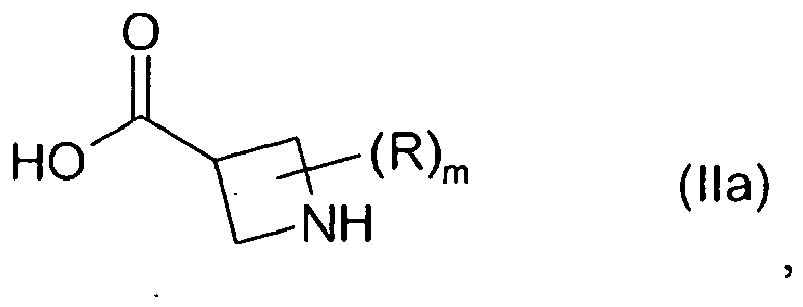 (b) reacting the carboxylic acid group of the resulting carbamate compound from step (a) with a compound of formula (III)
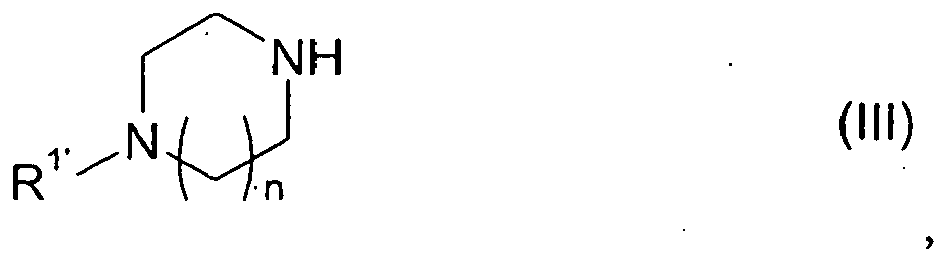 (c) deprotecting the azetidine amino group of the resulting compound from step (b) to form a compound represented by formula (IVb)
 (d) reacting the resulting secondary amino group from step (c) with an acid chloride of formula ClC(O)(CH2)n2R2 in the presence of a suitable base to yield a compound of formula (I), wherein n2, R2 are defined as indicated in claim 1.
Priority Applications (1)
| Application Number | Priority Date | Filing Date | Title |
|---|---|---|---|
| EP10702109.9A EP2391617B1 (en) | 2009-02-02 | 2010-01-29 | Azetidines as histamine h3 receptor antagonists |
Applications Claiming Priority (5)
| Application Number | Priority Date | Filing Date | Title |
|---|---|---|---|
| EP09151866 | 2009-02-02 | ||
| US15139509P | 2009-02-10 | 2009-02-10 | |
| EP09180478 | 2009-12-22 | ||
| PCT/EP2010/051077 WO2010086403A1 (en) | 2009-02-02 | 2010-01-29 | Azetidines as histamine h3 receptor antagonists |
| EP10702109.9A EP2391617B1 (en) | 2009-02-02 | 2010-01-29 | Azetidines as histamine h3 receptor antagonists |
Publications (2)
| Publication Number | Publication Date |
|---|---|
| EP2391617A1 EP2391617A1 (en) | 2011-12-07 |
| EP2391617B1 true EP2391617B1 (en) | 2015-11-11 |
Family
ID=42110303
Family Applications (1)
| Application Number | Title | Priority Date | Filing Date |
|---|---|---|---|
| EP10702109.9A Active EP2391617B1 (en) | 2009-02-02 | 2010-01-29 | Azetidines as histamine h3 receptor antagonists |
Country Status (9)
| Country | Link |
|---|---|
| US (1) | US8912176B2 (en) |
| EP (1) | EP2391617B1 (en) |
| JP (1) | JP5771531B2 (en) |
| CN (1) | CN102369196B (en) |
| AR (1) | AR075210A1 (en) |
| CA (1) | CA2751239C (en) |
| TW (1) | TWI449700B (en) |
| UY (1) | UY32410A (en) |
| WO (1) | WO2010086403A1 (en) |
Families Citing this family (3)
| Publication number | Priority date | Publication date | Assignee | Title |
|---|---|---|---|---|
| EP2491026A1 (en) * | 2009-10-20 | 2012-08-29 | Pfizer Inc. | Novel heteroaryl imidazoles and heteroaryl triazoles as gamma-secretase modulators |
| US8697888B2 (en) | 2012-01-06 | 2014-04-15 | Vanderbilt University | Substituted (1-(methylsulfonyl)azetidin-3-yl)(heterocycloalkyl)methanone analogs as antagonists of muscarinic acetylcholine M1 receptors |
| WO2013151982A1 (en) | 2012-04-03 | 2013-10-10 | Arena Pharmaceuticals, Inc. | Methods and compounds useful in treating pruritus, and methods for identifying such compounds |
Family Cites Families (12)
| Publication number | Priority date | Publication date | Assignee | Title |
|---|---|---|---|---|
| US4956359A (en) | 1985-02-28 | 1990-09-11 | A. H. Robins Company, Inc. | 3-aryloxy and 3-arylthioazetidinecarboxamides as anticonvulsants and antiepileptics |
| WO2001066534A2 (en) * | 2000-03-09 | 2001-09-13 | Abbott Laboratories | Cyclic and bicyclic diamino histamine-3 receptor antagonists |
| US6559140B2 (en) | 2000-03-09 | 2003-05-06 | Abbott Laboratories | Cyclic and bicyclic diamino histamine-3 receptor antagonists |
| DE10322191B4 (en) | 2003-05-16 | 2014-02-27 | The Medicines Company (Leipzig) Gmbh | N-sulfonylated amino acid derivatives, process for their preparation and their use |
| JP2008516922A (en) | 2004-10-15 | 2008-05-22 | グラクソ グループ リミテッド | Pyrrolidine derivatives as histamine receptor ligands |
| DE602006018301D1 (en) | 2005-06-22 | 2010-12-30 | Pfizer Prod Inc | HISTAMINE-3 RECEPTOR ANTAGONISTS |
| RU2008132966A (en) * | 2006-01-13 | 2010-02-20 | Ф.Хоффманн-Ля Рош Аг (Ch) | Cyclohexylpiperazinylmethanone derivatives and their use as histamine H3 receptor modulators |
| DK2195293T3 (en) | 2007-08-22 | 2014-02-03 | Astrazeneca Ab | CYCLOPROPYLAMIDE DERIVATIVES |
| WO2009095394A1 (en) | 2008-02-01 | 2009-08-06 | Evotec Neurosciences Gmbh | Diazepanes as histamine h3 receptor antagonists |
| CA2721303C (en) | 2008-05-08 | 2016-06-28 | Evotec Ag | Azetidines and cyclobutanes as histamine h3 receptor antagonists |
| WO2010026113A1 (en) | 2008-09-03 | 2010-03-11 | Evotec Neurosciences Gmbh | Acyl- and sufonyl tetrahydronaphthyridines and aza derivatives thereof as histamine h3 receptor antagonists |
| WO2010052222A1 (en) | 2008-11-07 | 2010-05-14 | Evotec Neurosciences Gmbh | (dihydro)naphthyridinone derivatives as histamine h3 receptor antagonists |
-
2010
- 2010-01-29 EP EP10702109.9A patent/EP2391617B1/en active Active
- 2010-01-29 CA CA2751239A patent/CA2751239C/en active Active
- 2010-01-29 CN CN201080016004.9A patent/CN102369196B/en not_active Expired - Fee Related
- 2010-01-29 JP JP2011546855A patent/JP5771531B2/en not_active Expired - Fee Related
- 2010-01-29 WO PCT/EP2010/051077 patent/WO2010086403A1/en not_active Ceased
- 2010-01-29 US US13/147,337 patent/US8912176B2/en active Active
- 2010-02-01 TW TW099102746A patent/TWI449700B/en not_active IP Right Cessation
- 2010-02-01 AR ARP100100269A patent/AR075210A1/en active IP Right Grant
- 2010-02-02 UY UY0001032410A patent/UY32410A/en not_active Application Discontinuation
Also Published As
| Publication number | Publication date |
|---|---|
| CN102369196A (en) | 2012-03-07 |
| EP2391617A1 (en) | 2011-12-07 |
| TW201038562A (en) | 2010-11-01 |
| US20120040952A1 (en) | 2012-02-16 |
| US8912176B2 (en) | 2014-12-16 |
| CA2751239A1 (en) | 2010-08-05 |
| JP5771531B2 (en) | 2015-09-02 |
| WO2010086403A1 (en) | 2010-08-05 |
| AR075210A1 (en) | 2011-03-16 |
| CA2751239C (en) | 2016-11-01 |
| HK1165418A1 (en) | 2012-10-05 |
| TWI449700B (en) | 2014-08-21 |
| CN102369196B (en) | 2015-05-20 |
| UY32410A (en) | 2010-08-31 |
| JP2012516837A (en) | 2012-07-26 |
Similar Documents
| Publication | Publication Date | Title |
|---|---|---|
| EP2300422B1 (en) | Azetidines as histamine h3 receptor antagonists | |
| US10167281B2 (en) | Substituted thiazole or oxazole P2X7 receptor antagonists | |
| JP2021510707A (en) | Condensed imidazole derivative as IL-17 modulator | |
| US8623859B2 (en) | Bradykinin B1 antagonists | |
| EA038428B1 (en) | Novel compound as autotaxin inhibitor and pharmaceutical composition comprising the same | |
| EP2326638B9 (en) | Diazepine and diazocane compounds as mc4 agonists | |
| WO2007015162A1 (en) | Piperidinoyl-pyrrolidine and piperidinoyl-piperidine compounds | |
| EP2391617B1 (en) | Azetidines as histamine h3 receptor antagonists | |
| US10669267B2 (en) | Substituted N-[2-(4-phenoxypiperidin-1-yl)-2-(1,3-thiazol-5-yl)ethyl]benzamide and N-[2-(4-benzyloxypiperidin-1-yl)-2-(1,3-thiazol-5-yl)ethyl]benzamide derivatives P2X7 receptor antagonists | |
| HK1165418B (en) | Azetidines as histamine h3 receptor antagonists | |
| WO2010133544A1 (en) | Piperazine and aminopyrrolidine compounds as histamine h3 receptor antagonists |
Legal Events
| Date | Code | Title | Description |
|---|---|---|---|
| PUAI | Public reference made under article 153(3) epc to a published international application that has entered the european phase |
Free format text: ORIGINAL CODE: 0009012 |
|
| 17P | Request for examination filed |
Effective date: 20110816 |
|
| AK | Designated contracting states |
Kind code of ref document: A1 Designated state(s): AT BE BG CH CY CZ DE DK EE ES FI FR GB GR HR HU IE IS IT LI LT LU LV MC MK MT NL NO PL PT RO SE SI SK SM TR |
|
| AX | Request for extension of the european patent |
Extension state: AL BA RS |
|
| 17Q | First examination report despatched |
Effective date: 20130514 |
|
| GRAP | Despatch of communication of intention to grant a patent |
Free format text: ORIGINAL CODE: EPIDOSNIGR1 |
|
| INTG | Intention to grant announced |
Effective date: 20150602 |
|
| RAP1 | Party data changed (applicant data changed or rights of an application transferred) |
Owner name: EVOTEC AG |
|
| GRAS | Grant fee paid |
Free format text: ORIGINAL CODE: EPIDOSNIGR3 |
|
| GRAA | (expected) grant |
Free format text: ORIGINAL CODE: 0009210 |
|
| AK | Designated contracting states |
Kind code of ref document: B1 Designated state(s): AT BE BG CH CY CZ DE DK EE ES FI FR GB GR HR HU IE IS IT LI LT LU LV MC MK MT NL NO PL PT RO SE SI SK SM TR |
|
| AX | Request for extension of the european patent |
Extension state: AL BA RS |
|
| REG | Reference to a national code |
Ref country code: GB Ref legal event code: FG4D |
|
| REG | Reference to a national code |
Ref country code: CH Ref legal event code: EP |
|
| REG | Reference to a national code |
Ref country code: IE Ref legal event code: FG4D |
|
| REG | Reference to a national code |
Ref country code: AT Ref legal event code: REF Ref document number: 760371 Country of ref document: AT Kind code of ref document: T Effective date: 20151215 |
|
| REG | Reference to a national code |
Ref country code: DE Ref legal event code: R096 Ref document number: 602010028945 Country of ref document: DE |
|
| REG | Reference to a national code |
Ref country code: FR Ref legal event code: PLFP Year of fee payment: 7 |
|
| REG | Reference to a national code |
Ref country code: CH Ref legal event code: NV Representative=s name: SCHMAUDER AND PARTNER AG PATENT- UND MARKENANW, CH |
|
| REG | Reference to a national code |
Ref country code: LT Ref legal event code: MG4D |
|
| REG | Reference to a national code |
Ref country code: NL Ref legal event code: MP Effective date: 20160211 |
|
| REG | Reference to a national code |
Ref country code: AT Ref legal event code: MK05 Ref document number: 760371 Country of ref document: AT Kind code of ref document: T Effective date: 20151111 |
|
| PG25 | Lapsed in a contracting state [announced via postgrant information from national office to epo] |
Ref country code: NO Free format text: LAPSE BECAUSE OF FAILURE TO SUBMIT A TRANSLATION OF THE DESCRIPTION OR TO PAY THE FEE WITHIN THE PRESCRIBED TIME-LIMIT Effective date: 20160211 Ref country code: HR Free format text: LAPSE BECAUSE OF FAILURE TO SUBMIT A TRANSLATION OF THE DESCRIPTION OR TO PAY THE FEE WITHIN THE PRESCRIBED TIME-LIMIT Effective date: 20151111 Ref country code: IS Free format text: LAPSE BECAUSE OF FAILURE TO SUBMIT A TRANSLATION OF THE DESCRIPTION OR TO PAY THE FEE WITHIN THE PRESCRIBED TIME-LIMIT Effective date: 20160311 Ref country code: NL Free format text: LAPSE BECAUSE OF FAILURE TO SUBMIT A TRANSLATION OF THE DESCRIPTION OR TO PAY THE FEE WITHIN THE PRESCRIBED TIME-LIMIT Effective date: 20151111 Ref country code: ES Free format text: LAPSE BECAUSE OF FAILURE TO SUBMIT A TRANSLATION OF THE DESCRIPTION OR TO PAY THE FEE WITHIN THE PRESCRIBED TIME-LIMIT Effective date: 20151111 Ref country code: LT Free format text: LAPSE BECAUSE OF FAILURE TO SUBMIT A TRANSLATION OF THE DESCRIPTION OR TO PAY THE FEE WITHIN THE PRESCRIBED TIME-LIMIT Effective date: 20151111 Ref country code: IT Free format text: LAPSE BECAUSE OF FAILURE TO SUBMIT A TRANSLATION OF THE DESCRIPTION OR TO PAY THE FEE WITHIN THE PRESCRIBED TIME-LIMIT Effective date: 20151111 |
|
| PG25 | Lapsed in a contracting state [announced via postgrant information from national office to epo] |
Ref country code: SE Free format text: LAPSE BECAUSE OF FAILURE TO SUBMIT A TRANSLATION OF THE DESCRIPTION OR TO PAY THE FEE WITHIN THE PRESCRIBED TIME-LIMIT Effective date: 20151111 Ref country code: GR Free format text: LAPSE BECAUSE OF FAILURE TO SUBMIT A TRANSLATION OF THE DESCRIPTION OR TO PAY THE FEE WITHIN THE PRESCRIBED TIME-LIMIT Effective date: 20160212 Ref country code: AT Free format text: LAPSE BECAUSE OF FAILURE TO SUBMIT A TRANSLATION OF THE DESCRIPTION OR TO PAY THE FEE WITHIN THE PRESCRIBED TIME-LIMIT Effective date: 20151111 Ref country code: PL Free format text: LAPSE BECAUSE OF FAILURE TO SUBMIT A TRANSLATION OF THE DESCRIPTION OR TO PAY THE FEE WITHIN THE PRESCRIBED TIME-LIMIT Effective date: 20151111 Ref country code: BE Free format text: LAPSE BECAUSE OF NON-PAYMENT OF DUE FEES Effective date: 20160131 Ref country code: LV Free format text: LAPSE BECAUSE OF FAILURE TO SUBMIT A TRANSLATION OF THE DESCRIPTION OR TO PAY THE FEE WITHIN THE PRESCRIBED TIME-LIMIT Effective date: 20151111 Ref country code: FI Free format text: LAPSE BECAUSE OF FAILURE TO SUBMIT A TRANSLATION OF THE DESCRIPTION OR TO PAY THE FEE WITHIN THE PRESCRIBED TIME-LIMIT Effective date: 20151111 Ref country code: PT Free format text: LAPSE BECAUSE OF FAILURE TO SUBMIT A TRANSLATION OF THE DESCRIPTION OR TO PAY THE FEE WITHIN THE PRESCRIBED TIME-LIMIT Effective date: 20160311 |
|
| PG25 | Lapsed in a contracting state [announced via postgrant information from national office to epo] |
Ref country code: CZ Free format text: LAPSE BECAUSE OF FAILURE TO SUBMIT A TRANSLATION OF THE DESCRIPTION OR TO PAY THE FEE WITHIN THE PRESCRIBED TIME-LIMIT Effective date: 20151111 |
|
| REG | Reference to a national code |
Ref country code: DE Ref legal event code: R097 Ref document number: 602010028945 Country of ref document: DE |
|
| PG25 | Lapsed in a contracting state [announced via postgrant information from national office to epo] |
Ref country code: LU Free format text: LAPSE BECAUSE OF FAILURE TO SUBMIT A TRANSLATION OF THE DESCRIPTION OR TO PAY THE FEE WITHIN THE PRESCRIBED TIME-LIMIT Effective date: 20160129 Ref country code: SK Free format text: LAPSE BECAUSE OF FAILURE TO SUBMIT A TRANSLATION OF THE DESCRIPTION OR TO PAY THE FEE WITHIN THE PRESCRIBED TIME-LIMIT Effective date: 20151111 Ref country code: EE Free format text: LAPSE BECAUSE OF FAILURE TO SUBMIT A TRANSLATION OF THE DESCRIPTION OR TO PAY THE FEE WITHIN THE PRESCRIBED TIME-LIMIT Effective date: 20151111 Ref country code: DK Free format text: LAPSE BECAUSE OF FAILURE TO SUBMIT A TRANSLATION OF THE DESCRIPTION OR TO PAY THE FEE WITHIN THE PRESCRIBED TIME-LIMIT Effective date: 20151111 Ref country code: RO Free format text: LAPSE BECAUSE OF FAILURE TO SUBMIT A TRANSLATION OF THE DESCRIPTION OR TO PAY THE FEE WITHIN THE PRESCRIBED TIME-LIMIT Effective date: 20151111 Ref country code: SM Free format text: LAPSE BECAUSE OF FAILURE TO SUBMIT A TRANSLATION OF THE DESCRIPTION OR TO PAY THE FEE WITHIN THE PRESCRIBED TIME-LIMIT Effective date: 20151111 |
|
| PLBE | No opposition filed within time limit |
Free format text: ORIGINAL CODE: 0009261 |
|
| STAA | Information on the status of an ep patent application or granted ep patent |
Free format text: STATUS: NO OPPOSITION FILED WITHIN TIME LIMIT |
|
| PG25 | Lapsed in a contracting state [announced via postgrant information from national office to epo] |
Ref country code: MC Free format text: LAPSE BECAUSE OF FAILURE TO SUBMIT A TRANSLATION OF THE DESCRIPTION OR TO PAY THE FEE WITHIN THE PRESCRIBED TIME-LIMIT Effective date: 20151111 |
|
| 26N | No opposition filed |
Effective date: 20160812 |
|
| REG | Reference to a national code |
Ref country code: IE Ref legal event code: MM4A |
|
| PG25 | Lapsed in a contracting state [announced via postgrant information from national office to epo] |
Ref country code: SI Free format text: LAPSE BECAUSE OF FAILURE TO SUBMIT A TRANSLATION OF THE DESCRIPTION OR TO PAY THE FEE WITHIN THE PRESCRIBED TIME-LIMIT Effective date: 20151111 |
|
| PG25 | Lapsed in a contracting state [announced via postgrant information from national office to epo] |
Ref country code: BE Free format text: LAPSE BECAUSE OF FAILURE TO SUBMIT A TRANSLATION OF THE DESCRIPTION OR TO PAY THE FEE WITHIN THE PRESCRIBED TIME-LIMIT Effective date: 20151111 |
|
| REG | Reference to a national code |
Ref country code: FR Ref legal event code: PLFP Year of fee payment: 8 |
|
| PG25 | Lapsed in a contracting state [announced via postgrant information from national office to epo] |
Ref country code: IE Free format text: LAPSE BECAUSE OF NON-PAYMENT OF DUE FEES Effective date: 20160129 |
|
| PG25 | Lapsed in a contracting state [announced via postgrant information from national office to epo] |
Ref country code: MT Free format text: LAPSE BECAUSE OF FAILURE TO SUBMIT A TRANSLATION OF THE DESCRIPTION OR TO PAY THE FEE WITHIN THE PRESCRIBED TIME-LIMIT Effective date: 20151111 |
|
| REG | Reference to a national code |
Ref country code: FR Ref legal event code: PLFP Year of fee payment: 9 |
|
| PG25 | Lapsed in a contracting state [announced via postgrant information from national office to epo] |
Ref country code: HU Free format text: LAPSE BECAUSE OF FAILURE TO SUBMIT A TRANSLATION OF THE DESCRIPTION OR TO PAY THE FEE WITHIN THE PRESCRIBED TIME-LIMIT; INVALID AB INITIO Effective date: 20100129 Ref country code: CY Free format text: LAPSE BECAUSE OF FAILURE TO SUBMIT A TRANSLATION OF THE DESCRIPTION OR TO PAY THE FEE WITHIN THE PRESCRIBED TIME-LIMIT Effective date: 20151111 |
|
| PG25 | Lapsed in a contracting state [announced via postgrant information from national office to epo] |
Ref country code: TR Free format text: LAPSE BECAUSE OF FAILURE TO SUBMIT A TRANSLATION OF THE DESCRIPTION OR TO PAY THE FEE WITHIN THE PRESCRIBED TIME-LIMIT Effective date: 20151111 Ref country code: MT Free format text: LAPSE BECAUSE OF FAILURE TO SUBMIT A TRANSLATION OF THE DESCRIPTION OR TO PAY THE FEE WITHIN THE PRESCRIBED TIME-LIMIT Effective date: 20160131 Ref country code: MK Free format text: LAPSE BECAUSE OF FAILURE TO SUBMIT A TRANSLATION OF THE DESCRIPTION OR TO PAY THE FEE WITHIN THE PRESCRIBED TIME-LIMIT Effective date: 20151111 |
|
| PG25 | Lapsed in a contracting state [announced via postgrant information from national office to epo] |
Ref country code: BG Free format text: LAPSE BECAUSE OF FAILURE TO SUBMIT A TRANSLATION OF THE DESCRIPTION OR TO PAY THE FEE WITHIN THE PRESCRIBED TIME-LIMIT Effective date: 20151111 |
|
| P01 | Opt-out of the competence of the unified patent court (upc) registered |
Effective date: 20230508 |
|
| PGFP | Annual fee paid to national office [announced via postgrant information from national office to epo] |
Ref country code: DE Payment date: 20240131 Year of fee payment: 15 Ref country code: GB Payment date: 20240124 Year of fee payment: 15 Ref country code: CH Payment date: 20240202 Year of fee payment: 15 |
|
| PGFP | Annual fee paid to national office [announced via postgrant information from national office to epo] |
Ref country code: FR Payment date: 20240123 Year of fee payment: 15 |
|
| REG | Reference to a national code |
Ref country code: DE Ref legal event code: R119 Ref document number: 602010028945 Country of ref document: DE |
|
| REG | Reference to a national code |
Ref country code: CH Ref legal event code: PL |
|
| GBPC | Gb: european patent ceased through non-payment of renewal fee |
Effective date: 20250129 |
|
| PG25 | Lapsed in a contracting state [announced via postgrant information from national office to epo] |
Ref country code: DE Free format text: LAPSE BECAUSE OF NON-PAYMENT OF DUE FEES Effective date: 20250801 |
|
| PG25 | Lapsed in a contracting state [announced via postgrant information from national office to epo] |
Ref country code: GB Free format text: LAPSE BECAUSE OF NON-PAYMENT OF DUE FEES Effective date: 20250129 |
|
| PG25 | Lapsed in a contracting state [announced via postgrant information from national office to epo] |
Ref country code: FR Free format text: LAPSE BECAUSE OF NON-PAYMENT OF DUE FEES Effective date: 20250131 |
|
| PG25 | Lapsed in a contracting state [announced via postgrant information from national office to epo] |
Ref country code: CH Free format text: LAPSE BECAUSE OF NON-PAYMENT OF DUE FEES Effective date: 20250131 |