EP2387779B1 - Tomographic imaging using poissonian detector data - Google Patents
Tomographic imaging using poissonian detector data Download PDFInfo
- Publication number
- EP2387779B1 EP2387779B1 EP10703166.8A EP10703166A EP2387779B1 EP 2387779 B1 EP2387779 B1 EP 2387779B1 EP 10703166 A EP10703166 A EP 10703166A EP 2387779 B1 EP2387779 B1 EP 2387779B1
- Authority
- EP
- European Patent Office
- Prior art keywords
- data
- image
- detector
- max
- log
- Prior art date
- Legal status (The legal status is an assumption and is not a legal conclusion. Google has not performed a legal analysis and makes no representation as to the accuracy of the status listed.)
- Active
Links
Images


Classifications
-
- G—PHYSICS
- G06—COMPUTING OR CALCULATING; COUNTING
- G06T—IMAGE DATA PROCESSING OR GENERATION, IN GENERAL
- G06T12/00—Tomographic reconstruction from projections
- G06T12/20—Inverse problem, i.e. transformations from projection space into object space
-
- G—PHYSICS
- G06—COMPUTING OR CALCULATING; COUNTING
- G06T—IMAGE DATA PROCESSING OR GENERATION, IN GENERAL
- G06T2207/00—Indexing scheme for image analysis or image enhancement
- G06T2207/10—Image acquisition modality
- G06T2207/10072—Tomographic images
-
- G—PHYSICS
- G06—COMPUTING OR CALCULATING; COUNTING
- G06T—IMAGE DATA PROCESSING OR GENERATION, IN GENERAL
- G06T2211/00—Image generation
- G06T2211/40—Computed tomography
- G06T2211/424—Iterative
-
- G—PHYSICS
- G06—COMPUTING OR CALCULATING; COUNTING
- G06T—IMAGE DATA PROCESSING OR GENERATION, IN GENERAL
- G06T2211/00—Image generation
- G06T2211/40—Computed tomography
- G06T2211/436—Limited angle
Definitions
- the invention relates to an image reconstruction method for reconstructing a tomographic image of an object based on detector data contaminated with Poisson noise, especially detector data collected with an emission tomographic device, like e. g. a SPECT or PET imaging device, or with a transmission tomographic device, like a CT imaging device operating e.g. under low photon-flux conditions.
- the image reconstruction method is based on a non-analytical image reconstruction using a minimizing algorithm.
- the invention relates to an imaging method including the image reconstruction method.
- the invention relates to an imaging device implementing the imaging and image reconstruction methods.
- Non-analytical image reconstruction is a generally known approach for a volumetric reconstruction, most commonly used for emission tomographic data, based e. g. on SPECT (single photon emission computed tomography) or PET (positron emission tomography) measurements (see K. Lange et al. "EM Reconstruction Algorithms for Emission and Transmission Tomography” in “Journal of Computer Assisted Tomography", vol. 8 (2), April 1984, p.306-316 , L.A. Shepp et al. "Maximum Likelihood Reconstruction for Emission Tomography” in "IEEE Transactions on Medical Imaging” vol. MI-1 (2), October 1982, p.113-122 ), and J.
- SPECT single photon emission computed tomography
- PET positron emission tomography
- the non-analytical solution uses a minimizing algorithm for finding image data which represent the best fit for the detector data.
- the non-analytical approach intrinsically can cope better with input data suffering from noise and is able to account for physical processes degrading the measured data.
- the measured data often suffer from very bad photon statistics.
- CS Compressive Sensing
- Compressed Sensing is a technique for acquiring and reconstructing a signal utilizing the prior knowledge that it is sparse or compressible.
- An introduction to CS has been presented by Emmanuel J. Candès et al. ("An Introduction To Compressive Sampling" in "IEEE Signal Processing Magazine” March 2008, p. 21 - 30 ).
- the CS theory shows that sparse signals, which contain much less information than could maximally be encoded with the same number of detected data entries, can be reconstructed exactly from very few measurements in noise free conditions.
- the error made depends only logarithmically on v . To put it another way, the error can be made small by choosing k / log v large, but it is by no means necessary to have k / v close to 1. Accurate reconstruction is possible even if the number of projections is much smaller than v, as long as k / log v is large.
- Rebecca M. Willett et al. (“Performance bounds on compressed sensing with Poisson noise” in "IEEE International Symposium on Information Theory ISIT” 2009, June 28 2009 - July 3 2009, p.174 - 178 ) have generalized results from Jarvis Haupt et al. to Poisson noise.
- Rebecca M. Willett et al. have proposed to reconstruct a tomographic image from detector data using a procedure of minimizing a functional f ⁇ depending on a sensing matrix A and the detector data and further depending on a penalty term, wherein the sensing matrix A is constructed on the basis of statistic Raderaum variables and the penalty term depends on the sparsity of the object.
- the result was discouraging: it was found that the upper bound on the error increases with the number of measurements, i.e. more measurements seem to make the accuracy smaller.
- the objective of the invention is to provide an improved image reconstruction method for reconstructing a tomographic image of an object, in particular for emission tomography purposes or for very low dose transmission tomography purposes, which is capable of avoiding disadvantages of conventional techniques.
- the objective is to provide an image reconstruction method which enables reconstructing the tomographic image with a reduced quantity of detector data without a loss in image quality.
- the objective of the invention is to provide an improved imaging method avoiding disadvantages of conventional imaging techniques.
- the objective of the invention is to provide an improved imaging device in particular being adapted for conducting the inventive imaging method.
- an image reconstruction method for reconstructing a tomographic image ( f j ) of a region of investigation within an object from detector data ( y ⁇ ) comprising Poisson random values measured at an i -th of a plurality of different positions relative to the object.
- a predetermined system matrix A ij assigning a j -th voxel of the object to the i -th detector data ( y i ) is provided.
- elements of the system matrix A ij are not statistic values but rather selected by geometrically or physically assigning contributions of each of the voxels (object data) to each detector element of a detector device or the associated detector data, resp..
- the system matrix which defines the detector data as linear combinations of the original object data is determined by geometric or physical features of the imaging device, in particular by the arrangement of the object relative to the detector device and the detector device geometry.
- the tomographic image ( f j ) is reconstructed by minimizing a functional F( f ) depending on the detector data ( y i ) and the system matrix A ij and additionally including a sparse or compressive representation of the object in an orthogonal basis T.
- the orthogonal basis (orthobasis) T is an orthogonal matrix, the columns of which are orthonormal basis vectors.
- the orthobasis is selected such that the object, in particular the region of investigation, can be represented in the orthobasis fulfilling the requirements of sparsity or compressibility.
- the minimizing procedure is a non-analytical or algebraic procedure, e. g. an iterative algorithm.
- the tomographic image ( f j ) comprises the image data representing the global minimum of the functional F( f ) .
- the inventive reconstruction comprises minimizing the above functional F, which includes two or optionally three additive parts, namely an empiric risk part, which represents the Poisson statistic of the measurement, a CS part representing the compressibility of the object and (optionally) a regularization term.
- the data is noisy
- second it is necessary to perform a large number of measurements in order to obtain sufficient information for an acceptable reconstruction quality
- third the reconstruction problem is ill-posed such that without further measures even an infinitesimal amount of noise generates serious artifacts.
- the invention is capable of overcoming all three difficulties by providing a link between a compressive sensing strategy (solving problem two) and a maximum likelihood approach (which deals optimally with problem one) for the case of Poisson noise, while still allowing for inclusion of regularization techniques addressing problem three.
- the image reconstruction method can be conducted immediately after collecting the detector data, in particular with the imaging device collecting the detector data.
- the image reconstruction method can be conducted with an image reconstruction device at a distant location and/or with a delay after the measurement with detector data provided e. g. via a data communication channel from the imaging device to the image reconstruction device or from a data storage.
- the detector data ( y i ) can be provided e. g. via a data network, from a data storage or directly by the detector device.
- an imaging method for reconstructing an image ( f j ) of a region of investigation within an object comprises the steps of collecting the detector data ( y i ) with the detector device of an imaging device and subjecting the detector data ( y i ) to the inventive image reconstruction method according to the above first aspect of the invention.
- the imaging method is used for collecting is a SPECT image, a PET image, a CT image or a confocal microscopy image.
- an imaging device for imaging a region of investigation in an object which comprises a detector device for measuring detector data ( y i ) comprising Poisson random values measured at the i-th angular position of a detector element of the detector device relative to the object, and a reconstruction device for reconstructing an image ( f j ) the object, wherein the detector data ( y i ) are subjected to the image reconstruction method according to the above first aspect of the invention.
- the invention provides a new method to accurately reconstruct a three dimensional image from very few detector data, e. g. projections, by non-analytical or algebraic methods using a minimizing algorithm.
- the inventors have found methods of exploiting the fact that real world objects are usually sparse or at least compressible while overcoming the restrictions of conventional approaches for applying CS on Poisson noise data.
- Emission tomographic images can be reconstructed with a number of measurements which is reduced compared with conventional measurements, whereas the same accuracy as with conventional methods can be obtained. Accordingly measurement time and/or applied activity (for emission tomography) or irradiation dose (for transmission tomography) can thus be reduced.
- the quantity of measurements for obtaining a certain image quality can be reduced compared with the conventional imaging technique yielding the same image quality.
- the measuring time and the burden for the patient can be reduced accordingly.
- artefacts resulting from unintended movements of the object, e.g. of the patient can be avoided.
- the image reconstruction method does not include a free parameter.
- the tomographic image can be obtained exclusively on the basis of the detector data and the system matrix determined by the measuring arrangement.
- the reconstruction risk (see below) can be controlled. The quality of a reconstruction can be quantitatively evaluated.
- the image reconstruction method considers the Poisson statistic not only in the evaluation of the risk, but rather also with the reconstruction as such, i.e. the advantages of the maximum-likelihood reconstruction are associated with the advantage of a reduced number of measurements due to applying the CS technique.
- the inventive method can be extended in analogy to the penalized-likelihood method for a regularization of the reconstructed object.
- the orthogonal basis (orthobasis) T is selected to be as incoherent as possible with respect to the system matrix A ij and such that the object f (or a comparable typical object) has a compressible representation in this basis.
- the calibration factor a is a predetermined fixed parameter, which is not changed during the minimization procedure, i.e. it is not a fit parameter. Further features of the calibration factor a are described below. By a preliminary determination of the calibration factor a, the tomographic reconstruction can be improved. This is a further difference compared with the above conventional approach of Rebecca M. Willett et al.
- the regularization function R can be constructed for suppressing artefacts in the reconstructed tomographic image.
- the system matrix can be adjusted using reference data of the measuring system used for collecting the detector data.
- the reference data can be stored as specific data of the measuring system in the image reconstruction device, e.g. in the imaging device.
- the entries of the system matrix can be acquired using a calibration measurement. In this case, collecting the detector data is performed with a calibration object (phantom) having known volumetric object data.
- the calibration detector data can be used for adjusting the elements of the system matrix.
- the orthobasis T is a basis of three-dimensional wavelets with a compact carrier.
- an adapted orthobasis can be constructed with entries depending on typical object data of the object to be imaged.
- the orthobasis can be matched to the type of object for improving the image reconstruction.
- the object is sufficiently smooth, it will have predominantly low spatial frequency components such that a Fourier basis is adequate.
- a principal components analysis of a number of reference objects may generate a suitable orthobasis.
- the invention provides further particular advantages for the imaging method, in particular for selecting or setting the angular positions at which the detector data are collected.
- a randomized setting of the angular positions can be provided.
- the detector data can be continuously collected, e.g. with a SPECT device while the angular positions of the detector device thereof are changed continuously and not in the usual step-and-shoot mode. Accordingly, the imaging speed can be essentially increased.
- a preparation step is provided before the collection of the detector data.
- the preparation step comprises a setting of an image quality measure (risk) to be fulfilled by the imaging method.
- the number of angular positions is selected at which detector data are collected. Accordingly, for obtaining a preview image wherein a low image quality is sufficient, a reduced number of angular positions is used, while for a subsequent regular imaging with improved image quality, the number of angular positions (and correspondingly detector data) is increased.
- Preferred embodiments of the invention are described here with exemplary reference to emission tomography, in particular SPECT.
- the application of the invention is not restricted to SPECT, but rather possible with other image data contaminated with a Poisson noise, like e. g. PET data and CT data, in particular with low photon flux. Details of measuring techniques, like e.g. details of SPECT devices and modes of operating those devices are not described as far as they are known from conventional techniques.
- the invention is not restricted to medical imaging, but rather can also be implemented for imaging other objects, like e.g. work pieces.
- Embodiments of the invention are described in the following with reference to the procedural steps of the inventive methods. Implementing these features as data processing tools will depend on e. g. the measuring system used and the type of object to be imaged in practice. While the understanding and the implementation of the features is based on the mathematical background outlined below, the skilled person will recognize that the invention is not restricted to all mathematical details, but covers all data processing tools generally based on this mathematical background.
- Figure 1 schematically illustrates a sectional view of an embodiment of an imaging device 100 including a detector device 10, an object carrier 20, a detector carrier 30 and a reconstruction device 40.
- the components 10, 20 and 30 are structured like in a conventional SPECT device, e.g. a one-headed Siemens e.cam.
- the detector device 10 is rotatably mounted on the detector carrier 30 such that it can be rotated in an x-y-plane around the object carrier 20.
- the object carrier 20 is a support device, e.g. table, configured for accommodating the object 1, e.
- the object carrier 20 comprises a carrying bed for accommodating the patient as schematically illustrated in Figure 1 .
- the detector carrier 30 comprises e.g. a circular rail to which the detector device 10 is attached.
- the object carrier 20 and the detector carrier 30 can be translated relative to each other in a direction perpendicular to the x-y-plane (drawing plane).
- the object 1 is e.g. a human patient, wherein a certain portion (region of investigation 2), e.g. the brain is to be investigated with the inventive imaging method.
- region of investigation 2 is considered as consisting of a plurality of voxels 3.
- the j -th voxel 3 is schematically shown for illustrative purposes.
- the patient has an administered tracer substance which is accumulated with a concentration distribution in specific regions, e. g. certain tissue or organ. This concentration distribution is to be imaged.
- the tracer substance carries a radioactive marker emitting ⁇ radiation as it is known from conventional SPECT measurements.
- the detector device 10 is moved to preferably randomized angular positions ⁇ l and suitable detector radii r l where the ⁇ photons are detected.
- the collected detector data y i together with ⁇ l and r l are transferred to the input circuit 41.
- the reconstruction device 40 comprises an input circuit 41, a processing circuit 42, an output circuit 43, and an entry storage 44.
- the input circuit 41 is arranged for receiving the detector data and further entries, which are necessary for implementing the inventive image reconstruction method.
- the detector device 10 is connected with the input circuit 41 for transferring detector data y i and the associated angular position ⁇ l .
- the input circuit 41 is connected with the entry storage 44 being arranged for storing the system matrix A ij , the orthobasis T and optionally the regularization function R .
- the processing circuit 42 includes a computer unit, which is configured for implementing the data processing of the image reconstruction method.
- the output circuit 43 may comprise a display 43.1, a data storage 43.2 and/or an interface 43.3.
- the output circuit 43 may include a Dicom-node.
- the reconstruction device 40 can be implemented with a standard computer having an appropriate hardware configuration.
- step S1 the detector data with the associated angular positions as well as the remaining input entries are provided with step S1.
- step S2 the reconstructing step S2 with finding an object minimizing functional is conducted, followed by step S3 of presenting the tomographic image consisting of the minimizer of the functional.
- Step S1 in particular includes the provision (step S11) of the detector data (as measured preferably) from random angular positions and the associated angles and radii.
- Step S11 depends on particular application conditions and the data source used.
- the detector data and angular positions can be measured (step S01) and input directly from the detector device 10 ( Figure 1 ).
- the procedure of Figure 2 including the step S01 represents an embodiment of the inventive imaging method.
- Measuring the detector data is conducted as commonly known from SPECT devices.
- selecting a number of measurements in dependence on the image quality to be obtained can be provided on the basis of the considerations summarized in 3.7 below.
- the detector data and angular positions can be input via a data communication channel (step S02).
- steps S1 to S3 represent an embodiment of the inventive image reconstruction method.
- Step S1 further includes step S12 of determining a sparsity orthobasis T which is suitable for the measured object, e.g. a wavelet basis with finite support.
- the orthobasis can be stored in the entry storage 44 ( Figure 1 ).
- step S1 includes the provision of a predetermined system matrix A ij (step S13).
- the system matrix is computed or acquired from reference system data.
- the system matrix represents the contribution of the j -th voxel 3 to the i -th detector data 11.i ( Figure 1 ).
- the result of the minimization routine is output as the final result with step S3, where it is transferred e.g. to a Dicom-node included in the output circuit 43 ( Figure 1 ).
- a three dimensional object f j ⁇ is considered, wherein the subscript j indexes the voxels, of which it is assumed to have v.
- the constants r i > 0 indicate the background count rate which is always present in practice.
- the definition R i ⁇ ⁇ i ⁇ ⁇ i ⁇ ⁇ ⁇ i ⁇ log ⁇ ⁇ i will be used below.
- T T be an orthogonal matrix the rows of which are filled with the orthonormal basis vectors of the sparsity basis.
- f min be the element of F which minimizes the penalized (true) risk, i.e.
- f _ min arg min f _ ⁇ F R f _ + c f _ log2 k ⁇ , then 1 ⁇ a r f _ ⁇ min f _ ⁇ ⁇ r ⁇ f _ min f _ ⁇ + c f _ min log 2 ⁇ log ⁇ ⁇ k ⁇ (with probability at least 1 - ⁇ ) since f ⁇ min minimizes the penalized empirical risk, and replacing it by f min on the right hand side can only make the bound bigger.
- the second logarithm on the right hand side can be estimated by log 2 ⁇ m ⁇ 2 ⁇ ⁇ i ⁇ ⁇ i ⁇ ⁇ log 2 ⁇ m ⁇ 2 A max 2 . It can be shown (see 3.5 below) that the central moments obey M 2m ( ⁇ ) ⁇ (2 m )!(max(1, ⁇ )) m , such that M 2 ⁇ m ⁇ ⁇ i ⁇ M 2 ⁇ ⁇ i ⁇ ⁇ 2 m ! max 1 ⁇ ⁇ i ⁇ m ⁇ ⁇ i ⁇ ⁇ 2 m !
- a compressible object f * is one which can be represented accurately by a small number of coefficients in some basis.
- T jj' . is an orthogonal matrix and ⁇ j ′ ⁇ are the coefficients
- f ( m ) is the best m -term approximation to f * in this basis
- T be the set of coefficient vectors ⁇ corresponding to the set F .
- ⁇ _ q m ⁇ T be the closest element to ⁇ (m) inT.
- ⁇ min can now be replaced in the oracle inequality by ⁇ _ q m since r T ⁇ _ min , T ⁇ _ ⁇ + c ⁇ _ min log 2 + 4 k ⁇ ⁇ r T ⁇ _ q m , T ⁇ _ ⁇ + c ⁇ _ q m log 2 + 4 k ⁇ by definition of ⁇ min .
- the derivatives here act on the first argument of r .
- the first and second terms are 0 since the risk r assumes its minimum of 0 when the two arguments coincide.
- the last term is the remainder term and the ⁇ ij are suitable constants which lie on the straight line between ⁇ * and ⁇ _ q m .
- This bound may be too conservative: if it is assumed that f ( m ) , as the best m -term approximation, is close to f *, then it may be more appropriate to assume that ⁇ k is within a factor of, say, 2 of ⁇ ⁇ k ⁇ . In that case the bound is const. ⁇ A max . It will be therefore written R " k ⁇ ⁇ k ⁇ cA max ⁇ with a constant c > 0 and an exponent 1 ⁇ ⁇ ⁇ 3.
- T ⁇ _ q m ⁇ ⁇ _ ⁇ 2 ⁇ _ q m ⁇ ⁇ _ ⁇ 2 ⁇ ⁇ _ q m ⁇ ⁇ _ m 2 + 2 ⁇ _ q m ⁇ ⁇ _ m 2 ⁇ ⁇ _ m ⁇ ⁇ _ ⁇ 2 + ⁇ _ m ⁇ ⁇ _ ⁇ 2 60 ⁇ v 2 D 2 v 2 ⁇ p + 2 v 2 D 2 C A v 2 ⁇ p m ⁇ ⁇ + C A vm 2 ⁇ ⁇ ⁇ .
- Eq. (65) is the final error bound. Unlike similar bounds as, e.g. in Jarvis Haupt et al. (cited above), the important last term here contains the additional factor A max ⁇ 2 ⁇ ⁇ ⁇ 1 ⁇ ⁇ ⁇ 2 ⁇ ⁇ + 1 2 ⁇ ⁇ which depends on v if A max or A do.
- the compressive sensing strategy may still be useful if the additional factor A max ⁇ 2 ⁇ ⁇ ⁇ 1 ⁇ ⁇ ⁇ 2 ⁇ ⁇ + 1 2 ⁇ ⁇ grows with a power of v less than 1.
- a max O ( v 1/6 ).
- A is a typical system matrix of a tomographic setup, which has of order v 1/3 nonzero entries in each row, and T is a random orthogonal matrix, such that ⁇ j A ij T jk is a sum of O ( v 1/3 ) terms, each of order O ( v- 1 / 2 ) and with random sign, resulting in a number O ( v -1/3 ).
- a max O ( v 1 /6 ).
- the important term becomes v 2 ⁇ ⁇ + ⁇ + 5 12 ⁇ ⁇ log 2 ⁇ ⁇ + 1 2 ⁇ ⁇ + 1 v k .
- n ⁇ 2 ⁇ i ! n ⁇ 2 ! max 1 ⁇ n ⁇ 2 / 2 75 2 ⁇ ⁇ n ⁇ 1 ! max 1 ⁇ n ⁇ 2 / 2 76 ⁇ n ! max 1 ⁇ 1 / 2 , 77 which concludes the proof.
- the risk of the reconstruction is bounded by r f ⁇ _ min f _ ⁇ ⁇ C 1 1 2 ⁇ ⁇ + 1 ⁇ cC A v n 1 2 ⁇ ⁇ + 1 1 + p log 2 2 ⁇ ⁇ 2 ⁇ ⁇ + 1 + 4 A max ⁇ ⁇ 2 1 2 ⁇ ⁇ log ⁇ v k ⁇ 2 ⁇ ⁇ + 1 2 ⁇ ⁇ 2 ⁇ ⁇ 2 ⁇ + 1 .
- n pixels the potential measurements
- the risk is a measure of the absolute error between the ideal (i.e. noise free) projections of f * and f ⁇ min for all of the potential measurements (not just the measured ones), normalized by n. That means it is the absolute error per potential measurement pixel.
- ⁇ f ⁇ _ min f _ ⁇ r f ⁇ _ min f _ ⁇ 1 n ⁇ i ⁇ ⁇ i ⁇ ⁇ r f ⁇ _ min f _ ⁇ 1 n ⁇ i ⁇ ⁇ min , i .
- ⁇ ⁇ i ⁇ and ⁇ min, i are the ideal noise free projections of f * and f ⁇ min
- the error ⁇ now means a relative error per pixel. This makes the interpretation of ⁇ very clear: a statement like "the error ⁇ is smaller than 10%" is perfectly sensible and understandable.
- Figure 3 shows sectional images of an inventive SPECT reconstruction with image data of a heart ( Figure 3A ) and a bone ( Figure 3C ) in comparison with conventional penalized likelihood reconstructions ( Figures 3B, 3D ).
- the comparison shows a greatly enhanced resolution obtained with the inventive technique in both cases.
- the quality of the illustrated images is restricted due to the printing technique and as a result of a restricted number of angular positions.
- image data are collected at a relatively small number of angular positions (heart: 10 angles, bone: 32 angles).
- the number of angular positions must be larger (e.g. around100 or more) in order to achieve a resolution similar to Figs. 3A and 3C .
Landscapes
- Physics & Mathematics (AREA)
- General Physics & Mathematics (AREA)
- Engineering & Computer Science (AREA)
- Theoretical Computer Science (AREA)
- Nuclear Medicine (AREA)
- Apparatus For Radiation Diagnosis (AREA)
Description
- The invention relates to an image reconstruction method for reconstructing a tomographic image of an object based on detector data contaminated with Poisson noise, especially detector data collected with an emission tomographic device, like e. g. a SPECT or PET imaging device, or with a transmission tomographic device, like a CT imaging device operating e.g. under low photon-flux conditions. In particular, the image reconstruction method is based on a non-analytical image reconstruction using a minimizing algorithm. Furthermore, the invention relates to an imaging method including the image reconstruction method. Furthermore, the invention relates to an imaging device implementing the imaging and image reconstruction methods.
- Non-analytical image reconstruction is a generally known approach for a volumetric reconstruction, most commonly used for emission tomographic data, based e. g. on SPECT (single photon emission computed tomography) or PET (positron emission tomography) measurements (see K. Lange et al. "EM Reconstruction Algorithms for Emission and Transmission Tomography" in "Journal of Computer Assisted Tomography", vol. 8 (2), April 1984, p.306-316, L.A. Shepp et al. "Maximum Likelihood Reconstruction for Emission Tomography" in "IEEE Transactions on Medical Imaging" vol. MI-1 (2), October 1982, p.113-122), and J. Kay "The EM algorithm in medical imaging" in "Statistical Methods in Medical Research" vol. 6, 1997, p.55-75). In contrast to the analytical approach, in particular using a back-projection algorithm (e. g. filtered back-projection, FBP), the non-analytical solution uses a minimizing algorithm for finding image data which represent the best fit for the detector data. The non-analytical approach intrinsically can cope better with input data suffering from noise and is able to account for physical processes degrading the measured data. The measured data often suffer from very bad photon statistics. In order to obtain useful results, long measurement times and relatively high patient doses are necessary, putting unnecessary stress on the patient. These restrictions would be avoided if images could be reconstructed from few measurements with the concept of Compressive Sensing (CS) as proposed e. g. for conventional optical images collected with a camera.
- Compressed Sensing (or: compressive sensing, compressive sampling and sparse sampling), is a technique for acquiring and reconstructing a signal utilizing the prior knowledge that it is sparse or compressible. An introduction to CS has been presented by Emmanuel J. Candès et al. ("An Introduction To Compressive Sampling" in "IEEE Signal Processing Magazine" March 2008, p. 21 - 30). The CS theory shows that sparse signals, which contain much less information than could maximally be encoded with the same number of detected data entries, can be reconstructed exactly from very few measurements in noise free conditions.
- According to Jarvis Haupt et al. ("Signal reconstruction from noisy random projections" in "IEEE Trans. on Information Theory" vol. 52(9), 2006, p. 4036 - 4048), a set of data

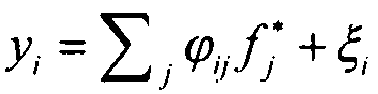


- A crucial point in the derivation of the above result is the fact that the variance of the noise ξi . is a constant. Even though similar results could be obtained for non-Gaussian noises (provided certain noise properties required for the validity of the Craig-Bernstein inequality can be proved), the result does not easily carry over to the case that the variance of the noise depends on the values


- In the past, it was tested whether the principle of accurate reconstructions from few projections carries over to Poisson noise in order to make accurate reconstructions possible with fewer measurements, e. g. in emission tomography. It was expected that the compressive sensing strategy for the reconstruction of sparse or compressible objects from few measurements is difficult to apply to data corrupted with Poisson noise, due to the specific properties of Poisson statistics and the fact that measurements can not usually be made randomly, as in many other cases.
- Rebecca M. Willett et al. ("Performance bounds on compressed sensing with Poisson noise" in "IEEE International Symposium on Information Theory ISIT" 2009, June 28 2009 - July 3 2009, p.174 - 178) have generalized results from Jarvis Haupt et al. to Poisson noise. In particular, Rebecca M. Willett et al. have proposed to reconstruct a tomographic image from detector data using a procedure of minimizing a functional f̂ depending on a sensing matrix A and the detector data and further depending on a penalty term, wherein the sensing matrix A is constructed on the basis of statistic Rademacher variables and the penalty term depends on the sparsity of the object. However, the result was discouraging: it was found that the upper bound on the error increases with the number of measurements, i.e. more measurements seem to make the accuracy smaller.
- There is a strong interest in imaging techniques where the main source of noise is the Poisson statistics of the photons, e. g. in emission tomography, to apply CS strategies, in particular for obtaining shorter acquisition times and reduced motion artefacts.
- The application of sparse poisson intensity reconstruction algorithms are further described by Z. T. Harmany et al. in "Statistical Signal Processing", 2009, SSP'09, IEEE/SP 15TH workshop, ISBN: 978-1-4244-2709-3, August 31, 2009, pp. 634-637, and by D. J. Lingenfelter et al. in "Computational Imaging VII", volume 7246, 2009, p. 19.
- The objective of the invention is to provide an improved image reconstruction method for reconstructing a tomographic image of an object, in particular for emission tomography purposes or for very low dose transmission tomography purposes, which is capable of avoiding disadvantages of conventional techniques. In particular, the objective is to provide an image reconstruction method which enables reconstructing the tomographic image with a reduced quantity of detector data without a loss in image quality. Furthermore, the objective of the invention is to provide an improved imaging method avoiding disadvantages of conventional imaging techniques. Furthermore, the objective of the invention is to provide an improved imaging device in particular being adapted for conducting the inventive imaging method.
- The above objectives are solved by an image reconstruction method, an imaging method and/or an imaging device comprising the features of the independent claims. Advantageous embodiments of the invention are defined in the dependent claims.
- According to the invention, an image reconstruction method is proposed for reconstructing a tomographic image (fj ) of a region of investigation within an object from detector data (y¡ ) comprising Poisson random values measured at an i-th of a plurality of different positions relative to the object. The positions are the spatial locations of measuring the detector data, e. g. the position of a detector element (pixel) with index k of a SPECT detector device at the time of collecting data with this detector device under its l-th angular position α l with respect to the object and under its l-th distance rl from the centre of rotation (this means that in this case the index i is a two component index, i.e. i = (k,l)), or as a further example, spatial locations of detector elements sensing data at the lines of response (LOR's) of coincidence events measured with a PET detector device.
- According to the invention, a predetermined system matrix Aij assigning a j-th voxel of the object to the i-th detector data (yi ) is provided. Contrary to the above conventional approach of Rebecca M. Willett et al. using a random sensing matrix, elements of the system matrix Aij are not statistic values but rather selected by geometrically or physically assigning contributions of each of the voxels (object data) to each detector element of a detector device or the associated detector data, resp.. The system matrix which defines the detector data as linear combinations of the original object data is determined by geometric or physical features of the imaging device, in particular by the arrangement of the object relative to the detector device and the detector device geometry.
- Furthermore, according to the invention, the tomographic image (fj ) is reconstructed by minimizing a functional F(f) depending on the detector data (yi ) and the system matrix Aij and additionally including a sparse or compressive representation of the object in an orthogonal basis T. The orthogonal basis (orthobasis) T is an orthogonal matrix, the columns of which are orthonormal basis vectors. The orthobasis is selected such that the object, in particular the region of investigation, can be represented in the orthobasis fulfilling the requirements of sparsity or compressibility.
- The minimizing procedure is a non-analytical or algebraic procedure, e. g. an iterative algorithm. The tomographic image (fj ) comprises the image data representing the global minimum of the functional F(f). In particular, the inventive reconstruction comprises minimizing the above functional F, which includes two or optionally three additive parts, namely an empiric risk part, which represents the Poisson statistic of the measurement, a CS part representing the compressibility of the object and (optionally) a regularization term.
- For conventional reconstructions there are (at least) three problems. First, the data is noisy, second, it is necessary to perform a large number of measurements in order to obtain sufficient information for an acceptable reconstruction quality and third, the reconstruction problem is ill-posed such that without further measures even an infinitesimal amount of noise generates serious artifacts. The invention is capable of overcoming all three difficulties by providing a link between a compressive sensing strategy (solving problem two) and a maximum likelihood approach (which deals optimally with problem one) for the case of Poisson noise, while still allowing for inclusion of regularization techniques addressing problem three.
- The image reconstruction method can be conducted immediately after collecting the detector data, in particular with the imaging device collecting the detector data. Alternatively, the image reconstruction method can be conducted with an image reconstruction device at a distant location and/or with a delay after the measurement with detector data provided e. g. via a data communication channel from the imaging device to the image reconstruction device or from a data storage. Accordingly, the detector data (yi ) can be provided e. g. via a data network, from a data storage or directly by the detector device.
- According to a second aspect of the invention, an imaging method for reconstructing an image (fj ) of a region of investigation within an object is proposed, which comprises the steps of collecting the detector data (yi ) with the detector device of an imaging device and subjecting the detector data (yi ) to the inventive image reconstruction method according to the above first aspect of the invention. Preferably, the imaging method is used for collecting is a SPECT image, a PET image, a CT image or a confocal microscopy image. According to a third aspect of the invention, an imaging device for imaging a region of investigation in an object is proposed, which comprises a detector device for measuring detector data (yi ) comprising Poisson random values measured at the i-th angular position of a detector element of the detector device relative to the object, and a reconstruction device for reconstructing an image (fj ) the object, wherein the detector data (yi ) are subjected to the image reconstruction method according to the above first aspect of the invention.
- Further independent subjects of the invention are a computer program residing on a computer-readable medium, with a program code for carrying out the image reconstruction method according to the above invention, and an apparatus comprising a computer-readable storage medium containing program instructions for carrying out the image reconstruction method according to the above first aspect of the invention.
- As a main advantage, the invention provides a new method to accurately reconstruct a three dimensional image from very few detector data, e. g. projections, by non-analytical or algebraic methods using a minimizing algorithm. The inventors have found methods of exploiting the fact that real world objects are usually sparse or at least compressible while overcoming the restrictions of conventional approaches for applying CS on Poisson noise data. Emission tomographic images can be reconstructed with a number of measurements which is reduced compared with conventional measurements, whereas the same accuracy as with conventional methods can be obtained. Accordingly measurement time and/or applied activity (for emission tomography) or irradiation dose (for transmission tomography) can thus be reduced.
- Further advantages can be summarized as follows. First, the quantity of measurements for obtaining a certain image quality can be reduced compared with the conventional imaging technique yielding the same image quality. The measuring time and the burden for the patient can be reduced accordingly. In particular, artefacts resulting from unintended movements of the object, e.g. of the patient, can be avoided. Second, the image reconstruction method does not include a free parameter. In particular, if sufficient information is available as to the compressibility of the object data, the tomographic image can be obtained exclusively on the basis of the detector data and the system matrix determined by the measuring arrangement. Third, the reconstruction risk (see below) can be controlled. The quality of a reconstruction can be quantitatively evaluated. The image reconstruction method considers the Poisson statistic not only in the evaluation of the risk, but rather also with the reconstruction as such, i.e. the advantages of the maximum-likelihood reconstruction are associated with the advantage of a reduced number of measurements due to applying the CS technique. Finally, the inventive method can be extended in analogy to the penalized-likelihood method for a regularization of the reconstructed object.
- According to the inventive image reconstruction method, the reconstructing step includes a procedure of minimizing the functional

The orthogonal basis (orthobasis) T is selected to be as incoherent as possible with respect to the system matrix Aij and such that the object f (or a comparable typical object) has a compressible representation in this basis. These criteria were introduced previously e. g. by J. Candès et al. (see above). A particular advantage of this embodiment, which is explained with further details below, can be obtained by the application of the lp norm with 0 ≤ p < 2, e.g. p = 1. In this case, the minimization procedure has a single global minimum allowing an implementation with an increased processing speed. - The calibration factor a is a predetermined fixed parameter, which is not changed during the minimization procedure, i.e. it is not a fit parameter. Further features of the calibration factor a are described below. By a preliminary determination of the calibration factor a, the tomographic reconstruction can be improved. This is a further difference compared with the above conventional approach of Rebecca M. Willett et al.
- According to a further advantageous embodiment of the invention, the functional F(f) additionally can include an additive regularization function R(f)

- A further advantage of the invention is given by the fact that various approaches for determining (adjusting) the system matrix are available. As a first variant, the system matrix can be adjusted using reference data of the measuring system used for collecting the detector data. The reference data can be stored as specific data of the measuring system in the image reconstruction device, e.g. in the imaging device. According to a second variant, the entries of the system matrix can be acquired using a calibration measurement. In this case, collecting the detector data is performed with a calibration object (phantom) having known volumetric object data. The calibration detector data can be used for adjusting the elements of the system matrix.
- Another advantage of the invention is given by the fact that various bases are available as orthobasis T. As it is known from the theory of three-dimensional wavelets (see A. Cohen et al. in "American Journal of Mathematics", Volume 121, 1999, p. 587 - 628, and P. Be-chler et al. in "Transactions of American Mathematical Society", Volume 359 (2), 2007, p. 619 - 635), objects with so-called bounded variation have compressible wavelet coefficients. This condition is indeed fulfilled for the objects of the real world, so that a suitable orthobasis using three-dimensional wavelets with a finite support can be found for any object to be investigated. Therefore, according to a preferred embodiment of the invention, the orthobasis T is a basis of three-dimensional wavelets with a compact carrier. Alternatively, if a certain prior knowledge is available about the object or the structure thereof, an adapted orthobasis can be constructed with entries depending on typical object data of the object to be imaged. In this case, the orthobasis can be matched to the type of object for improving the image reconstruction. As an example, if it is known that the object is sufficiently smooth, it will have predominantly low spatial frequency components such that a Fourier basis is adequate. Alternatively, one could choose a basis of Chebyshev polynomials in the plane combined with a one dimensional Fourier basis in the axial direction. For real world objects a principal components analysis of a number of reference objects may generate a suitable orthobasis.
- The invention provides further particular advantages for the imaging method, in particular for selecting or setting the angular positions at which the detector data are collected. According to a preferred embodiment of the invention, a randomized setting of the angular positions can be provided. According to a further, alternative embodiment of the invention, the detector data can be continuously collected, e.g. with a SPECT device while the angular positions of the detector device thereof are changed continuously and not in the usual step-and-shoot mode. Accordingly, the imaging speed can be essentially increased.
- According to the invention, a preparation step is provided before the collection of the detector data. The preparation step comprises a setting of an image quality measure (risk) to be fulfilled by the imaging method. Depending on the risk, the number of angular positions is selected at which detector data are collected. Accordingly, for obtaining a preview image wherein a low image quality is sufficient, a reduced number of angular positions is used, while for a subsequent regular imaging with improved image quality, the number of angular positions (and correspondingly detector data) is increased.
- Further important features of the invention may be represented by additional steps conducted after the image reconstruction, like e.g. storing, recording, displaying and/or further image processing of the reconstructed tomographic image.
- Further details and advantages of the invention are described in the following with reference to the attached drawings, which show in:
- Figure 1:
- a schematic representation of an imaging device embodying the present invention;
- Figure 2:
- a schematic flowchart illustrating embodiments of the inventive image reconstruction and imaging methods; and
- Figure 3:
- experimental results illustrating the improved image quality obtained with the present invention.
- Preferred embodiments of the invention are described here with exemplary reference to emission tomography, in particular SPECT. The application of the invention is not restricted to SPECT, but rather possible with other image data contaminated with a Poisson noise, like e. g. PET data and CT data, in particular with low photon flux. Details of measuring techniques, like e.g. details of SPECT devices and modes of operating those devices are not described as far as they are known from conventional techniques. Furthermore, the invention is not restricted to medical imaging, but rather can also be implemented for imaging other objects, like e.g. work pieces.
- Embodiments of the invention are described in the following with reference to the procedural steps of the inventive methods. Implementing these features as data processing tools will depend on e. g. the measuring system used and the type of object to be imaged in practice. While the understanding and the implementation of the features is based on the mathematical background outlined below, the skilled person will recognize that the invention is not restricted to all mathematical details, but covers all data processing tools generally based on this mathematical background.
-
Figure 1 schematically illustrates a sectional view of an embodiment of animaging device 100 including adetector device 10, anobject carrier 20, adetector carrier 30 and areconstruction device 40. Thecomponents detector device 10 comprises anarray 11 of detector elements 11.i (i = 1, 2, 3, ...), which are arranged in a one- or, more commonly, two-dimensional geometry (line-shaped array or matrix-shaped array). Thedetector device 10 is rotatably mounted on thedetector carrier 30 such that it can be rotated in an x-y-plane around theobject carrier 20. Theobject carrier 20 is a support device, e.g. table, configured for accommodating the object 1, e. g. a patient to be investigated. As an example, theobject carrier 20 comprises a carrying bed for accommodating the patient as schematically illustrated inFigure 1 . Thedetector carrier 30 comprises e.g. a circular rail to which thedetector device 10 is attached. Theobject carrier 20 and thedetector carrier 30 can be translated relative to each other in a direction perpendicular to the x-y-plane (drawing plane). - The object 1 is e.g. a human patient, wherein a certain portion (region of investigation 2), e.g. the brain is to be investigated with the inventive imaging method. In terms of the imaging and image reconstruction methods, the region of investigation 2 is considered as consisting of a plurality of voxels 3. The j-th voxel 3 is schematically shown for illustrative purposes. The patient has an administered tracer substance which is accumulated with a concentration distribution in specific regions, e. g. certain tissue or organ. This concentration distribution is to be imaged. The tracer substance carries a radioactive marker emitting γ radiation as it is known from conventional SPECT measurements. The
detector device 10 is moved to preferably randomized angular positions αl and suitable detector radii rl where the γ photons are detected. The collected detector data yi together with αl and rl are transferred to theinput circuit 41. - The
reconstruction device 40 comprises aninput circuit 41, aprocessing circuit 42, anoutput circuit 43, and anentry storage 44. Theinput circuit 41 is arranged for receiving the detector data and further entries, which are necessary for implementing the inventive image reconstruction method. To this end, thedetector device 10 is connected with theinput circuit 41 for transferring detector data y i and the associated angular position αl . Furthermore, theinput circuit 41 is connected with theentry storage 44 being arranged for storing the system matrix Aij, the orthobasis T and optionally the regularization function R. Theprocessing circuit 42 includes a computer unit, which is configured for implementing the data processing of the image reconstruction method. Finally, theoutput circuit 43 may comprise a display 43.1, a data storage 43.2 and/or an interface 43.3. In particular, theoutput circuit 43 may include a Dicom-node. Thereconstruction device 40 can be implemented with a standard computer having an appropriate hardware configuration. - The essential steps of the inventive image reconstruction method are schematically summarized in
Figure 2 . Firstly, the detector data with the associated angular positions as well as the remaining input entries are provided with step S1. Subsequently, the reconstructing step S2 with finding an object minimizing functional is conducted, followed by step S3 of presenting the tomographic image consisting of the minimizer of the functional. - Step S1 in particular includes the provision (step S11) of the detector data (as measured preferably) from random angular positions and the associated angles and radii. Step S11 depends on particular application conditions and the data source used. The detector data and angular positions can be measured (step S01) and input directly from the detector device 10 (
Figure 1 ). In this case, the procedure ofFigure 2 including the step S01 represents an embodiment of the inventive imaging method. Measuring the detector data is conducted as commonly known from SPECT devices. Optionally, selecting a number of measurements in dependence on the image quality to be obtained can be provided on the basis of the considerations summarized in 3.7 below. Furthermore, as an alternative, the detector data and angular positions can be input via a data communication channel (step S02). With this variant, steps S1 to S3 represent an embodiment of the inventive image reconstruction method. - Step S1 further includes step S12 of determining a sparsity orthobasis T which is suitable for the measured object, e.g. a wavelet basis with finite support. Depending on the type of object, the orthobasis can be stored in the entry storage 44 (
Figure 1 ). Furthermore, step S1 includes the provision of a predetermined system matrix Aij (step S13). The system matrix is computed or acquired from reference system data. In particular, the system matrix represents the contribution of the j-th voxel 3 to the i-th detector data 11.i (Figure 1 ). - With step S2, the data processing is conducted including the minimization routine, in which the three-dimensional object fj is sought, which realizes the global minimum of the functional F(f) = L({yi}, Af) + a ∥TT f ∥. Details of this functional are outlined in section 3. below.
- Finally, the result of the minimization routine is output as the final result with step S3, where it is transferred e.g. to a Dicom-node included in the output circuit 43 (
Figure 1 ). - In the following, it is demonstrated that the disappointing and seemingly counterintuitive result presented by Rebecca M. Willett et al. is essentially due to a too restrictive notion of "error": since the variance of a Poissonian random variable increases when its mean value increases, it cannot be expected to obtain the same absolute accuracy when


- When the definition of "risk" is modified to reflect this fact, it will be shown that the principles of compressive sensing can indeed be useful and allow the reconstruction of

- A three dimensional object


- In order to formulate this problem mathematically, a large number n of "potential" projections


- In order to measure the accuracy of the eventual reconstruction, the following definition of "risk" is used. A potential reconstruction f would produce projections
µ i = ∑ j Aijfj and has risk R( f ) with


- This shows that it is a measure of the absolute error, and that the relative error can be obtained by dividing r( f , f *) by a measure of the total intensity, e.g. by

- This definition of risk is not immediately useful since it requires complete knowledge of f *, which is to be estimated in the first place. Therefore the risk is to be estimated from the data actually measured, and this leads to the empirical risk R̂( f ):

µj . Again, this is nothing but the Maximum Likelihood functional of Poisson statistics. It is easy to show that on average, ER̂( f )=R( f ). The average E... is an average over both the Poisson statistics of the yi (to be done first) and the random matrices Pij . Analogously to above, the empirical excess risk is defined
- Let TT be an orthogonal matrix the rows of which are filled with the orthonormal basis vectors of the sparsity basis. Then objects f * are considered for which the coefficients in the sparsity basis, θ * = TT f * , obey


- Although the risk R( f ) is not directly applicable, it is very useful since it allows us to derive an "oracle inequality" which states that the average empirical risk ER̂( f ) of a reconstruction (obtained in a way to be described below) taken from a candidate set is, roughly speaking, within a constant factor of the ideal risk R( f min) of the best approximation f min in the candidate set. This means that even if complete knowledge of f * would be available and thus the optimal approximation in the candidate set could be found, this optimal approximation would be only marginally better than what is found without this prior knowledge.
- Following Jarvis Haupt et al. very closely, it will be shown that for


- Consider


- Setting δ := e-t and inserting δ( f ) := 2 -c( f ) δ in place of e -t in Ineq. (19), the probability that at least one f ∈ F violates Ineq. (19) is less than ∑ f ∈F δ( f ) ≤ δ (Boole's inequality). With probability 1 - δ therefore, the inequality

Let ζ = εh and


The bound on the risk is minimimal for that f which minimizes the penalized empirical risk:


- Since for any random variable X,


- The proof of the moment conditions illustrates the main difference between the present invention and the concept proposed by Jarvis Haupt et al. (cited above). Two difficulties have to be considered: first, the random variables are not simple independent Gaussians but Poissonians dependent on the values µi which are themselves random variables, and second, Rademacher chaos cannot be used. Rademacher chaos, by its randomization of signs, can deal with sparsity in any basis (the measurement basis is with high probability incoherent with any other basis). Here, it will be shown that the sparsity basis T must be incoherent with the system matrix A. This is in line with the results from J. Candès et al. (cited above).
- It must be shown that the moment condition (18) holds for some h > 0 and all l ≥ 2. According to Jarvis Haupt et al. (cited above) it is sufficient to find a suitable constant h' for all even l as this implies that the moment condition holds for all l with h = 2h' (Lemma 1 of Jarvis Haupt et al.). The random variable uj - Euj can be split into two parts,
uj - Euj = X 1 + X 2, with


- A bounded random variable X with zero mean and |X|≤ B satisfies the moment condition trivially with constant hx = B. If it is observed that


µ i is upper bounded by a constant A max. If the object f * is strongly compressible with 0 < q < 1, then the sum over k can be estimated by a constant, and depending on the value of max ik (|(AT) ik |), the bound A max may depend on v, or not. If, for instance, Aij = δij and Tij is the Fourier basis, it is known that

- Since


It remains to show that the moment condition also holds for X 2 . Consider


- Taken together, it is established that X 1 + X 2 obey the moment condition with a parameter h with

The last task is to find an upper bound for Var(uj), where


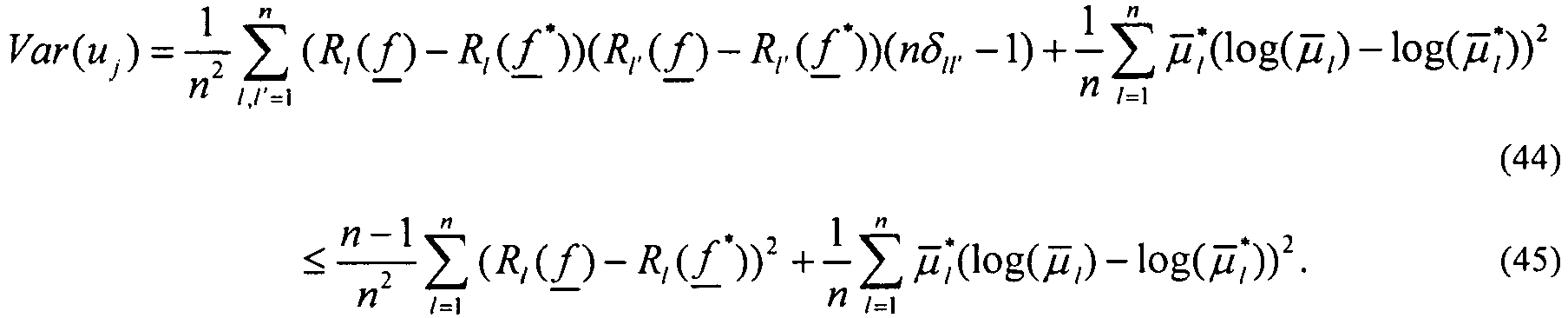
Since


- It remains to bound the term


Therefore hy (x)≤2(1+2log(A max))gy (x). Consequently,
- Combined, it is obtained


- A compressible object f * is one which can be represented accurately by a small number of coefficients in some basis. To be precise, if


From the oracle inequality it is known that


- Let θ (m) be the coefficient vector corresponding to the best m -term approximation to f*, i.e. f (m)=Tθ (m), and let


Next Taylor's theorem is applied to the term


µ k. This bound may be too conservative: if it is assumed that f (m) , as the best m -term approximation, is close to f *, then it may be more appropriate to assume thatµ k is within a factor of, say, 2 of

- Then for a vector x one obtains:


- The two terms involving v -p are exponentially small in p and may be ignored. The remaining terms are minimal when

- Inserting this in Eq. (62) it is obtained

- The last inequality follows if it is assumed that


- Eq. (65) is the final error bound. Unlike similar bounds as, e.g. in Jarvis Haupt et al. (cited above), the important last term here contains the additional factor

- When the object f * is truly sparse, i.e. only m coefficients


- Whether the error bound derived above is useful or not depends on the constants A max and Λ. If A max and Λ do not depend on v, the same type of error bound as in Jarvis Haupt et al. (cited above) is obtained. A situation where this happens is for instance the case Aij = δij and T the Fourier basis.
- But even if they do depend on v, the compressive sensing strategy may still be useful if the additional factor


- For truly sparse objects, a similar discussion as above applies to the v -dependence of ε -1. But since it has been argued that A max can be at most of order O(v 1/2), compressive sensing works in any case if mv 1/2 = o(v). Note that m may depend on v, so this is not always true.
- According to J. M. Noras ("Some formulas for moments of the Poisson distribution" in "Phys. Rev. B" vol. 22 (12), 1980, p. 6474-6475) and references therein, the central moments of the Poisson distribution Mn (µ) obey the following recursion relation:

- It is shown that for all n and µ ≥ 0, Mn (µ) ≤ n!(max(1, µ)) n/2. First, it is shown that this is the case for n = 0, 1, 2 :


- It is now proceed by induction and assumed that Mi (µ) ≤ i!(max(1, µ))1/2 holds for all 0 <i<n. Then


- The minimizer of





- The calibration factor a, which is implicitly defined by


- The parameters appearing in this expression are all known or can be estimated.
- The constant C' can be estimated by observing that


- There must be some prior knowledge as to the compressibility of the objects measured, i.e. the exponent q must be known. This is necessary anyway since the method works best if q > 1.
- p is the quantization level of the trial vectors θ , i.e. the values θi , which necessarily lie between


- It is requested that the sparsity orthobasis T be known.
- The incoherence I can be obtained from the geometry of the setup (i.e. the system matrix A) and the sparsity basis T.
- The risk of the reconstruction is bounded by

- The constants appearing here are given by


- Then a setup is imagined where n pixels (the potential measurements) could have been measured, but actually only k of them were measured. The risk is a measure of the absolute error between the ideal (i.e. noise free) projections of f* and f̂ min for all of the potential measurements (not just the measured ones), normalized by n. That means it is the absolute error per potential measurement pixel.
- More important than the absolute error, however, is the relative error, which can be defined as


µ min,i are the ideal noise free projections of f * and f̂ min, The error ρ now means a relative error per pixel. This makes the interpretation of ρ very clear: a statement like "the error ρ is smaller than 10%" is perfectly sensible and understandable. - With the error bound as given above (where all constants are known or can be estimated), a bound can thus be obtained retrospectively (i.e., after the reconstruction) for the relative error per pixel and thus gauged whether the reconstruction is good enough for the purpose at hand.
- On the other hand, one can estimate i) dose, ii) measurement time, and iii) number of measurements k necessary to obtain a predetermined relative error, e.g. it could be requested ρ ≤ 10%. It is easy to estimate the average value of


-
Figure 3 shows sectional images of an inventive SPECT reconstruction with image data of a heart (Figure 3A ) and a bone (Figure 3C ) in comparison with conventional penalized likelihood reconstructions (Figures 3B, 3D ). The comparison shows a greatly enhanced resolution obtained with the inventive technique in both cases. It is emphasized that the quality of the illustrated images is restricted due to the printing technique and as a result of a restricted number of angular positions. In both cases, image data are collected at a relatively small number of angular positions (heart: 10 angles, bone: 32 angles). In conventional reconstruction, the number of angular positions must be larger (e.g. around100 or more) in order to achieve a resolution similar toFigs. 3A and 3C . - The features of the invention disclosed in the above description, the drawings and the claims can be of significance both individually as well as in combination for the realization of the invention it its various embodiments.
Claims (10)
- Imaging method for creating an image (fj ) of a region of investigation within an object (1), comprising the steps of:- collecting detector data (yi ) with a detector device (10) of an imaging device (100), said detector data (yi ) comprising Poisson random values measured at an i-th of a plurality of different angular positions relative to the object (1), and- subjecting the detector data (yi ) to an image reconstruction method for reconstructing a tomographic image (fj ) of the region of investigation within the object (1), comprising the step of reconstructing the tomographic image (fj ) based on the detector data (yi ), said reconstructing step including a procedure of minimizing a functional F(f) depending on the detector data (yi ) and a system matrix Aij and additionally including a sparse or compressive representation of the object (1) in an orthobasis T, wherein- the tomographic image (fj ) represents the global minimum of the functional F(f), and- the system matrix Aij is a predetermined matrix that assigns a j-th voxel of the object (1) to the i-th detector data (yi ), defines the detector data as linear combinations of the original object data and is determined by geometric or physical features of an imaging device used for collecting said detector data (yi ), wherein- the system matrix Aij is determined using reference data of the imaging device or acquired using a calibration measurement performed with a calibration object having known volumetric object data, and- the reconstructing step includes a procedure of minimizing the functionalcharacterized in that
 L({y¡}, Aij f) is a maximum-likelihood risk functional for Poisson statistics,∥TT f ∥ is a sparsity enforcing functional including the lp norm of vector TT f with 0 ≤ p < 2, anda is a predetermined fixed calibration factor, and- a preparation step is provided before the collection of the detector data, wherein the preparation step comprises setting of an image quality measure (r) to be fulfilled by the imaging method and, depending on the image quality measure, selecting the number of angular positions (αl ) at which detector data are collected.
 - Imaging method according to claim 1, wherein- the functional F(f) additionally includes an additive regularization function R(f) suppressing artefacts:

- Imaging method according to one of the foregoing claims, wherein the orthobasis T is- a basis of three-dimensional wavelets with compact carrier, or- an adapted basis depending on properties of the object to be imaged.
- Imaging reconstruction method according to one of the foregoing claims, wherein- the tomographic image (fj ) is a SPECT image, a PET image, CT image or a confocal microscopy image, and/or- the detector data (yi ) are provided via a data communication channel, from a data storage or directly by the detector device.
- Imaging method according to one of the foregoing claims, comprising at least one of the further steps of:- storing, recording, displaying and further processing the tomographic image (fj ).
- Imaging method according to one of the foregoing claims , comprising the step of- randomized setting of the angular positions (αl ).
- Imaging method according to one of the foregoing claims, wherein- the detector data (yi ) are collected while the angular positions (αl ) are continuously changed.
- Imaging device (100) for imaging a region of investigation in an object (1), the imaging device comprising:- a detector device (10) for measuring detector data (yi ) comprising Poisson random values measured at an l-th angular position (αl ) and an l-th radius of rotation (rl ) of the detector device (10) relative to the object (1), and- a reconstruction device (40) for reconstructing an image (fj ) the object (1), said reconstruction device (40) being adapted for subjecting the detector data (yi ) to the image reconstruction method of the imaging method according one of the foregoing claims.
- Computer program residing on a computer-readable medium, with a program code for carrying out the image reconstruction method of the imaging method according to one of the claims 1 to 7.
- Apparatus comprising a computer-readable storage medium containing program instructions for carrying out the image reconstruction method of the imaging method according to one of the claims 1 to 7.
Applications Claiming Priority (1)
| Application Number | Priority Date | Filing Date | Title |
|---|---|---|---|
| PCT/EP2010/000526 WO2011091815A1 (en) | 2010-01-28 | 2010-01-28 | Tomographic imaging using poissonian detector data |
Publications (2)
| Publication Number | Publication Date |
|---|---|
| EP2387779A1 EP2387779A1 (en) | 2011-11-23 |
| EP2387779B1 true EP2387779B1 (en) | 2020-05-06 |
Family
ID=42396428
Family Applications (1)
| Application Number | Title | Priority Date | Filing Date |
|---|---|---|---|
| EP10703166.8A Active EP2387779B1 (en) | 2010-01-28 | 2010-01-28 | Tomographic imaging using poissonian detector data |
Country Status (3)
| Country | Link |
|---|---|
| US (1) | US8559690B2 (en) |
| EP (1) | EP2387779B1 (en) |
| WO (1) | WO2011091815A1 (en) |
Families Citing this family (11)
| Publication number | Priority date | Publication date | Assignee | Title |
|---|---|---|---|---|
| EP2732437B1 (en) * | 2011-07-13 | 2017-09-06 | Rayvis GmbH | Transmission image reconstruction and imaging using poissonian detector data |
| DE102011083643A1 (en) * | 2011-09-28 | 2013-03-28 | Siemens Aktiengesellschaft | Method, computer system and CT system for determining a motion field and for motion-compensating reconstruction with this motion field |
| DE102012204775A1 (en) * | 2012-03-26 | 2013-09-26 | Siemens Aktiengesellschaft | Method for reduction and compression of raw detector data to be transmitted by a quantum-counting detector, data transmission link and CT system |
| ITGE20120048A1 (en) * | 2012-05-04 | 2013-11-05 | Esaote Spa | METHOD OF RECONSTRUCTION OF BIOMEDICAL IMAGES |
| CN104809749B (en) * | 2015-04-29 | 2018-09-07 | 中国科学技术大学 | A kind of method of the non-sparse blind reconstruction of image compressed sensing |
| CN105225207B (en) * | 2015-09-01 | 2018-11-30 | 中国科学院计算技术研究所 | A kind of compressed sensing imaging and image rebuilding method based on observing matrix |
| CN110023726B (en) * | 2016-09-26 | 2022-05-17 | 美天旎生物技术有限公司 | Measuring device and method for characterizing radiation fields, in particular laser radiation |
| CN108235029B (en) * | 2018-01-05 | 2021-03-23 | 广西师范大学 | Image compression encryption method based on compressed sensing and Chua's circuit |
| CN108965885B (en) * | 2018-06-04 | 2020-11-10 | 陕西师范大学 | Video online reconstruction and moving target detection method based on frame compression measurement |
| CN109743571B (en) * | 2018-12-26 | 2020-04-28 | 西安交通大学 | Image coding method based on parallel compressed sensing multilayer residual error coefficients |
| CN111047523A (en) * | 2019-11-11 | 2020-04-21 | 苏州锐一仪器科技有限公司 | A method, device and computer storage medium for processing PET images |
Citations (1)
| Publication number | Priority date | Publication date | Assignee | Title |
|---|---|---|---|---|
| US20080056550A1 (en) * | 2006-08-25 | 2008-03-06 | Siemens Medical Solutions Usa, Inc. | Regional reconstruction of spatially distributed functions |
Family Cites Families (5)
| Publication number | Priority date | Publication date | Assignee | Title |
|---|---|---|---|---|
| WO2004072904A1 (en) * | 2003-02-14 | 2004-08-26 | Koninklijke Philips Electronics N.V. | System and method for exact image reconstruction for helical cone beam computed tomography including redundant data |
| DE602005004413T2 (en) * | 2004-07-13 | 2009-01-15 | Philips Intellectual Property & Standards Gmbh | COMPUTER TOMOGRAPHY PROCESS FOR RECONSTRUCTING OBJECT IMAGES FROM GENUINE AND FICTIVE MEASUREMENTS |
| FR2886433B1 (en) * | 2005-05-30 | 2007-09-07 | Commissariat Energie Atomique | METHOD FOR SEGMENTATING A SEQUENCE OF THREE-DIMENSIONAL IMAGES, IN PARTICULAR IN PHARMACO-IMAGING. |
| JP4398919B2 (en) * | 2005-08-22 | 2010-01-13 | 株式会社東芝 | Image matching apparatus, image matching method, and image matching program |
| DE102006008042A1 (en) * | 2006-02-21 | 2007-07-19 | Siemens Ag | Medical device e.g. c-arc x-ray device, for receiving image of area of body of patient, has position determining devices determining position of medical instrument within operation areas, where devices are arranged in device |
-
2010
- 2010-01-28 WO PCT/EP2010/000526 patent/WO2011091815A1/en not_active Ceased
- 2010-01-28 US US12/990,849 patent/US8559690B2/en active Active
- 2010-01-28 EP EP10703166.8A patent/EP2387779B1/en active Active
Patent Citations (1)
| Publication number | Priority date | Publication date | Assignee | Title |
|---|---|---|---|---|
| US20080056550A1 (en) * | 2006-08-25 | 2008-03-06 | Siemens Medical Solutions Usa, Inc. | Regional reconstruction of spatially distributed functions |
Non-Patent Citations (1)
| Title |
|---|
| RAHMIM A ET AL: "Accurate Event-Driven Motion Compensation in High-Resolution PET Incorporating Scattered and Random Events", IEEE TRANSACTIONS ON MEDICAL IMAGING, IEEE SERVICE CENTER, PISCATAWAY, NJ, US, vol. 27, no. 8, 1 August 2008 (2008-08-01), pages 1018 - 1033, XP011224900, ISSN: 0278-0062, DOI: 10.1109/TMI.2008.917248 * |
Also Published As
| Publication number | Publication date |
|---|---|
| WO2011091815A1 (en) | 2011-08-04 |
| US8559690B2 (en) | 2013-10-15 |
| EP2387779A1 (en) | 2011-11-23 |
| US20120281896A1 (en) | 2012-11-08 |
Similar Documents
| Publication | Publication Date | Title |
|---|---|---|
| US8559690B2 (en) | Tomographic imaging using poissonian detector data | |
| Zhou et al. | Handbook of medical image computing and computer assisted intervention | |
| Gong et al. | Iterative PET image reconstruction using convolutional neural network representation | |
| CN110462689B (en) | Tomographic reconstruction based on deep learning | |
| EP3735177B1 (en) | Full dose pet image estimation from low-dose pet imaging using deep learning | |
| US8923587B2 (en) | Image reconstruction from limited or incomplete data | |
| Tang et al. | Performance comparison between total variation (TV)-based compressed sensing and statistical iterative reconstruction algorithms | |
| Sun et al. | An iterative projection‐based motion estimation and compensation scheme for head x‐ray CT | |
| US20240185485A1 (en) | Machine learning-based improvement in iterative image reconstruction | |
| EP2732437B1 (en) | Transmission image reconstruction and imaging using poissonian detector data | |
| Ote et al. | List-mode PET image reconstruction using deep image prior | |
| Zhang et al. | Deep generalized learning model for PET image reconstruction | |
| Melot et al. | Some proximal methods for Poisson intensity CBCT and PET | |
| CN110858407B (en) | Provision of Optimized Energy Bin Parameter Sets for Photon Counting Spectroscopy Computed Tomography | |
| Kim et al. | Denoising of polychromatic CT images based on their own noise properties | |
| CN109155072A (en) | Optimization-Based Reconstruction Using Total Image Variation Constraints in PET | |
| Gantet et al. | Iterative three‐dimensional expectation maximization restoration of single photon emission computed tomography images: Application in striatal imaging | |
| Liu et al. | Investigation of a deep learning-based reconstruction approach utilizing dual-view projection for myocardial perfusion SPECT imaging | |
| Bai et al. | PET image reconstruction: methodology and quantitative accuracy | |
| Schmidt et al. | Eigenbin compression for reducing photon‐counting CT data size | |
| Lalush | Fourier rebinning applied to multiplanar circular-orbit cone-beam SPECT | |
| Islam et al. | A critical survey on developed reconstruction algorithms for computed tomography imaging from a limited number of projections | |
| Beekman et al. | Evaluation of fully 3D iterative scatter compensation and post-reconstruction filtering in SPECT | |
| Amrehn et al. | Portability of TV-regularized reconstruction parameters to varying data sets | |
| Israel-Jost et al. | A prospective study on algorithms adapted to the spatial frequency in tomography |
Legal Events
| Date | Code | Title | Description |
|---|---|---|---|
| PUAI | Public reference made under article 153(3) epc to a published international application that has entered the european phase |
Free format text: ORIGINAL CODE: 0009012 |
|
| 17P | Request for examination filed |
Effective date: 20101217 |
|
| AK | Designated contracting states |
Kind code of ref document: A1 Designated state(s): AT BE BG CH CY CZ DE DK EE ES FI FR GB GR HR HU IE IS IT LI LT LU LV MC MK MT NL NO PL PT RO SE SI SK SM TR |
|
| 17Q | First examination report despatched |
Effective date: 20120618 |
|
| RIN1 | Information on inventor provided before grant (corrected) |
Inventor name: ASPELMEIER, TIMO Inventor name: HOESCHEN, CHRISTOPH Inventor name: EBEL, GERNOT |
|
| DAX | Request for extension of the european patent (deleted) | ||
| STAA | Information on the status of an ep patent application or granted ep patent |
Free format text: STATUS: EXAMINATION IS IN PROGRESS |
|
| GRAP | Despatch of communication of intention to grant a patent |
Free format text: ORIGINAL CODE: EPIDOSNIGR1 |
|
| STAA | Information on the status of an ep patent application or granted ep patent |
Free format text: STATUS: GRANT OF PATENT IS INTENDED |
|
| INTG | Intention to grant announced |
Effective date: 20190529 |
|
| RAP1 | Party data changed (applicant data changed or rights of an application transferred) |
Owner name: HELMHOLTZ ZENTRUM MUENCHEN DEUTSCHES FORSCHUNGSZEN Owner name: LAVISION BIOTEC GMBH |
|
| GRAJ | Information related to disapproval of communication of intention to grant by the applicant or resumption of examination proceedings by the epo deleted |
Free format text: ORIGINAL CODE: EPIDOSDIGR1 |
|
| STAA | Information on the status of an ep patent application or granted ep patent |
Free format text: STATUS: EXAMINATION IS IN PROGRESS |
|
| INTC | Intention to grant announced (deleted) | ||
| GRAP | Despatch of communication of intention to grant a patent |
Free format text: ORIGINAL CODE: EPIDOSNIGR1 |
|
| STAA | Information on the status of an ep patent application or granted ep patent |
Free format text: STATUS: GRANT OF PATENT IS INTENDED |
|
| INTG | Intention to grant announced |
Effective date: 20191122 |
|
| GRAS | Grant fee paid |
Free format text: ORIGINAL CODE: EPIDOSNIGR3 |
|
| GRAA | (expected) grant |
Free format text: ORIGINAL CODE: 0009210 |
|
| STAA | Information on the status of an ep patent application or granted ep patent |
Free format text: STATUS: THE PATENT HAS BEEN GRANTED |
|
| AK | Designated contracting states |
Kind code of ref document: B1 Designated state(s): AT BE BG CH CY CZ DE DK EE ES FI FR GB GR HR HU IE IS IT LI LT LU LV MC MK MT NL NO PL PT RO SE SI SK SM TR |
|
| REG | Reference to a national code |
Ref country code: GB Ref legal event code: FG4D |
|
| REG | Reference to a national code |
Ref country code: AT Ref legal event code: REF Ref document number: 1268011 Country of ref document: AT Kind code of ref document: T Effective date: 20200515 Ref country code: CH Ref legal event code: EP |
|
| REG | Reference to a national code |
Ref country code: IE Ref legal event code: FG4D |
|
| REG | Reference to a national code |
Ref country code: DE Ref legal event code: R096 Ref document number: 602010064214 Country of ref document: DE |
|
| REG | Reference to a national code |
Ref country code: LT Ref legal event code: MG4D |
|
| REG | Reference to a national code |
Ref country code: NL Ref legal event code: MP Effective date: 20200506 |
|
| PG25 | Lapsed in a contracting state [announced via postgrant information from national office to epo] |
Ref country code: LT Free format text: LAPSE BECAUSE OF FAILURE TO SUBMIT A TRANSLATION OF THE DESCRIPTION OR TO PAY THE FEE WITHIN THE PRESCRIBED TIME-LIMIT Effective date: 20200506 Ref country code: SE Free format text: LAPSE BECAUSE OF FAILURE TO SUBMIT A TRANSLATION OF THE DESCRIPTION OR TO PAY THE FEE WITHIN THE PRESCRIBED TIME-LIMIT Effective date: 20200506 Ref country code: PT Free format text: LAPSE BECAUSE OF FAILURE TO SUBMIT A TRANSLATION OF THE DESCRIPTION OR TO PAY THE FEE WITHIN THE PRESCRIBED TIME-LIMIT Effective date: 20200907 Ref country code: IS Free format text: LAPSE BECAUSE OF FAILURE TO SUBMIT A TRANSLATION OF THE DESCRIPTION OR TO PAY THE FEE WITHIN THE PRESCRIBED TIME-LIMIT Effective date: 20200906 Ref country code: GR Free format text: LAPSE BECAUSE OF FAILURE TO SUBMIT A TRANSLATION OF THE DESCRIPTION OR TO PAY THE FEE WITHIN THE PRESCRIBED TIME-LIMIT Effective date: 20200807 Ref country code: FI Free format text: LAPSE BECAUSE OF FAILURE TO SUBMIT A TRANSLATION OF THE DESCRIPTION OR TO PAY THE FEE WITHIN THE PRESCRIBED TIME-LIMIT Effective date: 20200506 Ref country code: NO Free format text: LAPSE BECAUSE OF FAILURE TO SUBMIT A TRANSLATION OF THE DESCRIPTION OR TO PAY THE FEE WITHIN THE PRESCRIBED TIME-LIMIT Effective date: 20200806 |
|
| PG25 | Lapsed in a contracting state [announced via postgrant information from national office to epo] |
Ref country code: HR Free format text: LAPSE BECAUSE OF FAILURE TO SUBMIT A TRANSLATION OF THE DESCRIPTION OR TO PAY THE FEE WITHIN THE PRESCRIBED TIME-LIMIT Effective date: 20200506 Ref country code: LV Free format text: LAPSE BECAUSE OF FAILURE TO SUBMIT A TRANSLATION OF THE DESCRIPTION OR TO PAY THE FEE WITHIN THE PRESCRIBED TIME-LIMIT Effective date: 20200506 Ref country code: BG Free format text: LAPSE BECAUSE OF FAILURE TO SUBMIT A TRANSLATION OF THE DESCRIPTION OR TO PAY THE FEE WITHIN THE PRESCRIBED TIME-LIMIT Effective date: 20200806 |
|
| REG | Reference to a national code |
Ref country code: AT Ref legal event code: MK05 Ref document number: 1268011 Country of ref document: AT Kind code of ref document: T Effective date: 20200506 |
|
| PG25 | Lapsed in a contracting state [announced via postgrant information from national office to epo] |
Ref country code: NL Free format text: LAPSE BECAUSE OF FAILURE TO SUBMIT A TRANSLATION OF THE DESCRIPTION OR TO PAY THE FEE WITHIN THE PRESCRIBED TIME-LIMIT Effective date: 20200506 |
|
| PG25 | Lapsed in a contracting state [announced via postgrant information from national office to epo] |
Ref country code: RO Free format text: LAPSE BECAUSE OF FAILURE TO SUBMIT A TRANSLATION OF THE DESCRIPTION OR TO PAY THE FEE WITHIN THE PRESCRIBED TIME-LIMIT Effective date: 20200506 Ref country code: EE Free format text: LAPSE BECAUSE OF FAILURE TO SUBMIT A TRANSLATION OF THE DESCRIPTION OR TO PAY THE FEE WITHIN THE PRESCRIBED TIME-LIMIT Effective date: 20200506 Ref country code: SM Free format text: LAPSE BECAUSE OF FAILURE TO SUBMIT A TRANSLATION OF THE DESCRIPTION OR TO PAY THE FEE WITHIN THE PRESCRIBED TIME-LIMIT Effective date: 20200506 Ref country code: IT Free format text: LAPSE BECAUSE OF FAILURE TO SUBMIT A TRANSLATION OF THE DESCRIPTION OR TO PAY THE FEE WITHIN THE PRESCRIBED TIME-LIMIT Effective date: 20200506 Ref country code: AT Free format text: LAPSE BECAUSE OF FAILURE TO SUBMIT A TRANSLATION OF THE DESCRIPTION OR TO PAY THE FEE WITHIN THE PRESCRIBED TIME-LIMIT Effective date: 20200506 Ref country code: DK Free format text: LAPSE BECAUSE OF FAILURE TO SUBMIT A TRANSLATION OF THE DESCRIPTION OR TO PAY THE FEE WITHIN THE PRESCRIBED TIME-LIMIT Effective date: 20200506 Ref country code: CZ Free format text: LAPSE BECAUSE OF FAILURE TO SUBMIT A TRANSLATION OF THE DESCRIPTION OR TO PAY THE FEE WITHIN THE PRESCRIBED TIME-LIMIT Effective date: 20200506 Ref country code: ES Free format text: LAPSE BECAUSE OF FAILURE TO SUBMIT A TRANSLATION OF THE DESCRIPTION OR TO PAY THE FEE WITHIN THE PRESCRIBED TIME-LIMIT Effective date: 20200506 |
|
| REG | Reference to a national code |
Ref country code: DE Ref legal event code: R097 Ref document number: 602010064214 Country of ref document: DE |
|
| PG25 | Lapsed in a contracting state [announced via postgrant information from national office to epo] |
Ref country code: PL Free format text: LAPSE BECAUSE OF FAILURE TO SUBMIT A TRANSLATION OF THE DESCRIPTION OR TO PAY THE FEE WITHIN THE PRESCRIBED TIME-LIMIT Effective date: 20200506 Ref country code: SK Free format text: LAPSE BECAUSE OF FAILURE TO SUBMIT A TRANSLATION OF THE DESCRIPTION OR TO PAY THE FEE WITHIN THE PRESCRIBED TIME-LIMIT Effective date: 20200506 |
|
| PLBE | No opposition filed within time limit |
Free format text: ORIGINAL CODE: 0009261 |
|
| STAA | Information on the status of an ep patent application or granted ep patent |
Free format text: STATUS: NO OPPOSITION FILED WITHIN TIME LIMIT |
|
| 26N | No opposition filed |
Effective date: 20210209 |
|
| PG25 | Lapsed in a contracting state [announced via postgrant information from national office to epo] |
Ref country code: SI Free format text: LAPSE BECAUSE OF FAILURE TO SUBMIT A TRANSLATION OF THE DESCRIPTION OR TO PAY THE FEE WITHIN THE PRESCRIBED TIME-LIMIT Effective date: 20200506 |
|
| PG25 | Lapsed in a contracting state [announced via postgrant information from national office to epo] |
Ref country code: MC Free format text: LAPSE BECAUSE OF FAILURE TO SUBMIT A TRANSLATION OF THE DESCRIPTION OR TO PAY THE FEE WITHIN THE PRESCRIBED TIME-LIMIT Effective date: 20200506 |
|
| REG | Reference to a national code |
Ref country code: CH Ref legal event code: PL |
|
| PG25 | Lapsed in a contracting state [announced via postgrant information from national office to epo] |
Ref country code: LU Free format text: LAPSE BECAUSE OF NON-PAYMENT OF DUE FEES Effective date: 20210128 |
|
| REG | Reference to a national code |
Ref country code: BE Ref legal event code: MM Effective date: 20210131 |
|
| PG25 | Lapsed in a contracting state [announced via postgrant information from national office to epo] |
Ref country code: LI Free format text: LAPSE BECAUSE OF NON-PAYMENT OF DUE FEES Effective date: 20210131 Ref country code: CH Free format text: LAPSE BECAUSE OF NON-PAYMENT OF DUE FEES Effective date: 20210131 |
|
| PG25 | Lapsed in a contracting state [announced via postgrant information from national office to epo] |
Ref country code: IE Free format text: LAPSE BECAUSE OF NON-PAYMENT OF DUE FEES Effective date: 20210128 |
|
| PG25 | Lapsed in a contracting state [announced via postgrant information from national office to epo] |
Ref country code: BE Free format text: LAPSE BECAUSE OF NON-PAYMENT OF DUE FEES Effective date: 20210131 |
|
| PG25 | Lapsed in a contracting state [announced via postgrant information from national office to epo] |
Ref country code: HU Free format text: LAPSE BECAUSE OF FAILURE TO SUBMIT A TRANSLATION OF THE DESCRIPTION OR TO PAY THE FEE WITHIN THE PRESCRIBED TIME-LIMIT; INVALID AB INITIO Effective date: 20100128 Ref country code: CY Free format text: LAPSE BECAUSE OF FAILURE TO SUBMIT A TRANSLATION OF THE DESCRIPTION OR TO PAY THE FEE WITHIN THE PRESCRIBED TIME-LIMIT Effective date: 20200506 |
|
| PG25 | Lapsed in a contracting state [announced via postgrant information from national office to epo] |
Ref country code: MK Free format text: LAPSE BECAUSE OF FAILURE TO SUBMIT A TRANSLATION OF THE DESCRIPTION OR TO PAY THE FEE WITHIN THE PRESCRIBED TIME-LIMIT Effective date: 20200506 |
|
| PG25 | Lapsed in a contracting state [announced via postgrant information from national office to epo] |
Ref country code: TR Free format text: LAPSE BECAUSE OF FAILURE TO SUBMIT A TRANSLATION OF THE DESCRIPTION OR TO PAY THE FEE WITHIN THE PRESCRIBED TIME-LIMIT Effective date: 20200506 |
|
| REG | Reference to a national code |
Ref country code: DE Ref legal event code: R081 Ref document number: 602010064214 Country of ref document: DE Owner name: MILTENYI BIOTEC B.V. & CO. KG, DE Free format text: FORMER OWNERS: HELMHOLTZ ZENTRUM MUENCHEN DEUTSCHES FORSCHUNGSZENTRUM FUER GESUNDHEIT UND UMWELT (GMBH), 85764 NEUHERBERG, DE; LAVISION BIOTEC GMBH, 33617 BIELEFELD, DE Ref country code: DE Ref legal event code: R081 Ref document number: 602010064214 Country of ref document: DE Owner name: HELMHOLTZ ZENTRUM MUENCHEN DEUTSCHES FORSCHUNG, DE Free format text: FORMER OWNERS: HELMHOLTZ ZENTRUM MUENCHEN DEUTSCHES FORSCHUNGSZENTRUM FUER GESUNDHEIT UND UMWELT (GMBH), 85764 NEUHERBERG, DE; LAVISION BIOTEC GMBH, 33617 BIELEFELD, DE |
|
| PG25 | Lapsed in a contracting state [announced via postgrant information from national office to epo] |
Ref country code: MT Free format text: LAPSE BECAUSE OF FAILURE TO SUBMIT A TRANSLATION OF THE DESCRIPTION OR TO PAY THE FEE WITHIN THE PRESCRIBED TIME-LIMIT Effective date: 20200506 |
|
| PGFP | Annual fee paid to national office [announced via postgrant information from national office to epo] |
Ref country code: GB Payment date: 20260123 Year of fee payment: 17 |
|
| PGFP | Annual fee paid to national office [announced via postgrant information from national office to epo] |
Ref country code: DE Payment date: 20260121 Year of fee payment: 17 |
|
| PGFP | Annual fee paid to national office [announced via postgrant information from national office to epo] |
Ref country code: FR Payment date: 20260123 Year of fee payment: 17 |