EP2386491A1 - A loading tool - Google Patents
A loading tool Download PDFInfo
- Publication number
- EP2386491A1 EP2386491A1 EP10162661A EP10162661A EP2386491A1 EP 2386491 A1 EP2386491 A1 EP 2386491A1 EP 10162661 A EP10162661 A EP 10162661A EP 10162661 A EP10162661 A EP 10162661A EP 2386491 A1 EP2386491 A1 EP 2386491A1
- Authority
- EP
- European Patent Office
- Prior art keywords
- loading tool
- compartments
- objects
- packaging
- arrangement
- Prior art date
- Legal status (The legal status is an assumption and is not a legal conclusion. Google has not performed a legal analysis and makes no representation as to the accuracy of the status listed.)
- Withdrawn
Links
Images

Classifications
-
- B—PERFORMING OPERATIONS; TRANSPORTING
- B65—CONVEYING; PACKING; STORING; HANDLING THIN OR FILAMENTARY MATERIAL
- B65B—MACHINES, APPARATUS OR DEVICES FOR, OR METHODS OF, PACKAGING ARTICLES OR MATERIALS; UNPACKING
- B65B67/00—Apparatus or devices facilitating manual packaging operations; Sack holders
- B65B67/02—Packaging of articles or materials in containers
-
- B—PERFORMING OPERATIONS; TRANSPORTING
- B65—CONVEYING; PACKING; STORING; HANDLING THIN OR FILAMENTARY MATERIAL
- B65B—MACHINES, APPARATUS OR DEVICES FOR, OR METHODS OF, PACKAGING ARTICLES OR MATERIALS; UNPACKING
- B65B39/00—Nozzles, funnels or guides for introducing articles or materials into containers or wrappers
- B65B39/007—Guides or funnels for introducing articles into containers or wrappers
-
- B—PERFORMING OPERATIONS; TRANSPORTING
- B65—CONVEYING; PACKING; STORING; HANDLING THIN OR FILAMENTARY MATERIAL
- B65B—MACHINES, APPARATUS OR DEVICES FOR, OR METHODS OF, PACKAGING ARTICLES OR MATERIALS; UNPACKING
- B65B5/00—Packaging individual articles in containers or receptacles, e.g. bags, sacks, boxes, cartons, cans, jars
- B65B5/06—Packaging groups of articles, the groups being treated as single articles
-
- B—PERFORMING OPERATIONS; TRANSPORTING
- B65—CONVEYING; PACKING; STORING; HANDLING THIN OR FILAMENTARY MATERIAL
- B65B—MACHINES, APPARATUS OR DEVICES FOR, OR METHODS OF, PACKAGING ARTICLES OR MATERIALS; UNPACKING
- B65B65/00—Details peculiar to packaging machines and not otherwise provided for; Arrangements of such details
- B65B65/08—Devices for counting or registering the number of articles handled, or the number of packages produced by the machine
Definitions
- the invention relates to a loading tools to transfer a determined number of objects into a packaging and to a method to apply this loading tool.
- Small parts (or objects) of any kind are often transported in boxes comprising a large number of these small parts.
- the boxes should contain a defined number of these parts in order to deliver a reliable defined number of parts per box to the recipient of such boxes.
- the reliable number of parts enables a well defined further processing of these parts or enables the ordering of a minimum required number of boxes containing these small parts.
- Unfortunately the counting of parts is difficult and time consuming, especially for small parts. In case of parts with a more complex shape (e.g. headsets for cellular phones), these counting can only be executed by a manual process most likely leading to counting mistakes resulting in transport boxes carrying a varying number of parts.
- the large number of loaded parts (or objects) and their properties e.g.
- Counting boards for coins with a surface comprising multiple parallel half-cylindrical shapes are known.
- the thickness of the coins in combination with the lengths of the half-cylindrical shapes determines the number of coins in a completely fill shape.
- the material of such boards shall provide a fixed and robust board in order not to lose coins. Therefore such boards are made of rigid materials such as of wood or metal.
- These counting boards are suitable for counting coins but not suitable to transfer the coins into a box, especially when the width of the board is not adapted to the width or length of the box. There is a demand to obtain a device, where objects can be counter fast and securely transferred into another packaging avoiding the risk of lost obj ects during the transfer process.
- the object is solved by a loading tool for transferring a determined number of objects into a packaging comprising a predetermined number of compartments in an essentially two-dimensional arrangement suitable for being loaded with one object each having a suitable shape to separate the loaded object of one compartment from the objects loaded to adjacent compartments, wherein at least the arrangement is at least partly flexible in order to be able to bend the loading tool into a shape suitable for securely transferring the objects into the packaging.
- Packaging denotes any kind of boxes suitable to carry objects from one place to another place.
- Packaging may be boxes, containers, parcels etc.
- Packaging may vary in sizes and volumes to be loaded with objects.
- the packaging are commonly loaded from the open top side. The width and length of the open top size is an important parameter for objects, which are dumped into the packaging. If the dumping process is not adapted to the dimensions of the open top side, objects may fall alongside the packaging leading to loss and/or damage of objects.
- fast and secure loading of the packaging is demanded.
- Secure loading denotes the loading of a defined and desired number of objects into the packaging.
- the loading tool according to the present invention provides a tool to reliable count the objects to be loaded (transferred) into the packaging.
- loading (and counting) capacity of the loading tool is not limited by the dimensions of the open top side of the packaging. Even loading tools significantly larger than the present open top side of a packaging can be used to transfer objects of a predefined number into the packaging by bending the loading tool into a suitable shape above the packaging to securely transfer the objects into the packaging. This enables a fast transfer process to load a larger number of objects into a packaging with one single transfer process.
- the objects may be separate products or components of products.
- the objects may have any shape and size.
- the objects may have complex shapes such as cables or headsets.
- the loading tool is especially suitable to count and transfer small objects into a packaging.
- small objects denotes objects with sizes, which are considered as being small in at least one direction, preferably with a size in one direction below 2 centimeters, more preferably below 1 centimeter, even more preferably below 0.5 centimeter.
- a ball with a diameter of 3 centimeters is not denoted as small in the present invention.
- a flat rectangular object of width and length of 3 centimeter and a height of 0.4 centimeter is a small object in terms of this invention, because the height of this example is below 0.5 centimeter.
- a cable for a headset with a length of several centimeters, but with a common cable diameter of less than a few millimeters is a small object in terms of this invention, because the diameter of the cable is below 1 centimeter, probably below 0.5 centimeter.
- the loading tool is even more suitable to count and transfer objects into a packaging being small in all directions.
- the counting of the objects is executed by placing one object in each compartment of the arrangement of compartments. After filling the loading tool in this way, the loading tool is denoted as fully loaded. Since the loading tool comprise a predetermined number of compartments, the number of compartments equals the number of objects loaded to the compartments. Therefore the loaded objects are counted exactly and therefore the number of objects is determined.
- the term "essentially two-dimensional arrangement” denotes a component (arrangement) of the loading tool with dimensions of length and width significantly larger than the height of this arrangement, e.g. a large and thin plate comprising compartments.
- the term "two-dimensional” shall not be understood in a pure mathematically sense, because physical objects are always three-dimensional. However, components with a height significantly smaller, e.g. one or more magnitudes smaller, than the length and width are considered as two-dimensional in the terms of the present invention.
- the suitable shape is achieved by bending the loading tool into a shape, which could be for example the shape of a half-pipe, a quarter-pipe, a funnel, a tube or a pipe-like shape.
- the objects present on such bended loading tool will glide towards the lowermost point of the bended structure and therefore gather in a reduced occupied area of the loading tool suitable to be dumped even into packaging with small open top sides.
- a bendable loading tool presumes that at least the arrangement of compartments or the loading tool has to be at least partly flexible. Partly flexible means, that the loading tool also might partly comprise rigid parts. However these rigid parts shall not hamper the possibility of being bended into the previously described suitable shapes for transferring the objects into the packaging.
- the complete loading tool could be provided as being flexible.
- the loading tool has to be made at least partly out of flexible materials. These materials could be materials, which are flexible as such (elastic materials) or materials, which are thin enough to be flexible such as thin metal sheets, e.g. of thicknesses of 1 mm or less.
- the arrangement comprises flexible material between the compartments or the compartments are connected together with flexible joints.
- rigid compartments e.g. made of metal glass, plastic, PMMA
- flexible material can be replaced by flexible components, e.g. flexible joints connecting the compartments.
- suitable flexible joints could be hinges.
- the arrangement of compartments may comprise an array of hemispheric compartments or a row of half-cylindrical compartments connected together with hinges.
- the compartments are made of flexible material. This will enable the operator to bend the loading tool with a lesser required force into the shape required for the transfer process of the objects.
- the flexible material is an elastomer.
- Elastomers or elastic polymers are polymer materials with the property of viscoelasticity. At ambient temperatures the elastomers are relatively soft and deformable. The molecule structure of elastomers provides an extreme flexibility of these materials.
- the elastomer is at least one element of the group of natural rubber, synthetic polyisoprene, butyl rubber, polybutadiene, styrene-butadiene rubber, nitrile rubber, chloroprene rubber, ethylene propylene rubber, epichlorohydrin rubber, polyacrylic rubber, fluorosilicone rubber, fluoroelastomers, perfluoroelastomers, polyether block amides, chlorosulfonated polyethylene, ethylene-vinyl acetate providing the required flexibility and the required stability for being loaded with objects and for multiple use.
- the shape and/or size of the compartments is adapted to the type of objects to be loaded into the compartments. Since the objects may differ in size and shape, a fast loading of the compartments (and therefore fast counting of the objects) is preferably be executed with such loading tool having compartments adapted to particular objects.
- the compartments may be shaped as hemispheres, where objects smaller than the diameter of the hemisphere can be placed. In other embodiments the compartments may be rectangular areas, where rectangular shaped objects can be placed, or half-cylindrically shaped cavities, where elongated objects (e.g. cables) can be placed.
- the compartments of different loading tools may have different sizes of compartments, larger compartments in case of larger objects to be loaded and smaller compartments in case of smaller objects to be loaded.
- the properties of the arrangement predetermines the number of compartments in the loading tool or the number of compartments is indicated by a tag as part of or attached to the loading tool.
- the properties of the arrangement may be the total size of the arrangement and/or the color of the arrangement or the color of parts of the arrangement. If the number of compartments is correlated to the size of the arrangement, it is easy for any operator to recognize the number of compartments and therefore the number of present objects in case of a fully loaded loading tool.
- the loading tool may have 25 compartments, 50 compartments or 100 compartments within an arrangement of compartments. The sizes for such arrangements differ enough to be easily visually recognizable. Alternatively in case of differently shaped compartments, different arrangements of compartments of the same particular size may have different numbers of compartments with differently shaped compartments.
- the present number of compartments in an arrangement of compartments can be indicated by a suitable tag.
- the tag should be placed on the arrangement at a location easily visual, e.g. on the surface.
- the tag may be the color of the compartment or of a part of the compartments or the color of a side, preferably the front side or back side, of the arrangement of compartments.
- the arrangement with 25 compartments may be colored red on the backside, for 50 compartments it may be colored blue etc.
- the particular mentioned colors are only examples. People skilled in the art may choose other color codes to indicate the number of compartments present in an arrangement of compartments within the scope of this invention.
- the tag may comprise machine readable information transferred to a display device displaying the number of compartments of the present loading tool to be loaded with objects.
- the machine-readable information may be provided by the tag arranged as a RFID tag.
- the advantage of RFID-information about the number of compartment is the possibility to mount the tag at any location on the loading tool or the arrangement of compartments.
- the reading of the tag may be used to record the total number of objects transferred with the particular loading tool within a certain time interval into a certain packaging.
- the compartments are arranged as cavities in the arrangement, preferably the cavities are separated from each other by horizontal areas between the cavities.
- the objects are placed inside the cavities and are transferred to the packaging by sufficiently bending and tilting the loading tool towards the packaging and subsequently by dumping the objects slipping along the upper surface of the arrangement into the packaging.
- the surface of the arrangement and of the compartments should by slippery enough to support the transfer of objects into the packaging.
- the horizontal areas between the compartments further support the objects gliding over the surface of the arrangement of compartments.
- the horizontal areas are barrier-free areas for a non-disturb the gliding (or slippage) of objects along the arrangement of compartments.
- the surface may be polished to obtain a smooth surface.
- the loading tool further comprises at least two guiding walls arranged in a direction essentially parallel to the direction, into which the objects are transferred in the packaging.
- guiding walls are arranged at the edges of the arrangement of compartments to prevent objects from falling outside the loading tool in a non-desired direction, meaning preventing objects from falling not into the packaging.
- the guiding walls shall not prevent the bending of the loading tool, which requires that the guiding walls are arranged parallel to the slipping (gliding) direction of the objects along the surface of the arrangement of compartments.
- the guiding wall may have any shape and size suitable to fulfill the previous requirement.
- the guiding wall is arranged essentially vertical to the arrangement of compartments without any gap between compartments and wall, which would be sufficient to prevent the objects from falling outside the loading tool.
- the compartments are arranged as parallel half-cylindrical cavities, preferably with guiding walls arranged between the half-cylindrical cavities and parallel to the half-cylindrical cavities.
- Parallel half-cylindrical cavities as the compartments enable the undisturbed gliding of the objects in each compartment towards the edge of the arrangement of compartments in order to be dumped into the packaging.
- the shape of parallel half-cylindrical cavities prevents the objects from bouncing on the surface of the arrangement during the gliding process over the arrangement of compartments. The bouncing could cause objects falling alongside the packaging. Therefore a reduced or avoided bouncing of objects will improve the secure transfer of objects into the packaging.
- At least the surface of the compartments comprises a diffuse reflecting material, preferably a white or fluorescent or phosphorescent material. Avoiding disturbing reflections from the compartments makes it easier to recognize, if the particular compartment is already loaded with one object, especially in case of very small objects.
- the material is a white or a fluorescent or phosphorescent material.
- Such a white, fluorescent or phosphorescent surface of the compartment makes it even easier to recognize, if the particular compartment is already loaded with one object or not.
- fluorescent or phosphorescent materials which are self illuminating after being activated (e.g. by a UV lamp), enables an easy recognition of loaded or empty compartments independently from the color of the objects.
- the white flexible material may be white colored rubber.
- the loading tool further comprises a counting means suitable to count the number of executed transfers of objects with this loading tool.
- a counting means suitable to count the number of executed transfers of objects with this loading tool.
- the loading tool In case of packaging to be loaded with a large number of objects exceeding the number of compartments in a loading tool, the loading tool has to be fully loaded and the objects have to be transferred in the packaging multiple times. In order to count the total number of transferred objects, the total number of transferred objects results from the number of objects of a fully loaded loading tool times the number of executed transfers (number of executed transfer processes), which can be recorded by the counting means.
- the counting means can be a counting wheel or any other suitable counting means mounted to the loading tool.
- the loading tool further comprises at least two holders arranged on the edges of the arrangement on two opposite sides of the arrangement.
- the edge of the arrangements denotes the side or sides of the arrangement between the bottom surface and the top surface of the arrangement comprising the compartments.
- the edges are the sides vertically to the large top and bottom surfaces of the cuboid (sides established by length times width).
- the holders may be any holder suitable for operators to carry the loading tool from one place to another place, which enables the operators to apply a certain tensile stress to the loading tool in order to keep the loading tool in an essentially planar shape in order not to lose any object by falling alongside the loading tool during carrying the loading tool.
- the term "essentially planar" denotes the shape sufficient for keeping the objects within the compartments. This suitable shape does not have to be exactly planar, but shall be not be bended too much. The acceptable bending also depends on the shape of the compartments.
- the invention further relates to a method to transfer a determined number of objects into a packaging with a loading tool according to the present invention comprising the steps of
- the step (b) of the method comprises the step of carrying the loading tool to the packaging while applying a tensile stress to the loading tool, preferably by using two holders arranged on the edges of the arrangement on two opposite sides of the arrangement.
- the tensile stress applied to the loading tool keeps the loading tool in an essentially planar position (or shape) for keeping the objects within the compartments.
- This suitable shape does not have to be exactly planar, but shall be not be bended too much.
- the acceptable bending also depends on the shape of the compartments.
- the method further comprises the step of selecting a loading tool with compartments suitable for a type of objects to be loaded into the compartments. This enables to count objects in a flexible sequence for different packaging.
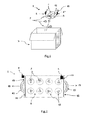
- Fig.1 shows an embodiment of the loading tool 1 according to the present invention loaded with objects 2 placed into the compartments 41, here hemispherical cavities.
- the objects 2 are transferred into a packaging 3 below the loading tool 1.
- the objects 2 are transferred (dashed arrow T) into the packaging 3 by tilting the loading tool 1 towards the packaging 3 and simultaneously bending B the loading tool 1.
- the objects slip along the surface of the arrangement of compartments 4 and are subsequently dumped into the packaging 3.
- the dimensions of the loading tool 1 are adapted to the dimensions of the open top of the packaging 3.
- the strength of bending of the loading tool can be adapted to be able to dump all objects 2 securely into the packaging 3 also for loading tools 1 being larger than the open top of the packaging 3 in a non-bended status.
- the packaging 3 in this example is a box, e.g. a cardboard box.
- the loading tool 1 is at least partly made of a flexible material such as rubber or comprises flexible joints between the compartments 4.
- the loading tool 1 could also be made of a thin sheet of metal to be able to be bended.
- Fig.2 shows the loading tool 1 as shown in fig. 1 in a top view with a rectangular shape.
- the loading tool 1 of figures 1 and 2 is a handheld device for manual transferring the objects 2 into the packaging 3.
- the holders 43 are mounted to the loading tool 1.
- the arrangement of compartments 4 can be kept in an essentially planar shape in order to carry the objects 2 to the packaging 3.
- the surface of the arrangement of compartment 4 further comprises a tag 5 indicating the number of compartments 41 present in the loading tool 1.
- eight compartments 41 do not necessarily need such a tag 7.
- a tag 5 is required to recognize the number of compartments 41 and subsequently the number of objects 2 loaded to a fully loaded loading tool 1 reliable at a glance.
- a counting means 6 is mounted to the loading tool 1 in order to record the number of transfers of objects 2 is executed with this particular loading tool 1.
- Fig.3 shows another embodiment of the loading tool 1, where the arrangement of compartments 4 is arranged as a row of parallel aligned half-cylindrical compartments 41.
- the arrangement of compartments 4 either comprises flexible joints 42 (e.g. hinges, here indicated as black line) between the compartments 41 or comprises flexible material FM (e.g. an elastomer) between the compartments (indicated as gray area).
- the complete loading tool 1 could be made of flexible material.
- the loading tool 1 comprises guiding walls 44 at the edge of the arrangement 4 and between two compartments 41 in the middle of the arrangement 4, in this example on three guiding walls 44.
- the number of guiding walls 44 may be varied by skilled people for different embodiments of loading tools 1.
- the surface of the arrangement of compartments 4 may be diffuse reflecting and/or may be white or coated with a fluorescent or phosphorescent material in order to simplify the recognition, whether an object 2 is already placed into a compartment 41 or not in order to fully load the loading tool lonly with one object 2 in each compartment 41. Only if one object 2 is loaded to each compartment 41, the number of compartments 41 equals the number of objects 2 loaded to the loading tool 1 and subsequently all loaded objects 2 are counted from the predetermined known number of compartments 41 present in the particular loading tool 1.
- the number of present compartments 41 can be provided by a corresponding tag 5 placed on the outside of the outer guiding wall 44.
- the tag 5 might be an RFID tag, which can be a read-out with a suitable RFID reader and displaying the number of compartments on a suitable display device arranged in the field of view of the operator placing objects into the compartments.
- the tag 5 can be placed also in location not directly visual for operators.
- the objects 2 may be placed into the half-cylindrical cavities (compartments) 41, when the loading tool 1 has a planar shape, e.g. when placing the loading tool 1 on top of a table.
- the surface of the compartments 41 should support the gliding of the objects 2 over the surface towards the packaging 3 (transfer T of objects).
- the transfer process T can be executed into both directions of the compartments 41 parallel to the guiding walls 44.
- the surface might be a polished surface or made of a material providing a smooth surface, e.g. metal, plastic, glass, PMMA etc.
- the compartments 41 may be made of a diffuse reflecting material (e.g. rubber) and/or may be white (e.g. white rubber) or coated with a fluorescent or phosphorescent material in order to simplify the recognition, whether an object 2 is already placed into a compartment 41 or not in order to fully load the loading tool 1.
Landscapes
- Engineering & Computer Science (AREA)
- Mechanical Engineering (AREA)
- Details Of Rigid Or Semi-Rigid Containers (AREA)
Abstract
The invention relates to a loading tool (1) for transferring a determined number of objects (2) into a packaging (3) comprising a predetermined number of compartments (41) in an essentially two-dimensional arrangement (4) suitable for being loaded with one object (2) each having a suitable shape to separate the loaded object (2) of one compartment (41) from the objects (2) loaded to adjacent compartments (41), wherein at least the arrangement (4) is at least partly flexible in order to be able to bend the loading tool (1) into a shape suitable for securely transferring the objects (2) into the packaging (3). The invention further relates to a method to apply such a loading tool (1).
Description
- The invention relates to a loading tools to transfer a determined number of objects into a packaging and to a method to apply this loading tool.
- Small parts (or objects) of any kind (e.g. small products or components of products) are often transported in boxes comprising a large number of these small parts. The boxes should contain a defined number of these parts in order to deliver a reliable defined number of parts per box to the recipient of such boxes. The reliable number of parts enables a well defined further processing of these parts or enables the ordering of a minimum required number of boxes containing these small parts. Unfortunately the counting of parts is difficult and time consuming, especially for small parts. In case of parts with a more complex shape (e.g. headsets for cellular phones), these counting can only be executed by a manual process most likely leading to counting mistakes resulting in transport boxes carrying a varying number of parts. The large number of loaded parts (or objects) and their properties (e.g. low weight) make it very difficult to determine the number of loaded parts indirectly, e.g. by weighting the boxes. It is desired to obtain a process to reliable count parts, especially small parts, and load a defined number of parts to a packaging, e.g. a transport box.
- Counting boards for coins with a surface comprising multiple parallel half-cylindrical shapes are known. The thickness of the coins in combination with the lengths of the half-cylindrical shapes determines the number of coins in a completely fill shape. The material of such boards shall provide a fixed and robust board in order not to lose coins. Therefore such boards are made of rigid materials such as of wood or metal. These counting boards are suitable for counting coins but not suitable to transfer the coins into a box, especially when the width of the board is not adapted to the width or length of the box. There is a demand to obtain a device, where objects can be counter fast and securely transferred into another packaging avoiding the risk of lost obj ects during the transfer process.
- It is an object of the present invention to provide a loading tool to be able to fast and securely load a determined number of objects into a packaging, which is usable for different packaging with different sizes. It is a further object to provide a method to use this tool.
- The object is solved by a loading tool for transferring a determined number of objects into a packaging comprising a predetermined number of compartments in an essentially two-dimensional arrangement suitable for being loaded with one object each having a suitable shape to separate the loaded object of one compartment from the objects loaded to adjacent compartments, wherein at least the arrangement is at least partly flexible in order to be able to bend the loading tool into a shape suitable for securely transferring the objects into the packaging.
- Packaging denotes any kind of boxes suitable to carry objects from one place to another place. Packaging may be boxes, containers, parcels etc. Packaging may vary in sizes and volumes to be loaded with objects. The packaging are commonly loaded from the open top side. The width and length of the open top size is an important parameter for objects, which are dumped into the packaging. If the dumping process is not adapted to the dimensions of the open top side, objects may fall alongside the packaging leading to loss and/or damage of objects. On the other hand, fast and secure loading of the packaging is demanded. Secure loading denotes the loading of a defined and desired number of objects into the packaging. The loading tool according to the present invention provides a tool to reliable count the objects to be loaded (transferred) into the packaging. Furthermore loading (and counting) capacity of the loading tool is not limited by the dimensions of the open top side of the packaging. Even loading tools significantly larger than the present open top side of a packaging can be used to transfer objects of a predefined number into the packaging by bending the loading tool into a suitable shape above the packaging to securely transfer the objects into the packaging. This enables a fast transfer process to load a larger number of objects into a packaging with one single transfer process.
- The objects may be separate products or components of products. The objects may have any shape and size. The objects may have complex shapes such as cables or headsets. However, the loading tool is especially suitable to count and transfer small objects into a packaging. The term "small objects" denotes objects with sizes, which are considered as being small in at least one direction, preferably with a size in one direction below 2 centimeters, more preferably below 1 centimeter, even more preferably below 0.5 centimeter. As an example, a ball with a diameter of 3 centimeters is not denoted as small in the present invention. In contrast to that, a flat rectangular object of width and length of 3 centimeter and a height of 0.4 centimeter is a small object in terms of this invention, because the height of this example is below 0.5 centimeter. Also a cable for a headset with a length of several centimeters, but with a common cable diameter of less than a few millimeters is a small object in terms of this invention, because the diameter of the cable is below 1 centimeter, probably below 0.5 centimeter. The loading tool is even more suitable to count and transfer objects into a packaging being small in all directions.
- The counting of the objects is executed by placing one object in each compartment of the arrangement of compartments. After filling the loading tool in this way, the loading tool is denoted as fully loaded. Since the loading tool comprise a predetermined number of compartments, the number of compartments equals the number of objects loaded to the compartments. Therefore the loaded objects are counted exactly and therefore the number of objects is determined.
- The term "essentially two-dimensional arrangement" denotes a component (arrangement) of the loading tool with dimensions of length and width significantly larger than the height of this arrangement, e.g. a large and thin plate comprising compartments. The term "two-dimensional" shall not be understood in a pure mathematically sense, because physical objects are always three-dimensional. However, components with a height significantly smaller, e.g. one or more magnitudes smaller, than the length and width are considered as two-dimensional in the terms of the present invention.
- For providing a packaging with a reliable number of objects inside the packaging, the exactly counted number of objects has to be transferred into the packaging. Therefore the loading tool has to be brought into a suitable shape preventing objects from falling alongside the packaging during transferring the objects from the loading tool to the packaging (= transfer process or dumping process). The suitable shape is achieved by bending the loading tool into a shape, which could be for example the shape of a half-pipe, a quarter-pipe, a funnel, a tube or a pipe-like shape. The objects present on such bended loading tool will glide towards the lowermost point of the bended structure and therefore gather in a reduced occupied area of the loading tool suitable to be dumped even into packaging with small open top sides. When tilting the loading tool with the suitable shape towards the packaging, the objects will start to slip or glide over the surface of the arrangement towards the packaging and will finally being dumped into the packaging. A bendable loading tool presumes that at least the arrangement of compartments or the loading tool has to be at least partly flexible. Partly flexible means, that the loading tool also might partly comprise rigid parts. However these rigid parts shall not hamper the possibility of being bended into the previously described suitable shapes for transferring the objects into the packaging. Alternatively, the complete loading tool could be provided as being flexible. To achieve a partly or total flexible loading tool, the loading tool has to be made at least partly out of flexible materials. These materials could be materials, which are flexible as such (elastic materials) or materials, which are thin enough to be flexible such as thin metal sheets, e.g. of thicknesses of 1 mm or less.
- In an embodiment at least the arrangement comprises flexible material between the compartments or the compartments are connected together with flexible joints. In case of rigid compartments (e.g. made of metal glass, plastic, PMMA), it would be sufficient for the required flexibility to have flexible material arranged between the compartments. Alternatively, the flexible material can be replaced by flexible components, e.g. flexible joints connecting the compartments. As an example, suitable flexible joints could be hinges. In an embodiment the arrangement of compartments may comprise an array of hemispheric compartments or a row of half-cylindrical compartments connected together with hinges. In a preferred embodiment the compartments are made of flexible material. This will enable the operator to bend the loading tool with a lesser required force into the shape required for the transfer process of the objects.
- In another embodiment the flexible material is an elastomer. Elastomers (or elastic polymers) are polymer materials with the property of viscoelasticity. At ambient temperatures the elastomers are relatively soft and deformable. The molecule structure of elastomers provides an extreme flexibility of these materials. In a preferred embodiment the elastomer is at least one element of the group of natural rubber, synthetic polyisoprene, butyl rubber, polybutadiene, styrene-butadiene rubber, nitrile rubber, chloroprene rubber, ethylene propylene rubber, epichlorohydrin rubber, polyacrylic rubber, fluorosilicone rubber, fluoroelastomers, perfluoroelastomers, polyether block amides, chlorosulfonated polyethylene, ethylene-vinyl acetate providing the required flexibility and the required stability for being loaded with objects and for multiple use.
- In an embodiment the shape and/or size of the compartments is adapted to the type of objects to be loaded into the compartments. Since the objects may differ in size and shape, a fast loading of the compartments (and therefore fast counting of the objects) is preferably be executed with such loading tool having compartments adapted to particular objects. The compartments may be shaped as hemispheres, where objects smaller than the diameter of the hemisphere can be placed. In other embodiments the compartments may be rectangular areas, where rectangular shaped objects can be placed, or half-cylindrically shaped cavities, where elongated objects (e.g. cables) can be placed. The compartments of different loading tools may have different sizes of compartments, larger compartments in case of larger objects to be loaded and smaller compartments in case of smaller objects to be loaded.
- In another embodiment the properties of the arrangement predetermines the number of compartments in the loading tool or the number of compartments is indicated by a tag as part of or attached to the loading tool. The properties of the arrangement may be the total size of the arrangement and/or the color of the arrangement or the color of parts of the arrangement. If the number of compartments is correlated to the size of the arrangement, it is easy for any operator to recognize the number of compartments and therefore the number of present objects in case of a fully loaded loading tool. The loading tool may have 25 compartments, 50 compartments or 100 compartments within an arrangement of compartments. The sizes for such arrangements differ enough to be easily visually recognizable. Alternatively in case of differently shaped compartments, different arrangements of compartments of the same particular size may have different numbers of compartments with differently shaped compartments. Here the present number of compartments in an arrangement of compartments can be indicated by a suitable tag. The tag should be placed on the arrangement at a location easily visual, e.g. on the surface. In other embodiments the tag may be the color of the compartment or of a part of the compartments or the color of a side, preferably the front side or back side, of the arrangement of compartments. As an example the arrangement with 25 compartments may be colored red on the backside, for 50 compartments it may be colored blue etc. Here, the particular mentioned colors are only examples. People skilled in the art may choose other color codes to indicate the number of compartments present in an arrangement of compartments within the scope of this invention. In other embodiments the tag may comprise machine readable information transferred to a display device displaying the number of compartments of the present loading tool to be loaded with objects. The machine-readable information may be provided by the tag arranged as a RFID tag. The advantage of RFID-information about the number of compartment is the possibility to mount the tag at any location on the loading tool or the arrangement of compartments. The reading of the tag may be used to record the total number of objects transferred with the particular loading tool within a certain time interval into a certain packaging.
- In another embodiment the compartments are arranged as cavities in the arrangement, preferably the cavities are separated from each other by horizontal areas between the cavities. Here the objects are placed inside the cavities and are transferred to the packaging by sufficiently bending and tilting the loading tool towards the packaging and subsequently by dumping the objects slipping along the upper surface of the arrangement into the packaging. The surface of the arrangement and of the compartments should by slippery enough to support the transfer of objects into the packaging. The horizontal areas between the compartments further support the objects gliding over the surface of the arrangement of compartments. The horizontal areas are barrier-free areas for a non-disturb the gliding (or slippage) of objects along the arrangement of compartments. As an example, the surface may be polished to obtain a smooth surface.
- In another embodiment the loading tool further comprises at least two guiding walls arranged in a direction essentially parallel to the direction, into which the objects are transferred in the packaging. To ensure, that all counted objects are transferred into the packaging, guiding walls are arranged at the edges of the arrangement of compartments to prevent objects from falling outside the loading tool in a non-desired direction, meaning preventing objects from falling not into the packaging. However, the guiding walls shall not prevent the bending of the loading tool, which requires that the guiding walls are arranged parallel to the slipping (gliding) direction of the objects along the surface of the arrangement of compartments. The guiding wall may have any shape and size suitable to fulfill the previous requirement. Preferably the guiding wall is arranged essentially vertical to the arrangement of compartments without any gap between compartments and wall, which would be sufficient to prevent the objects from falling outside the loading tool.
- In another embodiment the compartments are arranged as parallel half-cylindrical cavities, preferably with guiding walls arranged between the half-cylindrical cavities and parallel to the half-cylindrical cavities. Parallel half-cylindrical cavities as the compartments enable the undisturbed gliding of the objects in each compartment towards the edge of the arrangement of compartments in order to be dumped into the packaging. In contrast to arrays of compartments, the shape of parallel half-cylindrical cavities prevents the objects from bouncing on the surface of the arrangement during the gliding process over the arrangement of compartments. The bouncing could cause objects falling alongside the packaging. Therefore a reduced or avoided bouncing of objects will improve the secure transfer of objects into the packaging.
- In another embodiment at least the surface of the compartments comprises a diffuse reflecting material, preferably a white or fluorescent or phosphorescent material. Avoiding disturbing reflections from the compartments makes it easier to recognize, if the particular compartment is already loaded with one object, especially in case of very small objects. In a preferred embodiment the material is a white or a fluorescent or phosphorescent material. Such a white, fluorescent or phosphorescent surface of the compartment makes it even easier to recognize, if the particular compartment is already loaded with one object or not. Especially the use of fluorescent or phosphorescent materials, which are self illuminating after being activated (e.g. by a UV lamp), enables an easy recognition of loaded or empty compartments independently from the color of the objects. As an example, the white flexible material may be white colored rubber.
- In another embodiment the loading tool further comprises a counting means suitable to count the number of executed transfers of objects with this loading tool. In case of packaging to be loaded with a large number of objects exceeding the number of compartments in a loading tool, the loading tool has to be fully loaded and the objects have to be transferred in the packaging multiple times. In order to count the total number of transferred objects, the total number of transferred objects results from the number of objects of a fully loaded loading tool times the number of executed transfers (number of executed transfer processes), which can be recorded by the counting means. As an example the counting means can be a counting wheel or any other suitable counting means mounted to the loading tool.
- In another embodiment the loading tool further comprises at least two holders arranged on the edges of the arrangement on two opposite sides of the arrangement. The edge of the arrangements denotes the side or sides of the arrangement between the bottom surface and the top surface of the arrangement comprising the compartments. In case of an arrangement shaped as a cuboid with length and width significantly larger than its height, the edges are the sides vertically to the large top and bottom surfaces of the cuboid (sides established by length times width). The holders may be any holder suitable for operators to carry the loading tool from one place to another place, which enables the operators to apply a certain tensile stress to the loading tool in order to keep the loading tool in an essentially planar shape in order not to lose any object by falling alongside the loading tool during carrying the loading tool. The term "essentially planar" denotes the shape sufficient for keeping the objects within the compartments. This suitable shape does not have to be exactly planar, but shall be not be bended too much. The acceptable bending also depends on the shape of the compartments.
- The invention further relates to a method to transfer a determined number of objects into a packaging with a loading tool according to the present invention comprising the steps of
- (a) loading one object into each of the compartments of the loading tool, which are arranged as an essentially two-dimensional arrangement,
- (b) placing the loading tool in a suitable position on or above the packaging to transfer the objects into the packaging,
- (c) bending the loading tool into a shape suitable for securely transferring the objects into the packaging, and
- (d) transferring the objects into the packaging by tilting the loading tool towards the packaging.
- In an embodiment the step (b) of the method comprises the step of carrying the loading tool to the packaging while applying a tensile stress to the loading tool, preferably by using two holders arranged on the edges of the arrangement on two opposite sides of the arrangement. The tensile stress applied to the loading tool keeps the loading tool in an essentially planar position (or shape) for keeping the objects within the compartments. This suitable shape does not have to be exactly planar, but shall be not be bended too much. The acceptable bending also depends on the shape of the compartments.
- In another embodiment the method further comprises the step of selecting a loading tool with compartments suitable for a type of objects to be loaded into the compartments. This enables to count objects in a flexible sequence for different packaging.
- These and other aspects of the invention will be apparent from and elucidated with reference to the embodiments described hereinafter.
- Fig.1:
- transferring objects into a packaging applying a loading tool according to the present invention.
- Fig.2:
- top view of an embodiment of the loading tool as shown in
Fig. 1 . - Fig.3:
- another embodiment of the loading tool with hemispheric compartments.
-
Fig.1 shows an embodiment of theloading tool 1 according to the present invention loaded withobjects 2 placed into thecompartments 41, here hemispherical cavities. Theobjects 2 are transferred into apackaging 3 below theloading tool 1. Theobjects 2 are transferred (dashed arrow T) into thepackaging 3 by tilting theloading tool 1 towards thepackaging 3 and simultaneously bending B theloading tool 1. The objects slip along the surface of the arrangement ofcompartments 4 and are subsequently dumped into thepackaging 3. Here, the dimensions of theloading tool 1 are adapted to the dimensions of the open top of thepackaging 3. However the strength of bending of the loading tool can be adapted to be able to dump allobjects 2 securely into thepackaging 3 also forloading tools 1 being larger than the open top of thepackaging 3 in a non-bended status. Thepackaging 3 in this example is a box, e.g. a cardboard box. Theloading tool 1 is at least partly made of a flexible material such as rubber or comprises flexible joints between thecompartments 4. Alternatively theloading tool 1 could also be made of a thin sheet of metal to be able to be bended. To carry and/or to bend theloading tool 1, it comprises twoholders 43 onopposite edges 45 of the arrangement ofcompartments 4. -
Fig.2 shows theloading tool 1 as shown infig. 1 in a top view with a rectangular shape. In this example, there are eightcompartments 41 arranged as a 2 x 4 array, where eachcompartment 41 carries one object 2 (here displayed schematically as gray triangles). Guidingwalls 45 are indicated as black lines close to theedge 45 of the arrangement ofcompartments 4, where theholders 43 are mounted. The other two sides do not comprise any walls not to hamper the dumping of theobjects 2 into the packaging. Theloading tool 1 offigures 1 and 2 is a handheld device for manual transferring theobjects 2 into thepackaging 3. For this purpose, theholders 43 are mounted to theloading tool 1. If a tensile stress TS (dashed arrow) is applied to theholders 43 of theloading tool 1, the arrangement ofcompartments 4 can be kept in an essentially planar shape in order to carry theobjects 2 to the packaging 3.The surface of the arrangement ofcompartment 4 further comprises atag 5 indicating the number ofcompartments 41 present in theloading tool 1. In this example, eightcompartments 41 do not necessarily need such a tag 7. However, forlarger loading tools 1 and/orsmaller compartments 41 to carrysmaller objects 2, there may be 25, 50 or 100 compartments within one array. For such a large number ofcompartments 41, atag 5 is required to recognize the number ofcompartments 41 and subsequently the number ofobjects 2 loaded to a fully loadedloading tool 1 reliable at a glance. Additionally, a counting means 6 is mounted to theloading tool 1 in order to record the number of transfers ofobjects 2 is executed with thisparticular loading tool 1. -
Fig.3 shows another embodiment of theloading tool 1, where the arrangement ofcompartments 4 is arranged as a row of parallel aligned half-cylindrical compartments 41. To be able to bend theloading tool 1, the arrangement ofcompartments 4 either comprises flexible joints 42 (e.g. hinges, here indicated as black line) between thecompartments 41 or comprises flexible material FM (e.g. an elastomer) between the compartments (indicated as gray area). Alternatively, thecomplete loading tool 1 could be made of flexible material. To avoid any risk to loseobjects 2 placed in thecompartments 41, theloading tool 1 comprises guidingwalls 44 at the edge of thearrangement 4 and between twocompartments 41 in the middle of thearrangement 4, in this example on three guidingwalls 44. The number of guidingwalls 44 may be varied by skilled people for different embodiments ofloading tools 1. The surface of the arrangement ofcompartments 4 may be diffuse reflecting and/or may be white or coated with a fluorescent or phosphorescent material in order to simplify the recognition, whether anobject 2 is already placed into acompartment 41 or not in order to fully load the loading tool lonly with oneobject 2 in eachcompartment 41. Only if oneobject 2 is loaded to eachcompartment 41, the number ofcompartments 41 equals the number ofobjects 2 loaded to theloading tool 1 and subsequently all loadedobjects 2 are counted from the predetermined known number ofcompartments 41 present in theparticular loading tool 1. The number ofpresent compartments 41 can be provided by acorresponding tag 5 placed on the outside of the outer guidingwall 44. In other embodiments, thetag 5 might be an RFID tag, which can be a read-out with a suitable RFID reader and displaying the number of compartments on a suitable display device arranged in the field of view of the operator placing objects into the compartments. In this case thetag 5 can be placed also in location not directly visual for operators. Theobjects 2 may be placed into the half-cylindrical cavities (compartments) 41, when theloading tool 1 has a planar shape, e.g. when placing theloading tool 1 on top of a table. The surface of thecompartments 41 should support the gliding of theobjects 2 over the surface towards the packaging 3 (transfer T of objects). The transfer process T can be executed into both directions of thecompartments 41 parallel to the guidingwalls 44. The surface might be a polished surface or made of a material providing a smooth surface, e.g. metal, plastic, glass, PMMA etc. Thecompartments 41 may be made of a diffuse reflecting material (e.g. rubber) and/or may be white (e.g. white rubber) or coated with a fluorescent or phosphorescent material in order to simplify the recognition, whether anobject 2 is already placed into acompartment 41 or not in order to fully load theloading tool 1. - While the invention has been illustrated and described in details in the drawings and foregoing description, such illustration and description are to be considered illustrative or exemplary and not restrictive; the invention is not limited to the disclosed embodiments.
- Other variations to the disclosed embodiments can be understood and effected by those skilled in the art in practicing the claimed invention, from a study of the drawings, the disclosure, and the appended claims. In the claims, the word "comprising" does not exclude other elements or steps, and the indefinite article "a" or "an" does not exclude a plurality. The mere fact that certain measures are recited in mutually different dependent claims does not indicate that a combination of these measures cannot be used to advantage. Any reference sign in the claims should not be construed as limiting the scope.
-
- 1
- loading tool
- 2
- objects
- 3
- packaging
- 4
- arrangement of compartments
- 41
- compartment
- 42
- flexible joint
- 43
- holder
- 44
- guiding wall
- 45
- edge of the arrangement
- 5
- tag indicating number of compartments
- 6
- counting means
- B
- bending the loading tool
- FM
- flexible material
- T
- transferring objects from the loading tool into the packaging
- TS
- tensile stress applied to the loading tool
Claims (15)
- A loading tool (1) for transferring a determined number of objects (2) into a packaging (3) comprising a predetermined number of compartments (41) in an essentially two-dimensional arrangement (4) suitable for being loaded with one object (2) each having a suitable shape to separate the loaded object (2) of one compartment (41) from the objects (2) loaded to adjacent compartments (41), wherein at least the arrangement (4) is at least partly flexible in order to be able to bend the loading tool (1) into a shape suitable for securely transferring (T) the objects (2) into the packaging (3).
- The loading tool (1) according to claim 1, characterized in that at least the arrangement (4) comprises flexible material (FM) between the compartments (41) or that the compartments (41) are connected together with flexible joints (42).
- The loading tool (1) according to claim 2, characterized that also the compartments (41) are made of flexible material (FM).
- The loading tool (1) according to claim 2 or 3, characterized in that the flexible material (FM) is an elastomer, preferably at least one element of the group of natural rubber, synthetic polyisoprene, butyl rubber, polybutadiene, styrene-butadiene rubber, nitrile rubber, chloroprene rubber, ethylene propylene rubber, epichlorohydrin rubber, polyacrylic rubber, fluorosilicone rubber, fluoroelastomers, perfluoroelastomers, polyether block amides, chlorosulfonated polyethylene, ethylene-vinyl acetate.
- The loading tool (1) according to any preceding claim, characterized in that the shape and/or size of the compartments (41) is adapted to the type of objects (2) to be loaded into the compartments (41).
- The loading tool (1) according to any receding claim, characterized in that the properties of the arrangement (4) predetermine the number of compartments (41) in the loading tool (1) or that the number of compartments (41) is indicated by a tag (5) as part of or attached to the loading tool (1).
- The loading tool (1) according to any preceding claim, characterized in that the compartments (41) are arranged as cavities in the arrangement (4), preferably the cavities (41) are separated from each other by horizontal areas between the cavities (41).
- The loading tool (1) according to any of the preceding claims, characterized in that the loading tool (1) further comprises at least two guiding walls (44) arranged in a direction essentially parallel to the direction, into which the objects (2) are transferred in the packaging (3).
- The loading tool (1) according to any preceding claim, characterized in that compartments (41) are arranged as parallel half-cylindrical cavities, preferably with guiding walls (44) arranged between the half-cylindrical cavities (41) and parallel to the half-cylindrical cavities (41).
- The loading tool (1) according to any preceding claim, characterized in that at least the surface of the compartments (41) comprises a diffuse reflecting material, preferably a white or fluorescent or phosphorescent material.
- The loading tool (1) according to any preceding claim, characterized in that the loading tool (1) further comprises a counting means (6) suitable to count the number of executed transfers of objects (2) with this loading tool (1).
- The loading tool (1) according to any preceding claim, characterized in that the loading tool (1) further comprises at least two holders (43) arranged on the edges (45) of the arrangement (4) on two opposite sides of the arrangement (4).
- A method to transfer a determined number of objects (2) into a packaging (3) with a loading tool (1) as claimed in claim 1 comprising the steps of(a) loading one object (2) into each of the compartments (41) of the loading tool (1), which are arranged as a essentially two-dimensional arrangement (4),(b) placing the loading tool (1) in a suitable position on or above the packaging (3) to transfer the objects (2) into the packaging (3),(c) bending (B) the loading tool (1) into a shape suitable for securely transferring the objects (2) into the packaging (3), and(d) transferring (T) the objects (2) into the packaging (3) by tilting the loading tool (1) towards the packaging (3).
- The method as claimed in claim 13, wherein the step (b) comprises the step of carrying the loading tool (1) to the packaging (3) while applying a tensile stress (TS) to the loading tool (1), preferably by using two holders (43) arranged on the edges (45) of the arrangement (4) on two opposite sides of the arrangement (4).
- The method as claimed in claim 13 or 14, characterized in that the method further comprises the step of selecting a loading tool (1) with compartments (41) suitable for a type of objects (2) to be loaded into the compartments (41).
Priority Applications (1)
| Application Number | Priority Date | Filing Date | Title |
|---|---|---|---|
| EP10162661A EP2386491A1 (en) | 2010-05-12 | 2010-05-12 | A loading tool |
Applications Claiming Priority (1)
| Application Number | Priority Date | Filing Date | Title |
|---|---|---|---|
| EP10162661A EP2386491A1 (en) | 2010-05-12 | 2010-05-12 | A loading tool |
Publications (1)
| Publication Number | Publication Date |
|---|---|
| EP2386491A1 true EP2386491A1 (en) | 2011-11-16 |
Family
ID=42989641
Family Applications (1)
| Application Number | Title | Priority Date | Filing Date |
|---|---|---|---|
| EP10162661A Withdrawn EP2386491A1 (en) | 2010-05-12 | 2010-05-12 | A loading tool |
Country Status (1)
| Country | Link |
|---|---|
| EP (1) | EP2386491A1 (en) |
Citations (3)
| Publication number | Priority date | Publication date | Assignee | Title |
|---|---|---|---|---|
| US5887727A (en) * | 1997-03-08 | 1999-03-30 | Ames; John L. | Small hardware sorting bed and transport device |
| US6484881B1 (en) * | 1999-02-05 | 2002-11-26 | Alvite Joseph G. | Electronic component package for standard and odd form components |
| US20090084808A1 (en) * | 2007-09-28 | 2009-04-02 | Stanley Kevin F | Hand held counting system for tablets and capsules |
-
2010
- 2010-05-12 EP EP10162661A patent/EP2386491A1/en not_active Withdrawn
Patent Citations (3)
| Publication number | Priority date | Publication date | Assignee | Title |
|---|---|---|---|---|
| US5887727A (en) * | 1997-03-08 | 1999-03-30 | Ames; John L. | Small hardware sorting bed and transport device |
| US6484881B1 (en) * | 1999-02-05 | 2002-11-26 | Alvite Joseph G. | Electronic component package for standard and odd form components |
| US20090084808A1 (en) * | 2007-09-28 | 2009-04-02 | Stanley Kevin F | Hand held counting system for tablets and capsules |
Similar Documents
| Publication | Publication Date | Title |
|---|---|---|
| JP5802932B1 (en) | Container filling method | |
| EP2110252A3 (en) | Ink container and image forming apparatus incorporating same | |
| EP1642853A3 (en) | Handling robot system | |
| EP2301850A3 (en) | An automatic blister pack pill dispenser | |
| EP2063274A3 (en) | Storage-access apparatus for storing products and storage system thereof | |
| CN104093650A (en) | Component feeder system and method for feeding and displaying components | |
| RU2619150C2 (en) | Balancing weights for motor vehicles' wheels | |
| EP1844938A3 (en) | Liquid container | |
| EP3859290A3 (en) | Product sales data processing system and weighing apparatus | |
| US20200021712A1 (en) | Apparatus and method to pick a magnetizable object from a group of magnetizable objects | |
| US20130020269A1 (en) | Cap-shaped items holder rack | |
| ES2547000T3 (en) | Apparatus and procedure for distributing vehicle balancing weights | |
| EP2634121A3 (en) | Sheet feed unit and image forming apparatus including same | |
| US7784607B1 (en) | Coin holding apparatus | |
| CA2853170C (en) | Ring holder, system comprising a ring holder and a ring display and method for connecting a ring to a ring holder | |
| CN207375340U (en) | A kind of blanking machine of AOI detections automatic material receiving system | |
| TW200614977A (en) | A medicine transferring device | |
| EP3725336A3 (en) | Container for sterilising flexible bags | |
| CN107848654A (en) | For goods to be chosen to the method in sack | |
| CN107176380B (en) | Packing case | |
| EP2386490A1 (en) | A loading tool | |
| AU2009212907B2 (en) | Combined storage system | |
| EP2937021A1 (en) | Loading tool for a goods presentation system | |
| CN215664451U (en) | Quality control article storage box with pull structure | |
| US11542106B2 (en) | Method for automatically transferring spouted pouches and automatic pouch transferring assembly |
Legal Events
| Date | Code | Title | Description |
|---|---|---|---|
| AK | Designated contracting states |
Kind code of ref document: A1 Designated state(s): AL AT BE BG CH CY CZ DE DK EE ES FI FR GB GR HR HU IE IS IT LI LT LU LV MC MK MT NL NO PL PT RO SE SI SK SM TR |
|
| AX | Request for extension of the european patent |
Extension state: BA ME RS |
|
| PUAI | Public reference made under article 153(3) epc to a published international application that has entered the european phase |
Free format text: ORIGINAL CODE: 0009012 |
|
| STAA | Information on the status of an ep patent application or granted ep patent |
Free format text: STATUS: THE APPLICATION IS DEEMED TO BE WITHDRAWN |
|
| 18D | Application deemed to be withdrawn |
Effective date: 20120517 |