EP2385495A2 - Inspection video radiation filter - Google Patents
Inspection video radiation filter Download PDFInfo
- Publication number
- EP2385495A2 EP2385495A2 EP11164631A EP11164631A EP2385495A2 EP 2385495 A2 EP2385495 A2 EP 2385495A2 EP 11164631 A EP11164631 A EP 11164631A EP 11164631 A EP11164631 A EP 11164631A EP 2385495 A2 EP2385495 A2 EP 2385495A2
- Authority
- EP
- European Patent Office
- Prior art keywords
- video
- pixel
- camera
- xnoids
- frame
- Prior art date
- Legal status (The legal status is an assumption and is not a legal conclusion. Google has not performed a legal analysis and makes no representation as to the accuracy of the status listed.)
- Withdrawn
Links
Images


Classifications
-
- G—PHYSICS
- G06—COMPUTING OR CALCULATING; COUNTING
- G06T—IMAGE DATA PROCESSING OR GENERATION, IN GENERAL
- G06T5/00—Image enhancement or restoration
- G06T5/50—Image enhancement or restoration using two or more images, e.g. averaging or subtraction
-
- G—PHYSICS
- G01—MEASURING; TESTING
- G01T—MEASUREMENT OF NUCLEAR OR X-RADIATION
- G01T7/00—Details of radiation-measuring instruments
-
- G—PHYSICS
- G06—COMPUTING OR CALCULATING; COUNTING
- G06T—IMAGE DATA PROCESSING OR GENERATION, IN GENERAL
- G06T5/00—Image enhancement or restoration
- G06T5/20—Image enhancement or restoration using local operators
-
- G—PHYSICS
- G06—COMPUTING OR CALCULATING; COUNTING
- G06T—IMAGE DATA PROCESSING OR GENERATION, IN GENERAL
- G06T5/00—Image enhancement or restoration
- G06T5/77—Retouching; Inpainting; Scratch removal
-
- G—PHYSICS
- G06—COMPUTING OR CALCULATING; COUNTING
- G06T—IMAGE DATA PROCESSING OR GENERATION, IN GENERAL
- G06T7/00—Image analysis
- G06T7/0002—Inspection of images, e.g. flaw detection
- G06T7/0004—Industrial image inspection
-
- H—ELECTRICITY
- H04—ELECTRIC COMMUNICATION TECHNIQUE
- H04N—PICTORIAL COMMUNICATION, e.g. TELEVISION
- H04N25/00—Circuitry of solid-state image sensors [SSIS]; Control thereof
- H04N25/60—Noise processing, e.g. detecting, correcting, reducing or removing noise
- H04N25/68—Noise processing, e.g. detecting, correcting, reducing or removing noise applied to defects
- H04N25/683—Noise processing, e.g. detecting, correcting, reducing or removing noise applied to defects by defect estimation performed on the scene signal, e.g. real time or on the fly detection
-
- H—ELECTRICITY
- H04—ELECTRIC COMMUNICATION TECHNIQUE
- H04N—PICTORIAL COMMUNICATION, e.g. TELEVISION
- H04N25/00—Circuitry of solid-state image sensors [SSIS]; Control thereof
- H04N25/70—SSIS architectures; Circuits associated therewith
- H04N25/71—Charge-coupled device [CCD] sensors; Charge-transfer registers specially adapted for CCD sensors
-
- G—PHYSICS
- G06—COMPUTING OR CALCULATING; COUNTING
- G06T—IMAGE DATA PROCESSING OR GENERATION, IN GENERAL
- G06T2207/00—Indexing scheme for image analysis or image enhancement
- G06T2207/10—Image acquisition modality
- G06T2207/10016—Video; Image sequence
-
- G—PHYSICS
- G06—COMPUTING OR CALCULATING; COUNTING
- G06T—IMAGE DATA PROCESSING OR GENERATION, IN GENERAL
- G06T2207/00—Indexing scheme for image analysis or image enhancement
- G06T2207/20—Special algorithmic details
- G06T2207/20212—Image combination
- G06T2207/20221—Image fusion; Image merging
-
- G—PHYSICS
- G06—COMPUTING OR CALCULATING; COUNTING
- G06T—IMAGE DATA PROCESSING OR GENERATION, IN GENERAL
- G06T2207/00—Indexing scheme for image analysis or image enhancement
- G06T2207/30—Subject of image; Context of image processing
- G06T2207/30108—Industrial image inspection
- G06T2207/30164—Workpiece; Machine component
-
- H—ELECTRICITY
- H04—ELECTRIC COMMUNICATION TECHNIQUE
- H04N—PICTORIAL COMMUNICATION, e.g. TELEVISION
- H04N17/00—Diagnosis, testing or measuring for television systems or their details
- H04N17/002—Diagnosis, testing or measuring for television systems or their details for television cameras
-
- H—ELECTRICITY
- H04—ELECTRIC COMMUNICATION TECHNIQUE
- H04N—PICTORIAL COMMUNICATION, e.g. TELEVISION
- H04N23/00—Cameras or camera modules comprising electronic image sensors; Control thereof
- H04N23/50—Constructional details
- H04N23/555—Constructional details for picking-up images in sites, inaccessible due to their dimensions or hazardous conditions, e.g. endoscopes or borescopes
Definitions
- the present invention relates generally to nuclear power plants, and more particularly to the visual inspections of nuclear power plants.
- Video cameras are known to be used as inspection devices in nuclear power plants. Videos taken during visual inspection of nuclear power plants are susceptible to interference from high levels of radiation reaching the camera. Such interference slows visual inspections and may limit coverage in high radiation areas.
- High cost radiation tolerant tube base cameras are typically used to capture video in high radiation areas.
- Lower cost CCD (charge coupled device) based cameras are also used however, these cameras provide a more impaired image and are more prone to failure from the effects of radiation.
- An object of the present invention is to increase the speed, quality and coverage of nuclear power plant visual inspections, as well as using a lower cost camera and reducing the camera failure rate during inspection.
- the present invention provides a method for filtering radiation effects on a CCD based camera inspection video, the method including: capturing video signals via the camera; converting the video signals to a plurality of digital video frames; identifying radiation bright spots, defined as xnoids, in pixels of at least one of the frames, replacing the corrupted pixels with corresponding pixels of another of the frames to create a filtered frame.
- the present invention also provides a system for the inspection of a nuclear power plant comprising: a camera; and a computer, the computer configured to execute identifying radiation bright spots, defined as xnoids, in a pixel of at least one digitized video frame and replacing corrupted pixels with corresponding pixels of another of the frame to create a filtered frame.
- identifying radiation bright spots defined as xnoids
- the present invention also provides a method for calculating estimated relative absorbed dose of the video camera by counting the total number of xnoids detected.
- the estimated relative dose can be used to predict camera failure due to radiation exposure.
- a method for dynamically filtering the effects of radiation on inspection videos when using CCD based cameras is provided.
- the interference caused by radiation during the video inspection of a nuclear power plant manifests itself as "bright" spots, called xnoids, within the video frames.
- Figure 1 a shows xnoids 2 in video frame 4.
- Radiation filtering is accomplished by checking each pixel in each frame of video for xnoids. Once a xnoid is detected, the xnoid and surrounding pixels are replaced with corresponding pixels from other frames.
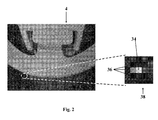
- Fig. 2 shows video frame 40 with pixels 38.
- Xnoid 34 and surrounding pixels 36 would be replaced with corresponding pixels from other frames.
- Figure 1b shows a video frame 6 in which the xnoids 2 have been filtered and replaced.
- the video can be captured, filtered and displayed in real-time with a delay of only a few frame times. Alternately, the video can be stored and then replayed from the captured digital file with a similar delay of zero to a few frame times.
- Fig. 3 shows an inspection system 32 which comprises a CCD based camera 16 and a computer 10.
- Camera 16 captures an image which includes a radiation source 12 when it is in the field of view 14 of camera 16.
- Video signal 8 of camera 16 is transferred from camera 16 to computer 10.
- Computer 10, may for example, include a video capture card, a multi core CPU, a hard drive and a display.
- Video capture card in computer 10 converts video signal 8 to digital video frames 22, 24, 26, 28, 30 ( Fig. 4 ) at a specified frame rate.
- Each digitized video frame 4 contains a matrix of pixels.
- Each pixel contains an intensity level for each color - red, green, blue, or just a single grey level for black and white frames.
- These video frames 22, 24, 26, 28, 30 are passed to a radiation filter module 18.
- Module 18 is preferably a software executed on computer 10. The intensity level for each pixel is compared by module 18 against a threshold to a plurality of surrounding pixel intensity levels, for example 4 pixels, 8 pixels, 24 pixels, etc. If the pixel is brighter than the surrounding pixels, it is identified as a xnoid. Radiation filter module 18 checks each pixel in each frame of video for a xnoid. Once a xnoid is detected, the xnoid and surrounding pixels are replaced with corresponding pixels in the same location from other frames. For each pixel marked as a xnoid in video frame 26, the pixel xnoid, and the surrounding pixel values are replaced with pixel intensity values in the same locations as frame 28.
- a threshold for example 4 pixels, 8 pixels, 24 pixels, etc. If the pixel is brighter than the surrounding pixels, it is identified as a xnoid.
- Radiation filter module 18 checks each pixel in each frame of video for a xnoid. Once a xnoid is detected, the x
- Radio filter module 18 filters the effects of the radiation and passes filtered video frames to the display. In addition, radiation filter module 18 can write the xnoid location information along with the unfiltered video frame to a video file stored on the hard drive of computer 10.
- Computer 10 may be used both to view live video and/or to store the video for later review. To review a video, only computer 10 is necessary.
- the number of xnoids per video frame can be correlated to the absorbed dose of radiation of the camera CCD. By counting the total xnoids per video frame, an estimate of absorbed dose can be recorded for a specific camera. Using historical data for specific camera types, camera failure can be predicted by comparing previous camera life time estimated absorbed dose against current estimated absorbed dose. Dynamically filtering the effects of radiation on CCD based camera video can increase the speed, quality and coverage of nuclear power plant visual inspections and allows lower cost CCD cameras to be used for nuclear power plant visual inspections. Using estimated camera absorbed dose and projected camera life, camera failure during inspection can be reduced.
Landscapes
- Engineering & Computer Science (AREA)
- Physics & Mathematics (AREA)
- General Physics & Mathematics (AREA)
- Theoretical Computer Science (AREA)
- Signal Processing (AREA)
- Multimedia (AREA)
- Molecular Biology (AREA)
- Spectroscopy & Molecular Physics (AREA)
- High Energy & Nuclear Physics (AREA)
- Life Sciences & Earth Sciences (AREA)
- Health & Medical Sciences (AREA)
- Quality & Reliability (AREA)
- Computer Vision & Pattern Recognition (AREA)
- Monitoring And Testing Of Nuclear Reactors (AREA)
- Image Analysis (AREA)
- Image Processing (AREA)
Abstract
Description
- The present invention relates generally to nuclear power plants, and more particularly to the visual inspections of nuclear power plants.
- Video cameras are known to be used as inspection devices in nuclear power plants. Videos taken during visual inspection of nuclear power plants are susceptible to interference from high levels of radiation reaching the camera. Such interference slows visual inspections and may limit coverage in high radiation areas.
- High cost radiation tolerant tube base cameras are typically used to capture video in high radiation areas. Lower cost CCD (charge coupled device) based cameras are also used however, these cameras provide a more impaired image and are more prone to failure from the effects of radiation.
- An object of the present invention is to increase the speed, quality and coverage of nuclear power plant visual inspections, as well as using a lower cost camera and reducing the camera failure rate during inspection.
- The present invention provides a method for filtering radiation effects on a CCD based camera inspection video, the method including: capturing video signals via the camera; converting the video signals to a plurality of digital video frames; identifying radiation bright spots, defined as xnoids, in pixels of at least one of the frames, replacing the corrupted pixels with corresponding pixels of another of the frames to create a filtered frame.
- The present invention also provides a system for the inspection of a nuclear power plant comprising: a camera; and a computer, the computer configured to execute identifying radiation bright spots, defined as xnoids, in a pixel of at least one digitized video frame and replacing corrupted pixels with corresponding pixels of another of the frame to create a filtered frame.
- The present invention also provides a method for calculating estimated relative absorbed dose of the video camera by counting the total number of xnoids detected. The estimated relative dose can be used to predict camera failure due to radiation exposure.
- An embodiment of the present invention is shown with respect to the drawings in which:
-
Figure 1a shows a video frame with radiation interference; -
Figure 1b shows a video frame similar to 1 a without radiation interference; -
Figure 2 shows an exemplary video frame and pixel matrix with a bright spot; -
Figure 3 shows an inspection system of the present invention; and -
Figure 4 shows exemplary video frames from a video capture card. - A method is provided for dynamically filtering the effects of radiation on inspection videos when using CCD based cameras. The interference caused by radiation during the video inspection of a nuclear power plant manifests itself as "bright" spots, called xnoids, within the video frames.
Figure 1 a shows xnoids 2 invideo frame 4. - Radiation filtering is accomplished by checking each pixel in each frame of video for xnoids. Once a xnoid is detected, the xnoid and surrounding pixels are replaced with corresponding pixels from other frames. For example,
Fig. 2 shows video frame 40 withpixels 38.Xnoid 34 and surroundingpixels 36 would be replaced with corresponding pixels from other frames.Figure 1b shows avideo frame 6 in which the xnoids 2 have been filtered and replaced. With use of a computer equipped with a video capture card, the video can be captured, filtered and displayed in real-time with a delay of only a few frame times. Alternately, the video can be stored and then replayed from the captured digital file with a similar delay of zero to a few frame times. -
Fig. 3 shows aninspection system 32 which comprises a CCD basedcamera 16 and acomputer 10.Camera 16 captures an image which includes aradiation source 12 when it is in the field ofview 14 ofcamera 16.Video signal 8 ofcamera 16 is transferred fromcamera 16 tocomputer 10.Computer 10, may for example, include a video capture card, a multi core CPU, a hard drive and a display. Video capture card incomputer 10 convertsvideo signal 8 todigital video frames Fig. 4 ) at a specified frame rate. Each digitizedvideo frame 4 contains a matrix of pixels. Each pixel contains an intensity level for each color - red, green, blue, or just a single grey level for black and white frames. Thesevideo frames computer 10. The intensity level for each pixel is compared by module 18 against a threshold to a plurality of surrounding pixel intensity levels, for example 4 pixels, 8 pixels, 24 pixels, etc. If the pixel is brighter than the surrounding pixels, it is identified as a xnoid. Radiation filter module 18 checks each pixel in each frame of video for a xnoid. Once a xnoid is detected, the xnoid and surrounding pixels are replaced with corresponding pixels in the same location from other frames. For each pixel marked as a xnoid invideo frame 26, the pixel xnoid, and the surrounding pixel values are replaced with pixel intensity values in the same locations asframe 28. If replacement pixel offrame 28 has already been marked as a xnoid (or is a surrounding pixel of a xnoid) then the xnoid pixel and surrounding pixels offrame 26 are replaced with the pixels offrame 24,frame 30 orframe 22, respectively. If no replacement pixel is available, then no pixel replacement takes place. Radiation filter module 18 filters the effects of the radiation and passes filtered video frames to the display. In addition, radiation filter module 18 can write the xnoid location information along with the unfiltered video frame to a video file stored on the hard drive ofcomputer 10. -
Computer 10 may be used both to view live video and/or to store the video for later review. To review a video, onlycomputer 10 is necessary. - The number of xnoids per video frame can be correlated to the absorbed dose of radiation of the camera CCD. By counting the total xnoids per video frame, an estimate of absorbed dose can be recorded for a specific camera. Using historical data for specific camera types, camera failure can be predicted by comparing previous camera life time estimated absorbed dose against current estimated absorbed dose. Dynamically filtering the effects of radiation on CCD based camera video can increase the speed, quality and coverage of nuclear power plant visual inspections and allows lower cost CCD cameras to be used for nuclear power plant visual inspections. Using estimated camera absorbed dose and projected camera life, camera failure during inspection can be reduced.
- In the preceding specification, the invention has been described with reference to specific exemplary embodiments and examples thereof. It will, however, be evident that various modifications and changes may be made thereto without departing from the invention. The specification and drawings are accordingly to be regarded in an illustrative manner rather than a restrictive sense.
Claims (12)
- A method for filtering radiation on a CCD based camera inspection video, the method comprising:capturing video signals (8) via the camera (16);converting the video signals (8) to a plurality of digital video frames (22-30);identifying xnoids (34) in a pixel of at least one of the frames (22-30),replacing the xnoids (34) and surrounding pixels (36) with corresponding pixels of another of the frames to create a filtered frame.
- The method as recited in claim 1 wherein the video signals are converted to digital video frames by a video capture card.
- The method as recited in claim 1 or 2 wherein the filtered frame is shown in real time via a computer display.
- The method as recited in any preceding claim, wherein data of the filtered frame is stored on a computer component and replayed at a later timer.
- The method as recited in claim 4 wherein the another frame is N+1.
- The method as recited in claim 5 wherein the another frame is N-1, N+2 or N-2, respectively, when the digital video frame N+1 has already been marked as a xnoid.
- The method as recited in any preceding claim wherein identifying xnoids includes determining an intensity level for the pixel and comparing the intensity level of the pixel to an intensity level of a plurality of surrounding pixels, identifying the pixel as a xnoid when the intensity level of the pixel is brighter then the intensity level of the plurality of surrounding pixels.
- The method as recited in any preceding claim wherein identifying the xnoid includes comparing an intensity level of the pixel to an intensity level of twenty four surrounding pixels, wherein the bright spot exists when the intensity level of the pixel is greater then the intensity level of the twenty four surrounding pixels.
- A system for the inspection of a nuclear power plant comprising:a camera (16); anda computer (10) , the computer (10) configured with software to execute identifying xnoids in a pixel of at least one digitized video frame (23, 30) and replacing the xnoids and surrounding pixels with corresponding pixels of another of the frames (23, 30) to create a filtered frame.
- The system as recited in claim 9 wherein the camera (16) is a CCD based camera.
- A method for predicting camera failure due to radiation exposure, the method comprising:calculating a current estimated relative absorbed dose of the video camera (16);recording the current estimated absorbed dose of the video camera (16); andcomparing the current estimated relative absorbed dose to a previously recorded estimated relative absorbed dose.
- The method as recited in claim 11 wherein calculating the current estimated relative absorbed dose includes detecting xnoids in a filtered video frame and counting the total number of xnoids detected.
Applications Claiming Priority (1)
| Application Number | Priority Date | Filing Date | Title |
|---|---|---|---|
| US12/773,616 US20110273555A1 (en) | 2010-05-04 | 2010-05-04 | Inspection video radiation filter |
Publications (2)
| Publication Number | Publication Date |
|---|---|
| EP2385495A2 true EP2385495A2 (en) | 2011-11-09 |
| EP2385495A3 EP2385495A3 (en) | 2012-05-30 |
Family
ID=44502283
Family Applications (1)
| Application Number | Title | Priority Date | Filing Date |
|---|---|---|---|
| EP11164631A Withdrawn EP2385495A3 (en) | 2010-05-04 | 2011-05-03 | Inspection video radiation filter |
Country Status (2)
| Country | Link |
|---|---|
| US (2) | US20110273555A1 (en) |
| EP (1) | EP2385495A3 (en) |
Families Citing this family (1)
| Publication number | Priority date | Publication date | Assignee | Title |
|---|---|---|---|---|
| US20240037705A1 (en) * | 2022-07-27 | 2024-02-01 | Westinghouse Electric Company Llc | Method to reduce nuclear radiation induced speckling in video images |
Citations (2)
| Publication number | Priority date | Publication date | Assignee | Title |
|---|---|---|---|---|
| WO2006060509A1 (en) * | 2004-12-01 | 2006-06-08 | Hewlett-Packard Development Company, L.P. | Artifact reduction in a digital video |
| WO2006060496A2 (en) * | 2004-11-30 | 2006-06-08 | Hewlett-Packard Development Company, L.P. | Artifact reduction in a digital video |
Family Cites Families (18)
| Publication number | Priority date | Publication date | Assignee | Title |
|---|---|---|---|---|
| US4523231A (en) * | 1983-01-26 | 1985-06-11 | Ncr Canada Ltd - Ncr Canada Ltee | Method and system for automatically detecting camera picture element failure |
| US4805023A (en) * | 1985-10-15 | 1989-02-14 | Texas Instruments Incorporated | Programmable CCD imager defect compensator |
| NL8701838A (en) * | 1987-08-04 | 1989-03-01 | Frederik Karanema Houtman En P | METHOD AND SYSTEM FOR TRANSFERRING AND / OR STORING INFORMATION IN DIGITIZED FORM. |
| US5153924A (en) * | 1987-10-20 | 1992-10-06 | Electrocom Automation, Inc. | Programmable optical character recognition system |
| US5748234A (en) * | 1994-09-13 | 1998-05-05 | Intel Corporation | Video processing system and method |
| JPH09200613A (en) * | 1996-01-19 | 1997-07-31 | Sony Corp | Defect detection device for solid-state image sensor |
| US5809105A (en) * | 1997-03-19 | 1998-09-15 | General Electric Company | Noise filter for digital x-ray imaging system |
| JP3604290B2 (en) * | 1998-09-25 | 2004-12-22 | 沖電気工業株式会社 | Moving image decoding method and apparatus |
| JP2001218115A (en) * | 2000-01-31 | 2001-08-10 | Sony Corp | Solid-state imaging device and defective pixel recording method thereof |
| GB0107551D0 (en) * | 2001-03-27 | 2001-05-16 | Matra Bae Dynamics Uk Ltd | Radiation monitor |
| US7612803B2 (en) * | 2003-06-10 | 2009-11-03 | Zoran Corporation | Digital camera with reduced image buffer memory and minimal processing for recycling through a service center |
| WO2006091928A2 (en) * | 2005-02-24 | 2006-08-31 | Dvip Multimedia Incorporated | Digital video identification and content estimation system and method |
| US7391028B1 (en) * | 2005-02-28 | 2008-06-24 | Advanced Fuel Research, Inc. | Apparatus and method for detection of radiation |
| JP4616096B2 (en) * | 2005-07-12 | 2011-01-19 | オリンパス株式会社 | Movie imaging apparatus and imaging program |
| CA2570425A1 (en) * | 2005-12-06 | 2007-06-06 | March Networks Corporation | System and method for automatic camera health monitoring |
| EP1983758A4 (en) * | 2006-02-06 | 2009-04-01 | Panasonic Corp | IMAGE DECODING APPARATUS AND IMAGE DECODING METHOD |
| JP4305777B2 (en) * | 2006-11-20 | 2009-07-29 | ソニー株式会社 | Image processing apparatus, image processing method, and program |
| US7965816B2 (en) * | 2008-08-11 | 2011-06-21 | Control Screening, LLC. | Scanning X-ray inspection system using scintillation detection with simultaneous counting and integrating modes |
-
2010
- 2010-05-04 US US12/773,616 patent/US20110273555A1/en not_active Abandoned
-
2011
- 2011-05-03 EP EP11164631A patent/EP2385495A3/en not_active Withdrawn
-
2016
- 2016-10-04 US US15/285,290 patent/US10636131B2/en active Active
Patent Citations (2)
| Publication number | Priority date | Publication date | Assignee | Title |
|---|---|---|---|---|
| WO2006060496A2 (en) * | 2004-11-30 | 2006-06-08 | Hewlett-Packard Development Company, L.P. | Artifact reduction in a digital video |
| WO2006060509A1 (en) * | 2004-12-01 | 2006-06-08 | Hewlett-Packard Development Company, L.P. | Artifact reduction in a digital video |
Also Published As
| Publication number | Publication date |
|---|---|
| US20170024878A1 (en) | 2017-01-26 |
| US20110273555A1 (en) | 2011-11-10 |
| EP2385495A3 (en) | 2012-05-30 |
| US10636131B2 (en) | 2020-04-28 |
Similar Documents
| Publication | Publication Date | Title |
|---|---|---|
| CN110769246B (en) | Method and device for detecting faults of monitoring equipment | |
| EP3879814B1 (en) | Method and apparatus for automatically detecting and suppressing fringes, electronic device and computer-readable storage medium | |
| US8477232B2 (en) | System and method to capture depth data of an image | |
| US9420206B2 (en) | Image-pickup apparatus and method of detecting defective pixel thereof | |
| US10467731B2 (en) | Automatic defective digital motion picture pixel detection | |
| US9569688B2 (en) | Apparatus and method of detecting motion mask | |
| TW200504582A (en) | Method and apparatus for reducing effects of dark current and defective pixels in an imaging device | |
| JP5087112B2 (en) | Self-monitoring camera device | |
| JP4876065B2 (en) | Motion vector detection device, motion vector detection method, imaging device, and program | |
| JP4466015B2 (en) | Image processing apparatus and image processing program | |
| CN103826109A (en) | Video monitoring image data processing method and system | |
| CN109799526A (en) | A kind of nuclear radiation detection method and detection system | |
| CN115278217B (en) | Image detection method, device, electronic device and storage medium | |
| CN111510709B (en) | Image stroboscopic detection method and device, storage medium and terminal | |
| CN114339367A (en) | Video frame processing method, device and equipment | |
| JP2013232880A (en) | Image processing device and image processing method | |
| KR101442160B1 (en) | System for collecting discriminable image in bad weather | |
| JP2005331929A (en) | Image analysis method, image analysis program, and pixel evaluation system therewith | |
| KR101559724B1 (en) | Method and Apparatus for Detecting the Bad Pixels in Sensor Array and Concealing the Error | |
| US10636131B2 (en) | Inspection video radiation filter | |
| CN111741290A (en) | Image stroboscopic detection method and device, storage medium and terminal | |
| US7796806B2 (en) | Removing singlet and couplet defects from images | |
| CN107545556A (en) | A kind of processing method and system of signal lamp image | |
| US7710472B2 (en) | Detection and/or correction of suppressed signal defects in moving images | |
| KR20140020464A (en) | Apparatus and method for processing image |
Legal Events
| Date | Code | Title | Description |
|---|---|---|---|
| AK | Designated contracting states |
Kind code of ref document: A2 Designated state(s): AL AT BE BG CH CY CZ DE DK EE ES FI FR GB GR HR HU IE IS IT LI LT LU LV MC MK MT NL NO PL PT RO RS SE SI SK SM TR |
|
| AX | Request for extension of the european patent |
Extension state: BA ME |
|
| PUAI | Public reference made under article 153(3) epc to a published international application that has entered the european phase |
Free format text: ORIGINAL CODE: 0009012 |
|
| PUAL | Search report despatched |
Free format text: ORIGINAL CODE: 0009013 |
|
| AK | Designated contracting states |
Kind code of ref document: A3 Designated state(s): AL AT BE BG CH CY CZ DE DK EE ES FI FR GB GR HR HU IE IS IT LI LT LU LV MC MK MT NL NO PL PT RO RS SE SI SK SM TR |
|
| AX | Request for extension of the european patent |
Extension state: BA ME |
|
| RIC1 | Information provided on ipc code assigned before grant |
Ipc: G06T 5/50 20060101ALI20120424BHEP Ipc: G06T 5/00 20060101AFI20120424BHEP |
|
| 17P | Request for examination filed |
Effective date: 20121012 |
|
| RAP1 | Party data changed (applicant data changed or rights of an application transferred) |
Owner name: AREVA INC. |
|
| RAP1 | Party data changed (applicant data changed or rights of an application transferred) |
Owner name: FRAMATOME INC. |
|
| 17Q | First examination report despatched |
Effective date: 20190506 |
|
| STAA | Information on the status of an ep patent application or granted ep patent |
Free format text: STATUS: THE APPLICATION IS DEEMED TO BE WITHDRAWN |
|
| 18D | Application deemed to be withdrawn |
Effective date: 20191119 |