EP2385440A1 - Method and system for controlling the operation of an electronic device - Google Patents
Method and system for controlling the operation of an electronic device Download PDFInfo
- Publication number
- EP2385440A1 EP2385440A1 EP10162325A EP10162325A EP2385440A1 EP 2385440 A1 EP2385440 A1 EP 2385440A1 EP 10162325 A EP10162325 A EP 10162325A EP 10162325 A EP10162325 A EP 10162325A EP 2385440 A1 EP2385440 A1 EP 2385440A1
- Authority
- EP
- European Patent Office
- Prior art keywords
- computational
- unit
- input data
- data
- control unit
- Prior art date
- Legal status (The legal status is an assumption and is not a legal conclusion. Google has not performed a legal analysis and makes no representation as to the accuracy of the status listed.)
- Withdrawn
Links
Images


Classifications
-
- G—PHYSICS
- G06—COMPUTING OR CALCULATING; COUNTING
- G06F—ELECTRIC DIGITAL DATA PROCESSING
- G06F1/00—Details not covered by groups G06F3/00 - G06F13/00 and G06F21/00
- G06F1/26—Power supply means, e.g. regulation thereof
-
- G—PHYSICS
- G06—COMPUTING OR CALCULATING; COUNTING
- G06F—ELECTRIC DIGITAL DATA PROCESSING
- G06F1/00—Details not covered by groups G06F3/00 - G06F13/00 and G06F21/00
- G06F1/26—Power supply means, e.g. regulation thereof
- G06F1/32—Means for saving power
- G06F1/3203—Power management, i.e. event-based initiation of a power-saving mode
-
- G—PHYSICS
- G06—COMPUTING OR CALCULATING; COUNTING
- G06F—ELECTRIC DIGITAL DATA PROCESSING
- G06F1/00—Details not covered by groups G06F3/00 - G06F13/00 and G06F21/00
- G06F1/26—Power supply means, e.g. regulation thereof
- G06F1/32—Means for saving power
- G06F1/3203—Power management, i.e. event-based initiation of a power-saving mode
- G06F1/3234—Power saving characterised by the action undertaken
- G06F1/324—Power saving characterised by the action undertaken by lowering clock frequency
-
- G—PHYSICS
- G06—COMPUTING OR CALCULATING; COUNTING
- G06F—ELECTRIC DIGITAL DATA PROCESSING
- G06F1/00—Details not covered by groups G06F3/00 - G06F13/00 and G06F21/00
- G06F1/26—Power supply means, e.g. regulation thereof
- G06F1/32—Means for saving power
- G06F1/3203—Power management, i.e. event-based initiation of a power-saving mode
- G06F1/3234—Power saving characterised by the action undertaken
- G06F1/3296—Power saving characterised by the action undertaken by lowering the supply or operating voltage
-
- G—PHYSICS
- G06—COMPUTING OR CALCULATING; COUNTING
- G06F—ELECTRIC DIGITAL DATA PROCESSING
- G06F9/00—Arrangements for program control, e.g. control units
- G06F9/06—Arrangements for program control, e.g. control units using stored programs, i.e. using an internal store of processing equipment to receive or retain programs
- G06F9/46—Multiprogramming arrangements
- G06F9/48—Program initiating; Program switching, e.g. by interrupt
- G06F9/4806—Task transfer initiation or dispatching
- G06F9/4843—Task transfer initiation or dispatching by program, e.g. task dispatcher, supervisor, operating system
- G06F9/4881—Scheduling strategies for dispatcher, e.g. round robin, multi-level priority queues
-
- Y—GENERAL TAGGING OF NEW TECHNOLOGICAL DEVELOPMENTS; GENERAL TAGGING OF CROSS-SECTIONAL TECHNOLOGIES SPANNING OVER SEVERAL SECTIONS OF THE IPC; TECHNICAL SUBJECTS COVERED BY FORMER USPC CROSS-REFERENCE ART COLLECTIONS [XRACs] AND DIGESTS
- Y02—TECHNOLOGIES OR APPLICATIONS FOR MITIGATION OR ADAPTATION AGAINST CLIMATE CHANGE
- Y02D—CLIMATE CHANGE MITIGATION TECHNOLOGIES IN INFORMATION AND COMMUNICATION TECHNOLOGIES [ICT], I.E. INFORMATION AND COMMUNICATION TECHNOLOGIES AIMING AT THE REDUCTION OF THEIR OWN ENERGY USE
- Y02D10/00—Energy efficient computing, e.g. low power processors, power management or thermal management
Definitions
- the present invention relates generally to a method for controlling the operation of an electronic device for processing data. More particularly, the present invention relates to a method for controlling a data processing device dependent on load related parameters.
- Electronic devices for performing digital signal processing are becoming increasingly common within multiple technical fields, and with the increasing number of mobile devices and systems usually having a limited space for processing components there is an increasing demand for performing complex computations at high speed while at the same time optimising the performance of the system with regards to a number of parameters.
- the object of the present invention is to solve or at least to minimise the problems described above. This is achieved through a method according to the preamble of claim 1, wherein a control unit uses input data to determine a computational effort and further uses a control signal to control at least one parameter of a computational unit depending on said computational effort. Thereby, the operation of the computational unit can be controlled depending on the input data to that unit, so that resources allotted to the computational unit can be sufficient for performing the computational tasks required while at the same time kept as low as possible.
- the operation of the computational unit or units can be controlled so that a result of a desired quality or at a desired energy consumption is delivered as output data at a desired time.
- the parameters that can be controlled in this manner are a clock rate, a supply voltage and a process complexity.
- the speed and quality of the operation of computational units can by altering the parameters for each computational unit individually be controlled so that sufficient but not excessive resources in the form of electrical energy is allotted to the unit and so that the process steps being performed in the unit can be performed within a desired time.
- a feedback signal can be given to the control unit, thereby giving the opportunity of including this signal as input data for the control unit.
- Further control signals to the same computational unit or to another, such as that placed directly afterwards in a series, can thereby be affected by the feedback signal which gives an increased possibility of optimising operation of the entire system.
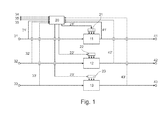
- Fig. 1 shows a first preferred embodiment of a system according to the invention, with three computational units 11, 12, 13 connected in parallel. They each receive input data 31, 32, 33, respectively, and perform a number of operations that result in their respective output data 41, 42, 43.
- the system also comprises a control unit 20 that receives input data 34, 35, 36 but also input data 31', 32', 33' connected to the input data 31, 32, 33 of each of the computational units 11, 12, 13 and input data 41', 42', 43' connected to the output data 41, 42, 43.
- any or all of these input data 36, 31', 32', 33', 41', 42', 43' can be combined and processed to determine current conditions in the system as a whole or in any part thereof, or desired properties of the operation of each computational unit 11, 12, 13.
- the control unit can also receive the input data 31, 32, 33 in their entirety or parts thereof, if desired. If only a part of the input data 31, 32, 33 is to be received, that part can for instance be information regarding a quality of the input data or the number of computational steps required to yield an output from said input data.
- the control unit 20 delivers control signals 21', 22', 23' to distributor units 21, 22, 23 that serves to control the operation of the computational units 11, 12, 13 by adjusting a series of parameters, as will be described in more detail below with reference to Fig. 3 . It is to be noted, however, that the function of the distributor units 21, 22, 23 can be integrated with the control unit 20 itself or with the computational units 11, 12, 13 in any suitable way as long as the control unit 20 can execute any type of control over the operation of the computational units 11, 12, 13
- the input data 31, 32, 33 can be processed to yield the output data 41, 42, 43.
- the input data 41, 42, 43 can in its turn be given as input data to other computational units or be combined or used independently as output data from the system as a whole.
- the system shown in Fig. 1 can be a part of a receiving MIMO device in a wireless network, such as a portable telephone or the like, and the purpose of the system is to process received input data 31, 32, 33, 36 from a series of antennas, for instance, by performing a number of operations in the computational units 11, 12, 13, in order to arrive at output data 41, 42, 43 that can be transmitted to another system for further processing or can be presented directly to a user of a portable phone, for instance.
- the input data 31, 32, 33 can be in the form of data streams that are generated at the antennas and can represent one antenna each or be either data streams divided to the computational units 11, 12, 13 from a number of antennas fewer than the number of computational units or data streams combined from a higher number of antennas.
- the input data 36 is sent to the control unit 20 and can be channel state information regarding any properties of the antennas, the system or transmission of the input data, for instance.
- Input data 34 can supply system information such as data speed and modulation, while input data 35 supplies information regarding a desired trade-off between energy consumption and quality, as will be described in more detail further below.
- Factors that can be determined include a quality of each of the data streams given as input data 31, 32, 33 as well as the number of calculations needed to arrive at the desired output data 41, 42, 43. It may well be that one of the computational units 11 will perform a significantly higher number of calculations than the others or that another computational unit 12 will receive input data 32 of a higher quality than the others and will be required to deliver a corresponding higher quality of output data 42. By processing such factors, a computational effort for each computational unit 11, 12, 13 can be determined.
- Input data of a higher quality may generally require fewer operations to yield a sufficient output, while input data of lower quality require more operations in order to increase the quality sufficiently to achieve suitable output. If the quality of the input data is too low overall, the computational unit 11, 12, 13 receiving the input data may in one embodiment dispense with performing operations on the input data altogether if it is determined that it would be too difficult to achieve at a sufficient quality level in the output data from the computational unit in question.
- the control unit 20 delivers a series of control signals 21', 22', 23' corresponding to the computational effort to distributor units 21, 22, 23 of each computational unit 11, 12, 13, and a number of parameters controlling the operation of each computational unit 11, 12, 13 are given by the distributor units 21, 22, 23 as further input to the computational units 11, 12, 13.
- one computational unit 11 is to perform a lower number of calculations than the others, parameters controlling algorithms of the computational unit 11 are adjusted. A clock rate of this unit 11 is decreased, allowing a longer processing time while at the same time a power supply to the unit 11 is decreased since the processing time is longer.
- the quality or processing speed can be lowered to a level where the output is of an acceptable quality and energy can be saved.
- a trade-off can be achieved where a small decrease of quality can result in saving a large amount of energy while at the same time delivering an acceptable and sufficient quality of output data.
- a careful monitoring of power consumption is important to prevent the device from consuming excessive amounts of energy or running out altogether if the device is portable and battery driven.
- Any computational unit 11, 12, 13 that is to perform calculations that can be slower or of a lower quality than the others can thereby be given less energy and resources be saved for later, when the requirements are different.
- This control is also very beneficial when a number of parallel computational units 11, 12, 13 are required to deliver their results simultaneously, since the unit or units that perform the less complex calculations can be slowed down to deliver their output data at the desired time and also saving energy by being slower than the others.
- Feedback signals from the output data 41', 42', 43' can be given to the control unit 20 for evaluation purposes to determine if the control signals 21', 22', 23' given have yielded the desired results. This can affect future control signals to the same computational unit or to another and serve to continuously adapt the performance of the system to achieve an optimal performance.
- feedback signals from the computational units 11, 12, 13 that are separate from the output data 41, 42, 43 can be given to the control unit 20.
- the control unit 20 can receive a quality information through at least some of its input 36, 31', 32', 33', 41', 42', 43' regarding one of the input data 31, 32, 33 or output data 41, 42, 43 and use this to calculate the computational effort for at least one of the computational units 11, 12, 13. This can be given directly from one of these inputs or be arrived at by combining a plurality of these inputs.
- a computational unit is a unit suitable for using some kind of input data for arriving at output data by performing some kind of calculations, preferably according to predetermined algorithm that can be adapted to suit the present situation.
- the input data can be any kind of electronic input such as a data stream for instance, and can be digital or analogue depending on the specific application, as can the output data.
- a control unit is understood to mean an electronic unit for receiving at least one input data and performing a calculation using this input data to arrive at an output in the form of at least one control signal that serves to adjust a parameter such as a clock rate, a power supply or parameters for an algorithm in another unit.
- a computational effort is an estimate of a complexity of a required process and a desired quality of the input to or output from this process.
- a quality information is taken to mean either an amount of information extracted from a signal, for instance measured in terms of mutual information, or an error rate, or a combination thereof.
- the mutual information essentially determines the chances that a result is accurate enough so that later processing steps using this result as input data can be successful.
- the error rate represents a probability that the result is incorrect and is measured in terms of bit error rate or frame error rate, which directly translates into speech quality for a voice call and lost data in a mobile broadband application, respectively.
- Fig. 2 shows an alternative embodiment of the method and system according to the invention, where a number of computational units 101, 102, 103 are mounted sequentially.
- a first computational unit 101 receives an input data 301 and delivers its output data 302 as input data to a second computational unit 102, which in turn delivers its output data 303 to a third computational unit 103 that delivers its output data 403 as output from the system as a whole.
- a control unit 200 receives input data 300 along with input data from each of the inputs and outputs 301', 302', 303', 403'.
- Each of the computational units can also give a feedback signal 501', 502', 503, respectively, to the control unit 200.
- the control unit 200 can process any or all of the input data 300, 301', 302', 303', 403', 501', 502', 503' to determine a computational effort for each of the computational units 101, 102, 103 and transmit control signals 201', 202', 203' corresponding to each of the computational efforts to distribution units 201, 202, 203 that in turn give a series of parameters to each computational unit 101, 102, 103.
- one of the steps 101 should give a result of a higher quality than the others or that another of the steps 102 is to perform a higher number of calculations than the others and requires a higher clock rate to complete these calculations in the same time that the unit mounted just before in the sequence so that its output can be given immediately before the time when new input can be received.
- control unit 200 can be controlled by the control unit 200 and a manner of operation that is good enough to deliver the desired results while at the same time saving energy by delivering results as late as possible and of a lower quality where possible, so that energy can be saved for the times and calculations that require additional resources.
- a combination of the parallel embodiment of Fig. 1 with the sequential embodiment of Fig. 2 can be suitable for use, where some computational units are connected in parallel and others in series in order to achieve at a desired result in a beneficial way.
- the system can be controlled by a single control unit 20, 200 or by a number of control units that control different aspects of the operation of the computational units or different sections of the system.
- Fig. 3 shows a detailed schematic view of a computational unit 11 with its input data 31 1 and output data 41 and with the distribution unit 21 being arranged to perform three different tasks for controlling the operation of the computational unit 11.
- a parameter mapping 211 serves to determine which parameters to insert for algorithm implementation in the computational unit 11 and these parameters are delivered one by one or in a suitable compact form.
- a frequency selection 212 determines a suitable clock signal to transmit to the computational unit 11
- a voltage selection 213 is determined and a power supply voltage given to the computational unit 11.
- These three tasks 211, 212, 213 are a representation of the computational effort determined in the control unit 20 (not shown) for this particular computational unit 11.
- the output data 41 already described in Fig. 1 is given, along with a feedback signal 41' that is transmitted along with a direct feedback signal 50' that are processed in a quality estimation unit 51 to determine the quality of the output signal and of the calculations performed in the computational unit 11.
- the quality estimation unit 51 gives a quality estimate signal 51' as output to the control unit 20 and this can be used to determine further control signals 21' to this computational unit 11 or others.
- the quality estimation unit 51 is separate from the control unit 20, unlike the embodiments of Fig. 1 and Fig. 2 where the feedback and the quality estimation is performed by the control unit 20 itself.
- the implementation that is most suitable can be chosen without affecting the scope of the invention.
- control is realised for example by data streams being executed in a software placed in or in conjunction with the control unit 20, 200, where each data stream can control one or more aspects or functions of the operation of the device or system.
- the computational effort is the energy required to perform an operation at a certain power supply voltage. This can be approximated by the number of operations, possibly weighted by the energy consumption of each operation. As an example, a square root would in most cases be a more complex operation compared to an addition, since the square root will take longer time and/or more energy to be performed.
Landscapes
- Engineering & Computer Science (AREA)
- Theoretical Computer Science (AREA)
- Physics & Mathematics (AREA)
- General Engineering & Computer Science (AREA)
- General Physics & Mathematics (AREA)
- Software Systems (AREA)
- Radio Transmission System (AREA)
- Power Sources (AREA)
- Mobile Radio Communication Systems (AREA)
Abstract
The present invention relates to a method for controlling the operation of an electronic device for processing data, said device comprising at least one computational unit for receiving input data and processing said input data for generating output data, and further comprising a control unit for receiving at least a part of said input data and delivering at least one control signal to said computational unit for controlling an operation of said computational unit, wherein said control unit using said input data to determine a computational effort and further using said control signal to control at least one parameter of said computational unit depending on said computational effort.
Description
- The present invention relates generally to a method for controlling the operation of an electronic device for processing data. More particularly, the present invention relates to a method for controlling a data processing device dependent on load related parameters.
- Electronic devices for performing digital signal processing are becoming increasingly common within multiple technical fields, and with the increasing number of mobile devices and systems usually having a limited space for processing components there is an increasing demand for performing complex computations at high speed while at the same time optimising the performance of the system with regards to a number of parameters.
- Especially in areas where computationally demanding tasks are to be performed, such as separating and processing information in data streams received by a plurality of antennas that are affected by cross-talk, a phenomenon where signals or data streams transmitted in one circuit are affected by signals or data streams transmitted in another, optimising the operation of the processing device, such as a multiple-input multiple-output (MIMO) communication receiver, is critical in order to achieve satisfactory results.
- One method for supporting a plurality of MIMO modes in a wireless communication system is shown by
US2009/0034639 (Hwang ), where operation of a series of MIMO modes is controlled. The method presented does not, however, take into account the situations that may arise when communication devices that are running on a limited power supply are used, and does not present a solution suitable for use with such limited resources. - There is therefore a need for providing an improved method and system for controlling the operation of an electronic device processing data.
- The object of the present invention is to solve or at least to minimise the problems described above. This is achieved through a method according to the preamble of claim 1, wherein a control unit uses input data to determine a computational effort and further uses a control signal to control at least one parameter of a computational unit depending on said computational effort. Thereby, the operation of the computational unit can be controlled depending on the input data to that unit, so that resources allotted to the computational unit can be sufficient for performing the computational tasks required while at the same time kept as low as possible.
- By controlling any or all of a number of parameters, the operation of the computational unit or units can be controlled so that a result of a desired quality or at a desired energy consumption is delivered as output data at a desired time. Among the parameters that can be controlled in this manner are a clock rate, a supply voltage and a process complexity. The speed and quality of the operation of computational units can by altering the parameters for each computational unit individually be controlled so that sufficient but not excessive resources in the form of electrical energy is allotted to the unit and so that the process steps being performed in the unit can be performed within a desired time. This is especially beneficial when considering large systems with a number of computational units placed in parallel, since every unit can be made to yield output data at the same time, even if the number of process steps differ between the units and if the overall quality of the results also differs. It is also beneficial when considering a number of computational units placed in series, since the delivery of output data from one unit given as input data to the next can be timed in the most beneficial manner and further increase the efficiency of the system of computational units. It can for instance be decided that certain units need to operate at a higher speed and/or yield a result of a higher quality than others and the energy resources can be distributed accordingly.
- From each computational unit, a feedback signal can be given to the control unit, thereby giving the opportunity of including this signal as input data for the control unit. Further control signals to the same computational unit or to another, such as that placed directly afterwards in a series, can thereby be affected by the feedback signal which gives an increased possibility of optimising operation of the entire system.
- Further advantages and benefits of the invention and the described embodiments thereof will become apparent from the detailed description below.
- The invention will now be described in more detail with reference to the appended drawings, wherein
-
Fig. 1 shows a schematic view of a system according to a first preferred embodiment of the invention, -
Fig. 2 shows a schematic view of a system according to a second preferred embodiment of the invention, and -
Fig. 3 shows a schematic view of a computational unit along with the different types of input data received and the output data given by the unit. -
Fig. 1 shows a first preferred embodiment of a system according to the invention, with threecomputational units input data respective output data control unit 20 that receivesinput data input data computational units output data control unit 20, any or all of theseinput data 36, 31', 32', 33', 41', 42', 43' can be combined and processed to determine current conditions in the system as a whole or in any part thereof, or desired properties of the operation of eachcomputational unit input data input data - The
control unit 20 delivers control signals 21', 22', 23' todistributor units computational units Fig. 3 . It is to be noted, however, that the function of thedistributor units control unit 20 itself or with thecomputational units control unit 20 can execute any type of control over the operation of thecomputational units - By thus supplying control parameters that affect the operation of the
computational units input data output data input data - The operation of the system and method according to this preferred embodiment will now be described.
- The system shown in
Fig. 1 can be a part of a receiving MIMO device in a wireless network, such as a portable telephone or the like, and the purpose of the system is to process receivedinput data computational units output data - The
input data computational units input data 36 is sent to thecontrol unit 20 and can be channel state information regarding any properties of the antennas, the system or transmission of the input data, for instance.Input data 34 can supply system information such as data speed and modulation, whileinput data 35 supplies information regarding a desired trade-off between energy consumption and quality, as will be described in more detail further below. Integrated with any of theseinput data input data - By using the different kinds of
input data 36, 31', 32', 33' received by thecontrol unit 20, comprehensive information regarding the requirements of thecomputational units input data output data computational units 11 will perform a significantly higher number of calculations than the others or that anothercomputational unit 12 will receiveinput data 32 of a higher quality than the others and will be required to deliver a corresponding higher quality ofoutput data 42. By processing such factors, a computational effort for eachcomputational unit - Input data of a higher quality may generally require fewer operations to yield a sufficient output, while input data of lower quality require more operations in order to increase the quality sufficiently to achieve suitable output. If the quality of the input data is too low overall, the
computational unit - The
control unit 20 delivers a series of control signals 21', 22', 23' corresponding to the computational effort todistributor units computational unit computational unit distributor units computational units - If for instance one
computational unit 11 is to perform a lower number of calculations than the others, parameters controlling algorithms of thecomputational unit 11 are adjusted. A clock rate of thisunit 11 is decreased, allowing a longer processing time while at the same time a power supply to theunit 11 is decreased since the processing time is longer. - By performing such adjustments, the quality or processing speed can be lowered to a level where the output is of an acceptable quality and energy can be saved. By thus adjusting resources supplied to a
computational unit 11, a trade-off can be achieved where a small decrease of quality can result in saving a large amount of energy while at the same time delivering an acceptable and sufficient quality of output data. In most devices for performing complex calculations, a careful monitoring of power consumption is important to prevent the device from consuming excessive amounts of energy or running out altogether if the device is portable and battery driven. By according to the method and system presented herein carefully monitoring the requirements of eachcomputational unit computational unit computational units - Feedback signals from the output data 41', 42', 43' can be given to the
control unit 20 for evaluation purposes to determine if the control signals 21', 22', 23' given have yielded the desired results. This can affect future control signals to the same computational unit or to another and serve to continuously adapt the performance of the system to achieve an optimal performance. Alternatively, feedback signals from thecomputational units output data control unit 20. - The
control unit 20 can receive a quality information through at least some of itsinput 36, 31', 32', 33', 41', 42', 43' regarding one of theinput data output data computational units - As understood herein, a computational unit is a unit suitable for using some kind of input data for arriving at output data by performing some kind of calculations, preferably according to predetermined algorithm that can be adapted to suit the present situation. The input data can be any kind of electronic input such as a data stream for instance, and can be digital or analogue depending on the specific application, as can the output data. A control unit is understood to mean an electronic unit for receiving at least one input data and performing a calculation using this input data to arrive at an output in the form of at least one control signal that serves to adjust a parameter such as a clock rate, a power supply or parameters for an algorithm in another unit. A computational effort is an estimate of a complexity of a required process and a desired quality of the input to or output from this process. A quality information is taken to mean either an amount of information extracted from a signal, for instance measured in terms of mutual information, or an error rate, or a combination thereof. The mutual information essentially determines the chances that a result is accurate enough so that later processing steps using this result as input data can be successful. The error rate represents a probability that the result is incorrect and is measured in terms of bit error rate or frame error rate, which directly translates into speech quality for a voice call and lost data in a mobile broadband application, respectively.
-
Fig. 2 shows an alternative embodiment of the method and system according to the invention, where a number ofcomputational units computational unit 101 receives aninput data 301 and delivers itsoutput data 302 as input data to a secondcomputational unit 102, which in turn delivers itsoutput data 303 to a thirdcomputational unit 103 that delivers itsoutput data 403 as output from the system as a whole. Acontrol unit 200 receivesinput data 300 along with input data from each of the inputs and outputs 301', 302', 303', 403'. Each of the computational units can also give afeedback signal 501', 502', 503, respectively, to thecontrol unit 200. Thecontrol unit 200 can process any or all of theinput data 300, 301', 302', 303', 403', 501', 502', 503' to determine a computational effort for each of thecomputational units distribution units computational unit - The operation of the alternative embodiment of the system shown by
Fig. 2 is as a whole similar to that of the embodiment shown inFig. 1 , with the main difference that output from one computational unit now is used as input to another. Thecomputational units Fig. 1 , the speed and quality of the different processing steps that each computational unit represents can be adapted to suit the surrounding steps. It may be that one of thesteps 101 should give a result of a higher quality than the others or that another of thesteps 102 is to perform a higher number of calculations than the others and requires a higher clock rate to complete these calculations in the same time that the unit mounted just before in the sequence so that its output can be given immediately before the time when new input can be received. - These factors, along with others, can be controlled by the
control unit 200 and a manner of operation that is good enough to deliver the desired results while at the same time saving energy by delivering results as late as possible and of a lower quality where possible, so that energy can be saved for the times and calculations that require additional resources. - By adjusting a trade-off between energy consumption and performance of the
computational units computational units computational unit 11 may need to perform many operations at a high pace to be able to produce a desired output, but the othercomputational units other units unit 11 with a higher pace, resulting in a large amount of energy being saved. The benefits from allowing theseother units units - In practice, a combination of the parallel embodiment of
Fig. 1 with the sequential embodiment ofFig. 2 can be suitable for use, where some computational units are connected in parallel and others in series in order to achieve at a desired result in a beneficial way. The system can be controlled by asingle control unit - Of course, a very small system with only one
computational unit 11 can also be employed with acontrol unit 20 arranged to control the operation of this single unit in an optimal way. -
Fig. 3 shows a detailed schematic view of acomputational unit 11 with itsinput data 31 1 andoutput data 41 and with thedistribution unit 21 being arranged to perform three different tasks for controlling the operation of thecomputational unit 11. In a first of these tasks, aparameter mapping 211 serves to determine which parameters to insert for algorithm implementation in thecomputational unit 11 and these parameters are delivered one by one or in a suitable compact form. In a second task, afrequency selection 212 determines a suitable clock signal to transmit to thecomputational unit 11, and in a third task, avoltage selection 213 is determined and a power supply voltage given to thecomputational unit 11. These threetasks computational unit 11. - As outputs from the
computational unit 11, theoutput data 41 already described inFig. 1 is given, along with a feedback signal 41' that is transmitted along with a direct feedback signal 50' that are processed in aquality estimation unit 51 to determine the quality of the output signal and of the calculations performed in thecomputational unit 11. Thequality estimation unit 51 gives a quality estimate signal 51' as output to thecontrol unit 20 and this can be used to determine further control signals 21' to thiscomputational unit 11 or others. In this embodiment, thequality estimation unit 51 is separate from thecontrol unit 20, unlike the embodiments ofFig. 1 andFig. 2 where the feedback and the quality estimation is performed by thecontrol unit 20 itself. In any given embodiment, the implementation that is most suitable can be chosen without affecting the scope of the invention. - The control is realised for example by data streams being executed in a software placed in or in conjunction with the
control unit - The computational effort is the energy required to perform an operation at a certain power supply voltage. This can be approximated by the number of operations, possibly weighted by the energy consumption of each operation. As an example, a square root would in most cases be a more complex operation compared to an addition, since the square root will take longer time and/or more energy to be performed.
- The invention is not to be seen as limited by the embodiments described above, but can be varied within the scope of the appended claims, as will be readily understood by the person skilled in the art.
Claims (9)
- Method for controlling the operation of an electronic device for processing data, said device comprising at least one computational unit for receiving input data and processing said input data for generating output data, and further comprising a control unit for receiving at least a part of said input data and delivering at least one control signal to said computational unit for controlling an operation of said computational unit, characterised in said control unit using said input data to determine a computational effort and further using said control signal to control at least one parameter of said computational unit depending on said determined computational effort.
- Method according to claim 1, wherein said computational effort is determined from a quality information of said input data.
- Method according to claim 1 or 2, wherein said computational effort is determined from an amount of available energy in an energy supply.
- Method according to any of claims 1-3, wherein said computational effort is determined by combining a quality information of a plurality of input data.
- Method according to any of the claims 1-4, wherein said computational unit delivers a feedback signal to said control unit.
- Method according to claim 5, wherein said control unit determines said computational effort based at least partly on said feedback signal and delivers a control signal to the same computational unit depending on said computational effort.
- Method according to claim 5, wherein said device comprises at least two computational units that are connected in a series said control unit determines the computational effort based at least partly on a feedback signal from a first of said computational units and delivers a control signal to a second of said computational units depending on said computational effort.
- Method according to any of the previous claims, wherein said parameter is at least one of a clock rate, a supply voltage or a process complexity.
- System for controlling the operation of an electronic device for processing data, said system comprising at least one computational unit arranged to receive an input data and perform at least one operation on said input data to yield an output data, a control unit arranged to receive at least a part of said input data and to deliver at least one control signal to said computational unit, characterised in said control unit being arranged to use said input data to determine a computational effort and further being arranged to use said control signal to control at least one parameter of said computational unit depending on said computational effort.
Priority Applications (4)
| Application Number | Priority Date | Filing Date | Title |
|---|---|---|---|
| EP10162325A EP2385440A1 (en) | 2010-05-07 | 2010-05-07 | Method and system for controlling the operation of an electronic device |
| PCT/EP2011/057410 WO2011138464A1 (en) | 2010-05-07 | 2011-05-09 | Method and system for controlling the operation of an electronic device |
| EP11720741A EP2567303A1 (en) | 2010-05-07 | 2011-05-09 | Method and system for controlling the operation of an electronic device |
| US13/696,563 US9720470B2 (en) | 2010-05-07 | 2011-05-09 | Method and system for controlling the operation of an electronic device |
Applications Claiming Priority (1)
| Application Number | Priority Date | Filing Date | Title |
|---|---|---|---|
| EP10162325A EP2385440A1 (en) | 2010-05-07 | 2010-05-07 | Method and system for controlling the operation of an electronic device |
Publications (1)
| Publication Number | Publication Date |
|---|---|
| EP2385440A1 true EP2385440A1 (en) | 2011-11-09 |
Family
ID=42983802
Family Applications (2)
| Application Number | Title | Priority Date | Filing Date |
|---|---|---|---|
| EP10162325A Withdrawn EP2385440A1 (en) | 2010-05-07 | 2010-05-07 | Method and system for controlling the operation of an electronic device |
| EP11720741A Withdrawn EP2567303A1 (en) | 2010-05-07 | 2011-05-09 | Method and system for controlling the operation of an electronic device |
Family Applications After (1)
| Application Number | Title | Priority Date | Filing Date |
|---|---|---|---|
| EP11720741A Withdrawn EP2567303A1 (en) | 2010-05-07 | 2011-05-09 | Method and system for controlling the operation of an electronic device |
Country Status (3)
| Country | Link |
|---|---|
| US (1) | US9720470B2 (en) |
| EP (2) | EP2385440A1 (en) |
| WO (1) | WO2011138464A1 (en) |
Citations (2)
| Publication number | Priority date | Publication date | Assignee | Title |
|---|---|---|---|---|
| US20080059823A1 (en) * | 2006-08-31 | 2008-03-06 | Ati Technologies Inc. | Battery-powered device with reduced power consumption and method thereof |
| US20090034639A1 (en) | 2007-07-31 | 2009-02-05 | Samsung Electronics Co., Ltd. | Apparatus and method for supporting a plurality of MIMO modes in a wireless communication system |
Family Cites Families (7)
| Publication number | Priority date | Publication date | Assignee | Title |
|---|---|---|---|---|
| US6693953B2 (en) * | 1998-09-30 | 2004-02-17 | Skyworks Solutions, Inc. | Adaptive wireless communication receiver |
| GB2395625B (en) * | 2002-11-20 | 2005-01-12 | Toshiba Res Europ Ltd | Reduced power consumption signal processing methods and apparatus |
| TW200805047A (en) * | 2005-12-23 | 2008-01-16 | Koninkl Philips Electronics Nv | Performance analysis based system level power management |
| US7930574B2 (en) * | 2007-12-31 | 2011-04-19 | Intel Corporation | Thread migration to improve power efficiency in a parallel processing environment |
| JP2010141821A (en) * | 2008-12-15 | 2010-06-24 | Toshiba Corp | Streaming processor and processor system |
| US8239699B2 (en) * | 2009-06-26 | 2012-08-07 | Intel Corporation | Method and apparatus for performing energy-efficient network packet processing in a multi processor core system |
| US9563250B2 (en) * | 2009-12-16 | 2017-02-07 | Qualcomm Incorporated | System and method for controlling central processing unit power based on inferred workload parallelism |
-
2010
- 2010-05-07 EP EP10162325A patent/EP2385440A1/en not_active Withdrawn
-
2011
- 2011-05-09 US US13/696,563 patent/US9720470B2/en not_active Expired - Fee Related
- 2011-05-09 EP EP11720741A patent/EP2567303A1/en not_active Withdrawn
- 2011-05-09 WO PCT/EP2011/057410 patent/WO2011138464A1/en not_active Ceased
Patent Citations (2)
| Publication number | Priority date | Publication date | Assignee | Title |
|---|---|---|---|---|
| US20080059823A1 (en) * | 2006-08-31 | 2008-03-06 | Ati Technologies Inc. | Battery-powered device with reduced power consumption and method thereof |
| US20090034639A1 (en) | 2007-07-31 | 2009-02-05 | Samsung Electronics Co., Ltd. | Apparatus and method for supporting a plurality of MIMO modes in a wireless communication system |
Non-Patent Citations (3)
| Title |
|---|
| CHANDRAKASAN A ET AL: "DATA DRIVEN SIGNAL PROCESSING: AN APPROACH FOR ENERGY EFFICIENT COMPUTING", ISLPED. PROCEEDINGS OF THE INTERNATIONAL SYMPOSIUM ON LOW POWERELECTRONICS AND DESIGN, XX, XX, 1 January 1996 (1996-01-01), pages 347 - 352, XP001146496 * |
| M. SHAFIQUE ET AL: "3-tier dynamically adaptive power-aware motion estimator for h.264/AVC video encoding", PROCEEDING OF THE 13TH INTERNATIONAL SYMPOSIUM ON LOW POWER ELECTRONICS AND DESIGN, 11 August 2008 (2008-08-11), Bangalore, India, pages 147 - 152, XP002606885, Retrieved from the Internet <URL:http://delivery.acm.org/10.1145/1400000/1393962/p147-shafique.pdf?key1=1393962&key2=8880808821&coll=GUIDE&dl=GUIDE&CFID=110377334&CFTOKEN=51813284> [retrieved on 20101019], DOI: 10.1145/1393921.1393962 * |
| VADIM GUTNIK ET AL: "Embedded Power Supply for Low-Power DSP", IEEE TRANSACTIONS ON VERY LARGE SCALE INTEGRATION (VLSI) SYSTEMS, vol. 5, no. 4, 1 December 1997 (1997-12-01), IEEE SERVICE CENTER, PISCATAWAY, NJ, US, pages 425 - 435, XP011063313, ISSN: 1063-8210 * |
Also Published As
| Publication number | Publication date |
|---|---|
| US20130091367A1 (en) | 2013-04-11 |
| US9720470B2 (en) | 2017-08-01 |
| WO2011138464A1 (en) | 2011-11-10 |
| EP2567303A1 (en) | 2013-03-13 |
Similar Documents
| Publication | Publication Date | Title |
|---|---|---|
| US6778612B1 (en) | Space-time processing for wireless systems with multiple transmit and receive antennas | |
| CN115175336A (en) | Resource determination method, device, terminal, network side equipment and storage medium | |
| KR101285027B1 (en) | Multimode communication terminal and multimode communication implementation method | |
| EP2912896B1 (en) | Dynamic power management in a wireless device | |
| EP2469940A2 (en) | Wireless communication system with controlled power supply of a base station | |
| CN102893680A (en) | mobile communication terminal | |
| CN105991229A (en) | Data transmission method and device applied to time division duplex system | |
| JP2018148619A (en) | Wireless power supply control device, power transmitter, and power receiver | |
| WO2019210953A1 (en) | Systems and methods of controlling a component of a network node in a communication system | |
| CN113645147A (en) | Token updating system and method of flow shaper | |
| TW201521401A (en) | Method and apparatus for managing processing in TDD frames to enable power dissipation reduction | |
| CN105451340B (en) | A method, device and terminal equipment for carrier aggregation | |
| US8644335B2 (en) | Access node for a communications network | |
| WO2024088161A1 (en) | Information transmission method and apparatus, information processing method and apparatus, and communication device | |
| CN104540198A (en) | Mobile terminal as well as power regulation method and power regulation device of WLAN of mobile terminal | |
| EP2180571A2 (en) | Centralized energy management in distributed systems | |
| CN105375653B (en) | A kind of wireless charging emitter and method | |
| CN112148482A (en) | Edge computing task scheduling method based on combination with load balancing | |
| EP2638691B1 (en) | Subscriber line power distribution system | |
| CN104955137B (en) | Wireless device and its broadcasting method | |
| CN105449832B (en) | A UPS current sharing control system | |
| US9720470B2 (en) | Method and system for controlling the operation of an electronic device | |
| KR20180091696A (en) | Apparatus and Method for Reducing PAPR using SLM | |
| CN116488751A (en) | Transmission method, apparatus and equipment | |
| CN114785376A (en) | Frequency voltage pre-configuration method and related device |
Legal Events
| Date | Code | Title | Description |
|---|---|---|---|
| AK | Designated contracting states |
Kind code of ref document: A1 Designated state(s): AL AT BE BG CH CY CZ DE DK EE ES FI FR GB GR HR HU IE IS IT LI LT LU LV MC MK MT NL NO PL PT RO SE SI SK SM TR |
|
| AX | Request for extension of the european patent |
Extension state: BA ME RS |
|
| PUAI | Public reference made under article 153(3) epc to a published international application that has entered the european phase |
Free format text: ORIGINAL CODE: 0009012 |
|
| STAA | Information on the status of an ep patent application or granted ep patent |
Free format text: STATUS: THE APPLICATION IS DEEMED TO BE WITHDRAWN |
|
| 18D | Application deemed to be withdrawn |
Effective date: 20120510 |