EP2385128A1 - Modulation of germination, elongation growth and flowering time in plants - Google Patents
Modulation of germination, elongation growth and flowering time in plants Download PDFInfo
- Publication number
- EP2385128A1 EP2385128A1 EP10004896A EP10004896A EP2385128A1 EP 2385128 A1 EP2385128 A1 EP 2385128A1 EP 10004896 A EP10004896 A EP 10004896A EP 10004896 A EP10004896 A EP 10004896A EP 2385128 A1 EP2385128 A1 EP 2385128A1
- Authority
- EP
- European Patent Office
- Prior art keywords
- nucleic acid
- polypeptide
- plant cell
- seq
- acid coding
- Prior art date
- Legal status (The legal status is an assumption and is not a legal conclusion. Google has not performed a legal analysis and makes no representation as to the accuracy of the status listed.)
- Ceased
Links
- 230000017260 vegetative to reproductive phase transition of meristem Effects 0.000 title claims abstract description 38
- 230000035784 germination Effects 0.000 title claims abstract description 37
- 230000012010 growth Effects 0.000 title claims abstract description 26
- 150000007523 nucleic acids Chemical class 0.000 claims abstract description 123
- 102000039446 nucleic acids Human genes 0.000 claims abstract description 117
- 108020004707 nucleic acids Proteins 0.000 claims abstract description 117
- 230000000694 effects Effects 0.000 claims abstract description 63
- 108090000623 proteins and genes Proteins 0.000 claims abstract description 61
- 238000000034 method Methods 0.000 claims abstract description 37
- 102000004169 proteins and genes Human genes 0.000 claims abstract description 21
- 230000008638 plant developmental process Effects 0.000 claims abstract description 6
- 229920001184 polypeptide Polymers 0.000 claims description 136
- 108090000765 processed proteins & peptides Proteins 0.000 claims description 136
- 102000004196 processed proteins & peptides Human genes 0.000 claims description 136
- 125000003275 alpha amino acid group Chemical group 0.000 claims description 45
- 108091028043 Nucleic acid sequence Proteins 0.000 claims description 36
- 230000014509 gene expression Effects 0.000 claims description 24
- 230000002018 overexpression Effects 0.000 claims description 22
- 150000001413 amino acids Chemical class 0.000 claims description 21
- 239000012634 fragment Substances 0.000 claims description 21
- 230000001965 increasing effect Effects 0.000 claims description 21
- 239000002773 nucleotide Substances 0.000 claims description 21
- 125000003729 nucleotide group Chemical group 0.000 claims description 21
- 230000001105 regulatory effect Effects 0.000 claims description 20
- 230000035772 mutation Effects 0.000 claims description 19
- 230000003247 decreasing effect Effects 0.000 claims description 13
- 239000013598 vector Substances 0.000 claims description 13
- 238000011144 upstream manufacturing Methods 0.000 claims description 12
- 230000037431 insertion Effects 0.000 claims description 11
- 238000003780 insertion Methods 0.000 claims description 11
- 230000037430 deletion Effects 0.000 claims description 10
- 238000012217 deletion Methods 0.000 claims description 10
- 108091032973 (ribonucleotides)n+m Proteins 0.000 claims description 9
- 102000040650 (ribonucleotides)n+m Human genes 0.000 claims description 8
- 230000002829 reductive effect Effects 0.000 claims description 8
- 238000012225 targeting induced local lesions in genomes Methods 0.000 claims description 8
- 238000013518 transcription Methods 0.000 claims description 8
- 230000035897 transcription Effects 0.000 claims description 8
- PLUBXMRUUVWRLT-UHFFFAOYSA-N Ethyl methanesulfonate Chemical compound CCOS(C)(=O)=O PLUBXMRUUVWRLT-UHFFFAOYSA-N 0.000 claims description 7
- 230000018109 developmental process Effects 0.000 claims description 7
- 230000004568 DNA-binding Effects 0.000 claims description 6
- 230000027455 binding Effects 0.000 claims description 6
- 231100000219 mutagenic Toxicity 0.000 claims description 6
- 230000003505 mutagenic effect Effects 0.000 claims description 6
- FWMNVWWHGCHHJJ-SKKKGAJSSA-N 4-amino-1-[(2r)-6-amino-2-[[(2r)-2-[[(2r)-2-[[(2r)-2-amino-3-phenylpropanoyl]amino]-3-phenylpropanoyl]amino]-4-methylpentanoyl]amino]hexanoyl]piperidine-4-carboxylic acid Chemical compound C([C@H](C(=O)N[C@H](CC(C)C)C(=O)N[C@H](CCCCN)C(=O)N1CCC(N)(CC1)C(O)=O)NC(=O)[C@H](N)CC=1C=CC=CC=1)C1=CC=CC=C1 FWMNVWWHGCHHJJ-SKKKGAJSSA-N 0.000 claims description 5
- 230000005855 radiation Effects 0.000 claims description 5
- 108700009124 Transcription Initiation Site Proteins 0.000 claims description 4
- 238000009396 hybridization Methods 0.000 claims description 4
- 239000003471 mutagenic agent Substances 0.000 claims description 4
- 238000012163 sequencing technique Methods 0.000 claims description 4
- 108091028664 Ribonucleotide Proteins 0.000 claims description 2
- 230000000692 anti-sense effect Effects 0.000 claims description 2
- 230000000295 complement effect Effects 0.000 claims description 2
- 239000002336 ribonucleotide Substances 0.000 claims description 2
- 125000002652 ribonucleotide group Chemical group 0.000 claims description 2
- IXORZMNAPKEEDV-UHFFFAOYSA-N gibberellic acid GA3 Natural products OC(=O)C1C2(C3)CC(=C)C3(O)CCC2C2(C=CC3O)C1C3(C)C(=O)O2 IXORZMNAPKEEDV-UHFFFAOYSA-N 0.000 abstract description 35
- 239000005980 Gibberellic acid Substances 0.000 abstract description 34
- IXORZMNAPKEEDV-OBDJNFEBSA-N gibberellin A3 Chemical compound C([C@@]1(O)C(=C)C[C@@]2(C1)[C@H]1C(O)=O)C[C@H]2[C@]2(C=C[C@@H]3O)[C@H]1[C@]3(C)C(=O)O2 IXORZMNAPKEEDV-OBDJNFEBSA-N 0.000 abstract description 34
- 230000002401 inhibitory effect Effects 0.000 abstract description 7
- 230000004936 stimulating effect Effects 0.000 abstract description 7
- 230000019491 signal transduction Effects 0.000 abstract description 4
- 241000196324 Embryophyta Species 0.000 description 115
- 210000004027 cell Anatomy 0.000 description 50
- 241000219195 Arabidopsis thaliana Species 0.000 description 12
- 235000007164 Oryza sativa Nutrition 0.000 description 9
- 239000005090 green fluorescent protein Substances 0.000 description 9
- 230000005764 inhibitory process Effects 0.000 description 9
- 230000009261 transgenic effect Effects 0.000 description 9
- 241000209140 Triticum Species 0.000 description 8
- 230000006870 function Effects 0.000 description 8
- 108010043121 Green Fluorescent Proteins Proteins 0.000 description 7
- 102000004144 Green Fluorescent Proteins Human genes 0.000 description 7
- 241000218976 Populus trichocarpa Species 0.000 description 7
- 235000021307 Triticum Nutrition 0.000 description 7
- 240000006365 Vitis vinifera Species 0.000 description 7
- 235000014787 Vitis vinifera Nutrition 0.000 description 7
- 230000003111 delayed effect Effects 0.000 description 7
- 235000002532 grape seed extract Nutrition 0.000 description 7
- 240000007594 Oryza sativa Species 0.000 description 6
- 240000006394 Sorghum bicolor Species 0.000 description 6
- 235000007230 Sorghum bicolor Nutrition 0.000 description 6
- 230000015572 biosynthetic process Effects 0.000 description 6
- 235000013399 edible fruits Nutrition 0.000 description 6
- 230000004044 response Effects 0.000 description 6
- 230000000638 stimulation Effects 0.000 description 6
- 108091005957 yellow fluorescent proteins Proteins 0.000 description 6
- 240000000528 Ricinus communis Species 0.000 description 5
- 235000004443 Ricinus communis Nutrition 0.000 description 5
- 210000004899 c-terminal region Anatomy 0.000 description 5
- 230000037361 pathway Effects 0.000 description 5
- 108700028369 Alleles Proteins 0.000 description 4
- 240000005979 Hordeum vulgare Species 0.000 description 4
- 235000007340 Hordeum vulgare Nutrition 0.000 description 4
- 240000008042 Zea mays Species 0.000 description 4
- 235000007244 Zea mays Nutrition 0.000 description 4
- 230000004883 flower formation Effects 0.000 description 4
- 230000002779 inactivation Effects 0.000 description 4
- 230000001404 mediated effect Effects 0.000 description 4
- 235000015097 nutrients Nutrition 0.000 description 4
- 230000009466 transformation Effects 0.000 description 4
- 230000009105 vegetative growth Effects 0.000 description 4
- 241000209094 Oryza Species 0.000 description 3
- 241000218977 Populus trichocarpa x Populus deltoides Species 0.000 description 3
- 238000009395 breeding Methods 0.000 description 3
- 230000001488 breeding effect Effects 0.000 description 3
- 230000007423 decrease Effects 0.000 description 3
- 238000002474 experimental method Methods 0.000 description 3
- 108020001507 fusion proteins Proteins 0.000 description 3
- 102000037865 fusion proteins Human genes 0.000 description 3
- 238000004519 manufacturing process Methods 0.000 description 3
- 108091070501 miRNA Proteins 0.000 description 3
- 231100000350 mutagenesis Toxicity 0.000 description 3
- 238000002703 mutagenesis Methods 0.000 description 3
- 230000008635 plant growth Effects 0.000 description 3
- 230000001850 reproductive effect Effects 0.000 description 3
- 235000009566 rice Nutrition 0.000 description 3
- 238000002864 sequence alignment Methods 0.000 description 3
- 230000011664 signaling Effects 0.000 description 3
- 101001125874 Autographa californica nuclear polyhedrosis virus Per os infectivity factor 3 Proteins 0.000 description 2
- 241000701489 Cauliflower mosaic virus Species 0.000 description 2
- 108020004414 DNA Proteins 0.000 description 2
- 108700028146 Genetic Enhancer Elements Proteins 0.000 description 2
- 101150113153 PIF1 gene Proteins 0.000 description 2
- 101100408281 Schizosaccharomyces pombe (strain 972 / ATCC 24843) pfh1 gene Proteins 0.000 description 2
- 108020004459 Small interfering RNA Proteins 0.000 description 2
- HCHKCACWOHOZIP-UHFFFAOYSA-N Zinc Chemical compound [Zn] HCHKCACWOHOZIP-UHFFFAOYSA-N 0.000 description 2
- 230000009471 action Effects 0.000 description 2
- 230000004913 activation Effects 0.000 description 2
- 125000000539 amino acid group Chemical group 0.000 description 2
- 239000003623 enhancer Substances 0.000 description 2
- 230000007613 environmental effect Effects 0.000 description 2
- 238000012252 genetic analysis Methods 0.000 description 2
- 238000005213 imbibition Methods 0.000 description 2
- 230000001939 inductive effect Effects 0.000 description 2
- 108020004999 messenger RNA Proteins 0.000 description 2
- 239000002679 microRNA Substances 0.000 description 2
- 230000036961 partial effect Effects 0.000 description 2
- 230000017854 proteolysis Effects 0.000 description 2
- 241000894007 species Species 0.000 description 2
- 238000010561 standard procedure Methods 0.000 description 2
- 230000014616 translation Effects 0.000 description 2
- XLYOFNOQVPJJNP-UHFFFAOYSA-N water Substances O XLYOFNOQVPJJNP-UHFFFAOYSA-N 0.000 description 2
- 239000011701 zinc Substances 0.000 description 2
- 229910052725 zinc Inorganic materials 0.000 description 2
- 241000589155 Agrobacterium tumefaciens Species 0.000 description 1
- 241000219194 Arabidopsis Species 0.000 description 1
- 101100438273 Arabidopsis thaliana CAN1 gene Proteins 0.000 description 1
- 101100121137 Arabidopsis thaliana GATA22 gene Proteins 0.000 description 1
- 239000002028 Biomass Substances 0.000 description 1
- 101150096513 CGA1 gene Proteins 0.000 description 1
- 230000033616 DNA repair Effects 0.000 description 1
- 206010013883 Dwarfism Diseases 0.000 description 1
- 208000031448 Genomic Instability Diseases 0.000 description 1
- 229930191978 Gibberellin Natural products 0.000 description 1
- 244000061176 Nicotiana tabacum Species 0.000 description 1
- 235000002637 Nicotiana tabacum Nutrition 0.000 description 1
- 101100439291 Oryza sativa subsp. japonica CGA1 gene Proteins 0.000 description 1
- 101100448567 Rattus norvegicus Cga gene Proteins 0.000 description 1
- 230000010632 Transcription Factor Activity Effects 0.000 description 1
- 108091023040 Transcription factor Proteins 0.000 description 1
- 102000040945 Transcription factor Human genes 0.000 description 1
- 108700019146 Transgenes Proteins 0.000 description 1
- 230000006399 behavior Effects 0.000 description 1
- 238000004113 cell culture Methods 0.000 description 1
- 239000002962 chemical mutagen Substances 0.000 description 1
- 238000002487 chromatin immunoprecipitation Methods 0.000 description 1
- 238000003776 cleavage reaction Methods 0.000 description 1
- 238000012258 culturing Methods 0.000 description 1
- 230000002950 deficient Effects 0.000 description 1
- 230000001419 dependent effect Effects 0.000 description 1
- 238000011161 development Methods 0.000 description 1
- 210000005069 ears Anatomy 0.000 description 1
- 238000005516 engineering process Methods 0.000 description 1
- 230000004720 fertilization Effects 0.000 description 1
- 230000004927 fusion Effects 0.000 description 1
- 235000003869 genetically modified organism Nutrition 0.000 description 1
- 238000003205 genotyping method Methods 0.000 description 1
- 239000003448 gibberellin Substances 0.000 description 1
- 108091005678 gibberellin receptors Proteins 0.000 description 1
- 239000000122 growth hormone Substances 0.000 description 1
- 229910052739 hydrogen Inorganic materials 0.000 description 1
- 230000002209 hydrophobic effect Effects 0.000 description 1
- 230000006872 improvement Effects 0.000 description 1
- 230000000415 inactivating effect Effects 0.000 description 1
- 230000010354 integration Effects 0.000 description 1
- 230000003993 interaction Effects 0.000 description 1
- 239000000463 material Substances 0.000 description 1
- 238000007431 microscopic evaluation Methods 0.000 description 1
- 238000012544 monitoring process Methods 0.000 description 1
- 230000030648 nucleus localization Effects 0.000 description 1
- 235000021231 nutrient uptake Nutrition 0.000 description 1
- 230000029553 photosynthesis Effects 0.000 description 1
- 238000010672 photosynthesis Methods 0.000 description 1
- 230000035790 physiological processes and functions Effects 0.000 description 1
- 239000003375 plant hormone Substances 0.000 description 1
- 230000010152 pollination Effects 0.000 description 1
- 230000009467 reduction Effects 0.000 description 1
- 230000001172 regenerating effect Effects 0.000 description 1
- 230000008844 regulatory mechanism Effects 0.000 description 1
- 230000007017 scission Effects 0.000 description 1
- 238000012216 screening Methods 0.000 description 1
- 230000007226 seed germination Effects 0.000 description 1
- 230000005562 seed maturation Effects 0.000 description 1
- 238000009394 selective breeding Methods 0.000 description 1
- 239000002689 soil Substances 0.000 description 1
- 238000009331 sowing Methods 0.000 description 1
- 238000003860 storage Methods 0.000 description 1
- 239000000126 substance Substances 0.000 description 1
- 230000009897 systematic effect Effects 0.000 description 1
- 230000002123 temporal effect Effects 0.000 description 1
- 238000011222 transcriptome analysis Methods 0.000 description 1
- 230000007704 transition Effects 0.000 description 1
- 238000013519 translation Methods 0.000 description 1
Images


Classifications
-
- C—CHEMISTRY; METALLURGY
- C12—BIOCHEMISTRY; BEER; SPIRITS; WINE; VINEGAR; MICROBIOLOGY; ENZYMOLOGY; MUTATION OR GENETIC ENGINEERING
- C12N—MICROORGANISMS OR ENZYMES; COMPOSITIONS THEREOF; PROPAGATING, PRESERVING, OR MAINTAINING MICROORGANISMS; MUTATION OR GENETIC ENGINEERING; CULTURE MEDIA
- C12N15/00—Mutation or genetic engineering; DNA or RNA concerning genetic engineering, vectors, e.g. plasmids, or their isolation, preparation or purification; Use of hosts therefor
- C12N15/09—Recombinant DNA-technology
- C12N15/63—Introduction of foreign genetic material using vectors; Vectors; Use of hosts therefor; Regulation of expression
- C12N15/79—Vectors or expression systems specially adapted for eukaryotic hosts
- C12N15/82—Vectors or expression systems specially adapted for eukaryotic hosts for plant cells, e.g. plant artificial chromosomes (PACs)
- C12N15/8241—Phenotypically and genetically modified plants via recombinant DNA technology
- C12N15/8261—Phenotypically and genetically modified plants via recombinant DNA technology with agronomic (input) traits, e.g. crop yield
- C12N15/8262—Phenotypically and genetically modified plants via recombinant DNA technology with agronomic (input) traits, e.g. crop yield involving plant development
- C12N15/8267—Seed dormancy, germination or sprouting
-
- C—CHEMISTRY; METALLURGY
- C07—ORGANIC CHEMISTRY
- C07K—PEPTIDES
- C07K14/00—Peptides having more than 20 amino acids; Gastrins; Somatostatins; Melanotropins; Derivatives thereof
- C07K14/415—Peptides having more than 20 amino acids; Gastrins; Somatostatins; Melanotropins; Derivatives thereof from plants
-
- C—CHEMISTRY; METALLURGY
- C12—BIOCHEMISTRY; BEER; SPIRITS; WINE; VINEGAR; MICROBIOLOGY; ENZYMOLOGY; MUTATION OR GENETIC ENGINEERING
- C12N—MICROORGANISMS OR ENZYMES; COMPOSITIONS THEREOF; PROPAGATING, PRESERVING, OR MAINTAINING MICROORGANISMS; MUTATION OR GENETIC ENGINEERING; CULTURE MEDIA
- C12N15/00—Mutation or genetic engineering; DNA or RNA concerning genetic engineering, vectors, e.g. plasmids, or their isolation, preparation or purification; Use of hosts therefor
- C12N15/09—Recombinant DNA-technology
- C12N15/63—Introduction of foreign genetic material using vectors; Vectors; Use of hosts therefor; Regulation of expression
- C12N15/79—Vectors or expression systems specially adapted for eukaryotic hosts
- C12N15/82—Vectors or expression systems specially adapted for eukaryotic hosts for plant cells, e.g. plant artificial chromosomes (PACs)
- C12N15/8241—Phenotypically and genetically modified plants via recombinant DNA technology
- C12N15/8261—Phenotypically and genetically modified plants via recombinant DNA technology with agronomic (input) traits, e.g. crop yield
-
- C—CHEMISTRY; METALLURGY
- C12—BIOCHEMISTRY; BEER; SPIRITS; WINE; VINEGAR; MICROBIOLOGY; ENZYMOLOGY; MUTATION OR GENETIC ENGINEERING
- C12N—MICROORGANISMS OR ENZYMES; COMPOSITIONS THEREOF; PROPAGATING, PRESERVING, OR MAINTAINING MICROORGANISMS; MUTATION OR GENETIC ENGINEERING; CULTURE MEDIA
- C12N15/00—Mutation or genetic engineering; DNA or RNA concerning genetic engineering, vectors, e.g. plasmids, or their isolation, preparation or purification; Use of hosts therefor
- C12N15/09—Recombinant DNA-technology
- C12N15/63—Introduction of foreign genetic material using vectors; Vectors; Use of hosts therefor; Regulation of expression
- C12N15/79—Vectors or expression systems specially adapted for eukaryotic hosts
- C12N15/82—Vectors or expression systems specially adapted for eukaryotic hosts for plant cells, e.g. plant artificial chromosomes (PACs)
- C12N15/8241—Phenotypically and genetically modified plants via recombinant DNA technology
- C12N15/8261—Phenotypically and genetically modified plants via recombinant DNA technology with agronomic (input) traits, e.g. crop yield
- C12N15/8262—Phenotypically and genetically modified plants via recombinant DNA technology with agronomic (input) traits, e.g. crop yield involving plant development
- C12N15/827—Flower development or morphology, e.g. flowering promoting factor [FPF]
-
- Y—GENERAL TAGGING OF NEW TECHNOLOGICAL DEVELOPMENTS; GENERAL TAGGING OF CROSS-SECTIONAL TECHNOLOGIES SPANNING OVER SEVERAL SECTIONS OF THE IPC; TECHNICAL SUBJECTS COVERED BY FORMER USPC CROSS-REFERENCE ART COLLECTIONS [XRACs] AND DIGESTS
- Y02—TECHNOLOGIES OR APPLICATIONS FOR MITIGATION OR ADAPTATION AGAINST CLIMATE CHANGE
- Y02A—TECHNOLOGIES FOR ADAPTATION TO CLIMATE CHANGE
- Y02A40/00—Adaptation technologies in agriculture, forestry, livestock or agroalimentary production
- Y02A40/10—Adaptation technologies in agriculture, forestry, livestock or agroalimentary production in agriculture
- Y02A40/146—Genetically Modified [GMO] plants, e.g. transgenic plants
Definitions
- the present invention relates to a method for modulating plant developmental processes.
- the present invention relates to a method for inhibiting or stimulating germination, elongation growth and flowering time in plants by modulating the activity of genes/proteins that function downstream of the gibberellic acid (GA) signal transduction pathway.
- the present invention also relates to plants obtained by this method, to nucleic acids used in this method, as well as to plant cells and plants comprising the same.
- Plant growth can be roughly divided into four phases. Prior and during germination the seed integrates external factors (temperature, availability of water, light, day length etc.) to decide whether or not to germinate. After germination and during vegetative growth, the plant accumulates biomass and nutrients by photosynthesis and nutrient uptake from the soil. Through the integration of a range of physiological parameters as well as environmental inputs (nutrients, temperature, availability of water, light, day length etc.) the plant then decides whether or not to enter reproductive development, which is characterized by flower formation, pollination, fertilization and fruit formation. The moment of transition from the vegetative phase to the reproductive phase is termed flowering time.
- Flowering time can be measured by counting the number of days until bolting (inflorescence stem elongation) or flower formation, or alternatively by counting the number of vegetative leaves produced until bolting or flower formation. In many plants, vegetative growth stops after the onset of reproductive growth, and the nutrients accumulated during the vegetative phase are used for fruit formation.
- germination, elongation growth and flowering time are important parameters of plant growth.
- seeds of crop and horticultural plants should not germinate after seed maturation or during seed/fruit storage, on the other hand they should germinate rapidly and uniformly after sowing in order to allow for optimal land use.
- Equally important is a controlled and coordinated flowering time of agronomically important plants.
- Temporal coordination of flowering time is also important for agricultural crops, since the extent of fruit formation and, ultimately, crop yield depend on the amount of nutrients that have accumulated during the vegetative phase.
- optimal crop yield relies on appropriate plant architecture and stability, e.g. the formation of a robust stem and lodging resistance during vegetative growth, which allows to bear the heavy fruit of high-yielding varieties.
- GA is one of several known plant growth hormones. In wild-type plants, GA promotes a number of essential developmental processes, among them germination, elongation growth and flowering time ( Schwechheimer, Curr Opin Plant Biol 2008 ; Schwechheimer and Willige, Curr Opin Plant Biol 2009 ). GA-insensitive plants exhibit delayed germination, dwarfism and delayed flowering. The molecular identity of the wheat Rht dwarfing alleles has been revealed, and the mode of action has been found to be related to the GA signalling pathway ( Peng et al., Nature 1999 ). The wheat genes/proteins causing dwarfing are mutant forms of so-called DELLA proteins with a deletion or mutation of the N-terminal DELLA domain.
- the DELLA domain is required for DELLA protein degradation in response to GA.
- Proteins with a mutation in the DELLA domain such as those encoded by the wheat Rht dwarfing alleles cannot be degraded in response to GA, resulting in an at least partial GA-insensitivity of the respective plants ( Willige et al., Plant Cell 2007 ).
- This physiological and biochemical mode of action appears to apply to all DELLA proteins and their DELLA domain-mutant forms ( Willige et al., Plant Cell 2007 ).
- DELLA proteins are conserved in all plant organisms and - in the absence of GA - repress the binding of transcription regulators of the conserved PHYTOCHROME INTERACTING FACTORS (PIFs) protein family to their cognate promoter elements. Since DELLA proteins are degraded in response to GA, PIFs can subsequently regulate the expression of their target genes. Thus, DELLA proteins regulate the expression of GA target genes indirectly, whereas PIF proteins regulate their expression directly. These target genes, whose identities and functions are largely unknown, are expected to be responsible for specific aspects of the GA response.
- DELLA/PIF-regulated target genes genes being dependent on DELLA-mediated protein degradation and PIF activity
- GNC GATA, NITRATE-INDUCIBLE, CARBON-METABOLISM-INVOLVED; AT5G56860
- GNL/CGAI GNC-LIKEICYTOKININ-RESPONSIVE GATA FACTOR 1; AT4G26150; herein referred to as GNL
- GNL GNC-LIKEICYTOKININ-RESPONSIVE GATA FACTOR 1; AT4G26150; herein referred to as GNL
- the objects of the present invention are solved by a method for modulating (i.e. inhibiting or stimulating) at least one plant developmental process selected from germination, elongation growth and flowering time, said method comprising:
- the method according to the present invention results in plants characterized by the modulation (i.e. inhibition or stimulation) of at least one developmental process selected from germination, elongation growth and flowering time as compared to wild-type plants.
- modulation i.e. inhibition or stimulation
- the term “inhibition”, as used herein, is meant to refer to a complete inhibition (i.e. inactivation/stop) or to a partial inhibition (resulting in a decrease/reduction/delay).
- modulating the activity of at least one polypeptide in a plant cell is meant to refer to a scenario, where the activity of said at least one polypeptide is first modulated in one or several plant cells, which are then subsequently regenerated into whole plants.
- the method according to the present invention can also be regarded as a method for producing a plant being characterized by the modulation (i.e. inhibition or stimulation) of at least one developmental process selected from germination, elongation growth and flowering time.
- the modulation i.e. inhibition or stimulation
- all three developmental processes are modulated at the same time.
- GATA DNA-binding domains are characterized by their binding to the DNA sequence (T/A)GATA(A/G) as well as by the presence of a zinc finger motif having the amino acid sequence C ⁇ X 2 ⁇ C ⁇ X 17-20 ⁇ C ⁇ X 2 ⁇ C, wherein X refers to any amino acid and the subscript numbers refer to the number of amino acids.
- said zinc finger motif is followed by basic region, comprising at least 4 amino acid residues selected from R and K.
- said conserved domain comprises the amino acid sequence
- said conserved domain comprises the amino acid sequence
- said conserved domain comprises the amino acid sequence
- polar side-chain refers to both charged and uncharged polar side-chains.
- Amino acids having a polar (i.e. hydrophilic) side-chain include S, T, N, Q, Y, C, K, R, H, D and E, with E, D, T, K, R and Q being particularly preferred according to the present invention.
- Amino acids having an uncharged polar side chain include S, T, N, Q, Y, C, with S, T and Y being preferred, and T being particularly preferred according to the present invention.
- Amino acids having a non-polar (i.e. hydrophobic) side chain include G, A, V, L, I, M, P, F, W, with I, M,V and F being particularly preferred according to the present invention.
- said conserved domain comprising one of the above amino acid sequences is located at the C-terminus of said polypeptide, i.e. it is a C-terminal domain.
- said C-terminal domain is located within the last 60, more preferably within the last 50, even more preferably within the last 40 amino acids of said polypeptide.
- polypeptide in one embodiment, comprises amino acids, amino acids, amino acids, amino acids, amino acids, amino acids, amino acids, amino acids, amino acids, amino acids, amino acids, amino acids, amino acids, amino acids, amino acids, amino acids, amino acids, amino acids, amino acids, amino acids, amino acids, amino acids, amino acids, amino acids, amino acids, amino acids, amino acids, amino acids, amino acids, amino acids, amino acids, amino acids, amino acids, amino acids, amino acids, amino acids, amino acids, amino acids, amino acids, amino acids, amino acids, amino acids, amino acids, amino acids, amino acids, amino acids, amino acids, amino acids, amino acids, amino acids, amino acids, amino acids,
- sequence a which is "at least x% identical" to a sequence b is meant to refer to a scenario, wherein at least x% of the amino acid residues of sequence b are also present in sequence a in corresponding positions.
- homologue to a polypeptide a is meant to refer to a polypeptide b that has the same physiological function as polypeptide a .
- Homologues may exist both in Arabidopsis thaliana and in plant species other than Arabidopsis thaliana. Homologues are typically characterized by the presence of defined sequence conservation and can be identified by BLAST searches, sequence alignments and other bioinformatics tools and algorithms known to the skilled person.
- the homologues according to the present invention are characterized by the presence of a GATA DNA-binding domain and a conserved, preferably C-terminal domain as defined above (see also Figure 5 and Figure 6 ).
- polypeptides according to the present invention can be modulated both on the gene level (DNA/RNA) and the protein level.
- said modulating the activity of said polypeptide results in a decreased activity of said polypeptide.
- the decrease in activity of the polypeptides according to the present invention results in an accelerated germination, increased elongation growth and early flowering time.
- inhibition of the activity of the polypeptides according to the present invention results in the stimulation of germination, flowering time and elongation growth.
- the activity of said polypeptide is decreased by at least 10%, more preferably by at least 20%, more preferably by at least 30%, more preferably by at least 40%, more preferably by at least 50%, more preferably by at least 60%, more preferably by at least 70%, more preferably by at least 80%, even more preferably by at least 90%, as compared to the normal activity of said polypeptide in the respective wild-type plant or plant cell. Most preferably, the activity of said polypeptide is completely abolished (also referred to as inactivation).
- said modulating the activity of said polypeptide resulting in a decreased activity of said polypeptide occurs by one of the following:
- TILLING Targeting Induced Local Lesions IN Genomes
- the method combines a standard technique of mutagenesis employing a chemical mutagen such as ethyl methane sulfonate (EMS) or mutagenic radiation with a sensitive DNA screening-technique that allows to identify (single) base mutations (point mutations) in a target gene within a large non-altered gene population.
- EMS ethyl methane sulfonate
- TILLING is reliable, applicable to any plant and it does not require transgenic or cell culture manipulations. Plants generated by mutagenesis, e.g. EMS mutagenesis, are by definition not genetically modified organisms.
- Small regulatory RNAs are generally used to downregulate transcription or protein translation of a specific gene. Specific small regulatory RNAs suitable for this purpose can be designed by someone skilled in the art without undue experimentation. Techniques for introducing small regulatory RNAs into a plant cell are also known to a skilled person.
- said small regulatory RNAs are selected from the group comprising miRNAs and siRNAs.
- MiRNAs and siRNAs are small regulatory RNAs that pair to their target mRNA and then prevent it from being used as a translation template, e.g. by inducing cleavage of the mRNA.
- said small regulatory RNAs are miRNAs.
- said modulating the activity of said polypeptide results in an increased activity of said polypeptide.
- the increase in activity of the polypeptides according to the present invention results in delayed germination, in delayed flowering time as well as in reduced elongation growth.
- stimulation of the activity of the polypeptides according to the present invention results in inhibition of germination, flowering time and elongation growth.
- the activity of said polypeptide is increased by at least 10%, more preferably by at least 20%, more preferably by at least 30%, more preferably by at least 40%, more preferably by at least 50%, more preferably by at least 60%, more preferably by at least 70%, more preferably by at least 80%, more preferably by at least 90%, even more preferably by at least 100%, as compared to the normal activity of said polypeptide in the respective wild-type plant or plant cell.
- said modulating the activity of said polypeptide resulting in an increased activity of said polypeptide occurs by one of the following:
- Method (ii) includes methods such as activation tagging, which is a method for generating dominant mutations in plants or plant cells by random insertion of a T-DNA carrying constitutive enhancer elements ( Tani et al., Funct Integr Genomics 2004 ).
- the method may utilize a T-DNA sequence that contains four tandem copies of the cauliflower mosaic virus (CaMV) 35S enhancer sequence. This element enhances the expression of neighbouring genes on either side of the randomly integrated T-DNA tag, also at a distance, resulting in gain-of-function phenotypes.
- CaMV cauliflower mosaic virus
- microexpressing refers to a method, wherein the expression of said nucleic acid is uncoupled from the normal regulatory mechanisms of the plant cell, e.g. by placing said nucleic acid under control of another promoter, which may be achieved using transgene technologies or by inducing genome instability and subsequently DNA repair using mutagenic substances.
- the nucleic acid coding for the gene to be overexpressed is expressed under the control of a regulatory region (promoter, enhancer) that allows for the high level expression of said nucleic acid.
- a regulatory region promoter, enhancer
- the polypeptides or their fragments can be overexpressed by themselves or fused to other proteins such as GFP and YFP, or epitope tags such as MYC, HA and T7.
- said nucleic acid coding for said polypeptide has a nucleic acid sequence which is
- the activity of more than one polypeptide is modulated at the same time.
- both the activity of GNC and of GNL SEQ ID NOs: 1 and 30 and SEQ ID NOs: 2 and 31
- SEQ ID NOs: 1 and 30 and SEQ ID NOs: 2 and 31 can be inhibited (i.e. decreased or inactivated) in a plant or plant cell, resulting in a double mutant with an even stronger phenotype than that of the single mutants.
- the effects obtained by modulating the activity of the polypeptide according to the present invention can be enhanced by modulating, i.e. inhibiting or stimulating, the activity of more than one polypeptide according to the present invention at the same time, i.e. in the same plant or plant cell.
- the method further comprises culturing said plant or said plant cell.
- the objects of the present invention are also solved by a mutant nucleic acid of a nucleic acid coding for a polypeptide as defined above, the expression of which mutant nucleic acid in a plant or in a plant cell results in less activity or more activity of said polypeptide.
- said mutant nucleic acid has an insertion, deletion or mutation of at least one nucleotide in the nucleic acid coding for said polypeptide, or said mutant nucleic acid has an insertion, deletion or mutation of at least one nucleotide upstream of the nucleic acid coding for said polypeptide.
- the expression of said mutant nucleic acid in a plant or in plant cell results in at least 10%, more preferably at least 20%, more preferably at least 30%, more preferably at least 40%, more preferably by least 50%, more preferably by least 60%, more preferably at least 70%, more preferably at least 80%, even more preferably at least 90%, most preferably in a completely abolished activity of said polypeptide in said plant or in said plant cell, as compared to the normal activity of said polypeptide in the respective wild-type plant or plant cell, or in at least 10%, more preferably at least 20%, more preferably at least 30%, more preferably at least 40%, more preferably at least 50%, more preferably at least 60%, more preferably at least 70%, more preferably at least 80%, more preferably at least 90%, even more preferably at least 100% more activity of said polypeptide in a plant or in a plant cell, as compared to the normal activity of said polypeptide in the respective wild-type plant or plant cell.
- said insertion, deletion or mutation of at least one nucleotide upstream of the nucleic acid coding for said polypeptide is located at a position 1-500 nucleotides, preferably 1-100 nucleotides upstream of the nucleic acid coding for said polypeptide.
- an overexpression vector comprising a nucleic acid coding for a polypeptide as defined above.
- said overexpression vector further comprises a regulatory region (promoter, enhancer) that allows for the high level expression of said nucleic acid.
- said overexpression vector further comprises at least one nucleic acid coding for a protein such as GFP and YFP, or an epitope tags such as MYC, HA and T7.
- said nucleic acid coding for said polypeptide has a nucleic acid sequence which is
- the mutant nucleic acids and the overexpression vector can be introduced into a plant cell through standard techniques, such as Agrobacterium tumefaciens -mediated transformation, biolistic transformation or other types of transformation.
- the transgenic plant cells thus obtained can then subsequently be regenerated into whole plants.
- such transgenic plants are characterized by a decreased (inhibited) or an increased (stimulated) activity of the polypeptide according to the present invention encoded by said mutant nucleic acid, thereby inhibiting or stimulating germination, elongation growth and flowering time.
- a decreased activity of the polypeptide according to the present invention results in an accelerated germination, increased elongation growth and early flowering time.
- An increased activity of the polypeptide according to the present invention results in delayed germination, in delayed flowering time as well as in reduced/decreased elongation growth.
- nucleic acid consisting of 15 to 21 or 21 to 50, or 50 to 100, or 100 to 150, or 150 to 200, preferably 15 to 21 or 21 to 50, contiguous nucleotides, preferably ribonucleotides, of the nucleic acid coding for a polypeptide as defined above.
- said nucleic acid coding for said polypeptide has a nucleic acid sequence which is
- nucleic acid also refers to an overexpression vector as defined above.
- said plant cell originates from a species being selected from Arabidopsis thaliana, Hordeum vulgare, Oryza sativa, Populus trichocarpa, Populus trichocarpa x Populus deltoides, Ricinus communis, Sorghum bicolor, Vitis vinifera, Zea mays.
- the objects of the present invention are also solved by a plant characterized by the modulation (i.e. inhibition or stimulation) of at least one developmental process selected from germination, elongation growth and flowering time as compared to a wild-type plant, obtained by the method as defined above.
- said plant originates from a species being selected from Arabidopsis thaliana, Hordeum vulgare, Oryza sativa, Populus trichocarpa, Populus trichocarpa x Populus deltoides, Ricinus communis, Sorghum bicolor, Vitis vinifera, Zea mays.
- the objects of the present invention are also solved by seeds derived from a plant as defined above.
- the inventors have surprisingly found that it is possible to modulate (i.e. to inhibit or stimulate) germination, elongation growth and flowering time in the model plant Arabidopsis thaliana by modulating the activity of GNC and/or GNL, which function downstream of GA signalling. More specifically, genetic analyses of loss-of function mutants and overexpression lines performed by the inventors revealed that GNC and GNL are functionally redundant repressors of germination, flowering time and elongation growth.
- GNC and GNL from other plants than Arabidopsis thaliana, which are characterized by the strong conservation of two particular sequence motifs: a GATA DNA-binding domain and a conserved domain comprising one of the above amino acid sequences, the latter of which is preferably located at the C-terminus of the polypeptides. It is very likely that the results obtained for GNC and GNL from Arabidopsis thaliana can be extrapolated to their homologues.
- the present invention allows to uncouple the control of the plant developmental processes of germination, flowering time and elongation growth from the control by the plant hormone GA, i.e. they can be controlled independently from the presence or absence of GA.
- GA plant hormone
- the genes according to the present invention i.e. GNC, GNL and their homologues, appear to function downstream of the GA signal transduction pathway, their modulation (i.e. their inhibition or stimulation) may be more specific and is likely to cause fewer unwanted side effects than that of upstream genes/proteins.
- GNC and GNL seem to have redundant function, allowing the creation of double mutants with an even stronger phenotype.
- the genes GNC and GNL have initially been identified as genes whose transcription is reduced in response to GA treatment of the wild-type and also in GA-deficient GA biosynthesis mutants in the plant model species Arabidopsis thaliana.
- the gnc and gnl mutations can induce flowering in the ga1 background; (2) GNC and GNL overexpression lines misexpress about 2000 genes that are also misexpressed in the ga1 mutant; an additional 1600 genes are misexpressed in ga1 and in at least the GNC or the GNL overexpression lines; and (3) GNC and GNL overexpression lines misexpress about 1600 genes that are also misexpressed in a pif1 pif3 pif4 pif5 mutant; additional 500 genes are misexpressed in pif1 pif3 pif4 pif5 and in at least the GNC or the GNL overexpression lines.
- Plant lines with inactive GNC or GNL genes were obtained by screening public resources for so-called T-DNA insertion mutants in said genes.
- Transgenic seeds were obtained and homozygous progeny was identified by PCR-based genotyping using primers directed against said genes and the T-DNA insert. The loss of GNC and GNL expression in these lines was confirmed, e.g. in a whole genome transcriptome analysis.
- the germination efficiency of gnc and gnl mutations was determined from after-ripened/non-dormant seeds by monitoring three subsequent steps of germination, namely testa rupture (TER, see Figure 1 ), endosperm rupture and radicle emergence (data not shown) at the time points indicated. At least 80 seeds were scored in each experiment. The experiment shown represents the average of three independent experiments.
- the gnc and gnl mutants exhibited an early flowering time phenotype as compared to the wild-type plant (Col-0). The effect was further increased in the gnc gnl double mutant. The accelerated flowering was comparable to that of the known mutants spy-3, gai-1 and rga- 24 gai-t6 (with L er as wild-type).
- Figure 2 also shows an increased elongation growth of the mutants as compared to the wild-type plant, particularly in terms of rosette leaf length.
- GNC and GNL coding sequences were fused in frame with GREEN FLUORESCENT PROTEIN (GFP) or YELLOW FLUORESCENT PROTEIN (YFP) in overexpression vectors.
- GFP GREEN FLUORESCENT PROTEIN
- YFP YELLOW FLUORESCENT PROTEIN
- plants overexpressing GNC or GNL (as GFP/YFP fusion proteins) exhibited a significant delay of germination ( Figure 3 ) as well as delayed flowering time and reduced elongation growth ( Figure 4 ) as compared to the wild-type plant (Col-O).
- plant GNC-GFP #1 still does not show any signs of flowering, while the wild-type plant is fully matured ( Figure 4 ).
Landscapes
- Health & Medical Sciences (AREA)
- Genetics & Genomics (AREA)
- Life Sciences & Earth Sciences (AREA)
- Engineering & Computer Science (AREA)
- Chemical & Material Sciences (AREA)
- Organic Chemistry (AREA)
- Molecular Biology (AREA)
- Biomedical Technology (AREA)
- Biotechnology (AREA)
- General Engineering & Computer Science (AREA)
- Bioinformatics & Cheminformatics (AREA)
- Zoology (AREA)
- Wood Science & Technology (AREA)
- Biochemistry (AREA)
- Biophysics (AREA)
- General Health & Medical Sciences (AREA)
- Microbiology (AREA)
- Plant Pathology (AREA)
- Physics & Mathematics (AREA)
- Cell Biology (AREA)
- Physiology (AREA)
- Botany (AREA)
- Gastroenterology & Hepatology (AREA)
- Medicinal Chemistry (AREA)
- Proteomics, Peptides & Aminoacids (AREA)
- Breeding Of Plants And Reproduction By Means Of Culturing (AREA)
- Peptides Or Proteins (AREA)
- Micro-Organisms Or Cultivation Processes Thereof (AREA)
Abstract
The present invention relates to a method for modulating plant developmental processes. In particular, the present invention relates to a method for inhibiting or stimulating germination, elongation growth and flowering time in plants by modulating the activity of genes/proteins that function downstream of the gibberellic acid (GA) signal transduction pathway. The present invention also relates to plants obtained by this method, to nucleic acids used in this method, as well as to plant cells and plants comprising the same.
Description
- The present invention relates to a method for modulating plant developmental processes. In particular, the present invention relates to a method for inhibiting or stimulating germination, elongation growth and flowering time in plants by modulating the activity of genes/proteins that function downstream of the gibberellic acid (GA) signal transduction pathway. The present invention also relates to plants obtained by this method, to nucleic acids used in this method, as well as to plant cells and plants comprising the same.
- Plant growth can be roughly divided into four phases. Prior and during germination the seed integrates external factors (temperature, availability of water, light, day length etc.) to decide whether or not to germinate. After germination and during vegetative growth, the plant accumulates biomass and nutrients by photosynthesis and nutrient uptake from the soil. Through the integration of a range of physiological parameters as well as environmental inputs (nutrients, temperature, availability of water, light, day length etc.) the plant then decides whether or not to enter reproductive development, which is characterized by flower formation, pollination, fertilization and fruit formation. The moment of transition from the vegetative phase to the reproductive phase is termed flowering time. Flowering time can be measured by counting the number of days until bolting (inflorescence stem elongation) or flower formation, or alternatively by counting the number of vegetative leaves produced until bolting or flower formation. In many plants, vegetative growth stops after the onset of reproductive growth, and the nutrients accumulated during the vegetative phase are used for fruit formation.
- In particular with respect to agricultural applications, germination, elongation growth and flowering time are important parameters of plant growth. For example, seeds of crop and horticultural plants should not germinate after seed maturation or during seed/fruit storage, on the other hand they should germinate rapidly and uniformly after sowing in order to allow for optimal land use. Equally important is a controlled and coordinated flowering time of agronomically important plants. Temporal coordination of flowering time is also important for agricultural crops, since the extent of fruit formation and, ultimately, crop yield depend on the amount of nutrients that have accumulated during the vegetative phase. Furthermore, optimal crop yield relies on appropriate plant architecture and stability, e.g. the formation of a robust stem and lodging resistance during vegetative growth, which allows to bear the heavy fruit of high-yielding varieties.
- In the past, selective breeding of agricultural crops and horticultural plants has allowed to adopt germination behaviour, vegetative growth, flowering time as well as fruit formation to the needs of farmers, producers and consumers, particularly with regard to the specific environmental conditions of the respective locations. For example, an important advance was the use of Rht dwarfing alleles in wheat breeding in international breeding programs after the second world war, which has led to increases in crop yields that were later termed the "green revolution". The systematic use of these dwarfing alleles appears to be largely responsible for the dramatic world-wide increases in wheat production - and the concomitant decline in wheat prices - since the 1950s. The dwarfed wheat plants were more resistant against stem lodging and were able to bear the ears of high-yielding varieties. The use of dwarfing genes facilitated similar advances in the breeding of rice. As in wheat, the dwarfing of rice and a similar effect on rice yield were achieved by introducing mutants of the gibberellic acid (GA) pathway.
- GA is one of several known plant growth hormones. In wild-type plants, GA promotes a number of essential developmental processes, among them germination, elongation growth and flowering time (Schwechheimer, Curr Opin Plant Biol 2008; Schwechheimer and Willige, Curr Opin Plant Biol 2009). GA-insensitive plants exhibit delayed germination, dwarfism and delayed flowering. The molecular identity of the wheat Rht dwarfing alleles has been revealed, and the mode of action has been found to be related to the GA signalling pathway (Peng et al., Nature 1999). The wheat genes/proteins causing dwarfing are mutant forms of so-called DELLA proteins with a deletion or mutation of the N-terminal DELLA domain. In the wild-type DELLA protein, the DELLA domain is required for DELLA protein degradation in response to GA. Proteins with a mutation in the DELLA domain such as those encoded by the wheat Rht dwarfing alleles cannot be degraded in response to GA, resulting in an at least partial GA-insensitivity of the respective plants (Willige et al., Plant Cell 2007). This physiological and biochemical mode of action appears to apply to all DELLA proteins and their DELLA domain-mutant forms (Willige et al., Plant Cell 2007).
- DELLA proteins are conserved in all plant organisms and - in the absence of GA - repress the binding of transcription regulators of the conserved PHYTOCHROME INTERACTING FACTORS (PIFs) protein family to their cognate promoter elements. Since DELLA proteins are degraded in response to GA, PIFs can subsequently regulate the expression of their target genes. Thus, DELLA proteins regulate the expression of GA target genes indirectly, whereas PIF proteins regulate their expression directly. These target genes, whose identities and functions are largely unknown, are expected to be responsible for specific aspects of the GA response.
- Therefore, it was an object of the present invention to identify DELLA/PIF-regulated target genes (genes being dependent on DELLA-mediated protein degradation and PIF activity) and to use these genes and their homologues, the corresponding gene products, i.e. polypeptides, and fragments thereof for modulating GA-mediated plant developmental processes, in particular germination, elongation growth and flowering time in plants.
- The objects of the present invention are solved by the genes GNC (GATA, NITRATE-INDUCIBLE, CARBON-METABOLISM-INVOLVED; AT5G56860) and GNL/CGAI (GNC-LIKEICYTOKININ-
RESPONSIVE GATA FACTOR 1; AT4G26150; herein referred to as GNL), from Arabidopsis thaliana, as well as their homologues. These genes code for transcription factors that act downstream of the known DELLA/PIF regulators. - The objects of the present invention are solved by a method for modulating (i.e. inhibiting or stimulating) at least one plant developmental process selected from germination, elongation growth and flowering time, said method comprising:
- modulating (i.e. inhibiting or stimulating) the activity of at least one polypeptide in a plant or in a plant cell, said polypeptide comprising
a GATA DNA-binding domain and
a conserved domain comprising the amino acid sequence- A - A - Xnon-polar Or Xuncharged polar - L - L - M - X - L - S ,
- Thus, the method according to the present invention results in plants characterized by the modulation (i.e. inhibition or stimulation) of at least one developmental process selected from germination, elongation growth and flowering time as compared to wild-type plants. The term "inhibition", as used herein, is meant to refer to a complete inhibition (i.e. inactivation/stop) or to a partial inhibition (resulting in a decrease/reduction/delay). The phrase "modulating the activity of at least one polypeptide in a plant cell" is meant to refer to a scenario, where the activity of said at least one polypeptide is first modulated in one or several plant cells, which are then subsequently regenerated into whole plants. Therefore, the method according to the present invention can also be regarded as a method for producing a plant being characterized by the modulation (i.e. inhibition or stimulation) of at least one developmental process selected from germination, elongation growth and flowering time. In a preferred embodiment, all three developmental processes are modulated at the same time.
- GATA DNA-binding domains are characterized by their binding to the DNA sequence (T/A)GATA(A/G) as well as by the presence of a zinc finger motif having the amino acid sequence C ― X2 ― C ― X17-20 ― C ― X2 ― C, wherein X refers to any amino acid and the subscript numbers refer to the number of amino acids. In a preferred embodiment, said zinc finger motif is followed by basic region, comprising at least 4 amino acid residues selected from R and K.
- In one embodiment, said conserved domain comprises the amino acid sequence
- A ― A ― Xnon-polar ― L ― L ― M ― X ― L ― S,
- In one embodiment, said conserved domain comprises the amino acid sequence
- Xpolar ― Xpolar ― A ― A ― Xnon-polar Or Xuncharged polar ― L ― L ― M ― X ― L ― S,
- In one embodiment, said conserved domain comprises the amino acid sequence
- Xpolar ― Xpolar ― A ― A ― Xnon-polar ― L ― L ― M ― X ― L ― S,
- The term "polar side-chain", as used herein, refers to both charged and uncharged polar side-chains. Amino acids having a polar (i.e. hydrophilic) side-chain include S, T, N, Q, Y, C, K, R, H, D and E, with E, D, T, K, R and Q being particularly preferred according to the present invention. Amino acids having an uncharged polar side chain include S, T, N, Q, Y, C, with S, T and Y being preferred, and T being particularly preferred according to the present invention.
- Amino acids having a non-polar (i.e. hydrophobic) side chain include G, A, V, L, I, M, P, F, W, with I, M,V and F being particularly preferred according to the present invention.
- In one embodiment, said conserved domain comprising one of the above amino acid sequences is located at the C-terminus of said polypeptide, i.e. it is a C-terminal domain. Preferably, said C-terminal domain is located within the last 60, more preferably within the last 50, even more preferably within the last 40 amino acids of said polypeptide.
- In one embodiment, said polypeptide
- (i) has an amino acid sequence which is SEQ ID NO: 1 or SEQ ID NO: 2 or a fragment thereof;
- (ii) is a homologue to SEQ ID NO: 1 or SEQ ID NO: 2, wherein, preferably, said homologue has an amino acid sequence being selected from SEQ ID NO: 3-29; or
- (iii) has an amino acid sequence which is at least 50%, preferably at least 60%, more preferably at least 70%, even more preferably at least 80%, even more preferably at least 90%, and most preferably at least 95% identical to any of SEQ ID NO: 1-29 or a fragment thereof.
- The reference to a sequence a which is "at least x% identical" to a sequence b is meant to refer to a scenario, wherein at least x% of the amino acid residues of sequence b are also present in sequence a in corresponding positions.
- The term "homologue" to a polypeptide a is meant to refer to a polypeptide b that has the same physiological function as polypeptide a. Homologues may exist both in Arabidopsis thaliana and in plant species other than Arabidopsis thaliana. Homologues are typically characterized by the presence of defined sequence conservation and can be identified by BLAST searches, sequence alignments and other bioinformatics tools and algorithms known to the skilled person. The homologues according to the present invention are characterized by the presence of a GATA DNA-binding domain and a conserved, preferably C-terminal domain as defined above (see also
Figure 5 andFigure 6 ). - The activity of the polypeptides as defined above (herein also referred to as "polypeptides according to the present invention") can be modulated both on the gene level (DNA/RNA) and the protein level.
- In one embodiment, said modulating the activity of said polypeptide results in a decreased activity of said polypeptide. The decrease in activity of the polypeptides according to the present invention (or their inactivation) results in an accelerated germination, increased elongation growth and early flowering time. In other words, inhibition of the activity of the polypeptides according to the present invention results in the stimulation of germination, flowering time and elongation growth.
- In one embodiment, the activity of said polypeptide is decreased by at least 10%, more preferably by at least 20%, more preferably by at least 30%, more preferably by at least 40%, more preferably by at least 50%, more preferably by at least 60%, more preferably by at least 70%, more preferably by at least 80%, even more preferably by at least 90%, as compared to the normal activity of said polypeptide in the respective wild-type plant or plant cell. Most preferably, the activity of said polypeptide is completely abolished (also referred to as inactivation).
- In one embodiment, said modulating the activity of said polypeptide resulting in a decreased activity of said polypeptide occurs by one of the following:
- (i) producing a mutant nucleic acid coding for a version of said polypeptide having decreased activity, preferably a non-functional version of said polypeptide, through insertion, deletion or mutation of at least one nucleotide in the nucleic acid coding for said polypeptide, and introducing said mutant nucleic acid into a plant cell;
- (ii) producing a mutant nucleic acid coding for a version of said polypeptide having reduced expression, through insertion, deletion, mutation of at least one nucleotide at a position 1-500 nucleotides, preferably 1-100 nucleotides upstream of the transcription start site of the nucleic acid coding for said polypeptide, and introducing said mutant nucleic acid into a plant cell;
- (iii) producing a mutant nucleic acid by placing the nucleic acid coding for said polypeptide under the control of a regulatory sequence that switches off the expression of said nucleic acid coding for said polypeptide, and introducing said mutant nucleic acid into a plant cell;
- (iv) producing a nucleic acid coding for a polypeptide that represses the transcription of the nucleic acid coding for said polypeptide, preferably by binding to the upstream regulatory region of the nucleic acid coding for said polypeptide, and introducing said nucleic acid into a plant cell;
- (v) producing, within a plant cell, a mutant nucleic acid coding for a version of said polypeptide having decreased activity, preferably a non-functional version of said polypeptide, or a version of said polypeptide having reduced expression, by exposing said plant cell to a mutagenic substance, such as ethyl methane sulfonate, or by exposing said plant cell to mutagenic radiation, such as UV-radiation or X-rays, and identifying the resultant mutant nucleic acid by gene sequencing, by the recognition of mismatch hybridizations by TILLING, or by related techniques;
- (vi) introducing small regulatory RNAs directed at the nucleic acid coding for said polypeptide or at its transcript into a plant cell;
- (vii) introducing antisense nucleic acid molecules complementary to the nucleic acid coding for said polypeptide into a plant cell;
- (viii) introducing sense nucleic acid molecules homologous to the nucleic acid coding for said polypeptide into a plant cell (co-suppression); or
- (ix) expressing a dominant-negative fragment of said polypeptide in a plant cell.
- Targeting Induced Local Lesions IN Genomes (TILLING) allows directed identification of mutations in a specific gene (Slade and Knauf, Transgenic Res 2005). The method combines a standard technique of mutagenesis employing a chemical mutagen such as ethyl methane sulfonate (EMS) or mutagenic radiation with a sensitive DNA screening-technique that allows to identify (single) base mutations (point mutations) in a target gene within a large non-altered gene population. TILLING is reliable, applicable to any plant and it does not require transgenic or cell culture manipulations. Plants generated by mutagenesis, e.g. EMS mutagenesis, are by definition not genetically modified organisms.
- Small regulatory RNAs are generally used to downregulate transcription or protein translation of a specific gene. Specific small regulatory RNAs suitable for this purpose can be designed by someone skilled in the art without undue experimentation. Techniques for introducing small regulatory RNAs into a plant cell are also known to a skilled person.
- In one embodiment, said small regulatory RNAs are selected from the group comprising miRNAs and siRNAs. MiRNAs and siRNAs are small regulatory RNAs that pair to their target mRNA and then prevent it from being used as a translation template, e.g. by inducing cleavage of the mRNA.
- In a preferred embodiment, said small regulatory RNAs are miRNAs.
- In another embodiment of the present invention, said modulating the activity of said polypeptide results in an increased activity of said polypeptide. The increase in activity of the polypeptides according to the present invention results in delayed germination, in delayed flowering time as well as in reduced elongation growth. In other words, stimulation of the activity of the polypeptides according to the present invention results in inhibition of germination, flowering time and elongation growth.
- In one embodiment, the activity of said polypeptide is increased by at least 10%, more preferably by at least 20%, more preferably by at least 30%, more preferably by at least 40%, more preferably by at least 50%, more preferably by at least 60%, more preferably by at least 70%, more preferably by at least 80%, more preferably by at least 90%, even more preferably by at least 100%, as compared to the normal activity of said polypeptide in the respective wild-type plant or plant cell.
- In one embodiment, said modulating the activity of said polypeptide resulting in an increased activity of said polypeptide occurs by one of the following:
- (i) producing a mutant nucleic acid coding for a version of said polypeptide having increased activity or a version of said polypeptide having increased expression, through insertion, deletion, mutation of at least one nucleotide in the nucleic acid coding for said polypeptide or at a position 1-500 nucleotides, preferably 1-100 nucleotides upstream of the transcription start site of the nucleic acid coding for said polypeptide, and introducing said mutant nucleic acid into a plant cell;
- (ii) producing a mutant nucleic acid, within a plant cell, by placing the nucleic acid coding for said polypeptide under the control of a regulatory sequence that increases expression of said nucleic acid coding for said polypeptide;
- (iii) producing, within a plant cell, a mutant nucleic acid coding for a version of said polypeptide having increased activity or a version of said polypeptide having increased expression, by exposing said plant cell to a mutagenic substance, such as ethyl methane sulfonate, or by exposing said plant cell to mutagenic radiation, such as UV-radiation or X-rays, and identifying the resultant mutant nucleic acid by gene sequencing, by the recognition of mismatch hybridizations by TILLING, or by related techniques;
- (iv) misexpressing the nucleic acid coding for said polypeptide in a plant cell;
- (v) overexpressing said polypeptide in a plant cell;
- (vi) producing a nucleic acid coding for a polypeptide that increases the transcription of the nucleic acid coding for said polypeptide, preferably by binding to the upstream regulatory region of the nucleic acid coding for said polypeptide, and introducing said nucleic acid into a plant cell; or
- (vii) producing a mutant nucleic acid coding for a version of said polypeptide having increased protein stability.
- Method (ii) includes methods such as activation tagging, which is a method for generating dominant mutations in plants or plant cells by random insertion of a T-DNA carrying constitutive enhancer elements (Tani et al., Funct Integr Genomics 2004). The method may utilize a T-DNA sequence that contains four tandem copies of the cauliflower mosaic virus (CaMV) 35S enhancer sequence. This element enhances the expression of neighbouring genes on either side of the randomly integrated T-DNA tag, also at a distance, resulting in gain-of-function phenotypes.
- The term "misexpressing" refers to a method, wherein the expression of said nucleic acid is uncoupled from the normal regulatory mechanisms of the plant cell, e.g. by placing said nucleic acid under control of another promoter, which may be achieved using transgene technologies or by inducing genome instability and subsequently DNA repair using mutagenic substances.
- Methods for overexpressing genes and, thus, the corresponding polypeptides or fragments thereof in plants or plant cells are known to a person skilled in the art. Preferably, the nucleic acid coding for the gene to be overexpressed is expressed under the control of a regulatory region (promoter, enhancer) that allows for the high level expression of said nucleic acid. The polypeptides or their fragments can be overexpressed by themselves or fused to other proteins such as GFP and YFP, or epitope tags such as MYC, HA and T7.
- In one embodiment, said nucleic acid coding for said polypeptide has a nucleic acid sequence which is
- (i) any of SEQ ID NO: 30-58 or a fragment thereof; or
- (ii) at least 50%, preferably at least 60%, more preferably at least 70%, even more preferably at least 80%, even more preferably at least 90%, and most preferably at least 95% identical to any of SEQ ID NO: 30-58 or a fragment thereof.
- In one embodiment of the present invention, the activity of more than one polypeptide is modulated at the same time. For example, both the activity of GNC and of GNL (SEQ ID NOs: 1 and 30 and SEQ ID NOs: 2 and 31) can be inhibited (i.e. decreased or inactivated) in a plant or plant cell, resulting in a double mutant with an even stronger phenotype than that of the single mutants. Thus, the effects obtained by modulating the activity of the polypeptide according to the present invention can be enhanced by modulating, i.e. inhibiting or stimulating, the activity of more than one polypeptide according to the present invention at the same time, i.e. in the same plant or plant cell.
- In one embodiment, the method further comprises culturing said plant or said plant cell.
- The objects of the present invention are also solved by a mutant nucleic acid of a nucleic acid coding for a polypeptide as defined above, the expression of which mutant nucleic acid in a plant or in a plant cell results in less activity or more activity of said polypeptide.
- In one embodiment, said mutant nucleic acid has an insertion, deletion or mutation of at least one nucleotide in the nucleic acid coding for said polypeptide, or said mutant nucleic acid has an insertion, deletion or mutation of at least one nucleotide upstream of the nucleic acid coding for said polypeptide.
- In one embodiment, the expression of said mutant nucleic acid in a plant or in plant cell results in at least 10%, more preferably at least 20%, more preferably at least 30%, more preferably at least 40%, more preferably by least 50%, more preferably by least 60%, more preferably at least 70%, more preferably at least 80%, even more preferably at least 90%, most preferably in a completely abolished activity of said polypeptide in said plant or in said plant cell, as compared to the normal activity of said polypeptide in the respective wild-type plant or plant cell, or
in at least 10%, more preferably at least 20%, more preferably at least 30%, more preferably at least 40%, more preferably at least 50%, more preferably at least 60%, more preferably at least 70%, more preferably at least 80%, more preferably at least 90%, even more preferably at least 100% more activity of said polypeptide in a plant or in a plant cell, as compared to the normal activity of said polypeptide in the respective wild-type plant or plant cell. - Preferably, said insertion, deletion or mutation of at least one nucleotide upstream of the nucleic acid coding for said polypeptide is located at a position 1-500 nucleotides, preferably 1-100 nucleotides upstream of the nucleic acid coding for said polypeptide.
- The objects of the present invention are also solved by an overexpression vector comprising a nucleic acid coding for a polypeptide as defined above. In one embodiment, said overexpression vector further comprises a regulatory region (promoter, enhancer) that allows for the high level expression of said nucleic acid. In one embodiment, said overexpression vector further comprises at least one nucleic acid coding for a protein such as GFP and YFP, or an epitope tags such as MYC, HA and T7.
- In one embodiment, said nucleic acid coding for said polypeptide has a nucleic acid sequence which is
- (i) any of SEQ ID NO: 30-58 or a fragment thereof; or
- (ii) at least 50%, preferably at least 60%, more preferably at least 70%, even more preferably at least 80%, even more preferably at least 90%, and most preferably at least 95% identical to any of SEQ ID NO: 30-58 or a fragment thereof.
- The mutant nucleic acids and the overexpression vector can be introduced into a plant cell through standard techniques, such as Agrobacterium tumefaciens-mediated transformation, biolistic transformation or other types of transformation. The transgenic plant cells thus obtained can then subsequently be regenerated into whole plants.
- Accordingly, the objects of the present invention are also solved by a method for producing transgenic plants or plant cells, said method comprising
- (i) producing a mutant nucleic acid or an overexpression vector as defined above;
- (ii) introducing said mutant nucleic acid or said overexpression vector into plant cells; and, optionally,
- (iii) regenerating said plant cells, into which said mutant nucleic acid or said overexpression vector have been introduced, into whole plants.
- In one embodiment, such transgenic plants are characterized by a decreased (inhibited) or an increased (stimulated) activity of the polypeptide according to the present invention encoded by said mutant nucleic acid, thereby inhibiting or stimulating germination, elongation growth and flowering time. In particular, a decreased activity of the polypeptide according to the present invention results in an accelerated germination, increased elongation growth and early flowering time. An increased activity of the polypeptide according to the present invention results in delayed germination, in delayed flowering time as well as in reduced/decreased elongation growth. These effects can be enhanced by modulating, i.e. increasing (stimulating) or decreasing (inhibiting), the activity of more than one polypeptide according to the present invention at the same time (e.g. by producing more than one mutant nucleic acid or overexpression vector as defined above and introducing said mutant nucleic acids or said overexpression vectors into the same plant cells).
- The objects of the present invention are further solved by a nucleic acid consisting of 15 to 21 or 21 to 50, or 50 to 100, or 100 to 150, or 150 to 200, preferably 15 to 21 or 21 to 50, contiguous nucleotides, preferably ribonucleotides, of the nucleic acid coding for a polypeptide as defined above.
- In one embodiment, said nucleic acid coding for said polypeptide has a nucleic acid sequence which is
- (i) any of SEQ ID NO: 30-58 or a fragment thereof; or
- (ii) at least 50%, preferably at least 60%, more preferably at least 70%, even more preferably at least 80%, even more preferably at least 90%, and most preferably at least 95% identical to any of SEQ ID NO: 30-58 or a fragment thereof.
- The objects of the present invention are also solved by a plant cell comprising a nucleic acid as defined above. The term "nucleic acid" also refers to an overexpression vector as defined above.
- In one embodiment, said plant cell originates from a species being selected from Arabidopsis thaliana, Hordeum vulgare, Oryza sativa, Populus trichocarpa, Populus trichocarpa x Populus deltoides, Ricinus communis, Sorghum bicolor, Vitis vinifera, Zea mays.
- The objects of the present invention are further solved by a plant comprising one or several plant cells as defined above.
- The objects of the present invention are also solved by a plant characterized by the modulation (i.e. inhibition or stimulation) of at least one developmental process selected from germination, elongation growth and flowering time as compared to a wild-type plant, obtained by the method as defined above.
- In one embodiment, said plant originates from a species being selected from Arabidopsis thaliana, Hordeum vulgare, Oryza sativa, Populus trichocarpa, Populus trichocarpa x Populus deltoides, Ricinus communis, Sorghum bicolor, Vitis vinifera, Zea mays.
- The objects of the present invention are also solved by seeds derived from a plant as defined above.
- The inventors have surprisingly found that it is possible to modulate (i.e. to inhibit or stimulate) germination, elongation growth and flowering time in the model plant Arabidopsis thaliana by modulating the activity of GNC and/or GNL, which function downstream of GA signalling. More specifically, genetic analyses of loss-of function mutants and overexpression lines performed by the inventors revealed that GNC and GNL are functionally redundant repressors of germination, flowering time and elongation growth. Furthermore, the inventors have identified several homologues of GNC and GNL from other plants than Arabidopsis thaliana, which are characterized by the strong conservation of two particular sequence motifs: a GATA DNA-binding domain and a conserved domain comprising one of the above amino acid sequences, the latter of which is preferably located at the C-terminus of the polypeptides. It is very likely that the results obtained for GNC and GNL from Arabidopsis thaliana can be extrapolated to their homologues.
- The present invention allows to uncouple the control of the plant developmental processes of germination, flowering time and elongation growth from the control by the plant hormone GA, i.e. they can be controlled independently from the presence or absence of GA. Since the genes according to the present invention, i.e. GNC, GNL and their homologues, appear to function downstream of the GA signal transduction pathway, their modulation (i.e. their inhibition or stimulation) may be more specific and is likely to cause fewer unwanted side effects than that of upstream genes/proteins. Furthermore, GNC and GNL seem to have redundant function, allowing the creation of double mutants with an even stronger phenotype.
- Reference is made to the sequences in the enclosed sequence listing, wherein
- SEQ ID NO: 1 is the amino acid sequence, SEQ ID NO: 30 is the DNA sequence of GNC (GATA, NITRATE-INDUCIBLE, CARBON-METABOLISM-INVOLVED; AT5G56860; Accession Nos. NP_200497 and NM_125069) from Arabidopsis thaliana;
- SEQ ID NO: 2 is the amino acid sequence, SEQ ID NO: 31 is the DNA sequence of GNL/CGA1 (GNC-LIKEICYTOKININ-
RESPONSIVE GATA FACTOR 1; AT4G26150; Accession Nos. NP_194345 and NM_118748) from Arabidopsis thaliana, herein referred to as GNL; - SEQ ID NO: 3 is the amino acid sequence, SEQ ID NO: 32 is the DNA sequence of Barley_Unigene 3298 (Assembly #35) from Hordeum vulgare.
- SEQ ID NO: 4 is the amino acid sequence, SEQ ID NO: 33 is the DNA sequence of Barley_Unigene 4877 (Assembly #35) from Hordeum vulgare.
- SEQ ID NO: 5 is the amino acid sequence, SEQ ID NO: 34 is the DNA sequence of Nt SGN-E791327 from Nicotiana tabacum.
- SEQ ID NO: 6 is the amino acid sequence, SEQ ID NO: 35 is the DNA sequence of Os02g0220400 (Accession Nos. NP_001052851 and NM_001046316) from Oryza sativa.
- SEQ ID NO: 7 is the amino acid sequence, SEQ ID NO: 36 is the DNA sequence of Os03g0831200 (Accession Nos. NP_001051792 and NM_00105 8327) from Oryza sativa.
- SEQ ID NO: 8 is the amino acid sequence, SEQ ID NO: 37 is the DNA sequence of OsO5g0155400 (Accession Nos. NP_001054691 and NM_001061226) from Oryza sativa.
- SEQ ID NO: 9 is the amino acid sequence, SEQ ID NO: 38 is the DNA sequence of Os06g0571800 (Accession Nos. NP_001057917 and NM_001064452) from Oryza sativa.
- SEQ ID NO: 10 is the amino acid sequence, SEQ ID NO: 39 is the DNA sequence of POPT_WS01312_C13 (Accession No. ABK96226) from Populus trichocarpa x Populus deltoides.
- SEQ ID NO: 11 is the amino acid sequence, SEQ ID NO: 40 is the DNA sequence of POPTRDRAFT 409569 (Accession Nos. XP_002302743 and XM_002302707) from Populus trichocarpa.
- SEQ ID NO: 12 is the amino acid sequence, SEQ ID NO: 41 is the DNA sequence of POPTRDRAFT_653902 (Accession Nos. XP_002308561 and XM_002308525) from Populus trichocarpa.
- SEQ ID NO: 13 is the amino acid sequence, SEQ ID NO: 42 is the DNA sequence of POPTRDRAFT_664385 (Accession Nos. XP_002320320 and XM_002320284) from Populus trichocarpa.
- SEQ ID NO: 14 is the amino acid sequence, SEQ ID NO: 43 is the DNA sequence of POPTRDRAFT_782963 (Accession Nos. XP_002328578 and XM_002328542) from Populus trichocarpa.
- SEQ ID NO: 15 is the amino acid sequence, SEQ ID NO: 44 is the DNA sequence of POPTRDRAFT_880193 (Accession Nos. XP_002315462 and XM_002315426) from Populus trichocarpa.
- SEQ ID NO: 16 is the amino acid sequence, SEQ ID NO: 45 is the DNA sequence of RCOM_1046780 (Accession Nos. XP_002514107 and XM_002514061) from Ricinus communis.
- SEQ ID NO: 17 is the amino acid sequence, SEQ ID NO: 46 is the DNA sequence of RCOM_0999460 (Accession Nos. XP_002519177 and XM_002519131) from Ricinus communis.
- SEQ ID NO: 18 is the amino acid sequence, SEQ ID NO: 47 is the DNA sequence of RCOM_0797450 (Accession Nos. XP_002516445 and XM_002516339) from Ricinus communis.
- SEQ ID NO: 19 is the amino acid sequence, SEQ ID NO: 48 is the DNA sequence of SORBIDRAFT_01g002270 (Accession Nos. XP_002466151 and XM_002466106) from Sorghum bicolor.
- SEQ ID NO: 20 is the amino acid sequence, SEQ ID NO: 49 is the DNA sequence of SORBIDRAFT_03g047520 (Accession Nos. XP_002459187 and XM_002459142) from Sorghum bicolor.
- SEQ ID NO: 21 is the amino acid sequence, SEQ ID NO: 50 is the DNA sequence of SORBIDRAFT-04g007750 (Accession Nos. XP_002453545 and XM_002453500) from Sorghum bicolor.
- SEQ ID NO: 22 is the amino acid sequence, SEQ ID NO: 51 is the DNA sequence of SORBIDRAFT_10g022580 (Accession Nos. XP_002437185 and XM_002437140) from Sorghum bicolor.
- SEQ ID NO: 23 is the amino acid sequence, SEQ ID NO: 52 is the DNA sequence of LOC100247474 (Accession Nos. XP_002279283 and XM_002279247) from Vitis vinifera.
- SEQ ID NO: 24 is the amino acid sequence, SEQ ID NO: 53 is the DNA sequence of LOC100253375 (Accession Nos. XP_002275498 and XM_002275462) from Vitis vinifera.
- SEQ ID NO: 25 is the amino acid sequence, SEQ ID NO: 54 is the DNA sequence of LOC100256170 (Accession Nos. XP_002278369 and XM_002278333) from Vitis vinifera.
- SEQ ID NO: 26 is the amino acid sequence, SEQ ID NO: 55 is the DNA sequence of LOC100257206 (Accession Nos. XP_002269588 and XM_002269552) from Vitis vinifera.
- SEQ ID NO: 27 is the amino acid sequence, SEQ ID NO: 56 is the DNA sequence of LOC100261004 (Accession Nos. XP_002282173 and XM_002282137) from Vitis vinifera.
- SEQ ID NO: 28 is the amino acid sequence, SEQ ID NO: 57 is the DNA sequence of LOC100191563 (Accession Nos. NP_001130465 and NM_001136993) from Zea mays.
- SEQ ID NO: 29 is the amino acid sequence, SEQ ID NO: 58 is the DNA sequence of LOC100284189 (Accession Nos. NP_001150557 and NM_001157085) from Zea mays.
- Moreover, reference is made to the figures, wherein
-
Figure 1 shows the germination (TER, testa rupture) of the mutants gnc, gnl and gnc gnl in comparison to the wild-type (Col-O) and to the known GA pathway mutants spy-3 and rga-24 gai-t6 (with Ler as wild-type). Germination (in %) was evaluated 12, 15, 18, 21, 24 and 36 hours after imbibition; -
Figure 2 shows the flowering behaviour of the mutants gnc, gnl and gnc gnl in comparison to the wild-type (Col-O) and to the known GA mutants spy-3, gai-1 and rga-24 gai-t6 (with Ler as wild-type). The flowering time (bolting or flowering) can be measured in days or number of leaves formed until inflorescence stem elongation (bolting) or first flower formation. DAG = Days After Germination; -
Figure 3 shows the germination (TER, testa rupture) of seeds from lines overexpressing GNC as a C-terminal GFP fusion protein (GNC-OX) or GNL as an N-terminal YFP fusion (GNL-OX) as compared to that of seed of the wild type (Col-O). Germination (in %) was evaluated 12, 15, 18, 21, 24, 36 and 48 hours after imbibition; -
Figure 4 shows the effect of overexpressing GNC as a C-terminal GFP fusion protein in plants (GNC-GFP # -
Figure 5 is an amino acid sequence alignment of polypeptides according to the present invention (SEQ ID NOs: 1-29) showing the conserved GATA DNA-binding domain; and -
Figure 6 is an amino acid sequence alignment of polypeptides according to the present invention (SEQ ID NOs: 1-29) showing the conserved domain located at the C-terminus of these polypeptides. - The invention will now be further described by the following examples, which are given to illustrate the invention, not to limit it.
- The genes GNC and GNL have initially been identified as genes whose transcription is reduced in response to GA treatment of the wild-type and also in GA-deficient GA biosynthesis mutants in the plant model species Arabidopsis thaliana. The subsequent genetic analyses, initially of gnc and gnl single and double loss-of function mutants and later of GNC and GNL overexpression lines, revealed that both genes contribute to the repression of seed germination, the repression of flowering and elongation growth. Since gnc and gnl mutants resemble specific pif mutants and since PIF transcription factor activity is regulated by the DELLA proteins of the GA pathway, it was hypothesized that the GA control of GNC and GNL expression is mediated by PIFs. This hypothesis was confirmed for both genes using chromatin immunoprecipitation of PIF3 from Arabidopsis thaliana and by examining the misexpression of these genes in pif mutant and PIF3 overexpression backgrounds. Besides the phenotypic similarities between gnc and gnl mutants and GA pathway or pif mutants, three observations further support the notion that GNC and GNL are important transcription regulators downstream of GA and PIFs: (1) gnc gnl mutations can partially suppress the severe phenotype of a ga1 mutant. Notably, the gnc and gnl mutations can induce flowering in the ga1 background; (2) GNC and GNL overexpression lines misexpress about 2000 genes that are also misexpressed in the ga1 mutant; an additional 1600 genes are misexpressed in ga1 and in at least the GNC or the GNL overexpression lines; and (3) GNC and GNL overexpression lines misexpress about 1600 genes that are also misexpressed in a pif1 pif3 pif4 pif5 mutant; additional 500 genes are misexpressed in pif1 pif3 pif4 pif5 and in at least the GNC or the GNL overexpression lines.
- Plant lines with inactive GNC or GNL genes were obtained by screening public resources for so-called T-DNA insertion mutants in said genes. Transgenic seeds were obtained and homozygous progeny was identified by PCR-based genotyping using primers directed against said genes and the T-DNA insert. The loss of GNC and GNL expression in these lines was confirmed, e.g. in a whole genome transcriptome analysis.
- As shown in
Figure 1 , seeds with inactivating mutations of GNC (gnc) and GNL (gnl) as well as the gnc gnl double mutant exhibited an early germination as compared to the wild-type plant (Col-0). The accelerated germination was comparable to that of the known GA pathway mutants spy-3 and rga-24 gai-t6 (with Ler as wild-type). In the gnc gnl double mutant, germination occurred even earlier than in the gnc and gnl single mutants. - The germination efficiency of gnc and gnl mutations was determined from after-ripened/non-dormant seeds by monitoring three subsequent steps of germination, namely testa rupture (TER, see
Figure 1 ), endosperm rupture and radicle emergence (data not shown) at the time points indicated. At least 80 seeds were scored in each experiment. The experiment shown represents the average of three independent experiments. - As shown in
Figure 2 , the gnc and gnl mutants exhibited an early flowering time phenotype as compared to the wild-type plant (Col-0). The effect was further increased in the gnc gnl double mutant. The accelerated flowering was comparable to that of the known mutants spy-3, gai-1 and rga-24 gai-t6 (with Ler as wild-type).Figure 2 also shows an increased elongation growth of the mutants as compared to the wild-type plant, particularly in terms of rosette leaf length. - Flowering time was determined from Arabidopsis thaliana plants with the genotypes mentioned in the figure. Plants were grown in constant white light (120 µE). The effects observed for the double mutant gnc gnl suggest that the two proteins GNC and GNL have redundant function.
- To generate the overexpression lines, the GNC and GNL coding sequences were fused in frame with GREEN FLUORESCENT PROTEIN (GFP) or YELLOW FLUORESCENT PROTEIN (YFP) in overexpression vectors. Following plant transformation, transgenic plants were selected and grown in constant light. Microscopic analysis confirmed the predicted nuclear localization of the proteins in transgenic seedlings.
- In contrast to the gnc, gnl and gnc gnl loss-of-function mutants, plants overexpressing GNC or GNL (as GFP/YFP fusion proteins) exhibited a significant delay of germination (
Figure 3 ) as well as delayed flowering time and reduced elongation growth (Figure 4 ) as compared to the wild-type plant (Col-O). Most strikingly, plant GNC-GFP # 1 still does not show any signs of flowering, while the wild-type plant is fully matured (Figure 4 ). - The features of the present invention disclosed in the specification, the claims, and/or in the accompanying figures may, both separately and in any combination thereof, be material for realizing the invention in various forms thereof.
-
- Peng et al. (1999) Nature. 15;400(6741):256-61. 'Green revolution" genes encode mutant gibberellin response modulators.
- Schwechheimer (2008) Curr Opin Plant Biol. 11:9-15. Understanding gibberellic acid signalling - are we there yet?
- Schwechheimer and Willige (2009) Curr Opin Plant Biol. 12:57-62. Shedding light on gibberellic acid signalling.
- Slade and Knauf (2005) Transgenic Res. 14(2):109-15. TILLING moves beyond functional genomics into crop improvement.
- Tani et al. (2004) Funct Integr Genomics. 4(4):258-66. Activation tagging in plants: a tool for gene discovery.
- Willige et al. (2007) Plant Cell. 19(4):1209-20. The DELLA domain of GA INSENSITIVE mediates the interaction with the GA INSENSITIVE DWARF1A gibberellin receptor of Arabidopsis.

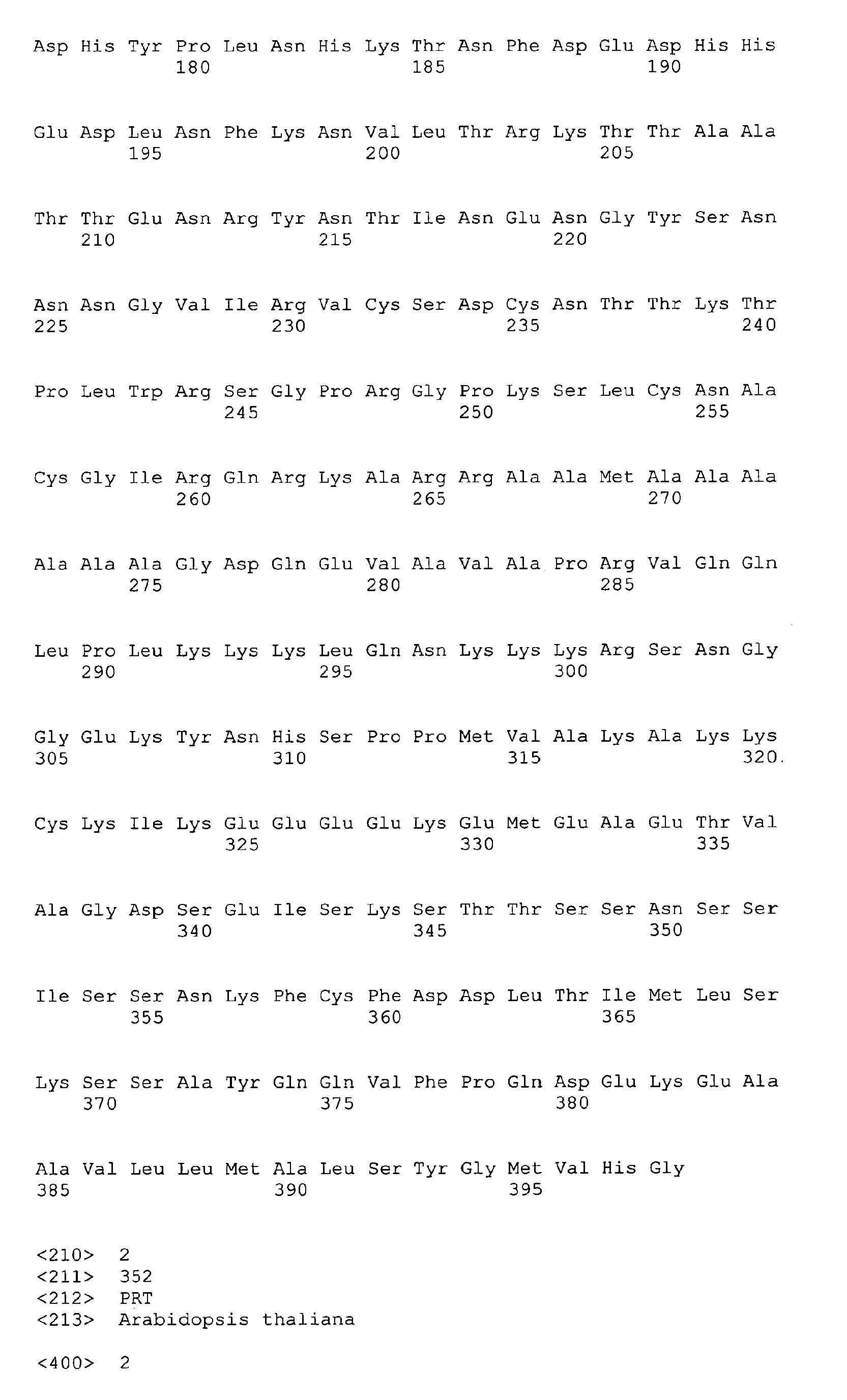


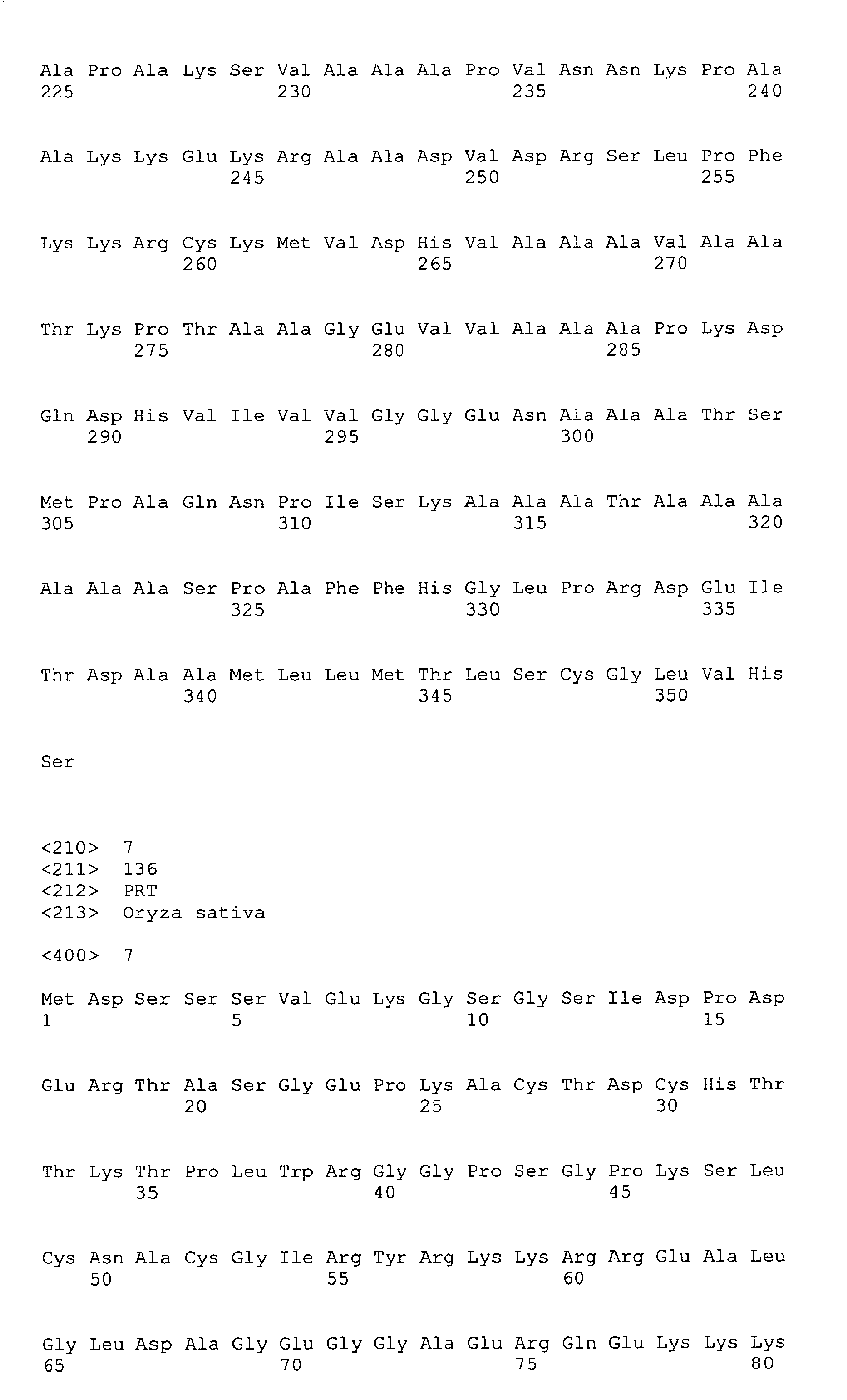


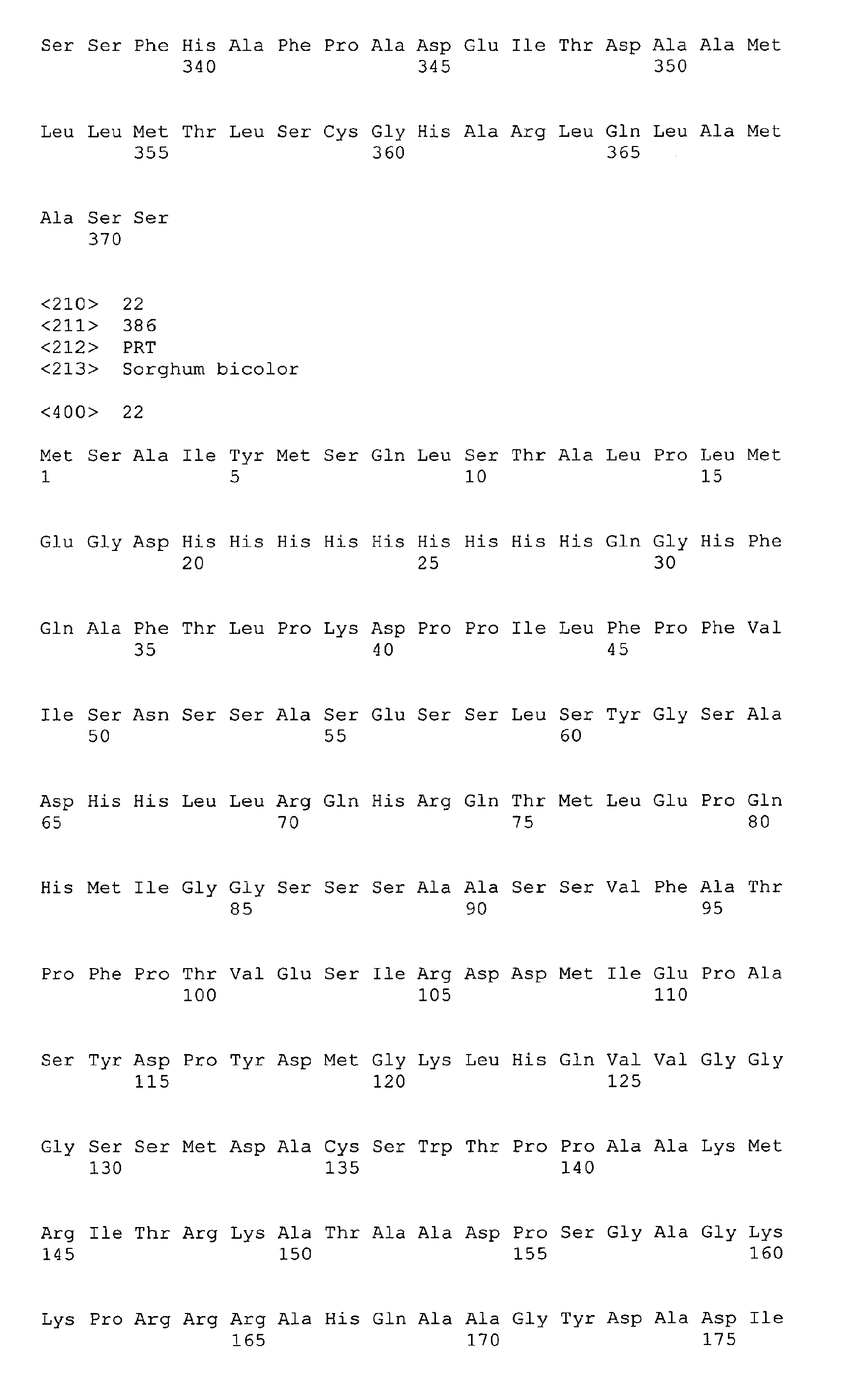


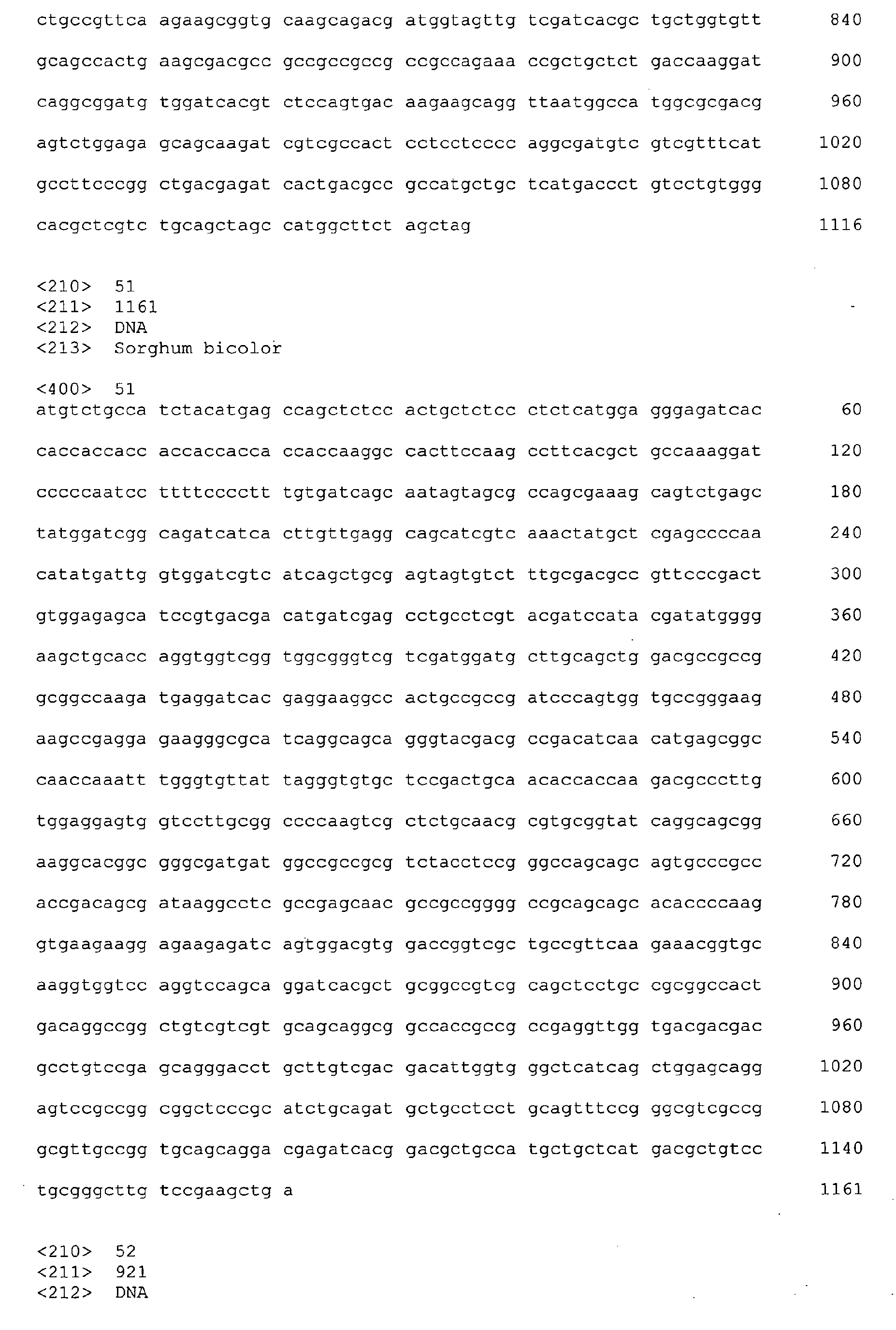


Claims (15)
- A method for modulating at least one plant developmental process selected from germination, elongation growth and flowering time, said method comprising:modulating the activity of at least one polypeptide in a plant or in a plant cell, said polypeptide comprising
a GATA DNA-binding domain and
a conserved domain comprising the amino acid sequenceA — A — Xnon-polar Or Xuncharged polar ― L ― L ― M ― X ― L ― S ,wherein Xnon-polar is any amino acid having a non-polar side chain, Xuncharged polar is any amino acid having an uncharged polar side chain and X is any amino acid. - The method according to claim 1, wherein said polypeptide(i) has an amino acid sequence which is SEQ ID NO: 1 or SEQ ID NO: 2 or a fragment thereof;(ii) is a homologue to SEQ ID NO: 1 or SEQ ID NO: 2, wherein, preferably, said homologue has an amino acid sequence being selected from SEQ ID NO: 3-29; or(iii) has an amino acid sequence which is at least 50%, preferably at least 60%, more preferably at least 70%, even more preferably at least 80%, even more preferably at least 90%, and most preferably at least 95% identical to any of SEQ ID NO: 1-29 or a fragment thereof.
- The method according to claim 1 or 2, wherein said modulating the activity of said polypeptide results in a decreased activity of said polypeptide.
- The method according to claim 3, wherein said modulating the activity of said polypeptide occurs by one of the following:(i) producing a mutant nucleic acid coding for a version of said polypeptide having decreased activity, preferably a non-functional version of said polypeptide, through insertion, deletion or mutation of at least one nucleotide in the nucleic acid coding for said polypeptide, and introducing said mutant nucleic acid into a plant cell;(ii) producing a mutant nucleic acid coding for a version of said polypeptide having reduced expression, through insertion, deletion, mutation of at least one nucleotide at a position 1-500 nucleotides, preferably 1-100 nucleotides upstream of the transcription start site of the nucleic acid coding for said polypeptide, and introducing said mutant nucleic acid into a plant cell;(iii) producing a mutant nucleic acid by placing the nucleic acid coding for said polypeptide under the control of a regulatory sequence that switches off the expression of said nucleic acid coding for said polypeptide, and introducing said mutant nucleic acid into a plant cell;(iv) producing a nucleic acid coding for a polypeptide that represses the transcription of the nucleic acid coding for said polypeptide, preferably by binding to the upstream regulatory region of the nucleic acid coding for said polypeptide, and introducing said nucleic acid into a plant cell;(v) producing, within a plant cell, a mutant nucleic acid coding for a version of said polypeptide having decreased activity, preferably a non-functional version of said polypeptide, or a version of said polypeptide having reduced expression, by exposing said plant cell to a mutagenic substance, such as ethyl methane sulfonate, or by exposing said plant cell to mutagenic radiation, such as UV-radiation or X-rays, and identifying the resultant mutant nucleic acid by gene sequencing, by the recognition of mismatch hybridizations by TILLING, or by related techniques;(vi) introducing small regulatory RNAs directed at the nucleic acid coding for said polypeptide or at its transcript into a plant cell;(vii) introducing antisense nucleic acid molecules complementary to the nucleic acid coding for said polypeptide into a plant cell;(viii) introducing sense nucleic acid molecules homologous to the nucleic acid coding for said polypeptide into a plant cell; or(ix) expressing a dominant-negative fragment of said polypeptide in a plant cell.
- The method according to claim 1 or 2, wherein said modulating the activity of said polypeptide results in an increased activity of said polypeptide.
- The method according to claim 5, wherein said modulating the activity of said polypeptide occurs by one of the following:(i) producing a mutant nucleic acid coding for a version of said polypeptide having increased activity or a version of said polypeptide having increased expression, through insertion, deletion, mutation of at least one nucleotide in the nucleic acid coding for said polypeptide or at a position 1-500 nucleotides, preferably 1-100 nucleotides upstream of the transcription start site of the nucleic acid coding for said polypeptide, and introducing said mutant nucleic acid into a plant cell;(ii) producing a mutant nucleic acid, within a plant cell, by placing the nucleic acid coding for said polypeptide under the control of a regulatory sequence that increases expression of said nucleic acid coding for said polypeptide;(iii) producing, within a plant cell, a mutant nucleic acid coding for a version of said polypeptide having increased activity or a version of said polypeptide having increased expression, by exposing said plant cell to a mutagenic substance, such as ethyl methane sulfonate, or by exposing said plant cell to mutagenic radiation, such as UV-radiation or X-rays, and identifying the resultant mutant nucleic acid by gene sequencing, by the recognition of mismatch hybridizations by TILLING, or by related techniques;(iv) misexpressing the nucleic acid coding for said polypeptide in a plant cell;(v) overexpressing said polypeptide in a plant cell;(vi) producing a nucleic acid coding for a polypeptide that increases the transcription of the nucleic acid coding for said polypeptide, preferably by binding to the upstream regulatory region of the nucleic acid coding for said polypeptide, and introducing said nucleic acid into a plant cell; or(vii) producing a mutant nucleic acid coding for a version of said polypeptide having increased protein stability.
- The method according to claim 4 or 6, wherein said nucleic acid coding for said polypeptide has a nucleic acid sequence which is(i) any of SEQ ID NO: 30-58 or a fragment thereof; or(ii) at least 50%, preferably at least 60%, more preferably at least 70%, even more preferably at least 80%, even more preferably at least 90%, and most preferably at least 95% identical to any of SEQ ID NO: 30-58 or a fragment thereof.
- A mutant nucleic acid of a nucleic acid coding for a polypeptide as defined in claim 1 or 2, the expression of which mutant nucleic acid in a plant or in a plant cell results in less activity or more activity of said polypeptide.
- An overexpression vector comprising a nucleic acid coding for a polypeptide as defined in claim 1 or 2.
- The mutant nucleic acid or overexpression vector according to claim 8 or 9, wherein said nucleic acid coding for said polypeptide has a nucleic acid sequence which is(i) any of SEQ ID NO: 30-58 or a fragment thereof; or(ii) at least 50%, preferably at least 60%, more preferably at least 70%, even more preferably at least 80%, even more preferably at least 90%, and most preferably at least 95% identical to any of SEQ ID NO: 30-58 or a fragment thereof.
- A nucleic acid consisting of 15 to 21 or 21 to 50, or 50 to 100, or 100 to 150, or 150 to 200 contiguous nucleotides, preferably ribonucleotides, of the nucleic acid coding for a polypeptide as defined in claim 1 or 2.
- The nucleic acid according to claim 11, wherein said nucleic acid coding for said polypeptide has a nucleic acid sequence which is(i) any of SEQ ID NO: 30-58 or a fragment thereof; or(ii) at least 50%, preferably at least 60%, more preferably at least 70%, even more preferably at least 80%, even more preferably at least 90%, and most preferably at least 95% identical to any of SEQ ID NO: 30-58 or a fragment thereof.
- A plant cell comprising a nucleic acid as defined in any of claims 8 to 12.
- A plant comprising one or several plant cells according to claim 13.
- A plant characterized by the modulation of at least one developmental process selected from germination, elongation growth and flowering time, obtained by the method according to any of claims 1 to 7.
Priority Applications (2)
| Application Number | Priority Date | Filing Date | Title |
|---|---|---|---|
| EP10004896A EP2385128A1 (en) | 2010-05-07 | 2010-05-07 | Modulation of germination, elongation growth and flowering time in plants |
| PCT/EP2011/002308 WO2011138054A1 (en) | 2010-05-07 | 2011-05-09 | Modulation of germination, elongation growth, flowering time, seed size and frost tolerance in plants |
Applications Claiming Priority (1)
| Application Number | Priority Date | Filing Date | Title |
|---|---|---|---|
| EP10004896A EP2385128A1 (en) | 2010-05-07 | 2010-05-07 | Modulation of germination, elongation growth and flowering time in plants |
Publications (1)
| Publication Number | Publication Date |
|---|---|
| EP2385128A1 true EP2385128A1 (en) | 2011-11-09 |
Family
ID=42635206
Family Applications (1)
| Application Number | Title | Priority Date | Filing Date |
|---|---|---|---|
| EP10004896A Ceased EP2385128A1 (en) | 2010-05-07 | 2010-05-07 | Modulation of germination, elongation growth and flowering time in plants |
Country Status (2)
| Country | Link |
|---|---|
| EP (1) | EP2385128A1 (en) |
| WO (1) | WO2011138054A1 (en) |
Families Citing this family (4)
| Publication number | Priority date | Publication date | Assignee | Title |
|---|---|---|---|---|
| CN113584051B (en) * | 2021-07-27 | 2023-01-31 | 中国农业科学院棉花研究所 | Application of GhGAI Gene in Regulating Plant Flowering |
| CN116023456B (en) * | 2022-11-24 | 2025-09-30 | 重庆市农业科学院 | Transcription factors regulating tomato growth, research methods, and preparation methods of tomato mutant plants |
| CN119491002B (en) * | 2025-01-20 | 2025-04-11 | 四川省农业科学院园艺研究所 | Eggplant SmGATA17 gene and its application |
| CN121270674B (en) * | 2025-08-21 | 2026-03-31 | 安徽农业大学 | A D9 mutant protein and its application in regulating plant height, prolonging flowering period, and maintaining grain yield. |
Citations (2)
| Publication number | Priority date | Publication date | Assignee | Title |
|---|---|---|---|---|
| WO2004031349A2 (en) * | 2002-09-18 | 2004-04-15 | Mendel Biotechnology, Inc. | Polynucleotides and polypeptides in plants |
| WO2008073617A2 (en) * | 2006-11-03 | 2008-06-19 | Ceres, Inc. | Increasing tolerance of plants to low light conditions |
-
2010
- 2010-05-07 EP EP10004896A patent/EP2385128A1/en not_active Ceased
-
2011
- 2011-05-09 WO PCT/EP2011/002308 patent/WO2011138054A1/en not_active Ceased
Patent Citations (2)
| Publication number | Priority date | Publication date | Assignee | Title |
|---|---|---|---|---|
| WO2004031349A2 (en) * | 2002-09-18 | 2004-04-15 | Mendel Biotechnology, Inc. | Polynucleotides and polypeptides in plants |
| WO2008073617A2 (en) * | 2006-11-03 | 2008-06-19 | Ceres, Inc. | Increasing tolerance of plants to low light conditions |
Non-Patent Citations (10)
| Title |
|---|
| PENG ET AL., NATURE, 1999 |
| PENG ET AL., NATURE, vol. 15, no. 400, 1999, pages 256 - 61 |
| SCHWECHHEIMER, CURR OPIN PLANT BIOL, 2008 |
| SCHWECHHEIMER, CURR OPIN PLANT BIOL., vol. 11, 2008, pages 9 - 15 |
| SCHWECHHEIMER; WILLIGE, CURR OPIN PLANT BIOL, 2009 |
| SCHWECHHEIMER; WILLIGE, CURR OPIN PLANT BIOL., vol. 12, 2009, pages 57 - 62 |
| SLADE; KNAUF, TRANSGENIC RES., vol. 14, no. 2, 2005, pages 109 - 15 |
| TANI ET AL., FUNCT INTEGR GENOMICS, vol. 4, no. 4, 2004, pages 258 - 66 |
| WILLIGE ET AL., PLANT CELL, 2007 |
| WILLIGE ET AL., PLANT CELL, vol. 19, no. 4, 2007, pages 1209 - 20 |
Also Published As
| Publication number | Publication date |
|---|---|
| WO2011138054A1 (en) | 2011-11-10 |
Similar Documents
| Publication | Publication Date | Title |
|---|---|---|
| Kalyna et al. | Ectopic expression of atRSZ33 reveals its function in splicing and causes pleiotropic changes in development | |
| Narita et al. | Overexpression of a novel small peptide ROTUNDIFOLIA4 decreases cell proliferation and alters leaf shape in Arabidopsis thaliana | |
| Sun et al. | Characterization of the brassinosteroid insensitive 1 genes of cotton | |
| Zhang et al. | TFL1/CEN-like genes control intercalary meristem activity and phase transition in rice | |
| Xie et al. | Coordinated regulation of grape berry flesh color by transcriptional activators and repressors | |
| US8614368B2 (en) | Maize ethylene signaling genes and modulation of same for improved stress tolerance in plants | |
| US20200354735A1 (en) | Plants with increased seed size | |
| US7759546B2 (en) | Methods for modifying plant endosperm | |
| Petolino et al. | Designed transcriptional regulators for trait development | |
| AU2018253488B2 (en) | Methods of controlling seed size in plants | |
| WO2011083298A1 (en) | Temperature sensing in plants | |
| US20110099650A1 (en) | Compositions and method for modulating plant root hair development | |
| Cao et al. | The BEL1‐like homeodomain protein OsBLH4 regulates rice plant height, grain number, and heading date by repressing the expression of OsGA2ox1 | |
| Fragoso et al. | Functional specialization of Nicotiana attenuata phytochromes in leaf development and flowering time | |
| CN116590337B (en) | Rice transcription factor OsbZIP13 and application of coding sequence thereof | |
| WO2011138054A1 (en) | Modulation of germination, elongation growth, flowering time, seed size and frost tolerance in plants | |
| RU2349642C2 (en) | Plant cells and organisms with modified cell growth, development and differentiation | |
| US20160102316A1 (en) | Stress tolerant plants | |
| DE112009003677T5 (en) | Plant growth promoting protein complex | |
| US7361805B2 (en) | Ehd1 gene promoting plant flowering, and utilization thereof | |
| CN101235378A (en) | Cloning and application of a gene RID1 controlling flowering transition and heading date in rice | |
| JPWO2008120410A1 (en) | Gene with end-reduplication promoting activity | |
| EP1055729A1 (en) | Transgenic plants exhibiting an altered flowering time | |
| Yin et al. | positively regulates salinity | |
| Ishizaki et al. | Rice EMF3 Alleles Adjust Flower Opening Time to Enhance the Seed Setting Rate Under High Temperature Stress |
Legal Events
| Date | Code | Title | Description |
|---|---|---|---|
| AK | Designated contracting states |
Kind code of ref document: A1 Designated state(s): AL AT BE BG CH CY CZ DE DK EE ES FI FR GB GR HR HU IE IS IT LI LT LU LV MC MK MT NL NO PL PT RO SE SI SK SM TR |
|
| AX | Request for extension of the european patent |
Extension state: BA ME RS |
|
| PUAI | Public reference made under article 153(3) epc to a published international application that has entered the european phase |
Free format text: ORIGINAL CODE: 0009012 |
|
| STAA | Information on the status of an ep patent application or granted ep patent |
Free format text: STATUS: THE APPLICATION HAS BEEN REFUSED |
|
| 18R | Application refused |
Effective date: 20111126 |