EP2385037A1 - Fungicidal phenoxyphenylhydrazine derivatives - Google Patents
Fungicidal phenoxyphenylhydrazine derivatives Download PDFInfo
- Publication number
- EP2385037A1 EP2385037A1 EP11160386A EP11160386A EP2385037A1 EP 2385037 A1 EP2385037 A1 EP 2385037A1 EP 11160386 A EP11160386 A EP 11160386A EP 11160386 A EP11160386 A EP 11160386A EP 2385037 A1 EP2385037 A1 EP 2385037A1
- Authority
- EP
- European Patent Office
- Prior art keywords
- plants
- compound
- disease
- alkoxy
- phenoxyphenylhydrazine
- Prior art date
- Legal status (The legal status is an assumption and is not a legal conclusion. Google has not performed a legal analysis and makes no representation as to the accuracy of the status listed.)
- Withdrawn
Links
- 230000000855 fungicidal effect Effects 0.000 title description 4
- ICKZKXLORXDTGV-UHFFFAOYSA-N 1-phenoxy-1-phenylhydrazine Chemical class C=1C=CC=CC=1N(N)OC1=CC=CC=C1 ICKZKXLORXDTGV-UHFFFAOYSA-N 0.000 title description 3
- 150000001875 compounds Chemical class 0.000 claims abstract description 37
- 238000000034 method Methods 0.000 claims abstract description 27
- 241000233866 Fungi Species 0.000 claims abstract description 20
- XLYOFNOQVPJJNP-UHFFFAOYSA-N water Substances O XLYOFNOQVPJJNP-UHFFFAOYSA-N 0.000 claims description 24
- 125000004191 (C1-C6) alkoxy group Chemical group 0.000 claims description 21
- -1 phenoxyphenylhydrazine compound Chemical class 0.000 claims description 13
- 125000000171 (C1-C6) haloalkyl group Chemical group 0.000 claims description 11
- 125000001475 halogen functional group Chemical group 0.000 claims description 7
- 239000001963 growth medium Substances 0.000 claims description 3
- 241000196324 Embryophyta Species 0.000 description 51
- 201000010099 disease Diseases 0.000 description 42
- 208000037265 diseases, disorders, signs and symptoms Diseases 0.000 description 42
- 239000000203 mixture Substances 0.000 description 33
- CSCPPACGZOOCGX-UHFFFAOYSA-N Acetone Chemical compound CC(C)=O CSCPPACGZOOCGX-UHFFFAOYSA-N 0.000 description 19
- YMWUJEATGCHHMB-UHFFFAOYSA-N Dichloromethane Chemical compound ClCCl YMWUJEATGCHHMB-UHFFFAOYSA-N 0.000 description 15
- YXFVVABEGXRONW-UHFFFAOYSA-N Toluene Chemical compound CC1=CC=CC=C1 YXFVVABEGXRONW-UHFFFAOYSA-N 0.000 description 15
- 238000002360 preparation method Methods 0.000 description 14
- 229910052739 hydrogen Inorganic materials 0.000 description 13
- 239000001257 hydrogen Substances 0.000 description 13
- 239000007921 spray Substances 0.000 description 13
- XEKOWRVHYACXOJ-UHFFFAOYSA-N Ethyl acetate Chemical compound CCOC(C)=O XEKOWRVHYACXOJ-UHFFFAOYSA-N 0.000 description 12
- 239000007787 solid Substances 0.000 description 12
- 241000209219 Hordeum Species 0.000 description 11
- 238000012360 testing method Methods 0.000 description 11
- 125000004169 (C1-C6) alkyl group Chemical group 0.000 description 10
- 241000221785 Erysiphales Species 0.000 description 10
- HEDRZPFGACZZDS-MICDWDOJSA-N Trichloro(2H)methane Chemical compound [2H]C(Cl)(Cl)Cl HEDRZPFGACZZDS-MICDWDOJSA-N 0.000 description 10
- VYPSYNLAJGMNEJ-UHFFFAOYSA-N Silicium dioxide Chemical compound O=[Si]=O VYPSYNLAJGMNEJ-UHFFFAOYSA-N 0.000 description 9
- 150000002431 hydrogen Chemical group 0.000 description 9
- 239000000463 material Substances 0.000 description 9
- KNJXZAKITFUBDY-UHFFFAOYSA-N propan-2-yl n-[3-fluoro-4-[3-(trifluoromethyl)phenyl]anilino]carbamate Chemical compound FC1=CC(NNC(=O)OC(C)C)=CC=C1C1=CC=CC(C(F)(F)F)=C1 KNJXZAKITFUBDY-UHFFFAOYSA-N 0.000 description 9
- IJGRMHOSHXDMSA-UHFFFAOYSA-N Atomic nitrogen Chemical compound N#N IJGRMHOSHXDMSA-UHFFFAOYSA-N 0.000 description 8
- 235000007340 Hordeum vulgare Nutrition 0.000 description 8
- 238000011161 development Methods 0.000 description 8
- 238000009472 formulation Methods 0.000 description 8
- 238000003359 percent control normalization Methods 0.000 description 8
- OKTJSMMVPCPJKN-UHFFFAOYSA-N Carbon Chemical compound [C] OKTJSMMVPCPJKN-UHFFFAOYSA-N 0.000 description 7
- 229920001213 Polysorbate 20 Polymers 0.000 description 7
- QVGXLLKOCUKJST-UHFFFAOYSA-N atomic oxygen Chemical group [O] QVGXLLKOCUKJST-UHFFFAOYSA-N 0.000 description 7
- 229910052799 carbon Inorganic materials 0.000 description 7
- 229910052760 oxygen Inorganic materials 0.000 description 7
- 239000001301 oxygen Substances 0.000 description 7
- 239000000256 polyoxyethylene sorbitan monolaurate Substances 0.000 description 7
- 235000010486 polyoxyethylene sorbitan monolaurate Nutrition 0.000 description 7
- 125000004737 (C1-C6) haloalkoxy group Chemical group 0.000 description 6
- 244000046052 Phaseolus vulgaris Species 0.000 description 6
- JUJWROOIHBZHMG-UHFFFAOYSA-N Pyridine Chemical compound C1=CC=NC=C1 JUJWROOIHBZHMG-UHFFFAOYSA-N 0.000 description 6
- HEMHJVSKTPXQMS-UHFFFAOYSA-M Sodium hydroxide Chemical compound [OH-].[Na+] HEMHJVSKTPXQMS-UHFFFAOYSA-M 0.000 description 6
- 125000000217 alkyl group Chemical group 0.000 description 6
- 239000007900 aqueous suspension Substances 0.000 description 6
- IQBWBWKDBIMXAW-UHFFFAOYSA-N n'-[3-fluoro-4-[3-(trifluoromethyl)phenoxy]phenyl]acetohydrazide Chemical compound FC1=CC(NNC(=O)C)=CC=C1OC1=CC=CC(C(F)(F)F)=C1 IQBWBWKDBIMXAW-UHFFFAOYSA-N 0.000 description 6
- 239000000047 product Substances 0.000 description 6
- 239000000243 solution Substances 0.000 description 6
- 238000005160 1H NMR spectroscopy Methods 0.000 description 5
- 0 CCC(OC(C=*C)=CC=CC(C)P)=CC=CC([*@@](*(*)C(*)=O)N)=CC* Chemical compound CCC(OC(C=*C)=CC=CC(C)P)=CC=CC([*@@](*(*)C(*)=O)N)=CC* 0.000 description 5
- UFHFLCQGNIYNRP-UHFFFAOYSA-N Hydrogen Chemical compound [H][H] UFHFLCQGNIYNRP-UHFFFAOYSA-N 0.000 description 5
- 125000002915 carbonyl group Chemical group [*:2]C([*:1])=O 0.000 description 5
- 239000000969 carrier Substances 0.000 description 5
- 229910052736 halogen Inorganic materials 0.000 description 5
- 150000002367 halogens Chemical class 0.000 description 5
- 239000007788 liquid Substances 0.000 description 5
- 239000002609 medium Substances 0.000 description 5
- 229940067157 phenylhydrazine Drugs 0.000 description 5
- 230000003032 phytopathogenic effect Effects 0.000 description 5
- 241000123650 Botrytis cinerea Species 0.000 description 4
- RTZKZFJDLAIYFH-UHFFFAOYSA-N Diethyl ether Chemical compound CCOCC RTZKZFJDLAIYFH-UHFFFAOYSA-N 0.000 description 4
- 241000208152 Geranium Species 0.000 description 4
- 240000007594 Oryza sativa Species 0.000 description 4
- 235000010627 Phaseolus vulgaris Nutrition 0.000 description 4
- 240000003768 Solanum lycopersicum Species 0.000 description 4
- 241000221577 Uromyces appendiculatus Species 0.000 description 4
- 239000000443 aerosol Substances 0.000 description 4
- 125000003545 alkoxy group Chemical group 0.000 description 4
- 229910052757 nitrogen Inorganic materials 0.000 description 4
- 150000004031 phenylhydrazines Chemical class 0.000 description 4
- 239000011541 reaction mixture Substances 0.000 description 4
- 239000000377 silicon dioxide Substances 0.000 description 4
- LPXPTNMVRIOKMN-UHFFFAOYSA-M sodium nitrite Chemical compound [Na+].[O-]N=O LPXPTNMVRIOKMN-UHFFFAOYSA-M 0.000 description 4
- 239000002689 soil Substances 0.000 description 4
- 239000002904 solvent Substances 0.000 description 4
- 239000000725 suspension Substances 0.000 description 4
- UHOVQNZJYSORNB-UHFFFAOYSA-N Benzene Chemical compound C1=CC=CC=C1 UHOVQNZJYSORNB-UHFFFAOYSA-N 0.000 description 3
- 241000190150 Bipolaris sorokiniana Species 0.000 description 3
- 240000008067 Cucumis sativus Species 0.000 description 3
- 235000010799 Cucumis sativus var sativus Nutrition 0.000 description 3
- WSFSSNUMVMOOMR-UHFFFAOYSA-N Formaldehyde Chemical compound O=C WSFSSNUMVMOOMR-UHFFFAOYSA-N 0.000 description 3
- 235000007688 Lycopersicon esculentum Nutrition 0.000 description 3
- 241001459558 Monographella nivalis Species 0.000 description 3
- ZMXDDKWLCZADIW-UHFFFAOYSA-N N,N-Dimethylformamide Chemical compound CN(C)C=O ZMXDDKWLCZADIW-UHFFFAOYSA-N 0.000 description 3
- 241001329956 Nothopassalora personata Species 0.000 description 3
- 235000007164 Oryza sativa Nutrition 0.000 description 3
- 241000233622 Phytophthora infestans Species 0.000 description 3
- 241000918584 Pythium ultimum Species 0.000 description 3
- 241000813090 Rhizoctonia solani Species 0.000 description 3
- 241001518705 Sclerotinia minor Species 0.000 description 3
- NINIDFKCEFEMDL-UHFFFAOYSA-N Sulfur Chemical group [S] NINIDFKCEFEMDL-UHFFFAOYSA-N 0.000 description 3
- ZMANZCXQSJIPKH-UHFFFAOYSA-N Triethylamine Chemical compound CCN(CC)CC ZMANZCXQSJIPKH-UHFFFAOYSA-N 0.000 description 3
- 125000004453 alkoxycarbonyl group Chemical group 0.000 description 3
- 238000004440 column chromatography Methods 0.000 description 3
- 239000002270 dispersing agent Substances 0.000 description 3
- 239000000417 fungicide Substances 0.000 description 3
- 238000000338 in vitro Methods 0.000 description 3
- VLKZOEOYAKHREP-UHFFFAOYSA-N n-Hexane Chemical compound CCCCCC VLKZOEOYAKHREP-UHFFFAOYSA-N 0.000 description 3
- 239000003921 oil Substances 0.000 description 3
- 239000012044 organic layer Substances 0.000 description 3
- TVSHRGXPECQJAN-UHFFFAOYSA-N propan-2-yl n-[4-[3-(trifluoromethyl)phenoxy]phenyl]iminocarbamate Chemical compound C1=CC(N=NC(=O)OC(C)C)=CC=C1OC1=CC=CC(C(F)(F)F)=C1 TVSHRGXPECQJAN-UHFFFAOYSA-N 0.000 description 3
- UMJSCPRVCHMLSP-UHFFFAOYSA-N pyridine Natural products COC1=CC=CN=C1 UMJSCPRVCHMLSP-UHFFFAOYSA-N 0.000 description 3
- 235000009566 rice Nutrition 0.000 description 3
- 125000004469 siloxy group Chemical group [SiH3]O* 0.000 description 3
- 150000003457 sulfones Chemical group 0.000 description 3
- 150000003462 sulfoxides Chemical group 0.000 description 3
- 229910052717 sulfur Inorganic materials 0.000 description 3
- 239000011593 sulfur Chemical group 0.000 description 3
- 125000002861 (C1-C4) alkanoyl group Chemical group 0.000 description 2
- 125000004178 (C1-C4) alkyl group Chemical group 0.000 description 2
- 125000004765 (C1-C4) haloalkyl group Chemical group 0.000 description 2
- 125000000229 (C1-C4)alkoxy group Chemical group 0.000 description 2
- 125000004890 (C1-C6) alkylamino group Chemical group 0.000 description 2
- 125000006766 (C2-C6) alkynyloxy group Chemical group 0.000 description 2
- TZKXAWZIUQTCFP-UHFFFAOYSA-N 1-(4-nitrophenoxy)-3-(trifluoromethyl)benzene Chemical compound C1=CC([N+](=O)[O-])=CC=C1OC1=CC=CC(C(F)(F)F)=C1 TZKXAWZIUQTCFP-UHFFFAOYSA-N 0.000 description 2
- VPVKXXRMSWUGHE-UHFFFAOYSA-N 4-[3-(trifluoromethyl)phenoxy]aniline Chemical compound C1=CC(N)=CC=C1OC1=CC=CC(C(F)(F)F)=C1 VPVKXXRMSWUGHE-UHFFFAOYSA-N 0.000 description 2
- 241001530056 Athelia rolfsii Species 0.000 description 2
- 125000003320 C2-C6 alkenyloxy group Chemical group 0.000 description 2
- 241001466031 Colletotrichum gossypii Species 0.000 description 2
- LFQSCWFLJHTTHZ-UHFFFAOYSA-N Ethanol Chemical compound CCO LFQSCWFLJHTTHZ-UHFFFAOYSA-N 0.000 description 2
- 206010061217 Infestation Diseases 0.000 description 2
- 241001330975 Magnaporthe oryzae Species 0.000 description 2
- CDBYLPFSWZWCQE-UHFFFAOYSA-L Sodium Carbonate Chemical compound [Na+].[Na+].[O-]C([O-])=O CDBYLPFSWZWCQE-UHFFFAOYSA-L 0.000 description 2
- PMZURENOXWZQFD-UHFFFAOYSA-L Sodium Sulfate Chemical compound [Na+].[Na+].[O-]S([O-])(=O)=O PMZURENOXWZQFD-UHFFFAOYSA-L 0.000 description 2
- 240000008042 Zea mays Species 0.000 description 2
- 235000005824 Zea mays ssp. parviglumis Nutrition 0.000 description 2
- 235000002017 Zea mays subsp mays Nutrition 0.000 description 2
- ZLQUADPYTJDRFF-UHFFFAOYSA-N [4-[3-(trifluoromethyl)phenoxy]phenyl]hydrazine;hydrochloride Chemical compound Cl.C1=CC(NN)=CC=C1OC1=CC=CC(C(F)(F)F)=C1 ZLQUADPYTJDRFF-UHFFFAOYSA-N 0.000 description 2
- 230000000895 acaricidal effect Effects 0.000 description 2
- 239000000642 acaricide Substances 0.000 description 2
- 238000003556 assay Methods 0.000 description 2
- 230000001680 brushing effect Effects 0.000 description 2
- 239000003795 chemical substances by application Substances 0.000 description 2
- 229940125904 compound 1 Drugs 0.000 description 2
- 239000012141 concentrate Substances 0.000 description 2
- 235000005822 corn Nutrition 0.000 description 2
- 125000004093 cyano group Chemical group *C#N 0.000 description 2
- 125000000000 cycloalkoxy group Chemical group 0.000 description 2
- 239000000839 emulsion Substances 0.000 description 2
- 239000002917 insecticide Substances 0.000 description 2
- 239000012071 phase Substances 0.000 description 2
- HKOOXMFOFWEVGF-UHFFFAOYSA-N phenylhydrazine Chemical compound NNC1=CC=CC=C1 HKOOXMFOFWEVGF-UHFFFAOYSA-N 0.000 description 2
- BWHMMNNQKKPAPP-UHFFFAOYSA-L potassium carbonate Chemical compound [K+].[K+].[O-]C([O-])=O BWHMMNNQKKPAPP-UHFFFAOYSA-L 0.000 description 2
- DWAGTYFTIWBBOS-UHFFFAOYSA-N propan-2-yl n-[4-[3-(trifluoromethyl)phenoxy]anilino]carbamate Chemical compound C1=CC(NNC(=O)OC(C)C)=CC=C1OC1=CC=CC(C(F)(F)F)=C1 DWAGTYFTIWBBOS-UHFFFAOYSA-N 0.000 description 2
- 238000010992 reflux Methods 0.000 description 2
- FSYKKLYZXJSNPZ-UHFFFAOYSA-N sarcosine Chemical compound C[NH2+]CC([O-])=O FSYKKLYZXJSNPZ-UHFFFAOYSA-N 0.000 description 2
- 239000004094 surface-active agent Substances 0.000 description 2
- 125000005309 thioalkoxy group Chemical group 0.000 description 2
- QAEDZJGFFMLHHQ-UHFFFAOYSA-N trifluoroacetic anhydride Chemical compound FC(F)(F)C(=O)OC(=O)C(F)(F)F QAEDZJGFFMLHHQ-UHFFFAOYSA-N 0.000 description 2
- GHYOCDFICYLMRF-UTIIJYGPSA-N (2S,3R)-N-[(2S)-3-(cyclopenten-1-yl)-1-[(2R)-2-methyloxiran-2-yl]-1-oxopropan-2-yl]-3-hydroxy-3-(4-methoxyphenyl)-2-[[(2S)-2-[(2-morpholin-4-ylacetyl)amino]propanoyl]amino]propanamide Chemical compound C1(=CCCC1)C[C@@H](C(=O)[C@@]1(OC1)C)NC([C@H]([C@@H](C1=CC=C(C=C1)OC)O)NC([C@H](C)NC(CN1CCOCC1)=O)=O)=O GHYOCDFICYLMRF-UTIIJYGPSA-N 0.000 description 1
- RYHBNJHYFVUHQT-UHFFFAOYSA-N 1,4-Dioxane Chemical compound C1COCCO1 RYHBNJHYFVUHQT-UHFFFAOYSA-N 0.000 description 1
- JSZOAYXJRCEYSX-UHFFFAOYSA-N 1-nitropropane Chemical compound CCC[N+]([O-])=O JSZOAYXJRCEYSX-UHFFFAOYSA-N 0.000 description 1
- NGNBDVOYPDDBFK-UHFFFAOYSA-N 2-[2,4-di(pentan-2-yl)phenoxy]acetyl chloride Chemical compound CCCC(C)C1=CC=C(OCC(Cl)=O)C(C(C)CCC)=C1 NGNBDVOYPDDBFK-UHFFFAOYSA-N 0.000 description 1
- UGEJOEBBMPOJMT-UHFFFAOYSA-N 3-(trifluoromethyl)phenol Chemical compound OC1=CC=CC(C(F)(F)F)=C1 UGEJOEBBMPOJMT-UHFFFAOYSA-N 0.000 description 1
- YXTIWHCRXKLTKP-UHFFFAOYSA-N 3-fluoro-4-[3-(trifluoromethyl)phenoxy]aniline Chemical compound FC1=CC(N)=CC=C1OC1=CC=CC(C(F)(F)F)=C1 YXTIWHCRXKLTKP-UHFFFAOYSA-N 0.000 description 1
- ZTEHAXKGGDXHNI-UHFFFAOYSA-N 3-fluoro-4-[3-(trifluoromethyl)phenyl]aniline Chemical compound FC1=CC(N)=CC=C1C1=CC=CC(C(F)(F)F)=C1 ZTEHAXKGGDXHNI-UHFFFAOYSA-N 0.000 description 1
- WLFHFHXMQKNDTQ-UHFFFAOYSA-N 3-fluoro-n-(1-nitropropylideneamino)-4-[3-(trifluoromethyl)phenoxy]aniline Chemical compound FC1=CC(NN=C(CC)[N+]([O-])=O)=CC=C1OC1=CC=CC(C(F)(F)F)=C1 WLFHFHXMQKNDTQ-UHFFFAOYSA-N 0.000 description 1
- CZGCEKJOLUNIFY-UHFFFAOYSA-N 4-Chloronitrobenzene Chemical compound [O-][N+](=O)C1=CC=C(Cl)C=C1 CZGCEKJOLUNIFY-UHFFFAOYSA-N 0.000 description 1
- YTMVYYAKOPIJCZ-UHFFFAOYSA-N 4-bromo-3-fluoroaniline Chemical compound NC1=CC=C(Br)C(F)=C1 YTMVYYAKOPIJCZ-UHFFFAOYSA-N 0.000 description 1
- 241000895523 Blumeria graminis f. sp. hordei Species 0.000 description 1
- 241001465180 Botrytis Species 0.000 description 1
- AHWKESFOGNBAOX-UHFFFAOYSA-N CC1(C=CC(C)=CC=C1)N Chemical compound CC1(C=CC(C)=CC=C1)N AHWKESFOGNBAOX-UHFFFAOYSA-N 0.000 description 1
- 241000896222 Erysiphe polygoni Species 0.000 description 1
- 241000896246 Golovinomyces cichoracearum Species 0.000 description 1
- 241001344131 Magnaporthe grisea Species 0.000 description 1
- PAYRUJLWNCNPSJ-UHFFFAOYSA-N N-phenyl amine Natural products NC1=CC=CC=C1 PAYRUJLWNCNPSJ-UHFFFAOYSA-N 0.000 description 1
- 238000005481 NMR spectroscopy Methods 0.000 description 1
- 244000061176 Nicotiana tabacum Species 0.000 description 1
- 235000002637 Nicotiana tabacum Nutrition 0.000 description 1
- KDLHZDBZIXYQEI-UHFFFAOYSA-N Palladium Chemical compound [Pd] KDLHZDBZIXYQEI-UHFFFAOYSA-N 0.000 description 1
- 229930040373 Paraformaldehyde Natural products 0.000 description 1
- 241000233614 Phytophthora Species 0.000 description 1
- 108010077895 Sarcosine Proteins 0.000 description 1
- 241001533598 Septoria Species 0.000 description 1
- VMHLLURERBWHNL-UHFFFAOYSA-M Sodium acetate Chemical compound [Na+].CC([O-])=O VMHLLURERBWHNL-UHFFFAOYSA-M 0.000 description 1
- 239000005708 Sodium hypochlorite Substances 0.000 description 1
- 241000607479 Yersinia pestis Species 0.000 description 1
- WOAORAPRPVIATR-UHFFFAOYSA-N [3-(trifluoromethyl)phenyl]boronic acid Chemical compound OB(O)C1=CC=CC(C(F)(F)F)=C1 WOAORAPRPVIATR-UHFFFAOYSA-N 0.000 description 1
- UZPZRCMOLIGVBL-UHFFFAOYSA-N [3-fluoro-4-[3-(trifluoromethyl)phenoxy]phenyl]hydrazine;hydrochloride Chemical compound Cl.FC1=CC(NN)=CC=C1OC1=CC=CC(C(F)(F)F)=C1 UZPZRCMOLIGVBL-UHFFFAOYSA-N 0.000 description 1
- WETWJCDKMRHUPV-UHFFFAOYSA-N acetyl chloride Chemical compound CC(Cl)=O WETWJCDKMRHUPV-UHFFFAOYSA-N 0.000 description 1
- 239000012346 acetyl chloride Substances 0.000 description 1
- 239000004480 active ingredient Substances 0.000 description 1
- 239000000654 additive Substances 0.000 description 1
- 150000001298 alcohols Chemical class 0.000 description 1
- 239000002168 alkylating agent Substances 0.000 description 1
- 229940100198 alkylating agent Drugs 0.000 description 1
- 150000003862 amino acid derivatives Chemical class 0.000 description 1
- 150000001448 anilines Chemical class 0.000 description 1
- 125000000129 anionic group Chemical group 0.000 description 1
- 230000000844 anti-bacterial effect Effects 0.000 description 1
- 238000013459 approach Methods 0.000 description 1
- 239000007864 aqueous solution Substances 0.000 description 1
- 239000003899 bactericide agent Substances 0.000 description 1
- CIZVQWNPBGYCGK-UHFFFAOYSA-N benzenediazonium Chemical class N#[N+]C1=CC=CC=C1 CIZVQWNPBGYCGK-UHFFFAOYSA-N 0.000 description 1
- 125000002091 cationic group Chemical group 0.000 description 1
- 239000003610 charcoal Substances 0.000 description 1
- FZFAMSAMCHXGEF-UHFFFAOYSA-N chloro formate Chemical compound ClOC=O FZFAMSAMCHXGEF-UHFFFAOYSA-N 0.000 description 1
- 238000004587 chromatography analysis Methods 0.000 description 1
- 238000010549 co-Evaporation Methods 0.000 description 1
- 239000012230 colorless oil Substances 0.000 description 1
- 229940125773 compound 10 Drugs 0.000 description 1
- 229940125797 compound 12 Drugs 0.000 description 1
- 229940125782 compound 2 Drugs 0.000 description 1
- 229940126214 compound 3 Drugs 0.000 description 1
- 239000012895 dilution Substances 0.000 description 1
- 238000010790 dilution Methods 0.000 description 1
- DMBHHRLKUKUOEG-UHFFFAOYSA-N diphenylamine Chemical class C=1C=CC=CC=1NC1=CC=CC=C1 DMBHHRLKUKUOEG-UHFFFAOYSA-N 0.000 description 1
- 239000012153 distilled water Substances 0.000 description 1
- CNXMDTWQWLGCPE-UHFFFAOYSA-N ditert-butyl-(2-phenylphenyl)phosphane Chemical group CC(C)(C)P(C(C)(C)C)C1=CC=CC=C1C1=CC=CC=C1 CNXMDTWQWLGCPE-UHFFFAOYSA-N 0.000 description 1
- 239000004495 emulsifiable concentrate Substances 0.000 description 1
- 125000001495 ethyl group Chemical group [H]C([H])([H])C([H])([H])* 0.000 description 1
- 238000011156 evaluation Methods 0.000 description 1
- 239000000706 filtrate Substances 0.000 description 1
- 239000012634 fragment Substances 0.000 description 1
- 230000002538 fungal effect Effects 0.000 description 1
- 244000053095 fungal pathogen Species 0.000 description 1
- 239000007789 gas Substances 0.000 description 1
- 239000008187 granular material Substances 0.000 description 1
- 239000005457 ice water Substances 0.000 description 1
- 238000010348 incorporation Methods 0.000 description 1
- 239000003701 inert diluent Substances 0.000 description 1
- 230000002401 inhibitory effect Effects 0.000 description 1
- 230000005764 inhibitory process Effects 0.000 description 1
- 229910052500 inorganic mineral Inorganic materials 0.000 description 1
- INQOMBQAUSQDDS-UHFFFAOYSA-N iodomethane Chemical compound IC INQOMBQAUSQDDS-UHFFFAOYSA-N 0.000 description 1
- JEIPFZHSYJVQDO-UHFFFAOYSA-N iron(III) oxide Inorganic materials O=[Fe]O[Fe]=O JEIPFZHSYJVQDO-UHFFFAOYSA-N 0.000 description 1
- 239000012948 isocyanate Substances 0.000 description 1
- 150000002513 isocyanates Chemical class 0.000 description 1
- 125000001449 isopropyl group Chemical group [H]C([H])([H])C([H])(*)C([H])([H])[H] 0.000 description 1
- ZLVXBBHTMQJRSX-VMGNSXQWSA-N jdtic Chemical compound C1([C@]2(C)CCN(C[C@@H]2C)C[C@H](C(C)C)NC(=O)[C@@H]2NCC3=CC(O)=CC=C3C2)=CC=CC(O)=C1 ZLVXBBHTMQJRSX-VMGNSXQWSA-N 0.000 description 1
- 239000003350 kerosene Substances 0.000 description 1
- 150000002576 ketones Chemical class 0.000 description 1
- 239000008263 liquid aerosol Substances 0.000 description 1
- 125000000956 methoxy group Chemical group [H]C([H])([H])O* 0.000 description 1
- 239000010445 mica Substances 0.000 description 1
- 229910052618 mica group Inorganic materials 0.000 description 1
- 239000011707 mineral Substances 0.000 description 1
- GYNAVKULVOETAD-UHFFFAOYSA-N n-phenoxyaniline Chemical class C=1C=CC=CC=1NOC1=CC=CC=C1 GYNAVKULVOETAD-UHFFFAOYSA-N 0.000 description 1
- 230000001069 nematicidal effect Effects 0.000 description 1
- 239000005645 nematicide Substances 0.000 description 1
- 125000004971 nitroalkyl group Chemical group 0.000 description 1
- 239000012074 organic phase Substances 0.000 description 1
- 239000003960 organic solvent Substances 0.000 description 1
- 239000007800 oxidant agent Substances 0.000 description 1
- LXNAVEXFUKBNMK-UHFFFAOYSA-N palladium(II) acetate Substances [Pd].CC(O)=O.CC(O)=O LXNAVEXFUKBNMK-UHFFFAOYSA-N 0.000 description 1
- YJVFFLUZDVXJQI-UHFFFAOYSA-L palladium(ii) acetate Chemical compound [Pd+2].CC([O-])=O.CC([O-])=O YJVFFLUZDVXJQI-UHFFFAOYSA-L 0.000 description 1
- 229920002866 paraformaldehyde Polymers 0.000 description 1
- 239000006072 paste Substances 0.000 description 1
- 239000000575 pesticide Substances 0.000 description 1
- 150000002989 phenols Chemical class 0.000 description 1
- 125000001997 phenyl group Chemical group [H]C1=C([H])C([H])=C(*)C([H])=C1[H] 0.000 description 1
- BMBJSXKEXRFGAV-UHFFFAOYSA-N phenylcarbamothioic s-acid Chemical class SC(=O)NC1=CC=CC=C1 BMBJSXKEXRFGAV-UHFFFAOYSA-N 0.000 description 1
- 229910000027 potassium carbonate Inorganic materials 0.000 description 1
- 239000000843 powder Substances 0.000 description 1
- BHNMGYCTNROKAC-UHFFFAOYSA-N propan-2-yl 2-[3-fluoro-4-[3-(trifluoromethyl)phenoxy]phenyl]-4-methyl-1,2,4-triazolidine-1-carboxylate Chemical compound CC(C)OC(=O)N1CN(C)CN1C(C=C1F)=CC=C1OC1=CC=CC(C(F)(F)F)=C1 BHNMGYCTNROKAC-UHFFFAOYSA-N 0.000 description 1
- IVRIRQXJSNCSPQ-UHFFFAOYSA-N propan-2-yl carbonochloridate Chemical compound CC(C)OC(Cl)=O IVRIRQXJSNCSPQ-UHFFFAOYSA-N 0.000 description 1
- WGBNJKQHBJCWBT-UHFFFAOYSA-N propan-2-yl n-[n-(2,2,2-trifluoroacetyl)-4-[3-(trifluoromethyl)phenoxy]anilino]carbamate Chemical compound C1=CC(N(C(=O)C(F)(F)F)NC(=O)OC(C)C)=CC=C1OC1=CC=CC(C(F)(F)F)=C1 WGBNJKQHBJCWBT-UHFFFAOYSA-N 0.000 description 1
- LHCVBFNGDQHEFA-UHFFFAOYSA-N propan-2-yl n-[n-methyl-4-[3-(trifluoromethyl)phenoxy]anilino]carbamate Chemical compound C1=CC(N(C)NC(=O)OC(C)C)=CC=C1OC1=CC=CC(C(F)(F)F)=C1 LHCVBFNGDQHEFA-UHFFFAOYSA-N 0.000 description 1
- 229910052903 pyrophyllite Inorganic materials 0.000 description 1
- 150000003839 salts Chemical class 0.000 description 1
- 229940043230 sarcosine Drugs 0.000 description 1
- 150000004760 silicates Chemical class 0.000 description 1
- 229910000029 sodium carbonate Inorganic materials 0.000 description 1
- SUKJFIGYRHOWBL-UHFFFAOYSA-N sodium hypochlorite Chemical compound [Na+].Cl[O-] SUKJFIGYRHOWBL-UHFFFAOYSA-N 0.000 description 1
- 238000005507 spraying Methods 0.000 description 1
- 239000007858 starting material Substances 0.000 description 1
- 239000012258 stirred mixture Substances 0.000 description 1
- 238000003756 stirring Methods 0.000 description 1
- 239000000126 substance Substances 0.000 description 1
- 238000010189 synthetic method Methods 0.000 description 1
- 239000000454 talc Substances 0.000 description 1
- 229910052623 talc Inorganic materials 0.000 description 1
- FWPIDFUJEMBDLS-UHFFFAOYSA-L tin(II) chloride dihydrate Chemical compound O.O.Cl[Sn]Cl FWPIDFUJEMBDLS-UHFFFAOYSA-L 0.000 description 1
- 238000012876 topography Methods 0.000 description 1
- 239000010455 vermiculite Substances 0.000 description 1
- 229910052902 vermiculite Inorganic materials 0.000 description 1
- 235000019354 vermiculite Nutrition 0.000 description 1
- 239000004563 wettable powder Substances 0.000 description 1
- 239000008096 xylene Substances 0.000 description 1
- 150000003738 xylenes Chemical class 0.000 description 1
Classifications
-
- C—CHEMISTRY; METALLURGY
- C07—ORGANIC CHEMISTRY
- C07D—HETEROCYCLIC COMPOUNDS
- C07D213/00—Heterocyclic compounds containing six-membered rings, not condensed with other rings, with one nitrogen atom as the only ring hetero atom and three or more double bonds between ring members or between ring members and non-ring members
- C07D213/02—Heterocyclic compounds containing six-membered rings, not condensed with other rings, with one nitrogen atom as the only ring hetero atom and three or more double bonds between ring members or between ring members and non-ring members having three double bonds between ring members or between ring members and non-ring members
- C07D213/04—Heterocyclic compounds containing six-membered rings, not condensed with other rings, with one nitrogen atom as the only ring hetero atom and three or more double bonds between ring members or between ring members and non-ring members having three double bonds between ring members or between ring members and non-ring members having no bond between the ring nitrogen atom and a non-ring member or having only hydrogen or carbon atoms directly attached to the ring nitrogen atom
- C07D213/60—Heterocyclic compounds containing six-membered rings, not condensed with other rings, with one nitrogen atom as the only ring hetero atom and three or more double bonds between ring members or between ring members and non-ring members having three double bonds between ring members or between ring members and non-ring members having no bond between the ring nitrogen atom and a non-ring member or having only hydrogen or carbon atoms directly attached to the ring nitrogen atom with hetero atoms or with carbon atoms having three bonds to hetero atoms with at the most one bond to halogen, e.g. ester or nitrile radicals, directly attached to ring carbon atoms
- C07D213/72—Nitrogen atoms
- C07D213/76—Nitrogen atoms to which a second hetero atom is attached
- C07D213/77—Hydrazine radicals
-
- C—CHEMISTRY; METALLURGY
- C07—ORGANIC CHEMISTRY
- C07C—ACYCLIC OR CARBOCYCLIC COMPOUNDS
- C07C243/00—Compounds containing chains of nitrogen atoms singly-bound to each other, e.g. hydrazines, triazanes
- C07C243/10—Hydrazines
- C07C243/22—Hydrazines having nitrogen atoms of hydrazine groups bound to carbon atoms of six-membered aromatic rings
-
- C—CHEMISTRY; METALLURGY
- C07—ORGANIC CHEMISTRY
- C07C—ACYCLIC OR CARBOCYCLIC COMPOUNDS
- C07C243/00—Compounds containing chains of nitrogen atoms singly-bound to each other, e.g. hydrazines, triazanes
- C07C243/24—Hydrazines having nitrogen atoms of hydrazine groups acylated by carboxylic acids
- C07C243/26—Hydrazines having nitrogen atoms of hydrazine groups acylated by carboxylic acids with acylating carboxyl groups bound to hydrogen atoms or to acyclic carbon atoms
- C07C243/28—Hydrazines having nitrogen atoms of hydrazine groups acylated by carboxylic acids with acylating carboxyl groups bound to hydrogen atoms or to acyclic carbon atoms to hydrogen atoms or to carbon atoms of a saturated carbon skeleton
-
- C—CHEMISTRY; METALLURGY
- C07—ORGANIC CHEMISTRY
- C07C—ACYCLIC OR CARBOCYCLIC COMPOUNDS
- C07C281/00—Derivatives of carbonic acid containing functional groups covered by groups C07C269/00 - C07C279/00 in which at least one nitrogen atom of these functional groups is further bound to another nitrogen atom not being part of a nitro or nitroso group
- C07C281/02—Compounds containing any of the groups, e.g. carbazates
-
- C—CHEMISTRY; METALLURGY
- C07—ORGANIC CHEMISTRY
- C07C—ACYCLIC OR CARBOCYCLIC COMPOUNDS
- C07C281/00—Derivatives of carbonic acid containing functional groups covered by groups C07C269/00 - C07C279/00 in which at least one nitrogen atom of these functional groups is further bound to another nitrogen atom not being part of a nitro or nitroso group
- C07C281/20—Derivatives of carbonic acid containing functional groups covered by groups C07C269/00 - C07C279/00 in which at least one nitrogen atom of these functional groups is further bound to another nitrogen atom not being part of a nitro or nitroso group the two nitrogen atoms of the functional groups being doubly-bound to each other, e.g. azoformamide
-
- C—CHEMISTRY; METALLURGY
- C07—ORGANIC CHEMISTRY
- C07C—ACYCLIC OR CARBOCYCLIC COMPOUNDS
- C07C323/00—Thiols, sulfides, hydropolysulfides or polysulfides substituted by halogen, oxygen or nitrogen atoms, or by sulfur atoms not being part of thio groups
- C07C323/23—Thiols, sulfides, hydropolysulfides or polysulfides substituted by halogen, oxygen or nitrogen atoms, or by sulfur atoms not being part of thio groups containing thio groups and nitrogen atoms, not being part of nitro or nitroso groups, bound to the same carbon skeleton
- C07C323/46—Thiols, sulfides, hydropolysulfides or polysulfides substituted by halogen, oxygen or nitrogen atoms, or by sulfur atoms not being part of thio groups containing thio groups and nitrogen atoms, not being part of nitro or nitroso groups, bound to the same carbon skeleton having at least one of the nitrogen atoms, not being part of nitro or nitroso groups, further bound to other hetero atoms
- C07C323/48—Thiols, sulfides, hydropolysulfides or polysulfides substituted by halogen, oxygen or nitrogen atoms, or by sulfur atoms not being part of thio groups containing thio groups and nitrogen atoms, not being part of nitro or nitroso groups, bound to the same carbon skeleton having at least one of the nitrogen atoms, not being part of nitro or nitroso groups, further bound to other hetero atoms to nitrogen atoms
-
- C—CHEMISTRY; METALLURGY
- C07—ORGANIC CHEMISTRY
- C07D—HETEROCYCLIC COMPOUNDS
- C07D249/00—Heterocyclic compounds containing five-membered rings having three nitrogen atoms as the only ring hetero atoms
- C07D249/02—Heterocyclic compounds containing five-membered rings having three nitrogen atoms as the only ring hetero atoms not condensed with other rings
- C07D249/08—1,2,4-Triazoles; Hydrogenated 1,2,4-triazoles
Definitions
- This invention relates to certain fungicidal phenoxyphenylhydrazine derivatives. This invention also relates to a method for controlling fungi using the phenoxyphenylhydrazine derivatives.
- U.S. Patent No. 5,367,093 describes phenylhydrazine derivative compounds useful as insecticides, acaricides and nematocides.
- U. S. Patent 6,297,275 describes a method for controlling fungi using phenylhydrazine derivatives.
- EP 1178035 A1 describes certain fungicidal phenylimine derivatives.
- EP 1178039 A1 describes certain fungicidal phenylthioureas and phenylthiocarbamates.
- This invention relates to a phenoxyphenylhydrazine compound of the formula:
- This invention also relates to a method for controlling fungi, particularly phytopathogenic fungi, comprising contacting the fungi with a fungicidally effective amount of a phenoxyphenylhydrazine compound of the formula:
- This invention relates to a phenoxyphenylhydrazine compound of the formula: or or wherein X, n, Y, Z 1 , Z 2 , and R 1 - R 4 are as defined above.
- This invention also relates to a phenoxyphenylhydrazine compound of the formula: wherein R 5 is C 1 -C 6 alkoxy; and R 6 and R 7 are, independently, halo or C 1 -C 6 haloalkyl; or wherein R 8 is C 1 -C 6 alkyl; and R 9 and R 10 , independently, are halo or C 1 -C 6 haloalkyl.
- R 5 is C 1 -C 6 alkoxy; and R 6 and R 7 are, independently, halo or C 1 -C 6 haloalkyl; R 8 is C 1 -C 6 alkyl; and R 9 and R 10 , independently, are halo or C 1 -C 6 haloalkyl.
- the compounds having structures IA, IB, IC or II can be prepared by the reaction of a substituted phenylhydrazine with an acylating agent such as acid chloride, chloroformate, or isocyanate in the presence of a suitable base such as pyridine or triethylamine, at 0 °C to room temperature.
- the product of this reaction can be further acylated with an acylating agent, alkylated with an alkylating agent, oxidized with an oxidizing agent, or reacting the oxidized product with amino acid derivatives and formaldehyde.
- the substituted phenylhydrazine starting material can be prepared from the corresponding substituted aniline as described in U. S. Patent No. 6,297,275 .
- the substituted phenoxyanilines can be prepared using the following synthetic method: where L is a halogen.
- the substituted phenylanilines can be prepared using an alternative approach as shown below:
- the compounds having structure (III) can be prepared by the reaction of substituted phenyldiazonium salt with nitroalkane in the presence of a suitable base such as CH 3 CO 2 Na and NaOH at 0 °C to room temperature as shown below:
- controlling fungi means inhibiting both future infestation and continued growth of existing infestations.
- This invention also relates to a method for controlling fungi, particularly phytopathogenic fungi, comprising contacting the fungi with a fungicidally effective amount of a phenoxyphenylhydrazine compound of the formula:
- compositions useful in the method of this invention comprise (a) a fungicidally effective of a compound having a structure of formula IA, IB, IC, II, or III above, and (b) a suitable carrier.
- suitable carriers may be solid or liquid in nature.
- Suitable liquid carriers may be comprised of water, alcohols, ketones, phenols, toluene and xylenes.
- additives conventionally employed in the art may be utilized such as, for example, one or more surface active agents and/or inert diluents, to facilitate handling an application of the resulting pesticide composition.
- compositions useful in the method of this invention can alternatively comprise solid carriers taking the form of dusts, granules, wettable powders, pastes, aerosols, emulsions, emulsifiable concentrates, and water-soluble solids.
- the compounds useful in the method of this invention can be applied as dusts when admixed with or absorbed onto powdered solid carriers, such as mineral silicates, e.g., mica, talc, pyrophyllite and clays, together with a surface-active dispersing agent so that a wettable powder is obtained which then is applicable directly to the loci to be treated.
- powdered solid carriers such as mineral silicates, e.g., mica, talc, pyrophyllite and clays
- the powdered solid carrier containing the compound admixed therewith may be dispersed in water to form a suspension for application in such form.
- Granular formulations of the compounds are suitably prepared using a granular or pellitized form of carrier such as granular clays, vermiculite, charcoal or corn cobs.
- the compounds useful in the method of this invention can be applied in liquids or sprays when utilized in a liquid carrier, such as in a solution comprising a compatible solvent such as acetone, benzene, toluene or kerosene, or as dispersed in a suitable non-solvent medium, for example, water.
- a suitable non-solvent medium for example, water.
- Aerosol treatment for which the compound may be dissolved in an aerosol carrier which is a liquid under pressure but which is a gas at ordinary temperature (e.g., 20°C) and atmospheric pressure. Aerosol formulations may also be prepared by first dissolving the compound in a less volatile solvent and then admixing the resulting solution with a highly volatile liquid aerosol carrier.
- the compounds useful in the method of this invention preferably are applied in aqueous emulsions containing a surface-active dispersing agent which may be non-ionic, cationic or anionic.
- a surface-active dispersing agent which may be non-ionic, cationic or anionic.
- Suitable surface-active agents include those known in the art, such as those disclosed in U.S. Patent 2,547,724 (columns 3 and 4).
- the compounds of the invention may be mixed with such surface-active dispersing agents, with or without an organic solvent, as concentrates for the subsequent addition of water to yield aqueous suspensions of the compounds at desired concentration levels.
- the compounds may be employed with carriers which are pesticidally active, such as insecticides, acaricides, fungicides or bactericides.
- the amount of the compound in a given formulation useful in the method of this invention will depend upon the specific fungus to be combatted, as well as upon the specific chemical composition and formulation of the compound being employed, the method of applying the compound/formulation and the locus of treatment so that the fungicidally effective amount of the compound may vary widely. Generally, however, concentrations of the compound as the active ingredient in fungicidally effective formulations in the method of this invention can range from about 0.1 to about 95 percent by weight. Spray dilutions may be as low as a few parts per million, while at the opposite extreme, full strength concentrates of the compound may be usefully applied by ultra low volume techniques. Concentration per unit area, where plants constitute the loci of treatment, may range between about 0.01 and about 50 pounds per acre, with concentrations of between about 0.1 and about 10 pounds per acre preferably being employed for crops such as corn, tobacco, rice and the like.
- sprays of the compounds can be applied to the fungi directly and/or to plants or plant seeds upon which they feed or nest.
- the fungicidally active formulations useful in the method of this can also be applied to the soil, water, or other growth medium in which the pests are present.
- phytopathogenic fungi which can be controlled by the method of this invention include, e.g., the following:
- Step 4 of Example 1 The product (0.4 g) of Step 4 of Example 1 was heated in methyl iodide (5 mL) at reflux for 1 day and then concentrated under reduced pressure to give a red oil (0.5 g).
- Step 2 Preparation of isopropyl 2-[2-fluoro-3'-(trifluoromethyl)-1,1'-biphenyl-4-yl]-hydrazinecarboxylate (Compound 8)
- Step 4 of Example 1 To the product (0.42 g) of Step 4 of Example 1 was added dichloromethane (10 mL) and 5% aqueous sodium hypochlorite (20 mL). The two-phase mixture was stirred vigorously overnight at room temperature, the organic layer was separated, dried over anhydrous sodium sulfate, and concentrated under reduced pressure to give a red oil (0.4 g).
- Treated plants are inoculated within 24 hours by brushing mildew-infected plants over treated plants. Inoculated plants are kept in the greenhouse for two weeks for disease development. Disease severity is examined and the % control is calculated as [% disease on untreated plants - % disease on treated plants] / % disease on untreated plants. The results of these tests are shown in Table 2A below under the heading "Foliar Application - Bean Powdery Mildew”.
- Foliar spray for the control of tomato late blight caused by Phytophthora infestans Technical grade material at defined ppm rates (w/v) in an acetone:water mixture (1:9) containing 0.1% Tween 20 (v/v) is sprayed to near run-off onto 2-weeks-old greenhouse-grown tomato plants (var. "Patio") in the second leaf stage.
- Treated plants are inoculated within 24 hours with an aqueous suspension of approximately 50,000 sporangia/ml of Phytophthora infestans grown on artificial medium. Inoculated plants are placed into a high humidity chamber for 4 days and then transferred to the greenhouse for one day for disease development.
- Each well is inoculated with at least 100 conidia and/or mycelial fragments of fungal pathogens such as Pythium ultimum, Phytophthora infestans, Rhizoctonia solani, Fusarium nivale, Botrytis cinerea, Colletotrichum gossypii, Cercosporidium personatum, Sclerotinia minor, or Sclerotium rolfsii.
- the growth density is assessed to determine the % inhibition as [density in untreated well - density in treated well] / density in untreated well. The results of these tests are located in Tables 3A and 3B. Table 2A.
- Table 2B Percent (%) disease control of phenylhydrazine fungicides at 300 ppm in greenhouse drench application assays Drench Application (Percent Control) Compound No. Barley Powdery Mildew Cucumber Powdery Mildew 1 0 0 2 0 0 3 0 0 4 0 0 5 0 0 6 0 0 7 - - 8 - - 9 25 0 10 - - 11 - - 12 - - Table 3A. Percent (%) control of phytopathogenic fungi by phenylhyrazine derivatives in vitro. Percent Control Cmpd No.
- ppm Botrytis cinerea Colletotricum gossypii Cercosporidium personatum Fusarium nivale Phytophthora infestants 1 100 100 - - 29 100 2 100 90 - - 20 100 3 50 100 - - 82 79 4 100 75 15 65 50 100 5 100 25 100 0 90 20 6 100 98 - - 71 100 7 10 30 - - 8 0 8 10 63 - - 22 18 9 100 77 - - 75 9 10 100 0 - - 0 0 11 10 0 - - 18 0 12 10 18 - - 20 0 Table 3B.
Landscapes
- Chemical & Material Sciences (AREA)
- Organic Chemistry (AREA)
- Agricultural Chemicals And Associated Chemicals (AREA)
- Organic Low-Molecular-Weight Compounds And Preparation Thereof (AREA)
- Pyridine Compounds (AREA)
Abstract
Description
- This invention relates to certain fungicidal phenoxyphenylhydrazine derivatives. This invention also relates to a method for controlling fungi using the phenoxyphenylhydrazine derivatives.
-
U.S. Patent No. 5,367,093 describes phenylhydrazine derivative compounds useful as insecticides, acaricides and nematocides. -
U. S. Patent 6,297,275 describes a method for controlling fungi using phenylhydrazine derivatives. -
EP 1178035 A1 describes certain fungicidal phenylimine derivatives. -
EP 1178039 A1 describes certain fungicidal phenylthioureas and phenylthiocarbamates. - It is an object of this invention to provide novel phenoxyphenylhydrazine derivative compounds and compositions.
- It is a further object of this invention to provide a method for controlling fungi using the phenoxyphenylhydrazine derivative compounds and compositions.
- This invention relates to a phenoxyphenylhydrazine compound of the formula:
- a)

- Q is -NY-NH-, -N=N-, or

- X is oxygen, sulfur, sulfoxide, or sulfone;
- n is 0 or 1;
- Y is hydrogen, C1-C4 alkanoyl, C1-C4 haloalkanoyl, C1-C6 straight chain or branched a alkoxycarbonyl, C1-C4 alkoxy(C1-C4)allcoxycarbonyl, C1-C4 alkyl, or C1-C4 haloalkyl; R1 is C1-C6 alkoxy, C3-C6 branched alkoxy, C3-C6 cycloalkoxy, phenoxy, benzyloxy, C2-C6 alkenyloxy, C2-C6 alkynyloxy, C1-C6 haloalkoxy, silyloxy, (C1-C6 alkoxy)-carbonylmethoxy, C1-C6 thioalkoxy, C1-C6 alkylamino, C1-C6 alkyl, C3-C6 branched alkyl, (C1-C6 alkoxy) C1-C6 alkoxy, or (C1-C6 alkoxy)carbonyl;
- R2 and R3 are each, independently, hydrogen, halogen, C1-C6 alkyl, C3-C6 branched alkyl, C1-C6 haloalkyl, C1-C6 alkoxy, C1-C6 haloalkoxy, cyano, or (C1-C6 alkoxy)carbonyl ;
- R4 is C1-C6 alkyl; and
- Z1 and Z2 are each independently, carbon or nitrogen,
- Q is -NY-NH-, -N=N-, or
- b)

- c)

- This invention also relates to a method for controlling fungi, particularly phytopathogenic fungi, comprising contacting the fungi with a fungicidally effective amount of a phenoxyphenylhydrazine compound of the formula:
- a)

- b)

- c)

- This invention relates to a phenoxyphenylhydrazine compound of the formula:

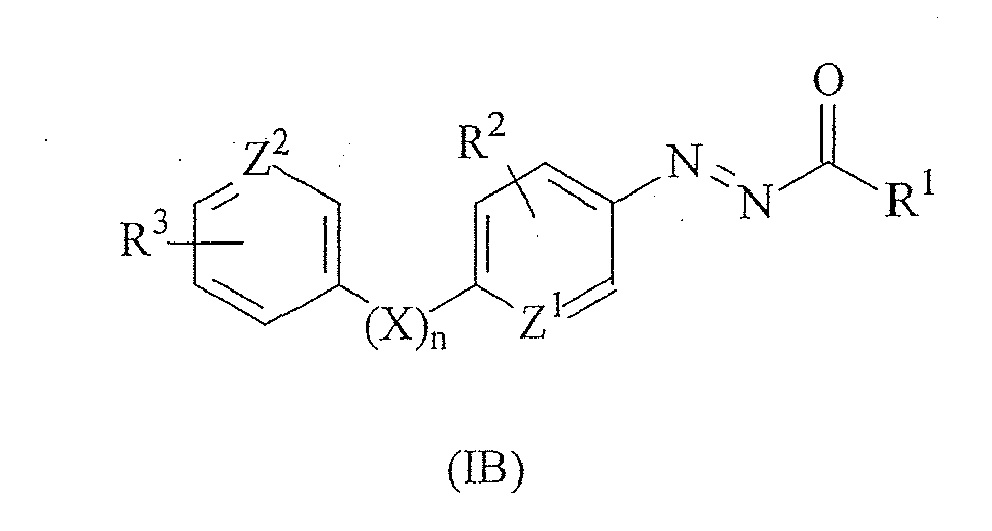

- Preferably, Q is -NY-NH-, -N=N-, or

- X is oxygen, sulfur, sulfoxide, or sulfone;
- n is 0 or 1;
- Y is hydrogen, C1-C4 alkanoyl, C1-C4 haloalkanoyl, C1-C6 straight chain or branched alkoxycarbonyl, C1-C4 alkoxy(C1-C4)alkoxycarbonyl, C1-C4 alkyl, or C1-C4 haloalkyl; R1 is C1-C6 alkoxy, C3-C6 branched alkoxy, C3-C6 cycloalkoxy, phenoxy, benzyloxy, C2-C6 alkenyloxy, C2-C6 alkynyloxy, C1-C6 haloalkoxy, silyloxy, (C1-C6 alkoxy)-carbonylmethoxy, C1-C6 thioalkoxy, C1-C6 alkylamino, C1-C6 alkyl, C3-C6 branched alkyl, (C1-C6 alkoxy) C1-C6 alkoxy, or (C1-C6 alkoxy)carbonyl;
- R2 and R3 are each, independently, hydrogen, halogen, C1-C6 alkyl, C3-C6 branched alkyl, C1-C6 haloalkyl, C1-C6 alkoxy, C1-C6 haloalkoxy, cyano, or (C1-C6 alkoxy)carbonyl ;
- R4 is C1-C6 alkyl; and
- Z1 and Z2 are each independently, carbon or nitrogen, with the proviso that when Z1 is carbon, X is oxygen, and R2 is hydrogen, then R3 cannot be hydrogen;
- More preferably, Q is -NY-NH-, -N=N-, or

- X is oxygen, sulfur, sulfoxide, or sulfone, most preferably oxygen;
- n is 0 or 1, most preferably 1;
- Y is hydrogen, C1-C4 haloalkanoyl, most preferably hydrogen;
- R1 is C1-C6 alkoxy, C3-C6 branched alkoxy, C1-C6 haloalkoxy, silyloxy, most preferably C1-C6 alkoxy or C3-C6 branched alkoxy;
- R2 and R3 are each, independently, hydrogen, halogen, C3-C6 branched alkyl, C1-C6 haloalkyl, C1-C6 haloalkoxy, or (C1-C6 alkoxy)carbonyl, most preferably halogen, C3-C6 branched alkyl, C1-C6 haloalkyl;
- R4 is C1-C6 alkyl; and
- Z1 and Z2 are each independently, carbon or nitrogen, most preferably carbon;
- with the proviso that when Z1 is carbon, X is oxygen, and R2 is hydrogen, then R3 cannot be hydrogen;
- This invention also relates to a phenoxyphenylhydrazine compound of the formula:


- Preferably, R5 is C1-C6 alkoxy; and R6 and R7 are, independently, halo or C1-C6 haloalkyl; R8 is C1-C6 alkyl; and R9 and R10, independently, are halo or C1-C6 haloalkyl.
- The compounds having structures IA, IB, IC or II can be prepared by the reaction of a substituted phenylhydrazine with an acylating agent such as acid chloride, chloroformate, or isocyanate in the presence of a suitable base such as pyridine or triethylamine, at 0 °C to room temperature. The product of this reaction can be further acylated with an acylating agent, alkylated with an alkylating agent, oxidized with an oxidizing agent, or reacting the oxidized product with amino acid derivatives and formaldehyde. The substituted phenylhydrazine starting material can be prepared from the corresponding substituted aniline as described in
U. S. Patent No. 6,297,275 . - The substituted phenoxyanilines can be prepared using the following synthetic method:

- The substituted phenylanilines can be prepared using an alternative approach as shown below:

- The compounds having structure (III) can be prepared by the reaction of substituted phenyldiazonium salt with nitroalkane in the presence of a suitable base such as CH3CO2Na and NaOH at 0 °C to room temperature as shown below:

- For the purposes of this invention, the term "controlling fungi" means inhibiting both future infestation and continued growth of existing infestations.
- This invention also relates to a method for controlling fungi, particularly phytopathogenic fungi, comprising contacting the fungi with a fungicidally effective amount of a phenoxyphenylhydrazine compound of the formula:
- a)


- b)

- c)

- Compositions useful in the method of this invention comprise (a) a fungicidally effective of a compound having a structure of formula IA, IB, IC, II, or III above, and (b) a suitable carrier. Such suitable carriers may be solid or liquid in nature.
- Suitable liquid carriers may be comprised of water, alcohols, ketones, phenols, toluene and xylenes. In such formulations, additives conventionally employed in the art may be utilized such as, for example, one or more surface active agents and/or inert diluents, to facilitate handling an application of the resulting pesticide composition.
- The compositions useful in the method of this invention can alternatively comprise solid carriers taking the form of dusts, granules, wettable powders, pastes, aerosols, emulsions, emulsifiable concentrates, and water-soluble solids.
- For example, the compounds useful in the method of this invention can be applied as dusts when admixed with or absorbed onto powdered solid carriers, such as mineral silicates, e.g., mica, talc, pyrophyllite and clays, together with a surface-active dispersing agent so that a wettable powder is obtained which then is applicable directly to the loci to be treated. Alternatively, the powdered solid carrier containing the compound admixed therewith may be dispersed in water to form a suspension for application in such form.
- Granular formulations of the compounds, suitable for application by broadcasting, side dressing, soil incorporation or seed treatment, are suitably prepared using a granular or pellitized form of carrier such as granular clays, vermiculite, charcoal or corn cobs.
- Alternatively, the compounds useful in the method of this invention can be applied in liquids or sprays when utilized in a liquid carrier, such as in a solution comprising a compatible solvent such as acetone, benzene, toluene or kerosene, or as dispersed in a suitable non-solvent medium, for example, water.
- Another method of application to the loci to be treated is aerosol treatment, for which the compound may be dissolved in an aerosol carrier which is a liquid under pressure but which is a gas at ordinary temperature (e.g., 20°C) and atmospheric pressure. Aerosol formulations may also be prepared by first dissolving the compound in a less volatile solvent and then admixing the resulting solution with a highly volatile liquid aerosol carrier.
- For treatment of plants (such term including plant parts), the compounds useful in the method of this invention preferably are applied in aqueous emulsions containing a surface-active dispersing agent which may be non-ionic, cationic or anionic. Suitable surface-active agents include those known in the art, such as those disclosed in
U.S. Patent 2,547,724 (columns 3 and 4). The compounds of the invention may be mixed with such surface-active dispersing agents, with or without an organic solvent, as concentrates for the subsequent addition of water to yield aqueous suspensions of the compounds at desired concentration levels. - In addition, the compounds may be employed with carriers which are pesticidally active, such as insecticides, acaricides, fungicides or bactericides.
- It will be understood that the amount of the compound in a given formulation useful in the method of this invention will depend upon the specific fungus to be combatted, as well as upon the specific chemical composition and formulation of the compound being employed, the method of applying the compound/formulation and the locus of treatment so that the fungicidally effective amount of the compound may vary widely. Generally, however, concentrations of the compound as the active ingredient in fungicidally effective formulations in the method of this invention can range from about 0.1 to about 95 percent by weight. Spray dilutions may be as low as a few parts per million, while at the opposite extreme, full strength concentrates of the compound may be usefully applied by ultra low volume techniques. Concentration per unit area, where plants constitute the loci of treatment, may range between about 0.01 and about 50 pounds per acre, with concentrations of between about 0.1 and about 10 pounds per acre preferably being employed for crops such as corn, tobacco, rice and the like.
- To control fungi, sprays of the compounds can be applied to the fungi directly and/or to plants or plant seeds upon which they feed or nest. The fungicidally active formulations useful in the method of this can also be applied to the soil, water, or other growth medium in which the pests are present.
- The specific methods of application, as well as the selection and concentration of the compounds useful in the method of this invention, will, of course, vary depending upon such circumstances as geographic area, climate, topography, plant tolerance, etc. For specific circumstances, one skilled in the art may readily determine the proper compound, concentration and method of application by routine experimentation.
- Examples of phytopathogenic fungi which can be controlled by the method of this invention include, e.g., the following:
- Erysiphe graminis f.sp. hordei
- Erysiphe cichoracearum
- Erysiphe polygoni
- Pyricularia grisea
- Helminthosporium sativum
- Uromyces appendiculatus
- Botrytis circerea
- Colletotrichum gossypii
- Cercosporidium personatum
- Fusarium nivale
- Phytopthora infestans
- Pythium ultimum
- Rhizoctonia solani
- Sclerotinia minor
- Septoria nodurum
- The following examples are provided to illustrate the present invention.
- A mixture of 1-chloro-4-nitrobenzene (11 g), 3-(trifluoromethyl)phenol (12 g), and potassium carbonate (21 g) in dimethyl formamide (175 mL) was heated at 120 °C for about 16 hours. The reaction mixture was cooled to room temperature and poured over ice-water. The mixture was filtered and the solid collected was washed with water and dried under vacuum (25 g).
- To 1-Nitro-4-[3-(trifluoromethyl)phenoxy]benzene (19 g) in ethyl acetate (250 mL) was added 5% palladium on charcoal (1.5 g). The mixture was stirred under hydrogen gas for about 36 h, and then filtered through Celite . The filtrate was concentrated to yield a red oil (17 g).
- 4-[3-(Trifluoromethyl)phenoxy]benzenamine (15 g) was added to a stirred solution of 6 M HCl (190 mL). The resulted suspension was cooled to -5 °C, and then an aqueous solution of NaNO2 (4.5 g in 15 mL water) was added dropwise over a period of 15 min. The reaction mixture was stirred for another 30 min, followed by the gradual addition of a solution of SnCl2.2H2O (69 g in 100 mL conc HCl). After stirring at -5 °C for 2 h, the stirred mixture was warmed to room temperature overnight, filtered, and the collected solid was washed with 6 M HCl, water, and dried (18 g).
- To a suspension of 4-[3-(trifluoromethyl)phenoxy]phenylhydrazine hydrochloride (11 g) and pyridine (6.0 mL) in ethyl acetate (100 mL) at 0 °C was added dropwise isopropyl chloroformate (38 mL, 1M in toluene) over a period of 30 min. The mixture was then stirred at room temperature for 5 hour, quenched with 1M aqueous HCl (100 mL). The organic layer was separated, washed twice with water (100 mL), dried over anhydrous sodium sulfate, and finally evaporated under reduced pressure to yield a light brown solid (11g).
- To the product (0.4 g) of Step 4 of Example 1 was added dichloromethane (10 mL) and trifluoroacetic anhydride (1 mL). The solution was stirred at room temperature for 4 hours and then concentrated to give an oily residue, which upon co-evaporation with toluene (2x10 mL) under reduced pressure, gave a brown solid (0.5 g).
- The product (0.4 g) of Step 4 of Example 1 was heated in methyl iodide (5 mL) at reflux for 1 day and then concentrated under reduced pressure to give a red oil (0.5 g).
- To [3-fluoro-4-[3-(trifluoromethyl)phenoxy]phenyl]hydrazine hydrochloride (0.35g) prepared using the method described in Example 1, in ethyl acetate (5 mL), was added pyridine (0.24 mL) at -10 °C. After dropwise addition of acetyl chloride (0.1 mL), the mixture was stirred for 3 h and then acidified with 6 M HCl. Water was added, and the product was extracted with ether. The organic layer was separated, dried, and concentrated. The residue was purified by column chromatography on silica (using dichloromethane, followed by 5:1 dichloromethane:ether as eluants) to give a solid (0.2 g).
- A mixture of 4-bromo-3-fluoroaniline (4.3 g), 3-trifluoromethylphenylboronic acid (4.4 g), sodium carbonate (6.5 g), palladium (II) acetate (0.22 g) and 2-(di-t-butylphosphino)biphenyl (0.60 g) were weighed into a reaction tube and flushed with nitrogen. A 70:30 mixture of dioxane/water (50 mL) was then added and the mixture was heated at 90 °C for 16 h. Ethyl acetate and water was added and the phases separated. The organic phase was dried and concentrated. The residue was purified by column chromatography on silica to give a solid (2.5 g).
- The procedures described in Steps 3 and 4 of Example 1 were used to prepare Compound 8.
- To the product (0.42 g) of Step 4 of Example 1 was added dichloromethane (10 mL) and 5% aqueous sodium hypochlorite (20 mL). The two-phase mixture was stirred vigorously overnight at room temperature, the organic layer was separated, dried over anhydrous sodium sulfate, and concentrated under reduced pressure to give a red oil (0.4 g).
- 1-Methylethyl 3-fluoro-4-[3-(trifluoromethylphenoxy)phenyl]diazenecarboxylate (370 mg) prepared using the procedure described in Example 6, sarcosine (178 mg) and paraformaldehyde (150 mg) were suspended in toluene (10 mL) and the reaction mixture was then heated at reflux for 3 hours. Solvent was then removed under reduced pressure and the residue was purified by chromatography on silica to give a colorless oil (120 mg).
- A mixture of 3-fluoro-4-[3-(trifluoromethyl)phenoxy]aniline (1.35 g) prepared as described in Step 2 of Example 1, water (18.2 mL), and conc. HCl (1.5 mL) was stirred overnight at room temperature. The suspension mixture was cooled to -5 °C and was added dropwise of NaNO2 (0.36 g in 2 mL water) over a period of about 10 min. The reaction mixture was further stirred for 30 minutes, and added CH3CO2Na3H2 (6.6 g). The resulting salt was added to a previously prepared solution of nitropropane (0.44 g) and NaOH (0.20 g) in ethanol (8 mL) and water (2 mL). The resulting mixture was stirred at 0 °C and then at room temperature overnight. It was filtered to give a red solid that was subsequently purified by column chromatography on silica (40% dichloromethane/hexane).
- The remaining compounds listed in Tables 1A and 1B (i.e., Compounds 4-6, and 11) were prepared according to the procedures described for the foregoing Examples 1-8 using the correspondingly different substituted phenylhydrazine. The identity of each of the compounds is confirmed by NMR spectroscopy.
Table 1A 
Cmpd. X Y n R1 R2 R3 Z1 Z2 1HNMR
data (CDCl3)1 O H 1 OCH(CH3)2 H 3-CF3 C C d (6) 1.3;
sp (1) 5.0;
br s (1) 5.8;
brs(1)6.5;
m (8) 6.8-7.42 O CF3CO 1 OCH(CH3)2 H 3-CF3 C C d (6) 1.3;
sp (1) 5.0;
m (9) 6.9-7.53 O CH3 1 OCH(CH3)2 H 3-CF3 C C m (6) 1.3;
s (3) 3.2;
sp (1) 5.0;
brs(1)6.5;
m (8) 6.9-7.54 S CF3CO 1 OCH(CH3)C2H5 H H C C m (8) 0.8-1.8;
sx (1) 4.8;
m(10) 7.1-7.55 O H 1 OCH3 H H C N s (3) 3.8;
brs(1)6.2;
m (7) 6.8-7.7;
m (2) 8.2-8.56 O CF3CO 1 OCH(CH3)2 H 3-Cl N C d (6) 1.3;
sp (1) 5.0;
m (6)6.9-7.4;
br s (1) 7.9;
d (1) 8.37 O H 1 CH3 3-F 3-CF3 C C s (3) 2.1;
d (1) 5.9;
m (2) 6.7;
m (8) 7.0-7.48 - H 0 OCH(CH3)2 3-F 3-CF3 C C d (6) 1.3;
sp (1) 5.0;
br s (1) 5.3; brs(1)6.5;
m (2) 6.7;
m (5) 7.3-7.8Table 1B 
Cmpd X n R1 R2 R3 Z1 Z2 1H NMR
data (CDCl3)9 O 1 OCH(CH3)2 H 3-CF3 C C d (6) 1.5
sp (1) 5.3
dd (2) 7.1
m (4) 7.3-7.6
dd (2) 8.0Table 1C 
Cmpd X n R1 R2 R3 Z1 Z2 1H NMR
data (CDCl3)10 O 1 OCH(CH3)2 3-F 3-CF3 C C dd (6) 1.3
s (3) 2.5
m (4) 4.1-4.3
sp (1) 5.1
m (7) 6.6-7.4Table 1D 
Compound No. R5 R6 R7 1H NMR
data (CDCl3)11 OCH(CH3)2 3-F 3-CF3 d (6) 1.3;
sp (1) 5.0;
brs(1)5.8;
m (4) 6.2-6.4;
m (4) 7.2-7.5Table 1E 
Compound No. R8 R9 R10 1HNMR
data (CDCl3)12 CH2CH3 3-F 3-CF3 t(3)1.3;
q (2) 2.9;
m (7) 7.0-7.4;
brs (1)12.1 - Technical grade material at defined ppm rates (w/v) in an acetone:water mixture (1:9) containing 0.1 % Tween 20 (v/v) is sprayed to near run-off onto 7-days-old greenhouse-grown barley plants (var. "Robust") at the cotyledon stage. Treated plants are inoculated within 24 hours by brushing mildew-infected plants over the treated plants. Inoculated plants are kept in the greenhouse for 6-8 days for disease development. Disease severity is examined and the % control is calculated as [% disease on untreated plants - % disease on treated plants] / % diseases in untreated plants. The results of these tests are shown in Table 2A below under the heading "Foliar Application - Barley Powdery Mildew".
- Foliar spray for the control of bean powdery mildew caused by Erysiyphe polygoni Technical grade material at defined ppm rates (w/v) in an acetone:water mixture (1:9) containing 0.1 % Tween 20 (v/v) is sprayed to near run-off onto greenhouse-grown Pinto bean plants (var. "Othello") in the second leaf stage. Treated plants are inoculated within 24 hours by brushing mildew-infected plants over treated plants. Inoculated plants are kept in the greenhouse for two weeks for disease development. Disease severity is examined and the % control is calculated as [% disease on untreated plants - % disease on treated plants] / % disease on untreated plants. The results of these tests are shown in Table 2A below under the heading "Foliar Application - Bean Powdery Mildew".
- Technical grade material at defined ppm rates (w/v) in an acetone:water mixture (1:9) containing 0.1% Tween 20 (v/v) is sprayed to near run-off onto 7-days-old greenhouse-grown barley plants (var. "Robust") at the cotyledon stage. Treated plants are inoculated within 24 hours from spraying with an aqueous suspension of approximately 15,000 conidia/ml of Helminthosporium sativum grown on artificial medium. Inoculated plants are placed into a high humidity chamber for 24 hr and then transferred to the greenhouse for 4-5 days for disease development. Disease severity is examined and the % control is calculated as [% disease on untreated plants - % disease on treated plants] / % disease on untreated plants.
- The results of these tests are shown in Table 2A below under the heading "Foliar Application - Barley Blotch".
- Technical grade material at defined ppm rates (w/v) in an acetone:water mixture (1:9) containing 0.1% Tween 20 (v/v) is sprayed to near run-off onto 7-days-old greenhouse-grown rice plants (var. "Lemont") at the cotyledon stage. Treated plants are inoculated within 24 hours with an aqueous suspension of approximately 45,000 conidia/ml of Pyricularia oryzae grown on artificial medium. Inoculated plants are placed into a high humidity chamber for 48 hr and then transferred to the greenhouse for 4-5 days for disease development. Disease severity is examined and the % control is calculated as [% disease on untreated plants - % disease on treated plants] / % disease on untreated plants. The results of these tests are shown in Table 2A below under the heading "Foliar Application - Rice Blast".
- Technical grade material at defined ppm rates (w/v) in an acetone:water mixture (1:9) containing 0.1% Tween 20 (v/v) is sprayed to near run-off onto mature greenhouse-grown geranium plants (var. "Pinto White") in the second leaf stage. Treated plants are inoculated within 24 hours with an aqueous suspension of approximately 100,000 conidia/ml of Botrytis cinerea grown on artificial medium. Inoculated plants are, placed into a high humidity chamber for 5 days and then transferred to the greenhouse for one day for disease development. Disease severity is examined and the % control is calculated as [% disease on untreated plants - % disease on treated plants] / % disease on untreated plants. The results of these tests are shown in Table 2A below under the heading ""Foliar Application - Geranium Gray Mold".
- Foliar spray for the control of tomato late blight caused by Phytophthora infestans Technical grade material at defined ppm rates (w/v) in an acetone:water mixture (1:9) containing 0.1% Tween 20 (v/v) is sprayed to near run-off onto 2-weeks-old greenhouse-grown tomato plants (var. "Patio") in the second leaf stage. Treated plants are inoculated within 24 hours with an aqueous suspension of approximately 50,000 sporangia/ml of Phytophthora infestans grown on artificial medium. Inoculated plants are placed into a high humidity chamber for 4 days and then transferred to the greenhouse for one day for disease development. Disease severity is examined and the % control is calculated as [%.disease on untreated plants - % disease on treated plants] / % disease on untreated plants. The results of these tests are shown in Table 2A below under the heading "Foliar Application - Tomato Late Blight".
- Technical grade material at defined ppm rates (w/v) in an acetone:water mixture (1:9) containing 0.1% Tween 20 (v/v) is sprayed to near run-off onto 10-days-old greenhouse-grown Pinto bean plants (var. "Othello") in the second leaf stage. Treated plants are inoculated within 24 hours with an aqueous suspension of approximately 20,000 uredospores of Uromyces appendiculatus harvested from rust-infected plants. Inoculated plants are placed into a high humidity chamber for 24 hr and then transferred to the greenhouse for two weeks for disease development. Disease severity is examined and the % control is calculated as [% disease on untreated plants - % disease on treated plants] / % disease on untreated plants. The results of these tests are shown in Table 2A below under the heading "Foliar Application - Bean Rust".
- Technical grade material formulated as described for foliar sprays is dispensed at defined rates (ml/cm3) into the soil in the pots for barley and cucumber in the stages as described for the foliar sprays. Treated plants are inoculated, within 24 hours with the respective powdery mildew species as described for the foliar spray tests. Inoculated plants are kept in the greenhouse for 6-8 days for disease development. Disease severity is examined and the % control is calculated as [% disease on untreated plants - % disease on treated plants] / % disease on untreated plants. The results of these tests are shown in Table 2B below under the heading "Drench Application - Barley Powdery Mildew" and "Drench Application - Cucumber Powdery Mildew".
- Technical grade material solubilized in acetone at 3000 ppm w/v and diluted in distilled water is delivered in aliquots of at least 10 ul into 100 to 200 ul of a standard fungal growth medium in 96 well plates to provide final rates of 10-100 ppm a.i. (w/v). Each well is inoculated with at least 100 conidia and/or mycelial fragments of fungal pathogens such as Pythium ultimum, Phytophthora infestans, Rhizoctonia solani, Fusarium nivale, Botrytis cinerea, Colletotrichum gossypii, Cercosporidium personatum, Sclerotinia minor, or Sclerotium rolfsii. After 48 hours, the growth density is assessed to determine the % inhibition as [density in untreated well - density in treated well] / density in untreated well. The results of these tests are located in Tables 3A and 3B.
Table 2A. Percent (%) disease control of phenylhydrazine fungicides at 300 ppm in greenhouse foliar application assays Foliar Application (Percent Control) Cmpd.
No.Barley
Powdery
MildewBarley
BlotchRice vBlast Bean
Powdery
MildewBean
RustTomato
Late
BlightGeranium
Gray
Mold1 90 97 79 - 97 12 87 2 25 99 15 - 0 - - 3 62 0 10 - 0 - 87 4 0 0 - 88 0(e) 0 - 5 0 0 - 0 0(e) - - 6 0 97 92 - 0 0 82 7 80 80 0 - - 0 80 8 0 98 70 - - 0 90 9 15 97 98 - 45 - - 10 100 90 0 - - - 0 11 85 0 0 - - 0 0 12 80 0 0 - - 0 0 (e) screened against rust on beans as foliar-applied eradicant. Table 2B. Percent (%) disease control of phenylhydrazine fungicides at 300 ppm in greenhouse drench application assays Drench Application (Percent Control) Compound
No.Barley
Powdery
MildewCucumber
Powdery
Mildew1 0 0 2 0 0 3 0 0 4 0 0 5 0 0 6 0 0 7 - - 8 - - 9 25 0 10 - - 11 - - 12 - - Table 3A. Percent (%) control of phytopathogenic fungi by phenylhyrazine derivatives in vitro. Percent Control Cmpd
No.Rate
(ppm)Botrytis
cinereaColletotricum
gossypiiCercosporidium
personatumFusarium
nivalePhytophthora
infestants1 100 100 - - 29 100 2 100 90 - - 20 100 3 50 100 - - 82 79 4 100 75 15 65 50 100 5 100 25 100 0 90 20 6 100 98 - - 71 100 7 10 30 - - 8 0 8 10 63 - - 22 18 9 100 77 - - 75 9 10 100 0 - - 0 0 11 10 0 - - 18 0 12 10 18 - - 20 0 Table 3B. Percent (%) control of phytopathogenic fungi by phenylhyrazine derivatives in vitro. Percent Control Compound
No.Rate
(ppm)Pythium
ultimumRhizoctonia
solaniSclerotinia
minorSclerotium
rolfsii1 100 100 91 - 100 2 100 100 82 - 67 3 50 100 63 - - 4 100 15 95 50 - 5 100 70 0 100 100 6 100 25 100 - 98 7 10 8 80 - - 8 10 26 58 - - 9 100 0 22 - 91 10 100 0 79 - - 11 10 9 4 - - 12 10 3 68 - -
Claims (3)
- A phenoxyphenylhydrazine compound of the formula:

- A method for controlling fungi comprising contacting the fungi with a fungicidally effective amount of a phenoxyphenylhydrazine compound of claim 1.
- A method for controlling fungi on a plant or plant seed which comprises applying to the plant or the plant seed, or to a growth medium or water in which the plant or plant seed is growing or is to be grown in, a fungicidally effective amount of a compound of claim 1.
Applications Claiming Priority (2)
| Application Number | Priority Date | Filing Date | Title |
|---|---|---|---|
| US48252403P | 2003-06-24 | 2003-06-24 | |
| EP04753196A EP1638923A2 (en) | 2003-06-24 | 2004-05-25 | Fungicidal phenoxyphenylhydrazine derivatives |
Related Parent Applications (1)
| Application Number | Title | Priority Date | Filing Date |
|---|---|---|---|
| EP04753196.7 Division | 2004-05-25 |
Publications (1)
| Publication Number | Publication Date |
|---|---|
| EP2385037A1 true EP2385037A1 (en) | 2011-11-09 |
Family
ID=34061943
Family Applications (2)
| Application Number | Title | Priority Date | Filing Date |
|---|---|---|---|
| EP04753196A Withdrawn EP1638923A2 (en) | 2003-06-24 | 2004-05-25 | Fungicidal phenoxyphenylhydrazine derivatives |
| EP11160386A Withdrawn EP2385037A1 (en) | 2003-06-24 | 2004-05-25 | Fungicidal phenoxyphenylhydrazine derivatives |
Family Applications Before (1)
| Application Number | Title | Priority Date | Filing Date |
|---|---|---|---|
| EP04753196A Withdrawn EP1638923A2 (en) | 2003-06-24 | 2004-05-25 | Fungicidal phenoxyphenylhydrazine derivatives |
Country Status (11)
| Country | Link |
|---|---|
| US (1) | US7045512B2 (en) |
| EP (2) | EP1638923A2 (en) |
| JP (1) | JP4331751B2 (en) |
| CN (1) | CN1934074A (en) |
| AR (1) | AR044822A1 (en) |
| AU (1) | AU2004256029A1 (en) |
| BR (1) | BRPI0411859A (en) |
| CA (1) | CA2535986A1 (en) |
| EA (2) | EA011609B1 (en) |
| TW (1) | TWI340132B (en) |
| WO (1) | WO2005005376A2 (en) |
Families Citing this family (8)
| Publication number | Priority date | Publication date | Assignee | Title |
|---|---|---|---|---|
| US7592374B2 (en) * | 2005-03-03 | 2009-09-22 | Crompton Corporation | Insecticidal nitromethylene compounds |
| US7446119B2 (en) * | 2005-03-28 | 2008-11-04 | Crompton Corporation | Miticidal triazolidine derivatives |
| US7572753B2 (en) * | 2005-09-15 | 2009-08-11 | Chemtura Corporation | Tetrazole fungicides |
| NZ611528A (en) * | 2010-12-15 | 2015-06-26 | Theravance Biopharma R & D Ip Llc | Neprilysin inhibitors |
| US9160816B2 (en) | 2012-02-02 | 2015-10-13 | Apple Inc. | Methods and systems for fast account setup |
| KR101822767B1 (en) | 2013-12-13 | 2018-01-26 | 에프. 호프만-라 로슈 아게 | Inhibitors of bruton's tyrosine kinase |
| RU2653504C2 (en) | 2013-12-13 | 2018-05-10 | Ф. Хоффманн-Ля Рош Аг | Bruton's tyrosine kinase inhibitors |
| KR101768402B1 (en) | 2013-12-13 | 2017-08-14 | 에프. 호프만-라 로슈 아게 | Inhibitors of bruton's tyrosine kinase |
Citations (6)
| Publication number | Priority date | Publication date | Assignee | Title |
|---|---|---|---|---|
| US2547724A (en) | 1949-12-08 | 1951-04-03 | Us Rubber Co | 2-alkyliminonaphtho [2,3]-1, 3-dithole-4, 9-dione alkohalide and fungicidal compositis containing same |
| US4619689A (en) * | 1978-11-08 | 1986-10-28 | Mitsui Toatsu Chemicals, Inc. | Diphenyl ether derivatives and herbicides containing same |
| US5367093A (en) | 1991-11-22 | 1994-11-22 | Uniroyal Chemical Company, Inc. | Insecticidal phenylhydrazine derivatives |
| US6297275B1 (en) | 1999-09-07 | 2001-10-02 | Uniroyal Chemical Company, Inc. | Method for controlling fungi using phenylhydrazine derivatives |
| EP1178039A1 (en) | 2000-08-04 | 2002-02-06 | Aventis Cropscience S.A. | Derivatives of phenyl(thio)urea and phenyl(thio)carbamate fungicides |
| EP1178035A1 (en) | 2000-08-04 | 2002-02-06 | Aventis Cropscience S.A. | Fungicidal phenylimine derivatives |
Family Cites Families (4)
| Publication number | Priority date | Publication date | Assignee | Title |
|---|---|---|---|---|
| CH485402A (en) * | 1966-06-07 | 1970-02-15 | Ciba Geigy | Pesticides |
| FR1536991A (en) * | 1966-06-07 | 1968-08-23 | Ciba Geigy | New pesticide agents |
| US4816373A (en) * | 1986-01-31 | 1989-03-28 | Mitsubishi Paper Mills, Ltd. | Method of producing images |
| SK282306B6 (en) * | 1991-11-22 | 2002-01-07 | Uniroyal Chemical Company, Inc. | Phenylhydrazine derivatives, pesticidal preparation containing these compounds and method for controlling ineligible insects |
-
2004
- 2004-05-25 EP EP04753196A patent/EP1638923A2/en not_active Withdrawn
- 2004-05-25 JP JP2006517138A patent/JP4331751B2/en not_active Expired - Fee Related
- 2004-05-25 CN CNA2004800200464A patent/CN1934074A/en active Pending
- 2004-05-25 EP EP11160386A patent/EP2385037A1/en not_active Withdrawn
- 2004-05-25 WO PCT/US2004/016324 patent/WO2005005376A2/en not_active Ceased
- 2004-05-25 CA CA002535986A patent/CA2535986A1/en not_active Abandoned
- 2004-05-25 EA EA200600091A patent/EA011609B1/en not_active IP Right Cessation
- 2004-05-25 AU AU2004256029A patent/AU2004256029A1/en not_active Abandoned
- 2004-05-25 BR BRPI0411859-6A patent/BRPI0411859A/en not_active IP Right Cessation
- 2004-05-25 EA EA200801754A patent/EA014191B1/en not_active IP Right Cessation
- 2004-05-27 US US10/855,452 patent/US7045512B2/en not_active Expired - Fee Related
- 2004-06-08 TW TW093116436A patent/TWI340132B/en not_active IP Right Cessation
- 2004-06-18 AR ARP040102132A patent/AR044822A1/en not_active Application Discontinuation
Patent Citations (6)
| Publication number | Priority date | Publication date | Assignee | Title |
|---|---|---|---|---|
| US2547724A (en) | 1949-12-08 | 1951-04-03 | Us Rubber Co | 2-alkyliminonaphtho [2,3]-1, 3-dithole-4, 9-dione alkohalide and fungicidal compositis containing same |
| US4619689A (en) * | 1978-11-08 | 1986-10-28 | Mitsui Toatsu Chemicals, Inc. | Diphenyl ether derivatives and herbicides containing same |
| US5367093A (en) | 1991-11-22 | 1994-11-22 | Uniroyal Chemical Company, Inc. | Insecticidal phenylhydrazine derivatives |
| US6297275B1 (en) | 1999-09-07 | 2001-10-02 | Uniroyal Chemical Company, Inc. | Method for controlling fungi using phenylhydrazine derivatives |
| EP1178039A1 (en) | 2000-08-04 | 2002-02-06 | Aventis Cropscience S.A. | Derivatives of phenyl(thio)urea and phenyl(thio)carbamate fungicides |
| EP1178035A1 (en) | 2000-08-04 | 2002-02-06 | Aventis Cropscience S.A. | Fungicidal phenylimine derivatives |
Also Published As
| Publication number | Publication date |
|---|---|
| EA011609B1 (en) | 2009-04-28 |
| JP2007518675A (en) | 2007-07-12 |
| TWI340132B (en) | 2011-04-11 |
| WO2005005376A3 (en) | 2005-08-04 |
| EP1638923A2 (en) | 2006-03-29 |
| WO2005005376A8 (en) | 2007-01-18 |
| BRPI0411859A (en) | 2006-08-29 |
| TW200509792A (en) | 2005-03-16 |
| EA014191B1 (en) | 2010-10-29 |
| US7045512B2 (en) | 2006-05-16 |
| WO2005005376A2 (en) | 2005-01-20 |
| AU2004256029A1 (en) | 2005-01-20 |
| US20040266738A1 (en) | 2004-12-30 |
| CN1934074A (en) | 2007-03-21 |
| JP4331751B2 (en) | 2009-09-16 |
| AR044822A1 (en) | 2005-10-05 |
| CA2535986A1 (en) | 2005-01-20 |
| EA200801754A1 (en) | 2009-02-27 |
| EA200600091A1 (en) | 2006-06-30 |
Similar Documents
| Publication | Publication Date | Title |
|---|---|---|
| EP1341534B1 (en) | Compounds having fungicidal activity and processes to make and use same | |
| EP1178039B1 (en) | Derivatives of phenyl(thio)urea and phenyl(thio)carbamate fungicides | |
| JPH09506341A (en) | Fungicidal and fungicidal cyclic amides | |
| JPH10504042A (en) | Fungicidal and fungicidal cyclic amides | |
| EP0001663B1 (en) | Novel 2-arylamino-hexahydropyrimidines and -imidazolidines, salts and complexes thereof, method of preparing the novel compounds and fungicidal compositions which contain the novel compounds | |
| US7045512B2 (en) | Fungicidal phenoxyphenylhydrazine derivatives | |
| JP2004519474A (en) | Substituted 4,5-dihydro-1,2,4-triazin-6-ones, 1,2,4-triazin-6-ones and their use as fungicides and insecticides | |
| JP2728307B2 (en) | Substituted oxime ethers and fungicides containing the compounds | |
| US4145428A (en) | Fungicidally active 2-acyloxy-1-phenoxy-1-(1,2,4-triazolyl)-3,3-dimethyl-butanes | |
| US4783459A (en) | Anilinopyrimidine fungicides | |
| US6121251A (en) | Dihydropyridazinones and pyridazinones and their use as fungicides and insecticides | |
| US6051737A (en) | Aryl benzoyl urea derivative and pesticidal composition comprising the same | |
| EP0617014B1 (en) | Oxime ether compound, processes for preparing the same and fungicide containing the same | |
| JP2782463B2 (en) | 4-Substituted phenyl-1,2,4-triazolin-5-one derivatives and fungicides for agricultural and horticultural use | |
| JPS6133170A (en) | Azolylnitrile and sterilizer | |
| HUT52914A (en) | Fungicide compositions containing sulfur-containing oximethers as active components and process for producing the active components | |
| US6297275B1 (en) | Method for controlling fungi using phenylhydrazine derivatives | |
| CN1309898A (en) | Pesticide containing 0-benzyl oximeether derivative and its use | |
| EP1074546B1 (en) | 5-iodo-4-phenethylaminopyrimidine derivatives, intermediates thereof, process for producing the same and agricultural/horticultural pesticides | |
| CN1009929B (en) | Imidazole derivatives prepn. | |
| EP0648757A1 (en) | Isothiazolone derivative and microbicidal composition comprising the same as active ingredient | |
| US7572753B2 (en) | Tetrazole fungicides | |
| JP2832544B2 (en) | Pest control agent | |
| JPH06271552A (en) | Fluorinated benzotriazole | |
| US5278182A (en) | Azole-1-carboxylic acid ester derivatives and fungicidal compositions |
Legal Events
| Date | Code | Title | Description |
|---|---|---|---|
| AC | Divisional application: reference to earlier application |
Ref document number: 1638923 Country of ref document: EP Kind code of ref document: P |
|
| AK | Designated contracting states |
Kind code of ref document: A1 Designated state(s): AT BE BG CH CY CZ DE DK EE ES FI FR GB GR HU IE IT LI LU MC NL PL PT RO SE SI SK TR |
|
| PUAI | Public reference made under article 153(3) epc to a published international application that has entered the european phase |
Free format text: ORIGINAL CODE: 0009012 |
|
| RIN1 | Information on inventor provided before grant (corrected) |
Inventor name: OSIKA, EWA, MARIA Inventor name: CHEE, GAIK-LEAN Inventor name: DEKEYSER, MARK, A. Inventor name: BROUWER, WALTER, G. Inventor name: PARK, SHELDON, B. Inventor name: SEEBOLD, KENNETH, W., JUN. Inventor name: LAI, HOI, KIONG |
|
| 17P | Request for examination filed |
Effective date: 20120412 |
|
| 17Q | First examination report despatched |
Effective date: 20120801 |
|
| STAA | Information on the status of an ep patent application or granted ep patent |
Free format text: STATUS: THE APPLICATION IS DEEMED TO BE WITHDRAWN |
|
| 18D | Application deemed to be withdrawn |
Effective date: 20131203 |