EP2385035B1 - Preparation method of dihydroindene amide compounds their pharmaceutical compositions containing compounds thereof and use as protein kinases inhibitor - Google Patents
Preparation method of dihydroindene amide compounds their pharmaceutical compositions containing compounds thereof and use as protein kinases inhibitor Download PDFInfo
- Publication number
- EP2385035B1 EP2385035B1 EP09834119.1A EP09834119A EP2385035B1 EP 2385035 B1 EP2385035 B1 EP 2385035B1 EP 09834119 A EP09834119 A EP 09834119A EP 2385035 B1 EP2385035 B1 EP 2385035B1
- Authority
- EP
- European Patent Office
- Prior art keywords
- heterocycloalkyl
- cycloalkyl
- alkynyl
- alkenyl
- haloalkyl
- Prior art date
- Legal status (The legal status is an assumption and is not a legal conclusion. Google has not performed a legal analysis and makes no representation as to the accuracy of the status listed.)
- Not-in-force
Links
- 150000001875 compounds Chemical class 0.000 title claims description 137
- -1 dihydroindene amide compounds Chemical class 0.000 title claims description 47
- 102000001253 Protein Kinase Human genes 0.000 title claims description 38
- 108060006633 protein kinase Proteins 0.000 title claims description 38
- 239000008194 pharmaceutical composition Substances 0.000 title claims description 6
- 238000002360 preparation method Methods 0.000 title description 29
- 239000003112 inhibitor Substances 0.000 title description 2
- 125000000592 heterocycloalkyl group Chemical group 0.000 claims description 73
- 125000000753 cycloalkyl group Chemical group 0.000 claims description 69
- 125000004169 (C1-C6) alkyl group Chemical group 0.000 claims description 55
- 125000004093 cyano group Chemical group *C#N 0.000 claims description 54
- 229910052736 halogen Inorganic materials 0.000 claims description 53
- 125000000171 (C1-C6) haloalkyl group Chemical group 0.000 claims description 52
- 125000000882 C2-C6 alkenyl group Chemical group 0.000 claims description 52
- 125000003601 C2-C6 alkynyl group Chemical group 0.000 claims description 52
- 150000002367 halogens Chemical class 0.000 claims description 52
- 125000006642 (C1-C6) cyanoalkyl group Chemical group 0.000 claims description 50
- 125000006577 C1-C6 hydroxyalkyl group Chemical group 0.000 claims description 50
- 125000003118 aryl group Chemical group 0.000 claims description 50
- 125000001072 heteroaryl group Chemical group 0.000 claims description 50
- 108010014608 Proto-Oncogene Proteins c-kit Proteins 0.000 claims description 48
- 102000016971 Proto-Oncogene Proteins c-kit Human genes 0.000 claims description 48
- 208000037265 diseases, disorders, signs and symptoms Diseases 0.000 claims description 46
- MPVDXIMFBOLMNW-UHFFFAOYSA-N chembl1615565 Chemical compound OC1=CC=C2C=C(S(O)(=O)=O)C=C(S(O)(=O)=O)C2=C1N=NC1=CC=CC=C1 MPVDXIMFBOLMNW-UHFFFAOYSA-N 0.000 claims description 45
- 101100268648 Mus musculus Abl1 gene Proteins 0.000 claims description 33
- 230000000694 effects Effects 0.000 claims description 31
- 150000003839 salts Chemical class 0.000 claims description 31
- 201000010099 disease Diseases 0.000 claims description 30
- 238000000034 method Methods 0.000 claims description 26
- 108091000080 Phosphotransferase Proteins 0.000 claims description 25
- 102000020233 phosphotransferase Human genes 0.000 claims description 25
- 125000004429 atom Chemical group 0.000 claims description 23
- 125000002971 oxazolyl group Chemical group 0.000 claims description 18
- 208000035475 disorder Diseases 0.000 claims description 14
- WEVYNIUIFUYDGI-UHFFFAOYSA-N 3-[6-[4-(trifluoromethoxy)anilino]-4-pyrimidinyl]benzamide Chemical compound NC(=O)C1=CC=CC(C=2N=CN=C(NC=3C=CC(OC(F)(F)F)=CC=3)C=2)=C1 WEVYNIUIFUYDGI-UHFFFAOYSA-N 0.000 claims description 13
- 125000002883 imidazolyl group Chemical group 0.000 claims description 12
- 125000001786 isothiazolyl group Chemical group 0.000 claims description 12
- 125000000842 isoxazolyl group Chemical group 0.000 claims description 12
- 125000003373 pyrazinyl group Chemical group 0.000 claims description 12
- 125000003226 pyrazolyl group Chemical group 0.000 claims description 12
- 125000002098 pyridazinyl group Chemical group 0.000 claims description 12
- 125000004076 pyridyl group Chemical group 0.000 claims description 12
- 125000000714 pyrimidinyl group Chemical group 0.000 claims description 12
- 125000000335 thiazolyl group Chemical group 0.000 claims description 12
- 125000004306 triazinyl group Chemical group 0.000 claims description 12
- 125000001425 triazolyl group Chemical group 0.000 claims description 12
- 206010028980 Neoplasm Diseases 0.000 claims description 11
- 238000011282 treatment Methods 0.000 claims description 10
- 125000003342 alkenyl group Chemical group 0.000 claims description 9
- 208000023275 Autoimmune disease Diseases 0.000 claims description 8
- 206010051066 Gastrointestinal stromal tumour Diseases 0.000 claims description 8
- 125000000304 alkynyl group Chemical group 0.000 claims description 8
- 201000011243 gastrointestinal stromal tumor Diseases 0.000 claims description 8
- 125000002757 morpholinyl group Chemical group 0.000 claims description 8
- 125000004193 piperazinyl group Chemical group 0.000 claims description 7
- 239000000651 prodrug Substances 0.000 claims description 7
- 229940002612 prodrug Drugs 0.000 claims description 7
- 125000003277 amino group Chemical group 0.000 claims description 6
- 201000011510 cancer Diseases 0.000 claims description 6
- 125000004122 cyclic group Chemical group 0.000 claims description 6
- 125000005956 isoquinolyl group Chemical group 0.000 claims description 6
- 229910052757 nitrogen Inorganic materials 0.000 claims description 6
- 125000002924 primary amino group Chemical group [H]N([H])* 0.000 claims description 6
- 125000005493 quinolyl group Chemical group 0.000 claims description 6
- 102100026547 Platelet-derived growth factor receptor beta Human genes 0.000 claims description 5
- 230000004663 cell proliferation Effects 0.000 claims description 5
- 125000001188 haloalkyl group Chemical group 0.000 claims description 5
- 125000002768 hydroxyalkyl group Chemical group 0.000 claims description 5
- 125000004433 nitrogen atom Chemical group N* 0.000 claims description 5
- 125000002294 quinazolinyl group Chemical group N1=C(N=CC2=CC=CC=C12)* 0.000 claims description 5
- 208000011231 Crohn disease Diseases 0.000 claims description 4
- 201000004681 Psoriasis Diseases 0.000 claims description 4
- 230000005856 abnormality Effects 0.000 claims description 4
- 208000032839 leukemia Diseases 0.000 claims description 4
- 125000001997 phenyl group Chemical group [H]C1=C([H])C([H])=C(*)C([H])=C1[H] 0.000 claims description 4
- 206010039073 rheumatoid arthritis Diseases 0.000 claims description 4
- YTHUQGIGAIZNIM-GDLZYMKVSA-N (1r)-1-(4-methylpiperazin-1-yl)-n-[4-methyl-3-[(4-pyridin-3-ylpyrimidin-2-yl)amino]phenyl]-2,3-dihydro-1h-indene-5-carboxamide Chemical compound C1CN(C)CCN1[C@H]1C2=CC=C(C(=O)NC=3C=C(NC=4N=C(C=CN=4)C=4C=NC=CC=4)C(C)=CC=3)C=C2CC1 YTHUQGIGAIZNIM-GDLZYMKVSA-N 0.000 claims description 3
- YTHUQGIGAIZNIM-LJAQVGFWSA-N (1s)-1-(4-methylpiperazin-1-yl)-n-[4-methyl-3-[(4-pyridin-3-ylpyrimidin-2-yl)amino]phenyl]-2,3-dihydro-1h-indene-5-carboxamide Chemical compound C1CN(C)CCN1[C@@H]1C2=CC=C(C(=O)NC=3C=C(NC=4N=C(C=CN=4)C=4C=NC=CC=4)C(C)=CC=3)C=C2CC1 YTHUQGIGAIZNIM-LJAQVGFWSA-N 0.000 claims description 3
- GMYQHOQOEQWZGN-LJAQVGFWSA-N (1s)-1-(4-methylpiperazin-1-yl)-n-[4-methyl-3-[(4-pyridin-4-ylpyrimidin-2-yl)amino]phenyl]-2,3-dihydro-1h-indene-5-carboxamide Chemical compound C1CN(C)CCN1[C@@H]1C2=CC=C(C(=O)NC=3C=C(NC=4N=C(C=CN=4)C=4C=CN=CC=4)C(C)=CC=3)C=C2CC1 GMYQHOQOEQWZGN-LJAQVGFWSA-N 0.000 claims description 3
- 206010002556 Ankylosing Spondylitis Diseases 0.000 claims description 3
- 206010003210 Arteriosclerosis Diseases 0.000 claims description 3
- 206010006187 Breast cancer Diseases 0.000 claims description 3
- 208000026310 Breast neoplasm Diseases 0.000 claims description 3
- 208000024172 Cardiovascular disease Diseases 0.000 claims description 3
- 208000008334 Dermatofibrosarcoma Diseases 0.000 claims description 3
- 206010057070 Dermatofibrosarcoma protuberans Diseases 0.000 claims description 3
- 208000021309 Germ cell tumor Diseases 0.000 claims description 3
- 101000692455 Homo sapiens Platelet-derived growth factor receptor beta Proteins 0.000 claims description 3
- 206010061218 Inflammation Diseases 0.000 claims description 3
- 208000014767 Myeloproliferative disease Diseases 0.000 claims description 3
- 206010028594 Myocardial fibrosis Diseases 0.000 claims description 3
- 208000034176 Neoplasms, Germ Cell and Embryonal Diseases 0.000 claims description 3
- 206010029260 Neuroblastoma Diseases 0.000 claims description 3
- 208000017442 Retinal disease Diseases 0.000 claims description 3
- 206010039085 Rhinitis allergic Diseases 0.000 claims description 3
- 206010039491 Sarcoma Diseases 0.000 claims description 3
- 201000010105 allergic rhinitis Diseases 0.000 claims description 3
- 208000006673 asthma Diseases 0.000 claims description 3
- 208000015114 central nervous system disease Diseases 0.000 claims description 3
- 206010012601 diabetes mellitus Diseases 0.000 claims description 3
- 208000016097 disease of metabolism Diseases 0.000 claims description 3
- 239000003937 drug carrier Substances 0.000 claims description 3
- 206010061989 glomerulosclerosis Diseases 0.000 claims description 3
- 125000000623 heterocyclic group Chemical group 0.000 claims description 3
- 208000015181 infectious disease Diseases 0.000 claims description 3
- 230000004054 inflammatory process Effects 0.000 claims description 3
- 201000006512 mast cell neoplasm Diseases 0.000 claims description 3
- 201000001441 melanoma Diseases 0.000 claims description 3
- 208000030159 metabolic disease Diseases 0.000 claims description 3
- 208000005069 pulmonary fibrosis Diseases 0.000 claims description 3
- 208000002815 pulmonary hypertension Diseases 0.000 claims description 3
- 230000001105 regulatory effect Effects 0.000 claims description 3
- IQOAIXAFDYRGNK-MUUNZHRXSA-N (1r)-1-(4-methylpiperazin-1-yl)-n-[4-methyl-3-[(4-pyrimidin-5-ylpyrimidin-2-yl)amino]phenyl]-2,3-dihydro-1h-indene-5-carboxamide Chemical compound C1CN(C)CCN1[C@H]1C2=CC=C(C(=O)NC=3C=C(NC=4N=C(C=CN=4)C=4C=NC=NC=4)C(C)=CC=3)C=C2CC1 IQOAIXAFDYRGNK-MUUNZHRXSA-N 0.000 claims description 2
- NQFJGQGNQUPTFI-JMAPEOGHSA-N (1s)-1-(4-methylpiperazin-1-yl)-n-[4-methyl-3-[(4-pyridin-3-ylpyrimidin-2-yl)amino]phenyl]-2,3-dihydro-1h-indene-5-carboxamide;sulfuric acid Chemical compound OS(O)(=O)=O.C1CN(C)CCN1[C@@H]1C2=CC=C(C(=O)NC=3C=C(NC=4N=C(C=CN=4)C=4C=NC=CC=4)C(C)=CC=3)C=C2CC1 NQFJGQGNQUPTFI-JMAPEOGHSA-N 0.000 claims description 2
- IQOAIXAFDYRGNK-NDEPHWFRSA-N (1s)-1-(4-methylpiperazin-1-yl)-n-[4-methyl-3-[(4-pyrimidin-5-ylpyrimidin-2-yl)amino]phenyl]-2,3-dihydro-1h-indene-5-carboxamide Chemical compound C1CN(C)CCN1[C@@H]1C2=CC=C(C(=O)NC=3C=C(NC=4N=C(C=CN=4)C=4C=NC=NC=4)C(C)=CC=3)C=C2CC1 IQOAIXAFDYRGNK-NDEPHWFRSA-N 0.000 claims description 2
- 206010005003 Bladder cancer Diseases 0.000 claims description 2
- 206010008342 Cervix carcinoma Diseases 0.000 claims description 2
- 206010009944 Colon cancer Diseases 0.000 claims description 2
- 206010016654 Fibrosis Diseases 0.000 claims description 2
- 208000008839 Kidney Neoplasms Diseases 0.000 claims description 2
- 206010058467 Lung neoplasm malignant Diseases 0.000 claims description 2
- 206010061902 Pancreatic neoplasm Diseases 0.000 claims description 2
- 206010060862 Prostate cancer Diseases 0.000 claims description 2
- 208000000236 Prostatic Neoplasms Diseases 0.000 claims description 2
- 206010038389 Renal cancer Diseases 0.000 claims description 2
- 208000005718 Stomach Neoplasms Diseases 0.000 claims description 2
- 208000007097 Urinary Bladder Neoplasms Diseases 0.000 claims description 2
- 208000006105 Uterine Cervical Neoplasms Diseases 0.000 claims description 2
- 230000033115 angiogenesis Effects 0.000 claims description 2
- 208000037979 autoimmune inflammatory disease Diseases 0.000 claims description 2
- 125000002393 azetidinyl group Chemical group 0.000 claims description 2
- 201000010881 cervical cancer Diseases 0.000 claims description 2
- 208000029742 colonic neoplasm Diseases 0.000 claims description 2
- 230000004761 fibrosis Effects 0.000 claims description 2
- 206010017758 gastric cancer Diseases 0.000 claims description 2
- 201000010982 kidney cancer Diseases 0.000 claims description 2
- 201000005202 lung cancer Diseases 0.000 claims description 2
- 208000020816 lung neoplasm Diseases 0.000 claims description 2
- 208000015486 malignant pancreatic neoplasm Diseases 0.000 claims description 2
- SZPKERXOPUWUPW-UHFFFAOYSA-N n-[4-methyl-3-[(4-pyridin-3-ylpyrimidin-2-yl)amino]phenyl]-1-piperazin-1-yl-2,3-dihydro-1h-indene-5-carboxamide Chemical compound C1=C(NC=2N=C(C=CN=2)C=2C=NC=CC=2)C(C)=CC=C1NC(=O)C(C=C1CC2)=CC=C1C2N1CCNCC1 SZPKERXOPUWUPW-UHFFFAOYSA-N 0.000 claims description 2
- 208000008443 pancreatic carcinoma Diseases 0.000 claims description 2
- 125000003386 piperidinyl group Chemical group 0.000 claims description 2
- 125000000719 pyrrolidinyl group Chemical group 0.000 claims description 2
- 201000011549 stomach cancer Diseases 0.000 claims description 2
- 125000000999 tert-butyl group Chemical group [H]C([H])([H])C(*)(C([H])([H])[H])C([H])([H])[H] 0.000 claims description 2
- 201000005112 urinary bladder cancer Diseases 0.000 claims description 2
- 125000004214 1-pyrrolidinyl group Chemical group [H]C1([H])N(*)C([H])([H])C([H])([H])C1([H])[H] 0.000 claims 2
- AJIVJAKIEIICSU-UHFFFAOYSA-N 1-(4-acetylpiperazin-1-yl)-n-[4-methyl-3-[(4-pyridin-3-ylpyrimidin-2-yl)amino]phenyl]-2,3-dihydro-1h-indene-5-carboxamide Chemical compound C1CN(C(=O)C)CCN1C1C2=CC=C(C(=O)NC=3C=C(NC=4N=C(C=CN=4)C=4C=NC=CC=4)C(C)=CC=3)C=C2CC1 AJIVJAKIEIICSU-UHFFFAOYSA-N 0.000 claims 1
- JXVHQHBMOSSYBX-UHFFFAOYSA-N 1-[4-(2-hydroxyethyl)piperazin-1-yl]-n-[4-methyl-3-[(4-pyridin-3-ylpyrimidin-2-yl)amino]phenyl]-2,3-dihydro-1h-indene-5-carboxamide Chemical compound C1=C(NC=2N=C(C=CN=2)C=2C=NC=CC=2)C(C)=CC=C1NC(=O)C(C=C1CC2)=CC=C1C2N1CCN(CCO)CC1 JXVHQHBMOSSYBX-UHFFFAOYSA-N 0.000 claims 1
- 125000001054 5 membered carbocyclic group Chemical group 0.000 claims 1
- 125000004008 6 membered carbocyclic group Chemical group 0.000 claims 1
- 125000001960 7 membered carbocyclic group Chemical group 0.000 claims 1
- XEKOWRVHYACXOJ-UHFFFAOYSA-N Ethyl acetate Chemical compound CCOC(C)=O XEKOWRVHYACXOJ-UHFFFAOYSA-N 0.000 description 87
- 239000000243 solution Substances 0.000 description 86
- YMWUJEATGCHHMB-UHFFFAOYSA-N Dichloromethane Chemical compound ClCCl YMWUJEATGCHHMB-UHFFFAOYSA-N 0.000 description 72
- OKKJLVBELUTLKV-UHFFFAOYSA-N Methanol Chemical compound OC OKKJLVBELUTLKV-UHFFFAOYSA-N 0.000 description 57
- ZMANZCXQSJIPKH-UHFFFAOYSA-N Triethylamine Chemical compound CCN(CC)CC ZMANZCXQSJIPKH-UHFFFAOYSA-N 0.000 description 45
- CSNNHWWHGAXBCP-UHFFFAOYSA-L Magnesium sulfate Chemical compound [Mg+2].[O-][S+2]([O-])([O-])[O-] CSNNHWWHGAXBCP-UHFFFAOYSA-L 0.000 description 41
- 210000004027 cell Anatomy 0.000 description 32
- 239000000203 mixture Substances 0.000 description 32
- HEMHJVSKTPXQMS-UHFFFAOYSA-M Sodium hydroxide Chemical compound [OH-].[Na+] HEMHJVSKTPXQMS-UHFFFAOYSA-M 0.000 description 30
- IAZDPXIOMUYVGZ-UHFFFAOYSA-N Dimethylsulphoxide Chemical compound CS(C)=O IAZDPXIOMUYVGZ-UHFFFAOYSA-N 0.000 description 29
- KFZMGEQAYNKOFK-UHFFFAOYSA-N Isopropanol Chemical compound CC(C)O KFZMGEQAYNKOFK-UHFFFAOYSA-N 0.000 description 28
- IAZDPXIOMUYVGZ-WFGJKAKNSA-N Dimethyl sulfoxide Chemical compound [2H]C([2H])([2H])S(=O)C([2H])([2H])[2H] IAZDPXIOMUYVGZ-WFGJKAKNSA-N 0.000 description 26
- 108091008606 PDGF receptors Proteins 0.000 description 22
- 102000011653 Platelet-Derived Growth Factor Receptors Human genes 0.000 description 22
- 239000012267 brine Substances 0.000 description 21
- HPALAKNZSZLMCH-UHFFFAOYSA-M sodium;chloride;hydrate Chemical compound O.[Na+].[Cl-] HPALAKNZSZLMCH-UHFFFAOYSA-M 0.000 description 21
- 239000005517 L01XE01 - Imatinib Substances 0.000 description 19
- KTUFNOKKBVMGRW-UHFFFAOYSA-N imatinib Chemical compound C1CN(C)CCN1CC1=CC=C(C(=O)NC=2C=C(NC=3N=C(C=CN=3)C=3C=NC=CC=3)C(C)=CC=2)C=C1 KTUFNOKKBVMGRW-UHFFFAOYSA-N 0.000 description 19
- 230000002401 inhibitory effect Effects 0.000 description 19
- 229910052943 magnesium sulfate Inorganic materials 0.000 description 19
- 235000019341 magnesium sulphate Nutrition 0.000 description 19
- YXFVVABEGXRONW-UHFFFAOYSA-N Toluene Chemical compound CC1=CC=CC=C1 YXFVVABEGXRONW-UHFFFAOYSA-N 0.000 description 18
- 239000007787 solid Substances 0.000 description 18
- FYSNRJHAOHDILO-UHFFFAOYSA-N thionyl chloride Chemical compound ClS(Cl)=O FYSNRJHAOHDILO-UHFFFAOYSA-N 0.000 description 18
- 229960002411 imatinib Drugs 0.000 description 17
- 238000005160 1H NMR spectroscopy Methods 0.000 description 15
- WEVYAHXRMPXWCK-UHFFFAOYSA-N Acetonitrile Chemical compound CC#N WEVYAHXRMPXWCK-UHFFFAOYSA-N 0.000 description 15
- VLKZOEOYAKHREP-UHFFFAOYSA-N n-Hexane Chemical compound CCCCCC VLKZOEOYAKHREP-UHFFFAOYSA-N 0.000 description 15
- 239000003480 eluent Substances 0.000 description 14
- RTZKZFJDLAIYFH-UHFFFAOYSA-N Diethyl ether Chemical compound CCOCC RTZKZFJDLAIYFH-UHFFFAOYSA-N 0.000 description 13
- ZMXDDKWLCZADIW-UHFFFAOYSA-N N,N-Dimethylformamide Chemical compound CN(C)C=O ZMXDDKWLCZADIW-UHFFFAOYSA-N 0.000 description 13
- LFQSCWFLJHTTHZ-UHFFFAOYSA-N Ethanol Chemical compound CCO LFQSCWFLJHTTHZ-UHFFFAOYSA-N 0.000 description 12
- VYPSYNLAJGMNEJ-UHFFFAOYSA-N Silicium dioxide Chemical compound O=[Si]=O VYPSYNLAJGMNEJ-UHFFFAOYSA-N 0.000 description 12
- 238000003556 assay Methods 0.000 description 12
- BWHMMNNQKKPAPP-UHFFFAOYSA-L potassium carbonate Chemical compound [K+].[K+].[O-]C([O-])=O BWHMMNNQKKPAPP-UHFFFAOYSA-L 0.000 description 12
- 108090000623 proteins and genes Proteins 0.000 description 12
- 239000000872 buffer Substances 0.000 description 11
- 238000006243 chemical reaction Methods 0.000 description 11
- 238000004128 high performance liquid chromatography Methods 0.000 description 11
- 230000002829 reductive effect Effects 0.000 description 11
- HKSZLNNOFSGOKW-UHFFFAOYSA-N ent-staurosporine Natural products C12=C3N4C5=CC=CC=C5C3=C3CNC(=O)C3=C2C2=CC=CC=C2N1C1CC(NC)C(OC)C4(C)O1 HKSZLNNOFSGOKW-UHFFFAOYSA-N 0.000 description 10
- 239000000284 extract Substances 0.000 description 10
- 238000001914 filtration Methods 0.000 description 10
- 239000000047 product Substances 0.000 description 10
- HKSZLNNOFSGOKW-FYTWVXJKSA-N staurosporine Chemical compound C12=C3N4C5=CC=CC=C5C3=C3CNC(=O)C3=C2C2=CC=CC=C2N1[C@H]1C[C@@H](NC)[C@@H](OC)[C@]4(C)O1 HKSZLNNOFSGOKW-FYTWVXJKSA-N 0.000 description 10
- CGPUWJWCVCFERF-UHFFFAOYSA-N staurosporine Natural products C12=C3N4C5=CC=CC=C5C3=C3CNC(=O)C3=C2C2=CC=CC=C2N1C1CC(NC)C(OC)C4(OC)O1 CGPUWJWCVCFERF-UHFFFAOYSA-N 0.000 description 10
- 239000005536 L01XE08 - Nilotinib Substances 0.000 description 9
- HHZIURLSWUIHRB-UHFFFAOYSA-N nilotinib Chemical compound C1=NC(C)=CN1C1=CC(NC(=O)C=2C=C(NC=3N=C(C=CN=3)C=3C=NC=CC=3)C(C)=CC=2)=CC(C(F)(F)F)=C1 HHZIURLSWUIHRB-UHFFFAOYSA-N 0.000 description 9
- 238000003756 stirring Methods 0.000 description 9
- 0 **C(C1)C=CC=C1NC(c1cc(CCC2*)c2cc1)=* Chemical compound **C(C1)C=CC=C1NC(c1cc(CCC2*)c2cc1)=* 0.000 description 8
- 208000010833 Chronic myeloid leukaemia Diseases 0.000 description 8
- TWRXJAOTZQYOKJ-UHFFFAOYSA-L Magnesium chloride Chemical compound [Mg+2].[Cl-].[Cl-] TWRXJAOTZQYOKJ-UHFFFAOYSA-L 0.000 description 8
- MZRVEZGGRBJDDB-UHFFFAOYSA-N N-Butyllithium Chemical compound [Li]CCCC MZRVEZGGRBJDDB-UHFFFAOYSA-N 0.000 description 8
- UIIMBOGNXHQVGW-UHFFFAOYSA-M Sodium bicarbonate Chemical compound [Na+].OC([O-])=O UIIMBOGNXHQVGW-UHFFFAOYSA-M 0.000 description 8
- WYURNTSHIVDZCO-UHFFFAOYSA-N Tetrahydrofuran Chemical compound C1CCOC1 WYURNTSHIVDZCO-UHFFFAOYSA-N 0.000 description 8
- 125000000217 alkyl group Chemical group 0.000 description 8
- 239000000706 filtrate Substances 0.000 description 8
- 230000012010 growth Effects 0.000 description 8
- 230000005764 inhibitory process Effects 0.000 description 8
- 229960001346 nilotinib Drugs 0.000 description 8
- LVEYOSJUKRVCCF-UHFFFAOYSA-N 1,3-Bis(diphenylphosphino)propane Substances C=1C=CC=CC=1P(C=1C=CC=CC=1)CCCP(C=1C=CC=CC=1)C1=CC=CC=C1 LVEYOSJUKRVCCF-UHFFFAOYSA-N 0.000 description 7
- RXGJTUSBYWCRBK-UHFFFAOYSA-M 5-methylphenazinium methyl sulfate Chemical compound COS([O-])(=O)=O.C1=CC=C2[N+](C)=C(C=CC=C3)C3=NC2=C1 RXGJTUSBYWCRBK-UHFFFAOYSA-M 0.000 description 7
- CURLTUGMZLYLDI-UHFFFAOYSA-N Carbon dioxide Chemical compound O=C=O CURLTUGMZLYLDI-UHFFFAOYSA-N 0.000 description 7
- VEXZGXHMUGYJMC-UHFFFAOYSA-N Hydrochloric acid Chemical compound Cl VEXZGXHMUGYJMC-UHFFFAOYSA-N 0.000 description 7
- 239000002253 acid Substances 0.000 description 7
- 239000007864 aqueous solution Substances 0.000 description 7
- 239000000463 material Substances 0.000 description 7
- 239000000741 silica gel Substances 0.000 description 7
- 229910002027 silica gel Inorganic materials 0.000 description 7
- 238000010898 silica gel chromatography Methods 0.000 description 7
- 208000031261 Acute myeloid leukaemia Diseases 0.000 description 6
- 108091003079 Bovine Serum Albumin Proteins 0.000 description 6
- 102000004022 Protein-Tyrosine Kinases Human genes 0.000 description 6
- 108090000412 Protein-Tyrosine Kinases Proteins 0.000 description 6
- 230000002159 abnormal effect Effects 0.000 description 6
- 239000003814 drug Substances 0.000 description 6
- 239000012091 fetal bovine serum Substances 0.000 description 6
- 239000007788 liquid Substances 0.000 description 6
- 229910000027 potassium carbonate Inorganic materials 0.000 description 6
- 239000002904 solvent Substances 0.000 description 6
- 239000003826 tablet Substances 0.000 description 6
- 229910002092 carbon dioxide Inorganic materials 0.000 description 5
- 239000006285 cell suspension Substances 0.000 description 5
- 239000002552 dosage form Substances 0.000 description 5
- 239000002609 medium Substances 0.000 description 5
- 102000004169 proteins and genes Human genes 0.000 description 5
- 238000010992 reflux Methods 0.000 description 5
- 230000011664 signaling Effects 0.000 description 5
- 239000000725 suspension Substances 0.000 description 5
- 238000012360 testing method Methods 0.000 description 5
- YLQBMQCUIZJEEH-UHFFFAOYSA-N tetrahydrofuran Natural products C=1C=COC=1 YLQBMQCUIZJEEH-UHFFFAOYSA-N 0.000 description 5
- XLYOFNOQVPJJNP-UHFFFAOYSA-N water Substances O XLYOFNOQVPJJNP-UHFFFAOYSA-N 0.000 description 5
- MIOPJNTWMNEORI-GMSGAONNSA-N (S)-camphorsulfonic acid Chemical compound C1C[C@@]2(CS(O)(=O)=O)C(=O)C[C@@H]1C2(C)C MIOPJNTWMNEORI-GMSGAONNSA-N 0.000 description 4
- UZOVYGYOLBIAJR-UHFFFAOYSA-N 4-isocyanato-4'-methyldiphenylmethane Chemical compound C1=CC(C)=CC=C1CC1=CC=C(N=C=O)C=C1 UZOVYGYOLBIAJR-UHFFFAOYSA-N 0.000 description 4
- BPOKNBVVGMFTRB-UHFFFAOYSA-N 5-bromo-1-chloro-2,3-dihydro-1h-indene Chemical compound BrC1=CC=C2C(Cl)CCC2=C1 BPOKNBVVGMFTRB-UHFFFAOYSA-N 0.000 description 4
- KSONICAHAPRCMV-UHFFFAOYSA-N 5-bromo-2,3-dihydroinden-1-one Chemical compound BrC1=CC=C2C(=O)CCC2=C1 KSONICAHAPRCMV-UHFFFAOYSA-N 0.000 description 4
- HBAQYPYDRFILMT-UHFFFAOYSA-N 8-[3-(1-cyclopropylpyrazol-4-yl)-1H-pyrazolo[4,3-d]pyrimidin-5-yl]-3-methyl-3,8-diazabicyclo[3.2.1]octan-2-one Chemical class C1(CC1)N1N=CC(=C1)C1=NNC2=C1N=C(N=C2)N1C2C(N(CC1CC2)C)=O HBAQYPYDRFILMT-UHFFFAOYSA-N 0.000 description 4
- OKKJLVBELUTLKV-MZCSYVLQSA-N Deuterated methanol Chemical compound [2H]OC([2H])([2H])[2H] OKKJLVBELUTLKV-MZCSYVLQSA-N 0.000 description 4
- JUJWROOIHBZHMG-UHFFFAOYSA-N Pyridine Chemical compound C1=CC=NC=C1 JUJWROOIHBZHMG-UHFFFAOYSA-N 0.000 description 4
- QAOWNCQODCNURD-UHFFFAOYSA-N Sulfuric acid Chemical compound OS(O)(=O)=O QAOWNCQODCNURD-UHFFFAOYSA-N 0.000 description 4
- 230000004913 activation Effects 0.000 description 4
- 239000008346 aqueous phase Substances 0.000 description 4
- 125000004966 cyanoalkyl group Chemical group 0.000 description 4
- 229910001629 magnesium chloride Inorganic materials 0.000 description 4
- 125000002950 monocyclic group Chemical group 0.000 description 4
- 239000012074 organic phase Substances 0.000 description 4
- YJVFFLUZDVXJQI-UHFFFAOYSA-L palladium(ii) acetate Chemical compound [Pd+2].CC([O-])=O.CC([O-])=O YJVFFLUZDVXJQI-UHFFFAOYSA-L 0.000 description 4
- 230000037361 pathway Effects 0.000 description 4
- 239000006187 pill Substances 0.000 description 4
- 239000013641 positive control Substances 0.000 description 4
- LJCNRYVRMXRIQR-OLXYHTOASA-L potassium sodium L-tartrate Chemical class [Na+].[K+].[O-]C(=O)[C@H](O)[C@@H](O)C([O-])=O LJCNRYVRMXRIQR-OLXYHTOASA-L 0.000 description 4
- 239000012279 sodium borohydride Substances 0.000 description 4
- 229910000033 sodium borohydride Inorganic materials 0.000 description 4
- 208000024891 symptom Diseases 0.000 description 4
- JLTRXTDYQLMHGR-UHFFFAOYSA-N trimethylaluminium Chemical compound C[Al](C)C JLTRXTDYQLMHGR-UHFFFAOYSA-N 0.000 description 4
- OZFAFGSSMRRTDW-UHFFFAOYSA-N (2,4-dichlorophenyl) benzenesulfonate Chemical compound ClC1=CC(Cl)=CC=C1OS(=O)(=O)C1=CC=CC=C1 OZFAFGSSMRRTDW-UHFFFAOYSA-N 0.000 description 3
- SNSKPVRCCNALNO-AWEZNQCLSA-N 1-[(1s)-5-bromo-2,3-dihydro-1h-inden-1-yl]-4-methylpiperazine Chemical compound C1CN(C)CCN1[C@@H]1C2=CC=C(Br)C=C2CC1 SNSKPVRCCNALNO-AWEZNQCLSA-N 0.000 description 3
- COTYNDRSENVEFI-UHFFFAOYSA-N 1-pyrimidin-5-ylethanone Chemical compound CC(=O)C1=CN=CN=C1 COTYNDRSENVEFI-UHFFFAOYSA-N 0.000 description 3
- JKMHFZQWWAIEOD-UHFFFAOYSA-N 2-[4-(2-hydroxyethyl)piperazin-1-yl]ethanesulfonic acid Chemical compound OCC[NH+]1CCN(CCS([O-])(=O)=O)CC1 JKMHFZQWWAIEOD-UHFFFAOYSA-N 0.000 description 3
- IKHGUXGNUITLKF-UHFFFAOYSA-N Acetaldehyde Chemical compound CC=O IKHGUXGNUITLKF-UHFFFAOYSA-N 0.000 description 3
- QTBSBXVTEAMEQO-UHFFFAOYSA-N Acetic acid Chemical compound CC(O)=O QTBSBXVTEAMEQO-UHFFFAOYSA-N 0.000 description 3
- CSCPPACGZOOCGX-UHFFFAOYSA-N Acetone Chemical compound CC(C)=O CSCPPACGZOOCGX-UHFFFAOYSA-N 0.000 description 3
- 208000014697 Acute lymphocytic leukaemia Diseases 0.000 description 3
- 208000032791 BCR-ABL1 positive chronic myelogenous leukemia Diseases 0.000 description 3
- UHOVQNZJYSORNB-UHFFFAOYSA-N Benzene Chemical compound C1=CC=CC=C1 UHOVQNZJYSORNB-UHFFFAOYSA-N 0.000 description 3
- ZAMOUSCENKQFHK-UHFFFAOYSA-N Chlorine atom Chemical compound [Cl] ZAMOUSCENKQFHK-UHFFFAOYSA-N 0.000 description 3
- 239000012591 Dulbecco’s Phosphate Buffered Saline Substances 0.000 description 3
- 239000007995 HEPES buffer Substances 0.000 description 3
- OFOBLEOULBTSOW-UHFFFAOYSA-N Malonic acid Chemical compound OC(=O)CC(O)=O OFOBLEOULBTSOW-UHFFFAOYSA-N 0.000 description 3
- 241000124008 Mammalia Species 0.000 description 3
- MWUXSHHQAYIFBG-UHFFFAOYSA-N Nitric oxide Chemical compound O=[N] MWUXSHHQAYIFBG-UHFFFAOYSA-N 0.000 description 3
- MUBZPKHOEPUJKR-UHFFFAOYSA-N Oxalic acid Chemical compound OC(=O)C(O)=O MUBZPKHOEPUJKR-UHFFFAOYSA-N 0.000 description 3
- RWRDLPDLKQPQOW-UHFFFAOYSA-N Pyrrolidine Chemical compound C1CCNC1 RWRDLPDLKQPQOW-UHFFFAOYSA-N 0.000 description 3
- 150000007513 acids Chemical class 0.000 description 3
- 239000013543 active substance Substances 0.000 description 3
- 238000004458 analytical method Methods 0.000 description 3
- 150000001448 anilines Chemical class 0.000 description 3
- 230000001363 autoimmune Effects 0.000 description 3
- 150000001732 carboxylic acid derivatives Chemical class 0.000 description 3
- 230000010261 cell growth Effects 0.000 description 3
- 239000000460 chlorine Substances 0.000 description 3
- 229910052801 chlorine Inorganic materials 0.000 description 3
- 210000000349 chromosome Anatomy 0.000 description 3
- KRKNYBCHXYNGOX-UHFFFAOYSA-N citric acid Chemical compound OC(=O)CC(O)(C(O)=O)CC(O)=O KRKNYBCHXYNGOX-UHFFFAOYSA-N 0.000 description 3
- 238000009833 condensation Methods 0.000 description 3
- 230000005494 condensation Effects 0.000 description 3
- 229940079593 drug Drugs 0.000 description 3
- LSWPWHDJRFMWJC-MRXNPFEDSA-N ethyl (1r)-1-(4-methylpiperazin-1-yl)-2,3-dihydro-1h-indene-5-carboxylate Chemical compound N1([C@H]2C3=CC=C(C=C3CC2)C(=O)OCC)CCN(C)CC1 LSWPWHDJRFMWJC-MRXNPFEDSA-N 0.000 description 3
- LSWPWHDJRFMWJC-INIZCTEOSA-N ethyl (1s)-1-(4-methylpiperazin-1-yl)-2,3-dihydro-1h-indene-5-carboxylate Chemical compound N1([C@@H]2C3=CC=C(C=C3CC2)C(=O)OCC)CCN(C)CC1 LSWPWHDJRFMWJC-INIZCTEOSA-N 0.000 description 3
- 239000003102 growth factor Substances 0.000 description 3
- 150000004677 hydrates Chemical class 0.000 description 3
- RAXXELZNTBOGNW-UHFFFAOYSA-N imidazole Natural products C1=CNC=N1 RAXXELZNTBOGNW-UHFFFAOYSA-N 0.000 description 3
- 208000027866 inflammatory disease Diseases 0.000 description 3
- 239000003446 ligand Substances 0.000 description 3
- 150000007522 mineralic acids Chemical class 0.000 description 3
- PCAHEIFRLPTBQT-UHFFFAOYSA-N n-[4-methyl-3-[(4-pyridin-3-ylpyrimidin-2-yl)amino]phenyl]-1-piperazin-1-yl-2,3-dihydro-1h-indene-5-carboxamide;tetrahydrochloride Chemical compound Cl.Cl.Cl.Cl.C1=C(NC=2N=C(C=CN=2)C=2C=NC=CC=2)C(C)=CC=C1NC(=O)C(C=C1CC2)=CC=C1C2N1CCNCC1 PCAHEIFRLPTBQT-UHFFFAOYSA-N 0.000 description 3
- 125000006574 non-aromatic ring group Chemical group 0.000 description 3
- 239000000546 pharmaceutical excipient Substances 0.000 description 3
- 229940124531 pharmaceutical excipient Drugs 0.000 description 3
- 239000012071 phase Substances 0.000 description 3
- 229920001184 polypeptide Polymers 0.000 description 3
- 229940074439 potassium sodium tartrate Drugs 0.000 description 3
- 239000000843 powder Substances 0.000 description 3
- 102000004196 processed proteins & peptides Human genes 0.000 description 3
- 108090000765 processed proteins & peptides Proteins 0.000 description 3
- 230000029058 respiratory gaseous exchange Effects 0.000 description 3
- 229910000030 sodium bicarbonate Inorganic materials 0.000 description 3
- 235000017557 sodium bicarbonate Nutrition 0.000 description 3
- 235000011006 sodium potassium tartrate Nutrition 0.000 description 3
- 239000012321 sodium triacetoxyborohydride Substances 0.000 description 3
- 239000012453 solvate Substances 0.000 description 3
- 210000002784 stomach Anatomy 0.000 description 3
- 230000001629 suppression Effects 0.000 description 3
- 238000011287 therapeutic dose Methods 0.000 description 3
- WXAIFPDAFXARGI-UQKRIMTDSA-N (1s)-1-(4-methylpiperazin-1-yl)-2,3-dihydro-1h-indene-5-carbonyl chloride;hydrochloride Chemical compound Cl.C1CN(C)CCN1[C@@H]1C2=CC=C(C(Cl)=O)C=C2CC1 WXAIFPDAFXARGI-UQKRIMTDSA-N 0.000 description 2
- VIHYBHHJWRMSAL-AWEZNQCLSA-N (1s)-1-(4-methylpiperazin-1-yl)-2,3-dihydro-1h-indene-5-carboxylic acid Chemical compound C1CN(C)CCN1[C@@H]1C2=CC=C(C(O)=O)C=C2CC1 VIHYBHHJWRMSAL-AWEZNQCLSA-N 0.000 description 2
- GNNGOBBGXHJRBH-ONEGZZNKSA-N (e)-3-(dimethylamino)-1-pyrimidin-5-ylprop-2-en-1-one Chemical compound CN(C)\C=C\C(=O)C1=CN=CN=C1 GNNGOBBGXHJRBH-ONEGZZNKSA-N 0.000 description 2
- SNSKPVRCCNALNO-UHFFFAOYSA-N 1-(5-bromo-2,3-dihydro-1h-inden-1-yl)-4-methylpiperazine Chemical compound C1CN(C)CCN1C1C2=CC=C(Br)C=C2CC1 SNSKPVRCCNALNO-UHFFFAOYSA-N 0.000 description 2
- PVOAHINGSUIXLS-UHFFFAOYSA-N 1-Methylpiperazine Chemical compound CN1CCNCC1 PVOAHINGSUIXLS-UHFFFAOYSA-N 0.000 description 2
- SNSKPVRCCNALNO-CQSZACIVSA-N 1-[(1r)-5-bromo-2,3-dihydro-1h-inden-1-yl]-4-methylpiperazine Chemical compound C1CN(C)CCN1[C@H]1C2=CC=C(Br)C=C2CC1 SNSKPVRCCNALNO-CQSZACIVSA-N 0.000 description 2
- PANUCCHSDROJBK-PKMDPOOCSA-N 1-[(3s)-3-(dimethylamino)pyrrolidin-1-yl]-n-[4-methyl-3-[(4-pyridin-3-ylpyrimidin-2-yl)amino]phenyl]-2,3-dihydro-1h-indene-5-carboxamide Chemical compound C1[C@@H](N(C)C)CCN1C1C2=CC=C(C(=O)NC=3C=C(NC=4N=C(C=CN=4)C=4C=NC=CC=4)C(C)=CC=3)C=C2CC1 PANUCCHSDROJBK-PKMDPOOCSA-N 0.000 description 2
- FCEHBMOGCRZNNI-UHFFFAOYSA-N 1-benzothiophene Chemical compound C1=CC=C2SC=CC2=C1 FCEHBMOGCRZNNI-UHFFFAOYSA-N 0.000 description 2
- WWOCPXIDLCWKHC-UHFFFAOYSA-N 1-chloro-2,3-dihydro-1h-indene-5-carbonitrile Chemical compound N#CC1=CC=C2C(Cl)CCC2=C1 WWOCPXIDLCWKHC-UHFFFAOYSA-N 0.000 description 2
- XWJWSNVCZKWXST-UHFFFAOYSA-N 1-hydroxy-2,3-dihydro-1h-indene-5-carbonitrile Chemical compound N#CC1=CC=C2C(O)CCC2=C1 XWJWSNVCZKWXST-UHFFFAOYSA-N 0.000 description 2
- CAJDYMAFIOUARK-UHFFFAOYSA-N 1-oxo-2,3-dihydroindene-5-carbonitrile Chemical compound N#CC1=CC=C2C(=O)CCC2=C1 CAJDYMAFIOUARK-UHFFFAOYSA-N 0.000 description 2
- HBEDSQVIWPRPAY-UHFFFAOYSA-N 2,3-dihydrobenzofuran Chemical compound C1=CC=C2OCCC2=C1 HBEDSQVIWPRPAY-UHFFFAOYSA-N 0.000 description 2
- IINMQQJNRFDBMV-UHFFFAOYSA-N 2-(2-methyl-5-nitrophenyl)guanidine;nitric acid Chemical compound O[N+]([O-])=O.CC1=CC=C([N+]([O-])=O)C=C1N=C(N)N IINMQQJNRFDBMV-UHFFFAOYSA-N 0.000 description 2
- IEQAICDLOKRSRL-UHFFFAOYSA-N 2-[2-[2-[2-[2-[2-[2-[2-[2-[2-[2-[2-[2-[2-[2-[2-[2-[2-[2-[2-[2-[2-(2-dodecoxyethoxy)ethoxy]ethoxy]ethoxy]ethoxy]ethoxy]ethoxy]ethoxy]ethoxy]ethoxy]ethoxy]ethoxy]ethoxy]ethoxy]ethoxy]ethoxy]ethoxy]ethoxy]ethoxy]ethoxy]ethoxy]ethoxy]ethanol Chemical compound CCCCCCCCCCCCOCCOCCOCCOCCOCCOCCOCCOCCOCCOCCOCCOCCOCCOCCOCCOCCOCCOCCOCCOCCOCCOCCOCCO IEQAICDLOKRSRL-UHFFFAOYSA-N 0.000 description 2
- MZSAMHOCTRNOIZ-UHFFFAOYSA-N 3-[4-(aminomethyl)-6-(trifluoromethyl)pyridin-2-yl]oxy-N-phenylaniline Chemical compound NCC1=CC(=NC(=C1)C(F)(F)F)OC=1C=C(NC2=CC=CC=C2)C=CC=1 MZSAMHOCTRNOIZ-UHFFFAOYSA-N 0.000 description 2
- DRXIUUZVRAOHBS-UHFFFAOYSA-N 5-bromo-2,3-dihydro-1h-inden-1-ol Chemical compound BrC1=CC=C2C(O)CCC2=C1 DRXIUUZVRAOHBS-UHFFFAOYSA-N 0.000 description 2
- KDCGOANMDULRCW-UHFFFAOYSA-N 7H-purine Chemical compound N1=CNC2=NC=NC2=C1 KDCGOANMDULRCW-UHFFFAOYSA-N 0.000 description 2
- UJOBWOGCFQCDNV-UHFFFAOYSA-N 9H-carbazole Chemical compound C1=CC=C2C3=CC=CC=C3NC2=C1 UJOBWOGCFQCDNV-UHFFFAOYSA-N 0.000 description 2
- NLXLAEXVIDQMFP-UHFFFAOYSA-N Ammonia chloride Chemical compound [NH4+].[Cl-] NLXLAEXVIDQMFP-UHFFFAOYSA-N 0.000 description 2
- 206010059866 Drug resistance Diseases 0.000 description 2
- 102000004190 Enzymes Human genes 0.000 description 2
- 108090000790 Enzymes Proteins 0.000 description 2
- VZCYOOQTPOCHFL-OWOJBTEDSA-N Fumaric acid Chemical compound OC(=O)\C=C\C(O)=O VZCYOOQTPOCHFL-OWOJBTEDSA-N 0.000 description 2
- AEMRFAOFKBGASW-UHFFFAOYSA-N Glycolic acid Chemical compound OCC(O)=O AEMRFAOFKBGASW-UHFFFAOYSA-N 0.000 description 2
- NTYJJOPFIAHURM-UHFFFAOYSA-N Histamine Chemical compound NCCC1=CN=CN1 NTYJJOPFIAHURM-UHFFFAOYSA-N 0.000 description 2
- SIKJAQJRHWYJAI-UHFFFAOYSA-N Indole Chemical compound C1=CC=C2NC=CC2=C1 SIKJAQJRHWYJAI-UHFFFAOYSA-N 0.000 description 2
- 102000015696 Interleukins Human genes 0.000 description 2
- 108010063738 Interleukins Proteins 0.000 description 2
- 102000015617 Janus Kinases Human genes 0.000 description 2
- 108010024121 Janus Kinases Proteins 0.000 description 2
- 208000035268 Mast Cell Activation disease Diseases 0.000 description 2
- AFVFQIVMOAPDHO-UHFFFAOYSA-N Methanesulfonic acid Chemical compound CS(O)(=O)=O AFVFQIVMOAPDHO-UHFFFAOYSA-N 0.000 description 2
- YNAVUWVOSKDBBP-UHFFFAOYSA-N Morpholine Chemical compound C1COCCN1 YNAVUWVOSKDBBP-UHFFFAOYSA-N 0.000 description 2
- UFWIBTONFRDIAS-UHFFFAOYSA-N Naphthalene Chemical compound C1=CC=CC2=CC=CC=C21 UFWIBTONFRDIAS-UHFFFAOYSA-N 0.000 description 2
- KDLHZDBZIXYQEI-UHFFFAOYSA-N Palladium Chemical compound [Pd] KDLHZDBZIXYQEI-UHFFFAOYSA-N 0.000 description 2
- OFBQJSOFQDEBGM-UHFFFAOYSA-N Pentane Chemical compound CCCCC OFBQJSOFQDEBGM-UHFFFAOYSA-N 0.000 description 2
- NBIIXXVUZAFLBC-UHFFFAOYSA-N Phosphoric acid Chemical compound OP(O)(O)=O NBIIXXVUZAFLBC-UHFFFAOYSA-N 0.000 description 2
- GLUUGHFHXGJENI-UHFFFAOYSA-N Piperazine Chemical compound C1CNCCN1 GLUUGHFHXGJENI-UHFFFAOYSA-N 0.000 description 2
- NQRYJNQNLNOLGT-UHFFFAOYSA-N Piperidine Chemical compound C1CCNCC1 NQRYJNQNLNOLGT-UHFFFAOYSA-N 0.000 description 2
- 108010051742 Platelet-Derived Growth Factor beta Receptor Proteins 0.000 description 2
- 102100030485 Platelet-derived growth factor receptor alpha Human genes 0.000 description 2
- 101710148465 Platelet-derived growth factor receptor alpha Proteins 0.000 description 2
- ATUOYWHBWRKTHZ-UHFFFAOYSA-N Propane Chemical compound CCC ATUOYWHBWRKTHZ-UHFFFAOYSA-N 0.000 description 2
- KYQCOXFCLRTKLS-UHFFFAOYSA-N Pyrazine Chemical compound C1=CN=CC=N1 KYQCOXFCLRTKLS-UHFFFAOYSA-N 0.000 description 2
- KAESVJOAVNADME-UHFFFAOYSA-N Pyrrole Chemical compound C=1C=CNC=1 KAESVJOAVNADME-UHFFFAOYSA-N 0.000 description 2
- LCTONWCANYUPML-UHFFFAOYSA-N Pyruvic acid Chemical compound CC(=O)C(O)=O LCTONWCANYUPML-UHFFFAOYSA-N 0.000 description 2
- SMWDFEZZVXVKRB-UHFFFAOYSA-N Quinoline Chemical compound N1=CC=CC2=CC=CC=C21 SMWDFEZZVXVKRB-UHFFFAOYSA-N 0.000 description 2
- 239000012980 RPMI-1640 medium Substances 0.000 description 2
- 241000219061 Rheum Species 0.000 description 2
- 229910006124 SOCl2 Inorganic materials 0.000 description 2
- CDBYLPFSWZWCQE-UHFFFAOYSA-L Sodium Carbonate Chemical compound [Na+].[Na+].[O-]C([O-])=O CDBYLPFSWZWCQE-UHFFFAOYSA-L 0.000 description 2
- YTPLMLYBLZKORZ-UHFFFAOYSA-N Thiophene Chemical compound C=1C=CSC=1 YTPLMLYBLZKORZ-UHFFFAOYSA-N 0.000 description 2
- DTQVDTLACAAQTR-UHFFFAOYSA-N Trifluoroacetic acid Chemical compound OC(=O)C(F)(F)F DTQVDTLACAAQTR-UHFFFAOYSA-N 0.000 description 2
- 102000014384 Type C Phospholipases Human genes 0.000 description 2
- 108010079194 Type C Phospholipases Proteins 0.000 description 2
- 230000009102 absorption Effects 0.000 description 2
- 238000010521 absorption reaction Methods 0.000 description 2
- 230000002378 acidificating effect Effects 0.000 description 2
- 230000001476 alcoholic effect Effects 0.000 description 2
- MWPLVEDNUUSJAV-UHFFFAOYSA-N anthracene Chemical compound C1=CC=CC2=CC3=CC=CC=C3C=C21 MWPLVEDNUUSJAV-UHFFFAOYSA-N 0.000 description 2
- 238000000889 atomisation Methods 0.000 description 2
- WPYMKLBDIGXBTP-UHFFFAOYSA-N benzoic acid Chemical compound OC(=O)C1=CC=CC=C1 WPYMKLBDIGXBTP-UHFFFAOYSA-N 0.000 description 2
- IOJUPLGTWVMSFF-UHFFFAOYSA-N benzothiazole Chemical compound C1=CC=C2SC=NC2=C1 IOJUPLGTWVMSFF-UHFFFAOYSA-N 0.000 description 2
- RROBIDXNTUAHFW-UHFFFAOYSA-N benzotriazol-1-yloxy-tris(dimethylamino)phosphanium Chemical compound C1=CC=C2N(O[P+](N(C)C)(N(C)C)N(C)C)N=NC2=C1 RROBIDXNTUAHFW-UHFFFAOYSA-N 0.000 description 2
- 210000004369 blood Anatomy 0.000 description 2
- 239000008280 blood Substances 0.000 description 2
- 239000002775 capsule Substances 0.000 description 2
- 239000011203 carbon fibre reinforced carbon Substances 0.000 description 2
- 239000000969 carrier Substances 0.000 description 2
- 238000012054 celltiter-glo Methods 0.000 description 2
- 239000003638 chemical reducing agent Substances 0.000 description 2
- 239000003795 chemical substances by application Substances 0.000 description 2
- 239000011248 coating agent Substances 0.000 description 2
- 238000000576 coating method Methods 0.000 description 2
- 238000006482 condensation reaction Methods 0.000 description 2
- 239000007822 coupling agent Substances 0.000 description 2
- 239000012043 crude product Substances 0.000 description 2
- 238000002425 crystallisation Methods 0.000 description 2
- 230000008025 crystallization Effects 0.000 description 2
- 238000011161 development Methods 0.000 description 2
- 230000018109 developmental process Effects 0.000 description 2
- YNHIGQDRGKUECZ-UHFFFAOYSA-N dichloropalladium;triphenylphosphanium Chemical compound Cl[Pd]Cl.C1=CC=CC=C1[PH+](C=1C=CC=CC=1)C1=CC=CC=C1.C1=CC=CC=C1[PH+](C=1C=CC=CC=1)C1=CC=CC=C1 YNHIGQDRGKUECZ-UHFFFAOYSA-N 0.000 description 2
- XBDQKXXYIPTUBI-UHFFFAOYSA-N dimethylselenoniopropionate Natural products CCC(O)=O XBDQKXXYIPTUBI-UHFFFAOYSA-N 0.000 description 2
- 239000012055 enteric layer Substances 0.000 description 2
- 210000000222 eosinocyte Anatomy 0.000 description 2
- 150000002148 esters Chemical class 0.000 description 2
- 229940080856 gleevec Drugs 0.000 description 2
- 125000005842 heteroatom Chemical group 0.000 description 2
- 210000003630 histaminocyte Anatomy 0.000 description 2
- 239000008240 homogeneous mixture Substances 0.000 description 2
- 125000002887 hydroxy group Chemical group [H]O* 0.000 description 2
- 238000001727 in vivo Methods 0.000 description 2
- PQNFLJBBNBOBRQ-UHFFFAOYSA-N indane Chemical group C1=CC=C2CCCC2=C1 PQNFLJBBNBOBRQ-UHFFFAOYSA-N 0.000 description 2
- AWJUIBRHMBBTKR-UHFFFAOYSA-N isoquinoline Chemical compound C1=NC=CC2=CC=CC=C21 AWJUIBRHMBBTKR-UHFFFAOYSA-N 0.000 description 2
- 239000010410 layer Substances 0.000 description 2
- 238000004020 luminiscence type Methods 0.000 description 2
- 238000004519 manufacturing process Methods 0.000 description 2
- PICZEOMRGBNXCM-LBAUFKAWSA-N methyl 1-[(3s)-3-(dimethylamino)pyrrolidin-1-yl]-2,3-dihydro-1h-indene-5-carboxylate Chemical compound C1CC2=CC(C(=O)OC)=CC=C2C1N1CC[C@H](N(C)C)C1 PICZEOMRGBNXCM-LBAUFKAWSA-N 0.000 description 2
- 230000035772 mutation Effects 0.000 description 2
- YOVIVDRIILVZIP-UHFFFAOYSA-N n-(2-methyl-5-nitrophenyl)-4-pyridin-4-ylpyrimidin-2-amine Chemical compound CC1=CC=C([N+]([O-])=O)C=C1NC1=NC=CC(C=2C=CN=CC=2)=N1 YOVIVDRIILVZIP-UHFFFAOYSA-N 0.000 description 2
- 230000003287 optical effect Effects 0.000 description 2
- 150000007524 organic acids Chemical class 0.000 description 2
- 235000005985 organic acids Nutrition 0.000 description 2
- 229910052760 oxygen Inorganic materials 0.000 description 2
- YNPNZTXNASCQKK-UHFFFAOYSA-N phenanthrene Chemical compound C1=CC=C2C3=CC=CC=C3C=CC2=C1 YNPNZTXNASCQKK-UHFFFAOYSA-N 0.000 description 2
- 238000007747 plating Methods 0.000 description 2
- 230000002265 prevention Effects 0.000 description 2
- UMJSCPRVCHMLSP-UHFFFAOYSA-N pyridine Natural products COC1=CC=CN=C1 UMJSCPRVCHMLSP-UHFFFAOYSA-N 0.000 description 2
- YGSDEFSMJLZEOE-UHFFFAOYSA-N salicylic acid Chemical compound OC(=O)C1=CC=CC=C1O YGSDEFSMJLZEOE-UHFFFAOYSA-N 0.000 description 2
- 239000008247 solid mixture Substances 0.000 description 2
- 239000000126 substance Substances 0.000 description 2
- 239000000758 substrate Substances 0.000 description 2
- 229910052717 sulfur Inorganic materials 0.000 description 2
- PDJFRJFTKGLDDM-UHFFFAOYSA-N tert-butyl 4-[5-[[4-methyl-3-[(4-pyridin-3-ylpyrimidin-2-yl)amino]phenyl]carbamoyl]-2,3-dihydro-1h-inden-1-yl]piperazine-1-carboxylate Chemical compound C1=C(NC=2N=C(C=CN=2)C=2C=NC=CC=2)C(C)=CC=C1NC(=O)C(C=C1CC2)=CC=C1C2N1CCN(C(=O)OC(C)(C)C)CC1 PDJFRJFTKGLDDM-UHFFFAOYSA-N 0.000 description 2
- VZCYOOQTPOCHFL-UHFFFAOYSA-N trans-butenedioic acid Natural products OC(=O)C=CC(O)=O VZCYOOQTPOCHFL-UHFFFAOYSA-N 0.000 description 2
- 208000019553 vascular disease Diseases 0.000 description 2
- DGVVWUTYPXICAM-UHFFFAOYSA-N β‐Mercaptoethanol Chemical compound OCCS DGVVWUTYPXICAM-UHFFFAOYSA-N 0.000 description 2
- QBYIENPQHBMVBV-HFEGYEGKSA-N (2R)-2-hydroxy-2-phenylacetic acid Chemical compound O[C@@H](C(O)=O)c1ccccc1.O[C@@H](C(O)=O)c1ccccc1 QBYIENPQHBMVBV-HFEGYEGKSA-N 0.000 description 1
- MTCFGRXMJLQNBG-REOHCLBHSA-N (2S)-2-Amino-3-hydroxypropansäure Chemical compound OC[C@H](N)C(O)=O MTCFGRXMJLQNBG-REOHCLBHSA-N 0.000 description 1
- UXDLMQNKPPJBCV-CFMCSPIPSA-N (3s)-1-(5-bromo-2,3-dihydro-1h-inden-1-yl)-n,n-dimethylpyrrolidin-3-amine Chemical compound C1[C@@H](N(C)C)CCN1C1C2=CC=C(Br)C=C2CC1 UXDLMQNKPPJBCV-CFMCSPIPSA-N 0.000 description 1
- 125000003837 (C1-C20) alkyl group Chemical group 0.000 description 1
- MIOPJNTWMNEORI-XVKPBYJWSA-N (R)-camphorsulfonic acid Chemical compound C1C[C@]2(CS(O)(=O)=O)C(=O)C[C@H]1C2(C)C MIOPJNTWMNEORI-XVKPBYJWSA-N 0.000 description 1
- BJEPYKJPYRNKOW-REOHCLBHSA-N (S)-malic acid Chemical compound OC(=O)[C@@H](O)CC(O)=O BJEPYKJPYRNKOW-REOHCLBHSA-N 0.000 description 1
- JZGHSXBVKSMAKH-VMPITWQZSA-N (e)-3-(dimethylamino)-1-pyridin-4-ylprop-2-en-1-one Chemical compound CN(C)\C=C\C(=O)C1=CC=NC=C1 JZGHSXBVKSMAKH-VMPITWQZSA-N 0.000 description 1
- WBYWAXJHAXSJNI-VOTSOKGWSA-M .beta-Phenylacrylic acid Natural products [O-]C(=O)\C=C\C1=CC=CC=C1 WBYWAXJHAXSJNI-VOTSOKGWSA-M 0.000 description 1
- JYEUMXHLPRZUAT-UHFFFAOYSA-N 1,2,3-triazine Chemical compound C1=CN=NN=C1 JYEUMXHLPRZUAT-UHFFFAOYSA-N 0.000 description 1
- YGTAZGSLCXNBQL-UHFFFAOYSA-N 1,2,4-thiadiazole Chemical compound C=1N=CSN=1 YGTAZGSLCXNBQL-UHFFFAOYSA-N 0.000 description 1
- CIISBYKBBMFLEZ-UHFFFAOYSA-N 1,2-oxazolidine Chemical compound C1CNOC1 CIISBYKBBMFLEZ-UHFFFAOYSA-N 0.000 description 1
- CZSRXHJVZUBEGW-UHFFFAOYSA-N 1,2-thiazolidine Chemical compound C1CNSC1 CZSRXHJVZUBEGW-UHFFFAOYSA-N 0.000 description 1
- FTNJQNQLEGKTGD-UHFFFAOYSA-N 1,3-benzodioxole Chemical compound C1=CC=C2OCOC2=C1 FTNJQNQLEGKTGD-UHFFFAOYSA-N 0.000 description 1
- OGYGFUAIIOPWQD-UHFFFAOYSA-N 1,3-thiazolidine Chemical compound C1CSCN1 OGYGFUAIIOPWQD-UHFFFAOYSA-N 0.000 description 1
- RYHBNJHYFVUHQT-UHFFFAOYSA-N 1,4-Dioxane Chemical compound C1COCCO1 RYHBNJHYFVUHQT-UHFFFAOYSA-N 0.000 description 1
- JVGNHFZOVWJKER-UHFFFAOYSA-N 1-(4-ethylpiperazin-1-yl)-n-[4-methyl-3-[(4-pyridin-3-ylpyrimidin-2-yl)amino]phenyl]-2,3-dihydro-1h-indene-5-carboxamide Chemical compound C1CN(CC)CCN1C1C2=CC=C(C(=O)NC=3C=C(NC=4N=C(C=CN=4)C=4C=NC=CC=4)C(C)=CC=3)C=C2CC1 JVGNHFZOVWJKER-UHFFFAOYSA-N 0.000 description 1
- LPGXJVCPQHCHFX-UHFFFAOYSA-N 1-(4-methylpiperazin-1-yl)-2,3-dihydro-1h-indene-5-carbonitrile Chemical compound C1CN(C)CCN1C1C2=CC=C(C#N)C=C2CC1 LPGXJVCPQHCHFX-UHFFFAOYSA-N 0.000 description 1
- YTHUQGIGAIZNIM-UHFFFAOYSA-N 1-(4-methylpiperazin-1-yl)-n-[4-methyl-3-[(4-pyridin-3-ylpyrimidin-2-yl)amino]phenyl]-2,3-dihydro-1h-indene-5-carboxamide Chemical compound C1CN(C)CCN1C1C2=CC=C(C(=O)NC=3C=C(NC=4N=C(C=CN=4)C=4C=NC=CC=4)C(C)=CC=3)C=C2CC1 YTHUQGIGAIZNIM-UHFFFAOYSA-N 0.000 description 1
- IQOAIXAFDYRGNK-UHFFFAOYSA-N 1-(4-methylpiperazin-1-yl)-n-[4-methyl-3-[(4-pyrimidin-5-ylpyrimidin-2-yl)amino]phenyl]-2,3-dihydro-1h-indene-5-carboxamide Chemical compound C1CN(C)CCN1C1C2=CC=C(C(=O)NC=3C=C(NC=4N=C(C=CN=4)C=4C=NC=NC=4)C(C)=CC=3)C=C2CC1 IQOAIXAFDYRGNK-UHFFFAOYSA-N 0.000 description 1
- YUUHHSMHLNDBCB-UHFFFAOYSA-N 1-(5-amino-2-methylphenyl)-4-pyridin-3-yl-2h-pyrimidin-2-amine Chemical compound CC1=CC=C(N)C=C1N1C(N)N=C(C=2C=NC=CC=2)C=C1 YUUHHSMHLNDBCB-UHFFFAOYSA-N 0.000 description 1
- PANUCCHSDROJBK-FIQOPJFZSA-N 1-[(3r)-3-(dimethylamino)pyrrolidin-1-yl]-n-[4-methyl-3-[(4-pyridin-3-ylpyrimidin-2-yl)amino]phenyl]-2,3-dihydro-1h-indene-5-carboxamide Chemical compound C1[C@H](N(C)C)CCN1C1C2=CC=C(C(=O)NC=3C=C(NC=4N=C(C=CN=4)C=4C=NC=CC=4)C(C)=CC=3)C=C2CC1 PANUCCHSDROJBK-FIQOPJFZSA-N 0.000 description 1
- HYZJCKYKOHLVJF-UHFFFAOYSA-N 1H-benzimidazole Chemical compound C1=CC=C2NC=NC2=C1 HYZJCKYKOHLVJF-UHFFFAOYSA-N 0.000 description 1
- BAXOFTOLAUCFNW-UHFFFAOYSA-N 1H-indazole Chemical compound C1=CC=C2C=NNC2=C1 BAXOFTOLAUCFNW-UHFFFAOYSA-N 0.000 description 1
- AMFYRKOUWBAGHV-UHFFFAOYSA-N 1h-pyrazolo[4,3-b]pyridine Chemical compound C1=CN=C2C=NNC2=C1 AMFYRKOUWBAGHV-UHFFFAOYSA-N 0.000 description 1
- JBQMFBWTKWOSQX-UHFFFAOYSA-N 2,3-dihydro-1h-indene-1-carboxylic acid Chemical compound C1=CC=C2C(C(=O)O)CCC2=C1 JBQMFBWTKWOSQX-UHFFFAOYSA-N 0.000 description 1
- NGNBDVOYPDDBFK-UHFFFAOYSA-N 2-[2,4-di(pentan-2-yl)phenoxy]acetyl chloride Chemical compound CCCC(C)C1=CC=C(OCC(Cl)=O)C(C(C)CCC)=C1 NGNBDVOYPDDBFK-UHFFFAOYSA-N 0.000 description 1
- DHKVCYCWBUNNQH-UHFFFAOYSA-N 2-[5-[2-(2,3-dihydro-1H-inden-2-ylamino)pyrimidin-5-yl]-1,3,4-oxadiazol-2-yl]-1-(1,4,5,7-tetrahydropyrazolo[3,4-c]pyridin-6-yl)ethanone Chemical compound C1C(CC2=CC=CC=C12)NC1=NC=C(C=N1)C1=NN=C(O1)CC(=O)N1CC2=C(CC1)C=NN2 DHKVCYCWBUNNQH-UHFFFAOYSA-N 0.000 description 1
- BMYNFMYTOJXKLE-UHFFFAOYSA-N 3-azaniumyl-2-hydroxypropanoate Chemical compound NCC(O)C(O)=O BMYNFMYTOJXKLE-UHFFFAOYSA-N 0.000 description 1
- APRZHQXAAWPYHS-UHFFFAOYSA-N 4-[5-[3-(carboxymethoxy)phenyl]-3-(4,5-dimethyl-1,3-thiazol-2-yl)tetrazol-3-ium-2-yl]benzenesulfonate Chemical compound S1C(C)=C(C)N=C1[N+]1=NC(C=2C=C(OCC(O)=O)C=CC=2)=NN1C1=CC=C(S([O-])(=O)=O)C=C1 APRZHQXAAWPYHS-UHFFFAOYSA-N 0.000 description 1
- ABCGRFHYOYXEJV-UHFFFAOYSA-N 4-methylisoindole-1,3-dione Chemical compound CC1=CC=CC2=C1C(=O)NC2=O ABCGRFHYOYXEJV-UHFFFAOYSA-N 0.000 description 1
- GYCPLYCTMDTEPU-UHFFFAOYSA-N 5-bromopyrimidine Chemical compound BrC1=CN=CN=C1 GYCPLYCTMDTEPU-UHFFFAOYSA-N 0.000 description 1
- KDOPAZIWBAHVJB-UHFFFAOYSA-N 5h-pyrrolo[3,2-d]pyrimidine Chemical compound C1=NC=C2NC=CC2=N1 KDOPAZIWBAHVJB-UHFFFAOYSA-N 0.000 description 1
- 208000024893 Acute lymphoblastic leukemia Diseases 0.000 description 1
- NOWKCMXCCJGMRR-UHFFFAOYSA-N Aziridine Chemical compound C1CN1 NOWKCMXCCJGMRR-UHFFFAOYSA-N 0.000 description 1
- 229940124290 BCR-ABL tyrosine kinase inhibitor Drugs 0.000 description 1
- 208000032800 BCR-ABL1 positive blast phase chronic myelogenous leukemia Diseases 0.000 description 1
- 101150049556 Bcr gene Proteins 0.000 description 1
- 239000005711 Benzoic acid Substances 0.000 description 1
- 208000004860 Blast Crisis Diseases 0.000 description 1
- WKBOTKDWSSQWDR-UHFFFAOYSA-N Bromine atom Chemical compound [Br] WKBOTKDWSSQWDR-UHFFFAOYSA-N 0.000 description 1
- LKXWNJKGYDXGSR-UHFFFAOYSA-N CN(CC1)CCN1C(CCc1c2)c1ccc2C(Cl)=O Chemical compound CN(CC1)CCN1C(CCc1c2)c1ccc2C(Cl)=O LKXWNJKGYDXGSR-UHFFFAOYSA-N 0.000 description 1
- OKTJSMMVPCPJKN-UHFFFAOYSA-N Carbon Chemical group [C] OKTJSMMVPCPJKN-UHFFFAOYSA-N 0.000 description 1
- 201000009030 Carcinoma Diseases 0.000 description 1
- VEXZGXHMUGYJMC-UHFFFAOYSA-M Chloride anion Chemical compound [Cl-] VEXZGXHMUGYJMC-UHFFFAOYSA-M 0.000 description 1
- WBYWAXJHAXSJNI-SREVYHEPSA-N Cinnamic acid Chemical compound OC(=O)\C=C/C1=CC=CC=C1 WBYWAXJHAXSJNI-SREVYHEPSA-N 0.000 description 1
- XZMCDFZZKTWFGF-UHFFFAOYSA-N Cyanamide Chemical compound NC#N XZMCDFZZKTWFGF-UHFFFAOYSA-N 0.000 description 1
- XFXPMWWXUTWYJX-UHFFFAOYSA-N Cyanide Chemical compound N#[C-] XFXPMWWXUTWYJX-UHFFFAOYSA-N 0.000 description 1
- YZCKVEUIGOORGS-OUBTZVSYSA-N Deuterium Chemical compound [2H] YZCKVEUIGOORGS-OUBTZVSYSA-N 0.000 description 1
- FEWJPZIEWOKRBE-JCYAYHJZSA-N Dextrotartaric acid Chemical compound OC(=O)[C@H](O)[C@@H](O)C(O)=O FEWJPZIEWOKRBE-JCYAYHJZSA-N 0.000 description 1
- KCXVZYZYPLLWCC-UHFFFAOYSA-N EDTA Chemical compound OC(=O)CN(CC(O)=O)CCN(CC(O)=O)CC(O)=O KCXVZYZYPLLWCC-UHFFFAOYSA-N 0.000 description 1
- JNCMHMUGTWEVOZ-UHFFFAOYSA-N F[CH]F Chemical compound F[CH]F JNCMHMUGTWEVOZ-UHFFFAOYSA-N 0.000 description 1
- PXGOKWXKJXAPGV-UHFFFAOYSA-N Fluorine Chemical compound FF PXGOKWXKJXAPGV-UHFFFAOYSA-N 0.000 description 1
- 201000005409 Gliomatosis cerebri Diseases 0.000 description 1
- 102000009465 Growth Factor Receptors Human genes 0.000 description 1
- 108010009202 Growth Factor Receptors Proteins 0.000 description 1
- UFHFLCQGNIYNRP-UHFFFAOYSA-N Hydrogen Chemical compound [H][H] UFHFLCQGNIYNRP-UHFFFAOYSA-N 0.000 description 1
- DGAQECJNVWCQMB-PUAWFVPOSA-M Ilexoside XXIX Chemical compound C[C@@H]1CC[C@@]2(CC[C@@]3(C(=CC[C@H]4[C@]3(CC[C@@H]5[C@@]4(CC[C@@H](C5(C)C)OS(=O)(=O)[O-])C)C)[C@@H]2[C@]1(C)O)C)C(=O)O[C@H]6[C@@H]([C@H]([C@@H]([C@H](O6)CO)O)O)O.[Na+] DGAQECJNVWCQMB-PUAWFVPOSA-M 0.000 description 1
- WRYCSMQKUKOKBP-UHFFFAOYSA-N Imidazolidine Chemical compound C1CNCN1 WRYCSMQKUKOKBP-UHFFFAOYSA-N 0.000 description 1
- AYFVYJQAPQTCCC-GBXIJSLDSA-N L-threonine Chemical compound C[C@@H](O)[C@H](N)C(O)=O AYFVYJQAPQTCCC-GBXIJSLDSA-N 0.000 description 1
- 229910021380 Manganese Chloride Inorganic materials 0.000 description 1
- GLFNIEUTAYBVOC-UHFFFAOYSA-L Manganese chloride Chemical compound Cl[Mn]Cl GLFNIEUTAYBVOC-UHFFFAOYSA-L 0.000 description 1
- 102100027754 Mast/stem cell growth factor receptor Kit Human genes 0.000 description 1
- 206010027476 Metastases Diseases 0.000 description 1
- 241001465754 Metazoa Species 0.000 description 1
- 208000034578 Multiple myelomas Diseases 0.000 description 1
- 208000033761 Myelogenous Chronic BCR-ABL Positive Leukemia Diseases 0.000 description 1
- ZSXGLVDWWRXATF-UHFFFAOYSA-N N,N-dimethylformamide dimethyl acetal Chemical compound COC(OC)N(C)C ZSXGLVDWWRXATF-UHFFFAOYSA-N 0.000 description 1
- 229910020700 Na3VO4 Inorganic materials 0.000 description 1
- GRYLNZFGIOXLOG-UHFFFAOYSA-N Nitric acid Chemical compound O[N+]([O-])=O GRYLNZFGIOXLOG-UHFFFAOYSA-N 0.000 description 1
- ZCQWOFVYLHDMMC-UHFFFAOYSA-N Oxazole Chemical compound C1=COC=N1 ZCQWOFVYLHDMMC-UHFFFAOYSA-N 0.000 description 1
- WYNCHZVNFNFDNH-UHFFFAOYSA-N Oxazolidine Chemical compound C1COCN1 WYNCHZVNFNFDNH-UHFFFAOYSA-N 0.000 description 1
- PCNDJXKNXGMECE-UHFFFAOYSA-N Phenazine Natural products C1=CC=CC2=NC3=CC=CC=C3N=C21 PCNDJXKNXGMECE-UHFFFAOYSA-N 0.000 description 1
- OAICVXFJPJFONN-UHFFFAOYSA-N Phosphorus Chemical compound [P] OAICVXFJPJFONN-UHFFFAOYSA-N 0.000 description 1
- 206010035226 Plasma cell myeloma Diseases 0.000 description 1
- 108010038512 Platelet-Derived Growth Factor Proteins 0.000 description 1
- 102000010780 Platelet-Derived Growth Factor Human genes 0.000 description 1
- 102100037596 Platelet-derived growth factor subunit A Human genes 0.000 description 1
- CZPWVGJYEJSRLH-UHFFFAOYSA-N Pyrimidine Chemical compound C1=CN=CN=C1 CZPWVGJYEJSRLH-UHFFFAOYSA-N 0.000 description 1
- IWYDHOAUDWTVEP-UHFFFAOYSA-N R-2-phenyl-2-hydroxyacetic acid Natural products OC(=O)C(O)C1=CC=CC=C1 IWYDHOAUDWTVEP-UHFFFAOYSA-N 0.000 description 1
- 102000004278 Receptor Protein-Tyrosine Kinases Human genes 0.000 description 1
- 108090000873 Receptor Protein-Tyrosine Kinases Proteins 0.000 description 1
- MTCFGRXMJLQNBG-UHFFFAOYSA-N Serine Natural products OCC(N)C(O)=O MTCFGRXMJLQNBG-UHFFFAOYSA-N 0.000 description 1
- 229920001800 Shellac Polymers 0.000 description 1
- 206010041067 Small cell lung cancer Diseases 0.000 description 1
- KDYFGRWQOYBRFD-UHFFFAOYSA-N Succinic acid Natural products OC(=O)CCC(O)=O KDYFGRWQOYBRFD-UHFFFAOYSA-N 0.000 description 1
- FEWJPZIEWOKRBE-UHFFFAOYSA-N Tartaric acid Natural products [H+].[H+].[O-]C(=O)C(O)C(O)C([O-])=O FEWJPZIEWOKRBE-UHFFFAOYSA-N 0.000 description 1
- FZWLAAWBMGSTSO-UHFFFAOYSA-N Thiazole Chemical compound C1=CSC=N1 FZWLAAWBMGSTSO-UHFFFAOYSA-N 0.000 description 1
- AYFVYJQAPQTCCC-UHFFFAOYSA-N Threonine Natural products CC(O)C(N)C(O)=O AYFVYJQAPQTCCC-UHFFFAOYSA-N 0.000 description 1
- 239000004473 Threonine Substances 0.000 description 1
- YZCKVEUIGOORGS-NJFSPNSNSA-N Tritium Chemical compound [3H] YZCKVEUIGOORGS-NJFSPNSNSA-N 0.000 description 1
- 206010067584 Type 1 diabetes mellitus Diseases 0.000 description 1
- SAHIZENKTPRYSN-UHFFFAOYSA-N [2-[3-(phenoxymethyl)phenoxy]-6-(trifluoromethyl)pyridin-4-yl]methanamine Chemical compound O(C1=CC=CC=C1)CC=1C=C(OC2=NC(=CC(=C2)CN)C(F)(F)F)C=CC=1 SAHIZENKTPRYSN-UHFFFAOYSA-N 0.000 description 1
- TWLNVQNCJFIEEU-UHFFFAOYSA-N [N].CC(C)=O Chemical compound [N].CC(C)=O TWLNVQNCJFIEEU-UHFFFAOYSA-N 0.000 description 1
- 108700025690 abl Genes Proteins 0.000 description 1
- WETWJCDKMRHUPV-UHFFFAOYSA-N acetyl chloride Chemical compound CC(Cl)=O WETWJCDKMRHUPV-UHFFFAOYSA-N 0.000 description 1
- 239000012346 acetyl chloride Substances 0.000 description 1
- 150000008043 acidic salts Chemical class 0.000 description 1
- 239000012190 activator Substances 0.000 description 1
- 239000004480 active ingredient Substances 0.000 description 1
- 125000005073 adamantyl group Chemical group C12(CC3CC(CC(C1)C3)C2)* 0.000 description 1
- 239000003513 alkali Substances 0.000 description 1
- 150000001447 alkali salts Chemical class 0.000 description 1
- 125000005038 alkynylalkyl group Chemical group 0.000 description 1
- BJEPYKJPYRNKOW-UHFFFAOYSA-N alpha-hydroxysuccinic acid Natural products OC(=O)C(O)CC(O)=O BJEPYKJPYRNKOW-UHFFFAOYSA-N 0.000 description 1
- 229910000147 aluminium phosphate Inorganic materials 0.000 description 1
- 150000001408 amides Chemical class 0.000 description 1
- 235000019270 ammonium chloride Nutrition 0.000 description 1
- 239000003708 ampul Substances 0.000 description 1
- 239000003242 anti bacterial agent Substances 0.000 description 1
- 230000000844 anti-bacterial effect Effects 0.000 description 1
- 239000003429 antifungal agent Substances 0.000 description 1
- 229940121375 antifungal agent Drugs 0.000 description 1
- 239000003125 aqueous solvent Substances 0.000 description 1
- 230000003305 autocrine Effects 0.000 description 1
- 230000035578 autophosphorylation Effects 0.000 description 1
- HONIICLYMWZJFZ-UHFFFAOYSA-N azetidine Chemical compound C1CNC1 HONIICLYMWZJFZ-UHFFFAOYSA-N 0.000 description 1
- 239000002585 base Substances 0.000 description 1
- 102000004441 bcr-abl Fusion Proteins Human genes 0.000 description 1
- 108010056708 bcr-abl Fusion Proteins Proteins 0.000 description 1
- 230000008901 benefit Effects 0.000 description 1
- RFRXIWQYSOIBDI-UHFFFAOYSA-N benzarone Chemical compound CCC=1OC2=CC=CC=C2C=1C(=O)C1=CC=C(O)C=C1 RFRXIWQYSOIBDI-UHFFFAOYSA-N 0.000 description 1
- XJHABGPPCLHLLV-UHFFFAOYSA-N benzo[de]isoquinoline-1,3-dione Chemical compound C1=CC(C(=O)NC2=O)=C3C2=CC=CC3=C1 XJHABGPPCLHLLV-UHFFFAOYSA-N 0.000 description 1
- BNBQRQQYDMDJAH-UHFFFAOYSA-N benzodioxan Chemical compound C1=CC=C2OCCOC2=C1 BNBQRQQYDMDJAH-UHFFFAOYSA-N 0.000 description 1
- 235000010233 benzoic acid Nutrition 0.000 description 1
- 230000031018 biological processes and functions Effects 0.000 description 1
- 230000033228 biological regulation Effects 0.000 description 1
- 210000001772 blood platelet Anatomy 0.000 description 1
- 230000037396 body weight Effects 0.000 description 1
- 210000000988 bone and bone Anatomy 0.000 description 1
- GDTBXPJZTBHREO-UHFFFAOYSA-N bromine Substances BrBr GDTBXPJZTBHREO-UHFFFAOYSA-N 0.000 description 1
- 229910052794 bromium Inorganic materials 0.000 description 1
- KDYFGRWQOYBRFD-NUQCWPJISA-N butanedioic acid Chemical compound O[14C](=O)CC[14C](O)=O KDYFGRWQOYBRFD-NUQCWPJISA-N 0.000 description 1
- 125000000484 butyl group Chemical group [H]C([*])([H])C([H])([H])C([H])([H])C([H])([H])[H] 0.000 description 1
- 239000003560 cancer drug Substances 0.000 description 1
- 230000009400 cancer invasion Effects 0.000 description 1
- 150000001721 carbon Chemical group 0.000 description 1
- 229910052799 carbon Inorganic materials 0.000 description 1
- 125000004432 carbon atom Chemical group C* 0.000 description 1
- 239000001569 carbon dioxide Substances 0.000 description 1
- 235000011089 carbon dioxide Nutrition 0.000 description 1
- 125000003178 carboxy group Chemical group [H]OC(*)=O 0.000 description 1
- 150000001733 carboxylic acid esters Chemical class 0.000 description 1
- 230000000747 cardiac effect Effects 0.000 description 1
- 239000003054 catalyst Substances 0.000 description 1
- 230000030833 cell death Effects 0.000 description 1
- 230000024245 cell differentiation Effects 0.000 description 1
- 230000006037 cell lysis Effects 0.000 description 1
- 238000003570 cell viability assay Methods 0.000 description 1
- 238000012200 cell viability kit Methods 0.000 description 1
- 230000001413 cellular effect Effects 0.000 description 1
- 230000019522 cellular metabolic process Effects 0.000 description 1
- 229920002301 cellulose acetate Polymers 0.000 description 1
- 210000003169 central nervous system Anatomy 0.000 description 1
- 230000008859 change Effects 0.000 description 1
- OGEBRHQLRGFBNV-RZDIXWSQSA-N chembl2036808 Chemical compound C12=NC(NCCCC)=NC=C2C(C=2C=CC(F)=CC=2)=NN1C[C@H]1CC[C@H](N)CC1 OGEBRHQLRGFBNV-RZDIXWSQSA-N 0.000 description 1
- 239000003153 chemical reaction reagent Substances 0.000 description 1
- 238000002512 chemotherapy Methods 0.000 description 1
- 239000012069 chiral reagent Substances 0.000 description 1
- 125000001309 chloro group Chemical group Cl* 0.000 description 1
- 235000013985 cinnamic acid Nutrition 0.000 description 1
- 229930016911 cinnamic acid Natural products 0.000 description 1
- 235000015165 citric acid Nutrition 0.000 description 1
- 210000001072 colon Anatomy 0.000 description 1
- 238000004440 column chromatography Methods 0.000 description 1
- DOBRDRYODQBAMW-UHFFFAOYSA-N copper(i) cyanide Chemical compound [Cu+].N#[C-] DOBRDRYODQBAMW-UHFFFAOYSA-N 0.000 description 1
- 239000013078 crystal Substances 0.000 description 1
- 125000000392 cycloalkenyl group Chemical group 0.000 description 1
- 125000001995 cyclobutyl group Chemical group [H]C1([H])C([H])([H])C([H])(*)C1([H])[H] 0.000 description 1
- 125000002188 cycloheptatrienyl group Chemical group C1(=CC=CC=CC1)* 0.000 description 1
- 125000000582 cycloheptyl group Chemical group [H]C1([H])C([H])([H])C([H])([H])C([H])([H])C([H])(*)C([H])([H])C1([H])[H] 0.000 description 1
- 125000003678 cyclohexadienyl group Chemical group C1(=CC=CCC1)* 0.000 description 1
- 125000000596 cyclohexenyl group Chemical group C1(=CCCCC1)* 0.000 description 1
- 125000000113 cyclohexyl group Chemical group [H]C1([H])C([H])([H])C([H])([H])C([H])(*)C([H])([H])C1([H])[H] 0.000 description 1
- 125000002433 cyclopentenyl group Chemical group C1(=CCCC1)* 0.000 description 1
- 125000001511 cyclopentyl group Chemical group [H]C1([H])C([H])([H])C([H])([H])C([H])(*)C1([H])[H] 0.000 description 1
- 125000001559 cyclopropyl group Chemical group [H]C1([H])C([H])([H])C1([H])* 0.000 description 1
- 230000007423 decrease Effects 0.000 description 1
- 230000003831 deregulation Effects 0.000 description 1
- 229910052805 deuterium Inorganic materials 0.000 description 1
- 208000037765 diseases and disorders Diseases 0.000 description 1
- 238000009510 drug design Methods 0.000 description 1
- 238000009509 drug development Methods 0.000 description 1
- 238000007876 drug discovery Methods 0.000 description 1
- 210000001198 duodenum Anatomy 0.000 description 1
- 238000000921 elemental analysis Methods 0.000 description 1
- 230000008030 elimination Effects 0.000 description 1
- 238000003379 elimination reaction Methods 0.000 description 1
- 239000002702 enteric coating Substances 0.000 description 1
- 230000007705 epithelial mesenchymal transition Effects 0.000 description 1
- 210000003238 esophagus Anatomy 0.000 description 1
- CCIVGXIOQKPBKL-UHFFFAOYSA-N ethanesulfonic acid Chemical compound CCS(O)(=O)=O CCIVGXIOQKPBKL-UHFFFAOYSA-N 0.000 description 1
- DQYBDCGIPTYXML-UHFFFAOYSA-N ethoxyethane;hydrate Chemical compound O.CCOCC DQYBDCGIPTYXML-UHFFFAOYSA-N 0.000 description 1
- 125000001495 ethyl group Chemical group [H]C([H])([H])C([H])([H])* 0.000 description 1
- DEFVIWRASFVYLL-UHFFFAOYSA-N ethylene glycol bis(2-aminoethyl)tetraacetic acid Chemical compound OC(=O)CN(CC(O)=O)CCOCCOCCN(CC(O)=O)CC(O)=O DEFVIWRASFVYLL-UHFFFAOYSA-N 0.000 description 1
- 229910052731 fluorine Inorganic materials 0.000 description 1
- 239000011737 fluorine Substances 0.000 description 1
- VUWZPRWSIVNGKG-UHFFFAOYSA-N fluoromethane Chemical compound F[CH2] VUWZPRWSIVNGKG-UHFFFAOYSA-N 0.000 description 1
- 238000009472 formulation Methods 0.000 description 1
- 239000001530 fumaric acid Substances 0.000 description 1
- 235000011087 fumaric acid Nutrition 0.000 description 1
- 125000000524 functional group Chemical group 0.000 description 1
- 230000004927 fusion Effects 0.000 description 1
- 210000001035 gastrointestinal tract Anatomy 0.000 description 1
- 230000007045 gastrulation Effects 0.000 description 1
- 210000002149 gonad Anatomy 0.000 description 1
- 208000037824 growth disorder Diseases 0.000 description 1
- 238000010438 heat treatment Methods 0.000 description 1
- 230000011132 hemopoiesis Effects 0.000 description 1
- 239000000833 heterodimer Substances 0.000 description 1
- BXWNKGSJHAJOGX-UHFFFAOYSA-N hexadecan-1-ol Chemical compound CCCCCCCCCCCCCCCCO BXWNKGSJHAJOGX-UHFFFAOYSA-N 0.000 description 1
- 229960001340 histamine Drugs 0.000 description 1
- 150000002430 hydrocarbons Chemical group 0.000 description 1
- 229910052739 hydrogen Inorganic materials 0.000 description 1
- 239000001257 hydrogen Substances 0.000 description 1
- PZOUSPYUWWUPPK-UHFFFAOYSA-N indole Natural products CC1=CC=CC2=C1C=CN2 PZOUSPYUWWUPPK-UHFFFAOYSA-N 0.000 description 1
- RKJUIXBNRJVNHR-UHFFFAOYSA-N indolenine Natural products C1=CC=C2CC=NC2=C1 RKJUIXBNRJVNHR-UHFFFAOYSA-N 0.000 description 1
- 239000011261 inert gas Substances 0.000 description 1
- 210000004969 inflammatory cell Anatomy 0.000 description 1
- 238000002347 injection Methods 0.000 description 1
- 239000007924 injection Substances 0.000 description 1
- 230000010354 integration Effects 0.000 description 1
- 210000000936 intestine Anatomy 0.000 description 1
- XMBWDFGMSWQBCA-UHFFFAOYSA-M iodide Chemical compound [I-] XMBWDFGMSWQBCA-UHFFFAOYSA-M 0.000 description 1
- 125000000959 isobutyl group Chemical group [H]C([H])([H])C([H])(C([H])([H])[H])C([H])([H])* 0.000 description 1
- 125000001972 isopentyl group Chemical group [H]C([H])([H])C([H])(C([H])([H])[H])C([H])([H])C([H])([H])* 0.000 description 1
- 125000001449 isopropyl group Chemical group [H]C([H])([H])C([H])(*)C([H])([H])[H] 0.000 description 1
- ZLTPDFXIESTBQG-UHFFFAOYSA-N isothiazole Chemical compound C=1C=NSC=1 ZLTPDFXIESTBQG-UHFFFAOYSA-N 0.000 description 1
- 239000007951 isotonicity adjuster Substances 0.000 description 1
- CTAPFRYPJLPFDF-UHFFFAOYSA-N isoxazole Chemical compound C=1C=NOC=1 CTAPFRYPJLPFDF-UHFFFAOYSA-N 0.000 description 1
- 238000004895 liquid chromatography mass spectrometry Methods 0.000 description 1
- 210000004072 lung Anatomy 0.000 description 1
- VZCYOOQTPOCHFL-UPHRSURJSA-N maleic acid Chemical compound OC(=O)\C=C/C(O)=O VZCYOOQTPOCHFL-UPHRSURJSA-N 0.000 description 1
- 239000011976 maleic acid Substances 0.000 description 1
- 239000001630 malic acid Substances 0.000 description 1
- 235000011090 malic acid Nutrition 0.000 description 1
- 229960002510 mandelic acid Drugs 0.000 description 1
- 239000011565 manganese chloride Substances 0.000 description 1
- 239000011159 matrix material Substances 0.000 description 1
- 238000013160 medical therapy Methods 0.000 description 1
- 238000002844 melting Methods 0.000 description 1
- 230000008018 melting Effects 0.000 description 1
- 239000012528 membrane Substances 0.000 description 1
- 201000008806 mesenchymal cell neoplasm Diseases 0.000 description 1
- 230000009401 metastasis Effects 0.000 description 1
- 229940098779 methanesulfonic acid Drugs 0.000 description 1
- 125000002496 methyl group Chemical group [H]C([H])([H])* 0.000 description 1
- WBYWAXJHAXSJNI-UHFFFAOYSA-N methyl p-hydroxycinnamate Natural products OC(=O)C=CC1=CC=CC=C1 WBYWAXJHAXSJNI-UHFFFAOYSA-N 0.000 description 1
- 230000005012 migration Effects 0.000 description 1
- 238000013508 migration Methods 0.000 description 1
- 239000003226 mitogen Substances 0.000 description 1
- 239000011259 mixed solution Substances 0.000 description 1
- LXNQDGBSMBILCK-UHFFFAOYSA-N n-(2-methyl-5-nitrophenyl)-4-pyrimidin-5-ylpyrimidin-2-amine Chemical compound CC1=CC=C([N+]([O-])=O)C=C1NC1=NC=CC(C=2C=NC=NC=2)=N1 LXNQDGBSMBILCK-UHFFFAOYSA-N 0.000 description 1
- PZINVJUNZRLUIM-UHFFFAOYSA-N n-[4-methyl-3-[(4-pyridin-3-ylpyrimidin-2-yl)amino]phenyl]-1-(4-propan-2-ylpiperazin-1-yl)-2,3-dihydro-1h-indene-5-carboxamide Chemical compound C1CN(C(C)C)CCN1C1C2=CC=C(C(=O)NC=3C=C(NC=4N=C(C=CN=4)C=4C=NC=CC=4)C(C)=CC=3)C=C2CC1 PZINVJUNZRLUIM-UHFFFAOYSA-N 0.000 description 1
- 125000004108 n-butyl group Chemical group [H]C([H])([H])C([H])([H])C([H])([H])C([H])([H])* 0.000 description 1
- 125000001280 n-hexyl group Chemical group C(CCCCC)* 0.000 description 1
- OYVXVLSZQHSNDK-UHFFFAOYSA-N n-methoxy-n-methylacetamide Chemical compound CON(C)C(C)=O OYVXVLSZQHSNDK-UHFFFAOYSA-N 0.000 description 1
- 125000000740 n-pentyl group Chemical group [H]C([H])([H])C([H])([H])C([H])([H])C([H])([H])C([H])([H])* 0.000 description 1
- 125000004123 n-propyl group Chemical group [H]C([H])([H])C([H])([H])C([H])([H])* 0.000 description 1
- 230000010352 nasal breathing Effects 0.000 description 1
- 230000035407 negative regulation of cell proliferation Effects 0.000 description 1
- 210000000933 neural crest Anatomy 0.000 description 1
- 208000027831 neuroepithelial neoplasm Diseases 0.000 description 1
- 229910017604 nitric acid Inorganic materials 0.000 description 1
- 239000002777 nucleoside Substances 0.000 description 1
- 235000003715 nutritional status Nutrition 0.000 description 1
- 239000003960 organic solvent Substances 0.000 description 1
- 230000002018 overexpression Effects 0.000 description 1
- WCPAKWJPBJAGKN-UHFFFAOYSA-N oxadiazole Chemical compound C1=CON=N1 WCPAKWJPBJAGKN-UHFFFAOYSA-N 0.000 description 1
- 235000006408 oxalic acid Nutrition 0.000 description 1
- 229910052763 palladium Inorganic materials 0.000 description 1
- LXNAVEXFUKBNMK-UHFFFAOYSA-N palladium(II) acetate Substances [Pd].CC(O)=O.CC(O)=O LXNAVEXFUKBNMK-UHFFFAOYSA-N 0.000 description 1
- FJKROLUGYXJWQN-UHFFFAOYSA-N papa-hydroxy-benzoic acid Natural products OC(=O)C1=CC=C(O)C=C1 FJKROLUGYXJWQN-UHFFFAOYSA-N 0.000 description 1
- 230000003076 paracrine Effects 0.000 description 1
- 238000007911 parenteral administration Methods 0.000 description 1
- 230000036961 partial effect Effects 0.000 description 1
- 230000008506 pathogenesis Effects 0.000 description 1
- 231100000915 pathological change Toxicity 0.000 description 1
- 230000036285 pathological change Effects 0.000 description 1
- 230000035515 penetration Effects 0.000 description 1
- YWAKXRMUMFPDSH-UHFFFAOYSA-N pentene Chemical compound CCCC=C YWAKXRMUMFPDSH-UHFFFAOYSA-N 0.000 description 1
- 125000005004 perfluoroethyl group Chemical group FC(F)(F)C(F)(F)* 0.000 description 1
- 230000000144 pharmacologic effect Effects 0.000 description 1
- 210000004214 philadelphia chromosome Anatomy 0.000 description 1
- 125000002467 phosphate group Chemical group [H]OP(=O)(O[H])O[*] 0.000 description 1
- 108010017843 platelet-derived growth factor A Proteins 0.000 description 1
- 108010000685 platelet-derived growth factor AB Proteins 0.000 description 1
- 125000003367 polycyclic group Chemical group 0.000 description 1
- 230000017363 positive regulation of growth Effects 0.000 description 1
- 230000016833 positive regulation of signal transduction Effects 0.000 description 1
- 230000003389 potentiating effect Effects 0.000 description 1
- 239000002244 precipitate Substances 0.000 description 1
- 239000002243 precursor Substances 0.000 description 1
- 239000001294 propane Substances 0.000 description 1
- 125000004368 propenyl group Chemical group C(=CC)* 0.000 description 1
- 235000019260 propionic acid Nutrition 0.000 description 1
- 125000001436 propyl group Chemical group [H]C([*])([H])C([H])([H])C([H])([H])[H] 0.000 description 1
- 230000009822 protein phosphorylation Effects 0.000 description 1
- USPWKWBDZOARPV-UHFFFAOYSA-N pyrazolidine Chemical compound C1CNNC1 USPWKWBDZOARPV-UHFFFAOYSA-N 0.000 description 1
- PBMFSQRYOILNGV-UHFFFAOYSA-N pyridazine Chemical compound C1=CC=NN=C1 PBMFSQRYOILNGV-UHFFFAOYSA-N 0.000 description 1
- 229940107700 pyruvic acid Drugs 0.000 description 1
- 238000010791 quenching Methods 0.000 description 1
- 230000000171 quenching effect Effects 0.000 description 1
- IUVKMZGDUIUOCP-BTNSXGMBSA-N quinbolone Chemical compound O([C@H]1CC[C@H]2[C@H]3[C@@H]([C@]4(C=CC(=O)C=C4CC3)C)CC[C@@]21C)C1=CCCC1 IUVKMZGDUIUOCP-BTNSXGMBSA-N 0.000 description 1
- 239000002994 raw material Substances 0.000 description 1
- 239000011535 reaction buffer Substances 0.000 description 1
- 239000011541 reaction mixture Substances 0.000 description 1
- 210000000664 rectum Anatomy 0.000 description 1
- 230000000306 recurrent effect Effects 0.000 description 1
- 230000009467 reduction Effects 0.000 description 1
- 230000000754 repressing effect Effects 0.000 description 1
- 230000004044 response Effects 0.000 description 1
- 229960004889 salicylic acid Drugs 0.000 description 1
- 229920006395 saturated elastomer Polymers 0.000 description 1
- 229930195734 saturated hydrocarbon Natural products 0.000 description 1
- 238000013207 serial dilution Methods 0.000 description 1
- ZLGIYFNHBLSMPS-ATJNOEHPSA-N shellac Chemical compound OCCCCCC(O)C(O)CCCCCCCC(O)=O.C1C23[C@H](C(O)=O)CCC2[C@](C)(CO)[C@@H]1C(C(O)=O)=C[C@@H]3O ZLGIYFNHBLSMPS-ATJNOEHPSA-N 0.000 description 1
- 239000004208 shellac Substances 0.000 description 1
- 229940113147 shellac Drugs 0.000 description 1
- 235000013874 shellac Nutrition 0.000 description 1
- 230000019491 signal transduction Effects 0.000 description 1
- 239000000377 silicon dioxide Substances 0.000 description 1
- 210000003491 skin Anatomy 0.000 description 1
- 208000000587 small cell lung carcinoma Diseases 0.000 description 1
- 210000000813 small intestine Anatomy 0.000 description 1
- 239000011734 sodium Substances 0.000 description 1
- 229910052708 sodium Inorganic materials 0.000 description 1
- 229910000029 sodium carbonate Inorganic materials 0.000 description 1
- 239000012265 solid product Substances 0.000 description 1
- 239000007921 spray Substances 0.000 description 1
- 210000000130 stem cell Anatomy 0.000 description 1
- 210000003537 structural cell Anatomy 0.000 description 1
- 125000000547 substituted alkyl group Chemical group 0.000 description 1
- 239000006228 supernatant Substances 0.000 description 1
- 230000009885 systemic effect Effects 0.000 description 1
- 239000011975 tartaric acid Substances 0.000 description 1
- 235000002906 tartaric acid Nutrition 0.000 description 1
- 229940069905 tasigna Drugs 0.000 description 1
- OXPVDIMGZIWAGM-UHFFFAOYSA-N tert-butyl 4-(5-bromo-2,3-dihydro-1h-inden-1-yl)piperazine-1-carboxylate Chemical compound C1CN(C(=O)OC(C)(C)C)CCN1C1C2=CC=C(Br)C=C2CC1 OXPVDIMGZIWAGM-UHFFFAOYSA-N 0.000 description 1
- CWXPZXBSDSIRCS-UHFFFAOYSA-N tert-butyl piperazine-1-carboxylate Chemical compound CC(C)(C)OC(=O)N1CCNCC1 CWXPZXBSDSIRCS-UHFFFAOYSA-N 0.000 description 1
- 125000001981 tert-butyldimethylsilyl group Chemical group [H]C([H])([H])[Si]([H])(C([H])([H])[H])[*]C(C([H])([H])[H])(C([H])([H])[H])C([H])([H])[H] 0.000 description 1
- RAOIDOHSFRTOEL-UHFFFAOYSA-N tetrahydrothiophene Chemical compound C1CCSC1 RAOIDOHSFRTOEL-UHFFFAOYSA-N 0.000 description 1
- 150000003536 tetrazoles Chemical class 0.000 description 1
- 230000001225 therapeutic effect Effects 0.000 description 1
- 238000002560 therapeutic procedure Methods 0.000 description 1
- BRNULMACUQOKMR-UHFFFAOYSA-N thiomorpholine Chemical compound C1CSCCN1 BRNULMACUQOKMR-UHFFFAOYSA-N 0.000 description 1
- 210000001519 tissue Anatomy 0.000 description 1
- JOXIMZWYDAKGHI-UHFFFAOYSA-N toluene-4-sulfonic acid Chemical compound CC1=CC=C(S(O)(=O)=O)C=C1 JOXIMZWYDAKGHI-UHFFFAOYSA-N 0.000 description 1
- 230000035897 transcription Effects 0.000 description 1
- 238000013518 transcription Methods 0.000 description 1
- 238000012546 transfer Methods 0.000 description 1
- 230000005945 translocation Effects 0.000 description 1
- 150000003852 triazoles Chemical class 0.000 description 1
- ZBZJXHCVGLJWFG-UHFFFAOYSA-N trichloromethyl(.) Chemical compound Cl[C](Cl)Cl ZBZJXHCVGLJWFG-UHFFFAOYSA-N 0.000 description 1
- VOITXYVAKOUIBA-UHFFFAOYSA-N triethylaluminium Chemical compound CC[Al](CC)CC VOITXYVAKOUIBA-UHFFFAOYSA-N 0.000 description 1
- 125000002023 trifluoromethyl group Chemical group FC(F)(F)* 0.000 description 1
- 239000001226 triphosphate Substances 0.000 description 1
- 235000011178 triphosphate Nutrition 0.000 description 1
- IHIXIJGXTJIKRB-UHFFFAOYSA-N trisodium vanadate Chemical compound [Na+].[Na+].[Na+].[O-][V]([O-])([O-])=O IHIXIJGXTJIKRB-UHFFFAOYSA-N 0.000 description 1
- 229910052722 tritium Inorganic materials 0.000 description 1
- 230000005747 tumor angiogenesis Effects 0.000 description 1
- 230000005748 tumor development Effects 0.000 description 1
- 125000001493 tyrosinyl group Chemical group [H]OC1=C([H])C([H])=C(C([H])=C1[H])C([H])([H])C([H])(N([H])[H])C(*)=O 0.000 description 1
- 238000001291 vacuum drying Methods 0.000 description 1
- 125000000391 vinyl group Chemical group [H]C([*])=C([H])[H] 0.000 description 1
- 229920002554 vinyl polymer Polymers 0.000 description 1
Classifications
-
- C—CHEMISTRY; METALLURGY
- C07—ORGANIC CHEMISTRY
- C07C—ACYCLIC OR CARBOCYCLIC COMPOUNDS
- C07C233/00—Carboxylic acid amides
- C07C233/64—Carboxylic acid amides having carbon atoms of carboxamide groups bound to carbon atoms of six-membered aromatic rings
-
- C—CHEMISTRY; METALLURGY
- C07—ORGANIC CHEMISTRY
- C07D—HETEROCYCLIC COMPOUNDS
- C07D403/00—Heterocyclic compounds containing two or more hetero rings, having nitrogen atoms as the only ring hetero atoms, not provided for by group C07D401/00
- C07D403/14—Heterocyclic compounds containing two or more hetero rings, having nitrogen atoms as the only ring hetero atoms, not provided for by group C07D401/00 containing three or more hetero rings
-
- A—HUMAN NECESSITIES
- A61—MEDICAL OR VETERINARY SCIENCE; HYGIENE
- A61P—SPECIFIC THERAPEUTIC ACTIVITY OF CHEMICAL COMPOUNDS OR MEDICINAL PREPARATIONS
- A61P1/00—Drugs for disorders of the alimentary tract or the digestive system
-
- A—HUMAN NECESSITIES
- A61—MEDICAL OR VETERINARY SCIENCE; HYGIENE
- A61P—SPECIFIC THERAPEUTIC ACTIVITY OF CHEMICAL COMPOUNDS OR MEDICINAL PREPARATIONS
- A61P1/00—Drugs for disorders of the alimentary tract or the digestive system
- A61P1/16—Drugs for disorders of the alimentary tract or the digestive system for liver or gallbladder disorders, e.g. hepatoprotective agents, cholagogues, litholytics
-
- A—HUMAN NECESSITIES
- A61—MEDICAL OR VETERINARY SCIENCE; HYGIENE
- A61P—SPECIFIC THERAPEUTIC ACTIVITY OF CHEMICAL COMPOUNDS OR MEDICINAL PREPARATIONS
- A61P11/00—Drugs for disorders of the respiratory system
- A61P11/02—Nasal agents, e.g. decongestants
-
- A—HUMAN NECESSITIES
- A61—MEDICAL OR VETERINARY SCIENCE; HYGIENE
- A61P—SPECIFIC THERAPEUTIC ACTIVITY OF CHEMICAL COMPOUNDS OR MEDICINAL PREPARATIONS
- A61P11/00—Drugs for disorders of the respiratory system
- A61P11/06—Antiasthmatics
-
- A—HUMAN NECESSITIES
- A61—MEDICAL OR VETERINARY SCIENCE; HYGIENE
- A61P—SPECIFIC THERAPEUTIC ACTIVITY OF CHEMICAL COMPOUNDS OR MEDICINAL PREPARATIONS
- A61P13/00—Drugs for disorders of the urinary system
- A61P13/12—Drugs for disorders of the urinary system of the kidneys
-
- A—HUMAN NECESSITIES
- A61—MEDICAL OR VETERINARY SCIENCE; HYGIENE
- A61P—SPECIFIC THERAPEUTIC ACTIVITY OF CHEMICAL COMPOUNDS OR MEDICINAL PREPARATIONS
- A61P17/00—Drugs for dermatological disorders
-
- A—HUMAN NECESSITIES
- A61—MEDICAL OR VETERINARY SCIENCE; HYGIENE
- A61P—SPECIFIC THERAPEUTIC ACTIVITY OF CHEMICAL COMPOUNDS OR MEDICINAL PREPARATIONS
- A61P17/00—Drugs for dermatological disorders
- A61P17/06—Antipsoriatics
-
- A—HUMAN NECESSITIES
- A61—MEDICAL OR VETERINARY SCIENCE; HYGIENE
- A61P—SPECIFIC THERAPEUTIC ACTIVITY OF CHEMICAL COMPOUNDS OR MEDICINAL PREPARATIONS
- A61P19/00—Drugs for skeletal disorders
- A61P19/02—Drugs for skeletal disorders for joint disorders, e.g. arthritis, arthrosis
-
- A—HUMAN NECESSITIES
- A61—MEDICAL OR VETERINARY SCIENCE; HYGIENE
- A61P—SPECIFIC THERAPEUTIC ACTIVITY OF CHEMICAL COMPOUNDS OR MEDICINAL PREPARATIONS
- A61P25/00—Drugs for disorders of the nervous system
-
- A—HUMAN NECESSITIES
- A61—MEDICAL OR VETERINARY SCIENCE; HYGIENE
- A61P—SPECIFIC THERAPEUTIC ACTIVITY OF CHEMICAL COMPOUNDS OR MEDICINAL PREPARATIONS
- A61P27/00—Drugs for disorders of the senses
-
- A—HUMAN NECESSITIES
- A61—MEDICAL OR VETERINARY SCIENCE; HYGIENE
- A61P—SPECIFIC THERAPEUTIC ACTIVITY OF CHEMICAL COMPOUNDS OR MEDICINAL PREPARATIONS
- A61P27/00—Drugs for disorders of the senses
- A61P27/02—Ophthalmic agents
-
- A—HUMAN NECESSITIES
- A61—MEDICAL OR VETERINARY SCIENCE; HYGIENE
- A61P—SPECIFIC THERAPEUTIC ACTIVITY OF CHEMICAL COMPOUNDS OR MEDICINAL PREPARATIONS
- A61P29/00—Non-central analgesic, antipyretic or antiinflammatory agents, e.g. antirheumatic agents; Non-steroidal antiinflammatory drugs [NSAID]
-
- A—HUMAN NECESSITIES
- A61—MEDICAL OR VETERINARY SCIENCE; HYGIENE
- A61P—SPECIFIC THERAPEUTIC ACTIVITY OF CHEMICAL COMPOUNDS OR MEDICINAL PREPARATIONS
- A61P3/00—Drugs for disorders of the metabolism
-
- A—HUMAN NECESSITIES
- A61—MEDICAL OR VETERINARY SCIENCE; HYGIENE
- A61P—SPECIFIC THERAPEUTIC ACTIVITY OF CHEMICAL COMPOUNDS OR MEDICINAL PREPARATIONS
- A61P3/00—Drugs for disorders of the metabolism
- A61P3/08—Drugs for disorders of the metabolism for glucose homeostasis
- A61P3/10—Drugs for disorders of the metabolism for glucose homeostasis for hyperglycaemia, e.g. antidiabetics
-
- A—HUMAN NECESSITIES
- A61—MEDICAL OR VETERINARY SCIENCE; HYGIENE
- A61P—SPECIFIC THERAPEUTIC ACTIVITY OF CHEMICAL COMPOUNDS OR MEDICINAL PREPARATIONS
- A61P31/00—Antiinfectives, i.e. antibiotics, antiseptics, chemotherapeutics
-
- A—HUMAN NECESSITIES
- A61—MEDICAL OR VETERINARY SCIENCE; HYGIENE
- A61P—SPECIFIC THERAPEUTIC ACTIVITY OF CHEMICAL COMPOUNDS OR MEDICINAL PREPARATIONS
- A61P35/00—Antineoplastic agents
-
- A—HUMAN NECESSITIES
- A61—MEDICAL OR VETERINARY SCIENCE; HYGIENE
- A61P—SPECIFIC THERAPEUTIC ACTIVITY OF CHEMICAL COMPOUNDS OR MEDICINAL PREPARATIONS
- A61P35/00—Antineoplastic agents
- A61P35/02—Antineoplastic agents specific for leukemia
-
- A—HUMAN NECESSITIES
- A61—MEDICAL OR VETERINARY SCIENCE; HYGIENE
- A61P—SPECIFIC THERAPEUTIC ACTIVITY OF CHEMICAL COMPOUNDS OR MEDICINAL PREPARATIONS
- A61P37/00—Drugs for immunological or allergic disorders
-
- A—HUMAN NECESSITIES
- A61—MEDICAL OR VETERINARY SCIENCE; HYGIENE
- A61P—SPECIFIC THERAPEUTIC ACTIVITY OF CHEMICAL COMPOUNDS OR MEDICINAL PREPARATIONS
- A61P37/00—Drugs for immunological or allergic disorders
- A61P37/02—Immunomodulators
-
- A—HUMAN NECESSITIES
- A61—MEDICAL OR VETERINARY SCIENCE; HYGIENE
- A61P—SPECIFIC THERAPEUTIC ACTIVITY OF CHEMICAL COMPOUNDS OR MEDICINAL PREPARATIONS
- A61P37/00—Drugs for immunological or allergic disorders
- A61P37/08—Antiallergic agents
-
- A—HUMAN NECESSITIES
- A61—MEDICAL OR VETERINARY SCIENCE; HYGIENE
- A61P—SPECIFIC THERAPEUTIC ACTIVITY OF CHEMICAL COMPOUNDS OR MEDICINAL PREPARATIONS
- A61P43/00—Drugs for specific purposes, not provided for in groups A61P1/00-A61P41/00
-
- A—HUMAN NECESSITIES
- A61—MEDICAL OR VETERINARY SCIENCE; HYGIENE
- A61P—SPECIFIC THERAPEUTIC ACTIVITY OF CHEMICAL COMPOUNDS OR MEDICINAL PREPARATIONS
- A61P9/00—Drugs for disorders of the cardiovascular system
-
- A—HUMAN NECESSITIES
- A61—MEDICAL OR VETERINARY SCIENCE; HYGIENE
- A61P—SPECIFIC THERAPEUTIC ACTIVITY OF CHEMICAL COMPOUNDS OR MEDICINAL PREPARATIONS
- A61P9/00—Drugs for disorders of the cardiovascular system
- A61P9/10—Drugs for disorders of the cardiovascular system for treating ischaemic or atherosclerotic diseases, e.g. antianginal drugs, coronary vasodilators, drugs for myocardial infarction, retinopathy, cerebrovascula insufficiency, renal arteriosclerosis
-
- A—HUMAN NECESSITIES
- A61—MEDICAL OR VETERINARY SCIENCE; HYGIENE
- A61P—SPECIFIC THERAPEUTIC ACTIVITY OF CHEMICAL COMPOUNDS OR MEDICINAL PREPARATIONS
- A61P9/00—Drugs for disorders of the cardiovascular system
- A61P9/12—Antihypertensives
-
- C—CHEMISTRY; METALLURGY
- C07—ORGANIC CHEMISTRY
- C07D—HETEROCYCLIC COMPOUNDS
- C07D239/00—Heterocyclic compounds containing 1,3-diazine or hydrogenated 1,3-diazine rings
- C07D239/02—Heterocyclic compounds containing 1,3-diazine or hydrogenated 1,3-diazine rings not condensed with other rings
- C07D239/24—Heterocyclic compounds containing 1,3-diazine or hydrogenated 1,3-diazine rings not condensed with other rings having three or more double bonds between ring members or between ring members and non-ring members
- C07D239/28—Heterocyclic compounds containing 1,3-diazine or hydrogenated 1,3-diazine rings not condensed with other rings having three or more double bonds between ring members or between ring members and non-ring members with hetero atoms or with carbon atoms having three bonds to hetero atoms with at the most one bond to halogen, directly attached to ring carbon atoms
- C07D239/32—One oxygen, sulfur or nitrogen atom
- C07D239/42—One nitrogen atom
-
- C—CHEMISTRY; METALLURGY
- C07—ORGANIC CHEMISTRY
- C07D—HETEROCYCLIC COMPOUNDS
- C07D401/00—Heterocyclic compounds containing two or more hetero rings, having nitrogen atoms as the only ring hetero atoms, at least one ring being a six-membered ring with only one nitrogen atom
- C07D401/02—Heterocyclic compounds containing two or more hetero rings, having nitrogen atoms as the only ring hetero atoms, at least one ring being a six-membered ring with only one nitrogen atom containing two hetero rings
- C07D401/04—Heterocyclic compounds containing two or more hetero rings, having nitrogen atoms as the only ring hetero atoms, at least one ring being a six-membered ring with only one nitrogen atom containing two hetero rings directly linked by a ring-member-to-ring-member bond
-
- C—CHEMISTRY; METALLURGY
- C07—ORGANIC CHEMISTRY
- C07D—HETEROCYCLIC COMPOUNDS
- C07D401/00—Heterocyclic compounds containing two or more hetero rings, having nitrogen atoms as the only ring hetero atoms, at least one ring being a six-membered ring with only one nitrogen atom
- C07D401/14—Heterocyclic compounds containing two or more hetero rings, having nitrogen atoms as the only ring hetero atoms, at least one ring being a six-membered ring with only one nitrogen atom containing three or more hetero rings
Definitions
- the present invention relates to a novel kind of dihydroindene amide compounds or pharmaceutically acceptable salts thereof, their preparation methods, pharmaceutical compositions containing the compounds, the methods for their use in the prevention or treatment of the diseases associated with the abnormal activities of protein kinases, especially for the diseases associated with the abnormal activities of Abl, Bcr-Abl, c-Kit and PDGFR, and their use for manufacturing of a medicament for the prevention or treatment of the said diseases.
- Protein kinases are the enzymes which transfer a phosphate group from a nucleoside triphosphate to certain serine, threonine or tyrosine residues. Protein phosphorylation causes the activation of signal transduction pathways, which play crucial roles in various biological processes, including cell growth, metabolism, differentiation and death. It is known that abnormal signals caused by abnormal or improper activities of protein kinases are related to a number of diseases, including cancer, inflammation, autoimmune disease, metabolic disease, infection, central nervous system disease, cardiovascular disease and so on. Thus, protein kinases are attractive targets for drug development ( Cohen, Not Rev. Drug Discovery 2002, 1, 309 ).
- the abl gene and the bcr gene are normal genes located on chromosome 9 and 22, respectively. Two fusion genes are created by the reciprocal translocation between these two genes: the bcr - abl gene located on chromosome 22q- and the abl-bcr gene located on chromosome 9q+.
- the protein of 210kD (p210Bcr-Abl) is encoded by the bcr-abl gene on the Philadelphia chromosome.
- the Abl part of the Bcr-Abl protein comprising the Abl tyrosine kinase is strictly regulated in the prototype c-Abl but continuously activated in the Bcr-Abl fusion protein, which results in cell growth disorder.
- the Bcr-Abi protein can be found in 95% of the patients with Chronic Myelogenous Leukemia (CML) and in 10-25% of the patients with Acute Lymphoblastic Leukemia (ALL).
- Imatinib brand-named as Gleevec, is a Bcr-Abl tyrosine kinase inhibitor and has been clinically proven to be an effective formulation for the treatment of CML. ( Druker et al. N. Engl. J. Med. 2006, 355, 2408 ). However, despite continuous treatment using Imatinib, some patients with CMLs are recurrent at the terminal phase or the blast crisis phase due to drug resistance.
- the molecular basis of drug resistance is that imatinib-resistant mutants arise in the kinase domain of the Bcr-Abl protein. To date, more than 22 mutants have been reported and the most common ones are M244V, G250E, Q252H, Y253H, E255K, E255V, P311L, T351I, F317L, F359V, V3791, L387M, H396P, H396R and etc. ( Nardi, et al. Curr. Opin. Hematol. 2004, 11, 35 ).
- c-Kit (CD117, stem cell factor receptor), encoded by the c-kit proto-oncogene, is a kind of growth factor receptor with tyrosine kinase activity. It can be activated upon binding to stem cell factor (SCF). Mutations in c-kit result in continuous activation of the function of c-Kit tyrosine kinase, which further causes the activity of tyrosine kinase independent on ligands, the autophosphorylation of c-Kit, and the deregulation of cell proliferation. Overexpression and mutations of c-Kit are found in most gastrointestinal stromal tumors (GIST).
- GIST gastrointestinal stromal tumors
- Gastrointestinal stromal tumors are a series of mesenchymal tumors which arise from the precursors of gastrointestinal tract tissue cells. They mainly occur in the middle-aged and the old population. About 70% of the tumors occur in the stomach, 20-30% of the tumors occur in the small intestine and less than 10% of the tumors occur in the esophagus, colon and rectum. As known to all, gastrointestinal stromal tumors are resistant to classical chemotherapy but can be treated effectively by inhibiting c-Kit using Imatinib, which suggests that c-Kit plays a vital role in the pathogenesis of these diseases (Joensuu et al. N . Engl. J. Med . 2001, 344, 1052).
- c-Kit is overexpressed and mutates in other various human cancers as well, including mast cell tumor, neuroblastoma, germ cell tumor, melanoma, small cell lung cancer, breast cancer, oophoroma and acute myeloid leukaemia (see Edling et al. Int. J . Biochem. Cell Biol. 2007, 39, 1995; Lennartsson et al. Curr. Cancer Drug Targets, 2006, 6, 65).
- SCF/c-Kit also related to autoimmune or inflammatory diseases.
- SCF is expressed by various structural and inflammatory cells in the breathing passage.
- a number of pathways are activated by the combination of SCF and c-Kit, including the pathways involving Phosphoinositide-3 (PI3) kinase, phospholipase C (PLC)-gamma, Src protein kinase, Janus kinase (JAK) / signal transducers and activators of transcription (STAT) and mitogen-activated protein (MAP) kinase.
- PI3 Phosphoinositide-3
- PLC phospholipase C
- COK Janus kinase
- MAP mitogen-activated protein
- SCF/c-Kit is therefore a potential treatment target, which can control the number of mast cells and eosinophilic granulocytes, and can control the activation of autoimmune or inflammatory diseases, including scytitis, rheumatoid arthritis, allergic rhinitis, asthma, ankylosing spondylitis, psoriasis and Crohn disease (see Reber et al. Eur. J. Pharmacol. 2006, 533, 327 ; Paniagua et al. Nat. Clin. Proc. Rheum. 2007, 3, 190 ).
- Platelet-derived growth factor receptors such as PDGFR- ⁇ and PDGFR- ⁇ , are transmembrane tyrosine kinase receptors, whose ligands are formed by two A chains (PDGF-A), or two B chains (PDGF-B), or a heterodimer of one A chain and one B chain (PDGF-AB). Platelet-derived growth factor receptors are dimerized upon ligands binding, followed by activation of its tyrosine kinase and signaling to downstream.
- PDGFR- ⁇ signaling plays a role in the development of gastrulation, cranial and cardiac neural crest, gonad, lung, intestine, skin, central nervous system and bone. Similarly, the role of PDGFR- ⁇ signaling in angiogenesis and early hematopoiesis has been revealed as well. Plate let-derived growth factor signaling is associated with a number of diseases. Autocrine activation of growth factor signaling pathway relates to some gliomatosis cerebri, myeloproliferative disease, tumor, multiple myeloma, and sarcoma including dermatofibrosarcoma protuberans.
- Paracrine growth factor signaling is usually found in epithelial cancer,. It initiates the inhalation of matrix therein, and may participate in the epithelial-mesenchymal transition and thus affect tumor's development, angiogenesis, invasion and metastasis.
- Platelet-derived growth factors drive organic pathological changes of vascular disease, such as atheromatosis, arteriostenosis, pulmonary hypertension, retinal disease, and hepatofibrosis including pulmonary interstitial fibrosis, hepatocirrhosis, scleriasis, glomerulosclerosis and myocardial fibrosis (see Andrae et al. Gene Dev. 2008, 22,1276 ).
- the suppression of PDGFR can prevent and treat the above-mentioned diseases, Additionally, the suppression of PDGFR can also treat a variety of autoimmune or inflammatory diseases including diabetes, particularly Type-1 diabetes, rheumatoid arthritis, psoriasis, Crohn disease and etc ( Paniagua et al. Nat Clin, Proc. Rheum. 2007, 3, 190 ; Louvet et al. Proc. Natl. Acad. Sci. USA, 2008, 105, 18895 ).
- the invention provides a novel kind of dihydroindene amide derivatives, which can inhibit the activity of protein kinases, especially one or more protein kinases described above. These compounds will therefore be useful to prevent or treat the diseases associated with the abnormality or disorder in the activity of protein kinases, especially the diseases associated with abnormality in the activity of Abl, Bcr-Abl, c-Kit and PDGFR protein kinases.
- the invention provides the compounds of Formula I: or pharmaceutically acceptable salts thereof, wherein:
- the preferred compounds in present invention are of Formula II: or pharmaceutically acceptable salts thereof, wherein:
- the more preferred compounds in present invention are of Formula IIa: or pharmaceutically acceptable salts thereof, wherein:
- the other aspect of the invention provides the above-mentioned compound or pharmaceutically acceptable salts thereof for use in a method to regulate the activity of protein kinases, wherein the said method includes exposing the mentioned protein kinase to the above-mentioned compounds or pharmaceutically acceptable salts thereof.
- the mentioned protein kinases are selected from Abl, Bcr-Abl, c-Kit and PDGFR.
- the mentioned protein kinases include mutated kinases, which are seclected from mutated Abl kinase, Bcr-Abl kinase, c-Kit kinase and PDGFR kinase.
- Another aspect of the invention provides the use of the above-mentioned compounds or pharmaceutically acceptable salts thereof for manufacturing of a medicament for treating diseases or disorders associated with the activities of protein kinases or abnormal cell proliferation.
- Yet another aspect of the invention provides the above-mentioned compound or pharmaceutically acceptable salts thereof for use in a method to treat patients' diseases or disorders associated with the activities of kinases, including the administration of effective doses of the above-mentioned compounds or pharmaceutically acceptable salts thereof to the patients.
- Halogen comprises fluorine (F), chlorine (CI), bromine (Br) and iodine (1).
- Alkyl refers to straight-chained or branched-chain saturated hydrocarbon groups.
- alkyl include C 1-20 alkyl, preferably C 1-6 alkyl, such as methyl (Me), ethyl (Et), propyl (such as n-propyl and isopropyl), butyl (such as n-butyl, isobutyl and t-butyl), amyl (such as n-amyl, isoamyl and neoamyl), n-hexyl and etc.
- alkyl has the same definition as the above.
- Hydroalkyl refers to alkyl substituted by hydroxyl.
- Haloalkyl refers to alkyl substituted by one or more halogens, such as CH 2 F, CHF 2 , CF 3 , C 2 F 5 , CCl 3 and etc.
- Cyanoalkyl or “cyano-substituted alkyl” refers to alkyl substituted by cyano-group.
- Alkenyl refers to alkyl having one or more carbon-carbon double bonds, such as vinyl, propenyl, 1, 3-butadienyl, cis-butenyl, trans-butenyl and etc.
- Alkynyl refers to alkyl having one or more carbon-carbon triple bonds, such as acetylenyl, propinyl and etc.
- Cycloalkyl refers to non-aromatic carbon ring, including cycloalkyl, cycloalkenyl and cycloalkynyl. Cycloalkyl can have monocyclic or polycyclic ring system (such as having 2, 3 or 4 fused rings), including spirocycles. Cycloalkyl can have 3-20 carbon atoms, as well as 0,1, 2 or 3 double bonds and/or 0,1, or 2 triple bonds. Cycloalkyl can also comprise a ring of one or more fused aromatic rings (i.e. with a shared bond), for example, pentane, pentene, hexane and the like substituted by benzene derivatives.
- Cycloalkyl having one or more fused aromatic rings can be attached to other groups via the aromatic ring moiety or the non-aromatic ring moiety.
- Examples of cycloalkyl include cyclopropyl, cyclobutyl, cyclopentyl, cyclohexyl, cycloheptyl, cyclopentenyl, cyclohexenyl, cyclohexadienyl, cycloheptatrienyl, adamantyl and etc.
- Heterocycloalkyl refers to a non-aromatic ring, wherein one or more atoms in the ring are heteroatoms such as N, O or S. Heterocycloalkyl can comprise a monocyclic or polycyclic ring system (such as having 2, 3 or 4 fused rings), including spirocycles.
- heterocycloalkyl examples include, but are not limited to aziridine, azetidine, tetrahydrofuran, tetrahydrothiophene, pyrrolidine, oxazolidine, thiazolidine, imidazolidine, isoxazolidine, isothiazolidine, pyrazolidine, morpholine, thiomorpholine, piperazine, piperidine and etc.
- Heterocycloalkyl can also comprise a heterocyclic ring of one or more fused aromatic rings (i.e.
- Heterocycloalkyl having one or more fused aromatic rings can be attached to other groups via the aromatic ring moiety or the non-aromatic ring moiety.
- Aromatic ring refers to monocyclic or polycyclic (such as having 2, 3 or 4 fused rings) aromatic carbohydrate, such as benzene, naphthalene, anthracene, phenanthrene and etc.
- Hetero-aromatic ring refers to aromatic heterocycles at least comprising one ring-membered heteroatom, such as S, O or N.
- Hetero-aromatic ring may comprise a monocyclic or polycyclic ring system (such as containing 2, 3 or 4 fused rings). Any ring-membered nitrogen atom in the hetero-aromatic ring may be oxidized to form nitrogen oxide.
- Preferred hetero-aromatic rings include, but are not limited to pyridine, pyrimidine, pyrazine, pyridazine, triazine, furan, thiofuran, imidazole, triazole, tetrazole, thiazole, isothiazole, 1,2,4-thiadiazole, pyrrole, pyrromonazole, oxazole, isoxazole, oxadiazole, benzofuran, benzothiophene, benzothiazole, indole, indazole, quinoline, isoquinoline, purine, carbazole, benzimidazole, pyrindol, pyrrolo-pyrimidine, pyrazolo-pyridine, pyrazolo-pyrimidine and etc.
- Effective therapeutic dose refers to administering effective amount of the compounds of the formula to mammal in need for sufficient treatment. Effective therapeutic dose are subjected to change, depended on the specific activity of medicament, and the age, physiologic condition, other diseases and nutritional status of the patient. In addition, determination of effective therapeutic dose to be used will be affected by the other possible medical therapy which the patient receives in the meantime.
- Treatment means any therapy to treat diseases in mammals, including;
- the compound of the present invention may form acidic and/or basic salt due to the existence of amino and/or carboxyl group or the like.
- Compound described herein refers to all stereo isomers, geometric isomers, dynamic isomers and isotopes.
- the compound of the present invention may be asymmetric, for example, having one or more stereo isomers. Unless otherwise indicated, all stereo isomers are included, such as enantiomers and diastereomers.
- the compound comprising asymmetrically substituted carbon atom can be isolated in optically active-pure or racemic forms. The optically active form can be separated from the racemic mixture, or synthesized by utilizing chiral materials or chiral reagents.
- the compound of the present invention also includes dynamic isomers.
- the dynamic isomer form is derived from a swap between a single bond and the adjacent double bonds, accompanied by the migration of a proton.
- the compound of the present invention also includes the final compound or the intermediate thereof which comprises isotope atoms.
- Isotope atoms have the same atomic number but different mass number.
- the isotopes of hydrogen include deuterium and tritium.
- the compound of the present invention also includes pharmaceutically acceptable salts which mean the basic groups in parent compounds are converted into the salt form.
- Pharmaceutically acceptable salts include, but are not limited to the inorganic or organic acid salts of basic group such as amidocyanogen.
- the pharmaceutically acceptable salt herein can be synthesized from its parent compound, i.e. the basic group in the parent compound reacts with 1-4 equivalent of acid in solvent systems.
- the suitable salts were enumerated in Remington's Pharmaceutical Sciences, 17th ed, Mark Publishing Company, Easton, Pa, 1985, p. 1418 and Journal of Pharmaceutical Science, 66, 2 (1977 ).
- the pharmaceutically acceptable acid addition salts can be prepared from inorganic or organic acids.
- the acid addition salts can be derived from the inorganic acids including hydrochloric acid, hydrobromic acid, sulfuric acid, nitric acid, phosphoric acid and etc.
- the acid addition salts can be derived from the organic acids including acetic acid, propionic acid, glycolic acid, pyruvic acid, oxalic acid, malic acid, malonic acid, succinic acid, maleic acid, fumaric acid, tartaric acid, citric acid, benzoic acid, cinnamic acid, mandelic acid, methanesulfonic acid, ethyl sulfonic acid, toluene-p-sulfonic acid, salicylic acid, and etc.
- pharmaceutically acceptable carriers include any and all solvents, dispersive media, coats, anti-bacterial or anti-fungal agents, isotonic agents or absorption retardants and so on. Such media and agents used in pharmaceutically active substances are well known in the art. The uses of them in therapeutic compositions are predictable, unless any common media or agents are incompatible with the active substances. Additional active ingredients can be incorporated into the compositions as well.
- compositions herein are preferably prepared in unit dosage form.
- unit dosage form refers to physically discrete unit of a single dose which is suitable to be administrated to human or other mammal subjects.
- each unit contains predetermined quantity of active substances, as well as relevant suitable pharmaceutical excipients (such as tablet, capsule, ampoule).
- the compounds of Formula I are effective in a broad dose range and are usually administrated in effective amount.
- each dose unit contains 10 mg to 2 g of the compounds of Formula 1, more preferably 10mg to 700 mg; while with regard to parenteral administration, each dose unit contains preferably 10 mg to 700 mg of the compounds of Formula 1, more preferably 50 mg to 200 mg.
- the actual administration amount of the compounds of Formula I is determined by physicians based on the relevant conditions, including the disease to be treated, the administration route to be selected, the actual compound and its relative activity to be given, as well as the age, body weight, response and the severity of symptoms of the patient, and etc.
- the main active components are mixed with the pharmaceutical excipients (or carriers) to form solid pre-prepared composition, wherein the homogeneous mixture of the compounds of the present invention is contained.
- these pre-prepared compositions are called as homogeneous mixture, it means that the active components are evenly dispersed in the whole composition, which allows the composition to be easily divided into unit dosage form with the same efficacy, such as tablet, pill or capsule.
- the tablet or pill of this invention may be coated or compounded in other patterns so as to provide a dosage form which has an advantage to prolong the efficacy, or to protect the tablet or pill against the acidic environment in the stomach.
- a tablet or pill may comprise internal dose and external dose components, wherein the latter exists in the form of coating on the top of the former. These two kinds of components can be separated by an enteric layer, which is to prevent the breakup in the stomach and to allow the internal component to enter the duodenum wholly or to be released slowly.
- enteric layer or coating A variety of materials can be used as the enteric layer or coating and the said materials include polymeric acids as well as the mixtures of the polymeric acids and the following materials, such as shellac, hexadecanol and cellulose acetate.
- compositions used in inhalation or insufflation include pharmaceutically acceptable aqueous or organic solvents, or the solutions and suspensions of the mixture, as well as pulvis.
- Liquid or solid compositions can comprise the suitable pharmaceutical excipients as mentioned above.
- these compositions are administrated via oral route or nasal respiration so as to get partial or systemic effects.
- the compositions in the preferred pharmaceutically acceptable solvents can be atomized by using inert gases: the atomized solution may be sucked directly into an atomization device, or alternatively the atomization device may be connected to a face tent or intermittent positive pressure breathing machine.
- the compositions of solutions, suspensions, or pulvis can be administrated by a device in a suitable route, preferably oral or nasal route, of delivering dosage forms.
- the compounds and the pharmaceutically acceptable salts thereof also include the forms of solvates or hydrates.
- the forms of solvates or hydrates are equal to the forms of non-solvates or non-hydrates, and covered in the scope of the invention.
- Some compounds in the present invention can probably exist in the form of polycrystal or amorphism. In short, all of the physical forms possess the equal uses and are covered in the scope of the invention.
- Prodrug is a pharmacological substance, derived from the parent drug, and will be metabolized into the parent drug once entering the body.
- the prodrug can be prepared by substituting one or more functional groups in the parent drug, which will be released once the substituted groups are degraded in vivo .
- the preparation and the usage of prodrugs can be found in T. Higuchi and V. Stella, "Pro-drugs as Novel Delivery Systems", Vol. 14 of the A.C.S. Symposium Series , and Bioreversible Carriers in Drug Design, ed. Edward B. Roche, American Pharmaceutial Association and Pergmon Press, 1987 .
- compositions comprising the compounds of Formula I or pharmaceutically acceptable salts thereof, and at least one kind of pharmaceutically acceptable carrier.
- the pharmaceutical compositions of the present invention can be administrated by the route of oral, injection, spray inhalational, extraepithelial, rectal, nasal, vaginal, celiac, reservoir-embedded, or transdermal patch and etc.
- this invention also provides the compound of Formula I for use in a method to regulate protein kinase activity by utilizing the compound of Formula 1.
- the term "regulate kinase activity” herein means that the activity of protein kinases is reduced to some extent once the kinases exposing to dihydroindene amide compounds of the present invention, compared to the activity without exposing to the compounds.
- This invention therefore provides a method to regulate protein kinase activity by exposing protein kinases to dihydroindene amide compounds.
- protein kinases described in the invention are protein tyrosine kinases, including Abl, Bcr-Abl, c-Kit and PDGFR.
- the protein kinases in this invention also include mutated kinases, such as mutated Abl and Bcr-Abl kinases, mutated c-Kit kinases and mutated PDGFR kinases.
- the mutated Abl and Bcr-Abl kinases include, for example, one or more of the following mutants: M244V, G250E, Q252H, Y253F, Y253H, E255K, E255V, F311L, T3511, F317L, M351T, F359V, V379I, L387M, H396P, H396R and etc.
- this invention provides the compound of Formula I for use in a method to treat diseases or disorders in which protein kinase activity can be regulated.
- the diseases and disorders associated with protein kinase activity include cancer, inflammation, autoimmune disease, metabolic disease, infection, central nervous system disease, cardiovascular disease and etc.
- the compounds herein can be used to treat the diseases or disorders associated with abnormal cell proliferation, such as cancer including leukemia, myeloproliferative disease, hematonosis, gastrointestinal stromal tumor, colon cancer, breast cancer, stomach cancer, oophoroma, cervical cancer, lung cancer, kidney cancer, prostate cancer, bladder cancer, pancreas cancer, neuroblastoma, mast cell tumor, encephaloma, germ cell tumor, melanoma, malignant tumor, and sarcoma, such as dermatofibrosarcoma protuberans and etc.
- cancer including leukemia, myeloproliferative disease, hematonosis, gastrointestinal stromal tumor, colon cancer, breast cancer, stomach cancer, oophoroma, cervical cancer, lung cancer, kidney cancer, prostate cancer, bladder cancer, pancreas cancer, neuroblastoma, mast cell tumor, encephaloma, germ cell tumor, melanoma, malignant tumor, and sarcoma, such as dermatofibro
- One aspect of this invention is that the compounds herein can be used to treat the diseases associated with autoimmune diseases or inflammatory diseases, including diabetes, scytitis, rheumatoid arthritis, allergic rhinitis, asthma, ankylosing spondylitis, psoriasis, Crohn disease and etc.
- diseases associated with autoimmune diseases or inflammatory diseases including diabetes, scytitis, rheumatoid arthritis, allergic rhinitis, asthma, ankylosing spondylitis, psoriasis, Crohn disease and etc.
- the compounds herein can be used to treat vascular diseases such as atheromatosis, hemadostenosis, pulmonary hypertension and retinal disease, as well as fibrosis diseases such as pulmonary interstitial fibrosis, hepatofibrosis, hepatocirrhosis, scleriasis, glomerulosclerosis, myocardial fibrosis and etc.
- vascular diseases such as atheromatosis, hemadostenosis, pulmonary hypertension and retinal disease
- fibrosis diseases such as pulmonary interstitial fibrosis, hepatofibrosis, hepatocirrhosis, scleriasis, glomerulosclerosis, myocardial fibrosis and etc.
- Another aspect of this invention relates to the methods of preparing the compounds of Formula 1.
- the compounds in this invention can be prepared by the following methods and procedures.
- the intermediate formula 1-5 can be prepared as shown in Scheme 1.
- 5-Bromo-2,3-dihydroinden-1-one and CuCN may be refluxed in DMF to obtain the cyano intermediate 1-1.
- Intermediate 1-1 may be reduced to the alcoholic intermediate 1-2 by treating with a reductant such as sodium borohydride in a solvent system such as methanol.
- Intermediate 1-2 can react with thionyl chloride to get a chlorine group which will be replaced with a cyclic amino-group in the presence of triethylamine or potassium carbonate to obtain intermediate 1-4.
- the cyano-group in intermediate 1-4 may be hydrolyzed to obtain a carboxylic acid, which will subsequently be treated with methanol and thionyl chloride to obtain compound 1-5.
- the two enantiomers of compound 1-4 or compound 1-5 can be separated by chiral high performance liquid chromatography or by crystallization using camphorsulfonic acid.
- the R 1 -subsituted 2,3-dihydroindene carboxylic acid (or its ester) can be prepared by the method depicted in Scheme 2.
- 5-Bromo-2,3-dihydroinden-1-one may be reduced to the alcoholic intermediate 2-1 by treating with a reductant such as sodium borohydride in a solvent system such as methanol.
- a reductant such as sodium borohydride in a solvent system such as methanol.
- the chloride 2-2 can be replaced with a cyclic amino-group by using triethylamine or potassium carbonate as a base to obtain intermediate 2-3.
- Intermediate 2-3 can react with CO utilizing palladium, such as palladium diacetate / 1,3-bis-(phenylphosphine) propane (dppp) or bis-(triphenylphosphine) palladium dichloride (II)[(PPh 3 ) 2 PdCl 2 ] as catalysts to obtain the intermediate of formula 2-4 as a mixture of two enantiomers.
- palladium such as palladium diacetate / 1,3-bis-(phenylphosphine) propane (dppp) or bis-(triphenylphosphine) palladium dichloride (II)[(PPh 3 ) 2 PdCl 2 ] as catalysts
- R of compound 2-4 is H
- compound 2-4 can be obtained by treating compound 2-3 with butyllithium followed by quenching the reaction with carbon dioxide.
- the compound 2-3 and the two enantiomers of compound 2-4 can be separated by chiral high performance liquid chromatography or using chiral acids,
- Final compounds of formula 3-4 can be prepared as shown in Scheme 3.
- the carboxylic ester of intermediate 3-1 can be hydrolyzed by an alkali such as sodium hydroxide into carboxylic acid 3-2, which can be then condensed with an aniline derivative to obtain final compounds of formula 3-4 using coupling agents such as benzotriazol-1-yloxytris(dimethylamino)phosphonium hexafluorophosphate (BOP) or O-(7-azabenzotriazol-1-yl)-N,N,N',N'- tetramethyluronium hexafluorophosphate (HATU).
- BOP benzotriazol-1-yloxytris(dimethylamino)phosphonium hexafluorophosphate
- HATU O-(7-azabenzotriazol-1-yl)-N,N,N',N'- tetramethyluronium hexafluorophosphate
- carboxylic acid 3-2 may be treated with thionyl chloride to form an acid chloride 3-3, which can then react with an aniline derivative to obtain compounds of formula 3-4.
- Final compounds of formula 3-4 may also be obtained via the reaction between the ester 3-1 and an aniline derivative utilizing trialkylaluminium such as trimethylaluminium or triethylaluminium as the coupling agent.
- Step B 1-Hydroxy-2,3-dihydro-1 H -inden-5-carbonitrile
- Step D Methyl 1-(4-methylpiperazine-1-yl)-2,3-dihydro-1 H -indene-5-carboxylate
- Step E Preparation of 1-(4-methylpiperazine-1-yl)-N-(4-methyl-3-[(4-pyridin-3-yl pyrimidin-2-yl)amino]phenyl)-2,3-dihydro-1 H -indene-5-carboxamideamide
- Methyl 1-(4-methylpiperazin-1-yl)-2,3-dihydro-1 H -indene-5-carboxylate (1.37 g, 5 mmol) and 4-methyl-N(3)-(4-pyridin-3-ylpyrimidin-2-yl)phenyl-1,3-diamine (Szakacs et al. J. Med, Chem. 2005, 48:249) (1.66 g, 6 mmol) was suspended in 30 mL of toluene. A solution of 2 M trimethylaluminium in toluene (5 mL, 10 mmol) was added and the mixture was stirred overnight at 50 °C. The reaction was incomplete.
- Step B 5-Bromo-1-chloro-2,3-dihydro-1 H -indene
- 5-Bromo-2,3-dihydro-1 H -inden-1-ol (198 g, 934 mmol) was dissolved in 500 mL of methylene dichloride. While cooled on ice, thionyl chloride (275 mL, 3770 mmol) was added to the methylene chloride solution dropwise within about 2 hours. The solution was concentrated at 30 °C under reduced pressure condition after being stirred for 2 hours at room temperature.
- Step C tert-Butyl 4-(5-Bromo-2,3-dihydro-1 H -inden-1-yl) piperazin-1-carboxylate
- Step D tert-Butyl 4-[5-(Ethoxycarbonyl)-2,3-dihydro-1 H -inden-1-yl) piperazin-1-carboxylate
- Step E 1-[4-(BOC) piperazin-1-yl]-2,3-dihydro-1 H -indene-5-carboxylic acid
- Step F tert-Butyl 4- ⁇ 5-[( ⁇ 4-Methyl-3-[(4-pyridin-3-ylpyrimidin-2-yl)amino]phenyl ⁇ amino) carbonyl]-2,3-dihydro-1 H -inden-1-yl ⁇ piperazin-1-carboxylate
- N-(4-Methyl-3-[(4-pyridin-3-ylpyrimidin-2-yl)amino]phenyl)-1-piperazin-1-yl-2,3-dihydro-1 H -indene-5-carbxamide tetrahydrochloride 100 mg, 0.15 mmol was dissolved in DMF (2 mL) and triethylamine (101 mg, 1 mmol) was added followed by acetaldehyde (26 mg, 0.6 mmol). After the solution was stirred for 20 minutes, sodium triacetoxyborohydride (128 mg, 0.6 mmol) was added.
- N-(4-Methyl-3-[(4-pyridin-3-ylpyrimidin-2-yl)amino]phenyl)-1-piperazin-1-yl-2,3-dihydro-1 H -indene-5-carboxamide tetrahydrochloride 100 mg, 0.15 mmol was dissolved in DMF (2 mL), and triethylamine (101 mg, 1 mmol) was added followed by acetone (35 mg, 0.6 mmol). After the solution was stirred for 20 minutes, sodium triacetoxyborohydride (128 mg, 0.6 mmol) was added.
- N-(4-Methyl-3-[(4-pyridin-3-ylpyrimidin-2-yl)amino]phenyl]-1-piperazin-1-yl-2,3-dihydro-1 H -indene-5-carboxamide tetrahydrochloride (100 mg, 0.15 mmol) was dissolved in DMF (2 mL), and triethylamine (101 mg, 1 mmol) was added followed by ⁇ [tert-butyl (dimethyl)silyl]oxo ⁇ acetaldehyde (100 mg, 0.6 mmol).
- 5-Bromopyrimidine (3.18 g, 20 mmol) was dissolved in 50 mL of tetrahydrofuran. While cooled to -78 °C, 15 mL of 1.6 M n-butyllithium in hexane solution was added dropwise with stirring. After the solution was stirred for 30 minutes, a solution of N-methoxyl-N-methylacetamide (2.58 g, 25 mmol) in tetrahydrofuran solution (10 mL) was added slowly. The mixture was stirred at -78 °C for 1 hour and then allowed to be warmed slowly. When the temperature of the mixture was at 0 °C, aqueous ammonium chloride solution was added.
- Step B (2E)-3-(Dimethylamino)-1-pyrimidin-5-ylprop-2-en-1-one
- Step E N-[3-(4,5'-Bipyrimidin-2-ylamino)-4-methylphenyl]-1-(4-methylpiperazin-1-yl)-2,3-dihydro-1 H -indene-5-carboxamide
- Methyl 1-(4-methylpiperazin-1-yl)-2,3-dihydro-1 H -indene-5-carboxylate (823 g, 3 mmol) and N(3)-4,5'-bipyrimidin-2-yl-4-methyl benzene-1,3-diamine (973 g, 3.5 mmol) were suspended in 15 mL of toluene, and then a 2 M trimethylaluminium solution (3 mL, 6 mmol) was added. The mixture was stirred overnight at 50 °C and another 2 M trimethylaluminium solution (2 mL, 4 mmol) was added. The solution was stirred overnight at 60 °C and then cooled in an ice bath.
- Step A (3S)-1-(5-Bromo-2,3-dihydro-1 H -inden-1-yl)-N,N-dimethylpyrrolidin-3-amine
- Step B Methyl1-[(3S)-3-(N,N-Dimethylamino)pyrrolidin-1-yl]-2,3-dihydro-1 H -indene -5-carboxylate
- Step C 1-[(3S)-3-(Dimethylamino)pyrrolidin-1-yl]-N- ⁇ 4-methyl-3-[(4-pyridin-3-yl pyrimidin-2-yl) amino] phenyl ⁇ -2,3-dihydroindene-5-carboxamide
- Methyl 1-[(3S)-3-(N,N-dimethylamino)pyrrolidin-1-yl]-2,3-dihydroindene-5-carboxylate (0.2 g, 0.69 mmol) and 4-methyl-N-(3)-(4-pyridin-3-ylpyrimidin-2-yl)phenyl-1,3-diamine (0.22 g, 0.8 mmol) were dissolved in 5 mL toluene, A solution of 2 M trimethylaluminium in toluene (1.3 ml, 2.6 mmol) was then added. The mixture was stirred at 60 °C for 2 days and then cooled in an ice bath.
- Step A 1-((1S)-5-Bromo-2,3-dihydro-1 H -indene-1-yl)-4-methylpiperazine
- Step B Ethyl (1 S )-1-(4-Methylpiperazin-1-yl)-2,3- dihydro-1 H -indene -5-carboxylate
- Step C (1 S )-1-(4-Methylpiperazin-1-yl)-N-(4-methyl-3-[(4-pyridin-3-ylpyrimidin-2-yl)amino] phenyl)-2,3-dihydro-1 H -indene-5-carboxamide
- Step A 1-((1 R )-5-Bromo-2,3-dihydro-1 H -inden-1-yl)-4-methylpiperazine
- Step A of EXAMPLE 11 the methanol / isopropanol filtrate containing 1-(5-bromo-2,3-dihydro-1 H -inden-1-yl)-4-methylpiperazine and (1 S )-(+)-10-camphorsulfonic acid was concentrated under reduced pressure. The residue was dissolved in 1 L of sodium hydroxide (1 N). After being stirred for 30 minutes, the solution was extracted with ethyl acetate (3 x 300 mL).
- the solid When there was no more liquid dripping off, the solid was rinsed with isopropanol and then dissolved in 600 mL of methanol. After isopropanol (1500 mL) was added, the solution was heated under reflux for 15 minutes and then stirred overnight at room temperature. The solid was collected by filtration. Without liquid dripping off, the solid was rinsed with isopropanol and then dissolved in 800 mL of sodium hydroxide (1 N). The mixture was stirred for 30 minutes and then extracted with ethyl acetate for 3 times (3 x 300 mL).
- Step B Ethyl (1 R )-1-(4-methylpiperazin-1-yl)-2,3-dihydro-1 H -indene-5-carboxylate
- Step C (1 R )-1-(4-Methylpiperazin-1-yl)-N-(4-methyl-3-[(4-pyridin-3-ylpyrimidin-2-yl)amino] phenyl)-2,3-dihydro-1 H -indene-5-carboxamide
- Step A N-(2-Methyl-5-nitrophenyl)-4-pyridin-4-ylpyrimidine-2-amine
- Step B 4-Methyl-N(3)-(4-pyridin-4-ylpyrimidin-2-yl)benzne-1,3-diamine
- Step C (1 S )-1-(4-Methylpiperazin-1-yl)-N-(4-methyl-3-[(4-pyridin-4-ylpyrimidin-2-yl)amino] phenyl)-2,3-dihydro-1 H -indene-5-carboxamide
- Step A (1 S )-1-(4-Methylpiperazin-1-yl)-2,3-dihydroindene-5-carboxylic acid
- n-butyllithium (n-BuLi) (2.5 M in hexane solution) (1072 mL, 2.682 mol, 1.2-fold) was added dropwise into the solution at -78 °C - -82 °C
- dry ice (170 g, 3.86 mol, 1.73-fold) was added carefully.
- the solution was then stirred for 10 minutes at -60 °C ⁇ -75 °C.
- the system was further dried overnight at 50 °C ⁇ 60 °C in a vacuum drying oven to obtain the title compound (1289 g, the actual product of 583 g providing 100% yield). This crude product was used in the next step of reaction directly.
- Step B (1 S )-1-(4-Methylpiperazin-1-yl)-2,3-dihydro-indene-5-carbonyl chloride hydrochloride
- Step C (1 S )-1-(4-Methylpiperazin-1-yl)-N-(4-methyl-3-[(4-pyridin-3-ylpyrimidin-2-yl)amino] phenyl)-2,3-dihydro-1 H -indene-5-carboxamide
- N-(5-Amino-2-methylphenyl)-4-(3-pyridyl)-2-aminopyrimidine (681 g, 2.46 mol, 1.1-fold) was dissolved in pyridine (3 L).
- (1S)-1-(4-Methylpiperazin-1-yl)-2,3-dihydro-1 H -indene-5-carbonyl chloride hydrochloride (1325 g, the actual maximum content of 626 g, equivalent to 2.235 mol, 1-fold) was added slowly within 30 minutes with stirring. The solution turned very hot since the reaction was severe but there was no need to have it cool down.
- reaction solution was added to 2 N aqueous solution of sodium hydroxide (2 L) with stirring, immediately followed by addition of methylene dichloride (2 L). After being stirred for a while, the solution was transferred to a 5 L separatory funnel and then methylene chloride layer was separated. The water phase was extracted with methylene chloride (2x 500 mL). The extracts were pooled, dried over anhydrous magnesium sulfate, and then concentrated. The residue was dissolved in methylene dichloride and then purified by silica gel column chromatography using methylene chloride / 5% methanol / 1% triethylamine as eluent.
- Step D (1 S )-1-(4-Methylpiperazin-1-yl)-N-(4-methyl-3-[(4-pyridin-3-ylpyrimidin-2-yl)amino] phenyl)-2,3-dihydro-1 H -indene-5-carboxamide sulfate
- EXAMPLE A Assay of enzyme activity of Abl, c-Kit and PDGFR kinases
- IC50, nM The required concentrations (IC50, nM) of each compound of this invention to result in 50% inhibition rate were listed in Table 1. Meanwhile, IC50 values of Imatinib leading to inhibition of these three kinases in the same experimental condition were also listed in Table 1 for convenient comparison. Use staurosporine as positive control in this assay.
- the compounds of the invention exhibited very high inhibitory activity against Abl, c-Kit and PDGFR: IC50 values ranged from 2.2 nM to 2044 nM in inhibiting Abl; IC50 values ranged from 8.5 nM to 2260 nM in inhibiting c-Kit; IC50 values ranged from 9.6 nM to 233 nM in inhibiting PDGFR. Except for EXAMPLEs 2, 7, 12 and 14, the compounds of the invention had higher activity than Imatinib in inhibiting these three kinases.
- EXAMPLE B Test of kinase activity of Abl and c-Kit mutants
- IC50 values of the compound of EXAMPLE 11 which can inhibit Abl and 7 mutants thereof, as well as c-Kit and 5 mutants thereof were listed in Table 2. Meanwhile, IC50 values of Nilotinib leading to inhibition of these mutants in the same experimental condition were also listed in Table 2 for convenient comparison. Use staurosporine as positive control in these assays.
- the compound of EXAMPLE 11 possessed higher inhibitory activity in inhibiting the mutants of Abl and c-Kit than Nilotinib.
- Nilotinib brand-named as Tasigna
- Imatinib brand-named as Gleevec
- the compounds of the invention will have more effective results in treating the leukemia patients resistant to Imatinib.
- the c-Kit mutants exist widely in gastrointestinal stromal tumor, mast cell disease and acute myeloid leukaemia.
- the compound of EXAMPLE 11 had a good effect in inhibiting all the c-Kit mutants.
- the compound of the invention can be applied to treat gastrointestinal stromal tumor, mast cell disease, acute myeloid leukaemia and etc.
- the inhibitory activity of the compounds of the invention on the growth of chronic myeloid leukaemia cell K562 was tested using a CellTiter-Glo assay.
- K562 cell strain purchased from ATCC, Cat. No. CCL-243, Lot No. 50644810; IMDM (purchased from Invitrogen, Cat. No. 12440-053); fetal bovine serum (purchased from Invitrogen, Cat. No. 10099141, Lot No. 613866); DMSO (purchased from Sigma, Cat. No. D2650, Lot No. 077k2357); 96-well culture plate (purchase from Corning, Cat. No. 3903); 15 ml centrifuge tube (purchased from Greiner, Cat. No. 0703115, Lot No. 2012-01); cell viability assay kit (CellTiter-Glo) (purchased from Promega, Cat. No. G7571, Lot No. 256984); Staurosporine (purchased from Sigma, Cat. No. S4400-1MG, Lot No. 046K4080).
- the compounds of EXAMPLE 3, 11, 12, 13, and 15 exhibited very high inhibitory activity on the growth of chronic myeloid leukaemia cell K562, Except for EXAMPLE 12, the required concentrations (IC50, nM) of the compounds of EXAMPLE 3, 11, 13 and 15 to lead to 50% inhibition rate in inhibiting the growth of K562 cells were much lower than that of Imatinib (p ⁇ 0.05).
- the compound of EXAMPLE 12 was the optical enantiomer of EXAMPLE 11. Although its inhibitory activity on the growth of K562 was 65-fold lower than that of EXAMPLE 11, it was as potent as Imatinib. This suggests that the compounds of this invention can be used to treat chronic myeloid leukaemia effectively.
- EXAMPLE D Assay of K562, KU812, MEG-01, Kasumi-1 and Sup-B15 cell strains
- This invention also tested the inhibitory activity of the compounds of this invention on the growth of chronic myeloid leukaemia cell K562, KU812, and MEG-01, acute myeloid leukaemia cell Kasumi-1 and acute lymphatic leukemia cell Sup-B15.
- the required concentrations (IC50, nM) of the compounds of EXAMPLE 16 to lead to 50% inhibition rate in inhibiting K562, KU812, MEG-01, Kasumi-1 and Sup-B15 cell strains were showed in Table 4. Meanwhile, the inhibition activity of Imatinib and Nilotinib in the same experimental condition was also included in this table for convenient comparison. Use staurosporine as positive control in this assay.
- the compound of EXAMPLE 16 exhibited very high inhibitory activity on the growth of the chronic myeloid leukaemia cell strains K562, KU812 and MEG-01, the acute myeloid leukaemia cell strain Kasumi-1 and the acute lymphatic leukemia cell strain Sup-B15. its IC50 values ranged from 0.024 nM to 39.6 nM. Additionally, the activity of the compound of EXAMPLE 16 in inhibiting the growth of these cell strains was higher than that of either Imatinib or Nilotinib. These results suggest that the compounds of this invention can be used to treat chronic myeloid leukaemia, acute myeloid leukaemia and acute lymphatic leukemia effectively.
Landscapes
- Health & Medical Sciences (AREA)
- Chemical & Material Sciences (AREA)
- Organic Chemistry (AREA)
- Nuclear Medicine, Radiotherapy & Molecular Imaging (AREA)
- Pharmacology & Pharmacy (AREA)
- Chemical Kinetics & Catalysis (AREA)
- General Chemical & Material Sciences (AREA)
- Medicinal Chemistry (AREA)
- Veterinary Medicine (AREA)
- Public Health (AREA)
- General Health & Medical Sciences (AREA)
- Life Sciences & Earth Sciences (AREA)
- Animal Behavior & Ethology (AREA)
- Bioinformatics & Cheminformatics (AREA)
- Engineering & Computer Science (AREA)
- Immunology (AREA)
- Diabetes (AREA)
- Pulmonology (AREA)
- Hematology (AREA)
- Heart & Thoracic Surgery (AREA)
- Cardiology (AREA)
- Obesity (AREA)
- Dermatology (AREA)
- Urology & Nephrology (AREA)
- Rheumatology (AREA)
- Oncology (AREA)
- Neurology (AREA)
- Ophthalmology & Optometry (AREA)
- Biomedical Technology (AREA)
- Emergency Medicine (AREA)
- Neurosurgery (AREA)
- Pain & Pain Management (AREA)
- Vascular Medicine (AREA)
- Endocrinology (AREA)
- Gastroenterology & Hepatology (AREA)
- Communicable Diseases (AREA)
- Otolaryngology (AREA)
- Orthopedic Medicine & Surgery (AREA)
- Physical Education & Sports Medicine (AREA)
- Pharmaceuticals Containing Other Organic And Inorganic Compounds (AREA)
Description
- The present invention relates to a novel kind of dihydroindene amide compounds or pharmaceutically acceptable salts thereof, their preparation methods, pharmaceutical compositions containing the compounds, the methods for their use in the prevention or treatment of the diseases associated with the abnormal activities of protein kinases, especially for the diseases associated with the abnormal activities of Abl, Bcr-Abl, c-Kit and PDGFR, and their use for manufacturing of a medicament for the prevention or treatment of the said diseases.
- Protein kinases are the enzymes which transfer a phosphate group from a nucleoside triphosphate to certain serine, threonine or tyrosine residues. Protein phosphorylation causes the activation of signal transduction pathways, which play crucial roles in various biological processes, including cell growth, metabolism, differentiation and death. It is known that abnormal signals caused by abnormal or improper activities of protein kinases are related to a number of diseases, including cancer, inflammation, autoimmune disease, metabolic disease, infection, central nervous system disease, cardiovascular disease and so on. Thus, protein kinases are attractive targets for drug development (Cohen, Not Rev. Drug Discovery 2002, 1, 309).
- The abl gene and the bcr gene are normal genes located on chromosome 9 and 22, respectively. Two fusion genes are created by the reciprocal translocation between these two genes: the bcr-abl gene located on chromosome 22q- and the abl-bcr gene located on chromosome 9q+. The protein of 210kD (p210Bcr-Abl) is encoded by the bcr-abl gene on the Philadelphia chromosome. The Abl part of the Bcr-Abl protein comprising the Abl tyrosine kinase is strictly regulated in the prototype c-Abl but continuously activated in the Bcr-Abl fusion protein, which results in cell growth disorder. The Bcr-Abi protein can be found in 95% of the patients with Chronic Myelogenous Leukemia (CML) and in 10-25% of the patients with Acute Lymphoblastic Leukemia (ALL). Imatinib, brand-named as Gleevec, is a Bcr-Abl tyrosine kinase inhibitor and has been clinically proven to be an effective formulation for the treatment of CML. (Druker et al. N. Engl. J. Med. 2006, 355, 2408). However, despite continuous treatment using Imatinib, some patients with CMLs are recurrent at the terminal phase or the blast crisis phase due to drug resistance. The molecular basis of drug resistance is that imatinib-resistant mutants arise in the kinase domain of the Bcr-Abl protein. To date, more than 22 mutants have been reported and the most common ones are M244V, G250E, Q252H, Y253H, E255K, E255V, P311L, T351I, F317L, F359V, V3791, L387M, H396P, H396R and etc. (Nardi, et al. Curr. Opin. Hematol. 2004, 11, 35).
- c-Kit (CD117, stem cell factor receptor), encoded by the c-kit proto-oncogene, is a kind of growth factor receptor with tyrosine kinase activity. It can be activated upon binding to stem cell factor (SCF). Mutations in c-kit result in continuous activation of the function of c-Kit tyrosine kinase, which further causes the activity of tyrosine kinase independent on ligands, the autophosphorylation of c-Kit, and the deregulation of cell proliferation. Overexpression and mutations of c-Kit are found in most gastrointestinal stromal tumors (GIST). Gastrointestinal stromal tumors are a series of mesenchymal tumors which arise from the precursors of gastrointestinal tract tissue cells. They mainly occur in the middle-aged and the old population. About 70% of the tumors occur in the stomach, 20-30% of the tumors occur in the small intestine and less than 10% of the tumors occur in the esophagus, colon and rectum. As known to all, gastrointestinal stromal tumors are resistant to classical chemotherapy but can be treated effectively by inhibiting c-Kit using Imatinib, which suggests that c-Kit plays a vital role in the pathogenesis of these diseases (Joensuu et al. N. Engl. J. Med. 2001, 344, 1052). c-Kit is overexpressed and mutates in other various human cancers as well, including mast cell tumor, neuroblastoma, germ cell tumor, melanoma, small cell lung cancer, breast cancer, oophoroma and acute myeloid leukaemia (see Edling et al. Int. J. Biochem. Cell Biol. 2007, 39, 1995; Lennartsson et al. Curr. Cancer Drug Targets, 2006, 6, 65).
- In addition to the role in cancers, SCF/c-Kit also related to autoimmune or inflammatory diseases. SCF is expressed by various structural and inflammatory cells in the breathing passage. A number of pathways are activated by the combination of SCF and c-Kit, including the pathways involving Phosphoinositide-3 (PI3) kinase, phospholipase C (PLC)-gamma, Src protein kinase, Janus kinase (JAK) / signal transducers and activators of transcription (STAT) and mitogen-activated protein (MAP) kinase. Suppression of the SCF / c-Kit pathway can dramatically lower the level of histamine, reduce the penetration of mast cells and eosinophilic granulocytes, and decrease the release of interleukin (IL)-4 and the over-reactivity of the breathing passages. SCF/c-Kit is therefore a potential treatment target, which can control the number of mast cells and eosinophilic granulocytes, and can control the activation of autoimmune or inflammatory diseases, including scytitis, rheumatoid arthritis, allergic rhinitis, asthma, ankylosing spondylitis, psoriasis and Crohn disease (see Reber et al. Eur. J. Pharmacol. 2006, 533, 327; Paniagua et al. Nat. Clin. Proc. Rheum. 2007, 3, 190).
- Platelet-derived growth factor receptors (PDGFR), such as PDGFR-α and PDGFR-β, are transmembrane tyrosine kinase receptors, whose ligands are formed by two A chains (PDGF-A), or two B chains (PDGF-B), or a heterodimer of one A chain and one B chain (PDGF-AB). Platelet-derived growth factor receptors are dimerized upon ligands binding, followed by activation of its tyrosine kinase and signaling to downstream. In vivo animal studies on PDGFs and PDGFRs reveal that PDGFR-α signaling plays a role in the development of gastrulation, cranial and cardiac neural crest, gonad, lung, intestine, skin, central nervous system and bone. Similarly, the role of PDGFR-β signaling in angiogenesis and early hematopoiesis has been revealed as well. Plate let-derived growth factor signaling is associated with a number of diseases. Autocrine activation of growth factor signaling pathway relates to some gliomatosis cerebri, myeloproliferative disease, tumor, multiple myeloma, and sarcoma including dermatofibrosarcoma protuberans. Paracrine growth factor signaling is usually found in epithelial cancer,. It initiates the inhalation of matrix therein, and may participate in the epithelial-mesenchymal transition and thus affect tumor's development, angiogenesis, invasion and metastasis. Platelet-derived growth factors drive organic pathological changes of vascular disease, such as atheromatosis, arteriostenosis, pulmonary hypertension, retinal disease, and hepatofibrosis including pulmonary interstitial fibrosis, hepatocirrhosis, scleriasis, glomerulosclerosis and myocardial fibrosis (see Andrae et al. Gene Dev. 2008, 22,1276). Therefore, the suppression of PDGFR can prevent and treat the above-mentioned diseases, Additionally, the suppression of PDGFR can also treat a variety of autoimmune or inflammatory diseases including diabetes, particularly Type-1 diabetes, rheumatoid arthritis, psoriasis, Crohn disease and etc (Paniagua et al. Nat Clin, Proc. Rheum. 2007, 3, 190; Louvet et al. Proc. Natl. Acad. Sci. USA, 2008, 105, 18895).
- Amide derivatives useful as inhibitors of tyrosine kinase are disclosed in
WO 20040055281 A - The invention provides a novel kind of dihydroindene amide derivatives, which can inhibit the activity of protein kinases, especially one or more protein kinases described above. These compounds will therefore be useful to prevent or treat the diseases associated with the abnormality or disorder in the activity of protein kinases, especially the diseases associated with abnormality in the activity of Abl, Bcr-Abl, c-Kit and PDGFR protein kinases.
- The invention provides the compounds of Formula I:

- R1 is a saturated cyclic amino-group, which can be optionally substituted by 1, 2, 3 or 4 R1a;
- R1a is H, halogen, cyano, C1-6 alkyl, C1-6 hydroxyalkyl, haloalkyl, cyanoalkyl, ORa, SRa, NRbRc, NRbC(O)Rd, NRbS(O)2Rd, C(O)NRbRc, C(O)Rd, C(O)ORa, S(O)2Rd, C2-6 alkenyl, C2-6 alkynyl, aryl, heteroaryl, cycloalkyl, or heterocycloalkyl, wherein the said C1-6 alkyl, C2-6 alkenyl, C2-6 alkynyl, aryl, heteroaryl, cycloalkyl and heterocycloalkyl can be optionally substituted by 1, 2 or 3 groups independently selected from cyano-group, halogen, ORa, SRa, NRbRc, NRb(CO)Rd, NRbS(O)2Rd, C(O)NRbRc, S(O)2NRbRc, C(O)Rd, C(O)ORa, S(O)2Rd, C1-6haloalkyl, C1-6 hydroxyalkyl, C1-6 cyanoalkyl, aryl, heteroaryl, cycloalkyl, and heterocycloalkyl; Alternatively, two R1a groups taken together with the atoms attached to them can form a cycloalkyl or heterocycloalkyl of 3, 4, 5, 6 or 7-membered ring, and can be optionally substituted by 1, 2 or 3 groups independently selected from cyano halogen, ORa, SRa, NRbRc, NRb(CO)Rd, NRbS(O)2Rd, C(O)NRbRc, S(O)2NRbRc, C(O)Rd, C(O)ORa, S(O)2Rd, C1-6haloalkyl, C1-6 hydroxyalkyl, C1-6 cyanoalkyl, C2-6 alkenyl, C2-6 alkynyl, aryl, heteroaryl, cycloalkyl, and heterocycloalkyl;
- R2 is H, halogen, cyano-group, ORa, SRa, NRbRc, C1-6 alkyl, C1-6 hydroxyalkyl, haloalkyl, C1-6 cyanoalkyl, C2-6 alkenyl, C2-6 alkynyl; Alternatively, two R2 groups taken together with the atoms attached to them can form a cycloalkyl and heterocycloalkyl of 3, 4, 5, 6 or 7-membered ring, and can be optionally substituted by 1, 2 or 3 groups independently selected from cyano , halogen, ORa, SRa, NRbRc, NRb(CO)Rd, NRbS(O)2Rd, C(O)NRbRc, S(O)2NRbRc, C(O)Rd C(O)ORa, S(O)2Rd, C1-6 haloalkyl, C1-6 hydroxyalkyl, C1-6 cyanoalkyl, C2-6 alkenyl, and C2-6 alkynyl;
- R3 is H, halogen, cyano , ORa, SRa, NRbRc, C1-6 alkyl, C1-6 hydroxyalkyl, C1-6 haloalkyl, C1-6 cyanoalkyl, C2-6 alkenyl, C2-6 alkynyl, cycloalkyl, or heterocycloalkyl. Alternatively, two R3 groups taken together with the atoms attached to them can form a cycloalkyl and heterocycloalkyl of 5, 6 or 7-membered ring, and can be optionally substituted by 1, 2 or 3 groups independently selected from halogen, cyano , ORa, SRa, NRbRc, C1-6alkyl, C1-6 haloalkyl, C1-6 hydroxyalkyl, C1-6 cyanoalkyl, C2-6 alkenyl, and C2-6 alkynyl;
- W-X is an amide bond;
- Y is heteroaryl, which can be optionally substituted by 1, 2 or 3 R5;
- Z is heterocycloalkyl or heteroaryl, which can be optionally substituted by 1, 2 or 3 R5;
- R4 and R5 are independently selected from halogen, cyano, ORa, SRa, NRbRc, C1-6 alkyl, hydroxyalkyl, C1-6 haloalkyl, C1-6 cyanoalkyl, C2-6 alkenyl, C2-6alkynyl, NRb(CO)Rd, C(O)NRbRc, NRbS(O)2Rd, S(O)2NRbRc, C(O)Rd, C(O)ORa, S(O)2Rd, cycloalkyl, heterocycloalkyl, aryl and heteroaryl. Alternatively, two R4 or two R5 groups taken together with the atoms attached to them respectively can form a cycloalkyl or heterocycloalkyl of 5, 6 or 7-membered ring, and can be optionally substituted by 1, 2 or 3 groups independently selected from halogen, cyano, ORa, SRa, NRbRc, C1-6 alkyl, C1-6 haloalkyl, C1-6 hydroxyalkyl, C1-6 cyanoalkyl, C2-6 alkenyl, and C2-6 alkynyl;
- Ra, Rb, Rc and Rd are independently selected from H, C1-6 alkyl, C1-6 haloalkyl, C1-6 hydroxyalkyl, C1-6 cyanoalkyl, C2-6 alkenyl, C2-6 alkynyl, cycloalkyl, heterocycloalkyl, aryl, and heteroaryl. Alternatively, the Rb and Rc groups taken together with the nitrogen atom attached to them can form a heterocycloalkyl of 4, 5, 6 or 7-membered ring, and can be optionally substitued by 1, 2 or 3 groups independently selected from halogen, cyano, C1-6 alkyl, C1-6 haloalkyl, C1-6 hydroxyalkyl, C1-6 cyanoalkyl, C2-6 alkenyl, C2-6 alkynyl, cycloalkyl, heterocycloalkyl, aryl, and heteroaryl;
- n is an integer from zero to four;
- m is an integer from zero to two.
- Among the compounds of Formula I and salts thereof, the preferred compounds in present invention are of Formula II:

- R1 is a saturated cyclic amino-group, which can be selected from piperidinyl, piperazinyl, pyrrolidinyl, azetidinyl and morpholinyl, each group can be optionally substituted by 1, 2, 3, or 4 R1a;
- R1a is H, halogen, cyano, C1-6 alkyl, C1-6 hydroxyalkyl, C1-6 haloalkyl, C1-6 cyanoalkyl, ORa, SRa, NRbRc, NRbC(O)Rd, NRbS(O)2Rd, C(O)NRbRc, C(O)Rd, C(O)ORa, S(O)2Rd, C2-6 alkenyl, C2-6 alkynyl, aryl, heteroaryl, cycloalkyl, or heterocycloalkyl, wherein the said C1-6 alkyl, C2-6 alkenyl, C2-6 alkynyl, aryl, heteroaryl, cycloalkyl, and heterocycloalkyl can be optionally substituted by 1, 2 or 3 groups independently selected from cyano, halogen, ORa, SRa, NRbRc, NRb(CO)Rd, NRbS(O)2Rd, C(O)NRbRc, S(O)2NRbRc, C(O)Rd, C(O)ORa, S(O)2Rd, C1-6haloalkyl, C1-6 hydroxyalkyl, C1-6 cyanoalkyl, aryl, heteroaryl, cycloalkyl, and heterocycloalkyl; Alternatively, two R1a groups taken together with the atoms attached to them can form a cycloalkyl or heterocycloalkyl of 3, 4, 5, 6 or 7-membered ring, and can be optionally substituted by 1, 2 or 3 groups independently selected from cyano, halogen, ORa, SRa, NRbRc, NRb(CO)Rd, NRbS(O)2Rd, C(O)NRbRc, S(O)2NRbRc, C(O)Rd, C(O)ORa, S(O)2Rd, C1-6haloalkyl, C1-6 hydroxyalkyl, C1-6 cyanoalkyl, C2-6 alkenyl, C2-6 alkynyl, aryl, heteroaryl, cycloalkyl, and heterocycloalkyl;
- Y is selected from pyridyl, pyrimidyl, pyridazinyl, pyrazinyl, triazinyl, thiazolyl, isothiazolyl, imidazolyl, oxazolyl, isoxazolyl, triazolyl or pyrazolyl, and can be optionally substituted by 1, 2, or 3 R4;
- Z is selected from pyridyl, pyrimidyl, pyridazinyl, pyrazinyl, triazinyl, thiazolyl, isothiazolyl, imidazolyl, oxazolyl, isoxazolyl, triazolyl, pyrazolyl, azotic oxazolyl, pyrindol, pyrrolo-pyrimidyl, pyrazolo-pyridyl, pyrazolo-pyrimidyl, quinolyl, isoquinolyl, quinazolyl, piperazinyl or morpholinyl, and can be optionally substituted by 1, 2, or 3 R5;
- R4 and R5 are independently selected from halogen, cyano, ORa, SRa, NRbRc, C1-6alkyl, C1-6hydroxyalkyl, C1-6haloalkyl, C1-6cyanoalkyl, C2-6alkenyl, C2-6alkynyl, NRb(CO)Rd C(O)NRbRc, NRbS(O)2Rd, S(O)2NRbRc, C(O)Rd, C(O)ORa, S(O)2Rd, cycloalkyl, heterocycloalkyl, aryl, and heteroaryl. Alternatively, two R4 or two R5 groups taken together with the atoms attached to them respectively, can form a cycloalkyl and heterocycloalkyl of 5, 6 or 7-membered ring, and can be optionally substituted by 1, 2 or 3 groups independently selected from halogen, cyano, ORa, SRa, NRbRc, C1-6 alkyl, C1-6haloalkyl, C1-6hydroxyalkyl, cyanoalkyl, C2-6 alkenyl, and C2-6 alkynyl;
- Ra, Rb, Rc and Rd are independently selected from H, C1-6 alkyl, C1-6 haloalkyl, C1-6hydroxyalkyl, C1-6 cyanoalkyl, C2-6 alkenyl, C2-6 alkynyl, aryl, heteroaryl, cycloalkyl, and heterocycloalkyl. Alternatively, Rb and Rc taken together with the nitrogen atom attached to them respectively, can form a heterocycloalkyl of 4, 5, 6 or 7-membered ring, and can be optionally substituted by 1, 2 or 3 groups independently selected from halogen, cyano, C1-6alkyl, C1-6 haloalkyl, C1-6hydroxyalkyl, C1-6cyanoalkyl, C2-6alkenyl, C2-6alkynyl, aryl, heteroaryl, cycloalkyl, and heterocycloalkyl;
- Among the compounds of Formula I and salts thereof, the more preferred compounds in present invention are of Formula IIa:

- R6 and R7 are independently selected from H, halogen, cyano, C1-6alkyl, C1-6 hydroxyalkyl, C1-6haloalkyl, C1-6cyanoalkyl, C2-6 alkenyl, C2-6 alkynyl. Alternatively, R6 and R7 taken together with the atom attached to them can form a carbocycle or heterocycle of 5, 6 or 7-membered ring, and can be optionally substituted by 1, 2 or 3 groups independently selected from halogen, cyano, ORa, SRa, NRbRc, C1-6 alkyl, C1-6 hydroxyalkyl, C1-6 haloalkyl, C1-6cyanoalkyl, C2-6alkenyl, and C2-6alkynyl;
- R8 is H, C1-6 alkyl, C2-6 hydroxyalkyl, C2-6haloalkyl, C1-6 haloalkyl, C(O)NRbRc, C(O)Rd, C(O)ORa, S(O)2Rd, C3-6 alkenyl, C3-6alkynyl, aryl, heteroaryl, cycloalkyl, and heterocycloalkyl. Wherein the said C1-6 alkyl, C3-6 alkenyl, C3-6 alkynyl, aryl, heteroaryl, cycloalkyl and heterocycloalkyl can be optionally substituted by 1, 2 or 3 groups independently selected from halogen, cyano, ORa, SRa, and NRbRc;
- Y is selected from pyridyl, pyrimidyl, pyridazinyl, pyrazinyl, triazinyl, thiazolyl, isothiazolyl, imidazolyl, oxazolyl, isoxazolyl, triazolyl or pyrazolyl, and can be optionally substituted by 1, 2, or 3 R4;
- Z is selected from pyridyl, pyrimidyl, pyridazinyl, pyrazinyl, triazinyl, thiazolyl, isothiazolyl, imidazolyl, oxazolyl, isoxazolyl, triazolyl, pyrazolyl, azotic oxazolyl, pyrindol, pyrrolo-pyrimidyl, pyrazolo-pyridyl, pyrazolo-pyrimidyl, quinolyl, isoquinolyl, quinazolyl, piperazinyl or morpholinyl, and can be optionally substituted by 1, 2, or 3 R5;
- R4and R5 are independently selected from halogen, cyano, ORa, SRa, NRbRc, C1-6alkyl, C1-6hydroxyalkyl, C1-6haloalkyl, C1. cyanoalkyl, C2-6 alkenyl, C2-6alkynyl, NRb(CO)Rd, C(O)NRbRc, NRbS(O)2Rd, S(O)2NRbRc, C(O)Rd, C(O)ORa, S(O)2Rd, cycloalkyl, heterocycloalkyl, aryl, and heteroaryl. Alternatively, two R4 or two R5 groups taken together with the atoms attached to them respectively, can form a cycloalkyl and heterocycloalkyl of 5, 6 or 7-membered ring, and can be optionally substitued by 1, 2 or 3 groups independently selected from halogen, cyano, ORa, SRa, NRbRc, C1-6alkyl, C1-6haloalkyl, C1-6hydroxyalkyl, C1-6cyanoalkyl, C2-6 alkenyl, and C2-6 alkynyl;
- Ra, Rb, Rc and Rd are independently selected from H, C1-6 alkyl, C1-6haloalkyl, C1-6hydroxyalkyl, C1-6 cyanoalkyl, C2-6 alkenyl, C2-6 alkynyl, aryl, heteroaryl, cycloalkyl, and heterocycloalkyl. Alternatively, Rb and Rc taken together with the nitrogen atom attached to them respectively, can form a heterocycloalkyl of 4, 5, 6 or 7-membered ring, and can be optionally substituted by 1, 2 or 3 groups independently selected from halogen, cyano, C1-6 alkyl, C1-6 haloalkyl, C1-6hydroxyalkyl, cyanoalkyl, C2-6 alkenyl, C2-6alkynyl, aryl, heteroaryl, cycloalkyl, and heterocycloalkyl;
- p is an integer from one to two.
- Among the compounds of Formula I and salts thereof, other more preferred compounds in present invention are of Formula IIb:

- R9 and R10are independently selected from H, C1-6 alkyl, C2-6hydroxyalkyl, C2-6haloalkyl, C1-6 haloalkyl, C(O)NRbRc, C(O)Rd, C(O)ORa, S(O)2Rd, C3-6 alkenyl, C3-6 alkynyl, aryl, heteroaryl, cycloalkyl, and heterocycloalkyl. Wherein the said C1-6 alkyl, C3-6 alkenyl, C3-6 alkynyl, aryl, heteroaryl, cycloalkyl and heterocycloalkyl can be optionally substituted by 1, 2 or 3 groups independently selected from halogen, cyano, ORa, SRa,and NRbRc. Alternatively, R9 and R10 taken together with the atom attached to them can form a cycloalkyl or heterocycloalkyl of 5, 6 or 7-membered ring, and can be optionally substituted by 1, 2 or 3 groups independently selected from halogen, cyano-group, ORa, SRa, NRbRc, C1-6 alkyl, C1-6 hydroxyalkyl, C1-6haloalkyl, C1-6cyanoalkyl, C2-6 alkenyl, C2-6alkynyl, aryl, heteroaryl, cycloalkyl, and heterocycloalkyl;
- R11 is H, halogen, cyano, ORa, SRa, NRbRc, C1-6 alkyl, C1-6 hydroxyalkyl, C1-6 haloalkyl, C1-6 cyanoalkyl, C2-6 alkenyl, C2-6alkynyl;
- Y is selected from pyridyl, pyrimidyl, pyridazinyl, pyrazinyl, triazinyl, thiazolyl, isothiazolyl, imidazolyl, oxazolyl, isoxazolyl, triazolyl or pyrazolyl, and can be optionally substituted by 1, 2, or 3 R4;
- Z is selected from pyridyl, pyrimidyl, pyridazinyl, pyrazinyl, triazinyl, thiazolyl, isothiazolyl, imidazolyl, oxazolyl, isoxazolyl, triazolyl, pyrazolyl, azotic oxazolyl, pyrindol, pyrrolo-pyrimidyl pyrazolo-pyridyl, pyrazolo-pyrimidyl, quinolyl, isoquinolyl, quinazolyl, piperazinyl or morpholinyl, and can be optionally substituted by 1, 2, or 3 R5;
- R4 and R5 are independently selected from halogen, cyano, ORa, SRa, NRbRc, C1-6alkyl, C1-6 hydroxyalkyl, C1-6haloalkyl, C1-6cyanoalkyl, C2-6 alkenyl, C2-6alkynyl, NRb(CO)Rd, C(O)NRbRc, NRbS(O)2Rd, S(O)2NRbRc, C(O)Rd, C(O)ORa, S(O)2Rd, cycloalkyl, heterocycloalkyl, aryl, and heteroaryl. Alternatively, two R4 or two R5 groups taken together with the atoms attached to them respectively, can form a cycloalkyl and heterocycloalkyl of 5, 6 or 7-membered ring, and can be optionally substituted by 1, 2 or 3 groups independently selected from halogen, cyano, ORa, SRa, NRbRc, C1-6 alkyl, C1-6haloalkyl, C1-6hydroxyalkyl, C1-6cyanoalkyl, C2-6 alkenyl, and C2-6alkynyl;
- Ra, Rb, Rc and Rd are independently selected from H, C1-6 alkyl, C1-6 haloalkyl, C1-6 hydroxyalkyl, C1-6cyanoalkyl, C2-6 alkenyl, C2-6alkynyl, aryl, heteroaryl, cycloalkyl, and heterocycloalkyl. And Rb and Rc taken together with the nitrogen atom attached to them respectively, can form a heterocycloalkyl of 4, 5, 6 or 7-membered ring, and can be optionally substituted by 1, 2 or 3 groups independently selected from halogen, cyano, C1-6 alkyl, C1-6haloalkyl, C1-6hydroxyalkyl, C1-6cyanoalkyl, C2-6 alkenyl, C2-6alkynyl, aryl, heteroaryl, cycloalkyl, and heterocycloalkyl;
- q is an integer from zero to three.
- The other aspect of the invention provides the above-mentioned compound or pharmaceutically acceptable salts thereof for use in a method to regulate the activity of protein kinases, wherein the said method includes exposing the mentioned protein kinase to the above-mentioned compounds or pharmaceutically acceptable salts thereof.
- Preferably, the mentioned protein kinases are selected from Abl, Bcr-Abl, c-Kit and PDGFR. Also, the mentioned protein kinases include mutated kinases, which are seclected from mutated Abl kinase, Bcr-Abl kinase, c-Kit kinase and PDGFR kinase.
- Another aspect of the invention provides the use of the above-mentioned compounds or pharmaceutically acceptable salts thereof for manufacturing of a medicament for treating diseases or disorders associated with the activities of protein kinases or abnormal cell proliferation.
- Yet another aspect of the invention provides the above-mentioned compound or pharmaceutically acceptable salts thereof for use in a method to treat patients' diseases or disorders associated with the activities of kinases, including the administration of effective doses of the above-mentioned compounds or pharmaceutically acceptable salts thereof to the patients.
- Illustrative embodiments will be described in details below. However, these embodiments are only for demonstration but not intended to restrict the scope of the invention.
- As used herein, the following definitions shall apply unless otherwise indicated.
- "Halogen" comprises fluorine (F), chlorine (CI), bromine (Br) and iodine (1).
- "Alkyl" refers to straight-chained or branched-chain saturated hydrocarbon groups. Examples of alkyl include C1-20 alkyl, preferably C1-6 alkyl, such as methyl (Me), ethyl (Et), propyl (such as n-propyl and isopropyl), butyl (such as n-butyl, isobutyl and t-butyl), amyl (such as n-amyl, isoamyl and neoamyl), n-hexyl and etc. In each substituted alkyl or alkyl-substituted group mentioned below, "alkyl" has the same definition as the above.
- "Hydroxyalkyl" refers to alkyl substituted by hydroxyl.
- "Haloalkyl" refers to alkyl substituted by one or more halogens, such as CH2F, CHF2, CF3, C2F5, CCl3 and etc.
- "Cyanoalkyl" or "cyano-substituted alkyl" refers to alkyl substituted by cyano-group.
- "Alkenyl" refers to alkyl having one or more carbon-carbon double bonds, such as vinyl, propenyl, 1, 3-butadienyl, cis-butenyl, trans-butenyl and etc.
- "Alkynyl" refers to alkyl having one or more carbon-carbon triple bonds, such as acetylenyl, propinyl and etc.
- "Cycloalkyl" refers to non-aromatic carbon ring, including cycloalkyl, cycloalkenyl and cycloalkynyl. Cycloalkyl can have monocyclic or polycyclic ring system (such as having 2, 3 or 4 fused rings), including spirocycles. Cycloalkyl can have 3-20 carbon atoms, as well as 0,1, 2 or 3 double bonds and/or 0,1, or 2 triple bonds. Cycloalkyl can also comprise a ring of one or more fused aromatic rings (i.e. with a shared bond), for example, pentane, pentene, hexane and the like substituted by benzene derivatives. Cycloalkyl having one or more fused aromatic rings can be attached to other groups via the aromatic ring moiety or the non-aromatic ring moiety. Examples of cycloalkyl include cyclopropyl, cyclobutyl, cyclopentyl, cyclohexyl, cycloheptyl, cyclopentenyl, cyclohexenyl, cyclohexadienyl, cycloheptatrienyl, adamantyl and etc.
- "Heterocycloalkyl" refers to a non-aromatic ring, wherein one or more atoms in the ring are heteroatoms such as N, O or S. Heterocycloalkyl can comprise a monocyclic or polycyclic ring system (such as having 2, 3 or 4 fused rings), including spirocycles. Preferred examples of heterocycloalkyl include, but are not limited to aziridine, azetidine, tetrahydrofuran, tetrahydrothiophene, pyrrolidine, oxazolidine, thiazolidine, imidazolidine, isoxazolidine, isothiazolidine, pyrazolidine, morpholine, thiomorpholine, piperazine, piperidine and etc. Heterocycloalkyl can also comprise a heterocyclic ring of one or more fused aromatic rings (i.e. with a shared bond), for example, 2, 3-dihydrobenzofuran, 1,3-benzodioxolane, benzo-1,4-dioxan, methylphthalimide, and naphthalimide. Heterocycloalkyl having one or more fused aromatic rings can be attached to other groups via the aromatic ring moiety or the non-aromatic ring moiety.
- "Aromatic ring" refers to monocyclic or polycyclic (such as having 2, 3 or 4 fused rings) aromatic carbohydrate, such as benzene, naphthalene, anthracene, phenanthrene and etc.
- "Hetero-aromatic ring" refers to aromatic heterocycles at least comprising one ring-membered heteroatom, such as S, O or N. Hetero-aromatic ring may comprise a monocyclic or polycyclic ring system (such as containing 2, 3 or 4 fused rings). Any ring-membered nitrogen atom in the hetero-aromatic ring may be oxidized to form nitrogen oxide. Preferred hetero-aromatic rings include, but are not limited to pyridine, pyrimidine, pyrazine, pyridazine, triazine, furan, thiofuran, imidazole, triazole, tetrazole, thiazole, isothiazole, 1,2,4-thiadiazole, pyrrole, pyrromonazole, oxazole, isoxazole, oxadiazole, benzofuran, benzothiophene, benzothiazole, indole, indazole, quinoline, isoquinoline, purine, carbazole, benzimidazole, pyrindol, pyrrolo-pyrimidine, pyrazolo-pyridine, pyrazolo-pyrimidine and etc.
- "Optionally" means that the event or situation described subsequently may or may not happen. The mentioned description includes examples of the event or situation described herein when it happens or when it does not happen.
- "Effective therapeutic dose" refers to administering effective amount of the compounds of the formula to mammal in need for sufficient treatment. Effective therapeutic dose are subjected to change, depended on the specific activity of medicament, and the age, physiologic condition, other diseases and nutritional status of the patient. In addition, determination of effective therapeutic dose to be used will be affected by the other possible medical therapy which the patient receives in the meantime.
- "Treatment" means any therapy to treat diseases in mammals, including;
- (i) Preventing disease, i.e. resulting in no development of clinical symptoms of disease;
- (ii) Repressing disease, i.e. keeping clinical symptoms from developing; and /or
- (iii) Alleviating disease, i.e. resulting in elimination of clinical symptoms.
- In many cases, the compound of the present invention may form acidic and/or basic salt due to the existence of amino and/or carboxyl group or the like.
- "Compound" described herein refers to all stereo isomers, geometric isomers, dynamic isomers and isotopes.
- The compound of the present invention may be asymmetric, for example, having one or more stereo isomers. Unless otherwise indicated, all stereo isomers are included, such as enantiomers and diastereomers. The compound comprising asymmetrically substituted carbon atom can be isolated in optically active-pure or racemic forms. The optically active form can be separated from the racemic mixture, or synthesized by utilizing chiral materials or chiral reagents.
- The compound of the present invention also includes dynamic isomers. The dynamic isomer form is derived from a swap between a single bond and the adjacent double bonds, accompanied by the migration of a proton.
- The compound of the present invention also includes the final compound or the intermediate thereof which comprises isotope atoms. Isotope atoms have the same atomic number but different mass number. For example, the isotopes of hydrogen include deuterium and tritium.
- The compound of the present invention also includes pharmaceutically acceptable salts which mean the basic groups in parent compounds are converted into the salt form. Pharmaceutically acceptable salts include, but are not limited to the inorganic or organic acid salts of basic group such as amidocyanogen. The pharmaceutically acceptable salt herein can be synthesized from its parent compound, i.e. the basic group in the parent compound reacts with 1-4 equivalent of acid in solvent systems. The suitable salts were enumerated in Remington's Pharmaceutical Sciences, 17th ed, Mark Publishing Company, Easton, Pa, 1985, p. 1418 and Journal of Pharmaceutical Science, 66, 2 (1977).
- The pharmaceutically acceptable acid addition salts can be prepared from inorganic or organic acids. The acid addition salts can be derived from the inorganic acids including hydrochloric acid, hydrobromic acid, sulfuric acid, nitric acid, phosphoric acid and etc. The acid addition salts can be derived from the organic acids including acetic acid, propionic acid, glycolic acid, pyruvic acid, oxalic acid, malic acid, malonic acid, succinic acid, maleic acid, fumaric acid, tartaric acid, citric acid, benzoic acid, cinnamic acid, mandelic acid, methanesulfonic acid, ethyl sulfonic acid, toluene-p-sulfonic acid, salicylic acid, and etc.
- As used herein, "pharmaceutically acceptable carriers" include any and all solvents, dispersive media, coats, anti-bacterial or anti-fungal agents, isotonic agents or absorption retardants and so on. Such media and agents used in pharmaceutically active substances are well known in the art. The uses of them in therapeutic compositions are predictable, unless any common media or agents are incompatible with the active substances. Additional active ingredients can be incorporated into the compositions as well.
- The compositions herein are preferably prepared in unit dosage form. The term "unit dosage form" refers to physically discrete unit of a single dose which is suitable to be administrated to human or other mammal subjects. As to achieve required effective treatment, based on collocation, each unit contains predetermined quantity of active substances, as well as relevant suitable pharmaceutical excipients (such as tablet, capsule, ampoule). The compounds of Formula I are effective in a broad dose range and are usually administrated in effective amount. Preferably, with regard to oral administration, each dose unit contains 10 mg to 2 g of the compounds of Formula 1, more preferably 10mg to 700 mg; while with regard to parenteral administration, each dose unit contains preferably 10 mg to 700 mg of the compounds of Formula 1, more preferably 50 mg to 200 mg. However, it should be appreciated that the actual administration amount of the compounds of Formula I is determined by physicians based on the relevant conditions, including the disease to be treated, the administration route to be selected, the actual compound and its relative activity to be given, as well as the age, body weight, response and the severity of symptoms of the patient, and etc.
- To prepare solid composition such as tablets, the main active components are mixed with the pharmaceutical excipients (or carriers) to form solid pre-prepared composition, wherein the homogeneous mixture of the compounds of the present invention is contained. When these pre-prepared compositions are called as homogeneous mixture, it means that the active components are evenly dispersed in the whole composition, which allows the composition to be easily divided into unit dosage form with the same efficacy, such as tablet, pill or capsule.
- The tablet or pill of this invention may be coated or compounded in other patterns so as to provide a dosage form which has an advantage to prolong the efficacy, or to protect the tablet or pill against the acidic environment in the stomach. For example, a tablet or pill may comprise internal dose and external dose components, wherein the latter exists in the form of coating on the top of the former. These two kinds of components can be separated by an enteric layer, which is to prevent the breakup in the stomach and to allow the internal component to enter the duodenum wholly or to be released slowly. A variety of materials can be used as the enteric layer or coating and the said materials include polymeric acids as well as the mixtures of the polymeric acids and the following materials, such as shellac, hexadecanol and cellulose acetate.
- The compositions used in inhalation or insufflation include pharmaceutically acceptable aqueous or organic solvents, or the solutions and suspensions of the mixture, as well as pulvis. Liquid or solid compositions can comprise the suitable pharmaceutical excipients as mentioned above. Preferably, these compositions are administrated via oral route or nasal respiration so as to get partial or systemic effects. The compositions in the preferred pharmaceutically acceptable solvents can be atomized by using inert gases: the atomized solution may be sucked directly into an atomization device, or alternatively the atomization device may be connected to a face tent or intermittent positive pressure breathing machine. The compositions of solutions, suspensions, or pulvis can be administrated by a device in a suitable route, preferably oral or nasal route, of delivering dosage forms.
- In this invention, the compounds and the pharmaceutically acceptable salts thereof also include the forms of solvates or hydrates. Generally, the forms of solvates or hydrates are equal to the forms of non-solvates or non-hydrates, and covered in the scope of the invention. Some compounds in the present invention can probably exist in the form of polycrystal or amorphism. In short, all of the physical forms possess the equal uses and are covered in the scope of the invention.
- This disclosure also refers to the prodrugs of the compounds. Prodrug is a pharmacological substance, derived from the parent drug, and will be metabolized into the parent drug once entering the body. The prodrug can be prepared by substituting one or more functional groups in the parent drug, which will be released once the substituted groups are degraded in vivo. The preparation and the usage of prodrugs can be found in T. Higuchi and V. Stella, "Pro-drugs as Novel Delivery Systems", Vol. 14 of the A.C.S. Symposium Series, and Bioreversible Carriers in Drug Design, ed. Edward B. Roche, American Pharmaceutial Association and Pergmon Press, 1987.
- This invention also provides pharmaceutical compositions comprising the compounds of Formula I or pharmaceutically acceptable salts thereof, and at least one kind of pharmaceutically acceptable carrier. The pharmaceutical compositions of the present invention can be administrated by the route of oral, injection, spray inhalational, extraepithelial, rectal, nasal, vaginal, celiac, reservoir-embedded, or transdermal patch and etc.
- On the other hand, this invention also provides the compound of Formula I for use in a method to regulate protein kinase activity by utilizing the compound of Formula 1. The term "regulate kinase activity" herein means that the activity of protein kinases is reduced to some extent once the kinases exposing to dihydroindene amide compounds of the present invention, compared to the activity without exposing to the compounds. This invention therefore provides a method to regulate protein kinase activity by exposing protein kinases to dihydroindene amide compounds.
- Specifically, the protein kinases described in the invention are protein tyrosine kinases, including Abl, Bcr-Abl, c-Kit and PDGFR.
- In addition, the protein kinases in this invention also include mutated kinases, such as mutated Abl and Bcr-Abl kinases, mutated c-Kit kinases and mutated PDGFR kinases. The mutated Abl and Bcr-Abl kinases include, for example, one or more of the following mutants: M244V, G250E, Q252H, Y253F, Y253H, E255K, E255V, F311L, T3511, F317L, M351T, F359V, V379I, L387M, H396P, H396R and etc.
- On the other hand, this invention provides the compound of Formula I for use in a method to treat diseases or disorders in which protein kinase activity can be regulated. The diseases and disorders associated with protein kinase activity include cancer, inflammation, autoimmune disease, metabolic disease, infection, central nervous system disease, cardiovascular disease and etc.
- One aspect of this invention is that the compounds herein can be used to treat the diseases or disorders associated with abnormal cell proliferation, such as cancer including leukemia, myeloproliferative disease, hematonosis, gastrointestinal stromal tumor, colon cancer, breast cancer, stomach cancer, oophoroma, cervical cancer, lung cancer, kidney cancer, prostate cancer, bladder cancer, pancreas cancer, neuroblastoma, mast cell tumor, encephaloma, germ cell tumor, melanoma, malignant tumor, and sarcoma, such as dermatofibrosarcoma protuberans and etc.
- One aspect of this invention is that the compounds herein can be used to treat the diseases associated with autoimmune diseases or inflammatory diseases, including diabetes, scytitis, rheumatoid arthritis, allergic rhinitis, asthma, ankylosing spondylitis, psoriasis, Crohn disease and etc.
- One aspect of this invention is that the compounds herein can be used to treat vascular diseases such as atheromatosis, hemadostenosis, pulmonary hypertension and retinal disease, as well as fibrosis diseases such as pulmonary interstitial fibrosis, hepatofibrosis, hepatocirrhosis, scleriasis, glomerulosclerosis, myocardial fibrosis and etc.
- Another aspect of this invention relates to the methods of preparing the compounds of Formula 1. The compounds in this invention can be prepared by the following methods and procedures.

- The intermediate formula 1-5 can be prepared as shown in Scheme 1. 5-Bromo-2,3-dihydroinden-1-one and CuCN may be refluxed in DMF to obtain the cyano intermediate 1-1. Intermediate 1-1 may be reduced to the alcoholic intermediate 1-2 by treating with a reductant such as sodium borohydride in a solvent system such as methanol. Intermediate 1-2 can react with thionyl chloride to get a chlorine group which will be replaced with a cyclic amino-group in the presence of triethylamine or potassium carbonate to obtain intermediate 1-4. The cyano-group in intermediate 1-4 may be hydrolyzed to obtain a carboxylic acid, which will subsequently be treated with methanol and thionyl chloride to obtain compound 1-5. The two enantiomers of compound 1-4 or compound 1-5 can be separated by chiral high performance liquid chromatography or by crystallization using camphorsulfonic acid.

- Alternatively, the R1-subsituted 2,3-dihydroindene carboxylic acid (or its ester) can be prepared by the method depicted in Scheme 2. 5-Bromo-2,3-dihydroinden-1-one may be reduced to the alcoholic intermediate 2-1 by treating with a reductant such as sodium borohydride in a solvent system such as methanol. After the hydroxyl group of intermediate 2-1 is converted into chlorine by thionyl chloride, the chloride 2-2 can be replaced with a cyclic amino-group by using triethylamine or potassium carbonate as a base to obtain intermediate 2-3. Intermediate 2-3 can react with CO utilizing palladium, such as palladium diacetate / 1,3-bis-(phenylphosphine) propane (dppp) or bis-(triphenylphosphine) palladium dichloride (II)[(PPh3)2PdCl2] as catalysts to obtain the intermediate of formula 2-4 as a mixture of two enantiomers. When R of compound 2-4 is H, compound 2-4 can be obtained by treating compound 2-3 with butyllithium followed by quenching the reaction with carbon dioxide. The compound 2-3 and the two enantiomers of compound 2-4 can be separated by chiral high performance liquid chromatography or using chiral acids, such as by crystallization using camphorsulfonic acid.

- Final compounds of formula 3-4 can be prepared as shown in Scheme 3. The carboxylic ester of intermediate 3-1 can be hydrolyzed by an alkali such as sodium hydroxide into carboxylic acid 3-2, which can be then condensed with an aniline derivative to obtain final compounds of formula 3-4 using coupling agents such as benzotriazol-1-yloxytris(dimethylamino)phosphonium hexafluorophosphate (BOP) or O-(7-azabenzotriazol-1-yl)-N,N,N',N'- tetramethyluronium hexafluorophosphate (HATU). Addtionally, carboxylic acid 3-2 may be treated with thionyl chloride to form an acid chloride 3-3, which can then react with an aniline derivative to obtain compounds of formula 3-4. Final compounds of formula 3-4 may also be obtained via the reaction between the ester 3-1 and an aniline derivative utilizing trialkylaluminium such as trimethylaluminium or triethylaluminium as the coupling agent.
- Preparation of 1-(4-methylpiperazin-1-yl)-N-(4-methyl-3-[(4-pyridin-3-ylpyrimidin-2-yl)amino] phenyl)-2,3-dihydro-1H-inden-5-carboxamide.

-

- 5-Bromo-2,3-dihydro-1H-inden-1-one (21.1 g, 100 mmol) and cupric cyanide (17.9 g, 200 mmol) were mixed in 200 ml of dimethylformamide and stirred overnight at 140 °C After the solution was cooled down to room temperature, 500 ml of ethyl acetate was added and the precipitate was removed by filteration using kieselguhr. The solid was rinsed with ethyl acetate for several times. The pooled filtrates were washed with 1 N hydrochloric acid twice and then with brine for 3 times, dried over anhydrous magnesium sulfate, filtered, and concentrated. The crude product was purified on silica gel, eluting with ethyl acetate/ hexanes (1:2), to obtain 7.9 g of the desired compound (50% yield). MS(M+1)=158.05.
-

- 1-Oxo-2,3-dihydro-1H-inden-5-carbonitrile (7.85 g, 50 mmol) was dissolved in 50 mL of methanol. To it was added sodium borohydride (2.3 g, 60 mmol) gradually within about 30 minutes. The solution was concentrated after being stirred for 2 hours. The residue was dissolved in ethyl acetate and the solution obtained was washed with sodium bicarbonate twice and then with brine twice, dried over magnesium sulfate, filtered, and concentrated to obtain 8 g of the desired compound (100% yield). MS(M+1)=160.07.
-
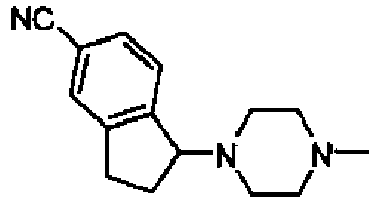
- 1-Hydroxy-2,3-dihydro-1H-indene-5-carbonitrile (4.77 g, 30 mmol) was dissolved in 10 mL of methylene dichloride. While cooled on ice, thionyl chloride (6.6 ml, 90 mmol) was added dropwise within about 15 minutes. The solution was concentrated after being stirred for 3 hours. The residue was dissolved in ethyl acetate and the solution obtained was washsed with cooled brine for 3 times, dried over anhydrous magnesium sulfate, and concentrated to obtain 1-chloro-2,3-dihydro-1H-indene-5-carbonitrile.
- 1-Chloro-2,3-dihydro-1H-indene-5-carbonitrile obtained was dissolved in 80 mL of acetonitrile and then 1-methyl piperazine (6 g, 60 mmol) as well as potassium carbonate (4.14 g, 30 mmol) are added. After the solution was stirred overnight at 60 °C, the acetonitrile was removed by concentration under reduced pressure. Ethyl acetate was then added. The solution obtained was washed with brine for 3 times, dried over magnesium sulfate, concentrated, and purified on silica gel using 5% methanol / methylene dichloride as the eluent to obtain 4.3 g of the desired compound (60% yield). MS(M+1)=242.16.
-

- 1-(4-Methylpiperazin-1-yl)-2,3-dihydro-1H-indene-5-carbonitrile (2.41 g, 10 mmol) was dissolved in 10 mL of a 2 N solution of sodium hydroxide. The solution was stirred overnight at 100 °C and then concentrated. Followed by vacuum desiccation, the solid was suspended in 30 mL methanol. Thionyl chloride (3.3 mL) was added dropwise with stirring within 1 hour. The mixture was refluxed overnight and then concentrated. Water was firstly added, and then potassium carbonate was added to make the solution turned into basic. The solution was extracted with ethyl acetate for 3 times. The pooled extracts were washed with brine, dried over magnesium sulfate, and then concentrated. It was further purified by silica gel column using 5% methanol / methylene dichloride as the eluent to obtain 2.1 g (77% yield) of the subtitle compound. MS(M+1)=275,17.
-

- Methyl 1-(4-methylpiperazin-1-yl)-2,3-dihydro-1H-indene-5-carboxylate (1.37 g, 5 mmol) and 4-methyl-N(3)-(4-pyridin-3-ylpyrimidin-2-yl)phenyl-1,3-diamine (Szakacs et al. J. Med, Chem. 2005, 48:249) (1.66 g, 6 mmol) was suspended in 30 mL of toluene. A solution of 2 M trimethylaluminium in toluene (5 mL, 10 mmol) was added and the mixture was stirred overnight at 50 °C. The reaction was incomplete. Another batch of 2 M trimethylaluminium in toluene (3 mL, 6 mmol) was then added. The mixture was cooled on ice after being stirred overnight at 60 °C. Saturated potassium sodium tartrate aqueous solution (50 mL) was added with stirring. The solution was extracted with methylene dichloride (3 x 100 mL). The pooled extracts were washed with sodium bicarbonate (100 mL) and then with brine (2 x 100 mL), dried over magnesium sulfate, and then concentrated. It was further purified by silica gel column using 50% ethyl acetate/ methylene dichloride/ 5-10% triethylamine as the eluent to obtain 1.5 g (58% yield) of the title compound. MS(M+1)=520.27. 1HNMR (DMSO-d6, ppm): δ 10.10 (s, 1H); 9.20 (s, 1H); 8.95 (s, 1H); 8.62 (d, J= 4.8 Hz, 1H); 8.42 (d, J= 4.8 Hz, 1H); 8.40 (d, J= 9.0 Hz, 1H); 8.00 (s, 1H); 7.75 (s, 1H); 7.72 (d, J=9.0 Hz, 1H); 7.45 (dd, J=8.2 Hz, 4.8 Hz, 1H); 7.40 (d, J=8.0 Hz, 1H); 7.38 (d, J=4.8 Hz, 1H); 7.28 (d, J=9.0 Hz, 1H); 7.15 (d, J=9.0 Hz, 1H); 4.26 (t, J=9.0 Hz, 1H); 2.2-2.9 (m, 1H); 2.15 (s, 3H); 2.08 (s, 3H); 2.0 (m, 2H).
-

-
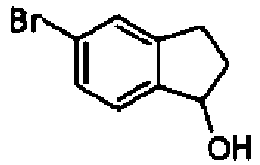
- 5-Bromo-2,3-dihydro-1H-inden-1-one (210 g, 1000 mmol) was suspended in 1 L methanol, and sodium borohydride (41.6 g, 1100 mmol) was added gradually within about 1 hour with stirring. The solvent was removed at 50 °C under reduced pressure after being stirred for another 1 hour. Ethyl acetate (1 L) was added followed by saturated sodium bicarbonate solution (500 mL). After being stirred for some time, the solution was transferred to a separatory funnel and the aqueous phase was removed. The organic phase was washed with saturated sodium bicarbonate solution twice and with brine twice, dried (magnesium sulfate) and finally concentrated to obtain 198 g (93%) of the subtitle compound.
-

- 5-Bromo-2,3-dihydro-1H-inden-1-ol (198 g, 934 mmol) was dissolved in 500 mL of methylene dichloride. While cooled on ice, thionyl chloride (275 mL, 3770 mmol) was added to the methylene chloride solution dropwise within about 2 hours. The solution was concentrated at 30 °C under reduced pressure condition after being stirred for 2 hours at room temperature. The residue was dissolved in ethyl acetate (1 L) and the solution obtained was washed with ice-cold water (3 x 500 mL) and with brine (2 x 300 mL), dried over magnesium sulfate, and concentrated to obtain 5-bomo-1-chloro-2,3-dihydro-1H-indene.
-

- 5-Bromo-1-chloro-2,3-dihydro-1H-indene (10 g, 43 mmol) was dissolved in 80 mL of acetonitrile, and sodium carbonate (4.8 g, 45 mmol) was added followed by tert-butyl piperazin-1-carboxylate (9.7 g, 52 mmol). The mixture was stirred at 60 °C overnight. The insoluble substance was removed by filtration and the filtrate was concentrated. The residue was separated by silica gel column using ethyl acetate / hexanes (1:2 to 1:1) as the eluent to obtain 12 g (72% yield) of the subtitle compound. MS(M+1)=381.11, 383.11.
-

- tert-Butyl 4-(5-bromo-2,3-dihydro-1H-inden-1-yl) piperazin-1-carboxylate (11 g, 28.87 mmol) was dissolved in ethanol (50 mL), and dimethyl sulfoxide (5 mL) and triethylamine (5 mL) were added. The system was vacuumized and charged with N2. Palladium acetate (2 g) and 1,3-bis(diphenylphosphino)propane (3 g) were added. The system was vacuumized and charged with N2. The system was vacuumized once again and stirred at 100 °C for 24 hours with inserting CO balloons. After being cooled down to the room temperature, the mixture was filtered by kieselguhr which was then rinsed thoroughly with ethanol. The filtrate was concentrated. The residue was dissolved in ethyl acetate (500 mL) and the solution obtained was washed with brine (3 x 200 mL), dried over magnesium sulfate, concentrated and finally separated by silica gel column using ethyl acetate / hexanes (1:2 to 1:1) as the eluent to obtain 8.5 g (79% yield) of the subtitle compound. MS(M+1)=375.22.
-

- tert-Butyl 4-[5-(ethoxycarbonyl)-2,3-dihydro-1H-inden-1-yl)piperazin-1-carboxylate (8 g, 21,36 mmol) was dissolved in 20 mL of methanol, and 30 mL of sodium hydroxide (1 N) was added. The solution was stirred overnight at room temperature and at 50 °C for another 2 hours, and then concentrated. The residue was dissolved in water (50 mL) and the obtained solution was acidified to pH 5 with 1 N HCl and then extracted with ethyl acetate (3 x 100 mL). The extract liquor was pooled together, dried over magnesium sulfate, and concentrated to obtain the subtitle compound. MS(M+1)=347.19.
-

- 1-[4-(BOC)piperazin-1-yl]-2,3-dihydro-1H-indene-5-carboxylic acid (7.4 g, 21.36 mmol) and 4-methyl-N(3)-[(4-pyridin-3-ylpyrimidin-2-yl)phenyl-1,3-diamine (6.1 g, 22 mmol) were dissolved in 20 mL of N,N-dimethylforma mide, Both triethylamine (8.9 mL, 64 mmol) and O-(7-azabenzotriazol-1-yl)-N,N,N',N'-tetramethyluronium hexafluorophosphate (9.5 g, 25 mmol) were added. The solution was stirred overnight at room temperature and then brine (100 mL) was added followed by ethyl acetate (200 mL). The aqueous phase was removed and the ethyl acetate layer was washed with brine (3 x 100 mL). Then the solution was dried over magnesium sulfate, concentrated and finally separated by silica gel column using methanol/methylene chloride (1:2 to 1:1) as the eluent to obtain 9.5 g (73% yield) of the title compound. MS(M+1)=606.31. 1HNMR (DMSO-d6, ppm): δ 10.15 (s, 1H); 9.25 (s, 1H); 8.99 (s, 1H); 8.67 (d, J= 4.8 Hz, 1H); 8.50 (d, J= 5.2 Hz, 1H); 8.46 (d, J= 8.4 Hz, 1H); 8.05 (s, 1H); 7.78 (s, 1H); 7.76 (d, J=8.0 Hz, 1H); 7.50 (dd, J=8.0 Hz, 4.8 Hz, 1H); 7.46 (d, J=8.4 Hz, 1H); 7.41 (d, J=5.2 Hz, 1H); 7.38 (d, J=7.6 Hz, 1H); 7.18 (d, J=8.8 Hz, 1H); 4.35 (t, J=7.2 Hz, 1H); 3.30 (m, 3H); 3.05 (m, 1H); 2.08 (s, 2H); 2.42 (m, 2H); 2.30 (m, 2H); 2.20 (s, 3H); 2.04 (m, 2H); 1.36 (s, 9H).
-

- tert-Butyl 4-{5-[({4-methyl-3-[(4-pyridin-3-ylpyrimidin-2-yl)amino]phenyl}amino) carbonyl]-2,3-dihydro-1H-inden-1-yl}piperazin-1-carboxylate (2 g, 3.3 mmol) was dissolved in 4 N HCl in dioxane (10 mL). The solution was concentrated to obtain the solid product after being stirred at room temperature for 3 hours. The product (100 mg) was purified by high performance liquid chromatography at pH = 10 to obtain the subtitle compound. MS(M+1)=506.26. 1HNMR (DMSO-d6, ppm): δ 10.08 (s, 1H); 9.20 (s, 1H); 8.93 (s, 1H); 8.62 (d, J= 4.8 Hz, 1H); 8.44 (d, J= 5.2 Hz, 1H); 8.40 (d, J= 8.0 Hz, 1H); 8.00 (s, 1H); 7.72 (s, 1H); 7.70 (d, J=8.0 Hz, 1H); 7.45 (dd, J=8.2 Hz, 4.8 Hz, 1H); 7.41 (d, J=8.2 Hz, 1H); 7.36 (d, J=5.2 Hz, 1H); 7.31 (d, J=8.0 Hz, 1H); 7.12 (d, J=8.8 Hz, 1H); 4.22 (t, J=6.8 Hz, 1H); 2.80 (m, 2H); 2.60 (m, 4H); 2.35 (m, 2H); 2.22 (m, 2H); 2.15 (s, 3H); 2.00 (m, 2H).
-

- N-(4-Methyl-3-[(4-pyridin-3-ylpyrimidin-2-yl)amino]phenyl)-1-piperazin-1-yl-2,3-dihydro-1H-indene-5-carbxamide tetrahydrochloride (100 mg, 0.15 mmol) was dissolved in DMF (2 mL) and triethylamine (101 mg, 1 mmol) was added followed by acetaldehyde (26 mg, 0.6 mmol). After the solution was stirred for 20 minutes, sodium triacetoxyborohydride (128 mg, 0.6 mmol) was added. The solution obtained was stirred overnight at room temperature and then purified by high performance liquid chromatography at pH=10 to obtain 50 mg (63% yield) of the title compound. MS(M+1)=523.29. 1HNMR (DMSO-d6, ppm): δ 10.14 (s, 1H); 9.25 (s, 1H); 8.98 (s, 1H); 8.67 (d, J= 4.8 Hz, 1H); 8.49 (d, J= 5.2 Hz, 1H); 8.46 (d, J= 8.6 Hz, 1H); 8.05 (s, 1H); 7.77 (s, 1H); 7.75 (d, J=8.8 Hz, 1H); 7.50 (dd, J=8.0 Hz, 4.8 Hz, 1H); 7.46 (d, J=8.2 Hz, 1H); 7.41 (d, J=5.2 Hz, 1H); 7.35 (d, J=7.6 Hz, 1H); 7.17 (d, J=8.8 Hz, 1H); 4.31 (t, J=6.8 Hz, 1H); 2.2-3.0 (m, 12H); 2.20 (s, 3H); 2.03 (m, 2H); 0.95 (t, J=7.0 Hz, 3H).
-

- N-(4-Methyl-3-[(4-pyridin-3-ylpyrimidin-2-yl)amino]phenyl)-1-piperazin-1-yl-2,3-dihydro-1H-indene-5-carboxamide tetrahydrochloride (100 mg, 0.15 mmol) was dissolved in DMF (2 mL), and triethylamine (101 mg, 1 mmol) was added followed by acetone (35 mg, 0.6 mmol). After the solution was stirred for 20 minutes, sodium triacetoxyborohydride (128 mg, 0.6 mmol) was added. The solution obtained was stirred overnight at room temperature and then purified by high performance liquid chromatography at pH=10 to obtain 58 mg (71% yield) of the title compound. MS(M+1)=548.31. 1HNMR (DMSO-d6, ppm): δ 10.14 (s, 1H); 9.26 (s, 1H); 8.98 (s, 1H); 8.67 (d, J= 4.8 Hz, 1H); 8.49 (d, J= 4.8 Hz, 1H); 8.46 (d, J= 8.4 Hz); 8.05 (s, 1H); 7.77 (s, 1H); 7.74 (d, J=8.0 Hz, 1H); 7.51 (dd, J=8.0 & 4.8 Hz, 4.8 Hz, 1H); 7.46 (d, J=8.2 Hz, 1H); 7.41 (d, J=5.2 Hz, 1H); 7.35 (d, J=7.6 Hz, 1H); 7.17 (d, J=8.4 Hz, 1H); 4.30 (t, J=7.0 Hz, 1H); 2.91 (m, 12H); 2.81 (s, 3H); 2.3-2.6 (m, 9H); 2.02 (m, 2H); 0.92 (t, J=6.4 Hz, 6H).
-

- N-(4-Methyl-3-[(4-pyridin-3-ylpyrimidin-2-yl)amino]phenyl]-1-piperazin-1-yl-2,3-dihydro-1H-indene-5-carboxamide tetrahydrochloride (100 mg, 0.15 mmol) was dissolved in DMF (2 mL), and triethylamine (101 mg, 1 mmol) was added followed by {[tert-butyl (dimethyl)silyl]oxo}acetaldehyde (100 mg, 0.6 mmol). After the solution was stirred for 20 minutes, sodium triacetoxyborohydride (128 mg, 0.6 mmol) was added, The solution obtained was stirred overnight at room temperature and then purified by high performance liquid chromatography. The dried product was dissolved in 2 mL of methylene chloride / 2 ml trifluoroacetic acid. The solution was concentrated after being stirred overnight and purified by high performance liquid chromatography at pH=10 to obtain 38 mg (46% yield) of the title compound. MS(M+1)=550.29. 1HNMR (DMSO-d6, ppm): δ 10.16 (s, 1H); 9.23 (s, 1H); 8.97 (s, 1H); 8.65 (d, J= 4.4 Hz, 1H); 8.48 (d, J= 6.0 Hz, 1H); 8.46 (d, J= 4.8 Hz); 8.02 (s, 1H); 7.82 (m, 2H); 7.51 (m, 1H); 7.40 (m, 2H); 7.14 (d, J=8.4 Hz, 1H): 2.6-3.7 (m, 17H); 2.16 (s, 3H).
-

- N-(4-Methyl-3-[(4-pyridin-3-ylpyrimidin-2-yl)amino]phenyl)-1-piperazin-1-yl-2,3-dihydro-1H-indene-5-carboxamide tetrahydrochloride (100 mg, 0.15 mmol) was dissolved in DMF (2 mL), and triethylamine (101 mg, 1 mmol) was added followed by acetyl chloride (16 mg, 0.2 mmol) while being cooled in an ice bath. After being stirred for 20 minutes, the solution obtained was purified by high performance liquid chromatography at pH=10 to obtain 45 mg (55% yield) of the title compound. MS(+1)=548.27. 1HNMR (DMSO-d6, ppm): δ 10.15 (s, 1H); 9.26 (s, 1H); 8.99 (s, 1H); 8.66 (d, J= 4.8 Hz, 1H); 8.49 (d, J= 5.2 Hz, 1H); 8.45 (d, J= 8.4 Hz); 8.05 (s, 1H); 7.79 (s, 1H); 7.76 (d, J=8.0 Hz, 1H); 7.50 (dd, J=8.0 & 4.8 Hz, 1H); 4.37 (t, J=7.0 Hz, 1H); 3.42 (m, 1H); 3.40 (m, 3H); 2.91 (m, 1H); 2.83 (m, 1H); 2.2-2.5 (m, 4H); 2.20 (s, 3H); 2.06 (m, 2H); 1.95 (s, 3H).
-

-
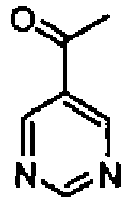
- 5-Bromopyrimidine (3.18 g, 20 mmol) was dissolved in 50 mL of tetrahydrofuran. While cooled to -78 °C, 15 mL of 1.6 M n-butyllithium in hexane solution was added dropwise with stirring. After the solution was stirred for 30 minutes, a solution of N-methoxyl-N-methylacetamide (2.58 g, 25 mmol) in tetrahydrofuran solution (10 mL) was added slowly. The mixture was stirred at -78 °C for 1 hour and then allowed to be warmed slowly. When the temperature of the mixture was at 0 °C, aqueous ammonium chloride solution was added. The solution obtained was extracted with ethyl acetate for 3 times. The pooled extracts were washed with brine, dried over magnesium sulfate, concentrated under reduced pressure, and purified by silica gel column chromatography using 5% methanol / methylene chloride as eluent to obtain 1 g of the title compound (45% yield). MS(M+1)=123.05.
-

- 5-Acetylpyrimidine (1 g, 8.2 mmol) and N,N-dimethylformamide dimethyl acetal (1.3 g, 11 mmol) were dissolved in 20 mL of isopropanol. The solution was stirred at 100 °C for 24 hours, cooled to room temperature, and concentrated under reduced pressure. Ethyl ether was then added to the residue. After being cooled in an ice bath for a couple of hours, the solid was collected by filtration, rinsed with cold ethyl ether, dried in vacuum to obtain 1 g (59% yield) of the title compound. MS(M+1)=178.0.
-

- (2E)-3-(Dimethylamino)-1-pyrimidin-5-ylprop-2-en-1-one (1 g, 5.6 mmol) and N-(2-methyl-5-nitrophenyl)guanidine nitrate (1.44 g, 5.6 mmol) (Z. Szakacs et al., J. Med. Chem. 2005, 48, 249) were suspended in 20 mL of isopropanol. Sodium hydroxide (0.28 g, 7 mmol) was then added. The mixture solution was stirred overnight and cooled to room temperature. The solid was collected by filtration and rinsed with isopropanol and diethyl ether. The filtrate was concentrated under reduced pressure and the residue was dissolved in 15 mL of isopropanol. The solution obtained was refluxed overnight and cooled to room temperature. The solid was collected by filtration and rinsed with isopropanol and diethyl ether. The pooled solid was rinsed with water and diethyl ether, and dried in vacuum to obtain 1.2 g (70% yield) of the title compound. MS(M+1)=309.10.
-
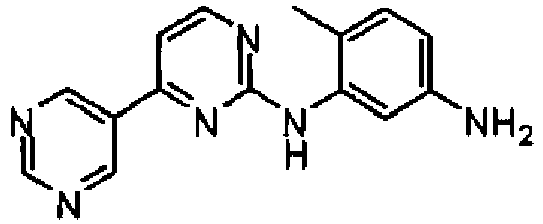
- Stannous chloride dihydrate (3.6 g, 16 mmol) was dissolved in 10 mL of concentrated hydrochloric acid. The solution was added to N-(2-methyl-5-nitrophenyl)-4,5'-bipyrimidin-2-amine with violent stirring, The mixture was poured into ice-cold water after being stirred for 2 hours. It was then neutralized to pH > 8 with sodium carbonate and extracted with ethyl acetate for 4 times. The pooled extracts were washed with brine, dried over magnesium sulfate and finally concentrated under reduced pressure to obtain 0.7 g of the title compound. MS(M+1)=279.13.
-

- Methyl 1-(4-methylpiperazin-1-yl)-2,3-dihydro-1H-indene-5-carboxylate (823 g, 3 mmol) and N(3)-4,5'-bipyrimidin-2-yl-4-methyl benzene-1,3-diamine (973 g, 3.5 mmol) were suspended in 15 mL of toluene, and then a 2 M trimethylaluminium solution (3 mL, 6 mmol) was added. The mixture was stirred overnight at 50 °C and another 2 M trimethylaluminium solution (2 mL, 4 mmol) was added. The solution was stirred overnight at 60 °C and then cooled in an ice bath. Saturated aqueous solution of potassium sodium tartrate was added with stirring. The solution obtained was extracted with methylene chloride (3 x 100 mL). The pooled extracts were washed with sodium bicarbonate (100 mL) and with brine (2 x 100 mL), dried over magnesium sulfate, concentrated, and purified by silica gel column chromatography using 50% ethyl acetate / methylene chloride / 5-10% triethylamine as eluent to obtain 702 mg of the title compound (45% yield). MS(M+1)=527.27. 1HNMR (DMSO-d6, ppm): δ 10.10 (s, 1H); 9.46 (s, 2H); 9.28 (s, 1H); 9.08 (s, 1H); 8.50 (d, J= 5.7 Hz, 1H); 8.04 (s, 1H); 7.74 (s, 1H);7.70 (d, J= 9.0 Hz, 1H); 7.46 (d, J= 5.7 Hz, 1H); 7.42 (d, J=9.0 Hz, 1H); 7.32 (d, J=9.0 Hz, 1H); 7.15 (d, J=9.0 Hz, 1H); 4.25 (t, J=5.7 Hz, 1H); 2.2-2.9 (m, 10H); 2.15 (s, 3H); 2.07 (s, 3H); 2.0(m,2H).
-

-

- 5-Bromo-1-chloro-2,3-dihydro-1H-indene (2.03 g, 8.76 mmol) and (3S)-N,N-2,5-dimethylpyrrolidin-3-amine (1 g, 8.76 mmol) were dissolved in 30 mlL of acetonitrile, and potassium carbonate (1.81 g, 13.14 mmol) was then added. The mixture was stirred overnight at 60 °C and then concentrated. The residue was dissolved in ethyl acetate. The solution was washed with brine for 3 times, dried over magnesium sulfate, and then concentrated. It was further purified by silica gel column chromatography using ethyl acetate / methylene chloride / triethylamine / methanol (10:10:1:1) as eluent to obtain 1.3 g of the title compound (48% yield). MS(M+1)=309.0, 311.0.
-
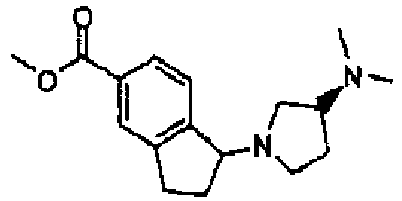
- (3S)-1-(5-Bromo-2,3-dihydro-1H-inden-1-yl)-N,N-2,5-dimethylpyrrolidin-3-amine (1.3 g, 4.2 mmol) was dissolved in 30 mL of methanol, 5 mL of dimethylsulfoxide and 7 mL of triethylamine. The reaction flask was vacuumized and then charged with N2. Palladium acetate (0.24 g, 1 mmol) plus 1,3-bis(diphenylphosphino)propane (0.5 g, 1.5 mmol) were then added. The mixed solution was stirred at 80 °C for 2 days in the presence of CO. After being cooled to room temperature, it was filtered and concentrated. The residue was dissolved in ethyl acetate. The solution obtained was washed with brine for 3 times, dried over magnesium sulfate, and then concentrated. It was further purified by silica gel column chromatography using ethyl acetate / methylene chloride / triethylamine (10:10:1) as eluent to obtain 0.7 g of the title compound (58% yield). MS(M+1)=289.1.
-

- Methyl 1-[(3S)-3-(N,N-dimethylamino)pyrrolidin-1-yl]-2,3-dihydroindene-5-carboxylate (0.2 g, 0.69 mmol) and 4-methyl-N-(3)-(4-pyridin-3-ylpyrimidin-2-yl)phenyl-1,3-diamine (0.22 g, 0.8 mmol) were dissolved in 5 mL toluene, A solution of 2 M trimethylaluminium in toluene (1.3 ml, 2.6 mmol) was then added. The mixture was stirred at 60 °C for 2 days and then cooled in an ice bath. Potassium sodium tartrate in aqueous solution (15 mL) followed by methylene chloride (50 mL) was then added. The organic phase was separated and the aqueous phase was extracted with methylene chloride twice. The pooled organic phase was washed with brine, dried over magnesium sulfate, and then concentrated. It was further purified by high performance liquid chromatography to obtain 0.22 g (60% yield) of the title compound. MS(M+1)=534.29. 1HNMR (CD3OD, ppm): δ 9.19 (s, 1H); 8.54 (d, J= 5.2 Hz, 1H); 8.50 (d, J= 8.4 Hz, 1H); 8.36 (d, J= 5.2 Hz, 1H); 8.10 (s, 1H); 7.72 (s, 1H); 7.67 (d, J= 8.4 Hz, 1H); 7.44 (d, J= 5.2 Hz, 1H); 7.41 (d, J= 8.4 Hz, 1H); 7.32 (d, J= 8.4 Hz, 1H); 7.28 (d, J= 5.2 Hz, 1H); 7.15 (d, J= 8.4 Hz, 1H); 4.18 (m, 2H); 3.01 (m, 1H); 2.90 (m, 1H)- 2.80 (m, 2H); 2.72 (m, 2H); 2.60 (m, 1H); 2.37 (m, 1H); 2.22 (s, 3H); 2.16 (m, 1H); 2.14 (s, 6H); 1.95 (m, 1H); 1.62 (m, 1H).
-

- The title compound was prepared according to the method described in EXAMPLE 9. MS(M+1)= 524.29. 1HNMR(CD3OD, ppm): δ 9.19 (s, 1H); 8.54 (d, J=5.2 Hz, 1H); 8.50 (d, J=8.8 Hz, 1H); 8.36 (d, J=5.2 Hz, 1H); 8.10 (s, 1H); 7.72 (s, 1H); 7.6.7 (d, J=7.2 Hz, 1H); 7.44 (d, J=7.2 Hz, 1H); 7.41 (d, J=8.8 Hz, 1H); 7.32 (d, J=7.2 Hz, 1H); 7.28 (d, J=5.2 Hz, 1H); 7.15 (d, J=7.2 Hz, 1H); 4.18 (m, 1H); 3.02 (m, 1H); 2.95 (m, 1H); 2.85 (m, 2H); 2.75 (m, 2H); 2.65 (m, 1H), 2.39 (m, 1H); 2.24 (s, 3H); 2.20 (m, 1H); 2.15 (s, 3H); 1.98 (m, 1H); 1.65 (m, 1H).
-

-

- 5-Bromo-1-chloro-2,3-dihydro-1H-indene (220 g, 950 mmol) was dissolved in acetonitrile (1 L), and 1-methylpiperazine (150 g, 1500 mmol) was added followed by potassium carbonate (131 g, 950 mmol). The mixture was stirred overnight at 60 °C. The solid was removed by filtration and the filtrate was concentrated. The residue was dissolved in ethyl acetate (1 L) and the solution obtained was washed with sodium hydroxide twice (2 × 300 mL) and with brine for 3 times (3 x 300 mL), dried over magnesium sulfate, concentrated and purified by silica gel column chromatography using 5% methanol / methylene chloride as eluent to obtain 202 g of the product (72% yield). MS(M+1)=295.07, 297.07.
- The product obtained (202 g, 684.6 mmol) was dissolved in 2000 mL of methanol and then (1S)-(+)-10-camphorsulfonic acid (318 g, 1369 mmol) was added followed by 4000 mL of isopropanol. The solution was refluxed with heating for 10 minutes, and then stirred overnight at room temperature. The solid was collected by filtration. When there was no more liquid dripping off, the solid was rinsed with isopropanol and then dissolved in 600 mL of methanol. After isopropanol (1500 ml) was added, the solution was heated under reflux for 15 minutes and then stirred overnight at room temperature. The solid was collected by filtration. When there was no more liquid dripping off, the solid was washed with isopropanol and then dissolved in 1 N sodium hydroxide (600 mL). The solution was stirred for 30 minutes and then extracted with ethyl acetate for 3 times (3 x 300 mL). The pooled extracts were washed with 1 N sodium hydroxide (300 mL) and with brine (2 x 300 mL), dried over magnesium sulfate, and then concentrated to obtain 50 g of the title compound. Its chiral purity was 99.7%, measured by chiral high performance liquid chromatography. X-ray monocrystal structure analysis of the title compound indicated that the chiral center at the 1 position of 2,3-dihydro-1H-indene is of 5 configuration. MS(M+1)=295.07, 297.07.
-

- 1-((1S)-5-Bromo-2,3-dihydro-1H-inden-1-yl)-4-methylpiperazine (29.6 g, 100 mmol) was dissolved in 300 mL of ethanol, 30 mL of DMSO and 42 mL of triethylamine. The system was vacuumized and charged with N2. After palladium acetate (2.4 g, 10 mmol) and 1,3-bis(diphenylphosphino)propane (3.3 g, 10 mmol) were added, the system was vacuumized and charged with N2. After being vacuumized once again, the mixture was stirred at 90 °C for 2 days under CO. After being cooled to the room temperature, the solution was filtered by kieselguhr and then concentrated. The residue was dissolved in ethyl acetate (500 mL) and the solution obtained was washed with brine (3 x 200 mL), dried over magnesium sulfate, concentrated, and finally separated by silica gel column chromatography using 50% ethyl acetate / 45% methylene chloride / 5% triethylamine as the eluent to obtain 17.3 g of the title compound (60% yield). MS(M+1)=289.18.
-

- Ethyl (1S)-1-(4-methylpiperazin-1-yl)-2,3-dihydro-1H-indene-5-carboxylate (7.2 g, 25 mmol) and 4-methyl-N(3)-(4-pyridin-3-ylpyrimidin-2-yl)phenyl-1,3-diamine (8.3 g, 30 mmol) were dissolved in 150 mL of toluene, and a solution of 2 M trimethylaluminium in toluene (20 m L, 40 mmol) was then added. The solution obtained was stirred overnight at 50 °C, and then 20 mL of 2 M rimethylaluminium in toluene was added. After being stirred at 60 °C for another 24 hours, the solution was cooled in ice bath and potassium sodium tartrate in aqueous solution (200 ml) followed by methylene chloride (300 mL) was then added. The organic phase was separated and the aqueous phase was extracted with methylene chloride twice. The pooled extract was washed with brine twice, dried over magnesium sulfate, and then concentrated. It was further purified by silica get column chromatography using 50% ethyl acetate / methylene chloride / 5-10% triethylamine as eluent to obtain 7.5 g (58% yield) of the title compound. MS(M+1)=520.27, 1HNMR (DMSO-d6, ppm): δ 10.10 (s, 1H); 9.20 (s, 1H); 8.95 (s, 1H); 8.66 (d, J= 6.0 Hz, 1H); 8.48 (d, J= 6.0 10 Hz, 1H); 8.43 (d, J= 8.4 Hz, 1H); 8.02 (s, 1H); 7.77 (s, 1H); 7.74 (d, J= 8.4 Hz, 1H); 7.48 (dd, 1H); 7.42 (dd, 1H);7.40 (d, J= 6.0 Hz, 1H); 7.32 (d, J=8.4 Hz, 1H); 7.18 (d, J=8.4 Hz, 1H); 4.26 (t, J=8.4 Hz, 1H); 2.2-3.0 (m, 10H); 2.20 (s, 3H); 2.12 (s, 3H); 2.02 (m, 2H).
-

-

- In the Step A of EXAMPLE 11, the methanol / isopropanol filtrate containing 1-(5-bromo-2,3-dihydro-1H-inden-1-yl)-4-methylpiperazine and (1S)-(+)-10-camphorsulfonic acid was concentrated under reduced pressure. The residue was dissolved in 1 L of sodium hydroxide (1 N). After being stirred for 30 minutes, the solution was extracted with ethyl acetate (3 x 300 mL). The pooled extract was washed with 1 N sodium hydroxite (300 mL) and with brine (3 x 300 mL), dried over magnesium sulfate and then concentrated to obtain 140 g (474 mmol) of 1-(5-bromo-2,3-dihydro-1H-inden-1-yl)-4-methylpiperazine, wherein the dominating isomer is R-enantiomer. The residue was dissolved in 1.4 L of methanol, and (1R)-(-)-10-camphorsulfonic acid (220 g, 948 mmol) was added followed by 2.8 L of isopropanol. The solution obtained was heated under reflux for 15 minutes and then stirred overnight at room temperature. The solid was collected by filtration. When there was no more liquid dripping off, the solid was rinsed with isopropanol and then dissolved in 600 mL of methanol. After isopropanol (1500 mL) was added, the solution was heated under reflux for 15 minutes and then stirred overnight at room temperature. The solid was collected by filtration. Without liquid dripping off, the solid was rinsed with isopropanol and then dissolved in 800 mL of sodium hydroxide (1 N). The mixture was stirred for 30 minutes and then extracted with ethyl acetate for 3 times (3 x 300 mL). The pooled extract was washed with 1 N sodium hydroxide (500 mL) and with brine (2 x 400 ml), dried over magnesium sulfate, and then concentrated to obtain 60 g of the title compound. Its chiral purity is 99.8%, measured by chiral high performance liquid chromatography. MS(M+1)=295.07, 297.07.
-

- Starting from 1-((1R)-5-bromo-2,3-dihydro-1H-inden-1-yl)-4-methylpiperazine, the title compound was obtained according to the procedure described in Step B of EXAMPLE 11. MS(M+1)=289.18.
-

- The title compound was obtained by condensation of ethyl (1R)-1-(4-methylpiperazin-1-yl)-2,3-dihydro-1H-indene-5-carboxylate and 4-methyl-N(3)-(4-pyridin-3-ylpyrimidin-2-yl) phenyl-1,3-diamine, according to the procedure described in Step C of EXAMPLE 11. MS(M+1)=520.27. 1HNMR (DMSO-d6, ppm): δ 10.15 (s, 1H); 9.22 (s, 1H); 8.98 (s, 1H); 8.64 (d, J= 6.0 Hz, 1H); 8.46 (d, J= 6.0 Hz, 1H); 8.42 (d, J= 8.4 Hz, 1H); 8.02 (s, 1H); 7.75 (s, 1H); 7.72 (d, J= 9.0 Hz, 1H); 7.50 (dd, 1H); 7.45 (dd, 1H);7.40 (d, J= 5.4 Hz, 1H); 7.35 (d, J=8.4 Hz, 1H); 7.18 (d, J=9.0 Hz, 1H); 4.26 (t, J=6.0 Hz, 1H); 2.2-3.0 (m, 10H); 2.20 (s, 3H); 2.12 (s, 3H); 2.3 (m, 2H).
-
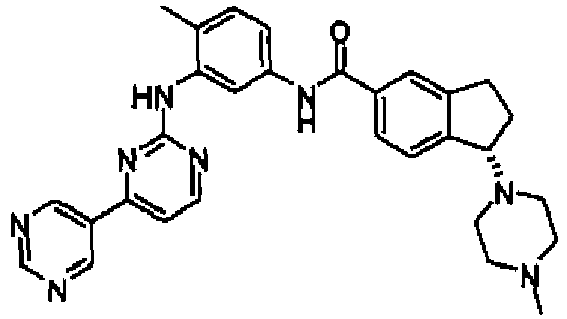
- The title compound was obtained by condensation of ethyl (1S)-1-(4-methylpiperazin-1-yl)-2,3-dihydro-1H-indene-5-carboxylate and N-(3)-4,5'-bipyrimidin-2-yl-4-methylphenyl-1,3-diamine according to the procedure described in Step C of EXAMPLE 11. MS(M+1)=521.27. 1HNMR (DMSO-d6, ppm): δ 10.10 (s, 1H); 9.40 (s, 2H); 9.28 (s, 1H); 9.08 (s, 1H); 8.50 (d, J= 4.8 Hz, 1H); 8.04 (s, 1H); 7.74 (s, 1H); 7.70 (d, J= 9.0 Hz, 1H); 7.46 (d, J= 4.8 Hz, 1H); 7.42 (d, J= 7.8 Hz, 1H); 7.32 (d, J=7.8 Hz, 1H); 7.15 (d, J=9.0 Hz, 1H); 4.25 (t, J=7.8 Hz, 1H); 2.2-2.9 (m, 10H); 2.15 (s, 3H); 2.07 (s, 3H); 2.0 (m, 2H).
-

- The title compound was obtained by condensation of ethyl (1R)-1-(4-methylpiperazin-1-yl)-2,3-dihydroindene-5-carboxylate and N-(3)-4,5'-bipyrimidin-2 -yl-4-methylphenyl-1,3-diamine, according to the procedure described in Step C of EXAMPLE 11. MS(M+1)=521.27, 1HNMR (DMSO-d6, ppm): δ 10.10 (s, 1H); 9.40 (s, 2H); 9.28 (s, 1H); 9.08 (s, 1H); 8.50 (d, J= 5.7 Hz, 1H); 8.04 (s, 1H); 7.74 (s, 1H); 7.70 (d, J= 8.4 Hz, 1H); 7.46 (d, J= 5.7 Hz, 1H); 7.42 (d, J= 8.4 Hz, 1H); 7.32 (d, J=8.40 Hz, 1H); 7.15 (d, J=8.4 Hz, 1H); 4.25 (t, J=7.5 Hz, 1H); 2.2-2.9 (m, 10H); 2.15 (s, 3H); 2.07 (s, 3H); 2.0 (m, 2H).
-

-
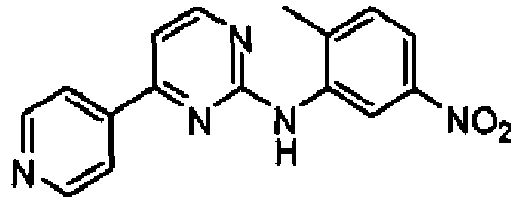
- The title compound was prepared by condensation reaction between (2E)-3-(dimethylamino)-1-pyridin-4-ylprop-2-en-1-one and N-(2-methyl-5-nitrophenyl)guanidine nitrate, according to the procedure described in Step C of EXAMPLE 8. MS(M+1)=308.11.
-

- The title compound was prepared by reduction of N-(2-methyl-5-nitrophenyl)-4-pyridin-4-yl pyrimidin-2-amine, according to the procedure described in Step D of EXAMPLE 8. MS(M+1)=278.13.
-

- The title compound was prepared by condensation reaction between ethyl (1S)-1-(4-methylpiperzin-1-yl)-2,3-dihydro-1H-indene-5-carboxylate and 4-methyl-N(3)-(4-pyridin-4-ylpyrimidin-2-yl)benzne-1,3-diamine, according to the procedure described in Step C of EXAMPLE 11. MS(M+1)=520.27. 1HNMR(DMSO-d6, ppm): δ 10.14 (s, 1H); 9.04(s, 1H); 8.07 (d, J=4.4 Hz, 2H); 8.55 (d, J=4.8Hz, 1H); 8.06 (s, 1H); 8.04 (d, J=4.4Hz, 2H); 7.78 (s, 1H); 7.75 (d, J=8.8Hz, 1H); 7.45 (d, J=7.6 Hz, 1H); 7.44 (d, J=4.8 Hz, 1H); 7.35 (d, J=7.6 Hz, 1H); 7.18 (d, J=8.8 Hz, 1H); 4.31 (t, J=7.2 Hz, 1H); 2.0-3.0 (m, 10H); 2.19 (s, 3H); 2.12 (s, 3H); 2.04 (m, 2H).
-

-

- Under the protection of N2, 1-((1S)-5-bromo-2,3-dihydro-1H-inden-1-yl)-4-methylpiperazine (660 g, 2.235 mol) and THF (3.3 L) were added to a 10 L three-neck flask, and the solution was stirred until dissolved. The system temperature was cooled to -78 °C in liquid nitrogen-acetone bath. n-butyllithium (n-BuLi) (2.5 M in hexane solution) (1072 mL, 2.682 mol, 1.2-fold) was added dropwise into the solution at -78 °C - -82 °C After being stirred for 10 minutes, when the LC-MS assay shown that the reaction of the raw materials was completed, dry ice (170 g, 3.86 mol, 1.73-fold) was added carefully. The solution was then stirred for 10 minutes at -60 °C ∼ -75 °C. After the reaction was completed, the cold bath was removed and aqueous solution of 2 N HCl was then added to adjust the pH value till pH=2. Most of the water was removed using rotary evaporator. The system was further dried overnight at 50 °C ∼ 60 °C in a vacuum drying oven to obtain the title compound (1289 g, the actual product of 583 g providing 100% yield). This crude product was used in the next step of reaction directly.
-

- SOCl2 (2.5 L) was added to a 5 L three-neck flask. (1S)-1-(4-Methylpiperazin-1-yl)-2,3-dihydro-1H-indene-5-carboxylic acid (1289 g, the actual maximum content of 583 g, equivalent to 2.235 mol) was then added in batches within 1 hour. The solution was heated under reflux overnight and then cooled to room temperature. Most of SOCl2 was removed using rotary evaporator. After ethyl acetate (1.5 L) was added, the solution was cooled to 0 °C, filtered with suction to obtain the white solid which was then dried in vacuum to get the title compound (about 1325 g, 100% yield).
-

- N-(5-Amino-2-methylphenyl)-4-(3-pyridyl)-2-aminopyrimidine (681 g, 2.46 mol, 1.1-fold) was dissolved in pyridine (3 L). (1S)-1-(4-Methylpiperazin-1-yl)-2,3-dihydro-1H-indene-5-carbonyl chloride hydrochloride (1325 g, the actual maximum content of 626 g, equivalent to 2.235 mol, 1-fold) was added slowly within 30 minutes with stirring. The solution turned very hot since the reaction was severe but there was no need to have it cool down. After the solution was stirred overnight at room temperature, the reaction solution was added to 2 N aqueous solution of sodium hydroxide (2 L) with stirring, immediately followed by addition of methylene dichloride (2 L). After being stirred for a while, the solution was transferred to a 5 L separatory funnel and then methylene chloride layer was separated. The water phase was extracted with methylene chloride (2x 500 mL). The extracts were pooled, dried over anhydrous magnesium sulfate, and then concentrated. The residue was dissolved in methylene dichloride and then purified by silica gel column chromatography using methylene chloride / 5% methanol / 1% triethylamine as eluent. The fractions containing the desired product were pooled and concentrated under reduced pressure. The residue was dissolved in 1 L of warm ethyl acetate and crystals were precipitated after stirring. The solid was collected by filtration and dried in vacuum at 50 °C to obtain the title product (617 g, 53% total yield of the three steps). MS(M+1)=520.27.
-
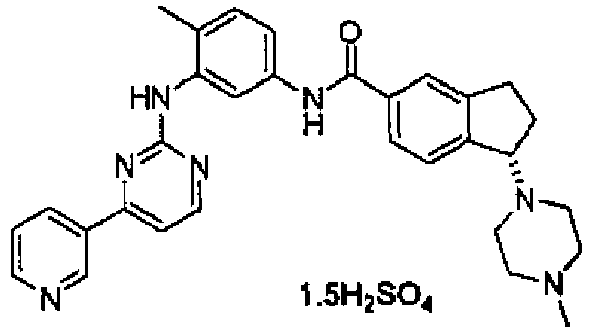
- (1S)-1-(4-Methylpiperazin-1-yl)-N-(4-methyl-3-[(4-pyridin-3-ylpyrimidin-2-yl)amino]phenyl)-2,3-Dihydro-1H-indene-5-carboxamide (248 g, 0.477 mol) was dissolved in ethanol (4.76 L). After being stirred for 20 minutes, the solution was filtered with suction. The filtrate was added to a 20 L three-neck flask. Sulfuric acid solution (46.74 g, 0.477 mol, 1-fold) dieted with ethanol (532 ml) was added slowly through dropping funnel with thorough stirring to form a yellowish suspension. Ethanol (9.5 L) was then supplemented. The mixture was heated under reflux for 2 hours until it became a milky-white suspension. The suspension was cooled to room temperature statically, filtered with suction, and then dried to obtain the title product (183 g, 57.5%). The filtrate was adjusted to basic (pH=11) with aqueous solution of NaOH and then extracted with methylene dichloride (4 × 200 mL). The extract was dried and concentrated to reclaim the (1S)-1-(4-methyl piperazin-1-yl)-N-(4-methyl-3-[(4-pyridin-3-ylpyrimidin-2-yl)amino]phenyl)-2,3-dihydro-1H-inden e-5-carboxamide (98 g, 39.5%). Melting point of the title product: 187 ∼ 189 °C. Elemental analysis of C31H36N7O7S1.5, calculating value: C 55.84; H 5.44; N 14.71; testing value: C 55.72; H 5.70; N 14.40.
- The regulation of protein kinase activity and inhibition of cell proliferation by the compounds of this invention may be tested by the procedures demonstrated below.
- The activity of the compounds of this invention on Abl, c-Kit and PDGFR kinases was tested by Mobility Shift Assay (MSA). ATP concentration is at Km of each kinase, i.e. Abl Km ATP= 12 µM, c-Kit Km ATP=87 µM, PDGFR Km ATP= 38 µM.
- Materials: Abl (purchased from Carna, Lot No. 06CBS-2988C); c-Kit (purchased from BPS, Cat. No. 40250, Lot No. 1003); PDGFR (purchased from BPS, Cat. No. 40263, Lot No. 1001); DMSO (purchased from Sigma, Cat. No. D2650, Lot No. 474382); 96-well culture plate (purchased from Corning, Cat. No. 3365, Lot No. 22008026); 384-well culture plate (purchased from Corning, Cat. No. 3573, Lot No. 12608008); Staurosporine (purchased from Sigma, Cat. No. S4400-1MG, Lot No. 046K4080).
-
- 1. Preparation of kinase buffer and stop buffer;
- (1) Kinase buffer: 62.5 mM HEPES, pH 7.5; 0.001875% Brij-35; 12.5 mM MgCl2; 2.5 mM DTT;
- (2) Stop buffer: 100 mM HEPES, pH 7.5; 0.015% Brij-35; 0.2% coating agent #3; 50 mM EDTA;
- 2. The compound was dissolved in DMSO and then serial dilutions were prepared;
- 3. Preparation of kinase solution: Kinase solution was obtained by dissolving kinases in the kinase buffer mentioned above. With regard to c-Kit kinase, the pre-activation treatments should be carried out as follows. 700 nM c-Kit, 2 mM ATP, 4 mM DTT and 10 mM MgCl2 were dissolved in kinase buffer. After being incubated at 28 °C for 15 minutes, the solution was added to the kinase buffer;
- 4. Preparation of polypeptide solution: Polypeptide FAM and ATP were dissolved in kinase buffer;
- 5. The kinase solution was transferred to a culture plate and incubated for 10 minutes at room temperature. The final concentrations of Abl, c-Kit and PDGFR were 0.45 nM, 12 nM, 8 nM, respectively;
- 6. The polypeptide solution was transferred to the culture plate. The final concentrations of ATP in the Abl, c-Kit and PDGFR circumstances were 12 µM, 87 µM and 38 µM, respectively. The final concentrations of MgCl2 in all circumstances were all 10 mM;
- 7. The mixture in each well of the plate was incubated at 28 °C, for 1 hour for Abl, 40 minutes for c-Kit and 5 hours for PDGFR. The stop buffer was then added to terminate the reaction;
- 8. Data were collected in Caliper and then input into the software XLfit to calculate IC50 values.
- The required concentrations (IC50, nM) of each compound of this invention to result in 50% inhibition rate were listed in Table 1. Meanwhile, IC50 values of Imatinib leading to inhibition of these three kinases in the same experimental condition were also listed in Table 1 for convenient comparison. Use staurosporine as positive control in this assay.
Table 1 Compound IC 50 (nM) Abl c-Kit PDGFR EXAMPLE 1 5.8 22 17 EXAMPLE 2 2044 1186 233 EXAMPLE 3 6.2 16 12 EXAMPLE 4 6.3 26 15 EXAMPLE 5 5.4 23 18 EXAMPLE 6 12 32 20 EXAMPLE 7 411 529 41 EXAMPLE 8 5.3 32 22 EXAMPLE 9 121 51 15 EXAMPLE 10 70 32 21 EXAMPLE 11 2.2 8.5 9.6 EXAMPLE 12 256 2251 53 EXAMPLE 13 2.4 15 13 EXAMPLE 14 266 2260 65 EXAMPLE 15 23 526 24 Imatinib 207 703 39 Staurosporine 162 2.0 0.50 - As shown in Table 1, the compounds of the invention exhibited very high inhibitory activity against Abl, c-Kit and PDGFR: IC50 values ranged from 2.2 nM to 2044 nM in inhibiting Abl; IC50 values ranged from 8.5 nM to 2260 nM in inhibiting c-Kit; IC50 values ranged from 9.6 nM to 233 nM in inhibiting PDGFR. Except for EXAMPLEs 2, 7, 12 and 14, the compounds of the invention had higher activity than Imatinib in inhibiting these three kinases.
- Inhibitory activity of the compounds of this invention on Abl, c-Kit and PDGFR mutant kinases was tested by the phosphor isotope-labelled ATP (33P-ATP) assay.
- 1. Substrate solution was prepared using newly-prepared reaction buffer. The buffer includes: 20 mM HEPES, pH 7,5, 10 mM MgCl2, 1 mM EGTA, 0.02% Brij 35,0.02 mg/ml BSA, 0.1 mM Na3VO4, 2 mM DTT, 1% DMSO. As for c-Kit and c-Kit (V654A), additionally, 2 mM MnCl2 was added into the buffer;
- 2. Required co-enzymes were added to the above substrate solution;
- 3. Kinases were added and mixed gently;
- 4. The tested compound was dissolved in DMSO, and then added to the above kinase solution by using Acoustic technique (Echo550, nanoliter range) and incubated for 20 minutes;
- 5. 33P-ATP was added to the above reaction mixture to initiate the reaction;
- 6. The mixture was incubated for 2 hours at room temperature;
- 7. The activity of kinases was tested by filtration-combination;
- 8. The data were processed in Excel and the control data were subtracted. A curve was drawn by the GraphPad Prism software to get the IC50 value.
- IC50 values of the compound of EXAMPLE 11 which can inhibit Abl and 7 mutants thereof, as well as c-Kit and 5 mutants thereof were listed in Table 2. Meanwhile, IC50 values of Nilotinib leading to inhibition of these mutants in the same experimental condition were also listed in Table 2 for convenient comparison. Use staurosporine as positive control in these assays.
Table 2 Kinase ATP Concentration (µM) EXAMPLE 11 IC50 (nM) Nilotinib IC50 (nM) Staurosporine IC50 (nM) Abl 10 0.21 1.19 14.5 Abl (T3151) 10 14090 >20000 3.38 Abl (E225K) 10 3.72 36.3 27.0 Abl (G250E) 10 2.94 24.8 5.68 Abl (H396P) 10 0.38 2.99 9.02 Abl (M351T) 10 0.29 1.89 9.33 Abl(Q252H) 10 0.42 4.66 4.47 Abl (Y253F) 10 0.71 5.13 15.4 c-Kit 30 132 302 8,41 c-Kit (D816H) 30 83.6 574 <1.0 c-Kit (D816V) 30 1738 >20000 <1.0 c-Kit (T6701) 30 2057 >20000 2.67 c-Kit (V560G) 30 1.77 16.5 <1.0 c-Kit (V654A) 30 969 13940 1.16 - As shown in Table 2, the compound of EXAMPLE 11 possessed higher inhibitory activity in inhibiting the mutants of Abl and c-Kit than Nilotinib. Nilotinib (brand-named as Tasigna) had a good effect on treating those leukemia patients who gain resistance to Imatinib (brand-named as Gleevec). As the compound of EXAMPLE 11 had higher effect on inhibition of the Imatinib mutants in the test than Nilotinib, the compounds of the invention will have more effective results in treating the leukemia patients resistant to Imatinib. The c-Kit mutants exist widely in gastrointestinal stromal tumor, mast cell disease and acute myeloid leukaemia. As shown in Table 2, the compound of EXAMPLE 11 had a good effect in inhibiting all the c-Kit mutants. Thus, the compound of the invention can be applied to treat gastrointestinal stromal tumor, mast cell disease, acute myeloid leukaemia and etc.
- The inhibitory activity of the compounds of the invention on the growth of chronic myeloid leukaemia cell K562 was tested using a CellTiter-Glo assay.
- Materials: K562 cell strain (purchased from ATCC, Cat. No. CCL-243, Lot No. 50644810); IMDM (purchased from Invitrogen, Cat. No. 12440-053); fetal bovine serum (purchased from Invitrogen, Cat. No. 10099141, Lot No. 613866); DMSO (purchased from Sigma, Cat. No. D2650, Lot No. 077k2357); 96-well culture plate (purchase from Corning, Cat. No. 3903); 15 ml centrifuge tube (purchased from Greiner, Cat. No. 0703115, Lot No. 2012-01); cell viability assay kit (CellTiter-Glo) (purchased from Promega, Cat. No. G7571, Lot No. 256984); Staurosporine (purchased from Sigma, Cat. No. S4400-1MG, Lot No. 046K4080).
-
- 1. plating cell
- (1) Preparation of complete medium: Complete medium was composed of 90% IMDM and 10% fetal bovine serum which were mixed thoroughly;
- (2) The cell strain in good growth status was selected;
- (3) The cell suspension was transferred to centrifuge tubes using pipette and then centrifuged at 800-1000RPM for 3-5 minutes;
- (4) The supernatant in the tube was removed using pipette;
- (5) A proper volume of the medium was added to the tube and the cells were resuspended by pipetting up and down gently;
- (6) The cells were counted using blood counting chamber;
- (7) The cell suspension was adjusted to the cell concentration of 4x 10⁴ cells /ml;
- (8) The cell suspension was added to a 96-well bottom-transparent culture plate, 100 µl per well, i.e. 4000 cells per well. The plate was incubated overnight with CO2 in an incubator.
- 2. Preparation and addition of the compound
- (1) The compounds were dissolved in DMSO and then diluted with DMSO to 10 different concentrations;
- (2) 0.5 µL of the compound solution was transferred to the culture plate;
- (3) The culture plate was incubated at 37 °C in the incubator for 72 hours.
- 3. Test and analysis
- (1) The cellular morphology was observed in inverted microscope;
- (2) 100 µL of the cell viability assay reagent was added to each well;
- (3) The plate was shaked for 2 minutes on a shaker, allowing cell lysis;
- (4) The plate was kept at room temperature for 10 minutes to stabilize luminescence signals;
- (5) A white membrane was attached to the plate bottom and the plate was detected using Flexstation 3 (luminescence, integration time 500 ms);
- (6) The results were recorded and then analyzed.
- The required concentrations (IC50, nM) of the compounds of EXAMPLE 3, 11, 12, 13 and 15 in this invention to result in 50% inhibition rate were showed in Table 3. Meanwhile, IC50 value of Imatinib inhibiting K562 cell growth in the same experimental condition was also included in Table 3 for convenient comparison. Use staurosporine as positive control in this assay.
Table 3 EXAMPLE 3 11 12 13 15 Imatinib Staurosporine IC50 (nM) 12 3.2 208 2.2 35 206 139 - As shown in Table 3, the compounds of EXAMPLE 3, 11, 12, 13, and 15 exhibited very high inhibitory activity on the growth of chronic myeloid leukaemia cell K562, Except for EXAMPLE 12, the required concentrations (IC50, nM) of the compounds of EXAMPLE 3, 11, 13 and 15 to lead to 50% inhibition rate in inhibiting the growth of K562 cells were much lower than that of Imatinib (p≤0.05). The compound of EXAMPLE 12 was the optical enantiomer of EXAMPLE 11. Although its inhibitory activity on the growth of K562 was 65-fold lower than that of EXAMPLE 11, it was as potent as Imatinib. This suggests that the compounds of this invention can be used to treat chronic myeloid leukaemia effectively.
- This invention also tested the inhibitory activity of the compounds of this invention on the growth of chronic myeloid leukaemia cell K562, KU812, and MEG-01, acute myeloid leukaemia cell Kasumi-1 and acute lymphatic leukemia cell Sup-B15.
- Materials: SpectraMAX Plus Microplate Spectrophotometer Mode 3011 (purchased from Molecular Devices Corp, California, USA); Water-Jacketed CO2 incubator (purchased from Therma, USA); inverted microscope, Chongguang XDS-1B (Chongqing Optical & Electrical Instrument Co., Ltd., Chongqing, China); CellTiter 96® Aqueous MTS reagent powder (purchased from Promega, Cat, No. G1112); Phenazine methosulfate (PMS) (purchased from Sigma, Product No. P9625); RPMI1640 (purchased from GIBCO, USA, Cat. No. 31800-022); IMDM (purchased from GIBCO, USA, Cat. No. 12200-036); fetal bovine serum (FBS) (purchased from GIBCO, USA, Cat. No. FCS100).
-
- 1. Preparation of assay solution
- (1) Preparation of PMS solution: PMS was dissolved in DPBS to give a concentration of 0.92 g/ml. The solution was then filtered into a sterile and lightproof container;
- (2) Preparation of MTS solution: a) 21 ml DPBS was added to a lightproof container; b) 42 mg MTS powder was weighted and then added to DPBS; c) the above were mixed on a electromagnetic stirrer until the powder was dissolved; d) the pH value was measured. The preferred value should be between 6.0 and 6.5. If the pH was higher than 6.5, it should be adjust to 6.5 with 1 N HCl; e) the solution was filtered into a sterile and lightproof container;
- (3) Preparation of MTS/PMS mixture: a) 2 ml of the MTS solution was transferred to a tube; b) 100 µL of the PMS solution was added to the tube; c) the tube was vortexed gently to mix the solution thoroughly.
- 2. Plating cell
- (1) The cells were counted using blood counting chamber after the cells grew to certain number;
- (2) The cell concentration was adjusted to 2.78 x 10⁴ cell/ml with RPMI1640 medium containing 10% FBS (K562, KU812, MEG-01 or Kasumi-1 cells) or IMDM medium containing 0.05 mM 2-mercaptoethanol and 20% FBS (Sup-B15 cell);
- (3) 180 µL of the cell suspension was added to each well of 96-well culture plate with the final cell density of 5x 10³ per well.
- 3. Preparation and addition of the compounds
- (1) The tested compounds were dissolved in DMSO and then diluted to 10 different concentrations;
- (2) 20 µL of each concentration was transferred to each well containing the cell suspension already (3 wells for each concentration);
- (3) The plate was incubated for 72 hours at 37 °C, 5% CO2 and 95% humidity.
- 4. Test and analysis
- (1) 40 µL of the MTS/PMS solution was pipetted into each well containing 200 µL medium to give the final volume per well of 240 µL;
- (2) The plate was incubated for 1-4 hours at 37 °C, 5% CO2 and 95% humidity;
- (3) The absorptions were recorded at wavelength of 490 nm using SpectraMax Plus;
- (4) IC50 values were calculated using the 5th versions GraphPad Prism software.
- The required concentrations (IC50, nM) of the compounds of EXAMPLE 16 to lead to 50% inhibition rate in inhibiting K562, KU812, MEG-01, Kasumi-1 and Sup-B15 cell strains were showed in Table 4. Meanwhile, the inhibition activity of Imatinib and Nilotinib in the same experimental condition was also included in this table for convenient comparison. Use staurosporine as positive control in this assay.
Table 4 Cell strain IC50 (nM) EXAMPLE 16 Imatinib Nilotinib Staurosporine K562 0.25 121 6.26 71.5 KU812 0.024 51.4 2.10 9.57 MEG-01 0.085 19.3 1.65 8.97 Kasumi-1 11.2 297 22.3 1.04 Sup-B15 39.6 382 135 6.84 - As shown in Table 4, the compound of EXAMPLE 16 exhibited very high inhibitory activity on the growth of the chronic myeloid leukaemia cell strains K562, KU812 and MEG-01, the acute myeloid leukaemia cell strain Kasumi-1 and the acute lymphatic leukemia cell strain Sup-B15. its IC50 values ranged from 0.024 nM to 39.6 nM. Additionally, the activity of the compound of EXAMPLE 16 in inhibiting the growth of these cell strains was higher than that of either Imatinib or Nilotinib. These results suggest that the compounds of this invention can be used to treat chronic myeloid leukaemia, acute myeloid leukaemia and acute lymphatic leukemia effectively.
Claims (15)
- A compound of Formula I:
 R1 is a saturated cyclic amino-group, which can be optionally substituted by 1, 2, 3 or 4 R1a;R1a is H, halogen, cyano, C1-6 alkyl, C1-6 hydroxyalkyl, C1-6 haloalkyl, C1-6 cyanoalkyl, ORa, SRa, NRbRc, NRbC(O)Rd, NRbS(O)2Rd, C(O)NRbRc, C(O)Rd, C(O)ORa, S(O)2Rd, C2-6 alkenyl, C2-6 alkynyl, aryl, heteroaryl, cycloalkyl or heterocycloalkyl, wherein the said C1-6 alkyl, C2-6 alkenyl, C2-6 alkynyl, aryl, heteroaryl, cycloalkyl or heterocycloalkyl can be optionally substituted with 1, 2 or 3 groups independently selected from cyano, halogen, ORa, SRa, NRbRc, NRb(CO)Rd, NRbS(O)2Rd, C(O)NRbRc, S(O)2NRbRc, C(O)Rd, C(O)ORa, S(O)2Rd, C1-6 haloalkyl, C1-6 hydroxyalkyl, C1-6 cyanoalkyl, aryl, heteroaryl, cycloalkyl, and heterocycloalkyl;or two R1a groups taken together with the atoms attached to them can form a cycloalkyl and heterocycloalkyl of 3, 4, 5, 6 or 7-membered ring, and can be optionally substituted by 1, 2 or 3 groups independently selected from cyano, halogen, ORa, SRa, NRbRc, NRb(CO)Rd, NRbS(O)2Rd, C(O)NRbRc, S(O)2 NRbRc, C(O)Rd, C(O)ORa, S(O)2Rd, C1-6 haloalkyl, C1-6 hydroxyalkyl, C1-6 cyanoalkyl, C2-6 alkenyl, C2-6 alkynyl, aryl, heteroaryl, cycloalkyl, and heterocycloalkyl;R2 is H, halogen, cyano, ORa, SRa, NRbRc, C1-6 alkyl, C1-6 hydroxyalkyl, C1-6 haloalkyl, C1-6 cyanoalkyl, C2-6 alkenyl or C2-6 alkynyl;or two R2 groups taken together with the atoms attached to them can form a cycloalkyl and heterocycloalkyl of 3, 4, 5, 6 or 7-membered ring, and can be optionally substituted by 1, 2 or 3 groups independently selected from cyano, halogen, ORa, SRa, NRbRc, NRb(CO)Rd, NRbS(O)2Rd, C(O)NRbRc, S(O)2NRbRc, C(O)Rd, C(O)ORa, S(O)2Rd, C1-6 haloalkyl, C1-6 hydroxyalkyl, C1-6 cyanoalkyl, C2-6 alkenyl, and C2-6 alkynyl;R3 is H, halogen, cyano, ORa, SRa, NRbRc, C1-6 alkyl, C1-6 hydroxyalkyl, C1-6 haloalkyl, C1-6 cyanoalkyl, C2-6 alkenyl, C2-6 alkynyl, cycloalkyl, or heterocycloalkyl;or two R3 groups taken together with the atoms attached to them can form a cycloalkyl and heterocycloalkyl of 5, 6 or 7-membered ring, and can be optionally substituted by 1, 2 or 3 groups independently selected from halogen, cyano, ORa, SRa, NRbRc, C1-6 alkyl, C1-6 haloalkyl, C1-6 hydroxyalkyl, C1-6 cyanoalkyl, C2-6 alkenyl, and C2-6 alkynyl;W-X is an amide bond;Y is heteroaryl, which can be optionally substituted by 1, 2 or 3 R4;Z is heterocycloalkyl or heteroaryl, which can be optionally substituted by 1, 2 or 3 R5;R4 and R5 are independently selected from halogen, cyano, ORa, SRa, NRbRc, C1-6 alkyl, C1-6 hydroxyalkyl, C1-6haloalkyl, C1-6 cyanoalkyl, C2-6 alkenyl, C2-6 alkynyl, NRb(CO)Rd, C(O)NRbRc, NRbS(O)2Rd, S(O)2NRbRc, C(O)Rd, C(O)ORa, S(O)2Rd, cycloalkyl, heterocycloalkyl, aryl, and heteroaryl;or two R4 or two R5 groups taken together with the atoms attached to them respectively, can form a cycloalkyl and heterocycloalkyl of 5, 6 or 7-membered ring, and can be optionally substituted by 1, 2 or 3 groups independently selected from halogen, cyano, ORa, SRa, NRbRc, C1-6 alkyl, C1-6 haloalkyl, C1-6 hydroxyalkyl, C1-6 cyanoalkyl, C2-6 alkenyl, and C2-6 alkynyl;Ra, Rb, Rc and Rd are independently selected from H, C1-6 alkyl, C1-6 haloalkyl, C1-6 hydroxyalkyl, C1-6 cyanoalkyl, C2-6 alkenyl, C2-6 alkynyl, aryl, heteroaryl, cycloalkyl, and heterocycloalkyl;or the Rb and Rc groups taken together with the nitrogen atom attached to them can form a heterocycloalkyl of 4, 5, 6 or 7-membered ring, and can be optionally substituted by 1, 2 or 3 groups independently selected from halogen, cyano, C1-6 alkyl, C1-6 haloalkyl, C1-6 hydroxyalkyl C1-6 cyanoalkyl, C2-6 alkenyl, C2-6 alkynyl, aryl, heteroaryl, cycloalkyl, and heterocycloalkyl;n is an integer from zero to four;m is an integer from zero to two.
 - The compound or its pharmaceutically acceptable salt according to claim 1, having Formula II:
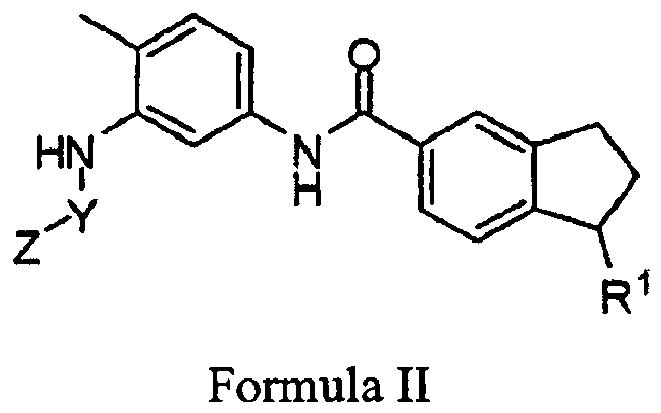 R1 is as defined in claim 1.
 - The compound or its pharmaceutically acceptable salt according to claim 1 or 2, wherein:R1 is a saturated cyclic amino-group selected from piperidinyl, piperazinyl, pyrrolidinyl, azetidinyl and morpholinyl, each of which can be optionally substituted by 1, 2, 3 or 4 R1a;R1a is H, halogen, cyano, C1-6 alkyl, C1-6 hydroxyalkyl, C1-6 haloalkyl, C1-6 cyanoalkyl, ORa, SRa, NRbRc, NRbC(O)Rd NRbS(O)2Rd, C(O)NRbRc, C(O)Rd, C(O)ORa, S(O)2Rd, C2-6 alkenyl, C2-6 alkynyl, aryl, heteroaryl, cycloalkyl or heterocycloalkyl, wherein the said C1-6 alkyl, C2-6 alkenyl, C2-6 alkynyl, aryl, heteroaryl, cycloalkyl and heterocycloalkyl can be optionally substituted by 1, 2 or 3 groups independently selected from cyano, halogen, ORa, SRa, NRbRc, NRb(CO)Rd, NRbS(O)2Rd, C(O)NRbRc, S(O)2 NRbRc, C(O)Rd, C(O)ORa, S(O)2Rd, C1-6 haloalkyl, C1-6hydroxyalkyl, C1-6 cyanoalkyl, aryl, heteroaryl, cycloalkyl, and heterocycloalkyl;or two R1a groups taken together with the atoms attached to them can form a cycloalkyl and heterocycloalkyl of 3, 4, 5, 6 or 7-membered ring, and can be optionally substituted by 1, 2 or 3 groups independently selected from cyano, halogen, ORa, SRa, NRbRc, NRb(CO)Rd, NRbS(O)2Rd, C(O)NRbRc, S(O)2 NRbRc, C(O)Rd, C(O)ORa, S(O)2Rd, C1-6 haloalkyl, C1-6 hydroxyalkyl, C1-6 cyanoalkyl, C2-6 alkenyl, C2-6 alkynyl, aryl, heteroaryl, cycloalkyl, and heterocycloalkyl;Y is selected from pyridyl, pyrimidyl, pyridazinyl, pyrazinyl, triazinyl, thiazolyl, isothiazolyl, imidazolyl, oxazolyl, isoxazolyl, triazolyl or pyrazolyl, and can be substituted by 1, 2, or 3 R4.Z is selected from pyridyl, pyrimidyl, pyridazinyl, pyrazinyl, triazinyl, thiazolyl, isothiazolyl, imidazolyl, oxazolyl, isoxazolyl, triazolyl, pyrazolyl, azotic oxazolyl, pyrindol, pyrrolo- pyrimidyl, pyrazolo-pyridyl, pyrazolo-pyrimidyl, quinolyl, isoquinolyl, quinazolyl, piperazinyl or morpholinyl, and can be substituted by 1, 2, or 3 R5;R4 and R5 are independently selected from halogen, cyano, ORa, SRa, NRbRc, C1-6 alkyl, C1-6 hydroxyalkyl, C1-6 haloalkyl, C1-6 cyanoalkyl, C2-6 alkenyl, C2-6 alkynyl, NRb(CO)Rd, C(O)NRbRc, NRbS(O)2Rd, S(O)2NRbRc, C(O)Rd, C(O)ORa, S(O)2Rd, cycloalkyl, heterocycloalkyl, aryl, and heteroaryl;or two R4 or two R5 groups taken together with the atoms attached to them respectively, can form a cycloalkyl and heterocycloalkyl of 5, 6 or 7-membered ring, and can be optionally substituted by 1, 2 or 3 groups independently selected from halogen, cyano, ORa, SRa, NRbRc, C1-6 alkyl, C1-6 haloalkyl, C1-6 hydroxyalkyl, C1-6 cyanoalkyl, C2-6 alkenyl, and C2-6 alkynyl;Ra, Rb, Rc and Rd are independently selected from H, C1-6 alkyl, C1-6 haloalkyl, C1-6 hydroxyalkyl, C1-6 cyanoalkyl, C2-6 alkenyl, C2-6 alkynyl, aryl, heteroaryl, cycloalkyl, and heterocycloalkyl;or Rb and Rc taken together with the nitrogen atom attached to them respectively, can form a heterocycloalkyl of 4, 5, 6 or 7-membered ring, and can be optionally substituted by 1, 2 or 3 groups independently selected from halogen, cyano, C1-6 alkyl, C1-6 haloalkyl, C1-6 hydroxyalkyl, C1-6 cyanoalkyl, C2-6 alkenyl, C2-6 alkynyl, aryl, heteroaryl, cycloalkyl, and heterocycloalkyl.
- The compound or its pharmaceutically acceptable salt according to any one of claims 1-3, having Formula IIa:
 R6 and R7 are independently selected from H, cyano, C1-6 alkyl, C1-6 hydroxyalkyl, C1-6 haloalkyl, C1-6 cyanoalkyl, C2-6 alkenyl, and C2-6 alkynyl;or R6 and R7 taken together with the atoms attached to them respectively, can form a 5, 6 or 7-membered carbocyclic or heterocyclic ring, and can be optionally substituted by 1, 2 or 3 groups independently selected from halogen, cyano, ORa, SRa, NRbRc, C1-6 alkyl, C1-6 hydroxyalkyl, C1-6 haloalkyl, C1-6 cyanoalkyl, C2-6 alkenyl and C2-6 alkynyl;R8 is H, C1-6 alkyl, C2-6 hydroxyalkyl, C2-6 haloalkyl, C1-6cyanoalkyl, C(O)NRbRc, C(O)Rd, C(O)ORa, S(O)2Rd, C3-6 alkenyl, C3-6 alkynyl, aryl, heteroaryl, cycloalkyl or heterocycloalkyl, wherein the said C1-6 alkyl, C3-6 alkenyl, C3-6 alkynyl, aryl, heteroaryl, cycloalkyl and heterocycloalkyl can be optionally substituted by 1, 2 or 3 groups independently selected from halogen, cyano, ORa, SRa and NRbRc;Y is selected from pyridyl, pyrimidyl, pyridazinyl, pyrazinyl, triazinyl, thiazolyl, isothiazolyl, imidazolyl, oxazolyl, isoxazolyl, triazolyl or pyrazolyl, and can be substituted by 1, 2, or 3 R4Z is selected from pyridyl, pyrimidyl, pyridazinyl, pyrazinyl, triazinyl, thiazolyl, isothiazolyl, imidazolyl, oxazolyl, isoxazolyl, triazolyl, pyrazolyl, azotic oxazolyl, pyrindol, pyrrolo-pyrimidyl, pyrazolo-pyridyl, pyrazolo-pyrimidyl, quinolyl, isoquinolyl, quinazolyl, piperazinyl or morpholinyl, and can be substituted by 1, 2, or 3 R5;R4 and R5 are independently selected from halogen, cyano, ORa, SRa, NRbRc, C1-6 alkyl, C1-6 hydroxyalkyl, C1-6 haloalkyl, C1-6 cyanoalkyl, C2-6 alkenyl, C2-6 alkynyl, NRb(CO)Rd, C(O)NRbRc, NRbS(O)2Rd S(O)2NRbRc, C(O)Rd, C(O)ORa, S(O)2Rd, cycloalkyl, heterocycloalkyl, aryl, and heteroaryl;or two R4 or two R5 groups taken together with the atoms attached to them respectively, can form a cycloalkyl and heterocycloalkyl of 5, 6 or 7-membered ring, and can be optionally substituted by 1, 2 or 3 groups independently selected from halogen, cyano, ORa, SRa, NRbRc, C1-6 alkyl, C1-6 haloalkyl, C1-6 hydroxyalkyl, C1-6 cyanoalkyl, C2-6 alkenyl, and C2-6 alkynyl;Ra, Rb, Rc and Rd are independently selected from H, C1-6 alkyl, C1-6 haloalkyl, C1-6 hydroxyalkyl, C1-6 cyanoalkyl, C2-6 alkenyl, C2-6 alkynyl, aryl, heteroaryl, cycloalkyl, and heterocycloalkyl;or Rb and Rc taken together with the nitrogen atom attached to them respectively, can form a heterocycloalkyl of 4, 5, 6 or 7-membered ring, and can be optionally substituted by 1, 2 or 3 groups independently selected from halogen, cyano, C1-6 alkyl, C1-6 haloalkyl, C1-6 hydroxyalkyl, C1-6 cyanoalkyl, C2-6 alkenyl, C2-6 alkynyl, aryl, heteroaryl, cycloalkyl and heterocycloalkyl;p is an integer from one to two.
 - The compound or its pharmaceutically acceptable salt according to any one of claims 1-3, having formula IIb:
 R9 and R10 are independently selected from H, C1-6 alkyl, C2-6 hydroxyalkyl, C2-6 haloalkyl, C1-6 cyanoalkyl, C(O)NRbRc, C(O)Rd, C(O)ORa, S(O)2Rd C3-6 alkenyl, C3-6 alkynyl, cycloalkyl, heterocycloalkyl, aryl and heteroaryl, wherein the said C1-6 alkyl, C3-6 alkenyl, C3-6 alkynyl, aryl, heteroaryl, cycloalkyl and heterocycloalkyl can be optionally substituted by 1, 2 or 3 groups independently selected from halogen, cyano, ORa, SRa or NRbRc;or R9 and R10 taken together with the atoms attached to them respectively, can form a cycloalkyl or heterocycloalkyl of 5, 6 or 7-membered ring, and can be optionally substituted by 1, 2 or 3 groups independently selected from halogen, cyano, ORa, SRa, NRbRc, C1-6 alkyl, C1-6 haloalkyl, C1-6 hydroxyalkyl, C1-6 cyanoalkyl, C2-6 alkenyl, C2-6 alkynyl, aryl, heteroaryl, cycloalkyl and heterocycloalkyl;R11 is H, halogen, cyano, ORa, SRa, NRbRc, C1-6 alkyl, C1-6 hydroxyalkyl, C1-6 haloalkyl, C1-6 cyanoalkyl, C2-6 alkenyl, C2-6 alkynyl;Y is selected from pyridyl, pyrimidyl, pyridazinyl, pyrazinyl, triazinyl, thiazolyl, isothiazolyl, imidazolyl, oxazolyl, isoxazolyl, triazolyl or pyrazolyl, and can be substituted by 1, 2, or 3 R4;Z is selected from pyridyl, pyrimidyl, pyridazinyl, pyrazinyl, triazinyl, thiazolyl, isothiazolyl, imidazolyl, oxazolyl, isoxazolyl, triazolyl, pyrazolyl, azotic oxazolyl, pyrindol, pyrrolo- pyrimidyl, pyrazolo-pyridyl, pyrazolo-pyrimidyl, quinolyl, isoquinolyl, quinazolyl piperazinyl or morpholinyl, and can be substituted by 1, 2, or 3 R5;R4 and R5 are independently selected from halogen, cyano, ORa, SRa, NRbRc, C1-6 alkyl, C1-6 hydroxyalkyl, C1-6 haloalkyl, C1-6 cyanoalkyl, C2-6 alkenyl, C2-6 alkynyl, NRb(CO)Rd, C(O)NRbRc, NRbS(O)2Rd, S(O)2NRbRc, C(O)Rd, C(O)ORa, S(O)2Rd, cycloalkyl, heterocycloalkyl, aryl, and heteroaryl;or two R4 or two R5 groups taken together with the atoms attached to them respectively, can form a cycloalkyl or heterocycloalkyl of 5, 6 or 7-membered ring, and can be optionally substituted by 1, 2 or 3 groups independently selected from halogen, cyano, ORa, SRa, NRbRc, C1-6 alkyl, C1-6 haloalkyl, C1-6 hydroxyalkyl, C1-6 cyanoalkyl, C2-6 alkenyl, and C2-6 alkynyl;Ra, Rb, Rc and Rd are independently selected from H, C1-6 alkyl, C1-6 haloalkyl, C1-6 hydroxyalkyl, C1-6 cyanoalkyl, C2-6 alkenyl, C2-6 alkynyl, aryl, heteroaryl, cycloalkyl, and heterocycloalkyl;or Rb and Rc taken together with the nitrogen atom attached to them respectively, can form a heterocycloalkyl of 4, 5, 6 or 7-membered ring, and can be optionally substituted by 1, 2 or 3 groups independently selected from halogen, cyano, C1-6 alkyl, C1-6 haloalkyl, C1-6 hydroxyalkyl, C1-6 cyanoalkyl, C2-6 alkenyl, C2-6 alkynyl, aryl, heteroaryl, cycloalkyl and heterocycloalkyl;q is an integer from zero to three.
 - The compound or its pharmaceutically acceptable salt according to any one of claims 1-5, wherein the said compound is selected from:1-((4-Methylpiperazin-1-yl)-N-(4-methyl-3-[(4-pyridin-3-ylpyrimidin-2-yl)amino] phenyl)-2,3- dihydro-1H-inden-5-carboxamide;tert-Butyl 4- {5-[{(4-methyl-3-[(4-pyridin-3-ylpyrimidin-2-yl)amino]phenyl}ami no)carbonyl)-2,3-dihydro-1H-inden-1-yl}piperazin-1-carboxylate;N-(4-Methyl-3-[(4-pyridin-3-ylpyrimidin-2-yl)amino]phenyl)-1-piperazin-1-yl-2, 3- dihydro-1H-indene-5-carboxamide;1-((4-Ethylpiperazin-1-yl)-N-(4-methyl-3-[(4-pyridin-3-ylpyrimidin-2-yl)amino]p henyl)-2,3- dihydro-1H-indene-5-carboxamide;1-((4-Isopropylpiperazin-1-yl)-N-(4-methyl-3-[(4-pyridin-3-ylpyrimidin-2-yl)amin o]phenyl)-2,3-dihydro-1H-indene-5-carboxamide;1-[4-(2-Hydroxyethyl)piperazin-1-yl]-N-(4-methyl-3-[(4-pyridin-3-ylpyrimidin-2 -yl)amino]phenyl)-2,3-dihydro-1H-indene-5-carboxamide;1-[4-Acetylpiperazin-1-yl)-N-(4-methyl-3-[(4-pyridin-3-ylpyrimidin-2-yl)amino] phenyl)-2,3- dihydro-1H-indene-5-carboxamide;N-[3-(4,S'-Bipyrimidin-2-ylamino)-4-methylphenyl]-1-(4-methylpiperazin-1-yl)-2,3-dihydro-1H-indene-5-carboxamide;1-[((3S)-3-(Dimethylamino)pyrrolidin-1-yl]-N-{4-methyl-3-[(4-pyridin-3-ylpyrimi din-2-yl)amino] phenyl}-2,3-dihydro-1H-indene-5-carboxamide;1-[((3R)-3-(Dimethylamino)pyrrolidin-1-yl]-N-{4-methyl-3-[(4-pyridin-3-ylpyrim idin-2-yl)amino]phenyl}-2,3-dihydro-1H-indene-5-carboxamide;(1S)-1-(4-Methylpiperazin-1-yl)-N-(4-methyl-3-[(4-pyridin-3-ylpyrimidin-2-yl) amino]phenyl)-2,3-dihydro-1H-indene-5-carboxamide;(1R)-1-(4-Methylpiperazin-1-yl)-N-(4-methyl-3-[(4-pyridin-3-ylpyrimidin-2-yl) amino]phenyl) -2,3-dihydro-1H-indene-5-carboxamide;(1S)-N-[3-(4,5'-Bipyrimidin-2-ylamino)-4-methylphenyl]-1-(4-methylpiperazin-1 -yl)-2,3-dihydro-1H-indene-5-carboxamide;(1R)-N-[3-(4,5'-Bipyrimidin-2-ylamino)-4-methylphenyl]-1-(4-methylpiperazin-1-yl)-2,3-dihydro-1H-indene-5-carboxamide;(1S)-1-(4-Methylpiperazin-1-yl)-N-(4-methyl-3-[(4-pyridin-4-ylpyrimidin-2-yl) amino]phenyl)-2,3-dihydro-1H-indene-5-carboxamide; and(1S)-1(4-Methylpiperazin-1-yl)-N-(4-methyl-3-[(4-pyridin-3-ylpyrimidin-2-yl) amino]phenyl)-2,3-dihydro-1H-indene-5-carboxamide sulfate.
- A pharmaceutical composition, wherein the said pharmaceutical composition comprises the compound or its pharmaceutically acceptable salt according to any one of claims 1-6, as well as at least one pharmaceutically acceptable carrier.
- The compound or its pharmaceutically acceptable salt according to any one of claims 1 to 6 for use in a method for regulating protein kinase activity, wherein the said method includes exposing the said protein kinases to the compound, or pharmaceutically acceptable salt or prodrug thereof according to any one of claims 1-6, wherein the said protein kinases are in particular selected from a Abl, Bcr-Abl, c-Kit, and PDGFR, wherein the said protein kinases are in particular mutated kinases selected from mutated Abl kinases, mutated Bcr-Abl kinases, mutated c-Kit kinases, and mutated PDGFR kinases.
- The compound, or its pharmaceutically acceptable salt according to any one of claims 1-6 for use in the treatment of diseases or disorders, wherein the said diseases or disorders are associated with protein kinase activity or abnormality of cell proliferation.
- The compound for use of claim 9, wherein the said diseases or disorders associated with protein kinases are selected from cancer, inflammation, autoimmune disease, metabolic disease, infection, central nervous system disease, and cardiovascular disease.
- The compound for use of claim 10, wherein the said diseases or disorders associated with abnormality of cell proliferation are a variety of cancers, wherein the said diseases or disorders are in particular selected from leukemia, myeloproliferative disease, hematosis, gastrointestinal stromal tumors, colon cancer, breast cancer, stomach cancer, oophoroma, cervical cancer, lung cancer, kidney cancer, prostate cancer, bladder cancer, pancreas cancer, neuroblastoma, mast cell tumor, encephaloma, germ cell tumor, melanoma, malignant tumor, or sarcoma such as dermatofibrosarcoma protuberans.
- The compound for use of claim 10, wherein the said diseases or disorders are selected from autoimmune diseases or inflammatory diseases.
- The compound for use of claim 12, wherein the said diseases or disorders are selected from diabetes, scytitis, rheumatoid arthritis, allergic rhinitis, asthma, ankylosing spondylitis, psoriasis, and Crohn disease.
- The compound for use of claim 10, wherein the said diseases or disorders are selected from angiogenesis or fibrosis diseases.
- The compound for use of claim 14, wherein the said diseases or disorders are selected from atheromatosis, hemadostenosis, pulmonary hypertension retinal disease, pulmonary interstitial fibrosis, hepatocirrhosis, scleriasis, glomerulosclerosis, and myocardial fibrosis.
Priority Applications (1)
| Application Number | Priority Date | Filing Date | Title |
|---|---|---|---|
| PL09834119T PL2385035T3 (en) | 2008-12-25 | 2009-12-24 | Preparation method of dihydroindene amide compounds their pharmaceutical compositions containing compounds thereof and use as protein kinases inhibitor |
Applications Claiming Priority (2)
| Application Number | Priority Date | Filing Date | Title |
|---|---|---|---|
| CN2008101765912A CN101759683B (en) | 2008-12-25 | 2008-12-25 | Preparation method of hydrindene amide compound, medical composition comprising hydrindene amide compound and application thereof as protein kinase inhibitor |
| PCT/CN2009/076006 WO2010072166A1 (en) | 2008-12-25 | 2009-12-24 | Preparation method of dihydroindene amide compounds,their pharmaceutical compositions containg compounds thereof and use as protein kinases inhibitor |
Publications (3)
| Publication Number | Publication Date |
|---|---|
| EP2385035A1 EP2385035A1 (en) | 2011-11-09 |
| EP2385035A4 EP2385035A4 (en) | 2013-07-10 |
| EP2385035B1 true EP2385035B1 (en) | 2014-06-25 |
Family
ID=42286913
Family Applications (1)
| Application Number | Title | Priority Date | Filing Date |
|---|---|---|---|
| EP09834119.1A Not-in-force EP2385035B1 (en) | 2008-12-25 | 2009-12-24 | Preparation method of dihydroindene amide compounds their pharmaceutical compositions containing compounds thereof and use as protein kinases inhibitor |
Country Status (17)
| Country | Link |
|---|---|
| US (1) | US8703771B2 (en) |
| EP (1) | EP2385035B1 (en) |
| JP (1) | JP5707335B2 (en) |
| KR (1) | KR101612115B1 (en) |
| CN (2) | CN101759683B (en) |
| AU (1) | AU2009329640B2 (en) |
| BR (1) | BRPI0923728A2 (en) |
| CA (1) | CA2748289C (en) |
| ES (1) | ES2502941T3 (en) |
| IL (1) | IL213141A (en) |
| MX (1) | MX2011006724A (en) |
| NZ (1) | NZ593295A (en) |
| PL (1) | PL2385035T3 (en) |
| RU (1) | RU2528408C2 (en) |
| UA (1) | UA106057C2 (en) |
| WO (1) | WO2010072166A1 (en) |
| ZA (1) | ZA201104523B (en) |
Families Citing this family (31)
| Publication number | Priority date | Publication date | Assignee | Title |
|---|---|---|---|---|
| WO2012089106A1 (en) * | 2010-12-27 | 2012-07-05 | Sun Shuping | Aromatic alkyne derivative as protein kinase inhibitor and medical use thereof |
| CN102295635B (en) * | 2011-07-12 | 2013-10-09 | 辽宁大学 | Antineoplastic drug tetrahydronaphthalene amide compound and pharmaceutically acceptable salt thereof, preparation method and application thereof |
| CN103006665A (en) * | 2011-09-22 | 2013-04-03 | 北京美迪康信医药科技有限公司 | Medicine composition, and preparation and application thereof |
| CN103018190B (en) * | 2011-09-22 | 2016-02-10 | 北京美迪康信医药科技有限公司 | A kind of pharmaceutical preparation and dissolution determination method thereof |
| CN103006664B (en) * | 2011-09-22 | 2016-02-10 | 北京美迪康信医药科技有限公司 | One has the inhibiting pharmaceutical composition of tyrosine protein kinase |
| CN103018349B (en) * | 2011-09-22 | 2015-04-08 | 北京美迪康信医药科技有限公司 | Hydrindene amide compound detection analysis method |
| CN103083666B (en) * | 2011-10-28 | 2016-02-10 | 北京美迪康信医药科技有限公司 | A kind of pharmaceutical composition and preparation thereof and purposes |
| CN102584830A (en) * | 2011-12-30 | 2012-07-18 | 北京赛林泰医药技术有限公司 | Dihydroindene amide compounds, and medicinal composition and application thereof |
| CN102603712A (en) * | 2012-02-14 | 2012-07-25 | 陈烨 | S-type and R-type tetrahydro-naphthalene amides antitumor compound and pharmaceutically acceptable salt or pro-drug thereof, preparation method and application |
| CN103373984A (en) * | 2012-04-24 | 2013-10-30 | 哈尔滨誉衡药业股份有限公司 | Hydrindene amide compound crystal form, preparation method and usage thereof |
| CN102807558A (en) * | 2012-08-29 | 2012-12-05 | 浙江大德药业集团有限公司 | Fluorine-containing dihydroindene amide compound used as protein kinase inhibitor |
| WO2015054662A1 (en) | 2013-10-10 | 2015-04-16 | Eastern Virginia Medical School | 4-((2-hydroxy-3-methoxybenzyl)amino) benzenesulfonamide derivatives as 12-lipoxygenase inhibitors |
| ES2670550T3 (en) | 2013-10-14 | 2018-05-30 | Eisai R&D Management Co., Ltd. | Selectively substituted quinoline derivatives |
| SG10202103278TA (en) | 2013-10-14 | 2021-04-29 | Eisai R&D Man Co Ltd | Selectively substituted quinoline compounds |
| KR20170012404A (en) * | 2014-06-02 | 2017-02-02 | 씨에이치디아이 파운데이션, 인코포레이티드 | Histone deacetylase inhibitors and compositions and methods of use thereof |
| CN104045632B (en) * | 2014-06-03 | 2016-09-07 | 辽宁大学 | Antineoplastic benzodihydropyran (thiapyran) amides compound and pharmaceutically acceptable salt thereof and preparation method and application |
| MA49014A (en) | 2017-03-21 | 2020-02-05 | Arbutus Biopharma Corp | DIHYDROINDENE-4-CARBOXAMIDES SUBSTITUTED, THEIR ANALOGUES AND PROCESSES FOR THEIR CORRESPONDING USE |
| CN110833547A (en) * | 2018-08-15 | 2020-02-25 | 广西梧州制药(集团)股份有限公司 | Use of pyrazolopyrimidine derivatives for the treatment of rheumatoid arthritis |
| US11066404B2 (en) | 2018-10-11 | 2021-07-20 | Incyte Corporation | Dihydropyrido[2,3-d]pyrimidinone compounds as CDK2 inhibitors |
| US11384083B2 (en) | 2019-02-15 | 2022-07-12 | Incyte Corporation | Substituted spiro[cyclopropane-1,5′-pyrrolo[2,3-d]pyrimidin]-6′(7′h)-ones as CDK2 inhibitors |
| TW202100520A (en) | 2019-03-05 | 2021-01-01 | 美商英塞特公司 | Pyrazolyl pyrimidinylamine compounds as cdk2 inhibitors |
| WO2020205560A1 (en) | 2019-03-29 | 2020-10-08 | Incyte Corporation | Sulfonylamide compounds as cdk2 inhibitors |
| US11447494B2 (en) | 2019-05-01 | 2022-09-20 | Incyte Corporation | Tricyclic amine compounds as CDK2 inhibitors |
| WO2020223469A1 (en) | 2019-05-01 | 2020-11-05 | Incyte Corporation | N-(1-(methylsulfonyl)piperidin-4-yl)-4,5-di hydro-1h-imidazo[4,5-h]quinazolin-8-amine derivatives and related compounds as cyclin-dependent kinase 2 (cdk2) inhibitors for treating cancer |
| CA3150681A1 (en) | 2019-08-14 | 2021-02-18 | Incyte Corporation | Imidazolyl pyrimidinylamine compounds as cdk2 inhibitors |
| US11851426B2 (en) | 2019-10-11 | 2023-12-26 | Incyte Corporation | Bicyclic amines as CDK2 inhibitors |
| CN112245432B (en) * | 2020-11-05 | 2021-12-21 | 东南大学 | Application of a 1-diphenylmethyl-4-methylpiperazine compound in the preparation of antidepressant drugs |
| TW202309022A (en) | 2021-04-13 | 2023-03-01 | 美商努法倫特公司 | Amino-substituted heterocycles for treating cancers with egfr mutations |
| US11981671B2 (en) | 2021-06-21 | 2024-05-14 | Incyte Corporation | Bicyclic pyrazolyl amines as CDK2 inhibitors |
| US11976073B2 (en) | 2021-12-10 | 2024-05-07 | Incyte Corporation | Bicyclic amines as CDK2 inhibitors |
| CN114573591B (en) * | 2022-04-16 | 2023-04-25 | 成都施贝康生物医药科技有限公司 | Substituted pyrrolopyrimidine compound and application thereof |
Family Cites Families (5)
| Publication number | Priority date | Publication date | Assignee | Title |
|---|---|---|---|---|
| TWI243164B (en) * | 2001-02-13 | 2005-11-11 | Aventis Pharma Gmbh | Acylated indanyl amines and their use as pharmaceuticals |
| GB0215676D0 (en) * | 2002-07-05 | 2002-08-14 | Novartis Ag | Organic compounds |
| EP1388342A1 (en) * | 2002-08-07 | 2004-02-11 | Aventis Pharma Deutschland GmbH | Acylated, heteroaryl-condensed cycloalkenylamines and their use as pharmaceuticals |
| CA2564355C (en) * | 2004-05-07 | 2012-07-03 | Amgen Inc. | Protein kinase modulators and method of use |
| CN1944398A (en) * | 2005-01-11 | 2007-04-11 | 中国医学科学院药物研究所 | New benzoyl amide compounds and its preparing method and medicine use |
-
2008
- 2008-12-25 CN CN2008101765912A patent/CN101759683B/en not_active Expired - Fee Related
-
2009
- 2009-12-24 UA UAA201107736A patent/UA106057C2/en unknown
- 2009-12-24 US US13/141,651 patent/US8703771B2/en not_active Expired - Fee Related
- 2009-12-24 CN CN2009801031146A patent/CN101925572B/en not_active Expired - Fee Related
- 2009-12-24 PL PL09834119T patent/PL2385035T3/en unknown
- 2009-12-24 ES ES09834119.1T patent/ES2502941T3/en active Active
- 2009-12-24 MX MX2011006724A patent/MX2011006724A/en active IP Right Grant
- 2009-12-24 AU AU2009329640A patent/AU2009329640B2/en not_active Ceased
- 2009-12-24 NZ NZ593295A patent/NZ593295A/en not_active IP Right Cessation
- 2009-12-24 CA CA2748289A patent/CA2748289C/en not_active Expired - Fee Related
- 2009-12-24 BR BRPI0923728A patent/BRPI0923728A2/en not_active IP Right Cessation
- 2009-12-24 RU RU2011125376/04A patent/RU2528408C2/en not_active IP Right Cessation
- 2009-12-24 KR KR1020117017286A patent/KR101612115B1/en not_active Expired - Fee Related
- 2009-12-24 JP JP2011542656A patent/JP5707335B2/en not_active Expired - Fee Related
- 2009-12-24 EP EP09834119.1A patent/EP2385035B1/en not_active Not-in-force
- 2009-12-24 WO PCT/CN2009/076006 patent/WO2010072166A1/en not_active Ceased
-
2011
- 2011-05-25 IL IL213141A patent/IL213141A/en not_active IP Right Cessation
- 2011-06-20 ZA ZA2011/04523A patent/ZA201104523B/en unknown
Also Published As
| Publication number | Publication date |
|---|---|
| RU2528408C2 (en) | 2014-09-20 |
| IL213141A0 (en) | 2011-07-31 |
| US20110319420A1 (en) | 2011-12-29 |
| BRPI0923728A2 (en) | 2019-09-24 |
| EP2385035A4 (en) | 2013-07-10 |
| NZ593295A (en) | 2012-12-21 |
| KR20110099332A (en) | 2011-09-07 |
| PL2385035T3 (en) | 2014-11-28 |
| CN101759683A (en) | 2010-06-30 |
| AU2009329640A1 (en) | 2011-06-30 |
| MX2011006724A (en) | 2011-07-13 |
| WO2010072166A1 (en) | 2010-07-01 |
| AU2009329640B2 (en) | 2015-06-25 |
| CA2748289A1 (en) | 2010-07-01 |
| CA2748289C (en) | 2015-08-18 |
| RU2011125376A (en) | 2013-01-27 |
| ZA201104523B (en) | 2012-03-28 |
| JP5707335B2 (en) | 2015-04-30 |
| US8703771B2 (en) | 2014-04-22 |
| EP2385035A1 (en) | 2011-11-09 |
| KR101612115B1 (en) | 2016-04-12 |
| IL213141A (en) | 2014-12-31 |
| JP2012513956A (en) | 2012-06-21 |
| CN101925572B (en) | 2011-12-28 |
| CN101925572A (en) | 2010-12-22 |
| UA106057C2 (en) | 2014-07-25 |
| ES2502941T3 (en) | 2014-10-06 |
| HK1163054A1 (en) | 2012-09-07 |
| CN101759683B (en) | 2011-12-28 |
Similar Documents
| Publication | Publication Date | Title |
|---|---|---|
| EP2385035B1 (en) | Preparation method of dihydroindene amide compounds their pharmaceutical compositions containing compounds thereof and use as protein kinases inhibitor | |
| US10350210B2 (en) | EGFR and ALK dual inhibitor | |
| EP2984088B1 (en) | Quinazolines and azaquinazolines as dual inhibitors of ras/raf/mek/erk and pi3k/akt/pten/mtor pathways | |
| JP5303557B2 (en) | 2-Heteroarylamino-pyrimidine derivatives which are kinase inhibitors | |
| CA2905993A1 (en) | Substituted 4-amino-pyrimidinyl-2-amino-phenyl derivatives and pharmaceutical compositions thereof for use as jak2 and alk2 inhibitors | |
| JP2018516278A (en) | Use of pteridinone derivatives as EGFR inhibitors | |
| CN103370324B (en) | As aryne analog derivative and the medical application thereof of kinases inhibitor | |
| KR20140016889A (en) | Diarylacetylene hydrazide containing tyrosine kinase inhibitors | |
| JP2010529990A (en) | Protein kinase inhibitors and methods for using the same | |
| JP2014177486A (en) | Compounds including 5-(4-(halo-alkoxy)phenyl)pyrimidine-2-amine and composition as kinase inhibitor | |
| KR102582752B1 (en) | Protein Kinase Inhibitors | |
| WO2014079787A1 (en) | Substituted 1,6-naphthyridines | |
| KR101905295B1 (en) | Naphthyridinedione derivatives | |
| CN102140093A (en) | Pyridine amide derivatives, preparation method thereof and application thereof in medicines | |
| CN107151233B (en) | Hydrazone-containing pyrimidine derivatives and uses thereof | |
| EP3663285A1 (en) | Formylpyridine derivative having fgfr4 inhibitory activity, preparation method therefor and use thereof | |
| CN102421754B (en) | Acrylamide derivative and use thereof in manufacture of medicament | |
| JP7505719B2 (en) | 3-((8-((1H-PYRAZOL-4-YL)AMINO)IMIDAZO[1,2-A]PYRIDIN-3-YL)ETHYNYL)-N-PHENYLBENZAMIDE DERIVATIVES, METHOD FOR PREPARATION THEREOF, AND PHARMACEUTICAL COMPOSITIONS CONTAINING THE SAME AS ACTIVE INGREDIENT FOR PREVENTING OR TREATING CANCER | |
| HK1163054B (en) | Preparation method of dihydroindene amide compounds their pharmaceutical compositions containing compounds thereof and use as protein kinases inhibitor | |
| CN120058708A (en) | Alkynyl alcohol derivative and medical application thereof | |
| CN117024441A (en) | A MAT2A inhibitor | |
| HK1215810B (en) | Quinazolines and azaquinazolines as dual inhibitors of ras/raf/mek/erk and pi3k/akt/pten/mtor pathways |
Legal Events
| Date | Code | Title | Description |
|---|---|---|---|
| PUAI | Public reference made under article 153(3) epc to a published international application that has entered the european phase |
Free format text: ORIGINAL CODE: 0009012 |
|
| 17P | Request for examination filed |
Effective date: 20110708 |
|
| AK | Designated contracting states |
Kind code of ref document: A1 Designated state(s): AT BE BG CH CY CZ DE DK EE ES FI FR GB GR HR HU IE IS IT LI LT LU LV MC MK MT NL NO PL PT RO SE SI SK SM TR |
|
| DAX | Request for extension of the european patent (deleted) | ||
| REG | Reference to a national code |
Ref country code: HK Ref legal event code: DE Ref document number: 1163054 Country of ref document: HK |
|
| REG | Reference to a national code |
Ref country code: DE Ref legal event code: R079 Ref document number: 602009024999 Country of ref document: DE Free format text: PREVIOUS MAIN CLASS: C07C0233640000 Ipc: C07D0401140000 |
|
| A4 | Supplementary search report drawn up and despatched |
Effective date: 20130611 |
|
| RIC1 | Information provided on ipc code assigned before grant |
Ipc: A61P 9/00 20060101ALI20130605BHEP Ipc: A61P 27/00 20060101ALI20130605BHEP Ipc: A61K 31/16 20060101ALI20130605BHEP Ipc: A61P 35/02 20060101ALI20130605BHEP Ipc: A61P 29/00 20060101ALI20130605BHEP Ipc: C07D 401/14 20060101AFI20130605BHEP Ipc: C07D 403/14 20060101ALI20130605BHEP Ipc: A61P 35/00 20060101ALI20130605BHEP Ipc: A61P 17/06 20060101ALI20130605BHEP Ipc: A61P 9/10 20060101ALI20130605BHEP |
|
| GRAP | Despatch of communication of intention to grant a patent |
Free format text: ORIGINAL CODE: EPIDOSNIGR1 |
|
| INTG | Intention to grant announced |
Effective date: 20131021 |
|
| GRAS | Grant fee paid |
Free format text: ORIGINAL CODE: EPIDOSNIGR3 |
|
| GRAP | Despatch of communication of intention to grant a patent |
Free format text: ORIGINAL CODE: EPIDOSNIGR1 |
|
| INTG | Intention to grant announced |
Effective date: 20140321 |
|
| GRAA | (expected) grant |
Free format text: ORIGINAL CODE: 0009210 |
|
| AK | Designated contracting states |
Kind code of ref document: B1 Designated state(s): AT BE BG CH CY CZ DE DK EE ES FI FR GB GR HR HU IE IS IT LI LT LU LV MC MK MT NL NO PL PT RO SE SI SK SM TR |
|
| REG | Reference to a national code |
Ref country code: GB Ref legal event code: FG4D |
|
| REG | Reference to a national code |
Ref country code: CH Ref legal event code: EP |
|
| REG | Reference to a national code |
Ref country code: AT Ref legal event code: REF Ref document number: 674608 Country of ref document: AT Kind code of ref document: T Effective date: 20140715 |
|
| REG | Reference to a national code |
Ref country code: IE Ref legal event code: FG4D |
|
| REG | Reference to a national code |
Ref country code: CH Ref legal event code: NV Representative=s name: RENTSCH PARTNER AG, CH |
|
| REG | Reference to a national code |
Ref country code: DE Ref legal event code: R096 Ref document number: 602009024999 Country of ref document: DE Effective date: 20140807 |
|
| REG | Reference to a national code |
Ref country code: NL Ref legal event code: T3 |
|
| REG | Reference to a national code |
Ref country code: RO Ref legal event code: EPE |
|
| REG | Reference to a national code |
Ref country code: ES Ref legal event code: FG2A Ref document number: 2502941 Country of ref document: ES Kind code of ref document: T3 Effective date: 20141006 |
|
| REG | Reference to a national code |
Ref country code: SE Ref legal event code: TRGR |
|
| PG25 | Lapsed in a contracting state [announced via postgrant information from national office to epo] |
Ref country code: LT Free format text: LAPSE BECAUSE OF FAILURE TO SUBMIT A TRANSLATION OF THE DESCRIPTION OR TO PAY THE FEE WITHIN THE PRESCRIBED TIME-LIMIT Effective date: 20140625 Ref country code: NO Free format text: LAPSE BECAUSE OF FAILURE TO SUBMIT A TRANSLATION OF THE DESCRIPTION OR TO PAY THE FEE WITHIN THE PRESCRIBED TIME-LIMIT Effective date: 20140925 Ref country code: CY Free format text: LAPSE BECAUSE OF FAILURE TO SUBMIT A TRANSLATION OF THE DESCRIPTION OR TO PAY THE FEE WITHIN THE PRESCRIBED TIME-LIMIT Effective date: 20140625 Ref country code: GR Free format text: LAPSE BECAUSE OF FAILURE TO SUBMIT A TRANSLATION OF THE DESCRIPTION OR TO PAY THE FEE WITHIN THE PRESCRIBED TIME-LIMIT Effective date: 20140926 |
|
| REG | Reference to a national code |
Ref country code: LT Ref legal event code: MG4D |
|
| PG25 | Lapsed in a contracting state [announced via postgrant information from national office to epo] |
Ref country code: LV Free format text: LAPSE BECAUSE OF FAILURE TO SUBMIT A TRANSLATION OF THE DESCRIPTION OR TO PAY THE FEE WITHIN THE PRESCRIBED TIME-LIMIT Effective date: 20140625 Ref country code: HR Free format text: LAPSE BECAUSE OF FAILURE TO SUBMIT A TRANSLATION OF THE DESCRIPTION OR TO PAY THE FEE WITHIN THE PRESCRIBED TIME-LIMIT Effective date: 20140625 |
|
| REG | Reference to a national code |
Ref country code: PL Ref legal event code: T3 |
|
| PG25 | Lapsed in a contracting state [announced via postgrant information from national office to epo] |
Ref country code: PT Free format text: LAPSE BECAUSE OF FAILURE TO SUBMIT A TRANSLATION OF THE DESCRIPTION OR TO PAY THE FEE WITHIN THE PRESCRIBED TIME-LIMIT Effective date: 20141027 Ref country code: EE Free format text: LAPSE BECAUSE OF FAILURE TO SUBMIT A TRANSLATION OF THE DESCRIPTION OR TO PAY THE FEE WITHIN THE PRESCRIBED TIME-LIMIT Effective date: 20140625 Ref country code: SK Free format text: LAPSE BECAUSE OF FAILURE TO SUBMIT A TRANSLATION OF THE DESCRIPTION OR TO PAY THE FEE WITHIN THE PRESCRIBED TIME-LIMIT Effective date: 20140625 |
|
| PG25 | Lapsed in a contracting state [announced via postgrant information from national office to epo] |
Ref country code: IS Free format text: LAPSE BECAUSE OF FAILURE TO SUBMIT A TRANSLATION OF THE DESCRIPTION OR TO PAY THE FEE WITHIN THE PRESCRIBED TIME-LIMIT Effective date: 20141025 |
|
| REG | Reference to a national code |
Ref country code: DE Ref legal event code: R097 Ref document number: 602009024999 Country of ref document: DE |
|
| REG | Reference to a national code |
Ref country code: HU Ref legal event code: AG4A Ref document number: E022414 Country of ref document: HU |
|
| PG25 | Lapsed in a contracting state [announced via postgrant information from national office to epo] |
Ref country code: DK Free format text: LAPSE BECAUSE OF FAILURE TO SUBMIT A TRANSLATION OF THE DESCRIPTION OR TO PAY THE FEE WITHIN THE PRESCRIBED TIME-LIMIT Effective date: 20140625 |
|
| PLBE | No opposition filed within time limit |
Free format text: ORIGINAL CODE: 0009261 |
|
| STAA | Information on the status of an ep patent application or granted ep patent |
Free format text: STATUS: NO OPPOSITION FILED WITHIN TIME LIMIT |
|
| 26N | No opposition filed |
Effective date: 20150326 |
|
| REG | Reference to a national code |
Ref country code: HK Ref legal event code: GR Ref document number: 1163054 Country of ref document: HK |
|
| PG25 | Lapsed in a contracting state [announced via postgrant information from national office to epo] |
Ref country code: BE Free format text: LAPSE BECAUSE OF FAILURE TO SUBMIT A TRANSLATION OF THE DESCRIPTION OR TO PAY THE FEE WITHIN THE PRESCRIBED TIME-LIMIT Effective date: 20140625 |
|
| REG | Reference to a national code |
Ref country code: IE Ref legal event code: MM4A |
|
| PG25 | Lapsed in a contracting state [announced via postgrant information from national office to epo] |
Ref country code: IE Free format text: LAPSE BECAUSE OF NON-PAYMENT OF DUE FEES Effective date: 20141224 |
|
| PG25 | Lapsed in a contracting state [announced via postgrant information from national office to epo] |
Ref country code: SI Free format text: LAPSE BECAUSE OF FAILURE TO SUBMIT A TRANSLATION OF THE DESCRIPTION OR TO PAY THE FEE WITHIN THE PRESCRIBED TIME-LIMIT Effective date: 20140625 |
|
| REG | Reference to a national code |
Ref country code: FR Ref legal event code: PLFP Year of fee payment: 7 |
|
| PGFP | Annual fee paid to national office [announced via postgrant information from national office to epo] |
Ref country code: CH Payment date: 20151222 Year of fee payment: 7 Ref country code: FI Payment date: 20151217 Year of fee payment: 7 Ref country code: GB Payment date: 20151221 Year of fee payment: 7 |
|
| PGFP | Annual fee paid to national office [announced via postgrant information from national office to epo] |
Ref country code: HU Payment date: 20151221 Year of fee payment: 7 Ref country code: RO Payment date: 20151215 Year of fee payment: 7 Ref country code: LU Payment date: 20151222 Year of fee payment: 7 Ref country code: AT Payment date: 20151217 Year of fee payment: 7 Ref country code: SE Payment date: 20151222 Year of fee payment: 7 Ref country code: CZ Payment date: 20151214 Year of fee payment: 7 Ref country code: FR Payment date: 20151218 Year of fee payment: 7 Ref country code: NL Payment date: 20151221 Year of fee payment: 7 Ref country code: PL Payment date: 20151211 Year of fee payment: 7 Ref country code: ES Payment date: 20151218 Year of fee payment: 7 |
|
| PG25 | Lapsed in a contracting state [announced via postgrant information from national office to epo] |
Ref country code: SM Free format text: LAPSE BECAUSE OF FAILURE TO SUBMIT A TRANSLATION OF THE DESCRIPTION OR TO PAY THE FEE WITHIN THE PRESCRIBED TIME-LIMIT Effective date: 20140625 |
|
| PGFP | Annual fee paid to national office [announced via postgrant information from national office to epo] |
Ref country code: DE Payment date: 20160229 Year of fee payment: 7 |
|
| PG25 | Lapsed in a contracting state [announced via postgrant information from national office to epo] |
Ref country code: MC Free format text: LAPSE BECAUSE OF FAILURE TO SUBMIT A TRANSLATION OF THE DESCRIPTION OR TO PAY THE FEE WITHIN THE PRESCRIBED TIME-LIMIT Effective date: 20140625 |
|
| PG25 | Lapsed in a contracting state [announced via postgrant information from national office to epo] |
Ref country code: BG Free format text: LAPSE BECAUSE OF FAILURE TO SUBMIT A TRANSLATION OF THE DESCRIPTION OR TO PAY THE FEE WITHIN THE PRESCRIBED TIME-LIMIT Effective date: 20140625 |
|
| PG25 | Lapsed in a contracting state [announced via postgrant information from national office to epo] |
Ref country code: MT Free format text: LAPSE BECAUSE OF FAILURE TO SUBMIT A TRANSLATION OF THE DESCRIPTION OR TO PAY THE FEE WITHIN THE PRESCRIBED TIME-LIMIT Effective date: 20140625 |
|
| PGFP | Annual fee paid to national office [announced via postgrant information from national office to epo] |
Ref country code: IT Payment date: 20151222 Year of fee payment: 7 |
|
| REG | Reference to a national code |
Ref country code: DE Ref legal event code: R119 Ref document number: 602009024999 Country of ref document: DE |
|
| PG25 | Lapsed in a contracting state [announced via postgrant information from national office to epo] |
Ref country code: RO Free format text: LAPSE BECAUSE OF NON-PAYMENT OF DUE FEES Effective date: 20161224 Ref country code: FI Free format text: LAPSE BECAUSE OF NON-PAYMENT OF DUE FEES Effective date: 20161224 Ref country code: CZ Free format text: LAPSE BECAUSE OF NON-PAYMENT OF DUE FEES Effective date: 20161224 |
|
| REG | Reference to a national code |
Ref country code: CH Ref legal event code: PL |
|
| REG | Reference to a national code |
Ref country code: SE Ref legal event code: EUG |
|
| REG | Reference to a national code |
Ref country code: NL Ref legal event code: MM Effective date: 20170101 |
|
| REG | Reference to a national code |
Ref country code: AT Ref legal event code: MM01 Ref document number: 674608 Country of ref document: AT Kind code of ref document: T Effective date: 20161224 |
|
| GBPC | Gb: european patent ceased through non-payment of renewal fee |
Effective date: 20161224 |
|
| PG25 | Lapsed in a contracting state [announced via postgrant information from national office to epo] |
Ref country code: SE Free format text: LAPSE BECAUSE OF NON-PAYMENT OF DUE FEES Effective date: 20161225 |
|
| PG25 | Lapsed in a contracting state [announced via postgrant information from national office to epo] |
Ref country code: NL Free format text: LAPSE BECAUSE OF NON-PAYMENT OF DUE FEES Effective date: 20170101 |
|
| REG | Reference to a national code |
Ref country code: FR Ref legal event code: ST Effective date: 20170831 |
|
| PG25 | Lapsed in a contracting state [announced via postgrant information from national office to epo] |
Ref country code: LU Free format text: LAPSE BECAUSE OF NON-PAYMENT OF DUE FEES Effective date: 20161224 Ref country code: AT Free format text: LAPSE BECAUSE OF NON-PAYMENT OF DUE FEES Effective date: 20161224 Ref country code: LI Free format text: LAPSE BECAUSE OF NON-PAYMENT OF DUE FEES Effective date: 20161231 Ref country code: IT Free format text: LAPSE BECAUSE OF NON-PAYMENT OF DUE FEES Effective date: 20161224 Ref country code: CH Free format text: LAPSE BECAUSE OF NON-PAYMENT OF DUE FEES Effective date: 20161231 Ref country code: FR Free format text: LAPSE BECAUSE OF NON-PAYMENT OF DUE FEES Effective date: 20170102 |
|
| PG25 | Lapsed in a contracting state [announced via postgrant information from national office to epo] |
Ref country code: DE Free format text: LAPSE BECAUSE OF NON-PAYMENT OF DUE FEES Effective date: 20170701 Ref country code: GB Free format text: LAPSE BECAUSE OF NON-PAYMENT OF DUE FEES Effective date: 20161224 |
|
| PGFP | Annual fee paid to national office [announced via postgrant information from national office to epo] |
Ref country code: TR Payment date: 20151224 Year of fee payment: 7 |
|
| PG25 | Lapsed in a contracting state [announced via postgrant information from national office to epo] |
Ref country code: PL Free format text: LAPSE BECAUSE OF NON-PAYMENT OF DUE FEES Effective date: 20161224 |
|
| PG25 | Lapsed in a contracting state [announced via postgrant information from national office to epo] |
Ref country code: ES Free format text: LAPSE BECAUSE OF NON-PAYMENT OF DUE FEES Effective date: 20161225 |
|
| PG25 | Lapsed in a contracting state [announced via postgrant information from national office to epo] |
Ref country code: MK Free format text: LAPSE BECAUSE OF FAILURE TO SUBMIT A TRANSLATION OF THE DESCRIPTION OR TO PAY THE FEE WITHIN THE PRESCRIBED TIME-LIMIT Effective date: 20140625 Ref country code: HU Free format text: LAPSE BECAUSE OF NON-PAYMENT OF DUE FEES Effective date: 20161225 |
|
| PG25 | Lapsed in a contracting state [announced via postgrant information from national office to epo] |
Ref country code: HU Free format text: LAPSE BECAUSE OF NON-PAYMENT OF DUE FEES Effective date: 20171225 |
|
| REG | Reference to a national code |
Ref country code: ES Ref legal event code: FD2A Effective date: 20181112 |
|
| PG25 | Lapsed in a contracting state [announced via postgrant information from national office to epo] |
Ref country code: HU Free format text: LAPSE BECAUSE OF NON-PAYMENT OF DUE FEES Effective date: 20161225 |
|
| PG25 | Lapsed in a contracting state [announced via postgrant information from national office to epo] |
Ref country code: TR Free format text: LAPSE BECAUSE OF NON-PAYMENT OF DUE FEES Effective date: 20161224 |