EP2385034B1 - Process for the preparation of 1-nitro-4-oxobutanylamides - Google Patents
Process for the preparation of 1-nitro-4-oxobutanylamides Download PDFInfo
- Publication number
- EP2385034B1 EP2385034B1 EP11164806.9A EP11164806A EP2385034B1 EP 2385034 B1 EP2385034 B1 EP 2385034B1 EP 11164806 A EP11164806 A EP 11164806A EP 2385034 B1 EP2385034 B1 EP 2385034B1
- Authority
- EP
- European Patent Office
- Prior art keywords
- carbon atoms
- water
- methyl
- equiv
- general formula
- Prior art date
- Legal status (The legal status is an assumption and is not a legal conclusion. Google has not performed a legal analysis and makes no representation as to the accuracy of the status listed.)
- Not-in-force
Links
- 238000002360 preparation method Methods 0.000 title claims description 36
- 238000000034 method Methods 0.000 title claims description 32
- GGLOYQMXUPKBGI-UHFFFAOYSA-N 4-amino-4-nitrobutanal Chemical class [O-][N+](=O)C(N)CCC=O GGLOYQMXUPKBGI-UHFFFAOYSA-N 0.000 title claims description 9
- HEDRZPFGACZZDS-UHFFFAOYSA-N Chloroform Chemical compound ClC(Cl)Cl HEDRZPFGACZZDS-UHFFFAOYSA-N 0.000 claims description 62
- XLYOFNOQVPJJNP-UHFFFAOYSA-N water Substances O XLYOFNOQVPJJNP-UHFFFAOYSA-N 0.000 claims description 34
- 239000000203 mixture Substances 0.000 claims description 31
- 125000004432 carbon atom Chemical group C* 0.000 claims description 30
- YMWUJEATGCHHMB-UHFFFAOYSA-N Dichloromethane Chemical compound ClCCl YMWUJEATGCHHMB-UHFFFAOYSA-N 0.000 claims description 19
- 239000003426 co-catalyst Substances 0.000 claims description 18
- 239000000243 solution Substances 0.000 claims description 18
- 125000002496 methyl group Chemical group [H]C([H])([H])* 0.000 claims description 17
- 125000000217 alkyl group Chemical group 0.000 claims description 14
- IXAGRXJIXIPQDR-UHFFFAOYSA-N 2-nitroethenamine Chemical class NC=C[N+]([O-])=O IXAGRXJIXIPQDR-UHFFFAOYSA-N 0.000 claims description 13
- 239000003054 catalyst Substances 0.000 claims description 11
- FOCAUTSVDIKZOP-UHFFFAOYSA-N chloroacetic acid Chemical group OC(=O)CCl FOCAUTSVDIKZOP-UHFFFAOYSA-N 0.000 claims description 11
- 125000001997 phenyl group Chemical group [H]C1=C([H])C([H])=C(*)C([H])=C1[H] 0.000 claims description 11
- 150000003839 salts Chemical class 0.000 claims description 10
- 239000002904 solvent Substances 0.000 claims description 10
- RSUHWMSTWSSNOW-LJQANCHMSA-N [diphenyl-[(2r)-pyrrolidin-2-yl]methoxy]-trimethylsilane Chemical compound C=1C=CC=CC=1C(C=1C=CC=CC=1)(O[Si](C)(C)C)[C@H]1CCCN1 RSUHWMSTWSSNOW-LJQANCHMSA-N 0.000 claims description 9
- 150000001299 aldehydes Chemical class 0.000 claims description 8
- 150000001735 carboxylic acids Chemical class 0.000 claims description 8
- 150000001875 compounds Chemical class 0.000 claims description 8
- 239000003960 organic solvent Substances 0.000 claims description 8
- 125000003884 phenylalkyl group Chemical group 0.000 claims description 8
- -1 4-methoxyphenylmethyl Chemical group 0.000 claims description 7
- 125000000753 cycloalkyl group Chemical group 0.000 claims description 6
- 125000003903 2-propenyl group Chemical group [H]C([*])([H])C([H])=C([H])[H] 0.000 claims description 5
- HBAQYPYDRFILMT-UHFFFAOYSA-N 8-[3-(1-cyclopropylpyrazol-4-yl)-1H-pyrazolo[4,3-d]pyrimidin-5-yl]-3-methyl-3,8-diazabicyclo[3.2.1]octan-2-one Chemical class C1(CC1)N1N=CC(=C1)C1=NNC2=C1N=C(N=C2)N1C2C(N(CC1CC2)C)=O HBAQYPYDRFILMT-UHFFFAOYSA-N 0.000 claims description 5
- RSUHWMSTWSSNOW-IBGZPJMESA-N [diphenyl-[(2s)-pyrrolidin-2-yl]methoxy]-trimethylsilane Chemical group C=1C=CC=CC=1C(C=1C=CC=CC=1)(O[Si](C)(C)C)[C@@H]1CCCN1 RSUHWMSTWSSNOW-IBGZPJMESA-N 0.000 claims description 5
- 125000004453 alkoxycarbonyl group Chemical group 0.000 claims description 5
- 125000005037 alkyl phenyl group Chemical group 0.000 claims description 5
- 125000005098 aryl alkoxy carbonyl group Chemical group 0.000 claims description 5
- WBJINCZRORDGAQ-UHFFFAOYSA-N ethyl formate Chemical compound CCOC=O WBJINCZRORDGAQ-UHFFFAOYSA-N 0.000 claims description 5
- FKCMADOPPWWGNZ-YUMQZZPRSA-N [(2r)-1-[(2s)-2-amino-3-methylbutanoyl]pyrrolidin-2-yl]boronic acid Chemical group CC(C)[C@H](N)C(=O)N1CCC[C@H]1B(O)O FKCMADOPPWWGNZ-YUMQZZPRSA-N 0.000 claims description 2
- 239000002253 acid Substances 0.000 claims description 2
- 150000007513 acids Chemical class 0.000 claims description 2
- 150000001298 alcohols Chemical class 0.000 claims description 2
- 159000000032 aromatic acids Chemical group 0.000 claims description 2
- 229910052736 halogen Inorganic materials 0.000 claims description 2
- 125000005843 halogen group Chemical group 0.000 claims description 2
- JDNTWHVOXJZDSN-UHFFFAOYSA-N iodoacetic acid Chemical compound OC(=O)CI JDNTWHVOXJZDSN-UHFFFAOYSA-N 0.000 claims description 2
- 150000007524 organic acids Chemical class 0.000 claims description 2
- 235000005985 organic acids Nutrition 0.000 claims description 2
- 125000000026 trimethylsilyl group Chemical group [H]C([H])([H])[Si]([*])(C([H])([H])[H])C([H])([H])[H] 0.000 claims description 2
- DLFVBJFMPXGRIB-UHFFFAOYSA-N Acetamide Chemical compound CC(N)=O DLFVBJFMPXGRIB-UHFFFAOYSA-N 0.000 description 57
- HEDRZPFGACZZDS-MICDWDOJSA-N Trichloro(2H)methane Chemical compound [2H]C(Cl)(Cl)Cl HEDRZPFGACZZDS-MICDWDOJSA-N 0.000 description 50
- XEKOWRVHYACXOJ-UHFFFAOYSA-N Ethyl acetate Chemical compound CCOC(C)=O XEKOWRVHYACXOJ-UHFFFAOYSA-N 0.000 description 43
- VLKZOEOYAKHREP-UHFFFAOYSA-N n-Hexane Chemical compound CCCCCC VLKZOEOYAKHREP-UHFFFAOYSA-N 0.000 description 35
- 239000011541 reaction mixture Substances 0.000 description 24
- VYPSYNLAJGMNEJ-UHFFFAOYSA-N Silicium dioxide Chemical compound O=[Si]=O VYPSYNLAJGMNEJ-UHFFFAOYSA-N 0.000 description 19
- 239000000741 silica gel Substances 0.000 description 19
- 229910002027 silica gel Inorganic materials 0.000 description 19
- 229960001866 silicon dioxide Drugs 0.000 description 19
- UUXPTJGFFZJHAB-UHFFFAOYSA-N 2-pentan-3-yloxyacetaldehyde Chemical compound CCC(CC)OCC=O UUXPTJGFFZJHAB-UHFFFAOYSA-N 0.000 description 18
- 238000006243 chemical reaction Methods 0.000 description 16
- 238000004587 chromatography analysis Methods 0.000 description 15
- 235000019439 ethyl acetate Nutrition 0.000 description 15
- 239000012044 organic layer Substances 0.000 description 14
- QLNJFJADRCOGBJ-UHFFFAOYSA-N propionamide Chemical compound CCC(N)=O QLNJFJADRCOGBJ-UHFFFAOYSA-N 0.000 description 14
- RTZKZFJDLAIYFH-UHFFFAOYSA-N Diethyl ether Chemical compound CCOCC RTZKZFJDLAIYFH-UHFFFAOYSA-N 0.000 description 13
- 239000007832 Na2SO4 Substances 0.000 description 13
- PMZURENOXWZQFD-UHFFFAOYSA-L Sodium Sulfate Chemical compound [Na+].[Na+].[O-]S([O-])(=O)=O PMZURENOXWZQFD-UHFFFAOYSA-L 0.000 description 13
- 229940093499 ethyl acetate Drugs 0.000 description 13
- NVGBTRNGCZQAOH-IHWYPQMZSA-N n-[(z)-2-nitroethenyl]acetamide Chemical compound CC(=O)N\C=C/[N+]([O-])=O NVGBTRNGCZQAOH-IHWYPQMZSA-N 0.000 description 13
- 239000003921 oil Substances 0.000 description 13
- 235000019198 oils Nutrition 0.000 description 13
- 229910052938 sodium sulfate Inorganic materials 0.000 description 13
- 239000000725 suspension Substances 0.000 description 11
- WFDIJRYMOXRFFG-UHFFFAOYSA-N Acetic anhydride Chemical compound CC(=O)OC(C)=O WFDIJRYMOXRFFG-UHFFFAOYSA-N 0.000 description 10
- 239000010410 layer Substances 0.000 description 10
- JBIAILBHJXBVLM-ONEGZZNKSA-N 2-methyl-n-[(e)-2-nitroethenyl]propanamide Chemical compound CC(C)C(=O)N\C=C\[N+]([O-])=O JBIAILBHJXBVLM-ONEGZZNKSA-N 0.000 description 9
- KFZMGEQAYNKOFK-UHFFFAOYSA-N Isopropanol Chemical compound CC(C)O KFZMGEQAYNKOFK-UHFFFAOYSA-N 0.000 description 9
- OKKJLVBELUTLKV-UHFFFAOYSA-N Methanol Chemical compound OC OKKJLVBELUTLKV-UHFFFAOYSA-N 0.000 description 9
- 230000035484 reaction time Effects 0.000 description 9
- 239000012047 saturated solution Substances 0.000 description 9
- 238000005160 1H NMR spectroscopy Methods 0.000 description 8
- JUJWROOIHBZHMG-UHFFFAOYSA-N Pyridine Chemical compound C1=CC=NC=C1 JUJWROOIHBZHMG-UHFFFAOYSA-N 0.000 description 8
- FAPWRFPIFSIZLT-UHFFFAOYSA-M Sodium chloride Chemical compound [Na+].[Cl-] FAPWRFPIFSIZLT-UHFFFAOYSA-M 0.000 description 8
- 239000012043 crude product Substances 0.000 description 8
- NLXLAEXVIDQMFP-UHFFFAOYSA-N Ammonia chloride Chemical compound [NH4+].[Cl-] NLXLAEXVIDQMFP-UHFFFAOYSA-N 0.000 description 7
- 238000005481 NMR spectroscopy Methods 0.000 description 7
- FEJQRDZKTSYYNZ-GHMZBOCLSA-N n-[(2r,3s)-1-nitro-4-oxo-3-pentan-3-yloxybutan-2-yl]acetamide Chemical compound CCC(CC)O[C@H](C=O)[C@@H](C[N+]([O-])=O)NC(C)=O FEJQRDZKTSYYNZ-GHMZBOCLSA-N 0.000 description 7
- ZMANZCXQSJIPKH-UHFFFAOYSA-N Triethylamine Chemical compound CCN(CC)CC ZMANZCXQSJIPKH-UHFFFAOYSA-N 0.000 description 6
- CREBIYITUBYYMQ-PLNGDYQASA-N 2,2-dimethyl-n-[(z)-2-nitroethenyl]propanamide Chemical compound CC(C)(C)C(=O)N\C=C/[N+]([O-])=O CREBIYITUBYYMQ-PLNGDYQASA-N 0.000 description 5
- 0 CC(N(*)[C@](C[N+]([O-])=O)[C@@](C=O)OC)=O Chemical compound CC(N(*)[C@](C[N+]([O-])=O)[C@@](C=O)OC)=O 0.000 description 5
- PHKXQGSANYCSBD-FPLPWBNLSA-N n-benzyl-n-[(z)-2-nitroethenyl]acetamide Chemical compound [O-][N+](=O)\C=C/N(C(=O)C)CC1=CC=CC=C1 PHKXQGSANYCSBD-FPLPWBNLSA-N 0.000 description 5
- 125000004172 4-methoxyphenyl group Chemical group [H]C1=C([H])C(OC([H])([H])[H])=C([H])C([H])=C1* 0.000 description 4
- OAYLNYINCPYISS-UHFFFAOYSA-N ethyl acetate;hexane Chemical compound CCCCCC.CCOC(C)=O OAYLNYINCPYISS-UHFFFAOYSA-N 0.000 description 4
- 239000000706 filtrate Substances 0.000 description 4
- FEJQRDZKTSYYNZ-QWRGUYRKSA-N n-[(2s,3r)-1-nitro-4-oxo-3-pentan-3-yloxybutan-2-yl]acetamide Chemical compound CCC(CC)O[C@@H](C=O)[C@H](C[N+]([O-])=O)NC(C)=O FEJQRDZKTSYYNZ-QWRGUYRKSA-N 0.000 description 4
- JSHXLYZYBZDYQW-AATRIKPKSA-N n-[(e)-2-nitroethenyl]-n-prop-2-enylacetamide Chemical compound C=CCN(C(=O)C)\C=C\[N+]([O-])=O JSHXLYZYBZDYQW-AATRIKPKSA-N 0.000 description 4
- UMJSCPRVCHMLSP-UHFFFAOYSA-N pyridine Natural products COC1=CC=CN=C1 UMJSCPRVCHMLSP-UHFFFAOYSA-N 0.000 description 4
- 239000011780 sodium chloride Substances 0.000 description 4
- 102000005348 Neuraminidase Human genes 0.000 description 3
- 108010006232 Neuraminidase Proteins 0.000 description 3
- RWRDLPDLKQPQOW-UHFFFAOYSA-N Pyrrolidine Chemical compound C1CCNC1 RWRDLPDLKQPQOW-UHFFFAOYSA-N 0.000 description 3
- ARUVKPQLZAKDPS-UHFFFAOYSA-L copper(II) sulfate Chemical compound [Cu+2].[O-][S+2]([O-])([O-])[O-] ARUVKPQLZAKDPS-UHFFFAOYSA-L 0.000 description 3
- 229910000366 copper(II) sulfate Inorganic materials 0.000 description 3
- 125000000596 cyclohexenyl group Chemical class C1(=CCCCC1)* 0.000 description 3
- 238000001914 filtration Methods 0.000 description 3
- 239000003112 inhibitor Substances 0.000 description 3
- 239000007787 solid Substances 0.000 description 3
- 239000000126 substance Substances 0.000 description 3
- CGUGCZSRPDCLBT-KRWDZBQOSA-N (2s)-2-[methoxy(diphenyl)methyl]pyrrolidine Chemical compound C=1C=CC=CC=1C(C=1C=CC=CC=1)(OC)[C@@H]1CCCN1 CGUGCZSRPDCLBT-KRWDZBQOSA-N 0.000 description 2
- CHPRFKYDQRKRRK-LURJTMIESA-N (S)-2-(methoxymethyl)pyrrolidine Chemical compound COC[C@@H]1CCCN1 CHPRFKYDQRKRRK-LURJTMIESA-N 0.000 description 2
- AFABGHUZZDYHJO-UHFFFAOYSA-N 2-Methylpentane Chemical compound CCCC(C)C AFABGHUZZDYHJO-UHFFFAOYSA-N 0.000 description 2
- QTBSBXVTEAMEQO-UHFFFAOYSA-N Acetic acid Natural products CC(O)=O QTBSBXVTEAMEQO-UHFFFAOYSA-N 0.000 description 2
- IAZDPXIOMUYVGZ-UHFFFAOYSA-N Dimethylsulphoxide Chemical compound CS(C)=O IAZDPXIOMUYVGZ-UHFFFAOYSA-N 0.000 description 2
- 150000001408 amides Chemical class 0.000 description 2
- 229910052799 carbon Inorganic materials 0.000 description 2
- 239000013078 crystal Substances 0.000 description 2
- 230000007812 deficiency Effects 0.000 description 2
- NCQXDQULCFEHJD-BQYQJAHWSA-N n-[(4-methoxyphenyl)methyl]-n-[(e)-2-nitroethenyl]acetamide Chemical compound COC1=CC=C(CN(\C=C\[N+]([O-])=O)C(C)=O)C=C1 NCQXDQULCFEHJD-BQYQJAHWSA-N 0.000 description 2
- JSHXLYZYBZDYQW-WAYWQWQTSA-N n-[(z)-2-nitroethenyl]-n-prop-2-enylacetamide Chemical compound C=CCN(C(=O)C)\C=C/[N+]([O-])=O JSHXLYZYBZDYQW-WAYWQWQTSA-N 0.000 description 2
- 150000003254 radicals Chemical class 0.000 description 2
- 229930195734 saturated hydrocarbon Natural products 0.000 description 2
- AAWZDTNXLSGCEK-LNVDRNJUSA-N (3r,5r)-1,3,4,5-tetrahydroxycyclohexane-1-carboxylic acid Chemical compound O[C@@H]1CC(O)(C(O)=O)C[C@@H](O)C1O AAWZDTNXLSGCEK-LNVDRNJUSA-N 0.000 description 1
- NXFBBNSWMADTNZ-VXGBXAGGSA-N 2,2-dimethyl-n-[(2r,3s)-1-nitro-4-oxo-3-pentan-3-yloxybutan-2-yl]propanamide Chemical compound CCC(CC)O[C@H](C=O)[C@@H](C[N+]([O-])=O)NC(=O)C(C)(C)C NXFBBNSWMADTNZ-VXGBXAGGSA-N 0.000 description 1
- JVSFQJZRHXAUGT-UHFFFAOYSA-N 2,2-dimethylpropanoyl chloride Chemical compound CC(C)(C)C(Cl)=O JVSFQJZRHXAUGT-UHFFFAOYSA-N 0.000 description 1
- CCMBGSDOZRDXDQ-NEPJUHHUSA-N 2-methyl-n-[(2r,3r)-1-nitro-4-oxo-3-pentan-3-yloxybutan-2-yl]propanamide Chemical compound CCC(CC)O[C@@H](C=O)[C@@H](C[N+]([O-])=O)NC(=O)C(C)C CCMBGSDOZRDXDQ-NEPJUHHUSA-N 0.000 description 1
- CCMBGSDOZRDXDQ-VXGBXAGGSA-N 2-methyl-n-[(2r,3s)-1-nitro-4-oxo-3-pentan-3-yloxybutan-2-yl]propanamide Chemical compound CCC(CC)O[C@H](C=O)[C@@H](C[N+]([O-])=O)NC(=O)C(C)C CCMBGSDOZRDXDQ-VXGBXAGGSA-N 0.000 description 1
- CCMBGSDOZRDXDQ-RYUDHWBXSA-N 2-methyl-n-[(2s,3r)-1-nitro-4-oxo-3-pentan-3-yloxybutan-2-yl]propanamide Chemical compound CCC(CC)O[C@@H](C=O)[C@H](C[N+]([O-])=O)NC(=O)C(C)C CCMBGSDOZRDXDQ-RYUDHWBXSA-N 0.000 description 1
- QXDAKFBVTWGQHQ-UHFFFAOYSA-N 2-nitroacetamide Chemical class NC(=O)C[N+]([O-])=O QXDAKFBVTWGQHQ-UHFFFAOYSA-N 0.000 description 1
- NFNOAHXEQXMCGT-UHFFFAOYSA-N 2-phenylmethoxyacetaldehyde Chemical compound O=CCOCC1=CC=CC=C1 NFNOAHXEQXMCGT-UHFFFAOYSA-N 0.000 description 1
- AUXFPJGDGITGFQ-UHFFFAOYSA-N 3-nitro-6-oxo-5-pentoxyhexanamide Chemical compound CCCCCOC(C=O)CC([N+]([O-])=O)CC(N)=O AUXFPJGDGITGFQ-UHFFFAOYSA-N 0.000 description 1
- 239000005711 Benzoic acid Substances 0.000 description 1
- WPYMKLBDIGXBTP-UHFFFAOYSA-N Benzoic acid Natural products OC(=O)C1=CC=CC=C1 WPYMKLBDIGXBTP-UHFFFAOYSA-N 0.000 description 1
- CCMBGSDOZRDXDQ-NWDGAFQWSA-N CCC(CC)O[C@H](C=O)[C@H](C[N+]([O-])=O)NC(=O)C(C)C Chemical compound CCC(CC)O[C@H](C=O)[C@H](C[N+]([O-])=O)NC(=O)C(C)C CCMBGSDOZRDXDQ-NWDGAFQWSA-N 0.000 description 1
- AAWZDTNXLSGCEK-UHFFFAOYSA-N Cordycepinsaeure Natural products OC1CC(O)(C(O)=O)CC(O)C1O AAWZDTNXLSGCEK-UHFFFAOYSA-N 0.000 description 1
- NMEZJSDUZQOPFE-UHFFFAOYSA-N Cyclohex-1-enecarboxylic acid Chemical class OC(=O)C1=CCCCC1 NMEZJSDUZQOPFE-UHFFFAOYSA-N 0.000 description 1
- SNRUBQQJIBEYMU-UHFFFAOYSA-N Dodecane Natural products CCCCCCCCCCCC SNRUBQQJIBEYMU-UHFFFAOYSA-N 0.000 description 1
- 102000004190 Enzymes Human genes 0.000 description 1
- 108090000790 Enzymes Proteins 0.000 description 1
- 125000000982 N(2)-D-asparagino group Chemical group [H]OC(=O)[C@]([H])(N([H])[*])C(C(=O)N([H])[H])([H])[H] 0.000 description 1
- HLFAMCGHRGYMOZ-UHFFFAOYSA-N NC(=O)CC=C[N+]([O-])=O Chemical compound NC(=O)CC=C[N+]([O-])=O HLFAMCGHRGYMOZ-UHFFFAOYSA-N 0.000 description 1
- 235000019502 Orange oil Nutrition 0.000 description 1
- IWYDHOAUDWTVEP-UHFFFAOYSA-N R-2-phenyl-2-hydroxyacetic acid Natural products OC(=O)C(O)C1=CC=CC=C1 IWYDHOAUDWTVEP-UHFFFAOYSA-N 0.000 description 1
- FEWJPZIEWOKRBE-UHFFFAOYSA-N Tartaric acid Natural products [H+].[H+].[O-]C(=O)C(O)C(O)C([O-])=O FEWJPZIEWOKRBE-UHFFFAOYSA-N 0.000 description 1
- 238000007259 addition reaction Methods 0.000 description 1
- 150000001412 amines Chemical class 0.000 description 1
- 239000003443 antiviral agent Substances 0.000 description 1
- 229940121357 antivirals Drugs 0.000 description 1
- 150000001540 azides Chemical class 0.000 description 1
- 235000010233 benzoic acid Nutrition 0.000 description 1
- WLJVXDMOQOGPHL-UHFFFAOYSA-N benzyl-alpha-carboxylic acid Natural products OC(=O)CC1=CC=CC=C1 WLJVXDMOQOGPHL-UHFFFAOYSA-N 0.000 description 1
- 230000015572 biosynthetic process Effects 0.000 description 1
- 150000001732 carboxylic acid derivatives Chemical class 0.000 description 1
- 238000010523 cascade reaction Methods 0.000 description 1
- 238000001816 cooling Methods 0.000 description 1
- 125000002704 decyl group Chemical group [H]C([H])([H])C([H])([H])C([H])([H])C([H])([H])C([H])([H])C([H])([H])C([H])([H])C([H])([H])C([H])([H])C([H])([H])* 0.000 description 1
- 238000001212 derivatisation Methods 0.000 description 1
- 125000003438 dodecyl group Chemical group [H]C([H])([H])C([H])([H])C([H])([H])C([H])([H])C([H])([H])C([H])([H])C([H])([H])C([H])([H])C([H])([H])C([H])([H])C([H])([H])C([H])([H])* 0.000 description 1
- 238000001035 drying Methods 0.000 description 1
- 125000001495 ethyl group Chemical group [H]C([H])([H])C([H])([H])* 0.000 description 1
- 238000001704 evaporation Methods 0.000 description 1
- 230000008020 evaporation Effects 0.000 description 1
- 239000012467 final product Substances 0.000 description 1
- 125000004051 hexyl group Chemical group [H]C([H])([H])C([H])([H])C([H])([H])C([H])([H])C([H])([H])C([H])([H])* 0.000 description 1
- 239000000543 intermediate Substances 0.000 description 1
- 125000000959 isobutyl group Chemical group [H]C([H])([H])C([H])(C([H])([H])[H])C([H])([H])* 0.000 description 1
- LSACYLWPPQLVSM-UHFFFAOYSA-N isobutyric acid anhydride Chemical compound CC(C)C(=O)OC(=O)C(C)C LSACYLWPPQLVSM-UHFFFAOYSA-N 0.000 description 1
- 125000001449 isopropyl group Chemical group [H]C([H])([H])C([H])(*)C([H])([H])[H] 0.000 description 1
- 229960002510 mandelic acid Drugs 0.000 description 1
- 238000002844 melting Methods 0.000 description 1
- 230000008018 melting Effects 0.000 description 1
- QEWYKACRFQMRMB-UHFFFAOYSA-N monofluoroacetic acid Natural products OC(=O)CF QEWYKACRFQMRMB-UHFFFAOYSA-N 0.000 description 1
- 238000007040 multi-step synthesis reaction Methods 0.000 description 1
- PSHKMPUSSFXUIA-UHFFFAOYSA-N n,n-dimethylpyridin-2-amine Chemical compound CN(C)C1=CC=CC=N1 PSHKMPUSSFXUIA-UHFFFAOYSA-N 0.000 description 1
- NVGBTRNGCZQAOH-NSCUHMNNSA-N n-[(e)-2-nitroethenyl]acetamide Chemical compound CC(=O)N\C=C\[N+]([O-])=O NVGBTRNGCZQAOH-NSCUHMNNSA-N 0.000 description 1
- KHGGZAQQTMDWSF-PLNGDYQASA-N n-[(z)-2-nitroethenyl]prop-2-en-1-amine Chemical compound [O-][N+](=O)\C=C/NCC=C KHGGZAQQTMDWSF-PLNGDYQASA-N 0.000 description 1
- NMWVBMVHNATQNF-UHFFFAOYSA-N n-benzyl-2-nitroethenamine Chemical compound [O-][N+](=O)C=CNCC1=CC=CC=C1 NMWVBMVHNATQNF-UHFFFAOYSA-N 0.000 description 1
- 125000004108 n-butyl group Chemical group [H]C([H])([H])C([H])([H])C([H])([H])C([H])([H])* 0.000 description 1
- 125000004123 n-propyl group Chemical group [H]C([H])([H])C([H])([H])C([H])([H])* 0.000 description 1
- 125000000449 nitro group Chemical group [O-][N+](*)=O 0.000 description 1
- 125000001400 nonyl group Chemical group [H]C([*])([H])C([H])([H])C([H])([H])C([H])([H])C([H])([H])C([H])([H])C([H])([H])C([H])([H])C([H])([H])[H] 0.000 description 1
- 125000002347 octyl group Chemical group [H]C([*])([H])C([H])([H])C([H])([H])C([H])([H])C([H])([H])C([H])([H])C([H])([H])C([H])([H])[H] 0.000 description 1
- 239000010502 orange oil Substances 0.000 description 1
- 125000003538 pentan-3-yl group Chemical group [H]C([H])([H])C([H])([H])C([H])(*)C([H])([H])C([H])([H])[H] 0.000 description 1
- 125000001147 pentyl group Chemical group C(CCCC)* 0.000 description 1
- 229960003424 phenylacetic acid Drugs 0.000 description 1
- 239000003279 phenylacetic acid Substances 0.000 description 1
- 239000000047 product Substances 0.000 description 1
- 230000009257 reactivity Effects 0.000 description 1
- 229920006395 saturated elastomer Polymers 0.000 description 1
- JXOHGGNKMLTUBP-HSUXUTPPSA-N shikimic acid Chemical compound O[C@@H]1CC(C(O)=O)=C[C@@H](O)[C@H]1O JXOHGGNKMLTUBP-HSUXUTPPSA-N 0.000 description 1
- JXOHGGNKMLTUBP-JKUQZMGJSA-N shikimic acid Natural products O[C@@H]1CC(C(O)=O)=C[C@H](O)[C@@H]1O JXOHGGNKMLTUBP-JKUQZMGJSA-N 0.000 description 1
- 235000011152 sodium sulphate Nutrition 0.000 description 1
- 239000007858 starting material Substances 0.000 description 1
- 238000003756 stirring Methods 0.000 description 1
- 238000003786 synthesis reaction Methods 0.000 description 1
- 235000002906 tartaric acid Nutrition 0.000 description 1
- 239000011975 tartaric acid Substances 0.000 description 1
- 125000000999 tert-butyl group Chemical group [H]C([H])([H])C(*)(C([H])([H])[H])C([H])([H])[H] 0.000 description 1
- 150000003573 thiols Chemical class 0.000 description 1
- 125000002948 undecyl group Chemical group [H]C([*])([H])C([H])([H])C([H])([H])C([H])([H])C([H])([H])C([H])([H])C([H])([H])C([H])([H])C([H])([H])C([H])([H])C([H])([H])[H] 0.000 description 1
Classifications
-
- C—CHEMISTRY; METALLURGY
- C07—ORGANIC CHEMISTRY
- C07C—ACYCLIC OR CARBOCYCLIC COMPOUNDS
- C07C233/00—Carboxylic acid amides
- C07C233/01—Carboxylic acid amides having carbon atoms of carboxamide groups bound to hydrogen atoms or to acyclic carbon atoms
- C07C233/30—Carboxylic acid amides having carbon atoms of carboxamide groups bound to hydrogen atoms or to acyclic carbon atoms having the nitrogen atom of at least one of the carboxamide groups bound to a carbon atom of a hydrocarbon radical substituted by doubly-bound oxygen atoms
- C07C233/31—Carboxylic acid amides having carbon atoms of carboxamide groups bound to hydrogen atoms or to acyclic carbon atoms having the nitrogen atom of at least one of the carboxamide groups bound to a carbon atom of a hydrocarbon radical substituted by doubly-bound oxygen atoms with the substituted hydrocarbon radical bound to the nitrogen atom of the carboxamide group by an acyclic carbon atom
-
- C—CHEMISTRY; METALLURGY
- C07—ORGANIC CHEMISTRY
- C07C—ACYCLIC OR CARBOCYCLIC COMPOUNDS
- C07C231/00—Preparation of carboxylic acid amides
- C07C231/12—Preparation of carboxylic acid amides by reactions not involving the formation of carboxamide groups
-
- C—CHEMISTRY; METALLURGY
- C07—ORGANIC CHEMISTRY
- C07C—ACYCLIC OR CARBOCYCLIC COMPOUNDS
- C07C233/00—Carboxylic acid amides
- C07C233/01—Carboxylic acid amides having carbon atoms of carboxamide groups bound to hydrogen atoms or to acyclic carbon atoms
- C07C233/12—Carboxylic acid amides having carbon atoms of carboxamide groups bound to hydrogen atoms or to acyclic carbon atoms having the nitrogen atom of at least one of the carboxamide groups bound to a carbon atom of a hydrocarbon radical substituted by halogen atoms or by nitro or nitroso groups
- C07C233/13—Carboxylic acid amides having carbon atoms of carboxamide groups bound to hydrogen atoms or to acyclic carbon atoms having the nitrogen atom of at least one of the carboxamide groups bound to a carbon atom of a hydrocarbon radical substituted by halogen atoms or by nitro or nitroso groups with the substituted hydrocarbon radical bound to the nitrogen atom of the carboxamide group by an acyclic carbon atom
-
- C—CHEMISTRY; METALLURGY
- C07—ORGANIC CHEMISTRY
- C07C—ACYCLIC OR CARBOCYCLIC COMPOUNDS
- C07C271/00—Derivatives of carbamic acids, i.e. compounds containing any of the groups, the nitrogen atom not being part of nitro or nitroso groups
- C07C271/06—Esters of carbamic acids
- C07C271/40—Esters of carbamic acids having oxygen atoms of carbamate groups bound to carbon atoms of six-membered aromatic rings
- C07C271/42—Esters of carbamic acids having oxygen atoms of carbamate groups bound to carbon atoms of six-membered aromatic rings with the nitrogen atoms of the carbamate groups bound to hydrogen atoms or to acyclic carbon atoms
- C07C271/48—Esters of carbamic acids having oxygen atoms of carbamate groups bound to carbon atoms of six-membered aromatic rings with the nitrogen atoms of the carbamate groups bound to hydrogen atoms or to acyclic carbon atoms to carbon atoms of hydrocarbon radicals substituted by singly-bound oxygen atoms
-
- C—CHEMISTRY; METALLURGY
- C07—ORGANIC CHEMISTRY
- C07B—GENERAL METHODS OF ORGANIC CHEMISTRY; APPARATUS THEREFOR
- C07B2200/00—Indexing scheme relating to specific properties of organic compounds
- C07B2200/07—Optical isomers
-
- C—CHEMISTRY; METALLURGY
- C07—ORGANIC CHEMISTRY
- C07B—GENERAL METHODS OF ORGANIC CHEMISTRY; APPARATUS THEREFOR
- C07B2200/00—Indexing scheme relating to specific properties of organic compounds
- C07B2200/09—Geometrical isomers
Definitions
- the invention relates to the process for the preparation of 1-nitro-4-oxobutanylamides and opposite enantiomers thereof suitable for the preparation of cyclohexene derivatives, which are used as intermediates for the preparation of antivirals.
- the invention further relates to 2-nitroethenylamide compounds and the process for the preparation thereof.
- the aim of this invention are also nitroethenylacylamides and process for their preparation.
- literature is only one reference to these nitroacetylamides.
- Authors disclose a correlation between the computed amidity percentage and their resonance energy values, proton Ranities and reactivity in nucleofilic addition reaction by computer method. Computation were carried out using the Gausian03 program package.
- the studied amides were only drawn and 2-nitroetrhenylacetamide given in this publication with structure was never prepared and not described nor in this publication nor in other documents before and it is not known the method of preparation of such compound and not known application of such amide. Beside this above drawn compound can exist in two form Z- and E-form.
- the aim of this invention is to prepare 1-nitro-4-oxobutanylamides and opposite enantiomers thereof by a process removing deficiencies of the above known multistep process.
- Alkyl means a linear saturated hydrocarbon radical or branched saturated hydrocarbon radical. Such alkyl groups include methyl, ethyl, n-propyl, 2-propyl, n-butyl, 2-methylpropyl, tert-butyl, as well as isomer pentyl, hexyl, octyl, nonyl, decyl, undecyl and dodecyl.
- Cycloalkyl means a cyclic hydrocarbon radical with at least three carbon atoms, preferably 3 to 6 carbon atoms.
- the invention provides the process for the preparation of 1-nitro-4-oxobutanylamides of general formula Ia and Ib and opposite enantiomers thereof, wherein R1 is H, allyl, alkyloxycarbonyl, arylalkyloxycarbonyl, alkoxyphenylalkyl with a number of carbon atoms up to 24, or the same as in R2, R2 represents alkyl, cycloalkyl or phenylalkyl with up to 24 carbon atoms, R3 represents alkyl, alkylphenyl, phenylalkyl, phenyl, substituted phenyl or alkoxyphenylalkyl with up to 24 carbon atoms, or wherein R3 is methyl when R1 is 4-methoxyphenylmethyl, by reaction of aldehyde of general formula II wherein R2 is as cited above, with 2-nitroethenylamide of general formula IIIa and/or IIIb wherein R1 and R3 are defined as above, in the
- R1 is preferably H
- R2 is preferably 1-ethylpropyl
- R3 is preferably methyl
- An organic catalyst is preferably a pyrrolidine derivative of general formula IV and V, wherein R5 is alkyl with 1 to 4 carbon atoms or trimethylsilyl and R6 is phenyl or substituted phenyl, preferably (2S)-2-(diphenyl[(trimethylsilyl)oxy]methyl)pyrrolidine or (2 R )-2-(diphenyl[(tri-methylsilyl)oxy]methyl)pyrrolidine.
- Preferred solvents comprise alcohols with 1 to 5 carbon atoms, water, or mixture of water with dichloromethane or chloroform or mixture of solution of inorganic salts, such as NaCl in water with dichloromethane or chloroform, temperature is preferably between -15 and 25 °C.
- the invention further provides 2-nitroethenylamides of general formula IIIa and Illb wherein R1 is H, allyl, alkyloxycarbonyl, arylalkyloxycarbonyl with a number of carbon atoms up to 24 or alkyl, cycloalkyl or phenylalkyl with up to 24 carbon atoms, and R3 represents alkyl, alkylphenyl, phenylalkyl or phenyl, alkoxyphenylalkyl with up to 24 carbon atoms, or wherein R3 is methyl when R1 is 4-methoxyphenylmethyl. It was found out that R1 is preferably H and R3 is preferably methyl.
- the invention further provides the process for the preparation of 2-nitroethenylamides of general formula IIIa and IIIb or mixtures thereof wherein R1 and R3 are as cited above, by reaction of 2-nitroethenylamines of general formula VIa and/or VIb, wherein R1 is defined as above, with carboxylic acids or detivatives thereof with up to 24 carbon atoms.
- Carboxylic acid derivative is preferably acetic acid anhydride.
- 1-nitro-4-oxobutanylamides of general formula Ia and Ib are used for the preparation of cyclohexene derivatives of general formula A, B, C, D wherein R1, R2 and R3 are as cited above, and R4 represents alkyl with up to 24 carbon atoms, which can be prepared in one step by a cascade reaction, and by the subsequent reduction of nitrogroup (for example by the procedure described in JOC 75, (20), 3125 (2010 ) it is possible to prepare potential inhibitors of neuraminidase of general formula E wherein R1, R2, R3 and R4 are as cited above, and salts thereof.
- Cyclohexene derivatives of general formula E are inhibitors of an enzyme known as neuraminidase ( J.C. Rohloff at al., J. Org. Chem., 1998, 63, 4545-4550 , WO 98/07685 ).
- Aldehydes of general formula II can easily be prepared by known methods, for example according to Hayato Ishikawa, Takaki Suzuki, and Yujiro Hayashi Angew. Chem. Int. Ed. 2009, 48, 1304-1307 .
- the mixture was stirred for 8 hours at the temperature of 0 °C. After the reaction terminated, the saturated solution of NH 4 Cl (28.5 ml) was added to the reaction mixture at the temperature of 0 °C. The mixture was further stirred at this temperature for 15 minutes. The reaction mixture was extracted 5x by chloroform, organic layers were dried over Na 2 SO 4 and filtered. The crude product was evaporated in the rotary vacuum evaporator.
- the reaction mixture was stirred at the temperature of 0 °C. After 1 hour 0.421 g (3.236 mmol) of pent-3-yl-oxyacetaldehyde (0.2 equiv.) was added and after another hour 0.421 g (3.236 mmol) of pent-3-yloxy-acetaldehyde (90.2 equiv.) was added. The reaction mixture was stirred for 3.5 hours in total at the temperature of 0 °C. After termination of the reaction 80 ml of saturated cooled solution of NH 4 Cl was added to the reaction mixture.
- Benzyloxyacetaldehyde (121.2 mg, 0.807 mmol) was added to the solution of N-[(Z)-2-nitro-ethenyl]acetamide (70 mg, 0.538 mmol) and (2S-2-(diphenyl[(trimethylsilyl)oxy]methyl)pyrrolidine (17.5 mg, 0.0538 mmol) in dimethyl sulfoxide (2 ml) at room temperature. Then monochloroacetic acid (10.3 mg, 0.107 mmol) was added, and the reaction mixture was stirred for 24 hours at room temperature. The solution was diluted by water (10 ml) and extracted by EtOAc (3x10 ml).
- Acetanhydride (2 equiv., 3.7 ml) was added to the solution of 2-nitroethenylamine (1.76 g, 20 mmol) in pyridine (15 equiv., 24 ml) at the temperature of 0-5 °C during 5 min. Then the reaction mixture was stirred at room temperature for 28 hours. The reaction mixture was added to water solution of CuSO 4 (200 ml) and the obtained mixture was extracted by ether (5x 80 ml). The organic layers were dried with Na 2 SO 4 and ether evaporated in the rotary vacuum evaporator.
- Triethylamine (3 equiv., 3.7 ml) and pivaloyl chloride (1.1 equiv., 1.64 ml) were added to the solution of 2-nitroethenylamine (1000 mg, 12 mmol) in dichloromethane (60 ml) at the temperature of 0-5 °C for 2 min. Then the reaction mixture was stirred at room temperature 23 hours. After termination of the reaction, silica gel (6 g) was added to the reaction mixture and the solvent evaporated in the rotary vacuum evaporator.
- Acetanhydride (4 equiv., 3.3 ml) was added to the solution of N-[(Z)-2-nitroethenyl]-N-(prop-2-en-1-yl)amine (1.5 g, 7.5 mmol) in pyridine (15 equiv., 14 ml) at the temperature of 0-5 °C during 5 min. Then the reaction mixture was stirred at room temperature for 48 hours. The reaction mixture was added to water solution of CuSO 4 (150 ml) and the obtained mixture was extracted by ether (5x 40 ml). The joined organic layers were dried by Na 2 SO 4 , ether evaporated in the rotary vacuum evaporator.
Landscapes
- Chemical & Material Sciences (AREA)
- Organic Chemistry (AREA)
- Chemical Kinetics & Catalysis (AREA)
- Organic Low-Molecular-Weight Compounds And Preparation Thereof (AREA)
- Pharmaceuticals Containing Other Organic And Inorganic Compounds (AREA)
- Pyrrole Compounds (AREA)
Description
- The invention relates to the process for the preparation of 1-nitro-4-oxobutanylamides and opposite enantiomers thereof suitable for the preparation of cyclohexene derivatives, which are used as intermediates for the preparation of antivirals. The invention further relates to 2-nitroethenylamide compounds and the process for the preparation thereof.
- In literature only 1-nitro-3-pentyloxy-4-oxobutanylacetamide and the process for the preparation thereof is known, which process consists of 8 steps, as described in JOC 75, (20), 3125 (2010 ), and is based on enantiomerically pure diethylester of tartaric acid according to the following scheme:

- The above described process is disadvantageous due to a long 8-step path with low total yields, and the starting material is a rather expensive enantiomerically pure compound.
- The aim of this invention are also nitroethenylacylamides and process for their preparation. In literature is only one reference to these nitroacetylamides. in J. Phys. Chem. A 2007, 111, 13245-13254. Authors disclose a correlation between the computed amidity percentage and their resonance energy values, proton afinities and reactivity in nucleofilic addition reaction by computer method. Computation were carried out using the Gausian03 program package. The studied amides were only drawn and 2-nitroetrhenylacetamide given in this publication with structure

- The aim of this invention is to prepare 1-nitro-4-oxobutanylamides and opposite enantiomers thereof by a process removing deficiencies of the above known multistep process.
- Unless otherwise specified, the below cited terms used in description of the application have the following meaning: "Alkyl" means a linear saturated hydrocarbon radical or branched saturated hydrocarbon radical. Such alkyl groups include methyl, ethyl, n-propyl, 2-propyl, n-butyl, 2-methylpropyl, tert-butyl, as well as isomer pentyl, hexyl, octyl, nonyl, decyl, undecyl and dodecyl.
"Cycloalkyl" means a cyclic hydrocarbon radical with at least three carbon atoms, preferably 3 to 6 carbon atoms. - The above deficiencies can be removed to a considerable extent by preparing 1-nitro-4-oxobutanylamides and opposite enantiomers thereof under the process according to the present invention.
- The invention provides the process for the preparation of 1-nitro-4-oxobutanylamides of general formula Ia and Ib

wherein R1 is H, allyl, alkyloxycarbonyl, arylalkyloxycarbonyl, alkoxyphenylalkyl with a number of carbon atoms up to 24, or the same as in R2, R2 represents alkyl, cycloalkyl or phenylalkyl with up to 24 carbon atoms, R3 represents alkyl, alkylphenyl, phenylalkyl, phenyl, substituted phenyl or alkoxyphenylalkyl with up to 24 carbon atoms, or wherein R3 is methyl when R1 is 4-methoxyphenylmethyl,
by reaction of aldehyde of general formula II
with 2-nitroethenylamide of general formula IIIa and/or IIIb
in the presence of organic catalysts and co-catalysts in organic solvent, water, in solution of inorganic salts in water or in the mixture of organic solvents and water or organic solvents and solutions of inorganic salts in water at the temperature between -20 and +50 °C. - It was found out that R1 is preferably H, R2 is preferably 1-ethylpropyl and R3 is preferably methyl.
- An organic catalyst is preferably a pyrrolidine derivative of general formula IV and V,

- Carboxylic acids with 1 to 12 carbon atoms or carboxylic acids substituted with halogen, aromatic acids, phenylalkane carboxylic acids, cycloalkanecarboxylic acids with 6 to 12 carbon atoms or several other organic acids with 1 to 12 carbon atoms, preferably monochloroacetic acid, bromoacetic acid or iodoacetic acid, can be used as co-catalysts.
- Preferred solvents comprise alcohols with 1 to 5 carbon atoms, water, or mixture of water with dichloromethane or chloroform or mixture of solution of inorganic salts, such as NaCl in water with dichloromethane or chloroform, temperature is preferably between -15 and 25 °C.
- Examples of compounds of general formula Ia and Ib are, inter alia:
- 2-methyl-N-[(2R, 3S)-1-nitro-4-oxo-3-(pentane-3-yloxy)butane-2-yl]propanamide and enantiomer thereof,
- 2-methyl-N-[(2S, 3R)-1-nitro-4-oxo-3-(pentane-3-yloxy)butane-2-yl]propanamide and its enantiomer,
- 2-methyl-N-[(2R, 3R)-1-nitro-4-oxo-3-(pentane-3-yloxy)butane-2-yl]propanamide and enantiomer thereof,
- 2-methyl-N-[(2S, 3S)-1-nitro-4-oxo-3-(pentane-3-yloxy)butane-2-yl]propanamide and enantiomer thereof,
- 2,2-dimethyl-N-[(2R, 3S)-1-nitro-4-oxo-3-(pentane-3-yloxy)butane-2-yl]propanamide and enantiomer thereof,
- N-[(2R,3S)-1-nitro-4-oxo-3-(pentane-3-yloxy)butane-2-yl]acetamid and enantiomer thereof.
- The invention further provides 2-nitroethenylamides of general formula IIIa and Illb

It was found out that R1 is preferably H and R3 is preferably methyl. - Examples of compounds of general formula IIIa and IIIb are, inter alia:
- N-[(Z)-2-nitroethenyl]acetamide, N-[(E)-2-nitroethenyl]acetamide, 2-methyl-N-[(E)-2-nitro-ethenyl]propanamide, 2,2-dimethyl-N-[(Z)-2-nitroethenyl]propanamide, N-[(4-metoxyphenyl)methyl]-N-[(E)-2-nitroethenyl]acetamide.
- The invention further provides the process for the preparation of 2-nitroethenylamides of general formula IIIa and IIIb or mixtures thereof

by reaction of 2-nitroethenylamines of general formula VIa and/or VIb,
with carboxylic acids or detivatives thereof with up to 24 carbon atoms. Carboxylic acid derivative is preferably acetic acid anhydride. - 1-nitro-4-oxobutanylamides of general formula Ia and Ib are used for the preparation of cyclohexene derivatives of general formula A, B, C, D
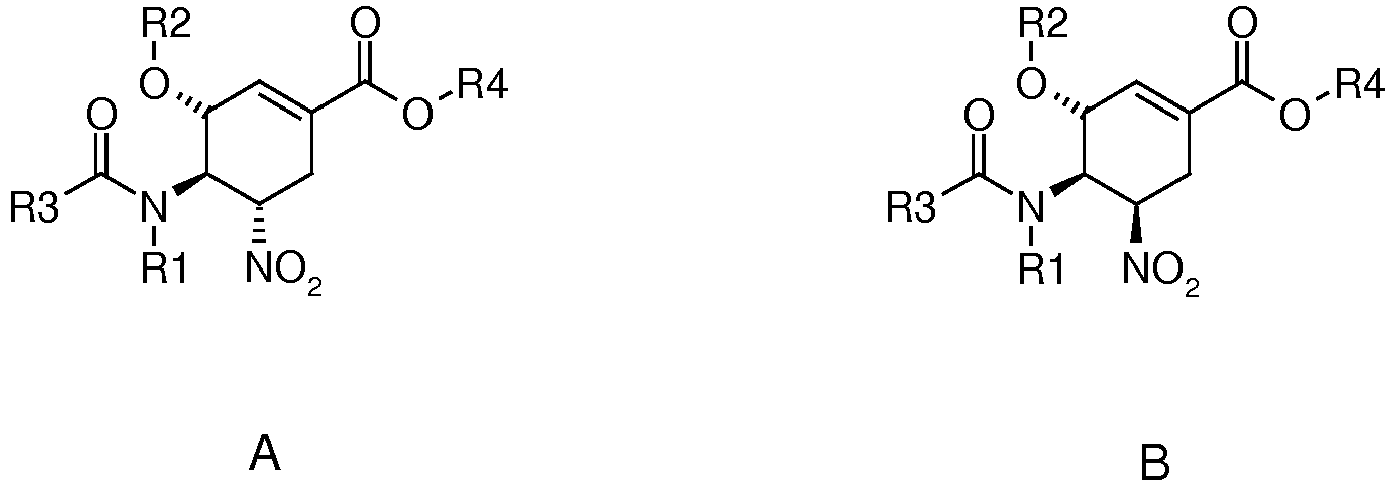


and salts thereof. - Cyclohexene derivatives of general formula E, particularly (3R,4R,5S)-4-acetamide-5-amino-3-(1-ethylpropoxy)-1-cyclohexene-1-carboxylic acid ethylester and salts thereof, are inhibitors of an enzyme known as neuraminidase (J.C. Rohloff at al., J. Org. Chem., 1998, 63, 4545-4550 ,
WO 98/07685 - There are several methods for the preparation of effective inhibitors of neuraminidase based on cyclohexenecarboxylic acid esters, such as (3R, 4R, 5S)-4-acetamide-5-amino-3-(1-ethylpropoxy)-1-cyclohexene-1-carboxylic acid ethylester. However, all these methods are multistep synthesises, sometimes also with relatively dangerous chemical substances, such as azides, or with substances having unpleasant smell for living and working environment, such as thiols ( Hayato Ishikawa, Takaki Suzuki, and Yujiro Hayashi Angew. Chem. Int. Ed. 2009, 48, 1304-1307 and literature cited in this document). Moreover, relatively expensive chemicals, such (-)-Shikimic acid or (-)-Quinic acid, are used in most of the above methods.
- Aldehydes of general formula II can easily be prepared by known methods, for example according to Hayato Ishikawa, Takaki Suzuki, and Yujiro Hayashi Angew. Chem. Int. Ed. 2009, 48, 1304-1307 .
- Process for the preparation of the compound of general formula VIa and/or Vlb is described for example in Krowcynski A., Kozerski L., Synthesis 1983, 6, 489-491.
- Process for the preparation of 1-nitro-4-oxobutanylamides of general formula Ia and Ib is advantageous in that it consists of one step, and thus it is simple and quick, brings high yields and high enantiomer excesses of the desired diastereoisomer.
- The following examples illustrate the present invention in more details, without being limitative.
- Note : The numbered compounds with "r" represent racemic mixtures.
- Monochloroacetic acid (0.2 equiv., 56 mg) and (2R)-2-(diphenyl[(trimethylsilyl)oxy]methyl)pyrrolidine (0.05 equiv., 48 mg) in methanol (5 ml) were added to the suspension of N - [(Z)-2-nitro-ethenyl]acetamide (3 mmol, 390 mg) and 1-ethylpropyloxyacetaldehyde (2 equiv., 780 mg) in methanol (10 ml) at room temperature. The mixture was stirred at room temperature for 16 hours. After the reaction was terminated, methanol was evaporated in the rotary vacuum evaporator and the crude product was separated by chromatography (silica gel, ethylacetate-hexane=1:1). A light brown oil (778 mg, 99%) as a mixture of diastereoisomers 1r and 2r, dr: syn: anti 45:55, ee: syn: 12%, anti: 9%) was obtained.
syn-aldehyde (1r): 1H NMR, (300 MHz, CDCl3) δ 9,65 (t, J = 0,6 Hz, 1H), 6,04 (bd, J = 8,5 Hz, 1 H), 5,11-5,02 (m, 1 H), 4,58 (d, J = 6,5 Hz, 2H), 4,08 (dd, J = 0,3, 3,3 Hz, 1 H), 3,41 (quint., J = 5,8 Hz, 1 H), 1,99 (s, 3H), 1,62-1,49 (m, 4H), 0,98-0,87 (m, 6H) MS m/z [M+H+] calculated for [C11H21N2O5]-: 261,30; found: 261,13.
anti-aldehyde (2r): 1H NMR, (300 MHz, CDCl3) δ 9,61 (d, J= 3,1 Hz, 1 H), 6,11 (bd, J = 8,8 Hz, 1 H), 4,85-4,50 (m, 3H) 3,95 (dd, J = 3,1, 8,0 Hz, 1 H), 3,27 (quint., J = 5,5 Hz, 1 H), 2,00 (s, 3H), 1,57-1,42 (m, 4H), 0,95-0,84 (m, 6H). MS m/z [M+H+] calculated for [C11H21N2O5]-: 261,30; found: 261,13 - Monochloroacetic acid (0.4 equiv., 19 mg) and (2R)-2-(diphenyl[(trimethylsilyl)oxy]-methyl)pyrrolidine (0.1 equiv., 16 mg) in CHCl3 (2 ml) were added to the suspension of 2-methyl-N-[(E)-2-nitroethenyl]propanamide (0.5 mmol, 79 mg) and 1-ethylpropyloxyacetaldehyde (1.5 equiv., 130 mg) in CHCl3 (1 ml) and water (2 ml) at room temperature. The mixture was stirred at this temperature for 7 hours. After the reaction terminated, the saturated solution of NH4Cl (3 ml) was added and an organic chloroform layer was separated. The residue was extracted 5x by chloroform (5x1 ml). The joined organic layers were dried over Na2SO4 and after filtration the solvent evaporated in the rotary vacuum evaporator. The crude product was separated by chromatography (silica gel, ethylacetate-hexane=1:1). A light brown oil 3r and 4r (140 mg, 97%: dr: syn: anti 52:48) was obtained.
syn-aldehyd (3r): 1 H NMR, (300 MHz, CDCl3) δ 9,64 (t, J = 0,5 Hz, 1 H), 6.06 (bd, J = 8,5 Hz, 1 H), 11/05-01/05 (m, 1 h), 4.60 (d, J = 1,1 Hz, 1 H), 4.57 (d, J = 1,7 Hz, 1 H), 4.10 (dd, J = 0,3, 3,1 Hz, 1 H), 3.41 (quint., J = 5,7 Hz, 1 H), 2.37 (sept, J = 6,7 Hz, 1 H), 1.64-1.45 (m, 4 h), 1,16-1,11 (m, 6H), 0.98-0.87 (m, 6H) MS: m/z [M+H+] calculated for: [C13H25N2O5] = 289,1758; found: 289,16
anti-aldehyd (4r): 1 H NMR, (300 MHz, CDCl3) δ 9,60 (d, J = 3,1 Hz, 1 H), 6.09 (bd, J = 8,7 Hz, 1 H), 4.82 (dd, J = 5,3, 13,3 Hz, 1 H), 4.76-4.68 (m, 1 H), 4.56 (dd, J = 3,6, 13,3 Hz, 1 H), 3.94 (dd, J = 3,1, 8,2 Hz, 1 H), 3.26 (quint., J = 5,7 Hz , 1 H), 2,38-2.36 (sept, J = 6,9 Hz, 1H), 1.61-1,46 (m, 4 h), 1,16-1,11 (m, 6H), 0.94-0,84 (m, 6H) MS: m/z [M+H+] calculated for: [C13H25N2O5] = 289,1758; found: 289,16 - The order of steps was the same as in Example 2: bromoacetic acid (0.2 equiv., 36.13 mg) dissolved in H2O (5.2 ml) and (2S)-2-(diphenyl[(trimethylsilyl)-oxy]methyl)-pyrrolidine (0.1 equiv., 42.32 mg) in CDCl3 (0.5 ml) were added to the suspension of 2-methyl-N-[(E)-2-nitroethenyl]propanamide (1.3 mmol, 205.61 mg) and pent-3-yloxyacetaldehyde (1.5 equiv., 253.87 mg) in CHCl3 (4.7 ml) at 0 °C. The mixture was stirred for 8 hours at the temperature of 0 °C. After the reaction terminated, the saturated solution of NH4Cl (28.5 ml) was added to the reaction mixture at the temperature of 0 °C. The mixture was further stirred at this temperature for 15 minutes. The reaction mixture was extracted 5x by chloroform, organic layers were dried over Na2SO4 and filtered. The crude product was evaporated in the rotary vacuum evaporator.
- The products 3r and 4r (85.7 %) dr: syn: anti= 1.6:1, ee: syn 70.8 %, ee anti 21.8 % were isolated from the crude product (dark green oil, 415 mg, dr: syn:anti 2.1:1) by chromatography (silica gel, ethylacetate-hexane=2:1)
- Monochloracetic acid (0.4 equiv., 19 mg) and (2R)-2-(diphenyl[(trimethylsilyl)-oxy]methyl)pyrrolidine (0.1 equiv., 16 mg) in 2-propanol (2 ml) were added to the suspension of 2,2-dimethyl-N-(Z)-2-nitroethenyl]propanamide (0.5 mmol, 86 mg) and 1-ethylpropyloxyacetaldehyde (2 equiv., 130 mg) in 2-propanol (3 ml) at room temperature. The mixture was stirred at room temperature for 22 hours. After the reaction terminated, 2-propanol evaporated in the rotary vacuum evaporator and the crude product was separated by chromatography (silica gel, ethylacetate:hexane=1:2). A slighly brown oil (150 mg, 99%) of two diastereoisomers 5r and 6r dr: syn:anti 60:40 was obtained.
syn-aldehyd (5r): 1 H NMR, (300 MHz, CDCl3) δ 9,63 (t, J = 0,6 Hz, 1 H), 6,28 (bd, J = 8,6 Hz, 1 H), 5,05-4,97 (m, 1 H), 4,60 (d, J = 1,4 Hz, 1 H), 4,57 (d, J = 1,4 Hz, 1 H), 4,11 (dd, J = 0,3, 3,5 Hz, 1 H), 3,42 (quint., J = 5,8 Hz, 1 H), 1,65-1,47 (m, 4H), 1,18 (s, 9H), 0,99 to 0,89 (m, 6H). MS m/z [M+H+] calculated for [C14H26N2O5]: 303,1914; found: 303,1811.
anti-aldehyd (6r): 1 H NMR, (300 MHz, CDCl3) δ 9,60 (d, J = 3,0 Hz, 1 H), 6,32 (bd, J = 8,8 Hz, 1 H), 4,81 (dd, J = 5,2, 13,1 Hz, 1 H), 4,75-4,62 (m, 1 H), 4,56 (dd, J = 3,6, 13,1 Hz, 1 H), 3,94 (dd, J = 3,0, 8,0 Hz, 1 H), 3,26 (quint., J = 5,5 Hz, 1 H), 1,55-1,41 (m, 4H), 1,17 (s, 9H), 0,94-0,83 (m, 6H).MS m/z [M+H+] calculated for [C14H26N2O5]: 303,1914; found: 303,1811. - Monochloracetic acid (0.4 equiv., 75 mg) and (2R)-2-(diphenyl[(trimethylsilyl)oxy]methyl)pyrrolidine (0.1 equiv., 65 mg) in CHCl3 (4 ml) were added to the suspension of N-[(Z)-2-nitroethenyl]-acetamide (2 mmol, 260mg) and 1-ethylpropyloxyacetaldehyde (2) (1.5 equiv., 780 mg) in CHCl3 (8 ml) and saturated solution of NaCl (8 ml) at room temperature. The mixture was stirred at this temperature for 16 hours. After the reaction terminated, the saturated solution of NH4Cl (10 ml) was added and chloroform layer was separated. The residuum was extracted by chloroform (5x4ml) and joined organic layers were dried over Na2SO4 and filtrated. The filtrate evaporated in rotary vacuum evaporator and the residuum was separated by chromatography (silica gel, ethylacetate:hexane=1:1). A light brown oil of the enantiomer 1a and diastereoisomer 2r (390 mg, 75 %, dr: syn: anti 76:23, ee: syn: 92 %, anti: 38 %) was obtained.
- The order of steps was the same as in Example 5.
- Monochloroacetic acid (0.2 equiv., 75 mg) and (2R)-2-(diphenyl[(trimethylsilyl)-oxy]methyl)pyrrolidine (0.1 equiv., 130 mg) in CHCl3 (8 ml) were added to the suspension of N-[(Z)-2-nitroethenyl]-acetamide (4 mmol, 520mg) and 1-ethylpropyloxyacetaldehyde (1.5 equiv., 780 mg) in CHCl3 (16 ml) and water (16 ml) at 0 °C. The mixture was stirred at this temperature for 5 hours. After the reaction terminated, the saturated solution of NH4Cl (20 ml) was added and chloroform layer was separated. The residuum was extracted by chloroform (5x10ml) and joined organic layers were dried over Na2SO4 and filtrated. The filtrate evaporated in the rotary vacuum evaporator and the residuum was separated by chromatography (silica gel, ethylacetate-hexane=1:1). 1a and 2r in the form of a light yellow oil (920 mg, 88 %, d.r.: syn: anti 81:19, e.e.: syn: 97 %, anti: 56 %) were obtained together.
- 2.317 g (17.80 mmol) of pent-3-yloxyacet-aldehyde (1.1 equiv.) was added to the suspension of 2.105 g (16.18 mmol) of N-(Z)-2-nitroethenylacetamide in 40 ml of chloroform at the temperature of 0 °C and then the solution of 0.527 g (1.618 mmol, 0.1 equiv.) of (2S)-2-(diphenyl[(trimethylsilyl)oxy]methyl)pyrrolidine in 25 ml of chloroform and the solution of 0.449 g (3.236 mmol, 0.2 equiv.) of bromoacetic acid in 65 ml of water was added. The reaction mixture was stirred at the temperature of 0 °C. After 1 hour 0.421 g (3.236 mmol) of pent-3-yl-oxyacetaldehyde (0.2 equiv.) was added and after another hour 0.421 g (3.236 mmol) of pent-3-yloxy-acetaldehyde (90.2 equiv.) was added. The reaction mixture was stirred for 3.5 hours in total at the temperature of 0 °C. After termination of the reaction 80 ml of saturated cooled solution of NH4Cl was added to the reaction mixture. After thorough stirring the chloroform layer was separated in separatory funnel, the water layer was extracted by chloroform (3x50 ml) and joined organic layers were dried by anhydrous Na2SO4. After drying the solution was evaporated and the residuum was separated by chromatography (silica gel; ethylacetate:i-hexane = 1:1), thus obtaining 1.956 g (46.5 %) of (1) with 97% ee as, light yellow oil and 461 mg (11%) of anti diastereoisomer (69 %ee).
- The reactions were performed in deuterated chloroform and conversion of the starting nitro-olefine and ratio between diastereomers from NMR measurements (300MHz) was determined in the reaction mixture, as well as enentiomeric excess of diastereoisomers after derivatization of the reaction mixture according to the procedure described in Example 8.
- The co-catalyst (6, 6a-6k, see below) (0.2 equiv.) was dissolved in water and the catalyst (2S)-2-(diphenyl[(trimethylsilyl)oxy]methyl)pyrrolidine dissolved in CDCl3 was added to the suspension of 2-nitroethenylacetamide (0.25 mmol) and pent-3-yloxyacetaldehyde (1.5 equiv.) in 0.75 ml of CDCl3, and the mixture was stirred at the temperature of 0 °C for 2 hours. After termination, a sample was taken directly from the reaction mixture for NMR determination of conversion and dr. The obtained crude products were further derivatized in order to determine the enantiomeric excess. The results are summarized in the table below:
Input Co-catalyst Conversion in% dr syn/anti ee syn % ee anti % Note 1 6b 97 1.7:1 - - 0.2 equiv. of co-catalyst, cooling to -10 °C 2 6c 90 2.3:1 - - 0.2 equiv. of co-catalyst 3 6c 92 2.5:1 90 86 0.3 equiv. of co-catalyst, 2 equiv. of aldehyde, 22 hours 4 6 97 4.3:1 95.2 76.6 5 6a 97 3.8:1 96.6 68.2 6 6d 94 3.6:1 98.4 76.6 7 6e 98 4:1 97 77 8 6f 60 4.7:1 89.7 78.7 9 6g 90 3:1 - - 10 6h 69 3.2:1 90.4 65.2 11 6i 95 4.1:1 95 57.6 Added 0.5 equiv. excess of aldehyde 12 6 99.6 4.6:1 97 66 Added 0.5 equiv. excess of aldehyde 13 6a 94 4.6:1 96.2 69.6 Added 0.5 equiv. excess of aldehyde 14 6d 99.8 3.2:1 96.8 69.6 Added 0.5 equiv. excess of aldehyde 15 6k 48 5.9:1 90.1 84.6 Reaction time 1 hour 16 6e 82.3 4.7:1 90.4 93.4 0.25 equiv. of co-catalyst, reaction time 1 hour 17 6 99 3.7:1 95.8 66.1 0.3 equiv. of co-catalyst, reaction time 1 hour 18 6 92.5 4.5:1 96.5 80.8 Reaction time 7 hours1 19 6 43 4.1:1 97 89 Reaction time 22 hours2 20 6a 95 5.1:1 96.5 60.1 Reaction time 4 hours3 21 6a 96.2 5.2:1 96.2 58.2 Reaction time 4 hours4 22 6a 92.7 5.4:1 96.9 59.9 Reaction time 4 hours5 23 6j 72 3:1 90 69 Solvent CDCl3: H2O, reaction time 24hours 24 6c 65 2.9:1 89.5 69.7 Solvent CDCl3, -5 °C, 3 hours6 25 6 61 5.9:1 95.9 75.6 Solvent CDCl3, -5 °C, 3 hours6 1aldehyde 2.75 equiv., catalyst 0.2 equiv., co-catalyst 0.505 equiv., H2O : CDCl3 = 1 : 1.5 ml, 0°C
2aldehyde 0.3 equiv., co-catalyst 0.3 equiv., anhydrous
3aldehyde 1.86 equiv., co-catalyst 0.1 equiv., H2O 0.82 ml, CDCl3 0.51 ml
4aldehyde 1.92 equiv., co-catalyst 0.086 equiv., H2O 0.87 ml, CDCl3 0,47 ml
5aldehyde 1.98 equiv., co-catalyst 0.071 equiv., catalyst 0.07 equiv., H2O 0.91 ml, CDCl3 0.44 ml
6aldehyde 2 equiv., co-catalyst 0.3 equiv.
6 - monochloracetic acid
6a - bromoacetic acid
6b - acetic acid
6c - benzoic acid
6d - iodoacetic acid
6e - mandelic acid
6f - 1-bromophenylacetic acid
6g - phenylacetic acid
6h - 4-bromophenylacetic acid
6i - fluoroacetic acid
6j - 2-chloropropionic acid
6k - 4-chloromandelic acid - 500 mg (2 mmol) of N-[(4-methoxyphenyl)methyl]-N-[(E)-2-nitroethenyl]acetamide and then 390 mg (3 mmol) of 2-(pentane-3-yloxy)acet-aldehyde was added to the solution of 260 mg (0.8 mmol) of (2R)-2-(diphenyl[(trimethylsilyl)-oxy]methyl)pyrrolidine in chloroform (8ml) at the temperature of 0 °C. The reaction mixture was stirred for 90 hours at room temperature, then it was directly evaporated in the rotary vacuum evaporator and chromatographed (silica gel, hexane:ethylacetate = 2:1). 400 mg (53 %) of light oil as a mixture of two diastereoisomers 7r, 8r (dr = 1:1.1. ee% = 53 % and 41 %) was obtained.
- (7r, 8r): 1 H NMR (300 MHz, CDCl3, in two isomers, 56H): δ 0,72-0,88 (m, 12H), 1,26-1,55 (m, 8H), 2,20 (s, 3H), 2,21 (s, 3H), 3,01-3,09 (m, 1 H), 3,15-3,23 (m, 1 H), 3,81 (s, 6H), 3,90 to 3,93 (m, 1 H), 4,25 to 4,64 (m, 5H), 4,76-4,84 (m, 5H), 4,94-5,01 (m, 1 H), 6,89-6,93 (m, 4H), 7,12-7,19 (m, 4H), 9,15 (d, J = 3,3 Hz, 1 H), 9,51 (d , 3,0 Hz, 1 H), MS: m /z [M+H+] calculated for: [C19H28N2O6] 381,20; found 381,19
- Chloroform (4 ml), N-[(4-methoxyphenyl)methyl]-N-[(E)-2-nitroethenyl]acetamide (250 mg, 1 mmol), 2-(pentane-3-yloxy)acetaldehyde (195 mg, 1.5 mmol) and monochloroacetic acid (38 mg, 0.4mmol) were added to (2R)-2-(diphenyl[(trimethylsilyl)oxy]methyl)pyrrolidine (130 mg, 0.4 mmol). The reaction mixture was stirred for 120 hours at room temperature. Then it was directly evaporated in the rotary vacuum evaporator and chromatographed on silica gel (hexane:ethylacetate = 2:1). 95 mg (25 %) of light oil as a mixture of two diastereoisomers 7r, 8r (dr = 1:1.2. ee = 80% a 87 %) was obtained.
- Benzyloxyacetaldehyde (121.2 mg, 0.807 mmol) was added to the solution of N-[(Z)-2-nitro-ethenyl]acetamide (70 mg, 0.538 mmol) and (2S-2-(diphenyl[(trimethylsilyl)oxy]methyl)pyrrolidine (17.5 mg, 0.0538 mmol) in dimethyl sulfoxide (2 ml) at room temperature. Then monochloroacetic acid (10.3 mg, 0.107 mmol) was added, and the reaction mixture was stirred for 24 hours at room temperature. The solution was diluted by water (10 ml) and extracted by EtOAc (3x10 ml). The joined organic layers were washed by saturated solution of NaCl and dried by anhydrous Na2SO4. Following the chromatography (silica gel, EtOAc:n-hexane=1:3 to 1:1) the final product as a light orange oil corresponding to the mixture of diastereoisomers 9r and 10r (112 mg, 74 %) was obtained.
- (9r, 10r): 1 HNMR: (300 MHz, CDCl3, TMS): δ = 9,60 (s, 1 H), 9,56 (d, J = 2,5, 1 H), 7,36 (m, 5H), 6,02 (m, 1 H), 4,80 (d, J = 11,3, 1 H), 4,71 (dd, J = 6,7, J = 8,6, 1 H), 4,56 (m, 2H), 4,50 (m, 1 H), 4,15 (m, 1 H), 1,94 (d, J = 8,9, 3H). MS: m/z [M+H+] calculated for [C13H16N2O5 +]: 281,11; found: 281,10.
- Monochloroacetic acid (0.4 equiv., 19 mg) and (2S)-2-(methoxymethyl)pyrrolidine (0.1 equiv., 6 mg) in CHCl3 (1 ml) were added to the suspension of N-[(Z)-2-nitroethenyl]acetamide (0.5 mmol, 65 mg), and then 1-ethylpropyloxyacetaldehyde (1.5 equiv., 130 mg) in the mixture of CHCl3 (2 ml) and water (2 ml) was added at room temperature. The reaction mixture was stirred at room temperature for 48 hours. After the reaction terminated, the saturated solution of NH4Cl (3 ml) was added and the chloroform layer was separated. The water layers was extracted by chloroform (5x2ml). The joined organic layers were dried by anhydrous Na2SO4 and after filtration the filtrate was evaporated in the rotary vacuum evaporator. The crude product was separated by chromatography (silica gel, ethylacetate:hexane=1:1). A ligh brown oil as a mixture of diastereoisomers 1r and 2r (40 mg, 30 %, dr: syn:anti 81:19, ee: syn: 46 %, anti: 65 %) was obtained.
- Monochloroacetic acid (0.4 equiv., 19 mg) and (2S)-2-(methoxydiphenylmethyl)-pyrrolidine (0.1 equiv., 13 mg) in CHCl3 (1 ml) were added to the suspension of N-[(Z)-2-nitroethenyl]acetamide (0.5 mmol, 65 mg) and then 1-ethylpropyloxyacetaldehyde (1.5 equiv., 130 mg) in the mixture of CHCl3 and water (1:1) (4 ml) was added at room temperature. The reaction mixture was stirred at room temperature for 1.5 hours. After the reaction terminated, the saturated solution of NH4Cl (3 ml) was added and chloroform layer was separated. The water layer was extracted by chloroformom (5x1 ml). The joined organic layers were dried by anhydrous Na2SO4 and after filtration the filtrate was evaporated in the rotary vacuum evaporator. The crude product was separated by chromatography (silica gel, ethylacetate:hexane=1:1). A light brown oil as a mixture of diastereoizomers 1r and 2r, 100 mg, 76 %, dr: syn:anti 70:30, ee: syn: 86 %, anti: 77 %) was obtained.
- Acetanhydride (2 equiv., 3.7 ml) was added to the solution of 2-nitroethenylamine (1.76 g, 20 mmol) in pyridine (15 equiv., 24 ml) at the temperature of 0-5 °C during 5 min. Then the reaction mixture was stirred at room temperature for 28 hours. The reaction mixture was added to water solution of CuSO4 (200 ml) and the obtained mixture was extracted by ether (5x 80 ml). The organic layers were dried with Na2SO4 and ether evaporated in the rotary vacuum evaporator. Following the chromatography (silicagel,ethylacetate:hexane=1:1) N-[(Z)-2-nitro-ethenyl]acetamide (11) (2216 mg, 85.24 %) in the form of white crystals was obtained. MP (melting point) = 117-119 °C
(11): 1H NMR, (300 MHz, CDCl3) δ 10,6 to 10,2 (bs, 1 H), 7,59 (dd, J = 7,0, 12,3 Hz, 1 H), 6,61 (d, J = 6,7 Hz, 1 H), 2,28 (s, 3H) MS: mlz [M+H+] calculated for: [C4H7N2O3] = 131,11; found: 131,04 - 2-methylpropanoyl-2-methylpropanoate (4 equiv., 11.3 ml) was added to the solution of 2-nitro-ethenylamine (1.5 g, 17 mmol) in pyridine (15 equiv., 20 ml) at the temperature of 0-5 °C during 5 min. Then the reaction mixture was stirred at room temperature for 48 h. The reaction mixture was added to water solution of CuSO4 (200 ml) and the obtained mixture was extracted by ether (5x 80 ml). The organic layers were dried with Na2SO4 and ether evaporated in the rotary vacuum evaporator. Following the chromatography (silica gel, ethylacetate:hexane=1:1) 2-methyl-N-[(E)-2-nitroethenyl]propanamide (12) (2330mg, 86 %) in the form of light crystals with MP 92-94 °C was obtained.
(12): 1H NMR, (300 MHz, CDCl3) δ 8,40 (dd, J = 11,1, 12,1 Hz, 1H), 7,72 to 7,55 (bs, 1 H), 7,42 (d, J = 12,1 Hz, 1 H), 2,56 (trans J = 6,9 Hz, 1 H), 1,25 (d, J = 6,9 Hz, 1 H), MS: m/z [M+H-] calculated for: [C6H11N2O3] = 157,06; found: 157,05 - Triethylamine (3 equiv., 3.7 ml) and pivaloyl chloride (1.1 equiv., 1.64 ml) were added to the solution of 2-nitroethenylamine (1000 mg, 12 mmol) in dichloromethane (60 ml) at the temperature of 0-5 °C for 2 min. Then the reaction mixture was stirred at room temperature 23 hours. After termination of the reaction, silica gel (6 g) was added to the reaction mixture and the solvent evaporated in the rotary vacuum evaporator. The obtained solid residuum was chromatographed (silica gel, ethylacetate:hexane=1:4), thus obtaining 2,2-dimethyl-N-[(Z,E)-2-nitroethenyl]propanamide (13) (1510 mg, 73 %) as a light yellow oil.
(13): 1H NMR, (300 MHz, CDCl3) (Z: E = 2:1), δ 10,95 to 10,75 (bs, 1 H, (Z)), 8,41 (dd, J = 10,9, 12,1 Hz, 1 H, (E)), 7,82 to 7,72 (bs, 1 H, (E)), 7,63 (dd, J = 6,8 a 11,9 Hz, 1 H, (Z)), 7,45 (d, J = 12,1 Hz, 1 H, (E)), 6,64 (d, J = 6,8 Hz, 1 H, (Z)), 1,32 (s, 9H, (Z)), 1,29 (s , 9H, (E)), MS: m/z [M-H-] calculated for: [C7H13N2O3] = 171,07; found: 171,07 - Acetanhydride (4 equiv., 3.3 ml) was added to the solution of N-[(Z)-2-nitroethenyl]-N-(prop-2-en-1-yl)amine (1.5 g, 7.5 mmol) in pyridine (15 equiv., 14 ml) at the temperature of 0-5 °C during 5 min. Then the reaction mixture was stirred at room temperature for 48 hours. The reaction mixture was added to water solution of CuSO4 (150 ml) and the obtained mixture was extracted by ether (5x 40 ml). The joined organic layers were dried by Na2SO4, ether evaporated in the rotary vacuum evaporator. Following the chromatography (silica gel, ethylacetate:hexane=1:3), N-[(Z)-2-nitroethenyl]-N-(prop-2-en-1-yl)acetamide (14) (1155 mg, 91 %) in the form of a light yellow oil was obtained.
(14): 1H NMR, (300 MHz, CDCl3) δ 8,75 to 8,55 (bd, 1 H), 6,93 (d, J = 11,8 Hz, 1 H), 5,79 to 5,67 (m, 1 H), 5,31 (td, J = 1,4, 10,5 Hz, 1 H), 5,21 to 5,15 (m, 1 H), 4,27 to 4,24 (m, 2H ), 2,42 (s, 3H) - 2350 mg (23 mmol) of acetanhydride was added to [(4-metoxyphenyl)methyl][(E)-2-nitroethenyl]amine (19.2 mmol, 4000 mg) dissolved in 70 ml of pyridine at the temperature of 0 °C during 15 minutes. The reaction mixture was stirred at room temperature for 16 hours. Then this mixture was poured into water (500 ml) and the mixture was extracted by 3 x 100 ml ethylacetate. The joined organic layers were dried over Na2SO4, the solvent evaporated in the rotary vacuum evaporator and the residuum (4.25 g) was purified by chromatography (silica gel, ethylacetate:hexane=2:3). 4000 mg N-[(4-metoxyphenyl)methyl]-N-[(E)-2-nitroethenyl] acetamide (15) as a yellow solid was obtained.
(15) :1H NMR (300 MHz, CDCl3): δ 2,48 (s, 3H), 3,80 (s, 3H), 4,79 (s, 2H), 6,87-6,91 (m, 3 h), 7,06-7,11 (m, 2H), 8,66 (bs, 1 H). Calculated for C12H14N2O4: 57,59 % C, 5,64 % H, 11,19 % N; found: 57,83 % C, 5,74 % N,11,43 % N - Dimethylaminopyridine (6 mmol), triethylamine (30 mmol) and acetanhydride (36 mmol) were added to the suspension of 2-nitroethenylbenzylamine (30mmol) in CH2Cl2 (100 ml) at the temperature of 0 °C. Then the reaction mixture was left to be spontaneously heated to the room temperature and stirred for 3 hours. Water was added to the reaction mixture and the organic layer was separated. The water layer was extracted by CH2Cl2. The joined organic layers were washed by saturated solution of NaCl and dried over Na2SO4. After evaporation of the solvent in the vacuum, the residuum was purified by chromatography on silica gel, thus obtaining (Z)-N-benzyl-N-(2-nitrovinyl)acetamide (16) (74 %) as a yellow solid.
(16): 1H NMR (400 MHz, CDCl3) δ: 8,68 (br, 1 H), 7,18 to 7,38 (m, 5 H), 6,84 (d, J = 11,6 Hz, 1 H), 4,86 (s, 2 H), 2,49 (s, 3H).
Note:
The work leading to this invention was made under the Seventh Framework Programme of the European Union, the number of the Grant Agreement: 201431
Claims (11)
- Process for the preparation of 1-nitro-4-oxobutanylamides of general formula la and Ib

wherein R1 is H, allyl, alkyloxycarbonyl, arylalkyloxycarbonyl with a number of carbon atoms up to 24 or the same as in R2, R2 represents alkyl, cycloalkyl or phenylalkyl with up to 24 carbon atoms, and R3 represents alkyl, alkylphenyl, phenylalkyl or phenyl, substituted phenyl, alkoxyphenylalkyl with up to 24 carbon atoms, or wherein R3 is methyl when R1 is 4-methoxyphenylmethyl, characterized in that aldehydes of general formula II,
reacts with 2-nitroethenylamides of general formula IIIa and/or IIIb,
in the presence of organic catalysts and co-catalysts in organic solvent, water, in solution of inorganic salts in water or in the mixture of organic solvents and water or in the mixture of solutions of inorganic salts in water and organic solvents at the temperature between -20 and +50 °C. - Process according to claim 1, characterized in that the organic catalyst is a pyrrolidine derivative of general formula IV and V,

- Process according to claim 1 or 2, characterized in that the organic catalyst is (2S)-2-(diphenyl[(trimethylsilyl)oxy]methyl)pyrrolidine or (2R)-2-(diphenyl[(tri-methylsilyl)oxy]methyl)pyrrolidine.
- Process according to any of claims 1 to 3, characterized in that the co-catalysts are carboxylic acids with 1 to 12 carbon atoms or carboxylic acids substituted with halogen, aromatic acids, phenylalkane carboxylic acids, cycloalkanecarboxylic acids with 6 to 12 carbon atoms or several other organic acids with 1 to 12 carbon atoms.
- Process according to claim 4, characterized in that the co-catalyst is monochloroacetic acid, bromoacetic acid or iodoacetic acid.
- Process according to claim 1, characterized in that the solvents are organic solvents, water, water with inorganic salts or mixtures of organic solvents with water or with solution of inorganic salts in water.
- Process according to claim 6, characterized in that the solvents are alcohols with 1 to 5 carbon atoms, water, mixture of water with dichloromethane or chloroform or solution of inorganic salts in water with dichloromethane or chloroform.
- Process according to claim 1, characterized in that the temperature is between -15 and 25 °C.
- 2-nitroethenylamides of general formula IIIa and IIIb

- Compounds according to claim 9, characterized in that R1 is H and R3 is methyl.
- Process for the preparation of 2-nitroethenylamides of general formula IIIa and IIIb according to claim 9,

wherein R1 is H, allyl, alkyloxycarbonyl, arylalkyloxycarbonyl with a number of carbon atoms up to 24, R3 is alkyl, cycloalkyl, phenyl or alkylphenyl, alkoxyphenylalkyl with up to 24 carbon atoms, or wherein R3 is methyl when R1 is 4-methoxyphenylmethyl,
characterized in that 2-nitroethenylamine of general formula VIa and/or VIb,
reacts with corresponding carboxylic acids or derivatives thereof with 1 to 24 carbon atoms.
Applications Claiming Priority (1)
| Application Number | Priority Date | Filing Date | Title |
|---|---|---|---|
| SK5013-2010A SK288218B6 (en) | 2010-05-05 | 2010-05-05 | Process for the preparation of 1-nitro-4-oxobutanylamides and opposite enantiomers thereof |
Publications (3)
| Publication Number | Publication Date |
|---|---|
| EP2385034A2 EP2385034A2 (en) | 2011-11-09 |
| EP2385034A3 EP2385034A3 (en) | 2012-07-18 |
| EP2385034B1 true EP2385034B1 (en) | 2015-12-02 |
Family
ID=44117687
Family Applications (1)
| Application Number | Title | Priority Date | Filing Date |
|---|---|---|---|
| EP11164806.9A Not-in-force EP2385034B1 (en) | 2010-05-05 | 2011-05-04 | Process for the preparation of 1-nitro-4-oxobutanylamides |
Country Status (2)
| Country | Link |
|---|---|
| EP (1) | EP2385034B1 (en) |
| SK (1) | SK288218B6 (en) |
Families Citing this family (1)
| Publication number | Priority date | Publication date | Assignee | Title |
|---|---|---|---|---|
| CN107304171A (en) * | 2017-05-05 | 2017-10-31 | 杭州师范大学 | A kind of synthetic method of Oseltamivir |
Family Cites Families (2)
| Publication number | Priority date | Publication date | Assignee | Title |
|---|---|---|---|---|
| AU738577C (en) | 1996-08-23 | 2002-04-11 | F. Hoffmann-La Roche Ag | Preparation of cyclohexene carboxylate derivatives |
| CN101735140A (en) * | 2009-12-23 | 2010-06-16 | 中国科学院上海有机化学研究所 | Chiral amino compound, method for synthesizing same and application of anti-flu medicament tamifiu intermediate thereof |
-
2010
- 2010-05-05 SK SK5013-2010A patent/SK288218B6/en not_active IP Right Cessation
-
2011
- 2011-05-04 EP EP11164806.9A patent/EP2385034B1/en not_active Not-in-force
Also Published As
| Publication number | Publication date |
|---|---|
| EP2385034A2 (en) | 2011-11-09 |
| SK50132010A3 (en) | 2011-12-05 |
| SK288218B6 (en) | 2014-08-05 |
| EP2385034A3 (en) | 2012-07-18 |
Similar Documents
| Publication | Publication Date | Title |
|---|---|---|
| SK52398A3 (en) | Intermediary compounds for the hemisynthesis of taxanes and preparation processes therefor | |
| Gennari et al. | Highly enantio-and diastereoselective boron aldol reactions of α-heterosubstituted thioacetates with aldehydes and silyl imines | |
| JP2021138711A (en) | Method for producing (4s)-4-[4-cyano-2-(methylsulfonyl)phenyl]-3,6-dimethyl-2-oxo-1-[3-(trifluoromethyl)phenyl]-1,2,3,4-tetrahydropyrimidine-5-carbonitrile | |
| JP4659309B2 (en) | Process for producing 5-hydroxy-3-oxopentanoic acid derivative | |
| KR100881617B1 (en) | Intermediates for the preparation of atorvastatin and methods for preparing the | |
| JP2006500407A (en) | Methods for the synthesis of intermediates useful for the synthesis of tubulin inhibitors | |
| WO2010041739A1 (en) | Optically active vinyl-cyclopropane carboxylic acid derivative and optically active vinyl-cyclopropane amino acid derivative manufacturing method | |
| EP2547645B1 (en) | Processes and intermediates for preparing a macrocyclic protease inhibitor of hcv | |
| KR101426714B1 (en) | Improved method for the production of ramipril | |
| EP2385034A2 (en) | Process for the preparation of 1-nitro-4-oxobutanylamides | |
| CN1874974A (en) | Diastereoselective method of preparing olefins by means of the Horner-Wadsworth-Emmons reaction using a particular phosphonate which improves diastereoselectivity at all temperatures including at ambi | |
| JP3855295B2 (en) | Method for producing bisoxazolines | |
| WO2003074534A9 (en) | Reagents for asymmetric allylation, aldol, and tandem aldol and allylation reactions | |
| Milcent et al. | Trifluoromethyl nitrones: from fluoral to optically active hydroxylamines | |
| RU2802954C1 (en) | Trifluoromethylated monoterpene amino alcohols based on nopinone, camphorquinone or verbanone | |
| CN1931855A (en) | Compound 2-methylol-3-substituted phenyl propionic acid with optical activity and its resolving process | |
| EP1749816A1 (en) | Production method of optically active diphenylalanine compounds | |
| EP1735297B1 (en) | Synthesising method and benzoxathiepine intermediates | |
| FR2751652A1 (en) | THIENYLCYCLOHEXANE DERIVATIVES, PROCESSES FOR THEIR PREPARATION AND THEIR USE AS NEW INDUSTRIAL PRODUCTS FOR THE SYNTHESIS OF THIENYLCYCLOHEXYL DERIVATIVES | |
| JPWO2002044136A1 (en) | Method for producing N-protected-β-amino alcohol and method for producing N-protected-β-aminoepoxide | |
| JP2023155765A (en) | Method for producing amide compound | |
| JP5124950B2 (en) | Method for producing optically active serine derivative | |
| WO2017168438A1 (en) | Process for preparing pure allyl protected keto derivative | |
| RU2557546C2 (en) | Method for producing isoserine derivatives | |
| JP2008510761A (en) | Method for producing diarylcycloalkyl derivative |
Legal Events
| Date | Code | Title | Description |
|---|---|---|---|
| 17P | Request for examination filed |
Effective date: 20110530 |
|
| AK | Designated contracting states |
Kind code of ref document: A2 Designated state(s): AL AT BE BG CH CY CZ DE DK EE ES FI FR GB GR HR HU IE IS IT LI LT LU LV MC MK MT NL NO PL PT RO RS SE SI SK SM TR |
|
| AX | Request for extension of the european patent |
Extension state: BA ME |
|
| PUAI | Public reference made under article 153(3) epc to a published international application that has entered the european phase |
Free format text: ORIGINAL CODE: 0009012 |
|
| PUAL | Search report despatched |
Free format text: ORIGINAL CODE: 0009013 |
|
| AK | Designated contracting states |
Kind code of ref document: A3 Designated state(s): AL AT BE BG CH CY CZ DE DK EE ES FI FR GB GR HR HU IE IS IT LI LT LU LV MC MK MT NL NO PL PT RO RS SE SI SK SM TR |
|
| AX | Request for extension of the european patent |
Extension state: BA ME |
|
| RIC1 | Information provided on ipc code assigned before grant |
Ipc: C07C 231/12 20060101ALI20120613BHEP Ipc: C07C 233/13 20060101ALI20120613BHEP Ipc: C07C 233/25 20060101ALI20120613BHEP Ipc: C07C 231/02 20060101AFI20120613BHEP Ipc: C07C 233/75 20060101ALI20120613BHEP Ipc: C07C 233/31 20060101ALI20120613BHEP |
|
| 17Q | First examination report despatched |
Effective date: 20140128 |
|
| REG | Reference to a national code |
Ref country code: DE Ref legal event code: R079 Ref document number: 602011021762 Country of ref document: DE Free format text: PREVIOUS MAIN CLASS: C07C0231020000 Ipc: C07C0231120000 |
|
| GRAP | Despatch of communication of intention to grant a patent |
Free format text: ORIGINAL CODE: EPIDOSNIGR1 |
|
| RIC1 | Information provided on ipc code assigned before grant |
Ipc: C07C 233/13 20060101ALI20150413BHEP Ipc: C07C 233/75 20060101ALI20150413BHEP Ipc: C07C 233/31 20060101ALI20150413BHEP Ipc: C07C 231/12 20060101AFI20150413BHEP Ipc: C07C 271/48 20060101ALI20150413BHEP |
|
| INTG | Intention to grant announced |
Effective date: 20150429 |
|
| GRAS | Grant fee paid |
Free format text: ORIGINAL CODE: EPIDOSNIGR3 |
|
| GRAP | Despatch of communication of intention to grant a patent |
Free format text: ORIGINAL CODE: EPIDOSNIGR1 |
|
| INTG | Intention to grant announced |
Effective date: 20150717 |
|
| GRAP | Despatch of communication of intention to grant a patent |
Free format text: ORIGINAL CODE: EPIDOSNIGR1 |
|
| INTG | Intention to grant announced |
Effective date: 20150916 |
|
| GRAA | (expected) grant |
Free format text: ORIGINAL CODE: 0009210 |
|
| AK | Designated contracting states |
Kind code of ref document: B1 Designated state(s): AL AT BE BG CH CY CZ DE DK EE ES FI FR GB GR HR HU IE IS IT LI LT LU LV MC MK MT NL NO PL PT RO RS SE SI SK SM TR |
|
| REG | Reference to a national code |
Ref country code: GB Ref legal event code: FG4D |
|
| REG | Reference to a national code |
Ref country code: AT Ref legal event code: REF Ref document number: 763539 Country of ref document: AT Kind code of ref document: T Effective date: 20151215 Ref country code: CH Ref legal event code: EP |
|
| REG | Reference to a national code |
Ref country code: IE Ref legal event code: FG4D |
|
| REG | Reference to a national code |
Ref country code: DE Ref legal event code: R096 Ref document number: 602011021762 Country of ref document: DE |
|
| REG | Reference to a national code |
Ref country code: CH Ref legal event code: NV Representative=s name: BUGNION S.A., CH |
|
| REG | Reference to a national code |
Ref country code: NL Ref legal event code: MP Effective date: 20160302 |
|
| REG | Reference to a national code |
Ref country code: LT Ref legal event code: MG4D |
|
| REG | Reference to a national code |
Ref country code: AT Ref legal event code: MK05 Ref document number: 763539 Country of ref document: AT Kind code of ref document: T Effective date: 20151202 |
|
| PG25 | Lapsed in a contracting state [announced via postgrant information from national office to epo] |
Ref country code: LT Free format text: LAPSE BECAUSE OF FAILURE TO SUBMIT A TRANSLATION OF THE DESCRIPTION OR TO PAY THE FEE WITHIN THE PRESCRIBED TIME-LIMIT Effective date: 20151202 Ref country code: ES Free format text: LAPSE BECAUSE OF FAILURE TO SUBMIT A TRANSLATION OF THE DESCRIPTION OR TO PAY THE FEE WITHIN THE PRESCRIBED TIME-LIMIT Effective date: 20151202 Ref country code: NO Free format text: LAPSE BECAUSE OF FAILURE TO SUBMIT A TRANSLATION OF THE DESCRIPTION OR TO PAY THE FEE WITHIN THE PRESCRIBED TIME-LIMIT Effective date: 20160302 |
|
| PG25 | Lapsed in a contracting state [announced via postgrant information from national office to epo] |
Ref country code: AT Free format text: LAPSE BECAUSE OF FAILURE TO SUBMIT A TRANSLATION OF THE DESCRIPTION OR TO PAY THE FEE WITHIN THE PRESCRIBED TIME-LIMIT Effective date: 20151202 Ref country code: NL Free format text: LAPSE BECAUSE OF FAILURE TO SUBMIT A TRANSLATION OF THE DESCRIPTION OR TO PAY THE FEE WITHIN THE PRESCRIBED TIME-LIMIT Effective date: 20151202 Ref country code: RS Free format text: LAPSE BECAUSE OF FAILURE TO SUBMIT A TRANSLATION OF THE DESCRIPTION OR TO PAY THE FEE WITHIN THE PRESCRIBED TIME-LIMIT Effective date: 20151202 Ref country code: SE Free format text: LAPSE BECAUSE OF FAILURE TO SUBMIT A TRANSLATION OF THE DESCRIPTION OR TO PAY THE FEE WITHIN THE PRESCRIBED TIME-LIMIT Effective date: 20151202 Ref country code: FI Free format text: LAPSE BECAUSE OF FAILURE TO SUBMIT A TRANSLATION OF THE DESCRIPTION OR TO PAY THE FEE WITHIN THE PRESCRIBED TIME-LIMIT Effective date: 20151202 Ref country code: PL Free format text: LAPSE BECAUSE OF FAILURE TO SUBMIT A TRANSLATION OF THE DESCRIPTION OR TO PAY THE FEE WITHIN THE PRESCRIBED TIME-LIMIT Effective date: 20151202 Ref country code: GR Free format text: LAPSE BECAUSE OF FAILURE TO SUBMIT A TRANSLATION OF THE DESCRIPTION OR TO PAY THE FEE WITHIN THE PRESCRIBED TIME-LIMIT Effective date: 20160303 Ref country code: LV Free format text: LAPSE BECAUSE OF FAILURE TO SUBMIT A TRANSLATION OF THE DESCRIPTION OR TO PAY THE FEE WITHIN THE PRESCRIBED TIME-LIMIT Effective date: 20151202 |
|
| PG25 | Lapsed in a contracting state [announced via postgrant information from national office to epo] |
Ref country code: IS Free format text: LAPSE BECAUSE OF FAILURE TO SUBMIT A TRANSLATION OF THE DESCRIPTION OR TO PAY THE FEE WITHIN THE PRESCRIBED TIME-LIMIT Effective date: 20151202 |
|
| PG25 | Lapsed in a contracting state [announced via postgrant information from national office to epo] |
Ref country code: IT Free format text: LAPSE BECAUSE OF FAILURE TO SUBMIT A TRANSLATION OF THE DESCRIPTION OR TO PAY THE FEE WITHIN THE PRESCRIBED TIME-LIMIT Effective date: 20151202 Ref country code: CZ Free format text: LAPSE BECAUSE OF FAILURE TO SUBMIT A TRANSLATION OF THE DESCRIPTION OR TO PAY THE FEE WITHIN THE PRESCRIBED TIME-LIMIT Effective date: 20151202 |
|
| PG25 | Lapsed in a contracting state [announced via postgrant information from national office to epo] |
Ref country code: IS Free format text: LAPSE BECAUSE OF FAILURE TO SUBMIT A TRANSLATION OF THE DESCRIPTION OR TO PAY THE FEE WITHIN THE PRESCRIBED TIME-LIMIT Effective date: 20160402 Ref country code: SM Free format text: LAPSE BECAUSE OF FAILURE TO SUBMIT A TRANSLATION OF THE DESCRIPTION OR TO PAY THE FEE WITHIN THE PRESCRIBED TIME-LIMIT Effective date: 20151202 Ref country code: SK Free format text: LAPSE BECAUSE OF FAILURE TO SUBMIT A TRANSLATION OF THE DESCRIPTION OR TO PAY THE FEE WITHIN THE PRESCRIBED TIME-LIMIT Effective date: 20151202 Ref country code: RO Free format text: LAPSE BECAUSE OF FAILURE TO SUBMIT A TRANSLATION OF THE DESCRIPTION OR TO PAY THE FEE WITHIN THE PRESCRIBED TIME-LIMIT Effective date: 20151202 Ref country code: PT Free format text: LAPSE BECAUSE OF FAILURE TO SUBMIT A TRANSLATION OF THE DESCRIPTION OR TO PAY THE FEE WITHIN THE PRESCRIBED TIME-LIMIT Effective date: 20160404 Ref country code: EE Free format text: LAPSE BECAUSE OF FAILURE TO SUBMIT A TRANSLATION OF THE DESCRIPTION OR TO PAY THE FEE WITHIN THE PRESCRIBED TIME-LIMIT Effective date: 20151202 Ref country code: BE Free format text: LAPSE BECAUSE OF NON-PAYMENT OF DUE FEES Effective date: 20160531 |
|
| REG | Reference to a national code |
Ref country code: DE Ref legal event code: R097 Ref document number: 602011021762 Country of ref document: DE |
|
| PLBE | No opposition filed within time limit |
Free format text: ORIGINAL CODE: 0009261 |
|
| STAA | Information on the status of an ep patent application or granted ep patent |
Free format text: STATUS: NO OPPOSITION FILED WITHIN TIME LIMIT |
|
| PG25 | Lapsed in a contracting state [announced via postgrant information from national office to epo] |
Ref country code: DK Free format text: LAPSE BECAUSE OF FAILURE TO SUBMIT A TRANSLATION OF THE DESCRIPTION OR TO PAY THE FEE WITHIN THE PRESCRIBED TIME-LIMIT Effective date: 20151202 |
|
| 26N | No opposition filed |
Effective date: 20160905 |
|
| PG25 | Lapsed in a contracting state [announced via postgrant information from national office to epo] |
Ref country code: SI Free format text: LAPSE BECAUSE OF FAILURE TO SUBMIT A TRANSLATION OF THE DESCRIPTION OR TO PAY THE FEE WITHIN THE PRESCRIBED TIME-LIMIT Effective date: 20151202 |
|
| PG25 | Lapsed in a contracting state [announced via postgrant information from national office to epo] |
Ref country code: BE Free format text: LAPSE BECAUSE OF FAILURE TO SUBMIT A TRANSLATION OF THE DESCRIPTION OR TO PAY THE FEE WITHIN THE PRESCRIBED TIME-LIMIT Effective date: 20151202 Ref country code: LU Free format text: LAPSE BECAUSE OF FAILURE TO SUBMIT A TRANSLATION OF THE DESCRIPTION OR TO PAY THE FEE WITHIN THE PRESCRIBED TIME-LIMIT Effective date: 20160504 |
|
| REG | Reference to a national code |
Ref country code: IE Ref legal event code: MM4A |
|
| REG | Reference to a national code |
Ref country code: FR Ref legal event code: ST Effective date: 20170131 |
|
| PG25 | Lapsed in a contracting state [announced via postgrant information from national office to epo] |
Ref country code: FR Free format text: LAPSE BECAUSE OF NON-PAYMENT OF DUE FEES Effective date: 20160531 |
|
| PG25 | Lapsed in a contracting state [announced via postgrant information from national office to epo] |
Ref country code: IE Free format text: LAPSE BECAUSE OF NON-PAYMENT OF DUE FEES Effective date: 20160504 |
|
| PGFP | Annual fee paid to national office [announced via postgrant information from national office to epo] |
Ref country code: CH Payment date: 20170425 Year of fee payment: 7 Ref country code: DE Payment date: 20170531 Year of fee payment: 7 Ref country code: GB Payment date: 20170515 Year of fee payment: 7 |
|
| PG25 | Lapsed in a contracting state [announced via postgrant information from national office to epo] |
Ref country code: HU Free format text: LAPSE BECAUSE OF FAILURE TO SUBMIT A TRANSLATION OF THE DESCRIPTION OR TO PAY THE FEE WITHIN THE PRESCRIBED TIME-LIMIT; INVALID AB INITIO Effective date: 20110504 Ref country code: CY Free format text: LAPSE BECAUSE OF FAILURE TO SUBMIT A TRANSLATION OF THE DESCRIPTION OR TO PAY THE FEE WITHIN THE PRESCRIBED TIME-LIMIT Effective date: 20151202 |
|
| PG25 | Lapsed in a contracting state [announced via postgrant information from national office to epo] |
Ref country code: MC Free format text: LAPSE BECAUSE OF FAILURE TO SUBMIT A TRANSLATION OF THE DESCRIPTION OR TO PAY THE FEE WITHIN THE PRESCRIBED TIME-LIMIT Effective date: 20151202 Ref country code: HR Free format text: LAPSE BECAUSE OF FAILURE TO SUBMIT A TRANSLATION OF THE DESCRIPTION OR TO PAY THE FEE WITHIN THE PRESCRIBED TIME-LIMIT Effective date: 20151202 Ref country code: MT Free format text: LAPSE BECAUSE OF NON-PAYMENT OF DUE FEES Effective date: 20160531 Ref country code: MK Free format text: LAPSE BECAUSE OF FAILURE TO SUBMIT A TRANSLATION OF THE DESCRIPTION OR TO PAY THE FEE WITHIN THE PRESCRIBED TIME-LIMIT Effective date: 20151202 Ref country code: TR Free format text: LAPSE BECAUSE OF FAILURE TO SUBMIT A TRANSLATION OF THE DESCRIPTION OR TO PAY THE FEE WITHIN THE PRESCRIBED TIME-LIMIT Effective date: 20151202 |
|
| PG25 | Lapsed in a contracting state [announced via postgrant information from national office to epo] |
Ref country code: BG Free format text: LAPSE BECAUSE OF FAILURE TO SUBMIT A TRANSLATION OF THE DESCRIPTION OR TO PAY THE FEE WITHIN THE PRESCRIBED TIME-LIMIT Effective date: 20151202 |
|
| PG25 | Lapsed in a contracting state [announced via postgrant information from national office to epo] |
Ref country code: AL Free format text: LAPSE BECAUSE OF FAILURE TO SUBMIT A TRANSLATION OF THE DESCRIPTION OR TO PAY THE FEE WITHIN THE PRESCRIBED TIME-LIMIT Effective date: 20151202 |
|
| REG | Reference to a national code |
Ref country code: DE Ref legal event code: R119 Ref document number: 602011021762 Country of ref document: DE |
|
| REG | Reference to a national code |
Ref country code: CH Ref legal event code: PL |
|
| GBPC | Gb: european patent ceased through non-payment of renewal fee |
Effective date: 20180504 |
|
| PG25 | Lapsed in a contracting state [announced via postgrant information from national office to epo] |
Ref country code: LI Free format text: LAPSE BECAUSE OF NON-PAYMENT OF DUE FEES Effective date: 20180531 Ref country code: CH Free format text: LAPSE BECAUSE OF NON-PAYMENT OF DUE FEES Effective date: 20180531 |
|
| PG25 | Lapsed in a contracting state [announced via postgrant information from national office to epo] |
Ref country code: DE Free format text: LAPSE BECAUSE OF NON-PAYMENT OF DUE FEES Effective date: 20181201 Ref country code: GB Free format text: LAPSE BECAUSE OF NON-PAYMENT OF DUE FEES Effective date: 20180504 |