EP2384757A1 - Prevention and/ortreatment of neurodegenerative disorders - Google Patents
Prevention and/ortreatment of neurodegenerative disorders Download PDFInfo
- Publication number
- EP2384757A1 EP2384757A1 EP11006414A EP11006414A EP2384757A1 EP 2384757 A1 EP2384757 A1 EP 2384757A1 EP 11006414 A EP11006414 A EP 11006414A EP 11006414 A EP11006414 A EP 11006414A EP 2384757 A1 EP2384757 A1 EP 2384757A1
- Authority
- EP
- European Patent Office
- Prior art keywords
- substituted
- group
- compound
- moiety
- atom
- Prior art date
- Legal status (The legal status is an assumption and is not a legal conclusion. Google has not performed a legal analysis and makes no representation as to the accuracy of the status listed.)
- Withdrawn
Links
- 208000015122 neurodegenerative disease Diseases 0.000 title claims abstract description 15
- 230000002265 prevention Effects 0.000 title claims abstract description 14
- 150000001875 compounds Chemical class 0.000 claims abstract description 180
- MSWZFWKMSRAUBD-IVMDWMLBSA-N glucosamine group Chemical group OC1[C@H](N)[C@@H](O)[C@H](O)[C@H](O1)CO MSWZFWKMSRAUBD-IVMDWMLBSA-N 0.000 claims abstract description 73
- 125000000600 disaccharide group Chemical group 0.000 claims abstract description 37
- 125000004435 hydrogen atom Chemical group [H]* 0.000 claims abstract description 33
- QAOWNCQODCNURD-UHFFFAOYSA-L sulfate group Chemical group S(=O)(=O)([O-])[O-] QAOWNCQODCNURD-UHFFFAOYSA-L 0.000 claims abstract description 31
- 125000004429 atom Chemical group 0.000 claims abstract description 26
- 238000011282 treatment Methods 0.000 claims abstract description 26
- 208000024827 Alzheimer disease Diseases 0.000 claims abstract description 17
- 239000008194 pharmaceutical composition Substances 0.000 claims abstract description 8
- 238000000034 method Methods 0.000 claims description 28
- 229910021653 sulphate ion Inorganic materials 0.000 claims description 28
- AEMOLEFTQBMNLQ-HNFCZKTMSA-N L-idopyranuronic acid Chemical group OC1O[C@@H](C(O)=O)[C@@H](O)[C@H](O)[C@H]1O AEMOLEFTQBMNLQ-HNFCZKTMSA-N 0.000 claims description 26
- 125000001483 monosaccharide substituent group Chemical group 0.000 claims description 26
- 125000002252 acyl group Chemical group 0.000 claims description 24
- 229910052739 hydrogen Inorganic materials 0.000 claims description 20
- 239000001257 hydrogen Substances 0.000 claims description 20
- 239000012634 fragment Chemical group 0.000 claims description 16
- 230000008569 process Effects 0.000 claims description 14
- 239000000126 substance Substances 0.000 claims description 14
- 230000007017 scission Effects 0.000 claims description 13
- AEMOLEFTQBMNLQ-AQKNRBDQSA-N D-glucopyranuronic acid Chemical group OC1O[C@H](C(O)=O)[C@@H](O)[C@H](O)[C@H]1O AEMOLEFTQBMNLQ-AQKNRBDQSA-N 0.000 claims description 12
- AEMOLEFTQBMNLQ-BKBMJHBISA-N alpha-D-galacturonic acid Chemical group O[C@H]1O[C@H](C(O)=O)[C@H](O)[C@H](O)[C@H]1O AEMOLEFTQBMNLQ-BKBMJHBISA-N 0.000 claims description 12
- 125000003368 amide group Chemical group 0.000 claims description 10
- 238000007068 beta-elimination reaction Methods 0.000 claims description 10
- 125000000217 alkyl group Chemical group 0.000 claims description 9
- 125000003118 aryl group Chemical group 0.000 claims description 8
- 238000004519 manufacturing process Methods 0.000 claims description 8
- 239000003814 drug Substances 0.000 claims description 7
- 108090000856 Lyases Proteins 0.000 claims description 6
- 102000004317 Lyases Human genes 0.000 claims description 6
- IOVCWXUNBOPUCH-UHFFFAOYSA-N Nitrous acid Chemical compound ON=O IOVCWXUNBOPUCH-UHFFFAOYSA-N 0.000 claims description 6
- 229910019142 PO4 Inorganic materials 0.000 claims description 6
- 230000001580 bacterial effect Effects 0.000 claims description 6
- NBIIXXVUZAFLBC-UHFFFAOYSA-K phosphate Chemical compound [O-]P([O-])([O-])=O NBIIXXVUZAFLBC-UHFFFAOYSA-K 0.000 claims description 6
- 239000010452 phosphate Substances 0.000 claims description 6
- 125000003545 alkoxy group Chemical group 0.000 claims description 4
- 238000010504 bond cleavage reaction Methods 0.000 claims description 4
- 230000003647 oxidation Effects 0.000 claims description 4
- 238000007254 oxidation reaction Methods 0.000 claims description 4
- KHIWWQKSHDUIBK-UHFFFAOYSA-N periodic acid Chemical compound OI(=O)(=O)=O KHIWWQKSHDUIBK-UHFFFAOYSA-N 0.000 claims description 4
- 150000003254 radicals Chemical class 0.000 claims description 4
- 125000004063 butyryl group Chemical group O=C([*])C([H])([H])C([H])([H])C([H])([H])[H] 0.000 claims description 3
- 125000000218 acetic acid group Chemical group C(C)(=O)* 0.000 claims 1
- 125000000547 substituted alkyl group Chemical group 0.000 claims 1
- 239000000203 mixture Substances 0.000 abstract description 15
- 230000000694 effects Effects 0.000 description 62
- HTTJABKRGRZYRN-UHFFFAOYSA-N Heparin Chemical compound OC1C(NC(=O)C)C(O)OC(COS(O)(=O)=O)C1OC1C(OS(O)(=O)=O)C(O)C(OC2C(C(OS(O)(=O)=O)C(OC3C(C(O)C(O)C(O3)C(O)=O)OS(O)(=O)=O)C(CO)O2)NS(O)(=O)=O)C(C(O)=O)O1 HTTJABKRGRZYRN-UHFFFAOYSA-N 0.000 description 56
- 229920000669 heparin Polymers 0.000 description 55
- 229960002897 heparin Drugs 0.000 description 55
- 150000002016 disaccharides Chemical class 0.000 description 23
- 229920002971 Heparan sulfate Polymers 0.000 description 22
- 230000014508 negative regulation of coagulation Effects 0.000 description 19
- 239000003981 vehicle Substances 0.000 description 17
- 238000006467 substitution reaction Methods 0.000 description 16
- 125000003047 N-acetyl group Chemical group 0.000 description 15
- 150000001720 carbohydrates Chemical class 0.000 description 15
- 238000003556 assay Methods 0.000 description 14
- MSWZFWKMSRAUBD-UHFFFAOYSA-N beta-D-galactosamine Natural products NC1C(O)OC(CO)C(O)C1O MSWZFWKMSRAUBD-UHFFFAOYSA-N 0.000 description 13
- 230000005764 inhibitory process Effects 0.000 description 13
- 239000007788 liquid Substances 0.000 description 13
- 108090000765 processed proteins & peptides Proteins 0.000 description 13
- -1 heparin saccharides Chemical class 0.000 description 12
- 150000002772 monosaccharides Chemical class 0.000 description 12
- 229960002442 glucosamine Drugs 0.000 description 11
- 230000002401 inhibitory effect Effects 0.000 description 11
- 101710137189 Amyloid-beta A4 protein Proteins 0.000 description 10
- 101710151993 Amyloid-beta precursor protein Proteins 0.000 description 10
- 102100022704 Amyloid-beta precursor protein Human genes 0.000 description 10
- DZHSAHHDTRWUTF-SIQRNXPUSA-N amyloid-beta polypeptide 42 Chemical compound C([C@@H](C(=O)N[C@@H](C)C(=O)N[C@@H](CCC(O)=O)C(=O)N[C@@H](CC(O)=O)C(=O)N[C@H](C(=O)NCC(=O)N[C@@H](CO)C(=O)N[C@@H](CC(N)=O)C(=O)N[C@@H](CCCCN)C(=O)NCC(=O)N[C@@H](C)C(=O)N[C@H](C(=O)N[C@@H]([C@@H](C)CC)C(=O)NCC(=O)N[C@@H](CC(C)C)C(=O)N[C@@H](CCSC)C(=O)N[C@@H](C(C)C)C(=O)NCC(=O)NCC(=O)N[C@@H](C(C)C)C(=O)N[C@@H](C(C)C)C(=O)N[C@@H]([C@@H](C)CC)C(=O)N[C@@H](C)C(O)=O)[C@@H](C)CC)C(C)C)NC(=O)[C@H](CC=1C=CC=CC=1)NC(=O)[C@@H](NC(=O)[C@H](CC(C)C)NC(=O)[C@H](CCCCN)NC(=O)[C@H](CCC(N)=O)NC(=O)[C@H](CC=1N=CNC=1)NC(=O)[C@H](CC=1N=CNC=1)NC(=O)[C@@H](NC(=O)[C@H](CCC(O)=O)NC(=O)[C@H](CC=1C=CC(O)=CC=1)NC(=O)CNC(=O)[C@H](CO)NC(=O)[C@H](CC(O)=O)NC(=O)[C@H](CC=1N=CNC=1)NC(=O)[C@H](CCCNC(N)=N)NC(=O)[C@H](CC=1C=CC=CC=1)NC(=O)[C@H](CCC(O)=O)NC(=O)[C@H](C)NC(=O)[C@@H](N)CC(O)=O)C(C)C)C(C)C)C1=CC=CC=C1 DZHSAHHDTRWUTF-SIQRNXPUSA-N 0.000 description 10
- 229940097042 glucuronate Drugs 0.000 description 10
- 238000003776 cleavage reaction Methods 0.000 description 9
- 239000003112 inhibitor Substances 0.000 description 9
- 239000000243 solution Substances 0.000 description 9
- 238000002866 fluorescence resonance energy transfer Methods 0.000 description 8
- PXWFNGNWQUPGPJ-UHFFFAOYSA-N pmp-hydroxyisoxazole, pyridoxamine-5-phosphate-hydroxyisoxazole Chemical class CC1=NC=C(COP(O)(O)=O)C(CNC=2C(=NOC=2)O)=C1O PXWFNGNWQUPGPJ-UHFFFAOYSA-N 0.000 description 8
- 230000009467 reduction Effects 0.000 description 8
- 102000057297 Pepsin A Human genes 0.000 description 7
- 108090000284 Pepsin A Proteins 0.000 description 7
- 150000004676 glycans Chemical class 0.000 description 7
- 230000004048 modification Effects 0.000 description 7
- 238000012986 modification Methods 0.000 description 7
- 230000002829 reductive effect Effects 0.000 description 7
- 102100021257 Beta-secretase 1 Human genes 0.000 description 6
- 102000004190 Enzymes Human genes 0.000 description 6
- 108090000790 Enzymes Proteins 0.000 description 6
- 125000002777 acetyl group Chemical group [H]C([H])([H])C(*)=O 0.000 description 6
- 230000002776 aggregation Effects 0.000 description 6
- 238000004220 aggregation Methods 0.000 description 6
- 239000000872 buffer Substances 0.000 description 6
- 229940088598 enzyme Drugs 0.000 description 6
- 239000000463 material Substances 0.000 description 6
- 229920001542 oligosaccharide Polymers 0.000 description 6
- 150000002482 oligosaccharides Chemical class 0.000 description 6
- 230000007030 peptide scission Effects 0.000 description 6
- 238000002360 preparation method Methods 0.000 description 6
- 125000001424 substituent group Chemical group 0.000 description 6
- 231100001274 therapeutic index Toxicity 0.000 description 6
- XLYOFNOQVPJJNP-UHFFFAOYSA-N water Substances O XLYOFNOQVPJJNP-UHFFFAOYSA-N 0.000 description 6
- 102000003908 Cathepsin D Human genes 0.000 description 5
- 108090000258 Cathepsin D Proteins 0.000 description 5
- 108090000783 Renin Proteins 0.000 description 5
- 102100028255 Renin Human genes 0.000 description 5
- 230000006933 amyloid-beta aggregation Effects 0.000 description 5
- 239000012131 assay buffer Substances 0.000 description 5
- 230000000052 comparative effect Effects 0.000 description 5
- 208000037265 diseases, disorders, signs and symptoms Diseases 0.000 description 5
- 229940111202 pepsin Drugs 0.000 description 5
- 229920001282 polysaccharide Polymers 0.000 description 5
- 239000005017 polysaccharide Substances 0.000 description 5
- 239000000843 powder Substances 0.000 description 5
- 102000004196 processed proteins & peptides Human genes 0.000 description 5
- 239000007787 solid Substances 0.000 description 5
- 239000000725 suspension Substances 0.000 description 5
- JADVWWSKYZXRGX-UHFFFAOYSA-M thioflavine T Chemical compound [Cl-].C1=CC(N(C)C)=CC=C1C1=[N+](C)C2=CC=C(C)C=C2S1 JADVWWSKYZXRGX-UHFFFAOYSA-M 0.000 description 5
- MCHWWJLLPNDHGL-KVTDHHQDSA-N (2r,3s,4s,5r)-2,5-bis(hydroxymethyl)oxolane-3,4-diol Chemical compound OC[C@H]1O[C@H](CO)[C@@H](O)[C@@H]1O MCHWWJLLPNDHGL-KVTDHHQDSA-N 0.000 description 4
- LKAPTZKZHMOIRE-KVTDHHQDSA-N (2s,3s,4s,5r)-3,4-dihydroxy-5-(hydroxymethyl)oxolane-2-carbaldehyde Chemical compound OC[C@H]1O[C@H](C=O)[C@@H](O)[C@@H]1O LKAPTZKZHMOIRE-KVTDHHQDSA-N 0.000 description 4
- MSWZFWKMSRAUBD-CBPJZXOFSA-N 2-amino-2-deoxy-D-mannopyranose Chemical group N[C@@H]1C(O)O[C@H](CO)[C@@H](O)[C@@H]1O MSWZFWKMSRAUBD-CBPJZXOFSA-N 0.000 description 4
- 102000009091 Amyloidogenic Proteins Human genes 0.000 description 4
- 108010048112 Amyloidogenic Proteins Proteins 0.000 description 4
- ZAMOUSCENKQFHK-UHFFFAOYSA-N Chlorine atom Chemical compound [Cl] ZAMOUSCENKQFHK-UHFFFAOYSA-N 0.000 description 4
- 108010074860 Factor Xa Proteins 0.000 description 4
- PXGOKWXKJXAPGV-UHFFFAOYSA-N Fluorine Chemical compound FF PXGOKWXKJXAPGV-UHFFFAOYSA-N 0.000 description 4
- 101000894895 Homo sapiens Beta-secretase 1 Proteins 0.000 description 4
- 208000012902 Nervous system disease Diseases 0.000 description 4
- 102000035195 Peptidases Human genes 0.000 description 4
- 108091005804 Peptidases Proteins 0.000 description 4
- 239000004365 Protease Substances 0.000 description 4
- FAPWRFPIFSIZLT-UHFFFAOYSA-M Sodium chloride Chemical compound [Na+].[Cl-] FAPWRFPIFSIZLT-UHFFFAOYSA-M 0.000 description 4
- 125000002619 bicyclic group Chemical group 0.000 description 4
- 230000015572 biosynthetic process Effects 0.000 description 4
- 230000037396 body weight Effects 0.000 description 4
- 235000014633 carbohydrates Nutrition 0.000 description 4
- 239000000460 chlorine Substances 0.000 description 4
- 229910052801 chlorine Inorganic materials 0.000 description 4
- 201000010099 disease Diseases 0.000 description 4
- 229910052731 fluorine Inorganic materials 0.000 description 4
- 239000011737 fluorine Substances 0.000 description 4
- 125000005843 halogen group Chemical group 0.000 description 4
- 239000007924 injection Substances 0.000 description 4
- 238000002347 injection Methods 0.000 description 4
- 238000007911 parenteral administration Methods 0.000 description 4
- 238000011321 prophylaxis Methods 0.000 description 4
- 238000011160 research Methods 0.000 description 4
- 239000008174 sterile solution Substances 0.000 description 4
- AKEJUJNQAAGONA-UHFFFAOYSA-N sulfur trioxide Chemical compound O=S(=O)=O AKEJUJNQAAGONA-UHFFFAOYSA-N 0.000 description 4
- 239000000375 suspending agent Substances 0.000 description 4
- CENHPXAQKISCGD-UHFFFAOYSA-N trioxathietane 4,4-dioxide Chemical class O=S1(=O)OOO1 CENHPXAQKISCGD-UHFFFAOYSA-N 0.000 description 4
- WFDIJRYMOXRFFG-UHFFFAOYSA-N Acetic anhydride Chemical compound CC(=O)OC(C)=O WFDIJRYMOXRFFG-UHFFFAOYSA-N 0.000 description 3
- 102000002659 Amyloid Precursor Protein Secretases Human genes 0.000 description 3
- 102000013455 Amyloid beta-Peptides Human genes 0.000 description 3
- 108010090849 Amyloid beta-Peptides Proteins 0.000 description 3
- 102000004411 Antithrombin III Human genes 0.000 description 3
- 108090000935 Antithrombin III Proteins 0.000 description 3
- 241000283690 Bos taurus Species 0.000 description 3
- IAJILQKETJEXLJ-UHFFFAOYSA-N Galacturonsaeure Chemical group O=CC(O)C(O)C(O)C(O)C(O)=O IAJILQKETJEXLJ-UHFFFAOYSA-N 0.000 description 3
- VMHLLURERBWHNL-UHFFFAOYSA-M Sodium acetate Chemical compound [Na+].CC([O-])=O VMHLLURERBWHNL-UHFFFAOYSA-M 0.000 description 3
- HEMHJVSKTPXQMS-UHFFFAOYSA-M Sodium hydroxide Chemical compound [OH-].[Na+] HEMHJVSKTPXQMS-UHFFFAOYSA-M 0.000 description 3
- 239000004480 active ingredient Substances 0.000 description 3
- AEMOLEFTQBMNLQ-VCSGLWQLSA-N alpha-L-iduronic acid Chemical group O[C@@H]1O[C@@H](C(O)=O)[C@@H](O)[C@H](O)[C@H]1O AEMOLEFTQBMNLQ-VCSGLWQLSA-N 0.000 description 3
- 229960005348 antithrombin iii Drugs 0.000 description 3
- AEMOLEFTQBMNLQ-QIUUJYRFSA-N beta-D-glucuronic acid Chemical group O[C@@H]1O[C@H](C(O)=O)[C@@H](O)[C@H](O)[C@H]1O AEMOLEFTQBMNLQ-QIUUJYRFSA-N 0.000 description 3
- 230000008499 blood brain barrier function Effects 0.000 description 3
- 210000001218 blood-brain barrier Anatomy 0.000 description 3
- 239000002775 capsule Substances 0.000 description 3
- 125000004432 carbon atom Chemical group C* 0.000 description 3
- 229940125782 compound 2 Drugs 0.000 description 3
- 230000029087 digestion Effects 0.000 description 3
- 239000003937 drug carrier Substances 0.000 description 3
- 239000000796 flavoring agent Substances 0.000 description 3
- 230000006870 function Effects 0.000 description 3
- 102000038383 gamma-secretases Human genes 0.000 description 3
- 108091007739 gamma-secretases Proteins 0.000 description 3
- 238000000338 in vitro Methods 0.000 description 3
- 238000001727 in vivo Methods 0.000 description 3
- 230000000968 intestinal effect Effects 0.000 description 3
- 210000004072 lung Anatomy 0.000 description 3
- 239000003921 oil Substances 0.000 description 3
- 235000019198 oils Nutrition 0.000 description 3
- 230000003389 potentiating effect Effects 0.000 description 3
- 239000001632 sodium acetate Substances 0.000 description 3
- 235000017281 sodium acetate Nutrition 0.000 description 3
- 239000011780 sodium chloride Substances 0.000 description 3
- 235000000346 sugar Nutrition 0.000 description 3
- 239000003826 tablet Substances 0.000 description 3
- 238000012360 testing method Methods 0.000 description 3
- LZXHHNKULPHARO-UHFFFAOYSA-M (3,4-dichlorophenyl)methyl-triphenylphosphanium;chloride Chemical compound [Cl-].C1=C(Cl)C(Cl)=CC=C1C[P+](C=1C=CC=CC=1)(C=1C=CC=CC=1)C1=CC=CC=C1 LZXHHNKULPHARO-UHFFFAOYSA-M 0.000 description 2
- 125000004169 (C1-C6) alkyl group Chemical group 0.000 description 2
- 238000001644 13C nuclear magnetic resonance spectroscopy Methods 0.000 description 2
- 238000005160 1H NMR spectroscopy Methods 0.000 description 2
- YQTCQNIPQMJNTI-UHFFFAOYSA-N 2,2-dimethylpropan-1-one Chemical group CC(C)(C)[C]=O YQTCQNIPQMJNTI-UHFFFAOYSA-N 0.000 description 2
- SNKZJIOFVMKAOJ-UHFFFAOYSA-N 3-Amino-1-propanesulfonic acid Natural products NCCCS(O)(=O)=O SNKZJIOFVMKAOJ-UHFFFAOYSA-N 0.000 description 2
- 208000037259 Amyloid Plaque Diseases 0.000 description 2
- 102000004580 Aspartic Acid Proteases Human genes 0.000 description 2
- 108010017640 Aspartic Acid Proteases Proteins 0.000 description 2
- 101710150192 Beta-secretase 1 Proteins 0.000 description 2
- 108010039209 Blood Coagulation Factors Proteins 0.000 description 2
- 102000015081 Blood Coagulation Factors Human genes 0.000 description 2
- WKBOTKDWSSQWDR-UHFFFAOYSA-N Bromine atom Chemical compound [Br] WKBOTKDWSSQWDR-UHFFFAOYSA-N 0.000 description 2
- 108010010803 Gelatin Proteins 0.000 description 2
- 229920002683 Glycosaminoglycan Polymers 0.000 description 2
- 206010062506 Heparin-induced thrombocytopenia Diseases 0.000 description 2
- 241001465754 Metazoa Species 0.000 description 2
- PRDZVHCOEWJPOB-IVMDWMLBSA-N N-sulfo-D-glucosamine Chemical compound OC[C@H]1OC(O)[C@H](NS(O)(=O)=O)[C@@H](O)[C@@H]1O PRDZVHCOEWJPOB-IVMDWMLBSA-N 0.000 description 2
- 208000024777 Prion disease Diseases 0.000 description 2
- 102000016611 Proteoglycans Human genes 0.000 description 2
- 108010067787 Proteoglycans Proteins 0.000 description 2
- JUJWROOIHBZHMG-UHFFFAOYSA-N Pyridine Chemical compound C1=CC=NC=C1 JUJWROOIHBZHMG-UHFFFAOYSA-N 0.000 description 2
- 238000006640 acetylation reaction Methods 0.000 description 2
- 239000002253 acid Substances 0.000 description 2
- 238000000184 acid digestion Methods 0.000 description 2
- 150000001298 alcohols Chemical class 0.000 description 2
- 102000038380 alpha-secretases Human genes 0.000 description 2
- 108091007736 alpha-secretases Proteins 0.000 description 2
- 230000003942 amyloidogenic effect Effects 0.000 description 2
- 239000003146 anticoagulant agent Substances 0.000 description 2
- 229940127219 anticoagulant drug Drugs 0.000 description 2
- 125000005251 aryl acyl group Chemical group 0.000 description 2
- 125000003236 benzoyl group Chemical group [H]C1=C([H])C([H])=C(C([H])=C1[H])C(*)=O 0.000 description 2
- 108091007737 beta-secretases Proteins 0.000 description 2
- 239000011230 binding agent Substances 0.000 description 2
- 239000003114 blood coagulation factor Substances 0.000 description 2
- 210000004556 brain Anatomy 0.000 description 2
- GDTBXPJZTBHREO-UHFFFAOYSA-N bromine Substances BrBr GDTBXPJZTBHREO-UHFFFAOYSA-N 0.000 description 2
- 229910052794 bromium Inorganic materials 0.000 description 2
- 125000001246 bromo group Chemical group Br* 0.000 description 2
- 239000001913 cellulose Substances 0.000 description 2
- 229920002678 cellulose Polymers 0.000 description 2
- 235000010980 cellulose Nutrition 0.000 description 2
- 125000003636 chemical group Chemical group 0.000 description 2
- 238000007385 chemical modification Methods 0.000 description 2
- 238000006243 chemical reaction Methods 0.000 description 2
- LKAPTZKZHMOIRE-UHFFFAOYSA-N chitose Natural products OCC1OC(C=O)C(O)C1O LKAPTZKZHMOIRE-UHFFFAOYSA-N 0.000 description 2
- 229940125904 compound 1 Drugs 0.000 description 2
- 238000007906 compression Methods 0.000 description 2
- 230000006835 compression Effects 0.000 description 2
- 239000006071 cream Substances 0.000 description 2
- 230000003247 decreasing effect Effects 0.000 description 2
- 230000002939 deleterious effect Effects 0.000 description 2
- 239000000839 emulsion Substances 0.000 description 2
- 125000004185 ester group Chemical group 0.000 description 2
- 235000013355 food flavoring agent Nutrition 0.000 description 2
- 235000003599 food sweetener Nutrition 0.000 description 2
- 239000000499 gel Substances 0.000 description 2
- 238000001641 gel filtration chromatography Methods 0.000 description 2
- 239000008273 gelatin Substances 0.000 description 2
- 229920000159 gelatin Polymers 0.000 description 2
- 235000019322 gelatine Nutrition 0.000 description 2
- 235000011852 gelatine desserts Nutrition 0.000 description 2
- 230000001771 impaired effect Effects 0.000 description 2
- 238000001802 infusion Methods 0.000 description 2
- 230000003993 interaction Effects 0.000 description 2
- 238000007913 intrathecal administration Methods 0.000 description 2
- 230000002427 irreversible effect Effects 0.000 description 2
- 230000000670 limiting effect Effects 0.000 description 2
- 239000000314 lubricant Substances 0.000 description 2
- HQKMJHAJHXVSDF-UHFFFAOYSA-L magnesium stearate Chemical compound [Mg+2].CCCCCCCCCCCCCCCCCC([O-])=O.CCCCCCCCCCCCCCCCCC([O-])=O HQKMJHAJHXVSDF-UHFFFAOYSA-L 0.000 description 2
- 230000014759 maintenance of location Effects 0.000 description 2
- 239000003068 molecular probe Substances 0.000 description 2
- 231100000189 neurotoxic Toxicity 0.000 description 2
- 230000002887 neurotoxic effect Effects 0.000 description 2
- 229910052760 oxygen Inorganic materials 0.000 description 2
- 230000006919 peptide aggregation Effects 0.000 description 2
- 239000000546 pharmaceutical excipient Substances 0.000 description 2
- 125000002467 phosphate group Chemical group [H]OP(=O)(O[H])O[*] 0.000 description 2
- 125000000612 phthaloyl group Chemical group C(C=1C(C(=O)*)=CC=CC1)(=O)* 0.000 description 2
- 150000004804 polysaccharides Polymers 0.000 description 2
- 239000003755 preservative agent Substances 0.000 description 2
- 102000004169 proteins and genes Human genes 0.000 description 2
- 108090000623 proteins and genes Proteins 0.000 description 2
- 239000008247 solid mixture Substances 0.000 description 2
- 239000002904 solvent Substances 0.000 description 2
- 239000007858 starting material Substances 0.000 description 2
- 239000003765 sweetening agent Substances 0.000 description 2
- 239000006188 syrup Substances 0.000 description 2
- 235000020357 syrup Nutrition 0.000 description 2
- 230000001225 therapeutic effect Effects 0.000 description 2
- 238000002560 therapeutic procedure Methods 0.000 description 2
- 125000004044 trifluoroacetyl group Chemical group FC(C(=O)*)(F)F 0.000 description 2
- GETQZCLCWQTVFV-UHFFFAOYSA-N trimethylamine Chemical compound CN(C)C GETQZCLCWQTVFV-UHFFFAOYSA-N 0.000 description 2
- 125000003774 valeryl group Chemical group O=C([*])C([H])([H])C([H])([H])C([H])([H])C([H])([H])[H] 0.000 description 2
- JNYAEWCLZODPBN-JGWLITMVSA-N (2r,3r,4s)-2-[(1r)-1,2-dihydroxyethyl]oxolane-3,4-diol Chemical compound OC[C@@H](O)[C@H]1OC[C@H](O)[C@H]1O JNYAEWCLZODPBN-JGWLITMVSA-N 0.000 description 1
- BYEAHWXPCBROCE-UHFFFAOYSA-N 1,1,1,3,3,3-hexafluoropropan-2-ol Chemical compound FC(F)(F)C(O)C(F)(F)F BYEAHWXPCBROCE-UHFFFAOYSA-N 0.000 description 1
- MEKOFIRRDATTAG-UHFFFAOYSA-N 2,2,5,8-tetramethyl-3,4-dihydrochromen-6-ol Chemical compound C1CC(C)(C)OC2=C1C(C)=C(O)C=C2C MEKOFIRRDATTAG-UHFFFAOYSA-N 0.000 description 1
- JKMHFZQWWAIEOD-UHFFFAOYSA-N 2-[4-(2-hydroxyethyl)piperazin-1-yl]ethanesulfonic acid Chemical compound OCC[NH+]1CCN(CCS([O-])(=O)=O)CC1 JKMHFZQWWAIEOD-UHFFFAOYSA-N 0.000 description 1
- HIQIXEFWDLTDED-UHFFFAOYSA-N 4-hydroxy-1-piperidin-4-ylpyrrolidin-2-one Chemical compound O=C1CC(O)CN1C1CCNCC1 HIQIXEFWDLTDED-UHFFFAOYSA-N 0.000 description 1
- GUBGYTABKSRVRQ-XLOQQCSPSA-N Alpha-Lactose Chemical compound O[C@@H]1[C@@H](O)[C@@H](O)[C@@H](CO)O[C@H]1O[C@@H]1[C@@H](CO)O[C@H](O)[C@H](O)[C@H]1O GUBGYTABKSRVRQ-XLOQQCSPSA-N 0.000 description 1
- ATRRKUHOCOJYRX-UHFFFAOYSA-N Ammonium bicarbonate Chemical compound [NH4+].OC([O-])=O ATRRKUHOCOJYRX-UHFFFAOYSA-N 0.000 description 1
- 229910000013 Ammonium bicarbonate Inorganic materials 0.000 description 1
- 208000000044 Amnesia Diseases 0.000 description 1
- 108010043324 Amyloid Precursor Protein Secretases Proteins 0.000 description 1
- 102000004881 Angiotensinogen Human genes 0.000 description 1
- 108090001067 Angiotensinogen Proteins 0.000 description 1
- 235000003911 Arachis Nutrition 0.000 description 1
- 244000105624 Arachis hypogaea Species 0.000 description 1
- 229940125759 BACE1 protease inhibitor Drugs 0.000 description 1
- 241001250090 Capra ibex Species 0.000 description 1
- FBPFZTCFMRRESA-FSIIMWSLSA-N D-Glucitol Natural products OC[C@H](O)[C@H](O)[C@@H](O)[C@H](O)CO FBPFZTCFMRRESA-FSIIMWSLSA-N 0.000 description 1
- 239000004375 Dextrin Substances 0.000 description 1
- 229920001353 Dextrin Polymers 0.000 description 1
- LVGKNOAMLMIIKO-UHFFFAOYSA-N Elaidinsaeure-aethylester Natural products CCCCCCCCC=CCCCCCCCC(=O)OCC LVGKNOAMLMIIKO-UHFFFAOYSA-N 0.000 description 1
- IAYPIBMASNFSPL-UHFFFAOYSA-N Ethylene oxide Chemical compound C1CO1 IAYPIBMASNFSPL-UHFFFAOYSA-N 0.000 description 1
- 102000018233 Fibroblast Growth Factor Human genes 0.000 description 1
- 108050007372 Fibroblast Growth Factor Proteins 0.000 description 1
- FZHXIRIBWMQPQF-UHFFFAOYSA-N Glc-NH2 Natural products O=CC(N)C(O)C(O)C(O)CO FZHXIRIBWMQPQF-UHFFFAOYSA-N 0.000 description 1
- WQZGKKKJIJFFOK-GASJEMHNSA-N Glucose Natural products OC[C@H]1OC(O)[C@H](O)[C@@H](O)[C@@H]1O WQZGKKKJIJFFOK-GASJEMHNSA-N 0.000 description 1
- 239000007995 HEPES buffer Substances 0.000 description 1
- 101000983155 Homo sapiens Protein-associating with the carboxyl-terminal domain of ezrin Proteins 0.000 description 1
- UFHFLCQGNIYNRP-UHFFFAOYSA-N Hydrogen Chemical compound [H][H] UFHFLCQGNIYNRP-UHFFFAOYSA-N 0.000 description 1
- 102000036770 Islet Amyloid Polypeptide Human genes 0.000 description 1
- 108010041872 Islet Amyloid Polypeptide Proteins 0.000 description 1
- GUBGYTABKSRVRQ-QKKXKWKRSA-N Lactose Natural products OC[C@H]1O[C@@H](O[C@H]2[C@H](O)[C@@H](O)C(O)O[C@@H]2CO)[C@H](O)[C@@H](O)[C@H]1O GUBGYTABKSRVRQ-QKKXKWKRSA-N 0.000 description 1
- 240000007472 Leucaena leucocephala Species 0.000 description 1
- 235000010643 Leucaena leucocephala Nutrition 0.000 description 1
- 241000124008 Mammalia Species 0.000 description 1
- 208000026139 Memory disease Diseases 0.000 description 1
- 208000005314 Multi-Infarct Dementia Diseases 0.000 description 1
- OVRNDRQMDRJTHS-UHFFFAOYSA-N N-acelyl-D-glucosamine Natural products CC(=O)NC1C(O)OC(CO)C(O)C1O OVRNDRQMDRJTHS-UHFFFAOYSA-N 0.000 description 1
- OVRNDRQMDRJTHS-RTRLPJTCSA-N N-acetyl-D-glucosamine Chemical compound CC(=O)N[C@H]1C(O)O[C@H](CO)[C@@H](O)[C@@H]1O OVRNDRQMDRJTHS-RTRLPJTCSA-N 0.000 description 1
- MBLBDJOUHNCFQT-LXGUWJNJSA-N N-acetylglucosamine Natural products CC(=O)N[C@@H](C=O)[C@@H](O)[C@H](O)[C@H](O)CO MBLBDJOUHNCFQT-LXGUWJNJSA-N 0.000 description 1
- PRDZVHCOEWJPOB-UKFBFLRUSA-N N-sulfo-alpha-D-glucosamine Chemical compound OC[C@H]1O[C@H](O)[C@H](NS(O)(=O)=O)[C@@H](O)[C@@H]1O PRDZVHCOEWJPOB-UKFBFLRUSA-N 0.000 description 1
- 238000005481 NMR spectroscopy Methods 0.000 description 1
- 208000025966 Neurological disease Diseases 0.000 description 1
- 206010034719 Personality change Diseases 0.000 description 1
- 206010036631 Presenile dementia Diseases 0.000 description 1
- 102100026829 Protein-associating with the carboxyl-terminal domain of ezrin Human genes 0.000 description 1
- 206010039966 Senile dementia Diseases 0.000 description 1
- 108010022999 Serine Proteases Proteins 0.000 description 1
- 102000012479 Serine Proteases Human genes 0.000 description 1
- UIIMBOGNXHQVGW-UHFFFAOYSA-M Sodium bicarbonate Chemical class [Na+].OC([O-])=O UIIMBOGNXHQVGW-UHFFFAOYSA-M 0.000 description 1
- 229920002472 Starch Polymers 0.000 description 1
- 229920004890 Triton X-100 Polymers 0.000 description 1
- 239000013504 Triton X-100 Substances 0.000 description 1
- 201000004810 Vascular dementia Diseases 0.000 description 1
- 241000251539 Vertebrata <Metazoa> Species 0.000 description 1
- DPXJVFZANSGRMM-UHFFFAOYSA-N acetic acid;2,3,4,5,6-pentahydroxyhexanal;sodium Chemical compound [Na].CC(O)=O.OCC(O)C(O)C(O)C(O)C=O DPXJVFZANSGRMM-UHFFFAOYSA-N 0.000 description 1
- 230000009471 action Effects 0.000 description 1
- 239000012190 activator Substances 0.000 description 1
- 239000000654 additive Substances 0.000 description 1
- 239000000443 aerosol Substances 0.000 description 1
- 125000003158 alcohol group Chemical group 0.000 description 1
- 150000001413 amino acids Chemical class 0.000 description 1
- 125000003277 amino group Chemical group 0.000 description 1
- 235000012538 ammonium bicarbonate Nutrition 0.000 description 1
- 239000001099 ammonium carbonate Substances 0.000 description 1
- 230000007450 amyloidogenic pathway Effects 0.000 description 1
- 150000008064 anhydrides Chemical class 0.000 description 1
- 230000003466 anti-cipated effect Effects 0.000 description 1
- 230000010100 anticoagulation Effects 0.000 description 1
- 238000003149 assay kit Methods 0.000 description 1
- XPRBWLXCZLKXHB-UHFFFAOYSA-N aziridine-1-sulfonic acid Chemical compound OS(=O)(=O)N1CC1 XPRBWLXCZLKXHB-UHFFFAOYSA-N 0.000 description 1
- 125000004069 aziridinyl group Chemical group 0.000 description 1
- 125000001797 benzyl group Chemical group [H]C1=C([H])C([H])=C(C([H])=C1[H])C([H])([H])* 0.000 description 1
- AEMOLEFTQBMNLQ-UHFFFAOYSA-N beta-D-galactopyranuronic acid Natural products OC1OC(C(O)=O)C(O)C(O)C1O AEMOLEFTQBMNLQ-UHFFFAOYSA-N 0.000 description 1
- WQZGKKKJIJFFOK-VFUOTHLCSA-N beta-D-glucose Chemical compound OC[C@H]1O[C@@H](O)[C@H](O)[C@@H](O)[C@@H]1O WQZGKKKJIJFFOK-VFUOTHLCSA-N 0.000 description 1
- 239000003833 bile salt Substances 0.000 description 1
- 229940093761 bile salts Drugs 0.000 description 1
- 230000004071 biological effect Effects 0.000 description 1
- 230000031018 biological processes and functions Effects 0.000 description 1
- 230000033228 biological regulation Effects 0.000 description 1
- 230000000740 bleeding effect Effects 0.000 description 1
- 230000000903 blocking effect Effects 0.000 description 1
- 239000008280 blood Substances 0.000 description 1
- 210000004369 blood Anatomy 0.000 description 1
- 230000023555 blood coagulation Effects 0.000 description 1
- VSGNNIFQASZAOI-UHFFFAOYSA-L calcium acetate Chemical compound [Ca+2].CC([O-])=O.CC([O-])=O VSGNNIFQASZAOI-UHFFFAOYSA-L 0.000 description 1
- 239000001639 calcium acetate Substances 0.000 description 1
- 229960005147 calcium acetate Drugs 0.000 description 1
- 235000011092 calcium acetate Nutrition 0.000 description 1
- 239000001506 calcium phosphate Substances 0.000 description 1
- 229910000389 calcium phosphate Inorganic materials 0.000 description 1
- 235000011010 calcium phosphates Nutrition 0.000 description 1
- 125000003178 carboxy group Chemical group [H]OC(*)=O 0.000 description 1
- 239000001768 carboxy methyl cellulose Substances 0.000 description 1
- 150000007942 carboxylates Chemical group 0.000 description 1
- 210000004027 cell Anatomy 0.000 description 1
- 210000003169 central nervous system Anatomy 0.000 description 1
- 230000002490 cerebral effect Effects 0.000 description 1
- 239000003795 chemical substances by application Substances 0.000 description 1
- 238000000576 coating method Methods 0.000 description 1
- 235000019864 coconut oil Nutrition 0.000 description 1
- 239000003240 coconut oil Substances 0.000 description 1
- 239000003086 colorant Substances 0.000 description 1
- 238000002648 combination therapy Methods 0.000 description 1
- 229940125773 compound 10 Drugs 0.000 description 1
- IQFVPQOLBLOTPF-HKXUKFGYSA-L congo red Chemical compound [Na+].[Na+].C1=CC=CC2=C(N)C(/N=N/C3=CC=C(C=C3)C3=CC=C(C=C3)/N=N/C3=C(C4=CC=CC=C4C(=C3)S([O-])(=O)=O)N)=CC(S([O-])(=O)=O)=C21 IQFVPQOLBLOTPF-HKXUKFGYSA-L 0.000 description 1
- 239000000470 constituent Substances 0.000 description 1
- 230000008878 coupling Effects 0.000 description 1
- 238000010168 coupling process Methods 0.000 description 1
- 238000005859 coupling reaction Methods 0.000 description 1
- 125000004122 cyclic group Chemical group 0.000 description 1
- 230000007423 decrease Effects 0.000 description 1
- 230000003111 delayed effect Effects 0.000 description 1
- 230000001419 dependent effect Effects 0.000 description 1
- 230000008021 deposition Effects 0.000 description 1
- 238000011161 development Methods 0.000 description 1
- 235000019425 dextrin Nutrition 0.000 description 1
- 235000005911 diet Nutrition 0.000 description 1
- 230000037213 diet Effects 0.000 description 1
- 239000003085 diluting agent Substances 0.000 description 1
- 208000035475 disorder Diseases 0.000 description 1
- 239000000975 dye Substances 0.000 description 1
- 239000003995 emulsifying agent Substances 0.000 description 1
- 238000005516 engineering process Methods 0.000 description 1
- 230000002255 enzymatic effect Effects 0.000 description 1
- 150000002148 esters Chemical class 0.000 description 1
- RTZKZFJDLAIYFH-UHFFFAOYSA-N ether Substances CCOCC RTZKZFJDLAIYFH-UHFFFAOYSA-N 0.000 description 1
- 125000001033 ether group Chemical group 0.000 description 1
- 125000001495 ethyl group Chemical group [H]C([H])([H])C([H])([H])* 0.000 description 1
- LVGKNOAMLMIIKO-QXMHVHEDSA-N ethyl oleate Chemical compound CCCCCCCC\C=C/CCCCCCCC(=O)OCC LVGKNOAMLMIIKO-QXMHVHEDSA-N 0.000 description 1
- 229940093471 ethyl oleate Drugs 0.000 description 1
- 230000005284 excitation Effects 0.000 description 1
- 230000001747 exhibiting effect Effects 0.000 description 1
- 238000002474 experimental method Methods 0.000 description 1
- 239000003889 eye drop Substances 0.000 description 1
- 229940012356 eye drops Drugs 0.000 description 1
- 239000003885 eye ointment Substances 0.000 description 1
- 239000003925 fat Substances 0.000 description 1
- 235000019197 fats Nutrition 0.000 description 1
- 230000002349 favourable effect Effects 0.000 description 1
- 239000000945 filler Substances 0.000 description 1
- 235000019634 flavors Nutrition 0.000 description 1
- 230000037406 food intake Effects 0.000 description 1
- 238000009472 formulation Methods 0.000 description 1
- 239000008103 glucose Substances 0.000 description 1
- 150000002334 glycols Chemical class 0.000 description 1
- 239000008187 granular material Substances 0.000 description 1
- 150000008282 halocarbons Chemical class 0.000 description 1
- 108010023735 heparatinase II Proteins 0.000 description 1
- 239000002628 heparin derivative Substances 0.000 description 1
- 208000010544 human prion disease Diseases 0.000 description 1
- 239000000017 hydrogel Substances 0.000 description 1
- 125000002887 hydroxy group Chemical group [H]O* 0.000 description 1
- 230000002452 interceptive effect Effects 0.000 description 1
- 238000000185 intracerebroventricular administration Methods 0.000 description 1
- 238000007918 intramuscular administration Methods 0.000 description 1
- 238000007912 intraperitoneal administration Methods 0.000 description 1
- 239000007928 intraperitoneal injection Substances 0.000 description 1
- 238000001990 intravenous administration Methods 0.000 description 1
- 238000011835 investigation Methods 0.000 description 1
- 239000003456 ion exchange resin Substances 0.000 description 1
- 229920003303 ion-exchange polymer Polymers 0.000 description 1
- ZLVXBBHTMQJRSX-VMGNSXQWSA-N jdtic Chemical compound C1([C@]2(C)CCN(C[C@@H]2C)C[C@H](C(C)C)NC(=O)[C@@H]2NCC3=CC(O)=CC=C3C2)=CC=CC(O)=C1 ZLVXBBHTMQJRSX-VMGNSXQWSA-N 0.000 description 1
- 239000008101 lactose Substances 0.000 description 1
- 230000003902 lesion Effects 0.000 description 1
- 239000002502 liposome Substances 0.000 description 1
- 230000006674 lysosomal degradation Effects 0.000 description 1
- 235000019359 magnesium stearate Nutrition 0.000 description 1
- 230000007246 mechanism Effects 0.000 description 1
- 230000010534 mechanism of action Effects 0.000 description 1
- 230000008018 melting Effects 0.000 description 1
- 238000002844 melting Methods 0.000 description 1
- 230000006984 memory degeneration Effects 0.000 description 1
- 208000023060 memory loss Diseases 0.000 description 1
- 125000002496 methyl group Chemical group [H]C([H])([H])* 0.000 description 1
- 239000000693 micelle Substances 0.000 description 1
- 230000035772 mutation Effects 0.000 description 1
- 230000000626 neurodegenerative effect Effects 0.000 description 1
- 210000002682 neurofibrillary tangle Anatomy 0.000 description 1
- 230000009437 off-target effect Effects 0.000 description 1
- 239000002674 ointment Substances 0.000 description 1
- ZQPPMHVWECSIRJ-KTKRTIGZSA-N oleic acid Chemical class CCCCCCCC\C=C/CCCCCCCC(O)=O ZQPPMHVWECSIRJ-KTKRTIGZSA-N 0.000 description 1
- 239000003960 organic solvent Substances 0.000 description 1
- 230000001575 pathological effect Effects 0.000 description 1
- 239000006187 pill Substances 0.000 description 1
- 239000000244 polyoxyethylene sorbitan monooleate Substances 0.000 description 1
- 235000010482 polyoxyethylene sorbitan monooleate Nutrition 0.000 description 1
- 229920000053 polysorbate 80 Polymers 0.000 description 1
- 229940068968 polysorbate 80 Drugs 0.000 description 1
- 229920006316 polyvinylpyrrolidine Polymers 0.000 description 1
- 125000002924 primary amino group Chemical group [H]N([H])* 0.000 description 1
- 238000012545 processing Methods 0.000 description 1
- 230000000750 progressive effect Effects 0.000 description 1
- UMJSCPRVCHMLSP-UHFFFAOYSA-N pyridine Natural products COC1=CC=CN=C1 UMJSCPRVCHMLSP-UHFFFAOYSA-N 0.000 description 1
- 238000009790 rate-determining step (RDS) Methods 0.000 description 1
- 230000029865 regulation of blood pressure Effects 0.000 description 1
- 239000000523 sample Substances 0.000 description 1
- 239000012898 sample dilution Substances 0.000 description 1
- 230000035945 sensitivity Effects 0.000 description 1
- 238000009097 single-agent therapy Methods 0.000 description 1
- 235000019812 sodium carboxymethyl cellulose Nutrition 0.000 description 1
- 229920001027 sodium carboxymethylcellulose Polymers 0.000 description 1
- CIJQGPVMMRXSQW-UHFFFAOYSA-M sodium;2-aminoacetic acid;hydroxide Chemical compound O.[Na+].NCC([O-])=O CIJQGPVMMRXSQW-UHFFFAOYSA-M 0.000 description 1
- 239000000600 sorbitol Substances 0.000 description 1
- 239000007921 spray Substances 0.000 description 1
- 239000003381 stabilizer Substances 0.000 description 1
- 239000008107 starch Substances 0.000 description 1
- 235000019698 starch Nutrition 0.000 description 1
- 239000008223 sterile water Substances 0.000 description 1
- 238000003860 storage Methods 0.000 description 1
- 238000007920 subcutaneous administration Methods 0.000 description 1
- 239000007929 subcutaneous injection Substances 0.000 description 1
- 238000010254 subcutaneous injection Methods 0.000 description 1
- 150000005846 sugar alcohols Polymers 0.000 description 1
- 150000008163 sugars Chemical class 0.000 description 1
- 238000005670 sulfation reaction Methods 0.000 description 1
- UDYFLDICVHJSOY-UHFFFAOYSA-N sulfur trioxide-pyridine complex Substances O=S(=O)=O.C1=CC=NC=C1 UDYFLDICVHJSOY-UHFFFAOYSA-N 0.000 description 1
- 150000003467 sulfuric acid derivatives Chemical class 0.000 description 1
- 239000000829 suppository Substances 0.000 description 1
- 208000024891 symptom Diseases 0.000 description 1
- 230000009897 systematic effect Effects 0.000 description 1
- 238000007910 systemic administration Methods 0.000 description 1
- 239000000454 talc Substances 0.000 description 1
- 229910052623 talc Inorganic materials 0.000 description 1
- 235000012222 talc Nutrition 0.000 description 1
- DZLFLBLQUQXARW-UHFFFAOYSA-N tetrabutylammonium Chemical class CCCC[N+](CCCC)(CCCC)CCCC DZLFLBLQUQXARW-UHFFFAOYSA-N 0.000 description 1
- 229940124597 therapeutic agent Drugs 0.000 description 1
- 239000002562 thickening agent Substances 0.000 description 1
- QORWJWZARLRLPR-UHFFFAOYSA-H tricalcium bis(phosphate) Chemical compound [Ca+2].[Ca+2].[Ca+2].[O-]P([O-])([O-])=O.[O-]P([O-])([O-])=O QORWJWZARLRLPR-UHFFFAOYSA-H 0.000 description 1
- 230000002618 waking effect Effects 0.000 description 1
- 239000001993 wax Substances 0.000 description 1
- NWONKYPBYAMBJT-UHFFFAOYSA-L zinc sulfate Chemical compound [Zn+2].[O-]S([O-])(=O)=O NWONKYPBYAMBJT-UHFFFAOYSA-L 0.000 description 1
Images


Classifications
-
- A—HUMAN NECESSITIES
- A61—MEDICAL OR VETERINARY SCIENCE; HYGIENE
- A61K—PREPARATIONS FOR MEDICAL, DENTAL OR TOILETRY PURPOSES
- A61K31/00—Medicinal preparations containing organic active ingredients
- A61K31/70—Carbohydrates; Sugars; Derivatives thereof
- A61K31/7016—Disaccharides, e.g. lactose, lactulose
-
- A—HUMAN NECESSITIES
- A61—MEDICAL OR VETERINARY SCIENCE; HYGIENE
- A61K—PREPARATIONS FOR MEDICAL, DENTAL OR TOILETRY PURPOSES
- A61K31/00—Medicinal preparations containing organic active ingredients
- A61K31/70—Carbohydrates; Sugars; Derivatives thereof
- A61K31/702—Oligosaccharides, i.e. having three to five saccharide radicals attached to each other by glycosidic linkages
-
- A—HUMAN NECESSITIES
- A61—MEDICAL OR VETERINARY SCIENCE; HYGIENE
- A61K—PREPARATIONS FOR MEDICAL, DENTAL OR TOILETRY PURPOSES
- A61K31/00—Medicinal preparations containing organic active ingredients
- A61K31/70—Carbohydrates; Sugars; Derivatives thereof
- A61K31/715—Polysaccharides, i.e. having more than five saccharide radicals attached to each other by glycosidic linkages; Derivatives thereof, e.g. ethers, esters
- A61K31/726—Glycosaminoglycans, i.e. mucopolysaccharides
-
- A—HUMAN NECESSITIES
- A61—MEDICAL OR VETERINARY SCIENCE; HYGIENE
- A61K—PREPARATIONS FOR MEDICAL, DENTAL OR TOILETRY PURPOSES
- A61K31/00—Medicinal preparations containing organic active ingredients
- A61K31/70—Carbohydrates; Sugars; Derivatives thereof
- A61K31/715—Polysaccharides, i.e. having more than five saccharide radicals attached to each other by glycosidic linkages; Derivatives thereof, e.g. ethers, esters
- A61K31/726—Glycosaminoglycans, i.e. mucopolysaccharides
- A61K31/727—Heparin; Heparan
-
- A—HUMAN NECESSITIES
- A61—MEDICAL OR VETERINARY SCIENCE; HYGIENE
- A61P—SPECIFIC THERAPEUTIC ACTIVITY OF CHEMICAL COMPOUNDS OR MEDICINAL PREPARATIONS
- A61P25/00—Drugs for disorders of the nervous system
-
- A—HUMAN NECESSITIES
- A61—MEDICAL OR VETERINARY SCIENCE; HYGIENE
- A61P—SPECIFIC THERAPEUTIC ACTIVITY OF CHEMICAL COMPOUNDS OR MEDICINAL PREPARATIONS
- A61P25/00—Drugs for disorders of the nervous system
- A61P25/28—Drugs for disorders of the nervous system for treating neurodegenerative disorders of the central nervous system, e.g. nootropic agents, cognition enhancers, drugs for treating Alzheimer's disease or other forms of dementia
Definitions
- the present invention relates to the prevention and/or treatment of neurodegenerative disorders.
- AD Alzheimer's disease
- AD is characterized by cerebral deposition of neurofibrillary tangles and neurotoxic ⁇ -amyloid (A ⁇ ).
- Cleavage of amyloid precursor protein (APP) by AD ⁇ -secretase (BACE-1, ⁇ -site amyloid precursor protein cleaving enzyme-1, ⁇ -secretase-1) is the first and rate-limiting step in generating the A ⁇ peptide, the main component of amyloid plaques.
- Cleavage of APP by ⁇ , ⁇ and ⁇ secretases generates a variety of peptides, of which A ⁇ 1-40 , A ⁇ 1-42 , created by the sequential action of ⁇ and ⁇ secretases, are amyloidogenic and neurotoxic.
- Increased susceptibility of APP to BACE-1 cleavage has been found in several pathological mutations of APP and so the regulation of BACE-1 activity has become a key pharmaceutical target.
- Heparan sulphate has been identified as a constituent of amyloid plaques and its abilities to interact with amyloid proteins, peptides and fibrils, promote aggregation and enhance the stability of fibrils have been well documented. Soluble heparin and heparin analogues have also been shown to inhibit these processes both in vitro and in vivo .
- Bovine lung heparin (BLH), porcine mucosal HS and derivatives were found to inhibit BACE-1 activity, possibly by blocking access to the enzyme active site ( Scholefield, Z. et al. Journal of Cell Biology 2003, 163, 97-107 .), without interfering with APP processing by ⁇ or ⁇ -secretases.
- HS and its highly sulphated structural analogue heparin are glycosaminoglycans consisting of 1,4 linked disaccharide repeat units of ⁇ -L-iduronic or ⁇ -D-glucuronic acid linked to either N -acetyl or N -sulfo- ⁇ -D-glucosamine.
- the principal positions of O-sulphation are C-2 of iduronate and C-6 of glucosamine as well as, more rarely, C-3 of glucosamine. Variable substitution during biosynthesis results in considerable sequence diversity.
- Heparin the widely used pharmaceutical that has a higher degree of sulphation and is more homogeneous than HS, acts as a potent anti-coagulant by increasing the rate of formation of irreversible complexes between antithrombin III and the serine protease clotting factors X a and IIa. Heparin has been extensively employed as an analogue of HS and is often a good activator of many biological processes involving HS. However, attenuation of the anticoagulant activity of heparin is vital if its derivatives are to be developed for use as novel pharmaceuticals.
- AD age-related neurodegenerative disorders
- An object of the present invention is to provide compounds for use in the prevention and/or treatment of neurodegenerative disorders.
- a compound comprised of one or more disaccharide units, the or each disaccharide unit comprising a uronate moiety linked to a glucosamine moiety, wherein the 2- O atom of the uronate moiety is substantially substituted with a hydrogen atom, the 6- O atom of the glucosamine moiety is substantially substituted with a sulphate group and the 2- N atom of the glucosamine moiety is substituted with an atom or group other than a sulphate group for use in the prevention and/or treatment of a neurodegenerative disorder.
- the present invention provides a compound which may be considered as an HS analogue that exhibits significantly reduced anticoagulant activities compared to HS while maintaining strong inhibitory activity against BACE-1.
- At least around 60 % of the 2- O atoms of the uronate moieties present in the compound are substituted with a hydrogen atom. More preferably around 75 % or more of the uronate 2- O atoms are substituted with hydrogen atoms. It is still further preferred that higher levels (e.g. at least around 85 - 95 %) of the uronate 2- O atoms carry hydrogen atoms. Most preferably all, i.e. 100 %, of the 2- O atoms of the uronate moieties present in the compound are substituted with a hydrogen atom.
- the 6- O atom of the or each glucosamine moiety present in the compound of the present invention while any desirable level of sulphation may be used, provided the glucosamine 6- O atom(s) is/are substantially sulphated, it is preferred that the level of sulphation at least around 60 %, more preferably at least around 75 %. Conveniently at least around 85 - 95 % of the glucosamine 6- O atoms are sulphated, and most preferably the 6- O atom of all glucosamine moieties are sulphated, equating to a 6- O glucosamine atom sulphation level of 100 %.
- level of hydrogen substitution at the 2- O uronate atom and/or sulphate substitution at the 6- O glucosamine atom is less than 100 %, it will be appreciated that compounds containing more than one disaccharide may comprise neighbouring disaccharides possessing a different pattern of 2- O uronate and/or 6- O glucosamine substitution.
- a compound according to the present invention may consist of four disaccharides and possess a level of hydrogen substitution at the 2- O uronate atom of 75 %, such that three of the four disaccharides contain uronate moieties in which the 2- O atom carries a hydrogen atom.
- the three disaccharides containing hydrogen-substituted 2- O uronate atoms may be covalently linked to one another with the disaccharide containing the non-hydrogen-substituted 2- O uronate atom at one or other end of the hydrogen-substituted hexasaccharide.
- the disaccharide containing the non-hydrogen-substituted 2- O uronate atom may be provided in between any two of the three disaccharides containing the hydrogen-substituted 2- O uronate atoms.
- an icosasaccharide compound according to the present invention possessing 60 % 6- O glucosamine atom sulphation contains six disaccharides in which each glucosamine moiety is sulphated at the 6- O position.
- the six 6- O -sulphated disaccharides may be combined with the remaining four non-6- O -sulphated disaccharides (i.e. disaccharides not sulphated at the 6- O position of the glucosamine moiety) in any desirable linear arrangement, e.g.
- the 6- O -sulpktated disaccharides may be linked together to form a 6- O -sulphated dodecasaccharide linked to a non-6- O -sulphtated octasaccharide or, three of the 6- O -sulphated disaccharides may be linked together to provide a 6- O -sulphated hexaaccharide which is linked at one end first to a non-6- O -sulphated disaccharides followed by a repeating sequence of 6- O -sulphated and non-6- O -sulphated disaccharides.
- BLH is a much better inhibitor of BACE-1 activity than HS.
- heparin has approximately 2.6 to 2.9 sulphate groups per disaccharide whereas HS has approximately 1.5
- the decreased activity of HS compared to heparin may be due, at least in part, to the reduction in charge associated with selective de-sulphation which might be expected to reduce protein binding.
- a link between degree of sulphation and the level of activity of heparin compared to HS has also been observed in another study in which HS proteoglycans having higher sulphation levels were observed to bind more strongly to fibroblast growth factors than HS proteoglycans with lower sulphation levels ( Kreuger, J., P.
- the work of Scholefield, Z. et al. and Kreuger, J. et al. therefore indicates that desulphation generally equates to lower activity.
- the compound forming the basis of the present invention is substantially de-sulphated at the 2- O position in the uronate moiety and completely de-sulphated at the 2- N position of the glucosamine moiety and would therefore be expected to exhibit significantly reduced activity compared to the corresponding compound containing 2- O and N-sulphate groups.
- a second aspect of the present invention provides use of a compound comprised of one or more disaccharide units, the or each disaccharide unit comprising a uronate moiety linked to a glucosamine moiety, wherein the 2- O atom of the uronate moiety is substantially substituted with a hydrogen atom, the 6- O atom of the glucosamine moiety is substantially substituted with a sulphate group and the 2- N atom of the glucosamine moiety is substituted with an atom or group other than a sulphate group in the preparation of a medicament for the prevention and/or treatment of a neurodegenerative disorder.
- a third aspect of the present invention provides a method for preventing and/or treating a neurodegenerative disorder comprising administering to a subject a therapeutic amount of a compound comprised of one or more disaccharide units, the or each disaccharide unit comprising a uronate moiety linked to a glucosamine moiety, wherein the 2- O atom of the uronate moiety is substantially substituted with a hydrogen atom, the 6- O atom of the glucosamine moiety is substantially substituted with a. sulphate group and the 2- N atom of the glucosamine moiety is substituted with an atom or group other than a sulphate group.
- the compound employed in the various aspects of the present invention defined herein is produced from artificial source material(s) or naturally occurring source material(s).
- the compound may be wholly or partially synthetic.
- the compound may be produced by chemical modification of a naturally occurring saccharide, such as porcine intestinal mucosal heparin (PIMH) or bovine lung heparin (BLH), which are HS analogues.
- PIMH is used in the Comparative Example described below.
- Production of the compound according to the fourth aspect of the invention preferably comprises a depolymerisation process.
- the depolymerisation process is preferably selected from the group consisting of nitrous acid scission, bacterial lyase enzyme treatment, periodate oxidation, chemical beta-elimination under alkaline conditions, free radical treatment, and any combination thereof.
- a fifth aspect of the present invention provides a method for the production of the compound forming part of the various aspects of the present invention defined herein, the method employing artificial source material(s) or naturally occurring source material(s).
- the method preferably comprises a depolymerisation process.
- the depolymerisation process is preferably selected from the group consisting of nitrous acid scission, bacterial lyase enzyme treatment, periodate oxidation, chemical beta-elimination under alkaline conditions, free radical treatment, and any combination thereof.
- the choice of depolymerisation process may, at least in part, affect the structure of one or more of the terminal groups of the compound as discussed in more detail below.
- the uronate moiety preferably derived from coupling a uronic acid residue to a glucosamine residue, may take any desirable epimeric form.
- the uronate moiety may be selected from the group consisting of an ( ⁇ -L)iduronate moiety (as shown for convenience and by way of example only in Formulae (I), (II) and (III) below), a ( ⁇ -D)glucuronate moiety and a ( ⁇ -L)galacturonate moiety.
- the substituents bonded to the 6- O uronate atom, 3- O uronate atom and the 3- O glucosamine atom are each separately selected from the group consisting of hydrogen, substituted or unsubstituted alkyl so as to form an O -ether sugar ring substituent, substituted or unsubstituted alkoxy, substituted or unsubstituted aryl, substituted or unsubstituted acyl so as to form an O -ester sugar ring substituent, substituted or unsubstituted amido (e.g. a phthalamido group), sulphate and phosphate.
- the 6- C uronate carboxylate group may be modified to provide a 6- C uronate alcohol group or ester group.
- the alkyl group bonded to any one of the 6. O or 3- O uronate atoms, 3- O glucosamine atom or ring carbon atoms may be linear or branched and is preferably a C 1-6 alkyl group, optionally substituted with one or more atoms or groups, such as halogen atoms (e.g. fluorine, chlorine or bromine) or aryl, acyl, amido (e.g. a phthalamido group) or phosphate groups.
- the substituted or unsubstituted acyl group bonded to the 6- O or 3- O uronate atoms, 3- O glucosamine atom or ring carbon atoms may be linear (e.g. pentanoyl) or branched (e.g. pivaloyl) and is preferably a C 1-6 substituted or unsubstituted acyl group.
- the acyl group may be an arylacyl group, such as a benzoyl group.
- the acyl group may be substituted with one or more halogen atoms, particularly fluorine, chlorine or bromine atoms.
- preferred acyl groups are mono-, di- and tri-fluoroacetyl group.
- a further preferred acyl group is a phthaloyl group.
- the acyl group is selected from the group consisting of substituted or unsubstituted acetyl, substituted or unsubstituted proprionyl and substituted or unsubstituted butanoyl. Most preferably the acyl group is an unsubstituted acetyl group.
- the pattern of substitution in respect of the ring carbon atoms of the uronate and glucosamine moieties may be selected to confer desirable properties, such as degree of hydrophobicity, upon the disaccharide compound of the present invention.
- Each of the 2-, 3- or 6-carbon atoms of the uronate and/or glucosamine moiety may be substituted with a substituent selected from the group consisting of hydrogen, substituted or unsubstituted alkyl (preferably methyl or ethyl), substituted or unsubstituted alkoxy to form an ether group, substituted or unsubstituted aryl (e.g.
- benzyl substituted or unsubstituted acyl (e.g acetyl), substituted or unsubstituted carboxyl to form an ester group, substituted or unsubstituted amido (e.g. a phthalamido group), sulphate and phosphate.
- Compounds of the present invention may be obtained from polysaccharides by a number of appropriate depolymerisation processes.
- the terminal groups of compounds of the present invention may take any of a wide variety of forms depending upon the nature of the preparation method used, Moreover, compounds may comprise any number of monosaccharides, and the total number of monosaccharides in the compound may be odd or even.
- the depolymerisation methods may include, as non-limiting examples, nitrous acid scission, bacterial lyase enzyme treatment, periodate oxidation, chemical beta-elimination under alkaline conditions or free radical treatment, either alone or in combination.
- the non-reducing terminal monosaccharide may be a glucosamine residue or derivative thereof, or a uronate moiety (e.g. a ( ⁇ -L)iduronate, ( ⁇ -D)glucuronate or ( ⁇ -L)galacturonate moiety) or derivative or fragment thereof, e.g. an ( ⁇ -L)iduronate, ( ⁇ -D)glucuronate or ( ⁇ -L)galacturonate moiety incorporating a ⁇ 4-5 unsaturated ring (i.e. a C-to-C double bond between carbons 4 and 5 in the ring).
- unsaturation can arise, for example, when polysaccharide fragments forming the compound are made by digestion with a bacterial lyase enzyme or a chemical beta-elimination process (commonly used to fragment heparin/HS).
- the reducing terminal monosaccharide may be a uronate moiety (e.g. a (a-L)iduronate, ( ⁇ -D)glucuronate or ( ⁇ -L)galacturonate moiety) or derivative thereof, a glucosamine moiety or derivative or fragment thereof, 2,5-anhydromannose, 2,5-anhydro-mannitol, a 1,6 anhydro (bicyclic) ring structure, or a mannosamine residue.
- Production of the compound may involve nitrous acid digestion, in which case the reducing terminal monosaccharide is likely to be 2,5-anhydromannose, which is normally chemically reduced to a 2,5-anhydro-mannitol residue.
- the compounds are represented by the Formula (I) below where it will be appreciated that the uronate moiety is represented by an ( ⁇ -L)iduronate moiety for convenience only and that Formula (I) should be understood to encompass compounds in which the uronate moiety is ( ⁇ -L)iduronate, ( ⁇ -D)glucuronate or ( ⁇ -L)galacturonate.
- substantially all R 1 groups are hydrogen, substantially all R 2 groups are sulphate, R 3 is an atom or group other than sulphate, n is an integer equal to or greater than 1, R 4 , R 5 and R 6 are each separately selected from the group consisting of hydrogen, substituted or unsubstituted alkyl, substituted or unsubstituted alkoxy, substituted or unsubstituted aryl, substituted or unsubstituted acyl, substituted or unsubstituted amido, sulphate and phosphate, and X and Y are each separately selected from the group consisting of hydrogen, a terminal monosaccharide group a terminal disaccharide group and/or fragments or derivatives thereof.
- the compound of the present invention consists solely of a saccharide unit of Formula (I) in which one of X and Y is hydrogen and the other one of X and Y is a terminal monosaccharide the compound as a whole will consist of an odd number of monosaccharides units, whereas, if X and Y are the same (i.e. X and Y are both hydrogen, monosaccharides or disaccharides) then the compound will consist of an even number of monosaccharide units. Moreover, if one of X and Y is a monosaccharide and the other of X and Y is a disaccharide then the compound will consist of an odd number of monosaccharides.
- Formula (I) and Formulae (II) and (III) that follow are all intended to encompass compounds containing both odd and even numbers of monosaccharide units.
- X is a terminal monosaccharide group it is preferred that X is a glucosamine moiety or derivative or fragment thereof. X may take the same structure as the glucosamine moiety in Formula (I) in which R 2 , R 3 and R 4 are as defined above.
- X is a terminal disaccharide group
- X preferably has the structure of the bracketed disaccharide repeating unit such that the non-reducing terminal monosaccharide has the same general structure as the uronate moiety in Formula (I), i.e. an ( ⁇ -L)iduronate, ( ⁇ -D)glucuronate or ( ⁇ -L)galacturonate moiety in which R 1 , R 4 and R 5 are as defined above.
- Disaccharide unit X may include derivatives of one or both of the monosaccharides forming part of the bracketed disaccharide repeating unit.
- the non-reducing terminal monosaccharide may be an ( ⁇ -L)iduronate, ( ⁇ -D)glucuronate or ( ⁇ -L)galacturonate moiety incorporating a ⁇ 4-5 unsaturated ring (i.e. a C-to-C double bond between carbons 4 and 5 in the ring).
- unsaturation arises, for example, when polysaccharide fragments forming the compound are made by digestion with a bacterial lyase enzyme or a chemical beta-elimination process (commonly used to fragment heparin/HS).
- Y is a terminal monosaccharide group
- Y is preferably a uronate moiety or derivative or fragment thereof.
- Y preferably has the same general structure as the uronate moiety in Formula (I), i.e. an ( ⁇ -L)iduronate, ( ⁇ -D)glucuronate or ( ⁇ -L)galacturonate moiety in which R 1 , R 4 and R 5 are as defined above.
- Y is a terminal disaccharide group
- Y preferably has the same general structure to the bracketed disaccharide repeat of Formula (I) such that the reducing terminal monosaccharide, may have the same structure as the glucosamine moiety in Formula (I) in which R 2 , R 3 and R 4 are as defined above.
- Disaccharide unit Y may include derivatives of one or both of the monosaccharides forming part of the bracketed disaccharide repeating unit.
- the reducing terminal monosaccharide may be 2,5-anhydro-mannitol, a 2,5-anhydromannose residue, a 1,6 anhydro (bicyclic) ring structure, or a mannosamine residue.
- Production of the compound may involve nitrous acid digestion, in which case the reducing terminal monosaccharide is likely to be 2,5-anhydro-mannitol, which is normally chemically reduced to a 2,5-anhydromannose residue.
- Production of the compound using a chemical beta elimination process in which case some reducing terminal residues can also be found as a 1.6 anhydro (bicyclic) structure, generally derived from 6-0-sulphated glucosamine residues.
- the chemical beta-elimination process can also cause epimerisation of glucosamine residues to form mannosamine residues.
- R 5 and R 6 are both hydrogen, such that these preferred embodiments have the structure shown below in Formula (II) in which R 1 , R 2 , R 3 . n, X and Y are as defined above in respect of Formula (I), and the uronate moiety is represented by an ( ⁇ -L)iduronate moiety for convenience only and may be an ( ⁇ -L)iduronate, ( ⁇ -D)glucuronate or ( ⁇ -L)galacturonate moiety.
- the 2- N atom of the glucosamine moiety may be substituted with any desirable organic or inorganic chemical group subject to the proviso that the 2- N substituent group is not a sulphate (SO 3 - ) group.
- the 2- N glucosamine atom is preferably substituted with a substituent selected from the group consisting of hydrogen, substituted or unsubstituted alkyl, substituted or unsubstituted aryl, substituted or unsubstituted acyl, substituted or unsubstituted amido, and phosphate.
- the 2- N alkyl group may be linear, branched or cyclic and is preferably a C 1-6 alkyl group, optionally substituted with one or more atoms or groups, such as halogen atoms (e.g, fluorine, chlorine or bromine) or aryl, acyl, amido or phosphate groups.
- halogen atoms e.g, fluorine, chlorine or bromine
- aryl e.g, aryl
- acyl e.g, amido or phosphate groups.
- amido group bonded directly to the 2- N glucosamine atom and/or the amido group bonded to the alkyl group bonded to the 2- N glucosamine atom may take any convenient form, such as a methylamido, ethylamido or phthalamido group.
- the substituted or unsubstituted acyl group bonded directly to the 2- N glucosamine atom and/or the acyl group bonded to the alkyl group bonded to the 2- N glucosamine atom may be linear (e.g. pentanoyl) or branched (e.g. pivaloyl) and is preferably a C 1-6 substituted or unsubstituted acyl group.
- the acyl group may be an arylacyl group, such as a benzoyl group.
- the acyl group may be substituted with one or more halogen atoms, particularly fluorine, chlorine or bromine atoms.
- N -acyl groups are mono-, di- and tri-fluoroacetyl group.
- a further preferred N -acyl group is a phthaloyl group.
- the 2- N glucosamine atom is substituted with an acyl group selected from the group consisting of substituted or unsubstituted acetyl, substituted or unsubstituted proprionyl and substituted or unsubstituted butanoyl.
- the glucosamine 2- N atom is substituted with an unsubstituted acetyl group, as in Formula (III) below.
- R 1 groups are hydrogen
- all R 2 groups are sulphate
- R 3 is an acetyl group
- R 4 , R 5 and R 6 are all hydrogen.
- X and Y are as defined above in respect of Formula (I) and, as before, the uronate moiety may be an ( ⁇ -L)iduronate (as shown for convenience only), ( ⁇ -D)glucuronate or ( ⁇ -L)galacturonate moiety.
- the compound employed in each aspect of the present invention may be of any appropriate length and may incorporate disaccharides of differing structure (i.e. possessing different substitution patterns) in any desirable linear sequence.
- the compound of the present invention may be produced by suitable modification of a natural oligosaccharide or polysaccharide or a fragment thereof
- the compound of the present invention may consist of an odd or even number of monosaccharides. If the compound incorporates only disaccharide repeats then clearly the overall number of monosaccharide units in the compound will be an even number, however, it will be appreciated that the compound may include disaccharide repeats and a single terminal saccharide unit at one or other end of the molecule which would produce a compound consisting of an odd number of monosaccharides.
- the compound may be represented by one of the .following three preferred structures (Formula (IV), (V) and (VI)) in which all R groups and n are as defined above in respect of Formula (I), and the uronate moiety is represented by an ( ⁇ -L)iduronate moiety for convenience only and may be an ( ⁇ -L)iduronate, ( ⁇ -D)glucuronate or ( ⁇ -L)galacturonate moiety.
- X is a terminal glucosamine moiety of the same general structure as that included in the bracketed disaccharide repeating unit.
- Y is a terminal uronate moiety of the same general structure as that included in the bracketed disaccharide repeating unit.
- X is a terminal glucosamine moiety of the same general structure as that included in the bracketed disaccharide repeating unit and Y is a terminal uronate moiety of the same general structure as that included in the bracketed disaccharide repeating unit.
- the Scholefield study concluded that oligosaccharides of 10 monosaccharides or more of BLH were required to inhibit activity of BACE-1 and no significant activity was observed in oligosaccharides below this size. (Scholefle.1d, Z. et al. supra ) Unexpectedly, it has been determined that compounds in accordance with the present invention containing fewer than 10 monosaccharides exhibit BACE-1 inhibitory activity.
- Another preferred size range for the compound forming part of each aspect of the present invention is 6 to 16 monosaccharide units which equates to a preferred molecular weight range for the compound of approximately 1500 to 5000 Daltons.
- the compound may find use in both human and veterinary medicine for the prevention and/or treatment of a number of neurodegenerative disorders, such as senile dementia, pre-senile dementia, multi-infarct dementia and other neurological disorders and lesions.
- the compound according to each aspect of the present invention is eminently suitable for use in the prevention and/or treatment of Alzheimer's disease.
- the compound according to the first aspect of the present invention is eminently suitable for use in the preparation of a medicament for the prevention and/or treatment of a neurodegenerative disorder, particularly Alzheimer's disease, in accordance with the second aspect of the present invention.
- the method for preventing and/or treating a neurodegenerative disorder forming the third aspect of the present invention preferably employs the compound according to the first aspect of the present invention.
- a sixth aspect of the present invention provides a pharmaceutical composition for use in the prevention and/or treatment of a neurodegenerative disorder comprising a compound comprised of one or more disaccharide units, the or each disaccharide unit comprising a uronate moiety linked to a glucosamine moiety, wherein the 2-0 atom of the uronate moiety is substantially substituted with a hydrogen atom, the 6-0 atom of the glucosamine moiety is substantially substituted with a sulphate group and the 2-N atom of the glucosamine moiety is substituted with an atom or group other than a sulphate group.
- the compound is preferably provided in the pharmaceutical composition forming the sixth aspect of the present invention in combination with a pharmaceutically acceptable carrier, diluent or excipient.
- a seventh aspect of the present invention provides a compound comprised of one or more disaccharide units, the or each disaccharide unit comprising a uronate moiety linked to a glucosamine moiety, wherein the 2-O atom of the uronate moiety is substantially substituted with a hydrogen atom, the 6-0 atom of the glucosamine moiety is substantially substituted with a sulphate group and the 2-N atom of the glucosamine moiety is substituted with an atom or group other than a sulphate group.
- the compound of the present invention preferably exhibits an IC 50 for BACK-1 inhibition of less than around 100 ⁇ g/ml, more preferably less than around 10 ⁇ g/ml, more preferably less than around 1 ⁇ g/ml, still more preferably less than around 0.1 ⁇ g/ml, and most preferably an IC 50 of less than approximately 0.05 ⁇ g/ml.
- the compound of the present invention exhibits less than around 50 % of the anti-coagulant activity of unmodified porcine intestinal mucosal heparin (PIMH).
- the inventive compound exhibits less than around 20 %, more preferably less than around 5 % of the anti-coagulant activity of unmodified PIMH. It is particularly preferred that the compound of the invention exhibits less than about 1 %, still more preferably less than about 0.5 % of the anti-coagulant activity of unmodified PIMH. It is further preferred that the compound according to the present invention exhibits anti-coagulant activity which is less than around 0.1 %, and more preferably around 0.03 % of the anti-coagulant activity of unmodified PIMH.
- the therapeutic ratio of the inventive compound (calculated as the ratio of anti-BACE-1 activity (determined using the assay described below in the Comparative Example) to anti-serine protease clotting factor Xa activity) is greater than around 100, more preferably greater than around 500, more preferably around 1000 and most preferably greater than 1000. It is particularly preferred that the therapeutic ratio of the inventive compound is in the range 100 to 2000, more preferably 200 to 1500, and most preferably in the range 500 to 1500. In a particularly preferred embodiment of the present invention the compound of the present invention exhibits a therapeutic ratio of around 1092.
- the compound of the invention may take a number of different forms depending, in particular on the manner in which the compound is to be used.
- the compound may be provided in the form of a powder, tablet, capsule, liquid, ointment, cream, gel, hydrogel, aerosol, spray, micelle, transdermal patch, liposome or any other suitable form that may be administered to a person or animal.
- the vehicle of the compound of the invention should be one which is well tolerated by the subject to whom it is given and enables delivery of the compound to the brain.
- compositions suitable for oral administration include solid forms, such as pills, capsules, granules, tablets, and powders, and liquid forms, such as solutions, syrups, elixirs, and suspensions.
- forms useful for parenteral administration include sterile solutions, emulsions, and suspensions.
- the compound of the invention may be used in a number of ways. For instance, systemic administration may be required in which case the compound may, for example, be ingested orally in the form of a tablet, capsule or liquid. Alternatively the compound may be administered by injection into the blood stream. Injections may be intravenous (bolus or infusion) or subcutaneous (bolus or infusion). The compounds may be administered by inhalation (e.g, intranasally).
- the compound may also be administered centrally by means of intracerebral, intracerebroventricular or intrathecal delivery.
- the compound may also be incorporated within a slow or delayed release device.
- a slow or delayed release device Such devices may, for example, be inserted on or under the skin and the compound may be released over weeks or even months.
- the devices may be particularly advantageous when a compound is used which would normally require frequent administration (e.g. at least daily ingestion of a tablet or daily injection).
- the amount of a compound required is determined by biological activity and bioavailability which in turn depends on the mode of administration, the physicochemical properties of the compound employed and whether the compound is being used as a monotherapy or in a combined therapy.
- the frequency of administration will also be influenced by the above mentioned factors and particularly the half-life of the compound within the subject being treated.
- Optimal dosages of the compound to be administered may be determined by those skilled in the art, and will vary with the particular compound in use, the strength of the preparation, the mode of administration, and the advancement of the disease condition. Additional factors depending on the particular subject being treated will result in a need to adjust dosages, including subject age, weight, gender, diet, and time of administration.
- Known procedures such as those conventionally employed by the pharmaceutical industry (e.g. in vivo experimentation, clinical trials, etc.), may be used to establish specific formulations of compounds and compositions and precise therapeutic regimes (such as daily doses of the compounds and the frequency of administration).
- a daily dose of between 0.01 ⁇ g/kg of body weight and 1.0 g/kg of body weight of the inventive compound may be used for the treatment of AD depending upon which specific compound is used. More preferably, the daily dose is between 0.01 mg/kg of body weight and 100 mg/kg of body weight.
- Daily doses may be given as a single administration (e.g. a daily tablet for oral consumption or as a single daily injection).
- the compound used may require administration twice or more times during a day.
- patients with AD may be administered as two or more daily doses of between 25 mgs and 5000 mgs in tablet form.
- a patient receiving treatment may take a first dose upon waking and then a second dose in the evening (if on a two dose regime) or at 3 or 4 hourly intervals thereafter.
- a slow release device may be used to provide optimal doses to a patient without the need to administer repeated doses.
- This invention provides a pharmaceutical composition
- a pharmaceutical composition comprising a therapeutically effective amount of the compound of the invention and, preferably, a pharmaceutically acceptable vehicle.
- a “therapeutically effective amount” is any amount of a compound or composition which, when administered to a subject suffering from a disease against which the compounds are effective, causes reduction, remission, or regression of the disease.
- a “subject” is a vertebrate, mammal, domestic animal or human being.
- the "pharmaceutically acceptable vehicle” is any physiological vehicle known to those of ordinary skill in the art useful in formulating pharmaceutical compositions.
- the amount of the compound in the composition according to the sixth aspect of the present invention is an amount from about 0.01 mg to about 800 mg. In another embodiment, the amount of the compound is an amount from about 0.01 mg to about 500 mg. In another embodiment, the amount of the compound is an amount from about 0.01 mg to about 250 mg. In another embodiment, the amount of the compound is an amount from about 0.1 mg to about 60 mg. In another embodiment, the amount of the compound is an amount from about 1 mg to about 20 mg.
- the pharmaceutical vehicle employed in the composition forming the fourth aspect of the present invention may be a liquid and the pharmaceutical composition would be in the form of a solution.
- the pharmaceutically acceptable vehicle is a solid and the composition is in the form of a powder or tablet.
- the pharmaceutical vehicle is a gel and the composition is in the form of a suppository or cream.
- the compound or composition may be formulated as a part of a pharmaceutically acceptable transdermal patch.
- a solid vehicle employed in the composition according to the sixth aspect of the present invention can include one or more substances which may also act as flavoring agents, lubricants, solubilizers, suspending agents, fillers, glidants, compression aids, binders or tablet-disintegrating agents; it can also be an encapsulating material.
- the vehicle In powders, the vehicle is a finely divided solid which is in admixture with the finely divided active ingredient.
- the active ingredient is mixed with a vehicle having the necessary compression properties in suitable proportions and compacted in the shape and size desired. The powders and tablets preferably contain up to 99% of the active ingredient.
- Suitable solid vehicles include, for example, calcium phosphate, magnesium stearate, talc, sugars, lactose, dextrin, starch, gelatin, cellulose, polyvinylpyrrolidine, low melting waxes and ion exchange resins.
- Liquid vehicles may be used in preparing solutions, suspensions, emulsions, syrups, elixirs and pressurized compositions according to the sixth aspect of the present invention.
- the compound of the first aspect of the present invention can be dissolved or suspended in a pharmaceutically acceptable liquid vehicle such as water, an organic solvent, a mixture of both or pharmaceutically acceptable oils or fats.
- a pharmaceutically acceptable liquid vehicle such as water, an organic solvent, a mixture of both or pharmaceutically acceptable oils or fats.
- the liquid vehicle can contain other suitable pharmaceutical additives such as solubilizers, emulsifiers, buffers, preservatives, sweeteners, flavoring agents, suspending agents, thickening agents, colors, viscosity regulators, stabilizers or osmo-regulators.
- liquid vehicles for oral and parenteral administration of the compound forming the first aspect of the present invention include water (partially containing additives as above, e.g. cellulose derivatives, preferably sodium carboxymethyl cellulose solution), alcohols (including monohydric alcohols and polyhydric alcohols, e.g, glycols) and their derivatives, and oils (e.g. fractionated coconut oil and arachis oil),
- the vehicle can also be an oily ester such as ethyl oleate and isopropyl myristate.
- Sterile liquid vehicles are useful in sterile liquid form compositions for parenteral administration.
- the liquid vehicle for pressurized compositions can be halogenated hydrocarbon or other pharmaceutically acceptable propellent.
- the compound forming the first aspect of the present invention can be administered orally in the form of a sterile solution or suspension containing other solutes or suspending agents (for example, enough saline or glucose to make the solution isotonic), bile salts, acacia, gelatin, sorbitan monoleate, polysorbate 80 (oleate esters of sorbitol and its anhydrides copolymerized with ethylene oxide) and the like.
- solutes or suspending agents for example, enough saline or glucose to make the solution isotonic
- bile salts for example, enough saline or glucose to make the solution isotonic
- acacia gelatin
- sorbitan monoleate sorbitan monoleate
- polysorbate 80 oleate esters of sorbitol and its anhydrides copolymerized with ethylene oxide
- Liquid pharmaceutical compositions which are sterile solutions or suspensions can be utilized by for example, intramuscular, intrathecal, epidural, intraperitoneal or subcutaneous injection. Sterile solutions can also be administered intravenously.
- inventive compounds may be prepared as a sterile solid composition according to the sixth aspect of the present invention which may be dissolved or suspended at the time of administration using sterile water, saline, or other appropriate sterile injectable medium.
- Vehicles are intended to include necessary and inert binders, suspending agents, lubricants, flavorants, sweeteners, preservatives, dyes, and coatings.
- prophylactic treatment we include any treatment applied to prevent, or mitigate the effect of a neurological disorder, such as AD.
- the prophylactic treatment may be given, for example, periodically to a person who is of a predetermined minimum age or who is genetically predisposed to a neurological disorder.
- the prophylactic treatment may be given on an ad hoc basis to a person who is to be subjected to conditions which might make the onset of a neurological disorder more likely.
- TSEs transmissible spongiform encephalopathies
- PIMH porcine intestinal mucosal heparin
- a modified panel of PIMH derivatives (Formula (VII); listed in Table 1) were prepared by the methods set out in the Appendix. Patterns of O -, N -sulphation and N- acetylation were varied over the predominant disaccharide repeating structure permitting a systematic study of activity. The panel was evaluated for ability to inhibit BACE-1 cleavage of APP, potency as anti-coagulants (anti-factor Xa), and for their ability to inhibit other aspartyl protease family members.
- One of the PIMH derivatives, compound 4 (Formula (VIII) below, which corresponds to Formula (III) where the uronate moiety is an ( ⁇ -L)iduronate moiety) is a preferred embodiment of the compound of the present invention.
- anticoagulant activities are expressed as a percentage of PIMH (defined as 100 %).
- Substitution pattern is defined by R 1 , R 2 and R 3 , corresponding to position -2 of iduronate, -6 of glucosamine and -2 of glucosamine respectively.
- the therapeutic ratio was calculated from the IC 50 against BACE-1/anticoagulant activity.
- UA - Uronic acid either ⁇ -L-iduronic or ⁇ -D-glucuronic acid; GlcN - ⁇ -D-glucosamine.
- # compound (9) was sulphated at position-3 in both the iduronate and glucosamine residues.
- the IC 50 values are, of course, dependent upon the nature of the assay used.
- the least active mono-sulphatcd compound was compound (7) in which both the 2- O - and 6- O -sulphates had been removed leaving only the N -sulphate group. Removal of all sulphate groups to provide compound (8) almost abolished the anti-BACE.1 activity of PIMH.
- the inventors also examined the effect of per-sulphated heparin (compound (9)), which was sulphated additionally at position-3 in both the iduronate and glucosamine residues. This compound unexpectedly exhibited a similar IC 50 to unmodified PIMH. The lack of a direct correlation between sulphation level and BACE-1 inhibitory activity demonstrated clearly that activity was not simply related to charge density.
- the inventors also examined the effect of 3-amino-1-propanesulfonic acid (3APS, Alzehemed TM ) (compound 10), a compound described as a "heparin mimetic", which is undergoing clinical trials for the treatment of AD and whose proposed mechanism of action is inhibition of A ⁇ aggregation. 3APS did not inhibit BACE-1, even at high concentrations (1000 ⁇ g/ml), indicating that its "heparin mimetic" activities do not extend to inhibition of BACE-1.
- 3-amino-1-propanesulfonic acid (3APS, Alzehemed TM )
- de- O -sulphated heparin derivatives such as compound (5) or (8), prepared under different conditions, do not contain this modification and the reduction in their activities can only be attributed to the loss of the relevant groups within the pentasaccharide sequence.
- the 3- O -sulphate group is stable under mild de 6- O -sulphation conditions.
- BACE-1 The closest structural relatives to BACE-1 are the aspartyl proteases pepsin, cathepsin D and renin. These enzymes have functions in digestion, regulation of blood pressure and lysosomal degradation of proteins respectively. An effective inhibitor of BACE-1 could potentially also interact with these, causing unwanted side effects if administered pharmaceutically.
- PIMH unmodified PIMH (compound (1)) showed some inhibitory activity against both pepsin and cathepsin D, with IC 50 values of 0.23 ⁇ g/ml and 0.1 ⁇ g/ml respectively.
- IC 50 values for compounds (2) and (3) against cathepsin D were 0.27 ⁇ g/ml and 0.77 ⁇ g/ml respectively.
- modified forms of PIMH exhibiting high levels of anti-BACE-1 activity including preferred compound (4), do not significantly inhibit renin, pepsin or cathepsin D and have much higher IC 50 values than unmodified PIMH.
- Full length PIMH was enzymatically digested, fractionated by gel-filtration chromatography and the fragments used to determine the effective size for inhibition of BACE-1 in the FRET peptide cleavage assay.
- Figure 1 is a plot of the activity of unmodified PIMH fragments on BACE-1 inhibition as a function of saccharide size.
- a first feature to note from Figure 1 is that activity was observed in respect of octasaccharides indicating a minimum requirement for high anti-BACE-1 activity of around 8 saccharides.
- HIT heparin-induced thrombocytopenia
- N -acetyl PIMH compound 2
- N -acetyl/Ido-2-OH PIMH compound (4)
- Preferred compound (4) therefore represents an excellent candidate for use in the prevention and/or treatment of neurodegenerative disorders, such as AD.
- Porcine mucosal heparin and chemically modified N -acetyl heparin were digested with 100 mU heparatinase II (Ibex Technologies Inc., Montreal, Canada), per 100 mg in 100 mM sodium acetate, 0.1 mM calcium acetate, pH 7.0.
- the digested fragments were separated by gel filtration chromatography (Superdex-30, Amersham Pharmacia, UK, 2000mm x 30mm, 100 mM ammonium bicarbonate) and identified by reference to size-defined authentic standards.
- the ability of the compounds to inhibit PACE-1 cleavage of APP was assessed using a fluorescent resonance energy transfer (FRET) peptide cleavage assay employing the FRET peptide 5-FAM-Glu-Val-Asn-Leu-Asp-Ala-Phe-Lys(QXL520)-OH, containing the Swedish amino acid variant (Anaspec, Inc., CA, USA).
- FRET fluorescent resonance energy transfer
- Assays were performed in triplicate in 96 well black plates (20 mM sodium acetate, 0.1% Triton-X-100, pH 4.5; 2.5 ⁇ M peptide per well and 4.0 x 10 -3 units/well of recombinant human BACE-1 (Sigma)). The appropriate controls for enzyme activity and background fluorescence were employed and plates were incubated (1 h, 25 °C, stopped with 2.5 M sodium acetate). Inhibitors were added in a concentration range from 1000 - 0.0001 ⁇ g/ml.
- Fluorescence 480ex/520em was measured on a Polarstar plate reader (BMG LabTechnologies, UK) and data were analysed by plotting log 10 concentration of inhibitor against percent inhibition and fitting a four parameter sigmoidal curve using BioDataFit 1.02 (Chang Bioscience, USA).
- Anti Factor Xa activity was measured against a porcine mucosal heparin (PIMH) standard of known activity (Sigma, UK) using a diagnostic grade Coatest Heparin test kit (Chromogenix, MA, USA), adapted to a 96 well plate format, reading A 405 (Polarstar plate reader (BMG LabTechnologies, UK)),
- the inventors conducted further experiments to illustrate the efficacy of compounds according to the first aspect of the invention for treating neurodegenerative conditions.
- Example 1 Unless stated otherwise, the methodology out lined in Example 1 (and the appendix thereof) was employed in this work.
- N-modified heparins with 2-O-desulphation were tested as BACE inhibitors in comparison to parental (unmodified) heparin.
- These polysaccharides are modified by de-N-sulphation to create glucosamine residues, followed by substitution of a variety of alternative chemical groups at the free amino groups and appropriate desulphation at the 2-O position.
- N-modified heparins which are modified by 2-O-desulphation are potent BACE inhibitors with reduced off-target activities.
- N-acetyl-de-2-O-sulphated PMH (6-O-sulphate content of approximately 82%, 2-O-sulphate content of ⁇ 0.1%) has an EC 50 approximately 3-fold lower than unmodified PMH (Table 2).
- N-propionyl-de-2-O-sulphated PMH (6-O-sulphate content of approximately 82%, 2-0-sulphate content of ⁇ 0.1%), which has an EC 50 approximately 8-fold lower than modified PMH, but an anti-factor Xa activity around 1/100 th that of intact heparin, highlighting the unpredictable sensitivity of these derivatives to charges in structure, in this case, N-substitution.
- all of the above N-modified heparins displayed very weak anticoagulant activity (between 1/100 and 1/3000 th that of unmodified PMH). Table 2.
- N-acetylated or 2-de-0-sulphated PMH resulted in a 50% increase in the time taken to reach half-maximal peptide aggregation
- N-acetylated, 2-de-O-sulphated PMH produced a 100% increase to near control levels (i.e. the aggregation rate observed with no added heparin).
- preferred chemical modifications in accordance with the present invention as defined in claim 1 significantly reduce the ability of heparin to promote A ⁇ aggregation, and consequently possess improved therapeutic ratios in this regard compared to unmodified heparin.
- the A ⁇ peptide was prepared by addition of 1ml of hexafluoro-2-propanol to lmg A ⁇ peptide (Amyloid ⁇ Protein Fragment 1-42; Sigma A9810) and disaggregation at room temperature for 1 hour. The resulting material was divided into 50 ⁇ l (50 ⁇ g) aliquots and dried in Speed Vac for approximately 2 hours, followed by storage at - 20°C.
- the Thioflavin T (Sigma T-3516) solution was prepared as a 5mM solution in 50mM Glycine-NaOH pH 8.5, and stored in the dark at 4°C.
- Thioflavin T assay buffer comprising 20 ⁇ l Thioflavin T solution with 50 ⁇ l 1M DTT and 430 ⁇ l assay Buffer (10mM HEPES/100mM NaCl pH 7.4) was kept on ice. 50 ⁇ l of 20mM NaOH was added to 50 ⁇ g of A ⁇ peptide. 2.5ml of Thioflavin T assay buffer was then added to this A ⁇ peptide solution, making "A ⁇ buffer". The remaining 2.5ml of Thioflavin T assay buffer was the blank buffer, and both were kept on ice. Six replicates of sample dilutions (1:1 in assay buffer) were pipetted into a 96 well black plate (Greiner 655076; 100 ⁇ l/well) and the plate was kept on ice.
Landscapes
- Health & Medical Sciences (AREA)
- Life Sciences & Earth Sciences (AREA)
- Chemical & Material Sciences (AREA)
- Medicinal Chemistry (AREA)
- Pharmacology & Pharmacy (AREA)
- Animal Behavior & Ethology (AREA)
- General Health & Medical Sciences (AREA)
- Public Health (AREA)
- Veterinary Medicine (AREA)
- Molecular Biology (AREA)
- Epidemiology (AREA)
- Dermatology (AREA)
- Bioinformatics & Cheminformatics (AREA)
- Biomedical Technology (AREA)
- Neurology (AREA)
- Neurosurgery (AREA)
- Engineering & Computer Science (AREA)
- Chemical Kinetics & Catalysis (AREA)
- General Chemical & Material Sciences (AREA)
- Nuclear Medicine, Radiotherapy & Molecular Imaging (AREA)
- Organic Chemistry (AREA)
- Hospice & Palliative Care (AREA)
- Psychiatry (AREA)
- Pharmaceuticals Containing Other Organic And Inorganic Compounds (AREA)
Abstract
Description
- The present invention relates to the prevention and/or treatment of neurodegenerative disorders.
- The incidence of age-related diseases is growing as the life expectancy of the population increases. Alzheimer's disease (AD) is a fatal, progressive and irreversible disorder of the central nervous system whose symptoms include memory loss, confusion, impaired judgment, personality changes, disorientation and loss of language skills.
- AD is characterized by cerebral deposition of neurofibrillary tangles and neurotoxic β-amyloid (Aβ). Cleavage of amyloid precursor protein (APP) by AD β-secretase (BACE-1, β-site amyloid precursor protein cleaving enzyme-1, β-secretase-1) is the first and rate-limiting step in generating the Aβ peptide, the main component of amyloid plaques. Cleavage of APP by α, β and γ secretases generates a variety of peptides, of which Aβ1-40, Aβ1-42, created by the sequential action of β and γ secretases, are amyloidogenic and neurotoxic. Increased susceptibility of APP to BACE-1 cleavage has been found in several pathological mutations of APP and so the regulation of BACE-1 activity has become a key pharmaceutical target.
- Heparan sulphate (HS) has been identified as a constituent of amyloid plaques and its abilities to interact with amyloid proteins, peptides and fibrils, promote aggregation and enhance the stability of fibrils have been well documented. Soluble heparin and heparin analogues have also been shown to inhibit these processes both in vitro and in vivo.
- Recently, a novel role for HS was revealed when its ability to directly regulate BACE-1 cleavage of APP was discovered. Bovine lung heparin (BLH), porcine mucosal HS and derivatives were found to inhibit BACE-1 activity, possibly by blocking access to the enzyme active site (Scholefield, Z. et al. Journal of Cell Biology 2003, 163, 97-107.), without interfering with APP processing by α or γ-secretases.
- HS and its highly sulphated structural analogue heparin, are glycosaminoglycans consisting of 1,4 linked disaccharide repeat units of α-L-iduronic or β-D-glucuronic acid linked to either N-acetyl or N-sulfo-α-D-glucosamine. The principal positions of O-sulphation are C-2 of iduronate and C-6 of glucosamine as well as, more rarely, C-3 of glucosamine. Variable substitution during biosynthesis results in considerable sequence diversity.
- Heparin, the widely used pharmaceutical that has a higher degree of sulphation and is more homogeneous than HS, acts as a potent anti-coagulant by increasing the rate of formation of irreversible complexes between antithrombin III and the serine protease clotting factors Xa and IIa. Heparin has been extensively employed as an analogue of HS and is often a good activator of many biological processes involving HS. However, attenuation of the anticoagulant activity of heparin is vital if its derivatives are to be developed for use as novel pharmaceuticals.
- Previous studies of the interaction of HS and other glycosaminoglycans with amyloidogenic pathways have concentrated on the direct interaction of heparin and other highly sulphated compounds with the amyloid proteins and peptides, rather than the enzymes that produce them. To date, however, relatively few studies concerning the structural requirements of HS activity in this respect have been undertaken.
- In spite of BACE-1 activity being of fundamental importance to the generation of Aβ peptides and the development of AD, there are currently no effective therapies which target Back-1. The use of unmodified heparin as a therapeutic agent against BACE-1 would doubtless lead to a number of side-effects, most notably an increased risk of internal bleeding and impaired blood clotting mechanisms. This is likely to preclude the clinical use of standard heparin saccharides since this would impose significant limits on the effective doses that could be used.
- As the life expectancy of the population increases, the need for new effective therapies against age-related neurodegenerative disorders, such as AD, is becoming increasingly important.
- An object of the present invention is to provide compounds for use in the prevention and/or treatment of neurodegenerative disorders.
- According to a first aspect of the present invention there is provided a compound comprised of one or more disaccharide units, the or each disaccharide unit comprising a uronate moiety linked to a glucosamine moiety, wherein the 2-O atom of the uronate moiety is substantially substituted with a hydrogen atom, the 6-O atom of the glucosamine moiety is substantially substituted with a sulphate group and the 2-N atom of the glucosamine moiety is substituted with an atom or group other than a sulphate group for use in the prevention and/or treatment of a neurodegenerative disorder.
- The present invention provides a compound which may be considered as an HS analogue that exhibits significantly reduced anticoagulant activities compared to HS while maintaining strong inhibitory activity against BACE-1.
- It is preferred that at least around 60 % of the 2-O atoms of the uronate moieties present in the compound are substituted with a hydrogen atom. More preferably around 75 % or more of the uronate 2-O atoms are substituted with hydrogen atoms. It is still further preferred that higher levels (e.g. at least around 85 - 95 %) of the uronate 2-O atoms carry hydrogen atoms. Most preferably all, i.e. 100 %, of the 2-O atoms of the uronate moieties present in the compound are substituted with a hydrogen atom.
- With regard to the 6-O atom of the or each glucosamine moiety present in the compound of the present invention, while any desirable level of sulphation may be used, provided the glucosamine 6-O atom(s) is/are substantially sulphated, it is preferred that the level of sulphation at least around 60 %, more preferably at least around 75 %. Conveniently at least around 85 - 95 % of the glucosamine 6-O atoms are sulphated, and most preferably the 6-O atom of all glucosamine moieties are sulphated, equating to a 6-O glucosamine atom sulphation level of 100 %.
- Where the level of hydrogen substitution at the 2-O uronate atom and/or sulphate substitution at the 6-O glucosamine atom is less than 100 %, it will be appreciated that compounds containing more than one disaccharide may comprise neighbouring disaccharides possessing a different pattern of 2-O uronate and/or 6-O glucosamine substitution.
- For example, a compound according to the present invention may consist of four disaccharides and possess a level of hydrogen substitution at the 2-O uronate atom of 75 %, such that three of the four disaccharides contain uronate moieties in which the 2-O atom carries a hydrogen atom. In this case, the three disaccharides containing hydrogen-substituted 2-O uronate atoms may be covalently linked to one another with the disaccharide containing the non-hydrogen-substituted 2-O uronate atom at one or other end of the hydrogen-substituted hexasaccharide. Alternatively, the disaccharide containing the non-hydrogen-substituted 2-O uronate atom may be provided in between any two of the three disaccharides containing the hydrogen-substituted 2-O uronate atoms.
- By way of further example, an icosasaccharide compound according to the present invention possessing 60 % 6-O glucosamine atom sulphation contains six disaccharides in which each glucosamine moiety is sulphated at the 6-O position. The six 6-O-sulphated disaccharides may be combined with the remaining four non-6-O-sulphated disaccharides (i.e. disaccharides not sulphated at the 6-O position of the glucosamine moiety) in any desirable linear arrangement, e.g. the 6-O-sulpktated disaccharides may be linked together to form a 6-O-sulphated dodecasaccharide linked to a non-6-O-sulphtated octasaccharide or, three of the 6-O-sulphated disaccharides may be linked together to provide a 6-O-sulphated hexaaccharide which is linked at one end first to a non-6-O-sulphated disaccharides followed by a repeating sequence of 6-O-sulphated and non-6-O-sulphated disaccharides.
- The Scholefield study discussed above concluded that the most active BACE-1 inhibitor compound was N-acetylated heparin from bovine lung which is highly sulphated at both the 2-O and 6-O positions. (Scholefield, Z. et al. supra) Removal of the 2-O or 6-O sulphates decreased activity of the compound against BACE-1 substantially, suggesting that removal of one or more sulphates (other than the N-sulphate alone) would have a deleterious effect on the ability of the compound to inhibit BACE-1.
- A further conclusion from this study was that BLH is a much better inhibitor of BACE-1 activity than HS. Given that heparin has approximately 2.6 to 2.9 sulphate groups per disaccharide whereas HS has approximately 1.5, the decreased activity of HS compared to heparin may be due, at least in part, to the reduction in charge associated with selective de-sulphation which might be expected to reduce protein binding. A link between degree of sulphation and the level of activity of heparin compared to HS has also been observed in another study in which HS proteoglycans having higher sulphation levels were observed to bind more strongly to fibroblast growth factors than HS proteoglycans with lower sulphation levels (Kreuger, J., P. Jemth, et al. J Biochem 2005, 389(Pt I), 145-150.). A further factor which may have contributed to the result observed in the Scholefield study is that removal of the 2-O-sulphate group causes heparin to assume a different conformation of the iduronate ring and probably also the glycosidic linkage.
- The work of Scholefield, Z. et al. and Kreuger, J. et al. therefore indicates that desulphation generally equates to lower activity. The compound forming the basis of the present invention is substantially de-sulphated at the 2-O position in the uronate moiety and completely de-sulphated at the 2-N position of the glucosamine moiety and would therefore be expected to exhibit significantly reduced activity compared to the corresponding compound containing 2-O and N-sulphate groups. Surprisingly however, the results of tests carried out in respect of the compound of the present invention (described in detail below) indicate that removal of both the 2-O and N-sulphates provides a compound with an unexpectedly high retention of BACE-1 inhibitory activity despite having had the overall sulphation level cut significantly.
- A second aspect of the present invention provides use of a compound comprised of one or more disaccharide units, the or each disaccharide unit comprising a uronate moiety linked to a glucosamine moiety, wherein the 2-O atom of the uronate moiety is substantially substituted with a hydrogen atom, the 6-O atom of the glucosamine moiety is substantially substituted with a sulphate group and the 2-N atom of the glucosamine moiety is substituted with an atom or group other than a sulphate group in the preparation of a medicament for the prevention and/or treatment of a neurodegenerative disorder.
- A third aspect of the present invention provides a method for preventing and/or treating a neurodegenerative disorder comprising administering to a subject a therapeutic amount of a compound comprised of one or more disaccharide units, the or each disaccharide unit comprising a uronate moiety linked to a glucosamine moiety, wherein the 2-O atom of the uronate moiety is substantially substituted with a hydrogen atom, the 6-O atom of the glucosamine moiety is substantially substituted with a. sulphate group and the 2-N atom of the glucosamine moiety is substituted with an atom or group other than a sulphate group.
- According to a fourth aspect of the present invention the compound employed in the various aspects of the present invention defined herein is produced from artificial source material(s) or naturally occurring source material(s).
- The compound may be wholly or partially synthetic. The compound may be produced by chemical modification of a naturally occurring saccharide, such as porcine intestinal mucosal heparin (PIMH) or bovine lung heparin (BLH), which are HS analogues. PIMH is used in the Comparative Example described below.
- Production of the compound according to the fourth aspect of the invention preferably comprises a depolymerisation process. The depolymerisation process is preferably selected from the group consisting of nitrous acid scission, bacterial lyase enzyme treatment, periodate oxidation, chemical beta-elimination under alkaline conditions, free radical treatment, and any combination thereof.
- A fifth aspect of the present invention provides a method for the production of the compound forming part of the various aspects of the present invention defined herein, the method employing artificial source material(s) or naturally occurring source material(s).
- The method preferably comprises a depolymerisation process. The depolymerisation process is preferably selected from the group consisting of nitrous acid scission, bacterial lyase enzyme treatment, periodate oxidation, chemical beta-elimination under alkaline conditions, free radical treatment, and any combination thereof.
- The choice of depolymerisation process may, at least in part, affect the structure of one or more of the terminal groups of the compound as discussed in more detail below.
- In the disaccharide repeating unit forming the basis of the compound employed in the present invention the uronate moiety, preferably derived from coupling a uronic acid residue to a glucosamine residue, may take any desirable epimeric form. The uronate moiety may be selected from the group consisting of an (α-L)iduronate moiety (as shown for convenience and by way of example only in Formulae (I), (II) and (III) below), a (β-D)glucuronate moiety and a (α-L)galacturonate moiety.
- The substituents bonded to the 6-O uronate atom, 3-O uronate atom and the 3-O glucosamine atom are each separately selected from the group consisting of hydrogen, substituted or unsubstituted alkyl so as to form an O-ether sugar ring substituent, substituted or unsubstituted alkoxy, substituted or unsubstituted aryl, substituted or unsubstituted acyl so as to form an O-ester sugar ring substituent, substituted or unsubstituted amido (e.g. a phthalamido group), sulphate and phosphate. Moreover, the 6-C uronate carboxylate group may be modified to provide a 6-C uronate alcohol group or ester group.
- The alkyl group bonded to any one of the 6.O or 3-O uronate atoms, 3-O glucosamine atom or ring carbon atoms may be linear or branched and is preferably a C1-6 alkyl group, optionally substituted with one or more atoms or groups, such as halogen atoms (e.g. fluorine, chlorine or bromine) or aryl, acyl, amido (e.g. a phthalamido group) or phosphate groups.
- The substituted or unsubstituted acyl group bonded to the 6-O or 3-O uronate atoms, 3-O glucosamine atom or ring carbon atoms may be linear (e.g. pentanoyl) or branched (e.g. pivaloyl) and is preferably a C1-6 substituted or unsubstituted acyl group. The acyl group may be an arylacyl group, such as a benzoyl group. The acyl group may be substituted with one or more halogen atoms, particularly fluorine, chlorine or bromine atoms. Thus, preferred acyl groups are mono-, di- and tri-fluoroacetyl group. A further preferred acyl group is a phthaloyl group. Preferably the acyl group is selected from the group consisting of substituted or unsubstituted acetyl, substituted or unsubstituted proprionyl and substituted or unsubstituted butanoyl. Most preferably the acyl group is an unsubstituted acetyl group.
- The pattern of substitution in respect of the ring carbon atoms of the uronate and glucosamine moieties may be selected to confer desirable properties, such as degree of hydrophobicity, upon the disaccharide compound of the present invention. Each of the 2-, 3- or 6-carbon atoms of the uronate and/or glucosamine moiety may be substituted with a substituent selected from the group consisting of hydrogen, substituted or unsubstituted alkyl (preferably methyl or ethyl), substituted or unsubstituted alkoxy to form an ether group, substituted or unsubstituted aryl (e.g. benzyl), substituted or unsubstituted acyl (e.g acetyl), substituted or unsubstituted carboxyl to form an ester group, substituted or unsubstituted amido (e.g. a phthalamido group), sulphate and phosphate.
- Compounds of the present invention may be obtained from polysaccharides by a number of appropriate depolymerisation processes. The terminal groups of compounds of the present invention may take any of a wide variety of forms depending upon the nature of the preparation method used, Moreover, compounds may comprise any number of monosaccharides, and the total number of monosaccharides in the compound may be odd or even.
- The depolymerisation methods may include, as non-limiting examples, nitrous acid scission, bacterial lyase enzyme treatment, periodate oxidation, chemical beta-elimination under alkaline conditions or free radical treatment, either alone or in combination.
- The non-reducing terminal monosaccharide may be a glucosamine residue or derivative thereof, or a uronate moiety (e.g. a (α-L)iduronate, (β-D)glucuronate or (α-L)galacturonate moiety) or derivative or fragment thereof, e.g. an (α-L)iduronate, (β-D)glucuronate or (α-L)galacturonate moiety incorporating a Δ4-5 unsaturated ring (i.e. a C-to-C double bond between carbons 4 and 5 in the ring). Such unsaturation can arise, for example, when polysaccharide fragments forming the compound are made by digestion with a bacterial lyase enzyme or a chemical beta-elimination process (commonly used to fragment heparin/HS).
- The reducing terminal monosaccharide may be a uronate moiety (e.g. a (a-L)iduronate, (β-D)glucuronate or (α-L)galacturonate moiety) or derivative thereof, a glucosamine moiety or derivative or fragment thereof, 2,5-anhydromannose, 2,5-anhydro-mannitol, a 1,6 anhydro (bicyclic) ring structure, or a mannosamine residue. Production of the compound may involve nitrous acid digestion, in which case the reducing terminal monosaccharide is likely to be 2,5-anhydromannose, which is normally chemically reduced to a 2,5-anhydro-mannitol residue. Production of the compound using a chemical beta elimination process, in which case some reducing terminal residues can also be found as a 1,6 anhydro (bicyclic) structure, generally derived from 6-O-sulphated glucosamine residues. In addition, the chemical beta-elimination process can also cause epimerisation of glucosamine residues to form mannosamine residues.
- In preferred embodiments of the above defined aspects of the present Invention the compounds are represented by the Formula (I) below where it will be appreciated that the uronate moiety is represented by an (α-L)iduronate moiety for convenience only and that Formula (I) should be understood to encompass compounds in which the uronate moiety is (α-L)iduronate, (β-D)glucuronate or (α-L)galacturonate.

- In Formula (I) substantially all R1 groups are hydrogen, substantially all R2 groups are sulphate, R3 is an atom or group other than sulphate, n is an integer equal to or greater than 1, R4, R5 and R6 are each separately selected from the group consisting of hydrogen, substituted or unsubstituted alkyl, substituted or unsubstituted alkoxy, substituted or unsubstituted aryl, substituted or unsubstituted acyl, substituted or unsubstituted amido, sulphate and phosphate, and X and Y are each separately selected from the group consisting of hydrogen, a terminal monosaccharide group a terminal disaccharide group and/or fragments or derivatives thereof.
- By way of example only, it will be appreciated that where the compound of the present invention consists solely of a saccharide unit of Formula (I) in which one of X and Y is hydrogen and the other one of X and Y is a terminal monosaccharide the compound as a whole will consist of an odd number of monosaccharides units, whereas, if X and Y are the same (i.e. X and Y are both hydrogen, monosaccharides or disaccharides) then the compound will consist of an even number of monosaccharide units. Moreover, if one of X and Y is a monosaccharide and the other of X and Y is a disaccharide then the compound will consist of an odd number of monosaccharides. Thus, Formula (I) and Formulae (II) and (III) that follow, are all intended to encompass compounds containing both odd and even numbers of monosaccharide units.
- Where X is a terminal monosaccharide group it is preferred that X is a glucosamine moiety or derivative or fragment thereof. X may take the same structure as the glucosamine moiety in Formula (I) in which R2, R3 and R4 are as defined above.
- Where X is a terminal disaccharide group, X preferably has the structure of the bracketed disaccharide repeating unit such that the non-reducing terminal monosaccharide has the same general structure as the uronate moiety in Formula (I), i.e. an (α-L)iduronate, (β-D)glucuronate or (α-L)galacturonate moiety in which R1, R4 and R5 are as defined above. Disaccharide unit X may include derivatives of one or both of the monosaccharides forming part of the bracketed disaccharide repeating unit. The non-reducing terminal monosaccharide may be an (α-L)iduronate, (β-D)glucuronate or (α-L)galacturonate moiety incorporating a Δ4-5 unsaturated ring (i.e. a C-to-C double bond between carbons 4 and 5 in the ring). Such unsaturation arises, for example, when polysaccharide fragments forming the compound are made by digestion with a bacterial lyase enzyme or a chemical beta-elimination process (commonly used to fragment heparin/HS).
- Where Y is a terminal monosaccharide group, Y is preferably a uronate moiety or derivative or fragment thereof. Y preferably has the same general structure as the uronate moiety in Formula (I), i.e. an (α-L)iduronate, (β-D)glucuronate or (α-L)galacturonate moiety in which R1, R4 and R5 are as defined above.
- Where Y is a terminal disaccharide group, Y preferably has the same general structure to the bracketed disaccharide repeat of Formula (I) such that the reducing terminal monosaccharide, may have the same structure as the glucosamine moiety in Formula (I) in which R2, R3 and R4 are as defined above. Disaccharide unit Y may include derivatives of one or both of the monosaccharides forming part of the bracketed disaccharide repeating unit. The reducing terminal monosaccharide may be 2,5-anhydro-mannitol, a 2,5-anhydromannose residue, a 1,6 anhydro (bicyclic) ring structure, or a mannosamine residue. Production of the compound may involve nitrous acid digestion, in which case the reducing terminal monosaccharide is likely to be 2,5-anhydro-mannitol, which is normally chemically reduced to a 2,5-anhydromannose residue. Production of the compound using a chemical beta elimination process, in which case some reducing terminal residues can also be found as a 1.6 anhydro (bicyclic) structure, generally derived from 6-0-sulphated glucosamine residues. In addition, the chemical beta-elimination process can also cause epimerisation of glucosamine residues to form mannosamine residues.
- In preferred embodiments of the compound of Formula (I) R5 and R6 are both hydrogen, such that these preferred embodiments have the structure shown below in Formula (II) in which R1, R2, R3. n, X and Y are as defined above in respect of Formula (I), and the uronate moiety is represented by an (α-L)iduronate moiety for convenience only and may be an (α-L)iduronate, (β-D)glucuronate or (α-L)galacturonate moiety.

- The 2-N atom of the glucosamine moiety (R3 in Formulae (I) and (II) above) may be substituted with any desirable organic or inorganic chemical group subject to the proviso that the 2-N substituent group is not a sulphate (SO3 -) group. The 2-N glucosamine atom is preferably substituted with a substituent selected from the group consisting of hydrogen, substituted or unsubstituted alkyl, substituted or unsubstituted aryl, substituted or unsubstituted acyl, substituted or unsubstituted amido, and phosphate.
- The 2-N alkyl group may be linear, branched or cyclic and is preferably a C1-6 alkyl group, optionally substituted with one or more atoms or groups, such as halogen atoms (e.g, fluorine, chlorine or bromine) or aryl, acyl, amido or phosphate groups.
- The amido group bonded directly to the 2-N glucosamine atom and/or the amido group bonded to the alkyl group bonded to the 2-N glucosamine atom may take any convenient form, such as a methylamido, ethylamido or phthalamido group.
- The substituted or unsubstituted acyl group bonded directly to the 2-N glucosamine atom and/or the acyl group bonded to the alkyl group bonded to the 2-N glucosamine atom may be linear (e.g. pentanoyl) or branched (e.g. pivaloyl) and is preferably a C1-6 substituted or unsubstituted acyl group. The acyl group may be an arylacyl group, such as a benzoyl group. The acyl group may be substituted with one or more halogen atoms, particularly fluorine, chlorine or bromine atoms. Preferred N-acyl groups are mono-, di- and tri-fluoroacetyl group. A further preferred N-acyl group is a phthaloyl group. Preferably the 2-N glucosamine atom is substituted with an acyl group selected from the group consisting of substituted or unsubstituted acetyl, substituted or unsubstituted proprionyl and substituted or unsubstituted butanoyl. Most preferably the glucosamine 2-N atom is substituted with an unsubstituted acetyl group, as in Formula (III) below.
- With reference to the R groups and n defined above in Formula (I), in particularly preferred embodiments of the compound of the present invention all R1 groups are hydrogen, all R2 groups are sulphate, R3 is an acetyl group, and R4, R5 and R6 are all hydrogen. These preferred embodiments are represented by Formula (III) below where X and Y are as defined above in respect of Formula (I) and, as before, the uronate moiety may be an (α-L)iduronate (as shown for convenience only), (β-D)glucuronate or (α-L)galacturonate moiety.

- The compound employed in each aspect of the present invention may be of any appropriate length and may incorporate disaccharides of differing structure (i.e. possessing different substitution patterns) in any desirable linear sequence. Moreover, the compound of the present invention may be produced by suitable modification of a natural oligosaccharide or polysaccharide or a fragment thereof
- The compound of the present invention may consist of an odd or even number of monosaccharides. If the compound incorporates only disaccharide repeats then clearly the overall number of monosaccharide units in the compound will be an even number, however, it will be appreciated that the compound may include disaccharide repeats and a single terminal saccharide unit at one or other end of the molecule which would produce a compound consisting of an odd number of monosaccharides. By way of example, with reference to Formula (I) above, the compound may be represented by one of the .following three preferred structures (Formula (IV), (V) and (VI)) in which all R groups and n are as defined above in respect of Formula (I), and the uronate moiety is represented by an (α-L)iduronate moiety for convenience only and may be an (α-L)iduronate, (β-D)glucuronate or (α-L)galacturonate moiety.
- In Formula (IV) X is a terminal glucosamine moiety of the same general structure as that included in the bracketed disaccharide repeating unit.
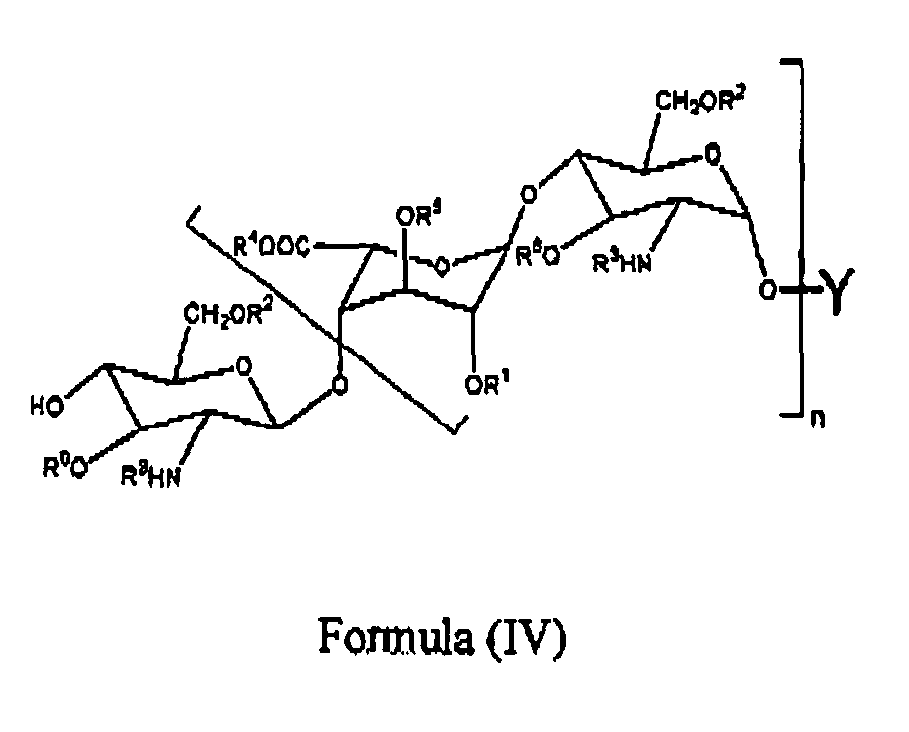
- In Formula (V) Y is a terminal uronate moiety of the same general structure as that included in the bracketed disaccharide repeating unit.

- In Formula (VI) X is a terminal glucosamine moiety of the same general structure as that included in the bracketed disaccharide repeating unit and Y is a terminal uronate moiety of the same general structure as that included in the bracketed disaccharide repeating unit.

- The Scholefield study concluded that oligosaccharides of 10 monosaccharides or more of BLH were required to inhibit activity of BACE-1 and no significant activity was observed in oligosaccharides below this size. (Scholefle.1d, Z. et al. supra) Unexpectedly, it has been determined that compounds in accordance with the present invention containing fewer than 10 monosaccharides exhibit BACE-1 inhibitory activity. The compound according to each aspect of the present invention preferably comprises 4 to 24 monosaccharide units (e.g. preferably n = 2 to 12, X - Y = H in Formulae (I) to (III) above). Compounds containing lower numbers of monosaccharides are preferred since it is envisaged that smaller compounds will more easily cross the blood brain barrier. More preferably the compound comprises 6 to 20 monosaccharide units (preferably n = 3 to 10, X = Y = H, more preferably n = 2 to 9, X = disaccharide, Y - H), yet more preferably 6 to 18 monosaccharide units (preferably n = 3 to 9, X = Y = H, more preferably n = 1 to 7, X = disaccharide, Y = disaccharide), and it is particularly preferred that the compound comprises 6 to 16 monosaccharide units (preferably n = 3 to 8, X = Y =H, more preferably n = 2 to 7, X = monosaccharide, Y = monosaccharide). Another preferred size range for the compound forming part of each aspect of the present invention is 6 to 16 monosaccharide units which equates to a preferred molecular weight range for the compound of approximately 1500 to 5000 Daltons.
- While it is anticipated that the compound may find use in both human and veterinary medicine for the prevention and/or treatment of a number of neurodegenerative disorders, such as senile dementia, pre-senile dementia, multi-infarct dementia and other neurological disorders and lesions. The compound according to each aspect of the present invention is eminently suitable for use in the prevention and/or treatment of Alzheimer's disease.
- It will be evident to the skilled person that the compound according to the first aspect of the present invention is eminently suitable for use in the preparation of a medicament for the prevention and/or treatment of a neurodegenerative disorder, particularly Alzheimer's disease, in accordance with the second aspect of the present invention.
- The method for preventing and/or treating a neurodegenerative disorder forming the third aspect of the present invention preferably employs the compound according to the first aspect of the present invention.
- A sixth aspect of the present invention provides a pharmaceutical composition for use in the prevention and/or treatment of a neurodegenerative disorder comprising a compound comprised of one or more disaccharide units, the or each disaccharide unit comprising a uronate moiety linked to a glucosamine moiety, wherein the 2-0 atom of the uronate moiety is substantially substituted with a hydrogen atom, the 6-0 atom of the glucosamine moiety is substantially substituted with a sulphate group and the 2-N atom of the glucosamine moiety is substituted with an atom or group other than a sulphate group.
- The compound is preferably provided in the pharmaceutical composition forming the sixth aspect of the present invention in combination with a pharmaceutically acceptable carrier, diluent or excipient.
- A seventh aspect of the present invention provides a compound comprised of one or more disaccharide units, the or each disaccharide unit comprising a uronate moiety linked to a glucosamine moiety, wherein the 2-O atom of the uronate moiety is substantially substituted with a hydrogen atom, the 6-0 atom of the glucosamine moiety is substantially substituted with a sulphate group and the 2-N atom of the glucosamine moiety is substituted with an atom or group other than a sulphate group.
- Employing the assay set out below in the Comparative Example the compound of the present invention preferably exhibits an IC50 for BACK-1 inhibition of less than around 100 µg/ml, more preferably less than around 10 µg/ml, more preferably less than around 1 µg/ml, still more preferably less than around 0.1 µg/ml, and most preferably an IC50 of less than approximately 0.05 µg/ml.
- With regard to anti-coagulant activity, it is preferred that the compound of the present invention exhibits less than around 50 % of the anti-coagulant activity of unmodified porcine intestinal mucosal heparin (PIMH). Preferably the inventive compound exhibits less than around 20 %, more preferably less than around 5 % of the anti-coagulant activity of unmodified PIMH. It is particularly preferred that the compound of the invention exhibits less than about 1 %, still more preferably less than about 0.5 % of the anti-coagulant activity of unmodified PIMH. It is further preferred that the compound according to the present invention exhibits anti-coagulant activity which is less than around 0.1 %, and more preferably around 0.03 % of the anti-coagulant activity of unmodified PIMH.
- Preferably the therapeutic ratio of the inventive compound (calculated as the ratio of anti-BACE-1 activity (determined using the assay described below in the Comparative Example) to anti-serine protease clotting factor Xa activity) is greater than around 100, more preferably greater than around 500, more preferably around 1000 and most preferably greater than 1000. It is particularly preferred that the therapeutic ratio of the inventive compound is in the
range 100 to 2000, more preferably 200 to 1500, and most preferably in the range 500 to 1500. In a particularly preferred embodiment of the present invention the compound of the present invention exhibits a therapeutic ratio of around 1092. - The compound of the invention may take a number of different forms depending, in particular on the manner in which the compound is to be used. Thus, for example, the compound may be provided in the form of a powder, tablet, capsule, liquid, ointment, cream, gel, hydrogel, aerosol, spray, micelle, transdermal patch, liposome or any other suitable form that may be administered to a person or animal. It will be appreciated that the vehicle of the compound of the invention should be one which is well tolerated by the subject to whom it is given and enables delivery of the compound to the brain.
- The compound may be administered ocularly in the form of eye drops or eye ointments, or orally either in liquid or solid composition form. Compositions suitable for oral administration include solid forms, such as pills, capsules, granules, tablets, and powders, and liquid forms, such as solutions, syrups, elixirs, and suspensions. Forms useful for parenteral administration include sterile solutions, emulsions, and suspensions.
- The compound of the invention may be used in a number of ways. For instance, systemic administration may be required in which case the compound may, for example, be ingested orally in the form of a tablet, capsule or liquid. Alternatively the compound may be administered by injection into the blood stream. Injections may be intravenous (bolus or infusion) or subcutaneous (bolus or infusion). The compounds may be administered by inhalation (e.g, intranasally).
- The compound may also be administered centrally by means of intracerebral, intracerebroventricular or intrathecal delivery.
- The compound may also be incorporated within a slow or delayed release device. Such devices may, for example, be inserted on or under the skin and the compound may be released over weeks or even months. The devices may be particularly advantageous when a compound is used which would normally require frequent administration (e.g. at least daily ingestion of a tablet or daily injection).
- It will be appreciated that the amount of a compound required is determined by biological activity and bioavailability which in turn depends on the mode of administration, the physicochemical properties of the compound employed and whether the compound is being used as a monotherapy or in a combined therapy. The frequency of administration will also be influenced by the above mentioned factors and particularly the half-life of the compound within the subject being treated.
- Optimal dosages of the compound to be administered may be determined by those skilled in the art, and will vary with the particular compound in use, the strength of the preparation, the mode of administration, and the advancement of the disease condition. Additional factors depending on the particular subject being treated will result in a need to adjust dosages, including subject age, weight, gender, diet, and time of administration.
- Known procedures, such as those conventionally employed by the pharmaceutical industry (e.g. in vivo experimentation, clinical trials, etc.), may be used to establish specific formulations of compounds and compositions and precise therapeutic regimes (such as daily doses of the compounds and the frequency of administration).
- Generally, a daily dose of between 0.01 µg/kg of body weight and 1.0 g/kg of body weight of the inventive compound may be used for the treatment of AD depending upon which specific compound is used. More preferably, the daily dose is between 0.01 mg/kg of body weight and 100 mg/kg of body weight.
- Daily doses may be given as a single administration (e.g. a daily tablet for oral consumption or as a single daily injection). Alternatively, the compound used may require administration twice or more times during a day. As an example, patients with AD may be administered as two or more daily doses of between 25 mgs and 5000 mgs in tablet form. A patient receiving treatment may take a first dose upon waking and then a second dose in the evening (if on a two dose regime) or at 3 or 4 hourly intervals thereafter. Alternatively, a slow release device may be used to provide optimal doses to a patient without the need to administer repeated doses.
- This invention provides a pharmaceutical composition comprising a therapeutically effective amount of the compound of the invention and, preferably, a pharmaceutically acceptable vehicle. In the subject invention a "therapeutically effective amount" is any amount of a compound or composition which, when administered to a subject suffering from a disease against which the compounds are effective, causes reduction, remission, or regression of the disease. A "subject" is a vertebrate, mammal, domestic animal or human being. In the practice of this invention the "pharmaceutically acceptable vehicle" is any physiological vehicle known to those of ordinary skill in the art useful in formulating pharmaceutical compositions.
- In one embodiment, the amount of the compound in the composition according to the sixth aspect of the present invention is an amount from about 0.01 mg to about 800 mg. In another embodiment, the amount of the compound is an amount from about 0.01 mg to about 500 mg. In another embodiment, the amount of the compound is an amount from about 0.01 mg to about 250 mg. In another embodiment, the amount of the compound is an amount from about 0.1 mg to about 60 mg. In another embodiment, the amount of the compound is an amount from about 1 mg to about 20 mg.
- In one embodiment, the pharmaceutical vehicle employed in the composition forming the fourth aspect of the present invention may be a liquid and the pharmaceutical composition would be in the form of a solution. In another embodiment, the pharmaceutically acceptable vehicle is a solid and the composition is in the form of a powder or tablet In a further embodiment, the pharmaceutical vehicle is a gel and the composition is in the form of a suppository or cream. In a further embodiment the compound or composition may be formulated as a part of a pharmaceutically acceptable transdermal patch.
- A solid vehicle employed in the composition according to the sixth aspect of the present invention can include one or more substances which may also act as flavoring agents, lubricants, solubilizers, suspending agents, fillers, glidants, compression aids, binders or tablet-disintegrating agents; it can also be an encapsulating material. In powders, the vehicle is a finely divided solid which is in admixture with the finely divided active ingredient. In tablets, the active ingredient is mixed with a vehicle having the necessary compression properties in suitable proportions and compacted in the shape and size desired. The powders and tablets preferably contain up to 99% of the active ingredient. Suitable solid vehicles include, for example, calcium phosphate, magnesium stearate, talc, sugars, lactose, dextrin, starch, gelatin, cellulose, polyvinylpyrrolidine, low melting waxes and ion exchange resins.
- Liquid vehicles may be used in preparing solutions, suspensions, emulsions, syrups, elixirs and pressurized compositions according to the sixth aspect of the present invention. The compound of the first aspect of the present invention can be dissolved or suspended in a pharmaceutically acceptable liquid vehicle such as water, an organic solvent, a mixture of both or pharmaceutically acceptable oils or fats. The liquid vehicle can contain other suitable pharmaceutical additives such as solubilizers, emulsifiers, buffers, preservatives, sweeteners, flavoring agents, suspending agents, thickening agents, colors, viscosity regulators, stabilizers or osmo-regulators. Suitable examples of liquid vehicles for oral and parenteral administration of the compound forming the first aspect of the present invention include water (partially containing additives as above, e.g. cellulose derivatives, preferably sodium carboxymethyl cellulose solution), alcohols (including monohydric alcohols and polyhydric alcohols, e.g, glycols) and their derivatives, and oils (e.g. fractionated coconut oil and arachis oil), For parenteral administration, the vehicle can also be an oily ester such as ethyl oleate and isopropyl myristate. Sterile liquid vehicles are useful in sterile liquid form compositions for parenteral administration. The liquid vehicle for pressurized compositions can be halogenated hydrocarbon or other pharmaceutically acceptable propellent.
- The compound forming the first aspect of the present invention can be administered orally in the form of a sterile solution or suspension containing other solutes or suspending agents (for example, enough saline or glucose to make the solution isotonic), bile salts, acacia, gelatin, sorbitan monoleate, polysorbate 80 (oleate esters of sorbitol and its anhydrides copolymerized with ethylene oxide) and the like.
- Liquid pharmaceutical compositions which are sterile solutions or suspensions can be utilized by for example, intramuscular, intrathecal, epidural, intraperitoneal or subcutaneous injection. Sterile solutions can also be administered intravenously. The inventive compounds may be prepared as a sterile solid composition according to the sixth aspect of the present invention which may be dissolved or suspended at the time of administration using sterile water, saline, or other appropriate sterile injectable medium. Vehicles are intended to include necessary and inert binders, suspending agents, lubricants, flavorants, sweeteners, preservatives, dyes, and coatings.
- The compound forming part of the present invention is eminently suitable for use in prophylactic treatment. By the term "prophylactic treatment" we include any treatment applied to prevent, or mitigate the effect of a neurological disorder, such as AD. The prophylactic treatment may be given, for example, periodically to a person who is of a predetermined minimum age or who is genetically predisposed to a neurological disorder. Alternatively the prophylactic treatment may be given on an ad hoc basis to a person who is to be subjected to conditions which might make the onset of a neurological disorder more likely.
- This invention will be better understood from the examples that follow. However, one skilled in the art will readily appreciate that the specific methods and results discussed are merely illustrative of the invention as described more fully in the claims which follow thereafter.
- An embodiment of the present invention will now be described by way of example only with reference to the following non-limiting Comparative Example, in which:
-
Figure 1 is a plot of the activity of unmodified PIMH fragments on BACK-1 inhibition as a function of saccharide size as referred to in Example 1; and -
Figure 2 is a plot of the effect of modified heparin derivatives on the rate of aggregation of A-β peptide as referred to in Example 2. The rate of aggregation that occurs in the absence of any added compound is shown as "control". - The availability and pharmaceutical use of BLH have declined recently following concerns over the transmissible spongiform encephalopathies (TSEs) prompting the inventors to examine BACE-1 inhibition activity with porcine intestinal mucosal heparin (PIMH), which possesses higher levels of β-D-glucuronic acid, compared to BLH but is both widely available and poses no known TSE risk.
- A modified panel of PIMH derivatives (Formula (VII); listed in Table 1) were prepared by the methods set out in the Appendix. Patterns of O-, N-sulphation and N-acetylation were varied over the predominant disaccharide repeating structure permitting a systematic study of activity. The panel was evaluated for ability to inhibit BACE-1 cleavage of APP, potency as anti-coagulants (anti-factor Xa), and for their ability to inhibit other aspartyl protease family members.
- One of the PIMH derivatives, compound 4 (Formula (VIII) below, which corresponds to Formula (III) where the uronate moiety is an (α-L)iduronate moiety) is a preferred embodiment of the compound of the present invention.

- The results of the tests carried out are shown in Table 1 and discussed in more detail below.

Table 1. Compound R1 R2 R3 IC50 (µg/ml) R2of IC50 Anticoagulant activity Therapeutic ratio (BACE/Xa) I PIMH SO3- SO3- SO3- 0.028 0,998 100% 1 2 N-acetyl SO3- SO3- COCH3 0.031 0.995 0.03% 3136 3 UA-2-OH H SO3- SO3- 0,053 0.995 0.4% 147 4 UA-2-OH, N-Acetyl H SO 3- COCH 2 - 0.091 0.999 0.03% 1092 5 GlcN-6-OH SO3- H SO2- 0.100 0.996 0.5% 61 6 GlcN-6-OH, N-acetyl SO3- H COCH3 0.410 0.995 0.03% 237 7 UA-2-OH, GlcN-6-OH H H SO3- 0.786 0.994 0.03% 123 8 UA-2-OH, GlcN-6-OH, N-acetyl H H COCH1 >100 n/a 0.03% 1 9 Fer-sulphated # SO3- SO3- SO3- 0.053 0.998 35.0% 2 10 3-amino-1-propanesulfonic acid - - - No activity n/a n/a n/a - In Table 1 anticoagulant activities are expressed as a percentage of PIMH (defined as 100 %). Substitution pattern is defined by R1, R2 and R3, corresponding to position -2 of iduronate, -6 of glucosamine and -2 of glucosamine respectively. The therapeutic ratio was calculated from the IC50 against BACE-1/anticoagulant activity. UA - Uronic acid, either α-L-iduronic or β-D-glucuronic acid; GlcN - α-D-glucosamine. # compound (9) was sulphated at position-3 in both the iduronate and glucosamine residues. The IC50 values are, of course, dependent upon the nature of the assay used.
- The BACE-1 inhibitory properties of BLH with substitution patterns corresponding to (1), (2), (3) and (5) have been tested previously by Scholefield et al, using BLH as the starting material. (Scholefield, Z. et al. supra)
- In vitro cleavage of APP by BACE-1 was measured using a FRET peptide cleavage assay. Following unmodified PIMH (1). the most effective inhibitor of BACE-1 was de-N sulphated, re-N-acetylated PIMH (2). Ranked third and fourth most active, with similar IC50 values, were 2-O de-sulphated (3) and the inventive compound (4) 2-O de-sulphated/N-acetylated PIMH which has a pattern of substitution which was not previously reported. This indicates that neither the N- or 2-O sulphates are absolute requirements for high level activity when accompanied by 6-O sulphation. Preferred inventive compound (4) was therefore the most active mono-sulphated compound.
- Removal of the 6-O-sulphate resulted in the least active di-sulphated compound (compound (5)). Compound (4) was more active than either 6-O-desulphated (5) or 6-O-desulphated/N-acetylated heparin (6). This was an unexpected result in view of the fact that compound (4) has a lower number of sulphate groups per disaccharide than compound (5) and the same number of sulphate groups per disaccharide to compound (6).
- The least active mono-sulphatcd compound was compound (7) in which both the 2-O- and 6-O-sulphates had been removed leaving only the N-sulphate group. Removal of all sulphate groups to provide compound (8) almost abolished the anti-BACE.1 activity of PIMH.
- The activities of the inventive compound (4) and compound (5) which has a pattern of substitution previously reported in relation to BLH (Scholefield, Z. et al. supra) indicated a significant role for the 6-O-sulphate in the inhibition of BACE-1.
- The inventors also examined the effect of per-sulphated heparin (compound (9)), which was sulphated additionally at position-3 in both the iduronate and glucosamine residues. This compound unexpectedly exhibited a similar IC50 to unmodified PIMH. The lack of a direct correlation between sulphation level and BACE-1 inhibitory activity demonstrated clearly that activity was not simply related to charge density.
- While the inventors do not wish to be bound by a particular theory it is likely that the relationship between activity and substitution pattern is a complex one, which may depends on conformational effects, because both iduronate zing and glycosidic linkage geometries depend subtly on substitution pattern.
- The inventors also examined the effect of 3-amino-1-propanesulfonic acid (3APS, Alzehemed™) (compound 10), a compound described as a "heparin mimetic", which is undergoing clinical trials for the treatment of AD and whose proposed mechanism of action is inhibition of Aβ aggregation. 3APS did not inhibit BACE-1, even at high concentrations (1000µg/ml), indicating that its "heparin mimetic" activities do not extend to inhibition of BACE-1.
- Removal of the N-sulphate and replacement with an N-acetyl group had the greatest effect on reducing the ability of the chemically modified PIMH to interfere with the antithrombin III/factor Xa complex. The anti factor Xa activities of compounds possessing N-acetyl groups, including preferred inventive compound (4), were at least 3000-fold lower than PIMH (Table 1).
- Removal of either the 2-O or 6-O sulphate groups, on the other hand, reduced the antithrombin III/factor Xa activity by approximately 200-fold.
- It is well-established that the anti-factor Xa activity of heparin/HS is due to the specific pentasaccharide sequence -4) GlcNAc(6S) α(1-4) GlcA β(1-4) GlcNS(3,6S) α(1-4) IdoA(2S) α(1-4)GlcNS(6S) α (1-.
- The presence of a 3-O-sulphate group within the central glucosamine residue is vital for anti-factor Xa activity and its removal results in its virtual abolition, while removal of either the N-sulphate from the central glucosamine or 2-O-sulphate from the iduronate residue, have less dramatic, but nonetheless, deleterious effects.
- The removal of N-sulphate groups and their replacement with N-acetyl in heparin derivatives (modification of compound (1) to (2)) explains the loss of anticoagulant activity exhibited by compound (2), but de-O sulphation in iduronate, which occurs under highly basic conditions, also resulted in a substantial reduction in anti-factor Xa activity and has two potential causes. The first is the removal of the 2-O-sulphate group (as in preferred inventive compound (4)) but a second modification also occurs in rare glucosamine residues bearing both 3-O sulphate and N-sulphate (e.g. in the pentasaccharide sequence AGA*IA), involving the formation of an N-sulphated, aziridine group with loss of the 3-O-sulphate.
- Other de-O-sulphated heparin derivatives such as compound (5) or (8), prepared under different conditions, do not contain this modification and the reduction in their activities can only be attributed to the loss of the relevant groups within the pentasaccharide sequence. In particular, it is noteworthy that the 3-O-sulphate group is stable under mild de 6-O-sulphation conditions.
- The closest structural relatives to BACE-1 are the aspartyl proteases pepsin, cathepsin D and renin. These enzymes have functions in digestion, regulation of blood pressure and lysosomal degradation of proteins respectively. An effective inhibitor of BACE-1 could potentially also interact with these, causing unwanted side effects if administered pharmaceutically.
- Activity against the aspartyl proteases of compounds (1), (2) and (3), which have patterns of substitution investigated previously in the Scholefield study, and preferred inventive compound (4), was measured in FRET peptide cleavage assays. None of the compounds exerted an inhibitory effect on renin, even at concentrations up to 1000 µg/ml.
- Interestingly, unmodified PIMH (compound (1)) showed some inhibitory activity against both pepsin and cathepsin D, with IC50 values of 0.23 µg/ml and 0.1 µg/ml respectively. N-acetyl (compound 2) and preferred compound (4) N-acetyl/Ido-2-OH PIMH showed a marked decrease in inhibitory activity against both pepsin and renin, when compared to PIMH (compound 1).
- The IC50 for N-acetyl PIMH (compound 2) against pepsin was 3.27 µg/ml, which is 14 fold less potent than PIMH (compound 1); whereas N-acetyl/Ido-2-OH PIMH (preferred compound 4) did not inhibit pepsin at >1000 µg/ml.
- The IC50 values for compounds (2) and (3) against cathepsin D were 0.27 µg/ml and 0.77 µg/ml respectively. Thus, the modified forms of PIMH exhibiting high levels of anti-BACE-1 activity, including preferred compound (4), do not significantly inhibit renin, pepsin or cathepsin D and have much higher IC50 values than unmodified PIMH.
- Full length PIMH was enzymatically digested, fractionated by gel-filtration chromatography and the fragments used to determine the effective size for inhibition of BACE-1 in the FRET peptide cleavage assay.
-
Figure 1 is a plot of the activity of unmodified PIMH fragments on BACE-1 inhibition as a function of saccharide size. A first feature to note fromFigure 1 is that activity was observed in respect of octasaccharides indicating a minimum requirement for high anti-BACE-1 activity of around 8 saccharides. The fact that the results shown inFigure 1 indicate a lower minimum length for activity than the value of 10 saccharides suggested by previous work (Scholefield, Z. et al. supra) suggests that activity would be expected at saccharide levels as low as 2. Activity at lower levels compared to the results of the Scholefield study is unexpected given that there is evidence that polysaccharides and oligosaccharides do not possess the same level of activity so it can not be expected that a smaller fragment of a polysaccharide will act in the same manner as the full length molecule. A shift in inhibitor activity (tenfold increase) was observed with deca- compared to octasaccharides suggesting a more preferred minimum length of 10 saccharides. - At 18 saccharide units the activity was equivalent to full length PIMH. These data are promising regarding in vivo administration because heparin saccharides as large as 3,000 Da (equivalent to ~12 saccharides) can cross the blood-brain barrier (BBB).
- Another possible side-effect of standard heparin administration is heparin-induced thrombocytopenia (HIT) caused by the production of antibodies to heparin-platelet factor 4 complexes, but reduction in molecular weight and sulphation level has been shown to ameliorate this.
- The retention of anti-BACE-1 activity in oligosaccharides with reduced levels of sulphation, such as preferred inventive compound (4), shows significant promise for pharmaceutical use by improving the potential uptake into the brain and through the reduction of anticoagulation and other unwanted side-effects. N-acetyl PIMH (compound 2) and N-acetyl/Ido-2-OH PIMH (preferred compound (4)) exhibited high BACE-1 inhibitory activity with very little anticoagulant activity.
- Preferred compound (4) therefore represents an excellent candidate for use in the prevention and/or treatment of neurodegenerative disorders, such as AD.
- Chemically modified heparin compounds (1) to (9) were prepared by the following combinations of reactions (a) to (g) below:
- (1). PIMH starting material (Celsus Labs, Cincinnati, OH);
- (2). N-acetyl heparin (d) (f);
- (3). Ido 2-de-O-sulphated heparin (a);
- (4). Ido 2-de-O-sulphated, N-acetylated heparin (a) (d) (f);
- (5). 6-O-desulphated heparin (b) (e);
- (6). 6-O-desulphated, N-acetylated heparin (b) (f);
- (7). 6-O-desulphated, 2-O-desulphated heparin (c) (e);
- (8). 6-O-desulphated, 2-O-desulphated, N-acetylated heparin (c) (f); and
- (9). Per-sulphated heparin (g) (e).
- Compounds were characterized by 1H and 13C NMR as previously described. (Yates, E. A.; Santini, F.; Guerrini, M.; Naggi, A.; Torri, G. et al. Carbohydrate Research 1996, 294, 15-27.) Compounds were desalted, lyophilized and re-suspended in the appropriate buffer prior to assay.
-
- (a) Selective removal of iduronate 2-0-sulphate was achieved as described by Jaseja and Perlin. (Jaseja, M.; Rej, R. N.; Sauriol, F.; Perlin, A. S. Can. J. Chem. 1989, 67, 1449-1456.) Note that there is concomitant modification in the small number of N-and 3-O-sulphated glucosamine units. (Santini, F.; Bisio, A.; Guerrini, M.; Yates, E. A. Carbohydrate Research 1997, 302, 103-108.)
- (b) Selective removal of glucosamine 6-0-sulphate was carried out according to a modification (Yates, E. A. et al. supra.) of the method described. (Inoue, S.; Miyawaki, M. Analytical Biochemistry 1975, 65, 164-174.)
- (c) Complete removal of O- and N-sulphates was achieved using solvolytic desulphation by the method described. (Inoue, S.; Miyawaki, M. supra.)
- (d) Selective de-N-sulphation was carried out employing controlled solvolytic desulphation under kinetic control as described. (Inoue, Y.; Nagasawa, K. Carbohydrate Research 1976, 46, 87-95.)
- (e) Re N-sulphation was achieved by use of trimethylamine.sulfur trioxide complex as described. (Lloyd, A. G.; Embery, G.; Fowler, .)
- (f) Re N-acetylation employed acetic anhydride in saturated sodium bicarbonate. (Yates, E. A. et al.supra.)
- (g) Complete O-sulphation of all available hydroxyl groups was carried out using excess sulfur trioxide pyridine complex on the tetrabutylammonium salt of heparin in pyridine as described (Yates, E. A.; Santini, F.; De Cristofano, B.; Payre, N.; Cosentino, C. et al. Carbohydrate Research 2000, 329, 239-247.) followed by re-N-sulphation (Lloyd, A. G. et al. supra.) taking precautions to avoid formation of an unusual N-sulfoaziridine modification, (Yates, E. A.; Santini, F.; Bisio, A.; Casentino, C. Carbohydrate Research 1997, 298, 335-340.)
- The effectiveness of chemical treatments was monitored by 1H and 13C NMR at 500 MHz and 125 MHz respectively (D2O, 27 °C). Chemical shifts; δ/ppm (external standard) were in full agreement with well-defined model compounds. (Yates, E. A. et al. supra.)
- Porcine mucosal heparin and chemically modified N-acetyl heparin were digested with 100 mU heparatinase II (Ibex Technologies Inc., Montreal, Canada), per 100 mg in 100 mM sodium acetate, 0.1 mM calcium acetate, pH 7.0. The digested fragments were separated by gel filtration chromatography (Superdex-30, Amersham Pharmacia, UK, 2000mm x 30mm, 100 mM ammonium bicarbonate) and identified by reference to size-defined authentic standards.
- The ability of the compounds to inhibit PACE-1 cleavage of APP was assessed using a fluorescent resonance energy transfer (FRET) peptide cleavage assay employing the FRET peptide 5-FAM-Glu-Val-Asn-Leu-Asp-Ala-Phe-Lys(QXL520)-OH, containing the Swedish amino acid variant (Anaspec, Inc., CA, USA). When intact, the amino terminal fluorophore is quenched, but upon enzymatic cleavage the fluorophore is released from quencher and fluoresces (520 nm). Assays were performed in triplicate in 96 well black plates (20 mM sodium acetate, 0.1% Triton-X-100, pH 4.5; 2.5 µM peptide per well and 4.0 x 10⁻³ units/well of recombinant human BACE-1 (Sigma)). The appropriate controls for enzyme activity and background fluorescence were employed and plates were incubated (1 h, 25 °C, stopped with 2.5 M sodium acetate). Inhibitors were added in a concentration range from 1000 - 0.0001 µg/ml. Fluorescence 480ex/520em was measured on a Polarstar plate reader (BMG LabTechnologies, UK) and data were analysed by plotting log10 concentration of inhibitor against percent inhibition and fitting a four parameter sigmoidal curve using BioDataFit 1.02 (Chang Bioscience, USA).
- Anti Factor Xa activity was measured against a porcine mucosal heparin (PIMH) standard of known activity (Sigma, UK) using a diagnostic grade Coatest Heparin test kit (Chromogenix, MA, USA), adapted to a 96 well plate format, reading A405 (Polarstar plate reader (BMG LabTechnologies, UK)),
- The ability of compounds to inhibit the structurally related proteases pepsin and cathepsin D (Sigma, UK) was measured by FRET cleavage assay (5 pmol enzyme/well, EnzChek Protease Assay kit (Molecular Probes, UK) according to manufacturer's instructions). Activity against human recombinant renin (Cayman Chemical, MI, USA), was measured by FRET peptide cleavage assay (0.08 pMoles enzyme/well, using the Renin Substrate 1 (Molecular Probes, Invitrogen, UK) according to manufacturer's instructions. IC50 values were calculated as described above.
- The inventors conducted further experiments to illustrate the efficacy of compounds according to the first aspect of the invention for treating neurodegenerative conditions.
- Unless stated otherwise, the methodology out lined in Example 1 (and the appendix thereof) was employed in this work.
- A number of examples of N-modified heparins with 2-O-desulphation were tested as BACE inhibitors in comparison to parental (unmodified) heparin. These polysaccharides are modified by de-N-sulphation to create glucosamine residues, followed by substitution of a variety of alternative chemical groups at the free amino groups and appropriate desulphation at the 2-O position.
- N-modified heparins which are modified by 2-O-desulphation are potent BACE inhibitors with reduced off-target activities. By way of example, N-acetyl-de-2-O-sulphated PMH (6-O-sulphate content of approximately 82%, 2-O-sulphate content of<0.1%) has an EC50 approximately 3-fold lower than unmodified PMH (Table 2). A further example is N-propionyl-de-2-O-sulphated PMH (6-O-sulphate content of approximately 82%, 2-0-sulphate content of <0.1%), which has an EC50 approximately 8-fold lower than modified PMH, but an anti-factor Xa activity around 1/100th that of intact heparin, highlighting the unpredictable sensitivity of these derivatives to charges in structure, in this case, N-substitution. In addition, all of the above N-modified heparins displayed very weak anticoagulant activity (between 1/100 and 1/3000th that of unmodified PMH).
Table 2. Compound EC50 (µg/ml) Anticoagulant activity (%) Standard heparin 0.027 100 N-acetyl de-2-OS heparin1 0.089 <0.03 N-propionyl de-2OS heparin2 0.210 ~1 1The 6-O-sulphate content approx. 82%, 2-0-sulphate content <0.1%.
2The 6-0-sulphate content approx. 82%, 2-Osulphate content <0.1%. - In addition to anticoagulant activity, a further possible side effect of heparin directly relevant to treating neurodegenerative disorders is their known ability to enhance aggregation of the amyloid (Aβ) peptide (Watson, D.J., Lander, A.D. and Selkoe, D.J. (1997) Heparin-binding properties of the amyloidogenic peptides Aβ and amylin. Dependence on aggregation state and inhibition by Congo red. J Biol Chem, 272, 31617-24). Reduction of this activity would be a desirable property. The inventors therefore investigated the activity of modified heparins compared to parental porcine mucosal heparin in assays of Aβ aggregation. The results of the investigation are presented in
Figure 2 . - The maximum enhancement is observed with intact heparin "PMH". It was observed that de-sulfation of heparin caused marked reductions in this activity. Several compounds (for example, N-acetylated heparin "NAc" and ido-2-desulfated, N-acetylated heparin "Nac de 2") possess desirable BACE-1 inhibitory activity and favourable anti-coagulant activities (anti-factor Xa)(Patey et al (2006) 49 6129-6132) also possess improved rates (i.e. 50 and 100 % slower respectively) of A-β aggregation. Specifically, at a concentration of 100 µg/ml, either N-acetylated or 2-de-0-sulphated PMH resulted in a 50% increase in the time taken to reach half-maximal peptide aggregation, and N-acetylated, 2-de-O-sulphated PMH produced a 100% increase to near control levels (i.e. the aggregation rate observed with no added heparin). Thus, preferred chemical modifications in accordance with the present invention as defined in claim 1 significantly reduce the ability of heparin to promote Aβ aggregation, and consequently possess improved therapeutic ratios in this regard compared to unmodified heparin.
- The Aβ peptide was prepared by addition of 1ml of hexafluoro-2-propanol to lmg Aβ peptide (Amyloid β Protein Fragment 1-42; Sigma A9810) and disaggregation at room temperature for 1 hour. The resulting material was divided into 50µl (50µg) aliquots and dried in Speed Vac for approximately 2 hours, followed by storage at - 20°C. The Thioflavin T (Sigma T-3516) solution was prepared as a 5mM solution in 50mM Glycine-NaOH pH 8.5, and stored in the dark at 4°C. Thioflavin T assay buffer comprising 20µl Thioflavin T solution with 50µl 1M DTT and 430µl assay Buffer (10mM HEPES/100mM NaCl pH 7.4) was kept on ice. 50µl of 20mM NaOH was added to 50µg of Aβ peptide. 2.5ml of Thioflavin T assay buffer was then added to this Aβ peptide solution, making "Aβ buffer". The remaining 2.5ml of Thioflavin T assay buffer was the blank buffer, and both were kept on ice. Six replicates of sample dilutions (1:1 in assay buffer) were pipetted into a 96 well black plate (Greiner 655076; 100µl/well) and the plate was kept on ice. 100µl/well of Aβ buffer was added to the samples (in triplicate), and 100µl/well of the blank buffer added to a further three sample replicates. The 96 well plate was read (450nm excitation wavelength and 490nm emission wavelength), taking a reading every 150 seconds for 250 cycles on a plate reader set at 37° C.
Claims (15)
- A compound comprised of one or more disaccharide units, the or each disaccharide unit comprising a uronate moiety linked to a glucosamine moiety, wherein the 2-O atom of the uronate moiety is substantially substituted with a hydrogen atom, the 6-O atom of the glucosamine moiety is substantially substituted with a sulphate group and the 2-N atom of the glucosamine moiety is substituted with an atom or group other than a sulphate group for use as a medicament for the prevention and/or treatment of a neurodegenerative disorder.
- A compound according to claim 1, wherein at least around 60 % of the 2-O uronate atoms are substituted with a hydrogen atom.
- A compound according to claim 1, wherein all 2-O uronate atoms are substituted with a hydrogen atom.
- A compound according to any one of claims 1 to 3, wherein at least around 60 % of the 6-O glucosamine atoms are substituted with a sulphate group, or wherein all 6-O glucosamine atoms are substituted with a sulphate group.
- A compound according to any preceding claim, wherein the uronate moiety is selected from the group consisting of an iduronate moiety, a glucuronate moiety and a galacturonate moiety.
- A compound according to any preceding claim, wherein the compound comprises 4 to 24 monosaccharide units.
- A compound according to claim 1, wherein the compound has the formula (I)

- A compound according to any of claims 1-5 wherein the 2-N atom of the glucosamine moiety, or according to claim 7 wherein R3, is selected from the group consisting of hydrogen, substituted or unsubstituted alkyl, substituted or unsubstituted aryl, substituted or unsubstituted acyl, substituted or unsubstituted amido and phosphate.
- A compound according to claim 8, wherein the substituted or unsubstituted acyl group is selected from the group consisting of a C1-6 substituted or unsubstituted acyl group; substituted or unsubstituted acetyl; substituted or unsubstituted proprionyl; and substituted or unsubstituted butanoyl.
- A compound according to any one of claims 7 to 9, wherein R5 and R6 are hydrogen, and/or wherein R4 is hydrogen.
- A compound according to claim 1, wherein the compound has the formula (III)

- A compound according to any one of claims 7 to 11 wherein n is 2 to 12, more preferably n is 3 to 8.
- A compound according to any preceding claim, wherein the medicament is for the prevention and/or treatment of Alzheimer's disease.
- A pharmaceutical composition comprising a compound as defined by any one of claims 1 to 13.
- A method for the production of a compound according to any one of claims 1 to 13, wherein the method comprises a depolymerisation process selected from the group consisting of nitrous acid scission, bacterial lyase enzyme treatment, periodate oxidation, chemical beta-elimination under alkaline conditions, free radical treatment, and any combination thereof.
Applications Claiming Priority (2)
| Application Number | Priority Date | Filing Date | Title |
|---|---|---|---|
| GBGB0610350.1A GB0610350D0 (en) | 2006-05-25 | 2006-05-25 | prevention and/or treatment of neuodegenerative disorders |
| EP07732916A EP2026819B1 (en) | 2006-05-25 | 2007-05-23 | Prevention and/or treatment of alzheimer's disease |
Related Parent Applications (1)
| Application Number | Title | Priority Date | Filing Date |
|---|---|---|---|
| EP07732916.7 Division | 2007-05-23 |
Publications (1)
| Publication Number | Publication Date |
|---|---|
| EP2384757A1 true EP2384757A1 (en) | 2011-11-09 |
Family
ID=36687688
Family Applications (2)
| Application Number | Title | Priority Date | Filing Date |
|---|---|---|---|
| EP11006414A Withdrawn EP2384757A1 (en) | 2006-05-25 | 2007-05-23 | Prevention and/ortreatment of neurodegenerative disorders |
| EP07732916A Not-in-force EP2026819B1 (en) | 2006-05-25 | 2007-05-23 | Prevention and/or treatment of alzheimer's disease |
Family Applications After (1)
| Application Number | Title | Priority Date | Filing Date |
|---|---|---|---|
| EP07732916A Not-in-force EP2026819B1 (en) | 2006-05-25 | 2007-05-23 | Prevention and/or treatment of alzheimer's disease |
Country Status (8)
| Country | Link |
|---|---|
| US (1) | US8673880B2 (en) |
| EP (2) | EP2384757A1 (en) |
| JP (1) | JP5409353B2 (en) |
| AU (1) | AU2007266849B2 (en) |
| CA (1) | CA2652164C (en) |
| DK (1) | DK2026819T3 (en) |
| GB (1) | GB0610350D0 (en) |
| WO (1) | WO2007138263A1 (en) |
Families Citing this family (19)
| Publication number | Priority date | Publication date | Assignee | Title |
|---|---|---|---|---|
| KR20090127031A (en) * | 2008-06-04 | 2009-12-09 | 삼성전자주식회사 | Method and apparatus for supporting idle mode of terminal in wireless communication system |
| US8232073B2 (en) | 2009-01-02 | 2012-07-31 | Zacharon Pharmaceuticals, Inc. | Quantification of non-reducing end glycan residual compounds |
| US8592140B2 (en) | 2009-01-02 | 2013-11-26 | Biomarin Pharmaceutical Inc. | Detection of oligosaccharides |
| US9029530B2 (en) | 2009-01-02 | 2015-05-12 | Biomarin Pharmaceutical Inc. | Detection of oligosaccharides |
| US8809009B2 (en) | 2009-01-02 | 2014-08-19 | Biomarin Pharmaceutical Inc. | Methods of diagnosing a disease and methods of monitoring treatment of a disease by quantifying a non-reducing end glycan residual compound and comparing to a second biomarker |
| EP2683746A4 (en) | 2011-03-10 | 2014-09-03 | Callaghan Innovation Res Ltd | OLIGOSACCHARIDE COMPOUNDS |
| GB201108891D0 (en) * | 2011-05-26 | 2011-07-13 | King S College London | Compounds which interact with histones |
| JP5871500B2 (en) * | 2011-06-20 | 2016-03-01 | 公益財団法人先端医療振興財団 | α-Klotho / FGF23 complex formation inhibiting compound |
| EP2760458B1 (en) | 2011-09-29 | 2017-06-14 | The University of Liverpool | Prevention and/or treatment of cancer and/or cancer metastasis |
| GB201219696D0 (en) * | 2012-11-01 | 2012-12-12 | Univ Liverpool | Agents for the prevention and/or treatment of central nervous system damamge |
| CA2940579A1 (en) | 2014-03-13 | 2015-09-17 | Universitaet Basel | Carbohydrate ligands that bind to igm antibodies against myelin-associated glycoprotein |
| CN103800348B (en) * | 2014-03-13 | 2015-07-01 | 中国科学院海洋研究所 | Application of mannose glucuronic acid oligosaccharide in preparation of medicine and/or healthcare product for treating or preventing Parkinson's disease and/or senile dementia |
| US11091591B2 (en) | 2015-09-16 | 2021-08-17 | Universität Basel | Carbohydrate ligands that bind to antibodies against glycoepitopes of glycosphingolipids |
| EP3677587A4 (en) * | 2016-08-31 | 2021-04-14 | Oji Holdings Corporation | MANUFACTURING METHOD FOR ACID XYLOOLIGOSACCHARIDE AND ACID XYLOOLIGOSACCHARIDE |
| JP6225321B1 (en) * | 2016-08-31 | 2017-11-08 | 王子ホールディングス株式会社 | Method for producing polysulfate pentosan |
| JP6281659B1 (en) | 2017-02-28 | 2018-02-21 | 王子ホールディングス株式会社 | Polysulfate pentosan, pharmaceutical composition and anticoagulant |
| CA3065747C (en) | 2017-05-31 | 2024-10-01 | Oji Holdings Corporation | Moisturizing composition comprising pentosan polysulfate |
| AU2018333249B2 (en) | 2017-09-12 | 2023-03-02 | Oji Holdings Corporation | Pentosan polysulfate and method for producing pentosan polysulfate |
| WO2019124363A1 (en) | 2017-12-20 | 2019-06-27 | 王子ホールディングス株式会社 | Pentosan polysulfate and medicine containing pentosan polysulfate |
Citations (3)
| Publication number | Priority date | Publication date | Assignee | Title |
|---|---|---|---|---|
| EP0354595A1 (en) * | 1985-08-01 | 1990-02-14 | Unilever Plc | Disaccharides |
| WO1996023003A1 (en) * | 1995-01-27 | 1996-08-01 | Amrad Operations Pty. Ltd. | A therapeutic molecule |
| WO1997001568A1 (en) * | 1995-06-29 | 1997-01-16 | Pharmacia & Upjohn Ab | New anticoagulants |
Family Cites Families (3)
| Publication number | Priority date | Publication date | Assignee | Title |
|---|---|---|---|---|
| US5262403A (en) * | 1986-03-10 | 1993-11-16 | Board Of Regents, The University Of Texas System | Glycosaminoglycan derivatives and their use as inhibitors of tumor invasiveness of metastatic profusion-II |
| US5380716A (en) * | 1988-12-15 | 1995-01-10 | Glycomed, Inc. | Sulfated polysaccharides as inhibitors of smooth muscle cell proliferation |
| JPH03130230A (en) * | 1989-07-31 | 1991-06-04 | Takeda Chem Ind Ltd | Drug for amelioration and therapy of dysmnesia |
-
2006
- 2006-05-25 GB GBGB0610350.1A patent/GB0610350D0/en not_active Ceased
-
2007
- 2007-05-23 DK DK07732916.7T patent/DK2026819T3/en active
- 2007-05-23 US US12/227,630 patent/US8673880B2/en not_active Expired - Fee Related
- 2007-05-23 WO PCT/GB2007/001895 patent/WO2007138263A1/en not_active Ceased
- 2007-05-23 AU AU2007266849A patent/AU2007266849B2/en not_active Ceased
- 2007-05-23 CA CA2652164A patent/CA2652164C/en not_active Expired - Fee Related
- 2007-05-23 EP EP11006414A patent/EP2384757A1/en not_active Withdrawn
- 2007-05-23 EP EP07732916A patent/EP2026819B1/en not_active Not-in-force
- 2007-05-23 JP JP2009511571A patent/JP5409353B2/en not_active Expired - Fee Related
Patent Citations (3)
| Publication number | Priority date | Publication date | Assignee | Title |
|---|---|---|---|---|
| EP0354595A1 (en) * | 1985-08-01 | 1990-02-14 | Unilever Plc | Disaccharides |
| WO1996023003A1 (en) * | 1995-01-27 | 1996-08-01 | Amrad Operations Pty. Ltd. | A therapeutic molecule |
| WO1997001568A1 (en) * | 1995-06-29 | 1997-01-16 | Pharmacia & Upjohn Ab | New anticoagulants |
Non-Patent Citations (14)
| Title |
|---|
| FERRER I ET AL: "Distribution of fibroblast growth factor receptor-1 (FGFR-1) and FGFR-3 in the hippocampus of patients with Alzheimer's disease", NEUROSCIENCE LETTERS 16 JAN 1998 IRELAND, vol. 240, no. 3, 16 January 1998 (1998-01-16), pages 139 - 142, XP002446631, ISSN: 0304-3940 * |
| INOUE, S., MIYAWAKI, M., ANALYTICAL BIOCHEMISTRY, vol. 65, 1975, pages 164 - 174 |
| INOUE, Y., NAGASAWA, K., CARBOHYDRATE RESEARCH, vol. 46, 1976, pages 87 - 95 |
| JASEJA, M., REJ, R. N., SAURIOL, F., PERLIN, A. S., CAN. J. CHEM., vol. 67, 1989, pages 1449 - 1456 |
| KREUGER, J., P. JEMTH ET AL., J BIOCHEM, vol. 389, 2005, pages 145 - 150 |
| LLOYD, A. G., EMBERY, G., FOWLER, L. J., BIOCHEMICAL PHARMACOLOGY, vol. 20, 1971, pages 637 - 648 |
| PATEY S J ET AL: "Heparin derivatives as inhibitors of BACE-1, the Alzheimer's [beta]-secretase, with reduced activity against factor Xa and other proteases", JOURNAL OF MEDICINAL CHEMISTRY 05 OCT 2006 UNITED STATES, vol. 49, no. 20, 5 October 2006 (2006-10-05), pages 6129 - 6132, XP002446614, ISSN: 0022-2623 * |
| SANTINI, F., BISIO, A., GUERRINI, M., YATES, E., A. CARBOHYDRATE RESEARCH, vol. 302, 1997, pages 103 - 108 |
| SCHOLEFIELD, Z. ET AL., JOURNAL OF CELL BIOLOGY, vol. 163, 2003, pages 97 - 107 |
| WATSON, D.J., LANDER, A.D., SELKOE, D.J.: "Heparin-binding properties of the amyloidogenic peptides Ap and amylin. Dependence on aggregation state and inhibition by Congo red", J BIOL CHEM, vol. 272, 1997, pages 31617 - 24 |
| WESSEL H P ET AL: "Synthesis of an N-acetylated heparin pentasaccharide and its anticoagulant activity in comparison with the heparin pentasaccharide with high anti-factor-xa activity", HELVETICA CHIMICA ACTA 1989 SWITZERLAND, vol. 72, no. 6, 1989, pages 1268 - 1277, XP009088177, ISSN: 0018-019X * |
| YATES, E. A., SANTINI, F., BISIO, A., COSENTINO, C., CARBOHYDRATE RESEARCH, vol. 298, 1997, pages 335 - 340 |
| YATES, E. A., SANTINI, F., DE CRISTOFANO, B., PAYRE, N, COSENTINO, C. ET AL., CARBOHYDRATE RESEARCH, vol. 329, 2000, pages 239 - 247 |
| YATES, E. A., SANTINI, F., GUERRINI, M., NAGGI, A., TORRI, G. ET AL., CARBOHYDRATE RESEARCH, vol. 294, 1996, pages 15 - 27 |
Also Published As
| Publication number | Publication date |
|---|---|
| JP2009537622A (en) | 2009-10-29 |
| JP5409353B2 (en) | 2014-02-05 |
| CA2652164C (en) | 2015-09-01 |
| DK2026819T3 (en) | 2013-03-04 |
| CA2652164A1 (en) | 2007-12-06 |
| AU2007266849B2 (en) | 2012-05-24 |
| US20100062998A1 (en) | 2010-03-11 |
| US8673880B2 (en) | 2014-03-18 |
| AU2007266849A1 (en) | 2007-12-06 |
| EP2026819B1 (en) | 2012-11-28 |
| EP2026819A1 (en) | 2009-02-25 |
| GB0610350D0 (en) | 2006-07-05 |
| WO2007138263A1 (en) | 2007-12-06 |
Similar Documents
| Publication | Publication Date | Title |
|---|---|---|
| EP2026819B1 (en) | Prevention and/or treatment of alzheimer's disease | |
| KR100855331B1 (en) | Derivatives of partially desulfated glycosaminoglycans as heparanase inhibitors with angiogenesis inhibitory activity and no coagulation inhibitory effect | |
| US6077683A (en) | Method of synthesis of desulfated heparin and use thereof for inhibition of elastase and cathepsin | |
| US5605891A (en) | Use of polysaccharides in acute peripheral neuropathies | |
| ES2668273T3 (en) | Use of chemically modified heparin derivatives in sickle cell disease | |
| AU782661B2 (en) | Heparin compositions that inhibit clot associated coagulation factors | |
| EP0483733B1 (en) | Process for preparing epoxy-heparides, the products obtained and pharmaceutical compositions containing them | |
| JP6132302B2 (en) | Derivatives of partially desulfated glycosaminoglycans as heparanase inhibitors with anti-angiogenic activity and no anticoagulant effect | |
| EP1731131A1 (en) | Hgf production accelerator containing heparin-like oligosaccharide | |
| KR970000528B1 (en) | Novel sulfated polysaccharide pharmaceutically acceptable salts thereof, preparation method thereof and medicament containing same as active ingredient | |
| HK1164115A (en) | Prevention and/ortreatment of neurodegenerative disorders | |
| JP4412756B2 (en) | Novel polysaccharide derivative, process for producing the same and pharmaceutical composition containing the same as an active ingredient | |
| WO1999043714A1 (en) | Novel polysaccharide derivatives, process for the production thereof and medicinal compositions containing the same as the active ingredient | |
| CA2458852A1 (en) | Antithrombotic compositions comprising low molecular weight heparin and low molecular weight dermatan sulphate | |
| US20160113959A1 (en) | Prevention And/Or Treatment Of Cancer And/Or Cancer Metastasis | |
| RU2451515C2 (en) | Low molecular weight heparin compositions and application thereof | |
| AU2005298641A1 (en) | A new use for very low molecular weight heparins | |
| HK1069537B (en) | Derivatives of partially desulphated glycosaminoglycans as heparanase inhibitors, endowed with antiangiogenic activity and devoid of anticoagulating effect | |
| JP2016014148A (en) | Derivatives of partially desulphated glycosaminoglycans as heparanase inhibitors, endowed with antiangiogenic activity and devoid of anticoagulating effect |
Legal Events
| Date | Code | Title | Description |
|---|---|---|---|
| AC | Divisional application: reference to earlier application |
Ref document number: 2026819 Country of ref document: EP Kind code of ref document: P |
|
| AK | Designated contracting states |
Kind code of ref document: A1 Designated state(s): AT BE BG CH CY CZ DE DK EE ES FI FR GB GR HU IE IS IT LI LT LU LV MC MT NL PL PT RO SE SI SK TR |
|
| AX | Request for extension of the european patent |
Extension state: AL BA HR MK RS |
|
| PUAI | Public reference made under article 153(3) epc to a published international application that has entered the european phase |
Free format text: ORIGINAL CODE: 0009012 |
|
| RIN1 | Information on inventor provided before grant (corrected) |
Inventor name: YATES, EDWIN Inventor name: PATEY, SUSANNAH Inventor name: TUNRBULL, JEREMY |
|
| RIC1 | Information provided on ipc code assigned before grant |
Ipc: A61K 31/726 20060101ALI20120319BHEP Ipc: A61K 31/7016 20060101AFI20120319BHEP Ipc: A61K 31/702 20060101ALI20120319BHEP Ipc: A61K 31/727 20060101ALI20120319BHEP Ipc: A61P 25/28 20060101ALI20120319BHEP |
|
| 17P | Request for examination filed |
Effective date: 20120508 |
|
| REG | Reference to a national code |
Ref country code: HK Ref legal event code: DE Ref document number: 1164115 Country of ref document: HK |
|
| STAA | Information on the status of an ep patent application or granted ep patent |
Free format text: STATUS: THE APPLICATION IS DEEMED TO BE WITHDRAWN |
|
| 18D | Application deemed to be withdrawn |
Effective date: 20120510 |
|
| REG | Reference to a national code |
Ref country code: HK Ref legal event code: WD Ref document number: 1164115 Country of ref document: HK |