EP2384320B1 - Pyrrolidine compounds which modulate the cb2 receptor - Google Patents
Pyrrolidine compounds which modulate the cb2 receptor Download PDFInfo
- Publication number
- EP2384320B1 EP2384320B1 EP09775474.1A EP09775474A EP2384320B1 EP 2384320 B1 EP2384320 B1 EP 2384320B1 EP 09775474 A EP09775474 A EP 09775474A EP 2384320 B1 EP2384320 B1 EP 2384320B1
- Authority
- EP
- European Patent Office
- Prior art keywords
- alkyl
- oxo
- pyrrolidine
- phenyl
- carboxylic acid
- Prior art date
- Legal status (The legal status is an assumption and is not a legal conclusion. Google has not performed a legal analysis and makes no representation as to the accuracy of the status listed.)
- Active
Links
- 0 CN(CC1)CCC1NC(S*)=O Chemical compound CN(CC1)CCC1NC(S*)=O 0.000 description 31
- CYYTXFKLISRGIS-UHFFFAOYSA-N CC(C(CCC1=O)N1c(cc1)ccc1N(C)S(C)(=O)=O)=C Chemical compound CC(C(CCC1=O)N1c(cc1)ccc1N(C)S(C)(=O)=O)=C CYYTXFKLISRGIS-UHFFFAOYSA-N 0.000 description 1
- PZTUIMDRSAGXLG-UHFFFAOYSA-N CC(C(CCC1=O)N1c(nc1)ccc1OC)=C=C Chemical compound CC(C(CCC1=O)N1c(nc1)ccc1OC)=C=C PZTUIMDRSAGXLG-UHFFFAOYSA-N 0.000 description 1
- SFRUMONQQHABBR-UHFFFAOYSA-N CC(C)(C)C1=CC(NC(C(CCC2=O)N2c2cccc(C(NC)=O)c2)=O)=[N+]1[O-] Chemical compound CC(C)(C)C1=CC(NC(C(CCC2=O)N2c2cccc(C(NC)=O)c2)=O)=[N+]1[O-] SFRUMONQQHABBR-UHFFFAOYSA-N 0.000 description 1
- XMXKWPKLAZTODZ-UHFFFAOYSA-N CC(C)(C)C1=CC(NC(C)=O)=[N+]1[O-] Chemical compound CC(C)(C)C1=CC(NC(C)=O)=[N+]1[O-] XMXKWPKLAZTODZ-UHFFFAOYSA-N 0.000 description 1
- FTFGLQKWJWVAJI-ZDUSSCGKSA-N CC(C)(C)C1=CC(NC([C@H](CCC2=O)N2c(cc2)ccc2[NH+]([O-])O)=O)=[N+]1[O-] Chemical compound CC(C)(C)C1=CC(NC([C@H](CCC2=O)N2c(cc2)ccc2[NH+]([O-])O)=O)=[N+]1[O-] FTFGLQKWJWVAJI-ZDUSSCGKSA-N 0.000 description 1
- QXGSPAGZWRTTOT-LURJTMIESA-N CC(C)(C)OC([C@H](CC1)NC1=O)=O Chemical compound CC(C)(C)OC([C@H](CC1)NC1=O)=O QXGSPAGZWRTTOT-LURJTMIESA-N 0.000 description 1
- YUHSRVCCHBHSQL-ZDUSSCGKSA-N CC(C)(C)OC([C@H](CCC(C)=O)Nc1c(C)cc(C(F)(F)F)cn1)=O Chemical compound CC(C)(C)OC([C@H](CCC(C)=O)Nc1c(C)cc(C(F)(F)F)cn1)=O YUHSRVCCHBHSQL-ZDUSSCGKSA-N 0.000 description 1
- NTKVSWHAOFYISL-AWEZNQCLSA-N CC(C)(C)c1cc(NC([C@H](CCC(C)=O)Nc2c(C)cc(C(F)(F)F)cn2)=O)n[o]1 Chemical compound CC(C)(C)c1cc(NC([C@H](CCC(C)=O)Nc2c(C)cc(C(F)(F)F)cn2)=O)n[o]1 NTKVSWHAOFYISL-AWEZNQCLSA-N 0.000 description 1
- XKQHEIJFQIPMBZ-ZDUSSCGKSA-N CC(C)(C)c1cc(NC([C@H](CCC2=O)N2c2cccc(Cl)c2)=O)n[o]1 Chemical compound CC(C)(C)c1cc(NC([C@H](CCC2=O)N2c2cccc(Cl)c2)=O)n[o]1 XKQHEIJFQIPMBZ-ZDUSSCGKSA-N 0.000 description 1
- RSCKBAAUVHWBII-UHFFFAOYSA-N CC(C)(CO)C(C=C1NC(C)=O)=[N+]1[O-] Chemical compound CC(C)(CO)C(C=C1NC(C)=O)=[N+]1[O-] RSCKBAAUVHWBII-UHFFFAOYSA-N 0.000 description 1
- SSNVFRFWBDEBDD-UHFFFAOYSA-N CC(C)(CO)c1n[o]c(NC([BrH](C)(CCC2=O)N2c2ccc(C(F)(F)F)cc2)=O)c1 Chemical compound CC(C)(CO)c1n[o]c(NC([BrH](C)(CCC2=O)N2c2ccc(C(F)(F)F)cc2)=O)c1 SSNVFRFWBDEBDD-UHFFFAOYSA-N 0.000 description 1
- XMFZVVVNJMCJHG-AWEZNQCLSA-N CC(C)(COC)c1cc(NC([C@H](CCC2=O)N2c(cc2)ccc2Cl)=O)n[o]1 Chemical compound CC(C)(COC)c1cc(NC([C@H](CCC2=O)N2c(cc2)ccc2Cl)=O)n[o]1 XMFZVVVNJMCJHG-AWEZNQCLSA-N 0.000 description 1
- NOVXWBIFYAQWPW-UHFFFAOYSA-N CC(C)(COC)c1n[o]c(NC(C=C=C)=O)c1 Chemical compound CC(C)(COC)c1n[o]c(NC(C=C=C)=O)c1 NOVXWBIFYAQWPW-UHFFFAOYSA-N 0.000 description 1
- ZYXTZBQWSSAXBY-HNNXBMFYSA-N CC(C)(COC)c1n[o]c(NC([C@H](CCC2=O)N2c2ccc(C)cc2)=O)c1 Chemical compound CC(C)(COC)c1n[o]c(NC([C@H](CCC2=O)N2c2ccc(C)cc2)=O)c1 ZYXTZBQWSSAXBY-HNNXBMFYSA-N 0.000 description 1
- FGVRNSUNAITWIY-UHFFFAOYSA-N CC(CCC1=O)N1c1ncccc1 Chemical compound CC(CCC1=O)N1c1ncccc1 FGVRNSUNAITWIY-UHFFFAOYSA-N 0.000 description 1
- CUNNGILPKATRPG-UHFFFAOYSA-N CCC(C)c1n[o]c(NC(C(CCC2=O)N2c(cc2)ccc2Cl)=O)c1 Chemical compound CCC(C)c1n[o]c(NC(C(CCC2=O)N2c(cc2)ccc2Cl)=O)c1 CUNNGILPKATRPG-UHFFFAOYSA-N 0.000 description 1
- FUZPODGUPRZRKC-LFAQCWOKSA-O CCCC(/C=C(/NC([C@H](CCC1=O)N1c(cc1)ccc1Cl)=O)\[OH2+])=N Chemical compound CCCC(/C=C(/NC([C@H](CCC1=O)N1c(cc1)ccc1Cl)=O)\[OH2+])=N FUZPODGUPRZRKC-LFAQCWOKSA-O 0.000 description 1
- JETXDVGKKOWDMG-GFCCVEGCSA-N CCC[C@H](CCC1=O)N1c(cc1)ccc1NC Chemical compound CCC[C@H](CCC1=O)N1c(cc1)ccc1NC JETXDVGKKOWDMG-GFCCVEGCSA-N 0.000 description 1
- MZWSYKLLGZCPMR-INIZCTEOSA-N Cc(cc1)ccc1N([C@@H](CC1)C(NC2CCN(C)CC2)=O)C1=O Chemical compound Cc(cc1)ccc1N([C@@H](CC1)C(NC2CCN(C)CC2)=O)C1=O MZWSYKLLGZCPMR-INIZCTEOSA-N 0.000 description 1
- WWRJLXUZLQPLOC-JTQLQIEISA-N Cc(cc1)ccc1N([C@@H](CC1)C(O)=O)C1=O Chemical compound Cc(cc1)ccc1N([C@@H](CC1)C(O)=O)C1=O WWRJLXUZLQPLOC-JTQLQIEISA-N 0.000 description 1
- UIWMOWKNTLSPQD-QMMMGPOBSA-N Cc1c(N([C@@H](CC2)C(O)=O)C2=O)ncc(C(F)(F)F)c1 Chemical compound Cc1c(N([C@@H](CC2)C(O)=O)C2=O)ncc(C(F)(F)F)c1 UIWMOWKNTLSPQD-QMMMGPOBSA-N 0.000 description 1
- KEUAOWCAWTWCHV-JTQLQIEISA-N N#Cc(cc1)ccc1N([C@@H](CC1)C(O)=O)C1=O Chemical compound N#Cc(cc1)ccc1N([C@@H](CC1)C(O)=O)C1=O KEUAOWCAWTWCHV-JTQLQIEISA-N 0.000 description 1
- FJTPAQXSPPMOGM-QMMMGPOBSA-N OC([C@H](CCC1=O)N1c(cc1F)cc(F)c1F)=O Chemical compound OC([C@H](CCC1=O)N1c(cc1F)cc(F)c1F)=O FJTPAQXSPPMOGM-QMMMGPOBSA-N 0.000 description 1
- SYPKKVNOATVQNI-VIFPVBQESA-N OC([C@H](CCC1=O)N1c1ccc(C(F)F)cc1)=O Chemical compound OC([C@H](CCC1=O)N1c1ccc(C(F)F)cc1)=O SYPKKVNOATVQNI-VIFPVBQESA-N 0.000 description 1
Classifications
-
- C—CHEMISTRY; METALLURGY
- C07—ORGANIC CHEMISTRY
- C07D—HETEROCYCLIC COMPOUNDS
- C07D417/00—Heterocyclic compounds containing two or more hetero rings, at least one ring having nitrogen and sulfur atoms as the only ring hetero atoms, not provided for by group C07D415/00
- C07D417/02—Heterocyclic compounds containing two or more hetero rings, at least one ring having nitrogen and sulfur atoms as the only ring hetero atoms, not provided for by group C07D415/00 containing two hetero rings
- C07D417/12—Heterocyclic compounds containing two or more hetero rings, at least one ring having nitrogen and sulfur atoms as the only ring hetero atoms, not provided for by group C07D415/00 containing two hetero rings linked by a chain containing hetero atoms as chain links
-
- A—HUMAN NECESSITIES
- A61—MEDICAL OR VETERINARY SCIENCE; HYGIENE
- A61P—SPECIFIC THERAPEUTIC ACTIVITY OF CHEMICAL COMPOUNDS OR MEDICINAL PREPARATIONS
- A61P1/00—Drugs for disorders of the alimentary tract or the digestive system
-
- A—HUMAN NECESSITIES
- A61—MEDICAL OR VETERINARY SCIENCE; HYGIENE
- A61P—SPECIFIC THERAPEUTIC ACTIVITY OF CHEMICAL COMPOUNDS OR MEDICINAL PREPARATIONS
- A61P1/00—Drugs for disorders of the alimentary tract or the digestive system
- A61P1/02—Stomatological preparations, e.g. drugs for caries, aphtae, periodontitis
-
- A—HUMAN NECESSITIES
- A61—MEDICAL OR VETERINARY SCIENCE; HYGIENE
- A61P—SPECIFIC THERAPEUTIC ACTIVITY OF CHEMICAL COMPOUNDS OR MEDICINAL PREPARATIONS
- A61P1/00—Drugs for disorders of the alimentary tract or the digestive system
- A61P1/06—Anti-spasmodics, e.g. drugs for colics, esophagic dyskinesia
-
- A—HUMAN NECESSITIES
- A61—MEDICAL OR VETERINARY SCIENCE; HYGIENE
- A61P—SPECIFIC THERAPEUTIC ACTIVITY OF CHEMICAL COMPOUNDS OR MEDICINAL PREPARATIONS
- A61P1/00—Drugs for disorders of the alimentary tract or the digestive system
- A61P1/16—Drugs for disorders of the alimentary tract or the digestive system for liver or gallbladder disorders, e.g. hepatoprotective agents, cholagogues, litholytics
-
- A—HUMAN NECESSITIES
- A61—MEDICAL OR VETERINARY SCIENCE; HYGIENE
- A61P—SPECIFIC THERAPEUTIC ACTIVITY OF CHEMICAL COMPOUNDS OR MEDICINAL PREPARATIONS
- A61P11/00—Drugs for disorders of the respiratory system
-
- A—HUMAN NECESSITIES
- A61—MEDICAL OR VETERINARY SCIENCE; HYGIENE
- A61P—SPECIFIC THERAPEUTIC ACTIVITY OF CHEMICAL COMPOUNDS OR MEDICINAL PREPARATIONS
- A61P11/00—Drugs for disorders of the respiratory system
- A61P11/02—Nasal agents, e.g. decongestants
-
- A—HUMAN NECESSITIES
- A61—MEDICAL OR VETERINARY SCIENCE; HYGIENE
- A61P—SPECIFIC THERAPEUTIC ACTIVITY OF CHEMICAL COMPOUNDS OR MEDICINAL PREPARATIONS
- A61P11/00—Drugs for disorders of the respiratory system
- A61P11/04—Drugs for disorders of the respiratory system for throat disorders
-
- A—HUMAN NECESSITIES
- A61—MEDICAL OR VETERINARY SCIENCE; HYGIENE
- A61P—SPECIFIC THERAPEUTIC ACTIVITY OF CHEMICAL COMPOUNDS OR MEDICINAL PREPARATIONS
- A61P13/00—Drugs for disorders of the urinary system
- A61P13/12—Drugs for disorders of the urinary system of the kidneys
-
- A—HUMAN NECESSITIES
- A61—MEDICAL OR VETERINARY SCIENCE; HYGIENE
- A61P—SPECIFIC THERAPEUTIC ACTIVITY OF CHEMICAL COMPOUNDS OR MEDICINAL PREPARATIONS
- A61P15/00—Drugs for genital or sexual disorders; Contraceptives
- A61P15/08—Drugs for genital or sexual disorders; Contraceptives for gonadal disorders or for enhancing fertility, e.g. inducers of ovulation or of spermatogenesis
-
- A—HUMAN NECESSITIES
- A61—MEDICAL OR VETERINARY SCIENCE; HYGIENE
- A61P—SPECIFIC THERAPEUTIC ACTIVITY OF CHEMICAL COMPOUNDS OR MEDICINAL PREPARATIONS
- A61P17/00—Drugs for dermatological disorders
-
- A—HUMAN NECESSITIES
- A61—MEDICAL OR VETERINARY SCIENCE; HYGIENE
- A61P—SPECIFIC THERAPEUTIC ACTIVITY OF CHEMICAL COMPOUNDS OR MEDICINAL PREPARATIONS
- A61P17/00—Drugs for dermatological disorders
- A61P17/02—Drugs for dermatological disorders for treating wounds, ulcers, burns, scars, keloids, or the like
-
- A—HUMAN NECESSITIES
- A61—MEDICAL OR VETERINARY SCIENCE; HYGIENE
- A61P—SPECIFIC THERAPEUTIC ACTIVITY OF CHEMICAL COMPOUNDS OR MEDICINAL PREPARATIONS
- A61P19/00—Drugs for skeletal disorders
-
- A—HUMAN NECESSITIES
- A61—MEDICAL OR VETERINARY SCIENCE; HYGIENE
- A61P—SPECIFIC THERAPEUTIC ACTIVITY OF CHEMICAL COMPOUNDS OR MEDICINAL PREPARATIONS
- A61P21/00—Drugs for disorders of the muscular or neuromuscular system
-
- A—HUMAN NECESSITIES
- A61—MEDICAL OR VETERINARY SCIENCE; HYGIENE
- A61P—SPECIFIC THERAPEUTIC ACTIVITY OF CHEMICAL COMPOUNDS OR MEDICINAL PREPARATIONS
- A61P25/00—Drugs for disorders of the nervous system
-
- A—HUMAN NECESSITIES
- A61—MEDICAL OR VETERINARY SCIENCE; HYGIENE
- A61P—SPECIFIC THERAPEUTIC ACTIVITY OF CHEMICAL COMPOUNDS OR MEDICINAL PREPARATIONS
- A61P25/00—Drugs for disorders of the nervous system
- A61P25/04—Centrally acting analgesics, e.g. opioids
-
- A—HUMAN NECESSITIES
- A61—MEDICAL OR VETERINARY SCIENCE; HYGIENE
- A61P—SPECIFIC THERAPEUTIC ACTIVITY OF CHEMICAL COMPOUNDS OR MEDICINAL PREPARATIONS
- A61P25/00—Drugs for disorders of the nervous system
- A61P25/28—Drugs for disorders of the nervous system for treating neurodegenerative disorders of the central nervous system, e.g. nootropic agents, cognition enhancers, drugs for treating Alzheimer's disease or other forms of dementia
-
- A—HUMAN NECESSITIES
- A61—MEDICAL OR VETERINARY SCIENCE; HYGIENE
- A61P—SPECIFIC THERAPEUTIC ACTIVITY OF CHEMICAL COMPOUNDS OR MEDICINAL PREPARATIONS
- A61P27/00—Drugs for disorders of the senses
- A61P27/02—Ophthalmic agents
-
- A—HUMAN NECESSITIES
- A61—MEDICAL OR VETERINARY SCIENCE; HYGIENE
- A61P—SPECIFIC THERAPEUTIC ACTIVITY OF CHEMICAL COMPOUNDS OR MEDICINAL PREPARATIONS
- A61P27/00—Drugs for disorders of the senses
- A61P27/16—Otologicals
-
- A—HUMAN NECESSITIES
- A61—MEDICAL OR VETERINARY SCIENCE; HYGIENE
- A61P—SPECIFIC THERAPEUTIC ACTIVITY OF CHEMICAL COMPOUNDS OR MEDICINAL PREPARATIONS
- A61P29/00—Non-central analgesic, antipyretic or antiinflammatory agents, e.g. antirheumatic agents; Non-steroidal antiinflammatory drugs [NSAID]
-
- A—HUMAN NECESSITIES
- A61—MEDICAL OR VETERINARY SCIENCE; HYGIENE
- A61P—SPECIFIC THERAPEUTIC ACTIVITY OF CHEMICAL COMPOUNDS OR MEDICINAL PREPARATIONS
- A61P35/00—Antineoplastic agents
-
- A—HUMAN NECESSITIES
- A61—MEDICAL OR VETERINARY SCIENCE; HYGIENE
- A61P—SPECIFIC THERAPEUTIC ACTIVITY OF CHEMICAL COMPOUNDS OR MEDICINAL PREPARATIONS
- A61P37/00—Drugs for immunological or allergic disorders
-
- A—HUMAN NECESSITIES
- A61—MEDICAL OR VETERINARY SCIENCE; HYGIENE
- A61P—SPECIFIC THERAPEUTIC ACTIVITY OF CHEMICAL COMPOUNDS OR MEDICINAL PREPARATIONS
- A61P37/00—Drugs for immunological or allergic disorders
- A61P37/02—Immunomodulators
- A61P37/06—Immunosuppressants, e.g. drugs for graft rejection
-
- A—HUMAN NECESSITIES
- A61—MEDICAL OR VETERINARY SCIENCE; HYGIENE
- A61P—SPECIFIC THERAPEUTIC ACTIVITY OF CHEMICAL COMPOUNDS OR MEDICINAL PREPARATIONS
- A61P37/00—Drugs for immunological or allergic disorders
- A61P37/08—Antiallergic agents
-
- A—HUMAN NECESSITIES
- A61—MEDICAL OR VETERINARY SCIENCE; HYGIENE
- A61P—SPECIFIC THERAPEUTIC ACTIVITY OF CHEMICAL COMPOUNDS OR MEDICINAL PREPARATIONS
- A61P43/00—Drugs for specific purposes, not provided for in groups A61P1/00-A61P41/00
-
- A—HUMAN NECESSITIES
- A61—MEDICAL OR VETERINARY SCIENCE; HYGIENE
- A61P—SPECIFIC THERAPEUTIC ACTIVITY OF CHEMICAL COMPOUNDS OR MEDICINAL PREPARATIONS
- A61P5/00—Drugs for disorders of the endocrine system
-
- A—HUMAN NECESSITIES
- A61—MEDICAL OR VETERINARY SCIENCE; HYGIENE
- A61P—SPECIFIC THERAPEUTIC ACTIVITY OF CHEMICAL COMPOUNDS OR MEDICINAL PREPARATIONS
- A61P7/00—Drugs for disorders of the blood or the extracellular fluid
-
- A—HUMAN NECESSITIES
- A61—MEDICAL OR VETERINARY SCIENCE; HYGIENE
- A61P—SPECIFIC THERAPEUTIC ACTIVITY OF CHEMICAL COMPOUNDS OR MEDICINAL PREPARATIONS
- A61P9/00—Drugs for disorders of the cardiovascular system
-
- A—HUMAN NECESSITIES
- A61—MEDICAL OR VETERINARY SCIENCE; HYGIENE
- A61P—SPECIFIC THERAPEUTIC ACTIVITY OF CHEMICAL COMPOUNDS OR MEDICINAL PREPARATIONS
- A61P9/00—Drugs for disorders of the cardiovascular system
- A61P9/04—Inotropic agents, i.e. stimulants of cardiac contraction; Drugs for heart failure
-
- A—HUMAN NECESSITIES
- A61—MEDICAL OR VETERINARY SCIENCE; HYGIENE
- A61P—SPECIFIC THERAPEUTIC ACTIVITY OF CHEMICAL COMPOUNDS OR MEDICINAL PREPARATIONS
- A61P9/00—Drugs for disorders of the cardiovascular system
- A61P9/10—Drugs for disorders of the cardiovascular system for treating ischaemic or atherosclerotic diseases, e.g. antianginal drugs, coronary vasodilators, drugs for myocardial infarction, retinopathy, cerebrovascula insufficiency, renal arteriosclerosis
-
- C—CHEMISTRY; METALLURGY
- C07—ORGANIC CHEMISTRY
- C07D—HETEROCYCLIC COMPOUNDS
- C07D207/00—Heterocyclic compounds containing five-membered rings not condensed with other rings, with one nitrogen atom as the only ring hetero atom
- C07D207/02—Heterocyclic compounds containing five-membered rings not condensed with other rings, with one nitrogen atom as the only ring hetero atom with only hydrogen or carbon atoms directly attached to the ring nitrogen atom
- C07D207/04—Heterocyclic compounds containing five-membered rings not condensed with other rings, with one nitrogen atom as the only ring hetero atom with only hydrogen or carbon atoms directly attached to the ring nitrogen atom having no double bonds between ring members or between ring members and non-ring members
- C07D207/10—Heterocyclic compounds containing five-membered rings not condensed with other rings, with one nitrogen atom as the only ring hetero atom with only hydrogen or carbon atoms directly attached to the ring nitrogen atom having no double bonds between ring members or between ring members and non-ring members with hetero atoms or with carbon atoms having three bonds to hetero atoms with at the most one bond to halogen, e.g. ester or nitrile radicals, directly attached to ring carbon atoms
- C07D207/16—Carbon atoms having three bonds to hetero atoms with at the most one bond to halogen, e.g. ester or nitrile radicals
-
- C—CHEMISTRY; METALLURGY
- C07—ORGANIC CHEMISTRY
- C07D—HETEROCYCLIC COMPOUNDS
- C07D401/00—Heterocyclic compounds containing two or more hetero rings, having nitrogen atoms as the only ring hetero atoms, at least one ring being a six-membered ring with only one nitrogen atom
- C07D401/02—Heterocyclic compounds containing two or more hetero rings, having nitrogen atoms as the only ring hetero atoms, at least one ring being a six-membered ring with only one nitrogen atom containing two hetero rings
- C07D401/12—Heterocyclic compounds containing two or more hetero rings, having nitrogen atoms as the only ring hetero atoms, at least one ring being a six-membered ring with only one nitrogen atom containing two hetero rings linked by a chain containing hetero atoms as chain links
-
- C—CHEMISTRY; METALLURGY
- C07—ORGANIC CHEMISTRY
- C07D—HETEROCYCLIC COMPOUNDS
- C07D403/00—Heterocyclic compounds containing two or more hetero rings, having nitrogen atoms as the only ring hetero atoms, not provided for by group C07D401/00
- C07D403/02—Heterocyclic compounds containing two or more hetero rings, having nitrogen atoms as the only ring hetero atoms, not provided for by group C07D401/00 containing two hetero rings
- C07D403/12—Heterocyclic compounds containing two or more hetero rings, having nitrogen atoms as the only ring hetero atoms, not provided for by group C07D401/00 containing two hetero rings linked by a chain containing hetero atoms as chain links
-
- C—CHEMISTRY; METALLURGY
- C07—ORGANIC CHEMISTRY
- C07D—HETEROCYCLIC COMPOUNDS
- C07D405/00—Heterocyclic compounds containing both one or more hetero rings having oxygen atoms as the only ring hetero atoms, and one or more rings having nitrogen as the only ring hetero atom
- C07D405/02—Heterocyclic compounds containing both one or more hetero rings having oxygen atoms as the only ring hetero atoms, and one or more rings having nitrogen as the only ring hetero atom containing two hetero rings
- C07D405/06—Heterocyclic compounds containing both one or more hetero rings having oxygen atoms as the only ring hetero atoms, and one or more rings having nitrogen as the only ring hetero atom containing two hetero rings linked by a carbon chain containing only aliphatic carbon atoms
-
- C—CHEMISTRY; METALLURGY
- C07—ORGANIC CHEMISTRY
- C07D—HETEROCYCLIC COMPOUNDS
- C07D405/00—Heterocyclic compounds containing both one or more hetero rings having oxygen atoms as the only ring hetero atoms, and one or more rings having nitrogen as the only ring hetero atom
- C07D405/02—Heterocyclic compounds containing both one or more hetero rings having oxygen atoms as the only ring hetero atoms, and one or more rings having nitrogen as the only ring hetero atom containing two hetero rings
- C07D405/12—Heterocyclic compounds containing both one or more hetero rings having oxygen atoms as the only ring hetero atoms, and one or more rings having nitrogen as the only ring hetero atom containing two hetero rings linked by a chain containing hetero atoms as chain links
-
- C—CHEMISTRY; METALLURGY
- C07—ORGANIC CHEMISTRY
- C07D—HETEROCYCLIC COMPOUNDS
- C07D405/00—Heterocyclic compounds containing both one or more hetero rings having oxygen atoms as the only ring hetero atoms, and one or more rings having nitrogen as the only ring hetero atom
- C07D405/14—Heterocyclic compounds containing both one or more hetero rings having oxygen atoms as the only ring hetero atoms, and one or more rings having nitrogen as the only ring hetero atom containing three or more hetero rings
-
- C—CHEMISTRY; METALLURGY
- C07—ORGANIC CHEMISTRY
- C07D—HETEROCYCLIC COMPOUNDS
- C07D413/00—Heterocyclic compounds containing two or more hetero rings, at least one ring having nitrogen and oxygen atoms as the only ring hetero atoms
- C07D413/02—Heterocyclic compounds containing two or more hetero rings, at least one ring having nitrogen and oxygen atoms as the only ring hetero atoms containing two hetero rings
- C07D413/12—Heterocyclic compounds containing two or more hetero rings, at least one ring having nitrogen and oxygen atoms as the only ring hetero atoms containing two hetero rings linked by a chain containing hetero atoms as chain links
-
- C—CHEMISTRY; METALLURGY
- C07—ORGANIC CHEMISTRY
- C07D—HETEROCYCLIC COMPOUNDS
- C07D413/00—Heterocyclic compounds containing two or more hetero rings, at least one ring having nitrogen and oxygen atoms as the only ring hetero atoms
- C07D413/14—Heterocyclic compounds containing two or more hetero rings, at least one ring having nitrogen and oxygen atoms as the only ring hetero atoms containing three or more hetero rings
-
- C—CHEMISTRY; METALLURGY
- C07—ORGANIC CHEMISTRY
- C07D—HETEROCYCLIC COMPOUNDS
- C07D417/00—Heterocyclic compounds containing two or more hetero rings, at least one ring having nitrogen and sulfur atoms as the only ring hetero atoms, not provided for by group C07D415/00
- C07D417/14—Heterocyclic compounds containing two or more hetero rings, at least one ring having nitrogen and sulfur atoms as the only ring hetero atoms, not provided for by group C07D415/00 containing three or more hetero rings
-
- C—CHEMISTRY; METALLURGY
- C07—ORGANIC CHEMISTRY
- C07D—HETEROCYCLIC COMPOUNDS
- C07D471/00—Heterocyclic compounds containing nitrogen atoms as the only ring hetero atoms in the condensed system, at least one ring being a six-membered ring with one nitrogen atom, not provided for by groups C07D451/00 - C07D463/00
- C07D471/02—Heterocyclic compounds containing nitrogen atoms as the only ring hetero atoms in the condensed system, at least one ring being a six-membered ring with one nitrogen atom, not provided for by groups C07D451/00 - C07D463/00 in which the condensed system contains two hetero rings
- C07D471/04—Ortho-condensed systems
Definitions
- the present invention relates to novel compounds which modulate the CB2 receptor and their use as medicaments.
- Cannabinoids are a group of about 60 distinct compounds found in Cannabis sativa (also know as marijuana) with cannabinol, cannabidiol and ⁇ 9 -tetrahydrocannabinol (THC) being the most representative molecules.
- THC cannabinol
- cannabidiol cannabidiol
- ⁇ 9 -tetrahydrocannabinol THC
- the therapeutic usage of Cannabis can be dated back to ancient dynasties of China and includes applications for various illnesses ranging from lack of appetite, emesis, cramps, menstrual pain, spasticity to rheumatism.
- Marinol and Cesamet which are based on THC and its analogous nabilone, respectively, are used as anti-emetic and appetite stimulant.
- CB1 and CB2 G-protein coupled receptors
- CB1 receptors regulate the release of neurotransmitters from the pre-synaptic neurons and are believed to mediate most of the euphoric and other central nervous system effects of cannabis, such as THC-induced ring-catalepsy, hypomobility, and hypothermia, which were found to be completely absent in mice with a deletion of the CB1 gene ( Zimmer et al., Increased mortality, hypoactivity, and hypoalgesia in cannabinoid CB1 receptor knockout mice. Proc Natl Acad Sci USA. (1999) 96:5780-5785 .)
- CB2 receptors are almost exclusively found in the immune system, with the greatest density in the spleen. It is estimated that the expression level of CB2 in the immune cells is about 10 to 100 times higher than CB1. Within the immune system, CB2 is found in various cell types, includung B cells, NK cells, monocytes, microglial cells, neutrophils, T cells, dentritic cells and mast cells, suggesting that a wide range of immune functions can be regulated through CB2 modulators ( Klein et al., The cannabinoid system and immune system. J Leukoc Biol (2003) 74:.486-496 ).
- CB2 receptor modulators can be employed for the treatment of medical conditions having an inflammatory component.
- CB2 agonists have been shown to inhibit pain and emesis.
- CB2 selective agonists blunt the pain response induced by thermal or other stimuli ( Malan et al., CB2 cannabinoid receptor-mediated peripheral antinociception. Pain. (2001) 93:239-45 and Nackley et al., Selective activation of cannabinoid CB(2) receptors suppresses spinal fos protein expression and pain behavior in a rat model of inflammation.
- CB2 activation is shown by this article to be responsible for the anti-emetic effect of endocannabinoid ( Van Sickle et al., Identification and functional characterization of brainstem cannabinoid CB2 receptors. Science. 2005 310:329-332 .)
- the foregoing results confirm that CB2 agonists can be used for the treatment of inflammatory and neuropathic pain as well as emesis.
- the present invention provides novel compounds which bind to and modulate the CB2 receptor.
- the invention also provides a method and pharmaceutical compositions for treating inflammation by way of the administration of therapeutic amounts of these compounds.
- the invention provides a method and pharmaceutical compositions for treating pain by way of the administration of therapeutic amounts of the new compounds which are CB2 agonists.
- the stereogenic carbon indicated with an arrow is in the (S) configuration.
- a compound of the formula (III) wherein of the formula (III) is chosen from A1 - A56 of Table I, and of the formula (III) is chosen from B1 - B37 of Table I, Table I A1 B1 A2 A3 B3 A4 B4 A5 B5 A6 B6 A7 B7 A8 A9 B9 A10 B10 A11 B11 A12 B12 A13 B13 A14 B14 A15 B15 A16 B16 A17 B17 A18 B18 A19 B19 A20 B20 A21 A22 B22 A23 B23 A24 B24 A25 B25 A26 B26 A27 B27 A28 B28 A29 B29 A30 B30 A31 B31 A32 B32 A33 B33 A34 B34 A35 B35 A36 B36 A37 B37 A38 A39 A40 A41 A42 A43 A44 A45 A46 A47 A48 A49 A50 A51 A52 A53 A54 A55 A56 or a pharmaceutically acceptable salt thereof.
- the stereogenic carbon indicated with an arrow formula (III) is in the (S) configuration.
- Table III Example Structure Name ESI m / z (+) Patent Method 3 (S)-1-(4-Chloro-phenyl)-5-(4-phenyl-piperazine-1-carbonyl)-pyrrolidin-2-one 384 17 4 (S)-1-(4-Chloro-phenyl)-5-(4-methyl-piperazine-1-carbonyl)-pyrrolidin-2-one 322 17 5 (S)-1-(4-Chloro-phenyl)-5-oxo-pyrrolidine-2-carboxylic acid (5-methyl-pyridin-2-yl)-amide 330 17 6 (S)-1-(4-Chloro-phenyl)-5-oxo-pyrrolidine-2-carboxylic acid (5-tert-butyl-1,3,4-thiadiazol-2-yl)-amide 379 17 7 (S)
- the invention also relates to pharmaceutical preparations, containing as active substance one or more compounds of the invention, or the pharmaceutically acceptable derivatives thereof, optionally combined with conventional excipients and/or carriers.
- Compounds of the invention also include their isotopically-labelled forms.
- An isotopically-labelled form of an active agent of a combination of the present invention is identical to said active agent but for the fact that one or more atoms of said active agent have been replaced by an atom or atoms having an atomic mass or mass number different from the atomic mass or mass number of said atom which is usually found in nature.
- isotopes which are readily available commercially and which can be incorporated into an active agent of a combination of the present invention in accordance with well established procedures, include isotopes of hydrogen, carbon, nitrogen, oxygen, phosphorous, fluorine and chlorine, e.g., 2 H, 3 H, 13 C, 14 C, 15 N, 18 O, 17 O, 31 P, 32 P, 35 S, 18 F, and 36 Cl, respectively.
- An active agent of a combination of the present invention or a pharmaceutically acceptable salt of either which contains one or more of the above-mentioned isotopes and/or other isotopes of other atoms is contemplated to be within the scope of the present invention.
- the invention includes the use of any compounds of described above containing one or more asymmetric carbon atoms may occur as racemates and racemic mixtures, single enantiomers, diastereomeric mixtures and individual diastereomers. Isomers shall be defined as being enantiomers and diastereomers. All such isomeric forms of these compounds are expressly included in the present invention.
- Each stereogenic carbon may be in the R or S configuration, or a combination of configurations.
- Some of the compounds of the invention can exist in more than one tautomeric form.
- the invention includes methods using all such tautomers.
- C 1-4 alkoxy is a C 1-4 alkyl with a terminal oxygen, such as methoxy, ethoxy, propoxy, butoxy.
- All alkyl, alkenyl and alkynyl groups shall be understood as being branched or unbranched where structurally possible and unless otherwise specified. Other more specific definitions are as follows:
- heterocycle refers to a stable nonaromatic 4-8 membered (but preferably, 5 or 6 membered) monocyclic or nonaromatic 8-11 membered bicyclic or spirocyclic heterocycle radical which may be either saturated or unsaturated.
- Each heterocycle consists of carbon atoms and one or more, preferably from 1 to 4 heteroatoms chosen from nitrogen, oxygen and sulfur.
- the heterocycle may be attached by any atom of the cycle, which results in the creation of a stable structure.
- heteroaryl shall be understood to mean an aromatic 5-8 membered monocyclic or 8-11 membered bicyclic ring containing 1-4 heteroatoms such as N,O and S.
- heterocycles and heteroaryl include but are not limited to, for example furanyl, pyranyl, benzoxazolyl, benzothiazolyl, benzimidazolyl, tetrahydropyranyl, dioxanyl, tetrahydrofuranyl, oxazolyl, isoxazolyl, oxadiazolyl, triazolyl, thiazolyl, pyrazolyl, pyrrolyl, imidazolyl, thienyl, thiadiazolyl, thiomorpholinyl, 1,1-dioxo-1 ⁇ 6 -thiomorpholinyl, morpholinyl, pyridinyl, pyrimidinyl, pyridazinyl, pyrazinyl, triazinyl, pyrrolidinyl, piperidinyl, piperazinyl, purinyl, quinolinyl, Dihydro-2H-quinolinyl,
- heteroatom as used herein shall be understood to mean atoms other than carbon such as O, N, S and P.
- one or more carbon atoms can be optionally replaced by heteroatoms: O, S or N, it shall be understood that if N is not substituted then it is NH, it shall also be understood that the heteroatoms may replace either terminal carbon atoms or internal carbon atoms within a branched or unbranched carbon chain.
- Such groups can be substituted as herein above described by groups such as oxo to result in definitions such as but not limited to: alkoxycarbonyl, acyl, amido and thioxo.
- aryl as used herein shall be understood to mean aromatic carbocycle as defined herein.
- nitrogen and “sulfur” include any oxidized form of nitrogen and sulfur and the quaternized form of any basic nitrogen.
- -S-C 1-6 alkyl radical unless otherwise specified, this shall be understood to include -S(O)-C 1-6 alkyl and -S(O) 2 -C 1-6 alkyl.
- alkyl refers to a saturated aliphatic radical containing from one to ten carbon atoms
- halogen as used in the present specification shall be understood to mean bromine, chlorine, fluorine or iodine, preferably fluorine.
- alkyl a nonlimiting example would be -CH 2 CHF 2 , -CF 3 etc.
- the compounds of the invention are only those which are contemplated to be 'chemically stable' as will be appreciated by those skilled in the art.
- a compound which would have a 'dangling valency', or a 'carbanion' are not compounds contemplated by the inventive methods disclosed herein.
- the invention includes pharmaceutically acceptable derivatives of compounds of the invention.
- a "pharmaceutically acceptable derivative” refers to any pharmaceutically acceptable salt or ester, or any other compound which, upon administration to a patient, is capable of providing (directly or indirectly) a compound useful for the invention, or a pharmacologically active metabolite or pharmacologically active residue thereof.
- a pharmacologically active metabolite shall be understood to mean any compound of the invention capable of being metabolized enzymatically or chemically. This includes, for example, hydroxylated or oxidized derivative compounds of the invention.
- Pharmaceutically acceptable salts include those derived from pharmaceutically acceptable inorganic and organic acids and bases.
- suitable acids include hydrochloric, hydrobromic, sulfuric, nitric, perchloric, fumaric, maleic, phosphoric, glycolic, lactic, salicylic, succinic, toluene-p-sulfuric, tartaric, acetic, citric, methanesulfonic, formic, benzoic, malonic, naphthalene-2-sulfuric and benzenesulfonic acids.
- Other acids such as oxalic acid, while not themselves pharmaceutically acceptable, may be employed in the preparation of salts useful as intermediates in obtaining the compounds and their pharmaceutically acceptable acid addition salts.
- Salts derived from appropriate bases include alkali metal (e.g., sodium), alkaline earth metal (e.g., magnesium), ammonium and N-(C 1 -C 4 alkyl) 4 + salts.
- the compounds of the invention may be made using the general synthetic methods described below, which also constitute part of the invention.
- the invention also provides processes for making compounds of Formula (I) and (III).
- R 1 , R 2 , R 3 , L 1 , L 2 , X, Ar 1 , Ar 2 , A and B in the Formulas below shall have the meaning of R 1 , R 2 , R 3 , L 1 , L 2 , X, Ar 1 , Ar 2 , A and B in Formula (I), (II), (III) and (IV) of the invention described herein above.
- reaction conditions and reaction times may vary depending on the particular reactants used. Unless otherwise specified, solvents, temperatures, pressures, and other reaction conditions may be readily selected by one of ordinary skill in the art. Specific procedures are provided in the Synthetic Examples section. Typically, reaction progress may be monitored by thin layer chromatography (TLC), if desired, and intermediates and products may be purified by chromatography on silica gel and/or by recrystallization.
- TLC thin layer chromatography
- Prot acid protecting group, such as tert-butyl ester.
- Compounds of Formula (III) may also be prepared by scheme 1 by using the appropriately substituted oxo-proline starting material (V).
- Step 1 Synthesis of (S)-2-(5-tert-butyl-isoxazol-3-ylcarbamoyl)-pyrrolidine-1-carboxylic acid tert-butyl ester
- a round bottomed flask is equipped with a stir bar and charged with acid (0.5g; 2.162mmol) and a chip of dimethylaminopyridine.
- the flask is placed under an inert atmosphere of argon.
- Methylene chloride (6mL) and pyridine (0.367mL; 4.54mmol) are added to the flask followed by dropwise addition of chlorotrimethylsilane (0.576mL; 4.54mmol).
- the reaction is stirred for 3 hours at room temperature after which time it is cooled to 0°C and 2-3 drops of dimethylformamide are added followed by oxalyl chloride (0.189mL; 2.162mmol).
- the reaction is stirred for an hour at 0°C, warmed to room temperature for 30 minutes and cooled to 0°C before added in aniline (0.333g; 2.378mmol) in pyridine (0.577mL; 7.135mmol). The mixture is stirred overnight at ambient temperature. After this time, citric acid (0.457g; 2.378mmoL) in methanol (4.3mL) is added and the mixture is stirred 2 hours, diluted with ethyl acetate and washed with 1N hydrochloric acid. The aqueous layer is extracted with ethyl acetate and organics are combined.
- a reaction vessel containing L-proline, 4-trifluoromethylbenzenebromide, potassium carbonate and copper iodide is evacuated and purged with argon several times.
- Dimethylformamide is added and the solution is heated at 90°C for 4 days in a sealed vessel. After this time, the mixture is cooled to room temperature and diluted with ethyl acetate and water. The two layers are separated and the aqueous is acidified to pH3 using concentrated hydrochloric acid and extracted with ethyl acetate. The combined organics are washed with brine, dried (Na 2 SO 4 ), filtered and concentrated in vacuo to afford title compound as intermediate which is used crude in subsequent reactions.
- Step 2 Synthesis of (S)-1-(4-trifluoromethyl-phenyl)-pyrrolidine-2-carboxylic acid (5-trifluoromethyl-pyridin-2-yl)-amide
- Step 1 Synthesis of (S)-1-(4-chloro-phenyl)-5-oxo-pyrrolidine-2-carboxylic acid
- Step 2 Synthesis of (S)-1-(4-chloro-phenyl)-5-oxo-pyrrolidine-2-carboxylic acid (5 -tert- butyl-isoxazol-3-yl)-amide
- Step 1 Synthesis of (S)-5-oxo-pyrrolidine-2-carboxylic acid tert -butyl ester
- Step 2 Synthesis of (S)-1-(4-nitro-phenyl)-5-oxo-pyrrolidine-2-carboxylic acid tert -butyl ester
- Step 4 Synthesis of (S)-1-(4-nitro-phenyl)-5-oxo-pyrrolidine-2-carboxylic acid (5- tert- butyl-isoxazol-3-yl)-amide
- Step 1 Synthesis of 3-[(S)-2-(5- tert -butyl-isoxazol-3-ylcarbamoyl)-5-oxo-pyrrolidin-1-yl]-benzoic acid
- Step 2 Synthesis of (S)-1-(3-methylcarbamoyl-phenyl)-5-oxo-pyrrolidine-2-carboxylic acid (5- tert -butyl-isoxazol-3-yl)-amide
- Step 1 Synthesis of (S)-1-(4-methylamino-phenyl)-5-oxo-pyrrolidine-2-carboxylic acid (5- tert -butyl-isoxazol-3-yl)-amide
- Step 2 Synthesis of (S)-1-(3-methylcarbamoyl-phenyl)-5-oxo-pyrrolidine-2-carboxylic acid (5- tert -butyl-isoxazol-3-yl)-amide
- reaction mixture is diluted with dichloromethane (100 mL), washed with 1 N hydrochloric acid (30 mL), brine (30 mL) and solvent is evaporated in vacuo.
- the crude is purified by chromatography over silica gel eluting with methanol/dichloromethane to give the title compound, ESI m / z 399 [M+H]+.
- Step 1 Synthesis of (S)-1-(3-chloro-5-trifluoromethyl-pyridin-2-yl)-5-oxo-pyrrolidine-2-carboxylic acid tert -butyl ester
- Step 2 Synthesis of (S)-1-(3-chloro-5-trifluoromethyl-pyridin-2-yl)-5-oxo-pyrrolidine-2-carboxylic acid
- Step 3 Synthesis of (S)-1-(3-chloro-5-trifluoromethyl-pyridin-2-yl)-5-oxo-pyrrolidine-2-carboxylic acid (5- tert -butyl-isoxazol-3-yl)-amide
- Step 1 Synthesis of (S)-5-Oxo-1-(6-trifluoromethyl-pyridin-3-yl)-pyrrolidine-2-carboxylic acid tert -butyl ester
- Step 3 Synthsis of 5-oxo-1-(6-trifluoromethyl-pyridin-3-yl)-pyrrolidine-2-carboxylic acid (3-tert-butyl-isoxazol-5-yl)-amide
- Step 1 Synthesis of (S)-1-(5-fluoro-pyridin-2-yl)-5-oxo-pyrrolidine-2-carboxylic acid tert- butyl ester
- Step 2 Synthesis of (S)-1-(5-Fluoro-pyridin-2-yl)-5-oxo-pyrrolidine-2-carboxylic acid
- Step 3 Synthesis of (S)-1-(5-fluoro-pyridin-2-yl)-5-oxo-pyrrolidine-2-carboxylic acid (3-tert-butyl-isoxazol-5-yl)-amide
- Step 1 Synthesis of (S)-5-oxo-pyrrolidine-2-carboxylic acid (3-tert-butyl-isoxazol-5-yl)-amide
- Step 2 Synthesis of (S)-1-(5-chloro-pyrimidin-2-yl)-5-oxo-pyrrolidine-2-carboxylic acid (3-tert-butyl-isoxazol-5-yl)-amide
- Step 1 Synthesis of (S)-5-oxo-pyrrolidine-2-carboxylic acid ( 3 - tert - butyl - isoxazol - 5 - yl )- amide
- Step 1 Synthesis of 2,2-dimethyl-3-(tetrahydro-pyran-2-yloxy)-propionic acid methyl ester
- Step 3 Synthesis of 3-[1,1-dimethyl-2-(tetrahydro-pyran-2-yloxy)-ethyl]-isoxazol-5-ylamine
- Hydroxyamine sulfate (0.729 g, 4.439 mmol) is added to a stirred solution of 4,4-dimethyl-3-oxo-5-(tetrahydro-pyran-2-yloxy)-pentanenitrile (2 g, 8.878 mmol) and sodium hydroxide (0.764 g, 19.1 mmol) in water (20 mL).
- the reaction mixture is stirred at reflux for 18 hours. After this time, the reaction mixture is cooled to room temperature and extracted with ethyl acetate. The organic layers are combined and washed with brine, dried (Na2SO4), filtered and concentrated to yield the title compound, m/z 157 [M+H + -84].
- Step 1 Synthesis of 3-methoxy-2,2-dimethyl-propionic acid methyl ester
- Powdered potassium hydroxide (3.519 g, 62.712 mmol) is stirred in DMSO (30 mL) for 5 minutes before adding hydroxypivalic acid methyl eater (2 mL, 15.678 mmol) and methyl iodide (3.904 mL, 62.712 mmol).
- the reaction mixture is stirred at room temperature for 30 minutes.
- the mixture is quenched with water and extracted with dichloromethane 3 times. The organics are combined and washed with water twice then brine, dried over Na2SO4, filtered and concentrated in vacuo to provide the title compound.
- Step 3 Synthesis of (Z)-3-amino-4,4-dimethyl-pent-2-enethioic acid amide
- Step 4 Synthesis of 3- tert -Butyl-isothiazol-5-ylamine
- the mixture is cooled to room temperature, filtered and partitioned between ethyl acetate and 5% aqueous sodium chloride solution.
- the aqueous phase is extracted with ethyl acetate and the combined organics washed with brine, dried over magnesium sulfate, filtered and concentrated under reduced pressure.
- the crude material is purified by flash chromatography eluting with ethyl acetate/heptanes to afford 270mg of title compound.
- CB2 membranes were purchased and made from HEK293 EBNA cells stably transfected with human CB2 receptor cDNA (Perkin Elmer Life and Analytical Sciences). CB1 membranes were isolated from HEK cells stably co-transfected with human CB1 receptor and G ⁇ 16 cDNA's.
- the membrane preparation was bound to scintillation beads (Ysi-Poly-L-lysine SPA beads, GE Healthcare) for 4 hours at room temperature in assay buffer containing 50mM Tris, pH 7.5, 2.5mM EDTA, 5mM MgCl 2 , 0.8% fatty acid free Bovine Serum Albumin. Unbound membrane was removed by washing in assay buffer. Membrane-bead mixture was added to 96-well assay plates in the amounts of 15ug membrane per well (CB2) or 2.5ug per well (CB1) and 1mg SPA bead per well.
- CB2 15ug membrane per well
- CB1 2.5ug per well
- IC50 values for each compound were calculated as the concentration of compound that inhibits the specific binding of the radioactively labeled ligand to the receptor by 50% using the XLFit 4.1 four parameter logistic model. IC50 values were converted to inhibition constant (Ki) values using Cheng-Prusoff equation.
- CHO cells expressing human CB2R (Euroscreen) were plated at a density of 5000 cells per well in 384 well plates and incubated overnight at 37°C. After removing the media, the cells were treated with test compounds diluted in stimulation buffer containing 1mM IBMX, 0.25% BSA and 10uM Forskolin. The assay was incubated for 30 minutes at 37°C. Cells were lysed and the cAMP concentration was measured using DiscoverX -XS cAMP kit, following the manufacturer's protocol. In this setting, agonists will decrease forskolin induced production of cAMP while inverse agonists will further increase forskolin induced production of cAMP. EC50 of agonists were calculated as follows.
- the maximal amount of cAMP produced by forskolin compared to the level of cAMP inhibited by 1uM CP55940 is defined as 100%.
- the EC50 value of each test compound was determined as the concentration at which 50% of the forskolin-stimulated cAMP synthesis was inhibited. Data was analyzed using a four-parameter logistic model. (Model 205 of XLfit 4.0).
- CHO cells expressing human CB1R (Euroscreen) were plated at a density of 5000 cells per well in 384 well plates and incubated overnight at 37°C. After removing the media, the cells were treated with test compounds diluted in stimulation buffer containing 1mM IBMX, 0.25% BSA and 10uM Forskolin. The assay was incubated for 30 minutes at 37°C. Cells were lysed and the cAMP concentration was measured using DiscoverX -XS cAMP kit, following the manufacturer's protocol. In this setting, agonists will decrease forskolin induced production of cAMP while inverse agonists will further increase forskolin induced production of cAMP. EC50 of agonists were calculated as follows.
- the maximal amount of cAMP produced by forskolin compared to the level of cAMP inhibited by 1uM CP55940 is defined as 100%.
- the EC50 value of each test compound was determined as the concentration at which 50% of the forskolin-stimulated cAMP synthesis was inhibited. Data was analyzed using a four-parameter logistic model. (Model 205 of XLfit 4.0).
- CB2 agonists will have CB2 CAMP @ EC50 nM of less than 500nM.
- the compounds of the invention are useful in modulating the CB2 receptor function.
- these compounds have therapeutic use in treating disease-states and conditions mediated by the CB2 receptor function or that would benefit from modulation of the CB2 receptor function.
- the compounds of the invention modulate the CB2 receptor function, they have very useful anti-inflammatory and immune-suppressive activity and they can be used in patients as drugs, particularly in the form of pharmaceutical compositions as set forth below, for the treatment of disease-states and conditions.
- those compounds which are CB2 agonists can also be employed for the treatment of pain.
- the agonist compounds according to the invention can be used in patients as drugs for the treatment of the following disease-states or indications that are accompanied by inflammatory processes:
- septic shock e.g. as antihypovolemic and/or antihypotensive agents, cancer, sepsis, osteoporosis, benign prostatic hyperplasia and hyperactive bladder, pruritis, vitiligo, general gastrointestinal disorders, disturbances of visceral motility at respiratory, genitourinary, gastrointestinal or vascular regions, wounds, burns, tissue damage and postoperative fever, syndromes associated with itching.
- these compounds are also useful for veterinary treatment of companion animals, exotic animals and farm animals, including mammals, rodents, and the like.
- a therapeutically effective dose will generally be in the range from about 0.01 mg to about 100 mg/kg of body weight per dosage of a compound of the invention; preferably, from about 0.1 mg to about 20 mg/kg of body weight per dosage.
- the dosage range would be from about 0.7 mg to about 7000 mg per dosage of a compound of the invention, preferably from about 7.0 mg to about 1400 mg per dosage.
- Some degree of routine dose optimization may be required to determine an optimal dosing level and pattern.
- the active ingredient may be administered from 1 to 6 times a day.
- the compounds of the invention are typically administered in the form of a pharmaceutical composition.
- Such compositions can be prepared using procedures well known in the pharmaceutical art and comprise at least one compound of the invention.
- the compounds of the invention may also be administered alone or in combination with adjuvants that enhance stability of the compounds of the invention, facilitate administration of pharmaceutical compositions containing them in certain embodiments, provide increased dissolution or dispersion, increased inhibitory activity, provide adjunct therapy, and the like.
- the compounds according to the invention may be used on their own or in conjunction with other active substances according to the invention, optionally also in conjunction with other pharmacologically active substances.
- the compounds of this invention are administered in a therapeutically or pharmaceutically effective amount, but may be administered in lower amounts for diagnostic or other purposes.
- Administration of the compounds of the invention, in pure form or in an appropriate pharmaceutical composition can be carried out using any of the accepted modes of administration of pharmaceutical compositions.
- administration can be, for example, orally, buccally (e.g., sublingually), nasally, parenterally, topically, transdermally, vaginally, or rectally, in the form of solid, semi-solid, lyophilized powder, or liquid dosage forms, such as, for example, tablets, suppositories, pills, soft elastic and hard gelatin capsules, powders, solutions, suspensions, or aerosols, or the like, preferably in unit dosage forms suitable for simple administration of precise dosages.
- the pharmaceutical compositions will generally include a conventional pharmaceutical carrier or excipient and a compound of the invention as the/an active agent, and, in addition, may include other medicinal agents, pharmaceutical agents, carriers, adjuvants, diluents, vehicles, or combinations thereof.
- Such pharmaceutically acceptable excipients, carriers, or additives as well as methods of making pharmaceutical compositions for various modes or administration are well-known to those of skill in the art. The state of the art is evidenced, e.g., by Remington: The Science and Practice of Pharmacy, 20th Edition, A.
- the forms of the compounds of the invention utilized in a particular pharmaceutical formulation will be selected (e.g., salts) that possess suitable physical characteristics (e.g., water solubility) that is required for the formulation to be efficacious.
Landscapes
- Organic Chemistry (AREA)
- Chemical & Material Sciences (AREA)
- Health & Medical Sciences (AREA)
- Bioinformatics & Cheminformatics (AREA)
- Engineering & Computer Science (AREA)
- Pharmacology & Pharmacy (AREA)
- Chemical Kinetics & Catalysis (AREA)
- General Chemical & Material Sciences (AREA)
- Medicinal Chemistry (AREA)
- Life Sciences & Earth Sciences (AREA)
- Nuclear Medicine, Radiotherapy & Molecular Imaging (AREA)
- Animal Behavior & Ethology (AREA)
- General Health & Medical Sciences (AREA)
- Public Health (AREA)
- Veterinary Medicine (AREA)
- Neurology (AREA)
- Immunology (AREA)
- Pulmonology (AREA)
- Neurosurgery (AREA)
- Cardiology (AREA)
- Biomedical Technology (AREA)
- Heart & Thoracic Surgery (AREA)
- Physical Education & Sports Medicine (AREA)
- Diabetes (AREA)
- Hospice & Palliative Care (AREA)
- Reproductive Health (AREA)
- Dermatology (AREA)
- Otolaryngology (AREA)
- Urology & Nephrology (AREA)
- Endocrinology (AREA)
- Pain & Pain Management (AREA)
- Pregnancy & Childbirth (AREA)
- Hematology (AREA)
- Transplantation (AREA)
- Vascular Medicine (AREA)
- Ophthalmology & Optometry (AREA)
- Gynecology & Obstetrics (AREA)
- Gastroenterology & Hepatology (AREA)
- Rheumatology (AREA)
- Psychiatry (AREA)
Description
- The present invention relates to novel compounds which modulate the CB2 receptor and their use as medicaments.
- Cannabinoids are a group of about 60 distinct compounds found in Cannabis sativa (also know as marijuana) with cannabinol, cannabidiol and Δ9-tetrahydrocannabinol (THC) being the most representative molecules. The therapeutic usage of Cannabis can be dated back to ancient dynasties of China and includes applications for various illnesses ranging from lack of appetite, emesis, cramps, menstrual pain, spasticity to rheumatism. The long history of Cannabis use has led to the development of several pharmaceutical drugs. For example, Marinol and Cesamet which are based on THC and its analogous nabilone, respectively, are used as anti-emetic and appetite stimulant. Despite of the clinical benefits, the therapeutic usage of cannabis is limited by its psychoactive effects including hallucination, addiction and dependence. Mechoulam R, ed. Cannabinoids as Therapeutic Agents, Boca Raton, FL; CRC Press, 1986 provides a review of the medicinal use of cannabis.
- The physiological effects of cannabinoids are mediated by at least two G-protein coupled receptors, CB1 and CB2. Autoradiographic studies have demonstrated that CB1 receptors are expressed primarily in the central nervous system, specifically in the cerebral cortex, hippocampus, basal ganglia and cerebellum. They are also found to a lesser degree in the reproductive system and other peripheral tissues including that of the immune system. CB1 receptors regulate the release of neurotransmitters from the pre-synaptic neurons and are believed to mediate most of the euphoric and other central nervous system effects of cannabis, such as THC-induced ring-catalepsy, hypomobility, and hypothermia, which were found to be completely absent in mice with a deletion of the CB1 gene (Zimmer et al., Increased mortality, hypoactivity, and hypoalgesia in cannabinoid CB1 receptor knockout mice. Proc Natl Acad Sci USA. (1999) 96:5780-5785.)
- CB2 receptors are almost exclusively found in the immune system, with the greatest density in the spleen. It is estimated that the expression level of CB2 in the immune cells is about 10 to 100 times higher than CB1. Within the immune system, CB2 is found in various cell types, includung B cells, NK cells, monocytes, microglial cells, neutrophils, T cells, dentritic cells and mast cells, suggesting that a wide range of immune functions can be regulated through CB2 modulators (Klein et al., The cannabinoid system and immune system. J Leukoc Biol (2003) 74:.486-496). This is supported by the finding that the immunomodulatory effect of THC is absent in CB2 deficient mice mice (Bicklet et al., Immunomodulation by cannabinoid is absent in mice deficient for the cannabinoid CB2 receptor. Eur J Pharmacol (2000) 396:141-149). CB2 selective ligands have been developed and tested for their effects in various imflammatory settings. For example, in animal models of inflammation, CB2 selective agonists, inverse agonists and antagonists have been shown to be effective in suppressing inflammation (Hanus et al., HU-308: a specific agonist for CB(2), a peripheral cannabinoid receptor. Proc Natl Acad Sci USA. (1999) 96:14228-14233, Ueda et al., Involvement of cannabinoid CB(2) receptor-mediated response and efficacy of cannabinoid CB(2) receptor inverse agonist, JTE-907, in cutaneous inflammation in mice. Eur J Pharmacol. (2005) 520:164-171 and Smith et al., The anti-inflammatory activities of cannabinoid receptor ligands in mouse peritonitis models Eur J Pharmacol. (2001) 432:107-119.). Furthermore, CB2 selective agonists inhibit disease severity and spasticity in animal models for multiple sclerosis (Baker et al., Cannabinoids control spasticity and tremor in a multiple sclerosis model. Nature (2000) 404:84-87.Arevalo-Martin et al., Therapeutic action of cannabinoids in a murine model of multiple sclerosis J Neurosci. (2003) 23:2511-2516.). Taken together, these results support the notion that CB2 receptor modulators can be employed for the treatment of medical conditions having an inflammatory component.
- In addition to inflammation, CB2 agonists have been shown to inhibit pain and emesis. For instance, CB2 selective agonists blunt the pain response induced by thermal or other stimuli (Malan et al., CB2 cannabinoid receptor-mediated peripheral antinociception. Pain. (2001) 93:239-45 and Nackley et al., Selective activation of cannabinoid CB(2) receptors suppresses spinal fos protein expression and pain behavior in a rat model of inflammation. Neuroscience (2003) 119:747-57.) CB2 activation has also been demonstrated to inhibit neuropathic pain response (Ibrahim et al., Activation of CB2 cannabinoid receptors by AM1241 inhibits experimental neuropathic pain: pain inhibition by receptors not present in the CNS. Proc Natl Acad Sci USA. (2003) 100:10529-33.) Finally, in contrast to the earlier data which did not find CB2 in the brain, a recent article demonstrated the expression of CB2 in the brain, at about 1.5 % of the level in the spleen. CB2 activation is shown by this article to be responsible for the anti-emetic effect of endocannabinoid (Van Sickle et al., Identification and functional characterization of brainstem cannabinoid CB2 receptors. Science. 2005 310:329-332.) The foregoing results confirm that CB2 agonists can be used for the treatment of inflammatory and neuropathic pain as well as emesis.
- The present invention provides novel compounds which bind to and modulate the CB2 receptor. The invention also provides a method and pharmaceutical compositions for treating inflammation by way of the administration of therapeutic amounts of these compounds. Lastly, the invention provides a method and pharmaceutical compositions for treating pain by way of the administration of therapeutic amounts of the new compounds which are CB2 agonists.
- In one generic aspect of the invention there is provided a compound of the formula (I)

- R1 is oxo (=O);
- X is NH;
- Ar1 is chosen from phenyl, C3-6 cycloalkyl, benzoxazolyl, benzothiazolyl, benzimidazolyl, dioxanyl, tetrahydrofuranyl, oxazolyl, isoxazolyl, thiazolyl, pyrazolyl, pyrrolyl, imidazolyl, thienyl, thiadiazolyl, triazolyl, thiomorpholinyl, 1,1-Dioxo-1λ6-thiomorpholinyl, morpholinyl, pyridinyl, pyrimidinyl, pyridazinyl, pyrazinyl, triazinyl, pyrrolidinyl, piperidinyl, piperazinyl, purinyl, quinolinyl, Dihydro-2H-quinolinyl, isoquinolinyl, quinazolinyl, indazolyl, indolyl, isoindolyl, benzofuranyl, benzopyranyl and benzodioxolyl each optionally substituted by 1-3 C1-6 alkyl, C1-6 alkoxy, CN, halogen, NO2, -S(O)2-C1-3 alkyl, -CO2-C1-4 alkyl, -NH(C1-3 alkyl)-CO2-C1-4 alkyl, -C(O)-NH(C1-3 alkyl), -C(O)-N(C1-3 alkyl)2, -NH(C1-3 alkyl), -N(C1-3 alkyl)-C(O)-C1-4 alkyl, -N(C1-3 alkyl)-S(O)2-C1-3 alkyl, morpholinyl or piperazinyl;
- Ar2 is chosen from cyclohexyl, cyclohexenyl, phenyl, benzoxazolyl, benzothiazolyl, benzimidazolyl, tetrahydropyranyl, dioxanyl, tetrahydrofuranyl, oxazolyl, isoxazolyl, thiazolyl, pyrazolyl, pyrrolyl, imidazolyl, thienyl, thiadiazolyl, triazolyl, thiomorpholinyl, 1,1-Dioxo-1λ6-thiomorpholinyl, morpholinyl, pyridinyl, pyrimidinyl, pyridazinyl, pyrazinyl, triazinyl, pyrrolidinyl, piperidinyl, piperazinyl, purinyl, quinolinyl, Dihydro-2H-quinolinyl, isoquinolinyl, quinazolinyl, indazolyl, thieno[2,3-d]pyrimidinyl, indolyl, isoindolyl, benzofuranyl, benzopyranyl, benzodioxolyl, [1,2,4]triazolo[1,5-a]pyrimidinyl and furazanyl each optionally substituted by 1-3 C1-6 alkyl, cyclopropyl, cyclohexyl, phenyl, CN, halogen, pyrimidinyl, acetyl or oxo (=O);
- wherein each Ar1 and Ar2, or the substituents thereof are optionally partially or fully halogenated;
- L1 is a bond;
- L2 is a bond or -CH2-CH2- optionally substituted by halogen or C1-3 alkyl;
- and wherein the stereogenic carbon indicated with an arrow is in the (S) configuration;
- The compound according to the embodiment described immediately above and wherein:
- Ar1 is chosen from phenyl, thienyl, pyridinyl, pyrimidinyl, pyrazine, triazine, and C3-6 cycloalkyl each optionally substituted by 1-3 C1-6 alkyl, C1-6 alkoxy, CN, halogen, NO2, -S(O)2-C1-3 alkyl, -CO2-C1-4 alkyl, -NH(C1-3 alkyl)-CO2-C1-4 alkyl, -C(O)-NH(C1-3 alkyl), -C(O)-N(C1-3 alkyl)2, -NH(C1-3 alkyl), -N(C1-3 alkyl)-C(O)-C1-4 alkyl, -N(C1-3 alkyl)-S(O)2-C1-3 alkyl, morpholinyl or piperazinyl;
- Ar2 is chosen from cyclohexyl, cyclohexenyl, phenyl, oxazolyl, isoxazolyl, thiadiazolyl, pyrazolyl, triazolyl, thiazolyl, tetrahydropyranyl, piperadinyl, piperazinyl, pyridinyl, benzimidazolyl, benzothiazolyl, benzoxazolyl, [1,2,4]triazolo[1,5-a]pyrimidinyl, furazanyl and 1,1-Dioxo-1λ6-thiomorpholine each optionally substituted by 1-3 C1-5 alkyl, cyclopropyl, cyclohexyl, phenyl, CN, halogen, pyrimidinyl, acetyl or oxo (=O);
- L2 is a bond.
- The compound according to the embodiment described immediately above and wherein:
- Ar1 is chosen from pyridinyl, phenyl and thienyl each optionally substituted by 1-3 C1-6 alkyl, C1-6 alkoxy, CN, halogen, NO2, -S(O)2-C1-3 alkyl, -CO2-C1-4 alkyl, -NH(C1-3 alkyl)-CO2-C1-4 alkyl, -C(O)-NH(C1-3 alkyl), -C(O)-N(C1-3 alkyl)2, -NH(C1-3 alkyl), -N(C1-3 alkyl)-C(O)-C1-4 alkyl or -N(C1-3 alkyl)-S(O)2-C1-3 alkyl;
- Ar2 is chosen from isoxazolyl optionally substituted by 1-3 C1-5 alkyl and cyclopropyl.
- The compound according to the embodiment described immediately above and wherein:
- Ar2 is chosen from

- In another embodiment of the invention, for any of the above mentioned embodiments of the formula (I), the stereogenic carbon indicated with an arrow is in the (S) configuration.
- In another generic aspect of the invention there is provided a compound of the formula (III)


Table I 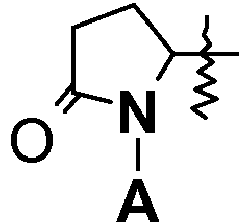

A1 
B1 
A2 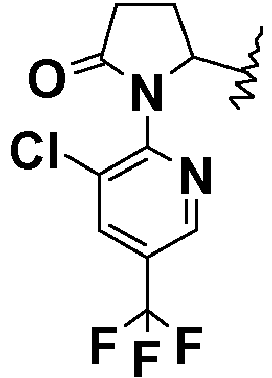
A3 
B3 
A4 
B4 
A5 
B5 
A6 
B6 
A7 
B7 
A8 
A9 
B9 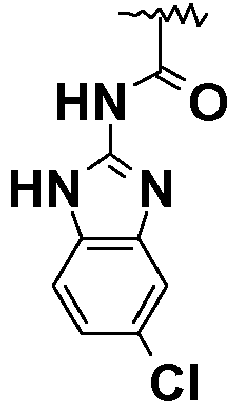
A10 
B10 
A11 
B11 
A12 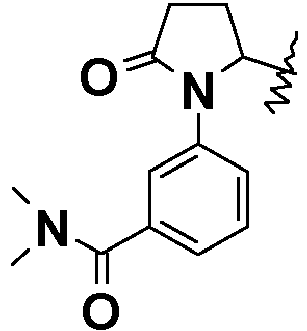
B12 
A13 
B13 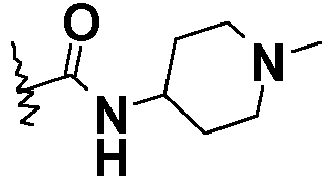
A14 
B14 
A15 
B15 
A16 
B16 
A17 
B17 
A18 
B18 
A19 
B19 
A20 
B20 
A21 
A22 
B22 
A23 
B23 
A24 
B24 
A25 
B25 
A26 
B26 
A27 
B27 
A28 
B28 
A29 
B29 
A30 
B30 
A31 
B31 
A32 
B32 
A33 
B33 
A34 
B34 
A35 
B35 
A36 
B36 
A37 
B37 
A38 
A39 
A40 
A41 
A42 
A43 
A44 
A45 
A46 
A47 
A48 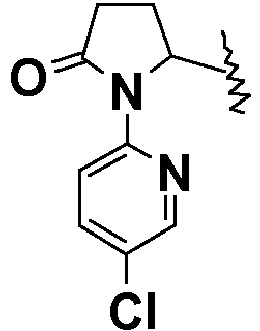
A49 
A50 
A51 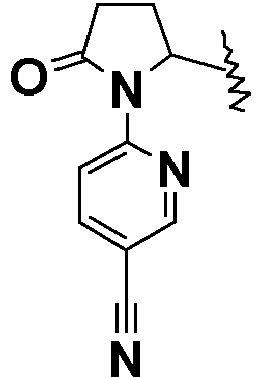
A52 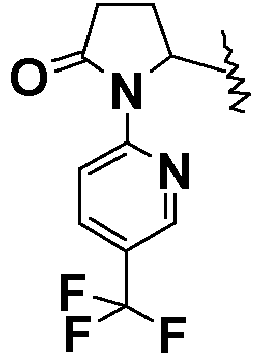
A53 
A54 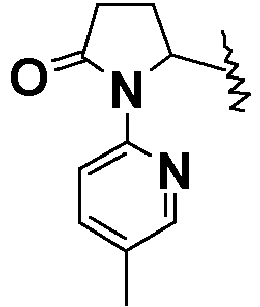
A55 
A56 
- In another embodiment of the invention, the stereogenic carbon indicated with an arrow formula (III) is in the (S) configuration.
- In another embodiment of the invention, there is provided compounds in Table III, which can be made by the methods and examples shown herein and methods known in the art.
Table III Example Structure Name ESI m/z (+) Patent Method 3 
(S)-1-(4-Chloro-phenyl)-5-(4-phenyl-piperazine-1-carbonyl)-pyrrolidin-2-one 384 17 4 
(S)-1-(4-Chloro-phenyl)-5-(4-methyl-piperazine-1-carbonyl)-pyrrolidin-2-one 322 17 5 
(S)-1-(4-Chloro-phenyl)-5-oxo-pyrrolidine-2-carboxylic acid (5-methyl-pyridin-2-yl)-amide 330 17 6 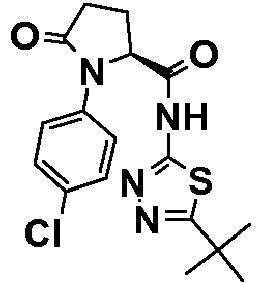
(S)-1-(4-Chloro-phenyl)-5-oxo-pyrrolidine-2-carboxylic acid (5-tert-butyl-1,3,4-thiadiazol-2-yl)-amide 379 17 7 
(S)-1-(4-Chloro-phenyl)-5-oxo-pyrrolidine-2-carboxylic acid (tetrahydro-pyran-4-ylmethyl)-amide 337 17 12 
(S)-1-(4-Chloro-phenyl)-5-oxo-pyrrolidine-2-carboxylic acid (3,3,5-trimethyl-cyclohexyl)-amide 363 17 13 
(S)-1-(4-Chloro-phenyl)-5-oxo-pyrrolidine-2-carboxylic acid [4-(4-chloro-phenyl)-thiazol-2-yl]-amide 432/43 4 17 24 
(S)-1-(4-Chloro-phenyl)-5-oxo-pyrrolidine-2-carboxylic acid (4-trifluoromethyl-pyridin-2-yl)-amide 384 17 25 
(S)-1-(4-Chloro-phenyl)-5-oxo-pyrrolidine-2-carboxylic acid (5-chloro-benzothiazol-2-yl)-amide 406/40 8 17 26 
(S)-1-(4-Chloro-phenyl)-5-oxo-pyrrolidine-2-carboxylic acid (5-chloro-1H-benzimidazol-2-yl)-amide 389/39 1 17 27 
(S)-1-(4-Chloro-phenyl)-5-oxo-pyrrolidine-2-carboxylic acid (1-methyl-piperidin-4-yl)-amide 336 17 28 
(S)-1-(4-Chloro-phenyl)-5-oxo-pyrrolidine-2-carboxylic acid (2-cyclohexyl-ethyl)-amide 349 17 29 
(S)-1-(4-Chloro-phenyl)-5-oxo-pyrrolidine-2-carboxylic acid (4-tert-butyl-cyclohexyl)-amide 377 17 30 
(S)-1-(4-Chloro-phenyl)-5-oxo-pyrrolidine-2-carboxylic acid [1,2,4]triazolo[1,5-a]pyrimidin-2-ylamide 357 17 31 
(S)-1-(4-Chloro-phenyl)-5-oxo-pyrrolidine-2-carboxylic acid [4-(4-fluoro-phenyl)-5-methyl-thiazol-2-yl]-amide 430 17 32 
(S)-1-(4-Chloro-phenyl)-5-oxo-pyrrolidine-2-carboxylic acid (1-methyl-piperidin-4-ylmethyl)-amide 350 17 33 
(S)-1-(4-Chloro-phenyl)-5-oxo-pyrrolidine-2-carboxylic acid (3-propyl-isoxazol-5-yl)-amide 348 17 34 
(S)-1-(4-Chloro-phenyl)-5-oxo-pyrrolidine-2-carboxylic acid (4-trifluoromethyl-oxazol-2-yl)-amide 374 17 35 
(S)-1-(4-Chloro-phenyl)-5-oxo-pyrrolidine-2-carboxylic acid benzothiazol-2-ylamide 372 17 36 
(S)-1-(4-Chloro-phenyl)-5-oxo-pyrrolidine-2-carboxylic acid (2-tert-butylsulfanyl-ethyl)-amide 355 17 82 
(S)-1-(4-chloro-phenyl)-5-oxo-pyrrolidine-2-carboxylic acid (5-tert-butyl-isoxazol-3-yl)-amide 362 6 83 
(S)-1-(4-chloro-phenyl)-5-oxo-pyrrolidine-2-carboxylic acid (3-tert-butyl-isoxazol-5-yl)-amide 362 6 84 
(S)-1-(3-chloro-5-trifluoromethyl-pyridin-2-yl)-5-oxo-pyrrolidine-2-carboxylic acid (4-sec-butyl-phenyl)-amide 440 21 85 
(S)-1-(4-chloro-phenyl)-5-oxo-pyrrolidine-2-carboxylic acid (3-phenyl-1,2,4-thiadiazol-5-yl)-amide 399 6 86 
(S)-1-(3-chloro-5-trifluoromethyl-pyridin-2-yl)-5-oxo-pyrrolidine-2-carboxylic acid (5-tert-butyl-isoxazol-3-yl)-amide 431 21 87 
(S)-1-(3-chloro-5-trifluoromethyl-pyridin-2-yl)-5-oxo-pyrrolidine-2-carboxylic acid (3-phenyl-1,2,4-thiadiazol-5-yl)-amide 468 21 88 
(S)-1-(4-cyano-phenyl)-5-oxo-pyrrolidine-2-carboxylic acid (5-tert-butyl-isoxazol-3-yl)-amide 353 6 89 
(S)-1-(4-cyano-phenyl)-5-oxo-pyrrolidine-2-carboxylic acid (3-tert-butyl-isoxazol-5-yl)-amide 353 6 90 
(S)-1-(4-nitro-phenyl)-5-oxo-pyrrolidine-2-carboxylic acid (5-tert-butyl-isoxazol-3-yl)-amide 373 18 91 
(S)-1-(4-methanesulfonyl-phenyl)-5-oxo-pyrrolidine-2-carboxylic acid (5-tert-butyl-isoxazol-3-yl)-amide 406 6 92 
(S)-1-(4-methanesulfonyl-phenyl)-5-oxo-pyrrolidine-2-carboxylic acid (3-tert-butyl-isoxazol-5-yl)-amide 406 6 93 
(S)-5-oxo-1-phenyl-pyrrolidine-2-carboxylic acid (5-tert-butyl-isoxazol-3-yl)-amide 328 6 94 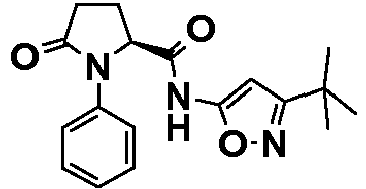
S)-5-oxo-1-phenyl-pyrrolidine-2-carboxylic acid (3-tert-butyl-isoxazol-5-yl)-amide 328 6 95 
(S)-1-(3-cyano-phenyl)-5-oxo-pyrrolidine-2-carboxylic acid (5-tert-butyl-isoxazol-3-yl)-amide 353 6 96 
(S)-1-(3-cyano-phenyl)-5-oxo-pyrrolidine-2-carboxylic acid (3-tert-butyl-isoxazol-5-yl)-amide 353 6 97 
3-[(S)-2-(5-tert-butyl-isoxazol-3-ylcarbamoyl)-5-oxo-pyrrolidin-1-yl]-benzoic acid methyl ester 386 6 98 
{4-[(S)-2-(5-tert-butyl-isoxazol-3-ylcarbamoyl)-5-oxo-pyrrolidin-1-yl]-phenyl}-methyl-carbamic acid tert-butyl ester 457 6 99 
(S)-1-(4-methylcarbamoyl-phenyl)-5-oxo-pyrrolidine-2-carboxylic acid (5-tert-butyl-isoxazol-3-yl)-amide 385 19 100 
(S)-1-(3-methylcarbamoyl-phenyl)-5-oxo-pyrrolidine-2-carboxylic acid (5-tert-butyl-isoxazol-3-yl)-amide 385 19 101 
(S)-1-(3-dimethylcarbamoyl-phenyl)-5-oxo-pyrrolidine-2-carboxylic acid (5-tert-butyl-isoxazol-3-yl)-amide 399 19 102 
(S)-1-(4-methylamino-phenyl)-5-oxo-pyrrolidine-2-carboxylic acid (5-tert-butyl-isoxazol-3-yl)-amide 357 20 103 
(S)-1-[4-(acetyl-methyl-amino)-phenyl]-5-oxo-pyrrolidine-2-carboxylic acid (5-tert-butyl-isoxazol-3-yl)-amide 399 20 104 
(S)-1-[4-(methanesulfonyl-methyl-amino)-phenyl]-5-oxo-pyrrolidine-2-carboxylic acid (5-tert-butyl-isoxazol-3-yl)-amide 435 20 105 
(S)-1-(4-fluoro-phenyl)-5-oxo-pyrrolidine-2-carboxylic acid (3-tert-butyl-isoxazol-5-yl)-amide 346 6 106 
(S)-1-(4-fluoro-phenyl)-5-oxo-pyrrolidine-2-carboxylic acid (5-tert-butyl-isoxazol-3-yl)-amide 346 6 232 
(S)-5-Oxo-1-(4-trifluoromethyl-phenyl)-pyrrolidine-2-carboxylic acid (3-tert-butyl-isoxazol-5-yl)-amide 396 7 233 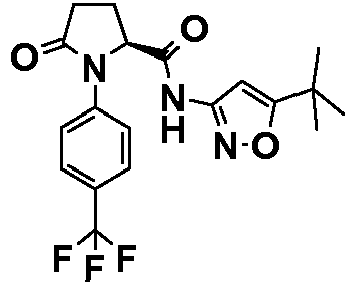
(S)-5-Oxo-1-(4-trifluoromethylphenyl)-pyrrolidine-2-carboxylic acid (5-tert-butyl-isoxazol-3-yl)-amide 396 6 257 
(S)-1-(2,4-Difluoro-phenyl)-5-oxo-pyrrolidine-2-carboxylic acid (3-tert-butyl-isoxazol-5-yl)-amide 364 7 258 
(S)-1-(2,4-Difluoro-phenyl)-5-oxo-pyrrolidine-2-carboxylic acid (5-tert-butyl-isoxazol-3-yl)-amide 364 7 261 
(S)-1-(5-Chloro-thiophen-2-yl)-5-oxo-pyrrolidine-2-carboxylic acid (3-tert-butyl-isoxazol-5-yl)-amide 368 7 262 
(S)-1-(4-Chloro-2-fluoro-phenyl)-5-oxo-pyrrolidine-2-carboxylic acid (3-tert-butyl-isoxazol-5-yl)-amide 368 7 263 
(S)-1-(4-Chloro-2-fluoro-phenyl)-5-oxo-pyrrolidine-2-carboxylic acid (3-tert-butyl-isoxazol-5-yl)-amide 380 7 264 
(S)-1-(4-Chloro-2-fluoro-phenyl)-5-oxo-pyrrolidine-2-carboxylic acid (5-tert-butyl-isoxazol-3-yl)-amide 380 7 278 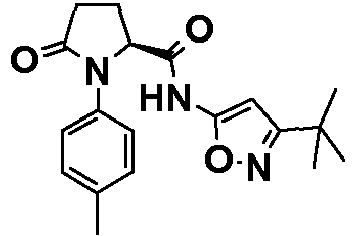
(S)-5-Oxo-1-p-tolyl-pyrrolidine-2-carboxylic acid (3-tert-butyl-isoxazol-5-yl)-amide 342 7 279 
(S)-5-Oxo-1-p-tolyl-pyrrolidine-2-carboxylic acid (5-tert-butyl-isoxazol-3-yl)-amide 342 7 280 
(S)-1-(4-Ethyl-phenyl)-5-oxo-pyrrolidine-2-carboxylic acid (3-tert-butyl-isoxazol-5-yl)-amide 356 7 281 
(S)-1-(4-Isopropyl-phenyl)-5-oxo-pyrrolidine-2-carboxylic acid (3-tert-butyl-isoxazol-5-yl)-amide 370 7 282 
(S)-1-(4-Isopropyl-phenyl)-5-oxo-pyrrolidine-2-carboxylic acid (5-tert-butyl-isoxazol-3-yl)-amide 370 7 283 
(S)-1-(4-Methoxy-phenyl)-5-oxo-pyrrolidine-2-carboxylic acid (3-tert-butyl-isoxazol-5-yl)-amide 358 7 284 
(S)-1-(4-Methoxy-phenyl)-5-oxo-pyrrolidine-2-carboxylic acid (5-tert-butyl-isoxazol-3-yl)-amide 358 7 285 
(S)-5-Oxo-1-(4-trifluoromethoxy-phenyl)-pyrrolidine-2-carboxylic acid (3-tert-butyl-isoxazol-5-yl)-amide 412 7 286 
(S)-5-Oxo-1-(4-trifluoromethoxyphenyl)-pyrrolidine-2-carboxylic acid (5-tert-butyl-isoxazol-3-yl)-amide 412 7 287 
(S)-1-(4-Chloro-phenyl)-5-oxo-pyrrolidine-2-carboxylic acid (3-tert-butyl-phenyl)-amide 371 17 288 
(S)-1-(4-Chloro-phenyl)-5-oxo-pyrrolidine-2-carboxylic acid (3-sec-butyl-isoxazol-5-yl)-amide 362 17 289 
(S)-1-(4-Chloro-phenyl)-5-oxo-pyrrolidine-2-carboxylic acid (3-isopropyl-isoxazol-5-yl)-amide 348 17 290 
(S)-1-(4-Chloro-phenyl)-5-oxo-pyrrolidine-2-carboxylic acid [3-(4-methoxy-phenyl)-1,2,4-thiadiazol-5-yl]-amide 429 17 291 
(S)-1-(4-Chloro-phenyl)-5-oxo-pyrrolidine-2-carboxylic acid (3-tert-butyl-isothiazol-5-yl)-amide 378 17 292 
(S)-1-(4-Chloro-phenyl)-5-oxo-pyrrolidine-2-carboxylic acid {3-[2-(4-methoxy-benzyloxy)-1,1-dimethyl-ethyl]-isoxazol-5-yl}-amide 498 17 293 
(S)-1-(4-Chloro-phenyl)-5-oxo-pyrrolidine-2-carboxylic acid [3-(2-hydroxy-1,1-dimethyl-ethyl)-isoxazol-5-yl]-amide 378 17 294 
(S)-1-(4-Chloro-phenyl)-5-oxo-pyrrolidine-2-carboxylic acid [5-(2-methoxy-1,1-dimethyl-ethyl)-isoxazol-3-yl]-amide 392 17 295 
(S)-1-(4-Chloro-phenyl)-5-oxo-pyrrolidine-2-carboxylic acid [3-(2-methoxy-1,1-dimethyl-ethyl)-isoxazol-5-yl]-amide 392 17 297 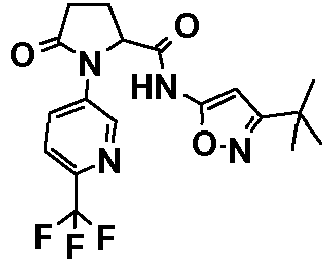
5-Oxo-1-(6-trifluoromethyl-pyridin-3-yl)-pyrrolidine-2-carboxylic acid (3-tert-butyl-isoxazol-5-yl)-amide 331 36 298 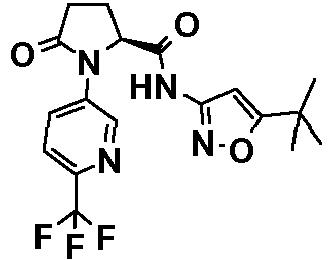
(S)-5-Oxo-1-(6-trifluoromethyl-pyridin-3-yl)-pyrrolidine-2-carboxylic acid (5-tert-butyl-isoxazol-3-yl)-amide 397 36 300 
(S)-1-(3-Chloro-phenyl)-5-oxo-pyrrolidine-2-carboxylic acid (3-tert-butyl-isoxazol-5-yl)-amide 362 7 301 
(S)-1-(3-Chloro-phenyl)-5-oxo-pyrrolidine-2-carboxylic acid (5-tert-butyl-isoxazol-3-yl)-amide 362 7 302 
(S)-1-(2,3-Difluoro-phenyl)-5-oxo-pyrrolidine-2-carboxylic acid (3-tert-butyl-isoxazol-5-yl)-amide 364 7 303 
(S)-1-(3,4-Dichloro-phenyl)-5-oxo-pyrrolidine-2-carboxylic acid (3-tert-butyl-isoxazol-5-yl)-amide 396 7 304 
(S)-1-(3,4-Dichloro-phenyl)-5-oxo-pyrrolidine-2-carboxylic acid (5-tert-butyl-isoxazol-3-yl)-amide 396 7 305 
(S)-1-(3-Chloro-4-fluoro-phenyl)-5-oxo-pyrrolidine-2-carboxylic acid (3-tert-butyl-isoxazol-5-yl)-amide 380 7 306 
(S)-1-(3-Chloro-4-fluoro-phenyl)-5-oxo-pyrrolidine-2-carboxylic acid (5-tert-butyl-isoxazol-3-yl)-amide 380 7 307 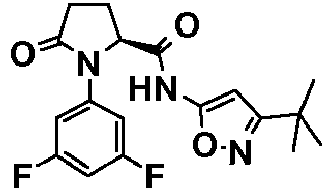
(S)-1-(3,5-Difluoro-phenyl)-5-oxo-pyrrolidine-2-carboxylic acid (3-tert-butyl-isoxazol-5-yl)-amide 364 7 308 
(S)-1-(3,5-Difluoro-phenyl)-5-oxo-pyrrolidine-2-carboxylic acid (5-tert-butyl-isoxazol-3-yl)-amide 364 7 309 
(S)-1-(6-Fluoro-5-trifluoromethyl-pyridin-2-yl)-5-oxo-pyrrolidine-2-carboxylic acid (3-tert-butyl-isoxazol-5-yl)-amide 415 37 310 
(S)-1-(3-Fluoro-4-methyl-phenyl)-5-oxo-pyrrolidine-2-carboxylic acid (3-tert-butyl-isoxazol-5-yl)-amide 360 7 311 
(S)-1-(3-Fluoro-4-methyl-phenyl)-5-oxo-pyrrolidine-2-carboxylic acid (5-tert-butyl-isoxazol-3-yl)-amide 360 7 312 
(S)-1-(3-Fluoro-phenyl)-5-oxo-pyrrolidine-2-carboxylic acid (3-tert-butyl-isoxazol-5-yl)-amide 346 7 313 
(S)-1-(3-Fluoro-phenyl)-5-oxo-pyrrolidine-2-carboxylic acid (5-tert-butyl-isoxazol-3-yl)-amide 346 7 314 
(S)-5-Oxo-1-(4-vinyl-phenyl)-pyrrolidine-2-carboxylic acid (3-tert-butyl-isoxazol-5-yl)-amide 354 7 315 
(S)-5-Oxo-1-(4-vinyl-phenyl)-pyrrolidine-2-carboxylic acid (5-tert-butyl-isoxazol-3-yl)-amide 354 7 316 
(S)-1-(4-Chloro-3-fluoro-phenyl)-5-oxo-pyrrolidine-2-carboxylic acid (5-tert-butyl-isoxazol-3-yl)-amide 380 7 317 
(S)-1-(4-Chloro-3-fluoro-phenyl)-5-oxo-pyrrolidine-2-carboxylic acid (3-tert-butyl-isoxazol-5-yl)-amide 380 7 318 
(S)-1-(4-Chloro-3-methyl-phenyl)-5-oxo-pyrrolidine-2-carboxylic acid (3-tert-butyl-isoxazol-5-yl)-amide 376 7 319 
(S)-1-(4-Chloro-3-methyl-phenyl)-5-oxo-pyrrolidine-2-carboxylic acid (5-tert-butyl-isoxazol-3-yl)-amide 376 7 320 
(S)-1-(3-Fluoro-4-methoxy-phenyl)-5-oxo-pyrrolidine-2-carboxylic acid (3-tert-butyl-isoxazol-5-yl)-amide 376 7 321 
(S)-1-(4-Cyano-3-fluoro-phenyl)-5-oxo-pyrrolidine-2-carboxylic acid (3-tert-butyl-isoxazol-5-yl)-amide 371 7 322 
(S)-1-(4-Cyano-3-fluoro-phenyl)-5-oxo-pyrrolidine-2-carboxylic acid (5-tert-butyl-isoxazol-3-yl)-amide 371 7 323 
(S)-1-(3-Chloro-4-methyl-phenyl)-5-oxo-pyrrolidine-2-carboxylic acid (3-tert-butyl-isoxazol-5-yl)-amide 376 7 324 
(S)-1-(3-Chloro-4-methyl-phenyl)-5-oxo-pyrrolidine-2-carboxylic acid (5-tert-butyl-isoxazol-3-yl)-amide 376 7 325 
(S)-1-(4-Difluoromethyl-phenyl)-5-oxo-pyrrolidine-2-carboxylic acid (3-tert-butyl-isoxazol-5-yl)-amide 378 7 329 
(S)-1-(3,4-Difluoro-phenyl)-5-oxo-pyrrolidine-2-carboxylic acid (3-tert-butyl-isoxazol-5-yl)-amide 364 7 330 
(S)-1-(3,4-Difluoro-phenyl)-5-oxo-pyrrolidine-2-carboxylic acid (5-tert-butyl-isoxazol-3-yl)-amide 364 7 331 
(S)-1-(4-Fluoro-3-methyl-phenyl)-5-oxo-pyrrolidine-2-carboxylic acid (3-tert-butyl-isoxazol-5-yl)-amide 360 7 332 
(S)-1-(4-Fluoro-3-methyl-phenyl)-5-oxo-pyrrolidine-2-carboxylic acid (5-tert-butyl-isoxazol-3-yl)-amide 360 7 333 
(S)-5-Oxo-1-(3,4,5-trifluoro-phenyl)-pyrrolidine-2-carboxylic acid (5-tert-butyl-isoxazol-3-yl)-amide 382 7 334 
(S)-5-Oxo-1-(3,4,5-trifluoro-phenyl)-pyrrolidine-2-carboxylic acid (3-tert-butyl-isoxazol-5-yl)-amide 382 7 335 
(S)-1-(4-Methoxymethyl-phenyl)-5-oxo-pyrrolidine-2-carboxylic acid (3-tert-butyl-isoxazol-5-yl)-amide 372 7 336 
(S)-5-Oxo-1-(4-trifluoromethylphenyl)-pyrrolidine-2-carboxylic acid [3-(2-hydroxy-1,1-dimethyl-ethyl)-isoxazol-5-yl]-amide 412 38 337 
(S)-1-(4-Fluoromethyl-phenyl)-5-oxo-pyrrolidine-2-carboxylic acid (3-tert-butyl-isoxazol-5-yl)-amide 360 7 338 
(S)-5-Oxo-1-(4-trifluoromethylphenyl)-pyrrolidine-2-carboxylic acid (3-sec-butyl-isoxazol-5-yl)-amide 396 7 339 
(S)-5-Oxo-1-(4-trifluoromethylphenyl)-pyrrolidine-2-carboxylic acid (3-isopropyl-isoxazol-5-yl)-amide 382 7 340 
(S)-5-Oxo-1-(4-trifluoromethylphenyl)-pyrrolidine-2-carboxylic acid [3-(2-methoxy-1,1-dimethyl-ethyl)-isoxazol-5-yl]-amide 426 7 341 
(S)-5-Oxo-1-(4-trifluoromethylphenyl)-pyrrolidine-2-carboxylic acid [5-(2-methoxy-1,1-dimethylethyl)-isoxazol-3-yl]-amide 426 7 342 
(S)-5-Oxo-1-(4-trifluoromethylphenyl)-pyrrolidine-2-carboxylic acid [3-(4-methoxy-phenyl)-1,2,4-thiadiazol-5-yl]-amide 463 7 343 
(S)-5-Oxo-1-(4-trifluoromethylphenyl)-pyrrolidine-2-carboxylic acid (3-tert-butyl-isothiazol-5-yl)-amide 412 7 344 
1-(4-Hydroxymethyl-phenyl)-5-oxo-pyrrolidine-2-carboxylic acid (5-tert-butyl-isoxazol-3-yl)-amide 358 39 345 
(S)-5-Oxo-1-(4-trifluoromethylphenyl)-pyrrolidine-2-carboxylic acid [3-(4-hydroxy-phenyl)-1,2,4-thiadiazol-5-yl]-amide 402 39 346 
(S)-5-Oxo-1-(4-trifluoromethylphenyl)-pyrrolidine-2-carboxylic acid [5-(2-hydroxy-1,1-dimethyl-ethyl)-isoxazol-3-yl] -amide 412 40 347 
(S)-1-(4-Fluoro-phenyl)-5-oxo-pyrrolidine-2-carboxylic acid [3-(2-hydroxy-1,1-dimethyl-ethyl)-isoxazol-5-yl]-amide 362 38 348 
(S)-1-(5-Chloro-pyridin-2-yl)-5-oxo-pyrrolidine-2-carboxylic acid (3-tert-butyl-isoxazol-5-yl)-amide 363 37 349 
(S)-1-(5-Fluoro-pyridin-2-yl)-5-oxo-pyrrolidine-2-carboxylic acid (3-tert-butyl-isoxazol-5-yl)-amide 347 42 350 
(S)-1-(5-Chloro-pyrimidin-2-yl)-5-oxo-pyrrolidine-2-carboxylic acid (3-tert-butyl-isoxazol-5-yl)-amide 364 43 351 
1-(5-Cyano-pyridin-2-yl)-5-oxo-pyrrolidine-2-carboxylic acid (3-tert-butyl-isoxazol-5-yl)-amide 354 44 352 
(S)-5-Oxo-1-(5-trifluoromethyl-pyridin-2-yl)-pyrrolidine-2-carboxylic acid (3-tert-butyl-isoxazol-5-yl)-amide 397 44 353 
(S)-5-Oxo-1-pyridin-2-yl-pyrrolidine-2-carboxylic acid (3-tert-butyl-isoxazol-5-yl)-amide 329 44 354 
(S)-1-(5-Methyl-pyridin-2-yl)-5-oxo-pyrrolidine-2-carboxylic acid (3-tert-butyl-isoxazol-5-yl)-amide 343 44 355 
(S)-1-(5-Methoxy-pyridin-2-yl)-5-oxo-pyrrolidine-2-carboxylic acid (3-tert-butyl-isoxazol-5-yl)-amide 359 44 356 
(S)-1-(5-Fluoro-6-methyl-pyridin-2-yl)-5-oxo-pyrrolidine-2-carboxylic acid (3-tert-butyl-isoxazol-5-yl)-amide 361 44 357 
(S)-1-(3-Fluoro-5-trifluoromethyl-pyridin-2-yl)-5-oxo-pyrrolidine-2-carboxylic acid (3-tert-butyl-isoxazol-5-yl)-amide 415 44 - Of the above compounds, the following are preferred CB2 agonists:
Table (IV) Compound CB2 CAMP @ EC50 nM (mean) (S)-1-(4-Chloro-phenyl)-5-(4-methyl-piperazine-1-carbonyl)-pyrrolidin-2-one 355.03 (S)-1-(4-Chloro-phenyl)-5-oxo-pyrrolidine-2-carboxylic acid (5-methyl-pyridin-2-yl)-amide 485.05 acid (3,3,5-trimethylcyclohexyl)-amide 212.11 (S)-1-(4-Chloro-phenyl)-5-oxo-pyrrolidine-2-carboxylic acid (5-chloro-1H-benzimidazol-2-yl)-amide 255.02 (S)-1-(4-Chloro-phenyl)-5-oxo-pyrrolidine-2-carboxylic acid (2-cyclohexylethyl)-amide 333.88 (S)-1-(4-Chloro-phenyl)-5-oxo-pyrrolidine-2-carboxylic acid (4-tert-butylcyclohexyl)-amide 158.79 (S)-1-(4-Chloro-phenyl)-5-oxo-pyrrolidine-2-carboxylic acid (3-propyl-isoxazol-5-yl)-amide 262.72 (S)-1-(4-chloro-phenyl)-5-oxo-pyrrolidine-2-carboxylic acid (5-tert-butyl-isoxazol-3-yl)-amide 39.11 (S)-1-(4-chloro-phenyl)-5-oxo-pyrrolidine-2-carboxylic acid (3-tert-butyl-isoxazol-5-yl)-amide 6.05 (S)-1-(3-chloro-5-trifluoromethyl-pyridin-2-yl)-5-oxo-pyrrolidine-2-carboxylic acid (4-sec-butyl-phenyl)-amide 28.1 (S)-1-(3-chloro-5-trifluoromethyl-pyridin-2-yl)-5-oxo-pyrrolidine-2-carboxylic acid (5-tert-butyl-isoxazol-3-yl)-amide 6.5 (S)-1-(3-chloro-5-trifluoromethyl-pyridin-2-yl)-5-oxo-pyrrolidine-2-carboxylic acid (3-phenyl-1,2,4-thiadiazol-5-yl)-amide 0.549 (S)-1-(4-cyano-phenyl)-5-oxo-pyrrolidine-2-carboxylic acid (5-tert-butyl-isoxazol-3-yl)-amide 59.91 (S)-1-(4-cyano-phenyl)-5-oxo-pyrrolidine-2-carboxylic acid (3-tert-butyl-isoxazol-5-yl)-amide 21.58 (S)-1-(4-nitro-phenyl)-5-oxo-pyrrolidine-2-carboxylic acid (5-tert-butyl-isoxazol-3-yl)-amide 21.09 (S)-1-(4-fluoro-phenyl)-5-oxo-pyrrolidine-2-carboxylic acid (3-tert-butyl-isoxazol-5-yl)-amide 8.72 (S)-1-(4-fluoro-phenyl)-5-oxo-pyrrolidine-2-carboxylic acid (5-tert-butyl-isoxazol-3-yl)-amide 35.65 (S)-5-Oxo-1-(4-trifluoromethyl-phenyl)-pyrrolidine-2-carboxylic acid (3-tert-butyl-isoxazol-5-yl)-amide 1.55 (S)-5-Oxo-1-(4-trifluoromethyl-phenyl)-pyrrolidine-2-carboxylic acid (5-tert-butyl-isoxazol-3-yl)-amide 5.76 (S)-1-(5-Chloro-thiophen-2-yl)-5-oxo-pyrrolidine-2-carboxylic acid (3-tert-butyl-isoxazol-5-yl)-amide 67.54 (S)-1-(4-Chloro-2-fluoro-phenyl)-5-oxo-pyrrolidine-2-carboxylic acid (3-tert-butyl-isoxazol-5-yl)-amide 81.98 (S)-5-Oxo-1-p-tolyl-pyrrolidine-2-carboxylic acid (3-tert-butyl-isoxazol-5-yl)-amide 163.49 (S)-1-(4-Ethyl-phenyl)-5-oxo-pyrrolidine-2-carboxylic acid (3-tert-butyl-isoxazol-5-yl)-amide 173.02 (S)-1-(4-Isopropyl-phenyl)-5-oxo-pyrrolidine-2-carboxylic acid (3-tert-butyl-isoxazol-5-yl)-amide 159.4 (S)-1-(4-Methoxy-phenyl)-5-oxo-pyrrolidine-2-carboxylic acid (3-tert-butyl-isoxazol-5-yl)-amide 163.38 (S)-5-Oxo-1-(4-trifluoromethoxy-phenyl)-pyrrolidine-2-carboxylic acid (3-tert-butyl-isoxazol-5-yl)-amide 34.47 (S)-5-Oxo-1-(4-trifluoromethoxy-phenyl)-pyrrolidine-2-carboxylic acid (5-tert-butyl-isoxazol-3-yl)-amide 132.11 (S)-1-(4-Chloro-phenyl)-5-oxo-pyrrolidine-2-carboxylic acid (3-tert-butylphenyl)-amide 58.65 (S)-1-(4-Chloro-phenyl)-5-oxo-pyrrolidine-2-carboxylic acid (3-sec-butyl-isoxazol-5-yl)-amide 103.95 (S)-1-(4-Chloro-phenyl)-5-oxo-pyrrolidine-2-carboxylic acid (3-isopropyl-isoxazol-5-yl)-amide 289.52 (S)-1-(4-Chloro-phenyl)-5-oxo-pyrrolidine-2-carboxylic acid [3-(4-methoxy-phenyl)-1,2,4-thiadiazol-5-yl]-amide 194.34 (S)-1-(4-Chloro-phenyl)-5-oxo-pyrrolidine-2-carboxylic acid (3-tert-butyl-isothiazol-5-yl)-amide 135.27 (S)-1-(4-Chloro-phenyl)-5-oxo-pyrrolidine-2-carboxylic acid [3-(2-hydroxy-1,1-dimethyl-ethyl)-isoxazol-5-yl]-amide 151.83 (S)-1-(4-Chloro-phenyl)-5-oxo-pyrrolidine-2-carboxylic acid [5-(2-methoxy-1,1-dimethyl-ethyl)-isoxazol-3-yl]-amide 86.13 (S)-1-(4-Chloro-phenyl)-5-oxo-pyrrolidine-2-carboxylic acid [3-(2-methoxy-1,1-dimethyl-ethyl)-isoxazol-5-yl]-amide 48.73 (S)-1-(3-Chloro-phenyl)-5-oxo-pyrrolidine-2-carboxylic acid (3-tert-butyl-isoxazol-5-yl)-amide 203 (S)-1-(3-Chloro-phenyl)-5-oxo-pyrrolidine-2-carboxylic acid (5-tert-butyl-isoxazol-3-yl)-amide 296.11 (S)-1-(2,3-Difluoro-phenyl)-5-oxo-pyrrolidine-2-carboxylic acid (3-tert-butyl-isoxazol-5-yl)-amide 260.94 (S)-1-(3,4-Dichloro-phenyl)-5-oxo-pyrrolidine-2-carboxylic acid (3-tert-butyl-isoxazol-5-yl)-amide 16.07 (S)-1-(3,4-Dichloro-phenyl)-5-oxo-pyrrolidine-2-carboxylic acid (5-tert-butyl-isoxazol-3-yl)-amide 49.72 (S)-1-(3-Chloro-4-fluoro-phenyl)-5-oxo-pyrrolidine-2-carboxylic acid (3-tert-butyl-isoxazol-5-yl)-amide 26.68 (S)-1-(3-Chloro-4-fluoro-phenyl)-5-oxo-pyrrolidine-2-carboxylic acid (5-tert-butyl-isoxazol-3-yl)-amide 59.32 (S)-1-(6-Fluoro-5-trifluoromethyl-pyridin-2-yl)-5-oxo-pyrrolidine-2-carboxylic acid (3-tert-butyl-isoxazol-5-yl)-amide 8.05 (S)-1-(3-Fluoro-phenyl)-5-oxo-pyrrolidine-2-carboxylic acid (3-tert-butyl-isoxazol-5-yl)-amide 356.69 (S)-5-Oxo-1-(4-vinyl-phenyl)-pyrrolidine-2-carboxylic acid (3-tert-butyl-isoxazol-5-yl)-amide 20.33 (S)-5-Oxo-1-(4-vinyl-phenyl)-pyrrolidine-2-carboxylic acid (5-tert-butyl-isoxazol-3-yl)-amide 69.98 (S)-1-(4-Chloro-3-fluoro-phenyl)-5-oxo-pyrrolidine-2-carboxylic acid (5-tert-butyl-isoxazol-3-yl)-amide 12.72 (S)-1-(4-Chloro-3-fluoro-phenyl)-5-oxo-pyrrolidine-2-carboxylic acid (3-tert-butyl-isoxazol-5-yl)-amide 14.2 (S)-1-(4-Chloro-3-methyl-phenyl)-5-oxo-pyrrolidine-2-carboxylic acid (3-tert-butyl-isoxazol-5-yl)-amide 23.73 (S)-1-(4-Chloro-3-methyl-phenyl)-5-oxo-pyrrolidine-2-carboxylic acid (5-tert-butyl-isoxazol-3-yl)-amide 59.37 (S)-1-(3-Fluoro-4-methoxy-phenyl)-5-oxo-pyrrolidine-2-carboxylic acid (3-tert-butyl-isoxazol-5-yl)-amide 314.2 (S)-1-(4-Cyano-3-fluoro-phenyl)-5-oxo-pyrrolidine-2-carboxylic acid (3-tert-butyl-isoxazol-5-yl)-amide 285.71 (S)-1-(4-Cyano-3-fluoro-phenyl)-5-oxo-pyrrolidine-2-carboxylic acid (5-tert-butyl-isoxazol-3-yl)-amide 78.49 (S)-1-(3-Chloro-4-methyl-phenyl)-5-oxo-pyrrolidine-2-carboxylic acid (3-tert-butyl-isoxazol-5-yl)-amide 77.44 (S)-1-(3-Chloro-4-methyl-phenyl)-5-oxo-pyrrolidine-2-carboxylic acid (5-tert-butyl-isoxazol-3-yl)-amide 333.17 (S)-1-(4-Difluoromethyl-phenyl)-5-oxo-pyrrolidine-2-carboxylic acid (3-tert-butyl-isoxazol-5-yl)-amide 15.21 (S)-1-(3,4-Difluoro-phenyl)-5-oxo-pyrrolidine-2-carboxylic acid (3-tert-butyl-isoxazol-5-yl)-amide 15.99 (S)-1-(3,4-Difluoro-phenyl)-5-oxo-pyrrolidine-2-carboxylic acid (5-tert-butyl-isoxazol-3-yl)-amide 64.18 (S)-1-(4-Fluoro-3-methyl-phenyl)-5-oxo-pyrrolidine-2-carboxylic acid (3-tert-butyl-isoxazol-5-yl)-amide 91.17 (S)-1-(4-Fluoro-3-methyl-phenyl)-5-oxo-pyrrolidine-2-carboxylic acid (5-tert-butyl-isoxazol-3-yl)-amide 361.96 (S)-5-Oxo-1-(3,4,5-trifluoro-phenyl)-pyrrolidine-2-carboxylic acid (3-tert-butyl-isoxazol-5-yl)-amide 80.02 (S)-5-Oxo-1-(3,4,5-trifluoro-phenyl)-pyrrolidine-2-carboxylic acid (5-tert-butyl-isoxazol-3-yl)-amide 74.74 (S)-5-Oxo-1-(4-trifluoromethyl-phenyl)-pyrrolidine-2-carboxylic acid [3-(2-hydroxy-1,1-dimethyl-ethyl)-isoxazol-5-yl]-amide 37.68 (S)-1-(4-Fluoromethyl-phenyl)-5-oxo-pyrrolidine-2-carboxylic acid (3-tert-butyl-isoxazol-5-yl)-amide 55.82 (S)-5-Oxo-1-(4-trifluoromethyl-phenyl)-pyrrolidine-2-carboxylic acid (3-sec-butyl-isoxazol-5-yl)-amide 40.9 (S)-5-Oxo-1-(4-trifluoromethyl-phenyl)-pyrrolidine-2-carboxylic acid (3-isopropyl-isoxazol-5-yl)-amide 41.85 (S)-5-Oxo-1-(4-trifluoromethyl-phenyl)-pyrrolidine-2-carboxylic acid [3-(2-methoxy-1,1-dimethyl-ethyl)-isoxazol-5-yl]-amide 11.92 (S)-5-Oxo-1-(4-trifluoromethyl-phenyl)-pyrrolidine-2-carboxylic acid [5-(2-methoxy-1,1-dimethyl-ethyl)-isoxazol-3-yl]-amide 15.24 (S)-5-Oxo-1-(4-trifluoromethyl-phenyl)-pyrrolidine-2-carboxylic acid [3-(4-methoxy-phenyl)-1,2,4-thiadiazol-5-yl]-amide 178.29 (S)-5-Oxo-1-(4-trifluoromethyl-phenyl)-pyrrolidine-2-carboxylic acid (3-tert-butyl-isothiazol-5-yl)-amide 112.47 (S)-5-Oxo-1-(4-trifluoromethyl-phenyl)-pyrrolidine-2-carboxylic acid [5-(2-hydroxy-1,1-dimethyl-ethyl)-isoxazol-3-yl]-amide 80.79 (S)-1-(5-Chloro-pyridin-2-yl)-5-oxo-pyrrolidine-2-carboxylic acid (3-tert-butyl-isoxazol-5-yl)-amide 3.44 (S)-1-(5-Fluoro-pyridin-2-yl)-5-oxo-pyrrolidine-2-carboxylic acid (3-tert-butyl-isoxazol-5-yl)-amide 8.15 (S)-1-(5-Chloro-pyrimidin-2-yl)-5-oxo-pyrrolidine-2-carboxylic acid (3-tert-butyl-isoxazol-5-yl)-amide 455.5 1-(5-Cyano-pyridin-2-yl)-5-oxo-pyrrolidine-2-carboxylic acid (3-tert-butyl-isoxazol-5-yl)-amide 1.17 (S)-5-Oxo-1-(5-trifluoromethyl-pyridin-2-yl)-pyrrolidine-2-carboxylic acid (3-tert-butyl-isoxazol-5-yl)-amide 0.105 (S)-5-Oxo-1-pyridin-2-yl-pyrrolidine-2-carboxylic acid (3-tert-butyl-isoxazol-5-yl)-amide 135.95 (S)-1-(5-Methyl-pyridin-2-yl)-5-oxo-pyrrolidine-2-carboxylic acid (3-tert-butyl-isoxazol-5-yl)-amide 15.4 (S)-1-(5-Methoxy-pyridin-2-yl)-5-oxo-pyrrolidine-2-carboxylic acid (3-tert-butyl-isoxazol-5-yl)-amide 22.09 (S)-1-(5-Fluoro-6-methyl-pyridin-2-yl)-5-oxo-pyrrolidine-2-carboxylic acid (3-tert-butyl-isoxazol-5-yl)-amide 74.37 (S)-1-(3-Fluoro-5-trifluoromethyl-pyridin-2-yl)-5-oxo-pyrrolidine-2-carboxylic acid (3-tert-butyl-isoxazol-5-yl)-amide 5 - The invention also relates to pharmaceutical preparations, containing as active substance one or more compounds of the invention, or the pharmaceutically acceptable derivatives thereof, optionally combined with conventional excipients and/or carriers.
- Compounds of the invention also include their isotopically-labelled forms. An isotopically-labelled form of an active agent of a combination of the present invention is identical to said active agent but for the fact that one or more atoms of said active agent have been replaced by an atom or atoms having an atomic mass or mass number different from the atomic mass or mass number of said atom which is usually found in nature. Examples of isotopes which are readily available commercially and which can be incorporated into an active agent of a combination of the present invention in accordance with well established procedures, include isotopes of hydrogen, carbon, nitrogen, oxygen, phosphorous, fluorine and chlorine, e.g., 2H, 3H, 13C, 14C, 15N, 18O, 17O, 31P, 32P, 35S, 18F, and 36Cl, respectively. An active agent of a combination of the present invention or a pharmaceutically acceptable salt of either which contains one or more of the above-mentioned isotopes and/or other isotopes of other atoms is contemplated to be within the scope of the present invention.
- The invention includes the use of any compounds of described above containing one or more asymmetric carbon atoms may occur as racemates and racemic mixtures, single enantiomers, diastereomeric mixtures and individual diastereomers. Isomers shall be defined as being enantiomers and diastereomers. All such isomeric forms of these compounds are expressly included in the present invention. Each stereogenic carbon may be in the R or S configuration, or a combination of configurations.
- Some of the compounds of the invention can exist in more than one tautomeric form. The invention includes methods using all such tautomers.
- All terms as used herein in this specification, unless otherwise stated, shall be understood in their ordinary meaning as known in the art. For example, "C1-4alkoxy" is a C1-4alkyl with a terminal oxygen, such as methoxy, ethoxy, propoxy, butoxy. All alkyl, alkenyl and alkynyl groups shall be understood as being branched or unbranched where structurally possible and unless otherwise specified. Other more specific definitions are as follows:
- Carbocyclic or cycloalkyl groups include hydrocarbon rings containing from three to twelve carbon atoms. These carbocyclic or cycloalkyl groups may be either aromatic or non-aromatic ring systems. The non-aromatic ring systems may be mono- or polyunsaturated. Preferred carbocycles include but are not limited to cyclopropyl, cyclobutyl, cyclopentyl, cyclopentenyl, cyclohexyl, cyclohexenyl, cycloheptanyl, cycloheptenyl, phenyl, indanyl, indenyl, benzocyclobutanyl, dihydronaphthyl, tetrahydronaphthyl, naphthyl, decahydronaphthyl, benzocycloheptanyl and benzocycloheptenyl. Certain terms for cycloalkyl such as cyclobutanyl and cyclobutyl shall be used interchangeably.
- The term "heterocycle" refers to a stable nonaromatic 4-8 membered (but preferably, 5 or 6 membered) monocyclic or nonaromatic 8-11 membered bicyclic or spirocyclic heterocycle radical which may be either saturated or unsaturated. Each heterocycle consists of carbon atoms and one or more, preferably from 1 to 4 heteroatoms chosen from nitrogen, oxygen and sulfur. The heterocycle may be attached by any atom of the cycle, which results in the creation of a stable structure.
- The term "heteroaryl" shall be understood to mean an aromatic 5-8 membered monocyclic or 8-11 membered bicyclic ring containing 1-4 heteroatoms such as N,O and S.
- Unless otherwise stated, heterocycles and heteroaryl include but are not limited to, for example furanyl, pyranyl, benzoxazolyl, benzothiazolyl, benzimidazolyl, tetrahydropyranyl, dioxanyl, tetrahydrofuranyl, oxazolyl, isoxazolyl, oxadiazolyl, triazolyl, thiazolyl, pyrazolyl, pyrrolyl, imidazolyl, thienyl, thiadiazolyl, thiomorpholinyl, 1,1-dioxo-1λ6-thiomorpholinyl, morpholinyl, pyridinyl, pyrimidinyl, pyridazinyl, pyrazinyl, triazinyl, pyrrolidinyl, piperidinyl, piperazinyl, purinyl, quinolinyl, Dihydro-2H-quinolinyl, isoquinolinyl, quinazolinyl, indazolyl, thieno[2,3-d]pyrimidinyl, indolyl, isoindolyl, benzofuranyl, benzopyranyl and benzodioxolyl, or 2-aza-spiro[4.5]dec-2-yl, 1-aza-spiro[4.5]dec-1-yl, 1-aza-spiro[4.4]non-1-yl, 2-aza-spiro[4.4]non-2-yl, 2-aza-spiro[5.5]undec-2-yl, 1-aza-spiro[5.5]undec-1-yl.
- The term "heteroatom" as used herein shall be understood to mean atoms other than carbon such as O, N, S and P.
- In all alkyl groups or carbon chains one or more carbon atoms can be optionally replaced by heteroatoms: O, S or N, it shall be understood that if N is not substituted then it is NH, it shall also be understood that the heteroatoms may replace either terminal carbon atoms or internal carbon atoms within a branched or unbranched carbon chain. Such groups can be substituted as herein above described by groups such as oxo to result in definitions such as but not limited to: alkoxycarbonyl, acyl, amido and thioxo.
- The term "aryl" as used herein shall be understood to mean aromatic carbocycle as defined herein. As used herein, "nitrogen" and "sulfur" include any oxidized form of nitrogen and sulfur and the quaternized form of any basic nitrogen. For example, for an -S-C1-6 alkyl radical, unless otherwise specified, this shall be understood to include -S(O)-C1-6 alkyl and -S(O)2-C1-6 alkyl.
- The term "alkyl" refers to a saturated aliphatic radical containing from one to ten carbon atoms "Alkyl" refers to both branched and unbranched alkyl groups. It should be understood that any combination term using an "alk" or "alkyl" prefix refers to analogs according to the above definition of "alkyl". For example, terms such as "alkoxy", "alkythio" refer to alkyl groups linked to a second group via an oxygen or sulfur atom. "Alkanoyl" refers to an alkyl group linked to a carbonyl group (C=O).
- The term "halogen" as used in the present specification shall be understood to mean bromine, chlorine, fluorine or iodine, preferably fluorine. The definitions "halogenated", "partially or fully halogenated"; partially or fully fluorinated; "substituted by one or more halogen atoms", includes for example, mono, di or tri halo derivatives on one or more carbon atoms. For alkyl, a nonlimiting example would be -CH2CHF2, -CF3 etc.
- Each alkyl, carbocycle, heterocycle or heteroaryl, or the analogs thereof, described herein shall be understood to be optionally partially or fully halogenated.
- The compounds of the invention are only those which are contemplated to be 'chemically stable' as will be appreciated by those skilled in the art. For example, a compound which would have a 'dangling valency', or a 'carbanion' are not compounds contemplated by the inventive methods disclosed herein.
- The invention includes pharmaceutically acceptable derivatives of compounds of the invention. A "pharmaceutically acceptable derivative" refers to any pharmaceutically acceptable salt or ester, or any other compound which, upon administration to a patient, is capable of providing (directly or indirectly) a compound useful for the invention, or a pharmacologically active metabolite or pharmacologically active residue thereof. A pharmacologically active metabolite shall be understood to mean any compound of the invention capable of being metabolized enzymatically or chemically. This includes, for example, hydroxylated or oxidized derivative compounds of the invention.
- Pharmaceutically acceptable salts include those derived from pharmaceutically acceptable inorganic and organic acids and bases. Examples of suitable acids include hydrochloric, hydrobromic, sulfuric, nitric, perchloric, fumaric, maleic, phosphoric, glycolic, lactic, salicylic, succinic, toluene-p-sulfuric, tartaric, acetic, citric, methanesulfonic, formic, benzoic, malonic, naphthalene-2-sulfuric and benzenesulfonic acids. Other acids, such as oxalic acid, while not themselves pharmaceutically acceptable, may be employed in the preparation of salts useful as intermediates in obtaining the compounds and their pharmaceutically acceptable acid addition salts. Salts derived from appropriate bases include alkali metal (e.g., sodium), alkaline earth metal (e.g., magnesium), ammonium and N-(C1-C4 alkyl)4 + salts.
- The compounds of the invention may be made using the general synthetic methods described below, which also constitute part of the invention.
- The invention also provides processes for making compounds of Formula (I) and (III). In all Schemes, unless specified otherwise, R1, R2, R3, L1, L2, X, Ar1, Ar2, A and B in the Formulas below shall have the meaning of R1, R2, R3, L1, L2, X, Ar1, Ar2, A and B in Formula (I), (II), (III) and (IV) of the invention described herein above.
- Optimum reaction conditions and reaction times may vary depending on the particular reactants used. Unless otherwise specified, solvents, temperatures, pressures, and other reaction conditions may be readily selected by one of ordinary skill in the art. Specific procedures are provided in the Synthetic Examples section. Typically, reaction progress may be monitored by thin layer chromatography (TLC), if desired, and intermediates and products may be purified by chromatography on silica gel and/or by recrystallization.
- The examples which follow are illustrative and, as recognized by one skilled in the art, particular reagents or conditions could be modified as needed for individual compounds without undue experimentation. Starting materials and intermediates used, in the Schemes below, are either commercially available or easily prepared from commercially available materials by those skilled in the art.
- Compounds of Formula (I and III) may be synthesized by methods outlined in scheme 1.

- As illustrated in scheme 1, reaction of an appropriately substituted 2-oxoproline (V) with a boronic acid or ester of formula (VI), under standard arylation conditions as described in Step 1 of Example 16, provides an acid of formula (VII). Alternately, the intermediate of formula (VII) can be prepared via standard SNAr chemistry, as described in Step 1 of Example 20, by reacting a compound of formula (VIII) with a suitable halide Hal-L1-Ar1 (IX), wherein Hal = F, Cl, Br or I, in a suitable solvent, to afford ester of formula (X). Prot = acid protecting group, such as tert-butyl ester. Hyrolysis of the compound of formula (X) under standard conditions, such as in the presence of trifluoroacetic acid, provides an acid of formula (VII). Reaction of acid (VII) with an amine of formula (XII), wherein X = NH or NH2, under standard coupling conditions as described in coupling methods A-J of example 1, provides a compound of Formula (I).
- Compounds of Formula (III) may also be prepared by scheme 1 by using the appropriately substituted oxo-proline starting material (V).
- Further modification of the initial product of Formula (I) and (III) by methods known to one skilled in the art and illustrated in the examples below, provides additional compounds of this invention.
-

- To a slurry ofN-(tert-butoxycarbonyl)-L-proline (0.5g; 2.323mmol) and 3-amino-5-tert-butylisoxazole (0.228g; 1.626mmol) in pyridine (9.3mL; 2.323mmol) at 0°C is added phosphorous oxychloride (0.213mL; 2.323mmol). The mixture is stirred at 0°C for 30 minutes and then diluted with water and extracted with ethyl acetate several times. The organics are combined and washed with water and brine, dried (Na2SO4), filtered and concentrated in vacuo to provide the title compound. ESI m/z 338 [M+H]+
- While this represents one method of amide bond coupling, several others were used. The following are general coupling methods used to make intermediates.
- To a solution of acid (0.5g; 2.323mmol) in acetonitrile (2mL) is added amine (0.377g, 2.323mmol), and N,N-diisopropyethylamine (0.809mL; 4.646mmol). O-(7-azabenzotriazol-1-yl)-N,N,N',N'-tetramethyluronium hexafluorophosphate (0.516g; 2.788mmol) is added and the mixture is heated at 150°C for 45 minutes in a microwave reactor. The mixture is concentrated followed by dilution with ethyl acetate and subsequent washings with aqueous saturated sodium bicarbonate solution, 1N hydrochloric acid, and brine. The crude material is purified using flash chromatography and a methanol:dichloromethane gradient of 0-20% over 16 column volumes. Product fractions were combined and concentrated to afford intermediate. ESI m/z 360 [M+H]+
- Acid (0.5g; 2.323mmol) is dissolved in tetrahydrofuran (2mL) and cooled to -10°C. 4-Methyl morpholine (0.306mL; 2.788mmol) is added followed by isobutylchloroformate (0.452mL; 3.485mmol). The mixture is stirred for 30 minutes at low temperature after which amine (0.427g; 2.788mmol) is added and the mixture is stirred overnight at room temperature. After this time, the mixture is diluted with ethyl acetate and washed with 1N hydrochloric acid, aqueous saturated sodium bicarbonate, and brine. The organic layer is then dried (Na2SO4), filtered and concentrated in vacuo to afford crude material which is purified by flash chromatography to afford intermediate. ESI m/z 351 [M+H]+
- A solution containing amine (0.726g; 4.646mmol) and acid (1g; 4.646mmol) in dichloromethane (10mL) and N,N-diisopropylamine (2.428mL; 13.938mmol) is cooled to 0°C and chlorotripyrrolidinophosphonijum hexafluorophosphate (1.959g; 4.646mmol) is added. The reaction mixture is slowly warmed to room temperature and stirred overnight. After this time, the mixture is concentrated and purified by flash chromatography. Product fractions are pooled and concentrated in vacuo to afford intermediate. ESI m/z 354 [M+H]+
- To a stirred solution of acid in 1,2-dichlorethane at ambient temperature N,N-diisopropylethylamine, 2-chloro-1-methylpyridinium iodide, and amine is added. The reaction mixture is heated at 80°C in an oil bath for 90 minutes. After this time, the reaction mixture is cooled and diluted with dichloromethane. The solution is washed with aqueous sodium bicarbonate solution, 1N sulfuric acid and brine solution. The extracts are combined, dried (Na2SO4), filtered and concentrated in vacuo to afford intermediate. ESI m/z 339 [M+H]+
- 2-Ethoxy-1-ethoxycarbonyl-1,2-dihydroquinoline (1.604g; 6.486mmol) is added to a solution of amine (0.606g; 4.324mmol) and acid (1g; 4.324mmol) in toluene (20mL) at room temperature and the mixture is stirred 48 hours. After this time, the mixture is concentrated in vacuo and purified by flash chromatography using an ethyl acetate:hexanes gradient. Product fractions were pooled and concentrated in vacuo to afford intermediate. ESI m/z 354 [M=H]+
- Same as coupling method D except bromotripyrrolidinophosphonijum hexafluorophosphate is used as a coupling reagent.
- A round bottomed flask is equipped with a stir bar and charged with acid (0.5g; 2.162mmol) and a chip of dimethylaminopyridine. The flask is placed under an inert atmosphere of argon. Methylene chloride (6mL) and pyridine (0.367mL; 4.54mmol) are added to the flask followed by dropwise addition of chlorotrimethylsilane (0.576mL; 4.54mmol). The reaction is stirred for 3 hours at room temperature after which time it is cooled to 0°C and 2-3 drops of dimethylformamide are added followed by oxalyl chloride (0.189mL; 2.162mmol). The reaction is stirred for an hour at 0°C, warmed to room temperature for 30 minutes and cooled to 0°C before added in aniline (0.333g; 2.378mmol) in pyridine (0.577mL; 7.135mmol). The mixture is stirred overnight at ambient temperature. After this time, citric acid (0.457g; 2.378mmoL) in methanol (4.3mL) is added and the mixture is stirred 2 hours, diluted with ethyl acetate and washed with 1N hydrochloric acid. The aqueous layer is extracted with ethyl acetate and organics are combined. The combined organics are washed with aqueous saturated sodium bicarbonate solution and brine, dried (Na2SO4), filtered and concentrated. The crude material is purified by flash chromatography, eluting with ethyl acetate to obtain final compound as intermediate. ESI m/z 354 [M+H]+
- To a solution of the amine (0.30 mmol) and acid (45.1 mg, 0.20 mmol) in dichloromethane (200 µL) at room temperature is added diisopropylethylamine (139 µL, 0.80 mmol) and a 0.75 M solution of bromotripyrrolidinophosphonium hexaflurorphosphate in dichloromethane (400 µL, 0.30 mmol). The reaction is shaken for 16 h. To the reaction solution at room temperature is added diisopropylethylamine (52 µL, 0.30 mmol) and a 0.75 M solution of bromotripyrrolidinophosphonium hexaflurorphosphate in dichloromethane (400 µL, 0.30 mmol). The reaction is shaken for 16 h. The reaction is concentrated under reduced pressure. Purification by preparative HPLC provides the desired compound.
- To a solution of acid (200 mg, 0.862 mmol) and 1-hydroxybenzotriazole hydrate (176 mg, 1.3 mmol) in N,N-dimethylformamide (2 mL) at room temperature is added 1-(3-dimethylaminopropyl)-3-ethylcarbodiimide hydrochloride (249 mg, 1.3 mmol). The reaction mixture is stirred at room temperature for 20 minutess before adding amine (0.11 mL, 0.865 mmol) and 4-dimethylaminopyridine (4.2 mg, 0.035 mmol). The reaction is stirred for 30 minutes and diluted with water and ethyl acetate. The organic layer is washed with saturated sodium bicarbonate aqueous solution, saturated ammonium chloride aqueous solution and brine, dried (Na2SO4), filtered and concentrated to yield intermediate.
- Amide intermediates and the coupling method to synthesize them are found in Table 1.
-

- A reaction vessel containing L-proline, 4-trifluoromethylbenzenebromide, potassium carbonate and copper iodide is evacuated and purged with argon several times. Dimethylformamide is added and the solution is heated at 90°C for 4 days in a sealed vessel. After this time, the mixture is cooled to room temperature and diluted with ethyl acetate and water. The two layers are separated and the aqueous is acidified to pH3 using concentrated hydrochloric acid and extracted with ethyl acetate. The combined organics are washed with brine, dried (Na2SO4), filtered and concentrated in vacuo to afford title compound as intermediate which is used crude in subsequent reactions. ESI m/z260 [M+H]+
- Amide bond coupling method described in Example 1 coupling method B is used to synthesize the title compound. ESI m/z404 [M+H]+
- Compounds found in Table III Method 6 are prepared in a similar manner to Example 3 using coupling method G.
- Compounds found in Table III Method 7 are prepared in a similar manner to Example 3 using coupling method A.
-

- To a stirred suspension of (S)-5-oxo-pyrrolidine-2-carboxylic acid (775 mg, 6 mmol) in acetonitrile (10 mL) 1,8-diazabicyclo[5,4,0]undec-7-ene (DBU) (1.8 mL, 12 mmol) is added at room temperature. After 10 min di-µ-hydroxy-bis[N,N,N',N'-tetramethylenediamine)-copper (II) chloride (Cu-TMEDA) (300 mg, 0.65 mmol) is added to the clear solution. The bluish green colored mixture is stirred for 10 min and 4-chlorophenylboronic acid (1 g, 6.4 mmol) is added. After 20 h acetonitrile is evaporated in vacuo, the concentrate taken up in ammonium chloride (150 mL) and the aqueous layer is washed with ethyl acetate (3 X 100 mL). The aqueous layer is cooled in an ice-bath, treated with 1 N sulfuric acid to pH 2 and extracted with ethyl acetate (3 X 100 mL). Combined organic extracts washed with brine (2 X 50 mL), dried over anhydrous Na2SO4 and solvent removed in vacuo to give the title compound as an off-white solid. ESI m/z 240 [M+H]+.
- Using a similar procedure, the 5-oxo-pyrrolidine-2-carboxylic acids listed in Table 5 are synthesized. (S)-1-[4-(tert-Butoxycarbonyl-methyl-amino)-phenyl]-5-oxo-pyrrolidine-2-carboxylic acid is prepared by utilizing methyl-[4-(4,4,5,5-tetramethyl-1,3,2-dioxaborolan-2-yl)-phenyl]-carbamic acid tert-butyl ester instead of the corresponding boronic acid.
Table 5. Structure Name ESI m/z (+) ESI m/z (-) 
(S)-5-oxo-1-phenyl-pyrrolidine-2-carboxylic acid 206 
(S)-1-(4-fluoro-phenyl)-5-oxo-pyrrolidine-2-carboxylic acid 224 
(S)-1-(4-chloro-phenyl)-5-oxo-pyrrolidine-2-carboxylic acid 240 
(S)-1-(4-cyano-phenyl)-5-oxo-pyrrolidine-2-carboxylic acid 231 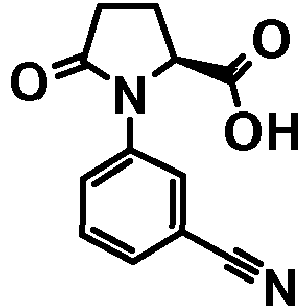
(S)-1-(3-cyano-phenyl)-5-oxo-pyrrolidine-2-carboxylic acid 231 
(S)-1-(4-methanesulfonyl-phenyl)-5-oxo-pyrrolidine-2-carboxylic acid 284 
(S)-1-(4-methoxycarbonyl-phenyl)-5-oxo-pyrrolidine-2-carboxylic acid 264 
(S)-1-(3-methoxycarbonyl-phenyl)-5-oxo-pyrrolidine-2-carboxylic acid 264 
(S)-1-[4-(tert-butoxycarbonyl-methyl-amino)-phenyl]-5-oxo-pyrrolidine-2-carboxylic acid 335 
(S)-5-Oxo-1-(4-trifluoromethyl-phenyl)-pyrrolidine-2-carboxylic acid 274 
(S)-1-(2,4-Difluoro-phenyl)-5-oxo-pyrrolidine-2-carboxylic acid 242 
(S)-1-(5-Chloro-thiophen-2-yl)-5-oxo-pyrrolidine-2-carboxylic acid 246 
(S)-1-(4-Chloro-2-fluoro-phenyl)-5-oxo-pyrrolidine-2-carboxylic acid 258 
(S)-5-Oxo-1-p-tolyl-pyrrolidine-2-carboxylic acid 220 218 
(S)-1-(4-Ethyl-phenyl)-5-oxo-pyrrolidine-2-carboxylic acid 234 232 
(S)-1-(4-Isopropyl-phenyl)-5-oxo-pyrrolidine-2-carboxylic acid 248 246 
(S)-1-(4-Methoxy-phenyl)-5-oxo-pyrrolidine-2-carboxylic acid 236 234 
(S)-5-Oxo-1-(4-trifluoromethoxy-phenyl)-pyrrolidine-2-carboxylic acid 290 288 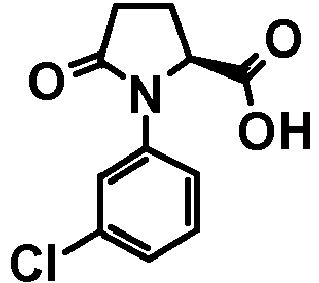
(S)-1-(3-Chloro-phenyl)-5-oxo-pyrrolidine-2-carboxylic acid 240 
(S)-1-(2,3-Difluoro-phenyl)-5-oxo-pyrrolidine-2-carboxylic acid 242 
(S)-1-(3,4-Dichloro-phenyl)-5-oxo-pyrrolidine-2-carboxylic acid 274 
(S)-1-(3-Chloro-4-fluoro-phenyl)-5-oxo-pyrrolidine-2-carboxylic acid 258 
(S)-1-(3,5-Difluoro-phenyl)-5-oxo-pyrrolidine-2-carboxylic acid 242 
(S)-1-(3-Fluoro-4-methyl-phenyl)-5-oxo-pyrrolidine-2-carboxylic acid 238 
(S)-1-(3-Fluoro-phenyl)-5-oxo-pyrrolidine-2-carboxylic acid 224 
(S)-5-Oxo-1-(4-vinyl-phenyl)-pyrrolidine-2-carboxylic acid 232 
(S)-1-(4-Chloro-3-fluoro-phenyl)-5-oxo-pyrrolidine-2-carboxylic acid 258 
(S)-1-(4-Chloro-3-methyl-phenyl)-5-oxo-pyrrolidine-2-carboxylic acid 254 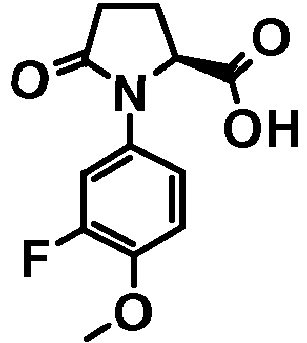
(S)-1-(3-Fluoro-4-methoxy-phenyl)-5-oxo-pyrrolidine-2-carboxylic acid 254 
(S)-1-(4-Cyano-3-fluoro-phenyl)-5-oxo-pyrrolidine-2-carboxylic acid 249 
(S)-1-(3-Chloro-4-methyl-phenyl)-5-oxo-pyrrolidine-2-carboxylic acid 254 
(S)-1-(4-Difluoromethyl-phenyl)-5-oxo-pyrrolidine-2-carboxylic acid n/a 
(S)-1-(3,4-Difluoro-phenyl)-5-oxo-pyrrolidine-2-carboxylic acid 242 
(S)-1-(4-Fluoro-3-methyl-phenyl)-5-oxo-pyrrolidine-2-carboxylic acid 238 
(S)-5-Oxo-1-(3,4,5-trifluoro-phenyl)-pyrrolidine-2-carboxylic acid 260 
(S)-1-(4-Methoxymethyl-phenyl)-5-oxo-pyrrolidine-2-carboxylic acid 250 
(S)-1-(4-Fluoromethyl-phenyl)-5-oxo-pyrrolidine-2-carboxylic acid 238 - Title compound is prepared using a similar procedure to Example 1 coupling method D. ESI m/z 362 [M+H]+
- Compounds in Table III Method 6 are prepared in a similar manner using coupling method G.
- Compounds in Table III Method 7 are prepared in a similar manner using coupling method A.
- Compounds in Table III Method 17 are prepared in a similar manner using coupling method I.
-

- A pressure flask is charged with (S)-(-)-2-pyrrolidone-5-carboxylic acid (25 g, 193.6 mmol) and dichloromethane (100 mL) and the stirred suspension is cooled in a dry ice acetone bath. Liquid 2-methylpropene (150 mL) is added followed by concentrated sulfuric acid (0.5 mL). The pressure flask is sealed and the reaction mixture is stirred at room temperature for 48 h. The pressure flask is cooled in a dry acetone bath and the reaction mixture is diluted with dichloromethane (500 mL) and treated with a saturated solution of sodium bicarbonate until the effervescence is ceased. The organic layer is separated, washed with saturated solution of sodium bicarbonate (300 mL), brine (300 mL), dried over anhydrous Na2SO4 and solvent removed in vacuo to give the title compound as a white crystalline solid. The crude material is used without purification.
- To a stirred solution of (S)-5-oxo-pyrrolidine-2-carboxylic acid tert-butyl ester (1.85 g, 10 mmol) in dimethylsulfoxide (10 mL) at room temperature, sodium hydride (440 mg of 60% dispersion in mineral oil, 11 mmol) is added in portions over a period of 20 min. After 30 min, 4-fluoronitrobenzene (1.06 mL, 10 mmol) is added and the mixture is heated by placing in an oil-bath maintained at 80 °C for 4 h. The reaction mixture is allowed to cool to room temperature, treated with saturated ammonium chloride solution (150 mL) and extracted with ethyl acetate (250 mL). Organic extracts are combined, washed with brine (100 mL), dried over anhydrous Na2SO4 and solvent removed in vacuo. The crude is purified chromatography over silica gel eluting with hexanes/ethyl acetate and the title compound is obtained as a light yellow solid, ESI m/z 307 [M+H]+.
- Using a similar procedure, the 5-oxo-pyrrolidine-2-carboxylic acid tert-butyl esters listed in Table 6 are synthesized.
Table 6. Structure Name ESI m/z (+) 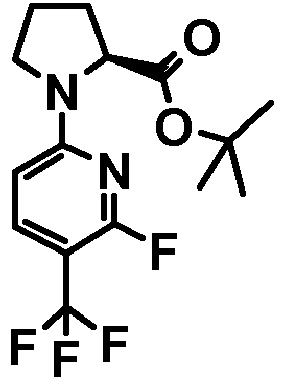
(S)-1-(6-Fluoro-5-trifluoromethyl-pyridin-2-yl)-pyrrolidine-2-carboxylic acid tert-butyl ester n/a 
(S)-1-(5-Chloro-pyridin-2-yl)-pyrrolidine-2-carboxylic acid tert-butyl ester 297 - (S)-1-(4-nitro-phenyl)-5-oxo-pyrrolidine-2-carboxylic acid tert-butyl ester (800 mg, 2.6 mmol) is treated with trifluoroacetic acid (5 mL) at room temperature. After 1 h trifluoroacetic acid is evaporated in vacuo and the concentrate treated with ice/water. Precipitated light brownish solid is filtered washed with water and dried to give the title compound, ESI m/z 251 [M+H]+.
- The title compound, ESI m/z 373 [M+H]+ is prepared utilizing a procedure similar to the one described in Example 16, step 2.
- Compounds found in Table III Method 18 are made using a similar procedure.
-

- To a solution of 3-[(S)-2-(5-tert-butyl-isoxazol-3-ylcarbamoyl)-5-oxo-pyrrolidin-1-yl]-benzoic acid methyl ester (870 mg, 2.23 mmol) in methanol (30 mL) a 2 M solution of sodium hydroxide in water (5 mL, 10 mmol) is added at room temperature. After 18 h solvent is evaporated in vacuo, the concentrate is cooled in an ice-bath and acidified to pH 2 using 1 N sulfuric acid. Precipitated white solid is filtered, washed with water and dried to give the title compound, ESI m/z 372 [M+H]+.
- To a stirred solution of 3-[(S)-2-(5-tert-butyl-isoxazol-3-ylcarbamoyl)-5-oxo-pyrrolidin-1-yl]-benzoic acid (75 mg, 0.2 mmol) in dichloromethane (1 mL) 1-ethyl-3-(3-dimethyllaminopropyl)carbodiimide hydrochloride (EDC hydrochloride) (42 mg, 0.22 mmol) is added at room temperature. After 5 minutes methylamine (0.5 mL of 2 M solution in tetrahydrofuran, 1 mmol) is added. After 2 h solvent is removed in vacuo and the crude is purified by chromatography over silica gel eluting with methanol/dichloromethane to give the title compound as a white solid, ESI m/z 385 [M+H]+.
- Examples listed in Table III Method 19 are prepared according to a similar procedure.
-

- A solution of {4-[(S)-2-(5-tert-butyl-isoxazol-3-ylcarbamoyl)-5-oxo-pyrrolidin-1-yl]-phenyl}-methyl-carbamic acid tert-butyl ester (550 mg, 1.21 mmol) in dichloromethane (5 mL) is cooled in an ice bath. A pre-cooled trifluoroacetic acid (15 mL) is added and the mixture is kept in ice-bath for 30 minutes. Trifluoroacetic acid is evaporated in vacuo, and the residue is treated with ice and sodium bicarbonate solution. Extracted with ethyl acetate (1 X 150 mL) and the combined extracts washed with brine (50 mL) dried over anhydrous Na2SO4 and solvent removed in vacuo to give the title compound, ESI m/z 357 [M+H]+.
- A stirred solution of (S)-1-(4-methylamino-phenyl)-5-oxo-pyrrolidine-2-carboxylic acid (5-tert-butyl-isoxazol-3-yl)-amide (53 mg, 0.15 mmol) and pyridine (30 µL, 0.37 mmol) in dichloromethane (1 mL) is cooled in an ice-bath. Acetyl chloride (20 µL, 0.28 mmol) is added and ice-bath is removed after 30 minutes and the mixture is allowed to stand at room temperature for 2 h. The reaction mixture is diluted with dichloromethane (100 mL), washed with 1 N hydrochloric acid (30 mL), brine (30 mL) and solvent is evaporated in vacuo. The crude is purified by chromatography over silica gel eluting with methanol/dichloromethane to give the title compound, ESI m/z 399 [M+H]+.
- Examples listed in Table III Method 20 are prepared according to a similar procedure.
-

- To a stirred solution of (S)-5-oxo-pyrrolidine-2-carboxylic acid tert-butyl ester (740 mg, 4 mmol) in N, N-dimethylformamide (5 mL) sodium hydride (180 mg of 60% dispersion in mineral oil, 4.5 mmol) is added at room temperature. After 10 minutes, 3-chloro-2-fluoro-5-trifluoromethylpyridine (1 mL, 8 mmol) is added and the suspension stirred at room temperature. After 3 h the reaction mixture is treated with saturated ammonium chloride solution (150 mL), extracted with dichloromethane (2 X 100 mL). Combined extracts washed with brine (2 X 50 mL), water, dried over anhydrous Na2SO4 and solvent removed in vacuo. The crude is purified by chromatography over silica gel eluting with hexanes/ethyl acetate to give the title compound, ESI m/z 365 [M+H]+.
- (S)-1-(3-Chloro-5-trifluoromethyl-pyridin-2-yl)-5-oxo-pyrrolidine-2-carboxylic acid tert-butyl ester (760 mg, 2.1 mmol) is treated with pre-cooled trifluoroacetic acid (5 mL). The clear solution is kept at room temperature for 1 h. Trifluoroacetic acid is evaporated in vacuo and the concentrate is treated with ice/water. Precipitated white solid is filtered, washed with water to give the title compound, ESI m/z 309 [M+H]+.
- The title compound, ESI m/z 431 [M+H]+ is prepared utilizing a procedure similar to the one described in Example 16, step 2.
- Examples listed in Table III Method 21 are prepared according to a similar procedure.
-

- A solution of cesium carbonate (1.539g; 4.725 mmol), copper bromide (0.032g; 0.225 mmol) and ethyl-2-oxocyclohexanecarboxylate (0.072; 0.45 mmol) in anhydrous dimethyl sulfoxide (1.25mL) is degassed with argon and stirred 30 minutes. To this solution is added (S)-5-oxo-pyrrolidine-2-carboxylic acid tert-butyl ester (0.5g; 2.699 mmol) and 5-bromo-2-trifluoromethylpyridine (0.508g; 2.25 mmol) in 1mL anhydrous dimethyl sulfoxide. The mixture is heated in a sealed tube to 60°C in an oil bath and stirred overnight. The reaction mixture is cooled to room temperature, filtered through Celite® and washed with ethyl acetate. The combined organics are washed with brine, dried over sodium sulfate and concentrated under reduced pressure. ESI m/z 331 [M+H]+
- Coupling method A is used. ESI m/z 331 [M+H]+
- Compounds in Table III Method 36 are made using a similar procedure.
-

- Experimental sequence same as Example 17 except coupling method A is used. ESI m/z 415 [M+H]+
- Compounds in Table III Method 37 are made using a similar procedure.
-

- (S)-5-Oxo-1-(4-trifluoromethyl-phenyl)-pyrrolidine-2-carboxylic acid {3-[1,1-dimethyl-2-(tetrahydro-pyran-2-yloxy)-ethyl]-isoxazol-5-yl}-amide is synthesized in a similar manner as Example 16, Method 7. (S)-5-Oxo-1-(4-trifluoromethyl-phenyl)-pyrrolidine-2-carboxylic acid {3-[1,1-dimethyl-2-(tetrahydro-pyran-2-yloxy)-ethyl]-isoxazol-5-yl}-amide (0.546g; 1.103 mmol) is dissolved in 2mL ethanol and pypridinium p-toluenesulfonate (0.055g; 0.221 mmol) is added. The mixture is heated at 55°C for 4h and then concentrated and purified by reverse phase HPLC to afford title compound. ESI m/z 412 [M+H]+
- Compounds in Table III Method 38 are made using a similar procedure.
-

- 1-(4-Methoxymethyl-phenyl)-5-oxo-pyrrolidine-2-carboxylic acid (5-tert-butyl-isoxazol-3-yl)-amide (0.130g; 0.350 mmol) is diluted with ethanethiol (1.988 mL; 26.880 mmol) and cooled to 0°C. To this solution is added aluminum trichloride (0.793g; 5.950 mmol). The solution is stirred for 3 hours, slowly warming to room temperature. The solution is added dropwise to a solution of water containing concentrated hydrochloric acid. The aqueous is extracted with ethyl acetate. The organics are combined and washed with brine, dried over sodium sulfate, filtered and concentrated. Purification by preparative HPLC afforded title compound. ESI m/z 358 [M+H]+
- Compounds in Table III Method 39 are made using a similar procedure.
-

- 5-Oxo-1-(4-trifluoromethyl-phenyl)-pyrrolidine-2-carboxylic acid [5-(2-methoxy-1,1-dimethylethyl)-isoxazol-3-yl]-amide (0.025g; 0.059 mmol) and sodium iodide (0.088g; 0.590 mmol) are diluted with dichloromethane (1mL) and acetonitrile (2mL; 0.059 mmol) and the solution is cooled to 0°C. Aluminum trichloride (0.079g; 0.590 mmol) is added and the solution stirred for 3 hours, slowly warming to room temperature. The mixture is diluted with water and extracted with dichloromethane. The organics are combined and washed with aqueous sodium thiosulfate. The organics are concentrated and purifed by reverse phase HPLC to afford title compound. ESI m/z 412 [M+H]+
- Compounds in Table III Method 40 are made using a similar procedure.
-

- To a pressure tube containing (S)-5-oxo-pyrrolidine-2-carboxylic acid tert-butyl ester (0.5g, 2.699mmol), 2-bromo-5-fluoropyridine (0.57g, 3.239 mmol), cesium carbonate (1.231g, 3.779mmol), Xantphos (0.156g, 0.27mmol), and tris (dibenzylideneacetone)palladium (0) (0.247g, 0.27mmol) is added 13.5 mL degassed anhydrous 1,4-dioxane. The mixture is heated at 120°C under an atmosphere of Argon overnight. The solution is cooled to room temperature, filtered through Celite®, and concentrated under reduced pressure. The crude material is purified by flash chromatography eluting product with 305 ethyl acetate/heptanes. The product fractions are pooled and concentrated under reduced pressure to afford 45mg of title compound.
Yield 6%. ESI m/z 225=MH+ - Conditions are similar to those used for Example 20 Step 2. ESI m/z 225=MH+
- Conditions used are similar to those used in Example 1, Coupling method A to afford 2mg of title compound. Yield 3%. ESI m/z 347=MH+
- Compounds in Table III Method 42 are made using a similar procedure.
-

- To solution of the (S)-5-oxo-pyrrolidine-2-carboxylic acid (6g, 46.47mmol) in tetrahydrofuran (50mL) is added thionyl chloride (6.75ml, 92.94mmol) and stirred at room temperature for 2-3 hours. The solvent is removed under reduced pressure and the residue is dissolved in tetrahydrofuran (20mL) and added dropwise to a solution of 3-tert-butyl-isoxazol-5-ylamine (6.514g, 46.47mmol) and diisopropylamine (24.28ml, 139.41mmol) in tetrahydrofuran (50mL) at room temperature. The reaction is stirred overnight at room temperature then diluted with dichloromethane and washed sequentially with water and saturated brine solution. The organics are dried over sodium sulfate, filtered and solvents removed under vacuum. The crude residue is purified by flash column chromatography eluting with 5-10% methanol/dichloromethane. The product rich fractions are pooled and evaporated to afford 3.02g title compound, 32.7% yield. ESI m/z 252=MH+.
- Conditions used are similar to Example 39, Step 1. Yield 8%. ESI m/z 364=MH+ Compounds in Table III Method 43 are made using a similar procedure.
-

- Conditions used are similar to Example 40, Step 1.
- (S)-5-Oxo-pyrrolidine-2-carboxylic acid (3-tert-butyl-isoxazol-5-yl)-amide (300mg, 1.19mmol), tris(dibenzylideneacteone)dipalladium (0) (32.80mg, 0.036mmol), Xantphos ®(62.20mg, 0.011mmol), caesium carbonate (654.16mg, 2.01mmol) and 6-bromo-3-fluoro-2-methylpyridine (226.90, 1.20mmol) are charged to a vessel, diluted with dioxane (anhydrous, 3ml) and heated to 100 °C overnight. On completion, the reaction is diluted with ethyl acetate and partitioned between water. The organic phase is separated, dried over sodium sulphate and the solvents removed under vacuum. The crude residue is purified by flash column chromatography eluting with a gradient solution of heptane/ethyl acetate 0-50% to isolate 117mg of title compound as a white solid, yield 27%. ESI m/z 361=MH+
- Compounds found in Table III Method 44 are prepared in this manner.
-

- To a solution of hydroxypivalic acid methyl ester (4 mL, 31.36 mmol) in dichloromethane (20 mL) is added 3,4-dihydro-2H-pyran (5.84 mL, 63.99 mmol). The reaction mixture is cooled to 0 oC and sulfuric acid on silica gel (125 mg, 0.2 mL sulfuric acid/10 g silica gel) is added and the reaction mixture is stirred at room temperature for 25 minutes. After this time, the reaction mixture is filtered through a glass funnel and concentrated under reduced pressure to yield the title compound. It is used without purification.
- A solution of 2,2-dimethyl-3-(tetrahydro-pyran-2-yloxy)-propionic acid methyl ester (7.67 g, 35.46 mmol) and acetonitrile (2.6 mL, 49.65 mmol) in toluene (20 mL) is added dropwise to the refluxing suspension of 60 % sodium hydride in mineral oil (1.99 g, 49.65 mmol) in toluene (40 mL). After the addition, the reaction mixture is stirred at reflux for 3 hours. After this time, the reaction mixture is cooled to room temperature and the aqueous layer is neutralized to PH ~ 6-7 by adding 1N hydrochloric acid aqueous solution. The layers are combined and the aqueous layer is extracted with ethyl acetate. The organic layers are combined and washed with brine, dried (Na2SO4), filtered and concentrated under reduced pressure to yield the title compound. It is used without purification.
- Hydroxyamine sulfate (0.729 g, 4.439 mmol) is added to a stirred solution of 4,4-dimethyl-3-oxo-5-(tetrahydro-pyran-2-yloxy)-pentanenitrile (2 g, 8.878 mmol) and sodium hydroxide (0.764 g, 19.1 mmol) in water (20 mL). The reaction mixture is stirred at reflux for 18 hours. After this time, the reaction mixture is cooled to room temperature and extracted with ethyl acetate. The organic layers are combined and washed with brine, dried (Na2SO4), filtered and concentrated to yield the title compound, m/z 157 [M+H+-84]. 1H NMR (400 MHz, DMSO-d) δ ppm 1.17 (6H, d), 1.45 (4H, br), 1.58 (1H, br), 1.68 (1H, br), 3.26 (1H, d), 3.4 (1H, br), 3.59 (1H, d), 3.68 (1H, br), 4.5 (1H, br), 4.88 (1H, s), 6.43 (2H, s).
-

- Powdered potassium hydroxide (3.519 g, 62.712 mmol) is stirred in DMSO (30 mL) for 5 minutes before adding hydroxypivalic acid methyl eater (2 mL, 15.678 mmol) and methyl iodide (3.904 mL, 62.712 mmol). The reaction mixture is stirred at room temperature for 30 minutes. The mixture is quenched with water and extracted with dichloromethane 3 times. The organics are combined and washed with water twice then brine, dried over Na2SO4, filtered and concentrated in vacuo to provide the title compound.
- 60% sodium hydride in mineral oil (667.2mg, 16.68mmol) in toluene (15 mL) is heated to reflux. A solution of 3-methoxy-2,2-dimethyl-propionic acid methyl ester (1.742 g, 11.916 mmol) and acetonitrile (0.878 mL, 16.68 mmol) in toluene (5 mL) is added dropwise through an additional funnel into the NaH suspension in toluene. After the addition, the reaction is stirred at reflux for 3 hours. After cooling, the reaction mixture is neutralized to PH ~7 by adding 1N HCl aqueous solution. The mixture is extracted with ethyl acetate 3 times. The organics are combined and washed with brine, dried over Na2SO4, filtered and concentrated in vacuo to afford the title compound.
- A solution of hydroxylamine sulfate (976 mg, 5.947 mmol) in water (4 mL) is added to a stirred solution of 5-methoxy-4,4-dimethyl-3-oxo-pentanenitrile (1.678 g, 10.812 mmol) and sodium hydroxide (490.3 mg, 11.89 mmol) in water (13 mL). The reaction mixture is heated to reflux over 30 minutes and kept at reflux for 1 hour. After cooling, 37% HCl aqueous solution (0.8 mL, 9.73 mmol) is added and the mixture is heated to reflux for 20 minutes. After cooling, the mixture's pH is adjusted to ∼ 12 by adding 40% sodium hydroxide aqueous solution. The mixture is extracted with methylene chloride 3 times. The organics are combined and washed with brine, dried over Na2SO4, filtered and concentrated in vacuo. Purification by flash chromatography on silica gel using methanol/methylene chloride provides the title compound, m/z 171 [M+H+].
-

- Hydroxyamine sulfate (1.56 g, 9.504 mmol) is added to a stirred solution of 5-methoxy-4,4-dimethyl-3-oxo-pentanenitrile (2.95 g, 19.008 mmol) and sodium hydroxide (1.635 g, 40.865 mmol) in water (40 mL). The reaction mixture is heated in 100°C oil bath for 6 hours. After this time, the reaction mixture is diluted with water and extracted with ethyl acetate 3 times. The organics are combined and washed with brine, dried over Na2SO4, filtered and concentrated in vacuo. Purification by flash chromatography on silica gel using methanol/methylene chloride provides the title compound, m/z 171 [M+H+].
-

- Reference: BOMC 2001, 9, 3231-3241.
- Sodium hypochlorite (45mL, 0.705M, 48.2mmol) is added to a solution of 4-methoxy-benzamid-ine hydrochloride (9g, 48.2mmol) in 90 mL of water at 0°C. The mixture is stirred for 2h at 0°C then extracted with methylene chloride. The combined organics are dried over sodium sulfate, filtered and concentrated under reduced pressure to afford 5.5g of title compound. ESI m/z 185=MH+
- 4-Methoxy-benzchloroamidine (5.5g, 29.7mmol) is dissolved in 100mL of methanol and cooled to 0°C. Potassium thiocyanate (5.7g, 59.5mmol) is added portion wise and the mixture allowed to warm to room temperature and stir overnight. The mixture is concentrated under reduced pressure, dissolved with water and extracted with ethyl acetate. The combined organics are dried over sodium sulfate, filtered and concentrated to afford 4.3g of title compound. 70% yield, ESI m/z 208=MH+.
-

- To a refluxed solution of sodium hydride (33.18g, 553.03mmol) in 275mL of cyclohexane is added a mixture of 2,2-dimethyl-propionic acid ethyl ester (30g, 230.43mmol) in 79 mL acetonitrile (553.03mmol) in 25 mL of cyclohexane. The mixture is maintained at 80°C overnight. The mixture is cooled to room temperature, diluted with water and extracted with ethyl acetate. The combined organics are washed with water, dried over sodium sulfate, filtered and concentrated to afford title compound which was used crude in subsequent reaction. ESI m/z 124=MH-
- To a solution of 4,4-dimethyl-3-oxo-pentanenitrile (22g, 175.76mmol) in 250mL of ethanol is added ammonium nitrate (21g; 263.64mmol). The mixture is stirred under reflux overnight while ammonia gas is bubbled through the solution. The mixture is cooled to room temperature and diluted with 100mL of water. The mixture is concentrated under reduced pressure to remove most of the ethanol. Aqueous sodium hydroxide (140mL, 0.3N) is added and the mixture is extracted with ether (2x200mL). The combined organic layers are washed with 50mL of water, dried over sodium sulfate, filtered and concentrated under reduced pressure to afford title compound. Assumed quantitative yield and used crude in subsequent reaction. ESI m/z 125=MH+
- (Z)-3-amino-4,4-dimethyl-pent-2-enenitrile (26g, 209.35mmol), sodium sulfide decahydrate (5.71g, 73.27 mmol) and tetrabutyl ammonium chloride (9.31g, 33.49 mmol) in benzene and water (215 mL, 2.5:1, v/v) is stirred at 75°C under hydrogen sulfide gas for three days. 200 mL of ethyl acetate is is added and the layers separated. The organic layer is washed with water, dried over sodium sulfate, filtered and concentrated under reduced pressure to afford the title compound. Yield 23% over three steps. ESI m/z 159=MH+
- To a stirred solution of (Z)-3-amino-4,4-dimethyl-pent-2-enethioic acid amide (8.3g, 525 mmol) and potassium carbonate (14.4g, 105mmol) in 140 mL of diethyl ether is added a solution of iodine (13.2g, 52.5 mmol) in 20mL of diethyl ether at reflux. The mixture is refluxed for 2h and cooled. Water is added and the layers separated. The organic layer is washed with water, dried over sodium sulfate, filtered and concentrated under reduced pressure. The crude mixture is purified by flash chromatography to afford title compound in 53% yield. ESI m/z 157=MH+
-

- Phosphorous oxychloride (7.013mL, 76.610mmol) is added to 2-hydroxy-5-chloropyrimidine (2g, 15.322mmol) and the mixture is heated at reflux for 30 minutes. The crude mixture is concentrated under reduced pressure to afford 1.120g of title compound. ESI m/z 149=MH+
-

- To a solution of (4-bromo-phenyl)-methanol (1g, 5.347mmol) in 2 mL of dichloromethane is added [bis(2-methoxyethyl)amino]sulfurtrifluoride (1.084mL, 5.882 mmol) at 0°C. The reaction is slowly warmed to room temperature over 3 hours after which it is quenched with aqueous saturated sodium bicarbonate solution. The organic phase is separated from aqueous and dried over sodium sulfate, filtered and concentrated under reduced pressure to afford 990mg of yellow oil which is used without characterization or purification.
- A flask is charged with 1-bromo-4-fluoromethyl-benzene (0.280g, 1.481mmol), bis(pinacolato)diboron (0.752g, 2.962mmol), potassium acetate (0.436g, 4.443mmol), 1,1'-bis(diphenylphosphino)ferrocene palladium (II) chloride complex with dichloromethane (0.121g, 0.148mmol) and 15 mL of degassed anhydrous 1.4-dioxane is added. The mixture is stirred under an atmosphere of Argon at 90°C for 18 hours. The mixture is cooled to room temperature, filtered and partitioned between ethyl acetate and 5% aqueous sodium chloride solution. The aqueous phase is extracted with ethyl acetate and the combined organics washed with brine, dried over magnesium sulfate, filtered and concentrated under reduced pressure. The crude material is purified by flash chromatography eluting with ethyl acetate/heptanes to afford 270mg of title compound. 1H NMR (400 MHz, CHLOROFORM-d) δ ppm 1.23 (12H, s), 5.34 (1H, s), 5.45 (1H, s), 7.21 (2H, d, J=7.43Hz), 7.71 (2H, d, J=8.78Hz)
-

- Following a procedure adapted from Synthesis, 1973, 787, a mixture of 4-bromobenzaldehyde (0.4g, 2.162 mmol) and diethylaminosulfure trifluoride (0.283mL, 2.162 mmol) is heated carefully until incipient exothermic reactions and then at 60°C for 15 minutes. The mixture is dissolved in dichloromethane and poured into ice water. The product is extracted using dichloroethane, dried over sodium sulfate, filtered and concentrated under reduced pressure to afford 0.380g of title compound product, 85% yield. 1H NMR (400 MHz, CHLOROFORM-d) δ ppm 6.61 (1H, t, J=56.7Hz), 7.38 (2H, d, J=8.1Hz), 7.6 (2H, d, J=9.4Hz).
- Compound is prepared in a similar manner to 2-(4-fluoromethyl-phenyl)-4,4,5,5-tetramethyl-1,3,2-dioxaborolane above to afford 0.44 g of title compound, 94% yield. ESI m/z 255=MH+
- The biological properties of the compounds of the invention were assessed using the assays described below.
- CB2 membranes were purchased and made from HEK293 EBNA cells stably transfected with human CB2 receptor cDNA (Perkin Elmer Life and Analytical Sciences). CB1 membranes were isolated from HEK cells stably co-transfected with human CB1 receptor and Gα16 cDNA's.
- The membrane preparation was bound to scintillation beads (Ysi-Poly-L-lysine SPA beads, GE Healthcare) for 4 hours at room temperature in assay buffer containing 50mM Tris, pH 7.5, 2.5mM EDTA, 5mM MgCl2, 0.8% fatty acid free Bovine Serum Albumin. Unbound membrane was removed by washing in assay buffer. Membrane-bead mixture was added to 96-well assay plates in the amounts of 15ug membrane per well (CB2) or 2.5ug per well (CB1) and 1mg SPA bead per well. Compounds were added to the membrane-bead mixture in dose-response concentrations ranging from 1x 10⁻⁵ M to 1x10⁻¹⁰ M with 0.25% DMSO, final. The competition reaction was initiated with the addition of 3H-CP55940 (Perkin Elmer Life and Analytical Sciences) at a final concentration of 1.5nM (CB2) or 2.5nM (CB1). The reaction was incubated at room temperature for 18hours and read on TopCount NXT plate reader. Total and non-specific binding was determined in the absence and presence of 1.25uM Win 55212 (Sigma). IC50 values for each compound were calculated as the concentration of compound that inhibits the specific binding of the radioactively labeled ligand to the receptor by 50% using the XLFit 4.1 four parameter logistic model. IC50 values were converted to inhibition constant (Ki) values using Cheng-Prusoff equation.
- Compounds of the invention were evaluated for their CB2 agonist or inverse agonistic activity in accordance with the following experimental method. Compounds which were shown to bind to CB2 by the binding assay described above but which were not shown to exhibit CB2R-mediated modulation of cAMP synthesis by this assay were presumed to be CB2 antagonists.
- CHO cells expressing human CB2R (Euroscreen) were plated at a density of 5000 cells per well in 384 well plates and incubated overnight at 37°C. After removing the media, the cells were treated with test compounds diluted in stimulation buffer containing 1mM IBMX, 0.25% BSA and 10uM Forskolin. The assay was incubated for 30 minutes at 37°C. Cells were lysed and the cAMP concentration was measured using DiscoverX -XS cAMP kit, following the manufacturer's protocol. In this setting, agonists will decrease forskolin induced production of cAMP while inverse agonists will further increase forskolin induced production of cAMP. EC50 of agonists were calculated as follows. The maximal amount of cAMP produced by forskolin compared to the level of cAMP inhibited by 1uM CP55940 is defined as 100%. The EC50 value of each test compound was determined as the concentration at which 50% of the forskolin-stimulated cAMP synthesis was inhibited. Data was analyzed using a four-parameter logistic model. (Model 205 of XLfit 4.0).
- Compounds of the invention were evaluated for their CB1 agonist or inverse agonistic activity in accordance with the following experimental method. Compounds which were shown to bind to CB1 by the binding assay described above but which were not shown to exhibit CB1R-mediated modulation of cAMP synthesis by this assay were presumed to be CB1 antagonists.
- CHO cells expressing human CB1R (Euroscreen) were plated at a density of 5000 cells per well in 384 well plates and incubated overnight at 37°C. After removing the media, the cells were treated with test compounds diluted in stimulation buffer containing 1mM IBMX, 0.25% BSA and 10uM Forskolin. The assay was incubated for 30 minutes at 37°C. Cells were lysed and the cAMP concentration was measured using DiscoverX -XS cAMP kit, following the manufacturer's protocol. In this setting, agonists will decrease forskolin induced production of cAMP while inverse agonists will further increase forskolin induced production of cAMP. EC50 of agonists were calculated as follows. The maximal amount of cAMP produced by forskolin compared to the level of cAMP inhibited by 1uM CP55940 is defined as 100%. The EC50 value of each test compound was determined as the concentration at which 50% of the forskolin-stimulated cAMP synthesis was inhibited. Data was analyzed using a four-parameter logistic model. (Model 205 of XLfit 4.0).
- Through the use of the above described assays compounds were found to exhibit agonistic activity and thus to be particularly well suited for the treatment of pain as well as for the treatment of inflammation. Preferred CB2 agonists will have CB2 CAMP @ EC50 nM of less than 500nM.
- As can be demonstrated by the assays described above, the compounds of the invention are useful in modulating the CB2 receptor function. By virtue of this fact, these compounds have therapeutic use in treating disease-states and conditions mediated by the CB2 receptor function or that would benefit from modulation of the CB2 receptor function.
- As the compounds of the invention modulate the CB2 receptor function, they have very useful anti-inflammatory and immune-suppressive activity and they can be used in patients as drugs, particularly in the form of pharmaceutical compositions as set forth below, for the treatment of disease-states and conditions.
- As noted before, those compounds which are CB2 agonists can also be employed for the treatment of pain.
- The agonist compounds according to the invention can be used in patients as drugs for the treatment of the following disease-states or indications that are accompanied by inflammatory processes:
- (i) Lung diseases: e.g. asthma, bronchitis, allergic rhinitis, emphysema, adult respiratory distress syndrome (ARDS), pigeon fancier's disease, farmer's lung, chronic obstructive pulmonary disease (COPD), asthma including allergic asthma (atopic or non-atopic) as well as exercise-induced bronchoconstriction, occupational asthma, viral- or bacterial exacerbation of asthma, other non-allergic asthmas and "wheezy-infant syndrome", pneumoconiosis, including aluminosis, anthracosis, asbestosis, chalicosis, ptilosis, siderosis, silicosis, tabacosis and byssinosis;
- (ii) Rheumatic diseases or autoimmune diseases or musculoskeletal diseases: all forms of rheumatic diseases, especially rheumatoid arthritis, acute rheumatic fever, and polymyalgia rheumatica; reactive arthritis; rheumatic soft tissue diseases; inflammatory soft tissue diseases of other genesis; arthritic symptoms in degenerative joint diseases (arthroses); tendinitis, bursitis, osteoarthritis, traumatic arthritis; collagenoses of any genesis, e.g., systemic lupus erythematosus, scleroderma, polymyositis, dermatomyositis, Sjögren syndrome, Still disease, Felty syndrome; and osteoporosis and other bone resorption diseases;
- (iii) Allergic diseases: all forms of allergic reactions, e.g., angioneurotic edema, hay fever, insect bites, allergic reactions to drugs, blood derivatives, contrast agents, etc., anaphylactic shock (anaphylaxis), urticaria, angioneurotic edema, and contact dermatitis;
- (iv) Vascular diseases: panarteritis nodosa, polyarteritis nodosa, periarteritis nodosa, arteritis temporalis, Wegner granulomatosis, giant cell arthritis, atherosclerosis, reperfusion injury and erythema nodosum;
- (v) Dermatological diseases: e.g. dermatitis, psoriasis; sunburn, burns, eczema;
- (vi) Renal diseases: e.g. nephrotic syndrome; and all types of nephritis, e.g., glomerulonephritis; pancreatits;
- (vii) Hepatic diseases: e.g. acute liver cell disintegration; acute hepatitis of various genesis, e.g., viral, toxic, drug-induced; and chronically aggressive and/or chronically intermittent hepatitis;
- (viii) Gastrointestinal diseases: e.g. inflammatory bowel diseases, irritable bowel syndrome, regional enteritis (Crohns disease), colitis ulcerosa; gastritis; aphthous ulcer, celiac disease, regional ileitis, gastroesophageal reflux disease;
- (ix) Neuroprotection: e.g. in the treatment of neurodegeneration following stroke; cardiac arrest; pulmonary bypass; traumatic brain injury; spinal cord injury or the like;
- (x) Eye diseases: allergic keratitis, uveitis, or iritis; conjunctivitis; blepharitis; neuritis nervi optici; choroiditis; glaucoma and sympathetic ophthalmia;
- (xi) Diseases of the ear, nose, and throat (ENT) area: e.g. tinnitus; allergic rhinitis or hay fever; otitis externa; caused by contact eczema, infection, etc.; and otitis media;
- (xii) Neurological diseases: e.g. brain edema, particularly tumor-related brain edema; multiple sclerosis; acute encephalomyelitis; meningitis; acute spinal cord injury; trauma; dementia, particularly degenerative dementia (including senile dementia, Alzheimer's disease; Parkinson's disease and Creutzfeldt-Jacob disease; Huntington's chorea, Pick's disease; motor neuron disease), vascular dementia (including multi-infarct dementia) as well as dementia associated with intracranial space occupying lesions; infections and related conditions (including HIV infection); Guillain-Barre syndrome; myasthenia gravis, stroke; and various forms of seizures, e.g., nodding spasms;
- (xiii) Blood diseases: acquired hemolytic anemia; aplastic anemia, and idiopathic thrombocytopenia;
- (xiv) Tumor diseases: acute lymphatic leukemia; Hodgkin's disease, malignant lymphoma; lymphogranulomatoses; lymphosarcoma; solid malignant tumors; extensive metastases,;
- (xv) Endocrine diseases: endocrine ophthalmopathy; endocrine orbitopathia; thyrotoxic crisis; Thyroiditis de Quervain; Hashimoto thyroiditis; Morbus Basedow; granulomatous thyroiditis; struma lymphomatosa; and Graves disease; type I diabetes (insulin-dependent diabetes);
- (xvi) Organ and tissue transplantations and graft-versus-host diseases;
- (xvii) Severe states of shock, e.g., septic shock, anaphylactic shock, and systemic inflammatory response syndrome (SIRS);
- (xviii) Acute pain such as dental pain, perioperative, post-operative pain, traumatic pain, muscle pain, pain in burned skin, sun burn, trigeminal neuralgia, sun burn; spasm of the gastrointestinal tract or uterus, colics;
- (xix) Visceral pain such as pain associated with chronic pelvic pain, pancreatitis, peptic ulcer, interstitial cystitis, renal colic, angina, dysmenorrhoea, menstruation, gynaecological pain, irritable bowel syndrome (IBS), non-ulcer dyspepsia, non-cardiac chest pain, myocardial ischemia;
- (xx) Neuropathic pain such as low back pain, non-herpetic neuralgia, post herpetic neuralgia, diabetic neuropathy, nerve injury, acquired immune deficiency syndrome (AIDS) related neuropathic pain, head trauma, painful traumatic mononeuropathy, toxin and chemotherapy induced pain, phantom limb pain, painful polyneuropathy, thalamic pain syndrome, post-stroke pain, central nervous system injury, post surgical pain, stump pain, repetitive motion pain, pain induced by post mastectomy syndrome, multiple sclerosis, root avulsions, postthoracotomy syndrome, neuropathic pain associated hyperalgesia and allodynia.
- (xxi) Inflammatory/nociceptive pain induced by or associated with disorders such as osteoarthritis, rheumatoid arthritis, rheumatic disease, teno-synovitis, gout, vulvodynia, myofascial pain (muscular injury, fibromyalgia), tendonitis, osteoarthritis, juvenile arthritis, spondylitis, gouty arthritis, psoriatic arthritis, muscoskeletal pain, fibromyalgia, sprains and strains, sympathetically maintained pain, myositis, pain associated with migraine, toothache, influenza and other viral infections such as the common cold, rheumatic fever, systemic lupus erythematosus;
- (xxii) Cancer pain induced by or associated with tumors such as lymphatic leukemia; Hodgkin's disease, malignant lymphoma; lymphogranulomatoses; lymphosarcoma; solid malignant tumors; extensive metastases;
- (xxiii) Headache such as cluster headache, migraine with and without aura, tension type headache, headache with different origins, headache disorders including prophylactic and acute use;
- (xxiv) various other disease-states or conditions including, restenosis following percutaneous transluminal coronary angioplasty, acute and chronic pain, atherosclerosis, reperfusion injury, congestive heart failure, myocardial infarction, thermal injury, multiple organ injury secondary to trauma, necrotizing enterocolitis and syndromes associated with hemodialysis, leukopheresis, and granulocyte transfusion, sarcoidosis, gingivitis, pyrexia. edema resulting from trauma associated with bums, sprains or fracture, cerebral oedema and angioedema, Diabetes such as diabetic vasculopathy, diabetic neuropathy, diabetic retinopathy, post capillary resistance or diabetic symptoms associated with insulitis (e.g. hypergiycemia, diuresis, proteinuria and increased nitrite and kallikrein urinary excretion).
- Other indications include: epilepsy, septic shock e.g. as antihypovolemic and/or antihypotensive agents, cancer, sepsis, osteoporosis, benign prostatic hyperplasia and hyperactive bladder, pruritis, vitiligo, general gastrointestinal disorders, disturbances of visceral motility at respiratory, genitourinary, gastrointestinal or vascular regions, wounds, burns, tissue damage and postoperative fever, syndromes associated with itching.
- Besides being useful for human treatment, these compounds are also useful for veterinary treatment of companion animals, exotic animals and farm animals, including mammals, rodents, and the like.
- For treatment of the above-described diseases and conditions, a therapeutically effective dose will generally be in the range from about 0.01 mg to about 100 mg/kg of body weight per dosage of a compound of the invention; preferably, from about 0.1 mg to about 20 mg/kg of body weight per dosage. For example, for administration to a 70 kg person, the dosage range would be from about 0.7 mg to about 7000 mg per dosage of a compound of the invention, preferably from about 7.0 mg to about 1400 mg per dosage. Some degree of routine dose optimization may be required to determine an optimal dosing level and pattern. The active ingredient may be administered from 1 to 6 times a day.
- When used as pharmaceuticals, the compounds of the invention are typically administered in the form of a pharmaceutical composition. Such compositions can be prepared using procedures well known in the pharmaceutical art and comprise at least one compound of the invention. The compounds of the invention may also be administered alone or in combination with adjuvants that enhance stability of the compounds of the invention, facilitate administration of pharmaceutical compositions containing them in certain embodiments, provide increased dissolution or dispersion, increased inhibitory activity, provide adjunct therapy, and the like. The compounds according to the invention may be used on their own or in conjunction with other active substances according to the invention, optionally also in conjunction with other pharmacologically active substances. In general, the compounds of this invention are administered in a therapeutically or pharmaceutically effective amount, but may be administered in lower amounts for diagnostic or other purposes.
- Administration of the compounds of the invention, in pure form or in an appropriate pharmaceutical composition, can be carried out using any of the accepted modes of administration of pharmaceutical compositions. Thus, administration can be, for example, orally, buccally (e.g., sublingually), nasally, parenterally, topically, transdermally, vaginally, or rectally, in the form of solid, semi-solid, lyophilized powder, or liquid dosage forms, such as, for example, tablets, suppositories, pills, soft elastic and hard gelatin capsules, powders, solutions, suspensions, or aerosols, or the like, preferably in unit dosage forms suitable for simple administration of precise dosages. The pharmaceutical compositions will generally include a conventional pharmaceutical carrier or excipient and a compound of the invention as the/an active agent, and, in addition, may include other medicinal agents, pharmaceutical agents, carriers, adjuvants, diluents, vehicles, or combinations thereof. Such pharmaceutically acceptable excipients, carriers, or additives as well as methods of making pharmaceutical compositions for various modes or administration are well-known to those of skill in the art. The state of the art is evidenced, e.g., by Remington: The Science and Practice of Pharmacy, 20th Edition, A. Gennaro (ed.), Lippincott Williams & Wilkins, 2000; Handbook of Pharmaceutical Additives, Michael & Irene Ash (eds.), Gower, 1995; Handbook of Pharmaceutical Excipients, A.H. Kibbe (ed.), American Pharmaceutical Ass'n, 2000; H.C. Ansel and N.G. Popovish, Pharmaceutical Dosage Forms and Drug Delivery Systems, 5th ed., Lea and Febiger, 1990; each of which is incorporated herein by reference in their entireties to better describe the state of the art.
- As one of skill in the art would expect, the forms of the compounds of the invention utilized in a particular pharmaceutical formulation will be selected (e.g., salts) that possess suitable physical characteristics (e.g., water solubility) that is required for the formulation to be efficacious.
Claims (9)
- A compound of the formula (I)
 R1 is oxo (=O);X is NH;Ar1 is chosen from phenyl, C3-6 cycloalkyl, benzoxazolyl, benzothiazolyl, benzimidazolyl, dioxanyl, tetrahydrofuranyl, oxazolyl, isoxazolyl, thiazolyl, pyrazolyl, pyrrolyl, imidazolyl, thienyl, thiadiazolyl, triazolyl, thiomorpholinyl, 1,1-Dioxo-1λ6-thiomorpholinyl, morpholinyl, pyridinyl, pyrimidinyl, pyridazinyl, pyrazinyl, triazinyl, pyrrolidinyl, piperidinyl, piperazinyl, purinyl, quinolinyl, Dihydro-2H-quinolinyl, isoquinolinyl, quinazolinyl, indazolyl, indolyl, isoindolyl, benzofuranyl, benzopyranyl and benzodioxolyl each optionally substituted by 1-3 C1-6alkyl, C1-6alkoxy, CN, halogen, NO2, -S(O)2-C1-3 alkyl, -CO2-C1-4 alkyl, -NH(C1-3 alkyl)-CO2-C1-4 alkyl, -C(O)-NH(C1-3 alkyl), -C(O)-N(C1-3 alkyl)2, -NH(C1-3 alkyl), -N(C1-3 alkyl)-C(O)-C1-4 alkyl, -N(C1-3 alkyl)-S(O)2-C1-3 alkyl, morpholinyl or piperazinyl;Ar2 is chosen from cyclohexyl, cyclohexenyl, phenyl, benzoxazolyl, benzothiazolyl, benzimidazolyl, tetrahydropyranyl, dioxanyl, tetrahydrofuranyl, oxazolyl, isoxazolyl, thiazolyl, pyrazolyl, pyrrolyl, imidazolyl, thienyl, thiadiazolyl, triazolyl, thiomorpholinyl, 1,1-Dioxo-1λ6-thiomorpholinyl, morpholinyl, pyridinyl, pyrimidinyl, pyridazinyl, pyrazinyl, triazinyl, pyrrolidinyl, piperidinyl, piperazinyl, purinyl, quinolinyl, Dihydro-2H-quinolinyl, isoquinolinyl, quinazolinyl, indazolyl, thieno[2,3-d]pyrimidinyl, indolyl, isoindolyl, benzofuranyl, benzopyranyl, benzodioxolyl, [1,2,4]triazolo[1,5-a]pyrimidinyl and furazanyl each optionally substituted by 1-3 C1-6 alkyl, cyclopropyl, cyclohexyl, phenyl, CN, halogen, pyrimidinyl, acetyl or oxo (=O);wherein each Ar1 and Ar2, or the substituents thereof are optionally partially or fully halogenated;L1 is a bond;L2 is a bond or -CH2-CH2- optionally substituted by halogen or C1-3 alkyl;and wherein the stereogenic carbon indicated with an arrow is in the (S) configuration;or a pharmaceutically acceptable salt thereof.
 - The compound according to claim 1 and wherein:Ar1 is chosen from phenyl, thienyl, pyridinyl, pyrimidinyl, pyrazine, triazine, and C3-6 cycloalkyl each optionally substituted by 1-3 C1-6 alkyl, C1-6alkoxy, CN, halogen, NO2, -S(O)2-C1-3 alkyl, -CO2-C1-4 alkyl, -NH(C1-3 alkyl)-CO2-C1-4 alkyl, -C(O)-NH(C1-3 alkyl), -C(O)-N(C1-3 alkyl)2, -NH(C1-3 alkyl), -N(C1-3 alkyl)-C(O)-C1-4 alkyl, -N(C1-3 alkyl)-S(O)2-C1-3 alkyl, morpholinyl or piperazinyl;Ar2 is chosen from cyclohexyl, cyclohexenyl, phenyl, oxazolyl, isoxazolyl, thiadiazolyl, pyrazolyl, triazolyl, thiazolyl, tetrahydropyranyl, piperadinyl, piperazinyl, pyridinyl, benzimidazolyl, benzothiazolyl, benzoxazolyl, [1,2,4]triazolo[1,5-a]pyrimidinyl, furazanyl and 1,1-Di-oxo-1λ6-thiomorpholine each optionally substituted by 1-3 C1-5 alkyl, cyclopropyl, cyclohexyl, phenyl, CN, halogen, pyrimidinyl, acetyl or oxo (=O);L2 is a bond.
- The compound according to claim 2 and wherein:Ar1 is chosen from pyridinyl, phenyl and thienyl each optionally substituted by 1-3 C1-6 alkyl, C1-6alkoxy, CN, halogen, NO2, -S(O)2-C1-3 alkyl, -CO2-C1-4 alkyl, -NH(C1-3 alkyl)-CO2-C1-4 alkyl, -C(O)-NH(C1-3 alkyl), -C(O)-N(C1-3 alkyl)2, -NH(C1-3 alkyl), -N(C1-3 alkyl)-C(O)-C1-4 alkyl or -N(C1-3 alkyl)-S(O)2-C1-3 alkyl;Ar2 is chosen from isoxazolyl optionally substituted by 1-3 C1-5 alkyl and cyclopropyl.
- The compound according to claim 3 and wherein:Ar2 is chosen from

- A compound according to any one of the preceding claims, namely a compound of the formula (III)


Table I or a pharmaceutically acceptable salt thereof.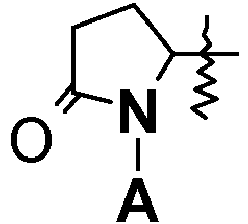

A1 
B1 
A2 
A3 
B3 
A4 
B4 
A5 
B5 
A6 
B6 
A7 
B7 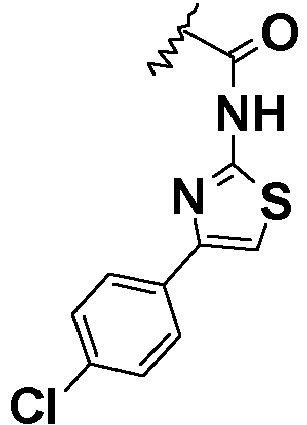
A8 
A9 
B9 
A10 
B10 
A11 
B11 
A12 
B12 
A13 
B13 
A14 
B14 
A15 
B15 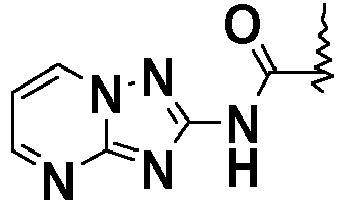
A16 
B16 
A17 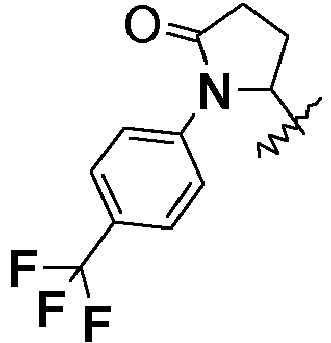
B17 
A18 
B18 
A19 
B19 
A20 
B20 
A21 
A22 
B22 
A23 
B23 
A24 
B24 
A25 
B25 
A26 
B26 
A27 
B27 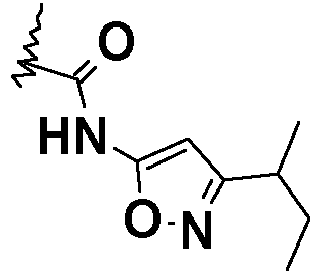
A28 
B28 
A29 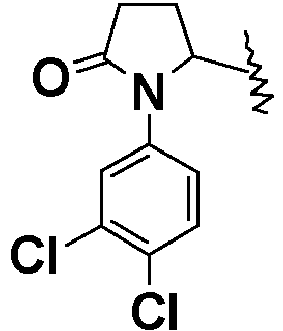
B29 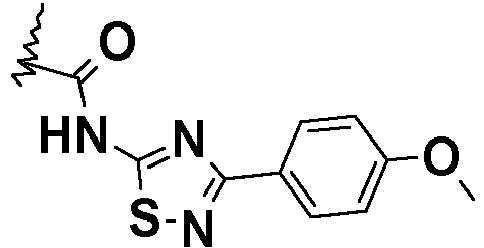
A30 
B30 
A31 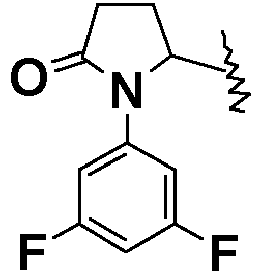
B31 
A32 
B32 
A33 
B33 
A34 
B34 
A35 
B35 
A36 
B36 
A37 
B37 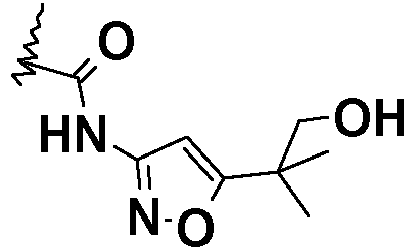
A38 
A39 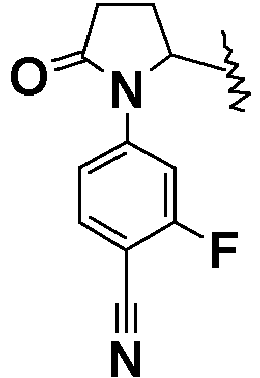
A40 
A41 
A42 
A43 
A44 
A45 
A46 
A47 
A48 
A49 
A50 
A51 
A52 
A53 
A54 
A55 
A56 
- The compound according to claim 11 wherein the stereogenic carbon indicated with an arrow formula (III) is in the (S) configuration.
- A compound according to any one of the preceding claims, namely a compound chosen from


 or a pharmaceutically acceptable salt thereof.
- A pharmaceutical composition comprising a therapeutically effective amount of a compound according to any one of the preceding claims and one or more pharmaceutically acceptable carriers and/or adjuvants.
- A compound according to any one of the claims 1-7 for use in the treatment of a disease or condition chosen from pain, a lung disease, a rheumatic disease, an autoimmune disease, a musculoskeletal disease, an allergic disease, an allergic reaction, a vascular disease, a dermatological disease, a renal disease, a hepatic disease, a gastrointestinal disease, neurodegeneration eye disease, diseases of the ear, nose, and throat, neurological disease blood disease, tumors, endocrine diseases, organ and tissue transplantations and graft-versus-host diseases, severe states of shock, acute pain, visceral pain, spasm of the gastrointestinal tract or uterus, colics, neuropathic pain, inflammatory and nociceptive pain, cancer pain, headache, restenosis, atherosclerosis, reperfusion injury, congestive heart failure, myocardial infarction, thermal injury, multiple organ injury secondary to trauma, necrotizing enterocolitis and syndromes associated with hemodialysis, leukopheresis, and granulocyte transfusion, sarcoidosis, gingivitis and pyrexia.
Applications Claiming Priority (2)
| Application Number | Priority Date | Filing Date | Title |
|---|---|---|---|
| US14241109P | 2009-01-05 | 2009-01-05 | |
| PCT/US2009/067963 WO2010077836A2 (en) | 2009-01-05 | 2009-12-15 | Pyrrolidine compounds which modulate the cb2 receptor |
Publications (2)
| Publication Number | Publication Date |
|---|---|
| EP2384320A2 EP2384320A2 (en) | 2011-11-09 |
| EP2384320B1 true EP2384320B1 (en) | 2015-03-04 |
Family
ID=42133092
Family Applications (1)
| Application Number | Title | Priority Date | Filing Date |
|---|---|---|---|
| EP09775474.1A Active EP2384320B1 (en) | 2009-01-05 | 2009-12-15 | Pyrrolidine compounds which modulate the cb2 receptor |
Country Status (4)
| Country | Link |
|---|---|
| US (1) | US8629157B2 (en) |
| EP (1) | EP2384320B1 (en) |
| JP (1) | JP5583694B2 (en) |
| WO (1) | WO2010077836A2 (en) |
Families Citing this family (41)
| Publication number | Priority date | Publication date | Assignee | Title |
|---|---|---|---|---|
| WO2008014199A2 (en) | 2006-07-28 | 2008-01-31 | Boehringer Ingelheim International Gmbh | Sulfonyl compounds which modulate the cb2 receptor |
| KR20090069318A (en) | 2006-09-25 | 2009-06-30 | 베링거 인겔하임 인터내셔날 게엠베하 | Compounds That Modulate CB2 Receptors |
| WO2008048914A1 (en) | 2006-10-17 | 2008-04-24 | Boehringer Ingelheim International Gmbh | Polycyclic compounds which modulate the cb2 receptor |
| US8173638B2 (en) | 2006-11-21 | 2012-05-08 | Boehringer Ingelheim International Gmbh | Compounds which modulate the CB2 receptor |
| EP2217565B1 (en) | 2007-11-07 | 2013-05-22 | Boehringer Ingelheim International GmbH | Compounds which modulate the cb2 receptor |
| US8957063B2 (en) * | 2008-02-21 | 2015-02-17 | Boehringer Ingelheim International Gmbh | Amine and ether compounds which modulate the CB2 receptor |
| EP2326629B1 (en) | 2008-07-10 | 2013-10-02 | Boehringer Ingelheim International GmbH | Sulfone compounds which modulate the cb2 receptor |
| CA2737645A1 (en) * | 2008-09-25 | 2010-04-01 | Boehringer Ingelheim International Gmbh | Compounds which selectively modulate the cb2 receptor |
| US8629157B2 (en) | 2009-01-05 | 2014-01-14 | Boehringer Ingelheim International Gmbh | Pyrrolidine compounds which modulate the CB2 receptor |
| EP2398771B1 (en) | 2009-02-18 | 2015-07-29 | Boehringer Ingelheim International GmbH | Heterocyclic compounds which modulate the cb2 receptor |
| US8299103B2 (en) | 2009-06-15 | 2012-10-30 | Boehringer Ingelheim International Gmbh | Compounds which selectively modulate the CB2 receptor |
| WO2010147791A1 (en) | 2009-06-16 | 2010-12-23 | Boehringer Ingelheim International Gmbh | Azetidine 2 -carboxamide derivatives which modulate the cb2 receptor |
| EP2480544A1 (en) * | 2009-09-22 | 2012-08-01 | Boehringer Ingelheim International GmbH | Compounds which selectively modulate the cb2 receptor |
| EP2523936A1 (en) | 2010-01-15 | 2012-11-21 | Boehringer Ingelheim International GmbH | Compounds which modulate the cb2 receptor |
| US8329735B2 (en) | 2010-03-05 | 2012-12-11 | Boehringer Ingelheim International Gmbh | Tetrazole compounds which selectively modulate the CB2 receptor |
| WO2012012307A1 (en) | 2010-07-22 | 2012-01-26 | Boehringer Ingelheim International Gmbh | Sulfonyl compounds which modulate the cb2 rece |
| EP2608787B1 (en) | 2010-08-24 | 2019-11-20 | Idorsia Pharmaceuticals Ltd | Proline sulfonamide derivatives as orexin receptor antagonists |
| AU2011312490B2 (en) * | 2010-09-28 | 2015-06-25 | Radius Pharmaceuticals, Inc. | Selective androgen receptor modulators |
| SG11201402985VA (en) | 2011-12-09 | 2014-08-28 | Chiesi Farma Spa | Kinase inhibitors |
| MY167216A (en) | 2011-12-09 | 2018-08-14 | Chiesi Farm Spa | Kinase inhibitors |
| WO2013106646A2 (en) * | 2012-01-12 | 2013-07-18 | Yale University | Compounds and methods for the inhibition of vcb e3 ubiquitin ligase |
| EP2858500A4 (en) | 2012-06-08 | 2016-04-06 | Biogen Ma Inc | INHIBITORS OF BRUTON TYROSINE KINASE |
| EP2803668A1 (en) | 2013-05-17 | 2014-11-19 | Boehringer Ingelheim International Gmbh | Novel (cyano-dimethyl-methyl)-isoxazoles and -[1,3,4]thiadiazoles |
| RU2015151886A (en) | 2013-06-06 | 2017-06-08 | КЬЕЗИ ФАРМАЧЕУТИЧИ С.п.А. | KINAZ INHIBITORS |
| WO2017156071A1 (en) | 2016-03-09 | 2017-09-14 | Blade Therapeutics, Inc. | Cyclic keto-amide compounds as calpain modulators and methods of production and use thereof |
| CN109153644B (en) | 2016-03-16 | 2022-10-21 | H·李·莫菲特癌症中心研究有限公司 | Small molecules against CEREBLON to enhance effector T cell function |
| WO2017223115A1 (en) | 2016-06-22 | 2017-12-28 | Radius Health, Inc. | Ar+ breast cancer treatment methods |
| CR20220661A (en) * | 2016-06-23 | 2023-02-21 | Hoffmann La Roche | [1,2,3]triazolo[4,5-d]pyrimidine derivatives with affinity for the type-2 cannabinoid receptor |
| AU2017292646A1 (en) | 2016-07-05 | 2019-02-07 | Blade Therapeutics, Inc. | Calpain modulators and therapeutic uses thereof |
| US10934261B2 (en) | 2016-09-28 | 2021-03-02 | Blade Therapeutics, Inc. | Calpain modulators and therapeutic uses thereof |
| EP3820532A4 (en) | 2018-07-11 | 2022-04-06 | H. Lee Moffitt Cancer Center & Research Institute, Inc. | DIMER IMMUNOMODULATING COMPOUNDS TARGETING CEREBLON-BASED MECHANISMS |
| EP4010080B1 (en) * | 2019-08-09 | 2023-09-27 | Artios Pharma Limited | Heterocyclic compounds for use in the treatment of cancer |
| TW202120486A (en) * | 2019-08-09 | 2021-06-01 | 英商阿帝歐斯製藥有限公司 | Novel compounds |
| BR112022025037A2 (en) | 2020-06-10 | 2023-02-14 | Aligos Therapeutics Inc | ANTIVIRAL COMPOUNDS TO TREAT CORONAVIRUS, PICORNAVIRUS AND NOROVIRUS INFECTIONS |
| WO2023283256A1 (en) | 2021-07-09 | 2023-01-12 | Aligos Therapeutics, Inc. | Anti-viral compounds |
| US12065428B2 (en) | 2021-09-17 | 2024-08-20 | Aligos Therapeutics, Inc. | Anti-viral compounds |
| WO2023125841A1 (en) * | 2021-12-29 | 2023-07-06 | 武汉人福创新药物研发中心有限公司 | HETEROCYCLIC COMPOUND AS POLθ INHIBITOR, PREPARATION METHOD THEREFOR, AND USE THEREOF |
| AU2023303408A1 (en) | 2022-07-06 | 2024-12-19 | Aligos Therapeutics, Inc. | Anti-viral compounds |
| WO2024191988A1 (en) * | 2023-03-14 | 2024-09-19 | Cyteir Therapeutics, Inc. | 3,4-fused bicyclic pyrrolidine and 3,4-fused bicyclic pyrrolidinone compounds |
| EP4695236A1 (en) * | 2023-04-14 | 2026-02-18 | Soley Therapeutics, Inc. | Substituted phenyl-piperazinyl based modulators for the treatment of disease |
| WO2026054614A1 (en) * | 2024-09-09 | 2026-03-12 | 현대약품 주식회사 | Novel compound and pharmaceutical composition comprising same |
Family Cites Families (31)
| Publication number | Priority date | Publication date | Assignee | Title |
|---|---|---|---|---|
| GB1237126A (en) | 1968-04-10 | 1971-06-30 | Agfa Gevaert Nv | 3-acyl-amino-pyrazolin-5-ones |
| US5371091A (en) | 1992-08-31 | 1994-12-06 | Bristol-Myers Squibb Company | Heteroaromatic amine thrombin inhibitors |
| US6288091B1 (en) | 1995-12-29 | 2001-09-11 | Boehringer Ingelheim Ltd. | Antiherpes virus compounds and methods for their preparation and use |
| NZ331104A (en) | 1995-12-29 | 2000-03-27 | Boehringer Ingelheim Ca Ltd | Phenyl thiazole derivatives that inhibit herpes replication by inhibiting the herpes helicase primase enzyme complex |
| CA2355296A1 (en) * | 1998-12-11 | 2000-06-15 | American Biogenetic Sciences, Inc. | Substituted nitrogen heterocyclic compounds and therapeutic uses thereof |
| HRP20050053A2 (en) | 2002-09-19 | 2005-04-30 | Solvay Pharmaceuticals B.V. | 1 h-1,2,4-triazole-3-carboxamide derivatives as cannabinoid-cb1 receptor ligands |
| US8084451B2 (en) | 2005-01-10 | 2011-12-27 | University Of Connecticut | Heteropyrrole analogs acting on cannabinoid receptors |
| CA2632030A1 (en) | 2005-12-15 | 2007-06-21 | Boehringer Ingelheim International Gmbh | Compounds which modulate the cb2 receptor |
| JP2009536613A (en) | 2006-04-07 | 2009-10-15 | ベーリンガー インゲルハイム インターナショナル ゲゼルシャフト ミット ベシュレンクテル ハフツング | Compounds that modulate the CB2 receptor |
| BRPI0712720A2 (en) | 2006-05-31 | 2012-11-20 | Abbott Lab | thiazide compounds as cannabinoid receptor ligands and uses thereof |
| AU2007271182B2 (en) * | 2006-07-06 | 2012-03-15 | Glaxo Group Limited | Substituted N-phenylmethyl -5-oxo-proline-2-amides as P2X7-receptor antagonists and their methods of use |
| WO2008014199A2 (en) | 2006-07-28 | 2008-01-31 | Boehringer Ingelheim International Gmbh | Sulfonyl compounds which modulate the cb2 receptor |
| KR20090069318A (en) | 2006-09-25 | 2009-06-30 | 베링거 인겔하임 인터내셔날 게엠베하 | Compounds That Modulate CB2 Receptors |
| WO2008048914A1 (en) | 2006-10-17 | 2008-04-24 | Boehringer Ingelheim International Gmbh | Polycyclic compounds which modulate the cb2 receptor |
| US8173638B2 (en) | 2006-11-21 | 2012-05-08 | Boehringer Ingelheim International Gmbh | Compounds which modulate the CB2 receptor |
| WO2008098025A1 (en) | 2007-02-08 | 2008-08-14 | Boehringer Ingelheim International Gmbh | Arylsulfonamide compounds which modulate the cb2 receptor |
| CA2702772A1 (en) | 2007-10-25 | 2009-04-30 | Boehringer Ingelheim International Gmbh | Diazepane compounds which modulate the cb2 receptor |
| EP2217565B1 (en) | 2007-11-07 | 2013-05-22 | Boehringer Ingelheim International GmbH | Compounds which modulate the cb2 receptor |
| WO2009074518A1 (en) * | 2007-12-12 | 2009-06-18 | Glaxo Group Limited | Combinations of prolinamide p2x7 modulators with further therapeutic agents |
| US8957063B2 (en) | 2008-02-21 | 2015-02-17 | Boehringer Ingelheim International Gmbh | Amine and ether compounds which modulate the CB2 receptor |
| US20120015988A1 (en) | 2008-05-13 | 2012-01-19 | Boehringer Ingelheim International Gmbh | Sulfone Compounds Which Modulate The CB2 Receptor |
| EP2326629B1 (en) | 2008-07-10 | 2013-10-02 | Boehringer Ingelheim International GmbH | Sulfone compounds which modulate the cb2 receptor |
| CA2737645A1 (en) | 2008-09-25 | 2010-04-01 | Boehringer Ingelheim International Gmbh | Compounds which selectively modulate the cb2 receptor |
| US8629157B2 (en) | 2009-01-05 | 2014-01-14 | Boehringer Ingelheim International Gmbh | Pyrrolidine compounds which modulate the CB2 receptor |
| EP2398771B1 (en) | 2009-02-18 | 2015-07-29 | Boehringer Ingelheim International GmbH | Heterocyclic compounds which modulate the cb2 receptor |
| US8299103B2 (en) | 2009-06-15 | 2012-10-30 | Boehringer Ingelheim International Gmbh | Compounds which selectively modulate the CB2 receptor |
| WO2010147791A1 (en) | 2009-06-16 | 2010-12-23 | Boehringer Ingelheim International Gmbh | Azetidine 2 -carboxamide derivatives which modulate the cb2 receptor |
| EP2480544A1 (en) | 2009-09-22 | 2012-08-01 | Boehringer Ingelheim International GmbH | Compounds which selectively modulate the cb2 receptor |
| EP2523936A1 (en) | 2010-01-15 | 2012-11-21 | Boehringer Ingelheim International GmbH | Compounds which modulate the cb2 receptor |
| US8329735B2 (en) | 2010-03-05 | 2012-12-11 | Boehringer Ingelheim International Gmbh | Tetrazole compounds which selectively modulate the CB2 receptor |
| WO2012012307A1 (en) | 2010-07-22 | 2012-01-26 | Boehringer Ingelheim International Gmbh | Sulfonyl compounds which modulate the cb2 rece |
-
2009
- 2009-12-15 US US13/141,105 patent/US8629157B2/en active Active
- 2009-12-15 WO PCT/US2009/067963 patent/WO2010077836A2/en not_active Ceased
- 2009-12-15 EP EP09775474.1A patent/EP2384320B1/en active Active
- 2009-12-15 JP JP2011544459A patent/JP5583694B2/en active Active
Also Published As
| Publication number | Publication date |
|---|---|
| EP2384320A2 (en) | 2011-11-09 |
| US8629157B2 (en) | 2014-01-14 |
| JP2012514598A (en) | 2012-06-28 |
| WO2010077836A2 (en) | 2010-07-08 |
| WO2010077836A3 (en) | 2010-09-16 |
| JP5583694B2 (en) | 2014-09-03 |
| US20120142677A1 (en) | 2012-06-07 |
Similar Documents
| Publication | Publication Date | Title |
|---|---|---|
| US8629157B2 (en) | Pyrrolidine compounds which modulate the CB2 receptor | |
| EP2398771B1 (en) | Heterocyclic compounds which modulate the cb2 receptor | |
| US8383615B2 (en) | Azetidine 2-carboxamide derivatives which modulate the CB2 receptor | |
| EP2265585B1 (en) | Amine and ether compounds which modulate the cb2 receptor | |
| EP2217565B1 (en) | Compounds which modulate the cb2 receptor | |
| EP2326629B1 (en) | Sulfone compounds which modulate the cb2 receptor | |
| US20120015988A1 (en) | Sulfone Compounds Which Modulate The CB2 Receptor | |
| EP2342199B1 (en) | Sulfonyl compounds which selectively modulate the CB2 receptor | |
| EP2542539B1 (en) | Tetrazole compounds which selectively modulate the cb2 receptor | |
| US20100261708A1 (en) | Diazepane Compounds Which Modulate The CB2 Receptor | |
| EP2595959B1 (en) | Sulfonyl compounds which modulate the cb2 receptor |
Legal Events
| Date | Code | Title | Description |
|---|---|---|---|
| PUAI | Public reference made under article 153(3) epc to a published international application that has entered the european phase |
Free format text: ORIGINAL CODE: 0009012 |
|
| 17P | Request for examination filed |
Effective date: 20110805 |
|
| AK | Designated contracting states |
Kind code of ref document: A2 Designated state(s): AT BE BG CH CY CZ DE DK EE ES FI FR GB GR HR HU IE IS IT LI LT LU LV MC MK MT NL NO PL PT RO SE SI SK SM TR |
|
| DAX | Request for extension of the european patent (deleted) | ||
| 17Q | First examination report despatched |
Effective date: 20121207 |
|
| GRAP | Despatch of communication of intention to grant a patent |
Free format text: ORIGINAL CODE: EPIDOSNIGR1 |
|
| INTG | Intention to grant announced |
Effective date: 20141006 |
|
| GRAS | Grant fee paid |
Free format text: ORIGINAL CODE: EPIDOSNIGR3 |
|
| GRAA | (expected) grant |
Free format text: ORIGINAL CODE: 0009210 |
|
| AK | Designated contracting states |
Kind code of ref document: B1 Designated state(s): AT BE BG CH CY CZ DE DK EE ES FI FR GB GR HR HU IE IS IT LI LT LU LV MC MK MT NL NO PL PT RO SE SI SK SM TR |
|
| REG | Reference to a national code |
Ref country code: GB Ref legal event code: FG4D |
|
| REG | Reference to a national code |
Ref country code: CH Ref legal event code: EP |
|
| REG | Reference to a national code |
Ref country code: IE Ref legal event code: FG4D |
|
| REG | Reference to a national code |
Ref country code: AT Ref legal event code: REF Ref document number: 713736 Country of ref document: AT Kind code of ref document: T Effective date: 20150415 |
|
| REG | Reference to a national code |
Ref country code: DE Ref legal event code: R096 Ref document number: 602009029815 Country of ref document: DE Effective date: 20150416 |
|
| REG | Reference to a national code |
Ref country code: AT Ref legal event code: MK05 Ref document number: 713736 Country of ref document: AT Kind code of ref document: T Effective date: 20150304 Ref country code: NL Ref legal event code: VDEP Effective date: 20150304 |
|
| PG25 | Lapsed in a contracting state [announced via postgrant information from national office to epo] |
Ref country code: ES Free format text: LAPSE BECAUSE OF FAILURE TO SUBMIT A TRANSLATION OF THE DESCRIPTION OR TO PAY THE FEE WITHIN THE PRESCRIBED TIME-LIMIT Effective date: 20150304 Ref country code: NO Free format text: LAPSE BECAUSE OF FAILURE TO SUBMIT A TRANSLATION OF THE DESCRIPTION OR TO PAY THE FEE WITHIN THE PRESCRIBED TIME-LIMIT Effective date: 20150604 Ref country code: FI Free format text: LAPSE BECAUSE OF FAILURE TO SUBMIT A TRANSLATION OF THE DESCRIPTION OR TO PAY THE FEE WITHIN THE PRESCRIBED TIME-LIMIT Effective date: 20150304 Ref country code: SE Free format text: LAPSE BECAUSE OF FAILURE TO SUBMIT A TRANSLATION OF THE DESCRIPTION OR TO PAY THE FEE WITHIN THE PRESCRIBED TIME-LIMIT Effective date: 20150304 Ref country code: LT Free format text: LAPSE BECAUSE OF FAILURE TO SUBMIT A TRANSLATION OF THE DESCRIPTION OR TO PAY THE FEE WITHIN THE PRESCRIBED TIME-LIMIT Effective date: 20150304 Ref country code: HR Free format text: LAPSE BECAUSE OF FAILURE TO SUBMIT A TRANSLATION OF THE DESCRIPTION OR TO PAY THE FEE WITHIN THE PRESCRIBED TIME-LIMIT Effective date: 20150304 |
|
| REG | Reference to a national code |
Ref country code: LT Ref legal event code: MG4D |
|
| PG25 | Lapsed in a contracting state [announced via postgrant information from national office to epo] |
Ref country code: LV Free format text: LAPSE BECAUSE OF FAILURE TO SUBMIT A TRANSLATION OF THE DESCRIPTION OR TO PAY THE FEE WITHIN THE PRESCRIBED TIME-LIMIT Effective date: 20150304 Ref country code: GR Free format text: LAPSE BECAUSE OF FAILURE TO SUBMIT A TRANSLATION OF THE DESCRIPTION OR TO PAY THE FEE WITHIN THE PRESCRIBED TIME-LIMIT Effective date: 20150605 Ref country code: AT Free format text: LAPSE BECAUSE OF FAILURE TO SUBMIT A TRANSLATION OF THE DESCRIPTION OR TO PAY THE FEE WITHIN THE PRESCRIBED TIME-LIMIT Effective date: 20150304 |
|
| PG25 | Lapsed in a contracting state [announced via postgrant information from national office to epo] |
Ref country code: NL Free format text: LAPSE BECAUSE OF FAILURE TO SUBMIT A TRANSLATION OF THE DESCRIPTION OR TO PAY THE FEE WITHIN THE PRESCRIBED TIME-LIMIT Effective date: 20150304 |
|
| PG25 | Lapsed in a contracting state [announced via postgrant information from national office to epo] |
Ref country code: CZ Free format text: LAPSE BECAUSE OF FAILURE TO SUBMIT A TRANSLATION OF THE DESCRIPTION OR TO PAY THE FEE WITHIN THE PRESCRIBED TIME-LIMIT Effective date: 20150304 Ref country code: RO Free format text: LAPSE BECAUSE OF FAILURE TO SUBMIT A TRANSLATION OF THE DESCRIPTION OR TO PAY THE FEE WITHIN THE PRESCRIBED TIME-LIMIT Effective date: 20150304 Ref country code: SK Free format text: LAPSE BECAUSE OF FAILURE TO SUBMIT A TRANSLATION OF THE DESCRIPTION OR TO PAY THE FEE WITHIN THE PRESCRIBED TIME-LIMIT Effective date: 20150304 Ref country code: PT Free format text: LAPSE BECAUSE OF FAILURE TO SUBMIT A TRANSLATION OF THE DESCRIPTION OR TO PAY THE FEE WITHIN THE PRESCRIBED TIME-LIMIT Effective date: 20150706 Ref country code: EE Free format text: LAPSE BECAUSE OF FAILURE TO SUBMIT A TRANSLATION OF THE DESCRIPTION OR TO PAY THE FEE WITHIN THE PRESCRIBED TIME-LIMIT Effective date: 20150304 |
|
| PG25 | Lapsed in a contracting state [announced via postgrant information from national office to epo] |
Ref country code: PL Free format text: LAPSE BECAUSE OF FAILURE TO SUBMIT A TRANSLATION OF THE DESCRIPTION OR TO PAY THE FEE WITHIN THE PRESCRIBED TIME-LIMIT Effective date: 20150304 Ref country code: IS Free format text: LAPSE BECAUSE OF FAILURE TO SUBMIT A TRANSLATION OF THE DESCRIPTION OR TO PAY THE FEE WITHIN THE PRESCRIBED TIME-LIMIT Effective date: 20150704 |
|
| REG | Reference to a national code |
Ref country code: DE Ref legal event code: R097 Ref document number: 602009029815 Country of ref document: DE |
|
| REG | Reference to a national code |
Ref country code: FR Ref legal event code: PLFP Year of fee payment: 7 |
|
| PG25 | Lapsed in a contracting state [announced via postgrant information from national office to epo] |
Ref country code: IT Free format text: LAPSE BECAUSE OF FAILURE TO SUBMIT A TRANSLATION OF THE DESCRIPTION OR TO PAY THE FEE WITHIN THE PRESCRIBED TIME-LIMIT Effective date: 20150304 |
|
| PLBE | No opposition filed within time limit |
Free format text: ORIGINAL CODE: 0009261 |
|
| STAA | Information on the status of an ep patent application or granted ep patent |
Free format text: STATUS: NO OPPOSITION FILED WITHIN TIME LIMIT |
|
| PG25 | Lapsed in a contracting state [announced via postgrant information from national office to epo] |
Ref country code: DK Free format text: LAPSE BECAUSE OF FAILURE TO SUBMIT A TRANSLATION OF THE DESCRIPTION OR TO PAY THE FEE WITHIN THE PRESCRIBED TIME-LIMIT Effective date: 20150304 |
|
| 26N | No opposition filed |
Effective date: 20151207 |
|
| PG25 | Lapsed in a contracting state [announced via postgrant information from national office to epo] |
Ref country code: SI Free format text: LAPSE BECAUSE OF FAILURE TO SUBMIT A TRANSLATION OF THE DESCRIPTION OR TO PAY THE FEE WITHIN THE PRESCRIBED TIME-LIMIT Effective date: 20150304 |
|
| PG25 | Lapsed in a contracting state [announced via postgrant information from national office to epo] |
Ref country code: BE Free format text: LAPSE BECAUSE OF NON-PAYMENT OF DUE FEES Effective date: 20151231 |
|
| PG25 | Lapsed in a contracting state [announced via postgrant information from national office to epo] |
Ref country code: MC Free format text: LAPSE BECAUSE OF FAILURE TO SUBMIT A TRANSLATION OF THE DESCRIPTION OR TO PAY THE FEE WITHIN THE PRESCRIBED TIME-LIMIT Effective date: 20150304 Ref country code: LU Free format text: LAPSE BECAUSE OF FAILURE TO SUBMIT A TRANSLATION OF THE DESCRIPTION OR TO PAY THE FEE WITHIN THE PRESCRIBED TIME-LIMIT Effective date: 20151215 |
|
| REG | Reference to a national code |
Ref country code: CH Ref legal event code: PL |
|
| PG25 | Lapsed in a contracting state [announced via postgrant information from national office to epo] |
Ref country code: BE Free format text: LAPSE BECAUSE OF FAILURE TO SUBMIT A TRANSLATION OF THE DESCRIPTION OR TO PAY THE FEE WITHIN THE PRESCRIBED TIME-LIMIT Effective date: 20150304 |
|
| REG | Reference to a national code |
Ref country code: IE Ref legal event code: MM4A |
|
| PG25 | Lapsed in a contracting state [announced via postgrant information from national office to epo] |
Ref country code: CH Free format text: LAPSE BECAUSE OF NON-PAYMENT OF DUE FEES Effective date: 20151231 Ref country code: LI Free format text: LAPSE BECAUSE OF NON-PAYMENT OF DUE FEES Effective date: 20151231 Ref country code: IE Free format text: LAPSE BECAUSE OF NON-PAYMENT OF DUE FEES Effective date: 20151215 |
|
| REG | Reference to a national code |
Ref country code: FR Ref legal event code: PLFP Year of fee payment: 8 |
|
| PG25 | Lapsed in a contracting state [announced via postgrant information from national office to epo] |
Ref country code: SM Free format text: LAPSE BECAUSE OF FAILURE TO SUBMIT A TRANSLATION OF THE DESCRIPTION OR TO PAY THE FEE WITHIN THE PRESCRIBED TIME-LIMIT Effective date: 20150304 Ref country code: BG Free format text: LAPSE BECAUSE OF FAILURE TO SUBMIT A TRANSLATION OF THE DESCRIPTION OR TO PAY THE FEE WITHIN THE PRESCRIBED TIME-LIMIT Effective date: 20150304 Ref country code: HU Free format text: LAPSE BECAUSE OF FAILURE TO SUBMIT A TRANSLATION OF THE DESCRIPTION OR TO PAY THE FEE WITHIN THE PRESCRIBED TIME-LIMIT; INVALID AB INITIO Effective date: 20091215 |
|
| PG25 | Lapsed in a contracting state [announced via postgrant information from national office to epo] |
Ref country code: CY Free format text: LAPSE BECAUSE OF FAILURE TO SUBMIT A TRANSLATION OF THE DESCRIPTION OR TO PAY THE FEE WITHIN THE PRESCRIBED TIME-LIMIT Effective date: 20150304 |
|
| PG25 | Lapsed in a contracting state [announced via postgrant information from national office to epo] |
Ref country code: MT Free format text: LAPSE BECAUSE OF FAILURE TO SUBMIT A TRANSLATION OF THE DESCRIPTION OR TO PAY THE FEE WITHIN THE PRESCRIBED TIME-LIMIT Effective date: 20150304 Ref country code: TR Free format text: LAPSE BECAUSE OF FAILURE TO SUBMIT A TRANSLATION OF THE DESCRIPTION OR TO PAY THE FEE WITHIN THE PRESCRIBED TIME-LIMIT Effective date: 20150304 |
|
| REG | Reference to a national code |
Ref country code: FR Ref legal event code: PLFP Year of fee payment: 9 |
|
| PG25 | Lapsed in a contracting state [announced via postgrant information from national office to epo] |
Ref country code: MK Free format text: LAPSE BECAUSE OF FAILURE TO SUBMIT A TRANSLATION OF THE DESCRIPTION OR TO PAY THE FEE WITHIN THE PRESCRIBED TIME-LIMIT Effective date: 20150304 |
|
| PGFP | Annual fee paid to national office [announced via postgrant information from national office to epo] |
Ref country code: DE Payment date: 20251211 Year of fee payment: 17 |
|
| PGFP | Annual fee paid to national office [announced via postgrant information from national office to epo] |
Ref country code: GB Payment date: 20251219 Year of fee payment: 17 |
|
| PGFP | Annual fee paid to national office [announced via postgrant information from national office to epo] |
Ref country code: FR Payment date: 20251222 Year of fee payment: 17 |