EP2383949A1 - Method and arrangement for signal processing in a communication system - Google Patents
Method and arrangement for signal processing in a communication system Download PDFInfo
- Publication number
- EP2383949A1 EP2383949A1 EP10161450A EP10161450A EP2383949A1 EP 2383949 A1 EP2383949 A1 EP 2383949A1 EP 10161450 A EP10161450 A EP 10161450A EP 10161450 A EP10161450 A EP 10161450A EP 2383949 A1 EP2383949 A1 EP 2383949A1
- Authority
- EP
- European Patent Office
- Prior art keywords
- signal
- orthogonal
- components
- processing method
- signal processing
- Prior art date
- Legal status (The legal status is an assumption and is not a legal conclusion. Google has not performed a legal analysis and makes no representation as to the accuracy of the status listed.)
- Granted
Links
Images




Classifications
-
- H—ELECTRICITY
- H04—ELECTRIC COMMUNICATION TECHNIQUE
- H04L—TRANSMISSION OF DIGITAL INFORMATION, e.g. TELEGRAPHIC COMMUNICATION
- H04L27/00—Modulated-carrier systems
- H04L27/18—Phase-modulated carrier systems, i.e. using phase-shift keying
- H04L27/22—Demodulator circuits; Receiver circuits
- H04L27/227—Demodulator circuits; Receiver circuits using coherent demodulation
-
- H—ELECTRICITY
- H04—ELECTRIC COMMUNICATION TECHNIQUE
- H04B—TRANSMISSION
- H04B10/00—Transmission systems employing electromagnetic waves other than radio-waves, e.g. infrared, visible or ultraviolet light, or employing corpuscular radiation, e.g. quantum communication
- H04B10/60—Receivers
- H04B10/61—Coherent receivers
-
- H—ELECTRICITY
- H04—ELECTRIC COMMUNICATION TECHNIQUE
- H04B—TRANSMISSION
- H04B10/00—Transmission systems employing electromagnetic waves other than radio-waves, e.g. infrared, visible or ultraviolet light, or employing corpuscular radiation, e.g. quantum communication
- H04B10/60—Receivers
- H04B10/61—Coherent receivers
- H04B10/613—Coherent receivers including phase diversity, e.g., having in-phase and quadrature branches, as in QPSK coherent receivers
-
- H—ELECTRICITY
- H04—ELECTRIC COMMUNICATION TECHNIQUE
- H04B—TRANSMISSION
- H04B10/00—Transmission systems employing electromagnetic waves other than radio-waves, e.g. infrared, visible or ultraviolet light, or employing corpuscular radiation, e.g. quantum communication
- H04B10/60—Receivers
- H04B10/61—Coherent receivers
- H04B10/614—Coherent receivers comprising one or more polarization beam splitters, e.g. polarization multiplexed [PolMux] X-PSK coherent receivers, polarization diversity heterodyne coherent receivers
-
- H—ELECTRICITY
- H04—ELECTRIC COMMUNICATION TECHNIQUE
- H04B—TRANSMISSION
- H04B10/00—Transmission systems employing electromagnetic waves other than radio-waves, e.g. infrared, visible or ultraviolet light, or employing corpuscular radiation, e.g. quantum communication
- H04B10/60—Receivers
- H04B10/61—Coherent receivers
- H04B10/616—Details of the electronic signal processing in coherent optical receivers
- H04B10/6161—Compensation of chromatic dispersion
-
- H—ELECTRICITY
- H04—ELECTRIC COMMUNICATION TECHNIQUE
- H04B—TRANSMISSION
- H04B10/00—Transmission systems employing electromagnetic waves other than radio-waves, e.g. infrared, visible or ultraviolet light, or employing corpuscular radiation, e.g. quantum communication
- H04B10/60—Receivers
- H04B10/61—Coherent receivers
- H04B10/616—Details of the electronic signal processing in coherent optical receivers
- H04B10/6162—Compensation of polarization related effects, e.g., PMD, PDL
-
- H—ELECTRICITY
- H04—ELECTRIC COMMUNICATION TECHNIQUE
- H04B—TRANSMISSION
- H04B10/00—Transmission systems employing electromagnetic waves other than radio-waves, e.g. infrared, visible or ultraviolet light, or employing corpuscular radiation, e.g. quantum communication
- H04B10/60—Receivers
- H04B10/61—Coherent receivers
- H04B10/65—Intradyne, i.e. coherent receivers with a free running local oscillator having a frequency close but not phase-locked to the carrier signal
Definitions
- the invention refers to a method and to an arrangement for signal processing in a communication system (e.g. an optical communication system).
- a communication system e.g. an optical communication system
- Figure 1 shows a conventional coherent receiver for polarization multiplex signals.
- a received polarization division multiplex signal (PolMUX signal) 14 comprising two orthogonal optical signals is split by a Polarisation Beam Splitter(PBS) 1 into two orthogonal component signals x and y.
- PBS Polarisation Beam Splitter
- Each of these component signals is split by optical 90°-hybrids 2 and 3 into an in-phase component (xi; yi) and a quadrature-phase component (xq; yq). Therefore frequency and phase of a local carrier generated by a local oscillator (LO) 4 must be adjusted by a carrier recovery unit 12 to agree with that of the received PolMUX signal.
- LO local oscillator
- ADC AD-converters
- a sampled and quantized representation of the received optical signal is available in digital form referred to as component values XI, XQ; YI, YQ.
- Such values contain statistic noisy distortions, deterministic channel degradations such as chromatic dispersion, and random time-varying distortions mainly due to polarization effects.
- a dispersion compensation unit 9 is usually added for first coarse chromatic dispersion compensation.
- a clock recovery subsystem 10 is necessary for extracting a correct sampling clock frequency and a correct sampling clock phase from the received signal.
- Adaptive equalization 11 estimates the channel and removes deterministic channel distortions. Then, the carrier recovery 12 corrects the phase offset caused by the local oscillator (LO) 4.
- FEC forward error correction
- Figure 2 shows the rotation of a Quadrature Phase Shift Keying (QPSK) constellation diagram relative to either polarization component x or y in presence of a phase offset ⁇ ( t ) introduced by the transmitter and receiver laser to the signal.
- QPSK Quadrature Phase Shift Keying
- Figure 3 shows an example of a cycle slip for a Quadrature Phase Shift Keying (QPSK) system in presence of a constant phase offset ⁇ ( t ).
- QPSK Quadrature Phase Shift Keying
- Figure 3 shows the phase 31 (rad) as a function of the number of received symbols 32 and an example of a cycle slip 33.
- a cycle slip occurs if the signal constellation is rotated by ⁇ 90°, 180°.
- SNR signal-to-noise ratio
- All the subsequent phase estimates are offset by the degree of the cycle slip and decoded incorrectly in a coherent system. This can lead to burst errors thus making a stable communication impossible.
- the probability of cycle slips can be reduced by using lasers with a narrower linewidth or by increasing the SNR, which may lead to more expensive communication systems.
- a much simpler way to combat cycle slips can be obtained by introducing differential encoding to the signal.
- the bit information is modulated onto the phase difference between two or more subsequent symbols.
- BPSK Binary Phase-Shift Keying
- a binary "1” may be transmitted by adding 180° to the current phase and a binary "0” by adding 0° to the current phase.
- the phase-shifts are 0°, 90°, 180°, -90° corresponding to data "00", "01”, “11”, “10". If a cycle slip occurs, it leads to a single symbol error only, since it's the differential phase which carries the information.
- binary differential decoding may lead to a performance loss, as every bit error in the coherent domain is translated to two bit errors after differential decoding at relevant signal-to-noise ratio (SNR) values.
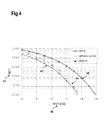
- Figure 4 illustrates the bit error rate (BER) of a Quadrature Phase Shift Keying (QPSK) 43 compared with a binary differentially decoded QPSK 44 and with a standard soft decoding (incoherent demodulation) of QPSK 45(DQPSK).
- BER bit error rate
- QPSK Quadrature Phase Shift Keying
- DQPSK standard soft decoding
- Figure 4 shows that the loss by binary differentially decoded QPSK 44 with respect to Phase Shift Keying (QPSK) is about ⁇ 0.7dB at a BER of 5e-3. The loss itself is not as relevant in the first place as the implication of differential decoding itself.
- the carrier recovery stage 12 is followed by the Forward error Correction (FEC) stage 13.
- FEC Forward error Correction
- coding benefits from soft information, whenever a quantized version of the output signal is used for decoding instead of hard-decision bits.
- the decoding algorithm can utilize information of the symbol uncertainty in order to improve decoding performance.
- the soft decoding channel capacity is ⁇ 1dB higher than the hard decision channel capacity.
- Figure 4 shows that the standard soft decoding of QPSK (DQPSK) 45 leads to a significant penalty compared with binary differentially decoded QPSK 44 of ⁇ 1.7dB at a BER of 5e-3.
- Binary differential decoding of QPSK has a limited decoding penalty, less than soft differential decoding, but suffers a performance loss in combination with hard-decision FEC that is inferior to soft-decision counterparts. Another possibility would be to avoid differential encoding altogether. However this approach would require stable lasers and generally leads to increased system costs.
- the differential decoder is regarded as the inner code of a serially concatenated code structure.
- the outer code is a convolutional code with error correction capabilities.
- soft information is iterated between the differential decoder and the outer code employing an interleaver in between.
- the soft decision is computed according to the maximum a posteriori (MAP) principle.
- the problem to be solved is to avoid the disadvantage mentioned above and in particular to reduce the performance loss of the soft differential decoding of QPSK in the combination with Forward error Correction (FEC).
- FEC Forward error Correction
- a cost efficient technique is needed that approaches the optimal performance of soft differential decoding of QPSK in the combination with Forward error Correction (FEC) without the complexity of MAP computation and iterative decoding, and which can be easily implemented in parallelized receivers.
- the present invention discloses a signal processing method for coherent receivers, comprising the steps of receiving a coherent complex signal, extracting orthogonal in-phase and quadrature signal components from the coherent complex signal, quantizing the orthogonal signal components independently, combining the quantized orthogonal signal components obtaining a first signal (in particular, a complex signal), and soft differential decoding the first signal obtaining a second signal.
- the first signal (61) includes a real part (693) and an imaginary part.
- the signal processing method further comprises the step of feeding the second signal to a forward error correction unit.
- the coherent complex signal is fed by a carrier recovery unit.
- the step of soft differential decoding the first signal obtaining a second signal includes the steps of time-delaying the first signal obtaining a third signal, complex conjugating the third signal obtaining a fourth signal, multiplying the fourth signal with the first signal obtaining a fifth signal, and phase shifting the fifth signal obtaining the second signal.
- the coherent complex signal includes a Quadrature Phase Shift Keying (QPSK) signal.
- QPSK Quadrature Phase Shift Keying
- the signal processing method further comprises the step of clipping the orthogonal signal components independently.
- the step of quantizing the orthogonal signal components independently includes linear quantization of the orthogonal signal components.
- the step of quantizing the orthogonal signal components independently includes non linear quantization of the signal components.
- the non linear quantization of the orthogonal signal components includes compression of the orthogonal signal components.
- the non linear quantization of the orthogonal signal components includes expansion of the orthogonal signal components.
- a signal processing arrangement for coherent receivers comprising means for receiving a coherent complex signal, means for extracting orthogonal in-phase and quadrature signal components from the coherent complex signal, means for quantizing the orthogonal signal components independently, means for combining the quantized orthogonal signal components obtaining a first signal, wherein the first signal includes a real part and an imaginary part, and means for soft differential decoding the first signal obtaining a second signal.
- the means for quantizing the orthogonal signal components independently include a quantization and clipping unit.
- the means for quantizing the orthogonal signal components independently include a compressor unit configured to perform compression of the orthogonal signal components.
- the means for quantizing the orthogonal signal components independently include an expander unit configured to perform expansion of the orthogonal signal components.
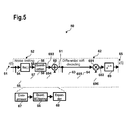
- FIG. 5 is high level block diagram (50) which illustrates the signal processing arrangement and the method of processing a coherently demodulated complex signal r ( t ) according to an embodiment of the invention.
- the coherently demodulated complex signal r(t) is fed from a carrier recovery unit (for example the carrier recovery unit 12 shown in Figure 1 ) to a noise limiting unit 52.
- the in-phase component 56 of the coherent complex signal r(t) is extracted by the in-phase component extractor unit 54 and quantized by the quantization unit 58.
- the quadrature component 57 of the coherent complex signal r(t) is extracted by the quadrature component extractor 55 and quantized by the quantization unit 59.
- the in-phase component 56 and the quadrature component 57 of the coherently demodulated complex signal r(t) are combined (60) as real (693) and imaginary (694) part of a complex number, respectively, by the combiner 60.
- the resulting signal 61 is then fed to a differential soft decoding unit 62 where differential soft decoding of the signal 61 is performed.
- the signal 61 is fed to a time delay unit 63 which introduces a time delay T.
- the output 695 of the time delay unit 63 is then fed to a complex conjugate unit 64.
- the output 696 of the complex conjugate unit 64 is then multiplied with the signal 61 by the multiplier 691.
- the resulting signal 692 is fed to a n/4 phase shifter 69.
- the output of the phase shifter z ( t ) 65 can then be processed by an error decoding module, (for example the forward error correction (FEC) unit 13 shown in Figure 1 ).
- FEC forward error correction
- the quantization units 58 and 59 further include a clipping unit, so that each of the quantization unit 58 and 59 can also be named quantization and clipping unit 66.
- the clipping in combination with quantization leads to a significant noise reduction compared to standard soft differential decoding.
- the quantization units 58 and 59 perform a linear quantization.
- the quantization performed by quantization units 58 and 59 can be non linear.
- nonlinear mapping functions units can be included before and after the linear quantization and clipping units 66, in particular a compressor unit 67 is included before the quantization and clipping units 66 and an expander unit 68 is included after the quantization and clipping units 66. Further benefits can be gained by using the nonlinear mapping functions units 67 and 68.
- the optimum clipping amplitude and nonlinear mapping functions depend on the type of forward error correction (FEC).
- Figure 6 is high level block diagram which illustrates the soft decision code I.5 from the fiber optic communication standard ITU-T G.975.1.
- Figure 6 shows a Reed-Solomon encoder unit 611, a Product encoder unit 612, a transmission line 615, a Product decoder unit 613 and a Reed-Solomon decoder unit 614.
- the performance of the soft differential decoding of DQPSK according to an embodiment of the invention is demonstrated on the soft decision code I.5 from the fiber optic communication standard ITU-T G.975.1 shown in Fig. 6 .
- the encoder uses two concatenated codes, with an outer Reed-Solomon hard-decision code and a soft-decision block-turbo product code using Hamming codes as sub-codes.
- the soft-decision code utilizes 2-3 soft bits.
- the decoding involves several iterations that are typical for turbo codes.
- the outer Reed-Solomon code then corrects the residual errors.
- the soft-decoding of the inner code is performed using the Chase algorithm as described in R. M. Pyndiah, "Near-Optimum Decoding of Product Codes: Block Turbo Codes", IEEE Transactions on Communications, vol. 46, no. 8, pp.1003-1010, August 1997 .
- Figure 7 illustrates the performance of the soft differential decoding method in combination with a soft decision forward error correction (FEC) according to an embodiment of the invention.
- Figure 7 shows the bit error rate (BER) of a coherent Quadrature Phase Shift Keying (QPSK) 78 before being processed by a forward error correction (FEC) unit; the BER of a binary differentially decoded QPSK 79 before being processed by a forward error correction (FEC) unit; the BER of a standard soft decoding of QPSK (DQPSK) 80 before being processed by a forward error correction (FEC) unit; the BER of a coherent Phase Shift Keying (QPSK) 73 after being processed by a forward error correction (FEC) unit; the BER of a soft differential decoded QPSK (DQPSK) 74, according to an embodiment of the invention, at 3 bits of non linear quantization (including compression and expansion) and a clipping level of 0.6, after being processed by a forward error correction (FEC)
- the penalty 81 after forward error correction (FEC) decoding is ⁇ 0.7dB at 3 bits of quantization and is thus identical to the penalty caused by binary differential decoding. This is the minimum possible penalty that can be achieved without using iterative concatenated convolution codes as discussed before. Decoding with 2 bits quantization gives a penalty of ⁇ 0.7dB as well, although it is not shown in Figure 7 .
- FEC performance for different clipping levels is shown. For example, if the clipping level is 0.6, then the signal is quantized between the amplitude of [-0.6; 0.6]. The original signal amplitudes without noise are assumed as [-1; 1]. The optimum choice of the clipping function ensures best performance.
- Fig. 7 shows as well the performance for 10 bits of quantization and a high clipping level of 3, which corresponds to a standard soft DQPSK decoding or differential demodulation of QPSK. It is apparent that the output BER of the FEC (after forward error correction) is a function of the input BER (before forward error correction), so that the resulting performance deterioration directly depends on the worse BER before the FEC.
- the described method makes it possible to compute soft information after differential decoding, while having the minimum differential loss of binary decoding.
- the described method can be implemented on an integrated circuit in the digital domain, for example on an application-specific integrated circuit (ASIC), field-programmable gate array (FPGA) or similar technologies.
- ASIC application-specific integrated circuit
- FPGA field-programmable gate array
- the parameters of quantization in the soft differential decoding algorithm have to be optimized with respect to the given FEC algorithm.
- the quantization levels in the differential decoder have to be adjusted to the quantization levels of the FEC. No iterations between the differential decoding and FEC are required and they can function in a strictly feed-forward setting.
Landscapes
- Engineering & Computer Science (AREA)
- Computer Networks & Wireless Communication (AREA)
- Signal Processing (AREA)
- Physics & Mathematics (AREA)
- Electromagnetism (AREA)
- Digital Transmission Methods That Use Modulated Carrier Waves (AREA)
Abstract
Description
- The invention refers to a method and to an arrangement for signal processing in a communication system (e.g. an optical communication system).
- In order to meet the growing demand for internet bandwidth with traffic growth rates around 40-50% per year, telecommunication component providers face the task of increasing the spectral efficiency of fiber utilization. After 10Gbit/s systems became successful in the 1990's, solutions for 40Gbit/s became available in the last years. Standardization and research are now focused on the development of 100Gbit/s systems with coherent Polarization Multiplexed (PolMux) Quadrature Phase Shift Keying (QPSK). Since polarization multiplexing utilizes both light polarizations, it is possible to send the signal at a rate of ~25-28Gsymbols per second, thus fitting nicely into the standard 50GHz grid for DWDM optical systems. Coherent reception makes it possible to compensate for most linear transmission impairments, like Chromatic Dispersion (CD) and Polarization-Mode Dispersion (PMD) after sampling in the digital domain.
-
Figure 1 shows a conventional coherent receiver for polarization multiplex signals. A received polarization division multiplex signal (PolMUX signal) 14 comprising two orthogonal optical signals is split by a Polarisation Beam Splitter(PBS) 1 into two orthogonal component signals x and y. Each of these component signals is split by optical 90°-hybrids carrier recovery unit 12 to agree with that of the received PolMUX signal. After analogue-to-digital conversion by AD-converters (ADC) 5 - 8 a sampled and quantized representation of the received optical signal is available in digital form referred to as component values XI, XQ; YI, YQ. Such values contain statistic noisy distortions, deterministic channel degradations such as chromatic dispersion, and random time-varying distortions mainly due to polarization effects. Adispersion compensation unit 9 is usually added for first coarse chromatic dispersion compensation. In addition, aclock recovery subsystem 10 is necessary for extracting a correct sampling clock frequency and a correct sampling clock phase from the received signal.Adaptive equalization 11 estimates the channel and removes deterministic channel distortions. Then, thecarrier recovery 12 corrects the phase offset caused by the local oscillator (LO) 4. Finally, forward error correction (FEC) 13 is used to correct for statistical errors. -
Figure 2 shows the rotation of a Quadrature Phase Shift Keying (QPSK) constellation diagram relative to either polarization component x or y in presence of a phase offset Δϕ(t) introduced by the transmitter and receiver laser to the signal. Writing the analog signal Ein (t) in the complex base-band, a phase offset Δϕ(t) can be modelled by Eout (t) = Ein (t)ejΔϕ. In more detailFigure 2 shows the Quadrature Phase Shift Keying (QPSK) constellation diagram 21 without the phase rotation and the Quadrature Phase Shift Keying (QPSK)constellation 22 in presence of the phase offset Δϕ(t) 23. -
Figure 3 shows an example of a cycle slip for a Quadrature Phase Shift Keying (QPSK) system in presence of a constant phase offset Δϕ(t). In more detailFigure 3 shows the phase 31 (rad) as a function of the number of receivedsymbols 32 and an example of acycle slip 33. A cycle slip occurs if the signal constellation is rotated by ±90°, 180°. Depending on the signal-to-noise ratio (SNR) and the laser phase noise, there is a finite probability that cycle slips occur. All the subsequent phase estimates are offset by the degree of the cycle slip and decoded incorrectly in a coherent system. This can lead to burst errors thus making a stable communication impossible. The probability of cycle slips can be reduced by using lasers with a narrower linewidth or by increasing the SNR, which may lead to more expensive communication systems. - A much simpler way to combat cycle slips can be obtained by introducing differential encoding to the signal. In conventional differential formats, the bit information is modulated onto the phase difference between two or more subsequent symbols. For example, in differentially encoded Binary Phase-Shift Keying (BPSK) systems a binary "1" may be transmitted by adding 180° to the current phase and a binary "0" by adding 0° to the current phase. In differentially encoded QPSK, the phase-shifts are 0°, 90°, 180°, -90° corresponding to data "00", "01", "11", "10". If a cycle slip occurs, it leads to a single symbol error only, since it's the differential phase which carries the information.
- However, binary differential decoding may lead to a performance loss, as every bit error in the coherent domain is translated to two bit errors after differential decoding at relevant signal-to-noise ratio (SNR) values. The binary decoding algorithm can be given by:

where r(t) is the coherent complex signal and z(t) is the complex differentially decoded signal with zI (t) being the real part or the in-phase, zQ (t) being the imaginary part or the quadrature, and T is the symbol duration. -
Figure 4 illustrates the bit error rate (BER) of a Quadrature Phase Shift Keying (QPSK) 43 compared with a binary differentially decodedQPSK 44 and with a standard soft decoding (incoherent demodulation) of QPSK 45(DQPSK). In more detailFigure 4 shows that the loss by binary differentially decodedQPSK 44 with respect to Phase Shift Keying (QPSK) is about ~0.7dB at a BER of 5e-3. The loss itself is not as relevant in the first place as the implication of differential decoding itself. As shown inFigure 1 , in the coherent receiver, thecarrier recovery stage 12 is followed by the Forward error Correction (FEC)stage 13. Generally, coding benefits from soft information, whenever a quantized version of the output signal is used for decoding instead of hard-decision bits. In this way, the decoding algorithm can utilize information of the symbol uncertainty in order to improve decoding performance. At coding overheads of ~7% that are common in optical communication, the soft decoding channel capacity is ~1dB higher than the hard decision channel capacity. However, there is the problem of transferring soft-information of differentially encoded QPSK from the coherent to the differentially decoded domain.Figure 4 shows that the standard soft decoding of QPSK (DQPSK) 45 leads to a significant penalty compared with binary differentially decodedQPSK 44 of ~1.7dB at a BER of 5e-3. - The output signal of the DQPSK decoder is given by:

- Binary differential decoding of QPSK has a limited decoding penalty, less than soft differential decoding, but suffers a performance loss in combination with hard-decision FEC that is inferior to soft-decision counterparts. Another possibility would be to avoid differential encoding altogether. However this approach would require stable lasers and generally leads to increased system costs.
- In the wireless systems literature it has been shown that the differential encoding penalty of general PSK modulation formats can be completely compensated using iterative decoding. Cited for example are D. Marsland, P. T. Mathiopoulos, "On the Performance of Iterative Noncoherent Detection of Coded M-PSK Signals", IEEE Transactions on Communications, vol. 48, no. 4, pp.588-596, April 2000; Peter Hoeher, Senior Member, IEEE, and John Lodge, ""Turbo DPSK": Iterative Differential PSK Demodulation and Channel Decoding", IEEE Transactions on Communications, vol. 47, no. 6, pp.837-843, June 1999; and H. Arslan, G.E. Bottomley, R. Ramesh, G. Brismark, "Coherent MAP Detection of DQPSK Signals in non-ISI Channels", Wireless Communications and Networking Conference, 1999. WCNC. 1999 IEEE . In the cited documents the differential decoder is regarded as the inner code of a serially concatenated code structure. The outer code is a convolutional code with error correction capabilities. Using the turbo principle, soft information is iterated between the differential decoder and the outer code employing an interleaver in between. The soft decision is computed according to the maximum a posteriori (MAP) principle. In principle, it is possible to replace the convolutional code by a soft output low density parity check (LDPC) or turbo code with a low overhead, as they are typically used in fiber optics, in order to compensate for the differential penalty. However, this has neither been demonstrated in fiber optic literature, nor has an assessment of the complexity increase taken place. Further examples for the mitigation of the differential encoding are given in L. Lampe et al., "Coded Modulation for DPSK on Fading Channels", Globecom 99, where multi-level coding is used in combination with convolutional codes, and in H. Leib et al., "Data-Aided Noncoherent Demodulation of DPSK", IEEE Trans. Comm. Vol.43 (1995), pp.722 and S. Calabrò et al., "Improved Detection of differential Phase Shift Keying through Multi-Symbol Phase Estimation", ECOC 2005, where recursive structures are employed that however cannot be implemented in parallelized receivers.
- The problem to be solved is to avoid the disadvantage mentioned above and in particular to reduce the performance loss of the soft differential decoding of QPSK in the combination with Forward error Correction (FEC). A cost efficient technique is needed that approaches the optimal performance of soft differential decoding of QPSK in the combination with Forward error Correction (FEC) without the complexity of MAP computation and iterative decoding, and which can be easily implemented in parallelized receivers.
- In order to overcome the above-described need in the art, the present invention discloses a signal processing method for coherent receivers, comprising the steps of receiving a coherent complex signal, extracting orthogonal in-phase and quadrature signal components from the coherent complex signal, quantizing the orthogonal signal components independently, combining the quantized orthogonal signal components obtaining a first signal (in particular, a complex signal), and soft differential decoding the first signal obtaining a second signal.
- It is also an embodiment, that the first signal (61) includes a real part (693) and an imaginary part.
- In a further embodiment, the signal processing method further comprises the step of feeding the second signal to a forward error correction unit.
- In other embodiments of the present invention, the coherent complex signal is fed by a carrier recovery unit.
- In a further embodiment, the step of soft differential decoding the first signal obtaining a second signal includes the steps of time-delaying the first signal obtaining a third signal, complex conjugating the third signal obtaining a fourth signal, multiplying the fourth signal with the first signal obtaining a fifth signal, and phase shifting the fifth signal obtaining the second signal.
- In a next embodiment, the coherent complex signal includes a Quadrature Phase Shift Keying (QPSK) signal.
- It is also an embodiment, that the signal processing method further comprises the step of clipping the orthogonal signal components independently.
- In a further embodiment, the step of quantizing the orthogonal signal components independently includes linear quantization of the orthogonal signal components.
- In an alternative embodiment, the step of quantizing the orthogonal signal components independently includes non linear quantization of the signal components.
- In other embodiments of the present invention, the non linear quantization of the orthogonal signal components includes compression of the orthogonal signal components.
- In a next embodiment of the invention, the non linear quantization of the orthogonal signal components includes expansion of the orthogonal signal components.
- The problem stated above is also solved by a signal processing arrangement for coherent receivers, comprising means for receiving a coherent complex signal, means for extracting orthogonal in-phase and quadrature signal components from the coherent complex signal, means for quantizing the orthogonal signal components independently, means for combining the quantized orthogonal signal components obtaining a first signal, wherein the first signal includes a real part and an imaginary part, and means for soft differential decoding the first signal obtaining a second signal.
- In a next embodiment, the means for quantizing the orthogonal signal components independently include a quantization and clipping unit.
- In other embodiments of the present invention, the means for quantizing the orthogonal signal components independently include a compressor unit configured to perform compression of the orthogonal signal components.
- In a next embodiment, the means for quantizing the orthogonal signal components independently include an expander unit configured to perform expansion of the orthogonal signal components.
- The problem stated above is also solved by a receiver of a communication system including the signal processing arrangement described above.
- The invention is explained by way of example in more detail below with the aid of the attached drawings.
-
FIG 1 a high level block diagram which shows a conventional coherent receiver for polarization multiplex signals. -
Figure 2 is an illustration which shows the rotation of a Quadrature Phase Shift Keying (QPSK) constellation diagram in presence of a phase offset. -
Figure 3 is an illustration which shows a cycle slip for a Quadrature Phase Shift Keying (QPSK) system. -
Figure 4 illustrates the bit error rate (BER) of a Quadrature Phase Shift Keying (QPSK) compared with a binary differentially decoded QPSK and with a standard soft decoding of QPSK (DQPSK). -
Figure 5 is a high level block diagram which illustrates the signal processing arrangement and the method of processing a coherent complex signal according to an embodiment of the invention. -
Figure 6 is high level block diagram which illustrates the soft decision code I.5 from the fiber optic communication standard ITU-T G.975.1. -
Figure 7 illustrates the performance of the soft differential decoding method in combination with a soft decision forward error correction (FEC) according to an embodiment of the invention. - As regards the description of
Figures 1 to 4 , reference is made to the background of the invention. - Illustrative embodiments will now be described with reference to the accompanying drawings to disclose the teachings of the present invention. While the present invention is described herein with reference to illustrative embodiments for particular applications, it should be understood that the invention is not limited thereto. Those having ordinary skill in the art and access to the teachings provided herein will recognize additional modifications, applications, and embodiments within the scope thereof and additional fields in which the present invention would be of significant utility.
-
Figure 5 is high level block diagram (50) which illustrates the signal processing arrangement and the method of processing a coherently demodulated complex signal r(t) according to an embodiment of the invention. The coherently demodulated complex signal r(t) is fed from a carrier recovery unit (for example thecarrier recovery unit 12 shown inFigure 1 ) to anoise limiting unit 52. The in-phase component 56 of the coherent complex signal r(t) is extracted by the in-phasecomponent extractor unit 54 and quantized by thequantization unit 58. Independently from the in-phase component, thequadrature component 57 of the coherent complex signal r(t) is extracted by thequadrature component extractor 55 and quantized by thequantization unit 59. The in-phase component 56 and thequadrature component 57 of the coherently demodulated complex signal r(t) are combined (60) as real (693) and imaginary (694) part of a complex number, respectively, by thecombiner 60. The resultingsignal 61 is then fed to a differentialsoft decoding unit 62 where differential soft decoding of thesignal 61 is performed. In particular thesignal 61 is fed to atime delay unit 63 which introduces a time delay T. Theoutput 695 of thetime delay unit 63 is then fed to acomplex conjugate unit 64. Theoutput 696 of thecomplex conjugate unit 64 is then multiplied with thesignal 61 by themultiplier 691. The resultingsignal 692 is fed to a n/4phase shifter 69. The output of the phase shifter z(t) 65 can then be processed by an error decoding module, (for example the forward error correction (FEC)unit 13 shown inFigure 1 ). - In another embodiment of the invention, also shown in
Figure 5 , thequantization units quantization unit clipping unit 66. The clipping in combination with quantization leads to a significant noise reduction compared to standard soft differential decoding. - According to an embodiment of the invention the
quantization units - In another embodiment of the invention, also shown in
Figure 5 , the quantization performed byquantization units units 66, in particular acompressor unit 67 is included before the quantization and clippingunits 66 and anexpander unit 68 is included after the quantization and clippingunits 66. Further benefits can be gained by using the nonlinear mapping functionsunits -
Figure 6 is high level block diagram which illustrates the soft decision code I.5 from the fiber optic communication standard ITU-T G.975.1. In particularFigure 6 shows a Reed-Solomon encoder unit 611, aProduct encoder unit 612, atransmission line 615, aProduct decoder unit 613 and a Reed-Solomon decoder unit 614. The performance of the soft differential decoding of DQPSK according to an embodiment of the invention is demonstrated on the soft decision code I.5 from the fiber optic communication standard ITU-T G.975.1 shown inFig. 6 . The encoder uses two concatenated codes, with an outer Reed-Solomon hard-decision code and a soft-decision block-turbo product code using Hamming codes as sub-codes. The soft-decision code utilizes 2-3 soft bits. The decoding involves several iterations that are typical for turbo codes. The outer Reed-Solomon code then corrects the residual errors. The soft-decoding of the inner code is performed using the Chase algorithm as described in R. M. Pyndiah, "Near-Optimum Decoding of Product Codes: Block Turbo Codes", IEEE Transactions on Communications, vol. 46, no. 8, pp.1003-1010, August 1997 . -
Figure 7 illustrates the performance of the soft differential decoding method in combination with a soft decision forward error correction (FEC) according to an embodiment of the invention. In more detail,Figure 7 shows the bit error rate (BER) of a coherent Quadrature Phase Shift Keying (QPSK) 78 before being processed by a forward error correction (FEC) unit; the BER of a binary differentially decoded QPSK 79 before being processed by a forward error correction (FEC) unit; the BER of a standard soft decoding of QPSK (DQPSK) 80 before being processed by a forward error correction (FEC) unit; the BER of a coherent Phase Shift Keying (QPSK) 73 after being processed by a forward error correction (FEC) unit; the BER of a soft differential decoded QPSK (DQPSK) 74, according to an embodiment of the invention, at 3 bits of non linear quantization (including compression and expansion) and a clipping level of 0.6, after being processed by a forward error correction (FEC) unit (soft-decision FEC); the BER of a soft differential decoded QPSK (DQPSK) 75, according to an embodiment of the invention, at 3 bits of linear quantization and a clipping level of 0.6, after being processed by a forward error correction (FEC) unit (soft-decision FEC); the BER of a soft differential decoded QPSK (DQPSK) 76, according to an embodiment of the invention, at 3 bits of quantization and a clipping level of 1, after being processed by a forward error correction (FEC) unit (soft-decision FEC); the BER of a soft differential decoded QPSK (DQPSK) 77, according to an embodiment of the invention, at 10 bits of quantization and a clipping level of 3, after being processed by a forward error correction (FEC) unit (soft-decision FEC) - Only the performance of the inner soft-code is evaluated, since it is sufficient to describe the overall code performance. The
penalty 81 after forward error correction (FEC) decoding is ~0.7dB at 3 bits of quantization and is thus identical to the penalty caused by binary differential decoding. This is the minimum possible penalty that can be achieved without using iterative concatenated convolution codes as discussed before. Decoding with 2 bits quantization gives a penalty of ~0.7dB as well, although it is not shown inFigure 7 . Just for comparison, also the FEC performance for different clipping levels is shown. For example, if the clipping level is 0.6, then the signal is quantized between the amplitude of [-0.6; 0.6]. The original signal amplitudes without noise are assumed as [-1; 1]. The optimum choice of the clipping function ensures best performance. -
Fig. 7 shows as well the performance for 10 bits of quantization and a high clipping level of 3, which corresponds to a standard soft DQPSK decoding or differential demodulation of QPSK. It is apparent that the output BER of the FEC (after forward error correction) is a function of the input BER (before forward error correction), so that the resulting performance deterioration directly depends on the worse BER before the FEC. - The described method, according to an embodiment of the invention, makes it possible to compute soft information after differential decoding, while having the minimum differential loss of binary decoding.
- The described method, according to an embodiment of the invention, can be implemented on an integrated circuit in the digital domain, for example on an application-specific integrated circuit (ASIC), field-programmable gate array (FPGA) or similar technologies. The parameters of quantization in the soft differential decoding algorithm have to be optimized with respect to the given FEC algorithm. The quantization levels in the differential decoder have to be adjusted to the quantization levels of the FEC. No iterations between the differential decoding and FEC are required and they can function in a strictly feed-forward setting.
- The present invention is not limited to the details of the above described principles. The scope of the invention is defined by the appended claims and all changes and modifications as fall within the equivalents of the scope of the claims are therefore to be embraced by the invention. Mathematical conversions or equivalent calculations of the signal values based on the inventive method or the use of analogue signals instead of digital values are also incorporated.
Claims (15)
- Signal processing method for coherent receivers, comprising:receiving a coherent complex signal (51);extracting (54, 55) orthogonal in-phase (56) and quadrature (57) signal components from the coherent complex signal (51);quantizing the orthogonal signal components (56,57) independently;combining (60) the quantized orthogonal signal components (693, 694) obtaining a first signal (61);soft differential decoding the first signal (61) obtaining a second signal (65).
- Signal processing method according to claim 1, wherein the first signal (61) includes a real part (693) and an imaginary part (694).
- Signal processing method according to any of the claims 1 to 2, further comprising:feeding the second signal to a forward error correction unit (13).
- Signal processing method according to any of the claims 1 to 3, wherein the coherent complex signal (51) is fed by a carrier recovery unit (12).
- Signal processing method according to any of the claims 1 to 4, wherein soft differential decoding the first signal (61) obtaining a second signal (65) includes:time-delaying the first signal (61) obtaining a third signal (695);complex conjugating the third signal (695) obtaining a fourth signal (696);multiplying the fourth signal (696) with the first signal (61) obtaining a fifth signal (692);phase shifting the fifth signal (692) obtaining the second signal (65).
- Signal processing method according to any of the claims 1 to 5, wherein the coherent complex signal (51) includes a Quadrature Phase Shift Keying (QPSK) signal.
- Signal processing method according to any of the claims 1 to 6, further comprising:clipping the orthogonal signal components (56, 57) independently.
- Signal processing method according to any of the claims 1 to 7, wherein quantizing the orthogonal signal components (56, 57) independently includes linear quantization of the orthogonal signal components.
- Signal processing method according to any of the claims 1 to 8, wherein quantizing the orthogonal signal components (56, 57) independently includes non linear quantization of the signal components (56, 57).
- Signal processing method according to claim 9, wherein non linear quantization of the orthogonal signal components (56, 57) includes compression of the orthogonal signal components (56, 57).
- Signal processing method according to claim 9, wherein non linear quantization of the orthogonal signal components (56, 57) includes expansion of the orthogonal signal components (56, 57).
- Signal processing arrangement (50) for coherent receivers, comprising:means for receiving a coherent complex signal (51);means for extracting (54, 55) orthogonal in-phase (56) and quadrature (57) signal components from the coherent complex signal (51);means for quantizing (58, 59) the orthogonal in-phase (56) and quadrature (57) signal components independently;means for combining (60) the quantized orthogonal signal components (693, 694) obtaining a first signal (61), wherein the first signal (61) includes a real part (693) and an imaginary part (694);means for soft differential decoding (62) the first signal (61) obtaining a second signal (65).
- Signal processing arrangement (50) according to claim 12, wherein the means for quantizing the orthogonal signal components (56, 57) independently include a quantization and clipping unit (66).
- Signal processing arrangement (50) according to claim 12, wherein the means for quantizing the orthogonal signal components (56, 57) independently include a compressor unit (67) configured to perform compression of the orthogonal signal components (56, 57).
- Signal processing arrangement (50) according to claim 12, wherein the means for quantizing the orthogonal signal components (56, 57) independently include an expander unit (68) configured to perform expansion of the orthogonal signal components (56, 57).
Priority Applications (4)
| Application Number | Priority Date | Filing Date | Title |
|---|---|---|---|
| EP10161450.1A EP2383949B1 (en) | 2010-04-29 | 2010-04-29 | Method and arrangement for signal processing in a communication system |
| PCT/EP2011/056619 WO2011134977A1 (en) | 2010-04-29 | 2011-04-27 | Method and arrangement for signal processing communication system |
| CN2011800214734A CN102859955A (en) | 2010-04-29 | 2011-04-27 | Method and arrangement for signal processing communication system |
| US13/695,095 US20130045015A1 (en) | 2010-04-29 | 2011-04-27 | Method and arrangement for signal processing in a communication system |
Applications Claiming Priority (1)
| Application Number | Priority Date | Filing Date | Title |
|---|---|---|---|
| EP10161450.1A EP2383949B1 (en) | 2010-04-29 | 2010-04-29 | Method and arrangement for signal processing in a communication system |
Publications (2)
| Publication Number | Publication Date |
|---|---|
| EP2383949A1 true EP2383949A1 (en) | 2011-11-02 |
| EP2383949B1 EP2383949B1 (en) | 2016-01-06 |
Family
ID=43531870
Family Applications (1)
| Application Number | Title | Priority Date | Filing Date |
|---|---|---|---|
| EP10161450.1A Active EP2383949B1 (en) | 2010-04-29 | 2010-04-29 | Method and arrangement for signal processing in a communication system |
Country Status (4)
| Country | Link |
|---|---|
| US (1) | US20130045015A1 (en) |
| EP (1) | EP2383949B1 (en) |
| CN (1) | CN102859955A (en) |
| WO (1) | WO2011134977A1 (en) |
Cited By (1)
| Publication number | Priority date | Publication date | Assignee | Title |
|---|---|---|---|---|
| CN105610517A (en) * | 2014-11-14 | 2016-05-25 | 中兴通讯股份有限公司 | Iterative post-equalization for coherent optical receivers |
Families Citing this family (9)
| Publication number | Priority date | Publication date | Assignee | Title |
|---|---|---|---|---|
| US9219550B2 (en) * | 2011-06-23 | 2015-12-22 | Infinera Corporation | Forward carrier recovery using forward error correction (FEC) feedback |
| US8892986B2 (en) | 2012-03-08 | 2014-11-18 | Micron Technology, Inc. | Apparatuses and methods for combining error coding and modulation schemes |
| US9025969B2 (en) * | 2012-05-24 | 2015-05-05 | Futurewei Technologies, Inc. | Method with improved phase robustness in coherent detected optical system |
| US9942003B2 (en) * | 2015-09-04 | 2018-04-10 | Futurewei Technologies, Inc. | Adaptive forward error correction (FEC) in passive optical networks (PONs) |
| EP3223446A1 (en) * | 2016-03-22 | 2017-09-27 | Xieon Networks S.à r.l. | A method for protecting a link in an optical network |
| CN108429713B (en) * | 2017-02-13 | 2020-06-16 | 大唐移动通信设备有限公司 | Data compression method and device |
| JP7057500B2 (en) * | 2018-05-16 | 2022-04-20 | 日本電信電話株式会社 | Receiver and receiving method |
| CN112202698B (en) * | 2020-09-08 | 2021-10-19 | 浙江大学 | Method, device and electronic device for non-coherent demodulation and detection of heartbeat control packets |
| CN114139585B (en) * | 2021-11-30 | 2023-04-07 | 西安电子科技大学 | Complex signal multi-component interaction characteristic signal processing method, model and system |
Family Cites Families (7)
| Publication number | Priority date | Publication date | Assignee | Title |
|---|---|---|---|---|
| CN1066870C (en) * | 1995-05-10 | 2001-06-06 | 罗克马诺尔研究有限公司 | Direct conversion receiver |
| US6426978B1 (en) * | 1998-10-01 | 2002-07-30 | Ericsson Inc. | Digital communication systems and methods for differential and/or amplitude encoding and decoding secondary symbols |
| GR1003430B (en) * | 1999-03-17 | 2000-09-07 | �.�. �������� ���������� ��������������� & ����������... | Receiver structure for offset differential quadrature phase shift keying |
| US20020172294A1 (en) * | 2001-04-02 | 2002-11-21 | Jung-Fu Cheng | Methods and systems for selective interleaving in retransmissions and iterative demodulation of modulated signals with different interleaving |
| CN100472998C (en) * | 2003-02-13 | 2009-03-25 | 株式会社Ntt都科摩 | Differential multi-length transmit and receive diversity |
| US8243775B2 (en) * | 2008-12-18 | 2012-08-14 | Qualcomm Incorporated | ID-cell index search algorithm and carrier frequency offset estimation |
| US8948612B2 (en) * | 2010-12-03 | 2015-02-03 | Tyco Electronics Subsea Communications Llc | System and method for generating soft decision reliability information from hard decisions in an optical signal receiver |
-
2010
- 2010-04-29 EP EP10161450.1A patent/EP2383949B1/en active Active
-
2011
- 2011-04-27 WO PCT/EP2011/056619 patent/WO2011134977A1/en not_active Ceased
- 2011-04-27 CN CN2011800214734A patent/CN102859955A/en active Pending
- 2011-04-27 US US13/695,095 patent/US20130045015A1/en not_active Abandoned
Non-Patent Citations (11)
| Title |
|---|
| D. MARSLAND; P. T. MATHIOPOULOS: "On the Performance of Iterative Noncoherent Detection of Coded M-PSK Signals", IEEE TRANSACTIONS ON COMMUNICATIONS, vol. 48, no. 4, April 2000 (2000-04-01), pages 588 - 596 |
| DIRK VAN DEN BORNE ET AL: "POLMUX-QPSK modulation and coherent detection: The challenge of long-haul 100G transmission", 35TH EUROPEAN CONFERENCE ON OPTICAL COMMUNICATION, 2009. ECOC '09, VIENNA, AUSTRIA, IEEE, PISCATAWAY, NJ, USA, 20 September 2009 (2009-09-20), pages 1 - 4, XP031546308, ISBN: 978-1-4244-5096-1 * |
| FULVIO GINI ET AL: "Generalized Differential Encoding: A Nonlinear Signal Processing Perspective", IEEE TRANSACTIONS ON SIGNAL PROCESSING, IEEE SERVICE CENTER, NEW YORK, NY, US, vol. 46, no. 11, 1 November 1998 (1998-11-01), XP011058334, ISSN: 1053-587X * |
| H. ARSLAN; G.E. BOTTOMLEY; R. RAMESH; G. BRISMARK: "Coherent MAP Detection of DQPSK Signals in non-ISI Channels", WIRELESS COMMUNICATIONS AND NETWORKING CONFERENCE, 1999 |
| H. LEIB ET AL.: "Data-Aided Noncoherent Demodulation of DPSK", IEEE TRANS. COMM., vol. 43, 1995, pages 722 |
| L. LAMPE ET AL.: "Coded Modulation for DPSK on Fading Channels", GLOBECOM, vol. 99 |
| PETER HOEHER; SENIOR MEMBER; JOHN LODGE: "Turbo DPSK": Iterative Differential PSK Demodulation and Channel Decoding", IEEE TRANSACTIONS ON COMMUNICATIONS, vol. 47, no. 6, June 1999 (1999-06-01), pages 837 - 843 |
| R. M. PYNDIAH: "Near-Optimum Decoding of Product Codes: Block Turbo Codes", IEEE TRANSACTIONS ON COMMUNICATIONS, vol. 46, no. 8, August 1997 (1997-08-01), pages 1003 - 1010 |
| ROUDAS I ET AL: "Optimal Polarization Demultiplexing for Coherent Optical Communications Systems", JOURNAL OF LIGHTWAVE TECHNOLOGY, IEEE SERVICE CENTER, NEW YORK, NY, US, vol. 28, no. 7, 1 April 2010 (2010-04-01), pages 1121 - 1134, XP011296992, ISSN: 0733-8724 * |
| S. CALABRO ET AL.: "Improved Detection of differential Phase Shift Keying through Multi-Symbol Phase Estimation", ECOC, 2005 |
| ZHANG S ET AL: "ADC bandwidth optimization in coherent optical polarization multiplexing quadrature phase-shift keying system", COMMUNICATIONS AND PHOTONICS CONFERENCE AND EXHIBITION, 2009. ACP 2009. ASIA, IEEE, PISCATAWAY, NJ, USA, 2 November 2009 (2009-11-02), pages 1 - 6, XP031623336, ISBN: 978-1-55752-877-3 * |
Cited By (2)
| Publication number | Priority date | Publication date | Assignee | Title |
|---|---|---|---|---|
| CN105610517A (en) * | 2014-11-14 | 2016-05-25 | 中兴通讯股份有限公司 | Iterative post-equalization for coherent optical receivers |
| CN105610517B (en) * | 2014-11-14 | 2018-05-08 | 中兴通讯股份有限公司 | The iteration post-equalization of coherent optical heterodyne communicatio |
Also Published As
| Publication number | Publication date |
|---|---|
| US20130045015A1 (en) | 2013-02-21 |
| EP2383949B1 (en) | 2016-01-06 |
| CN102859955A (en) | 2013-01-02 |
| WO2011134977A1 (en) | 2011-11-03 |
Similar Documents
| Publication | Publication Date | Title |
|---|---|---|
| EP2383949B1 (en) | Method and arrangement for signal processing in a communication system | |
| US8948612B2 (en) | System and method for generating soft decision reliability information from hard decisions in an optical signal receiver | |
| EP2591566B1 (en) | Method and apparatus for carrier phase estimation and correction in a coherent optical system | |
| US10396902B2 (en) | Minimum variance carrier recovery with increased phase noise tolerance | |
| US8306418B2 (en) | Data pattern dependent distortion compensation in a coherent optical signal receiver | |
| US9036992B2 (en) | LDPC-coded modulation for ultra-high-speed optical transport in the presence of phase noise | |
| US8718491B2 (en) | Soft decoding of data in a coherent optical receiver | |
| US8929749B2 (en) | Minimum variance carrier recovery | |
| US9537683B1 (en) | Method and apparatus for residual phase noise compensation | |
| US11637638B2 (en) | Modular carrier recovery | |
| US9043690B2 (en) | Method and apparatus for detecting a parity error in a sequence of DQPSK symbols of a digital transmission system | |
| Rios-Müller et al. | Joint coding rate and modulation format optimization for 8QAM constellations using BICM mutual information | |
| EP3025447B1 (en) | Chain encoding and decoding of high speed signals | |
| US9112615B1 (en) | Low cycle slip phase recovery for coherent receiver | |
| Tsukamotor et al. | Coherent demodulation of optical 8-phase shift-keying signals using homodyne detection and digital signal processing | |
| JPWO2014016955A1 (en) | Optical modulation / demodulation method and optical transceiver | |
| Zhou | Carrier recovery in coherent optical communication systems | |
| Pfau et al. | Parity check encoded QPSK for rate adaptation in coherent DSP-based receivers | |
| Leoni et al. | On the joint optimization of modulation and channel coding for high data-rate optical communication systems | |
| Koc | PLL-free quadrature-amplitude modulation in coherent optical communication | |
| Yu et al. | Phase estimation in coherent communication systems with semiconductor laser noises |
Legal Events
| Date | Code | Title | Description |
|---|---|---|---|
| AK | Designated contracting states |
Kind code of ref document: A1 Designated state(s): AT BE BG CH CY CZ DE DK EE ES FI FR GB GR HR HU IE IS IT LI LT LU LV MC MK MT NL NO PL PT RO SE SI SK SM TR |
|
| AX | Request for extension of the european patent |
Extension state: AL BA ME RS |
|
| PUAI | Public reference made under article 153(3) epc to a published international application that has entered the european phase |
Free format text: ORIGINAL CODE: 0009012 |
|
| 17P | Request for examination filed |
Effective date: 20120502 |
|
| RAP1 | Party data changed (applicant data changed or rights of an application transferred) |
Owner name: NOKIA SOLUTIONS AND NETWORKS GMBH & CO. KG |
|
| RAP1 | Party data changed (applicant data changed or rights of an application transferred) |
Owner name: XIEON NETWORKS S.A.R.L. |
|
| REG | Reference to a national code |
Ref country code: DE Ref legal event code: R079 Ref document number: 602010029832 Country of ref document: DE Free format text: PREVIOUS MAIN CLASS: H04L0027227000 Ipc: H04B0010610000 |
|
| RAP1 | Party data changed (applicant data changed or rights of an application transferred) |
Owner name: XIEON NETWORKS S.A R.L. |
|
| GRAP | Despatch of communication of intention to grant a patent |
Free format text: ORIGINAL CODE: EPIDOSNIGR1 |
|
| RIC1 | Information provided on ipc code assigned before grant |
Ipc: H04L 27/227 20060101ALI20150615BHEP Ipc: H04B 10/61 20130101AFI20150615BHEP |
|
| INTG | Intention to grant announced |
Effective date: 20150702 |
|
| GRAS | Grant fee paid |
Free format text: ORIGINAL CODE: EPIDOSNIGR3 |
|
| GRAA | (expected) grant |
Free format text: ORIGINAL CODE: 0009210 |
|
| AK | Designated contracting states |
Kind code of ref document: B1 Designated state(s): AT BE BG CH CY CZ DE DK EE ES FI FR GB GR HR HU IE IS IT LI LT LU LV MC MK MT NL NO PL PT RO SE SI SK SM TR |
|
| REG | Reference to a national code |
Ref country code: GB Ref legal event code: FG4D |
|
| REG | Reference to a national code |
Ref country code: CH Ref legal event code: EP |
|
| REG | Reference to a national code |
Ref country code: IE Ref legal event code: FG4D |
|
| REG | Reference to a national code |
Ref country code: AT Ref legal event code: REF Ref document number: 769665 Country of ref document: AT Kind code of ref document: T Effective date: 20160215 |
|
| REG | Reference to a national code |
Ref country code: DE Ref legal event code: R096 Ref document number: 602010029832 Country of ref document: DE |
|
| REG | Reference to a national code |
Ref country code: FR Ref legal event code: PLFP Year of fee payment: 7 |
|
| REG | Reference to a national code |
Ref country code: LT Ref legal event code: MG4D |
|
| REG | Reference to a national code |
Ref country code: NL Ref legal event code: MP Effective date: 20160106 |
|
| REG | Reference to a national code |
Ref country code: AT Ref legal event code: MK05 Ref document number: 769665 Country of ref document: AT Kind code of ref document: T Effective date: 20160106 |
|
| PG25 | Lapsed in a contracting state [announced via postgrant information from national office to epo] |
Ref country code: NL Free format text: LAPSE BECAUSE OF FAILURE TO SUBMIT A TRANSLATION OF THE DESCRIPTION OR TO PAY THE FEE WITHIN THE PRESCRIBED TIME-LIMIT Effective date: 20160106 |
|
| PG25 | Lapsed in a contracting state [announced via postgrant information from national office to epo] |
Ref country code: NO Free format text: LAPSE BECAUSE OF FAILURE TO SUBMIT A TRANSLATION OF THE DESCRIPTION OR TO PAY THE FEE WITHIN THE PRESCRIBED TIME-LIMIT Effective date: 20160406 Ref country code: ES Free format text: LAPSE BECAUSE OF FAILURE TO SUBMIT A TRANSLATION OF THE DESCRIPTION OR TO PAY THE FEE WITHIN THE PRESCRIBED TIME-LIMIT Effective date: 20160106 Ref country code: IT Free format text: LAPSE BECAUSE OF FAILURE TO SUBMIT A TRANSLATION OF THE DESCRIPTION OR TO PAY THE FEE WITHIN THE PRESCRIBED TIME-LIMIT Effective date: 20160106 Ref country code: FI Free format text: LAPSE BECAUSE OF FAILURE TO SUBMIT A TRANSLATION OF THE DESCRIPTION OR TO PAY THE FEE WITHIN THE PRESCRIBED TIME-LIMIT Effective date: 20160106 Ref country code: GR Free format text: LAPSE BECAUSE OF FAILURE TO SUBMIT A TRANSLATION OF THE DESCRIPTION OR TO PAY THE FEE WITHIN THE PRESCRIBED TIME-LIMIT Effective date: 20160407 Ref country code: HR Free format text: LAPSE BECAUSE OF FAILURE TO SUBMIT A TRANSLATION OF THE DESCRIPTION OR TO PAY THE FEE WITHIN THE PRESCRIBED TIME-LIMIT Effective date: 20160106 |
|
| PG25 | Lapsed in a contracting state [announced via postgrant information from national office to epo] |
Ref country code: LT Free format text: LAPSE BECAUSE OF FAILURE TO SUBMIT A TRANSLATION OF THE DESCRIPTION OR TO PAY THE FEE WITHIN THE PRESCRIBED TIME-LIMIT Effective date: 20160106 Ref country code: PL Free format text: LAPSE BECAUSE OF FAILURE TO SUBMIT A TRANSLATION OF THE DESCRIPTION OR TO PAY THE FEE WITHIN THE PRESCRIBED TIME-LIMIT Effective date: 20160106 Ref country code: AT Free format text: LAPSE BECAUSE OF FAILURE TO SUBMIT A TRANSLATION OF THE DESCRIPTION OR TO PAY THE FEE WITHIN THE PRESCRIBED TIME-LIMIT Effective date: 20160106 Ref country code: LV Free format text: LAPSE BECAUSE OF FAILURE TO SUBMIT A TRANSLATION OF THE DESCRIPTION OR TO PAY THE FEE WITHIN THE PRESCRIBED TIME-LIMIT Effective date: 20160106 Ref country code: SE Free format text: LAPSE BECAUSE OF FAILURE TO SUBMIT A TRANSLATION OF THE DESCRIPTION OR TO PAY THE FEE WITHIN THE PRESCRIBED TIME-LIMIT Effective date: 20160106 Ref country code: BE Free format text: LAPSE BECAUSE OF NON-PAYMENT OF DUE FEES Effective date: 20160430 Ref country code: IS Free format text: LAPSE BECAUSE OF FAILURE TO SUBMIT A TRANSLATION OF THE DESCRIPTION OR TO PAY THE FEE WITHIN THE PRESCRIBED TIME-LIMIT Effective date: 20160506 Ref country code: PT Free format text: LAPSE BECAUSE OF FAILURE TO SUBMIT A TRANSLATION OF THE DESCRIPTION OR TO PAY THE FEE WITHIN THE PRESCRIBED TIME-LIMIT Effective date: 20160506 |
|
| REG | Reference to a national code |
Ref country code: DE Ref legal event code: R097 Ref document number: 602010029832 Country of ref document: DE |
|
| PG25 | Lapsed in a contracting state [announced via postgrant information from national office to epo] |
Ref country code: DK Free format text: LAPSE BECAUSE OF FAILURE TO SUBMIT A TRANSLATION OF THE DESCRIPTION OR TO PAY THE FEE WITHIN THE PRESCRIBED TIME-LIMIT Effective date: 20160106 Ref country code: EE Free format text: LAPSE BECAUSE OF FAILURE TO SUBMIT A TRANSLATION OF THE DESCRIPTION OR TO PAY THE FEE WITHIN THE PRESCRIBED TIME-LIMIT Effective date: 20160106 |
|
| PLBE | No opposition filed within time limit |
Free format text: ORIGINAL CODE: 0009261 |
|
| STAA | Information on the status of an ep patent application or granted ep patent |
Free format text: STATUS: NO OPPOSITION FILED WITHIN TIME LIMIT |
|
| PG25 | Lapsed in a contracting state [announced via postgrant information from national office to epo] |
Ref country code: SM Free format text: LAPSE BECAUSE OF FAILURE TO SUBMIT A TRANSLATION OF THE DESCRIPTION OR TO PAY THE FEE WITHIN THE PRESCRIBED TIME-LIMIT Effective date: 20160106 Ref country code: SK Free format text: LAPSE BECAUSE OF FAILURE TO SUBMIT A TRANSLATION OF THE DESCRIPTION OR TO PAY THE FEE WITHIN THE PRESCRIBED TIME-LIMIT Effective date: 20160106 Ref country code: CZ Free format text: LAPSE BECAUSE OF FAILURE TO SUBMIT A TRANSLATION OF THE DESCRIPTION OR TO PAY THE FEE WITHIN THE PRESCRIBED TIME-LIMIT Effective date: 20160106 Ref country code: RO Free format text: LAPSE BECAUSE OF FAILURE TO SUBMIT A TRANSLATION OF THE DESCRIPTION OR TO PAY THE FEE WITHIN THE PRESCRIBED TIME-LIMIT Effective date: 20160106 |
|
| REG | Reference to a national code |
Ref country code: CH Ref legal event code: PL |
|
| 26N | No opposition filed |
Effective date: 20161007 |
|
| GBPC | Gb: european patent ceased through non-payment of renewal fee |
Effective date: 20160429 |
|
| PG25 | Lapsed in a contracting state [announced via postgrant information from national office to epo] |
Ref country code: LU Free format text: LAPSE BECAUSE OF FAILURE TO SUBMIT A TRANSLATION OF THE DESCRIPTION OR TO PAY THE FEE WITHIN THE PRESCRIBED TIME-LIMIT Effective date: 20160429 Ref country code: BE Free format text: LAPSE BECAUSE OF FAILURE TO SUBMIT A TRANSLATION OF THE DESCRIPTION OR TO PAY THE FEE WITHIN THE PRESCRIBED TIME-LIMIT Effective date: 20160106 |
|
| REG | Reference to a national code |
Ref country code: IE Ref legal event code: MM4A |
|
| PG25 | Lapsed in a contracting state [announced via postgrant information from national office to epo] |
Ref country code: CH Free format text: LAPSE BECAUSE OF NON-PAYMENT OF DUE FEES Effective date: 20160430 Ref country code: GB Free format text: LAPSE BECAUSE OF NON-PAYMENT OF DUE FEES Effective date: 20160429 Ref country code: LI Free format text: LAPSE BECAUSE OF NON-PAYMENT OF DUE FEES Effective date: 20160430 |
|
| PG25 | Lapsed in a contracting state [announced via postgrant information from national office to epo] |
Ref country code: BG Free format text: LAPSE BECAUSE OF FAILURE TO SUBMIT A TRANSLATION OF THE DESCRIPTION OR TO PAY THE FEE WITHIN THE PRESCRIBED TIME-LIMIT Effective date: 20160406 Ref country code: SI Free format text: LAPSE BECAUSE OF FAILURE TO SUBMIT A TRANSLATION OF THE DESCRIPTION OR TO PAY THE FEE WITHIN THE PRESCRIBED TIME-LIMIT Effective date: 20160106 |
|
| REG | Reference to a national code |
Ref country code: FR Ref legal event code: PLFP Year of fee payment: 8 |
|
| PG25 | Lapsed in a contracting state [announced via postgrant information from national office to epo] |
Ref country code: IE Free format text: LAPSE BECAUSE OF NON-PAYMENT OF DUE FEES Effective date: 20160429 |
|
| REG | Reference to a national code |
Ref country code: FR Ref legal event code: PLFP Year of fee payment: 9 |
|
| PG25 | Lapsed in a contracting state [announced via postgrant information from national office to epo] |
Ref country code: HU Free format text: LAPSE BECAUSE OF FAILURE TO SUBMIT A TRANSLATION OF THE DESCRIPTION OR TO PAY THE FEE WITHIN THE PRESCRIBED TIME-LIMIT; INVALID AB INITIO Effective date: 20100429 Ref country code: CY Free format text: LAPSE BECAUSE OF FAILURE TO SUBMIT A TRANSLATION OF THE DESCRIPTION OR TO PAY THE FEE WITHIN THE PRESCRIBED TIME-LIMIT Effective date: 20160106 |
|
| PG25 | Lapsed in a contracting state [announced via postgrant information from national office to epo] |
Ref country code: MT Free format text: LAPSE BECAUSE OF NON-PAYMENT OF DUE FEES Effective date: 20160430 Ref country code: TR Free format text: LAPSE BECAUSE OF FAILURE TO SUBMIT A TRANSLATION OF THE DESCRIPTION OR TO PAY THE FEE WITHIN THE PRESCRIBED TIME-LIMIT Effective date: 20160106 Ref country code: MK Free format text: LAPSE BECAUSE OF FAILURE TO SUBMIT A TRANSLATION OF THE DESCRIPTION OR TO PAY THE FEE WITHIN THE PRESCRIBED TIME-LIMIT Effective date: 20160106 Ref country code: MC Free format text: LAPSE BECAUSE OF FAILURE TO SUBMIT A TRANSLATION OF THE DESCRIPTION OR TO PAY THE FEE WITHIN THE PRESCRIBED TIME-LIMIT Effective date: 20160106 |
|
| PGFP | Annual fee paid to national office [announced via postgrant information from national office to epo] |
Ref country code: FR Payment date: 20180420 Year of fee payment: 9 |
|
| PG25 | Lapsed in a contracting state [announced via postgrant information from national office to epo] |
Ref country code: FR Free format text: LAPSE BECAUSE OF NON-PAYMENT OF DUE FEES Effective date: 20190430 |
|
| P01 | Opt-out of the competence of the unified patent court (upc) registered |
Effective date: 20230526 |
|
| PGFP | Annual fee paid to national office [announced via postgrant information from national office to epo] |
Ref country code: DE Payment date: 20250422 Year of fee payment: 16 |