EP2383344A1 - Genes regulating plant branching, promoters, genetic constructs containing same and uses thereof - Google Patents
Genes regulating plant branching, promoters, genetic constructs containing same and uses thereof Download PDFInfo
- Publication number
- EP2383344A1 EP2383344A1 EP09838175A EP09838175A EP2383344A1 EP 2383344 A1 EP2383344 A1 EP 2383344A1 EP 09838175 A EP09838175 A EP 09838175A EP 09838175 A EP09838175 A EP 09838175A EP 2383344 A1 EP2383344 A1 EP 2383344A1
- Authority
- EP
- European Patent Office
- Prior art keywords
- plant
- seq
- polynucleotide
- sequence
- rna
- Prior art date
- Legal status (The legal status is an assumption and is not a legal conclusion. Google has not performed a legal analysis and makes no representation as to the accuracy of the status listed.)
- Granted
Links
- 108090000623 proteins and genes Proteins 0.000 title claims abstract description 162
- 230000001105 regulatory effect Effects 0.000 title description 4
- 108700039691 Genetic Promoter Regions Proteins 0.000 title description 2
- 230000002068 genetic effect Effects 0.000 claims abstract description 61
- 230000014509 gene expression Effects 0.000 claims abstract description 45
- 238000013518 transcription Methods 0.000 claims abstract description 39
- 230000035897 transcription Effects 0.000 claims abstract description 39
- 230000012010 growth Effects 0.000 claims abstract description 17
- 241000196324 Embryophyta Species 0.000 claims description 234
- 102000040430 polynucleotide Human genes 0.000 claims description 71
- 108091033319 polynucleotide Proteins 0.000 claims description 71
- 239000002157 polynucleotide Substances 0.000 claims description 71
- 238000010276 construction Methods 0.000 claims description 67
- 240000003768 Solanum lycopersicum Species 0.000 claims description 61
- 244000061456 Solanum tuberosum Species 0.000 claims description 54
- 239000002773 nucleotide Substances 0.000 claims description 54
- 125000003729 nucleotide group Chemical group 0.000 claims description 54
- 102000004169 proteins and genes Human genes 0.000 claims description 42
- 238000000034 method Methods 0.000 claims description 39
- 239000012634 fragment Substances 0.000 claims description 34
- 230000035772 mutation Effects 0.000 claims description 31
- 125000003275 alpha amino acid group Chemical group 0.000 claims description 27
- 108090000765 processed proteins & peptides Proteins 0.000 claims description 27
- 235000002595 Solanum tuberosum Nutrition 0.000 claims description 24
- 230000004048 modification Effects 0.000 claims description 20
- 238000012986 modification Methods 0.000 claims description 20
- 239000003795 chemical substances by application Substances 0.000 claims description 17
- 230000009261 transgenic effect Effects 0.000 claims description 17
- 239000013598 vector Substances 0.000 claims description 17
- 238000000338 in vitro Methods 0.000 claims description 14
- 239000000463 material Substances 0.000 claims description 14
- 230000008569 process Effects 0.000 claims description 14
- FWMNVWWHGCHHJJ-SKKKGAJSSA-N 4-amino-1-[(2r)-6-amino-2-[[(2r)-2-[[(2r)-2-[[(2r)-2-amino-3-phenylpropanoyl]amino]-3-phenylpropanoyl]amino]-4-methylpentanoyl]amino]hexanoyl]piperidine-4-carboxylic acid Chemical compound C([C@H](C(=O)N[C@H](CC(C)C)C(=O)N[C@H](CCCCN)C(=O)N1CCC(N)(CC1)C(O)=O)NC(=O)[C@H](N)CC=1C=CC=CC=1)C1=CC=CC=C1 FWMNVWWHGCHHJJ-SKKKGAJSSA-N 0.000 claims description 11
- 230000033228 biological regulation Effects 0.000 claims description 11
- 230000002452 interceptive effect Effects 0.000 claims description 11
- 231100000350 mutagenesis Toxicity 0.000 claims description 10
- 239000000203 mixture Substances 0.000 claims description 9
- 230000001172 regenerating effect Effects 0.000 claims description 9
- 241000208292 Solanaceae Species 0.000 claims description 8
- 238000012258 culturing Methods 0.000 claims description 8
- 235000013399 edible fruits Nutrition 0.000 claims description 8
- 238000002703 mutagenesis Methods 0.000 claims description 8
- 238000001727 in vivo Methods 0.000 claims description 7
- 239000000074 antisense oligonucleotide Substances 0.000 claims description 5
- 238000012230 antisense oligonucleotides Methods 0.000 claims description 5
- 239000002962 chemical mutagen Substances 0.000 claims description 5
- 230000002401 inhibitory effect Effects 0.000 claims description 5
- 108091034117 Oligonucleotide Proteins 0.000 claims description 4
- 241000227653 Lycopersicon Species 0.000 claims 4
- 238000011161 development Methods 0.000 abstract description 22
- 108091023040 Transcription factor Proteins 0.000 abstract description 12
- 102000040945 Transcription factor Human genes 0.000 abstract description 12
- 210000004027 cell Anatomy 0.000 description 59
- 108020004414 DNA Proteins 0.000 description 44
- 239000002609 medium Substances 0.000 description 25
- 102000039446 nucleic acids Human genes 0.000 description 25
- 108020004707 nucleic acids Proteins 0.000 description 25
- 150000007523 nucleic acids Chemical class 0.000 description 25
- 108020004459 Small interfering RNA Proteins 0.000 description 23
- 230000018109 developmental process Effects 0.000 description 21
- 230000000694 effects Effects 0.000 description 18
- 102000004196 processed proteins & peptides Human genes 0.000 description 18
- 239000002299 complementary DNA Substances 0.000 description 17
- 108091070501 miRNA Proteins 0.000 description 17
- 239000002679 microRNA Substances 0.000 description 17
- 239000013612 plasmid Substances 0.000 description 17
- 229920001184 polypeptide Polymers 0.000 description 17
- 241000894007 species Species 0.000 description 17
- 108020004999 messenger RNA Proteins 0.000 description 16
- 238000004519 manufacturing process Methods 0.000 description 15
- 108091026890 Coding region Proteins 0.000 description 14
- 230000002103 transcriptional effect Effects 0.000 description 14
- 235000007688 Lycopersicon esculentum Nutrition 0.000 description 12
- 210000001519 tissue Anatomy 0.000 description 12
- 150000001413 amino acids Chemical class 0.000 description 11
- 241000219194 Arabidopsis Species 0.000 description 9
- AZZMGZXNTDTSME-JUZDKLSSSA-M cefotaxime sodium Chemical compound [Na+].N([C@@H]1C(N2C(=C(COC(C)=O)CS[C@@H]21)C([O-])=O)=O)C(=O)\C(=N/OC)C1=CSC(N)=N1 AZZMGZXNTDTSME-JUZDKLSSSA-M 0.000 description 9
- 229940088530 claforan Drugs 0.000 description 9
- 230000000977 initiatory effect Effects 0.000 description 9
- 229930027917 kanamycin Natural products 0.000 description 9
- 229960000318 kanamycin Drugs 0.000 description 9
- SBUJHOSQTJFQJX-NOAMYHISSA-N kanamycin Chemical compound O[C@@H]1[C@@H](O)[C@H](O)[C@@H](CN)O[C@@H]1O[C@H]1[C@H](O)[C@@H](O[C@@H]2[C@@H]([C@@H](N)[C@H](O)[C@@H](CO)O2)O)[C@H](N)C[C@@H]1N SBUJHOSQTJFQJX-NOAMYHISSA-N 0.000 description 9
- 229930182823 kanamycin A Natural products 0.000 description 9
- 238000013519 translation Methods 0.000 description 9
- 241000589158 Agrobacterium Species 0.000 description 8
- 229930006000 Sucrose Natural products 0.000 description 8
- CZMRCDWAGMRECN-UGDNZRGBSA-N Sucrose Chemical compound O[C@H]1[C@H](O)[C@@H](CO)O[C@@]1(CO)O[C@@H]1[C@H](O)[C@@H](O)[C@H](O)[C@@H](CO)O1 CZMRCDWAGMRECN-UGDNZRGBSA-N 0.000 description 8
- 238000003776 cleavage reaction Methods 0.000 description 8
- 230000000295 complement effect Effects 0.000 description 8
- 230000005764 inhibitory process Effects 0.000 description 8
- 239000003471 mutagenic agent Substances 0.000 description 8
- 230000007017 scission Effects 0.000 description 8
- 239000005720 sucrose Substances 0.000 description 8
- 108020005091 Replication Origin Proteins 0.000 description 7
- 230000000692 anti-sense effect Effects 0.000 description 7
- 230000015572 biosynthetic process Effects 0.000 description 7
- 238000010367 cloning Methods 0.000 description 7
- 239000003623 enhancer Substances 0.000 description 7
- 230000007613 environmental effect Effects 0.000 description 7
- 230000008488 polyadenylation Effects 0.000 description 7
- 206010020649 Hyperkeratosis Diseases 0.000 description 6
- FAIXYKHYOGVFKA-UHFFFAOYSA-N Kinetin Natural products N=1C=NC=2N=CNC=2C=1N(C)C1=CC=CO1 FAIXYKHYOGVFKA-UHFFFAOYSA-N 0.000 description 6
- 102000000574 RNA-Induced Silencing Complex Human genes 0.000 description 6
- 108010016790 RNA-Induced Silencing Complex Proteins 0.000 description 6
- 235000002560 Solanum lycopersicum Nutrition 0.000 description 6
- 230000006698 induction Effects 0.000 description 6
- 229960000367 inositol Drugs 0.000 description 6
- CDAISMWEOUEBRE-GPIVLXJGSA-N inositol Chemical compound O[C@H]1[C@H](O)[C@@H](O)[C@H](O)[C@H](O)[C@@H]1O CDAISMWEOUEBRE-GPIVLXJGSA-N 0.000 description 6
- QANMHLXAZMSUEX-UHFFFAOYSA-N kinetin Chemical compound N=1C=NC=2N=CNC=2C=1NCC1=CC=CO1 QANMHLXAZMSUEX-UHFFFAOYSA-N 0.000 description 6
- 229960001669 kinetin Drugs 0.000 description 6
- 231100000707 mutagenic chemical Toxicity 0.000 description 6
- 239000011833 salt mixture Substances 0.000 description 6
- CDAISMWEOUEBRE-UHFFFAOYSA-N scyllo-inosotol Natural products OC1C(O)C(O)C(O)C(O)C1O CDAISMWEOUEBRE-UHFFFAOYSA-N 0.000 description 6
- 229940088594 vitamin Drugs 0.000 description 6
- 239000011782 vitamin Substances 0.000 description 6
- 235000013343 vitamin Nutrition 0.000 description 6
- 229930003231 vitamin Natural products 0.000 description 6
- 229920001817 Agar Polymers 0.000 description 5
- 241000894006 Bacteria Species 0.000 description 5
- 241000701489 Cauliflower mosaic virus Species 0.000 description 5
- 102000004190 Enzymes Human genes 0.000 description 5
- 108090000790 Enzymes Proteins 0.000 description 5
- VZUNGTLZRAYYDE-UHFFFAOYSA-N N-methyl-N'-nitro-N-nitrosoguanidine Chemical compound O=NN(C)C(=N)N[N+]([O-])=O VZUNGTLZRAYYDE-UHFFFAOYSA-N 0.000 description 5
- 108700019146 Transgenes Proteins 0.000 description 5
- 239000008272 agar Substances 0.000 description 5
- 229940088598 enzyme Drugs 0.000 description 5
- 239000005556 hormone Substances 0.000 description 5
- 229940088597 hormone Drugs 0.000 description 5
- 230000003834 intracellular effect Effects 0.000 description 5
- 230000000877 morphologic effect Effects 0.000 description 5
- 238000012216 screening Methods 0.000 description 5
- 238000003786 synthesis reaction Methods 0.000 description 5
- 108700028369 Alleles Proteins 0.000 description 4
- 102000053642 Catalytic RNA Human genes 0.000 description 4
- 108090000994 Catalytic RNA Proteins 0.000 description 4
- 108091060211 Expressed sequence tag Proteins 0.000 description 4
- OJOBTAOGJIWAGB-UHFFFAOYSA-N acetosyringone Chemical compound COC1=CC(C(C)=O)=CC(OC)=C1O OJOBTAOGJIWAGB-UHFFFAOYSA-N 0.000 description 4
- 230000004075 alteration Effects 0.000 description 4
- 230000007850 degeneration Effects 0.000 description 4
- 230000006872 improvement Effects 0.000 description 4
- 108091008146 restriction endonucleases Proteins 0.000 description 4
- 108091092562 ribozyme Proteins 0.000 description 4
- 239000000126 substance Substances 0.000 description 4
- 230000009466 transformation Effects 0.000 description 4
- 108010066133 D-octopine dehydrogenase Proteins 0.000 description 3
- WQZGKKKJIJFFOK-GASJEMHNSA-N Glucose Natural products OC[C@H]1OC(O)[C@H](O)[C@@H](O)[C@@H]1O WQZGKKKJIJFFOK-GASJEMHNSA-N 0.000 description 3
- 108060003951 Immunoglobulin Proteins 0.000 description 3
- 241000218922 Magnoliophyta Species 0.000 description 3
- 108091028043 Nucleic acid sequence Proteins 0.000 description 3
- 240000007594 Oryza sativa Species 0.000 description 3
- 235000007164 Oryza sativa Nutrition 0.000 description 3
- 240000008042 Zea mays Species 0.000 description 3
- 235000005824 Zea mays ssp. parviglumis Nutrition 0.000 description 3
- 235000002017 Zea mays subsp mays Nutrition 0.000 description 3
- 230000015556 catabolic process Effects 0.000 description 3
- 230000001413 cellular effect Effects 0.000 description 3
- 235000005822 corn Nutrition 0.000 description 3
- 238000006731 degradation reaction Methods 0.000 description 3
- 238000013461 design Methods 0.000 description 3
- DENRZWYUOJLTMF-UHFFFAOYSA-N diethyl sulfate Chemical compound CCOS(=O)(=O)OCC DENRZWYUOJLTMF-UHFFFAOYSA-N 0.000 description 3
- 230000029087 digestion Effects 0.000 description 3
- 239000013604 expression vector Substances 0.000 description 3
- 230000030279 gene silencing Effects 0.000 description 3
- 239000008103 glucose Substances 0.000 description 3
- 102000018358 immunoglobulin Human genes 0.000 description 3
- 230000001939 inductive effect Effects 0.000 description 3
- 230000003993 interaction Effects 0.000 description 3
- 238000002955 isolation Methods 0.000 description 3
- 235000015097 nutrients Nutrition 0.000 description 3
- 230000037361 pathway Effects 0.000 description 3
- 239000002243 precursor Substances 0.000 description 3
- 238000002360 preparation method Methods 0.000 description 3
- 238000012545 processing Methods 0.000 description 3
- 238000011002 quantification Methods 0.000 description 3
- 230000002829 reductive effect Effects 0.000 description 3
- 235000009566 rice Nutrition 0.000 description 3
- 239000012882 rooting medium Substances 0.000 description 3
- 239000006152 selective media Substances 0.000 description 3
- 230000002269 spontaneous effect Effects 0.000 description 3
- 238000001890 transfection Methods 0.000 description 3
- 238000011282 treatment Methods 0.000 description 3
- MWBWWFOAEOYUST-UHFFFAOYSA-N 2-aminopurine Chemical compound NC1=NC=C2N=CNC2=N1 MWBWWFOAEOYUST-UHFFFAOYSA-N 0.000 description 2
- LNCCBHFAHILMCT-UHFFFAOYSA-N 2-n,4-n,6-n-triethyl-1,3,5-triazine-2,4,6-triamine Chemical compound CCNC1=NC(NCC)=NC(NCC)=N1 LNCCBHFAHILMCT-UHFFFAOYSA-N 0.000 description 2
- ARSRBNBHOADGJU-UHFFFAOYSA-N 7,12-dimethyltetraphene Chemical compound C1=CC2=CC=CC=C2C2=C1C(C)=C(C=CC=C1)C1=C2C ARSRBNBHOADGJU-UHFFFAOYSA-N 0.000 description 2
- 241000589155 Agrobacterium tumefaciens Species 0.000 description 2
- 108020004635 Complementary DNA Proteins 0.000 description 2
- 241000588724 Escherichia coli Species 0.000 description 2
- PLUBXMRUUVWRLT-UHFFFAOYSA-N Ethyl methanesulfonate Chemical compound CCOS(C)(=O)=O PLUBXMRUUVWRLT-UHFFFAOYSA-N 0.000 description 2
- 241000206602 Eukaryota Species 0.000 description 2
- 108091092195 Intron Proteins 0.000 description 2
- 241000209510 Liliopsida Species 0.000 description 2
- FUSGACRLAFQQRL-UHFFFAOYSA-N N-Ethyl-N-nitrosourea Chemical compound CCN(N=O)C(N)=O FUSGACRLAFQQRL-UHFFFAOYSA-N 0.000 description 2
- ZRKWMRDKSOPRRS-UHFFFAOYSA-N N-Methyl-N-nitrosourea Chemical compound O=NN(C)C(N)=O ZRKWMRDKSOPRRS-UHFFFAOYSA-N 0.000 description 2
- 240000007377 Petunia x hybrida Species 0.000 description 2
- 240000004713 Pisum sativum Species 0.000 description 2
- 241000209504 Poaceae Species 0.000 description 2
- 108091028664 Ribonucleotide Proteins 0.000 description 2
- 241001464837 Viridiplantae Species 0.000 description 2
- 241000700605 Viruses Species 0.000 description 2
- 244000083398 Zea diploperennis Species 0.000 description 2
- 235000007241 Zea diploperennis Nutrition 0.000 description 2
- 235000016383 Zea mays subsp huehuetenangensis Nutrition 0.000 description 2
- 235000017556 Zea mays subsp parviglumis Nutrition 0.000 description 2
- 230000009471 action Effects 0.000 description 2
- 229960000723 ampicillin Drugs 0.000 description 2
- AVKUERGKIZMTKX-NJBDSQKTSA-N ampicillin Chemical compound C1([C@@H](N)C(=O)N[C@H]2[C@H]3SC([C@@H](N3C2=O)C(O)=O)(C)C)=CC=CC=C1 AVKUERGKIZMTKX-NJBDSQKTSA-N 0.000 description 2
- 230000003321 amplification Effects 0.000 description 2
- 238000004458 analytical method Methods 0.000 description 2
- 239000003242 anti bacterial agent Substances 0.000 description 2
- 229940088710 antibiotic agent Drugs 0.000 description 2
- 239000000427 antigen Substances 0.000 description 2
- 108091007433 antigens Proteins 0.000 description 2
- 102000036639 antigens Human genes 0.000 description 2
- 230000000712 assembly Effects 0.000 description 2
- 238000000429 assembly Methods 0.000 description 2
- 230000008901 benefit Effects 0.000 description 2
- 230000003115 biocidal effect Effects 0.000 description 2
- 230000004071 biological effect Effects 0.000 description 2
- 239000000969 carrier Substances 0.000 description 2
- 230000003197 catalytic effect Effects 0.000 description 2
- 230000008859 change Effects 0.000 description 2
- 238000012512 characterization method Methods 0.000 description 2
- 238000007385 chemical modification Methods 0.000 description 2
- 150000001875 compounds Chemical class 0.000 description 2
- 238000007796 conventional method Methods 0.000 description 2
- 238000005520 cutting process Methods 0.000 description 2
- 210000000805 cytoplasm Anatomy 0.000 description 2
- 239000005547 deoxyribonucleotide Substances 0.000 description 2
- 125000002637 deoxyribonucleotide group Chemical group 0.000 description 2
- 229940008406 diethyl sulfate Drugs 0.000 description 2
- 201000010099 disease Diseases 0.000 description 2
- 208000037265 diseases, disorders, signs and symptoms Diseases 0.000 description 2
- 230000008030 elimination Effects 0.000 description 2
- 238000003379 elimination reaction Methods 0.000 description 2
- 238000005516 engineering process Methods 0.000 description 2
- 230000002255 enzymatic effect Effects 0.000 description 2
- 239000012737 fresh medium Substances 0.000 description 2
- 230000003054 hormonal effect Effects 0.000 description 2
- 238000009396 hybridization Methods 0.000 description 2
- LELOWRISYMNNSU-UHFFFAOYSA-N hydrogen cyanide Chemical compound N#C LELOWRISYMNNSU-UHFFFAOYSA-N 0.000 description 2
- 230000001976 improved effect Effects 0.000 description 2
- 238000010348 incorporation Methods 0.000 description 2
- 230000000670 limiting effect Effects 0.000 description 2
- MBABOKRGFJTBAE-UHFFFAOYSA-N methyl methanesulfonate Chemical compound COS(C)(=O)=O MBABOKRGFJTBAE-UHFFFAOYSA-N 0.000 description 2
- UMFJAHHVKNCGLG-UHFFFAOYSA-N n-Nitrosodimethylamine Chemical compound CN(C)N=O UMFJAHHVKNCGLG-UHFFFAOYSA-N 0.000 description 2
- 238000003199 nucleic acid amplification method Methods 0.000 description 2
- 230000032361 posttranscriptional gene silencing Effects 0.000 description 2
- 230000001737 promoting effect Effects 0.000 description 2
- 210000001938 protoplast Anatomy 0.000 description 2
- 230000005855 radiation Effects 0.000 description 2
- 238000011084 recovery Methods 0.000 description 2
- 230000010076 replication Effects 0.000 description 2
- 230000004044 response Effects 0.000 description 2
- 230000002441 reversible effect Effects 0.000 description 2
- 239000002336 ribonucleotide Substances 0.000 description 2
- 125000002652 ribonucleotide group Chemical group 0.000 description 2
- 238000012163 sequencing technique Methods 0.000 description 2
- 230000019491 signal transduction Effects 0.000 description 2
- UCSJYZPVAKXKNQ-HZYVHMACSA-N streptomycin Chemical compound CN[C@H]1[C@H](O)[C@@H](O)[C@H](CO)O[C@H]1O[C@@H]1[C@](C=O)(O)[C@H](C)O[C@H]1O[C@@H]1[C@@H](NC(N)=N)[C@H](O)[C@@H](NC(N)=N)[C@H](O)[C@H]1O UCSJYZPVAKXKNQ-HZYVHMACSA-N 0.000 description 2
- 239000000758 substrate Substances 0.000 description 2
- 230000001629 suppression Effects 0.000 description 2
- UZKQTCBAMSWPJD-UQCOIBPSSA-N trans-Zeatin Natural products OCC(/C)=C\CNC1=NC=NC2=C1N=CN2 UZKQTCBAMSWPJD-UQCOIBPSSA-N 0.000 description 2
- UZKQTCBAMSWPJD-FARCUNLSSA-N trans-zeatin Chemical compound OCC(/C)=C/CNC1=NC=NC2=C1N=CN2 UZKQTCBAMSWPJD-FARCUNLSSA-N 0.000 description 2
- 230000028604 virus induced gene silencing Effects 0.000 description 2
- 238000005406 washing Methods 0.000 description 2
- 229940023877 zeatin Drugs 0.000 description 2
- XHSDUVBUZOUAOQ-WJQMYRPNSA-N (3e,3ar,8bs)-3-[[(2r)-4-methyl-5-oxo-2h-furan-2-yl]oxymethylidene]-4,8b-dihydro-3ah-indeno[1,2-b]furan-2-one Chemical compound O1C(=O)C(C)=C[C@@H]1O\C=C/1C(=O)O[C@@H]2C3=CC=CC=C3C[C@@H]2\1 XHSDUVBUZOUAOQ-WJQMYRPNSA-N 0.000 description 1
- MZAGXDHQGXUDDX-JSRXJHBZSA-N (e,2z)-4-ethyl-2-hydroxyimino-5-nitrohex-3-enamide Chemical compound [O-][N+](=O)C(C)C(/CC)=C/C(=N/O)/C(N)=O MZAGXDHQGXUDDX-JSRXJHBZSA-N 0.000 description 1
- 108091032973 (ribonucleotides)n+m Proteins 0.000 description 1
- 102000040650 (ribonucleotides)n+m Human genes 0.000 description 1
- HEGWNIMGIDYRAU-UHFFFAOYSA-N 3-hexyl-2,4-dioxabicyclo[1.1.0]butane Chemical compound O1C2OC21CCCCCC HEGWNIMGIDYRAU-UHFFFAOYSA-N 0.000 description 1
- LQLQRFGHAALLLE-UHFFFAOYSA-N 5-bromouracil Chemical compound BrC1=CNC(=O)NC1=O LQLQRFGHAALLLE-UHFFFAOYSA-N 0.000 description 1
- HRPVXLWXLXDGHG-UHFFFAOYSA-N Acrylamide Chemical compound NC(=O)C=C HRPVXLWXLXDGHG-UHFFFAOYSA-N 0.000 description 1
- 244000291564 Allium cepa Species 0.000 description 1
- 235000002732 Allium cepa var. cepa Nutrition 0.000 description 1
- 240000002234 Allium sativum Species 0.000 description 1
- 108020000948 Antisense Oligonucleotides Proteins 0.000 description 1
- 101100327144 Arabidopsis thaliana CYCB1-3 gene Proteins 0.000 description 1
- 101100327147 Arabidopsis thaliana CYCB1-5 gene Proteins 0.000 description 1
- 229930192334 Auxin Natural products 0.000 description 1
- 101150013907 BHLH gene Proteins 0.000 description 1
- 241000167854 Bourreria succulenta Species 0.000 description 1
- COVZYZSDYWQREU-UHFFFAOYSA-N Busulfan Chemical compound CS(=O)(=O)OCCCCOS(C)(=O)=O COVZYZSDYWQREU-UHFFFAOYSA-N 0.000 description 1
- 101150018690 CPS2 gene Proteins 0.000 description 1
- 101150058276 CYC3 gene Proteins 0.000 description 1
- 101100437861 Caenorhabditis elegans brc-1 gene Proteins 0.000 description 1
- 244000025254 Cannabis sativa Species 0.000 description 1
- 241000195628 Chlorophyta Species 0.000 description 1
- CMSMOCZEIVJLDB-UHFFFAOYSA-N Cyclophosphamide Chemical compound ClCCN(CCCl)P1(=O)NCCCO1 CMSMOCZEIVJLDB-UHFFFAOYSA-N 0.000 description 1
- 108090000626 DNA-directed RNA polymerases Proteins 0.000 description 1
- 102000004163 DNA-directed RNA polymerases Human genes 0.000 description 1
- ZFIVKAOQEXOYFY-UHFFFAOYSA-N Diepoxybutane Chemical compound C1OC1C1OC1 ZFIVKAOQEXOYFY-UHFFFAOYSA-N 0.000 description 1
- IAYPIBMASNFSPL-UHFFFAOYSA-N Ethylene oxide Chemical compound C1CO1 IAYPIBMASNFSPL-UHFFFAOYSA-N 0.000 description 1
- 101100532389 Gallus gallus RX1 gene Proteins 0.000 description 1
- 244000061944 Helianthus giganteus Species 0.000 description 1
- PWGOWIIEVDAYTC-UHFFFAOYSA-N ICR-170 Chemical compound Cl.Cl.C1=C(OC)C=C2C(NCCCN(CCCl)CC)=C(C=CC(Cl)=C3)C3=NC2=C1 PWGOWIIEVDAYTC-UHFFFAOYSA-N 0.000 description 1
- 108010025815 Kanamycin Kinase Proteins 0.000 description 1
- 235000011430 Malus pumila Nutrition 0.000 description 1
- 244000070406 Malus silvestris Species 0.000 description 1
- 235000015103 Malus silvestris Nutrition 0.000 description 1
- 108060004795 Methyltransferase Proteins 0.000 description 1
- 244000061176 Nicotiana tabacum Species 0.000 description 1
- 235000002637 Nicotiana tabacum Nutrition 0.000 description 1
- 102000015636 Oligopeptides Human genes 0.000 description 1
- 108010038807 Oligopeptides Proteins 0.000 description 1
- 229910019142 PO4 Inorganic materials 0.000 description 1
- 241000219098 Parthenocissus Species 0.000 description 1
- 102000057297 Pepsin A Human genes 0.000 description 1
- 108090000284 Pepsin A Proteins 0.000 description 1
- 241001442654 Percnon planissimum Species 0.000 description 1
- WDVSHHCDHLJJJR-UHFFFAOYSA-N Proflavine Chemical compound C1=CC(N)=CC2=NC3=CC(N)=CC=C3C=C21 WDVSHHCDHLJJJR-UHFFFAOYSA-N 0.000 description 1
- 102000053067 Pyruvate Dehydrogenase Acetyl-Transferring Kinase Human genes 0.000 description 1
- 101150083007 RAX1 gene Proteins 0.000 description 1
- 238000012228 RNA interference-mediated gene silencing Methods 0.000 description 1
- 101100173636 Rattus norvegicus Fhl2 gene Proteins 0.000 description 1
- 102000007056 Recombinant Fusion Proteins Human genes 0.000 description 1
- 108010008281 Recombinant Fusion Proteins Proteins 0.000 description 1
- 241000589180 Rhizobium Species 0.000 description 1
- 102000006382 Ribonucleases Human genes 0.000 description 1
- 108010083644 Ribonucleases Proteins 0.000 description 1
- 241000208255 Solanales Species 0.000 description 1
- 235000002634 Solanum Nutrition 0.000 description 1
- 241000207763 Solanum Species 0.000 description 1
- 241001291279 Solanum galapagense Species 0.000 description 1
- 108091081024 Start codon Proteins 0.000 description 1
- 241001493533 Streptophyta Species 0.000 description 1
- 108020005038 Terminator Codon Proteins 0.000 description 1
- 101710159466 [Pyruvate dehydrogenase (acetyl-transferring)] kinase, mitochondrial Proteins 0.000 description 1
- KVHISFJMQMSZHQ-UHFFFAOYSA-N acridin-10-ium;chloride;hydrochloride Chemical compound Cl.[Cl-].C1=CC=CC2=CC3=CC=CC=C3[NH+]=C21 KVHISFJMQMSZHQ-UHFFFAOYSA-N 0.000 description 1
- DPKHZNPWBDQZCN-UHFFFAOYSA-N acridine orange free base Chemical compound C1=CC(N(C)C)=CC2=NC3=CC(N(C)C)=CC=C3C=C21 DPKHZNPWBDQZCN-UHFFFAOYSA-N 0.000 description 1
- 230000003213 activating effect Effects 0.000 description 1
- 239000000654 additive Substances 0.000 description 1
- 230000009418 agronomic effect Effects 0.000 description 1
- 230000029936 alkylation Effects 0.000 description 1
- 238000005804 alkylation reaction Methods 0.000 description 1
- 238000012197 amplification kit Methods 0.000 description 1
- 238000003556 assay Methods 0.000 description 1
- 241001233866 asterids Species 0.000 description 1
- 239000002363 auxin Substances 0.000 description 1
- DZBUGLKDJFMEHC-UHFFFAOYSA-N benzoquinolinylidene Natural products C1=CC=CC2=CC3=CC=CC=C3N=C21 DZBUGLKDJFMEHC-UHFFFAOYSA-N 0.000 description 1
- 230000002146 bilateral effect Effects 0.000 description 1
- 230000000903 blocking effect Effects 0.000 description 1
- 229960002092 busulfan Drugs 0.000 description 1
- 238000005119 centrifugation Methods 0.000 description 1
- 235000019693 cherries Nutrition 0.000 description 1
- JCKYGMPEJWAADB-UHFFFAOYSA-N chlorambucil Chemical compound OC(=O)CCCC1=CC=C(N(CCCl)CCCl)C=C1 JCKYGMPEJWAADB-UHFFFAOYSA-N 0.000 description 1
- 229960004630 chlorambucil Drugs 0.000 description 1
- 238000011109 contamination Methods 0.000 description 1
- 101150113005 cyc2 gene Proteins 0.000 description 1
- 229960004397 cyclophosphamide Drugs 0.000 description 1
- 230000007423 decrease Effects 0.000 description 1
- 230000003247 decreasing effect Effects 0.000 description 1
- 230000003111 delayed effect Effects 0.000 description 1
- 230000002939 deleterious effect Effects 0.000 description 1
- 238000012217 deletion Methods 0.000 description 1
- 230000037430 deletion Effects 0.000 description 1
- 238000001514 detection method Methods 0.000 description 1
- KSHJAFFDLKPUMT-UHFFFAOYSA-N dinitro-ortho-cresol Chemical compound CC1=C(O)C=C([N+]([O-])=O)C=C1[N+]([O-])=O KSHJAFFDLKPUMT-UHFFFAOYSA-N 0.000 description 1
- 235000021186 dishes Nutrition 0.000 description 1
- 238000009826 distribution Methods 0.000 description 1
- 238000009510 drug design Methods 0.000 description 1
- 210000002257 embryonic structure Anatomy 0.000 description 1
- 238000003912 environmental pollution Methods 0.000 description 1
- 230000003628 erosive effect Effects 0.000 description 1
- 241001233957 eudicotyledons Species 0.000 description 1
- 235000004611 garlic Nutrition 0.000 description 1
- 230000009368 gene silencing by RNA Effects 0.000 description 1
- 238000010353 genetic engineering Methods 0.000 description 1
- 230000035784 germination Effects 0.000 description 1
- 230000002650 habitual effect Effects 0.000 description 1
- GNOIPBMMFNIUFM-UHFFFAOYSA-N hexamethylphosphoric triamide Chemical compound CN(C)P(=O)(N(C)C)N(C)C GNOIPBMMFNIUFM-UHFFFAOYSA-N 0.000 description 1
- 238000002744 homologous recombination Methods 0.000 description 1
- 230000006801 homologous recombination Effects 0.000 description 1
- 238000003898 horticulture Methods 0.000 description 1
- 125000002887 hydroxy group Chemical group [H]O* 0.000 description 1
- 230000001900 immune effect Effects 0.000 description 1
- 229940072221 immunoglobulins Drugs 0.000 description 1
- SEOVTRFCIGRIMH-UHFFFAOYSA-N indole-3-acetic acid Chemical compound C1=CC=C2C(CC(=O)O)=CNC2=C1 SEOVTRFCIGRIMH-UHFFFAOYSA-N 0.000 description 1
- 239000003112 inhibitor Substances 0.000 description 1
- 238000011081 inoculation Methods 0.000 description 1
- 238000003780 insertion Methods 0.000 description 1
- 230000037431 insertion Effects 0.000 description 1
- 238000010884 ion-beam technique Methods 0.000 description 1
- 230000031700 light absorption Effects 0.000 description 1
- 230000007246 mechanism Effects 0.000 description 1
- 230000010534 mechanism of action Effects 0.000 description 1
- 230000001404 mediated effect Effects 0.000 description 1
- SGDBTWWWUNNDEQ-LBPRGKRZSA-N melphalan Chemical compound OC(=O)[C@@H](N)CC1=CC=C(N(CCCl)CCCl)C=C1 SGDBTWWWUNNDEQ-LBPRGKRZSA-N 0.000 description 1
- 229960001924 melphalan Drugs 0.000 description 1
- 230000000442 meristematic effect Effects 0.000 description 1
- WSFSSNUMVMOOMR-NJFSPNSNSA-N methanone Chemical compound O=[14CH2] WSFSSNUMVMOOMR-NJFSPNSNSA-N 0.000 description 1
- 238000010369 molecular cloning Methods 0.000 description 1
- 239000006870 ms-medium Substances 0.000 description 1
- 230000003505 mutagenic effect Effects 0.000 description 1
- 239000011824 nuclear material Substances 0.000 description 1
- 230000003287 optical effect Effects 0.000 description 1
- 230000036961 partial effect Effects 0.000 description 1
- 239000003415 peat Substances 0.000 description 1
- 229940111202 pepsin Drugs 0.000 description 1
- NBIIXXVUZAFLBC-UHFFFAOYSA-K phosphate Chemical compound [O-]P([O-])([O-])=O NBIIXXVUZAFLBC-UHFFFAOYSA-K 0.000 description 1
- 239000010452 phosphate Substances 0.000 description 1
- 230000004983 pleiotropic effect Effects 0.000 description 1
- 230000010152 pollination Effects 0.000 description 1
- 102000054765 polymorphisms of proteins Human genes 0.000 description 1
- 235000012015 potatoes Nutrition 0.000 description 1
- CPTBDICYNRMXFX-UHFFFAOYSA-N procarbazine Chemical compound CNNCC1=CC=C(C(=O)NC(C)C)C=C1 CPTBDICYNRMXFX-UHFFFAOYSA-N 0.000 description 1
- 229960000624 procarbazine Drugs 0.000 description 1
- 229960000286 proflavine Drugs 0.000 description 1
- 238000013138 pruning Methods 0.000 description 1
- 230000009467 reduction Effects 0.000 description 1
- 230000037425 regulation of transcription Effects 0.000 description 1
- 230000022532 regulation of transcription, DNA-dependent Effects 0.000 description 1
- 230000003362 replicative effect Effects 0.000 description 1
- 238000011160 research Methods 0.000 description 1
- 238000003757 reverse transcription PCR Methods 0.000 description 1
- 210000003705 ribosome Anatomy 0.000 description 1
- 230000021749 root development Effects 0.000 description 1
- 230000009758 senescence Effects 0.000 description 1
- 230000011664 signaling Effects 0.000 description 1
- 239000004055 small Interfering RNA Substances 0.000 description 1
- 229960000268 spectinomycin Drugs 0.000 description 1
- UNFWWIHTNXNPBV-WXKVUWSESA-N spectinomycin Chemical compound O([C@@H]1[C@@H](NC)[C@@H](O)[C@H]([C@@H]([C@H]1O1)O)NC)[C@]2(O)[C@H]1O[C@H](C)CC2=O UNFWWIHTNXNPBV-WXKVUWSESA-N 0.000 description 1
- 230000000087 stabilizing effect Effects 0.000 description 1
- 238000003860 storage Methods 0.000 description 1
- 229960005322 streptomycin Drugs 0.000 description 1
- 230000037072 sun protection Effects 0.000 description 1
- 238000012360 testing method Methods 0.000 description 1
- 229960003495 thiamine Drugs 0.000 description 1
- DPJRMOMPQZCRJU-UHFFFAOYSA-M thiamine hydrochloride Chemical compound Cl.[Cl-].CC1=C(CCO)SC=[N+]1CC1=CN=C(C)N=C1N DPJRMOMPQZCRJU-UHFFFAOYSA-M 0.000 description 1
- 239000003440 toxic substance Substances 0.000 description 1
- 238000012546 transfer Methods 0.000 description 1
- 230000001131 transforming effect Effects 0.000 description 1
- 230000007704 transition Effects 0.000 description 1
- 230000014621 translational initiation Effects 0.000 description 1
- XFNJVJPLKCPIBV-UHFFFAOYSA-N trimethylenediamine Chemical compound NCCCN XFNJVJPLKCPIBV-UHFFFAOYSA-N 0.000 description 1
- 238000011144 upstream manufacturing Methods 0.000 description 1
- 230000017260 vegetative to reproductive phase transition of meristem Effects 0.000 description 1
- 210000003462 vein Anatomy 0.000 description 1
- 239000010455 vermiculite Substances 0.000 description 1
- 229910052902 vermiculite Inorganic materials 0.000 description 1
- 235000019354 vermiculite Nutrition 0.000 description 1
- 231100000925 very toxic Toxicity 0.000 description 1
- OGWKCGZFUXNPDA-XQKSVPLYSA-N vincristine Chemical compound C([N@]1C[C@@H](C[C@]2(C(=O)OC)C=3C(=CC4=C([C@]56[C@H]([C@@]([C@H](OC(C)=O)[C@]7(CC)C=CCN([C@H]67)CC5)(O)C(=O)OC)N4C=O)C=3)OC)C[C@@](C1)(O)CC)CC1=C2NC2=CC=CC=C12 OGWKCGZFUXNPDA-XQKSVPLYSA-N 0.000 description 1
- 229960004528 vincristine Drugs 0.000 description 1
- OGWKCGZFUXNPDA-UHFFFAOYSA-N vincristine Natural products C1C(CC)(O)CC(CC2(C(=O)OC)C=3C(=CC4=C(C56C(C(C(OC(C)=O)C7(CC)C=CCN(C67)CC5)(O)C(=O)OC)N4C=O)C=3)OC)CN1CCC1=C2NC2=CC=CC=C12 OGWKCGZFUXNPDA-UHFFFAOYSA-N 0.000 description 1
- 230000003612 virological effect Effects 0.000 description 1
- 239000002023 wood Substances 0.000 description 1
Images


Classifications
-
- C—CHEMISTRY; METALLURGY
- C12—BIOCHEMISTRY; BEER; SPIRITS; WINE; VINEGAR; MICROBIOLOGY; ENZYMOLOGY; MUTATION OR GENETIC ENGINEERING
- C12N—MICROORGANISMS OR ENZYMES; COMPOSITIONS THEREOF; PROPAGATING, PRESERVING, OR MAINTAINING MICROORGANISMS; MUTATION OR GENETIC ENGINEERING; CULTURE MEDIA
- C12N15/00—Mutation or genetic engineering; DNA or RNA concerning genetic engineering, vectors, e.g. plasmids, or their isolation, preparation or purification; Use of hosts therefor
- C12N15/09—Recombinant DNA-technology
- C12N15/63—Introduction of foreign genetic material using vectors; Vectors; Use of hosts therefor; Regulation of expression
- C12N15/79—Vectors or expression systems specially adapted for eukaryotic hosts
- C12N15/82—Vectors or expression systems specially adapted for eukaryotic hosts for plant cells, e.g. plant artificial chromosomes (PACs)
- C12N15/8241—Phenotypically and genetically modified plants via recombinant DNA technology
- C12N15/8261—Phenotypically and genetically modified plants via recombinant DNA technology with agronomic (input) traits, e.g. crop yield
-
- C—CHEMISTRY; METALLURGY
- C12—BIOCHEMISTRY; BEER; SPIRITS; WINE; VINEGAR; MICROBIOLOGY; ENZYMOLOGY; MUTATION OR GENETIC ENGINEERING
- C12N—MICROORGANISMS OR ENZYMES; COMPOSITIONS THEREOF; PROPAGATING, PRESERVING, OR MAINTAINING MICROORGANISMS; MUTATION OR GENETIC ENGINEERING; CULTURE MEDIA
- C12N15/00—Mutation or genetic engineering; DNA or RNA concerning genetic engineering, vectors, e.g. plasmids, or their isolation, preparation or purification; Use of hosts therefor
- C12N15/09—Recombinant DNA-technology
- C12N15/63—Introduction of foreign genetic material using vectors; Vectors; Use of hosts therefor; Regulation of expression
- C12N15/79—Vectors or expression systems specially adapted for eukaryotic hosts
- C12N15/82—Vectors or expression systems specially adapted for eukaryotic hosts for plant cells, e.g. plant artificial chromosomes (PACs)
- C12N15/8216—Methods for controlling, regulating or enhancing expression of transgenes in plant cells
- C12N15/8222—Developmentally regulated expression systems, tissue, organ specific, temporal or spatial regulation
- C12N15/8223—Vegetative tissue-specific promoters
- C12N15/8229—Meristem-specific, e.g. nodal, apical
-
- C—CHEMISTRY; METALLURGY
- C07—ORGANIC CHEMISTRY
- C07K—PEPTIDES
- C07K14/00—Peptides having more than 20 amino acids; Gastrins; Somatostatins; Melanotropins; Derivatives thereof
- C07K14/415—Peptides having more than 20 amino acids; Gastrins; Somatostatins; Melanotropins; Derivatives thereof from plants
-
- C—CHEMISTRY; METALLURGY
- C12—BIOCHEMISTRY; BEER; SPIRITS; WINE; VINEGAR; MICROBIOLOGY; ENZYMOLOGY; MUTATION OR GENETIC ENGINEERING
- C12N—MICROORGANISMS OR ENZYMES; COMPOSITIONS THEREOF; PROPAGATING, PRESERVING, OR MAINTAINING MICROORGANISMS; MUTATION OR GENETIC ENGINEERING; CULTURE MEDIA
- C12N15/00—Mutation or genetic engineering; DNA or RNA concerning genetic engineering, vectors, e.g. plasmids, or their isolation, preparation or purification; Use of hosts therefor
- C12N15/09—Recombinant DNA-technology
- C12N15/63—Introduction of foreign genetic material using vectors; Vectors; Use of hosts therefor; Regulation of expression
- C12N15/79—Vectors or expression systems specially adapted for eukaryotic hosts
- C12N15/82—Vectors or expression systems specially adapted for eukaryotic hosts for plant cells, e.g. plant artificial chromosomes (PACs)
- C12N15/8216—Methods for controlling, regulating or enhancing expression of transgenes in plant cells
- C12N15/8218—Antisense, co-suppression, viral induced gene silencing [VIGS], post-transcriptional induced gene silencing [PTGS]
-
- C—CHEMISTRY; METALLURGY
- C12—BIOCHEMISTRY; BEER; SPIRITS; WINE; VINEGAR; MICROBIOLOGY; ENZYMOLOGY; MUTATION OR GENETIC ENGINEERING
- C12N—MICROORGANISMS OR ENZYMES; COMPOSITIONS THEREOF; PROPAGATING, PRESERVING, OR MAINTAINING MICROORGANISMS; MUTATION OR GENETIC ENGINEERING; CULTURE MEDIA
- C12N15/00—Mutation or genetic engineering; DNA or RNA concerning genetic engineering, vectors, e.g. plasmids, or their isolation, preparation or purification; Use of hosts therefor
- C12N15/09—Recombinant DNA-technology
- C12N15/63—Introduction of foreign genetic material using vectors; Vectors; Use of hosts therefor; Regulation of expression
- C12N15/79—Vectors or expression systems specially adapted for eukaryotic hosts
- C12N15/82—Vectors or expression systems specially adapted for eukaryotic hosts for plant cells, e.g. plant artificial chromosomes (PACs)
- C12N15/8216—Methods for controlling, regulating or enhancing expression of transgenes in plant cells
- C12N15/8222—Developmentally regulated expression systems, tissue, organ specific, temporal or spatial regulation
- C12N15/8223—Vegetative tissue-specific promoters
- C12N15/8226—Stem-specific, e.g. including tubers, beets
-
- Y—GENERAL TAGGING OF NEW TECHNOLOGICAL DEVELOPMENTS; GENERAL TAGGING OF CROSS-SECTIONAL TECHNOLOGIES SPANNING OVER SEVERAL SECTIONS OF THE IPC; TECHNICAL SUBJECTS COVERED BY FORMER USPC CROSS-REFERENCE ART COLLECTIONS [XRACs] AND DIGESTS
- Y02—TECHNOLOGIES OR APPLICATIONS FOR MITIGATION OR ADAPTATION AGAINST CLIMATE CHANGE
- Y02A—TECHNOLOGIES FOR ADAPTATION TO CLIMATE CHANGE
- Y02A40/00—Adaptation technologies in agriculture, forestry, livestock or agroalimentary production
- Y02A40/10—Adaptation technologies in agriculture, forestry, livestock or agroalimentary production in agriculture
- Y02A40/146—Genetically Modified [GMO] plants, e.g. transgenic plants
Definitions
- the present invention belongs to the field of molecular biology, biotechnology and plant improvement, and specifically relates to genes coding for transcription factors of the TCP family and having a biological role in the development of the axillary buds and branch growth. It also relates to the transcription promoters of said genes, to the genetic constructs containing same and to the uses thereof, including the use of agents that modulate the expression of these genes, to modify the plant architecture.
- the branching templates are determined by the position in which the branches are formed.
- the branches are generated from meristems formed in the axillary buds of the leaves after germination of the seeds.
- the axillary meristems (AM) give rise to axillary buds, structures containing preformed branches with short internodes, leaf primordia, new AM and, often, floral meristems.
- the buds can remain inactive during long periods of time or sprout giving rise to branches due to elongation of the internodes, in response to environmental or endogenous signals. This decision determines the plant architecture and affects key aspects of plant life, such as the amount of nutrients each growth axis will receive, plant height, the sun protection of the fruit, efficiency in light absorption or their visibility for pollenizers.
- the genes that control the start of the AM, the development of the buds and their sprouting have been characterized in different species of angiosperms. These studies indicate that the development of the axillary buds is controlled by conserved genetic routes which evolved before the radiation of the plants with flowers.
- the start of AM is controlled by the genes Ls/LAS/MONOCULM1 and the genes Blind/RAX1 in tomatoes ( Solanum lycopersicum ), Arabidopsis, and rice.
- Tb1 Teosinte branched1 isolated in corn and in other monocotyledon codes for a transcription factor of the TCP family.
- TCP genes exclusive of plants, code for transcription factors containing the so-called TCP domain, a sequence of 59 amino acids with a basic region and a helix-loop-helix domain, which gives DNA linking capacity and to other proteins ( Cubas et al., 1999. Plant Journal.
- Tb1 also controls the flowering and the development of inflorescence. In dicotyledon, the duplication of Tb1 has given rise to three types of genes (CYC1, CYC2 and CYC3) one of which, CYC1-type, seems to have retains the majority of the branching suppression activity, at least in Arabidopsis, where this gene receives the name of BRANCHED1 (BRC1). BRC1 acts within the buds preventing their development. BRC1 is controlled transcriptionally by the MAX route and responds to environmental and developmental stimuli suppressing the branching.
- CYCLOIDEA another transcription factor of the TCP family, has been responsible for the evolution of floral bilateral symmetry, a morphological innovation which has evolved independently in different clades.
- Solanaceae and among them the tomato plant (Solanum lycopersicum) and the potato plant (Solanum tuberosum), are plants of great economic importance, where some of their agricultural characteristics of interest depend on the activity of their axillary buds.
- the sprouting of the buds alters the relation between the production and consumption of photoassimilates, and can affect production.
- BRC1 Teosinte branched1 of corn and BRANCHED1 (BRC1) of Arabidopsis in two species of the Solanaceae family, the tomato plant (Solanum lycopersicum L.) and the potato plant (Solanum tuberosum L.). These genes code for transcription factors of the TCP family.
- the TCP proteins, exclusive of plants, are transcription factors with a BHLH domain which gives DNA linking capacity and to other proteins.
- BRC1 the role of BRC1 has been demonstrated as repressor during the initiation of the axillary meristems, the development of the buds and branch growth.
- BRC1L1 and SIBRC1L2 genes related to BRC1 in each species (called SIBRC1L1 and SIBRC1L2, in the tomato plant and StBRC1L1 and StBRC1L2 in the potato plant). They have also demonstrated that, in both species, BRC1L1 and BRC1L2 play a fundamental role in suppressing the development of axillary buds and branch elongation. In the potato, StBRC1L1 and StBRC1L2 also control the formation of the stolons and their branching, and the sprouting of the tuber eyes. BRC1L1 and BRC1L2 are specifically expressed in axillary buds but their expression levels are different for each gene.
- each gene has a certain degree of specialization and functional divergence: in the potato, StBRC1L1 would preferably control the branching of the stolons and StBRC1L2 the elongation of aerial branches; in the tomato plant, SIBRC1L2 could play a more important role than SIBRC1L1 in the control of the branch elongation.
- sequences of nucleic acids that code for the proteins product of these genes, promoters and the genetic constructions product of this invention constitute a valuable tool for manipulation of the development of the axillary buds, and the branching control, to increase plant yield, and in particular of the potato and the tomato.
- the invention also relates to the genetic constructions comprising these sequences, as well as transformed cells, vectors and transgenic plants which incorporate them. It also relates to agents modulating expression, and therefore, biological activity, of these genes, as well as new compositions including these modulating agents, and the use of these sequences, genetic constructions, modulating agents and compositions for the manipulation of the axillary buds, the growth and the branching of the plants, and, in particular, of the tomato plant and of potato.
- the present invention also comprises methods for manipulating the plant architecture, in particular the branching, and therefore the yield of said plants incorporating the expression and/or inhibition constructions of the invention.
- RNA interfering technology increases aerial branching in the case of the tomato plant (only the inhibition of SIBRC1L2) and, in the case of the potato plant further increases the production of stolons and their branching, increasing the agricultural yield of this species.
- a first aspect of this invention relates to an isolated RNA or DNA polynucleotide, hereinafter first polynucleotide of the invention, capable of being translated into an amino acid sequence comprising a peptide having an identity with SEQ ID NO: 1, selected from any of the following:
- the isolated RNA or DNA polynucleotide is capable of being translated into amino acid sequence SEQ ID NO: 1.
- Another aspect of this invention relates to an isolated RNA or DNA polynucleotide, hereinafter second polynucleotide of the invention, capable of being translated into an amino acid sequence comprising a peptide having an identity with SEQ ID NO: 2 selected from any of the following:
- the isolated RNA or DNA polynucleotide is capable of being translated into amino acid sequence SEQ ID NO: 2.
- Another aspect of this invention relates to an isolated RNA or DNA polynucleotide, hereinafter third polynucleotide of the invention, capable of being translated into an amino acid sequence comprising a peptide having an identity with SEQ ID NO: 3 selected from any of the following:
- the isolated RNA or DNA polynucleotide is capable of being translated into amino acid sequence SEQ ID NO: 3.
- Another aspect of this invention relates to an isolated RNA or DNA polynucleotide, hereinafter fourth polynucleotide of the invention, capable of being translated into an amino acid sequence comprising a peptide having an identity with SEQ ID NO: 4 selected from any of the following:
- the isolated RNA or DNA polynucleotide is capable of being translated into amino acid sequence SEQ ID NO: 4.
- the gene SIBRC1L1 is translated into two proteins, a long one, of 346 amino acids (SEQ ID NO: 1) and another short one, of 325 amino acids (SEQ ID NO: 50). Therefore, another aspect of this invention relates to an isolated RNA or DNA polynucleotide, hereinafter eleventh polynucleotide of the invention, capable of being translated into an amino acid sequence comprising a peptide having an identity with SEQ ID NO: 50 selected from any of the following:
- the isolated RNA or DNA polynucleotide is capable of being translated into amino acid sequence SEQ ID NO: 50.
- the authors of the present invention have also detected the regulatory expression sequences of said genes, which are capable of directing the expression of a gene of interest in axillary meristems but not in apical meristems in the tomato.
- a promoter such as that provided by this invention makes it possible to genetically manipulate the plants and obtain plants with improved characteristics, making it possible to modify the plant architecture altering the growth or development of its axillary buds without altering the growth of the main axis.
- RNA or DNA polynucleotide capable of directing the expression of a gene of interest in the axillary buds, having an identity with SEQ ID NO: 5 selected from any of the following:
- the isolated RNA or DNA polynucleotide has the nucleotide sequence included in SEQ ID NO: 5.
- Another aspect of this invention relates to an isolated RNA or DNA polynucleotide, hereinafter sixth polynucleotide of the invention, capable of directing the expression of a gene of interest in the axillary buds, having an identity with SEQ ID NO: 6 selected from any of the following:
- the isolated RNA or DNA polynucleotide has the nucleotide sequence included in SEQ ID NO: 6.
- the degree of identity/similarity of the proteins homologous to those included in sequences SEQ ID NO: 1 and SEQ ID NO: 2 (for the tomato plant), and SEQ ID NO: 3, SEQ ID NO: 4 (for the potato), are, in different varieties and subspecies of Solanum lycopersicum L. and Solanum tuberosum L., of at least 80% or greater, and more preferably of at least 85%, 90, 95% or 99%.
- the correspondence between the amino acid sequence(s) of the putative sequence(s) and the sequences included in SEQ ID NO: 1, SEQ ID NO: 2, SEQ ID NO: 3 and SEQ ID NO: 4 can be determined by methods known in the state of the art.
- sequence comparison are known in the state of the art, and include, although without being limited to them, the program BLASTP or BLASTN, and FASTA ( Altschul et al., J. Mol. Biol. 215: 403-410 (1999 ).
- homology refers to the similarity between two structures due to a common evolutionary ancestry, and more specifically, to the similarity between two or more sequences of nucleotides or amino acids. Since two sequences are considered homologous if they have the same evolutionary origin, in general, it is assumed that values of similarity or identity higher than 95% would indicate homology. We can consider, therefore, that percentages of identity of, at least, 99%, could maintain the function of the orthologous amino acid sequences included in SEQ ID NO: 1, SEQ ID NO: 2, SEQ ID NO: 3 and SEQ ID NO: 4.
- orthologous refers to homologous structures of different species, having a common ancestor, and in particular, to the similarity between two or more sequences of nucleotides or amino acids.
- identity refers to the proportion of identical nucleotides or amino acids between two nucleotide or amino acid sequences compared.
- the methods of comparison of sequences are known in the state of the art, and include, but are not limited to, the GAG program, including GAP ( Devereux et al., Nucleic Acids Research 12: 287 (1984 ) Genetics Computer Group University of Wisconsin, Madison, (WI); BLAST, BLASTP or BLASTN, and FASTA ( Altschul et al., J. Mol. Biol. 215: 403-410 (1999 ).
- first genetic construction of the invention comprising one of the following types of sequences:
- the promoter is the fifth polynucleotide of the invention.
- the promoter is the sixth polynucleotide of the invention.
- a “vector” is a replicon, or an integrative vector, whereto another polynucleotide segment has been linked, to perform the replication and/or expression of the linked segment.
- a “replicon” is any genetic element which behaves as an autonomous unit of polynucleotide replication within a cell; i.e. capable of replicating under its own control.
- An integrative vector is any genetic element which is integrated and maintains stable in the cell genome.
- Control sequence relates to polynucleotide sequences necessary to carry out the expression of the sequences whereto they are linked.
- the nature of said control sequences differs depending on the host organism; in prokaryotes, said control sequences generally include a promoter, a ribosomal binding site and termination signals; in eukaryotes, generally, said control sequences include promoters, termination signals, intensifiers and, on occasions, silencers. It is aimed that the term “control sequences” includes, at minimum, all the components whose presence is necessary for expression and it can also include additional components whose presence is advantageous.
- promoter refers to a region of the DNA upstream from the start point of the transcription, and particular therein, which is capable of initiating the transcription in a plant cell, whether the origin of the promoter is a plant or not.
- promoters include, but are not limited to, promoters obtained from plants, plant virus, and bacteria that may express genes in plant cells, such as Agrobacterium or Rhizobium.
- promoters under the control of development include promoters that preferably initiate transcription in certain tissues, such as leaves, roots or seeds. Said promoters are denominated in this specification as preferable of a type of tissue. There are other promoters which initiate transcription in a certain type of tissues, and are called "specific tissues".
- an “inducible” or “repressible” promoter is a promoter which is under the control of the environment. Examples of environmental conditions that may affect transcription are anaerobic conditions, or the presence of light.
- the promoters of specific tissue, preferred tissue, specific of a cell type or inducible promoters are types that constitute the class of "non-constitutive” promoters the class of "non-constitutive” promoters.
- a “constitutive” promoter is a promoter which is active in the majority of environmental conditions.
- “Operatively linked” relates to a juxtaposition wherein the components thus described have a relation that allows them to operate in the intended manner.
- a control sequence "operatively linked" to a sequence which transcribes the nucleotide sequence of the invention is linked so that the expression of the encoding sequence is achieved in conditions with the control sequences.
- an “encoding sequence” or “coding sequence” is a sequence of polynucleotides which is transcribed to mRNA and/or is translated into a polypeptide when it is under the control of suitable regulating sequences. The limits of the coding sequence are determined by a translation initiation codon at end 5' and a translation termination codon at end 3'.
- a coding sequence may include, but is not limited to, mRNA, cDNA, and recombinant polynucleotide sequences.
- polynucleotide and “nucleic acid” are used here interchangeably, referring to polymeric forms of any length, both ribonucleotides (RNA) and deoxyribonucleotide (DNA).
- amino acid sequence refers to a polymeric form of amino acids of any length which may or may not be chemically or biochemically modified.
- Another aspect of the invention relates to the use of the polynucleotides of the invention, or the genetic constructions of the invention, in the production of cells and transgenic plants which have a modified plant architecture.
- plant architecture is understood as the sum of the observable structural properties of an organism (plant), for example, the trend of the plants to grow vertically or shrub-like, together with the functional properties that constitute the phenotype of said organism, which is the result of the interaction between the genotype and the environment.
- Plant in this specification is understood to be all organisms that can be classified within the kingdom Viridiplantae, including green algae and land plants (Embryophyta).
- the organisms of the genus Solanum belong to the Superkingdom Eukaryota, Kingdom Viridiplantae, Phylum Streptophyta, Subclass Asteridae, Orden Solanales, Family Solanaceae.
- Solanum tuberosum is the scientific name of the potato plant, and Solanum lycopersicum that of the tomato plant.
- a method is provided to modify the plant architecture of a plant, comprising:
- a “host” or “host cell” as used in this specification relates to an organism, cell or tissue, particularly to a plant cell, which serves as target or recipient of the transfected elements (for example, the polynucleotides or the genetic constructions of the invention).
- a host cell may also indicate a cell or host that expresses a recombinant protein of interest (for example, the product of the expression of the polynucleotides of the invention) where the host cell is transformed with an expression vector containing the polynucleotides of the invention or also the promoters of the invention which direct the expression of a gene of interest.
- Transfecting or "transgenesis” in this specification is understood as the process of transferring foreign DNA to an organism, which becomes in this way known as “transgenic”.
- transgenic is used in the context of the present invention to describe plants wherein a foreign sequence of DNA has been incorporated stably, and in particular the polynucleotides or the genetic constructions of the invention.
- the cell, the culture of plant cells and/or the plant may be taxonomically classified in the species Solanum tuberosum L. In a preferred embodiment of this aspect of the invention, the cell, the culture of plant cells and/or the plant may be taxonomically classified in the species Solanum lycopersicum.
- the method to modify the plant architecture of a plant provided by the invention comprises any process of plant transformation wherein the allogenous elements introduced comprise the polynucleotides of the invention or the genetic constructions of the invention.
- a method is provided to express a gene of interest in the axillary meristems of a plant comprising:
- the cell, the culture of plant cells and/or the plant may be taxonomically classified in the species Solanum tuberosum L. In a preferred embodiment of this aspect of the invention, the cell, the culture of plant cells and/or the plant may be taxonomically classified in the species Solanum lycopersicum.
- the method to express a gene of interest in the axillary meristems of a plant comprises any process of plant transformation wherein the allogenic elements introduced comprise the polynucleotides of the invention or the genetic constructions of the invention.
- polynucleotides and some of the genetic constructions of the present invention are expressed in temporally and spatially regulated form (for example, in certain stages of development and in certain tissues, axillary buds) and at controlled levels.
- An aspect of the present invention consists of altering (increasing or decreasing) said expression levels.
- the present invention also comprises modulating agents of the expression of the proteins coded by the polynucleotides of the invention, and/or of the genes constituting coding for these proteins in the tomato plant and the potato (SIBRC1L1, SIBRC1L2, StBRC1L 1 and StBRC1L2).
- modulating agents of the expression of the proteins coded by the polynucleotides of the invention and/or of the genes constituting coding for these proteins in the tomato plant and the potato (SIBRC1L1, SIBRC1L2, StBRC1L 1 and StBRC1L2).
- SIBRC1L1 is defined by a sequence of nucleotides or polynucleotide, which constitutes the coding sequence of the protein SIBRC1L1, and would comprise different variants of:
- a nucleotide sequence capable of being translated into SEQ ID NO: 1 could be, but without being limited to, the sequence included in SEQ ID NO: 7.
- SIBRC1L2 is defined by a sequence of nucleotides or polynucleotide, which constitutes the coding sequence of the protein SIBRC1L2, and would comprise different variants from:
- polypeptide coded by said nucleic acids have the activity and the structural characteristics of the protein SIBRC1L2.
- a nucleotide sequence capable of being translated into SEQ ID NO: 2 could be, but without being limited to, the sequence included in SEQ ID NO: 8.
- StBRC1L1 is defined by a sequence of nucleotides or polynucleotide, which constitutes the coding sequence of the protein StBRC1L1, and would comprise different variants of:
- polypeptide coded by said nucleic acids have the activity and the structural characteristics of the protein StBRC1L1.
- a nucleotide sequence capable of being translated into SEQ ID NO: 3 could be, but without being limited to, the sequence included in SEQ ID NO: 9.
- StBRC1L2 is defined by a sequence of nucleotides or polynucleotide, which constitutes the coding sequence of the protein StBRC1L2, and would comprise different variants of:
- polypeptide coded by said nucleic acids have the activity and the structural characteristics of the protein StBRC1L2.
- a nucleotide sequence capable of being translated into SEQ ID NO: 4 could be, but without being limited to, the sequence included in SEQ ID NO: 10.
- amino acid sequence whereinto the gene StBRC1L2 is translated may vary, being included in an alternative sequence in SEQ ID NO: 51.
- a nucleotide sequence capable of being translated into SEQ ID NO: 51 could be, but without being limited to, the sequence included in SEQ ID NO: 52.
- Antisense polynucleotides are understood to be chains of ribonucleotides or deoxyribonucleotides which may inhibit the activity of these genes by one of these two mechanisms:
- the post transcriptional gene silencing, and in particular of the interfering RNA also give rise to less production of these transcription factors.
- the interfering RNA or interfering RNA is a molecule of RNA which causes the degradation of the RNA of specific genes.
- the interfering RNA includes both the siRNA (small interfering RNA, and the tsRNA ("trans-splicing RNA"), VIGS ("Virus induced gene silencing") and the miRNA or microARN.
- the siRNA are double strands of RNA, perfectly complementary, of approximately 20-21 nucleotides (nt) with 2 free nucleotides at each end 3'.
- Each strand of RNA has a phosphate 5' group and a hydroxyl (-OH) 3' group.
- Dicer an enzyme which cuts long strands of double strand (dsRNA) in siRNAs.
- One of the strands of the siRNA (the antisense) is assembled in a protein complex called RISC (RNA-induced silencing complex), which uses the strand of siRNA as guide to identify the complementary messenger RNA.
- RISC RNA-induced silencing complex
- the RISC complex catalyzes the cleavage of the complementary mRNA in two halves, which are degraded by the cellular machinery, thus blocking the gene expression.
- the miRNAs are small interfering RNAs which are generated from specific precursors coded in the genome, which on being transcribed is folded in intramolecular hairpins which contain segments of imperfect complementarity.
- the processing of the precursors generally occurs in two stages, catalysed by two enzymes, Drosha in the nucleus and Dicer in the cytoplasm.
- One of the strands of the miRNA (the antisense), as occurs with the siRNAs, is incorporated in a complex similar to the RISC.
- the miRNAs may either inhibit the translation of the mRNA or induce their degradation.
- the degradation of mRNA mediated by miRNAs starts with the enzymatic elimination of the poly-A tail of the mRNA.
- siRNA or miRNA capable of hybridizing a nucleic acid molecule which codes these transcription factors (SIBRC1L1, SIBRC1L2, StBRC1L1 and StBRC1L2), or an RNA construction which at least contains any of the possible sequences of siRNA or miRNA nucleotides capable of inhibiting the translation of the orthologous proteins of BRC1 of the invention, and without prejudice to additionally forming part of the present invention any of the sequences and RNA constructions of the invention mentioned above which are object of modifications, preferably chemical, which lead to a greater stability against the action of ribonuclease and with this a greater efficiency.
- mRNA polynucleotides may be translated into proteins SIBRC1L1, SIBRC1L2, StBRC1L1 and StBRC1L2 as a consequence, for example, of the genetic code being degenerated.
- Any siRNA or miRNA capable of inhibiting the translation of these mRNA also form part of the invention.
- Another aspect of the invention relates to a sequence which is selected from the list comprising SEQ ID NO: 11, SEQ ID NO: 12, SEQ ID NO: 13 or SEQ ID NO: 14.
- sequences of interfering RNA of the invention would serve to modify the plant architectures of the plants, and in particular of the tomato plant and of the potato.
- the inhibition of the SIBRC1L1 gene of the tomato plant does not produce an apparent modification (with respect to the elongation of the aerial branches) of the plant architecture (or of its phenotype).
- This is indicative that, although both genes control the branching, each one has a certain degree of specialization and functional divergence so that in the tomato plant, SIBRC1L2 could have a more important than SIBRC1L1 in the control of branch elongation.
- StBRC1L1 would preferably control the branching of the stolons and StBRC1L2 the elongation of aerial branches.
- a genetic construction of DNA also forms part of the present invention, which would direct the in vitro or intracellular transcription of the sequence of siRNA, miRNA, or RNA construction of the invention, and comprising, at least, one of the following types of sequences: a) sequence of DNA nucleotides, preferably double chain, comprising, at least, the sequence of the siRNA or miRNA of the invention or of the RNA construction of the invention for its transcription, or, b) sequence of DNA nucleotides, preferably double chain, corresponding to a gene expression system or vector comprising the sequence which transcribes to the RNA sequence of the invention operatively linked to, at least, one promoter which directs the transcription of said sequence of nucleotides of interest, and to other sequences necessary or appropriate for the transcription and their suitable regulation in time and place, for example, initiation and termination signals, cleavage sites, polyadenylation signals, replication origin, transcriptional enhancers, transcriptional silencers, etc.
- Said genetic construction could be used in the modification of the plant architecture.
- Many of these constructions, systems or expression vectors can be obtained by conventional methods known by persons skilled in the art ( Sambrook et al. 2001. Molecular Cloning: A Laboratory Manual. Cold Spring Harbor Laboratory Press, New York ). Examples of these constructions would be, but without being limited to, the binary DNA plasmids used for the generation of the lines 35SCaMV:: SIBRC1L1 RNAi, 35SCaMV:: SIBRC1L2 RNAi, 35SCaMV:: StBRC1L1 RNAi and 35SCaMV:: StBRC1L2 RNAi, and which are included in Fig. 7 of this specification.
- siRNA or miRNA sequences of the invention or of the RNA constructions of the invention would be evident for a person skilled in the art, and could be carried out by chemical synthesis, which also permits the incorporation of chemical modifications both in the different nucleotides of the product and the incorporation of other chemical compounds at any of the ends.
- the synthesis could also be performed enzymatically using any of the available RNA polymerases. The enzymatic synthesis also allows chemical modifications of the products or inhibitor RNAs.
- siRNA or miRNA nucleotide sequences of the invention would also be evident for a person skilled in the art.
- the siRNA it could be performed by a random design wherein 19-25 bases of the target mRNA are selected without bearing in mind the sequence or the positional information it has in the transcript.
- Another non-limiting alternative of the present invention would be the conventional design by simple parameters developed by the pioneers of the technique ( Calipel et al., 2003. J Biol Chem. 278(43): 42409-12418 ) completed with BLAST analysis of nucleotides.
- Another possibility could be a rational design wherein a computer process is used aimed at identifying the optimum targets of siRNA in a mRNA.
- the target sequences are analysed in groups of 19 nucleotides at the same time and are identified as those which have the best characteristics depending on an algorithm which incorporates a great number of thermodynamic and sequence parameters.
- the modulating agent is selected from antibodies, fragments thereof, or any of their combinations.
- the antibodies may be polyclonal (typically include different antibodies directed against different determinants or epitopes) or monoclonal (directed against a single determinant in the antigen.
- the monoclocal antibody may be altered biochemically, by genetic manipulation, or may be synthetic, lacking, possibly, the antibody in its totality or in parts, of portions which are not necessary for the recognition of the proteins SIBRC1L1, SIBRC1L2, StBRC1L1 and StBRC1L2 and being substituted by others which communicate additional advantageous properties to the antibody.
- the antibody may also be recombinant, chimerical, synthetic or a combination of any of the previous.
- antibody as used in this specification, relates to molecules of immunoglobulins and immunological active portions of immunoglobulin molecules, i.e. molecules that contain an antigen fixation site which is specifically bound (immunoreactance) with the proteins SIBRC1L1, SIBRC1L2, StBRC1L1 and StBRC1L2.
- portions of immunologically active immunoglobulin molecules include fragments F(ab) and F(ab')2 which may be generated by treating the antibody with an enzyme such as pepsin. It may be a monoclonal or polyclonal antibody.
- a "recombinant antibody or polypeptide” is one which has been produced in a host cell which has been transformed or transfected with the coding nucleic acid of the polypeptide, or produces the polypeptide as a result of homologous recombination.
- rAC can be expressed and directed towards specific cellular subcompartments when the appropriate sequences for intracellular traffic are incorporated.
- These antibodies are called intrabodies, and have demonstrated their efficacy not only to deviate proteins from their habitual compartment or block interactions between proteins involved in signalling pathways, but also to activate intracellular proteins.
- Part of the invention is also the genetic constructions of DNA capable of transcribing to a peptide, antibody or fragment of antibody, for their use in a modification of the plant architecture.
- Said genetic construction of DNA would direct the in vitro or intracellular transcription of the sequence of the antibody or fragment thereof, and comprises, at least, one of the following types of sequences: a) sequence of DNA nucleotides, preferably double chain, comprising, at least, the coding sequence of the antibody of the invention or of the fragment of antibody of the invention for its in vitro or intracellular transcription, b) sequence of DNA nucleotides, preferably double chain, corresponding to a gene expression system or vector comprising the coding sequence of the sequence of antibody or fragment of antibody of the invention operatively linked to, at least, one promoter which directs the transcription of said sequence of nucleotides of interest, and to other sequences necessary or appropriate for the transcription and their suitable regulation in time and place, for example, initiation and termination signals, cleavage sites, polyadenylation signals,
- Ribozymes could also be used as modulating agents of the activity of the proteins SIBRC1L1, SIBRC1L2, StBRC1L1 and StBRC1L2.
- a "ribozyme” as understood in the present invention relates to a catalytic polynucleotide (typically RNA), which may be built to specifically recognize, by hybridization, a mRNA and fragment it or eliminate its expression.
- the ribozymes may be introduced in the cell as catalytic RNA molecules or as genetic constructions which are expressed to catalytic molecules of RNA.
- compositions comprising the antisense oligonucleotides antisense (siRNA, miRNA or the RNA construction), the antibodies, or the genetic constructions modulating the expression of the genes SIBRC1L1, SIBRC1L2, StBRC1L1 and StBRC1L2 of the invention also form part of the invention.
- the compositions of the present invention allow the transfection of the siRNA, miRNA or the RNA construction of the invention to the interior of a cell, in vivo or in vitro. The transfection could be carried out, but without being limited to, direct transfection or vectors that facilitate the access of the siRNA, miRNA or the RNA construction to the interior of the cell.
- examples of these vectors are, without being limited to, virus, non-viral binary plasmids of DNA, and molecular conjugates.
- the siRNA of the present invention as well as RNA or DNA precursors of these siRNA, miRNA or RNA constructions can be conjugated with release peptides or other compounds to favour the transport of these RNA to the interior of the cell.
- seed of the invention the genetic material whereof integrates the isolated polynucleotides of the invention (including also the modulating agents, such as for example, but without being limited to, those set down in SEQ ID NO: 11, SEQ ID NO: 12, SEQ ID NO: 13 and SEQ ID NO: 14) or the genetic constructions of the invention.
- the seed of the invention can be taxonomically classified as belonging to the species Solanum tuberosum L.
- the seed of the invention can be taxonomically classified as belonging to the species Solanum lycopersicum.
- plant cell of the invention the genetic material whereof integrates the isolated polynucleotides of the invention or the genetic constructions of the invention.
- the plant cells of the invention can be taxonomically classified as belonging to the species Solanum tuberosum L. In another preferred embodiment, it can be taxonomically classified as belonging to the species Solanum lycopersicum.
- Another aspect relates to a culture of plant cells, hereinafter culture of plant cells of the invention, the genetic material whereof integrates the isolated polynucleotides of the invention or the genetic constructions of the invention.
- the plant cells of the culture of the invention may be taxonomically classified as belonging to the species Solanum tuberosum L. In another preferred embodiment, they may be taxonomically classified as belonging to the species Solanum lycopersicum.
- culture of cells refers to a culture of cells isolated therefrom or a different type of tissue, or a collection of said cells organized in parts of a plant or in tissues (tissue cultures).
- Types of cultures of this type are, for example, cultures of protoplasts, calluses (groups of undifferentiated plant cells capable of regenerating a complete plant) and plant cells which are isolated from plants or parts of the plants, such as embryos, protoplasts, meristematic cells, pollen, leaves or anthers.
- Another aspect of the invention relates to a group of cells, which may be taxonomically classified as belonging to the species Solanum tuberosum L the genetic material whereof integrates the isolated polynucleotides of the invention or the genetic constructions of the invention, and which form the tubers, the minitubers or the microtubers.
- Minitubers or "papa seed” are known as small tubers of no more than 3 cm diameter used to perform the large commercial plantations of potato crops. Failing this, medium-sized tubers are used or parts of them which have at least one eye (i.e. a bud).
- plant of the invention comprising the cells or the culture of plant cells of the invention, and/or which has been obtained after the growth of the seed of the invention.
- Said plant would integrate in its genetic material the polynucleotides of the invention, and/or the genetic constructions of the invention.
- the plant cells of the culture of the invention may be taxonomically classified as belonging to the species Solanum tuberosum L. In another preferred embodiment, they may be taxonomically classified as belonging to the species Solanum lycopersicum.
- spontaneous mutants it must bear in mind that in each cellular division there is a small probability that a genetic change occurs, for which reason it is not surprising that in a great cell mass the population is heterogeneous. This distribution may have problems of yield since, in general, the variants have less production levels than the parent population.
- definitive changes must be distinguished from the phenotypical variations that depend on the environmental conditions and which take place in the population that expresses the same physiological modification, within the variations permitted by its genotype.
- spontaneous mutations if the responsible element of the mutation is not known, it is very difficult to differentiate these phenotypical variations from those which have modifications in the genes responsible for the plant architecture and which are stables and hereditary.
- the present invention provides the necessary tools to carry out a selection of those mutants not only by the observation of the morphological characteristics of interest, but also by the detection of mutations in the genes responsible for said mutations (SIBRC1L1, SIBRC1L2, StBRC1L1 and StBRC1L2), designing a simple selective screening process for a particular type of mutants.
- those plants could be morphologically selected, preferably the tomato plant or the potato, which have an advantageous plant architecture, and to later check if the genes SIBRC1L1, SIBRC1L2, StBRC1L1 and StBRC1L2 have mutations with respect to a control wild genotype.
- another aspect of the invention relates to a tomato plant, a fruit, seed, cells, group of cells or parts of the plant, which have a plant architecture modified with respect to the control-type tomato plants, where the modification of the plant architecture is due to non-transgenic mutations in the genes SIBRC1L1 and SIBRC1L2 of tomato.
- Another aspect of the invention relates to a potato plant, a fruit, seed, cells, group of cells or parts of the plant, which have a plant architecture modified with respect to the control-type potato plants, where the modification of the plant architecture is due to non-transgenic mutations in the genes StBRC1L1 and StBRC1L2 of the potato plant.
- genetictype refers to the hereditary or genetic constitution of an individual; all the genetic material contained in a cell, whereto, in general, is called nuclear material.
- phenotype relates to the sum total of the observable structural and functional properties of an organism product of the interaction between the genotype and the environment.
- type refers to the plant designated as the type of a genus, subgenus, species, variety or another taxonomic category, the "type” being, from a taxonomic standpoint, the simple element of a taxon whereto the name is permanently assigned and whereon are based the descriptive characteristics which meet the conditions of availability or of valid publication.
- This specification also describes a tomato or potato control plant with which other plants of the same taxonomic category are compared to observe if its plant architecture has been modified, to later analyse if the genes SIBRC1L1 and SIBRC1L2 (in the tomato plant) and StBRC1L1 and StBRC1L2 (in the potato) have mutations with respect to the genes of the control plant.
- the induced mutation process involves two stages, the treatment of the population with the chosen mutagen and then the isolation of the mutants for their later testing and selection. Inducing mutations in a plant is a very valuable tool for the improvement of plants, especially when it is desired to improve one or two easily identifiable characteristics in a well-adapted species or variety. Furthermore, it has the advantage that the variability caused by the induced mutations is not essentially different from that caused by spontaneous mutations during the evolution.
- the choice of a mutagenic agent depends in general on practical considerations. In some of the cases it is more convenient to use more than one instead of the mass use of just one. Until where the isolation of the mutant is possible the improved character thereof must be used (the plant architecture of interest) as selection factor.
- the mutagenic agents may be grouped in physical (ultraviolet light, x-rays, gamma rays, beta radiation, rapid neutrons, heavy ion beams) and chemical. Most of the chemical mutagens belong to the group of the alkylation agents (ethyl methanesulfonate (EMS), diethyl sulfate (dES),...) but there are other groups, such as analogues of bases (such as 5-bromouracil and 2-aminopurine) and structural mutagens (such as proflavin or acridine orange).
- alkylation agents ethyl methanesulfonate (EMS), diethyl sulfate (dES),
- analogues of bases such as 5-bromouracil and 2-aminopurine
- structural mutagens such as proflavin or acridine orange.
- Mutagens principally create isolated mutagens and small deletions, insertions, transversions and/or transitions (of around 1 to 5 nucleotides). For example, but without limiting our, they could be mutagens such as methylmethane sulfonate (MMS), Nitrosoguanidine (NTG), N-ethyl-N-nitrosourea (ENU), triethylmelamine (TEM), N-methyl-N-nitrosourea (MNU), procarbazine, chlorambucil, cyclophosphamide, diethyl sulphate, acrylamide monomer, melphalan, vincristine, dimethylnitrosamine, N-methyl-N'-nitro-Nitrosoguanidine (MNNG), nitrosoguanidine, 2-aminopurine, 7,12 dimethyl-benz(a)anthracene (DMBA), ethylene oxide, hexamethylphosphoramide, busulfan, diepoxyalkanes
- the seeds are subjected to the action of chemical mutagens, which give rise to a series of mutagens in the genome of said seeds.
- Said seeds grow giving rise to adult plants (M1), which self-pollinate giving rise to generation M2.
- the DNA of the M2 plants is subjected to a screening to see if it has mutations in the gene of interest. Once the mutation has been identified in the gene of interest, the seeds of the M2 plants carrying said mutation grow, giving rise to M3 plants, which are subjected to a screening to see it they manifest the phenotypical characteristics associated with the gene of interest.
- a variety of plant material may be subject to the mutagenesis process, including, but without being limited to, seeds, pollen, cells or tissues of the plant.
- the type of plant material which is subjected to mutagenesis modifies the stage in the DNA of the plants is subjected to screening to find the mutation.
- the resulting seeds give rise to M1 plants.
- Each cell of said M1 plants may contain the mutations induced in the pollen, for which reason it is necessary to wait for the M2 generation to perform the screening. This process is known in the state of the art as tilling.
- Another aspect of the invention relates to a method for obtaining tomato plants with modified plant architecture, in comparison with the wild control plant, comprising:
- the mutation is produced in at least one copy of the gene SIBRC1L2.
- the induction of the mutation of step (b) is performed by chemical mutagens.
- Another aspect of the invention relates to a method for obtaining potato plants with modified plant architecture, in comparison with the wild control plant, comprising:
- the induction of the mutation of step (b) is performed by chemical mutagens.
- the invention will be illustrated below by assays performed by the inventors, which reveal the specificity and efficacy of the modifications in the expression of the genes SIBRC1L1, SIBRC1L2, StBRC1L1 and StBRC1L2 in the alteration of the plant architecture of the tomato plant and of the potato plant.
- EXAMPLE 1 Cloning of the genomic, promoter and coding sequences of the genes SIBRC1L1 and SIBRC1L2.
- SIBRC1L1 To amplify the complete cDNAs (SEQ ID NO: 15 for SIBRC1L1 and SEQ ID NO: 16 for SIBRC1L2) of both genes, two different strategies were followed.
- SIBRC1L1 two nested primers were designed (Le1, SEQ ID NO: 17 and Le2, SEQ ID NO: 18) in region 5' of the gene, and the complete cDNA was amplified with PCR with oligo dT from cDNA of axillary buds of the tomato plant.
- the available sequence included neither end 5' nor 3', for which reason the cloning was performed of both ends by the SMARTTM RACE cDNA Amplification Kit (Clontech).
- primers (LeTCP2 cDNA-F, SEQ ID NO: 23) and LeTCP2 cDNA-R, SEQ ID NO: 24) were designed to amplify the complete gene.
- SIBRC1L1 In the case of the gene SIBRC1L1, two types of cDNA were amplified, one with an open long-reading phase (1041 pb) and one with an open short-reading phase (978 pb) by a processing of different introns, whilst in the case of SIBRC1L2 only one type of cDNA was amplified with an open reading phase of 1014 pb.
- the PCR fragments corresponding to the three cDNAs were cloned in the pGEMT-easyTM vector (Promega).
- the fragments corresponding to their genomic sequence was amplified (SEQ ID NO: 7 for SIBRC1L1 and SEQ ID NO: 8 for SIBRC1L2 ), using primers which included zones 5' and 3' corresponding to each gene: Le1 (SEQ ID NO: 17) and Le3 (SEQ ID NO: 25) to amplify the genomic sequence of SIBRC1L1, and SIBRC1L2 cDNA-F (SEQ ID NO: 23) and LeTCP2 cDNA-R (SEQ ID NO: 24) to amplify that of SIBRC1L2.
- the isolation of the promoter zones of both genes was performed using a Genome WalkerTM (Clontech) library of tomato. Using this strategy, from genomic DNA, different Genome WalkerTM libraries were created by digestion with different enzymes which produced blunt ends (Dral, EcoRV, Pvull and SspI) and later linkage of synthetic adapters at the ends produced by digestion.
- EXAMPLE 2 Generation of transgenic tomato plants (Solanum Lycopersicum, Moneymaker variety) with loss of function of the genes SIBRC1L1 and SIBRC1L2 silenced by the RNAi technique.
- the DNA fragments chosen to perform the RNA interference are situated between the TCP box and the R box, highly conserved areas and characteristic of the TCP genes. Said fragment rings exclusively with the part of the chosen sequence which guarantees that the silencing is specific for each gene separately, SIBRC1L1 and SIBRC1L2.
- the fragment used to silence the gene SISRC7L1 has 225 base pairs, and the sequence is included in SEQ ID NO: 11, and constitutes the seventh polynucleotide of the invention.
- the fragment used to silence the gene SIBRC1L2 has 415 base pairs, and the sequence is included in SEQ ID NO: 12, and constitutes the eighth polynucleotide of the invention.
- the fragment selected was cloned in the pHannibal plasmid (CSIRO), which carried resistance to ampicillin. Said cloning is directed, so that the fragment enters in direction 5'-3' cloning it with the targets BamH I and Cla I , and at 3'-5' at the other end of the intron PDK (742 pb), using the targets Xho I and Kpn I.
- CSIRO pHannibal plasmid
- the fragments selected were amplified using primers containing at end 5' the target sequences for the different restriction enzymes to be used (the primer for end 5' of SIBRC1L1 is included in sequence SEQ ID NO: 30, for end 3' of SIBRC1L1 in sequence SEQ ID NO: 31, for end 5' of SIBRC1L2 in sequence SEQ ID NO: 32 and for end 3' of SIBRC1L2 in sequence SEQ ID NO: 33).
- the cassette was transferred with the pHannibal transgene (3330 pb) cutting with Not I and it was cloned in the site for the same restriction enzyme of the BluescriptII SK+ plasmid. In this way, it was possible to leave to one side of the sequence a SacI site and at the other side a Smal site, so that by a digestion with both enzymes of the fragments and of the binary plasmid pBIN19 ( Fig. 7 ), both fragments were subcloned giving rise to constructions which have been introduced in the tomato plant ( Figure 7 ).
- the explants were infected by immersing them during 8 minutes in the Agrobacterium culture. After eliminating the excess Agrobacterium, the explants were placed in the coculture medium (CCM), which has the same composition of hormones as the previous, adding acetosyringone. The explants were incubated with the bacteria during 48 hours in the dark.
- CCM coculture medium
- the explants were cleaned in washing medium (WM) plus the antibiotic claforan (500mg/l) to eliminate the Agrobacterium, and they were dried on sterile filter paper to pass them to recovery medium (RM) without selective pressure (AIA/Kinetin/Claforan).
- WM washing medium
- RM recovery medium
- AIA/Kinetin/Claforan selective pressure
- they were cultured in light for two days, after which they were transferred to the first selective medium (SM) whereto another hormone was added, zeatin (1 mg/l) and the antibiotic of selection of the transgene kanamycin (50mg/l).
- the explants were cultured in this selective medium until the first change to fresh medium (with the same composition) after three weeks. Calluses were developed from these explants which passed through four three-week subcultures before developing the first apices.
- apices were well-developed, the calluses were cut and they were transferred to rooting medium (RM), which includes AIA in low concentration (0.1 mg/I) to favour root development.
- RM rooting medium
- the tomato plants were transferred to a mixture of peat and vermiculite 3:1, maintaining the plants in high humidity conditions during at least one week to avoid its withering.
- EXAMPLE 3 Cloning of the genomic, promoter and coding sequences of the genes StBRC1L1 and StBRC1L2.
- a cDNA was used synthesized from the same RNA as for end 5', but using primer B26 (SEQ ID NO: 36) which includes in its sequence a polyT tail after the sequence of primer B25 (SEQ ID NO: 37), which makes it possible to use it as primer of end 3'.
- the gene StBRC1L1 was amplified from DNA using the primers genomic-StTCPI A (SEQ ID NO: 38) and genomic-StTCPI B (SEQ ID NO: 39).
- StBRC1L2 was first partially amplified from the same cDNA used for the StBRC1L1 gene.
- Primer B25 was used for end 3', and, for end 5' primers StTCP2A (SEQ ID NO: 40) and StTCP2B (SEQ ID NO: 41) (nested from the previous) were used, which had been designed depending on the sequence of the EST TC129597. From the sequence obtained, end 5' was localized using PCR-RACE and the specific primers St2-Seq 1 (SEQ ID NO: 42) and the nested one thereof St2-Seq 2 (SEQ ID NO: 43).
- primers StTCP2-5' SEQ ID NO: 44
- B25 B25
- the sequence of the cDNA showed a series of polymorphisms which we consider as two alleles giving rise to allele 1 and allele 2, as well as to their respective proteins.
- primers StTCP2-5' and StTCP2-3' SEQ ID NO: 45
- EXAMPLE 4 Generation of transgenic potato plants (Solanum tuberosum, Desiree variety) with loss of function of the genes StBRC1L1 and StBRC1L2 silenced by the RNAi technique.
- the fragment chosen for the interference of StBRC1L1 is situated between the TCP box and the R box, zones highly conserved and characteristic of the TCP genes. Said fragment does not ring with anything else but this part of the chosen sequence which guarantees a specific silencing of the StBRC1L1 gene.
- the fragment has 185 base pairs, and the sequence is included in the SEQ ID NO: 13, and constitutes the ninth polynucleotide of the invention.
- the fragment chosen for the interference of StBRC1L2 is also situated between the TCP box and the R box. Said fragment only hybridizes with the part of sequence chosen, which guarantees the specific silencing of the gene StBRC1L2.
- the fragment has 168 base pairs, is included in the SEQ ID NO: 14, and constitutes the tenth polynucleotide of the invention.
- the fragment selected was cloned in the pHannibal plasmid (CSIRO), which carried resistance to ampicillin. Said cloning is directed, so that the fragment enters in direction 5'-3' cloning it with the targets BamH I and Cla I , and at 3'-5' at the other end of the intron PDK (742 pb), using the targets Xho I and Kpn I. Therefore, the fragments selected were amplified using primers containing the target sequences for the different restriction enzymes to be used at end 5'.
- CSIRO pHannibal plasmid
- the pHannibal transgene (3330 pb) was extracted cutting with Not I and it was cloned in the site for the same restriction enzyme of the binary plasmid pART27 ( Gleave, 1992 Plant Mol Biol. 1992 Dec; 20(6): 1203-7 ) ( Figure 7 ), which confers resistance to streptomycin and to spectinomycin in bacteria and to kanamycin in plants.
- the Notl site of pART27 is localized between the right and left edges of the plasmid, which guarantees its transfer to the plant cell on transforming it.
- the transgene is flanked by the 35S promoter of the cauliflower mosaic virus (CaMV35S) (1346 pb) for a constitutive expression and end 3' of the octopine synthase gene (OCS terminator) (766 pb) of Agrobacterium which acts as transcription terminator.
- CaMV35S cauliflower mosaic virus
- OCS terminator octopine synthase gene
- Potato plants were transformed grown in in vitro conditions in Murashige and Skoog medium with vitamins ( Physiol. Plant. 15:473-497, 1962 ) supplemented with 2% sucrose (MS2). The plants must be between 3 and 4 weeks starting from the time when the plant apex is ringed in fresh medium.
- the leaves are removed from the plant and the part of the petiole is eliminated with a scalpel and one or two cuts are made in the central vein, without these reaching the edges of the leaf. Ten of these leaves are placed with the top part downwards, in a 9 cm-diameter dish containing 10 ml of MS2 medium.
- the dish is inoculated with 80 ⁇ l of the Agrobacterium culture. Said culture is initiated at an optical density (OD) at 600 nm of 0.2 in YEB medium with the suitable antibiotics. When it reaches an OD 600 nm of 0.8 it is washed by centrifugation and it is resuspended in the same volume of YEB medium without antibiotics, which is that used for inoculation.
- OD 600 nm optical density
- the dishes are incubated during 2 days in the dark, but in the same temperature and humidity conditions wherein they are going to later grow. They then pass through a callus induction medium (CIM) maintaining the position of the leaves with the reverse downwards. After 7-8 days they are passed to the branch induction medium (BIM). They remain in this medium until the appearance of calluses and their development on leaves. The medium is refreshed every 8-10 days.
- CIM callus induction medium
- BIM branch induction medium
- the branches When the branches have between 0.5 and 1 cm they are transferred to the rooting medium consisting of MS medium with 1.6% of glucose, without any hormone, but with kanamycin (50 mg/L) and claforan (250 mg/L) to avoid the growth of Agrobacterium.
- the apex is cut and transferred to a MS2 medium with kanamycin and claforan in the same conditions indicated above.
- plants which have been in MS2 medium between 1 and 2 weeks are transferred to receptacles with a capacity of 50 ml of substrate.
- the roots are covered with the substrate and the complete plant is covered with plastic to maintain the humidity, characteristic condition of in vitro growth. After 3-4 days said cover is removed.
- axillary buds In the potato plant there are several types of axillary buds: aerial buds which give rise to the branches, and the underground buds which give rise to the stolons, underground stems which tuberize giving rise to the tubers.
- the axillary buds of the stolons which are included in tubers are the tuber eyes.
- the phenotype of the lack of function of StBRC1L1 supports its role in the suppression of the elongation and branching of the stolons. Seven transgenic lines of 35S::RNAiStBRC1 L1 of potato, Desiree variety were generated, and they were analysed during two generations.
- StBRC1L1 affects both the development of the aerial branches and that of the stolons since the silenced lines have a greater number of lateral branches, aerial stolons and underground stolons ( Fig. 4 and 5 ).
- the underground stolons (which give rise to the tuber) are branched, unlike the wild stolons which show a strong apical dominance ( Fig. 5 ).
- the tuberization time is not affected in these lines. Since each end of the stolon normally gives rise to a tuber, the high number of branched stolons makes each plant generate a greater number of tubers than wild plants ( Fig. 6A and 6B , 64-276.9% more than the controls).
- Fig. 6A and 6B 64-276.9% more than the controls.
- a moderate increase was produced of the yield (17-19%) of the total weight of the tubers ( Figure 6C ). It is very probable that in optimum conditions the yield is greater with respect to the wild plants.
- the lines are fairly vigorous and have delayed senescence.
Landscapes
- Health & Medical Sciences (AREA)
- Genetics & Genomics (AREA)
- Life Sciences & Earth Sciences (AREA)
- Engineering & Computer Science (AREA)
- Chemical & Material Sciences (AREA)
- Organic Chemistry (AREA)
- Biomedical Technology (AREA)
- Zoology (AREA)
- Bioinformatics & Cheminformatics (AREA)
- Wood Science & Technology (AREA)
- Biotechnology (AREA)
- General Engineering & Computer Science (AREA)
- Molecular Biology (AREA)
- General Health & Medical Sciences (AREA)
- Biochemistry (AREA)
- Biophysics (AREA)
- Physics & Mathematics (AREA)
- Microbiology (AREA)
- Plant Pathology (AREA)
- Cell Biology (AREA)
- Virology (AREA)
- Botany (AREA)
- Gastroenterology & Hepatology (AREA)
- Medicinal Chemistry (AREA)
- Proteomics, Peptides & Aminoacids (AREA)
- Micro-Organisms Or Cultivation Processes Thereof (AREA)
- Breeding Of Plants And Reproduction By Means Of Culturing (AREA)
Abstract
Description
- The present invention belongs to the field of molecular biology, biotechnology and plant improvement, and specifically relates to genes coding for transcription factors of the TCP family and having a biological role in the development of the axillary buds and branch growth. It also relates to the transcription promoters of said genes, to the genetic constructs containing same and to the uses thereof, including the use of agents that modulate the expression of these genes, to modify the plant architecture.
- One of the central questions in biology is the effect of the evolution of genomes in morphological diversity. The body plans are determined by the genetic routes of development widely conserved in large taxonomic groups. Changes in the activity of the genes that control these pathways give rise to alterations in the morphological templates. Most of these changes are deleterious, but a few may give rise to evolution in the form.
- In angiosperm plants the branching templates are determined by the position in which the branches are formed. The branches are generated from meristems formed in the axillary buds of the leaves after germination of the seeds. The axillary meristems (AM) give rise to axillary buds, structures containing preformed branches with short internodes, leaf primordia, new AM and, often, floral meristems. The buds can remain inactive during long periods of time or sprout giving rise to branches due to elongation of the internodes, in response to environmental or endogenous signals. This decision determines the plant architecture and affects key aspects of plant life, such as the amount of nutrients each growth axis will receive, plant height, the sun protection of the fruit, efficiency in light absorption or their visibility for pollenizers.
- The genes that control the start of the AM, the development of the buds and their sprouting have been characterized in different species of angiosperms. These studies indicate that the development of the axillary buds is controlled by conserved genetic routes which evolved before the radiation of the plants with flowers. The start of AM is controlled by the genes Ls/LAS/MONOCULM1 and the genes Blind/RAX1 in tomatoes (Solanum lycopersicum), Arabidopsis, and rice. Auxin and strigolactone, hormones synthesized in the apices of the shoots and in the root, respectively, promote long-distance signalling to suppress branching in various species. The synthesis and the response to the strigolactones through the conserved pathway MAX/RMS, described in Arabidopsis and pea, have also been found in petunia monocotyledon (Petunia hybrida), and rice. The genes which act within the buds delaying their development and growth are also conserved. The gene Teosinte branched1 (Tb1) isolated in corn and in other monocotyledon codes for a transcription factor of the TCP family. The TCP genes, exclusive of plants, code for transcription factors containing the so-called TCP domain, a sequence of 59 amino acids with a basic region and a helix-loop-helix domain, which gives DNA linking capacity and to other proteins (Cubas et al., 1999. Plant Journal. 18:215-222), which is expressed in the AM and in the axillary buds, where its growth is suppressed. Tb1 also controls the flowering and the development of inflorescence. In dicotyledon, the duplication of Tb1 has given rise to three types of genes (CYC1, CYC2 and CYC3) one of which, CYC1-type, seems to have retains the majority of the branching suppression activity, at least in Arabidopsis, where this gene receives the name of BRANCHED1 (BRC1). BRC1 acts within the buds preventing their development. BRC1 is controlled transcriptionally by the MAX route and responds to environmental and developmental stimuli suppressing the branching.
- Despite the fact that the genes having a key role in the control of axillary development are very conserved, the diversity of the branching models found in angiosperms suggest that the modulation of this process has diverged into different phylogenetic groups (clades), which is supported by the different regulation of the genes of MAX type in pea, Arabidopsis and rice. It is very possible that the function and regulation evolution of the BRC1 type genes have also played an important role in this evolution. Unlike the alterations in the signalling pathways, which often generate undesired pleiotropic effects, the modifications in the regulation of transcription factors which are locally expressed, such as BRC1, which exclusively acts in the axillary buds, could be more easily tolerated. The transcriptional regulations have played a key role in the evolution of many morphological features. Indeed, during the domestication of corn, the genetic improvement for obtaining plants with a strong apical dominance, gave rise to the selection of plants that overexpress Tb1. CYCLOIDEA, another transcription factor of the TCP family, has been responsible for the evolution of floral bilateral symmetry, a morphological innovation which has evolved independently in different clades.
- The control of the development of the axillary buds has a great applied potential since knowing its genetic bases allows us to control the architecture of plants of agronomic interest.
- By inhibition of the axillary development we can promote the growth in a single axis favouring long stems and with few nodes as is desirable, for example, in species of ligneous plants which are used for wood production, others that are grown at high density such as gramineae or those wherein the side stems are an obstacle for mechanized collection. We can favour the contribution of nutrients to the axes which are developing fruits (e.g. tomato) or extending the storage life of certain products whose shoots reduce their quality (e.g. potatoes, onions, garlic). The classic improvement has made it possible to obtain varieties with a single stem or "monostem" in some species (e.g. sunflower); however, in others (e.g. tobacco, tomato) it has not been possible to achieve having this character in high production lines. The alternative techniques used for obtaining plants with a single stem (manual elimination of side branches, application of chemical products) not only make the production more expensive, but they favour the propagation of diseases and may entail problems of environmental pollution. Favouring axillary development, we can generate shrubby architectures and increase the production of leaves and flowers, elements appreciated in ornamental species or in those where the fruit are the products of consumption. The increase in the formation of shoots also has interest in species which are used for the carpeting of land, wherein compact growth is valued (e.g. gramineae for lawns or pastures). It would be of great ecological value to promote the intercalated growth in creeper species adapted to arid lands threatened by erosion wherein grass is costly to maintain. The production of new shoots also has importance in plant propagation and in vitro culture.
- Finally, in certain ligneous species, the control of sprouting of the axillary buds whose physiological and hormonal regulation is comparable with that of herbaceous plants has great economic importance. In vines, cherry trees, apple trees and ligneous species, the axillary buds require an exposure to the cold during days or weeks to sprout. These species have been begun to be grown in warm countries (e.g. Brazil and Thailand) wherein low temperatures are not usually reached, for which reason the farmers are obliged to use, to make the buds sprout, very toxic chemical treatments (hydrocyanic acid, dinitro-orthocresol), or costly hormonal treatments which are quickly degraded and produce undesired effects.
- The Solanaceae, and among them the tomato plant (Solanum lycopersicum) and the potato plant (Solanum tuberosum), are plants of great economic importance, where some of their agricultural characteristics of interest depend on the activity of their axillary buds. The sprouting of the buds alters the relation between the production and consumption of photoassimilates, and can affect production.
- Therefore in fields such as agriculture, forestry and horticulture, it would be of great interest to be able to control the development of the axillary buds and the elongation of branches.
- The authors of the present invention have isolated and researched the role of the orthologous genes of Teosinte branched1 of corn and BRANCHED1 (BRC1) of Arabidopsis in two species of the Solanaceae family, the tomato plant (Solanum lycopersicum L.) and the potato plant (Solanum tuberosum L.). These genes code for transcription factors of the TCP family. The TCP proteins, exclusive of plants, are transcription factors with a BHLH domain which gives DNA linking capacity and to other proteins. In Arabidopsis the role of BRC1 has been demonstrated as repressor during the initiation of the axillary meristems, the development of the buds and branch growth.
- The authors have found that there are two genes related to BRC1 in each species (called SIBRC1L1 and SIBRC1L2, in the tomato plant and StBRC1L1 and StBRC1L2 in the potato plant). They have also demonstrated that, in both species, BRC1L1 and BRC1L2 play a fundamental role in suppressing the development of axillary buds and branch elongation. In the potato, StBRC1L1 and StBRC1L2 also control the formation of the stolons and their branching, and the sprouting of the tuber eyes. BRC1L1 and BRC1L2 are specifically expressed in axillary buds but their expression levels are different for each gene. The function loss phenotype of each one indicates that, although both control the branching, each gene has a certain degree of specialization and functional divergence: in the potato, StBRC1L1 would preferably control the branching of the stolons and StBRC1L2 the elongation of aerial branches; in the tomato plant, SIBRC1L2 could play a more important role than SIBRC1L1 in the control of the branch elongation.
- Therefore, the sequences of nucleic acids that code for the proteins product of these genes, promoters and the genetic constructions product of this invention constitute a valuable tool for manipulation of the development of the axillary buds, and the branching control, to increase plant yield, and in particular of the potato and the tomato. The invention also relates to the genetic constructions comprising these sequences, as well as transformed cells, vectors and transgenic plants which incorporate them. It also relates to agents modulating expression, and therefore, biological activity, of these genes, as well as new compositions including these modulating agents, and the use of these sequences, genetic constructions, modulating agents and compositions for the manipulation of the axillary buds, the growth and the branching of the plants, and, in particular, of the tomato plant and of potato.
- The present invention also comprises methods for manipulating the plant architecture, in particular the branching, and therefore the yield of said plants incorporating the expression and/or inhibition constructions of the invention.
- In the particular case of these two species of Solanaceae, the inhibition of the expression of the new genes (SIBRC1L1, SIBRC1L2, StBRC1L1, StBRC1L2) by RNA interfering technology (RNAi), increases aerial branching in the case of the tomato plant (only the inhibition of SIBRC1L2) and, in the case of the potato plant further increases the production of stolons and their branching, increasing the agricultural yield of this species. Increasing the expression of these new genes, in contrast, would give rise to a reduction in the number of branches, in the case of the tomato plant, favouring the contribution of nutrients to the axes which are developing fruit, and avoiding the use of alternative techniques used for obtaining plants with a single stem (such as the manual pruning of the side branches or the application of chemical products) which not only make production more expensive, but also favour the propagation of disease and may entail problems of environmental contamination.
- Therefore, a first aspect of this invention relates to an isolated RNA or DNA polynucleotide, hereinafter first polynucleotide of the invention, capable of being translated into an amino acid sequence comprising a peptide having an identity with SEQ ID NO: 1, selected from any of the following:
- a) at least 95%, or
- b) at least 99%.
- In a preferred embodiment of this aspect of the invention, the isolated RNA or DNA polynucleotide is capable of being translated into amino acid sequence SEQ ID NO: 1.
- Another aspect of this invention relates to an isolated RNA or DNA polynucleotide, hereinafter second polynucleotide of the invention, capable of being translated into an amino acid sequence comprising a peptide having an identity with SEQ ID NO: 2 selected from any of the following:
- a) at least 95%, or
- b) at least 99%.
- In a preferred embodiment of this aspect of the invention, the isolated RNA or DNA polynucleotide is capable of being translated into amino acid sequence SEQ ID NO: 2.
- Another aspect of this invention relates to an isolated RNA or DNA polynucleotide, hereinafter third polynucleotide of the invention, capable of being translated into an amino acid sequence comprising a peptide having an identity with SEQ ID NO: 3 selected from any of the following:
- a) at least 95%, or
- b) at least 99%.
- In a preferred embodiment of this aspect of the invention, the isolated RNA or DNA polynucleotide is capable of being translated into amino acid sequence SEQ ID NO: 3.
- Another aspect of this invention relates to an isolated RNA or DNA polynucleotide, hereinafter fourth polynucleotide of the invention, capable of being translated into an amino acid sequence comprising a peptide having an identity with SEQ ID NO: 4 selected from any of the following:
- a) at least 95%, or
- b) at least 99%.
- In a preferred embodiment of this aspect of the invention, the isolated RNA or DNA polynucleotide is capable of being translated into amino acid sequence SEQ ID NO: 4.
- The gene SIBRC1L1 is translated into two proteins, a long one, of 346 amino acids (SEQ ID NO: 1) and another short one, of 325 amino acids (SEQ ID NO: 50). Therefore, another aspect of this invention relates to an isolated RNA or DNA polynucleotide, hereinafter eleventh polynucleotide of the invention, capable of being translated into an amino acid sequence comprising a peptide having an identity with SEQ ID NO: 50 selected from any of the following:
- a) at least 95%, or
- b) at least 99%.
- In a preferred embodiment of this aspect of the invention, the isolated RNA or DNA polynucleotide is capable of being translated into amino acid sequence SEQ ID NO: 50.
- The authors of the present invention have also detected the regulatory expression sequences of said genes, which are capable of directing the expression of a gene of interest in axillary meristems but not in apical meristems in the tomato. The use of a promoter such as that provided by this invention makes it possible to genetically manipulate the plants and obtain plants with improved characteristics, making it possible to modify the plant architecture altering the growth or development of its axillary buds without altering the growth of the main axis.
- Therefore, another aspect of this invention relates to an isolated RNA or DNA polynucleotide, hereinafter fifth polynucleotide of the invention, capable of directing the expression of a gene of interest in the axillary buds, having an identity with SEQ ID NO: 5 selected from any of the following:
- a) at least 95%, or
- b) at least 99%.
- In a preferred embodiment of this aspect of the invention, the isolated RNA or DNA polynucleotide has the nucleotide sequence included in SEQ ID NO: 5.
- Another aspect of this invention relates to an isolated RNA or DNA polynucleotide, hereinafter sixth polynucleotide of the invention, capable of directing the expression of a gene of interest in the axillary buds, having an identity with SEQ ID NO: 6 selected from any of the following:
- a) at least 95%, or
- b) at least 99%.
- In a preferred embodiment of this aspect of the invention, the isolated RNA or DNA polynucleotide has the nucleotide sequence included in SEQ ID NO: 6.
- It can be expected that the degree of identity/similarity of the proteins homologous to those included in sequences SEQ ID NO: 1 and SEQ ID NO: 2 (for the tomato plant), and SEQ ID NO: 3, SEQ ID NO: 4 (for the potato), are, in different varieties and subspecies of Solanum lycopersicum L. and Solanum tuberosum L., of at least 80% or greater, and more preferably of at least 85%, 90, 95% or 99%. The correspondence between the amino acid sequence(s) of the putative sequence(s) and the sequences included in SEQ ID NO: 1, SEQ ID NO: 2, SEQ ID NO: 3 and SEQ ID NO: 4 can be determined by methods known in the state of the art. The methods for sequence comparison are known in the state of the art, and include, although without being limited to them, the program BLASTP or BLASTN, and FASTA (Altschul et al., J. Mol. Biol. 215: 403-410 (1999).
- The term "homology", as used in this specification, refers to the similarity between two structures due to a common evolutionary ancestry, and more specifically, to the similarity between two or more sequences of nucleotides or amino acids. Since two sequences are considered homologous if they have the same evolutionary origin, in general, it is assumed that values of similarity or identity higher than 95% would indicate homology. We can consider, therefore, that percentages of identity of, at least, 99%, could maintain the function of the orthologous amino acid sequences included in SEQ ID NO: 1, SEQ ID NO: 2, SEQ ID NO: 3 and SEQ ID NO: 4.
- The term "orthologous" refers to homologous structures of different species, having a common ancestor, and in particular, to the similarity between two or more sequences of nucleotides or amino acids.
- The term "identity", as used in this specification, refers to the proportion of identical nucleotides or amino acids between two nucleotide or amino acid sequences compared. The methods of comparison of sequences are known in the state of the art, and include, but are not limited to, the GAG program, including GAP (Devereux et al., Nucleic Acids Research 12: 287 (1984) Genetics Computer Group University of Wisconsin, Madison, (WI); BLAST, BLASTP or BLASTN, and FASTA (Altschul et al., J. Mol. Biol. 215: 403-410 (1999).
- In another aspect of the invention a genetic construction of DNA or RNA is provided, hereinafter first genetic construction of the invention, comprising one of the following types of sequences:
- a) sequence of nucleotides, comprising, at least, the first polynucleotide of the invention, or the coding sequence of SEQ ID NO: 1, for its transcription in vitro or in vivo, or
- b) sequence of nucleotides, corresponding to a gene expression system or vector comprising the first polynucleotide of the invention, operatively linked to, at least, one promoter which directs the transcription of said sequence of nucleotides, and to other sequences necessary or appropriate for the transcription and their suitable regulation in time and place, for example, initiation and termination signals, cleavage sites, polyadenylation signals, replication origin, transcriptional enhancers, transcriptional silencers, etc.
- In a preferred embodiment of this aspect of the invention, the promoter is the fifth polynucleotide of the invention.
- In another aspect of the invention a genetic construction of DNA or RNA is provided hereinafter second genetic construction of the invention, comprising one of the following types of sequences:
- a) sequence of nucleotides, comprising, at least, the second polynucleotide of the invention, or the coding sequence of SEQ ID NO: 2, for its transcription in vitro or in vivo, or
- b) sequence of nucleotides, corresponding to a gene expression system or vector comprising the second polynucleotide of the invention, operatively linked to, at least, one promoter which directs the transcription of said sequence of nucleotides, and to other sequences necessary or appropriate for the transcription and their suitable regulation in time and place, for example, initiation and termination signals, cleavage sites, polyadenylation signals, replication origin, transcriptional enhancers, transcriptional silencers, etc.
- In a preferred embodiment of this aspect of the invention, the promoter is the sixth polynucleotide of the invention.
- In another aspect of the invention a genetic construction of DNA or RNA is provided, hereinafter third genetic construction of the invention, comprising one of the following types of sequences:
- a) sequence of nucleotides, comprising, at least, the third polynucleotide of the invention, or the coding sequence of SEQ ID NO: 3, for its transcription in vitro or in vivo, or
- b) sequence of nucleotides, corresponding to a gene expression system or vector comprising the third polynucleotide of the invention, operatively linked to, at least, one promoter which directs the transcription of said sequence of nucleotides, and to other sequences necessary or appropriate for the transcription and their suitable regulation in time and place, for example, initiation and termination signals, cleavage sites, polyadenylation signals, replication origin, transcriptional enhancers, transcriptional silencers, etc.
- In another aspect of the invention a genetic construction of DNA or RNA is provided, hereinafter fourth genetic construction of the invention, comprising one of the following types of sequences:
- a) sequence of nucleotides, comprising, at least, the fourth polynucleotide of the invention, or the coding sequence of SEQ ID NO: 4, for its transcription in vitro or in vivo, or
- b) sequence of nucleotides, corresponding to a gene expression system or vector comprising the fourth polynucleotide of the invention, operatively linked to, at least, one promoter which directs the transcription of said sequence of nucleotides, and to other sequences necessary or appropriate for the transcription and their suitable regulation in time and place, for example, initiation and termination signals, cleavage sites, polyadenylation signals, replication origin, transcriptional enhancers, transcriptional silencers, etc.
- In another aspect of the invention a genetic construction of DNA or RNA is provided, hereinafter fifth genetic construction of the invention, comprising one of the following types of sequences:
- a) sequence of nucleotides, comprising, at least, the eleventh polynucleotide of the invention, or the coding sequence of SEQ ID NO: 50, for its transcription in vitro or in vivo, or
- b) sequence of nucleotides, corresponding to a gene expression system or vector comprising the eleventh polynucleotide of the invention, operatively linked to, at least, one promoter which directs the transcription of said sequence of nucleotides, and to other sequences necessary or appropriate for the transcription and their suitable regulation in time and place, for example, initiation and termination signals, cleavage sites, polyadenylation signals, replication origin, transcriptional enhancers, transcriptional silencers, etc.
- In another aspect of the invention a genetic construction of DNA or RNA is provided, hereinafter sixth genetic construction of the invention, comprising one of the following types of sequences:
- a) sequence of nucleotides, comprising the fifth polynucleotide of the invention, or
- b) sequence of nucleotides, comprising the sixth polynucleotide of the invention, operatively linked to a gene of interest. Said construction enables directing the expression of the gene of interest specifically in axillary buds.
- A great number of these constructions, systems or expression vectors may be obtained by conventional methods known by persons skilled in the art and form part of the present invention.
- A "vector" is a replicon, or an integrative vector, whereto another polynucleotide segment has been linked, to perform the replication and/or expression of the linked segment.
- A "replicon" is any genetic element which behaves as an autonomous unit of polynucleotide replication within a cell; i.e. capable of replicating under its own control.
- An integrative vector is any genetic element which is integrated and maintains stable in the cell genome.
- "Control sequence" relates to polynucleotide sequences necessary to carry out the expression of the sequences whereto they are linked. The nature of said control sequences differs depending on the host organism; in prokaryotes, said control sequences generally include a promoter, a ribosomal binding site and termination signals; in eukaryotes, generally, said control sequences include promoters, termination signals, intensifiers and, on occasions, silencers. It is aimed that the term "control sequences" includes, at minimum, all the components whose presence is necessary for expression and it can also include additional components whose presence is advantageous.
- As used here, the term "promoter" refers to a region of the DNA upstream from the start point of the transcription, and particular therein, which is capable of initiating the transcription in a plant cell, whether the origin of the promoter is a plant or not. Examples of promoters include, but are not limited to, promoters obtained from plants, plant virus, and bacteria that may express genes in plant cells, such as Agrobacterium or Rhizobium. Examples of promoters under the control of development include promoters that preferably initiate transcription in certain tissues, such as leaves, roots or seeds. Said promoters are denominated in this specification as preferable of a type of tissue. There are other promoters which initiate transcription in a certain type of tissues, and are called "specific tissues". An "inducible" or "repressible" promoter is a promoter which is under the control of the environment. Examples of environmental conditions that may affect transcription are anaerobic conditions, or the presence of light. The promoters of specific tissue, preferred tissue, specific of a cell type or inducible promoters are types that constitute the class of "non-constitutive" promoters the class of "non-constitutive" promoters. A "constitutive" promoter is a promoter which is active in the majority of environmental conditions.
- "Operatively linked" relates to a juxtaposition wherein the components thus described have a relation that allows them to operate in the intended manner. A control sequence "operatively linked" to a sequence which transcribes the nucleotide sequence of the invention is linked so that the expression of the encoding sequence is achieved in conditions with the control sequences.
- An "encoding sequence" or "coding sequence" is a sequence of polynucleotides which is transcribed to mRNA and/or is translated into a polypeptide when it is under the control of suitable regulating sequences. The limits of the coding sequence are determined by a translation initiation codon at end 5' and a translation termination codon at end 3'. A coding sequence may include, but is not limited to, mRNA, cDNA, and recombinant polynucleotide sequences.
- The terms "polynucleotide" and "nucleic acid" are used here interchangeably, referring to polymeric forms of any length, both ribonucleotides (RNA) and deoxyribonucleotide (DNA).
- The terms "amino acid sequence", "peptide", "oligopeptide", "polypeptide" and "protein" are used here interchangeably, and refer to a polymeric form of amino acids of any length which may or may not be chemically or biochemically modified.
- Another aspect of the invention relates to the use of the polynucleotides of the invention, or the genetic constructions of the invention, in the production of cells and transgenic plants which have a modified plant architecture.
- In this specification "plant architecture" is understood as the sum of the observable structural properties of an organism (plant), for example, the trend of the plants to grow vertically or shrub-like, together with the functional properties that constitute the phenotype of said organism, which is the result of the interaction between the genotype and the environment.
- "Plant" in this specification is understood to be all organisms that can be classified within the kingdom Viridiplantae, including green algae and land plants (Embryophyta).
- The organisms of the genus Solanum belong to the Superkingdom Eukaryota, Kingdom Viridiplantae, Phylum Streptophyta, Subclass Asteridae, Orden Solanales, Family Solanaceae. Solanum tuberosum is the scientific name of the potato plant, and Solanum lycopersicum that of the tomato plant.
- In another aspect of the invention a method is provided to modify the plant architecture of a plant, comprising:
- a) transfecting the polynucleotides or the genetic constructions of the invention in a cell or culture of host plant cells,
- b) growing the cell or the culture of host plant cells in a suitable medium, until regenerating a complete plant.
- A "host" or "host cell" as used in this specification relates to an organism, cell or tissue, particularly to a plant cell, which serves as target or recipient of the transfected elements (for example, the polynucleotides or the genetic constructions of the invention). A host cell may also indicate a cell or host that expresses a recombinant protein of interest (for example, the product of the expression of the polynucleotides of the invention) where the host cell is transformed with an expression vector containing the polynucleotides of the invention or also the promoters of the invention which direct the expression of a gene of interest.
- "Transfecting" or "transgenesis" in this specification is understood as the process of transferring foreign DNA to an organism, which becomes in this way known as "transgenic".
- The term "transgenic" is used in the context of the present invention to describe plants wherein a foreign sequence of DNA has been incorporated stably, and in particular the polynucleotides or the genetic constructions of the invention.
- In a preferred embodiment of this aspect of the invention, the cell, the culture of plant cells and/or the plant may be taxonomically classified in the species Solanum tuberosum L. In a preferred embodiment of this aspect of the invention, the cell, the culture of plant cells and/or the plant may be taxonomically classified in the species Solanum lycopersicum.
- The method to modify the plant architecture of a plant provided by the invention comprises any process of plant transformation wherein the allogenous elements introduced comprise the polynucleotides of the invention or the genetic constructions of the invention.
- In another aspect of the invention a method is provided to express a gene of interest in the axillary meristems of a plant comprising:
- a) transfecting the polynucleotides or the genetic constructions of the invention in a cell or culture of host plant cells,
- b) growing the cell or the culture of host plant cells in a suitable medium, until regenerating a complete plant.
- In a preferred embodiment of this aspect of the invention, the cell, the culture of plant cells and/or the plant may be taxonomically classified in the species Solanum tuberosum L. In a preferred embodiment of this aspect of the invention, the cell, the culture of plant cells and/or the plant may be taxonomically classified in the species Solanum lycopersicum.
- The method to express a gene of interest in the axillary meristems of a plant provided by the invention comprises any process of plant transformation wherein the allogenic elements introduced comprise the polynucleotides of the invention or the genetic constructions of the invention.
- The polynucleotides and some of the genetic constructions of the present invention are expressed in temporally and spatially regulated form (for example, in certain stages of development and in certain tissues, axillary buds) and at controlled levels. An aspect of the present invention consists of altering (increasing or decreasing) said expression levels.
- The present invention also comprises modulating agents of the expression of the proteins coded by the polynucleotides of the invention, and/or of the genes constituting coding for these proteins in the tomato plant and the potato (SIBRC1L1, SIBRC1L2, StBRC1L1 and StBRC1L2). With the development of anti-sense technology, sequences of specific nucleotides complementary to a certain sequence of DNA or RNA, could form complexes and block the transcription or translation. Furthermore, with the progress of post-transcriptional gene silencing and, in particular, interfering RNA (or RNAi), tools have been developed which allow the specific inhibition of the expression of a gene. The inhibition of the expression of the genes SIBRC1L1, SIBRC1L2, StBRCIU and StBRC1L2 would hence constitute the inhibition of its biological activity, allowing the modulation of said activity in the plant.
- In the context of the present invention, SIBRC1L1 is defined by a sequence of nucleotides or polynucleotide, which constitutes the coding sequence of the protein SIBRC1L1, and would comprise different variants of:
- a) nucleic acid molecules which code for a polypeptide comprising the amino acid sequence of SEQ ID NO: 1, or the amino acid sequence of SEQ ID NO: 50,
- b) nucleic acid molecules the complementary chain whereof hybridizes with the polynucleotide sequence of a),
- c) nucleic acid molecules the sequence whereof differs from a) and/or b) due to the degeneration of the genetic code,
- d) nucleic acid molecules which code for a polypeptide comprising the amino acid sequence with an identity of at least 95%, 98% or 99% with the SEQ
- ID NO: 1 or with the SEQ ID NO: 50, wherein the polypeptide coded by said nucleic acids have the activity and the structural characteristics of the protein SIBRC1L1.
- A nucleotide sequence capable of being translated into SEQ ID NO: 1 could be, but without being limited to, the sequence included in SEQ ID NO: 7.
- In the context of the present invention, SIBRC1L2 is defined by a sequence of nucleotides or polynucleotide, which constitutes the coding sequence of the protein SIBRC1L2, and would comprise different variants from:
- a) nucleic acid molecules which code for a polypeptide comprising the amino acid sequence of SEQ ID NO: 2,
- b) nucleic acid molecules the complementary chain whereof hybridizes with the polynucleotide sequence of a),
- c) nucleic acid molecules the sequence whereof differs from a) and/or b) due to the degeneration of the genetic code,
- d) nucleic acid molecules which code for a polypeptide comprising the amino acid sequence with an identity of at least 95%, 98% or 99% with the SEQ
- ID NO: 2 , wherein the polypeptide coded by said nucleic acids have the activity and the structural characteristics of the protein SIBRC1L2.
- A nucleotide sequence capable of being translated into SEQ ID NO: 2 could be, but without being limited to, the sequence included in SEQ ID NO: 8.
- In the context of the present invention, StBRC1L1 is defined by a sequence of nucleotides or polynucleotide, which constitutes the coding sequence of the protein StBRC1L1, and would comprise different variants of:
- a) nucleic acid molecules which code for a polypeptide comprising the amino acid sequence of SEQ ID NO: 3,
- b) nucleic acid molecules the complementary chain whereof hybridizes with the polynucleotide sequence of a),
- c) nucleic acid molecules the sequence whereof differs from a) and/or b) due to the degeneration of the genetic code,
- d) nucleic acid molecules which code for a polypeptide comprising the amino acid sequence with an identity of at least 95%, 98% or 99% with the SEQ
- ID NO: 3 , wherein the polypeptide coded by said nucleic acids have the activity and the structural characteristics of the protein StBRC1L1.
- A nucleotide sequence capable of being translated into SEQ ID NO: 3 could be, but without being limited to, the sequence included in SEQ ID NO: 9.
- In the context of the present invention, StBRC1L2 is defined by a sequence of nucleotides or polynucleotide, which constitutes the coding sequence of the protein StBRC1L2, and would comprise different variants of:
- a) nucleic acid molecules which code for a polypeptide comprising the amino acid sequence of SEQ ID NO: 4,
- b) nucleic acid molecules the complementary chain whereof hybridizes with the polynucleotide sequence of a),
- c) nucleic acid molecules the sequence whereof differs from a) and/or b) due to the degeneration of the genetic code,
- d) nucleic acid molecules which code for a polypeptide comprising the amino acid sequence with an identity of at least 95%, 98% or 99% with the SEQ
- ID NO: 4 , wherein the polypeptide coded by said nucleic acids have the activity and the structural characteristics of the protein StBRC1L2.
- A nucleotide sequence capable of being translated into SEQ ID NO: 4 could be, but without being limited to, the sequence included in SEQ ID NO: 10.
- Furthermore, due to the existence of different alleles, the amino acid sequence whereinto the gene StBRC1L2 is translated may vary, being included in an alternative sequence in SEQ ID NO: 51. A nucleotide sequence capable of being translated into SEQ ID NO: 51 could be, but without being limited to, the sequence included in SEQ ID NO: 52.
- "Antisense polynucleotides" are understood to be chains of ribonucleotides or deoxyribonucleotides which may inhibit the activity of these genes by one of these two mechanisms:
- 1- Interfering the transcription, on hybridizing with the structural gene or in a regulator or promoter region of the gene which codes for these transcription factors (SIBRC1L1, SIBRC1L2, StBRC1L1 and StBRC1L2). Since the transcription or expression is effectively blocked by the hybridization of the antisense oligonucleotide with the DNA, the production of these transcription factors decreases.
- 2- The linking of the antisense oligonucleotide in the cytoplasm with the mRNA, interfering with the formation of the actual translation complex, inhibiting complex of translation, inhibiting the translation of the mRtoA into protein.
- The post transcriptional gene silencing, and in particular of the interfering RNA also give rise to less production of these transcription factors. The interfering RNA or interfering RNA (or iRNA), is a molecule of RNA which causes the degradation of the RNA of specific genes. In this specification, the interfering RNA includes both the siRNA (small interfering RNA, and the tsRNA ("trans-splicing RNA"), VIGS ("Virus induced gene silencing") and the miRNA or microARN. The siRNA are double strands of RNA, perfectly complementary, of approximately 20-21 nucleotides (nt) with 2 free nucleotides at each end 3'. Each strand of RNA has a phosphate 5' group and a hydroxyl (-OH) 3' group. This structure comes from the processing carried out by Dicer, an enzyme which cuts long strands of double strand (dsRNA) in siRNAs. One of the strands of the siRNA (the antisense) is assembled in a protein complex called RISC (RNA-induced silencing complex), which uses the strand of siRNA as guide to identify the complementary messenger RNA. The RISC complex catalyzes the cleavage of the complementary mRNA in two halves, which are degraded by the cellular machinery, thus blocking the gene expression. The miRNAs are small interfering RNAs which are generated from specific precursors coded in the genome, which on being transcribed is folded in intramolecular hairpins which contain segments of imperfect complementarity. The processing of the precursors generally occurs in two stages, catalysed by two enzymes, Drosha in the nucleus and Dicer in the cytoplasm. One of the strands of the miRNA (the antisense), as occurs with the siRNAs, is incorporated in a complex similar to the RISC. Depending on the degree of complementarity of the miRNA with the mRNA, the miRNAs may either inhibit the translation of the mRNA or induce their degradation. However, unlike the pathway of the siRNAs, the degradation of mRNA mediated by miRNAs starts with the enzymatic elimination of the poly-A tail of the mRNA.
- Therefore, it could be any siRNA or miRNA capable of hybridizing a nucleic acid molecule which codes these transcription factors (SIBRC1L1, SIBRC1L2, StBRC1L1 and StBRC1L2), or an RNA construction which at least contains any of the possible sequences of siRNA or miRNA nucleotides capable of inhibiting the translation of the orthologous proteins of BRC1 of the invention, and without prejudice to additionally forming part of the present invention any of the sequences and RNA constructions of the invention mentioned above which are object of modifications, preferably chemical, which lead to a greater stability against the action of ribonuclease and with this a greater efficiency. Without said modifications supposing the alteration of its mechanism of action, which is the specific link to the RISC complex (RNA-induced silencing complex), activating it and manifesting a helicase activity which separates the two strands leaving only the antisense strand associated to the complex.
- Additionally, it is evident for a person skilled in the art that a great quantity of mRNA polynucleotides may be translated into proteins SIBRC1L1, SIBRC1L2, StBRC1L1 and StBRC1L2 as a consequence, for example, of the genetic code being degenerated. Any siRNA or miRNA capable of inhibiting the translation of these mRNA also form part of the invention.
- The authors of the present invention have developed four sequences of interfering RNA, two of them aimed at reducing the mRNA levels of the genes SIBRC1L1 and SIBRC1L2 of the tomato plant (seventh - SEQ ID NO: 11 - and eighth - SEQ ID NO: 12- polynucleotide of the invention, respectively) and two of them aimed at reducing the mRNA levels of the genes StBRC1L1 and StBRC1L2 of the potato (ninth and tenth polynucleotide of the invention, SEQ ID NO: 13 and SEQ ID NO: 14 respectively). Therefore, another aspect of the invention relates to a sequence which is selected from the list comprising SEQ ID NO: 11, SEQ ID NO: 12, SEQ ID NO: 13 or SEQ ID NO: 14.
- The sequences of interfering RNA of the invention would serve to modify the plant architectures of the plants, and in particular of the tomato plant and of the potato. As demonstrated in the examples of the present invention, the inhibition of the SIBRC1L1 gene of the tomato plant does not produce an apparent modification (with respect to the elongation of the aerial branches) of the plant architecture (or of its phenotype). This is indicative that, although both genes control the branching, each one has a certain degree of specialization and functional divergence so that in the tomato plant, SIBRC1L2 could have a more important than SIBRC1L1 in the control of branch elongation. On the other hand, in the potato plant, StBRC1L1 would preferably control the branching of the stolons and StBRC1L2 the elongation of aerial branches.
- A genetic construction of DNA also forms part of the present invention, which would direct the in vitro or intracellular transcription of the sequence of siRNA, miRNA, or RNA construction of the invention, and comprising, at least, one of the following types of sequences: a) sequence of DNA nucleotides, preferably double chain, comprising, at least, the sequence of the siRNA or miRNA of the invention or of the RNA construction of the invention for its transcription, or, b) sequence of DNA nucleotides, preferably double chain, corresponding to a gene expression system or vector comprising the sequence which transcribes to the RNA sequence of the invention operatively linked to, at least, one promoter which directs the transcription of said sequence of nucleotides of interest, and to other sequences necessary or appropriate for the transcription and their suitable regulation in time and place, for example, initiation and termination signals, cleavage sites, polyadenylation signals, replication origin, transcriptional enhancers, transcriptional silencers, etc. Said genetic construction could be used in the modification of the plant architecture. Many of these constructions, systems or expression vectors can be obtained by conventional methods known by persons skilled in the art (Sambrook et al. 2001. Molecular Cloning: A Laboratory Manual. Cold Spring Harbor Laboratory Press, New York). Examples of these constructions would be, but without being limited to, the binary DNA plasmids used for the generation of the lines 35SCaMV:: SIBRC1L1 RNAi, 35SCaMV:: SIBRC1L2 RNAi, 35SCaMV:: StBRC1L1 RNAi and 35SCaMV:: StBRC1L2 RNAi, and which are included in
Fig. 7 of this specification. - The preparation of other siRNA or miRNA sequences of the invention or of the RNA constructions of the invention would be evident for a person skilled in the art, and could be carried out by chemical synthesis, which also permits the incorporation of chemical modifications both in the different nucleotides of the product and the incorporation of other chemical compounds at any of the ends. On the other hand, the synthesis could also be performed enzymatically using any of the available RNA polymerases. The enzymatic synthesis also allows chemical modifications of the products or inhibitor RNAs.
- The design of the siRNA or miRNA nucleotide sequences of the invention would also be evident for a person skilled in the art. Thus, for the siRNA it could be performed by a random design wherein 19-25 bases of the target mRNA are selected without bearing in mind the sequence or the positional information it has in the transcript. Another non-limiting alternative of the present invention would be the conventional design by simple parameters developed by the pioneers of the technique (Calipel et al., 2003. J Biol Chem. 278(43): 42409-12418) completed with BLAST analysis of nucleotides. Another possibility could be a rational design wherein a computer process is used aimed at identifying the optimum targets of siRNA in a mRNA. The target sequences are analysed in groups of 19 nucleotides at the same time and are identified as those which have the best characteristics depending on an algorithm which incorporates a great number of thermodynamic and sequence parameters.
- The antibodies capable of linking to proteins SIBRC1L1, SIBRC1L2, StBRC1L1 and StBRC1L2 can be used to inhibit the activity of said proteins, therefore modulating said activity. Therefore, in another preferred embodiment of this aspect of the invention, the modulating agent is selected from antibodies, fragments thereof, or any of their combinations. The antibodies may be polyclonal (typically include different antibodies directed against different determinants or epitopes) or monoclonal (directed against a single determinant in the antigen. The monoclocal antibody may be altered biochemically, by genetic manipulation, or may be synthetic, lacking, possibly, the antibody in its totality or in parts, of portions which are not necessary for the recognition of the proteins SIBRC1L1, SIBRC1L2, StBRC1L1 and StBRC1L2 and being substituted by others which communicate additional advantageous properties to the antibody. The antibody may also be recombinant, chimerical, synthetic or a combination of any of the previous.
- The term "antibody" as used in this specification, relates to molecules of immunoglobulins and immunological active portions of immunoglobulin molecules, i.e. molecules that contain an antigen fixation site which is specifically bound (immunoreactance) with the proteins SIBRC1L1, SIBRC1L2, StBRC1L1 and StBRC1L2. Examples of portions of immunologically active immunoglobulin molecules include fragments F(ab) and F(ab')2 which may be generated by treating the antibody with an enzyme such as pepsin. It may be a monoclonal or polyclonal antibody.
- A "recombinant antibody or polypeptide" (rAB) is one which has been produced in a host cell which has been transformed or transfected with the coding nucleic acid of the polypeptide, or produces the polypeptide as a result of homologous recombination.
- These rAC can be expressed and directed towards specific cellular subcompartments when the appropriate sequences for intracellular traffic are incorporated. These antibodies are called intrabodies, and have demonstrated their efficacy not only to deviate proteins from their habitual compartment or block interactions between proteins involved in signalling pathways, but also to activate intracellular proteins.
- Part of the invention is also the genetic constructions of DNA capable of transcribing to a peptide, antibody or fragment of antibody, for their use in a modification of the plant architecture. Said genetic construction of DNA would direct the in vitro or intracellular transcription of the sequence of the antibody or fragment thereof, and comprises, at least, one of the following types of sequences: a) sequence of DNA nucleotides, preferably double chain, comprising, at least, the coding sequence of the antibody of the invention or of the fragment of antibody of the invention for its in vitro or intracellular transcription, b) sequence of DNA nucleotides, preferably double chain, corresponding to a gene expression system or vector comprising the coding sequence of the sequence of antibody or fragment of antibody of the invention operatively linked to, at least, one promoter which directs the transcription of said sequence of nucleotides of interest, and to other sequences necessary or appropriate for the transcription and their suitable regulation in time and place, for example, initiation and termination signals, cleavage sites, polyadenylation signals, replication origin, transcriptional enhancers, transcriptional silencers, etc. for their use in the modification of the plant architecture.
- Ribozymes could also be used as modulating agents of the activity of the proteins SIBRC1L1, SIBRC1L2, StBRC1L1 and StBRC1L2. A "ribozyme" as understood in the present invention, relates to a catalytic polynucleotide (typically RNA), which may be built to specifically recognize, by hybridization, a mRNA and fragment it or eliminate its expression. The ribozymes may be introduced in the cell as catalytic RNA molecules or as genetic constructions which are expressed to catalytic molecules of RNA.
- The compositions comprising the antisense oligonucleotides antisense (siRNA, miRNA or the RNA construction), the antibodies, or the genetic constructions modulating the expression of the genes SIBRC1L1, SIBRC1L2, StBRC1L1 and StBRC1L2 of the invention also form part of the invention. The compositions of the present invention allow the transfection of the siRNA, miRNA or the RNA construction of the invention to the interior of a cell, in vivo or in vitro. The transfection could be carried out, but without being limited to, direct transfection or vectors that facilitate the access of the siRNA, miRNA or the RNA construction to the interior of the cell. Thus, examples of these vectors are, without being limited to, virus, non-viral binary plasmids of DNA, and molecular conjugates. Thus, for example, the siRNA of the present invention, as well as RNA or DNA precursors of these siRNA, miRNA or RNA constructions can be conjugated with release peptides or other compounds to favour the transport of these RNA to the interior of the cell.
- Another aspect relates to a seed, hereinafter seed of the invention, the genetic material whereof integrates the isolated polynucleotides of the invention (including also the modulating agents, such as for example, but without being limited to, those set down in SEQ ID NO: 11, SEQ ID NO: 12, SEQ ID NO: 13 and SEQ ID NO: 14) or the genetic constructions of the invention. In a preferred embodiment, the seed of the invention can be taxonomically classified as belonging to the species Solanum tuberosum L. In a preferred embodiment, the seed of the invention can be taxonomically classified as belonging to the species Solanum lycopersicum.
- Another aspect relates to a plant cell, hereinafter plant cell of the invention, the genetic material whereof integrates the isolated polynucleotides of the invention or the genetic constructions of the invention. Preferably, the plant cells of the invention can be taxonomically classified as belonging to the species Solanum tuberosum L. In another preferred embodiment, it can be taxonomically classified as belonging to the species Solanum lycopersicum.
- Another aspect relates to a culture of plant cells, hereinafter culture of plant cells of the invention, the genetic material whereof integrates the isolated polynucleotides of the invention or the genetic constructions of the invention. Preferably, the plant cells of the culture of the invention may be taxonomically classified as belonging to the species Solanum tuberosum L. In another preferred embodiment, they may be taxonomically classified as belonging to the species Solanum lycopersicum.
- The term "culture of cells" in this specification, refers to a culture of cells isolated therefrom or a different type of tissue, or a collection of said cells organized in parts of a plant or in tissues (tissue cultures). Types of cultures of this type are, for example, cultures of protoplasts, calluses (groups of undifferentiated plant cells capable of regenerating a complete plant) and plant cells which are isolated from plants or parts of the plants, such as embryos, protoplasts, meristematic cells, pollen, leaves or anthers.
- Another aspect of the invention relates to a group of cells, which may be taxonomically classified as belonging to the species Solanum tuberosum L the genetic material whereof integrates the isolated polynucleotides of the invention or the genetic constructions of the invention, and which form the tubers, the minitubers or the microtubers.
- "Minitubers", or "papa seed" are known as small tubers of no more than 3 cm diameter used to perform the large commercial plantations of potato crops. Failing this, medium-sized tubers are used or parts of them which have at least one eye (i.e. a bud).
- Another aspect relates to a plant, hereinafter plant of the invention, comprising the cells or the culture of plant cells of the invention, and/or which has been obtained after the growth of the seed of the invention. Said plant would integrate in its genetic material the polynucleotides of the invention, and/or the genetic constructions of the invention. Preferably, the plant cells of the culture of the invention may be taxonomically classified as belonging to the species Solanum tuberosum L. In another preferred embodiment, they may be taxonomically classified as belonging to the species Solanum lycopersicum.
- Modifications in the genes SIBRC1L1, SIBRC1L2, StBRC1L1 and StBRC1L2, would therefore allow modifying the plant architecture of a plant. Since in this invention it includes the sequence of these genes, as well as the respective proteins into which they are translated, the obtainment of plants whose plant architecture is modified could be done by several methods.
- By selection of spontaneous mutants: it must bear in mind that in each cellular division there is a small probability that a genetic change occurs, for which reason it is not surprising that in a great cell mass the population is heterogeneous. This distribution may have problems of yield since, in general, the variants have less production levels than the parent population. These definitive changes (mutations) must be distinguished from the phenotypical variations that depend on the environmental conditions and which take place in the population that expresses the same physiological modification, within the variations permitted by its genotype. In spontaneous mutations, if the responsible element of the mutation is not known, it is very difficult to differentiate these phenotypical variations from those which have modifications in the genes responsible for the plant architecture and which are stables and hereditary. The present invention provides the necessary tools to carry out a selection of those mutants not only by the observation of the morphological characteristics of interest, but also by the detection of mutations in the genes responsible for said mutations (SIBRC1L1, SIBRC1L2, StBRC1L1 and StBRC1L2), designing a simple selective screening process for a particular type of mutants. For example, those plants could be morphologically selected, preferably the tomato plant or the potato, which have an advantageous plant architecture, and to later check if the genes SIBRC1L1, SIBRC1L2, StBRC1L1 and StBRC1L2 have mutations with respect to a control wild genotype.
- Therefore, another aspect of the invention relates to a tomato plant, a fruit, seed, cells, group of cells or parts of the plant, which have a plant architecture modified with respect to the control-type tomato plants, where the modification of the plant architecture is due to non-transgenic mutations in the genes SIBRC1L1 and SIBRC1L2 of tomato.
- Another aspect of the invention relates to a potato plant, a fruit, seed, cells, group of cells or parts of the plant, which have a plant architecture modified with respect to the control-type potato plants, where the modification of the plant architecture is due to non-transgenic mutations in the genes StBRC1L1 and StBRC1L2 of the potato plant.
- The term "genotype", as used in this specification, refers to the hereditary or genetic constitution of an individual; all the genetic material contained in a cell, whereto, in general, is called nuclear material.
- The term "phenotype", as used in this specification, relates to the sum total of the observable structural and functional properties of an organism product of the interaction between the genotype and the environment.
- The term "type" refers to the plant designated as the type of a genus, subgenus, species, variety or another taxonomic category, the "type" being, from a taxonomic standpoint, the simple element of a taxon whereto the name is permanently assigned and whereon are based the descriptive characteristics which meet the conditions of availability or of valid publication. This specification also describes a tomato or potato control plant with which other plants of the same taxonomic category are compared to observe if its plant architecture has been modified, to later analyse if the genes SIBRC1L1 and SIBRC1L2 (in the tomato plant) and StBRC1L1 and StBRC1L2 (in the potato) have mutations with respect to the genes of the control plant. In this way, it is possible to distinguish the modifications in the plant architecture which are due to physiological, environmental or another type of factors, against those caused by mutations in the genes SIBRC1L1 and SIBRC1L2 (in the tomato plant) and StBRC1L1 and StBRC1L2.
- The induced mutation process involves two stages, the treatment of the population with the chosen mutagen and then the isolation of the mutants for their later testing and selection. Inducing mutations in a plant is a very valuable tool for the improvement of plants, especially when it is desired to improve one or two easily identifiable characteristics in a well-adapted species or variety. Furthermore, it has the advantage that the variability caused by the induced mutations is not essentially different from that caused by spontaneous mutations during the evolution. The choice of a mutagenic agent depends in general on practical considerations. In some of the cases it is more convenient to use more than one instead of the mass use of just one. Until where the isolation of the mutant is possible the improved character thereof must be used (the plant architecture of interest) as selection factor. The mutagenic agents may be grouped in physical (ultraviolet light, x-rays, gamma rays, beta radiation, rapid neutrons, heavy ion beams) and chemical. Most of the chemical mutagens belong to the group of the alkylation agents (ethyl methanesulfonate (EMS), diethyl sulfate (dES),...) but there are other groups, such as analogues of bases (such as 5-bromouracil and 2-aminopurine) and structural mutagens (such as proflavin or acridine orange).
- Mutagens principally create isolated mutagens and small deletions, insertions, transversions and/or transitions (of around 1 to 5 nucleotides). For example, but without limiting ourselves, they could be mutagens such as methylmethane sulfonate (MMS), Nitrosoguanidine (NTG), N-ethyl-N-nitrosourea (ENU), triethylmelamine (TEM), N-methyl-N-nitrosourea (MNU), procarbazine, chlorambucil, cyclophosphamide, diethyl sulphate, acrylamide monomer, melphalan, vincristine, dimethylnitrosamine, N-methyl-N'-nitro-Nitrosoguanidine (MNNG), nitrosoguanidine, 2-aminopurine, 7,12 dimethyl-benz(a)anthracene (DMBA), ethylene oxide, hexamethylphosphoramide, busulfan, diepoxyalkanes (diepoxyoctane (DEO), diepoxybutane (BEB), 2-methoxy-6-chloro-9[3-(ethyl-2-chloro-ethyl)aminopropylamine] acridine dihydrochloride (ICR-170), formaldehyde, etc.
- Thus, for example, the seeds are subjected to the action of chemical mutagens, which give rise to a series of mutagens in the genome of said seeds. Said seeds grow giving rise to adult plants (M1), which self-pollinate giving rise to generation M2. The DNA of the M2 plants is subjected to a screening to see if it has mutations in the gene of interest. Once the mutation has been identified in the gene of interest, the seeds of the M2 plants carrying said mutation grow, giving rise to M3 plants, which are subjected to a screening to see it they manifest the phenotypical characteristics associated with the gene of interest.
- A person skilled in the art understands that a variety of plant material may be subject to the mutagenesis process, including, but without being limited to, seeds, pollen, cells or tissues of the plant. The type of plant material which is subjected to mutagenesis modifies the stage in the DNA of the plants is subjected to screening to find the mutation. Thus, for example, when the pollen is subjected to mutagenesis before the pollination of a plant, the resulting seeds give rise to M1 plants. Each cell of said M1 plants may contain the mutations induced in the pollen, for which reason it is necessary to wait for the M2 generation to perform the screening. This process is known in the state of the art as tilling.
- Thus, another aspect of the invention relates to a method for obtaining tomato plants with modified plant architecture, in comparison with the wild control plant, comprising:
- a) obtaining plant material from a tomato plant (parent),
- b) subjecting the plant material of step (a) to a mutagenesis process
- c) culturing the mutated plant material until regenerating a complete plant, and its descendants,
- d) analysing the descendants of the plants of step (c) to detect at least one mutation in at least one copy the orthologous genes of BRC1 (genes SIBRC1L1 and SIBRC1L2),
- e) selecting the descendants with at least one mutation in at least one copy of the genes SIBRC1L1 and SIBRC1L2 which have their plant architecture modified in comparison with a control type plant,
- f) optionally, culturing the plant selected to obtain descendants which have said modification of the plant architecture.
- In a preferred embodiment of this aspect of the invention, the mutation is produced in at least one copy of the gene SIBRC1L2. In another preferred embodiment, the induction of the mutation of step (b) is performed by chemical mutagens.
- Another aspect of the invention relates to a method for obtaining potato plants with modified plant architecture, in comparison with the wild control plant, comprising:
- a) obtaining plant material from a potato plant (parent),
- b) subjecting the plant material of step (a) to a mutagenesis process
- c) culturing the mutated plant material until regenerating a complete plant, and its descendants,
- d) analysing the descendants of the plants of step (c) to detect at least one mutation in at least one copy the orthologous genes of BRC1 (genes StBRC1L1 and StBRC1L2),
- e) selecting the descendants with at least one mutation in at least one copy of the genes StBRC1L1 and StBRC1L2 which have their plant architecture modified in comparison with a control type plant,
- f) optionally, culturing the plant selected to obtain descendants which have said modification of the plant architecture.
- In a preferred embodiment of this aspect of the invention, the induction of the mutation of step (b) is performed by chemical mutagens.
- Throughout the description and the claims the word "comprises" and its variants are not intended to exclude other technical characteristics, additives, components or steps. For persons skilled in the art, other objects, advantages and characteristics of the invention will be inferred in part from the description and in part from the practice of the invention. The following figures and examples are provided by way of illustration, and are not intended to limit the present invention.
-
-
Fig. 1 . Phenotype of the transgenic tomato lines with reduced activity of the genes SIBRC1L1 and SIBRC1L2. General aspect of the Moneymaker variety control plant (A) and line 35SCaMV::SIBRC1L1 RNAi (B). Detail of axillary bud of control plant (C) and of plant 35SCaMV:: SIBRC1L2 RNAi (D). E. General aspect of plants of lines 35SCaMV:: SIBRC1L2 RNAi. -
Fig. 2 . Quantification of the plant branching phenotype of the control tomato plant, lines 35SCaMV:: SIBRC1L1 RNAi (A) and 35SCaMV:: SIBRC1L2 RNAi (B). -
Fig. 3 . Differential expression of the genes StBR1L1 and StBR1L2 in aerial buds and stolons, quantified by semiquantitative RT-PCR. -
Fig. 4 . Phenotype of transgenic potato lines with reduced activity of StBRC1L1. A. General aspect of Desiree variety control plant (left) and plant 35SCaMV:: StBRC1L1 RNAi (right). B. Phenotype of aerial branching of control plants and lines 35SCaMV:: StBRC1L1 RNAi. The x-axis represents the number of branches. C. Phenotype of underground branching (stolons) of control plants and lines 35SCaMV:: StBRC1L1 RNAi. The x-axis represents the number of stolons. -
Fig. 5 . Phenotype of stolons of lines 35SCaMV::RNAi StBRC1L1. A. The transgenic plants (RNAi) produce a greater number of stolons than the control plants (wt). B. Transgenic plants produce ramified stolons unlike the control plants. -
Fig. 6 . Yield of the transgenic lines with reduced activity of StBRC1L1. A.
Total production of tubers of control individuals (top) and individuals from independent lines 35SCaMV:: StBRC1L1 RNAi (bottom, numbered panels). B. Quantification of tuber production. C. Quantification of the total weight of tubers. -
Fig. 7 . Maps of the binary plasmids used for the generation of lines 35SCaMV:: SIBRC1L1 RNAi and 35SCaMV:: SIBRC1L2 RNAi (left) and 35SCaMV:: StBRC1L1 RNAi and 35SCaMV:: StBRC1L2 RNAi (right). It indicates the fragments of sense sequence (box A) and antisense sequence (box B) which are cloned separately by the intron of the pyruvate dehydrogenase kinase (PDKintron), constituting the RNAi structure. In front of the sense fragment A there is the 35S promoter of the cauliflower mosaic virus (35S promoter) and as transcription terminator the octopine synthase terminator (OCSter). It also indicates the ends of the T-DNA, LB (left end) and RB (right end) and the position of the gene of neomycin phosphotransferase, which confers resistance to kanamycin (NPTII KanR). - The invention will be illustrated below by assays performed by the inventors, which reveal the specificity and efficacy of the modifications in the expression of the genes SIBRC1L1, SIBRC1L2, StBRC1L1 and StBRC1L2 in the alteration of the plant architecture of the tomato plant and of the potato plant.
- To clone the orthologues to BRC1 of the tomato plant a search was performed of BRC1-type TCP genes in different databases of solanaceae: TIGR Solanaceae Genomics Resource BLAST page, TIGR Plant Transcript Assemblies Database and SOL Genomics Network. To carry out the comparison, the sequence of amino acids of the TCP box of the BRC1 protein of Arabidopsis was used, and an EST (Expressed Sequence Tags) and a cDNA was found whose translation gave rise to proteins with high homology with BRC1 of arabidopsis. The EST EST522935 had 447 bp and the partial cDNA AY168167, 415 bp. The nucleotide sequences of the genes SIBRC1L1 and SIBRC1 L2 are collected in SEQ ID NO: 7 and SEQ ID NO: 8, respectively.
- To amplify the complete cDNAs (SEQ ID NO: 15 for SIBRC1L1 and SEQ ID NO: 16 for SIBRC1L2) of both genes, two different strategies were followed. In the case of SIBRC1L1, two nested primers were designed (Le1, SEQ ID NO: 17 and Le2, SEQ ID NO: 18) in region 5' of the gene, and the complete cDNA was amplified with PCR with oligo dT from cDNA of axillary buds of the tomato plant. In the case of the gene SIBRC1L2, the available sequence included neither end 5' nor 3', for which reason the cloning was performed of both ends by the SMART™ RACE cDNA Amplification Kit (Clontech). By using this kit, synthetic adapters were incorporated at ends 5' and 3' during the synthesis of the cDNA performed from total RNA of axillary buds of the tomato plant. For the amplification of both ends using the sequence of the synthetic adapters, two pairs of nested primers were designed in the available sequence of the gene SIBRC1L2 : LeTCP2-F1 (SEQ ID NO: 19) and LeTCP2-F1 nested (SEQ ID NO: 20) for end 3' and LeTCP2-R1 (SEQ ID NO: 21) and LeTCP2-R1 nested (SEQ ID NO: 22) for end 5'. Once the sequence of both overlapping fragments 5' and 3' were obtained primers (LeTCP2 cDNA-F, SEQ ID NO: 23) and LeTCP2 cDNA-R, SEQ ID NO: 24) were designed to amplify the complete gene.
- In the case of the gene SIBRC1L1, two types of cDNA were amplified, one with an open long-reading phase (1041 pb) and one with an open short-reading phase (978 pb) by a processing of different introns, whilst in the case of SIBRC1L2 only one type of cDNA was amplified with an open reading phase of 1014 pb. The PCR fragments corresponding to the three cDNAs were cloned in the pGEMT-easy™ vector (Promega).
- Once the complete sequence of both genes is known, the fragments corresponding to their genomic sequence was amplified (SEQ ID NO: 7 for SIBRC1L1 and SEQ ID NO: 8 for SIBRC1L2), using primers which included zones 5' and 3' corresponding to each gene: Le1 (SEQ ID NO: 17) and Le3 (SEQ ID NO: 25) to amplify the genomic sequence of SIBRC1L1, and SIBRC1L2 cDNA-F (SEQ ID NO: 23) and LeTCP2 cDNA-R (SEQ ID NO: 24) to amplify that of SIBRC1L2. In the case of SIBRC1L1, on comparing the genomic sequence with that corresponding to the coding zone, the existence of two introns was observed, which were eliminated in the short cDNA, but one of which is maintained in the long cDNA. In the case of the gene SIBRC1L2, the comparison of the genomic sequence with the coding showed the existence of an intron.
- The isolation of the promoter zones of both genes (SEQ ID NO: 5 for SIBRC1L1 and SEQ ID NO: 6 for SIBRC1L2) was performed using a Genome Walker™ (Clontech) library of tomato. Using this strategy, from genomic DNA, different Genome Walker™ libraries were created by digestion with different enzymes which produced blunt ends (Dral, EcoRV, Pvull and SspI) and later linkage of synthetic adapters at the ends produced by digestion. From nested primers designed at around 100bp of the atg of both genes (GSP1-TCP1, GSP2-TCP1 - SEQ ID NO: 26 and SEQ ID NO: 27 respectively - for SIBRC1L1 and GSP1-TCP2, GSP2-TCP2 - SEQ ID NO: 28 and SEQ ID NO: 29 respectively - for SIBRC1L2) and of those available for the adapters, two fragments of 1.kb and 0.7kb in size were amplified by PCR, corresponding to the promoting zones of the genes SIBRC1L1 and SIBRC1L2, respectively. Both fragments were cloned in the pGEMT-easy™ vector.
- The DNA fragments chosen to perform the RNA interference are situated between the TCP box and the R box, highly conserved areas and characteristic of the TCP genes. Said fragment rings exclusively with the part of the chosen sequence which guarantees that the silencing is specific for each gene separately, SIBRC1L1 and SIBRC1L2.
- The fragment used to silence the gene SISRC7L1 has 225 base pairs, and the sequence is included in SEQ ID NO: 11, and constitutes the seventh polynucleotide of the invention.
- The fragment used to silence the gene SIBRC1L2 has 415 base pairs, and the sequence is included in SEQ ID NO: 12, and constitutes the eighth polynucleotide of the invention.
- To obtain the hairpin structure characteristic of the RNAi, the fragment selected was cloned in the pHannibal plasmid (CSIRO), which carried resistance to ampicillin. Said cloning is directed, so that the fragment enters in direction 5'-3' cloning it with the targets BamH I and Cla I, and at 3'-5' at the other end of the intron PDK (742 pb), using the targets Xho I and Kpn I. Therefore, the fragments selected were amplified using primers containing at end 5' the target sequences for the different restriction enzymes to be used (the primer for end 5' of SIBRC1L1 is included in sequence SEQ ID NO: 30, for end 3' of SIBRC1L1 in sequence SEQ ID NO: 31, for end 5' of SIBRC1L2 in sequence SEQ ID NO: 32 and for end 3' of SIBRC1L2 in sequence SEQ ID NO: 33).
- Once the recombinant plasmids have been obtained with the hairpin structure of the RNAi, and checked by sequencing, the cassette was transferred with the pHannibal transgene (3330 pb) cutting with Not I and it was cloned in the site for the same restriction enzyme of the BluescriptII SK+ plasmid. In this way, it was possible to leave to one side of the sequence a SacI site and at the other side a Smal site, so that by a digestion with both enzymes of the fragments and of the binary plasmid pBIN19 (
Fig. 7 ), both fragments were subcloned giving rise to constructions which have been introduced in the tomato plant (Figure 7 ). The choice was made to use this binary plasmid since it has been well-established that the pBIN19 plasmid effectively transforms tomato, giving resistance to kanamycin in bacteria and in plants. The expression of the transgene is directed by the 35S promoter of the cauliflower mosaic virus (CaMV35S) (1346 pb) promoting its constitutive expression, whilst at end 3' of the gene octopine synthase (OCS terminator) (766 pb) is found of Agrobacterium which acts as transcription terminator. Once the constructions in Escherichia coli have been obtained, a preparation was made of the plasmids used to transform Agrobacterium tumefaciens LBA4404. A single colony was selected from the colonies carrying our plasmids, which was used to transform to transform tomato plants. - To stably transform tomato plants, the protocol of Ellul et al. (2003) Theor Appl Genet. 106(2): 231-8.) was used. Following this protocol, tomato cotyledons were transformed from plants grown in in vitro conditions in Murashige and Skoog medium with vitamins (Physiol. Plant. 15:473-497, 1962) supplemented with 2% sucrose. Once the first true leaves were developed, the cotyledons were cut transversally in one or two portions (explants), depending on the size, and they were placed during two days in the dark with the reverse in contact with the preculture medium (PCM), which includes the hormones AIA and kinetin, at a final concentration of 4mg/l. After 48 hours, the explants were infected by immersing them during 8 minutes in the Agrobacterium culture. After eliminating the excess Agrobacterium, the explants were placed in the coculture medium (CCM), which has the same composition of hormones as the previous, adding acetosyringone. The explants were incubated with the bacteria during 48 hours in the dark.
- Having concluded the coculture period, the explants were cleaned in washing medium (WM) plus the antibiotic claforan (500mg/l) to eliminate the Agrobacterium, and they were dried on sterile filter paper to pass them to recovery medium (RM) without selective pressure (AIA/Kinetin/Claforan). In this medium, they were cultured in light for two days, after which they were transferred to the first selective medium (SM) whereto another hormone was added, zeatin (1 mg/l) and the antibiotic of selection of the transgene kanamycin (50mg/l). The explants were cultured in this selective medium until the first change to fresh medium (with the same composition) after three weeks. Calluses were developed from these explants which passed through four three-week subcultures before developing the first apices.
- Once the apices were well-developed, the calluses were cut and they were transferred to rooting medium (RM), which includes AIA in low concentration (0.1 mg/I) to favour root development. Once they were well developed, the tomato plants were transferred to a mixture of peat and vermiculite 3:1, maintaining the plants in high humidity conditions during at least one week to avoid its withering.
- PRECULTURE MEDIUM (PCM)
- MS basal salt mixture with 0.8% agar
- Sucrose (30g/l)
- Myo-inositol (100mg/l)
- SH vitamins (10ml/l)
- IAA (4mg/l)
- Kinetin (4mg/l)
- COCULTURE MEDIUM (CCM)
- MS basal salt mixture with 0.8% agar
- Sucrose (30g/l)
- Myo-inositol (100mg/l)
- SH vitamins (10ml/l)
- IAA (4mg/l)
- Kinetin (4mg/l)
- Acetosyringone (39.2g/l)
- WASHING MEDIUM (WM)
- MS basal salt mixture
- Sucrose (20g/l)
- Myo-inositol (100mg/l)
- Claforan (500 mg/l)
- RECOVERY MEDIUM (RM)
- MS basal salt mixture with 0.8% agar
- Sucrose (30g/l)
- Myo-inositol (100mg/l)
- SH vitamins (10ml/l)
- IAA (4mg/l)
- Kinetin (4mg/l)
- Claforan (300 mg/l)
- SELECTION MEDIUM (MS)
- MS basal salt mixture with 0.8% agar
- Sucrose (30g/l)
- Myo-inositol (100mg/l)
- SH vitamins (10ml/l)
- IAA (4mg/l)
- Kinetin (4mg/l)
- Zeatin (1 mg/l)
- Kanamycin (50mg/l)
- Claforan (300mg/l)
- ROOTING MEDIUM (RM)
- MS basal salt mixture with 0.8% agar
- Sucrose (30g/l)
- Myo-inositol (100mg/l)
- Thiamine HCl (1 mg/l)
- IAA (0.1 mg/l)
- 10 independent transgenic lines were generated of the tomato plant, Moneymaker variety carriers of the construction 35S::SIBRC1L1 RNAi and another 10 carriers of the construction 35S::SIBRC1L2 RNAi which were phenotypically analysed. The T1 individuals indicated that, whilst the 35S::SIBRC1L1 RNAi individuals had a strong apical dominance (they had no branches), under the same conditions, the 35S::SIBRC1L2 RNAi individuals had a clear excess of lateral branches in comparison with the wild branches (
Figures 1 and2 ). These results show that the gene SIBRC1L2 has a greater importance than SIBRC1L1 in the control of lateral branch growth in the tomato plant. - To clone the orthologues to BRC1 of the potato plant a search was performed of BRC1-type TCP genes in different databases: TIGR Solanaceae Genomics Resource BLAST page, TIGR Plant Transcript Assemblies Database and SOL Genomics Network. To carry out the comparison, the sequence of amino acids of the TCP box of the BRC1 gene of Arabidopsis was used. Two unigenes were found: TC168465 and TC129597 which were called StBRC1L1 and StBRC1L2, respectively. Furthermore, knowing the high homology existing between tomato and potato, and having cloned the SIBRC1L1 tomato gene, the same primers were tested with genomic potato DNA, for end 5' Le1 (SEQ ID NO: 17) and Le2 (SEQ ID NO: 18), the latter being a nested primer of the previous, and Le3 (SEQ ID NO: 25) for end 3'. Based on this sequence a specific primer was designed (racest1-5\ SEQ ID NO: 34) to localize end 5' of the gene using the PCR-RACE technique with cDNA of axillary buds and stolons from potato. Based on the sequence obtained, a primer was designed at end 5': StTCPI -ORF1 (SEQ ID NO: 35). To amplify the cDNA sequence, a cDNA was used synthesized from the same RNA as for end 5', but using primer B26 (SEQ ID NO: 36) which includes in its sequence a polyT tail after the sequence of primer B25 (SEQ ID NO: 37), which makes it possible to use it as primer of end 3'.
- The gene StBRC1L1 was amplified from DNA using the primers genomic-StTCPI A (SEQ ID NO: 38) and genomic-StTCPI B (SEQ ID NO: 39).
- StBRC1L2 was first partially amplified from the same cDNA used for the StBRC1L1 gene. Primer B25 was used for end 3', and, for end 5' primers StTCP2A (SEQ ID NO: 40) and StTCP2B (SEQ ID NO: 41) (nested from the previous) were used, which had been designed depending on the sequence of the EST TC129597. From the sequence obtained, end 5' was localized using PCR-RACE and the specific primers St2-Seq 1 (SEQ ID NO: 42) and the nested one thereof St2-Seq 2 (SEQ ID NO: 43).
- For the amplification of the complete cDNA, the primers StTCP2-5' (SEQ ID NO: 44) and B25 were used. The sequence of the cDNA showed a series of polymorphisms which we consider as two alleles giving rise to
allele 1 andallele 2, as well as to their respective proteins. For the genomic sequence, primers StTCP2-5' and StTCP2-3' (SEQ ID NO: 45) were used. - All amplified PCR fragments corresponding both to parts and all the sequences of the genes were clones in the pGEMT-easy™ vector (Promega).
- The fragment chosen for the interference of StBRC1L1 is situated between the TCP box and the R box, zones highly conserved and characteristic of the TCP genes. Said fragment does not ring with anything else but this part of the chosen sequence which guarantees a specific silencing of the StBRC1L1 gene. The fragment has 185 base pairs, and the sequence is included in the SEQ ID NO: 13, and constitutes the ninth polynucleotide of the invention.
- The fragment chosen for the interference of StBRC1L2 is also situated between the TCP box and the R box. Said fragment only hybridizes with the part of sequence chosen, which guarantees the specific silencing of the gene StBRC1L2. The fragment has 168 base pairs, is included in the SEQ ID NO: 14, and constitutes the tenth polynucleotide of the invention.
- To obtain the hairpin structure characteristic of the RNAi, the fragment selected was cloned in the pHannibal plasmid (CSIRO), which carried resistance to ampicillin. Said cloning is directed, so that the fragment enters in direction 5'-3' cloning it with the targets BamH I and Cla I, and at 3'-5' at the other end of the intron PDK (742 pb), using the targets Xho I and Kpn I. Therefore, the fragments selected were amplified using primers containing the target sequences for the different restriction enzymes to be used at end 5'.
-
- Primer of end 5': (SEQ ID NO: 46)
- Primer of end 3': (SEQ ID NO: 47)
-
- Primer of end 5': (SEQ ID NO: 48)
- Primer of end 3': (SEQ ID NO: 49)
- Once the recombinant plasmid has been obtained with the hairpin structure of the RNAi, and checked by sequencing, the pHannibal transgene (3330 pb) was extracted cutting with Not I and it was cloned in the site for the same restriction enzyme of the binary plasmid pART27 (Gleave, 1992 Plant Mol Biol. 1992 Dec; 20(6): 1203-7) (
Figure 7 ), which confers resistance to streptomycin and to spectinomycin in bacteria and to kanamycin in plants. The Notl site of pART27 is localized between the right and left edges of the plasmid, which guarantees its transfer to the plant cell on transforming it. The transgene is flanked by the 35S promoter of the cauliflower mosaic virus (CaMV35S) (1346 pb) for a constitutive expression and end 3' of the octopine synthase gene (OCS terminator) (766 pb) of Agrobacterium which acts as transcription terminator. - Once the constructions in Escherichia coli have been obtained, a preparation was made of the plasmids used to transform Agrobacterium tumefaciens AGLO. A single colony was selected from the colonies carrying our plasmid, which was used to transform tomato plants.
- Potato plants were transformed grown in in vitro conditions in Murashige and Skoog medium with vitamins ( Physiol. Plant. 15:473-497, 1962) supplemented with 2% sucrose (MS2). The plants must be between 3 and 4 weeks starting from the time when the plant apex is ringed in fresh medium.
- The leaves are removed from the plant and the part of the petiole is eliminated with a scalpel and one or two cuts are made in the central vein, without these reaching the edges of the leaf. Ten of these leaves are placed with the top part downwards, in a 9 cm-diameter dish containing 10 ml of MS2 medium.
- The dish is inoculated with 80 µl of the Agrobacterium culture. Said culture is initiated at an optical density (OD) at 600 nm of 0.2 in YEB medium with the suitable antibiotics. When it reaches an OD600 nm of 0.8 it is washed by centrifugation and it is resuspended in the same volume of YEB medium without antibiotics, which is that used for inoculation.
- The dishes are incubated during 2 days in the dark, but in the same temperature and humidity conditions wherein they are going to later grow. They then pass through a callus induction medium (CIM) maintaining the position of the leaves with the reverse downwards. After 7-8 days they are passed to the branch induction medium (BIM). They remain in this medium until the appearance of calluses and their development on leaves. The medium is refreshed every 8-10 days.
- When the branches have between 0.5 and 1 cm they are transferred to the rooting medium consisting of MS medium with 1.6% of glucose, without any hormone, but with kanamycin (50 mg/L) and claforan (250 mg/L) to avoid the growth of Agrobacterium.
- After rooting and when the plants have grown, the apex is cut and transferred to a MS2 medium with kanamycin and claforan in the same conditions indicated above.
- For growing the plants in the greenhouse, plants which have been in MS2 medium between 1 and 2 weeks are transferred to receptacles with a capacity of 50 ml of substrate. The roots are covered with the substrate and the complete plant is covered with plastic to maintain the humidity, characteristic condition of in vitro growth. After 3-4 days said cover is removed.
- Callus induction medium (CIM) MS with 1.6% glucose
- NAA (5 mg/L)
- BAP (0.1 mg/L)
- Claforan (250 mg/L)
- Kanamycin (50 mg/L)
- Plant Agar Duchefa (5.5 g/L)
- Branch induction medium (MIR)
- MS with 1.6% glucose
- Zeatinroboside (2 mg/l)
- NAA (0.02 mg/l)
- GA3 (0.02 mg/l)
- Claforan (250 mg/l)
- Kanamycin (50 mg/l)
- Plant Agar Duchefa (5.5 g/I)
- In the potato plant there are several types of axillary buds: aerial buds which give rise to the branches, and the underground buds which give rise to the stolons, underground stems which tuberize giving rise to the tubers. The axillary buds of the stolons which are included in tubers are the tuber eyes.
- The results show that, in the potato plant, StBRC1L1 is expressed at higher levels in the stolon buds than in the aerial buds, whilst StBRC1L2 shows an inverse expression template (
Fig. 3 ). This could reveal the specialization of each orthologue of BRC1 in the control of different types of buds. - The phenotype of the lack of function of StBRC1L1 supports its role in the suppression of the elongation and branching of the stolons. Seven transgenic lines of 35S::RNAiStBRC1 L1 of potato, Desiree variety were generated, and they were analysed during two generations.
- StBRC1L1 affects both the development of the aerial branches and that of the stolons since the silenced lines have a greater number of lateral branches, aerial stolons and underground stolons (
Fig. 4 and5 ). - The underground stolons (which give rise to the tuber) are branched, unlike the wild stolons which show a strong apical dominance (
Fig. 5 ). The tuberization time is not affected in these lines. Since each end of the stolon normally gives rise to a tuber, the high number of branched stolons makes each plant generate a greater number of tubers than wild plants (Fig. 6A and 6B , 64-276.9% more than the controls). In the experimental conditions wherein the plants were grown (flowerpots of 20 cm diameter) a moderate increase was produced of the yield (17-19%) of the total weight of the tubers (Figure 6C ). It is very probable that in optimum conditions the yield is greater with respect to the wild plants. Furthermore, the lines are fairly vigorous and have delayed senescence.


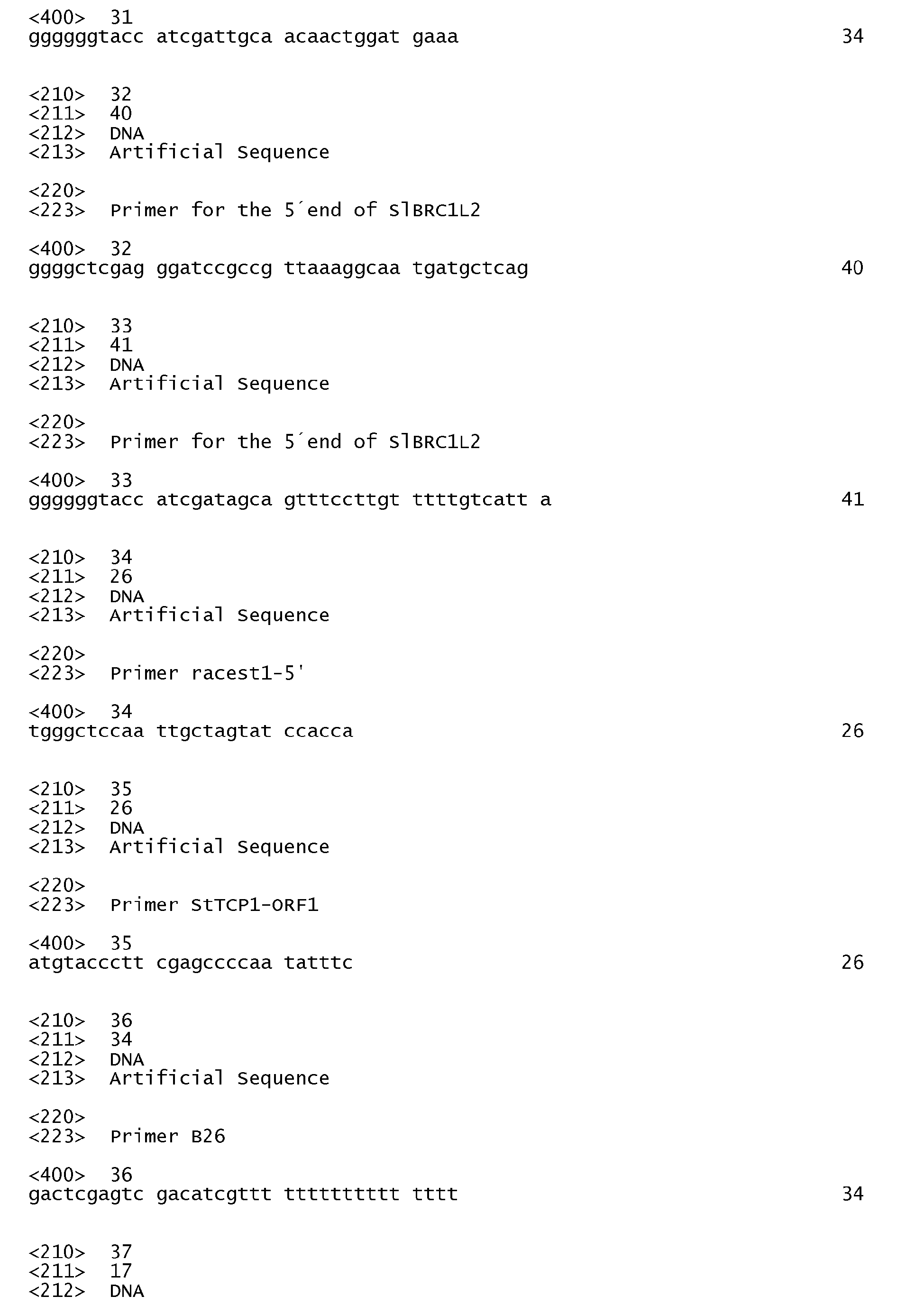


Claims (39)
- Isolated RNA or DNA polynucleotide capable of being translated into an amino acid sequence comprising a peptide having an identity of at least 95% with the amino acid sequence which is selected from the list comprising:a. SEQ ID NO: 1,b. SEQ ID NO: 2,c. SEQ ID NO: 3,d. SEQ ID NO: 4, ore. SEQ ID NO: 50
- Isolated RNA or DNA polynucleotide capable of being translated into an amino acid sequence comprising a peptide having an identity of at least 99% with the amino acid sequence which is selected from the list comprising:a. SEQ ID NO:1,b. SEQ ID NO: 2,c. SEQ ID NO: 3,d. SEQ ID NO: 4, ore. SEQ ID NO: 50
- Isolated RNA or DNA polynucleotide according to the preceding claim, capable of being translated into amino acid sequence which is selected from the list comprising:a. SEQ ID NO:1,b. SEQ ID NO: 2,c. SEQ ID NO: 3,d. SEQ ID NO: 4, ore. SEQ ID NO: 50f. SEQ ID NO: 51.
- Isolated RNA or DNA polynucleotide, capable of directing the expression of a gene of interest in the axillary meristems of a plant having an identity with SEQ ID NO: 5 selected from any of the following:a. at least 95%, orb. at least 99%.
- Isolated RNA or DNA polynucleotide, capable of directing the expression of a gene of interest in the axillary meristems of a plant, having an identity with SEQ ID NO: 6 selected from any of the following:a. at least 95%, orb. at least 99%.
- Isolated RNA or DNA polynucleotide, capable of directing the expression of a gene of interest in the axillary meristems of a plant, which is selected from the list comprising:a. SEQ ID NO: 5, orb. SEQ ID NO: 6,
- Genetic construction of DNA or RNA, comprising one of the following types of sequences:a. sequence of nucleotides, comprising, at least, one polynucleotide according to any of claims 1-3, for its transcription in vitro or in vivo, orb. sequence of nucleotides, corresponding to a gene expression system or vector comprising a polynucleotide according to any of claims 1-3, operatively linked to, at least, one promoter which directs the transcription of said sequence of nucleotides, and to other sequences necessary or appropriate for the transcription and their suitable regulation in time and place.
- Genetic construction according to the preceding claim, where the promoter is selected from the list comprising the polynucleotides according to any of claims 4-6.
- Genetic construction of DNA or RNA comprising a polynucleotide according to any of claims 4-6, operatively linked to a gene of interest.
- Use of a polynucleotide according to any of claims 1-6, or of a genetic construction according to any of claims 7-9, to modify the architecture of a plant.
- Use of a polynucleotide according to any of claims 4-6, or of a genetic construction according to claim 9, to express a gene of interest in the axillary meristems of a plant.
- Method to modify the plant architecture of a plant comprising:a. transfecting a polynucleotide according to any of claims 1-6, or a genetic construction according to any of claims 7-9, in a cell or culture of host plant cells,b. growing the cell or the culture of host plant cells in a suitable medium, until regenerating a complete plant.
- Method to express a gene of interest in the axillary meristems of a plant comprising:a. transfecting a polynucleotide according to any of claims 1-6, or a genetic construction according to any of claims 7-9, in a cell or culture of host plant cells,b. growing the cell or the culture of host plant cells in a suitable medium, until regenerating a complete plant.
- Method according to any of claims 12-13, where the transfected cell can be taxonomically classified as belonging to the species Solanum tuberosum.
- Method according to any of claims 12-13, where the transfected cell can be taxonomically classified as belonging to the species Solanum lycopersicum.
- Expression modulating agent of the genes SIBRC1L1, SIBRC1L2, StBRC1L1 and StBRC1L2, or of the polynucleotides according to any of claims 1-3, which is selected from the list comprising:a. an antisense oligonucleotide,b. an interfering RNA, orc. a antibody, (or fragment thereof).
- Modulating agent according to claim 16, consisting of a antisense oligonucleotide capable of inhibiting the expression of the gene SIBRC1L2.
- Modulating agent according to claim 16, consisting of an isolated DNA or RNA polynucleotide comprising the nucleotide sequence SEQ ID NO: 11.
- Modulating agent according to claim 16, consisting of an isolated DNA or RNA polynucleotide comprising the nucleotide sequence SEQ ID NO: 12.
- Modulating agent according to claim 16, consisting of an isolated DNA or RNA polynucleotide comprising the nucleotide sequence SEQ ID NO: 13.
- Modulating agent according to claim 16, consisting of an isolated DNA or RNA polynucleotide comprising the nucleotide sequence SEQ ID NO: 14.
- Genetic construction comprising an isolated polynucleotide according to any of claims 18-21.
- Composition comprising a modulating agent according to any of claims 16-21, or a genetic construction according to claim 22.
- Use of a modulating agent according to any of claims 16-21, a genetic construction according to claim 22, or of a composition according to claim 23, to modify the architecture of a plant.
- Seed the genetic material whereof integrates the polynucleotide according to any of claims 1-6 or 18-21, or the genetic construction according to any of claims 7-9 or 22.
- Plant cell the genetic material whereof integrates the polynucleotide according to any of claims 1-6 or 18-21, or the genetic construction according to any of claims 7-9 or 22.
- Culture of plant cells according to claim 26.
- Plant comprising cells according to any of claims 26-27, and/or obtained after the growth of the seed according to claim 25.
- Grain of pollen the genetic material whereof is a derivative of the genetic material of a cell according to any of claims 26-27.
- Seed according to claim 25, plant cell according to claim 26, culture of plant cells according to claim 27, plant according to claim 28, or grain of pollen according to claim 29, which can be taxonomically classified as belonging to the family Solanaceae.
- Seed according to claim 25, plant cell according to claim 26, culture of plant cells according to claim 27, plant according to claim 28, or grain of pollen according to claim 29, which can be taxonomically classified as belonging to the species Solanum tuberosum.
- Seed according to claim 25, plant cell according to claim 26, culture of plant cells according to claim 27, plant according to claim 28, or grain of pollen according to claim 29, which can be taxonomically classified as belonging to the species Solanum lycopersicum.
- Group of cells according to claim 26, which form tubers or minitubers.
- Plant, fruit, seed, cells, group of cells or parts of the tomato plant, which have a plant architecture modified with respect to a control-type plant, where the modification of the plant architecture is due to non-transgenic mutations in the genes SIBRC1L1 and SIBRC1L2 of the tomato plant.
- Plant, fruit, seed, cell, group of cells or parts of the potato plant, which have a plant architecture modified with respect to a control type plant, where the modification of the plant architecture is due to non-transgenic mutations in the potato genes StBRC1L1 and StBRC1L2.
- Method for obtaining tomato plants with modified plant architecture, in comparison with a wild control plant, comprising:a. obtaining plant material from a tomato plant (parent),b. subjecting the plant material of step (a) to a mutagenesis processc. culturing the mutated plant material until regenerating a complete plant, and its descendants,d. analysing the descendants of the plants of step (c) to detect at least one mutation in at least one copy the genes SIBRC1L1 and SIBRC1L2,e. selecting the descendants with at least one mutation in at least one copy of the genes SIBRC1L1 and SIBRC1L2 which have their plant architecture modified in comparison with a control type plant,f. optionally, culturing the plant selected to obtain descendants which has said modification of the plant architecture.
- Method according to the preceding claim where the mutant which has the mutation in gene SIBRC1L2 is selected.
- Method for obtaining potato plants with modified plant architecture, in comparison with a wild control plant, comprising:a. obtaining plant material from a potato plant (parent),b. subjecting the plant material of step (a) to a mutagenesis processc. culturing the mutated plant material until regenerating a complete plant, and its descendants,d. analysing the descendants of the plants of step (c) to detect at least one mutation in at least one copy of the genes StBRC1L1 and StBRC1L2,e. selecting the descendants with at least one mutation in at least one copy of the genes StBRC1L1 and StBRC1L2 which have their plant architecture modified in comparison with a control type plant,f. optionally, culturing the plant selected to obtain descendants which have said modification of the plant architecture.
- Method according to any of claims 36-38, where the mutagenesis process of step (b) is performed with chemical mutagens.
Applications Claiming Priority (2)
| Application Number | Priority Date | Filing Date | Title |
|---|---|---|---|
| ES200900088A ES2351009B1 (en) | 2009-01-13 | 2009-01-13 | REGULATING GENES OF THE RAMIFICATION OF PLANTS, PROMOTERS, GENETIC CONSTRUCTIONS THAT CONTAIN THEM AND USES. |
| PCT/ES2009/070538 WO2010081917A1 (en) | 2009-01-13 | 2009-11-27 | Genes regulating plant branching, promoters, genetic constructs containing same and uses thereof |
Publications (3)
| Publication Number | Publication Date |
|---|---|
| EP2383344A1 true EP2383344A1 (en) | 2011-11-02 |
| EP2383344A4 EP2383344A4 (en) | 2012-06-13 |
| EP2383344B1 EP2383344B1 (en) | 2018-05-16 |
Family
ID=42339475
Family Applications (1)
| Application Number | Title | Priority Date | Filing Date |
|---|---|---|---|
| EP09838175.9A Not-in-force EP2383344B1 (en) | 2009-01-13 | 2009-11-27 | Genes regulating plant branching, promoters, genetic constructs containing same and uses thereof |
Country Status (5)
| Country | Link |
|---|---|
| US (1) | US9040776B2 (en) |
| EP (1) | EP2383344B1 (en) |
| CN (1) | CN102348801B (en) |
| ES (2) | ES2351009B1 (en) |
| WO (1) | WO2010081917A1 (en) |
Cited By (4)
| Publication number | Priority date | Publication date | Assignee | Title |
|---|---|---|---|---|
| EP2754711A1 (en) * | 2013-01-10 | 2014-07-16 | Fondazione Edmund Mach | Co gene MdCo31 of the 'Wijcik' mutant of Malus x domestica Borkh and plants with controlled tree architecture genetically transformed by introduction of this gene |
| WO2016057515A3 (en) * | 2014-10-06 | 2016-06-09 | Altria Client Services Llc | Genetic control of axillary bud growth in tobacco plants |
| WO2017156535A1 (en) * | 2016-03-11 | 2017-09-14 | Altria Client Services Llc | Compositions and methods for producing tobacco plants and products having reduced or eliminated suckers |
| WO2020028632A1 (en) * | 2018-08-02 | 2020-02-06 | Altria Client Services Llc | Optimized tissue-preferred promoter and uses thereof |
Families Citing this family (11)
| Publication number | Priority date | Publication date | Assignee | Title |
|---|---|---|---|---|
| EP2522675B1 (en) | 2011-05-13 | 2016-11-30 | Consejo Superior De Investigaciones Científicas (CSIC) | SpBRANCHED1a of Solanum pennellii and tomato plants with reduced branching comprising this heterologous SpBRANCHED1a gene |
| CN102776206B (en) * | 2012-08-22 | 2013-09-11 | 山东省农业科学院蔬菜研究所 | BrTCP24 gene capable of controlling celery cabbage growth and application thereof |
| CN104862319B (en) * | 2014-04-14 | 2017-07-28 | 北京大学 | Control arabidopsis gene AtTIE1 and its application of plant branching |
| BR112018070041A2 (en) | 2016-03-30 | 2019-11-26 | Japan Tobacco Inc | tobacco plant and method for manufacturing it |
| WO2018168015A1 (en) | 2017-03-16 | 2018-09-20 | 日本たばこ産業株式会社 | Tobacco plant and production method thereof |
| CN108409858B (en) * | 2018-05-29 | 2021-06-18 | 天津农学院 | A kind of tomato fruit transcription factor CNR polyclonal antibody and preparation method thereof |
| CN109055350A (en) * | 2018-10-16 | 2018-12-21 | 内蒙古格林特制药有限责任公司 | A method of passing through dithyl sulfate and ultraviolet mutagenesis griseofulvin strain |
| CN110903370B (en) * | 2019-12-17 | 2023-12-08 | 陕西省杂交油菜研究中心 | TCP transcription factor, gene for encoding TCP transcription factor and application |
| CN116732046B (en) * | 2022-03-02 | 2025-08-01 | 中国农业科学院深圳农业基因组研究所(岭南现代农业科学与技术广东省实验室深圳分中心) | Application of polynucleotide, protein and biological material in regulating and controlling plant tuber development and its related products and cultivation method |
| CN116064573B (en) * | 2022-08-11 | 2024-06-28 | 西北农林科技大学 | MdTCP17 gene and protein for inhibiting adventitious root development and application thereof |
| CN115927330B (en) * | 2022-10-17 | 2025-04-22 | 河南农业大学 | Application of peach MIR6288b in regulating the number of plant branches |
Family Cites Families (2)
| Publication number | Priority date | Publication date | Assignee | Title |
|---|---|---|---|---|
| ES2249982B1 (en) * | 2004-05-07 | 2007-05-16 | Consejo Sup. Investig. Cientificas | REGULATORY SEQUENCE OF THE EXPRESSION OF A GEN IN AXILAR MERISTMS OF PLANTS AND THEIR APPLICATIONS. |
| CA2526686A1 (en) * | 2004-12-11 | 2006-06-11 | Sungene Gmbh | Expression cassettes for regulating meristem-preferential or meristem-specific expression in plants |
-
2009
- 2009-01-13 ES ES200900088A patent/ES2351009B1/en not_active Expired - Fee Related
- 2009-11-27 EP EP09838175.9A patent/EP2383344B1/en not_active Not-in-force
- 2009-11-27 CN CN2009801580529A patent/CN102348801B/en not_active Expired - Fee Related
- 2009-11-27 US US13/144,348 patent/US9040776B2/en not_active Expired - Fee Related
- 2009-11-27 ES ES09838175.9T patent/ES2683734T3/en active Active
- 2009-11-27 WO PCT/ES2009/070538 patent/WO2010081917A1/en not_active Ceased
Cited By (13)
| Publication number | Priority date | Publication date | Assignee | Title |
|---|---|---|---|---|
| EP2754711A1 (en) * | 2013-01-10 | 2014-07-16 | Fondazione Edmund Mach | Co gene MdCo31 of the 'Wijcik' mutant of Malus x domestica Borkh and plants with controlled tree architecture genetically transformed by introduction of this gene |
| WO2016057515A3 (en) * | 2014-10-06 | 2016-06-09 | Altria Client Services Llc | Genetic control of axillary bud growth in tobacco plants |
| US10435700B2 (en) | 2014-10-06 | 2019-10-08 | Altria Client Services Llc | Genetic control of axillary bud growth in tobacco plants |
| US12203082B2 (en) | 2014-10-06 | 2025-01-21 | Altria Client Services Llc | Genetic control of axillary bud growth in tobacco plants |
| US11236349B2 (en) | 2014-10-06 | 2022-02-01 | Altria Client Services Llc | Genetic control of axillary bud growth in tobacco plants |
| US11807860B2 (en) | 2016-03-11 | 2023-11-07 | Altria Client Services Llc | Compositions and methods for producing tobacco plants and products having reduced or eliminated suckers |
| WO2017156535A1 (en) * | 2016-03-11 | 2017-09-14 | Altria Client Services Llc | Compositions and methods for producing tobacco plants and products having reduced or eliminated suckers |
| US12209249B2 (en) | 2016-03-11 | 2025-01-28 | Altria Client Services Llc | Compositions and methods for producing tobacco plants and products having reduced or eliminated suckers |
| JP2021532790A (en) * | 2018-08-02 | 2021-12-02 | アルトリア クライアント サーヴィシーズ リミテッド ライアビリティ カンパニー | Optimized tissue-preferred promoters and their use |
| US11767535B2 (en) | 2018-08-02 | 2023-09-26 | Altria Client Services Llc | Optimized tissue-preferred promoter and uses thereof |
| US11293030B2 (en) | 2018-08-02 | 2022-04-05 | Altria Client Services Llc | Optimized tissue-preferred promoter and uses thereof |
| CN112714792A (en) * | 2018-08-02 | 2021-04-27 | 奥驰亚客户服务有限公司 | Optimized tissue-preferred promoters and uses thereof |
| WO2020028632A1 (en) * | 2018-08-02 | 2020-02-06 | Altria Client Services Llc | Optimized tissue-preferred promoter and uses thereof |
Also Published As
| Publication number | Publication date |
|---|---|
| EP2383344B1 (en) | 2018-05-16 |
| CN102348801A (en) | 2012-02-08 |
| US20120017337A1 (en) | 2012-01-19 |
| ES2683734T3 (en) | 2018-09-27 |
| ES2351009B1 (en) | 2012-01-23 |
| US9040776B2 (en) | 2015-05-26 |
| CN102348801B (en) | 2013-12-25 |
| WO2010081917A1 (en) | 2010-07-22 |
| EP2383344A4 (en) | 2012-06-13 |
| ES2351009A1 (en) | 2011-01-31 |
Similar Documents
| Publication | Publication Date | Title |
|---|---|---|
| US9040776B2 (en) | Genes regulating plant branching, promotors, genetic constructs containing same and uses thereof | |
| JP4347689B2 (en) | Reverse breeding | |
| JPH08507923A (en) | DNA, DNA constructs, cells and plants derived therefrom | |
| US10793868B2 (en) | Plants with increased seed size | |
| CN116218876B (en) | Gene OsB12D3 for regulating rice chalkiness, encoding protein and application thereof | |
| JP2021501602A (en) | Lodging resistance in plants | |
| CN109477091A (en) | Constructs and Vectors for Intragenic Plant Transformation | |
| US20200190530A1 (en) | Identification and use of grape genes controlling salt/drought tolerance and fruit sweetness | |
| WO2023065966A1 (en) | Application of bfne gene in tomato plant type improvement and biological yield increase | |
| US11643665B2 (en) | Nucleotide sequences encoding Fasciated EAR3 (FEA3) and methods of use thereof | |
| CN109385431B (en) | Application of OsERF2 gene in regulating rice grain size | |
| US20150024388A1 (en) | Expression of SEP-like Genes for Identifying and Controlling Palm Plant Shell Phenotypes | |
| JP2013051911A (en) | Method for increasing root knot nematode resistance of plant | |
| IL288219B2 (en) | Cannabis plants with improved yield | |
| BRPI0801924A2 (en) | methods for modifying plant morphology | |
| Joshi et al. | Approaches for development of cisgenic apples | |
| WO2009145290A1 (en) | Plant having increased grain size which contains sh4 gene | |
| US20150059019A1 (en) | Agronomic characteristics of plants through abph2 | |
| KR102954443B1 (en) | Soybean transgenic plant with reduced storage protein content and uses thereof | |
| Çelik et al. | Editing of banana, apple, and grapevine genomes using the CRISPR-Cas9 system | |
| CN109852626A (en) | Albumen, expression vector, transformed plant and the application of a kind of GhOR gene and its coding | |
| JP2024078049A (en) | Method for producing self-compatible Brassicaceae plants | |
| ES2371316A1 (en) | GENE REGULATOR OF THE BRANCH OF PLANTS, PROMOTERS, GENETIC CONSTRUCTIONS CONTAINING IT AND USES. | |
| JP4752053B2 (en) | A gene that increases the number of plant grains and dwarfs the plant. | |
| CN121160766A (en) | Method, composition and plant for inhibiting cotton pigment gland lysogenesis and secondary metabolite synthesis |
Legal Events
| Date | Code | Title | Description |
|---|---|---|---|
| PUAI | Public reference made under article 153(3) epc to a published international application that has entered the european phase |
Free format text: ORIGINAL CODE: 0009012 |
|
| 17P | Request for examination filed |
Effective date: 20110729 |
|
| AK | Designated contracting states |
Kind code of ref document: A1 Designated state(s): AT BE BG CH CY CZ DE DK EE ES FI FR GB GR HR HU IE IS IT LI LT LU LV MC MK MT NL NO PL PT RO SE SI SK SM TR |
|
| DAX | Request for extension of the european patent (deleted) | ||
| RIC1 | Information provided on ipc code assigned before grant |
Ipc: A01H 5/00 20060101ALI20120427BHEP Ipc: C12N 15/82 20060101AFI20120427BHEP |
|
| A4 | Supplementary search report drawn up and despatched |
Effective date: 20120510 |
|
| 17Q | First examination report despatched |
Effective date: 20160125 |
|
| STAA | Information on the status of an ep patent application or granted ep patent |
Free format text: STATUS: EXAMINATION IS IN PROGRESS |
|
| GRAP | Despatch of communication of intention to grant a patent |
Free format text: ORIGINAL CODE: EPIDOSNIGR1 |
|
| STAA | Information on the status of an ep patent application or granted ep patent |
Free format text: STATUS: GRANT OF PATENT IS INTENDED |
|
| INTG | Intention to grant announced |
Effective date: 20171115 |
|
| RAP1 | Party data changed (applicant data changed or rights of an application transferred) |
Owner name: CONSEJO SUPERIOR DE INVESTIGACIONES CIENTIFICAS (C |
|
| GRAJ | Information related to disapproval of communication of intention to grant by the applicant or resumption of examination proceedings by the epo deleted |
Free format text: ORIGINAL CODE: EPIDOSDIGR1 |
|
| STAA | Information on the status of an ep patent application or granted ep patent |
Free format text: STATUS: EXAMINATION IS IN PROGRESS |
|
| GRAS | Grant fee paid |
Free format text: ORIGINAL CODE: EPIDOSNIGR3 |
|
| STAA | Information on the status of an ep patent application or granted ep patent |
Free format text: STATUS: GRANT OF PATENT IS INTENDED |
|
| GRAP | Despatch of communication of intention to grant a patent |
Free format text: ORIGINAL CODE: EPIDOSNIGR1 |
|
| GRAJ | Information related to disapproval of communication of intention to grant by the applicant or resumption of examination proceedings by the epo deleted |
Free format text: ORIGINAL CODE: EPIDOSDIGR1 |
|
| GRAL | Information related to payment of fee for publishing/printing deleted |
Free format text: ORIGINAL CODE: EPIDOSDIGR3 |
|
| STAA | Information on the status of an ep patent application or granted ep patent |
Free format text: STATUS: EXAMINATION IS IN PROGRESS |
|
| INTC | Intention to grant announced (deleted) | ||
| INTG | Intention to grant announced |
Effective date: 20180205 |
|
| INTC | Intention to grant announced (deleted) | ||
| GRAP | Despatch of communication of intention to grant a patent |
Free format text: ORIGINAL CODE: EPIDOSNIGR1 |
|
| STAA | Information on the status of an ep patent application or granted ep patent |
Free format text: STATUS: GRANT OF PATENT IS INTENDED |
|
| GRAA | (expected) grant |
Free format text: ORIGINAL CODE: 0009210 |
|
| STAA | Information on the status of an ep patent application or granted ep patent |
Free format text: STATUS: THE PATENT HAS BEEN GRANTED |
|
| INTG | Intention to grant announced |
Effective date: 20180323 |
|
| AK | Designated contracting states |
Kind code of ref document: B1 Designated state(s): AT BE BG CH CY CZ DE DK EE ES FI FR GB GR HR HU IE IS IT LI LT LU LV MC MK MT NL NO PL PT RO SE SI SK SM TR |
|
| REG | Reference to a national code |
Ref country code: GB Ref legal event code: FG4D |
|
| REG | Reference to a national code |
Ref country code: CH Ref legal event code: EP |
|
| REG | Reference to a national code |
Ref country code: IE Ref legal event code: FG4D |
|
| REG | Reference to a national code |
Ref country code: DE Ref legal event code: R096 Ref document number: 602009052376 Country of ref document: DE |
|
| REG | Reference to a national code |
Ref country code: AT Ref legal event code: REF Ref document number: 999600 Country of ref document: AT Kind code of ref document: T Effective date: 20180615 |
|
| REG | Reference to a national code |
Ref country code: NL Ref legal event code: FP |
|
| REG | Reference to a national code |
Ref country code: ES Ref legal event code: FG2A Ref document number: 2683734 Country of ref document: ES Kind code of ref document: T3 Effective date: 20180927 |
|
| REG | Reference to a national code |
Ref country code: LT Ref legal event code: MG4D |
|
| PG25 | Lapsed in a contracting state [announced via postgrant information from national office to epo] |
Ref country code: LT Free format text: LAPSE BECAUSE OF FAILURE TO SUBMIT A TRANSLATION OF THE DESCRIPTION OR TO PAY THE FEE WITHIN THE PRESCRIBED TIME-LIMIT Effective date: 20180516 Ref country code: BG Free format text: LAPSE BECAUSE OF FAILURE TO SUBMIT A TRANSLATION OF THE DESCRIPTION OR TO PAY THE FEE WITHIN THE PRESCRIBED TIME-LIMIT Effective date: 20180816 Ref country code: FI Free format text: LAPSE BECAUSE OF FAILURE TO SUBMIT A TRANSLATION OF THE DESCRIPTION OR TO PAY THE FEE WITHIN THE PRESCRIBED TIME-LIMIT Effective date: 20180516 Ref country code: NO Free format text: LAPSE BECAUSE OF FAILURE TO SUBMIT A TRANSLATION OF THE DESCRIPTION OR TO PAY THE FEE WITHIN THE PRESCRIBED TIME-LIMIT Effective date: 20180816 Ref country code: SE Free format text: LAPSE BECAUSE OF FAILURE TO SUBMIT A TRANSLATION OF THE DESCRIPTION OR TO PAY THE FEE WITHIN THE PRESCRIBED TIME-LIMIT Effective date: 20180516 |
|
| PG25 | Lapsed in a contracting state [announced via postgrant information from national office to epo] |
Ref country code: GR Free format text: LAPSE BECAUSE OF FAILURE TO SUBMIT A TRANSLATION OF THE DESCRIPTION OR TO PAY THE FEE WITHIN THE PRESCRIBED TIME-LIMIT Effective date: 20180817 Ref country code: LV Free format text: LAPSE BECAUSE OF FAILURE TO SUBMIT A TRANSLATION OF THE DESCRIPTION OR TO PAY THE FEE WITHIN THE PRESCRIBED TIME-LIMIT Effective date: 20180516 Ref country code: HR Free format text: LAPSE BECAUSE OF FAILURE TO SUBMIT A TRANSLATION OF THE DESCRIPTION OR TO PAY THE FEE WITHIN THE PRESCRIBED TIME-LIMIT Effective date: 20180516 |
|
| REG | Reference to a national code |
Ref country code: AT Ref legal event code: MK05 Ref document number: 999600 Country of ref document: AT Kind code of ref document: T Effective date: 20180516 |
|
| PG25 | Lapsed in a contracting state [announced via postgrant information from national office to epo] |
Ref country code: CZ Free format text: LAPSE BECAUSE OF FAILURE TO SUBMIT A TRANSLATION OF THE DESCRIPTION OR TO PAY THE FEE WITHIN THE PRESCRIBED TIME-LIMIT Effective date: 20180516 Ref country code: PL Free format text: LAPSE BECAUSE OF FAILURE TO SUBMIT A TRANSLATION OF THE DESCRIPTION OR TO PAY THE FEE WITHIN THE PRESCRIBED TIME-LIMIT Effective date: 20180516 Ref country code: SK Free format text: LAPSE BECAUSE OF FAILURE TO SUBMIT A TRANSLATION OF THE DESCRIPTION OR TO PAY THE FEE WITHIN THE PRESCRIBED TIME-LIMIT Effective date: 20180516 Ref country code: RO Free format text: LAPSE BECAUSE OF FAILURE TO SUBMIT A TRANSLATION OF THE DESCRIPTION OR TO PAY THE FEE WITHIN THE PRESCRIBED TIME-LIMIT Effective date: 20180516 Ref country code: DK Free format text: LAPSE BECAUSE OF FAILURE TO SUBMIT A TRANSLATION OF THE DESCRIPTION OR TO PAY THE FEE WITHIN THE PRESCRIBED TIME-LIMIT Effective date: 20180516 Ref country code: AT Free format text: LAPSE BECAUSE OF FAILURE TO SUBMIT A TRANSLATION OF THE DESCRIPTION OR TO PAY THE FEE WITHIN THE PRESCRIBED TIME-LIMIT Effective date: 20180516 Ref country code: EE Free format text: LAPSE BECAUSE OF FAILURE TO SUBMIT A TRANSLATION OF THE DESCRIPTION OR TO PAY THE FEE WITHIN THE PRESCRIBED TIME-LIMIT Effective date: 20180516 |
|
| REG | Reference to a national code |
Ref country code: DE Ref legal event code: R097 Ref document number: 602009052376 Country of ref document: DE |
|
| PG25 | Lapsed in a contracting state [announced via postgrant information from national office to epo] |
Ref country code: SM Free format text: LAPSE BECAUSE OF FAILURE TO SUBMIT A TRANSLATION OF THE DESCRIPTION OR TO PAY THE FEE WITHIN THE PRESCRIBED TIME-LIMIT Effective date: 20180516 |
|
| PLBE | No opposition filed within time limit |
Free format text: ORIGINAL CODE: 0009261 |
|
| STAA | Information on the status of an ep patent application or granted ep patent |
Free format text: STATUS: NO OPPOSITION FILED WITHIN TIME LIMIT |
|
| 26N | No opposition filed |
Effective date: 20190219 |
|
| PG25 | Lapsed in a contracting state [announced via postgrant information from national office to epo] |
Ref country code: SI Free format text: LAPSE BECAUSE OF FAILURE TO SUBMIT A TRANSLATION OF THE DESCRIPTION OR TO PAY THE FEE WITHIN THE PRESCRIBED TIME-LIMIT Effective date: 20180516 |
|
| REG | Reference to a national code |
Ref country code: DE Ref legal event code: R119 Ref document number: 602009052376 Country of ref document: DE |
|
| REG | Reference to a national code |
Ref country code: CH Ref legal event code: PL |
|
| GBPC | Gb: european patent ceased through non-payment of renewal fee |
Effective date: 20181127 |
|
| PG25 | Lapsed in a contracting state [announced via postgrant information from national office to epo] |
Ref country code: MC Free format text: LAPSE BECAUSE OF FAILURE TO SUBMIT A TRANSLATION OF THE DESCRIPTION OR TO PAY THE FEE WITHIN THE PRESCRIBED TIME-LIMIT Effective date: 20180516 Ref country code: LU Free format text: LAPSE BECAUSE OF NON-PAYMENT OF DUE FEES Effective date: 20181127 |
|
| REG | Reference to a national code |
Ref country code: BE Ref legal event code: MM Effective date: 20181130 |
|
| REG | Reference to a national code |
Ref country code: IE Ref legal event code: MM4A |
|
| PG25 | Lapsed in a contracting state [announced via postgrant information from national office to epo] |
Ref country code: CH Free format text: LAPSE BECAUSE OF NON-PAYMENT OF DUE FEES Effective date: 20181130 Ref country code: LI Free format text: LAPSE BECAUSE OF NON-PAYMENT OF DUE FEES Effective date: 20181130 |
|
| PG25 | Lapsed in a contracting state [announced via postgrant information from national office to epo] |
Ref country code: DE Free format text: LAPSE BECAUSE OF NON-PAYMENT OF DUE FEES Effective date: 20190601 Ref country code: IE Free format text: LAPSE BECAUSE OF NON-PAYMENT OF DUE FEES Effective date: 20181127 |
|
| PG25 | Lapsed in a contracting state [announced via postgrant information from national office to epo] |
Ref country code: BE Free format text: LAPSE BECAUSE OF NON-PAYMENT OF DUE FEES Effective date: 20181130 |
|
| PG25 | Lapsed in a contracting state [announced via postgrant information from national office to epo] |
Ref country code: GB Free format text: LAPSE BECAUSE OF NON-PAYMENT OF DUE FEES Effective date: 20181127 |
|
| PG25 | Lapsed in a contracting state [announced via postgrant information from national office to epo] |
Ref country code: MT Free format text: LAPSE BECAUSE OF NON-PAYMENT OF DUE FEES Effective date: 20181127 |
|
| PGFP | Annual fee paid to national office [announced via postgrant information from national office to epo] |
Ref country code: NL Payment date: 20191126 Year of fee payment: 11 |
|
| PGFP | Annual fee paid to national office [announced via postgrant information from national office to epo] |
Ref country code: IT Payment date: 20191125 Year of fee payment: 11 Ref country code: FR Payment date: 20191125 Year of fee payment: 11 |
|
| PG25 | Lapsed in a contracting state [announced via postgrant information from national office to epo] |
Ref country code: TR Free format text: LAPSE BECAUSE OF FAILURE TO SUBMIT A TRANSLATION OF THE DESCRIPTION OR TO PAY THE FEE WITHIN THE PRESCRIBED TIME-LIMIT Effective date: 20180516 |
|
| PG25 | Lapsed in a contracting state [announced via postgrant information from national office to epo] |
Ref country code: PT Free format text: LAPSE BECAUSE OF FAILURE TO SUBMIT A TRANSLATION OF THE DESCRIPTION OR TO PAY THE FEE WITHIN THE PRESCRIBED TIME-LIMIT Effective date: 20180516 |
|
| PG25 | Lapsed in a contracting state [announced via postgrant information from national office to epo] |
Ref country code: CY Free format text: LAPSE BECAUSE OF FAILURE TO SUBMIT A TRANSLATION OF THE DESCRIPTION OR TO PAY THE FEE WITHIN THE PRESCRIBED TIME-LIMIT Effective date: 20180516 Ref country code: MK Free format text: LAPSE BECAUSE OF NON-PAYMENT OF DUE FEES Effective date: 20180516 Ref country code: HU Free format text: LAPSE BECAUSE OF FAILURE TO SUBMIT A TRANSLATION OF THE DESCRIPTION OR TO PAY THE FEE WITHIN THE PRESCRIBED TIME-LIMIT; INVALID AB INITIO Effective date: 20091127 |
|
| PG25 | Lapsed in a contracting state [announced via postgrant information from national office to epo] |
Ref country code: IS Free format text: LAPSE BECAUSE OF FAILURE TO SUBMIT A TRANSLATION OF THE DESCRIPTION OR TO PAY THE FEE WITHIN THE PRESCRIBED TIME-LIMIT Effective date: 20180916 |
|
| PGFP | Annual fee paid to national office [announced via postgrant information from national office to epo] |
Ref country code: ES Payment date: 20201216 Year of fee payment: 12 |
|
| REG | Reference to a national code |
Ref country code: NL Ref legal event code: MM Effective date: 20201201 |
|
| PG25 | Lapsed in a contracting state [announced via postgrant information from national office to epo] |
Ref country code: NL Free format text: LAPSE BECAUSE OF NON-PAYMENT OF DUE FEES Effective date: 20201201 |
|
| PG25 | Lapsed in a contracting state [announced via postgrant information from national office to epo] |
Ref country code: FR Free format text: LAPSE BECAUSE OF NON-PAYMENT OF DUE FEES Effective date: 20201130 Ref country code: IT Free format text: LAPSE BECAUSE OF NON-PAYMENT OF DUE FEES Effective date: 20201127 |
|
| REG | Reference to a national code |
Ref country code: ES Ref legal event code: FD2A Effective date: 20230301 |
|
| PG25 | Lapsed in a contracting state [announced via postgrant information from national office to epo] |
Ref country code: ES Free format text: LAPSE BECAUSE OF NON-PAYMENT OF DUE FEES Effective date: 20211128 |