EP2383318A1 - Adhesive composition - Google Patents
Adhesive composition Download PDFInfo
- Publication number
- EP2383318A1 EP2383318A1 EP11003017A EP11003017A EP2383318A1 EP 2383318 A1 EP2383318 A1 EP 2383318A1 EP 11003017 A EP11003017 A EP 11003017A EP 11003017 A EP11003017 A EP 11003017A EP 2383318 A1 EP2383318 A1 EP 2383318A1
- Authority
- EP
- European Patent Office
- Prior art keywords
- group
- fluorinated
- silicon
- bonded
- groups
- Prior art date
- Legal status (The legal status is an assumption and is not a legal conclusion. Google has not performed a legal analysis and makes no representation as to the accuracy of the status listed.)
- Granted
Links
- 0 C*(C)c1cc(N(C)*(*)=O)ccc1 Chemical compound C*(C)c1cc(N(C)*(*)=O)ccc1 0.000 description 2
- YXFVVABEGXRONW-UHFFFAOYSA-N Cc1ccccc1 Chemical compound Cc1ccccc1 YXFVVABEGXRONW-UHFFFAOYSA-N 0.000 description 1
Classifications
-
- C—CHEMISTRY; METALLURGY
- C09—DYES; PAINTS; POLISHES; NATURAL RESINS; ADHESIVES; COMPOSITIONS NOT OTHERWISE PROVIDED FOR; APPLICATIONS OF MATERIALS NOT OTHERWISE PROVIDED FOR
- C09D—COATING COMPOSITIONS, e.g. PAINTS, VARNISHES OR LACQUERS; FILLING PASTES; CHEMICAL PAINT OR INK REMOVERS; INKS; CORRECTING FLUIDS; WOODSTAINS; PASTES OR SOLIDS FOR COLOURING OR PRINTING; USE OF MATERIALS THEREFOR
- C09D183/00—Coating compositions based on macromolecular compounds obtained by reactions forming in the main chain of the macromolecule a linkage containing silicon, with or without sulfur, nitrogen, oxygen, or carbon only; Coating compositions based on derivatives of such polymers
- C09D183/04—Polysiloxanes
- C09D183/08—Polysiloxanes containing silicon bound to organic groups containing atoms other than carbon, hydrogen, and oxygen
-
- C—CHEMISTRY; METALLURGY
- C08—ORGANIC MACROMOLECULAR COMPOUNDS; THEIR PREPARATION OR CHEMICAL WORKING-UP; COMPOSITIONS BASED THEREON
- C08G—MACROMOLECULAR COMPOUNDS OBTAINED OTHERWISE THAN BY REACTIONS ONLY INVOLVING UNSATURATED CARBON-TO-CARBON BONDS
- C08G77/00—Macromolecular compounds obtained by reactions forming a linkage containing silicon with or without sulfur, nitrogen, oxygen or carbon in the main chain of the macromolecule
- C08G77/04—Polysiloxanes
- C08G77/22—Polysiloxanes containing silicon bound to organic groups containing atoms other than carbon, hydrogen and oxygen
- C08G77/24—Polysiloxanes containing silicon bound to organic groups containing atoms other than carbon, hydrogen and oxygen halogen-containing groups
-
- C—CHEMISTRY; METALLURGY
- C08—ORGANIC MACROMOLECULAR COMPOUNDS; THEIR PREPARATION OR CHEMICAL WORKING-UP; COMPOSITIONS BASED THEREON
- C08L—COMPOSITIONS OF MACROMOLECULAR COMPOUNDS
- C08L71/00—Compositions of polyethers obtained by reactions forming an ether link in the main chain; Compositions of derivatives of such polymers
- C08L71/02—Polyalkylene oxides
Definitions
- This invention relates to an adhesive composition which cures into a fluorinated elastomer to form a tenacious bond to various substrates including metals and plastics, the fluorinated elastomer having many advantages including solvent resistance, oil resistance, chemical resistance, heat resistance, low-temperature properties, low moisture permeability, electric insulation, and acid resistance.
- Curable fluorinated elastomer compositions utilizing addition reaction between alkenyl and hydrosilyl groups are well known in the art. These compositions can be rendered self-adhesive by adding an organopolysiloxane having a hydrosilyl group and an epoxy and/or trialkoxysilyl group as the third component, as disclosed in JP 3239717 and JP 3567973 . These compositions may cure on brief heating into elastomers having advantages including solvent resistance, oil resistance, chemical resistance, heat resistance, low-temperature properties, low moisture permeability, and electric insulation. They are used in the adhesive application in various industrial fields where such properties are required, and frequently for the bonding and sealing of electrical components in the automotive industry.
- JP 2990646 discloses a polymer having a terminal structure [aromatic ring-Si-vinyl]. While this polymer is good in fast curing due to the inclusion of [Si-vinyl], the linkage between aromatic ring and Si is known to be acid labile.
- polymers free of [aromatic ring-Si-vinyl] at their terminus for example, a polymer having a terminal structure [aromatic ring-alkylene-vinyl] and a polymer having a terminal structure [amide (having pendant aromatic ring substituent)-alkylene-vinyl] have good acid resistance, but are inferior in fast curing.
- An object of the invention is to provide an adhesive composition which is cured by brief heating into a product that forms a tenacious bond to a wide variety of substrates including metals and plastics, the cured product having many advantages including solvent resistance, chemical resistance, heat resistance, low-temperature properties, low moisture permeability, electric insulation, and acid resistance.
- an adhesive composition comprising (A) a fluorinated amide compound containing at least two vinyl groups, each bonded to silicon atom, but not to aromatic ring, preferably at ends of the molecular chain in a molecule, and having a polyfluoro structure (specifically, divalent perfluoro structure such as perfluoroalkylene or perfluorooxyalkylene) in its backbone, (B) a fluorinated organosilicon compound containing in a molecule at least one monovalent perfluoroalkyl, monovalent perfluorooxyalkyl, divalent perfluoroalkylene or divalent perfluorooxyalkylene group and at least two silicon-bonded hydrogen atoms, and further containing a silicon-bonded monovalent substituent group which is an unsubstituted or halo-substituted alkyl, aryl or aralkyl group, and (C) a platinum group compound is improved by adding thereto (D) an organosi
- the resulting adhesive composition is cured by brief heating into a product that forms a tenacious bond to a wide variety of substrates including metals and plastics, the cured product having many advantages including solvent resistance, chemical resistance, heat resistance, low-temperature properties, low moisture permeability, electric insulation, and acid resistance.
- the invention provides an adhesive composition comprising
- the organosiloxane (D) further contains at least one monovalent perfluoroalkyl or monovalent perfluorooxyalkyl group bonded to a silicon atom via carbon atoms or carbon and oxygen atoms.
- the adhesive composition is cured by heating at a relatively low temperature for a short time.
- the cured composition forms a tenacious bond to a wide variety of substrates including metals and plastics, has many advantages including solvent resistance, chemical resistance, heat resistance, low-temperature properties, low moisture permeability, and electric insulation, and is durable against strong acids.
- the composition is thus useful as an adhesive applicable to various electric and electronic components which can be exposed to rigorous conditions.
- Cn-Cm means a group containing from n to m carbon atoms per group. Me stands for methyl, and Ph for phenyl.
- Component (A) is a linear polyfluoroamide compound containing at least two vinyl groups in a molecule, represented by the general formula (1) below.
- This polyfluoroamide compound is characterized by a terminal structure having a silicon-bonded vinyl group [Si-vinyl], but free of a linkage between aromatic ring and silicon atom [aromatic ring-Si].
- R 1 is each independently vinyl or C 1 -C 4 alkyl
- R 2 is each independently C 1 -C 6 alkylene
- R 3 is each independently hydrogen or optionally fluorinated C 1 -C 4 alkyl
- Rf 1 is a perfluoroalkylene or divalent perfluoropolyether group.
- R 1 is vinyl or C 1 -C 4 alkyl, and specifically, vinyl, methyl, ethyl, propyl or butyl.
- R 2 is C 1 -C 6 alkylene, preferably C 3 -C 6 alkylene, and specifically, methylene, ethylene, propylene (also referred to as trimethylene or methylethylene), butylene (also referred to as tetramethylene or methylpropylene), or hexamethylene.
- R 3 is hydrogen or optionally fluorinated C 1 -C 4 alkyl.
- C 1 -C 4 alkyl examples include alkyl groups such as methyl, ethyl, propyl, and butyl and fluorinated forms of the foregoing in which some or all hydrogen atoms are substituted by fluorine, such as trifluoromethyl.
- R 1 is methyl or vinyl
- R 2 is ethylene or trimethylene.
- Rf 1 is a perfluoroalkylene group or a divalent perfluoropolyether group.
- Suitable perfluoroalkylene groups include straight or branched perfluoroalkylene groups of 2 to 10 carbon atoms, preferably 2 to 6 carbon atoms.
- Suitable divalent perfluoropolyether groups include those groups containing a multiplicity of repeat units: -C e F 2e O- wherein e is an integer of 1 to 6.
- Exemplary groups are represented by the general formula (2): -(C e F 2e O) f - (2) wherein e is as defined above and f is an integer of 20 to 600, preferably 30 to 400, and more preferably 30 to 200.
- -CF 2 O-, -CF 2 CF 2 O-, -CF 2 CF 2 CF 2 O-, and -CF(CF 3 )CF 2 O- are preferred.
- the perfluoropolyether structure may be composed of repeat units of one type or repeat units of more than one type.
- Y is F or CF 3
- p, q and r each are an integer in the range: p ⁇ 0, q ⁇ 0, 0 ⁇ p+q ⁇ 200, specifically 2 ⁇ p+q ⁇ 150, and 0 ⁇ r ⁇ 6.
- Y is F or CF 3
- v and w each are an integer in the range: 1 ⁇ v ⁇ 20 and 1 ⁇ w ⁇ 20.
- z is an integer in the range: 1 ⁇ z ⁇ 100.
- Rf 1 examples of the group Rf 1 are given below.
- s, t and u each are an integer in the range: s ⁇ 0, t ⁇ 0, 0 ⁇ s+t ⁇ 200, specifically 2 ⁇ s+t ⁇ 150, and 0 ⁇ u ⁇ 6.
- m and n each are an integer in the indicated range.
- fluorinated amide compound having formula (1) examples include but not limited thereto.
- m is an integer of 1 to 100
- n is an integer of 1 to 100
- m+n ranges from 2 to 200.
- the fluorinated amide compound having formula (1) has a viscosity at 23°C of 100 to 100,000 mPa-s, more preferably 500 to 50,000 mPa-s, and even more preferably 1,000 to 20,000 mPa-s.
- a composition comprising a fluorinated amide compound having a viscosity within the range is effectively curable and has adequate physical properties, which make the composition suitable for the intended use in sealing, potting, coating, impregnation or the like.
- an optimum viscosity may be selected in the range. It is noted that the viscosity is measured by a Brookfield rotational viscometer.
- Component (B) is a fluorinated organosilicon compound containing per molecule at least one, preferably 1 to 10, mono- or divalent fluorinated organic group and at least two, specifically 2 to 200, preferably 2 to 50, silicon-bonded hydrogen atoms (i.e., SiH or hydrosilyl groups), and having a siloxane and/or silalkylene structure in the molecule.
- Component (B) functions as a crosslinker and chain extender for component (A).
- the fluorinated organosilicon compound should have per molecule at least one mono- or divalent fluorinated organic group, specifically monovalent perfluoroalkyl, monovalent perfluorooxyalkyl (or perfluoropolyether), divalent perfluoroalkylene or divalent perfluorooxyalkylene (or perfluoropolyether) group.
- Suitable mono- or divalent fluorinated organic groups include groups of the following general formulae: C g F 2g+1 - wherein g is an integer of 1 to 20, preferably 2 to 10, F-[CF(CF 3 )CF 2 O] h -C i F 2i - wherein h is an integer of 1 to 200, preferably 2 to 100, and i is an integer of 1 to 3, -C g F 2g - wherein g is an integer of 1 to 20, preferably 2 to 10, wherein j and k each are an integer of at least 1, j+k is on average from 2 to 200, preferably 2 to 100, and -CF 2 O- (CF 2 CF 2 O) x - (CF 2 O) y -CF 2 - wherein x is an integer of 1 to 200, and y is an integer of 1 to 50.
- the perfluoroalkyl, perfluorooxyalkyl, perfluoroalkylene or perfluorooxyalkylene group is preferably linked to a silicon atom by a divalent linking group.
- the divalent linking group is an alkylene group, arylene group, a combination thereof, or such a group which is separated by an ethereal oxygen atom, amide bond, carbonyl bond, silylene or ester bond.
- the preferred linking groups are of 2 to 12 carbon atoms, with examples being shown below wherein Ph denotes phenyl or phenylene.
- the organosilicon compound as component (B) contains a silicon-bonded monovalent substituent group, which is selected from unsubstituted or halo-substituted alkyl, aryl and aralkyl groups of 1 to 20 carbon atoms, preferably 1 to 12 carbon atoms.
- Suitable C 1 -C 20 hydrocarbon groups include alkyl groups such as methyl, ethyl, propyl, butyl, hexyl, cyclohexyl, and octyl; aryl groups such as phenyl and tolyl; aralkyl groups such as benzyl, phenylethyl and phenylpropyl; and halogenated forms of the foregoing in which some or all hydrogen atoms are substituted by halogen atoms such as fluorine.
- the organosilicon compound as component (B) may have a linear, branched or cyclic structure.
- the number of silicon atoms per molecule is generally about 2 to 60, preferably about 3 to 30, though not limited thereto.
- organosilicon compounds containing a mono- or divalent fluorinated organic group and silicon-bonded hydrogen atoms include, for example, organosilicon compounds of siloxane and/or silalkylene structure as shown below. These compounds may be used alone or in admixture of two or more.
- Component (B) is used in an amount to give 0.5 to 3 moles, preferably 0.8 to 2 moles of hydrosilyl (SiH) groups per mole of vinyl in component (A). With fewer SiH groups available, the result may be an insufficient degree of crosslinking or cure failure. Too much SiH groups may cause foaming during the cure step.
- components (A), (B) and (D) are preferably combined such that 0.55 to 3.2 moles, more preferably 0.85 to 2.2 moles of SiH groups available from components (B) and (D) are present per mole of vinyl available from component (A).
- Component (C) is a platinum group compound which is a catalyst for promoting addition reaction between vinyl groups in component (A) and hydrosilyl groups in component (B).
- platinum group compound or platinum group metal catalyst platinum compounds are often used because they are relatively readily available. Suitable platinum compounds include chloroplatinic acid, complexes of chloroplatinic acid with olefins such as ethylene, complexes of chloroplatinic acid with alcohols and vinylsiloxanes, and metallic platinum on silica, alumina and carbon carriers.
- Suitable platinum group metal catalysts other than the platinum compounds include rhodium, ruthenium, iridium and palladium compounds, such as, for example, RhCl (PPh 3 ) 3 , RhCl (CO) (PPh 3 ) 3 , Ru3 (CO) 12 , IrCl(CO) (PPh 3 ) 2 , and Pd(PPh 3 ) 4 .
- catalysts which are often solid, may be used in the solid form.
- a solution of chloroplatinic acid or complex thereof in a suitable solvent is preferably used because the solution is compatible with the fluorinated amide compound (A) so that a cured product becomes more uniform.
- Component (C) may be used in a catalytic amount.
- the catalyst is used in such an amount as to give 0.1 to 500 ppm of platinum group metal based on the total weight of components (A) and (B).
- Component (D) is an organosiloxane which is compounded for helping the composition develop self-adhesion.
- the organosiloxane has in the molecule at least one silicon-bonded hydrogen atom (SiH group) and at least one epoxy group and/or trialkoxysilyl group bonded to a silicon atom via carbon atoms or carbon and oxygen atoms, and preferably further has at least one perfluoroalkyl or perfluorooxyalkyl group bonded to a silicon atom via carbon atoms or carbon and oxygen atoms.
- the organosiloxane (D) has a siloxane structure which may be cyclic, chain-like or branched or a mixture thereof. Suitable examples of the organosiloxane (D) are shown below.
- R 4 is a substituted or unsubstituted monovalent hydrocarbon group
- A is an epoxy group or trialkoxysilyl group bonded to a silicon atom via carbon atoms or carbon and oxygen atoms
- B is a perfluoroalkyl or perfluorooxyalkyl group bonded to a silicon atom via carbon atoms or carbon and oxygen atoms
- w' is an integer of 0 to 100
- x' is an integer of 1 to 100
- y' is an integer of 1 to 100
- z' is an integer of 0 to 100.
- Suitable substituted or unsubstituted monovalent hydrocarbon groups represented by R 4 are of 1 to 10 carbon atoms, preferably 1 to 8 carbon atoms, and include alkyl groups such as methyl, ethyl, propyl, butyl, hexyl, cyclohexyl and octyl; aryl groups such as phenyl and tolyl; aralkyl groups such as benzyl and phenylethyl; and substituted forms of the foregoing groups in which some or all hydrogen atoms are substituted by halogen atoms such as fluorine. Inter alia, methyl is most preferred.
- w' be an integer of 0 to 20
- x' be an integer of 1 to 20
- y' be an integer of 1 to 20
- z' be an integer of 1 to 20
- w'+x'+y'+z' be an integer of 3 to 50.
- A is an epoxy group or trialkoxysilyl group bonded to a silicon atom via carbon atoms or carbon and oxygen atoms, which is exemplified by groups of the following formulae.
- R 5 is a divalent hydrocarbon group of 1 to 10 carbon atoms, more specifically 1 to 5 carbon atoms, which may be separated by an oxygen atom.
- alkylene groups such as methylene, ethylene and propylene, cycloalkylene groups such as cyclohexylene, and oxyalkylene groups such as oxyethylene, oxypropylene and oxybutylene.
- R 6 is a divalent hydrocarbon group of 1 to 10 carbon atoms, more specifically 1 to 4 carbon atoms, for example, alkylene such as methylene, ethylene or propylene.
- R 7 is a monovalent hydrocarbon group of 1 to 8 carbon atoms, more specifically 1 to 4 carbon atoms, for example, alkyl such as methyl, ethyl, propyl or butyl.
- R 8 is hydrogen or methyl.
- the subscript k' is an integer of 2 to 10, preferably 3 to 8.
- B is a monovalent perfluoroalkyl or perfluorooxyalkyl group bonded to a silicon atom via carbon atoms or carbon and oxygen atoms.
- exemplary monovalent perfluoroalkyl or perfluorooxyalkyl groups include those of the following general formulae. -R 9 -C g F 2g+1
- R 9 is a divalent hydrocarbon group of 1 to 10 carbon atoms, more specifically 1 to 4 carbon atoms, for example, alkylene such as methylene, ethylene or propylene
- R 10 is hydrogen, methyl or phenyl
- g is an integer of 1 to 20, preferably 2 to 10
- h is an integer of 1 to 200, preferably 1 to 100
- i is an integer of 1 to 3.
- the organosiloxane as component (D) may be obtained by combining an organohydrogenpolysiloxane having at least two, preferably at least three silicon-bonded hydrogen atoms (SiH groups) in the molecule with a compound having an aliphatic unsaturated group (e.g., vinyl or allyl) and an epoxy or trialkoxysilyl group and optionally, a compound having an aliphatic unsaturated group and a perfluoroalkyl or perfluorooxyalkyl group and effecting partial addition reaction therebetween in accordance with a standard procedure.
- the amounts of the reactants combined should be such that the number of aliphatic unsaturated groups be smaller than the number of SiH groups because the resultant organosiloxane should have at least one SiH group.
- the end compound may be isolated from the reaction mixture at the end of reaction although the reaction mixture may be used as long as the unreacted reactants and addition reaction catalyst have been removed therefrom.
- Suitable organosiloxanes which can serve as component (D) include those of the following structural formulae, which may be used alone or in admixture.
- Component (D) is used in an amount of 0.1 to 10 parts, and preferably 0.2 to 5 parts by weight per 100 parts by weight of component (A). Less than 0.1 phr of component (D) may fail to achieve satisfactory adhesion whereas more than 10 phr may interfere with the flow, often interfere with the cure of the composition, and have a negative impact on the physical strength of the cured composition.
- additives such as a plasticizer, viscosity modifier, flexibilizer, hydrosilylation catalyst inhibitor, inorganic filler, tackifier, adhesion auxiliary (other than D), and silane coupling agent may be added to the composition for enhancing its commercial utility.
- Such additives are compounded in any desired amounts as long as they do not compromise the objects of the invention or adversely affect the properties of the composition and the physical properties of the cured composition.
- a polyfluoromonoalkenyl compound having the general formula (2) and/or linear polyfluoro compounds having the general formulae (3) and (4) may be used.
- Rf 2 - (X') a -CH CH 2 (2)
- Rf 2 is a group of the general formula (i): F-[CF(CF 3 )CF 2 O] h' -C i' ,F 2i' - (i) wherein h' is an integer of 1 to 200, preferably 1 to 150, and i' is an integer of 1 to 3.
- X' is -CH 2 -, -OCH 2 -, -CH 2 OCH 2 -or -CO-NR'-Y'- wherein R' is hydrogen, methyl, phenyl or allyl and Y' is -CH 2 -, a o, m or p-dimethylsilylphenylene group of the following structural formula (Z') or a group of the following structural formula (Z").
- the subscript "a" is 0 or 1.
- D is a group: C g' F 29'+1 - wherein g' is 1 to 3, and b is an integer of 1 to 200.
- D is as defined above, c and d each are an integer of 1 to 200 and c+d is 2 to 200.
- n is an integer of 1 to 100.
- linear polyfluoro compounds having the general formulae (3) and (4) are given below.
- m is an integer of 1 to 200
- n is an integer of 1 to 200
- m+n is 2 to 200.
- the polyfluoro compounds having the general formulae (2) to (4) desirably have a viscosity at 23°C of 50 to 50,000 mPa-s, more desirably 100 to 20,000 mPa-s.
- an amount of the polyfluoro compound having formula (2), (3) or (4) is preferably 1 to 100 parts, more preferably 5 to 50 parts by weight per 100 parts by weight of component (A).
- hydrosilylation catalyst inhibitor examples include acetylenic alcohols such as 1-ethynyl-1-hydroxycyclohexane, 3-methyl-1-butyn-3-ol, 3,5-dimethyl-1-hexyn-3-ol, 3-methyl-1-penten-3-ol, and phenylbutynol, the reaction product of a chlorosilane having a monovalent fluorinated substituent group (as described above) and an acetylenic alcohol, 3-methyl-3-penten-1-yn, 3,5-dimethyl-3-hexen-1-yn, triallyl isocyanurate, polyvinyl siloxane, and organophosphorus compounds. Cure reactivity and shelf stability are kept moderate by adding such an inhibitor.
- acetylenic alcohols such as 1-ethynyl-1-hydroxycyclohexane, 3-methyl-1-butyn-3-ol, 3,5-dimethyl-1-hexyn-3-ol, 3-methyl-1-pen
- inorganic filler examples include fumed silica and precipitated silica, which may have been treated with silanes, silazanes or siloxanes, having a specific surface area of at least 50 m 2 /g, specifically 50 to 400 m 2 /g, more specifically 100 to 300 m 2 /g as measured by the BET method.
- reinforcing or semi-reinforcing fillers such as quartz flour, fused quartz flour, diatomaceous earth and calcium carbonate; inorganic pigments such as titanium oxide, iron oxide, carbon black, and cobalt aluminate; heat resistance improvers such as titanium oxide, iron oxide, carbon black, cerium oxide, cerium hydroxide, zinc carbonate, magnesium carbonate, and manganese carbonate; heat-conductive fillers such as alumina, boron nitride, silicon carbide and powdered metals; and electric conductive agents such as carbon black, silver powder and electroconductive zinc white.
- the inorganic filler is preferably added in an amount of about 0.5 to 20 parts, more preferably about 1 to 20 parts by weight per 100 parts by weight of component (A).
- adhesion promoters such as carboxylic anhydrides, titanic acid esters, and zirconic acid esters, tackifiers other than component (D), and silane coupling agents such as tris(3-trimethoxysilylpropyl)isocyanurate, tris(3-triethoxysilylpropyl)isocyanurate, 3-trimethoxysilylpropylsuccinic acid, 3-triethoxysilylpropylsuccinic acid, N-phenyl- ⁇ -aminopropyltrimethoxysilane, ⁇ -methacryloxypropyltrimethoxysilane, ⁇ -acryloxypropyltrimethoxysilane, ⁇ -(3,4-epoxycyclohexyl)ethyltrimethoxysilane, N- ⁇ -(aminoethyl)- ⁇ -aminopropyltrimethoxysilane, N- ⁇ -(aminoethyl
- the adhesive composition may be prepared by mixing components (A) to (D) and optional components on a mixing device such as planetary mixer, Ross mixer or Hobart mixer or a kneading device such as kneader or three-roll mill until uniform.
- a mixing device such as planetary mixer, Ross mixer or Hobart mixer or a kneading device such as kneader or three-roll mill until uniform.
- the composition may be formulated as one part wherein all components (A) to (D) are combined and handled as a single compound.
- the composition may be formulated as two parts which are mixed on use.
- one part is a mixture of components (A) and (C) and the other part is a mixture of components (B) and (D).
- the adhesive composition thus prepared may cure at room temperature depending on the type of functional group on fluorinated amide compound (A) and the type of catalyst (C), it is recommended to heat the composition to promote curing.
- the composition is heat cured at a temperature of at least 60°C, more preferably 100 to 200°C for several minutes to several hours in order to develop tenacious adhesion to various substrates.
- Suitable fluorinated solvents include 1,3-bis(trifluoromethyl)benzene, p-xylene hexafluoride, Fluorinert® (3M), perfluorobutyl methyl ether, perfluorobutyl ethyl ether, and mixtures thereof.
- the adhesive composition establishes a tenacious bond to a wide variety of substrates including metals and plastics.
- metals include aluminum, stainless steel, nickel, chromium, copper, zinc, and alloys comprising two or more of the foregoing.
- plastics include epoxy resins, phenolic resins, polyester resins such as polyethylene terephthalate (PET) and polybutylene terephthalate (PBT), polycarbonate (PC) resins, polyphenylene sulfide (PPS) resins, polyamide (PA) resins, polyimide (PI) resins, and liquid crystal polymer (LCP) resins.
- PET polyethylene terephthalate
- PBT polybutylene terephthalate
- PC polycarbonate
- PPS polyphenylene sulfide
- PA polyamide
- PI polyimide
- LCP liquid crystal polymer
- compositions of the invention are useful as the adhesive for automotive parts, electric/electronic parts and the like. More illustratively, they are useful as the bonding adhesive (die attaching or die bonding agent) for semiconductor chips as detectors and sensors used in automobile control systems, such as pressure sensors, VVT sensors, gas concentration detectors, and temperature sensors; the case sealing agent and electronic circuit protective coating agent; the protective sealing agent for sensors and instruments exposed to gases, hot water and chemicals; the adhesive for ink jet printers; the adhesive and sealant for printer heads; the coating agent to rolls and belts in laser printers and copiers; and the adhesive sealing and potting agents for various circuit boards.
- bonding adhesive die attaching or die bonding agent
- semiconductor chips such as detectors and sensors used in automobile control systems, such as pressure sensors, VVT sensors, gas concentration detectors, and temperature sensors
- the case sealing agent and electronic circuit protective coating agent such as the case sealing agent and electronic circuit protective coating agent
- the protective sealing agent for sensors and instruments exposed to gases, hot water and chemicals
- a planetary mixer was charged with 100 parts of a polymer having formula (5) below (viscosity 12,000 mPa-s, vinyl content 0.0128 mole/100 g) and 10 parts of dimethyldichlorosilane-surface-treated fumed silica (BET surface area 250 m 2 /g), which were kneaded for one hour without heating. While kneading was continued, the mixer was heated until the internal temperature reached 150°C. The contents were heat treated for 2 hours under vacuum (60 Torr) while holding a temperature of 150-170°C. The contents were cooled below 40°C and worked 2 passes on a three-roll mill, obtaining a base compound.
- a polymer having formula (5) below viscosity 12,000 mPa-s, vinyl content 0.0128 mole/100 g
- BET surface area 250 m 2 /g dimethyldichlorosilane-surface-treated fumed silica
- a planetary mixer was charged with 16.5 parts of the base compound and 85.0 parts of the polymer having formula (5), which were mixed until uniform.
- To the mixture 0.20 part of a toluene solution of platinum-divinyltetramethyldisiloxane complex (Pt concentration 0.5 wt%), 2.0 parts of a fluorinated organosilicon compound having formula (6) below, 1.3 parts of a fluorinated organosilicon compound having formula (7) below, and 1.0 part of a tackifier having formula (8) below were successively added. These components were mixed until uniform. This was followed by deaeration, yielding a composition.
- a dispenser cartridge was filled with the composition.
- a 80 ⁇ m thick layer of the composition was sandwiched between two 50x25 mm test panels of an adherend material (aluminum, stainless steel, nickel, epoxy resin, PET resin or PBT resin listed in Table 1), the panels being arranged so as to mutually overlap by 10 mm at the ends.
- the composition was then cured by heating at 150°C for 1 hour, thereby giving an adhesion test specimen.
- the specimen was subjected to a tensile shear bond test at a pulling speed of 50 mm/min, and the shear bond strength (MPa) and cohesive failure (area %) were determined. The results are shown in Table 1.
- the composition was placed in a rectangular mold of 105 mm by 85 mm by 2 mm (thick), press cured at 150°C and 100 kg/cm 2 for 10 minutes, and oven cured at 150°C for 50 minutes, forming a cured sheet.
- the sheet was cut into twelve test strips of 25 mm x 50 mm for hardness measurement before and after acid immersion. As the blank, three strips were stacked and measured for hardness using a type A Durometer according to JIS K6253. The remaining strips were divided into three sets each consisting of three strips kept separated apart, which were immersed in three types of acidic liquids at 40°C for 7 days, respectively. After the immersion, the strips were washed on their surface with alkaline water and then deionized water and wiped up residual water. The three strips of each set were stacked and measured for hardness according to JIS K6253. Also the surface state of the strips was visually observed. The results are shown in Table 2.
- a composition was prepared as in Example 1 except that 0.5 part of a tackifier having formula (9) below and 0.2 part of ⁇ -glycidoxypropyltrimethoxysilane were used instead of 1.0 part of the tackifier having formula (8). It was similarly tested, with the results being shown in Tables 1 and 2.
- Example 1 A composition was prepared as in Example 1 except that 2.0 parts of an organosilicon compound having formula (10) below was used instead of the organosilicon compound having formula (7). It was similarly tested, with the results being shown in Tables 1 and 2.
- compositions were prepared as in Examples 1 to 3, respectively, except that a polymer having formula (11) below (viscosity 12,500 mPa-s, vinyl content 0.0124 mole/100 g) was used instead of the polymer having formula (5). They were similarly tested, with the results being shown in Tables 1 and 2.
- Example 1 Example 2
- Example 3 Acid Hardness change Appearance Hardness change Appearance Hardness change Appearance Hydrochloric acid (36 wt%) +1 intact +1 intact 0 intact Nitric acid (60 wt%) +2 intact 0 intact +1 intact Sulfuric acid (98 wt%) 0 intact 0 intact 0 intact Comparative Example 1 Comparative Example 2 Comparative Example 3 Acid Hardness change Appearance Hardness change Appearance Hardness change Appearance Hydrochloric acid (36 wt%) +9 discolored +9 discolored +8 discolored Nitric acid (60 wt%) +11 discolored +10 discolored +9 discolored Sulfuric acid (98 wt%) -8 discolored/ degraded -8 discolored/ degraded -7 discolored/ degraded
Landscapes
- Chemical & Material Sciences (AREA)
- Chemical Kinetics & Catalysis (AREA)
- Organic Chemistry (AREA)
- Health & Medical Sciences (AREA)
- Medicinal Chemistry (AREA)
- Polymers & Plastics (AREA)
- Life Sciences & Earth Sciences (AREA)
- Engineering & Computer Science (AREA)
- Materials Engineering (AREA)
- Wood Science & Technology (AREA)
- Adhesives Or Adhesive Processes (AREA)
Abstract
Description
- This invention relates to an adhesive composition which cures into a fluorinated elastomer to form a tenacious bond to various substrates including metals and plastics, the fluorinated elastomer having many advantages including solvent resistance, oil resistance, chemical resistance, heat resistance, low-temperature properties, low moisture permeability, electric insulation, and acid resistance.
- Curable fluorinated elastomer compositions utilizing addition reaction between alkenyl and hydrosilyl groups are well known in the art. These compositions can be rendered self-adhesive by adding an organopolysiloxane having a hydrosilyl group and an epoxy and/or trialkoxysilyl group as the third component, as disclosed in
JP 3239717 JP 3567973 - However, under rigorous conditions, for example, when exposed to a hot, strongly acidic atmosphere such as emissions from automotive gasoline and Diesel engines, or when contacted with or immersed in hot rancid deteriorated oils (e.g., engine oil and transmission oil), these cured elastomers shortly undergo discoloration or degradation, resulting in a substantial loss of sealing function. Even in the bonding and sealing application of electric and electronic components, there are increasing chances to encounter a rigorous environment. It would be desirable to have an adhesive composition which cures into a product having not only the above-listed properties, but also improved acid resistance.
- It is noted that
JP 2990646 -
- Patent Document 1:
JP 3239717 USP 5656711 ,EP 0765916 ) - Patent Document 2:
JP 3567973 USP 6417311 ,EP 1081185 ) - Patent Document 3:
JP 2990646 - An object of the invention is to provide an adhesive composition which is cured by brief heating into a product that forms a tenacious bond to a wide variety of substrates including metals and plastics, the cured product having many advantages including solvent resistance, chemical resistance, heat resistance, low-temperature properties, low moisture permeability, electric insulation, and acid resistance.
- The inventors have found that an adhesive composition comprising (A) a fluorinated amide compound containing at least two vinyl groups, each bonded to silicon atom, but not to aromatic ring, preferably at ends of the molecular chain in a molecule, and having a polyfluoro structure (specifically, divalent perfluoro structure such as perfluoroalkylene or perfluorooxyalkylene) in its backbone, (B) a fluorinated organosilicon compound containing in a molecule at least one monovalent perfluoroalkyl, monovalent perfluorooxyalkyl, divalent perfluoroalkylene or divalent perfluorooxyalkylene group and at least two silicon-bonded hydrogen atoms, and further containing a silicon-bonded monovalent substituent group which is an unsubstituted or halo-substituted alkyl, aryl or aralkyl group, and (C) a platinum group compound is improved by adding thereto (D) an organosiloxane containing in a molecule at least one silicon-bonded hydrogen atom and at least one epoxy and/or trialkoxysilyl group bonded to a silicon atom via carbon atoms or carbon and oxygen atoms. Namely, the resulting adhesive composition is cured by brief heating into a product that forms a tenacious bond to a wide variety of substrates including metals and plastics, the cured product having many advantages including solvent resistance, chemical resistance, heat resistance, low-temperature properties, low moisture permeability, electric insulation, and acid resistance.
- Accordingly, the invention provides an adhesive composition comprising
- (A) 100 parts by weight of a fluorinated amide compound having the general formula (1):

- (B) a fluorinated organosilicon compound containing in a molecule at least one monovalent perfluoroalkyl, monovalent perfluorooxyalkyl, divalent perfluoroalkylene or divalent perfluorooxyalkylene group and at least two silicon-bonded hydrogen atoms, and further containing a silicon-bonded monovalent substituent group which is selected from unsubstituted or halo-substituted C1-C20 alkyl, aryl and aralkyl groups, in an amount to give 0.5 to 3.0 moles of SiH groups per mole of vinyl in component (A),
- (C) a catalytic amount of a platinum group compound, and
- (D) 0.1 to 10 parts by weight of an organosiloxane containing in a molecule at least one silicon-bonded hydrogen atom and at least one epoxy and/or trialkoxysilyl group bonded to a silicon atom via carbon atoms or carbon and oxygen atoms.
- Preferably the organosiloxane (D) further contains at least one monovalent perfluoroalkyl or monovalent perfluorooxyalkyl group bonded to a silicon atom via carbon atoms or carbon and oxygen atoms.
- The adhesive composition is cured by heating at a relatively low temperature for a short time. The cured composition forms a tenacious bond to a wide variety of substrates including metals and plastics, has many advantages including solvent resistance, chemical resistance, heat resistance, low-temperature properties, low moisture permeability, and electric insulation, and is durable against strong acids. The composition is thus useful as an adhesive applicable to various electric and electronic components which can be exposed to rigorous conditions.
- In the disclosure, the singular forms "a," "an" and "the" include plural referents unless the context clearly dictates otherwise. "Optional" or "optionally" means that the subsequently described event or circumstances may or may not occur, and that description includes instances where the event or circumstance occurs and instances where it does not. As used herein, the notation (Cn-Cm) means a group containing from n to m carbon atoms per group. Me stands for methyl, and Ph for phenyl.
- Component (A) is a linear polyfluoroamide compound containing at least two vinyl groups in a molecule, represented by the general formula (1) below. This polyfluoroamide compound is characterized by a terminal structure having a silicon-bonded vinyl group [Si-vinyl], but free of a linkage between aromatic ring and silicon atom [aromatic ring-Si].

- In formula (1), R1 is vinyl or C1-C4 alkyl, and specifically, vinyl, methyl, ethyl, propyl or butyl. R2 is C1-C6 alkylene, preferably C3-C6 alkylene, and specifically, methylene, ethylene, propylene (also referred to as trimethylene or methylethylene), butylene (also referred to as tetramethylene or methylpropylene), or hexamethylene. R3 is hydrogen or optionally fluorinated C1-C4 alkyl. Examples of the optionally fluorinated C1-C4 alkyl include alkyl groups such as methyl, ethyl, propyl, and butyl and fluorinated forms of the foregoing in which some or all hydrogen atoms are substituted by fluorine, such as trifluoromethyl. Preferably, R1 is methyl or vinyl, and R2 is ethylene or trimethylene.
- Rf1 is a perfluoroalkylene group or a divalent perfluoropolyether group. Suitable perfluoroalkylene groups include straight or branched perfluoroalkylene groups of 2 to 10 carbon atoms, preferably 2 to 6 carbon atoms.
- Suitable divalent perfluoropolyether groups include those groups containing a multiplicity of repeat units:
-CeF2eO-
wherein e is an integer of 1 to 6. Exemplary groups are represented by the general formula (2):
-(CeF2eO)f- (2)
wherein e is as defined above and f is an integer of 20 to 600, preferably 30 to 400, and more preferably 30 to 200. - Examples of repeat units of the formula: -CeF2eO-include -CF2O- , -CF2CF2O-, -CF2CF2CF2O-, -CF(CF3)CF2O-, -CF2CF2CF2CF2O-, -CF2CF2CF2CF2CF2CF2O-, and -C(CF3)2O-. Inter alia, -CF2O-, -CF2CF2O-, -CF2CF2CF2O-, and -CF(CF3)CF2O- are preferred. It is noted that the perfluoropolyether structure may be composed of repeat units of one type or repeat units of more than one type.
- Exemplary perfluoropolyether structures are illustrated below.


-CF2CF2- (OCF2CF2CF2)z-OCF2CF2-
Herein z is an integer in the range: 1 ≤ z ≤ 100. - Examples of the group Rf1 are given below.
- C4F8 -, -C6F12-,




- Examples of the fluorinated amide compound having formula (1) are given below, but not limited thereto.


- Preferably the fluorinated amide compound having formula (1) has a viscosity at 23°C of 100 to 100,000 mPa-s, more preferably 500 to 50,000 mPa-s, and even more preferably 1,000 to 20,000 mPa-s. A composition comprising a fluorinated amide compound having a viscosity within the range is effectively curable and has adequate physical properties, which make the composition suitable for the intended use in sealing, potting, coating, impregnation or the like. Depending on a particular application, an optimum viscosity may be selected in the range. It is noted that the viscosity is measured by a Brookfield rotational viscometer.
- Component (B) is a fluorinated organosilicon compound containing per molecule at least one, preferably 1 to 10, mono- or divalent fluorinated organic group and at least two, specifically 2 to 200, preferably 2 to 50, silicon-bonded hydrogen atoms (i.e., SiH or hydrosilyl groups), and having a siloxane and/or silalkylene structure in the molecule. Component (B) functions as a crosslinker and chain extender for component (A). From the standpoints of compatibility with and dispersion in component (A) and uniformity after curing, the fluorinated organosilicon compound should have per molecule at least one mono- or divalent fluorinated organic group, specifically monovalent perfluoroalkyl, monovalent perfluorooxyalkyl (or perfluoropolyether), divalent perfluoroalkylene or divalent perfluorooxyalkylene (or perfluoropolyether) group.
- Suitable mono- or divalent fluorinated organic groups include groups of the following general formulae:
CgF2g+1 -
wherein g is an integer of 1 to 20, preferably 2 to 10,
F-[CF(CF3)CF2O]h-CiF2i-
wherein h is an integer of 1 to 200, preferably 2 to 100, and i is an integer of 1 to 3,
-CgF2g-
wherein g is an integer of 1 to 20, preferably 2 to 10,
-CF2O- (CF2CF2O)x- (CF2O)y-CF2-
wherein x is an integer of 1 to 200, and y is an integer of 1 to 50. - The perfluoroalkyl, perfluorooxyalkyl, perfluoroalkylene or perfluorooxyalkylene group is preferably linked to a silicon atom by a divalent linking group. The divalent linking group is an alkylene group, arylene group, a combination thereof, or such a group which is separated by an ethereal oxygen atom, amide bond, carbonyl bond, silylene or ester bond. The preferred linking groups are of 2 to 12 carbon atoms, with examples being shown below wherein Ph denotes phenyl or phenylene.
- CH2CH2-
- CH2CH2CH2 -
- CH2CH2CH2OCH2-
- CH2CH2CH2-NH-CO-
- CH2CH2CH2 - N (Ph) - CO -
- CH2CH2CH2-N(CH3) -CO-
- CH2CH2CH2-N(CH2CH3) -CO-
- CH2CH2-Si (CH3)2-CH2CH2CH2-N (Ph) -co-
- CH2CH2-Si(CH3)2-Ph-N(CH3) -Co-
- CH2CH2-Si(CH3)2-Ph-N(C2H5) -CO-
- CH2CH2CH2-Si(CH3)2-Ph-N(CH3) -Co-
- CH2CH2CH2-O-CO-
- In addition to the mono- or divalent fluorinated organic group and silicon-bonded hydrogen atoms, the organosilicon compound as component (B) contains a silicon-bonded monovalent substituent group, which is selected from unsubstituted or halo-substituted alkyl, aryl and aralkyl groups of 1 to 20 carbon atoms, preferably 1 to 12 carbon atoms. Suitable C1-C20 hydrocarbon groups include alkyl groups such as methyl, ethyl, propyl, butyl, hexyl, cyclohexyl, and octyl; aryl groups such as phenyl and tolyl; aralkyl groups such as benzyl, phenylethyl and phenylpropyl; and halogenated forms of the foregoing in which some or all hydrogen atoms are substituted by halogen atoms such as fluorine.
- The organosilicon compound as component (B) may have a linear, branched or cyclic structure. The number of silicon atoms per molecule is generally about 2 to 60, preferably about 3 to 30, though not limited thereto.
- The organosilicon compounds containing a mono- or divalent fluorinated organic group and silicon-bonded hydrogen atoms include, for example, organosilicon compounds of siloxane and/or silalkylene structure as shown below. These compounds may be used alone or in admixture of two or more.
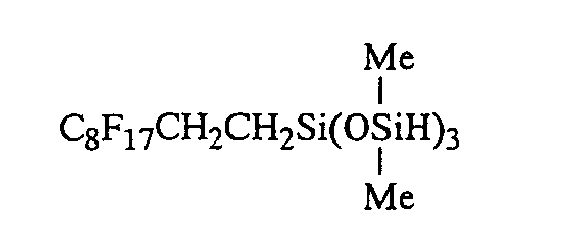


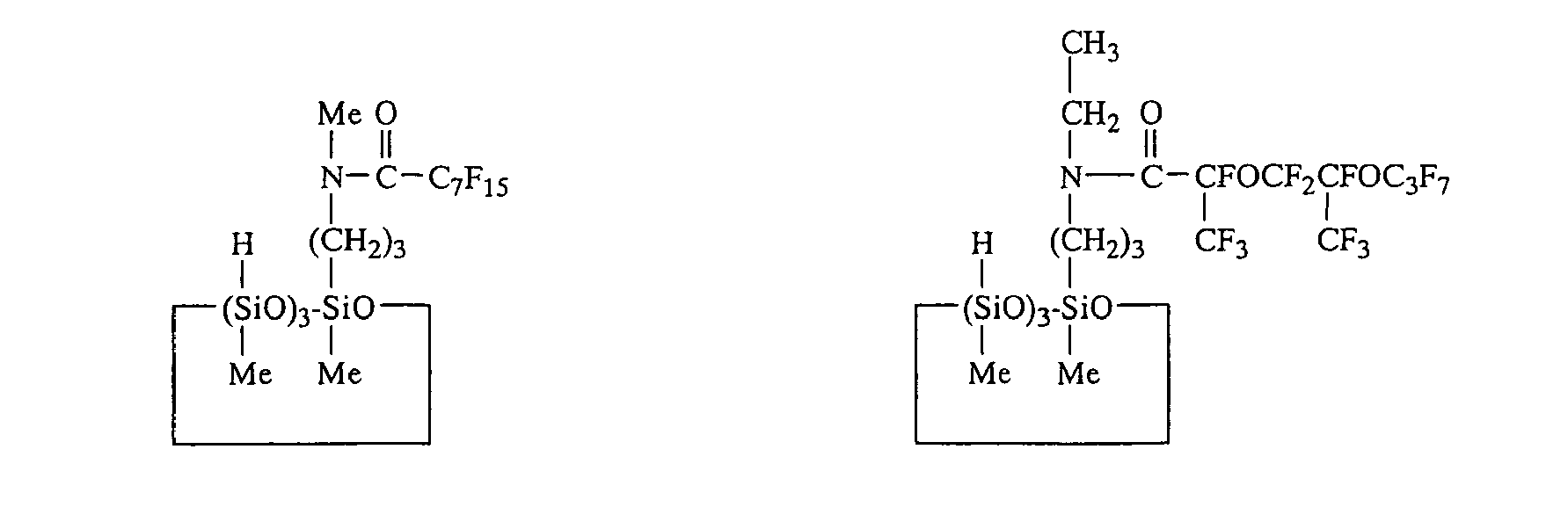


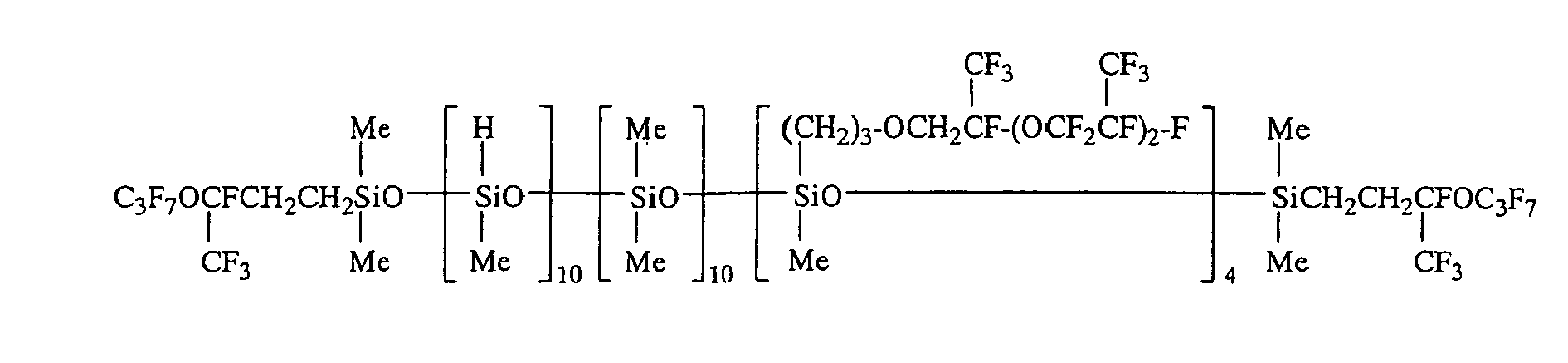

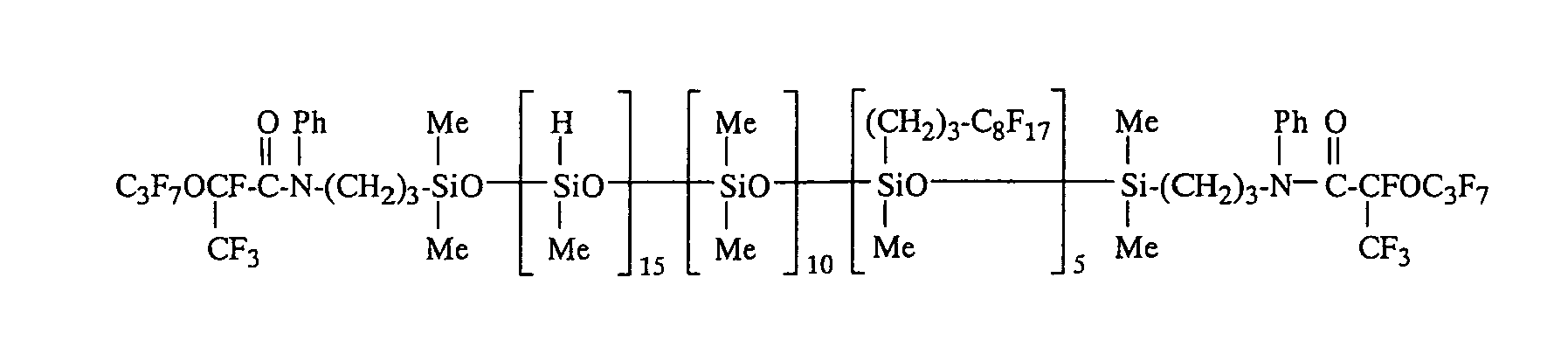


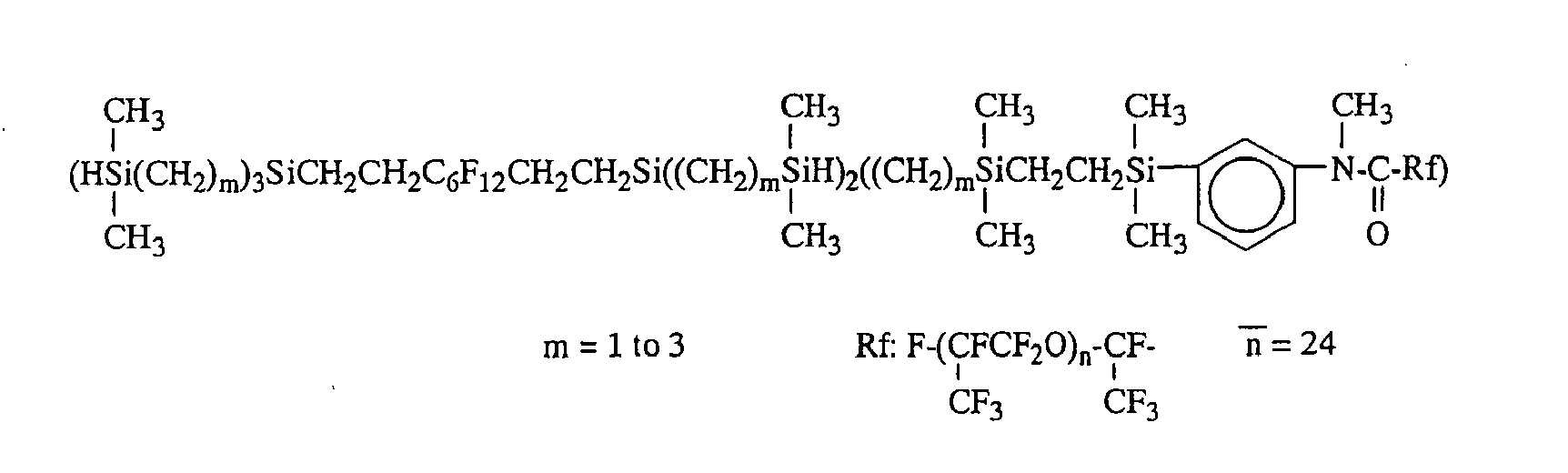


- Component (B) is used in an amount to give 0.5 to 3 moles, preferably 0.8 to 2 moles of hydrosilyl (SiH) groups per mole of vinyl in component (A). With fewer SiH groups available, the result may be an insufficient degree of crosslinking or cure failure. Too much SiH groups may cause foaming during the cure step.
- In the practice of the invention, components (A), (B) and (D) are preferably combined such that 0.55 to 3.2 moles, more preferably 0.85 to 2.2 moles of SiH groups available from components (B) and (D) are present per mole of vinyl available from component (A).
- Component (C) is a platinum group compound which is a catalyst for promoting addition reaction between vinyl groups in component (A) and hydrosilyl groups in component (B). As the platinum group compound or platinum group metal catalyst, platinum compounds are often used because they are relatively readily available. Suitable platinum compounds include chloroplatinic acid, complexes of chloroplatinic acid with olefins such as ethylene, complexes of chloroplatinic acid with alcohols and vinylsiloxanes, and metallic platinum on silica, alumina and carbon carriers. Suitable platinum group metal catalysts other than the platinum compounds include rhodium, ruthenium, iridium and palladium compounds, such as, for example, RhCl (PPh3)3, RhCl (CO) (PPh3)3, Ru3 (CO)12, IrCl(CO) (PPh3)2, and Pd(PPh3)4.
- These catalysts, which are often solid, may be used in the solid form. However, a solution of chloroplatinic acid or complex thereof in a suitable solvent is preferably used because the solution is compatible with the fluorinated amide compound (A) so that a cured product becomes more uniform.
- Component (C) may be used in a catalytic amount. Usually, the catalyst is used in such an amount as to give 0.1 to 500 ppm of platinum group metal based on the total weight of components (A) and (B).
- Component (D) is an organosiloxane which is compounded for helping the composition develop self-adhesion. The organosiloxane has in the molecule at least one silicon-bonded hydrogen atom (SiH group) and at least one epoxy group and/or trialkoxysilyl group bonded to a silicon atom via carbon atoms or carbon and oxygen atoms, and preferably further has at least one perfluoroalkyl or perfluorooxyalkyl group bonded to a silicon atom via carbon atoms or carbon and oxygen atoms.
- The organosiloxane (D) has a siloxane structure which may be cyclic, chain-like or branched or a mixture thereof. Suitable examples of the organosiloxane (D) are shown below.


- Suitable substituted or unsubstituted monovalent hydrocarbon groups represented by R4 are of 1 to 10 carbon atoms, preferably 1 to 8 carbon atoms, and include alkyl groups such as methyl, ethyl, propyl, butyl, hexyl, cyclohexyl and octyl; aryl groups such as phenyl and tolyl; aralkyl groups such as benzyl and phenylethyl; and substituted forms of the foregoing groups in which some or all hydrogen atoms are substituted by halogen atoms such as fluorine. Inter alia, methyl is most preferred.
- It is preferred that w' be an integer of 0 to 20, x' be an integer of 1 to 20, y' be an integer of 1 to 20, z' be an integer of 1 to 20, and w'+x'+y'+z' be an integer of 3 to 50.
- A is an epoxy group or trialkoxysilyl group bonded to a silicon atom via carbon atoms or carbon and oxygen atoms, which is exemplified by groups of the following formulae.

-R6-Si(OR7)3

- Examples of the group represented by A are given below.


- B is a monovalent perfluoroalkyl or perfluorooxyalkyl group bonded to a silicon atom via carbon atoms or carbon and oxygen atoms. Exemplary monovalent perfluoroalkyl or perfluorooxyalkyl groups include those of the following general formulae.
-R9-CgF2g+1


- Examples of the group represented by B are given below.
-(CH2)3-C6F13 -(CH2)2-C8F17 -(CH2)3-C8F17 -(CH2)3-C4F9


- The organosiloxane as component (D) may be obtained by combining an organohydrogenpolysiloxane having at least two, preferably at least three silicon-bonded hydrogen atoms (SiH groups) in the molecule with a compound having an aliphatic unsaturated group (e.g., vinyl or allyl) and an epoxy or trialkoxysilyl group and optionally, a compound having an aliphatic unsaturated group and a perfluoroalkyl or perfluorooxyalkyl group and effecting partial addition reaction therebetween in accordance with a standard procedure. The amounts of the reactants combined should be such that the number of aliphatic unsaturated groups be smaller than the number of SiH groups because the resultant organosiloxane should have at least one SiH group.
- In the preparation of the organosiloxane, the end compound may be isolated from the reaction mixture at the end of reaction although the reaction mixture may be used as long as the unreacted reactants and addition reaction catalyst have been removed therefrom.
- Suitable organosiloxanes which can serve as component (D) include those of the following structural formulae, which may be used alone or in admixture.


- The subscripts o', q', and r' are positive integers, and p' is an integer inclusive of 0.


- The subscripts o', q', and r' are positive integers, and p' is an integer inclusive of 0.


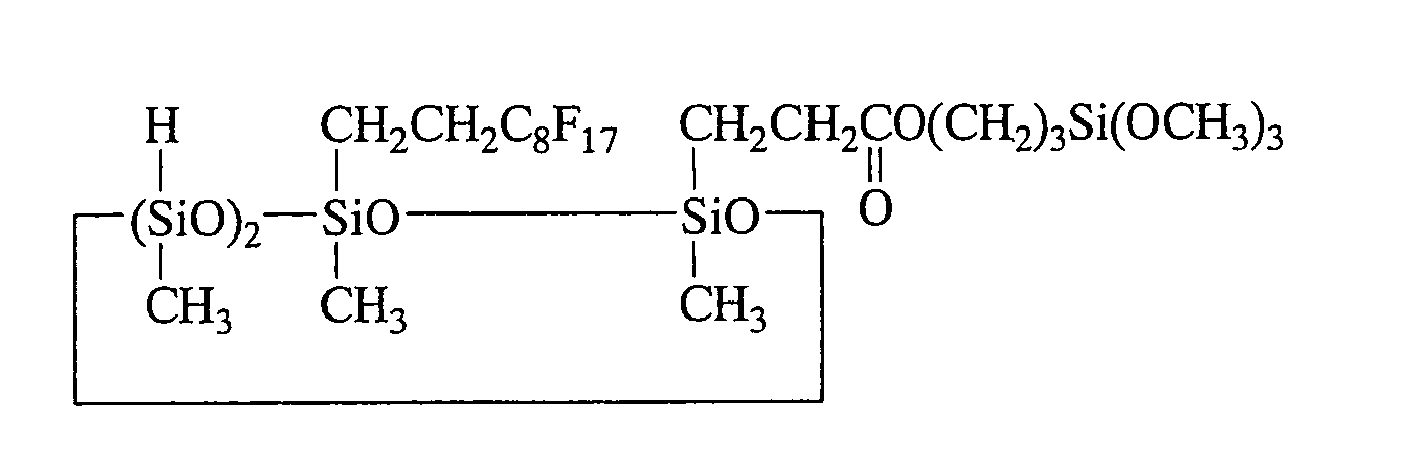


- Component (D) is used in an amount of 0.1 to 10 parts, and preferably 0.2 to 5 parts by weight per 100 parts by weight of component (A). Less than 0.1 phr of component (D) may fail to achieve satisfactory adhesion whereas more than 10 phr may interfere with the flow, often interfere with the cure of the composition, and have a negative impact on the physical strength of the cured composition.
- In addition to the aforementioned components (A) to (D), various additives such as a plasticizer, viscosity modifier, flexibilizer, hydrosilylation catalyst inhibitor, inorganic filler, tackifier, adhesion auxiliary (other than D), and silane coupling agent may be added to the composition for enhancing its commercial utility. Such additives are compounded in any desired amounts as long as they do not compromise the objects of the invention or adversely affect the properties of the composition and the physical properties of the cured composition.
- As the plasticizer, viscosity modifier or flexibilizer, a polyfluoromonoalkenyl compound having the general formula (2) and/or linear polyfluoro compounds having the general formulae (3) and (4) may be used.
Rf2 - (X')a-CH=CH2 (2)
Herein Rf2 is a group of the general formula (i):
F-[CF(CF3)CF2O]h'-Ci',F2i'- (i)
wherein h' is an integer of 1 to 200, preferably 1 to 150, and i' is an integer of 1 to 3. X' is -CH2-, -OCH2-, -CH2OCH2-or -CO-NR'-Y'- wherein R' is hydrogen, methyl, phenyl or allyl and Y' is -CH2-, a o, m or p-dimethylsilylphenylene group of the following structural formula (Z') or a group of the following structural formula (Z").

D-O- (CF2CF2CF2O)b-D (3)
Herein D is a group: Cg'F29'+1- wherein g' is 1 to 3, and b is an integer of 1 to 200.
D-O-(CF2O)c-(CF2CF2O)d-D (4)
Herein D is as defined above, c and d each are an integer of 1 to 200 and c+d is 2 to 200. - Examples of the polyfluoromonoalkenyl compound of formula (2) are given below.


- Examples of the linear polyfluoro compounds having the general formulae (3) and (4) are given below.
CF3-O-(CF2CF2CF2O)n-CF2CF3
CF3-O-[(CF2O)m-(CF2CF2O)n] - CF 3
Note that m is an integer of 1 to 200, n is an integer of 1 to 200, and m+n is 2 to 200. - The polyfluoro compounds having the general formulae (2) to (4) desirably have a viscosity at 23°C of 50 to 50,000 mPa-s, more desirably 100 to 20,000 mPa-s.
- When added, an amount of the polyfluoro compound having formula (2), (3) or (4) is preferably 1 to 100 parts, more preferably 5 to 50 parts by weight per 100 parts by weight of component (A).
- Examples of the hydrosilylation catalyst inhibitor which can be added herein include acetylenic alcohols such as 1-ethynyl-1-hydroxycyclohexane, 3-methyl-1-butyn-3-ol, 3,5-dimethyl-1-hexyn-3-ol, 3-methyl-1-penten-3-ol, and phenylbutynol, the reaction product of a chlorosilane having a monovalent fluorinated substituent group (as described above) and an acetylenic alcohol, 3-methyl-3-penten-1-yn, 3,5-dimethyl-3-hexen-1-yn, triallyl isocyanurate, polyvinyl siloxane, and organophosphorus compounds. Cure reactivity and shelf stability are kept moderate by adding such an inhibitor.
- Examples of the inorganic filler include fumed silica and precipitated silica, which may have been treated with silanes, silazanes or siloxanes, having a specific surface area of at least 50 m2/g, specifically 50 to 400 m2/g, more specifically 100 to 300 m2/g as measured by the BET method. Also included are reinforcing or semi-reinforcing fillers such as quartz flour, fused quartz flour, diatomaceous earth and calcium carbonate; inorganic pigments such as titanium oxide, iron oxide, carbon black, and cobalt aluminate; heat resistance improvers such as titanium oxide, iron oxide, carbon black, cerium oxide, cerium hydroxide, zinc carbonate, magnesium carbonate, and manganese carbonate; heat-conductive fillers such as alumina, boron nitride, silicon carbide and powdered metals; and electric conductive agents such as carbon black, silver powder and electroconductive zinc white. The inorganic filler is preferably added in an amount of about 0.5 to 20 parts, more preferably about 1 to 20 parts by weight per 100 parts by weight of component (A).
- Also useful are adhesion promoters such as carboxylic anhydrides, titanic acid esters, and zirconic acid esters, tackifiers other than component (D), and silane coupling agents such as tris(3-trimethoxysilylpropyl)isocyanurate, tris(3-triethoxysilylpropyl)isocyanurate, 3-trimethoxysilylpropylsuccinic acid, 3-triethoxysilylpropylsuccinic acid, N-phenyl-γ-aminopropyltrimethoxysilane, γ-methacryloxypropyltrimethoxysilane, γ-acryloxypropyltrimethoxysilane, β-(3,4-epoxycyclohexyl)ethyltrimethoxysilane, N-β-(aminoethyl)-γ-aminopropyltrimethoxysilane, N-β-(aminoethyl)-γ-aminopropylmethyldimethoxysilane, γ-aminopropyltrimethoxysilane, γ-aminopropyltriethoxysilane, vinyltrimethoxysilane, vinyltriethoxysilane, γ-glycidoxypropylmethyldiethoxysilane, and γ-glycidoxypropyltrimethoxysilane.
- The adhesive composition may be prepared by mixing components (A) to (D) and optional components on a mixing device such as planetary mixer, Ross mixer or Hobart mixer or a kneading device such as kneader or three-roll mill until uniform.
- With respect to the formulation of the adhesive composition, the composition may be formulated as one part wherein all components (A) to (D) are combined and handled as a single compound. Alternatively, the composition may be formulated as two parts which are mixed on use. In this embodiment, one part is a mixture of components (A) and (C) and the other part is a mixture of components (B) and (D).
- Although the adhesive composition thus prepared may cure at room temperature depending on the type of functional group on fluorinated amide compound (A) and the type of catalyst (C), it is recommended to heat the composition to promote curing. Preferably the composition is heat cured at a temperature of at least 60°C, more preferably 100 to 200°C for several minutes to several hours in order to develop tenacious adhesion to various substrates.
- In applying the adhesive composition, it may be diluted with a suitable fluorinated solvent in a desired concentration depending on a particular application and intended use. Suitable fluorinated solvents include 1,3-bis(trifluoromethyl)benzene, p-xylene hexafluoride, Fluorinert® (3M), perfluorobutyl methyl ether, perfluorobutyl ethyl ether, and mixtures thereof.
- On brief heating, the adhesive composition establishes a tenacious bond to a wide variety of substrates including metals and plastics. Exemplary metals include aluminum, stainless steel, nickel, chromium, copper, zinc, and alloys comprising two or more of the foregoing. Exemplary plastics include epoxy resins, phenolic resins, polyester resins such as polyethylene terephthalate (PET) and polybutylene terephthalate (PBT), polycarbonate (PC) resins, polyphenylene sulfide (PPS) resins, polyamide (PA) resins, polyimide (PI) resins, and liquid crystal polymer (LCP) resins.
- The compositions of the invention are useful as the adhesive for automotive parts, electric/electronic parts and the like. More illustratively, they are useful as the bonding adhesive (die attaching or die bonding agent) for semiconductor chips as detectors and sensors used in automobile control systems, such as pressure sensors, VVT sensors, gas concentration detectors, and temperature sensors; the case sealing agent and electronic circuit protective coating agent; the protective sealing agent for sensors and instruments exposed to gases, hot water and chemicals; the adhesive for ink jet printers; the adhesive and sealant for printer heads; the coating agent to rolls and belts in laser printers and copiers; and the adhesive sealing and potting agents for various circuit boards.
- Examples of the invention are given below by way of illustration and not by way of limitation. Parts are by weight. Viscosity and bond strength are measurements at 23°C.
- A planetary mixer was charged with 100 parts of a polymer having formula (5) below (viscosity 12,000 mPa-s, vinyl content 0.0128 mole/100 g) and 10 parts of dimethyldichlorosilane-surface-treated fumed silica (BET surface area 250 m2/g), which were kneaded for one hour without heating. While kneading was continued, the mixer was heated until the internal temperature reached 150°C. The contents were heat treated for 2 hours under vacuum (60 Torr) while holding a temperature of 150-170°C. The contents were cooled below 40°C and worked 2 passes on a three-roll mill, obtaining a base compound. A planetary mixer was charged with 16.5 parts of the base compound and 85.0 parts of the polymer having formula (5), which were mixed until uniform. To the mixture, 0.20 part of a toluene solution of platinum-divinyltetramethyldisiloxane complex (Pt concentration 0.5 wt%), 2.0 parts of a fluorinated organosilicon compound having formula (6) below, 1.3 parts of a fluorinated organosilicon compound having formula (7) below, and 1.0 part of a tackifier having formula (8) below were successively added. These components were mixed until uniform. This was followed by deaeration, yielding a composition.


- A dispenser cartridge was filled with the composition. A 80 µm thick layer of the composition was sandwiched between two 50x25 mm test panels of an adherend material (aluminum, stainless steel, nickel, epoxy resin, PET resin or PBT resin listed in Table 1), the panels being arranged so as to mutually overlap by 10 mm at the ends. The composition was then cured by heating at 150°C for 1 hour, thereby giving an adhesion test specimen. The specimen was subjected to a tensile shear bond test at a pulling speed of 50 mm/min, and the shear bond strength (MPa) and cohesive failure (area %) were determined. The results are shown in Table 1.
- The composition was placed in a rectangular mold of 105 mm by 85 mm by 2 mm (thick), press cured at 150°C and 100 kg/cm2 for 10 minutes, and oven cured at 150°C for 50 minutes, forming a cured sheet. The sheet was cut into twelve test strips of 25 mm x 50 mm for hardness measurement before and after acid immersion. As the blank, three strips were stacked and measured for hardness using a type A Durometer according to JIS K6253. The remaining strips were divided into three sets each consisting of three strips kept separated apart, which were immersed in three types of acidic liquids at 40°C for 7 days, respectively. After the immersion, the strips were washed on their surface with alkaline water and then deionized water and wiped up residual water. The three strips of each set were stacked and measured for hardness according to JIS K6253. Also the surface state of the strips was visually observed. The results are shown in Table 2.
- A composition was prepared as in Example 1 except that 0.5 part of a tackifier having formula (9) below and 0.2 part of γ-glycidoxypropyltrimethoxysilane were used instead of 1.0 part of the tackifier having formula (8). It was similarly tested, with the results being shown in Tables 1 and 2.

- A composition was prepared as in Example 1 except that 2.0 parts of an organosilicon compound having formula (10) below was used instead of the organosilicon compound having formula (7). It was similarly tested, with the results being shown in Tables 1 and 2.

- Compositions were prepared as in Examples 1 to 3, respectively, except that a polymer having formula (11) below (viscosity 12,500 mPa-s, vinyl content 0.0124 mole/100 g) was used instead of the polymer having formula (5). They were similarly tested, with the results being shown in Tables 1 and 2.

Table 1 Shear bond strength (MPa) Example Comparative Examle 1 2 3 1 2 3 Adherend Aluminum 3.2(100) 2.9(100) 2.7(100) 3.0(100) 2.7(100) 2.8(100) Stainless steel 2.1(100) 2.0(100) 2.0(100) 2.0(100) 1.9(100) 1.9(100) Nickel 3.0(100) 2.8(100) 2.9(100) 2.8(100) 2.7(100) 2.8(100) Epoxy resin 1.8(100) 1.6(100) 1.7(100) 1.7(100) 1.6(100) 1.7(100) PET resin 1.9(100) 1.8(100) 1.8(100) 1.9(100) 1.7(100) 1.8(100) PBT resin 2.1(100) 2.0(100) 2.0(100) 2.1(100) 1.9(100) 2.0(100) Cohesive failure (area %) is given in parentheses. Table 2 Example 1 Example 2 Example 3 Acid Hardness change Appearance Hardness change Appearance Hardness change Appearance Hydrochloric acid (36 wt%) +1 intact +1 intact 0 intact Nitric acid (60 wt%) +2 intact 0 intact +1 intact Sulfuric acid (98 wt%) 0 intact 0 intact 0 intact Comparative Example 1 Comparative Example 2 Comparative Example 3 Acid Hardness change Appearance Hardness change Appearance Hardness change Appearance Hydrochloric acid (36 wt%) +9 discolored +9 discolored +8 discolored Nitric acid (60 wt%) +11 discolored +10 discolored +9 discolored Sulfuric acid (98 wt%) -8 discolored/ degraded -8 discolored/ degraded -7 discolored/ degraded
Claims (2)
- An adhesive composition comprising(A) 100 parts by weight of a fluorinated amide compound having the general formula (1):
 (B) a fluorinated organosilicon compound containing in a molecule at least one monovalent perfluoroalkyl, monovalent perfluorooxyalkyl, divalent perfluoroalkylene or divalent perfluorooxyalkylene group and at least two silicon-bonded hydrogen atoms, and further containing a silicon-bonded monovalent substituent group which is selected from unsubstituted or halo-substituted C1-C20 alkyl, aryl and aralkyl groups, in an amount to give 0.5 to 3.0 moles of SiH groups per mole of vinyl in component (A),(C) a catalytic amount of a platinum group compound, and(D) 0.1 to 10 parts by weight of an organosiloxane containing in a molecule at least one silicon-bonded hydrogen atom and at least one epoxy and/or trialkoxysilyl group bonded to a silicon atom via carbon atoms or carbon and oxygen atoms.
 - The adhesive composition of claim 1 wherein the organosiloxane (D) further contains at least one monovalent perfluoroalkyl or monovalent perfluorooxyalkyl group bonded to a silicon atom via carbon atoms or carbon and oxygen atoms.
Applications Claiming Priority (1)
| Application Number | Priority Date | Filing Date | Title |
|---|---|---|---|
| JP2010093104A JP5459033B2 (en) | 2010-04-14 | 2010-04-14 | Adhesive composition |
Publications (2)
| Publication Number | Publication Date |
|---|---|
| EP2383318A1 true EP2383318A1 (en) | 2011-11-02 |
| EP2383318B1 EP2383318B1 (en) | 2014-04-02 |
Family
ID=44483861
Family Applications (1)
| Application Number | Title | Priority Date | Filing Date |
|---|---|---|---|
| EP11003017.8A Active EP2383318B1 (en) | 2010-04-14 | 2011-04-11 | Adhesive composition |
Country Status (3)
| Country | Link |
|---|---|
| US (1) | US8299196B2 (en) |
| EP (1) | EP2383318B1 (en) |
| JP (1) | JP5459033B2 (en) |
Cited By (1)
| Publication number | Priority date | Publication date | Assignee | Title |
|---|---|---|---|---|
| EP2407500A1 (en) * | 2010-07-14 | 2012-01-18 | Shin-Etsu Chemical Co., Ltd. | Curable perfluoropolyether gel composition and gel product produced by using cured perfluoropolyether gel composition |
Families Citing this family (23)
| Publication number | Priority date | Publication date | Assignee | Title |
|---|---|---|---|---|
| TW201400572A (en) * | 2012-03-23 | 2014-01-01 | 琳得科股份有限公司 | Curing composition, cured product, and method of using the curable composition |
| US8864930B2 (en) | 2012-07-30 | 2014-10-21 | PRC De Soto International, Inc. | Perfluoroether sealant compositions |
| JP5799930B2 (en) * | 2012-10-19 | 2015-10-28 | 信越化学工業株式会社 | Curable fluoropolyether gel composition and gel product using the cured product |
| JP5869462B2 (en) | 2012-11-02 | 2016-02-24 | 信越化学工業株式会社 | Curable composition for sealing optical semiconductor and optical semiconductor device using the same |
| JP6160540B2 (en) * | 2014-03-31 | 2017-07-12 | 信越化学工業株式会社 | Curable perfluoropolyether gel composition and gel product using the cured product |
| JP6134889B2 (en) * | 2014-09-29 | 2017-05-31 | 住友理工株式会社 | Silicone rubber composition, crosslinked silicone rubber, integral molded body, and method for producing integral molded body |
| JP6344256B2 (en) * | 2015-02-18 | 2018-06-20 | 信越化学工業株式会社 | Method for bonding photocurable fluoropolyether elastomer composition |
| JP6390591B2 (en) * | 2015-11-05 | 2018-09-19 | 信越化学工業株式会社 | Organosilicon compound |
| WO2017094703A1 (en) | 2015-11-30 | 2017-06-08 | 住友理工株式会社 | Elastic roller for electrophotographic device, and method for manufacturing said roller |
| JP6585535B2 (en) | 2016-03-29 | 2019-10-02 | 住友理工株式会社 | Silicone rubber composition and crosslinked silicone rubber |
| JP6515860B2 (en) | 2016-04-13 | 2019-05-22 | 信越化学工業株式会社 | Thermally conductive fluorine-containing adhesive composition and electric / electronic component |
| JP6984656B2 (en) * | 2017-05-25 | 2021-12-22 | 信越化学工業株式会社 | Fluoropolyether group-containing polymer-modified organosilicon compounds, surface treatment agents and articles |
| US10647899B2 (en) | 2017-06-26 | 2020-05-12 | Shin-Etsu Chemical Co., Ltd. | Heat-curable fluoropolyether-based adhesive composition and electric/electronic component |
| JP6753382B2 (en) * | 2017-06-26 | 2020-09-09 | 信越化学工業株式会社 | Thermosetting fluoropolyether adhesive composition and electrical / electronic components |
| JP6801638B2 (en) * | 2017-12-12 | 2020-12-16 | 信越化学工業株式会社 | Thermosetting fluoropolyether adhesive composition and electrical / electronic components |
| JP7081682B2 (en) | 2018-11-14 | 2022-06-07 | 信越化学工業株式会社 | Curable Fluoropolyether-based rubber compositions and optical components |
| WO2021033529A1 (en) | 2019-08-21 | 2021-02-25 | 信越化学工業株式会社 | Curable fluoropolyether adhesive composition and optical parts |
| EP4112697A4 (en) * | 2020-02-26 | 2024-04-17 | Shin-Etsu Chemical Co., Ltd. | CURABLE COMPOSITION OF FLUOROPOLYETHER-BASED ADHESIVE, AND OPTICAL COMPONENT |
| CN112680180B (en) * | 2020-12-28 | 2022-04-15 | 广州市白云化工实业有限公司 | Addition type silicone rubber with high bonding strength and preparation method thereof |
| KR20240008328A (en) | 2021-05-14 | 2024-01-18 | 신에쓰 가가꾸 고교 가부시끼가이샤 | Fluorinated organohydrogen silane compound |
| US20240360282A1 (en) | 2021-07-01 | 2024-10-31 | Shin-Etsu Chemical Co., Ltd. | Fluoropolyether-based curable composition and cured product, and electric/electronic component |
| CN119173582A (en) * | 2022-05-11 | 2024-12-20 | 信越化学工业株式会社 | Fluoropolyether curable composition, cured product, and electrical and electronic component |
| JPWO2024262489A1 (en) | 2023-06-22 | 2024-12-26 |
Citations (5)
| Publication number | Priority date | Publication date | Assignee | Title |
|---|---|---|---|---|
| EP0765916A2 (en) | 1995-09-29 | 1997-04-02 | Shin-Etsu Chemical Co., Ltd. | Hydrosilylation-curable compositions |
| JP2990646B2 (en) | 1995-01-23 | 1999-12-13 | 信越化学工業株式会社 | Curable composition |
| EP1081185A1 (en) | 1999-09-03 | 2001-03-07 | Shin-Etsu Chemical Co., Ltd. | Curable fluorinated elastomer compositions |
| EP1486534A1 (en) * | 2003-06-09 | 2004-12-15 | Shin-Etsu Chemical Co., Ltd. | Adhesive compositions, their preparation and use |
| EP1571192A1 (en) * | 2004-03-05 | 2005-09-07 | Shin-Etsu Chemical Co., Ltd. | Fluoropolyether adhesive composition |
Family Cites Families (5)
| Publication number | Priority date | Publication date | Assignee | Title |
|---|---|---|---|---|
| EP0851003B1 (en) * | 1994-06-23 | 2002-12-04 | Shin-Etsu Chemical Co., Ltd. | Curable compositions containing organic fluorine compounds |
| EP0725113B1 (en) | 1995-01-23 | 2000-09-27 | Shin-Etsu Chemical Co., Ltd. | Fluorinated amide silicone compounds and curable siloxane compositions |
| JP2004331903A (en) * | 2003-05-12 | 2004-11-25 | Shin Etsu Chem Co Ltd | Method for producing perfluoroalkyl ether adhesive composition |
| JP2007126496A (en) * | 2005-11-01 | 2007-05-24 | Shin Etsu Chem Co Ltd | Adhesive composition |
| JP5035555B2 (en) * | 2008-04-09 | 2012-09-26 | 信越化学工業株式会社 | Room temperature curable fluoropolyether rubber composition and cured product thereof |
-
2010
- 2010-04-14 JP JP2010093104A patent/JP5459033B2/en active Active
-
2011
- 2011-04-11 EP EP11003017.8A patent/EP2383318B1/en active Active
- 2011-04-13 US US13/085,510 patent/US8299196B2/en active Active
Patent Citations (9)
| Publication number | Priority date | Publication date | Assignee | Title |
|---|---|---|---|---|
| JP2990646B2 (en) | 1995-01-23 | 1999-12-13 | 信越化学工業株式会社 | Curable composition |
| EP0765916A2 (en) | 1995-09-29 | 1997-04-02 | Shin-Etsu Chemical Co., Ltd. | Hydrosilylation-curable compositions |
| US5656711A (en) | 1995-09-29 | 1997-08-12 | Shin-Etsu Chemical Co., Ltd. | Curable compositions |
| JP3239717B2 (en) | 1995-09-29 | 2001-12-17 | 信越化学工業株式会社 | Curable composition |
| EP1081185A1 (en) | 1999-09-03 | 2001-03-07 | Shin-Etsu Chemical Co., Ltd. | Curable fluorinated elastomer compositions |
| US6417311B1 (en) | 1999-09-03 | 2002-07-09 | Shin-Etsu Chemical Co., Ltd. | Curable compositions of fluorinated amide polymers |
| JP3567973B2 (en) | 1999-09-03 | 2004-09-22 | 信越化学工業株式会社 | Curable composition |
| EP1486534A1 (en) * | 2003-06-09 | 2004-12-15 | Shin-Etsu Chemical Co., Ltd. | Adhesive compositions, their preparation and use |
| EP1571192A1 (en) * | 2004-03-05 | 2005-09-07 | Shin-Etsu Chemical Co., Ltd. | Fluoropolyether adhesive composition |
Cited By (2)
| Publication number | Priority date | Publication date | Assignee | Title |
|---|---|---|---|---|
| EP2407500A1 (en) * | 2010-07-14 | 2012-01-18 | Shin-Etsu Chemical Co., Ltd. | Curable perfluoropolyether gel composition and gel product produced by using cured perfluoropolyether gel composition |
| US8492478B2 (en) | 2010-07-14 | 2013-07-23 | Shin-Etsu Chemical Co., Ltd. | Curable perfluoropolyether gel composition and gel product produced by using cured perfluoropolyether gel composition |
Also Published As
| Publication number | Publication date |
|---|---|
| EP2383318B1 (en) | 2014-04-02 |
| US20110257315A1 (en) | 2011-10-20 |
| JP2011219692A (en) | 2011-11-04 |
| US8299196B2 (en) | 2012-10-30 |
| JP5459033B2 (en) | 2014-04-02 |
Similar Documents
| Publication | Publication Date | Title |
|---|---|---|
| EP2383318B1 (en) | Adhesive composition | |
| EP2345709B1 (en) | Addition-cure fluoropolyether adhesive composition | |
| EP1995289B1 (en) | Heat-curable fluoropolyether adhesive composition and bonding method | |
| EP2452993B1 (en) | Thermosetting fluoropolyether adhesive composition and adhesion method | |
| EP2719737B1 (en) | Adhesive Composition | |
| US20070100043A1 (en) | Adhesive composition | |
| JP4582287B2 (en) | Low contamination adhesive composition | |
| US7855256B2 (en) | Fluoropolyether adhesive composition | |
| US20060014895A1 (en) | Curable fluoropolyether composition | |
| JP2005002142A (en) | Adhesive composition and method for producing the same | |
| US20090258986A1 (en) | Room temperature curable fluoropolyether rubber composition and cured product | |
| EP1413588B1 (en) | Curable compositions | |
| JP2026010136A (en) | Electrical and Electronic Components | |
| JP2004331903A (en) | Method for producing perfluoroalkyl ether adhesive composition | |
| JP5387517B2 (en) | Thermosetting fluoropolyether adhesive composition and bonding method thereof |
Legal Events
| Date | Code | Title | Description |
|---|---|---|---|
| AK | Designated contracting states |
Kind code of ref document: A1 Designated state(s): AL AT BE BG CH CY CZ DE DK EE ES FI FR GB GR HR HU IE IS IT LI LT LU LV MC MK MT NL NO PL PT RO RS SE SI SK SM TR |
|
| AX | Request for extension of the european patent |
Extension state: BA ME |
|
| PUAI | Public reference made under article 153(3) epc to a published international application that has entered the european phase |
Free format text: ORIGINAL CODE: 0009012 |
|
| 17P | Request for examination filed |
Effective date: 20120320 |
|
| GRAP | Despatch of communication of intention to grant a patent |
Free format text: ORIGINAL CODE: EPIDOSNIGR1 |
|
| RIC1 | Information provided on ipc code assigned before grant |
Ipc: C08G 77/24 20060101ALI20130930BHEP Ipc: C09D 183/08 20060101AFI20130930BHEP |
|
| INTG | Intention to grant announced |
Effective date: 20131029 |
|
| GRAS | Grant fee paid |
Free format text: ORIGINAL CODE: EPIDOSNIGR3 |
|
| GRAA | (expected) grant |
Free format text: ORIGINAL CODE: 0009210 |
|
| RIN1 | Information on inventor provided before grant (corrected) |
Inventor name: KOIKE, NORIYUKI Inventor name: SHIONO, MIKIO |
|
| AK | Designated contracting states |
Kind code of ref document: B1 Designated state(s): AL AT BE BG CH CY CZ DE DK EE ES FI FR GB GR HR HU IE IS IT LI LT LU LV MC MK MT NL NO PL PT RO RS SE SI SK SM TR |
|
| REG | Reference to a national code |
Ref country code: GB Ref legal event code: FG4D |
|
| REG | Reference to a national code |
Ref country code: CH Ref legal event code: EP Ref country code: AT Ref legal event code: REF Ref document number: 660139 Country of ref document: AT Kind code of ref document: T Effective date: 20140415 |
|
| REG | Reference to a national code |
Ref country code: IE Ref legal event code: FG4D |
|
| REG | Reference to a national code |
Ref country code: DE Ref legal event code: R096 Ref document number: 602011005818 Country of ref document: DE Effective date: 20140515 |
|
| REG | Reference to a national code |
Ref country code: AT Ref legal event code: MK05 Ref document number: 660139 Country of ref document: AT Kind code of ref document: T Effective date: 20140402 |
|
| REG | Reference to a national code |
Ref country code: NL Ref legal event code: VDEP Effective date: 20140402 |
|
| REG | Reference to a national code |
Ref country code: LT Ref legal event code: MG4D |
|
| PG25 | Lapsed in a contracting state [announced via postgrant information from national office to epo] |
Ref country code: BG Free format text: LAPSE BECAUSE OF FAILURE TO SUBMIT A TRANSLATION OF THE DESCRIPTION OR TO PAY THE FEE WITHIN THE PRESCRIBED TIME-LIMIT Effective date: 20140702 Ref country code: NO Free format text: LAPSE BECAUSE OF FAILURE TO SUBMIT A TRANSLATION OF THE DESCRIPTION OR TO PAY THE FEE WITHIN THE PRESCRIBED TIME-LIMIT Effective date: 20140702 Ref country code: CZ Free format text: LAPSE BECAUSE OF FAILURE TO SUBMIT A TRANSLATION OF THE DESCRIPTION OR TO PAY THE FEE WITHIN THE PRESCRIBED TIME-LIMIT Effective date: 20140402 Ref country code: IS Free format text: LAPSE BECAUSE OF FAILURE TO SUBMIT A TRANSLATION OF THE DESCRIPTION OR TO PAY THE FEE WITHIN THE PRESCRIBED TIME-LIMIT Effective date: 20140802 Ref country code: FI Free format text: LAPSE BECAUSE OF FAILURE TO SUBMIT A TRANSLATION OF THE DESCRIPTION OR TO PAY THE FEE WITHIN THE PRESCRIBED TIME-LIMIT Effective date: 20140402 Ref country code: NL Free format text: LAPSE BECAUSE OF FAILURE TO SUBMIT A TRANSLATION OF THE DESCRIPTION OR TO PAY THE FEE WITHIN THE PRESCRIBED TIME-LIMIT Effective date: 20140402 Ref country code: CY Free format text: LAPSE BECAUSE OF FAILURE TO SUBMIT A TRANSLATION OF THE DESCRIPTION OR TO PAY THE FEE WITHIN THE PRESCRIBED TIME-LIMIT Effective date: 20140402 Ref country code: LT Free format text: LAPSE BECAUSE OF FAILURE TO SUBMIT A TRANSLATION OF THE DESCRIPTION OR TO PAY THE FEE WITHIN THE PRESCRIBED TIME-LIMIT Effective date: 20140402 Ref country code: GR Free format text: LAPSE BECAUSE OF FAILURE TO SUBMIT A TRANSLATION OF THE DESCRIPTION OR TO PAY THE FEE WITHIN THE PRESCRIBED TIME-LIMIT Effective date: 20140703 |
|
| PG25 | Lapsed in a contracting state [announced via postgrant information from national office to epo] |
Ref country code: ES Free format text: LAPSE BECAUSE OF FAILURE TO SUBMIT A TRANSLATION OF THE DESCRIPTION OR TO PAY THE FEE WITHIN THE PRESCRIBED TIME-LIMIT Effective date: 20140402 Ref country code: AT Free format text: LAPSE BECAUSE OF FAILURE TO SUBMIT A TRANSLATION OF THE DESCRIPTION OR TO PAY THE FEE WITHIN THE PRESCRIBED TIME-LIMIT Effective date: 20140402 Ref country code: HR Free format text: LAPSE BECAUSE OF FAILURE TO SUBMIT A TRANSLATION OF THE DESCRIPTION OR TO PAY THE FEE WITHIN THE PRESCRIBED TIME-LIMIT Effective date: 20140402 Ref country code: LV Free format text: LAPSE BECAUSE OF FAILURE TO SUBMIT A TRANSLATION OF THE DESCRIPTION OR TO PAY THE FEE WITHIN THE PRESCRIBED TIME-LIMIT Effective date: 20140402 Ref country code: RS Free format text: LAPSE BECAUSE OF FAILURE TO SUBMIT A TRANSLATION OF THE DESCRIPTION OR TO PAY THE FEE WITHIN THE PRESCRIBED TIME-LIMIT Effective date: 20140402 Ref country code: PL Free format text: LAPSE BECAUSE OF FAILURE TO SUBMIT A TRANSLATION OF THE DESCRIPTION OR TO PAY THE FEE WITHIN THE PRESCRIBED TIME-LIMIT Effective date: 20140402 Ref country code: SE Free format text: LAPSE BECAUSE OF FAILURE TO SUBMIT A TRANSLATION OF THE DESCRIPTION OR TO PAY THE FEE WITHIN THE PRESCRIBED TIME-LIMIT Effective date: 20140402 |
|
| REG | Reference to a national code |
Ref country code: CH Ref legal event code: PL |
|
| PG25 | Lapsed in a contracting state [announced via postgrant information from national office to epo] |
Ref country code: PT Free format text: LAPSE BECAUSE OF FAILURE TO SUBMIT A TRANSLATION OF THE DESCRIPTION OR TO PAY THE FEE WITHIN THE PRESCRIBED TIME-LIMIT Effective date: 20140804 |
|
| REG | Reference to a national code |
Ref country code: DE Ref legal event code: R097 Ref document number: 602011005818 Country of ref document: DE |
|
| REG | Reference to a national code |
Ref country code: IE Ref legal event code: MM4A |
|
| PG25 | Lapsed in a contracting state [announced via postgrant information from national office to epo] |
Ref country code: CH Free format text: LAPSE BECAUSE OF NON-PAYMENT OF DUE FEES Effective date: 20140430 Ref country code: RO Free format text: LAPSE BECAUSE OF FAILURE TO SUBMIT A TRANSLATION OF THE DESCRIPTION OR TO PAY THE FEE WITHIN THE PRESCRIBED TIME-LIMIT Effective date: 20140402 Ref country code: BE Free format text: LAPSE BECAUSE OF FAILURE TO SUBMIT A TRANSLATION OF THE DESCRIPTION OR TO PAY THE FEE WITHIN THE PRESCRIBED TIME-LIMIT Effective date: 20140402 Ref country code: SK Free format text: LAPSE BECAUSE OF FAILURE TO SUBMIT A TRANSLATION OF THE DESCRIPTION OR TO PAY THE FEE WITHIN THE PRESCRIBED TIME-LIMIT Effective date: 20140402 Ref country code: MC Free format text: LAPSE BECAUSE OF FAILURE TO SUBMIT A TRANSLATION OF THE DESCRIPTION OR TO PAY THE FEE WITHIN THE PRESCRIBED TIME-LIMIT Effective date: 20140402 Ref country code: DK Free format text: LAPSE BECAUSE OF FAILURE TO SUBMIT A TRANSLATION OF THE DESCRIPTION OR TO PAY THE FEE WITHIN THE PRESCRIBED TIME-LIMIT Effective date: 20140402 Ref country code: LI Free format text: LAPSE BECAUSE OF NON-PAYMENT OF DUE FEES Effective date: 20140430 Ref country code: EE Free format text: LAPSE BECAUSE OF FAILURE TO SUBMIT A TRANSLATION OF THE DESCRIPTION OR TO PAY THE FEE WITHIN THE PRESCRIBED TIME-LIMIT Effective date: 20140402 |
|
| PLBE | No opposition filed within time limit |
Free format text: ORIGINAL CODE: 0009261 |
|
| STAA | Information on the status of an ep patent application or granted ep patent |
Free format text: STATUS: NO OPPOSITION FILED WITHIN TIME LIMIT |
|
| 26N | No opposition filed |
Effective date: 20150106 |
|
| PG25 | Lapsed in a contracting state [announced via postgrant information from national office to epo] |
Ref country code: IT Free format text: LAPSE BECAUSE OF FAILURE TO SUBMIT A TRANSLATION OF THE DESCRIPTION OR TO PAY THE FEE WITHIN THE PRESCRIBED TIME-LIMIT Effective date: 20140402 |
|
| REG | Reference to a national code |
Ref country code: DE Ref legal event code: R097 Ref document number: 602011005818 Country of ref document: DE Effective date: 20150106 |
|
| PG25 | Lapsed in a contracting state [announced via postgrant information from national office to epo] |
Ref country code: IE Free format text: LAPSE BECAUSE OF NON-PAYMENT OF DUE FEES Effective date: 20140411 |
|
| PG25 | Lapsed in a contracting state [announced via postgrant information from national office to epo] |
Ref country code: RS Free format text: LAPSE BECAUSE OF FAILURE TO SUBMIT A TRANSLATION OF THE DESCRIPTION OR TO PAY THE FEE WITHIN THE PRESCRIBED TIME-LIMIT Effective date: 20141119 |
|
| PG25 | Lapsed in a contracting state [announced via postgrant information from national office to epo] |
Ref country code: SI Free format text: LAPSE BECAUSE OF FAILURE TO SUBMIT A TRANSLATION OF THE DESCRIPTION OR TO PAY THE FEE WITHIN THE PRESCRIBED TIME-LIMIT Effective date: 20140402 |
|
| GBPC | Gb: european patent ceased through non-payment of renewal fee |
Effective date: 20150411 |
|
| PG25 | Lapsed in a contracting state [announced via postgrant information from national office to epo] |
Ref country code: GB Free format text: LAPSE BECAUSE OF NON-PAYMENT OF DUE FEES Effective date: 20150411 |
|
| REG | Reference to a national code |
Ref country code: FR Ref legal event code: PLFP Year of fee payment: 6 |
|
| PG25 | Lapsed in a contracting state [announced via postgrant information from national office to epo] |
Ref country code: MT Free format text: LAPSE BECAUSE OF FAILURE TO SUBMIT A TRANSLATION OF THE DESCRIPTION OR TO PAY THE FEE WITHIN THE PRESCRIBED TIME-LIMIT Effective date: 20140402 |
|
| PG25 | Lapsed in a contracting state [announced via postgrant information from national office to epo] |
Ref country code: SM Free format text: LAPSE BECAUSE OF FAILURE TO SUBMIT A TRANSLATION OF THE DESCRIPTION OR TO PAY THE FEE WITHIN THE PRESCRIBED TIME-LIMIT Effective date: 20140402 |
|
| PG25 | Lapsed in a contracting state [announced via postgrant information from national office to epo] |
Ref country code: TR Free format text: LAPSE BECAUSE OF FAILURE TO SUBMIT A TRANSLATION OF THE DESCRIPTION OR TO PAY THE FEE WITHIN THE PRESCRIBED TIME-LIMIT Effective date: 20140402 Ref country code: LU Free format text: LAPSE BECAUSE OF NON-PAYMENT OF DUE FEES Effective date: 20140411 Ref country code: HU Free format text: LAPSE BECAUSE OF FAILURE TO SUBMIT A TRANSLATION OF THE DESCRIPTION OR TO PAY THE FEE WITHIN THE PRESCRIBED TIME-LIMIT; INVALID AB INITIO Effective date: 20110411 |
|
| REG | Reference to a national code |
Ref country code: FR Ref legal event code: PLFP Year of fee payment: 7 |
|
| REG | Reference to a national code |
Ref country code: FR Ref legal event code: PLFP Year of fee payment: 8 |
|
| PG25 | Lapsed in a contracting state [announced via postgrant information from national office to epo] |
Ref country code: MK Free format text: LAPSE BECAUSE OF FAILURE TO SUBMIT A TRANSLATION OF THE DESCRIPTION OR TO PAY THE FEE WITHIN THE PRESCRIBED TIME-LIMIT Effective date: 20140402 |
|
| PG25 | Lapsed in a contracting state [announced via postgrant information from national office to epo] |
Ref country code: AL Free format text: LAPSE BECAUSE OF FAILURE TO SUBMIT A TRANSLATION OF THE DESCRIPTION OR TO PAY THE FEE WITHIN THE PRESCRIBED TIME-LIMIT Effective date: 20140402 |
|
| PGFP | Annual fee paid to national office [announced via postgrant information from national office to epo] |
Ref country code: DE Payment date: 20250305 Year of fee payment: 15 |
|
| PGFP | Annual fee paid to national office [announced via postgrant information from national office to epo] |
Ref country code: FR Payment date: 20260309 Year of fee payment: 16 |