EP2383234A2 - Compositional control of fast relaxation in display glasses - Google Patents
Compositional control of fast relaxation in display glasses Download PDFInfo
- Publication number
- EP2383234A2 EP2383234A2 EP11163650A EP11163650A EP2383234A2 EP 2383234 A2 EP2383234 A2 EP 2383234A2 EP 11163650 A EP11163650 A EP 11163650A EP 11163650 A EP11163650 A EP 11163650A EP 2383234 A2 EP2383234 A2 EP 2383234A2
- Authority
- EP
- European Patent Office
- Prior art keywords
- glass
- stage
- minutes
- phase
- repetition
- Prior art date
- Legal status (The legal status is an assumption and is not a legal conclusion. Google has not performed a legal analysis and makes no representation as to the accuracy of the status listed.)
- Granted
Links
Images



Classifications
-
- G—PHYSICS
- G02—OPTICS
- G02F—OPTICAL DEVICES OR ARRANGEMENTS FOR THE CONTROL OF LIGHT BY MODIFICATION OF THE OPTICAL PROPERTIES OF THE MEDIA OF THE ELEMENTS INVOLVED THEREIN; NON-LINEAR OPTICS; FREQUENCY-CHANGING OF LIGHT; OPTICAL LOGIC ELEMENTS; OPTICAL ANALOGUE/DIGITAL CONVERTERS
- G02F1/00—Devices or arrangements for the control of the intensity, colour, phase, polarisation or direction of light arriving from an independent light source, e.g. switching, gating or modulating; Non-linear optics
- G02F1/01—Devices or arrangements for the control of the intensity, colour, phase, polarisation or direction of light arriving from an independent light source, e.g. switching, gating or modulating; Non-linear optics for the control of the intensity, phase, polarisation or colour
- G02F1/13—Devices or arrangements for the control of the intensity, colour, phase, polarisation or direction of light arriving from an independent light source, e.g. switching, gating or modulating; Non-linear optics for the control of the intensity, phase, polarisation or colour based on liquid crystals, e.g. single liquid crystal display cells
- G02F1/133—Constructional arrangements; Operation of liquid crystal cells; Circuit arrangements
- G02F1/1333—Constructional arrangements; Manufacturing methods
-
- C—CHEMISTRY; METALLURGY
- C03—GLASS; MINERAL OR SLAG WOOL
- C03C—CHEMICAL COMPOSITION OF GLASSES, GLAZES OR VITREOUS ENAMELS; SURFACE TREATMENT OF GLASS; SURFACE TREATMENT OF FIBRES OR FILAMENTS MADE FROM GLASS, MINERALS OR SLAGS; JOINING GLASS TO GLASS OR OTHER MATERIALS
- C03C3/00—Glass compositions
- C03C3/04—Glass compositions containing silica
- C03C3/076—Glass compositions containing silica with 40% to 90% silica, by weight
- C03C3/083—Glass compositions containing silica with 40% to 90% silica, by weight containing aluminium oxide or an iron compound
- C03C3/085—Glass compositions containing silica with 40% to 90% silica, by weight containing aluminium oxide or an iron compound containing an oxide of a divalent metal
-
- C—CHEMISTRY; METALLURGY
- C03—GLASS; MINERAL OR SLAG WOOL
- C03B—MANUFACTURE, SHAPING, OR SUPPLEMENTARY PROCESSES
- C03B25/00—Annealing glass products
- C03B25/02—Annealing glass products in a discontinuous way
- C03B25/025—Glass sheets
-
- C—CHEMISTRY; METALLURGY
- C03—GLASS; MINERAL OR SLAG WOOL
- C03B—MANUFACTURE, SHAPING, OR SUPPLEMENTARY PROCESSES
- C03B25/00—Annealing glass products
- C03B25/04—Annealing glass products in a continuous way
- C03B25/06—Annealing glass products in a continuous way with horizontal displacement of the glass products
- C03B25/08—Annealing glass products in a continuous way with horizontal displacement of the glass products of glass sheets
-
- G—PHYSICS
- G02—OPTICS
- G02F—OPTICAL DEVICES OR ARRANGEMENTS FOR THE CONTROL OF LIGHT BY MODIFICATION OF THE OPTICAL PROPERTIES OF THE MEDIA OF THE ELEMENTS INVOLVED THEREIN; NON-LINEAR OPTICS; FREQUENCY-CHANGING OF LIGHT; OPTICAL LOGIC ELEMENTS; OPTICAL ANALOGUE/DIGITAL CONVERTERS
- G02F1/00—Devices or arrangements for the control of the intensity, colour, phase, polarisation or direction of light arriving from an independent light source, e.g. switching, gating or modulating; Non-linear optics
- G02F1/01—Devices or arrangements for the control of the intensity, colour, phase, polarisation or direction of light arriving from an independent light source, e.g. switching, gating or modulating; Non-linear optics for the control of the intensity, phase, polarisation or colour
- G02F1/13—Devices or arrangements for the control of the intensity, colour, phase, polarisation or direction of light arriving from an independent light source, e.g. switching, gating or modulating; Non-linear optics for the control of the intensity, phase, polarisation or colour based on liquid crystals, e.g. single liquid crystal display cells
- G02F1/133—Constructional arrangements; Operation of liquid crystal cells; Circuit arrangements
- G02F1/1333—Constructional arrangements; Manufacturing methods
- G02F1/1335—Structural association of cells with optical devices, e.g. polarisers or reflectors
-
- G—PHYSICS
- G02—OPTICS
- G02F—OPTICAL DEVICES OR ARRANGEMENTS FOR THE CONTROL OF LIGHT BY MODIFICATION OF THE OPTICAL PROPERTIES OF THE MEDIA OF THE ELEMENTS INVOLVED THEREIN; NON-LINEAR OPTICS; FREQUENCY-CHANGING OF LIGHT; OPTICAL LOGIC ELEMENTS; OPTICAL ANALOGUE/DIGITAL CONVERTERS
- G02F1/00—Devices or arrangements for the control of the intensity, colour, phase, polarisation or direction of light arriving from an independent light source, e.g. switching, gating or modulating; Non-linear optics
- G02F1/01—Devices or arrangements for the control of the intensity, colour, phase, polarisation or direction of light arriving from an independent light source, e.g. switching, gating or modulating; Non-linear optics for the control of the intensity, phase, polarisation or colour
- G02F1/13—Devices or arrangements for the control of the intensity, colour, phase, polarisation or direction of light arriving from an independent light source, e.g. switching, gating or modulating; Non-linear optics for the control of the intensity, phase, polarisation or colour based on liquid crystals, e.g. single liquid crystal display cells
- G02F1/133—Constructional arrangements; Operation of liquid crystal cells; Circuit arrangements
- G02F1/1333—Constructional arrangements; Manufacturing methods
- G02F1/1337—Surface-induced orientation of the liquid crystal molecules, e.g. by alignment layers
-
- C—CHEMISTRY; METALLURGY
- C03—GLASS; MINERAL OR SLAG WOOL
- C03C—CHEMICAL COMPOSITION OF GLASSES, GLAZES OR VITREOUS ENAMELS; SURFACE TREATMENT OF GLASS; SURFACE TREATMENT OF FIBRES OR FILAMENTS MADE FROM GLASS, MINERALS OR SLAGS; JOINING GLASS TO GLASS OR OTHER MATERIALS
- C03C2203/00—Production processes
- C03C2203/50—After-treatment
- C03C2203/52—Heat-treatment
Definitions
- This disclosure relates to glass substrates used in the manufacture of displays, e.g., liquid crystal displays (LCDs), and, in particular, to the dimensional changes which such substrates exhibit during a display manufacturing process.
- LCDs liquid crystal displays
- a process e.g.
- FIG. 1 is a plot of dimensional change (vertical axis) in ppm versus time (horizontal axis) in minutes for a representative display glass (Corning Incorporated's JADE ® glass) held at 450°C.
- FIG. 3 is a plot of temperature (vertical axis) versus time (horizontal axis) for a test procedure which can be used to observe fast relaxation in a display glass. The times, temperatures, and slopes shown in this figure are not to scale.
- the test procedure includes a conditioning stage 31, 32, 33 and a measurement stage 34, 35, 36.
- FIG. 4 is a schematic diagram illustrating an embodiment of the test procedure of FIG. 3 .
- the vertical axis is temperature for heating periods 43, 44, 45, 46 and fictive temperature for curves 41 and 42; the horizontal axis is time.
- the diagram is not to scale.
- FIG. 5 is a schematic diagram illustrating dimensional changes as a result of the measurement stage of the testing procedure of FIG. 4 .
- the vertical axis is dimensional change in, for example, parts-per-million (ppm) and the horizontal scale is time. The diagram is not to scale.
- FIG. 8 is a schematic diagram illustrating the effect of maximum expansion on the final dimensional change during a critical thermal cycle of a display manufacturing process.
- the upper portion of the figure illustrates the critical thermal cycle and the lower portion illustrates the dimensional change of the glass substrate.
- the horizontal axis is time for both the upper and lower portions of the figure; the vertical axis is temperature for the upper portion and dimensional change for the lower portion.
- FIG. 9 is a plot of dimensional change (vertical axis) in ppm versus time (horizontal axis) in minutes for six production glasses and three developmental glasses tested in accordance with the procedure illustrated in FIG. 4 .
- the relaxation time of the glass at a given temperature T can be approximated by the equation: ⁇ T ⁇ ⁇ T / G where ⁇ (T) is the glass's shear viscosity at the given temperature and G is the glass's shear modulus which scales the viscosity into time space and to a first approximation is independent of temperature.
- Equations (1) and (2) As can be seen from Equations (1) and (2), as the relaxation time is increased, e.g., by increasing ⁇ (T), the change in fictive temperature of the glass in a set amount of time is significantly reduced, thereby reducing the measured compaction in a set thermal cycle.
- fictive temperature is commonly referred to as a single temperature for a given quench rate, this is merely a convenience of language since experimental evidence has clearly demonstrated the presence of a distribution of relaxation times in glasses of the type used as display substrates.
- dimensional change data (compaction data) are fit with both a single exponential (curve 12) and with a stretched exponential (curve 11). If the data were able to be well fit with a single exponential, that would be representative of a single relaxation time. The fact that a stretched exponential is needed is clear evidence that multiple relaxation times are in effect.
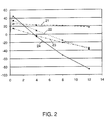
- FIG. 2 illustrates this effect for four glasses produced in production quantities.
- the glasses were subjected to an elevated temperature for periods of 4, 8, and 12 minutes.
- the resulting dimensional changes were measured after the glasses were cooled to room temperature and an exponential function was fit to the measured data and used to predict the dimensional changes at 30 seconds.
- the ultimate dimensional change varies widely between the glasses and depends on both the peak expansion and the slope of the curve following the peak expansion.
- curve 21 illustrates a glass which exhibits only expansion over the test period
- curve 24 illustrates a glass which exhibits a large peak expansion followed by a strong contraction
- curves 22 and 23 illustrate intermediate behaviors with widely-separated zero crossing points.
- the test procedure includes a conditioning stage (31, 32, 33 in FIG. 3 ; 43 in FIG. 4 ) and a measurement stage (34, 35, 36 in FIG. 3 ; 44, 45, 46 in FIG. 4 ).
- the conditioning stage includes three phases where:
- the conditioning stage of the test procedure serves to drastically reduce the contribution of slow relaxing species to the measured dimensional changes in the measurement stage.
- the glass sample will exhibit a dimensional change (compaction) on the order of 3300-1500 ppm during the conditioning stage.
- the conditioning stage sets the fast relaxers in a low fictive temperature state so that they will expand in the measurement stage. The relative amount of observed expansion in the measurement stage can then serve as a measure of the fast relaxers present in the glass of interest.
- Curves 41 and 42 of FIG. 4 respectively plot the fictive temperatures of the slow and fast relaxers as a function of time during the test procedure.
- the first part of the test procedure (the conditioning stage) shuts down the slow relaxers, i.e., curve 41 of FIG. 4 is essentially flat by the end of conditioning stage 43 and remains essentially flat during the measurement stage, i.e., during the heating/fast quenching steps 44, 45, and 46 in FIG. 4 .
- FIG. 5 illustrates the dimensional changes that take place during the measurement stage.
- curve 51 shows the dimensional changes attributable to the fast relaxers
- curve 53 that due to the slow relaxers
- curve 52 the combined dimensional changes which result in measured data points 54, 55, and 56, e.g., the dimensional changes at 5, 10, and 15 minutes which in the experimental results presented below are averaged to provide a measure of the glass's expansion peak.
- the fast relaxers are able to produce substantial observable expansion behavior during the measurement stage.
- compositional changes can be used to manipulate the contribution of fast relaxation to a glass's overall dimensional changes during a thermal cycle.
- the compositional changes are based on minor components of the glass, as opposed to the basic glass formers and modifiers. Indeed, the compositional changes will normally be at a level which can be characterized as a form of "doping" of the base glass to provide it with desired expansion/compaction properties.
- FIGS. 6 and 7 illustrate particular, non-limiting, examples of the use of low amounts of additives to alter the dimensional behavior of a base glass.
- FIG. 6 shows the effect of alkali addition
- FIG. 7 the effect of water content.
- the curves in these figures are dimensional change versus time profiles obtained using the test procedure described above.
- the dimensional behavior of the base glass is shown by curve 61 in FIG. 6 and curve 72 in FIG. 7 .
- Curves 62 and 63 in FIG. 6 show, respectively, the effects of the addition of 0.25 mol% and 1.0 mol% Li 2 O to the base glass
- curve 71 in FIG. 7 shows the effect of using wetter batch materials, i.e., materials that had not undergone an additional calcine step at 225°C overnight before melting.
- Table 1 The measured values plotted in FIG. 6 are shown in Table 1.
- FIG. 8 illustrates the strategy.
- 81 is the critical thermal cycle
- 84 is the dimensional change versus time curve exhibited by the substrate during the cycle
- 83 and 86 are, respectively, the substrate's peak and final dimensional changes.
- to achieve a particular value of dimensional change at the end of a critical cycle involves both controlling the expansion peak and the slope of the subsequent contraction.
- changes in the expansion peak can be associated with changes in the slope of the contraction phase of the dimensional change versus time curve.
- the slope of the dimensional change versus time curve after the expansion peak (hereinafter, the "after peak slope") is a function of the glass's annealing point. Specifically, as the annealing point goes up, the after peak slope goes down. Accordingly, if in raising the expansion peak, the annealing point is reduced, the net effect on overall dimensional stability may be small since the increased peak will be canceled out by the increased after peak slope.
- the annealing point of the preferred glasses for use as substrates is greater than 700°C, more preferably greater than 720°C, more preferably greater than 740°C, more preferably greater than 760°C, more preferably greater than 780°C, and more preferably greater than 800°C.
- FIG. 11 is a graphical representation of the advantages achievable using the fast relaxer control technology of the present disclosure.
- This figure shows calculated dimensional changes during a representative critical cycle of a display manufacturing process for a glass without fast relaxation control (curve 112) versus one with fast relaxation control (curve 111).
- curve 112 shows calculated dimensional changes during a representative critical cycle of a display manufacturing process for a glass without fast relaxation control
- curve 111 one with fast relaxation control
- an improvement in the overall dimensional change on the order of, for example, 5-10 ppm can be readily achieved.
- Such a compaction reduction represents a significant improvement in terms of display manufacture and constitutes an important benefit provided by the technology disclosed herein.
- control of the level of fast relaxing species of a glass substrate allow their expansion to counteract the compaction of slow relaxing species during a critical thermal cycle of a display manufacturing process.
- the overall changes in the dimensions of the substrate can be reduced, i.e., compaction can be minimized.
- Such reduced compaction is in itself desirable.
- it can allow the use of glass compositions with, for example, lower annealing points than would otherwise be required. This, in turn, can permit the use of compositions having other desirable characteristics, e.g., better melting/fining characteristics, which represents another important benefit of this technology.
- non-limiting aspects and/or embodiments of the present invention include:
- a method for reducing the dimensional changes of a glass sheet in a display manufacturing cycle comprising designing the composition of the glass so as to increase the peak expansion of the glass during the cycle.
- composition design comprises increasing the glass's water concentration relative to a starting glass composition.
- a method for distinguishing the effects of fast and slow relaxers in a glass comprising: (i) a conditioning stage in which the glass is heated to a preselected elevated temperature, held at that temperature, and then cooled, and (ii) a measurement stage in which the glass is heated to the same preselected temperature, held at that temperature, and then cooled, wherein the holding at the elevated temperature is longer for the conditioning stage than the measurement stage and the cooling for the conditioning stage is slower than the cooling for the measurement stage.
Landscapes
- Chemical & Material Sciences (AREA)
- Physics & Mathematics (AREA)
- Nonlinear Science (AREA)
- Materials Engineering (AREA)
- Organic Chemistry (AREA)
- Engineering & Computer Science (AREA)
- Mathematical Physics (AREA)
- Crystallography & Structural Chemistry (AREA)
- General Physics & Mathematics (AREA)
- Optics & Photonics (AREA)
- Life Sciences & Earth Sciences (AREA)
- General Chemical & Material Sciences (AREA)
- Geochemistry & Mineralogy (AREA)
- Chemical Kinetics & Catalysis (AREA)
- Spectroscopy & Molecular Physics (AREA)
- Glass Compositions (AREA)
- Re-Forming, After-Treatment, Cutting And Transporting Of Glass Products (AREA)
- Glass Melting And Manufacturing (AREA)
- Investigating Or Analyzing Materials Using Thermal Means (AREA)
Abstract
Description
- This application claims the benefit of priority to
US Patent Application No. 12/770291 filed on April 29, 2010 - This disclosure relates to glass substrates used in the manufacture of displays, e.g., liquid crystal displays (LCDs), and, in particular, to the dimensional changes which such substrates exhibit during a display manufacturing process.
- As is well known, manufacturing processes for displays include processing steps which take place at elevated temperatures. The specific temperatures used depend on the type of display being manufactured. For example, displays which employ polysilicon (p-Si) technology employ higher processing temperatures than displays based on amorphous silicon (a-Si displays).
- As is also well known, large glass sheets are used as substrates in the display manufacturing process and thus are subjected to the elevated temperatures used in those processes. These elevated temperatures can cause the substrates to exhibit dimensional changes, i.e., compaction. Because the pixel sizes of modern displays are small, dimensional changes even as small as a few parts-per-million can compromise the quality of the finished display.
- A number of approaches have been used to address the dimensional change problem. For example, substrates have been pre-compacted by being held at an elevated temperature for a period of time prior to use in a display manufacturing process. Such a heat treatment lowers the fictive temperature of the glass and thus the dimensional changes which the glass exhibits when raised to an elevated temperature (see Eq. (1) below). As other approaches, glass compositions have been developed which have higher strain points and/or higher annealing points and are thus more resistant to high temperature exposure.
- Importantly, not all steps of a display manufacturing process are equally susceptible to dimensional change problems. Rather, such processes normally have a critical cycle during which dimensional changes in glass substrates (e.g., compaction of the substrates) have their most detrimental effects on the final displays.
- The present disclosure is directed to reducing the dimensional changes which occur in such critical cycles. As such, the techniques disclosed herein can be used as additions to, or substitutes for, other techniques for reducing dimensional changes, such as those discussed above.
- In accordance with a first aspect, a method for reducing the dimensional changes of a glass sheet in a display manufacturing cycle is disclosed which includes altering the composition of the glass so as to increase the peak expansion of the glass during the cycle. In certain embodiments, the composition is altered by adding alkali to the composition, while in other embodiments, the water content of the glass is increased.
- In accordance with a second aspect, a glass sheet is disclosed for use as a substrate in a manufacturing process which produces a display device, said manufacturing process subjecting the sheet to at least a first and a second heating stage, the first heating stage being characterized by a maximum temperature T1 and a post-stage cooling rate r1 and the second heating stage being characterized by a maximum temperature T2 and a post-stage cooling rate r2, wherein:

or
or
said glass sheet being produced by a process (e.g., a float or fusion process) which produces at least 500 pounds of glass per hour and comprising SiO2 Al2O3, CaO, SrO, and MgO,
wherein when tested using a test procedure which includes a conditioning stage (31, 32, 33 inFIG. 3 ; 43 inFIG. 4 ) and a measurement stage (34, 35, 36 inFIG. 3 ; 44, 45, 46 inFIG. 4 ), the glass of the glass sheet, in the measurement stage (34, 35, 36 inFIG. 3 ; 44, 45, 46 inFIG. 4 ), exhibits an expansion peak in parts per million which is greater than EXPP, where
said conditioning stage (31, 32, 33 inFIG. 3 ; 43 inFIG. 4 ) comprising three phases where: - (i) in phase 1, the glass is heated from 20°C to 675°C in two minutes (see 31 in
FIG. 3 ); - (ii) in
phase 2, the glass is held at 675°C for eight hours (see 32 inFIG. 3 ); and - (iii) in phase 3, the glass is cooled from 675°C to room temperature in 8 hours (see 33 in
FIG. 3 ); and - (i) in phase 1 for each repetition, the glass is heated from 20°C to 675°C in two minutes (see 34 in
FIG. 3 which represents the first repetition); - (ii) in
phase 2, the glass is subjected to a temperature of 675°C for 5 minutes for the first three repetitions, for 15 minutes for the fourth repetition, for 30 minutes for the fifth repetition, and for 60 minutes for the sixth repetition (120 cumulative minutes after the six repetitions) (see 35 inFIG. 3 which represents the first repetition); and - (iii) in phase 3 for each repetition, the glass is cooled from 675°C to 100°C in two minutes (see 36 in
FIG. 3 which represents the first repetition); - In accordance with a third aspect, a method is disclosed for distinguishing the effects of fast and slow relaxers in a glass which includes: (i) a conditioning stage (31, 32, 33 in
FIG. 3 ; 43 inFIG. 4 ) in which the glass is heated (31) to a preselected elevated temperature, held (32) at that temperature, and then cooled (33), and (ii) a measurement stage (34, 35, 36 inFIG. 3 ; 44, 45, 46 inFIG. 4 ) in which the glass is heated (34) to the same preselected temperature, held (35) at that temperature, and then cooled (36), wherein the holding (32, 35) at the elevated temperature is longer for the conditioning stage than the measurement stage and the cooling (33, 36) for the conditioning stage is slower than the cooling for the measurement stage. In certain embodiments, the heating (34), holding (35), and cooling (36) of the measurement stage is repeated multiple times. - The reference numbers used in the above summaries of the various aspects of the disclosure are only for the convenience of the reader and are not intended to and should not be interpreted as limiting the scope of the invention. More generally, it is to be understood that both the foregoing general description and the following detailed description are merely exemplary of the invention and are intended to provide an overview or framework for understanding the nature and character of the invention.
- Additional features and advantages of the invention are set forth in the detailed description which follows, and in part will be readily apparent to those skilled in the art from that description or recognized by practicing the invention as exemplified by the description herein. The accompanying drawings are included to provide a further understanding of the invention, and are incorporated in and constitute a part of this specification. It is to be understood that the various features of the invention disclosed in this specification and in the drawings can be used in any and all combinations.
-
FIG. 1 is a plot of dimensional change (vertical axis) in ppm versus time (horizontal axis) in minutes for a representative display glass (Corning Incorporated's JADE® glass) held at 450°C. -
FIG. 2 is a plot of dimensional change (vertical axis) in ppm versus time (horizontal axis) in minutes for four glasses produced in production quantities and subjected to step changes in temperature ofdurations -
FIG. 3 is a plot of temperature (vertical axis) versus time (horizontal axis) for a test procedure which can be used to observe fast relaxation in a display glass. The times, temperatures, and slopes shown in this figure are not to scale. The test procedure includes aconditioning stage measurement stage -
FIG. 4 is a schematic diagram illustrating an embodiment of the test procedure ofFIG. 3 . The vertical axis is temperature forheating periods 43, 44, 45, 46 and fictive temperature forcurves -
FIG. 5 is a schematic diagram illustrating dimensional changes as a result of the measurement stage of the testing procedure ofFIG. 4 . The vertical axis is dimensional change in, for example, parts-per-million (ppm) and the horizontal scale is time. The diagram is not to scale. -
FIG. 6 is a plot illustrating the effect of batched Li2O on fast relaxation. The vertical scale is dimensional change in ppm; the horizontal scale is time in minutes. -
FIG. 7 is a plot illustrating the effect of water content on fast relaxation. The vertical scale is dimensional change in ppm; the horizontal scale is time in minutes. -
FIG. 8 is a schematic diagram illustrating the effect of maximum expansion on the final dimensional change during a critical thermal cycle of a display manufacturing process. The upper portion of the figure illustrates the critical thermal cycle and the lower portion illustrates the dimensional change of the glass substrate. The horizontal axis is time for both the upper and lower portions of the figure; the vertical axis is temperature for the upper portion and dimensional change for the lower portion. -
FIG. 9 is a plot of dimensional change (vertical axis) in ppm versus time (horizontal axis) in minutes for six production glasses and three developmental glasses tested in accordance with the procedure illustrated inFIG. 4 . -
FIG. 10 is a plot of peak expansion versus annealing point for the nine glasses ofFIG. 9 . -
FIG. 11 is a schematic diagram illustrating calculated dimensional changes for two glasses which exhibit different levels of fast relaxation in a critical thermal cycle of a display manufacturing process. The horizontal axis is time in minutes and the vertical axis is dimensional change in ppm. - When a glass melt is cooled rapidly from high temperature, the movement of atoms within the cooling liquid slows down with decreasing temperature and eventually diminishes to oscillations about fixed positions due to the normal thermal population of vibrational states. These positions are typically not those that would be adopted were the glass to be held for an extended period of time (ranging from seconds to days) at intermediate temperatures (e.g., the glass transition temperature or the strain or annealing points). As a consequence, when a rapidly quenched glass is reheated to intermediate temperatures, the thermally-populated vibrational states allow for relaxation of atoms into positions that better satisfy their individual and collective bonding requirements. Since this is typically accompanied by a decrease in the physical dimensions of a bulk piece of glass, thermal relaxation upon reheating is said to produce compaction of the glass.
- The amount of compaction exhibited by any particular sample of glass upon reheating will depend on the glass's fictive temperature at the beginning of the reheating, i.e., Tf(t0), and on the change in the fictive temperature over the course of the reheating, i.e., Tf(t). The changes in fictive temperature with time resulting from a reheating to a temperature T can be described by the following equation:

where b is a "stretching constant" and τ(T) is the relaxation time of the glass at the heat treatment temperature. - The relaxation time of the glass at a given temperature T can be approximated by the equation:

where η(T) is the glass's shear viscosity at the given temperature and G is the glass's shear modulus which scales the viscosity into time space and to a first approximation is independent of temperature. - As can be seen from Equations (1) and (2), as the relaxation time is increased, e.g., by increasing η(T), the change in fictive temperature of the glass in a set amount of time is significantly reduced, thereby reducing the measured compaction in a set thermal cycle.
- While fictive temperature is commonly referred to as a single temperature for a given quench rate, this is merely a convenience of language since experimental evidence has clearly demonstrated the presence of a distribution of relaxation times in glasses of the type used as display substrates. In
FIG, 1 , dimensional change data (compaction data) are fit with both a single exponential (curve 12) and with a stretched exponential (curve 11). If the data were able to be well fit with a single exponential, that would be representative of a single relaxation time. The fact that a stretched exponential is needed is clear evidence that multiple relaxation times are in effect. - In accordance with the present disclosure, it has been discovered that the dimensional behavior of a glass when subjected to a thermal cycle of the type used in the manufacturing of displays can be reasonably approximated and controlled by considering the glass as being composed of two populations of relaxing species, i.e., "fast relaxers" and "slow relaxers." In particular, the fast relaxer/slow relaxer approach to controlling dimensional changes is applicable to thermal cycles in which a glass sheet is subjected to at least a first and a second heating stage, the first heating stage being characterized by a maximum temperature T1 and a post-stage cooling rate r1 and the second heating stage being characterized by a maximum temperature T2 and a post-stage cooling rate r2, wherein:

or
or
- The critical thermal cycle in a display manufacturing process is normally the second heating stage of such a two stage heating process and thus the ability to control the dimensional changes of a glass sheet during such a second heating stage through adjustment of the relative amounts of fast and slow relaxers in the glass making up the sheet constitutes an important contribution to display manufacturing process.
- Generally, slow relaxers are involved in the dimensional changes which are described by the glass's viscosity versus temperature behavior, e.g., the glass's annealing temperature (i.e., the temperature at which the glass has a viscosity of 1013.18 poise). In particular, as used herein, slow relaxers are the relaxers whose behavior can to a first approximation be described by Eq. (2), while fast relaxers are those that have relaxation times faster than that predicted by Eq. (2).
- In practice, the presence of slow and fast relaxers can cause a glass to exhibit dimension changes when subjected to a temperature step which are biphasic. Specifically, the glass can undergo an expansion followed by a contraction. This is especially so in short thermal cycles, such as the critical "rapid thermal anneal" or "RTA" commonly used in display manufacture, where the fast relaxers are able to play a significant role in the net dimensional change of the glass by causing expansion at short times instead of the traditional compaction.
-
FIG. 2 illustrates this effect for four glasses produced in production quantities. In this figure, the glasses were subjected to an elevated temperature for periods of 4, 8, and 12 minutes. The resulting dimensional changes were measured after the glasses were cooled to room temperature and an exponential function was fit to the measured data and used to predict the dimensional changes at 30 seconds. As can be seen inFIG. 2 , the ultimate dimensional change varies widely between the glasses and depends on both the peak expansion and the slope of the curve following the peak expansion. In particular,curve 21 illustrates a glass which exhibits only expansion over the test period,curve 24 illustrates a glass which exhibits a large peak expansion followed by a strong contraction, and curves 22 and 23 illustrate intermediate behaviors with widely-separated zero crossing points. - In accordance with the present disclosure, it has been determined that the overall behavior shown in
FIG. 2 can be controlled by selecting/adjusting the amount of fast relaxers in the glass. To do so, however, requires the ability to distinguish the effects of fast relaxers from those of slow relaxers.FIG. 3 shows a test procedure for obtaining such a separation between the effects of the slow and fast relaxers. - As can be seen in this figure, the test procedure includes a conditioning stage (31, 32, 33 in
FIG. 3 ; 43 inFIG. 4 ) and a measurement stage (34, 35, 36 inFIG. 3 ; 44, 45, 46 inFIG. 4 ). The conditioning stage includes three phases where: - (i) in phase 1, the glass is heated from 20°C to 675°C in two minutes (see 31 in
FIG. 3 ); - (ii) in
phase 2, the glass is held at 675°C for eight hours (see 32 inFIG. 3 ); and - (iii) in phase 3, the glass is cooled from 675°C to room temperature in 8 hours (see 33 in
FIG. 3 ); - (i) in phase 1 for each repetition, the glass is heated from 20°C to 675°C in two minutes (see 34 in
FIG. 3 which represents the first repetition); - (ii) in
phase 2, the glass is subjected to a temperature of 675°C for 5 minutes for the first three repetitions, for 15 minutes for the fourth repetition, for 30 minutes for the fifth repetition, and for 60 minutes for the sixth repetition (120 cumulative minutes after the six repetitions) (see 35 inFIG. 3 which represents the first repetition); and - (iii) in phase 3 for each repetition, the glass is cooled from 675°C to 100°C in two minutes (see 36 in
FIG. 3 which represents the first repetition); - As persons skilled in the art will recognize from the present disclosure, test procedures employing other times, temperatures, and numbers of measurement stage repetitions can be used to distinguish the effects of fast relaxers from slow relaxers, provided the procedure employs a conditioning stage which has a long hold at a preselected elevated temperature and a slow quench rate followed by a measurement stage which uses the same preselected temperature and a faster quench rate.
- In general terms, the conditioning stage of the test procedure serves to drastically reduce the contribution of slow relaxing species to the measured dimensional changes in the measurement stage. Typically, the glass sample will exhibit a dimensional change (compaction) on the order of 3300-1500 ppm during the conditioning stage. In addition to shutting down the slow relaxers, the conditioning stage sets the fast relaxers in a low fictive temperature state so that they will expand in the measurement stage. The relative amount of observed expansion in the measurement stage can then serve as a measure of the fast relaxers present in the glass of interest.
- The ability of the procedure of
FIG. 3 to separate the behavior of slow and fast relaxers can be understood through reference toFIGS. 4 and 5 .Curves FIG. 4 respectively plot the fictive temperatures of the slow and fast relaxers as a function of time during the test procedure. As shown in this figure, the first part of the test procedure (the conditioning stage) shuts down the slow relaxers, i.e.,curve 41 ofFIG. 4 is essentially flat by the end ofconditioning stage 43 and remains essentially flat during the measurement stage, i.e., during the heating/fast quenching steps 44, 45, and 46 inFIG. 4 . -
FIG. 5 illustrates the dimensional changes that take place during the measurement stage. In particular, curve 51 shows the dimensional changes attributable to the fast relaxers,curve 53 that due to the slow relaxers, andcurve 52 the combined dimensional changes which result in measured data points 54, 55, and 56, e.g., the dimensional changes at 5, 10, and 15 minutes which in the experimental results presented below are averaged to provide a measure of the glass's expansion peak. As these curves illustrate, because the slow relaxers have been substantially shut down by the conditioning stage, the fast relaxers are able to produce substantial observable expansion behavior during the measurement stage. - Using the testing procedure of
FIGS. 3-5 , the effects of compositional changes on fast relaxation can be determined. The compositional change approach to enhancing the effect of fast relaxers can be applied to a variety of display glasses now known or subsequently developed. As known in the art, in general terms, display glasses include SiO2 and Al2O3 as glass formers and CaO, SrO, and MgO as components for modifying the properties of the glass, e.g., the glass's CTE, strain point, annealing point, melting point, viscosity, etc. In addition to these components, the glasses can include a variety of other constituents, e.g., B2O3, BaO, fining agents, and the like. Examples of the types of glasses to which the present disclosure can be applied include Corning's fusion-formed 1737, EAGLE XG®, and JADE® glasses, NEG's OA10 and OA10G, and Asahi's float-formed AN-100 glass. The dimensional behavior of these commercially-available glasses when tested using the procedures ofFIGS. 3-5 is set forth below in Tables 1-3, where 91 identifies OA10, 92 represents OA10G, 93 represents Corning's 1737 glass which has been subjected to pre-compaction, 94 represents Asahi's AN-100 glass, 595 represents Corning's EAGLE XG® glass, and 696 represents Corning's JADE® glass. - A variety of compositional changes can be used to manipulate the contribution of fast relaxation to a glass's overall dimensional changes during a thermal cycle. In the typical case, the compositional changes are based on minor components of the glass, as opposed to the basic glass formers and modifiers. Indeed, the compositional changes will normally be at a level which can be characterized as a form of "doping" of the base glass to provide it with desired expansion/compaction properties.
-
FIGS. 6 and7 illustrate particular, non-limiting, examples of the use of low amounts of additives to alter the dimensional behavior of a base glass. In particular,FIG. 6 shows the effect of alkali addition andFIG. 7 , the effect of water content. The curves in these figures are dimensional change versus time profiles obtained using the test procedure described above. The dimensional behavior of the base glass is shown bycurve 61 inFIG. 6 andcurve 72 inFIG. 7 . To eliminate the effects of water, the batch materials used to make the base glass were calcined overnight at 225°C. Curves 62 and 63 inFIG. 6 show, respectively, the effects of the addition of 0.25 mol% and 1.0 mol% Li2O to the base glass, whilecurve 71 inFIG. 7 shows the effect of using wetter batch materials, i.e., materials that had not undergone an additional calcine step at 225°C overnight before melting. The measured values plotted inFIG. 6 are shown in Table 1. - The errors associated with the dimensional measurements were on the order of ±3 ppm and thus a further analysis was made of the data of
FIG. 7 . In particular, polynomial fits were made tocurves - As can be seen
FIGS. 6 and7 , increasing alkali (curves 62 and 63) and increasing water content (curve 71) lead to higher expansions and, at least to some extent, steeper slopes for the profiles. The alkali curves are particularly important because they definitively showed a direct correlation of increased expansion (and therefore fast relaxation) with increased alkali content, i.e., the three glasses expanded ~10ppm, ~18ppm, and ~26ppm with added Li2O of zero, 0.25 mol%, and 1.0 mol%. Moreover, with only a 0.25 mol% addition of Li2O, the compaction after 120 minutes decreased from -4ppm to -1ppm. This is a significant result in and of itself but it becomes even more important when the annealing point is considered, i.e., the Li2O-containing glass had an 11°C lower annealing point than the Li2O-free glass, meaning that the lower annealing point glass compacted less than the higher annealing point glass, which is unexpected. - As discussed above, in accordance with the present disclosure dimensional change control is directed to a critical thermal cycle of a display manufacturing process.
FIG. 8 illustrates the strategy. In this figure, 81 is the critical thermal cycle, 84 is the dimensional change versus time curve exhibited by the substrate during the cycle, and 83 and 86 are, respectively, the substrate's peak and final dimensional changes. As can be seen in this figure, to achieve a particular value of dimensional change at the end of a critical cycle involves both controlling the expansion peak and the slope of the subsequent contraction. As shown inFIGS. 6 and7 , changes in the expansion peak can be associated with changes in the slope of the contraction phase of the dimensional change versus time curve. -
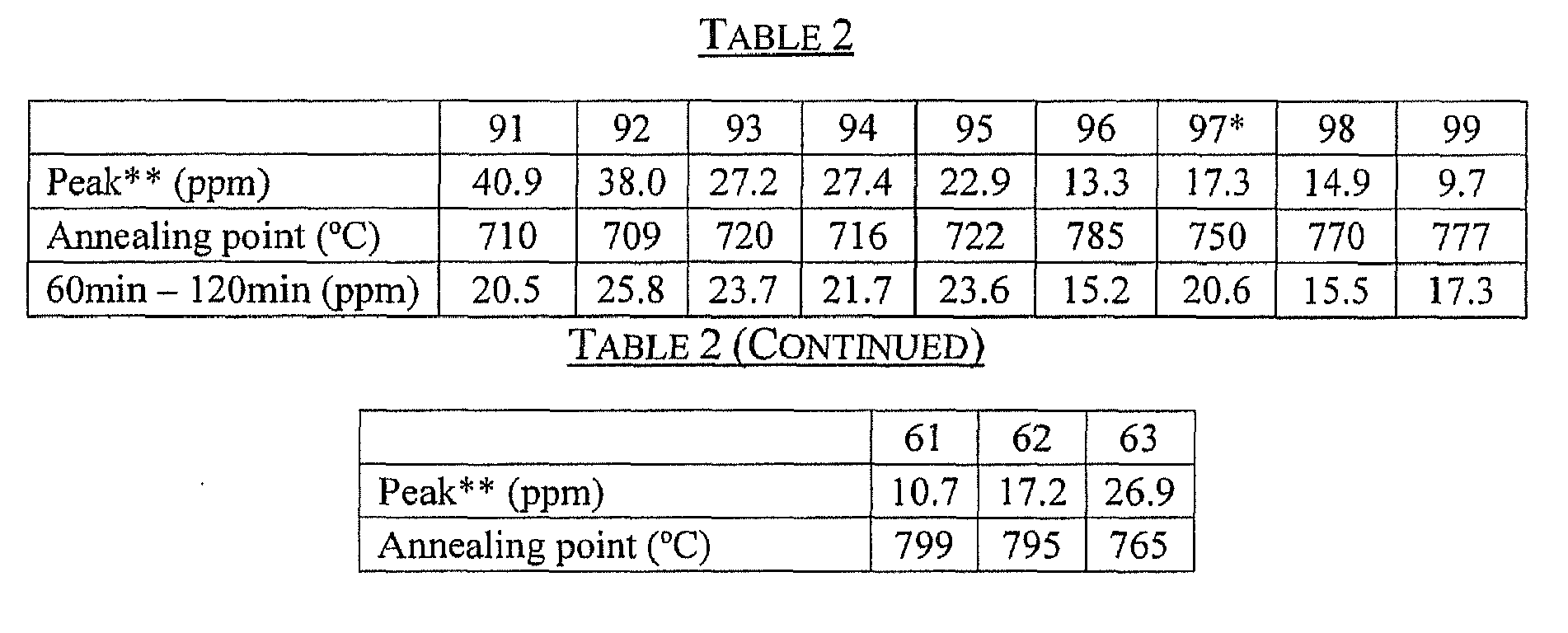
FIG. 9 further illustrates this effect for a variety of glasses produced in substantial quantities, e.g., at a rate of more than 500 pounds per hour. Because the glasses were produced in substantial quantities, the batch materials employed were those available in commercial quantities and thus the glasses have the conventional water and alkali levels associated with such batch materials. The great variety of peak expansion values and slopes exhibited by display glasses is evident from this figure. The specific values plotted are shown in Table 1. Peak and "after peak slope" values (i.e., after peak slope = 60min -120min values) are shown in Table 2. - In general terms, the slope of the dimensional change versus time curve after the expansion peak (hereinafter, the "after peak slope") is a function of the glass's annealing point. Specifically, as the annealing point goes up, the after peak slope goes down. Accordingly, if in raising the expansion peak, the annealing point is reduced, the net effect on overall dimensional stability may be small since the increased peak will be canceled out by the increased after peak slope. As a point of reference, the annealing point of the preferred glasses for use as substrates is greater than 700°C, more preferably greater than 720°C, more preferably greater than 740°C, more preferably greater than 760°C, more preferably greater than 780°C, and more preferably greater than 800°C.
- In accordance with the present disclosure, it has been found that when control of the relative contributions of fast and slow relaxation is not performed, display glasses exhibit expansion peaks which vary with annealing point in accordance with the following equation:

where Tann is the annealing point of the glass (in °C), 675 is the heat treatment temperature used in this cycle (in °C), and 1.87 is a fitting parameter.FIG. 10 illustrates this relationship for the glasses ofFIG. 9 .Line 101 in this figure is a fit to the plotted data points, i.e.,line 101 satisfies the foregoing equation. The R2 value for this fit was 0.93. The values plotted are set forth in Table 2. - As can be seen in this graph, as the peak goes up, the annealing temperature goes down. Accordingly, as discussed above, the after peak slope of the dimensional change versus time curve goes up. That is, for the conventional glasses of
FIG. 9 , increases in peak expansion are ineffective in reducing overall dimensional changes because such increases are associated with increases in the after peak slope of the dimensional change versus time curve, which increases cancel out the effect of the peak increase. In fact, in shorter cycles more like typical RTA cycles, reductions in the annealing point of a glass through traditional compositional methods will dominate the overall dimensional change and cause worse overall dimensional change relative to the original glass, even despite a slight increase in fast relaxation. However, for the glasses disclosed herein in which the composition is controlled so as to disproportionately increase the relative amount of fast relaxers, the peak can be made to go up faster than the annealing temperature goes down, i.e., the peak can be made to go up faster than the after peak slope goes up. Table 3 illustrates this effect, where the cutoff for glasses in which the linkage between peak values and after peak slopes has been broken (line 102 inFIG. 10 ) is given by the equation:
where
- As can be seen in Table 3, only the glasses in which the number of fast relaxers has been increased, i.e.,
glasses -
FIG. 11 is a graphical representation of the advantages achievable using the fast relaxer control technology of the present disclosure. This figure shows calculated dimensional changes during a representative critical cycle of a display manufacturing process for a glass without fast relaxation control (curve 112) versus one with fast relaxation control (curve 111). As can be seen, by increasing the relative population of fast relaxers by a relatively small amount, an improvement in the overall dimensional change on the order of, for example, 5-10 ppm can be readily achieved. Such a compaction reduction represents a significant improvement in terms of display manufacture and constitutes an important benefit provided by the technology disclosed herein. - In summary, as the foregoing illustrates, control of the level of fast relaxing species of a glass substrate allow their expansion to counteract the compaction of slow relaxing species during a critical thermal cycle of a display manufacturing process. In this way the overall changes in the dimensions of the substrate can be reduced, i.e., compaction can be minimized. Such reduced compaction is in itself desirable. Moreover, it can allow the use of glass compositions with, for example, lower annealing points than would otherwise be required. This, in turn, can permit the use of compositions having other desirable characteristics, e.g., better melting/fining characteristics, which represents another important benefit of this technology.
- A variety of modifications that do not depart from the scope and spirit of the invention will be evident to persons of ordinary skill in the art from the foregoing disclosure. The following claims are intended to cover the specific embodiments set forth herein as well as modifications, variations, and equivalents of those embodiments.



- Thus, non-limiting aspects and/or embodiments of the present invention include:
- C1. A method for reducing the dimensional changes of a glass sheet in a display manufacturing cycle comprising designing the composition of the glass so as to increase the peak expansion of the glass during the cycle.
- C2. The method of C1 wherein when tested using a test procedure which includes a conditioning stage and a measurement stage, the glass of the glass sheet, in the measurement stage, exhibits a linear expansion peak in parts per million which is greater than EXPP, where

said conditioning stage comprising three phases where: - (i) in phase 1, the glass is heated from 20°C to 675°C in two minutes;
- (ii) in
phase 2, the glass is held at 675°C for eight hours; and - (iii) in phase 3, the glass is cooled from 675°C to room temperature in 8 hours; and
- (i) in phase 1 for each repetition, the glass is heated from 20°C to 675°C in two minutes;
- (ii) in
phase 2, the glass is subjected to a temperature of 675°C for 5 minutes for the first three repetitions, for 15 minutes for the fourth repetition, for 30 minutes for the fifth repetition, and for 60 minutes for the sixth repetition; and - (iii) in phase 3 for each repetition, the glass is cooled from 675°C to 100°C in two minutes;
- C3. The method of C2 wherein the glass has an annealing point greater than 700°C.
- C4. The method of any of C 1 to C3 wherein designing the composition comprises increasing the glass's alkali metal oxide concentration relative to a starting glass composition.
- C5. The method of C4 wherein the glass's alkali metal oxide concentration is increased by at least 0.25 mole percent relative to a starting glass composition.
- C6. The method of C4 wherein the glass's alkali metal oxide concentration is increased by at least 1.0 mole percent relative to a starting glass composition.
- C7. The method of any of C1 to C6 wherein the composition design comprises increasing the glass's water concentration relative to a starting glass composition.
- C8. The method of any of C1 to C7 wherein the glass has an annealing point greater than 700°C.
- C9. A glass sheet for use as a substrate in a manufacturing process which produces a display device, said manufacturing process subjecting the sheet to at least a first and a second heating stage, the first heating stage being characterized by a maximum temperature T1 and a post-stage cooling rate r1 and the second heating stage being characterized by a maximum temperature T2 and a post-stage cooling rate r2, wherein:

or
or
said glass sheet being produced by a process which produces at least 500 pounds of glass per hour and comprising SiO2 Al2O3, CaO, SrO, and MgO,
wherein when tested using a test procedure which includes a conditioning stage and a measurement stage, the glass of the glass sheet, in the measurement stage, exhibits an expansion peak in parts per million which is greater than EXPP, where
said conditioning stage comprising three phases where: - (i) in phase 1, the glass is heated from 20°C to 675°C in two minutes;
- (ii) in
phase 2, the glass is held at 675°C for eight hours; and - (iii) in phase 3, the glass is cooled from 675°C to room temperature in 8 hours; and
- (i) in phase 1 for each repetition, the glass is heated from 20°C to 675°C in two minutes;
- (ii) in
phase 2, the glass is subjected to a temperature of 675°C for 5 minutes for the first three repetitions, for 15 minutes for the fourth repetition, for 30 minutes for the fifth repetition, and for 60 minutes for the sixth repetition; and - (iii) in phase 3 for each repetition, the glass is cooled from 675°C to 100°C in two minutes;
- C10. The glass of C9 wherein the glass has an annealing point greater than 700°C.
-
C 11 The glass of C9 orC 10 wherein the glass has an annealing point greater than 720°C. - C12. The glass of any of C9 to C11 wherein the glass has an annealing point greater than 740°C.
- C 13. The glass of any of C9 to
C 12 wherein the glass has an annealing point greater than 760°C. -
C 14. The glass of any of C9 to C 13 wherein the glass has an annealing point greater than 780°C. - C15. The glass of any of C9 to C14 wherein the glass has an annealing point greater than 800°C.
- C16. A method for distinguishing the effects of fast and slow relaxers in a glass comprising: (i) a conditioning stage in which the glass is heated to a preselected elevated temperature, held at that temperature, and then cooled, and (ii) a measurement stage in which the glass is heated to the same preselected temperature, held at that temperature, and then cooled, wherein the holding at the elevated temperature is longer for the conditioning stage than the measurement stage and the cooling for the conditioning stage is slower than the cooling for the measurement stage.
- C17. The method of C16 wherein the heating, holding, and cooling of the measurement stage is repeated multiple times.
- C18. The method of C 16 or C 17 wherein the elevated temperature during the conditioning stage is between 200°C and 10°C less than the annealing point of the glass.
- C19. The method of any of C16 to C18 wherein the elevated temperature during the conditioning stage is between 100°C and 20°C less than the annealing point of the glass.
Claims (10)
- A method for reducing the dimensional changes of a glass sheet in a display manufacturing cycle comprising altering the composition of the glass so as to increase the peak expansion of the glass during the cycle.
- The method of Claim 1 wherein the alteration comprises increasing the glass' alkali metal oxide concentration.
- The method of Claim 2 wherein the glass' alkali metal oxide concentration is increased by at least 0.25 mole percent.
- The method of Claim 2 wherein the glass' alkali metal oxide concentration is increased by at least 1.0 mole percent.
- The method of Claim 1 wherein the alteration comprises increasing the glass' water concentration.
- The method of any preceding Claim wherein when tested using a test procedure which includes a conditioning stage and a measurement stage, the glass of the glass sheet, in the measurement stage, exhibits an expansion peak in parts per million which is greater than 194-0.23*Tann, where Tann is the glass' annealing point in °C,
said conditioning stage comprising three phases where:(i) in phase 1, the glass is heated from 20°C to 675°C in two minutes;(ii) in phase 2, the glass is held at 675°C for eight hours; and(iii) in phase 3, the glass is cooled from 675°C to room temperature in 8 hours; andsaid measurement stage comprising six sequential repetitions of the following three phases:(i) in phase 1 for each repetition, the glass is heated from 20°C to 675°C in two minutes;(ii) in phase 2, the glass is subjected to a temperature of 675°C for 5 minutes for the first three repetitions, for 15 minutes for the fourth repetition, for 30 minutes for the fifth repetition, and for 60 minutes for the sixth repetition; and(iii) in phase 3 for each repetition, the glass is cooled from 675°C to 100°C in two minutes;with dimensional changes being measured after phase 3 of each measurement stage repetition. - A glass sheet for use as a substrate in a manufacturing process which produces a display device, said manufacturing process subjecting the sheet to at least a first and a second heating stage, the first heating stage being characterized by a maximum temperature T1 and a post-stage cooling rate r1 and the second heating stage being characterized by a maximum temperature T2 and a post-stage cooling rate r2, wherein:

or
or
said glass sheet being produced by a process which produces at least 500 pounds of glass per hour and comprising SiO2 Al2O3, CaO, SrO, and MgO,
wherein when tested using a test procedure which includes a conditioning stage and a measurement stage, the glass of the glass sheet, in the measurement stage, exhibits an expansion peak in parts per million which is greater than 194-0.23*Tann, where Tann is the glass' annealing point in °C,
said conditioning stage comprising three phases where:(i) in phase 1, the glass is heated from 20°C to 675°C in two minutes;(ii) in phase 2, the glass is held at 675°C for eight hours; and(iii) in phase 3, the glass is cooled from 675°C to room temperature in 8 hours; andsaid measurement stage comprising six sequential repetitions of the following three phases:(i) in phase 1 for each repetition, the glass is heated from 20°C to 675°C in two minutes;(ii) in phase 2, the glass is subjected to a temperature of 675°C for 5 minutes for the first three repetitions, for 15 minutes for the fourth repetition, for 30 minutes for the fifth repetition, and for 60 minutes for the sixth repetition; and(iii) in phase 3 for each repetition, the glass is cooled from 675°C to 100°C in two minutes;with dimensional changes being measured after phase 3 of each measurement stage repetition. - The glass of Claim 7 wherein the glass has an annealing point greater than 700°C.
- A method for distinguishing the effects of fast and slow relaxers in a glass comprising: (i) a conditioning stage in which the glass is heated to a preselected elevated temperature, held at that temperature, and then cooled, and (ii) a measurement stage in which the glass is heated to the same preselected temperature, held at that temperature, and then cooled, wherein the holding at the elevated temperature is longer for the conditioning stage than the measurement stage and the cooling for the conditioning stage is slower than the cooling for the measurement stage.
- The method of Claim 9 wherein the heating, holding, and cooling of the measurement stage is repeated multiple times.
Applications Claiming Priority (1)
| Application Number | Priority Date | Filing Date | Title |
|---|---|---|---|
| US12/770,291 US20110265516A1 (en) | 2010-04-29 | 2010-04-29 | Compositional control of fast relaxation in display glasses |
Publications (3)
| Publication Number | Publication Date |
|---|---|
| EP2383234A2 true EP2383234A2 (en) | 2011-11-02 |
| EP2383234A3 EP2383234A3 (en) | 2013-08-28 |
| EP2383234B1 EP2383234B1 (en) | 2018-01-10 |
Family
ID=44454660
Family Applications (1)
| Application Number | Title | Priority Date | Filing Date |
|---|---|---|---|
| EP11163650.2A Active EP2383234B1 (en) | 2010-04-29 | 2011-04-26 | Compositional control of fast relaxation in display glasses |
Country Status (6)
| Country | Link |
|---|---|
| US (1) | US20110265516A1 (en) |
| EP (1) | EP2383234B1 (en) |
| JP (1) | JP5777091B2 (en) |
| KR (2) | KR101844065B1 (en) |
| CN (1) | CN102249536B (en) |
| TW (1) | TWI498300B (en) |
Cited By (1)
| Publication number | Priority date | Publication date | Assignee | Title |
|---|---|---|---|---|
| NL2018497B1 (en) * | 2017-03-10 | 2018-09-21 | Univ Delft Tech | Method of performing a heat treatment on float glass to convert it into a toughened glass |
Families Citing this family (8)
| Publication number | Priority date | Publication date | Assignee | Title |
|---|---|---|---|---|
| CN102515482B (en) * | 2011-12-31 | 2014-03-26 | 四川虹欧显示器件有限公司 | Glass substrate, preparation method and preparation mould for glass substrate, and plasma display screen comprising glass substrate |
| CN110698057A (en) | 2012-12-21 | 2020-01-17 | 康宁股份有限公司 | Glass with improved overall pitch stability |
| US9556055B2 (en) * | 2013-04-30 | 2017-01-31 | Corning Incorporated | Method for reducing glass-ceramic surface adhesion, and pre-form for the same |
| CA2972778C (en) * | 2014-12-31 | 2019-09-10 | Corning Incorporated | Methods for thermally treating glass articles |
| MX2017008716A (en) | 2014-12-31 | 2017-10-31 | Corning Inc | Methods for treating glass articles. |
| JP6673354B2 (en) | 2015-07-03 | 2020-03-25 | Agc株式会社 | Method for manufacturing carrier substrate, laminate, and electronic device |
| TWI766041B (en) * | 2017-06-14 | 2022-06-01 | 美商康寧公司 | Method for controlling compaction |
| CN110054401A (en) * | 2019-03-06 | 2019-07-26 | 彩虹显示器件股份有限公司 | A kind of manufacturing method improving electronic glass dimensional stability |
Family Cites Families (19)
| Publication number | Priority date | Publication date | Assignee | Title |
|---|---|---|---|---|
| ES340737A1 (en) * | 1966-06-17 | 1968-06-01 | Pittsburgh Plate Glass Co | Wetback heating apparatus |
| US3856494A (en) * | 1968-10-19 | 1974-12-24 | Nippon Selfoc Co Ltd | Light-conducting glass structures made by vaporization |
| GB1322228A (en) * | 1969-07-10 | 1973-07-04 | Asahi Glass Co Ltd | Method of strengthening a glass article and a strengthened glass article |
| IT1009218B (en) * | 1973-04-02 | 1976-12-10 | Glaverbel | PROCEDURE FOR COLORING A GLASS OBJECT OR TO MODIFY ITS COLOR AND OBJECT THUS OBTAINED |
| US4325724A (en) * | 1974-11-25 | 1982-04-20 | Owens-Corning Fiberglas Corporation | Method for making glass |
| US4133666A (en) * | 1978-04-28 | 1979-01-09 | Spectrum Glass Company, Inc. | Method and apparatus for making variegated glass in a continuous sheet |
| JPS605538B2 (en) * | 1979-11-27 | 1985-02-12 | 日本板硝子株式会社 | Cesium-containing optical glass |
| EP0256278A1 (en) * | 1986-07-16 | 1988-02-24 | Siemens Aktiengesellschaft | Magnetic disc and process for its manufacture |
| WO2001028944A1 (en) * | 1999-10-18 | 2001-04-26 | Corning Incorporated | Transparent lithium zinc magnesium orthosilicate glass-ceramics |
| JP2002003240A (en) * | 2000-06-19 | 2002-01-09 | Nippon Electric Glass Co Ltd | Glass substrate for liquid crystal display |
| JPWO2004058657A1 (en) * | 2002-12-25 | 2006-04-27 | 日本板硝子株式会社 | Glass composition emitting fluorescence in the infrared wavelength region |
| US7418308B2 (en) * | 2003-10-31 | 2008-08-26 | Corning Incorporated | Method of optimizing glass strain |
| JP4737709B2 (en) | 2004-03-22 | 2011-08-03 | 日本電気硝子株式会社 | Method for producing glass for display substrate |
| CN101242951B (en) * | 2005-08-09 | 2012-10-31 | 旭硝子株式会社 | Sheet glass laminate and method of manufacturing display device using the sheet glass laminate |
| JP5483821B2 (en) * | 2007-02-27 | 2014-05-07 | AvanStrate株式会社 | Glass substrate for display device and display device |
| CN102007079A (en) * | 2008-04-21 | 2011-04-06 | 旭硝子株式会社 | Glass plate for display panel, manufacturing method thereof, and manufacturing method of TFT panel |
| US8187715B2 (en) * | 2008-05-13 | 2012-05-29 | Corning Incorporated | Rare-earth-containing glass material and substrate and device comprising such substrate |
| US8341976B2 (en) * | 2009-02-19 | 2013-01-01 | Corning Incorporated | Method of separating strengthened glass |
| KR101704841B1 (en) * | 2009-05-29 | 2017-02-08 | 코닝 인코포레이티드 | Irradiation Treatment of Glass |
-
2010
- 2010-04-29 US US12/770,291 patent/US20110265516A1/en not_active Abandoned
-
2011
- 2011-04-18 TW TW100113403A patent/TWI498300B/en active
- 2011-04-26 EP EP11163650.2A patent/EP2383234B1/en active Active
- 2011-04-28 JP JP2011100744A patent/JP5777091B2/en active Active
- 2011-04-28 CN CN201110118292.5A patent/CN102249536B/en active Active
- 2011-04-29 KR KR1020110040994A patent/KR101844065B1/en active Active
-
2018
- 2018-03-23 KR KR1020180033844A patent/KR101945148B1/en active Active
Non-Patent Citations (1)
| Title |
|---|
| None |
Cited By (1)
| Publication number | Priority date | Publication date | Assignee | Title |
|---|---|---|---|---|
| NL2018497B1 (en) * | 2017-03-10 | 2018-09-21 | Univ Delft Tech | Method of performing a heat treatment on float glass to convert it into a toughened glass |
Also Published As
| Publication number | Publication date |
|---|---|
| TW201141802A (en) | 2011-12-01 |
| US20110265516A1 (en) | 2011-11-03 |
| KR20110120840A (en) | 2011-11-04 |
| CN102249536B (en) | 2015-06-24 |
| EP2383234A3 (en) | 2013-08-28 |
| TWI498300B (en) | 2015-09-01 |
| CN102249536A (en) | 2011-11-23 |
| KR101945148B1 (en) | 2019-02-01 |
| KR101844065B1 (en) | 2018-03-30 |
| EP2383234B1 (en) | 2018-01-10 |
| JP2011231004A (en) | 2011-11-17 |
| JP5777091B2 (en) | 2015-09-09 |
| KR20180036663A (en) | 2018-04-09 |
Similar Documents
| Publication | Publication Date | Title |
|---|---|---|
| EP2383234A2 (en) | Compositional control of fast relaxation in display glasses | |
| US8713967B2 (en) | Stable glass sheet and method for making same | |
| JP5553511B2 (en) | Glass composition having high thermal and chemical stability and method for producing the same | |
| JP6202297B2 (en) | Alkali-free glass | |
| JP2020040878A (en) | Alkali-free glass | |
| JP7219336B2 (en) | Aluminosilicate glass composition, aluminosilicate glass, method of making and use thereof | |
| EP1170264A1 (en) | Translucent glass-ceramic, process for manufacturing a translucent glass-ceramic as well as its application | |
| EP1245545A1 (en) | Glass plate and method for tempering a glass plate | |
| TW201305083A (en) | Glass substrate for flat panel display and manufacturing method thereof | |
| WO2012137780A1 (en) | Non-alkali glass for substrates and process for manufacturing non-alkali glass for substrates | |
| Hou et al. | Effects of rare earth oxides on viscosity, thermal expansion, and structure of alkali-free boro-aluminosilicate glass | |
| US20250011219A1 (en) | Alkali-free glass plate | |
| TW201323366A (en) | Phosphate optical glass | |
| US20100273635A1 (en) | Glass Composition | |
| JP4862859B2 (en) | Glass substrate | |
| JP5874731B2 (en) | Solar collector glass, solar collector tube glass, and solar collector tube | |
| JP5882840B2 (en) | Glass composition and glass substrate for display using the same | |
| CN105502931B (en) | Composition, glass substrate and the preparation method and application of low-temperature polysilicon film transistor glass substrate | |
| KR102229428B1 (en) | Alkali-free glass | |
| CN116621450B (en) | Glass composition, alkali-free glass substrate with high strain point and preparation method thereof | |
| US20170029318A1 (en) | Glass plate for heat treatment | |
| KR102106613B1 (en) | Alkali-free glass composition having thermal stability and alkali-free glass having high strain point obtained therefrom | |
| EP0267682A1 (en) | Glass-ceramic article process for its production and thermally crystallizable glass | |
| US20220024806A1 (en) | Non-alkali glass | |
| CN120927938A (en) | Method for testing brittleness index of quartz glass liquid |
Legal Events
| Date | Code | Title | Description |
|---|---|---|---|
| AK | Designated contracting states |
Kind code of ref document: A2 Designated state(s): AL AT BE BG CH CY CZ DE DK EE ES FI FR GB GR HR HU IE IS IT LI LT LU LV MC MK MT NL NO PL PT RO RS SE SI SK SM TR |
|
| AX | Request for extension of the european patent |
Extension state: BA ME |
|
| PUAI | Public reference made under article 153(3) epc to a published international application that has entered the european phase |
Free format text: ORIGINAL CODE: 0009012 |
|
| PUAL | Search report despatched |
Free format text: ORIGINAL CODE: 0009013 |
|
| RIC1 | Information provided on ipc code assigned before grant |
Ipc: C03B 25/02 20060101ALI20130718BHEP Ipc: C03B 25/08 20060101ALI20130718BHEP Ipc: C03C 3/085 20060101AFI20130718BHEP |
|
| AK | Designated contracting states |
Kind code of ref document: A3 Designated state(s): AL AT BE BG CH CY CZ DE DK EE ES FI FR GB GR HR HU IE IS IT LI LT LU LV MC MK MT NL NO PL PT RO RS SE SI SK SM TR |
|
| AX | Request for extension of the european patent |
Extension state: BA ME |
|
| 17P | Request for examination filed |
Effective date: 20140228 |
|
| RBV | Designated contracting states (corrected) |
Designated state(s): AL AT BE BG CH CY CZ DE DK EE ES FI FR GB GR HR HU IE IS IT LI LT LU LV MC MK MT NL NO PL PT RO RS SE SI SK SM TR |
|
| 17Q | First examination report despatched |
Effective date: 20140403 |
|
| GRAP | Despatch of communication of intention to grant a patent |
Free format text: ORIGINAL CODE: EPIDOSNIGR1 |
|
| INTG | Intention to grant announced |
Effective date: 20170727 |
|
| GRAS | Grant fee paid |
Free format text: ORIGINAL CODE: EPIDOSNIGR3 |
|
| GRAA | (expected) grant |
Free format text: ORIGINAL CODE: 0009210 |
|
| AK | Designated contracting states |
Kind code of ref document: B1 Designated state(s): AL AT BE BG CH CY CZ DE DK EE ES FI FR GB GR HR HU IE IS IT LI LT LU LV MC MK MT NL NO PL PT RO RS SE SI SK SM TR |
|
| REG | Reference to a national code |
Ref country code: GB Ref legal event code: FG4D |
|
| REG | Reference to a national code |
Ref country code: CH Ref legal event code: EP Ref country code: AT Ref legal event code: REF Ref document number: 962197 Country of ref document: AT Kind code of ref document: T Effective date: 20180115 |
|
| REG | Reference to a national code |
Ref country code: IE Ref legal event code: FG4D |
|
| REG | Reference to a national code |
Ref country code: DE Ref legal event code: R096 Ref document number: 602011044862 Country of ref document: DE |
|
| REG | Reference to a national code |
Ref country code: FR Ref legal event code: PLFP Year of fee payment: 8 |
|
| REG | Reference to a national code |
Ref country code: NL Ref legal event code: MP Effective date: 20180110 |
|
| REG | Reference to a national code |
Ref country code: AT Ref legal event code: MK05 Ref document number: 962197 Country of ref document: AT Kind code of ref document: T Effective date: 20180110 |
|
| PG25 | Lapsed in a contracting state [announced via postgrant information from national office to epo] |
Ref country code: NL Free format text: LAPSE BECAUSE OF FAILURE TO SUBMIT A TRANSLATION OF THE DESCRIPTION OR TO PAY THE FEE WITHIN THE PRESCRIBED TIME-LIMIT Effective date: 20180110 |
|
| PG25 | Lapsed in a contracting state [announced via postgrant information from national office to epo] |
Ref country code: FI Free format text: LAPSE BECAUSE OF FAILURE TO SUBMIT A TRANSLATION OF THE DESCRIPTION OR TO PAY THE FEE WITHIN THE PRESCRIBED TIME-LIMIT Effective date: 20180110 Ref country code: NO Free format text: LAPSE BECAUSE OF FAILURE TO SUBMIT A TRANSLATION OF THE DESCRIPTION OR TO PAY THE FEE WITHIN THE PRESCRIBED TIME-LIMIT Effective date: 20180410 Ref country code: HR Free format text: LAPSE BECAUSE OF FAILURE TO SUBMIT A TRANSLATION OF THE DESCRIPTION OR TO PAY THE FEE WITHIN THE PRESCRIBED TIME-LIMIT Effective date: 20180110 Ref country code: LT Free format text: LAPSE BECAUSE OF FAILURE TO SUBMIT A TRANSLATION OF THE DESCRIPTION OR TO PAY THE FEE WITHIN THE PRESCRIBED TIME-LIMIT Effective date: 20180110 Ref country code: ES Free format text: LAPSE BECAUSE OF FAILURE TO SUBMIT A TRANSLATION OF THE DESCRIPTION OR TO PAY THE FEE WITHIN THE PRESCRIBED TIME-LIMIT Effective date: 20180110 Ref country code: CY Free format text: LAPSE BECAUSE OF FAILURE TO SUBMIT A TRANSLATION OF THE DESCRIPTION OR TO PAY THE FEE WITHIN THE PRESCRIBED TIME-LIMIT Effective date: 20180110 |
|
| PG25 | Lapsed in a contracting state [announced via postgrant information from national office to epo] |
Ref country code: BG Free format text: LAPSE BECAUSE OF FAILURE TO SUBMIT A TRANSLATION OF THE DESCRIPTION OR TO PAY THE FEE WITHIN THE PRESCRIBED TIME-LIMIT Effective date: 20180410 Ref country code: IS Free format text: LAPSE BECAUSE OF FAILURE TO SUBMIT A TRANSLATION OF THE DESCRIPTION OR TO PAY THE FEE WITHIN THE PRESCRIBED TIME-LIMIT Effective date: 20180510 Ref country code: PL Free format text: LAPSE BECAUSE OF FAILURE TO SUBMIT A TRANSLATION OF THE DESCRIPTION OR TO PAY THE FEE WITHIN THE PRESCRIBED TIME-LIMIT Effective date: 20180110 Ref country code: GR Free format text: LAPSE BECAUSE OF FAILURE TO SUBMIT A TRANSLATION OF THE DESCRIPTION OR TO PAY THE FEE WITHIN THE PRESCRIBED TIME-LIMIT Effective date: 20180411 Ref country code: SE Free format text: LAPSE BECAUSE OF FAILURE TO SUBMIT A TRANSLATION OF THE DESCRIPTION OR TO PAY THE FEE WITHIN THE PRESCRIBED TIME-LIMIT Effective date: 20180110 Ref country code: LV Free format text: LAPSE BECAUSE OF FAILURE TO SUBMIT A TRANSLATION OF THE DESCRIPTION OR TO PAY THE FEE WITHIN THE PRESCRIBED TIME-LIMIT Effective date: 20180110 Ref country code: RS Free format text: LAPSE BECAUSE OF FAILURE TO SUBMIT A TRANSLATION OF THE DESCRIPTION OR TO PAY THE FEE WITHIN THE PRESCRIBED TIME-LIMIT Effective date: 20180110 Ref country code: AT Free format text: LAPSE BECAUSE OF FAILURE TO SUBMIT A TRANSLATION OF THE DESCRIPTION OR TO PAY THE FEE WITHIN THE PRESCRIBED TIME-LIMIT Effective date: 20180110 |
|
| REG | Reference to a national code |
Ref country code: DE Ref legal event code: R097 Ref document number: 602011044862 Country of ref document: DE |
|
| PG25 | Lapsed in a contracting state [announced via postgrant information from national office to epo] |
Ref country code: EE Free format text: LAPSE BECAUSE OF FAILURE TO SUBMIT A TRANSLATION OF THE DESCRIPTION OR TO PAY THE FEE WITHIN THE PRESCRIBED TIME-LIMIT Effective date: 20180110 Ref country code: IT Free format text: LAPSE BECAUSE OF FAILURE TO SUBMIT A TRANSLATION OF THE DESCRIPTION OR TO PAY THE FEE WITHIN THE PRESCRIBED TIME-LIMIT Effective date: 20180110 Ref country code: AL Free format text: LAPSE BECAUSE OF FAILURE TO SUBMIT A TRANSLATION OF THE DESCRIPTION OR TO PAY THE FEE WITHIN THE PRESCRIBED TIME-LIMIT Effective date: 20180110 Ref country code: RO Free format text: LAPSE BECAUSE OF FAILURE TO SUBMIT A TRANSLATION OF THE DESCRIPTION OR TO PAY THE FEE WITHIN THE PRESCRIBED TIME-LIMIT Effective date: 20180110 |
|
| PLBE | No opposition filed within time limit |
Free format text: ORIGINAL CODE: 0009261 |
|
| STAA | Information on the status of an ep patent application or granted ep patent |
Free format text: STATUS: NO OPPOSITION FILED WITHIN TIME LIMIT |
|
| PG25 | Lapsed in a contracting state [announced via postgrant information from national office to epo] |
Ref country code: MC Free format text: LAPSE BECAUSE OF FAILURE TO SUBMIT A TRANSLATION OF THE DESCRIPTION OR TO PAY THE FEE WITHIN THE PRESCRIBED TIME-LIMIT Effective date: 20180110 Ref country code: CZ Free format text: LAPSE BECAUSE OF FAILURE TO SUBMIT A TRANSLATION OF THE DESCRIPTION OR TO PAY THE FEE WITHIN THE PRESCRIBED TIME-LIMIT Effective date: 20180110 Ref country code: SM Free format text: LAPSE BECAUSE OF FAILURE TO SUBMIT A TRANSLATION OF THE DESCRIPTION OR TO PAY THE FEE WITHIN THE PRESCRIBED TIME-LIMIT Effective date: 20180110 Ref country code: DK Free format text: LAPSE BECAUSE OF FAILURE TO SUBMIT A TRANSLATION OF THE DESCRIPTION OR TO PAY THE FEE WITHIN THE PRESCRIBED TIME-LIMIT Effective date: 20180110 Ref country code: SK Free format text: LAPSE BECAUSE OF FAILURE TO SUBMIT A TRANSLATION OF THE DESCRIPTION OR TO PAY THE FEE WITHIN THE PRESCRIBED TIME-LIMIT Effective date: 20180110 |
|
| REG | Reference to a national code |
Ref country code: CH Ref legal event code: PL |
|
| 26N | No opposition filed |
Effective date: 20181011 |
|
| REG | Reference to a national code |
Ref country code: BE Ref legal event code: MM Effective date: 20180430 |
|
| GBPC | Gb: european patent ceased through non-payment of renewal fee |
Effective date: 20180426 |
|
| REG | Reference to a national code |
Ref country code: IE Ref legal event code: MM4A |
|
| PG25 | Lapsed in a contracting state [announced via postgrant information from national office to epo] |
Ref country code: LU Free format text: LAPSE BECAUSE OF NON-PAYMENT OF DUE FEES Effective date: 20180426 |
|
| PG25 | Lapsed in a contracting state [announced via postgrant information from national office to epo] |
Ref country code: CH Free format text: LAPSE BECAUSE OF NON-PAYMENT OF DUE FEES Effective date: 20180430 Ref country code: LI Free format text: LAPSE BECAUSE OF NON-PAYMENT OF DUE FEES Effective date: 20180430 Ref country code: SI Free format text: LAPSE BECAUSE OF FAILURE TO SUBMIT A TRANSLATION OF THE DESCRIPTION OR TO PAY THE FEE WITHIN THE PRESCRIBED TIME-LIMIT Effective date: 20180110 Ref country code: BE Free format text: LAPSE BECAUSE OF NON-PAYMENT OF DUE FEES Effective date: 20180430 Ref country code: GB Free format text: LAPSE BECAUSE OF NON-PAYMENT OF DUE FEES Effective date: 20180426 |
|
| PG25 | Lapsed in a contracting state [announced via postgrant information from national office to epo] |
Ref country code: IE Free format text: LAPSE BECAUSE OF NON-PAYMENT OF DUE FEES Effective date: 20180426 |
|
| PG25 | Lapsed in a contracting state [announced via postgrant information from national office to epo] |
Ref country code: MT Free format text: LAPSE BECAUSE OF NON-PAYMENT OF DUE FEES Effective date: 20180426 |
|
| PG25 | Lapsed in a contracting state [announced via postgrant information from national office to epo] |
Ref country code: TR Free format text: LAPSE BECAUSE OF FAILURE TO SUBMIT A TRANSLATION OF THE DESCRIPTION OR TO PAY THE FEE WITHIN THE PRESCRIBED TIME-LIMIT Effective date: 20180110 |
|
| PG25 | Lapsed in a contracting state [announced via postgrant information from national office to epo] |
Ref country code: HU Free format text: LAPSE BECAUSE OF FAILURE TO SUBMIT A TRANSLATION OF THE DESCRIPTION OR TO PAY THE FEE WITHIN THE PRESCRIBED TIME-LIMIT; INVALID AB INITIO Effective date: 20110426 Ref country code: PT Free format text: LAPSE BECAUSE OF FAILURE TO SUBMIT A TRANSLATION OF THE DESCRIPTION OR TO PAY THE FEE WITHIN THE PRESCRIBED TIME-LIMIT Effective date: 20180110 |
|
| PG25 | Lapsed in a contracting state [announced via postgrant information from national office to epo] |
Ref country code: MK Free format text: LAPSE BECAUSE OF NON-PAYMENT OF DUE FEES Effective date: 20180110 |
|
| PGFP | Annual fee paid to national office [announced via postgrant information from national office to epo] |
Ref country code: DE Payment date: 20250317 Year of fee payment: 15 |
|
| PGFP | Annual fee paid to national office [announced via postgrant information from national office to epo] |
Ref country code: FR Payment date: 20260317 Year of fee payment: 16 |