EP2382226B1 - Process for the synthesis of l-fucosyl di- or oligosaccharides and novel 2,3,4 tribenzyl-fucosyl derivatives intermediates thereof - Google Patents
Process for the synthesis of l-fucosyl di- or oligosaccharides and novel 2,3,4 tribenzyl-fucosyl derivatives intermediates thereof Download PDFInfo
- Publication number
- EP2382226B1 EP2382226B1 EP09806138.5A EP09806138A EP2382226B1 EP 2382226 B1 EP2382226 B1 EP 2382226B1 EP 09806138 A EP09806138 A EP 09806138A EP 2382226 B1 EP2382226 B1 EP 2382226B1
- Authority
- EP
- European Patent Office
- Prior art keywords
- formula
- groups
- benzyl
- glucose
- compounds
- Prior art date
- Legal status (The legal status is an assumption and is not a legal conclusion. Google has not performed a legal analysis and makes no representation as to the accuracy of the status listed.)
- Active
Links
- 239000000543 intermediate Substances 0.000 title claims description 32
- 238000000034 method Methods 0.000 title claims description 31
- 230000015572 biosynthetic process Effects 0.000 title claims description 27
- 238000003786 synthesis reaction Methods 0.000 title claims description 27
- 229920001542 oligosaccharide Polymers 0.000 title claims description 24
- 150000002482 oligosaccharides Chemical class 0.000 title claims description 22
- 230000008569 process Effects 0.000 title claims description 19
- -1 l-fucosyl Chemical group 0.000 title claims description 12
- 150000001875 compounds Chemical class 0.000 claims description 64
- 125000001797 benzyl group Chemical group [H]C1=C([H])C([H])=C(C([H])=C1[H])C([H])([H])* 0.000 claims description 53
- GDTBXPJZTBHREO-UHFFFAOYSA-N bromine Substances BrBr GDTBXPJZTBHREO-UHFFFAOYSA-N 0.000 claims description 30
- 229910052794 bromium Inorganic materials 0.000 claims description 30
- 229910052739 hydrogen Inorganic materials 0.000 claims description 27
- 125000002887 hydroxy group Chemical group [H]O* 0.000 claims description 27
- 239000008101 lactose Substances 0.000 claims description 27
- WKBOTKDWSSQWDR-UHFFFAOYSA-N Bromine atom Chemical compound [Br] WKBOTKDWSSQWDR-UHFFFAOYSA-N 0.000 claims description 25
- 125000003545 alkoxy group Chemical group 0.000 claims description 25
- 239000000460 chlorine Substances 0.000 claims description 25
- 229910052801 chlorine Inorganic materials 0.000 claims description 25
- 239000008103 glucose Substances 0.000 claims description 25
- 125000000449 nitro group Chemical group [O-][N+](*)=O 0.000 claims description 24
- 239000001257 hydrogen Substances 0.000 claims description 22
- ZAMOUSCENKQFHK-UHFFFAOYSA-N Chlorine atom Chemical compound [Cl] ZAMOUSCENKQFHK-UHFFFAOYSA-N 0.000 claims description 21
- UPQQXPKAYZYUKO-UHFFFAOYSA-N 2,2,2-trichloroacetamide Chemical group OC(=N)C(Cl)(Cl)Cl UPQQXPKAYZYUKO-UHFFFAOYSA-N 0.000 claims description 16
- 150000002772 monosaccharides Chemical class 0.000 claims description 14
- 125000002446 fucosyl group Chemical group C1([C@@H](O)[C@H](O)[C@H](O)[C@@H](O1)C)* 0.000 claims description 13
- 150000002431 hydrogen Chemical class 0.000 claims description 13
- 150000002016 disaccharides Chemical class 0.000 claims description 12
- 238000005859 coupling reaction Methods 0.000 claims description 11
- CEIPQQODRKXDSB-UHFFFAOYSA-N ethyl 3-(6-hydroxynaphthalen-2-yl)-1H-indazole-5-carboximidate dihydrochloride Chemical group Cl.Cl.C1=C(O)C=CC2=CC(C3=NNC4=CC=C(C=C43)C(=N)OCC)=CC=C21 CEIPQQODRKXDSB-UHFFFAOYSA-N 0.000 claims description 11
- 229910052736 halogen Inorganic materials 0.000 claims description 10
- 150000002367 halogens Chemical class 0.000 claims description 10
- SHZGCJCMOBCMKK-DHVFOXMCSA-N L-fucopyranose Chemical compound C[C@@H]1OC(O)[C@@H](O)[C@H](O)[C@@H]1O SHZGCJCMOBCMKK-DHVFOXMCSA-N 0.000 claims description 9
- 229910052799 carbon Inorganic materials 0.000 claims description 9
- OKTJSMMVPCPJKN-UHFFFAOYSA-N Carbon Chemical compound [C] OKTJSMMVPCPJKN-UHFFFAOYSA-N 0.000 claims description 8
- SHZGCJCMOBCMKK-UHFFFAOYSA-N D-mannomethylose Natural products CC1OC(O)C(O)C(O)C1O SHZGCJCMOBCMKK-UHFFFAOYSA-N 0.000 claims description 8
- GUBGYTABKSRVRQ-QKKXKWKRSA-N Lactose Natural products OC[C@H]1O[C@@H](O[C@H]2[C@H](O)[C@@H](O)C(O)O[C@@H]2CO)[C@H](O)[C@@H](O)[C@H]1O GUBGYTABKSRVRQ-QKKXKWKRSA-N 0.000 claims description 8
- 239000012190 activator Substances 0.000 claims description 8
- GUBGYTABKSRVRQ-XLOQQCSPSA-N Alpha-Lactose Chemical compound O[C@@H]1[C@@H](O)[C@@H](O)[C@@H](CO)O[C@H]1O[C@@H]1[C@@H](CO)O[C@H](O)[C@H](O)[C@H]1O GUBGYTABKSRVRQ-XLOQQCSPSA-N 0.000 claims description 7
- PNNNRSAQSRJVSB-SLPGGIOYSA-N Fucose Natural products C[C@H](O)[C@@H](O)[C@H](O)[C@H](O)C=O PNNNRSAQSRJVSB-SLPGGIOYSA-N 0.000 claims description 6
- 230000008878 coupling Effects 0.000 claims description 6
- 238000010168 coupling process Methods 0.000 claims description 6
- 125000004435 hydrogen atom Chemical group [H]* 0.000 claims description 6
- 229930182830 galactose Natural products 0.000 claims description 5
- 125000006239 protecting group Chemical group 0.000 claims description 5
- WQZGKKKJIJFFOK-GASJEMHNSA-N Glucose Natural products OC[C@H]1OC(O)[C@H](O)[C@@H](O)[C@@H]1O WQZGKKKJIJFFOK-GASJEMHNSA-N 0.000 claims description 4
- WQZGKKKJIJFFOK-PHYPRBDBSA-N alpha-D-galactose Chemical compound OC[C@H]1O[C@H](O)[C@H](O)[C@@H](O)[C@H]1O WQZGKKKJIJFFOK-PHYPRBDBSA-N 0.000 claims description 4
- WQZGKKKJIJFFOK-VFUOTHLCSA-N beta-D-glucose Chemical compound OC[C@H]1O[C@@H](O)[C@H](O)[C@@H](O)[C@@H]1O WQZGKKKJIJFFOK-VFUOTHLCSA-N 0.000 claims description 4
- LOMHJEGAUNMOOE-ZXXMMSQZSA-N (2r,3s,4r,5r)-2-amino-2,3,4,5,6-pentahydroxyhexanal Chemical compound O=C[C@@](O)(N)[C@@H](O)[C@H](O)[C@H](O)CO LOMHJEGAUNMOOE-ZXXMMSQZSA-N 0.000 claims description 3
- SBVLHXSGCAXURW-YCSXVPLMSA-N (3R,4S,5S,6R)-3-amino-6-(hydroxymethyl)-5-[(2S,3R,4S,5R,6R)-3,4,5-trihydroxy-6-(hydroxymethyl)oxan-2-yl]oxyoxane-2,3,4-triol Chemical compound N[C@@]1(C(O)O[C@@H]([C@H]([C@@H]1O)O[C@H]1[C@H](O)[C@@H](O)[C@@H](O)[C@H](O1)CO)CO)O SBVLHXSGCAXURW-YCSXVPLMSA-N 0.000 claims description 3
- SKNIOWWRRCWWHK-YCSXVPLMSA-N (3R,4S,5S,6R)-3-azido-6-(hydroxymethyl)-5-[(2S,3R,4S,5R,6R)-3,4,5-trihydroxy-6-(hydroxymethyl)oxan-2-yl]oxyoxane-2,3,4-triol Chemical compound N(=[N+]=[N-])[C@@]1(C(O)O[C@@H]([C@H]([C@@H]1O)O[C@H]1[C@H](O)[C@@H](O)[C@@H](O)[C@H](O1)CO)CO)O SKNIOWWRRCWWHK-YCSXVPLMSA-N 0.000 claims description 3
- NEDHZEVWTQFQLU-AZWIWYHISA-N N-[(3R,4S,5S,6R)-2,3,4-trihydroxy-6-(hydroxymethyl)-5-[(2S,3R,4S,5R,6R)-3,4,5-trihydroxy-6-(hydroxymethyl)oxan-2-yl]oxyoxan-3-yl]acetamide Chemical compound C(C)(=O)N[C@@]1(C(O)O[C@@H]([C@H]([C@@H]1O)O[C@H]1[C@H](O)[C@@H](O)[C@@H](O)[C@H](O1)CO)CO)O NEDHZEVWTQFQLU-AZWIWYHISA-N 0.000 claims description 3
- HMQPEDMEOBLSQB-RCBHQUQDSA-N beta-D-Galp-(1->3)-alpha-D-GlcpNAc Chemical compound CC(=O)N[C@H]1[C@@H](O)O[C@H](CO)[C@@H](O)[C@@H]1O[C@H]1[C@H](O)[C@@H](O)[C@@H](O)[C@@H](CO)O1 HMQPEDMEOBLSQB-RCBHQUQDSA-N 0.000 claims description 3
- KYYLBTDGVAUNBT-ZXXMMSQZSA-N diazonio-[(2r,3s,4r,5r)-2,3,4,5,6-pentahydroxy-1-oxohexan-2-yl]azanide Chemical compound OC[C@@H](O)[C@@H](O)[C@H](O)[C@@](O)(C=O)N=[N+]=[N-] KYYLBTDGVAUNBT-ZXXMMSQZSA-N 0.000 claims description 3
- 239000000937 glycosyl acceptor Substances 0.000 claims description 3
- 229930191176 lacto-N-biose Natural products 0.000 claims description 3
- QPIPRXOFADQDRP-NGJRWZKOSA-N n-[(2r,3s,4r,5r)-2,3,4,5,6-pentahydroxy-1-oxohexan-2-yl]acetamide Chemical compound CC(=O)N[C@](O)(C=O)[C@@H](O)[C@H](O)[C@H](O)CO QPIPRXOFADQDRP-NGJRWZKOSA-N 0.000 claims description 3
- 125000000051 benzyloxy group Chemical group [H]C1=C([H])C([H])=C(C([H])=C1[H])C([H])([H])O* 0.000 claims description 2
- 150000001720 carbohydrates Chemical group 0.000 claims description 2
- OKKJLVBELUTLKV-UHFFFAOYSA-N Methanol Chemical compound OC OKKJLVBELUTLKV-UHFFFAOYSA-N 0.000 description 72
- HEDRZPFGACZZDS-MICDWDOJSA-N Trichloro(2H)methane Chemical compound [2H]C(Cl)(Cl)Cl HEDRZPFGACZZDS-MICDWDOJSA-N 0.000 description 56
- YMWUJEATGCHHMB-UHFFFAOYSA-N Dichloromethane Chemical compound ClCCl YMWUJEATGCHHMB-UHFFFAOYSA-N 0.000 description 54
- 239000000243 solution Substances 0.000 description 43
- XEKOWRVHYACXOJ-UHFFFAOYSA-N Ethyl acetate Chemical compound CCOC(C)=O XEKOWRVHYACXOJ-UHFFFAOYSA-N 0.000 description 38
- ZMANZCXQSJIPKH-UHFFFAOYSA-N Triethylamine Chemical compound CCN(CC)CC ZMANZCXQSJIPKH-UHFFFAOYSA-N 0.000 description 33
- 239000006188 syrup Substances 0.000 description 33
- 235000020357 syrup Nutrition 0.000 description 33
- VLKZOEOYAKHREP-UHFFFAOYSA-N n-Hexane Chemical compound CCCCCC VLKZOEOYAKHREP-UHFFFAOYSA-N 0.000 description 30
- 238000002360 preparation method Methods 0.000 description 30
- WEVYAHXRMPXWCK-UHFFFAOYSA-N Acetonitrile Chemical compound CC#N WEVYAHXRMPXWCK-UHFFFAOYSA-N 0.000 description 27
- HEMHJVSKTPXQMS-UHFFFAOYSA-M Sodium hydroxide Chemical compound [OH-].[Na+] HEMHJVSKTPXQMS-UHFFFAOYSA-M 0.000 description 27
- QTBSBXVTEAMEQO-UHFFFAOYSA-N Acetic acid Chemical compound CC(O)=O QTBSBXVTEAMEQO-UHFFFAOYSA-N 0.000 description 22
- PMZURENOXWZQFD-UHFFFAOYSA-L Sodium Sulfate Chemical compound [Na+].[Na+].[O-]S([O-])(=O)=O PMZURENOXWZQFD-UHFFFAOYSA-L 0.000 description 22
- 125000000956 methoxy group Chemical group [H]C([H])([H])O* 0.000 description 20
- XLYOFNOQVPJJNP-UHFFFAOYSA-N water Substances O XLYOFNOQVPJJNP-UHFFFAOYSA-N 0.000 description 20
- 238000006243 chemical reaction Methods 0.000 description 19
- 238000001644 13C nuclear magnetic resonance spectroscopy Methods 0.000 description 18
- YXFVVABEGXRONW-UHFFFAOYSA-N Toluene Chemical compound CC1=CC=CC=C1 YXFVVABEGXRONW-UHFFFAOYSA-N 0.000 description 18
- 125000002496 methyl group Chemical group [H]C([H])([H])* 0.000 description 17
- 238000005160 1H NMR spectroscopy Methods 0.000 description 16
- IAZDPXIOMUYVGZ-WFGJKAKNSA-N Dimethyl sulfoxide Chemical compound [2H]C([2H])([2H])S(=O)C([2H])([2H])[2H] IAZDPXIOMUYVGZ-WFGJKAKNSA-N 0.000 description 16
- 239000000725 suspension Substances 0.000 description 14
- PUAQLLVFLMYYJJ-UHFFFAOYSA-N 2-aminopropiophenone Chemical compound CC(N)C(=O)C1=CC=CC=C1 PUAQLLVFLMYYJJ-UHFFFAOYSA-N 0.000 description 13
- 239000012044 organic layer Substances 0.000 description 13
- 239000000203 mixture Substances 0.000 description 12
- VEXZGXHMUGYJMC-UHFFFAOYSA-N Hydrochloric acid Chemical compound Cl VEXZGXHMUGYJMC-UHFFFAOYSA-N 0.000 description 11
- VYPSYNLAJGMNEJ-UHFFFAOYSA-N Silicium dioxide Chemical compound O=[Si]=O VYPSYNLAJGMNEJ-UHFFFAOYSA-N 0.000 description 11
- 239000012043 crude product Substances 0.000 description 11
- 238000002425 crystallisation Methods 0.000 description 11
- 230000008025 crystallization Effects 0.000 description 11
- 239000000047 product Substances 0.000 description 11
- 238000000746 purification Methods 0.000 description 11
- 239000011541 reaction mixture Substances 0.000 description 11
- 229910052938 sodium sulfate Inorganic materials 0.000 description 11
- 235000011152 sodium sulphate Nutrition 0.000 description 11
- OHWCAVRRXKJCRB-DVEMRHSHSA-N (3s,4r,5s,6s)-2-methoxy-6-methyloxane-3,4,5-triol Chemical compound COC1O[C@@H](C)[C@@H](O)[C@@H](O)[C@@H]1O OHWCAVRRXKJCRB-DVEMRHSHSA-N 0.000 description 9
- 125000006283 4-chlorobenzyl group Chemical group [H]C1=C([H])C(=C([H])C([H])=C1Cl)C([H])([H])* 0.000 description 9
- WFDIJRYMOXRFFG-UHFFFAOYSA-N Acetic anhydride Chemical compound CC(=O)OC(C)=O WFDIJRYMOXRFFG-UHFFFAOYSA-N 0.000 description 9
- 239000000370 acceptor Substances 0.000 description 9
- 125000003236 benzoyl group Chemical group [H]C1=C([H])C([H])=C(C([H])=C1[H])C(*)=O 0.000 description 9
- 238000010511 deprotection reaction Methods 0.000 description 9
- 238000003756 stirring Methods 0.000 description 9
- WQDUMFSSJAZKTM-UHFFFAOYSA-N Sodium methoxide Chemical compound [Na+].[O-]C WQDUMFSSJAZKTM-UHFFFAOYSA-N 0.000 description 8
- 125000006282 2-chlorobenzyl group Chemical group [H]C1=C([H])C(Cl)=C(C([H])=C1[H])C([H])([H])* 0.000 description 7
- 0 CC(C(*)C(*)C1*)OC1O* Chemical compound CC(C(*)C(*)C1*)OC1O* 0.000 description 7
- 125000000217 alkyl group Chemical group 0.000 description 7
- 238000006386 neutralization reaction Methods 0.000 description 7
- 239000012047 saturated solution Substances 0.000 description 7
- 239000002904 solvent Substances 0.000 description 7
- SPEUIVXLLWOEMJ-UHFFFAOYSA-N 1,1-dimethoxyethane Chemical compound COC(C)OC SPEUIVXLLWOEMJ-UHFFFAOYSA-N 0.000 description 6
- ZMXDDKWLCZADIW-UHFFFAOYSA-N N,N-Dimethylformamide Chemical compound CN(C)C=O ZMXDDKWLCZADIW-UHFFFAOYSA-N 0.000 description 6
- KWYUFKZDYYNOTN-UHFFFAOYSA-M Potassium hydroxide Chemical compound [OH-].[K+] KWYUFKZDYYNOTN-UHFFFAOYSA-M 0.000 description 6
- UIIMBOGNXHQVGW-UHFFFAOYSA-M Sodium bicarbonate Chemical compound [Na+].OC([O-])=O UIIMBOGNXHQVGW-UHFFFAOYSA-M 0.000 description 6
- 125000001309 chloro group Chemical group Cl* 0.000 description 6
- 239000000348 glycosyl donor Substances 0.000 description 6
- 238000002955 isolation Methods 0.000 description 6
- 239000010410 layer Substances 0.000 description 6
- 238000010992 reflux Methods 0.000 description 6
- 125000002252 acyl group Chemical group 0.000 description 5
- SNFSYLYCDAVZGP-OHWKOEMOSA-N alpha-L-Fucp-(1->2)-beta-D-Galp-(1->4)-beta-D-Glcp Chemical compound O[C@H]1[C@H](O)[C@H](O)[C@H](C)O[C@H]1O[C@H]1[C@H](O[C@@H]2[C@H](O[C@@H](O)[C@H](O)[C@H]2O)CO)O[C@H](CO)[C@H](O)[C@@H]1O SNFSYLYCDAVZGP-OHWKOEMOSA-N 0.000 description 5
- 125000000837 carbohydrate group Chemical group 0.000 description 5
- 238000012545 processing Methods 0.000 description 5
- 239000000741 silica gel Substances 0.000 description 5
- 229910002027 silica gel Inorganic materials 0.000 description 5
- GQHTUMJGOHRCHB-UHFFFAOYSA-N 2,3,4,6,7,8,9,10-octahydropyrimido[1,2-a]azepine Chemical compound C1CCCCN2CCCN=C21 GQHTUMJGOHRCHB-UHFFFAOYSA-N 0.000 description 4
- HWHQUWQCBPAQQH-BWRPKUOHSA-N 2-fucosyllactose Chemical compound O[C@H]1[C@H](O)[C@H](O)[C@H](C)O[C@H]1O[C@@H]1[C@@H](O)[C@@H](O)[C@@H](CO)O[C@H]1O[C@H]([C@H](O)CO)[C@H](O)[C@@H](O)C=O HWHQUWQCBPAQQH-BWRPKUOHSA-N 0.000 description 4
- KDLHZDBZIXYQEI-UHFFFAOYSA-N Palladium Chemical compound [Pd] KDLHZDBZIXYQEI-UHFFFAOYSA-N 0.000 description 4
- 238000005903 acid hydrolysis reaction Methods 0.000 description 4
- 125000003118 aryl group Chemical group 0.000 description 4
- 239000000386 donor Substances 0.000 description 4
- 238000004128 high performance liquid chromatography Methods 0.000 description 4
- BDERNNFJNOPAEC-UHFFFAOYSA-N propan-1-ol Chemical compound CCCO BDERNNFJNOPAEC-UHFFFAOYSA-N 0.000 description 4
- 239000012429 reaction media Substances 0.000 description 4
- 238000000926 separation method Methods 0.000 description 4
- 125000001424 substituent group Chemical group 0.000 description 4
- UHOVQNZJYSORNB-UHFFFAOYSA-N Benzene Chemical compound C1=CC=CC=C1 UHOVQNZJYSORNB-UHFFFAOYSA-N 0.000 description 3
- RTZKZFJDLAIYFH-UHFFFAOYSA-N Diethyl ether Chemical compound CCOCC RTZKZFJDLAIYFH-UHFFFAOYSA-N 0.000 description 3
- LFQSCWFLJHTTHZ-UHFFFAOYSA-N Ethanol Chemical compound CCO LFQSCWFLJHTTHZ-UHFFFAOYSA-N 0.000 description 3
- UFHFLCQGNIYNRP-UHFFFAOYSA-N Hydrogen Chemical compound [H][H] UFHFLCQGNIYNRP-UHFFFAOYSA-N 0.000 description 3
- PNNNRSAQSRJVSB-UHFFFAOYSA-N L-rhamnose Natural products CC(O)C(O)C(O)C(O)C=O PNNNRSAQSRJVSB-UHFFFAOYSA-N 0.000 description 3
- 101100006982 Mus musculus Ppcdc gene Proteins 0.000 description 3
- DRUIESSIVFYOMK-UHFFFAOYSA-N Trichloroacetonitrile Chemical compound ClC(Cl)(Cl)C#N DRUIESSIVFYOMK-UHFFFAOYSA-N 0.000 description 3
- 239000003610 charcoal Substances 0.000 description 3
- 125000004803 chlorobenzyl group Chemical group 0.000 description 3
- 239000013078 crystal Substances 0.000 description 3
- 230000008034 disappearance Effects 0.000 description 3
- 238000001035 drying Methods 0.000 description 3
- 239000003480 eluent Substances 0.000 description 3
- 125000000654 isopropylidene group Chemical group C(C)(C)=* 0.000 description 3
- 229920006395 saturated elastomer Polymers 0.000 description 3
- 235000017557 sodium bicarbonate Nutrition 0.000 description 3
- 229910000030 sodium bicarbonate Inorganic materials 0.000 description 3
- 239000012265 solid product Substances 0.000 description 3
- NLXLAEXVIDQMFP-UHFFFAOYSA-N Ammonia chloride Chemical compound [NH4+].[Cl-] NLXLAEXVIDQMFP-UHFFFAOYSA-N 0.000 description 2
- VEXZGXHMUGYJMC-UHFFFAOYSA-M Chloride anion Chemical compound [Cl-] VEXZGXHMUGYJMC-UHFFFAOYSA-M 0.000 description 2
- ZAFNJMIOTHYJRJ-UHFFFAOYSA-N Diisopropyl ether Chemical compound CC(C)OC(C)C ZAFNJMIOTHYJRJ-UHFFFAOYSA-N 0.000 description 2
- SHZGCJCMOBCMKK-PQMKYFCFSA-N L-Fucose Natural products C[C@H]1O[C@H](O)[C@@H](O)[C@@H](O)[C@@H]1O SHZGCJCMOBCMKK-PQMKYFCFSA-N 0.000 description 2
- 238000005481 NMR spectroscopy Methods 0.000 description 2
- VMHLLURERBWHNL-UHFFFAOYSA-M Sodium acetate Chemical compound [Na+].CC([O-])=O VMHLLURERBWHNL-UHFFFAOYSA-M 0.000 description 2
- FAPWRFPIFSIZLT-UHFFFAOYSA-M Sodium chloride Chemical compound [Na+].[Cl-] FAPWRFPIFSIZLT-UHFFFAOYSA-M 0.000 description 2
- WYURNTSHIVDZCO-UHFFFAOYSA-N Tetrahydrofuran Chemical compound C1CCOC1 WYURNTSHIVDZCO-UHFFFAOYSA-N 0.000 description 2
- 125000002777 acetyl group Chemical group [H]C([H])([H])C(*)=O 0.000 description 2
- 239000002253 acid Substances 0.000 description 2
- 230000004913 activation Effects 0.000 description 2
- 238000001816 cooling Methods 0.000 description 2
- 125000004122 cyclic group Chemical group 0.000 description 2
- 238000006264 debenzylation reaction Methods 0.000 description 2
- 230000013595 glycosylation Effects 0.000 description 2
- 238000006206 glycosylation reaction Methods 0.000 description 2
- 150000004820 halides Chemical class 0.000 description 2
- 238000010438 heat treatment Methods 0.000 description 2
- 238000005984 hydrogenation reaction Methods 0.000 description 2
- 239000003456 ion exchange resin Substances 0.000 description 2
- 229920003303 ion-exchange polymer Polymers 0.000 description 2
- 238000002844 melting Methods 0.000 description 2
- 230000008018 melting Effects 0.000 description 2
- 238000000655 nuclear magnetic resonance spectrum Methods 0.000 description 2
- 229910052763 palladium Inorganic materials 0.000 description 2
- 239000012071 phase Substances 0.000 description 2
- 239000002244 precipitate Substances 0.000 description 2
- 238000010583 slow cooling Methods 0.000 description 2
- 239000001632 sodium acetate Substances 0.000 description 2
- 235000017281 sodium acetate Nutrition 0.000 description 2
- 235000000346 sugar Nutrition 0.000 description 2
- JOXIMZWYDAKGHI-UHFFFAOYSA-N toluene-4-sulfonic acid Chemical compound CC1=CC=C(S(O)(=O)=O)C=C1 JOXIMZWYDAKGHI-UHFFFAOYSA-N 0.000 description 2
- ITMCEJHCFYSIIV-UHFFFAOYSA-N triflic acid Chemical compound OS(=O)(=O)C(F)(F)F ITMCEJHCFYSIIV-UHFFFAOYSA-N 0.000 description 2
- FTVLMFQEYACZNP-UHFFFAOYSA-N trimethylsilyl trifluoromethanesulfonate Chemical compound C[Si](C)(C)OS(=O)(=O)C(F)(F)F FTVLMFQEYACZNP-UHFFFAOYSA-N 0.000 description 2
- XUFXOAAUWZOOIT-SXARVLRPSA-N (2R,3R,4R,5S,6R)-5-[[(2R,3R,4R,5S,6R)-5-[[(2R,3R,4S,5S,6R)-3,4-dihydroxy-6-methyl-5-[[(1S,4R,5S,6S)-4,5,6-trihydroxy-3-(hydroxymethyl)-1-cyclohex-2-enyl]amino]-2-oxanyl]oxy]-3,4-dihydroxy-6-(hydroxymethyl)-2-oxanyl]oxy]-6-(hydroxymethyl)oxane-2,3,4-triol Chemical compound O([C@H]1O[C@H](CO)[C@H]([C@@H]([C@H]1O)O)O[C@H]1O[C@@H]([C@H]([C@H](O)[C@H]1O)N[C@@H]1[C@@H]([C@@H](O)[C@H](O)C(CO)=C1)O)C)[C@@H]1[C@@H](CO)O[C@@H](O)[C@H](O)[C@H]1O XUFXOAAUWZOOIT-SXARVLRPSA-N 0.000 description 1
- HEVMDQBCAHEHDY-UHFFFAOYSA-N (Dimethoxymethyl)benzene Chemical compound COC(OC)C1=CC=CC=C1 HEVMDQBCAHEHDY-UHFFFAOYSA-N 0.000 description 1
- KFEUJDWYNGMDBV-UHFFFAOYSA-N (N-Acetyl)-glucosamin-4-beta-galaktosid Natural products OC1C(NC(=O)C)C(O)OC(CO)C1OC1C(O)C(O)C(O)C(CO)O1 KFEUJDWYNGMDBV-UHFFFAOYSA-N 0.000 description 1
- BASMANVIUSSIIM-UHFFFAOYSA-N 1-chloro-2-(chloromethyl)benzene Chemical compound ClCC1=CC=CC=C1Cl BASMANVIUSSIIM-UHFFFAOYSA-N 0.000 description 1
- ZQXCQTAELHSNAT-UHFFFAOYSA-N 1-chloro-3-nitro-5-(trifluoromethyl)benzene Chemical compound [O-][N+](=O)C1=CC(Cl)=CC(C(F)(F)F)=C1 ZQXCQTAELHSNAT-UHFFFAOYSA-N 0.000 description 1
- JQZAEUFPPSRDOP-UHFFFAOYSA-N 1-chloro-4-(chloromethyl)benzene Chemical compound ClCC1=CC=C(Cl)C=C1 JQZAEUFPPSRDOP-UHFFFAOYSA-N 0.000 description 1
- OWEGMIWEEQEYGQ-UHFFFAOYSA-N 100676-05-9 Natural products OC1C(O)C(O)C(CO)OC1OCC1C(O)C(O)C(O)C(OC2C(OC(O)C(O)C2O)CO)O1 OWEGMIWEEQEYGQ-UHFFFAOYSA-N 0.000 description 1
- HEWZVZIVELJPQZ-UHFFFAOYSA-N 2,2-dimethoxypropane Chemical compound COC(C)(C)OC HEWZVZIVELJPQZ-UHFFFAOYSA-N 0.000 description 1
- MSWZFWKMSRAUBD-IVMDWMLBSA-N 2-amino-2-deoxy-D-glucopyranose Chemical compound N[C@H]1C(O)O[C@H](CO)[C@@H](O)[C@@H]1O MSWZFWKMSRAUBD-IVMDWMLBSA-N 0.000 description 1
- DBTMGCOVALSLOR-UHFFFAOYSA-N 32-alpha-galactosyl-3-alpha-galactosyl-galactose Natural products OC1C(O)C(O)C(CO)OC1OC1C(O)C(OC2C(C(CO)OC(O)C2O)O)OC(CO)C1O DBTMGCOVALSLOR-UHFFFAOYSA-N 0.000 description 1
- ZCYVEMRRCGMTRW-UHFFFAOYSA-N 7553-56-2 Chemical compound [I] ZCYVEMRRCGMTRW-UHFFFAOYSA-N 0.000 description 1
- QGZKDVFQNNGYKY-UHFFFAOYSA-O Ammonium Chemical compound [NH4+] QGZKDVFQNNGYKY-UHFFFAOYSA-O 0.000 description 1
- 241000894006 Bacteria Species 0.000 description 1
- BVKZGUZCCUSVTD-UHFFFAOYSA-M Bicarbonate Chemical compound OC([O-])=O BVKZGUZCCUSVTD-UHFFFAOYSA-M 0.000 description 1
- GUBGYTABKSRVRQ-CUHNMECISA-N D-Cellobiose Chemical compound O[C@@H]1[C@@H](O)[C@H](O)[C@@H](CO)O[C@H]1O[C@@H]1[C@@H](CO)OC(O)[C@H](O)[C@H]1O GUBGYTABKSRVRQ-CUHNMECISA-N 0.000 description 1
- WQZGKKKJIJFFOK-IVMDWMLBSA-N D-allopyranose Chemical compound OC[C@H]1OC(O)[C@H](O)[C@H](O)[C@@H]1O WQZGKKKJIJFFOK-IVMDWMLBSA-N 0.000 description 1
- LKDRXBCSQODPBY-JDJSBBGDSA-N D-allulose Chemical compound OCC1(O)OC[C@@H](O)[C@@H](O)[C@H]1O LKDRXBCSQODPBY-JDJSBBGDSA-N 0.000 description 1
- RXVWSYJTUUKTEA-UHFFFAOYSA-N D-maltotriose Natural products OC1C(O)C(OC(C(O)CO)C(O)C(O)C=O)OC(CO)C1OC1C(O)C(O)C(O)C(CO)O1 RXVWSYJTUUKTEA-UHFFFAOYSA-N 0.000 description 1
- WQZGKKKJIJFFOK-QTVWNMPRSA-N D-mannopyranose Chemical compound OC[C@H]1OC(O)[C@@H](O)[C@@H](O)[C@@H]1O WQZGKKKJIJFFOK-QTVWNMPRSA-N 0.000 description 1
- QWIZNVHXZXRPDR-UHFFFAOYSA-N D-melezitose Natural products O1C(CO)C(O)C(O)C(O)C1OC1C(O)C(CO)OC1(CO)OC1OC(CO)C(O)C(O)C1O QWIZNVHXZXRPDR-UHFFFAOYSA-N 0.000 description 1
- HMFHBZSHGGEWLO-SOOFDHNKSA-N D-ribofuranose Chemical compound OC[C@H]1OC(O)[C@H](O)[C@@H]1O HMFHBZSHGGEWLO-SOOFDHNKSA-N 0.000 description 1
- 102000004190 Enzymes Human genes 0.000 description 1
- 108090000790 Enzymes Proteins 0.000 description 1
- PXGOKWXKJXAPGV-UHFFFAOYSA-N Fluorine Chemical compound FF PXGOKWXKJXAPGV-UHFFFAOYSA-N 0.000 description 1
- WSFSSNUMVMOOMR-UHFFFAOYSA-N Formaldehyde Chemical compound O=C WSFSSNUMVMOOMR-UHFFFAOYSA-N 0.000 description 1
- LQEBEXMHBLQMDB-UHFFFAOYSA-N GDP-L-fucose Natural products OC1C(O)C(O)C(C)OC1OP(O)(=O)OP(O)(=O)OCC1C(O)C(O)C(N2C3=C(C(N=C(N)N3)=O)N=C2)O1 LQEBEXMHBLQMDB-UHFFFAOYSA-N 0.000 description 1
- LQEBEXMHBLQMDB-JGQUBWHWSA-N GDP-beta-L-fucose Chemical compound O[C@H]1[C@H](O)[C@H](O)[C@H](C)O[C@@H]1OP(O)(=O)OP(O)(=O)OC[C@@H]1[C@@H](O)[C@@H](O)[C@H](N2C3=C(C(NC(N)=N3)=O)N=C2)O1 LQEBEXMHBLQMDB-JGQUBWHWSA-N 0.000 description 1
- 208000007976 Ketosis Diseases 0.000 description 1
- LKDRXBCSQODPBY-AMVSKUEXSA-N L-(-)-Sorbose Chemical compound OCC1(O)OC[C@H](O)[C@@H](O)[C@@H]1O LKDRXBCSQODPBY-AMVSKUEXSA-N 0.000 description 1
- WQZGKKKJIJFFOK-VSOAQEOCSA-N L-altropyranose Chemical compound OC[C@@H]1OC(O)[C@H](O)[C@@H](O)[C@H]1O WQZGKKKJIJFFOK-VSOAQEOCSA-N 0.000 description 1
- PNIWLNAGKUGXDO-UHFFFAOYSA-N Lactosamine Natural products OC1C(N)C(O)OC(CO)C1OC1C(O)C(O)C(O)C(CO)O1 PNIWLNAGKUGXDO-UHFFFAOYSA-N 0.000 description 1
- 239000002841 Lewis acid Substances 0.000 description 1
- GUBGYTABKSRVRQ-PICCSMPSSA-N Maltose Natural products O[C@@H]1[C@@H](O)[C@H](O)[C@@H](CO)O[C@@H]1O[C@@H]1[C@@H](CO)OC(O)[C@H](O)[C@H]1O GUBGYTABKSRVRQ-PICCSMPSSA-N 0.000 description 1
- AFVFQIVMOAPDHO-UHFFFAOYSA-N Methanesulfonic acid Chemical compound CS(O)(=O)=O AFVFQIVMOAPDHO-UHFFFAOYSA-N 0.000 description 1
- OVRNDRQMDRJTHS-UHFFFAOYSA-N N-acelyl-D-glucosamine Natural products CC(=O)NC1C(O)OC(CO)C(O)C1O OVRNDRQMDRJTHS-UHFFFAOYSA-N 0.000 description 1
- OVRNDRQMDRJTHS-RTRLPJTCSA-N N-acetyl-D-glucosamine Chemical compound CC(=O)N[C@H]1C(O)O[C@H](CO)[C@@H](O)[C@@H]1O OVRNDRQMDRJTHS-RTRLPJTCSA-N 0.000 description 1
- OVRNDRQMDRJTHS-FMDGEEDCSA-N N-acetyl-beta-D-glucosamine Chemical compound CC(=O)N[C@H]1[C@H](O)O[C@H](CO)[C@@H](O)[C@@H]1O OVRNDRQMDRJTHS-FMDGEEDCSA-N 0.000 description 1
- MBLBDJOUHNCFQT-LXGUWJNJSA-N N-acetylglucosamine Natural products CC(=O)N[C@@H](C=O)[C@@H](O)[C@H](O)[C@H](O)CO MBLBDJOUHNCFQT-LXGUWJNJSA-N 0.000 description 1
- KFEUJDWYNGMDBV-LODBTCKLSA-N N-acetyllactosamine Chemical compound O[C@@H]1[C@@H](NC(=O)C)[C@H](O)O[C@H](CO)[C@H]1O[C@H]1[C@H](O)[C@@H](O)[C@@H](O)[C@@H](CO)O1 KFEUJDWYNGMDBV-LODBTCKLSA-N 0.000 description 1
- HESSGHHCXGBPAJ-UHFFFAOYSA-N N-acetyllactosamine Natural products CC(=O)NC(C=O)C(O)C(C(O)CO)OC1OC(CO)C(O)C(O)C1O HESSGHHCXGBPAJ-UHFFFAOYSA-N 0.000 description 1
- MUPFEKGTMRGPLJ-RMMQSMQOSA-N Raffinose Natural products O(C[C@H]1[C@@H](O)[C@H](O)[C@@H](O)[C@@H](O[C@@]2(CO)[C@H](O)[C@@H](O)[C@@H](CO)O2)O1)[C@@H]1[C@H](O)[C@@H](O)[C@@H](O)[C@@H](CO)O1 MUPFEKGTMRGPLJ-RMMQSMQOSA-N 0.000 description 1
- PYMYPHUHKUWMLA-LMVFSUKVSA-N Ribose Natural products OC[C@@H](O)[C@@H](O)[C@@H](O)C=O PYMYPHUHKUWMLA-LMVFSUKVSA-N 0.000 description 1
- XUIMIQQOPSSXEZ-UHFFFAOYSA-N Silicon Chemical group [Si] XUIMIQQOPSSXEZ-UHFFFAOYSA-N 0.000 description 1
- CDBYLPFSWZWCQE-UHFFFAOYSA-L Sodium Carbonate Chemical class [Na+].[Na+].[O-]C([O-])=O CDBYLPFSWZWCQE-UHFFFAOYSA-L 0.000 description 1
- UIIMBOGNXHQVGW-DEQYMQKBSA-M Sodium bicarbonate-14C Chemical compound [Na+].O[14C]([O-])=O UIIMBOGNXHQVGW-DEQYMQKBSA-M 0.000 description 1
- 229930006000 Sucrose Natural products 0.000 description 1
- CZMRCDWAGMRECN-UGDNZRGBSA-N Sucrose Chemical compound O[C@H]1[C@H](O)[C@@H](CO)O[C@@]1(CO)O[C@@H]1[C@H](O)[C@@H](O)[C@H](O)[C@@H](CO)O1 CZMRCDWAGMRECN-UGDNZRGBSA-N 0.000 description 1
- QAOWNCQODCNURD-UHFFFAOYSA-L Sulfate Chemical compound [O-]S([O-])(=O)=O QAOWNCQODCNURD-UHFFFAOYSA-L 0.000 description 1
- DRQXUCVJDCRJDB-UHFFFAOYSA-N Turanose Natural products OC1C(CO)OC(O)(CO)C1OC1C(O)C(O)C(O)C(CO)O1 DRQXUCVJDCRJDB-UHFFFAOYSA-N 0.000 description 1
- MUPFEKGTMRGPLJ-UHFFFAOYSA-N UNPD196149 Natural products OC1C(O)C(CO)OC1(CO)OC1C(O)C(O)C(O)C(COC2C(C(O)C(O)C(CO)O2)O)O1 MUPFEKGTMRGPLJ-UHFFFAOYSA-N 0.000 description 1
- 229960002632 acarbose Drugs 0.000 description 1
- XUFXOAAUWZOOIT-UHFFFAOYSA-N acarviostatin I01 Natural products OC1C(O)C(NC2C(C(O)C(O)C(CO)=C2)O)C(C)OC1OC(C(C1O)O)C(CO)OC1OC1C(CO)OC(O)C(O)C1O XUFXOAAUWZOOIT-UHFFFAOYSA-N 0.000 description 1
- 125000004036 acetal group Chemical group 0.000 description 1
- 150000001241 acetals Chemical class 0.000 description 1
- 150000001323 aldoses Chemical class 0.000 description 1
- HMFHBZSHGGEWLO-UHFFFAOYSA-N alpha-D-Furanose-Ribose Natural products OCC1OC(O)C(O)C1O HMFHBZSHGGEWLO-UHFFFAOYSA-N 0.000 description 1
- 235000019270 ammonium chloride Nutrition 0.000 description 1
- 230000000181 anti-adherent effect Effects 0.000 description 1
- 239000000010 aprotic solvent Substances 0.000 description 1
- PYMYPHUHKUWMLA-WDCZJNDASA-N arabinose Chemical compound OC[C@@H](O)[C@@H](O)[C@H](O)C=O PYMYPHUHKUWMLA-WDCZJNDASA-N 0.000 description 1
- PYMYPHUHKUWMLA-UHFFFAOYSA-N arabinose Natural products OCC(O)C(O)C(O)C=O PYMYPHUHKUWMLA-UHFFFAOYSA-N 0.000 description 1
- 125000005251 aryl acyl group Chemical group 0.000 description 1
- 239000012298 atmosphere Substances 0.000 description 1
- 235000008452 baby food Nutrition 0.000 description 1
- PASDCCFISLVPSO-UHFFFAOYSA-N benzoyl chloride Chemical compound ClC(=O)C1=CC=CC=C1 PASDCCFISLVPSO-UHFFFAOYSA-N 0.000 description 1
- AGEZXYOZHKGVCM-UHFFFAOYSA-N benzyl bromide Chemical compound BrCC1=CC=CC=C1 AGEZXYOZHKGVCM-UHFFFAOYSA-N 0.000 description 1
- 125000001743 benzylic group Chemical group 0.000 description 1
- SRBFZHDQGSBBOR-UHFFFAOYSA-N beta-D-Pyranose-Lyxose Natural products OC1COC(O)C(O)C1O SRBFZHDQGSBBOR-UHFFFAOYSA-N 0.000 description 1
- MSWZFWKMSRAUBD-UHFFFAOYSA-N beta-D-galactosamine Natural products NC1C(O)OC(CO)C(O)C1O MSWZFWKMSRAUBD-UHFFFAOYSA-N 0.000 description 1
- GUBGYTABKSRVRQ-QUYVBRFLSA-N beta-maltose Chemical compound OC[C@H]1O[C@H](O[C@H]2[C@H](O)[C@@H](O)[C@H](O)O[C@@H]2CO)[C@H](O)[C@@H](O)[C@@H]1O GUBGYTABKSRVRQ-QUYVBRFLSA-N 0.000 description 1
- 230000008827 biological function Effects 0.000 description 1
- 230000031018 biological processes and functions Effects 0.000 description 1
- 210000000481 breast Anatomy 0.000 description 1
- 239000006227 byproduct Substances 0.000 description 1
- 235000014633 carbohydrates Nutrition 0.000 description 1
- 125000004432 carbon atom Chemical group C* 0.000 description 1
- 230000015556 catabolic process Effects 0.000 description 1
- 238000009903 catalytic hydrogenation reaction Methods 0.000 description 1
- 229920001429 chelating resin Polymers 0.000 description 1
- 125000003636 chemical group Chemical group 0.000 description 1
- 239000007795 chemical reaction product Substances 0.000 description 1
- 238000011097 chromatography purification Methods 0.000 description 1
- 229940126214 compound 3 Drugs 0.000 description 1
- 239000007859 condensation product Substances 0.000 description 1
- 239000006184 cosolvent Substances 0.000 description 1
- 238000006731 degradation reaction Methods 0.000 description 1
- 238000001212 derivatisation Methods 0.000 description 1
- 238000011161 development Methods 0.000 description 1
- 230000018109 developmental process Effects 0.000 description 1
- 235000013681 dietary sucrose Nutrition 0.000 description 1
- 235000015872 dietary supplement Nutrition 0.000 description 1
- 238000004090 dissolution Methods 0.000 description 1
- 238000004821 distillation Methods 0.000 description 1
- 230000008030 elimination Effects 0.000 description 1
- 238000003379 elimination reaction Methods 0.000 description 1
- 230000002255 enzymatic effect Effects 0.000 description 1
- 210000002919 epithelial cell Anatomy 0.000 description 1
- 238000001914 filtration Methods 0.000 description 1
- 239000012467 final product Substances 0.000 description 1
- 239000011737 fluorine Substances 0.000 description 1
- 229910052731 fluorine Inorganic materials 0.000 description 1
- 229960003082 galactose Drugs 0.000 description 1
- 229960002442 glucosamine Drugs 0.000 description 1
- 229960001031 glucose Drugs 0.000 description 1
- 229930182470 glycoside Natural products 0.000 description 1
- 150000002338 glycosides Chemical class 0.000 description 1
- 235000020256 human milk Nutrition 0.000 description 1
- 210000004251 human milk Anatomy 0.000 description 1
- 150000002453 idose derivatives Chemical class 0.000 description 1
- 230000001939 inductive effect Effects 0.000 description 1
- 230000001524 infective effect Effects 0.000 description 1
- 239000013067 intermediate product Substances 0.000 description 1
- 239000011630 iodine Substances 0.000 description 1
- 229910052740 iodine Inorganic materials 0.000 description 1
- BJHIKXHVCXFQLS-PQLUHFTBSA-N keto-D-tagatose Chemical compound OC[C@@H](O)[C@H](O)[C@H](O)C(=O)CO BJHIKXHVCXFQLS-PQLUHFTBSA-N 0.000 description 1
- 150000002584 ketoses Chemical class 0.000 description 1
- DOVBXGDYENZJBJ-ONMPCKGSSA-N lactosamine Chemical compound O=C[C@H](N)[C@@H](O)[C@H](O)[C@@H](CO)O[C@@H]1O[C@H](CO)[C@H](O)[C@H](O)[C@H]1O DOVBXGDYENZJBJ-ONMPCKGSSA-N 0.000 description 1
- 150000007517 lewis acids Chemical class 0.000 description 1
- FYGDTMLNYKFZSV-UHFFFAOYSA-N mannotriose Natural products OC1C(O)C(O)C(CO)OC1OC1C(CO)OC(OC2C(OC(O)C(O)C2O)CO)C(O)C1O FYGDTMLNYKFZSV-UHFFFAOYSA-N 0.000 description 1
- QWIZNVHXZXRPDR-WSCXOGSTSA-N melezitose Chemical compound O([C@@]1(O[C@@H]([C@H]([C@@H]1O[C@@H]1[C@@H]([C@@H](O)[C@H](O)[C@@H](CO)O1)O)O)CO)CO)[C@H]1O[C@H](CO)[C@@H](O)[C@H](O)[C@H]1O QWIZNVHXZXRPDR-WSCXOGSTSA-N 0.000 description 1
- 235000013336 milk Nutrition 0.000 description 1
- 239000008267 milk Substances 0.000 description 1
- 210000004080 milk Anatomy 0.000 description 1
- 230000004048 modification Effects 0.000 description 1
- 238000012986 modification Methods 0.000 description 1
- 239000002808 molecular sieve Substances 0.000 description 1
- 150000004682 monohydrates Chemical class 0.000 description 1
- 229950006780 n-acetylglucosamine Drugs 0.000 description 1
- 235000016709 nutrition Nutrition 0.000 description 1
- 239000003921 oil Substances 0.000 description 1
- 239000012074 organic phase Substances 0.000 description 1
- 125000001181 organosilyl group Chemical group [SiH3]* 0.000 description 1
- 239000008194 pharmaceutical composition Substances 0.000 description 1
- 239000002798 polar solvent Substances 0.000 description 1
- 229920000642 polymer Polymers 0.000 description 1
- 150000003138 primary alcohols Chemical class 0.000 description 1
- MUPFEKGTMRGPLJ-ZQSKZDJDSA-N raffinose Chemical compound O[C@H]1[C@H](O)[C@@H](CO)O[C@@]1(CO)O[C@@H]1[C@H](O)[C@@H](O)[C@H](O)[C@@H](CO[C@@H]2[C@@H]([C@@H](O)[C@@H](O)[C@@H](CO)O2)O)O1 MUPFEKGTMRGPLJ-ZQSKZDJDSA-N 0.000 description 1
- 230000009257 reactivity Effects 0.000 description 1
- 238000011160 research Methods 0.000 description 1
- 239000011347 resin Substances 0.000 description 1
- 229920005989 resin Polymers 0.000 description 1
- 150000003839 salts Chemical class 0.000 description 1
- 238000010898 silica gel chromatography Methods 0.000 description 1
- 229910052710 silicon Inorganic materials 0.000 description 1
- 239000000377 silicon dioxide Substances 0.000 description 1
- 235000021309 simple sugar Nutrition 0.000 description 1
- URGAHOPLAPQHLN-UHFFFAOYSA-N sodium aluminosilicate Chemical compound [Na+].[Al+3].[O-][Si]([O-])=O.[O-][Si]([O-])=O URGAHOPLAPQHLN-UHFFFAOYSA-N 0.000 description 1
- 239000011780 sodium chloride Substances 0.000 description 1
- QDRKDTQENPPHOJ-UHFFFAOYSA-N sodium ethoxide Chemical compound [Na+].CC[O-] QDRKDTQENPPHOJ-UHFFFAOYSA-N 0.000 description 1
- 239000007787 solid Substances 0.000 description 1
- 239000007858 starting material Substances 0.000 description 1
- 239000000758 substrate Substances 0.000 description 1
- 229960004793 sucrose Drugs 0.000 description 1
- 150000008163 sugars Chemical class 0.000 description 1
- 229910021653 sulphate ion Inorganic materials 0.000 description 1
- 125000001981 tert-butyldimethylsilyl group Chemical group [H]C([H])([H])[Si]([H])(C([H])([H])[H])[*]C(C([H])([H])[H])(C([H])([H])[H])C([H])([H])[H] 0.000 description 1
- 125000000037 tert-butyldiphenylsilyl group Chemical group [H]C1=C([H])C([H])=C([H])C([H])=C1[Si]([H])([*]C(C([H])([H])[H])(C([H])([H])[H])C([H])([H])[H])C1=C([H])C([H])=C([H])C([H])=C1[H] 0.000 description 1
- 125000004665 trialkylsilyl group Chemical group 0.000 description 1
- ZBZJXHCVGLJWFG-UHFFFAOYSA-N trichloromethyl(.) Chemical compound Cl[C](Cl)Cl ZBZJXHCVGLJWFG-UHFFFAOYSA-N 0.000 description 1
- 125000000025 triisopropylsilyl group Chemical group C(C)(C)[Si](C(C)C)(C(C)C)* 0.000 description 1
- 125000002221 trityl group Chemical group [H]C1=C([H])C([H])=C([H])C([H])=C1C([*])(C1=C(C(=C(C(=C1[H])[H])[H])[H])[H])C1=C([H])C([H])=C([H])C([H])=C1[H] 0.000 description 1
- RULSWEULPANCDV-PIXUTMIVSA-N turanose Chemical compound OC[C@@H](O)[C@@H](O)[C@@H](C(=O)CO)O[C@H]1O[C@H](CO)[C@@H](O)[C@H](O)[C@H]1O RULSWEULPANCDV-PIXUTMIVSA-N 0.000 description 1
- JABYJIQOLGWMQW-UHFFFAOYSA-N undec-4-ene Chemical compound CCCCCCC=CCCC JABYJIQOLGWMQW-UHFFFAOYSA-N 0.000 description 1
- 238000005406 washing Methods 0.000 description 1
- 238000010626 work up procedure Methods 0.000 description 1
- FYGDTMLNYKFZSV-BYLHFPJWSA-N β-1,4-galactotrioside Chemical compound O[C@@H]1[C@@H](O)[C@H](O)[C@@H](CO)O[C@H]1O[C@@H]1[C@H](CO)O[C@@H](O[C@@H]2[C@@H](O[C@@H](O)[C@H](O)[C@H]2O)CO)[C@H](O)[C@H]1O FYGDTMLNYKFZSV-BYLHFPJWSA-N 0.000 description 1
Classifications
-
- C—CHEMISTRY; METALLURGY
- C07—ORGANIC CHEMISTRY
- C07H—SUGARS; DERIVATIVES THEREOF; NUCLEOSIDES; NUCLEOTIDES; NUCLEIC ACIDS
- C07H1/00—Processes for the preparation of sugar derivatives
-
- A—HUMAN NECESSITIES
- A61—MEDICAL OR VETERINARY SCIENCE; HYGIENE
- A61P—SPECIFIC THERAPEUTIC ACTIVITY OF CHEMICAL COMPOUNDS OR MEDICINAL PREPARATIONS
- A61P3/00—Drugs for disorders of the metabolism
- A61P3/02—Nutrients, e.g. vitamins, minerals
-
- A—HUMAN NECESSITIES
- A61—MEDICAL OR VETERINARY SCIENCE; HYGIENE
- A61P—SPECIFIC THERAPEUTIC ACTIVITY OF CHEMICAL COMPOUNDS OR MEDICINAL PREPARATIONS
- A61P31/00—Antiinfectives, i.e. antibiotics, antiseptics, chemotherapeutics
-
- C—CHEMISTRY; METALLURGY
- C07—ORGANIC CHEMISTRY
- C07H—SUGARS; DERIVATIVES THEREOF; NUCLEOSIDES; NUCLEOTIDES; NUCLEIC ACIDS
- C07H3/00—Compounds containing only hydrogen atoms and saccharide radicals having only carbon, hydrogen, and oxygen atoms
- C07H3/04—Disaccharides
-
- C—CHEMISTRY; METALLURGY
- C07—ORGANIC CHEMISTRY
- C07H—SUGARS; DERIVATIVES THEREOF; NUCLEOSIDES; NUCLEOTIDES; NUCLEIC ACIDS
- C07H3/00—Compounds containing only hydrogen atoms and saccharide radicals having only carbon, hydrogen, and oxygen atoms
- C07H3/06—Oligosaccharides, i.e. having three to five saccharide radicals attached to each other by glycosidic linkages
Definitions
- the human milk is rich of oligosaccharides. Up to today more then 130 different compounds have been isolated and identified.
- Fuc- ⁇ -(1-2)-Gal- ⁇ -(I-4)-Glc (2'-O-fucosyllactose, CAS N° 41263-94-9) e Gal- ⁇ -(1-4)-[Fuc- ⁇ -(I-3)]-Glc are the most abundant ( Chaturvedi P. et al. Glycobiology. 2001. 11,5, 365-372 ) and it is not clear if the anti-adhesive properties of these fucosyl oligosaccharides are due to the presence of fucose (6-deoxy-L-galactose) or to the position of glycosilation. It is then necessary to have methods for the synthesis of these oligosaccharides to be able to study and understand better the biological processes in which they are involved as well as to add them into baby food as for example artificial milk, dietary supplements or pharmaceutical formulations.
- the present invention solves the above-mentioned problem by means of a process, feasible even at industrial scale, for the synthesis of fucosyl derivatives of formula (I) wherein R is a monosaccharide, a disaccharide or an oligosaccharide with free hydroxy groups; characterized in that it comprises the use of an intermediate of formula (IV) wherein P independently among each other are benzyl groups of formula wherein R1 is chosen among chlorine, bromine, alkoxy and nitro; R2 is chosen among hydrogen, chlorine, bromine, alkoxy and nitro; R" is, correspondingly to R, a monosaccharide, a disaccharide or an oligosaccharide whose hydroxy groups are free or partially protected by benzyl groups.
- the compounds of formula (IV) as above described are surprisingly easy to isolate and purify by crystallization and as a consequence, they permit, even at industrial scale, easy purification and isolation of fucosyl derivatives of formula (I).
- X is an activator of the anomeric Carbon chosen between an imidate or an halogen
- P independently among each other are benzyl groups of formula wherein R1 is chosen among chlorine, bromine, alkoxy and nitro; R2 is chosen among hydrogen, chlorine, bromine, alkoxy and nitro; as fucosyl-donors for the synthesis of compounds of formula (IV) as above described.
- the present invention relates to a process, feasible even at industrial level, for the synthesis of fucosyl derivatives of formula (I) wherein R is a monosaccharide, a disaccharide or an oligosaccharide with free hydroxy groups; characterized in that it comprises the use of an intermediate of formula (IV) wherein P independently among each other are benzyl groups of formula wherein R1 is chosen among chlorine, bromine, alkoxy and nitro; R2 is chosen among hydrogen, chlorine, bromine, alkoxy and nitro; R" is, correspondingly to R, a monosaccharide, a disaccharide or an oligosaccharide whose hydroxy groups are free or partially protected by benzyl groups.
- the compounds of formula (IV) as above described are surprisingly easy to isolate and purify by crystallization and as a consequence, they permit, even at industrial scale, easy purification and isolation of fucosyl derivatives of formula (I)
- said process comprises a step c) for the removal of the intermediate (IV) of the benzyl groups to obtain a compound of formula (I).
- step c) said process comprises before step c) the following steps:
- the compounds of formula (IV) as above described are surprisingly easy to isolate and purify by crystallization, even after consecutive processing of the crude products of the steps a) and b); by consequence they allow, even at industrial scale, easy purification and isolation of fucosyl derivatives (I).
- the crystallization of the intermediate (IV) is preferably performed directly from the reaction medium without the addition of further solvents or by the addition of an appropriate co-solvent for crystallization.
- Hydroxy groups protected by benzyl groups means -OCH 2 Ph or -OP groups.
- Hydroxy groups partially protected by benzyl groups means that given an "n" number of hydroxy groups present on R' and R", the maximum number of them which are protected by benzyl groups is n/2 (when n is an even number) or (n-1)/2 (when n is an odd number).
- R, R' and R" correspondingly deprotected are preferably chosen among lactose, fucose, (2-acetylamino)-lactose, (2-amino)-lactose, (2-azido)-lactose, Lacto-N-biose, galactose, glucose, (2-acetylamino)-glucose, (2-amino)-glucose and (2-azido)-glucose; more preferably are chosen among 2'-lactose, 3-lactose, 3-(2-acetylamino)-lactose, 3-(2-amino)-lactose, 3-(2-azido)-lactose, 4-Lacto-N-biose, 2-galactose, 3-glucose, 3-(2-acetylamino)-glucose, 3-(2-amino)-glucose, 3-(2-amino)-glucose
- An anomeric carbon activator means a substituent (X) linked to the position 1 of the glycosyl donor that, in the presence of a suitable promoter, works as a good leaving group inducing the formation of the glycosyl bond; for example are included: halogens, tri-haloacetymidates, thyoglycosides, sulphoxydes and n-pentenyls.
- the coupling reaction can give a different configuration of the new glycosyl bond (formation of 1,2-cis, 1,2 trans bonds or mixture of the two ones)
- the main factor affecting the configuration is the nature of the protective groups present on the position 2 of the glycosyl donor (partecipating groups/non-partecipating groups, groups with or without anchimeric assistance etc).
- the coupling can be suitably performed by using the "inverse procedure" as described in R. R. Schmidt and A. Toepfer (J. Carbohyd. Chem, 1993, 12(7), 809-822 ) using an aprotic solvent, as for example dichloromethane and diethyl ether, in presence of a Lewis acid such asBoron Trifluoride etherated or trimetilsilyl trifluoromethansulphonate, preferably trimetilsilyl trifluoromethansulphonate.
- a Lewis acid such asBoron Trifluoride etherated or trimetilsilyl trifluoromethansulphonate, preferably trimetilsilyl trifluoromethansulphonate.
- the coupling can be performed by the Koenigs-Knoor reaction by using as a promoter Ag(I) ( Koenigs, W.; Knoor, E. Chem. Ber., 1901, 34, 957 ) or by using the Helferich modification which uses Hg(II) as a promoter ( Helferich, B.; Zirner, J. Chem. Ber., 1962, 95, 2604 ).
- the deprotection step b) of the saccharide moiety R' can be performed by using state of the art methods ( T.W. Green and P.G.M. Wuts. Green's Protective Groups in Organic Synthesis. Ed. Wiley ed 4. 2006 ) which preserve unmodified the benzyl groups on the fucose and if necessary the benzyl groups on the saccharide moiety. Therefore the acceptor R'OH is preferably protected with groups which are removable by basic reaction condition or by weak acid hydrolysis as for example acyl and acetal groups.
- the debenzylation step c) can be performed by state of the art methods, for example by a catalitic hydrogenation ( W. Kinzy et al., Carbohyd. Res., 245 (1993), 193-218 ) or acid hydrolysis ( M. Izumi, et a., J. Org. Chem. (1997), 62, 992-998 , L. Panza et al., Carbohydrate Research 337 (2002), 1333-1342 ) preferably by catalytic hydrogenation.
- Fucosyl donors of formula (II) as above described can be synthesized starting from L-fucose according to state of the art methods.
- X is trichloroacetimidate or bromine
- the synthesis can continue with the acid hydrolysis of the methylfucoside and the formation of the imidate with trichloroacetonitrile and DBU ( W. Kinzy et al., Carbohyd. Res., 245 (1993), 193-218 ).
- anomeric carbon as an halide, preferably ⁇ -bromine
- the synthesis can be continued with two consecutive steps to obtain the halide( Flowers et al. Carbohyd. Res. 1971, 18, 215-226 ).
- the present invention relates to a process for the synthesis of 2'-O-fucosyllactose, that is a compound of formula (I) wherein R is 2'-lactose, obtained by the above described process, according to what described in the scheme 2, and comprising the following steps:
- the deprotection b) is preferably accomplished passing through the intermediate (IIIb') when R3 is different from benzyl or P; in the case R3 is benzyl or P it is preferable to pass through the intermediate (IIIb") that in this case corresponds to the intermediate (IVa) and therefore it allows to save one step.
- Said sequential deprotection phase (b) is preferably performed without the isolation of the intermediates (IIIb') and (IIIb") as above described which are sequentially used as crude products coming from the reactions (b') and (b").
- R 3 is acyl
- the deprotection (b') (Scheme 3) is performed according to the procedures known at state of the art, preferably by using a base such as sodium methoxide, sodium ethoxide or sodium hydroxide, more preferably sodium hydroxide, and by using a primary alcohol as a solvent, preferably methanol or ethanol, more preferably methanol.
- the de-acetonation (b") (Scheme 3) is achieved according to methods known at the state of the art, in presence of an acid, preferably HCl, in a polar solvent such as dimethylformamide, acetonitrile, water or a mixture of them; preferably mixtures of acetonitrile/water; more preferably a mixture of acetonitrile/water in the ratio comprised between 0.5:1 and 10:1; even more preferably between 1:1 and 8:1.
- the intermediates of formula (IVa) have just turned out to be surprisinglyeasy to crystallize even after they have been obtained by the processing of the crude reaction products of steps a) and b), in particular they may directly crystallize from the reaction medium without the addition of co-solvents.
- the acceptor (VII) has been synthesized starting from monohydrate lactose by acetonation ( Barili et al. Carbohyd. Res. 1997, 298, 75-84 ) and following selective protection of the 6' position.
- the substituent R 3 on 6'position is preferably an acyl group, for example an acetyl group or a benzoyl or a benzoyl mono- or di- substituted with chlorine, bromine, alkoxy or nitro, preferably benzoyl ( S. A. Abbas et al, Carbohydr. Res., 88 (1981) 51-60 ) as described in the scheme 4.
- object of the present invention are compounds 2,3,4-tri-O-benzyl-L-fucosyl derivatives of formula (II) or (IV) wherein P independently among each other are benzyl groups of formula wherein R1 is chosen among chlorine, bromine, alkoxy and nitro; R2 is chosen among hydrogen, chlorine, Bromine, alkoxy and nitro; X is imidate; R" is a monosaccharide, a disaccharide or an oligosaccharide which hydroxy groups are free or partially protected by benzyl groups; excluding that for a compound of formula (II) R2 is hydrogen when X is trichloroacetimidate and R1 is p-chloro,. R2 is preferably hydrogen. R1 is preferably chlorine.
- R" is preferably chosen among lactose, fucose, (2-acetylamino)-lactose, (2-amino)-lactose, (2-azido)-lactose, Lacto-N-biose, galactose, glucose, (2-acetylamino)-glucose, (2-amino)-glucose and (2-azido)-glucose; which groups are free or partially protected by benzyl groups; more preferably are chosen among 2'-lactose, 3-lactose, 3-(2-acetilamino)-lactose, 3-(2-amino)-lactose, 3-(2-azido)-lactose, 4-Lacto-N-biose, 2-galactose, 3-glucose, 3-(2-acetylamino)-glucose, 3-(2-amino)-glucose, 3-(2-amino)-gluco
- the present invention provides compounds of formula (IV) wherein R" is 2'-lactose that is compounds of formula (IVa) wherein P is as above described; R4 is hydrogen, benzyl or P;
- X is preferably trichloroacetimidate.
- X is an anomeric-carbon activator chosen between an imidate or an halogen; preferably trichloroacetimidate or ⁇ -bromine;
- R1 is chosen among chlorine, bromine , alkoxy and nitro
- R2 is chosen among hydrogen, chlorine, bromine , alkoxy and nitro
- preferably R2 is hydrogen and R1 is chlorine
- the present invention relates to the use of compounds of formula (II) as above described as fucosyl-donors for the synthesis of compounds of formula (I) as above described by the process of the present invention.
- the present invention relates to the use of compounds of formula (II) wherein X is an anomeric activator chosen between an imidate or an halogen; preferably trichloroacetimidate or bromine; P independently among each other are benzyl groups of formula wherein R1 is chosen among chlorine, bromine , alkoxy and nitro; R2 is chosen among hydrogen, chlorine, bromine, methoxy, alkoxy and nitro; preferably R2 is hydrogen; more preferably R2 is hydrogen and R1 is p-chloro; as fucosyl-donors for the synthesis of compounds of formula (IV) as above described.
- X is an anomeric activator chosen between an imidate or an halogen; preferably trichloroacetimidate or bromine; P independently among each other are benzyl groups of formula wherein R1 is chosen among chlorine, bromine , alkoxy and nitro; R2 is chosen among hydrogen, chlorine, bromine, methoxy, alkoxy and nitro; preferably R2
- the present invention relates to the use of compounds of formula (II) as above described as fucosyl-donors for the synthesis of compounds of formula (I) as above described by the process of the present invention.
- alkoxy means for example -OMe, -OEt, -O n Pr, -O i Pr,-O n Bu, -O i Bu, -O t Bu.
- halogen means fluorine, chlorine, bromine, iodine.
- alkyl is a linear or branched alkyl chain containing from 1 to 10 Carbon atoms optionally substituted by one or more groups chosen among halogen, hydroxy, alkoxy, nitro.
- aryl is benzene optionally substituted by one or more groups chosen from halogen, alkoxy, nitro.
- acyl means a group -OCO-alkyl , or -OCO-aryl wherein alkyl and aryl are as above defined.
- imidate means a group -OC(NH)-alkyl wherein alkyl is as above defined.
- trialkyl silyl means a chemical group made by a silicon atom linked to a 3 alkyl or aryl as substituents (the same or different) where alkyl and aryl are as above defined (for example tert-butyldimethylsilyl, tert-butyldiphenylsilyl or triisopropylsilyl).
- the definition comprises all the possible stereoisomers and all the open or cyclic forms, that is intramolecular semi acetals and semi-ketals as for example the pyranosidic and furanosidic forms; for example are comprised into the definition glyceraldheide, allose, altrose, arabinose, eritrose, fucose, galactose, glucose, glucosamine, N-acetyl-glucosamine, idose, lixose, mannose, psicose, ribose, deoxirobose, sorbose, tagatose, treose, xilose and the correspondent chetoses
- a disaccharide is referred to a polyhydroxylate compound made by two monosaccharides linked through an acetalic bond that is both O-glycosyl and N-glycosyl bonds; the definition comprises all the possible stereoisomers and all the open or cyclic forms ; examples include
- an oligosaccharide means a polymer having from three to 6 monosaccharides linked among each other by glycosyl bonds in such a manner to form linear or branch saccharide chains; are then included for example raffinose, melezitose, maltotriose, acarbose, stachiose.
- the syrup has been treated twice with toluene (2x 100ml) and again concentrated to dryness to remove the excess of base.
- the suspension has been heated at 80°C and 18.9 ml (200 mmoles) of acetic anhydride have been added drop-wise.
- the reaction mixture has been diluted with 30 ml of toluene and extracted twice with 30 ml of a saturated solution of sodium bicarbonate.
- the inorganic layer has been dried over sodium sulphate.
- a crude syrup of 4 (387.4 g, 0.41 moles), prepared as described in the example 5 has been treated with 1500 ml of 80% acetic acid and 280 ml of 2M Hydrochloric acid
- the organic layer has been dried oversodium sulphate , filtered and concentrated under vacuum.
- the solution has been concentrated up to a reduced volume under vacuum and purified on silica gel (hexane/ethyl acetate 8:2 as eluent).
- the fractions containing the product have been pooled and concentrated to give 6,4 grams (69%) of Methyl 2,3,4-Tri-O-(2-Chlorobenzyl)-6-Deoxy-L-Galactopyranoside (7) as a colourless syrup.
- the organic layer has been dried over sodium sulphate, filtered and concentrated under vacuum.
- a syrup of crude 2 (prepared as described in the example 2 starting from 5.1 grams, 10.0 mmoles, of 1) has been dissolved in anhydrous dichloromethane (32 ml) and added with trimethylsilyl trifluoromethanesulphonate (23 ⁇ l).
- a solution prepared by dissolving a syrup of crude 6 (prepared as described in the example 7 starting from 10.0 g, 18.6 mmoles, of 5) into 40 ml of anhydrous dichloromethane has been added to the solution under stirring.
- the solution has been kept at room temperature for 30'.
- reaction mixture After neutralization with triethylamine (23 ⁇ l), the reaction mixture has been concentrated to a small volume and passed through a column of silica gel (2:1 n-hexane/ethyl acetate).
- the solution has been kept at room temperature overnight and then it has been concentrated under vacuum up to a syrup.
- the residue has been dissolved into 20 ml of dichloromethane and washed twice with 20 ml of water.
- the solution has been then cooled at room temperature, neutralized with sodium hydroxide and concentrated under,vacuum.
- reaction described in example 12 has been performed again starting from 19.5 grams (31 mmoles) of 2 as a crude product and 6 grams (prepared starting from 25.0 g, 46 mmoles of 5).
- the syrup has been dissolved in 250 ml of methanol and 3.6 ml (15.7 mmoles) of 30% sodium methoxide in methanol have been added to the solution.
- the reaction has been kept at room temperature (for about 24 hours) up to the complete disappearance of the starting product 10 as shown by the TLC control (with 2:1 n-hexane/ethyl acetate).
- the suspension has been than filtered on dicalite and neutralized up to pH 6.5-7.0 by adding 30% sodium hydroxide.
- the solid product has been then filtered, washed with water and dried under vacuum at 50°C.
- reaction described in the example 12 has been performed again starting from 19.5 grams (31 mmoles) of 2 as a crude product and 36.9 grams of 6 as a crude product (prepared starting from 25.0 g, 46 mmoles of the 5).
- the syrup has been dissolved in 200 ml of acetonitrile and the solution has been heated at 40°C.
- the organic layer has been concentrated under vacuum and the syrup has been dissolved into 250 ml of methanol.
- the mixture has been neutralized with acetic acid, discoloured with charcoal, filtered on dicalite and concentrated again under vacuum.
- a crude syrupof 2 (prepared as described in the example 2 starting from 5.1 grams, (10.0 mmoles), of 1 has been dissolved in anhydrous dichloromethane (32 ml) and added with trimethylsilyl trifluoromethansulphonate (23 ⁇ l).
- reaction mixture After neutralization with triethylamine (23 ⁇ l), the reaction mixture has been concentrated to small volume and passed through a silica gel column (with hexane/ethyl acetate 2:1).
- the solution has been kept at room temperature for 2.5 hours then it has been concentrated under vacuum up to syrup.
- Isopropylidenes 107.66 (C1), 101.65 (C1'), 95.03 (C1"), 80.91, 79.65, 79.13, 78.25, 77.74, 76.99, 75.63, 75.08, 74.67, 74.29, 74.09, 72.27, 70.38, 69.57, 66.54, 64.93, 62.55, 57.80 (OCH3), 54.08 (OCH3); 28.02, 27.22, 26.84, 26.80, 26.48, 24.88 (CH3 isopropylidenes), 16.92 (C6").
- the syrup has been dissolved in 100 ml of methanol and 1.1 ml (19 mmoles) of 30% sodium hydroxide have been added to the solution.
- reaction has been kept at room temperature until the TLC control (n-hexane/ethyl acetate 2:1) has shown the complete absence of the starting product 14.
- TLC control n-hexane/ethyl acetate 2:1
- the resulting solution has been heated at 40°C and added with 11.2 ml of 2 M hydrochloric acid. After a 30' time at 40°C the TLC control has shown the absence of the intermediate product 15.
- the suspension has been then filtered on dicalite and neutralized at pH 6.5-7.0 by adding 30% sodium hydroxide. A white and crystal precipitate has been obtained after slow cooling at room temperature which has been then filtered and washed with water.
- the reaction flask has been saturated with hydrogen and the suspension has been kept, under a vigorous stirring, at room temperature for 24 hours:
- the TLC control (Toluene,methanol,AcOH 10:10:1) shows that the reaction is complete.
- the suspension has been then filtered on decalite, concentrated up to a syrup and deionised on a couple of ion exchange resins.
- the reaction flask has been saturated with hydrogen and the suspension has been kept, under a vigorous stirring, at room temperature for 24 hours.
- the TLC control (Toluene,methanol,AcOH 10:10:1) shows that the reaction is complete.
- the suspension has been then filtered on decalite, concentrated up to a syrup and deionized on a couple of ion exchange resins.
- the reaction has been heated uat 60° C and neutralized after 80 minutes with 3.5 ml (25 mmoles) of triethylamine.
- the solution has been cooled at room temperature concentrated up to 150 g and crystallized with water. 44.2 g (71 %) have been obtained.
- the suspension has been cooled at room temperature and the solid product has been filtered and washed with acetonitrile.
- the mother liquors have been concentrated and further 11.8 g of the product have been recovered.
- the solution After a three hours time from the beginning of the addition, the solution has been cooled and neutralized with 75 ml of a solution saturated with hydrogen carbonate. The suspension has been filtered on dicalite and the aqueous layer has been extracted with dichloromethane.
- the organic layers have been pooled and washed with a a saturated solution saturated sodium carbonate, then washed with water and dried over sodium sulphate.
- the reaction has been kept at room temperature for one hour.
- the resulting suspension has been neutralized with acetic acid (23 ⁇ l) and treated with water (8 ml).
- the solid product has been filtered and washed with methanol/water 1:1.
Landscapes
- Chemical & Material Sciences (AREA)
- Organic Chemistry (AREA)
- Health & Medical Sciences (AREA)
- Life Sciences & Earth Sciences (AREA)
- General Health & Medical Sciences (AREA)
- Engineering & Computer Science (AREA)
- Molecular Biology (AREA)
- Genetics & Genomics (AREA)
- Biotechnology (AREA)
- Biochemistry (AREA)
- Medicinal Chemistry (AREA)
- Animal Behavior & Ethology (AREA)
- Pharmacology & Pharmacy (AREA)
- Public Health (AREA)
- Veterinary Medicine (AREA)
- Chemical Kinetics & Catalysis (AREA)
- Nuclear Medicine, Radiotherapy & Molecular Imaging (AREA)
- General Chemical & Material Sciences (AREA)
- Hematology (AREA)
- Diabetes (AREA)
- Obesity (AREA)
- Bioinformatics & Cheminformatics (AREA)
- Nutrition Science (AREA)
- Oncology (AREA)
- Communicable Diseases (AREA)
- Saccharide Compounds (AREA)
- Pharmaceuticals Containing Other Organic And Inorganic Compounds (AREA)
Description
- The present invention relates to the field of chemical synthesis of oligosaccharides and in particular the preparation of L-fucosyl di- or oligo-saccharides
- The human milk is rich of oligosaccharides. Up to today more then 130 different compounds have been isolated and identified.
- Although in the past the nutritional importance of these compounds has been undervaluated, on the other hand it has been recently demonstrated their great importance for breast -fed newborns (L. Bode, J. Nutr. 2006, 136, 2127-2130; J. Kemsley, Chem. & Eng. News 2008, 86(39), 13-17); these oligosaccharides, besides further biological functions, inhibit the adhesion of bacteria to the epithelial cell surface, which has been demonstrated to be the main crucial moment for the beginning of a infective process. Fuc-α-(1-2)-Gal-β-(I-4)-Glc (2'-O-fucosyllactose, CAS N° 41263-94-9) e Gal-β-(1-4)-[Fuc-α-(I-3)]-Glc are the most abundant (Chaturvedi P. et al. Glycobiology. 2001. 11,5, 365-372) and it is not clear if the anti-adhesive properties of these fucosyl oligosaccharides are due to the presence of fucose (6-deoxy-L-galactose) or to the position of glycosilation. It is then necessary to have methods for the synthesis of these oligosaccharides to be able to study and understand better the biological processes in which they are involved as well as to add them into baby food as for example artificial milk, dietary supplements or pharmaceutical formulations.
- Numerous synthetic procedures for the preparation of fucosyl oligosaccharides have been reported to the state of the art as for example:
- H.M. Flowers et al. Carbohydrate Research, 4, (1967),189-195;
- R.R. Schmidt and B. Wegman, Carbohyd. Res. (1988), 184, 254-261;
- S. A. Abbas et al, Carbohydr. Res., 88 (1981) 51-60;
- A. Fernandez-Mayorales et. al., Carbohydr. Res., 154 (1986) 93-101;
- R. K. Jain et al., Carbohydrate Research (1991), 212, C1-C3;
- M. Izumi, et a., J. Org. Chem. (1997), 62, 992-998;
- A. Rencurosi et al., J. Carbohydrate Chem. (2001), 20, 761-765;
- L. Panza et al., Carbohydrate Research 337 (2002), 1333-1342
- A. Rencurosi et al., Eur. J. Org. Chem. (2003), 1672-1680.
- W. Kinzy et al., Carbohyd. Res., 245 (1993), 193-218.
- The already known synthesis present numerous protection and deprotection steps of the hydroxyl groups and all of them include many chromatographic purifications and then are difficult to be applied at industrial scale.
- Otherwise the synthesis by enzymatic or fermentative way of fucosyl oligosaccharides like for example for fucosyl lactosides and fucosyl-acetyl lactosamine cannot allow to perform cost-effective process due to the high cost ot the enzymes, the use of not easily available substrates (GDP-fucose) and the low yields so far obtained (
P. A. Prieto et al. US 5,945,314 ; S. Drouillard et al., Angew. Chem. Int. Ed. (2006), 45(11), 1778-1780; T. Murata et a. J. Carbohyd. Chem. (2003), 22(5), 309-316; E.Beat et al., Can. J. Chem., (2000), 78(6), 892-904). - It is then clear the need to develop processes which can allow to obtain fucosyl di-and oligosaccharides by a number of easy steps feasible at industrial scale which made use of easy isolations and purifications of the intermediates and the final product so not to compromise the yield and the purity.
- The present invention solves the above-mentioned problem by means of a process, feasible even at industrial scale, for the synthesis of fucosyl derivatives of formula (I)

R is a monosaccharide, a disaccharide or an oligosaccharide with free hydroxy groups;
characterized in that it comprises the use of an intermediate of formula (IV)

R" is, correspondingly to R, a monosaccharide, a disaccharide or an oligosaccharide whose hydroxy groups are free or partially protected by benzyl groups. - The compounds of formula (IV) as above described are surprisingly easy to isolate and purify by crystallization and as a consequence, they permit, even at industrial scale, easy purification and isolation of fucosyl derivatives of formula (I).
- For an aspect object of the present invention are compounds 2,3,4-tri-O-benzyl-L-fucosyl derivatives of formula (II) or (IV)

P independently among each other are benzyl groups of formula
X is imidate;
R" is, correspondingly to R, a monosaccharide, a disaccharide or an oligosaccharide whose hydroxy groups are free or partially protected by benzyl groups.
proviso that for a compound of formula (II) when X is trichloroacetimidate and R1 is p-chloro, R2 is other than hydrogen. - Further object of the present invention is the use of compounds of formula (II) wherein
X is an activator of the anomeric Carbon chosen between an imidate or an halogen;
P independently among each other are benzyl groups of formula
as fucosyl-donors for the synthesis of compounds of formula (IV) as above described. - Further object of the present invention is use of compounds of formula (II) as above described as fucosyl-donors for the synthesis of compounds of formula (I) as above described by means of the process of the present invention.
- The present invention relates to a process, feasible even at industrial level, for the synthesis of fucosyl derivatives of formula (I)

R is a monosaccharide, a disaccharide or an oligosaccharide with free hydroxy groups;
characterized in that it comprises the use of an intermediate of formula (IV)

R" is, correspondingly to R, a monosaccharide, a disaccharide or an oligosaccharide whose hydroxy groups are free or partially protected by benzyl groups. - The compounds of formula (IV) as above described are surprisingly easy to isolate and purify by crystallization and as a consequence, they permit, even at industrial scale, easy purification and isolation of fucosyl derivatives of formula (I) In a preferred embodiment said process comprises a step c) for the removal of the intermediate (IV) of the benzyl groups to obtain a compound of formula (I).
- For a more preferred embodiment said process comprises before step c) the following steps:
- a) coupling of a donor 2,3,4-tri-O-benzyl-fucopyranosyl derivative of formula (II)

with a monosaccharide, disaccharide or oligosaccharide glycosyl acceptor of formula R'OH wherein R' is, correspondingly to R, a monosaccharide, disaccharide or oligosaccharide suitably protected whose hydroxy groups are at the most of 2 free, optionally are partially protected by benzyl groups, the remaining hydroxy groups are protected with protecting groups, known at state of the art, such to be removed in conditions such as to preserve benzyl groups and particularly to preserve groups -OP present on the fucosyl moiety;
to obtain intermediates of formula (III)
- b) removal of R' saccharide moiety protecting groups in conditions such as to preserve -OP groups present on the fucosyl moiety and optionally preserve benzyl groups present on R';
to obtain intermediates of formula (IV)
- The compounds of formula (IV) as above described are surprisingly easy to isolate and purify by crystallization, even after consecutive processing of the crude products of the steps a) and b); by consequence they allow, even at industrial scale, easy purification and isolation of fucosyl derivatives (I).
- The crystallization of the intermediate (IV) is preferably performed directly from the reaction medium without the addition of further solvents or by the addition of an appropriate co-solvent for crystallization.
- Hydroxy groups protected by benzyl groups means -OCH2Ph or -OP groups.
- Hydroxy groups partially protected by benzyl groups means that given an "n" number of hydroxy groups present on R' and R", the maximum number of them which are protected by benzyl groups is n/2 (when n is an even number) or (n-1)/2 (when n is an odd number). For example when R" is galactose then n=4 and then the term "partially protected" means that one or at the most two hydroxy groups are protected by benzyl groups while the remaining three or at the least two hydroxy groups are free; when R" is lactose then n=7 and then the term "partially protected" means that one , two or at the most three hydroxy groups are protected by benzyl groups while the remaining six, five or at the least four hydroxy groups are free.
- Said R, R' and R" correspondingly deprotected , suitably protected or partially protected groups as above described are preferably chosen among lactose, fucose, (2-acetylamino)-lactose, (2-amino)-lactose, (2-azido)-lactose, Lacto-N-biose, galactose, glucose, (2-acetylamino)-glucose, (2-amino)-glucose and (2-azido)-glucose; more preferably are chosen among 2'-lactose, 3-lactose, 3-(2-acetylamino)-lactose, 3-(2-amino)-lactose, 3-(2-azido)-lactose, 4-Lacto-N-biose, 2-galactose, 3-glucose, 3-(2-acetylamino)-glucose, 3-(2-amino)-glucose, 3-(2-azido)-glucose 4-(2-acetylamino)-glucose, 4-(2-amino)-glucose e 4-(2-azido)-glucose. Said anomeric carbon activator is preferably chosen between imidate or halogen; more preferably X is α-bromine or trichloroacetimidate.
- The coupling a) between a donor of formula (II) and the acceptor of formula R'OH can be performed by already known techniques
- An anomeric carbon activator means a substituent (X) linked to the position 1 of the glycosyl donor that, in the presence of a suitable promoter, works as a good leaving group inducing the formation of the glycosyl bond; for example are included: halogens, tri-haloacetymidates, thyoglycosides, sulphoxydes and n-pentenyls.
- Specific reaction conditions are necessary for each of these groups (see for example B.G. Davies, Recent Developments in Oligosaccharide Synthesis, J. Chem. Soc., Perkin Trans. I, (2000), 2137-2160).
- The success of a coupling reaction between two sugars depends on the reactivity of the donor and acceptor, by the promoter, by substituents on both saccharide units and naturally by the reaction conditions used (solvent, temperature, adding modalities), as well as by the type of sugar used as glycosyl donor (I. Robina et al. Glycosylation Methods in Oligosaccharide Synthesis. Part 1, Current Organic Synthesis (2008), vol. 5(1), 33-60, I. Robina et al. Glycosylation Methods in Oligosaccharide Synthesis. Part 2, Current Organic Synthesis (2008), vol. 5(2), 81-116).
- Moreover, the coupling reaction can give a different configuration of the new glycosyl bond (formation of 1,2-cis, 1,2 trans bonds or mixture of the two ones) The main factor affecting the configuration is the nature of the protective groups present on the position 2 of the glycosyl donor (partecipating groups/non-partecipating groups, groups with or without anchimeric assistance etc).
- By appropriate selection of the above-mentioned parameters , it is possible to obtain glycosides with α (1,2-cis) configuration.
- For example when X is an imidate, in particular when X is trichloroacetimidate, the coupling can be suitably performed by using the "inverse procedure" as described in R. R. Schmidt and A. Toepfer (J. Carbohyd. Chem, 1993, 12(7), 809-822) using an aprotic solvent, as for example dichloromethane and diethyl ether, in presence of a Lewis acid such asBoron Trifluoride etherated or trimetilsilyl trifluoromethansulphonate, preferably trimetilsilyl trifluoromethansulphonate. When X is an halogen, and in particular when X is α-bromine, the coupling can be performed by the Koenigs-Knoor reaction by using as a promoter Ag(I) (Koenigs, W.; Knoor, E. Chem. Ber., 1901, 34, 957) or by using the Helferich modification which uses Hg(II) as a promoter (Helferich, B.; Zirner, J. Chem. Ber., 1962, 95, 2604).
- The deprotection step b) of the saccharide moiety R' can be performed by using state of the art methods (T.W. Green and P.G.M. Wuts. Green's Protective Groups in Organic Synthesis. Ed. Wiley ed 4. 2006) which preserve unmodified the benzyl groups on the fucose and if necessary the benzyl groups on the saccharide moiety. Therefore the acceptor R'OH is preferably protected with groups which are removable by basic reaction condition or by weak acid hydrolysis as for example acyl and acetal groups.
- The debenzylation step c) can be performed by state of the art methods, for example by a catalitic hydrogenation (W. Kinzy et al., Carbohyd. Res., 245 (1993), 193-218) or acid hydrolysis (M. Izumi, et a., J. Org. Chem. (1997), 62, 992-998, L. Panza et al., Carbohydrate Research 337 (2002), 1333-1342) preferably by catalytic hydrogenation.
- Fucosyl donors of formula (II) as above described can be synthesized starting from L-fucose according to state of the art methods.For example for the preparation of a compound of formula (II) where X is trichloroacetimidate or bromine, it is possible to pass, as described in the scheme 1, through the preparation of the methyl fucoside and its 2,3,4-O-tri-benzyl derivatization with a benzyl bromide or chloride of formula P-Br or P-Cl, preferably P-Cl, wherein P is as above described.For the activation of the anomeric carbon as a trichloroacetimidate, the synthesis can continue with the acid hydrolysis of the methylfucoside and the formation of the imidate with trichloroacetonitrile and DBU (W. Kinzy et al., Carbohyd. Res., 245 (1993), 193-218).
- For the activation of the anomeric carbon as an halide, preferably α-bromine, after the acid hydrolysis of the tribenzyl methylfucoside the synthesis can be continued with two consecutive steps to obtain the halide(Flowers et al. Carbohyd. Res. 1971, 18, 215-226).

- For a particularly preferred embodiment the present invention relates to a process for the synthesis of 2'-O-fucosyllactose, that is a compound of formula (I) wherein R is 2'-lactose, obtained by the above described process, according to what described in the scheme 2, and comprising the following steps:
- a) coupling between a glycosyl donor of formula (II) as above described and a glycosyl acceptor 6'-O-substituted -2,3:5,6:3',4'-tri-O-isopropyliden-lactose dimethyl acetal of formula (VII)

to obtain the intermediate (IIIa)
- b) deprotection comprising, as described in the scheme 3, the sequential steps of deprotection (b') and de-acetonation (b"); the deprotection (b') and the de-acetonation (b") may be performed without distinction in any order with the consequent passage through intermediates of formula (IIIb') or (IIIb").

to obtain the intermediates of formula (IV) wherein R" is 2'-lactose that is the formula (IVa)
- c) debenzylation of the intermediate (IVa), through methodologies known at state of the art preferably by catalitic hydrogenation.
- The deprotection b) is preferably accomplished passing through the intermediate (IIIb') when R3 is different from benzyl or P; in the case R3 is benzyl or P it is preferable to pass through the intermediate (IIIb") that in this case corresponds to the intermediate (IVa) and therefore it allows to save one step.

- Said sequential deprotection phase (b) (Scheme 3) is preferably performed without the isolation of the intermediates (IIIb') and (IIIb") as above described which are sequentially used as crude products coming from the reactions (b') and (b"). When R3 is acyl, the deprotection (b') (Scheme 3) is performed according to the procedures known at state of the art, preferably by using a base such as sodium methoxide, sodium ethoxide or sodium hydroxide, more preferably sodium hydroxide, and by using a primary alcohol as a solvent, preferably methanol or ethanol, more preferably methanol.
- The de-acetonation (b") (Scheme 3) is achieved according to methods known at the state of the art, in presence of an acid, preferably HCl, in a polar solvent such as dimethylformamide, acetonitrile, water or a mixture of them; preferably mixtures of acetonitrile/water; more preferably a mixture of acetonitrile/water in the ratio comprised between 0.5:1 and 10:1; even more preferably between 1:1 and 8:1. The intermediates of formula (IVa) have just turned out to be surprisinglyeasy to crystallize even after they have been obtained by the processing of the crude reaction products of steps a) and b), in particular they may directly crystallize from the reaction medium without the addition of co-solvents.
- The derivatives (IVa) as above described, unexpectedly compared to the known compound of formula (IVa) wherein P is a non-substituted benzyl (S. A. Abbas et al, Carbohydr. Res., 88 (1981) 51-60), turned out to be easy to isolate by crystallization even when obtained after the sequential processing of the intermediates (II), (IIIa), (IIIb') o (II), (IIIa), (IIIb") used as crude products respectively directly obtained from the steps a) and b), in particular with regard to the phase b) following the sequential deprotections (b') e (b"), or vice versa, achieved without the isolation of the intermediates (IIIb') e (IIIb") that are used as reaction crude products.
- In particular, for the synthesis of 2'-O-fucosyl-lactose, when the above described process is performed by a donor of formula (II) wherein X=OC(NH)CCl3, P=p-chlorobenzyl or 2-chlorobenzyl with an acceptor of formula (VII) wherein R3 is benzoyl used as crude product, the compounds of formula (IVa) obtained through intermediates of formula (IIIb'), even though they are obtained after five chemical transformations performed by using crude intermediates, even more surprisingly they may directly crystallize from the de-acetonation (b") reaction medium without the addition of co-solvents.
- The really unexpected result is that the intermediates of formula (IVa) are easy to crystallize from a reaction medium wherein they are contained in a concentration lower than 50% in weight while the remaining content is made of by-products and residues coming from the 5 previous chemical reactions.
- The acceptor (VII) has been synthesized starting from monohydrate lactose by acetonation (Barili et al. Carbohyd. Res. 1997, 298, 75-84) and following selective protection of the 6' position.
- The substituent R3 on 6'position is preferably an acyl group, for example an acetyl group or a benzoyl or a benzoyl mono- or di- substituted with chlorine, bromine, alkoxy or nitro, preferably benzoyl (S. A. Abbas et al, Carbohydr. Res., 88 (1981) 51-60) as described in the scheme 4.

- For an aspect, object of the present invention are compounds 2,3,4-tri-O-benzyl-L-fucosyl derivatives of formula (II) or (IV)

P independently among each other are benzyl groups of formula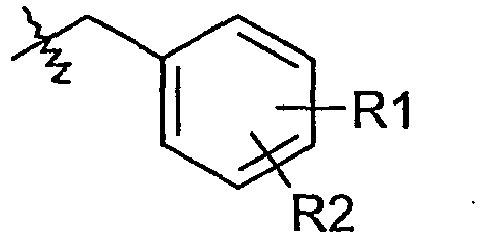
X is imidate;
R" is a monosaccharide, a disaccharide or an oligosaccharide which hydroxy groups are free or partially protected by benzyl groups;
excluding that for a compound of formula (II) R2 is hydrogen when X is trichloroacetimidate and R1 is p-chloro,.
R2 is preferably hydrogen.
R1 is preferably chlorine. - In the case of compounds of formula (IV) R" is preferably chosen among lactose, fucose, (2-acetylamino)-lactose, (2-amino)-lactose, (2-azido)-lactose, Lacto-N-biose, galactose, glucose, (2-acetylamino)-glucose, (2-amino)-glucose and (2-azido)-glucose; which groups are free or partially protected by benzyl groups; more preferably are chosen among 2'-lactose, 3-lactose, 3-(2-acetilamino)-lactose, 3-(2-amino)-lactose, 3-(2-azido)-lactose, 4-Lacto-N-biose, 2-galactose, 3-glucose, 3-(2-acetylamino)-glucose, 3-(2-amino)-glucose, 3-(2-azido)-glucose 4-(2-acetylamino)-glucose, 4-(2-amino)-glucose e 4-(2-azido)-glucose which hydroxy groups are free or partially protected by benzyl groups.
- In a particularly preferred embodiment the present invention provides compounds of formula (IV) wherein R" is 2'-lactose that is compounds of formula (IVa)

- In the case of compounds of formula (II) X is preferably trichloroacetimidate. The compounds of formula (IV) as above described are obtainable by means of the steps a) an b) of the above described process.
- Moreover the present invention relates to the use of compounds of formula (II) wherein X is an anomeric-carbon activator chosen between an imidate or an halogen; preferably trichloroacetimidate or α-bromine;
- P independently among each other are benzyl groups of formula

as fucosyl-donors for the synthesis of compounds of formula (IV) as above described. - Moreover the present invention relates to the use of compounds of formula (II) as above described as fucosyl-donors for the synthesis of compounds of formula (I) as above described by the process of the present invention.
- Moreover the present invention relates to the use of compounds of formula (II) wherein
X is an anomeric activator chosen between an imidate or an halogen; preferably trichloroacetimidate or bromine;
P independently among each other are benzyl groups of formula
as fucosyl-donors for the synthesis of compounds of formula (IV) as above described. - Moreover the present invention relates to the use of compounds of formula (II) as above described as fucosyl-donors for the synthesis of compounds of formula (I) as above described by the process of the present invention.
- According to the invention alkoxy means for example -OMe, -OEt, -OnPr, -OiPr,-OnBu, -OiBu, -OtBu.
- According to the invention halogen means fluorine, chlorine, bromine, iodine.
- According to the invention alkyl is a linear or branched alkyl chain containing from 1 to 10 Carbon atoms optionally substituted by one or more groups chosen among halogen, hydroxy, alkoxy, nitro.
- According to the invention aryl is benzene optionally substituted by one or more groups chosen from halogen, alkoxy, nitro.
- According to the invention acyl means a group -OCO-alkyl , or -OCO-aryl wherein alkyl and aryl are as above defined.
- According to the invention imidate means a group -OC(NH)-alkyl wherein alkyl is as above defined.
- According to the invention trialkyl silyl means a chemical group made by a silicon atom linked to a 3 alkyl or aryl as substituents (the same or different) where alkyl and aryl are as above defined (for example tert-butyldimethylsilyl, tert-butyldiphenylsilyl or triisopropylsilyl).
- According to the invention a monosaccharide is referred to a polyoxyaldheide (aldose) or a polyoxyketone (ketose) that is a simple sugar of formula (CH2O)n, CnH2nOn-1, CnH2nOn-1NH2, CnH2nOn-1N3 or CnH2nOn-1NHAc with n=3,4,5,6,7;
- The definition comprises all the possible stereoisomers and all the open or cyclic forms, that is intramolecular semi acetals and semi-ketals as for example the pyranosidic and furanosidic forms; for example are comprised into the definition glyceraldheide, allose, altrose, arabinose, eritrose, fucose, galactose, glucose, glucosamine, N-acetyl-glucosamine, idose, lixose, mannose, psicose, ribose, deoxirobose, sorbose, tagatose, treose, xilose and the correspondent chetoses According to the invention a disaccharide is referred to a polyhydroxylate compound made by two monosaccharides linked through an acetalic bond that is both O-glycosyl and N-glycosyl bonds; the definition comprises all the possible stereoisomers and all the open or cyclic forms ; examples include lactose, lactosamine, N-acetyl-lactosamine, maltose, cellobiose, saccharose, trealose turanose.
- According to the invention an oligosaccharide means a polymer having from three to 6 monosaccharides linked among each other by glycosyl bonds in such a manner to form linear or branch saccharide chains; are then included for example raffinose, melezitose, maltotriose, acarbose, stachiose.
- The present invention may be better understood on the basis of the following experimental examples.
- 100.0 grams (278 mmoles) of lactose and 4.0 grams (21 mmoles) of p-toluen sulphonic acid have been suspended in 600 ml of 2,2 dimethoxy propane and the mixture has been heated to reflux.
- After 90' the solution has been neutralized with triethylamine (3,2 ml, 2,3 mmoles), cooled at room temperature and concentrated under vacuum to obtain a thick syrup.
- The syrup has been treated twice with toluene (2x 100ml) and again concentrated to dryness to remove the excess of base.
- The residue has been dissolved in 10 volumes of a 9:1 methanol/water mixture and heated at reflux until the disappearance of the upper Rf spot (0,7 in ethyl acetate) was observed.
- The solvent has been removed by distillation under vacuum and the final syrup has been dissolved in 300 ml of dichloromethane.
- The organic layer has been washed twice with water and then dried on sodium sulphate, filtered and concentrated again under vacuum up to a syrup.
- The crystallization of the residual from an ethyl acetate/hexane mixture gave 91,2 grams (179 mmoles, 64%) of 2,3:5,6:3',4'-tri-O-Isopropylidenelactose dimetylacetal (1).
- 13C NMR (75 MHz, CDCl3): 110.47, 109.94, 108,38 (3 quaternary carbons of (CH3)2C=) groups; 107.20 (C1), 103.52 (C1'); 79.54, 78,24, 77.63, 75.88, 75.44, 74.75 74.18, 73.64; 64.57 (C6), 62.45 (C6'); 57.56 e 54.41 (2 OCH3); 28.17, 27.10, 26.30, 26.30, 25.72, 24.01 (6 CH3C=).
- 51.0 grams (100 mmoles) of 1 and 17.5 ml (126 mmoles) of triethylamine have been dissolved in 510 ml of dichloromethane.
- A solution of 14,6 ml (126 mmoles) of benzoyl chloride in 245 ml of dichloromethane has been added drop-wise over a period of 30' to the previously prepared solution cooled at 0°C.
- After 3 hours at 0°C the solution was warmed up to room temperature and washed with a saturated solution of sodium bicarbonate, then with water.
- After separation , the organic layer has been dried over sodium sulphate, filtered and concentrated up to a syrup (73.5 g) of crude 6'-O-benzoyl-2,3:5,6:3',4'-tri-O-isopropylidenelactose dimetylacetal which has been used in the coupling reactions without further purification.
- 13C NMR (75 MHz, CDCl3): 166.35 (ArCOO); 133.18, 130.44, 129.79, 128.44 (C Ar); 110.39, 110.14, 108.31 (3 C quat. Isopropylidene groups); 105.06 (C1), 103.81 (C1'); 79.07, 77.86, 77.82, 76.46, 75.21, 74.29, 73.45, 71.63; 64.74 (C6), 64.01(C6'); 56.34, 53.24 (2 OCH3); 28.13, 27.23, 26.43, 26.30, 25.72, 24.60 (6 CH3C=).
- 200 grams (1.22 moli) of L-fucose and 200 grams of Amberlite IR120, H+ form, have been suspended in 2 liters of methanol and heated by reflux under vigorous stirring for 24 hours.
- After cooling at room temperature the resin has been filtered and the solution has been evaporated under vacuum.
145.4 grams (816 mmoles, 67%) of methyl 6-deoxy-L-galactopyranoside (3) have been obtained after crystallization of the residue from ethyl acetate - 13C NMR (75 MHz, D2O), α-anomer: 100.1(C1), 72.4, 70.2, 68.5, 67.1, 15.9 (C6), 55.7 (OCH3); β-anomer: 104.4 (C1), 73.6, 72.0, 71.5, 71.1,15.9 (C6), 57.8 (OCH3).
- After filtration of the crystals, the mother liquors, once concentrated up to syrup, can be reprocessed as described above to obtain additional 43.0 g (20%) of compound 3 with the same characteristics of the previous one. Total yield 87%.
- 10.0 grams (56 mmoles) of the 3 have been suspended in 27.8 ml (200 mmoles) of triethylamine.
- The suspension has been heated at 80°C and 18.9 ml (200 mmoles) of acetic anhydride have been added drop-wise.
- At the end of the addition the solution has been kept at 80°C for 60' then it has been cooled at room temperature.
- The reaction mixture has been diluted with 30 ml of toluene and extracted twice with 30 ml of a saturated solution of sodium bicarbonate.
- After separation of the layers, the inorganic layer has been dried over sodium sulphate.
- 47 g (0.80 moles) of potassium hydroxide have been added to the dried solution and the suspension has been heated at 100 °C.
- 28 ml (0.22 moles) of 4-chlorobenzyl chloride have been added drop-wise over a period of about 90 minutes and the mixture has been then kept at reflux for further 60'.
- After cooling up to room temperature the suspension has been diluted with 50 ml of water and left under stirring until the complete dissolution of the salts occurred. Layers were then settled and separated and the organic phase has been washed with 25 ml of 10% sodium chloride and dried over sodium sulphate The solution has been finally concentrated to a small volume and purified by means FCC on silica gel (8:2 toluene/ethyl acetate as eluent).
- The fractions containing the product were pooled and concentrated to obtain 22.6 grams (73%) of methyl 2,3,4-tri-O-(4-chlorobenzyl)-6-deoxy-L-galactopyranoside (colourless syrup).
- 1H NMR (200 MHz, CDCl3): 7.34-7.18 (m, 12H, H Ar), 4.91-4.57 (m, 6H, 3CH2 benzyl), 4.25 (d, 7.6 Hz, 1 H, H1-β), 3.98 (dd, 1 H, J2,3 1.1Hz, J2,1 3.4Hz, H2-α), 3.88 (dd, 1H, J3,4 2.7HZ, J3,2 10.1Hz, H3-α), 3.85 (m, 1 H, H5-α), 3.61 (dd,1H, J4,5 0.9Hz, J4,3 2.4 Hz, H4-α), 3.54 (s, 3H, OCH3-β), 3.37 (s, 3H, OCH3-α), 1.24 (d, 6.4Hz, 3H, H6-β), 1.17 (s, 6.4Hz, 3H, H6-α).
- 13C NMR (50 MHz, CDCl3), α Anomer: 98.6, 79.2, 78.6, 76.5, 74.4, 72.6, 72.6, 66.1, 55.4, 16.7. β Anomer: 104.9, 82.4, 79.4, 77.2, 74.2, 74.2, 72.4, 70.4, 57.0, 16.9.
- 100 g (0.56 moles) of the 3 have been treated as described in the example 4 excluding the purification step on silica.
- After processing the reaction mixture and concentration of the organic layer a 387.4 g of the syrup have been obtained. The syrup was employed in the subsequent step without further purification.
- A crude syrup of 4 (387.4 g, 0.41 moles), prepared as described in the example 5 has been treated with 1500 ml of 80% acetic acid and 280 ml of 2M Hydrochloric acid
- After heating for 10 hours at reflux the solution has been cooled at room temperature and diluted with 1 liter of dichloromethane.
- Then the layers were separated and the organic layer was first washed with a saturated solution of sodium bicarbonate and then with water After drying over sodium sulphate and concentration to syrup, the crude product was crystallized from hexane.
- 155.2 grams of 5 (289 mmoles, yield 70% from 4, 52% from 3) have been obtained.
- 1H NMR (300 MHz, CDCl3): 7.33-7.20 (m, 12H, H Ar), 5.28 (m, 1H, H1-α), 4.88 (m, 2H benzyl), 4.75-4.59 (m, 5H, 4H benzyl + H1-β), 4.11 (q, 6.6 Hz, 1H, H-5α), 3.97 (dd, 1H, J2,3 10.4Hz, J2,1 3.7 Hz, 1H, H2-α), 3.87 (dd, J3,2 10.4Hz, J3,4 2.7 Hz, 1H, H3-α), 3.70-3.46 (m, 5H, H2-β, H3-β, H4-β, H5-β, H4-α), 3.22 (bs, 1 H, 1OH-β), 2.90 (bs, 1H, 1OH-α), 1.24 (d, 6.6Hz, 3H, H6-β), 1.17 (d, 6.6Hz, 3H, H6-α).
- 42 ml di trichloroacetonitrile and 1.1 ml (7.4 mmoles) of 1,8- diazabicyclo [5.4.0]undec-7-ene have been added to a solution of 5 (50.0 grams, 92 mmoles), in anhydrous dichloromethane (250 ml),
- After 30' under stirring the reaction mixture has been extracted with 2x150 ml of saturated solution of ammonium chloride.
- The organic layer has been dried oversodium sulphate , filtered and concentrated under vacuum.
- The crude trichloroacetoimidate oil (73.8 grams) (6) so obtained has been employed without further purifications in the coupling reactions.
- 1H NMR (300MHz, CDCl3): 8.64 (s, 1 H, NH-β), 8.52 (s, 1 H, NH-α), 7.32-7.18 (m, 12H, H aromatics), 6.53 (d, 3.3 Hz, 1H, H1-α) 5.72 (d, 8.1 Hz, 1H, H1-β), 4.95-4.60 (m, 6H, 3CH2 benzyl), 4.17 (dd, 1H, J2,3 10.2 Hz, H2-α), 4.11 (q, 6.6 Hz, 1, H5-α), 4.01 (m, 1H, H2-β), 3.97 (dd, 1H, J3,4 2.7 Hz, H3-α), 3.72-3.64 (m, 2H, H4-αβ + H5-β), 3.62-3.55 (m, 2H, H3-β + H4-β), 1.27 (d, 6.4 Hz, 3H, H6β), 1.20 (d, 6.3 Hz, 3H, H6α).
- 3.0 g (16.8 mmoles) of 3 have been treated as in the example 4, using 8.3 ml (60 mmoles) of triethylamine, 5,7 ml of acetic anhydride (60 mmoles), 14 g of KOH (0,24 moles) and 8.5 ml (67 mmoles) of 2-chlorobenzyl chloride.
- At the end of the work-up, the solution has been concentrated up to a reduced volume under vacuum and purified on silica gel (hexane/ethyl acetate 8:2 as eluent). The fractions containing the product have been pooled and concentrated to give 6,4 grams (69%) of Methyl 2,3,4-Tri-O-(2-Chlorobenzyl)-6-Deoxy-L-Galactopyranoside (7) as a colourless syrup.
- 1H NMR (300MHz,CDCl3): 7.0-7.1 (m,12H, H Ar), 5.14-4.73 (m, 7H, 3CH2 benzyls α and β, H1-α), 4.30 (d, 7.5Hz, H1-β), 4.13 (dd, 1H, J2,3 2.6 Hz, J2,1 3.3 Hz, H2-α), 4.06 (dd, 1 H, J3,4 2.7 Hz, J3,2 10.2 Hz, H3-α), 3.96 (q, 1 H, 6.6 Hz, H5-α), 3.83 (d, 1 H, 1.5 Hz, H4-α), 3.57 (s, 3H, OCH3-α), 3.43 (s, 3H, OCH3-β), 1.33 (d, 3H, 6.6 Hz, H6-β), 1.25 (d, 3H, 6.6 Hz, H6-α).
- 13C NMR (75 MHz, CDCl3), α anomer: 137.0-126.6 (C Ar), 98.72 (C1), 79.64, 79.13, 76.92, 72.21, 70.47, 70.43, 66.32, 55.52 (OCH3), 16.66(C6). β anomer: 137.0-126.6 (C Ar), 105.02 (C1), 82.86, 79.56, 78.14, 72.10, 71.79, 70.47, 70.33, 57.22 (OCH3), 16.89 (C6).
- 10.0 g (56 mmoles) of 3 have been treated as described in the example 8 excluding the purification step on silica gel. After the processing of the reaction mixture and the concentration of the organic layer 40.8 g of syrup have been obtained that were used in the subsequent step without further purification.
- 150 ml of 80% acetic acid and 28 ml of 2M hydrochloric acid have been added to a crude syrup of 7 (40.8 g, 39 mmoles), prepared as described in the example 9. After heating for 10 hours at reflux the solution has been cooled at room temperature and diluted with 100 ml of dichloromethane. Layers were separated and the organic layer was first washed with a saturated solution of sodium bicarbonate and then with water.
- After drying with sodium sulphate and concentration up to a syrup the crude product was crystallized from hexane.
- 14.9 grams (28 mmoles, 72% yield from 7, 50% from 3) have been obtained.
- 1 H NMR (200MHz, CDCl3): 7.60-7.19 (m, 12H, H Ar), 5.40 (d, 1 H, 3.2 Hz, H1-α), 5.23-4.71 (m, 13H, 3CH2 benzyls, H1-β), 4.21 (q, 1H, 6.6 Hz, H5-α), 4.11 (dd, 1H, J2,3 9.8 Hz, J2,1 3.2 Hz, H2-α), 4.00 (dd, 1H, J3,2 9.8 Hz, J3,4 2.6 Hz, H3-α), 3.88-3.58 (m, 5H, H2-β, H3-β, H4-β, H5-β, H4-α), 1.31 (d, 3H, 6.4 Hz, H6-β), 1.25 (d, 3H, 6.6 Hz, H6-α).
- 13C NMR (50 MHz, CDCl3): 137.0-126.6 (C Ar α + β)
α anomer: 91.73, 79.24, 78.57, 77.05, 72.05, 70.60, 70.01, 66.83,16.67;
β anomer: 97.61, 82.83, 80.85, 77.78, 72.04, 71.83, 70.88, 70.05, 16.87. - 8.5 ml of trichloroacetonitrile and 0,22 ml (1.5 mmoles) of 1,8-diazabiciclo[5.4.0]undec-7-ene have been added to a solution of 8 (10.0 grams, 18.6 mmoles), in anhydrous dichloromethane.
- After 30' under stirring the reaction mixture has been extracted with 2x30 ml of an Ammonium chloride-saturated solution.
- The organic layer has been dried over sodium sulphate, filtered and concentrated under vacuum.
- The crude trichloroacetimidate (9) so obtained has been used in the coupling reactions without further purification.
- 1H NMR (200 MHz, CDCl3): 8.68 (s, 1H, NH β anomer), 8.57 (s, 1H, NH α anomer), 7.65-7.15 (m, 12H, aromatic hydrogens α+ β), 6.66 (d, 3.4 Hz, 1H, H1-α), 5.85 (d, 7.8Hz, 1 H, H1-β), 4.35 (dd, J2,3 9.8 Hz, 1 H, H2-α), 4.26-4.14 (m, 2H, H3-α + H5-α), 4.19 (dd, J2,3 9.4 Hz, 1 H, H2-β), 3.91 (dd, J 2.6 e 1.0 Hz, 1 H, H4-α), 3.86-3.84 (m, 3H, H3-β + H4-β + H5-β), 1.36 (d, 6.4 Hz, 3H, 3H6-β), 1.29 (d, 6.6Hz, 3H, 3H6-α).
- 13C NMR (50 MHz, CDCl3):
α anomer: 161.20 (C=NH), 130.0-126.0 (C Ar), 95.23 (C1), 78.75, 78.39, 76.14, 72.1, 70.10, 70.04, 69.62, 16.63 (C6).
β anomer: 161.62 (C=NH), 130.0-126.0 (C Ar), 98.77 (C1), 82.70, 78.39, 77.63, 72.14, 71.85, 71.71, 70.24, 16.74 (C6). - A syrup of crude 2 (prepared as described in the example 2 starting from 5.1 grams, 10.0 mmoles, of 1) has been dissolved in anhydrous dichloromethane (32 ml) and added with trimethylsilyl trifluoromethanesulphonate (23µl).
- A solution prepared by dissolving a syrup of crude 6 (prepared as described in the example 7 starting from 10.0 g, 18.6 mmoles, of 5) into 40 ml of anhydrous dichloromethane has been added to the solution under stirring.
- At the end of the addition the solution has been kept at room temperature for 30'. The TLC of the mixture shows a main spot of the expected product ((Rf =0.7 in 2:1 n-hexane/ethyl acetate), a small amount of the condensation product with β configuration, the spot of the non-reacted acceptor (2) and some degradation spots of the glycosyl donor.
- After neutralization with triethylamine (23µl), the reaction mixture has been concentrated to a small volume and passed through a column of silica gel (2:1 n-hexane/ethyl acetate).
- 9.71 grams (8.6 mmoles, 86% yield calculated from the acceptor 2) of 10 have been obtained as a colourless syrup.
- 1H NMR (300MHz, CDCl3): 8.05 (d, 7.2 Hz, 2H Bz), 7.57 (m, 1H Bz), 7.45 (m, 2H, Bz), 7.30-7.20 (m, 12H Ar Bn), 5,59 (d, 3.0 Hz, 1H, H1"), 4.90-4.45 (m, 10H, 3CH2 benzyls, H1', H2, 2H6'), 4.34 (d, 5.7Hz, 1H, H1), 4.27 (m, 1H), 4.20-4.00 (m, 9H), 3.91 (dd, J 6.6 e 8.1 HZ, 1H), 3.73, (dd, J 6.3 e 8.1 Hz, 1 H) 3.63 (bs, 1 H, H4"), 3.37 (s, 3H, OCH3), 3.35 (s, 3H, OCH3), 1.50 (s, 3H), 1.43 (s, 3H), 1.37 (s, 6H), 1.32 (s, 3H), 1.15 (d, 6.2 Hz, 3H, H6").
- 13C NMR (75 MHz, CDCl3) 166.19 (ArCOO); 137.72, 137.39, 137.25, 133.18, 133.11, 133.03 (C quat Ar) 130.0-128.1 (CH Ar), 110.32, 109.86, 108,49 (C quat isopropylydene); 105.08 (C1), 101.06 (C1'), 94.79 (C1"); 80.3, 78.84, 78.68, 77.65, 76.46, 75.13, 74.19, 73.84, 72.23, 71.65, 70.86, 66.28; 64.97, 63.67 (CH2e CH2'), 56.00, 53.03 (2 OCH3); 27.83, 27.11, 26.84, 26.70, 26.43, 25.02 (CH3 of the isopropylydene groups); 16.81 (C6").
- 4.00 g (3.5 mmoles) of 10 have been dissolved in 40 ml of methanol and 0.39 ml (3.9 mmoles) of a 30% sodium hydroxide solution have been added.
- The solution has been kept at room temperature overnight and then it has been concentrated under vacuum up to a syrup.
- The residue has been dissolved into 20 ml of dichloromethane and washed twice with 20 ml of water.
- After separation , the organic layer wasdried over sodium sulphate and concentrated under vacuum.
- 3.5 g of 11 (3.4 mmoles, 97%) have been obtained as a colorless syrup.
- 1H NMR (200 MHz, CDCl3): 7.3-7.2 (m, 12H Ar), 5.57 (d, 2.4 Hz, 1H, H1"), 4.92-4.52 (m, 8H, 3 CH2 benzyls + H2+ H1'), 4.35 (d, 6.8 Hz, 1H, H1), 4.30-3.50 (m, 15H), 3.48 (s, 6H, 2-OCH3), 1.46 (s, 3H), 1.43 (s,3H), 1.38 (s, 6H), 1.29 (s, 6H), 1.13 (d, 6.4 Hz, 3H, H6").
- 13C NMR (50 MHz, CDCl3): 137.71, 137.39, 137.30, 133.27, 133.18, 132.93 (quat Ar), 130.0-128.0 (CH Ar), 110.54, 109.78, 108.71 (C quat isopropylidene), 107.60 (C1), 101.45 (C1'), 94.94 (C1"), 80.88, 78.86, 78.77, 78.04, 77.58, 76.49, 75.52, 75.07, 74.58, 74.25, 74.06, 72.29, 71.77, 66.29, 64.93 (C6), 62.46 (C6'), 57.72 (OCH3), 54.14 (OCH3), 16.90 (C6").
- 5.00 g (4.4 mmoles) of 10 have been dissolved in 40 ml of acetonitrile. The solution has been heated at 40°C, added of 7,5 ml of 2M hydrochloric acid and kept at 40°C for 40'.
- After said period the TLC (2:1 hexane/ethyl acetate) showed the absence of the starting material.
- The solution has been then cooled at room temperature, neutralized with sodium hydroxide and concentrated under,vacuum.
- The residue has been dissolved into 30 ml of dichloromethane and the solution has been washed twice with 20 ml of water.
- The water washings have been extracted with 10 ml of dichloromethane and the pooled organic layers have been dried over sodium sulphate.
- After elimination of the solvent under vacuum, the crude product has been crystallized from isopropyl ether. 3.37 grams (3.4 mmoles, 77%), of 12 have been obtained.
- Melting Point= 111-112 °C.
- 1H NMR (200 MHz, CDCl3+ D2O): 7.98 (pst,7.0 Hz, 2H Ar), 7.49 (m, 1H Ar), ), 7.35 (m, 2H Ar), 7.35-7.20 (m, 12H Ar), 5.22 (d, 3.2 Hz, 1 H, H1"), 4.88-4.33 (m, 10H, 3 CH2 benzyls, H1, H1', 2 H6'), 411-3.21 (m, 14H, H2, H3, H4, H5, 2 H6, H2', H3', H4', H5', H2", H3", H4", H5"), 1.17-1.11 (m, 3H, H6").
- 13C NMR (50 MHz, CDCl3): 166.60 (C quat ArCOO), 136.99, 136.83, 135.64, 133.68, 133.56, 130.06, 129.65, 129.60, 129.37, 128.81, 128.57, 101.88 (C1' a + β), 99.94 (C1"-β), 99.83 (C1"-α), 96.48 (C1-β), 92.31 (C1-α), 79.63, 79.21, 78.46, 78.06, 77.49, 75.22, 75.07, 74.49, 73.85, 73.25, 72.77, 72.64, 72.19, 71.73, 70.52, 68.39, 68.30, 63.23, 63.02, 61.23, 61.06, 16.80 (C6").
- The reaction described in example 12 has been performed again starting from 19.5 grams (31 mmoles) of 2 as a crude product and 6 grams (prepared starting from 25.0 g, 46 mmoles of 5).
- After neutralization with triethylamine the reaction mixture has been concentrated under vacuum up to obtain 54.9 grams of a syrup.
- The syrup has been dissolved in 250 ml of methanol and 3.6 ml (15.7 mmoles) of 30% sodium methoxide in methanol have been added to the solution.
- The reaction has been kept at room temperature (for about 24 hours) up to the complete disappearance of the starting product 10 as shown by the TLC control (with 2:1 n-hexane/ethyl acetate).
- After neutralization with acetic acid the solution has been concentrated under vacuum and the obtained residue has been dissolved into 200 ml of acetonitrile. The resulting solution has been heated at 40°C and 28 ml of 2 M hydrochloric acid have been added.
- After a 45' time at 40°C the TLC control (with 1:1 ethyl acetate/exane) has shown the disappearance of the intermediate 11.
- The suspension has been than filtered on dicalite and neutralized up to pH 6.5-7.0 by adding 30% sodium hydroxide.
- After slow cooling at room temperature a white crystal precipitate has been obtained.
- The solid product has been then filtered, washed with water and dried under vacuum at 50°C.
- 15.6 grams (17.8 mmoles) of 13 have been obtained, yield 57% from 2.
[α]D20=-84.7 (C=1.0 in MeOH, to the equilibrium ). Pfus = 118-124°C.
HPLC purity: 96%. - 1H NMR (300 MHz, DMSO-d6): 7.4-7.2 (m, 12H aromatics), 6.65 (d, 6.6 Hz, OH β anomer), 6.33 (d, 4.5 Hz, OH α anomer), 5.54 (dd, 2.4 Hz, 1H, H1"), 5.00-4.52 (m, 11.4 H, 5OH, 6 CH2 benzyls, H1-α), 4.39-4.12 (m, 3.6 H, 1 OH, H1', H1-β, H5"), 3.85-2.95 (m, 15H), 1.08, 1.96 (2 d overlapped, 6.0 Hz, 3H, H6").
- 13C NMR (75 MHz, DMSO-d6): 138.09, 138.06, 137.90, 131.88, 131.79, 131.77 (6C quat Ar); 129.46, 129.08, 129.06, 128.17, 128.10, 128.07 (CH aromatics); 101.03, 100.89 (C1' α e β); 96.59 (C1, β); 95.97 (C1" α + β); 91.96 (C1, α), 79.52, 78.88, 78.04, 77.96, 75.41, 75.25, 75.19, 74.83, 74.68, 74.51, 73.56, 73.46 (CH2 benzyl), 72.34, 70.94 (CH2 benzyl), 70.30, 69.44 (CH2 benzyl), 68.72, 65.39; 60.31, 60.15, 60.11 (C6 e C6' α e β); 16.32, 16.23 (C6" α e β).
- The reaction described in the example 12 has been performed again starting from 19.5 grams (31 mmoles) of 2 as a crude product and 36.9 grams of 6 as a crude product (prepared starting from 25.0 g, 46 mmoles of the 5).
- After neutralization with triethylamine the reaction mixture has been concentrated under vacuum up to obtain 54.2 grams of a syrup.
- The syrup has been dissolved in 200 ml of acetonitrile and the solution has been heated at 40°C.
- Then 28 ml of 2M chloride acid have been added and the reaction mixture has been kept at 40°C for a 40' time , then it was cooled at room temperature.
- After positive (absence of the 10 starting product spot) TLC control (with 2:1 ethyl acetate/hexane), the mixture has been neutralized with sodium hydroxide and concentrated under vacuum.
- The residue has been dissolved into 250 ml of dichloromethane and the solution has been washed twice with 100 ml of water.
- The organic layer has been concentrated under vacuum and the syrup has been dissolved into 250 ml of methanol.
- After addition of 3.6 ml (15.7 mmoles) of 30% sodium methoxide in methanol, the solution has been kept at room temperature for 24 hours.
- The mixture has been neutralized with acetic acid, discoloured with charcoal, filtered on dicalite and concentrated again under vacuum.
- After crystallization from isopropyl ether 13.3 g (15.2 mmoles) of 13, have been obtained, 49% yield from 2.
- [α]D 20=-83.9 (C=1.0 in MeOH, to the equilibrium). Melting Point= 114-124°C.
- 94% of HPLC purity. NMR data in accordance with those reported in example 15.
- A crude syrupof 2 (prepared as described in the example 2 starting from 5.1 grams, (10.0 mmoles), of 1 has been dissolved in anhydrous dichloromethane (32 ml) and added with trimethylsilyl trifluoromethansulphonate (23µl).
- A solution prepared by dissolving a crude syrup of 9 (prepared as described in the example 11 starting from 10.0 g, 18.6 mmoles,of 8) in 40 ml of anhydrous dichloromethane, has been added drop-wise to the solution under stirring.
- At the end of the addition the solution has been kept at room temperature for a 30' time.
- The TLC performed on a sample of the mixture shows a main spot of the expected product (Rf =0.7 in hexane/ethyl acetate 2:1), the spot of the non-reacted acceptor (2) and some spots of the degraded glycosyl donor.
- After neutralization with triethylamine (23µl), the reaction mixture has been concentrated to small volume and passed through a silica gel column (with hexane/ethyl acetate 2:1).
- 6.91 grams of 14 (6.1 mmoles, 61% yield from acceptor 2) have been obtained as a colourless syrup.
- 1H NMR (300MHz, CDCl3): 8.05 (d, 7.2 Hz, 2H Ar), 7.65-7.14 (m, 15 H Ar), 5.15-4.70 (m, 7H, 3CH2 benzyls + H2), 4.56-4.48 (m, 3H, 2H6' + h1'), 4.36 (d, 5.7 Hz, 1 H, H1), 4.34-3.94 (m, 11H), 3.84 (m, 1 H), 3.78 (m, 1 H), 3.37 (s, 3H, OCH3), 3.35 (s, 3H, OCH3), 1.51 (s, 3H), 1.48 (s, 3H), 1.41 (s, 3H), 1.38 (s, 3H), 1.30 (s, 3H), 1.28 (s, 3H), 1.22 (d, 6.6 Hz, 3H, 3H6").
- 13C NMR (75 MHz, CDCl3): 166.42 (ArCOO),137.5-126.5 (C Ar), 110.47, 110.12, 108.73 (C quat isopropylidene); 105.17(C1), 101.36 (C1'), 95.00 (C1"); 80.31, 79.61, 79.17, 77.87, 77.83, 77.00, 75.37, 75.23, 74.02, 73.91, 72.26, 71.04, 70.04, 69.65, 66.65, 65.08, 63.89; 56.14, 53.12 (2 OCH3); 27.96, 27.30, 27.01, 26.77, 26.45, 24.95 (6 CH3 isopropylidene); 16.90 (C6").
- 2.20 g (1.9 mmoles) of 14 have been dissolved in 40 ml of methanol and 0.21 ml (2.1 mmoles) of a 30% sodium hydroxide solution have been added to the solution.
- The solution has been kept at room temperature for 2.5 hours then it has been concentrated under vacuum up to syrup.
- The residue has been dissolved in 15 ml of dichloromethane and washed twice with 2 10 ml of water.
- After separation, the organic layer has been dried over sodium sulphate and concentrated under vacuum.
- 1.85 g (1.8 mmoles, 94%) of colourless syrup have been obtained.
- 1H NMR (200 MHz, CDCl3): 7.65-7.10 (m, 12H Ar), 5.68 (d, 3.4 Hz, 1H, H1"), 5.16-4.68 (m, 7H, 3 CH2 benzyls + H2), 4.61 (d, 8.0 Hz, 1 H, H1'), 4.36 (d, 6.6 Hz, 1 H, H1), 4.32-3.60 (m, 15H), 3.49 (s, 6H, 2 OCH3), 1.50 (s, 3H), 1.48 (s, 3H),1.39 (s, 6H), 1.29 (s, 3H), 1.27 (s, 3H), 1.20 (d, 6.6 Hz, 3H, 3H6").
- 13C NMR (50 MHz, CDCl3): 137.07, 136.87, 136.79, 132.65, 132.61, 133.15, 129.74, 129.68, 129.04, 129.01, 128.63, 128.46, 128.34, 128.25, 126.3, 126.73, 126.63 (C Ar); 110.59, 109.92, 108.80 (C quat. Isopropylidenes); 107.66 (C1), 101.65 (C1'), 95.03 (C1"), 80.91, 79.65, 79.13, 78.25, 77.74, 76.99, 75.63, 75.08, 74.67, 74.29, 74.09, 72.27, 70.38, 69.57, 66.54, 64.93, 62.55, 57.80 (OCH3), 54.08 (OCH3); 28.02, 27.22, 26.84, 26.80, 26.48, 24.88 (CH3 isopropylidenes), 16.92 (C6").
- The reaction described in example 17 has been performed again with the same modalities and quantities.
- After neutralization with triethylamine the reaction mixture has been concentrated under vacuum to obtain 20.8 g of a syrup.
- The syrup has been dissolved in 100 ml of methanol and 1.1 ml (19 mmoles) of 30% sodium hydroxide have been added to the solution.
- The reaction has been kept at room temperature until the TLC control (n-hexane/ethyl acetate 2:1) has shown the complete absence of the starting product 14. After neutralization with acetic acid the solution has been concentrated under vacuum and the residue has been dissolved in 80 ml of acetonitrile.
- The resulting solution has been heated at 40°C and added with 11.2 ml of 2 M hydrochloric acid. After a 30' time at 40°C the TLC control has shown the absence of the intermediate product 15. The suspension has been then filtered on dicalite and neutralized at pH 6.5-7.0 by adding 30% sodium hydroxide. A white and crystal precipitate has been obtained after slow cooling at room temperature which has been then filtered and washed with water.
- 4.65 g (5.3 moles, 53% yield from 2) of 16 have been obtained after drying under vacuum.
- [α]D 20=- 65.7 (C=1.0 in MeOH, to the equilibrium), Pfus = 125-130°C
- 1H NMR (300 MHz, DMSO-d6): 7.75-7.20 (m, 12H aromatics), 6.68 (d, 6.6 Hz, 0.7 H, OH β anomer ), 6.35 (d, 4.5 Hz, 0.3 H, OH α anomer ), 5.63 (bs, 1 H, H1"), 5.05-4.60 (m, 11,3 H, 3CH2 benzyls, 5 OH, H1-α), 4.45-4.23 (m, 2.7 H, H1', H5", H1-β), 4.26 (s, 0.7H, OH), 4.14 (s, 0.3H, OH), 4.00-3.25 (m, 14.3 H), 2.99 (m, 0.7H), 1.10 (pst, 6.0Hz, 3H, H6").
- 13C NMR (75 MHz, DMSO-d6): 136.45, 136.34, 136.29, 131.90, 131.63, 131.52 (6C quat Ar); 129.56, 129.42, 128.90, 127.04, 126.96, 126.89 (CH aromatics); 100.99, 100.83 (C1' α and β); 96.60 (C1, β); 96.04 (C1" α + β); 91.97 (C1, α), 79.41, 78.71, 78.56, 78.40, 76.00, 75.39, 75.21, 74.80, 74.70, 74.53, 73.69, 73.55, 72.36, 71.27 (CH2 benzyls), 70.98, 70.30, 69.50, 69.44 (CH2 benzyl), 68.66, 67.68 (CH2 benzyl), 65.47, 60.32, 60.15, 16.14 (C1"-α), 16.05 (C6"-β).
- 12.00 g (13.7 mmoles) of the 13 have been dissolved in 600 ml of methanol and 8.1 g (49.3 mmoles) of sodium acetate and 1.5 g of palladium 10% on charcoal have been added to the solution.
- The reaction flask has been saturated with hydrogen and the suspension has been kept, under a vigorous stirring, at room temperature for 24 hours: The TLC control (Toluene,methanol,AcOH 10:10:1) shows that the reaction is complete.
- The suspension has been then filtered on decalite, concentrated up to a syrup and deionised on a couple of ion exchange resins.
- 5.70 grams (85%) of 2'-α-L-fucopyranosyllactose have been obtained after concentration and crystallization from methanol/n-propanol.
- HPLC purity: 99%
- The NMR spectra is in agreement with the literature (Y. Ishizuka et al. J. Carbohyd. Chem. (1999), 18(5), 523-533).
- 4.00 g (4.6 mmoles) of the 16 have been dissolved in 200 ml of methanol and 2.7 g (16 mmoles) of sodium acetate and 0.5 g of palladium 10% on charcoal have been added to the solution.
- The reaction flask has been saturated with hydrogen and the suspension has been kept, under a vigorous stirring, at room temperature for 24 hours. The TLC control (Toluene,methanol,AcOH 10:10:1) shows that the reaction is complete.
- The suspension has been then filtered on decalite, concentrated up to a syrup and deionized on a couple of ion exchange resins.
- 1.98 grams (88%) of 2'-α-L-fucopyranosyllactose have been obtained after concentration and crystallization from methanol/n-propanol.
- HPLC purity: 98%
- The NMR spectra is in agreement with the literature (Y. Ishizuka et al. J. Carbohyd. Chem. (1999), 18(5), 523-533).
- The following 22-26 examples report the experimental details of the synthesis as schematically showed as follows:

- 44.3 g (0.2 moles) of 2-acetamido-2-deoxy-D-glucopyranoside have been suspended in N,N-dimethylformamide and 3.82 g (20 mmoles) of p-toluen sulphonic acid and 50 ml of benzaldehyde dimethyl acetal have been added to the suspension.
- The reaction has been heated uat 60° C and neutralized after 80 minutes with 3.5 ml (25 mmoles) of triethylamine.
- The solution has been cooled at room temperature concentrated up to 150 g and crystallized with water. 44.2 g (71 %) have been obtained.
- 1H (300 MHz, DMSO-d6) 7.81 (d, 8.1 Hz, 1H, NH), 7.49-7.37 (m, 5H, Ar), 6.75 (d, 5.7 Hz, 1H, OH 1), 5.61 (s, 1H, CHPh), 5.2 (d, 5.4 Hz, 1H, OH3-β), 5.05 (d, 5.4 Hz, 1H, OH3-α), 4.99 (t, J 4.2 e 3.6 Hz, 1H, H1-α), 4.62 (t, 1H, H1-β), 4.18 (dd, 6.0 Hz, 1 H, H6-β), 4.10 (dd, J 4.5 e 9.9 Hz, H6-α), 3.90-3.56 (m, 4H, H2, H4, H5, H6), 3.45 (t, 9.0 Hz, 1 H, H3), 1.85 (s, 3H, CH3Ac-α), 1.83 (s, 3H, CH3 Ac-β)
- 13C (75 MHz, DMSO-d6): 169.43 (COAc), 137.82 (C quat Ar), 128.81, 127.99, 126.35 (CH Ar), 100.85 (CH Ph-β), 100.67 (CH Ph-α), 96.0 (C1β), 91.45 (C1α), 82.46 (C4α), 81.51 (C4β), 70.49, 68.27, 67.94, 67.18, 65.85 (C6β), 62.05 (C6α), 58.03 (C2β), 54.74 (C2α), 23.07 (CH3 Ac-β), 22.63 (CH3 Ac-α)
- 20 grams (64.7 mmoles) of 18 have been suspended in acetonitrile (200 ml) and triethylamine (22.5 ml). 15 ml of acetic anhydride have been added drop-wise to the suspension, pre-heated at 50°C. At the end of the addition the solution has been kept at 65°C for some minutes until the formation of aprecipitate was observed.
- The suspension has been cooled at room temperature and the solid product has been filtered and washed with acetonitrile.
- 12.1 g of the product have been obtained.
- The mother liquors have been concentrated and further 11.8 g of the product have been recovered.
- The total yield is 23.9 grams (94%).
- 1H NMR (300 MHz, CDCl3): 7.46-7.35 (m, 5H, Ar), 6.14 (d, J1,2 3:6 Hz, 1H, H1), 5.83 (bd, 1 H, NH), 5.54 (s, 1H, CHPh), 5.33 (t, 10.5 Hz, 1 H, H3), 4.48 (ddd, 1 H, H2), 4.30 (dd, 1 H, H6), 3.92 (dd, 1 H, H6), 3.79 (t, 9.6 Hz, 1 H, H5), 3.76 (t, 9.3, Hz, 1H, H4), 2.07, 1.94, 1.93 (3s, 9H, CH3 Ac)
- 13C NMR (75 MHz, CDCl3): 171.96, 170.24, 169.10, (COAc), 136.88 (C quat Ar), 129.36, 128.39, 126.27 (CH Ar), 101.79 (CH Ph), 91.35 (C1), 78.60, 69.95, 68.72 (C4, C3, C5), 65.04 (C6), 51.82 (C2), 23.11 (CH3 NHAc), 22.63 (CH3 OAc)
- 5.0 grams (12.7 mmoles) of the 19 have been dissolved in tetrahydrofurane (100 ml) and kept under stirring at room temperature in an atmosphere of N2, with ciano borohydride (4.0 g, 63.6 mmoles) and molecular sieves (10 g)
- After an 1 hour 60 ml of 2% methanesulphonic acid in tetrahydrofurane have been added dropwise.
- After a three hours time from the beginning of the addition, the solution has been cooled and neutralized with 75 ml of a solution saturated with hydrogen carbonate. The suspension has been filtered on dicalite and the aqueous layer has been extracted with dichloromethane.
- The organic layers have been pooled and washed with a a saturated solution saturated sodium carbonate, then washed with water and dried over sodium sulphate.
- The solution has been then concentrated to dryness and 4.1 g (80%) of the product have been obtained.
- 1H NMR (300 MHz, CDCl3): 7.36-7.31 (m, 5H, Ar), 6.13 (d, J1,2 3.6 Hz, 1H, H1), 5.68 (d, JNH,2 8.4, 1 H, NH), 5.12 (dd, J2,3 11.1, J3,4 8.7 Hz, 1 H, H3), 4.57 (q, 12 Hz, 2H, CH2Bn), 4.34 (ddd, J 3.6, 8.7, 11.1, 1H, H2), 3.90-3.64 (m, 4H, H4, H5, 2H6), 3.04 (bs, 1H, OH4), 2.16, 2.12 (2s, 6H, CH3 OAc), 1.87 (s, 3H, CH3 NHAc)
- 13C NMR (75 MHz, CDCl3): 172.49, 170.34, 169.26 (COAc), 137.45 (C quat Ar), 128.70, 128.19, 127.99 (CH Ar), 91.10 (C1), 74.10 (CH2Bn), 73.07, 71.83, 70.22 (C3, C4, C5), 68.11 (C6), 51.25 (C2), 23.21 (CH3 NHAc), 21.14 (2CH3 OAc)
- 2.6 g (6.55 mmoles) of 20 have been treated as described in example 12. 2.95 g of a white solid (51%) have been obtained by using toluene/methanol=4/1 as eluent for the silica gel chromatography.
- 1H NMR (300 MHz, CDCl3): 7.29-7.14 (m, 15H Ar), 6.17 (d, 3.6 Hz, 1H, H1), 5.58 (d, 9.0 Hz, 1 H, NH), 5.19 (dd, 1H, H3), 5.00 (d, 3.6 Hz, 1 H, H1'), 4.83 (d, 11.4 Hz, 1 H, benzylic H) 4.65-4.40 (m, 7H, benzylic CH2), 4.39-4.31 (m, 1H, H2), 3.95-3.74 (m, 7H, H4, H5, 2H6, H2', H3', H5'), 3.6 (bs, 1H, H4'), 2.17, 2.06 (2s, 6H, 2CH3 OAc), 1.92 (s, 3H, CH3 NAc), 1.12 (d, 6.3 Hz, 3H, H6').
- 13C NMR (75 MHz, CDCl3): 172.44, 170.7, 169.00 (3 CO Ac), 138.30, 136.96, 136.90, 133.68, 133.61 (7C quat Ar); 129.57, 129.38, 128.70, 128.63, 128.51, 128.43, 128.32, 127.63, 127.59, 127.55 (CH Ar); 99.56 (C1'-α); 90.91 (C1-α), 79.01, 78.18, 76.38, 75.62, 74.43, 73.65, 73.10, 72.77, 72.09, 68.26 (C6), 67.55, 51.51 (C2), 23.12 (CH3 NAc), 21.31, 21.12 (2 CH3 AcO) 16.54 (C6').
- 1.25 g (1.37 mmoles) of 21 have been suspended in 7.5 ml of methanol and treated with 79 µl of 30 % sodium methoxide in methanol.
- The reaction has been kept at room temperature for one hour.
- The resulting suspension has been neutralized with acetic acid (23 µl) and treated with water (8 ml).
- The solid product has been filtered and washed with methanol/water 1:1.
- 1.05 g of the product have been obtained.
- 1H NMR (300 MHz, DMSO-d6): 7.71 (d, 7.8 Hz, NH), 7.4-7.2 (m, 17H Ar), 6.56 (d, 4.2 Hz, anomeric OH), 5.0 (d, 3.3 Hz, 1H, H1'-α), 4.96-4.94 (m, 1H, H1-α), 4.80-4.53 (m, 8H, OH, 3 CH2Bn, H3), 4.35-4.26 (m, 3H), 3.85-2.95 (m, 10H), 1.84 (s, 3H, CH3 NAc), (d, 6.6 Hz, 3H, H6').
- 13C NMR (75 MHz, DMSO-d6): 169.37 (CO Ac), 138.41, 138.02, 137.81, 137.60, 131.93, 131.87, 131.83 (7C quat Ar); 129.35, 129.32, 128.91, 128.17, 128.14, 128.11, 128.07, 127.33 (CH Ar); 97.46 (C1'α); 90.32 (C1α), 78.36, 77.89, 75.66, 73.45 (benzylic CH2), 72.22, 71.98, 71.70, 70.34, 69.44 (benzylic CH2), 69.23, 68.79, 66.29 (C6); 54.42 (C2), 16.35 (C6').

Claims (11)
- Compounds 2,3,4-tri-O-benzyl-L-fucosyl derivatives of formula (IV)

P independently among each other are benzyl groups of formula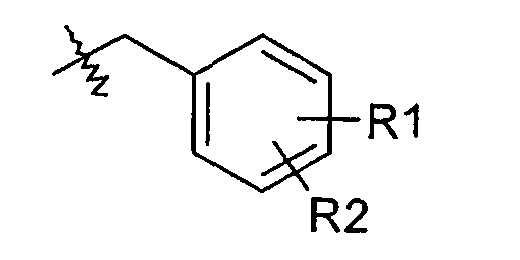
R" is a monosaccharide, disaccharide or oligosaccharide, whose hydroxy groups are free or partially protected by benzyl groups; wherein said hydroxy groups protected by benzyl groups are groups -OCH2Ph or -OP; and wherein hydroxy groups partially protected by benzyl groups means that given a number n of hydroxyls present on R" at the most n/2 when n is an even number or (n-1)/2 when n is an odd number they are protected by said benzyl groups. - Compounds of formula (IV) according to claim 1 wherein R" is chosen among lactose, fucose, (2-acetylamino)-lactose, (2-amino)-lactose, (2-azido)-lactose, Lacto-N-biose, galactose, glucose, (2-acetylamino)-glucose, (2-amino)-glucose and (2-azido)-glucose whose hydroxy groups are free or partially protected by benzyl groups.
- Compounds according to claim 2 wherein R" is chosen among 2'-lactose, 3- lactose, 3-(2-acetylamino)-lactose, 3-(2-amino)-lactose, 3-(2-azido)-lactose, 4-Lacto-N-biose, 2-galactose, 3-glucose, 3-(2-acetylamino)-glucose, 3-(2-amino)-glucose, 3-(2-azido)-glucose 4-(2-acetylamino)-glucose, 4-(2-amino)-glucose and 4-(2-azido)-glucose whose hydroxy groups are free or partially protected by benzyl groups.
- Compounds according to claim 3 wherein R" is 2'-lactose that is compounds of formula (IVa)

- A process for the synthesis of fucosyl derivatives of formula (I)

R is a monosaccharide, a disaccharide or an oligosaccharide with free hydroxy groups;
characterised in that it comprises the use of an intermediate of formula (IV)
- Process according to claim 5 comprising a step c) of benzyl groups removal from intermediate (IV) to obtain a compound of formula (I).
- Process according to claim 6 wherein step c) is preceded by the following steps:a) coupling of a 2,3,4-tri-O-benzyl-fucopyranosyl derivative donor of formula (II)

with a monosaccaride, disaccaride or oligosaccaride glycosyl acceptor of formula R'OH wherein R' is, correspondingly to R, a monosaccharide, disaccharide or oligosaccharide suitably protected whose hydroxy groups for a maximum of 2 are free, optionally are partially protected by benzyl groups, the remaining hydroxy groups are protected with state of the art groups such to be removed in conditions such as to preserve benzyl groups and particularly to preserve groups -OP present on the fucosyl moiety;
to obtain intermediate of formula (III) b) removal of protecting groups of the saccharide moiety R' in conditions such as to preserve groups -OP present on the fucosyl moiety and optionally preserve benzyl groups present on R';
to obtain intermediates of formula (IV)
- Compounds 2,3,4-tri-O-benzyl-L-fucosyl derivatives of formula (II)

P independently among each other are benzyl groups of formula
X is imidate;
excluding that for a compound of formula (II) R2 is hydrogen when X is trichloroacetimidate and R1 is p-chloro. - Use of compounds of formula (II) wherein
X is an anomeric carbon activator chosen among an imidate or an halogen;
P independently among each other are benzyl groups of formula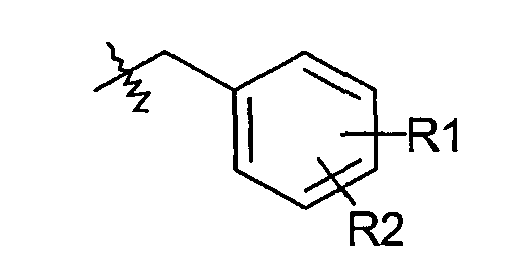
as fucosyl-donors for the synthesis of compounds of formula (IV) as described in claims 1-4. - Use according to claim 9 of compounds of formula (II) wherein X is trichloroacetimidate or α-bromine.
- Use of compounds of formula (II) according to claims 9-10 as fucosyl-donors for the synthesis of compounds of formula (I) by means of the process according to claims 5-7.
Applications Claiming Priority (2)
| Application Number | Priority Date | Filing Date | Title |
|---|---|---|---|
| ITFI2008A000244A IT1392456B1 (en) | 2008-12-18 | 2008-12-18 | PROCESS FOR THE SYNTHESIS OF L-PHUCOSILATED OLIGOSACCHARIDES AND THEIR NEW INTERMEDIATES 2,3,4-TRIBENZYL-FUCHOSIL-DERIVATIVES. |
| PCT/IB2009/055841 WO2010070616A2 (en) | 2008-12-18 | 2009-12-18 | Process for the synthesis of l-fucosyl di- or oligosaccharides and novel 2,3,4 tribenzyl-fucosyl derivatives intermediates thereof |
Publications (2)
| Publication Number | Publication Date |
|---|---|
| EP2382226A2 EP2382226A2 (en) | 2011-11-02 |
| EP2382226B1 true EP2382226B1 (en) | 2013-12-04 |
Family
ID=41050465
Family Applications (1)
| Application Number | Title | Priority Date | Filing Date |
|---|---|---|---|
| EP09806138.5A Active EP2382226B1 (en) | 2008-12-18 | 2009-12-18 | Process for the synthesis of l-fucosyl di- or oligosaccharides and novel 2,3,4 tribenzyl-fucosyl derivatives intermediates thereof |
Country Status (16)
| Country | Link |
|---|---|
| US (1) | US20110245488A1 (en) |
| EP (1) | EP2382226B1 (en) |
| JP (1) | JP2012512865A (en) |
| KR (1) | KR20110101207A (en) |
| CN (1) | CN102256988A (en) |
| AU (1) | AU2009329067A1 (en) |
| BR (1) | BRPI0922381A2 (en) |
| CA (1) | CA2746436A1 (en) |
| CO (1) | CO6501145A2 (en) |
| IT (1) | IT1392456B1 (en) |
| MX (1) | MX2011006357A (en) |
| NZ (1) | NZ593882A (en) |
| RU (1) | RU2011129688A (en) |
| SG (1) | SG171990A1 (en) |
| WO (1) | WO2010070616A2 (en) |
| ZA (1) | ZA201105102B (en) |
Families Citing this family (16)
| Publication number | Priority date | Publication date | Assignee | Title |
|---|---|---|---|---|
| CA2758097A1 (en) | 2009-04-07 | 2010-10-14 | Glycom A/S | Synthesis of 2'-o-fucosyllactose |
| CA2798675A1 (en) * | 2010-06-01 | 2011-12-08 | Glycom A/S | Polymorphs of 2'-o-fucosyllactose and producing thereof |
| ITFI20120143A1 (en) | 2012-07-12 | 2014-01-13 | Inalco S A S Di Giovanni Cipollett I & C | HYDRO POLYMORPHATES AND ANHYDERS OF 2'-O-FUCOSILLATTOSE AND THEIR PRODUCTION METHODS. |
| US9834574B2 (en) * | 2012-11-13 | 2017-12-05 | Glycom A/S | Crystalline 3-O-fucosyllactose |
| US9902984B2 (en) | 2013-09-06 | 2018-02-27 | Glycom A/S | Fermentative production of oligosaccharides |
| CN105017341B (en) * | 2014-04-22 | 2018-05-15 | 华东师范大学 | - half lactotetraose of sulphation rock algae and its preparation method and application |
| DE202015009782U1 (en) | 2014-06-11 | 2020-02-10 | Glycom A/S | Separation of 2'-O-fucosyllactose from fermentation broth |
| DK3191498T3 (en) | 2014-09-12 | 2020-12-21 | Basf Se | METHOD OF PREPARING 2'-O-FUCOSYLLACTOSE |
| US10676770B2 (en) | 2014-12-16 | 2020-06-09 | Glycom A/S | Separation of 2′-FL from a fermentation broth |
| CN108602845A (en) * | 2016-02-03 | 2018-09-28 | 巴斯夫欧洲公司 | Method for producing 2'-O-fucosyllactose |
| WO2017153452A1 (en) | 2016-03-09 | 2017-09-14 | Basf Se | Method for preparing 2'-o-fucosyllactose |
| SG11201907911PA (en) * | 2017-03-06 | 2019-09-27 | Dupont Nutrition Biosci Aps | Process for crystallizing 2'-fucosyllactose and related compositions |
| CN108236115A (en) * | 2017-12-28 | 2018-07-03 | 大连医科大学 | It is a kind of that there is core fucosylation oligosaccharides and its application for promoting Bifidobacterium and lactobacillus growth |
| EP3867258A1 (en) | 2018-10-18 | 2021-08-25 | Basf Se | Method for obtaining crystalline 2'-fucosyllactose |
| KR20220154158A (en) | 2020-03-12 | 2022-11-21 | 글리콤 에이/에스 | Crystallization of 2′-FL |
| CN114990175B (en) * | 2021-10-22 | 2023-03-31 | 岩唐生物科技(杭州)有限责任公司 | Synthesis method of fucose derivatives |
Family Cites Families (7)
| Publication number | Priority date | Publication date | Assignee | Title |
|---|---|---|---|---|
| JPH0616692A (en) * | 1992-07-03 | 1994-01-25 | Nisshin Oil Mills Ltd:The | New sugar derivative |
| JP2625620B2 (en) * | 1992-12-01 | 1997-07-02 | 株式会社ディ・ディ・エス研究所 | Fucosyl-glucosamine derivatives |
| JPH08217786A (en) * | 1995-02-17 | 1996-08-27 | Sumitomo Pharmaceut Co Ltd | Lewis x derivative and its production |
| JPH0987271A (en) * | 1995-07-18 | 1997-03-31 | Sumitomo Pharmaceut Co Ltd | Lewis x/a-c-glycoside derivative |
| US5874411A (en) * | 1995-11-13 | 1999-02-23 | Glycomed Incorporated | Oligosaccharide glycosides having mammalian immunosuppresive and tolerogenic properties |
| JPH09301988A (en) * | 1996-05-17 | 1997-11-25 | Sumitomo Pharmaceut Co Ltd | Glucosamine derivative |
| US5945314A (en) | 1997-03-31 | 1999-08-31 | Abbott Laboratories | Process for synthesizing oligosaccharides |
-
2008
- 2008-12-18 IT ITFI2008A000244A patent/IT1392456B1/en active
-
2009
- 2009-12-18 CN CN2009801509567A patent/CN102256988A/en active Pending
- 2009-12-18 NZ NZ593882A patent/NZ593882A/en not_active IP Right Cessation
- 2009-12-18 BR BRPI0922381-9A patent/BRPI0922381A2/en not_active IP Right Cessation
- 2009-12-18 KR KR1020117016534A patent/KR20110101207A/en not_active Withdrawn
- 2009-12-18 WO PCT/IB2009/055841 patent/WO2010070616A2/en not_active Ceased
- 2009-12-18 AU AU2009329067A patent/AU2009329067A1/en not_active Abandoned
- 2009-12-18 RU RU2011129688/04A patent/RU2011129688A/en not_active Application Discontinuation
- 2009-12-18 US US13/140,815 patent/US20110245488A1/en not_active Abandoned
- 2009-12-18 SG SG2011041233A patent/SG171990A1/en unknown
- 2009-12-18 MX MX2011006357A patent/MX2011006357A/en not_active Application Discontinuation
- 2009-12-18 EP EP09806138.5A patent/EP2382226B1/en active Active
- 2009-12-18 JP JP2011541706A patent/JP2012512865A/en active Pending
- 2009-12-18 CA CA2746436A patent/CA2746436A1/en not_active Abandoned
-
2011
- 2011-07-11 ZA ZA2011/05102A patent/ZA201105102B/en unknown
- 2011-07-15 CO CO11088895A patent/CO6501145A2/en not_active Application Discontinuation
Also Published As
| Publication number | Publication date |
|---|---|
| WO2010070616A2 (en) | 2010-06-24 |
| AU2009329067A1 (en) | 2011-07-28 |
| RU2011129688A (en) | 2013-01-27 |
| CO6501145A2 (en) | 2012-08-15 |
| BRPI0922381A2 (en) | 2015-08-11 |
| ITFI20080244A1 (en) | 2010-06-19 |
| KR20110101207A (en) | 2011-09-15 |
| EP2382226A2 (en) | 2011-11-02 |
| CA2746436A1 (en) | 2010-06-24 |
| SG171990A1 (en) | 2011-07-28 |
| IT1392456B1 (en) | 2012-03-09 |
| NZ593882A (en) | 2013-02-22 |
| ZA201105102B (en) | 2012-03-28 |
| MX2011006357A (en) | 2011-09-26 |
| US20110245488A1 (en) | 2011-10-06 |
| CN102256988A (en) | 2011-11-23 |
| WO2010070616A3 (en) | 2010-10-07 |
| JP2012512865A (en) | 2012-06-07 |
| WO2010070616A8 (en) | 2011-07-28 |
Similar Documents
| Publication | Publication Date | Title |
|---|---|---|
| US20110245488A1 (en) | Process for the synthesis of l-fucosyl di- or oligo-saccharides and novel 2,3,4 tribenzyl-fucosyl derivatives intermediates thereof | |
| EP2828275B1 (en) | Synthesis of the trisaccharide 3-o-fucosyllactose and intermediates thereof | |
| EP2417144B1 (en) | Synthesis of 2'-o-fucosyllactose | |
| CN103958537A (en) | Synthesis of HMO core structures | |
| CN103703012A (en) | Manufacture of lacto-n-tetraose | |
| JP5738272B2 (en) | Method for synthesizing 6'-sialyl lactose salt and 6'-sialyl lactose salt and other A-sialyl oligosaccharides | |
| EP2678348A1 (en) | Novel glycosyl phosphites | |
| Gallo-Rodriguez et al. | Synthesis of β-d-Galp-(1→ 3)-β-d-Galp-(1→ 6)-[β-d-Galf-(1→ 4)]-d-GlcNAc, a tetrasaccharide component of mucins of Trypanosoma cruzi | |
| JP6140830B2 (en) | Method for producing α-galactosylceramide compound | |
| WO2008069303A1 (en) | Method for production of furanose derivative | |
| KR20140042802A (en) | N-substituted mannosamine derivatives, process for their preparation and their use | |
| WO2023074843A1 (en) | Novel oligosaccharide, manufacturing intermediate for novel oligosaccharide, and method for manufacturing these | |
| Mendoza et al. | Synthesis of 2, 3-di-O-(β-D-Galp)-D-Galp, a synthon for the mucin oligosaccharides of Trypanosoma cruzi | |
| US20140303363A1 (en) | Preparation and Use of Isolactosamine and Intermediates therefor | |
| CA2071050A1 (en) | Process for the preparation of sugar epitopes | |
| JP2000169503A (en) | Production of sialic-acid-containing oligosaccharide | |
| AU718293B2 (en) | Lewis X derivatives | |
| JP2003226695A (en) | Optically active phosphate derivative of deoxyinositol and method of production for the same |
Legal Events
| Date | Code | Title | Description |
|---|---|---|---|
| PUAI | Public reference made under article 153(3) epc to a published international application that has entered the european phase |
Free format text: ORIGINAL CODE: 0009012 |
|
| 17P | Request for examination filed |
Effective date: 20110718 |
|
| AK | Designated contracting states |
Kind code of ref document: A2 Designated state(s): AT BE BG CH CY CZ DE DK EE ES FI FR GB GR HR HU IE IS IT LI LT LU LV MC MK MT NL NO PL PT RO SE SI SK SM TR |
|
| AX | Request for extension of the european patent |
Extension state: AL BA RS |
|
| REG | Reference to a national code |
Ref country code: HK Ref legal event code: DE Ref document number: 1163695 Country of ref document: HK |
|
| GRAP | Despatch of communication of intention to grant a patent |
Free format text: ORIGINAL CODE: EPIDOSNIGR1 |
|
| INTG | Intention to grant announced |
Effective date: 20130621 |
|
| GRAS | Grant fee paid |
Free format text: ORIGINAL CODE: EPIDOSNIGR3 |
|
| GRAA | (expected) grant |
Free format text: ORIGINAL CODE: 0009210 |
|
| AK | Designated contracting states |
Kind code of ref document: B1 Designated state(s): AT BE BG CH CY CZ DE DK EE ES FI FR GB GR HR HU IE IS IT LI LT LU LV MC MK MT NL NO PL PT RO SE SI SK SM TR |
|
| AX | Request for extension of the european patent |
Extension state: AL BA RS |
|
| REG | Reference to a national code |
Ref country code: GB Ref legal event code: FG4D |
|
| REG | Reference to a national code |
Ref country code: CH Ref legal event code: EP |
|
| REG | Reference to a national code |
Ref country code: AT Ref legal event code: REF Ref document number: 643515 Country of ref document: AT Kind code of ref document: T Effective date: 20140115 Ref country code: IE Ref legal event code: FG4D |
|
| REG | Reference to a national code |
Ref country code: DE Ref legal event code: R096 Ref document number: 602009020561 Country of ref document: DE Effective date: 20140130 |
|
| REG | Reference to a national code |
Ref country code: NL Ref legal event code: VDEP Effective date: 20131204 |
|
| REG | Reference to a national code |
Ref country code: AT Ref legal event code: MK05 Ref document number: 643515 Country of ref document: AT Kind code of ref document: T Effective date: 20131204 |
|
| PG25 | Lapsed in a contracting state [announced via postgrant information from national office to epo] |
Ref country code: HR Free format text: LAPSE BECAUSE OF FAILURE TO SUBMIT A TRANSLATION OF THE DESCRIPTION OR TO PAY THE FEE WITHIN THE PRESCRIBED TIME-LIMIT Effective date: 20131204 Ref country code: SE Free format text: LAPSE BECAUSE OF FAILURE TO SUBMIT A TRANSLATION OF THE DESCRIPTION OR TO PAY THE FEE WITHIN THE PRESCRIBED TIME-LIMIT Effective date: 20131204 Ref country code: FI Free format text: LAPSE BECAUSE OF FAILURE TO SUBMIT A TRANSLATION OF THE DESCRIPTION OR TO PAY THE FEE WITHIN THE PRESCRIBED TIME-LIMIT Effective date: 20131204 Ref country code: NO Free format text: LAPSE BECAUSE OF FAILURE TO SUBMIT A TRANSLATION OF THE DESCRIPTION OR TO PAY THE FEE WITHIN THE PRESCRIBED TIME-LIMIT Effective date: 20140304 Ref country code: NL Free format text: LAPSE BECAUSE OF FAILURE TO SUBMIT A TRANSLATION OF THE DESCRIPTION OR TO PAY THE FEE WITHIN THE PRESCRIBED TIME-LIMIT Effective date: 20131204 Ref country code: LT Free format text: LAPSE BECAUSE OF FAILURE TO SUBMIT A TRANSLATION OF THE DESCRIPTION OR TO PAY THE FEE WITHIN THE PRESCRIBED TIME-LIMIT Effective date: 20131204 |
|
| REG | Reference to a national code |
Ref country code: LT Ref legal event code: MG4D |
|
| PG25 | Lapsed in a contracting state [announced via postgrant information from national office to epo] |
Ref country code: CY Free format text: LAPSE BECAUSE OF FAILURE TO SUBMIT A TRANSLATION OF THE DESCRIPTION OR TO PAY THE FEE WITHIN THE PRESCRIBED TIME-LIMIT Effective date: 20131204 Ref country code: LV Free format text: LAPSE BECAUSE OF FAILURE TO SUBMIT A TRANSLATION OF THE DESCRIPTION OR TO PAY THE FEE WITHIN THE PRESCRIBED TIME-LIMIT Effective date: 20131204 Ref country code: AT Free format text: LAPSE BECAUSE OF FAILURE TO SUBMIT A TRANSLATION OF THE DESCRIPTION OR TO PAY THE FEE WITHIN THE PRESCRIBED TIME-LIMIT Effective date: 20131204 |
|
| REG | Reference to a national code |
Ref country code: DE Ref legal event code: R119 Ref document number: 602009020561 Country of ref document: DE |
|
| PG25 | Lapsed in a contracting state [announced via postgrant information from national office to epo] |
Ref country code: IS Free format text: LAPSE BECAUSE OF FAILURE TO SUBMIT A TRANSLATION OF THE DESCRIPTION OR TO PAY THE FEE WITHIN THE PRESCRIBED TIME-LIMIT Effective date: 20140404 Ref country code: EE Free format text: LAPSE BECAUSE OF FAILURE TO SUBMIT A TRANSLATION OF THE DESCRIPTION OR TO PAY THE FEE WITHIN THE PRESCRIBED TIME-LIMIT Effective date: 20131204 Ref country code: BE Free format text: LAPSE BECAUSE OF FAILURE TO SUBMIT A TRANSLATION OF THE DESCRIPTION OR TO PAY THE FEE WITHIN THE PRESCRIBED TIME-LIMIT Effective date: 20131204 |
|
| REG | Reference to a national code |
Ref country code: CH Ref legal event code: PL |
|
| PG25 | Lapsed in a contracting state [announced via postgrant information from national office to epo] |
Ref country code: SK Free format text: LAPSE BECAUSE OF FAILURE TO SUBMIT A TRANSLATION OF THE DESCRIPTION OR TO PAY THE FEE WITHIN THE PRESCRIBED TIME-LIMIT Effective date: 20131204 Ref country code: ES Free format text: LAPSE BECAUSE OF FAILURE TO SUBMIT A TRANSLATION OF THE DESCRIPTION OR TO PAY THE FEE WITHIN THE PRESCRIBED TIME-LIMIT Effective date: 20131204 Ref country code: CZ Free format text: LAPSE BECAUSE OF FAILURE TO SUBMIT A TRANSLATION OF THE DESCRIPTION OR TO PAY THE FEE WITHIN THE PRESCRIBED TIME-LIMIT Effective date: 20131204 Ref country code: PL Free format text: LAPSE BECAUSE OF FAILURE TO SUBMIT A TRANSLATION OF THE DESCRIPTION OR TO PAY THE FEE WITHIN THE PRESCRIBED TIME-LIMIT Effective date: 20131204 Ref country code: RO Free format text: LAPSE BECAUSE OF FAILURE TO SUBMIT A TRANSLATION OF THE DESCRIPTION OR TO PAY THE FEE WITHIN THE PRESCRIBED TIME-LIMIT Effective date: 20131204 Ref country code: PT Free format text: LAPSE BECAUSE OF FAILURE TO SUBMIT A TRANSLATION OF THE DESCRIPTION OR TO PAY THE FEE WITHIN THE PRESCRIBED TIME-LIMIT Effective date: 20140404 |
|
| REG | Reference to a national code |
Ref country code: DE Ref legal event code: R119 Ref document number: 602009020561 Country of ref document: DE Effective date: 20140701 |
|
| REG | Reference to a national code |
Ref country code: IE Ref legal event code: MM4A |
|
| PG25 | Lapsed in a contracting state [announced via postgrant information from national office to epo] |
Ref country code: MC Free format text: LAPSE BECAUSE OF FAILURE TO SUBMIT A TRANSLATION OF THE DESCRIPTION OR TO PAY THE FEE WITHIN THE PRESCRIBED TIME-LIMIT Effective date: 20131204 |
|
| PLBE | No opposition filed within time limit |
Free format text: ORIGINAL CODE: 0009261 |
|
| STAA | Information on the status of an ep patent application or granted ep patent |
Free format text: STATUS: NO OPPOSITION FILED WITHIN TIME LIMIT |
|
| PG25 | Lapsed in a contracting state [announced via postgrant information from national office to epo] |
Ref country code: DE Free format text: LAPSE BECAUSE OF NON-PAYMENT OF DUE FEES Effective date: 20140701 Ref country code: CH Free format text: LAPSE BECAUSE OF NON-PAYMENT OF DUE FEES Effective date: 20131231 Ref country code: DK Free format text: LAPSE BECAUSE OF FAILURE TO SUBMIT A TRANSLATION OF THE DESCRIPTION OR TO PAY THE FEE WITHIN THE PRESCRIBED TIME-LIMIT Effective date: 20131204 Ref country code: IE Free format text: LAPSE BECAUSE OF NON-PAYMENT OF DUE FEES Effective date: 20131218 Ref country code: LI Free format text: LAPSE BECAUSE OF NON-PAYMENT OF DUE FEES Effective date: 20131231 |
|
| 26N | No opposition filed |
Effective date: 20140905 |
|
| GBPC | Gb: european patent ceased through non-payment of renewal fee |
Effective date: 20140304 |
|
| REG | Reference to a national code |
Ref country code: FR Ref legal event code: ST Effective date: 20141124 |
|
| PG25 | Lapsed in a contracting state [announced via postgrant information from national office to epo] |
Ref country code: FR Free format text: LAPSE BECAUSE OF NON-PAYMENT OF DUE FEES Effective date: 20140204 Ref country code: GB Free format text: LAPSE BECAUSE OF NON-PAYMENT OF DUE FEES Effective date: 20140304 |
|
| PG25 | Lapsed in a contracting state [announced via postgrant information from national office to epo] |
Ref country code: SI Free format text: LAPSE BECAUSE OF FAILURE TO SUBMIT A TRANSLATION OF THE DESCRIPTION OR TO PAY THE FEE WITHIN THE PRESCRIBED TIME-LIMIT Effective date: 20131204 |
|
| PG25 | Lapsed in a contracting state [announced via postgrant information from national office to epo] |
Ref country code: SM Free format text: LAPSE BECAUSE OF FAILURE TO SUBMIT A TRANSLATION OF THE DESCRIPTION OR TO PAY THE FEE WITHIN THE PRESCRIBED TIME-LIMIT Effective date: 20131204 |
|
| PG25 | Lapsed in a contracting state [announced via postgrant information from national office to epo] |
Ref country code: TR Free format text: LAPSE BECAUSE OF FAILURE TO SUBMIT A TRANSLATION OF THE DESCRIPTION OR TO PAY THE FEE WITHIN THE PRESCRIBED TIME-LIMIT Effective date: 20131204 |
|
| PG25 | Lapsed in a contracting state [announced via postgrant information from national office to epo] |
Ref country code: HU Free format text: LAPSE BECAUSE OF FAILURE TO SUBMIT A TRANSLATION OF THE DESCRIPTION OR TO PAY THE FEE WITHIN THE PRESCRIBED TIME-LIMIT; INVALID AB INITIO Effective date: 20091218 Ref country code: LU Free format text: LAPSE BECAUSE OF NON-PAYMENT OF DUE FEES Effective date: 20131218 Ref country code: MK Free format text: LAPSE BECAUSE OF FAILURE TO SUBMIT A TRANSLATION OF THE DESCRIPTION OR TO PAY THE FEE WITHIN THE PRESCRIBED TIME-LIMIT Effective date: 20131204 Ref country code: BG Free format text: LAPSE BECAUSE OF FAILURE TO SUBMIT A TRANSLATION OF THE DESCRIPTION OR TO PAY THE FEE WITHIN THE PRESCRIBED TIME-LIMIT Effective date: 20131204 |
|
| PG25 | Lapsed in a contracting state [announced via postgrant information from national office to epo] |
Ref country code: MT Free format text: LAPSE BECAUSE OF FAILURE TO SUBMIT A TRANSLATION OF THE DESCRIPTION OR TO PAY THE FEE WITHIN THE PRESCRIBED TIME-LIMIT Effective date: 20131204 Ref country code: GR Free format text: LAPSE BECAUSE OF NON-PAYMENT OF DUE FEES Effective date: 20131204 Ref country code: IT Free format text: LAPSE BECAUSE OF FAILURE TO SUBMIT A TRANSLATION OF THE DESCRIPTION OR TO PAY THE FEE WITHIN THE PRESCRIBED TIME-LIMIT Effective date: 20131204 |
|
| PG25 | Lapsed in a contracting state [announced via postgrant information from national office to epo] |
Ref country code: GR Free format text: LAPSE BECAUSE OF FAILURE TO SUBMIT A TRANSLATION OF THE DESCRIPTION OR TO PAY THE FEE WITHIN THE PRESCRIBED TIME-LIMIT Effective date: 20140305 |
|
| REG | Reference to a national code |
Ref country code: HK Ref legal event code: WD Ref document number: 1163695 Country of ref document: HK |