EP2382225B1 - Organic metal complexes for use in optoelectronic devices - Google Patents
Organic metal complexes for use in optoelectronic devices Download PDFInfo
- Publication number
- EP2382225B1 EP2382225B1 EP09775043.4A EP09775043A EP2382225B1 EP 2382225 B1 EP2382225 B1 EP 2382225B1 EP 09775043 A EP09775043 A EP 09775043A EP 2382225 B1 EP2382225 B1 EP 2382225B1
- Authority
- EP
- European Patent Office
- Prior art keywords
- radical
- value
- ligand
- hydrogen
- ring
- Prior art date
- Legal status (The legal status is an assumption and is not a legal conclusion. Google has not performed a legal analysis and makes no representation as to the accuracy of the status listed.)
- Not-in-force
Links
- QMCFUTGXLCHEMD-UHFFFAOYSA-N Cc(cc(cc1)-c2ccccc2)c1-c1c(cccc2)c2cc(-c2ccccc2)n1 Chemical compound Cc(cc(cc1)-c2ccccc2)c1-c1c(cccc2)c2cc(-c2ccccc2)n1 QMCFUTGXLCHEMD-UHFFFAOYSA-N 0.000 description 1
Classifications
-
- H—ELECTRICITY
- H10—SEMICONDUCTOR DEVICES; ELECTRIC SOLID-STATE DEVICES NOT OTHERWISE PROVIDED FOR
- H10K—ORGANIC ELECTRIC SOLID-STATE DEVICES
- H10K85/00—Organic materials used in the body or electrodes of devices covered by this subclass
- H10K85/30—Coordination compounds
- H10K85/341—Transition metal complexes, e.g. Ru(II)polypyridine complexes
-
- C—CHEMISTRY; METALLURGY
- C07—ORGANIC CHEMISTRY
- C07F—ACYCLIC, CARBOCYCLIC OR HETEROCYCLIC COMPOUNDS CONTAINING ELEMENTS OTHER THAN CARBON, HYDROGEN, HALOGEN, OXYGEN, NITROGEN, SULFUR, SELENIUM OR TELLURIUM
- C07F15/00—Compounds containing elements of Groups 8, 9, 10 or 18 of the Periodic Table
- C07F15/0006—Compounds containing elements of Groups 8, 9, 10 or 18 of the Periodic Table compounds of the platinum group
- C07F15/0033—Iridium compounds
-
- C—CHEMISTRY; METALLURGY
- C07—ORGANIC CHEMISTRY
- C07F—ACYCLIC, CARBOCYCLIC OR HETEROCYCLIC COMPOUNDS CONTAINING ELEMENTS OTHER THAN CARBON, HYDROGEN, HALOGEN, OXYGEN, NITROGEN, SULFUR, SELENIUM OR TELLURIUM
- C07F15/00—Compounds containing elements of Groups 8, 9, 10 or 18 of the Periodic Table
- C07F15/0006—Compounds containing elements of Groups 8, 9, 10 or 18 of the Periodic Table compounds of the platinum group
- C07F15/0073—Rhodium compounds
-
- C—CHEMISTRY; METALLURGY
- C07—ORGANIC CHEMISTRY
- C07F—ACYCLIC, CARBOCYCLIC OR HETEROCYCLIC COMPOUNDS CONTAINING ELEMENTS OTHER THAN CARBON, HYDROGEN, HALOGEN, OXYGEN, NITROGEN, SULFUR, SELENIUM OR TELLURIUM
- C07F15/00—Compounds containing elements of Groups 8, 9, 10 or 18 of the Periodic Table
- C07F15/0006—Compounds containing elements of Groups 8, 9, 10 or 18 of the Periodic Table compounds of the platinum group
- C07F15/0086—Platinum compounds
-
- H—ELECTRICITY
- H10—SEMICONDUCTOR DEVICES; ELECTRIC SOLID-STATE DEVICES NOT OTHERWISE PROVIDED FOR
- H10K—ORGANIC ELECTRIC SOLID-STATE DEVICES
- H10K85/00—Organic materials used in the body or electrodes of devices covered by this subclass
- H10K85/30—Coordination compounds
- H10K85/341—Transition metal complexes, e.g. Ru(II)polypyridine complexes
- H10K85/342—Transition metal complexes, e.g. Ru(II)polypyridine complexes comprising iridium
-
- H—ELECTRICITY
- H10—SEMICONDUCTOR DEVICES; ELECTRIC SOLID-STATE DEVICES NOT OTHERWISE PROVIDED FOR
- H10K—ORGANIC ELECTRIC SOLID-STATE DEVICES
- H10K85/00—Organic materials used in the body or electrodes of devices covered by this subclass
- H10K85/30—Coordination compounds
- H10K85/341—Transition metal complexes, e.g. Ru(II)polypyridine complexes
- H10K85/346—Transition metal complexes, e.g. Ru(II)polypyridine complexes comprising platinum
-
- C—CHEMISTRY; METALLURGY
- C09—DYES; PAINTS; POLISHES; NATURAL RESINS; ADHESIVES; COMPOSITIONS NOT OTHERWISE PROVIDED FOR; APPLICATIONS OF MATERIALS NOT OTHERWISE PROVIDED FOR
- C09K—MATERIALS FOR MISCELLANEOUS APPLICATIONS, NOT PROVIDED FOR ELSEWHERE
- C09K2211/00—Chemical nature of organic luminescent or tenebrescent compounds
- C09K2211/18—Metal complexes
- C09K2211/185—Metal complexes of the platinum group, i.e. Os, Ir, Pt, Ru, Rh or Pd
Definitions
- the invention relates to an organic metal complex, a composition comprising the organic metal complexes, use of the organic metal complexes, and an organic light-emitting device comprising the complexes.
- An organic light emitting device typically includes an anode, a cathode, and at least one organic light emitting layer sandwiched between two electrodes.
- the OLED may include additional layers such as a hole injection layer, a hole transport layer, an electron injection and an electron transport layer.
- the injected positive and negative charges recombine in the organic light emitting layer to produce light.
- Materials used in the organic light emitting layer are classified into a fluorescent material that uses singlet excitons and a phosphorescent material that uses triplet excitons, according to a light-emitting mechanism.
- the organic light emitting device using a fluorescent material as a light emitting layer-forming material has a disadvantage that the triplet excitons formed in the host are consumed, while the device using a phosphorescent material as a light emitting layer-forming material has an advantage that both of the singlet excitons and the triplet excitons can be used, and thus the internal quantum efficiency can reach up to 100%. Accordingly, when a phosphorescent material is used in the organic light emitting layer, the phosphorescent material can possess even higher light emitting efficiency than when a fluorescent material is used.
- Organic metal complexes such as [(C ⁇ N) 3 Ir(III)] and [(C ⁇ N) 2 Ir(III)(L A )] iridium(III) complexes wherein C ⁇ N is a cyclometallated ligand and L A is an ancillary ligand have been identified as key phosphorescent materials in molecular- and polymer-based OLEDs due to their exceptional electro- and photo-luminescent properties.
- Much of the directed interest in employing these Ir(III) complexes in OLED architectures is a result of them having long lived excited states and high luminescent efficiencies.
- US 2008/0305361 discloses phenylpyrazine derivatives ortho metalated with a metal ion of an element belonging to Group 9 or Group 10 in the periodic table, easily cause intersystem crossing, and can emit green phosphorescence.
- WO 2006/095951 discloses a deuterated novel iridium complex phosphorescent material used as a light-emitting layer material of an organic electroluminescence device. Compared with an organic electroluminescence device using a prior art light-emitting layer with no deuterium substitution, the organic electroluminescence device using the deuterated material has improved luminescence efficiency, luminance, power efficiency and thermal stability.
- US 2004/0127710 discloses a phosphorescent material containing an iridium metal compound. When used for an emissive layer of an organic electroluminescent device, the phosphorescent material offers greater luminescent efficiency and improved driving voltage characteristics, compared to conventional red luminescent materials, and reduces the amount of power consumed in the organic electroluminescent device.
- the present invention provides an organic metal complex represented by the formula (I) wherein M is a metal selected from Rh, Ir, or Pt; Y represents N or O; R 1 represents a hydrogen, a halogen, a nitro group, an amino group, a hydroxyl group, a C 3 -C 40 aromatic radical, a C 1 -C 50 aliphatic radical, and a C 3 -C 50 cycloaliphatic radical; R 2 represents a hydrogen, C 3 -C 20 aromatic radical, C 1 -C 50 aliphatic radical, or a C 3 -C 50 cycloaliphatic radical; or R 1 and R 2 , together with the adjacent Y, may form a ring, preferably a 5- or 6-membered ring; n 1 has a value of from 0 to 3; and n 2 has a value of 0 to 2; m 1 has a value of at least 1; and m 2 has a value of at least 1 provided that m 1 +m
- the invention provides an organic light emitting device (OLED) comprising an anode; a cathode; and an organic light emitting layer positioned between the anode and the cathode, wherein the organic light emission layer comprises an organic metal complex represented by the formula (I).
- OLED organic light emitting device
- electrophosphorescent composition comprising at least one electroactive host material and at least one organic metal complex represented by the formula (I).
- the expression “optional” or “optionally” means that the subsequently described event or circumstance may or may not occur, and that the description includes instances where the event occurs and instances where it does not.
- aromatic radical refers to those comprising at least one aromatic group, wherein the at least one aromatic group may include heteroatoms such as nitrogen, sulfur, selenium, silicon and oxygen, or may be composed exclusively of carbon and hydrogen.
- the aromatic group comprises phenyl groups, thienyl groups, furanyl groups, naphthyl groups, azulenyl groups, anthraceneyl groups and the like.
- the aromatic radical may also include nonaromatic components.
- a benzyl group is an aromatic radical which comprises a phenyl ring (the aromatic group) and a methylene group (the nonaromatic component).
- aromatic radical includes but is not limited to phenyl, pyridyl, furanyl, thienyl, naphthyl, phenylene, and biphenyl radicals.
- aromatic radical is defined herein to encompass 0 to ten, preferably one to six, more preferably one to four, most preferably one to two substituents such as alkyl groups, alkenyl groups, alkynyl groups, haloalkyl groups, haloaromatic groups, conjugated dienyl groups, alcohol groups, ether groups, aldehyde groups, ketone groups, carboxylic acid groups, acyl groups (for example carboxylic acid derivatives such as esters and amides), amine groups, nitro groups, and the like.
- alkyl contained in the substituents possess 1 to 50 carbon atoms, preferably 1 to 30 carbon atoms, more preferably 1 to 12 carbon atoms, still more preferably 1 to 6 carbon atoms.
- the aromatic radicals include halogenated aromatic radicals such as 4-trifluoromethylphenyl, 4-chloromethylphen-1-yl, 4-(3-bromoprop-1-yl)phen-1-yl (i.e., 4-BrCH 2 CH 2 CH 2 Ph-), and the like.
- aromatic radicals include 4-allyloxyphen-1-oxy, 4-aminophen-1-yl (i.e., 4-H 2 NPh-), 3-aminocarbonylphen-1-yl (i.e., NH 2 COPh-), and the like.
- the aromatic radical comprises 3 to 40 carbon atoms, preferably 3 to 20 carbon atoms, more preferably 3 to 16 carbon atoms, most preferably 3 to 14 carbon atoms.
- cycloaliphatic radical in the term “C 3 -C 50 cycloaliphatic radical” refers to a radical having a valence of at least one, and comprising an array of atoms which is cyclic but which is not aromatic. As defined herein a “cycloaliphatic radical” does not contain an aromatic group.
- a “cycloaliphatic radical” may comprise one or more noncyclic components.
- the cycloaliphatic radical may include heteroatoms such as nitrogen, sulfur and oxygen, or may be composed exclusively of carbon and hydrogen.
- cycloaliphatic radical is defined herein to encompass a wide range of functional groups such as halogen including fluorine, chlorine, bromine, and iodine, alkyl groups, alkenyl groups, alkynyl groups, haloalkyl groups, conjugated dienyl groups, alcohol groups, ether groups, aldehyde groups, ketone groups, carboxylic acid groups, acyl groups (for example carboxylic acid derivatives such as esters and amides), amino groups, nitro groups, and the like.
- functional groups such as halogen including fluorine, chlorine, bromine, and iodine, alkyl groups, alkenyl groups, alkynyl groups, haloalkyl groups, conjugated dienyl groups, alcohol groups, ether groups, aldehyde groups, ketone groups, carboxylic acid groups, acyl groups (for example carboxylic acid derivatives such as esters and amides), amino groups, nitro groups, and the like.
- the cycloaliphatic radical has 3 to 50 carbon atoms, preferably 3 to 30 carbon atoms, more preferably 3 to 20 carbon atoms, still more preferably 3 to 12 carbon atoms, and most preferably 3 to 6 carbon atoms.
- aliphatic radical in the term “C 1 -C 50 aliphatic radical” refers to an organic radical having a valence of at least one consisting of a linear or branched array of atoms which is not cyclic. Aliphatic radicals are defined to comprise at least one carbon atom. The array of atoms comprising the aliphatic radical may include heteroatoms such as nitrogen, sulfur, silicon, selenium and oxygen or may be composed exclusively of carbon and hydrogen.
- aliphatic radical is defined herein to encompass, as part of the "linear or branched array of atoms which is not cyclic" a wide range of functional groups such as alkyl groups, alkenyl groups, alkynyl groups, haloalkyl groups, conjugated dienyl groups, alcohol groups, ether groups, aldehyde groups, ketone groups, carboxylic acid groups, acyl groups (for example carboxylic acid derivatives such as esters and amides), amine groups, nitro groups, and the like.
- a C 1 -C 10 aliphatic radical contains at least one but no more than 10 carbon atoms.
- a methyl group i.e., CH 3 -
- a decyl group i.e., CH 3 (CH 2 ) 9 -
- the aliphatic radical has 1 to 50 carbon atoms, preferably 1 to 30 carbon atoms, more preferably 1 to 20 carbon atoms, still more preferably 1 to 12 carbon atoms, and most preferably 1 to 6 carbon atoms.
- the term "5- or 6-membered ring” refers to a saturated, unsaturated, aromatic, non-aromatic 5- or 6-membered ring containing from 1 to 4 hetero atoms selected from N, S or O and may be substituted with a hydrogen, a halogen, a nitro group, an amino group, a hydroxyl group, a C 3 -C 40 aromatic radical, a C 1 -C 50 aliphatic radical, and a C 3 -C 50 cycloaliphatic radical wherein the aromatic radical, aliphatic radical, and cycloaliphatic radical are defined as above.
- the invention provides an organic metal complex represented by the formula (I).
- M is a metal selected from Rh, Ir, or Pt;
- Y represents N or O;
- R 1 represents a hydrogen, a halogen, a nitro group, an amino group, a hydroxyl group, a C 3 -C 40 aromatic radical, a C 1 -C 50 aliphatic radical, and a C 3 -C 50 cycloaliphatic radical;
- R 2 represents a hydrogen, C 3 -C 20 aromatic radical, C 1 -C 50 aliphatic radical, or a C 3 -C 50 cycloaliphatic radical; or
- R 1 and R 2 together with the adjacent Y, may form a ring, preferably a 5- or 6-membered ring;
- n 1 has a value of from 0 to 3; and
- n 2 has a value of 0 to 2;
- m 1 has a value of at least 1; and
- m 2 has a value of
- the number m 1 of the cyclometalated ligand represented by may be one or two, and when the number m 1 of the ligand is two, the cyclometalated ligands may be each other the same or different.
- Suitable cyclometalated ligands used for the complexes are known in the art. Numerous cyclometalated ligands are disclosed in the art, e.g., WO 2006/073112 , which is incorporated herein by reference in their entirety. A person skilled in the art can determine the cyclometalated ligands to be used.
- cyclometalated ligand C and N are independently selected from a ring-forming atom of an aromatic radical.
- the aromatic radical is defined as above.
- C in the cyclometalated ligand is a ring-forming atom in a C 3 -C 14 aromatic radical and N in the cyclometalated ligand is a ring-forming atom in a nitrogen-containing 3- to 14-membered aromatic radical.
- a nitrogent-containing 3- to 14-membered aromatic radical refers to mono- or fused-aromatic radicals containing at least one N atom in the aromatic group in addition to carbon atoms.
- the 3- to 14-membered aromatic radical comprises, but not limits to, 1-imidazolyl (C 3 H 2 N 2 -), phenyl, benzyl radical (C 7 H 7 -), styryl, naphthyl, pyridinyl, indole and anthracenyl.
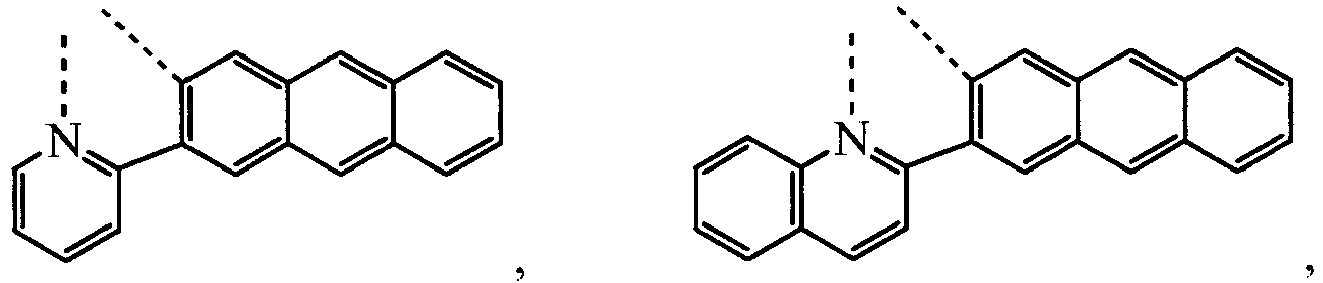
- cyclometalated ligand may be any one selected from the group consisting of:
- M is a metal atom selected from Rh, Ir, and Pt.
- M is Ir or Pt, more preferably Ir.
- the ligand represented by following formula (II) is included, wherein Y represents N or O; R 1 represents a hydrogen, a halogen, a nitro group, an amino group, a hydroxyl group, a C 3 -C 40 aromatic radical, a C 1 -C 50 aliphatic radical, and a C 3 -C 50 cycloaliphatic radical; R 2 represents a hydrogen, C 1 -C 20 aromatic radical, C 1 -C 50 aliphatic radical, or a C 3 -C 50 cycloaliphatic radical; or R 1 and R 2 , together with the adjacent Y, may form a ring, preferably a 5- or 6-membered ring; n 1 has a value of from 0 to 3; and n 2 has a value of 0 to 2.
- the ligands having formula (II) can be the same or different.
- Exemplified ligand having formula (II) comprises, but is not limited to those derived from following compounds:
- Y represents N.
- exemplified ligand having formula (II) comprises, but is not limited to:
- the complex according to the invention has a formula (III), wherein M, R 1 , R 2 , n 1 , n 2 , m 1 , and m 2 each is defined as above in formula (I) and (II).
- the ligand is also defined as above in formula (I).
- the invention provides a composition comprising at least one organic metal complex represented by the formula (I): wherein M, R 1 , R 2 , n 1 , n 2 , mit, and m 2 each is defined as above.
- the invention provide an electrophosphorescent composition
- at least one electroactive host material and at least one organic metal complex represented by the formula (I): wherein M, R 1 , R 2 , n 1 , n 2 , m 1 , and m 2 each is defined as above.
- an electrophosphorescent composition is a composition which emits light by radiative decay of a triplet excited state formed as a result of the application of a voltage bias.
- the present invention provides an electrophosphorescent composition which when subjected to a voltage bias, emits light primarily from a triplet excited state of an organic metal complex formed by energy transfer from the host material to the organic metal complex.
- the organic metal complexes provided by the present invention are well suited for use in electrophosphorescent compositions because energy transfer from the excited state of the host material to the organic metal complex is in many instances exceedingly efficient.
- the composition further comprises electroactive host materials.
- Suitable electroactive host materials include electroluminescent materials and otherwise electroactive materials and they are known in the art.
- Examples of non-polymeric host materials include, but are not limited to, those exemplified in Table 1 together with their Chemical Abstracts Registry Number (CAS No.). Table 1: Exemplary Non-Polymeric Host Materials anthrance CBP CAS No. 120-12-7 CAS No. 58328-31-7 Alq 3 TAZ CAS No. 2085-33-8 CAS No. 150405-69-9 BTA Spiro-TAD CAS No. 145024-29-9 CAS No. 189363-47-1 Bphen CAS No. 139092-78-7 CAS No. 1662-01-7
- the host material is an electroactive polymeric material.
- Suitable electroactive polymeric materials include polyvinylcarbazole (PVK), polyphenylenevinylene (PPV), phenyl-substituted polyphenylenevinylene (PhPPV), and poly(9,9-disubstituted fluorenes).
- the present invention provides an electrophosphorescent composition comprising at least one electroactive host material and at least one organic metal complex.
- the electrophosphorescent composition comprises a host material which is a blue light emitting electroluminescent organic material, for example, poly(9,9-dioctyl fluorene).
- the present invention provides an electrophosphorescent composition comprising an electroactive host material and an organic metal complex of formula (I), wherein the organic metal complex is present in an amount corresponding to from about 0.01 percent to about 50 percent by weight of the entire weight of the electrophosphorescent composition. In another embodiment, the organic metal complex is present in an amount corresponding to from about 0.1 percent to about 10 percent by weight of the entire weight of the electrophosphorescent composition. In yet another embodiment, the organic metal complex is present in an amount corresponding to from about 0.5 percent to about 5 percent by weight of the entire weight of the electrophosphorescent composition.
- the present invention provides use of an organic metal complex represented by the following formula (I) in electronic devices, light emitting electrochemical cells, photo detectors, photoconductive cells, photo switches, phototransistors, and phototubes: wherein M, R 1 , R 2 , n 1 , n 2 , m 1 , and m 2 each is defined as above.
- the invention provides an organic light emitting device comprising at least one of the organic metal complexes or compositions provided by the present invention.
- An organic light emitting device typically comprises multiple layers which include in the simplest case, an anode layer and a corresponding cathode layer with an organic electroluminescent layer disposed between said anode and said cathode.
- a voltage bias is applied across the electrodes, electrons are injected by the cathode into the electroluminescent layer while electrons are removed from (or "holes" are “injected” into) the electroluminescent layer from the anode.
- triplet excitons Light emission occurs as holes combine with electrons within the electroluminescent layer to form singlet or triplet excitons, light emission occurring as singlet excitons transfer energy to the environment by radiative decay.
- Triplet excitons unlike singlet excitons, typically cannot undergo radiative decay and hence do not emit light except at very low temperatures. Theoretical considerations dictate that triplet excitons are formed about three times as often as singlet excitons. Thus the formation of triplet excitons, represents a fundamental limitation on efficiency in organic light emitting devices which are typically operated at or near ambient temperature.
- the organic metal compositions provided by the present invention may serve as precursors to light emissive, short-lived excited state species which form as the normally unproductive triplet excitons encounter and transfer energy to the organic iridium composition.
- the present invention provides more efficient organic light emitting devices comprising at least one of the organic iridium compositions of the present invention.
- the invention provides an electronic device comprising one or more of the complexes or compositions of the invention.
- the invention provides an organic light emitting device (OLED) comprising an anode, a cathode, and an organic light emitting layer positioned between the anode and the cathode, wherein the organic light emission layer comprises an organic metal complex represented by the formula (I) wherein M, R 1 , R 2 , n 1 , n 2 , m 1 , and m 2 each is defined as above.
- the present invention provides an electronic device comprising at least one electroactive layer comprising an organic metal composition of the present invention.
- the present invention provides an organic light emitting device, comprising an anode; a cathode; and an organic electroluminescent layer disposed between and electrically connected to the anode and the cathode, wherein the organic electroluminescent layer comprising an electrophosphorescent composition.
- the organic electroluminescent layer is at times referred to as a "bipolar emission layer" and, as the previous discussion suggests, is a layer within an organic light emitting device which when in operation contains a significant concentration of both electrons and holes and provides sites for exciton formation and light emission.
- a "hole injection layer” which is defined as a layer in contact with the anode which promotes the injection of holes from the anode into the interior layers of the OLED
- an "electron injection layer” which is defined as a layer in contact with the cathode that promotes the injection of electrons from the cathode into the interior layers of the OLED
- an "electron transport layer” which is defined as a layer which facilitates conduction of electrons from cathode to a charge recombination site.
- the electron transport layer need not be in contact with the cathode, and frequently the electron transport layer is not an efficient hole transporter and thus it serves to block holes migrating toward the cathode.
- the organic light emitting device comprises an anode; a hole injection layer; an organic electroluminescent layer disposed between and electrically connected to the anode and the cathode, wherein the organic electroluminescent layer comprising an electrophosphorescent composition; an electron transport layer; an electron injection layer; and a cathode.
- Materials suitable for use as anode are illustrated by materials having a bulk conductivity of at least about 100 ⁇ / ⁇ (ohms per square), as measured by a four-point probe technique.
- Indium tin oxide (ITO) is typically used as the anode because it is substantially transparent to light transmission and thus facilitates the escape of light emitted from electro-active organic layer.
- Other materials which may be utilized as the anode layer include tin oxide, indium oxide, zinc oxide, indium zinc oxide, zinc indium tin oxide, antimony oxide, and mixtures thereof.
- Zero valent metals which can inject negative charge carriers (electrons) into the inner layer(s) of the OLED.
- Various zero valent metals suitable for use as the cathode include K, Li, Na, Cs, Mg, Ca, Sr, Ba, Al, Ag, Au, In, Sn, Zn, Zr, Sc, Y, elements of the lanthanide series, alloys thereof, and mixtures thereof.
- Suitable alloy materials for use as the cathode layer include Ag-Mg, Al-Li, In-Mg, Al-Ca, and Al-Au alloys.
- Layered non-alloy structures may also be employed as the cathode, for example a thin layer of a metal such as calcium, or a metal fluoride, such as LiF, covered by a thicker layer of a zero valent metal, such as aluminum or silver.
- the cathode consists essentially of a single zero valent metal, for example a cathode consisting essentially of aluminum metal.
- the cathode may be deposited on the underlying element by physical vapor deposition, chemical vapor deposition, sputtering, or like technique. In one embodiment the cathode is transparent.
- transparent means allowing at least 50 percent, commonly at least 80 percent, and more commonly at least 90 percent, of light in the visible wavelength range to be transmitted through at an incident angle of less than or equal to 10 degrees. This means that a device or article, for example a cathode, described as being “transparent” will transmit at least 50 percent of light in the visible range which impinges on the device or article at an incident angle of about 10 degrees or less.
- the organic metal complexes or compositions of the present invention typically display strong charge transfer bands in their UV-Vis absorption spectra. Without being bound to the theory, such absorption bands are believed to result from the transfer of electrons from molecular orbitals that are primarily ligand in character to molecular orbitals that are primarily metal in character, or alternatively, transfer of electrons from molecular orbitals that are primarily metal in character to molecular orbitals that are primarily ligand in character.
- Such charge transfer events are designated variously as Ligand-to-Metal Charge Transfer (LMCT) or Metal-to-Ligand Charge Transfer (MLCT).
- LMCT Ligand-to-Metal Charge Transfer
- MLCT Metal-to-Ligand Charge Transfer
- the organic metal compositions provided by the present invention are characterized by highly emissive excited states that may be produced when a voltage is applied.
- OLEDs organic light emitting diodes
- Other applications in which the organic metal complexes of the present invention may be used include light emitting electrochemical cells, photo detectors, photoconductive cells, photo switches, phototransistors, and phototubes.
- the organic metal complexes and the device comprising the complexes can emit light at room temperature.
- TLC Thin layer chromatography
- Ethyl-3,5-diphenyl-pyrrole-2-carboxylate (pyrrole ligand 8) was prepared using a modified version of the procedure described in the literature ( J. B. Paine, D. Dolphin, J. Org. Chem., 1985, 50, 5598-5604 ). To a flask charged with 1,3-diphenylpropanedione (2.2 g, 1.0 mmol) and diethyl aminomalonate hydrochloride (2.1 g, 1.0 mmol) was added AcOH (2 mL).
- the mixture was heated at 90 °C for 1 h, after which an additional 2.1 g (1 mmol) of diethyl aminomalonate hydrochloride was added and heating was continued for 11 h.
- the reaction mixture was poured into in ice water (20 mL) with stirring followed by 10 mL of EtOH and stirred for 1 h.
- the precipitate was collected by filtration and washed with H 2 O and dried in air (2.7 g).
- the crude product was chromatographed through SiO 2 and eluted with CH 2 Cl 2 /Hexanes (1:1). Removal of solvents from combined fractions containing the product afforded an off-white solid.
- the product was recrystallized from CH 2 Cl 2 /Hexanes to give colorless crystals.
- complex [(F 2 ppy) 2 Ir(7)] (9) emitted blue-green light and the complex [(F 2 ppy) 2 Ir(8)] (10) unexpectedly emitted yellow light.
- complex 9 was weakly blue-green emissive at room-temperature, whereas, complex 10 weakly yellow emissive.
- complex 9 was a strongly blue emissive while complex 10 was strongly green emissive.
- N-(phenylmethyl)-1H-Pyrrole-2-carboxamide (the pyrrole ligand 11): To a stirred toluene solution (50 mL) containing a suspension of 2-pyrrole carboxylic acid (1.0 g, 9.0 mmol) maintained at -10 °C was added oxalyl chloride (1.65 mL, 18.92 mmol). The cooling bath was removed and stirred at room temperature for 12 h. The volatile solvents were removed and the remaining toluene solution (30 mL) containing the acid chloride was used without futher purification.
- N-[(4-methoxyphenyl)methyl]-1H-Pyrrole-2-carboxamide (pyrrole ligand 12): To a stirred CH 2 Cl 2 solution (20 mL) containing a suspension of 2-pyrrole carboxylic acid (1.0g, 9.0 mmol) maintained at -10 °C was added oxalyl chloride (3.0 mL). The cooling bath was removed and stirred at room temperature for 4 h. The volatile solvents were removed and the residue was redissolved in CH 2 Cl 2 (20 mL).
Landscapes
- Chemical & Material Sciences (AREA)
- Organic Chemistry (AREA)
- Crystallography & Structural Chemistry (AREA)
- Inorganic Chemistry (AREA)
- Engineering & Computer Science (AREA)
- Materials Engineering (AREA)
- Electroluminescent Light Sources (AREA)
- Pyridine Compounds (AREA)
- Pyrrole Compounds (AREA)
- Other In-Based Heterocyclic Compounds (AREA)
Description
- The invention relates to an organic metal complex, a composition comprising the organic metal complexes, use of the organic metal complexes, and an organic light-emitting device comprising the complexes.
- An organic light emitting device (OLED) typically includes an anode, a cathode, and at least one organic light emitting layer sandwiched between two electrodes. The OLED may include additional layers such as a hole injection layer, a hole transport layer, an electron injection and an electron transport layer. Upon application of an appropriate voltage to the OLED, the injected positive and negative charges recombine in the organic light emitting layer to produce light.
- Materials used in the organic light emitting layer are classified into a fluorescent material that uses singlet excitons and a phosphorescent material that uses triplet excitons, according to a light-emitting mechanism. The organic light emitting device using a fluorescent material as a light emitting layer-forming material has a disadvantage that the triplet excitons formed in the host are consumed, while the device using a phosphorescent material as a light emitting layer-forming material has an advantage that both of the singlet excitons and the triplet excitons can be used, and thus the internal quantum efficiency can reach up to 100%. Accordingly, when a phosphorescent material is used in the organic light emitting layer, the phosphorescent material can possess even higher light emitting efficiency than when a fluorescent material is used.
- Organic metal complexes such as [(C∧N)3Ir(III)] and [(C∧N)2Ir(III)(LA)] iridium(III) complexes wherein C∧N is a cyclometallated ligand and LA is an ancillary ligand have been identified as key phosphorescent materials in molecular- and polymer-based OLEDs due to their exceptional electro- and photo-luminescent properties. Much of the directed interest in employing these Ir(III) complexes in OLED architectures is a result of them having long lived excited states and high luminescent efficiencies.
US 2008/0305361 discloses phenylpyrazine derivatives ortho metalated with a metal ion of an element belonging to Group 9 or Group 10 in the periodic table, easily cause intersystem crossing, and can emit green phosphorescence.
WO 2006/095951 discloses a deuterated novel iridium complex phosphorescent material used as a light-emitting layer material of an organic electroluminescence device. Compared with an organic electroluminescence device using a prior art light-emitting layer with no deuterium substitution, the organic electroluminescence device using the deuterated material has improved luminescence efficiency, luminance, power efficiency and thermal stability.
US 2004/0127710 discloses a phosphorescent material containing an iridium metal compound. When used for an emissive layer of an organic electroluminescent device, the phosphorescent material offers greater luminescent efficiency and improved driving voltage characteristics, compared to conventional red luminescent materials, and reduces the amount of power consumed in the organic electroluminescent device. - Although complexes employing heavy metals such as an Ir, Pt, and Rh as a component used in highly efficient luminescent materials are reported, it is desirable that they are targeted for room temperature operation when fabricating the complexes or that the organic metal complexes or materials emit light at room temperature. Moreover, there is also a desire in developing an organic metal complex which emits light within the visible wavelength range, including, for example, red, blue or green light, at room temperature.
- In one embodiment, the present invention provides an organic metal complex represented by the formula (I)

M is a metal selected from Rh, Ir, or Pt;
Y represents N or O;
R1 represents a hydrogen, a halogen, a nitro group, an amino group, a hydroxyl group, a C3-C40 aromatic radical, a C1-C50 aliphatic radical, and a C3-C50 cycloaliphatic radical;
R2 represents a hydrogen, C3-C20 aromatic radical, C1-C50 aliphatic radical, or a C3-C50 cycloaliphatic radical; or R1 and R2, together with the adjacent Y, may form a ring, preferably a 5- or 6-membered ring;
n1 has a value of from 0 to 3; and
n2 has a value of 0 to 2;
m1 has a value of at least 1; and
m2 has a value of at least 1 provided that m1+m2 is 3;
wherein the ligand
- In another embodiment, the invention provides an organic light emitting device (OLED) comprising
an anode;
a cathode; and
an organic light emitting layer positioned between the anode and the cathode, wherein the organic light emission layer comprises an organic metal complex represented by the formula (I). - Yet another embodiment is an electrophosphorescent composition comprising at least one electroactive host material and at least one organic metal complex represented by the formula (I).
- These and other features, aspects, and advantages of the present invention may be more understood more readily by reference to the following detailed description.
- Hereinafter, the present invention will be described in more detail with reference to the embodiments below.
- In this specification and in the claims, which follow, reference will be made to a number of terms which shall be defined to have the following meanings.
- The singular forms "a," "an," and "the" include plural referents unless the context clearly dictates otherwise.
- As used herein, the expression "optional" or "optionally" means that the subsequently described event or circumstance may or may not occur, and that the description includes instances where the event occurs and instances where it does not.
- The endpoints of all ranges reciting the same characteristic are independently combinable and inclusive of the recited endpoint. Values expressed as "greater than" or "less than" are inclusive the stated endpoint, e.g., "greater than 3.5" encompasses the value of 3.5.
- As used herein, the term "aromatic radical" refers to those comprising at least one aromatic group, wherein the at least one aromatic group may include heteroatoms such as nitrogen, sulfur, selenium, silicon and oxygen, or may be composed exclusively of carbon and hydrogen. The aromatic group comprises phenyl groups, thienyl groups, furanyl groups, naphthyl groups, azulenyl groups, anthraceneyl groups and the like. The aromatic radical may also include nonaromatic components. For example, a benzyl group is an aromatic radical which comprises a phenyl ring (the aromatic group) and a methylene group (the nonaromatic component). As used herein, the term "aromatic radical" includes but is not limited to phenyl, pyridyl, furanyl, thienyl, naphthyl, phenylene, and biphenyl radicals. For convenience, the term "aromatic radical" is defined herein to encompass 0 to ten, preferably one to six, more preferably one to four, most preferably one to two substituents such as alkyl groups, alkenyl groups, alkynyl groups, haloalkyl groups, haloaromatic groups, conjugated dienyl groups, alcohol groups, ether groups, aldehyde groups, ketone groups, carboxylic acid groups, acyl groups (for example carboxylic acid derivatives such as esters and amides), amine groups, nitro groups, and the like. The terms "alkyl", "alkenyl" and "alkenyl" contained in the substituents possess 1 to 50 carbon atoms, preferably 1 to 30 carbon atoms, more preferably 1 to 12 carbon atoms, still more preferably 1 to 6 carbon atoms. For example, the aromatic radicals include halogenated aromatic radicals such as 4-trifluoromethylphenyl, 4-chloromethylphen-1-yl, 4-(3-bromoprop-1-yl)phen-1-yl (i.e., 4-BrCH2CH2CH2Ph-), and the like. Further examples of aromatic radicals include 4-allyloxyphen-1-oxy, 4-aminophen-1-yl (i.e., 4-H2NPh-), 3-aminocarbonylphen-1-yl (i.e., NH2COPh-), and the like. Preferably, the aromatic radical comprises 3 to 40 carbon atoms, preferably 3 to 20 carbon atoms, more preferably 3 to 16 carbon atoms, most preferably 3 to 14 carbon atoms.
- As used herein the term "cycloaliphatic radical" in the term "C3-C50 cycloaliphatic radical" refers to a radical having a valence of at least one, and comprising an array of atoms which is cyclic but which is not aromatic. As defined herein a "cycloaliphatic radical" does not contain an aromatic group. A "cycloaliphatic radical" may comprise one or more noncyclic components. The cycloaliphatic radical may include heteroatoms such as nitrogen, sulfur and oxygen, or may be composed exclusively of carbon and hydrogen. For convenience, the term "cycloaliphatic radical" is defined herein to encompass a wide range of functional groups such as halogen including fluorine, chlorine, bromine, and iodine, alkyl groups, alkenyl groups, alkynyl groups, haloalkyl groups, conjugated dienyl groups, alcohol groups, ether groups, aldehyde groups, ketone groups, carboxylic acid groups, acyl groups (for example carboxylic acid derivatives such as esters and amides), amino groups, nitro groups, and the like. In one embodiment, the cycloaliphatic radical has 3 to 50 carbon atoms, preferably 3 to 30 carbon atoms, more preferably 3 to 20 carbon atoms, still more preferably 3 to 12 carbon atoms, and most preferably 3 to 6 carbon atoms.
- As used herein the term "aliphatic radical" in the term "C1-C50 aliphatic radical" refers to an organic radical having a valence of at least one consisting of a linear or branched array of atoms which is not cyclic. Aliphatic radicals are defined to comprise at least one carbon atom. The array of atoms comprising the aliphatic radical may include heteroatoms such as nitrogen, sulfur, silicon, selenium and oxygen or may be composed exclusively of carbon and hydrogen. For convenience, the term "aliphatic radical" is defined herein to encompass, as part of the "linear or branched array of atoms which is not cyclic" a wide range of functional groups such as alkyl groups, alkenyl groups, alkynyl groups, haloalkyl groups, conjugated dienyl groups, alcohol groups, ether groups, aldehyde groups, ketone groups, carboxylic acid groups, acyl groups (for example carboxylic acid derivatives such as esters and amides), amine groups, nitro groups, and the like. By way of an example, a C1-C10 aliphatic radical contains at least one but no more than 10 carbon atoms. A methyl group (i.e., CH3-) is an example of a C1 aliphatic radical. A decyl group (i.e., CH3(CH2)9-) is an example of a C10 aliphatic radical. In one embodiment, the aliphatic radical has 1 to 50 carbon atoms, preferably 1 to 30 carbon atoms, more preferably 1 to 20 carbon atoms, still more preferably 1 to 12 carbon atoms, and most preferably 1 to 6 carbon atoms.
- As used herein, the term "5- or 6-membered ring" refers to a saturated, unsaturated, aromatic, non-aromatic 5- or 6-membered ring containing from 1 to 4 hetero atoms selected from N, S or O and may be substituted with a hydrogen, a halogen, a nitro group, an amino group, a hydroxyl group, a C3-C40 aromatic radical, a C1-C50 aliphatic radical, and a C3-C50 cycloaliphatic radical wherein the aromatic radical, aliphatic radical, and cycloaliphatic radical are defined as above.
- In the course of extensive research, the present inventors discovered that a new class of organic metal complexes which showed better phosphorescence at a wavelength of from 400 nm to 650nm at room temperature.
- In one embodiment, the invention provides an organic metal complex represented by the formula (I).

M is a metal selected from Rh, Ir, or Pt;
Y represents N or O;
R1 represents a hydrogen, a halogen, a nitro group, an amino group, a hydroxyl group, a C3-C40 aromatic radical, a C1-C50 aliphatic radical, and a C3-C50 cycloaliphatic radical;
R2 represents a hydrogen, C3-C20 aromatic radical, C1-C50 aliphatic radical, or a C3-C50 cycloaliphatic radical; or R1 and R2, together with the adjacent Y, may form a ring, preferably a 5- or 6-membered ring;
n1 has a value of from 0 to 3; and
n2 has a value of 0 to 2;
m1 has a value of at least 1; and
m2 has a value of at least 1 provided that m1+m2 is 3;
wherein the ligand
- In the formula (I), the number m1 of the cyclometalated ligand represented by

- Suitable cyclometalated ligands used for the complexes are known in the art. Numerous cyclometalated ligands are disclosed in the art, e.g.,
WO 2006/073112 , which is incorporated herein by reference in their entirety. A person skilled in the art can determine the cyclometalated ligands to be used. - In one embodiment, in the cyclometalated ligand

- In one embodiment, C in the cyclometalated ligand is a ring-forming atom in a C3-C14 aromatic radical and N in the cyclometalated ligand is a ring-forming atom in a nitrogen-containing 3- to 14-membered aromatic radical. The term "a nitrogent-containing 3- to 14-membered aromatic radical" refers to mono- or fused-aromatic radicals containing at least one N atom in the aromatic group in addition to carbon atoms. For example, the 3- to 14-membered aromatic radical comprises, but not limits to, 1-imidazolyl (C3H2N2-), phenyl, benzyl radical (C7H7-), styryl, naphthyl, pyridinyl, indole and anthracenyl.
- For example, the cyclometalated ligand may be any one selected from the group consisting of:




- In the formula (I), M is a metal atom selected from Rh, Ir, and Pt. Preferably, M is Ir or Pt, more preferably Ir.
- In the formula (I), the ligand represented by following formula (II) is included,

R1 represents a hydrogen, a halogen, a nitro group, an amino group, a hydroxyl group, a C3-C40 aromatic radical, a C1-C50 aliphatic radical, and a C3-C50 cycloaliphatic radical;
R2 represents a hydrogen, C1-C20 aromatic radical, C1-C50 aliphatic radical, or a C3-C50 cycloaliphatic radical; or R1 and R2, together with the adjacent Y, may form a ring, preferably a 5- or 6-membered ring;
n1 has a value of from 0 to 3; and
n2 has a value of 0 to 2. - In the formula (I), the number m2 of the ligand having formula (II) has a value of at least 1, such as I or 2, provided that m1+m2 =3. When m2 is 2, the ligands having formula (II) can be the same or different.
- Exemplified ligand having formula (II) comprises, but is not limited to those derived from following compounds:


- In one embodiment, Y represents N. In that case, exemplified ligand having formula (II) comprises, but is not limited to:

- In the case where Y represents N, the complex according to the invention has a formula (III),


- In one embodiment, the invention provides a composition comprising at least one organic metal complex represented by the formula (I):

- In another embodiment, the invention provide an electrophosphorescent composition comprising at least one electroactive host material and at least one organic metal complex represented by the formula (I):

- As used herein, an electrophosphorescent composition is a composition which emits light by radiative decay of a triplet excited state formed as a result of the application of a voltage bias.
- In one embodiment, the present invention provides an electrophosphorescent composition which when subjected to a voltage bias, emits light primarily from a triplet excited state of an organic metal complex formed by energy transfer from the host material to the organic metal complex. The organic metal complexes provided by the present invention are well suited for use in electrophosphorescent compositions because energy transfer from the excited state of the host material to the organic metal complex is in many instances exceedingly efficient.
- The composition further comprises electroactive host materials. Suitable electroactive host materials include electroluminescent materials and otherwise electroactive materials and they are known in the art. Examples of non-polymeric host materials include, but are not limited to, those exemplified in Table 1 together with their Chemical Abstracts Registry Number (CAS No.).
Table 1: Exemplary Non-Polymeric Host Materials 

anthrance CBP CAS No. 120-12-7 CAS No. 58328-31-7 

Alq3 TAZ CAS No. 2085-33-8 CAS No. 150405-69-9 

BTA Spiro-TAD CAS No. 145024-29-9 CAS No. 189363-47-1 

Bphen CAS No. 139092-78-7 CAS No. 1662-01-7 - In an alternate embodiment, the host material is an electroactive polymeric material. Suitable electroactive polymeric materials include polyvinylcarbazole (PVK), polyphenylenevinylene (PPV), phenyl-substituted polyphenylenevinylene (PhPPV), and poly(9,9-disubstituted fluorenes).
- In one embodiment, the present invention provides an electrophosphorescent composition comprising at least one electroactive host material and at least one organic metal complex.
- In one embodiment, the electrophosphorescent composition comprises a host material which is a blue light emitting electroluminescent organic material, for example, poly(9,9-dioctyl fluorene).
- In one embodiment, the present invention provides an electrophosphorescent composition comprising an electroactive host material and an organic metal complex of formula (I), wherein the organic metal complex is present in an amount corresponding to from about 0.01 percent to about 50 percent by weight of the entire weight of the electrophosphorescent composition. In another embodiment, the organic metal complex is present in an amount corresponding to from about 0.1 percent to about 10 percent by weight of the entire weight of the electrophosphorescent composition. In yet another embodiment, the organic metal complex is present in an amount corresponding to from about 0.5 percent to about 5 percent by weight of the entire weight of the electrophosphorescent composition.
- In one embodiment, the present invention provides use of an organic metal complex represented by the following formula (I) in electronic devices, light emitting electrochemical cells, photo detectors, photoconductive cells, photo switches, phototransistors, and phototubes:

- In one embodiment, the invention provides an organic light emitting device comprising at least one of the organic metal complexes or compositions provided by the present invention. An organic light emitting device typically comprises multiple layers which include in the simplest case, an anode layer and a corresponding cathode layer with an organic electroluminescent layer disposed between said anode and said cathode. When a voltage bias is applied across the electrodes, electrons are injected by the cathode into the electroluminescent layer while electrons are removed from (or "holes" are "injected" into) the electroluminescent layer from the anode. Light emission occurs as holes combine with electrons within the electroluminescent layer to form singlet or triplet excitons, light emission occurring as singlet excitons transfer energy to the environment by radiative decay. Triplet excitons, unlike singlet excitons, typically cannot undergo radiative decay and hence do not emit light except at very low temperatures. Theoretical considerations dictate that triplet excitons are formed about three times as often as singlet excitons. Thus the formation of triplet excitons, represents a fundamental limitation on efficiency in organic light emitting devices which are typically operated at or near ambient temperature. In one aspect, the organic metal compositions provided by the present invention may serve as precursors to light emissive, short-lived excited state species which form as the normally unproductive triplet excitons encounter and transfer energy to the organic iridium composition. Thus, in one aspect, the present invention provides more efficient organic light emitting devices comprising at least one of the organic iridium compositions of the present invention.
- In one embodiment, the invention provides an electronic device comprising one or more of the complexes or compositions of the invention. In particular, the invention provides an organic light emitting device (OLED) comprising
an anode,
a cathode, and
an organic light emitting layer positioned between the anode and the cathode, wherein the organic light emission layer comprises an organic metal complex represented by the formula (I)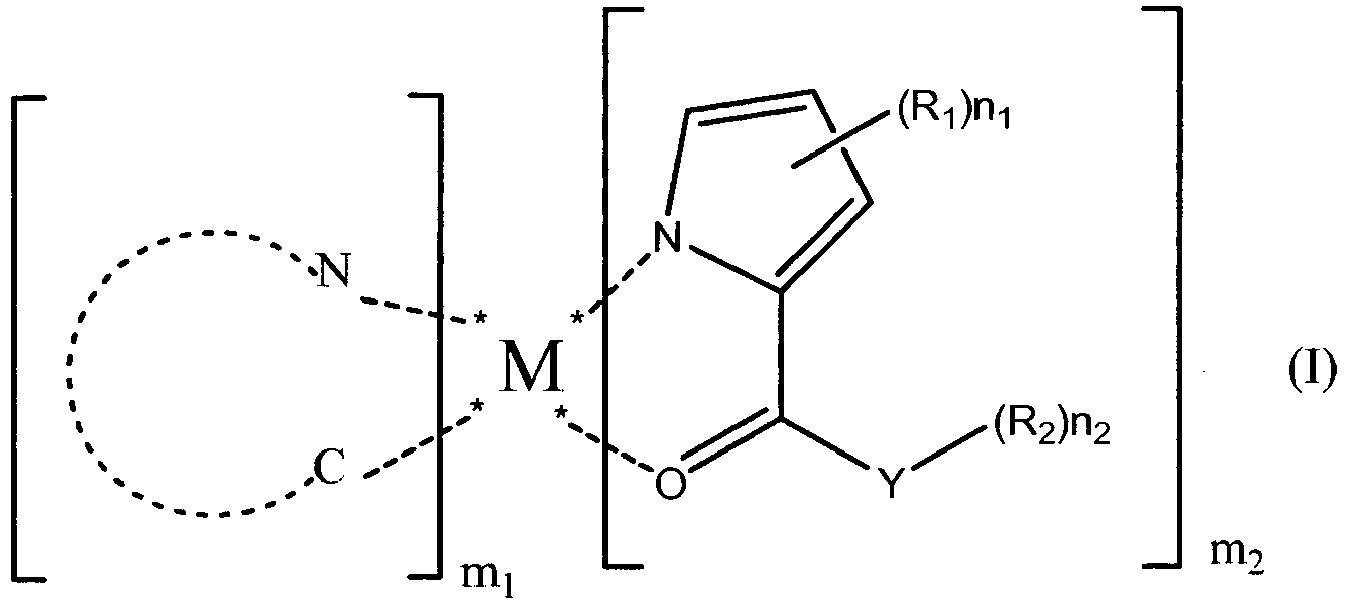
- In one embodiment, the present invention provides an electronic device comprising at least one electroactive layer comprising an organic metal composition of the present invention.
- In one embodiment, the present invention provides an organic light emitting device, comprising an anode; a cathode; and an organic electroluminescent layer disposed between and electrically connected to the anode and the cathode, wherein the organic electroluminescent layer comprising an electrophosphorescent composition.
- In this disclosure, the organic electroluminescent layer is at times referred to as a "bipolar emission layer" and, as the previous discussion suggests, is a layer within an organic light emitting device which when in operation contains a significant concentration of both electrons and holes and provides sites for exciton formation and light emission.
- Other components which may be present in an organic light emitting device include: a "hole injection layer" which is defined as a layer in contact with the anode which promotes the injection of holes from the anode into the interior layers of the OLED; and an "electron injection layer" which is defined as a layer in contact with the cathode that promotes the injection of electrons from the cathode into the interior layers of the OLED; an "electron transport layer" which is defined as a layer which facilitates conduction of electrons from cathode to a charge recombination site. The electron transport layer need not be in contact with the cathode, and frequently the electron transport layer is not an efficient hole transporter and thus it serves to block holes migrating toward the cathode.
- In one embodiment, the organic light emitting device comprises
an anode;
a hole injection layer;
an organic electroluminescent layer disposed between and electrically connected to the anode and the cathode, wherein the organic electroluminescent layer comprising an electrophosphorescent composition;
an electron transport layer;
an electron injection layer; and
a cathode. - Materials suitable for use as anode are illustrated by materials having a bulk conductivity of at least about 100 Ω/□ (ohms per square), as measured by a four-point probe technique. Indium tin oxide (ITO) is typically used as the anode because it is substantially transparent to light transmission and thus facilitates the escape of light emitted from electro-active organic layer. Other materials which may be utilized as the anode layer include tin oxide, indium oxide, zinc oxide, indium zinc oxide, zinc indium tin oxide, antimony oxide, and mixtures thereof.
- Materials suitable for use as cathode are illustrated by zero valent metals which can inject negative charge carriers (electrons) into the inner layer(s) of the OLED. Various zero valent metals suitable for use as the cathode include K, Li, Na, Cs, Mg, Ca, Sr, Ba, Al, Ag, Au, In, Sn, Zn, Zr, Sc, Y, elements of the lanthanide series, alloys thereof, and mixtures thereof. Suitable alloy materials for use as the cathode layer include Ag-Mg, Al-Li, In-Mg, Al-Ca, and Al-Au alloys. Layered non-alloy structures may also be employed as the cathode, for example a thin layer of a metal such as calcium, or a metal fluoride, such as LiF, covered by a thicker layer of a zero valent metal, such as aluminum or silver. In one embodiment, the cathode consists essentially of a single zero valent metal, for example a cathode consisting essentially of aluminum metal. The cathode may be deposited on the underlying element by physical vapor deposition, chemical vapor deposition, sputtering, or like technique. In one embodiment the cathode is transparent. The term "transparent" means allowing at least 50 percent, commonly at least 80 percent, and more commonly at least 90 percent, of light in the visible wavelength range to be transmitted through at an incident angle of less than or equal to 10 degrees. This means that a device or article, for example a cathode, described as being "transparent" will transmit at least 50 percent of light in the visible range which impinges on the device or article at an incident angle of about 10 degrees or less.
- The organic metal complexes or compositions of the present invention typically display strong charge transfer bands in their UV-Vis absorption spectra. Without being bound to the theory, such absorption bands are believed to result from the transfer of electrons from molecular orbitals that are primarily ligand in character to molecular orbitals that are primarily metal in character, or alternatively, transfer of electrons from molecular orbitals that are primarily metal in character to molecular orbitals that are primarily ligand in character. Such charge transfer events are designated variously as Ligand-to-Metal Charge Transfer (LMCT) or Metal-to-Ligand Charge Transfer (MLCT). In certain embodiments the organic metal compositions provided by the present invention are characterized by highly emissive excited states that may be produced when a voltage is applied. Materials possessing such properties are useful in the preparation of electronic devices, for example organic light emitting diodes (OLEDs). Other applications in which the organic metal complexes of the present invention may be used include light emitting electrochemical cells, photo detectors, photoconductive cells, photo switches, phototransistors, and phototubes.
- The organic metal complexes and the device comprising the complexes can emit light at room temperature.
- The present invention will be described in greater detail with reference to the following examples. The following examples are for illustrative purpose and are not intended to limit the scope of the invention.
- Thin layer chromatography (TLC) was performed on glass plates coated with silica-gel 60F (Merck 5715-7). The plates were inspected using UV light.
- Column chromatography was carried out using silica-gel 60 (Merck 9358, 230-400 mesh).
- All 1H- and 13C NMR spectra were recorded on a Bruker Advance 500 NMR spectrometer (at 500 MHz and 125 MHz, respectively) or a Bruker 400 NMR spectrometer (at 400 and 100 MHz, respectively). Chemical shifts were determined relative to tetramethylsilane using the residual solvent peak as a reference standard.
- To a nitrogen purged solution containing a mixture of 2-methoxyethanol and water was added IrCl3•xH2O (Strem Chemicals) followed by the addition of the cyclometallating ligand precursor (2.5-3.8 equiv.). The resulting mixture was heated at reflux for 15-48 h and the product was collected by vacuum filtration. In the following examples, the abbreviations "ppy", "piq", "F2ppy" and "C6" have the following structures shown in Table 2. The asterisks (*) signal the point of attachment of the cyclometallated ligand to metal.
Table 2 Ligand Abbreviation Ligand Chemical Structure Chemical Name of Ligand Precursor "ppy" 
2-phenylpyridine "piq" 
1-phenyl-isoquinoline "F2ppy" 
2-(2,4-difluoro-phenyl)pyridine "C6" 
Coumarin 6 - {(ppy)2Ir(µ-Cl)}2: A mixture of 2-methoxyethanol and water (30 ml : 10 mL) was degassed with N2 for 15 min. To this solvent mixture was added IrCl3•xH2O (0.388 g, 1.30 mmol) followed by 2-phenylpyridine (0.766 g, 4.94 mmol) and the mixture was heated at reflux for 24 h under an atmosphere of N2. The reaction mixture was cooled to room temperature and the yellow precipitate was collected by filtration and washed with EtOH (50 mL), acetone (50 mL), and dried in air. The yellow precipitate was dissolved in CH2Cl2 and filtered to remove an insoluble material. The solution was concentrated to dryness and filtered after being suspended in hexanes. Yield: 0.539 g, 77%. 1H-NMR (400 MHz, CD2Cl2, 25 °C) δ5.88 (d, 2H), 6.60 (m, 2H), 6.82 (m, 4H), 7.56 (d, 2H), 7.80 (m, 2H), 7.94 (d, 2H), 9.25 (d, 2H).
- {(F2ppy)2Ir(µ-Cl)}2: A mixture of 2-methoxyethanol and water (20 ml : 10 mL) was degassed with N2 for 15 min. To this solvent mixture was added IrCl3•xH2O (0.388 g, 1.30 mmol) followed by 2-(2,4-difluoropheny)-pyridine (0.766 g, 4.94 mmol) and the mixture was heated at reflux for 15 h under an atmosphere of N2. The reaction mixture was cooled to room temperature and poured into MeOH (200 mL). The yellow precipitate was collected by filtration and washed with MeOH and hexanes until the filtrate washes were colorless. The yellow precipitate was recrystallized from a mixture of toluene and hexanes to afford yellow needles. Yield: 2.20 g, 44%. 1H-NMR (400 MHz, CD2Cl2, 25 °C) δ5.29 (m, 4H), 6.38 (m, 4H), 6.87 (m, 4H), 7.87 (m, 4H), 8.33 (m, 4H), 9.12 (m, 4H).
- The ester derivatives of 2-pyrrolecarboxylic acid, [(F2ppy)2Ir(7)] (9) and [(F2ppy)2Ir(8)] (10), were prepared from the corresponding pyrrole ligand 7 and pyrrole ligand 8, respectively (Scheme 1).

- [(F2ppy)2Ir(7)] (9): To a stirred EtOH solution (3 mL) containing the pyrrole ligand 7 (57 mg, 0.32 mmol) (The pyrrole ligand 7, ethyl-3,4,5-trimethyl-pyrrole-2-carboxylate, was prepared following a known literature procedure. See D. H. Cho, J. Ho Lee, B. H. Kim, J. Org. Chem., 1999, 21, 8048-8050.) was added solid sodium hydride (40.0 mg, 1.67 mmol) at -10 °C. After letting this solution stir for 5 min, [(f2ppy)2Ir(µ-Cl)]2 (160 mg, 0.128 mmol) was added and the mixture was then heated at 80 °C for 2 hr. The yellow colored reaction mixture was cooled to room temperature and concentrated on a rotary evaporator without a heating bath. The now chilled solution was filtered to remove the product and the product was collected by filtration, washed with MeOH, and dried in air. Yield (170 mg, 88%). 1H NMR (500 MHz, CD2Cl2, 25 °C) δ1.25 (t, 3H), 1.38 (s, 3H), 1.82 (s, 3H), 2.23 (s, 3H), 4.19 (m, 1H), 4.30(m, 1H), 5.66 (dd, 1H), 5.72 (dd, 1H), 6.40 (m, 2H), 7.08 (t, 1H), 7.20 (t, 1H), 7.63 (d, 1H), 7.79 (m, 2H), 8.23 (d, 2H), 8.45 (d, 1H).
- Ethyl-3,5-diphenyl-pyrrole-2-carboxylate (pyrrole ligand 8) was prepared using a modified version of the procedure described in the literature (J. B. Paine, D. Dolphin, J. Org. Chem., 1985, 50, 5598-5604). To a flask charged with 1,3-diphenylpropanedione (2.2 g, 1.0 mmol) and diethyl aminomalonate hydrochloride (2.1 g, 1.0 mmol) was added AcOH (2 mL). The mixture was heated at 90 °C for 1 h, after which an additional 2.1 g (1 mmol) of diethyl aminomalonate hydrochloride was added and heating was continued for 11 h. The reaction mixture was poured into in ice water (20 mL) with stirring followed by 10 mL of EtOH and stirred for 1 h. The precipitate was collected by filtration and washed with H2O and dried in air (2.7 g). The crude product was chromatographed through SiO2 and eluted with CH2Cl2/Hexanes (1:1). Removal of solvents from combined fractions containing the product afforded an off-white solid. The product was recrystallized from CH2Cl2/Hexanes to give colorless crystals. Yield: 1.8 g, 62%. 1H NMR (400 MHz, CD2Cl2, 25 °C) δ1.27 (t, 3H), 4.25 (q, 2H), 6.66 (d, 1H), 7.39 (m, 6H), 7.62 (m, 4H), 9.45 (bs, 1H). The 1H NMR spectrum of the product was consistent with literature data. See: A. Fürstner, H. Weintritt, A. Hupperts, J. Org. Chem., 1995, 60, 6637-6641.
- [(F2ppy)2Ir(8)] (10): To a stirred EtOH solution (3 mL) containing the pyrrole ligand 8 (93 mg, 0.32 mmol) was added solid sodium hydride (40.0 mg, 1.67 mmol) at-10 °C. After letting this solution stir for 5 min, [(f2ppy)2Ir(µ-Cl)]2 (160 mg, 0.128 mmol) was added and the mixture was then heated at 80 °C for 2 hr. The yellow colored reaction mixture was cooled to room temperature and concentrated on a rotary evaporator without a heating bath. The now chilled solution was filtered to remove the product and the product was collected by filtration, washed with MeOH, and dried in air. Yield (204 mg, 92%). 1H NMR (400 MHz, CD2Cl2, 25 °C) δ1.14 (t, 3H), 4.16 (m, 1H), 4.29 (m, 1H), 5.19 (dd, 1H), 5.56 (dd, 1H), 6.09 (m, 1H), 6.31 (s, 1H), 6.38 (m, 1H), 6.74 (m, 2H), 6.85 (m, 2H), 6.93 (m, 1H), 7.15 (m, 1H), 7.25 (m, 2H), 7.33 (m, 2H), 7.57 (m, 2H), 7.64 (m, 1H), 7.79 (m, 1H), 7.86 (m 1H), 8.24 (m, 2H), 8.55 (m, 1H).
- As solids, complex [(F2ppy)2Ir(7)] (9) emitted blue-green light and the complex [(F2ppy)2Ir(8)] (10) unexpectedly emitted yellow light. At room temperature degassed solutions complex 9 was weakly blue-green emissive at room-temperature, whereas, complex 10 weakly yellow emissive. In frozen glassy-toluene, complex 9 was a strongly blue emissive while complex 10 was strongly green emissive.
- N-(phenylmethyl)-1H-Pyrrole-2-carboxamide (the pyrrole ligand 11): To a stirred toluene solution (50 mL) containing a suspension of 2-pyrrole carboxylic acid (1.0 g, 9.0 mmol) maintained at -10 °C was added oxalyl chloride (1.65 mL, 18.92 mmol). The cooling bath was removed and stirred at room temperature for 12 h. The volatile solvents were removed and the remaining toluene solution (30 mL) containing the acid chloride was used without futher purification. To a 15 mL portion of the toluene solution containing the acid chloride (4.5 m mol) was added a toluene solution (5 mL) containing Et3N (3 mL) and benzylamine (1.0 mL) and stirred at RT for 1.5 h. After which, the reaction mixture was washed with H2O (100 mL), 5% HCl (3x 100 mL), satd. NaHCO3 (1×100 mL), brine (1×100 mL), and dried over MgSO4. Concentration of the dried toluene solution afforded the product as an off-white solid. Recrystallized from CH2Cl2/Hexanes. Yield: 0.47 g, 52%. 1H NMR (500 MHz, CD2Cl2, 25 °C) δ4.60 (d, 2H), 6.21 (m, 1H), 6.40 (bs, 1H), 6.60 (m, 1H), 6.90 (m, 1H), 7.27 (m, 1H), 7.34 (d, 4H), 10.14 (bs, 1H).
- [(F2ppy)2Ir(11)] (13): To a stirred THF (anhydrous) solution (4 mL) was added solid sodium hydride (15.0 mg, 0.625 mmol) at -10 °C. After letting this solution stir for 10 min, the pyrrole ligand 11 (102 mg, 0.512 mmol) and stirring was continued for 10 min. To this solution was added [(f2ppy)2Ir(µ-Cl)]2 (160 mg, 0.128 mmol) and the mixture was stirred at RT for 2h by which time the solution became homogeneous. The mixture was poured into a mixture of MeOH/H2O/NH4Cl(aq) (150 ml/25 mL/0.3 mL) and concentrated to dryness. The crude product was chromatographed through SiO2 (CH2Cl2). After removal of solvents to near dryness to give a glassy film, the product was crystallized upon the addition of MeOH (15 mL). The product was collected by a filtration and washed with 70% MeOH and dried in air. Yield (180 mg, 91 %). 1H NMR (500 MHz, CD2Cl2, 25 °C) δ4.5I (dd, 1H), 4.61 (dd, 1H), 5.77 (m, 2H), 6.13 (m, 1H), 6.35 (m. 2H), 6.42 (m, 2H), 6.69 (d, 1H), 7.03 (m, 1H), 7.11 (m, 3H), 7.25 (m 3H), 7.34 (d, 1H), 7.75 (t, 1H), 7.80 (t, 1H), 8.22 (d, 1H), 8.26 (d, 1H), 8.41 (d, 1H).
- N-[(4-methoxyphenyl)methyl]-1H-Pyrrole-2-carboxamide (pyrrole ligand 12): To a stirred CH2Cl2 solution (20 mL) containing a suspension of 2-pyrrole carboxylic acid (1.0g, 9.0 mmol) maintained at -10 °C was added oxalyl chloride (3.0 mL). The cooling bath was removed and stirred at room temperature for 4 h. The volatile solvents were removed and the residue was redissolved in CH2Cl2 (20 mL). The CH2Cl2 solution containing the acid chloride was treated with a mixture of Et3N (3 mL) and 4-methoxybenzylamine (1.0mL) and stirred at room temperatue for 3 h. After which, the reaction mixture was washed with H2O (100 mL), 5% HCl (3×100 mL), satd. NaHCO3 (1×100 mL), brine (1×100 mL), and dried over MgSO4. Crude solid was dissolved in EtOAc and upon cooling a crystalline material was formed and removed by filtration. The mother liquor was concentrated to dryness and recrystallized from EtOAc/Hexanes. Yield: 0.57 g, 28%. 1H NMR (500 MHz, CD2Cl2, 25 °C) δ3.78 (s, 3H), 4.52 (d, 2H), 6.21 (m, 1H), 6.31 (bs, 1H), 6.57 (m, 1H), 6.87 (d, 2H), 6.91 (m, 1H), 7.27 (d, 2H), 10.02 (bs, 1H).
- [(F2ppy)2Ir(12)] (14): To a stirred THF (anhydrous) solution (4 mL) was added solid sodium hydride (15.0 mg, 0.625 mmol) at -10 °C. After letting this solution stir for 10 min, the pyrrole ligand 12 (117 mg, 0.512 mmol) was added and stirring was continued for 10 min. To this solution was added [(f2ppy)2Ir(µ-Cl)]2 (160 mg, 0.128 mmol) and the mixture was stirred at RT for 2h by which time the solution became homogeneous. The mixture was poured into a mixture of MeOH/H2O/NH4Cl(aq) (150 ml/25 mL/0.3 mL) and concentrated to dryness. The crude product was chromatographed through SiO2 (CH2Cl2). After removal of solvents to near dryness to give a glassy film, the product was crystallized upon the addition of MeOH (15 mL). The product was collected by filtration and washed with 70% MeOH and dried in air. Yield (194 mg, 95%). 1H NMR (400 MHz, CD2Cl2, 25 °C) δ3.78 (s, 3H), 4.42 (dd, 1H), 4.54 (dd, 1H), 5.78 (m, 2H), 6.11 (m, 1H), 6.29 (bt, 1H), 6.32 (s, 1H), 6.42 (m, 2H), 6.67 (d, 1H), 6.76 (d, 2H), 7.03 (m, 3H), 7.12 (t, 1H), 7.34 (d, 1H), 7.77 (m, 2H), 8.22 (d, 1H), 8.27 (d, 1H), 8.42 (d, 1H).
Claims (15)
- An organic metal complex represented by the formula (I)

M is a metal selected from Rh, Ir, or Pt;
Y represents N or O;
R1 represents a hydrogen, a halogen, a nitro group, an amino group, a hydroxyl group, a C3-C40 aromatic radical, a C1-C50 aliphatic radical, and a C3-C50 cycloaliphatic radical;
R2 represents a hydrogen, C3-C20 aromatic radical, C1-C50 aliphatic radical, or a C3-C50 cycloaliphatic radical; or R1 and R2, together with the adjacent Y, may form a ring, preferably a 5- or 6-membered ring;
n1 has a value of from 0 to 3; and
n2 has a value of 0 to 2;
m1 has a value of at least 1; and
m2 has a value of at least 1 provided that m1+m2 is 3;
wherein the ligand
- The complex according to claim 1, wherein Y represents N.
- The complex according to claim 1, wherein R1 represents a C3-C20 aralkyl, a C3-C14 aryl, a C1-C20 alkyl, a C1-C20 haloalkyl, C1-C20 alkenyl, C1-C20 alkynyl, C1-C20 alkenyl, or a C3-C7 cycloalkyl.
- The complex according to claim 1, wherein R2 represents a C3-C20 aralkyl, a C3-C14 aryl, a C1-C20 alkyl, a C1-C20 haloalkyl, C1-C20 alkenyl, C1-C20 alkynyl, C1-C20 alkenyl, or a C3-C7 cycloalkyl.
- The complex according to claim 1, wherein R2 represents a C7-C10 aralkyl, or a C1-C6 alkyl.
- The complex according to claim 1, wherein X is CH, R1 represents H, R2 represents benzyl, n1 is 0 and n2 is 1.
- The complex according to claim 1, wherein X is CH, R1 represents H, R2 represents ethyl, n1 is 0 and n2 is 2.
- The complex according to claim 1, wherein M is Ir.
- The complex according to claim 1, wherein in the cyclometalated ligand

- The complex according to claim 9, wherein in the cyclometalated ligand, C is a ring-forming atom in a C3-C14 aromatic radical; and N is a ring-forming atom in a nitrogen-containing C3-C14 aromatic radical.
- A composition comprising at least one organic metal complex represented by the formula (I)

M is a metal selected from Rh, Ir, or Pt;
Y represents N or O;
R1 represents a hydrogen, a halogen, a nitro group, an amino group, a hydroxyl group, a C3-C40 aromatic radical, a C1-C50 aliphatic radical, and a C3-C50 cycloaliphatic radical;
R2 represents a hydrogen, C3-C20 aromatic radical, C1-C50 aliphatic radical, or a C3-C50 cycloaliphatic radical; or R1 and R2, together with the adjacent Y, may form a ring, preferably a 5- or 6-membered ring;
n1 has a value of from 0 to 3; and
n2 has a value of 0 to 2;
m1 has a value of at least 1; and
m2 has a value of at least 1 provided that m1+m2 is 3;
wherein the ligand
- An electrophosphorescent composition comprising at least one electroactive host material and at least one organic metal complex represented by the formula (I)

M is a metal selected from Rh, Ir, or Pt;
Y represents N or O;
R1 represents a hydrogen, a halogen, a nitro group, an amino group, a hydroxyl group, a C3-C40 aromatic radical, a C1-C50 aliphatic radical, and a C3-C50 cycloaliphatic radical;
R2 represents a hydrogen, C3-C20 aromatic radical, C1-C50 aliphatic radical, or a C3-C50 cycloaliphatic radical; or R1 and R2, together with the adjacent Y, may form a ring, preferably a 5- or 6-membered ring;
n1 has a value of from 0 to 3; and
n2 has a value of 0 to 2;
m1 has a value of at least 1; and
m2 has a value of at least 1 provided that m1+m2 is 3;
wherein the ligand
- An organic light emitting device, comprising
an anode;
a cathode; and
an organic light emitting layer positioned between the anode and the cathode, wherein the organic light emission layer comprises an organic metal complex represented by the formula (I)
M is a metal selected from Rh, Ir, or Pt;
Y represents N or O;
R1 represents a hydrogen, a halogen, a nitro group, an amino group, a hydroxyl group, a C3-C40 aromatic radical, a C1-C50 aliphatic radical, and a C3-C50 cycloaliphatic radical;
R2 represents a hydrogen, C3-C20 aromatic radical, C1-C50 aliphatic radical, or a C3-C50 cycloaliphatic radical; or R1 and R2, together with the adjacent Y, may form a ring, preferably a 5- or 6-membered ring;
n1 has a value of from 0 to 3; and
n2 has a value of 0 to 2;
m1 has a value of at least 1; and
m2 has a value of at least 1 provided that m1+m2 is 3;
wherein the ligand
- The organic light emitting device according to the claim 13, further comprising one or more layers selected from a hole injection layer; an electron injection layer; and an electron transport layer.
- The organic light emitting device according to the claim 13, wherein the organic light emitting device is selected from the group consisting of light emitting electrochemical cells, photo detectors, photoconductive cells, photo switches, phototransistors, and phototubes.
Applications Claiming Priority (2)
| Application Number | Priority Date | Filing Date | Title |
|---|---|---|---|
| US12/342,604 US20100156278A1 (en) | 2008-12-23 | 2008-12-23 | Organic metal complexes for use in optoelectronic devices |
| PCT/US2009/067115 WO2010074957A1 (en) | 2008-12-23 | 2009-12-08 | Organic metal complexes for use in optoelectronic devices |
Publications (2)
| Publication Number | Publication Date |
|---|---|
| EP2382225A1 EP2382225A1 (en) | 2011-11-02 |
| EP2382225B1 true EP2382225B1 (en) | 2013-08-28 |
Family
ID=41587692
Family Applications (1)
| Application Number | Title | Priority Date | Filing Date |
|---|---|---|---|
| EP09775043.4A Not-in-force EP2382225B1 (en) | 2008-12-23 | 2009-12-08 | Organic metal complexes for use in optoelectronic devices |
Country Status (6)
| Country | Link |
|---|---|
| US (1) | US20100156278A1 (en) |
| EP (1) | EP2382225B1 (en) |
| JP (1) | JP2012513392A (en) |
| KR (1) | KR20110106405A (en) |
| CN (1) | CN102325781A (en) |
| WO (1) | WO2010074957A1 (en) |
Families Citing this family (3)
| Publication number | Priority date | Publication date | Assignee | Title |
|---|---|---|---|---|
| US9318725B2 (en) * | 2012-02-27 | 2016-04-19 | Jian Li | Microcavity OLED device with narrow band phosphorescent emitters |
| US20180251425A1 (en) * | 2015-08-17 | 2018-09-06 | University Of Mysore | 2,3,5 trisubstituted pyrrole derivatives as topoisomerase inhibitors and therapeutic uses thereof |
| EP3336619A1 (en) * | 2016-12-15 | 2018-06-20 | The Swatch Group Research and Development Ltd | Method for producing a smart bracelet provided with an insert which has electronic components |
Family Cites Families (9)
| Publication number | Priority date | Publication date | Assignee | Title |
|---|---|---|---|---|
| AU2003259917A1 (en) * | 2002-08-16 | 2004-03-03 | The University Of Southern California | Organic light emitting materials with anionic ligand |
| KR100509603B1 (en) * | 2002-12-28 | 2005-08-22 | 삼성에스디아이 주식회사 | Red emitting compound and organic electroluminescence device |
| US20060269780A1 (en) * | 2003-09-25 | 2006-11-30 | Takayuki Fukumatsu | Organic electroluminescent device |
| TW200531592A (en) * | 2004-03-15 | 2005-09-16 | Nippon Steel Chemical Co | Organic electroluminescent device |
| KR101290056B1 (en) * | 2005-01-07 | 2013-07-30 | 이데미쓰 고산 가부시키가이샤 | Metal complex compound and organic electroluminescent element using the same |
| KR100676965B1 (en) * | 2005-03-05 | 2007-02-02 | 주식회사 두산 | Novel Iridium Complexes and Organic Electroluminescent Devices Using the Same |
| US7830081B2 (en) * | 2006-03-22 | 2010-11-09 | General Electric Company | Optoelectronic devices with multilayered structures |
| US7691292B2 (en) * | 2006-07-28 | 2010-04-06 | General Electric Company | Organic iridium compositions and their use in electronic devices |
| KR20100018036A (en) * | 2007-06-05 | 2010-02-16 | 가부시키가이샤 한도오따이 에네루기 켄큐쇼 | Organometallic complex, and light-emitting material, light-emitting element, light-emitting device and electronic device |
-
2008
- 2008-12-23 US US12/342,604 patent/US20100156278A1/en not_active Abandoned
-
2009
- 2009-12-08 WO PCT/US2009/067115 patent/WO2010074957A1/en not_active Ceased
- 2009-12-08 KR KR1020117017148A patent/KR20110106405A/en not_active Withdrawn
- 2009-12-08 CN CN2009801576129A patent/CN102325781A/en active Pending
- 2009-12-08 EP EP09775043.4A patent/EP2382225B1/en not_active Not-in-force
- 2009-12-08 JP JP2011542239A patent/JP2012513392A/en active Pending
Also Published As
| Publication number | Publication date |
|---|---|
| JP2012513392A (en) | 2012-06-14 |
| CN102325781A (en) | 2012-01-18 |
| EP2382225A1 (en) | 2011-11-02 |
| KR20110106405A (en) | 2011-09-28 |
| WO2010074957A1 (en) | 2010-07-01 |
| US20100156278A1 (en) | 2010-06-24 |
Similar Documents
| Publication | Publication Date | Title |
|---|---|---|
| US7332232B2 (en) | OLEDs utilizing multidentate ligand systems | |
| US6858327B2 (en) | Organic light emitting materials and devices | |
| EP1711579B1 (en) | Improved electroluminescent stability | |
| US7482451B2 (en) | Organic light emitting materials with anionic ligand | |
| EP2070936B1 (en) | Platinum complex compound and organic electroluminescence device using the same | |
| TWI471406B (en) | A phosphorescent element, and an organic electroluminescent device using the same | |
| US7429426B2 (en) | Organometallic compounds for use in electroluminescent devices | |
| JP4268041B2 (en) | Organic light-emitting device having a carrier blocking layer containing a metal complex | |
| US7011897B2 (en) | Organic light emitting materials and devices | |
| EP1561240B1 (en) | Organic light emitting materials and devices | |
| TWI429650B (en) | Organic electroluminescent elements | |
| TWI466980B (en) | Organic electroluminescent elements | |
| US20050170206A1 (en) | OLEDs utilizing multidentate ligand systems | |
| KR20060002810A (en) | Metal complex | |
| US20230413661A1 (en) | Luminescent gold(iii) compounds with thermally stimulated delayed phosphorescence (tsdp) property for organic light-emitting devices and their preparation | |
| TWI593697B (en) | Material for organic electroluminescent element and organic electroluminescent element using same | |
| KR101255233B1 (en) | Organometallic complexes and organic electroluminescence device using the same | |
| US20100156278A1 (en) | Organic metal complexes for use in optoelectronic devices | |
| JP2005222794A (en) | Organic electroluminescent device and method for preparing organic electroluminescent device material | |
| JP4223768B2 (en) | Light emitting element | |
| KR20160109596A (en) | Metal complex for dopant of a light emitting layer and blue phosphorescent organic light emitting device comprising the same | |
| US20250126963A1 (en) | Luminescent gold(iii) compounds with thermally stimulated delayed phosphorescence (tsdp) property for organic light-emitting devices and their preparation | |
| WO2013165118A1 (en) | Novel intermetallic compound, and blue phosphorescent organic light-emitting diode including same | |
| KR101945753B1 (en) | Metal complex for dopant of a light emitting layer and blue phosphorescent organic light emitting device comprising the same | |
| CN109206457A (en) | Red phosphorescent compound and the organic electroluminescence device for using the compound |
Legal Events
| Date | Code | Title | Description |
|---|---|---|---|
| PUAI | Public reference made under article 153(3) epc to a published international application that has entered the european phase |
Free format text: ORIGINAL CODE: 0009012 |
|
| 17P | Request for examination filed |
Effective date: 20110725 |
|
| AK | Designated contracting states |
Kind code of ref document: A1 Designated state(s): AT BE BG CH CY CZ DE DK EE ES FI FR GB GR HR HU IE IS IT LI LT LU LV MC MK MT NL NO PL PT RO SE SI SK SM TR |
|
| DAX | Request for extension of the european patent (deleted) | ||
| GRAP | Despatch of communication of intention to grant a patent |
Free format text: ORIGINAL CODE: EPIDOSNIGR1 |
|
| INTG | Intention to grant announced |
Effective date: 20130405 |
|
| GRAS | Grant fee paid |
Free format text: ORIGINAL CODE: EPIDOSNIGR3 |
|
| GRAA | (expected) grant |
Free format text: ORIGINAL CODE: 0009210 |
|
| AK | Designated contracting states |
Kind code of ref document: B1 Designated state(s): AT BE BG CH CY CZ DE DK EE ES FI FR GB GR HR HU IE IS IT LI LT LU LV MC MK MT NL NO PL PT RO SE SI SK SM TR |
|
| REG | Reference to a national code |
Ref country code: GB Ref legal event code: FG4D |
|
| REG | Reference to a national code |
Ref country code: CH Ref legal event code: EP |
|
| REG | Reference to a national code |
Ref country code: AT Ref legal event code: REF Ref document number: 629297 Country of ref document: AT Kind code of ref document: T Effective date: 20130915 |
|
| REG | Reference to a national code |
Ref country code: IE Ref legal event code: FG4D |
|
| REG | Reference to a national code |
Ref country code: DE Ref legal event code: R096 Ref document number: 602009018406 Country of ref document: DE Effective date: 20131024 |
|
| REG | Reference to a national code |
Ref country code: NL Ref legal event code: T3 |
|
| REG | Reference to a national code |
Ref country code: AT Ref legal event code: MK05 Ref document number: 629297 Country of ref document: AT Kind code of ref document: T Effective date: 20130828 |
|
| REG | Reference to a national code |
Ref country code: LT Ref legal event code: MG4D |
|
| PG25 | Lapsed in a contracting state [announced via postgrant information from national office to epo] |
Ref country code: CY Free format text: LAPSE BECAUSE OF FAILURE TO SUBMIT A TRANSLATION OF THE DESCRIPTION OR TO PAY THE FEE WITHIN THE PRESCRIBED TIME-LIMIT Effective date: 20130724 Ref country code: LT Free format text: LAPSE BECAUSE OF FAILURE TO SUBMIT A TRANSLATION OF THE DESCRIPTION OR TO PAY THE FEE WITHIN THE PRESCRIBED TIME-LIMIT Effective date: 20130828 Ref country code: AT Free format text: LAPSE BECAUSE OF FAILURE TO SUBMIT A TRANSLATION OF THE DESCRIPTION OR TO PAY THE FEE WITHIN THE PRESCRIBED TIME-LIMIT Effective date: 20130828 Ref country code: HR Free format text: LAPSE BECAUSE OF FAILURE TO SUBMIT A TRANSLATION OF THE DESCRIPTION OR TO PAY THE FEE WITHIN THE PRESCRIBED TIME-LIMIT Effective date: 20130828 Ref country code: SE Free format text: LAPSE BECAUSE OF FAILURE TO SUBMIT A TRANSLATION OF THE DESCRIPTION OR TO PAY THE FEE WITHIN THE PRESCRIBED TIME-LIMIT Effective date: 20130828 Ref country code: IS Free format text: LAPSE BECAUSE OF FAILURE TO SUBMIT A TRANSLATION OF THE DESCRIPTION OR TO PAY THE FEE WITHIN THE PRESCRIBED TIME-LIMIT Effective date: 20131228 Ref country code: PT Free format text: LAPSE BECAUSE OF FAILURE TO SUBMIT A TRANSLATION OF THE DESCRIPTION OR TO PAY THE FEE WITHIN THE PRESCRIBED TIME-LIMIT Effective date: 20131230 Ref country code: NO Free format text: LAPSE BECAUSE OF FAILURE TO SUBMIT A TRANSLATION OF THE DESCRIPTION OR TO PAY THE FEE WITHIN THE PRESCRIBED TIME-LIMIT Effective date: 20131128 |
|
| PGFP | Annual fee paid to national office [announced via postgrant information from national office to epo] |
Ref country code: GB Payment date: 20131227 Year of fee payment: 5 |
|
| PG25 | Lapsed in a contracting state [announced via postgrant information from national office to epo] |
Ref country code: LV Free format text: LAPSE BECAUSE OF FAILURE TO SUBMIT A TRANSLATION OF THE DESCRIPTION OR TO PAY THE FEE WITHIN THE PRESCRIBED TIME-LIMIT Effective date: 20130828 Ref country code: BE Free format text: LAPSE BECAUSE OF FAILURE TO SUBMIT A TRANSLATION OF THE DESCRIPTION OR TO PAY THE FEE WITHIN THE PRESCRIBED TIME-LIMIT Effective date: 20130828 Ref country code: PL Free format text: LAPSE BECAUSE OF FAILURE TO SUBMIT A TRANSLATION OF THE DESCRIPTION OR TO PAY THE FEE WITHIN THE PRESCRIBED TIME-LIMIT Effective date: 20130828 Ref country code: FI Free format text: LAPSE BECAUSE OF FAILURE TO SUBMIT A TRANSLATION OF THE DESCRIPTION OR TO PAY THE FEE WITHIN THE PRESCRIBED TIME-LIMIT Effective date: 20130828 Ref country code: GR Free format text: LAPSE BECAUSE OF FAILURE TO SUBMIT A TRANSLATION OF THE DESCRIPTION OR TO PAY THE FEE WITHIN THE PRESCRIBED TIME-LIMIT Effective date: 20131129 Ref country code: SI Free format text: LAPSE BECAUSE OF FAILURE TO SUBMIT A TRANSLATION OF THE DESCRIPTION OR TO PAY THE FEE WITHIN THE PRESCRIBED TIME-LIMIT Effective date: 20130828 |
|
| PGFP | Annual fee paid to national office [announced via postgrant information from national office to epo] |
Ref country code: IT Payment date: 20131220 Year of fee payment: 5 Ref country code: NL Payment date: 20131226 Year of fee payment: 5 Ref country code: FR Payment date: 20131217 Year of fee payment: 5 |
|
| PG25 | Lapsed in a contracting state [announced via postgrant information from national office to epo] |
Ref country code: CY Free format text: LAPSE BECAUSE OF FAILURE TO SUBMIT A TRANSLATION OF THE DESCRIPTION OR TO PAY THE FEE WITHIN THE PRESCRIBED TIME-LIMIT Effective date: 20130828 |
|
| PG25 | Lapsed in a contracting state [announced via postgrant information from national office to epo] |
Ref country code: DK Free format text: LAPSE BECAUSE OF FAILURE TO SUBMIT A TRANSLATION OF THE DESCRIPTION OR TO PAY THE FEE WITHIN THE PRESCRIBED TIME-LIMIT Effective date: 20130828 Ref country code: RO Free format text: LAPSE BECAUSE OF FAILURE TO SUBMIT A TRANSLATION OF THE DESCRIPTION OR TO PAY THE FEE WITHIN THE PRESCRIBED TIME-LIMIT Effective date: 20130828 Ref country code: CZ Free format text: LAPSE BECAUSE OF FAILURE TO SUBMIT A TRANSLATION OF THE DESCRIPTION OR TO PAY THE FEE WITHIN THE PRESCRIBED TIME-LIMIT Effective date: 20130828 Ref country code: SK Free format text: LAPSE BECAUSE OF FAILURE TO SUBMIT A TRANSLATION OF THE DESCRIPTION OR TO PAY THE FEE WITHIN THE PRESCRIBED TIME-LIMIT Effective date: 20130828 Ref country code: EE Free format text: LAPSE BECAUSE OF FAILURE TO SUBMIT A TRANSLATION OF THE DESCRIPTION OR TO PAY THE FEE WITHIN THE PRESCRIBED TIME-LIMIT Effective date: 20130828 |
|
| PG25 | Lapsed in a contracting state [announced via postgrant information from national office to epo] |
Ref country code: ES Free format text: LAPSE BECAUSE OF FAILURE TO SUBMIT A TRANSLATION OF THE DESCRIPTION OR TO PAY THE FEE WITHIN THE PRESCRIBED TIME-LIMIT Effective date: 20130828 |
|
| REG | Reference to a national code |
Ref country code: DE Ref legal event code: R097 Ref document number: 602009018406 Country of ref document: DE |
|
| PLBE | No opposition filed within time limit |
Free format text: ORIGINAL CODE: 0009261 |
|
| STAA | Information on the status of an ep patent application or granted ep patent |
Free format text: STATUS: NO OPPOSITION FILED WITHIN TIME LIMIT |
|
| REG | Reference to a national code |
Ref country code: CH Ref legal event code: PL |
|
| 26N | No opposition filed |
Effective date: 20140530 |
|
| PG25 | Lapsed in a contracting state [announced via postgrant information from national office to epo] |
Ref country code: LU Free format text: LAPSE BECAUSE OF FAILURE TO SUBMIT A TRANSLATION OF THE DESCRIPTION OR TO PAY THE FEE WITHIN THE PRESCRIBED TIME-LIMIT Effective date: 20131208 |
|
| PGFP | Annual fee paid to national office [announced via postgrant information from national office to epo] |
Ref country code: DE Payment date: 20131230 Year of fee payment: 5 |
|
| REG | Reference to a national code |
Ref country code: DE Ref legal event code: R097 Ref document number: 602009018406 Country of ref document: DE Effective date: 20140530 |
|
| REG | Reference to a national code |
Ref country code: IE Ref legal event code: MM4A |
|
| PG25 | Lapsed in a contracting state [announced via postgrant information from national office to epo] |
Ref country code: LI Free format text: LAPSE BECAUSE OF NON-PAYMENT OF DUE FEES Effective date: 20131231 Ref country code: CH Free format text: LAPSE BECAUSE OF NON-PAYMENT OF DUE FEES Effective date: 20131231 Ref country code: IE Free format text: LAPSE BECAUSE OF NON-PAYMENT OF DUE FEES Effective date: 20131208 |
|
| PG25 | Lapsed in a contracting state [announced via postgrant information from national office to epo] |
Ref country code: MC Free format text: LAPSE BECAUSE OF FAILURE TO SUBMIT A TRANSLATION OF THE DESCRIPTION OR TO PAY THE FEE WITHIN THE PRESCRIBED TIME-LIMIT Effective date: 20130828 |
|
| PG25 | Lapsed in a contracting state [announced via postgrant information from national office to epo] |
Ref country code: SM Free format text: LAPSE BECAUSE OF FAILURE TO SUBMIT A TRANSLATION OF THE DESCRIPTION OR TO PAY THE FEE WITHIN THE PRESCRIBED TIME-LIMIT Effective date: 20130828 |
|
| PG25 | Lapsed in a contracting state [announced via postgrant information from national office to epo] |
Ref country code: TR Free format text: LAPSE BECAUSE OF FAILURE TO SUBMIT A TRANSLATION OF THE DESCRIPTION OR TO PAY THE FEE WITHIN THE PRESCRIBED TIME-LIMIT Effective date: 20130828 |
|
| REG | Reference to a national code |
Ref country code: DE Ref legal event code: R119 Ref document number: 602009018406 Country of ref document: DE |
|
| REG | Reference to a national code |
Ref country code: NL Ref legal event code: V1 Effective date: 20150701 |
|
| REG | Reference to a national code |
Ref country code: NL Ref legal event code: V1 Effective date: 20150701 |
|
| PG25 | Lapsed in a contracting state [announced via postgrant information from national office to epo] |
Ref country code: MK Free format text: LAPSE BECAUSE OF FAILURE TO SUBMIT A TRANSLATION OF THE DESCRIPTION OR TO PAY THE FEE WITHIN THE PRESCRIBED TIME-LIMIT Effective date: 20130828 Ref country code: HU Free format text: LAPSE BECAUSE OF FAILURE TO SUBMIT A TRANSLATION OF THE DESCRIPTION OR TO PAY THE FEE WITHIN THE PRESCRIBED TIME-LIMIT; INVALID AB INITIO Effective date: 20091208 Ref country code: BG Free format text: LAPSE BECAUSE OF FAILURE TO SUBMIT A TRANSLATION OF THE DESCRIPTION OR TO PAY THE FEE WITHIN THE PRESCRIBED TIME-LIMIT Effective date: 20130828 |
|
| GBPC | Gb: european patent ceased through non-payment of renewal fee |
Effective date: 20141208 |
|
| PG25 | Lapsed in a contracting state [announced via postgrant information from national office to epo] |
Ref country code: MT Free format text: LAPSE BECAUSE OF FAILURE TO SUBMIT A TRANSLATION OF THE DESCRIPTION OR TO PAY THE FEE WITHIN THE PRESCRIBED TIME-LIMIT Effective date: 20130828 |
|
| REG | Reference to a national code |
Ref country code: FR Ref legal event code: ST Effective date: 20150831 |
|
| PG25 | Lapsed in a contracting state [announced via postgrant information from national office to epo] |
Ref country code: NL Free format text: LAPSE BECAUSE OF NON-PAYMENT OF DUE FEES Effective date: 20150701 |
|
| PG25 | Lapsed in a contracting state [announced via postgrant information from national office to epo] |
Ref country code: DE Free format text: LAPSE BECAUSE OF NON-PAYMENT OF DUE FEES Effective date: 20150701 Ref country code: GB Free format text: LAPSE BECAUSE OF NON-PAYMENT OF DUE FEES Effective date: 20141208 |
|
| PG25 | Lapsed in a contracting state [announced via postgrant information from national office to epo] |
Ref country code: FR Free format text: LAPSE BECAUSE OF NON-PAYMENT OF DUE FEES Effective date: 20141231 |
|
| PG25 | Lapsed in a contracting state [announced via postgrant information from national office to epo] |
Ref country code: IT Free format text: LAPSE BECAUSE OF NON-PAYMENT OF DUE FEES Effective date: 20141208 |