EP2381244A1 - Light source - Google Patents
Light source Download PDFInfo
- Publication number
- EP2381244A1 EP2381244A1 EP10160812A EP10160812A EP2381244A1 EP 2381244 A1 EP2381244 A1 EP 2381244A1 EP 10160812 A EP10160812 A EP 10160812A EP 10160812 A EP10160812 A EP 10160812A EP 2381244 A1 EP2381244 A1 EP 2381244A1
- Authority
- EP
- European Patent Office
- Prior art keywords
- light source
- light
- illuminant
- laser
- red
- Prior art date
- Legal status (The legal status is an assumption and is not a legal conclusion. Google has not performed a legal analysis and makes no representation as to the accuracy of the status listed.)
- Ceased
Links
- 239000011575 calcium Substances 0.000 claims description 4
- 239000010949 copper Substances 0.000 claims description 4
- OYPRJOBELJOOCE-UHFFFAOYSA-N Calcium Chemical compound [Ca] OYPRJOBELJOOCE-UHFFFAOYSA-N 0.000 claims description 3
- VYZAMTAEIAYCRO-UHFFFAOYSA-N Chromium Chemical compound [Cr] VYZAMTAEIAYCRO-UHFFFAOYSA-N 0.000 claims description 3
- RYGMFSIKBFXOCR-UHFFFAOYSA-N Copper Chemical compound [Cu] RYGMFSIKBFXOCR-UHFFFAOYSA-N 0.000 claims description 3
- WHXSMMKQMYFTQS-UHFFFAOYSA-N Lithium Chemical compound [Li] WHXSMMKQMYFTQS-UHFFFAOYSA-N 0.000 claims description 3
- 229910052791 calcium Inorganic materials 0.000 claims description 3
- 239000011651 chromium Substances 0.000 claims description 3
- 229910052802 copper Inorganic materials 0.000 claims description 3
- 229910052744 lithium Inorganic materials 0.000 claims description 3
- 239000011777 magnesium Substances 0.000 claims description 3
- QSHDDOUJBYECFT-UHFFFAOYSA-N mercury Chemical compound [Hg] QSHDDOUJBYECFT-UHFFFAOYSA-N 0.000 claims description 3
- 229910052753 mercury Inorganic materials 0.000 claims description 3
- 239000011734 sodium Substances 0.000 claims description 3
- DGAQECJNVWCQMB-PUAWFVPOSA-M Ilexoside XXIX Chemical compound C[C@@H]1CC[C@@]2(CC[C@@]3(C(=CC[C@H]4[C@]3(CC[C@@H]5[C@@]4(CC[C@@H](C5(C)C)OS(=O)(=O)[O-])C)C)[C@@H]2[C@]1(C)O)C)C(=O)O[C@H]6[C@@H]([C@H]([C@@H]([C@H](O6)CO)O)O)O.[Na+] DGAQECJNVWCQMB-PUAWFVPOSA-M 0.000 claims description 2
- FYYHWMGAXLPEAU-UHFFFAOYSA-N Magnesium Chemical compound [Mg] FYYHWMGAXLPEAU-UHFFFAOYSA-N 0.000 claims description 2
- 229910052788 barium Inorganic materials 0.000 claims description 2
- DSAJWYNOEDNPEQ-UHFFFAOYSA-N barium atom Chemical compound [Ba] DSAJWYNOEDNPEQ-UHFFFAOYSA-N 0.000 claims description 2
- 229910052804 chromium Inorganic materials 0.000 claims description 2
- 238000000295 emission spectrum Methods 0.000 claims description 2
- 229910052749 magnesium Inorganic materials 0.000 claims description 2
- 229910052708 sodium Inorganic materials 0.000 claims description 2
- 229910052716 thallium Inorganic materials 0.000 claims description 2
- BKVIYDNLLOSFOA-UHFFFAOYSA-N thallium Chemical compound [Tl] BKVIYDNLLOSFOA-UHFFFAOYSA-N 0.000 claims description 2
- 230000005855 radiation Effects 0.000 abstract description 9
- 238000001228 spectrum Methods 0.000 description 7
- 210000002569 neuron Anatomy 0.000 description 6
- 210000001525 retina Anatomy 0.000 description 5
- 210000004027 cell Anatomy 0.000 description 3
- 208000003098 Ganglion Cysts Diseases 0.000 description 2
- 208000005400 Synovial Cyst Diseases 0.000 description 2
- 238000000862 absorption spectrum Methods 0.000 description 2
- 230000001419 dependent effect Effects 0.000 description 2
- 230000000694 effects Effects 0.000 description 2
- 230000004438 eyesight Effects 0.000 description 2
- 230000035945 sensitivity Effects 0.000 description 2
- 206010025421 Macule Diseases 0.000 description 1
- 238000010521 absorption reaction Methods 0.000 description 1
- 239000003795 chemical substances by application Substances 0.000 description 1
- 230000004456 color vision Effects 0.000 description 1
- 239000003086 colorant Substances 0.000 description 1
- 150000001875 compounds Chemical class 0.000 description 1
- 238000010586 diagram Methods 0.000 description 1
- 230000002708 enhancing effect Effects 0.000 description 1
- -1 halogenide Chemical class 0.000 description 1
- 210000005036 nerve Anatomy 0.000 description 1
- 229910052756 noble gas Inorganic materials 0.000 description 1
- 230000003595 spectral effect Effects 0.000 description 1
- 230000000007 visual effect Effects 0.000 description 1
- 238000012800 visualization Methods 0.000 description 1
Images



Classifications
-
- F—MECHANICAL ENGINEERING; LIGHTING; HEATING; WEAPONS; BLASTING
- F21—LIGHTING
- F21K—NON-ELECTRIC LIGHT SOURCES USING LUMINESCENCE; LIGHT SOURCES USING ELECTROCHEMILUMINESCENCE; LIGHT SOURCES USING CHARGES OF COMBUSTIBLE MATERIAL; LIGHT SOURCES USING SEMICONDUCTOR DEVICES AS LIGHT-GENERATING ELEMENTS; LIGHT SOURCES NOT OTHERWISE PROVIDED FOR
- F21K9/00—Light sources using semiconductor devices as light-generating elements, e.g. using light-emitting diodes [LED] or lasers
-
- F—MECHANICAL ENGINEERING; LIGHTING; HEATING; WEAPONS; BLASTING
- F21—LIGHTING
- F21Y—INDEXING SCHEME ASSOCIATED WITH SUBCLASSES F21K, F21L, F21S and F21V, RELATING TO THE FORM OR THE KIND OF THE LIGHT SOURCES OR OF THE COLOUR OF THE LIGHT EMITTED
- F21Y2115/00—Light-generating elements of semiconductor light sources
- F21Y2115/10—Light-emitting diodes [LED]
-
- F—MECHANICAL ENGINEERING; LIGHTING; HEATING; WEAPONS; BLASTING
- F21—LIGHTING
- F21Y—INDEXING SCHEME ASSOCIATED WITH SUBCLASSES F21K, F21L, F21S and F21V, RELATING TO THE FORM OR THE KIND OF THE LIGHT SOURCES OR OF THE COLOUR OF THE LIGHT EMITTED
- F21Y2115/00—Light-generating elements of semiconductor light sources
- F21Y2115/30—Semiconductor lasers
-
- H—ELECTRICITY
- H01—ELECTRIC ELEMENTS
- H01J—ELECTRIC DISCHARGE TUBES OR DISCHARGE LAMPS
- H01J61/00—Gas-discharge or vapour-discharge lamps
- H01J61/02—Details
- H01J61/12—Selection of substances for gas fillings; Specified operating pressure or temperature
- H01J61/18—Selection of substances for gas fillings; Specified operating pressure or temperature having a metallic vapour as the principal constituent
Definitions
- the invention relates to a light source.
- the invention relates to a lamp including the light source.
- the invention targets in improving the ability to realize details. It is an object of the invention to provide a light source addressing said target.
- a light source comprises an illuminant emitting radiation with wavelengths of 500nm to 550nm and/or of 585nm to 640nm.
- the illuminant emits radiation with wavelength of 515nm to 535nm and/or of 600nm to 620nm. That is, the illuminant may emit radiation with wavelength of about 525nm, which may be between 523nm and 527nm, and/or of about 610nm, which may be between 608nm and 612nm.
- wavelengths in the green spectrum of visible light 500nm to 550nm
- wavelengths in the red spectrum of visible light 585nm to 640nm
- the contrast or at least the comfort in utilizing such a light source may also be enhanced by a combination of the mentioned spectra.
- an illuminant emitting radiation with wavelengths of the green spectrum and of the red spectrum, simultaneously, will provide for a better contrast.
- the light source comprises a light emitting diode (LED).
- a light source may comprise a plurality of LEDs to have a better brightness.
- a number of red LEDs may be combined with a number of green LEDs in one light source or lamp.
- the light emitting diode may include an element out of the group consisting of an AlInGaP-LED and an InGaN-LED.
- the light source comprises a discharge tube.
- the emitting medium it is possible to emit radiation with a spectrum of green and/or red light.
- Green light wavelengths may be achieved by the use of Chrome or Copper.
- Red light wavelengths may be achieved by the use of Lithium or Calcium.
- the LEDs or discharge light source may be provided with selective filters to narrow down the emission spectrum of the light source.
- the light source comprises a laser.
- a laser may comprise a diode pumped Nd-YAG element which frequency is subsequently doubled and/or a red diode laser.
- the light sources in accordance with the invention may be utilized as a lamp for elder people, as a lamp for a microscope, as street lighting or as automobile front light, wherein the lamp includes a light source as described above.
- a light source according to the invention is capable of enhancing the contrast of something visible
- the processing of light by an eye will be described in a first step.
- Fig. 1 is a schematically illustration of light processing in an eye.
- the retina of an eye comprises neurons of the ganglion 10, cross-linked neurons 20, cone-cells 30, and rod-cells 40.
- An incidence of light 100 onto the retina will trigger an activity of the neurons and cells so as to send pulses to the visual nerve by the nervus opticus 50.
- a retina comprises three receptors for color vision, i.e. cones which are sensitive for red light, cones which are sensitive for green light, and cones which are sensitive for blue light.
- red, green and blue are substantially relevant for the brightness V( ⁇ ).
- red-green vision r( ⁇ )-g( ⁇ ) is relevant. This may be gathered from the fact that the most red and green cones can be found in the area of the yellow spot or macula of the retina.
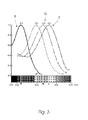
- the absorption spectra in fig.3 show peaks of the respective cones in the blue B, green G and red R spectra.
- the dotted line indicates the absorption of the rods which are relevant for the black-and-white vision.
- FIG. 4 Another illustration of the different sensitivity of the different cones, may be seen in fig. 4 , showing peaks of a green-red-cell (G-R), a red-green-cell (R-G), and of a blue-yellow-cell (B-Y) and a yellow-blue-cell (Y-B).
- G-R green-red-cell
- R-G red-green-cell
- B-Y blue-yellow-cell
- Y-B yellow-blue-cell
- lamps having an illuminant emitting light within the ranges stated above.
- a lamp comprises a laser 200 which usually provides for a selective and small band emission.
- a laser emitting a green beam 210 may be realized on the basis of a diode pumped NdY-AG laser with subsequent frequency doubling. Such a laser may have a wavelength of 532nm of its radiation.
- a lamp 300 comprises two different LEDs with emission wavelengths of about 525nm (310) and 610nm (320), respectively.
- LEDs on the basis of AlInGaP- and InGaN-LEDs have such emission wavelength.
- a lamp 400 comprises a plurality of discharge light sources, which have collectively emission wavelengths of about 525nm and about 610nm.
- discharge light sources with at least one element out of the following group are usable.
- Thallium (Tl) 535,1nm Chromium (Cr) 520,5nm and 520,8nm
- a discharge light source may comprise mercury and/or a noble gas as start gas or buffer gas.
- the above mentioned elements may also be provided as compound like halogenide, oxide and chalkogenide.
- a lamp comprises a combination of at least one type of LEDs and at least one discharge light source.
Landscapes
- Engineering & Computer Science (AREA)
- Physics & Mathematics (AREA)
- Microelectronics & Electronic Packaging (AREA)
- Optics & Photonics (AREA)
- General Engineering & Computer Science (AREA)
- Non-Portable Lighting Devices Or Systems Thereof (AREA)
- Led Device Packages (AREA)
Abstract
The application targets in improving the ability to realize details. In general, a light source according to the invention comprises an illuminant emitting radiation with wavelengths of 500nm to 550nm and/or of 585nm to 640nm. The light source may comprise a light emitting diode (LED), a discharge tube and/or a laser. Such a light source may be utilized in a lamp for elder people, in a lamp for a microscope, in street lighting or in automobile front light.
Description
- The invention relates to a light source. In particular, the invention relates to a lamp including the light source.
- In some applications it is important to recognize things or aspects of things. The ability of realizing details may depend on the possibility to see something with a good contrast, for example, if elder people want to read something, if scientists want to differentiate structures with a microscope, or if movable objects on a street have to be recognized to avoid an accident.
- The invention targets in improving the ability to realize details. It is an object of the invention to provide a light source addressing said target.
- This is achieved by the subject matter of each of the independent claims. Further embodiments of the invention are described in the dependent claims.
- In general, a light source according to the invention comprises an illuminant emitting radiation with wavelengths of 500nm to 550nm and/or of 585nm to 640nm. Preferably, the illuminant emits radiation with wavelength of 515nm to 535nm and/or of 600nm to 620nm. That is, the illuminant may emit radiation with wavelength of about 525nm, which may be between 523nm and 527nm, and/or of about 610nm, which may be between 608nm and 612nm.
- It is noted that either the wavelengths in the green spectrum of visible light (500nm to 550nm) or the wavelengths in the red spectrum of visible light (585nm to 640nm) are suitable to achieve the intended effect of providing a better contrast.
- The contrast or at least the comfort in utilizing such a light source, may also be enhanced by a combination of the mentioned spectra. In other words, an illuminant emitting radiation with wavelengths of the green spectrum and of the red spectrum, simultaneously, will provide for a better contrast.
- According to a first embodiment of the invention, the light source comprises a light emitting diode (LED). It will be understood, that a light source may comprise a plurality of LEDs to have a better brightness. For a light source emitting green light together with red light, a number of red LEDs may be combined with a number of green LEDs in one light source or lamp.
- For example, the light emitting diode may include an element out of the group consisting of an AlInGaP-LED and an InGaN-LED.
- According to a second embodiment of the invention, the light source comprises a discharge tube. With an appropriate choice of the emitting medium, it is possible to emit radiation with a spectrum of green and/or red light. Green light wavelengths may be achieved by the use of Chrome or Copper. Red light wavelengths may be achieved by the use of Lithium or Calcium.
- Furthermore, the LEDs or discharge light source may be provided with selective filters to narrow down the emission spectrum of the light source.
- According to a third embodiment of the invention, the light source comprises a laser. Such a laser may comprise a diode pumped Nd-YAG element which frequency is subsequently doubled and/or a red diode laser.
- The light sources in accordance with the invention may be utilized as a lamp for elder people, as a lamp for a microscope, as street lighting or as automobile front light, wherein the lamp includes a light source as described above.
- It has to be noted that a person skilled in the art will gather from the above and the following description that, unless other notified, in addition to any combination of features belonging to one embodiment also any combination between features relating to another embodiment is considered to be disclosed with this application.
- The aspects defined above and further aspects, features and advantages of the present invention can also be derived from the examples of the embodiments to be described herein after and are explained with reference to examples of embodiments also shown in the figures, but to which the invention is not limited.
-
-
Fig. 1 is a schematically illustration of light processing in an eye. -
Fig. 2 illustrates the processing of different colors. -
Fig. 3 shows an absorption spectrum of blue, red and green cones. -
Fig. 4 is a diagram showing a spectral sensitivity of green/red-cells and of blue/yellow-cells. -
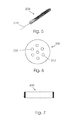
Fig. 5 shows an exemplary embodiment of a laser-based lamp. -
Fig. 6 shows an exemplary embodiment of a LED-based lamp. -
Fig. 7 shows an exemplary embodiment of a discharge-based lamp. - As an explanation of why a light source according to the invention is capable of enhancing the contrast of something visible, the processing of light by an eye will be described in a first step.
-
Fig. 1 is a schematically illustration of light processing in an eye. The retina of an eye comprises neurons of theganglion 10,cross-linked neurons 20, cone-cells 30, and rod-cells 40. An incidence oflight 100 onto the retina will trigger an activity of the neurons and cells so as to send pulses to the visual nerve by thenervus opticus 50. - A retina comprises three receptors for color vision, i.e. cones which are sensitive for red light, cones which are sensitive for green light, and cones which are sensitive for blue light.
- An important aspect is that the information of these three different receptors will be processed by the retina, immediately, for example by the
cross-linked neurons 20. - From
fig. 2 , it may be gathered that the information of the red, green and blue cones (R, G, B) are processed such that firstly a difference of red and green is generated. Secondly a difference of yellow and blue is generated, wherein yellow is an addition of red and green. Thirdly an addition of red, green and blue is generated. - It is noted that the result of the addition of red, green and blue is substantially relevant for the brightness V(λ). For especially visualization with a high contrast of small structures, the red-green vision r(λ)-g(λ) is relevant. This may be gathered from the fact that the most red and green cones can be found in the area of the yellow spot or macula of the retina.
- Consequently, the absorption spectra in
fig.3 show peaks of the respective cones in the blue B, green G and red R spectra. The dotted line indicates the absorption of the rods which are relevant for the black-and-white vision. - Another illustration of the different sensitivity of the different cones, may be seen in
fig. 4 , showing peaks of a green-red-cell (G-R), a red-green-cell (R-G), and of a blue-yellow-cell (B-Y) and a yellow-blue-cell (Y-B). - According to
fig.4 , there exists a cell which is especially sensitive for radiation with 525nm, and further a cell which is especially sensitive for radiation with 610nm. - In the following, exemplary embodiments of lamps are described, having an illuminant emitting light within the ranges stated above.
- According to a first embodiment, shown in
fig. 5 , a lamp comprises alaser 200 which usually provides for a selective and small band emission. A laser emitting agreen beam 210 may be realized on the basis of a diode pumped NdY-AG laser with subsequent frequency doubling. Such a laser may have a wavelength of 532nm of its radiation. - According to a second embodiment, shown in
fig. 6 , alamp 300 comprises two different LEDs with emission wavelengths of about 525nm (310) and 610nm (320), respectively. For example, LEDs on the basis of AlInGaP- and InGaN-LEDs have such emission wavelength. - According to a third embodiment, a
lamp 400 comprises a plurality of discharge light sources, which have collectively emission wavelengths of about 525nm and about 610nm. For example, discharge light sources with at least one element out of the following group are usable.Sodium (Na) 589,0nm and 589,5nm Barium (Ba) 553,5nm Magnesium (Mg) 518,4nm, 517,3nm and 516,7nm Thallium (Tl) 535,1nm Chromium (Cr) 520,5nm and 520,8nm Lithium (Li) 610,4nm and 670,0nm Copper (Cu) 521,8nm, 522,0nm, 515,3nm and 510,5nm Mercury (Hg) 546,1nm Calcium (Ca) 610,2nm, 612,2nm and 616,2nm - Additionally, a discharge light source may comprise mercury and/or a noble gas as start gas or buffer gas. The above mentioned elements may also be provided as compound like halogenide, oxide and chalkogenide.
- According to a fourth embodiment, a lamp comprises a combination of at least one type of LEDs and at least one discharge light source.
- While the invention has been illustrated and described in detail in the drawings and afore-going description, such illustrations and descriptions are to be considered illustrative or exemplary and not restrictive, the invention is not limited to the disclosed embodiments.
- Other variations to the disclosed embodiments can be understood and effected by those skilled in the art in practicing the claimed invention, from a study of the drawings, the disclosure and the appended claims. In the claims, the word 'comprising' does not exclude other elements, and the indefinite article 'a' or 'an' does not exclude a plurality.
- The mere fact that certain measures are recited and mutually different dependent claims does not indicate that a combination of these measures cannot be used to advantage. Any reference signs in the claims should not be construed as limiting the scope.
-
- 10
- neurons of the ganglion
- 20
- cross-linked neurons
- 30
- cone-cells
- 40
- rod-cells
- 50
- nervus opticus
- 100
- light
- 200
- laser
- 210
- laser beam
- 300
- LED lamp
- 310
- first LED
- 320
- second LED
- 400
- discharge lamp
- R
- red
- G
- green
- B
- blue
- Y
- yellow
Claims (12)
- A light source, comprising:an illuminant emitting light with wavelengths of 500nm to 550nm and/or of 585nm to 640nm.
- The light source of claim 1,
wherein the illuminant emits light with wavelength of 515nm to 535nm and/or of 600nm to 620nm. - The light source of claim 1,
wherein the illuminant emits light with wavelength of 523nm to 527nm and/or of 608nm to 612nm. - The light source of claim 1,
wherein the illuminant comprises a light emitting diode (LED)(310, 320). - The light source of claim 1 or 4,
wherein the illuminant comprises a discharge tube. - The light source of claim 1,
wherein the illuminant comprises a laser. - The light source of claim 4,
wherein the light emitting diode (310, 320) includes an element out of the group consisting of an AlInGaP-LED and an InGaN-LED. - The light source of claim 5,
wherein the discharge tube includes at least one element out of the group consisting of Sodium, Barium, Magnesium, Thallium, Chromium, Copper, Lithium, Mercury and Calcium. - The light source of claims 7 or 8,
wherein the light source further comprises a filter for selectively narrowing down the emission spectrum of the illuminant. - The light source of claim 6,
wherein the laser comprises a diode pumped Nd-YAG element which frequency is subsequently doubled. - The light source of claim 6,
wherein the laser comprises a red diode laser. - A lamp (200, 300, 400) having
a light source according to any one of claims 1 to 11.
Priority Applications (2)
| Application Number | Priority Date | Filing Date | Title |
|---|---|---|---|
| EP10160812A EP2381244A1 (en) | 2010-04-23 | 2010-04-23 | Light source |
| PCT/IB2011/051694 WO2011132146A1 (en) | 2010-04-23 | 2011-04-19 | Light source |
Applications Claiming Priority (1)
| Application Number | Priority Date | Filing Date | Title |
|---|---|---|---|
| EP10160812A EP2381244A1 (en) | 2010-04-23 | 2010-04-23 | Light source |
Publications (1)
| Publication Number | Publication Date |
|---|---|
| EP2381244A1 true EP2381244A1 (en) | 2011-10-26 |
Family
ID=42782276
Family Applications (1)
| Application Number | Title | Priority Date | Filing Date |
|---|---|---|---|
| EP10160812A Ceased EP2381244A1 (en) | 2010-04-23 | 2010-04-23 | Light source |
Country Status (2)
| Country | Link |
|---|---|
| EP (1) | EP2381244A1 (en) |
| WO (1) | WO2011132146A1 (en) |
Citations (2)
| Publication number | Priority date | Publication date | Assignee | Title |
|---|---|---|---|---|
| US20020071287A1 (en) * | 2000-12-13 | 2002-06-13 | 3M Innovative Properties Company | Laser pointer with multiple color beams |
| US20040021420A1 (en) * | 2002-03-06 | 2004-02-05 | Toshiaki Tsuda | Lamp unit and infrared night-vision system |
-
2010
- 2010-04-23 EP EP10160812A patent/EP2381244A1/en not_active Ceased
-
2011
- 2011-04-19 WO PCT/IB2011/051694 patent/WO2011132146A1/en not_active Ceased
Patent Citations (2)
| Publication number | Priority date | Publication date | Assignee | Title |
|---|---|---|---|---|
| US20020071287A1 (en) * | 2000-12-13 | 2002-06-13 | 3M Innovative Properties Company | Laser pointer with multiple color beams |
| US20040021420A1 (en) * | 2002-03-06 | 2004-02-05 | Toshiaki Tsuda | Lamp unit and infrared night-vision system |
Non-Patent Citations (4)
| Title |
|---|
| ANONYMOUS: "Lamp Assembly comprising LED and a Sodium Discharge Lamp", IP.COM JOURNAL, IP.COM INC., WEST HENRIETTA, NY, US, 21 January 2005 (2005-01-21), XP013022922, ISSN: 1533-0001 * |
| G. SCHRÖDER, H. TREIBER: "Technische Optik", 2007, VOGEL BUCHVERLAG, Würzburg, Germany, ISBN: 978-3-8343-3086-4, pages: 131 - 150, XP002603206 * |
| SHANG PING YING ET AL: "Charaterizing LEDs for Mixture of Colored LED light sources", ELECTRONIC MATERIALS AND PACKAGING, 2006. EMAP 2006. INTERNATIONAL CON FERENCE ON, IEEE, PI, 1 December 2006 (2006-12-01), pages 1 - 5, XP031202576, ISBN: 978-1-4244-0833-7 * |
| XIAOHUI QU ET AL: "Temperature Measurement Technique for Stabilizing the Light Output of RGB LED Lamps", IEEE TRANSACTIONS ON INSTRUMENTATION AND MEASUREMENT, IEEE SERVICE CENTER, PISCATAWAY, NJ, US LNKD- DOI:10.1109/TIM.2009.2025983, vol. 59, no. 3, 1 March 2010 (2010-03-01), pages 661 - 670, XP011283111, ISSN: 0018-9456 * |
Also Published As
| Publication number | Publication date |
|---|---|
| WO2011132146A1 (en) | 2011-10-27 |
Similar Documents
| Publication | Publication Date | Title |
|---|---|---|
| EP3044504B1 (en) | Enhanced color-preference light sources | |
| JP6479781B2 (en) | A light source that does not suppress melatonin, having a CRI close to that of white light | |
| EP3055609B1 (en) | Spectrally enhanced white light for better visual acuity | |
| JP2015035373A (en) | Illumination unit and medical illumination device | |
| DE102014118280A1 (en) | Light source module and lighting device | |
| CN103388756B (en) | Illuminator | |
| WO2021072679A1 (en) | Control method for adaptively adjusting brightness, chromaticity, and color temperature of light source | |
| WO2013075881A1 (en) | Lighting device with semiconductor light source and spaced-apart phosphor region | |
| US20180128431A1 (en) | Led lamp utilizing optical filtering to counteract effects of color anomalous vision | |
| JP2018041856A (en) | LED for visible illumination | |
| WO2011132146A1 (en) | Light source | |
| US20040021420A1 (en) | Lamp unit and infrared night-vision system | |
| JP2003233062A5 (en) | ||
| US10465872B2 (en) | Light source module and illuminating device | |
| WO2017133459A1 (en) | Light source module and illumination device | |
| CN100426448C (en) | High-pressure discharge lamp | |
| JP5668958B2 (en) | Vehicle headlamp | |
| US12490357B2 (en) | Light generating system | |
| CN102606906B (en) | Lighting device | |
| CN115808840A (en) | Semiconductor light source device and electronic light source equipment | |
| JP2014120537A (en) | Led lighting device such as led bulb | |
| Soskind et al. | Solid state lighting and photobiological safety |
Legal Events
| Date | Code | Title | Description |
|---|---|---|---|
| AK | Designated contracting states |
Kind code of ref document: A1 Designated state(s): AT BE BG CH CY CZ DE DK EE ES FI FR GB GR HR HU IE IS IT LI LT LU LV MC MK MT NL NO PL PT RO SE SI SK SM TR |
|
| AX | Request for extension of the european patent |
Extension state: AL BA ME RS |
|
| PUAI | Public reference made under article 153(3) epc to a published international application that has entered the european phase |
Free format text: ORIGINAL CODE: 0009012 |
|
| STAA | Information on the status of an ep patent application or granted ep patent |
Free format text: STATUS: THE APPLICATION HAS BEEN REFUSED |
|
| 18R | Application refused |
Effective date: 20111113 |