EP2380959A1 - Solid detergent composition comprising beta cyclodextrin - Google Patents
Solid detergent composition comprising beta cyclodextrin Download PDFInfo
- Publication number
- EP2380959A1 EP2380959A1 EP10160344A EP10160344A EP2380959A1 EP 2380959 A1 EP2380959 A1 EP 2380959A1 EP 10160344 A EP10160344 A EP 10160344A EP 10160344 A EP10160344 A EP 10160344A EP 2380959 A1 EP2380959 A1 EP 2380959A1
- Authority
- EP
- European Patent Office
- Prior art keywords
- perfume
- solid detergent
- detergent composition
- composition according
- composition comprises
- Prior art date
- Legal status (The legal status is an assumption and is not a legal conclusion. Google has not performed a legal analysis and makes no representation as to the accuracy of the status listed.)
- Withdrawn
Links
Classifications
-
- C—CHEMISTRY; METALLURGY
- C11—ANIMAL OR VEGETABLE OILS, FATS, FATTY SUBSTANCES OR WAXES; FATTY ACIDS THEREFROM; DETERGENTS; CANDLES
- C11D—DETERGENT COMPOSITIONS; USE OF SINGLE SUBSTANCES AS DETERGENTS; SOAP OR SOAP-MAKING; RESIN SOAPS; RECOVERY OF GLYCEROL
- C11D3/00—Other compounding ingredients of detergent compositions covered in group C11D1/00
- C11D3/16—Organic compounds
- C11D3/20—Organic compounds containing oxygen
- C11D3/22—Carbohydrates or derivatives thereof
- C11D3/222—Natural or synthetic polysaccharides, e.g. cellulose, starch, gum, alginic acid or cyclodextrin
-
- C—CHEMISTRY; METALLURGY
- C11—ANIMAL OR VEGETABLE OILS, FATS, FATTY SUBSTANCES OR WAXES; FATTY ACIDS THEREFROM; DETERGENTS; CANDLES
- C11D—DETERGENT COMPOSITIONS; USE OF SINGLE SUBSTANCES AS DETERGENTS; SOAP OR SOAP-MAKING; RESIN SOAPS; RECOVERY OF GLYCEROL
- C11D3/00—Other compounding ingredients of detergent compositions covered in group C11D1/00
- C11D3/16—Organic compounds
- C11D3/37—Polymers
- C11D3/3703—Macromolecular compounds obtained otherwise than by reactions only involving carbon-to-carbon unsaturated bonds
- C11D3/3723—Polyamines or polyalkyleneimines
-
- C—CHEMISTRY; METALLURGY
- C11—ANIMAL OR VEGETABLE OILS, FATS, FATTY SUBSTANCES OR WAXES; FATTY ACIDS THEREFROM; DETERGENTS; CANDLES
- C11D—DETERGENT COMPOSITIONS; USE OF SINGLE SUBSTANCES AS DETERGENTS; SOAP OR SOAP-MAKING; RESIN SOAPS; RECOVERY OF GLYCEROL
- C11D3/00—Other compounding ingredients of detergent compositions covered in group C11D1/00
- C11D3/50—Perfumes
- C11D3/502—Protected perfumes
- C11D3/505—Protected perfumes encapsulated or adsorbed on a carrier, e.g. zeolite or clay
Definitions
- the present invention relates to solid detergent compositions comprising beta cyclodextrin.
- the compositions exhibit an excellent freshness profile.
- the Inventors have found that the freshness profile can be improved by the use of beta cyclodextrin.
- the Inventors have found that beta cyclodextrin when incorporated into a low built laundry detergent composition improve the freshness profile of the detergent composition.
- the Inventors have designed a freshness delivery system that not only improves the freshness profile of the laundry detergent composition but also enables a wide variety of perfumes to be incorporated into the laundry detergent, which in turn enables the detergent manufacturer to choose the product fragrance from broad perfume palate.
- the present invention provides a composition as defined by claim 1.
- Solid laundry detergent composition typically comprises: (a) detersive surfactant; (b) beta cyclodextrin; (c) from 0wt% to less than 5wt% zeolite builder; (d) from 0wt% to less than 5wt% phosphate builder; (e) optionally, from 0wt% to less than 10wt% silicate salt; and (f) optionally, additional detergent ingredients.
- the composition can be any suitable form, including free-flowing particulate form, or a unit dose form including tablet form, detergent sheet form.
- the composition may in the form of a pouch, for example the particles or tablet may be at least partially, preferably completely, enclosed by a film, preferably a water-soluble and/or water-dispersible film.
- a preferred film is a polyvinyl alcohol film.
- Preferred additional detergent ingredients include: bleach including bleach catalysts; hueing agents; perfume including perfume microcapsules, starch encapsulated perfume accords, and schiff's base reaction products of polyamine with perfume ketones; fabric softening agents including clay, silicones, and quaternary ammonium fabric softening agents; cationic polymers; alkoxylated polyamines; and fabric-deposition aids including cationic hydroxyethyl cellulose.
- the composition is a laundry detergent composition.
- the composition may be a dishwashing detergent composition including automatic dishwashing detergent composition, or a hard surface cleaner.
- the solid laundry detergent composition is a fully formulated laundry detergent composition, not a portion thereof such as a spray-drying or agglomerate particle that only forms part of the laundry detergent composition.
- the solid laundry detergent composition comprises a plurality of chemically different particles, such as spray-dried base detergent particles and/or agglomerate base detergent particles and/or extrudate base detergent particles, in combination with one or more, typically two or more, or three or more, or four or more, or five or more, or six or more, or even ten or more particles selected from: surfactant particles, including surfactant agglomerates, surfactant extrudates, surfactant needles, surfactant noodles, surfactant flakes; builder particles, such as sodium carbonate and sodium silicate particles, phosphate particles, zeolite particles, silicate salt particles, carbonate salt particles; polymer particles such as cellulosic polymer particles, polyester particles, polyamine particles, terephthalate polymer particles, polyethylene glycol based polymer particles;
- the composition comprises perfume and polyamine, wherein the perfume and polyamine are complexed with the beta-cyclodextrin.
- the polyamine is Lupasol.
- the perfume comprises ketones and/or aldehydes.
- the beta-cyclodextrin-perfume-polyamine complex is prepared by a process comprising the steps of: (i) emulsifying perfume and polyamine to form an emulsion; and (ii) optionally heating the emulsion, typically to a temperature in the range of from 40°C to 80°C; (iii) preparing an aqueous solution of beta-cyclodextrin; (iv) optionally heating the aqueous beta-cyclodextrin solution to a temperature in the range of from 40°C to 80°C; (v) mixing the emulsion and aqueous beta-cyclodextrin solution to form a beta-cyclodextrin-perfume-polyamine mixture, preferably under conditions of high shear; (vi) removing at least some of the water from the beta-cyclodextrin-perfume-polyamine mixture to form a beta-cyclodextrin-perfume-polyamine
- Suitable detersive surfactants include anionic detersive surfactants, non-ionic detersive surfactant, cationic detersive surfactants, zwitterionic detersive surfactants and amphoteric detersive surfactants.
- Preferred anionic detersive surfactants include sulphate and sulphonate detersive surfactants.
- Preferred sulphonate detersive surfactants include alkyl benzene sulphonate, preferably C 10-13 alkyl benzene sulphonate.
- Suitable alkyl benzene sulphonate (LAS) is obtainable, preferably obtained, by sulphonating commercially available linear alkyl benzene (LAB);
- suitable LAB includes low 2-phenyl LAB, such as those supplied by Sasol under the tradename Isochem® or those supplied by Petresa under the tradename Petrelab®, other suitable LAB include high 2-phenyl LAB, such as those supplied by Sasol under the tradename Hyblene®.
- a suitable anionic detersive surfactant is alkyl benzene sulphonate that is obtained by DETAL catalyzed process, although other synthesis routes, such as HF, may also be suitable.
- Preferred sulphate detersive surfactants include alkyl sulphate, preferably C 8-18 alkyl sulphate, or predominantly C 12 alkyl sulphate.
- alkyl alkoxylated sulphate preferably alkyl ethoxylated sulphate, preferably a C 8-18 alkyl alkoxylated sulphate, preferably a C 8-18 alkyl ethoxylated sulphate, preferably the alkyl alkoxylated sulphate has an average degree of alkoxylation of from 1 to 20, preferably from 1 to 10, preferably the alkyl alkoxylated sulphate is a C 8-18 alkyl ethoxylated sulphate having an average degree of ethoxylation of from 1 to 10, preferably from 1 to 7, more preferably from 1 to 5 and most preferably from 1 to 3.
- alkyl sulphate, alkyl alkoxylated sulphate and alkyl benzene sulphonates may be linear or branched, substituted or un-substituted.
- the detersive surfactant may be a mid-chain branched detersive surfactant, preferably a mid-chain branched anionic detersive surfactant, more preferably a mid-chain branched alkyl sulphate and/or a mid-chain branched alkyl benzene sulphonate, most preferably a mid-chain branched alkyl sulphate.
- the mid-chain branches are C 1-4 alkyl groups, preferably methyl and/or ethyl groups.
- Suitable non-ionic detersive surfactants are selected from the group consisting of: C 8 -C 18 alkyl ethoxylates, such as, NEODOL® non-ionic surfactants from Shell; C 6 -C 12 alkyl phenol alkoxylates wherein preferably the alkoxylate units are ethyleneoxy units, propyleneoxy units or a mixture thereof; C 12 -C 18 alcohol and C 6 -C 12 alkyl phenol condensates with ethylene oxide/propylene oxide block polymers such as Pluronic® from BASF; C 14 -C 22 mid-chain branched alcohols; C 14 -C 22 mid-chain branched alkyl alkoxylates, preferably having an average degree of alkoxylation of from 1 to 30; alkylpolysaccharides, preferably alkylpolyglycosides; polyhydroxy fatty acid amides; ether capped poly(oxyalkylated) alcohol surfactants; and mixtures thereof.
- Preferred non-ionic detersive surfactants are alkyl polyglucoside and/or an alkyl alkoxylated alcohol.
- Preferred non-ionic detersive surfactants include alkyl alkoxylated alcohols, preferably C 8-18 alkyl alkoxylated alcohol, preferably a C 8-18 alkyl ethoxylated alcohol, preferably the alkyl alkoxylated alcohol has an average degree of alkoxylation of from 1 to 50, preferably from 1 to 30, or from 1 to 20, or from 1 to 10, preferably the alkyl alkoxylated alcohol is a C 8-18 alkyl ethoxylated alcohol having an average degree of ethoxylation of from 1 to 10, preferably from 1 to 7, more preferably from 1 to 5 and most preferably from 3 to 7.
- the alkyl alkoxylated alcohol can be linear or branched, and substituted or un-substituted.
- Suitable cationic detersive surfactants include alkyl pyridinium compounds, alkyl quaternary ammonium compounds, alkyl quaternary phosphonium compounds, alkyl ternary sulphonium compounds, and mixtures thereof.
- Preferred cationic detersive surfactants are quaternary ammonium compounds having the general formula: (R)(R 1 )(R 2 )(R 3 )N + X - wherein, R is a linear or branched, substituted or unsubstituted C 6-18 alkyl or alkenyl moiety, R 1 and R 2 are independently selected from methyl or ethyl moieties, R 3 is a hydroxyl, hydroxymethyl or a hydroxyethyl moiety, X is an anion which provides charge neutrality, preferred anions include: halides, preferably chloride; sulphate; and sulphonate.
- Preferred cationic detersive surfactants are mono-C 6-18 alkyl mono-hydroxyethyl di-methyl quaternary ammonium chlorides. Highly preferred cationic detersive surfactants are mono-C 8-10 alkyl mono-hydroxyethyl di-methyl quaternary ammonium chloride, mono-C 10-12 alkyl mono-hydroxyethyl di-methyl quaternary ammonium chloride and mono-C 10 alkyl mono-hydroxyethyl di-methyl quaternary ammonium chloride.
- Zeolite builder comprises from 0wt% to 5wt% zeolite builder, preferably to 4wt%,or to 3wt%, or to 2wt%, or even to 1wt% zeolite builder.
- the composition may even be substantially free of zeolite builder; substantially free means "no deliberately added".
- Typical zeolite builders include zeolite A, zeolite P and zeolite MAP.
- the composition comprises from 0wt% to 5wt% phosphate builder, preferably to 4wt%, or to 3wt%, or to 2wt%, or even to 1wt% phosphate builder.
- the composition may even be substantially free of phosphate builder; substantially free means "no deliberately added".
- a typical phosphate builder is sodium tri-polyphosphate.
- Silicate salt .
- the composition may preferably comprise from 0wt% to less than 10wt% silicate salt, preferably to 9wt%, or to 8wt%, or to 7wt%, or to 6wt%, or to 5wt%, or to 4wt%, or to 3wt%, or even to 2wt%, and preferably from above 0wt%, or from 0.5wt%, or even from 1wt% silicate salt.
- a preferred silicate salt is sodium silicate.
- the composition preferably comprises bleach, preferably from 0wt% to 10wt% bleach. wherein the composition comprises from 0wt% to 10wt% bleach, preferably to 9wt%, or to 8wt%, or to 7wt%, or to 6wt%, or to 5wt%, or to 4wt%, or to 3wt%, or even to 2wt%, and preferably from above 0wt%, or from 0.5wt%, or even from 1wt% bleach.
- Suitable bleach includes a source of hydrogen peroxide, typically in combination with a bleach activator and/or a bleach catalyst.
- Preferred source of hydrogen peroxide includes percarbonate and/or perborate salts, more preferably sodium percarbonate, sodium perborate monohydrate, and/or sodium perborate tetrahydrate.
- the source of hydrogen peroxide, especially percarbonate salt is coated.
- Preferred coating materials are carbonate salts, sulphate salts, silicate salts including borosilicate salts, and mixtures thereof.
- Another suitable source of hydrogen peroxide is pre-formed peracid. Preferably the pre-formed peracid is coated or encapsulated.
- Preferred bleach activators include: tetraacetylthylene diamine (TAED); oxybenzene sulphonate (OBS) preferably nonanoyl oxybenzene sulphonate; nitrile quats, and mixtures thereof.
- TAED tetraacetylthylene diamine
- OBS oxybenzene sulphonate
- nitrile quats and mixtures thereof.
- Preferred bleach catalysts include: imine bleach boosters, preferably oxaziridinium bleach boosters; transition metal catalysts, bleaching enzymes; and mixtures thereof.
- Hueing dyes are formulated to deposit onto fabrics from the wash liquor so as to improve fabric whiteness perception.
- the hueing agent dye is blue or violet.
- the shading dye(s) have a peak absorption wavelength of from 550nm to 650nm, preferably from 570nm to 630nm.
- Dyes are coloured organic molecules which are soluble in aqueous media that contain surfactants. Dyes are described in 'Industrial Dyes', Wiley VCH 2002, K .Hunger (edit or). Dyes are listed in the Color Index International published by Society of Dyers and Colourists and the American Association of Textile Chemists and Colorists. Dyes are preferably selected from the classes of basic, acid, hydrophobic, direct and polymeric dyes, and dye-conjugates. Those skilled in the art of detergent formulation are able to select suitable hueing dyes from these publications. Polymeric hueing dyes are commercially available, for example from Milliken, Spartanburg, South Carolina, USA.
- Suitable dyes are direct violet 7 , direct violet 9 , direct violet 11, direct violet 26, direct violet 31, direct violet 35, direct violet 40, direct violet 41, direct violet 51, direct violet 66, direct violet 99, acid violet 50, acid blue 9, acid violet 17, acid black 1 , acid red 17, acid blue 29, solvent violet 13, disperse violet 27 disperse violet 26, disperse violet 28, disperse violet 63 and disperse violet 77, basic blue 16, basic blue 65, basic blue 66, basic blue 67, basic blue 71, basic blue 159, basic violet 19, basic violet 35, basic violet 38, basic violet 48; basic blue 3 , basic blue 75, basic blue 95, basic blue 122, basic blue 124, basic blue 141, thiazolium dyes, reactive blue 19, reactive blue 163, reactive blue 182, reactive blue 96, Liquitint® Violet CT (Milliken, Spartanburg, USA) and Azo-CM-Cellulose (Megazyme, Bray, Republic of Ireland).
- Perfume microcapsule Preferably, the composition comprises a perfume microcapsule.
- Preferred perfume microcapsules comprise melamine formaldehyde, urea formaldehyde, urea, or mixtures thereof.
- the composition comprises a starch encapsulated perfume accord.
- Hydrophobic perfume Suitable hydrophobic perfume molecules typically have a boiling point of less than 250°C, preferably less than 220°C, even preferably less than 200°C.
- the boiling points of many perfume ingredients are given in: " Perfume and Flavor Chemicals (Aroma Chemicals),” Steffen Arctander, published by the author, 1969 .
- Suitable hydrophobic perfume molecules typically have a clogP value of greater than 2, preferably greater than 3, more preferably greater than 4, or even greater than 5.
- the clog P value is a measurement of the octanol/water partition coefficient of the perfume molecule and is the ratio between its equilibrium concentrations in octanol and in water. Since the partition coefficients of the preferred perfume ingredients of this invention have high values, they are more conveniently given in the form of their logarithm to the base 10, logP, which is known as the clogP value.
- the clogP value of many perfume ingredients has been reported; for example, the Pomona92 database, available from Daylight Chemical Information Systems, Inc. (Daylight CIS), Irvine, California, contains many, along with citations to the original literature.
- clogP values can also be calculated by the "CLOGP” program, available from Daylight CIS.
- the "clogP value” is typically determined by the fragment approach of Hansch and Leo: c.f. A. Leo, in Comprehensive Medicinal Chemistry, Vol. 4, C. Hansch, P. G. Sammens, J. B. Taylor and C. A. Ramsden, Eds., p. 295, Pergamon Press, 1990 .
- Suitable hydrophobic perfume molecules typically have an Odour Detection Threshold (ODT) of less than 50 parts per billion (ppb), preferably less than 10ppb.
- ODT Odour Detection Threshold
- Preferred hydrophobic perfume molecules are selected from the group consisting of: ethyl 2 methyl butyrate, 4 acetate flor acetate, linalool, ethyl 2 methyl pentanoate, tetra hydro linalool, cis 3 hexenyl acetate, cis 3 hexanol, cyclal C, and mixtures thereof.
- the composition comprises a polyamine perfume system.
- the polyamine perfume system comprises a polyamine and perfume, preferably the perfume comprises aldehydes and/or ketones, most preferably ketone.
- the polyamine perfume system comprises a Schiff's base reaction product of polyamine with perfume ketone and/or aldehyde, preferably the perfume ketone.
- a preferred polyamine is Lupasol.
- a preferred perfume ketone is delta-damascone.
- the composition may comprise a fabric-softening agent.
- the fabric softening agent is selected from: clay, preferred clays are montmorilloniet clay; silicone, a preferred silicone is polydimethyl siloxane (PDMS); quaternary ammonium fabric softening compounds; and mixtures thereof.
- a highly preferred fabric softening agent is a combination of clay, especially montmorillonite clay, with silicone, especially PDMS.
- the composition may also comprise a flocculating agent in combination with the fabric-softening agent.
- a preferred flocculating agent is polyethylene oxide (PEO). PEO is especially preferred when used in combination with clay, especially montmorillonite clay.
- the composition may comprise a cationic polymer.
- Preferred cationic polymers include: cationic silicones; cationic cellulose, especially cationic hydroxyethyl cellulose; cationic polyamines; and mixtures thereof.
- Alkoxylated polyamine may comprise an alkoxylated polyamine.
- Fabric-deposition aid may comprise fabric deposition aid.
- Suitable fabric-deposition aids are polysaccharides, preferably cellulosic polymers.
- Other suitable fabric-deposition aids include poly diallyl dimethyl ammonium halides (DADMAC), and co-polymers of DADMAC with vinyl pyrrolidone, acrylamides, imidazoles, imidazolinium halides, and mixtures thereof, in random or block configuration.
- DADMAC diallyl dimethyl ammonium halides
- Other suitable fabric-deposition aids include cationic guar gum, cationic cellulose such as cationic hydoxyethyl cellulose, cationic starch, cationic polyacylamides, and mixtures thereof.
- the composition typically comprises other detergent ingredients.
- Suitable detergent ingredients include: transition metal catalysts; imine bleach boosters; enzymes such as amylases, carbohydrases, cellulases, laccases, lipases, bleaching enzymes such as oxidases and peroxidases, proteases, pectate lyases and mannanases; source of peroxygen such as percarbonate salts and/or perborate salts, preferred is sodium percarbonate, the source of peroxygen is preferably at least partially coated, preferably completely coated, by a coating ingredient such as a carbonate salt, a sulphate salt, a silicate salt, borosilicate, or mixtures, including mixed salts, thereof; bleach activator such as tetraacetyl ethylene diamine, oxybenzene sulphonate bleach activators such as nonanoyl oxybenzene sulphonate, caprolactam bleach activators, imide bleach activators such as N-nonanoyl
- Example 1 Example of Beta-cyclodextrin particle preparation
- Polymer (Lupasol WF 11.00g) is heated in a water bath to 60°C before addition to deionised water (270g also at 60°C) in a plastic beaker.
- the polymer and water are combined using a Silverson high shear mixer (L4RT) at 4000rpm for 5 minutes.
- L4RT Silverson high shear mixer
- Beta-Cyclodextrin (200.00g) is then added with stirring at 3000rpm over 10 minutes followed by further mixing at 3500rpm for 10 minutes.
- Perfume accord (20g) is then added with stirring at 3500rpm for 5 minutes ensuring no perfume oil remains on the surface.
- the resulting preparation is then stirred at 3500rpm for 5 additional minutes. Some increase in viscosity occurs.
- the ⁇ -Cyclodextrin complex is spread thinly onto a stainless steel tray and left to dry for 46 hours in a well ventilated area at room temperature and humidity (15 to 25°C and ⁇ 75% relative humidity).
- the ⁇ -Cyclodextrin complex is ground to a powdery consistency using a Kenwood mixer.
- Example 2 Laundry detergent compositions:
- composition A Composition B
- Composition C Composition D
- Linear alkyl benzene sulphonate 9w% 9wt% 12wt% 8wt%
- Alkyl ethoxyalted sulphate having an average degree of ethoxylation of from 0.5 to 3 3wt% 2wt% 1wt% 2wt%
- Cationic detersive surfactant 0.5wt% 0.5wt% 0.5wt% 0.5wt% 0.5wt% Sodium sulphate 60wt% 60wt% 55wt% 60wt% Sodium carbonate 8wt% 10wt% 5wt% 8wt% Beta cyclodextrin particles of example 1 4wt% 7wt% 8wt% 5wt%
- Oxaziridinium-based bleach catalyst 0.005wt% 0.005wt% 0.005wt% 0.005wt% 0.005wt% Sodium silicate 3wt% 0wt% 3w
Landscapes
- Chemical & Material Sciences (AREA)
- Life Sciences & Earth Sciences (AREA)
- Engineering & Computer Science (AREA)
- Chemical Kinetics & Catalysis (AREA)
- Oil, Petroleum & Natural Gas (AREA)
- Wood Science & Technology (AREA)
- Organic Chemistry (AREA)
- Health & Medical Sciences (AREA)
- Molecular Biology (AREA)
- Emergency Medicine (AREA)
- Dispersion Chemistry (AREA)
- Detergent Compositions (AREA)
Abstract
The present invention relates to a solid detergent composition comprising: (a)detersive surfactant; (b) beta cyclodextrin; (c) from 0wt% to less than 5wt% zeolite builder; (d) from 0wt% to less than 5wt% phosphate builder; (e) optionally, from 0wt% to less than 10wt% silicate; and (f) optionally pefume; and (g) optionally, additional detergent ingredients.
Description
- The present invention relates to solid detergent compositions comprising beta cyclodextrin. The compositions exhibit an excellent freshness profile.
- Consumers of laundry detergent products desire not only clean clothes from their laundry products, but also fresh clothes. They especially desire excellent freshness the first time they wear or use a fabric after it has been laundered. There remains a need to improve the freshness profile of laundry detergent compositions. Typically, detergent manufactures have developed sophisticated perfume technology to achieve this improved freshness. However, the development of a perfume technology to improve freshness can limit the breadth of perfume palate available to the detergent manufacturer. For example, when a perfume system is designed to deliver improved freshness, the product fragrance is constrained by the choice of compatible perfume raw materials; i.e. the flexibility of the detergent manufacturer to deliver improved freshness profile and broad product fragrances is constrained.
- The Inventors have found that the freshness profile can be improved by the use of beta cyclodextrin. The Inventors have found that beta cyclodextrin when incorporated into a low built laundry detergent composition improve the freshness profile of the detergent composition. The Inventors have designed a freshness delivery system that not only improves the freshness profile of the laundry detergent composition but also enables a wide variety of perfumes to be incorporated into the laundry detergent, which in turn enables the detergent manufacturer to choose the product fragrance from broad perfume palate.
- The present invention provides a composition as defined by claim 1.
- Solid laundry detergent composition. The solid laundry detergent composition typically comprises: (a) detersive surfactant; (b) beta cyclodextrin; (c) from 0wt% to less than 5wt% zeolite builder; (d) from 0wt% to less than 5wt% phosphate builder; (e) optionally, from 0wt% to less than 10wt% silicate salt; and (f) optionally, additional detergent ingredients..
- The composition can be any suitable form, including free-flowing particulate form, or a unit dose form including tablet form, detergent sheet form. The composition may in the form of a pouch, for example the particles or tablet may be at least partially, preferably completely, enclosed by a film, preferably a water-soluble and/or water-dispersible film. A preferred film is a polyvinyl alcohol film.
- Preferred additional detergent ingredients include: bleach including bleach catalysts; hueing agents; perfume including perfume microcapsules, starch encapsulated perfume accords, and schiff's base reaction products of polyamine with perfume ketones; fabric softening agents including clay, silicones, and quaternary ammonium fabric softening agents; cationic polymers; alkoxylated polyamines; and fabric-deposition aids including cationic hydroxyethyl cellulose. These preferred ingredients are described in more detail below.
- Highly preferably, the composition is a laundry detergent composition. However, the composition may be a dishwashing detergent composition including automatic dishwashing detergent composition, or a hard surface cleaner.
- Typically, the solid laundry detergent composition is a fully formulated laundry detergent composition, not a portion thereof such as a spray-drying or agglomerate particle that only forms part of the laundry detergent composition. Typically, the solid laundry detergent composition comprises a plurality of chemically different particles, such as spray-dried base detergent particles and/or agglomerate base detergent particles and/or extrudate base detergent particles, in combination with one or more, typically two or more, or three or more, or four or more, or five or more, or six or more, or even ten or more particles selected from: surfactant particles, including surfactant agglomerates, surfactant extrudates, surfactant needles, surfactant noodles, surfactant flakes; builder particles, such as sodium carbonate and sodium silicate particles, phosphate particles, zeolite particles, silicate salt particles, carbonate salt particles; polymer particles such as cellulosic polymer particles, polyester particles, polyamine particles, terephthalate polymer particles, polyethylene glycol based polymer particles; aesthetic particles such as coloured noodles or needles or lamellae particles; enzyme particles such as protease prills, lipase prills, cellulase prills, amylase prills, mannanase prills, pectate lyase prills, xyloglucanase prills, and co-prills of any of these enzymes; bleach particles, such as percarbonate particles, especially coated percarbonate particles, such as percarbonate coated with carbonate salt, sulphate salt, silicate salt, borosilicate salt, or combinations thereof, perborate particles, bleach catalyst particles such as transition metal catalyst particles, or isoquinolinium bleach catalyst particles, pre-formed peracid particles, especially coated pre-formed peracid particles; filler particles such as sulphate salt particles; clay particles such as montmorillonite particles or particles of clay and silicone; flocculant particles such as polyethylene oxide particles, wax particles such as wax agglomerates, brightener particles, dye transfer inhibition particles; dye fixative particles, perfume particles such as perfume microcapsules and starch encapsulated perfume accord particles, or pro-perfume particles such as Schiff base reaction product particles, bleach activator particles such as oxybenzene sulphonate bleach activator particles and tetra acetyl ethylene diamine bleach activator particles; hueing dye particles; chelant particles such as chelant agglomerates; and any combination thereof.
- Preferably, the composition comprises perfume and polyamine, wherein the perfume and polyamine are complexed with the beta-cyclodextrin. Preferably, the polyamine is Lupasol. Preferably the perfume comprises ketones and/or aldehydes.
- Preferably, the beta-cyclodextrin-perfume-polyamine complex is prepared by a process comprising the steps of: (i) emulsifying perfume and polyamine to form an emulsion; and (ii) optionally heating the emulsion, typically to a temperature in the range of from 40°C to 80°C; (iii) preparing an aqueous solution of beta-cyclodextrin; (iv) optionally heating the aqueous beta-cyclodextrin solution to a temperature in the range of from 40°C to 80°C; (v) mixing the emulsion and aqueous beta-cyclodextrin solution to form a beta-cyclodextrin-perfume-polyamine mixture, preferably under conditions of high shear; (vi) removing at least some of the water from the beta-cyclodextrin-perfume-polyamine mixture to form a beta-cyclodextrin-perfume-polyamine complex.
- Detersive surfactant. Suitable detersive surfactants include anionic detersive surfactants, non-ionic detersive surfactant, cationic detersive surfactants, zwitterionic detersive surfactants and amphoteric detersive surfactants.
- Preferred anionic detersive surfactants include sulphate and sulphonate detersive surfactants.
- Preferred sulphonate detersive surfactants include alkyl benzene sulphonate, preferably C10-13 alkyl benzene sulphonate. Suitable alkyl benzene sulphonate (LAS) is obtainable, preferably obtained, by sulphonating commercially available linear alkyl benzene (LAB); suitable LAB includes low 2-phenyl LAB, such as those supplied by Sasol under the tradename Isochem® or those supplied by Petresa under the tradename Petrelab®, other suitable LAB include high 2-phenyl LAB, such as those supplied by Sasol under the tradename Hyblene®. A suitable anionic detersive surfactant is alkyl benzene sulphonate that is obtained by DETAL catalyzed process, although other synthesis routes, such as HF, may also be suitable.
- Preferred sulphate detersive surfactants include alkyl sulphate, preferably C8-18 alkyl sulphate, or predominantly C12 alkyl sulphate.
- Another preferred sulphate detersive surfactant is alkyl alkoxylated sulphate, preferably alkyl ethoxylated sulphate, preferably a C8-18 alkyl alkoxylated sulphate, preferably a C8-18 alkyl ethoxylated sulphate, preferably the alkyl alkoxylated sulphate has an average degree of alkoxylation of from 1 to 20, preferably from 1 to 10, preferably the alkyl alkoxylated sulphate is a C8-18 alkyl ethoxylated sulphate having an average degree of ethoxylation of from 1 to 10, preferably from 1 to 7, more preferably from 1 to 5 and most preferably from 1 to 3.
- The alkyl sulphate, alkyl alkoxylated sulphate and alkyl benzene sulphonates may be linear or branched, substituted or un-substituted.
- The detersive surfactant may be a mid-chain branched detersive surfactant, preferably a mid-chain branched anionic detersive surfactant, more preferably a mid-chain branched alkyl sulphate and/or a mid-chain branched alkyl benzene sulphonate, most preferably a mid-chain branched alkyl sulphate. Preferably, the mid-chain branches are C1-4 alkyl groups, preferably methyl and/or ethyl groups.
- Suitable non-ionic detersive surfactants are selected from the group consisting of: C8-C18 alkyl ethoxylates, such as, NEODOL® non-ionic surfactants from Shell; C6-C12 alkyl phenol alkoxylates wherein preferably the alkoxylate units are ethyleneoxy units, propyleneoxy units or a mixture thereof; C12-C18 alcohol and C6-C12 alkyl phenol condensates with ethylene oxide/propylene oxide block polymers such as Pluronic® from BASF; C14-C22 mid-chain branched alcohols; C14-C22 mid-chain branched alkyl alkoxylates, preferably having an average degree of alkoxylation of from 1 to 30; alkylpolysaccharides, preferably alkylpolyglycosides; polyhydroxy fatty acid amides; ether capped poly(oxyalkylated) alcohol surfactants; and mixtures thereof.
- Preferred non-ionic detersive surfactants are alkyl polyglucoside and/or an alkyl alkoxylated alcohol.
- Preferred non-ionic detersive surfactants include alkyl alkoxylated alcohols, preferably C8-18 alkyl alkoxylated alcohol, preferably a C8-18 alkyl ethoxylated alcohol, preferably the alkyl alkoxylated alcohol has an average degree of alkoxylation of from 1 to 50, preferably from 1 to 30, or from 1 to 20, or from 1 to 10, preferably the alkyl alkoxylated alcohol is a C8-18 alkyl ethoxylated alcohol having an average degree of ethoxylation of from 1 to 10, preferably from 1 to 7, more preferably from 1 to 5 and most preferably from 3 to 7. The alkyl alkoxylated alcohol can be linear or branched, and substituted or un-substituted.
- Suitable nonionic detersive surfactants include secondary alcohol-based detersive surfactant having the formula:
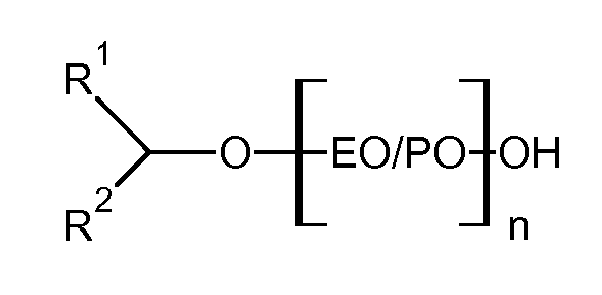
wherein EO/PO are alkoxy moieties selected from ethoxy, propoxy, or mixtures thereof, preferably the EO/PO alkoxyl moieties are in random or block configuration; wherein n is the average degree of alkoxylation and is in the range of from 4 to 10. - Suitable cationic detersive surfactants include alkyl pyridinium compounds, alkyl quaternary ammonium compounds, alkyl quaternary phosphonium compounds, alkyl ternary sulphonium compounds, and mixtures thereof.
- Preferred cationic detersive surfactants are quaternary ammonium compounds having the general formula:
(R)(R1)(R2)(R3)N+ X-
wherein, R is a linear or branched, substituted or unsubstituted C6-18 alkyl or alkenyl moiety, R1 and R2 are independently selected from methyl or ethyl moieties, R3 is a hydroxyl, hydroxymethyl or a hydroxyethyl moiety, X is an anion which provides charge neutrality, preferred anions include: halides, preferably chloride; sulphate; and sulphonate. Preferred cationic detersive surfactants are mono-C6-18 alkyl mono-hydroxyethyl di-methyl quaternary ammonium chlorides. Highly preferred cationic detersive surfactants are mono-C8-10 alkyl mono-hydroxyethyl di-methyl quaternary ammonium chloride, mono-C10-12 alkyl mono-hydroxyethyl di-methyl quaternary ammonium chloride and mono-C10 alkyl mono-hydroxyethyl di-methyl quaternary ammonium chloride. - Zeolite builder. The composition comprises from 0wt% to 5wt% zeolite builder, preferably to 4wt%,or to 3wt%, or to 2wt%, or even to 1wt% zeolite builder. The composition may even be substantially free of zeolite builder; substantially free means "no deliberately added". Typical zeolite builders include zeolite A, zeolite P and zeolite MAP.
- Phosphate builder. The composition comprises from 0wt% to 5wt% phosphate builder, preferably to 4wt%, or to 3wt%, or to 2wt%, or even to 1wt% phosphate builder. The composition may even be substantially free of phosphate builder; substantially free means "no deliberately added". A typical phosphate builder is sodium tri-polyphosphate.
- Silicate salt. The composition may preferably comprise from 0wt% to less than 10wt% silicate salt, preferably to 9wt%, or to 8wt%, or to 7wt%, or to 6wt%, or to 5wt%, or to 4wt%, or to 3wt%, or even to 2wt%, and preferably from above 0wt%, or from 0.5wt%, or even from 1wt% silicate salt. A preferred silicate salt is sodium silicate.
- Bleach. The composition preferably comprises bleach, preferably from 0wt% to 10wt% bleach.
wherein the composition comprises from 0wt% to 10wt% bleach, preferably to 9wt%, or to 8wt%, or to 7wt%, or to 6wt%, or to 5wt%, or to 4wt%, or to 3wt%, or even to 2wt%, and preferably from above 0wt%, or from 0.5wt%, or even from 1wt% bleach. Suitable bleach includes a source of hydrogen peroxide, typically in combination with a bleach activator and/or a bleach catalyst. - Preferred source of hydrogen peroxide includes percarbonate and/or perborate salts, more preferably sodium percarbonate, sodium perborate monohydrate, and/or sodium perborate tetrahydrate. Preferably, the source of hydrogen peroxide, especially percarbonate salt, is coated. Preferred coating materials are carbonate salts, sulphate salts, silicate salts including borosilicate salts, and mixtures thereof. Another suitable source of hydrogen peroxide is pre-formed peracid. Preferably the pre-formed peracid is coated or encapsulated.
- Preferred bleach activators include: tetraacetylthylene diamine (TAED); oxybenzene sulphonate (OBS) preferably nonanoyl oxybenzene sulphonate; nitrile quats, and mixtures thereof.
- Preferred bleach catalysts include: imine bleach boosters, preferably oxaziridinium bleach boosters; transition metal catalysts, bleaching enzymes; and mixtures thereof.
- Hueing agent. Hueing dyes are formulated to deposit onto fabrics from the wash liquor so as to improve fabric whiteness perception. Preferably the hueing agent dye is blue or violet. It is preferred that the shading dye(s) have a peak absorption wavelength of from 550nm to 650nm, preferably from 570nm to 630nm. A combination of dyes which together have the visual effect on the human eye as a single dye having a peak absorption wavelength on polyester of from 550nm to 650nm, preferably from 570nm to 630nm. This may be provided for example by mixing a red and green-blue dye to yield a blue or violet shade.
- Dyes are coloured organic molecules which are soluble in aqueous media that contain surfactants. Dyes are described in 'Industrial Dyes', Wiley VCH 2002, K .Hunger (editor). Dyes are listed in the Color Index International published by Society of Dyers and Colourists and the American Association of Textile Chemists and Colorists. Dyes are preferably selected from the classes of basic, acid, hydrophobic, direct and polymeric dyes, and dye-conjugates. Those skilled in the art of detergent formulation are able to select suitable hueing dyes from these publications. Polymeric hueing dyes are commercially available, for example from Milliken, Spartanburg, South Carolina, USA.
- Examples of suitable dyes are direct violet 7 , direct violet 9 , direct violet 11, direct violet 26, direct violet 31, direct violet 35, direct violet 40, direct violet 41, direct violet 51, direct violet 66, direct violet 99, acid violet 50, acid blue 9, acid violet 17, acid black 1 , acid red 17, acid blue 29, solvent violet 13, disperse violet 27 disperse violet 26, disperse violet 28, disperse violet 63 and disperse violet 77, basic blue 16, basic blue 65, basic blue 66, basic blue 67, basic blue 71, basic blue 159, basic violet 19, basic violet 35, basic violet 38, basic violet 48; basic blue 3 , basic blue 75, basic blue 95, basic blue 122, basic blue 124, basic blue 141, thiazolium dyes, reactive blue 19, reactive blue 163, reactive blue 182, reactive blue 96, Liquitint® Violet CT (Milliken, Spartanburg, USA) and Azo-CM-Cellulose (Megazyme, Bray, Republic of Ireland).
- Perfume microcapsule. Preferably, the composition comprises a perfume microcapsule. Preferred perfume microcapsules comprise melamine formaldehyde, urea formaldehyde, urea, or mixtures thereof.
- Starch encapsulated perfume accord. Preferably, the composition comprises a starch encapsulated perfume accord.
- Hydrophobic perfume. Suitable hydrophobic perfume molecules typically have a boiling point of less than 250°C, preferably less than 220°C, even preferably less than 200°C. The boiling points of many perfume ingredients are given in: "Perfume and Flavor Chemicals (Aroma Chemicals)," Steffen Arctander, published by the author, 1969.
- Suitable hydrophobic perfume molecules typically have a clogP value of greater than 2, preferably greater than 3, more preferably greater than 4, or even greater than 5. The clog P value is a measurement of the octanol/water partition coefficient of the perfume molecule and is the ratio between its equilibrium concentrations in octanol and in water. Since the partition coefficients of the preferred perfume ingredients of this invention have high values, they are more conveniently given in the form of their logarithm to the base 10, logP, which is known as the clogP value. The clogP value of many perfume ingredients has been reported; for example, the Pomona92 database, available from Daylight Chemical Information Systems, Inc. (Daylight CIS), Irvine, California, contains many, along with citations to the original literature. However, the clogP values can also be calculated by the "CLOGP" program, available from Daylight CIS. The "clogP value" is typically determined by the fragment approach of Hansch and Leo: c.f. A. Leo, in Comprehensive Medicinal Chemistry, Vol. 4, C. Hansch, P. G. Sammens, J. B. Taylor and C. A. Ramsden, Eds., p. 295, Pergamon Press, 1990.
- Suitable hydrophobic perfume molecules typically have an Odour Detection Threshold (ODT) of less than 50 parts per billion (ppb), preferably less than 10ppb. The ODT is described above in more detail.
- Preferred hydrophobic perfume molecules are selected from the group consisting of: ethyl 2 methyl butyrate, 4 acetate flor acetate, linalool, ethyl 2 methyl pentanoate, tetra hydro linalool, cis 3 hexenyl acetate, cis 3 hexanol, cyclal C, and mixtures thereof.
- Polyamine perfume system. Preferably, the composition comprises a polyamine perfume system. Preferably the polyamine perfume system comprises a polyamine and perfume, preferably the perfume comprises aldehydes and/or ketones, most preferably ketone. Preferably, the polyamine perfume system comprises a Schiff's base reaction product of polyamine with perfume ketone and/or aldehyde, preferably the perfume ketone. A preferred polyamine is Lupasol. A preferred perfume ketone is delta-damascone.
- Fabric softening agent. The composition may comprise a fabric-softening agent. Preferably, the fabric softening agent is selected from: clay, preferred clays are montmorilloniet clay; silicone, a preferred silicone is polydimethyl siloxane (PDMS); quaternary ammonium fabric softening compounds; and mixtures thereof. A highly preferred fabric softening agent is a combination of clay, especially montmorillonite clay, with silicone, especially PDMS.
- The composition may also comprise a flocculating agent in combination with the fabric-softening agent. A preferred flocculating agent is polyethylene oxide (PEO). PEO is especially preferred when used in combination with clay, especially montmorillonite clay.
- Cationic polymer. The composition may comprise a cationic polymer. Preferred cationic polymers include: cationic silicones; cationic cellulose, especially cationic hydroxyethyl cellulose; cationic polyamines; and mixtures thereof.
- Alkoxylated polyamine. The composition may comprise an alkoxylated polyamine.
- Fabric-deposition aid. The composition may comprise fabric deposition aid. Suitable fabric-deposition aids are polysaccharides, preferably cellulosic polymers. Other suitable fabric-deposition aids include poly diallyl dimethyl ammonium halides (DADMAC), and co-polymers of DADMAC with vinyl pyrrolidone, acrylamides, imidazoles, imidazolinium halides, and mixtures thereof, in random or block configuration. Other suitable fabric-deposition aids include cationic guar gum, cationic cellulose such as cationic hydoxyethyl cellulose, cationic starch, cationic polyacylamides, and mixtures thereof.
- Additional detergent ingredients. The composition typically comprises other detergent ingredients. Suitable detergent ingredients include: transition metal catalysts; imine bleach boosters; enzymes such as amylases, carbohydrases, cellulases, laccases, lipases, bleaching enzymes such as oxidases and peroxidases, proteases, pectate lyases and mannanases; source of peroxygen such as percarbonate salts and/or perborate salts, preferred is sodium percarbonate, the source of peroxygen is preferably at least partially coated, preferably completely coated, by a coating ingredient such as a carbonate salt, a sulphate salt, a silicate salt, borosilicate, or mixtures, including mixed salts, thereof; bleach activator such as tetraacetyl ethylene diamine, oxybenzene sulphonate bleach activators such as nonanoyl oxybenzene sulphonate, caprolactam bleach activators, imide bleach activators such as N-nonanoyl-N-methyl acetamide, preformed peracids such as N,N-pthaloylamino peroxycaproic acid, nonylamido peroxyadipic acid or dibenzoyl peroxide; suds suppressing systems such as silicone based suds suppressors; brighteners; hueing agents; photobleach; fabric-softening agents such as clay, silicone and/or quaternary ammonium compounds; flocculants such as polyethylene oxide; dye transfer inhibitors such as polyvinylpyrrolidone, poly 4-vinylpyridine N-oxide and/or co-polymer of vinylpyrrolidone and vinylimidazole; fabric integrity components such as oligomers produced by the condensation of imidazole and epichlorhydrin; soil dispersants and soil anti-redeposition aids such as alkoxylated polyamines and ethoxylated ethyleneimine polymers; anti-redeposition components such as polyesters and/or terephthalate polymers, polyethylene glycol including polyethylene glycol substituted with vinyl alcohol and/or vinyl acetate pendant groups; perfumes such as perfume microcapsules, polymer assisted perfume delivery systems including Schiff base perfume/polymer complexes, starch encapsulated perfume accords; soap rings; aesthetic particles including coloured noodles and/or needles; dyes; fillers such as sodium sulphate, although it may be preferred for the composition to be substantially free of fillers; carbonate salt including sodium carbonate and/or sodium bicarbonate; silicate salt such as sodium silicate, including 1.6R and 2.0R sodium silicate, or sodium metasilicate; co-polyesters of di-carboxylic acids and diols; cellulosic polymers such as methyl cellulose, carboxymethyl cellulose, hydroxyethoxycellulose, or other alkyl or alkylalkoxy cellulose, and hydrophobically modified cellulose; carboxylic acid and/or salts thereof, including citric acid and/or sodium citrate; and any combination thereof.
- Polymer (Lupasol WF 11.00g) is heated in a water bath to 60°C before addition to deionised water (270g also at 60°C) in a plastic beaker. The polymer and water are combined using a Silverson high shear mixer (L4RT) at 4000rpm for 5 minutes.
- Beta-Cyclodextrin (200.00g) is then added with stirring at 3000rpm over 10 minutes followed by further mixing at 3500rpm for 10 minutes. Perfume accord (20g) is then added with stirring at 3500rpm for 5 minutes ensuring no perfume oil remains on the surface.
- The resulting preparation is then stirred at 3500rpm for 5 additional minutes. Some increase in viscosity occurs. The β-Cyclodextrin complex is spread thinly onto a stainless steel tray and left to dry for 46 hours in a well ventilated area at room temperature and humidity (15 to 25°C and <75% relative humidity). The β-Cyclodextrin complex is ground to a powdery consistency using a Kenwood mixer.
-
Ingredient Composition A Composition B Composition C Composition D Linear alkyl benzene sulphonate 9w% 9wt% 12wt% 8wt% Alkyl ethoxyalted sulphate having an average degree of ethoxylation of from 0.5 to 3 3wt% 2wt% 1wt% 2wt% Cationic detersive surfactant 0.5wt% 0.5wt% 0.5wt% 0.5wt% Sodium sulphate 60wt% 60wt% 55wt% 60wt% Sodium carbonate 8wt% 10wt% 5wt% 8wt% Beta cyclodextrin particles of example 1 4wt% 7wt% 8wt% 5wt% Oxaziridinium-based bleach catalyst 0.005wt% 0.005wt% 0.005wt% 0.005wt% Sodium silicate 3wt% 0wt% 3wt% 0wt% Carboxylate polymer 2wt% 2wt% 2wt% 2wt% Brightener 0.02wt% 0.02wt% 0.02wt% 0.02wt% Enzymes 0.8wt% 0.8wt% 0.8wt% 0.8wt% Cellulosic polymer 0.3wt% 0.3wt% 0.3wt% 0.3wt% Misc & Moisture to 100wt% to 100wt% to 100wt% to 100wt% - The dimensions and values disclosed herein are not to be understood as being strictly limited to the exact numerical values recited. Instead, unless otherwise specified, each such dimension is intended to mean both the recited value and a functionally equivalent range surrounding that value. For example, a dimension disclosed as "40 mm" is intended to mean "about 40 mm".
Claims (16)
- Solid detergent composition comprising:a. detersive surfactant;b. beta cyclodextrin;c. from 0wt% to less than 5wt% zeolite builder;d. from 0wt% to less than 5wt% phosphate builder;e. optionally, from 0wt% to less than 10wt% silicate salt;f. optionally, perfume; andg. optionally, additional detergent ingredients.
- Solid detergent composition according to claim 1, wherein the composition comprises a polymer-perfume complex.
- Solid detergent composition according to any preceding claim, wherein the composition comprises hydrophobic perfume, wherein the hydrophobic perfume molecules have:(i) a boiling point of less than 250°C; and(ii) a clogP value of greater than 2.
- Solid detergent composition according to any preceding claim, wherein the composition comprises perfume microcapsule.
- Solid detergent composition according to any preceding claim, wherein the composition comprises starch encapsulated perfume accord.
- Solid detergent composition according to any preceding claim, wherein the composition comprises schiff's base reaction product of polyamine with perfume ketone.
- Solid detergent composition according to any preceding claim, wherein the composition comprises cationic polymer.
- Solid detergent composition according to any preceding claim, wherein the composition comprises clay and silicone.
- Solid detergent composition according to any preceding claim, wherein the composition comprises a fabric-deposition aid.
- Solid detergent composition according to any preceding claim, wherein the composition comprises alkoxylated polyamine.
- Solid detergent composition according to any preceding claim, wherein the composition comprises bleach catalyst.
- Solid detergent composition according to any preceding claim, wherein the composition comprises hueing agent.
- Solid detergent composition according to any preceding claim, wherein the composition comprises mid-chain branched detersive surfactant.
- Solid detergent composition according to any preceding claim, wherein the composition is a free flowing particulate form.
- Solid detergent composition according to any preceding claim, wherein the composition is a laundry detergent composition.
- Solid detergent composition according to any preceding claim, wherein the composition is a laundry detergent composition, and wherein the composition comprises perfume and polyamine, wherein the perfume and polyaminer are complexed with the beta-cyclodextrin.
Priority Applications (21)
| Application Number | Priority Date | Filing Date | Title |
|---|---|---|---|
| EP10160344A EP2380959A1 (en) | 2010-04-19 | 2010-04-19 | Solid detergent composition comprising beta cyclodextrin |
| EP10190220.3A EP2365056B1 (en) | 2010-03-01 | 2010-11-05 | Composition comprising polyethylene glycol polymer and amylase |
| EP10190218.7A EP2365055B1 (en) | 2010-03-01 | 2010-11-05 | Composition comprising substituted cellulosic polymer and amylase |
| TR2018/02775T TR201802775T4 (en) | 2010-03-01 | 2010-11-05 | Composition comprising substituted cellulosic polymer and amylase. |
| DK10190218.7T DK2365055T3 (en) | 2010-03-01 | 2010-11-05 | COMPOSITION INCLUDING SUBSTITUTED CELLULOSE POLYMES AND AMYLASE |
| EP10190216A EP2363455A1 (en) | 2010-03-01 | 2010-11-05 | Composition comprising co-bleach particle and amylase |
| ES10190218.7T ES2661044T3 (en) | 2010-03-01 | 2010-11-05 | Composition comprising substituted cellulosic polymer and amylase |
| PCT/US2011/026649 WO2011109366A1 (en) | 2010-03-01 | 2011-03-01 | Composition comprising substituted cellulosic polymer and amylase |
| US13/037,633 US8716208B2 (en) | 2010-03-01 | 2011-03-01 | Composition comprising polyethylene glycol polymer and amylase |
| CN201180011882.6A CN102803458B (en) | 2010-03-01 | 2011-03-01 | Comprise polyethylene glycol polymer and diastatic compositions |
| PCT/US2011/026562 WO2011109314A1 (en) | 2010-03-01 | 2011-03-01 | Composition comprising co-bleach particle and amylase |
| CN201180011887.9A CN102782110B (en) | 2010-03-01 | 2011-03-01 | Comprise substituted cellulosic polymer and diastatic compositions |
| US13/037,719 US20110212874A1 (en) | 2010-03-01 | 2011-03-01 | Composition Comprising Co-Bleach Particle and Amylase |
| BR112012022148A BR112012022148A2 (en) | 2010-03-01 | 2011-03-01 | composition comprising substituted cellulosic polymer and amylase |
| BR112012021632A BR112012021632A2 (en) | 2010-03-01 | 2011-03-01 | particulate solid detergent composition comprising polyethylene glycol polymer and laundry amylase. |
| MX2012010111A MX2012010111A (en) | 2010-03-01 | 2011-03-01 | Composition comprising polyethylene glycol polymer and amylase. |
| US13/037,659 US8580721B2 (en) | 2010-03-01 | 2011-03-01 | Composition comprising substituted cellulosic polymer and amylase |
| PCT/US2011/026628 WO2011109354A1 (en) | 2010-03-01 | 2011-03-01 | Composition comprising polyethylene glycol polymer and amylase |
| MX2012010112A MX2012010112A (en) | 2010-03-01 | 2011-03-01 | Composition comprising substituted cellulosic polymer and amylase. |
| US13/085,817 US8445421B2 (en) | 2010-04-19 | 2011-04-13 | Solid detergent composition comprising beta cyclodextrin |
| PCT/US2011/032873 WO2011133459A1 (en) | 2010-04-19 | 2011-04-18 | Solid detrgent composition comprising beta cyclodextrin |
Applications Claiming Priority (1)
| Application Number | Priority Date | Filing Date | Title |
|---|---|---|---|
| EP10160344A EP2380959A1 (en) | 2010-04-19 | 2010-04-19 | Solid detergent composition comprising beta cyclodextrin |
Publications (1)
| Publication Number | Publication Date |
|---|---|
| EP2380959A1 true EP2380959A1 (en) | 2011-10-26 |
Family
ID=42197705
Family Applications (1)
| Application Number | Title | Priority Date | Filing Date |
|---|---|---|---|
| EP10160344A Withdrawn EP2380959A1 (en) | 2010-03-01 | 2010-04-19 | Solid detergent composition comprising beta cyclodextrin |
Country Status (3)
| Country | Link |
|---|---|
| US (1) | US8445421B2 (en) |
| EP (1) | EP2380959A1 (en) |
| WO (1) | WO2011133459A1 (en) |
Cited By (1)
| Publication number | Priority date | Publication date | Assignee | Title |
|---|---|---|---|---|
| CN110931271A (en) * | 2019-12-24 | 2020-03-27 | 桂林电子科技大学 | Preparation and application of a hydrophobic Schiff base cobalt@βcyclodextrin-graphene porous carbon composite |
Families Citing this family (8)
| Publication number | Priority date | Publication date | Assignee | Title |
|---|---|---|---|---|
| CN103937619A (en) * | 2014-03-28 | 2014-07-23 | 杨文礼 | Industrial detergent |
| WO2016160867A1 (en) | 2015-03-30 | 2016-10-06 | The Procter & Gamble Company | Solid free-flowing particulate laundry detergent composition |
| EP3075826B1 (en) * | 2015-03-30 | 2018-01-31 | The Procter and Gamble Company | Solid free-flowing particulate laundry detergent composition |
| ES2665799T3 (en) * | 2015-03-30 | 2018-04-27 | The Procter & Gamble Company | Solid laundry detergent composition in the form of free-flowing particles |
| EP3075824B1 (en) | 2015-03-30 | 2018-02-21 | The Procter and Gamble Company | Solid free-flowing particulate laundry detergent composition |
| US9951301B2 (en) | 2015-03-30 | 2018-04-24 | The Procter & Gamble Company | Solid free-flowing particulate laundry detergent composition |
| TR201808134T4 (en) | 2015-04-02 | 2018-07-23 | Procter & Gamble | Solid free-flowing particulate laundry detergent composition. |
| EP3272846B1 (en) * | 2016-07-21 | 2020-07-08 | The Procter & Gamble Company | Laundry detergent composition comprising branched alkyl alkoxylated sulphate |
Citations (7)
| Publication number | Priority date | Publication date | Assignee | Title |
|---|---|---|---|---|
| DE3020269B1 (en) * | 1980-05-28 | 1981-01-29 | Unilever Nv | Storage-stable, perfume-containing, powder-form washing and cleaning agent |
| US5236615A (en) * | 1991-08-28 | 1993-08-17 | The Procter & Gamble Company | Solid, particulate detergent composition with protected, dryer-activated, water sensitive material |
| EP0859047A2 (en) * | 1997-02-10 | 1998-08-19 | The Procter & Gamble Company | A system for delivering hydrophobic liquid bleach activators |
| EP0971021A1 (en) * | 1998-07-10 | 2000-01-12 | The Procter & Gamble Company | Process for producing particles of amine reaction product |
| WO2003033636A1 (en) * | 2001-10-19 | 2003-04-24 | The Procter & Gamble Company | Benefit agent delivery systems |
| EP1462512A1 (en) * | 2003-03-24 | 2004-09-29 | The Procter & Gamble Company | Compositions comprising complexes of cyclodextrin and at least one laundry treatment active |
| WO2004085589A1 (en) * | 2003-03-24 | 2004-10-07 | Wacker-Chemie Gmbh | Cyclodextrin laundry detergent additive complexes and compositions containing same |
Family Cites Families (8)
| Publication number | Priority date | Publication date | Assignee | Title |
|---|---|---|---|---|
| GB2311296B (en) * | 1996-03-19 | 1999-12-29 | Procter & Gamble | Perfumed particulate detergent compositions for hand dishwashing |
| ATE278761T1 (en) * | 1996-03-19 | 2004-10-15 | Procter & Gamble | PROCESS OF MANUFACTURING MACHINE DISHWASHER DETERGENT CONTAINING FLORAL PERFUME AND BUILDER |
| US6482789B1 (en) * | 1997-10-10 | 2002-11-19 | The Procter & Gamble Company | Detergent composition comprising mid-chain branched surfactants |
| US6413920B1 (en) * | 1998-07-10 | 2002-07-02 | Procter & Gamble Company | Amine reaction compounds comprising one or more active ingredient |
| EP1240294B1 (en) * | 1999-12-22 | 2005-10-05 | The Procter & Gamble Company | Process for making a detergent product |
| EP1388585B1 (en) * | 2002-08-07 | 2008-09-03 | The Procter & Gamble Company | Detergent composition |
| EP1693438A1 (en) * | 2005-02-21 | 2006-08-23 | The Procter & Gamble Company | A particulate laundry detergent composition comprising a detersive surfactant, carbonate and a cellulosic polymer |
| EP1754781B1 (en) * | 2005-08-19 | 2013-04-03 | The Procter and Gamble Company | A solid laundry detergent composition comprising anionic detersive surfactant and a calcium-augmented technology |
-
2010
- 2010-04-19 EP EP10160344A patent/EP2380959A1/en not_active Withdrawn
-
2011
- 2011-04-13 US US13/085,817 patent/US8445421B2/en not_active Expired - Fee Related
- 2011-04-18 WO PCT/US2011/032873 patent/WO2011133459A1/en not_active Ceased
Patent Citations (7)
| Publication number | Priority date | Publication date | Assignee | Title |
|---|---|---|---|---|
| DE3020269B1 (en) * | 1980-05-28 | 1981-01-29 | Unilever Nv | Storage-stable, perfume-containing, powder-form washing and cleaning agent |
| US5236615A (en) * | 1991-08-28 | 1993-08-17 | The Procter & Gamble Company | Solid, particulate detergent composition with protected, dryer-activated, water sensitive material |
| EP0859047A2 (en) * | 1997-02-10 | 1998-08-19 | The Procter & Gamble Company | A system for delivering hydrophobic liquid bleach activators |
| EP0971021A1 (en) * | 1998-07-10 | 2000-01-12 | The Procter & Gamble Company | Process for producing particles of amine reaction product |
| WO2003033636A1 (en) * | 2001-10-19 | 2003-04-24 | The Procter & Gamble Company | Benefit agent delivery systems |
| EP1462512A1 (en) * | 2003-03-24 | 2004-09-29 | The Procter & Gamble Company | Compositions comprising complexes of cyclodextrin and at least one laundry treatment active |
| WO2004085589A1 (en) * | 2003-03-24 | 2004-10-07 | Wacker-Chemie Gmbh | Cyclodextrin laundry detergent additive complexes and compositions containing same |
Non-Patent Citations (3)
| Title |
|---|
| "Color Index International", SOCIETY OF DYERS AND COLOURISTS |
| "Industrial Dyes", 2002, WILEY VCH |
| A. LEO: "Comprehensive Medicinal Chemistry", vol. 4, 1990, PERGAMON PRESS, pages: 295 |
Cited By (2)
| Publication number | Priority date | Publication date | Assignee | Title |
|---|---|---|---|---|
| CN110931271A (en) * | 2019-12-24 | 2020-03-27 | 桂林电子科技大学 | Preparation and application of a hydrophobic Schiff base cobalt@βcyclodextrin-graphene porous carbon composite |
| CN110931271B (en) * | 2019-12-24 | 2021-04-13 | 桂林电子科技大学 | Preparation and application of hydrophobic Schiff base cobalt @ beta cyclodextrin-graphene porous carbon composite material |
Also Published As
| Publication number | Publication date |
|---|---|
| WO2011133459A1 (en) | 2011-10-27 |
| US20110257061A1 (en) | 2011-10-20 |
| US8445421B2 (en) | 2013-05-21 |
Similar Documents
| Publication | Publication Date | Title |
|---|---|---|
| US8445421B2 (en) | Solid detergent composition comprising beta cyclodextrin | |
| EP2496676B1 (en) | Laundry compositions | |
| CN1256710A (en) | Laundry additive particle having multiple surface coatings | |
| WO2012134969A1 (en) | Spray-dried laundry detergent particles | |
| DE102006018780A1 (en) | Granules of a sensitive detergent or cleaning agent ingredient | |
| US20110147962A1 (en) | Spray-Drying Process | |
| JP2011524456A (en) | Laundry composition | |
| CN1989234A (en) | Detergent composition containing colored particles | |
| CN104797698A (en) | Stabilization of capsule systems in washing and cleaning compositions | |
| EP2336289A1 (en) | A spray-drying process | |
| US20170166846A1 (en) | Water soluble unit dose article | |
| JP4920577B2 (en) | Liquid detergent or detergent composition containing water-soluble encapsulated bleach | |
| WO2016110379A1 (en) | Laundry composition | |
| US7700539B2 (en) | Particulate laundry detergent composition comprising a detersive surfactant, carbonate and a cellulosic polymer | |
| EP2380958A1 (en) | Solid detergent composition comprising glycerol carbonate | |
| EP2480652A1 (en) | Process for preparing spray-dried particles | |
| EP2184342B1 (en) | Oil containing starch granules for delivering benefit-additives to a substrate | |
| EP2145944B1 (en) | A particle for imparting a fabric-softening benefit to fabrics treated therewith and that provides a desirable suds suppresion | |
| CN107075412B (en) | Whitening composition | |
| EP1693441B2 (en) | A particulate laundry detergent composition comprising a detersive surfactant, carbonate and a fluorescent whitening component | |
| EP2832841B1 (en) | Method of making detergent compositions comprising polymers | |
| US20110257058A1 (en) | Detergent Composition | |
| EP2803719A1 (en) | Cleaning composition | |
| WO2025262105A1 (en) | Solid laundry composition | |
| WO2025262040A1 (en) | Solid laundry composition |
Legal Events
| Date | Code | Title | Description |
|---|---|---|---|
| AK | Designated contracting states |
Kind code of ref document: A1 Designated state(s): AT BE BG CH CY CZ DE DK EE ES FI FR GB GR HR HU IE IS IT LI LT LU LV MC MK MT NL NO PL PT RO SE SI SK SM TR |
|
| AX | Request for extension of the european patent |
Extension state: AL BA ME RS |
|
| PUAI | Public reference made under article 153(3) epc to a published international application that has entered the european phase |
Free format text: ORIGINAL CODE: 0009012 |
|
| 17P | Request for examination filed |
Effective date: 20120426 |
|
| 17Q | First examination report despatched |
Effective date: 20130418 |
|
| STAA | Information on the status of an ep patent application or granted ep patent |
Free format text: STATUS: THE APPLICATION IS DEEMED TO BE WITHDRAWN |
|
| 18D | Application deemed to be withdrawn |
Effective date: 20180510 |