EP2380935A1 - Bituminous compositions - Google Patents
Bituminous compositions Download PDFInfo
- Publication number
- EP2380935A1 EP2380935A1 EP11305450A EP11305450A EP2380935A1 EP 2380935 A1 EP2380935 A1 EP 2380935A1 EP 11305450 A EP11305450 A EP 11305450A EP 11305450 A EP11305450 A EP 11305450A EP 2380935 A1 EP2380935 A1 EP 2380935A1
- Authority
- EP
- European Patent Office
- Prior art keywords
- aggregate
- bitumen
- fines
- bituminous
- dolomite
- Prior art date
- Legal status (The legal status is an assumption and is not a legal conclusion. Google has not performed a legal analysis and makes no representation as to the accuracy of the status listed.)
- Withdrawn
Links
- 239000000203 mixture Substances 0.000 title claims abstract description 65
- 239000010426 asphalt Substances 0.000 claims abstract description 46
- 229910000514 dolomite Inorganic materials 0.000 claims abstract description 27
- 239000010459 dolomite Substances 0.000 claims abstract description 26
- 238000001354 calcination Methods 0.000 claims abstract description 17
- 238000000034 method Methods 0.000 claims description 26
- 230000035515 penetration Effects 0.000 claims description 13
- 229920000642 polymer Polymers 0.000 claims description 8
- 238000002156 mixing Methods 0.000 claims description 6
- 229920001577 copolymer Polymers 0.000 claims description 4
- 238000004519 manufacturing process Methods 0.000 claims description 3
- 229920002994 synthetic fiber Polymers 0.000 claims description 2
- 239000000463 material Substances 0.000 description 19
- 239000011230 binding agent Substances 0.000 description 11
- 239000010410 layer Substances 0.000 description 9
- 239000002245 particle Substances 0.000 description 9
- 239000011435 rock Substances 0.000 description 8
- 238000012360 testing method Methods 0.000 description 8
- 239000000839 emulsion Substances 0.000 description 6
- CPLXHLVBOLITMK-UHFFFAOYSA-N magnesium oxide Inorganic materials [Mg]=O CPLXHLVBOLITMK-UHFFFAOYSA-N 0.000 description 6
- AXZKOIWUVFPNLO-UHFFFAOYSA-N magnesium;oxygen(2-) Chemical compound [O-2].[Mg+2] AXZKOIWUVFPNLO-UHFFFAOYSA-N 0.000 description 6
- 235000019738 Limestone Nutrition 0.000 description 5
- 238000010276 construction Methods 0.000 description 5
- 239000000395 magnesium oxide Substances 0.000 description 5
- ODINCKMPIJJUCX-UHFFFAOYSA-N calcium oxide Inorganic materials [Ca]=O ODINCKMPIJJUCX-UHFFFAOYSA-N 0.000 description 4
- YLUIKWVQCKSMCF-UHFFFAOYSA-N calcium;magnesium;oxygen(2-) Chemical compound [O-2].[O-2].[Mg+2].[Ca+2] YLUIKWVQCKSMCF-UHFFFAOYSA-N 0.000 description 4
- 239000006028 limestone Substances 0.000 description 4
- 235000012245 magnesium oxide Nutrition 0.000 description 4
- 239000011575 calcium Substances 0.000 description 3
- HHSPVTKDOHQBKF-UHFFFAOYSA-J calcium;magnesium;dicarbonate Chemical compound [Mg+2].[Ca+2].[O-]C([O-])=O.[O-]C([O-])=O HHSPVTKDOHQBKF-UHFFFAOYSA-J 0.000 description 3
- 239000011521 glass Substances 0.000 description 3
- 239000011236 particulate material Substances 0.000 description 3
- 239000007787 solid Substances 0.000 description 3
- XLYOFNOQVPJJNP-UHFFFAOYSA-N water Substances O XLYOFNOQVPJJNP-UHFFFAOYSA-N 0.000 description 3
- 238000004876 x-ray fluorescence Methods 0.000 description 3
- OYPRJOBELJOOCE-UHFFFAOYSA-N Calcium Chemical compound [Ca] OYPRJOBELJOOCE-UHFFFAOYSA-N 0.000 description 2
- CURLTUGMZLYLDI-UHFFFAOYSA-N Carbon dioxide Chemical compound O=C=O CURLTUGMZLYLDI-UHFFFAOYSA-N 0.000 description 2
- 235000008733 Citrus aurantifolia Nutrition 0.000 description 2
- 235000011941 Tilia x europaea Nutrition 0.000 description 2
- FACXGONDLDSNOE-UHFFFAOYSA-N buta-1,3-diene;styrene Chemical compound C=CC=C.C=CC1=CC=CC=C1.C=CC1=CC=CC=C1 FACXGONDLDSNOE-UHFFFAOYSA-N 0.000 description 2
- 239000006227 byproduct Substances 0.000 description 2
- 229910052791 calcium Inorganic materials 0.000 description 2
- BRPQOXSCLDDYGP-UHFFFAOYSA-N calcium oxide Chemical compound [O-2].[Ca+2] BRPQOXSCLDDYGP-UHFFFAOYSA-N 0.000 description 2
- 239000000292 calcium oxide Substances 0.000 description 2
- 235000012255 calcium oxide Nutrition 0.000 description 2
- 150000001875 compounds Chemical class 0.000 description 2
- 239000000428 dust Substances 0.000 description 2
- 239000005038 ethylene vinyl acetate Substances 0.000 description 2
- 239000010881 fly ash Substances 0.000 description 2
- 238000013467 fragmentation Methods 0.000 description 2
- 238000006062 fragmentation reaction Methods 0.000 description 2
- 239000010440 gypsum Substances 0.000 description 2
- 229910052602 gypsum Inorganic materials 0.000 description 2
- 230000007062 hydrolysis Effects 0.000 description 2
- 238000006460 hydrolysis reaction Methods 0.000 description 2
- 229910052500 inorganic mineral Inorganic materials 0.000 description 2
- 239000004571 lime Substances 0.000 description 2
- 239000011777 magnesium Substances 0.000 description 2
- 239000011707 mineral Substances 0.000 description 2
- 235000010755 mineral Nutrition 0.000 description 2
- 230000004048 modification Effects 0.000 description 2
- 238000012986 modification Methods 0.000 description 2
- 238000002360 preparation method Methods 0.000 description 2
- 239000002893 slag Substances 0.000 description 2
- 229920000468 styrene butadiene styrene block copolymer Polymers 0.000 description 2
- 229920002725 thermoplastic elastomer Polymers 0.000 description 2
- BVKZGUZCCUSVTD-UHFFFAOYSA-L Carbonate Chemical compound [O-]C([O-])=O BVKZGUZCCUSVTD-UHFFFAOYSA-L 0.000 description 1
- 239000004150 EU approved colour Substances 0.000 description 1
- FYYHWMGAXLPEAU-UHFFFAOYSA-N Magnesium Chemical compound [Mg] FYYHWMGAXLPEAU-UHFFFAOYSA-N 0.000 description 1
- 239000004698 Polyethylene Substances 0.000 description 1
- 229910000831 Steel Inorganic materials 0.000 description 1
- NINIDFKCEFEMDL-UHFFFAOYSA-N Sulfur Chemical compound [S] NINIDFKCEFEMDL-UHFFFAOYSA-N 0.000 description 1
- 239000005864 Sulphur Substances 0.000 description 1
- XTXRWKRVRITETP-UHFFFAOYSA-N Vinyl acetate Chemical compound CC(=O)OC=C XTXRWKRVRITETP-UHFFFAOYSA-N 0.000 description 1
- 230000002378 acidificating effect Effects 0.000 description 1
- 239000000654 additive Substances 0.000 description 1
- 230000032683 aging Effects 0.000 description 1
- 238000004458 analytical method Methods 0.000 description 1
- 125000000129 anionic group Chemical group 0.000 description 1
- 230000003466 anti-cipated effect Effects 0.000 description 1
- 239000011384 asphalt concrete Substances 0.000 description 1
- 239000011449 brick Substances 0.000 description 1
- DQXBYHZEEUGOBF-UHFFFAOYSA-N but-3-enoic acid;ethene Chemical compound C=C.OC(=O)CC=C DQXBYHZEEUGOBF-UHFFFAOYSA-N 0.000 description 1
- 239000001569 carbon dioxide Substances 0.000 description 1
- 229910002092 carbon dioxide Inorganic materials 0.000 description 1
- 125000002091 cationic group Chemical group 0.000 description 1
- 239000001913 cellulose Substances 0.000 description 1
- 229920002678 cellulose Polymers 0.000 description 1
- 239000004568 cement Substances 0.000 description 1
- 239000003245 coal Substances 0.000 description 1
- 238000002485 combustion reaction Methods 0.000 description 1
- 239000004567 concrete Substances 0.000 description 1
- 238000005367 electrostatic precipitation Methods 0.000 description 1
- 239000003995 emulsifying agent Substances 0.000 description 1
- 239000000945 filler Substances 0.000 description 1
- 239000010438 granite Substances 0.000 description 1
- 238000001033 granulometry Methods 0.000 description 1
- 150000004679 hydroxides Chemical class 0.000 description 1
- 230000003993 interaction Effects 0.000 description 1
- 239000003350 kerosene Substances 0.000 description 1
- 238000011068 loading method Methods 0.000 description 1
- 229910052749 magnesium Inorganic materials 0.000 description 1
- 239000000155 melt Substances 0.000 description 1
- 229940006093 opthalmologic coloring agent diagnostic Drugs 0.000 description 1
- 239000006259 organic additive Substances 0.000 description 1
- 239000012188 paraffin wax Substances 0.000 description 1
- 229920001200 poly(ethylene-vinyl acetate) Polymers 0.000 description 1
- 229920000728 polyester Polymers 0.000 description 1
- -1 polyethylene Polymers 0.000 description 1
- 229920000573 polyethylene Polymers 0.000 description 1
- 238000001556 precipitation Methods 0.000 description 1
- 239000000047 product Substances 0.000 description 1
- 238000004445 quantitative analysis Methods 0.000 description 1
- 239000011044 quartzite Substances 0.000 description 1
- 239000011819 refractory material Substances 0.000 description 1
- 230000000717 retained effect Effects 0.000 description 1
- 238000000518 rheometry Methods 0.000 description 1
- 238000005096 rolling process Methods 0.000 description 1
- 229940082569 selenite Drugs 0.000 description 1
- MCAHWIHFGHIESP-UHFFFAOYSA-L selenite(2-) Chemical compound [O-][Se]([O-])=O MCAHWIHFGHIESP-UHFFFAOYSA-L 0.000 description 1
- 238000007873 sieving Methods 0.000 description 1
- 238000004611 spectroscopical analysis Methods 0.000 description 1
- 239000010959 steel Substances 0.000 description 1
- 239000003351 stiffener Substances 0.000 description 1
- 238000003860 storage Methods 0.000 description 1
- 239000002344 surface layer Substances 0.000 description 1
- 238000010998 test method Methods 0.000 description 1
- 239000004034 viscosity adjusting agent Substances 0.000 description 1
- 239000011800 void material Substances 0.000 description 1
Images
Classifications
-
- C—CHEMISTRY; METALLURGY
- C08—ORGANIC MACROMOLECULAR COMPOUNDS; THEIR PREPARATION OR CHEMICAL WORKING-UP; COMPOSITIONS BASED THEREON
- C08L—COMPOSITIONS OF MACROMOLECULAR COMPOUNDS
- C08L95/00—Compositions of bituminous materials, e.g. asphalt, tar, pitch
-
- C—CHEMISTRY; METALLURGY
- C09—DYES; PAINTS; POLISHES; NATURAL RESINS; ADHESIVES; COMPOSITIONS NOT OTHERWISE PROVIDED FOR; APPLICATIONS OF MATERIALS NOT OTHERWISE PROVIDED FOR
- C09D—COATING COMPOSITIONS, e.g. PAINTS, VARNISHES OR LACQUERS; FILLING PASTES; CHEMICAL PAINT OR INK REMOVERS; INKS; CORRECTING FLUIDS; WOODSTAINS; PASTES OR SOLIDS FOR COLOURING OR PRINTING; USE OF MATERIALS THEREFOR
- C09D195/00—Coating compositions based on bituminous materials, e.g. asphalt, tar, pitch
-
- E—FIXED CONSTRUCTIONS
- E01—CONSTRUCTION OF ROADS, RAILWAYS, OR BRIDGES
- E01C—CONSTRUCTION OF, OR SURFACES FOR, ROADS, SPORTS GROUNDS, OR THE LIKE; MACHINES OR AUXILIARY TOOLS FOR CONSTRUCTION OR REPAIR
- E01C5/00—Pavings made of prefabricated single units
- E01C5/12—Pavings made of prefabricated single units made of units with bituminous binders or from bituminous material, e.g. asphalt mats
-
- E—FIXED CONSTRUCTIONS
- E01—CONSTRUCTION OF ROADS, RAILWAYS, OR BRIDGES
- E01C—CONSTRUCTION OF, OR SURFACES FOR, ROADS, SPORTS GROUNDS, OR THE LIKE; MACHINES OR AUXILIARY TOOLS FOR CONSTRUCTION OR REPAIR
- E01C7/00—Coherent pavings made in situ
- E01C7/08—Coherent pavings made in situ made of road-metal and binders
- E01C7/18—Coherent pavings made in situ made of road-metal and binders of road-metal and bituminous binders
- E01C7/182—Aggregate or filler materials, except those according to E01C7/26
-
- E—FIXED CONSTRUCTIONS
- E01—CONSTRUCTION OF ROADS, RAILWAYS, OR BRIDGES
- E01C—CONSTRUCTION OF, OR SURFACES FOR, ROADS, SPORTS GROUNDS, OR THE LIKE; MACHINES OR AUXILIARY TOOLS FOR CONSTRUCTION OR REPAIR
- E01C7/00—Coherent pavings made in situ
- E01C7/08—Coherent pavings made in situ made of road-metal and binders
- E01C7/18—Coherent pavings made in situ made of road-metal and binders of road-metal and bituminous binders
- E01C7/26—Coherent pavings made in situ made of road-metal and binders of road-metal and bituminous binders mixed with other materials, e.g. cement, rubber, leather, fibre
- E01C7/262—Coherent pavings made in situ made of road-metal and binders of road-metal and bituminous binders mixed with other materials, e.g. cement, rubber, leather, fibre with fibrous material, e.g. asbestos; with animal or vegetal admixtures, e.g. leather, cork
-
- E—FIXED CONSTRUCTIONS
- E01—CONSTRUCTION OF ROADS, RAILWAYS, OR BRIDGES
- E01C—CONSTRUCTION OF, OR SURFACES FOR, ROADS, SPORTS GROUNDS, OR THE LIKE; MACHINES OR AUXILIARY TOOLS FOR CONSTRUCTION OR REPAIR
- E01C7/00—Coherent pavings made in situ
- E01C7/08—Coherent pavings made in situ made of road-metal and binders
- E01C7/18—Coherent pavings made in situ made of road-metal and binders of road-metal and bituminous binders
- E01C7/26—Coherent pavings made in situ made of road-metal and binders of road-metal and bituminous binders mixed with other materials, e.g. cement, rubber, leather, fibre
- E01C7/265—Coherent pavings made in situ made of road-metal and binders of road-metal and bituminous binders mixed with other materials, e.g. cement, rubber, leather, fibre with rubber or synthetic resin, e.g. with rubber aggregate, with synthetic resin binder
-
- C—CHEMISTRY; METALLURGY
- C08—ORGANIC MACROMOLECULAR COMPOUNDS; THEIR PREPARATION OR CHEMICAL WORKING-UP; COMPOSITIONS BASED THEREON
- C08K—Use of inorganic or non-macromolecular organic substances as compounding ingredients
- C08K3/00—Use of inorganic substances as compounding ingredients
- C08K3/18—Oxygen-containing compounds, e.g. metal carbonyls
- C08K3/20—Oxides; Hydroxides
- C08K3/22—Oxides; Hydroxides of metals
- C08K2003/2217—Oxides; Hydroxides of metals of magnesium
- C08K2003/222—Magnesia, i.e. magnesium oxide
-
- C—CHEMISTRY; METALLURGY
- C08—ORGANIC MACROMOLECULAR COMPOUNDS; THEIR PREPARATION OR CHEMICAL WORKING-UP; COMPOSITIONS BASED THEREON
- C08K—Use of inorganic or non-macromolecular organic substances as compounding ingredients
- C08K3/00—Use of inorganic substances as compounding ingredients
- C08K3/01—Use of inorganic substances as compounding ingredients characterized by their specific function
- C08K3/013—Fillers, pigments or reinforcing additives
-
- C—CHEMISTRY; METALLURGY
- C08—ORGANIC MACROMOLECULAR COMPOUNDS; THEIR PREPARATION OR CHEMICAL WORKING-UP; COMPOSITIONS BASED THEREON
- C08L—COMPOSITIONS OF MACROMOLECULAR COMPOUNDS
- C08L2555/00—Characteristics of bituminous mixtures
- C08L2555/30—Environmental or health characteristics, e.g. energy consumption, recycling or safety issues
- C08L2555/34—Recycled or waste materials, e.g. reclaimed bitumen, asphalt, roads or pathways, recycled roof coverings or shingles, recycled aggregate, recycled tires, crumb rubber, glass or cullet, fly or fuel ash, or slag
-
- C—CHEMISTRY; METALLURGY
- C08—ORGANIC MACROMOLECULAR COMPOUNDS; THEIR PREPARATION OR CHEMICAL WORKING-UP; COMPOSITIONS BASED THEREON
- C08L—COMPOSITIONS OF MACROMOLECULAR COMPOUNDS
- C08L2555/00—Characteristics of bituminous mixtures
- C08L2555/40—Mixtures based upon bitumen or asphalt containing functional additives
- C08L2555/50—Inorganic non-macromolecular ingredients
- C08L2555/52—Aggregate, e.g. crushed stone, sand, gravel or cement
Definitions
- This invention relates to bituminous compositions comprising a by-product from the calcination of dolomite.
- Dolomite is a sedimentary carbonate rock comprising mainly the mineral dolomite [CaMg(CO 3 ) 2 ]. Rocks comprising 10 to 50% of dolomite are called dolomitic. Most dolomite has been formed by a geological dolomitisation process in which calcium in limestone [Ca(CO 3 ) 2 ] is partially replaced by magnesium.
- Dolomite is calcined to produce calcium magnesium oxide (CaMg0) for use in the manufacture of steel, refractories and glass. Carbon dioxide is released from the dolomite during the calcination process.
- the calcination process is carried out in kilns. The process produces as a by-product a fine particulate material which is collected, for example by electrostatic precipitation, e.g. by precipitation onto charged electrodes.
- the present invention accordingly provides a bituminous composition comprising bitumen, aggregate and fines, which fines are from the calcination of dolomite.
- the composition preferably comprises 0.5 to 4%, more preferably 1 to 3%, for example about 2% of fines.
- the fines are generally a complex mixture which comprises, for example, calcium magnesium carbonate (CaMg(CO 3 ) 2 , dolomite); calcium magnesium oxide (CaO•MgO); calcium oxide (CaO); and/or magnesium oxide (MgO).
- CaMg(CO 3 ) 2 calcium magnesium carbonate
- CaO•MgO calcium magnesium oxide
- CaO calcium oxide
- CaO magnesium oxide
- MgO magnesium oxide
- the fines may comprise, for example, 60% or more, preferably 40% or more, of calcium magnesium carbonate; 15 to 60%, for example 15 to 40%, of calcium magnesium oxide; 15 to 40% of calcium oxide; and/or 15 to 40% of magnesium oxide; other compounds may also be present in smaller amounts.
- the fines preferably comprise: Mg0 25 to 40%; Ca0 45 to 60%; Fe 2 0 3 0.5 to 7%, for example 0.5 to 4.0%; and/or S 1 to 6%; other elements may also be present in smaller amounts.
- the fines used in the compositions of the invention are preferably protected from water, for example by bagging or tankering.
- Such protection serves, for example, to reduce possible hydrolysis of calcium and magnesium oxides (although magnesium oxide is less susceptible to hydrolysis) to form the corresponding hydroxides.
- the loss on ignition (LOI) of the fines at 1000°C is preferably 20 to 30%.
- the procedure for determining LOI is carried out in accordance with BS EN 1744-1 (1998).
- the granulometry of the fines by sieving is preferably: 0.5 mm 100%; 0.3 mm 98 to 100%; 0.25 mm 97 to 100%; 0.125 mm 90 to 100%; and 0.063 mm 65 to 80%.
- the grading is measured in accordance with the procedure of BS EN 933-1 (1997).
- the density of the fines, measured in kerosene in accordance with the procedure of BS EN 10973 (1998) is preferably 0.5 to 0.9 Mg/m 3 .
- the fines material is preferably Doloflour, which is produced at two sites in the UK (Whitwell Quarry and Thrislington Quarry), more preferably Doloflour (Trade name) from the Whitwell quarry (which is also known as Whitwell Doloflour Limestone filler aggregate).
- the fines material preferably has a pH of 10 to 11 measured in accordance with known procedures.
- the fines material is preferably angular in shape.
- the fines from the calcination of dolomite may be used in association with other finely divided particulate material including, for example, pulverised fly ash and/or gypsum (also known as selenite.)
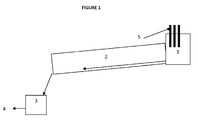
- FIG. 1 A typical kiln for the calcination of dolomite (and which generates fines which are collected) is shown in Figure 1 in which: dolomite is introduced into a preheater (1) and then passes into a rotating cylindrical calcining kiln (2); the dolomite moves through the kiln in the direction of the arrow. Calcined material exits the kiln and passes to an air cooler (3) where the calcined dolomite is cooled and collected (4).
- the temperature at the point of entry into the kiln (2) is about 900°C; the temperature at the other end of the kiln where calcined material exits the kiln (2) is about 1800°C.
- the kiln is heated by the combustion of pulverised coal in air; a stream of hot air enters the kiln at the end remote from the preheater (1) and passes towards the preheater. Dust generated during calcination in the rotating kiln (2) is entrained by the hot air stream and is precipitated on electrodes (4). The fines material is removed from the electrodes and collected.
- bitumen used in the compositions of the invention depends on the intended use of the bituminous composition.
- the bitumen is generally paving grade bitumen complying with BS EN 12591: 2000.
- Such bitumen is generally a penetration grade bitumen.
- Penetration grade bitumens are specified by penetration and softening point tests. Penetration values are measured in accordance with the procedure of BS EN 1426: 2000: penetration values are measured at 25°C in units of 0.1mm (the units are not generally quoted in penetration grades). It will be understood that the higher the penetration grade, the softer the bitumen. Softening point testing is carried out in accordance with the procedure of BS EN 1427:2000.
- Specifications for paving grade bitumens for use in the compositions of the invention may include: 10/20, 15/25, 20/30 (55-63°C); 30/45 (52-60°C); 35-50 (50-58°C); 40/60 (48-56°C); 50-70 (46-54°C); 70/100 (43-51°C); 100/150 (39-47°C); 160/220 (35-43°C); or 250-330 (30-38°C).
- the temperatures in parenthesis are the softening points for each grade.
- the stiffer grades, for example 10/20 and 15/25, are suitable for surfaces subject to heavy traffic, such as motorways. Grades 10/20 and 15/25 are preferably in accordance with BS EN 13924 part 1.
- compositions of the invention generally comprise from 2 to 10%, preferably from 3 to 7%, more preferably about 4% of bitumen.
- the bitumen may comprise a polymer (polymer modified bitumen) and/or natural or synthetic fibres.
- the polymers comprise polymers and copolymers and include thermoplastic rubber (TR), styrene-butadiene-styrene (SBS) and ethylene-vinyl acetate (EVA).
- TR thermoplastic rubber
- SBS styrene-butadiene-styrene
- EVA ethylene-vinyl acetate
- the polymer modified bitumens are preferably in accordance with BS EN 14023:2005.
- the preferred grade of EVA for bitumen modification, for road pavement materials has the classification "150/19". This material has a melt flow index of 150 and a vinyl acetate content of 19%.
- the amount of polymer or copolymer is generally 2 to 8%, for example about 5% by weight.
- Fibres for inclusion in bitumen include cellulose, mineral, glass and polyester fibres.
- the amount of fibres in the bitumen is generally less than or equal to 1% by weight.
- Additives for use in bitumen include: viscosity modifiers, for example low molecular weight polyethylene, paraffin wax or sulphur to reduce the viscosity; oil may also be used to extend workability time; stiffening agents such as cement, usually used in an amount of 1 to 2% by weight relative to the bitumen; and colouring agents.
- viscosity modifiers for example low molecular weight polyethylene, paraffin wax or sulphur to reduce the viscosity
- oil may also be used to extend workability time
- stiffening agents such as cement, usually used in an amount of 1 to 2% by weight relative to the bitumen
- colouring agents for use in bitumen
- the aggregates used in the compositions of the invention may, for example, be basic or acidic.
- Aggregates suitable for use in the compositions of the invention include:
- the aggregate used in the compositions of the invention preferably complies with BS EN 13043.
- the aggregate used in the compositions of the invention is preferably resistant to fragmentation.
- a test method for the determination of the Los Angeles Coefficient (LA) is described in BS EN 1097 Part 2. The lower the coefficient the more resistant the tested aggregate is to fragmentation.
- the test result is expressed as a category, for example LA 50, where the number represents the maximum value of the coefficient for the material tested.
- Aggregate from naturally occurring materials used in the compositions of the invention preferably has a Los Angeles coefficient less than or equal to 50, more preferably less than or equal to 30.
- Aggregate from blast furnace slag preferably has a Los Angeles coefficient less than or equal to 50.
- bituminous mixture When the bituminous mixture is to be used as a surface course a coarse aggregate complying with category PS 44 in accordance with BS EN 13043 is preferable.
- compositions of the invention generally comprise from 86 to 97.5%, preferably from 90 to 95%, more preferably about 94% of aggregate.
- the aggregate preferably comprises not more than 15% of fines (including the fines from the calcination of dolomite).
- the bituminous compositions according to the invention preferably have a Saturation Ageing Tensile Stiffness (SATS) durability index of 80% or more.
- SATS index is determined by a procedure carried out on test specimen cores of about100mm diameter and about 60mm thickness cored from a slab manufactured using a laboratory roller compacter in accordance with BS EN 12697-33 to a void content of 8% ⁇ 2%.
- the slab is produced using the recipe for the bituminous mixture to be tested except that a standard 10/20 penetration grade binder complying with Transport Research Laboratory (TRL) Report TRL 636 Annex A is substituted. Five nominally identical specimens are required for the full test.
- TRL Transport Research Laboratory
- the cores are obtained by sawing approximately equal amounts from each end of the core taken from the slab which should be approximately 100mm thick. Details of the SATS test are given in the UK MANUAL OF CONTRACT DOCUMENTS FOR HIGHWAY WORKS, VOLUME 1, SPECIFICATION FOR HIGHWAY WORKS, SERIES 900, ROAD PAVEMENTS - BITUMINOUS BOUND MATERIALS (Clause 953, page 41) as amended, November 2008 . The SATS test may also be modified by replacing the standard 10/20 penetration grade binder described above with the bitumen actually used in the bituminous composition to be tested. The results obtained then reflect more closely the properties of the bituminous compositions of the invention.
- the invention also provides a method for the manufacture of a bituminous composition which comprises mixing bitumen, aggregate and fines from the calcination of dolomite.
- bituminous mixtures of the invention can be prepared using conventional plant.
- Known processes for the preparation of bituminous mixtures include the "hot”, “warm”, “half-warm” (or “semi-warm”) and “cold” processes.
- both the aggregate and the bitumen are heated before mixing.
- the aggregate may be pre-dried or not.
- the hot process generally uses temperatures from 120°C to 190°C
- the aggregate In the warm process the aggregate is heated to a lower temperature than in the hot process, generally about 130°C, and the bitumen is heated, generally to a temperature of 100°C to 140°C, before mixing.
- the viscosity of the mixture is reduced by rheology modification, generally using organic additives.
- bitumen emulsion or foamed bitumen In the half-warm process a bitumen emulsion or foamed bitumen is used.
- the bitumen emulsion or foamed bitumen have reduced viscosity.
- a temperature of 70°C to 100°C is generally used.
- bitumen In the cold process an aqueous emulsion of bitumen is mixed with aggregate at ambient temperature.
- the fines from the calcination of dolomite may be used in association with other finely divided particulate material including, for example, pulverised fly ash and/or gypsum.
- the bitumen used in the cold process may be, for example, 100/150 grade.
- the aqueous emulsion used in the half-warm or cold process generally comprises a cationic or anionic emulsifying agent.
- the solid aggregate and solid fines are first mixed and the mixture of solids obtained is then mixed with the bitumen.
- bituminous compositions obtained by the cold process also comprise water from the aqueous emulsion.
- the emulsion is generally broken, and the water expressed, when the compositions are laid. After laying the composition is generally compacted, for example by rolling.
- bituminous compositions according to the invention may be used, for example, in the construction of pavements, e.g. road pavements, footways and car or lorry parks.
- Such constructions generally comprise a plurality of layers.
- the layers can include:
- the subgrade is a layer of naturally occurring material upon which the construction is built. It can also refer to a fill material used to create, for example, an embankment on which the construction is to be built.
- bituminous compositions of the invention can be used to form one or more of the surface course, the binder course, the roadbase and the sub-base.
- One or more of the surface course, the binder course and the roadbase preferably comprise a bituminous composition according to the invention. It will be understood that the bituminous compositions in different courses can be the same or, preferably, different.
- bituminous composition of the invention for use in a surface course preferably comprises penetration grade bitumen, optionally also comprising a polymer or copolymer and/or fibres as hereinbefore described.
- the aggregates used can be defined in terms of sieve sizes. Standard sieves used include those having mesh sizes of 4mm, 6.3mm (sometimes referred to as a 6mm sieve), 8mm, 10mm, 14mm, 16mm, 20mm and 31.5mm.
- the maximum size of an aggregate is generally taken as the smallest sieve through which all of the aggregate sample particles will pass.
- the nominal maximum size is generally taken as the largest sieve that retains some of the aggregate particles but generally not more than 10% by weight.
- the aggregate used in the compositions of the invention generally having a maximum size or nominal maximum size from 4mm to 31.5mm ( for example 4mm, 6mm, 8mm, 10mm, 14mm, 16mm, 20mm or 31.5mm).
- Aggregate having a maximum size or a nominal maximum size of 4mm, 6mm, 10mm, 14mm, 20mm or 31.5mm are preferably used in the compositions of the invention.
- the compositions generally comprise aggregate having a maximum size or nominal maximum size from 4mm to 20mm (for example 4mm, 6mm, 8mm, 10mm, 14mm, 16mm or 20mm) and preferably comprise a 6mm aggregate (the particles of which will all pass through a 6mm sieve) or a 10mm aggregate (the particles of which will all pass through a 10mm sieve).
- Aggregates having a nominal size of 6 or 10mm can also be used.
- the bitumen used is preferably penetration grade 100/150 or 70/100.
- Aggregate used in bituminous compositions for the binder course generally comprise aggregate having a maximum size or nominal maximum size from 4mm to 20mm (for example 4mm, 6mm, 8mm, 10mm, 14mm, 16mm or 20mm) and preferably comprise aggregate of 20mm nominal size or nominal maximum size.
- Aggregate used in bituminous compositions for the base course generally comprise aggregate having a maximum size or nominal maximum size from 4mm to 20mm (for example 4mm, 6mm, 8mm, 10mm, 14mm, 16mm, 20mm or 28mm) and preferably comprise aggregate of 28mm nominal size or nominal maximum size.
- the aggregate used in the invention may comprise a 0/4 aggregate: this includes coarse aggregate (particle size from 2 mm to 4 mm, fine aggregate (particle size greater than 0.063 and less than 2mm) and fines having a particle size generally less than 0.063mm.
- the aggregate used in the invention generally comprises 20 to 40% content of fine aggregate.
- the surface course comprises a porous bituminous composition according to the invention: the surface course preferably comprises aggregate of 10mm nominal maximum size; the binder course preferably comprises aggregate of 20mm nominal maximum size; and/or the base comprises aggregate of 28mm nominal maximum size.
- the bituminous surface course is preferably laid on a water-permeable binder course.
- the water-permeable binder course is preferably laid on a porous foundation layer.
- bituminous compositions of the invention is achieved by the interaction between the fines and the mix aggregates which strengthens the bond between the bitumen and the aggregate and also by an increase in the viscosity of the bitumen binder thereby increasing resistance to moisture susceptibility or damage.
- the invention also provides: a bituminous composition according to the invention in shaped form, for example as a layer in a pavement; and a road pavement comprising a bituminous composition according to the invention.
- bituminous composition is prepared by mixing (in parts by weight): bitumen : 4 aggregate (dried) : 94 fines from the calcination of dolomite : 2
- the bituminous composition prepared comprises 2% of fines.
- the bitumen is penetration grade 40/60 with a softening point of 48 to 56°C.
- the aggregate is crushed and screened limestone with a nominal size of 10mm and having a Los Angeles coefficient of 30.
- the fines from the calcination of dolomite are from the Whitwell Quarry in the UK.
- the aggregate is heated to 190°C then mixed with the Doloflour; the hot mixture is then mixed with bitumen previously heated to a temperature of about 170°C.
- the resulting bituminous mixture is tested using the modified SATS procedure described above (in which the standard 10/20 grade bitumen is replaced by the bitumen used in this Example) and has a durability index of more than 80%.
Landscapes
- Chemical & Material Sciences (AREA)
- Engineering & Computer Science (AREA)
- Civil Engineering (AREA)
- Structural Engineering (AREA)
- Organic Chemistry (AREA)
- Architecture (AREA)
- Materials Engineering (AREA)
- Health & Medical Sciences (AREA)
- Medicinal Chemistry (AREA)
- Polymers & Plastics (AREA)
- Chemical Kinetics & Catalysis (AREA)
- Life Sciences & Earth Sciences (AREA)
- Wood Science & Technology (AREA)
- Road Paving Structures (AREA)
- Compositions Of Macromolecular Compounds (AREA)
Abstract
Description
- This invention relates to bituminous compositions comprising a by-product from the calcination of dolomite.
- Dolomite is a sedimentary carbonate rock comprising mainly the mineral dolomite [CaMg(CO3)2]. Rocks comprising 10 to 50% of dolomite are called dolomitic. Most dolomite has been formed by a geological dolomitisation process in which calcium in limestone [Ca(CO3)2] is partially replaced by magnesium.
- Dolomite is calcined to produce calcium magnesium oxide (CaMg0) for use in the manufacture of steel, refractories and glass. Carbon dioxide is released from the dolomite during the calcination process. The calcination process is carried out in kilns. The process produces as a by-product a fine particulate material which is collected, for example by electrostatic precipitation, e.g. by precipitation onto charged electrodes.
- The material collected which is a precipitated kiln dust, in this specification including the accompanying claims, is called "fines from the calcination of dolomite" or "fines". A limited amount has been used for blending with lime, for sale as an agricultural lime product. The remainder has heretofore presented a problem of disposal or storage.
- It has now been discovered that the fines can be used in the preparation of mixtures of bitumen and aggregate. Such mixtures are known as asphalt (bituminous bound mixture). The present invention seeks to provide such mixtures having improved mechanical properties, for example increased durability.
- The present invention accordingly provides a bituminous composition comprising bitumen, aggregate and fines, which fines are from the calcination of dolomite.
- The composition preferably comprises 0.5 to 4%, more preferably 1 to 3%, for example about 2% of fines.
- The fines are generally a complex mixture which comprises, for example,
calcium magnesium carbonate (CaMg(CO3)2, dolomite);
calcium magnesium oxide (CaO•MgO);
calcium oxide (CaO); and/or
magnesium oxide (MgO). - The fines may comprise, for example,
60% or more, preferably 40% or more, of calcium magnesium carbonate;
15 to 60%, for example 15 to 40%, of calcium magnesium oxide;
15 to 40% of calcium oxide; and/or
15 to 40% of magnesium oxide; other compounds may also be present in smaller amounts. - The fines preferably comprise: Mg0 25 to 40%; Ca0 45 to 60%; Fe203 0.5 to 7%, for example 0.5 to 4.0%; and/or
S 1 to 6%; other elements may also be present in smaller amounts. - After collection from the kiln the fines used in the compositions of the invention are preferably protected from water, for example by bagging or tankering. Such protection serves, for example, to reduce possible hydrolysis of calcium and magnesium oxides (although magnesium oxide is less susceptible to hydrolysis) to form the corresponding hydroxides.
- In this specification including the accompanying claims percentage analysis figures are as determined by X ray fluorescence (XRF) spectrometry using a Panalytical XRF AXIOS machine and standard samples to permit quantitative analysis. This procedure is used by Ceram Research Ltd, Stoke on Trent, England, under UKAS Accreditation No. 0013 and inaccordance with XRF Test Document No. C201
- It will be understood that, because of the mixture of compounds in the fines, their physicochemical properties differ substantially from those of calcined dolomite itself.
- The loss on ignition (LOI) of the fines at 1000°C is preferably 20 to 30%. The procedure for determining LOI is carried out in accordance with BS EN 1744-1 (1998).
- The granulometry of the fines by sieving (sieve aperture in mm: percentage of material passing through the sieve) is preferably: 0.5 mm 100%; 0.3 mm 98 to 100%; 0.25 mm 97 to 100%; 0.125 mm 90 to 100%; and 0.063 mm 65 to 80%. The grading is measured in accordance with the procedure of BS EN 933-1 (1997).
The density of the fines, measured in kerosene in accordance with the procedure of BS EN 10973 (1998) is preferably 0.5 to 0.9 Mg/m3. - The fines material is preferably Doloflour, which is produced at two sites in the UK (Whitwell Quarry and Thrislington Quarry), more preferably Doloflour (Trade name) from the Whitwell quarry (which is also known as Whitwell Doloflour Limestone filler aggregate).
- The fines material preferably has a pH of 10 to 11 measured in accordance with known procedures. The fines material is preferably angular in shape.
- The fines from the calcination of dolomite may be used in association with other finely divided particulate material including, for example, pulverised fly ash and/or gypsum (also known as selenite.)
- A typical kiln for the calcination of dolomite (and which generates fines which are collected) is shown in
Figure 1 in which: dolomite is introduced into a preheater (1) and then passes into a rotating cylindrical calcining kiln (2); the dolomite moves through the kiln in the direction of the arrow. Calcined material exits the kiln and passes to an air cooler (3) where the calcined dolomite is cooled and collected (4). The temperature at the point of entry into the kiln (2) is about 900°C; the temperature at the other end of the kiln where calcined material exits the kiln (2) is about 1800°C. The kiln is heated by the combustion of pulverised coal in air; a stream of hot air enters the kiln at the end remote from the preheater (1) and passes towards the preheater. Dust generated during calcination in the rotating kiln (2) is entrained by the hot air stream and is precipitated on electrodes (4). The fines material is removed from the electrodes and collected. - The type of bitumen used in the compositions of the invention depends on the intended use of the bituminous composition. The bitumen is generally paving grade bitumen complying with BS EN 12591: 2000. Such bitumen is generally a penetration grade bitumen.
- Penetration grade bitumens are specified by penetration and softening point tests. Penetration values are measured in accordance with the procedure of BS EN 1426: 2000: penetration values are measured at 25°C in units of 0.1mm (the units are not generally quoted in penetration grades). It will be understood that the higher the penetration grade, the softer the bitumen. Softening point testing is carried out in accordance with the procedure of BS EN 1427:2000.
- Specifications for paving grade bitumens for use in the compositions of the invention may include: 10/20, 15/25, 20/30 (55-63°C); 30/45 (52-60°C); 35-50 (50-58°C); 40/60 (48-56°C); 50-70 (46-54°C); 70/100 (43-51°C); 100/150 (39-47°C); 160/220 (35-43°C); or 250-330 (30-38°C). The temperatures in parenthesis are the softening points for each grade. The stiffer grades, for example 10/20 and 15/25, are suitable for surfaces subject to heavy traffic, such as motorways. Grades 10/20 and 15/25 are preferably in accordance with BS EN 13924
part 1. - The compositions of the invention generally comprise from 2 to 10%, preferably from 3 to 7%, more preferably about 4% of bitumen.
- The bitumen may comprise a polymer (polymer modified bitumen) and/or natural or synthetic fibres.
- The polymers comprise polymers and copolymers and include thermoplastic rubber (TR), styrene-butadiene-styrene (SBS) and ethylene-vinyl acetate (EVA).
The polymer modified bitumens are preferably in accordance with BS EN 14023:2005. - The preferred grade of EVA for bitumen modification, for road pavement materials, has the classification "150/19". This material has a melt flow index of 150 and a vinyl acetate content of 19%.
- The amount of polymer or copolymer is generally 2 to 8%, for example about 5% by weight.
- Fibres for inclusion in bitumen include cellulose, mineral, glass and polyester fibres. The amount of fibres in the bitumen is generally less than or equal to 1% by weight.
- Additives for use in bitumen include: viscosity modifiers, for example low molecular weight polyethylene, paraffin wax or sulphur to reduce the viscosity; oil may also be used to extend workability time; stiffening agents such as cement, usually used in an amount of 1 to 2% by weight relative to the bitumen; and colouring agents.
- The aggregates used in the compositions of the invention may, for example, be basic or acidic. Aggregates suitable for use in the compositions of the invention include:
- (i) Naturally occurring materials, such as crushed rock aggregates from sedimentary rock which is generally hard, dense and cemented (for example limestones and sandstones), metamorphic rock which is generally tough and crystalline (for example quartzite) and igneous rocks (for example granite and basalt). Limestone for use in road pavements includes dolomite and dolomitic rocks.
- (ii) Industrially produced material such as blast furnace slag.
- (iii) Recycled aggregates including crushed concrete, bricks or glass, asphalt planings (i.e. the surface layers of roads removed during roadworks) and spent railway ballast.
- The aggregate used in the compositions of the invention preferably complies with BS EN 13043.
- The aggregate used in the compositions of the invention is preferably resistant to fragmentation. A test method for the determination of the Los Angeles Coefficient (LA) is described in BS EN 1097
Part 2. The lower the coefficient the more resistant the tested aggregate is to fragmentation. The test result is expressed as a category, for example LA 50, where the number represents the maximum value of the coefficient for the material tested. - Aggregate from naturally occurring materials used in the compositions of the invention preferably has a Los Angeles coefficient less than or equal to 50, more preferably less than or equal to 30. Aggregate from blast furnace slag preferably has a Los Angeles coefficient less than or equal to 50.
- When the bituminous mixture is to be used as a surface course a coarse aggregate complying with category PS44 in accordance with BS EN 13043 is preferable.
- The compositions of the invention generally comprise from 86 to 97.5%, preferably from 90 to 95%, more preferably about 94% of aggregate.
- The aggregate preferably comprises not more than 15% of fines (including the fines from the calcination of dolomite).
- The bituminous compositions according to the invention preferably have a Saturation Ageing Tensile Stiffness (SATS) durability index of 80% or more. The SATS index is determined by a procedure carried out on test specimen cores of about100mm diameter and about 60mm thickness cored from a slab manufactured using a laboratory roller compacter in accordance with BS EN 12697-33 to a void content of 8% ± 2%. The slab is produced using the recipe for the bituminous mixture to be tested except that a standard 10/20 penetration grade binder complying with Transport Research Laboratory (TRL) Report TRL 636 Annex A is substituted. Five nominally identical specimens are required for the full test. The cores are obtained by sawing approximately equal amounts from each end of the core taken from the slab which should be approximately 100mm thick. Details of the SATS test are given in the UK MANUAL OF CONTRACT DOCUMENTS FOR HIGHWAY WORKS, . The SATS test may also be modified by replacing the standard 10/20 penetration grade binder described above with the bitumen actually used in the bituminous composition to be tested. The results obtained then reflect more closely the properties of the bituminous compositions of the invention.
- The invention also provides a method for the manufacture of a bituminous composition which comprises mixing bitumen, aggregate and fines from the calcination of dolomite.
- The bituminous mixtures of the invention can be prepared using conventional plant. Known processes for the preparation of bituminous mixtures include the "hot", "warm", "half-warm" (or "semi-warm") and "cold" processes.
- In the hot process both the aggregate and the bitumen are heated before mixing. The aggregate may be pre-dried or not. The hot process generally uses temperatures from 120°C to 190°C
- In the warm process the aggregate is heated to a lower temperature than in the hot process, generally about 130°C, and the bitumen is heated, generally to a temperature of 100°C to 140°C, before mixing. The viscosity of the mixture is reduced by rheology modification, generally using organic additives.
- In the half-warm process a bitumen emulsion or foamed bitumen is used. The bitumen emulsion or foamed bitumen have reduced viscosity. A temperature of 70°C to 100°C is generally used.
- In the cold process an aqueous emulsion of bitumen is mixed with aggregate at ambient temperature. In a preferred embodiment of the invention the fines from the calcination of dolomite may be used in association with other finely divided particulate material including, for example, pulverised fly ash and/or gypsum. The bitumen used in the cold process may be, for example, 100/150 grade.
- The aqueous emulsion used in the half-warm or cold process generally comprises a cationic or anionic emulsifying agent.
- Preferably the solid aggregate and solid fines are first mixed and the mixture of solids obtained is then mixed with the bitumen.
- It will be understood that the bituminous compositions obtained by the cold process also comprise water from the aqueous emulsion. The emulsion is generally broken, and the water expressed, when the compositions are laid. After laying the composition is generally compacted, for example by rolling.
- The bituminous compositions according to the invention may be used, for example, in the construction of pavements, e.g. road pavements, footways and car or lorry parks. Such constructions generally comprise a plurality of layers. The layers can include:
- a wearing course (now generally referred to as a surface course);
- a base course (now generally referred to as a binder course) below the surface course;
- a roadbase (now generally referred to as a base) below the binder course;
- a sub-base below the roadbase;
- a capping layer below the sub-base; and
- a subgrade below the capping layer.
- The subgrade is a layer of naturally occurring material upon which the construction is built. It can also refer to a fill material used to create, for example, an embankment on which the construction is to be built.
- The bituminous compositions of the invention can be used to form one or more of the surface course, the binder course, the roadbase and the sub-base. One or more of the surface course, the binder course and the roadbase preferably comprise a bituminous composition according to the invention. It will be understood that the bituminous compositions in different courses can be the same or, preferably, different.
- The bituminous composition of the invention for use in a surface course preferably comprises penetration grade bitumen, optionally also comprising a polymer or copolymer and/or fibres as hereinbefore described.
- The aggregates used can be defined in terms of sieve sizes. Standard sieves used include those having mesh sizes of 4mm, 6.3mm (sometimes referred to as a 6mm sieve), 8mm, 10mm, 14mm, 16mm, 20mm and 31.5mm. The maximum size of an aggregate is generally taken as the smallest sieve through which all of the aggregate sample particles will pass. The nominal maximum size is generally taken as the largest sieve that retains some of the aggregate particles but generally not more than 10% by weight. The aggregate used in the compositions of the invention generally having a maximum size or nominal maximum size from 4mm to 31.5mm ( for example 4mm, 6mm, 8mm, 10mm, 14mm, 16mm, 20mm or 31.5mm). Aggregate having a maximum size or a nominal maximum size of 4mm, 6mm, 10mm, 14mm, 20mm or 31.5mm are preferably used in the compositions of the invention. For a surface course the compositions generally comprise aggregate having a maximum size or nominal maximum size from 4mm to 20mm ( for example 4mm, 6mm, 8mm, 10mm, 14mm, 16mm or 20mm) and preferably comprise a 6mm aggregate (the particles of which will all pass through a 6mm sieve) or a 10mm aggregate (the particles of which will all pass through a 10mm sieve). Aggregates having a nominal size of 6 or 10mm can also be used. The bitumen used is preferably penetration grade 100/150 or 70/100.
- Aggregate used in bituminous compositions for the binder course generally comprise aggregate having a maximum size or nominal maximum size from 4mm to 20mm (for example 4mm, 6mm, 8mm, 10mm, 14mm, 16mm or 20mm) and preferably comprise aggregate of 20mm nominal size or nominal maximum size.
- Aggregate used in bituminous compositions for the base course generally comprise aggregate having a maximum size or nominal maximum size from 4mm to 20mm (for example 4mm, 6mm, 8mm, 10mm, 14mm, 16mm, 20mm or 28mm) and preferably comprise aggregate of 28mm nominal size or nominal maximum size.
- The aggregate used in the invention may comprise a 0/4 aggregate: this includes coarse aggregate (particle size from 2 mm to 4 mm, fine aggregate (particle size greater than 0.063 and less than 2mm) and fines having a particle size generally less than 0.063mm. The aggregate used in the invention generally comprises 20 to 40% content of fine aggregate.
- In a preferred construction the surface course comprises a porous bituminous composition according to the invention: the surface course preferably comprises aggregate of 10mm nominal maximum size; the binder course preferably comprises aggregate of 20mm nominal maximum size; and/or the base comprises aggregate of 28mm nominal maximum size.
- The bituminous surface course is preferably laid on a water-permeable binder course. The water-permeable binder course is preferably laid on a porous foundation layer.
- It is thought that the improvement in the mechanical properties of the bituminous compositions of the invention is achieved by the interaction between the fines and the mix aggregates which strengthens the bond between the bitumen and the aggregate and also by an increase in the viscosity of the bitumen binder thereby increasing resistance to moisture susceptibility or damage.
- The invention also provides: a bituminous composition according to the invention in shaped form, for example as a layer in a pavement; and
a road pavement comprising a bituminous composition according to the invention. - In this specification, including the accompanying claims it is to be understood that:
- the term "dolomite" embraces dolomite and dolomitic rocks;
- percentages, unless otherwise specified, are by weight;
- the bituminous compositions of the invention comprise materials known in the UK as bituminous bound mixtures, asphalt and asphalt concrete (formerly known as macadam);
- the term "pavement" embraces a load-bearing surface comprising a plurality of layers for use by, for example pedestrians, and vehicles such as cars and lorries;
- the term aggregate embraces both coarse aggregate having a particle size greater than or equal to 2mm and fine aggregate having a particle size greater than 0.063mm and less than 2mm (fine aggregate is retained on a 0.063mm sieve)
- The following non-limiting Example illustrates the invention.
- A bituminous composition is prepared by mixing (in parts by weight):
bitumen : 4 aggregate (dried) : 94 fines from the calcination of dolomite : 2 - The bituminous composition prepared comprises 2% of fines.
- The bitumen is penetration grade 40/60 with a softening point of 48 to 56°C.
- The aggregate is crushed and screened limestone with a nominal size of 10mm and having a Los Angeles coefficient of 30.
- The fines from the calcination of dolomite are from the Whitwell Quarry in the UK.
- The aggregate is heated to 190°C then mixed with the Doloflour; the hot mixture is then mixed with bitumen previously heated to a temperature of about 170°C.
- The resulting bituminous mixture is tested using the modified SATS procedure described above (in which the standard 10/20 grade bitumen is replaced by the bitumen used in this Example) and has a durability index of more than 80%.
Claims (9)
- A bituminous composition comprising bitumen, aggregate and fines, which fines are from the calcination of dolomite.
- A composition according to claim 1 in which the fines are Doloflour from the Whitwell Quarry (UK).
- A composition according to claim 1 or 2 in which the bitumen is a penetration grade bitumen.
- A composition according to any one of the preceding claims in which the aggregate has a Los Angeles Coefficient of 30 or less.
- A composition according to any one of the preceding claims which is a porous asphalt.
- A composition according to any one of the preceding claims in which the bitumen comprises a polymer, copolymer and/or natural or synthetic fibres.
- A process for the manufacture of a bituminous composition according to any one of claims 1 to 6 which comprises mixing bitumen, aggregate and fines from the calcination of dolomite.
- A bituminous composition according to any one of claims 1 to 6 in shaped form.
- A pavement comprising a bituminous composition according to any one of claims 1 to 6
Applications Claiming Priority (1)
| Application Number | Priority Date | Filing Date | Title |
|---|---|---|---|
| GB1006286A GB2479573A (en) | 2010-04-15 | 2010-04-15 | Bituminous composition |
Publications (1)
| Publication Number | Publication Date |
|---|---|
| EP2380935A1 true EP2380935A1 (en) | 2011-10-26 |
Family
ID=42245250
Family Applications (1)
| Application Number | Title | Priority Date | Filing Date |
|---|---|---|---|
| EP11305450A Withdrawn EP2380935A1 (en) | 2010-04-15 | 2011-04-15 | Bituminous compositions |
Country Status (2)
| Country | Link |
|---|---|
| EP (1) | EP2380935A1 (en) |
| GB (1) | GB2479573A (en) |
Citations (1)
| Publication number | Priority date | Publication date | Assignee | Title |
|---|---|---|---|---|
| US7241337B1 (en) * | 2005-08-12 | 2007-07-10 | Carmeuse North America Services, Inc. | Paving composition containing lime kiln dust |
Family Cites Families (2)
| Publication number | Priority date | Publication date | Assignee | Title |
|---|---|---|---|---|
| US5544971A (en) * | 1994-10-26 | 1996-08-13 | Chemical Lime Company | Methods and compositions for recycling asphalt pavement |
| US20070231545A1 (en) * | 2006-03-28 | 2007-10-04 | Building Materials Investment Corporation | Industrial asphalt composition |
-
2010
- 2010-04-15 GB GB1006286A patent/GB2479573A/en not_active Withdrawn
-
2011
- 2011-04-15 EP EP11305450A patent/EP2380935A1/en not_active Withdrawn
Patent Citations (1)
| Publication number | Priority date | Publication date | Assignee | Title |
|---|---|---|---|---|
| US7241337B1 (en) * | 2005-08-12 | 2007-07-10 | Carmeuse North America Services, Inc. | Paving composition containing lime kiln dust |
Non-Patent Citations (2)
| Title |
|---|
| PAUL HUBBARD: "Unspoiling the environment", 1 May 2011 (2011-05-01), pages 1 - 3, XP055003661, Retrieved from the Internet <URL:http://www.mjca.co.uk/files/Unspoiling%20the%20Environment%20c.pdf> [retrieved on 20110727] * |
| RANDY C. WEST ET AL: "EVALUATION OF A LIME KILN DUST AS A MINERAL FILLER FOR STONE MATRIX ASPHALT", 1 January 2006 (2006-01-01), pages 1 - 22, XP055003657 * |
Also Published As
| Publication number | Publication date |
|---|---|
| GB2479573A (en) | 2011-10-19 |
| GB201006286D0 (en) | 2010-06-02 |
Similar Documents
| Publication | Publication Date | Title |
|---|---|---|
| Choudhary et al. | Application of waste materials as fillers in bituminous mixes | |
| Silvestre et al. | Using ceramic wastes from tile industry as a partial substitute of natural aggregates in hot mix asphalt binder courses | |
| Al-Hdabi | Laboratory investigation on the properties of asphalt concrete mixture with Rice Husk Ash as filler | |
| Colonna et al. | Application of bottom ash for pavement binder course | |
| Hassan et al. | Performance of steel slag aggregate in asphalt mixtures in a hot desert climate | |
| Bautista et al. | Effect of coal combustion products on high temperature performance of asphalt mastics | |
| Osuya et al. | Evaluation of sawdust ash as a partial replacement for mineral filler in asphaltic concrete | |
| Valentin et al. | Characterization of quarry dusts and industrial by-products as potential substitutes for traditional fillers and their impact on water susceptibility of asphalt concrete | |
| Sang et al. | Evaluation of the performance of waste marble dust as a mineral filler in hot-mix asphalt concrete | |
| Haritonovs et al. | Use of unconventional aggregates in hot mix asphalt concrete | |
| Deniz et al. | Evaluation of expansive characteristics of reclaimed asphalt pavement and virgin aggregate used as base materials | |
| Sevillano et al. | Mechanical and durability performance of asphalt mixtures with partial replacement of hydrated lime by calcium carbonate | |
| Oba et al. | Characterisation of saw dust ash–Quarry dust bituminous concrete | |
| Khedaywi et al. | Effect of filler materials on Marshall properties and rutting of asphalt mixtures using wheel tracking test: a comparative study | |
| WO2013017892A1 (en) | Improvements in and relating to bituminous paving | |
| GB2479573A (en) | Bituminous composition | |
| Chee et al. | The influence of eggshell powder as additive on the physical and mechanical properties of stone mastic asphalt | |
| Barra Bizinotto et al. | Experimental study of the effect of the thermal conductivity of EAF slag aggregates used in asphaltic concrete of wearing courses on the durability of road pavements | |
| Soliev et al. | Production of heat-resistant and frost-resistant composite hermetic mastics for filling cracks in asphalt concrete roads and defensive joints of roads with concrete pavement. | |
| Shahsamandy et al. | Performance evaluation of bituminous mixtures containing aggregates fully replaced with recycled marble and granite aggregates | |
| Murana et al. | Optimum bone ash filler in hot mix asphalt | |
| Adanikin et al. | Laboratory Study of the Use of Alternative Materials as Fillersin Asphaltic Concretes | |
| Ab Manaf et al. | Substitution of fly ash as mineral filler in wearing course of hot mix asphalt | |
| RU2717592C1 (en) | Composition for soil stabilization | |
| RU2214979C1 (en) | Asphalt-concrete mixture for road building |
Legal Events
| Date | Code | Title | Description |
|---|---|---|---|
| AK | Designated contracting states |
Kind code of ref document: A1 Designated state(s): AL AT BE BG CH CY CZ DE DK EE ES FI FR GB GR HR HU IE IS IT LI LT LU LV MC MK MT NL NO PL PT RO RS SE SI SK SM TR |
|
| AX | Request for extension of the european patent |
Extension state: BA ME |
|
| PUAI | Public reference made under article 153(3) epc to a published international application that has entered the european phase |
Free format text: ORIGINAL CODE: 0009012 |
|
| 17P | Request for examination filed |
Effective date: 20120426 |
|
| GRAP | Despatch of communication of intention to grant a patent |
Free format text: ORIGINAL CODE: EPIDOSNIGR1 |
|
| RIC1 | Information provided on ipc code assigned before grant |
Ipc: C08K 3/22 20060101ALI20160912BHEP Ipc: E01C 7/26 20060101ALI20160912BHEP Ipc: C08L 95/00 20060101AFI20160912BHEP Ipc: C09D 195/00 20060101ALI20160912BHEP Ipc: E01C 7/18 20060101ALI20160912BHEP Ipc: E01C 7/35 20060101ALI20160912BHEP |
|
| INTG | Intention to grant announced |
Effective date: 20160927 |
|
| STAA | Information on the status of an ep patent application or granted ep patent |
Free format text: STATUS: THE APPLICATION IS DEEMED TO BE WITHDRAWN |
|
| 18D | Application deemed to be withdrawn |
Effective date: 20170208 |