EP2380632A1 - The use of NMDA antagonists to attenuate vitreoretinal vascular endothelial growth factor (VEGF) protein levels in animals - Google Patents
The use of NMDA antagonists to attenuate vitreoretinal vascular endothelial growth factor (VEGF) protein levels in animals Download PDFInfo
- Publication number
- EP2380632A1 EP2380632A1 EP11174829A EP11174829A EP2380632A1 EP 2380632 A1 EP2380632 A1 EP 2380632A1 EP 11174829 A EP11174829 A EP 11174829A EP 11174829 A EP11174829 A EP 11174829A EP 2380632 A1 EP2380632 A1 EP 2380632A1
- Authority
- EP
- European Patent Office
- Prior art keywords
- stz
- veh
- vegf
- treated
- protein levels
- Prior art date
- Legal status (The legal status is an assumption and is not a legal conclusion. Google has not performed a legal analysis and makes no representation as to the accuracy of the status listed.)
- Withdrawn
Links
- 102000005789 Vascular Endothelial Growth Factors Human genes 0.000 title claims abstract description 61
- 108010019530 Vascular Endothelial Growth Factors Proteins 0.000 title claims abstract description 61
- 239000005557 antagonist Substances 0.000 title claims description 7
- 108010073929 Vascular Endothelial Growth Factor A Proteins 0.000 title description 58
- 241001465754 Metazoa Species 0.000 title description 37
- 102000004169 proteins and genes Human genes 0.000 title description 6
- 108090000623 proteins and genes Proteins 0.000 title description 6
- HOKKHZGPKSLGJE-GSVOUGTGSA-N N-Methyl-D-aspartic acid Chemical compound CN[C@@H](C(O)=O)CC(O)=O HOKKHZGPKSLGJE-GSVOUGTGSA-N 0.000 title description 4
- 230000004378 blood-retinal barrier Effects 0.000 claims abstract description 21
- 230000015556 catabolic process Effects 0.000 claims abstract description 13
- 208000022873 Ocular disease Diseases 0.000 claims abstract description 9
- 239000012530 fluid Substances 0.000 claims description 20
- 238000000034 method Methods 0.000 claims description 15
- 206010012689 Diabetic retinopathy Diseases 0.000 claims description 11
- 208000002780 macular degeneration Diseases 0.000 claims description 9
- 206010064930 age-related macular degeneration Diseases 0.000 claims description 8
- 206010012688 Diabetic retinal oedema Diseases 0.000 claims description 6
- 206010028980 Neoplasm Diseases 0.000 claims description 6
- 201000011190 diabetic macular edema Diseases 0.000 claims description 6
- 201000007914 proliferative diabetic retinopathy Diseases 0.000 claims description 5
- UYNVMODNBIQBMV-UHFFFAOYSA-N 4-[1-hydroxy-2-[4-(phenylmethyl)-1-piperidinyl]propyl]phenol Chemical compound C1CC(CC=2C=CC=CC=2)CCN1C(C)C(O)C1=CC=C(O)C=C1 UYNVMODNBIQBMV-UHFFFAOYSA-N 0.000 claims description 3
- YQEZLKZALYSWHR-UHFFFAOYSA-N Ketamine Chemical compound C=1C=CC=C(Cl)C=1C1(NC)CCCCC1=O YQEZLKZALYSWHR-UHFFFAOYSA-N 0.000 claims description 3
- MKXZASYAUGDDCJ-SZMVWBNQSA-N LSM-2525 Chemical compound C1CCC[C@H]2[C@@]3([H])N(C)CC[C@]21C1=CC(OC)=CC=C1C3 MKXZASYAUGDDCJ-SZMVWBNQSA-N 0.000 claims description 3
- DKNWSYNQZKUICI-UHFFFAOYSA-N amantadine Chemical compound C1C(C2)CC3CC2CC1(N)C3 DKNWSYNQZKUICI-UHFFFAOYSA-N 0.000 claims description 3
- 229960003805 amantadine Drugs 0.000 claims description 3
- 229960001985 dextromethorphan Drugs 0.000 claims description 3
- 229960003998 ifenprodil Drugs 0.000 claims description 3
- 229960003299 ketamine Drugs 0.000 claims description 3
- HCZHHEIFKROPDY-UHFFFAOYSA-N kynurenic acid Chemical compound C1=CC=C2NC(C(=O)O)=CC(=O)C2=C1 HCZHHEIFKROPDY-UHFFFAOYSA-N 0.000 claims description 3
- 230000029663 wound healing Effects 0.000 claims description 3
- 206010061218 Inflammation Diseases 0.000 claims description 2
- 230000004054 inflammatory process Effects 0.000 claims description 2
- UMFJAHHVKNCGLG-UHFFFAOYSA-N n-Nitrosodimethylamine Chemical compound CN(C)N=O UMFJAHHVKNCGLG-UHFFFAOYSA-N 0.000 claims 5
- XYLJNLCSTIOKRM-UHFFFAOYSA-N Alphagan Chemical compound C1=CC2=NC=CN=C2C(Br)=C1NC1=NCCN1 XYLJNLCSTIOKRM-UHFFFAOYSA-N 0.000 abstract description 27
- 229960003679 brimonidine Drugs 0.000 abstract description 27
- BUGYDGFZZOZRHP-UHFFFAOYSA-N memantine Chemical compound C1C(C2)CC3(C)CC1(C)CC2(N)C3 BUGYDGFZZOZRHP-UHFFFAOYSA-N 0.000 abstract description 22
- 229960004640 memantine Drugs 0.000 abstract description 21
- 239000000203 mixture Substances 0.000 abstract description 6
- 150000001875 compounds Chemical class 0.000 abstract description 5
- ZSJLQEPLLKMAKR-GKHCUFPYSA-N streptozocin Chemical compound O=NN(C)C(=O)N[C@H]1[C@@H](O)O[C@H](CO)[C@@H](O)[C@@H]1O ZSJLQEPLLKMAKR-GKHCUFPYSA-N 0.000 description 65
- ZSJLQEPLLKMAKR-UHFFFAOYSA-N Streptozotocin Natural products O=NN(C)C(=O)NC1C(O)OC(CO)C(O)C1O ZSJLQEPLLKMAKR-UHFFFAOYSA-N 0.000 description 64
- 229960001052 streptozocin Drugs 0.000 description 64
- 241000700159 Rattus Species 0.000 description 33
- 206010012601 diabetes mellitus Diseases 0.000 description 27
- 239000000556 agonist Substances 0.000 description 20
- 210000001525 retina Anatomy 0.000 description 20
- WHUUTDBJXJRKMK-VKHMYHEASA-N L-glutamic acid Chemical compound OC(=O)[C@@H](N)CCC(O)=O WHUUTDBJXJRKMK-VKHMYHEASA-N 0.000 description 15
- 229930195712 glutamate Natural products 0.000 description 15
- 210000004155 blood-retinal barrier Anatomy 0.000 description 14
- 230000002207 retinal effect Effects 0.000 description 13
- WQZGKKKJIJFFOK-GASJEMHNSA-N Glucose Natural products OC[C@H]1OC(O)[C@H](O)[C@@H](O)[C@@H]1O WQZGKKKJIJFFOK-GASJEMHNSA-N 0.000 description 9
- 201000010099 disease Diseases 0.000 description 9
- 208000037265 diseases, disorders, signs and symptoms Diseases 0.000 description 9
- 239000008103 glucose Substances 0.000 description 9
- 230000000694 effects Effects 0.000 description 8
- 239000008280 blood Substances 0.000 description 7
- 210000004369 blood Anatomy 0.000 description 7
- 230000037396 body weight Effects 0.000 description 7
- 102000004868 N-Methyl-D-Aspartate Receptors Human genes 0.000 description 6
- 108090001041 N-Methyl-D-Aspartate Receptors Proteins 0.000 description 6
- 102000003923 Protein Kinase C Human genes 0.000 description 6
- 108090000315 Protein Kinase C Proteins 0.000 description 6
- 230000002238 attenuated effect Effects 0.000 description 6
- 210000004027 cell Anatomy 0.000 description 6
- 230000001684 chronic effect Effects 0.000 description 6
- 208000029977 White Dot Syndromes Diseases 0.000 description 5
- HUCJFAOMUPXHDK-UHFFFAOYSA-N Xylometazoline Chemical compound CC1=CC(C(C)(C)C)=CC(C)=C1CC1=NCCN1 HUCJFAOMUPXHDK-UHFFFAOYSA-N 0.000 description 4
- WYWIFABBXFUGLM-UHFFFAOYSA-N oxymetazoline Chemical compound CC1=CC(C(C)(C)C)=C(O)C(C)=C1CC1=NCCN1 WYWIFABBXFUGLM-UHFFFAOYSA-N 0.000 description 4
- 208000017442 Retinal disease Diseases 0.000 description 3
- 230000004913 activation Effects 0.000 description 3
- 239000003703 n methyl dextro aspartic acid receptor blocking agent Substances 0.000 description 3
- 239000000546 pharmaceutical excipient Substances 0.000 description 3
- 239000000725 suspension Substances 0.000 description 3
- RLHGFJMGWQXPBW-UHFFFAOYSA-N 2-hydroxy-3-(1h-imidazol-5-ylmethyl)benzamide Chemical compound NC(=O)C1=CC=CC(CC=2NC=NC=2)=C1O RLHGFJMGWQXPBW-UHFFFAOYSA-N 0.000 description 2
- GJSURZIOUXUGAL-UHFFFAOYSA-N Clonidine Chemical compound ClC1=CC=CC(Cl)=C1NC1=NCCN1 GJSURZIOUXUGAL-UHFFFAOYSA-N 0.000 description 2
- 208000003098 Ganglion Cysts Diseases 0.000 description 2
- WDZVGELJXXEGPV-YIXHJXPBSA-N Guanabenz Chemical compound NC(N)=N\N=C\C1=C(Cl)C=CC=C1Cl WDZVGELJXXEGPV-YIXHJXPBSA-N 0.000 description 2
- INJOMKTZOLKMBF-UHFFFAOYSA-N Guanfacine Chemical compound NC(=N)NC(=O)CC1=C(Cl)C=CC=C1Cl INJOMKTZOLKMBF-UHFFFAOYSA-N 0.000 description 2
- 208000031886 HIV Infections Diseases 0.000 description 2
- 208000037357 HIV infectious disease Diseases 0.000 description 2
- WPNJAUFVNXKLIM-UHFFFAOYSA-N Moxonidine Chemical compound COC1=NC(C)=NC(Cl)=C1NC1=NCCN1 WPNJAUFVNXKLIM-UHFFFAOYSA-N 0.000 description 2
- 206010038923 Retinopathy Diseases 0.000 description 2
- 206010038933 Retinopathy of prematurity Diseases 0.000 description 2
- 208000027073 Stargardt disease Diseases 0.000 description 2
- 208000005400 Synovial Cyst Diseases 0.000 description 2
- DPQAXNSOFFYKDS-UHFFFAOYSA-N Talipexole dihydrochloride Chemical compound Cl.Cl.C1CN(CC=C)CCC2=C1N=C(N)S2 DPQAXNSOFFYKDS-UHFFFAOYSA-N 0.000 description 2
- 206010046851 Uveitis Diseases 0.000 description 2
- 230000009471 action Effects 0.000 description 2
- 230000001154 acute effect Effects 0.000 description 2
- 239000000048 adrenergic agonist Substances 0.000 description 2
- 239000000384 adrenergic alpha-2 receptor agonist Substances 0.000 description 2
- FPIPGXGPPPQFEQ-OVSJKPMPSA-N all-trans-retinol Chemical compound OC\C=C(/C)\C=C\C=C(/C)\C=C\C1=C(C)CCCC1(C)C FPIPGXGPPPQFEQ-OVSJKPMPSA-N 0.000 description 2
- 210000003161 choroid Anatomy 0.000 description 2
- 229960002896 clonidine Drugs 0.000 description 2
- HRLIOXLXPOHXTA-NSHDSACASA-N dexmedetomidine Chemical compound C1([C@@H](C)C=2C(=C(C)C=CC=2)C)=CN=C[N]1 HRLIOXLXPOHXTA-NSHDSACASA-N 0.000 description 2
- 229960004253 dexmedetomidine Drugs 0.000 description 2
- 231100000673 dose–response relationship Toxicity 0.000 description 2
- 210000002889 endothelial cell Anatomy 0.000 description 2
- 230000002964 excitative effect Effects 0.000 description 2
- 238000002474 experimental method Methods 0.000 description 2
- 229960004553 guanabenz Drugs 0.000 description 2
- 229960002048 guanfacine Drugs 0.000 description 2
- 208000033519 human immunodeficiency virus infectious disease Diseases 0.000 description 2
- HRLIOXLXPOHXTA-UHFFFAOYSA-N medetomidine Chemical compound C=1C=CC(C)=C(C)C=1C(C)C1=CN=C[N]1 HRLIOXLXPOHXTA-UHFFFAOYSA-N 0.000 description 2
- 229960002140 medetomidine Drugs 0.000 description 2
- 229950010998 mivazerol Drugs 0.000 description 2
- 229960003938 moxonidine Drugs 0.000 description 2
- 229960001528 oxymetazoline Drugs 0.000 description 2
- 230000001575 pathological effect Effects 0.000 description 2
- 239000013641 positive control Substances 0.000 description 2
- 201000002267 posterior uveal melanoma Diseases 0.000 description 2
- 102000005962 receptors Human genes 0.000 description 2
- 108020003175 receptors Proteins 0.000 description 2
- 210000003994 retinal ganglion cell Anatomy 0.000 description 2
- 210000003583 retinal pigment epithelium Anatomy 0.000 description 2
- 208000004644 retinal vein occlusion Diseases 0.000 description 2
- 150000003839 salts Chemical class 0.000 description 2
- 239000000243 solution Substances 0.000 description 2
- XFYDIVBRZNQMJC-UHFFFAOYSA-N tizanidine Chemical compound ClC=1C=CC2=NSN=C2C=1NC1=NCCN1 XFYDIVBRZNQMJC-UHFFFAOYSA-N 0.000 description 2
- 229960000488 tizanidine Drugs 0.000 description 2
- 231100000331 toxic Toxicity 0.000 description 2
- 230000002588 toxic effect Effects 0.000 description 2
- 230000001982 uveitic effect Effects 0.000 description 2
- 230000002792 vascular Effects 0.000 description 2
- 230000008728 vascular permeability Effects 0.000 description 2
- BPICBUSOMSTKRF-UHFFFAOYSA-N xylazine Chemical compound CC1=CC=CC(C)=C1NC1=NCCCS1 BPICBUSOMSTKRF-UHFFFAOYSA-N 0.000 description 2
- 229960001600 xylazine Drugs 0.000 description 2
- 229960000833 xylometazoline Drugs 0.000 description 2
- MGRVRXRGTBOSHW-UHFFFAOYSA-N (aminomethyl)phosphonic acid Chemical compound NCP(O)(O)=O MGRVRXRGTBOSHW-UHFFFAOYSA-N 0.000 description 1
- FPIPGXGPPPQFEQ-UHFFFAOYSA-N 13-cis retinol Natural products OCC=C(C)C=CC=C(C)C=CC1=C(C)CCCC1(C)C FPIPGXGPPPQFEQ-UHFFFAOYSA-N 0.000 description 1
- WQXVKEDUCPMRRI-JTQLQIEISA-N 4-[(1s)-1-(2,3-dimethylphenyl)ethyl]-1,3-dihydroimidazole-2-thione Chemical compound C1([C@@H](C)C=2C(=C(C)C=CC=2)C)=CNC(=S)N1 WQXVKEDUCPMRRI-JTQLQIEISA-N 0.000 description 1
- 208000004142 Acute Retinal Necrosis Syndrome Diseases 0.000 description 1
- 208000005598 Angioid Streaks Diseases 0.000 description 1
- 102000005862 Angiotensin II Human genes 0.000 description 1
- 101800000733 Angiotensin-2 Proteins 0.000 description 1
- 206010003571 Astrocytoma Diseases 0.000 description 1
- 201000007795 Bietti crystalline corneoretinal dystrophy Diseases 0.000 description 1
- OYPRJOBELJOOCE-UHFFFAOYSA-N Calcium Chemical compound [Ca] OYPRJOBELJOOCE-UHFFFAOYSA-N 0.000 description 1
- 208000003569 Central serous chorioretinopathy Diseases 0.000 description 1
- 108091006146 Channels Proteins 0.000 description 1
- 208000033825 Chorioretinal atrophy Diseases 0.000 description 1
- 206010070957 Choroidal haemangioma Diseases 0.000 description 1
- 206010053567 Coagulopathies Diseases 0.000 description 1
- 208000021089 Coats disease Diseases 0.000 description 1
- 201000000077 Cysticercosis Diseases 0.000 description 1
- 206010058202 Cystoid macular oedema Diseases 0.000 description 1
- 208000016974 Eales' disease Diseases 0.000 description 1
- 208000001351 Epiretinal Membrane Diseases 0.000 description 1
- 208000028506 Familial Exudative Vitreoretinopathies Diseases 0.000 description 1
- 102000018899 Glutamate Receptors Human genes 0.000 description 1
- 108010027915 Glutamate Receptors Proteins 0.000 description 1
- 201000002563 Histoplasmosis Diseases 0.000 description 1
- 241000282412 Homo Species 0.000 description 1
- 206010020772 Hypertension Diseases 0.000 description 1
- 206010021143 Hypoxia Diseases 0.000 description 1
- CZGUSIXMZVURDU-JZXHSEFVSA-N Ile(5)-angiotensin II Chemical compound C([C@@H](C(=O)N[C@@H]([C@@H](C)CC)C(=O)N[C@@H](CC=1NC=NC=1)C(=O)N1[C@@H](CCC1)C(=O)N[C@@H](CC=1C=CC=CC=1)C([O-])=O)NC(=O)[C@@H](NC(=O)[C@H](CCCNC(N)=[NH2+])NC(=O)[C@@H]([NH3+])CC([O-])=O)C(C)C)C1=CC=C(O)C=C1 CZGUSIXMZVURDU-JZXHSEFVSA-N 0.000 description 1
- 208000026350 Inborn Genetic disease Diseases 0.000 description 1
- 206010022557 Intermediate uveitis Diseases 0.000 description 1
- 102000006541 Ionotropic Glutamate Receptors Human genes 0.000 description 1
- 108010008812 Ionotropic Glutamate Receptors Proteins 0.000 description 1
- VLSMHEGGTFMBBZ-OOZYFLPDSA-M Kainate Chemical compound CC(=C)[C@H]1C[NH2+][C@H](C([O-])=O)[C@H]1CC([O-])=O VLSMHEGGTFMBBZ-OOZYFLPDSA-M 0.000 description 1
- 102000000079 Kainic Acid Receptors Human genes 0.000 description 1
- 108010069902 Kainic Acid Receptors Proteins 0.000 description 1
- 208000001344 Macular Edema Diseases 0.000 description 1
- 206010025412 Macular dystrophy congenital Diseases 0.000 description 1
- 208000035719 Maculopathy Diseases 0.000 description 1
- 241000124008 Mammalia Species 0.000 description 1
- 206010027476 Metastases Diseases 0.000 description 1
- 208000010164 Multifocal Choroiditis Diseases 0.000 description 1
- 208000031888 Mycoses Diseases 0.000 description 1
- 208000006123 Myiasis Diseases 0.000 description 1
- 229940099433 NMDA receptor antagonist Drugs 0.000 description 1
- 206010065119 Necrotising herpetic retinopathy Diseases 0.000 description 1
- 206010029113 Neovascularisation Diseases 0.000 description 1
- 206010069385 Ocular ischaemic syndrome Diseases 0.000 description 1
- 206010065700 Ocular sarcoidosis Diseases 0.000 description 1
- 208000003435 Optic Neuritis Diseases 0.000 description 1
- 208000004788 Pars Planitis Diseases 0.000 description 1
- 208000034247 Pattern dystrophy Diseases 0.000 description 1
- 206010064714 Radiation retinopathy Diseases 0.000 description 1
- 230000010799 Receptor Interactions Effects 0.000 description 1
- 208000021016 Retinal Arterial Macroaneurysm Diseases 0.000 description 1
- 208000002367 Retinal Perforations Diseases 0.000 description 1
- 208000008709 Retinal Telangiectasis Diseases 0.000 description 1
- 201000001949 Retinal Vasculitis Diseases 0.000 description 1
- 206010038821 Retinal anomaly congenital Diseases 0.000 description 1
- 201000007737 Retinal degeneration Diseases 0.000 description 1
- 206010038848 Retinal detachment Diseases 0.000 description 1
- 208000032430 Retinal dystrophy Diseases 0.000 description 1
- 206010038910 Retinitis Diseases 0.000 description 1
- 208000007014 Retinitis pigmentosa Diseases 0.000 description 1
- 206010038915 Retinitis viral Diseases 0.000 description 1
- 201000000582 Retinoblastoma Diseases 0.000 description 1
- 206010038935 Retinopathy sickle cell Diseases 0.000 description 1
- 206010039705 Scleritis Diseases 0.000 description 1
- 208000014286 Serpiginous choroiditis Diseases 0.000 description 1
- 208000022758 Sorsby fundus dystrophy Diseases 0.000 description 1
- 208000036038 Subretinal fibrosis Diseases 0.000 description 1
- 206010042742 Sympathetic ophthalmia Diseases 0.000 description 1
- 206010043189 Telangiectasia Diseases 0.000 description 1
- 206010044269 Toxocariasis Diseases 0.000 description 1
- 201000005485 Toxoplasmosis Diseases 0.000 description 1
- 208000001445 Uveomeningoencephalitic Syndrome Diseases 0.000 description 1
- 108091008605 VEGF receptors Proteins 0.000 description 1
- 102000009484 Vascular Endothelial Growth Factor Receptors Human genes 0.000 description 1
- 208000034705 Vogt-Koyanagi-Harada syndrome Diseases 0.000 description 1
- 201000001408 X-linked juvenile retinoschisis 1 Diseases 0.000 description 1
- 208000017441 X-linked retinoschisis Diseases 0.000 description 1
- 238000009825 accumulation Methods 0.000 description 1
- 239000004480 active ingredient Substances 0.000 description 1
- 239000013543 active substance Substances 0.000 description 1
- 208000023564 acute macular neuroretinopathy Diseases 0.000 description 1
- 229950006323 angiotensin ii Drugs 0.000 description 1
- 210000001742 aqueous humor Anatomy 0.000 description 1
- 230000008901 benefit Effects 0.000 description 1
- WQZGKKKJIJFFOK-VFUOTHLCSA-N beta-D-glucose Chemical compound OC[C@H]1O[C@@H](O)[C@H](O)[C@@H](O)[C@@H]1O WQZGKKKJIJFFOK-VFUOTHLCSA-N 0.000 description 1
- 230000015572 biosynthetic process Effects 0.000 description 1
- 206010072959 birdshot chorioretinopathy Diseases 0.000 description 1
- 208000015294 blood coagulation disease Diseases 0.000 description 1
- 210000001185 bone marrow Anatomy 0.000 description 1
- 239000011575 calcium Substances 0.000 description 1
- 229910052791 calcium Inorganic materials 0.000 description 1
- 239000002775 capsule Substances 0.000 description 1
- 230000030833 cell death Effects 0.000 description 1
- 201000005667 central retinal vein occlusion Diseases 0.000 description 1
- 208000020656 combined hamartoma of the retina and retinal pigment epithelium Diseases 0.000 description 1
- 201000008615 cone dystrophy Diseases 0.000 description 1
- 208000006623 congenital stationary night blindness Diseases 0.000 description 1
- 239000006071 cream Substances 0.000 description 1
- 201000010206 cystoid macular edema Diseases 0.000 description 1
- 230000007850 degeneration Effects 0.000 description 1
- 238000011161 development Methods 0.000 description 1
- 238000003748 differential diagnosis Methods 0.000 description 1
- 239000003085 diluting agent Substances 0.000 description 1
- 239000002552 dosage form Substances 0.000 description 1
- 239000003814 drug Substances 0.000 description 1
- 239000000839 emulsion Substances 0.000 description 1
- 206010014801 endophthalmitis Diseases 0.000 description 1
- 239000000928 excitatory amino acid agonist Substances 0.000 description 1
- 239000004060 excitotoxin Substances 0.000 description 1
- 201000006902 exudative vitreoretinopathy Diseases 0.000 description 1
- 238000009472 formulation Methods 0.000 description 1
- 239000000499 gel Substances 0.000 description 1
- 208000016361 genetic disease Diseases 0.000 description 1
- 208000034737 hemoglobinopathy Diseases 0.000 description 1
- 230000001631 hypertensive effect Effects 0.000 description 1
- 230000007954 hypoxia Effects 0.000 description 1
- 239000000411 inducer Substances 0.000 description 1
- 230000004968 inflammatory condition Effects 0.000 description 1
- 238000001802 infusion Methods 0.000 description 1
- 208000018337 inherited hemoglobinopathy Diseases 0.000 description 1
- 230000003993 interaction Effects 0.000 description 1
- 210000004692 intercellular junction Anatomy 0.000 description 1
- 230000003834 intracellular effect Effects 0.000 description 1
- 238000007918 intramuscular administration Methods 0.000 description 1
- 239000007928 intraperitoneal injection Substances 0.000 description 1
- 238000001990 intravenous administration Methods 0.000 description 1
- 230000001057 ionotropic effect Effects 0.000 description 1
- 208000028867 ischemia Diseases 0.000 description 1
- 239000008263 liquid aerosol Substances 0.000 description 1
- 238000011670 long-evans rat Methods 0.000 description 1
- 208000019420 lymphoid neoplasm Diseases 0.000 description 1
- 208000029233 macular holes Diseases 0.000 description 1
- 239000012528 membrane Substances 0.000 description 1
- 230000009401 metastasis Effects 0.000 description 1
- 239000003226 mitogen Substances 0.000 description 1
- 239000007923 nasal drop Substances 0.000 description 1
- 229940100662 nasal drops Drugs 0.000 description 1
- 239000007922 nasal spray Substances 0.000 description 1
- 229940097496 nasal spray Drugs 0.000 description 1
- 230000004770 neurodegeneration Effects 0.000 description 1
- 230000003955 neuronal function Effects 0.000 description 1
- 230000000324 neuroprotective effect Effects 0.000 description 1
- 201000002165 neuroretinitis Diseases 0.000 description 1
- 239000002858 neurotransmitter agent Substances 0.000 description 1
- 239000002674 ointment Substances 0.000 description 1
- 230000003204 osmotic effect Effects 0.000 description 1
- 208000008798 osteoma Diseases 0.000 description 1
- 230000008506 pathogenesis Effects 0.000 description 1
- 210000003668 pericyte Anatomy 0.000 description 1
- 230000035699 permeability Effects 0.000 description 1
- 239000008194 pharmaceutical composition Substances 0.000 description 1
- 230000026731 phosphorylation Effects 0.000 description 1
- 238000006366 phosphorylation reaction Methods 0.000 description 1
- 108091008695 photoreceptors Proteins 0.000 description 1
- 239000000049 pigment Substances 0.000 description 1
- 201000004849 posterior scleritis Diseases 0.000 description 1
- 230000003389 potentiating effect Effects 0.000 description 1
- 239000000843 powder Substances 0.000 description 1
- 208000034503 punctate inner choroidopathy Diseases 0.000 description 1
- 238000011552 rat model Methods 0.000 description 1
- 229940100619 rectal spray Drugs 0.000 description 1
- 230000004264 retinal detachment Effects 0.000 description 1
- 239000000790 retinal pigment Substances 0.000 description 1
- 229960003471 retinol Drugs 0.000 description 1
- 235000020944 retinol Nutrition 0.000 description 1
- 239000011607 retinol Substances 0.000 description 1
- 201000007714 retinoschisis Diseases 0.000 description 1
- 210000000329 smooth muscle myocyte Anatomy 0.000 description 1
- 239000007921 spray Substances 0.000 description 1
- 238000007920 subcutaneous administration Methods 0.000 description 1
- 239000000829 suppository Substances 0.000 description 1
- 230000005062 synaptic transmission Effects 0.000 description 1
- 208000011580 syndromic disease Diseases 0.000 description 1
- 238000003786 synthesis reaction Methods 0.000 description 1
- 208000006379 syphilis Diseases 0.000 description 1
- 230000009885 systemic effect Effects 0.000 description 1
- 208000004441 taeniasis Diseases 0.000 description 1
- 208000009056 telangiectasis Diseases 0.000 description 1
- 230000001225 therapeutic effect Effects 0.000 description 1
- 210000001578 tight junction Anatomy 0.000 description 1
- 230000000699 topical effect Effects 0.000 description 1
- 231100000419 toxicity Toxicity 0.000 description 1
- 230000001988 toxicity Effects 0.000 description 1
- 230000001052 transient effect Effects 0.000 description 1
- 201000008827 tuberculosis Diseases 0.000 description 1
- 230000006711 vascular endothelial growth factor production Effects 0.000 description 1
- 230000003074 vasoproliferative effect Effects 0.000 description 1
- 201000007790 vitelliform macular dystrophy Diseases 0.000 description 1
- 208000006542 von Hippel-Lindau disease Diseases 0.000 description 1
Images


Classifications
-
- A—HUMAN NECESSITIES
- A61—MEDICAL OR VETERINARY SCIENCE; HYGIENE
- A61K—PREPARATIONS FOR MEDICAL, DENTAL OR TOILETRY PURPOSES
- A61K31/00—Medicinal preparations containing organic active ingredients
- A61K31/13—Amines
-
- A—HUMAN NECESSITIES
- A61—MEDICAL OR VETERINARY SCIENCE; HYGIENE
- A61K—PREPARATIONS FOR MEDICAL, DENTAL OR TOILETRY PURPOSES
- A61K31/00—Medicinal preparations containing organic active ingredients
- A61K31/185—Acids; Anhydrides, halides or salts thereof, e.g. sulfur acids, imidic, hydrazonic or hydroximic acids
- A61K31/19—Carboxylic acids, e.g. valproic acid
- A61K31/195—Carboxylic acids, e.g. valproic acid having an amino group
-
- A—HUMAN NECESSITIES
- A61—MEDICAL OR VETERINARY SCIENCE; HYGIENE
- A61K—PREPARATIONS FOR MEDICAL, DENTAL OR TOILETRY PURPOSES
- A61K31/00—Medicinal preparations containing organic active ingredients
- A61K31/33—Heterocyclic compounds
- A61K31/395—Heterocyclic compounds having nitrogen as a ring hetero atom, e.g. guanethidine or rifamycins
- A61K31/41—Heterocyclic compounds having nitrogen as a ring hetero atom, e.g. guanethidine or rifamycins having five-membered rings with two or more ring hetero atoms, at least one of which being nitrogen, e.g. tetrazole
- A61K31/4164—1,3-Diazoles
-
- A—HUMAN NECESSITIES
- A61—MEDICAL OR VETERINARY SCIENCE; HYGIENE
- A61K—PREPARATIONS FOR MEDICAL, DENTAL OR TOILETRY PURPOSES
- A61K31/00—Medicinal preparations containing organic active ingredients
- A61K31/33—Heterocyclic compounds
- A61K31/395—Heterocyclic compounds having nitrogen as a ring hetero atom, e.g. guanethidine or rifamycins
- A61K31/435—Heterocyclic compounds having nitrogen as a ring hetero atom, e.g. guanethidine or rifamycins having six-membered rings with one nitrogen as the only ring hetero atom
- A61K31/47—Quinolines; Isoquinolines
- A61K31/4709—Non-condensed quinolines and containing further heterocyclic rings
-
- A—HUMAN NECESSITIES
- A61—MEDICAL OR VETERINARY SCIENCE; HYGIENE
- A61K—PREPARATIONS FOR MEDICAL, DENTAL OR TOILETRY PURPOSES
- A61K31/00—Medicinal preparations containing organic active ingredients
- A61K31/33—Heterocyclic compounds
- A61K31/395—Heterocyclic compounds having nitrogen as a ring hetero atom, e.g. guanethidine or rifamycins
- A61K31/435—Heterocyclic compounds having nitrogen as a ring hetero atom, e.g. guanethidine or rifamycins having six-membered rings with one nitrogen as the only ring hetero atom
- A61K31/47—Quinolines; Isoquinolines
- A61K31/485—Morphinan derivatives, e.g. morphine, codeine
-
- A—HUMAN NECESSITIES
- A61—MEDICAL OR VETERINARY SCIENCE; HYGIENE
- A61K—PREPARATIONS FOR MEDICAL, DENTAL OR TOILETRY PURPOSES
- A61K31/00—Medicinal preparations containing organic active ingredients
- A61K31/33—Heterocyclic compounds
- A61K31/395—Heterocyclic compounds having nitrogen as a ring hetero atom, e.g. guanethidine or rifamycins
- A61K31/495—Heterocyclic compounds having nitrogen as a ring hetero atom, e.g. guanethidine or rifamycins having six-membered rings with two or more nitrogen atoms as the only ring heteroatoms, e.g. piperazine or tetrazines
- A61K31/498—Pyrazines or piperazines ortho- and peri-condensed with carbocyclic ring systems, e.g. quinoxaline, phenazine
-
- A—HUMAN NECESSITIES
- A61—MEDICAL OR VETERINARY SCIENCE; HYGIENE
- A61K—PREPARATIONS FOR MEDICAL, DENTAL OR TOILETRY PURPOSES
- A61K45/00—Medicinal preparations containing active ingredients not provided for in groups A61K31/00 - A61K41/00
- A61K45/06—Mixtures of active ingredients without chemical characterisation, e.g. antiphlogistics and cardiaca
-
- A—HUMAN NECESSITIES
- A61—MEDICAL OR VETERINARY SCIENCE; HYGIENE
- A61K—PREPARATIONS FOR MEDICAL, DENTAL OR TOILETRY PURPOSES
- A61K9/00—Medicinal preparations characterised by special physical form
- A61K9/0002—Galenical forms characterised by the drug release technique; Application systems commanded by energy
- A61K9/0004—Osmotic delivery systems; Sustained release driven by osmosis, thermal energy or gas
-
- A—HUMAN NECESSITIES
- A61—MEDICAL OR VETERINARY SCIENCE; HYGIENE
- A61P—SPECIFIC THERAPEUTIC ACTIVITY OF CHEMICAL COMPOUNDS OR MEDICINAL PREPARATIONS
- A61P27/00—Drugs for disorders of the senses
- A61P27/02—Ophthalmic agents
Definitions
- This invention relates to the use of memantine and/or brimonidine or other Alpha 2 adrenergic agonists to control VEGF levels in an animal.
- VEGF Vascular endothelial growth-factor
- VEGF vascular endothelial growth factor
- hypoxia an elevated glucose concentration
- PLC protein kinase C
- angiotensin II angiotensin II
- VEGF receptors Increased VEGF levels have been reported in the retina, aqueous humor and vitreous fluid of patients with diabetic macular edema and retinopathy.
- VEGF is produced by retinal pigment epithelium cells, ganglion cells, Muller cells, pericytes and smooth muscle cells of human retina and choroids.
- VEGF may act directly on endothelial cell tight junctions to decrease their protein content or increase their phosphorylation, and either or both of these effects may increase paracellular permeability.
- the specific molecules that are allowed to move through intercellular junctions may depend on the concentration or duration of action of VEGF, as well as its interaction with other factors. It is believed that therapeutic maneuvers that suppress VEGF production or activity should be able to inhibit the development or progression both of proliferative diabetic retinopathy and diabetic macular edema, and perhaps even prevent the earlier stages of diabetic retinopathy.
- Glutamate is the major excitatory neurotransmitter in the retina and is involved in neurotransmission from photoreceptors to bipolar cells and from bipolar cells to ganglion cells. Elevated levels of glutamate are implicated in neurodegeneration, and glutamate is a well-known excitotoxin associated with a number of pathologic conditions. The toxic effects of glutamate on the retina, particularly the retinal ganglion cells, are well established. In both human and experimental diabetes, vitreoretinal glutamate levels are elevated. Within three months of the onset of diabetes in the streptozotocin-induced rat model, levels of retinal glutamate increase significantly. Recent studies by Kowluru et. al have confirmed an elevation of glutamate in the retina of diabetic rats.
- glutamate An elevation of glutamate is associated with human diabetic patients as well.
- levels of glutamate were 2.5 times greater in patients with diabetes.
- the receptors for glutamate have been divided into two broad categories, ionotropic that directly gate channels and metabotropic that indirectly gate changes through second messengers.
- ionotropic glutamate receptors There are three types of ionotropic glutamate receptors, AMPA, Kainate and NMDA.
- the NMDA receptor was named by the synthetic agonist that activates it, N-methyl-D-aspartate. The action of glutamate on the NMDA receptor is always excitatory.
- brimonidine has been shown to inhibit vitreal glutamate accumulation and preserve retinal neuronal function after transient ischemia and memantine, a NMDA receptor antagonist, has been shown to prevent glutamate agonist-induced toxicity in retinal ganglion cells. It has now been found, that brimonidine and memantine reduce vitreoretinal VEGF protein levels and, as a result, blood-retinal barrier (BRB) leakage was also reduced in diabetic animals.
- PDC protein kinase C
- Brimonidine may be used to attenuate elevated retinal glutamate levels in STZ-treated diabetic animals.
- the reduced retinal glutamate and Memantine may decrease retinal NMDA receptor activation.
- the reduced receptor activity might reduce PKC activity responsible for elevated ocular VEGF protein levels in diabetes and thus, attenuate vitreous/retinal VEGF protein levels in STZ-treated diabetic animals.
- Reduced VEGF protein levels may lead to decrease in elevated retinal BRB leakage in diabetic animals.
- Brimonidine and Memantine did not affect the blood glucose or body weight of the STZ-treated rats. Surprisingly, the effect of Brimonidine and Memantine to reduce vitreoretinal VEGF protein levels was not seen in non-diabetic rats.
- the present invention provides a method of reducing the VEGF level in a patient suffering from an ocular disease or condition which is characterized by elevated VEGF and, as a result of reducing elevated VEGF, BRB leakage is also reduced, which method comprises treating said patient with an effective amount of a compound selected from the group consisting of memantine, an alpha 2 adrenergic agonist, e.g. brimonidine, and mixtures thereof.
- a compound selected from the group consisting of memantine, an alpha 2 adrenergic agonist, e.g. brimonidine, and mixtures thereof e.g. brimonidine
- diseases or condition may be diabetic retinopathy, age-related macular degeneration (ARMD), or diabetic macular edema.
- a pharmaceutical composition which comprises brimonidine or another Alpha 2 adrenergic agonist and/or memantine, or a phannaccutically-acceptable salt thereof, in association with a pharmaceutically-acceptable diluent or carrier for use in treating an ocular disease characterized by an increased VEGF level in the eye of a mammal, e.g. a human.
- the composition may be in a form suitable for oral use, suspension or emulsion; for topical use, for example, a cream, ointment, gel, spray or aqueous or oily solution or suspension; for nasal use, for example a snuff, nasal spray or nasal drops; for vaginal or rectal use, for example a suppository or rectal spray; for administration by inhalation, for example as a finely divided powder or a liquid aerosol; for sublingual or buccal use, for example a table or capsule; or for parenteral use (including intravenous, subcutaneous, intramuscular, intra vascular or infusion), for example a sterile aqueous or oil solution or suspension.
- the above compositions may be prepared in a conventional manner using conventional excipients.
- the amount of active ingredient that is brimonidine, or other ⁇ 2 adrenergic agonist, and/or memantine or a pharmaceutically-acceptable salt thereof
- a formulation intended for oral administration to humans will generally contain, for example, from 0.5 mg to 2 g of active agent compounded with an appropriate and convenient amount of excipients which may vary from about 5 to about 98 percent by weight of the total composition.
- the dose administered to a patient may be determined by means well known in the practice of medicine.
- BN rats Male Brown Norway (BN) rats were randomized into 4 different groups based on basal glucose and body weight. Using one time IP injection, one group of animals was treated with vehicle and other 3 groups were treated with 65 mg/kg streptozotocin (STZ). Within two days after STZ-treatment, blood glucose of the animals reached to 400 mg/dl from 100 mg/dl.
- STZ streptozotocin
- vehicle treated animals were further treated with a second vehicle for another 4 wks (Veh/Vsh-35 D) and STZ treated animals were treated with either a second vehicle (STZ-35D/Veh-28D), Memantine, Mem (10 mg/kg/day) (STZ-35D/Mem-28D) or Brimonidine, Bri (1 mg/kg/day) for 4 wks (STZ-35D/Bn-28D) using mini osmotic pumps.
- STZ-35D/Veh-28D Memantine, Mem (10 mg/kg/day)
- Brimonidine Bri (1 mg/kg/day) for 4 wks (STZ-35D/Bn-28D) using mini osmotic pumps.
- non-diabetic BN rats were treated with vehicle, Memantine (10 mg/kg/day) or Brimonidine (1 mg/kg/day) for 4 wks and at end of the study, vitreous fluid VEGF protein levels were determined.
- Figure 1 shows body weights of rats in different groups. Compared to vehicle treated rats (Veh/Veh-35D, 332 grams), there was a significant decrease after 5 wks in body weight of animaLs treated with STZ and then either vehicle (STZ-35D/Veh-28D, 245 grams, ***p ⁇ 0.001 vs Veh/Veh-35D), Memantine (STZ-35D/Mem-28D, 219 grams, ***p ⁇ 0.00 ve Veh/Veh-35D) or Brimonidine (STZ-35D/Bri-28D, 228 grams, ***p ⁇ 0.00 vs Veh/Veh-35D), However, there was no difference in body weight between STZ-35DNeh-28D and STZ-35D/Mem-28D or STZ-35D/Bri-28D treated groups after 5 wks of STZ treatment.
- VEGF protein levels significantly increased in retina of streptozotocin treated rats within 5 wks after treatment (STZ-35D/Veh-28D ⁇ 719 pg/mg protein, Veh/Veh-35D ⁇ 482 pg/mg protein, *p ⁇ 0.05 vs Veh/Veh-35D)( Figure 3 ).
- treatment with Mem Fig.
- VEGF protein levels significantly increased in vitreous fluid of streptozotocin treated rats within 5 wks after treatment (STZ-35D/Veh-28D ⁇ 259 pg/ml, Veh/Veh-35D ⁇ 157 pg/ml, **p ⁇ 0.01 vs Veh/Veh-35D)(See Figure 4 ).
- treatment with Mem Fig.
- Fig. 5 shows BRB breakdown in retina of BN rats after treatment for 35 days with vehicle (Veh/Veh-35D), STZ (STZ-35D/Veh-28D), STZ & then Mem after 7 days of STZ (STZ-35D/Mem-28D) or STZ & then Bri after 7 days of STZ (STZ-35D/Bri-28D).
- BRB breakdown increased significantly in retinas of STZ-treated animals within 5 wks after treatment (STZ-35D/Veh-28D; ⁇ 22.9 ul plasma/g retina dry weight/ hr & Veh/Veh-35D ⁇ 9.1 ul plasma/g retina dry weight/ hr, **p ⁇ 0.01 vs Veh/Veh-35D).
- Figure 6 demonstrates VEGF protein levels in vitreous fluid of non diabetic BN rats after chronic treatment for 28 days with Veh (Veh-28D), Mem (Mem-28D) ( Fig. 6A ) or Bri (Bri-28D) ( Fig.6B ).
- Veh Veh
- Mem Mem
- Bri Bri
- Fig.6B Bri
- memantine and Brimonidine are useful for treatment of ocular diseases with elevated vitreoretinal VEGF protein levels and/or retinal BRB leakage.
- diseases include diabetic macular edema and retinopathy of prematurity as well as the other diseases noted above.
- panagonist '222 300 ug/kg/d
- '818 300 ug or 3 mg/kg/d
- VEGF protein levels were significantly increased 4 wks after treatment in vitreous fluid of streptozotocin induced diabetic LE rats (STZ-28D/Veh-21D ⁇ 228 pg/ml, Veh/Veh-28D ⁇ 164 pg/ml, *p ⁇ 0.01 vs Veh/Veh-28D).
- panagonists '222 and '818 also significantly attenuated elevated vitreal VEGF protein levels in diabetic animals, and AGN 203818 inhibited in a dose dependent manner [STZ-35D/Veh-21D ⁇ 228 pg/ml, STZ-28D '222-21D ⁇ 133 pg/ml (++p ⁇ 0.01 vs STZ-28D, Veh-21D), STZ-28D '818 (300 ug/kg/d)-21D ⁇ 122 pg/ml (++p ⁇ 0.01 vs STZ-28D, Veh-21D) and STZ-28D '818 (3 mg/kg/d)-21D ⁇ 109 pg/ml (+p ⁇ 0.01 vs STZ-35D, Veh-28D)].
- STZ treatment significantly upregulated vitreous fluid VEGF protein levels.
- chronic treatment with '222 or '818 brought elevated VEGF protein levels in vitreous fluid of STZ treated animals similar or less to levels observed in vehicle treated control animals.
- the Alpha 2B selective Agonist (300ug or 3 mg/kg/d) for another 3 wks using mini-osmotic pumps is an Alpha 2B selective agonist.
- animals were sacrificed & vitreal VEGF protein level was measured as described earlier. The results are reported in Figure 8 .
- VEGF protein levels were significantly increased 4 wks after treatment in vitreous fluid of streptozotocin induced diabetic LE rats ( STZ-28D/Veh-21D ⁇ 228 pg/ml, Veh/Veh-28D ⁇ 164 pg/ml, *p ⁇ 0.01 vs Veh/Veh-28D).
- STZ treatment significantly upregulated vitreous fluid VEGF protein levels.
- chronic treatment with 2B Agonist brought elevated VEGF protein levels in vitreous fluid of STZ treated animals similar or less to levels observed in vehicle treated control animals.
- the method of the present invention may also be used to treat the following diseases and conditions of the eye:
- alpha 2 adrenergic agonists and/or memantine is distinct from the neuroprotective effects of these compounds.
- this invention has been exemplified by the use of brimonidine and other proprietary alpha panagonists and/or alpha 2 B-selective agonists to treat such diseases of the eye
- other alpha 2 agonists for example, clonidine, guanfacine, BHT-920, para-amino clonidine (PAC), guanabenz, oxymetazoline, xylometazoline, xylazine, tizanidine, dexmedetomidine, medetomidine, mivazerol and moxonidine, etc.
- clonidine guanfacine
- BHT-920 para-amino clonidine
- PAC para-amino clonidine
- guanabenz guanabenz
- oxymetazoline xylometazoline
- memantine to treat such diseases of the eye
- other NMDA antagonists for example ifenprodil, Dextromethorphan, Ketamine, amantadine and Kynurenate, etc. may be utilized in place of memantine.
Landscapes
- Health & Medical Sciences (AREA)
- Animal Behavior & Ethology (AREA)
- Medicinal Chemistry (AREA)
- Pharmacology & Pharmacy (AREA)
- Life Sciences & Earth Sciences (AREA)
- General Health & Medical Sciences (AREA)
- Public Health (AREA)
- Veterinary Medicine (AREA)
- Chemical & Material Sciences (AREA)
- Epidemiology (AREA)
- Engineering & Computer Science (AREA)
- Bioinformatics & Cheminformatics (AREA)
- Emergency Medicine (AREA)
- Ophthalmology & Optometry (AREA)
- General Chemical & Material Sciences (AREA)
- Nuclear Medicine, Radiotherapy & Molecular Imaging (AREA)
- Organic Chemistry (AREA)
- Chemical Kinetics & Catalysis (AREA)
- Pharmaceuticals Containing Other Organic And Inorganic Compounds (AREA)
- Medicines That Contain Protein Lipid Enzymes And Other Medicines (AREA)
Abstract
Description
- This application is based on, and claims the benefit of,
U.S. Provisional Application No. 60/759,905, filed January 17, 2006 - This invention relates to the use of memantine and/or brimonidine or other Alpha 2 adrenergic agonists to control VEGF levels in an animal.
- Vascular endothelial growth-factor (VEGF) is one of the most potent inducers of vascular permeability and is a powerful mitogen for endothelial cells. Recent evidence has suggested that VEGF may play a role in the pathogenesis of neovascularization including proliferative diabetic retinopathy (PDR) and age-related Macular degeneration (AMD), and in the increase of vascular permeability that characterizes early stages of diabetic retinopathy, tumors, wound healing and inflammatory conditions.
- Various stimuli relevant to diabetic retinopathy have been reported to increase the vascular expression of VEGF, including hypoxia, an elevated glucose concentration, activation of protein kinase C (PKC) and angiotensin II. Recent studies have also detected increased expression of VEGF receptors in the diabetic retina. Increased VEGF levels have been reported in the retina, aqueous humor and vitreous fluid of patients with diabetic macular edema and retinopathy. VEGF is produced by retinal pigment epithelium cells, ganglion cells, Muller cells, pericytes and smooth muscle cells of human retina and choroids.
- VEGF may act directly on endothelial cell tight junctions to decrease their protein content or increase their phosphorylation, and either or both of these effects may increase paracellular permeability. The specific molecules that are allowed to move through intercellular junctions may depend on the concentration or duration of action of VEGF, as well as its interaction with other factors. It is believed that therapeutic maneuvers that suppress VEGF production or activity should be able to inhibit the development or progression both of proliferative diabetic retinopathy and diabetic macular edema, and perhaps even prevent the earlier stages of diabetic retinopathy.
- Glutamate is the major excitatory neurotransmitter in the retina and is involved in neurotransmission from photoreceptors to bipolar cells and from bipolar cells to ganglion cells. Elevated levels of glutamate are implicated in neurodegeneration, and glutamate is a well-known excitotoxin associated with a number of pathologic conditions. The toxic effects of glutamate on the retina, particularly the retinal ganglion cells, are well established. In both human and experimental diabetes, vitreoretinal glutamate levels are elevated. Within three months of the onset of diabetes in the streptozotocin-induced rat model, levels of retinal glutamate increase significantly. Recent studies by Kowluru et. al have confirmed an elevation of glutamate in the retina of diabetic rats. An elevation of glutamate is associated with human diabetic patients as well. When undiluted vitreous samples from diabetic and non-diabetic patients who had undergone pars planavitrectomy were analyzed, levels of glutamate were 2.5 times greater in patients with diabetes. The receptors for glutamate have been divided into two broad categories, ionotropic that directly gate channels and metabotropic that indirectly gate changes through second messengers. There are three types of ionotropic glutamate receptors, AMPA, Kainate and NMDA. The NMDA receptor was named by the synthetic agonist that activates it, N-methyl-D-aspartate. The action of glutamate on the NMDA receptor is always excitatory. One of the major effects of glutamate and NMDA receptor interaction under pathological conditions is to increase intracellular Ca++ concentration, which sets in motion the cascade leading to eventual cell death. Increased calcium concentration has been shown to stimulate protein kinase C (PKC). Previously, brimonidine has been shown to inhibit vitreal glutamate accumulation and preserve retinal neuronal function after transient ischemia and memantine, a NMDA receptor antagonist, has been shown to prevent glutamate agonist-induced toxicity in retinal ganglion cells. It has now been found, that brimonidine and memantine reduce vitreoretinal VEGF protein levels and, as a result, blood-retinal barrier (BRB) leakage was also reduced in diabetic animals. It is believed this result is effected by the attenuation of NMDA receptor and PKC activation. As shown in the following Examples, Brimonidine may be used to attenuate elevated retinal glutamate levels in STZ-treated diabetic animals. The reduced retinal glutamate and Memantine may decrease retinal NMDA receptor activation. The reduced receptor activity might reduce PKC activity responsible for elevated ocular VEGF protein levels in diabetes and thus, attenuate vitreous/retinal VEGF protein levels in STZ-treated diabetic animals. Reduced VEGF protein levels may lead to decrease in elevated retinal BRB leakage in diabetic animals. Brimonidine and Memantine did not affect the blood glucose or body weight of the STZ-treated rats. Surprisingly, the effect of Brimonidine and Memantine to reduce vitreoretinal VEGF protein levels was not seen in non-diabetic rats.
- The following references, which are representative of the art, are hereby incorporated by reference in their entirety.
- Funatsu H. & Yamashita H: Drug News Perspect 15: 6633-39, 2002
- Witmer, AN, Vrensen, GFJM, Van Noorden, CJF & Schlingemann, RO: Progress in retinal and eye research 22:1-29, 2003
- Hammes, HP, Lin, JH, Bretzel, RG, et. al. Diabetes 47: 401-6, 1998
- Funatsu, H., Yamashita, H., Nakanishi, H. et. al. Br. J. Opthalmol. 86: 311-5, 2002
- Funatsu, H., Yamashita, H., Ikeda, T. et. al. Am J. Opthalmol. 133:537-44, 2002
- Funatsu, H., Yamashita, H., Shimizu, E. et. al. Retina 21: 469-77, 2001
- Funatsu, H., Yanashita, H., Noma, H. et. al. Am J. Opthalmol. 133:70-7, 2002
- Lutty, GA, McLoad, DS, Merges, C. et. al. Arch Opthalmol 114:971-9, 1996
- Antonetti, DA, Barber, AJ, Khin, S. et. al. Diabetes 47:1953-9,1998
- Lucas DR & Newhouse JP. Arch Opthalmol 58:193-201, 1957
- Olney JW; J. Neuropathol Exp Neurol 28: 455-74, 1969
- Hansson HA, Virchows Arch 6:1-11, 1970
- Lund-Karlsen RF and Fonnum F. J. Neurochem27:1437-41, 1976
- Vorwerk, CK, Lipton SA, Zurakowski D, Hyman BT, abel BA and Dreyer EB. Invest Opthalmol Vis. Sci 37:1618-24, 1996
- Sisk DR and Kuwabara T. Graefes arch Clin Exp Opthalmol 223:250-8, 1985
- Sucker NJ, Lipton SA and Dreyer EB. Vis Res 37:3483-93, 1997
- Lieth, E., Barber, AJ, Xu, B, Dice, C., Ratz, MJ, Tanase, D and Strother JM.Diabetes 47: 815-20, 1998
- Howluru, RA, Engerman, RL, Case GL and Kern TS: Neurochem Int.38:385-90, 2001
- Ambati J, Chalam KV, Chawla DK, D'Angio CT, Guillet EG, Rose SJ, Vanderlinde RE and Ambati BK. Arch Opthalmol 115:1161-6, 1997
- Smith SB:Drug News Perspect, 15, 226-232, 2002
- Xu X, Zhu Qi, Xia Xin, Zhang Shijie, Gu Qing and Luo Dawei. Current Eye Research 28, 251-256, 2004
- Donello JE, OPadillo EU, Webster ML, Wheeler LA and Gil DW. J. Pharmacol and Expt. Ther. 296, 216-223, 2001
- Qaum T, Xu Q, Joussen AM, Clemens MW, Qin W, Miyamoto K, Hassessian H, Wiegand SJ, Rudge J, Yancopoulos GD and Adamis AP. IOVS 42: 2408-2413, 2001.
- The present invention provides a method of reducing the VEGF level in a patient suffering from an ocular disease or condition which is characterized by elevated VEGF and, as a result of reducing elevated VEGF, BRB leakage is also reduced, which method comprises treating said patient with an effective amount of a compound selected from the group consisting of memantine, an alpha 2 adrenergic agonist, e.g. brimonidine, and mixtures thereof. In particular, such disease or condition may be diabetic retinopathy, age-related macular degeneration (ARMD), or diabetic macular edema.
-
-
Figure 1 shows the body weights of the rats that were used in the experiments. -
Figure 2 compares the blood glucose levels of rats treated for 35days with vehicle (Veh/Veh-35D), streptozotocin (STZ-35D/Veh-28D), STZ & then memantine (Mem) after 7 days of STZ (STZ-35D/Mem-28D) or STZ & then brimonidine (Bri) after 7 days of STZ (STZ-35D/Bri-28D), -
Figure 3 compares the VEGF protein levels in the retina of rats treated for 35days with vehicle (Veh/Veh-35D), STZ (STZ-35D/Veh-28D), STZ & then Mem after 7 days of STZ (STZ-35D/Mem-28D) or STZ & then Bri after 7 days of STZ (STZ-35D/Bri-28D). -
Figure 4 compares the VEGF protein levels in the vitreous fluid of rats treated for 35days with vehicle (Veh/Veh-35D), STZ (STX-35D/Veh-28D), STZ & then Mem after 7 days of STZ (STZ-35D/Mem-38D) or STZ & then Bri after 7 days of STZ (STZ-35D/Bri-28D). -
Figure 5 compares BRB breakdown of rats treated for 35days with vehicle (Veh/Veh-35D), STZ (STZ-35/VNeh-28D), STZ & then Mem after 7 days of STZ (STZ-35D/Mem-29D) or STZ then Bri after 7 days of STZ (STZ-35D/Bri-28D). -
Figure 6 compares vitreal VEGF protein levels of non-diabetic Brown Norway (BN) rats treated for 28 days with vehicle (Veh-28D), Mem (Mem-28D), or Bri (Bri-28D). -
Figure 7 compares the VEGF protein levels in the vitreous fluid of rats treated for 28 days with Vehicle, STZ and then brimonidine or various α2 Pan Agonists. -
Figure 8 compares the VEGF protein levels in the vitreous fluid of rats treated for 28 days with Vehicle, STZ and then brimonidine or various α2B Agonists. - According to a further feature of the invention there is provided a pharmaceutical composition which comprises brimonidine or another Alpha 2 adrenergic agonist and/or memantine, or a phannaccutically-acceptable salt thereof, in association with a pharmaceutically-acceptable diluent or carrier for use in treating an ocular disease characterized by an increased VEGF level in the eye of a mammal, e.g. a human.
- The composition may be in a form suitable for oral use, suspension or emulsion; for topical use, for example, a cream, ointment, gel, spray or aqueous or oily solution or suspension; for nasal use, for example a snuff, nasal spray or nasal drops; for vaginal or rectal use, for example a suppository or rectal spray; for administration by inhalation, for example as a finely divided powder or a liquid aerosol; for sublingual or buccal use, for example a table or capsule; or for parenteral use (including intravenous, subcutaneous, intramuscular, intra vascular or infusion), for example a sterile aqueous or oil solution or suspension. In general the above compositions may be prepared in a conventional manner using conventional excipients.
- The amount of active ingredient (that is brimonidine, or other α2 adrenergic agonist, and/or memantine or a pharmaceutically-acceptable salt thereof) that is combined with one or more excipients to produce a single dosage form will necessarily vary depending upon the host treated and the particular route of administration. For example, a formulation intended for oral administration to humans will generally contain, for example, from 0.5 mg to 2 g of active agent compounded with an appropriate and convenient amount of excipients which may vary from about 5 to about 98 percent by weight of the total composition.
- The dose administered to a patient may be determined by means well known in the practice of medicine.
- The invention is further illustrated by the following examples which are illustrative of a specific mode of practicing the invention and are not intended as limiting the scope of the claim.
- Male Brown Norway (BN) rats were randomized into 4 different groups based on basal glucose and body weight. Using one time IP injection, one group of animals was treated with vehicle and other 3 groups were treated with 65 mg/kg streptozotocin (STZ). Within two days after STZ-treatment, blood glucose of the animals reached to 400 mg/dl from 100 mg/dl. After one wk of vehicle or STZ treatment, vehicle treated animals were further treated with a second vehicle for another 4 wks (Veh/Vsh-35 D) and STZ treated animals were treated with either a second vehicle (STZ-35D/Veh-28D), Memantine, Mem (10 mg/kg/day) (STZ-35D/Mem-28D) or Brimonidine, Bri (1 mg/kg/day) for 4 wks (STZ-35D/Bn-28D) using mini osmotic pumps. At end of the study after 5 wks, body weight, blood glucose, vitreoretinal VEGF protein levels and retinal BRB breakdown of the animals were measured. In some experiments, non-diabetic BN rats were treated with vehicle, Memantine (10 mg/kg/day) or Brimonidine (1 mg/kg/day) for 4 wks and at end of the study, vitreous fluid VEGF protein levels were determined.
-
Figure 1 shows body weights of rats in different groups. Compared to vehicle treated rats (Veh/Veh-35D, 332 grams), there was a significant decrease after 5 wks in body weight of animaLs treated with STZ and then either vehicle (STZ-35D/Veh-28D, 245 grams, ***p<0.001 vs Veh/Veh-35D), Memantine (STZ-35D/Mem-28D, 219 grams, ***p<0.00 ve Veh/Veh-35D) or Brimonidine (STZ-35D/Bri-28D, 228 grams, ***p<0.00 vs Veh/Veh-35D), However, there was no difference in body weight between STZ-35DNeh-28D and STZ-35D/Mem-28D or STZ-35D/Bri-28D treated groups after 5 wks of STZ treatment. - Blood glucose levels of STZ treated animals were significantly higher (> 500 mg/dl) compared to vehicle treated animals (~100 mg/dl). Mem or Bri did not have any effect on blood glucose of the animals (See
Figure 2 ). - Compared to vehicle treated animals, VEGF protein levels significantly increased in retina of streptozotocin treated rats within 5 wks after treatment (STZ-35D/Veh-28D→719 pg/mg protein, Veh/Veh-35D→482 pg/mg protein, *p<0.05 vs Veh/Veh-35D)(
Figure 3 ). However, treatment with Mem (Fig. 3A ) or Bri (Fig.3B ) for 4 wks after 1 wk of STZ significantly attenuated VEGF protein levels in STZ treated animals (STZ-35D/Veh-28D→19 pg/mg protein, STZ-35D/Mem-28D→475 pg/mg protein, +p<0.05 vs STZ-35D/Veh-28D & STZ-35D/Bri-28D→455 pg/mg protein, ++p< 0.05 vs STZ-35D/Veh-28D). Mem or Bri treatment brought VEGF protein levels in STZ treated animals similar to or less than Veh/Veh-35D treated animals. - Similar to the effect on the retina, VEGF protein levels significantly increased in vitreous fluid of streptozotocin treated rats within 5 wks after treatment (STZ-35D/Veh-28D→259 pg/ml, Veh/Veh-35D→157 pg/ml, **p<0.01 vs Veh/Veh-35D)(See
Figure 4 ). However, treatment with Mem (Fig. 4A ) or Brimonidine (Figure 4B ) for 4 wks after 1 wk of STZ treatment significantly attenuated VEGF protein levels in STZ treated animals (STZ-35D/Veh.28D→259 pg/ml, STZ-35D/Mem-28D→160 pg/ml, ++p< 0.01 vs STZ-35D/Veh-28D; STZ-35D/Veh-28D→259 pg/ml, STZ-35D/Bri-28→140 pg/ml, ++p< 0.01 vs STZ-35D/Veh-28D ). Mem or Bri treatment reduced VEGF protein levels in STZ treated animals to similar or less than that observed in Veh/Veh-35D treated animals. -
Fig. 5 shows BRB breakdown in retina of BN rats after treatment for 35 days with vehicle (Veh/Veh-35D), STZ (STZ-35D/Veh-28D), STZ & then Mem after 7 days of STZ (STZ-35D/Mem-28D) or STZ & then Bri after 7 days of STZ (STZ-35D/Bri-28D). Compared to vehicle treated animals, BRB breakdown increased significantly in retinas of STZ-treated animals within 5 wks after treatment (STZ-35D/Veh-28D; → 22.9 ul plasma/g retina dry weight/ hr & Veh/Veh-35D→9.1 ul plasma/g retina dry weight/ hr, **p<0.01 vs Veh/Veh-35D). Chronic treatment with Mem or Bri after one wk of STZ-treatment significantly reduced VEGF protein levels in these animals (STZ-35D/Veh-28D→22.9 ul plasma/g retina dry weight/ hr, STZ-35D/Mem-28D→11.9 ul plasma/g retina dry weight/ hr, ++p<0.01 vs STZ-35D/Veh-28D; STZ-35D/Veh-28D→22.9 ul plasma/g retina dry weight/ hr, STZ-35D/Bri-28D→12.2 ul plasma/g retina dry weight/ hr, +p<0.05 vs STZ-35D/Veh-28D). VEGF protein levels in Mem or Bri treated diabetic animals were similar to that of vehicle treated controls. -
Figure 6 demonstrates VEGF protein levels in vitreous fluid of non diabetic BN rats after chronic treatment for 28 days with Veh (Veh-28D), Mem (Mem-28D) (Fig. 6A ) or Bri (Bri-28D) (Fig.6B ). There was no difference in vitreous fluid VEGF protein levels between vehicle and Mem or Bri-treated rats. These results suggest that unlike STZ-treated rats, chronic treatment with Mem or Bri does not affect VEGF protein levels in vitreous fluid of non-diabetic rats. - The above Examples show that, in addition to increase in blood glucose, Streptozotocin-treated diabetic rats had significantly elevated vitreoretinal VEGF protein levels and retinal BRB breakdown. Chronic treatment with Memantine or Brimonidine significantly reduces elevated VEGF protein levels in retina and vitreous fluid and retinal BRB breakdown of STZ-treated diabetic rats.
- Thus, memantine and Brimonidine are useful for treatment of ocular diseases with elevated vitreoretinal VEGF protein levels and/or retinal BRB leakage. For example, such diseases include diabetic macular edema and retinopathy of prematurity as well as the other diseases noted above.
- Long Evans (LE) rats were treated with vehicle or streptozotocin (1X, 65 mg/kg). After 7 days, vehicle treated rats were treated further with a second vehicle and STZ treated diabetic rats were treated either with a second vehicle, Brimonidine (1 mg/kg/d) as a positive control, Panagonist '222 (300 ug/kg/d) or '818 (300 ug or 3 mg/kg/d) for another 3 wks using mini-osmotic pumps. Note that the synthesis of these two panagonists is known in the art. The panagonists have the following structure

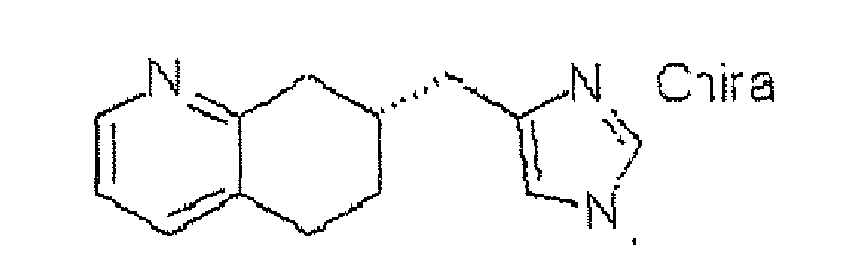
- At end of the study, animals were sacrificed & vitreal VEGF protein level was measured as described earlier. The results are shown in
Figure 7 . - Compared to vehicle treated animals (Veh/Veh-28D), VEGF protein levels were significantly increased 4 wks after treatment in vitreous fluid of streptozotocin induced diabetic LE rats (STZ-28D/Veh-21D→ 228 pg/ml, Veh/Veh-28D→ 164 pg/ml, *p<0.01 vs Veh/Veh-28D). However, treatment with Bri for 3 wks (1 wk after STZ) significantly attenuated elevated VEGF protein levels in vitreous fluid of STZ treated animals (STZ-35D/Veh-21D→ 228 pg/ml, STZ-28D/Bri-21D→133 pg/ml, ++p<0.01 vs STZ-35D/Veh-21D). This is consistent with Example 2, above, as shown for rats. In addition, the panagonists '222 and '818 also significantly attenuated elevated vitreal VEGF protein levels in diabetic animals, and AGN 203818 inhibited in a dose dependent manner [STZ-35D/Veh-21D→ 228 pg/ml, STZ-28D '222-21D→133 pg/ml (++p<0.01 vs STZ-28D, Veh-21D), STZ-28D '818 (300 ug/kg/d)-21D→ 122 pg/ml (++p<0.01 vs STZ-28D, Veh-21D) and STZ-28D '818 (3 mg/kg/d)-21D→109 pg/ml (+p<0.01 vs STZ-35D, Veh-28D)]. Thus, STZ treatment significantly upregulated vitreous fluid VEGF protein levels. In addition to Brimonidine, chronic treatment with '222 or '818 brought elevated VEGF protein levels in vitreous fluid of STZ treated animals similar or less to levels observed in vehicle treated control animals.
- Long Evans rats were treated with vehicle or streptozotocin (1X, 65 mg/kg). After 7 days, vehicle treated rats were treated further with a second vehicle and STZ treated diabetic rats were treated either with a second vehicle, Brimonidine (1 mg/kg/d) as a positive control, or the Alpha 2B selective agonist.

- The Alpha 2B selective Agonist ("2B Agonist") (300ug or 3 mg/kg/d) for another 3 wks using mini-osmotic pumps is an Alpha 2B selective agonist. At end of the study, animals were sacrificed & vitreal VEGF protein level was measured as described earlier. The results are reported in
Figure 8 . - Compared to vehicle treated animals (Veh/Veh-28D), VEGF protein levels were significantly increased 4 wks after treatment in vitreous fluid of streptozotocin induced diabetic LE rats ( STZ-28D/Veh-21D→ 228 pg/ml, Veh/Veh-28D→ 164 pg/ml, *p<0.01 vs Veh/Veh-28D). However, treatment with Bri for 3 wks (1 wk after STZ) significantly attenuated elevated VEGF protein levels in vitreous fluid of STZ treated animas (STZ-28D/Veh-21D→ 228 pg/ml, STZ-28D/Bri-21D→133 pg/ml, ++p<0.01 vs STZ-28D/Veh-21D). This is consistent with the results observed in BN rats. In addition, the 2B Agonist also significantly attenuated elevated vitreal VEGF protein levels in diabetic animals in a dose dependent manner (STZ-28D/Veh-21D→ 228 pg/ml, STZ-28D/2B Agonist (300 ug/kg/d). 21D→ 148 pg/ml (+p<0.01 vs STZ-28D/Veh/21D) and STZ-28D/2B Agonist.
- (3 mg/kg/d)-21D→130 pg/ml ((+p<0.01 vs STZ-28D/Veh-21D). Thus, STZ treatment significantly upregulated vitreous fluid VEGF protein levels. In addition to Brimonidine, chronic treatment with 2B Agonist brought elevated VEGF protein levels in vitreous fluid of STZ treated animals similar or less to levels observed in vehicle treated control animals.
- The method of the present invention may also be used to treat the following diseases and conditions of the eye:
- Nonneovascular (Nonexudative) Age-Related Macular Degeneration
- Neovascular (Exudative) Age-Related Macular Degeneration
- Other Causes of Choroidal Neovascular Membranes
- Angioid Streaks
- Ocular Histoplasmosis Myopic Retinal Degeneration
- Central Serous Chorioretinopathy
- Macular Hole
- Epimacular Membranes
- Postsurgical Cystoid Macular Edema
- Retinal Arterial Occulsive Diseases
- Central Retinal Vein Occlusion
- Branch Retinal Vein Occlusion
- Diabetic Retinopathy
- Hypertensive Fundus Changes
- Ocular Ischemic Syndrome
- Retinal Arterial Macroaneurysms
- Coats Disease
- Parafoveal Telangiectasis
- Retinopathy of Prematurity
- Eales' Disease
- Familial Exudative Vitreoretinopathy
- Frosted Branch Angiitis
- Hemoglobinopathies Including Sickle Cell Retinopathy
- Disseminated Intravascular Coagulopathy
- Radiation Retinopathy
- Bone Marrow Transplant Retinopathy
- Uveitic Retinal Disease
- Acute Multifocal Posterior Placoid Pigment Epitheliopathy (AMPPPE)
- Serpiginous Choroiditis
- Birdshot Retinochoroidopathy
- Sympathetic Ophthalmia
- Vogt-Koyanagi-Harada Syndrome
- Multiple Evanescent White Dot Syndrome (MEWDS)
- Acute Macular Neuroretinopathy
- Acute Retinal Pigment Epitheliitis
- Intermediate Uveitis (Pars Planitis)
- Multifocal Choroiditis, Punctate Inner Choroidopathy, and Other Related Uveitic Conditions
- Subretinal Fibrosis and Uveitis Syndrome
- Posterior Scleritis
- Ocular Sarcoidosis
- Toxoplasmosis
- Ocular Toxocariasis
- Ocular Cysticercosis
- Retinol Disease Associated with HIV Infection
- The Retina and Choroid in HIV Infection
- Viral Retinitis
- Acute Retinal Necrosis
- Progressive Outer Retinal Necrosis
- Fungal Diseases of the Retina
- Photic Reinopathy
- Drug-Induced Toxic Retinopathies
- Ocular Syphilis
- Tuberculosis
- Diffuse Unilateral Subacute Neuroretinitis
- Myiasis
- Retinitis Pigmentosa and Other Related Degenerations
- Systemic Genetic Disorders Associated with Retinal Dystrophies
- Congenital Stationary Night Blindness
- Cone Dystrophies
- Stargardt's Disease and Fundus Flavimaculatus
- Best's Disease: Molecular and Clinical Findings
- Pattern Dystrophy of the Retinal Pigment Epithelium
- X-Linked Retinoschisis
- Sorsby's Fundus Dystrophy
- Benign Concentric Maculopathy
- Bietti's Crystalline Dystrophy
- Tumors
- Retinal Disease Associated with Tumors Congenital Hypertrophy of the Retinal Pigment Epithelium
- Posterior Uveal Melanoma Differential Diagnosis of Posterior Uveal Melanoma
- Choroidal Hemangioma
- Choroidal Osteoma
- Choroidal Metastasis
- Combined Hamartoma of the Retina and Retinal Pigment Epithelium
- Retinoblastoma
- Vasoproliferative Tumors of the Ocular Fundus including Von-Hippel Lindau disease
- Retinal Astrocytoma
- Intraocular Lymphoid Tumors
- Endophthalmitis Management
- Retinal Detachment
- The use of the above alpha 2 adrenergic agonists and/or memantine is distinct from the neuroprotective effects of these compounds. Furthermore, although this invention has been exemplified by the use of brimonidine and other proprietary alpha panagonists and/or alpha 2 B-selective agonists to treat such diseases of the eye, other alpha 2 agonists, for example, clonidine, guanfacine, BHT-920, para-amino clonidine (PAC), guanabenz, oxymetazoline, xylometazoline, xylazine, tizanidine, dexmedetomidine, medetomidine, mivazerol and moxonidine, etc. may be utilized in place of brimonidine to treat diseases of the eye by reducing VEGF and thereby preventing and/or reducing BRB.
- Also, while this invention has been exemplified by the use of memantine to treat such diseases of the eye, other NMDA antagonists, for example ifenprodil, Dextromethorphan, Ketamine, amantadine and Kynurenate, etc. may be utilized in place of memantine.
- 1. A method of reducing the VEGF level in a patient suffering from an ocular disease or condition which is characterized by elevated VEGF and/or blood retina barrier (BRB) breakdown which comprises treating said patient with an effective amount of a compound selected from the group consisting of memantine, brimonidine and mixtures thereof.
- 2. The method of EM 1 wherein said compound is memantine.
- 3. The method of EM 1 wherein said compound is brimonidine.
- 4. A method of reducing the VEGF level in a patient suffering from an ocular disease or condition which is characterized by elevated VEGF and/or BRB breakdown which comprises treating said patient with an alpha 2 agonist.
- 5. The method of
EM 4 wherein said alpha 2 agonists comprises clonidine, guanfacine, BHT-920, para-amino clonidine (PAC), guanabenz, oxymetazoline, xylometazoline, xylazine, tizanidine, dexmedetomidine, medetomidine, mivazerol and moxonidine. - 6. The method of EM 1 wherein said ocular disease or condition is characterized by elevated VEGF in the vitreous fluid.
- 7. The method of EM 1 wherein said ocular disease or condition is selected from the group consisting of proliferative diabetic retinopathy, age-related macular degeneration, diabetic macular edema, tumors, wound healing or inflammation.
- 8. A method of reducing the VEGF level in a patient suffering from an ocular disease or condition which is characterized by elevated VEGF and/or BRB breakdown which comprises treating said patient with an NMDA antagonist.
- 9. The method of EM 8 wherein said NMDA antagonist is selected from the group consisting of ifenprodil, Dextromethorphan, Ketamine, amantadine and Kynurenate.
- 10. The method of is
EM 4 wherein said alpha 2 agonist is a alpha 2 panagonist. - 11. The method of
EM 10 wherein said alpha 2 panagonist is selected from the group consisting of
- 12. The method of
EM 4 wherein said alpha 2 agonist is a selective alpha 2B agonist. - 13. The method of EM 12 wherein said alpha 2B agonist is

Claims (4)
- An NDMA antagonist for use in a method of reducing or preventing blood-retina barrier (BRB) breakdown in a patient which comprises treating said patient with an effective amount of the NDMA antagonist.
- The NDMA antagonist of claim 1 which is ifenprodil, dextromethorphan, ketamine, amantadine or kynurenate.
- The NDMA antagonist of claim 1, wherein the BRB breakdown is a result of elevated VEGF in the vitreous fluid.
- The NDMA antagonist of claim 1, wherein the BRB breakdown is a result of an ocular disease or condition selected from the group consisting of proliferative diabetic retinopathy, age-related macular degeneration, diabetic macular edema, tumors, wound healing or inflammation.
Applications Claiming Priority (2)
| Application Number | Priority Date | Filing Date | Title |
|---|---|---|---|
| US75990506P | 2006-01-17 | 2006-01-17 | |
| EP07716650A EP1976595A2 (en) | 2006-01-17 | 2007-01-16 | The use of memantine and brimonidine to attenuate vitreoretinal vascular endothelial growth factor (vegf) protein levels in animals |
Related Parent Applications (1)
| Application Number | Title | Priority Date | Filing Date |
|---|---|---|---|
| EP07716650.2 Division | 2007-01-16 |
Publications (1)
| Publication Number | Publication Date |
|---|---|
| EP2380632A1 true EP2380632A1 (en) | 2011-10-26 |
Family
ID=37998315
Family Applications (2)
| Application Number | Title | Priority Date | Filing Date |
|---|---|---|---|
| EP11174829A Withdrawn EP2380632A1 (en) | 2006-01-17 | 2007-01-16 | The use of NMDA antagonists to attenuate vitreoretinal vascular endothelial growth factor (VEGF) protein levels in animals |
| EP07716650A Withdrawn EP1976595A2 (en) | 2006-01-17 | 2007-01-16 | The use of memantine and brimonidine to attenuate vitreoretinal vascular endothelial growth factor (vegf) protein levels in animals |
Family Applications After (1)
| Application Number | Title | Priority Date | Filing Date |
|---|---|---|---|
| EP07716650A Withdrawn EP1976595A2 (en) | 2006-01-17 | 2007-01-16 | The use of memantine and brimonidine to attenuate vitreoretinal vascular endothelial growth factor (vegf) protein levels in animals |
Country Status (5)
| Country | Link |
|---|---|
| US (1) | US20070203144A1 (en) |
| EP (2) | EP2380632A1 (en) |
| AU (1) | AU2007207631A1 (en) |
| CA (1) | CA2636644A1 (en) |
| WO (1) | WO2007084473A2 (en) |
Families Citing this family (8)
| Publication number | Priority date | Publication date | Assignee | Title |
|---|---|---|---|---|
| CN102245166A (en) * | 2008-10-21 | 2011-11-16 | 法姆莱特有限公司 | Ophthalmic Administration of Brimonidine-Containing Compositions as Mists |
| UA109359C2 (en) * | 2011-11-10 | 2015-08-10 | TREATMENT OF SKIN DISEASES AND STATES | |
| US9283217B2 (en) | 2011-11-10 | 2016-03-15 | Allergan, Inc. | Pharmaceutical compositions comprising 7-(1 H-imidazol-4-ylmethyl)-5,6,7,8-tetrahydro-quinoline for treating skin diseases and conditions |
| CA2856507C (en) * | 2011-11-21 | 2017-03-21 | Allergan, Inc. | Pharmaceutical compositions comprising 4-[1-(2,3-dimethylphenyl)ethyl]-3h-imidazole derivatives for treating retinal diseases |
| PE20240329A1 (en) | 2019-06-05 | 2024-02-27 | Regeneron Pharma | DEVICES AND METHODS FOR PRECISION DOSE ADMINISTRATION |
| KR102473858B1 (en) * | 2020-03-18 | 2022-12-06 | 한국과학기술연구원 | Use of Xylazine for enhancing visual acuity |
| US12649031B2 (en) | 2021-09-08 | 2026-06-09 | Regeneron Pharmaceuticals, Inc. | Methods for delivering agents with pre-filled syringes to minimize intraocular inflammation |
| USD1120314S1 (en) | 2022-11-30 | 2026-03-24 | Regeneron Pharmaceuticals, Inc. | Dose delivery device |
Citations (6)
| Publication number | Priority date | Publication date | Assignee | Title |
|---|---|---|---|---|
| WO1999025350A1 (en) * | 1997-11-14 | 1999-05-27 | Alcon Laboratories, Inc. | Treatment of diabetic retinopathy |
| US20050075366A1 (en) * | 2002-05-21 | 2005-04-07 | Heidelbaugh Todd M. | 4-(2-Methyl-5,6,7,8-tetrahydro-quinolin-7-ylmethyl)-1,3-dihydro-imidazole-2-thione as specific alpha2B agonist and methods of using the same |
| WO2005058293A1 (en) * | 2003-12-12 | 2005-06-30 | Allergan, Inc. | Use of memantine for the treatment of proliferative retinal diseases |
| US20050244469A1 (en) * | 2004-04-30 | 2005-11-03 | Allergan, Inc. | Extended therapeutic effect ocular implant treatments |
| WO2006015075A1 (en) * | 2004-07-26 | 2006-02-09 | Allergan, Inc. | Methods of treating ophthalmic conditions |
| GB2428675A (en) * | 2005-07-29 | 2007-02-07 | Arakis Ltd | Ifenprodil derivatives |
Family Cites Families (5)
| Publication number | Priority date | Publication date | Assignee | Title |
|---|---|---|---|---|
| US6066675A (en) * | 1996-09-13 | 2000-05-23 | The Regents Of The University Of California | Method for treatment of retinal diseases |
| US6329369B1 (en) * | 1997-12-04 | 2001-12-11 | Allergan Sales, Inc. | Methods of treating pain and other conditions |
| US7091232B2 (en) * | 2002-05-21 | 2006-08-15 | Allergan, Inc. | 4-(substituted cycloalkylmethyl) imidazole-2-thiones, 4-(substituted cycloalkenylmethyl) imidazole-2-thiones, 4-(substituted cycloalkylmethyl) imidazol-2-ones and 4-(substituted cycloalkenylmethyl) imidazol-2-ones and related compounds |
| US7141597B2 (en) * | 2003-09-12 | 2006-11-28 | Allergan, Inc. | Nonsedating α-2 agonists |
| US7931909B2 (en) * | 2005-05-10 | 2011-04-26 | Allergan, Inc. | Ocular therapy using alpha-2 adrenergic receptor compounds having enhanced anterior clearance rates |
-
2006
- 2006-12-22 US US11/615,876 patent/US20070203144A1/en not_active Abandoned
-
2007
- 2007-01-16 EP EP11174829A patent/EP2380632A1/en not_active Withdrawn
- 2007-01-16 EP EP07716650A patent/EP1976595A2/en not_active Withdrawn
- 2007-01-16 AU AU2007207631A patent/AU2007207631A1/en not_active Abandoned
- 2007-01-16 CA CA002636644A patent/CA2636644A1/en not_active Abandoned
- 2007-01-16 WO PCT/US2007/001065 patent/WO2007084473A2/en not_active Ceased
Patent Citations (6)
| Publication number | Priority date | Publication date | Assignee | Title |
|---|---|---|---|---|
| WO1999025350A1 (en) * | 1997-11-14 | 1999-05-27 | Alcon Laboratories, Inc. | Treatment of diabetic retinopathy |
| US20050075366A1 (en) * | 2002-05-21 | 2005-04-07 | Heidelbaugh Todd M. | 4-(2-Methyl-5,6,7,8-tetrahydro-quinolin-7-ylmethyl)-1,3-dihydro-imidazole-2-thione as specific alpha2B agonist and methods of using the same |
| WO2005058293A1 (en) * | 2003-12-12 | 2005-06-30 | Allergan, Inc. | Use of memantine for the treatment of proliferative retinal diseases |
| US20050244469A1 (en) * | 2004-04-30 | 2005-11-03 | Allergan, Inc. | Extended therapeutic effect ocular implant treatments |
| WO2006015075A1 (en) * | 2004-07-26 | 2006-02-09 | Allergan, Inc. | Methods of treating ophthalmic conditions |
| GB2428675A (en) * | 2005-07-29 | 2007-02-07 | Arakis Ltd | Ifenprodil derivatives |
Non-Patent Citations (30)
| Title |
|---|
| AMBATI J, CHALAM KV, CHAWLA DK, D'ANGIO CT, GUILLET EG, ROSE SJ, VANDERLINDE RE, AMBATI BK., ARCH OPTHALMOL, vol. 115, 1997, pages 1161 - 6 |
| AMBATI JAYAKRISHNA ET AL: "Elevated gamma-aminobutyric acid, glutamate, and vascular endothelial growth factor levels in the vitreous of patients with proliferative diabetic retinopathy", ARCHIVES OF OPHTHALMOLOGY, vol. 115, no. 9, 1997, pages 1161 - 1166, XP009083613, ISSN: 0003-9950 * |
| ANTONETTI D A ET AL: "Vascular permeability in experimental diabetes is associated with reduced endothelial occludin content: vascular endothelial growth factor decreases occludin in retinal endothelial cells", DIABETES, AMERICAN DIABETES ASSOCIATION, US, vol. 47, no. 12, 1 December 1998 (1998-12-01), pages 1953 - 1959, XP009166817, ISSN: 0012-1797 * |
| ANTONETTI, DA, BARBER, AJ, KHIN, S., DIABETES, vol. 47, 1998, pages 1953 - 9 |
| DONELLO JE, OPADILLO EU, WEBSTER ML, WHEELER LA, GIL DW., J. PHARMACOL AND EXPT. THER., vol. 296, 2001, pages 216 - 223 |
| FUNATSU H., YAMASHITA H, DRUG NEWS PERSPECT, vol. 15, 2002, pages 6633 - 39 |
| FUNATSU HIDEHARU ET AL: "Increased levels of vascular endothelial growth factor and interleukin-6 in the aqueous humor of diabetics with macular edema", AMERICAN JOURNAL OF OPHTHALMOLOGY, ELSEVIER, vol. 133, no. 1, 1 January 2002 (2002-01-01), pages 70 - 77, XP009166818, ISSN: 0002-9394, [retrieved on 20011221], DOI: 10.1016/S0002-9394(01)01269-7 * |
| FUNATSU, H, YANASHITA, H., NOMA, H., AM J. OPTHALMOL., vol. 133, 2002, pages 70 - 7 |
| FUNATSU, H., YAMASHITA, H., IKEDA, T., AM J. OPTHALMOL., vol. 133, 2002, pages 537 - 44 |
| FUNATSU, H., YAMASHITA, H., NAKANISHI, H., BR. J. OPTHALMOL., vol. 86, 2002, pages 311 - 5 |
| FUNATSU, H., YAMASHITA, H., SHIMIZU, E., RETINA, vol. 21, 2001, pages 469 - 77 |
| HAMMES, HP, LIN, JH, BRETZEL, RG, DIABETES, vol. 47, 1998, pages 401 - 6 |
| HANSSON HA, VIRCHOWS ARCH, vol. 6, 1970, pages 1 - 11 |
| JOSÉ CUNHA-VAZ: "The Blood Retinal Barrier in Retinal Disease", EUROPEAN OPHTHALMIC REVIEW,, vol. 3, no. 2, 1 January 2009 (2009-01-01), pages 105 - 108, XP009151264 * |
| KOWLURU, RA, ENGERMAN, RL, CASE GL, KEM TS, NEUROCHEM INT., vol. 38, 2001, pages 385 - 90 |
| LIETH, E., BARBER, AJ, XU, B, DICE, C., RATZ, MJ, TANASE, D, STROTHER JM., DIABETES, vol. 47, 1998, pages 815 - 20 |
| LUCAS DR, NEWHOUSE JP, ARCH OPTHALMOL, vol. 58, 1957, pages 193 - 201 |
| LUND-KARLSEN RF, FONNUM F., J. NEUROCHEM, vol. 27, 1976, pages 1437 - 41 |
| LUTTY, GA, MCLOAD, DS, MERGES, C., ARCH OPTHALMOL, vol. 114, 1996, pages 971 - 9 |
| OLNEY JW, J. NEUROPATHOL EXP NEUROL, vol. 28, 1969, pages 455 - 74 |
| QAUM T, XU Q, JOUSSEN AM, CLEMENS MW, QIN W, MIYAMOTO K, HASSESSIAN H, WIEGAND SJ, RUDGE J, YANCOPOULOS GD, IOVS, vol. 42, 2001, pages 2408 - 2413 |
| RUNKLE E AARON ET AL: "The Blood-Retinal Barrier: Structure and Functional Significance", BLOOD-BRAIN AND OTHER NEURAL BARRIERS: REVIEWS AND PROTOCOLS HUMANA PRESS INC, 999 RIVERVIEW DR, STE 208, TOTOWA, NJ 07512-1165 USA SERIES : METHODS IN MOLECULAR BIOLOGY (ISSN 1064-3745(PRINT)), 2011, pages 133 - 148, ISSN: null * |
| SISK DR, KUWABARA T., GRAEFES ARCH CLIN EXP OPTHALMOL, vol. 223, 1985, pages 250 - 8 |
| SMITH SB, DRUG NEWS PERSPECT, vol. 15, 2002, pages 226 - 232 |
| SUCHER NJ, LIPTON SA, DREYER EB., VIS RES, vol. 37, 1997, pages 3483 - 93 |
| VORWERK, CK, LIPTON SA, ZURAKOWSKI D, HYMAN BT, ABEL BA, DREYER EB, OPTHAIMOL VIS. SCI, vol. 37, 1996, pages 1618 - 24 |
| WITMER A N ET AL: "VASCULAR ENDOTHELIAL GROWTH FACTORS AND ANGIOGENESIS IN EYE DISEASE", PROGRESS IN RETINAL AND EYE RESEARCH, OXFORD, GB, vol. 22, no. 1, January 2003 (2003-01-01), pages 1 - 29, XP009050003, ISSN: 1350-9462 * |
| WITMER, AN, VRENSEN, GFJM, VAN NOORDEN, CJF, SCHLINGEMANN, RO, PROGRESS IN RETINAL AND EYE RESEARCH, vol. 22, 2003, pages 1 - 29 |
| XU Q ET AL: "Sensitive blood-retinal barrier breakdown quantitation using Evans blue.", INVESTIGATIVE OPHTHALMOLOGY & VISUAL SCIENCE MAR 2001, vol. 42, no. 3, March 2001 (2001-03-01), pages 789 - 794, ISSN: 0146-0404 * |
| XU X, ZHU QI, XIA XIN, ZHANG SHIJIE, GU QING, LUO DAWEI., CURRENT EYE RESEARCH, vol. 28, 2004, pages 251 - 256 |
Also Published As
| Publication number | Publication date |
|---|---|
| EP1976595A2 (en) | 2008-10-08 |
| CA2636644A1 (en) | 2007-07-26 |
| AU2007207631A1 (en) | 2007-07-26 |
| WO2007084473A3 (en) | 2007-11-29 |
| WO2007084473A2 (en) | 2007-07-26 |
| US20070203144A1 (en) | 2007-08-30 |
Similar Documents
| Publication | Publication Date | Title |
|---|---|---|
| EP1976595A2 (en) | The use of memantine and brimonidine to attenuate vitreoretinal vascular endothelial growth factor (vegf) protein levels in animals | |
| US20050059744A1 (en) | Methods and compositions for the treatment of pain and other alpha 2 adrenergic-mediated conditions | |
| JP2008505173A (en) | Methods and compositions for treating pain and other α2 adrenergic mediated conditions | |
| CA2538445A1 (en) | Methods and compositions for the treatment of pain and other alpha 2 adrenergic-mediated conditions | |
| IL172583A (en) | Retinoid in the form of an ester prodrug of retinoid active drug for use as a medicament for the treatment or prevention of retinitis pigmentosa, proliferative vitreal retinopathy or age-related macular degeneration | |
| CA2562919A1 (en) | Aqueous solutions comprising prednisolone and a cyclodextrin derivative | |
| HRP20220138T1 (en) | Peptide compositions and methods of use | |
| JP2020502270A (en) | Pharmaceutical formulations for treating glaucoma and methods for making and using the same | |
| CN101132784A (en) | Ophthalmic use of S1P receptor modulators | |
| RU2404757C2 (en) | Methods and materials with trans-clomiphene for treatment of male sterility | |
| AU2004296748B2 (en) | Prevention and/or reduction of photoreceptor degeneration with retinoids | |
| US11179377B2 (en) | Pharmaceutical compositions and uses thereof | |
| US20130046003A1 (en) | Pharmaceutical compositions comprising 4-bromo-n-(imidazolidin-2-ylidene)-1h-benzimidazol-5-amine for treating retinal diseases | |
| KR20120081585A (en) | Isothiozoles for treating conditions of the eye | |
| JP7821740B2 (en) | Benzimidazole compounds for treating metabolic disorders | |
| EP3953395A1 (en) | Plasma kallikrein inhibitors and methods of use thereof in ocular disorders | |
| AU2011247882A1 (en) | Methods and compositions for the treatment of pain and other alpha 2 adrenergic-mediated conditions | |
| HK1156855A (en) | Treatment of pain and other alpha 2 adrenergic-mediated conditions |
Legal Events
| Date | Code | Title | Description |
|---|---|---|---|
| 17P | Request for examination filed |
Effective date: 20110721 |
|
| AC | Divisional application: reference to earlier application |
Ref document number: 1976595 Country of ref document: EP Kind code of ref document: P |
|
| AK | Designated contracting states |
Kind code of ref document: A1 Designated state(s): AT BE BG CH CY CZ DE DK EE ES FI FR GB GR HU IE IS IT LI LT LU LV MC NL PL PT RO SE SI SK TR |
|
| AX | Request for extension of the european patent |
Extension state: AL BA HR MK RS |
|
| PUAI | Public reference made under article 153(3) epc to a published international application that has entered the european phase |
Free format text: ORIGINAL CODE: 0009012 |
|
| 17Q | First examination report despatched |
Effective date: 20130304 |
|
| STAA | Information on the status of an ep patent application or granted ep patent |
Free format text: STATUS: THE APPLICATION IS DEEMED TO BE WITHDRAWN |
|
| 18D | Application deemed to be withdrawn |
Effective date: 20150717 |