EP2380624A1 - Swallowing stimulation system - Google Patents
Swallowing stimulation system Download PDFInfo
- Publication number
- EP2380624A1 EP2380624A1 EP10189827A EP10189827A EP2380624A1 EP 2380624 A1 EP2380624 A1 EP 2380624A1 EP 10189827 A EP10189827 A EP 10189827A EP 10189827 A EP10189827 A EP 10189827A EP 2380624 A1 EP2380624 A1 EP 2380624A1
- Authority
- EP
- European Patent Office
- Prior art keywords
- swallowing
- stimulator
- designed
- stimulation
- operating
- Prior art date
- Legal status (The legal status is an assumption and is not a legal conclusion. Google has not performed a legal analysis and makes no representation as to the accuracy of the status listed.)
- Granted
Links
- 230000009747 swallowing Effects 0.000 title claims abstract description 115
- 230000000638 stimulation Effects 0.000 title claims abstract description 87
- 235000013305 food Nutrition 0.000 claims abstract description 62
- 230000000704 physical effect Effects 0.000 claims abstract description 9
- 230000001960 triggered effect Effects 0.000 claims description 10
- 238000007493 shaping process Methods 0.000 claims description 3
- 238000002567 electromyography Methods 0.000 description 22
- 235000015111 chews Nutrition 0.000 description 12
- 210000003205 muscle Anatomy 0.000 description 12
- 239000007788 liquid Substances 0.000 description 11
- 238000000034 method Methods 0.000 description 9
- 230000001055 chewing effect Effects 0.000 description 8
- 210000003254 palate Anatomy 0.000 description 7
- 230000035622 drinking Effects 0.000 description 6
- 230000008569 process Effects 0.000 description 6
- 230000011514 reflex Effects 0.000 description 6
- 238000001514 detection method Methods 0.000 description 5
- 230000000694 effects Effects 0.000 description 5
- 230000015572 biosynthetic process Effects 0.000 description 4
- 238000010586 diagram Methods 0.000 description 4
- 239000007787 solid Substances 0.000 description 4
- 210000005070 sphincter Anatomy 0.000 description 4
- 230000009471 action Effects 0.000 description 3
- 230000008901 benefit Effects 0.000 description 3
- RLZZZVKAURTHCP-UHFFFAOYSA-N phenanthrene-3,4-diol Chemical compound C1=CC=C2C3=C(O)C(O)=CC=C3C=CC2=C1 RLZZZVKAURTHCP-UHFFFAOYSA-N 0.000 description 3
- 238000002360 preparation method Methods 0.000 description 3
- 210000000707 wrist Anatomy 0.000 description 3
- 230000004913 activation Effects 0.000 description 2
- 235000013361 beverage Nutrition 0.000 description 2
- 230000003111 delayed effect Effects 0.000 description 2
- 230000001419 dependent effect Effects 0.000 description 2
- 210000003238 esophagus Anatomy 0.000 description 2
- 230000037406 food intake Effects 0.000 description 2
- 210000003801 laryngeal nerve Anatomy 0.000 description 2
- 230000007246 mechanism Effects 0.000 description 2
- 238000005457 optimization Methods 0.000 description 2
- 235000014347 soups Nutrition 0.000 description 2
- 230000004936 stimulating effect Effects 0.000 description 2
- 244000000626 Daucus carota Species 0.000 description 1
- 235000002767 Daucus carota Nutrition 0.000 description 1
- 208000019505 Deglutition disease Diseases 0.000 description 1
- 241001180747 Hottea Species 0.000 description 1
- 235000008429 bread Nutrition 0.000 description 1
- 235000012802 brown bread Nutrition 0.000 description 1
- 238000001816 cooling Methods 0.000 description 1
- 230000006872 improvement Effects 0.000 description 1
- 239000004615 ingredient Substances 0.000 description 1
- 230000033001 locomotion Effects 0.000 description 1
- 230000000877 morphologic effect Effects 0.000 description 1
- 238000003825 pressing Methods 0.000 description 1
- 210000003296 saliva Anatomy 0.000 description 1
- 235000021055 solid food Nutrition 0.000 description 1
- 239000000126 substance Substances 0.000 description 1
- 235000013311 vegetables Nutrition 0.000 description 1
Images



Classifications
-
- A—HUMAN NECESSITIES
- A61—MEDICAL OR VETERINARY SCIENCE; HYGIENE
- A61N—ELECTROTHERAPY; MAGNETOTHERAPY; RADIATION THERAPY; ULTRASOUND THERAPY
- A61N1/00—Electrotherapy; Circuits therefor
- A61N1/18—Applying electric currents by contact electrodes
- A61N1/32—Applying electric currents by contact electrodes alternating or intermittent currents
- A61N1/36—Applying electric currents by contact electrodes alternating or intermittent currents for stimulation
- A61N1/36007—Applying electric currents by contact electrodes alternating or intermittent currents for stimulation of urogenital or gastrointestinal organs, e.g. for incontinence control
-
- A—HUMAN NECESSITIES
- A61—MEDICAL OR VETERINARY SCIENCE; HYGIENE
- A61N—ELECTROTHERAPY; MAGNETOTHERAPY; RADIATION THERAPY; ULTRASOUND THERAPY
- A61N1/00—Electrotherapy; Circuits therefor
- A61N1/18—Applying electric currents by contact electrodes
- A61N1/32—Applying electric currents by contact electrodes alternating or intermittent currents
- A61N1/36—Applying electric currents by contact electrodes alternating or intermittent currents for stimulation
- A61N1/3605—Implantable neurostimulators for stimulating central or peripheral nerve system
- A61N1/3606—Implantable neurostimulators for stimulating central or peripheral nerve system adapted for a particular treatment
- A61N1/36082—Cognitive or psychiatric applications, e.g. dementia or Alzheimer's disease
- A61N1/36085—Eating disorders or obesity
-
- A—HUMAN NECESSITIES
- A61—MEDICAL OR VETERINARY SCIENCE; HYGIENE
- A61N—ELECTROTHERAPY; MAGNETOTHERAPY; RADIATION THERAPY; ULTRASOUND THERAPY
- A61N1/00—Electrotherapy; Circuits therefor
- A61N1/18—Applying electric currents by contact electrodes
- A61N1/32—Applying electric currents by contact electrodes alternating or intermittent currents
- A61N1/36—Applying electric currents by contact electrodes alternating or intermittent currents for stimulation
- A61N1/372—Arrangements in connection with the implantation of stimulators
- A61N1/37211—Means for communicating with stimulators
- A61N1/37235—Aspects of the external programmer
- A61N1/37247—User interfaces, e.g. input or presentation means
Definitions
- the invention relates to a swallowing stimulation system.
- Such swallowing stimulation systems are known in principle. They help patients with swallowing disorders in whom the triggering of the swallowing reflex is disturbed, but the swallowing reflex itself is usually preserved.
- the shaping of the so-called food bolus at the end of the chewing process triggers the swallowing reflex by pressure of the masticated food with the tongue against the palate.
- a sensor unit may be provided to recognize the formation of the food bolus by the tongue and then output an output signal to a swallowing stimulator which triggers the patient's swallowing reflex through a corresponding stimulus.
- the goal of the invention is to create a swallowing stimulation system that will take into account the variety of foods or beverages ingested.
- a swallowing stimulation system of the type defined in the introduction by the fact that the swallowing system has an operating unit with operating elements to receive user input, such that the operating elements are assigned to different possible physical properties or consistencies of a food, so that a user can assign the consistency of a particular food to at least one of at least two categories by means of the operating elements.
- the operating unit is designed to generate a control signal corresponding to user input for the swallowing stimulator.
- the swallowing stimulator is designed so that a stimulus for triggering the act of swallowing is formed as a function of the control signal.
- a feature of the invention is a swallowing stimulation system having a swallowing stimulator, which is designed for triggering the act of swallowing in a patient and is connected to a sensor unit designed to detect the formation of a food bolus by a patient's tongue and to output a corresponding output signal to the swallowing stimulator.
- the swallowing stimulator may also be connected to a sensor unit designed to detect the formation of a food bolus by a patient's tongue and to output a corresponding output signal to the swallowing stimulator, such that the swallowing stimulator then forms a corresponding stimulus for triggering the act of swallowing.
- different parameter sets are preferably provided, optimally tailored to different foods, the particular preparation required in the patient's mouth and the triggering of the swallowing act and its optimization.
- the parameter sets preferably define different stimulation programs.
- the various parameter sets or stimulation programs need not be selected explicitly by the patient.
- the swallowing stimulator is instead designed to select a suitable parameter set and/or a suitable stimulation program as a function of the control signal generated by the operating unit.
- the patient need only make entries about the consistency of the particular foods ingested and in this way can easily select the particular program suitable for different foods via the operating unit and transmit this to the stimulator.
- the swallowing stimulation system characterized in that different stimulation programs are defined by one parameter set each from a plurality of parameter sets, and each parameter set is assigned to one operating element.
- a preferred swallowing stimulation system is one in which various parameter sets are stored in the operating unit, assigned to the operating elements, and in which the operating unit is designed to transmit a respective parameter set to the swallowing stimulator or the sensor unit or both after operation of an operating element by a user.
- the parameter sets may also be stored in the swallowing stimulator, and the operating unit may be designed to transmit only one control signal characterizing the user input to the swallowing stimulator, which then retrieves a control set stored in the swallowing stimulator.
- the operating unit preferably has a graphic display and is designed to display icons symbolizing a physical property of foods on the display screen.
- the display is preferably a touch screen. A section of the touch screen assigned to an icon shown on the display then forms a particular operating element, which is operated by touching the display screen in the corresponding section.
- the operating unit is designed to interpret double-clicking on a section of the display that forms a particular operating element as operation of this operating element in order to avoid inadvertent operation.
- the invention is also directed to a method for operating a swallowing stimulation system having a swallowing stimulator, which is designed for triggering an act of swallowing in a patient, whereby, the swallowing system has an operating unit with operating elements for receiving user inputs, whereby the operating elements are assigned to different possible physical properties of a food, such that a user can assign the consistency of a particular food by means of the operating elements to at least one of at least two categories, the operating unit is designed to generate a control signal for the swallowing stimulator corresponding to the user input, and the swallowing stimulator is designed so that a stimulus for triggering an act of swallowing is triggered or formed as a function of the control signal.
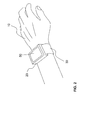
- Fig. 1 shows a swallowing stimulation system with an implantable swallowing stimulator 45, an implantable sensor unit 40, which is wirelessly connected to the swallowing stimulator 45 and to an operating unit 20, which may be worn as a patient device on a patient's wrist.
- the operating unit 50 is able to communicate not only with the swallowing stimulator 45 but also with a service center by way of a radio connection (e.g., mobile telephone).
- the sensor unit 40 serves as a triggering unit for the swallowing stimulator 45.
- These units may be accommodated jointly in one device and may receive and/or provide their information via suitably positioned electrodes.
- Sensor unit 40 and stimulation unit 45 may also be two separate units communicating wirelessly, including the required electrodes, as shown here.
- the operating unit 20 for the swallowing stimulation system 40, 45 shown in Fig. 2 contains a communication unit for the stimulator system 40, 45 and a communication unit for communicating with the service center 80.
- the operating unit 20 preferably has a touch screen display 50 as the display screen, which at the same time represents the operating elements of the operating unit. Furthermore, the operating unit may be provided with a wristband 30 in the manner of a wristwatch and may be worn on a patient's wrist 10.
- the optimum stimulation parameters are different, depending on the foods to be ingested.
- Parameters for the swallowing stimulator may be, for example:
- the parameter sets for the particular sensing and stimulation patterns are stored in one or more system components, namely operating unit 20, sensor unit 40 and stimulation unit 45.
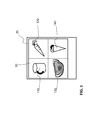
- a number of different icons are displayed on the display screen 50 of the operating unit 20, represented here by icons 110-140 as an example.
- Each icon symbolizes a certain food and/or its most important physical properties and can be selected by touch.
- Coupled with each icon is a suitable parameter set for the swallowing stimulator, which is either stored in the operating unit, where it is assigned to the particular icon and is transmitted to the swallowing stimulator when selected, or a command that is transmitted to the swallowing stimulator and selects the respective parameter set stored in the stimulator.
- the advantage of this variant is that it is simple to implement, and the display screen 50 needs only one key field per parameter set and/or icon, i.e., four fields here, for example.
- suitable mechanisms e.g., double-clicking may be provided, i.e., the operating unit is designed to detect double-clicking on a corresponding icon and to interpret that as user input.
- control signals assigned to a user input are transmitted to the swallowing stimulator with the usual security mechanisms, e.g., checksums.
- Fig. 4 shows as an example different physical properties of foods. With two pairs of substances, it is possible to span a plane, and with three pairs it is possible to span a space. Two pairs may be displayed directly on the plane of the touch screen display 50. Three or more pairs may be implemented by suitable interfacing, e.g., through multiple displays, additional buttons, slide bar controls or the like.
- SOLID and LIQUID may be mentioned here as a pair as well as BRITTLE and TOUGH/SMOOTH. Other pairs might include HOT and COLD. Other pairs of properties are also conceivable.
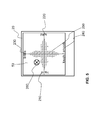
- Fig. 5 shows two of these pairs of properties 210, 230 arranged in a two-dimensional arrangement on the touch screen display 50 of the operating unit 20.
- Arrows 250 indicate the property space, which is spanned in a two-dimensional form. Any combinations of properties may be selected by a cursor 260.
- certain icons of foods may be placed directly on the plane according to their fundamental properties, as shown in Fig. 6 .
- the advantage in comparison with the choice in Fig. 3 is that the properties on which they are based are immediately discernible and serve as landmarks to orient the patient as an improvement on Fig. 5 .
- This invention thus offers a simple choice of suitable parameter sets which are optimally coordinated for different foods, the required preparation in the patient's mouth and the triggering of the act of swallowing and its optimization.
- the patient may simply select the particular suitable program for different foods by way of the operating unit as an external device and transmit this to the stimulator. This allows a selection of not only stored parameter sets but also "ad hoc" adjustments.
- Fig. 7 shows a further variant of the user interface shown in Fig. 3 .
- the icons are representing physical properties of the food, like liquid 110, mashed 150, solid 130 and smooth 140.
- the variant of Fig.7 will be used to describe exemplarily drinking and the swallowing of mashed food.
- Fig. 8 shows diagrams for stimulating drinking. It should be mentioned that it is assumed that the swallowing behaviour for "dry swallowing” and drinking are the same. Therefore the following parameter set should be adequate for "dry swallowing", clearance of saliva and drinking. Therefore the parameter P_Min, describing the minimum pressure of the tongue against sensor 40 to start the T_P_Min time window in which P_Min must be exceeded, shown in Fig. 8 on the upper ordinate is set to a value of about 2 N/cm 2 . To trigger the swallowing the pressure P_Min has to exceed during the time window T_P_Min, which is true for Fig. 8.
- the Count_Chew_min parameter describing the minimum of chews before swallowing is set to 1, while a chew is detected as described above by the pressure of the tongue to sensor 40 which exceeds P_Min for at least a time window T_P_Min.
- the stimulation of the swallowing process is delayed by the adjustable time T_Stim_Delay which is patient dependent and for example between 10ms and 1000ms, preferably about 0,6s.
- U_Capture_D etect_Min 3 [mV] Min EMG voltage measured by electrode to start T Capture Detect time window T_Capture_D etect_Min 10 [ms] Minimal time where U_EMG must be above U_Capture_Detect_Min to count as a successful stimulation T_Capture_D elay 10 [ms] Time after pulse delivery, waiting for Capture_Detected TRUE Back_Up_Pul se On - On / Off If first pulse was not successful, deliver another?
- the program waits to detect a chew by waiting for a minimum pressure P_Min to appear for at least the time T_P_Min at the site of the pressure sensor 40. When that happens Chew_Count is increases from 0 to 1.
- a delay time T_Stim_Delay is given to allow the liquid to be moved into the throat.
- the stimulation pulse is delivered at site 45.
- the stimulation pulse is given to be successful, meaning that it stimulates the superior laryngeal nerve to activate the sphincter muscle.
- the activation of the sphincter muscle results in an increase of muscle activity which can be detected via electromyography recording EMG. This is measured via the electrode 45. If the measured Voltage U_EMG is above U_Capture_Detect_Min for at least the time T_Capture_Detect_Min, a Capture, i.e. successful stimulation of the muscle is detected. Here the swallowing stimulation program terminates. The same or another program for swallowing can be triggered by selecting a food type displayed on the touchscreen 50 of device 20.
- Fig. 9 shows a diagram for stimulating a swallowing process for mashed food. Therefore the parameter P_Min, describing the minimum pressure of the tongue against sensor 40 to start the T_P_Min time window in which P_Min must be exceeded, shown in Fig. 9 on the upper ordinate is set to a value of about 4 N/cm 2 . To trigger the swallowing the pressure P_Min has to exceed during the time window T_P_Min, which is true for Fig. 9. Due to the patients choice of swallowing mashed food the Count_Chew_min parameter describing the minimum of chews before swallowing, is set to 4, while a chew is detected as described above by the pressure of the tongue to sensor 40 which exceeds P_Min for at least a time window T_P_Min. The stimulation of the swallowing process is delayed by the adjustable time T_Stim_Delay which is patient dependent and for example between 10ms and 1000ms, preferably about 0,6s.
- T_Stim_Delay which is patient dependent and for example between 10ms and 1000m
- U_Capture_D etect_Min 3 [mV] Min EMG voltage measured by electrode to start T Capture Detect time window T_Capture_D etect_Min 10 [ms] Minimal time where U_EMG must be above U_Capture_Detect_Min to count as a successful stimulation T_Capture_D elay 10 [ms] Time after pulse delivery, waiting for Capture_Detected TRUE Back_Up_Pul se On - On / Off If first pulse was not successful, deliver another?
- the first stimulation pulse shall not be successful, so that the back-up pulse is triggered.
- the user selects the program "Mashed Food” 150 by touching the symbol 150 on the touchscreen 50 of device 20.
- the above parameter set for "Mashed Food” 150 is loaded and the stimulation program is started:
- the program waits to detect a chew by waiting for a minimum pressure P_Min to appear for at least the time T_P_Min at the site of the pressure sensor 40. When that happens Chew_Count is increases from 0 to 1.
- Chew_Count Chew_Count_Min, which is 4 here.
- a delay time T_Stim_Delay is given to allow the food to be moved into the throat.
- the stimulation pulse is delivered at site 45.
- the stimulation pulse is given to be successful, meaning that it stimulates the superior laryngeal nerve to activate the sphincter muscle.
- the activation of the sphincter muscle results in an increase of muscle activity which can be detected via electromyography recording EMG. This is measured via the electrode 45. If the measured Voltage U_EMG is above U_Capture_Detect_Min for at least the time T_Capture_Detect_Min, a Capture, i.e. successful stimulation of the muscle is detected.
- U_EMG is measured and this time it remains above U_Capture_Detect_Min for the minimum time T_Capture_Detect_Min, so that a capture, i.e. successful stimulation of the muscle is detected.
- swallowing stimulation program terminates.
- the same or another program for swallowing can be triggered by selecting a food type displayed on the touchscreen 50 of device 20.
- the resulting changes in pressure in the mouth e.g., a sudden increase in pressure when sipping
- the time for ingestion including cooling typically 1-5 seconds in sipping, typically 2-5 seconds in the subsequent intake of air
- the trigger point for stimulation of the swallowing act is programmed so that stimulation of the esophagus typically occurs 1-5 seconds after the start of ingestion of food.
- the chewing operation will thus lead to a pressure peak on the palate 10-20 times.
- the stimulator is programmed so that it counts the pressure peaks. Once the minimum number of chewing operations has been reached, the stimulation is "activated," i.e., the shaping of the food bolus with the tongue and the shifting of the food bolus with the tongue in the direction of the throat trigger the act of swallowing by stimulation approximately 0.1-2 seconds later after detection of the operation.
Landscapes
- Health & Medical Sciences (AREA)
- Engineering & Computer Science (AREA)
- Animal Behavior & Ethology (AREA)
- Veterinary Medicine (AREA)
- Public Health (AREA)
- General Health & Medical Sciences (AREA)
- Life Sciences & Earth Sciences (AREA)
- Radiology & Medical Imaging (AREA)
- Nuclear Medicine, Radiotherapy & Molecular Imaging (AREA)
- Biomedical Technology (AREA)
- Neurology (AREA)
- Psychiatry (AREA)
- Child & Adolescent Psychology (AREA)
- Developmental Disabilities (AREA)
- Hospice & Palliative Care (AREA)
- Psychology (AREA)
- Epidemiology (AREA)
- Neurosurgery (AREA)
- Obesity (AREA)
- Human Computer Interaction (AREA)
- Gastroenterology & Hepatology (AREA)
- Rehabilitation Tools (AREA)
- Electrotherapy Devices (AREA)
Abstract
Description
- The invention relates to a swallowing stimulation system.
- Such swallowing stimulation systems are known in principle. They help patients with swallowing disorders in whom the triggering of the swallowing reflex is disturbed, but the swallowing reflex itself is usually preserved. In a healthy person, the shaping of the so-called food bolus at the end of the chewing process triggers the swallowing reflex by pressure of the masticated food with the tongue against the palate. In a swallowing stimulation system, a sensor unit may be provided to recognize the formation of the food bolus by the tongue and then output an output signal to a swallowing stimulator which triggers the patient's swallowing reflex through a corresponding stimulus.
- One difficulty that arises here is that the properties of the respective foods and accordingly the preparation of the foods in the mouth before swallowing differ greatly. For example, in a healthy person, a liquid such as a beverage flows quickly down the throat without any chewing action and the swallowing reflex is triggered. A piece of bread, however, is masticated in the mouth, softened and already predigested by a chewing action before the act of swallowing is triggered. Zwieback differs from a fresh piece of brown bread by its dry, mealy, crumbly consistency. This results in a different act of chewing and, in a healthy person, also a different act of swallowing.
- The goal of the invention is to create a swallowing stimulation system that will take into account the variety of foods or beverages ingested.
- According to the invention, this object is achieved by a swallowing stimulation system of the type defined in the introduction by the fact that the swallowing system has an operating unit with operating elements to receive user input, such that the operating elements are assigned to different possible physical properties or consistencies of a food, so that a user can assign the consistency of a particular food to at least one of at least two categories by means of the operating elements. The operating unit is designed to generate a control signal corresponding to user input for the swallowing stimulator. The swallowing stimulator is designed so that a stimulus for triggering the act of swallowing is formed as a function of the control signal.
- A feature of the invention is a swallowing stimulation system having a swallowing stimulator, which is designed for triggering the act of swallowing in a patient and is connected to a sensor unit designed to detect the formation of a food bolus by a patient's tongue and to output a corresponding output signal to the swallowing stimulator.
- The swallowing stimulator may also be connected to a sensor unit designed to detect the formation of a food bolus by a patient's tongue and to output a corresponding output signal to the swallowing stimulator, such that the swallowing stimulator then forms a corresponding stimulus for triggering the act of swallowing.
- In the swallowing stimulator system, different parameter sets are preferably provided, optimally tailored to different foods, the particular preparation required in the patient's mouth and the triggering of the swallowing act and its optimization. The parameter sets preferably define different stimulation programs.
- The various parameter sets or stimulation programs need not be selected explicitly by the patient. The swallowing stimulator is instead designed to select a suitable parameter set and/or a suitable stimulation program as a function of the control signal generated by the operating unit.
- By using the operating elements, the patient need only make entries about the consistency of the particular foods ingested and in this way can easily select the particular program suitable for different foods via the operating unit and transmit this to the stimulator.
- The swallowing stimulation system according to claim 2, characterized in that different stimulation programs are defined by one parameter set each from a plurality of parameter sets, and each parameter set is assigned to one operating element.
- A preferred swallowing stimulation system is one in which various parameter sets are stored in the operating unit, assigned to the operating elements, and in which the operating unit is designed to transmit a respective parameter set to the swallowing stimulator or the sensor unit or both after operation of an operating element by a user. Alternatively, the parameter sets may also be stored in the swallowing stimulator, and the operating unit may be designed to transmit only one control signal characterizing the user input to the swallowing stimulator, which then retrieves a control set stored in the swallowing stimulator.
- The operating unit preferably has a graphic display and is designed to display icons symbolizing a physical property of foods on the display screen. The display is preferably a touch screen. A section of the touch screen assigned to an icon shown on the display then forms a particular operating element, which is operated by touching the display screen in the corresponding section.
- Again it is advantageous here if the operating unit is designed to interpret double-clicking on a section of the display that forms a particular operating element as operation of this operating element in order to avoid inadvertent operation.
- The invention is also directed to a method for operating a swallowing stimulation system having a swallowing stimulator, which is designed for triggering an act of swallowing in a patient, whereby, the swallowing system has an operating unit with operating elements for receiving user inputs, whereby the operating elements are assigned to different possible physical properties of a food, such that a user can assign the consistency of a particular food by means of the operating elements to at least one of at least two categories, the operating unit is designed to generate a control signal for the swallowing stimulator corresponding to the user input, and the swallowing stimulator is designed so that a stimulus for triggering an act of swallowing is triggered or formed as a function of the control signal.
- The present invention will now be explained in greater detail on the basis of exemplary embodiments with reference to the figures. In the figures:
- Fig. 1
- shows a swallowing stimulation system having a swallowing stimulator and a patient device on the patient's wrist;
- Fig. 2
- shows a patient device for a swallowing stimulator;
- Fig. 3
- shows an example of a first variant of a user interface of the patient device;
- Fig. 4a
- shows pairs of properties describing the physical nature of food spanning a plane;
- Fig. 4b
- shows pairs of properties describing the physical nature of food as spanning a space;
- Fig. 5
- shows an example of a second variant of a user interface of the patient device;
- Fig. 6
- shows an example of a third variant of a user interface of the patient device;
- Fig. 7
- shows an example of a fourth variant of a user interface of the patient device;
- Fig. 8
- shows diagrams with parameters for a mode for drinking;
- Fig. 9
- shows diagrams with parameters for a mode for swallowing mashed food.
-
Fig. 1 shows a swallowing stimulation system with animplantable swallowing stimulator 45, animplantable sensor unit 40, which is wirelessly connected to theswallowing stimulator 45 and to anoperating unit 20, which may be worn as a patient device on a patient's wrist. Theoperating unit 50 is able to communicate not only with theswallowing stimulator 45 but also with a service center by way of a radio connection (e.g., mobile telephone). Thesensor unit 40 serves as a triggering unit for theswallowing stimulator 45. These units may be accommodated jointly in one device and may receive and/or provide their information via suitably positioned electrodes.Sensor unit 40 andstimulation unit 45 may also be two separate units communicating wirelessly, including the required electrodes, as shown here. - The
operating unit 20 for theswallowing stimulation system Fig. 2 contains a communication unit for thestimulator system service center 80. - The
operating unit 20 preferably has atouch screen display 50 as the display screen, which at the same time represents the operating elements of the operating unit. Furthermore, the operating unit may be provided with awristband 30 in the manner of a wristwatch and may be worn on a patient'swrist 10. - The optimum stimulation parameters are different, depending on the foods to be ingested.
- Parameters for the swallowing stimulator may be, for example:
- To recognize when the chewing procedure is concluded:
- threshold value to detect the pressure of the tongue against the palate,
- the number of pressure cycles until triggering of the swallowing reflex should occur,
- morphological properties of the pressure against the palate, e.g.,
- steepness of the rise and drop in pressure,
- length of the maximum pressure,
- time between chewing motions,
- Delay between detection of formation of the food bolus and delivery of the stimulation pulse,
- The stimulation pulse amplitude,
- The stimulation pulse length,
- Number of pulses to be delivered,
- Type of pulse: current-controlled or voltage-controlled,
- Type of behavior if a stimulation pulse was not successful (non-capture):
- renewed delivery of a (stronger) stimulation pulse,
- no renewed delivery of a stimulation pulse.
- The parameter sets for the particular sensing and stimulation patterns are stored in one or more system components, namely operating
unit 20,sensor unit 40 andstimulation unit 45. - In a first variant (
Fig. 3 ), a number of different icons are displayed on thedisplay screen 50 of the operatingunit 20, represented here by icons 110-140 as an example. Each icon symbolizes a certain food and/or its most important physical properties and can be selected by touch. Coupled with each icon is a suitable parameter set for the swallowing stimulator, which is either stored in the operating unit, where it is assigned to the particular icon and is transmitted to the swallowing stimulator when selected, or a command that is transmitted to the swallowing stimulator and selects the respective parameter set stored in the stimulator. The advantage of this variant is that it is simple to implement, and thedisplay screen 50 needs only one key field per parameter set and/or icon, i.e., four fields here, for example. - To avoid inadvertent misadjustment of a particular selected program, suitable mechanisms, e.g., double-clicking may be provided, i.e., the operating unit is designed to detect double-clicking on a corresponding icon and to interpret that as user input.
- Likewise, the control signals assigned to a user input are transmitted to the swallowing stimulator with the usual security mechanisms, e.g., checksums.
-
Fig. 4 shows as an example different physical properties of foods. With two pairs of substances, it is possible to span a plane, and with three pairs it is possible to span a space. Two pairs may be displayed directly on the plane of thetouch screen display 50. Three or more pairs may be implemented by suitable interfacing, e.g., through multiple displays, additional buttons, slide bar controls or the like. - As the examples used here, SOLID and LIQUID may be mentioned here as a pair as well as BRITTLE and TOUGH/SMOOTH. Other pairs might include HOT and COLD. Other pairs of properties are also conceivable.
-
Fig. 5 shows two of these pairs ofproperties touch screen display 50 of the operatingunit 20.Arrows 250 indicate the property space, which is spanned in a two-dimensional form. Any combinations of properties may be selected by a cursor 260. - To further simplify the choice, certain icons of foods may be placed directly on the plane according to their fundamental properties, as shown in
Fig. 6 . The advantage in comparison with the choice inFig. 3 is that the properties on which they are based are immediately discernible and serve as landmarks to orient the patient as an improvement onFig. 5 . Another advantage is that the user can immediately perform fine adjustments of the stimulation program. For example, the user may optimize the consumption of a vegetable soup by pressing not on the mug but instead at a point slightly more toward the center (= more solid, more brittle, depending on the ingredients of the soup). - This invention thus offers a simple choice of suitable parameter sets which are optimally coordinated for different foods, the required preparation in the patient's mouth and the triggering of the act of swallowing and its optimization.
- The patient may simply select the particular suitable program for different foods by way of the operating unit as an external device and transmit this to the stimulator. This allows a selection of not only stored parameter sets but also "ad hoc" adjustments.
- Fig. 7 shows a further variant of the user interface shown in
Fig. 3 . The icons are representing physical properties of the food, likeliquid 110, mashed 150, solid 130 and smooth 140. The variant of Fig.7 will be used to describe exemplarily drinking and the swallowing of mashed food. The following table gives an overview of the potentially relevant parameters and their range of values:Parameter Set needed for the Swallowing Stimulator Preset Parameters Preset Value Dimension Possible Values Comment P Min 0,5-20 typical [N/cm2] 0...n Minimal Pressure to start T P Min time window Chew_Count_ Min 1-20 typical - 0...n Number of chews to detect before swallowing is triggered by stimulation pulse T P Min 50-1000 typical [ms] 0...n Minimal time where pressure must be above P Min to count as a chew T_Chew_Max 1-20 typical [ms] 0...n Maximum time between to chews T_Stim_Dela y 10-1000 typical [ms] 0...n Time between detection of Chew_Count_Min and stimulation pulse delivery Pulse_Type V or C - V,C V = Voltage_Control, C= Current Control U_Stim 0,5-20 typical [V] 0...n Voltage of Stimulation Pulse (when Pulse Type = V) I_Stim 0,01-20 typical [mA] 0...n Current of Stimulation Pulse (when Pulse Type = C) T_Stim 0,01-100 typical [ms] 0...n Length of stimulation pulse Count_Stim 1-20 typical - 0...n Number of stimulation pulses to be delivered as a train T_Capture_D elay_Max 1-500 typical [ms] Maximum time after pulse delivery by which a capture must be detected. U_Capture_D etect_Min 0,01-20 typical [mV] Min EMG voltage measured by electrode to start T_Capture_Detect time window T_Capture_D etect_Min 1 - 20 typical [ms] Minimal time where U_EMG must be above U_Capture_Detect_Min to count as a successful stimulation T_Capture_D elay 0,1-200 typical [ms] Time after pulse delivery, waiting for Capture Detected = TRUE Back_Up_Pul se On / Off - On / Off If first pulse was not successful, deliver another? U_Stim_BU 0,5-20 typical [V] 0...n Voltage of Back-Up Stimulation Pulse Pulse (when Pulse_Type = V AND Back Up Pulse = On) I_Stim_BU 0,01-20 typical [mA] 0...n Current of Back-Up Stimulation Pulse Pulse (when Pulse_Type = C AND Back Up Pulse = On) Use_Morphol ogy On / Off On / Off Use of P curve shape, e.g. speed of pressure rise / fall Vel_P_Rise_ Min 0,1- 200 [N/cm2s] 0...n Minimum speed with which pressure rises (when Use Morphology = On) Vel_P_Fall_ Min 0,1- 200 [N/cm2s] 0...n Minimum speed with which pressure drops (when Use Morphology = On) - The following table gives an overview which values are measured and which values are derived from which source:
Measured & Derived Parameters Dimension Possible Values Comment P Measured [N/cm2] Pressure against palate T P Measured [s] Measured time with P > P min Vel P Rise Measured [N/cm2s] 0...n Speed with which pressure rises (when Use Morphology = On) Vel_P_Fall Measured [N/cm2s] 0...n Speed with which pressure drops (when Use Morphology = On) Chew_Detect Derived from T_Chew_max, P_Min, T P Min - FALSE or TRUE Chew has been detected Chew_Count Derived from P and T P Min - Increased by 1 when P > P_Min for more than T P Min T_Chew Measured [s] 0...n Time between two increases of Chew_Count, must be < T Chew max to count the chews as one action U EMG Measured [mV] Electrical recording of muscle activity at electrode Capture_Dete cted Derived from U_EMG - FALSE or TRUE Set when U_EMG > U_Capture_Detect_Min for more than T Capture Detect Min - Fig. 8 shows diagrams for stimulating drinking. It should be mentioned that it is assumed that the swallowing behaviour for "dry swallowing" and drinking are the same. Therefore the following parameter set should be adequate for "dry swallowing", clearance of saliva and drinking. Therefore the parameter P_Min, describing the minimum pressure of the tongue against
sensor 40 to start the T_P_Min time window in which P_Min must be exceeded, shown in Fig. 8 on the upper ordinate is set to a value of about 2 N/cm2. To trigger the swallowing the pressure P_Min has to exceed during the time window T_P_Min, which is true for Fig. 8. Due to the patients choice of swallowing a liquid the Count_Chew_min parameter describing the minimum of chews before swallowing, is set to 1, while a chew is detected as described above by the pressure of the tongue tosensor 40 which exceeds P_Min for at least a time window T_P_Min. The stimulation of the swallowing process is delayed by the adjustable time T_Stim_Delay which is patient dependent and for example between 10ms and 1000ms, preferably about 0,6s. - The following parameters are examples to allow the stimulation of a swallowing process of a liquid:
Parameter Set for Mode DRINK (110) Preset Parameters Preset Value Dimension Possible Values Comment P Min 1,2 [N/cm2] 0...n Minimal Pressure to start T P Min time window Chew_Count_ Min 1 - 0...n Number of chews to detect before swallowing is triggered by stimulation pulse T P Min 0,2 [s] 0...n Minimal time where pressure must be above P_Min to count as a chew T_Chew_Max 2000 [ms] 0...n Maximum time between to chews T Stim Delay 0,6 [s] 0...n Time between detection of Chew_Count_Min and stimulation pulse delivery Pulse_Type V - V,C V = Voltage_Control, C= Current Control U_Stim 5 [V] 0...n Voltage of Stimulation Pulse (when Pulse Type = V) I_Stim Not applicable here, because Pulse_Ty pe=V [mA] 0...n Current of Stimulation Pulse (when Pulse_Type = C) T Stim 5 [ms] 0...n Length of stimulation pulse Count_Stim 1 - 0...n Number of stimulation pulses to be delivered as a train T_Capture_D elay_Max 10 [ms] Maximum time after pulse delivery by which a capture must be detected. U_Capture_D etect_Min 3 [mV] Min EMG voltage measured by electrode to start T Capture Detect time window T_Capture_D etect_Min 10 [ms] Minimal time where U_EMG must be above U_Capture_Detect_Min to count as a successful stimulation T_Capture_D elay 10 [ms] Time after pulse delivery, waiting for Capture_Detected = TRUE Back_Up_Pul se On - On / Off If first pulse was not successful, deliver another? U_Stim_BU 7 [V] 0...n Voltage of Back-Up Stimulation Pulse Pulse (when Pulse_Type = V AND Back Up Pulse = On) I_Stim_BU Not applicable , because Pulse_Ty pe=V [mA] 0...n Current of Back-Up Stimulation Pulse Pulse (when Pulse_Type = C AND Back_Up_Pulse = On) Use_Morphol ogy Off On / Off Use of P curve shape, e.g. speed of pressure rise / fall Vel_P_Rise_ Min Not needed because Use_Mor-phology = Off [N/cm2s] 0...n Minimum speed with which pressure rises (when Use_Morphology = On) Vel_P_Fall_ Min Not needed because Use_Mor-phology = Off [N/cm2s] 0...n Minimum speed with which pressure drops (when Use_Morphology = On) Measured & Derived Parameters Dimension Possible Values Comment P Measured [N/cm2] Pressure against palate T P Measured [s] Measured time with P > P min Vel P Rise Not applicable , because Use_Mor-phology = Off [N/cm2s] 0...n Speed with which pressure rises (when Use_Morphology = On) Vel_P_Fall Not applicable , because Use_Mor-phology = Off [N/cm2s] 0...n Speed with which pressure drops (when Use_Morphology = On) Chew_Detect Derived from T_Chew_ max, P_Min, T P Min - FALSE or TRUE Chew has been detected Chew_Count Derived from P and T P Min - Increased by 1 when P > P_Min for more than T_P_Min T_Chew Measured [s] 0...n Time between two increases of Chew_Count, must be < T_Chew_max to count the chews as one action U EMG Measured [mV] Electrical recording of muscle activity at electrode Capture_Dete cted Derived from U_EMG - FALSE or TRUE Set when U_EMG > U_Capture_Detect_Min for more than T Capture Detect Min - If the user selects the program "Drink" (110) by touching the
symbol 110 on thetouchscreen 50 ofdevice 20, the above parameter set for "Drink" (110) is loaded and the stimulation program is started: - The program waits to detect a chew by waiting for a minimum pressure P_Min to appear for at least the time T_P_Min at the site of the
pressure sensor 40. When that happens Chew_Count is increases from 0 to 1. - A delay time T_Stim_Delay is given to allow the liquid to be moved into the throat.
- Then the stimulation pulse is delivered at
site 45. - In this example the stimulation pulse is given to be successful, meaning that it stimulates the superior laryngeal nerve to activate the sphincter muscle.
- The activation of the sphincter muscle results in an increase of muscle activity which can be detected via electromyography recording EMG. This is measured via the
electrode 45. If the measured Voltage U_EMG is above U_Capture_Detect_Min for at least the time T_Capture_Detect_Min, a Capture, i.e. successful stimulation of the muscle is detected. Here the swallowing stimulation program terminates. The same or another program for swallowing can be triggered by selecting a food type displayed on thetouchscreen 50 ofdevice 20. - Fig. 9 shows a diagram for stimulating a swallowing process for mashed food. Therefore the parameter P_Min, describing the minimum pressure of the tongue against
sensor 40 to start the T_P_Min time window in which P_Min must be exceeded, shown in Fig. 9 on the upper ordinate is set to a value of about 4 N/cm2. To trigger the swallowing the pressure P_Min has to exceed during the time window T_P_Min, which is true for Fig. 9. Due to the patients choice of swallowing mashed food the Count_Chew_min parameter describing the minimum of chews before swallowing, is set to 4, while a chew is detected as described above by the pressure of the tongue tosensor 40 which exceeds P_Min for at least a time window T_P_Min. The stimulation of the swallowing process is delayed by the adjustable time T_Stim_Delay which is patient dependent and for example between 10ms and 1000ms, preferably about 0,6s. - The following parameters are examples to allow the stimulation of a swallowing process of mashed food:
Parameter Set for Mode MASHED FOOD (150) Preset Parameters Preset Value Dimension Possible Values Comment P Min 4 [N/cm2] 0...n Minimal Pressure to start T P Min time window Chew_Count_ Min 4 - 0...n Number of chews to detect before swallowing is triggered by stimulation pulse T P Min 0,2 [s] 0...n Minimal time where pressure must be above P_Min to count as a chew T_Chew_Max 2000 [ms] 0...n Maximum time between to chews T_Stim_Dela y 0,6 [s] 0...n Time between detection of Chew_Count_Min and stimulation pulse delivery Pulse_Type V - V, C V = Voltage_Control, C= Current Control U_Stim 5 [V] 0...n Voltage of Stimulation Pulse (when Pulse Type = V) I_Stim Not applicable here, because Pulse_Ty pe=V [mA] 0...n Current of Stimulation Pulse (when Pulse_Type = C) T Stim 5 [ms] 0...n Length of stimulation pulse Count_Stim 1 - 0...n Number of stimulation pulses to be delivered as a train T_Capture_D elay_Max 10 [ms] Maximum time after pulse delivery by which a capture must be detected. U_Capture_D etect_Min 3 [mV] Min EMG voltage measured by electrode to start T Capture Detect time window T_Capture_D etect_Min 10 [ms] Minimal time where U_EMG must be above U_Capture_Detect_Min to count as a successful stimulation T_Capture_D elay 10 [ms] Time after pulse delivery, waiting for Capture_Detected = TRUE Back_Up_Pul se On - On / Off If first pulse was not successful, deliver another? U_Stim_BU 7 [V] 0...n Voltage of Back-Up Stimulation Pulse Pulse (when Pulse_Type = V AND Back Up Pulse = On) .I_Stim_BU Not applicable , because Pulse_Ty pe=V [mA] 0...n Current of Back-Up Stimulation Pulse Pulse (when Pulse_Type = C AND Back_Up_Pulse = On) Use_Morphol ogy Off On / Off Use of P curve shape, e.g. speed of pressure rise / fall Vel_P_Rise_ Min Not needed because Use_Mor-phology = Off [N/cm2s] 0...n Minimum speed with which pressure rises (when Use_Morphology = On) Vel_P_Fall_ Min Not needed because Use_Mor-phology = Off [N/cm2s] 0...n Minimum speed with which pressure drops (when Use_Morphology = On) Measured & Derived Parameters Dimension Possible Values Comment P Measured [N/cm2] Pressure against palate T P Measured [s] Measured time with P > P min Vel P Rise Not applicable , because Use_Mor-phology = Off [N/cm2s] 0...n Speed with which pressure rises (when Use_Morphology = On) Vel_P_Fall Not applicable , because Use_Mor-phology = Off [N/cm2s] 0...n Speed with which pressure drops (when Use_Morphology = On) Chew_Detect Derived from T_Chew_ max, P_Min, T P Min - FALSE or TRUE Chew has been detected Chew_Count Derived from P and T_P_ Min - Increased by 1 when P > P_Min for more than T P Min T_Chew Measured [s] 0...n Time between two increases of Chew_Count, must be < T_Chew_max to count the chews as one action U_EMG Measured [mV] Electrical recording of muscle activity at electrode Capture_Dete cted Derived from U_EMG - FALSE or TRUE Set when U_EMG > U_Capture_Detect_Min for more than T_Capture Detect_Min - To show the functionality of the back-up pulse in the example, the first stimulation pulse shall not be successful, so that the back-up pulse is triggered. The user selects the program "Mashed Food" 150 by touching the symbol 150 on the
touchscreen 50 ofdevice 20. The above parameter set for "Mashed Food" 150 is loaded and the stimulation program is started: - The program waits to detect a chew by waiting for a minimum pressure P_Min to appear for at least the time T_P_Min at the site of the
pressure sensor 40. When that happens Chew_Count is increases from 0 to 1. - The program waits to detect further chews as above until Chew_Count = Chew_Count_Min, which is 4 here.
- A delay time T_Stim_Delay is given to allow the food to be moved into the throat.
- Then the stimulation pulse is delivered at
site 45. - In this example the stimulation pulse is given to be successful, meaning that it stimulates the superior laryngeal nerve to activate the sphincter muscle.
- The activation of the sphincter muscle results in an increase of muscle activity which can be detected via electromyography recording EMG. This is measured via the
electrode 45. If the measured Voltage U_EMG is above U_Capture_Detect_Min for at least the time T_Capture_Detect_Min, a Capture, i.e. successful stimulation of the muscle is detected. - This is not the case in this example.
- Therefore a back-up stimulation pulse with a higher voltage U_Stim_Bu is delivered.
- Again U_EMG is measured and this time it remains above U_Capture_Detect_Min for the minimum time T_Capture_Detect_Min, so that a capture, i.e. successful stimulation of the muscle is detected.
- Here the swallowing stimulation program terminates. The same or another program for swallowing can be triggered by selecting a food type displayed on the
touchscreen 50 ofdevice 20. - In general the following sequence is conceivable:
- 1. The patient ingests food.
- 2. The patient selects the corresponding food on his patient device.
- 3. Then the swallowing stimulator is programmed accordingly. The programming parameters are described above.
- 4. The patient ingests food, the stimulator stimulates a corresponding act of swallowing.
- 5. If the same food is consumed again, renewed operation of the patient device is not necessary.
- 6. If another food is ingested, the procedure is repeated starting with point 2.
-
- 1. The food to be ingested is liquid.
- 2. The food to be ingested is (very) hot.
- This yields the following conclusions:
- Since the food is liquid, it need not be chewed.
- If the liquid is ingested while very hot, it is cooled due to the simultaneously intake of air (sipping) or due to the subsequent intake of air (drinking).
- This food will not form a food bolus in swallowing but instead slides down the esophagus as liquid.
- The resulting changes in pressure in the mouth (e.g., a sudden increase in pressure when sipping) and the time for ingestion including cooling (typically 1-5 seconds in sipping, typically 2-5 seconds in the subsequent intake of air) are taken into account by the stimulator system. Since the food is liquid, the pressure with which the tongue shapes the food bolus (not shapeable here) is not as high as it is with solid food. The trigger point for stimulation of the swallowing act is programmed so that stimulation of the esophagus typically occurs 1-5 seconds after the start of ingestion of food.
-
- 1. The food to be ingested is solid and relatively brittle.
- As a result:
- The food must be chewed, here typically 10-20 times.
- The chewed food is shaped by the tongue into a contact food bolus.
- The chewing operation will thus lead to a pressure peak on the palate 10-20 times. The stimulator is programmed so that it counts the pressure peaks. Once the minimum number of chewing operations has been reached, the stimulation is "activated," i.e., the shaping of the food bolus with the tongue and the shifting of the food bolus with the tongue in the direction of the throat trigger the act of swallowing by stimulation approximately 0.1-2 seconds later after detection of the operation.
Claims (8)
- A swallowing stimulation system having a swallowing stimulator, which is designed for triggering an act of swallowing in a patient,
characterized in that,
the swallowing system has an operating unit with operating elements for receiving user inputs, whereby
the operating elements are assigned to different possible physical properties of a food, such that a user can assign the consistency of a particular food by means of the operating elements to at least one of at least two categories,
the operating unit is designed to generate a control signal for the swallowing stimulator corresponding to the user input, and
the swallowing stimulator is designed so that a stimulus for triggering an act of swallowing is triggered or formed as a function of the control signal. - The swallowing stimulation system according to claim 1, characterized in that the swallowing stimulator is additionally connectable to a sensor unit which is designed to detect the shaping of a food bolus by a patient's tongue and to output a corresponding output signal to the swallowing stimulator, and the swallowing stimulator forms the stimulus for triggering the act of swallowing according to the output signal of the sensor unit and the user input.
- The swallowing stimulation system according to any one of claims 1 or 2, characterized in that the swallowing stimulator is designed to perform one of a plurality of different stimulation programs as a function of the control signal.
- The swallowing stimulation system according to claim 3, characterized in that different stimulation programs are each defined by one parameter set of a plurality of parameter sets, and each parameter set is assigned to one operating element.
- The swallowing stimulation system according to claim 4, characterized in that the various parameter sets are stored in the operating unit such that they are assigned to the operating elements, and the operating unit is designed to transmit a particular respective parameter set to the swallowing stimulator or the sensor unit or both after operation of an operating element by a user.
- The swallowing stimulation system according to any one of claims 1 to 5, characterized in that the operating unit has a graphic display as the display and is designed to display icons symbolizing a physical property of foods on the display.
- The swallowing stimulation system according to claim 6, characterized in that the display is a touch screen, and a section of the touch screen display allocated to an icon shown on the display screen forms a particular operating element, which is to be operated by touching the display screen in the corresponding section.
- The swallowing stimulation system according to claim 7, characterized in that the operating unit is designed to interpret double-clicking on a section of the display forming a particular operating element as operation of this operating element.
Applications Claiming Priority (1)
| Application Number | Priority Date | Filing Date | Title |
|---|---|---|---|
| US26485409P | 2009-11-30 | 2009-11-30 |
Publications (2)
| Publication Number | Publication Date |
|---|---|
| EP2380624A1 true EP2380624A1 (en) | 2011-10-26 |
| EP2380624B1 EP2380624B1 (en) | 2016-12-14 |
Family
ID=44069440
Family Applications (1)
| Application Number | Title | Priority Date | Filing Date |
|---|---|---|---|
| EP10189827.8A Not-in-force EP2380624B1 (en) | 2009-11-30 | 2010-11-03 | Swallowing stimulation system |
Country Status (2)
| Country | Link |
|---|---|
| US (1) | US8271092B2 (en) |
| EP (1) | EP2380624B1 (en) |
Families Citing this family (5)
| Publication number | Priority date | Publication date | Assignee | Title |
|---|---|---|---|---|
| US9198621B2 (en) * | 2007-06-18 | 2015-12-01 | University of Pittsburgh—of the Commonwealth System of Higher Education | Method, apparatus and system for food intake and physical activity assessment |
| KR101774988B1 (en) * | 2015-06-15 | 2017-09-05 | 서울대학교산학협력단 | Electrical stimulation therapy apparatus for dysphagia and method using it |
| USD795288S1 (en) * | 2016-03-04 | 2017-08-22 | Breville Pty Limited | Display screen or portion thereof with graphical user |
| KR101798365B1 (en) * | 2016-05-20 | 2017-11-16 | 서울대학교산학협력단 | Electrical stimulation therapy apparatus for dysphagia and method using it |
| KR102591028B1 (en) * | 2021-07-23 | 2023-10-19 | 주식회사 알에스리햅 | Electrical stimulation therapy apparatus for swallowing neuromuscular and its method |
Citations (4)
| Publication number | Priority date | Publication date | Assignee | Title |
|---|---|---|---|---|
| WO2006102626A2 (en) * | 2005-03-24 | 2006-09-28 | Metacure Nv | Wireless leads for gastrointestinal tract applications |
| US20060282010A1 (en) * | 2005-05-03 | 2006-12-14 | Martin Ruth E | Oral device |
| US20090048645A1 (en) * | 2007-08-16 | 2009-02-19 | Jens Philipp | Stimulation system for treatment of dysphagias |
| US20090284486A1 (en) * | 2008-05-13 | 2009-11-19 | Marco Albus | Handheld device for a patient |
Family Cites Families (1)
| Publication number | Priority date | Publication date | Assignee | Title |
|---|---|---|---|---|
| US7734351B2 (en) * | 2006-12-15 | 2010-06-08 | Medtronic Xomed, Inc. | Method and apparatus for assisting deglutition |
-
2010
- 2010-11-03 EP EP10189827.8A patent/EP2380624B1/en not_active Not-in-force
- 2010-11-24 US US12/954,517 patent/US8271092B2/en not_active Expired - Fee Related
Patent Citations (4)
| Publication number | Priority date | Publication date | Assignee | Title |
|---|---|---|---|---|
| WO2006102626A2 (en) * | 2005-03-24 | 2006-09-28 | Metacure Nv | Wireless leads for gastrointestinal tract applications |
| US20060282010A1 (en) * | 2005-05-03 | 2006-12-14 | Martin Ruth E | Oral device |
| US20090048645A1 (en) * | 2007-08-16 | 2009-02-19 | Jens Philipp | Stimulation system for treatment of dysphagias |
| US20090284486A1 (en) * | 2008-05-13 | 2009-11-19 | Marco Albus | Handheld device for a patient |
Also Published As
| Publication number | Publication date |
|---|---|
| US20110130808A1 (en) | 2011-06-02 |
| US8271092B2 (en) | 2012-09-18 |
| EP2380624B1 (en) | 2016-12-14 |
Similar Documents
| Publication | Publication Date | Title |
|---|---|---|
| US12274885B1 (en) | Implantable medical device and method for managing advertising and scanning schedules | |
| US20250325823A1 (en) | System and method of monitoring for and reporting on patient-made stimulation therapy programming changes | |
| US12273935B2 (en) | Managing dynamic communication between implantable and external devices | |
| US10362629B2 (en) | Systems and methods for establishing a communication link between an implantable medical device and an external instrument | |
| EP3727575B1 (en) | Low power advertisement schedule for implantable medical device and method | |
| EP2380624B1 (en) | Swallowing stimulation system | |
| US20220339450A1 (en) | Sync pulse detector | |
| CN105163800B (en) | Wireless implantable power receiver system and method | |
| EP2361654B1 (en) | Wakeup of implantable communication circuitry | |
| US8165670B2 (en) | Stimulation system for treatment of dysphagias | |
| US20070032827A1 (en) | Method and apparatus for producing therapeutic and diagnostic stimulation | |
| EP2586491A1 (en) | Stimulation system to control neural recruitment order and clinical effect | |
| CA2318907A1 (en) | System for inducing tachycardia utilizing near field t-wave sensing | |
| CN103638599B (en) | Implantable neural electrical stimulation control method, Apparatus and system | |
| US20210393954A1 (en) | Devices, systems, and methods for delivering therapy to intestinal muscle | |
| WO2023151538A1 (en) | Nerve stimulator and nerve stimulation system | |
| AU2017260431A1 (en) | Authentication of shock therapy deferral | |
| JPH04506167A (en) | Programmable and automatic implantable cardioverter/defibrillator and pacemaker system | |
| CN110193142A (en) | Pacing lead dropping detection method and temporary cardiac pacemaker | |
| EP4157432A1 (en) | Noninvasive cranial nerve therapy | |
| CN108567430A (en) | A kind of intracranial electrode of wireless transmission signal | |
| CN115154899A (en) | Implanted nerve stimulator with sequential stimulation function | |
| TR2025014360U5 (en) | INNOVATION IN THE MUSCLE TRAINING MACHINE WITH A TOUCHSCREEN STRUCTURE |
Legal Events
| Date | Code | Title | Description |
|---|---|---|---|
| AK | Designated contracting states |
Kind code of ref document: A1 Designated state(s): AL AT BE BG CH CY CZ DE DK EE ES FI FR GB GR HR HU IE IS IT LI LT LU LV MC MK MT NL NO PL PT RO RS SE SI SK SM TR |
|
| AX | Request for extension of the european patent |
Extension state: BA ME |
|
| PUAI | Public reference made under article 153(3) epc to a published international application that has entered the european phase |
Free format text: ORIGINAL CODE: 0009012 |
|
| 17P | Request for examination filed |
Effective date: 20120413 |
|
| 17Q | First examination report despatched |
Effective date: 20120821 |
|
| GRAP | Despatch of communication of intention to grant a patent |
Free format text: ORIGINAL CODE: EPIDOSNIGR1 |
|
| INTG | Intention to grant announced |
Effective date: 20160614 |
|
| GRAS | Grant fee paid |
Free format text: ORIGINAL CODE: EPIDOSNIGR3 |
|
| GRAA | (expected) grant |
Free format text: ORIGINAL CODE: 0009210 |
|
| AK | Designated contracting states |
Kind code of ref document: B1 Designated state(s): AL AT BE BG CH CY CZ DE DK EE ES FI FR GB GR HR HU IE IS IT LI LT LU LV MC MK MT NL NO PL PT RO RS SE SI SK SM TR |
|
| REG | Reference to a national code |
Ref country code: GB Ref legal event code: FG4D |
|
| REG | Reference to a national code |
Ref country code: CH Ref legal event code: EP |
|
| REG | Reference to a national code |
Ref country code: IE Ref legal event code: FG4D |
|
| REG | Reference to a national code |
Ref country code: AT Ref legal event code: REF Ref document number: 853024 Country of ref document: AT Kind code of ref document: T Effective date: 20170115 |
|
| REG | Reference to a national code |
Ref country code: DE Ref legal event code: R096 Ref document number: 602010038752 Country of ref document: DE |
|
| PG25 | Lapsed in a contracting state [announced via postgrant information from national office to epo] |
Ref country code: LV Free format text: LAPSE BECAUSE OF FAILURE TO SUBMIT A TRANSLATION OF THE DESCRIPTION OR TO PAY THE FEE WITHIN THE PRESCRIBED TIME-LIMIT Effective date: 20161214 |
|
| REG | Reference to a national code |
Ref country code: LT Ref legal event code: MG4D |
|
| REG | Reference to a national code |
Ref country code: NL Ref legal event code: MP Effective date: 20161214 |
|
| PG25 | Lapsed in a contracting state [announced via postgrant information from national office to epo] |
Ref country code: GR Free format text: LAPSE BECAUSE OF FAILURE TO SUBMIT A TRANSLATION OF THE DESCRIPTION OR TO PAY THE FEE WITHIN THE PRESCRIBED TIME-LIMIT Effective date: 20170315 Ref country code: LT Free format text: LAPSE BECAUSE OF FAILURE TO SUBMIT A TRANSLATION OF THE DESCRIPTION OR TO PAY THE FEE WITHIN THE PRESCRIBED TIME-LIMIT Effective date: 20161214 Ref country code: SE Free format text: LAPSE BECAUSE OF FAILURE TO SUBMIT A TRANSLATION OF THE DESCRIPTION OR TO PAY THE FEE WITHIN THE PRESCRIBED TIME-LIMIT Effective date: 20161214 Ref country code: NO Free format text: LAPSE BECAUSE OF FAILURE TO SUBMIT A TRANSLATION OF THE DESCRIPTION OR TO PAY THE FEE WITHIN THE PRESCRIBED TIME-LIMIT Effective date: 20170314 |
|
| REG | Reference to a national code |
Ref country code: AT Ref legal event code: MK05 Ref document number: 853024 Country of ref document: AT Kind code of ref document: T Effective date: 20161214 |
|
| PG25 | Lapsed in a contracting state [announced via postgrant information from national office to epo] |
Ref country code: FI Free format text: LAPSE BECAUSE OF FAILURE TO SUBMIT A TRANSLATION OF THE DESCRIPTION OR TO PAY THE FEE WITHIN THE PRESCRIBED TIME-LIMIT Effective date: 20161214 Ref country code: RS Free format text: LAPSE BECAUSE OF FAILURE TO SUBMIT A TRANSLATION OF THE DESCRIPTION OR TO PAY THE FEE WITHIN THE PRESCRIBED TIME-LIMIT Effective date: 20161214 Ref country code: HR Free format text: LAPSE BECAUSE OF FAILURE TO SUBMIT A TRANSLATION OF THE DESCRIPTION OR TO PAY THE FEE WITHIN THE PRESCRIBED TIME-LIMIT Effective date: 20161214 |
|
| PG25 | Lapsed in a contracting state [announced via postgrant information from national office to epo] |
Ref country code: NL Free format text: LAPSE BECAUSE OF FAILURE TO SUBMIT A TRANSLATION OF THE DESCRIPTION OR TO PAY THE FEE WITHIN THE PRESCRIBED TIME-LIMIT Effective date: 20161214 |
|
| PG25 | Lapsed in a contracting state [announced via postgrant information from national office to epo] |
Ref country code: IS Free format text: LAPSE BECAUSE OF FAILURE TO SUBMIT A TRANSLATION OF THE DESCRIPTION OR TO PAY THE FEE WITHIN THE PRESCRIBED TIME-LIMIT Effective date: 20170414 Ref country code: SK Free format text: LAPSE BECAUSE OF FAILURE TO SUBMIT A TRANSLATION OF THE DESCRIPTION OR TO PAY THE FEE WITHIN THE PRESCRIBED TIME-LIMIT Effective date: 20161214 Ref country code: RO Free format text: LAPSE BECAUSE OF FAILURE TO SUBMIT A TRANSLATION OF THE DESCRIPTION OR TO PAY THE FEE WITHIN THE PRESCRIBED TIME-LIMIT Effective date: 20161214 Ref country code: CZ Free format text: LAPSE BECAUSE OF FAILURE TO SUBMIT A TRANSLATION OF THE DESCRIPTION OR TO PAY THE FEE WITHIN THE PRESCRIBED TIME-LIMIT Effective date: 20161214 Ref country code: EE Free format text: LAPSE BECAUSE OF FAILURE TO SUBMIT A TRANSLATION OF THE DESCRIPTION OR TO PAY THE FEE WITHIN THE PRESCRIBED TIME-LIMIT Effective date: 20161214 |
|
| PG25 | Lapsed in a contracting state [announced via postgrant information from national office to epo] |
Ref country code: BG Free format text: LAPSE BECAUSE OF FAILURE TO SUBMIT A TRANSLATION OF THE DESCRIPTION OR TO PAY THE FEE WITHIN THE PRESCRIBED TIME-LIMIT Effective date: 20170314 Ref country code: PT Free format text: LAPSE BECAUSE OF FAILURE TO SUBMIT A TRANSLATION OF THE DESCRIPTION OR TO PAY THE FEE WITHIN THE PRESCRIBED TIME-LIMIT Effective date: 20170414 Ref country code: IT Free format text: LAPSE BECAUSE OF FAILURE TO SUBMIT A TRANSLATION OF THE DESCRIPTION OR TO PAY THE FEE WITHIN THE PRESCRIBED TIME-LIMIT Effective date: 20161214 Ref country code: PL Free format text: LAPSE BECAUSE OF FAILURE TO SUBMIT A TRANSLATION OF THE DESCRIPTION OR TO PAY THE FEE WITHIN THE PRESCRIBED TIME-LIMIT Effective date: 20161214 Ref country code: SM Free format text: LAPSE BECAUSE OF FAILURE TO SUBMIT A TRANSLATION OF THE DESCRIPTION OR TO PAY THE FEE WITHIN THE PRESCRIBED TIME-LIMIT Effective date: 20161214 Ref country code: BE Free format text: LAPSE BECAUSE OF FAILURE TO SUBMIT A TRANSLATION OF THE DESCRIPTION OR TO PAY THE FEE WITHIN THE PRESCRIBED TIME-LIMIT Effective date: 20161214 Ref country code: AT Free format text: LAPSE BECAUSE OF FAILURE TO SUBMIT A TRANSLATION OF THE DESCRIPTION OR TO PAY THE FEE WITHIN THE PRESCRIBED TIME-LIMIT Effective date: 20161214 Ref country code: ES Free format text: LAPSE BECAUSE OF FAILURE TO SUBMIT A TRANSLATION OF THE DESCRIPTION OR TO PAY THE FEE WITHIN THE PRESCRIBED TIME-LIMIT Effective date: 20161214 |
|
| REG | Reference to a national code |
Ref country code: DE Ref legal event code: R097 Ref document number: 602010038752 Country of ref document: DE |
|
| PLBE | No opposition filed within time limit |
Free format text: ORIGINAL CODE: 0009261 |
|
| STAA | Information on the status of an ep patent application or granted ep patent |
Free format text: STATUS: NO OPPOSITION FILED WITHIN TIME LIMIT |
|
| 26N | No opposition filed |
Effective date: 20170915 |
|
| PG25 | Lapsed in a contracting state [announced via postgrant information from national office to epo] |
Ref country code: DK Free format text: LAPSE BECAUSE OF FAILURE TO SUBMIT A TRANSLATION OF THE DESCRIPTION OR TO PAY THE FEE WITHIN THE PRESCRIBED TIME-LIMIT Effective date: 20161214 |
|
| PG25 | Lapsed in a contracting state [announced via postgrant information from national office to epo] |
Ref country code: SI Free format text: LAPSE BECAUSE OF FAILURE TO SUBMIT A TRANSLATION OF THE DESCRIPTION OR TO PAY THE FEE WITHIN THE PRESCRIBED TIME-LIMIT Effective date: 20161214 |
|
| PGFP | Annual fee paid to national office [announced via postgrant information from national office to epo] |
Ref country code: CH Payment date: 20171124 Year of fee payment: 8 Ref country code: IE Payment date: 20171123 Year of fee payment: 8 |
|
| REG | Reference to a national code |
Ref country code: DE Ref legal event code: R082 Ref document number: 602010038752 Country of ref document: DE Ref country code: DE Ref legal event code: R081 Ref document number: 602010038752 Country of ref document: DE Owner name: BIOTRONIK SE & CO. KG, DE Free format text: FORMER OWNER: BIOTRONIK CRM PATENT AG, BAAR, CH |
|
| REG | Reference to a national code |
Ref country code: DE Ref legal event code: R119 Ref document number: 602010038752 Country of ref document: DE |
|
| PG25 | Lapsed in a contracting state [announced via postgrant information from national office to epo] |
Ref country code: MC Free format text: LAPSE BECAUSE OF FAILURE TO SUBMIT A TRANSLATION OF THE DESCRIPTION OR TO PAY THE FEE WITHIN THE PRESCRIBED TIME-LIMIT Effective date: 20161214 |
|
| GBPC | Gb: european patent ceased through non-payment of renewal fee |
Effective date: 20171103 |
|
| PG25 | Lapsed in a contracting state [announced via postgrant information from national office to epo] |
Ref country code: LU Free format text: LAPSE BECAUSE OF NON-PAYMENT OF DUE FEES Effective date: 20171103 |
|
| REG | Reference to a national code |
Ref country code: FR Ref legal event code: ST Effective date: 20180731 |
|
| PG25 | Lapsed in a contracting state [announced via postgrant information from national office to epo] |
Ref country code: MT Free format text: LAPSE BECAUSE OF NON-PAYMENT OF DUE FEES Effective date: 20171103 |
|
| PG25 | Lapsed in a contracting state [announced via postgrant information from national office to epo] |
Ref country code: DE Free format text: LAPSE BECAUSE OF NON-PAYMENT OF DUE FEES Effective date: 20180602 Ref country code: FR Free format text: LAPSE BECAUSE OF NON-PAYMENT OF DUE FEES Effective date: 20171130 |
|
| PG25 | Lapsed in a contracting state [announced via postgrant information from national office to epo] |
Ref country code: GB Free format text: LAPSE BECAUSE OF NON-PAYMENT OF DUE FEES Effective date: 20171103 |
|
| PG25 | Lapsed in a contracting state [announced via postgrant information from national office to epo] |
Ref country code: HU Free format text: LAPSE BECAUSE OF FAILURE TO SUBMIT A TRANSLATION OF THE DESCRIPTION OR TO PAY THE FEE WITHIN THE PRESCRIBED TIME-LIMIT; INVALID AB INITIO Effective date: 20101103 |
|
| REG | Reference to a national code |
Ref country code: CH Ref legal event code: PL |
|
| REG | Reference to a national code |
Ref country code: IE Ref legal event code: MM4A |
|
| PG25 | Lapsed in a contracting state [announced via postgrant information from national office to epo] |
Ref country code: CH Free format text: LAPSE BECAUSE OF NON-PAYMENT OF DUE FEES Effective date: 20181130 Ref country code: LI Free format text: LAPSE BECAUSE OF NON-PAYMENT OF DUE FEES Effective date: 20181130 |
|
| PG25 | Lapsed in a contracting state [announced via postgrant information from national office to epo] |
Ref country code: IE Free format text: LAPSE BECAUSE OF NON-PAYMENT OF DUE FEES Effective date: 20181103 Ref country code: CY Free format text: LAPSE BECAUSE OF NON-PAYMENT OF DUE FEES Effective date: 20161214 |
|
| PG25 | Lapsed in a contracting state [announced via postgrant information from national office to epo] |
Ref country code: MK Free format text: LAPSE BECAUSE OF FAILURE TO SUBMIT A TRANSLATION OF THE DESCRIPTION OR TO PAY THE FEE WITHIN THE PRESCRIBED TIME-LIMIT Effective date: 20161214 |
|
| PG25 | Lapsed in a contracting state [announced via postgrant information from national office to epo] |
Ref country code: TR Free format text: LAPSE BECAUSE OF FAILURE TO SUBMIT A TRANSLATION OF THE DESCRIPTION OR TO PAY THE FEE WITHIN THE PRESCRIBED TIME-LIMIT Effective date: 20161214 |
|
| PG25 | Lapsed in a contracting state [announced via postgrant information from national office to epo] |
Ref country code: AL Free format text: LAPSE BECAUSE OF FAILURE TO SUBMIT A TRANSLATION OF THE DESCRIPTION OR TO PAY THE FEE WITHIN THE PRESCRIBED TIME-LIMIT Effective date: 20161214 |