EP2379726B1 - Plants producing 2n gametes or apomeiotic gametes - Google Patents
Plants producing 2n gametes or apomeiotic gametes Download PDFInfo
- Publication number
- EP2379726B1 EP2379726B1 EP10702906.8A EP10702906A EP2379726B1 EP 2379726 B1 EP2379726 B1 EP 2379726B1 EP 10702906 A EP10702906 A EP 10702906A EP 2379726 B1 EP2379726 B1 EP 2379726B1
- Authority
- EP
- European Patent Office
- Prior art keywords
- protein
- osd1
- spo11
- sequence
- seq
- Prior art date
- Legal status (The legal status is an assumption and is not a legal conclusion. Google has not performed a legal analysis and makes no representation as to the accuracy of the status listed.)
- Active
Links
Images




Classifications
-
- C—CHEMISTRY; METALLURGY
- C12—BIOCHEMISTRY; BEER; SPIRITS; WINE; VINEGAR; MICROBIOLOGY; ENZYMOLOGY; MUTATION OR GENETIC ENGINEERING
- C12N—MICROORGANISMS OR ENZYMES; COMPOSITIONS THEREOF; PROPAGATING, PRESERVING, OR MAINTAINING MICROORGANISMS; MUTATION OR GENETIC ENGINEERING; CULTURE MEDIA
- C12N15/00—Mutation or genetic engineering; DNA or RNA concerning genetic engineering, vectors, e.g. plasmids, or their isolation, preparation or purification; Use of hosts therefor
- C12N15/09—Recombinant DNA-technology
- C12N15/63—Introduction of foreign genetic material using vectors; Vectors; Use of hosts therefor; Regulation of expression
- C12N15/79—Vectors or expression systems specially adapted for eukaryotic hosts
- C12N15/82—Vectors or expression systems specially adapted for eukaryotic hosts for plant cells, e.g. plant artificial chromosomes (PACs)
- C12N15/8216—Methods for controlling, regulating or enhancing expression of transgenes in plant cells
- C12N15/8218—Antisense, co-suppression, viral induced gene silencing [VIGS], post-transcriptional induced gene silencing [PTGS]
-
- A—HUMAN NECESSITIES
- A01—AGRICULTURE; FORESTRY; ANIMAL HUSBANDRY; HUNTING; TRAPPING; FISHING
- A01H—NEW PLANTS OR NON-TRANSGENIC PROCESSES FOR OBTAINING THEM; PLANT REPRODUCTION BY TISSUE CULTURE TECHNIQUES
- A01H1/00—Processes for modifying genotypes ; Plants characterised by associated natural traits
- A01H1/02—Methods or apparatus for hybridisation; Artificial pollination ; Fertility
- A01H1/022—Genic fertility modification, e.g. apomixis
-
- A—HUMAN NECESSITIES
- A01—AGRICULTURE; FORESTRY; ANIMAL HUSBANDRY; HUNTING; TRAPPING; FISHING
- A01H—NEW PLANTS OR NON-TRANSGENIC PROCESSES FOR OBTAINING THEM; PLANT REPRODUCTION BY TISSUE CULTURE TECHNIQUES
- A01H1/00—Processes for modifying genotypes ; Plants characterised by associated natural traits
- A01H1/06—Processes for producing mutations, e.g. treatment with chemicals or with radiation
- A01H1/08—Methods for producing changes in chromosome number
-
- C—CHEMISTRY; METALLURGY
- C07—ORGANIC CHEMISTRY
- C07K—PEPTIDES
- C07K14/00—Peptides having more than 20 amino acids; Gastrins; Somatostatins; Melanotropins; Derivatives thereof
- C07K14/415—Peptides having more than 20 amino acids; Gastrins; Somatostatins; Melanotropins; Derivatives thereof from plants
-
- C—CHEMISTRY; METALLURGY
- C12—BIOCHEMISTRY; BEER; SPIRITS; WINE; VINEGAR; MICROBIOLOGY; ENZYMOLOGY; MUTATION OR GENETIC ENGINEERING
- C12N—MICROORGANISMS OR ENZYMES; COMPOSITIONS THEREOF; PROPAGATING, PRESERVING, OR MAINTAINING MICROORGANISMS; MUTATION OR GENETIC ENGINEERING; CULTURE MEDIA
- C12N15/00—Mutation or genetic engineering; DNA or RNA concerning genetic engineering, vectors, e.g. plasmids, or their isolation, preparation or purification; Use of hosts therefor
- C12N15/09—Recombinant DNA-technology
- C12N15/63—Introduction of foreign genetic material using vectors; Vectors; Use of hosts therefor; Regulation of expression
- C12N15/79—Vectors or expression systems specially adapted for eukaryotic hosts
- C12N15/82—Vectors or expression systems specially adapted for eukaryotic hosts for plant cells, e.g. plant artificial chromosomes (PACs)
- C12N15/8241—Phenotypically and genetically modified plants via recombinant DNA technology
- C12N15/8261—Phenotypically and genetically modified plants via recombinant DNA technology with agronomic (input) traits, e.g. crop yield
- C12N15/8287—Phenotypically and genetically modified plants via recombinant DNA technology with agronomic (input) traits, e.g. crop yield for fertility modification, e.g. apomixis
Definitions
- the invention relates to plants that produce 2n Second Division Restitution (SDR) gametes, and to plants that produce apomeiotic gametes, and to their use in plant breeding.
- SDR Second Division Restitution
- 2n gametes are gametes having the somatic chromosome number rather than the gametophytic chromosome number. They have been shown to be useful for the genetic improvement of several crops (for review, cf. for instance RAMANNA & JACOBSEN, Euphytica 133, 3-18, 2003 ). In particular, the production of diplogametes allow crosses between plants of different ploidy level, for instance crosses between tetraploid crop plants and their diploid wild relatives, in order to use their genetic diversity in plant breeding programs.
- meiosis I homologous chromosomes recombine and are separated into two cells, each of them comprising one entire haploid content of chromosomes.
- meiosis II the two cells resulting from meiosis I further divide, and the sister chromatids segregate. The spores resulting from this division are thus haploid and carry recombined genetic information.
- the abnormalities leading to 2n gametes formation include in particular abnormal cytokinesis, the skip of the first or second meiotic division, or abnormal spindle geometry (for review cf. VEILLEUX, Plant Breeding Reviews 3, 252-288, 1985 , or BRETAGNOLLE & THOMPSON, New Phytologist 129, 1-22, 1995 ). These abnormalities lead to different classes of unreduced gametes. For instance, failure of the first meiotic division results in First Division Restitution (FDR) gametes, while failure of the second meiotic division results in Second Division Restitution (SDR) gametes.
- FDR First Division Restitution
- SDR Second Division Restitution
- AtPS1 for Arabidopsis thaliana parallel spindles
- This gene and its use for producing 2n pollen are disclosed in European Patent application 08490672, filed on July 8th 2008 , and in the publication of D'ERFURTH et al (PLoS Genet. 2008 Nov;4(11):e1000274. Epub 2008 Nov 28 ).
- the inventors have now identified in the model plant Arabidopsis thaliana, another gene implicated in the formation of 2n gametes in plants. The inventors have found that inactivation of this gene results in the skipping of the second meiotic division. This generates diploid male and female spores, giving rise to viable diploid male and female gametes, which are SDR gametes.
- This gene will be hereinafter designated OSD1 , for omission of second division.
- the sequence of the OSD1 gene of Arabidopsis thaliana is available in the TAIR database under the accession number At3g57860, or in the GenBank database under the accession number NM_115648. This gene encodes a protein of 243 aa (GenBank NP_191345), whose sequence is also represented in the enclosed sequence listing as SEQ ID NO: 1.
- UVI4-Like gene of Arabidopsis thaliana has been previously depicted as " UVI4-Like " gene ( UVI4-L ), in a publication of HASE et al. (Plant J, 46, 317-26, 2006 ), which describes its paralogue, named UVI4.
- UVI4 acts as a suppressor of endo-reduplication and is necessary for maintaining the mitotic state whereas OSD1 ( UVI4-L ) does not appear to be required for this process.
- OSD1 appears necessary for allowing the transition from meiosis I to meiosis II.
- the inventors have also identified in rice ( Oryza sativa ) an ortholog of the OSD1 gene of Arabidopsis thaliana.
- the sequence of the OSD1 gene of Oryza sativa is available in the OryGenes or TAIR databases under the accession number Os02g37850. It encodes a protein of 234 aa, whose sequence is represented in the enclosed sequence listing as SEQ ID NO: 35.
- the OSD1 proteins of Arabidopsis thaliana and Oryza sativa have 23.6% identity and 35% similarity over the whole length of their sequences.
- the invention relates to a method for obtaining a plant producing Second Division Restitution 2n gametes, wherein said method comprises the inhibition in said plant of a protein hereinafter designated as OSD1 protein, wherein said OSD1 protein
- the SDR 2n gametes produced according to the invention are useful in all the usual applications of 2n gametes, for instance for producing polyploids plants, or to allow crosses between plants of different ploidy level. They can also be useful in methods of genetic mapping, for instance the method of "Reverse progeny mapping" disclosed in US Patent Application 20080057583 .
- the inventors have further found that by combining the inactivation of OSD1 , with the inactivation of two other genes, one ( SPO11-1 ) which encodes a protein necessary for efficient meiotic recombination in plants, and whose inhibition eliminates recombination and pairing ( GRELON et al., Embo J, 20, 589-600, 2001 ), and another ( REC8, At2g47980) which encodes a protein necessary for the monopolar orientation of the kinetochores during meiosis ( CHELYSHEVA et al., J Cell Sci, 118, 4621-32, 2005 ), and whose inhibition modifies chromatid segregation, resulted in a genotype in which meiosis is totally replaced by mitosis without affecting subsequent sexual processes.
- SPO11-1 which encodes a protein necessary for efficient meiotic recombination in plants, and whose inhibition eliminates recombination and pairing
- MiMe This genotype will be called hereinafter MiMe for "mitosis instead of meiosis".
- This replacement of meiosis by mitosis results in apomeiotic gametes, retaining all the parent's genetic information ( BICKNELL & KOLTUNOW, Plant Cell, 16 Suppl, S228-45, 2004 ).
- Figure 1 provides a schematic comparison between the mechanisms of mitosis, normal meiosis, meiosis in the osd1 mutant, meiosis in a mutant lacking SPO11-1 activity ( Atspo11-1 ), meiosis in a double mutant lacking both SPO11-1 and REC8 activity ( Atspo11-1 / Atrec8 ), and meiosis in the MiMe mutant.
- chromosomes During mitosis in diploid cells, chromosomes replicate and sister chromatids segregate to generate daughter cells that are diploid and genetically identical to the initial cell. During normal meiosis, two rounds of chromosome segregation follow a single round of replication. At division one, homologous chromosomes recombine and are separated. Meiosis II is more similar to mitosis resulting in equal distribution of sister chromatids. The obtained spores are thus haploid and carry recombined genetic information. In the osd1 mutant (this study) meiosis II is skipped giving rise to diploid spores and SDR gametes with recombined genetic information.
- the Atspo11-1 mutant undergoes an unbalanced first division followed by a second division leading to unbalanced spores and sterility.
- the Atspo11-1 / Atrec8 double mutant undergoes a mitotic-like division instead of a normal first meiotic division, followed by an unbalanced second division leading to unbalanced spores and sterility.
- the presence of the Atspo11-1 and Atrec8 mutations leads to a mitotic-like first meiotic division and the presence of the osd1 mutation prevents the second meiotic division from occurring. Thus meiosis is replaced by a mitotic-like division.
- the obtained spores and gametes are genetically identical to the initial cell.
- the apomeiotic gametes produced by the MiMe mutant can be used, in the same way as the SDR 2n gametes, for producing polyploids plants, or for crossing plants of different ploidy level. They are also of interest for the production of apomictic plants, i.e plants which are able to form seeds from the maternal tissues of the ovule, resulting in progeny that are genetic clones of the maternal parent. Although it exists in over 400 species of angiosperms, very few crop species are apomictic and attempts to introduce this trait by crossing have failed ( SAVIDAN, The Flowering of Apomixis: From Mechanisms to Genetic Engineering 2001 ; SPILLANE et al., Sexual Plant Reproduction, 14, 2001 ).
- the invention relates to a method for obtaining a plant producing apomeiotic gametes, wherein said method comprises the inhibition in said plant of the following proteins:
- SEQ ID NO: 2 represents the sequence of the SPO11-1 protein of Arabidopsis thaliana. This sequence is also available in the Swissprot database under the accession number Q9M4A2.
- SEQ ID NO: 3 represents the sequence of the SPO11-2 protein of Arabidopsis thaliana. This sequence is also available in the SwissProt database under the accession number Q9M4A1.
- SEQ ID NO: 4 represents the sequence of the PRD1 protein of Arabidopsis thaliana. This sequence is also available in the GenBank database under the accession number ABQ12642.
- SEQ ID NO: 5 represents the sequence of the PAIR1 protein of Arabidopsis thaliana. This sequence is also available in the GenBank database under the accession number NP_171675.
- SEQ ID NO: 6 represents the sequence of the Rec8 protein of Arabidopsis thaliana. This sequence is also available in the GenBank database under the accession number NP_196168.
- SPO11-1, SPO11-2, PRD1, PAIR1, and Rec8 proteins are conserved in higher plants, monocotyledons as well as dicotyledons.
- orthologs of SPO11-1, SPO11-2, PRD1, PAIR1 and Rec8 proteins of Arabidopsis thaliana in monocotyledonous plants one can cite the Oryza sativa SPO11-1, SPO11-2, PRD1, PAIR1, and Rec8 proteins.
- the sequence of the Oryza sativa SPO11-1 protein is available in GenBank under the accession number AAP68363; the sequence of the Oryza sativa SPO11-2 protein is available in GenBank under the accession number NP_001061027; the sequence of the Oryza sativa PRD1 protein is available in GenBank under the accession number EAZ30311; the sequence of the Oryza sativa PAIR1 protein is available in SwissProt under the accession number Q75RY2; the sequence of the Oryza sativa Rec8 protein is available in GenBank under the accession number AAQ75095.
- the inhibition of the above mentioned OSD1, SPO11-1, SPO11-2, PRD1, PAIR1, or Rec8 proteins can be obtained either by abolishing, blocking, or decreasing their function, or advantageously, by preventing or down-regulating the expression of the corresponding genes.
- inhibition of said protein can be obtained by mutagenesis of the corresponding gene or of its promoter, and selection of the mutants having partially or totally lost the activity of said protein.
- a mutation within the coding sequence can induce, depending on the nature of the mutation, the expression of an inactive protein, or of a protein with impaired activity; in the same way, a mutation within the promoter sequence can induce a lack of expression of said protein, or decrease thereof.
- Mutagenesis can be performed for instance by targeted deletion of the coding sequence or of the promoter of the gene encoding said protein or of a portion thereof, or by targeted insertion of an exogenous sequence within said coding sequence or said promoter. It can also be performed by inducing random mutations, for instance through EMS mutagenesis or random insertional mutagenesis, followed by screening of the mutants within the desired gene. Methods for high throughput mutagenesis and screening are available in the art. By way of example, one can mention TILLING ( Targeting Induced Local Lesions IN Genomes, described by McCallum et al., 2000 ).
- those resulting in the ability to produce SDR 2n gametes can be identified on the basis of the phenotypic characteristics of the plants which are homozygous for this mutation: these plants can form at least 5%, preferably at least 10%, more preferably at least 20%, still more preferably at least 50 %, and up to 100% of dyads as a product of meiosis.
- those useful for obtaining a plant producing apomeiotic gametes can be identified on the basis of the phenotypic characteristics of the plants which are homozygous for this mutation, in particular the presence of univalents instead of bivalents at meiosis I, and the sterility of the plant.
- mutants having a mutation within the REC8 gene those useful for obtaining a plant producing apomeiotic gametes can be identified on the basis of the phenotypic characteristics of the plants which are homozygous for this mutation, in particular chromosome fragmentation at meiosis, and sterility of the plant.
- the invention in another aspect, relates to a method for obtaining a plant producing Second Division Restitution 2n gametes, wherein said method comprises the inhibition of the OSD1 protein, wherein said OSD1 protein is as defined above and wherein inhibition of said OSD1 protein is obtained by expressing in said plant a silencing RNA targeting the gene encoding said protein.
- RNA interference RNA interference
- RNAi RNA interference
- RNAi RNA interference
- Various methods and DNA constructs for delivery of silencing RNAs are available in the art.
- siRNA small interfering RNAs
- miRNAs microRNAs
- DNA constructs for delivering a silencing RNA in a plant included a fragment of 300 bp or more (generally 300-800 bp, although shorter sequences may sometime induce efficient silencing) of the cDNA of the target gene, under transcriptional control of a promoter active in said plant.
- silencing RNA constructs are those that can produce hairpin RNA (hpRNA) transcripts.
- the fragment of the target gene is inversely repeated, with generally a spacer region between the repeats (for review, cf. WATSON et al., 2005).
- amiRNAs artificial microRNAs directed against the gene to be silenced
- silencing RNAs including in particular amiRNAs, in plants cf. for instance OSSOWSKI et al., (Plant J., 53, 674-90, 2008 ).
- the present invention provides tools for silencing one or more target gene(s) selected among OSD1, SPO11-1, SPO11-2, PRD1, PAIR1, and REC8, including in particular expression cassettes for hpRNA or amiRNA targeting said gene (s).
- the invention relates to an expression cassette comprising:
- said hairpin DNA construct comprises: i) a first DNA sequence of 200 to 1000 bp, preferably of 300 to 900 bp, consisting of a fragment of a cDNA of the target gene, or having at least 95% identity, and by order of increasing preference, at least 96%, 97%, 98%, or 99 % identity with said fragment; ii) a second DNA sequence that is the complementary of said first DNA, said first and second sequences being in opposite orientations and ii) a spacer sequence separating said first and second sequence, such that these first and second DNA sequences are capable, when transcribed, of forming a single double-stranded RNA molecule.
- the spacer can be a random fragment of DNA. However, preferably, one will use an intron which is spliceable by the target plant cell. Its size is generally 400 to 2000 nucleotides in length.
- the invention relates to an expression cassette as defined above comprising a DNA construct targeting the OSD1 gene.
- the invention relates to an expression cassette as defined above, comprising: a DNA construct targeting the OSD1 gene, a DNA construct targeting a gene selected among SPO11-1, SPO11-2, PRD1, and PAIR1, and a DNA construct targeting REC8.
- promoters which are active in most tissues and cells and under most environmental conditions, as well as tissue-specific or cell-specific promoters which are active only or mainly in certain tissues or certain cell types, and inducible promoters that are activated by physical or chemical stimuli, such as those resulting from nematode infection.
- Non-limitative examples of constitutive promoters that are commonly used in plant cells are the cauliflower mosaic virus (CaMV) 35S promoter, the Nos promoter, the rubisco promoter, the Cassava vein Mosaic Virus (CsVMV) promoter.
- Organ or tissue specific promoters that can be used in the present invention include in particular promoters able to confer meiosis-associated expression, such as the DMC1 promoter ( KLIMYUK & JONES, Plant J, 11, 1-14, 1997 ); one can also use any of the the endogenous promoters of the genes OSD1 , SPO11-1, SPO11-2, PRD1, PAIR1, or REC8.
- the DNA constructs of the invention generally also include a transcriptional terminator (for instance the 35S transcriptional terminator, or the nopaline synthase (Nos) transcriptional terminator).
- a transcriptional terminator for instance the 35S transcriptional terminator, or the nopaline synthase (Nos) transcriptional terminator.
- the invention in another aspect, relates to a recombinant vector comprising an expression cassette as defined above.
- said recombinant vectors also include one or more marker genes, which allow for selection of transformed hosts.
- suitable vectors and the methods for inserting DNA constructs therein are well known to persons of ordinary skill in the art.
- the choice of the vector depends on the intended host and on the intended method of transformation of said host.
- a variety of methods for genetic transformation of plant cells or plants are available in the art for many plant species, dicotyledons or monocotyledons.
- virus mediated transformation transformation by microinjection, by electroporation, microprojectile mediated transformation, Agrobacterium mediated transformation, and the like.
- the invention relates to a plant producing Second Division Restitution 2n gametes
- the invention relates to a plant as defined above, which is a transgenic plant containing a transgene comprising an expression cassette as defined above comprising: a DNA construct targeting the OSD1 gene, a DNA construct targeting a gene selected among SPO11-1, SPO11-2, PRD1, and PAIR1, and a DNA construct targeting REC8.
- said plants are transgenic plants, wherein said construct is contained in a transgene integrated in the plant genome, so that it is passed onto successive plant generations.
- a chimeric DNA construct targeting the OSD1 gene resulting in a down regulation of the OSD1 protein, provides to said transgenic plant the ability to produce 2n SDR gametes.
- the co-expression of a chimeric DNA construct targeting the OSD1 gene, a chimeric DNA construct targeting a gene selected among SPO11-1, SPO11-2, PRD1, and PAIR1, and a chimeric DNA construct targeting the REC8 gene results in a down regulation of the proteins encoded by these three genes and provides to said transgenic plant the ability to produce apomeiotic gametes.
- the invention also encompasses a method for producing SDR 2n gametes, wherein said method comprises cultivating a plant of the invention and recovering the gametes produced by said plant.
- said gametes comprises at least 10%, more preferably at least 20%, and by order of increasing preference, at least 30%, 40%, 50%, 60 % , 70%, 80 %, or 90 % of viable 2n gametes.
- the invention also encompasses a method for producing apomeiotic gametes, wherein said method comprises cultivating a plant of the invention and recovering the gametes produced by said plant.
- said gametes comprises at least 10%, more preferably at least 20%, and by order of increasing preference, at least 30%, 40%, 50%, or 60 %, 70%, 80 %, or 90 % of viable apomeiotic gametes.
- the present invention applies to a broad range of monocot- or dicotyledon plants of agronomical interest.
- agronomical interest By way of non-limitative examples, one can mention potato, rice, wheat, maize, tomato, cucumbers, alfafa, sugar cane, sweet potato, manioc, clover, soybean, ray-grass, banana, melon, watermelon, cotton or ornamental plants such as roses, lilies, tulips, and narcissus.
- Arabidopsis plants were cultivated as described in VIGNARD et al., (PLoS Genet, 3, 1894-906, 2007 ). For germination assays and cytometry experiments Arabidopsis were cultivated in vitro on Arabidopsis medium ( ESTELLE & SOMERVILLE, Mol. Gen. Genet., 206, 200-06, 1987 ) at 21°C with a 16h day/8h night photoperiod and 70% hygrometry.
- Plants were genotyped by PCR (30 cycles of 30s at 94°C, 30s at 56°C and lmin at 72°C) using two primer pairs. For each genotype the primer pair is shown in Table I and the primer pair specific to the insertion is shown in Table II.
- markers were amplified (40 cycles of 30s at 94°C, 30s at 58°C and 30s at 72°C.) with the indicated primers and observed after migration on 3% agarose gel.
- Meiotic spindles were observed according to the protocol described in MERCIER et al., (Genes Dev, 15, 1859-71, 2001 ) except that the DNA was counter-stained with DAPI. Observations were made using an SP2 Leica confocal microscope. Images were acquired with a 63X water objective in xyz and 3D reconstructions were made using Leica software. Projections are shown. Cells were imaged at excitation 488nm and 405nm with AlexaFluor488 and DAPI respectively.
- EXAMPLE 1 PRODUCTION OF DIPLOID GAMETES BY osd1 MUTANTS.
- At3g57860 was selected as a good candidate due to its co-regulation with several known meiotic genes.
- At3g57860 corresponds to the UVI4-Like gene ( UVI4-L ) which was briefly described in a study of its paralogue, the UVI4 gene ( HASE et al., Plant J, 46, 317-26, 2006 ).
- OSD1 Due to its role in meiosis (see below) we renamed the At3g57860 gene OSD1 , for omission of second division.
- OSD1 and UVI4 proteins are conserved throughout the plant kingdom but do not contain any obvious conserved known functional domains. No homologues were identified outside the plant kingdom.
- the osd1-1 (pst15307) and the osd1-2 (GT21481) Ds insertional mutants are in the Nooseen (No-0) and Landsberg (Ler) backgrounds, respectively, and in both cases the insertion is in the second exon of the OSD1 gene.
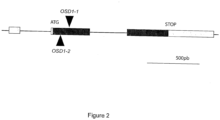
- the intron/exon structure of the OSD1 gene and the location of the two different Ds insertions are shown in Figure 2 .
- the OSD1 gene contains 3 exons and 2 introns and encodes a protein of 243 amino acids.
- the positions of the two Ds insertions are indicated by triangles.
- Figure 3 represents meiosis in wild-type plants and Figure 4 represents meiosis in osd1 mutants.
- (H and I) Telophase II. Four haploid spores are formed (tetrad). Scale bar 10 ⁇ m
- FIG. 4 (A and B) Male meiotic products stained with toluidine blue.
- A A wild type tetrad.
- B A dyad in the osd1-1 mutant.
- C to D Male meiosis in osd1 is indistinguishable from wild type until telophase I (compare to Figure 3 ), but no figures characteristic of a second division were observed.
- C pachytene.
- D diakinesis.
- E metaphase I.
- F Anaphase I.
- G Telophase I.
- H Metaphase I of female meiosis in osd1.
- osd1 mutants Due to an absence of the second meiotic division, osd1 mutants produce high frequencies of viable diploid male and female gametophytes, which generate, after fecundation, viable tetraploid plants. However, this phenomenon differs from apomeiosis in that the produced gametes are genetically different from the mother plant.
- EXAMPLE 2 PRODUCTION OF APOMEIOTIC GAMETES BY TRIPLE osd1 / Atrec8 / Atspo11-1 MUTANTS
- Atspo11-1 and Atrec8 mutations lead to a mitotic-like first meiotic division and the osd1 mutation prevents the second meiotic division from taking place. This results in replacement of meiosis by a mitotic-like division, and in apomeiosis.
- MiMe plants generate dyads (408/408) and are fertile (25 ⁇ 6 seeds per fruit).
- the osd1 mutation therefore suppressed the sterility phenotype of the Atspo11-1 / Atrec8 double mutant.
- EXAMPLE 3 IDENTIFICATION OF A RICE ORTHOLOG OF THE ARABIDOPSIS OSD1 GENE.
- the Oriza sativa genome contains two OSD1/UVI4 homologue candidates (Os02g37850 and Os04g39670).
- A Tetrad of spores in wild type
- B Dyad of spores in AMB12.
Landscapes
- Health & Medical Sciences (AREA)
- Life Sciences & Earth Sciences (AREA)
- Genetics & Genomics (AREA)
- Chemical & Material Sciences (AREA)
- Organic Chemistry (AREA)
- Molecular Biology (AREA)
- Engineering & Computer Science (AREA)
- General Health & Medical Sciences (AREA)
- Zoology (AREA)
- Wood Science & Technology (AREA)
- Bioinformatics & Cheminformatics (AREA)
- General Engineering & Computer Science (AREA)
- Biotechnology (AREA)
- Biomedical Technology (AREA)
- Botany (AREA)
- Biophysics (AREA)
- Biochemistry (AREA)
- Environmental Sciences (AREA)
- Developmental Biology & Embryology (AREA)
- Cell Biology (AREA)
- Physics & Mathematics (AREA)
- Plant Pathology (AREA)
- Microbiology (AREA)
- Proteomics, Peptides & Aminoacids (AREA)
- Medicinal Chemistry (AREA)
- Gastroenterology & Hepatology (AREA)
- Virology (AREA)
- Breeding Of Plants And Reproduction By Means Of Culturing (AREA)
Description
- The invention relates to plants that produce 2n Second Division Restitution (SDR) gametes, and to plants that produce apomeiotic gametes, and to their use in plant breeding.
- 2n gametes (also known as diplogametes) are gametes having the somatic chromosome number rather than the gametophytic chromosome number. They have been shown to be useful for the genetic improvement of several crops (for review, cf. for instance RAMANNA & JACOBSEN, Euphytica 133, 3-18, 2003). In particular, the production of diplogametes allow crosses between plants of different ploidy level, for instance crosses between tetraploid crop plants and their diploid wild relatives, in order to use their genetic diversity in plant breeding programs.
- The formation of 2n gametes results from anomalies during meiosis (for review cf. VEILLEUX, Plant Breeding Reviews 3, 252-288, 1985, or BRETAGNOLLE & THOMPSON, New Phytologist 129, 1-22, 1995).
- In normal meiosis, chromosomes first duplicate, resulting in pairs of sister chromatids. This round of replication is followed by two rounds of division, known as meiosis I and meiosis II. During meiosis I homologous chromosomes recombine and are separated into two cells, each of them comprising one entire haploid content of chromosomes. In meiosis II the two cells resulting from meiosis I further divide, and the sister chromatids segregate. The spores resulting from this division are thus haploid and carry recombined genetic information.
- The abnormalities leading to 2n gametes formation include in particular abnormal cytokinesis, the skip of the first or second meiotic division, or abnormal spindle geometry (for review cf. VEILLEUX, Plant Breeding Reviews 3, 252-288, 1985, or BRETAGNOLLE & THOMPSON, New Phytologist 129, 1-22, 1995). These abnormalities lead to different classes of unreduced gametes. For instance, failure of the first meiotic division results in First Division Restitution (FDR) gametes, while failure of the second meiotic division results in Second Division Restitution (SDR) gametes.
- Although numerous mutants able to produce 2n gametes have been reported in various plant species, only one gene implicated in the formation of 2n pollen has been identified and characterized at the molecular level until now. The inactivation of this gene, designated AtPS1 (for Arabidopsis thaliana parallel spindles), generates diploid male spores, giving rise to viable diploid pollen grains and to spontaneous triploid plants in the progeny. This gene and its use for producing 2n pollen are disclosed in
European Patent application 08490672, filed on July 8th 2008 - The inventors have now identified in the model plant Arabidopsis thaliana, another gene implicated in the formation of 2n gametes in plants. The inventors have found that inactivation of this gene results in the skipping of the second meiotic division. This generates diploid male and female spores, giving rise to viable diploid male and female gametes, which are SDR gametes. This gene will be hereinafter designated OSD1, for omission of second division. The sequence of the OSD1 gene of Arabidopsis thaliana is available in the TAIR database under the accession number At3g57860, or in the GenBank database under the accession number NM_115648. This gene encodes a protein of 243 aa (GenBank NP_191345), whose sequence is also represented in the enclosed sequence listing as SEQ ID NO: 1.
- The OSD1 gene of Arabidopsis thaliana has been previously depicted as "UVI4-Like" gene (UVI4-L), in a publication of HASE et al. (Plant J, 46, 317-26, 2006), which describes its paralogue, named UVI4. According to HASE et al. UVI4 acts as a suppressor of endo-reduplication and is necessary for maintaining the mitotic state whereas OSD1 (UVI4-L) does not appear to be required for this process. In contrast, as shown herein, OSD1 appears necessary for allowing the transition from meiosis I to meiosis II.
- The inventors have also identified in rice (Oryza sativa) an ortholog of the OSD1 gene of Arabidopsis thaliana. The sequence of the OSD1 gene of Oryza sativa is available in the OryGenes or TAIR databases under the accession number Os02g37850. It encodes a protein of 234 aa, whose sequence is represented in the enclosed sequence listing as SEQ ID NO: 35. The OSD1 proteins of Arabidopsis thaliana and Oryza sativa have 23.6% identity and 35% similarity over the whole length of their sequences.
- The invention is as defined in claims 1 to 10.
- In an aspect, the invention relates to a method for obtaining a plant producing Second Division Restitution 2n gametes, wherein said method comprises the inhibition in said plant of a protein hereinafter designated as OSD1 protein, wherein said OSD1 protein
- a. has at least 35% sequence identity using the Needleman-Wunsch global alignment algorithm, or at least 50% sequence similarity using the scoring matrix BLOSUM62 with the AtOSD1 protein of SEQ ID NO: 1, or with the OsOSD1 protein of SEQ ID NO: 35, and
- b. allows the transition from meiosis I to meiosis II,
- The
SDR 2n gametes produced according to the invention are useful in all the usual applications of 2n gametes, for instance for producing polyploids plants, or to allow crosses between plants of different ploidy level. They can also be useful in methods of genetic mapping, for instance the method of "Reverse progeny mapping" disclosed inUS Patent Application 20080057583 . - The inventors have further found that by combining the inactivation of OSD1, with the inactivation of two other genes, one (SPO11-1) which encodes a protein necessary for efficient meiotic recombination in plants, and whose inhibition eliminates recombination and pairing (GRELON et al., Embo J, 20, 589-600, 2001), and another (REC8, At2g47980) which encodes a protein necessary for the monopolar orientation of the kinetochores during meiosis (CHELYSHEVA et al., J Cell Sci, 118, 4621-32, 2005), and whose inhibition modifies chromatid segregation, resulted in a genotype in which meiosis is totally replaced by mitosis without affecting subsequent sexual processes. This genotype will be called hereinafter MiMe for "mitosis instead of meiosis". This replacement of meiosis by mitosis results in apomeiotic gametes, retaining all the parent's genetic information (BICKNELL & KOLTUNOW, Plant Cell, 16 Suppl, S228-45, 2004).
-
Figure 1 provides a schematic comparison between the mechanisms of mitosis, normal meiosis, meiosis in the osd1 mutant, meiosis in a mutant lacking SPO11-1 activity (Atspo11-1), meiosis in a double mutant lacking both SPO11-1 and REC8 activity (Atspo11-1/Atrec8), and meiosis in the MiMe mutant. - During mitosis in diploid cells, chromosomes replicate and sister chromatids segregate to generate daughter cells that are diploid and genetically identical to the initial cell. During normal meiosis, two rounds of chromosome segregation follow a single round of replication. At division one, homologous chromosomes recombine and are separated. Meiosis II is more similar to mitosis resulting in equal distribution of sister chromatids. The obtained spores are thus haploid and carry recombined genetic information. In the osd1 mutant (this study) meiosis II is skipped giving rise to diploid spores and SDR gametes with recombined genetic information.
- The Atspo11-1 mutant undergoes an unbalanced first division followed by a second division leading to unbalanced spores and sterility.
- The Atspo11-1/Atrec8 double mutant undergoes a mitotic-like division instead of a normal first meiotic division, followed by an unbalanced second division leading to unbalanced spores and sterility.
- In the triple osd1/Atspo11-1/Atrec8 mutant (MiMe), the presence of the Atspo11-1 and Atrec8 mutations leads to a mitotic-like first meiotic division and the presence of the osd1 mutation prevents the second meiotic division from occurring. Thus meiosis is replaced by a mitotic-like division. The obtained spores and gametes are genetically identical to the initial cell.
- The apomeiotic gametes produced by the MiMe mutant can be used, in the same way as the
SDR 2n gametes, for producing polyploids plants, or for crossing plants of different ploidy level. They are also of interest for the production of apomictic plants, i.e plants which are able to form seeds from the maternal tissues of the ovule, resulting in progeny that are genetic clones of the maternal parent. Although it exists in over 400 species of angiosperms, very few crop species are apomictic and attempts to introduce this trait by crossing have failed (SAVIDAN, The Flowering of Apomixis: From Mechanisms to Genetic Engineering 2001; SPILLANE et al., Sexual Plant Reproduction, 14, 2001). - In another aspect, the invention relates to a method for obtaining a plant producing apomeiotic gametes, wherein said method comprises the inhibition in said plant of the following proteins:
- a) the OSD1 protein as defined above;
- b) a protein involved in initiation of meiotic recombination in plants, said protein being selected among :
- i) a protein hereinafter designated as SPO11-1 protein, wherein said protein has at least 55% sequence identity , or at least 70% sequence similarity with the SPO11-1 protein of SEQ ID NO: 2;
- ii) a protein hereinafter designated as SPO11-2 protein, wherein said protein has at least 60% sequence identity, or at least 75% sequence similarity with the SPO11-2 protein of SEQ ID NO: 3;
- iii) a protein hereinafter designated as PRD1 protein, wherein said protein has at least 25% sequence identity, or at least 40% sequence similarity with the PRD1 protein of SEQ ID NO: 4;
- iv) a protein hereinafter designated as PAIR1 protein, wherein said protein has at least 30% sequence identity, or at least 40% sequence similarity with the PAIR1 protein of SEQ ID NO: 5;
- c) a protein hereinafter designated as Rec8 protein, wherein said protein has at least 40% sequence identity, or at least 50% sequence similarity with the Rec8 protein of SEQ ID NO: 6,
- the inhibition of said proteins is obtained by mutagenesis of the gene encoding said protein of or of its promoter, and the mutants having partially or totally lost the activity of said protein are selected, and wherein the mutagenesis is performed by targeted deletion of the coding sequence or of the promoter of the gene encoding said protein or of a portion thereof, or by targeted insertion of an exogenous sequence within said coding sequence or said promoter, or by inducing random mutations or random insertional mutagenesis, followed by screening of the mutants within the desired gene, or
- the inhibition of said proteins is obtained by expressing in said plant a silencing RNA targeting the gene encoding said protein.
- SEQ ID NO: 2 represents the sequence of the SPO11-1 protein of Arabidopsis thaliana. This sequence is also available in the Swissprot database under the accession number Q9M4A2.
- SEQ ID NO: 3 represents the sequence of the SPO11-2 protein of Arabidopsis thaliana. This sequence is also available in the SwissProt database under the accession number Q9M4A1.
- SEQ ID NO: 4 represents the sequence of the PRD1 protein of Arabidopsis thaliana. This sequence is also available in the GenBank database under the accession number ABQ12642.
- SEQ ID NO: 5 represents the sequence of the PAIR1 protein of Arabidopsis thaliana. This sequence is also available in the GenBank database under the accession number NP_171675.
- SEQ ID NO: 6 represents the sequence of the Rec8 protein of Arabidopsis thaliana. This sequence is also available in the GenBank database under the accession number NP_196168.
- The SPO11-1, SPO11-2, PRD1, PAIR1, and Rec8 proteins are conserved in higher plants, monocotyledons as well as dicotyledons. By way of non-limitative examples of orthologs of SPO11-1, SPO11-2, PRD1, PAIR1 and Rec8 proteins of Arabidopsis thaliana in monocotyledonous plants, one can cite the Oryza sativa SPO11-1, SPO11-2, PRD1, PAIR1, and Rec8 proteins. The sequence of the Oryza sativa SPO11-1 protein is available in GenBank under the accession number AAP68363; the sequence of the Oryza sativa SPO11-2 protein is available in GenBank under the accession number NP_001061027; the sequence of the Oryza sativa PRD1 protein is available in GenBank under the accession number EAZ30311; the sequence of the Oryza sativa PAIR1 protein is available in SwissProt under the accession number Q75RY2; the sequence of the Oryza sativa Rec8 protein is available in GenBank under the accession number AAQ75095.
- The inhibition of the above mentioned OSD1, SPO11-1, SPO11-2, PRD1, PAIR1, or Rec8 proteins can be obtained either by abolishing, blocking, or decreasing their function, or advantageously, by preventing or down-regulating the expression of the corresponding genes.
- By way of example, inhibition of said protein can be obtained by mutagenesis of the corresponding gene or of its promoter, and selection of the mutants having partially or totally lost the activity of said protein. For instance, a mutation within the coding sequence can induce, depending on the nature of the mutation, the expression of an inactive protein, or of a protein with impaired activity; in the same way, a mutation within the promoter sequence can induce a lack of expression of said protein, or decrease thereof.
- Mutagenesis can be performed for instance by targeted deletion of the coding sequence or of the promoter of the gene encoding said protein or of a portion thereof, or by targeted insertion of an exogenous sequence within said coding sequence or said promoter. It can also be performed by inducing random mutations, for instance through EMS mutagenesis or random insertional mutagenesis, followed by screening of the mutants within the desired gene. Methods for high throughput mutagenesis and screening are available in the art. By way of example, one can mention TILLING (Targeting Induced Local Lesions IN Genomes, described by McCallum et al., 2000).
- Among the mutations within the OSD1 gene, those resulting in the ability to produce
SDR 2n gametes can be identified on the basis of the phenotypic characteristics of the plants which are homozygous for this mutation: these plants can form at least 5%, preferably at least 10%, more preferably at least 20%, still more preferably at least 50 %, and up to 100% of dyads as a product of meiosis. - Among the mutations within a gene encoding a protein involved in initiation of meiotic recombination in plants, such as the SPO11-1 gene or the SPO11-2, PRD1, or PAIR1 gene, those useful for obtaining a plant producing apomeiotic gametes can be identified on the basis of the phenotypic characteristics of the plants which are homozygous for this mutation, in particular the presence of univalents instead of bivalents at meiosis I, and the sterility of the plant.
- Among the mutants having a mutation within the REC8 gene, those useful for obtaining a plant producing apomeiotic gametes can be identified on the basis of the phenotypic characteristics of the plants which are homozygous for this mutation, in particular chromosome fragmentation at meiosis, and sterility of the plant.
- In another aspect, the invention relates to a method for obtaining a plant producing
Second Division Restitution 2n gametes, wherein said method comprises the inhibition of the OSD1 protein, wherein said OSD1 protein is as defined above and wherein inhibition of said OSD1 protein is obtained by expressing in said plant a silencing RNA targeting the gene encoding said protein. - Methods for gene silencing in plants are known in themselves in the art. For instance, one can mention by antisense inhibition or co-suppression, as described by way of example in
U.S. Patents 5,190,065 and5,283,323 . It is also possible to use ribozymes targeting the mRNA of said protein. - Preferred methods are those wherein gene silencing is induced by means of RNA interference (RNAi), using a silencing RNA targeting the gene to be silenced. Various methods and DNA constructs for delivery of silencing RNAs are available in the art.
- A "silencing RNA" is herein defined as a small RNA that can silence a target gene in a sequence-specific manner by base pairing to complementary mRNA molecules. Silencing RNAs include in particular small interfering RNAs (siRNAs) and microRNAs (miRNAs).
- Initially, DNA constructs for delivering a silencing RNA in a plant included a fragment of 300 bp or more (generally 300-800 bp, although shorter sequences may sometime induce efficient silencing) of the cDNA of the target gene, under transcriptional control of a promoter active in said plant. Currently, the more widely used silencing RNA constructs are those that can produce hairpin RNA (hpRNA) transcripts. In these constructs, the fragment of the target gene is inversely repeated, with generally a spacer region between the repeats (for review, cf. WATSON et al., 2005). One can also use artificial microRNAs (amiRNAs) directed against the gene to be silenced (for review about the design and applications of silencing RNAs, including in particular amiRNAs, in plants cf. for instance OSSOWSKI et al., (Plant J., 53, 674-90, 2008).
- The present invention provides tools for silencing one or more target gene(s) selected among OSD1, SPO11-1, SPO11-2, PRD1, PAIR1, and REC8, including in particular expression cassettes for hpRNA or amiRNA targeting said gene (s).
- In another aspect, the invention relates to an expression cassette comprising:
- a promoter functional in a plant cell;
- at least one DNA construct selected among:
- a) one or more DNA construct(s) of 200 to 1000 bp, each comprising a fragment of a cDNA of OSD1 gene and may further comprises a fragment of a cDNA of a target gene selected among SPO11-1, SPO11-2, PRD1, PAIR1, and REC8, or of its complementary, or having at least 95% identity with said fragment, said DNA sequence(s) being placed under transcriptional control of said promoter.
- b) one or more hairpin DNA construct(s) capable, when transcribed, of forming a hairpin RNA targeting at least the OSD1 gene and may further form an hairpin RNA targeting a gene selected among SPO11-1, SPO11-2, PRD1, PAIR1, and REC8 ;
- c) one or more DNA construct(s) capable, when transcribed, of forming an amiRNA targeting OSD1 gene and a may further form an amiRNA targeting a gene selected among, SPO11-1, SPO11-2, PRD1, PAIR1, and REC8;
- Generally, said hairpin DNA construct comprises: i) a first DNA sequence of 200 to 1000 bp, preferably of 300 to 900 bp, consisting of a fragment of a cDNA of the target gene, or having at least 95% identity, and by order of increasing preference, at least 96%, 97%, 98%, or 99 % identity with said fragment; ii) a second DNA sequence that is the complementary of said first DNA, said first and second sequences being in opposite orientations and ii) a spacer sequence separating said first and second sequence, such that these first and second DNA sequences are capable, when transcribed, of forming a single double-stranded RNA molecule. The spacer can be a random fragment of DNA. However, preferably, one will use an intron which is spliceable by the target plant cell. Its size is generally 400 to 2000 nucleotides in length.
- In an embodiment, the invention relates to an expression cassette as defined above comprising a DNA construct targeting the OSD1 gene.
- In an embodiment, the invention relates to an expression cassette as defined above, comprising: a DNA construct targeting the OSD1 gene, a DNA construct targeting a gene selected among SPO11-1, SPO11-2, PRD1, and PAIR1, and a DNA construct targeting REC8.
- A large choice of promoters suitable for expression of heterologous genes in plants is available in the art.
- They can be obtained for instance from plants, plant viruses, or bacteria such as Agrobacterium. They include constitutive promoters, i.e. promoters which are active in most tissues and cells and under most environmental conditions, as well as tissue-specific or cell-specific promoters which are active only or mainly in certain tissues or certain cell types, and inducible promoters that are activated by physical or chemical stimuli, such as those resulting from nematode infection.
- Non-limitative examples of constitutive promoters that are commonly used in plant cells are the cauliflower mosaic virus (CaMV) 35S promoter, the Nos promoter, the rubisco promoter, the Cassava vein Mosaic Virus (CsVMV) promoter.
- Organ or tissue specific promoters that can be used in the present invention include in particular promoters able to confer meiosis-associated expression, such as the DMC1 promoter (KLIMYUK & JONES, Plant J, 11, 1-14, 1997); one can also use any of the the endogenous promoters of the genes OSD1, SPO11-1, SPO11-2, PRD1, PAIR1, or REC8.
- The DNA constructs of the invention generally also include a transcriptional terminator (for instance the 35S transcriptional terminator, or the nopaline synthase (Nos) transcriptional terminator).
- In another aspect, the invention relates to a recombinant vector comprising an expression cassette as defined above. Classically, said recombinant vectors also include one or more marker genes, which allow for selection of transformed hosts.
- The selection of suitable vectors and the methods for inserting DNA constructs therein are well known to persons of ordinary skill in the art. The choice of the vector depends on the intended host and on the intended method of transformation of said host. A variety of methods for genetic transformation of plant cells or plants are available in the art for many plant species, dicotyledons or monocotyledons. By way of non-limitative examples, one can mention virus mediated transformation, transformation by microinjection, by electroporation, microprojectile mediated transformation, Agrobacterium mediated transformation, and the like.
- In another aspect, the invention relates to a plant producing
Second Division Restitution 2n gametes, - wherein a protein, hereinafter designated as OSD1 protein, is inhibited, said OSD1 protein having at least 35% sequence identity or at least 50% sequence similarity with the AtOSD1 protein of SEQ ID NO: 1 or with the OsOSD1 protein of SEQ ID NO: 35, wherein the percentage of identity is calculated using the Needleman-Wunsch global alignment algorithm, and the percentage of similarity is calculated using the scoring matrix BLOSUM62,
- wherein :
- the gene encoding the protein or its promoter is mutated and the obtained mutant has partially or totally lost the protein activity, or
- a silencing RNA targeting the gene encoding the protein is expressed in said plant.
- In another aspect the invention relates to a plant producing apomeiotic gametes,
- wherein the following proteins are inhibited:
- a) a protein hereinafter designated as OSD1 protein, said OSD1 protein having at least 35% sequence identity or at least 50% sequence similarity with the AtOSD1 protein of SEQ ID NO: 1 or with the OsOSD1 protein of SEQ ID NO: 35,
- b) a protein involved in initiation of meiotic recombination in plants, said protein being selected among:
- i) a protein hereinafter designated as SPO11-1 protein, wherein said protein has at least 55% sequence identity , or at least 70% sequence similarity with the SPO11-1 protein of SEQ ID NO: 2;
- ii) a protein hereinafter designated as SPO11-2 protein, wherein said protein has at least 60% sequence identity, or at least 75% sequence similarity with the SPO11-2 protein of SEQ ID NO: 3;
- iii) a protein hereinafter designated as PRD1 protein, wherein said protein has at least 25% sequence identity, or at least 40% sequence similarity with the PRD1 protein of SEQ ID NO: 4;
- iv) a protein hereinafter designated as PAIR1 protein, wherein said protein has at least 30% sequence identity, or at least 40% sequence similarity with the PAIR1 protein of SEQ ID NO: 5;
- c) a protein hereinafter designated as Rec8 protein, wherein said protein has at least 40% sequence identity, or at least 50% sequence similarity with the Rec8 protein of SEQ ID NO: 6,
- wherein the percentage of identity is calculated using the Needleman-Wunsch global alignment algorithm, and the percentage of similarity is calculated using the scoring matrix BLOSUM62,
- wherein:
- the gene encoding the protein or its promoter is mutated, and the obtained mutant has partially or totally lost the protein activity, or
- a silencing RNA targeting the gene encoding the protein is expressed in said plant.
- In an embodiment, the invention relates to a plant as defined above, which is a transgenic plant containing a transgene comprising an expression cassette as defined above comprising: a DNA construct targeting the OSD1 gene, a DNA construct targeting a gene selected among SPO11-1, SPO11-2, PRD1, and PAIR1, and a DNA construct targeting REC8.
- This also includes plants genetically transformed by one or more DNA construct(s) of the invention. Preferably, said plants are transgenic plants, wherein said construct is contained in a transgene integrated in the plant genome, so that it is passed onto successive plant generations.
- The expression of a chimeric DNA construct targeting the OSD1 gene, resulting in a down regulation of the OSD1 protein, provides to said transgenic plant the ability to produce 2n SDR gametes. The co-expression of a chimeric DNA construct targeting the OSD1 gene, a chimeric DNA construct targeting a gene selected among SPO11-1, SPO11-2, PRD1, and PAIR1, and a chimeric DNA construct targeting the REC8 gene, results in a down regulation of the proteins encoded by these three genes and provides to said transgenic plant the ability to produce apomeiotic gametes.
- The invention also encompasses a method for producing
SDR 2n gametes, wherein said method comprises cultivating a plant of the invention and recovering the gametes produced by said plant. Preferably said gametes comprises at least 10%, more preferably at least 20%, and by order of increasing preference, at least 30%, 40%, 50%, 60 % , 70%, 80 %, or 90 % of viable 2n gametes. - The invention also encompasses a method for producing apomeiotic gametes, wherein said method comprises cultivating a plant of the invention and recovering the gametes produced by said plant. Preferably said gametes comprises at least 10%, more preferably at least 20%, and by order of increasing preference, at least 30%, 40%, 50%, or 60 %, 70%, 80 %, or 90 % of viable apomeiotic gametes.
- The present invention applies to a broad range of monocot- or dicotyledon plants of agronomical interest. By way of non-limitative examples, one can mention potato, rice, wheat, maize, tomato, cucumbers, alfafa, sugar cane, sweet potato, manioc, clover, soybean, ray-grass, banana, melon, watermelon, cotton or ornamental plants such as roses, lilies, tulips, and narcissus.
- Foregoing and other objects and advantages of the invention will become more apparent from the following detailed description and accompanying drawings. It is to be understood however that this foregoing detailed description is exemplary only and is not restrictive of the invention.
- Arabidopsis plants were cultivated as described in VIGNARD et al., (PLoS Genet, 3, 1894-906, 2007). For germination assays and cytometry experiments Arabidopsis were cultivated in vitro on Arabidopsis medium (ESTELLE & SOMERVILLE, Mol. Gen. Genet., 206, 200-06, 1987) at 21°C with a 16h day/8h night photoperiod and 70% hygrometry.
- Plants were genotyped by PCR (30 cycles of 30s at 94°C, 30s at 56°C and lmin at 72°C) using two primer pairs. For each genotype the primer pair is shown in Table I and the primer pair specific to the insertion is shown in Table II.
Table I Primers for Wild-type allele osd1-1 pst15307U (5'CGTCACTCTCCCCAAGAAAG 3') (SEQ ID NO: 7) pst15307L (5'GGCTAAGCAAGCCTGCTATG 3') (SEQ ID NO: 8) osd1-2 GT21481U (5'CCGGTGTTCTTGTGACTCG 3') (SEQ ID NO: 9) GT21481L (5'GCAGATTCCTAATTCAGCTC 3') (SEQ ID NO: 10) Atspo11-1-3 N646172U (5' AATCGGTGAGTCAGGTTTCAG 3') (SEQ ID NO: 11) N646172L (5' CCATGGATGAAAGCGATTTAG 3') (SEQ ID NO: 12) Atrec8-3 N836037U (5'CTCATATTCACGGTGCTCCC 3') (SEQ ID NO: 13) N836037L (5'GGGGGAAAAGAGAAAGGTTC 3') (SEQ ID NO: 14) Table II Primers for mutant allele osd1-1 
osd1-2 
Atspo11-1-3 
Atrec8-3 
- Genetic markers used to genotype the osd1-1(No-0)/osd1-2(Ler) x Col-0 F1 population and osd1-1(No-O)/spo11-1(Col-0)/rec8(Col-0) triple mutant x Ler F1 population are listed in Table III. The PCR conditions were 40 cycles of 30s at 94°C, 30s at Tm and 30s at 72°C.
Table III marker Chrom. Position pb Primer 1 (SEQ ID NO: ) Primer 2 (SEQ ID NO: ) Msat1-13 1 25827433 CAACCACCAGGCTC (19) GTCAAACCAGTTCAATCA(20) F5i14 1 24374008 CTGCCTGAAATTGTCGAAAC(21) GGCATCACAGTTCTGATTCC(22) Msat2-18 2 2799644 TAGTCTCTTTTGGTGCGCATA(23) AGCCTCTCCAAGCTTAGGTCT(24) Msat2-21 2 11461020 ATTTTTAGCCCAATCACGTTT(25) AGGTCAAGTGAAAGGGTAAGG(26) Msat2-9 2 18152580 TAAAAGAGTCCCTCGTAAAG(27) GTTGTTGTTGTGGCATT(28) CapsK4_10355 4 10354800 ACCCATTTGGTGATGCTAAC(29) GAGCAGTTTCCACTTTGTCC(30) Msat4-18 4 11966304 TGTAAATATCGGCTTCTAAG(31) CTGAAACAAATCGCATTA(32) Nga151 5 4669932 GTTTTGGGAAGTTTTGCTGG(33) CAGTCTAAAAGCGAGAGTATGATG(34) - These markers were amplified (40 cycles of 30s at 94°C, 30s at 58°C and 30s at 72°C.) with the indicated primers and observed after migration on 3% agarose gel.
- CAPS K4 10355 was observed after Eco47III/HpaII double digestion. The two primer pairs specific for the osd1-1 and osd1-2 insertion borders were used as a marker on chromosome 3.
- Final meiotic products were observed as described in AZUMI et al., (Embo J, 21, 3081-95., 2002) and viewed with a conventional light microscope with a 40X dry objective. Chromosomes spreads and observations were carried out using the technique described in MERCIER et al., (Biochimie, 83, 1023-28, 2001). The DNA fluorescence of spermatic pollen nuclei was quantified using open LAB 4.0.4 software. For each nucleus the surrounding background was calculated and subtracted from the global fluorescence of the nucleus. Meiotic spindles were observed according to the protocol described in MERCIER et al., (Genes Dev, 15, 1859-71, 2001) except that the DNA was counter-stained with DAPI. Observations were made using an SP2 Leica confocal microscope. Images were acquired with a 63X water objective in xyz and 3D reconstructions were made using Leica software. Projections are shown. Cells were imaged at excitation 488nm and 405nm with AlexaFluor488 and DAPI respectively. Arabidopsis genome sizes were measured as described in MARIE & BROWN, (Biol Cell, 78, 41-51, 1993) using tomato Lycopersicon esculentum cv "Montfavet" as the standard. (2C=1.99 pg, %GC=40.0%)
- As a part of an expression profiling screen for meiotic genes, using the Expression Angler tool(TOUFIGHI et al., Plant J, 43, 153-63, 2005) with the AtGenExpress tissue set(SCHMID et al., Nat Genet, 37, 501-6, 2005), At3g57860 was selected as a good candidate due to its co-regulation with several known meiotic genes. At3g57860 corresponds to the UVI4-Like gene (UVI4-L) which was briefly described in a study of its paralogue, the UVI4 gene (HASE et al., Plant J, 46, 317-26, 2006). Due to its role in meiosis (see below) we renamed the At3g57860 gene OSD1, for omission of second division. The OSD1 and UVI4 proteins are conserved throughout the plant kingdom but do not contain any obvious conserved known functional domains. No homologues were identified outside the plant kingdom.
- We investigated the role of the OSD1 gene by isolating and characterising two mutants. The osd1-1 (pst15307) and the osd1-2 (GT21481) Ds insertional mutants are in the Nooseen (No-0) and Landsberg (Ler) backgrounds, respectively, and in both cases the insertion is in the second exon of the OSD1 gene.
- The intron/exon structure of the OSD1 gene and the location of the two different Ds insertions are shown in
Figure 2 . The OSD1 gene contains 3 exons and 2 introns and encodes a protein of 243 amino acids. The positions of the two Ds insertions are indicated by triangles. -
Figure 3 represents meiosis in wild-type plants andFigure 4 represents meiosis in osd1 mutants. - Legend of
Figure 3 : (A) Pachytene. Homologous chromosomes are fully synapsed. (B) Diakinesis. Five pairs of homologous chromosomes (bivalent), linked by chiasmata, are observed. (C) Metaphase I. The five bivalent are aligned on the metaphase plate. (D) Anaphase I. The homologous chromosomes are separated. (E) Telophase I. (F) Metaphase II. The pairs of sister chromatids align on the metaphase plates. (G) Anaphase II. The sister chromatids are separated. (H and I) Telophase II. Four haploid spores are formed (tetrad). Scale bar=10µm - Legend of
Figure 4 : (A and B) Male meiotic products stained with toluidine blue. (A) A wild type tetrad. (B) A dyad in the osd1-1 mutant. (C to D) Male meiosis in osd1 is indistinguishable from wild type until telophase I (compare toFigure 3 ), but no figures characteristic of a second division were observed. (C) pachytene. (D) diakinesis. (E) metaphase I. (F) Anaphase I. (G) Telophase I. (H) Metaphase I of female meiosis in osd1. - In both independent osd1 mutants the products of male meiosis were dyads (osd1-1: 714/714 osd1-2: 334/334) instead of tetrads (
Figure 4 A and B ). Complementation tests between osd1-1 and osd1-2 confirmed that these mutations are allelic (osd1-1/osd1-2: 369 dyads/369), and thus demonstrated that the observed dyads are due to disruption of the OSD1 gene. Osd1 mutants did not show any somatic developmental defects, male and female gametophyte lethality or reduced fertility (wild type 38±11 seeds/fruit, osd1 35±6). - Next, we measured ploidy levels among the offspring of diploid osd1 mutants. Among selfed progeny, tetraploids (84%) and triploids (16%), but no diploid plants were found (osd1-1: n=56; osd1-2: n=24). When mutant pollen was used to fertilise a wild type plant, all the resulting progeny were triploid (osd1-1: n=75). When mutant ovules were fertilised with wild type pollen grains we isolated 12% diploid and 88% triploid plants (n=25). This demonstrated that the osd1 mutants produce high levels of male (100%) and female (-85%) diploid spores, which result in functional gametes.
- To unravel the mechanisms leading to dyad production in osd1, we investigated chromosome behaviour during meiosis. Both male and female meiosis I were indistinguishable from wild type (compare
Figure 4 withFigure 3 ). Notably, chiasmata, the cytological manifestation of crossovers, and bivalents were observed. However, we were unable to find any meiosis II figures (among >500 male meiocytes from prophase to spore formation), strongly suggesting that dyad production is due to an absence of the second meiotic division. If this second division does not take place then any heterozygosis at centromeres will be lost in the diploid gametes because of sister chromatids co-segregation and homologues separation during the first division. Because of recombination, any loci which are not linked to centromeres will segregate. We tested our assumption by taking advantage of the two different genetic backgrounds of the osd1-1 (No-0) and osd1-2 mutants (Ler). F1 plants bearing the two mutations -mutant for osd1 and heterozygous for any No-0/Ler polymorphisms - were crossed as male or female to a third genetic background, Columbia (Col-0). Karyotyping and genotyping of the obtained plants for trimorphic molecular markers provided direct information on the genetic make-up of pollen grains and female gametophytes produced by the mutant. All the diploid gametes tested had the predicted genetic characteristics. They were systematically homozygous at centromeres and segregating -because of recombination- at other loci (n=48 for male diploid gametes and n=41 for female diploid gametes). These results confirmed that the absence of a second meiotic division is indeed the cause of 2n gametes production in osd1. This mechanism also implies that unbalanced chromosome segregation at meiosis I would give rise to unbalanced dyads in osd1; this was confirmed by analysing a double Atspo11-1/osd1-1 mutant (data not shown). - Due to an absence of the second meiotic division, osd1 mutants produce high frequencies of viable diploid male and female gametophytes, which generate, after fecundation, viable tetraploid plants. However, this phenomenon differs from apomeiosis in that the produced gametes are genetically different from the mother plant.
- In double Atspo11-1/Atrec8 mutants the first meiotic division is replaced by a mitotic-like division, followed by an unbalanced second division which leads to unbalanced spores and sterility(CHELYSHEVA et al., J Cell Sci, 118, 4621-32, 2005).
- We generated osd1/Atrec8/Atspo11-1 mutants. Plants heterozygous for both Atspo11-1 and Atrec8 mutations were obtained by crossing plants heterozygous for each mutation, and were crossed by a plant heterozygous for osd1. Triple heterozygous plants identified were self-fertilized and plants homozygous for the three mutations were analyzed.
- Observation of chromosome behaviour during male and female meiosis of these mutants is shown in
Figure 5 . - Legend of
Figure 5 : (A) Male metaphase I (B) Male anaphase I. The vignette shows a dyad in MiMe. (C) Female metaphase I. (D) Female anaphase I. Scale bar = 10µm. - These observations revealed a mitotic-like division: 10 univalents aligned on the metaphase plate and sister chromatids separated at anaphase (
Figure 5 ). - The Atspo11-1 and Atrec8 mutations lead to a mitotic-like first meiotic division and the osd1 mutation prevents the second meiotic division from taking place. This results in replacement of meiosis by a mitotic-like division, and in apomeiosis.
- We called this genotype MiMe for "mitosis instead of meiosis". MiMe plants generate dyads (408/408) and are fertile (25±6 seeds per fruit). The osd1 mutation therefore suppressed the sterility phenotype of the Atspo11-1/Atrec8 double mutant.
- The selfed progeny of MiMe plants were systematically tetraploid (n=24) and backcrosses between diploid MiMe plants and wild type plants generated triploid plants regardless of whether male (n=24) or female (n=67) MiMe gametes were used, showing that this mitotic-like division gives rise to functional diploid gametes. All the gametes (male and female), tested similarly as described above, systematically retained the mother plant heterozygosity for every genetic marker tested and were thus genetically identical to the mother plant. These results confirm that MiMe plants undergo a mitotic-like division instead of a normal meiotic division, without affecting subsequent sexual processes.
- When meiosis is replaced by mitosis ploidy is expected to double with each generation. This was observed in MiMe plants, as shown in
Figure 6 . - Legend of
Figure 6 : Left column: mitotic metaphase, scale bar= 10µm. Right columns: the corresponding four weeks old plants, (scale bar=2cm) and flowers (scale bar=1mm). - In subsequent generations, we obtained tetraploid (4N, 20 chromosomes, n=26) and octoploid (8N, 40 chromosomes, n=33).
- The Oriza sativa genome contains two OSD1/UVI4 homologue candidates (Os02g37850 and Os04g39670). We isolated two T-DNA insertion mutants in one of this putative homologue (Os02g37850). The two lines, AMBA12 and AMQF10 were genotyped by PCR to select homozygotes. In both lines we observed spontaneous tetraploids plants among the offspring of diploid mutant plants, suggestive of the production of functional male and female 2n gametes (AMBA 12: 100% of tetraploid, n=30; AMQF10 37% of tetraploids, n=27). We then studied the meiotic products in AMB12 mutants (n>400)and observed the production of 100% of dyads instead of tetrads, as illustrated by
Figure 7 . - Legend of
Figure 7 : A: Tetrad of spores in wild type; B: Dyad of spores in AMB12. - This phenotype is identical to the Arabidopsis osd1 mutant. To unravel the mechanisms leading to dyad production in AMBA12 homozygote mutants, we investigated chromosome behavior during meiosis. Meiosis I was indistinguishable from wild type. Notably, chiasmata, the cytological manifestation of crossovers, and bivalents were observed. However, we were unable to find any meiosis II figures, strongly suggesting that 2N spores production is due to an absence of the second meiotic division, like in Arabidopsis osd1. Altogether, these results show that Os02g37850 is the functional homologue of Arabidopsis OSD1 and therefore called it OsOSD1. OSD1 and OsOSD1 proteins have 23.6% identity and 35% similarity on an alignment that covers the whole length of the sequences (EMBOSS pairwise alignment Needle tool).
Claims (10)
- A method for obtaining a plant producing Second Division Restitution 2n gametes, wherein said method comprises the inhibition in said plant of a protein hereinafter designated as OSD1 protein, wherein said OSD1 proteina. has at least 35% sequence identity using the Needleman-Wunsch global alignment algorithm, or at least 50% sequence similarity using the scoring matrix BLOSUM62 with the AtOSD1 protein of SEQ ID NO: 1, or with the OsOSD1 protein of SEQ ID NO: 35, andb. allows the transition from meiosis I to meiosis II,wherein inhibition of the OSD1 protein is obtained by mutagenesis of the OSD1 gene or of its promoter, and the mutants having partially or totally lost the OSD1 protein activity are selected, and wherein the mutagenesis is performed by targeted deletion of the coding sequence or of the promoter of the gene encoding said protein or of a portion thereof, or by targeted insertion of an exogenous sequence within said coding sequence or said promoter, or by inducing random mutations or random insertional mutagenesis, followed by screening of the mutants within the desired gene.
- A method for obtaining a plant producing Second Division Restitution 2n gametes , wherein said method comprises the inhibition of the OSD1 protein, wherein said OSD1 protein is defined in claim 1 and wherein inhibition of said OSD1 protein is obtained by expressing in said plant a silencing RNA targeting the gene encoding said protein.
- A method for obtaining a plant producing apomeiotic gametes, wherein said method comprises the inhibition in said plant of the following proteins:a) the OSD1 protein as defined in claim 1;b) a protein involved in initiation of meiotic recombination in plants, said protein being selected among :i) a protein hereinafter designated as SPO11-1 protein, wherein said protein has at least 55% sequence identity , or at least 70% sequence similarity with the SPO11-1 protein of SEQ ID NO: 2;ii) a protein hereinafter designated as SPO11-2 protein, wherein said protein has at least 60% sequence identity, or at least 75% sequence similarity with the SPO11-2 protein of SEQ ID NO: 3;iii) a protein hereinafter designated as PRD1 protein, wherein said protein has at least 25% sequence identity, or at least 40% sequence similarity with the PRD1 protein of SEQ ID NO: 4;iv) a protein hereinafter designated as PAIR1 protein, wherein said protein has at least 30% sequence identity, or at least 40% sequence similarity with the PAIR1 protein of SEQ ID NO: 5;c) a protein hereinafter designated as Rec8 protein, wherein said protein has at least 40% sequence identity, or at least 50% sequence similarity with the Rec8 protein of SEQ ID NO: 6,wherein in this method, the percentage of identity is calculated using the Needleman-Wunsch global alignment algorithm , and the percentage of similarity is calculated using the scoring matrix BLOSUM62, and wherein,- the inhibition of said proteins is obtained by mutagenesis of the gene encoding said protein of or of its promoter, and the mutants having partially or totally lost the activity of said protein are selected, and wherein the mutagenesis is performed by targeted deletion of the coding sequence or of the promoter of the gene encoding said protein or of a portion thereof, or by targeted insertion of an exogenous sequence within said coding sequence or said promoter, or by inducing random mutations or random insertional mutagenesis, followed by screening of the mutants within the desired gene, or- the inhibition of said proteins is obtained by expressing in said plant a silencing RNA targeting the gene encoding said protein.
- An expression cassette comprising:- a promoter functional in a plant cell;- at least one DNA construct selected among:a) one or more DNA construct(s) of 200 to 1000 bp, each comprising a fragment of a cDNA of OSD1 gene as defined in claim 1 and may further comprises a fragment of a cDNA of a target gene encoding a protein selected among SPO11-1, SPO11-2, PRD1, PAIR1, and REC8 as defined in claim 3 or of its complementary, or having at least 95% identity with said fragment, said DNA sequence(s) being placed under transcriptional control of said promoter.b) one or more hairpin DNA construct(s) capable, when transcribed, of forming a hairpin RNA targeting at least the OSD1 gene as defined in claim 1 and may further form an hairpin RNA targeting a gene encoding a protein selected among SPO11-1, SPO11-2, PRD1, PAIR1, and REC8 as defined in claim 3;c) one or more DNA construct(s) capable, when transcribed, of forming an amiRNA targeting OSD1 gene as defined in claim 1 and may further form an amiRNA targeting a gene encoding a protein selected among SPO11-1, SPO11-2, PRD1, PAIR1, and REC8 as defined in claim 3;said DNA construct(s) being placed under transcriptional control of said promoter.
- An expression cassette of claim 4 comprising a DNA construct targeting the OSD1 gene.
- An expression cassette of claim 4, comprising: a DNA construct targeting the OSD1 gene, a DNA construct targeting a gene selected among SPO11-1, SPO11-2, PRD1, and PAIR1, and a DNA construct targeting REC8.
- A recombinant vector comprising an expression cassette of any of claims 4 to 6.
- A plant producing Second Division Restitution 2n gametes,wherein a protein, hereinafter designated as OSD1 protein, is inhibited,said OSD1 protein having at least 35% sequence identity or at least 50% sequence similarity with the AtOSD1 protein of SEQ ID NO: 1 or with the OsOSD1 protein of SEQ ID NO: 35,wherein the percentage of identity is calculated using the Needleman-Wunsch global alignment algorithm, and the percentage of similarity is calculated using the scoring matrix BLOSUM62,wherein :the gene encoding the protein or its promoter is mutated and the obtained mutant has partially or totally lost the protein activity, ora silencing RNA targeting the gene encoding the protein is expressed in said plant.
- A plant producing apomeiotic gametes,wherein the following proteins are inhibited:a) a protein hereinafter designated as OSD1 protein, said OSD1 protein having at least 35% sequence identity or at least 50% sequence similarity with the AtOSD1 protein of SEQ ID NO: 1 or with the OsOSD1 protein of SEQ ID NO: 35,b) a protein involved in initiation of meiotic recombination in plants, said protein being selected among:i) a protein hereinafter designated as SPO11-1 protein, wherein said protein has at least 55% sequence identity , or at least 70% sequence similarity with the SPO11-1 protein of SEQ ID NO: 2;ii) a protein hereinafter designated as SPO11-2 protein, wherein said protein has at least 60% sequence identity, or at least 75% sequence similarity with the SPO11-2 protein of SEQ ID NO: 3;iii) a protein hereinafter designated as PRD1 protein, wherein said protein has at least 25% sequence identity, or at least 40% sequence similarity with the PRD1 protein of SEQ ID NO: 4;iv) a protein hereinafter designated as PAIR1 protein, wherein said protein has at least 30% sequence identity, or at least 40% sequence similarity with the PAIR1 protein of SEQ ID NO: 5;c) a protein hereinafter designated as Rec8 protein, wherein said protein has at least 40% sequence identity, or at least 50% sequence similarity with the Rec8 protein of SEQ ID NO: 6,wherein the percentage of identity is calculated using the Needleman-Wunsch global alignment algorithm, and the percentage of similarity is calculated using the scoring matrix BLOSUM62,wherein:the gene encoding the protein or its promoter is mutated, and the obtained mutant has partially or totally lost the protein activity, ora silencing RNA targeting the gene encoding the protein is expressed in said plant.
- A plant of claim 9, which is a transgenic plant containing a transgene comprising an expression cassette of claim 6.
Priority Applications (1)
| Application Number | Priority Date | Filing Date | Title |
|---|---|---|---|
| EP10702906.8A EP2379726B1 (en) | 2009-01-07 | 2010-01-06 | Plants producing 2n gametes or apomeiotic gametes |
Applications Claiming Priority (3)
| Application Number | Priority Date | Filing Date | Title |
|---|---|---|---|
| EP09290010A EP2208790A1 (en) | 2009-01-07 | 2009-01-07 | Plants producing 2N gametes or apomeiotic gametes |
| PCT/IB2010/000184 WO2010079432A1 (en) | 2009-01-07 | 2010-01-06 | Plants producing 2n gametes or apomeiotic gametes |
| EP10702906.8A EP2379726B1 (en) | 2009-01-07 | 2010-01-06 | Plants producing 2n gametes or apomeiotic gametes |
Publications (3)
| Publication Number | Publication Date |
|---|---|
| EP2379726A1 EP2379726A1 (en) | 2011-10-26 |
| EP2379726B1 true EP2379726B1 (en) | 2024-11-13 |
| EP2379726C0 EP2379726C0 (en) | 2024-11-13 |
Family
ID=40527466
Family Applications (2)
| Application Number | Title | Priority Date | Filing Date |
|---|---|---|---|
| EP09290010A Withdrawn EP2208790A1 (en) | 2009-01-07 | 2009-01-07 | Plants producing 2N gametes or apomeiotic gametes |
| EP10702906.8A Active EP2379726B1 (en) | 2009-01-07 | 2010-01-06 | Plants producing 2n gametes or apomeiotic gametes |
Family Applications Before (1)
| Application Number | Title | Priority Date | Filing Date |
|---|---|---|---|
| EP09290010A Withdrawn EP2208790A1 (en) | 2009-01-07 | 2009-01-07 | Plants producing 2N gametes or apomeiotic gametes |
Country Status (8)
| Country | Link |
|---|---|
| US (3) | US20120042408A1 (en) |
| EP (2) | EP2208790A1 (en) |
| JP (1) | JP2012514467A (en) |
| CN (1) | CN102308000B (en) |
| BR (1) | BRPI1006827A2 (en) |
| ES (1) | ES2996461T3 (en) |
| HU (1) | HUE069598T2 (en) |
| WO (1) | WO2010079432A1 (en) |
Families Citing this family (25)
| Publication number | Priority date | Publication date | Assignee | Title |
|---|---|---|---|---|
| EP2143799A1 (en) * | 2008-07-08 | 2010-01-13 | Institute National de la Recherche Agronomique | Plants producing 2n pollen |
| MX2012003981A (en) | 2009-10-06 | 2012-06-12 | Univ California | Generation of haploid plants and improved plant breeding. |
| WO2012075195A1 (en) * | 2010-12-01 | 2012-06-07 | Institut National De La Recherche Agronomique | Synthetic clonal reproduction through seeds |
| EP2510781A1 (en) | 2011-04-15 | 2012-10-17 | Institut National De La Recherche Agronomique | Novel methods of modifying plant phenotype |
| CA2833254A1 (en) * | 2011-04-15 | 2012-10-18 | Pioneer Hi-Bred International, Inc. | Self-reproducing hybrid plants |
| EP2574234A1 (en) | 2011-09-29 | 2013-04-03 | Rijk Zwaan Zaadteelt en Zaadhandel B.V. | Quartet breeding |
| US9006515B2 (en) | 2012-01-06 | 2015-04-14 | Pioneer Hi Bred International Inc | Pollen preferred promoters and methods of use |
| BR112016025103A2 (en) * | 2014-06-02 | 2018-02-20 | Institut National De La Recherche Agronomique | dominant mutation in the tdm gene that gives rise to diplogametes production in plants |
| CA2984901A1 (en) * | 2015-05-06 | 2016-11-10 | Pioneer Hi-Bred International, Inc. | Methods and compositions for the production of unreduced, non-recombined gametes and clonal offspring |
| CA2996806A1 (en) | 2015-09-04 | 2017-03-09 | Keygene N.V. | Diplospory gene |
| AU2017234920B2 (en) | 2016-03-18 | 2023-08-17 | E. I. Du Pont De Nemours And Company | Methods and compositions for producing clonal, non-reduced, non-recombined gametes |
| WO2018191032A1 (en) | 2017-04-10 | 2018-10-18 | The Regents Of The University Of California | Generation of haploid plants |
| CN111394386A (en) | 2018-04-12 | 2020-07-10 | 中国水稻研究所 | A method for exploiting plant heterosis |
| EP4231816A1 (en) | 2020-10-21 | 2023-08-30 | Pioneer Hi-Bred International, Inc. | Parthenogenesis factors and methods of using same |
| CN113396818B (en) * | 2021-06-23 | 2022-05-27 | 中国水稻研究所 | Plant breeding method utilizing polyploid heterosis |
| EP4598944A2 (en) | 2022-10-03 | 2025-08-13 | The Regents of the University of California | Circumventing barriers to hybrid crops from genetically distant crosses |
| US12365908B2 (en) | 2022-11-08 | 2025-07-22 | Ohalo Genetics, Inc. | Polyploid hybrid maize breeding |
| US12446503B2 (en) | 2022-11-08 | 2025-10-21 | Ohalo Genetics, Inc. | Polyploid hybrid potato breeding |
| EP4477069A1 (en) | 2023-06-16 | 2024-12-18 | Max-Planck-Gesellschaft zur Förderung der Wissenschaften e.V. | Unreduced clonal gamete formation and polyploid genome design in the solanaceae |
| CN117209577B (en) * | 2023-08-29 | 2024-07-30 | 中国科学院东北地理与农业生态研究所 | A plant meiosis-related protein GmPRD1 and its encoding gene and application |
| CN117625643A (en) * | 2023-11-30 | 2024-03-01 | 浙江大学 | CaREC8, the key gene of pepper meiosis and its application |
| CN118374544B (en) * | 2024-03-08 | 2025-03-07 | 西北农林科技大学 | Method for creating diploid seedless watermelons through gene editing ClSPO-2 |
| CN117965565B (en) * | 2024-03-28 | 2024-06-25 | 中国农业科学院生物技术研究所 | Medicago truncatula MtPAIR1 gene, gene editing vector and its application |
| CN119752959A (en) * | 2024-11-08 | 2025-04-04 | 浙江大学 | Tomato synthetic apomixis-related genes SlSPO11-1, SlREC8 and SlOSD1 and their applications |
| CN120442704A (en) * | 2025-06-27 | 2025-08-08 | 中国科学院东北地理与农业生态研究所 | Application of GmOSD1a protein and its encoding gene in regulating plant meiosis |
Citations (1)
| Publication number | Priority date | Publication date | Assignee | Title |
|---|---|---|---|---|
| WO2003008540A2 (en) * | 2001-06-22 | 2003-01-30 | Syngenta Participations Ag | Abiotic stress responsive polynucleotides and polypeptides |
Family Cites Families (9)
| Publication number | Priority date | Publication date | Assignee | Title |
|---|---|---|---|---|
| US5283323A (en) | 1985-08-07 | 1994-02-01 | The United States Of America As Represented By The Department Of Health And Human Services | Method of producing immune response |
| US5190065A (en) | 1991-11-29 | 1993-03-02 | International Business Machines Corporation | Self-contained washing unit for printed circuit boards |
| JPH10175252A (en) | 1996-12-19 | 1998-06-30 | Tahara:Kk | Method and apparatus for controlling temperature of injection preform for stretch blow molding |
| US7214786B2 (en) * | 2000-12-14 | 2007-05-08 | Kovalic David K | Nucleic acid molecules and other molecules associated with plants and uses thereof for plant improvement |
| ES2554471T3 (en) | 2005-03-03 | 2015-12-21 | Rijk Zwaan Zaadteelt En Zaadhandel B.V. | Inverse progeny mapping |
| US7510850B2 (en) * | 2005-11-10 | 2009-03-31 | Carnegie Institution Of Washington | Isolation of the mitotic spindle matrix and its methods of use |
| JP5077910B2 (en) * | 2006-03-02 | 2012-11-21 | 独立行政法人日本原子力研究開発機構 | UV resistant plant |
| JP2008189556A (en) * | 2007-01-31 | 2008-08-21 | Institute Of Physical & Chemical Research | Method for preparing Spo11-related protein of higher plant having DNA binding ability |
| JP2010154848A (en) * | 2008-12-04 | 2010-07-15 | Japan Atomic Energy Agency | Uvi4-like gene deleted plant |
-
2009
- 2009-01-07 EP EP09290010A patent/EP2208790A1/en not_active Withdrawn
-
2010
- 2010-01-06 BR BRPI1006827A patent/BRPI1006827A2/en not_active Application Discontinuation
- 2010-01-06 CN CN201080007059.3A patent/CN102308000B/en active Active
- 2010-01-06 US US13/143,530 patent/US20120042408A1/en not_active Abandoned
- 2010-01-06 ES ES10702906T patent/ES2996461T3/en active Active
- 2010-01-06 HU HUE10702906A patent/HUE069598T2/en unknown
- 2010-01-06 EP EP10702906.8A patent/EP2379726B1/en active Active
- 2010-01-06 WO PCT/IB2010/000184 patent/WO2010079432A1/en not_active Ceased
- 2010-01-06 JP JP2011544947A patent/JP2012514467A/en active Pending
-
2016
- 2016-01-26 US US15/006,847 patent/US10883112B2/en active Active
-
2020
- 2020-12-09 US US17/116,089 patent/US20210163972A1/en not_active Abandoned
Patent Citations (1)
| Publication number | Priority date | Publication date | Assignee | Title |
|---|---|---|---|---|
| WO2003008540A2 (en) * | 2001-06-22 | 2003-01-30 | Syngenta Participations Ag | Abiotic stress responsive polynucleotides and polypeptides |
Non-Patent Citations (3)
| Title |
|---|
| E L CAMADRO: "Cytological Microspore Asparagus Mechanism of 2n Formation in Garden", HORTSCIENCE, 1 January 1992 (1992-01-01), pages 831 - 832, XP055229643, Retrieved from the Internet <URL:http://hortsci.ashspublications.org/content/27/7/831.full.pdf> * |
| MARUTHACHALAM RAVI ET AL: "Gamete formation without meiosis in Arabidopsis", NATURE, NATURE PUBLISHING GROUP, UNITED KINGDOM, vol. 451, no. 7182, 28 February 2008 (2008-02-28), pages 1121 - 1124,1, XP002683595, ISSN: 0028-0836, [retrieved on 20080213], DOI: 10.1038/NATURE06557 * |
| YOSHIHIRO HASE ET AL: "A mutation in the uvi4 gene promotes progression of endo-reduplication and confers increased tolerance towards ultraviolet B light", THE PLANT JOURNAL, vol. 46, no. 2, 1 April 2006 (2006-04-01), pages 317 - 326, XP055143771, ISSN: 0960-7412, DOI: 10.1111/j.1365-313X.2006.02696.x * |
Also Published As
| Publication number | Publication date |
|---|---|
| US20120042408A1 (en) | 2012-02-16 |
| US20210163972A1 (en) | 2021-06-03 |
| EP2208790A1 (en) | 2010-07-21 |
| EP2379726C0 (en) | 2024-11-13 |
| BRPI1006827A2 (en) | 2015-09-15 |
| US10883112B2 (en) | 2021-01-05 |
| CN102308000B (en) | 2014-07-09 |
| ES2996461T3 (en) | 2025-02-12 |
| CN102308000A (en) | 2012-01-04 |
| US20160222397A1 (en) | 2016-08-04 |
| EP2379726A1 (en) | 2011-10-26 |
| JP2012514467A (en) | 2012-06-28 |
| HUE069598T2 (en) | 2025-03-28 |
| WO2010079432A1 (en) | 2010-07-15 |
Similar Documents
| Publication | Publication Date | Title |
|---|---|---|
| US20210163972A1 (en) | Plants Producing 2N Gametes or Apomeiotic Gametes | |
| CA2819491C (en) | Synthetic clonal reproduction through seeds | |
| US12234467B2 (en) | Diplospory gene | |
| WO2022117024A1 (en) | Parthenogenetic haploid induction gene and application thereof | |
| AU2020285344B2 (en) | Gene for parthenogenesis | |
| US12460224B2 (en) | Modified promoter of a parthenogenesis gene | |
| Ihsan et al. | WsMAGO2, a duplicated MAGO NASHI protein with fertility attributes interacts with MPF2-like MADS-box proteins | |
| CN111087455B (en) | Rice fertility-related protein OsSMARCAL1 and coding gene and application thereof | |
| US20240099210A1 (en) | Method for producing temperature-sensitive male sterile plant | |
| EP2313509B1 (en) | Plants producing 2n pollen | |
| BR112018004300B1 (en) | CHIMERIC GENE, GENETIC CONSTRUCT, VECTOR, USE AND METHOD TO CONFER DIPLOSPORIA IN A PLANT |
Legal Events
| Date | Code | Title | Description |
|---|---|---|---|
| PUAI | Public reference made under article 153(3) epc to a published international application that has entered the european phase |
Free format text: ORIGINAL CODE: 0009012 |
|
| 17P | Request for examination filed |
Effective date: 20110720 |
|
| AK | Designated contracting states |
Kind code of ref document: A1 Designated state(s): AT BE BG CH CY CZ DE DK EE ES FI FR GB GR HR HU IE IS IT LI LT LU LV MC MK MT NL NO PL PT RO SE SI SK SM TR |
|
| RIN1 | Information on inventor provided before grant (corrected) |
Inventor name: CROMER, LAURENCE Inventor name: JOLIVET, SYLVIE Inventor name: FROGER, NICOLE Inventor name: D'ERFURTH, ISABELLE Inventor name: MERCIER, RAPHAEL |
|
| DAX | Request for extension of the european patent (deleted) | ||
| 17Q | First examination report despatched |
Effective date: 20121213 |
|
| STAA | Information on the status of an ep patent application or granted ep patent |
Free format text: STATUS: EXAMINATION IS IN PROGRESS |
|
| RAP1 | Party data changed (applicant data changed or rights of an application transferred) |
Owner name: INSTITUT NATIONAL DE RECHERCHE POUR L'AGRICULTURE, L'ALIMENTATION ET L'ENVIRONNEMENT |
|
| GRAP | Despatch of communication of intention to grant a patent |
Free format text: ORIGINAL CODE: EPIDOSNIGR1 |
|
| STAA | Information on the status of an ep patent application or granted ep patent |
Free format text: STATUS: GRANT OF PATENT IS INTENDED |
|
| INTG | Intention to grant announced |
Effective date: 20231219 |
|
| GRAJ | Information related to disapproval of communication of intention to grant by the applicant or resumption of examination proceedings by the epo deleted |
Free format text: ORIGINAL CODE: EPIDOSDIGR1 |
|
| STAA | Information on the status of an ep patent application or granted ep patent |
Free format text: STATUS: EXAMINATION IS IN PROGRESS |
|
| INTC | Intention to grant announced (deleted) | ||
| GRAP | Despatch of communication of intention to grant a patent |
Free format text: ORIGINAL CODE: EPIDOSNIGR1 |
|
| STAA | Information on the status of an ep patent application or granted ep patent |
Free format text: STATUS: GRANT OF PATENT IS INTENDED |
|
| INTG | Intention to grant announced |
Effective date: 20240806 |
|
| GRAS | Grant fee paid |
Free format text: ORIGINAL CODE: EPIDOSNIGR3 |
|
| GRAA | (expected) grant |
Free format text: ORIGINAL CODE: 0009210 |
|
| STAA | Information on the status of an ep patent application or granted ep patent |
Free format text: STATUS: THE PATENT HAS BEEN GRANTED |
|
| AK | Designated contracting states |
Kind code of ref document: B1 Designated state(s): AT BE BG CH CY CZ DE DK EE ES FI FR GB GR HR HU IE IS IT LI LT LU LV MC MK MT NL NO PL PT RO SE SI SK SM TR |
|
| REG | Reference to a national code |
Ref country code: GB Ref legal event code: FG4D |
|
| REG | Reference to a national code |
Ref country code: CH Ref legal event code: EP |
|
| REG | Reference to a national code |
Ref country code: DE Ref legal event code: R096 Ref document number: 602010069569 Country of ref document: DE |
|
| REG | Reference to a national code |
Ref country code: IE Ref legal event code: FG4D |
|
| U01 | Request for unitary effect filed |
Effective date: 20241209 |
|
| U07 | Unitary effect registered |
Designated state(s): AT BE BG DE DK EE FI FR IT LT LU LV MT NL PT RO SE SI Effective date: 20241219 |
|
| REG | Reference to a national code |
Ref country code: ES Ref legal event code: FG2A Ref document number: 2996461 Country of ref document: ES Kind code of ref document: T3 Effective date: 20250212 |
|
| PGFP | Annual fee paid to national office [announced via postgrant information from national office to epo] |
Ref country code: HU Payment date: 20250210 Year of fee payment: 16 |
|
| REG | Reference to a national code |
Ref country code: HU Ref legal event code: AG4A Ref document number: E069598 Country of ref document: HU |
|
| U20 | Renewal fee for the european patent with unitary effect paid |
Year of fee payment: 16 Effective date: 20250227 |
|
| PG25 | Lapsed in a contracting state [announced via postgrant information from national office to epo] |
Ref country code: IS Free format text: LAPSE BECAUSE OF FAILURE TO SUBMIT A TRANSLATION OF THE DESCRIPTION OR TO PAY THE FEE WITHIN THE PRESCRIBED TIME-LIMIT Effective date: 20250313 Ref country code: HR Free format text: LAPSE BECAUSE OF FAILURE TO SUBMIT A TRANSLATION OF THE DESCRIPTION OR TO PAY THE FEE WITHIN THE PRESCRIBED TIME-LIMIT Effective date: 20241113 |
|
| PGFP | Annual fee paid to national office [announced via postgrant information from national office to epo] |
Ref country code: ES Payment date: 20250214 Year of fee payment: 16 |
|
| PG25 | Lapsed in a contracting state [announced via postgrant information from national office to epo] |
Ref country code: NO Free format text: LAPSE BECAUSE OF FAILURE TO SUBMIT A TRANSLATION OF THE DESCRIPTION OR TO PAY THE FEE WITHIN THE PRESCRIBED TIME-LIMIT Effective date: 20250213 |
|
| PG25 | Lapsed in a contracting state [announced via postgrant information from national office to epo] |
Ref country code: GR Free format text: LAPSE BECAUSE OF FAILURE TO SUBMIT A TRANSLATION OF THE DESCRIPTION OR TO PAY THE FEE WITHIN THE PRESCRIBED TIME-LIMIT Effective date: 20250214 |
|
| PG25 | Lapsed in a contracting state [announced via postgrant information from national office to epo] |
Ref country code: PL Free format text: LAPSE BECAUSE OF FAILURE TO SUBMIT A TRANSLATION OF THE DESCRIPTION OR TO PAY THE FEE WITHIN THE PRESCRIBED TIME-LIMIT Effective date: 20241113 |
|
| PG25 | Lapsed in a contracting state [announced via postgrant information from national office to epo] |
Ref country code: SM Free format text: LAPSE BECAUSE OF FAILURE TO SUBMIT A TRANSLATION OF THE DESCRIPTION OR TO PAY THE FEE WITHIN THE PRESCRIBED TIME-LIMIT Effective date: 20241113 |
|
| PG25 | Lapsed in a contracting state [announced via postgrant information from national office to epo] |
Ref country code: SK Free format text: LAPSE BECAUSE OF FAILURE TO SUBMIT A TRANSLATION OF THE DESCRIPTION OR TO PAY THE FEE WITHIN THE PRESCRIBED TIME-LIMIT Effective date: 20241113 |
|
| PG25 | Lapsed in a contracting state [announced via postgrant information from national office to epo] |
Ref country code: CZ Free format text: LAPSE BECAUSE OF FAILURE TO SUBMIT A TRANSLATION OF THE DESCRIPTION OR TO PAY THE FEE WITHIN THE PRESCRIBED TIME-LIMIT Effective date: 20241113 |
|
| REG | Reference to a national code |
Ref country code: CH Ref legal event code: PL |
|
| PG25 | Lapsed in a contracting state [announced via postgrant information from national office to epo] |
Ref country code: MC Free format text: LAPSE BECAUSE OF FAILURE TO SUBMIT A TRANSLATION OF THE DESCRIPTION OR TO PAY THE FEE WITHIN THE PRESCRIBED TIME-LIMIT Effective date: 20241113 |
|
| PLBE | No opposition filed within time limit |
Free format text: ORIGINAL CODE: 0009261 |
|
| STAA | Information on the status of an ep patent application or granted ep patent |
Free format text: STATUS: NO OPPOSITION FILED WITHIN TIME LIMIT |
|
| PG25 | Lapsed in a contracting state [announced via postgrant information from national office to epo] |
Ref country code: CH Free format text: LAPSE BECAUSE OF NON-PAYMENT OF DUE FEES Effective date: 20250131 |
|
| 26N | No opposition filed |
Effective date: 20250814 |
|
| GBPC | Gb: european patent ceased through non-payment of renewal fee |
Effective date: 20250213 |
|
| PG25 | Lapsed in a contracting state [announced via postgrant information from national office to epo] |
Ref country code: GB Free format text: LAPSE BECAUSE OF NON-PAYMENT OF DUE FEES Effective date: 20250213 |
|
| PG25 | Lapsed in a contracting state [announced via postgrant information from national office to epo] |
Ref country code: IE Free format text: LAPSE BECAUSE OF NON-PAYMENT OF DUE FEES Effective date: 20250106 |
|
| U20 | Renewal fee for the european patent with unitary effect paid |
Year of fee payment: 17 Effective date: 20260128 |
|
| PG25 | Lapsed in a contracting state [announced via postgrant information from national office to epo] |
Ref country code: CY Free format text: LAPSE BECAUSE OF FAILURE TO SUBMIT A TRANSLATION OF THE DESCRIPTION OR TO PAY THE FEE WITHIN THE PRESCRIBED TIME-LIMIT Effective date: 20241113 |
|
| PG25 | Lapsed in a contracting state [announced via postgrant information from national office to epo] |
Ref country code: TR Free format text: LAPSE BECAUSE OF FAILURE TO SUBMIT A TRANSLATION OF THE DESCRIPTION OR TO PAY THE FEE WITHIN THE PRESCRIBED TIME-LIMIT Effective date: 20241113 |