EP2377954A1 - Method for producing steel sheet for gasket, and gasket - Google Patents
Method for producing steel sheet for gasket, and gasket Download PDFInfo
- Publication number
- EP2377954A1 EP2377954A1 EP09833139A EP09833139A EP2377954A1 EP 2377954 A1 EP2377954 A1 EP 2377954A1 EP 09833139 A EP09833139 A EP 09833139A EP 09833139 A EP09833139 A EP 09833139A EP 2377954 A1 EP2377954 A1 EP 2377954A1
- Authority
- EP
- European Patent Office
- Prior art keywords
- gasket
- steel plate
- less
- manufacturing
- oriented
- Prior art date
- Legal status (The legal status is an assumption and is not a legal conclusion. Google has not performed a legal analysis and makes no representation as to the accuracy of the status listed.)
- Withdrawn
Links
Images
Classifications
-
- F—MECHANICAL ENGINEERING; LIGHTING; HEATING; WEAPONS; BLASTING
- F16—ENGINEERING ELEMENTS AND UNITS; GENERAL MEASURES FOR PRODUCING AND MAINTAINING EFFECTIVE FUNCTIONING OF MACHINES OR INSTALLATIONS; THERMAL INSULATION IN GENERAL
- F16J—PISTONS; CYLINDERS; SEALINGS
- F16J15/00—Sealings
- F16J15/02—Sealings between relatively-stationary surfaces
- F16J15/06—Sealings between relatively-stationary surfaces with solid packing compressed between sealing surfaces
- F16J15/08—Sealings between relatively-stationary surfaces with solid packing compressed between sealing surfaces with exclusively metal packing
- F16J15/0806—Sealings between relatively-stationary surfaces with solid packing compressed between sealing surfaces with exclusively metal packing characterised by material or surface treatment
-
- C—CHEMISTRY; METALLURGY
- C21—METALLURGY OF IRON
- C21D—MODIFYING THE PHYSICAL STRUCTURE OF FERROUS METALS; GENERAL DEVICES FOR HEAT TREATMENT OF FERROUS OR NON-FERROUS METALS OR ALLOYS; MAKING METAL MALLEABLE, e.g. BY DECARBURISATION OR TEMPERING
- C21D8/00—Modifying the physical properties of ferrous metals or ferrous alloys by deformation combined with, or followed by, heat treatment
- C21D8/02—Modifying the physical properties of ferrous metals or ferrous alloys by deformation combined with, or followed by, heat treatment during manufacturing of plates or strips
- C21D8/0221—Modifying the physical properties of ferrous metals or ferrous alloys by deformation combined with, or followed by, heat treatment during manufacturing of plates or strips characterised by the working steps
- C21D8/0226—Hot rolling
-
- C—CHEMISTRY; METALLURGY
- C21—METALLURGY OF IRON
- C21D—MODIFYING THE PHYSICAL STRUCTURE OF FERROUS METALS; GENERAL DEVICES FOR HEAT TREATMENT OF FERROUS OR NON-FERROUS METALS OR ALLOYS; MAKING METAL MALLEABLE, e.g. BY DECARBURISATION OR TEMPERING
- C21D8/00—Modifying the physical properties of ferrous metals or ferrous alloys by deformation combined with, or followed by, heat treatment
- C21D8/02—Modifying the physical properties of ferrous metals or ferrous alloys by deformation combined with, or followed by, heat treatment during manufacturing of plates or strips
- C21D8/0221—Modifying the physical properties of ferrous metals or ferrous alloys by deformation combined with, or followed by, heat treatment during manufacturing of plates or strips characterised by the working steps
- C21D8/0236—Cold rolling
-
- C—CHEMISTRY; METALLURGY
- C21—METALLURGY OF IRON
- C21D—MODIFYING THE PHYSICAL STRUCTURE OF FERROUS METALS; GENERAL DEVICES FOR HEAT TREATMENT OF FERROUS OR NON-FERROUS METALS OR ALLOYS; MAKING METAL MALLEABLE, e.g. BY DECARBURISATION OR TEMPERING
- C21D8/00—Modifying the physical properties of ferrous metals or ferrous alloys by deformation combined with, or followed by, heat treatment
- C21D8/02—Modifying the physical properties of ferrous metals or ferrous alloys by deformation combined with, or followed by, heat treatment during manufacturing of plates or strips
- C21D8/0247—Modifying the physical properties of ferrous metals or ferrous alloys by deformation combined with, or followed by, heat treatment during manufacturing of plates or strips characterised by the heat treatment
- C21D8/0273—Final recrystallisation annealing
-
- C—CHEMISTRY; METALLURGY
- C21—METALLURGY OF IRON
- C21D—MODIFYING THE PHYSICAL STRUCTURE OF FERROUS METALS; GENERAL DEVICES FOR HEAT TREATMENT OF FERROUS OR NON-FERROUS METALS OR ALLOYS; MAKING METAL MALLEABLE, e.g. BY DECARBURISATION OR TEMPERING
- C21D9/00—Heat treatment, e.g. annealing, hardening, quenching or tempering, adapted for particular articles; Furnaces therefor
- C21D9/0068—Heat treatment, e.g. annealing, hardening, quenching or tempering, adapted for particular articles; Furnaces therefor for particular articles not mentioned below
-
- C—CHEMISTRY; METALLURGY
- C22—METALLURGY; FERROUS OR NON-FERROUS ALLOYS; TREATMENT OF ALLOYS OR NON-FERROUS METALS
- C22C—ALLOYS
- C22C38/00—Ferrous alloys, e.g. steel alloys
- C22C38/04—Ferrous alloys, e.g. steel alloys containing manganese
-
- C—CHEMISTRY; METALLURGY
- C22—METALLURGY; FERROUS OR NON-FERROUS ALLOYS; TREATMENT OF ALLOYS OR NON-FERROUS METALS
- C22C—ALLOYS
- C22C38/00—Ferrous alloys, e.g. steel alloys
- C22C38/18—Ferrous alloys, e.g. steel alloys containing chromium
- C22C38/40—Ferrous alloys, e.g. steel alloys containing chromium with nickel
Definitions
- the present invention relates to a manufacturing method of a gasket-oriented steel plate and a gasket formed by adopting the gasket-oriented steel plate obtained by the manufacturing method of a gasket-oriented steel plate, which may be used in a compressor of an automobile air conditioner or the like, and particularly to a manufacturing method capable of manufacturing a gasket-oriented steel plate excellent in elasticity and formability, and a gasket withstandable to a repeated stress from a discharge valve.
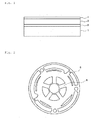
- FIG. 1 designates a steel plate, 2 an adhesive layer, 3 a rubber layer, and 4 a surface coating material layer.
- the rubber coated metal shown in FIG. 1 is formed into a gasket as shown in FIG. 2 , which is to be widely used in a compressor of an automobile air conditioner.
- reference numeral 5 designates a bead, and 6 a retainer.
- Examples of functions of a gasket include a shape keeping function as a basic one, and a fluid sealing function by an embossed bead of the gasket.
- the functions of the gasket include a particularly important one to be achieved by a "retainer" drawn at a central part of the gasket.
- Automobile air conditioners are each configured to use flon as a cooling medium, and to conduct an exchange of thermal energy by a cycle of compression, liquefaction, and evaporation of flon.
- the compressed flon is transferred to a next stage by opening and closing of a discharge valve.
- the discharge valve is controlled in an opening/closing amount thereof by the retainer fabricated on the gasket. Since the discharge valve is contacted with the gasket at a frequency on the order of 4,000 to 9,000 times/minute, the retainer is required to possess a higher strength and a higher elasticity.
- Patent Document 1 Disclosed in Patent Document 1 is a manufacturing method of a stainless steel plate for a flapper valve, and particularly a method for manufacturing a stainless steel plate for a flapper valve, which steel plate has an improved fatigue property, is high in hardness and is thus less in occurrence of burrs after punching, and is subjected to a cold rolling at a rolling reduction ratio of 5% or more. Apparently, it is classified into a stainless steel plate, because it contains 2.0 to 6.0 mass% of Ni, and 12.0 to 20.0 mass% of Cr.
- Patent Document 1 a cold rolled steel plate (SPCC)
- SPCC cold rolled steel plate
- Patent Document 2 is a manufacturing method of a cold rolled steel plate for a gasket material, comprising the steps of: hot rolling a continuously cast article produced by a continuous casting method comprising Mn: 0.5 to 3.0%, Ni: ⁇ 1.2%, and balacne Fe and inevitable impurities; hot rolling it; acid pickling it; and cold rolling it at a rolling reduction ratio of 30 to 90%.
- Mn is a component required to be included at 0.5% or more so as to prevent red shortness of a primitive plate due to S as an impurity, and to provide the plate with a higher refining degree.
- the invention recited in claim 1 resides in a manufacturing method of a gasket-oriented steel plate, comprising the steps of:
- the invention recited in claim 2 resides in the manufacturing method of a gasket-oriented steel plate according to claim 1, further comprising the steps in the order of:
- the invention recited in claim 3 resides in the manufacturing method of a gasket-oriented steel plate according to claim 1 or 2, wherein the starting steel material contains Mn in an amount of 0.3% or less.
- the invention recited in claim 4 resides in a gasket formed by adopting a gasket-oriented steel plate obtained by the manufacturing method of a gasket-oriented steel plate according to any one of claims 1 to 3.
- the present invention it becomes possible: to manufacture such a kind of gasket-oriented steel plate excellent in elasticity and formability, in a manner to allow for reduction of a breaking elongation of the steel plate to thereby improve a formability (punchability) thereof while improving a proof stress of the steel plate against a repeated stress from a discharge valve to thereby maintain a higher elasticity of the steel plate; and to provide a gasket withstandable to the repeated stress from the discharge valve.
- the starting steel material upon manufacturing a gasket-oriented steel plate is provided by preparing a general-purpose product such as SPCC, SPCD, SPCE, SPCF, and SPCG prescribed by JIS G3141 (cold rolled steel plate and steel band) in a manner to contain Mn as a chemical component in an amount less than 0.5%. Further, the starting steel material is configured to contain carbon as an additional component in an amount of 0.15% or less. Other additional components contained in the starting steel material are P, S, and the like, and Fe as a remaining component.
- a general-purpose product such as SPCC, SPCD, SPCE, SPCF, and SPCG prescribed by JIS G3141 (cold rolled steel plate and steel band) in a manner to contain Mn as a chemical component in an amount less than 0.5%.
- the starting steel material is configured to contain carbon as an additional component in an amount of 0.15% or less.
- Other additional components contained in the starting steel material are P, S, and the like, and Fe as a remaining component.
- the starting steel material in the present invention contains, in its chemical composition, Ni in an amount less than 2.0%, preferably less than 1.5%, and Cr in an amount less than 12.0%, and preferably less than 10%.
- Ni and Cr, if any, are contained in such smaller amounts as noted just above, respectively, so that the starting steel material of the present invention is never matured into such a stainless steel plate as described in JP2005-36266A (Patent Document 2).
- Mn is contained in the starting steel material in an amount less than 0.5%, thereby exhibiting the following effects. Namely, addition of manganese exhibiting a reinforcing property in an amount of 0.5% or more has considerably increased a strength of a steel, thereby bringing about such a problem of punchability that a specific die made of high speed steel, cemented carbide, or the like as a press material is required upon punching a product. However, addition of manganese in an amount less than 0.5% brings about such an advantage that a die made of SKD11, which is a general-purpose material, can form the steel plate.
- the method of the present invention for manufacturing a gasket-oriented steel plate is characterized in that the method comprises the steps of: annealing the above described starting steel material; and subsequently conducting a temper rolling treatment at a rolling reduction ratio of 10% or more.
- the present invention is not limited in terms of a step(s) before the annealing, it is possible for the starting steel material to be successively passed through the steps in the order of a hot rolling step, an acid pickling step, and a cold rolling step, for example.
- the molten steel having been prepared to have the above chemical components is smelted by a typically known smelting method using a converter or the like, and then prepared by a typically used casting method such as a continuous casting method into a material to be rolled then.
- the material to be rolled is heated to about 1,200°C, and then successively stretched by rolls while the material is still in a hot state, in a manner to hot roll the material into a thickness on the order of 2 to 4mm at about 600°C.
- the hot rolling may be adjusted in terms of a temperature for processing, a rate for cooling, and the like, thereby allowing for obtainment of various steel materials.
- the thermally stretched plate having been hot rolled into a thickness of 2 to 4 mm is to be preferably acid pickled.
- the method for acid pickling is not particularly limited, and examples of usable acids include various organic acids or inorganic acids.
- the plate After acid pickling, the plate is cold rolled at an ordinary temperature into a thickness on the order of 0.1 mm to several mm. "Cold” means that a heat is not particularly applied. It is possible here to conduct annealing after cold rolling.
- temper rolling is conducted after annealing. It is important in the present invention to set the rolling reduction ratio at 10% or more.
- the rolling reduction ratio is also called a "temper rolling reduction ratio" hereinafter.
- temper rolling reduction ratio is less than 10%, it will lead to insufficient strain hardening, thereby failing to obtain an appropriate proof stress (of 290MPa or more, preferably 315MPa or more) and failing to withstand a stress from a discharge valve, and thereby causing a damage of a steel plate.
- the temper rolled steel plate is subjected to occurrence of a strain hardening phenomenon where the steel plate is enabled to withstand a repeated stress from a discharge valve, thereby enabling to manufacture such a kind of gasket-oriented steel plate excellent in elasticity and formability, in a manner that the strain hardening phenomenon allows to decrease a breaking elongation of the plate down to less than 33% (preferably down to 30% or less) to thereby improve the formability (punchability) thereof while improving a proof stress thereof to maintain a higher elasticity.
- the gasket of the present invention is obtainable by exemplarily forming and fabricating the above manufactured gasket-oriented steel plate into a rubber coated metal. Examples of its shape include one shown in FIG. 2 .
- the obtained gasket exhibits an effect to withstand a repeated stress from a discharge valve, by virtue of the properties of the steel plate as a starting material of the gasket.
- Example 1 to Example 3 Comparative Example 1 to Comparative Example 4:
- Component analysis values of reinforcing components were obtained as analysis values of molten steels, respectively.
- test pieces specified in JIS Z 2201 were used, and were each subjected to measurement of a proof stress (MPa), a tensile strength (MPa), and a breaking elongation (%) all in conformity to JIS Z 2241 by the following measurement, while adopting a rolling direction of each steel plate as a test direction.
- MPa proof stress
- MPa tensile strength
- % breaking elongation
- SKD11 was used. In case of failure of punching by means of SKD11, a high speed steel was used. Amount of burr: An amount of burr was measured by a shape measuring instrument after punching, setting the clearance of 0.06mm between the punch and the die. Cross-section state: A sheared section or broken section after punching was visually observed, to evaluate whether it was homogeneous or inhomogeneous.
- Each rubber coated metal was formed into a gasket, and evaluated for presence/absence of retainer-crack due to a repeated load from a discharge valve.
- Example 1 The steel plates of Examples 1 to 3 were each punchable by means of SKD11, less in amount of burr, and homogeneous in cross-section state. Further, retainer-cracks were not caused in gaskets manufactured from Examples 1 to 3. Example 2 is more suitable for mass-production.
- Comparative Example 1 (rolling reduction ratio of 2%) exhibited a proof stress and a breaking elongation, out of appropriate ranges, respectively.
- Comparative Example 2 (rolling reduction ratio of 2%, and manganese amount of 0.7%) exhibited a proof stress by virtue of the increased manganese amount, but exhibited a breaking elongation exceeding an appropriate range.
- Comparative Examples 1 and 2 exhibited more amounts of burr than Examples 1 to 3, and cross-section states of Comparative Examples 1 and 2 were inhomogeneous, respectively. Retainer-cracks were found in gaskets formed from Comparative Examples 1 and 2.
- Comparative Example 3 (rolling reduction ratio of 2%, and manganese amount of 1.2%) exhibited an excessively increased strength, and was not punchable by means of SKD11.
- Comparative Example 4 (rolling reduction ratio of 5%) exhibited a breaking elongation exceeding an appropriate range, and its cross-section state was inhomogeneous. Further, retainer-cracks were found in a gasket formed from Comparative Example 4.
Landscapes
- Chemical & Material Sciences (AREA)
- Engineering & Computer Science (AREA)
- Mechanical Engineering (AREA)
- Materials Engineering (AREA)
- Metallurgy (AREA)
- Organic Chemistry (AREA)
- Physics & Mathematics (AREA)
- Thermal Sciences (AREA)
- Crystallography & Structural Chemistry (AREA)
- General Engineering & Computer Science (AREA)
- Heat Treatment Of Sheet Steel (AREA)
Abstract
The present invention aims at providing: a method for manufacturing such a kind of gasket-oriented steel plate excellent in elasticity and formability, in a manner to allow for reduction of a breaking elongation of the steel plate to thereby improve a formability (punchability) thereof while improving a proof stress of the steel plate against a repeated stress from a discharge valve to thereby maintain a higher elasticity of the steel plate; and a gasket withstandable to the repeated stress from the discharge valve. The manufacturing method of a gasket-oriented steel plate of the present invention comprises the steps of: annealing a starting steel material having a composition of: Mn less than 0.5%, Ni less than 2.0%, and Cr less than 12.0%; and subsequently temper rolling the annealed starting steel material at a rolling reduction ratio of 10% or more; and the gasket of the present invention is formed by adopting a gasket-oriented steel plate obtained by the above manufacturing method.
Description
- The present invention relates to a manufacturing method of a gasket-oriented steel plate and a gasket formed by adopting the gasket-oriented steel plate obtained by the manufacturing method of a gasket-oriented steel plate, which may be used in a compressor of an automobile air conditioner or the like, and particularly to a manufacturing method capable of manufacturing a gasket-oriented steel plate excellent in elasticity and formability, and a gasket withstandable to a repeated stress from a discharge valve.
- Conventionally, as a sealing part for oil, gas, and the like to be used at high temperatures in a field of automobile, a rubber coated metal having a structure shown in
FIG. 1 is known. InFIG. 1 , reference numeral 1 designates a steel plate, 2 an adhesive layer, 3 a rubber layer, and 4 a surface coating material layer. - The rubber coated metal shown in
FIG. 1 is formed into a gasket as shown inFIG. 2 , which is to be widely used in a compressor of an automobile air conditioner. InFIG. 2 , reference numeral 5 designates a bead, and 6 a retainer. - Examples of functions of a gasket include a shape keeping function as a basic one, and a fluid sealing function by an embossed bead of the gasket.
- Further, the functions of the gasket include a particularly important one to be achieved by a "retainer" drawn at a central part of the gasket. Automobile air conditioners are each configured to use flon as a cooling medium, and to conduct an exchange of thermal energy by a cycle of compression, liquefaction, and evaporation of flon. The compressed flon is transferred to a next stage by opening and closing of a discharge valve. The discharge valve is controlled in an opening/closing amount thereof by the retainer fabricated on the gasket. Since the discharge valve is contacted with the gasket at a frequency on the order of 4,000 to 9,000 times/minute, the retainer is required to possess a higher strength and a higher elasticity.
- Conventionally, SPCC materials excellent in formability have been used, because more inexpensive dies (such as SKD11 (JIS G4404)) are to be used in a punching step for a lower cost, for example. However, materials equivalent to those prescribed in JIS G3141, which are versatilely available from steel plate manufacturers, for example, are excellent in formability and insufficient in elasticity, so that such a phenomenon is recognized that the formed gasket fails to fully withstand a stress from a discharge valve, thereby causing damages of a retainer of the gasket.
- Further, although it is possible to provide a countermeasure to cracks of a retainer when a metal having a higher elasticity such as a high tensile strength steel plate is adopted therefor, it is then required to use a punching die having a higher hardness (such as high speed steel, cemented carbide, or the like), which is disadvantageous in cost.
- Disclosed in Patent Document 1 is a manufacturing method of a stainless steel plate for a flapper valve, and particularly a method for manufacturing a stainless steel plate for a flapper valve, which steel plate has an improved fatigue property, is high in hardness and is thus less in occurrence of burrs after punching, and is subjected to a cold rolling at a rolling reduction ratio of 5% or more. Apparently, it is classified into a stainless steel plate, because it contains 2.0 to 6.0 mass% of Ni, and 12.0 to 20.0 mass% of Cr.
- However, no disclosures are found in the technique of Patent Document 1 about a cold rolled steel plate (SPCC), because the technique relates to a stainless steel plate.
- Meanwhile, described in
Patent Document 2 is a manufacturing method of a cold rolled steel plate for a gasket material, comprising the steps of: hot rolling a continuously cast article produced by a continuous casting method comprising Mn: 0.5 to 3.0%, Ni:≤1.2%, and balacne Fe and inevitable impurities; hot rolling it; acid pickling it; and cold rolling it at a rolling reduction ratio of 30 to 90%. In thePatent Document 2, it is clarified in its paragraph [0032] that Mn is a component required to be included at 0.5% or more so as to prevent red shortness of a primitive plate due to S as an impurity, and to provide the plate with a higher refining degree. - However, when Mn possessing a reinforcing property is added into steel in an amount of 0.5% or more, the steel is considerably increased in strength, thereby bringing about such a problem of formability (punchability) that a specific die made of high speed steel, cemented carbide, or the like as a press material is required upon punching of a product.
- Patent Document 1:
JP2003-41350A - Patent Document 2:
JP2005-36266A - It is therefore an object of the present invention to provide: a method capable of manufacturing such a kind of gasket-oriented steel plate excellent in elasticity and formability, in a manner to allow for reduction of a breaking elongation of the steel plate to thereby improve a formability (punchability) thereof while improving a proof stress of the steel plate against a repeated stress from a discharge valve to thereby maintain a higher elasticity of the steel plate; and a gasket withstandable to the repeated stress from the discharge valve.
- The other objects of the present invention will become apparent from the following description.
- The above object is carried out by the following inventions.
- The invention recited in claim 1 resides in a manufacturing method of a gasket-oriented steel plate, comprising the steps of:
- annealing a starting steel material having a composition of: Mn less than 0.5%, Ni less than 2.0%, and Cr less than 12.0%; and
- subsequently temper rolling the annealed starting steel material at a rolling reduction ratio of 10% or more.
- The invention recited in
claim 2 resides in the manufacturing method of a gasket-oriented steel plate according to claim 1, further comprising the steps in the order of: - passing the starting steel material through a hot rolling step, an acid pickling step, and a cold rolling step, before the annealing step.
- The invention recited in
claim 3 resides in the manufacturing method of a gasket-oriented steel plate according toclaim 1 or 2, wherein the starting steel material contains Mn in an amount of 0.3% or less. - The invention recited in claim 4 resides in a gasket formed by adopting a gasket-oriented steel plate obtained by the manufacturing method of a gasket-oriented steel plate according to any one of claims 1 to 3.
- According to the present invention, it becomes possible: to manufacture such a kind of gasket-oriented steel plate excellent in elasticity and formability, in a manner to allow for reduction of a breaking elongation of the steel plate to thereby improve a formability (punchability) thereof while improving a proof stress of the steel plate against a repeated stress from a discharge valve to thereby maintain a higher elasticity of the steel plate; and to provide a gasket withstandable to the repeated stress from the discharge valve.
-
-
FIG. 1 is a cross-sectional view of an example of a rubber coated metal; and -
FIG. 2 is a plan view of an example of a gasket in a compressor of an automobile air conditioner. -
- 1:
- steel plate
- 2:
- adhesive layer
- 3:
- rubber layer
- 4:
- surface coating material layer
- 5:
- bead
- 6:
- retainer
- Embodiments of the present invention will be described hereinafter.
- In the present invention, the starting steel material upon manufacturing a gasket-oriented steel plate is provided by preparing a general-purpose product such as SPCC, SPCD, SPCE, SPCF, and SPCG prescribed by JIS G3141 (cold rolled steel plate and steel band) in a manner to contain Mn as a chemical component in an amount less than 0.5%. Further, the starting steel material is configured to contain carbon as an additional component in an amount of 0.15% or less. Other additional components contained in the starting steel material are P, S, and the like, and Fe as a remaining component.
- The starting steel material in the present invention contains, in its chemical composition, Ni in an amount less than 2.0%, preferably less than 1.5%, and Cr in an amount less than 12.0%, and preferably less than 10%. Thus, Ni and Cr, if any, are contained in such smaller amounts as noted just above, respectively, so that the starting steel material of the present invention is never matured into such a stainless steel plate as described in
JP2005-36266A - In the present invention, Mn is contained in the starting steel material in an amount less than 0.5%, thereby exhibiting the following effects. Namely, addition of manganese exhibiting a reinforcing property in an amount of 0.5% or more has considerably increased a strength of a steel, thereby bringing about such a problem of punchability that a specific die made of high speed steel, cemented carbide, or the like as a press material is required upon punching a product. However, addition of manganese in an amount less than 0.5% brings about such an advantage that a die made of SKD11, which is a general-purpose material, can form the steel plate.
- The method of the present invention for manufacturing a gasket-oriented steel plate is characterized in that the method comprises the steps of: annealing the above described starting steel material; and subsequently conducting a temper rolling treatment at a rolling reduction ratio of 10% or more.
- Further, although the present invention is not limited in terms of a step(s) before the annealing, it is possible for the starting steel material to be successively passed through the steps in the order of a hot rolling step, an acid pickling step, and a cold rolling step, for example.
- The molten steel having been prepared to have the above chemical components is smelted by a typically known smelting method using a converter or the like, and then prepared by a typically used casting method such as a continuous casting method into a material to be rolled then.
- Next, the material to be rolled is heated to about 1,200°C, and then successively stretched by rolls while the material is still in a hot state, in a manner to hot roll the material into a thickness on the order of 2 to 4mm at about 600°C. The hot rolling may be adjusted in terms of a temperature for processing, a rate for cooling, and the like, thereby allowing for obtainment of various steel materials.
- The thermally stretched plate having been hot rolled into a thickness of 2 to 4 mm is to be preferably acid pickled. The method for acid pickling is not particularly limited, and examples of usable acids include various organic acids or inorganic acids.
- After acid pickling, the plate is cold rolled at an ordinary temperature into a thickness on the order of 0.1 mm to several mm. "Cold" means that a heat is not particularly applied. It is possible here to conduct annealing after cold rolling.
- In the present invention, temper rolling is conducted after annealing. It is important in the present invention to set the rolling reduction ratio at 10% or more.
- The rolling reduction ratio is also called a "temper rolling reduction ratio" hereinafter.
- Even if all requirements are the same as the present invention, when the temper rolling reduction ratio is less than 10%, it will lead to insufficient strain hardening, thereby failing to obtain an appropriate proof stress (of 290MPa or more, preferably 315MPa or more) and failing to withstand a stress from a discharge valve, and thereby causing a damage of a steel plate.
- Contrary, as in the present invention, when the temper rolling reduction ratio is made to be 10% or more, the temper rolled steel plate is subjected to occurrence of a strain hardening phenomenon where the steel plate is enabled to withstand a repeated stress from a discharge valve, thereby enabling to manufacture such a kind of gasket-oriented steel plate excellent in elasticity and formability, in a manner that the strain hardening phenomenon allows to decrease a breaking elongation of the plate down to less than 33% (preferably down to 30% or less) to thereby improve the formability (punchability) thereof while improving a proof stress thereof to maintain a higher elasticity. Namely, it is then possible to obtain an SPCC plate having a breaking elongation decreased down to less than 33% (preferably down to 30% or less) to thereby exemplarily decrease burrs, which plate can be in turn formed by an inexpensive die.
- The gasket of the present invention is obtainable by exemplarily forming and fabricating the above manufactured gasket-oriented steel plate into a rubber coated metal. Examples of its shape include one shown in
FIG. 2 . - The obtained gasket exhibits an effect to withstand a repeated stress from a discharge valve, by virtue of the properties of the steel plate as a starting material of the gasket.
- The effects of the present invention will be exemplified hereinafter based on Examples.
- Example 1 to Example 3, and Comparative Example 1 to Comparative Example 4:
- Steel plates listed in Table 1 were formed into rubber coated metals, respectively, and the following evaluations were conducted.
- Component analysis values of reinforcing components were obtained as analysis values of molten steels, respectively.
- No. 5 test pieces specified in JIS Z 2201 were used, and were each subjected to measurement of a proof stress (MPa), a tensile strength (MPa), and a breaking elongation (%) all in conformity to JIS Z 2241 by the following measurement, while adopting a rolling direction of each steel plate as a test direction.
- Die: SKD11 was used. In case of failure of punching by means of SKD11, a high speed steel was used.
Amount of burr: An amount of burr was measured by a shape measuring instrument after punching, setting the clearance of 0.06mm between the punch and the die.
Cross-section state: A sheared section or broken section after punching was visually observed, to evaluate whether it was homogeneous or inhomogeneous. - Each rubber coated metal was formed into a gasket, and evaluated for presence/absence of retainer-crack due to a repeated load from a discharge valve.
- The evaluation result is shown in Table 1.
-
[Table 1] Ex.1 Ex. 2 Ex. 3 Com. Ex. 1 Com. Ex. 2 Com. Ex. 3 Com. Ex. 4 Thickness (mm) 0.6 0.6 0.6 0.6 0.6 0.6 0.6 Reinforcing component Carbon amount (%) 0.06 0.06 0.06 0.04 0.14 0.11 0.06 Manganese amount (%) 0.3 0.3 0.3 0.3 0.7 1.2 0.3 Rolling reduction ratio (%) 10 12 14 2 2 2 5 Mechanical property Proof stress {MPa} 310 340 400 286 326 530 290 Tensile strength (MPa) 400 400 412 394 462 800 400 Breaking elongation (%) 30 23 17 35 35 17 34 Punchability Die SKD11 SKD11 SKD11 SKD11 SKD11 High speed steel* SKD11 Burr amount (µm) 60 60 60 100 100 - 60 Cross-section state Homogeneous Homogeneous Homogeneous Inhomogeneous Inhomogeneous - Inhomogeneous Durability against repeated stress Cracks not caused Cracks not caused Cracks not caused Occurence of cracks Occurence of cracks Cracks not caused Occurence of cracks Note Condition of mass-production "Not punchable by means of SKD11 - The steel plates of Examples 1 to 3 were each punchable by means of SKD11, less in amount of burr, and homogeneous in cross-section state. Further, retainer-cracks were not caused in gaskets manufactured from Examples 1 to 3. Example 2 is more suitable for mass-production.
- Comparative Example 1 (rolling reduction ratio of 2%) exhibited a proof stress and a breaking elongation, out of appropriate ranges, respectively. Comparative Example 2 (rolling reduction ratio of 2%, and manganese amount of 0.7%) exhibited a proof stress by virtue of the increased manganese amount, but exhibited a breaking elongation exceeding an appropriate range. Comparative Examples 1 and 2 exhibited more amounts of burr than Examples 1 to 3, and cross-section states of Comparative Examples 1 and 2 were inhomogeneous, respectively. Retainer-cracks were found in gaskets formed from Comparative Examples 1 and 2.
- Comparative Example 3 (rolling reduction ratio of 2%, and manganese amount of 1.2%) exhibited an excessively increased strength, and was not punchable by means of SKD11.
- Comparative Example 4 (rolling reduction ratio of 5%) exhibited a breaking elongation exceeding an appropriate range, and its cross-section state was inhomogeneous. Further, retainer-cracks were found in a gasket formed from Comparative Example 4.
Claims (4)
- A manufacturing method of a gasket-oriented steel plate, comprising the steps of:annealing a starting steel material having a composition of: Mn less than 0.5%, Ni less than 2.0%, and Cr less than 12.0%; andsubsequently temper rolling the annealed starting steel material at a rolling reduction ratio of 10% or more.
- The manufacturing method of a gasket-oriented steel plate according to claim 1, further comprising the steps in the order of:passing the starting steel material through a hot rolling step, an acid pickling step, and a cold rolling step, before the annealing step.
- The manufacturing method of a gasket-oriented steel plate according to claim 1 or 2, wherein the starting steel material contains Mn in an amount of 0.3% or less.
- A gasket formed by adopting a gasket-oriented steel plate obtained by the manufacturing method of a gasket-oriented steel plate according to any one of claims 1 to 3.
Applications Claiming Priority (2)
| Application Number | Priority Date | Filing Date | Title |
|---|---|---|---|
| JP2008324346 | 2008-12-19 | ||
| PCT/JP2009/006541 WO2010070829A1 (en) | 2008-12-19 | 2009-12-02 | Method for producing steel sheet for gasket, and gasket |
Publications (1)
| Publication Number | Publication Date |
|---|---|
| EP2377954A1 true EP2377954A1 (en) | 2011-10-19 |
Family
ID=42268512
Family Applications (1)
| Application Number | Title | Priority Date | Filing Date |
|---|---|---|---|
| EP09833139A Withdrawn EP2377954A1 (en) | 2008-12-19 | 2009-12-02 | Method for producing steel sheet for gasket, and gasket |
Country Status (6)
| Country | Link |
|---|---|
| US (2) | US20110114232A1 (en) |
| EP (1) | EP2377954A1 (en) |
| JP (1) | JP5321599B2 (en) |
| KR (1) | KR20110126519A (en) |
| CN (1) | CN102105606A (en) |
| WO (1) | WO2010070829A1 (en) |
Families Citing this family (3)
| Publication number | Priority date | Publication date | Assignee | Title |
|---|---|---|---|---|
| RU2600151C2 (en) * | 2014-02-27 | 2016-10-20 | Иван Тимофеевич Тоцкий | Method for preparing hot-rolled semifinished steel rolled stock for cold rolling |
| WO2020235390A1 (en) * | 2019-05-21 | 2020-11-26 | Nok株式会社 | Gasket |
| CN116426729A (en) * | 2023-02-24 | 2023-07-14 | 首钢集团有限公司 | A kind of steel and preparation method thereof |
Family Cites Families (8)
| Publication number | Priority date | Publication date | Assignee | Title |
|---|---|---|---|---|
| JPS59129733A (en) * | 1983-01-17 | 1984-07-26 | Kawasaki Steel Corp | Production of black plate for hard tinplate having no stretcher strain |
| JPS60262918A (en) * | 1984-06-08 | 1985-12-26 | Kawasaki Steel Corp | Manufacture of surface treating raw sheet without causing stretcher strain |
| JPH0737659B2 (en) * | 1990-09-11 | 1995-04-26 | 新日本製鐵株式会社 | Cold-rolled steel sheet having excellent burr resistance and drawability during press forming and method for producing the same |
| JP2000256802A (en) * | 1999-03-03 | 2000-09-19 | Nisshin Steel Co Ltd | Stainless steel material for metal gasket excellent in setting resistance and its manufacture |
| JP2003041350A (en) | 2001-08-01 | 2003-02-13 | Nisshin Steel Co Ltd | Martensitic stainless steel sheet for flapper valve and manufacturing method therefor |
| JP2003105502A (en) * | 2001-09-25 | 2003-04-09 | Nisshin Steel Co Ltd | Stainless steel for metal gasket having excellent high temperature setting resistance, and metal gasket |
| JP2005036266A (en) | 2003-07-18 | 2005-02-10 | Toyo Kohan Co Ltd | Cold rolled steel sheet for gasket material, its production method, and gasket material |
| JP2007270329A (en) * | 2006-03-31 | 2007-10-18 | Jfe Steel Kk | Steel plate manufacturing method with excellent fine blanking workability |
-
2009
- 2009-12-02 WO PCT/JP2009/006541 patent/WO2010070829A1/en not_active Ceased
- 2009-12-02 EP EP09833139A patent/EP2377954A1/en not_active Withdrawn
- 2009-12-02 KR KR1020107027541A patent/KR20110126519A/en not_active Withdrawn
- 2009-12-02 US US13/054,666 patent/US20110114232A1/en not_active Abandoned
- 2009-12-02 CN CN2009801292305A patent/CN102105606A/en active Pending
- 2009-12-02 JP JP2010542830A patent/JP5321599B2/en active Active
-
2012
- 2012-08-02 US US13/565,208 patent/US20130025337A1/en not_active Abandoned
Non-Patent Citations (1)
| Title |
|---|
| See references of WO2010070829A1 * |
Also Published As
| Publication number | Publication date |
|---|---|
| WO2010070829A1 (en) | 2010-06-24 |
| JPWO2010070829A1 (en) | 2012-05-24 |
| US20130025337A1 (en) | 2013-01-31 |
| US20110114232A1 (en) | 2011-05-19 |
| KR20110126519A (en) | 2011-11-23 |
| CN102105606A (en) | 2011-06-22 |
| JP5321599B2 (en) | 2013-10-23 |
Similar Documents
| Publication | Publication Date | Title |
|---|---|---|
| JP4321066B2 (en) | Metal gasket, material thereof and method for producing the same | |
| CN105401073B (en) | Heat treatment technology of alloy spring cold-rolled steel strip 51CrV4 of automobile clutch diaphragm | |
| JP2011506886A (en) | Metal flat gasket and manufacturing method | |
| KR100385342B1 (en) | Stainless steel for gaskets and production thereof | |
| KR20170002551A (en) | Martensitic stainless-steel sheet and metal gasket | |
| JP2015083718A (en) | Metal gasket and method of making the same | |
| US20130025337A1 (en) | Gasket-Oriented Steel Plate Manufacturing Method, and Gasket | |
| CN110100022B (en) | Cold-rolled steel sheet excellent in workability and method for producing the same | |
| CN103361563B (en) | A kind of Cutting free high rigidity austenite nonmagnetic die steel and manufacture method thereof | |
| CN1974813A (en) | Alumium Foil for air conditioner | |
| EP4276212A1 (en) | Cold forged gear steel and manufacturing method therefor | |
| EP2671962A1 (en) | Steel sheet for aerosol can bottom having high pressure resistance and excellent workability and method for producing same | |
| CN113699340A (en) | Method for eliminating yield platform of continuous annealing of thin low-carbon steel of 0.3-0.9mm | |
| CN109722604B (en) | Tin plate for two-piece spray can and manufacturing method thereof | |
| EP1566460A1 (en) | Cold rolled steel sheet for gasket material, method for production thereof and gasket material produced by the method | |
| US8066830B2 (en) | Method for producing a shaft for compressors | |
| EP1990556A1 (en) | Clutch member and process for manufacturing the same | |
| CN116900135B (en) | Shot-blasting-free hot stamping part and preparation method thereof | |
| CN117778888A (en) | 400 MPa-grade gasket steel with excellent blanking performance and preparation method thereof | |
| KR20150028502A (en) | Method of manufacturing high tensile steel having improved formability | |
| CN113088669B (en) | Method for improving surface hardness of semi-austenite precipitation hardening stainless steel precision strip steel | |
| CN113718172A (en) | 1200 MPa-grade low-carbon martensite steel strip and production method thereof | |
| EP4681837A1 (en) | Hot-stamping shaped article and manufacturing method therefor | |
| CN117778887A (en) | 300MPa grade gasket steel with excellent blanking performance and preparation method thereof | |
| WO2005083140A1 (en) | Extremely thin cold rolled steel sheet having high strength, method for production thereof, material for gasket using the sheet and gasket member using the material |
Legal Events
| Date | Code | Title | Description |
|---|---|---|---|
| PUAI | Public reference made under article 153(3) epc to a published international application that has entered the european phase |
Free format text: ORIGINAL CODE: 0009012 |
|
| 17P | Request for examination filed |
Effective date: 20110524 |
|
| AK | Designated contracting states |
Kind code of ref document: A1 Designated state(s): AT BE BG CH CY CZ DE DK EE ES FI FR GB GR HR HU IE IS IT LI LT LU LV MC MK MT NL NO PL PT RO SE SI SK SM TR |
|
| DAX | Request for extension of the european patent (deleted) | ||
| STAA | Information on the status of an ep patent application or granted ep patent |
Free format text: STATUS: THE APPLICATION HAS BEEN WITHDRAWN |
|
| 18W | Application withdrawn |
Effective date: 20140430 |