EP2377862A1 - Process for obtaining emtricitabine - Google Patents
Process for obtaining emtricitabine Download PDFInfo
- Publication number
- EP2377862A1 EP2377862A1 EP10382070A EP10382070A EP2377862A1 EP 2377862 A1 EP2377862 A1 EP 2377862A1 EP 10382070 A EP10382070 A EP 10382070A EP 10382070 A EP10382070 A EP 10382070A EP 2377862 A1 EP2377862 A1 EP 2377862A1
- Authority
- EP
- European Patent Office
- Prior art keywords
- emtricitabine
- boron
- mixture
- methanol
- process according
- Prior art date
- Legal status (The legal status is an assumption and is not a legal conclusion. Google has not performed a legal analysis and makes no representation as to the accuracy of the status listed.)
- Withdrawn
Links
- XQSPYNMVSIKCOC-NTSWFWBYSA-N Emtricitabine Chemical compound C1=C(F)C(N)=NC(=O)N1[C@H]1O[C@@H](CO)SC1 XQSPYNMVSIKCOC-NTSWFWBYSA-N 0.000 title claims abstract description 86
- 229960000366 emtricitabine Drugs 0.000 title claims abstract description 82
- 238000000034 method Methods 0.000 title claims abstract description 54
- ZOXJGFHDIHLPTG-UHFFFAOYSA-N Boron Chemical compound [B] ZOXJGFHDIHLPTG-UHFFFAOYSA-N 0.000 claims abstract description 51
- 229910052796 boron Inorganic materials 0.000 claims abstract description 51
- 238000010533 azeotropic distillation Methods 0.000 claims abstract description 12
- OKKJLVBELUTLKV-UHFFFAOYSA-N Methanol Chemical compound OC OKKJLVBELUTLKV-UHFFFAOYSA-N 0.000 claims description 67
- 239000000203 mixture Substances 0.000 claims description 42
- KFZMGEQAYNKOFK-UHFFFAOYSA-N Isopropanol Chemical compound CC(C)O KFZMGEQAYNKOFK-UHFFFAOYSA-N 0.000 claims description 28
- LFQSCWFLJHTTHZ-UHFFFAOYSA-N Ethanol Chemical compound CCO LFQSCWFLJHTTHZ-UHFFFAOYSA-N 0.000 claims description 22
- 239000003638 chemical reducing agent Substances 0.000 claims description 19
- 239000012279 sodium borohydride Substances 0.000 claims description 15
- 229910000033 sodium borohydride Inorganic materials 0.000 claims description 15
- -1 borate ester Chemical class 0.000 claims description 14
- 150000001875 compounds Chemical class 0.000 claims description 14
- 150000003839 salts Chemical class 0.000 claims description 12
- 239000002904 solvent Substances 0.000 claims description 12
- 238000002156 mixing Methods 0.000 claims description 10
- 239000008194 pharmaceutical composition Substances 0.000 claims description 6
- BDERNNFJNOPAEC-UHFFFAOYSA-N propan-1-ol Chemical compound CCCO BDERNNFJNOPAEC-UHFFFAOYSA-N 0.000 claims description 6
- 239000011541 reaction mixture Substances 0.000 claims description 5
- KGBXLFKZBHKPEV-UHFFFAOYSA-N boric acid Chemical compound OB(O)O KGBXLFKZBHKPEV-UHFFFAOYSA-N 0.000 claims description 4
- 239000012448 Lithium borohydride Substances 0.000 claims description 3
- 239000002671 adjuvant Substances 0.000 claims description 3
- 239000003937 drug carrier Substances 0.000 claims description 3
- 239000003981 vehicle Substances 0.000 claims description 3
- 229910020889 NaBH3 Inorganic materials 0.000 claims description 2
- 125000001755 (-)-menthol group Chemical group 0.000 claims 1
- 241000894007 species Species 0.000 description 28
- YXFVVABEGXRONW-UHFFFAOYSA-N Toluene Chemical compound CC1=CC=CC=C1 YXFVVABEGXRONW-UHFFFAOYSA-N 0.000 description 21
- 230000002829 reductive effect Effects 0.000 description 16
- 239000000243 solution Substances 0.000 description 16
- 238000006722 reduction reaction Methods 0.000 description 15
- 238000006243 chemical reaction Methods 0.000 description 14
- XLYOFNOQVPJJNP-UHFFFAOYSA-N water Substances O XLYOFNOQVPJJNP-UHFFFAOYSA-N 0.000 description 12
- WRECIMRULFAWHA-UHFFFAOYSA-N trimethyl borate Chemical compound COB(OC)OC WRECIMRULFAWHA-UHFFFAOYSA-N 0.000 description 8
- NOOLISFMXDJSKH-KXUCPTDWSA-N (-)-Menthol Chemical compound CC(C)[C@@H]1CC[C@@H](C)C[C@H]1O NOOLISFMXDJSKH-KXUCPTDWSA-N 0.000 description 7
- 239000000725 suspension Substances 0.000 description 7
- HEMHJVSKTPXQMS-UHFFFAOYSA-M Sodium hydroxide Chemical compound [OH-].[Na+] HEMHJVSKTPXQMS-UHFFFAOYSA-M 0.000 description 6
- 238000004128 high performance liquid chromatography Methods 0.000 description 6
- 238000002360 preparation method Methods 0.000 description 6
- 239000007787 solid Substances 0.000 description 6
- BTBUEUYNUDRHOZ-UHFFFAOYSA-N Borate Chemical compound [O-]B([O-])[O-] BTBUEUYNUDRHOZ-UHFFFAOYSA-N 0.000 description 5
- 239000000543 intermediate Substances 0.000 description 5
- NOOLISFMXDJSKH-UHFFFAOYSA-N DL-menthol Natural products CC(C)C1CCC(C)CC1O NOOLISFMXDJSKH-UHFFFAOYSA-N 0.000 description 4
- RTZKZFJDLAIYFH-UHFFFAOYSA-N Diethyl ether Chemical compound CCOCC RTZKZFJDLAIYFH-UHFFFAOYSA-N 0.000 description 4
- WYURNTSHIVDZCO-UHFFFAOYSA-N Tetrahydrofuran Chemical compound C1CCOC1 WYURNTSHIVDZCO-UHFFFAOYSA-N 0.000 description 4
- 125000003158 alcohol group Chemical group 0.000 description 4
- 125000005233 alkylalcohol group Chemical group 0.000 description 4
- 238000009835 boiling Methods 0.000 description 4
- 238000001914 filtration Methods 0.000 description 4
- 229940041616 menthol Drugs 0.000 description 4
- 238000000746 purification Methods 0.000 description 4
- YMWUJEATGCHHMB-UHFFFAOYSA-N Dichloromethane Chemical compound ClCCl YMWUJEATGCHHMB-UHFFFAOYSA-N 0.000 description 3
- 125000000217 alkyl group Chemical group 0.000 description 3
- 238000003556 assay Methods 0.000 description 3
- 239000004327 boric acid Substances 0.000 description 3
- 238000005251 capillar electrophoresis Methods 0.000 description 3
- 238000002425 crystallisation Methods 0.000 description 3
- 230000008025 crystallization Effects 0.000 description 3
- 238000004821 distillation Methods 0.000 description 3
- 239000003814 drug Substances 0.000 description 3
- 239000000047 product Substances 0.000 description 3
- 238000000926 separation method Methods 0.000 description 3
- 239000000126 substance Substances 0.000 description 3
- 239000003826 tablet Substances 0.000 description 3
- RYHBNJHYFVUHQT-UHFFFAOYSA-N 1,4-Dioxane Chemical compound C1COCCO1 RYHBNJHYFVUHQT-UHFFFAOYSA-N 0.000 description 2
- GQHACZWRCOKKIZ-UHFFFAOYSA-N 5-(4-amino-5-fluoro-2-oxopyrimidin-1-yl)-1,3-oxathiolane-2-carboxylic acid Chemical compound C1=C(F)C(N)=NC(=O)N1C1OC(C(O)=O)SC1 GQHACZWRCOKKIZ-UHFFFAOYSA-N 0.000 description 2
- HBAQYPYDRFILMT-UHFFFAOYSA-N 8-[3-(1-cyclopropylpyrazol-4-yl)-1H-pyrazolo[4,3-d]pyrimidin-5-yl]-3-methyl-3,8-diazabicyclo[3.2.1]octan-2-one Chemical class C1(CC1)N1N=CC(=C1)C1=NNC2=C1N=C(N=C2)N1C2C(N(CC1CC2)C)=O HBAQYPYDRFILMT-UHFFFAOYSA-N 0.000 description 2
- VEXZGXHMUGYJMC-UHFFFAOYSA-M Chloride anion Chemical compound [Cl-] VEXZGXHMUGYJMC-UHFFFAOYSA-M 0.000 description 2
- FBPFZTCFMRRESA-FSIIMWSLSA-N D-Glucitol Natural products OC[C@H](O)[C@H](O)[C@@H](O)[C@H](O)CO FBPFZTCFMRRESA-FSIIMWSLSA-N 0.000 description 2
- VEXZGXHMUGYJMC-UHFFFAOYSA-N Hydrochloric acid Chemical compound Cl VEXZGXHMUGYJMC-UHFFFAOYSA-N 0.000 description 2
- WHXSMMKQMYFTQS-UHFFFAOYSA-N Lithium Chemical compound [Li] WHXSMMKQMYFTQS-UHFFFAOYSA-N 0.000 description 2
- 229940122313 Nucleoside reverse transcriptase inhibitor Drugs 0.000 description 2
- ZLMJMSJWJFRBEC-UHFFFAOYSA-N Potassium Chemical compound [K] ZLMJMSJWJFRBEC-UHFFFAOYSA-N 0.000 description 2
- VYPSYNLAJGMNEJ-UHFFFAOYSA-N Silicium dioxide Chemical compound O=[Si]=O VYPSYNLAJGMNEJ-UHFFFAOYSA-N 0.000 description 2
- 239000004480 active ingredient Substances 0.000 description 2
- 239000000654 additive Substances 0.000 description 2
- 150000001298 alcohols Chemical class 0.000 description 2
- 238000013459 approach Methods 0.000 description 2
- 239000008346 aqueous phase Substances 0.000 description 2
- 239000007864 aqueous solution Substances 0.000 description 2
- UORVGPXVDQYIDP-UHFFFAOYSA-N borane Chemical class B UORVGPXVDQYIDP-UHFFFAOYSA-N 0.000 description 2
- 239000002775 capsule Substances 0.000 description 2
- 229940079593 drug Drugs 0.000 description 2
- 238000001704 evaporation Methods 0.000 description 2
- 230000008020 evaporation Effects 0.000 description 2
- 238000000605 extraction Methods 0.000 description 2
- 239000000945 filler Substances 0.000 description 2
- 239000000706 filtrate Substances 0.000 description 2
- 239000012467 final product Substances 0.000 description 2
- 239000012458 free base Substances 0.000 description 2
- 125000002887 hydroxy group Chemical group [H]O* 0.000 description 2
- 239000004615 ingredient Substances 0.000 description 2
- 238000001990 intravenous administration Methods 0.000 description 2
- 238000002955 isolation Methods 0.000 description 2
- 239000007788 liquid Substances 0.000 description 2
- 229910052744 lithium Inorganic materials 0.000 description 2
- 239000012280 lithium aluminium hydride Substances 0.000 description 2
- HQKMJHAJHXVSDF-UHFFFAOYSA-L magnesium stearate Chemical compound [Mg+2].CCCCCCCCCCCCCCCCCC([O-])=O.CCCCCCCCCCCCCCCCCC([O-])=O HQKMJHAJHXVSDF-UHFFFAOYSA-L 0.000 description 2
- RIWRFSMVIUAEBX-UHFFFAOYSA-N n-methyl-1-phenylmethanamine Chemical compound CNCC1=CC=CC=C1 RIWRFSMVIUAEBX-UHFFFAOYSA-N 0.000 description 2
- 239000012299 nitrogen atmosphere Substances 0.000 description 2
- 238000005191 phase separation Methods 0.000 description 2
- 239000001267 polyvinylpyrrolidone Substances 0.000 description 2
- 235000013855 polyvinylpyrrolidone Nutrition 0.000 description 2
- 229920000036 polyvinylpyrrolidone Polymers 0.000 description 2
- 229910052700 potassium Inorganic materials 0.000 description 2
- 239000011591 potassium Substances 0.000 description 2
- 239000002244 precipitate Substances 0.000 description 2
- 239000003419 rna directed dna polymerase inhibitor Substances 0.000 description 2
- 239000000600 sorbitol Substances 0.000 description 2
- 235000010356 sorbitol Nutrition 0.000 description 2
- 230000000707 stereoselective effect Effects 0.000 description 2
- 238000003756 stirring Methods 0.000 description 2
- 238000003786 synthesis reaction Methods 0.000 description 2
- YLQBMQCUIZJEEH-UHFFFAOYSA-N tetrahydrofuran Natural products C=1C=COC=1 YLQBMQCUIZJEEH-UHFFFAOYSA-N 0.000 description 2
- CSRZQMIRAZTJOY-UHFFFAOYSA-N trimethylsilyl iodide Chemical compound C[Si](C)(C)I CSRZQMIRAZTJOY-UHFFFAOYSA-N 0.000 description 2
- NHDIQVFFNDKAQU-UHFFFAOYSA-N tripropan-2-yl borate Chemical compound CC(C)OB(OC(C)C)OC(C)C NHDIQVFFNDKAQU-UHFFFAOYSA-N 0.000 description 2
- 238000005406 washing Methods 0.000 description 2
- NOOLISFMXDJSKH-AEJSXWLSSA-N (+)-menthol Chemical compound CC(C)[C@H]1CC[C@H](C)C[C@@H]1O NOOLISFMXDJSKH-AEJSXWLSSA-N 0.000 description 1
- 0 *C(C1SC[C@@](N(C=C(C(N)=N2)F)C2=O)O1)=O Chemical compound *C(C1SC[C@@](N(C=C(C(N)=N2)F)C2=O)O1)=O 0.000 description 1
- WSLDOOZREJYCGB-UHFFFAOYSA-N 1,2-Dichloroethane Chemical compound ClCCCl WSLDOOZREJYCGB-UHFFFAOYSA-N 0.000 description 1
- WJJSZTJGFCFNKI-UHFFFAOYSA-N 1,3-oxathiolane Chemical group C1CSCO1 WJJSZTJGFCFNKI-UHFFFAOYSA-N 0.000 description 1
- DURPTKYDGMDSBL-UHFFFAOYSA-N 1-butoxybutane Chemical compound CCCCOCCCC DURPTKYDGMDSBL-UHFFFAOYSA-N 0.000 description 1
- ZNOVTXRBGFNYRX-UHFFFAOYSA-N 2-[[4-[(2-amino-5-methyl-4-oxo-1,6,7,8-tetrahydropteridin-6-yl)methylamino]benzoyl]amino]pentanedioic acid Chemical compound C1NC=2NC(N)=NC(=O)C=2N(C)C1CNC1=CC=C(C(=O)NC(CCC(O)=O)C(O)=O)C=C1 ZNOVTXRBGFNYRX-UHFFFAOYSA-N 0.000 description 1
- QCQCHGYLTSGIGX-GHXANHINSA-N 4-[[(3ar,5ar,5br,7ar,9s,11ar,11br,13as)-5a,5b,8,8,11a-pentamethyl-3a-[(5-methylpyridine-3-carbonyl)amino]-2-oxo-1-propan-2-yl-4,5,6,7,7a,9,10,11,11b,12,13,13a-dodecahydro-3h-cyclopenta[a]chrysen-9-yl]oxy]-2,2-dimethyl-4-oxobutanoic acid Chemical compound N([C@@]12CC[C@@]3(C)[C@]4(C)CC[C@H]5C(C)(C)[C@@H](OC(=O)CC(C)(C)C(O)=O)CC[C@]5(C)[C@H]4CC[C@@H]3C1=C(C(C2)=O)C(C)C)C(=O)C1=CN=CC(C)=C1 QCQCHGYLTSGIGX-GHXANHINSA-N 0.000 description 1
- 241000416162 Astragalus gummifer Species 0.000 description 1
- OKTJSMMVPCPJKN-UHFFFAOYSA-N Carbon Chemical compound [C] OKTJSMMVPCPJKN-UHFFFAOYSA-N 0.000 description 1
- 229920002261 Corn starch Polymers 0.000 description 1
- XFXPMWWXUTWYJX-UHFFFAOYSA-N Cyanide Chemical group N#[C-] XFXPMWWXUTWYJX-UHFFFAOYSA-N 0.000 description 1
- 229920000858 Cyclodextrin Polymers 0.000 description 1
- FBPFZTCFMRRESA-JGWLITMVSA-N D-glucitol Chemical compound OC[C@H](O)[C@@H](O)[C@H](O)[C@H](O)CO FBPFZTCFMRRESA-JGWLITMVSA-N 0.000 description 1
- ZAFNJMIOTHYJRJ-UHFFFAOYSA-N Diisopropyl ether Chemical compound CC(C)OC(C)C ZAFNJMIOTHYJRJ-UHFFFAOYSA-N 0.000 description 1
- XTHFKEDIFFGKHM-UHFFFAOYSA-N Dimethoxyethane Chemical compound COCCOC XTHFKEDIFFGKHM-UHFFFAOYSA-N 0.000 description 1
- QMMFVYPAHWMCMS-UHFFFAOYSA-N Dimethyl sulfide Chemical compound CSC QMMFVYPAHWMCMS-UHFFFAOYSA-N 0.000 description 1
- 239000001116 FEMA 4028 Substances 0.000 description 1
- 108010010803 Gelatin Proteins 0.000 description 1
- DHMQDGOQFOQNFH-UHFFFAOYSA-N Glycine Chemical compound NCC(O)=O DHMQDGOQFOQNFH-UHFFFAOYSA-N 0.000 description 1
- DGAQECJNVWCQMB-PUAWFVPOSA-M Ilexoside XXIX Chemical compound C[C@@H]1CC[C@@]2(CC[C@@]3(C(=CC[C@H]4[C@]3(CC[C@@H]5[C@@]4(CC[C@@H](C5(C)C)OS(=O)(=O)[O-])C)C)[C@@H]2[C@]1(C)O)C)C(=O)O[C@H]6[C@@H]([C@H]([C@@H]([C@H](O6)CO)O)O)O.[Na+] DGAQECJNVWCQMB-PUAWFVPOSA-M 0.000 description 1
- GUBGYTABKSRVRQ-QKKXKWKRSA-N Lactose Natural products OC[C@H]1O[C@@H](O[C@H]2[C@H](O)[C@@H](O)C(O)O[C@@H]2CO)[C@H](O)[C@@H](O)[C@H]1O GUBGYTABKSRVRQ-QKKXKWKRSA-N 0.000 description 1
- 235000010643 Leucaena leucocephala Nutrition 0.000 description 1
- 240000007472 Leucaena leucocephala Species 0.000 description 1
- 235000019759 Maize starch Nutrition 0.000 description 1
- 229920000168 Microcrystalline cellulose Polymers 0.000 description 1
- CTQNGGLPUBDAKN-UHFFFAOYSA-N O-Xylene Chemical compound CC1=CC=CC=C1C CTQNGGLPUBDAKN-UHFFFAOYSA-N 0.000 description 1
- 229910019142 PO4 Inorganic materials 0.000 description 1
- CZPWVGJYEJSRLH-UHFFFAOYSA-N Pyrimidine Chemical compound C1=CN=CN=C1 CZPWVGJYEJSRLH-UHFFFAOYSA-N 0.000 description 1
- DBMJMQXJHONAFJ-UHFFFAOYSA-M Sodium laurylsulphate Chemical compound [Na+].CCCCCCCCCCCCOS([O-])(=O)=O DBMJMQXJHONAFJ-UHFFFAOYSA-M 0.000 description 1
- 229920002472 Starch Polymers 0.000 description 1
- DHXVGJBLRPWPCS-UHFFFAOYSA-N Tetrahydropyran Chemical compound C1CCOCC1 DHXVGJBLRPWPCS-UHFFFAOYSA-N 0.000 description 1
- 229920001615 Tragacanth Polymers 0.000 description 1
- JEDZLBFUGJTJGQ-UHFFFAOYSA-N [Na].COCCO[AlH]OCCOC Chemical compound [Na].COCCO[AlH]OCCOC JEDZLBFUGJTJGQ-UHFFFAOYSA-N 0.000 description 1
- 239000013543 active substance Substances 0.000 description 1
- 125000001931 aliphatic group Chemical group 0.000 description 1
- 229910052784 alkaline earth metal Inorganic materials 0.000 description 1
- 150000001342 alkaline earth metals Chemical class 0.000 description 1
- 229910052782 aluminium Inorganic materials 0.000 description 1
- XAGFODPZIPBFFR-UHFFFAOYSA-N aluminium Chemical compound [Al] XAGFODPZIPBFFR-UHFFFAOYSA-N 0.000 description 1
- 150000001412 amines Chemical class 0.000 description 1
- 238000004458 analytical method Methods 0.000 description 1
- 150000001450 anions Chemical class 0.000 description 1
- 230000000840 anti-viral effect Effects 0.000 description 1
- 239000003443 antiviral agent Substances 0.000 description 1
- 239000003849 aromatic solvent Substances 0.000 description 1
- WHGYBXFWUBPSRW-FOUAGVGXSA-N beta-cyclodextrin Chemical compound OC[C@H]([C@H]([C@@H]([C@H]1O)O)O[C@H]2O[C@@H]([C@@H](O[C@H]3O[C@H](CO)[C@H]([C@@H]([C@H]3O)O)O[C@H]3O[C@H](CO)[C@H]([C@@H]([C@H]3O)O)O[C@H]3O[C@H](CO)[C@H]([C@@H]([C@H]3O)O)O[C@H]3O[C@H](CO)[C@H]([C@@H]([C@H]3O)O)O3)[C@H](O)[C@H]2O)CO)O[C@@H]1O[C@H]1[C@H](O)[C@@H](O)[C@@H]3O[C@@H]1CO WHGYBXFWUBPSRW-FOUAGVGXSA-N 0.000 description 1
- 235000011175 beta-cyclodextrine Nutrition 0.000 description 1
- 229960004853 betadex Drugs 0.000 description 1
- 239000011230 binding agent Substances 0.000 description 1
- 230000015572 biosynthetic process Effects 0.000 description 1
- 150000001642 boronic acid derivatives Chemical class 0.000 description 1
- 239000001506 calcium phosphate Substances 0.000 description 1
- 229910000389 calcium phosphate Inorganic materials 0.000 description 1
- 235000011010 calcium phosphates Nutrition 0.000 description 1
- 229910052799 carbon Inorganic materials 0.000 description 1
- 125000004432 carbon atom Chemical group C* 0.000 description 1
- 239000003153 chemical reaction reagent Substances 0.000 description 1
- 238000004296 chiral HPLC Methods 0.000 description 1
- 150000001805 chlorine compounds Chemical class 0.000 description 1
- 238000004440 column chromatography Methods 0.000 description 1
- 238000002648 combination therapy Methods 0.000 description 1
- 230000000052 comparative effect Effects 0.000 description 1
- 238000009833 condensation Methods 0.000 description 1
- 230000005494 condensation Effects 0.000 description 1
- 230000008094 contradictory effect Effects 0.000 description 1
- 238000007796 conventional method Methods 0.000 description 1
- 238000001816 cooling Methods 0.000 description 1
- 238000012937 correction Methods 0.000 description 1
- 150000004292 cyclic ethers Chemical class 0.000 description 1
- 238000011161 development Methods 0.000 description 1
- AQEFLFZSWDEAIP-UHFFFAOYSA-N di-tert-butyl ether Chemical compound CC(C)(C)OC(C)(C)C AQEFLFZSWDEAIP-UHFFFAOYSA-N 0.000 description 1
- ZOCHARZZJNPSEU-UHFFFAOYSA-N diboron Chemical compound B#B ZOCHARZZJNPSEU-UHFFFAOYSA-N 0.000 description 1
- 239000007884 disintegrant Substances 0.000 description 1
- 238000007908 dry granulation Methods 0.000 description 1
- 230000000694 effects Effects 0.000 description 1
- 229940001018 emtriva Drugs 0.000 description 1
- 239000000839 emulsion Substances 0.000 description 1
- 239000002702 enteric coating Substances 0.000 description 1
- 238000009505 enteric coating Methods 0.000 description 1
- 230000002255 enzymatic effect Effects 0.000 description 1
- 125000004185 ester group Chemical group 0.000 description 1
- 125000001495 ethyl group Chemical group [H]C([H])([H])C([H])([H])* 0.000 description 1
- 238000011049 filling Methods 0.000 description 1
- XRECTZIEBJDKEO-UHFFFAOYSA-N flucytosine Chemical compound NC1=NC(=O)NC=C1F XRECTZIEBJDKEO-UHFFFAOYSA-N 0.000 description 1
- 229960004413 flucytosine Drugs 0.000 description 1
- 238000009472 formulation Methods 0.000 description 1
- 239000008273 gelatin Substances 0.000 description 1
- 229920000159 gelatin Polymers 0.000 description 1
- 235000019322 gelatine Nutrition 0.000 description 1
- 235000011852 gelatine desserts Nutrition 0.000 description 1
- 239000008187 granular material Substances 0.000 description 1
- 231100001261 hazardous Toxicity 0.000 description 1
- 150000004677 hydrates Chemical class 0.000 description 1
- 150000004678 hydrides Chemical class 0.000 description 1
- 125000004435 hydrogen atom Chemical group [H]* 0.000 description 1
- 239000012535 impurity Substances 0.000 description 1
- 238000001802 infusion Methods 0.000 description 1
- 238000007912 intraperitoneal administration Methods 0.000 description 1
- 125000001449 isopropyl group Chemical group [H]C([H])([H])C([H])(*)C([H])([H])[H] 0.000 description 1
- 239000008101 lactose Substances 0.000 description 1
- 235000019359 magnesium stearate Nutrition 0.000 description 1
- 238000004519 manufacturing process Methods 0.000 description 1
- 239000000463 material Substances 0.000 description 1
- 238000005259 measurement Methods 0.000 description 1
- 229910052751 metal Inorganic materials 0.000 description 1
- 239000002184 metal Substances 0.000 description 1
- 150000002739 metals Chemical class 0.000 description 1
- 229940016286 microcrystalline cellulose Drugs 0.000 description 1
- 235000019813 microcrystalline cellulose Nutrition 0.000 description 1
- 239000008108 microcrystalline cellulose Substances 0.000 description 1
- 239000002808 molecular sieve Substances 0.000 description 1
- 125000004108 n-butyl group Chemical group [H]C([H])([H])C([H])([H])C([H])([H])C([H])([H])* 0.000 description 1
- 125000000740 n-pentyl group Chemical group [H]C([H])([H])C([H])([H])C([H])([H])C([H])([H])C([H])([H])* 0.000 description 1
- 125000004123 n-propyl group Chemical group [H]C([H])([H])C([H])([H])C([H])([H])* 0.000 description 1
- 230000003287 optical effect Effects 0.000 description 1
- 125000000962 organic group Chemical group 0.000 description 1
- 239000012074 organic phase Substances 0.000 description 1
- 239000003960 organic solvent Substances 0.000 description 1
- 238000007911 parenteral administration Methods 0.000 description 1
- 230000037361 pathway Effects 0.000 description 1
- 239000000546 pharmaceutical excipient Substances 0.000 description 1
- 239000012071 phase Substances 0.000 description 1
- 235000021317 phosphate Nutrition 0.000 description 1
- 150000003013 phosphoric acid derivatives Chemical class 0.000 description 1
- 239000006187 pill Substances 0.000 description 1
- 239000000376 reactant Substances 0.000 description 1
- 238000010898 silica gel chromatography Methods 0.000 description 1
- 229910052708 sodium Inorganic materials 0.000 description 1
- 239000011734 sodium Substances 0.000 description 1
- URGAHOPLAPQHLN-UHFFFAOYSA-N sodium aluminosilicate Chemical compound [Na+].[Al+3].[O-][Si]([O-])=O.[O-][Si]([O-])=O URGAHOPLAPQHLN-UHFFFAOYSA-N 0.000 description 1
- 239000012419 sodium bis(2-methoxyethoxy)aluminum hydride Substances 0.000 description 1
- BEOOHQFXGBMRKU-UHFFFAOYSA-N sodium cyanoborohydride Chemical compound [Na+].[B-]C#N BEOOHQFXGBMRKU-UHFFFAOYSA-N 0.000 description 1
- 235000019333 sodium laurylsulphate Nutrition 0.000 description 1
- 229940080313 sodium starch Drugs 0.000 description 1
- 239000012453 solvate Substances 0.000 description 1
- 238000007614 solvation Methods 0.000 description 1
- 238000010561 standard procedure Methods 0.000 description 1
- 229940032147 starch Drugs 0.000 description 1
- 239000008107 starch Substances 0.000 description 1
- 235000019698 starch Nutrition 0.000 description 1
- 239000007858 starting material Substances 0.000 description 1
- 235000000346 sugar Nutrition 0.000 description 1
- 235000020357 syrup Nutrition 0.000 description 1
- 239000006188 syrup Substances 0.000 description 1
- 239000002278 tabletting lubricant Substances 0.000 description 1
- 125000000999 tert-butyl group Chemical group [H]C([H])([H])C(*)(C([H])([H])[H])C([H])([H])[H] 0.000 description 1
- 230000001225 therapeutic effect Effects 0.000 description 1
- 238000011200 topical administration Methods 0.000 description 1
- 230000000699 topical effect Effects 0.000 description 1
- 235000010487 tragacanth Nutrition 0.000 description 1
- 239000000196 tragacanth Substances 0.000 description 1
- 229940116362 tragacanth Drugs 0.000 description 1
- 238000005809 transesterification reaction Methods 0.000 description 1
- QORWJWZARLRLPR-UHFFFAOYSA-H tricalcium bis(phosphate) Chemical compound [Ca+2].[Ca+2].[Ca+2].[O-]P([O-])([O-])=O.[O-]P([O-])([O-])=O QORWJWZARLRLPR-UHFFFAOYSA-H 0.000 description 1
- AJSTXXYNEIHPMD-UHFFFAOYSA-N triethyl borate Chemical compound CCOB(OCC)OCC AJSTXXYNEIHPMD-UHFFFAOYSA-N 0.000 description 1
- 238000005550 wet granulation Methods 0.000 description 1
- 239000000080 wetting agent Substances 0.000 description 1
- 239000008096 xylene Substances 0.000 description 1
Classifications
-
- C—CHEMISTRY; METALLURGY
- C07—ORGANIC CHEMISTRY
- C07D—HETEROCYCLIC COMPOUNDS
- C07D411/00—Heterocyclic compounds containing two or more hetero rings, at least one ring having oxygen and sulfur atoms as the only ring hetero atoms
- C07D411/02—Heterocyclic compounds containing two or more hetero rings, at least one ring having oxygen and sulfur atoms as the only ring hetero atoms containing two hetero rings
- C07D411/04—Heterocyclic compounds containing two or more hetero rings, at least one ring having oxygen and sulfur atoms as the only ring hetero atoms containing two hetero rings directly linked by a ring-member-to-ring-member bond
Definitions
- the present invention relates to a process for obtaining emtricitabine. More particularly, the invention is directed to a process for isolating emtricitabine in a high degree of purity.
- Emtricitabine is a nucleoside reverse transcriptase inhibitor (NRTI) for the treatment of HIV having the following formula (I)
- This antiviral agent having 4-amino-5-fluoro-1-[(2 R ,5 S )-2-(hydroxymethyl)-1,3-oxathiolan-5-yl]-2(1 H )-pyrimidinone as chemical name and [143491-57-0] as CAS number, is also known under the trade name Emtriva (formerly Coviracil) ( Merck Index, Thirteenth Ed., 2001, No. 3597 ).
- Emtricitabine has two chiral centers and therefore four stereoisomers exist, namely (2R, 5S) and (2S, 5R) which are the cis isomers and (2R, 5R) and (2S, 5S) which are the trans isomers.
- the cis (2R, 5S) isomer is found to have profound antiviral activity while the other cis (2S, 5R) isomer and the trans isomers (2S, 5S) and (2R, 5R) have lower therapeutic activity and are found to be of reduced interest in therapeutics.
- the synthetic approach adopted for emtricitabine involves introduction of the pyrimidine base in the 1,3-oxathiolane ring.
- the preparation of the racemic mixture of cis isomers via standard reactions followed by enzymatic resolution to give the desired (2R, 5S) enantiomer is disclosed in WO 92/14743 .
- the resolution can also be achieved by HPLC chiral, such as passing the enantiomers of cis-emtricitabine through an acetylated ⁇ -cyclodextrin chiral column.
- US 5,696,254 discloses a process for preparing emtricitabine, which involves condensation of L-menthyl cis-1,3-oxathiolan-5S-acetoxy-2R-carboxylate with 5-fluorocytosine in the presence of iodotrimethylsilane and reduction of the L-menthyl ester group of the product so formed with lithium aluminum hydride to afford emtricitabine (see example 21 therein).
- the reduction is also carried out with the same hydride.
- lithium aluminum hydride is a pyrophoric material which reacts strongly in contact with water or humid air, and thus these processes require special handled conditions.
- RED-Al sodium bis(2-methoxyethoxy)aluminumhydride
- other reducing agent sensitive to humidity is employed in the reduction of L-menthyl emtricitabine disclosed in CN1274687C , which further encompasses a column chromatography.
- the invention faces the problem of providing an improved process for obtaining emtricitabine, which overcomes all or part of the problems existing in the different aforementioned syntheses of the state of the art.
- boron reducing agents is found to be advantageous in its synthesis, a solution for obtaining this ingredient active substantially free of boron impurities and/or inorganic salts would be highly desirable.
- the solution provided by the present invention is based on the fact that the inventors have observed that it is surprisingly possible to isolate substantially pure emtricitabine from a crude reaction mixture containing side boron species by means of azeotropic distillation of methanol-B(OMe) 3 .
- said boron species in presence of metanol give place to B(OMe) 3 which is removed by means of azeotropic distillation of methanol-B(OMe) 3 .
- one aspect of the present invention relates to a process, hereinafter process of the invention, for obtaining or isolating emtricitabine which comprises:
- the present invention relates to a process for obtaining or isolating emtricitabine which comprises:
- the process of the invention above may additionally comprise a filtration step in order to remove insoluble salts.
- a filtration step in order to remove insoluble salts.
- Such filtration may be performed in any stage.
- the mixture comprising emtricitabine and boron species is anhydrous, before performing the azeotropic distillation of methanol-B(OMe) 3 .
- emtricitabine may be prepared according to any of the processes disclosed in the state of the art.
- the process for isolating emtricitabine provided herein is particularly advantageous when it has been obtained through a synthetic pathway comprising at least one step wherein a boron reagent is used.
- a boron reagent for example, but not limited to, the stereoselective processes wherein the chiral auxiliary is removed by a reductive reaction with a boron reducing agent.
- a preferred embodiment of the present invention relates to a process for obtaining emtricitabine which comprises:
- the boron reducing agent is NaBH 4 .
- Another aspect of the present invention relates to substantially pure emtricitabine, particularly emtricitabine having a content of boron species, expressed as H 3 B0 3 , of not more than a 0.5% by weight, preferably of not more than 0.1% by weight; more preferably said emtricitabine has a content of inorganic salts of not more than 0.1% by weight.
- the invention is directed to emtricitabine obtainable according to the process of the invention.
- a pharmaceutical composition comprising emtricitabine having a minimum content of boron species. It is also provided by the present invention a pharmaceutical composition comprising emtricitabine having a minimum content of boron species and of inorganic salts as defined above together to a pharmaceutically acceptable carrier, adjuvant or vehicle.
- Emtricitabine can be obtained in free form or, alternatively, in the form of salt. In both cases it can be obtained in crystalline form, both as free compounds or as solvates (e.g., hydrates, alcoholates, etc.), both forms being included within the scope of the present invention.
- solvates e.g., hydrates, alcoholates, etc.
- the solvation methods are generally known in the state of the art.
- a process such as the one disclosed in the present invention provides emtricitabine in good yield and pharmaceutical quality and at the same time avoids any further purification step. Likewise, said process allows using non-hazardous reactants. All of this contributes to reducing the overall cost of the process, making it commercially interesting and allowing it to be put into practice on an industrial level.
- the process for isolating emtricitabine may be applied to any mixture of this active ingredient containing boron species. However, it is preferably carried out after a reductive step with a boron reducing agent.
- the intermediate compound of formula (II) may be subjected to a reduction reaction with a boron reducing agent which generates hydride ions, under conditions allowing the reduction of the group in position 2 to a hydroxyl group, to obtain the compound of formula (I) (emtricitabine).
- Y represents a chiral auxiliary.
- Illustrative, non-limiting examples of suitable conditions to carry out the reaction of reduction are for instance those disclosed in EP 1608644 (example 1), WO 2007/077505 (example 4), CN101407513A (examples 4-6), WO 2009/084033 (example 2).
- the isolation of emtricitabine after the reduction is performed following the process of the invention.
- chiral auxiliary describes asymmetric molecules that are used to effect the chemical resolution of a racemic mixture.
- Such chiral auxiliaries may possess one chiral center such as methylbenzylamine or several chiral centers such as menthol.
- the purpose of the chiral auxiliary, once built into the starting material, is to allow simple separation of the resulting diastereomeric mixture. See, for example, J. Jacques et al., Enantiomers, Racemates and Resolutions, pp. 251-369, John Wiley & Sons, New York (1981 ).
- Examples of chiral auxiliaries suitable in the present invention are for instance amines and alcohols such as methylbenzylamine and menthol, respectively.
- the L-menthol [(1 R,2S,5R)-5-methyl-2-propan-2-ylcyclohexan-1-ol] is preferred.
- the optical purity of the compounds can be determined by chiral HPLC methods, specific rotation measurements and NMR techniques.
- the opposite enantiomer if desired, it may be obtained by using the mirror image of the chiral auxiliary initially employed.
- L-menthol is used to afford the (2R, 5S) isomer of emtricitabine and therefore, its enantiomer (2S, 5R) could be obtained by using D-menthol.
- the selection of the appropriate configuration for other chiral auxiliaries is a routine work for the skilled person.
- a "boron reducing agent” is a compound capable of transferring one or more hydride ions and which are formed or contain boron and one or more electropositive elements selected from groups IA (alkaline metals), IIA (alkaline earth metals) or IIIA, such as for example, lithium, sodium, potassium, aluminum, etc.; in a particular embodiment, the reducing agent which generates hydride ions has an anion (e.g., a cyanide group (CN-), etc.).
- IA alkaline metals
- IIA alkaline earth metals
- IIIA such as for example, lithium, sodium, potassium, aluminum, etc.
- the reducing agent which generates hydride ions has an anion (e.g., a cyanide group (CN-), etc.).
- said reducing agent is selected from sodium borohydride (NaBH 4 ), potassium borohydride (KBH 4 ), lithium borohydride (LiBH 4 ), sodium cyanoborohydride (NaBH 3 CN), diborane (B 2 H 6 ), or lithium triethylborohydride (LiEt 3 BH or lithium super-hydride), and their mixtures.
- the diborane can be a diborane generated in the medium by means of, for example, l 2 /sodium borohydride (NaBH 4 ), BF 3 0Et 2 /NaBH 4 , by means of reacting NaBH 4 with BF 3 adducts with di-n-butylether, tert-butylether, monoglyme, dioxane or tetrahydropyran ( Inorg. Chem., 2000, 39(8):1795-1802 ), etc.;or a commercial diborane in solution such as, for example, BH 3 /Me 2 S, etc.
- the boron reducing agent is NaBH 4 .
- the reduction of the intermediate compound (II) to emtricitabine may be carried out in a suitable solvent (or a mixture of solvents), such as an organic solvent, for example, an alcohol, such as a low molecular weight alcohol (e.g., methanol, ethanol, isopropanol, etc.), an ether, for example, an aliphatic ether (e.g., diisopropyl ether, etc.), a cyclic ether (e.g., tetrahydrofuran (THF), methyl-THF, a dioxane, etc.), an halogenated solvent (e.g., dichloromethane, 1,2 dichloroethane, etc.), an aromatic solvent (e.g., toluene, xylene, etc.), etc.
- a suitable solvent such as an organic solvent, for example, an alcohol, such as a low molecular weight alcohol (e.g., methanol, ethanol, isoprop
- the reduction reaction is suitably carried out under cooling, for example at a temperature comprised between - 75 °C and 10 °C, for a time period equal to or greater than 1 hour, typically comprised between 1 and 24 hours, allowing the reduction to the hydroxyl group.
- the development of the reaction can be monitored by different means such as TLC.
- the removal of the free chiral auxiliary can be achieved employing different common techniques such as extraction.
- emtricitabine is obtained from L-menthyl emtricitabine by means of reduction using NaBH 4 as reducing agent and methanol as solvent, at a reaction temperature comprised between -10°C and 10°C. For instance, at -5°C the reaction is completed in about 4.5 or 5 hours.
- the menthol released is preferably removed by extraction with toluene.
- a mixture containing emtricitabine and boron species such as a crude reaction mixture obtained from the reduction of menthyl emtricitabine with a boron reducing agent, requires to be purified in order to obtain pharmaceutically acceptable emtricitabine.
- the mixture of emtricitabine and boron species does not contain substantially water in order to achieve a good subsequent purification. Accordingly, if the mixture contains water, it may be dried by adding a solvent (e.g. isopropanol) which forms an azeotrope with water and carrying out a distillation of the azeotrope. Such distillation, for instance by means of an evaporation under reduced pressure, is more efficient if it is repeated twice or more times.
- a solvent e.g. isopropanol
- suitable dehydrating methods include the addition of molecular sieves to the mixture.
- the water content in the mixture is preferably no more than 3% by weight, more preferably no more than 1% by weight, and even more preferably no more than 0.5% by weight.
- the mixture containing emtricitabine and boron species, preferably anhydrous is mixed with methanol to form B(OMe) 3 .
- This reaction with methanol proceeds quickly.
- the mixture containing emtricitabine and boron species is firstly mixed with at least one alcohol of formula general ROH, wherein R may independently represent any organic group provided that its borate (IV) is less volatile than the azeotrope MeOH-B(OMe) 3 (III)-
- ROH formula general ROH
- R may independently represent any organic group provided that its borate (IV) is less volatile than the azeotrope MeOH-B(OMe) 3 (III)-
- any alcohol can be employed since the MeOH-B(OMe) 3 azeotrope has the lowest boiling point.
- the following table shows that the borate esters resulting from alcohols similar to methanol (EtOH, iPrOH, nPrOH) have a boiling point very high (respectively 120°C, 140 °C and 180°C) in comparison with B(OMe) 3 (69°C).
- the table shows also that the boiling point of the azeotrope MeOH-B(OMe) 3 (54°C) is lower than the azeotropes of EtOH-B(OEt) 3 (77°C) and i PrOH-B(O i Pr) 3 (82 °C).
- EtOH-B(OEt) 3 77°C
- i PrOH-B(O i Pr) 3 82 °C
- R is a C 2 - 8 alkyl; most preferably, it is selected from ethanol, n-propanol and isopropanol.
- ROH formula general ROH, wherein R is preferably a C 2 - 8 alkyl, and methanol.
- the product of the reaction with the C 2 - 8 alkyl alcohol is the borate ester of formula (IV) B(OR) 3 .
- This reaction with the C 2 - 8 alkyl alcohol proceeds quickly.
- MeOH is added to the mixture, preferably anhydrous, to form B(OMe) 3 .
- B(OMe) 3 is obtained from the mixture containing emtricitabine and boron species via the borate ester of formula (IV) or not (direct reaction of methanol), an azeotropic distillation is performed subsequently in order to remove the boron species.
- an azeotropic distillation is performed subsequently in order to remove the boron species.
- the side boron species can be completely separated from the emtricitabine and thus obtaining the active ingredient in substantially pure form.
- conventional crystallization techniques may be conveniently employed to isolate emtricitabine from the solution.
- the present invention further provides pharmaceutical compositions comprising emtricitabine in substantially pure form as defined herein together with a pharmaceutically acceptable carrier, adjuvant, or vehicle, for administration to a patient.
- compositions include any solid (tablets, pills, capsules, granules etc.) or liquid (solutions, suspensions or emulsions) composition for oral, topical or parenteral administration.
- the pharmaceutical compositions are in oral form, either solid or liquid.
- Suitable dose forms for oral administration may be tablets, capsules, syrops or solutions and may contain conventional excipients known in the art such as binding agents, for example syrup, acacia, gelatin, sorbitol, tragacanth, or polyvinylpyrrolidone; fillers, for example lactose, sugar, maize starch, calcium phosphate, sorbitol or glycine; tabletting lubricants, for example magnesium stearate; disintegrants, for example starch, polyvinylpyrrolidone, sodium starch glycollate or microcrystalline cellulose; or pharmaceutically acceptable wetting agents such as sodium lauryl sulfate.
- binding agents for example syrup, acacia, gelatin, sorbitol, tragacanth, or polyvinylpyrrolidone
- fillers for example lactose, sugar, maize starch, calcium phosphate, sorbitol or
- the solid oral compositions may be prepared by conventional methods of blending, filling or tabletting. Repeated blending operations may be used to distribute the active agent throughout those compositions employing large quantities of fillers. Such operations are conventional in the art.
- the tablets may for example be prepared by wet or dry granulation and optionally coated according to methods well known in normal pharmaceutical practice, in particular with an enteric coating.
- Administration of the compounds or compositions of the present invention may be by any suitable method, such as intravenous infusion, oral preparations, and intraperitoneal and intravenous administration. Oral administration is preferred.
- an effective administered amount of a compound of the invention will depend on the relative efficacy of the compound chosen, the severity of the disorder being treated and the weight of the sufferer.
- active compounds will typically be administered once or more times a day for example 1, 2, 3 or 4 times daily, with typical total daily doses in the range of from 0.1 to 1000 mg/kg/day.
- Emtricitabine or a composition thereof according to this invention may be used with other drugs to provide a combination therapy.
- the other drugs may form part of the same composition, or be provided as a separate composition for administration at the same time or at different time.
- Isopropanol 300 mL was added and the solvent was evaporated under reduced pressure until the residual volume reached 75 mL. This last operation was repeated twice. Isopropanol (470 mL) was added and the suspension was heated to 60 °C, stirred for 1 h, filtered while hot and washed with hot isopropanol (2 x 30 mL). The filtrate and washing were combined and partially concentrated under reduced pressure to 75 mL total internal volume. MeOH (150 mL) was charged and the mixture was concentrated under reduced pressure to 75 mL, thus removing the boron species. Isopropanol (300 mL) was added and the solvent was evaporated under reduced pressure to 160 total internal volume.
- Isopropanol 500 mL was added and the solvent was evaporated under reduced pressure until the residual volume reached 125 mL. This last operation was repeated twice. Isopropanol (780 mL) was added and the suspension was heated to 60 °C, stirred for 1 h, filtered while hot and washed with hot isopropanol (2 x 50 mL). The filtrate and washing were combined and partially concentrated under reduced pressure to 265 mL total internal volume. The suspension was heated to 80 °C and water (10 mL) was added. The resulting solution was cooled to 60 °C, seeded, stirred for 1 h at 60 °C, cooled to 0 °C and held at this temperature for 1 h.
Landscapes
- Chemical & Material Sciences (AREA)
- Organic Chemistry (AREA)
- Organic Low-Molecular-Weight Compounds And Preparation Thereof (AREA)
Abstract
The invention refers to a process for obtaining or isolating emtricitabine which comprises the azeotropic distillation of methanol-B(OMe)3. The invention is also directed to emtricitabine having a content of boron species of not more than 0.1 % by weight.
Description
- The present invention relates to a process for obtaining emtricitabine. More particularly, the invention is directed to a process for isolating emtricitabine in a high degree of purity.
- Emtricitabine (FTC) is a nucleoside reverse transcriptase inhibitor (NRTI) for the treatment of HIV having the following formula (I)

- This antiviral agent, having 4-amino-5-fluoro-1-[(2R,5S)-2-(hydroxymethyl)-1,3-oxathiolan-5-yl]-2(1H)-pyrimidinone as chemical name and [143491-57-0] as CAS number, is also known under the trade name Emtriva (formerly Coviracil) (Merck Index, Thirteenth Ed., 2001, No. 3597).
- Emtricitabine has two chiral centers and therefore four stereoisomers exist, namely (2R, 5S) and (2S, 5R) which are the cis isomers and (2R, 5R) and (2S, 5S) which are the trans isomers. The cis (2R, 5S) isomer is found to have profound antiviral activity while the other cis (2S, 5R) isomer and the trans isomers (2S, 5S) and (2R, 5R) have lower therapeutic activity and are found to be of reduced interest in therapeutics.
- The synthetic approach adopted for emtricitabine involves introduction of the pyrimidine base in the 1,3-oxathiolane ring. There are various processes used in the prior art for the preparation of emtricitabine using different synthetic approaches.
- For example, the preparation of the racemic mixture of cis isomers via standard reactions followed by enzymatic resolution to give the desired (2R, 5S) enantiomer is disclosed in
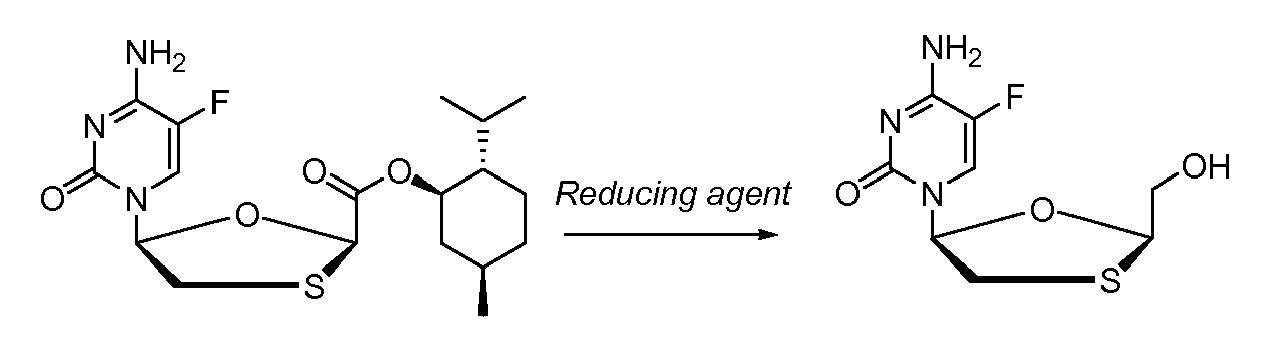
WO 92/14743 - Several stereoselective processes have been subsequently developed, which mainly by means of chiral auxiliaries such as menthol, allow the desired stereochemistry to be induced. Typically, the reductive removal of the chiral auxiliary affords emtricitabine as single enantiomer in these routes, as illustrated in the scheme below reflecting the process from L-menthyl emtricitabine [(2R,5S)-((1 R,2S,5R)-2-isopropyl-5-methylcyclohexyl) 5-(4-amino-5-fluoro-2-oxopyrimidin-1 (2H)-yl)-1,3-oxathiolane-2-carboxylate]:
-
US 5,696,254 discloses a process for preparing emtricitabine, which involves condensation of L-menthyl cis-1,3-oxathiolan-5S-acetoxy-2R-carboxylate with 5-fluorocytosine in the presence of iodotrimethylsilane and reduction of the L-menthyl ester group of the product so formed with lithium aluminum hydride to afford emtricitabine (see example 21 therein). In the example 2 ofUS 5,538,975 the reduction is also carried out with the same hydride. However, lithium aluminum hydride is a pyrophoric material which reacts strongly in contact with water or humid air, and thus these processes require special handled conditions. Further, a silica gel column chromatography is also needed. These drawbacks prevent its industrial application. On the other hand,US 5,696,254 shows discrepancies relating to the stereochemistry of the intermediates used to obtain emtricitabine, since examples 18 and 19 relates to intermediate compounds unsuitable for producing emtricitabine. - RED-Al (sodium bis(2-methoxyethoxy)aluminumhydride), other reducing agent sensitive to humidity, is employed in the reduction of L-menthyl emtricitabine disclosed in
CN1274687C , which further encompasses a column chromatography. - Boron hydrides are more easily handled as they are much more stable to humidity. However, the use of these reducing agents also presents inconveniences or disadvantages such as additional steps or tedious purifications to remove the boron side species formed during the reduction. Further, in the present case, this aspect is especially significant due to the high solubility of emtricitabine and the boron species in water.
- In
CN10166971A , the reduction with KBH4 does not afford emtricitabine directly but its hydroxybenzoic salt, thus involving the additional step of obtaining emtricitabine in free base form. - Several references describe the use of NaBH4 as reducing agent of L-menthyl emtricitabine (see for instance
EP 1 608 644 ,WO 2007/077505 ,CN101407513A ,WO 2009/084033 ). However, these processes show important drawbacks as well. For instance, inWO 2009/084033 the reaction gives place to the hydrochloride salt, and therefore an additional step is carried out to obtain the ingredient active in the free base form. Likewise, with the exception ofCN101407513A , the chemical yield reported when using NaBH4 is low (up to 57%). Further, some of these procedures require several solvents or additives in the reaction step and also evaporations to dryness. Furthermore, as noted above, it is believed that emtricitabine obtained according to said procedures presents certain amounts of boron species as well as inorganic salts. In this regard, it is worth mentioning that the inventors of the instant invention when reproducing the example 4 ofCN101407513A have found that it does not afford the final product free of inorganic salts and boron species, since said salts precipitate under the crystallization conditions. - In view of the above, there does not exist any example in the state of the art which allows to prepare emtricitabine in good yield and high purity by means of a readily industrializable process.
- It is therefore necessary to solve the problems associated with the processes belonging to the state of the art and provide an easy cost-effective process for obtaining emtricitabine which improves its isolation and thus being advantageously applicable at industrial scale. In particular, said improved process should afford the product with good yield and quality avoiding the need of any further purification and additionally it should take place in absence of additives.
- The invention faces the problem of providing an improved process for obtaining emtricitabine, which overcomes all or part of the problems existing in the different aforementioned syntheses of the state of the art. In particular, as the use of boron reducing agents is found to be advantageous in its synthesis, a solution for obtaining this ingredient active substantially free of boron impurities and/or inorganic salts would be highly desirable.
- The solution provided by the present invention is based on the fact that the inventors have observed that it is surprisingly possible to isolate substantially pure emtricitabine from a crude reaction mixture containing side boron species by means of azeotropic distillation of methanol-B(OMe)3.
- More particularly, said boron species in presence of metanol give place to B(OMe)3 which is removed by means of azeotropic distillation of methanol-B(OMe)3.
- Furthermore, said boron species in presence of an alcohol give place to a borate ester of formula (lV), which, by adding MeOH, is subsequently transformed into B(OMe)3 (III), which is removed by means of azeotropic distillation of methanol-B(OMe)3. A distillation allows the equilibrium of the transesterification reaction to shift to the right due to the high volatility of the azeotrope formed, as may be observed in the following scheme.

- Therefore, one aspect of the present invention relates to a process, hereinafter process of the invention, for obtaining or isolating emtricitabine which comprises:
- a) mixing methanol with a mixture comprising emtricitabine and boron species; and
- b) performing an azeotropic distillation of methanol-B(OMe)3.
- In a particular embodiment, the present invention relates to a process for obtaining or isolating emtricitabine which comprises:
- a) mixing at least a C2-8 alkyl alcohol with a first mixture comprising emtricitabine and boron species to form a second mixture comprising emtricitabine and a borate ester;
- b) mixing methanol with the mixture obtained in step a); and
- c) performing an azeotropic distillation of methanol-B(OMe)3.
- Preferably, the process of the invention above may additionally comprise a filtration step in order to remove insoluble salts. Such filtration may be performed in any stage.
- Additionally, it is preferred that the mixture comprising emtricitabine and boron species is anhydrous, before performing the azeotropic distillation of methanol-B(OMe)3.
- In the context of the invention, emtricitabine may be prepared according to any of the processes disclosed in the state of the art. However, as the skilled person will appreciate, the process for isolating emtricitabine provided herein is particularly advantageous when it has been obtained through a synthetic pathway comprising at least one step wherein a boron reagent is used. For example, but not limited to, the stereoselective processes wherein the chiral auxiliary is removed by a reductive reaction with a boron reducing agent.
- Therefore, a preferred embodiment of the present invention relates to a process for obtaining emtricitabine which comprises:
- a) the reduction of an intermediate compound of formula (II)

with a boron reducing agent to obtain a mixture comprising emtricitabine and boron species; - b) optionally, mixing at least a C2-8 alkyl alcohol with the mixture obtained in step a);
- c) mixing methanol with the mixture obtained in the previous step; and
- d) performing an azeotropic distillation of methanol-B(OMe)3.
- In an especially preferred embodiment, the boron reducing agent is NaBH4.
- Another aspect of the present invention relates to substantially pure emtricitabine, particularly emtricitabine having a content of boron species, expressed as H3B03, of not more than a 0.5% by weight, preferably of not more than 0.1% by weight; more preferably said emtricitabine has a content of inorganic salts of not more than 0.1% by weight.
- In another aspect, the invention is directed to emtricitabine obtainable according to the process of the invention.
- Also provided according to the invention is a pharmaceutical composition comprising emtricitabine having a minimum content of boron species. It is also provided by the present invention a pharmaceutical composition comprising emtricitabine having a minimum content of boron species and of inorganic salts as defined above together to a pharmaceutically acceptable carrier, adjuvant or vehicle.
- These aspects and preferred embodiments thereof are additionally also defined in the claims.
- In the context of the present invention, the following terms have the meaning detailed below:
- "C2-8 Alkyl" refers to a straight or branched hydrocarbon chain radical consisting of carbon and hydrogen atoms, containing no unsaturation, having two to eight carbon atoms, and which is attached to the rest of the molecule by a single bond, e. g., ethyl, n-propyl, i-propyl, n-butyl, t-butyl, n-pentyl, etc.
- Emtricitabine can be obtained in free form or, alternatively, in the form of salt. In both cases it can be obtained in crystalline form, both as free compounds or as solvates (e.g., hydrates, alcoholates, etc.), both forms being included within the scope of the present invention. The solvation methods are generally known in the state of the art.
- As a whole, a process such as the one disclosed in the present invention provides emtricitabine in good yield and pharmaceutical quality and at the same time avoids any further purification step. Likewise, said process allows using non-hazardous reactants. All of this contributes to reducing the overall cost of the process, making it commercially interesting and allowing it to be put into practice on an industrial level.
- As noted previously, the process for isolating emtricitabine may be applied to any mixture of this active ingredient containing boron species. However, it is preferably carried out after a reductive step with a boron reducing agent. According to the process of the invention, the intermediate compound of formula (II) may be subjected to a reduction reaction with a boron reducing agent which generates hydride ions, under conditions allowing the reduction of the group in position 2 to a hydroxyl group, to obtain the compound of formula (I) (emtricitabine).

- Illustrative, non-limiting examples of suitable conditions to carry out the reaction of reduction are for instance those disclosed in
EP 1608644 (example 1),WO 2007/077505 (example 4),CN101407513A (examples 4-6),WO 2009/084033 (example 2). The isolation of emtricitabine after the reduction is performed following the process of the invention. - The term "chiral auxiliary" describes asymmetric molecules that are used to effect the chemical resolution of a racemic mixture. Such chiral auxiliaries may possess one chiral center such as methylbenzylamine or several chiral centers such as menthol. The purpose of the chiral auxiliary, once built into the starting material, is to allow simple separation of the resulting diastereomeric mixture. See, for example, J. Jacques et al., Enantiomers, Racemates and Resolutions, pp. 251-369, John Wiley & Sons, New York (1981). Examples of chiral auxiliaries suitable in the present invention are for instance amines and alcohols such as methylbenzylamine and menthol, respectively. The L-menthol [(1 R,2S,5R)-5-methyl-2-propan-2-ylcyclohexan-1-ol] is preferred.
- The optical purity of the compounds can be determined by chiral HPLC methods, specific rotation measurements and NMR techniques. As a general rule, if the opposite enantiomer is desired, it may be obtained by using the mirror image of the chiral auxiliary initially employed. In the present case, L-menthol is used to afford the (2R, 5S) isomer of emtricitabine and therefore, its enantiomer (2S, 5R) could be obtained by using D-menthol. The selection of the appropriate configuration for other chiral auxiliaries is a routine work for the skilled person.
- As used herein, a "boron reducing agent" is a compound capable of transferring one or more hydride ions and which are formed or contain boron and one or more electropositive elements selected from groups IA (alkaline metals), IIA (alkaline earth metals) or IIIA, such as for example, lithium, sodium, potassium, aluminum, etc.; in a particular embodiment, the reducing agent which generates hydride ions has an anion (e.g., a cyanide group (CN-), etc.). Although virtually any boron reducing agent which generates hydride ions can be used to implement the process of the invention, in a particular embodiment said reducing agent is selected from sodium borohydride (NaBH4), potassium borohydride (KBH4), lithium borohydride (LiBH4), sodium cyanoborohydride (NaBH3CN), diborane (B2H6), or lithium triethylborohydride (LiEt3BH or lithium super-hydride), and their mixtures. The diborane can be a diborane generated in the medium by means of, for example, l2/sodium borohydride (NaBH4), BF30Et2/NaBH4, by means of reacting NaBH4 with BF3 adducts with di-n-butylether, tert-butylether, monoglyme, dioxane or tetrahydropyran (Inorg. Chem., 2000, 39(8):1795-1802), etc.;or a commercial diborane in solution such as, for example, BH3/Me2S, etc. Preferably, the boron reducing agent is NaBH4.
- According to a particular embodiment, the reduction of the intermediate compound (II) to emtricitabine may be carried out in a suitable solvent (or a mixture of solvents), such as an organic solvent, for example, an alcohol, such as a low molecular weight alcohol (e.g., methanol, ethanol, isopropanol, etc.), an ether, for example, an aliphatic ether (e.g., diisopropyl ether, etc.), a cyclic ether (e.g., tetrahydrofuran (THF), methyl-THF, a dioxane, etc.), an halogenated solvent (e.g., dichloromethane, 1,2 dichloroethane, etc.), an aromatic solvent (e.g., toluene, xylene, etc.), etc.
- The reduction reaction is suitably carried out under cooling, for example at a temperature comprised between - 75 °C and 10 °C, for a time period equal to or greater than 1 hour, typically comprised between 1 and 24 hours, allowing the reduction to the hydroxyl group. The development of the reaction can be monitored by different means such as TLC. Once the reaction is completed, the removal of the free chiral auxiliary can be achieved employing different common techniques such as extraction.
- In a preferred embodiment, emtricitabine is obtained from L-menthyl emtricitabine by means of reduction using NaBH4 as reducing agent and methanol as solvent, at a reaction temperature comprised between -10°C and 10°C. For instance, at -5°C the reaction is completed in about 4.5 or 5 hours. The menthol released is preferably removed by extraction with toluene.
- A mixture containing emtricitabine and boron species, such as a crude reaction mixture obtained from the reduction of menthyl emtricitabine with a boron reducing agent, requires to be purified in order to obtain pharmaceutically acceptable emtricitabine.
- The high solubility of emtricitabine and of the boron species in water complicates its separation.
- As noted previously, it is convenient that the mixture of emtricitabine and boron species does not contain substantially water in order to achieve a good subsequent purification. Accordingly, if the mixture contains water, it may be dried by adding a solvent (e.g. isopropanol) which forms an azeotrope with water and carrying out a distillation of the azeotrope. Such distillation, for instance by means of an evaporation under reduced pressure, is more efficient if it is repeated twice or more times. Other suitable dehydrating methods include the addition of molecular sieves to the mixture. Before being subjected to the azeotropic distillation of methanol-B(OMe)3, the water content in the mixture is preferably no more than 3% by weight, more preferably no more than 1% by weight, and even more preferably no more than 0.5% by weight.
- According to a first embodiment of the process of the invention, the mixture containing emtricitabine and boron species, preferably anhydrous, is mixed with methanol to form B(OMe)3. This reaction with methanol proceeds quickly.
- According to a second embodiment of the process of the invention, the mixture containing emtricitabine and boron species, preferably anhydrous, is firstly mixed with at least one alcohol of formula general ROH, wherein R may independently represent any organic group provided that its borate (IV) is less volatile than the azeotrope MeOH-B(OMe)3 (III)- In this regard, as the boiling point increases with increasing molecular mass, any alcohol can be employed since the MeOH-B(OMe)3 azeotrope has the lowest boiling point. By way of example, the following table shows that the borate esters resulting from alcohols similar to methanol (EtOH, iPrOH, nPrOH) have a boiling point very high (respectively 120°C, 140 °C and 180°C) in comparison with B(OMe)3 (69°C). The table shows also that the boiling point of the azeotrope MeOH-B(OMe)3 (54°C) is lower than the azeotropes of EtOH-B(OEt)3 (77°C) and iPrOH-B(OiPr)3 (82 °C). It is also to be noted that the azeotrope derived from methanol presents the highest boron content (73% wt. expressed as B(OMe)3) and consequently it provides a better removal of the boron species.
ROH b.p.* ROH B(OR)3 b.p*. B(OR)3 azeotrope
b.p.* ROH-B(OR)3azeotrope
B(OR)3 % by weightMeOH 65 °C B(OMe)3 69 °C 54 °C 73% EtOH 78 °C B(OEt)3 120°C 77 °C 32% iPrOH 82 °C B(OiPr)3 140 °C 82 °C 14% nPrOH 97 °C B(OnPr)3 180 °C --- --- * atmospheric pressure - From an experimental point of view, it is preferred that the alcohol is commercially available and at low cost. Therefore, preferably R is a C2-8 alkyl; most preferably, it is selected from ethanol, n-propanol and isopropanol. Nevertheless, the skilled person clearly understands that the mixture containing emtricitabine and boron species, may be also firstly mixed with at least one alcohol of formula general ROH, wherein R is preferably a C2-8 alkyl, and methanol.
- The product of the reaction with the C2-8 alkyl alcohol is the borate ester of formula (IV) B(OR)3. This reaction with the C2-8 alkyl alcohol proceeds quickly. Once the borate is formed, MeOH is added to the mixture, preferably anhydrous, to form B(OMe)3.
- Whether B(OMe)3 is obtained from the mixture containing emtricitabine and boron species via the borate ester of formula (IV) or not (direct reaction of methanol), an azeotropic distillation is performed subsequently in order to remove the boron species. By this way, the side boron species can be completely separated from the emtricitabine and thus obtaining the active ingredient in substantially pure form. Afterwards, conventional crystallization techniques may be conveniently employed to isolate emtricitabine from the solution.
- The present invention further provides pharmaceutical compositions comprising emtricitabine in substantially pure form as defined herein together with a pharmaceutically acceptable carrier, adjuvant, or vehicle, for administration to a patient.
- Examples of pharmaceutical compositions include any solid (tablets, pills, capsules, granules etc.) or liquid (solutions, suspensions or emulsions) composition for oral, topical or parenteral administration.
- In a preferred embodiment the pharmaceutical compositions are in oral form, either solid or liquid. Suitable dose forms for oral administration may be tablets, capsules, syrops or solutions and may contain conventional excipients known in the art such as binding agents, for example syrup, acacia, gelatin, sorbitol, tragacanth, or polyvinylpyrrolidone; fillers, for example lactose, sugar, maize starch, calcium phosphate, sorbitol or glycine; tabletting lubricants, for example magnesium stearate; disintegrants, for example starch, polyvinylpyrrolidone, sodium starch glycollate or microcrystalline cellulose; or pharmaceutically acceptable wetting agents such as sodium lauryl sulfate.
- The solid oral compositions may be prepared by conventional methods of blending, filling or tabletting. Repeated blending operations may be used to distribute the active agent throughout those compositions employing large quantities of fillers. Such operations are conventional in the art. The tablets may for example be prepared by wet or dry granulation and optionally coated according to methods well known in normal pharmaceutical practice, in particular with an enteric coating.
- The mentioned formulations will be prepared using standard methods such as those described or referred to in the Spanish and US Pharmacopoeias and similar reference texts.
- Administration of the compounds or compositions of the present invention may be by any suitable method, such as intravenous infusion, oral preparations, and intraperitoneal and intravenous administration. Oral administration is preferred.
- Generally an effective administered amount of a compound of the invention will depend on the relative efficacy of the compound chosen, the severity of the disorder being treated and the weight of the sufferer. However, active compounds will typically be administered once or more times a day for example 1, 2, 3 or 4 times daily, with typical total daily doses in the range of from 0.1 to 1000 mg/kg/day.
- Emtricitabine or a composition thereof according to this invention may be used with other drugs to provide a combination therapy. The other drugs may form part of the same composition, or be provided as a separate composition for administration at the same time or at different time.
- The features of the particular and preferred embodiments may be combined in the context of the present invention as long as the combination is not contradictory.
- The following examples are merely illustrative of certain embodiments of the invention and cannot be considered as restricting it in any way.
- A suspension of (2R,5S)-((1 R,2S,5R)-2-isopropyl-5-methylcyclohexyl) 5-(4-amino-5-fluoro-2-oxopyrimidin-1(2H)-yl)-1,3-oxathiolane-2-carboxylate (30.0 g) in MeOH (300 mL) was cooled to -7 °C under a nitrogen atmosphere. Then, NaBH4 (6.8 g) was added in portions for 1 h and the reaction mixture was stirred at -5 °C for 5 h. The resulting solution was heated to 5°C, water (105 mL) was added and was slowly titrated to pH 5.5 with 35% aqueous HCl solution at 10 °C. The solution was concentrated under reduced pressure to 140 mL total internal volume. Toluene (90 mL) was added and the layers were separated after 10 min stirring. The aqueous phase was washed again with toluene (2 x 90 mL) and, after phase separation, neutralized (pH 7.5) with 25% aqueous NaOH solution. Part of the solvent was evaporated under reduced pressure until reaching a internal volume of 60 mL. Celite (6 g) was charged to the aqueous solution and the mixture stirred for 5 min. Isopropanol (300 mL) was added and the solvent was evaporated under reduced pressure until the residual volume reached 75 mL. This last operation was repeated twice. Isopropanol (470 mL) was added and the suspension was heated to 60 °C, stirred for 1 h, filtered while hot and washed with hot isopropanol (2 x 30 mL). The filtrate and washing were combined and partially concentrated under reduced pressure to 75 mL total internal volume. MeOH (150 mL) was charged and the mixture was concentrated under reduced pressure to 75 mL, thus removing the boron species. Isopropanol (300 mL) was added and the solvent was evaporated under reduced pressure to 160 total internal volume. The suspension was heated to 80 °C and water (6 mL) was added. The resulting solution was cooled to 60 °C, seeded, stirred for 1 h at 60 °C, cooled to 0 °C and held at this temperature for 1 h. The solid was collected by filtration, washed with chilled isopropanol (2 x 15 mL) and dried in vacuo (40 °C) to give 12.1 g of emtricitabine (65% yield; purity by HPLC 99.77 area %; assay by HPLC 99.8% w/w; boric acid and chloride not detected by capillary electrophoresis).
- A suspension of (2R,5S)-((1 R,2S,5R)-2-isopropyl-5-methylcyclohexyl) 5-(4-amino-5-fluoro-2-oxopyrimidin-1 (2H)-yl)-1,3-oxathiolane-2-carboxylate (50.0 g) in MeOH (500 mL) was cooled to -7 °C under a nitrogen atmosphere. Then, NaBH4 (10.2 g) was added in portions for 1.5 h and the reaction mixture was stirred at -5 °C for 4.5 h. The resulting solution was heated to 5°C and a 1.25 M HCl solution in methanol (220 mL) was slowly added. The mixture was concentrated under reduced pressure until the internal volume reached 250 mL, thus removing the boron species. Water (250 mL) was added and the pH was adjusted to 6. The solution was concentrated under reduced pressure to 250 mL total internal volume. Toluene (150 mL) was added and the layers were separated after 10 min stirring. The aqueous phase was washed again with toluene (2 x 150 mL) and, after phase separation, neutralized (pH 7.5) with 25% aqueous NaOH solution. Part of the solvent was evaporated under reduced pressure until reaching a internal volume of 100 mL. Celite (10 g) was charged to the aqueous solution and the mixture stirred for 5 min. Isopropanol (500 mL) was added and the solvent was evaporated under reduced pressure until the residual volume reached 125 mL. This last operation was repeated twice. Isopropanol (780 mL) was added and the suspension was heated to 60 °C, stirred for 1 h, filtered while hot and washed with hot isopropanol (2 x 50 mL). The filtrate and washing were combined and partially concentrated under reduced pressure to 265 mL total internal volume. The suspension was heated to 80 °C and water (10 mL) was added. The resulting solution was cooled to 60 °C, seeded, stirred for 1 h at 60 °C, cooled to 0 °C and held at this temperature for 1 h. The solid was collected by filtration, washed with chilled isopropanol (2 x 50 mL) and dried in vacuo (40 °C) to give 19.5 g of emtricitabine (63% yield; purity by HPLC 99.94 area %; assay by HPLC 99.7% w/w; boric acid and chloride not detected by capillary electrophoresis).
-
- The present inventors have found that the process disclosed in the example 4 of
CN101407513A does not afford the final product free of inorganic salts and boron species, since said salts precipitate under the crystallization conditions. A solid was isolated providing the following results: Emtricitabine: assay by HPLC = 0.5%. Capillary electrophoresis analysis: chlorides 29%, boric acid 9%, unidentified intense peak (possibly phosphates). Emtricitabine was found to be in the mother liquors. - Further, the process includes two steps which are hardly large-scale industrializable: i) pH correction of the organic phase after the reaction; ii) separation of toluene/water phases.
Claims (13)
- A process for obtaining emtricitabine which comprises:a) mixing methanol with a mixture comprising emtricitabine and boron species; andb) performing an azeotropic distillation of methanol-B(OMe)3.
- A process according to claim 1 which comprises:a) mixing at least a C2-8 alcohol with a first mixture comprising emtricitabine and boron species to form a second mixture comprising emtricitabine and a borate ester;b) mixing methanol with the mixture obtained in step a); andc) performing an azeotropic distillation of methanol-B(OMe)3.
- A process according to any of claims 1 or 2, wherein the mixture comprising emtricitabine and boron species is anhydrous.
- The process according to any of claims 2 or 3, wherein the C2-8 alcohol is selected from ethanol, isopropanol and n-propanol.
- The process according to any of claims 1 to 4 further comprising the previous step of reducing an intermediate compound of formula (II)

with a boron reducing agent to obtain a reaction mixture comprising emtricitabine and boron species. - The process according to claim 5, wherein the chiral auxiliary is L-menthol.
- The process according to claim 5, wherein the boron reducing agent is selected from NaBH4, KBH4, LiBH4, NaBH3CN, B2H6 or LiEt3BH and their mixtures.
- The process according to claim 7, wherein the boron reducing agent is NaBH4.
- The process according to claim 5, wherein the reduction is carried out in a solvent comprising methanol.
- Emtricitabine having a content of boron species, expressed as H3BO3, of not more than 0.1 % by weight.
- Emtricitabine according to claim 10 having a content of inorganic salts of not more than 0.1 % by weight.
- Emtricitabine obtainable according to the process defined in any of claims 1 to 9.
- A pharmaceutical composition comprising emtricitabine as defined in any of claims 10, 11 or 12 and a pharmaceutically acceptable carrier, adjuvant or vehicle.
Priority Applications (2)
| Application Number | Priority Date | Filing Date | Title |
|---|---|---|---|
| EP10382070A EP2377862A1 (en) | 2010-03-29 | 2010-03-29 | Process for obtaining emtricitabine |
| PCT/EP2011/054740 WO2011120927A1 (en) | 2010-03-29 | 2011-03-28 | Process for obtaining emtricitabine |
Applications Claiming Priority (1)
| Application Number | Priority Date | Filing Date | Title |
|---|---|---|---|
| EP10382070A EP2377862A1 (en) | 2010-03-29 | 2010-03-29 | Process for obtaining emtricitabine |
Publications (1)
| Publication Number | Publication Date |
|---|---|
| EP2377862A1 true EP2377862A1 (en) | 2011-10-19 |
Family
ID=42246128
Family Applications (1)
| Application Number | Title | Priority Date | Filing Date |
|---|---|---|---|
| EP10382070A Withdrawn EP2377862A1 (en) | 2010-03-29 | 2010-03-29 | Process for obtaining emtricitabine |
Country Status (2)
| Country | Link |
|---|---|
| EP (1) | EP2377862A1 (en) |
| WO (1) | WO2011120927A1 (en) |
Cited By (1)
| Publication number | Priority date | Publication date | Assignee | Title |
|---|---|---|---|---|
| WO2013178083A1 (en) * | 2012-05-31 | 2013-12-05 | 上海迪赛诺药业有限公司 | Nucleotide analog preparation method |
Families Citing this family (1)
| Publication number | Priority date | Publication date | Assignee | Title |
|---|---|---|---|---|
| WO2014174532A2 (en) * | 2013-04-26 | 2014-10-30 | Laurus Labs Private Limited | An improved process for the preparation of emtricitabine |
Citations (11)
| Publication number | Priority date | Publication date | Assignee | Title |
|---|---|---|---|---|
| GB860318A (en) * | 1958-02-12 | 1961-02-01 | United States Borax Chem | Separation of methyl borate-methanol azeotrope |
| WO1992014743A2 (en) | 1991-02-22 | 1992-09-03 | Emory University | Antiviral activity and resolution of 2-hydroxymethyl-5-(5-fluorocytosin-1-yl)-1,3-oxathiolane |
| US5538975A (en) | 1991-08-01 | 1996-07-23 | Biochem Pharma, Inc. | 1,3-oxathiolane nucleoside compounds and compositions |
| US5696254A (en) | 1991-05-21 | 1997-12-09 | Biochem Pharma Inc. | Processes for the diastereoselective synthesis of nucleoside analogues |
| CN1274687A (en) | 1999-05-20 | 2000-11-29 | 朴世俊 | Sludge de-watering drying system |
| EP1608644A1 (en) | 2003-03-24 | 2005-12-28 | Clariant Life Science Molecules (Italia) S.p.A. | Process and intermediates for preparing emtricitabine |
| WO2006135932A2 (en) * | 2005-06-13 | 2006-12-21 | Gilead Sciences, Inc. | Stable fixed-dose formulations containing a combination of antivirals, method for producing thereof using dry granulation |
| WO2007077505A2 (en) | 2005-12-30 | 2007-07-12 | Ranbaxy Laboratories Limited | Crystalline l-menthyl (2r, 5s)-5-(4-amino-5-fluoro-2-oxo-2h-pyrimidin-1-yl)[1, 3]oxathiolan-2-carboxylate and process for preparation thereof |
| CN101066971A (en) | 2007-05-24 | 2007-11-07 | 葛建利 | Non-enantioselective prepn process of emtricitabine |
| CN101407513A (en) | 2008-11-14 | 2009-04-15 | 江苏科本医药化学有限公司 | Method for synthesizing nucleoside analogue |
| WO2009084033A2 (en) | 2007-12-07 | 2009-07-09 | Matrix Laboratories Limited | Process for producing 5-fluoro-1-(2r,5s)-[2-(hydroxymethyl)-1,3-oxathiolan-5-yi]cytosine |
Family Cites Families (1)
| Publication number | Priority date | Publication date | Assignee | Title |
|---|---|---|---|---|
| CN1274687C (en) | 2004-03-17 | 2006-09-13 | 济南久创化学有限责任公司 | Suitqable to industrialized method for preparing emtricitabine |
-
2010
- 2010-03-29 EP EP10382070A patent/EP2377862A1/en not_active Withdrawn
-
2011
- 2011-03-28 WO PCT/EP2011/054740 patent/WO2011120927A1/en not_active Ceased
Patent Citations (11)
| Publication number | Priority date | Publication date | Assignee | Title |
|---|---|---|---|---|
| GB860318A (en) * | 1958-02-12 | 1961-02-01 | United States Borax Chem | Separation of methyl borate-methanol azeotrope |
| WO1992014743A2 (en) | 1991-02-22 | 1992-09-03 | Emory University | Antiviral activity and resolution of 2-hydroxymethyl-5-(5-fluorocytosin-1-yl)-1,3-oxathiolane |
| US5696254A (en) | 1991-05-21 | 1997-12-09 | Biochem Pharma Inc. | Processes for the diastereoselective synthesis of nucleoside analogues |
| US5538975A (en) | 1991-08-01 | 1996-07-23 | Biochem Pharma, Inc. | 1,3-oxathiolane nucleoside compounds and compositions |
| CN1274687A (en) | 1999-05-20 | 2000-11-29 | 朴世俊 | Sludge de-watering drying system |
| EP1608644A1 (en) | 2003-03-24 | 2005-12-28 | Clariant Life Science Molecules (Italia) S.p.A. | Process and intermediates for preparing emtricitabine |
| WO2006135932A2 (en) * | 2005-06-13 | 2006-12-21 | Gilead Sciences, Inc. | Stable fixed-dose formulations containing a combination of antivirals, method for producing thereof using dry granulation |
| WO2007077505A2 (en) | 2005-12-30 | 2007-07-12 | Ranbaxy Laboratories Limited | Crystalline l-menthyl (2r, 5s)-5-(4-amino-5-fluoro-2-oxo-2h-pyrimidin-1-yl)[1, 3]oxathiolan-2-carboxylate and process for preparation thereof |
| CN101066971A (en) | 2007-05-24 | 2007-11-07 | 葛建利 | Non-enantioselective prepn process of emtricitabine |
| WO2009084033A2 (en) | 2007-12-07 | 2009-07-09 | Matrix Laboratories Limited | Process for producing 5-fluoro-1-(2r,5s)-[2-(hydroxymethyl)-1,3-oxathiolan-5-yi]cytosine |
| CN101407513A (en) | 2008-11-14 | 2009-04-15 | 江苏科本医药化学有限公司 | Method for synthesizing nucleoside analogue |
Non-Patent Citations (3)
| Title |
|---|
| "Merck Index", 2001 |
| INORG. CHEM., vol. 39, no. 8, 2000, pages 1795 - 1802 |
| J. JACQUES ET AL.: "Enantiomers, Racemates and Resolutions", 1981, JOHN WILEY & SONS, pages: 251 - 369 |
Cited By (2)
| Publication number | Priority date | Publication date | Assignee | Title |
|---|---|---|---|---|
| WO2013178083A1 (en) * | 2012-05-31 | 2013-12-05 | 上海迪赛诺药业有限公司 | Nucleotide analog preparation method |
| CN103450166A (en) * | 2012-05-31 | 2013-12-18 | 上海迪赛诺药业有限公司 | Preparation method of nucleotide compound |
Also Published As
| Publication number | Publication date |
|---|---|
| WO2011120927A1 (en) | 2011-10-06 |
Similar Documents
| Publication | Publication Date | Title |
|---|---|---|
| JP7413419B2 (en) | (S)-7-(1-acryloylpiperidin-4-yl)-2-(4-phenoxyphenyl)-4,5,6,7-tetra-hydropyrazolo[1,5-A]pyrimidine-3-carboxamide Crystal forms, their preparation and their uses | |
| CN114502561B (en) | LSD1 inhibitor | |
| TWI761961B (en) | Fused pyridone compound and preparation method and application thereof | |
| EA020643B1 (en) | METHODS OF OBTAINING JAK KINAZ INHIBITORS AND RELATED INTERMEDIATE COMPOUNDS | |
| EP1713801B1 (en) | Process for preparation of 1-(2s,3s)-2-benzhydr yl-n-(5-tert-butyl-2-methoxybenzyl)quinuclidin-3-amine | |
| JP6857219B2 (en) | Method for preparing pyrimidinyl cyclopentane compound | |
| WO2011120927A1 (en) | Process for obtaining emtricitabine | |
| US20240239791A1 (en) | Processes for the synthesis of valbenazine | |
| HK40109095A (en) | Crystalline form of (s)-7-(1-acryloylpiperidin-4-yl)-2-(4-phenoxyphenyl)-4,5,6,7-tetra-hydropyrazolo[1,5-a]pyrimidine-3-carboxamide,preparation, and uses thereof | |
| HK1262749B (en) | Crystalline form of a compound, preparation, and uses thereof | |
| HK1262749A1 (en) | Crystalline form of a compound, preparation, and uses thereof |
Legal Events
| Date | Code | Title | Description |
|---|---|---|---|
| AK | Designated contracting states |
Kind code of ref document: A1 Designated state(s): AT BE BG CH CY CZ DE DK EE ES FI FR GB GR HR HU IE IS IT LI LT LU LV MC MK MT NL NO PL PT RO SE SI SK SM TR |
|
| AX | Request for extension of the european patent |
Extension state: AL BA ME RS |
|
| PUAI | Public reference made under article 153(3) epc to a published international application that has entered the european phase |
Free format text: ORIGINAL CODE: 0009012 |
|
| STAA | Information on the status of an ep patent application or granted ep patent |
Free format text: STATUS: THE APPLICATION IS DEEMED TO BE WITHDRAWN |
|
| 18D | Application deemed to be withdrawn |
Effective date: 20120420 |