EP2377501A2 - Matrix-construction padded absorbing article and making method therefor - Google Patents
Matrix-construction padded absorbing article and making method therefor Download PDFInfo
- Publication number
- EP2377501A2 EP2377501A2 EP10190691A EP10190691A EP2377501A2 EP 2377501 A2 EP2377501 A2 EP 2377501A2 EP 10190691 A EP10190691 A EP 10190691A EP 10190691 A EP10190691 A EP 10190691A EP 2377501 A2 EP2377501 A2 EP 2377501A2
- Authority
- EP
- European Patent Office
- Prior art keywords
- absorbing
- fibers
- article
- pad
- cotton
- Prior art date
- Legal status (The legal status is an assumption and is not a legal conclusion. Google has not performed a legal analysis and makes no representation as to the accuracy of the status listed.)
- Granted
Links
Images

Classifications
-
- A—HUMAN NECESSITIES
- A61—MEDICAL OR VETERINARY SCIENCE; HYGIENE
- A61F—FILTERS IMPLANTABLE INTO BLOOD VESSELS; PROSTHESES; DEVICES PROVIDING PATENCY TO, OR PREVENTING COLLAPSING OF, TUBULAR STRUCTURES OF THE BODY, e.g. STENTS; ORTHOPAEDIC, NURSING OR CONTRACEPTIVE DEVICES; FOMENTATION; TREATMENT OR PROTECTION OF EYES OR EARS; BANDAGES, DRESSINGS OR ABSORBENT PADS; FIRST-AID KITS
- A61F13/00—Bandages or dressings; Absorbent pads
- A61F13/15—Absorbent pads, e.g. sanitary towels, swabs or tampons for external or internal application to the body; Supporting or fastening means therefor; Tampon applicators
- A61F13/15577—Apparatus or processes for manufacturing
- A61F13/15617—Making absorbent pads from fibres or pulverulent material with or without treatment of the fibres
- A61F13/15626—Making fibrous pads without outer layers
-
- A—HUMAN NECESSITIES
- A61—MEDICAL OR VETERINARY SCIENCE; HYGIENE
- A61F—FILTERS IMPLANTABLE INTO BLOOD VESSELS; PROSTHESES; DEVICES PROVIDING PATENCY TO, OR PREVENTING COLLAPSING OF, TUBULAR STRUCTURES OF THE BODY, e.g. STENTS; ORTHOPAEDIC, NURSING OR CONTRACEPTIVE DEVICES; FOMENTATION; TREATMENT OR PROTECTION OF EYES OR EARS; BANDAGES, DRESSINGS OR ABSORBENT PADS; FIRST-AID KITS
- A61F13/00—Bandages or dressings; Absorbent pads
- A61F13/15—Absorbent pads, e.g. sanitary towels, swabs or tampons for external or internal application to the body; Supporting or fastening means therefor; Tampon applicators
- A61F13/53—Absorbent pads, e.g. sanitary towels, swabs or tampons for external or internal application to the body; Supporting or fastening means therefor; Tampon applicators characterised by the absorbing medium
Definitions
- the present invention relates to matrix-construction padded absorbing article and a method for making said padded absorbing article.
- the present invention relates to an absorbing construction to be used in disposable sanitary products which are preferably, though not exclusively, used by incontinent women.
- SAP is a polymeric material suitable to absorb a comparatively large amount of fluids and to restrain the absorbed fluid under a low pressure.
- the absorbance efficiency of such a SAP material, in disposable absorbing articles, depends in a high degree on the material shape, position and the manner by which SAP is embedded in the article.
- This term is indicative of a situation occurring as the SAP material is in a wet swollen condition, thereby preventing the liquid from arriving at the absorbing article inner parts.
- the absorbing article absorb the intended fluid with an absorbing rate less than the human body releasing rate, thereby causing excess fluid losses; and this a long time before a full saturation of the SAP material in the article is achieved.
- To hold a typically spherical configuration means to leave inner interstitial free spaces for allowing fluid to enter them.
- the fluid absorption rate is another very important parameter to provide the article with an optimum performance.
- the urine flow is characterized by a small amount and high flow rates, since the urine release is related to a temporary control loss by the incontinent person, typically in sneezing, laughing or abrupt effort events.
- the instantaneous urine acquirement or absorbing rate is much more important than the overall article absorbing capability.
- the absorbing core parts comprises cellulose fibers with the superabsorbing polymer embedded therein.
- the article To allow the article to operate to transport liquids by a capillarity phenomenon, in which the cellulose fibers would operate as a vehicle for conveying urine to the superabsorbing polymeric material.
- such an acquirement layer comprises specially processed cellulosic or non woven material fibers, and a comparatively small amount of superabsorbing polymer.
- Figure 1 shows a prior absorbing pad construction, including a liquid receiving layer 1, not including a superabsorbing polymer, designed for quickly receiving and distributing urine, and an underlying layer 2, constituting the pad proper, with the superabsorbing polymer arranged therein.
- said underlying layer 2 is arranged between two sheet elements, that is a first sheet element 3 permeable to liquids and contacting the user body, and a second sheet element which is a person garment facing impermeable sheet 4.
- Such a prior construction comprises moreover a first layer having an urine acquirement but not absorbing function, and consequently undesirably remaining wet and contacting the user skin, which may cause user skin irritating and sensitizing phenomena.
- a properly operating absorbing article should preserve an integral and fully operating condition even if it is in a wet status, which characteristic could be achieved both by binding (by chemical or mechanical methods) the absorbing layer forming fibers, and using fibers having such an average length as to provide, in a interbraided arrangement, a stiff network structure.
- a cotton material has very long fibers and, accordingly, would be ideally suitable to form interbraided and strong absorbing constructions; however a cotton material is not at present used in absorbing articles, since it is much more expensive than wood cellulose fibers, and cannot be easily processed into absorbing articles, since prior cotton material absorbing articles are conventionally made by overlapping onto one another a plurality of textile fiber web layers deriving from carding processes or formed by blowing or pressing methods in which are used a plurality of cascade arranged carding machines to comb the cotton fibers and form a continuous mattress to be subjected to further cutting and shaping processes.
- the absorbing articles made thereby comprise fibers which are oriented in the longitudinal direction of the article and preferably conveying the liquid through a X-Y plane and not in the depth direction of the article.
- the constant thickness and basis weight through the overall length of such a prior absorbing article prevent the absorbing material amount and absorbing capability from being properly selected and increased.
- the aim of the present invention is that of providing a method for making an absorbing article overcoming the above prior art drawbacks.
- a main object of the invention is to provide such an absorbing article, in particular a slight incontinence absorbing article, which is ideally suitable to quickly absorb and properly control high urine flows.
- Another object of the present invention is to provide such a slight incontinence absorbing article which is adapted to hold an integral condition notwithstanding repeated mechanical stresses it is subjected to due to the user leg movements and repeated urine absorbing events.
- Another object of the present invention is to provide such a slight incontinence absorbing article preventing the user skin from being reddened or irritated.
- Yet another object of the present invention is to provide such an absorbing article having an absorbing article structure with an improved liquid acquiring speed or rate and an overall article high absorbing capability.
- an absorbing article with a pad having a matrix construction and a method for making it said absorbing article comprising a water permeable first main sheet, a substantially water impermeable second sheet and an absorbing pad arranged between said first and second sheets.
- Said absorbing pad being characterized by an absorbing layer including a flexible matrix made of cotton fibers and superabsorbing polymer fibers, said cotton fibers of said pad matrix having a random three-axis orientation without any X-Y plane preferred orientation.
- the above cotton fiber matrix construction is achieved by a novel process step sequence, constituting the making method according to the present invention.
- the above processing sequence comprises a cotton fiber opening and separating process, for separating the cotton fibers by a properly conveyed air flow and a fiber collection process to collect the cotton fibers in a form member having a target configuration and size.
- Said form member is mounted on a rotary drum and is filled-in by a revolution rotary movement, in a constant manner, to allow the system to operate according to a continuous operating process.
- the method according to the present invention provides to orient the cotton fibers also in the Z axis direction and not only in the X-Y direction.
- the absorbing article according to the present invention comprises an absorbing pad including a cotton and superabsorbing polymeric material matrix, as indicated by the reference number 1, and a further layer 2 including cellulosic fibers and the superabsorbing polymeric material.
- the absorbing pad is arranged on an impermeable or substantially impermeable sheet element, indicated generally by the reference number 4, and conventionally called “backsheet”, and, above said pad a further water permeable or substantially permeable top sheet 3, conventionally called “topsheet”, is arranged.
- Z dimension or "Z-axis” is related to a dimension orthogonal to a plane defined by the article length and width.
- the Z axis usually corresponds to the layer construction or article thickness;
- X-Y sides or "X-Y plane” is related to the plane defined by the article length and width;
- nonwovens or "non woven fabric” is related to a cloth or fabric article having a construction including a plurality of interbraided or intertwined individual fibers, either with a repeating pattern or a non repeating pattern, in which a non-woven product may be made by a plurality of non-woven product making methods, such as meltblowing, spunbonding and carding processes;
- particle or "grain-granule” is related to a material comprising a plurality of very small discrete units, such as powders, balls and particle materials.
- the preferred shape of such a grain or granule comprises, for example, a cubic, cylindric, polyhedric, spherical, semispherical, uneven configuration or a combination thereof.
- Such a definition will obviously comprise any granule shapes having a dimension much larger than the others, such as a needle, thread and fiber.
- the preferred particle may be coated by a coating gel, film, protein or the like and may further comprise a core part or particle.
- the particle may be a non-coated one.
- particle may also be related to an agglomerated configuration, comprising several granules, particles or the like;
- superabsorbing material or "SAP” or “polymer” is related to an absorbing material designed for absorbing and holding therein at least 10 grams of an aqueous liquid, such as water, a saline solution or a synthetic urine solution, such as the product K- C 399105 by the PPG Company, for each gram of absorbing material as the latter is held immersed in a liquid for 4 hours and being then subjected to a 0.5 psi pressure;
- cotton or “cotton fibers”, is related to fibers made from cotton seeds or a mixture thereof with any other desired fiber materials, provided that the cotton fibers are present in a prevailing amount.
- the subject matter of the present invention is a method for making a single-use or disposable absorbing article adapted to absorb large amounts of water and body fluids, such as menstrual fluids, urine, sweats, feces.
- the inventive article may be made as a woman absorbing product, child napkin, incontinence article and the like.
- Available sanitary products generally comprise, as it is well known, three basic constructional components.
- the first is a impermeable or substantially impermeable sheet, usually called "backsheet”. Above this sheet an absorbing component, conventionally comprising two or more layers, is arranged.
- Such an absorbing component is usually overall called “the pad”.
- topsheet a water permeable or substantially permeable sheet
- the pad according to the present invention comprises at least an absorbing layer formed by a flexible cotton fiber matrix.
- Said cotton fibers are much longer than the cellulosic fibers which are conventionally used in prior like articles, and provide a construction matrix which has very good interbraiding, resilient and strength properties in a wet condition.
- the matrix base weight may vary from 50 to 1,000 g/square meter (gsm), preferably from 100 to 800 gsm, more preferably from 150 to 600 gsm.
- the fibers are arranged with a 3D random arrangement, and no preferred arrangement axis exists.
- the above cotton fiber matrix has a base weight varying along the X-Y plane so as to form a so-called "3D core".
- the central region of the inventive article has a larger base weight, whereas the article peripheral regions have a less base weight.
- This structure will operate so as to concentrate the article absorbing capability to the article region where it is mostly required, while providing an absorbing article having a much more ergonomic configuration.
- the larger and small base weight regions may be also differently arranged.
- the amount of said embedded particles will depend on the cotton fiber amount and may vary from 5% to 70% of the overall weight of the cotton fiber and superabsorbing particle matrix overall weight.
- said rate may vary from 10% to 50%.
- said rate may vary from 15% to 40%.
- the superabsorbing particles are homogeneously mixed with the cotton fibers and, accordingly, they will be present in a higher amount where the cotton fiber matrix base weight is larger.
- the superabsorbing material distribution will be fully independent from the cotton fiber matrix structure.
- the X-Y plane contour or profile of the cotton matrix will be preferably tapering to a central portion thereof thereby defining a so-called "hourglass" configuration, or being tapering at an end portion thereof.
- the method for making the cotton fiber matrix according to the present invention provides an anatomic configuration article without the need of using further treatment processes after having formed the pad, which would negatively affect the article softness and skin anti-irritating properties.
- the above disclosed embodiments of the inventive articles may be made by suitably oriented and conveyed cotton fibers, which are held in a 3D random orientation, and do not have any X-Y plane preferential orientation, as it occurs in the prior art.
- Figure 3 schematically shows a preferred method for making the inventive pad, in which the reference number 301 indicates a fiber separating region, the reference number 302 a conveying process and the reference number 303 a collecting or merging of the fibers into a form arrangement.
- the marks ++++/+++/++/+ of figure 3 are used for qualitatively indicating the air pressure level in the process steps.
- the method according to the present invention comprises at the starting thereof, a cotton fiber opening and separating process, as generally indicated by the reference number 301, for properly separating and orienting the cotton fibers, by rollers including a plurality of rotating and counterrotating comb member.
- the fibers are introduced into an air flow to be conveyed to the following process steps.
- the fiber conveying air flow is characterized by a starting higher pressure progressively decreasing to a minimum pressure value achieved at the forming drum 303.
- the cotton fibers After having being separated and introduced into the air flow, the cotton fibers are conveyed by a conveyor 302 which, owing to its specifically designed wall configuration and vortex arrangements generated thereby, homogeneously mixes or blends the cotton fibers to arrange them with a full random arrangement, without any preferred arrangement direction.
- said fibers may be mixed with the superabsorbing polymer thereby providing an homogeneous mixture.
- the fully mixed and randomly oriented fibers are conveyed in a form member mounted on a rotary drum.
- Said form member has any desired size and shape as to provide a target configuration pad, without the need of performing further contouring or shaping process steps.
- the cotton fiber collecting form is folded n times on the drum perimeter, thereby fully covering it.
- the inventive process is a continuous type of processing method.
- the used materials, as well as the contingent size and shapes can be any, according to requirements.
Landscapes
- Health & Medical Sciences (AREA)
- Engineering & Computer Science (AREA)
- Life Sciences & Earth Sciences (AREA)
- Biomedical Technology (AREA)
- Heart & Thoracic Surgery (AREA)
- Vascular Medicine (AREA)
- Epidemiology (AREA)
- Animal Behavior & Ethology (AREA)
- General Health & Medical Sciences (AREA)
- Public Health (AREA)
- Veterinary Medicine (AREA)
- Manufacturing & Machinery (AREA)
- Absorbent Articles And Supports Therefor (AREA)
- Professional, Industrial, Or Sporting Protective Garments (AREA)
Abstract
Description
- The present invention relates to matrix-construction padded absorbing article and a method for making said padded absorbing article.
- More specifically, the present invention relates to an absorbing construction to be used in disposable sanitary products which are preferably, though not exclusively, used by incontinent women.
- As is known, "SAP" is a polymeric material suitable to absorb a comparatively large amount of fluids and to restrain the absorbed fluid under a low pressure.
- The above features make said polymeric material suitable for making absorbing structure for incontinence products.
- The absorbance efficiency of such a SAP material, in disposable absorbing articles, depends in a high degree on the material shape, position and the manner by which SAP is embedded in the article.
- In some cases, in particular as the SAP density is a high one, his efficiency may be negatively affected by the so-called "gel-blocking" phenomenon.
- This term is indicative of a situation occurring as the SAP material is in a wet swollen condition, thereby preventing the liquid from arriving at the absorbing article inner parts.
- In actual practice the absorbing article absorb the intended fluid with an absorbing rate less than the human body releasing rate, thereby causing excess fluid losses; and this a long time before a full saturation of the SAP material in the article is achieved.
- As the SAP material density increases, correspondingly increases the gel-blocking phenomenon.
- On the other hand, a high SAP concentration would be desirable to achieve a sufficient article absorbing capability.
- Several approaches have been devised to improve the SAP efficiency in absorbing articles, to reduce the above disclosed gel-blocking phenomenon.
- Thus, it would be possible to improve the SAP efficiency by causing SAP to assume a spherical configuration in a wet condition.
- To hold a typically spherical configuration means to leave inner interstitial free spaces for allowing fluid to enter them.
- In addition to the absorbing capability, in particular in a slight incontinence article, the fluid absorption rate is another very important parameter to provide the article with an optimum performance.
- In fact, in a typical slight/average incontinence person, the urine flow is characterized by a small amount and high flow rates, since the urine release is related to a temporary control loss by the incontinent person, typically in sneezing, laughing or abrupt effort events.
- Thus, in incontinence products, the instantaneous urine acquirement or absorbing rate is much more important than the overall article absorbing capability.
- However, an increase of the article absorbing capability, though it would be very desirable, would not be sufficient to assure per se a good operating performance.
- For increasing the incontinence article absorbing rate without undesirably reducing the superabsorbing polymer material amount thereof, it is possible to use multiple layer constructions or structures in which the absorbing core parts comprises cellulose fibers with the superabsorbing polymer embedded therein.
- To allow the article to operate to transport liquids by a capillarity phenomenon, in which the cellulose fibers would operate as a vehicle for conveying urine to the superabsorbing polymeric material.
- However, in actual practice, the above mentioned gel-blocking phenomenon would hinder a proper liquid or liquid diffusion through the article by capillarity.
- To overcome such a limitation, it would be also possible to use a so-called distributing or acquirement layer, in addition to the absorbing pad layer proper.
- Generally, such an acquirement layer comprises specially processed cellulosic or non woven material fibers, and a comparatively small amount of superabsorbing polymer.
- Multiple layer constructions including different superabsorbing polymers in each layer thereof, have also been designed and made.
-
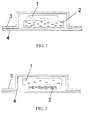
Figure 1 shows a prior absorbing pad construction, including aliquid receiving layer 1, not including a superabsorbing polymer, designed for quickly receiving and distributing urine, and anunderlying layer 2, constituting the pad proper, with the superabsorbing polymer arranged therein. - As shown, said
underlying layer 2 is arranged between two sheet elements, that is afirst sheet element 3 permeable to liquids and contacting the user body, and a second sheet element which is a person garment facingimpermeable sheet 4. - Such a prior construction comprises moreover a first layer having an urine acquirement but not absorbing function, and consequently undesirably remaining wet and contacting the user skin, which may cause user skin irritating and sensitizing phenomena.
- On the contrary, a properly operating absorbing article, should preserve an integral and fully operating condition even if it is in a wet status, which characteristic could be achieved both by binding (by chemical or mechanical methods) the absorbing layer forming fibers, and using fibers having such an average length as to provide, in a interbraided arrangement, a stiff network structure.
- However, in actual practice, the above methods excessively stiffen the absorbing pad, thereby undesirably reducing the article softness and comfort properties.
- A cotton material has very long fibers and, accordingly, would be ideally suitable to form interbraided and strong absorbing constructions; however a cotton material is not at present used in absorbing articles, since it is much more expensive than wood cellulose fibers, and cannot be easily processed into absorbing articles, since prior cotton material absorbing articles are conventionally made by overlapping onto one another a plurality of textile fiber web layers deriving from carding processes or formed by blowing or pressing methods in which are used a plurality of cascade arranged carding machines to comb the cotton fibers and form a continuous mattress to be subjected to further cutting and shaping processes.
- Moreover, a main limitation of these prior methods is that the absorbing articles made thereby comprise fibers which are oriented in the longitudinal direction of the article and preferably conveying the liquid through a X-Y plane and not in the depth direction of the article.
- Another drawback is that of the so-called "hourglass shape" caused by mechanical cutting operations, which undesirably make the pad contour stiffener with objectable aesthetic and a functional characteristics, since said cutting operation cause reddening phenomena at the article user skin contacting points.
- Moreover, the constant thickness and basis weight through the overall length of such a prior absorbing article prevent the absorbing material amount and absorbing capability from being properly selected and increased.
- Accordingly, the aim of the present invention is that of providing a method for making an absorbing article overcoming the above prior art drawbacks.
- Within the scope of the above mentioned aim, a main object of the invention is to provide such an absorbing article, in particular a slight incontinence absorbing article, which is ideally suitable to quickly absorb and properly control high urine flows.
- Another object of the present invention is to provide such an absorbing article, which has such an absorbing capability as to collect high urine multiple loads.
- Another object of the present invention is to provide such a slight incontinence absorbing article which is adapted to hold an integral condition notwithstanding repeated mechanical stresses it is subjected to due to the user leg movements and repeated urine absorbing events.
- Another object of the present invention is to provide such a slight incontinence absorbing article preventing the user skin from being reddened or irritated.
- Yet another object of the present invention is to provide such an absorbing article having an absorbing article structure with an improved liquid acquiring speed or rate and an overall article high absorbing capability.
- According to one aspect of the present invention, the above mentioned aim and objects, as well as yet other objects, which will become more apparent hereinafter, are achieved by an absorbing article with a pad having a matrix construction and a method for making it, said absorbing article comprising a water permeable first main sheet, a substantially water impermeable second sheet and an absorbing pad arranged between said first and second sheets.
- Said absorbing pad being characterized by an absorbing layer including a flexible matrix made of cotton fibers and superabsorbing polymer fibers, said cotton fibers of said pad matrix having a random three-axis orientation without any X-Y plane preferred orientation.
- In particular, the above cotton fiber matrix construction is achieved by a novel process step sequence, constituting the making method according to the present invention.
- The above processing sequence comprises a cotton fiber opening and separating process, for separating the cotton fibers by a properly conveyed air flow and a fiber collection process to collect the cotton fibers in a form member having a target configuration and size.
- Said form member is mounted on a rotary drum and is filled-in by a revolution rotary movement, in a constant manner, to allow the system to operate according to a continuous operating process.
- The method according to the present invention provides to orient the cotton fibers also in the Z axis direction and not only in the X-Y direction.
- This allows the fluid or urine material to be also conveyed to the innermost layers of the article, while distributing said fluid on all the free Cartesian axes and reducing the gel-blocking phenomenon.
- Further characteristics and advantages of the present invention will become more apparent hereinafter from the following detailed disclosure of a preferred, though not exclusive, embodiment of the invention, which is illustrated, by way of an indicative, but not limitative, example in the accompanying drawings, where:
-
Figure 1 is a cross-sectional view of a prior absorbing article; -
Figure 2 is a further cross-sectional view of a preferred embodiment of the absorbing article pad according to the present invention; and -
Figure 3 shows a schematic diagram of a preferred embodiment of a process for making a cotton fiber pad member according to the present invention. - With reference to the number references of the above mentioned figures, the absorbing article according to the present invention, comprises an absorbing pad including a cotton and superabsorbing polymeric material matrix, as indicated by the
reference number 1, and afurther layer 2 including cellulosic fibers and the superabsorbing polymeric material. - The absorbing pad is arranged on an impermeable or substantially impermeable sheet element, indicated generally by the
reference number 4, and conventionally called "backsheet", and, above said pad a further water permeable or substantially permeabletop sheet 3, conventionally called "topsheet", is arranged. - Hereinbelow the terms used in this disclosure and the meanings attributed thereto will be briefly discussed.
- The term "Z dimension" or "Z-axis" is related to a dimension orthogonal to a plane defined by the article length and width. The Z axis usually corresponds to the layer construction or article thickness;
- The term "X-Y sides" or "X-Y plane" is related to the plane defined by the article length and width;
- The term "nonwovens" or "non woven fabric" is related to a cloth or fabric article having a construction including a plurality of interbraided or intertwined individual fibers, either with a repeating pattern or a non repeating pattern, in which a non-woven product may be made by a plurality of non-woven product making methods, such as meltblowing, spunbonding and carding processes;
- The term "particle" or "grain-granule" is related to a material comprising a plurality of very small discrete units, such as powders, balls and particle materials.
- The preferred shape of such a grain or granule comprises, for example, a cubic, cylindric, polyhedric, spherical, semispherical, uneven configuration or a combination thereof.
- Such a definition will obviously comprise any granule shapes having a dimension much larger than the others, such as a needle, thread and fiber.
- Moreover, the preferred particle may be coated by a coating gel, film, protein or the like and may further comprise a core part or particle.
- Alternately, the particle may be a non-coated one.
- Moreover, the term "particle" may also be related to an agglomerated configuration, comprising several granules, particles or the like;
- The term "superabsorbing material" or "SAP" or "polymer" is related to an absorbing material designed for absorbing and holding therein at least 10 grams of an aqueous liquid, such as water, a saline solution or a synthetic urine solution, such as the product K- C 399105 by the PPG Company, for each gram of absorbing material as the latter is held immersed in a liquid for 4 hours and being then subjected to a 0.5 psi pressure;
- The term "cotton" or "cotton fibers", is related to fibers made from cotton seeds or a mixture thereof with any other desired fiber materials, provided that the cotton fibers are present in a prevailing amount.
- The subject matter of the present invention is a method for making a single-use or disposable absorbing article adapted to absorb large amounts of water and body fluids, such as menstrual fluids, urine, sweats, feces.
- Thus, the inventive article may be made as a woman absorbing product, child napkin, incontinence article and the like.
- While hereinbelow a preferred embodiment of the inventive article designed for a slight incontinence situation will be disclosed, it should be pointed out that the invention may be easily extended to any other suitable embodiments designed for absorbing body fluids, such as woman absorbing articles, napkins, incontinence products, bed protecting products and the like.
- Available sanitary products generally comprise, as it is well known, three basic constructional components.
- The first is a impermeable or substantially impermeable sheet, usually called "backsheet". Above this sheet an absorbing component, conventionally comprising two or more layers, is arranged.
- Such an absorbing component is usually overall called "the pad".
- Above this pad a water permeable or substantially permeable sheet, the so-called "topsheet" is arranged.
- The pad according to the present invention comprises at least an absorbing layer formed by a flexible cotton fiber matrix.
- Said cotton fibers are much longer than the cellulosic fibers which are conventionally used in prior like articles, and provide a construction matrix which has very good interbraiding, resilient and strength properties in a wet condition.
- The matrix base weight may vary from 50 to 1,000 g/square meter (gsm), preferably from 100 to 800 gsm, more preferably from 150 to 600 gsm.
- The fibers are arranged with a 3D random arrangement, and no preferred arrangement axis exists.
- According to a further aspect of the present invention, the above cotton fiber matrix has a base weight varying along the X-Y plane so as to form a so-called "3D core".
- In the preferred embodiment of the invention, the central region of the inventive article has a larger base weight, whereas the article peripheral regions have a less base weight.
- This structure will operate so as to concentrate the article absorbing capability to the article region where it is mostly required, while providing an absorbing article having a much more ergonomic configuration.
- In other embodiments of the invention, the larger and small base weight regions may be also differently arranged.
- In the cotton matrix, and, in particular, in the interstices of the fiber network, superabsorbing particles are moreover arranged or embedded.
- The amount of said embedded particles will depend on the cotton fiber amount and may vary from 5% to 70% of the overall weight of the cotton fiber and superabsorbing particle matrix overall weight.
- More preferably, said rate may vary from 10% to 50%.
- Yet more preferably, said rate may vary from 15% to 40%.
- Further preferably, the superabsorbing particles are homogeneously mixed with the cotton fibers and, accordingly, they will be present in a higher amount where the cotton fiber matrix base weight is larger.
- In a less preferred embodiment of the invention, the superabsorbing material distribution will be fully independent from the cotton fiber matrix structure.
- In yet another embodiment of the invention, the X-Y plane contour or profile of the cotton matrix will be preferably tapering to a central portion thereof thereby defining a so-called "hourglass" configuration, or being tapering at an end portion thereof.
- This will provide the absorbing article with an anatomic and easy to be used profile.
- The method for making the cotton fiber matrix according to the present invention provides an anatomic configuration article without the need of using further treatment processes after having formed the pad, which would negatively affect the article softness and skin anti-irritating properties.
- On the contrary, the above prior processes, usually comprising several additional mechanical cutting processes, will increase the article profile hardness, thereby negatively affecting the article wearing comfort characteristics.
- More specifically, the above disclosed embodiments of the inventive articles may be made by suitably oriented and conveyed cotton fibers, which are held in a 3D random orientation, and do not have any X-Y plane preferential orientation, as it occurs in the prior art.
-
Figure 3 schematically shows a preferred method for making the inventive pad, in which thereference number 301 indicates a fiber separating region, the reference number 302 a conveying process and the reference number 303 a collecting or merging of the fibers into a form arrangement. - The marks ++++/+++/++/+ of
figure 3 are used for qualitatively indicating the air pressure level in the process steps. - More specifically, the method according to the present invention comprises at the starting thereof, a cotton fiber opening and separating process, as generally indicated by the
reference number 301, for properly separating and orienting the cotton fibers, by rollers including a plurality of rotating and counterrotating comb member. - The fibers are introduced into an air flow to be conveyed to the following process steps.
- The fiber conveying air flow is characterized by a starting higher pressure progressively decreasing to a minimum pressure value achieved at the forming
drum 303. - After having being separated and introduced into the air flow, the cotton fibers are conveyed by a
conveyor 302 which, owing to its specifically designed wall configuration and vortex arrangements generated thereby, homogeneously mixes or blends the cotton fibers to arrange them with a full random arrangement, without any preferred arrangement direction. - In this operating step, said fibers may be mixed with the superabsorbing polymer thereby providing an homogeneous mixture.
- Then, the fully mixed and randomly oriented fibers are conveyed in a form member mounted on a rotary drum.
- Said form member has any desired size and shape as to provide a target configuration pad, without the need of performing further contouring or shaping process steps.
- Then, the cotton fiber collecting form is folded n times on the drum perimeter, thereby fully covering it.
- During the rotary movement of the drum, said form members will be successively filled-in by a continuous material flow coming from the conveyor.
- Accordingly, the inventive process is a continuous type of processing method.
- It has been found that the invention fully achieves the intended aim and objects.
- In practicing the invention, the used materials, as well as the contingent size and shapes, can be any, according to requirements.
Claims (6)
- An absorbing article with a pad having a matrix construction, characterized in that said absorbing article comprises a water impermeable first main sheet, a substantially water permeable second sheet and an absorbing pad arranged between said first and second sheets, said absorbing pad consisting of an absorbing layer including a flexible pad matrix made of cotton fibers and superabsorbing polymer fibers, said cotton fibers of said pad matrix having a random three-axis orientation without any X-Y plane preferred orientation.
- A method for making an absorbing article including an absorbing article pad having a matrix construction, characterized in that said method comprises the steps of:- opening and separating the cotton fibers and conveying said opened and separated cotton fibers to an air flow;- mixing said fibers and randomly orienting said fibers;- collecting said fibers in a form member; and- withdrawing air from said form member.
- A method according to claim 2, characterized in that said method is carried out in a cotton fiber opening and separating system, said cotton fiber opening and separating system comprising a plurality of carding elements.
- A method according to claim 2, characterized in that said method comprises a step of homogeneously mixing said cotton fibers with a superabsorbing polymer in a conveying duct, said mixing step being performed between the steps of separating said fibers and depositing said fibers in said form member.
- A method according to claim 2, characterized in that said form member for collecting said cotton fibers has an anatomic X-Y plane profile and/or a variable depth along said X-Y plane.
- A method according to claim 2, characterized in that said cotton fiber collecting step is carried out in a plurality of said form members mounted on a perimeter of a form member mounting drum.
Applications Claiming Priority (1)
| Application Number | Priority Date | Filing Date | Title |
|---|---|---|---|
| ITMI2009A001998A IT1398844B1 (en) | 2009-11-13 | 2009-11-13 | ABSORBENT ITEM WITH BUFFER, WITH MATRICIENT STRUCTURE, AND METHOD FOR ITS MANUFACTURE. |
Publications (3)
| Publication Number | Publication Date |
|---|---|
| EP2377501A2 true EP2377501A2 (en) | 2011-10-19 |
| EP2377501A3 EP2377501A3 (en) | 2012-02-22 |
| EP2377501B1 EP2377501B1 (en) | 2020-02-12 |
Family
ID=42104365
Family Applications (1)
| Application Number | Title | Priority Date | Filing Date |
|---|---|---|---|
| EP10190691.5A Active EP2377501B1 (en) | 2009-11-13 | 2010-11-10 | Matrix-construction padded absorbing article and making method therefor |
Country Status (4)
| Country | Link |
|---|---|
| US (1) | US9398983B2 (en) |
| EP (1) | EP2377501B1 (en) |
| ES (1) | ES2797958T3 (en) |
| IT (1) | IT1398844B1 (en) |
Families Citing this family (1)
| Publication number | Priority date | Publication date | Assignee | Title |
|---|---|---|---|---|
| EP4523668A1 (en) | 2023-09-14 | 2025-03-19 | Corman SpA | Adaptive hygiene absorbent product |
Family Cites Families (22)
| Publication number | Priority date | Publication date | Assignee | Title |
|---|---|---|---|---|
| US3825381A (en) * | 1971-05-20 | 1974-07-23 | Kimberly Clark Co | Apparatus for forming airlaid webs |
| US4636209A (en) * | 1983-03-07 | 1987-01-13 | Kimberly-Clark Corporation | Sanitary napkin with fluid transfer layer |
| US4610678A (en) * | 1983-06-24 | 1986-09-09 | Weisman Paul T | High-density absorbent structures |
| PH23956A (en) * | 1985-05-15 | 1990-01-23 | Procter & Gamble | Absorbent articles with dual layered cores |
| US5047023A (en) * | 1986-07-18 | 1991-09-10 | The Procter & Gamble Company | Absorbent members having low density and basis weight acquisition zones |
| DE3720031A1 (en) * | 1987-06-16 | 1989-01-05 | Freudenberg Carl Fa | SUCTION BODY MADE OF FLEECE AND PROCESS FOR PRODUCING IT |
| US5030229A (en) * | 1990-01-12 | 1991-07-09 | Chicopee | Disposable urinary pad |
| US5681300A (en) * | 1991-12-17 | 1997-10-28 | The Procter & Gamble Company | Absorbent article having blended absorbent core |
| US5356403A (en) * | 1992-11-30 | 1994-10-18 | Kimberly-Clark Corporation | Absorbent structure comprising a fibrous matrix having dual z-directional gradient |
| SE508399C2 (en) * | 1993-12-29 | 1998-10-05 | Sca Hygiene Prod Ab | Absorption body in an absorbent article |
| US6673982B1 (en) * | 1998-10-02 | 2004-01-06 | Kimberly-Clark Worldwide, Inc. | Absorbent article with center fill performance |
| US6231557B1 (en) * | 1999-09-01 | 2001-05-15 | Kimberly-Clark Worldwide, Inc. | Absorbent product containing an elastic absorbent component |
| CA2316006A1 (en) * | 1999-08-16 | 2001-02-16 | Johnson & Johnson Inc. | Absorbent structure suitable for use in a sanitary absorbent article |
| US6455114B1 (en) * | 1999-10-13 | 2002-09-24 | Isaac Goldhirsch | Composite absorbent structure and method |
| US20030118814A1 (en) * | 2001-12-20 | 2003-06-26 | Workman Jerome James | Absorbent structures having low melting fibers |
| US6890622B2 (en) * | 2001-12-20 | 2005-05-10 | Kimberly-Clark Worldwide, Inc. | Composite fluid distribution and fluid retention layer having selective material deposition zones for personal care products |
| US6846448B2 (en) * | 2001-12-20 | 2005-01-25 | Kimberly-Clark Worldwide, Inc. | Method and apparatus for making on-line stabilized absorbent materials |
| US7759540B2 (en) * | 2002-07-23 | 2010-07-20 | Paragon Trade Brands, Llc | Absorbent articles containing absorbent cores having zoned absorbency and methods of making same |
| US20050049565A1 (en) * | 2003-08-29 | 2005-03-03 | Joseph Annemarie Devine | Disposable absorbent articles |
| US7910195B2 (en) * | 2003-12-16 | 2011-03-22 | The Procter & Gamble Company | Absorbent article with lotion-containing topsheet |
| CN1957147B (en) * | 2004-04-02 | 2011-03-30 | 罗克伍尔国际公司 | Acoustic components and their production |
| US20060069365A1 (en) * | 2004-09-30 | 2006-03-30 | Sperl Michael D | Absorbent composite having selective regions for improved attachment |
-
2009
- 2009-11-13 IT ITMI2009A001998A patent/IT1398844B1/en active
-
2010
- 2010-11-10 ES ES10190691T patent/ES2797958T3/en active Active
- 2010-11-10 EP EP10190691.5A patent/EP2377501B1/en active Active
- 2010-11-12 US US12/927,333 patent/US9398983B2/en active Active
Non-Patent Citations (1)
| Title |
|---|
| None |
Also Published As
| Publication number | Publication date |
|---|---|
| IT1398844B1 (en) | 2013-03-21 |
| ES2797958T3 (en) | 2020-12-04 |
| EP2377501B1 (en) | 2020-02-12 |
| EP2377501A3 (en) | 2012-02-22 |
| US9398983B2 (en) | 2016-07-26 |
| ITMI20091998A1 (en) | 2011-05-14 |
| US20110118688A1 (en) | 2011-05-19 |
Similar Documents
| Publication | Publication Date | Title |
|---|---|---|
| JP6833797B2 (en) | Absorbent core with high loft center layer and channels | |
| KR101056586B1 (en) | Absorbent products with discontinuous absorbent cores | |
| EP1782784B1 (en) | Absorber and absorbent article | |
| RU2564621C2 (en) | Method and device for manufacturing absorbing constructive elements which contain absorbing material | |
| EP3113742B1 (en) | Multi-component topsheets | |
| US20030120249A1 (en) | Absorbent article having an insert providing for improved fluid distribution | |
| EP3113740B1 (en) | Multi-component topsheets | |
| CN111182870A (en) | Topsheet including natural fibers | |
| EP3357469B1 (en) | Absorbent article | |
| EP0951265A1 (en) | Highly efficient surge material for absorbent articles | |
| CZ124995A3 (en) | Absorption article and process for producing thereof | |
| EP3357470B1 (en) | Absorbent article and method for producing same | |
| JP2009519099A (en) | Absorbent article | |
| EP2938308B1 (en) | Absorbent article having a spacer fabric as fluid flow control member | |
| EP3563818A1 (en) | Method for manufacturing absorbent article and absorbent article | |
| JP6045302B2 (en) | Method for manufacturing an absorbent for body fluid treatment | |
| JP2010136900A (en) | Absorbent article and method manufacturing the same | |
| WO2021015654A1 (en) | Absorbent article comprising a core having alternating high density and low density areas of absorbent material | |
| EP3357467B1 (en) | Absorbent article and method for producing same | |
| EP1048278A2 (en) | Absorbent structure having differential density | |
| CN114173734B (en) | Apertured nonwoven web | |
| US9398983B2 (en) | Matrix-construction padded absorbing article and making method therefor | |
| CN108601693A (en) | The method of absorbent commodity, absorbent cores and the manufacture absorbent commodity | |
| US8946502B2 (en) | Slight-incontinence sanitary napkin structure | |
| AU716607C (en) | Highly efficient surge material for absorbent articles |
Legal Events
| Date | Code | Title | Description |
|---|---|---|---|
| AK | Designated contracting states |
Kind code of ref document: A2 Designated state(s): AL AT BE BG CH CY CZ DE DK EE ES FI FR GB GR HR HU IE IS IT LI LT LU LV MC MK MT NL NO PL PT RO RS SE SI SK SM TR |
|
| AX | Request for extension of the european patent |
Extension state: BA ME |
|
| PUAI | Public reference made under article 153(3) epc to a published international application that has entered the european phase |
Free format text: ORIGINAL CODE: 0009012 |
|
| PUAL | Search report despatched |
Free format text: ORIGINAL CODE: 0009013 |
|
| AK | Designated contracting states |
Kind code of ref document: A3 Designated state(s): AL AT BE BG CH CY CZ DE DK EE ES FI FR GB GR HR HU IE IS IT LI LT LU LV MC MK MT NL NO PL PT RO RS SE SI SK SM TR |
|
| AX | Request for extension of the european patent |
Extension state: BA ME |
|
| RIC1 | Information provided on ipc code assigned before grant |
Ipc: A61F 13/53 20060101AFI20120116BHEP |
|
| 17P | Request for examination filed |
Effective date: 20120726 |
|
| 17Q | First examination report despatched |
Effective date: 20141002 |
|
| STAA | Information on the status of an ep patent application or granted ep patent |
Free format text: STATUS: EXAMINATION IS IN PROGRESS |
|
| GRAP | Despatch of communication of intention to grant a patent |
Free format text: ORIGINAL CODE: EPIDOSNIGR1 |
|
| STAA | Information on the status of an ep patent application or granted ep patent |
Free format text: STATUS: GRANT OF PATENT IS INTENDED |
|
| INTG | Intention to grant announced |
Effective date: 20191107 |
|
| GRAS | Grant fee paid |
Free format text: ORIGINAL CODE: EPIDOSNIGR3 |
|
| GRAA | (expected) grant |
Free format text: ORIGINAL CODE: 0009210 |
|
| STAA | Information on the status of an ep patent application or granted ep patent |
Free format text: STATUS: THE PATENT HAS BEEN GRANTED |
|
| AK | Designated contracting states |
Kind code of ref document: B1 Designated state(s): AL AT BE BG CH CY CZ DE DK EE ES FI FR GB GR HR HU IE IS IT LI LT LU LV MC MK MT NL NO PL PT RO RS SE SI SK SM TR |
|
| REG | Reference to a national code |
Ref country code: GB Ref legal event code: FG4D |
|
| REG | Reference to a national code |
Ref country code: CH Ref legal event code: EP |
|
| REG | Reference to a national code |
Ref country code: AT Ref legal event code: REF Ref document number: 1231135 Country of ref document: AT Kind code of ref document: T Effective date: 20200215 |
|
| RAP2 | Party data changed (patent owner data changed or rights of a patent transferred) |
Owner name: CORMAN S.P.A. |
|
| REG | Reference to a national code |
Ref country code: IE Ref legal event code: FG4D |
|
| REG | Reference to a national code |
Ref country code: DE Ref legal event code: R096 Ref document number: 602010063015 Country of ref document: DE |
|
| RAP2 | Party data changed (patent owner data changed or rights of a patent transferred) |
Owner name: CORMAN S.P.A. |
|
| REG | Reference to a national code |
Ref country code: SE Ref legal event code: TRGR |
|
| REG | Reference to a national code |
Ref country code: NL Ref legal event code: FP |
|
| REG | Reference to a national code |
Ref country code: GR Ref legal event code: EP Ref document number: 20200400795 Country of ref document: GR Effective date: 20200518 |
|
| PG25 | Lapsed in a contracting state [announced via postgrant information from national office to epo] |
Ref country code: NO Free format text: LAPSE BECAUSE OF FAILURE TO SUBMIT A TRANSLATION OF THE DESCRIPTION OR TO PAY THE FEE WITHIN THE PRESCRIBED TIME-LIMIT Effective date: 20200512 Ref country code: FI Free format text: LAPSE BECAUSE OF FAILURE TO SUBMIT A TRANSLATION OF THE DESCRIPTION OR TO PAY THE FEE WITHIN THE PRESCRIBED TIME-LIMIT Effective date: 20200212 Ref country code: RS Free format text: LAPSE BECAUSE OF FAILURE TO SUBMIT A TRANSLATION OF THE DESCRIPTION OR TO PAY THE FEE WITHIN THE PRESCRIBED TIME-LIMIT Effective date: 20200212 |
|
| REG | Reference to a national code |
Ref country code: LT Ref legal event code: MG4D |
|
| PG25 | Lapsed in a contracting state [announced via postgrant information from national office to epo] |
Ref country code: IS Free format text: LAPSE BECAUSE OF FAILURE TO SUBMIT A TRANSLATION OF THE DESCRIPTION OR TO PAY THE FEE WITHIN THE PRESCRIBED TIME-LIMIT Effective date: 20200612 Ref country code: LV Free format text: LAPSE BECAUSE OF FAILURE TO SUBMIT A TRANSLATION OF THE DESCRIPTION OR TO PAY THE FEE WITHIN THE PRESCRIBED TIME-LIMIT Effective date: 20200212 Ref country code: BG Free format text: LAPSE BECAUSE OF FAILURE TO SUBMIT A TRANSLATION OF THE DESCRIPTION OR TO PAY THE FEE WITHIN THE PRESCRIBED TIME-LIMIT Effective date: 20200512 Ref country code: HR Free format text: LAPSE BECAUSE OF FAILURE TO SUBMIT A TRANSLATION OF THE DESCRIPTION OR TO PAY THE FEE WITHIN THE PRESCRIBED TIME-LIMIT Effective date: 20200212 |
|
| PG25 | Lapsed in a contracting state [announced via postgrant information from national office to epo] |
Ref country code: PT Free format text: LAPSE BECAUSE OF FAILURE TO SUBMIT A TRANSLATION OF THE DESCRIPTION OR TO PAY THE FEE WITHIN THE PRESCRIBED TIME-LIMIT Effective date: 20200705 Ref country code: LT Free format text: LAPSE BECAUSE OF FAILURE TO SUBMIT A TRANSLATION OF THE DESCRIPTION OR TO PAY THE FEE WITHIN THE PRESCRIBED TIME-LIMIT Effective date: 20200212 Ref country code: DK Free format text: LAPSE BECAUSE OF FAILURE TO SUBMIT A TRANSLATION OF THE DESCRIPTION OR TO PAY THE FEE WITHIN THE PRESCRIBED TIME-LIMIT Effective date: 20200212 Ref country code: EE Free format text: LAPSE BECAUSE OF FAILURE TO SUBMIT A TRANSLATION OF THE DESCRIPTION OR TO PAY THE FEE WITHIN THE PRESCRIBED TIME-LIMIT Effective date: 20200212 Ref country code: SM Free format text: LAPSE BECAUSE OF FAILURE TO SUBMIT A TRANSLATION OF THE DESCRIPTION OR TO PAY THE FEE WITHIN THE PRESCRIBED TIME-LIMIT Effective date: 20200212 Ref country code: RO Free format text: LAPSE BECAUSE OF FAILURE TO SUBMIT A TRANSLATION OF THE DESCRIPTION OR TO PAY THE FEE WITHIN THE PRESCRIBED TIME-LIMIT Effective date: 20200212 Ref country code: SK Free format text: LAPSE BECAUSE OF FAILURE TO SUBMIT A TRANSLATION OF THE DESCRIPTION OR TO PAY THE FEE WITHIN THE PRESCRIBED TIME-LIMIT Effective date: 20200212 |
|
| REG | Reference to a national code |
Ref country code: DE Ref legal event code: R097 Ref document number: 602010063015 Country of ref document: DE |
|
| REG | Reference to a national code |
Ref country code: AT Ref legal event code: MK05 Ref document number: 1231135 Country of ref document: AT Kind code of ref document: T Effective date: 20200212 |
|
| REG | Reference to a national code |
Ref country code: ES Ref legal event code: FG2A Ref document number: 2797958 Country of ref document: ES Kind code of ref document: T3 Effective date: 20201204 |
|
| PLBE | No opposition filed within time limit |
Free format text: ORIGINAL CODE: 0009261 |
|
| STAA | Information on the status of an ep patent application or granted ep patent |
Free format text: STATUS: NO OPPOSITION FILED WITHIN TIME LIMIT |
|
| 26N | No opposition filed |
Effective date: 20201113 |
|
| PG25 | Lapsed in a contracting state [announced via postgrant information from national office to epo] |
Ref country code: AT Free format text: LAPSE BECAUSE OF FAILURE TO SUBMIT A TRANSLATION OF THE DESCRIPTION OR TO PAY THE FEE WITHIN THE PRESCRIBED TIME-LIMIT Effective date: 20200212 |
|
| PG25 | Lapsed in a contracting state [announced via postgrant information from national office to epo] |
Ref country code: SI Free format text: LAPSE BECAUSE OF FAILURE TO SUBMIT A TRANSLATION OF THE DESCRIPTION OR TO PAY THE FEE WITHIN THE PRESCRIBED TIME-LIMIT Effective date: 20200212 Ref country code: PL Free format text: LAPSE BECAUSE OF FAILURE TO SUBMIT A TRANSLATION OF THE DESCRIPTION OR TO PAY THE FEE WITHIN THE PRESCRIBED TIME-LIMIT Effective date: 20200212 |
|
| PG25 | Lapsed in a contracting state [announced via postgrant information from national office to epo] |
Ref country code: MC Free format text: LAPSE BECAUSE OF FAILURE TO SUBMIT A TRANSLATION OF THE DESCRIPTION OR TO PAY THE FEE WITHIN THE PRESCRIBED TIME-LIMIT Effective date: 20200212 |
|
| REG | Reference to a national code |
Ref country code: CH Ref legal event code: PL |
|
| GBPC | Gb: european patent ceased through non-payment of renewal fee |
Effective date: 20201110 |
|
| PG25 | Lapsed in a contracting state [announced via postgrant information from national office to epo] |
Ref country code: LU Free format text: LAPSE BECAUSE OF NON-PAYMENT OF DUE FEES Effective date: 20201110 |
|
| REG | Reference to a national code |
Ref country code: BE Ref legal event code: MM Effective date: 20201130 |
|
| PG25 | Lapsed in a contracting state [announced via postgrant information from national office to epo] |
Ref country code: CH Free format text: LAPSE BECAUSE OF NON-PAYMENT OF DUE FEES Effective date: 20201130 Ref country code: LI Free format text: LAPSE BECAUSE OF NON-PAYMENT OF DUE FEES Effective date: 20201130 |
|
| PG25 | Lapsed in a contracting state [announced via postgrant information from national office to epo] |
Ref country code: IE Free format text: LAPSE BECAUSE OF NON-PAYMENT OF DUE FEES Effective date: 20201110 |
|
| PG25 | Lapsed in a contracting state [announced via postgrant information from national office to epo] |
Ref country code: GB Free format text: LAPSE BECAUSE OF NON-PAYMENT OF DUE FEES Effective date: 20201110 |
|
| PGFP | Annual fee paid to national office [announced via postgrant information from national office to epo] |
Ref country code: NL Payment date: 20211013 Year of fee payment: 12 |
|
| PG25 | Lapsed in a contracting state [announced via postgrant information from national office to epo] |
Ref country code: TR Free format text: LAPSE BECAUSE OF FAILURE TO SUBMIT A TRANSLATION OF THE DESCRIPTION OR TO PAY THE FEE WITHIN THE PRESCRIBED TIME-LIMIT Effective date: 20200212 Ref country code: MT Free format text: LAPSE BECAUSE OF FAILURE TO SUBMIT A TRANSLATION OF THE DESCRIPTION OR TO PAY THE FEE WITHIN THE PRESCRIBED TIME-LIMIT Effective date: 20200212 Ref country code: CY Free format text: LAPSE BECAUSE OF FAILURE TO SUBMIT A TRANSLATION OF THE DESCRIPTION OR TO PAY THE FEE WITHIN THE PRESCRIBED TIME-LIMIT Effective date: 20200212 |
|
| PG25 | Lapsed in a contracting state [announced via postgrant information from national office to epo] |
Ref country code: MK Free format text: LAPSE BECAUSE OF FAILURE TO SUBMIT A TRANSLATION OF THE DESCRIPTION OR TO PAY THE FEE WITHIN THE PRESCRIBED TIME-LIMIT Effective date: 20200212 Ref country code: AL Free format text: LAPSE BECAUSE OF FAILURE TO SUBMIT A TRANSLATION OF THE DESCRIPTION OR TO PAY THE FEE WITHIN THE PRESCRIBED TIME-LIMIT Effective date: 20200212 |
|
| PG25 | Lapsed in a contracting state [announced via postgrant information from national office to epo] |
Ref country code: BE Free format text: LAPSE BECAUSE OF NON-PAYMENT OF DUE FEES Effective date: 20201130 |
|
| P01 | Opt-out of the competence of the unified patent court (upc) registered |
Effective date: 20230310 |
|
| P02 | Opt-out of the competence of the unified patent court (upc) changed |
Effective date: 20230419 |
|
| REG | Reference to a national code |
Ref country code: NL Ref legal event code: MM Effective date: 20221201 |
|
| PG25 | Lapsed in a contracting state [announced via postgrant information from national office to epo] |
Ref country code: NL Free format text: LAPSE BECAUSE OF NON-PAYMENT OF DUE FEES Effective date: 20221201 |
|
| PGFP | Annual fee paid to national office [announced via postgrant information from national office to epo] |
Ref country code: CZ Payment date: 20231128 Year of fee payment: 14 |
|
| PGFP | Annual fee paid to national office [announced via postgrant information from national office to epo] |
Ref country code: GR Payment date: 20241129 Year of fee payment: 15 |
|
| PGFP | Annual fee paid to national office [announced via postgrant information from national office to epo] |
Ref country code: SE Payment date: 20241203 Year of fee payment: 15 |
|
| PGFP | Annual fee paid to national office [announced via postgrant information from national office to epo] |
Ref country code: DE Payment date: 20250530 Year of fee payment: 15 |
|
| PG25 | Lapsed in a contracting state [announced via postgrant information from national office to epo] |
Ref country code: CZ Free format text: LAPSE BECAUSE OF NON-PAYMENT OF DUE FEES Effective date: 20241110 |
|
| PG25 | Lapsed in a contracting state [announced via postgrant information from national office to epo] |
Ref country code: IS Free format text: LAPSE BECAUSE OF NON-PAYMENT OF DUE FEES Effective date: 20200612 |
|
| PGFP | Annual fee paid to national office [announced via postgrant information from national office to epo] |
Ref country code: IT Payment date: 20251118 Year of fee payment: 16 |
|
| PGFP | Annual fee paid to national office [announced via postgrant information from national office to epo] |
Ref country code: FR Payment date: 20251118 Year of fee payment: 16 |
|
| PGFP | Annual fee paid to national office [announced via postgrant information from national office to epo] |
Ref country code: ES Payment date: 20260303 Year of fee payment: 16 |
|
| REG | Reference to a national code |
Ref country code: DE Ref legal event code: R119 Ref document number: 602010063015 Country of ref document: DE |
|
| PG25 | Lapsed in a contracting state [announced via postgrant information from national office to epo] |
Ref country code: GR Free format text: LAPSE BECAUSE OF NON-PAYMENT OF DUE FEES Effective date: 20260608 |
|
| PG25 | Lapsed in a contracting state [announced via postgrant information from national office to epo] |
Ref country code: SE Free format text: LAPSE BECAUSE OF NON-PAYMENT OF DUE FEES Effective date: 20251111 |