EP2377422A2 - Power toothbrush with unique handle - Google Patents
Power toothbrush with unique handle Download PDFInfo
- Publication number
- EP2377422A2 EP2377422A2 EP11172247A EP11172247A EP2377422A2 EP 2377422 A2 EP2377422 A2 EP 2377422A2 EP 11172247 A EP11172247 A EP 11172247A EP 11172247 A EP11172247 A EP 11172247A EP 2377422 A2 EP2377422 A2 EP 2377422A2
- Authority
- EP
- European Patent Office
- Prior art keywords
- toothbrush
- handle
- head
- powered
- batteries
- Prior art date
- Legal status (The legal status is an assumption and is not a legal conclusion. Google has not performed a legal analysis and makes no representation as to the accuracy of the status listed.)
- Granted
Links
Images


Classifications
-
- A—HUMAN NECESSITIES
- A61—MEDICAL OR VETERINARY SCIENCE; HYGIENE
- A61C—DENTISTRY; APPARATUS OR METHODS FOR ORAL OR DENTAL HYGIENE
- A61C17/00—Devices for cleaning, polishing, rinsing or drying teeth, teeth cavities or prostheses; Saliva removers; Dental appliances for receiving spittle
- A61C17/16—Power-driven cleaning or polishing devices
- A61C17/22—Power-driven cleaning or polishing devices with brushes, cushions, cups, or the like
- A61C17/32—Power-driven cleaning or polishing devices with brushes, cushions, cups, or the like reciprocating or oscillating
- A61C17/34—Power-driven cleaning or polishing devices with brushes, cushions, cups, or the like reciprocating or oscillating driven by electric motor
-
- A—HUMAN NECESSITIES
- A61—MEDICAL OR VETERINARY SCIENCE; HYGIENE
- A61C—DENTISTRY; APPARATUS OR METHODS FOR ORAL OR DENTAL HYGIENE
- A61C17/00—Devices for cleaning, polishing, rinsing or drying teeth, teeth cavities or prostheses; Saliva removers; Dental appliances for receiving spittle
- A61C17/16—Power-driven cleaning or polishing devices
- A61C17/22—Power-driven cleaning or polishing devices with brushes, cushions, cups, or the like
- A61C17/225—Handles or details thereof
-
- A—HUMAN NECESSITIES
- A46—BRUSHWARE
- A46B—BRUSHES
- A46B13/00—Brushes with driven brush bodies or carriers
- A46B13/02—Brushes with driven brush bodies or carriers power-driven carriers
-
- A—HUMAN NECESSITIES
- A46—BRUSHWARE
- A46B—BRUSHES
- A46B5/00—Brush bodies; Handles integral with brushware
- A46B5/02—Brush bodies; Handles integral with brushware specially shaped for holding by the hand
- A46B5/026—Grips or handles having a nonslip section
-
- A—HUMAN NECESSITIES
- A46—BRUSHWARE
- A46B—BRUSHES
- A46B7/00—Bristle carriers arranged in the brush body
- A46B7/04—Bristle carriers arranged in the brush body interchangeably removable bristle carriers
-
- A—HUMAN NECESSITIES
- A46—BRUSHWARE
- A46B—BRUSHES
- A46B9/00—Arrangements of the bristles in the brush body
- A46B9/02—Position or arrangement of bristles in relation to surface of the brush body, e.g. inclined, in rows, in groups
- A46B9/04—Arranged like in or for toothbrushes
- A46B9/045—Arranged like in or for toothbrushes specially adapted for cleaning a plurality of tooth surfaces simultaneously
-
- A—HUMAN NECESSITIES
- A61—MEDICAL OR VETERINARY SCIENCE; HYGIENE
- A61C—DENTISTRY; APPARATUS OR METHODS FOR ORAL OR DENTAL HYGIENE
- A61C17/00—Devices for cleaning, polishing, rinsing or drying teeth, teeth cavities or prostheses; Saliva removers; Dental appliances for receiving spittle
- A61C17/16—Power-driven cleaning or polishing devices
- A61C17/22—Power-driven cleaning or polishing devices with brushes, cushions, cups, or the like
-
- A—HUMAN NECESSITIES
- A61—MEDICAL OR VETERINARY SCIENCE; HYGIENE
- A61C—DENTISTRY; APPARATUS OR METHODS FOR ORAL OR DENTAL HYGIENE
- A61C17/00—Devices for cleaning, polishing, rinsing or drying teeth, teeth cavities or prostheses; Saliva removers; Dental appliances for receiving spittle
- A61C17/16—Power-driven cleaning or polishing devices
- A61C17/22—Power-driven cleaning or polishing devices with brushes, cushions, cups, or the like
- A61C17/32—Power-driven cleaning or polishing devices with brushes, cushions, cups, or the like reciprocating or oscillating
- A61C17/34—Power-driven cleaning or polishing devices with brushes, cushions, cups, or the like reciprocating or oscillating driven by electric motor
- A61C17/3409—Power-driven cleaning or polishing devices with brushes, cushions, cups, or the like reciprocating or oscillating driven by electric motor characterized by the movement of the brush body
- A61C17/3481—Vibrating brush body, e.g. by using eccentric weights
-
- A—HUMAN NECESSITIES
- A61—MEDICAL OR VETERINARY SCIENCE; HYGIENE
- A61C—DENTISTRY; APPARATUS OR METHODS FOR ORAL OR DENTAL HYGIENE
- A61C17/00—Devices for cleaning, polishing, rinsing or drying teeth, teeth cavities or prostheses; Saliva removers; Dental appliances for receiving spittle
- A61C17/16—Power-driven cleaning or polishing devices
- A61C17/22—Power-driven cleaning or polishing devices with brushes, cushions, cups, or the like
- A61C17/32—Power-driven cleaning or polishing devices with brushes, cushions, cups, or the like reciprocating or oscillating
- A61C17/34—Power-driven cleaning or polishing devices with brushes, cushions, cups, or the like reciprocating or oscillating driven by electric motor
- A61C17/349—Power-driven cleaning or polishing devices with brushes, cushions, cups, or the like reciprocating or oscillating driven by electric motor with multiple brush bodies
-
- A—HUMAN NECESSITIES
- A46—BRUSHWARE
- A46B—BRUSHES
- A46B2200/00—Brushes characterized by their functions, uses or applications
- A46B2200/10—For human or animal care
- A46B2200/1066—Toothbrush for cleaning the teeth or dentures
-
- A—HUMAN NECESSITIES
- A61—MEDICAL OR VETERINARY SCIENCE; HYGIENE
- A61C—DENTISTRY; APPARATUS OR METHODS FOR ORAL OR DENTAL HYGIENE
- A61C2204/00—Features not otherwise provided for
- A61C2204/002—Features not otherwise provided for using batteries
Definitions
- Toothbrushes provide many oral hygiene benefits. For example, toothbrushes remove plaque and food debris to help avoid tooth decay and disease. They remove stained pellicle from the surface of each tooth to help whiten the teeth. Also, the bristles combined with the brushing motion massage the gingival tissue for stimulation and increased health of the tissue.
- Powered toothbrushes have been available for some time. Powered toothbrushes have advantages over manual (non-powered) toothbrushes in that they impart movement to the bristles at much higher speeds than possible manually. They also may impart different types and directions of motion. These motions, generally in combination with manual movement of toothbrush by the user, provide superior cleaning than manual toothbrushes. Typically, powered toothbrushes are powered by disposable or rechargeable batteries that power an electric motor that in turn drives toothbrush head.
- Known powered toothbrushes include a brush head with a bristle carrier portion that rotates, oscillates or vibrates in some manner so as to clean the teeth.
- the bristles which typically comprise bristle tufts, are generally uniform with one end fixed into the bristle carrier portion and the other end free to contact the surface of the teeth while brushing.
- the free ends of the various tufts present a surface envelope that is capable of some deformation when the bristles bend.
- the bristles When in contact with the surface to be brushed, the bristles may deform so that the surface envelope tends to conform to the complex surface of the teeth.
- Human teeth generally lie in a" C" shaped curve within the upper and lower jaw, and each row of teeth consequently has a convex outer curve and a concave inner curve.
- Individual teeth often have extremely complex surfaces, with areas that may be flat, concave, or convex. The more precise conformation between the bristles and the tooth surface, the more effective toothbrush may be in cleaning, whitening
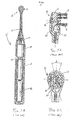
- a toothbrush 5 includes a handle portion 10 at a proximal end of toothbrush 5 and a head 11 at a distal end of toothbrush 5.
- Handle portion 10 has compartments for containing a powered motor 14 and batteries 15 and 16.
- Head 11 includes a generally circular bristle holder (carrier) 13.
- a rotatable shaft 12 extends from the motor 14 to head 11.
- a shaft coupling 17 may be located along the shaft 12 and configured to provide for the shaft 12 to be separated at a point between the motor 14 and head 11. This permits the shaft to be removed from toothbrush 5, e. g. , for cleaning, servicing, or replacement.
- the offset 20 and slot 22 are configured so as to be oriented toward the intersection of the shaft 12 axis and the longitudinal axis of the post 18.
- the motion of the offset 20 defines a circle about the shaft 12 axis and drivingly engages slot 22 such that the bristle holder 13 vibrates or oscillates about the post 18 axis through a rotational angle A.
- the rotational angle A is defined by the displacement of the offset 20 from the shaft 12 axis relative to the diameter of the bristle holder 13.
- powered toothbrushes such as those described immediately above provide advantages over manual toothbrushes, they are subject to various limitations.
- these batteries have been provided as a pair of batteries positioned one on top of the other in a coaxial relationship. While this configuration results in a thin handle portion, the handle portion may become unduly long, thus making it difficult for a user to handle the toothbrush.
- a powered toothbrush includes a handle portion at a proximal end and either a fixed head or a linkage for receiving a removable head at a distal end thereof.
- a pair of batteries are preferably positioned at approximately + or - 45° relative to a plane positioned perpendicularly to the face of the bristle carrier. This offset positioning of the pair of batteries allows for a more user-friendly handle design, including twists of the handle and other easy to grip portions without substantially increasing the size or weight of the toothbrush.
- the invention accordingly comprises the several steps and the relation of one or more of such steps with respect to each of the others, and the apparatus embodying features of construction, combination(s) of elements and arrangement of parts that are adapted to effect such steps, all as exemplified in the following detailed disclosure, and the scope of the invention will be indicated in the claims.
- Toothbrush 100 includes a handle (not shown) at a proximal end thereof that defines an interior compartment (not illustrated) for housing various toothbrush components.
- the interior compartment of the handle typically houses, in addition to other components, a power source.
- This power source typically comprises two standard size batteries.
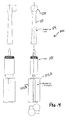
- the interior of the toothbrush constructed in accordance with the invention includes at least a motor and a pair of batteries 102A and 102B.
- Toothbrush 100 further comprises a brush section 104 that is defined by a neck 110 that terminates in a head 120 at a distal end of toothbrush 100.
- FIG. 6 Such a handle configuration is depicted in figure 6 .
- the battery configuration of figure 3 is utilized wherein the batteries are provided at a 45° angle relative to a plane positioned perpendicular to the face of the toothbrush head.
- a protruding portion 612 of handle 610 follows the general shape of the batteries housed within handle portion 610.
- Recessed portion 614 is recessed relative to protruding portion 612, also based upon the positioning of the batteries inside the handle.
- a curved surface 615 separates the two, and preferably forms a guide point to be held by the hand of a user.
- a control button 616 is also provided.
- handle 102 and neck 110 are merely exemplary in nature and handle 102 and/or neck 110 can be formed to have any number of shapes in accordance with the offset positioning of batteries 102A and 102B to therefore provide a toothbrush that is easily gripped and held and easily manipulated by the user.
- handle 102 may also include slightly recessed finger sections formed on opposite sides of handle 102.
- One recessed finger section may be designed to receive the thumb of one hand and the other recessed finger section may be designed to receive one or more other fingers of the same hand to thereby further assist the user in proper placement of the toothbrush in the user's hand.
- One or more of recessed finger sections may include ribs or another type of roughened surface to assist the user in gripping the toothbrush at the recessed finger sections.
- the tooth care elements When the tooth care elements are in the form of elastomeric members, they can be made from any number of suitable elastomeric materials, such as a block copolymer.
- suitable elastomeric materials such as a block copolymer.
- Preferred block copolymers include styrenes (for example styrene ethylene butadiene styrene, or styrene butadiene styrene), polyolefins (for example polypropylene/ethylene propylene diamine modified systems (i. e. synthetic rubber)), polyamides (for example polyamide (2 or polyamide 6), polyesters (for example polyester ester or polyether ester), polyurethanes (for, example polyesterurethane, polyetherurethane or polyesteretherurethane).
- styrenes for example styrene ethylene butadiene styrene, or styrene butadiene styrene
Landscapes
- Health & Medical Sciences (AREA)
- Dentistry (AREA)
- General Health & Medical Sciences (AREA)
- Epidemiology (AREA)
- Life Sciences & Earth Sciences (AREA)
- Animal Behavior & Ethology (AREA)
- Public Health (AREA)
- Veterinary Medicine (AREA)
- Brushes (AREA)
Abstract
a head having a movable carrier operatively connected to a drive member; and
a handle coupled to the head, the handle comprising:
a first end coupled to the head;
a second end disposed substantially opposite to the first end;
a protruding portion;
a recessed portion being recessed relative to the protruding portion; and
a curved surface separating the protruding portion and the recessed portion.
Description
- The present invention relates to powered toothbrushes, and more particularly, to a toothbrush having a unique handle and a unique relative positioning of conventional batteries to provide a more comfortable and easier to grip handle resulting in additional oral health benefits to the user.
- Toothbrushes provide many oral hygiene benefits. For example, toothbrushes remove plaque and food debris to help avoid tooth decay and disease. They remove stained pellicle from the surface of each tooth to help whiten the teeth. Also, the bristles combined with the brushing motion massage the gingival tissue for stimulation and increased health of the tissue.
- Powered toothbrushes have been available for some time. Powered toothbrushes have advantages over manual (non-powered) toothbrushes in that they impart movement to the bristles at much higher speeds than possible manually. They also may impart different types and directions of motion. These motions, generally in combination with manual movement of toothbrush by the user, provide superior cleaning than manual toothbrushes. Typically, powered toothbrushes are powered by disposable or rechargeable batteries that power an electric motor that in turn drives toothbrush head.
- Known powered toothbrushes include a brush head with a bristle carrier portion that rotates, oscillates or vibrates in some manner so as to clean the teeth. The bristles, which typically comprise bristle tufts, are generally uniform with one end fixed into the bristle carrier portion and the other end free to contact the surface of the teeth while brushing. The free ends of the various tufts present a surface envelope that is capable of some deformation when the bristles bend. When in contact with the surface to be brushed, the bristles may deform so that the surface envelope tends to conform to the complex surface of the teeth. Human teeth generally lie in a" C" shaped curve within the upper and lower jaw, and each row of teeth consequently has a convex outer curve and a concave inner curve. Individual teeth often have extremely complex surfaces, with areas that may be flat, concave, or convex. The more precise conformation between the bristles and the tooth surface, the more effective toothbrush may be in cleaning, whitening and/or stimulating.
- Known powered toothbrushes typically arrange the bristles in a compact conical or cylindrical pattern on a generally circular, disk-shaped bristle carrier. The powered toothbrush heads are traditionally compact, generally oval in shape and heads are produced with a flat trimmed bristle pattern. Alternatively, other head shapes and bristle patterns are available.
- One example of a powered toothbrush is depicted in
U. S. Patent 5,625,916 to McDougall , which is hereby incorporated by reference in its entirety. Toothbrush shown in McDougall has a disc-shaped bristle carrier. The bristle carrier, and thus the bristles, are driven in a vibrating or oscillating manner. This type of toothbrush is described herein with reference toFigures 1A-1C . A toothbrush 5 includes ahandle portion 10 at a proximal end of toothbrush 5 and ahead 11 at a distal end of toothbrush 5.Handle portion 10 has compartments for containing a poweredmotor 14 andbatteries Head 11 includes a generally circular bristle holder (carrier) 13. Arotatable shaft 12 extends from themotor 14 tohead 11. A shaft coupling 17 may be located along theshaft 12 and configured to provide for theshaft 12 to be separated at a point between themotor 14 andhead 11. This permits the shaft to be removed from toothbrush 5, e. g. , for cleaning, servicing, or replacement. -
Head 11 includes apost 18 that provides a rotational pivot axis for thebristle holder 13 containingbristle tufts 19. The distal end of theshaft 12 has a journal oroffset 20 that is radially displaced from the longitudinal axis of theshaft 12, which may be integrally formed therewith. Thebristle holder 13 has aslot 22 that receives theoffset 20. - The
offset 20 andslot 22 are configured so as to be oriented toward the intersection of theshaft 12 axis and the longitudinal axis of thepost 18. When themotor 14 rotates theshaft 12, the motion of theoffset 20 defines a circle about theshaft 12 axis and drivingly engagesslot 22 such that thebristle holder 13 vibrates or oscillates about the post 18 axis through a rotational angle A. The rotational angle A is defined by the displacement of theoffset 20 from theshaft 12 axis relative to the diameter of thebristle holder 13. - Although powered toothbrushes such as those described immediately above provide advantages over manual toothbrushes, they are subject to various limitations.
- Providing sufficient power for the toothbrush to operate requires substantial battery power, and consequently size. Typically, these batteries have been provided as a pair of batteries positioned one on top of the other in a coaxial relationship. While this configuration results in a thin handle portion, the handle portion may become unduly long, thus making it difficult for a user to handle the toothbrush.
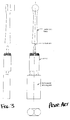
- One attempt to overcome the limitations associated with this battery configuration is to place the pair of batteries in the handle side by side, either along a plane positioned perpendicular to the face of the bristle carrier, or along a plane coplanar with the face of the bristle carrier. Such configurations are shown in
Figures 2 and3 , respectively. Such configurations, however, limit the ability to shape the handle into a shape that is comfortable to the user and assists in allowing the user to properly grip the handle of the toothbrush. Therefore, a toothbrush including such a restricted battery positioning limits the overall effectiveness of the toothbrush. - Thus, there is a need in the art for a powered toothbrush with a more advantageous handle structure to improve the overall effectiveness of such a toothbrush. There is further a need for such improved toothbrushes to be comparable in manufacturing and purchasing costs as known powered toothbrushes.
- A powered toothbrush is provided and includes a handle portion at a proximal end and either a fixed head or a linkage for receiving a removable head at a distal end thereof.
- A neck is further formed between the handle portion and the head. The head may include only one, or two distinct movable parts that each and together provide oral health benefits, each being adapted to have a number of bristles or elastomeric cleaning members extending therefrom adapted to contact surfaces of one or more teeth and surrounding areas. The powered toothbrush is further formed with a drive mechanism that imparts movement to the first movable part to deliver a cleaning, polishing, whitening action that supplements the cleaning efficiency of a typical powered toothbrush. The first movable part may in turn impart movement to the second movable part.
- Additionally, a pair of batteries are preferably positioned at approximately + or - 45° relative to a plane positioned perpendicularly to the face of the bristle carrier. This offset positioning of the pair of batteries allows for a more user-friendly handle design, including twists of the handle and other easy to grip portions without substantially increasing the size or weight of the toothbrush.
- Other features and advantages of the present invention will be apparent from the foregoing detailed description when read in conjunction with the accompanying drawings.
- The invention accordingly comprises the several steps and the relation of one or more of such steps with respect to each of the others, and the apparatus embodying features of construction, combination(s) of elements and arrangement of parts that are adapted to effect such steps, all as exemplified in the following detailed disclosure, and the scope of the invention will be indicated in the claims.
- For a more complete understanding of the invention, reference is made to the following description and accompanying drawings, in which:
-
Figure 1A is a front partial cross-sectional view of a conventional powered toothbrush including a head; -
Figure 1B is a partial side cross-sectional view of the toothbrush head ofFigure 1A ; -
Figure 1C is a partial front cross-sectional view of the toothbrush head ofFigure 1A ; -
Figure 2 is a front and side exploded elevational view and bottom plan view of a conventional powered toothbrush depicting a pair of batteries positioned along a plane perpendicular to a face of a bristle carrier; -
Figure 3 is a front and side exploded elevational view and bottom plan view of a conventional powered toothbrush depicting a pair of batteries positioned along a plane coplanar with a face of a bristle carrier; -
Figure 4 is a front and side exploded elevational view and bottom plan view of a powered toothbrush having its batteries positioned at approximately 45° relative to a plane positioned perpendicularly to the face of the bristle carrier constructed in accordance with the invention; -
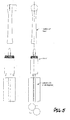
Figure 5 is a front and side exploded elevational view and bottom plan view of a powered toothbrush having its batteries positioned at approximately -45° relative to a plane positioned perpendicularly to the face of the bristle carrier constructed in accordance with the invention; -
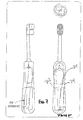
Figure 6 is a perspective view of a twisted form handle made possible by, and constructed in accordance with the invention; and -
Figure 7 is a front and side elevational view of a powered toothbrush constructed with a twisted form handle made possible by, and constructed in accordance with the invention; - Referring first to
Figure 4 , an exemplary powered toothbrush according to a first embodiment of the invention is illustrated and generally indicated at 100.Toothbrush 100 includes a handle (not shown) at a proximal end thereof that defines an interior compartment (not illustrated) for housing various toothbrush components. The interior compartment of the handle typically houses, in addition to other components, a power source. This power source typically comprises two standard size batteries. Thus, the size and shape of the handle has traditionally been limited by the required power. The interior of the toothbrush constructed in accordance with the invention includes at least a motor and a pair ofbatteries Toothbrush 100 further comprises abrush section 104 that is defined by a neck 110 that terminates in ahead 120 at a distal end oftoothbrush 100. - In accordance with the invention, the pair of
batteries figure 4 , these batteries are provided at a 45° angle relative to a plane positioned perpendicular to the face ofhead 120. In such a configuration, as will be explained below, the battery positioning produces a natural shape to a handle that is advantageous for a user to hold. The batteries may similarly be provided at a -45° angle relative to a plane positioned perpendicular to the face ofhead 120, thereby resulting in a natural shape of a different configuration from that offigure 3 . Furthermore, while approximately a + or- 45° offset is shown, other offsets may be utilized that provide desirable configurations of the handle portion of the powered toothbrush. - Such a handle configuration is depicted in
figure 6 . Infigure 6 , the battery configuration offigure 3 is utilized wherein the batteries are provided at a 45° angle relative to a plane positioned perpendicular to the face of the toothbrush head. Thus, as is shown, a protrudingportion 612 ofhandle 610 follows the general shape of the batteries housed withinhandle portion 610. Recessedportion 614 is recessed relative to protrudingportion 612, also based upon the positioning of the batteries inside the handle. Acurved surface 615 separates the two, and preferably forms a guide point to be held by the hand of a user. Acontrol button 616 is also provided. As is further shown, when a hand 620 of a user holdshandle 610, the positioning ofportions surface 615 allow for an easy to hold handle, andpreferable position head 120 of the powered toothbrush to easily line up with the user's teeth 622 without requiring the twisting of the wrist or forearm of the user. Thus, a sure grip and increased comfort may be provided. -
Figure 7 shows an embodiment of the invention having a pair of batteries provided at a -45° angle relative to a plane positioned perpendicular to the face of the toothbrush head. As compared tofigure 6 , this toothbrush configuration might be provided for a user preferring to hold his or her hand for brushing at a different angle. Because of the positioning ofbatteries portion 712 allows for the user's hand to be positioned further away from the head of the toothbrush. Recessedportion 714 is defined bysurface 715 and provides an appropriate position for the user to rest his or her hand. - It will further be appreciated that the illustrated shapes of handle 102 and neck 110 are merely exemplary in nature and handle 102 and/or neck 110 can be formed to have any number of shapes in accordance with the offset positioning of
batteries - The toothbrush according to the various embodiments disclosed herein can be made from any number of materials that are suitable for use in oral care products, such as toothbrushes, etc. For example, many of the components that are included in toothbrush are formed of plastic materials. Accordingly, the handle and head of the powered toothbrush may be molded from polyolefins such as polypropylenes and polyethylenes, polyamids such as nylons, and polyesters such as polyethylene terephthalate. Other suitable materials include polymethylmethacrylate, styrene acroylonitrate and cellulose esters, for example cellulose propionate.
- When the tooth care elements are in the form of tufts of bristles, the bristles of can be made from a flexible material suitable for dental hygiene. Generally, materials suitable for bristles are polyamides such as nylon or polyesters such as polybutylene terephthalate.
- When the tooth care elements are in the form of elastomeric members, they can be made from any number of suitable elastomeric materials, such as a block copolymer. Preferred block copolymers include styrenes (for example styrene ethylene butadiene styrene, or styrene butadiene styrene), polyolefins (for example polypropylene/ethylene propylene diamine modified systems (i. e. synthetic rubber)), polyamides (for example polyamide (2 or polyamide 6), polyesters (for example polyester ester or polyether ester), polyurethanes (for, example polyesterurethane, polyetherurethane or polyesteretherurethane).
- It will thus be seen that the objects set forth above, among those made apparent from the preceding description, are efficiently attained and, because certain changes may be made in carrying out the above method and in the construction(s) set forth without departing from the spirit and scope of the invention, it is intended that all matter contained in the above description and shown in the accompanying drawings shall be interpreted as illustrative and not in a limiting sense.
- It is also to be understood that the following claims are intended to cover all of the generic and specific features of the invention herein described and all statements of the scope of the invention which, as a matter of language, might be said to fall therebetween.
Claims (4)
- A powered toothbrush comprising:a head having a movable carrier operatively connected to a drive member; anda handle coupled to the head, the handle comprising:a first end coupled to the head;a second end disposed substantially opposite to the first end;a protruding portion (612);a recessed portion (614) being recessed relative to the protruding portion (612); anda curved surface (615) separating the protruding portion (612) and the recessed portion (614).
- The powered toothbrush of claim 1, wherein the curved surface (615) twists as it extends longitudinally along the handle.
- The powered toothbrush of claim 1, wherein the curved surface (615) substantially extends from the first end to the second end.
- The powered toothbrush of claim 1, wherein the recessed portion (614) is configured to receive a user's finger.
Applications Claiming Priority (2)
| Application Number | Priority Date | Filing Date | Title |
|---|---|---|---|
| US43410602P | 2002-12-17 | 2002-12-17 | |
| EP03814731A EP1583439A4 (en) | 2002-12-17 | 2003-12-12 | Power toothbrush with unique handle |
Related Parent Applications (2)
| Application Number | Title | Priority Date | Filing Date |
|---|---|---|---|
| EP03814731.0 Division | 2003-12-12 | ||
| EP03814731A Division EP1583439A4 (en) | 2002-12-17 | 2003-12-12 | Power toothbrush with unique handle |
Publications (3)
| Publication Number | Publication Date |
|---|---|
| EP2377422A2 true EP2377422A2 (en) | 2011-10-19 |
| EP2377422A3 EP2377422A3 (en) | 2011-12-28 |
| EP2377422B1 EP2377422B1 (en) | 2016-03-23 |
Family
ID=32713012
Family Applications (2)
| Application Number | Title | Priority Date | Filing Date |
|---|---|---|---|
| EP11172247.6A Expired - Lifetime EP2377422B1 (en) | 2002-12-17 | 2003-12-12 | Power toothbrush with unique handle |
| EP03814731A Withdrawn EP1583439A4 (en) | 2002-12-17 | 2003-12-12 | Power toothbrush with unique handle |
Family Applications After (1)
| Application Number | Title | Priority Date | Filing Date |
|---|---|---|---|
| EP03814731A Withdrawn EP1583439A4 (en) | 2002-12-17 | 2003-12-12 | Power toothbrush with unique handle |
Country Status (11)
| Country | Link |
|---|---|
| US (1) | US7254857B2 (en) |
| EP (2) | EP2377422B1 (en) |
| KR (1) | KR101000592B1 (en) |
| CN (1) | CN1725964B (en) |
| AU (1) | AU2003300875B2 (en) |
| BR (1) | BR0317419A (en) |
| CA (1) | CA2509726C (en) |
| CO (1) | CO5690521A2 (en) |
| MX (1) | MXPA05006554A (en) |
| RU (1) | RU2329009C2 (en) |
| WO (1) | WO2004060110A1 (en) |
Families Citing this family (10)
| Publication number | Priority date | Publication date | Assignee | Title |
|---|---|---|---|---|
| US7845041B2 (en) | 2005-05-03 | 2010-12-07 | Colgate-Palmolive Company | Interactive musical toothbrush |
| US8225449B2 (en) | 2005-05-03 | 2012-07-24 | Colgate-Palmolive Company | Interactive toothbrush |
| EP2282653B1 (en) | 2008-05-07 | 2017-10-04 | Colgate-Palmolive Company | Interactive toothbrush and removeable audio output module |
| US20100186234A1 (en) | 2009-01-28 | 2010-07-29 | Yehuda Binder | Electric shaver with imaging capability |
| EP2305168A1 (en) | 2009-09-30 | 2011-04-06 | Braun GmbH | Toothbrush |
| USD691375S1 (en) | 2010-04-30 | 2013-10-15 | Braun Gmbh | Electric toothbrush handle |
| USD658382S1 (en) | 2010-04-30 | 2012-05-01 | Braun Gmbh | Electric toothbrush handle |
| US8732890B2 (en) * | 2010-11-22 | 2014-05-27 | Braun Gmbh | Toothbrush |
| USD773192S1 (en) | 2015-01-09 | 2016-12-06 | Ranir, Llc | Powered toothbrush handle |
| USD876102S1 (en) * | 2018-03-01 | 2020-02-25 | HCT Group Holdings Limited | Twisted conical brush handle |
Citations (1)
| Publication number | Priority date | Publication date | Assignee | Title |
|---|---|---|---|---|
| US5625916A (en) | 1995-05-24 | 1997-05-06 | Mcdougall; Greg | Toothbrush |
Family Cites Families (15)
| Publication number | Priority date | Publication date | Assignee | Title |
|---|---|---|---|---|
| US4672706A (en) * | 1985-12-27 | 1987-06-16 | Stratford Laboratories | Toothbrush |
| US4983080A (en) * | 1987-08-05 | 1991-01-08 | Black & Decker, Inc. | Push-button controlled apparatus for releasably storing a tool bit |
| US4827552A (en) * | 1988-03-14 | 1989-05-09 | Better Health Concepts, Inc. | Rotary electric toothbrush |
| SU1674789A1 (en) * | 1989-05-29 | 1991-09-07 | Azaryan Karen P | Electromechanical tooth-brush |
| US5358939A (en) * | 1992-06-25 | 1994-10-25 | Rohm And Haas Company | Fungicidal 2-aryl-2,2-disubstituted ethyl-1,2,4-triazoles |
| US5301381A (en) * | 1992-12-07 | 1994-04-12 | Klupt Michael F | Toothbrush system |
| GR1002012B (en) * | 1993-02-16 | 1995-10-30 | Johnson & Johnson Consumer | Self-standing toothbrush |
| US5341534A (en) * | 1993-06-21 | 1994-08-30 | Teledyne Industries, Inc. | Electric toothbrush |
| US5381576A (en) | 1994-03-17 | 1995-01-17 | Hwang; Dong W. | Electrical toothbrush |
| CA2190147C (en) * | 1994-06-06 | 1999-07-06 | Adam B. Craft | High frequency electric toothbrush |
| US6178579B1 (en) * | 1998-09-30 | 2001-01-30 | Dr. Johns Products, Ltd. | Electric toothbrush |
| US6202242B1 (en) * | 1999-01-29 | 2001-03-20 | Zephyr Design, Inc. | Light emitting electric toothbrush |
| US6292973B1 (en) * | 1999-04-29 | 2001-09-25 | Robert Moskovich | Toothbrush having controlled head movement |
| US6920659B2 (en) * | 2001-01-12 | 2005-07-26 | Water Pik, Inc. | Toothbrush |
| USD459087S1 (en) * | 2001-11-02 | 2002-06-25 | Anthony L. Pfleger | Toothbrush |
-
2003
- 2003-12-12 MX MXPA05006554A patent/MXPA05006554A/en active IP Right Grant
- 2003-12-12 BR BR0317419-0A patent/BR0317419A/en not_active IP Right Cessation
- 2003-12-12 WO PCT/US2003/039540 patent/WO2004060110A1/en not_active Ceased
- 2003-12-12 EP EP11172247.6A patent/EP2377422B1/en not_active Expired - Lifetime
- 2003-12-12 RU RU2005122487/12A patent/RU2329009C2/en not_active IP Right Cessation
- 2003-12-12 KR KR1020057011354A patent/KR101000592B1/en not_active Expired - Fee Related
- 2003-12-12 EP EP03814731A patent/EP1583439A4/en not_active Withdrawn
- 2003-12-12 AU AU2003300875A patent/AU2003300875B2/en not_active Ceased
- 2003-12-12 CN CN2003801062414A patent/CN1725964B/en not_active Expired - Fee Related
- 2003-12-12 CA CA2509726A patent/CA2509726C/en not_active Expired - Fee Related
-
2005
- 2005-06-17 US US11/155,858 patent/US7254857B2/en not_active Expired - Fee Related
- 2005-06-23 CO CO05061799A patent/CO5690521A2/en active IP Right Grant
Patent Citations (1)
| Publication number | Priority date | Publication date | Assignee | Title |
|---|---|---|---|---|
| US5625916A (en) | 1995-05-24 | 1997-05-06 | Mcdougall; Greg | Toothbrush |
Also Published As
| Publication number | Publication date |
|---|---|
| RU2005122487A (en) | 2006-01-20 |
| CN1725964B (en) | 2012-01-11 |
| US7254857B2 (en) | 2007-08-14 |
| CA2509726C (en) | 2011-12-06 |
| EP2377422A3 (en) | 2011-12-28 |
| US20050283929A1 (en) | 2005-12-29 |
| CN1725964A (en) | 2006-01-25 |
| RU2329009C2 (en) | 2008-07-20 |
| WO2004060110A1 (en) | 2004-07-22 |
| EP1583439A1 (en) | 2005-10-12 |
| KR20050089160A (en) | 2005-09-07 |
| MXPA05006554A (en) | 2005-08-16 |
| EP2377422B1 (en) | 2016-03-23 |
| KR101000592B1 (en) | 2010-12-10 |
| CA2509726A1 (en) | 2004-07-22 |
| AU2003300875A1 (en) | 2004-07-29 |
| BR0317419A (en) | 2005-11-08 |
| EP1583439A4 (en) | 2011-02-23 |
| AU2003300875B2 (en) | 2010-03-18 |
| CO5690521A2 (en) | 2006-10-31 |
Similar Documents
| Publication | Publication Date | Title |
|---|---|---|
| US6966093B2 (en) | Toothbrush having a movable upstanding cleaning element | |
| US7137163B2 (en) | Power toothbrush and power source | |
| US6813793B2 (en) | Toothbrush with linear and rotary fields | |
| US7185383B2 (en) | Brush section for a powered toothbrush | |
| US7140058B2 (en) | Toothbrush with kinetic plate | |
| US7117555B2 (en) | Toothbrush with movable head sections for enhanced oral care | |
| US7210184B2 (en) | Powered toothbrush | |
| EP2377422B1 (en) | Power toothbrush with unique handle |
Legal Events
| Date | Code | Title | Description |
|---|---|---|---|
| AC | Divisional application: reference to earlier application |
Ref document number: 1583439 Country of ref document: EP Kind code of ref document: P |
|
| AK | Designated contracting states |
Kind code of ref document: A2 Designated state(s): AT BE BG CH CY CZ DE DK EE ES FI FR GB GR HU IE IT LI LU MC NL PT RO SE SI SK TR |
|
| AX | Request for extension of the european patent |
Extension state: AL LT LV MK |
|
| PUAI | Public reference made under article 153(3) epc to a published international application that has entered the european phase |
Free format text: ORIGINAL CODE: 0009012 |
|
| PUAL | Search report despatched |
Free format text: ORIGINAL CODE: 0009013 |
|
| AK | Designated contracting states |
Kind code of ref document: A3 Designated state(s): AT BE BG CH CY CZ DE DK EE ES FI FR GB GR HU IE IT LI LU MC NL PT RO SE SI SK TR |
|
| AX | Request for extension of the european patent |
Extension state: AL LT LV MK |
|
| RIC1 | Information provided on ipc code assigned before grant |
Ipc: A46B 13/02 20060101AFI20111123BHEP Ipc: A61C 17/34 20060101ALI20111123BHEP Ipc: A46B 9/04 20060101ALI20111123BHEP Ipc: A61C 17/22 20060101ALI20111123BHEP Ipc: A46B 7/04 20060101ALI20111123BHEP |
|
| 17P | Request for examination filed |
Effective date: 20120625 |
|
| 17Q | First examination report despatched |
Effective date: 20141222 |
|
| GRAP | Despatch of communication of intention to grant a patent |
Free format text: ORIGINAL CODE: EPIDOSNIGR1 |
|
| INTG | Intention to grant announced |
Effective date: 20150915 |
|
| GRAS | Grant fee paid |
Free format text: ORIGINAL CODE: EPIDOSNIGR3 |
|
| GRAA | (expected) grant |
Free format text: ORIGINAL CODE: 0009210 |
|
| AC | Divisional application: reference to earlier application |
Ref document number: 1583439 Country of ref document: EP Kind code of ref document: P |
|
| AK | Designated contracting states |
Kind code of ref document: B1 Designated state(s): AT BE BG CH CY CZ DE DK EE ES FI FR GB GR HU IE IT LI LU MC NL PT RO SE SI SK TR |
|
| REG | Reference to a national code |
Ref country code: GB Ref legal event code: FG4D |
|
| REG | Reference to a national code |
Ref country code: CH Ref legal event code: EP |
|
| REG | Reference to a national code |
Ref country code: AT Ref legal event code: REF Ref document number: 782245 Country of ref document: AT Kind code of ref document: T Effective date: 20160415 |
|
| REG | Reference to a national code |
Ref country code: IE Ref legal event code: FG4D |
|
| REG | Reference to a national code |
Ref country code: DE Ref legal event code: R096 Ref document number: 60348729 Country of ref document: DE |
|
| REG | Reference to a national code |
Ref country code: NL Ref legal event code: MP Effective date: 20160323 |
|
| PG25 | Lapsed in a contracting state [announced via postgrant information from national office to epo] |
Ref country code: GR Free format text: LAPSE BECAUSE OF FAILURE TO SUBMIT A TRANSLATION OF THE DESCRIPTION OR TO PAY THE FEE WITHIN THE PRESCRIBED TIME-LIMIT Effective date: 20160624 Ref country code: FI Free format text: LAPSE BECAUSE OF FAILURE TO SUBMIT A TRANSLATION OF THE DESCRIPTION OR TO PAY THE FEE WITHIN THE PRESCRIBED TIME-LIMIT Effective date: 20160323 |
|
| REG | Reference to a national code |
Ref country code: AT Ref legal event code: MK05 Ref document number: 782245 Country of ref document: AT Kind code of ref document: T Effective date: 20160323 |
|
| PG25 | Lapsed in a contracting state [announced via postgrant information from national office to epo] |
Ref country code: NL Free format text: LAPSE BECAUSE OF FAILURE TO SUBMIT A TRANSLATION OF THE DESCRIPTION OR TO PAY THE FEE WITHIN THE PRESCRIBED TIME-LIMIT Effective date: 20160323 Ref country code: SE Free format text: LAPSE BECAUSE OF FAILURE TO SUBMIT A TRANSLATION OF THE DESCRIPTION OR TO PAY THE FEE WITHIN THE PRESCRIBED TIME-LIMIT Effective date: 20160323 |
|
| PG25 | Lapsed in a contracting state [announced via postgrant information from national office to epo] |
Ref country code: EE Free format text: LAPSE BECAUSE OF FAILURE TO SUBMIT A TRANSLATION OF THE DESCRIPTION OR TO PAY THE FEE WITHIN THE PRESCRIBED TIME-LIMIT Effective date: 20160323 |
|
| PG25 | Lapsed in a contracting state [announced via postgrant information from national office to epo] |
Ref country code: ES Free format text: LAPSE BECAUSE OF FAILURE TO SUBMIT A TRANSLATION OF THE DESCRIPTION OR TO PAY THE FEE WITHIN THE PRESCRIBED TIME-LIMIT Effective date: 20160323 Ref country code: AT Free format text: LAPSE BECAUSE OF FAILURE TO SUBMIT A TRANSLATION OF THE DESCRIPTION OR TO PAY THE FEE WITHIN THE PRESCRIBED TIME-LIMIT Effective date: 20160323 Ref country code: CZ Free format text: LAPSE BECAUSE OF FAILURE TO SUBMIT A TRANSLATION OF THE DESCRIPTION OR TO PAY THE FEE WITHIN THE PRESCRIBED TIME-LIMIT Effective date: 20160323 Ref country code: RO Free format text: LAPSE BECAUSE OF FAILURE TO SUBMIT A TRANSLATION OF THE DESCRIPTION OR TO PAY THE FEE WITHIN THE PRESCRIBED TIME-LIMIT Effective date: 20160323 Ref country code: SK Free format text: LAPSE BECAUSE OF FAILURE TO SUBMIT A TRANSLATION OF THE DESCRIPTION OR TO PAY THE FEE WITHIN THE PRESCRIBED TIME-LIMIT Effective date: 20160323 Ref country code: PT Free format text: LAPSE BECAUSE OF FAILURE TO SUBMIT A TRANSLATION OF THE DESCRIPTION OR TO PAY THE FEE WITHIN THE PRESCRIBED TIME-LIMIT Effective date: 20160725 |
|
| REG | Reference to a national code |
Ref country code: FR Ref legal event code: PLFP Year of fee payment: 14 |
|
| PG25 | Lapsed in a contracting state [announced via postgrant information from national office to epo] |
Ref country code: BE Free format text: LAPSE BECAUSE OF FAILURE TO SUBMIT A TRANSLATION OF THE DESCRIPTION OR TO PAY THE FEE WITHIN THE PRESCRIBED TIME-LIMIT Effective date: 20160323 Ref country code: IT Free format text: LAPSE BECAUSE OF FAILURE TO SUBMIT A TRANSLATION OF THE DESCRIPTION OR TO PAY THE FEE WITHIN THE PRESCRIBED TIME-LIMIT Effective date: 20160323 |
|
| REG | Reference to a national code |
Ref country code: DE Ref legal event code: R097 Ref document number: 60348729 Country of ref document: DE |
|
| PLBE | No opposition filed within time limit |
Free format text: ORIGINAL CODE: 0009261 |
|
| STAA | Information on the status of an ep patent application or granted ep patent |
Free format text: STATUS: NO OPPOSITION FILED WITHIN TIME LIMIT |
|
| PG25 | Lapsed in a contracting state [announced via postgrant information from national office to epo] |
Ref country code: DK Free format text: LAPSE BECAUSE OF FAILURE TO SUBMIT A TRANSLATION OF THE DESCRIPTION OR TO PAY THE FEE WITHIN THE PRESCRIBED TIME-LIMIT Effective date: 20160323 |
|
| PGFP | Annual fee paid to national office [announced via postgrant information from national office to epo] |
Ref country code: GB Payment date: 20161228 Year of fee payment: 14 Ref country code: CH Payment date: 20161227 Year of fee payment: 14 |
|
| PG25 | Lapsed in a contracting state [announced via postgrant information from national office to epo] |
Ref country code: BG Free format text: LAPSE BECAUSE OF FAILURE TO SUBMIT A TRANSLATION OF THE DESCRIPTION OR TO PAY THE FEE WITHIN THE PRESCRIBED TIME-LIMIT Effective date: 20160623 |
|
| PGFP | Annual fee paid to national office [announced via postgrant information from national office to epo] |
Ref country code: FR Payment date: 20161227 Year of fee payment: 14 |
|
| 26N | No opposition filed |
Effective date: 20170102 |
|
| PGFP | Annual fee paid to national office [announced via postgrant information from national office to epo] |
Ref country code: DE Payment date: 20161229 Year of fee payment: 14 |
|
| PG25 | Lapsed in a contracting state [announced via postgrant information from national office to epo] |
Ref country code: SI Free format text: LAPSE BECAUSE OF FAILURE TO SUBMIT A TRANSLATION OF THE DESCRIPTION OR TO PAY THE FEE WITHIN THE PRESCRIBED TIME-LIMIT Effective date: 20160323 |
|
| PG25 | Lapsed in a contracting state [announced via postgrant information from national office to epo] |
Ref country code: MC Free format text: LAPSE BECAUSE OF FAILURE TO SUBMIT A TRANSLATION OF THE DESCRIPTION OR TO PAY THE FEE WITHIN THE PRESCRIBED TIME-LIMIT Effective date: 20160323 |
|
| REG | Reference to a national code |
Ref country code: IE Ref legal event code: MM4A |
|
| PG25 | Lapsed in a contracting state [announced via postgrant information from national office to epo] |
Ref country code: LU Free format text: LAPSE BECAUSE OF NON-PAYMENT OF DUE FEES Effective date: 20161212 |
|
| PG25 | Lapsed in a contracting state [announced via postgrant information from national office to epo] |
Ref country code: IE Free format text: LAPSE BECAUSE OF NON-PAYMENT OF DUE FEES Effective date: 20161212 |
|
| PG25 | Lapsed in a contracting state [announced via postgrant information from national office to epo] |
Ref country code: CY Free format text: LAPSE BECAUSE OF FAILURE TO SUBMIT A TRANSLATION OF THE DESCRIPTION OR TO PAY THE FEE WITHIN THE PRESCRIBED TIME-LIMIT Effective date: 20160323 Ref country code: HU Free format text: LAPSE BECAUSE OF FAILURE TO SUBMIT A TRANSLATION OF THE DESCRIPTION OR TO PAY THE FEE WITHIN THE PRESCRIBED TIME-LIMIT; INVALID AB INITIO Effective date: 20031212 |
|
| PG25 | Lapsed in a contracting state [announced via postgrant information from national office to epo] |
Ref country code: TR Free format text: LAPSE BECAUSE OF FAILURE TO SUBMIT A TRANSLATION OF THE DESCRIPTION OR TO PAY THE FEE WITHIN THE PRESCRIBED TIME-LIMIT Effective date: 20160323 |
|
| REG | Reference to a national code |
Ref country code: DE Ref legal event code: R119 Ref document number: 60348729 Country of ref document: DE |
|
| REG | Reference to a national code |
Ref country code: CH Ref legal event code: PL |
|
| GBPC | Gb: european patent ceased through non-payment of renewal fee |
Effective date: 20171212 |
|
| REG | Reference to a national code |
Ref country code: FR Ref legal event code: ST Effective date: 20180831 |
|
| PG25 | Lapsed in a contracting state [announced via postgrant information from national office to epo] |
Ref country code: DE Free format text: LAPSE BECAUSE OF NON-PAYMENT OF DUE FEES Effective date: 20180703 Ref country code: FR Free format text: LAPSE BECAUSE OF NON-PAYMENT OF DUE FEES Effective date: 20180102 |
|
| PG25 | Lapsed in a contracting state [announced via postgrant information from national office to epo] |
Ref country code: CH Free format text: LAPSE BECAUSE OF NON-PAYMENT OF DUE FEES Effective date: 20171231 Ref country code: GB Free format text: LAPSE BECAUSE OF NON-PAYMENT OF DUE FEES Effective date: 20171212 Ref country code: LI Free format text: LAPSE BECAUSE OF NON-PAYMENT OF DUE FEES Effective date: 20171231 |