EP2376908B1 - Simulation of normal fresh blood platelets - Google Patents
Simulation of normal fresh blood platelets Download PDFInfo
- Publication number
- EP2376908B1 EP2376908B1 EP10731986.5A EP10731986A EP2376908B1 EP 2376908 B1 EP2376908 B1 EP 2376908B1 EP 10731986 A EP10731986 A EP 10731986A EP 2376908 B1 EP2376908 B1 EP 2376908B1
- Authority
- EP
- European Patent Office
- Prior art keywords
- cells
- naphthol
- heating
- days
- concentration
- Prior art date
- Legal status (The legal status is an assumption and is not a legal conclusion. Google has not performed a legal analysis and makes no representation as to the accuracy of the status listed.)
- Not-in-force
Links
- 210000001772 blood platelet Anatomy 0.000 title claims description 85
- 238000004088 simulation Methods 0.000 title 1
- KJCVRFUGPWSIIH-UHFFFAOYSA-N 1-naphthol Chemical group C1=CC=C2C(O)=CC=CC2=C1 KJCVRFUGPWSIIH-UHFFFAOYSA-N 0.000 claims description 91
- 210000004027 cell Anatomy 0.000 claims description 78
- 210000003743 erythrocyte Anatomy 0.000 claims description 58
- 238000010438 heat treatment Methods 0.000 claims description 53
- 238000000034 method Methods 0.000 claims description 49
- 239000003795 chemical substances by application Substances 0.000 claims description 38
- 230000008569 process Effects 0.000 claims description 29
- 241000283707 Capra Species 0.000 claims description 15
- SXRSQZLOMIGNAQ-UHFFFAOYSA-N Glutaraldehyde Chemical group O=CCCCC=O SXRSQZLOMIGNAQ-UHFFFAOYSA-N 0.000 claims description 12
- 239000012530 fluid Substances 0.000 claims description 12
- 210000000601 blood cell Anatomy 0.000 claims description 7
- 230000001413 cellular effect Effects 0.000 claims description 7
- 238000004519 manufacturing process Methods 0.000 claims description 5
- 239000013643 reference control Substances 0.000 claims description 5
- 238000000605 extraction Methods 0.000 claims description 4
- 230000003287 optical effect Effects 0.000 description 29
- 235000002639 sodium chloride Nutrition 0.000 description 24
- 238000009826 distribution Methods 0.000 description 20
- 239000000243 solution Substances 0.000 description 20
- 210000004369 blood Anatomy 0.000 description 18
- 239000008280 blood Substances 0.000 description 18
- 239000012528 membrane Substances 0.000 description 18
- 230000000694 effects Effects 0.000 description 15
- 150000003839 salts Chemical class 0.000 description 14
- 239000002245 particle Substances 0.000 description 13
- 238000011282 treatment Methods 0.000 description 12
- 239000000725 suspension Substances 0.000 description 10
- XLYOFNOQVPJJNP-UHFFFAOYSA-N water Substances O XLYOFNOQVPJJNP-UHFFFAOYSA-N 0.000 description 9
- FAPWRFPIFSIZLT-UHFFFAOYSA-M Sodium chloride Chemical compound [Na+].[Cl-] FAPWRFPIFSIZLT-UHFFFAOYSA-M 0.000 description 7
- 238000005259 measurement Methods 0.000 description 7
- 239000000203 mixture Substances 0.000 description 7
- DNIAPMSPPWPWGF-UHFFFAOYSA-N Propylene glycol Chemical compound CC(O)CO DNIAPMSPPWPWGF-UHFFFAOYSA-N 0.000 description 6
- 239000002253 acid Substances 0.000 description 6
- -1 alkali metal salts Chemical class 0.000 description 6
- 238000004458 analytical method Methods 0.000 description 6
- 238000002474 experimental method Methods 0.000 description 6
- 230000003204 osmotic effect Effects 0.000 description 6
- 238000001556 precipitation Methods 0.000 description 6
- 239000000126 substance Substances 0.000 description 6
- 206010018910 Haemolysis Diseases 0.000 description 5
- 229910052783 alkali metal Inorganic materials 0.000 description 5
- 239000002585 base Substances 0.000 description 5
- 125000003178 carboxy group Chemical group [H]OC(*)=O 0.000 description 5
- 210000000170 cell membrane Anatomy 0.000 description 5
- 238000005119 centrifugation Methods 0.000 description 5
- 239000012141 concentrate Substances 0.000 description 5
- 238000001514 detection method Methods 0.000 description 5
- 239000003085 diluting agent Substances 0.000 description 5
- 239000002270 dispersing agent Substances 0.000 description 5
- 230000008588 hemolysis Effects 0.000 description 5
- 229920002307 Dextran Polymers 0.000 description 4
- OFOBLEOULBTSOW-UHFFFAOYSA-N Malonic acid Chemical compound OC(=O)CC(O)=O OFOBLEOULBTSOW-UHFFFAOYSA-N 0.000 description 4
- 238000007792 addition Methods 0.000 description 4
- 239000008366 buffered solution Substances 0.000 description 4
- 239000003153 chemical reaction reagent Substances 0.000 description 4
- 230000002489 hematologic effect Effects 0.000 description 4
- 239000000819 hypertonic solution Substances 0.000 description 4
- 229940021223 hypertonic solution Drugs 0.000 description 4
- 150000004780 naphthols Chemical class 0.000 description 4
- 230000001376 precipitating effect Effects 0.000 description 4
- 238000002360 preparation method Methods 0.000 description 4
- 239000000047 product Substances 0.000 description 4
- 239000002994 raw material Substances 0.000 description 4
- 239000011780 sodium chloride Substances 0.000 description 4
- 238000003860 storage Methods 0.000 description 4
- 239000006228 supernatant Substances 0.000 description 4
- 150000004782 1-naphthols Chemical class 0.000 description 3
- UHOVQNZJYSORNB-UHFFFAOYSA-N Benzene Chemical compound C1=CC=CC=C1 UHOVQNZJYSORNB-UHFFFAOYSA-N 0.000 description 3
- WSFSSNUMVMOOMR-UHFFFAOYSA-N Formaldehyde Chemical compound O=C WSFSSNUMVMOOMR-UHFFFAOYSA-N 0.000 description 3
- MUBZPKHOEPUJKR-UHFFFAOYSA-N Oxalic acid Chemical compound OC(=O)C(O)=O MUBZPKHOEPUJKR-UHFFFAOYSA-N 0.000 description 3
- HEMHJVSKTPXQMS-UHFFFAOYSA-M Sodium hydroxide Chemical compound [OH-].[Na+] HEMHJVSKTPXQMS-UHFFFAOYSA-M 0.000 description 3
- 150000007513 acids Chemical class 0.000 description 3
- 150000001299 aldehydes Chemical class 0.000 description 3
- 239000000427 antigen Substances 0.000 description 3
- 102000036639 antigens Human genes 0.000 description 3
- 108091007433 antigens Proteins 0.000 description 3
- 239000000022 bacteriostatic agent Substances 0.000 description 3
- KCIDZIIHRGYJAE-YGFYJFDDSA-L dipotassium;[(2r,3r,4s,5r,6r)-3,4,5-trihydroxy-6-(hydroxymethyl)oxan-2-yl] phosphate Chemical class [K+].[K+].OC[C@H]1O[C@H](OP([O-])([O-])=O)[C@H](O)[C@@H](O)[C@H]1O KCIDZIIHRGYJAE-YGFYJFDDSA-L 0.000 description 3
- 238000009472 formulation Methods 0.000 description 3
- 229910052736 halogen Inorganic materials 0.000 description 3
- 150000002367 halogens Chemical class 0.000 description 3
- 210000000265 leukocyte Anatomy 0.000 description 3
- 239000000463 material Substances 0.000 description 3
- 238000012545 processing Methods 0.000 description 3
- 229910052594 sapphire Inorganic materials 0.000 description 3
- 239000010980 sapphire Substances 0.000 description 3
- 239000007858 starting material Substances 0.000 description 3
- 125000000020 sulfo group Chemical group O=S(=O)([*])O[H] 0.000 description 3
- 238000005406 washing Methods 0.000 description 3
- VOJUXHHACRXLTD-UHFFFAOYSA-N 1,4-dihydroxy-2-naphthoic acid Chemical compound C1=CC=CC2=C(O)C(C(=O)O)=CC(O)=C21 VOJUXHHACRXLTD-UHFFFAOYSA-N 0.000 description 2
- JWAZRIHNYRIHIV-UHFFFAOYSA-N 2-naphthol Chemical compound C1=CC=CC2=CC(O)=CC=C21 JWAZRIHNYRIHIV-UHFFFAOYSA-N 0.000 description 2
- QYFYIOWLBSPSDM-UHFFFAOYSA-N 6-aminonaphthalen-1-ol Chemical compound OC1=CC=CC2=CC(N)=CC=C21 QYFYIOWLBSPSDM-UHFFFAOYSA-N 0.000 description 2
- DOBIZWYVJFIYOV-UHFFFAOYSA-N 7-hydroxynaphthalene-1,3-disulfonic acid Chemical compound C1=C(S(O)(=O)=O)C=C(S(O)(=O)=O)C2=CC(O)=CC=C21 DOBIZWYVJFIYOV-UHFFFAOYSA-N 0.000 description 2
- QGZKDVFQNNGYKY-UHFFFAOYSA-N Ammonia Chemical compound N QGZKDVFQNNGYKY-UHFFFAOYSA-N 0.000 description 2
- QXNVGIXVLWOKEQ-UHFFFAOYSA-N Disodium Chemical class [Na][Na] QXNVGIXVLWOKEQ-UHFFFAOYSA-N 0.000 description 2
- 229910006069 SO3H Inorganic materials 0.000 description 2
- UIIMBOGNXHQVGW-UHFFFAOYSA-M Sodium bicarbonate Chemical group [Na+].OC([O-])=O UIIMBOGNXHQVGW-UHFFFAOYSA-M 0.000 description 2
- FEWJPZIEWOKRBE-UHFFFAOYSA-N Tartaric acid Natural products [H+].[H+].[O-]C(=O)C(O)C(O)C([O-])=O FEWJPZIEWOKRBE-UHFFFAOYSA-N 0.000 description 2
- 238000013019 agitation Methods 0.000 description 2
- 125000000217 alkyl group Chemical group 0.000 description 2
- 125000003118 aryl group Chemical group 0.000 description 2
- 238000006065 biodegradation reaction Methods 0.000 description 2
- 239000000872 buffer Substances 0.000 description 2
- 230000003139 buffering effect Effects 0.000 description 2
- 239000006285 cell suspension Substances 0.000 description 2
- 230000008859 change Effects 0.000 description 2
- 239000011248 coating agent Substances 0.000 description 2
- 238000000576 coating method Methods 0.000 description 2
- 230000003750 conditioning effect Effects 0.000 description 2
- 125000004093 cyano group Chemical group *C#N 0.000 description 2
- 238000010291 electrical method Methods 0.000 description 2
- 239000003792 electrolyte Substances 0.000 description 2
- 239000011521 glass Substances 0.000 description 2
- 125000000956 methoxy group Chemical group [H]C([H])([H])O* 0.000 description 2
- ZUVBIBLYOCVYJU-UHFFFAOYSA-N naphthalene-1,7-diol Chemical compound C1=CC=C(O)C2=CC(O)=CC=C21 ZUVBIBLYOCVYJU-UHFFFAOYSA-N 0.000 description 2
- 230000007935 neutral effect Effects 0.000 description 2
- 239000012266 salt solution Substances 0.000 description 2
- 235000002906 tartaric acid Nutrition 0.000 description 2
- 239000011975 tartaric acid Substances 0.000 description 2
- FFSZGCAJTTUCCU-UHFFFAOYSA-N 1,4-dihydroxy-5-nitronaphthalene-2,3-dicarbonitrile Chemical compound C1=CC=C2C(O)=C(C#N)C(C#N)=C(O)C2=C1[N+]([O-])=O FFSZGCAJTTUCCU-UHFFFAOYSA-N 0.000 description 1
- FRASJONUBLZVQX-UHFFFAOYSA-N 1,4-dioxonaphthalene Natural products C1=CC=C2C(=O)C=CC(=O)C2=C1 FRASJONUBLZVQX-UHFFFAOYSA-N 0.000 description 1
- BOKGTLAJQHTOKE-UHFFFAOYSA-N 1,5-dihydroxynaphthalene Chemical compound C1=CC=C2C(O)=CC=CC2=C1O BOKGTLAJQHTOKE-UHFFFAOYSA-N 0.000 description 1
- JBGJVMVWYWUVOW-UHFFFAOYSA-N 1-(1-hydroxynaphthalen-2-yl)ethanone Chemical compound C1=CC=CC2=C(O)C(C(=O)C)=CC=C21 JBGJVMVWYWUVOW-UHFFFAOYSA-N 0.000 description 1
- GBRKDGMBUKXXKR-UHFFFAOYSA-N 1-(3-butyl-1-hydroxynaphthalen-2-yl)ethanone Chemical compound C1=CC=C2C(O)=C(C(C)=O)C(CCCC)=CC2=C1 GBRKDGMBUKXXKR-UHFFFAOYSA-N 0.000 description 1
- OITQDWKMIPXGFL-UHFFFAOYSA-N 1-hydroxy-2-naphthaldehyde Chemical compound C1=CC=C2C(O)=C(C=O)C=CC2=C1 OITQDWKMIPXGFL-UHFFFAOYSA-N 0.000 description 1
- OTDVKOVLSPJORY-UHFFFAOYSA-N 1-hydroxy-4-sulfamoylnaphthalene-2-carboxylic acid Chemical compound C1=CC=C2C(S(=O)(=O)N)=CC(C(O)=O)=C(O)C2=C1 OTDVKOVLSPJORY-UHFFFAOYSA-N 0.000 description 1
- PWJNDVAKQLOWRZ-UHFFFAOYSA-N 1-hydroxynaphthalene-2-sulfonic acid Chemical compound C1=CC=C2C(O)=C(S(O)(=O)=O)C=CC2=C1 PWJNDVAKQLOWRZ-UHFFFAOYSA-N 0.000 description 1
- ODAJDDMWMREWGL-UHFFFAOYSA-N 2,3,4,5,6,7,8-heptafluoronaphthalen-1-ol Chemical compound FC1=C(F)C(F)=C2C(O)=C(F)C(F)=C(F)C2=C1F ODAJDDMWMREWGL-UHFFFAOYSA-N 0.000 description 1
- ZGOJPRKKFZXNKH-UHFFFAOYSA-N 2,4,6,8-tetranitronaphthalene-1,5-diol Chemical compound [O-][N+](=O)C1=CC([N+]([O-])=O)=C2C(O)=C([N+]([O-])=O)C=C([N+]([O-])=O)C2=C1O ZGOJPRKKFZXNKH-UHFFFAOYSA-N 0.000 description 1
- PSGUDVJPEWTBRM-UHFFFAOYSA-N 2,4-dibromonaphthalen-1-ol Chemical compound C1=CC=C2C(O)=C(Br)C=C(Br)C2=C1 PSGUDVJPEWTBRM-UHFFFAOYSA-N 0.000 description 1
- HVLJEMXDXOTWLV-UHFFFAOYSA-N 2,4-dichloronaphthalen-1-ol Chemical compound C1=CC=C2C(O)=C(Cl)C=C(Cl)C2=C1 HVLJEMXDXOTWLV-UHFFFAOYSA-N 0.000 description 1
- RTPYKCYMCNSAHB-UHFFFAOYSA-N 2,8-diaminonaphthalene-1,5-diol Chemical compound OC1=CC=C(N)C2=C(O)C(N)=CC=C21 RTPYKCYMCNSAHB-UHFFFAOYSA-N 0.000 description 1
- DABKXPDBJSTVCM-UHFFFAOYSA-N 2,8-dinitrosonaphthalene-1,5-diol Chemical compound O=NC1=CC=C2C(O)=CC=C(N=O)C2=C1O DABKXPDBJSTVCM-UHFFFAOYSA-N 0.000 description 1
- XUEIXZZGKCDNGZ-UHFFFAOYSA-N 2-(1,1,1,3,3,3-hexafluoro-2-hydroxypropan-2-yl)naphthalen-1-ol Chemical compound C1=CC=C2C(O)=C(C(O)(C(F)(F)F)C(F)(F)F)C=CC2=C1 XUEIXZZGKCDNGZ-UHFFFAOYSA-N 0.000 description 1
- AGUJUBACOOIWDV-UHFFFAOYSA-N 2-(1-hydroxynaphthalen-2-yl)naphthalen-1-ol Chemical compound C1=CC=CC2=C(O)C(C3=C(C4=CC=CC=C4C=C3)O)=CC=C21 AGUJUBACOOIWDV-UHFFFAOYSA-N 0.000 description 1
- HLFHQRSQVWQRJY-UHFFFAOYSA-N 2-[(4-methoxyanilino)methyl]phenol Chemical compound C1=CC(OC)=CC=C1NCC1=CC=CC=C1O HLFHQRSQVWQRJY-UHFFFAOYSA-N 0.000 description 1
- PEJOQASNBCUDMB-UHFFFAOYSA-N 2-aminonaphthalen-1-ol;hydrochloride Chemical compound [Cl-].C1=CC=CC2=C(O)C([NH3+])=CC=C21 PEJOQASNBCUDMB-UHFFFAOYSA-N 0.000 description 1
- PIYNJSHPUFMGLC-UHFFFAOYSA-N 2-chloronaphthalene-1,4-diol Chemical compound C1=CC=C2C(O)=CC(Cl)=C(O)C2=C1 PIYNJSHPUFMGLC-UHFFFAOYSA-N 0.000 description 1
- WHWCIQOXYOFFLF-UHFFFAOYSA-N 2-fluoronaphthalen-1-ol Chemical compound C1=CC=C2C(O)=C(F)C=CC2=C1 WHWCIQOXYOFFLF-UHFFFAOYSA-N 0.000 description 1
- MUCCHGOWMZTLHK-UHFFFAOYSA-N 2-nitronaphthalen-1-ol Chemical compound C1=CC=C2C(O)=C([N+]([O-])=O)C=CC2=C1 MUCCHGOWMZTLHK-UHFFFAOYSA-N 0.000 description 1
- YELLAPKUWRTITI-UHFFFAOYSA-N 3,5-dihydroxynaphthalene-2-carboxylic acid Chemical compound C1=CC(O)=C2C=C(O)C(C(=O)O)=CC2=C1 YELLAPKUWRTITI-UHFFFAOYSA-N 0.000 description 1
- USWINTIHFQKJTR-UHFFFAOYSA-N 3-hydroxynaphthalene-2,7-disulfonic acid Chemical compound C1=C(S(O)(=O)=O)C=C2C=C(S(O)(=O)=O)C(O)=CC2=C1 USWINTIHFQKJTR-UHFFFAOYSA-N 0.000 description 1
- MAPYOCUYNJWAJW-UHFFFAOYSA-N 3-phenylnaphthalen-1-ol Chemical compound C=1C2=CC=CC=C2C(O)=CC=1C1=CC=CC=C1 MAPYOCUYNJWAJW-UHFFFAOYSA-N 0.000 description 1
- BOTGCZBEERTTDQ-UHFFFAOYSA-N 4-Methoxy-1-naphthol Chemical compound C1=CC=C2C(OC)=CC=C(O)C2=C1 BOTGCZBEERTTDQ-UHFFFAOYSA-N 0.000 description 1
- QCQCHGYLTSGIGX-GHXANHINSA-N 4-[[(3ar,5ar,5br,7ar,9s,11ar,11br,13as)-5a,5b,8,8,11a-pentamethyl-3a-[(5-methylpyridine-3-carbonyl)amino]-2-oxo-1-propan-2-yl-4,5,6,7,7a,9,10,11,11b,12,13,13a-dodecahydro-3h-cyclopenta[a]chrysen-9-yl]oxy]-2,2-dimethyl-4-oxobutanoic acid Chemical compound N([C@@]12CC[C@@]3(C)[C@]4(C)CC[C@H]5C(C)(C)[C@@H](OC(=O)CC(C)(C)C(O)=O)CC[C@]5(C)[C@H]4CC[C@@H]3C1=C(C(C2)=O)C(C)C)C(=O)C1=CN=CC(C)=C1 QCQCHGYLTSGIGX-GHXANHINSA-N 0.000 description 1
- LRDIEHDJWYRVPT-UHFFFAOYSA-N 4-amino-5-hydroxynaphthalene-1-sulfonic acid Chemical compound C1=CC(O)=C2C(N)=CC=C(S(O)(=O)=O)C2=C1 LRDIEHDJWYRVPT-UHFFFAOYSA-N 0.000 description 1
- LVSPDZAGCBEQAV-UHFFFAOYSA-N 4-chloronaphthalen-1-ol Chemical compound C1=CC=C2C(O)=CC=C(Cl)C2=C1 LVSPDZAGCBEQAV-UHFFFAOYSA-N 0.000 description 1
- LORPDGZOLAPNHP-UHFFFAOYSA-N 4-hydroxynaphthalene-1-carbaldehyde Chemical compound C1=CC=C2C(O)=CC=C(C=O)C2=C1 LORPDGZOLAPNHP-UHFFFAOYSA-N 0.000 description 1
- HKWPUUYEGGDLJF-UHFFFAOYSA-N 4-hydroxynaphthalene-2-sulfonic acid Chemical compound C1=CC=C2C(O)=CC(S(O)(=O)=O)=CC2=C1 HKWPUUYEGGDLJF-UHFFFAOYSA-N 0.000 description 1
- FRCZUGOIGNQOID-UHFFFAOYSA-N 4-methoxynaphthalene-1-carbonitrile Chemical compound C1=CC=C2C(OC)=CC=C(C#N)C2=C1 FRCZUGOIGNQOID-UHFFFAOYSA-N 0.000 description 1
- AUIRNGLMBHIITH-UHFFFAOYSA-N 4-nitronaphthalen-1-ol Chemical compound C1=CC=C2C(O)=CC=C([N+]([O-])=O)C2=C1 AUIRNGLMBHIITH-UHFFFAOYSA-N 0.000 description 1
- ZBIBQNVRTVLOHQ-UHFFFAOYSA-N 5-aminonaphthalen-1-ol Chemical compound C1=CC=C2C(N)=CC=CC2=C1O ZBIBQNVRTVLOHQ-UHFFFAOYSA-N 0.000 description 1
- NFVBVKHGDDDCEA-UHFFFAOYSA-N 5-hydroxynaphthalene-1-sulfonamide Chemical compound C1=CC=C2C(S(=O)(=O)N)=CC=CC2=C1O NFVBVKHGDDDCEA-UHFFFAOYSA-N 0.000 description 1
- QEAYLNJEDDOYNQ-UHFFFAOYSA-N 6-anilino-4-hydroxynaphthalene-2-sulfonic acid Chemical compound C1=C2C(O)=CC(S(O)(=O)=O)=CC2=CC=C1NC1=CC=CC=C1 QEAYLNJEDDOYNQ-UHFFFAOYSA-N 0.000 description 1
- KYARBIJYVGJZLB-UHFFFAOYSA-N 7-amino-4-hydroxy-2-naphthalenesulfonic acid Chemical compound OC1=CC(S(O)(=O)=O)=CC2=CC(N)=CC=C21 KYARBIJYVGJZLB-UHFFFAOYSA-N 0.000 description 1
- GGZZISOUXJHYOY-UHFFFAOYSA-N 8-amino-4-hydroxynaphthalene-2-sulfonic acid Chemical compound C1=C(S(O)(=O)=O)C=C2C(N)=CC=CC2=C1O GGZZISOUXJHYOY-UHFFFAOYSA-N 0.000 description 1
- ZPLBZGGKAUXTRT-UHFFFAOYSA-N 8-hydroxynaphthalene-1-sulfonic acid Chemical compound C1=CC(S(O)(=O)=O)=C2C(O)=CC=CC2=C1 ZPLBZGGKAUXTRT-UHFFFAOYSA-N 0.000 description 1
- DZKIUEHLEXLYKM-UHFFFAOYSA-N 9-phenanthrol Chemical compound C1=CC=C2C(O)=CC3=CC=CC=C3C2=C1 DZKIUEHLEXLYKM-UHFFFAOYSA-N 0.000 description 1
- BVKZGUZCCUSVTD-UHFFFAOYSA-M Bicarbonate Chemical class OC([O-])=O BVKZGUZCCUSVTD-UHFFFAOYSA-M 0.000 description 1
- FEWJPZIEWOKRBE-JCYAYHJZSA-N Dextrotartaric acid Chemical compound OC(=O)[C@H](O)[C@@H](O)C(O)=O FEWJPZIEWOKRBE-JCYAYHJZSA-N 0.000 description 1
- 229930182566 Gentamicin Natural products 0.000 description 1
- CEAZRRDELHUEMR-URQXQFDESA-N Gentamicin Chemical compound O1[C@H](C(C)NC)CC[C@@H](N)[C@H]1O[C@H]1[C@H](O)[C@@H](O[C@@H]2[C@@H]([C@@H](NC)[C@@](C)(O)CO2)O)[C@H](N)C[C@@H]1N CEAZRRDELHUEMR-URQXQFDESA-N 0.000 description 1
- 108010054147 Hemoglobins Proteins 0.000 description 1
- 102000001554 Hemoglobins Human genes 0.000 description 1
- 241000282412 Homo Species 0.000 description 1
- 206010020852 Hypertonia Diseases 0.000 description 1
- UIIMBOGNXHQVGW-DEQYMQKBSA-M Sodium bicarbonate-14C Chemical compound [Na+].O[14C]([O-])=O UIIMBOGNXHQVGW-DEQYMQKBSA-M 0.000 description 1
- 229930006000 Sucrose Natural products 0.000 description 1
- CZMRCDWAGMRECN-UGDNZRGBSA-N Sucrose Chemical compound O[C@H]1[C@H](O)[C@@H](CO)O[C@@]1(CO)O[C@@H]1[C@H](O)[C@@H](O)[C@H](O)[C@@H](CO)O1 CZMRCDWAGMRECN-UGDNZRGBSA-N 0.000 description 1
- 239000004098 Tetracycline Substances 0.000 description 1
- 125000002777 acetyl group Chemical group [H]C([H])([H])C(*)=O 0.000 description 1
- 239000000654 additive Substances 0.000 description 1
- 230000002411 adverse Effects 0.000 description 1
- 238000004220 aggregation Methods 0.000 description 1
- 230000002776 aggregation Effects 0.000 description 1
- 125000003172 aldehyde group Chemical group 0.000 description 1
- 229910000318 alkali metal phosphate Inorganic materials 0.000 description 1
- 125000003545 alkoxy group Chemical group 0.000 description 1
- 229910021529 ammonia Inorganic materials 0.000 description 1
- 238000000137 annealing Methods 0.000 description 1
- 239000003146 anticoagulant agent Substances 0.000 description 1
- 229940127219 anticoagulant drug Drugs 0.000 description 1
- 238000013459 approach Methods 0.000 description 1
- 239000007864 aqueous solution Substances 0.000 description 1
- 238000000149 argon plasma sintering Methods 0.000 description 1
- 230000001580 bacterial effect Effects 0.000 description 1
- 230000009286 beneficial effect Effects 0.000 description 1
- 230000033228 biological regulation Effects 0.000 description 1
- 230000023555 blood coagulation Effects 0.000 description 1
- 238000009395 breeding Methods 0.000 description 1
- 230000001488 breeding effect Effects 0.000 description 1
- HLVXFWDLRHCZEI-UHFFFAOYSA-N chromotropic acid Chemical compound OS(=O)(=O)C1=CC(O)=C2C(O)=CC(S(O)(=O)=O)=CC2=C1 HLVXFWDLRHCZEI-UHFFFAOYSA-N 0.000 description 1
- 230000015271 coagulation Effects 0.000 description 1
- 238000005345 coagulation Methods 0.000 description 1
- 230000001143 conditioned effect Effects 0.000 description 1
- 238000011109 contamination Methods 0.000 description 1
- 238000007796 conventional method Methods 0.000 description 1
- 238000001816 cooling Methods 0.000 description 1
- 210000000805 cytoplasm Anatomy 0.000 description 1
- 230000007423 decrease Effects 0.000 description 1
- 230000003247 decreasing effect Effects 0.000 description 1
- 230000007812 deficiency Effects 0.000 description 1
- 239000008367 deionised water Substances 0.000 description 1
- 229910021641 deionized water Inorganic materials 0.000 description 1
- 230000002939 deleterious effect Effects 0.000 description 1
- 230000001419 dependent effect Effects 0.000 description 1
- 238000010790 dilution Methods 0.000 description 1
- 239000012895 dilution Substances 0.000 description 1
- UCYAHIVNBSURER-UHFFFAOYSA-N dimethyl 1-hydroxynaphthalene-2,3-dicarboxylate Chemical compound C1=CC=C2C(O)=C(C(=O)OC)C(C(=O)OC)=CC2=C1 UCYAHIVNBSURER-UHFFFAOYSA-N 0.000 description 1
- ABEVVHIECPVQAG-UHFFFAOYSA-N dimethyl 5,8-dihydroxynaphthalene-2,3-dicarboxylate Chemical compound C1=CC(O)=C2C=C(C(=O)OC)C(C(=O)OC)=CC2=C1O ABEVVHIECPVQAG-UHFFFAOYSA-N 0.000 description 1
- BJNIHPYLVMUUPO-UHFFFAOYSA-L disodium;4-hydroxynaphthalene-2,7-disulfonate;hydrate Chemical compound O.[Na+].[Na+].[O-]S(=O)(=O)C1=CC=C2C(O)=CC(S([O-])(=O)=O)=CC2=C1 BJNIHPYLVMUUPO-UHFFFAOYSA-L 0.000 description 1
- 230000009977 dual effect Effects 0.000 description 1
- 230000008030 elimination Effects 0.000 description 1
- 238000003379 elimination reaction Methods 0.000 description 1
- 238000005516 engineering process Methods 0.000 description 1
- 229960002518 gentamicin Drugs 0.000 description 1
- 108010036302 hemoglobin AS Proteins 0.000 description 1
- 208000006454 hepatitis Diseases 0.000 description 1
- 231100000283 hepatitis Toxicity 0.000 description 1
- 238000011534 incubation Methods 0.000 description 1
- TWNIBLMWSKIRAT-VFUOTHLCSA-N levoglucosan Chemical compound O[C@@H]1[C@@H](O)[C@H](O)[C@H]2CO[C@@H]1O2 TWNIBLMWSKIRAT-VFUOTHLCSA-N 0.000 description 1
- 230000031700 light absorption Effects 0.000 description 1
- 239000007788 liquid Substances 0.000 description 1
- 239000006194 liquid suspension Substances 0.000 description 1
- 235000020938 metabolic status Nutrition 0.000 description 1
- 229910052751 metal Inorganic materials 0.000 description 1
- 239000002184 metal Substances 0.000 description 1
- 238000002156 mixing Methods 0.000 description 1
- 238000012986 modification Methods 0.000 description 1
- 230000004048 modification Effects 0.000 description 1
- KBJFWKRDRSFIBS-UHFFFAOYSA-N n-(4-hydroxynaphthalen-1-yl)acetamide Chemical compound C1=CC=C2C(NC(=O)C)=CC=C(O)C2=C1 KBJFWKRDRSFIBS-UHFFFAOYSA-N 0.000 description 1
- AJVUJXJDOGXUDS-UHFFFAOYSA-N n-(4-hydroxynaphthalen-1-yl)benzenesulfonamide Chemical compound C12=CC=CC=C2C(O)=CC=C1NS(=O)(=O)C1=CC=CC=C1 AJVUJXJDOGXUDS-UHFFFAOYSA-N 0.000 description 1
- HNLJTZUJURZMTN-UHFFFAOYSA-N n-[2-(2-acetamidophenyl)ethyl]-1-hydroxynaphthalene-2-carboxamide Chemical compound CC(=O)NC1=CC=CC=C1CCNC(=O)C1=CC=C(C=CC=C2)C2=C1O HNLJTZUJURZMTN-UHFFFAOYSA-N 0.000 description 1
- NXPPAOGUKPJVDI-UHFFFAOYSA-N naphthalene-1,2-diol Chemical compound C1=CC=CC2=C(O)C(O)=CC=C21 NXPPAOGUKPJVDI-UHFFFAOYSA-N 0.000 description 1
- XOOMNEFVDUTJPP-UHFFFAOYSA-N naphthalene-1,3-diol Chemical compound C1=CC=CC2=CC(O)=CC(O)=C21 XOOMNEFVDUTJPP-UHFFFAOYSA-N 0.000 description 1
- FZZQNEVOYIYFPF-UHFFFAOYSA-N naphthalene-1,6-diol Chemical compound OC1=CC=CC2=CC(O)=CC=C21 FZZQNEVOYIYFPF-UHFFFAOYSA-N 0.000 description 1
- 235000006408 oxalic acid Nutrition 0.000 description 1
- XDUXGEPGVNWEBQ-UHFFFAOYSA-N phenyl 1,4-dihydroxynaphthalene-2-carboxylate Chemical compound OC=1C2=CC=CC=C2C(O)=CC=1C(=O)OC1=CC=CC=C1 XDUXGEPGVNWEBQ-UHFFFAOYSA-N 0.000 description 1
- 230000000704 physical effect Effects 0.000 description 1
- XAEFZNCEHLXOMS-UHFFFAOYSA-M potassium benzoate Chemical compound [K+].[O-]C(=O)C1=CC=CC=C1 XAEFZNCEHLXOMS-UHFFFAOYSA-M 0.000 description 1
- 239000002244 precipitate Substances 0.000 description 1
- 108090000623 proteins and genes Proteins 0.000 description 1
- 102000004169 proteins and genes Human genes 0.000 description 1
- 235000017557 sodium bicarbonate Nutrition 0.000 description 1
- 229910000030 sodium bicarbonate Inorganic materials 0.000 description 1
- 235000011121 sodium hydroxide Nutrition 0.000 description 1
- IAAKNVCARVEIFS-UHFFFAOYSA-M sodium;4-hydroxynaphthalene-1-sulfonate Chemical compound [Na+].C1=CC=C2C(O)=CC=C(S([O-])(=O)=O)C2=C1 IAAKNVCARVEIFS-UHFFFAOYSA-M 0.000 description 1
- NASFKTWZWDYFER-UHFFFAOYSA-N sodium;hydrate Chemical compound O.[Na] NASFKTWZWDYFER-UHFFFAOYSA-N 0.000 description 1
- 241000894007 species Species 0.000 description 1
- 230000006641 stabilisation Effects 0.000 description 1
- 238000011105 stabilization Methods 0.000 description 1
- 239000003381 stabilizer Substances 0.000 description 1
- 239000005720 sucrose Substances 0.000 description 1
- 230000008961 swelling Effects 0.000 description 1
- 229960002180 tetracycline Drugs 0.000 description 1
- 229930101283 tetracycline Natural products 0.000 description 1
- 235000019364 tetracycline Nutrition 0.000 description 1
- 150000003522 tetracyclines Chemical class 0.000 description 1
- CZDYPVPMEAXLPK-UHFFFAOYSA-N tetramethylsilane Chemical compound C[Si](C)(C)C CZDYPVPMEAXLPK-UHFFFAOYSA-N 0.000 description 1
- 238000007669 thermal treatment Methods 0.000 description 1
- 230000002792 vascular Effects 0.000 description 1
Images


Classifications
-
- A—HUMAN NECESSITIES
- A01—AGRICULTURE; FORESTRY; ANIMAL HUSBANDRY; HUNTING; TRAPPING; FISHING
- A01N—PRESERVATION OF BODIES OF HUMANS OR ANIMALS OR PLANTS OR PARTS THEREOF; BIOCIDES, e.g. AS DISINFECTANTS, AS PESTICIDES OR AS HERBICIDES; PEST REPELLANTS OR ATTRACTANTS; PLANT GROWTH REGULATORS
- A01N1/00—Preservation of bodies of humans or animals, or parts thereof
- A01N1/10—Preservation of living parts
- A01N1/12—Chemical aspects of preservation
- A01N1/128—Chemically defined matrices for immobilising, holding or storing living parts, e.g. alginate gels; Chemically altering living parts, e.g. by cross-linking
-
- Y—GENERAL TAGGING OF NEW TECHNOLOGICAL DEVELOPMENTS; GENERAL TAGGING OF CROSS-SECTIONAL TECHNOLOGIES SPANNING OVER SEVERAL SECTIONS OF THE IPC; TECHNICAL SUBJECTS COVERED BY FORMER USPC CROSS-REFERENCE ART COLLECTIONS [XRACs] AND DIGESTS
- Y10—TECHNICAL SUBJECTS COVERED BY FORMER USPC
- Y10T—TECHNICAL SUBJECTS COVERED BY FORMER US CLASSIFICATION
- Y10T436/00—Chemistry: analytical and immunological testing
- Y10T436/10—Composition for standardization, calibration, simulation, stabilization, preparation or preservation; processes of use in preparation for chemical testing
-
- Y—GENERAL TAGGING OF NEW TECHNOLOGICAL DEVELOPMENTS; GENERAL TAGGING OF CROSS-SECTIONAL TECHNOLOGIES SPANNING OVER SEVERAL SECTIONS OF THE IPC; TECHNICAL SUBJECTS COVERED BY FORMER USPC CROSS-REFERENCE ART COLLECTIONS [XRACs] AND DIGESTS
- Y10—TECHNICAL SUBJECTS COVERED BY FORMER USPC
- Y10T—TECHNICAL SUBJECTS COVERED BY FORMER US CLASSIFICATION
- Y10T436/00—Chemistry: analytical and immunological testing
- Y10T436/10—Composition for standardization, calibration, simulation, stabilization, preparation or preservation; processes of use in preparation for chemical testing
- Y10T436/101666—Particle count or volume standard or control [e.g., platelet count standards, etc.]
-
- Y—GENERAL TAGGING OF NEW TECHNOLOGICAL DEVELOPMENTS; GENERAL TAGGING OF CROSS-SECTIONAL TECHNOLOGIES SPANNING OVER SEVERAL SECTIONS OF THE IPC; TECHNICAL SUBJECTS COVERED BY FORMER USPC CROSS-REFERENCE ART COLLECTIONS [XRACs] AND DIGESTS
- Y10—TECHNICAL SUBJECTS COVERED BY FORMER USPC
- Y10T—TECHNICAL SUBJECTS COVERED BY FORMER US CLASSIFICATION
- Y10T436/00—Chemistry: analytical and immunological testing
- Y10T436/10—Composition for standardization, calibration, simulation, stabilization, preparation or preservation; processes of use in preparation for chemical testing
- Y10T436/107497—Preparation composition [e.g., lysing or precipitation, etc.]
-
- Y—GENERAL TAGGING OF NEW TECHNOLOGICAL DEVELOPMENTS; GENERAL TAGGING OF CROSS-SECTIONAL TECHNOLOGIES SPANNING OVER SEVERAL SECTIONS OF THE IPC; TECHNICAL SUBJECTS COVERED BY FORMER USPC CROSS-REFERENCE ART COLLECTIONS [XRACs] AND DIGESTS
- Y10—TECHNICAL SUBJECTS COVERED BY FORMER USPC
- Y10T—TECHNICAL SUBJECTS COVERED BY FORMER US CLASSIFICATION
- Y10T436/00—Chemistry: analytical and immunological testing
- Y10T436/20—Oxygen containing
- Y10T436/200833—Carbonyl, ether, aldehyde or ketone containing
Definitions
- This invention resides in the field of reference and control materials for hematology instrumentation, with particular attention to simulated human platelets used as controls for automated platelet counting.
- Automated blood cell analyzers that provide cell counts for each of the various types of cells present in a sample of blood do so by measurements of the electrical and/or optical properties of each cell type. These properties include electrical impedance, electrical conductance, radio frequency modulation, light scattering, and light absorption, in various combinations.
- a variety of analyzers are commercially available and used in clinical laboratories, individual analyzers differing in the manner in which they collect and process the data.
- the controls are synthetic suspensions that have the certain physical and chemical characteristics similar to those of blood and that include stable cells or particles whose sizes and shapes closely approximate those of the different cells present in human blood.
- the different methodologies among the various instruments react to controls in different ways, and certain types of control particles that serve as effective substitutes for one kind of cell on a particular instrument have been found to appear like another type or even like cell debris on a different instrument.
- platelets are particularly problematic.
- the use of actual platelets in the control is unfavorable since platelets disintegrate when the blood in which they are suspended escapes from the vascular system, and the disintegration causes the liberation of thromboplastins that cause blood clotting.
- platelets are easily activated and tend to aggregate. They are also expensive.
- simulated platelets have been developed that are less costly and that lack these unfavorable characteristics.
- Simulated platelets are typically biological cells or non-biological particles. When biological cells are used, they are cells other than platelets that have been modified to bear characteristics that render them detectable by the same parameters as actual platelets and thereby distinguishable from other cell types.
- the distinguishing characteristics are size range and size distribution, while in others, the chemical contents, such as a lack of hemoglobin as compared to the presence of hemoglobin in a red blood cell, serve as the differentiating characteristics.
- the simulated platelet component be detectable as platelets regardless of the methodology of the instrument. This, unfortunately, is not always the case, even when the measured characteristic is size distribution, i.e., it is not uncommon for a particular control to be read as having one size distribution by one means of detection and another by a different means of detection.
- Fresh human platelets have a log- normal size distribution rather than a Gaussian distribution, and detection instrumentation that relies on particle size also must have either controls that have a log-normal distribution or a computer algorithm that can accept a population that approaches a log-normal size distribution.
- a relatively inexpensive substitute for actual human platelets and one that lacks the disintegration and aggregation characteristics of human platelets are red blood cells from non-human vertebrates.
- the cells are reduced in size and treated with a fixing agent to toughen the cell membranes.
- Goats are a favored source of red blood cells as substitutes for platelets, since goat red blood cells can either be altered or blended to a size and size distribution similar to those of human platelets.
- One method of size adjustment is the suspension of the cells in a hyperosmotic solution to draw cellular fluid from the cells by osmotic pressure.
- the fixing treatment is performed either before or after the use of osmotic pressure, depending on whether the fixing treatment is used as a means of controlling or limiting the rate of passage of cellular fluid when osmotic pressure is applied.
- the purpose is to achieve a desired particle size range and size distribution. Achieving a particular particle size range and distribution as measured by optical techniques however does not always result in the same size range and distribution as measured by electrical techniques.
- One method of correcting this deficiency is disclosed by Ryan, W.L. (Streck Laboratories, Inc.), United States Patent No. 5,008,201, issued April 16, 2001 . This method involves preparing a graduated series of particle sizes by subjecting different populations of cells to different degrees of fixation to cause each population to shrink to a different degree when osmotic pressure is applied. The populations are then combined in proportions that will collectively approximate the desired size distribution. This is labor- intensive and susceptible to flag in both the selected proportions and the differing degrees of treatment.
- platelet analogs with a size range and distribution detected by optical measurement that conform closely to the size range and distribution detected by electrical measurement can be prepared from red blood cells of a non-human vertebrate animal that have already been shrunken in size and then fixed.
- the preparation method involves first heating the size-reduced and fixed cells to a temperature above ambient temperature for a period of time sufficient to have a denaturing effect on the cells, then exposing the cells to a fixing agent, preferably before or after cooling the cells to a temperature at or close to ambient temperature.
- Effective results with this method can be achieved without the need for separately preparing distinct lots of cells of different sizes and combining the lots in carefully selected proportions to achieve a combination that approximates the desired size distribution.
- the process can instead be performed on a single lot and still achieve the desired distribution as detected by both electrical and optical modes of measurement.
- This preparation method brings the size and distribution characteristics closer to those that enable the shrunken cells to be used as controls for evaluating actual human platelets.
- US Patent No. 3,873,467 discloses stabilized human red blood cells suitable as control of automated and manual hematologic analysis.
- U.S. Patent Nos. 4,179,398 and 4,264,470 and U.S. Patent Application Publication No. 2006/0223187 describe methods for preparing human platelet analogs using goat red blood cells as starting material.
- WO96/34291 discloses a process for producing human leukocyte analogs and red blood cell analogs for use as reference controls in automated blood cell analyzers.
- the present invention provides a new process for producing simulated human platelets of more desirable characteristics, such as improved optical properties and a more consistent reading in size range and distribution between optical and electrical measurements.
- the present invention relates to a process for the manufacture of human platelet analogs for use as reference controls in automated blood cell analyzers.
- the claimed process includes these steps: (a) shrinking red blood cells of a non-human vertebrate to the size of human platelets by extraction of cellular fluid from the red blood cells; and (b) heating the cells from step (a) at a temperature of at least 50°C for a time period of at least 1 day, wherein the cells are treated with a denaturing agent prior to the heating or at the same time of the heating.
- step (a) of the process further includes heating the cells, after the shrinking of the cells, at a temperature of about 40°C for 0.5 to 5 hours, such as for about 3 hours.
- step (b) of the process is performed in the presence of a denaturing agent; or step (b) may further comprises treating the cells from step (a) with a denaturing agent for at least 2 hours and then removing the denaturing agent from the cells prior to the heating in step (b).
- the claimed process further includes step (c) of fixing the cells from step (b) with a fixing agent.
- a fixing agent is glutaraldehyde.
- the red blood cells are goat red blood cells.
- the heating in step (b) is performed at 50°C to 75°C, e.g., at about 56°C.
- the heating time period in step (b) is at least 2 days, 3 days, 4 days, 7 days, 14 days, or 21 days.
- the denaturing agent is ⁇ -naphthol, and the concentration for which may range from about 100g/L to about 500 g/L, or at least 400g/L, or at least 500g/L.
- the heating time period is at least 7 days and ⁇ -naphthol concentration is at least 400 g/L; or the heating time period is at least 14 days and ⁇ -naphthol concentration is at least 400 g/L; or the heating time period is at least 21 days and ⁇ -naphthol concentration is at least 400 g/L; or the heating time period is at least 21 days and a-naphthol concentration is at least 500 g/L.
- the present inventors discovered that modification of conventional methods for producing platelet analogs, such as non-human red blood cells shrunken to a desired size and preferably fixed, by heating the red blood cells at an elevated temperature for an extended period of time in combination with the use of a denaturing agent (such as ⁇ -naphthol), can improve the optical quality of the analogs such that consistent reading between optical and electrical means can be achieved, making the analogs better controls for use in hematological instruments.
- a denaturing agent such as ⁇ -naphthol
- the starting material for the composition of the present invention may be whole blood from a non-human vertebrae, such as a goat or any of the common species of goat.
- a non-human vertebrae such as a goat or any of the common species of goat.
- antigen or group of antigens such as the hepatitis-associated antigens that are occasionally present in human platelet compositions, so no precautions therefor are necessary.
- the volume and size distribution range of goat erythrocytes vary to some extent with the age, sex, hereditary factors, breeding history, metabolic status, and the manner and environment in which the goat was raised. In general, however, goat erythrocytes have a mean erythrocyte volume that is two to three times the mean platelet volume of human platelets, normally about 4.1 microns in diameter and about 35 cubic microns in volume.
- the red blood cells from whole blood of a non-human vertebrate animal are preferentially precipitated, that is, caused to settle out at a faster rate than the remainder of the blood cell components, by various methods known in the art, for instance, by mixing the blood with a solution comprising a polymerized sugar, a salt of a dicarboxylic acid, and a weak base, or by a centrifugation method.
- the polymerized sugar is polymerized anhydroglucose, or, as it is commonly known in the art, Dextran, with a molecular weight of from 100,000 to 500,000, or a molecular weight of from 150,000 to 200,000.
- Another possible polymerized sugar is polymerized sucrose of 500,000 molecular weight.
- the concentration of the polymerized sugar can be from 20 to 50 grams per liter, for example, about 30 grams per liter.
- the salt of a dicarboxylic acid may be any of the common salts such as the alkali metal salts, while the dicarboxylic acid may be any such acid which is effective in assisting precipitation of the red blood cells.
- the acid is oxalic acid or tartaric acid.
- the di-alkali metal salt of tartaric acid is often used since it tends to impart a spherical shape to the cells.
- the weak base may be any common weak base such as ammonia, mono- or di-basic alkali metal phosphates or bicarbonates.
- the weak base is sodium bicarbonate.
- the salt of the dicarboxylic acid and the weak base should be in sufficient concentrations to impart to the precipitating solution a pH range of from 6.0 to 8.5, most preferably from 6.5 to 7.5. It has been discovered that the precipitation step is inversely pH dependent; that is, the lower the pH, the greater the precipitation rate.
- centrifugation is also effective and convenient means for precipitating red blood cells from a whole blood sample of a non-human vertebrate animal.
- a number of centrifugation equipment and established protocols are commercially available for this particular purpose.
- the red blood cells precipitated in the precipitation step are drawn off and shrunk by suspending them in a series of aqueous hypertonic salt solutions. Since the principle of a cell shrinking in a hypertonic solution, or one in which the concentration of solutes is greater than the concentration of solutes in the cell, is a simple one, it is envisioned that any salt will do as the solute in this step of the invention, so long as it does not cause undue hemolysis or cell association. Addition of a reagent that has a dispersing effect is desirable, since it helps to prevent undue cell association.
- Suitable dispersing agents are the di-alkali metal salts of the naphthol-disulfonic acids, and the low molecular weight (less than 42,000) dextrans.
- the artisan will also recognize some potential limitations as to choice of salt if the composition of the invention is to be used in electrical platelet counters, giving due regard to the relative conductivity/resistance of the liquid suspension and any possible adverse electrolytic effects.
- An especially suitable class of salts for the shrinking step because of their dual role as a dispersing agent and a shrinking agent are the di-alkali metal salts of the naphtholdisulfonic acids, such as the dipotassium salt of 2-Naphthol-6,8 disulfonic acid and the disodium salt of 2-Naphthol-3,6 disulfonic acid.
- the precipitated red blood cells are shrunken by successively suspending them in aqueous solutions of the salt in successively increasing concentrations until the desired size range is achieved.
- human blood cell platelets are in the range of from about 1.8 to about 3.6 microns in diameter and have a volume from about 5 to about 25 cubic microns, this is the desired range of sizes.
- the normal platelet count in humans is from 200,000 to 400,000 per cubic millimeter, while low counts are as little as 75,000 per cubic millimeter.
- the desired cell population or density is from 75,000 to 400,000 cells per cubic millimeter. At all times it is important to maintain the concentration of the salt solution equal to or greater than the concentration of the next preceding solution so as to maintain hypertonicity and prevent any swelling of the cells.
- the effective final concentration of the salt of the hypertonic solution should be in the range of from 650 to 700 milliequivalents, preferably about 680, per liter. This may be achieved in any number of additions of incremental concentrations, the only limitations being the practical ones of time and keeping the salt in solution without precipitation. In connection with the latter problem, it has been found especially useful to use equal portions of the dipotassium and disodium salts of naptholdisulfonic acids.
- the cells are successively suspended in three aqueous hypertonic solutions of successively greater concentrations, the first one ranging in concentration from 100 to 300 milliequivalents per liter, preferably 200 milliequivalents per liter, the second one being double the concentration of the first one, and the third being double the concentration of the second.
- the effective final concentration is in the preferred range.
- the cells will precipitate and the supernatant should be discarded.
- the shrinking process may be accelerated considerably by centrifugation after each suspension.
- a suitable range of speeds and times for centrifugation is from 1,000 to 3,000.times.g for 10-20, preferably 15 minutes for each step.
- the cells have shrunken to the desired size, they can be resuspended in a fresh solution of the same concentration as the last shrinking solution, in preparation for the optional fixing step or directly for the denaturing step.
- Methods of preparing goat erythrocytes to bring them into the size range of human platelets are known in the art. Included among these methods are the extraction of controlled amounts of cellular fluid from the erythrocytes by osmotic pressure as indicated above, in conjunction with fixation of the cell membrane with the use of fixing agents, likewise as indicated above. Additional treatments and treatment agents are used in some cases as well, including anticoagulants and stabilizers, for example, and the application of heat in some cases to anneal cells after the extraction of cellular fluid. All of these treatments, however combined and in whatever order, prepare the erythrocytes for the processing steps that constitute the present invention.
- the size range of the erythrocytes prior to processing in accordance with the invention can vary. In most cases, best results will be achieved with a size range of from 5 femtoliters to 15 femtoliters, preferably from 5 femtoliters to 10 femtoliters, and most preferably from 7 femtoliters to 9 femtoliters.
- an additional step of brief heating may be performed following the shrinking of the red blood cells.
- the shrunken cells are placed in an environment having a temperature moderately raised from the room temperature (for example, at 40 °C) for a relatively short duration of time (for example, somewhere between 0.5 to 5 hours, such as 3 hours). This step serves the purpose of re-annealing of the cell membrane.
- the pre-treated red blood cells i.e., red blood cells that have been shrunken and optionally briefly heated, e.g ., at 40 °C for 3 hours
- the pre-treated red blood cells are then denatured by heating for an extended time period to further improve their optic properties and make a better "fit" for the optic channels during measurement.
- the denaturing step in the practice of the invention comprises the heating of the size-reduced erythrocytes to a sufficient temperature and for a sufficient period of time to achieve a denaturing effect, either at the presence of or at the absence of a denaturing agent (e.g., ⁇ -naphthol).
- This thermal treatment is of sufficient degree and duration to achieve this effect without damage to or coagulation of the cells.
- the temperature may vary with the length of time the cells are held at the temperature. In most cases, the most efficient results in terms of treatment time will be obtained by heating to a temperature of 50°C or higher, preferably from 50°C to 75°C, and most preferably from 50°C to 60°C.
- the sufficient duration of heating treatment can vary depending upon factors including the temperature and the presence and concentration of a denaturing agent that the cells have been treated with. For instance, when a higher temperature or a higher concentration of a denaturing agent such as ⁇ -naphthol is used, the same denaturing effect can be achieved even if a shorter time period of heating is applied. As used in this application, any chemical that can achieve the desired denaturing effect or can enhance the denaturing effect of heating can be used as a denaturing agent.
- a denaturing agent useful for this invention is a naphthol or naphthol derivative having formula (I) or (II) as provided below.
- pre-treated red blood cells also referred to as the re-annealed membranes
- pre-treated red blood cells are subsequently heated at an elevated temperature for a time period sufficient to denature the cellular proteins and to improve the optic properties of the cells, especially to achieve a high level of consistency between readings in size range/distribution by optical measurement and by electrical impedance, so as to reduce or eliminate flag signals on an automated hematological instrument, e.g., the PIC-POC flags on the Abbott Cell-Dyn 4000 Hematology Instrument, which indicates a greater than 20% discrepancy between the impedance system count (PIC) and the optical system count (POC).
- PIC impedance system count
- POC optical system count
- the elevated temperature is usually between 50-75°C, e.g., 56°C.
- the time period for heating is usually at least 24 hours and can be at least 48, 72, 96, 120, 168, 336, or 504 hours. In some cases, heating can be performed for an even longer period.
- the heating step is carried out in an environment of a constant temperature, such as a water bath.
- This process of modifying non-human red blood cells can be performed in some cases in the presence of a denaturing agent to further enhance the effect of heating or to achieve the same denaturing effect for a shorter time period of heating.
- a denaturing agent for instance, naphthols, including ⁇ -naphthol and ⁇ -naphthol, can serve as denaturing agents.
- Other naphthol derivatives are also useful for as denaturing agents in this process.
- R 1 , R 2 , R 3 , R 4 , R 5 , R 6 and R 7 are each independently selected from -H, alkyl, aryl, alkoxy, -OH, -NH 2 , alkyl-NH-, aryl-NH-, halogen, sulfo, -C(O)H, alkyl-C(O)-, alkyl-SO 2 NH- , aryl-SO 2 NH-, -NO 2 , -NO, -COOH, -COO-alkyl, -CN or -C(O)NH-alkyl.
- R 1 , R 2 and R 3 are each independently selected from alkyl, aryl, -OH, -NH 2 , alkylNH-, halogen, sulfo, -C(O)H, alkyl-C(O)-, -NO 2 , -NO, -COOH or -COO-alkyl.
- R 4 , R 5 , R 6 and R 7 are each independently -H, -OH, -NH 2 , sulfo, halogen, -CN, -COOH or -COO-alkyl.
- R 1 , R 2 , R 3 , R 4 , R 5 , R 6 and R 7 are each independently selected from -OH, -NH 2 , -Ph, -SO 3 H, -Br, -Cl, -F, -C(O)H,C(O)CH 3 , -NO 2 , -NO, -COOH, -C(O)OCH 3 R 1 , -SO 2 NH-alkyl, -OCH 3 , -CN, -C(O)NH-alkyl, -C(O)NH-aryl, alkyl-NH- or aryl-NH-.
- R 1 , R 2 and R 3 are each independently selected from -OH, -NH 2 , -Ph, -SO 3 H, -Br, -Cl, -F, -C(O)H, -C(O)CH 3 , -NO 2 , -NO, -COOH or -C(O)OCH 3 .
- R 1 , R 2 , R 3 , R 4 , R 5 , R 6 and R 7 are -F.
- Examples of commercially available ⁇ -naphthol derivatives that can be used in the present invention include 4-chloro-1-naphthol, 1,5-dihydroxynaphthalene, 1,7-dihydroxynaphthalene, 1-methoxy-4-nitronaphtalene, 4-Fluorosulfonyl-1-hydroxy-2-naphthoic acid, 1,3-Dihydroxynaphthalene, 4-methoxy-1-naphthonitrile, 2-nitro-1-naphthol, 4-methoxy-1-naphthol, 2-acetyl-1-naphthol, 9-phenanthrol, 1-naphthol-3,6-disulfonic aciddisodium salthydrate, alpha-hydroxy-heptafluoronaphthalene, 5-amino-1-naphthol, N-(2-Acetamidophenethyl)-1-hydroxy-2-naphthamide, 8
- the concentration of the denaturing agent can vary depending on the nature of the agent as well as the duration and the temperature used in the heating step. Typically, the concentration ranges from 100 g/L to 500 g/L.
- the shrunken red blood cells may be treated with a denaturing agent (such as ⁇ -naphthol) for a sufficient amount of time (e.g., at least two hours) without heating (e.g., at room temperature).
- a denaturing agent such as ⁇ -naphthol
- the cells are then subject to the heating treatment as described above, for instance, at an elevated temperature between 50-75°C, e.g., 56°C, for a time period of at least 24 hours, in some cases at least 48, 72, 96, 120, 168, 336, or 504 hours, or for an even longer duration.
- the denaturing agent's concentration also ranges from 100 g/L to 500 g/L.
- Fixing of the shrunken and denatured/heated red blood cells is an optional step in this invention.
- the red blood cells treated by a process described above can, according to the present invention, be directly used as platelet analogs in a hematological instrument without the fixation step by a fixing agent.
- the red blood cells obtained following the shrinking and denaturing/heating steps are further treated with a fixing agent such as glutaraldehyde to toughen the cell membranes and to prevent their biodegradation.
- a fixing agent such as glutaraldehyde
- fixing of pre-treated red blood cells is accomplished by contacting the suspension of the cells with a solution of an organic aldehyde such as formaldehyde or glutaraldehyde.
- the aldehyde may be added in concentrations anywhere from 5% to 50% by weight, so long as the final concentration thereof is in the range of from 0.5% to 1.0%, preferably about 0.6% by weight.
- an appropriate fixing agent e.g., aldehyde
- concentration thereof are elimination of undue cell association and hemolysis and potential undesirable electrolytic effects.
- glutaraldehyde in concentrations below 50% by weight is dripped slowly into the hypertonic suspension of cells while the same is rapidly stirred. Since the addition of the fixing solution dilutes the hypertonic suspension, sufficient amounts of the hypertonic shrinking solution should be added to maintain the concentration thereof at the same level and so maintain the size of the shrunken cells.
- the fixed cells are thereafter allowed to settle out, separated, washed with a buffered solution, and placed in a storage solution.
- the cell suspension may be subjected to severe agitation by any appropriate means, such as sonic agitation. This step tends to destroy the weaker-membraned cells and thus leave the more hardy for use as a platelet-counting reference control.
- the buffered washing solution should be neutral to alkaline, preferably in the pH range of from 7.0 to 10.0.
- a preferred set of buffering reagents includes sodium hydroxide, sodium bicarbonate, and sodium chloride.
- the shrunken cells should be washed with the buffered solution as many times as is necessary to obtain a clear supernatant, preferably at least three times.
- the storage solution in which the cells are suspended may be virtually any fluid, including mere water, which does not have a deleterious effect on the fixed cells, such as causing hemolysis, cell association or biodegradation.
- a preferred storage solution is basically the same buffered solution used in the washing step with the addition of a bacteriocidal or bacteriostatic agent to prevent contamination and a dispersing agent.
- the bacteriocidal or bacteriostatic agent can be any known agent added in sufficient concentration to reduce or check bacterial growth.
- An inexpensive and preferred bacteriocidal/bacteriostatic agent is gentamicin and/or Proclin 150.
- Another is the hydrochloride salt of tetracycline. Each may be added in a concentration of about 0.1 grams per liter.
- the dispersing agent may be one dialkali metal salt of a naphthol-sulfonic acid or a low molecular weight dextran.
- a preferred dispersing agent is dextran with a molecular weight of 20,000 to 41,000, preferably about 40,000, added in a concentration of about 30 grams per liter. If a di-alkali metal salt of a naphthol-sulfonic acid is used, such as the dipotassium salt of 2-Naphthol 6,8-disulfonic acid, the preferred concentration is from 0.02 to 0.05, preferably about 0.04 molar.
- the platelet reference control is to be used in connection with electronic platelet counting devices, it preferably has an electrolyte in the storage fluid in order to facilitate electrical conductivity.
- the pH of the solution in such applications should be substantially neutral to alkaline and a buffering system which may double as an electrolyte is advantageously used to maintain the pH of the solution.
- the cell population or density may be adjusted by any known dilution or concentration technique. For example, if the product shows a density of 300,000 cells per cubic millimeter, and the desired density is about 75,000, the fluid suspension should be diluted by adding three volumes of diluent to obtain the desired density.
- reagent grade chemicals as opposed to technical grade. It is also preferable to take precautions against the cells sticking to glassware, which they have a natural tendency to do.
- a standard measure to accomplish this is to "siliconize" all glassware to be used by coating it with a solution of tetramethyl silane in benzene, and subjecting the coating glassware to 100°C (dry air) for 15 to 30 minutes.
- the red blood cells can be suspended in any of a variety of fluids, including hypo-osmotic, iso-osmotic, or hyper-osmotic fluids.
- Iso-osmotic aqueous liquids i.e., those that do not form an osmotic pressure differential across the membranes of the cells, are preferred since they are most compatible with the final blood control product.
- Conventional additives can be added for the same purposes that they serve in standard cell suspensions of the prior art. Propylene glycol, for example, can be added to optionally clear the cytoplasm and to reduce cell-to-cell binding.
- the cells are pre-conditioned prior to the heating and fixation steps of the present invention.
- Pre-conditioning is achieved by moderate heating for at least an hour to a temperature below the temperature ranges cited above, preferably in diluted form with an iso-osmotic diluent, a saline diluent, or water, and in some cases, with dissolved propylene glycol in any of these media.
- the preferred temperature range for pre-conditioning is from 30°C to 40°C, and the pre-conditioning time is from 2 hours to 4 hours. Pre-conditioning tends to improve the agreement between the optical and electrical methods of platelet counting.
- Still further improvements in the agreement between the optical and electrical methods of platelet counting are achieved by incubating the cells in a suspension of human red blood cells in addition to the various treatment steps discussed above. This incubation is preferably performed at room temperature for a period of at least one day, more preferably for at least 5 days, and most preferably for at least 10 days.
Landscapes
- Life Sciences & Earth Sciences (AREA)
- Health & Medical Sciences (AREA)
- Engineering & Computer Science (AREA)
- Dentistry (AREA)
- General Health & Medical Sciences (AREA)
- Wood Science & Technology (AREA)
- Zoology (AREA)
- Environmental Sciences (AREA)
- Investigating Or Analysing Biological Materials (AREA)
- Sampling And Sample Adjustment (AREA)
- Medicines Containing Material From Animals Or Micro-Organisms (AREA)
Description
- This invention resides in the field of reference and control materials for hematology instrumentation, with particular attention to simulated human platelets used as controls for automated platelet counting.
- Automated blood cell analyzers that provide cell counts for each of the various types of cells present in a sample of blood do so by measurements of the electrical and/or optical properties of each cell type. These properties include electrical impedance, electrical conductance, radio frequency modulation, light scattering, and light absorption, in various combinations. A variety of analyzers are commercially available and used in clinical laboratories, individual analyzers differing in the manner in which they collect and process the data.
- Federal regulations require that blood cell analyzers be checked regularly against controls to verify the reliability of the analyzers. The controls are synthetic suspensions that have the certain physical and chemical characteristics similar to those of blood and that include stable cells or particles whose sizes and shapes closely approximate those of the different cells present in human blood. Unfortunately, the different methodologies among the various instruments react to controls in different ways, and certain types of control particles that serve as effective substitutes for one kind of cell on a particular instrument have been found to appear like another type or even like cell debris on a different instrument.
- Among the various types of cells in human blood that must be represented in a control, platelets are particularly problematic. The use of actual platelets in the control is unfavorable since platelets disintegrate when the blood in which they are suspended escapes from the vascular system, and the disintegration causes the liberation of thromboplastins that cause blood clotting. In addition, platelets are easily activated and tend to aggregate. They are also expensive. For these reasons, simulated platelets have been developed that are less costly and that lack these unfavorable characteristics. Simulated platelets are typically biological cells or non-biological particles. When biological cells are used, they are cells other than platelets that have been modified to bear characteristics that render them detectable by the same parameters as actual platelets and thereby distinguishable from other cell types. When particles are used, they are particles that have these characteristics. The characteristics differ depending on the methodology of the detection. In some cases, the distinguishing characteristics are size range and size distribution, while in others, the chemical contents, such as a lack of hemoglobin as compared to the presence of hemoglobin in a red blood cell, serve as the differentiating characteristics. For a control to be useful in different types of instruments rather than only one, it is important that the simulated platelet component be detectable as platelets regardless of the methodology of the instrument. This, unfortunately, is not always the case, even when the measured characteristic is size distribution, i.e., it is not uncommon for a particular control to be read as having one size distribution by one means of detection and another by a different means of detection. Fresh human platelets have a log- normal size distribution rather than a Gaussian distribution, and detection instrumentation that relies on particle size also must have either controls that have a log-normal distribution or a computer algorithm that can accept a population that approaches a log-normal size distribution.
- A relatively inexpensive substitute for actual human platelets and one that lacks the disintegration and aggregation characteristics of human platelets are red blood cells from non-human vertebrates. To render these cells useful as simulated platelets, the cells are reduced in size and treated with a fixing agent to toughen the cell membranes. Goats are a favored source of red blood cells as substitutes for platelets, since goat red blood cells can either be altered or blended to a size and size distribution similar to those of human platelets. One method of size adjustment is the suspension of the cells in a hyperosmotic solution to draw cellular fluid from the cells by osmotic pressure. The fixing treatment is performed either before or after the use of osmotic pressure, depending on whether the fixing treatment is used as a means of controlling or limiting the rate of passage of cellular fluid when osmotic pressure is applied.
- When the fixing treatment is done to control the rate of fluid passage through the cell membrane, the purpose is to achieve a desired particle size range and size distribution. Achieving a particular particle size range and distribution as measured by optical techniques however does not always result in the same size range and distribution as measured by electrical techniques. One method of correcting this deficiency is disclosed by Ryan, W.L. (Streck Laboratories, Inc.), United States Patent No.
5,008,201, issued April 16, 2001 . This method involves preparing a graduated series of particle sizes by subjecting different populations of cells to different degrees of fixation to cause each population to shrink to a different degree when osmotic pressure is applied. The populations are then combined in proportions that will collectively approximate the desired size distribution. This is labor- intensive and susceptible to flag in both the selected proportions and the differing degrees of treatment. - It has been discovered that platelet analogs with a size range and distribution detected by optical measurement that conform closely to the size range and distribution detected by electrical measurement can be prepared from red blood cells of a non-human vertebrate animal that have already been shrunken in size and then fixed. The preparation method involves first heating the size-reduced and fixed cells to a temperature above ambient temperature for a period of time sufficient to have a denaturing effect on the cells, then exposing the cells to a fixing agent, preferably before or after cooling the cells to a temperature at or close to ambient temperature. Effective results with this method can be achieved without the need for separately preparing distinct lots of cells of different sizes and combining the lots in carefully selected proportions to achieve a combination that approximates the desired size distribution. The process can instead be performed on a single lot and still achieve the desired distribution as detected by both electrical and optical modes of measurement. This preparation method brings the size and distribution characteristics closer to those that enable the shrunken cells to be used as controls for evaluating actual human platelets.
-
US Patent No. 3,873,467 discloses stabilized human red blood cells suitable as control of automated and manual hematologic analysis.U.S. Patent Nos. 4,179,398 and4,264,470 andU.S. Patent Application Publication No. 2006/0223187 describe methods for preparing human platelet analogs using goat red blood cells as starting material. FurtherWO96/34291 - In one aspect, the present invention relates to a process for the manufacture of human platelet analogs for use as reference controls in automated blood cell analyzers. The claimed process includes these steps: (a) shrinking red blood cells of a non-human vertebrate to the size of human platelets by extraction of cellular fluid from the red blood cells; and (b) heating the cells from step (a) at a temperature of at least 50°C for a time period of at least 1 day, wherein the cells are treated with a denaturing agent prior to the heating or at the same time of the heating.
- In some embodiments, step (a) of the process further includes heating the cells, after the shrinking of the cells, at a temperature of about 40°C for 0.5 to 5 hours, such as for about 3 hours. In other embodiments, step (b) of the process is performed in the presence of a denaturing agent; or step (b) may further comprises treating the cells from step (a) with a denaturing agent for at least 2 hours and then removing the denaturing agent from the cells prior to the heating in step (b).
- In some embodiments, the claimed process further includes step (c) of fixing the cells from step (b) with a fixing agent. An exemplary fixing agent is glutaraldehyde. In other embodiments, the red blood cells are goat red blood cells.
- In some embodiments, the heating in step (b) is performed at 50°C to 75°C, e.g., at about 56°C. In some embodiments, the heating time period in step (b) is at least 2 days, 3 days, 4 days, 7 days, 14 days, or 21 days. In other embodiments, the denaturing agent is α-naphthol, and the concentration for which may range from about 100g/L to about 500 g/L, or at least 400g/L, or at least 500g/L.
- In some embodiments, the heating time period is at least 7 days and α-naphthol concentration is at least 400 g/L; or the heating time period is at least 14 days and α-naphthol concentration is at least 400 g/L; or the heating time period is at least 21 days and α-naphthol concentration is at least 400 g/L; or the heating time period is at least 21 days and a-naphthol concentration is at least 500 g/L.
-
-
Figure 1 : analysis of fresh blood on an Abbott Cell-Dyn CD4000 hematology instrument. -
Figure 2 : analysis of platelet analog concentrate prepared with 210 g/L α-Naphthol (no heat, no glutaraldehyde) on an Abbott Cell-Dyn CD4000 hematology instrument. -
Figure 3 : analysis of platelet analog concentrate prepared with 210 g/L α-Naphthol (heated 1 day at 56°C, then glutaraldehyde-treated) on an Abbott Cell-Dyn CD4000 hematology instrument. -
Figure 4 : analysis of platelet analog concentrate prepared with 210 g/L α-naphthol . (heated 2 days at 56°C, no glutaraldehyde) on an Abbott Cell-Dyn CD4000 hematology instrument. -
Figure 5 : effect of α-Naphthol (100-500 g/L) and heat-treatment (1-21 days at 56°C) on PIC/POC%, analyzed on an Abbott Cell-Dyn CD400 hematology instrument. -
Figure 6 : analysis of platelet analog concentrate prepared with 450 g/L α-Naphthol (heated 3 days at 56°C, no glutaraldehyde) on an Abbott Cell-Dyn CD4000 hematology instrument. - The present inventors discovered that modification of conventional methods for producing platelet analogs, such as non-human red blood cells shrunken to a desired size and preferably fixed, by heating the red blood cells at an elevated temperature for an extended period of time in combination with the use of a denaturing agent (such as α-naphthol), can improve the optical quality of the analogs such that consistent reading between optical and electrical means can be achieved, making the analogs better controls for use in hematological instruments.
- The starting material for the composition of the present invention may be whole blood from a non-human vertebrae, such as a goat or any of the common species of goat. There is no concern about any specific antigen or group of antigens, such as the hepatitis-associated antigens that are occasionally present in human platelet compositions, so no precautions therefor are necessary. The volume and size distribution range of goat erythrocytes vary to some extent with the age, sex, hereditary factors, breeding history, metabolic status, and the manner and environment in which the goat was raised. In general, however, goat erythrocytes have a mean erythrocyte volume that is two to three times the mean platelet volume of human platelets, normally about 4.1 microns in diameter and about 35 cubic microns in volume.
- The red blood cells from whole blood of a non-human vertebrate animal, e.g., a goat, are preferentially precipitated, that is, caused to settle out at a faster rate than the remainder of the blood cell components, by various methods known in the art, for instance, by mixing the blood with a solution comprising a polymerized sugar, a salt of a dicarboxylic acid, and a weak base, or by a centrifugation method.
- As an example, the polymerized sugar is polymerized anhydroglucose, or, as it is commonly known in the art, Dextran, with a molecular weight of from 100,000 to 500,000, or a molecular weight of from 150,000 to 200,000. Another possible polymerized sugar is polymerized sucrose of 500,000 molecular weight. The concentration of the polymerized sugar can be from 20 to 50 grams per liter, for example, about 30 grams per liter.
- The salt of a dicarboxylic acid may be any of the common salts such as the alkali metal salts, while the dicarboxylic acid may be any such acid which is effective in assisting precipitation of the red blood cells. For example, the acid is oxalic acid or tartaric acid. The di-alkali metal salt of tartaric acid is often used since it tends to impart a spherical shape to the cells.
- The weak base may be any common weak base such as ammonia, mono- or di-basic alkali metal phosphates or bicarbonates. For example, the weak base is sodium bicarbonate.
- The salt of the dicarboxylic acid and the weak base should be in sufficient concentrations to impart to the precipitating solution a pH range of from 6.0 to 8.5, most preferably from 6.5 to 7.5. It has been discovered that the precipitation step is inversely pH dependent; that is, the lower the pH, the greater the precipitation rate.
- Various methods of centrifugation are also effective and convenient means for precipitating red blood cells from a whole blood sample of a non-human vertebrate animal. A number of centrifugation equipment and established protocols are commercially available for this particular purpose.
- It should be understood that there are many variations possible in the types and concentrations of the components of the precipitating solution set forth above which will suggest themselves to one of ordinary skill in the art, the only limitations being those of preventing undue red blood cell association and hemolysis.
- The red blood cells precipitated in the precipitation step are drawn off and shrunk by suspending them in a series of aqueous hypertonic salt solutions. Since the principle of a cell shrinking in a hypertonic solution, or one in which the concentration of solutes is greater than the concentration of solutes in the cell, is a simple one, it is envisioned that any salt will do as the solute in this step of the invention, so long as it does not cause undue hemolysis or cell association. Addition of a reagent that has a dispersing effect is desirable, since it helps to prevent undue cell association. Suitable dispersing agents are the di-alkali metal salts of the naphthol-disulfonic acids, and the low molecular weight (less than 42,000) dextrans. The artisan will also recognize some potential limitations as to choice of salt if the composition of the invention is to be used in electrical platelet counters, giving due regard to the relative conductivity/resistance of the liquid suspension and any possible adverse electrolytic effects.
- An especially suitable class of salts for the shrinking step because of their dual role as a dispersing agent and a shrinking agent are the di-alkali metal salts of the naphtholdisulfonic acids, such as the dipotassium salt of 2-Naphthol-6,8 disulfonic acid and the disodium salt of 2-Naphthol-3,6 disulfonic acid.
- The precipitated red blood cells (e.g., goat red blood cells) are shrunken by successively suspending them in aqueous solutions of the salt in successively increasing concentrations until the desired size range is achieved. Since human blood cell platelets are in the range of from about 1.8 to about 3.6 microns in diameter and have a volume from about 5 to about 25 cubic microns, this is the desired range of sizes. The normal platelet count in humans is from 200,000 to 400,000 per cubic millimeter, while low counts are as little as 75,000 per cubic millimeter. Thus, the desired cell population or density is from 75,000 to 400,000 cells per cubic millimeter. At all times it is important to maintain the concentration of the salt solution equal to or greater than the concentration of the next preceding solution so as to maintain hypertonicity and prevent any swelling of the cells.
- The effective final concentration of the salt of the hypertonic solution should be in the range of from 650 to 700 milliequivalents, preferably about 680, per liter. This may be achieved in any number of additions of incremental concentrations, the only limitations being the practical ones of time and keeping the salt in solution without precipitation. In connection with the latter problem, it has been found especially useful to use equal portions of the dipotassium and disodium salts of naptholdisulfonic acids.
- In a preferred embodiment of the invention the cells are successively suspended in three aqueous hypertonic solutions of successively greater concentrations, the first one ranging in concentration from 100 to 300 milliequivalents per liter, preferably 200 milliequivalents per liter, the second one being double the concentration of the first one, and the third being double the concentration of the second. By adding three volumes of the hypertonic solution each time to the remaining preceding suspension, the effective final concentration is in the preferred range. After each suspension, the cells will precipitate and the supernatant should be discarded. The shrinking process may be accelerated considerably by centrifugation after each suspension. A suitable range of speeds and times for centrifugation is from 1,000 to 3,000.times.g for 10-20, preferably 15 minutes for each step. When the cells have shrunken to the desired size, they can be resuspended in a fresh solution of the same concentration as the last shrinking solution, in preparation for the optional fixing step or directly for the denaturing step.
- Methods of preparing goat erythrocytes to bring them into the size range of human platelets are known in the art. Included among these methods are the extraction of controlled amounts of cellular fluid from the erythrocytes by osmotic pressure as indicated above, in conjunction with fixation of the cell membrane with the use of fixing agents, likewise as indicated above. Additional treatments and treatment agents are used in some cases as well, including anticoagulants and stabilizers, for example, and the application of heat in some cases to anneal cells after the extraction of cellular fluid. All of these treatments, however combined and in whatever order, prepare the erythrocytes for the processing steps that constitute the present invention. The size range of the erythrocytes prior to processing in accordance with the invention, expressed herein by the term "mean platelet volume" despite the fact that the erythrocytes are platelet analogs rather than true platelets, can vary. In most cases, best results will be achieved with a size range of from 5 femtoliters to 15 femtoliters, preferably from 5 femtoliters to 10 femtoliters, and most preferably from 7 femtoliters to 9 femtoliters.
- Optionally, an additional step of brief heating may be performed following the shrinking of the red blood cells. Specifically, the shrunken cells are placed in an environment having a temperature moderately raised from the room temperature (for example, at 40 °C) for a relatively short duration of time (for example, somewhere between 0.5 to 5 hours, such as 3 hours). This step serves the purpose of re-annealing of the cell membrane.
- According to this invention, the pre-treated red blood cells (i.e., red blood cells that have been shrunken and optionally briefly heated, e.g., at 40 °C for 3 hours) are then denatured by heating for an extended time period to further improve their optic properties and make a better "fit" for the optic channels during measurement.
- The denaturing step in the practice of the invention comprises the heating of the size-reduced erythrocytes to a sufficient temperature and for a sufficient period of time to achieve a denaturing effect, either at the presence of or at the absence of a denaturing agent (e.g., α-naphthol). This thermal treatment is of sufficient degree and duration to achieve this effect without damage to or coagulation of the cells. The temperature may vary with the length of time the cells are held at the temperature. In most cases, the most efficient results in terms of treatment time will be obtained by heating to a temperature of 50°C or higher, preferably from 50°C to 75°C, and most preferably from 50°C to 60°C. The sufficient duration of heating treatment can vary depending upon factors including the temperature and the presence and concentration of a denaturing agent that the cells have been treated with. For instance, when a higher temperature or a higher concentration of a denaturing agent such as α-naphthol is used, the same denaturing effect can be achieved even if a shorter time period of heating is applied. As used in this application, any chemical that can achieve the desired denaturing effect or can enhance the denaturing effect of heating can be used as a denaturing agent. In some exemplary embodiments, a denaturing agent useful for this invention is a naphthol or naphthol derivative having formula (I) or (II) as provided below.
- As described in the examples in a later section, pre-treated red blood cells (also referred to as the re-annealed membranes) that have already been shrunken to a desirable size (and then preferably treated by brief moderate heating) are subsequently heated at an elevated temperature for a time period sufficient to denature the cellular proteins and to improve the optic properties of the cells, especially to achieve a high level of consistency between readings in size range/distribution by optical measurement and by electrical impedance, so as to reduce or eliminate flag signals on an automated hematological instrument, e.g., the PIC-POC flags on the Abbott Cell-Dyn 4000 Hematology Instrument, which indicates a greater than 20% discrepancy between the impedance system count (PIC) and the optical system count (POC). The elevated temperature is usually between 50-75°C, e.g., 56°C. The time period for heating is usually at least 24 hours and can be at least 48, 72, 96, 120, 168, 336, or 504 hours. In some cases, heating can be performed for an even longer period. The heating step is carried out in an environment of a constant temperature, such as a water bath.
- This process of modifying non-human red blood cells can be performed in some cases in the presence of a denaturing agent to further enhance the effect of heating or to achieve the same denaturing effect for a shorter time period of heating. For instance, naphthols, including α-naphthol and β-naphthol, can serve as denaturing agents. Other naphthol derivatives are also useful for as denaturing agents in this process. These naphthol derivatives have formula (I) or (II):
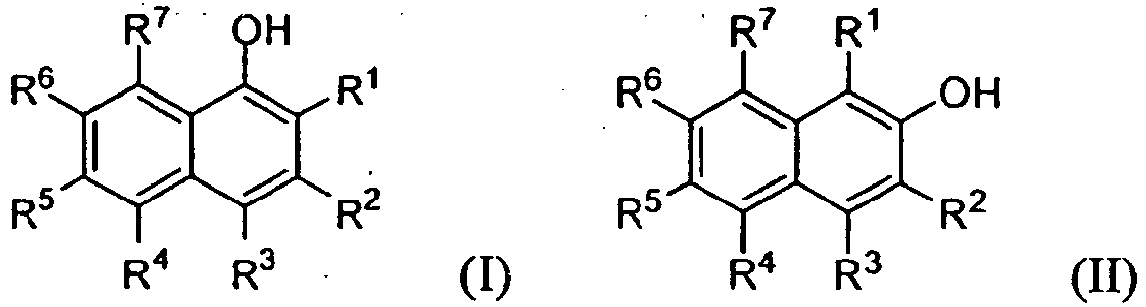
- Examples of commercially available α-naphthol derivatives that can be used in the present invention include 4-chloro-1-naphthol, 1,5-dihydroxynaphthalene, 1,7-dihydroxynaphthalene, 1-methoxy-4-nitronaphtalene, 4-Fluorosulfonyl-1-hydroxy-2-naphthoic acid, 1,3-Dihydroxynaphthalene, 4-methoxy-1-naphthonitrile, 2-nitro-1-naphthol, 4-methoxy-1-naphthol, 2-acetyl-1-naphthol, 9-phenanthrol, 1-naphthol-3,6-disulfonic aciddisodium salthydrate, alpha-hydroxy-heptafluoronaphthalene, 5-amino-1-naphthol, N-(2-Acetamidophenethyl)-1-hydroxy-2-naphthamide, 8-Amino-1-naphthol-3,6-disulfonic acid or monosodium salt monohydrate thereof, 8-Amino-1-naphthol-5-sulfonic acid, chromotropic acid or salt thereof, 2,4-dichloro-1-naphthol, 1-naphthol-2-sulfonic acid or potassium salt thereof, 1-Naphthol-4-sulfonic acid or salt thereof, 1,7-dihydroxynaphthalene, 4-Aminosulfonyl-1-hydroxy-2-naphthoic acid, 5-hydroxy-l-naphthalenesulfonamide, 6-amino-1-naphthol, 2-(2-Hydroxy-1,1,1,3,3,3-hexafluoropropyl)-1-naphthol, 1,4-dihydroxy-2-naphthoic acid, 1,4-Dihydroxy-2-naphthoic acid phenyl ester, 1,6-dihydroxynaphthalene, 4-hydroxy-1-naphthaldehyde, 7-Anilino-1-naphthol-3-sulfonic Acid, 6-amino-1-naphthol-3-sulfonic acid, 4-nitro-1-naphthol, 4-hydroxy-6,7-di(methoxycarbonyl)-1-naphthol, 2,4,6,8-tetranitro-5-hydroxy-1-naphthol, 4,6-dinitroso-5-hydroxy-1-naphthol, 4,6-diamino-5-hydroxy-1-naphthol, 2,2'-binaphthyl-1,1'-diol, 2,3-di(methoxycarbonyl)-1-naphthol, 2-acetyl-3-butyl1-naphthol, 3-phenyl-1-naphthol, 1-naphthol-8-sulfonic acid or salt thereof, 3-chloro-1,4-dihydroxynaphthalene, 1-Amino-5-naphthol-7-sulfonic acid, 2-fluoro-1-naphthol, 3,5-Dihydroxy-2-naphthoic acid, 1-Naphthol-3-sulfonic acid or salt thereof, 2,4-dibromo-1-naphthol, 6-amino-1-naphthol, 2-Amino-1-naphtholhydrochloride, 2,3-dicyano-1,4-dihydroxy-5-nitronaphthalene, 1,2-Dihydroxynaphthalene, 1-Hydroxy-2-naphthaldehyde, 4-phenylsulfonamido-1-naphthol, 2-(4-phenylsulfonyl)-4-(4-chlorophenylsulfonamido)1-naphthol and 4-acetamido-1-naphthol.
- The concentration of the denaturing agent can vary depending on the nature of the agent as well as the duration and the temperature used in the heating step. Typically, the concentration ranges from 100 g/L to 500 g/L.
- In the alternative, the shrunken red blood cells may be treated with a denaturing agent (such as α-naphthol) for a sufficient amount of time (e.g., at least two hours) without heating (e.g., at room temperature). After the denaturing agent is removed, the cells are then subject to the heating treatment as described above, for instance, at an elevated temperature between 50-75°C, e.g., 56°C, for a time period of at least 24 hours, in some cases at least 48, 72, 96, 120, 168, 336, or 504 hours, or for an even longer duration. In this treatment scheme, the denaturing agent's concentration also ranges from 100 g/L to 500 g/L.
- Fixing of the shrunken and denatured/heated red blood cells is an optional step in this invention. In other words, the red blood cells treated by a process described above can, according to the present invention, be directly used as platelet analogs in a hematological instrument without the fixation step by a fixing agent. Optionally, the red blood cells obtained following the shrinking and denaturing/heating steps are further treated with a fixing agent such as glutaraldehyde to toughen the cell membranes and to prevent their biodegradation. As such, any chemical that can achieve this effect can be used as a fixing agent for the method. For example, fixing of pre-treated red blood cells is accomplished by contacting the suspension of the cells with a solution of an organic aldehyde such as formaldehyde or glutaraldehyde. The aldehyde may be added in concentrations anywhere from 5% to 50% by weight, so long as the final concentration thereof is in the range of from 0.5% to 1.0%, preferably about 0.6% by weight. As is the case with the precipitating and shrinking solutions, the only practical limitations on selection of an appropriate fixing agent (e.g., aldehyde) and concentration thereof are elimination of undue cell association and hemolysis and potential undesirable electrolytic effects.
- In one embodiment, glutaraldehyde in concentrations below 50% by weight is dripped slowly into the hypertonic suspension of cells while the same is rapidly stirred. Since the addition of the fixing solution dilutes the hypertonic suspension, sufficient amounts of the hypertonic shrinking solution should be added to maintain the concentration thereof at the same level and so maintain the size of the shrunken cells.
- The fixed cells are thereafter allowed to settle out, separated, washed with a buffered solution, and placed in a storage solution.
- As an optional step prior to recovering the shrunken cells, in order to assure a high-quality product containing only the hardiest cells with a stabilized cell population, the cell suspension may be subjected to severe agitation by any appropriate means, such as sonic agitation. This step tends to destroy the weaker-membraned cells and thus leave the more hardy for use as a platelet-counting reference control.
- The buffered washing solution should be neutral to alkaline, preferably in the pH range of from 7.0 to 10.0. Although any buffered solution may be used, with due regard to the problems of hemolysis, cell association and electrolytic effects noted above, a preferred set of buffering reagents includes sodium hydroxide, sodium bicarbonate, and sodium chloride. The shrunken cells should be washed with the buffered solution as many times as is necessary to obtain a clear supernatant, preferably at least three times.
- The storage solution in which the cells are suspended may be virtually any fluid, including mere water, which does not have a deleterious effect on the fixed cells, such as causing hemolysis, cell association or biodegradation. A preferred storage solution is basically the same buffered solution used in the washing step with the addition of a bacteriocidal or bacteriostatic agent to prevent contamination and a dispersing agent. The bacteriocidal or bacteriostatic agent can be any known agent added in sufficient concentration to reduce or check bacterial growth. An inexpensive and preferred bacteriocidal/bacteriostatic agent is gentamicin and/or Proclin 150. Another is the hydrochloride salt of tetracycline. Each may be added in a concentration of about 0.1 grams per liter. The dispersing agent may be one dialkali metal salt of a naphthol-sulfonic acid or a low molecular weight dextran. A preferred dispersing agent is dextran with a molecular weight of 20,000 to 41,000, preferably about 40,000, added in a concentration of about 30 grams per liter. If a di-alkali metal salt of a naphthol-sulfonic acid is used, such as the dipotassium salt of 2-Naphthol 6,8-disulfonic acid, the preferred concentration is from 0.02 to 0.05, preferably about 0.04 molar.
- If the platelet reference control is to be used in connection with electronic platelet counting devices, it preferably has an electrolyte in the storage fluid in order to facilitate electrical conductivity. However, the pH of the solution in such applications should be substantially neutral to alkaline and a buffering system which may double as an electrolyte is advantageously used to maintain the pH of the solution.
- The cell population or density may be adjusted by any known dilution or concentration technique. For example, if the product shows a density of 300,000 cells per cubic millimeter, and the desired density is about 75,000, the fluid suspension should be diluted by adding three volumes of diluent to obtain the desired density.
- In executing all of the above steps in order to assure high purity of product, it is preferable to use reagent grade chemicals, as opposed to technical grade. It is also preferable to take precautions against the cells sticking to glassware, which they have a natural tendency to do. A standard measure to accomplish this is to "siliconize" all glassware to be used by coating it with a solution of tetramethyl silane in benzene, and subjecting the coating glassware to 100°C (dry air) for 15 to 30 minutes.
- Following shrinking step, the denaturing/heating step, and the optional fixing step, the red blood cells can be suspended in any of a variety of fluids, including hypo-osmotic, iso-osmotic, or hyper-osmotic fluids. Iso-osmotic aqueous liquids, i.e., those that do not form an osmotic pressure differential across the membranes of the cells, are preferred since they are most compatible with the final blood control product. Conventional additives can be added for the same purposes that they serve in standard cell suspensions of the prior art. Propylene glycol, for example, can be added to optionally clear the cytoplasm and to reduce cell-to-cell binding.
- In certain embodiments of the invention, the cells are pre-conditioned prior to the heating and fixation steps of the present invention. Pre-conditioning is achieved by moderate heating for at least an hour to a temperature below the temperature ranges cited above, preferably in diluted form with an iso-osmotic diluent, a saline diluent, or water, and in some cases, with dissolved propylene glycol in any of these media. The preferred temperature range for pre-conditioning is from 30°C to 40°C, and the pre-conditioning time is from 2 hours to 4 hours. Pre-conditioning tends to improve the agreement between the optical and electrical methods of platelet counting.
- Still further improvements in the agreement between the optical and electrical methods of platelet counting are achieved by incubating the cells in a suspension of human red blood cells in addition to the various treatment steps discussed above. This incubation is preferably performed at room temperature for a period of at least one day, more preferably for at least 5 days, and most preferably for at least 10 days.
- The following examples further illustrate the invention.
- Compared to fresh blood (
Figure 1 ) an experimental blood control formulation for Abbott CD4000 and Sapphire instruments ("Hem-Au" hereafter) with current re-annealed membranes has excellent platelet impedance counting precision but poor optical counting precision (Figure 2 ). The mean impedance count is typically high when compared to the optical count resulting in a high occurrence of the PIC/POC flag; this flag is set when the mean impedance count (PIC) is substantially different from the platelet optical count (POC). The current re-annealed membranes being used do not fit correctly into the optical channel of the CD4000 and Sapphire Hematology Instruments. In the past studies and a pending patent application (Figure 3 :U.S. Patent Application Publication No. 2006/0223187 ), it is shown that treating the finished re-annealed membranes with glutaraldehyde and heat 56°C for 24 hours will make re-annealed membranes "fit" better into the optical platelet channel on the CD4000. This patent-pending process allows for platelet analogs with excellent platelet impedance counting (PIC) precision and excellent platelet optical counting (POC) precision. However, the Abbott CD4000 instrument will give multiple PIC/POC patient flags to indicate that the platelet analogs are not evaluated the same as fresh blood. In addition, free aldehyde groups associated with the platelet analogs will interfere with the fluorescence on the WBC channel of the CD4000. This example demonstrates that extended denature heating alone will change the shape of the finished re-annealed membranes and thus help them "fit" into the optical platelet channel better. Once the platelets fit better, the occurrence of the PIC/POC flag will be less. -
- Re-Annealed Membranes;
- Processed human red blood cells in a compatible media used to formulate a blood control;
- A hypo-osmotic saline as Frog Ringers with an organic buffer (i.e., modified or M-Ringers);
- Suspending media used as a diluent in the formulation of a blood control;
- 1 mL sterile pipets;
- 15-ml centrifuge tube;
- 2.5-ml vials and caps;
- Abbott CD1700, CD3500, and CD4000 Hematology Analyzer;
- Water bath.
-
-
1. Heating the Re-Annealed Membranes (4 days at 56°C)
- a. 10 mls of Re-Annealed Membranes were poured into 1 x 15 ml centrifuge tubes.
- b. Place the tube in the water bath at 56°C.
-
2. Wash the heated Re-Annealed Membranes
- a. Remove the heated Re-Annealed Membranes.
- b. Centrifuge the tube for 15 minutes at full speed (3600 rpm).
- c. Aspirate and discard the supernatant.
- d. Fill the tube to the 14-ml mark with Ringers.
- e. Repeat steps 2.b. through 2.d. three more times.
- f. Re-suspend in M-Ringers to an approximate count of 25.9x10⁶.
-
3. Formulate samples
- a. Concentrate the processed human red blood cells to a normal count ~ 4.50 x 10⁶.
- b. Manufacture a low, normal, and high platelet sample using the human red blood cells.
- c. Run precision studies on the CD4000 on all three levels.
- d. Run additional samples on the CD1700 and CD3500.
- e. Store the samples at 2-8°C.
-
4. Results
- The heated re-annealed membranes fit perfectly into the optical platelet channel on the CD4000. When they were added to the processed human red blood cells at low and normal platelet concentrations, there were no PIC/POC flags.
- The CV% on all three levels of the PLTo and PLTi were within the precision limits of the Cell-Dyn 4000.
- There were no platelet, white blood cell, or red blood cell flags when samples were run on the CD4000. Samples worked on other impedance counters as the Abbott CD1700 and CD3500.
- To determine if the amount of α-Naphthol used in processing blood cells is inversely related to the amount of time required to heat the α-Naphthol treated cells at 56°C in order to eliminate the PIC/POC flag on the Abbott CD4000 Instrument.
-
- Abbott CD4000 Hematology Analyzer, S/N 30380AA
- VWR Water Bath, Model 89032-218, S/N WL0713029
- VWR Centrifuge, Clinical 50, S/N F703069, Calibrated on 2007-10-15
-
- Goat red blood cells
- Deionized water for preparing Naphthol solution
- Processed human red blood cells in a red blood cell suspending media used to formulate a blood control
- Reagent Gluteraldehyde - pH 7.00
- Frog Ringers with an organic buffer
- 0.9% NaCl (Iso-osmotic saline)
- Suspending media used as a diluent in the formulation of a blood control
- 125-mL glass bottle and cap
- I mL sterile pipets
- 15-mL centrifuge tubes
- 2.5-mL vials and caps
-
- 1) Gently lyse the goat red blood cells in a hypotonic environment.
- 2) Anneal the membranes at about 40°C for about 3 hours.
- 3) Suspend in 100, 200, 300, 400, or 500g/Liter α-Naphthol for 2 hours.
- 4) Perform a 0.3% glutaraldehyde stabilization.
- 5) Wash in an iso-osmotic balanced saline solution.
-
- 1) 75 mls each [1-series (100 g/L), 2-series (200 g/L-stock), 3-series (300 g/L), 4-series (400 g/L, and 5-series (500 g/L)] of the Re-Annealed Membranes were poured into sterile 125-ml glass bottles, and placed in a water bath at 56°C.
- 2) Mix bottles after 30 minutes to resuspend the platelets and evenly disperse the heat.
- 3) Remove samples (see Table I).
-
- 1) Add a 2mL sample to a 15mL tube.
- 2) Fill the centrifuge tube to 14.5 mL with M-Ringers and resuspend.
- 3) Centrifuge the tube for 15-minutes at 3600 rpm.
- 4) Aspirate and discard the supernatant.
- 5) Repeat washing three more times.
- 6) Fill the tube with Suspending Media and resuspend the particles.
- 7) Centrifuge the tube for 10-minutes at 3600 rpm.
- 8) Wash two more times and adjust to a count of 20-30
x 106. -
- 1) Add the heated/washed platelets to the human RBC component to an approximate normal platelet count (~250x103).
- 2) Run on the CD4000.
-
- An increase in the concentration of α-Naphthol is needed to produce platelet analogs that do not recover PIC/POC flags when run on the CD4000.
- The change in the concentration of α-Naphthol changes the optical properties of the platelet analogs such that the Cell-Dyn 4000 is capable of equally counting the platelets optically and by the impedance method.
- The higher the concentration of α-Naphthol used, the smaller the MPV.
- The longer the platelet analogs are heated, the smaller the MPV. It is more beneficial to not heat the platelet analogs any longer then necessary as some instruments have difficultly in accurately counting small platelet analogs if the platelet gain settings are not calibrated correctly.
- There is a correlation between the Concentration of α-Naphthol used and the time required for heating (56°C).
- The increase in the concentration of α-Naphthol when used in conjunction with extensive heating at 56°C improves the CV% of impedance and optical platelet counts. It also decreases the occurrence of PIC/POC flags.
-
- The standard off-the-shelf platelet analogs (
Figure 2 ) are not completely being counted in the optical counting system of the newer technology instruments (CD4000 and CD Sapphire). This resulted in high imprecision when compared to the more reliable impedance counting method. The chemical 1-Napthol-3, 6-Disulfonic Acid (hereafter designated as α-Naphthol) is used in the preparation of the platelet analogs, and depending on the water content of the raw material, the concentration to use may vary from lot to lot. Component manufacturing verifies the conductivity of each new lot of raw material received prior to producing a batch of platelet analogs. When the CD4000 is not able to accurately count all the particles in both the optical and impedance modes a system flag results; this is designated as a PIC/POC flag. This flag occurs when the delta difference between the two counting modes is greater than 20%. - The α-Naphthol plays a role in determining the size and shape based on electronic and optical detection properties of the finished analog. The experiment shows that increasing the concentration of α-Naphthol (from 210 g/L to 360 g/L) will improve the physical properties of the platelet analogs such that the CD4000 was able to accurately count all the particles in both the optical (PLTo) and impedance (PLTi) modes, after heating at 56°C for two days (
Figures 4 and5 ). - The experiment showed that, by increasing the concentration of α-Naphthol (from 210 g/L to 500 g/L), the optical properties of the platelet analogs, after heating at 56°C for three days, improved such that the CD4000 was able to accurately count all the particles in both the optical (PLTo) and impedance (PLTi) modes (
Figure 5 ). This experiment also indicated that there might be a correlation between the concentration of α-Naphthol and the time required, at 56°C; to have the platelet analogs work properly on the CD4000. - Experiments showed that the longer the platelet analogs were heated, at 56°C, the smaller the MPV. Depending on the initial MPV there might be a maximum amount of time that the platelet analogs can be heated. As long as the MPV is within the specification range of 5-12 fL the platelet analogs can be heated until no PIC/POC flags occur on the CD4000.
- This experiment showed the higher the concentration of α-Naphthol used, the better the optical properties of the platelets. As the heating time increased the number of PIC/POC flags decreased with an increasing α-Naphthol concentration. Thus, the heating is inversely related to the concentration of α-Naphthol.
- To manufacture Platelet Analogs without PIC/POC flags, when run on the CD4000, a higher concentration of α-Naphthol (e.g., a minimum of 400 g/L) may be desirable. It should be noted that the concentration to be used may vary based on the quality of the raw material of α-Naphthol. When a new lot of raw material α-Naphthol is received an adjustment in the α-Naphthol concentration will need to be performed to optimize the concentration to use. A confirmatory batch of platelet analogs prepared with 450g/L α-Naphthol and heated for 3 days at 56°C is demonstrated in
Figure 6 . - Heat the Platelet Analogs at 56°C until no PIC/POC flags occur when run on the CD4000 at a normal count of 220x103 - 270x103.
| Experiment Number | Concentration of α-Naphthol | Time at 56° |
| 1a | ||
| 100 g/L | 24 hrs. | |
| 1b | 48 hrs | |
| 1c | 72 hrs | |
| 1d | 168 hrs | |
| 1e | 336 hrs | |
| 1f | 504 | |
| 2a | ||
| 200 g/L | 24 hrs | |
| 2b | 48 hrs | |
| 2c | 72 hrs | |
| 2d | 168 hrs | |
| 2e | 336 hrs | |
| 2f | 504 | |
| 3a | ||
| 300 g/L | 24hrs | |
| 3b | 48 hrs | |
| 3c | 72 hrs | |
| 3d | 168 hrs | |
| 3e | 336 hrs | |
| 3f | 504 | |
| 4a | ||
| 400 g/L | 24hrs | |
| 4b | 48 hrs | |
| 4c | 72 hrs | |
| 4d | 168 hrs | |
| 4e | 336 hrs | |
| 4f | 504 | |
| 5a | ||
| 500 g/L | 24hrs | |
| 5b | 48 hrs | |
| 5c | 72 hrs | |
| 5d | 168 hrs | |
| 5e | 336 hrs | |
| 5f | 504 hrs |
Claims (14)
- A process for the manufacture of human platelet analogs for use as reference controls in automated blood cell analyzers, the process comprising the steps of:(a) shrinking red blood cells of a non-human vertebrate to the size of human platelets by extraction of cellular fluid from the red blood cells; and(b) heating the cells from step (a) at a temperature of at least 50°C for a time period of at least 1 day, wherein the cells are treated with a denaturing agent prior to the heating or at the same time of the heating.
- The process of claim 1, wherein step (a) further comprising heating the cells at a temperature of 40°C for 0.5 to 5 hours after the shrinking of the cells.
- The process of claim 1, wherein step (a) further comprising heating the cells at a temperature of 40°C for about 3 hours after the shrinking of the cells.
- The process of claim 1, wherein step (b) comprises treating the cells from step (a) with a denaturing agent for at least two hours and then removing the denaturing agent from the cells prior to the heating.
- The process of claim 1, further comprising step (c) fixing the cells from step (b) with a fixing agent.
- The process of claim 5, wherein the fixing agent is glutaraldehyde.
- The process of claim 1, wherein the red blood cells are goat red blood cells.
- The process of claim 1, wherein the heating in step (b) is performed at 50°C to 75°C.
- The process of claim 8, wherein the heating in step (b) is performed at 56°C.
- The process of claim 1, wherein the time period(i) is at least 2 days; or(ii) at least 3 days; or(iii) at least 4 days; or(iv) at least 7 days; or(v) at least 14 days; or(vi) at least 21 days.
- The process of claim 1, wherein the denaturing agent is α-naphthol.
- The process of claim 4, wherein the denaturing agent is α-naphthol.
- The process of claim 11 or 12, wherein α-naphthol concentration(i) is 100g/L to 500 g/L; or(ii) is at least 400g/L; or(iii) is at least 500g/L.
- The process of claim 11, wherein(i) the time period is at least 7 days and α-naphthol concentration is at least 400 g/L; or(ii) the time period is at least 14 days and α-naphthol concentration is at least 400 g/L; or(iii) the time period is at least 21 days and α-naphthol concentration is at least 400 g/L; or(iv) the time period is about 21 days and α-naphthol concentration is at least 500 g/L.
Applications Claiming Priority (2)
| Application Number | Priority Date | Filing Date | Title |
|---|---|---|---|
| US12/353,089 US8114580B2 (en) | 2009-01-13 | 2009-01-13 | Simulation of normal fresh blood platelets for reference control |
| PCT/US2010/020654 WO2010083130A1 (en) | 2009-01-13 | 2010-01-11 | Simulation of normal fresh blood platelets |
Publications (3)
| Publication Number | Publication Date |
|---|---|
| EP2376908A1 EP2376908A1 (en) | 2011-10-19 |
| EP2376908A4 EP2376908A4 (en) | 2012-07-04 |
| EP2376908B1 true EP2376908B1 (en) | 2014-12-31 |
Family
ID=42319344
Family Applications (1)
| Application Number | Title | Priority Date | Filing Date |
|---|---|---|---|
| EP10731986.5A Not-in-force EP2376908B1 (en) | 2009-01-13 | 2010-01-11 | Simulation of normal fresh blood platelets |
Country Status (7)
| Country | Link |
|---|---|
| US (1) | US8114580B2 (en) |
| EP (1) | EP2376908B1 (en) |
| JP (1) | JP5330543B2 (en) |
| CN (1) | CN102341701B (en) |
| AU (1) | AU2010204906B2 (en) |
| CA (1) | CA2749370C (en) |
| WO (1) | WO2010083130A1 (en) |
Families Citing this family (10)
| Publication number | Priority date | Publication date | Assignee | Title |
|---|---|---|---|---|
| DK3256850T3 (en) | 2015-02-09 | 2025-08-18 | Slingshot Biosciences Inc | Hydrogel particles with tunable optical properties and methods of using the same |
| US20180052181A1 (en) * | 2015-03-13 | 2018-02-22 | Sony Corporation | Sample for use in electrical characteristic measurement, electrical characteristic measurement method, and electrical characteristic measurement device |
| TW202141019A (en) | 2020-01-24 | 2021-11-01 | 美商史林夏特生化公司 | Compositions and methods for cell-like calibration particles |
| CA3177834A1 (en) | 2020-05-04 | 2021-11-11 | Jeffrey Kim | Compositions and methods for passive optical barcoding for multiplexed assays |
| CN116097093A (en) * | 2020-09-03 | 2023-05-09 | 生物辐射实验室股份有限公司 | Preparation of Nucleated RBC (NRBC) analogs for use as reference blood controls in automated blood analyzers |
| JP2024539956A (en) | 2021-10-29 | 2024-10-31 | スリングショット バイオサイエンシーズ, インコーポレイテッド | Hydrogel particles as feeder cells and synthetic antigen-presenting cells |
| AU2023265684A1 (en) | 2022-05-05 | 2024-11-21 | Slingshot Biosciences, Inc. | Engineered particles as red blood cell mimics and compositions containing same for hematology |
| CA3257621A1 (en) | 2022-06-02 | 2023-12-07 | Slingshot Biosciences, Inc. | Apoptotic cell mimic |
| WO2024092161A2 (en) | 2022-10-26 | 2024-05-02 | Slingshot Biosciences, Inc. | Size-tunable synthetic particles with tunable optical properties and methods for using the same for immune cell activation |
| US12461007B2 (en) | 2023-08-29 | 2025-11-04 | Slingshot Biosciences, Inc. | CD34 stem cell mimics |
Family Cites Families (9)
| Publication number | Priority date | Publication date | Assignee | Title |
|---|---|---|---|---|
| US3873467A (en) | 1974-02-01 | 1975-03-25 | United Medical Lab Inc | Hematologic reference control |
| US4179398A (en) | 1977-03-21 | 1979-12-18 | ICN Medical Laboratories, Inc. | Platelet control composition |
| US4264470A (en) * | 1979-05-07 | 1981-04-28 | Coulter Electronics, Inc. | Selecting goat erythrocytes to simulate human platelets in hematologic reference controls |
| US5008201A (en) | 1990-05-24 | 1991-04-16 | Streck Laboratories, Inc. | Simulated human platelets from red blood cells |
| EP0771420A1 (en) * | 1995-04-28 | 1997-05-07 | Coulter International Corp. | Quality control method of hematology instruments |
| US6221668B1 (en) * | 1999-08-20 | 2001-04-24 | Streck Laboratories, Inc. | Hematology control and system for multi-parameter hematology measurements |
| SE528697C2 (en) * | 2005-03-11 | 2007-01-30 | Hemocue Ab | Volumetric determination of the number of white blood cells in a blood sample |
| US7531357B2 (en) * | 2005-04-04 | 2009-05-12 | Bio-Rad Laboratories, Inc. | Preparation of platelet analogs |
| US7482161B2 (en) * | 2006-07-17 | 2009-01-27 | Bio-Rad Laboratories, Inc. | Preparation of a red blood cell component for a hematology control |
-
2009
- 2009-01-13 US US12/353,089 patent/US8114580B2/en active Active
-
2010
- 2010-01-11 CA CA2749370A patent/CA2749370C/en active Active
- 2010-01-11 EP EP10731986.5A patent/EP2376908B1/en not_active Not-in-force
- 2010-01-11 CN CN201080010222.1A patent/CN102341701B/en not_active Expired - Fee Related
- 2010-01-11 AU AU2010204906A patent/AU2010204906B2/en not_active Ceased
- 2010-01-11 JP JP2011545494A patent/JP5330543B2/en not_active Expired - Fee Related
- 2010-01-11 WO PCT/US2010/020654 patent/WO2010083130A1/en not_active Ceased
Also Published As
| Publication number | Publication date |
|---|---|
| JP5330543B2 (en) | 2013-10-30 |
| JP2012515333A (en) | 2012-07-05 |
| CN102341701B (en) | 2014-07-09 |
| US20100178647A1 (en) | 2010-07-15 |
| WO2010083130A1 (en) | 2010-07-22 |
| EP2376908A1 (en) | 2011-10-19 |
| CN102341701A (en) | 2012-02-01 |
| US8114580B2 (en) | 2012-02-14 |
| EP2376908A4 (en) | 2012-07-04 |
| AU2010204906B2 (en) | 2014-05-08 |
| AU2010204906A1 (en) | 2011-07-28 |
| CA2749370C (en) | 2016-05-03 |
| CA2749370A1 (en) | 2010-07-22 |
Similar Documents
| Publication | Publication Date | Title |
|---|---|---|
| CA2749370C (en) | Simulation of normal fresh blood platelets | |
| US12163968B2 (en) | Preparation of nucleated RBC (NRBC) analogs for use as reference hematology controls in automated hematology analyzers | |
| US10866171B2 (en) | Accelerated Wright-Giemsa and May-Grünwald staining methods | |
| US7135341B2 (en) | Reference control containing a nucleated red blood cell component | |
| US4179398A (en) | Platelet control composition | |
| US5432089A (en) | Reference control for use with manual and flow cytometric reticulocyte counting devices | |
| EP1347040B1 (en) | Cell-preservation liquid and method of preserving cells by using the liquid | |
| JP2000512748A (en) | Sample collection liquid | |
| AU2006233071B2 (en) | Preparation of platelet analogs | |
| EP3112864B1 (en) | Urine sample analysis method and use of a reagent kit for urine sample analysis | |
| JP2004537726A (en) | Blood control product with improved closed vial stability | |
| US8029978B2 (en) | Processing method for the long-term stabilization of biological red blood cell volume | |
| CN110763527A (en) | A kind of urine formed component quality control product and its preparation method and application | |
| EP4286828A1 (en) | Preservation liquid for calcium oxalate dihydrate crystals and preservation method | |
| CN121409837A (en) | A cat-specific anti-wrinkle red blood cell diluent, its preparation method, and its application. | |
| CN120458087A (en) | A method for preserving sex-controlled frozen cattle sperm |
Legal Events
| Date | Code | Title | Description |
|---|---|---|---|
| PUAI | Public reference made under article 153(3) epc to a published international application that has entered the european phase |
Free format text: ORIGINAL CODE: 0009012 |
|
| 17P | Request for examination filed |
Effective date: 20110707 |
|
| AK | Designated contracting states |
Kind code of ref document: A1 Designated state(s): AT BE BG CH CY CZ DE DK EE ES FI FR GB GR HR HU IE IS IT LI LT LU LV MC MK MT NL NO PL PT RO SE SI SK SM TR |
|
| DAX | Request for extension of the european patent (deleted) | ||
| A4 | Supplementary search report drawn up and despatched |
Effective date: 20120601 |
|
| RIC1 | Information provided on ipc code assigned before grant |
Ipc: G01N 31/00 20060101AFI20120525BHEP Ipc: A01N 1/02 20060101ALI20120525BHEP |
|
| 17Q | First examination report despatched |
Effective date: 20130227 |
|
| RIC1 | Information provided on ipc code assigned before grant |
Ipc: G01N 31/00 20060101AFI20130215BHEP Ipc: A01N 1/02 20060101ALI20130215BHEP |
|
| GRAP | Despatch of communication of intention to grant a patent |
Free format text: ORIGINAL CODE: EPIDOSNIGR1 |
|
| INTG | Intention to grant announced |
Effective date: 20140718 |
|
| GRAS | Grant fee paid |
Free format text: ORIGINAL CODE: EPIDOSNIGR3 |
|
| GRAA | (expected) grant |
Free format text: ORIGINAL CODE: 0009210 |
|
| AK | Designated contracting states |
Kind code of ref document: B1 Designated state(s): AT BE BG CH CY CZ DE DK EE ES FI FR GB GR HR HU IE IS IT LI LT LU LV MC MK MT NL NO PL PT RO SE SI SK SM TR |
|
| REG | Reference to a national code |
Ref country code: CH Ref legal event code: EP Ref country code: GB Ref legal event code: FG4D |
|
| REG | Reference to a national code |
Ref country code: IE Ref legal event code: FG4D |
|
| REG | Reference to a national code |
Ref country code: AT Ref legal event code: REF Ref document number: 704694 Country of ref document: AT Kind code of ref document: T Effective date: 20150215 |
|
| REG | Reference to a national code |
Ref country code: DE Ref legal event code: R096 Ref document number: 602010021426 Country of ref document: DE Effective date: 20150226 |
|
| PG25 | Lapsed in a contracting state [announced via postgrant information from national office to epo] |
Ref country code: FI Free format text: LAPSE BECAUSE OF FAILURE TO SUBMIT A TRANSLATION OF THE DESCRIPTION OR TO PAY THE FEE WITHIN THE PRESCRIBED TIME-LIMIT Effective date: 20141231 Ref country code: LT Free format text: LAPSE BECAUSE OF FAILURE TO SUBMIT A TRANSLATION OF THE DESCRIPTION OR TO PAY THE FEE WITHIN THE PRESCRIBED TIME-LIMIT Effective date: 20141231 Ref country code: NO Free format text: LAPSE BECAUSE OF FAILURE TO SUBMIT A TRANSLATION OF THE DESCRIPTION OR TO PAY THE FEE WITHIN THE PRESCRIBED TIME-LIMIT Effective date: 20150331 |
|
| REG | Reference to a national code |
Ref country code: NL Ref legal event code: VDEP Effective date: 20141231 |
|
| REG | Reference to a national code |
Ref country code: LT Ref legal event code: MG4D |
|
| PG25 | Lapsed in a contracting state [announced via postgrant information from national office to epo] |
Ref country code: HR Free format text: LAPSE BECAUSE OF FAILURE TO SUBMIT A TRANSLATION OF THE DESCRIPTION OR TO PAY THE FEE WITHIN THE PRESCRIBED TIME-LIMIT Effective date: 20141231 Ref country code: SE Free format text: LAPSE BECAUSE OF FAILURE TO SUBMIT A TRANSLATION OF THE DESCRIPTION OR TO PAY THE FEE WITHIN THE PRESCRIBED TIME-LIMIT Effective date: 20141231 Ref country code: LV Free format text: LAPSE BECAUSE OF FAILURE TO SUBMIT A TRANSLATION OF THE DESCRIPTION OR TO PAY THE FEE WITHIN THE PRESCRIBED TIME-LIMIT Effective date: 20141231 Ref country code: GR Free format text: LAPSE BECAUSE OF FAILURE TO SUBMIT A TRANSLATION OF THE DESCRIPTION OR TO PAY THE FEE WITHIN THE PRESCRIBED TIME-LIMIT Effective date: 20150401 |
|
| REG | Reference to a national code |
Ref country code: AT Ref legal event code: MK05 Ref document number: 704694 Country of ref document: AT Kind code of ref document: T Effective date: 20141231 |
|
| PG25 | Lapsed in a contracting state [announced via postgrant information from national office to epo] |
Ref country code: NL Free format text: LAPSE BECAUSE OF FAILURE TO SUBMIT A TRANSLATION OF THE DESCRIPTION OR TO PAY THE FEE WITHIN THE PRESCRIBED TIME-LIMIT Effective date: 20141231 |
|
| PG25 | Lapsed in a contracting state [announced via postgrant information from national office to epo] |
Ref country code: SK Free format text: LAPSE BECAUSE OF FAILURE TO SUBMIT A TRANSLATION OF THE DESCRIPTION OR TO PAY THE FEE WITHIN THE PRESCRIBED TIME-LIMIT Effective date: 20141231 Ref country code: ES Free format text: LAPSE BECAUSE OF FAILURE TO SUBMIT A TRANSLATION OF THE DESCRIPTION OR TO PAY THE FEE WITHIN THE PRESCRIBED TIME-LIMIT Effective date: 20141231 Ref country code: CZ Free format text: LAPSE BECAUSE OF FAILURE TO SUBMIT A TRANSLATION OF THE DESCRIPTION OR TO PAY THE FEE WITHIN THE PRESCRIBED TIME-LIMIT Effective date: 20141231 Ref country code: RO Free format text: LAPSE BECAUSE OF FAILURE TO SUBMIT A TRANSLATION OF THE DESCRIPTION OR TO PAY THE FEE WITHIN THE PRESCRIBED TIME-LIMIT Effective date: 20141231 |
|
| REG | Reference to a national code |
Ref country code: CH Ref legal event code: PL |
|
| PG25 | Lapsed in a contracting state [announced via postgrant information from national office to epo] |
Ref country code: AT Free format text: LAPSE BECAUSE OF FAILURE TO SUBMIT A TRANSLATION OF THE DESCRIPTION OR TO PAY THE FEE WITHIN THE PRESCRIBED TIME-LIMIT Effective date: 20141231 Ref country code: LU Free format text: LAPSE BECAUSE OF FAILURE TO SUBMIT A TRANSLATION OF THE DESCRIPTION OR TO PAY THE FEE WITHIN THE PRESCRIBED TIME-LIMIT Effective date: 20150111 Ref country code: PL Free format text: LAPSE BECAUSE OF FAILURE TO SUBMIT A TRANSLATION OF THE DESCRIPTION OR TO PAY THE FEE WITHIN THE PRESCRIBED TIME-LIMIT Effective date: 20141231 Ref country code: IS Free format text: LAPSE BECAUSE OF FAILURE TO SUBMIT A TRANSLATION OF THE DESCRIPTION OR TO PAY THE FEE WITHIN THE PRESCRIBED TIME-LIMIT Effective date: 20150430 |
|
| REG | Reference to a national code |
Ref country code: DE Ref legal event code: R097 Ref document number: 602010021426 Country of ref document: DE |
|
| PG25 | Lapsed in a contracting state [announced via postgrant information from national office to epo] |
Ref country code: CH Free format text: LAPSE BECAUSE OF NON-PAYMENT OF DUE FEES Effective date: 20150131 Ref country code: DK Free format text: LAPSE BECAUSE OF FAILURE TO SUBMIT A TRANSLATION OF THE DESCRIPTION OR TO PAY THE FEE WITHIN THE PRESCRIBED TIME-LIMIT Effective date: 20141231 Ref country code: LI Free format text: LAPSE BECAUSE OF NON-PAYMENT OF DUE FEES Effective date: 20150131 Ref country code: MC Free format text: LAPSE BECAUSE OF FAILURE TO SUBMIT A TRANSLATION OF THE DESCRIPTION OR TO PAY THE FEE WITHIN THE PRESCRIBED TIME-LIMIT Effective date: 20141231 Ref country code: EE Free format text: LAPSE BECAUSE OF FAILURE TO SUBMIT A TRANSLATION OF THE DESCRIPTION OR TO PAY THE FEE WITHIN THE PRESCRIBED TIME-LIMIT Effective date: 20141231 |
|
| REG | Reference to a national code |
Ref country code: IE Ref legal event code: MM4A |
|
| PLBE | No opposition filed within time limit |
Free format text: ORIGINAL CODE: 0009261 |
|
| STAA | Information on the status of an ep patent application or granted ep patent |
Free format text: STATUS: NO OPPOSITION FILED WITHIN TIME LIMIT |
|
| 26N | No opposition filed |
Effective date: 20151001 |
|
| PG25 | Lapsed in a contracting state [announced via postgrant information from national office to epo] |
Ref country code: IT Free format text: LAPSE BECAUSE OF FAILURE TO SUBMIT A TRANSLATION OF THE DESCRIPTION OR TO PAY THE FEE WITHIN THE PRESCRIBED TIME-LIMIT Effective date: 20141231 |
|
| REG | Reference to a national code |
Ref country code: FR Ref legal event code: PLFP Year of fee payment: 7 |
|
| PG25 | Lapsed in a contracting state [announced via postgrant information from national office to epo] |
Ref country code: IE Free format text: LAPSE BECAUSE OF NON-PAYMENT OF DUE FEES Effective date: 20150111 |
|
| PG25 | Lapsed in a contracting state [announced via postgrant information from national office to epo] |
Ref country code: SI Free format text: LAPSE BECAUSE OF FAILURE TO SUBMIT A TRANSLATION OF THE DESCRIPTION OR TO PAY THE FEE WITHIN THE PRESCRIBED TIME-LIMIT Effective date: 20141231 |
|
| PG25 | Lapsed in a contracting state [announced via postgrant information from national office to epo] |
Ref country code: BE Free format text: LAPSE BECAUSE OF FAILURE TO SUBMIT A TRANSLATION OF THE DESCRIPTION OR TO PAY THE FEE WITHIN THE PRESCRIBED TIME-LIMIT Effective date: 20141231 |
|
| PG25 | Lapsed in a contracting state [announced via postgrant information from national office to epo] |
Ref country code: MT Free format text: LAPSE BECAUSE OF FAILURE TO SUBMIT A TRANSLATION OF THE DESCRIPTION OR TO PAY THE FEE WITHIN THE PRESCRIBED TIME-LIMIT Effective date: 20141231 |
|
| REG | Reference to a national code |
Ref country code: FR Ref legal event code: PLFP Year of fee payment: 8 |
|
| PG25 | Lapsed in a contracting state [announced via postgrant information from national office to epo] |
Ref country code: BG Free format text: LAPSE BECAUSE OF FAILURE TO SUBMIT A TRANSLATION OF THE DESCRIPTION OR TO PAY THE FEE WITHIN THE PRESCRIBED TIME-LIMIT Effective date: 20141231 Ref country code: HU Free format text: LAPSE BECAUSE OF FAILURE TO SUBMIT A TRANSLATION OF THE DESCRIPTION OR TO PAY THE FEE WITHIN THE PRESCRIBED TIME-LIMIT; INVALID AB INITIO Effective date: 20100111 Ref country code: SM Free format text: LAPSE BECAUSE OF FAILURE TO SUBMIT A TRANSLATION OF THE DESCRIPTION OR TO PAY THE FEE WITHIN THE PRESCRIBED TIME-LIMIT Effective date: 20141231 |
|
| PG25 | Lapsed in a contracting state [announced via postgrant information from national office to epo] |
Ref country code: CY Free format text: LAPSE BECAUSE OF FAILURE TO SUBMIT A TRANSLATION OF THE DESCRIPTION OR TO PAY THE FEE WITHIN THE PRESCRIBED TIME-LIMIT Effective date: 20141231 |
|
| PG25 | Lapsed in a contracting state [announced via postgrant information from national office to epo] |
Ref country code: PT Free format text: LAPSE BECAUSE OF FAILURE TO SUBMIT A TRANSLATION OF THE DESCRIPTION OR TO PAY THE FEE WITHIN THE PRESCRIBED TIME-LIMIT Effective date: 20150501 |
|
| PG25 | Lapsed in a contracting state [announced via postgrant information from national office to epo] |
Ref country code: TR Free format text: LAPSE BECAUSE OF FAILURE TO SUBMIT A TRANSLATION OF THE DESCRIPTION OR TO PAY THE FEE WITHIN THE PRESCRIBED TIME-LIMIT Effective date: 20141231 |
|
| REG | Reference to a national code |
Ref country code: FR Ref legal event code: PLFP Year of fee payment: 9 |
|
| PG25 | Lapsed in a contracting state [announced via postgrant information from national office to epo] |
Ref country code: MK Free format text: LAPSE BECAUSE OF FAILURE TO SUBMIT A TRANSLATION OF THE DESCRIPTION OR TO PAY THE FEE WITHIN THE PRESCRIBED TIME-LIMIT Effective date: 20141231 |
|
| PGFP | Annual fee paid to national office [announced via postgrant information from national office to epo] |
Ref country code: FR Payment date: 20230124 Year of fee payment: 14 |
|
| PGFP | Annual fee paid to national office [announced via postgrant information from national office to epo] |
Ref country code: GB Payment date: 20230124 Year of fee payment: 14 Ref country code: DE Payment date: 20230127 Year of fee payment: 14 |
|
| REG | Reference to a national code |
Ref country code: DE Ref legal event code: R119 Ref document number: 602010021426 Country of ref document: DE |
|
| GBPC | Gb: european patent ceased through non-payment of renewal fee |
Effective date: 20240111 |
|
| PG25 | Lapsed in a contracting state [announced via postgrant information from national office to epo] |
Ref country code: DE Free format text: LAPSE BECAUSE OF NON-PAYMENT OF DUE FEES Effective date: 20240801 |
|
| PG25 | Lapsed in a contracting state [announced via postgrant information from national office to epo] |
Ref country code: GB Free format text: LAPSE BECAUSE OF NON-PAYMENT OF DUE FEES Effective date: 20240111 |
|
| PG25 | Lapsed in a contracting state [announced via postgrant information from national office to epo] |
Ref country code: FR Free format text: LAPSE BECAUSE OF NON-PAYMENT OF DUE FEES Effective date: 20240131 |
|
| PG25 | Lapsed in a contracting state [announced via postgrant information from national office to epo] |
Ref country code: GB Free format text: LAPSE BECAUSE OF NON-PAYMENT OF DUE FEES Effective date: 20240111 Ref country code: FR Free format text: LAPSE BECAUSE OF NON-PAYMENT OF DUE FEES Effective date: 20240131 Ref country code: DE Free format text: LAPSE BECAUSE OF NON-PAYMENT OF DUE FEES Effective date: 20240801 |
|
| P01 | Opt-out of the competence of the unified patent court (upc) registered |
Free format text: CASE NUMBER: UPC_APP_119041/2023 Effective date: 20230510 |