EP2375803A1 - Multi-mode Radio Access Network controller entity with dynamic re-configuration for supporting at least two different radio access technologies - Google Patents
Multi-mode Radio Access Network controller entity with dynamic re-configuration for supporting at least two different radio access technologies Download PDFInfo
- Publication number
- EP2375803A1 EP2375803A1 EP11275054A EP11275054A EP2375803A1 EP 2375803 A1 EP2375803 A1 EP 2375803A1 EP 11275054 A EP11275054 A EP 11275054A EP 11275054 A EP11275054 A EP 11275054A EP 2375803 A1 EP2375803 A1 EP 2375803A1
- Authority
- EP
- European Patent Office
- Prior art keywords
- hardware module
- radio access
- controller entity
- traffic
- access technology
- Prior art date
- Legal status (The legal status is an assumption and is not a legal conclusion. Google has not performed a legal analysis and makes no representation as to the accuracy of the status listed.)
- Granted
Links
Images


Classifications
-
- H—ELECTRICITY
- H04—ELECTRIC COMMUNICATION TECHNIQUE
- H04W—WIRELESS COMMUNICATION NETWORKS
- H04W24/00—Supervisory, monitoring or testing arrangements
- H04W24/04—Arrangements for maintaining operational condition
-
- H—ELECTRICITY
- H04—ELECTRIC COMMUNICATION TECHNIQUE
- H04W—WIRELESS COMMUNICATION NETWORKS
- H04W24/00—Supervisory, monitoring or testing arrangements
- H04W24/02—Arrangements for optimising operational condition
-
- H—ELECTRICITY
- H04—ELECTRIC COMMUNICATION TECHNIQUE
- H04W—WIRELESS COMMUNICATION NETWORKS
- H04W72/00—Local resource management
-
- H—ELECTRICITY
- H04—ELECTRIC COMMUNICATION TECHNIQUE
- H04W—WIRELESS COMMUNICATION NETWORKS
- H04W88/00—Devices specially adapted for wireless communication networks, e.g. terminals, base stations or access point devices
- H04W88/08—Access point devices
- H04W88/10—Access point devices adapted for operation in multiple networks, e.g. multi-mode access points
-
- H—ELECTRICITY
- H04—ELECTRIC COMMUNICATION TECHNIQUE
- H04W—WIRELESS COMMUNICATION NETWORKS
- H04W88/00—Devices specially adapted for wireless communication networks, e.g. terminals, base stations or access point devices
- H04W88/12—Access point controller devices
-
- H—ELECTRICITY
- H04—ELECTRIC COMMUNICATION TECHNIQUE
- H04W—WIRELESS COMMUNICATION NETWORKS
- H04W92/00—Interfaces specially adapted for wireless communication networks
- H04W92/04—Interfaces between hierarchically different network devices
- H04W92/12—Interfaces between hierarchically different network devices between access points and access point controllers
Definitions
- the present invention relates to the field of mobile telecommunications networks. More specifically, it relates to a single controller entity capable of managing different radio access technologies (RATs). Amongst other network technologies, the present invention is particularly focused on a controller entity with BSC and RNC functionalities, thereby supporting both 2G (GSM) and 3G (UMTS) mobile networks.
- RATs radio access technologies
- the present invention is particularly focused on a controller entity with BSC and RNC functionalities, thereby supporting both 2G (GSM) and 3G (UMTS) mobile networks.
- GSM 2G
- UMTS 3G
- RANs radio access networks
- US patent application US2002086667 relates to a transmission and interconnection method focused on the lu interface applied to GSM. This facilitates the sharing of a single board for transmission.
- US patent application US2004082366 relates to a radio server for interworking between networks (specifically between BSC of a 2G network and RNC of a 3G network).
- the disclosed radio server performs several tasks associated with Common Radio Resource Management (Co-RRM).
- Co-RRM Common Radio Resource Management
- the present invention proposes to merge two different radio network access in a unique element doing both functions simultaneously.
- a controller entity for managing the base stations of at least a first radio access technology and a second radio access technology comprising:
- a method of re-configuring the usage of hardware module units of a controller entity comprising the following steps:
- the present invention provides a single element capable of controlling the access to a plurality of radio access networks, each of said radio access networks having a corresponding set of technical characteristics. This is achieved by merging a first and a second network technology in a single entity capable of handling functions pertaining to both technologies.
- this "single RAN controller" By merging RAN entities for at least a first and a second radio access network within a single, common element, this "single RAN controller" simultaneously performs functions of each radio access technology. This goes beyond a mere aggregation of units pertaining to different technologies within one element because the single RAN controller is synergistically coupled with both technologies.
- the logical units pertaining to different networks interact with each other on different levels. As a result, some elements may be shared, and some may even be switched off or on, depending whether certain conditions are met.
- the single RAN controller is not merely a "box" with two types of elements inside, it is rather a network entity that dynamically assigns hardware and software capacity to provide network functionality in support of two or more different RATs.
- the network functionality is provided by common functions (i.e. functions shared between more than one of the supported RATs) and yields a gain in terms of processing power or Radio algorithms in order to increase the network efficiency.
- the invention also enables an additional functionality for transferring traffic between technologies.
- This new function implemented in the Single RAN controller, allows the assignment of multi-mode terminals to a given radio access technology (RAT) with a RAT selection, for instance, dependent on the load of each network.
- RAT radio access technology
- the present invention thus provides a solution to problems caused by congestion in one of the radio access networks by defining an algorithm for triggering terminal handover between radio access networks, each RAN having a corresponding RAT.
- the implementation of the algorithm takes place in the single RAN controller as part of its functions and also considers terminals features for supporting a particular network technology.
- the present invention addresses network failures caused by faults in equipment associated with one of the networks and therefore avoiding calls being dropped. These failures may be overcome, or at least mitigated, by changing the operation mode of the working equipment dedicated to the other network to allow said equipment and its resources to be shared by both networks simultaneously.
- GSM Global System for Mobile Communications
- UMTS Universal Mobile Telecommunications
- BSC Base Station Controller
- RNC Radio Network Controller
- GSM and UMTS sites i.e. sites where GSM and UMTS hardware is installed
- the majority of GSM and UMTS sites are shared. While there is typically no issue of proximity, the problem is that a distinct transmission system is needed for each technology, so each part - GSM transmission and UMTS transmission - has to be dimensioned independently.
- the size of the GSM subsystem has to be calculated based on the GSM cell traffic, and likewise the UMTS subsystem has to be based on the UMTS traffic. It would thus be advantageous to integrate both subsystems within the same entity. This approach would make it possible to have common Hardware for both technologies by sharing components. It is also possible to dedicate resources and redistribute terminals to a first or a second network (for instance GSM and UMTS) depending on the load experienced in a certain moment.
- RAN BSC/RNC (4) which is a common Controller for the GSM and UMTS Base Stations.
- the BSC and the RNC perform similar functions in 2G and 3G networks respectively.
- the interface between the BSC (2) and the BTS in GSM is called Abis (29).
- the interface between the RNC (3) and the Node B in UMTS is called lub (30).By means of a common lub/Abis (16) interface implementation in a module allows different options of commonality in the single RAN controller (4).
- the single RAN BSC/RNC (4) is configured to carry 2G or 3G traffic under a common pool bandwidth.
- the traffic may be allocated regardless the technology by means of the common lub/Abis interface (16).
- EP2144477 discloses a shared Call Admission Control and a shared Control Congestion that are implemented in the RNC/BSC side and in the NodeB/BTS side.
- Remote radio heads (33) i.e. GSM 900, GSM 1800, UMTS 2100 y UMTS 900
- GSM 900, GSM 1800, UMTS 2100 y UMTS 900 to operate on GSM and on UMTS in different frequency bands using Abis (29) and lub (30) respectively
- Abis (29) and lub (30) respectively are replaced with a single 2G/3G base band unit (33) and prior tower mounted amplifiers (15) are replaced with a radio remote unit (18).
- GSM mobile operators have also deployed UMTS in their networks.
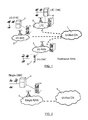
- a big part of the GSM and UMTS sites are currently being grouped together (as shown in figure 1A ).
- the problem is that a distinct transmission system is needed for each technology, so each part -GSM transmission 1 and UTMS transmission 2- has to be dimensioned independently, i.e. the size of the GSM partition has to be calculated based on the GSM cell traffic,. and the UMTS partition has to be based on the UMTS traffic, as they are different links.
- OSS Operation Support System
- the Common OSS (14) also handles the administration of all the network elements (2G BTSs, 3G BTSs or Single RAN BTSs) connected to the Single RAN BSC/RNC and improves the reliability of the system.
- CPU Central Processor Units
- Single RAN BSC/RNC (4) there is also a Common CPU (25), but it also has additional functions, it supervises tasks, assigns resources as well as controls both systems at the same time.
- this Common CPU (25) comprises an assignment module which decides the operation modes in order to switch HW components dedication from an exclusive radio access technology to another or also to the mixed mode.
- sub-rack or simply “shelf”, denote a subrack mountable equipment (19).
- the size of the frame for mounting multiple equipments may be 19 or 22 inches.
- the possible storing systems (24) e.g. hard disks, solid state memory, etc.
- the possible storing systems (24) can be shared between GSM and UMTS systems.
- SDR Software Defined Radio
- the present invention proposes two different levels of functions: subrack or board/card level.
- This subdivision is handled by different software under the same hardware.
- the software of the complete subrack is dedicated to one techonology including hard disk, processing power or control units.
- every board of processing has software dedicated to one technology and there are common tasks as hard disk or control functions performed by a common software for both technologies.
- Through the OSS it is possible to configure every subrack or board with one of the modes as it is just a change of the software running in the equipment.
- By configuring the mixed mode in the RNC+BSC board it is necessary a new software capable of processing both technologies protocols and message processing simultaneously.
- the SDR concept allows modularity when upgrading from BSC to RNC, from RNC to BSC, from BSC to RNC/BSC & from RNC to RNC/BSC just by SW at board level.
- HW upgrade may be avoided and the need for upgrading components is limited to certain situations. For instance, in order to re-assess capacity, the RAN may require extra cards to be added.
- Mobile Networks processing boards are defined as the boards dedicated to process the GSM or UMTS protocol stack, algorithms of mobility, encryption, data delivering, data routing, and all the functions specified for the BSC and RNC in the 3GPP.
- boards dedicated to UMTS or GSM this invention defines advanced algorithm, which will be included in the equipment control boards to configure every processing board based on the traffic load.
- the common Control boards are also dedicated to manage the equipment, perform the OSS interface, and report alarms to the Operation and Maintenance systems.
- All the boards dedicated to one RAT will be working in pool mode, which is currently implemented in RAN controller (i.e RNC or BSC). That means there are some balancing mechanisms to share the processing power dynamically between the boards of the same RAT. Once balancing mechanisms are applied, the board (or subrack) is capable of dynamically adjusting its amount of resources dedicated to one radio access technology instead of the other.
- RAT-A When the load in one RAT (RAT-A) is very high then some board(s) or sub-racks/shelfs of the RAT-B will be configured to RAT-A in order to cope with the load.
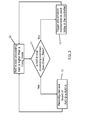
- FIG. 3 An example of flow diagram is given in Figure 3 . It shows when the load of the RAT-A exceeds a (congestion) threshold referred to in the figure 3 as congestion state (10), then the total processing load in RAT-B is checked in order to verify that a unit dedicated to the other RAT is under the threshold (which can be called Green State (11)), which refers to the capability for taking on additional load.
- a congestion threshold referred to in the figure 3 as congestion state (10)
- Green State (11) which refers to the capability for taking on additional load.
- FIG 6 it is shown a practical example of one board reconfiguration after checking the load of the boards of both Radio Access Technologies as indicated in diagram of figure 3 . Accordingly, this reconfiguration is performed by dynamically reassessing resources in dependence upon the two thresholds.
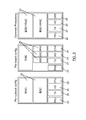
- 3G boards (27) are overloaded (congestion state (10)), while 2G boards (28) remain underused (in green state (11)); then a reconfiguration is performed to distribute resources properly by switching board dedication from 2G to 3G.
- the reconfiguration acts in a similar way when the overloaded boards are those pertaining to 2G.
- the congestion mechanism of every technology will act.
- Radio Resource Management involves strategies for controlling parameters such as transmit power, channel allocation, handover criteria, modulation scheme, error coding scheme.
- the RRM concept is extended to the two networks for implementing a general and unified management considering cells and terminals pertaining to each technology network.
- the Common Controller has the possibility to know in details the cell load of both 2G and 3G Base Stations under its control, and this load will be stored in internal memory elements, accessible to all the units performing RRM decisions either in 3G or 2G.
- any inter-RAT hard handover between UMTS and GSM algorithm will now check the load of the target system before taking the final decision for a handover execution. Then, the handover can be made towards a cell with an acceptable load, ensuring the successful procedure. Apart from the load, it can be taken also into account the type of traffic (voice, video-call, data) and the quality of service associated to the call (i.e. the priority of the call).
- CS traffic is of higher importance than PS traffic. This categorization is especially advantageous in a congestion scenario. It allows the functionality of re-arrangement resources in order to cope with voice traffic needs in GSM and in UMTS as well.
- the resources that are assigned to PS can be released and dedicated, upon reconfiguration, to CS traffic. What is more, this is performed whether or not, the traffic is of the 2G or 3G type for components are capable of working in GSM and UMTS mode selectively.
- a single controller can implement this priority management in many levels and components. For instance, among other, it may be applicable to signalling, transmission interfaces and transcoders.
- this solution may be also applied in case of failure of a particular module and therefore it permits to mitigate a loss of capacity in this service.
- Service level can be identified as the "Traffic Class” or ARP (Allocation Retention Priority) and THP (Traffic Handling Priority) attributes. These are two attributes defined to have different priorities for different packet sessions.
- a user preference regulation may be established in the telecommunication network may be organised. For example, there may be "gold" users and to avoid congestion of the gold users/services (THP/ARP is set to high priority values), it is thus possible to reallocate resources used by low priority services to avoid congestion for gold services/users.
- TTP/ARP is set to high priority values
- the load of the 3G radio cells is really high and it is necessary to perform inter-RAT handover towards GSM.
- GSM there are different cells available, and then the Single RAN BSC/RNC will check internally which one is the less loaded cell. Then the Single RAN BSC/RNC orders the inter-RAT handover to the UE towards the chosen cell.
Landscapes
- Engineering & Computer Science (AREA)
- Computer Networks & Wireless Communication (AREA)
- Signal Processing (AREA)
- Mobile Radio Communication Systems (AREA)
Abstract
Description
- The present invention relates to the field of mobile telecommunications networks. More specifically, it relates to a single controller entity capable of managing different radio access technologies (RATs). Amongst other network technologies, the present invention is particularly focused on a controller entity with BSC and RNC functionalities, thereby supporting both 2G (GSM) and 3G (UMTS) mobile networks.
- In many mobile telecommunication network deployments more than one radio access technology is available simultaneously. As a result, terminals for use in these networks are usually specified to operate within the different existing radio access networks (RANs).
- Other network elements such as the BSC, the RNC, the Base Stations (BTS in 2G or Node B in 3G) are typically dedicated to supporting a sole RAT. It would be particularly advantageous that the entity in charge of implementing the radio access technology for a first network also serves for a second network when both networks may coexist. That is to say, a single, common entity supports two or more radio access technologies by sharing functions and elements needed by each network.
- It is known to provide a network controller working on several networks. US patent application
US2002086667 , for instance, relates to a transmission and interconnection method focused on the lu interface applied to GSM. This facilitates the sharing of a single board for transmission. - US patent application
US2004082366 relates to a radio server for interworking between networks (specifically between BSC of a 2G network and RNC of a 3G network). The disclosed radio server performs several tasks associated with Common Radio Resource Management (Co-RRM). - International patent application
WO02098154 - The present invention proposes to merge two different radio network access in a unique element doing both functions simultaneously.
- In accordance with the invention there is provided a controller entity for managing the base stations of at least a first radio access technology and a second radio access technology comprising:
- a common transmission interface unit for transmitting to a base station of the first radio access technology and to a base station of the second radio access technology,
- a plurality of hardware module units available for dedication to the first and the second radio access technology, and
- an assignment module for establishing an operation mode respective to dedication of at least one of the hardware module units in dependence upon a measurement of the performance and the reliability of said hardware module unit for each of the radio access technologies.
- In accordance with a further aspect of the invention is provided a method of re-configuring the usage of hardware module units of a controller entity comprising the following steps:
- measuring the performance and the reliability of a hardware module unit for a first and for a second Radio Access Technology,
- identifying hardware module units as targets to be re-configured,
- re-configuring, upon dependence of previous steps, the usage of the measured hardware module units by reassigning their dedication to the Radio Access Technology in order to enable both Radio Access Technologies share resources.
- Accordingly, the present invention provides a single element capable of controlling the access to a plurality of radio access networks, each of said radio access networks having a corresponding set of technical characteristics. This is achieved by merging a first and a second network technology in a single entity capable of handling functions pertaining to both technologies.
- Throughout this document, such single element will be referred to, without implied loss of generality, as a Single RAN controller (4) and more specifically as a Single RAN BSC/RNC.
- By merging RAN entities for at least a first and a second radio access network within a single, common element, this "single RAN controller" simultaneously performs functions of each radio access technology. This goes beyond a mere aggregation of units pertaining to different technologies within one element because the single RAN controller is synergistically coupled with both technologies. The logical units pertaining to different networks interact with each other on different levels. As a result, some elements may be shared, and some may even be switched off or on, depending whether certain conditions are met.
- The invention radically differs from the known, partial solutions mentioned above. In essence the single RAN controller is not merely a "box" with two types of elements inside, it is rather a network entity that dynamically assigns hardware and software capacity to provide network functionality in support of two or more different RATs. In some cases the network functionality is provided by common functions (i.e. functions shared between more than one of the supported RATs) and yields a gain in terms of processing power or Radio algorithms in order to increase the network efficiency.
- The invention also enables an additional functionality for transferring traffic between technologies. This new function, implemented in the Single RAN controller, allows the assignment of multi-mode terminals to a given radio access technology (RAT) with a RAT selection, for instance, dependent on the load of each network.
- The present invention thus provides a solution to problems caused by congestion in one of the radio access networks by defining an algorithm for triggering terminal handover between radio access networks, each RAN having a corresponding RAT. The implementation of the algorithm takes place in the single RAN controller as part of its functions and also considers terminals features for supporting a particular network technology.
- Similarly, the present invention addresses network failures caused by faults in equipment associated with one of the networks and therefore avoiding calls being dropped. These failures may be overcome, or at least mitigated, by changing the operation mode of the working equipment dedicated to the other network to allow said equipment and its resources to be shared by both networks simultaneously.
- The above and other objects and features of the invention will appear clearer with the following accompanying drawings, given as non-restrictive examples.
-
FIG.1 shows a diagram regarding prior art network architecture, having BSC, RNC and different base stations for 2G and 3G. -
FIG. 2 shows a diagram of a network architecture according to the present invention. -
FIG. 3 shows a flow diagram when the load of the RAT-A exceeds a defined threshold regarding a congestion state (10), then it is checked the processing load of the other RAT-B in order to redistribute resources. If the load of the RAT-B is under a green state (11) indicating a capacity of handling current load with less resources without significant loss of performance, thus some resources can be reconfigured (12) thereby switching their dedication from RAT-B to RAT-A. Alternatively, it must act a pre-emption mechanism (13) currently available in RAT controllers. -
FIG. 4 shows the detailed single RAN concept in which the single RAN controller in accordance with the invention may be deployed as an evolution of prior GSM and UMTS controller. -
FIG. 5 shows different levels of granularity in the hardware implementation. It can be dedicated processing hardware capabilities to every technology per sub-rack, per board or it can be a common processing for all technologies. -
FIG. 6 shows an example of a dynamic configuration by reassessing resources. - At present, there are two main different radio access technologies deployed in tandem in many parts of the world, namely GSM (or 2G) and UMTS (or 3G). Each one has its own controller governing the access to the network, this entity is responsible for the radio resource management. In GSM, this controller is called BSC (2), Base Station Controller, while in UMTS it is called RNC (3), Radio Network Controller.
- Unfortunately, these entities are not compatible.
- Despite the fact that GSM mobile operators have also deployed UMTS in their networks, the incompatibility still remains. As a consequence, each network needs to be separately configured based on traffic requirements in that network alone.
- The majority of GSM and UMTS sites (i.e. sites where GSM and UMTS hardware is installed) are shared. While there is typically no issue of proximity, the problem is that a distinct transmission system is needed for each technology, so each part - GSM transmission and UMTS transmission - has to be dimensioned independently. The size of the GSM subsystem has to be calculated based on the GSM cell traffic, and likewise the UMTS subsystem has to be based on the UMTS traffic. It would thus be advantageous to integrate both subsystems within the same entity. This approach would make it possible to have common Hardware for both technologies by sharing components. It is also possible to dedicate resources and redistribute terminals to a first or a second network (for instance GSM and UMTS) depending on the load experienced in a certain moment.
- Throughout this document, the entity integrating GSM and UMTS subsystems will be referred to as single RAN BSC/RNC (4), which is a common Controller for the GSM and UMTS Base Stations.
- According to the invention, there are different levels of common functions, which are described herein below.
- As seen in
figure 4 , the BSC and the RNC perform similar functions in 2G and 3G networks respectively. - The interface between the BSC (2) and the BTS in GSM is called Abis (29).
- The interface between the RNC (3) and the Node B in UMTS is called lub (30).By means of a common lub/Abis (16) interface implementation in a module allows different options of commonality in the single RAN controller (4).
- The single RAN BSC/RNC (4) is configured to carry 2G or 3G traffic under a common pool bandwidth. The traffic may be allocated regardless the technology by means of the common lub/Abis interface (16). This is detailed in co-pending European patent application
EP2144477 . This document discloses a shared Call Admission Control and a shared Control Congestion that are implemented in the RNC/BSC side and in the NodeB/BTS side. - Other components, as illustrated in
figure 4 , can also be substituted. Remote radio heads (33) (i.e. GSM 900, GSM 1800, UMTS 2100 y UMTS 900) to operate on GSM and on UMTS in different frequency bands using Abis (29) and lub (30) respectively, are replaced with a single 2G/3G base band unit (33) and prior tower mounted amplifiers (15) are replaced with a radio remote unit (18). - GSM mobile operators have also deployed UMTS in their networks. A big part of the GSM and UMTS sites are currently being grouped together (as shown in
figure 1A ). The problem is that a distinct transmission system is needed for each technology, so each part -GSM transmission 1 and UTMS transmission 2- has to be dimensioned independently, i.e. the size of the GSM partition has to be calculated based on the GSM cell traffic,. and the UMTS partition has to be based on the UMTS traffic, as they are different links. - The Single RAN BSC/RNC is controlled by the same OSS (14). OSS stands for Operation Support System, a set of routines implemented for managing certain tasks:
- Configuration Management that allows the configuration and monitoring of the elements, and parameters.
- • Fault Management that includes the alarm system for fault detection and error handling.
- • Performance Management that carries out performance monitoring measurements such as the processor load of the Single RAN BSC/RNC boards (% of the total power processing of the board which is being used in a moment), the common transmission interface occupation, the total amount of traffic, etc. These are common for both technologies, so that the common OSS (14) will be doing this task apart from any other task dedicated to every technology.
- · Security management in charge of the secure access to the OSS (14) common system.
- The Common OSS (14) also handles the administration of all the network elements (2G BTSs, 3G BTSs or Single RAN BTSs) connected to the Single RAN BSC/RNC and improves the reliability of the system.
- That is the use of the same hardware for power supply for both systems simultaneously to save total power consumption.
- In every controller there are Central Processor Units (CPU) that control the whole system by itself or one per sub-rack/shelf equipment. In the case of the Single RAN BSC/RNC (4), there is also a Common CPU (25), but it also has additional functions, it supervises tasks, assigns resources as well as controls both systems at the same time. By means of the OSS routines, resources can be managed at several levels. In particular, this Common CPU (25) comprises an assignment module which decides the operation modes in order to switch HW components dedication from an exclusive radio access technology to another or also to the mixed mode.
- Throughout the present invention the terms "sub-rack", or simply "shelf", denote a subrack mountable equipment (19). The size of the frame for mounting multiple equipments (usually in a server) may be 19 or 22 inches.
- In the same way, the possible storing systems (24) (e.g. hard disks, solid state memory, etc.) can be shared between GSM and UMTS systems.
- According to Software Defined Radio (SDR) approach, components that used to be previously implemented in hardware can now be implemented using software on computing devices. This allows several Operation Modes to be defined in connection with the degree to which HW components may be separated and combined.
- Basically, the present invention proposes two different levels of functions: subrack or board/card level.
- E ach subrack (19) can work in the three modes available: RNC dedicated subrack (20), BSC dedicated subrack (21) and RNC+BSC subrack (31).
- E ach board (26) can work in the three modes available: RNC dedicated board (27), BSC dedicated board (28) and RNC+BSC board (32).
- This subdivision is handled by different software under the same hardware. Normally in the per subrack mode, the software of the complete subrack is dedicated to one techonology including hard disk, processing power or control units. In each board mode, every board of processing has software dedicated to one technology and there are common tasks as hard disk or control functions performed by a common software for both technologies. Through the OSS, it is possible to configure every subrack or board with one of the modes as it is just a change of the software running in the equipment. By configuring the mixed mode in the RNC+BSC board, it is necessary a new software capable of processing both technologies protocols and message processing simultaneously.
- The SDR concept allows modularity when upgrading from BSC to RNC, from RNC to BSC, from BSC to RNC/BSC & from RNC to RNC/BSC just by SW at board level.
- As a consequence, HW upgrade may be avoided and the need for upgrading components is limited to certain situations. For instance, in order to re-assess capacity, the RAN may require extra cards to be added.
- Mobile Networks processing boards are defined as the boards dedicated to process the GSM or UMTS protocol stack, algorithms of mobility, encryption, data delivering, data routing, and all the functions specified for the BSC and RNC in the 3GPP.
- The steps for the commonality of these boards are:
- G SM or UMTS functions definition at sub-rack level. Every subrack (19) will be dedicated to RNC (20) or to BSC (21) according to the operator necessity by software parameterisation.
- G SM or UMTS functions definition at board level. Every board (26) will be dedicated to RNC (27) or BSC (28) according to the operator necessity by software parameterisation.
- G SM and UMTS functions done in the same board (32).
- For the first and the second cases: boards dedicated to UMTS or GSM, this invention defines advanced algorithm, which will be included in the equipment control boards to configure every processing board based on the traffic load. The common Control boards are also dedicated to manage the equipment, perform the OSS interface, and report alarms to the Operation and Maintenance systems.
- All the boards dedicated to one RAT (Radio Access Technology) will be working in pool mode, which is currently implemented in RAN controller (i.e RNC or BSC). That means there are some balancing mechanisms to share the processing power dynamically between the boards of the same RAT. Once balancing mechanisms are applied, the board (or subrack) is capable of dynamically adjusting its amount of resources dedicated to one radio access technology instead of the other.
- When the load in one RAT (RAT-A) is very high then some board(s) or sub-racks/shelfs of the RAT-B will be configured to RAT-A in order to cope with the load.
- There may be many algorithms for carrying out the balance of load between networks. In this respect, an example of flow diagram is given in
Figure 3 . It shows when the load of the RAT-A exceeds a (congestion) threshold referred to in thefigure 3 as congestion state (10), then the total processing load in RAT-B is checked in order to verify that a unit dedicated to the other RAT is under the threshold (which can be called Green State (11)), which refers to the capability for taking on additional load. InFigure 6 , it is shown a practical example of one board reconfiguration after checking the load of the boards of both Radio Access Technologies as indicated in diagram offigure 3 . Accordingly, this reconfiguration is performed by dynamically reassessing resources in dependence upon the two thresholds. - At first, 3G boards (27) are overloaded (congestion state (10)), while 2G boards (28) remain underused (in green state (11)); then a reconfiguration is performed to distribute resources properly by switching board dedication from 2G to 3G. Obviously, the reconfiguration acts in a similar way when the overloaded boards are those pertaining to 2G. When the conditions for the reconfiguration process are not met, the congestion mechanism of every technology will act.
- In a multi-cell network telecommunication, Radio Resource Management (RRM) involves strategies for controlling parameters such as transmit power, channel allocation, handover criteria, modulation scheme, error coding scheme. The RRM concept is extended to the two networks for implementing a general and unified management considering cells and terminals pertaining to each technology network. The Common Controller has the possibility to know in details the cell load of both 2G and 3G Base Stations under its control, and this load will be stored in internal memory elements, accessible to all the units performing RRM decisions either in 3G or 2G.
- For this reason any inter-RAT hard handover between UMTS and GSM algorithm will now check the load of the target system before taking the final decision for a handover execution. Then, the handover can be made towards a cell with an acceptable load, ensuring the successful procedure. Apart from the load, it can be taken also into account the type of traffic (voice, video-call, data) and the quality of service associated to the call (i.e. the priority of the call).
- In this connection, despite of the increasing of multimedia data services, the voice is still considered the most important service offered by telecommunication operators. To reflect this and prevent drop calls, CS traffic is of higher importance than PS traffic. This categorization is especially advantageous in a congestion scenario. It allows the functionality of re-arrangement resources in order to cope with voice traffic needs in GSM and in UMTS as well.
- By prioritising CS voice over PS, in the event of CS traffic being close to an overload state, the resources that are assigned to PS can be released and dedicated, upon reconfiguration, to CS traffic. What is more, this is performed whether or not, the traffic is of the 2G or 3G type for components are capable of working in GSM and UMTS mode selectively.
- This can be done using the TC to identify whether it is a Conversational call (voice call) or Streaming, interactive, background (Packet calls). It is also possible to distinguish between Streaming and the rest of the packet calls, using this differentiation to reconfigure the Hardware for GSM-UMTS to prioritise the streaming calls.
- A single controller, as depicted by the present document, can implement this priority management in many levels and components. For instance, among other, it may be applicable to signalling, transmission interfaces and transcoders.
- Besides, this solution may be also applied in case of failure of a particular module and therefore it permits to mitigate a loss of capacity in this service.
- The same technique can be applied to a service level. If one service is identified as high priority, the same algorithm can be used. Service level can be identified as the "Traffic Class" or ARP (Allocation Retention Priority) and THP (Traffic Handling Priority) attributes. These are two attributes defined to have different priorities for different packet sessions.
- On account of this, a user preference regulation may be established in the telecommunication network may be organised. For example, there may be "gold" users and to avoid congestion of the gold users/services (THP/ARP is set to high priority values), it is thus possible to reallocate resources used by low priority services to avoid congestion for gold services/users.
- Considering the following situation, there is a crowded stadium with a lot of 3G calls, then the load of the 3G radio cells is really high and it is necessary to perform inter-RAT handover towards GSM. In GSM there are different cells available, and then the Single RAN BSC/RNC will check internally which one is the less loaded cell. Then the Single RAN BSC/RNC orders the inter-RAT handover to the UE towards the chosen cell.
-
- It grants large scale Network simplification.
- It allows cost effective migration towards a
future proof 2G/3G capable Network. - It facilitates smooth introduction of UMTS900 technology.
- It obtains flexibility of operation and adaptation to the client necessities by developing Software Defined Radio.
- It enables refreshment of the
legacy 2G Network or roll-out a new 2G energy efficient Network. - It permits saving of energy of up to 80% per site.
- It prevents congestion of certain services by reallocating resources previously dedicated to low priority services.
- It is well-known that abbreviations and acronyms are frequently used in the mobile telephony field. Below there is a list of acronyms/terms used throughout the present specification:
- ARP
- Allocation Retention Priority
- BBU
- Base Band Unit
- BSC
- Base Station Controller
- BTS
- Base Transceiver Station
- 3GPP
- Third Generation Partnership Project
- GSM
- Global System for Mobile communications
- HW
- Hardware
- LTE
- Long Term Evolution
- OMC
- Operations and Maintenance Centre
- OSS
- Operation Support System
- RAN
- Radio Access Network
- RAT
- Radio Access Technology
- RNC
- Remote Network Controller
- RRM
- Radio Resource Management
- RRU
- Radio Remote Unit
- SDR
- Software Defined Radio
- SW
- Software
- TMA
- Tower Mounted Amplifier
- TC
- Traffic Class
- THP
- Traffic Handling Priority
- UE
- User Equipment
- UMTS
- Universal Mobile Telecommunications System
- UTRAN
- UMTS Terrestrial Radio Access Network
-
Unified Core Network (1); Single base band unit (17); BSC (2); Radio remote unit (18); RNC (3); Generic subrack (19); Single RAN controller (4); RNC dedicated subrack (20); LTE access network controller (5); BSC dedicated subrack (21); LTE OMC (6); Common power supply unit (22); 2G OMC (7); Common transmission board (23); 3G OMC (8); Common storing system (24); Single OMC (9); Common central processor unit (25); Congestion state (10); Generic board (26); Green state (11); RNC dedicated board (27); Reconfiguration mechanism (12); BSC dedicated board (28); Pre-emption mechanism (13); Abis (29); OSS (14); lub (30); Tower mounted amplifiers (15); Mixed or dual subrack (31); Common lub/Abis interface (16); Mixed or dual board (32); Remote radio heads (33);
Claims (17)
- A controller entity for managing the base stations of at least a first radio access technology and a second radio access technology comprising:- a common transmission interface unit for transmitting to / receiving from a base station of the first radio access technology and a base station of the second radio access technology,- a plurality of hardware module units available for dedication to the first and the second radio access technology, and- an assignment module for establishing an operation mode respective to dedication of at least one of the hardware module units in dependence upon a measurement of the performance and the reliability of said hardware module unit for each of the radio access technologies.
- A controller entity according to claim 1, characterized in that the operation mode of hardware module units is selected among the following:- exclusive dedication to the first Radio Access Technology,- exclusive dedication to the second Radio Access Technology,- simultaneous dedication to the first and second Radio Access Technologies.
- A controller entity according to claim 1 or 2, wherein the operation mode of hardware module units is established in dependence upon the load and the type of traffic managed by each radio access technology in order to prioritise a first type of traffic over a second type of traffic.
- A controller entity according to any of previous claims, wherein the different types of traffic are defined in dependence upon at least one of the following parameters:- Traffic Class,- Allocation Retention Priority (ARP),- Traffic Handling Priority (THP).
- A controller entity according to any of previous claims, characterized in that the hardware module unit is a subrack mountable equipment of a server.
- A controller entity according to claim any of previous claims, characterized in that the hardware module unit is a board for being inserted in a subrack mountable equipment of a server.
- A controller entity according to any of previous claims, further comprising a common Radio Resource Management module for performing inter-Radio Access Technology handover based on the load of each Radio Access Technology and the measurement of the performance and the reliability of hardware module units.
- A controller entity according to any of previous claims, further comprising a common Operation Support System for monitoring and configuring parameters, managing performance measurements detecting faults and producing alarms for a first and a second Radio Access Technology.
- Method of re-configuring the usage of hardware module units of a controller entity comprising the following steps:- measuring the performance and the reliability of a hardware module unit for a first and for a second Radio Access Technology,- identifying hardware module units as targets to be re-configured,- re-configuring, upon dependence of previous steps, the usage of the measured hardware module units by reassigning their dedication to the Radio Access Technology in order to enable both Radio Access Technologies share resources.
- Method of re-configuring the usage of hardware module units of a controller entity according to claim 9, wherein the measure of performance and reliability further comprises:- evaluating, for each radio access technologies and for each hardware module units, the type and the load of traffic managed, in order to prioritise a first type of traffic over a second type of traffic.
- Method of re-configuring the usage of hardware module units of a controller entity according to claims 9 or 10, wherein the different types of traffic are defined in dependence upon at least one of the following parameters:- Traffic Class,- Allocation Retention Priority (ARP),- Traffic Handling Priority (THP).
- Method of re-configuring the usage of hardware module units of a controller entity according to any of claims 9 to 11, wherein the measure of performance of the hardware module unit includes checking its processing load is above a pre-established threshold for identifying that congestion state is close to be reached.
- Method of re-configuring the usage of hardware module units of a controller entity according to any of claims 9 to 12, wherein the measure of performance of the hardware module unit includes checking its processing load is below a pre-established threshold for identifying an under-used state.
- Method of re-configuring the usage of hardware module units of a controller entity according to any of claims 9 to 13, wherein the performance measure of the hardware module unit includes an evaluation of the load of a specific type of traffic managed by the said hardware module unit in order to enable over-used applications to be suitable re-distributed.
- Method of re-configuring the usage of the hardware module units of a controller entity according to any of claims 9 to 14, further comprising:- measuring the Quality of Service, QoS, associated to connections managed by the hardware module unit and,- identifying priority applications to be suitable scheduled and managed.
- Method of re-configuring the usage of the hardware module units of a controller entity according to any of claims 9 to 15, wherein the measure of reliability includes testing failure of the hardware module units to force a re-assignation of resources.
- Method of re-configuring the usage of the units of a controller entity according to any of claims 9 to 16, wherein the hardware module unit is selected from:- a subrack mountable equipment of a server and- a board for being inserted in a subrack mountable equipment of a server.
Applications Claiming Priority (2)
| Application Number | Priority Date | Filing Date | Title |
|---|---|---|---|
| ES201030465A ES2375388B1 (en) | 2010-03-29 | 2010-03-29 | RADIO ACCESS NETWORK CONTROLLING ENTITY. |
| GB1014315.4A GB2483103B (en) | 2010-03-29 | 2010-08-27 | Radio access network controller entity |
Publications (2)
| Publication Number | Publication Date |
|---|---|
| EP2375803A1 true EP2375803A1 (en) | 2011-10-12 |
| EP2375803B1 EP2375803B1 (en) | 2016-12-28 |
Family
ID=43013345
Family Applications (1)
| Application Number | Title | Priority Date | Filing Date |
|---|---|---|---|
| EP11275054.2A Active EP2375803B1 (en) | 2010-03-29 | 2011-03-29 | Multi-mode Radio Access Network controller entity with dynamic re-configuration for supporting at least two different radio access technologies |
Country Status (3)
| Country | Link |
|---|---|
| EP (1) | EP2375803B1 (en) |
| ES (1) | ES2375388B1 (en) |
| GB (1) | GB2483103B (en) |
Cited By (4)
| Publication number | Priority date | Publication date | Assignee | Title |
|---|---|---|---|---|
| CN104041120A (en) * | 2012-11-29 | 2014-09-10 | 华为技术有限公司 | Different system switching method, device and system |
| US9917789B2 (en) | 2013-07-31 | 2018-03-13 | International Business Machines Corporation | Computing element allocation in data receiving link |
| EP3337042A1 (en) * | 2016-12-14 | 2018-06-20 | Intel IP Corporation | Cellular handset device |
| CN109982387A (en) * | 2013-07-11 | 2019-07-05 | 安德鲁无线系统有限公司 | For the cell network architecture of multiple network operator services |
Families Citing this family (2)
| Publication number | Priority date | Publication date | Assignee | Title |
|---|---|---|---|---|
| EP2832155B1 (en) * | 2012-03-30 | 2023-08-16 | Sony Group Corporation | Network-controlled adaptive terminal behavior managing high-network-load scenarios |
| EP2854446B1 (en) * | 2012-06-27 | 2018-04-25 | Huawei Technologies Co., Ltd. | Access control method and device |
Citations (7)
| Publication number | Priority date | Publication date | Assignee | Title |
|---|---|---|---|---|
| US20020086667A1 (en) | 1999-05-31 | 2002-07-04 | Nokia Corporation | Transmission and interconnection method |
| WO2002098154A1 (en) | 2001-05-30 | 2002-12-05 | Telefonaktiebolaget Lm Ericsson (Publ) | Connecting the bsc of a gsm base station subsystem to an rnc of a umts system to achieve support for the iu interface in the gsm base station subsystem |
| US20040082366A1 (en) | 2001-04-23 | 2004-04-29 | Nokia Corporation | Method and system for implementing a signalling connection in a distributed radio access network |
| US20070263636A1 (en) * | 2003-07-16 | 2007-11-15 | Utstarcom (China) Co. Ltd. | Ip Switching Based Distributed Radio Network Controller |
| EP2094024A1 (en) * | 2006-12-15 | 2009-08-26 | Huawei Technologies Co Ltd | Processing method and system for realizing the configuring of network element in multi-standard communication system |
| US20090227262A1 (en) * | 2006-11-20 | 2009-09-10 | Huawei Technologies Co., Ltd. | Method, system and base station for configuring multi-mode base station |
| EP2144477A2 (en) | 2008-07-09 | 2010-01-13 | Vodafone Group PLC | Method and system for pooled 2g-3g single transmission |
Family Cites Families (4)
| Publication number | Priority date | Publication date | Assignee | Title |
|---|---|---|---|---|
| DE60330202D1 (en) * | 2003-04-23 | 2009-12-31 | Telecom Italia Spa | Radiotelephone network with packet data multicarrier transmission |
| EP1850535A1 (en) * | 2006-04-26 | 2007-10-31 | Alcatel Lucent | Software configurable and definable base station |
| ES2351830B1 (en) * | 2009-02-05 | 2011-12-12 | Vodafone España, S.A.U. | NETWORK PROCEDURE AND CONTROLLER TO SWITCH BETWEEN SHARED NETWORK ARCHITECTURES. |
| WO2010092457A1 (en) * | 2009-02-10 | 2010-08-19 | Nokia Corporation | Method, apparatus and computer program product for transfer of capability support information in a multi-rat environment |
-
2010
- 2010-03-29 ES ES201030465A patent/ES2375388B1/en active Active
- 2010-08-27 GB GB1014315.4A patent/GB2483103B/en active Active
-
2011
- 2011-03-29 EP EP11275054.2A patent/EP2375803B1/en active Active
Patent Citations (7)
| Publication number | Priority date | Publication date | Assignee | Title |
|---|---|---|---|---|
| US20020086667A1 (en) | 1999-05-31 | 2002-07-04 | Nokia Corporation | Transmission and interconnection method |
| US20040082366A1 (en) | 2001-04-23 | 2004-04-29 | Nokia Corporation | Method and system for implementing a signalling connection in a distributed radio access network |
| WO2002098154A1 (en) | 2001-05-30 | 2002-12-05 | Telefonaktiebolaget Lm Ericsson (Publ) | Connecting the bsc of a gsm base station subsystem to an rnc of a umts system to achieve support for the iu interface in the gsm base station subsystem |
| US20070263636A1 (en) * | 2003-07-16 | 2007-11-15 | Utstarcom (China) Co. Ltd. | Ip Switching Based Distributed Radio Network Controller |
| US20090227262A1 (en) * | 2006-11-20 | 2009-09-10 | Huawei Technologies Co., Ltd. | Method, system and base station for configuring multi-mode base station |
| EP2094024A1 (en) * | 2006-12-15 | 2009-08-26 | Huawei Technologies Co Ltd | Processing method and system for realizing the configuring of network element in multi-standard communication system |
| EP2144477A2 (en) | 2008-07-09 | 2010-01-13 | Vodafone Group PLC | Method and system for pooled 2g-3g single transmission |
Cited By (6)
| Publication number | Priority date | Publication date | Assignee | Title |
|---|---|---|---|---|
| CN104041120A (en) * | 2012-11-29 | 2014-09-10 | 华为技术有限公司 | Different system switching method, device and system |
| CN104041120B (en) * | 2012-11-29 | 2018-01-02 | 华为技术有限公司 | Different system switching method, device and system |
| CN109982387A (en) * | 2013-07-11 | 2019-07-05 | 安德鲁无线系统有限公司 | For the cell network architecture of multiple network operator services |
| USRE50092E1 (en) | 2013-07-11 | 2024-08-20 | Commscope Technologies Llc | Small cell network architecture for servicing multiple network operators |
| US9917789B2 (en) | 2013-07-31 | 2018-03-13 | International Business Machines Corporation | Computing element allocation in data receiving link |
| EP3337042A1 (en) * | 2016-12-14 | 2018-06-20 | Intel IP Corporation | Cellular handset device |
Also Published As
| Publication number | Publication date |
|---|---|
| ES2375388B1 (en) | 2013-01-29 |
| EP2375803B1 (en) | 2016-12-28 |
| GB2483103B (en) | 2012-12-05 |
| GB201014315D0 (en) | 2010-10-13 |
| GB2483103A (en) | 2012-02-29 |
| ES2375388A1 (en) | 2012-02-29 |
Similar Documents
| Publication | Publication Date | Title |
|---|---|---|
| EP3962032B1 (en) | Method and apparatus for balancing server load in cloud ran systems | |
| US10278186B2 (en) | Network sharing | |
| US10292062B2 (en) | Resource allocation amongst parties sharing the same radio access network | |
| US9843963B2 (en) | Load balance method and relevant apparatuses | |
| EP2781116B1 (en) | Baseband signal processing cluster | |
| US9031551B2 (en) | Cellular telecommunications system network element | |
| US8285295B2 (en) | Dynamic frequency band allocation between radio communication networks | |
| EP3955608B1 (en) | Communication system | |
| US20100216453A1 (en) | Compensating for cell outage using priorities | |
| US11751081B2 (en) | Load information interaction method and device, processor and storage medium | |
| EP2375803B1 (en) | Multi-mode Radio Access Network controller entity with dynamic re-configuration for supporting at least two different radio access technologies | |
| EP1997342B1 (en) | Method for coordinated control of radio resources in a distributed wireless system | |
| US10512083B2 (en) | Control method and management apparatus | |
| CN107079415A (en) | Self-optimizing and/or improving method and apparatus for cloud-based wireless network | |
| US20240107367A1 (en) | Intelligent connectivity and data usage management for mobile devices in a converged network | |
| EP2151953A1 (en) | Method and system for allocating capacity in shared radio access networks | |
| KR20140045887A (en) | Mehtod and appartus for cell load balancing in a wireless communication system | |
| US9693295B2 (en) | Terminal selection method and system based on self-organizing network, and network entity | |
| WO2013147660A1 (en) | A method and apparatus for controlling transfer of network traffic | |
| CN112996067A (en) | Method, device and storage medium for determining serving cell | |
| US12028768B2 (en) | Method and system for cell prioritization | |
| WO2025193134A1 (en) | Network nodes and methods for handling transport resources in a wireless communication network | |
| WO2025109621A1 (en) | Systems and methods for providing load balancing | |
| KR20170050378A (en) | A virtualized base station based on sdr and method thereof | |
| CN112492650B (en) | Resource information processing method and device |
Legal Events
| Date | Code | Title | Description |
|---|---|---|---|
| PUAI | Public reference made under article 153(3) epc to a published international application that has entered the european phase |
Free format text: ORIGINAL CODE: 0009012 |
|
| AK | Designated contracting states |
Kind code of ref document: A1 Designated state(s): AL AT BE BG CH CY CZ DE DK EE ES FI FR GB GR HR HU IE IS IT LI LT LU LV MC MK MT NL NO PL PT RO RS SE SI SK SM TR |
|
| AX | Request for extension of the european patent |
Extension state: BA ME |
|
| 17P | Request for examination filed |
Effective date: 20120411 |
|
| GRAP | Despatch of communication of intention to grant a patent |
Free format text: ORIGINAL CODE: EPIDOSNIGR1 |
|
| RIC1 | Information provided on ipc code assigned before grant |
Ipc: H04W 24/02 20090101AFI20160621BHEP Ipc: H04W 88/12 20090101ALN20160621BHEP Ipc: H04W 88/10 20090101ALN20160621BHEP Ipc: H04W 92/12 20090101ALN20160621BHEP |
|
| INTG | Intention to grant announced |
Effective date: 20160707 |
|
| RAP1 | Party data changed (applicant data changed or rights of an application transferred) |
Owner name: VODAFONE GROUP PLC Owner name: VODAFONE ESPANA, S.A.U. |
|
| GRAS | Grant fee paid |
Free format text: ORIGINAL CODE: EPIDOSNIGR3 |
|
| GRAA | (expected) grant |
Free format text: ORIGINAL CODE: 0009210 |
|
| RBV | Designated contracting states (corrected) |
Designated state(s): AL AT BE BG CH CY CZ DE DK EE ES FI FR GR HR HU IE IS IT LI LT LU LV MC MK MT NL NO PL PT RO RS SE SI SK SM TR |
|
| AK | Designated contracting states |
Kind code of ref document: B1 Designated state(s): AL AT BE BG CH CY CZ DE DK EE ES FI FR GR HR HU IE IS IT LI LT LU LV MC MK MT NL NO PL PT RO RS SE SI SK SM TR |
|
| REG | Reference to a national code |
Ref country code: CH Ref legal event code: EP |
|
| REG | Reference to a national code |
Ref country code: AT Ref legal event code: REF Ref document number: 858214 Country of ref document: AT Kind code of ref document: T Effective date: 20170115 |
|
| REG | Reference to a national code |
Ref country code: IE Ref legal event code: FG4D |
|
| REG | Reference to a national code |
Ref country code: DE Ref legal event code: R096 Ref document number: 602011033799 Country of ref document: DE |
|
| PG25 | Lapsed in a contracting state [announced via postgrant information from national office to epo] |
Ref country code: LV Free format text: LAPSE BECAUSE OF FAILURE TO SUBMIT A TRANSLATION OF THE DESCRIPTION OR TO PAY THE FEE WITHIN THE PRESCRIBED TIME-LIMIT Effective date: 20161228 |
|
| REG | Reference to a national code |
Ref country code: FR Ref legal event code: PLFP Year of fee payment: 7 |
|
| REG | Reference to a national code |
Ref country code: LT Ref legal event code: MG4D |
|
| PG25 | Lapsed in a contracting state [announced via postgrant information from national office to epo] |
Ref country code: NO Free format text: LAPSE BECAUSE OF FAILURE TO SUBMIT A TRANSLATION OF THE DESCRIPTION OR TO PAY THE FEE WITHIN THE PRESCRIBED TIME-LIMIT Effective date: 20170328 Ref country code: GR Free format text: LAPSE BECAUSE OF FAILURE TO SUBMIT A TRANSLATION OF THE DESCRIPTION OR TO PAY THE FEE WITHIN THE PRESCRIBED TIME-LIMIT Effective date: 20170329 Ref country code: SE Free format text: LAPSE BECAUSE OF FAILURE TO SUBMIT A TRANSLATION OF THE DESCRIPTION OR TO PAY THE FEE WITHIN THE PRESCRIBED TIME-LIMIT Effective date: 20161228 Ref country code: LT Free format text: LAPSE BECAUSE OF FAILURE TO SUBMIT A TRANSLATION OF THE DESCRIPTION OR TO PAY THE FEE WITHIN THE PRESCRIBED TIME-LIMIT Effective date: 20161228 |
|
| REG | Reference to a national code |
Ref country code: NL Ref legal event code: MP Effective date: 20161228 |
|
| REG | Reference to a national code |
Ref country code: AT Ref legal event code: MK05 Ref document number: 858214 Country of ref document: AT Kind code of ref document: T Effective date: 20161228 |
|
| PG25 | Lapsed in a contracting state [announced via postgrant information from national office to epo] |
Ref country code: FI Free format text: LAPSE BECAUSE OF FAILURE TO SUBMIT A TRANSLATION OF THE DESCRIPTION OR TO PAY THE FEE WITHIN THE PRESCRIBED TIME-LIMIT Effective date: 20161228 Ref country code: HR Free format text: LAPSE BECAUSE OF FAILURE TO SUBMIT A TRANSLATION OF THE DESCRIPTION OR TO PAY THE FEE WITHIN THE PRESCRIBED TIME-LIMIT Effective date: 20161228 Ref country code: RS Free format text: LAPSE BECAUSE OF FAILURE TO SUBMIT A TRANSLATION OF THE DESCRIPTION OR TO PAY THE FEE WITHIN THE PRESCRIBED TIME-LIMIT Effective date: 20161228 |
|
| PG25 | Lapsed in a contracting state [announced via postgrant information from national office to epo] |
Ref country code: NL Free format text: LAPSE BECAUSE OF FAILURE TO SUBMIT A TRANSLATION OF THE DESCRIPTION OR TO PAY THE FEE WITHIN THE PRESCRIBED TIME-LIMIT Effective date: 20161228 |
|
| PG25 | Lapsed in a contracting state [announced via postgrant information from national office to epo] |
Ref country code: EE Free format text: LAPSE BECAUSE OF FAILURE TO SUBMIT A TRANSLATION OF THE DESCRIPTION OR TO PAY THE FEE WITHIN THE PRESCRIBED TIME-LIMIT Effective date: 20161228 Ref country code: IS Free format text: LAPSE BECAUSE OF FAILURE TO SUBMIT A TRANSLATION OF THE DESCRIPTION OR TO PAY THE FEE WITHIN THE PRESCRIBED TIME-LIMIT Effective date: 20170428 Ref country code: SK Free format text: LAPSE BECAUSE OF FAILURE TO SUBMIT A TRANSLATION OF THE DESCRIPTION OR TO PAY THE FEE WITHIN THE PRESCRIBED TIME-LIMIT Effective date: 20161228 Ref country code: CZ Free format text: LAPSE BECAUSE OF FAILURE TO SUBMIT A TRANSLATION OF THE DESCRIPTION OR TO PAY THE FEE WITHIN THE PRESCRIBED TIME-LIMIT Effective date: 20161228 Ref country code: RO Free format text: LAPSE BECAUSE OF FAILURE TO SUBMIT A TRANSLATION OF THE DESCRIPTION OR TO PAY THE FEE WITHIN THE PRESCRIBED TIME-LIMIT Effective date: 20161228 |
|
| PG25 | Lapsed in a contracting state [announced via postgrant information from national office to epo] |
Ref country code: PL Free format text: LAPSE BECAUSE OF FAILURE TO SUBMIT A TRANSLATION OF THE DESCRIPTION OR TO PAY THE FEE WITHIN THE PRESCRIBED TIME-LIMIT Effective date: 20161228 Ref country code: SM Free format text: LAPSE BECAUSE OF FAILURE TO SUBMIT A TRANSLATION OF THE DESCRIPTION OR TO PAY THE FEE WITHIN THE PRESCRIBED TIME-LIMIT Effective date: 20161228 Ref country code: PT Free format text: LAPSE BECAUSE OF FAILURE TO SUBMIT A TRANSLATION OF THE DESCRIPTION OR TO PAY THE FEE WITHIN THE PRESCRIBED TIME-LIMIT Effective date: 20170428 Ref country code: BG Free format text: LAPSE BECAUSE OF FAILURE TO SUBMIT A TRANSLATION OF THE DESCRIPTION OR TO PAY THE FEE WITHIN THE PRESCRIBED TIME-LIMIT Effective date: 20170328 Ref country code: IT Free format text: LAPSE BECAUSE OF FAILURE TO SUBMIT A TRANSLATION OF THE DESCRIPTION OR TO PAY THE FEE WITHIN THE PRESCRIBED TIME-LIMIT Effective date: 20161228 Ref country code: ES Free format text: LAPSE BECAUSE OF FAILURE TO SUBMIT A TRANSLATION OF THE DESCRIPTION OR TO PAY THE FEE WITHIN THE PRESCRIBED TIME-LIMIT Effective date: 20161228 Ref country code: BE Free format text: LAPSE BECAUSE OF FAILURE TO SUBMIT A TRANSLATION OF THE DESCRIPTION OR TO PAY THE FEE WITHIN THE PRESCRIBED TIME-LIMIT Effective date: 20161228 Ref country code: AT Free format text: LAPSE BECAUSE OF FAILURE TO SUBMIT A TRANSLATION OF THE DESCRIPTION OR TO PAY THE FEE WITHIN THE PRESCRIBED TIME-LIMIT Effective date: 20161228 |
|
| REG | Reference to a national code |
Ref country code: DE Ref legal event code: R097 Ref document number: 602011033799 Country of ref document: DE |
|
| REG | Reference to a national code |
Ref country code: CH Ref legal event code: PL |
|
| PLBE | No opposition filed within time limit |
Free format text: ORIGINAL CODE: 0009261 |
|
| STAA | Information on the status of an ep patent application or granted ep patent |
Free format text: STATUS: NO OPPOSITION FILED WITHIN TIME LIMIT |
|
| PG25 | Lapsed in a contracting state [announced via postgrant information from national office to epo] |
Ref country code: MC Free format text: LAPSE BECAUSE OF FAILURE TO SUBMIT A TRANSLATION OF THE DESCRIPTION OR TO PAY THE FEE WITHIN THE PRESCRIBED TIME-LIMIT Effective date: 20161228 Ref country code: DK Free format text: LAPSE BECAUSE OF FAILURE TO SUBMIT A TRANSLATION OF THE DESCRIPTION OR TO PAY THE FEE WITHIN THE PRESCRIBED TIME-LIMIT Effective date: 20161228 |
|
| 26N | No opposition filed |
Effective date: 20170929 |
|
| REG | Reference to a national code |
Ref country code: IE Ref legal event code: MM4A |
|
| PG25 | Lapsed in a contracting state [announced via postgrant information from national office to epo] |
Ref country code: LU Free format text: LAPSE BECAUSE OF NON-PAYMENT OF DUE FEES Effective date: 20170329 |
|
| PG25 | Lapsed in a contracting state [announced via postgrant information from national office to epo] |
Ref country code: CH Free format text: LAPSE BECAUSE OF NON-PAYMENT OF DUE FEES Effective date: 20170331 Ref country code: SI Free format text: LAPSE BECAUSE OF FAILURE TO SUBMIT A TRANSLATION OF THE DESCRIPTION OR TO PAY THE FEE WITHIN THE PRESCRIBED TIME-LIMIT Effective date: 20161228 Ref country code: IE Free format text: LAPSE BECAUSE OF NON-PAYMENT OF DUE FEES Effective date: 20170329 Ref country code: LI Free format text: LAPSE BECAUSE OF NON-PAYMENT OF DUE FEES Effective date: 20170331 |
|
| REG | Reference to a national code |
Ref country code: FR Ref legal event code: PLFP Year of fee payment: 8 |
|
| PG25 | Lapsed in a contracting state [announced via postgrant information from national office to epo] |
Ref country code: MT Free format text: LAPSE BECAUSE OF NON-PAYMENT OF DUE FEES Effective date: 20170329 |
|
| PG25 | Lapsed in a contracting state [announced via postgrant information from national office to epo] |
Ref country code: HU Free format text: LAPSE BECAUSE OF FAILURE TO SUBMIT A TRANSLATION OF THE DESCRIPTION OR TO PAY THE FEE WITHIN THE PRESCRIBED TIME-LIMIT; INVALID AB INITIO Effective date: 20110329 |
|
| PG25 | Lapsed in a contracting state [announced via postgrant information from national office to epo] |
Ref country code: CY Free format text: LAPSE BECAUSE OF NON-PAYMENT OF DUE FEES Effective date: 20161228 |
|
| PG25 | Lapsed in a contracting state [announced via postgrant information from national office to epo] |
Ref country code: MK Free format text: LAPSE BECAUSE OF FAILURE TO SUBMIT A TRANSLATION OF THE DESCRIPTION OR TO PAY THE FEE WITHIN THE PRESCRIBED TIME-LIMIT Effective date: 20161228 |
|
| PG25 | Lapsed in a contracting state [announced via postgrant information from national office to epo] |
Ref country code: TR Free format text: LAPSE BECAUSE OF FAILURE TO SUBMIT A TRANSLATION OF THE DESCRIPTION OR TO PAY THE FEE WITHIN THE PRESCRIBED TIME-LIMIT Effective date: 20161228 |
|
| PG25 | Lapsed in a contracting state [announced via postgrant information from national office to epo] |
Ref country code: AL Free format text: LAPSE BECAUSE OF FAILURE TO SUBMIT A TRANSLATION OF THE DESCRIPTION OR TO PAY THE FEE WITHIN THE PRESCRIBED TIME-LIMIT Effective date: 20161228 |
|
| PGFP | Annual fee paid to national office [announced via postgrant information from national office to epo] |
Ref country code: DE Payment date: 20260319 Year of fee payment: 16 |
|
| PGFP | Annual fee paid to national office [announced via postgrant information from national office to epo] |
Ref country code: FR Payment date: 20260320 Year of fee payment: 16 |