EP2375034A2 - Combustion control sytem of internal combustion engine - Google Patents
Combustion control sytem of internal combustion engine Download PDFInfo
- Publication number
- EP2375034A2 EP2375034A2 EP11161715A EP11161715A EP2375034A2 EP 2375034 A2 EP2375034 A2 EP 2375034A2 EP 11161715 A EP11161715 A EP 11161715A EP 11161715 A EP11161715 A EP 11161715A EP 2375034 A2 EP2375034 A2 EP 2375034A2
- Authority
- EP
- European Patent Office
- Prior art keywords
- release
- heat
- value
- rate characteristic
- characteristic value
- Prior art date
- Legal status (The legal status is an assumption and is not a legal conclusion. Google has not performed a legal analysis and makes no representation as to the accuracy of the status listed.)
- Withdrawn
Links
Images



Classifications
-
- F—MECHANICAL ENGINEERING; LIGHTING; HEATING; WEAPONS; BLASTING
- F02—COMBUSTION ENGINES; HOT-GAS OR COMBUSTION-PRODUCT ENGINE PLANTS
- F02D—CONTROLLING COMBUSTION ENGINES
- F02D35/00—Controlling engines, dependent on conditions exterior or interior to engines, not otherwise provided for
- F02D35/02—Controlling engines, dependent on conditions exterior or interior to engines, not otherwise provided for on interior conditions
- F02D35/023—Controlling engines, dependent on conditions exterior or interior to engines, not otherwise provided for on interior conditions by determining the cylinder pressure
Definitions
- the invention relates to a combustion control system of an internal combustion engine, typically a diesel engine.
- the invention is concerned with a measure to enable the engine to achieve target power while meeting requirements constituted by restrictions (such as combustion noise and exhaust emissions) imposed on the internal combustion engine.
- compatible points at which various characteristics and restrictions are within specified target ranges are determined. For example, when the engine is in operating conditions in which given engine power is obtained, the level of combustion noise, the amounts of NOx, soot, etc. contained in exhaust gases, combustion instability, and so forth are sensed or measured, and a map for use in control is created by obtaining compatible values while adjusting various control parameters, such as the fuel injection amount, so that these restrictions fall within specified ranges (within permissible ranges). Then, the map for control is stored in an electronic control unit for engine control (engine ECU). During operation of the engine, the engine ECU performs control of the engine with reference to the compatible values on the map for control.
- engine ECU electronice control unit for engine control
- control variables that satisfy requirements constituted by various restrictions, such as combustion noise and exhaust emissions are determined as compatible points by trial and error, for each type of engine (i.e., a fuel injection pattern, or the like, suitable for each type of engine is constructed).
- the NOx emission amount of the engine is significantly influenced by the flame temperature in the combustion chamber.
- the flame temperature depends on conditions of an air-fuel mixture (the pressure and temperature in the combustion chamber and the composition of the air-fuel mixture) at the time of ignition.
- Actuators that control the conditions of the air-fuel mixture include, for example, a throttle value, EGR (Exhaust Gas Recirculation) valve, and a VVT (Variable Valve Timing) mechanism.
- actuators that control the fuel injection pattern include, for example, injectors and a fuel pump. A plurality of combinations of the operation amounts of the respective actuators, which cause the above-indicated characteristics and restrictions to fall within the target ranges, are present with respect to the same NOx emission amount, and it was difficult to find the optimum compatible point.
- the operation amounts of the respective actuators are determined by trial and error, the continuity in the operation of determining compatible points cannot be maintained when the engine operating conditions change, and the operation amounts of the above-indicated actuators may undergo unstable changes, or the engine may be transiently brought into an operating region in which the requirements constituted by the above-indicated restrictions are not satisfied.
- the invention was developed in view of the above situations, and the object of the invention is to provide a combustion control system of an internal combustion engine, which determines the optimum compatible point at which various characteristics and restrictions of an engine are within specified target ranges, so as to optimize combustion in a combustion chamber.
- heat release-rate characteristic values correlated with heat-release-rate waveforms that can satisfy or achieve a characteristic (such as required nominal torque) required or the internal combustion engine are specified, and it is determined whether a restriction (such as combustion noise or exhaust emissions) imposed on the engine is within a permissible range, in engine operating conditions at a certain heat-release-rate characteristic value. If the restriction is not within the permissible range, another heat-release-rate characteristic value that satisfies the characteristic required of the internal combustion engine is obtained, and it is determined whether the restriction is within the permissible range, in engine operating conditions at the heat-release-rate characteristic value. In this manner, the heat-release-rate characteristic value continues to be changed until the restriction falls within the permissible range.
- a restriction such as combustion noise or exhaust emissions
- the combustion control system of the internal combustion engine includes heat-release-rate characteristic value specifying means, ignition-timing heat-release-rate characteristic value specifying means, required limiting-value heat-release-rate characteristic value specifying means, and heat-release-rate characteristic value adjusting means.
- the heat-release-rate characteristic value specifying means is configured to specify a heat-release-rate characteristic value so as to determine a waveform of the rate of heat release associated with combustion in the combustion chamber.
- the ignition-timing heat-release-rate characteristic value specifying means is configured to specify an ignition-timing heat-release-rate characteristic value so as to determine a point in time at which the combustion in the combustion chamber starts, on the waveform of the rate of heat release.
- the required limiting-value heat-release-rate characteristic value specifying means is configured to specify a required limiting-value heat-release-rate characteristic value so as to determine a required limiting value associated with a given restriction, on the waveform of the rate of heat release.
- the heat-release-rate characteristic value adjusting means is configured to adjust the heat-release-rate characteristic value so that the heat-release-rate characteristic value specified by the heat-release-rate characteristic value specifying means is within a limitation of the required limiting-value heat-release-rate characteristic value specified by the required timiting-vatue heat-release-rate characteristic value specifying means, in a condition where the ignition-timing heat-release-rate characteristic value on the heat-release-rate waveform is specified by the ignition-timing lieat-release-rate characteristic value specifying means.
- the heat-release-rate characteristic value adjusted by the heat-release-rate characteristic value adjusting means is obtained as a characteristic value that is within the limitation of the required limiting-value heat-release-rate characteristic value. Namely, if the heat-release-rate characteristic value specified by the heat-release-rate characteristic value specifying means is specified in advance as a characteristic value at which the required torque and the required engine speed are achieved, the heat-release-rate characteristic value that meets a requirement constituted by a restriction (such as combustion noise or exhaust emissions) imposed on the internal combustion engine while achieving the required torque and the required engine speed is automatically obtained.
- a restriction such as combustion noise or exhaust emissions
- compatible points of a fuel injection pattern, or the like are determined by trial and error, there tore, a systematic combustion control method common to various types of engines had not been constructed or established, and the optimum compatible point could not be fond.
- the above-indicated heat-release-rate characteristic value specifying means may be configured as follows. Initially, the heat-release-rate characteristic value specifying means is preferably configured to specify the heat-release-rate characteristic value so as to determine the waveform of the rate of heat release, based on required torque and required speed of the internal combustion engine.
- the heat-release-rate characteristic value adjusted by the heat-release-rate characteristic value adjusting means is obtained as the one that satisfies or achieves the required torque and required engine speed of the internal combustion engine.
- the heat-release-rate characteristic value specifying means is preferably configured to specify the maximum value of the heat-release-rate waveform as the heat-release-rate characteristic value, or is preferably configured to specify a combustion barycenter position of the heat-release-rate waveform as the heat-release-rate characteristic value.
- the heat-release-rate waveform can be properly specified by relatively simple methods of computations, or the like.
- a general heat-release-rate waveform representing heat generated by combustion of fuel injected from a fuel injection valve may be regarded as a waveform that is closely analogous to an isosceles triangle of which the base represents a period from a point in time at which combustion starts to a point in time at which the combustion ends, and the height represents the maximum value of the rate of heat release.
- the shape of the heat-release-rate waveform is substantially uniquely determined by the maximum value of the heat-release-rate waveform.
- the shape of the heat-release-rate waveform is generally estimated by specifying the maximum value of the heat-release-rate waveform as the heat-release-rate characteristic value.
- the combustion barycenter position of the heat-release-rate waveform is a position at which the degree of combustion reaches "50%" where the degree of combustion is "100%” in a complete combustion condition in which combustion of the entire amount of fuel injected from the fuel injection valve in the combustion chamber is completed. It is thus possible to estimate the shape of the heat-release-rate waveform, by specifying the combustion barycenter position as the heat-release-rate characteristic value.
- the ignition-timing heat-release-rate characteristic value specifying means may be configured as follows. Initially, the ignition-timing heat-release-rate characteristic value specifying means is preferably configured to specify a point in time at which the rate of heat release in the combustion chamber reaches a predetermined value after injection of fuel from a fuel injection valve, as the ignition-timing heat-release-rate characteristic Value. Also, the ignition-timing heat-release-rate characteristic value specifying means is preferably configured to specify a crank angle position corresponding to a compression top dead center of a piston as the ignition-timing heat-release-rate characteristic value. By specifying the ignition timing in the combustion chamber in one of the above-described manners, the heat-release-rate waveform can be easily specified, and an appropriate heat-release-rate characteristic value can be obtained.
- the required limiting-value heat-release-rate characteristic value specifying means is preferably configured to specify the maximum value of the heat-release-rate waveform as the required limiting-value heat-release-rate characteristic value.
- This arrangement may be applied to the case where the restriction imposed on the internal combustion engine is combustion noise, for example. Namely, the combustion noise that occurs during the combustion stroke of the internal combustion engine has a strong correlation with pressure changes in the combustion chamber; therefore, if the maximum value of the heat-release-rate waveform is specified as the required limiting-value heat-release-rate characteristic value, a heat-release-rate characteristic value at which the combustion noise is within the limitations or permissible range can be appropriately obtained.
- the heat-release-rate characteristic value specifying means is adapted to obtain a plurality of heat-release-rate characteristic values at which required torque is obtained, by varying an injection pressure of fuel injected from a fuel injection valve, and the heat-release-rate characteristic value adjusting means is configured to set one of the obtained heat-release-rate characteristic values as an initial value, and change the heat-release-rate characteristic value as needed, so as to determine the heat-release-rate characteristic value that is within the limitation of the required limiting-value heat-release-rate characteristic value specified by the required limiting-value heat-release-rate characteristic value specifying means.
- the combustion control system of the internal combustion engine further includes: a detection sensor that detects a value associated with the rate of heat release of the internal combustion engine, a characteristic value detecting/processing unit that detects a heat-release-rate characteristic value, based on the value detected by the detection sensor, a difference computing unit that computes a difference between the required heat-release-rate characteristic value and the heat-release-rate characteristic value detected by the characteristic value detecting/processing unit, a compatible value computing unit that computes a compatible value of an engine operation amount while changing the required heat-release-rate characteristic value based on the difference, and a command unit that generates the compatible value to each actuator of the internal combustion engine.
- a detection sensor that detects a value associated with the rate of heat release of the internal combustion engine
- a characteristic value detecting/processing unit that detects a heat-release-rate characteristic value, based on the value detected by the detection sensor
- a difference computing unit that computes a difference between the required heat-release-rate characteristic value and the heat-release-
- the heat-release-rate characteristic value that is within the limitation of the required limiting-value heat-release-rate characteristic value is obtained, by varying the ignition timing of the internal combustion engine and changing the required limiting-value heat-release-rate characteristic value.
- the required limiting-value heat-release-rate characteristic value specifying means is configured to obtain maximum values of heat-release-rate waveforms respectively plotted by varying an amount of fuel injected from a fuel injection value, as required limiting-value heat-release-rate characteristic values, and specify a permissible range related to a restriction on the internal combustion engine, based on the required limiting-value heat-release-rate characteristic values.
- the combustion control system of the invention may be configured as follows in view of optimization of the fuel consumption rate of the internal combustion engine. Namely, when there are a plurality of heat-release-rate characteristic values that are within a permissible range of a restriction which is set based on the required limiting-value heat-release-rate characteristic value specified by the required limiting-value heat-release-rate characteristic value specifying means, the heat-release-rate characteristic value adjusting means is preferably configured to obtain one of the heat-release-rate characteristic values that is closest to a compression top dead center of a piston, as a heat-release-rate characteristic value to be executed.
- an actuator of a fuel injection system is arranged to be driven so that combustion takes place in the combustion chamber, according to the heat-release-rate waveform that provides the heat-release-rate characteristic value that has been adjusted by the heat-release-rate characteristic value adjusting means so as to be within the limitation of the required limiting-value heat-release-rate characteristic value.
- the heat-release-rate characteristic value used for specifying the waveform of the rate of heat release is adjusted so that the heat-release-rate characteristic value falls within the limitation of the required limiting-value heat-release-rate characteristic value for specifying a limiting value related to a restriction imposed on the internal combustion engine, on the waveform of the rate of heat release.
- FIG. schematically shows the construction of the engine 1 and its control system according to each embodiment.
- FIG. 2 is a cross-sectional view showing a combustion chamber 3 of the diesel engine and its surroundings.
- the engine 1 As shown in FIG. 1 , the engine 1 according to each embodiment is constructed as a diesel engine system having a fuel supply system 2, combustion chambers 3, an intake system 6, an exhaust system 7, and so forth, as principal parts.
- the fuel supply system 2 includes a supply pump 21, a common rail 22, injectors (fuel injection valves) 23, a shut-off valve 24, a fuel addition valve 26. an engine fuel passage 27, an addition fuel passage 28, and so forth.
- the supply pump 21 pumps up fuel out of a fuel tank, raises the pressure of the pumped to a high level, and then supplies the fuel to the common rail 22 via the engine fuel passage 27.
- the common rail 22 functions as an accumulator chamber in which the high-pressure fuel supplied from the supply pump 21 is kept at a given pressure level, and the fuel accumulated in the common rail 22 is distributed to each of the injectors 23.
- the injector 23 is in the form of a piezo-injector that incorporates a piezo-electric element. In operation, the fuel injection valve of the injector 23 opens at appropriate times so as to inject and supply the fuel into the corresponding combustion chamber 3.
- the supply pump 21 supplies a part of the fuel pumped up from the fuel tank to the fuel addition valve 26 via the addition fuel passage 28.
- the shut-off valve 24 operable to shut off fuel supply through the addition fuel passage 28 and stop addition of the fuel in case of an emergency is provided in the addition fuel passage 28.
- the fuel addition valve 26 is in the form of an electronically controlled valve whose valve-opening timing or period is controlled under an addition control operation of an ECU 100 (which will be described later), so that the amount of fuel added to the exhaust system 7 is made equal to a target addition amount (with which the exhaust A/F becomes equal to a target A/F), and the fuel addition timing is controlled to specified points in time.
- the fuel addition valve 26 is constructed so that a desired amount of fuel is injected and supplied from the fuel addition valve 26 into the exhaust system 7 (that extends from exhaust ports 71 to an exhaust manifold 72) in appropriate timing.
- the intake system 6 includes an intake manifold 63 connected to intake ports 15a formed in a cylinder head 15 (see FIG. 2 ), and an intake pipe 64 that forms an intake passage and is connected to the intake manifold 63.
- an air cleaner 65, an air flow meter 43 and a throttle valve (intake air throttle value) 62 are disposed in the order of description as viewed from the upstream end of the intake passage.
- the air flow meter 43 is adapted to generate an electric signal indicative of the amount of air flowing into the intake passage via the air cleaner 65.
- the exhaust system 7 includes an exhaust manifold 72 connected to exhaust ports 71 formed in the cylinder head 15, and exhaust pipes 73, 74 that form an exhaust passage and are connected to the exhaust manifold 72. Also, a closed coupled converter (emission control device) 77 including a NOx storage catalyst (NSR catalyst: NOx Storage Reduction catalyst) 75 and a DPNR catalyst (Diesel Particulate NOx Reduction catalyst) is mounted in the exhaust passage.
- NSR catalyst NOx Storage Reduction catalyst
- DPNR catalyst Diesel Particulate NOx Reduction catalyst
- the NSR catalyst 75 is a storage reduction type NOx catalyst, and has a support formed of alumina (Al 2 O 3 ), for example.
- a selected one or ones of alkali metals such as potassium (K), sodium (Na), lithium (Li) and cesium (Cs), alkaline earths, such as barium (Ba) and calcium (Ca), rare earths, such as lanthanum (La) and yttrium (Y), and noble metals, such as platinum (Pt), is/are supported.
- alkali metals such as potassium (K), sodium (Na), lithium (Li) and cesium (Cs)
- alkaline earths such as barium (Ba) and calcium (Ca)
- rare earths such as lanthanum (La) and yttrium (Y)
- noble metals such as platinum (Pt)
- the NSR catalyst 75 adsorbs and stores NOx in a condition where a large amount of oxygen is present in exhaust gas, and reduces NOx into NO 2 or NO and release the same in a condition where a large amount of reducing component(s) (e.g., an unburned component (HC) of the fuel) is present in exhaust gas.
- a large amount of reducing component(s) e.g., an unburned component (HC) of the fuel
- the NOx thus released in the form of NO 2 or NO immediately reacts with HC and CO contained in the exhaust gas, to be further reduced into N 2 .
- the HC and CO are oxidized to form H 2 O and CO 2 .
- the oxygen concentration and HC content in the exhaust gas can be adjusted through an operation to add fuel from the above-mentioned fuel addition valve 26.
- the DPNR catalyst 76 has a porous ceramic structure on which a NOx storage reduction type catalyst is supported, for example, and serves to collect PM (particulate matter) in exhaust gas when the gas passes through porous walls of the catalyst 76.
- the NOx storage reduction type catalyst adsorbs and stores NOx contained in exhaust gas when the air-fuel ratio of the exhaust gas is lean, and the stored NOx is reduced and released when the air-fuel ratio becomes rich.
- a catalyst such as an oxidation catalyst having a noble metal, such as platinum, as a main component which oxidizes and burns the collected PM is supported on the DPNR catalyst 76.
- a cylindrical cylinder bore 12 is formed for each cylinder (of the four cylinders), in the cylinder block 11 that constitutes the engine main body, and a piston 13 is received in the cylinder bore 12 of each cylinder such that the piston 13 can slide in the vertical direction.
- the combustion chamber 3 is formed above a top face 13a of the piston 13. More specifically, the combustion chamber 3 is defined by the lower surface of the cylinder head 15 mounted on the top surface of the cylinder block 11 via a gasket 14, the inner wall of the cylinder bore 12, and the top face 13a of the piston 13. A cavity (or recess) 13b is formed in a generally central portion of the top face 13a of the piston 13, and the cavity 13b also forms a part of the combustion chamber 3.
- the cavity 13b is shaped such that its central portion (on the cylinder centerline P) has a small depth (or vertical dimension), and the depth increases toward the outer periphery of the cavity 13b. Namely, when the piston 13 is at around the compression top dead center as shown in FIG. 2 , the combustion chamber 3 formed by the cavity 13b has a narrow space having a relatively small volume in its central portion, and the space gradually expands toward the outer periphery of the combustion chamber 3.
- a glow plug 19 is mounted in the cylinder head 15 to protrude into the combustion chamber 3. The glow plug 19 glows when electric current is passed through the plug 19 immediately before start of the engine 1, and functions as a starting aid device that speeds up ignition and combustion when a part of the fuel is sprayed onto the glow plug 19.
- the intake ports 15a through which air is introduced into the combustion chambers 3 and the exhaust ports 71 through which exhaust gases are discharged from the combustion chambers 3 are formed in the cylinder head 15, and intake valves 16 for opening and closing the intake ports 15a and exhaust valve 17 for opening and closing the exhaust ports 71 are also provided in the cylinder head 15.
- the intake valves 16 and exhaust values 17 are opposed to each other with respect to the cylinder centerline P, or located on the opposite sides of the cylinder centerline P.
- the engine 1 is constructed as a cross-flow type engine.
- the injectors 23 that directly inject the fuel into the corresponding combustion chambers 3 are mounted in the cylinder head 15.
- Each of the injectors 23 is disposed above a generally central portion of the combustion chamber 3, while taking an erect posture that extends along the cylinder centerline P, and is arranged to inject the fuel fed from the common rail 22 into the corresponding combustion chamber 3 in predetermined timing.
- the engine is provided with a turbocharger 5, as shown in FIG. 1 .
- the turbocharger 5 includes a turbine wheel 52 and a compressor wheel 53 that are connected to each other via a turbine shaft 51.
- the compressor wheel 53 is positioned so as to be exposed to the inside of the intake pipe 64
- the turbine wheel 52 is positioned so as to be exposed to the inside of the exhaust pipe 73.
- the turbocharged 5 performs a so-called supercharging operation to rotate the compressor wheel 53 using exhaust flow (exhaust pressure) received by the turbine wheel 52, and raise the intake manifold pressure to a higher level.
- the turbocharged 5 of the embodiments which is a variable nozzle type turbocharger, is provided with a variable nozzle vane mechanism (not shown) on the turbine wheel 52 side, and the boost pressure of the engine 1 can be controlled by adjusting the opening of the variable nozzle vane mechanism.
- An intercooler 61 is provided in the intake pipe 64 of the intake system 6. for forcedly cooling the intake air whose temperature has been raised due to supercharging at the turbocharger 5.
- the throttle valve 62 disposed downstream of the intercooler 61 is an electronically controlled valve whose opening can be steplessly adjusted, and has the function of reducing the cross-sectional area of the channel of the intake air (i.e., restricting the flow of the intake air) under given conditions so as to control (reduce) the amount of the intake air supplied to the engine.
- the engine 1 is also provided with an exhaust recirculation passage (EGR passage) 8 that connects the intake system 6 with the exhaust system 7.
- EGR passage exhaust recirculation passage
- a part of the exhaust gas is recirculated as needed into the intake system 6 through the EGR passage 8, to be supplied again into the combustion chambers 3, so as to reduce the combustion temperature and thereby reduce the amount of NOx generated.
- EGR valve 81 that is electronically controlled to be steplessly opened and closed, so as to freely adjust the flow rate of the exhaust gas flowing through the EGR passage 8, and an EGR cooler 82 for cooling the exhaust gas that passes (recirculates) through the EGR passage 8.
- the EGR passage 8, EGR valve 81, EGR cooler 82, etc. constitute an EGR system (exhaust gas recirculation system).
- Various sensors are mounted in various portions of the engine 1, and are operable to generate signals concerning environmental conditions of the respective portions and operating conditions of the engine 1.
- the above-mentioned air flow meter 43 which is located in a portion of the intake system 6 upstream of the throttle valve 62, generates a detection signal responsive to the flow rate of intake air (or the intake air amount).
- An intake air temperature sensor 49 is disposed in the intake manifold 63, and generates a detection signal responsive to the temperature of the intake air.
- An intake air pressure sensor 48 is disposed in the intake manifold 63, and generates a detection signal responsive to the intake air pressure.
- An A/F (air-fuel ratio) sensor 44 is located in a portion of the exhaust system 7 downstream of the close coupled converter 77, and generates a detection signal that continuously changes according to the oxygen concentration in the exhaust gas.
- An exhaust temperature sensor 45 is also located in a portion of the exhaust system 7 downstream of the closed coupled converter 77, and generates a detection signal responsive to the temperature of exhaust gas (the exhaust temperature).
- a rail pressure sensor 41 generates a detection signal responsive to the pressure of the fuel stored in the common rail 22.
- a throttle angle sensor 42 detects the opening of the throttle valve 62.
- the ECU 100 includes CPU 101, ROM 102, RAM 103, back-up RAM 104, and so forth.
- the ROM 102 stores various control programs, and maps, and the like, which are referred to when the control programs are executed.
- the CPU 101 performs various computations, based on various control programs and maps stored in the ROM 102.
- the RAM 103 is a memory that temporarily stores computation results obtained by the CPU 101, data received from sensors, and so forth.
- the back-up RAM 104 is a nonvolatile memory that stores data, or the like, to be stored when the engine 1 is stopped, for example.
- the CPU 101, ROM 102, RAM 103 and back-up RAM 104 as described above are connected to each other via a bus 107, and also connected to an input interface 105 and an output interface 106.
- the above-mentioned rail pressure sensor 41, throttle angle sensor 42, air flow meter 43, A/F sensor 44, exhaust temperature sensor 45, intake air pressure sensor 48, and the intake air temperature sensor 49 are connected to the input interface 105.
- a coolant temperature sensor 46 that generates a detection signal responsive to the coolant temperature of the engine 1 an acceleration stroke sensor 47 that generates a detection signal responsive to the amount of depression of the accelerator pedal, a crank position sensor 40 that generates a detection signal (pulse) each time the output shaft (crankshaft) of the engine 1 rotates by a given angle, etc.
- the above-mentioned injectors 23, fuel addition valve 26, throttle valve 62, EGR valve 81, etc. are connected to the output interface 106.
- the ECU 100 performs various controls of the engine 1, based on the outputs of the above-described various sensors. For example, the ECU 100 executes pilot injection (auxiliary injection) and main injection, as fuel injection control of the injectors 23.
- pilot injection auxiliary injection
- main injection main injection
- the pilot injection is an operation to inject a small amount of fuel in advance into each combustion chamber 3, prior to the main injection from the corresponding injector 23.
- the pilot injection which is also called “auxiliary injection”, is an injecting operation for curbing or reducing a delay in ignition of the fuel caused by the main injection, and inducing stable diffusion combustion.
- the pilot injection of the embodiments has not only the function of holding down the initial combustion speed that appears upon the main injection, but also the pre-heating function of raising the temperature in the cylinder.
- fuel injection is once interrupted after execution of the pilot injection, and the compression gas temperature (temperature in the cylinder) is sufficiency increased until the main injection is started, so that the fuel reaches the self-ignition temperature, thereby assuring good ignitability of the fuel injected in the main injection.
- the main injection is an injecting operation to produce torque of the engine 1 (i.e., an operation to supply fuel for producing torque).
- the amount of the fuel injected in the main injection is determined so as to provide required torque, according top operating conditions, such as the engine speed (i.e., the speed of revolution of the engine), the accelerator operation amount, the coolant temperature, and the intake air temperature.
- an injection pattern (such as the injection amounts, the injection timing, the number of times of injections, the injection pressure, etc.) of the main injection is determined through a combustion pattern control operation (combustion pattern adaptation operation) which will be described later. Details of the combustion pattern control operation will be described later.
- the opening of the throttle valve 62 for adjusting the intake air amount (the amount of air charged into the cylinders), the opening of the variable nozzle vane mechanism of the turbocharger 5, the opening of the EGR valve 81 for adjusting the EGR amount, etc. are determined by the combustion pattern control operation as described later.
- the after injection is an injecting operation for increasing the exhaust gas temperature. More specifically, in the engine 1 of the embodiments, the after injection is carried out at appropriate times so that the combustion energy of the fuel supplied through the after injection is not concerted into torque of the engine, but a large part of the combustion energy is obtained as thermal energy of the exhaust gas.
- the post injection is an injecting operation aimed at increasing the temperature of the closed coupled converter 77 by directly introducing the fuel into the exhaust system 7. For example, when the amount of PM collected or accumulated in the DPNR catalyst 76 exceeds a predetermined amount (which is determined by finding a difference between upstream and downstream pressures of the closed coupled converter 77), the post injection is carried out.
- a combustion pattern control operation for ensuring engine power (represented by the product of the engine torque and the engine speed) required by the driver, and controlling combustion noise that occurs during the combustion stroke to within the bounds of the restriction (within a permissible range) will be described.
- engine power represented by the product of the engine torque and the engine speed
- combustion noise that occurs during the combustion stroke to within the bounds of the restriction (within a permissible range)
- a combustion pattern determining operation as a basic concept for controlling the combustion pattern will be described, and then a specific combustion pattern control procedure will be described.
- each heat-release-rate characteristic value and each heat-release-rate characteristic line which will be described later, and operations of detecting or calculating the heat-release-rate characteristic values and heat-release-rate characteristic lines will be described. Then, the combustion pattern determining operation using the heat-release-rate characteristic values and heat-release-rate characteristic lines will be described.
- FIG. 4 shows one example of heat-release-rate waveform during a combustion stroke, in which the horizontal axis indicates the crank angle (deg), and the vertical axis indicates the rate of heat release (J/deg),
- the heat-release-rate waveform shown in FIG. 4 is obtained when two split injections are carried out as a main injection.
- TDC indicates the crank angle position corresponding to the compression top dead center of the piston 13.
- a (J/deg) is determined as the nominal-torque heat-release-rate characteristic value.
- a general heat-release-rate waveform representing heat generated by combustion when a single fuel injection from the injector 23 is conducted may be regarded as a waveform that is closely analogous to an isosceles triangle of which the base represents a period from a point in time at which combustion starts to a point in time at which the combustion ends, and the height represents the maximum value (peak value) of the rate of heat release.
- the shape of the heat-release-rate waveform is substantially uniquely determined by the maximum value (peak value).
- the maximum value is used as the nominal-torque heat-release-rate characteristic value for specifying the heat-release-rate waveform.
- a combustion barycenter position of the heat-release-rate waveform (the crank angle position of the combustion barycenter) may be used as the nominal-torque heat-release-rate characteristic value, in place of the maximum value of the heat-release-rate waveform during the combustion stroke.
- the combustion barycenter mentioned herein means the time at which the degree of combustion reaches "50%" where the degree of combustion is "100%" in a complete combustion condition in which combustion of the entire amount of fuel injected from the injector 23 (the fuel injected in the main injection) in the combustion chamber 3 is completed, in other words, the time at which the ratio of the accumulated amount of heat released in the combustion chamber to the amount of heat released when the entire amount of the injected fuel is burned reaches "50%".
- the combustion barycenter position is obtained by geometrically calculating the barycenter position of the area of the heat-release-rate waveform (i.e., calculating the barycenter position of the isosceles triangle as described above) in a period from the start of heat release to the end thereof.
- B (deg) is determined as the nominal-torque heat-release-rate characteristic value (combustion barycenter position).
- the of heat release that provides given nominal torque may be calculated according to design information, such as the compression ratio of the engine 1 and the ratio between the connecting-rod length and the crank radius, and theoretical equations, and the maximum value of the heat-release-rate waveform or the combustion barycenter position of the heat-release-rate waveform may be calculated based on the calculated rate of heat release.
- the ignition-timing heat-release-rate characteristic value a point in time at which the rate of heat release reaches 10 J/deg during the combustion stroke is obtained as the ignition-timing heat-release-rate characteristic value. It is, however, to be noted that this value is not limited to the above-indicated point in time, but may be set as desired.
- the crank angle position (TDC) corresponding to the compression top dead center of the piston 13 may be set as the ignition-timing heat-release-rate characteristic value.
- FIG. 5 shows one example of hear-release-rate waveform indicative of the rate of heat release during the combustion stroke, in which the horizontal axis indicates the crank angle, and the vertical axis indicates the rate of heat release.
- C (deg) is determined as the ignition-timing heat-release-rate characteristic value. Namely, the rate of heat release reaches a predetermined value (e,g., 10 J/deg) at the time when the crank angle is equal to C degrees (BTDC).
- the ignition-timing heat-release-rate characteristic value corresponds to the ignition timing of ignition plugs.
- Restrictions placed on the engine 1 during its operation include, for example, restrictions in terms of marketability, such as combustion noise (limiting combustion noise to a specified level or lower), misfiring (inhibiting misfiring from occurring), and combustion fluctuations (limiting the amount of combustion fluctuations to a specified amount or smaller), and restrictions in terms of exhaust emissions, such as limiting the amounts of emission armful substances, such as NOx, PM (particulate matter) and soot, to specified amounts or smaller.
- combustion noise limiting combustion noise to a specified level or lower
- misfiring inhibiting misfiring from occurring
- combustion fluctuations limiting the amount of combustion fluctuations to a specified amount or smaller
- exhaust emissions such as limiting the amounts of emission armful substances, such as NOx, PM (particulate matter) and soot
- FIG 6 shows one example of heat-release-rate waveform representing the rate of heat release during a combustion stroke, in which the horizontal axis indicates the crank angle, and the vertical axis indicates the rate of heat release.
- D J/deg
- the fuel injection pressure is varied, in a condition where the ignition timing is the same and the nominal torque is kept constant.
- the fuel injection period becomes longer as the fuel injection pressure is reduced.
- the maximum value (peak value) of the heat-release-rate waveform during the combustion stroke shifts to the retard side (i.e., the appearance of the maximum value is retarded).
- the equi-nominal-torque heat-release-rate characteristic line is obtained by connecting the maximum values (the nominal-torque heat-release-rate characteristic values) of the heat-release-rate waveforms plotted in the above experiment.
- FIG. 7 shows one example of equi-nominal-torque heat-release-rate characteristic line obtained when the fuel injection pressure is varied in four steps, in a condition where the ignition timing is at the crank angle position (TDC) corresponding to the compression top dead center the piston 13 (at the time that the rate of heat release reaches 10 J/deg), and the nominal torque is kept constant.
- broken lines in FIG. 7 indicate heat-release-rate waveforms during the combustion stroke at the respective fuel injection pressures
- the equi-nominal-torque heat-release-rate characteristic line as indicated by the solid line in FIG. 7 is obtained by connecting the maximum values of these heat-release-rate waveforms.
- the fuel injection amount is varied in a condition where the ignition timing is the same.
- the maximum value (peak value) of the heat-release-rate waveform becomes higher as the fuel injection amount increases.
- the combustion noise which depends on the maximum value, tends to be reduced as the maximum value shifts to the retard side.
- the equi-hmiting-value heat-release-rate characteristic line is obtained by connecting the maximum values of the heat-release-rate waveforms plotted in this experiment.
- FIG 8 shows one example of equi-limiting-value heat-release-rate characteristic line obtained when the fuel injection amount is varied in four steps, in a condition where the ignition timing is set at the crank angle position (TDC) corresponding to the compression top dead center of the piston.
- broken lines in FIG. 8 indicate heat-release-rate waveforms during the combustion stroke with the respective fuel injection amounts
- the equi-limititig-value heat-release-rate characteristic line indicated by the solid line in FIG. 8 is obtained by connecting the maximum values of these heat-release-rate waveforms.
- the equi-limiting-value heat-release-rate characteristic line is a curve representing permissible limit or bounds of combustion noise.
- the combustion noise is within the permissible (within the bounds of the restriction). If the nominal-torque heat-release-rate characteristic value is on the advance side of the equi-limiting-value heat-release-rate characteristic line, the combustion noise is outside the permissible range (outside the bounds of the restriction).
- the ignition timing is calculated according to a function using the required nominal torque and the required engine speed as variables.
- the ignition timing is set according to an ignition timing setting map that defines the relationship between the required nominal torque and required engine speed, and the ignition timing. Namely, the ignition timing setting map that defines the relationship between the required nominal torque and required engine speed, and the ignition timing is prepared in advance by experiment or simulation, and is written into the ROM 102. Then, the ignition timing corresponding to the required nominal torque and required engine speed is read from the ignition timing setting map, and is thus set as the required ignition timing.
- the ignition timing is set to the crank angle position (TDC) corresponding to the compression top dead center of the piston 13, irrespective of the engine speed and the engine load.
- the ignition timing is set to a timing or crank angle that is different from the compression top dead center (TDC).
- TDC compression top dead center
- the ignition timing is set to a timing or crank angle on the retard side of the compression top dead center (TDC).
- the ignition timing is set to a timing or crank angle an the retard side of the compression top dead center (TDC).
- the operation amounts of various actuators of the fuel supply system and the intake system 6, which provide a heat-release-rate waveform whose maximum value lies on the equi-nominal-torque heat-release-rate characteristic line (see the solid line in FIG. 7 ), are plotted in a map, and the operation amounts of the various actuators corresponding to the required torque are read from the map, so that a nominal-torque heat-release-rate characteristic value corresponding to the operation amounts is obtained.
- the engine operation amounts that provide the heat-release-rate waveform corresponding to the nominal-torque heat-release-rate characteristic value are determined as commands indicative of the engine operation amounts.
- step ST1 the required nominal torque (Tq) and the required engine speed (Ne) are read.
- the required nominal torque and required engine speed are determined based on the engine power requested by the driver.
- step ST2 the control proceeds to step ST2 to calculate the required ignition timing ( ⁇ _igtrq). More specifically, the required ignition timing ( ⁇ _igtrq) is calculated according to a function (func1) using the required engine speed (Ne) and the required nominal torque (Tq) as variables (the above-mentioned required ignition timing calculating operation).
- a required nominal-torque heat-release-rate characteristic value (dQ_tq_cal) is calculated in step ST3. More specifically, the required nominal-torque heat-release-rate characteristic value (dQ_tq_cal) is calculated according to a function (func2) using the required engine speed (Ne), required nominal torque (Tq), and the required ignition timing ( ⁇ _igtrq) calculated in the above step ST2 (the above-mentioned nominal-torque heat-release-rate characteristic value determining operation).
- step ST4 engine operation amounts or values (P_qpl) that satisfy the required ignition timing ( ⁇ _ igtrq) and the required nominal-torque heat-release-rate characteristic value (dQ_tq_cal) are calculated. More specifically, the engine operation amounts (P_qpl) are calculated according to a function (func3) using the required ignition timing ( ⁇ _igtrq) calculated in the above step ST2, and the required nominal-torque heat-release-rate characteristic value (dQ_tq_cal) calculated in the above step ST3.
- a limiting-value heat-release-rate characteristic value (dQ_limit_cal) is calculated based on the engine operation amounts (P_pql), and so forth. More specifically, the limiting-value heat-release-rate characteristic value (dQ_limit_cal) is calculated according to a function (func4) using the engine operation amounts (P_qpl) calculated in the above step ST4, etc. as variables.
- step ST6 a required equi-limiting-value heat-release-rate characteristic value (dQ_limit_rq) is calculated. More specifically, the required equi-limiting-value heat-release-rate characteristic value (dQ_limit_rq) is calculated according to a function (func5) using the limiting-value heat-release-rate characteristic value (dQ_limit_cal) calculated in the above step ST5 as a variable.
- step ST7 it is determined whether the calculated limiting-value heat-release-rate characteristic value (dQ_limit_cal) is beyond the limitation of the required equi-limiting-value heat-release-rate characteristic value (dQ_limit_rq). Namely, it is determined whether the current engine operating condition is beyond the limiting value (limiting value related to combustion noise in the case of this embodiment).
- This is an operation to determine whether the nominal-torque heat-release-rate characteristic value lies on the retard side (on the OK side in FIG. 8 : within the bounds of the restriction) *or the advance side (on the NG side FIG. 8 : outside the bounds of the restriction) of the equi-limiting-value heat-release-rate characteristic line as indicated in FIG. 8 , for example.
- step ST7 If the limiting-value heat-release-rate characteristic value (dQ_limit_cal) is not beyond the limitation of the required equi-limiting-value heat-release-rate characteristic value (dQ_limit_eq), and a negative decision (NO) is made in step ST7, it is determined that the current required nominal-torque heat-release-rate characteristic value (dQ_tq_cal) is an appropriate nominal-torque heat-release-rate characteristic value (heat-release-rate characteristic value to be executed), and that the respective engine operation amounts in the current operating condition of the engine 1 are appropriate engine operation amounts. In this case, command signals indicative of the engine operation amounts are generated in step ST10.
- the engine operation amounts obtained are considered as satisfying the required nominal torque and the required engine speed and clearing the limitation of the required equi-limiting-value heat-release-rate characteristic values (dQ_limit_rq), and thus command signals indicative of these engine operation amounts are generated.
- the command signals are acquired as compatible values that match the engine power requested by the driver.
- step ST7 If, on the other hand, the limiting-value heat-release-rate characteristic value (dQ_limit_cal) is beyond the limitation of the required equi-limiting-value heat-release-rate characteristic value (dQ_limit_rq), and an affirmative decision (YES) is made in step ST7, the control proceeds to step ST8.
- a correction value (ddQ_tq_cal) for the required nominal-torque heat-release-rate characteristic value (dQ_tq_cal) is calculated based on an amount by which the limiting-value heat-release-rate characteristic value exceeds the required equi-limiting-value heat-release-rate characteristic value. More specifically, the correction value (ddQ_tq_cal) is calculated according to a function (func6) using a value obtained by subtracting the required equi-limiting-value heat-release-rate characteristic value (dQ_limit_rq) from the limiting-value heat-release-rate characteristic value (dQ_limit_cal) as a variable.
- step ST9 the control proceeds to step ST9 to change the required nominal-torque heat-release-rate characteristic value (dQ_tq_cal). More specifically, a new required nominal-torque heat-release-rate characteristic value (dQ_tq_cal) is calculated by adding the calculated correction value (ddQ_tq_cal) to the current required nominal-torque heat-release-rate characteristic value (dQ_tq_cal).
- step ST4 the control goes to step ST4 in which the engine operation amounts or values (P_qpl) are calculated again, according to the function (func3) using the required ignition timing ( ⁇ _igtrq) and the required nominal-torque heat-release-rate characteristic value (dQ_tq_cal: the required nominal-torque heat-release-rate characteristic value that has been changed) as variables.
- the above-described operation is repeated while changing the required nominal-torque heat-release-rate characteristic value (dq_tq cal), until a negative decision (NO) is made in the above step ST7, namely, until the limiting-value heat-release-rate characteristic value (dQ_limit_cal does not go beyond the limitation of the required equi-limiting-value heat-release-rate characteristic value (dQ_limit_rq), and the combustion noise falls within the bounds of the restriction (or within the permissible range).
- FIG. 10 shows changes of a compatible point according to the above-described combustion pattern control procedure.
- the initial value the initial value calculated in the above step ST3 of the required nominal-torque heat-release-rate characteristic value (dQ_tq_cal) is at point I in FIG. 10
- the required nominal-torque heat-release-rate characteristic value I is located on the advance side of the equi-limiting-value heat-release-rate characteristic line. Namely, the combustion noise is outside the permissible range (outside the bounds of the restriction).
- the limiting-value heat-release-rate characteristic value (dQ_limit_cal) is beyond the limitation of the required equi-limiting-value heat-release-rate characteristic value (dQ_limit_rq), and therefore the required nominal-torque heat-release-rate characteristic value (dQ_tq_cal) is changed (in the operations of the above step ST8 and step ST9). If the correction is appropriately conducted, and the required nominal-torque heat-release-rate characteristic value (dQ_tq_cal) is changed to that of point II in FIG. 10 , the required nominal-torque heat-release-rate characteristic value II is located on the equi-limiting-value heat-release-rate characteristic line.
- the combustion noise comes within the permissible range (within the bounds of the restriction).
- the limiting-value heat-release-rate characteristic value (dQ_limit_cal) does not go beyond the limitation of the required equi-limiting-value heat-release-rate characteristic value (dQ_limit_rq), and command signals indicative of the engine operation amounts at this time are generated as compatible values.
- the required nominal-torque heat-release-rate characteristic value III is located on the retard side of the equi-limiting-value heat-release-rate characteristic line. Namely, the combustion noise is within the permissible range (within the bounds of the restriction), In this case, the above-described operation to change the required nominal-torque heat-release-rate characteristic value (dQ_tq__cal) is not performed, and command signals indicative of the engine operation amounts at this time are generated as compatible values.
- the limiting-value heat-release-rate characteristic value is associated with combustion noise, and a compatible point of the nominal-torque heat-release-rate characteristic value with respect to the one limiting-value heat-release-rate characteristic value is determined.
- a compatible point of the nominal-torque heat-release-rate characteristic value with respect to two or more limiting-value heat-release-rate characteristic values is determined.
- the compatible point is also determined in view of the optimization of the fuel consumption rate.
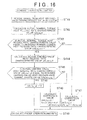
- FIG. 11 is a flowchart illustrating the half of the procedure of combustion pattern control according to the second embodiment.
- FIG 12 is a flowchart illustrating the latter half of the procedure of combustion pattern control according to this embodiment.
- step ST11 through step ST19 in the flowchart of FIG. 11 are identical with those of step ST1 through step ST9 of the combustion pattern control procedure of the first embodiment as described above with reference to FIG. 9 , and therefore will not be described herein.
- a compatible point is determined with respect to two or more limiting-value heat-release-rate characteristic values, as described above; therefore, a first limiting-value heat-release-rate characteristic value (dQ_limit1_cal), a first required equi-limiting-value heat-release-rate characteristic value (dQ_limit_rq), a second limiting-value heat-release-rate characteristic value (dQ_limit2_cal) and a second required equi-limiting-value heat-release-rate characteristic value (dQ_limit2_rq) are set as limiting-value heat-release-rate characteristic values and required equi-limiting value heat-release-rate characteristic values, respectively,
- a compatible point is determined using the first limiting-
- step ST20 and subsequent steps are performed when a negative decision (NO) is made in the above step ST17, namely, when the first limiting-value heat-release-rate characteristic value (dQ_limit1_cal) is not beyond the limitation of the first required equi-limiting-value heat-release-rate characteristic value (dQ_limit1_rq), Namely, if it is determined, in the current engine operating condition, that one limiting-value heat-release-rate characteristic value (e.g., a limiting-value heat-release-rate characteristic value associated with combustion noise as in the first embodiment) is within the permissible range (within the bounds of the restriction), the control proceeds to step ST20 and subsequent steps to determine whether another limiting-value heat-release-rate characteristic value (e.g., a limiting-value heat-release-rate characteristic value associated with the amount of emission of NOx, or a limiting-value heat-release-rate characteristic value associated with misfiring of the engine 1) is within the permissible range (within
- the second limiting-value heat-release-rate characteristic value (dQ_limit2_cal) is calculated based on the engine operation amounts or values (P_qpl), etc. More specifically, the second limiting-value heat-release-rate characteristic value (dQ_limit2_cal) is calculated according to a function (func6) using the engine operation amounts (P_qpl) calculated in the above step ST14 as variables.
- step ST21 the second required equi-limiting-value heat-release-rate characteristic value (dQ_limt2_rq) is calculated. More specifically, the second required equi-limiting-value heat-release-rate characteristic value (dQ_limit2_rq) is calculated according to a function (func7) using the second limiting-value heat-release-rate characteristic value (dQ_limit2_cal) calculated in the above step ST20 as a variable.
- step ST22 it is determined whether the calculated second limiting-value heat-release-rate characteristic value (dQ_limit2_cal) is beyond the limitation of the second required equi-limiting-value heat-release-rate characteristic value (dQ_limit2_rq). Namely, it is determined whether the restriction (such as the NOx emission amount or misfiring of the engine 1) goes beyond the limiting value (in this embodiment, the limiting value related to the NOx emission amount or the limiting value related to misfiring) in the current engine operating conditions. For example, where the fuel injection amount is constant, the NOx emission amount goes beyond a permissible value thereof if the maximum value of the heat-release-rate characteristic value exceeds a predetermined value.
- the restriction such as the NOx emission amount or misfiring of the engine
- the limiting value related to the NOx emission amount is specified by the maximum value of the heat-release-rate waveform.
- a misfire occurs when the amount of transition of the maximum value of the heat-release-rate waveform to the retard side exceeds a predetermined amount.
- the limiting value related to misfiring is specified by the crank angle position corresponding to the maximum value of the heat-release-rate waveform.
- the operation of step ST22 is to determine whether the required nominal-torque heat-release-rate characteristic value (dQ_tq_cal) is at a point that is outside the bounds of the second restriction or the permissible range in terms of the second restriction.
- step ST22 If the second limiting-value heat-release-rate characteristic value (dQ_limit2_cal) is not beyond the limitation of the second required equi-limiting-value heat-release-rate characteristic value (dQ_limit2_rq), and a negative decision (NO) is made in step ST22, the respective engine operation amounts in the current operating conditions of the engine are considered as appropriate engine operation amounts, and the control goes to step ST24 and subsequent steps.
- step ST22 If, on the other hand, the second limiting-value heat-release-rate characteristic value (dQ_limit2_cal) is beyond the limitation of the second required equi-timiting-vatue heat-release-rate characteristic value (dQ_limit2_rq), and an affirmative decision (YES) is made in step ST22, the control goes to step ST23.
- a correction value (ddQ_tq_cal) for the required nominal-torque heat-release-rate characteristic value (dQ_tq_cal) is calculated based on the amount by which the second limiting-value heat-release-rate characteristic value exceeds the second required equi-limiting value heat-release-rate characteristic value. More specifically, the correction value (ddQ_tq_cal) is calculated according to a function (func8) using a value obtained by subtracting the second required equi-limiting-value heat-release-rate characteristic value (dQ_limit2_rq) from the second limiting-value heat-release-rate characteristic value (dQ_limit2_cal).
- step ST19 the required nominal-torque heat-release-rate characteristic value (dQ_tq_cal). More specifically, a new required nominal-torque heat-release-rate characteristic value (dQ_tq_cal) is calculated by adding the calculated correction value (ddQ_tq_cal) to the current required nominal-torque heat-release-rate characteristic value (dQ_tq_cal).
- step ST14 the control proceeds to step ST14 to calculate the engine operation amounts (P_qpl) again, according to the function (fun3) using the required ignition timing ( ⁇ _igtrq) and the required nominal-torque heat-release-rate characteristic value (dQ_tq_cal: the required nominal-torque heat-release-rate characteristic value that has been changed) as variables.
- step ST22 a negative decision (NO) is made in step ST22, namely, until the first limiting-value heat-retease-rate characteristic value (dQ_limit1_cal) does not go beyond the limitation of the first required equi-limiting-value heat-release-rate characteristic value (dQ_limit1_rq), and the second limiting-value heat-release-rate characteristic value (dQ_limit2_cal) dos not go beyond the limitation of the second required equi-limiting-value heat-release-rate characteristic value (dQ_limit2_rq).
- the operations step and subsequent steps are those of the procedure of determining the engine operation amounts in an attempt to optimize the fuel consumption rate while meeting the above-described requirements including those constituted by the above restrictions.
- a first correction value (ddQ_tq1_ cal) for the required nominal-torque heat-release-rate characteristic value (dQ_tq cal) as an excess amount up to the bounds of the restriction 1 (the restriction on which the operations of the above step ST15 through step ST19 are performed) is calculated. More specifically, the first correction value (ddQ_tq1_cal) is calculated according to the function (func6) using a value obtained by subtracting the first requested equi-limiting-value heat-release-rate characteristic value (dQ_Iimit1_rq) from the first limiting-value heat-release-rate characteristic value (dQ_Iimit1_cal) as a variable.
- a second correction value (ddQ_tq2_cal) for the required nominal-torque heat-release-rate characteristic value (dQ_tq_cal) as an excess amount up to the bounds of the restriction 2 (the restriction on which the operations of the above step ST20 through step ST23 are performed) is calculated. More specifically, the second correction value (ddQ_tq2_cal) is calculated according to the function (func8) using a value obtained by subtracting the second required equi-limiting-value heat-release-rate characteristic value (dQ_limit2_rq) from the second limiting-value heat-release-rate characteristic value (dQ_limit2_cal) as a variable.
- the correction values are compared with each other in step ST26. More specifically, it is determined whether the second correction value (ddo_tq2_cal ) is larger than the first correction value (ddq_tq1_cal).
- step ST26 If the second correction value (ddQ_tq2_cal) is larger than the first correction value (ddQ_tq1_cal), and an affirmative decision (YES) is made in step ST26. the control goes to step ST27, and determines whether the second correction value (ddQ_tq2_cal) is equal to or smaller than "0". If the second correction value (ddQ_tq 2 _cal) is equal to or smaller than "0", and an affirmative decision (YES) is made in step ST27, the control goes to step ST28, and sets the second correction value (ddQ_tq2_cal) as a correction value (ddQ_tq_cal) for the required nominal-torque heat-release-rate characteristic value (dQ_tq_cal).
- FIG. 13(a) shows one example of the relationships among the respective limiting-value heat-release-rate characteristic values (dQ_limit1_cal, dQ_limit2_cal) and the required equi-limiting-value heat-release-rate characteristic values (dQ_limit1-rq, dQ_limit2_rq), which represents the above-described case.
- the first required equi-limiting-value heat-release-rate characteristic value (dQ_limit1_rq) is located at the higher heat-release-rate side than the second required equi-limiting-value heat-release-rate characteristic value (dQ_limit2_rq), and the restrictions associated with the respective required equi-limiting-value heat-release-rate characteristic values (dQ_limit1_rq, dQ_limit2_rq) are within the limitations (permissible ranges) on the lower heat-release-rate sides of the corresponding equi-limiting-value heat-release-rate characteristic lines.
- the first limiting-value heat-release-rate characteristic value (dQ_Iimit1_cal) and the second limiting-value heat-release-rate characteristic value (dQ_limit2_cal) are both located on the lower heat-release-rate side of the equi-limiting-value heat-release-rate characteristic line containing the second required equi-limiting-value heat-release-rate characteristic value (dQ_limit2_rq).
- a value obtained by subtracting the first required equi-limiting-value heat-release-rate characteristic value (dQ_limit1_rq) from the first limiting-iralue heat-release-rate characteristic value (dQ_limit1_cal), and a value obtained by subtracting the second required equi-limiting-value heat-release-rate characteristic value (dQ_limit2_rq) from the second limiting-value heat-release-rate characteristic value (dQ_liimit2_cal) are both negative values, and the absolute value of the former value is larger than that of the latter value; therefore, an affirmative decision (YES) is made in the above step ST26.
- the second correction value (ddQ_tq2_cal) is a negative value (the value obtained by subtracting the second required equi-limiting-value heat-release-rate characteristic value (dQ_limit2_rq) from the second limiting-value heat-release-rate characteristic value (dQ_limit2_cal) is a negative value)
- an affirmative decision (YES) is made in the above step ST27, and the correction value (ddQ_tq_cal) is set to the second correction value (ddQ_tq2_cat) in step ST38.
- step ST27 the control goes to step ST29 to determine whether the first correction value (ddQ_tq1_cal) is smaller than "0". If the first correction value (ddQ_tq1_cal) is smaller than "0", and an affirmative decision (YES) is made in step ST29, the control goes to step ST30 to set the first correction value (ddQ_tq1_cal) as the correction value (ddQ_tq_cal) for the required nominal-torque heat-release-rate characteristic value (dQ_tq_cal).
- FIG 13(b) shows one example of the relationships among the respective limiting-value heat-release-rate characteristic values (dQ_limit1_cal, dQ_limit2_cal) and the required equi-limiting-value heat-release-rate characteristic values (dQ_Iimitl_rq, dQ_limit2_rq), which represents the above-described case.
- the first required equi-limiting-value heat-release-rate characteristic value (dQ_limit1_rq) is located at the higher heat-release-rate side than the second required equi-limiting-value heat-release-rate characteristic value (dQ_limit2_rq), and the restriction associated with the first required equi-limiting-value heat-release-rate characteristic value (dQ_limit1_rq) is within the limitations (permissible range) on the lower heat-release-rate side of the corresponding equi-limiting-value heat-release-rate characteristic line, while the restriction associated with the second required equi-limiting-value heat-release-rate characteristic value (dQ_limit2_rq) is within the limitations (permissible range) on the higher heat-release-rate side of the corresponding equi-limiting-value heat-release-rate characteristic line.
- the first limiting-value heat-release-rate characteristic value (dQ_limit_cal) and the second limiting-value heat-release-rate characteristic value (dQ_limit2_cal) are located on the lower heat-release-rate side of the equi-limiting-value heat-release-rate characteristic line containing the first required equi-limiting-value heat-release-rate characteristic value (dQ_limit1_rq), and is located on the higher heat-release-rate side of the equi-limiting-value heat-release-rate characteristic line containing the second required equi-limiting-value heat-release-rate characteristic value (dQ_limit2_rq).
- a value obtained by subtracting the first required equi-limiting-value heat-release-rate characteristic value (dQ_limit1_rq) from the first limiting-value heat-release-rate characteristic value (dQ_limit1_cal) is a negative value
- a value obtained by subtracting the second required equi-limiting-value heat-release-rate characteristic value (dQ_limit2_rq) from the second limiting-value heat-release-rate characteristic value (dQ_limit2_cat) is a positive value. Therefore, an affirmative decision (YES) is made in the above step ST26, and a negative decision (NO) is made in the above step ST27. Then, an affirmative decision (YES) is made in the above step ST29, and the correction value (ddQ_tq_cal) is set to the first correction value (ddQ_tqt_cal) in step ST30,
- step ST29 If the first correction value (ddQ_tq1_cal) is equal to or larger than "0", and a negative decision (NO) is made in step ST29, the control goes to step ST19, and executes the above-described operation to change the required nominal-torque heat-release-rate characteristic value (dQ_tq_cal).
- FIG. 13(c) shows one example of the relationships among the respective limiting-value heat-release-rate characteristic values (dQ_limit1_cal, dQ_limit2_cal) and the required equi-limiting-value heat-release-rate characteristic values (dQ_limit1_rq, dQ_limit2_rq), which represents the above-described case.
- the first required equi-limiting-value heat-release-rate characteristic value (dQ_limit1_rq) is located at the higher heat-release-rate side than the second required equi-limiting-value heat-release-rate characteristic value (dQ_limit2_rq), and the restrictions associated with the respective required equi-limiting-value heat-release-rate characteristic values (dQ_limit1_rq, dQ_limit2_rq) are within the limitations (permissible ranges) on the higher heat-release-rate sides of the corresponding equi-limiting-value heat-release-rate characteristic lines.
- both of the first limiting-value heat-release-rate characteristic value (dQ_limit1_cal) and the second limiting-value heat-release-rate characteristic value (dQ_limit2_cal) are located on the higher heat-release-rate side of the equi-limiting-value heat-release-rate characteristic line containing the first required equi-limiting-value heat-release-rate characteristic value (dQ_limit1_rq).
- a value obtained by subtracting the first required equi-limiting-value heat-release-rate characteristic value (dQ_limit1_rq) from the first limiting-value heat-release-rate characteristic value (dQ_limit1_cal), and a value obtained by subtracting the second required equi-limiting-value heat-release-rate characteristic value (dQ_limit2_rq) from the second limiting-value heat-release-rate characteristic value (dQ_limit2_cal) are positive values, and the absolute value of the latter value is larger than that of the former value: therefore, an affirmative decision (YES) is made in the above step ST26.
- step ST31 determines whether the first correction value (ddq_tq1_cal) is equal to or smaller than "0". If the first correction value (ddQ_tq1_cal) is equal to or smaller than "0", and an affirmative decision (YES) is made in step ST31, the engine operation amounts that provide the current required-torque heat-release-rate characteristic value (dQ_tq_cal) are generated as command signals.
- FIG. 13(d) shows one example of the relationships among the respective limiting-value heat-release-rate characteristic values (dQ_limit1-cal, dQ_limit2_cal) and the required equi-limiting-value heat-release-rate characteristic values (dQ_limit1_rq, dQ_limit2_rq), which represents the above-described case.
- the second required equi-limiting-value heat-release-rate characteristic value (dQ_limit2_rq) is located at the higher heat-release-rate side than the first required equi-limiting-value heat-release-rate characteristic value (dQ_limit1_rq), and the restriction associated with the first required equi-timiting-value heat-release-rate characteristic value (dQ_limit1_rq) is within the limitations (permissible range) on the lower heat-release-rate side of the corresponding equi-limiting-value heat-release-rate characteristic line, while the restriction associated with the second required equi-limiting-value heat-release-rate characteristic value (dQ_limit2_rq) is within the limitations (permissible range) on the higher heat-release-rate side of the corresponding equi-limiting-value heat-release-rate characteristic line.
- the first limiting-value heat-release-rate characteristic value (dQ_limitt_cal) and the second limiting-value heat-release-rate characteristic value (dQ_limit2_cal) are both located on the lower heat-release-rate side of the equi-limiting-value heat-release-rate characteristic line containing the first required equi-limiting-value heat-release-rate characteristic value (dQ_limit1_rq).
- a value obtained by subtracting the first required equi-limiting-value heat-release-rate characteristic value (dQ_limit1_rq) from the first limiting-value heat-release-rate characteristic value (dQ_limit1_cal), and a value obtained by subtracting the second required equi-limiting-value heat-release-rate characteristic value (dQ_limit2_rq) from the second limiting-value heat-release-rate characteristic value (dQ_limit2_cal) are both negative values, and the absolute value of the latter value is larger than that of the farmer valuer therefore, a negative decision (NO) is made in the above step ST26.
- the first correction value (ddQ_tq1_cal) is a negative value (the value obtained by subtracting the first required equi-limiting-value heat-release-rate characteristic value (dQ_limit1_rq) from the first limiting-value heat-release-rate characteristic value (dQ_limit1_cal) is negative)
- an affirmative decision (YES) is made in the above step ST31, and the control goes to step ST35.
- step ST31 If, on the other hand, the first correction value (ddQ_tq1_cal) is a positive value, and a negative decision (NO) is made in step ST31, the control goes to step ST32 to determine whether the second correction value (ddQ_tq2_cal) is smaller than "0". If the second correction value (ddQ_tq2_cal) is smaller than "0", and an affirmative decision (YES) is made in step ST32, the control goes to step ST33 to set the first correction value (ddQ_tq1_cal) as the correction value (ddQ_tq_cal) for the required nominal-torque heat-release-rate characteristic value (dQ_tq_cal).
- FIG 13(e) shows one example of the relationships among the respective limiting-value heat-release-rate characteristic values (dQ_limit1_cal, dQ_timit2_cal) and the required equi-limiting-value heat-release-rate characteristic values (dQ_limit1_rq, dQ_timit2_rq), which represents the above-described case.
- the first required equi-timiting-value heat-release-rate characteristic value (dQ_limit1_rq) is located at the lower heat-release-rate side than the second required equi-limiting-value heat-release-rate characteristic value (dQ_limit2_rq), and the restriction associated with the first required equi-limiting-value heat-release-rate characteristic value (dQ_limit1_rq) is within the limitations (permissible range) on the higher heat-release-rate side of the corresponding equi-limiting-value heat-release-rate characteristic line, while the restriction associated with the second required equi-limiting-value heat-release-rate characteristic value (dQ_limit2_rq) is within the limitations (permissible range) on the lower heat-release-rate side of the corresponding equi-limiting-value heat-release-rate characteristic line.
- the first limiting-value heat-release-rate characteristic value (dQ_limit1_cal) and the second limiting-value heat-release-rate characteristic value (dQ_limit2_cal) are located on the higher heat-release-rate side of the equi-limiting-value heat-release-rate characteristic line containing the first required equi-limiting-value heat-release-rate characteristic value (dQ_limit1_rq), and are located on the lower heat-release-rate side of the equi-limiting-value heat-release-rate characteristic line containing the second required equi-limiting-value heat-release-rate characteristic value (dQ_limit2_rq).
- a value obtained by subtracting the first required equi-limiting-value heat-release-rate characteristic value (dQ__limit1_rq) from the first limiting-value heat-release-rate characteristic value (dQ_limit1_cat) is a positive value
- a value obtained by subtracting the second required equi-limiting-value heat-release-rate characteristic value (dQ_limit2_rq) from the second limiting-value heat-release-rate characteristic value (dQ_limit2_cal) is a negative value. Therefore, a negative decision (NO) is made in the above step ST26, and a negative decision (NO) is made in the above step ST31. Then, an affirmative decision (YES) is made in the above step ST32, and the correction value (ddQ_tq_cal) is set to the first correction value (ddQ_tq1_cal) in step ST33.
- step ST32 If the second correction value (ddQ_tq2_cal) is equal to or larger than "0", and a negative decision (NO) is made in step ST32, the control goes to step ST34 to set the second correction value (ddQ_tq2_cal) as the correction value (ddQ_tq_cal) for the required nominal-torque heat-release-rate characteristic value (dQ_tq_cal).
- FIG. 13(f) shows one example of the relationships among the respective limiting-value heat-release-rate characteristic values (dQ_limit1_cal, dQ_limit2_cal) and the required equi-limiting-value heat-release-rate characteristic values (dQ_limit1_rq, dQ_limit2_rq), which represents the above-described case.
- the first required equi-limiting-value heat-release-rate characteristic value (dQ_limit1_rq) is located at the lower heat-release-rate side than the second required equi-limiting-value heat-release-rate characteristic value (dQ_hmit2_rq), and the restrictions associated with the respective required equi-limiting-value heat-release-rate characteristic values (dQ_limit1_rq, dQ_limit2_rq) are within the limitations (permissible ranges) on the higher heat-release-rate sides of the corresponding equi-limiting-value heat-release-rate characteristic lines.
- the first limiting-value heat-release-rate characteristic value (dQ_limit1_cal) and the second limiting-value heat-release-rate characteristic value (dQ_limit2_cal) are both located on the higher heat-release-rate side of ⁇ the equi-limiting-value heat-release-rate characteristic line containing the second required equi-limiting-value heat-release-rate characteristic value (dQ_limi12_rq_).
- a value obtained by subtracting the first required equi-limiting-value heat-release-rate characteristic value (dQ_limit1_rq) from the first limiting-value heat-release-rate characteristic value (dQ_limit1_cal), and a value obtained by subtracting the second required equi-limiting-value heat-release-rate characteristic value (dQ_limit2_rq) from the second limiting-value heat-release-rate characteristic value (dQ_limit2_cal) are both positive values, and the absolute value of the former value is larger than that of the latter value; therefore, a negative decision (NO) is made in the above step ST26.
- a compatible point at which the required nominal torque is achieved and two or more restrictions are within the permissible ranges (within the limitations) is automatically obtained through the above-described operations.
- compatible points for various levels of required power are obtained.
- a heat-release-rate waveform having a point nominal by an asterisk in the figure as a required nominal-torque heat-release-rate characteristic value (dQ_tq_cal) is obtained as a compatible point.
- combustion noise and the amount of emission of NOx are listed as restrictions that are within the limitations (within the permissible ranges) on the lower heat-release-rate sides of the corresponding equi-limiting-value heat-release-rate characteristic lines.
- soot and the amount of emission of PM are listed as examples of restrictions that are within the limitations (within the permissible ranges) on the higher heat-release-rate sides of the corresponding equi-limiting-value heat-release-rate characteristic lines.
- FIG. 14 is a heat-release-rate waveform diagram showing one example of equi-limiting-value heat-release-rate characteristic lines in the case where two or more restrictions are combustion noise and misfiring of the engine 1. As described above, a limiting value associated with misfiring is specified by the crank angle position of the maximum value of the heat-release-rate waveform,
- the required nominal-torque heat-release-rate characteristic value I is located on the retard side (the OK side) of an equi-limiting-value heat-release-rate characteristic line associated with combustion noise, and is located on the advance side (the OK side) of an equi-limiting-value heat-release-rate characteristic line associated with misfiring.
- the required nominal-torque heat-release-rate characteristic value I meets requirements constituted by both of the restrictions.
- a compatible point is obtained further taking account of the optimization of the fuel consumption rate, while meeting the requirements constituted by both of the restrictions; therefore, the required nominal-torque heat-release-rate characteristic value (dQ_tq_ cal) is changed so as to obtain a compatible point (the required nominal-torque heat-release-rate characteristic value II in FIG. 14 ) at which the fuel consumption rate is optimized.
- the above-described nominal-torque heat-release-rate characteristic value is detected as a result of combustion in certain engine operating conditions, and compatible values of the engine operation amounts are obtained with feedback control being performed on the detected nominal-torque heat-relcase-rate characteristic value.
- FIG. 15 is a block diagram showing the general configuration of a control system of the engine 1 according to this embodiment.
- the ECU 10 includes, as functional parts, a characteristic value detecting/processing unit 92 that detects an nominal-torque heat-release-rate characteristic value based on detection values from a heat-release-rate characteristic value detection sensor 91 provided in the engine 1, a difference computing unit 93 that computes a difference between the required nominal-torque heat-release-rate characteristic value and the detected nominal-torque heat-release-rate characteristic value, a compatible value computing unit 94 that computes compatible values of engine operation amounts while changing the required nominal-torque heat-release-rate characteristic value based on the difference, and a command unit 95 that generates the obtained compatible values of' the engine operation amounts to the corresponding actuators (such as the injectors 23) of the engine 1.
- a characteristic value detecting/processing unit 92 that detects an nominal-torque heat-release-rate characteristic value based on detection values from a heat-release-rate
- the heat-release-rate characteristic value detection sensor 91 is in the form of an in-cylinder pressure sensor.
- the characteristic value detecting/processing unit 92 computes the required nominal-torque heat-release-rate characteristic value based on changes of the in-cylinder pressure detected by the in-cylinder pressure sensor, and obtains various parameters, such as the maximum value (peak value) of the heat-release-rate waveform obtained according to the required nominal-torque heat-release-rate characteristic value, the rate of increase of the heat release rate (i.e., the slope or gradient of the heat-release-rate waveform), and the combustion period.
- the difference computing unit 93 computes a difference between the required nominal-torque heat-release-rate characteristic value and the detected actual nominal-torque heat-release-rate characteristic value, according to the flowchart as shown in FIG 16 , which will be described below.
- the compatible value computing unit 94 calculates a correction value (ddQ_tq_cal) for the required nominal-torque heat-release-rate characteristic value (dQ_tq_cal), based on the difference calculated in the difference computing unit 93, and corrects the required nominal-torque heat-release-rate characteristic vale (dQ_tq_cal) with the correction value (ddQ_tq_cal), so as to compute a compatible value.
- ddQ_tq_cal required nominal-torque heat-release-rate characteristic value
- a detection signal is received from the heat-release-rate characteristic value detection sensor (heat-release-rate characteristic value detector) 91 in step ST41, and the actual nominal-torque heat-release-rate characteristic value (dQ_tq_r1) is calculated by the characteristic value detecting/processing unit 92 in step ST42. Then, in step ST43, it is determined whether the actual nominal-torque heat-release-rate characteristic value (dQ_tq_r1) is equal to the required nominal-torque heat-release-rate characteristic value (dQ_tq_cal).
- step ST43 If the actual nominal-torque heat-release-rate characteristic value (dQ_tq_r1) is equal to the required nominal-torque heat-release-rate characteristic value (dQ_tq_cal), and an affirmative decision (YES) is made in step ST43, the control goes to step ST44 to calculate the actual limiting-value heat-release-rate characteristic value (dQ_limit_rl).
- the actual limiting-value heat-release-rate characteristic value (dQ_limit_rl) is set based on sensed combustion noise in the case where the restriction associated with the limiting value is combustion noise, and is set based on the sensed concentrations of exhaust gas components in the case where the restriction is exhaust emissions.
- step ST45 After calculating the actual limiting-value heat-release-rate characteristic value (dQ_limit_rl), the control goes to step ST45 to determine whether the actual limiting-value heat-release-rate characteristic value (dQ_limit_rl) is equal to the required limiting-value heat-release-rate characteristic value (dQ_limit_rq).
- step ST45 If the actual limiting-value heat-release-rate characteristic value, (dQ_limit_rl) is equal to the required limiting-value heat-release-rate characteristic value (dQ_limit_rq), and an affirmative decision (YES) is made in step ST45, the control goes to step ST46 to set the correction value (ddQ_tq_cal) for the required nominal-torque heat-release-rate characteristic value (dQ_tq_cal) to "0", and the above-described engine operation amounts (P_qpl) are calculated in step ST49 (as in the operations of step ST4 and subsequent steps in FIG 9 or the operations of step ST14 and subsequent steps in FIG. 11 ).
- step ST43 If; on the other hand, the actual nominal-torque heat-release-rate characteristic value (dQ_tq_rl) is not equal to the required nominal-torque heat-release-rate characteristic value (dQ_tq_cal), and a negative decision (NO) is made in step ST43, the control goes to step ST47 to calculate a correction value (ddQ_tq_cal) for the required nominal-torque heat-release-rate characteristic value (dQ_tq_cal), based on the difference between the characteristic values.
- the correction value (ddQ_tq_cal) is obtained by subtracting the required nominal-torque heat-release-rate characteristic value (dQ_tq_cal) from the actual nominal-torque heat-release-rate characteristic value (dQ_tq_rl).
- step ST45 the control goes to step ST48 to calculate a correction value (ddQ_tq_cal) for the required nominal-torque heat-release-rate characteristic value (dQ_tq_cal), based on the difference between the characteristic values, More specifically, the correction value (ddQ_tq_cal) is calculated according to the function (func6) using a value obtained by subtracting the required limiting-value heat-release-rate characteristic value (dQ_limit_rq) from the actual limiting-value heat-release-rate characteristic value (dQ_limit_rl) as a variable.
- step ST43 the actual nominal-torque heat-retease-rate characteristic value (dQ_tq_cal) becomes equal to the required nominal-torque heat-release-rate characteristic value (dQ_tq_cal) (an affirmative decision (YES) is made in step ST43), and the actual limiting-value heat-release-rate characteristic value (dQ_limit_rl) becomes equal to the required limiting-value heat-release-rate characteristic value (dQ_limit_rq) (an affirmative decision (YES) is made in step ST45), namely, until the correction value (ddQ_tq_cal) is set to "0" in step ST46.
- FIG. 17 shows one example of the relationships among respective limiting-value heat-release-rate characteristic values and respective required equi-limiting-value heat-release-rate characteristic values in the case where the restrictions are a NOx restriction and a combustion noise restriction (i.e. CN restriction).
- the NOx restriction is within the limitations (within the permissible range) on the lower heat-release-rate side of the corresponding equi-limiting-value heat-release-rate characteristic line.
- the limitations of the NOx restriction are also specified by the gradient of the equi-limiting-value heat-release-rate characteristic line, and the requirement constituted by the restriction is not satisfied if the heat-release-rate waveform in question has a larger angle of inclination or gradient than that of the equi-limiting-value heat-release-rate characteristic line as shown in FIG. 17 . Accordingly, the heat-release-rate waveform as shown in FIG. 17 does not meet the requirement constituted by the NOx restriction (i.e., the angle of inclination of the heat-release-rate waveform (dQ_limit2_cal) in FIG. 17 is larger than that of the equi-limiting-value heat-release-rate characteristic line (dQ_limit2_rq)).
- the CN restriction is within the limitations (within the permissible range) on the lower heat-release-rate side of the corresponding equi-limiting-value heat-release-rate characteristic line.
- the limitations of the CN restriction are specified by the maximum value of the heat-release-rate waveform. Accordingly, the heat-release-rate waveform as shown in FIG. 17 meets the requirement constituted by the CN restriction (i.e.. the maximum value (dQ_limit1_cal) of the heat-release-rate waveform in FIG. 17 is located on the lower heat-release-rate side of the equi-limiting-value heat-release-rate characteristic line (dQ_limit1_rq)).
- the ignition timing is shifted to the retard side, as shown in FIG. 18 , so that a compatible point of the ignition timing is determined so as to satisfy the requirement constituted by the NOx restriction. More specifically, if the heat-release-rate waveform is shifted to the retard side, the gradient of the equi-limiting-value heat-release-rate characteristic line (dQ_limit2_rq) associated with the NOx restriction becomes larger (the gradient of the equi-limiting-value heat-release-rate characteristic line is allowed to be increased since the retardation of the ignition timing leads to reduction of the NOx emission amount even if the combustion speed is high), and the heat-release-rate waveform is shifted to one side of the equi-limiting-value heat-release-rate characteristic line on which the restriction is within the permissible range.
- the gradient of the equi-limiting-value heat-release-rate characteristic line (dQ_limit2_rq) associated with the NOx restriction becomes larger (the gradient of the equi-limiting-value heat-release-rate characteristic line is allowed
- the angle of inclination of the heat-release-rate waveform becomes smaller than the angle of inclination of the NOx restriction, so that the requirement constituted by the NOx restriction is satisfied.
- the compatible point of the ignition timing is obtained by shifting the ignition timing to the retard side until the angle of inclination of the heat-release-rate waveform becomes smaller than that of the NOx restriction.
- the fuel injection timing or the fuel injection pressure may be controlled. Since the combustion efficiency is reduced as the ignition timing is shifted to the retard side, the fuel injection amount is corrected so as to be increased.
- correcting the ignition timing makes it possible to ensure the required nominal torque while meeting requirements constituted by two or more restrictions, and optimize combustion in the combustion chambers 3.
- the invention is applied to a common-rail-type in-cylinder direct injection multi-cylinder diesel engine installed on an automobile. It is, however, to be understood that the invention is not limited to this application, but may be applied to diesel engines installed on those other than automobiles. Also, the invention is not limitedly applied to diesel engines, but may be applied to gasoline engines.
- the correction value (ddQ_tq_cal) for the required nominal-torque heat-release-rate characteristic value (dQ_tq_cal) is calculated according to the function (func6) using the value obtained by subtracting the required equi-limiting-value heat-release-rate characteristic value (dQ_limit_rq) from the limiting-value heat-release-rate characteristic value (dQ_hmit_cal) as a variable.
- the invention is not limited to this method, but the required nominal-torque heat-release-rate characteristic value (dQ_tq_cal) may be changed using a preset correction value (fixed value).
- the required nominal-torque heat-release-rate characteristic value (dQ_tq_cal) is calculated by experiment or simulation, and command values of the engine operation amounts corresponding to the calculated characteristic value are determined, and written into a control map.
- This invention is not limited to this method, but may be applied to the case where an algorithm of this embodiment is installed on the actual vehicle, and the required nominal-torque heat-release-rate characteristic value (dQ_tq_cal) is calculated while the vehicle is running, so that various actuators are controlled with the engine operation amounts determined according to the required nominal-torque heat-release-rate characteristic value (dQ_tq_cal).
- the present invention is applicable to control for determining the optimum compatible point at which various characteristics and restrictions are within specified target ranges, and optimizing combustion in the combustion chambers, in the common-rail-type in-cylinder direct injection multi-cylinder diesel engine installed on the automobile.
Landscapes
- Engineering & Computer Science (AREA)
- Chemical & Material Sciences (AREA)
- Combustion & Propulsion (AREA)
- Mechanical Engineering (AREA)
- General Engineering & Computer Science (AREA)
- Electrical Control Of Air Or Fuel Supplied To Internal-Combustion Engine (AREA)
- Combined Controls Of Internal Combustion Engines (AREA)
Abstract
Description
- The invention relates to a combustion control system of an internal combustion engine, typically a diesel engine. In particular, the invention is concerned with a measure to enable the engine to achieve target power while meeting requirements constituted by restrictions (such as combustion noise and exhaust emissions) imposed on the internal combustion engine.
- As well known in the art, in a diesel engine (which may be simply called "engine") used as an engine for an automobile, for example, complicated or sophisticated control is performed so that various characteristics and restrictions, such as power performance, combustion noise, exhaust emissions, combustion stability, and the fuel consumption rate, fall within specified target ranges. The control of this type is described in, for example, Japanese Patent Application Publication No.
2005-232990 JP-A-2005-232990 2004-3415 JP-A-2004-3415 - More specifically, compatible points at which various characteristics and restrictions are within specified target ranges are determined. For example, when the engine is in operating conditions in which given engine power is obtained, the level of combustion noise, the amounts of NOx, soot, etc. contained in exhaust gases, combustion instability, and so forth are sensed or measured, and a map for use in control is created by obtaining compatible values while adjusting various control parameters, such as the fuel injection amount, so that these restrictions fall within specified ranges (within permissible ranges). Then, the map for control is stored in an electronic control unit for engine control (engine ECU). During operation of the engine, the engine ECU performs control of the engine with reference to the compatible values on the map for control. Thus, conventionally, control variables that satisfy requirements constituted by various restrictions, such as combustion noise and exhaust emissions, are determined as compatible points by trial and error, for each type of engine (i.e., a fuel injection pattern, or the like, suitable for each type of engine is constructed).
- Since the compatible points are conventionally determined by trial and error, a systematic combustion control method common to various types of engines has not been constructed or established. Namely, since a plurality of compatible points (combinations of various control parameters) exists at which the above-mentioned characteristics and restrictions are within target ranges, the optimum compatible point could not found.
- More specifically described, the NOx emission amount of the engine is significantly influenced by the flame temperature in the combustion chamber. Also, the flame temperature depends on conditions of an air-fuel mixture (the pressure and temperature in the combustion chamber and the composition of the air-fuel mixture) at the time of ignition. Actuators that control the conditions of the air-fuel mixture include, for example, a throttle value, EGR (Exhaust Gas Recirculation) valve, and a VVT (Variable Valve Timing) mechanism. Also, actuators that control the fuel injection pattern include, for example, injectors and a fuel pump. A plurality of combinations of the operation amounts of the respective actuators, which cause the above-indicated characteristics and restrictions to fall within the target ranges, are present with respect to the same NOx emission amount, and it was difficult to find the optimum compatible point.
- Since the operation amounts of the respective actuators are determined by trial and error, the continuity in the operation of determining compatible points cannot be maintained when the engine operating conditions change, and the operation amounts of the above-indicated actuators may undergo unstable changes, or the engine may be transiently brought into an operating region in which the requirements constituted by the above-indicated restrictions are not satisfied.
- The invention was developed in view of the above situations, and the object of the invention is to provide a combustion control system of an internal combustion engine, which determines the optimum compatible point at which various characteristics and restrictions of an engine are within specified target ranges, so as to optimize combustion in a combustion chamber.
- According to the principle of the invention for attaining the above-described object, heat release-rate characteristic values correlated with heat-release-rate waveforms that can satisfy or achieve a characteristic (such as required nominal torque) required or the internal combustion engine are specified, and it is determined whether a restriction (such as combustion noise or exhaust emissions) imposed on the engine is within a permissible range, in engine operating conditions at a certain heat-release-rate characteristic value. If the restriction is not within the permissible range, another heat-release-rate characteristic value that satisfies the characteristic required of the internal combustion engine is obtained, and it is determined whether the restriction is within the permissible range, in engine operating conditions at the heat-release-rate characteristic value. In this manner, the heat-release-rate characteristic value continues to be changed until the restriction falls within the permissible range.
- One aspect of the invention is concerned with a combustion control system that controls combustion conditions in a combustion chamber of an internal combustion engine. The combustion control system of the internal combustion engine includes heat-release-rate characteristic value specifying means, ignition-timing heat-release-rate characteristic value specifying means, required limiting-value heat-release-rate characteristic value specifying means, and heat-release-rate characteristic value adjusting means. The heat-release-rate characteristic value specifying means is configured to specify a heat-release-rate characteristic value so as to determine a waveform of the rate of heat release associated with combustion in the combustion chamber. The ignition-timing heat-release-rate characteristic value specifying means is configured to specify an ignition-timing heat-release-rate characteristic value so as to determine a point in time at which the combustion in the combustion chamber starts, on the waveform of the rate of heat release. The required limiting-value heat-release-rate characteristic value specifying means is configured to specify a required limiting-value heat-release-rate characteristic value so as to determine a required limiting value associated with a given restriction, on the waveform of the rate of heat release. The heat-release-rate characteristic value adjusting means is configured to adjust the heat-release-rate characteristic value so that the heat-release-rate characteristic value specified by the heat-release-rate characteristic value specifying means is within a limitation of the required limiting-value heat-release-rate characteristic value specified by the required timiting-vatue heat-release-rate characteristic value specifying means, in a condition where the ignition-timing heat-release-rate characteristic value on the heat-release-rate waveform is specified by the ignition-timing lieat-release-rate characteristic value specifying means.
- With the specified matters as described above, the heat-release-rate characteristic value adjusted by the heat-release-rate characteristic value adjusting means is obtained as a characteristic value that is within the limitation of the required limiting-value heat-release-rate characteristic value. Namely, if the heat-release-rate characteristic value specified by the heat-release-rate characteristic value specifying means is specified in advance as a characteristic value at which the required torque and the required engine speed are achieved, the heat-release-rate characteristic value that meets a requirement constituted by a restriction (such as combustion noise or exhaust emissions) imposed on the internal combustion engine while achieving the required torque and the required engine speed is automatically obtained. According to the prior art, compatible points of a fuel injection pattern, or the like, are determined by trial and error, there tore, a systematic combustion control method common to various types of engines had not been constructed or established, and the optimum compatible point could not be fond. According to the above aspect of the invention, it is possible to automatically obtain the optimum compatible point at which the characteristics and restrictions of the internal combustion engine are within specified target ranges, and thereby optimize combustion in the combustion chamber.
- The above-indicated heat-release-rate characteristic value specifying means may be configured as follows. Initially, the heat-release-rate characteristic value specifying means is preferably configured to specify the heat-release-rate characteristic value so as to determine the waveform of the rate of heat release, based on required torque and required speed of the internal combustion engine.
- With the above arrangement, the heat-release-rate characteristic value adjusted by the heat-release-rate characteristic value adjusting means is obtained as the one that satisfies or achieves the required torque and required engine speed of the internal combustion engine.
- Also, the heat-release-rate characteristic value specifying means is preferably configured to specify the maximum value of the heat-release-rate waveform as the heat-release-rate characteristic value, or is preferably configured to specify a combustion barycenter position of the heat-release-rate waveform as the heat-release-rate characteristic value.
- According to the above manners of specifying the heat-release-rate characteristic value, the heat-release-rate waveform can be properly specified by relatively simple methods of computations, or the like. Namely, a general heat-release-rate waveform representing heat generated by combustion of fuel injected from a fuel injection valve may be regarded as a waveform that is closely analogous to an isosceles triangle of which the base represents a period from a point in time at which combustion starts to a point in time at which the combustion ends, and the height represents the maximum value of the rate of heat release. Thus, if the required torque and the ignition timing are specified, the shape of the heat-release-rate waveform is substantially uniquely determined by the maximum value of the heat-release-rate waveform. Thus, the shape of the heat-release-rate waveform is generally estimated by specifying the maximum value of the heat-release-rate waveform as the heat-release-rate characteristic value. Also, the combustion barycenter position of the heat-release-rate waveform is a position at which the degree of combustion reaches "50%" where the degree of combustion is "100%" in a complete combustion condition in which combustion of the entire amount of fuel injected from the fuel injection valve in the combustion chamber is completed. It is thus possible to estimate the shape of the heat-release-rate waveform, by specifying the combustion barycenter position as the heat-release-rate characteristic value.
- The ignition-timing heat-release-rate characteristic value specifying means may be configured as follows. Initially, the ignition-timing heat-release-rate characteristic value specifying means is preferably configured to specify a point in time at which the rate of heat release in the combustion chamber reaches a predetermined value after injection of fuel from a fuel injection valve, as the ignition-timing heat-release-rate characteristic Value. Also, the ignition-timing heat-release-rate characteristic value specifying means is preferably configured to specify a crank angle position corresponding to a compression top dead center of a piston as the ignition-timing heat-release-rate characteristic value. By specifying the ignition timing in the combustion chamber in one of the above-described manners, the heat-release-rate waveform can be easily specified, and an appropriate heat-release-rate characteristic value can be obtained.
- The required limiting-value heat-release-rate characteristic value specifying means is preferably configured to specify the maximum value of the heat-release-rate waveform as the required limiting-value heat-release-rate characteristic value. This arrangement may be applied to the case where the restriction imposed on the internal combustion engine is combustion noise, for example. Namely, the combustion noise that occurs during the combustion stroke of the internal combustion engine has a strong correlation with pressure changes in the combustion chamber; therefore, if the maximum value of the heat-release-rate waveform is specified as the required limiting-value heat-release-rate characteristic value, a heat-release-rate characteristic value at which the combustion noise is within the limitations or permissible range can be appropriately obtained.
- A more specific example of operation of adjusting the heat-release-rate characteristic value by the heat-release-rate characteristic value adjusting means will be described. Preferably, the heat-release-rate characteristic value specifying means is adapted to obtain a plurality of heat-release-rate characteristic values at which required torque is obtained, by varying an injection pressure of fuel injected from a fuel injection valve, and the heat-release-rate characteristic value adjusting means is configured to set one of the obtained heat-release-rate characteristic values as an initial value, and change the heat-release-rate characteristic value as needed, so as to determine the heat-release-rate characteristic value that is within the limitation of the required limiting-value heat-release-rate characteristic value specified by the required limiting-value heat-release-rate characteristic value specifying means.
- It is also preferable that the combustion control system of the internal combustion engine further includes: a detection sensor that detects a value associated with the rate of heat release of the internal combustion engine, a characteristic value detecting/processing unit that detects a heat-release-rate characteristic value, based on the value detected by the detection sensor, a difference computing unit that computes a difference between the required heat-release-rate characteristic value and the heat-release-rate characteristic value detected by the characteristic value detecting/processing unit, a compatible value computing unit that computes a compatible value of an engine operation amount while changing the required heat-release-rate characteristic value based on the difference, and a command unit that generates the compatible value to each actuator of the internal combustion engine.
- With the operation performed by the combustion control system as described above, too, it is possible to automatically determine the optimum compatible point at which the characteristics and restrictions of the internal combustion engine are within specified target ranges, and thus optimize combustion in the combustion chamber.
- Also, it is preferable that the heat-release-rate characteristic value that is within the limitation of the required limiting-value heat-release-rate characteristic value is obtained, by varying the ignition timing of the internal combustion engine and changing the required limiting-value heat-release-rate characteristic value.
- With the combustion control system configured as described above, it is possible to ensure the required values while meeting requirements constituted by two or more restrictions, by changing (correcting) the ignition timing, and thus optimize combustion in the combustion chamber.
- It is also preferable that the required limiting-value heat-release-rate characteristic value specifying means is configured to obtain maximum values of heat-release-rate waveforms respectively plotted by varying an amount of fuel injected from a fuel injection value, as required limiting-value heat-release-rate characteristic values, and specify a permissible range related to a restriction on the internal combustion engine, based on the required limiting-value heat-release-rate characteristic values.
- The combustion control system of the invention may be configured as follows in view of optimization of the fuel consumption rate of the internal combustion engine. Namely, when there are a plurality of heat-release-rate characteristic values that are within a permissible range of a restriction which is set based on the required limiting-value heat-release-rate characteristic value specified by the required limiting-value heat-release-rate characteristic value specifying means, the heat-release-rate characteristic value adjusting means is preferably configured to obtain one of the heat-release-rate characteristic values that is closest to a compression top dead center of a piston, as a heat-release-rate characteristic value to be executed.
- With the above arrangement, not only the required torque and required engine speed and the requirement(s) constituted by the restriction(s) imposed on the internal combustion engine are achieved or satisfied, but also the fuel consumption rate can be optimized.
- Also, it is preferable that an actuator of a fuel injection system is arranged to be driven so that combustion takes place in the combustion chamber, according to the heat-release-rate waveform that provides the heat-release-rate characteristic value that has been adjusted by the heat-release-rate characteristic value adjusting means so as to be within the limitation of the required limiting-value heat-release-rate characteristic value.
- According to the invention, the heat-release-rate characteristic value used for specifying the waveform of the rate of heat release is adjusted so that the heat-release-rate characteristic value falls within the limitation of the required limiting-value heat-release-rate characteristic value for specifying a limiting value related to a restriction imposed on the internal combustion engine, on the waveform of the rate of heat release. Thus, it is possible to automatically obtain the optimum compatible point at which the characteristic and restrictions of the internal combustion engine are within specified target ranges, and thus optimize combustion in the combustion chamber.
- the features, advantages, and technical and industrial significance of this invention will be described in the following detailed description of example embodiments of the invention with reference to the accompanying drawings, in which like numerals denote like elements, and wherein:
-
FIG. 1 is a view showing the general construction of an engine (diesel engine) and its control system according to each embodiment of the invention; -
FIG. 2 is a cross-sectional view showing a combustion chamber of the engine shown inFIG. 1 and its surroundings: -
FIG. 3 is a block diagram showing the construction of a control system, such as ECU shown inFIG. 1 : -
FIG. 4 is a view showing one example of heat-release-rate waveform useful for explaining a nominal-torque heat-release-rate characteristic value of the engine; -
FIG. 5 is a view showing one example of heat-release-rate waveform useful tor explaining an ignition-timing heat-release-rate characteristic value of the engine; -
FIG. 6 is a view showing one example of heat-release-rate waveform useful for explaining a limiting-value heat-release-rate characteristic value of the engine; -
FIG. 7 is a view showing one example of heat-release-rate waveform useful for explaining an equi-nominal-torque heat-release-rate characteristic line of the engine; -
FIG. 8 is a view showing one example of heat-release-rate waveform useful for explaining an equi-limiting-value heat-release-rate characteristic line of the engine; -
FIG. 9 is a flowchart illustrating a procedure of combustion pattern control according to a first embodiment of the invention; -
FIG. 10 is a view showing one example of heat-release-rate waveform useful for explaining a compatible point associated with a nominal-torque heat-release-rate characteristic value and a limiting-value heat-release-rate characteristic value in the first embodiment of the invention; -
FIG. 11 is a flowchart illustrating the first half of a procedure of combustion pattern control according to a second embodiment of the invention; -
FIG. 12 is a flowchart illustrating the latter half of the procedure of combustion pattern control according to the second embodiment of the invention; -
FIG. 13 includes views each showing the relationship between each limiting-value heat-release-rate characteristic value and each required equi-limiting-value heat-release-rate characteristic value in the second embodiment of the invention; -
FIG. 14 is a view showing one example of heat-release-rate waveform useful for explaining a compatible point associated with a nominal-torque heat-release-rate characteristic value and a plurality of limiting-value heat-release-rate characteristic values in the case where limiting values are those of combustion noise and misfiring, respectively; -
FIG. 15 is a block diagram showing the general configuration of a control system according to a third embodiment of the invention; -
FIG. 16 is a flowchart illustrating a part of the procedure of combustion pattern control according to the third embodiment of the invention; -
FIG. 17 is a view showing the relationship between each limiting-value heat-release-rate characteristic value and each required equi-limiting-value heat-release-rate characteristic value in a fourth embodiment of the invention; and -
FIG. 18 is a view showing the relationship between each limiting-value heat-release-rate characteristic value and each required equi-limiting-value heat-release-rate characteristic value when the ignition timing is shifted to the retard side in the fourth embodiment of the invention. - Some embodiments of the invention will be described with reference to the drawings. In each of the embodiments, the invention is applied to a common rail type in-cylinder direction injection multi-cylinder (for example, straight four-cylinder) diesel engine (compression self-ignition type internal combustion engine) installed on an automobile.
- Initially, the general construction of the diesel engine (hereinafter simply called "engine") according to each embodiment will be described. FIG. schematically shows the construction of the
engine 1 and its control system according to each embodiment.FIG. 2 is a cross-sectional view showing acombustion chamber 3 of the diesel engine and its surroundings. - As shown in
FIG. 1 , theengine 1 according to each embodiment is constructed as a diesel engine system having afuel supply system 2,combustion chambers 3, anintake system 6, anexhaust system 7, and so forth, as principal parts. - The
fuel supply system 2 includes asupply pump 21, acommon rail 22, injectors (fuel injection valves) 23, a shut-offvalve 24, afuel addition valve 26. anengine fuel passage 27, anaddition fuel passage 28, and so forth. - The
supply pump 21 pumps up fuel out of a fuel tank, raises the pressure of the pumped to a high level, and then supplies the fuel to thecommon rail 22 via theengine fuel passage 27. Thecommon rail 22 functions as an accumulator chamber in which the high-pressure fuel supplied from thesupply pump 21 is kept at a given pressure level, and the fuel accumulated in thecommon rail 22 is distributed to each of theinjectors 23. Theinjector 23 is in the form of a piezo-injector that incorporates a piezo-electric element. In operation, the fuel injection valve of theinjector 23 opens at appropriate times so as to inject and supply the fuel into the correspondingcombustion chamber 3. - The
supply pump 21 supplies a part of the fuel pumped up from the fuel tank to thefuel addition valve 26 via theaddition fuel passage 28. The shut-offvalve 24 operable to shut off fuel supply through theaddition fuel passage 28 and stop addition of the fuel in case of an emergency is provided in theaddition fuel passage 28. - The
fuel addition valve 26 is in the form of an electronically controlled valve whose valve-opening timing or period is controlled under an addition control operation of an ECU 100 (which will be described later), so that the amount of fuel added to theexhaust system 7 is made equal to a target addition amount (with which the exhaust A/F becomes equal to a target A/F), and the fuel addition timing is controlled to specified points in time. Namely, thefuel addition valve 26 is constructed so that a desired amount of fuel is injected and supplied from thefuel addition valve 26 into the exhaust system 7 (that extends fromexhaust ports 71 to an exhaust manifold 72) in appropriate timing. - The
intake system 6 includes anintake manifold 63 connected tointake ports 15a formed in a cylinder head 15 (seeFIG. 2 ), and anintake pipe 64 that forms an intake passage and is connected to theintake manifold 63. In the intake passage, anair cleaner 65, anair flow meter 43 and a throttle valve (intake air throttle value) 62 are disposed in the order of description as viewed from the upstream end of the intake passage. Theair flow meter 43 is adapted to generate an electric signal indicative of the amount of air flowing into the intake passage via theair cleaner 65. - The
exhaust system 7 includes anexhaust manifold 72 connected to exhaustports 71 formed in thecylinder head 15, andexhaust pipes exhaust manifold 72. Also, a closed coupled converter (emission control device) 77 including a NOx storage catalyst (NSR catalyst: NOx Storage Reduction catalyst) 75 and a DPNR catalyst (Diesel Particulate NOx Reduction catalyst) is mounted in the exhaust passage. In the following, theNSR catalyst 75 and theDPNR catalyst 76 will be described. - The
NSR catalyst 75 is a storage reduction type NOx catalyst, and has a support formed of alumina (Al2O3), for example. On the support, a selected one or ones of alkali metals, such as potassium (K), sodium (Na), lithium (Li) and cesium (Cs), alkaline earths, such as barium (Ba) and calcium (Ca), rare earths, such as lanthanum (La) and yttrium (Y), and noble metals, such as platinum (Pt), is/are supported. - The
NSR catalyst 75 adsorbs and stores NOx in a condition where a large amount of oxygen is present in exhaust gas, and reduces NOx into NO2 or NO and release the same in a condition where a large amount of reducing component(s) (e.g., an unburned component (HC) of the fuel) is present in exhaust gas. The NOx thus released in the form of NO2 or NO immediately reacts with HC and CO contained in the exhaust gas, to be further reduced into N2. When reducing NO2 or NO, the HC and CO are oxidized to form H2O and CO2. Namely, it is possible to convert HC, CO, NOx in the exhaust gas into harmless substances, by suitable adjusting the oxygen concentration and HC content in the exhaust gas introduced into theNSR catalyst 75. In the embodiments, the oxygen concentration and HC content in the exhaust gas can be adjusted through an operation to add fuel from the above-mentionedfuel addition valve 26. - The
DPNR catalyst 76 has a porous ceramic structure on which a NOx storage reduction type catalyst is supported, for example, and serves to collect PM (particulate matter) in exhaust gas when the gas passes through porous walls of thecatalyst 76. The NOx storage reduction type catalyst adsorbs and stores NOx contained in exhaust gas when the air-fuel ratio of the exhaust gas is lean, and the stored NOx is reduced and released when the air-fuel ratio becomes rich. Furthermore, a catalyst (such as an oxidation catalyst having a noble metal, such as platinum, as a main component) which oxidizes and burns the collected PM is supported on theDPNR catalyst 76. - The construction of the
combustion chamber 3 of the diesel engine and its surroundings will be described with reference toFIG. 2 . As shown inFIG. 2 , a cylindrical cylinder bore 12 is formed for each cylinder (of the four cylinders), in thecylinder block 11 that constitutes the engine main body, and a piston 13 is received in the cylinder bore 12 of each cylinder such that the piston 13 can slide in the vertical direction. - The
combustion chamber 3 is formed above atop face 13a of the piston 13. More specifically, thecombustion chamber 3 is defined by the lower surface of thecylinder head 15 mounted on the top surface of thecylinder block 11 via agasket 14, the inner wall of the cylinder bore 12, and thetop face 13a of the piston 13. A cavity (or recess) 13b is formed in a generally central portion of thetop face 13a of the piston 13, and thecavity 13b also forms a part of thecombustion chamber 3. - The
cavity 13b is shaped such that its central portion (on the cylinder centerline P) has a small depth (or vertical dimension), and the depth increases toward the outer periphery of thecavity 13b. Namely, when the piston 13 is at around the compression top dead center as shown inFIG. 2 , thecombustion chamber 3 formed by thecavity 13b has a narrow space having a relatively small volume in its central portion, and the space gradually expands toward the outer periphery of thecombustion chamber 3. - To the piston 13 is coupled a
small end portion 18a of a connectingrod 18 with a piston pin 13c, and a large end portion of the connectingrod 18 is coupled to a crankshaft as an output shaft of the engine. With this arrangement, the reciprocating movements of the piston 13 in the cylinder bore 12 are transmitted to the crankshaft via the connectingrod 18, and the crankshaft is rotated so that engine power is produced. Aglow plug 19 is mounted in thecylinder head 15 to protrude into thecombustion chamber 3. Theglow plug 19 glows when electric current is passed through theplug 19 immediately before start of theengine 1, and functions as a starting aid device that speeds up ignition and combustion when a part of the fuel is sprayed onto theglow plug 19. - The
intake ports 15a through which air is introduced into thecombustion chambers 3 and theexhaust ports 71 through which exhaust gases are discharged from thecombustion chambers 3 are formed in thecylinder head 15, andintake valves 16 for opening and closing theintake ports 15a andexhaust valve 17 for opening and closing theexhaust ports 71 are also provided in thecylinder head 15. Theintake valves 16 andexhaust values 17 are opposed to each other with respect to the cylinder centerline P, or located on the opposite sides of the cylinder centerline P. Namely, theengine 1 is constructed as a cross-flow type engine. Also, theinjectors 23 that directly inject the fuel into the correspondingcombustion chambers 3 are mounted in thecylinder head 15. Each of theinjectors 23 is disposed above a generally central portion of thecombustion chamber 3, while taking an erect posture that extends along the cylinder centerline P, and is arranged to inject the fuel fed from thecommon rail 22 into the correspondingcombustion chamber 3 in predetermined timing. - Furthermore, the engine is provided with a
turbocharger 5, as shown inFIG. 1 . Theturbocharger 5 includes aturbine wheel 52 and acompressor wheel 53 that are connected to each other via aturbine shaft 51. Thecompressor wheel 53 is positioned so as to be exposed to the inside of theintake pipe 64, and theturbine wheel 52 is positioned so as to be exposed to the inside of theexhaust pipe 73. In operation, the turbocharged 5 performs a so-called supercharging operation to rotate thecompressor wheel 53 using exhaust flow (exhaust pressure) received by theturbine wheel 52, and raise the intake manifold pressure to a higher level. The turbocharged 5 of the embodiments, which is a variable nozzle type turbocharger, is provided with a variable nozzle vane mechanism (not shown) on theturbine wheel 52 side, and the boost pressure of theengine 1 can be controlled by adjusting the opening of the variable nozzle vane mechanism. - An
intercooler 61 is provided in theintake pipe 64 of theintake system 6. for forcedly cooling the intake air whose temperature has been raised due to supercharging at theturbocharger 5. Thethrottle valve 62 disposed downstream of theintercooler 61 is an electronically controlled valve whose opening can be steplessly adjusted, and has the function of reducing the cross-sectional area of the channel of the intake air (i.e., restricting the flow of the intake air) under given conditions so as to control (reduce) the amount of the intake air supplied to the engine. - The
engine 1 is also provided with an exhaust recirculation passage (EGR passage) 8 that connects theintake system 6 with theexhaust system 7. In operations, a part of the exhaust gas is recirculated as needed into theintake system 6 through theEGR passage 8, to be supplied again into thecombustion chambers 3, so as to reduce the combustion temperature and thereby reduce the amount of NOx generated. In theEGR passage 8, there are provided anEGR valve 81 that is electronically controlled to be steplessly opened and closed, so as to freely adjust the flow rate of the exhaust gas flowing through theEGR passage 8, and anEGR cooler 82 for cooling the exhaust gas that passes (recirculates) through theEGR passage 8. TheEGR passage 8,EGR valve 81,EGR cooler 82, etc. constitute an EGR system (exhaust gas recirculation system). - Various sensors are mounted in various portions of the
engine 1, and are operable to generate signals concerning environmental conditions of the respective portions and operating conditions of theengine 1. - For example, the above-mentioned
air flow meter 43, which is located in a portion of theintake system 6 upstream of thethrottle valve 62, generates a detection signal responsive to the flow rate of intake air (or the intake air amount). An intakeair temperature sensor 49 is disposed in theintake manifold 63, and generates a detection signal responsive to the temperature of the intake air. An intakeair pressure sensor 48 is disposed in theintake manifold 63, and generates a detection signal responsive to the intake air pressure. An A/F (air-fuel ratio)sensor 44 is located in a portion of theexhaust system 7 downstream of the close coupledconverter 77, and generates a detection signal that continuously changes according to the oxygen concentration in the exhaust gas. Anexhaust temperature sensor 45 is also located in a portion of theexhaust system 7 downstream of the closed coupledconverter 77, and generates a detection signal responsive to the temperature of exhaust gas (the exhaust temperature). Arail pressure sensor 41 generates a detection signal responsive to the pressure of the fuel stored in thecommon rail 22. Athrottle angle sensor 42 detects the opening of thethrottle valve 62. - As shown in
FIG. 3 , theECU 100 includesCPU 101,ROM 102,RAM 103, back-upRAM 104, and so forth. TheROM 102 stores various control programs, and maps, and the like, which are referred to when the control programs are executed. TheCPU 101 performs various computations, based on various control programs and maps stored in theROM 102. TheRAM 103 is a memory that temporarily stores computation results obtained by theCPU 101, data received from sensors, and so forth. The back-upRAM 104 is a nonvolatile memory that stores data, or the like, to be stored when theengine 1 is stopped, for example. - The
CPU 101,ROM 102,RAM 103 and back-upRAM 104 as described above are connected to each other via abus 107, and also connected to aninput interface 105 and anoutput interface 106. - The above-mentioned
rail pressure sensor 41,throttle angle sensor 42,air flow meter 43, A/F sensor 44,exhaust temperature sensor 45, intakeair pressure sensor 48, and the intakeair temperature sensor 49 are connected to theinput interface 105. In addition, acoolant temperature sensor 46 that generates a detection signal responsive to the coolant temperature of theengine 1, anacceleration stroke sensor 47 that generates a detection signal responsive to the amount of depression of the accelerator pedal, a crankposition sensor 40 that generates a detection signal (pulse) each time the output shaft (crankshaft) of theengine 1 rotates by a given angle, etc. are connected to theinput interface 105. On the other hand, the above-mentionedinjectors 23,fuel addition valve 26,throttle valve 62,EGR valve 81, etc. are connected to theoutput interface 106. - The
ECU 100 performs various controls of theengine 1, based on the outputs of the above-described various sensors. For example, theECU 100 executes pilot injection (auxiliary injection) and main injection, as fuel injection control of theinjectors 23. - The pilot injection is an operation to inject a small amount of fuel in advance into each
combustion chamber 3, prior to the main injection from the correspondinginjector 23. The pilot injection, which is also called "auxiliary injection", is an injecting operation for curbing or reducing a delay in ignition of the fuel caused by the main injection, and inducing stable diffusion combustion. Also, the pilot injection of the embodiments has not only the function of holding down the initial combustion speed that appears upon the main injection, but also the pre-heating function of raising the temperature in the cylinder. Namely, fuel injection is once interrupted after execution of the pilot injection, and the compression gas temperature (temperature in the cylinder) is sufficiency increased until the main injection is started, so that the fuel reaches the self-ignition temperature, thereby assuring good ignitability of the fuel injected in the main injection. - The main injection is an injecting operation to produce torque of the engine 1 (i.e., an operation to supply fuel for producing torque). The amount of the fuel injected in the main injection is determined so as to provide required torque, according top operating conditions, such as the engine speed (i.e., the speed of revolution of the engine), the accelerator operation amount, the coolant temperature, and the intake air temperature. Also, an injection pattern (such as the injection amounts, the injection timing, the number of times of injections, the injection pressure, etc.) of the main injection is determined through a combustion pattern control operation (combustion pattern adaptation operation) which will be described later. Details of the combustion pattern control operation will be described later. Also, the opening of the
throttle valve 62 for adjusting the intake air amount (the amount of air charged into the cylinders), the opening of the variable nozzle vane mechanism of theturbocharger 5, the opening of theEGR valve 81 for adjusting the EGR amount, etc. are determined by the combustion pattern control operation as described later. - In addition to the pilot injection and main injection as described above, after injection and post injection are conducted as needed. The after injection is an injecting operation for increasing the exhaust gas temperature. More specifically, in the
engine 1 of the embodiments, the after injection is carried out at appropriate times so that the combustion energy of the fuel supplied through the after injection is not concerted into torque of the engine, but a large part of the combustion energy is obtained as thermal energy of the exhaust gas. The post injection is an injecting operation aimed at increasing the temperature of the closed coupledconverter 77 by directly introducing the fuel into theexhaust system 7. For example, when the amount of PM collected or accumulated in theDPNR catalyst 76 exceeds a predetermined amount (which is determined by finding a difference between upstream and downstream pressures of the closed coupled converter 77), the post injection is carried out. - Next, first through fourth embodiments as the embodiments of the invention, each of which is characterized in an operation to control a combustion pattern in each of the combustion chambers 3 (an operation to control the combustion pattern through control of the operation amounts of the above-described actuators (which may also be called "engine operation amounts"), will be described.
- Initially, the first embodiment will be described. In this embodiment, a combustion pattern control operation for ensuring engine power (represented by the product of the engine torque and the engine speed) required by the driver, and controlling combustion noise that occurs during the combustion stroke to within the bounds of the restriction (within a permissible range) will be described. In the following description, a combustion pattern determining operation as a basic concept for controlling the combustion pattern will be described, and then a specific combustion pattern control procedure will be described.
- Initially, the combustion pattern determining operation will be described. First, the definitions of each heat-release-rate characteristic value and each heat-release-rate characteristic line which will be described later, and operations of detecting or calculating the heat-release-rate characteristic values and heat-release-rate characteristic lines will be described. Then, the combustion pattern determining operation using the heat-release-rate characteristic values and heat-release-rate characteristic lines will be described.
- More specifically, the definitions of (1) nominal-torque heat-release-rate characteristic value, (2) ignition-timing heat-release-rate characteristic value, (3) limiting-value (combustion noise) heat-release-rate characteristic value, (4) equi-nominal-torque heat-release-rate characteristic line, and (5) equi-limiting-value (eqi-combustion-noise) heat-release-rate characteristic line, and operations of detecting or calculating these characteristic values and characteristic lines will be described in this order. Then, (6) a required ignition timing calculating operation, (7) an nominal-torque heat-release-rate characteristic value determining operation, and (8) an engine operation amount determining operation will be described in this order. The detecting operations and calculating operations as described below are performed by experiment or simulation using the
actual engine 1. -
- (1) The nominal-torque heat-release-rate characteristic value is detected as a value for specifying a waveform of the rate of heat release (the amount of heat released per unit rotational angle of the crankshaft) on the combustion stroke of the
engine 1. Namely, a waveform of the rate of heat release (which will be called "heat-retease-rate waveform") during the combustion stroke of theengine 1 that producers the required nominal torque is obtained by experiment using the actual engine, and a value that specifies the heat-release-rate waveform is detected as the nominal-lorque heat-release-rate characteristic values (an operation of specifying the heat-release-rate characteristic value by heat-release-rate characteristic value specifying means). - Here, the maximum value (peak value) of the heat-release-rate waveform during the combustion stroke is obtained as the nominal-torque heat-release-rate characteristic value.
FIG. 4 shows one example of heat-release-rate waveform during a combustion stroke, in which the horizontal axis indicates the crank angle (deg), and the vertical axis indicates the rate of heat release (J/deg), The heat-release-rate waveform shown inFIG. 4 is obtained when two split injections are carried out as a main injection. InFIG. 4 , TDC indicates the crank angle position corresponding to the compression top dead center of the piston 13. In the heat-release-rate waveform shown inFIG. 4 , A (J/deg) is determined as the nominal-torque heat-release-rate characteristic value. - A general heat-release-rate waveform representing heat generated by combustion when a single fuel injection from the
injector 23 is conducted may be regarded as a waveform that is closely analogous to an isosceles triangle of which the base represents a period from a point in time at which combustion starts to a point in time at which the combustion ends, and the height represents the maximum value (peak value) of the rate of heat release. Thus, if the required nominal torque and the start time of the combustion are specified, the shape of the heat-release-rate waveform is substantially uniquely determined by the maximum value (peak value). By utilizing this fact, the maximum value is used as the nominal-torque heat-release-rate characteristic value for specifying the heat-release-rate waveform. - As another example, a combustion barycenter position of the heat-release-rate waveform (the crank angle position of the combustion barycenter) may be used as the nominal-torque heat-release-rate characteristic value, in place of the maximum value of the heat-release-rate waveform during the combustion stroke. The combustion barycenter mentioned herein means the time at which the degree of combustion reaches "50%" where the degree of combustion is "100%" in a complete combustion condition in which combustion of the entire amount of fuel injected from the injector 23 (the fuel injected in the main injection) in the
combustion chamber 3 is completed, in other words, the time at which the ratio of the accumulated amount of heat released in the combustion chamber to the amount of heat released when the entire amount of the injected fuel is burned reaches "50%". The combustion barycenter position is obtained by geometrically calculating the barycenter position of the area of the heat-release-rate waveform (i.e., calculating the barycenter position of the isosceles triangle as described above) in a period from the start of heat release to the end thereof. In the heat-release-rate waveform as shown inFIG. 4 , B (deg) is determined as the nominal-torque heat-release-rate characteristic value (combustion barycenter position). - The of heat release that provides given nominal torque may be calculated according to design information, such as the compression ratio of the
engine 1 and the ratio between the connecting-rod length and the crank radius, and theoretical equations, and the maximum value of the heat-release-rate waveform or the combustion barycenter position of the heat-release-rate waveform may be calculated based on the calculated rate of heat release. -
- (2) The ignition-timing heat-release-rate characteristic value is detected as a value that specifies the ignition timing on the heat-release-rate waveform on the combustion stroke of the
engine 1. Namely, a point in time at which the rate of heat release during the combustion stroke of the engine when it produces the required nominal torque reaches a predetermined value after fuel injection (after start of the main injection) is detected by experiment using the actual engine, as the ignition-timing heat-release-rate characteristic value (an operation of specifying the ignition-timing heat-release-rate characteristic value by ignition-timing heat-release-rate characteristic value specifying means). - Here, a point in time at which the rate of heat release reaches 10 J/deg during the combustion stroke is obtained as the ignition-timing heat-release-rate characteristic value, It is, however, to be noted that this value is not limited to the above-indicated point in time, but may be set as desired. For example, the crank angle position (TDC) corresponding to the compression top dead center of the piston 13 may be set as the ignition-timing heat-release-rate characteristic value.
-
FIG. 5 shows one example of hear-release-rate waveform indicative of the rate of heat release during the combustion stroke, in which the horizontal axis indicates the crank angle, and the vertical axis indicates the rate of heat release. In the heat-release-rate waveform ofFIG. 5 , C (deg) is determined as the ignition-timing heat-release-rate characteristic value. Namely, the rate of heat release reaches a predetermined value (e,g., 10 J/deg) at the time when the crank angle is equal to C degrees (BTDC). - In the case of gasoline engines, the ignition-timing heat-release-rate characteristic value corresponds to the ignition timing of ignition plugs.
-
- (3) The limiting-value heat-release-rate characteristic value represents a permissible limit value of a restriction placed on the
engine 1 during operation thereof, which is calculated as a characteristic value the heat-release-rate waveform during the combustion stroke (an operation of specifying a required limiting-value heat-release-rate characteristic value by required limiting-value heat-release-rate characteristic value specifying means). - Restrictions placed on the
engine 1 during its operation include, for example, restrictions in terms of marketability, such as combustion noise (limiting combustion noise to a specified level or lower), misfiring (inhibiting misfiring from occurring), and combustion fluctuations (limiting the amount of combustion fluctuations to a specified amount or smaller), and restrictions in terms of exhaust emissions, such as limiting the amounts of emission armful substances, such as NOx, PM (particulate matter) and soot, to specified amounts or smaller. In this specification, the case where a limiting value concerning combustion noise as a restriction is calculated as the limiting-value heat-release-rate characteristic value will be described, for the sake of easy understanding. - The combustion noise is caused by pressure changes in the
combustion chamber 3 during the combustion stroke. Therefore, the maximum value (peak value) of the heat-release-rate waveform that has a strong correlation with time differentials of the pressure in thecombustion chamber 3 is used as the limiting-value heat-release-rate characteristic value.FIG 6 shows one example of heat-release-rate waveform representing the rate of heat release during a combustion stroke, in which the horizontal axis indicates the crank angle, and the vertical axis indicates the rate of heat release. In the heat-release-rate waveform ofFIG. 6 , D (J/deg) is determined as the limiting-value heat-release-rate characteristic value. -
- (4) The equi-nominal-torque heat-release-rate characteristic line is obtained based on the nominal-torque heat-release-rate characteristic value determined from the target ignition timing so as to achieve the required torque and required engine speed, or the required power, of the
engine 1. More specifically, where a plurality of heat-release-rate waveforms that provide the same nominal torque at different efficiencies are specified, nominal-torque heat-release-rate characteristic values on the respective heat-release-rate waveforms are calculated, and the equi-nominal-torque heat-release-rate characteristic line is obtained by connecting the nominal-torque heat-release-rate characteristic values of these heat-release-rate waveforms. - More specifically, in an experiment using the actual engine, the fuel injection pressure is varied, in a condition where the ignition timing is the same and the nominal torque is kept constant. In this case, the fuel injection period becomes longer as the fuel injection pressure is reduced. As a result, the maximum value (peak value) of the heat-release-rate waveform during the combustion stroke shifts to the retard side (i.e., the appearance of the maximum value is retarded). Then, the equi-nominal-torque heat-release-rate characteristic line is obtained by connecting the maximum values (the nominal-torque heat-release-rate characteristic values) of the heat-release-rate waveforms plotted in the above experiment.
-
FIG. 7 shows one example of equi-nominal-torque heat-release-rate characteristic line obtained when the fuel injection pressure is varied in four steps, in a condition where the ignition timing is at the crank angle position (TDC) corresponding to the compression top dead center the piston 13 (at the time that the rate of heat release reaches 10 J/deg), and the nominal torque is kept constant. Namely, broken lines inFIG. 7 indicate heat-release-rate waveforms during the combustion stroke at the respective fuel injection pressures, and the equi-nominal-torque heat-release-rate characteristic line as indicated by the solid line inFIG. 7 is obtained by connecting the maximum values of these heat-release-rate waveforms. -
- (5) The equi-limiting value heat-release-rate characteristic line is obtained by calculating limiting-value heat-release-rate characteristic values on a plurality of heat-release-rate waveforms specified with the same ignition timing and different fuel injection amounts, and connecting limiting-value heat-release-rate characteristic values of these heat-release-rate waveforms.
- More specifically, in an experiment using the actual engine, the fuel injection amount is varied in a condition where the ignition timing is the same. In this case, the maximum value (peak value) of the heat-release-rate waveform becomes higher as the fuel injection amount increases. The combustion noise, which depends on the maximum value, tends to be reduced as the maximum value shifts to the retard side. The equi-hmiting-value heat-release-rate characteristic line is obtained by connecting the maximum values of the heat-release-rate waveforms plotted in this experiment.
-
FIG 8 shows one example of equi-limiting-value heat-release-rate characteristic line obtained when the fuel injection amount is varied in four steps, in a condition where the ignition timing is set at the crank angle position (TDC) corresponding to the compression top dead center of the piston. Namely, broken lines inFIG. 8 indicate heat-release-rate waveforms during the combustion stroke with the respective fuel injection amounts, and the equi-limititig-value heat-release-rate characteristic line indicated by the solid line inFIG. 8 is obtained by connecting the maximum values of these heat-release-rate waveforms. The equi-limiting-value heat-release-rate characteristic line is a curve representing permissible limit or bounds of combustion noise. If the nominal-torque heat-release-rate characteristic value is located on or on the retard side of the equi-limiting-value heat-release-rate characteristic line, the combustion noise is within the permissible (within the bounds of the restriction). If the nominal-torque heat-release-rate characteristic value is on the advance side of the equi-limiting-value heat-release-rate characteristic line, the combustion noise is outside the permissible range (outside the bounds of the restriction). - The definitions of the "nominal-torque heat-release-rate characteristic value", "ignition-timing heat-release-rate characteristic value". "limiting-value heat-release-rate characteristic value". "equi-nominal-torque heat-release-rate characteristic line" and "equi-limiting-value heat-release-rate characteristic line", and the operations of detecting or calculating the values and lines have been described above.
-
- (6) The required ignition timing calculating operation is an operation to calculate the required ignition timing from the required nominal torque and the required engine speed the required power).
- The ignition timing is calculated according to a function using the required nominal torque and the required engine speed as variables. Alternatively, the ignition timing is set according to an ignition timing setting map that defines the relationship between the required nominal torque and required engine speed, and the ignition timing. Namely, the ignition timing setting map that defines the relationship between the required nominal torque and required engine speed, and the ignition timing is prepared in advance by experiment or simulation, and is written into the
ROM 102. Then, the ignition timing corresponding to the required nominal torque and required engine speed is read from the ignition timing setting map, and is thus set as the required ignition timing. - In order to achieve a combustion pattern in which top priority is given to the fuel consumption rate, for example, the ignition timing is set to the crank angle position (TDC) corresponding to the compression top dead center of the piston 13, irrespective of the engine speed and the engine load.
- In the case where the ignition timing is determined according to the other requirements, without giving top priority to the fuel consumption rate, the ignition timing is set to a timing or crank angle that is different from the compression top dead center (TDC). For example, in the case where a higher priority is given to the catalyst warm-up performance for early activation of the catalyst, the ignition timing is set to a timing or crank angle on the retard side of the compression top dead center (TDC). Also, when the combustion noise is outside the bounds of the restriction or permissible range, too, the ignition timing is set to a timing or crank angle an the retard side of the compression top dead center (TDC).
-
- (7) The nominal-torque heat-release-rate characteristic value determining operation is an operation to calculate an nominal-torque heat-release-rate characteristic value on the equi-nominal-torque heat-release-rate characteristic line, which satisfies the required torque, when the ignition takes place at the ignition timing set through the above-described required ignition timing calculating operation (an operation of adjusting the heat-release-rate characteristic value by heat-release-rate characteristic value adjusting means).
- More specifically, the operation amounts of various actuators of the fuel supply system and the
intake system 6, which provide a heat-release-rate waveform whose maximum value lies on the equi-nominal-torque heat-release-rate characteristic line (see the solid line inFIG. 7 ), are plotted in a map, and the operation amounts of the various actuators corresponding to the required torque are read from the map, so that a nominal-torque heat-release-rate characteristic value corresponding to the operation amounts is obtained. -
- (8) The engine operation amount determining operation is an operation to determine whether the nominal-torque heat-release-rate characteristic value determined by the nominal-torque heat-release-rate characteristic value determining operation is located on the equi-limiting-value heat-release-rate characteristic line, or on one side of the equi-limiting value heat-release-rate characteristic line on which the restriction is below the limiting value (in this embodiment, on the side where the combustion noise is smaller than the limiting value), and change the nominal-torque heat-release-rate characteristic value if the nominal-torque heat-release-rate characteristic value lies on the other side of the equi-limiting-value heat-release-rate characteristic line on which the restriction is beyond the limiting value (on the side where the combustion noise is larger than the limiting value). Namely, the nominal-torque heat-release-rate characteristic value is obtained as the initial value through the nominal-torque heat-release-rate characteristic determining operation, and the nominal-torque heat-release-rate characteristic value is changed by a given amount of change if the obtained nominal-torque heat-release-rate characteristic value lies on the other side of the equi-timiting-value heat-release-rate characteristic line on which the restriction is beyond the limiting value. The operation to change the nominal-torque heat-release-rate characteristic value as described above is repeated until the nominal-torque heat-release-rate characteristic value that has been changed is located on the above-indicated one side of the equi-limiting-value heat-release-rate characteristic line on which the restriction is below the limiting value.
- If the nominal-torque heat-release-rate characteristic value that has been changed lies on the equi-limiting-value heat-release-rate characteristic line, or on the side of the equi-limiting-value heat-release-rate characteristic line on which the restriction is below the limiting value, the engine operation amounts that provide the heat-release-rate waveform corresponding to the nominal-torque heat-release-rate characteristic value are determined as commands indicative of the engine operation amounts.
- Next, a combustion pattern control procedure for implementing the above-described combustion pattern determining operation will be described with reference to the flowchart of
FIG. 9 . - Initially, in step ST1, the required nominal torque (Tq) and the required engine speed (Ne) are read. The required nominal torque and required engine speed are determined based on the engine power requested by the driver. Then, the control proceeds to step ST2 to calculate the required ignition timing (θ_igtrq). More specifically, the required ignition timing (θ_igtrq) is calculated according to a function (func1) using the required engine speed (Ne) and the required nominal torque (Tq) as variables (the above-mentioned required ignition timing calculating operation).
- Next, a required nominal-torque heat-release-rate characteristic value (dQ_tq_cal) is calculated in step ST3. More specifically, the required nominal-torque heat-release-rate characteristic value (dQ_tq_cal) is calculated according to a function (func2) using the required engine speed (Ne), required nominal torque (Tq), and the required ignition timing (θ_igtrq) calculated in the above step ST2 (the above-mentioned nominal-torque heat-release-rate characteristic value determining operation).
- In step ST4, engine operation amounts or values (P_qpl) that satisfy the required ignition timing (θ_ igtrq) and the required nominal-torque heat-release-rate characteristic value (dQ_tq_cal) are calculated. More specifically, the engine operation amounts (P_qpl) are calculated according to a function (func3) using the required ignition timing (θ_igtrq) calculated in the above step ST2, and the required nominal-torque heat-release-rate characteristic value (dQ_tq_cal) calculated in the above step ST3.
- Then, in step ST5, a limiting-value heat-release-rate characteristic value (dQ_limit_cal) is calculated based on the engine operation amounts (P_pql), and so forth. More specifically, the limiting-value heat-release-rate characteristic value (dQ_limit_cal) is calculated according to a function (func4) using the engine operation amounts (P_qpl) calculated in the above step ST4, etc. as variables.
- In step ST6, a required equi-limiting-value heat-release-rate characteristic value (dQ_limit_rq) is calculated. More specifically, the required equi-limiting-value heat-release-rate characteristic value (dQ_limit_rq) is calculated according to a function (func5) using the limiting-value heat-release-rate characteristic value (dQ_limit_cal) calculated in the above step ST5 as a variable.
- Then, in step ST7, it is determined whether the calculated limiting-value heat-release-rate characteristic value (dQ_limit_cal) is beyond the limitation of the required equi-limiting-value heat-release-rate characteristic value (dQ_limit_rq). Namely, it is determined whether the current engine operating condition is beyond the limiting value (limiting value related to combustion noise in the case of this embodiment). This is an operation to determine whether the nominal-torque heat-release-rate characteristic value lies on the retard side (on the OK side in
FIG. 8 : within the bounds of the restriction) *or the advance side (on the NG sideFIG. 8 : outside the bounds of the restriction) of the equi-limiting-value heat-release-rate characteristic line as indicated inFIG. 8 , for example. - If the limiting-value heat-release-rate characteristic value (dQ_limit_cal) is not beyond the limitation of the required equi-limiting-value heat-release-rate characteristic value (dQ_limit_eq), and a negative decision (NO) is made in step ST7, it is determined that the current required nominal-torque heat-release-rate characteristic value (dQ_tq_cal) is an appropriate nominal-torque heat-release-rate characteristic value (heat-release-rate characteristic value to be executed), and that the respective engine operation amounts in the current operating condition of the
engine 1 are appropriate engine operation amounts. In this case, command signals indicative of the engine operation amounts are generated in step ST10. Namely, the engine operation amounts obtained are considered as satisfying the required nominal torque and the required engine speed and clearing the limitation of the required equi-limiting-value heat-release-rate characteristic values (dQ_limit_rq), and thus command signals indicative of these engine operation amounts are generated. The command signals are acquired as compatible values that match the engine power requested by the driver. - If, on the other hand, the limiting-value heat-release-rate characteristic value (dQ_limit_cal) is beyond the limitation of the required equi-limiting-value heat-release-rate characteristic value (dQ_limit_rq), and an affirmative decision (YES) is made in step ST7, the control proceeds to step ST8.
- In step ST8, a correction value (ddQ_tq_cal) for the required nominal-torque heat-release-rate characteristic value (dQ_tq_cal) is calculated based on an amount by which the limiting-value heat-release-rate characteristic value exceeds the required equi-limiting-value heat-release-rate characteristic value. More specifically, the correction value (ddQ_tq_cal) is calculated according to a function (func6) using a value obtained by subtracting the required equi-limiting-value heat-release-rate characteristic value (dQ_limit_rq) from the limiting-value heat-release-rate characteristic value (dQ_limit_cal) as a variable.
- After the correction value (ddQ_tq_cal) is calculated in this manner, the control proceeds to step ST9 to change the required nominal-torque heat-release-rate characteristic value (dQ_tq_cal). More specifically, a new required nominal-torque heat-release-rate characteristic value (dQ_tq_cal) is calculated by adding the calculated correction value (ddQ_tq_cal) to the current required nominal-torque heat-release-rate characteristic value (dQ_tq_cal).
- Then, the control goes to step ST4 in which the engine operation amounts or values (P_qpl) are calculated again, according to the function (func3) using the required ignition timing (θ_igtrq) and the required nominal-torque heat-release-rate characteristic value (dQ_tq_cal: the required nominal-torque heat-release-rate characteristic value that has been changed) as variables.
- In this manner, the above-described operation is repeated while changing the required nominal-torque heat-release-rate characteristic value (dq_tq cal), until a negative decision (NO) is made in the above step ST7, namely, until the limiting-value heat-release-rate characteristic value (dQ_limit_cal does not go beyond the limitation of the required equi-limiting-value heat-release-rate characteristic value (dQ_limit_rq), and the combustion noise falls within the bounds of the restriction (or within the permissible range).
-
FIG. 10 shows changes of a compatible point according to the above-described combustion pattern control procedure. For example, if the initial value (the initial value calculated in the above step ST3) of the required nominal-torque heat-release-rate characteristic value (dQ_tq_cal) is at point I inFIG. 10 , the required nominal-torque heat-release-rate characteristic value I is located on the advance side of the equi-limiting-value heat-release-rate characteristic line. Namely, the combustion noise is outside the permissible range (outside the bounds of the restriction). In this case, the limiting-value heat-release-rate characteristic value (dQ_limit_cal) is beyond the limitation of the required equi-limiting-value heat-release-rate characteristic value (dQ_limit_rq), and therefore the required nominal-torque heat-release-rate characteristic value (dQ_tq_cal) is changed (in the operations of the above step ST8 and step ST9). If the correction is appropriately conducted, and the required nominal-torque heat-release-rate characteristic value (dQ_tq_cal) is changed to that of point II inFIG. 10 , the required nominal-torque heat-release-rate characteristic value II is located on the equi-limiting-value heat-release-rate characteristic line. Namely, the combustion noise comes within the permissible range (within the bounds of the restriction). In this case, the limiting-value heat-release-rate characteristic value (dQ_limit_cal) does not go beyond the limitation of the required equi-limiting-value heat-release-rate characteristic value (dQ_limit_rq), and command signals indicative of the engine operation amounts at this time are generated as compatible values. - If the initial value (the initial value calculated in the above step ST3) of the required nominal-torque heat-release-rate characteristic value (dQ_tq_cal) is at point III in
FIG. 10 , the required nominal-torque heat-release-rate characteristic value III is located on the retard side of the equi-limiting-value heat-release-rate characteristic line. Namely, the combustion noise is within the permissible range (within the bounds of the restriction), In this case, the above-described operation to change the required nominal-torque heat-release-rate characteristic value (dQ_tq__cal) is not performed, and command signals indicative of the engine operation amounts at this time are generated as compatible values. - Through the above-described operations, a compatible point at which the required nominal torque is satisfied and the combustion noise is within the permissible range (within the bounds of the restriction) is automatically obtained.
- With the above-described operations performed with respect to various required nominal torques and required engine speeds, compatible points for various levels of required power are determined.
- In the prior art, compatible points on fuel injection patterns, for example, are determined by trial and error, therefore, a systematic combustion control method common to various engines is not constructed, and the optimum compatible point cannot be found. According to this embodiment, it is possible to automatically determine the optimum compatible point at which the characteristics and restrictions of the
engine 1 are within specified target ranges, for the optimization of combustion in thecombustion chamber 3. - Next, the second embodiment of the invention will be described. In the first embodiment, the limiting-value heat-release-rate characteristic value is associated with combustion noise, and a compatible point of the nominal-torque heat-release-rate characteristic value with respect to the one limiting-value heat-release-rate characteristic value is determined. In this embodiment, a compatible point of the nominal-torque heat-release-rate characteristic value with respect to two or more limiting-value heat-release-rate characteristic values is determined. In this embodiment, the compatible point is also determined in view of the optimization of the fuel consumption rate. The definitions of each heat-release-rate characteristic value and each heat-release-rate characteristic line, and the operations of detecting or calculating these characteristic values and characteristic lines are the same as those of the first embodiment as described above. In the hollowing description, only differences between the first and second embodiments will be described.
-
FIG. 11 is a flowchart illustrating the half of the procedure of combustion pattern control according to the second embodiment.FIG 12 is a flowchart illustrating the latter half of the procedure of combustion pattern control according to this embodiment. - The operations of step ST11 through step ST19 in the flowchart of
FIG. 11 are identical with those of step ST1 through step ST9 of the combustion pattern control procedure of the first embodiment as described above with reference toFIG. 9 , and therefore will not be described herein. In this embodiment, however, a compatible point is determined with respect to two or more limiting-value heat-release-rate characteristic values, as described above; therefore, a first limiting-value heat-release-rate characteristic value (dQ_limit1_cal), a first required equi-limiting-value heat-release-rate characteristic value (dQ_limit_rq), a second limiting-value heat-release-rate characteristic value (dQ_limit2_cal) and a second required equi-limiting-value heat-release-rate characteristic value (dQ_limit2_rq) are set as limiting-value heat-release-rate characteristic values and required equi-limiting value heat-release-rate characteristic values, respectively, In the operations of step ST11 through step ST19. a compatible point is determined using the first limiting-value heat-release-rate characteristic value (dQ_limit1_cal) and the first required equi-limiting-value heat-release-rate characteristic value (dQ_limit1_rq). - The operations (
FIG. 2 ) of step ST20 and subsequent steps are performed when a negative decision (NO) is made in the above step ST17, namely, when the first limiting-value heat-release-rate characteristic value (dQ_limit1_cal) is not beyond the limitation of the first required equi-limiting-value heat-release-rate characteristic value (dQ_limit1_rq), Namely, if it is determined, in the current engine operating condition, that one limiting-value heat-release-rate characteristic value (e.g., a limiting-value heat-release-rate characteristic value associated with combustion noise as in the first embodiment) is within the permissible range (within the bounds of the restriction), the control proceeds to step ST20 and subsequent steps to determine whether another limiting-value heat-release-rate characteristic value (e.g., a limiting-value heat-release-rate characteristic value associated with the amount of emission of NOx, or a limiting-value heat-release-rate characteristic value associated with misfiring of the engine 1) is within the permissible range (within the bounds of the restriction), so as to determine a compatible point. These operations will be specifically described. - If a negative decision (NO) is made in the above step ST7, and the control proceeds to step ST20, the second limiting-value heat-release-rate characteristic value (dQ_limit2_cal) is calculated based on the engine operation amounts or values (P_qpl), etc. More specifically, the second limiting-value heat-release-rate characteristic value (dQ_limit2_cal) is calculated according to a function (func6) using the engine operation amounts (P_qpl) calculated in the above step ST14 as variables.
- In step ST21, the second required equi-limiting-value heat-release-rate characteristic value (dQ_limt2_rq) is calculated. More specifically, the second required equi-limiting-value heat-release-rate characteristic value (dQ_limit2_rq) is calculated according to a function (func7) using the second limiting-value heat-release-rate characteristic value (dQ_limit2_cal) calculated in the above step ST20 as a variable.
- In step ST22, it is determined whether the calculated second limiting-value heat-release-rate characteristic value (dQ_limit2_cal) is beyond the limitation of the second required equi-limiting-value heat-release-rate characteristic value (dQ_limit2_rq). Namely, it is determined whether the restriction (such as the NOx emission amount or misfiring of the engine 1) goes beyond the limiting value (in this embodiment, the limiting value related to the NOx emission amount or the limiting value related to misfiring) in the current engine operating conditions. For example, where the fuel injection amount is constant, the NOx emission amount goes beyond a permissible value thereof if the maximum value of the heat-release-rate characteristic value exceeds a predetermined value. Thus, the limiting value related to the NOx emission amount is specified by the maximum value of the heat-release-rate waveform. Meanwhile, a misfire occurs when the amount of transition of the maximum value of the heat-release-rate waveform to the retard side exceeds a predetermined amount. Thus, the limiting value related to misfiring is specified by the crank angle position corresponding to the maximum value of the heat-release-rate waveform. Namely, the operation of step ST22 is to determine whether the required nominal-torque heat-release-rate characteristic value (dQ_tq_cal) is at a point that is outside the bounds of the second restriction or the permissible range in terms of the second restriction.
- If the second limiting-value heat-release-rate characteristic value (dQ_limit2_cal) is not beyond the limitation of the second required equi-limiting-value heat-release-rate characteristic value (dQ_limit2_rq), and a negative decision (NO) is made in step ST22, the respective engine operation amounts in the current operating conditions of the engine are considered as appropriate engine operation amounts, and the control goes to step ST24 and subsequent steps.
- If, on the other hand, the second limiting-value heat-release-rate characteristic value (dQ_limit2_cal) is beyond the limitation of the second required equi-timiting-vatue heat-release-rate characteristic value (dQ_limit2_rq), and an affirmative decision (YES) is made in step ST22, the control goes to step ST23.
- In step ST23, a correction value (ddQ_tq_cal) for the required nominal-torque heat-release-rate characteristic value (dQ_tq_cal) is calculated based on the amount by which the second limiting-value heat-release-rate characteristic value exceeds the second required equi-limiting value heat-release-rate characteristic value. More specifically, the correction value (ddQ_tq_cal) is calculated according to a function (func8) using a value obtained by subtracting the second required equi-limiting-value heat-release-rate characteristic value (dQ_limit2_rq) from the second limiting-value heat-release-rate characteristic value (dQ_limit2_cal).
- After calculating the correction value (ddQ_tq_cal) in the above manner, the control goes to step ST19 (
FIG. 11 ) to change the required nominal-torque heat-release-rate characteristic value (dQ_tq_cal). More specifically, a new required nominal-torque heat-release-rate characteristic value (dQ_tq_cal) is calculated by adding the calculated correction value (ddQ_tq_cal) to the current required nominal-torque heat-release-rate characteristic value (dQ_tq_cal). - Then, the control proceeds to step ST14 to calculate the engine operation amounts (P_qpl) again, according to the function (fun3) using the required ignition timing (θ_igtrq) and the required nominal-torque heat-release-rate characteristic value (dQ_tq_cal: the required nominal-torque heat-release-rate characteristic value that has been changed) as variables.
- In this manner, the above-described operations are repeated while changing the required nominal-torque heat-release-rate characteristic value (dQ_tq_cal), until a negative decision (NO) is made in step ST22, namely, until the first limiting-value heat-retease-rate characteristic value (dQ_limit1_cal) does not go beyond the limitation of the first required equi-limiting-value heat-release-rate characteristic value (dQ_limit1_rq), and the second limiting-value heat-release-rate characteristic value (dQ_limit2_cal) dos not go beyond the limitation of the second required equi-limiting-value heat-release-rate characteristic value (dQ_limit2_rq).
- In the above manner, a compatible point at which the nominal-torque heat-release-rate characteristic value (dQ_tq_cal) is located within the bounds of the respective restrictions and also satisfies the required nominal torque is automatically obtained.
- Furthermore, the operations step and subsequent steps are those of the procedure of determining the engine operation amounts in an attempt to optimize the fuel consumption rate while meeting the above-described requirements including those constituted by the above restrictions.
- Initially, in step ST24, a first correction value (ddQ_tq1_ cal) for the required nominal-torque heat-release-rate characteristic value (dQ_tq cal) as an excess amount up to the bounds of the restriction 1 (the restriction on which the operations of the above step ST15 through step ST19 are performed) is calculated. More specifically, the first correction value (ddQ_tq1_cal) is calculated according to the function (func6) using a value obtained by subtracting the first requested equi-limiting-value heat-release-rate characteristic value (dQ_Iimit1_rq) from the first limiting-value heat-release-rate characteristic value (dQ_Iimit1_cal) as a variable. In step ST25, a second correction value (ddQ_tq2_cal) for the required nominal-torque heat-release-rate characteristic value (dQ_tq_cal) as an excess amount up to the bounds of the restriction 2 (the restriction on which the operations of the above step ST20 through step ST23 are performed) is calculated. More specifically, the second correction value (ddQ_tq2_cal) is calculated according to the function (func8) using a value obtained by subtracting the second required equi-limiting-value heat-release-rate characteristic value (dQ_limit2_rq) from the second limiting-value heat-release-rate characteristic value (dQ_limit2_cal) as a variable.
- After calculating each of the correction values (ddQ_tq1_cal, ddQ_tq2_cal) in the manner as described above, the correction values are compared with each other in step ST26. More specifically, it is determined whether the second correction value (ddo_tq2_cal ) is larger than the first correction value (ddq_tq1_cal).
- If the second correction value (ddQ_tq2_cal) is larger than the first correction value (ddQ_tq1_cal), and an affirmative decision (YES) is made in step ST26. the control goes to step ST27, and determines whether the second correction value (ddQ_tq2_cal) is equal to or smaller than "0". If the second correction value (ddQ_tq2_cal) is equal to or smaller than "0", and an affirmative decision (YES) is made in step ST27, the control goes to step ST28, and sets the second correction value (ddQ_tq2_cal) as a correction value (ddQ_tq_cal) for the required nominal-torque heat-release-rate characteristic value (dQ_tq_cal).
-
FIG. 13(a) shows one example of the relationships among the respective limiting-value heat-release-rate characteristic values (dQ_limit1_cal, dQ_limit2_cal) and the required equi-limiting-value heat-release-rate characteristic values (dQ_limit1-rq, dQ_limit2_rq), which represents the above-described case. Namely, in this case, the first required equi-limiting-value heat-release-rate characteristic value (dQ_limit1_rq) is located at the higher heat-release-rate side than the second required equi-limiting-value heat-release-rate characteristic value (dQ_limit2_rq), and the restrictions associated with the respective required equi-limiting-value heat-release-rate characteristic values (dQ_limit1_rq, dQ_limit2_rq) are within the limitations (permissible ranges) on the lower heat-release-rate sides of the corresponding equi-limiting-value heat-release-rate characteristic lines. Also, the first limiting-value heat-release-rate characteristic value (dQ_Iimit1_cal) and the second limiting-value heat-release-rate characteristic value (dQ_limit2_cal) are both located on the lower heat-release-rate side of the equi-limiting-value heat-release-rate characteristic line containing the second required equi-limiting-value heat-release-rate characteristic value (dQ_limit2_rq). In this case, a value obtained by subtracting the first required equi-limiting-value heat-release-rate characteristic value (dQ_limit1_rq) from the first limiting-iralue heat-release-rate characteristic value (dQ_limit1_cal), and a value obtained by subtracting the second required equi-limiting-value heat-release-rate characteristic value (dQ_limit2_rq) from the second limiting-value heat-release-rate characteristic value (dQ_liimit2_cal) are both negative values, and the absolute value of the former value is larger than that of the latter value; therefore, an affirmative decision (YES) is made in the above step ST26. Also, since the second correction value (ddQ_tq2_cal) is a negative value (the value obtained by subtracting the second required equi-limiting-value heat-release-rate characteristic value (dQ_limit2_rq) from the second limiting-value heat-release-rate characteristic value (dQ_limit2_cal) is a negative value), an affirmative decision (YES) is made in the above step ST27, and the correction value (ddQ_tq_cal) is set to the second correction value (ddQ_tq2_cat) in step ST38. - If, on the other hand, the second correction value (ddQ_tq2_cal) is a positive value, and a negative decision (NO) is made in step ST27, the control goes to step ST29 to determine whether the first correction value (ddQ_tq1_cal) is smaller than "0". If the first correction value (ddQ_tq1_cal) is smaller than "0", and an affirmative decision (YES) is made in step ST29, the control goes to step ST30 to set the first correction value (ddQ_tq1_cal) as the correction value (ddQ_tq_cal) for the required nominal-torque heat-release-rate characteristic value (dQ_tq_cal).
-
FIG 13(b) shows one example of the relationships among the respective limiting-value heat-release-rate characteristic values (dQ_limit1_cal, dQ_limit2_cal) and the required equi-limiting-value heat-release-rate characteristic values (dQ_Iimitl_rq, dQ_limit2_rq), which represents the above-described case. Namely, in this case, the first required equi-limiting-value heat-release-rate characteristic value (dQ_limit1_rq) is located at the higher heat-release-rate side than the second required equi-limiting-value heat-release-rate characteristic value (dQ_limit2_rq), and the restriction associated with the first required equi-limiting-value heat-release-rate characteristic value (dQ_limit1_rq) is within the limitations (permissible range) on the lower heat-release-rate side of the corresponding equi-limiting-value heat-release-rate characteristic line, while the restriction associated with the second required equi-limiting-value heat-release-rate characteristic value (dQ_limit2_rq) is within the limitations (permissible range) on the higher heat-release-rate side of the corresponding equi-limiting-value heat-release-rate characteristic line. Also, the first limiting-value heat-release-rate characteristic value (dQ_limit_cal) and the second limiting-value heat-release-rate characteristic value (dQ_limit2_cal) are located on the lower heat-release-rate side of the equi-limiting-value heat-release-rate characteristic line containing the first required equi-limiting-value heat-release-rate characteristic value (dQ_limit1_rq), and is located on the higher heat-release-rate side of the equi-limiting-value heat-release-rate characteristic line containing the second required equi-limiting-value heat-release-rate characteristic value (dQ_limit2_rq). In this case, a value obtained by subtracting the first required equi-limiting-value heat-release-rate characteristic value (dQ_limit1_rq) from the first limiting-value heat-release-rate characteristic value (dQ_limit1_cal) is a negative value, whereas a value obtained by subtracting the second required equi-limiting-value heat-release-rate characteristic value (dQ_limit2_rq) from the second limiting-value heat-release-rate characteristic value (dQ_limit2_cat) is a positive value. Therefore, an affirmative decision (YES) is made in the above step ST26, and a negative decision (NO) is made in the above step ST27. Then, an affirmative decision (YES) is made in the above step ST29, and the correction value (ddQ_tq_cal) is set to the first correction value (ddQ_tqt_cal) in step ST30, - If the first correction value (ddQ_tq1_cal) is equal to or larger than "0", and a negative decision (NO) is made in step ST29, the control goes to step ST19, and executes the above-described operation to change the required nominal-torque heat-release-rate characteristic value (dQ_tq_cal).
-
FIG. 13(c) shows one example of the relationships among the respective limiting-value heat-release-rate characteristic values (dQ_limit1_cal, dQ_limit2_cal) and the required equi-limiting-value heat-release-rate characteristic values (dQ_limit1_rq, dQ_limit2_rq), which represents the above-described case. Namely, in this case, the first required equi-limiting-value heat-release-rate characteristic value (dQ_limit1_rq) is located at the higher heat-release-rate side than the second required equi-limiting-value heat-release-rate characteristic value (dQ_limit2_rq), and the restrictions associated with the respective required equi-limiting-value heat-release-rate characteristic values (dQ_limit1_rq, dQ_limit2_rq) are within the limitations (permissible ranges) on the higher heat-release-rate sides of the corresponding equi-limiting-value heat-release-rate characteristic lines. Also, both of the first limiting-value heat-release-rate characteristic value (dQ_limit1_cal) and the second limiting-value heat-release-rate characteristic value (dQ_limit2_cal) are located on the higher heat-release-rate side of the equi-limiting-value heat-release-rate characteristic line containing the first required equi-limiting-value heat-release-rate characteristic value (dQ_limit1_rq). In this case, a value obtained by subtracting the first required equi-limiting-value heat-release-rate characteristic value (dQ_limit1_rq) from the first limiting-value heat-release-rate characteristic value (dQ_limit1_cal), and a value obtained by subtracting the second required equi-limiting-value heat-release-rate characteristic value (dQ_limit2_rq) from the second limiting-value heat-release-rate characteristic value (dQ_limit2_cal) are positive values, and the absolute value of the latter value is larger than that of the former value: therefore, an affirmative decision (YES) is made in the above step ST26. Also, since both of the second correction value (ddQ_tq2_cal) and the first correction value (ddQ_tq1_cal) are positive values, negative decisions are made in both of the above step ST27 and step ST29. and the control goes to step ST19. - If, on the other hand, the first correction value (ddq_tq1_cal) is larger than the second correction value (ddQ_tq2_cal), or these correction values are equal to each pother, a negative decision (NO) is made in step and the control goes to step ST31 to determine whether the first correction value (ddq_tq1_cal) is equal to or smaller than "0". If the first correction value (ddQ_tq1_cal) is equal to or smaller than "0", and an affirmative decision (YES) is made in step ST31, the engine operation amounts that provide the current required-torque heat-release-rate characteristic value (dQ_tq_cal) are generated as command signals.
-
FIG. 13(d) shows one example of the relationships among the respective limiting-value heat-release-rate characteristic values (dQ_limit1-cal, dQ_limit2_cal) and the required equi-limiting-value heat-release-rate characteristic values (dQ_limit1_rq, dQ_limit2_rq), which represents the above-described case. Namely in this case, the second required equi-limiting-value heat-release-rate characteristic value (dQ_limit2_rq) is located at the higher heat-release-rate side than the first required equi-limiting-value heat-release-rate characteristic value (dQ_limit1_rq), and the restriction associated with the first required equi-timiting-value heat-release-rate characteristic value (dQ_limit1_rq) is within the limitations (permissible range) on the lower heat-release-rate side of the corresponding equi-limiting-value heat-release-rate characteristic line, while the restriction associated with the second required equi-limiting-value heat-release-rate characteristic value (dQ_limit2_rq) is within the limitations (permissible range) on the higher heat-release-rate side of the corresponding equi-limiting-value heat-release-rate characteristic line. Also, the first limiting-value heat-release-rate characteristic value (dQ_limitt_cal) and the second limiting-value heat-release-rate characteristic value (dQ_limit2_cal) are both located on the lower heat-release-rate side of the equi-limiting-value heat-release-rate characteristic line containing the first required equi-limiting-value heat-release-rate characteristic value (dQ_limit1_rq). In this case, a value obtained by subtracting the first required equi-limiting-value heat-release-rate characteristic value (dQ_limit1_rq) from the first limiting-value heat-release-rate characteristic value (dQ_limit1_cal), and a value obtained by subtracting the second required equi-limiting-value heat-release-rate characteristic value (dQ_limit2_rq) from the second limiting-value heat-release-rate characteristic value (dQ_limit2_cal) are both negative values, and the absolute value of the latter value is larger than that of the farmer valuer therefore, a negative decision (NO) is made in the above step ST26. Also, since the first correction value (ddQ_tq1_cal) is a negative value (the value obtained by subtracting the first required equi-limiting-value heat-release-rate characteristic value (dQ_limit1_rq) from the first limiting-value heat-release-rate characteristic value (dQ_limit1_cal) is negative), an affirmative decision (YES) is made in the above step ST31, and the control goes to step ST35. - If, on the other hand, the first correction value (ddQ_tq1_cal) is a positive value, and a negative decision (NO) is made in step ST31, the control goes to step ST32 to determine whether the second correction value (ddQ_tq2_cal) is smaller than "0". If the second correction value (ddQ_tq2_cal) is smaller than "0", and an affirmative decision (YES) is made in step ST32, the control goes to step ST33 to set the first correction value (ddQ_tq1_cal) as the correction value (ddQ_tq_cal) for the required nominal-torque heat-release-rate characteristic value (dQ_tq_cal).
-
FIG 13(e) shows one example of the relationships among the respective limiting-value heat-release-rate characteristic values (dQ_limit1_cal, dQ_timit2_cal) and the required equi-limiting-value heat-release-rate characteristic values (dQ_limit1_rq, dQ_timit2_rq), which represents the above-described case. Namely, in this case, the first required equi-timiting-value heat-release-rate characteristic value (dQ_limit1_rq) is located at the lower heat-release-rate side than the second required equi-limiting-value heat-release-rate characteristic value (dQ_limit2_rq), and the restriction associated with the first required equi-limiting-value heat-release-rate characteristic value (dQ_limit1_rq) is within the limitations (permissible range) on the higher heat-release-rate side of the corresponding equi-limiting-value heat-release-rate characteristic line, while the restriction associated with the second required equi-limiting-value heat-release-rate characteristic value (dQ_limit2_rq) is within the limitations (permissible range) on the lower heat-release-rate side of the corresponding equi-limiting-value heat-release-rate characteristic line. Also, the first limiting-value heat-release-rate characteristic value (dQ_limit1_cal) and the second limiting-value heat-release-rate characteristic value (dQ_limit2_cal) are located on the higher heat-release-rate side of the equi-limiting-value heat-release-rate characteristic line containing the first required equi-limiting-value heat-release-rate characteristic value (dQ_limit1_rq), and are located on the lower heat-release-rate side of the equi-limiting-value heat-release-rate characteristic line containing the second required equi-limiting-value heat-release-rate characteristic value (dQ_limit2_rq). In this case, a value obtained by subtracting the first required equi-limiting-value heat-release-rate characteristic value (dQ__limit1_rq) from the first limiting-value heat-release-rate characteristic value (dQ_limit1_cat) is a positive value, whereas a value obtained by subtracting the second required equi-limiting-value heat-release-rate characteristic value (dQ_limit2_rq) from the second limiting-value heat-release-rate characteristic value (dQ_limit2_cal) is a negative value. Therefore, a negative decision (NO) is made in the above step ST26, and a negative decision (NO) is made in the above step ST31. Then, an affirmative decision (YES) is made in the above step ST32, and the correction value (ddQ_tq_cal) is set to the first correction value (ddQ_tq1_cal) in step ST33. - If the second correction value (ddQ_tq2_cal) is equal to or larger than "0", and a negative decision (NO) is made in step ST32, the control goes to step ST34 to set the second correction value (ddQ_tq2_cal) as the correction value (ddQ_tq_cal) for the required nominal-torque heat-release-rate characteristic value (dQ_tq_cal).
-
FIG. 13(f) shows one example of the relationships among the respective limiting-value heat-release-rate characteristic values (dQ_limit1_cal, dQ_limit2_cal) and the required equi-limiting-value heat-release-rate characteristic values (dQ_limit1_rq, dQ_limit2_rq), which represents the above-described case. Namely, in this case, the first required equi-limiting-value heat-release-rate characteristic value (dQ_limit1_rq) is located at the lower heat-release-rate side than the second required equi-limiting-value heat-release-rate characteristic value (dQ_hmit2_rq), and the restrictions associated with the respective required equi-limiting-value heat-release-rate characteristic values (dQ_limit1_rq, dQ_limit2_rq) are within the limitations (permissible ranges) on the higher heat-release-rate sides of the corresponding equi-limiting-value heat-release-rate characteristic lines. Also, the first limiting-value heat-release-rate characteristic value (dQ_limit1_cal) and the second limiting-value heat-release-rate characteristic value (dQ_limit2_cal) are both located on the higher heat-release-rate side of` the equi-limiting-value heat-release-rate characteristic line containing the second required equi-limiting-value heat-release-rate characteristic value (dQ_limi12_rq_). In this case, a value obtained by subtracting the first required equi-limiting-value heat-release-rate characteristic value (dQ_limit1_rq) from the first limiting-value heat-release-rate characteristic value (dQ_limit1_cal), and a value obtained by subtracting the second required equi-limiting-value heat-release-rate characteristic value (dQ_limit2_rq) from the second limiting-value heat-release-rate characteristic value (dQ_limit2_cal) are both positive values, and the absolute value of the former value is larger than that of the latter value; therefore, a negative decision (NO) is made in the above step ST26. Also, since both of the second correction value (ddQ_tq2_cal) and the first correction value (ddQ_tq1_cal) are positive values, negative decisions are made in both of the above step ST31 and step ST32, and the correction value (ddQ_tq_cal) is set to the second correction value (ddQ-tq2_cal) in step ST34. - In this embodiment, too, a compatible point at which the required nominal torque is achieved and two or more restrictions are within the permissible ranges (within the limitations) is automatically obtained through the above-described operations. With the above-described operations performed with respect to various required nominal torques and required engine speeds, compatible points for various levels of required power are obtained. In each of the heat-release-rate waveforms as shown in
FIG. 13 , a heat-release-rate waveform having a point nominal by an asterisk in the figure as a required nominal-torque heat-release-rate characteristic value (dQ_tq_cal) is obtained as a compatible point. - As examples of the restrictions as shown in
FIG. 13 , combustion noise and the amount of emission of NOx are listed as restrictions that are within the limitations (within the permissible ranges) on the lower heat-release-rate sides of the corresponding equi-limiting-value heat-release-rate characteristic lines. On the other hand, soot and the amount of emission of PM (particulate matter) are listed as examples of restrictions that are within the limitations (within the permissible ranges) on the higher heat-release-rate sides of the corresponding equi-limiting-value heat-release-rate characteristic lines. -
FIG. 14 is a heat-release-rate waveform diagram showing one example of equi-limiting-value heat-release-rate characteristic lines in the case where two or more restrictions are combustion noise and misfiring of theengine 1. As described above, a limiting value associated with misfiring is specified by the crank angle position of the maximum value of the heat-release-rate waveform, - For example, where the initial value of the required nominal-torque heat-release-rate characteristic value (dQ_tq_cal) is at point I in
FIG. 14 , the required nominal-torque heat-release-rate characteristic value I is located on the retard side (the OK side) of an equi-limiting-value heat-release-rate characteristic line associated with combustion noise, and is located on the advance side (the OK side) of an equi-limiting-value heat-release-rate characteristic line associated with misfiring. Namely, the required nominal-torque heat-release-rate characteristic value I meets requirements constituted by both of the restrictions. In this embodiment, a compatible point is obtained further taking account of the optimization of the fuel consumption rate, while meeting the requirements constituted by both of the restrictions; therefore, the required nominal-torque heat-release-rate characteristic value (dQ_tq_ cal) is changed so as to obtain a compatible point (the required nominal-torque heat-release-rate characteristic value II inFIG. 14 ) at which the fuel consumption rate is optimized. - Next, the third embodiment of the invention will be described. In this embodiment, the above-described nominal-torque heat-release-rate characteristic value is detected as a result of combustion in certain engine operating conditions, and compatible values of the engine operation amounts are obtained with feedback control being performed on the detected nominal-torque heat-relcase-rate characteristic value.
-
FIG. 15 is a block diagram showing the general configuration of a control system of theengine 1 according to this embodiment. As shown inFIG. 15 , theECU 10 includes, as functional parts, a characteristic value detecting/processing unit 92 that detects an nominal-torque heat-release-rate characteristic value based on detection values from a heat-release-rate characteristicvalue detection sensor 91 provided in theengine 1, adifference computing unit 93 that computes a difference between the required nominal-torque heat-release-rate characteristic value and the detected nominal-torque heat-release-rate characteristic value, a compatiblevalue computing unit 94 that computes compatible values of engine operation amounts while changing the required nominal-torque heat-release-rate characteristic value based on the difference, and acommand unit 95 that generates the obtained compatible values of' the engine operation amounts to the corresponding actuators (such as the injectors 23) of theengine 1. - For example, the heat-release-rate characteristic
value detection sensor 91 is in the form of an in-cylinder pressure sensor. Namely, the characteristic value detecting/processing unit 92 computes the required nominal-torque heat-release-rate characteristic value based on changes of the in-cylinder pressure detected by the in-cylinder pressure sensor, and obtains various parameters, such as the maximum value (peak value) of the heat-release-rate waveform obtained according to the required nominal-torque heat-release-rate characteristic value, the rate of increase of the heat release rate (i.e., the slope or gradient of the heat-release-rate waveform), and the combustion period. - Then, the
difference computing unit 93 computes a difference between the required nominal-torque heat-release-rate characteristic value and the detected actual nominal-torque heat-release-rate characteristic value, according to the flowchart as shown inFIG 16 , which will be described below. - The compatible
value computing unit 94 calculates a correction value (ddQ_tq_cal) for the required nominal-torque heat-release-rate characteristic value (dQ_tq_cal), based on the difference calculated in thedifference computing unit 93, and corrects the required nominal-torque heat-release-rate characteristic vale (dQ_tq_cal) with the correction value (ddQ_tq_cal), so as to compute a compatible value. In the following, the procedure of computing the compatible value will be described. - Initially, a detection signal is received from the heat-release-rate characteristic value detection sensor (heat-release-rate characteristic value detector) 91 in step ST41, and the actual nominal-torque heat-release-rate characteristic value (dQ_tq_r1) is calculated by the characteristic value detecting/
processing unit 92 in step ST42. Then, in step ST43, it is determined whether the actual nominal-torque heat-release-rate characteristic value (dQ_tq_r1) is equal to the required nominal-torque heat-release-rate characteristic value (dQ_tq_cal). - If the actual nominal-torque heat-release-rate characteristic value (dQ_tq_r1) is equal to the required nominal-torque heat-release-rate characteristic value (dQ_tq_cal), and an affirmative decision (YES) is made in step ST43, the control goes to step ST44 to calculate the actual limiting-value heat-release-rate characteristic value (dQ_limit_rl). The actual limiting-value heat-release-rate characteristic value (dQ_limit_rl) is set based on sensed combustion noise in the case where the restriction associated with the limiting value is combustion noise, and is set based on the sensed concentrations of exhaust gas components in the case where the restriction is exhaust emissions.
- After calculating the actual limiting-value heat-release-rate characteristic value (dQ_limit_rl), the control goes to step ST45 to determine whether the actual limiting-value heat-release-rate characteristic value (dQ_limit_rl) is equal to the required limiting-value heat-release-rate characteristic value (dQ_limit_rq).
- If the actual limiting-value heat-release-rate characteristic value, (dQ_limit_rl) is equal to the required limiting-value heat-release-rate characteristic value (dQ_limit_rq), and an affirmative decision (YES) is made in step ST45, the control goes to step ST46 to set the correction value (ddQ_tq_cal) for the required nominal-torque heat-release-rate characteristic value (dQ_tq_cal) to "0", and the above-described engine operation amounts (P_qpl) are calculated in step ST49 (as in the operations of step ST4 and subsequent steps in
FIG 9 or the operations of step ST14 and subsequent steps inFIG. 11 ). - If; on the other hand, the actual nominal-torque heat-release-rate characteristic value (dQ_tq_rl) is not equal to the required nominal-torque heat-release-rate characteristic value (dQ_tq_cal), and a negative decision (NO) is made in step ST43, the control goes to step ST47 to calculate a correction value (ddQ_tq_cal) for the required nominal-torque heat-release-rate characteristic value (dQ_tq_cal), based on the difference between the characteristic values. More specifically, the correction value (ddQ_tq_cal) is obtained by subtracting the required nominal-torque heat-release-rate characteristic value (dQ_tq_cal) from the actual nominal-torque heat-release-rate characteristic value (dQ_tq_rl).
- If, on the other hand, the actual limiting-value heat-release-rate characteristic value (dQ_limit_rl) is not equal to the required limiting-value heat-release-rate characteristic value (dQ_limit_rq), and a negative decision (NO) is made in step ST45, the control goes to step ST48 to calculate a correction value (ddQ_tq_cal) for the required nominal-torque heat-release-rate characteristic value (dQ_tq_cal), based on the difference between the characteristic values, More specifically, the correction value (ddQ_tq_cal) is calculated according to the function (func6) using a value obtained by subtracting the required limiting-value heat-release-rate characteristic value (dQ_limit_rq) from the actual limiting-value heat-release-rate characteristic value (dQ_limit_rl) as a variable.
- After calculating the correction value (ddQ_tq_cal) in the manner as described above, the above-described operations are repeated, while calculating a new required nominal-torque heat-release-rate characteristic value (dQ_tq_cal) through the operations of step ST9 and subsequent steps in
FIG. 9 or the operations of step ST19 and subsequent steps inFIG. 11 , until the actual nominal-torque heat-retease-rate characteristic value (dQ_tq_cal) becomes equal to the required nominal-torque heat-release-rate characteristic value (dQ_tq_cal) (an affirmative decision (YES) is made in step ST43), and the actual limiting-value heat-release-rate characteristic value (dQ_limit_rl) becomes equal to the required limiting-value heat-release-rate characteristic value (dQ_limit_rq) (an affirmative decision (YES) is made in step ST45), namely, until the correction value (ddQ_tq_cal) is set to "0" in step ST46. - Through the operations according to this embodiment, it is possible to automatically determine the optimum compatible point at which the characteristics and restrictions of the engine are within specified target ranges, so as to achieve optimization of combustion in the
combustion chambers 3. - Next, the fourth embodiment of the invention will be described. In this embodiment, a compatible point is determined according to a NOx restriction, etc. out of the above-described various restrictions. Here, only the differences between this embodiment and the illustrated embodiments will be described.
-
FIG. 17 shows one example of the relationships among respective limiting-value heat-release-rate characteristic values and respective required equi-limiting-value heat-release-rate characteristic values in the case where the restrictions are a NOx restriction and a combustion noise restriction (i.e. CN restriction). The NOx restriction is within the limitations (within the permissible range) on the lower heat-release-rate side of the corresponding equi-limiting-value heat-release-rate characteristic line. The limitations of the NOx restriction are also specified by the gradient of the equi-limiting-value heat-release-rate characteristic line, and the requirement constituted by the restriction is not satisfied if the heat-release-rate waveform in question has a larger angle of inclination or gradient than that of the equi-limiting-value heat-release-rate characteristic line as shown inFIG. 17 . Accordingly, the heat-release-rate waveform as shown inFIG. 17 does not meet the requirement constituted by the NOx restriction (i.e., the angle of inclination of the heat-release-rate waveform (dQ_limit2_cal) inFIG. 17 is larger than that of the equi-limiting-value heat-release-rate characteristic line (dQ_limit2_rq)). - On the other hand, the CN restriction is within the limitations (within the permissible range) on the lower heat-release-rate side of the corresponding equi-limiting-value heat-release-rate characteristic line. Also, the limitations of the CN restriction are specified by the maximum value of the heat-release-rate waveform. Accordingly, the heat-release-rate waveform as shown in
FIG. 17 meets the requirement constituted by the CN restriction (i.e.. the maximum value (dQ_limit1_cal) of the heat-release-rate waveform inFIG. 17 is located on the lower heat-release-rate side of the equi-limiting-value heat-release-rate characteristic line (dQ_limit1_rq)). - In this case, according to this embodiment, the ignition timing is shifted to the retard side, as shown in
FIG. 18 , so that a compatible point of the ignition timing is determined so as to satisfy the requirement constituted by the NOx restriction. More specifically, if the heat-release-rate waveform is shifted to the retard side, the gradient of the equi-limiting-value heat-release-rate characteristic line (dQ_limit2_rq) associated with the NOx restriction becomes larger (the gradient of the equi-limiting-value heat-release-rate characteristic line is allowed to be increased since the retardation of the ignition timing leads to reduction of the NOx emission amount even if the combustion speed is high), and the heat-release-rate waveform is shifted to one side of the equi-limiting-value heat-release-rate characteristic line on which the restriction is within the permissible range. As a result, the angle of inclination of the heat-release-rate waveform becomes smaller than the angle of inclination of the NOx restriction, so that the requirement constituted by the NOx restriction is satisfied. Thus, the compatible point of the ignition timing is obtained by shifting the ignition timing to the retard side until the angle of inclination of the heat-release-rate waveform becomes smaller than that of the NOx restriction. - As specific operations for shifting the ignition timing to the retard side, the fuel injection timing or the fuel injection pressure may be controlled. Since the combustion efficiency is reduced as the ignition timing is shifted to the retard side, the fuel injection amount is corrected so as to be increased.
- Thus, according to this embodiment, correcting the ignition timing makes it possible to ensure the required nominal torque while meeting requirements constituted by two or more restrictions, and optimize combustion in the
combustion chambers 3. - In each of the embodiments as described above, the invention is applied to a common-rail-type in-cylinder direct injection multi-cylinder diesel engine installed on an automobile. It is, however, to be understood that the invention is not limited to this application, but may be applied to diesel engines installed on those other than automobiles. Also, the invention is not limitedly applied to diesel engines, but may be applied to gasoline engines.
- In the illustrated embodiments, the correction value (ddQ_tq_cal) for the required nominal-torque heat-release-rate characteristic value (dQ_tq_cal) is calculated according to the function (func6) using the value obtained by subtracting the required equi-limiting-value heat-release-rate characteristic value (dQ_limit_rq) from the limiting-value heat-release-rate characteristic value (dQ_hmit_cal) as a variable. The invention is not limited to this method, but the required nominal-torque heat-release-rate characteristic value (dQ_tq_cal) may be changed using a preset correction value (fixed value).
- In the illustrated embodiments, the required nominal-torque heat-release-rate characteristic value (dQ_tq_cal) is calculated by experiment or simulation, and command values of the engine operation amounts corresponding to the calculated characteristic value are determined, and written into a control map. This invention is not limited to this method, but may be applied to the case where an algorithm of this embodiment is installed on the actual vehicle, and the required nominal-torque heat-release-rate characteristic value (dQ_tq_cal) is calculated while the vehicle is running, so that various actuators are controlled with the engine operation amounts determined according to the required nominal-torque heat-release-rate characteristic value (dQ_tq_cal).
- The present invention is applicable to control for determining the optimum compatible point at which various characteristics and restrictions are within specified target ranges, and optimizing combustion in the combustion chambers, in the common-rail-type in-cylinder direct injection multi-cylinder diesel engine installed on the automobile.
Claims (14)
- A combustion control system that controls combustion conditions in a combustion chamber of an internal combustion engine, characterized by comprising:heat-release-rate characteristic value specifying means configured to specify a heat-release-rate characteristic value (dQ_tq_cal) so as to determine a waveform of the rate of heat release associated with combustion in the combustion chamber (3); ignition-timing heat-release-rate characteristic value specifying means configured to specify an ignition-timing heat-release-rate characteristic value (θ_igtrq) so as to determine a point in time at which the combustion in the combustion chamber (3) starts, on the waveform of the rate of heat release:required limiting-value heat-release-rate characteristic value specifying means configured to specify a required limiting-value heat-release-rate characteristic value (dQ_limit_rq) so as to determine a required limiting value associated with a given restriction, on the waveform of the rate of heat release; andheat-release-rate characteristic value adjusting means configured to adjust the heat-release-rate characteristic value (dQ_limit_cal) so that the heat-release-rate characteristic value (dQ_limit_cal) specified by the heat-release-rate characteristic value specifying means is within a limitation of the required limiting-value heat-release-rate characteristic value (dQ_limit_cal) specified by the required limiting-value heat-release-rate characteristic value specifying means, in a condition where the ignition-timing heat-release-rate characteristic value (θ_igtrq) on the heat-release-rate waveform is specified by the ignition-timing heat-release-rate characteristic value specifying means.
- The combustion control system of the internal combustion engine according to claim 1, characterized in that
the heat-release-rate characteristic value specifying means is configured to specify the heat-release-rate characteristic value (dQ_tq_cal) so as to determine the waveform of the rate of heat release, based on required torque (Tq) and required speed (Ne) of the internal combustion engine. - The combustion control system of the internal combustion engine according to claim 1 or 2, characterized in that
the heat-release-rate characteristic value specifying means is configured to specify the maximum value of the heat-release-rate waveform as the heat-release-rate characteristic value (dQ_tq_cal). - The combustion control system of the internal combustion engine according to claim 1 or 2, characterized in that
the heat-release-rate characteristic value specifying means is configured to specify a combustion barycenter position (B) of the heat-release-rate waveform as the heat-release-rate characteristic value (dQ_tq_cal). - The combustion control system of the internal combustion engine according to claims 4, characterized in that
the combustion barycenter position (B) of the heat-release-rate waveform is a point at which the degree of combustion reaches "50%" where the degree of combustion is "100%" in a complete combustion condition in which combustion of the entire amount of fuel injected from a fuel injection valve (23) in the combustion chamber (3) is completed. - The combustion control system of the internal combustion engine according to any one of claims 1 through 5, characterized in that
the ignition-timing heat-release-rate characteristic value specifying means is configured to specify a point in time at which the rate of heat release in the combustion chamber (3) reaches a predetermined value after injection of fuel from a fuel injection valve (23), as the ignition-timing heat-release-rate characteristic value (θ_igtrq). - The combustion control system of the internal combustion engine according to any one of claims 1 through 5, characterized in that
the ignition-timing heat-release-rate characteristic value specifying means is configured to specify a crank angle position corresponding to a compression top dead center of a piston (13) as the ignition-timing heat-release-rate characteristic value (θ_igtrq). - The combustion control system of the internal combustion engine according to any one of claims 1 through 7, characterized in that
the required limiting-value heat-release-rate characteristic value specifying means is configured to specify the maximum value of the heat-release-rate waveform as the required limiting-value heat-release-rate characteristic value (dQ__limit_rq). - The combustion control system of the internal combustion engine according to any one of claims 1 through 8, characterized in that
the heat-release-rate characteristic value specifying means is adapted to obtain a plurality of heat-release-rate characteristic values (dQ_tq_cal) at which required torque is obtained, by varying an injection pressure of fuel injected from a fuel injection valve (23), and the heat-release-rate characteristic value adjusting means is configured to set one of the obtained heat-release-rate characteristic values as an initial value, and change the heat-release-rate characteristic value (dQ_tq_cal) as needed, so as to determine the heat-relcase-rate characteristic value (dQ_limit_cal) that is within the limitation of the required limiting-value heat-release-rate characteristic value (dQ_limit_rq) specified by the required limiting-value heat-release-rate characteristic value specifying means. - The combustion control system of the internal combustion engine according to any one of claims 1 to 9, characterized by further comprising:a detection sensor (91) that detects a value associated with the rate of heat release of the internal combustion engine (1);a characteristic value detecting/processing unit (92) that detects a heat-release-rate characteristic value (dQ_tq_rl), based on the value detected by the detection sensor;a difference computing unit (93) that computes a difference between the required heat-release-rate characteristic value (dQ_tq_cal) and the heat-release-rate characteristic value (dQ_tq_rl) detected by the characteristic value detecting/processing unit;a compatible value computing unit (94) that computes a compatible value of an engine operation amount (P_qpl) while changing the required heat-release-rate characteristic value (dQ_tq_cal) based on the difference; anda command unit (95) that generates the compatible value to each actuator of the internal combustion engine (1).
- The combustion control system of the internal combustion engine according to anyone of claims 1 to 10, characterized in that
the heat-release-rate characteristic value (dQ_hmit_cal) that is within the limitation of the required limiting-value heat-release-rate characteristic value (dQ_limit_rq) is obtained, by varying the ignition timing of the internal combustion engine (1) and changing the required limiting-value heat-release-rate characteristic value (dQ_limit_rq). - The combustion control system of the internal combustion engine according to any one of claims I through 11, characterized in that
the required limiting-value heat-release-rate characteristic value specifying means is configured to obtain maximum values of heat-release-rate waveforms respectively plotted by varying an amount of fuel injected from a fuel injection valve (23), as required limiting-value heat-release-rate characteristic values (dQ_limit_rq), and specify a permissible range related to a restriction on the internal combustion engine, based on the required limiting-value heat-release-rate characteristic values (dQ_limit_rq). - The combustion control system of the internal combustion engine according to any one of claims 1 through 12, characterized in that
when there are a plurality of heat-release-rate characteristic values (dQ_limit_cal) that are within a permissible range of a restriction which is set based on the required limiting-value heat-release-rate characteristic value (dQ_limit_rq) specified by the required limiting-value heat-release-rate characteristic value specifying means, the heat-release-rate characteristic value adjusting means is configured to obtain one of the heat-release-rate characteristic values (dQ_limit_cal) that is closest to a compression top dead center of a piston (13), as a heat-release-rate characteristic value to be executed. - The combustion control system of the internal combustion engine according to any one of claims I through 13, characterized in that
an actuator of a fuel injection system is arranged to be driven so that combustion takes place in the combustion chamber (3), according to the heat-release-rate waveform that provides the heat-release-rate characteristic value (dQ_limit_cal) that has been adjusted by the heat-release-rate characteristic value adjusting means so as to be within the limitation of the required limiting-value heat-release-rate characteristic value (dQ_limit_rq).
Applications Claiming Priority (1)
| Application Number | Priority Date | Filing Date | Title |
|---|---|---|---|
| JP2010089153A JP2011220186A (en) | 2010-04-08 | 2010-04-08 | Combustion control system of internal combustion engine |
Publications (2)
| Publication Number | Publication Date |
|---|---|
| EP2375034A2 true EP2375034A2 (en) | 2011-10-12 |
| EP2375034A3 EP2375034A3 (en) | 2018-03-14 |
Family
ID=44210584
Family Applications (1)
| Application Number | Title | Priority Date | Filing Date |
|---|---|---|---|
| EP11161715.5A Withdrawn EP2375034A3 (en) | 2010-04-08 | 2011-04-08 | Combustion control sytem of internal combustion engine |
Country Status (2)
| Country | Link |
|---|---|
| EP (1) | EP2375034A3 (en) |
| JP (1) | JP2011220186A (en) |
Cited By (10)
| Publication number | Priority date | Publication date | Assignee | Title |
|---|---|---|---|---|
| WO2014155170A1 (en) * | 2013-03-27 | 2014-10-02 | Toyota Jidosha Kabushiki Kaisha | Heat release rate waveform generating device and combustion state diagnostic system for internal combustion engine |
| WO2015110894A3 (en) * | 2014-01-21 | 2015-12-03 | Toyota Jidosha Kabushiki Kaisha | Control device for compression-ignited internal combustion engine |
| CN105264210A (en) * | 2013-06-05 | 2016-01-20 | 丰田自动车株式会社 | Control device for internal combustion engine |
| EP3009643A4 (en) * | 2013-06-10 | 2016-07-06 | Toyota Motor Co Ltd | ENGINE CONTROL DEVICE |
| CN106232970A (en) * | 2014-04-22 | 2016-12-14 | 丰田自动车株式会社 | Heat generation rate waveform calculation device and heat generation rate waveform calculation method of internal combustion engine |
| CN106232969A (en) * | 2014-04-22 | 2016-12-14 | 丰田自动车株式会社 | The hot generation rate waveshape device of internal combustion engine and hot generation rate waveshape method |
| US9951711B2 (en) | 2014-06-23 | 2018-04-24 | Mitsubishi Jidosha Kogyo Kabushiki Kaisha | Control device of engine |
| WO2019034260A1 (en) * | 2017-08-18 | 2019-02-21 | Wärtsilä Finland Oy | A method of controlling combustion of fuel in a multi-cylinder internal combustion engine and a computer control system configured to control combustion process in a multi-cylinder internal combustion piston engine |
| US10385799B2 (en) | 2015-12-30 | 2019-08-20 | International Business Machines Corporation | Waveform analytics for optimizing performance of a machine |
| EP3591184A1 (en) * | 2018-07-06 | 2020-01-08 | Mazda Motor Corporation | Fuel injection control device and fuel injection control method for diesel engine |
Families Citing this family (3)
| Publication number | Priority date | Publication date | Assignee | Title |
|---|---|---|---|---|
| KR20160007556A (en) * | 2013-06-05 | 2016-01-20 | 도요타지도샤가부시키가이샤 | Control device for internal combustion engine |
| JP2015113790A (en) * | 2013-12-12 | 2015-06-22 | トヨタ自動車株式会社 | Control device for internal combustion engine |
| JP2016008525A (en) * | 2014-06-23 | 2016-01-18 | 三菱自動車工業株式会社 | Engine control unit |
Citations (2)
| Publication number | Priority date | Publication date | Assignee | Title |
|---|---|---|---|---|
| JP2004003415A (en) | 2002-03-28 | 2004-01-08 | Mazda Motor Corp | Diesel engine combustion control device |
| JP2005232990A (en) | 2004-02-17 | 2005-09-02 | Toyota Motor Corp | Fuel injection control device of diesel engine |
Family Cites Families (5)
| Publication number | Priority date | Publication date | Assignee | Title |
|---|---|---|---|---|
| AT5650U1 (en) * | 2001-10-02 | 2002-09-25 | Avl List Gmbh | METHOD FOR DETERMINING THE POSITION OF A COMBUSTION |
| WO2005005813A2 (en) * | 2003-07-15 | 2005-01-20 | Avl List Gmbh | Internal combustion engine |
| DE102004033072A1 (en) * | 2004-01-07 | 2005-07-28 | Robert Bosch Gmbh | Method and device for controlling an internal combustion engine |
| DE102005058820B4 (en) * | 2005-12-09 | 2016-11-17 | Daimler Ag | Method for controlling an internal combustion engine, in particular a self-igniting internal combustion engine |
| EP2075442B1 (en) * | 2007-12-31 | 2012-09-05 | C.R.F. Società Consortile per Azioni | Closed-loop electronic combustion control system for a diesel engine operating with premixed charge compression ignition |
-
2010
- 2010-04-08 JP JP2010089153A patent/JP2011220186A/en active Pending
-
2011
- 2011-04-08 EP EP11161715.5A patent/EP2375034A3/en not_active Withdrawn
Patent Citations (2)
| Publication number | Priority date | Publication date | Assignee | Title |
|---|---|---|---|---|
| JP2004003415A (en) | 2002-03-28 | 2004-01-08 | Mazda Motor Corp | Diesel engine combustion control device |
| JP2005232990A (en) | 2004-02-17 | 2005-09-02 | Toyota Motor Corp | Fuel injection control device of diesel engine |
Cited By (20)
| Publication number | Priority date | Publication date | Assignee | Title |
|---|---|---|---|---|
| CN105074184A (en) * | 2013-03-27 | 2015-11-18 | 丰田自动车株式会社 | Heat release rate waveform generating device and combustion state diagnostic system for internal combustion engine |
| WO2014155170A1 (en) * | 2013-03-27 | 2014-10-02 | Toyota Jidosha Kabushiki Kaisha | Heat release rate waveform generating device and combustion state diagnostic system for internal combustion engine |
| CN105074184B (en) * | 2013-03-27 | 2017-11-14 | 丰田自动车株式会社 | Heat release rate waveform generation device and combustion state diagnosis system for internal combustion engines |
| CN105264210A (en) * | 2013-06-05 | 2016-01-20 | 丰田自动车株式会社 | Control device for internal combustion engine |
| CN105264210B (en) * | 2013-06-05 | 2019-06-25 | 丰田自动车株式会社 | Control device for internal combustion engine |
| RU2628113C2 (en) * | 2013-06-05 | 2017-08-15 | Тойота Дзидося Кабусики Кайся | Actuating unit for explosion engine |
| US9784201B2 (en) | 2013-06-05 | 2017-10-10 | Toyota Jidosha Kabushiki Kaisha | Control device for internal combustion engine |
| CN105308295B (en) * | 2013-06-10 | 2018-07-24 | 丰田自动车株式会社 | Combustion engine control |
| EP3009643A4 (en) * | 2013-06-10 | 2016-07-06 | Toyota Motor Co Ltd | ENGINE CONTROL DEVICE |
| US9657681B2 (en) | 2013-06-10 | 2017-05-23 | Toyota Jidosha Kabushiki Kaisha | Engine control device |
| WO2015110894A3 (en) * | 2014-01-21 | 2015-12-03 | Toyota Jidosha Kabushiki Kaisha | Control device for compression-ignited internal combustion engine |
| CN106232970A (en) * | 2014-04-22 | 2016-12-14 | 丰田自动车株式会社 | Heat generation rate waveform calculation device and heat generation rate waveform calculation method of internal combustion engine |
| CN106232969A (en) * | 2014-04-22 | 2016-12-14 | 丰田自动车株式会社 | The hot generation rate waveshape device of internal combustion engine and hot generation rate waveshape method |
| CN106232970B (en) * | 2014-04-22 | 2019-07-19 | 丰田自动车株式会社 | Heat generation rate waveform calculation device and heat generation rate waveform calculation method of internal combustion engine |
| CN106232969B (en) * | 2014-04-22 | 2019-12-13 | 丰田自动车株式会社 | Heat generation rate waveform calculation device and heat generation rate waveform calculation method of internal combustion engine |
| US9951711B2 (en) | 2014-06-23 | 2018-04-24 | Mitsubishi Jidosha Kogyo Kabushiki Kaisha | Control device of engine |
| US10385799B2 (en) | 2015-12-30 | 2019-08-20 | International Business Machines Corporation | Waveform analytics for optimizing performance of a machine |
| US10837398B2 (en) | 2015-12-30 | 2020-11-17 | International Business Machines Corporation | Waveform analytics for optimizing performance of a machine |
| WO2019034260A1 (en) * | 2017-08-18 | 2019-02-21 | Wärtsilä Finland Oy | A method of controlling combustion of fuel in a multi-cylinder internal combustion engine and a computer control system configured to control combustion process in a multi-cylinder internal combustion piston engine |
| EP3591184A1 (en) * | 2018-07-06 | 2020-01-08 | Mazda Motor Corporation | Fuel injection control device and fuel injection control method for diesel engine |
Also Published As
| Publication number | Publication date |
|---|---|
| EP2375034A3 (en) | 2018-03-14 |
| JP2011220186A (en) | 2011-11-04 |
Similar Documents
| Publication | Publication Date | Title |
|---|---|---|
| EP2375034A2 (en) | Combustion control sytem of internal combustion engine | |
| EP2169202B1 (en) | Control of spark ignited internal combustion engine | |
| US8936007B2 (en) | Fuel injection control apparatus of internal combustion engine | |
| US5988137A (en) | Controller of in-cylinder injection spark ignition internal combustion engine | |
| US6817349B2 (en) | Control system and method and engine control unit for compression ignition internal combustion engine | |
| JP5392418B2 (en) | Ignition delay period estimation device and ignition timing control device for internal combustion engine | |
| EP2541030B1 (en) | Control device for internal combustion engine | |
| WO2010041308A1 (en) | Fuel injection control device for internal-combustion engine | |
| JP2009293383A (en) | Fuel injection control device for internal combustion engine, and automatic adapting device for internal combustion engine | |
| EP2225451B1 (en) | Fuel injection control apparatus of internal combustion engine | |
| EP2392808A1 (en) | Control device for internal combustion engine | |
| JP5110208B2 (en) | Combustion control device for internal combustion engine | |
| JP4793408B2 (en) | Intake control device for internal combustion engine and automatic adaptation device for internal combustion engine | |
| JP5177326B2 (en) | Fuel injection control device for internal combustion engine | |
| EP2551500B1 (en) | Combustion control device for internal combustion engine | |
| JP5720479B2 (en) | Control device for internal combustion engine | |
| JP4238741B2 (en) | Fuel injection control device for compression ignition internal combustion engine | |
| JP2002221037A (en) | In-cylinder injection gas-fueled internal combustion engine | |
| JP5257520B2 (en) | Control device for internal combustion engine | |
| JP2004190539A (en) | Over-valve multi-cylinder engine capable of two-cycle operation | |
| WO2012026005A1 (en) | Device for estimating diffuse combustion start time and device for controlling diffuse combustion start time for internal combustion engine | |
| JP4894815B2 (en) | Fuel pressure control device for vehicle internal combustion engine | |
| CN100507249C (en) | Engine | |
| WO2009141972A1 (en) | Intake control apparatus of internal combustion engine and automatic adaptation apparatus of internal combustion engine | |
| JP2005282466A (en) | Control device for premixed compression self-ignition internal combustion engine |
Legal Events
| Date | Code | Title | Description |
|---|---|---|---|
| PUAI | Public reference made under article 153(3) epc to a published international application that has entered the european phase |
Free format text: ORIGINAL CODE: 0009012 |
|
| 17P | Request for examination filed |
Effective date: 20110408 |
|
| AK | Designated contracting states |
Kind code of ref document: A2 Designated state(s): AL AT BE BG CH CY CZ DE DK EE ES FI FR GB GR HR HU IE IS IT LI LT LU LV MC MK MT NL NO PL PT RO RS SE SI SK SM TR |
|
| AX | Request for extension of the european patent |
Extension state: BA ME |
|
| RAP1 | Party data changed (applicant data changed or rights of an application transferred) |
Owner name: TOYOTA JIDOSHA KABUSHIKI KAISHA |
|
| PUAL | Search report despatched |
Free format text: ORIGINAL CODE: 0009013 |
|
| AK | Designated contracting states |
Kind code of ref document: A3 Designated state(s): AL AT BE BG CH CY CZ DE DK EE ES FI FR GB GR HR HU IE IS IT LI LT LU LV MC MK MT NL NO PL PT RO RS SE SI SK SM TR |
|
| AX | Request for extension of the european patent |
Extension state: BA ME |
|
| RIC1 | Information provided on ipc code assigned before grant |
Ipc: F02D 35/02 20060101AFI20180206BHEP |
|
| STAA | Information on the status of an ep patent application or granted ep patent |
Free format text: STATUS: THE APPLICATION IS DEEMED TO BE WITHDRAWN |
|
| 18D | Application deemed to be withdrawn |
Effective date: 20180915 |