EP2372976A1 - Device and method for controlling dissemination of contents between peers having wireless communication capacities, depending on vote vectors - Google Patents
Device and method for controlling dissemination of contents between peers having wireless communication capacities, depending on vote vectors Download PDFInfo
- Publication number
- EP2372976A1 EP2372976A1 EP10305334A EP10305334A EP2372976A1 EP 2372976 A1 EP2372976 A1 EP 2372976A1 EP 10305334 A EP10305334 A EP 10305334A EP 10305334 A EP10305334 A EP 10305334A EP 2372976 A1 EP2372976 A1 EP 2372976A1
- Authority
- EP
- European Patent Office
- Prior art keywords
- peer
- contents
- cache memory
- peers
- content
- Prior art date
- Legal status (The legal status is an assumption and is not a legal conclusion. Google has not performed a legal analysis and makes no representation as to the accuracy of the status listed.)
- Granted
Links
Images
Classifications
-
- H—ELECTRICITY
- H04—ELECTRIC COMMUNICATION TECHNIQUE
- H04L—TRANSMISSION OF DIGITAL INFORMATION, e.g. TELEGRAPHIC COMMUNICATION
- H04L67/00—Network arrangements or protocols for supporting network services or applications
- H04L67/01—Protocols
- H04L67/10—Protocols in which an application is distributed across nodes in the network
- H04L67/104—Peer-to-peer [P2P] networks
-
- H—ELECTRICITY
- H04—ELECTRIC COMMUNICATION TECHNIQUE
- H04L—TRANSMISSION OF DIGITAL INFORMATION, e.g. TELEGRAPHIC COMMUNICATION
- H04L67/00—Network arrangements or protocols for supporting network services or applications
- H04L67/01—Protocols
- H04L67/10—Protocols in which an application is distributed across nodes in the network
- H04L67/104—Peer-to-peer [P2P] networks
- H04L67/1061—Peer-to-peer [P2P] networks using node-based peer discovery mechanisms
- H04L67/1068—Discovery involving direct consultation or announcement among potential requesting and potential source peers
-
- H—ELECTRICITY
- H04—ELECTRIC COMMUNICATION TECHNIQUE
- H04L—TRANSMISSION OF DIGITAL INFORMATION, e.g. TELEGRAPHIC COMMUNICATION
- H04L67/00—Network arrangements or protocols for supporting network services or applications
- H04L67/01—Protocols
- H04L67/10—Protocols in which an application is distributed across nodes in the network
- H04L67/104—Peer-to-peer [P2P] networks
- H04L67/1074—Peer-to-peer [P2P] networks for supporting data block transmission mechanisms
- H04L67/1076—Resource dissemination mechanisms or network resource keeping policies for optimal resource availability in the overlay network
Definitions
- the present invention relates to content dissemination between peers in a peer-to-peer (or "P2P") wireless environment.
- P2P peer-to-peer
- peers a wireless communication equipment capable of exchanging data (or symbols (i.e. blocks or packets or chunks of data)) with other peers or network equipments in a P2P mode through wireless communications.
- a peer may be a laptop, a smartphone, a mobile or cellular telephone, a personal digital assistant (PDA), provided that it comprises a wireless communication interface (or any equivalent wireless communication means), or a node associated to a vehicle (for instance a bus or a car) or a base station that is assisting opportunistic content delivery in an area (such as a content "booth” (or a “throwbox”)).
- PDA personal digital assistant
- content dissemination the transmission of content data between peers in order each of these peers had these content data at its disposal or at the disposal of other peers.
- content any type of set of data that can be disseminated in a P2P mode, and notably files of information data, videos, chunks of video, pictures to share, html files, audio files and software updates, and more generally any type of file, hereafter called “item”.
- solutions have been proposed to take into consideration the fact that sharing allows peers to access to content even when they are not within the infrastructure's coverage but also can assist the distribution of content and reduce the overall load on the infrastructure by utilizing the bandwidth available during opportunistic contacts.
- These solutions extend the reach of the dedicated service infrastructure while also improving its scalability. As such, they are efficient for the distribution of contents when access to the infrastructure is intermittent as well as when the downlink bandwidth available for content distribution is limited. But these solutions have an important drawback which is the delay. Indeed a peer can retrieve a content only when it has access to the infrastructure or when it encounters another peer storing it. So, the content shared should be delay-tolerant, in the sense that prompt delivery is not a strict requirement.
- peers should store content that is likely to be of use either to themselves or to other peers they encounter. From a system-wide perspective, a natural goal when selecting such policies is to minimize delay: the contents stored at different peers should be chosen so that the average delay for retrieving requested contents is minimized, for instance.
- wireless infrastructure resources may vary across peers, and therefore peers may have different storage capacities and may access the infrastructure at different rates.
- peers may not value content in the same way, and therefore they may not necessarily be interested in the same contents, and might be more or less sensitive to finding them quickly.
- peers might follow diverse mobility patterns, and therefore they may have different opportunities to share their cached contents and to retrieve contents from other peers.
- Heterogeneity implies that caching policies intended for minimizing delays may vary considerably among peers.
- caching policies Another challenge introduced by determination of caching policies is the need for decentralization. Indeed, as important parameters are not a priori known, determining caching policies in a centralized manner requires collecting data from users, such as mobility or content access traces, and such a data collection may not scale. Moreover, as in wired peer-to-peer infrastructures, wireless peers may wish to cooperate and share downloaded content in the absence of any central authority, due to security, "single point of failure" or privacy concerns, for instance.
- the object of this invention is to overcome at least partly the above mentioned drawbacks and/or challenges. More precisely the invention aims at providing a method and an associated control device allowing for disseminating contents between wireless peers in an environment in which the three above mentioned sources of heterogeneity (access to resources, user preferences and mobility) may occur, and in the absence of a central authority (and therefore in a fully distributed manner).
- the invention provides a method, intended for controlling dissemination of contents in a peer-to-peer mode between peers having wireless communication capacities and comprising a cache memory for storing contents, and consisting, each time a peer, having a group of variable values each associated to a content it can store into its cache memory and representative of utility that storing of this content represents for it and for other peers, accesses to a wireless network or another peer offering access to the contents, in downloading M contents having the M highest variable values into its group.
- M is a number which depends on the storage capacity the considered peer is ready to use into its cache memory to store contents to be downloaded.
- the method according to the invention may include additional characteristics considered separately or combined, and notably:
- the invention also provides a control device, intended for controlling dissemination of contents in a peer-to-peer mode from an associated peer (having a cache memory for storing contents) to other peers through wireless communications, and comprising a control means arranged, each time its peer accesses to a wireless network or another peer offering access to contents and has a group of variable values that are each associated to a content it can store into its cache memory and representative of utility that storing of this content represents for it and for other peers, in authorizing this peer to download M contents having the M highest variable values into its group.
- M is a number which depends on the storage capacity the considered peer is ready to use into its cache memory to store contents to be downloaded.
- control device may include additional characteristics considered separately or combined, and notably:
- the invention also provides a peer (or wireless communication equipment) capable of establishing connection(s) with other peers through wireless communications, and comprising a cache memory and a control device such as the one above introduced.
- the invention aims at offering a method and an associated control device D allowing to control P2P dissemination of contents between peers Pj of a group that may be temporarily connected to a wireless communication network WN offering access to contents and that may be also temporarily connected therebetween through wireless communications to share contents in a peer-to-peer mode.
- the size of each class C i may be C ij .
- the peer population in each class C i grows proportionally to N, i.e., for all i,
- r i N, where r i is a constant (in N).
- peers Pj in the same class Ci are statistically identical. So one considers that peers Pj in the same class Ci have the same contact characteristics and storage capacities, they exhibit the same demand for content and accrue the same utility from locating certain contents.
- peers Pj are oblivious to the existence of these classes, i.e., a peer does not know to which class C i it belongs and cannot distinguish other peers Pj' based on their respective classes. For this reason, decisions made by the method (e.g., on what to store in a peer's cache memory CMj) will not depend on a priori knowledge of classes.
- the wireless communication network WN is an IEEE 802.11 network (i.e. a WLAN (Wireless Local Area Network), for instance of the WiFi type) and that the wireless communications between peers Pj are also established via this wireless communication network WN.
- the wireless communication network WN may be also a mobile or cellular network, a Zygbee network, an Ultra Wide band network, or an IEEE 802.15 network, for instance, and the wireless communications between peers Pj may be established through a wireless network which is different from the wireless communication network WN, such as a Bluetooth network, for instance.
- peers Pj are mobile telephones. But the invention is not limited to this type of wireless communication equipment. Indeed, the invention concerns any type of wireless communication equipment comprising at least one executable P2P communication application and capable of exchanging data (or symbols) with other wireless communication equipments or network equipments in a P2P mode through wireless communications. So, a peer may be also a laptop, a smartphone, a personal digital assistant (PDA), provided that it comprises a wireless communication interface (or any equivalent wireless communication means), or a node associated to a vehicle (for instance a bus or a car) or a base station that is assisting opportunistic content delivery in an area (such as a content "booth” (or a "throwbox”)).
- PDA personal digital assistant
- the contents to be disseminated are videos.
- the invention is not limited to this type of content. Indeed, the invention concerns any type of content which can be disseminated in a P2P mode, and notably files of information data, chunks of video, pictures to share, html files, audio files and software updates, RSS ("Really Simple Syndication") feeds, and more generally any type of file.
- contents may be downloaded by the peers Pj from at least one content server CS which is connected to, or accessible through, the (wireless communication) network WN.
- the invention offers notably a method intended for controlling dissemination of content (and more precisely of content items) in a peer-to-peer (P2P) mode between peers Pj.
- P2P peer-to-peer
- each peer Pj comprises a cache memory (or buffer) MCj in which it stores content items received from other peers Pj' (j' ⁇ j) when it encounters them, or from the content server CS when it accesses to the network WN.
- a peer Pj when a peer Pj wants to obtain a content item, it generates a dedicated request or demand containing an identifier of this requested content item and transmits this dedicated request to each peer Pj' (j' ⁇ j), eventually selected, it encounters.
- peers Pj and Pj' may assume that contacts (or meetings) between peers Pj and Pj' occur in continuous time and follow the statistics of a Poisson process with rates ⁇ j,j' which are constants that do not depend on N.
- ⁇ j,j' which are constants that do not depend on N.
- ⁇ j,j' is selected uniformly at random from C i' .
- any given peer Pj meets and shares content with only a constant number of other peers Pj' per second. This is important, as peers Pj typically have limited bandwidth.
- control devices D which are respectively associated to peers Pj, i.e., which are each dedicated to the control of content dissemination of one associated peer Pj.
- each (control) device D may be located into its associated peer Pj. But each device D could be also an equipment or element coupled to its associated peer Pj.
- a device D can be made of software modules, at least partly, or of electronic circuit(s) or hardware modules, or else of a combination of hardware and software modules (in this case the device D comprises also a software interface allowing interworking between the hardware and software modules).
- the method according to the invention is implemented by a device D associated to a peer Pj each time this peer Pj accesses to the network WN or to another peer Pj' and possesses a group of variable values that are each associated to a content it can store into its cache memory MCj and representative of utility that storing of this content represents for it (Pj) and for other peers Pj' it has encountered.
- variable may be named "vote”, for instance.
- This method consists, each time such a peer Pj accesses to the network WN or to another peer Pj' in downloading M contents having the M highest variable values into its group of variable values.
- M is a number which depends on the storage capacity that a peer Pj is ready to use into its cache memory MCj to store contents to be downloaded.
- this downloading according the invention will be named "reshuffling”.
- a control means CM of its (associated) device D analyzes its group of vote values to determine its M highest vote values and then the M contents to which they respectively correspond, and then authorizes its peer Pj to download these M contents.
- v Pj,w (t) designate the vote (or variable) value of content w at peer Pj and at time t
- v ⁇ Pj t ⁇ v Pj , w t ⁇ as the group of vote values of peer Pj, hereafter named vote vector.
- Each peer Pj may determine its own group of vote values from reports it has transmitted to other encountered peers Pj' and reports it has received from other peers Pj'. This is more precisely a processing means PM of its device D that is in charge of this group determination, and which generates the reports to be transmitted to the other encountered peers Pj'.
- a peer Pj may define a first list comprising at least one (web)site or item (for instance video) from which it does not want to download any content and/or a second list comprising at least one (web)site or item (for instance video) from which it wants to download contents to store them permanently. So the first list contains blacklisted contents (or items) or websites, while the second list contains preferred contents (or items) or websites.
- These first and second lists are stored by the processing means PM into a local memory (for instance of the software type) that it contains or that is contained by its peer Pj. In this case, the M contents having the M highest vote values into a peer group cannot belong to the first list and cannot be downloaded from another encountered peer Pj'.
- the processing means PM is arranged for determining the storage capacity that can be used into the cache memory MCj of its associated peer Pj by computing the difference between the maximal storage capacity of this cache memory MCj and the storage capacity of this cache memory MCj that can be used for storing contents downloaded from the sites of the second list. This results from the fact that contents belonging to the second list are permanently stored into a cache memory MCj and therefore cannot be replaced with an other content without authorization of the user of the peer Pj.
- the vote vector of a peer Pj can be seen as an exponentially weighted moving average (or EWMA) which is, as mentioned before, constructed by means of reports generated by its device D as well as reports it receives from other peers Pj' it encounters.
- EWMA exponentially weighted moving average
- a peer Pj For every content w, a peer Pj keeps track of the number of time slots between its last two consecutive encounters with another peer Pj' that stores content w or with the network WN. One denotes this quantity (i.e. number of time slots) at time t by T Pj,w (t) > 0.
- T Pj,w (t) and n Pj,w (t) need only to be maintained for contents w for which Pj is interested in (i.e., d i,w > 0, where d i,w is the request rate of content w by peer Pj of class C i ).
- a peer Pj may keep track of these values only if it has issued a request for content w at some date in the past.
- peer Pj if peer Pj meets a peer Pj' that stores content w, peer Pj first reports rep Pj,w (t) and then updates the values T Pj,w (t) and n Pj,w (t) accordingly (for instance by updating T Pj,w (t) and setting n Pj,w (t) to zero).
- rep Pj,w (t) needs only to be reported for all contents w for which there are pending requests, i.e., n Pj,w (t) > 0. For all other contents w, rep Pj,w (t) is equal to zero and does not need to be reported.
- a processing means PM may update the group of vote values of its peer Pj each time it generates a new report for an other peer Pj' it encounters and each time its peer Pj receives a new report from another peer Pj' it encounters.
- v Pj,w (t) Because of the exponential decay between increments v Pj,w (t) is called an EWMA.
- the gain factor ⁇ (N) allows to make the process more or less sensitive to newer reports, and then to control the variability of v Pj,w (t).
- a peer Pj When a peer Pj accesses to the network WN or encounters another peer Pj', it may be also authorized by its processing means PM to download the most recent versions of at least some contents that are already stored into its cache memory MCj, in order to refresh it (MCj).
- the caching policies (or cache contents) of the peers Pj are optimal in terms of average utility per peer (or social welfare) maximization. Moreover it optimizes the use of storage capacity rather than bandwidth. It is recalled that the "caching policies" are basically the contents that are stored into the caches. The vote vector determines the cache contents in the manner described above (i.e. whenever a peer Pj accesses the network WN (or another peer Pj'), it downloads the M items with the highest votes).
Landscapes
- Engineering & Computer Science (AREA)
- Computer Networks & Wireless Communication (AREA)
- Signal Processing (AREA)
- Mobile Radio Communication Systems (AREA)
- Information Transfer Between Computers (AREA)
Abstract
Description
- The present invention relates to content dissemination between peers in a peer-to-peer (or "P2P") wireless environment.
- One means here by "peer" a wireless communication equipment capable of exchanging data (or symbols (i.e. blocks or packets or chunks of data)) with other peers or network equipments in a P2P mode through wireless communications. So, a peer may be a laptop, a smartphone, a mobile or cellular telephone, a personal digital assistant (PDA), provided that it comprises a wireless communication interface (or any equivalent wireless communication means), or a node associated to a vehicle (for instance a bus or a car) or a base station that is assisting opportunistic content delivery in an area (such as a content "booth" (or a "throwbox")).
- Moreover, one means here by "content dissemination" the transmission of content data between peers in order each of these peers had these content data at its disposal or at the disposal of other peers.
- More, one means here by "content" any type of set of data that can be disseminated in a P2P mode, and notably files of information data, videos, chunks of video, pictures to share, html files, audio files and software updates, and more generally any type of file, hereafter called "item".
- As it is known by the man skilled in the art, in a fixed P2P environment (or network), communication equipments (or peers) meet according to a simple homogeneous and memoryless process, as if they follow uncoordinated mobility, and have a dedicated buffer (or cache memory) which can be filled with content items (or files) that could be requested later by other peers. The demands (or requests) for different content items arise according to a stationary regime that can follow an arbitrary popularity distribution.
- In contrast with traditional wired P2P networks, in wireless P2P networks contents are shared through opportunistic contacts. Peers store, in a local cache memory, contents they download when they are connected to a wireless network, and share them with other users when they meet them in an opportunistic manner, for instance within short range radio transmission (e.g. Bluetooth or IEEE 802.11). The storage capacity of wireless peers being limited, identifying which content a peer should store in its local cache memory in its interest but also in the interest of the other peers is an important problem.
- For instance, solutions have been proposed to take into consideration the fact that sharing allows peers to access to content even when they are not within the infrastructure's coverage but also can assist the distribution of content and reduce the overall load on the infrastructure by utilizing the bandwidth available during opportunistic contacts. These solutions extend the reach of the dedicated service infrastructure while also improving its scalability. As such, they are efficient for the distribution of contents when access to the infrastructure is intermittent as well as when the downlink bandwidth available for content distribution is limited. But these solutions have an important drawback which is the delay. Indeed a peer can retrieve a content only when it has access to the infrastructure or when it encounters another peer storing it. So, the content shared should be delay-tolerant, in the sense that prompt delivery is not a strict requirement.
- Given that mobile devices have limited storage capacity, an important challenge in the content sharing systems is determination of peer's caching policies which characterize the contents they should retrieve and store when accessing the infrastructure. In general, peers should store content that is likely to be of use either to themselves or to other peers they encounter. From a system-wide perspective, a natural goal when selecting such policies is to minimize delay: the contents stored at different peers should be chosen so that the average delay for retrieving requested contents is minimized, for instance.
- Addressing this problem in the context of a wireless infrastructure is challenging for several reasons. The most important reason is heterogeneity. Indeed, wireless infrastructure resources may vary across peers, and therefore peers may have different storage capacities and may access the infrastructure at different rates. Moreover, peers may not value content in the same way, and therefore they may not necessarily be interested in the same contents, and might be more or less sensitive to finding them quickly. More, peers might follow diverse mobility patterns, and therefore they may have different opportunities to share their cached contents and to retrieve contents from other peers. These three sources of heterogeneity (access to resources, user preferences and mobility) play an important role in determining what contents a peer should store. Heterogeneity implies that caching policies intended for minimizing delays may vary considerably among peers.
- An additional challenge arises from the fact that at least two of the above parameters, namely user preferences and mobility, may not be a priori known. In this sense, any mechanism for determining a peer's caching policy cannot readily access this information.
- Another challenge introduced by determination of caching policies is the need for decentralization. Indeed, as important parameters are not a priori known, determining caching policies in a centralized manner requires collecting data from users, such as mobility or content access traces, and such a data collection may not scale. Moreover, as in wired peer-to-peer infrastructures, wireless peers may wish to cooperate and share downloaded content in the absence of any central authority, due to security, "single point of failure" or privacy concerns, for instance.
- So the object of this invention is to overcome at least partly the above mentioned drawbacks and/or challenges. More precisely the invention aims at providing a method and an associated control device allowing for disseminating contents between wireless peers in an environment in which the three above mentioned sources of heterogeneity (access to resources, user preferences and mobility) may occur, and in the absence of a central authority (and therefore in a fully distributed manner).
- Still more precisely, the invention provides a method, intended for controlling dissemination of contents in a peer-to-peer mode between peers having wireless communication capacities and comprising a cache memory for storing contents, and consisting, each time a peer, having a group of variable values each associated to a content it can store into its cache memory and representative of utility that storing of this content represents for it and for other peers, accesses to a wireless network or another peer offering access to the contents, in downloading M contents having the M highest variable values into its group. M is a number which depends on the storage capacity the considered peer is ready to use into its cache memory to store contents to be downloaded.
- The method according to the invention may include additional characteristics considered separately or combined, and notably:
- each peer may determine its own group of variable values from reports it has generated and reports received from other peers, each report indicating the effect that storing a content in a peer has on the utility of this peer;
- ➢ each peer may update its own group of variable values each time it generates a new report and each time it receives a new report from an other peer it encounters;
- a peer may define a first list comprising at least one site or (content) item from which it does not want to download any content and/or a second list comprising at least one site or (content) item from which it wants to download contents to store them permanently. In this case, the storage capacity to be used into the cache memory of a peer is equal to the difference between the maximal storage capacity of this cache memory and the storage capacity of this cache memory that can be used for storing contents downloaded from the sites or items of the second list;
- when a peer accesses a wireless network or encounters an other peer, it may download the most recent versions of at least some contents that are already stored into its cache memory.
- The invention also provides a control device, intended for controlling dissemination of contents in a peer-to-peer mode from an associated peer (having a cache memory for storing contents) to other peers through wireless communications, and comprising a control means arranged, each time its peer accesses to a wireless network or another peer offering access to contents and has a group of variable values that are each associated to a content it can store into its cache memory and representative of utility that storing of this content represents for it and for other peers, in authorizing this peer to download M contents having the M highest variable values into its group. M is a number which depends on the storage capacity the considered peer is ready to use into its cache memory to store contents to be downloaded.
- The control device according to the invention may include additional characteristics considered separately or combined, and notably:
- it may comprise a processing means arranged for generating reports indicating the effect that storing a content into its associated peer has on the utility of this peer, and for determining the variable values of the group of its associated peer from reports it has generated and from reports received from other peers;
- ➢ the processing means may be arranged for updating the group of variable values of its associated peer each time it generates a new report and each time its associated peer receives a new report from an other peer it encounters;
- its control means may be arranged for storing a first list comprising at least one site or (content) item from which its associated peer does not want to download any content and/or a second list comprising at least one site or (content) item from which its associated peer wants to download contents to store them permanently, and for determining the storage capacity that can be used into the cache memory of its associated peer by computing the difference between the maximal storage capacity of this cache memory and the storage capacity of this cache memory that can be used for storing contents downloaded from the sites or items of the second list;
- its control means may be arranged, when its associated peer accesses to a wireless network or encounters an other peer, to authorize it to download the most recent versions of at least some contents that are already stored into its cache memory.
- The invention also provides a peer (or wireless communication equipment) capable of establishing connection(s) with other peers through wireless communications, and comprising a cache memory and a control device such as the one above introduced.
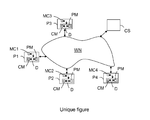
- Other features and advantages of the invention will become apparent on examining the detailed specifications and the appended drawing, wherein the unique figure schematically and functionally illustrates four wireless communication equipments (or peers) connected to a wireless communication network and each comprising an example of embodiment of a control device according to the invention.
- The appended drawing may serve not only to complete the invention, but also to contribute to its definition, if need be.
- The invention aims at offering a method and an associated control device D allowing to control P2P dissemination of contents between peers Pj of a group that may be temporarily connected to a wireless communication network WN offering access to contents and that may be also temporarily connected therebetween through wireless communications to share contents in a peer-to-peer mode.
- In the illustrated and non limiting example the group of peers Pj comprises four peers P1 to P4 (j = 1 to 4). But the invention concerns any group comprising at least two peers capable of exchanging content data therebetween.
- In a general manner, a group of peers Pj comprises N peers P1 to PN (j = 1 to N), and may be partitioned in L distinct classes C1, C2,..., CL. The size of each class Ci may be Cij. One assumes that the peer population in each class Ci grows proportionally to N, i.e., for all i, |Ci| = riN, where ri is a constant (in N). Moreover, one may assume that peers Pj in the same class Ci are statistically identical. So one considers that peers Pj in the same class Ci have the same contact characteristics and storage capacities, they exhibit the same demand for content and accrue the same utility from locating certain contents. Nonetheless, one assumes that peers Pj are oblivious to the existence of these classes, i.e., a peer does not know to which class Ci it belongs and cannot distinguish other peers Pj' based on their respective classes. For this reason, decisions made by the method (e.g., on what to store in a peer's cache memory CMj) will not depend on a priori knowledge of classes.
- In the following description it will be considered that the wireless communication network WN is an IEEE 802.11 network (i.e. a WLAN (Wireless Local Area Network), for instance of the WiFi type) and that the wireless communications between peers Pj are also established via this wireless communication network WN. But the invention is not limited to this example of wireless infrastructure. Indeed, the wireless communication network WN may be also a mobile or cellular network, a Zygbee network, an Ultra Wide band network, or an IEEE 802.15 network, for instance, and the wireless communications between peers Pj may be established through a wireless network which is different from the wireless communication network WN, such as a Bluetooth network, for instance.
- Moreover, in the following description it will be considered that peers Pj are mobile telephones. But the invention is not limited to this type of wireless communication equipment. Indeed, the invention concerns any type of wireless communication equipment comprising at least one executable P2P communication application and capable of exchanging data (or symbols) with other wireless communication equipments or network equipments in a P2P mode through wireless communications. So, a peer may be also a laptop, a smartphone, a personal digital assistant (PDA), provided that it comprises a wireless communication interface (or any equivalent wireless communication means), or a node associated to a vehicle (for instance a bus or a car) or a base station that is assisting opportunistic content delivery in an area (such as a content "booth" (or a "throwbox")).
- More, in the following description it will be considered that the contents to be disseminated are videos. But the invention is not limited to this type of content. Indeed, the invention concerns any type of content which can be disseminated in a P2P mode, and notably files of information data, chunks of video, pictures to share, html files, audio files and software updates, RSS ("Really Simple Syndication") feeds, and more generally any type of file.
- As illustrated in the unique figure, contents may be downloaded by the peers Pj from at least one content server CS which is connected to, or accessible through, the (wireless communication) network WN.
- As mentioned before the invention offers notably a method intended for controlling dissemination of content (and more precisely of content items) in a peer-to-peer (P2P) mode between peers Pj.
- It is important to note that each peer Pj comprises a cache memory (or buffer) MCj in which it stores content items received from other peers Pj' (j' ≠ j) when it encounters them, or from the content server CS when it accesses to the network WN.
- Moreover, when a peer Pj wants to obtain a content item, it generates a dedicated request or demand containing an identifier of this requested content item and transmits this dedicated request to each peer Pj' (j' ≠ j), eventually selected, it encounters.
- One may assume that contacts (or meetings) between peers Pj and Pj' occur in continuous time and follow the statistics of a Poisson process with rates λj,j' which are constants that do not depend on N. One further assumes that, when a peer Pj encounters another peer Pj' belonging to a class Ci', this peer Pj' is selected uniformly at random from Ci'. Hence, any given peer Pj meets and shares content with only a constant number of other peers Pj' per second. This is important, as peers Pj typically have limited bandwidth.
- One may also assume that contacts between peers Pj and Pj' are symmetric (Pj contacts Pj' whenever Pj' contacts Pj). As a result, riλj,j' = riλj',j. To understand this assumption, one may observe that a given peer Pj of Ci meets a given peer Pj 'of Ci' with a rate riλj,j' / |Ci'|, and the latter should equal the rate with which Pj' meets Pj. Moreover, one assumes that each peer Pj of Ci accesses the infrastructure according to a Poisson process with rate µi > 0, also constant in N. An access event indicates, e.g., that the peer is within the vicinity of its home or its office and can access the Internet through a wireless connection. Note that this requires µi to be strictly positive; every peer accesses the infrastructure, eventually.
- The method, according to the invention, can be implemented by control devices D according to the invention which are respectively associated to peers Pj, i.e., which are each dedicated to the control of content dissemination of one associated peer Pj.
- As it is schematically illustrated in the unique figure, each (control) device D may be located into its associated peer Pj. But each device D could be also an equipment or element coupled to its associated peer Pj.
- So, a device D can be made of software modules, at least partly, or of electronic circuit(s) or hardware modules, or else of a combination of hardware and software modules (in this case the device D comprises also a software interface allowing interworking between the hardware and software modules).
- The method according to the invention is implemented by a device D associated to a peer Pj each time this peer Pj accesses to the network WN or to another peer Pj' and possesses a group of variable values that are each associated to a content it can store into its cache memory MCj and representative of utility that storing of this content represents for it (Pj) and for other peers Pj' it has encountered.
- The variable may be named "vote", for instance.
- This method consists, each time such a peer Pj accesses to the network WN or to another peer Pj' in downloading M contents having the M highest variable values into its group of variable values. M is a number which depends on the storage capacity that a peer Pj is ready to use into its cache memory MCj to store contents to be downloaded. In the following description this downloading according the invention will be named "reshuffling".
- In fact, each time a peer Pj accesses to the network WN or to another peer Pj', a control means CM of its (associated) device D analyzes its group of vote values to determine its M highest vote values and then the M contents to which they respectively correspond, and then authorizes its peer Pj to download these M contents.
- One may assume that a peer Pj does not reshuffle content at all encounters with the network WN (though it always refreshes this content). Instead, one may assume that it reshuffles content with some probability α = α(N) > 0 that one allows to be a function of the number M of peers Pj.
- One refers hereafter to vPj,w(t) to designate the vote (or variable) value of content w at peer Pj and at time t, and to

- Each peer Pj may determine its own group of vote values from reports it has transmitted to other encountered peers Pj' and reports it has received from other peers Pj'. This is more precisely a processing means PM of its device D that is in charge of this group determination, and which generates the reports to be transmitted to the other encountered peers Pj'.
- One means here by "report" information data that indicate the effect that storing a content in a peer Pj has on the utility of this peer Pj. One considers that peers Pj of class Ci have utilities Ui,w that are functions of the time required to find a content w. These utilities capture the "impatience" of a peer Pj, i.e., how sensitive it is to get a given content w quickly. One may assumes that for all i and w, utilities Ui,w are non-increasing, differentiable and |Ui,w| = o (ect), for all c > 0.
- The assumption that utilities Ui,w are non-increasing is natural because the longer a peer Pj has to wait for getting a content w, the lower the utility it would obtain from finding this content w. Moreover, a sharp decrease indicates that peer Pj is very impatient, and receives little utility from a content w retrieved with a high delay.
- A peer Pj may define a first list comprising at least one (web)site or item (for instance video) from which it does not want to download any content and/or a second list comprising at least one (web)site or item (for instance video) from which it wants to download contents to store them permanently. So the first list contains blacklisted contents (or items) or websites, while the second list contains preferred contents (or items) or websites. These first and second lists are stored by the processing means PM into a local memory (for instance of the software type) that it contains or that is contained by its peer Pj. In this case, the M contents having the M highest vote values into a peer group cannot belong to the first list and cannot be downloaded from another encountered peer Pj'.
- The processing means PM is arranged for determining the storage capacity that can be used into the cache memory MCj of its associated peer Pj by computing the difference between the maximal storage capacity of this cache memory MCj and the storage capacity of this cache memory MCj that can be used for storing contents downloaded from the sites of the second list. This results from the fact that contents belonging to the second list are permanently stored into a cache memory MCj and therefore cannot be replaced with an other content without authorization of the user of the peer Pj.
- The vote vector of a peer Pj can be seen as an exponentially weighted moving average (or EWMA) which is, as mentioned before, constructed by means of reports generated by its device D as well as reports it receives from other peers Pj' it encounters.
- To understand the preceding sentence, one first needs to make the following definitions. For every content w, a peer Pj keeps track of the number of time slots between its last two consecutive encounters with another peer Pj' that stores content w or with the network WN. One denotes this quantity (i.e. number of time slots) at time t by TPj,w(t) > 0. A peer Pj also maintains a buffer of all pending requests: let nPj,w(t) be the number of pending requests for content w that peer Pj has at time t. For every content w stored in the cache memory MCj of peer Pj, nPj,w(t) = 0.
- TPj,w(t) and nPj,w(t) need only to be maintained for contents w for which Pj is interested in (i.e., di,w > 0, where di,w is the request rate of content w by peer Pj of class Ci). In practice, a peer Pj may keep track of these values only if it has issued a request for content w at some date in the past.
- Whenever peer Pj meets another peer Pj', it reports to the latter (Pj') the following quantity for every content w: repPj,w(t) = -TPj,w(t)*U'i,w(TPj,w(t))*nPj,w(t), where U'i,w is the derivative of utility Ui,w. This quantity repPj,w(t) serves as a report capturing the effect that content w has on the utility of peer Pj. It is important to note that if peer Pj meets a peer Pj' that stores content w, peer Pj first reports repPj,w(t) and then updates the values TPj,w(t) and nPj,w(t) accordingly (for instance by updating TPj,w(t) and setting nPj,w(t) to zero). Moreover, in practice repPj,w(t) needs only to be reported for all contents w for which there are pending requests, i.e., nPj,w(t) > 0. For all other contents w, repPj,w(t) is equal to zero and does not need to be reported.
- A processing means PM may update the group of vote values of its peer Pj each time it generates a new report for an other peer Pj' it encounters and each time its peer Pj receives a new report from another peer Pj' it encounters.
- For peer Pj of class Ci, the average vote value vPj,w(t) can be updated in the following way. Between requests or encounters with other peers Pj', vPj,w(t) decays exponentially with a rate β = β(N) > 0, a positive gain factor which one allows to depend on N. Whenever peer Pj receives a report, vPj,w(t) is incremented by the value in this report (i.e. repPj',w(t) is added to vPj,w(t)). Moreover, whenever peer Pj generates a request, vPj,w(t) is incremented by Ui,w(0) - Ui,w(TPj,w(t)).
- More formally, for small δ>0, vPj,w(t+δ)=(1-β(N)δ)vPj,w(t)+β(N)gPj,w(t,t+δ), where, with probability 1 - O(δ2),

- Because of the exponential decay between increments vPj,w(t) is called an EWMA. The gain factor β(N) allows to make the process more or less sensitive to newer reports, and then to control the variability of vPj,w(t).
- When a peer Pj accesses to the network WN or encounters another peer Pj', it may be also authorized by its processing means PM to download the most recent versions of at least some contents that are already stored into its cache memory MCj, in order to refresh it (MCj).
- It can be demonstrated that the caching policies (or cache contents) of the peers Pj, computed by the method according to the invention, are optimal in terms of average utility per peer (or social welfare) maximization. Moreover it optimizes the use of storage capacity rather than bandwidth. It is recalled that the "caching policies" are basically the contents that are stored into the caches. The vote vector determines the cache contents in the manner described above (i.e. whenever a peer Pj accesses the network WN (or another peer Pj'), it downloads the M items with the highest votes).
- The invention is not limited to the embodiments of method, control device and peer (or wireless communication equipment) described above, only as examples, but it encompasses all alternative embodiments which may be considered by one skilled in the art within the scope of the claims hereafter.
Claims (11)
- Method for controlling dissemination of contents in a peer-to-peer mode between peers (Pj) having wireless communication capacities and comprising a cache memory (MCj) for storing contents, characterized in that it consists, each time a peer (Pj), having a group of variable values each associated to a content it can store into its cache memory (MCj) and representative of utility that storing of this content represents for it (Pj) and for other peers (Pj'), accesses to a wireless network (WN) or another peer (Pj') offering access to said contents, in downloading N contents having the N highest variable values into its group, N being a number depending on the storage capacity said peer (Pj) is ready to use into its cache memory (MCj) to store contents to be downloaded.
- Method according to claim 1, characterized in that each peer (Pj) determines its own group of variable values from reports it has generated and reports received from other peers (Pj'), each report indicating the effect that storing a content in a peer (Pj) has on the utility of said peer (Pj).
- Method according to claim 2, characterized in that each peer (Pj) updates its own group of variable values each time it generates a new report and each time it receives a new report from another peer (Pj') it encounters.
- Method according to one of claims 1 to 3, characterized in that a peer (Pj) defines a first list comprising at least one site or item from which it does not want to download any content and/or a second list comprising at least one site or item from which it wants to download contents to store them permanently, the storage capacity to be used into its cache memory (MCj) being equal to the difference between the maximal storage capacity of its cache memory (MCj) and the storage capacity of its cache memory (MCj) that can be used for storing contents downloaded from the sites or items of the second list.
- Method according to one of claims 1 to 4, characterized in that when a peer (Pj) accesses to a wireless network (WN) or encounters another peer (Pj'), it downloads the most recent versions of at least some contents that are already stored into its cache memory (MCj).
- Control device (D) for controlling dissemination of contents in a peer-to-peer mode from an associated peer (Pj) to other peers (Pj') through wireless communications, each peer (Pj) having a cache memory (MCj) for storing contents, characterized in that it comprises a control means (CM) arranged, each time its peer (Pj) accesses to a wireless network (WN) or another peer (Pj') offering access to contents and has a group of variable values each associated to a content it can store into its cache memory (MCj) and representative of utility that storing of this content represents for it (Pj) and for other peers (Pj'), in authorizing said peer (Pj) to download N contents having the N highest variable values into its group, N being a number depending on the storage capacity said peer (Pj) is ready to use into its cache memory (MCj) to store contents to be downloaded.
- Control device according to claim 6, characterized in that it comprises a processing means (PM) arranged for generating reports indicating the effect that storing a content into its associated peer (Pj) has on the utility of said peer (Pj), and for determining said variable values of the group of its associated peer (Pj) from reports it has generated and from reports received from other peers (Pj').
- Control device according to claim 7, characterized in that said processing means (PM) is arranged for updating the group of variable values of its associated peer (Pj) each time it generates a new report and each time its associated peer (Pj) receives a new report from another peer (Pj') it encounters.
- Control device according to one of claims 6 to 8, characterized in that said control means (CM) is arranged for storing a first list comprising at least one site or item from which its associated peer (Pj) does not want to download any content and/or a second list comprising at least one site or item from which its associated peer (Pj) wants to download contents to store them permanently, and for determining the storage capacity that can be used into the cache memory (MCj) of its associated peer (Pj) by computing the difference between the maximal storage capacity of said cache memory (MCj) and the storage capacity of said cache memory (MCj) that can be used for storing contents downloaded from the sites or items of the second list.
- Control device according to one of claims 6 to 9, characterized in that said control means (CM) is arranged, when its associated peer (Pj) accesses a wireless network (WN) or encounters another peer (Pj'), to authorize it to download the most recent versions of at least some contents that are already stored into its cache memory (MCj).
- Peer (Pj) capable of establishing wireless communications with other peers (Pj') and comprising a cache memory (MCj) for storing contents, characterized in that it further comprises a control device (D) according to one of claims 6 to 10.
Priority Applications (5)
| Application Number | Priority Date | Filing Date | Title |
|---|---|---|---|
| EP20100305334 EP2372976B1 (en) | 2010-03-31 | 2010-03-31 | Device and method for controlling dissemination of contents between peers having wireless communication capacities, depending on vote vectors |
| JP2011013525A JP5765950B2 (en) | 2010-01-28 | 2011-01-26 | Device and method for controlling content distribution between peers having wireless communication capability according to vote vector |
| CN201110031269.2A CN102143223B (en) | 2010-01-28 | 2011-01-28 | According to equipment and the method for the propagation of the content between each equity point of ballot vector control |
| KR1020110008948A KR20110088463A (en) | 2010-01-28 | 2011-01-28 | Device and method for controlling the distribution of content among peers with wireless communication capacity, according to the boat vector |
| US12/931,295 US8706831B2 (en) | 2010-01-28 | 2011-01-28 | Device and method for controlling dissemination of contents between peers having wireless communication capacities, depending on vote vectors |
Applications Claiming Priority (1)
| Application Number | Priority Date | Filing Date | Title |
|---|---|---|---|
| EP20100305334 EP2372976B1 (en) | 2010-03-31 | 2010-03-31 | Device and method for controlling dissemination of contents between peers having wireless communication capacities, depending on vote vectors |
Publications (2)
| Publication Number | Publication Date |
|---|---|
| EP2372976A1 true EP2372976A1 (en) | 2011-10-05 |
| EP2372976B1 EP2372976B1 (en) | 2013-05-08 |
Family
ID=42738826
Family Applications (1)
| Application Number | Title | Priority Date | Filing Date |
|---|---|---|---|
| EP20100305334 Not-in-force EP2372976B1 (en) | 2010-01-28 | 2010-03-31 | Device and method for controlling dissemination of contents between peers having wireless communication capacities, depending on vote vectors |
Country Status (1)
| Country | Link |
|---|---|
| EP (1) | EP2372976B1 (en) |
Citations (3)
| Publication number | Priority date | Publication date | Assignee | Title |
|---|---|---|---|---|
| EP1599013A2 (en) * | 2004-05-14 | 2005-11-23 | Microsoft Corporation | Distributed hosting of web content using partial replication |
| WO2007131525A1 (en) * | 2006-05-15 | 2007-11-22 | Joost N.V. | User interface for digital television networks |
| US20090168795A1 (en) * | 2007-12-26 | 2009-07-02 | Alcatel Lucent | Predictive caching content distribution network |
-
2010
- 2010-03-31 EP EP20100305334 patent/EP2372976B1/en not_active Not-in-force
Patent Citations (3)
| Publication number | Priority date | Publication date | Assignee | Title |
|---|---|---|---|---|
| EP1599013A2 (en) * | 2004-05-14 | 2005-11-23 | Microsoft Corporation | Distributed hosting of web content using partial replication |
| WO2007131525A1 (en) * | 2006-05-15 | 2007-11-22 | Joost N.V. | User interface for digital television networks |
| US20090168795A1 (en) * | 2007-12-26 | 2009-07-02 | Alcatel Lucent | Predictive caching content distribution network |
Also Published As
| Publication number | Publication date |
|---|---|
| EP2372976B1 (en) | 2013-05-08 |
Similar Documents
| Publication | Publication Date | Title |
|---|---|---|
| CN102238137B (en) | Method, system and device for downloading | |
| CN103718576B (en) | Method and apparatus for content distribution | |
| US10951395B2 (en) | Data fetching in data exchange networks | |
| US20080089299A1 (en) | Method and system for distributing content in Ad-hoc networks using super peers | |
| US10129356B2 (en) | Physical layer caching for flexible MIMO cooperation in wireless networks | |
| US20120047201A1 (en) | Apparatus and method of acquiring or distributing content | |
| US7808909B2 (en) | Method and a system for matching between network nodes | |
| US8706831B2 (en) | Device and method for controlling dissemination of contents between peers having wireless communication capacities, depending on vote vectors | |
| Guo et al. | Cooperative local caching and file sharing under heterogeneous file preferences | |
| CN110677484B (en) | Bypass distribution preheating method and device and electronic equipment | |
| Pandey et al. | Coded caching for hierarchical two-layer networks with coded placement | |
| Petz et al. | Madserver: A server architecture for mobile advanced delivery | |
| US8180857B2 (en) | Method for downloading file in parallel | |
| JP5938091B2 (en) | Data replication | |
| Elayoubi et al. | Optimal D2D Content Delivery for Cellular Network Offloading: Special Issue on Device-to-Device Communication in 5G Networks | |
| Bhargavi et al. | A hybrid secure routing scheme for MANETS | |
| US9307023B2 (en) | Device and method for controlling dissemination of contents between peers having wireless communication capacities, depending on impatience reaction functions | |
| EP2372976B1 (en) | Device and method for controlling dissemination of contents between peers having wireless communication capacities, depending on vote vectors | |
| US20120201210A1 (en) | Terminal and method for data communication using multiple wireless communication methods | |
| de Moraes Modesto et al. | Utility-gradient implicit cache coordination policy for information-centric ad-hoc vehicular networks | |
| Kwon et al. | Scalable video streaming relay for smart mobile devices in wireless networks | |
| KR101525471B1 (en) | Method and system for providing video | |
| Xu et al. | Machine learning in disruption-tolerant MANETs | |
| Wang et al. | Incentive based cooperative content caching in Social Wireless Networks | |
| CN104396306A (en) | Method, device and system for acquiring mobile network data resources |
Legal Events
| Date | Code | Title | Description |
|---|---|---|---|
| PUAI | Public reference made under article 153(3) epc to a published international application that has entered the european phase |
Free format text: ORIGINAL CODE: 0009012 |
|
| AK | Designated contracting states |
Kind code of ref document: A1 Designated state(s): AT BE BG CH CY CZ DE DK EE ES FI FR GB GR HR HU IE IS IT LI LT LU LV MC MK MT NL NO PL PT RO SE SI SK SM TR |
|
| AX | Request for extension of the european patent |
Extension state: AL BA ME RS |
|
| 17P | Request for examination filed |
Effective date: 20120321 |
|
| GRAP | Despatch of communication of intention to grant a patent |
Free format text: ORIGINAL CODE: EPIDOSNIGR1 |
|
| GRAS | Grant fee paid |
Free format text: ORIGINAL CODE: EPIDOSNIGR3 |
|
| GRAA | (expected) grant |
Free format text: ORIGINAL CODE: 0009210 |
|
| AK | Designated contracting states |
Kind code of ref document: B1 Designated state(s): AT BE BG CH CY CZ DE DK EE ES FI FR GB GR HR HU IE IS IT LI LT LU LV MC MK MT NL NO PL PT RO SE SI SK SM TR |
|
| REG | Reference to a national code |
Ref country code: GB Ref legal event code: FG4D |
|
| REG | Reference to a national code |
Ref country code: AT Ref legal event code: REF Ref document number: 611546 Country of ref document: AT Kind code of ref document: T Effective date: 20130515 Ref country code: CH Ref legal event code: EP |
|
| REG | Reference to a national code |
Ref country code: IE Ref legal event code: FG4D |
|
| REG | Reference to a national code |
Ref country code: DE Ref legal event code: R096 Ref document number: 602010006909 Country of ref document: DE Effective date: 20130704 |
|
| REG | Reference to a national code |
Ref country code: DE Ref legal event code: R084 Ref document number: 602010006909 Country of ref document: DE Effective date: 20130518 |
|
| REG | Reference to a national code |
Ref country code: AT Ref legal event code: MK05 Ref document number: 611546 Country of ref document: AT Kind code of ref document: T Effective date: 20130508 |
|
| REG | Reference to a national code |
Ref country code: LT Ref legal event code: MG4D |
|
| REG | Reference to a national code |
Ref country code: NL Ref legal event code: VDEP Effective date: 20130508 |
|
| PG25 | Lapsed in a contracting state [announced via postgrant information from national office to epo] |
Ref country code: PT Free format text: LAPSE BECAUSE OF FAILURE TO SUBMIT A TRANSLATION OF THE DESCRIPTION OR TO PAY THE FEE WITHIN THE PRESCRIBED TIME-LIMIT Effective date: 20130909 Ref country code: LT Free format text: LAPSE BECAUSE OF FAILURE TO SUBMIT A TRANSLATION OF THE DESCRIPTION OR TO PAY THE FEE WITHIN THE PRESCRIBED TIME-LIMIT Effective date: 20130508 Ref country code: GR Free format text: LAPSE BECAUSE OF FAILURE TO SUBMIT A TRANSLATION OF THE DESCRIPTION OR TO PAY THE FEE WITHIN THE PRESCRIBED TIME-LIMIT Effective date: 20130809 Ref country code: NO Free format text: LAPSE BECAUSE OF FAILURE TO SUBMIT A TRANSLATION OF THE DESCRIPTION OR TO PAY THE FEE WITHIN THE PRESCRIBED TIME-LIMIT Effective date: 20130808 Ref country code: FI Free format text: LAPSE BECAUSE OF FAILURE TO SUBMIT A TRANSLATION OF THE DESCRIPTION OR TO PAY THE FEE WITHIN THE PRESCRIBED TIME-LIMIT Effective date: 20130508 Ref country code: ES Free format text: LAPSE BECAUSE OF FAILURE TO SUBMIT A TRANSLATION OF THE DESCRIPTION OR TO PAY THE FEE WITHIN THE PRESCRIBED TIME-LIMIT Effective date: 20130819 Ref country code: IS Free format text: LAPSE BECAUSE OF FAILURE TO SUBMIT A TRANSLATION OF THE DESCRIPTION OR TO PAY THE FEE WITHIN THE PRESCRIBED TIME-LIMIT Effective date: 20130908 Ref country code: AT Free format text: LAPSE BECAUSE OF FAILURE TO SUBMIT A TRANSLATION OF THE DESCRIPTION OR TO PAY THE FEE WITHIN THE PRESCRIBED TIME-LIMIT Effective date: 20130508 Ref country code: SE Free format text: LAPSE BECAUSE OF FAILURE TO SUBMIT A TRANSLATION OF THE DESCRIPTION OR TO PAY THE FEE WITHIN THE PRESCRIBED TIME-LIMIT Effective date: 20130508 Ref country code: SI Free format text: LAPSE BECAUSE OF FAILURE TO SUBMIT A TRANSLATION OF THE DESCRIPTION OR TO PAY THE FEE WITHIN THE PRESCRIBED TIME-LIMIT Effective date: 20130508 |
|
| PG25 | Lapsed in a contracting state [announced via postgrant information from national office to epo] |
Ref country code: HR Free format text: LAPSE BECAUSE OF FAILURE TO SUBMIT A TRANSLATION OF THE DESCRIPTION OR TO PAY THE FEE WITHIN THE PRESCRIBED TIME-LIMIT Effective date: 20130508 Ref country code: CY Free format text: LAPSE BECAUSE OF FAILURE TO SUBMIT A TRANSLATION OF THE DESCRIPTION OR TO PAY THE FEE WITHIN THE PRESCRIBED TIME-LIMIT Effective date: 20130508 Ref country code: BG Free format text: LAPSE BECAUSE OF FAILURE TO SUBMIT A TRANSLATION OF THE DESCRIPTION OR TO PAY THE FEE WITHIN THE PRESCRIBED TIME-LIMIT Effective date: 20130808 Ref country code: PL Free format text: LAPSE BECAUSE OF FAILURE TO SUBMIT A TRANSLATION OF THE DESCRIPTION OR TO PAY THE FEE WITHIN THE PRESCRIBED TIME-LIMIT Effective date: 20130508 |
|
| PG25 | Lapsed in a contracting state [announced via postgrant information from national office to epo] |
Ref country code: LV Free format text: LAPSE BECAUSE OF FAILURE TO SUBMIT A TRANSLATION OF THE DESCRIPTION OR TO PAY THE FEE WITHIN THE PRESCRIBED TIME-LIMIT Effective date: 20130508 |
|
| PG25 | Lapsed in a contracting state [announced via postgrant information from national office to epo] |
Ref country code: CZ Free format text: LAPSE BECAUSE OF FAILURE TO SUBMIT A TRANSLATION OF THE DESCRIPTION OR TO PAY THE FEE WITHIN THE PRESCRIBED TIME-LIMIT Effective date: 20130508 Ref country code: SK Free format text: LAPSE BECAUSE OF FAILURE TO SUBMIT A TRANSLATION OF THE DESCRIPTION OR TO PAY THE FEE WITHIN THE PRESCRIBED TIME-LIMIT Effective date: 20130508 Ref country code: DK Free format text: LAPSE BECAUSE OF FAILURE TO SUBMIT A TRANSLATION OF THE DESCRIPTION OR TO PAY THE FEE WITHIN THE PRESCRIBED TIME-LIMIT Effective date: 20130508 Ref country code: EE Free format text: LAPSE BECAUSE OF FAILURE TO SUBMIT A TRANSLATION OF THE DESCRIPTION OR TO PAY THE FEE WITHIN THE PRESCRIBED TIME-LIMIT Effective date: 20130508 Ref country code: BE Free format text: LAPSE BECAUSE OF FAILURE TO SUBMIT A TRANSLATION OF THE DESCRIPTION OR TO PAY THE FEE WITHIN THE PRESCRIBED TIME-LIMIT Effective date: 20130508 |
|
| PG25 | Lapsed in a contracting state [announced via postgrant information from national office to epo] |
Ref country code: IT Free format text: LAPSE BECAUSE OF FAILURE TO SUBMIT A TRANSLATION OF THE DESCRIPTION OR TO PAY THE FEE WITHIN THE PRESCRIBED TIME-LIMIT Effective date: 20130508 Ref country code: RO Free format text: LAPSE BECAUSE OF FAILURE TO SUBMIT A TRANSLATION OF THE DESCRIPTION OR TO PAY THE FEE WITHIN THE PRESCRIBED TIME-LIMIT Effective date: 20130508 Ref country code: NL Free format text: LAPSE BECAUSE OF FAILURE TO SUBMIT A TRANSLATION OF THE DESCRIPTION OR TO PAY THE FEE WITHIN THE PRESCRIBED TIME-LIMIT Effective date: 20130508 |
|
| PLBE | No opposition filed within time limit |
Free format text: ORIGINAL CODE: 0009261 |
|
| STAA | Information on the status of an ep patent application or granted ep patent |
Free format text: STATUS: NO OPPOSITION FILED WITHIN TIME LIMIT |
|
| 26N | No opposition filed |
Effective date: 20140211 |
|
| REG | Reference to a national code |
Ref country code: DE Ref legal event code: R097 Ref document number: 602010006909 Country of ref document: DE Effective date: 20140211 |
|
| PG25 | Lapsed in a contracting state [announced via postgrant information from national office to epo] |
Ref country code: LU Free format text: LAPSE BECAUSE OF FAILURE TO SUBMIT A TRANSLATION OF THE DESCRIPTION OR TO PAY THE FEE WITHIN THE PRESCRIBED TIME-LIMIT Effective date: 20140331 |
|
| REG | Reference to a national code |
Ref country code: CH Ref legal event code: PL |
|
| GBPC | Gb: european patent ceased through non-payment of renewal fee |
Effective date: 20140331 |
|
| REG | Reference to a national code |
Ref country code: IE Ref legal event code: MM4A |
|
| PG25 | Lapsed in a contracting state [announced via postgrant information from national office to epo] |
Ref country code: CH Free format text: LAPSE BECAUSE OF NON-PAYMENT OF DUE FEES Effective date: 20140331 Ref country code: LI Free format text: LAPSE BECAUSE OF NON-PAYMENT OF DUE FEES Effective date: 20140331 Ref country code: IE Free format text: LAPSE BECAUSE OF NON-PAYMENT OF DUE FEES Effective date: 20140331 Ref country code: GB Free format text: LAPSE BECAUSE OF NON-PAYMENT OF DUE FEES Effective date: 20140331 |
|
| PG25 | Lapsed in a contracting state [announced via postgrant information from national office to epo] |
Ref country code: MT Free format text: LAPSE BECAUSE OF FAILURE TO SUBMIT A TRANSLATION OF THE DESCRIPTION OR TO PAY THE FEE WITHIN THE PRESCRIBED TIME-LIMIT Effective date: 20130508 |
|
| REG | Reference to a national code |
Ref country code: FR Ref legal event code: PLFP Year of fee payment: 7 |
|
| PG25 | Lapsed in a contracting state [announced via postgrant information from national office to epo] |
Ref country code: SM Free format text: LAPSE BECAUSE OF FAILURE TO SUBMIT A TRANSLATION OF THE DESCRIPTION OR TO PAY THE FEE WITHIN THE PRESCRIBED TIME-LIMIT Effective date: 20130508 |
|
| PG25 | Lapsed in a contracting state [announced via postgrant information from national office to epo] |
Ref country code: MC Free format text: LAPSE BECAUSE OF FAILURE TO SUBMIT A TRANSLATION OF THE DESCRIPTION OR TO PAY THE FEE WITHIN THE PRESCRIBED TIME-LIMIT Effective date: 20130508 |
|
| PG25 | Lapsed in a contracting state [announced via postgrant information from national office to epo] |
Ref country code: HU Free format text: LAPSE BECAUSE OF FAILURE TO SUBMIT A TRANSLATION OF THE DESCRIPTION OR TO PAY THE FEE WITHIN THE PRESCRIBED TIME-LIMIT; INVALID AB INITIO Effective date: 20100331 Ref country code: TR Free format text: LAPSE BECAUSE OF FAILURE TO SUBMIT A TRANSLATION OF THE DESCRIPTION OR TO PAY THE FEE WITHIN THE PRESCRIBED TIME-LIMIT Effective date: 20130508 |
|
| REG | Reference to a national code |
Ref country code: FR Ref legal event code: PLFP Year of fee payment: 8 |
|
| REG | Reference to a national code |
Ref country code: DE Ref legal event code: R082 Ref document number: 602010006909 Country of ref document: DE Representative=s name: HOFSTETTER, SCHURACK & PARTNER PATENT- UND REC, DE |
|
| REG | Reference to a national code |
Ref country code: FR Ref legal event code: PLFP Year of fee payment: 9 |
|
| PGFP | Annual fee paid to national office [announced via postgrant information from national office to epo] |
Ref country code: DE Payment date: 20180323 Year of fee payment: 9 |
|
| PGFP | Annual fee paid to national office [announced via postgrant information from national office to epo] |
Ref country code: FR Payment date: 20180329 Year of fee payment: 9 |
|
| PG25 | Lapsed in a contracting state [announced via postgrant information from national office to epo] |
Ref country code: MK Free format text: LAPSE BECAUSE OF FAILURE TO SUBMIT A TRANSLATION OF THE DESCRIPTION OR TO PAY THE FEE WITHIN THE PRESCRIBED TIME-LIMIT Effective date: 20130508 |
|
| REG | Reference to a national code |
Ref country code: DE Ref legal event code: R119 Ref document number: 602010006909 Country of ref document: DE |
|
| PG25 | Lapsed in a contracting state [announced via postgrant information from national office to epo] |
Ref country code: DE Free format text: LAPSE BECAUSE OF NON-PAYMENT OF DUE FEES Effective date: 20191001 |
|
| PG25 | Lapsed in a contracting state [announced via postgrant information from national office to epo] |
Ref country code: FR Free format text: LAPSE BECAUSE OF NON-PAYMENT OF DUE FEES Effective date: 20190331 |